"Let my son often read and reflect on history: this is the only true philosophy."—Napoleon's last Instructions for the King of Rome.
POST 8VO EDITION, ILLUSTRATED
First Published, December 1901.
Second Edition, revised, March 1902.
Third Edition, revised, January 1903.
Fourth Edition, revised, September 1907.
Reprinted, January 1910.
CROWN 8VO EDITION
First Published, September 1904.
Reprinted, October 1907; July 1910.
DEDICATED TO THE RIGHT HONOURABLE LORD ACTON, K.C.V.O., D.C.L., LL.D. REGIUS PROFESSOR OF MODERN HISTORY IN THE UNIVERSITY OF CAMBRIDGE, IN ADMIRATION OF HIS PROFOUND HISTORICAL LEARNING, AND IN GRATITUDE FOR ADVICE AND HELP GENEROUSLY GIVEN.
An apology seems to be called for from anyone who gives to the world a new Life of Napoleon I. My excuse must be that for many years I have sought to revise the traditional story of his career in the light of facts gleaned from the British Archives and of the many valuable materials that have recently been published by continental historians. To explain my manner of dealing with these sources would require an elaborate critical Introduction; but, as the limits of my space absolutely preclude any such attempt, I can only briefly refer to the most important topics.
To deal with the published sources first, I would name as of chief importance the works of MM. Aulard, Chuquet, Houssaye, Sorel, and Vandal in France; of Herren Beer, Delbrück, Fournier, Lehmann, Oncken, and Wertheimer in Germany and Austria; and of Baron Lumbroso in Italy. I have also profited largely by the scholarly monographs or collections of documents due to the labours of the "Société d'Histoire Contemporaine," the General Staff of the French Army, of MM. Bouvier, Caudrillier, Capitaine "J.G.," Lévy, Madelin, Sagnac, Sciout, Zivy, and others in France; and of Herren Bailleu, Demelitsch, Hansing, Klinkowstrom, Luckwaldt, Ulmann, and others in Germany. Some of the recently published French Memoirs dealing with those times are not devoid of value, though this class of literature is to be used with caution. The new letters of Napoleon published by M. Léon Lecestre and M. Léonce de Brotonne [pg.VIII] have also opened up fresh vistas into the life of the great man; and the time seems to have come when we may safely revise our judgments on many of its episodes.
But I should not have ventured on this great undertaking, had I not been able to contribute something new to Napoleonic literature. During a study of this period for an earlier work published in the "Cambridge Historical Series," I ascertained the great value of the British records for the years 1795-1815. It is surely discreditable to our historical research that, apart from the fruitful labours of the Navy Records Society, of Messrs. Oscar Browning and Hereford George, and of Mr. Bowman of Toronto, scarcely any English work has appeared that is based on the official records of this period. Yet they are of great interest and value. Our diplomatic agents then had the knack of getting at State secrets in most foreign capitals, even when we were at war with their Governments; and our War Office and Admiralty Records have also yielded me some interesting "finds." M. Lévy, in the preface to his "Napoléon intime" (1893), has well remarked that "the documentary history of the wars of the Empire has not yet been written. To write it accurately, it will be more important thoroughly to know foreign archives than those of France." Those of Russia, Austria, and Prussia have now for the most part been examined; and I think that I may claim to have searched all the important parts of our Foreign Office Archives for the years in question, as well as for part of the St. Helena period. I have striven to embody the results of this search in the present volumes as far as was compatible with limits of space and with the narrative form at which, in my judgment, history ought always to aim.
On the whole, British policy comes out the better the [pg.IX] more fully it is known. Though often feeble and vacillating, it finally attained to firmness and dignity; and Ministers closed the cycle of war with acts of magnanimity towards the French people which are studiously ignored by those who bid us shed tears over the martyrdom of St. Helena. Nevertheless, the splendour of the finale must not blind us to the flaccid eccentricities that made British statesmanship the laughing stock of Europe in 1801-3, 1806-7, and 1809. Indeed, it is questionable whether the renewal of war between England and Napoleon in 1803 was due more to his innate forcefulness or to the contempt which he felt for the Addington Cabinet. When one also remembers our extraordinary blunders in the war of the Third Coalition, it seems a miracle that the British Empire survived that life and death struggle against a man of superhuman genius who was determined to effect its overthrow. I have called special attention to the extent and pertinacity of Napoleon's schemes for the foundation of a French Colonial Empire in India, Egypt, South Africa, and Australia; and there can be no doubt that the events of the years 1803-13 determined, not only the destinies of Europe and Napoleon, but the general trend of the world's colonization.
As it has been necessary to condense the story of Napoleon's life in some parts, I have chosen to treat with special brevity the years 1809-11, which may be called the constans aetas of his career, in order to have more space for the decisive events that followed; but even in these less eventful years I have striven to show how his Continental System was setting at work mighty economic forces that made for his overthrow, so that after the débâcle of 1812 it came to be a struggle of Napoleon and France contra mundum. [pg.X]
While not neglecting the personal details of the great man's life, I have dwelt mainly on his public career. Apart from his brilliant conversations, his private life has few features of abiding interest, perhaps because he early tired of the shallowness of Josephine and the Corsican angularity of his brothers and sisters. But the cause also lay in his own disposition. He once said to M. Gallois: "Je n'aime pas beaucoup les femmes, ni le jeu—enfin rien: je suis tout à fait un être politique." In dealing with him as a warrior and statesman, and in sparing my readers details as to his bolting his food, sleeping at concerts, and indulging in amours where for him there was no glamour of romance, I am laying stress on what interested him most—in a word, I am taking him at his best.
I could not have accomplished this task, even in the present inadequate way, but for the help generously accorded from many quarters. My heartfelt thanks are due to Lord Acton, Regius Professor of Modern History in the University of Cambridge, for advice of the highest importance; to Mr. Hubert Hall of the Public Record Office, for guidance in my researches there; to Baron Lumbroso of Rome, editor of the "Bibliografia ragionata dell' Epoca Napoleonica," for hints on Italian and other affairs; to Dr. Luckwaldt, Privat Docent of the University of Bonn, and author of "Oesterreich und die Anfänge des Befreiungs-Krieges," for his very scholarly revision of the chapters on German affairs; to Mr. F.H.E. Cunliffe, M.A., Fellow of All Souls' College, Oxford, for valuable advice on the campaigns of 1800, 1805, and 1806; to Professor Caudrillier of Grenoble, author of "Pichegru," for information respecting the royalist plot; and to Messrs. J.E. Morris, M.A., and E.L.S. Horsburgh, B.A., for detailed communications concerning Waterloo, [pg.XI] The nieces of the late Professor Westwood of Oxford most kindly allowed the facsimile of the new Napoleon letter, printed opposite p. 156 of vol. i., to be made from the original in their possession; and Miss Lowe courteously placed at my disposal the papers of her father relating to the years 1813-15, as well as to the St. Helena period. I wish here to record my grateful obligations for all these friendly courtesies, which have given value to the book, besides saving me from many of the pitfalls with which the subject abounds. That I have escaped them altogether is not to be imagined; but I can honestly say, in the words of the late Bishop of London, that "I have tried to write true history."
J.H.R.
[NOTE.—The references to Napoleon's "Correspondence" in the notes are to the official French edition, published under the auspices of Napoleon III. The "New Letters of Napoleon" are those edited by Léon Lecestre, and translated into English by Lady Mary Loyd, except in a very few cases where M. Léonce de Brotonne's still more recent edition is cited under his name. By "F.O.," France, No.——, and "F.O.," Prussia, No.——, are meant the volumes of our Foreign Office despatches relating to France and Prussia. For the sake of brevity I have called Napoleon's Marshals and high officials by their names, not by their titles: but a list of these is given at the close of vol. ii.] [pg.XII]
The demand for this work so far exceeded my expectations that I was unable to make any considerable changes in the second edition, issued in March, 1902; and circumstances again make it impossible for me to give the work that thorough recension which I should desire. I have, however, carefully considered the suggestions offered by critics, and have adopted them in some cases. Professor Fournier of Vienna has most kindly furnished me with details which seem to relegate to the domain of legend the famous ice catastrophe at Austerlitz; and I have added a note to this effect on p. 50 of vol. ii. On the other hand, I may justly claim that the publication of Count Balmain's reports relating to St. Helena has served to corroborate, in all important details, my account of Napoleon's captivity.
It only remains to add that I much regret the omission of Mr. Oman's name from II. 12-13 of page viii of the Preface, an omission rendered all the more conspicuous by the appearance of the first volume of his "History of the Peninsular War" in the spring of this year.
J.H.R.
October, 1902.
Notes have been added at the end of ch. v., vol. i.; chs. xxii.,
xxiii., xxviii., xxix., xxxv., vol. ii.; and an Appendix on the
Battle of Waterloo has been added on p. 577, vol. ii.
| CHAPTER | page | ||
| PREFACE | VII | ||
| NOTE ON THE REPUBLICAN CALENDAR | XV | ||
| VOLUME I | |||
| I. PARENTAGE AND EARLY YEARS | 1 | ||
| II. THE FRENCH REVOLUTION AND CORSICA | 24 | ||
| III. TOULON | 44 | ||
| IV. VENDÉMIAIRE | 57 | ||
| V. THE ITALIAN CAMPAIGN (1796) | 77 | ||
| VI. THE FIGHTS FOR MANTUA | 105 | ||
| VII. LEOBEN TO CAMPO FORMIO | 140 | ||
| VIII. EGYPT | 174 | ||
| IX. SYRIA | 201 | ||
| X. BRUMAIRE | 216 | ||
| XI. MARENGO: LUNÉVILLE | 240 | ||
| XII.THE NEW INSTITUTIONS OF FRANCE | 266 | ||
| XIII. THE CONSULATE FOR LIFE | 302 | ||
| XIV. THE PEACE OF AMIENS | 331 | ||
| XV. A FRENCH COLONIAL EMPIRE: ST. DOMINGO--LOUISIANA--INDIA--AUSTRALIA |
355 | ||
| XVI. NAPOLEON'S INTERVENTIONS | 386 | ||
| XVII. THE RENEWAL OF WAR | 401 | ||
| XVIII. EUROPE AND THE BONAPARTES | 430 | ||
| XIX. THE ROYALIST PLOT | 446 | ||
| XX. THE DAWN OF THE EMPIRE | 465 | ||
| XXI. THE BOULOGNE FLOTILLA | 462 | ||
| XXII. APPENDIX: REPORTS HITHERTO UNPUBLISHED ON (a) THE SALE OF LOUISIANA; (b) THE IRISH DIVISION IN NAPOLEON'S SERVICE |
509 | ||
| ILLUSTRATIONS, MAPS, AND PLANS | |||
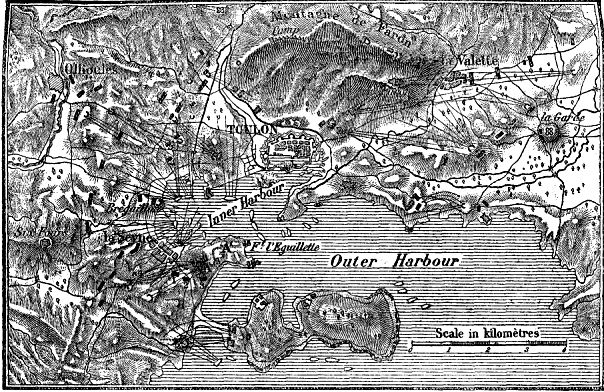
| THE SIEGE OF TOULON, 1793 | 51 | ||
| MAP TO ILLUSTRATE THE CAMPAIGNS IN NORTH ITALY | 81 | ||
| PLAN TO ILLUSTRATE THE VICTORY OF ARCOLA | 125 | ||
| THE NEIGHBOURHOOD OF RIVOLI | 133 | ||
| FACSIMILE OF A LETTER OF NAPOLEON TO "LA CITOYENNE TALLIEN," 1797 | 156 | ||
| CENTRAL EUROPE, after the Peace of Campo Formio, 1797 | 171 | ||
| PLAN OF THE SIEGE OF ACRE, from a contemporary sketch | 205 | ||
| THE BATTLE OF MARENGO, to illustrate Kellermann's charge | 255 | ||
| FRENCH MAP OF THE SOUTH OF AUSTRALIA, 1807 |
378 | ||
| VOLUME II | |||
| XXII. ULM AND TRAFALGAR | 1 | ||
| XXIII. AUSTERLITZ | 29 | ||
| XXIV. PRUSSIA AND THE NEW CHARLEMAGNE | 51 | ||
| XXV. THE FALL OF PRUSSIA | 79 | ||
| XXVI. THE CONTINENTAL SYSTEM: FRIEDLAND | 103 | ||
| XXVII. TILSIT | 125 | ||
| XXVIII. THE SPANISH RISING | 159 | ||
| XXIX. ERFURT | 174 | ||
| XXX. NAPOLEON AND AUSTRIA | 189 | ||
| XXXI. THE EMPIRE AT ITS HEIGHT | 208 | ||
| XXXII. THE RUSSIAN CAMPAIGN | 231 | ||
| XXXIII. THE FIRST SAXON CAMPAIGN | 267 | ||
| XXXIV. VITTORIA AND THE ARMISTICE | 300 | ||
| XXXV. DRESDEN AND LEIPZIG | 329 | ||
| XXXVI. FROM THE RHINE TO THE SEINE | 368 | ||
| XXXVII. THE FIRST ABDICATION | 399 | ||
| XXXVIII. ELBA AND PARIS | 435 | ||
| XXXIX. LIGNY AND QUATRE BRAS | 453 | ||
| XL. WATERLOO | 487 | ||
| XLI. FROM THE ELYSÉE TO ST. HELENA | 512 | ||
| XLII. CLOSING YEARS | 539 | ||
| APPENDIX I: LIST OF THE CHIEF APPOINTMENTS AND DIGNITIES BESTOWED BY NAPOLEON |
575 | ||
| APPENDIX II: THE BATTLE OF WATERLOO | 577 | ||
| INDEX | 579 | ||
| MAPS AND PLANS | |||
| BATTLE OF ULM | 15 | ||
| BATTLE OF AUSTERLITZ | 39 | ||
| BATTLE OF JENA | 95 | ||
| BATTLE OF FRIEDLAND | 121 | ||
| BATTLE OF WAGRAM | 196 | ||
| CENTRAL EUROPE AFTER 1810 | 215 | ||
| CAMPAIGN IN RUSSIA | 247 | ||
| BATTLE OF VITTORIA | 310 | ||
| THE CAMPAIGN OF 1813 | 336 | ||
| BATTLE OF DRESDEN | 343 | ||
| BATTLE OF LEIPZIG | 357 | ||
| THE CAMPAIGN OF 1814 | to face | 383 | |
| PLAN OF THE WATERLOO CAMPAIGN | 458 | ||
| BATTLE OF LIGNY | 465 | ||
| BATTLE OF WATERLOO, about 11 o'clock a.m. | to face | 490 | |
| ST. HELENA | 540 | ||
| FOOTNOTES | |||
| INDEX |
The republican calendar consisted of twelve months of thirty days each, each month being divided into three "decades" of ten days. Five days (in leap years six) were added at the end of the year to bring it into coincidence with the solar year.
 An    I    began Sept. 22,  1792.
  "    II     "      "       1793.
  "   III     "      "       1794.
  "    IV (leap year)        1795.

       *       *       *       *       *

  "  VIII    began Sept. 22, 1799.
  "    IX      "   Sept. 23, 1800.
  "     X      "      "      1801.

       *       *       *       *       *

  "   XIV      "      "      1805.
The new computation, though reckoned from Sept. 22, 1792, was not introduced until Nov. 26, 1793 (An II). It ceased after Dec. 31, 1805.
The months are as follows:
    Vendémiaire              Sept. 22   to  Oct. 21.
    Brumaire                 Oct. 22    "   Nov. 20.
    Frimaire                 Nov. 21    "   Dec. 20.
    Nivôse                   Dec. 21    "   Jan. 19.
    Pluviôse                 Jan. 20    "   Feb. 18.
    Ventôse                  Feb. 19    "   Mar. 20.
    Germinal                 Mar. 21    "   April 19.
    Floréal                  April 20   "   May 19.
    Prairial                 May 20     "   June 18.
    Messidor                 June 19    "   July 18.
    Thermidor                July 19    "   Aug. 17.
    Fructidor                Aug. 18    "   Sept. 16.
Add five (in leap years six) "Sansculottides" or "Jours complémentaires."
In 1796 (leap year) the numbers in the table of months, so far as concerns all dates between Feb. 28 and Sept. 22, will have to be reduced by one, owing to the intercalation of Feb. 29, which is not compensated for until the end of the republican year.
The matter is further complicated by the fact that the republicans reckoned An VIII as a leap year, though it is not one in the Gregorian Calendar. Hence that year ended on Sept. 22, and An IX and succeeding years began on Sept. 23. Consequently in the above table of months the numbers of all days from Vendémiaire 1, An IX (Sept. 23, 1800), to Nivôse 10, An XIV (Dec. 31, 1805), inclusive, will have to be increased by one, except only in the next leap year between Ventôse 9, An XII, and Vendémiaire 1, An XIII (Feb. 28-Sept, 23, 1804), when the two Revolutionary aberrations happen to neutralize each other. [pg.1]
"I was born when my country was perishing. Thirty thousand French vomited upon our coasts, drowning the throne of Liberty in waves of blood, such was the sight which struck my eyes." This passionate utterance, penned by Napoleon Buonaparte at the beginning of the French Revolution, describes the state of Corsica in his natal year. The words are instinct with the vehemence of the youth and the extravagant sentiment of the age: they strike the keynote of his career. His life was one of strain and stress from his cradle to his grave.
In his temperament as in the circumstances of his time the young Buonaparte was destined for an extraordinary career. Into a tottering civilization he burst with all the masterful force of an Alaric. But he was an Alaric of the south, uniting the untamed strength of his island kindred with the mental powers of his Italian ancestry. In his personality there is a complex blending of force and grace, of animal passion and mental clearness, of northern common sense with the promptings of an oriental imagination; and this union in his nature of seeming opposites explains many of the mysteries of his life. Fortunately for lovers of romance, genius cannot be wholly analyzed, even by the most [pg.2] adroit historical philosophizer or the most exacting champion of heredity. But in so far as the sources of Napoleon's power can be measured, they may be traced to the unexampled needs of mankind in the revolutionary epoch and to his own exceptional endowments. Evidently, then, the characteristics of his family claim some attention from all who would understand the man and the influence which he was to wield over modern Europe.
It has been the fortune of his House to be the subject of dispute from first to last. Some writers have endeavoured to trace its descent back to the Cæsars of Rome, others to the Byzantine Emperors; one genealogical explorer has tracked the family to Majorca, and, altering its name to Bonpart, has discovered its progenitor in the Man of the Iron Mask; while the Duchesse d'Abrantès, voyaging eastwards in quest of its ancestors, has confidently claimed for the family a Greek origin. Painstaking research has dispelled these romancings of historical trouveurs, and has connected this enigmatic stock with a Florentine named "William, who in the year 1261 took the surname of Bonaparte or Buonaparte. The name seems to have been assumed when, amidst the unceasing strifes between Guelfs and Ghibellines that rent the civic life of Florence, William's party, the Ghibellines, for a brief space gained the ascendancy. But perpetuity was not to be found in Florentine politics; and in a short time he was a fugitive at a Tuscan village, Sarzana, beyond the reach of the victorious Guelfs. Here the family seems to have lived for wellnigh three centuries, maintaining its Ghibelline and aristocratic principles with surprising tenacity. The age was not remarkable for the virtue of constancy, or any other virtue. Politics and private life were alike demoralized by unceasing intrigues; and amidst strifes of Pope and Emperor, duchies and republics, cities and autocrats, there was formed that type of Italian character which is delineated in the pages of Macchiavelli. From the depths of debasement of that cynical age the Buonapartes were saved by their poverty, and by the isolation [pg.3] of their life at Sarzana. Yet the embassies discharged at intervals by the more talented members of the family showed that the gifts for intrigue were only dormant; and they were certainly transmitted in their intensity to the greatest scion of the race.
In the year 1529 Francis Buonaparte, whether pressed by poverty or distracted by despair at the misfortunes which then overwhelmed Italy, migrated to Corsica. There the family was grafted upon a tougher branch of the Italian race. To the vulpine characteristics developed under the shadow of the Medici there were now added qualities of a more virile stamp. Though dominated in turn by the masters of the Mediterranean, by Carthaginians, Romans, Vandals, by the men of Pisa, and finally by the Genoese Republic, the islanders retained a striking individuality. The rock-bound coast and mountainous interior helped to preserve the essential features of primitive life. Foreign Powers might affect the towns on the sea-board, but they left the clans of the interior comparatively untouched. Their life centred around the family. The Government counted for little or nothing; for was it not the symbol of the detested foreign rule? Its laws were therefore as naught when they conflicted with the unwritten but omnipotent code of family honour. A slight inflicted on a neighbour would call forth the warning words—"Guard thyself: I am on my guard." Forthwith there began a blood feud, a vendetta, which frequently dragged on its dreary course through generations of conspiracy and murder, until, the principals having vanished, the collateral branches of the families were involved. No Corsican was so loathed as the laggard who shrank from avenging the family honour, even on a distant relative of the first offender. The murder of the Duc d'Enghien by Napoleon in 1834 sent a thrill of horror through the Continent. To the Corsicans it seemed little more than an autocratic version of the vendetta traversale[1]. [pg.4]
The vendetta was the chief law of Corsican society up to comparatively recent times; and its effects are still visible in the life of the stern islanders. In his charming romance, "Colomba," M. Prosper Mérimée has depicted the typical Corsican, even of the towns, as preoccupied, gloomy, suspicious, ever on the alert, hovering about his dwelling, like a falcon over his nest, seemingly in preparation for attack or defence. Laughter, the song, the dance, were rarely heard in the streets; for the women, after acting as the drudges of the household, were kept jealously at home, while their lords smoked and watched. If a game at hazard were ventured upon, it ran its course in silence, which not seldom was broken by the shot or the stab—first warning that there had been underhand play. The deed always preceded the word.
In such a life, where commerce and agriculture were despised, where woman was mainly a drudge and man a conspirator, there grew up the typical Corsican temperament, moody and exacting, but withal keen, brave, and constant, which looked on the world as a fencing-school for the glorification of the family and the clan[2]. Of this[pg.5] type Napoleon was to be the supreme exemplar; and the fates granted him as an arena a chaotic France and a distracted Europe.
Amidst that grim Corsican existence the Buonapartes passed their lives during the seventeenth and eighteenth centuries. Occupied as advocates and lawyers with such details of the law as were of any practical importance, they must have been involved in family feuds and the oft-recurring disputes between Corsica and the suzerain Power, Genoa. As became dignitaries in the municipality of Ajaccio, several of the Buonapartes espoused the Genoese side; and the Genoese Senate in a document of the year 1652 styled one of them, Jérome, "Egregius Hieronimus di Buonaparte, procurator Nobilium." These distinctions they seem to have little coveted. Very few families belonged to the Corsican noblesse, and their fiefs were unimportant. In Corsica, as in the Forest Cantons of Switzerland and the Highlands of Scotland, class distinctions were by no means so coveted as in lands that had been thoroughly feudalized; and the Buonapartes, content with their civic dignities at Ajaccio and the attachment of their partisans on their country estates, seem rarely to have used the prefix which implied nobility. Their life was not unlike that of many an old Scottish laird, who, though possibly bourgeois in origin, yet by courtesy ranked as chieftain among his tenants, and was ennobled by the parlance of the countryside, perhaps all the more readily because he refused to wear the honours that came from over the Border.
But a new influence was now to call forth all the powers of this tough stock. In the middle of the eighteenth century we find the head of the family, Charles Marie Buonaparte, aglow with the flame of Corsican patriotism then being kindled by the noble career of Paoli. This gifted patriot, the champion of the islanders, first against the Genoese and later against the French, desired to cement by education the framework of the Corsican Commonwealth and founded a university. It [pg.6] was here that the father of the future French Emperor received a training in law, and a mental stimulus which was to lift his family above the level of the caporali and attorneys with whom its lot had for centuries been cast. His ambition is seen in the endeavour, successfully carried out by his uncle, Lucien, Archdeacon of Ajaccio, to obtain recognition of kinship with the Buonapartes of Tuscany who had been ennobled by the Grand Duke. His patriotism is evinced in his ardent support of Paoli, by whose valour and energy the Genoese were finally driven from the island. Amidst these patriotic triumphs Charles confronted his destiny in the person of Letizia Ramolino, a beautiful girl, descended from an honourable Florentine family which had for centuries been settled in Corsica. The wedding took place in 1764, the bridegroom being then eighteen, and the bride fifteen years of age. The union, if rashly undertaken in the midst of civil strifes, was yet well assorted. Both parties to it were of patrician, if not definitely noble descent, and came of families which combined the intellectual gifts of Tuscany with the vigour of their later island home[3]. From her mother's race, the Pietra Santa family, Letizia imbibed the habits of the most backward and savage part of Corsica, where vendettas were rife and education was almost unknown. Left in ignorance in her early days, she yet was accustomed to hardships, and often showed the fertility of resource which such a life always develops. Hence, at the time of her marriage, she possessed a firmness of will far beyond her years; and her strength and fortitude enabled her to survive the terrible adversities of her early days, as also to meet with quiet matronly dignity the extraordinary honours showered on her as the mother of the French[pg.7] Emperor. She was inured to habits of frugality, which reappeared in the personal tastes of her son. In fact, she so far retained her old parsimonious habits, even amidst the splendours of the French Imperial Court, as to expose herself to the charge of avarice. But there is a touching side to all this. She seems ever to have felt that after the splendour there would come again the old days of adversity, and her instincts were in one sense correct. She lived on to the advanced age of eighty-six, and died twenty-one years after the break-up of her son's empire—a striking proof of the vitality and tenacity of her powers.
A kindly Providence veiled the future from the young couple. Troubles fell swiftly upon them both in private and in public life. Their first two children died in infancy. The third, Joseph, was born in 1768, when the Corsican patriots were making their last successful efforts against their new French oppressors: the fourth, the famous Napoleon, saw the light on August 15th, 1769, when the liberties of Corsica were being finally extinguished. Nine other children were born before the outbreak of the French Revolution reawakened civil strifes, amidst which the then fatherless family was tossed to and fro and finally whirled away to France.
Destiny had already linked the fortunes of the young Napoleon Buonaparte with those of France. After the downfall of Genoese rule in Corsica, France had taken over, for empty promises, the claims of the hard-pressed Italian republic to its troublesome island possession. It was a cheap and practical way of restoring, at least in the Mediterranean the shattered prestige of the French Bourbons. They had previously intervened in Corsican affairs on the side of the Genoese. Yet in 1764 Paoli appealed to Louis XV. for protection. It was granted, in the form of troops that proceeded quietly to occupy the coast towns of the island under cover of friendly assurances. In 1768, before the expiration of an informal truce, Marbeuf, the French commander, [pg.8] commenced hostilities against the patriots[4]. In vain did Rousseau and many other champions of popular liberty protest against this bartering away of insular freedom: in vain did Paoli rouse his compatriots to another and more unequal struggle, and seek to hold the mountainous interior. Poor, badly equipped, rent by family feuds and clan schisms, his followers were no match for the French troops; and after the utter break-up of his forces Paoli fled to England, taking with him three hundred and forty of the most determined patriots. With these irreconcilables Charles Buonaparte did not cast in his lot, but accepted the pardon offered to those who should recognize the French sway. With his wife and their little child Joseph he returned to Ajaccio; and there, shortly afterwards, Napoleon was born. As the patriotic historian, Jacobi, has finely said, "The Corsican people, when exhausted by producing martyrs to the cause of liberty, produced Napoleon Buonaparte[5]."
Seeing that Charles Buonaparte had been an ardent adherent of Paoli, his sudden change of front has exposed him to keen censure. He certainly had not the grit of which heroes are made. His seems to have been an ill-balanced nature, soon buoyed up by enthusiasms,[pg.9] and as speedily depressed by their evaporation; endowed with enough of learning and culture to be a Voltairean and write second-rate verses; and with a talent for intrigue which sufficed to embarrass his never very affluent fortunes. Napoleon certainly derived no world-compelling qualities from his father: for these he was indebted to the wilder strain which ran in his mother's blood. The father doubtless saw in the French connection a chance of worldly advancement and of liberation from pecuniary difficulties; for the new rulers now sought to gain over the patrician families of the island. Many of them had resented the dictatorship of Paoli; and they now gladly accepted the connection with France, which promised to enrich their country and to open up a brilliant career in the French army, where commissions were limited to the scions of nobility.
Much may be said in excuse of Charles Buonaparte's decision, and no one can deny that Corsica has ultimately gained much by her connection with France. But his change of front was open to the charge that it was prompted by self-interest rather than by philosophic foresight. At any rate, his second son throughout his boyhood nursed a deep resentment against his father for his desertion of the patriots' cause. The youth's sympathies were with the peasants, whose allegiance was not to be bought by baubles, whose constancy and bravery long held out against the French in a hopeless guerilla warfare. His hot Corsican blood boiled at the stories of oppression and insult which he heard from his humbler compatriots. When, at eleven years of age, he saw in the military college at Brienne the portrait of Choiseul, the French Minister who had urged on the conquest of Corsica, his passion burst forth in a torrent of imprecations against the traitor; and, even after the death of his father in 1785, he exclaimed that he could never forgive him for not following Paoli into exile.
What trifles seem, at times, to alter the current of human affairs! Had his father acted thus, the young Napoleon would in all probability have entered the [pg.10] military or naval service of Great Britain; he might have shared Paoli's enthusiasm for the land of his adoption, and have followed the Corsican hero in his enterprises against the French Revolution, thenceforth figuring in history merely as a greater Marlborough, crushing the military efforts of democratic France, and luring England into a career of Continental conquest. Monarchy and aristocracy would have gone unchallenged, except within the "natural limits" of France; and the other nations, never shaken to their inmost depths, would have dragged on their old inert fragmentary existence.
The decision of Charles Buonaparte altered the destiny of Europe. He determined that his eldest boy, Joseph, should enter the Church, and that Napoleon should be a soldier. His perception of the characters of his boys was correct. An anecdote, for which the elder brother is responsible, throws a flood of light on their temperaments. The master of their school arranged a mimic combat for his pupils—Romans against Carthaginians. Joseph, as the elder was ranged under the banner of Rome, while Napoleon was told off among the Carthaginians; but, piqued at being chosen for the losing side, the child fretted, begged, and stormed until the less bellicose Joseph agreed to change places with his exacting junior. The incident is prophetic of much in the later history of the family.
Its imperial future was opened up by the deft complaisance now shown by Charles Buonaparte. The reward for his speedy submission to France was soon forthcoming. The French commander in Corsica used his influence to secure the admission of the young Napoleon to the military school of Brienne in Champagne; and as the father was able to satisfy the authorities not only that he was without fortune, but also that his family had been noble for four generations, Napoleon was admitted to this school to be educated at the charges of the King of France (April, 1779). He was now, at the tender age of nine, a stranger in a strange land, among a people whom he detested as the oppressors of his countrymen. [pg.11] Worst of all, he had to endure the taunt of belonging to a subject race. What a position for a proud and exacting child! Little wonder that the official report represented him as silent and obstinate; but, strange to say, it added the word "imperious." It was a tough character which could defy repression amidst such surroundings. As to his studies, little need be said. In his French history he read of the glories of the distant past (when "Germany was part of the French Empire"), the splendours of the reign of Louis XIV., the disasters of France in the Seven Years' War, and the "prodigious conquests of the English in India." But his imagination was kindled from other sources. Boys of pronounced character have always owed far more to their private reading than to their set studies; and the young Buonaparte, while grudgingly learning Latin and French grammar, was feeding his mind on Plutarch's "Lives"—in a French translation. The artful intermingling of the actual and the romantic, the historic and the personal, in those vivid sketches of ancient worthies and heroes, has endeared them to many minds. Rousseau derived unceasing profit from their perusal; and Madame Roland found in them "the pasture of great souls." It was so with the lonely Corsican youth. Holding aloof from his comrades in gloomy isolation, he caught in the exploits of Greeks and Romans a distant echo of the tragic romance of his beloved island home. The librarian of the school asserted that even then the young soldier had modelled his future career on that of the heroes of antiquity; and we may well believe that, in reading of the exploits of Leonidas, Curtius, and Cincinnatus, he saw the figure of his own antique republican hero, Paoli. To fight side by side with Paoli against the French was his constant dream. "Paoli will return," he once exclaimed, "and as soon as I have strength, I will go to help him: and perhaps together we shall be able to shake the odious yoke from off the neck of Corsica."
But there was another work which exercised a great influence on his young mind—the "Gallic War" of [pg.12] Cæsar. To the young Italian the conquest of Gaul by a man of his own race must have been a congenial topic, and in Cæsar himself the future conqueror may dimly have recognized a kindred spirit. The masterful energy and all-conquering will of the old Roman, his keen insight into the heart of a problem, the wide sweep of his mental vision, ranging over the intrigues of the Roman Senate, the shifting politics of a score of tribes, and the myriad administrative details of a great army and a mighty province—these were the qualities that furnished the chief mental training to the young cadet. Indeed, the career of Cæsar was destined to exert a singular fascination over the Napoleonic dynasty, not only on its founder, but also on Napoleon III.; and the change in the character and career of Napoleon the Great may be registered mentally in the effacement of the portraits of Leonidas and Paoli by those of Cæsar and Alexander. Later on, during his sojourn at Ajaccio in 1790, when the first shadows were flitting across his hitherto unclouded love for Paoli, we hear that he spent whole nights poring over Cæsar's history, committing many passages to memory in his passionate admiration of those wondrous exploits. Eagerly he took Cæsar's side as against Pompey, and no less warmly defended him from the charge of plotting against the liberties of the commonwealth[6]. It was a perilous study for a republican youth in whom the military instincts were as ingrained as the genius for rule.
Concerning the young Buonaparte's life at Brienne there exist few authentic records and many questionable anecdotes. Of these last, that which is the most credible and suggestive relates his proposal to his schoolfellows to construct ramparts of snow during the sharp winter of 1783-4. According to his schoolfellow, Bourrienne, these mimic fortifications were planned by Buonaparte, who also directed the methods of attack and defence: or, as others say, he reconstructed the walls according to the needs of modern war. In either case, the incident [pg.13] bespeaks for him great power of organization and control. But there were in general few outlets for his originality and vigour. He seems to have disliked all his comrades, except Bourrienne, as much as they detested him for his moody humours and fierce outbreaks of temper. He is even reported to have vowed that he would do as much harm as possible to the French people; but the remark smacks of the story-book. Equally doubtful are the two letters in which he prays to be removed from the indignities to which he was subjected at Brienne[7]. In other letters which are undoubtedly genuine, he refers to his future career with ardour, and writes not a word as to the bullying to which his Corsican zeal subjected him. Particularly noteworthy is the letter to his uncle begging him to intervene so as to prevent Joseph Buonaparte from taking up a military career. Joseph, writes the younger brother, would make a good garrison officer, as he was well formed and clever at frivolous compliments—"good therefore for society, but for a fight——?"
Napoleon's determination had been noticed by his teachers. They had failed to bend his will, at least on important points. In lesser details his Italian adroitness seems to have been of service; for the officer who inspected the school reported of him: "Constitution, health excellent: character submissive, sweet, honest, grateful: conduct very regular: has always distinguished himself by his application to mathematics: knows history and geography passably: very weak in accomplishments. He will be an excellent seaman: is worthy to enter the School at Paris." To the military school at Paris he was accordingly sent in due course, entering there in October, 1784. The change from the semi-monastic life at Brienne to the splendid edifice which fronts the Champ de Mars had less effect than might[pg.14] have been expected in a youth of fifteen years. Not yet did he become French in sympathy. His love of Corsica and hatred of the French monarchy steeled him against the luxuries of his new surroundings. Perhaps it was an added sting that he was educated at the expense of the monarchy which had conquered his kith and kin. He nevertheless applied himself with energy to his favourite studies, especially mathematics. Defective in languages he still was, and ever remained; for his critical acumen in literature ever fastened on the matter rather than on style. To the end of his days he could never write Italian, much less French, with accuracy; and his tutor at Paris not inaptly described his boyish composition as resembling molten granite. The same qualities of directness and impetuosity were also fatal to his efforts at mastering the movements of the dance. In spite of lessons at Paris and private lessons which he afterwards took at Valence, he was never a dancer: his bent was obviously for the exact sciences rather than the arts, for the geometrical rather than the rhythmical: he thought, as he moved, in straight lines, never in curves.
The death of his father during the year which the youth spent at Paris sharpened his sense of responsibility towards his seven younger brothers and sisters. His own poverty must have inspired him with disgust at the luxury which he saw around him; but there are good reasons for doubting the genuineness of the memorial which he is alleged to have sent from Paris to the second master at Brienne on this subject. The letters of the scholars at Paris were subject to strict surveillance; and, if he had taken the trouble to draw up a list of criticisms on his present training, most assuredly it would have been destroyed. Undoubtedly, however, he would have sympathized with the unknown critic in his complaint of the unsuitableness of sumptuous meals to youths who were destined for the hardships of the camp. At Brienne he had been dubbed "the Spartan," an instance of that almost uncanny faculty of schoolboys [pg.15] to dash off in a nickname the salient features of character. The phrase was correct, almost for Napoleon's whole life. At any rate, the pomp of Paris served but to root his youthful affections more tenaciously in the rocks of Corsica.
In September, 1785, that is, at the age of sixteen, Buonaparte was nominated for a commision as junior lieutenant in La Fère regiment of artillery quartered at Valence on the Rhone. This was his first close contact with real life. The rules of the service required him to spend three months of rigorous drill before he was admitted to his commission. The work was exacting: the pay was small, viz., 1,120 francs, or less than £45, a year; but all reports agree as to his keen zest for his profession and the recognition of his transcendent abilities by his superior officers.[8] There it was that he mastered the rudiments of war, for lack of which many generals of noble birth have quickly closed in disaster careers that began with promise: there, too, he learnt that hardest and best of all lessons, prompt obedience. "To learn obeying is the fundamental art of governing," says Carlyle. It was so with Napoleon: at Valence he served his apprenticeship in the art of conquering and the art of governing.
This spring-time of his life is of interest and importance in many ways: it reveals many amiable qualities, which had hitherto been blighted by the real or fancied scorn of the wealthy cadets. At Valence, while shrinking from his brother officers, he sought society more congenial to his simple tastes and restrained demeanour. In a few of the best bourgeois families of Valence he found happiness. There, too, blossomed the tenderest, purest idyll of his life. At the country house of a cultured lady who had befriended him in his solitude, he saw his first love, Caroline de Colombier. It was a passing fancy; but to her all the passion of his southern nature welled forth. She seems[pg.16] to have returned his love; for in the stormy sunset of his life at St. Helena he recalled some delicious walks at dawn when Caroline and he had—eaten cherries together. One lingers fondly over these scenes of his otherwise stern career, for they reveal his capacity for social joys and for deep and tender affection, had his lot been otherwise cast. How different might have been his life, had France never conquered Corsica, and had the Revolution never burst forth! But Corsica was still his dominant passion. When he was called away from Valence to repress a riot at Lyons, his feelings, distracted for a time by Caroline, swerved back towards his island home; and in September, 1786, he had the joy of revisiting the scenes of his childhood. Warmly though he greeted his mother, brothers and sisters, after an absence of nearly eight years, his chief delight was in the rocky shores, the verdant dales and mountain heights of Corsica. The odour of the forests, the setting of the sun in the sea "as in the bosom of the infinite," the quiet proud independence of the mountaineers themselves, all enchanted him. His delight reveals almost Wertherian powers of "sensibility." Even the family troubles could not damp his ardour. His father had embarked on questionable speculations, which now threatened the Buonapartes with bankruptcy, unless the French Government proved to be complacent and generous. With the hope of pressing one of the family claims on the royal exchequer, the second son procured an extension of furlough and sped to Paris. There at the close of 1787 he spent several weeks, hopefully endeavouring to extract money from the bankrupt Government. It was a season of disillusionment in more senses than one; for there he saw for himself the seamy side of Parisian life, and drifted for a brief space about the giddy vortex of the Palais Royal. What a contrast to the limpid life of Corsica was that turbid frothy existence—already swirling towards its mighty plunge!
After a furlough of twenty-one months he rejoined his regiment, now at Auxonne. There his health suffered [pg.17] considerably, not only from the miasma of the marshes of the river Saône, but also from family anxieties and arduous literary toils. To these last it is now needful to refer. Indeed, the external events of his early life are of value only as they reveal the many-sidedness of his nature and the growth of his mental powers.
How came he to outgrow the insular patriotism of his early years? The foregoing recital of facts must have already suggested one obvious explanation. Nature had dowered him so prodigally with diverse gifts, mainly of an imperious order, that he could scarcely have limited his sphere of action to Corsica. Profoundly as he loved his island, it offered no sphere commensurate with his varied powers and masterful will. It was no empty vaunt which his father had uttered on his deathbed that his Napoleon would one day overthrow the old monarchies and conquer Europe.[9] Neither did the great commander himself overstate the peculiarity of his temperament, when he confessed that his instincts had ever prompted him that his will must prevail, and that what pleased him must of necessity belong to him. Most spoilt children harbour the same illusion, for a brief space. But all the buffetings of fortune failed to drive it from the young Buonaparte; and when despair as to his future might have impaired the vigour of his domineering instincts, his mind and will acquired a fresh rigidity by coming under the spell of that philosophizing doctrinaire, Rousseau.
There was every reason why he should early be attracted by this fantastic thinker. In that notable work, "Le Contrat Social" (1762), Rousseau called attention to the antique energy shown by the Corsicans in defence of their liberties, and in a startlingly prophetic phrase he exclaimed that the little island would one day astonish Europe. The source of this predilection of Rousseau for Corsica is patent. Born and reared at Geneva, he felt a Switzer's love for a people which was[pg.18] "neither rich nor poor but self-sufficing "; and in the simple life and fierce love of liberty of the hardy islanders he saw traces of that social contract which he postulated as the basis of society. According to him, the beginnings of all social and political institutions are to be found in some agreement or contract between men. Thus arise the clan, the tribe, the nation. The nation may delegate many of its powers to a ruler; but if he abuse such powers, the contract between him and his people is at an end, and they may return to the primitive state, which is founded on an agreement of equals with equals. Herein lay the attractiveness of Rousseau for all who were discontented with their surroundings. He seemed infallibly to demonstrate the absurdity of tyranny and the need of returning to the primitive bliss of the social contract. It mattered not that the said contract was utterly unhistorical and that his argument teemed with fallacies. He inspired a whole generation with detestation of the present and with longings for the golden age. Poets had sung of it, but Rousseau seemed to bring it within the grasp of long-suffering mortals.
The first extant manuscript of Napoleon, written at Valence in April, 1786, shows that he sought in Rousseau's armoury the logical weapons for demonstrating the "right" of the Corsicans to rebel against the French. The young hero-worshipper begins by noting that it is the birthday of Paoli. He plunges into a panegyric on the Corsican patriots, when he is arrested by the thought that many censure them for rebelling at all. "The divine laws forbid revolt. But what have divine laws to do with a purely human affair? Just think of the absurdity—divine laws universally forbidding the casting off of a usurping yoke!... As for human laws, there cannot be any after the prince violates them." He then postulates two origins for government as alone possible. Either the people has established laws and submitted itself to the prince, or the prince has established laws. In the first case, the prince is engaged by the very nature of his office to execute the covenants. In the second [pg.19] case, the laws tend, or do not tend, to the welfare of the people, which is the aim of all government: if they do not, the contract with the prince dissolves of itself, for the people then enters again into its primitive state. Having thus proved the sovereignty of the people, Buonaparte uses his doctrine to justify Corsican revolt against France, and thus concludes his curious medley: "The Corsicans, following all the laws of justice, have been able to shake off the yoke of the Genoese, and may do the same with that of the French. Amen."
Five days later he again gives the reins to his melancholy. "Always alone, though in the midst of men," he faces the thought of suicide. With an innate power of summarizing and balancing thoughts and sensations, he draws up arguments for and against this act. He is in the dawn of his days and in four months' time he will see "la patrie," which he has not seen since childhood. What joy! And yet—how men have fallen away from nature: how cringing are his compatriots to their conquerors: they are no longer the enemies of tyrants, of luxury, of vile courtiers: the French have corrupted their morals, and when "la patrie" no longer survives, a good patriot ought to die. Life among the French is odious: their modes of life differ from his as much as the light of the moon differs from that of the sun.—A strange effusion this for a youth of seventeen living amidst the full glories of the spring in Dauphiné. It was only a few weeks before the ripening of cherries. Did that cherry-idyll with Mdlle. de Colombier lure him back to life? Or did the hope of striking a blow for Corsica stay his suicidal hand? Probably the latter; for we find him shortly afterwards tilting against a Protestant minister of Geneva who had ventured to criticise one of the dogmas of Rousseau's evangel.
The Genevan philosopher had asserted that Christianity, by enthroning in the hearts of Christians the idea of a Kingdom not of this world, broke the unity of civil society, because it detached the hearts of its converts from the State, as from all earthly things. To this the [pg.20] Genevan minister had successfully replied by quoting Christian teachings on the subject at issue. But Buonaparte fiercely accuses the pastor of neither having understood, nor even read, "Le Contrat Social": he hurls at his opponent texts of Scripture which enjoin obedience to the laws: he accuses Christianity of rendering men slaves to an anti-social tyranny, because its priests set up an authority in opposition to civil laws; and as for Protestantism, it propagated discords between its followers, and thereby violated civic unity. Christianity, he argues, is a foe to civil government, for it aims at making men happy in this life by inspiring them with hope of a future life; while the aim of civil government is "to lend assistance to the feeble against the strong, and by this means to allow everyone to enjoy a sweet tranquillity, the road of happiness." He therefore concludes that Christianity and civil government are diametrically opposed.
In this tirade we see the youth's spirit of revolt flinging him not only against French law, but against the religion which sanctions it. He sees none of the beauty of the Gospels which Rousseau had admitted. His views are more rigid than those of his teacher. Scarcely can he conceive of two influences, the spiritual and the governmental, working on parallel lines, on different parts of man's nature. His conception of human society is that of an indivisible, indistinguishable whole, wherein materialism, tinged now and again by religious sentiment and personal honour, is the sole noteworthy influence. He finds no worth in a religion which seeks to work from within to without, which aims at transforming character, and thus transforming the world. In its headlong quest of tangible results his eager spirit scorns so tardy a method: he will "compel men to be happy," and for this result there is but one practicable means, the Social Contract, the State. Everything which mars the unity of the Social Contract shall be shattered, so that the State may have a clear field for the exercise of its beneficent despotism. Such is Buonaparte's political and religious creed at the age of seventeen, and such it [pg.21] remained (with many reservations suggested by maturer thought and self-interest) to the end of his days. It reappears in his policy anent the Concordat of 18222, by which religion was reduced to the level of handmaid to the State, as also in his frequent assertions that he would never have quite the same power as the Czar and the Sultan, because he had not undivided sway over the consciences of his people.[10] In this boyish essay we may perhaps discern the fundamental reason of his later failures. He never completely understood religion, or the enthusiasm which it can evoke; neither did he ever fully realize the complexity of human nature, the many-sidedness of social life, and the limitations that beset the action even of the most intelligent law-maker.[11]
His reading of Rousseau having equipped him for the[pg.22] study of human society and government, he now, during his first sojourn at Auxonne (June, 1788—September, 1789), proceeds to ransack the records of the ancient and modern world. Despite ill-health, family troubles, and the outbreak of the French Revolution, he grapples with this portentous task. The history, geography, religion, and social customs of the ancient Persians, Scythians, Thracians, Athenians, Spartans, Egyptians, and Carthaginians—all furnished materials for his encyclopædic note-books. Nothing came amiss to his summarizing genius. Here it was that he gained that knowledge of the past which was to astonish his contemporaries. Side by side with suggestions on regimental discipline and improvements in artillery, we find notes on the opening episodes of Plato's "Republic," and a systematic summary of English history from the earliest times down to the Revolution of 1688. This last event inspired him with special interest, because the Whigs and their philosophic champion, Locke, maintained that James II. had violated the original contract between prince and people. Everywhere in his notes Napoleon emphasizes the incidents which led to conflicts between dynasties or between rival principles. In fact, through all these voracious studies there appear signs of his determination to write a history of Corsica; and, while inspiriting his kinsmen by recalling the glorious past, he sought to weaken the French monarchy by inditing a "Dissertation sur l'Autorité Royale." His first sketch of this work runs as follows:
"23 October, 1788. Auxonne.
"This work will begin with general ideas as to the origin and the enhanced prestige of the name of king. Military rule is favourable to it: this work will afterwards enter into the details of the usurped authority enjoyed by the Kings of the twelve Kingdoms of Europe.
"There are very few Kings who have not deserved dethronement[12]."
This curt pronouncement is all that remains of the[pg.23] projected work. It sufficiently indicates, however, the aim of Napoleon's studies. One and all they were designed to equip him for the great task of re-awakening the spirit of the Corsicans and of sapping the base of the French monarchy.
But these reams of manuscript notes and crude literary efforts have an even wider source of interest. They show how narrow was his outlook on life. It all turned on the regeneration of Corsica by methods which he himself prescribed. We are therefore able to understand why, when his own methods of salvation for Corsica were rejected, he tore himself away and threw his undivided energies into the Revolution.
Yet the records of his early life show that in his character there was a strain of true sentiment and affection. In him Nature carved out a character of rock-like firmness, but she adorned it with flowers of human sympathy and tendrils of family love. At his first parting from his brother Joseph at Autun, when the elder brother was weeping passionately, the little Napoleon dropped a tear: but that, said the tutor, meant as much as the flood of tears from Joseph. Love of his relatives was a potent factor of his policy in later life; and slander has never been able wholly to blacken the character of a man who loved and honoured his mother, who asserted that her advice had often been of the highest service to him, and that her justice and firmness of spirit marked her out as a natural ruler of men. But when these admissions are freely granted, it still remains true that his character was naturally hard; that his sense of personal superiority made him, even as a child, exacting and domineering; and the sequel was to show that even the strongest passion of his youth, his determination to free Corsica from France, could be abjured if occasion demanded, all the force of his nature being thenceforth concentrated on vaster adventures. [pg.24]
"They seek to destroy the Revolution by attacking my person: I will defend it, for I am the Revolution." Such were the words uttered by Buonaparte after the failure of the royalist plot of 1804. They are a daring transcript of Louis XIV.'s "L'état, c'est moi." That was a bold claim, even for an age attuned to the whims of autocrats: but this of the young Corsican is even more daring, for he thereby equated himself with a movement which claimed to be wide as humanity and infinite as truth. And yet when he spoke these words, they were not scouted as presumptuous folly: to most Frenchmen they seemed sober truth and practical good sense. How came it, one asks in wonder, that after the short space of fifteen years a world-wide movement depended on a single life, that the infinitudes of 1789 lived on only in the form, and by the pleasure, of the First Consul? Here surely is a political incarnation unparalleled in the whole course of human history. The riddle cannot be solved by history alone. It belongs in part to the domain of psychology, when that science shall undertake the study, not merely of man as a unit, but of the aspirations, moods, and whims of communities and nations. Meanwhile it will be our far humbler task to strive to point out the relation of Buonaparte to the Revolution, and to show how the mighty force of his will dragged it to earth.
The first questions that confront us are obviously these. Were the lofty aims and aspirations of the [pg.25] Revolution attainable? And, if so, did the men of 1789 follow them by practical methods? To the former of these questions the present chapter will, in part at least, serve as an answer. On the latter part of the problem the events described in later chapters will throw some light: in them we shall see that the great popular upheaval let loose mighty forces that bore Buonaparte on to fortune.
Here we may notice that the Revolution was not a simple and therefore solid movement. It was complex and contained the seeds of discord which lurk in many-sided and militant creeds. The theories of its intellectual champions were as diverse as the motives which spurred on their followers to the attack on the outworn abuses of the age.
Discontent and faith were the ultimate motive powers of the Revolution. Faith prepared the Revolution and discontent accomplished it. Idealists who, in varied planes of thought, preached the doctrine of human perfectibility, succeeded in slowly permeating the dull toiling masses of France with hope. Omitting here any notice of philosophic speculation as such, we may briefly notice the teachings of three writers whose influence on revolutionary politics was to be definite and practical. These were Montesquieu, Voltaire, and Rousseau. The first was by no means a revolutionist, for he decided in favour of a mixed form of government, like that of England, which guaranteed the State against the dangers of autocracy, oligarchy, and mob-rule. Only by a ricochet did he assail the French monarchy. But he re-awakened critical inquiry; and any inquiry was certain to sap the base of the ancien régime in France. Montesquieu's teaching inspired the group of moderate reformers who in 1789 desired to re-fashion the institutions of France on the model of those of England. But popular sentiment speedily swept past these Anglophils towards the more attractive aims set forth by Voltaire.
This keen thinker subjected the privileged classes, especially the titled clergy, to a searching fire of [pg.26] philosophic bombs and barbed witticisms. Never was there a more dazzling succession of literary triumphs over a tottering system. The satirized classes winced and laughed, and the intellect of France was conquered, for the Revolution. Thenceforth it was impossible that peasants who were nominally free should toil to satisfy the exacting needs of the State, and to support the brilliant bevy of nobles who flitted gaily round the monarch at Versailles. The young King Louis XVI., it is true, carried through several reforms, but he had not enough strength of will to abolish the absurd immunities from taxation which freed the nobles and titled clergy from the burdens of the State. Thus, down to 1789, the middle classes and peasants bore nearly all the weight of taxation, while the peasants were also encumbered by feudal dues and tolls. These were the crying grievances which united in a solid phalanx both thinkers and practical men, and thereby gave an immense impetus to the levelling doctrines of Rousseau.
Two only of his political teachings concern us here, namely, social equality and the unquestioned supremacy of the State; for to these dogmas, when they seemed doomed to political bankruptcy, Napoleon Buonaparte was to act as residuary legatee. According to Rousseau, society and government originated in a social contract, whereby all members of the community have equal rights. It matters not that the spirit of the contract may have evaporated amidst the miasma of luxury. That is a violation of civil society; and members are justified in reverting at once to the primitive ideal. If the existence of the body politic be endangered, force may be used: "Whoever refuses to obey the general will shall be constrained to do so by the whole body; which means nothing else than that he shall be forced to be free." Equally plausible and dangerous was his teaching as to the indivisibility of the general will. Deriving every public power from his social contract, he finds it easy to prove that the sovereign power, [pg.27] vested in all the citizens, must be incorruptible, inalienable, unrepresentable, indivisible, and indestructible. Englishmen may now find it difficult to understand the enthusiasm called forth by this quintessence of negations; but to Frenchman recently escaped from the age of privilege and warring against the coalition of kings, the cry of the Republic one and indivisible was a trumpet call to death or victory. Any shifts, even that of a dictatorship, were to be borne, provided that social equality could be saved. As republican Rome had saved her early liberties by intrusting unlimited powers to a temporary dictator, so, claimed Rousseau, a young commonwealth must by a similar device consult Nature's first law of self-preservation. The dictator saves liberty by temporarily abrogating it: by momentary gagging of the legislative power he renders it truly vocal.
The events of the French Revolution form a tragic commentary on these theories. In the first stage of that great movement we see the followers of Montesquieu, Voltaire, and Rousseau marching in an undivided host against the ramparts of privilege. The walls of the Bastille fall down even at the blast of their trumpets. Odious feudal privileges disappear in a single sitting of the National Assembly; and the Parlements, or supreme law courts of the provinces, are swept away. The old provinces themselves are abolished, and at the beginning of 1790 France gains social and political unity by her new system of Departments, which grants full freedom of action in local affairs, though in all national concerns it binds France closely to the new popular government at Paris. But discords soon begin to divide the reformers: hatred of clerical privilege and the desire to fill the empty coffers of the State dictate the first acts of spoliation. Tithes are abolished: the lands of the Church are confiscated to the service of the State; monastic orders are suppressed; and the Government undertakes to pay the stipends of bishops and priests. Furthermore, their subjection to the State is definitely secured by the Civil Constitution of the Clergy (July, [pg.28] 1790) which invalidates their allegiance to the Pope. Most of the clergy refuse: these are termed non-jurors or orthodox priests, while their more complaisant colleagues are known as constitutional priests. Hence arises a serious schism in the Church, which distracts the religious life of the land, and separates the friends of liberty from the champions of the rigorous equality preached by Rousseau.
The new constitution of 1791 was also a source of discord. In its jealousy of the royal authority, the National Assembly seized very many of the executive functions of government. The results were disastrous. Laws remained without force, taxes went uncollected, the army was distracted by mutinies, and the monarchy sank slowly into the gulf of bankruptcy and anarchy. Thus, in the course of three years, the revolutionists goaded the clergy to desperation, they were about to overthrow the monarchy, every month was proving their local self-government to be unworkable, and they themselves split into factions that plunged France into war and drenched her soil by organized massacres.
We know very little about the impression made on the young Buonaparte by the first events of the Revolution. His note-book seems even to show that he regarded them as an inconvenient interference with his plans for Corsica. But gradually the Revolution excites his interest. In September, 1789, we find him on furlough in Corsica sharing the hopes of the islanders that their representatives in the French National Assembly will obtain the boon of independence. He exhorts his compatriots to favour the democratic cause, which promises a speedy deliverance from official abuses. He urges them to don the new tricolour cockade, symbol of Parisian triumph over the old monarchy; to form a club; above all, to organize a National Guard. The young officer knew that military power was passing from the royal army, now honeycombed with discontent, to the National Guard. Here surely was Corsica's means of [pg.29] salvation. But the French governor of Corsica intervenes. The club is closed, and the National Guard is dispersed. Thereupon Buonaparte launches a vigorous protest against the tyranny of the governor and appeals to the National Assembly of France for some guarantee of civil liberty. His name is at the head of this petition, a sufficiently daring step for a junior lieutenant on furlough. But his patriotism and audacity carry him still further. He journeys to Bastia, the official capital of his island, and is concerned in an affray between the populace and the royal troops (November 5th, 1789). The French authorities, fortunately for him, are nearly powerless: he is merely requested to return to Ajaccio; and there he organizes anew the civic force, and sets the dissident islanders an example of good discipline by mounting guard outside the house of a personal opponent.
Other events now transpired which began to assuage his opposition to France. Thanks to the eloquent efforts of Mirabeau, the Corsican patriots who had remained in exile since 1768 were allowed to return and enjoy the full rights of citizenship. Little could the friends of liberty at Paris, or even the statesman himself, have foreseen all the consequences of this action: it softened the feelings of many Corsicans towards their conquerors; above all, it caused the heart of Napoleon Buonaparte for the first time to throb in accord with that of the French nation. His feelings towards Paoli also began to cool. The conduct of this illustrious exile exposed him to the charge of ingratitude towards France. The decree of the French National Assembly, which restored him to Corsican citizenship, was graced by acts of courtesy such as the generous French nature can so winningly dispense. Louis XVI. and the National Assembly warmly greeted him, and recognized him as head of the National Guard of the island. Yet, amidst all the congratulations, Paoli saw the approach of anarchy, and behaved with some reserve. Outwardly, however, concord seemed to be assured, when on July 14th, 1790, he landed in Corsica; but the hatred long [pg.30] nursed by the mountaineers and fisherfolk against France was not to be exorcised by a few demonstrations. In truth, the island was deeply agitated. The priests were rousing the people against the newly decreed Civil Constitution of the Clergy; and one of these disturbances endangered the life of Napoleon himself. He and his brother Joseph chanced to pass by when one of the processions of priests and devotees was exciting the pity and indignation of the townsfolk. The two brothers, who were now well known as partisans of the Revolution, were threatened with violence, and were saved only by their own firm demeanour and the intervention of peacemakers.
Then again, the concession of local self-government to the island, as one of the Departments of France, revealed unexpected difficulties. Bastia and Ajaccio struggled hard for the honour of being the official capital. Paoli favoured the claims of Bastia, thereby annoying the champions of Ajaccio, among whom the Buonapartes were prominent. The schism was widened by the dictatorial tone of Paoli, a demeanour which ill became the chief of a civic force. In fact, it soon became apparent that Corsica was too small a sphere for natures so able and masterful as those of Paoli and Napoleon Buonaparte.
The first meeting of these two men must have been a scene of deep interest. It was on the fatal field of Ponte Nuovo. Napoleon doubtless came there in the spirit of true hero-worship. But hero-worship which can stand the strain of actual converse is rare indeed, especially when the expectant devotee is endowed with keen insight and habits of trenchant expression. One phrase has come down to us as a result of the interview; but this phrase contains a volume of meaning. After Paoli had explained the disposition of his troops against the French at Ponte Nuovo, Buonaparte drily remarked to his brother Joseph, "The result of these dispositions was what was inevitable."[13][pg.31]
For the present, Buonaparte and other Corsican democrats were closely concerned with the delinquencies of the Comte de Buttafuoco, the deputy for the twelve nobles of the island to the National Assembly of France. In a letter written on January 23rd, 1791, Buonaparte overwhelms this man with a torrent of invective.—He it was who had betrayed his country to France in 1768. Self-interest and that alone prompted his action then, and always. French rule was a cloak for his design of subjecting Corsica to "the absurd feudal régime" of the barons. In his selfish royalism he had protested against the new French constitution as being unsuited to Corsica, "though it was exactly the same as that which brought us so much good and was wrested from us only amidst streams of blood."—The letter is remarkable for the southern intensity of its passion, and for a certain hardening of tone towards Paoli. Buonaparte writes of Paoli as having been ever "surrounded by enthusiasts, and as failing to understand in a man any other passion than fanaticism for liberty and independence," and as duped by Buttafuoco in 1768.[14] The phrase has an obvious reference to the Paoli of 1791, surrounded by men who had shared his long exile and regarded the English constitution as their model. Buonaparte, on the contrary, is the accredited champion of French democracy, his furious epistle being printed by the Jacobin Club of Ajaccio. [pg.32]
After firing off this tirade Buonaparte returned to his regiment at Auxonne (February, 1791). It was high time; for his furlough, though prolonged on the plea of ill-health, had expired in the preceding October, and he was therefore liable to six months' imprisonment. But the young officer rightly gauged the weakness of the moribund monarchy; and the officers of his almost mutinous regiment were glad to get him back on any terms. Everywhere in his journey through Provence and Dauphiné, Buonaparte saw the triumph of revolutionary principles. He notes that the peasants are to a man for the Revolution; so are the rank and file of the regiment. The officers are aristocrats, along with three-fourths of those who belong to "good society": so are all the women, for "Liberty is fairer than they, and eclipses them." The Revolution was evidently gaining completer hold over his mind and was somewhat blurring his insular sentiments, when a rebuff from Paoli further weakened his ties to Corsica. Buonaparte had dedicated to him his work on Corsica, and had sent him the manuscript for his approval. After keeping it an unconscionable time, the old man now coldly replied that he did not desire the honour of Buonaparte's panegyric, though he thanked him heartily for it; that the consciousness of having done his duty sufficed for him in his old age; and, for the rest, history should not be written in youth. A further request from Joseph Buonaparte for the return of the slighted manuscript brought the answer that he, Paoli, had no time to search his papers. After this, how could hero-worship subsist?
The four months spent by Buonaparte at Auxonne were, indeed, a time of disappointment and hardship. Out of his slender funds he paid for the education of his younger brother, Louis, who shared his otherwise desolate lodging. A room almost bare but for a curtainless bed, a table heaped with books and papers, and two chairs—such were the surroundings of the lieutenant in the spring of 1791. He lived on bread that he might rear his brother for the army, and that he might buy [pg.33] books, overjoyed when his savings mounted to the price of some coveted volume.
Perhaps the depressing conditions of his life at Auxonne may account for the acrid tone of an essay which he there wrote in competition for a prize offered by the Academy of Lyons on the subject—"What truths and sentiments ought to be inculcated to men for their happiness." It was unsuccessful; and modern readers will agree with the verdict of one of the judges that it was incongruous in arrangement and of a bad and ragged style. The thoughts are set forth in jerky, vehement clauses; and, in place of the sensibilité of some of his earlier effusions, we feel here the icy breath of materialism. He regards an ideal human society as a geometrical structure based on certain well-defined postulates. All men ought to be able to satisfy certain elementary needs of their nature; but all that is beyond is questionable or harmful. The ideal legislator will curtail wealth so as to restore the wealthy to their true nature—and so forth. Of any generous outlook on the wider possibilities of human life there is scarcely a trace. His essay is the apotheosis of social mediocrity. By Procrustean methods he would have forced mankind back to the dull levels of Sparta: the opalescent glow of Athenian life was beyond his ken. But perhaps the most curious passage is that in which he preaches against the sin and folly of ambition. He pictures Ambition as a figure with pallid cheeks, wild eyes, hasty step, jerky movements and sardonic smile, for whom crimes are a sport, while lies and calumnies are merely arguments and figures of speech. Then, in words that recall Juvenal's satire on Hannibal's career, he continues: "What is Alexander doing when he rushes from Thebes into Persia and thence into India? He is ever restless, he loses his wits, he believes himself God. What is the end of Cromwell? He governs England. But is he not tormented by all the daggers of the furies?"—The words ring false, even for this period of Buonaparte's life; and one can readily [pg.34] understand his keen wish in later years to burn every copy of these youthful essays. But they have nearly all survived; and the diatribe against ambition itself supplies the feather wherewith history may wing her shaft at the towering flight of the imperial eagle.[15]
At midsummer he is transferred, as first lieutenant, to another regiment which happened to be quartered at Valence; but his second sojourn there is remarkable only for signs of increasing devotion to the revolutionary cause. In the autumn of 1791 he is again in Corsica on furlough, and remains there until the month of May following. He finds the island rent by strifes which it would be tedious to describe. Suffice it to say that the breach between Paoli and the Buonapartes gradually widened owing to the dictator's suspicion of all who favoured the French Revolution. The young officer certainly did nothing to close the breach. Determined to secure his own election as lieutenant-colonel in the new Corsican National Guard, he spent much time in gaining recruits who would vote for him. He further assured his success by having one of the commissioners, who was acting in Paoli's interest, carried off from his friends and detained at the Buonapartes' house in Ajaccio—his first coup[16] Stranger events were to follow. At Easter, when the people were excited by the persecuting edicts against the clergy and the closing of a monastery, there was sharp fighting between the populace and[pg.35] Buonaparte's companies of National Guards. Originating in a petty quarrel, which was taken up by eager partisans, it embroiled the whole of the town and gave the ardent young Jacobin the chance of overthrowing his enemies. His plans even extended to the seizure of the citadel, where he tried to seduce the French regiment from its duty to officers whom he dubbed aristocrats. The attempt was a failure. The whole truth can, perhaps, scarcely be discerned amidst the tissue of lies which speedily enveloped the affair; but there can be no doubt that on the second day of strife Buonaparte's National Guards began the fight and subsequently menaced the regular troops in the citadel. The conflict was finally stopped by commissioners sent by Paoli; and the volunteers were sent away from the town.
Buonaparte's position now seemed desperate. His conduct exposed him to the hatred of most of his fellow-citizens and to the rebukes of the French War Department. In fact, he had doubly sinned: he had actually exceeded his furlough by four months: he was technically guilty, first of desertion, and secondly of treason. In ordinary times he would have been shot, but the times were extraordinary, and he rightly judged that when a Continental war was brewing, the most daring course was also the most prudent, namely, to go to Paris. Thither Paoli allowed him to proceed, doubtless on the principle of giving the young madcap a rope wherewith to hang himself.
On his arrival at Marseilles, he hears that war has been declared by France against Austria; for the republican Ministry, which Louis XVI. had recently been compelled to accept, believed that war against an absolute monarch would intensify revolutionary fervour in France and hasten the advent of the Republic. Their surmises were correct. Buonaparte, on his arrival at Paris, witnessed the closing scenes of the reign of Louis XVI. On June 20th he saw the crowd burst into the Tuileries, when for some hours it insulted the king and queen. Warmly though he had espoused the principles of the [pg.36] Revolution, his patrician blood boiled at the sight of these vulgar outrages, and he exclaimed: "Why don't they sweep off four or five hundred of that canaille with cannon? The rest would then run away fast enough." The remark is significant. If his brain approved the Jacobin creed, his instincts were always with monarchy. His career was to reconcile his reason with his instincts, and to impose on weary France the curious compromise of a revolutionary Imperialism.
On August 10th, from the window of a shop near the Tuileries, he looked down on the strange events which dealt the coup de grâce to the dying monarchy. Again the chieftain within him sided against the vulture rabble and with the well-meaning monarch who kept his troops to a tame defensive. "If Louis XVI." (so wrote Buonaparte to his brother Joseph) "had mounted his horse, the victory would have been his—so I judge from the spirit which prevailed in the morning." When all was over, when Louis sheathed his sword and went for shelter to the National Assembly, when the fierce Marseillais were slaughtering the Swiss Guards and bodyguards of the king, Buonaparte dashed forward to save one of these unfortunates from a southern sabre. "Southern comrade, let us save this poor wretch.—Are you of the south?—Yes.—Well, we will save him."
Altogether, what a time of disillusionment this was to the young officer. What depths of cruelty and obscenity it revealed in the Parisian rabble. What folly to treat them with the Christian forbearance shown by Louis XVI. How much more suitable was grapeshot than the beatitudes. The lesson was stored up for future use at a somewhat similar crisis on this very spot.
During the few days when victorious Paris left Louis with the sham title of king, Buonaparte received his captain's commission, which was signed for the king by Servan, the War Minister. Thus did the revolutionary Government pass over his double breach of military discipline at Ajaccio. The revolutionary motto, "La carrière ouverte aux talents," was never more conspicuously illustrated[pg.37] than in the facile condoning of his offences and in this rapid promotion. It was indeed a time fraught with vast possibilities for all republican or Jacobinical officers. Their monarchist colleagues were streaming over the frontiers to join the Austrian and Prussian invaders. But National Guards were enrolling by tens of thousands to drive out the Prussian and Austrian invaders; and when Europe looked to see France fall for ever, it saw with wonder her strength renewed as by enchantment. Later on it learnt that that strength was the strength of Antæus, of a peasantry that stood firmly rooted in their native soil. Organization and good leadership alone were needed to transform these ardent masses into the most formidable soldiery; and the brilliant military prospects now opened up certainly knit Buonaparte's feelings more closely with the cause of France. Thus, on September 21st, when the new National Assembly, known as the Convention, proclaimed the Republic, we may well believe that sincere convictions no less than astute calculations moved him to do and dare all things for the sake of the new democratic commonwealth.[17]
For the present, however, a family duty urges him to return to Corsica. He obtains permission to escort home his sister Elise, and for the third time we find him on furlough in Corsica. This laxity of military discipline at such a crisis is explicable only on the supposition that the revolutionary chiefs knew of his devotion to their cause and believed that his influence in the island would render his informal services there more valuable than his regimental duties in the army then invading Savoy. For the word Republic, which fired his imagination, was an offence to Paoli and to most of the islanders; and the[pg.38] phrase "Republic one and indivisible," ever on the lips of the French, seemed to promise that the island must become a petty replica of France—France that was now dominated by the authors of the vile September massacres. The French party in the island was therefore rapidly declining, and Paoli was preparing to sever the union with France. For this he has been bitterly assailed as a traitor. But, from Paoli's point of view, the acquisition of the island by France was a piece of rank treachery; and his allegiance to France was technically at an end when the king was forcibly dethroned and the Republic was proclaimed. The use of the appellation "traitor" in such a case is merely a piece of childish abuse. It can be justified neither by reference to law, equity, nor to the popular sentiment of the time. Facts were soon to show that the islanders were bitterly opposed to the party then dominant in France. This hostility of a clannish, religious, and conservative populace against the bloodthirsty and atheistical innovators who then lorded it over France was not diminished by the action of some six thousand French volunteers, the off-scourings of the southern ports, who were landed at Ajaccio for an expedition against Sardinia. In their zeal for Liberty, Equality, and Fraternity, these bonnets rouges came to blows with the men of Ajaccio, three of whom they hanged. So fierce was the resentment caused by this outrage that the plan of a joint expedition for the liberation of Sardinia from monarchical tyranny had to be modified; and Buonaparte, who was again in command of a battalion of Corsican guards, proposed that the islanders alone should proceed to attack the Madalena Isles.
These islands, situated between Corsica and Sardinia, have a double interest to the historical student. One of them, Caprera, was destined to shelter another Italian hero at the close of his career, the noble self-denying Garibaldi: the chief island of the group was the objective of Buonaparte's first essay in regular warfare. After some delays the little force set sail under the [pg.39] command of Cesari-Colonna, the nephew of Paoli. According to Buonaparte's own official statement at the close of the affair, he had successfully landed his men near the town to be assailed, and had thrown the Sardinian defences into confusion, when a treacherous order from his chief bade him to cease firing and return to the vessels. It has also been stated that this retreat was the outcome of a secret understanding between Paoli and Cesari-Colonna that the expedition should miscarry. This seems highly probable. A mutiny on board the chief ship of the flotilla was assigned by Cesari-Colonna as the cause of his order for a retreat; but there are mutinies and mutinies, and this one may have been a trick of the Paolists for thwarting Buonaparte's plan and leaving him a prisoner. In any case, the young officer only saved himself and his men by a hasty retreat to the boats, tumbling into the sea a mortar and four cannon. Such was the ending to the great captain's first military enterprise.
On his return to Ajaccio (March 3rd, 1793), Buonaparte found affairs in utter confusion. News had recently arrived of the declaration of war by the French Republic against England and Holland. Moreover, Napoleon's young brother, Lucien, had secretly denounced Paoli to the French authorities at Toulon; and three commissioners were now sent from Paris charged with orders to disband the Corsican National Guards, and to place the Corsican dictator under the orders of the French general commanding the army of Italy.[18]
A game of truly Macchiavellian skill is now played. The French commissioners, among whom the Corsican deputy, Salicetti, is by far the most able, invite Paoli to repair to Toulon, there to concert measures for the defence of Corsica. Paoli, seeing through the ruse and discerning a guillotine, pleads that his age makes the journey impossible; but with his friends he quietly[pg.40] prepares for resistance and holds the citadel of Ajaccio. Meanwhile the commissioners make friendly overtures to the old chief; in these Napoleon participates, being ignorant of Lucien's action at Toulon. The sincerity of these overtures may well be called in question, though Buonaparte still used the language of affection to his former idol. However this may be, all hope of compromise is dashed by the zealots who are in power at Paris. On April 2nd they order the French commissioners to secure Paoli's person, by whatever means, and bring him to the French capital. At once a cry of indignation goes up from all parts of Corsica; and Buonaparte draws up a declaration, vindicating Paoli's conduct and begging the French Convention to revoke its decree.[19] Again, one cannot but suspect that this declaration was intended mainly, if not solely, for local consumption. In any case, it failed to cool the resentment of the populace; and the partisans of France soon came to blows with the Paolists.
Salicetti and Buonaparte now plan by various artifices to gain the citadel of Ajaccio from the Paolists, but guile is three times foiled by guile equally astute. Failing here, the young captain seeks to communicate with the French commissioners at Bastia. He sets out secretly, with a trusty shepherd as companion, to cross the island: but at the village of Bocognano he is recognized and imprisoned by the partisans of Paoli. Some of the villagers, however, retain their old affection to the Buonaparte family, which here has an ancestral estate, and secretly set him free. He returns to Ajaccio, only to find an order for his arrest issued by the Corsican patriots. This time he escapes by timely concealment in the grotto of a friend's garden; and from the grounds of another family connection he finally glides away in a vessel to a point of safety, whence he reaches Bastia.[pg.41] Still, though a fugitive, he persists in believing that Ajaccio is French at heart, and urges the sending of a liberating force. The French commissioners agree, and the expedition sails—only to meet with utter failure. Ajaccio, as one man, repels the partisans of France; and, a gale of wind springing up, Buonaparte and his men regain their boats with the utmost difficulty. At a place hard by, he finds his mother, uncle, brothers and sisters. Madame Buonaparte, with the extraordinary tenacity of will that characterized her famous son, had wished to defend her house at Ajaccio against the hostile populace; but, yielding to the urgent warnings of friends, finally fled to the nearest place of safety, and left the house to the fury of the populace, by whom it was nearly wrecked.
For a brief space Buonaparte clung to the hope of regaining Corsica for the Republic, but now only by the aid of French troops. For the islanders, stung by the demand of the French Convention that Paoli should go to Paris, had rallied to the dictator's side; and the aged chief made overtures to England for alliance. The partisans of France, now menaced by England's naval power, were in an utterly untenable position. Even the steel-like will of Buonaparte was bent. His career in Corsica was at an end for the present; and with his kith and kin he set sail for France.
The interest of the events above described lies, not in their intrinsic importance, but in the signal proof which they afford of Buonaparte's wondrous endowments of mind and will. In a losing cause and in a petty sphere he displays all the qualities which, when the omens were favourable, impelled him to the domination of a Continent. He fights every inch of ground tenaciously; at each emergency he evinces a truly Italian fertility of resource, gliding round obstacles or striving to shatter them by sheer audacity, seeing through men, cajoling them by his insinuations or overawing them by his mental superiority, ever determined to try the fickle jade Fortune to the very utmost, and retreating only before[pg.42] the inevitable. The sole weakness discoverable in this nature, otherwise compact of strength, is an excess of will-power over all the faculties that make for prudence. His vivid imagination only serves to fire him with the full assurance that he must prevail over all obstacles.
And yet, if he had now stopped to weigh well the lessons of the past, hitherto fertile only in failures and contradictions, he must have seen the powerlessness of his own will when in conflict with the forces of the age; for he had now severed his connection with the Corsican patriots, of whose cause he had only two years before been the most passionate champion. It is evident that the schism which finally separated Buonaparte and Paoli originated in their divergence of views regarding the French Revolution. Paoli accepted revolutionary principles only in so far as they promised to base freedom on a due balance of class interests. He was a follower of Montesquieu. He longed to see in Corsica a constitution similar to that of England or to that of 1791 in France. That hope vanished alike for France and Corsica after the fall of the monarchy; and towards the Jacobinical Republic, which banished orthodox priests and guillotined the amiable Louis, Paoli thenceforth felt naught but loathing: "We have been the enemies of kings," he said to Joseph Buonaparte; "let us never be their executioners." Thenceforth he drifted inevitably into alliance with England.
Buonaparte, on the other hand, was a follower of Rousseau, whose ideas leaped to power at the downfall of the monarchy. Despite the excesses which he ever deplored, this second Revolution appeared to him to be the dawn of a new and intelligent age. The clear-cut definitions of the new political creed dovetailed in with his own rigid views of life. Mankind was to be saved by law, society being levelled down and levelled up until the ideals of Lycurgus were attained. Consequently he regarded the Republic as a mighty agency for the social regeneration not only of France, but of all peoples. His insular sentiments were gradually merged in these vaster [pg.43] schemes. Self-interest and the differentiating effects of party strifes undoubtedly assisted the mental transformation; but it is clear that the study of the "Social Contract" was the touchstone of his early intellectual growth. He had gone to Rousseau's work to deepen his Corsican patriotism: he there imbibed doctrines which drew him irresistibly into the vortex of the French Revolution, and of its wars of propaganda and conquest. [pg.44]
When Buonaparte left Corsica for the coast of Provence, his career had been remarkable only for the strange contrast between the brilliance of his gifts and the utter failure of all his enterprises. His French partisanship had, as it seemed, been the ruin of his own and his family's fortunes. At the age of twenty-four he was known only as the unlucky leader of forlorn hopes and an outcast from the island around which his fondest longings had been entwined. His land-fall on the French coast seemed no more promising; for at that time Provence was on the verge of revolt against the revolutionary Government. Even towns like Marseilles and Toulon, which a year earlier had been noted for their republican fervour, were now disgusted with the course of events at Paris. In the third climax of revolutionary fury, that of June 2nd, 1793, the more enlightened of the two republican factions, the Girondins, had been overthrown by their opponents, the men of the Mountain, who, aided by the Parisian rabble, seized on power. Most of the Departments of France resented this violence and took up arms. But the men of the Mountain acted with extraordinary energy: they proclaimed the Girondins to be in league with the invaders, and blasted their opponents with the charge of conspiring to divide France into federal republics. The Committee of Public Safety, now installed in power at Paris, decreed a levée enmasse of able-bodied patriots to defend the sacred soil of the Republic, and the "organizer of victory," Carnot, soon drilled into a terrible efficiency the hosts that sprang[pg.45] from the soil. On their side the Girondins had no organization whatever, and were embarrassed by the adhesion of very many royalists. Consequently their wavering groups speedily gave way before the impact of the new, solid, central power.
A movement so wanting in definiteness as that of the Girondins was destined to slide into absolute opposition to the men of the Mountain: it was doomed to become royalist. Certainly it did not command the adhesion of Napoleon. His inclinations are seen in his pamphlet, "Le Souper de Beaucaire," which he published in August, 1793. He wrote it in the intervals of some regimental work which had come to hand: and his passage through the little town of Beaucaire seems to have suggested the scenic setting of this little dialogue. It purports to record a discussion between an officer—Buonaparte himself—two merchants of Marseilles, and citizens of Nîmes and Montpellier. It urges the need of united action under the lead of the Jacobins. The officer reminds the Marseillais of the great services which their city has rendered to the cause of liberty. Let Marseilles never disgrace herself by calling in the Spanish fleet as a protection against Frenchmen. Let her remember that this civil strife was part of a fight to the death between French patriots and the despots of Europe. That was, indeed, the practical point at issue; the stern logic of facts ranged on the Jacobin side all clear-sighted men who were determined that the Revolution should not be stamped out by the foreign invaders. On the ground of mere expediency, men must rally to the cause of the Jacobinical Republic. Every crime might be condoned, provided that the men now in power at Paris saved the country. Better their tyranny than the vengeance of the emigrant noblesse. Such was the instinct of most Frenchmen, and it saved France.
As an exposé of keen policy and all-dominating opportunism, "Le Souper de Beaucaire" is admirable. In a national crisis anything that saves the State is justifiable—that is its argument. The men of the Mountain are [pg.46] abler and stronger than the Girondins: therefore the Marseillais are foolish not to bow to the men of the Mountain. The author feels no sympathy with the generous young Girondins, who, under the inspiration of Madame Roland, sought to establish a republic of the virtues even while they converted monarchical Europe by the sword. Few men can now peruse with undimmed eyes the tragic story of their fall. But the scenes of 1793 had transformed the Corsican youth into a dry-eyed opportunist who rejects the Girondins as he would have thrown aside a defective tool: nay, he blames them as "guilty of the greatest of crimes."[20]
Nevertheless Buonaparte was alive to the miseries of the situation. He was weary of civil strifes, in which it seemed that no glory could be won. He must hew his way to fortune, if only in order to support his family, which was now drifting about from village to village of Provence and subsisting on the slender sums doled out by the Republic to Corsican exiles.
He therefore applied, though without success, for a regimental exchange to the army of the Rhine. But while toiling through his administrative drudgery in Provence, his duties brought him near to Toulon, where the Republic was face to face with triumphant royalism. The hour had struck: the man now appeared.
In July, 1793, Toulon joined other towns of the south in declaring against Jacobin tyranny; and the royalists of the town, despairing of making headway against the troops of the Convention, admitted English and Spanish squadrons to the harbour to hold the town for Louis XVII, (August 28th). This event shot an electric thrill through France. It was the climax of a long series of disasters. Lyons had hoisted the white flag of the Bourbons, and was making a desperate defence against the forces of the[pg.47] Convention: the royalist peasants of La Vendée had several times scattered the National Guards in utter rout: the Spaniards were crossing the Eastern Pyrenees: the Piedmontese were before the gates of Grenoble; and in the north and on the Rhine a doubtful contest was raging.
Such was the condition of France when Buonaparte drew near to the republican forces encamped near Ollioules, to the north-west of Toulon. He found them in disorder: their commander, Carteaux, had left the easel to learn the art of war, and was ignorant of the range of his few cannon; Dommartin, their artillery commander, had been disabled by a wound; and the Commissioners of the Convention, who were charged to put new vigour into the operations, were at their wits' end for lack of men and munitions. One of them was Salicetti, who hailed his coming as a godsend, and urged him to take Dommartin's place. Thus, on September 16th, the thin, sallow, threadbare figure took command of the artillery.
The republicans menaced the town on two sides. Carteaux with some 8,000 men held the hills between Toulon and Ollioules, while a corps 3,000 strong, under Lapoype, observed the fortress on the side of La Valette. Badly led though they were, they wrested the valley north of Mount Faron from the allied outposts, and nearly completed the besiegers' lines (September 18th). In fact, the garrison, which comprised only 2,000 British troops, 4,000 Spaniards, 1,500 French royalists, together with some Neapolitans and Piedmontese, was insufficient to defend the many positions around the city on which its safety depended. Indeed, General Grey wrote to Pitt that 50,000 men were needed to garrison the place; but, as that was double the strength of the British regular army then, the English Minister could only hold out hopes of the arrival of an Austrian corps and a few hundred British.[21]
[pg.48] Before Buonaparte's arrival the Jacobins had no artillery: true, they had a few field-pieces, four heavier guns and two mortars, which a sergeant helplessly surveyed; but they had no munitions, no tools, above all no method and no discipline. Here then was the opportunity for which he had been pining. At once he assumes the tone of a master. "You mind your business, and let me look after mine," he exclaims to officious infantrymen; "it is artillery that takes fortresses: infantry gives its help." The drudgery of the last weeks now yields fruitful results: his methodical mind, brooding over the chaos before him, flashes back to this or that detail in some coast fort or magazine: his energy hustles on the leisurely Provençaux, and in a few days he has a respectable park of artillery—fourteen cannon, four mortars, and the necessary stores. In a brief space the Commissioners show their approval of his services by promoting him to the rank of chef de bataillon.
By this time the tide was beginning to turn in favour of the Republic. On October 9th Lyons fell before the Jacobins. The news lends a new zest to the Jacobins, whose left wing had (October 1st) been severely handled by the allies on Mount Faron. Above all, Buonaparte's artillery can be still further strengthened. "I have despatched," he wrote to the Minister of War, "an intelligent officer to Lyons, Briançon, and Grenoble, to procure what might be useful to us. I have requested the Army of Italy to furnish us with the cannon now useless for the defence of Antibes and Monaco.... I have established at Ollioules an arsenal with 80 workers. I have requisitioned horses from Nice right to Valence [pg.49]and Montpellier.... I am having 5,000 gabions made every day at Marseilles." But he was more than a mere organizer. He was ever with his men, animating them by his own ardour: "I always found him at his post," wrote Doppet, who now succeeded Carteaux; "when he needed rest he lay on the ground wrapped in his cloak: he never left the batteries." There, amidst the autumn rains, he contracted the febrile symptoms which for several years deepened the pallor of his cheeks and furrowed the rings under his eyes, giving him that uncanny, almost spectral, look which struck a chill to all who saw him first and knew not the fiery energy that burnt within. There, too, his zeal, his unfailing resource, his bulldog bravery, and that indefinable quality which separates genius from talent speedily conquered the hearts of the French soldiery. One example of this magnetic power must here suffice. He had ordered a battery to be made so near to Fort Mulgrave that Salicetti described it as within a pistol-shot of the English guns. Could it be worked, its effect would be decisive. But who could work it? The first day saw all its gunners killed or wounded, and even the reckless Jacobins flinched from facing the iron hail. "Call it the battery of the fearless," ordered the young captain. The generous French nature was touched at its tenderest point, personal and national honour, and the battery thereafter never lacked its full complement of gunners, living and dead.
The position at Fort Mulgrave, or the Little Gibraltar, was, indeed, all important; for if the republicans seized that commanding position, the allied squadrons could be overpowered, or at least compelled to sail away; and with their departure Toulon must fall.
Here we come on to ground that has been fiercely fought over in wordy war. Did Bonaparte originate the plan of attack? Or did he throw his weight and influence into a scheme that others beside him had designed? Or did he merely carry out orders as a subordinate? According to the Commissioner Barras, the[pg.50] last was the case. But Barras was with the eastern wing of the besiegers, that is, some miles away from the side of La Seyne and L'Eguillette, where Buonaparte fought. Besides, Barras' "Mémoires" are so untruthful where Buonaparte is concerned, as to be unworthy of serious attention, at least on these points.[22] The historian M. Jung likewise relegates Buonaparte to a quite subordinate position.[23] But his narrative omits some of the official documents which show that Buonaparte played a very important part in the siege. Other writers claim that Buonaparte's influence on the whole conduct of operations was paramount and decisive. Thus, M. Duruy quotes the letter of the Commissioners to the Convention: "We shall take care not to lay siege to Toulon by ordinary means, when we have a surer means to reduce it, that is, by burning the enemy's fleet.... We are only waiting for the siege-guns before taking up a position whence we may reach the ships with red-hot balls; and we shall see if we are not masters of Toulon." But this very letter disproves the Buonapartist claim. It was written on September 13th. Thus, three days before Buonaparte's arrival, the Commissioners had fully decided on attacking the Little Gibraltar; and the claim that Buonaparte originated the plan can only be sustained by antedating his arrival at Toulon. [24] In fact, every experienced officer among besiegers and besieged saw the weak point of the defence: early in September Hood and Mulgrave began the fortification of the heights behind L'Eguillette. In face of these facts, the assertion that Buonaparte was the first to design the movements which secured the [pg.51] surrender of Toulon must be relegated to the domain of hero-worship. (See note on p. 56.)
[THE SIEGE OF TOULON, 1793, from "L'Histoire de France depuis la
Révolution de 1789," by Emmanuel Toulougeon. Paris, An. XII.
[1803].
A. Fort Mulgrave.
A'. Promontory of L'Eguillette.
1 and 2. Batteries.
3. Battery "Hommes sans Peur."
The black and shaded rectangles are the Republican and Allied
positions respectively.]
Carteaux having been superseded by Doppet, more energy was thrown into the operations. Yet for him Buonaparte had scarcely more respect. On November 15th an affair of outposts near Fort Mulgrave showed his weakness. The soldiers on both sides eagerly took up the affray; line after line of the French rushed up towards that frowning redoubt: O'Hara, the leader of the allied troops, encouraged the British in a sortie that drove back the blue-coats; whereupon Buonaparte headed the rallying rush to the gorge of the redoubt, when Doppet sounded the retreat. Half blinded by rage and by the blood trickling from a slight wound in his forehead, the young Corsican rushed back to Doppet and abused him in the language of the camp: "Our blow at Toulon has missed, because a—— has beaten the retreat." The soldiery applauded this revolutionary licence, and bespattered their chief with similar terms.
A few days later the tall soldierly Dugommier took the command: reinforcements began to pour in, finally raising the strength of the besiegers to 37,000 men. Above all, the new commander gave Buonaparte carte blanche for the direction of the artillery. New batteries accordingly began to ring the Little Gibraltar on the landward side; O'Hara, while gallantly heading a sortie, fell into the republicans' hands, and the defenders began to lose heart. The worst disappointment was the refusal of the Austrian Court to fulfil its promise, solemnly given in September, to send 5,000 regular troops for the defence of Toulon.
The final conflict took place on the night of December 16-17, when torrents of rain, a raging wind, and flashes of lightning added new horrors to the strife. Scarcely had the assailants left the sheltering walls of La Seyne, than Buonaparte's horse fell under him, shot dead: whole companies went astray in the darkness: yet the first column of 2,000 men led by Victor rush at the palisades of Fort Mulgrave, tear them down, and sweep into the [pg.53] redoubt, only to fall in heaps before a second line of defence: supported by the second column, they rally, only to yield once more before the murderous fire. In despair, Dugommier hurries on the column of reserve, with which Buonaparte awaits the crisis of the night. Led by the gallant young Muiron, the reserve sweeps into the gorge of death; Muiron, Buonaparte, and Dugommier hack their way through the same embrasure: their men swarm in on the overmatched red-coats and Spaniards, cut them down at their guns, and the redoubt is won.
This event was decisive. The Neapolitans, who were charged to hold the neighbouring forts, flung themselves into the sea; and the ships themselves began to weigh anchor; for Buonaparte's guns soon poured their shot on the fleet and into the city itself. But even in that desperate strait the allies turned fiercely to bay. On the evening of December 17th a young officer, who was destined once more to thwart Buonaparte's designs, led a small body of picked men into the dockyard to snatch from the rescuing clutch of the Jacobins the French warships that could not be carried off. Then was seen a weird sight. The galley slaves, now freed from their chains and clustering in angry groups, menaced the intruders. Yet the British seamen spread the combustibles and let loose the demon of destruction. Forthwith the flames shot up the masts, and licked up the stores of hemp, tar, and timber: and the explosion of two powder-ships by the Spaniards shook the earth for many miles around. Napoleon ever retained a vivid mental picture of the scene, which amid the hated calm of St. Helena he thus described: "The whirlwind of flames and smoke from the arsenal resembled the eruption of a volcano, and the thirteen vessels blazing in the roads were like so many displays of fireworks: the masts and forms of the vessels were distinctly traced out by the flames, which lasted many hours and formed an unparalleled spectacle."[25] The sight struck horror to the[pg.54] hearts of the royalists of Toulon, who saw in it the signal of desertion by the allies; and through the lurid night crowds of panic-stricken wretches thronged the quays crying aloud to be taken away from the doomed city. The glare of the flames, the crash of the enemy's bombs, the explosion of the two powder-ships, frenzied many a soul; and scores of those who could find no place in the boats flung themselves into the sea rather than face the pikes and guillotines of the Jacobins. Their fears were only too well founded; for a fortnight later Fréron, the Commissioner of the Convention, boasted that two hundred royalists perished daily.
It remains briefly to consider a question of special interest to English readers. Did the Pitt Ministry intend to betray the confidence of the French royalists and keep Toulon for England? The charge has been brought by certain French writers that the British, after entering Toulon with promise that they would hold it in pledge for Louis XVII., nevertheless lorded it over the other allies and revealed their intention of keeping that stronghold. These writers aver that Hood, after entering Toulon as an equal with the Spanish admiral, Langara, laid claim to entire command of the land forces; that English commissioners were sent for the administration of the town; and that the English Government refused to allow the coming of the Comte de Provence, who, as the elder of the two surviving brothers of Louis XVI., was entitled to act on behalf of Louis XVII.[26] The facts in the main are correct, but the interpretation put upon them may well be questioned. Hood certainly acted with much arrogance towards the Spaniards. But when the more courteous O'Hara arrived to take command of the British, Neapolitan, and Sardinian troop, [pg.55] the new commander agreed to lay aside the question of supreme command. It was not till November 30th that the British Government sent off any despatch on the question, which meanwhile had been settled at Toulon by the exercise of that tact in which Hood seems signally to have been lacking. The whole question was personal, not national.
Still less was the conduct of the British Government towards the Comte de Provence a proof of its design to keep Toulon. The records of our Foreign Office show that, before the occupation of that stronghold for Louis XVII., we had declined to acknowledge the claims of his uncle to the Regency. He and his brother, the Comte d'Artois, were notoriously unpopular in France, except with royalists of the old school; and their presence at Toulon would certainly have raised awkward questions about the future government. The conduct of Spain had hitherto been similar.[27] But after the occupation of Toulon, the Court of Madrid judged the presence of the Comte de Provence in that fortress to be advisable; whereas the Pitt Ministry adhered to its former belief, insisted on the difficulty of conducting the defence if the Prince were present as Regent, instructed Mr. Drake, our Minister at Genoa, to use every argument to deter him from proceeding to Toulon, and privately ordered our officers there, in the last resort, to refuse him permission to land. The instructions of October 18th to the royal commissioners at Toulon show that George III. and his Ministers believed they would be compromising the royalist cause by recognizing a regency; and certainly any effort by the allies to prejudice the future settlement would at once have shattered any hopes of a general rally to the royalist side.[28] [pg.56]
Besides, if England meant to keep Toulon, why did she send only 2,200 soldiers? Why did she admit, not only 6,900 Spaniards, but also 4,900 Neapolitans and 1,600 Piedmontese? Why did she accept the armed help of 1,600 French royalists? Why did she urgently plead with Austria to send 5,000 white-coats from Milan? Why, finally, is there no word in the British official despatches as to the eventual keeping of Toulon; while there are several references to indemnities which George III. would require for the expenses of the war—such as Corsica or some of the French West Indies? Those despatches show conclusively that England did not wish to keep a fortress that required a permanent garrison equal to half of the British army on its peace footing; but that she did regard it as a good base of operations for the overthrow of the Jacobin rule and the restoration of monarchy; whereupon her services must be requited with some suitable indemnity, either one of the French West Indies or Corsica. These plans were shattered by Buonaparte's skill and the valour of Dugommier's soldiery; but no record has yet leaped to light to convict the Pitt Ministry of the perfidy which Buonaparte, in common with nearly all Frenchmen, charged to their account.[pg.57]
The next period of Buonaparte's life presents few features of interest. He was called upon to supervise the guns and stores for the Army of Italy, and also to inspect the fortifications and artillery of the coast. At Marseilles his zeal outstripped his discretion. He ordered the reconstruction of the fortress which had been destroyed during the Revolution; but when the townsfolk heard the news, they protested so vehemently that the work was stopped and an order was issued for Buonaparte's arrest. From this difficulty the friendship of the younger Robespierre and of Salicetti, the Commissioners of the Convention, availed to rescue him; but the incident proves that his services at Toulon were not so brilliant as to have raised him above the general level of meritorious officers, who were applauded while they prospered, but might be sent to the guillotine for any serious offence.
In February, 1794, he was appointed at Nice general in command of the artillery of the Army of Italy, which drove the Sardinian troops from several positions between Ventimiglia and Oneglia. Thence, swinging round by passes of the Maritime Alps, they outflanked the positions of the Austro-Sardinian forces at the Col di Tenda, which had defied all attack in front. Buonaparte's share in this turning operation seems to have been restricted to the effective handling of artillery, and the chief credit here rested with Masséna, who won the first of his laurels in the country of his birth. He was of humble parentage; [pg.58] yet his erect bearing, proud animated glance, curt penetrating speech, and keen repartees, proclaimed a nature at once active and wary, an intellect both calculating and confident. Such was the man who was to immortalize his name in many a contest, until his glory paled before the greater genius of Wellington.
Much of the credit of organizing this previously unsuccessful army belongs to the younger Robespierre, who, as Commissioner of the Convention, infused his energy into all departments of the service. For some months his relations to Buonaparte were those of intimacy; but whether they extended to complete sympathy on political matters may be doubted. The younger Robespierre held the revolutionary creed with sufficient ardour, though one of his letters dated from Oneglia suggests that the fame of the Terror was hurtful to the prospects of the campaign. It states that the whole of the neighbouring inhabitants had fled before the French soldiers, in the belief that they were destroyers of religion and eaters of babies: this was inconvenient, as it prevented the supply of provisions and the success of forced loans. The letter suggests that he was a man of action rather than of ideas, and probably it was this practical quality which bound Buonaparte in friendship to him. Yet it is difficult to fathom Buonaparte's ideas about the revolutionary despotism which was then deluging Paris with blood. Outwardly he appeared to sympathize with it. Such at least is the testimony of Marie Robespierre, with whom Buonaparte's sisters were then intimate. "Buonaparte," she said, "was a republican: I will even say that he took the side of the Mountain: at least, that was the impression left on my mind by his opinions when I was at Nice.... His admiration for my elder brother, his friendship for my younger brother, and perhaps also the interest inspired by my misfortunes, gained for me, under the Consulate, a pension of 3,600 francs."[29] Equally noteworthy is the later declaration of Napoleon that[pg.59] Robespierre was the "scapegoat of the Revolution."[30] It appears probable, then, that he shared the Jacobinical belief that the Terror was a necessary though painful stage in the purification of the body politic. His admiration of the rigour of Lycurgus, and his dislike of all superfluous luxury, alike favour this supposition; and as he always had the courage of his convictions, it is impossible to conceive him clinging to the skirts of the terrorists merely from a mean hope of prospective favours. That is the alternative explanation of his intimacy with young Robespierre. Some of his injudicious admirers, in trying to disprove his complicity with the terrorists, impale themselves on this horn of the dilemma. In seeking to clear him from the charge of Terrorism, they stain him with the charge of truckling to the terrorists. They degrade him from the level of St. Just to that of Barrère.
A sentence in one of young Robespierre's letters shows that he never felt completely sure about the young officer. After enumerating to his brother Buonaparte's merits, he adds: "He is a Corsican, and offers only the guarantee of a man of that nation who has resisted the caresses of Paoli and whose property has been ravaged by that traitor." Evidently, then, Robespierre regarded Buonaparte with some suspicion as an insular Proteus, lacking those sureties, mental and pecuniary, which reduced a man to dog-like fidelity.
Yet, however warily Buonaparte picked his steps along the slopes of the revolutionary volcano, he was destined to feel the scorch of the central fires. He had recently been intrusted with a mission to the Genoese Republic, which was in a most difficult position. It was subject to pressure from three sides; from English men-of-war that had swooped down on a French frigate, the "Modeste," in Genoese waters; and from actual invasion by the French on the west and by the Austrians[pg.60] on the north. Despite the great difficulties of his task, the young envoy bent the distracted Doge and Senate to his will. He might, therefore, have expected gratitude from his adopted country; but shortly after he returned to Nice he was placed under arrest, and was imprisoned in a fort near Antibes.
The causes of this swift reverse of fortune were curiously complex. The Robespierres had in the meantime been guillotined at Paris (July 28th, or Thermidor 10th); and this "Thermidorian" reaction alone would have sufficed to endanger Buonaparte's head. But his position was further imperilled by his recent strategic suggestions, which had served to reduce to a secondary rôle the French Army of the Alps. The operations of that force had of late been strangely thwarted; and its leaders, searching for the paralyzing influence, discovered it in the advice of Buonaparte. Their suspicions against him were formulated in a secret letter to the Committee of Public Safety, which stated that the Army of the Alps had been kept inactive by the intrigues of the younger Robespierre and of Ricord. Many a head had fallen for reasons less serious than these. But Buonaparte had one infallible safeguard: he could not well be spared. After a careful examination of his papers, the Commissioners, Salicetti and Albitte, provisionally restored him to liberty, but not, for some weeks, to his rank of general (August 20th, 1794). The chief reason assigned for his liberation was the service which his knowledge and talents might render to the Republic, a reference to the knowledge of the Italian coast-line which he had gained during the mission to Genoa.
For a space his daring spirit was doomed to chafe in comparative inactivity, in supervising the coast artillery. But his faults were forgotten in the need which was soon felt for his warlike prowess. An expedition was prepared to free Corsica from "the tyranny of the English"; and in this Buonaparte sailed, as general commanding the artillery. With him were two friends, Junot and Marmont, who had clung to him through his [pg.61] recent troubles; the former was to be helped to wealth and fame by Buonaparte's friendship, the latter by his own brilliant gifts.[31] In this expedition their talent was of no avail. The French were worsted in an engagement with the British fleet, and fell back in confusion to the coast of France. Once again Buonaparte's Corsican enterprises were frustrated by the ubiquitous lords of the sea: against them he now stored up a double portion of hate, for in the meantime his inspectorship of coast artillery had been given to his fellow-countryman, Casabianca.
The fortunes of these Corsican exiles drifted hither and thither in many perplexing currents, as Buonaparte was once more to discover. It was a prevalent complaint that there were too many of them seeking employment in the army of the south; and a note respecting the career of the young officer made by General Schérer, who now commanded the French Army of Italy, shows that Buonaparte had aroused at least as much suspicion as admiration. It runs: "This officer is general of artillery, and in this arm has sound knowledge, but has somewhat too much ambition and intriguing habits for his advancement." All things considered, it was deemed advisable to transfer him to the army which was engaged in crushing the Vendéan revolt, a service which he loathed and was determined, if possible, to evade. Accompanied by his faithful friends, Marmont and Junot, as also by his young brother Louis, he set out for Paris (May, 1795).
In reality Fortune never favoured him more than when she removed him from the coteries of intriguing Corsicans on the coast of Provence and brought him to[pg.62] the centre of all influence. An able schemer at Paris could decide the fate of parties and governments. At the frontiers men could only accept the decrees of the omnipotent capital. Moreover, the Revolution, after passing through the molten stage, was now beginning to solidify, an important opportunity for the political craftsman. The spring of the year 1795 witnessed a strange blending of the new fanaticism with the old customs. Society, dammed up for a time by the Spartan rigour of Robespierre, was now flowing back into its wonted channels. Gay equipages were seen in the streets; theatres, prosperous even during the Terror, were now filled to overflowing; gambling, whether in money or in stocks and assignals, was now permeating all grades of society; and men who had grown rich by amassing the confiscated State lands now vied with bankers, stock-jobbers, and forestallers of grain in vulgar ostentation. As for the poor, they were meeting their match in the gilded youth of Paris, who with clubbed sticks asserted the right of the rich to be merry. If the sansculottes attempted to restore the days of the Terror, the National Guards of Paris were ready to sweep them back into the slums. Such was their fate on May 20th, shortly after Buonaparte's arrival at Paris. Any dreams which he may have harboured of restoring the Jacobins to power were dissipated, for Paris now plunged into the gaieties of the ancien régime. The Terror was remembered only as a horrible nightmare, which served to add zest to the pleasures of the present. In some circles no one was received who had not lost a relative by the guillotine. With a ghastly merriment characteristic of the time, "victim balls" were given, to which those alone were admitted who could produce the death warrant of some family connection: these secured the pleasure of dancing in costumes which recalled those of the scaffold, and of beckoning ever and anon to their partners with nods that simulated the fall of the severed head. It was for this, then, that the amiable Louis, the majestic Marie Antoinette, the Minerva-like Madame [pg.63] Roland, the Girondins vowed to the utter quest of liberty, the tyrant-quelling Danton, the incorruptible Robespierre himself, had felt the fatal axe; in order that the mimicry of their death agonies might tickle jaded appetites, and help to weave anew the old Circean spells. So it seemed to the few who cared to think of the frightful sacrifices of the past, and to measure them against the seemingly hopeless degradation of the present.
Some such thoughts seem to have flitted across the mind of Buonaparte in those months of forced inactivity. It was a time of disillusionment. Rarely do we find thenceforth in his correspondence any gleams of faith respecting the higher possibilities of the human race. The golden visions of youth now vanish along with the bonnet rouge and the jargon of the Terror. His bent had ever been for the material and practical: and now that faith in the Jacobinical creed was vanishing, it was more than ever desirable to grapple that errant balloon to substantial facts. Evidently, the Revolution must now trust to the clinging of the peasant proprietors to the recently confiscated lands of the Church and of the emigrant nobles. If all else was vain and transitory, here surely was a solid basis of material interests to which the best part of the manhood of France would tenaciously adhere, defying alike the plots of reactionaries and the forces of monarchical Europe. Of these interests Buonaparte was to be the determined guarantor. Amidst much that was visionary in his later policy he never wavered in his championship of the new peasant proprietors. He was ever the peasants' General, the peasants' Consul, the peasants' Emperor.
The transition of the Revolution to an ordinary form of polity was also being furthered by its unparalleled series of military triumphs. When Buonaparte's name was as yet unknown, except in Corsica and Provence, France practically gained her "natural boundaries," the Rhine and the Alps. In the campaigns of 1793-4, the soldiers of Pichegru, Kléber, Hoche, and Moreau overran [pg.64] the whole of the Low Countries and chased the Germans beyond the Rhine; the Piedmontese were thrust behind the Alps; the Spaniards behind the Pyrenees. In quick succession State after State sued for peace: Tuscany in February, 1795; Prussia in April; Hanover, Westphalia, and Saxony in May; Spain and Hesse-Cassel in July; Switzerland and Denmark in August.
Such was the state of France when Buonaparte came to seek his fortunes in the Sphinx-like capital. His artillery command had been commuted to a corresponding rank in the infantry—a step that deeply incensed him. He attributed it to malevolent intriguers; but all his efforts to obtain redress were in vain. Lacking money and patronage, known only as an able officer and facile intriguer of the bankrupt Jacobinical party, he might well have despaired. He was now almost alone. Marmont had gone off to the Army of the Rhine; but Junot was still with him, allured perhaps by Madame Permon's daughter, whom he subsequently married. At the house of this amiable hostess, an old friend of his family, Buonaparte found occasional relief from the gloom of his existence. The future Madame Junot has described him as at this time untidy, unkempt, sickly, remarkable for his extreme thinness and the almost yellow tint of his visage, which was, however, lit up by "two eyes sparkling with keenness and will-power"—evidently a Corsican falcon, pining for action, and fretting its soaring spirit in that vapid town life. Action Buonaparte might have had, but only of a kind that he loathed. He might have commanded the troops destined to crush the brave royalist peasants of La Vendée. But, whether from scorn of such vulture-work, or from an instinct that a nobler quarry might be started at Paris, he refused to proceed to the Army of the West, and on the plea of ill-health remained in the capital. There he spent his time deeply pondering on politics and strategy. He designed a history of the last two years, and drafted a plan of campaign for the Army of [pg.65] Italy, which, later on, was to bear him to fortune. Probably the geographical insight which it displayed may have led to his appointment (August 20th, 1795) to the topographical bureau of the Committee of Public Safety. His first thought on hearing of this important advancement was that it opened up an opportunity for proceeding to Turkey to organize the artillery of the Sultan; and in a few days he sent in a formal request to that effect—the first tangible proof of that yearning after the Orient which haunted him all through life. But, while straining his gaze eastwards, he experienced a sharp rebuff. The Committee was on the point of granting his request, when an examination of his recent conduct proved him guilty of a breach of discipline in not proceeding to his Vendéan command. On the very day when one department of the Committee empowered him to proceed to Constantinople, the Central Committee erased his name from the list of general officers (September 15th).
This time the blow seemed fatal. But Fortune appeared to compass his falls only in order that he might the more brilliantly tower aloft. Within three weeks he was hailed as the saviour of the new republican constitution. The cause of this almost magical change in his prospects is to be sought in the political unrest of France, to which we must now briefly advert.
All through this summer of 1795 there were conflicts between Jacobins and royalists. In the south the latter party had signally avenged itself for the agonies of the preceding years, and the ardour of the French temperament seemed about to drive that hapless people from the "Red Terror" to a veritable "White Terror," when two disasters checked the course of the reaction. An attempt of a large force of emigrant French nobles, backed up by British money and ships, to rouse Brittany against the Convention was utterly crushed by the able young Hoche; and nearly seven hundred prisoners were afterwards shot down in cold blood (July). Shortly before this blow, the little prince styled Louis XVII. succumbed to the brutal treatment [pg.66]of his gaolers at the Temple in Paris; and the hopes of the royalists now rested on the unpopular Comte de Provence. Nevertheless, the political outlook in the summer of 1795 was not reassuring to the republicans; and the Commission of Eleven, empowered by the Convention to draft new organic laws, drew up an instrument of government, which, though republican in form, seemed to offer all the stability of the most firmly rooted oligarchy. Some such compromise was perhaps necessary; for the Commonwealth was confronted by three dangers, anarchy resulting from the pressure of the mob, an excessive centralization of power in the hands of two committees, and the possibility of a coup d'état by some pretender or adventurer. Indeed, the student of French history cannot fail to see that this is the problem which is ever before the people of France. It has presented itself in acute though diverse phases in 1797,1799,1814, 1830, 1848, 1851, and in 1871. Who can say that the problem has yet found its complete solution?
In some respects the constitution which the Convention voted in August, 1795, was skilfully adapted to meet the needs of the time. Though democratic in spirit, it granted a vote only to those citizens who had resided for a year in some dwelling and had paid taxes, thus excluding the rabble who had proved to be dangerous to any settled government. It also checked the hasty legislation which had brought ridicule on successive National Assemblies. In order to moderate the zeal for the manufacture of decrees, which had often exceeded one hundred a month, a second or revising chamber was now to be formed on the basis of age; for it had been found that the younger the deputies the faster came forth the fluttering flocks of decrees, that often came home to roost in the guise of curses. A senatorial guillotine, it was now proposed, should thin out the fledglings before they flew abroad at all. Of the seven hundred and fifty deputies of France, the two hundred and fifty oldest men were to form the Council of Ancients, having powers to amend or reject the proposals [pg.67] emanating from the Council of Five Hundred. In this Council were the younger deputies, and with them rested the sole initiation of laws. Thus the young deputies were to make the laws, but the older deputies were to amend or reject them; and this nice adjustment of the characteristics of youth and age, a due blending of enthusiasm with caution, promised to invigorate the body politic and yet guard its vital interests. Lastly, in order that the two Councils should continuously represent the feelings of France, one third of their members must retire for re-election every year, a device which promised to prevent any violent change in their composition, such as might occur if, at the end of their three years' membership, all were called upon to resign at once.
But the real crux of constitution builders had hitherto been in the relations of the Legislature to the Executive. How should the brain of the body politic, that is, the Legislature, be connected with the hand, that is, the Executive? Obviously, so argued all French political thinkers, the two functions were distinct and must be kept separate. The results of this theory of the separation of powers were clearly traceable in the course of the Revolution. When the hand had been left almost powerless, as in 1791-2, owing to democratic jealousy of the royal Ministry, the result had been anarchy. The supreme needs of the State in the agonies of 1793 had rendered the hand omnipotent: the Convention, that is, the brain, was for some time powerless before its own instrument, the two secret committees. Experience now showed that the brain must exercise a general control over the hand, without unduly hampering its actions. Evidently, then, the deputies of France must intrust the details of administration to responsible Ministers, though some directing agency seemed needed as a spur to energy and a check against royalist plots. In brief, the Committee of Public Safety, purged of its more dangerous powers, was to furnish the model for a new body of five members, termed the Directory. This [pg.68] organism, which was to give its name to the whole period 1795-1799, was not the Ministry. There was no Ministry as we now use the term. There were Ministers who were responsible individually for their departments of State: but they never met for deliberation, or communicated with the Legislature; they were only heads of departments, who were responsible individually to the Directors. These five men formed a powerful committee, deliberating in private on the whole policy of the State and on all the work of the Ministers. The Directory had not, it is true, the right of initiating laws and of arbitrary arrest which the two committees had freely exercised during the Terror. Its dependence on the Legislature seemed also to be guaranteed by the Directors being appointed by the two legislative Councils; while one of the five was to vacate his office for re-election every year. But in other respects the directorial powers were almost as extensive as those wielded by the two secret committees, or as those which Bonaparte was to inherit from the Directory in 1799. They comprised the general control of policy in peace and war, the right to negotiate treaties (subject to ratification by the legislative councils), to promulgate laws voted by the Councils and watch over their execution, and to appoint or dismiss the Ministers of State.
Such was the constitution which was proclaimed on September 22nd, 1795, or 1st Vendémiaire, Year IV., of the revolutionary calendar. An important postscript to the original constitution now excited fierce commotions which enabled the young officer to repair his own shattered fortunes. The Convention, terrified at the thought of a general election, which might send up a malcontent or royalist majority, decided to impose itself on France for at least two years longer. With an effrontery unparalleled in parliamentary annals, it decreed that the law of the new constitution, requiring the re-election of one-third of the deputies every year, should now be applied to itself; and that the rest of its members should sit in the forthcoming Councils. At once a cry of disgust and rage arose from [pg.69] all who were weary of the Convention and all its works. "Down with the two-thirds!" was the cry that resounded through the streets of Paris. The movement was not so much definitely royalist as vaguely malcontent. The many were enraged by the existing dearth and by the failure of the Revolution to secure even cheap bread. Doubtless the royalists strove to drive on the discontent to the desired goal, and in many parts they tinged the movement with an unmistakably Bourbon tint. But it is fairly certain that in Paris they could not alone have fomented a discontent so general as that of Vendémiaire. That they would have profited by the defeat of the Convention is, however, equally certain. The history of the Revolution proves that those who at first merely opposed the excesses of the Jacobins gradually drifted over to the royalists. The Convention now found itself attacked in the very city which had been the chosen abode of Liberty and Equality. Some thirty thousand of the Parisian National Guards were determined to give short shrift to this Assembly that clung so indecently to life; and as the armies were far away, the Parisian malcontents seemed masters of the situation. Without doubt they would have been but for their own precipitation and the energy of Buonaparte.
But how came he to receive the military authority which was so potently to influence the course of events? We left him in Fructidor disgraced: we find him in the middle of Vendémiaire leading part of the forces of the Convention. This bewildering change was due to the pressing needs of the Republic, to his own signal abilities, and to the discerning eye of Barras, whose career claims a brief notice.
Paul Barras came of a Provençal family, and had an adventurous life both on land and in maritime expeditions. Gifted with a robust frame, consummate self-assurance, and a ready tongue, he was well equipped for intrigues, both amorous and political, when the outbreak of the Revolution gave his thoughts a more serious turn. Espousing the ultra-democratic side, he yet [pg.70] contrived to emerge unscathed from the schisms which were fatal to less dextrous trimmers. He was present at the siege of Toulon, and has striven in his "Mémoires" to disparage Buonaparte's services and exalt his own. At the crisis of Thermidor the Convention intrusted him with the command of the "army of the interior," and the energy which he then displayed gained for him the same position in the equally critical days of Vendémiaire. Though he subsequently carped at the conduct of Buonaparte, his action proved his complete confidence in that young officer's capacity: he at once sent for him, and intrusted him with most important duties. Herein lies the chief chance of immortality for the name of Barras; not that, as a terrorist, he slaughtered royalists at Toulon; not that he was the military chief of the Thermidorians, who, from fear of their own necks, ended the supremacy of Robespierre; not even that he degraded the new régime by a cynical display of all the worst vices of the old; but rather because he was now privileged to hold the stirrup for the great captain who vaulted lightly into the saddle.
The present crisis certainly called for a man of skill and determination. The malcontents had been emboldened by the timorous actions of General Menou, who had previously been intrusted with the task of suppressing the agitation. Owing to a praiseworthy desire to avoid bloodshed, that general wasted time in parleying with the most rebellious of the "sections" of Paris. The Convention now appointed Barras to the command, while Buonaparte, Brune, Carteaux, Dupont, Loison, Vachot, and Vézu were charged to serve under him.[32] Such was the decree of the Convention, which therefore refutes Napoleon's later claim that he was in command, and that of his admirers that he was second in command.
[pg.71] Yet, intrusted from the outset by Barras with important duties, he unquestionably became the animating spirit of the defence. "From the first," says Thiébault, "his activity was astonishing: he seemed to be everywhere at once: he surprised people by his laconic, clear, and prompt orders: everybody was struck by the vigour of his arrangements, and passed from admiration to confidence, from confidence to enthusiasm." Everything now depended on skill and enthusiasm. The defenders of the Convention, comprising some four or five thousand troops of the line, and between one and two thousand patriots, gendarmes, and Invalides, were confronted by nearly thirty thousand National Guards. The odds were therefore wellnigh as heavy as those which menaced Louis XVI. on the day of his final overthrow. But the place of the yielding king was now filled by determined men, who saw the needs of the situation. In the earlier scenes of the Revolution, Buonaparte had pondered on the efficacy of artillery in street-fighting—a fit subject for his geometrical genius. With a few cannon, he knew that he could sweep all the approaches to the palace; and, on Barras' orders, he despatched a dashing cavalry officer, Murat—a name destined to become famous from Madrid to Moscow—to bring the artillery from the neighbouring camp of Sablons. Murat secured them before the malcontents of Paris could lay hands on them; and as the "sections" of Paris had yielded up their own cannon after the affrays of May, they now lacked the most potent force in street-fighting. Their actions were also paralyzed by divided counsels: their commander, an old general named Danican, moved his men hesitatingly; he wasted precious minutes in parleying, and thus gave time to Barras' small but compact force to fight them in detail. Buonaparte had skilfully disposed his cannon to bear on the royalist columns that threatened the streets north of the Tuileries. But for some time the two parties stood face to face, seeking to cajole or intimidate one another. As the autumn afternoon waned, shots were fired from some houses near the church of [pg.72] St. Roch, where the malcontents had their headquarters.[33] At once the streets became the scene of a furious fight; furious but unequal; for Buonaparte's cannon tore away the heads of the malcontent columns. In vain did the royalists pour in their volleys from behind barricades, or from the neighbouring houses: finally they retreated on the barricaded church, or fled down the Rue St. Honoré. Meanwhile their bands from across the river, 5,000 strong, were filing across the bridges, and menaced the Tuileries from that side, until here also they melted away before the grapeshot and musketry poured into their front and flank. By six o'clock the conflict was over. The fight presents few, if any, incidents which are authentic. The well-known engraving of Helman, which shows Buonaparte directing the storming of the church of St. Roch is unfortunately quite incorrect. He was not engaged there, but in the streets further east: the church was not stormed: the malcontents held it all through the night, and quietly surrendered it next morning.
Such was the great day of Vendémiaire. It cost the lives of about two hundred on each side; at least, that is the usual estimate, which seems somewhat incongruous with the stories of fusillading and cannonading at close quarters, until we remember that it is the custom of memoir-writers and newspaper editors to trick out the details of a fight, and in the case of civil warfare to minimise the bloodshed. Certainly the Convention acted with clemency in the hour of victory: two only of the rebel leaders were put to death; and it is pleasing to remember that when Menou was charged with treachery, Buonaparte used his influence to procure his freedom.
Bourrienne states that in his later days the victor deeply regretted his action in this day of Vendémiaire. The assertion seems incredible. The "whiff of grapeshot" crushed a movement which could have led only to present anarchy, and probably would have brought[pg.73] France back to royalism of an odious type. It taught a severe lesson to a fickle populace which, according to Mme. de Staël, was hungering for the spoils of place as much as for any political object. Of all the events of his post-Corsican life, Buonaparte need surely never have felt compunctions for Vendémiaire.[34]
After four signal reverses in his career, he now enters on a path strewn with glories. The first reward for his signal services to the Republic was his appointment to be second in command of the army of the interior; and when Barras resigned the first command, he took that responsible post. But more brilliant honours were soon to follow, the first of a social character, the second purely military.
Buonaparte had already appeared timidly and awkwardly at the salon of the voluptuous Barras, where the fair but frail Madame Tallien—Notre Dame de Thermidor she was styled—dazzled Parisian society by her classic features and the uncinctured grace of her attire. There he reappeared, not in the threadbare uniform that had attracted the giggling notice of that giddy throng, but as the lion of the society which his talents had saved. His previous attempts to gain the hand of a lady had been unsuccessful. He had been refused, first by Mlle. Clary, sister of his brother Joseph's wife, and quite recently by Madame Permon. Indeed, the scarecrow young officer had not been a brilliant match. But now he saw at that salon a charming widow, Josephine de Beauharnais, whose husband had perished in the Terror. The ardour of his southern temperament, long repressed by his privations, speedily rekindles in her presence: his stiff, awkward manners thaw under her smiles: his silence vanishes when she praises his military gifts: he admires her tact, her sympathy, her beauty: he[pg.74] determines to marry her. The lady, on her part, seems to have been somewhat terrified by her uncanny wooer: she comments questioningly on his "violent tenderness almost amounting to frenzy": she notes uneasily his "keen inexplicable gaze which imposes even on our Directors": How would this eager nature, this masterful energy, consort with her own "Creole nonchalance"? She did well to ask herself whether the general's almost volcanic passion would not soon exhaust itself, and turn from her own fading charms to those of women who were his equals in age. Besides, when she frankly asked her own heart, she found that she loved him not: she only admired him. Her chief consolation was that if she married him, her friend Barras would help to gain for Buonaparte the command of the Army of Italy. The advice of Barras undoubtedly helped to still the questioning surmises of Josephine; and the wedding was celebrated, as a civil contract, on March 9th, 1796. With a pardonable coquetry, the bride entered her age on the register as four years less than the thirty-four which had passed over her: while her husband, desiring still further to lessen the disparity, entered his date of birth as 1768.
A fortnight before the wedding, he had been appointed to command the Army of Italy: and after a honeymoon of two days at Paris, he left his bride to take up his new military duties. Clearly, then, there was some connection between this brilliant fortune and his espousal of Josephine. But the assertion that this command was the "dowry" offered by Barras to the somewhat reluctant bride is more piquant than correct. That the brilliance of Buonaparte's prospects finally dissipated her scruples may be frankly admitted. But the appointment to a command of a French army did not rest with Barras. He was only one of the five Directors who now decided the chief details of administration. His colleagues were Letourneur, Rewbell, La Réveillière-Lépeaux, and the great Carnot; and, as a matter of fact, it was the last-named who chiefly decided the appointment in question. [pg.75] He had seen and pondered over the plan of campaign which Buonaparte had designed for the Army of Italy; and the vigour of the conception, the masterly appreciation of topographical details which it displayed, and the trenchant energy of its style had struck conviction to his strategic genius. Buonaparte owed his command, not to a backstairs intrigue, as was currently believed in the army, but rather to his own commanding powers. While serving with the Army of Italy in 1794, he had carefully studied the coast-line and the passes leading inland; and, according to the well-known savant, Volney, the young officer, shortly after his release from imprisonment, sketched out to him and to a Commissioner of the Convention the details of the very plan of campaign which was to carry him victoriously from the Genoese Riviera into the heart of Austria.[35] While describing this masterpiece of strategy, says Volney, Buonaparte spoke as if inspired. We can fancy the wasted form dilating with a sense of power, the thin sallow cheeks aglow with enthusiasm, the hawk-like eyes flashing at the sight of the helpless Imperial quarry, as he pointed out on the map of Piedmont and Lombardy the features which would favour a dashing invader and carry him to the very gates of Vienna. The splendours of the Imperial Court at the Tuileries seem tawdry and insipid when compared with the intellectual grandeur which lit up that humble lodging at Nice with the first rays that heralded the dawn of Italian liberation.
With the fuller knowledge which he had recently acquired, he now in January, 1796, elaborated this plan of campaign, so that it at once gained Carnot's admiration. The Directors forwarded it to General Schérer, who was in command of the Army of Italy, but promptly received the "brutal" reply that the man who had drafted the plan ought to come and carry it out. Long dissatisfied with Schérer's inactivity and constant complaints, the Directory now took him at his word, and replaced him[pg.76] by Buonaparte. Such is the truth about Buonaparte's appointment to the Army of Italy.
To Nice, then, the young general set out (March 21st) accompanied, or speedily followed, by his faithful friends, Marmont and Junot, as well as by other officers of whose energy he was assured, Berthier, Murat, and Duroc. How much had happened since the early summer of 1795, when he had barely the means to pay his way to Paris! A sure instinct had drawn him to that hot-bed of intrigues. He had played a desperate game, risking his commission in order that he might keep in close touch with the central authority. His reward for this almost superhuman confidence in his own powers was correspondingly great; and now, though he knew nothing of the handling of cavalry and infantry save from books, he determined to lead the Army of Italy to a series of conquests that would rival those of Cæsar. In presence of a will so stubborn and genius so fervid, what wonder that a friend prophesied that his halting-place would be either the throne or the scaffold? [pg.77]
(1796)
In the personality of Napoleon nothing is more remarkable than the combination of gifts which in most natures are mutually exclusive; his instincts were both political and military; his survey of a land took in not only the geographical environment but also the material welfare of the people. Facts, which his foes ignored, offered a firm fulcrum for the leverage of his will: and their political edifice or their military policy crumbled to ruin under an assault planned with consummate skill and pressed home with relentless force.
For the exercise of all these gifts what land was so fitted as the mosaic of States which was dignified with the name of Italy?
That land had long been the battle-ground of the Bourbons and the Hapsburgs; and their rivalries, aided by civic dissensions, had reduced the people that once had given laws to Europe into a condition of miserable weakness. Europe was once the battle-field of the Romans: Italy was now the battle-field of Europe. The Hapsburgs dominated the north, where they held the rich Duchy of Milan, along with the great stronghold of Mantua, and some scattered imperial fiefs. A scion of the House of Austria reigned at Florence over the prosperous Duchy of Tuscany. Modena and Lucca were under the general control of the Court of Vienna. The south of the peninsula, along with Sicily, was swayed by Ferdinand IV., a descendant of the Spanish [pg.78] Bourbons, who kept his people in a condition of mediæval ignorance and servitude; and this dynasty controlled the Duchy of Parma. The Papal States were also sunk in the torpor of the Middle Ages; but in the northern districts of Bologna and Ferrara, known as the "Legations," the inhabitants still remembered the time of their independence, and chafed under the irritating restraints of Papal rule. This was seen when the leaven of French revolutionary thought began to ferment in Italian towns. Two young men of Bologna were so enamoured of the new ideas, as to raise an Italian tricolour flag, green, white, and red, and summon their fellow-citizens to revolt against the rule of the Pope's legate (November, 1794). The revolt was crushed, and the chief offenders were hanged; but elsewhere the force of democracy made itself felt, especially among the more virile peoples of Northern Italy. Lombardy and Piedmont throbbed with suppressed excitement. Even when the King of Sardinia, Victor Amadeus III., was waging war against the French Republic, the men of Turin were with difficulty kept from revolt; and, as we have seen, the Austro-Sardinian alliance was powerless to recover Savoy and Nice from the soldiers of liberty or to guard the Italian Riviera from invasion.
In fact, Bonaparte—for he henceforth spelt his name thus—detected the political weakness of the Hapsburgs' position in Italy. Masters of eleven distinct peoples north of the Alps, how could they hope permanently to dominate a wholly alien people south of that great mountain barrier? The many failures of the old Ghibelline or Imperial party in face of any popular impulse which moved the Italian nature to its depths revealed the artificiality of their rule. Might not such an impulse be imparted by the French Revolution? And would not the hopes of national freedom and of emancipation from feudal imposts fire these peoples with zeal for the French cause? Evidently there were vast possibilities in a democratic propaganda. At the outset Bonaparte's racial sympathies were warmly aroused for the liberation of[pg.79] Italy; and though his judgment was to be warped by the promptings of ambition, he never lost sight of the welfare of the people whence he was descended. In his "Memoirs written at St. Helena" he summed up his convictions respecting the Peninsula in this statesmanlike utterance: "Italy, isolated within its natural limits, separated by the sea and by very high mountains from the rest of Europe, seems called to be a great and powerful nation.... Unity in manners, language, literature ought finally, in a future more or less remote, to unite its inhabitants under a single government.... Rome is beyond doubt the capital which the Italians will one day choose." A prophetic saying: it came from a man who, as conqueror and organizer, awakened that people from the torpor of centuries and breathed into it something of his own indomitable energy.
And then again, the Austrian possessions south of the Alps were difficult to hold for purely military reasons. They were separated from Vienna by difficult mountain ranges through which armies struggled with difficulty. True, Mantua was a formidable stronghold, but no fortress could make the Milanese other than a weak and straggling territory, the retention of which by the Court of Vienna was a defiance to the gospel of nature of which Rousseau was the herald and Bonaparte the militant exponent.
The Austro-Sardinian forces were now occupying the pass which separates the Apennines from the Maritime Alps north of the town of Savona. They were accordingly near the headwaters of the Bormida and the Tanaro, two of the chief affluents of the River Po: and roads following those river valleys led, the one north-east, in the direction of Milan, the other north-west towards Turin, the Sardinian capital. A wedge of mountainous country separated these roads as they diverged from the neighbourhood of Montenotte. Here obviously was the vulnerable point of the Austro-Sardinian position. Here therefore Bonaparte purposed to deliver his first strokes, foreseeing that, should he sever the allies, he would have[pg.80] in his favour every advantage both political and topographical.
All this was possible to a commander who could overcome the initial difficulties. But these difficulties were enormous. The position of the French Army of Italy in March, 1796, was precarious. Its detachments, echelonned near the coast from Savona to Loano, and thence to Nice, or inland to the Col di Tende, comprised in all 42,000 men, as against the Austro-Sardinian forces amounting to 52,000 men.[36] Moreover, the allies occupied strong positions on the northern slopes of the Maritime Alps and Apennines, and, holding the inner and therefore shorter curve, they could by a dextrous concentration have pushed their more widely scattered opponents on to the shore, where the republicans would have been harassed by the guns of the British cruisers. Finally, Bonaparte's troops were badly equipped, worse clad, and were not paid at all. On his arrival at Nice at the close of March, the young commander had to disband one battalion for mutinous conduct. [37] For a brief space it seemed doubtful how the army would receive this slim, delicate-looking youth, known hitherto only as a skilful artillerist at Toulon and in the streets of Paris. But he speedily gained the respect and confidence of the rank and file, not only by stern punishment of the mutineers, but by raising money from a local banker, so as to make good some of the long arrears of pay. Other grievances he rectified by prompt reorganization of the commissariat and kindred departments. But, above all, by his burning words he thrilled them: "Soldiers, you are half starved and half naked. The Government owes you much, but can do nothing for you. Your patience and courage are honourable to you, but they procure you neither advantage nor glory.
[pg.81]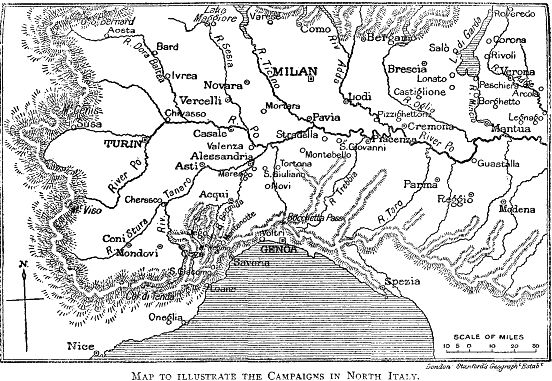
I am about to lead you into the most fertile valleys of the world: there you will find flourishing cities and teeming provinces: there you will reap honour, glory, and riches. Soldiers of the Army of Italy, will you lack courage?" Two years previously so open a bid for the soldiers' allegiance would have conducted any French commander forthwith to the guillotine. But much had changed since the days of Robespierre's supremacy; Spartan austerity had vanished; and the former insane jealousy of individual pre-eminence was now favouring a startling reaction which was soon to install the one supremely able man as absolute master of France.
Bonaparte's conduct produced a deep impression alike on troops and officers. From Masséna his energy and his trenchant orders extorted admiration: and the tall swaggering Augereau shrank beneath the intellectual superiority of his gaze. Moreover, at the beginning of April the French received reinforcements which raised their total to 49,300 men, and gave them a superiority of force; for though the allies had 52,000, yet they were so widely scattered as to be inferior in any one district. Besides, the Austrian commander, Beaulieu, was seventy-one years of age, had only just been sent into Italy, with which land he was ill acquainted, and found one-third of his troops down with sickness.[38]
Bonaparte now began to concentrate his forces near Savona. Fortune favoured him even before the campaign commenced. The snows of winter, still lying on the mountains, though thawing on the southern slopes, helped to screen his movements from the enemy's outposts; and the French vanguard pushed along the coastline even as far as Voltri. This movement was designed to coerce the Senate of Genoa into payment of a fine for its acquiescence in the seizure of a French vessel by a British cruiser within its neutral roadstead; but it served to alarm Beaulieu, who, breaking up his cantonments,[pg.83] sent a strong column towards that city. At the time this circumstance greatly annoyed Bonaparte, who had hoped to catch the Imperialists dozing in their winter quarters. Yet it is certain that the hasty move of their left flank towards Voltri largely contributed to that brilliant opening of Bonaparte's campaign, which his admirers have generally regarded as due solely to his genius.[39] For, when Beaulieu had thrust his column into the broken coast district between Genoa and Voltri, he severed it dangerously far from his centre, which marched up the valley of the eastern branch of the Bormida to occupy the passes of the Apennines north of Savona. This, again, was by no means in close touch with the Sardinian allies encamped further to the west in and beyond Ceva. Beaulieu, writing at a later date to Colonel Graham, the English attaché at his headquarters, ascribed his first disasters to Argenteau, his lieutenant at Montenotte, who employed only a third of the forces placed under his command. But division of forces was characteristic of the Austrians in all their operations, and they now gave a fine opportunity to any enterprising opponent who should crush their weak and unsupported centre. In obedience to orders from Vienna, Beaulieu assumed the offensive; but he brought his chief force to bear on the French vanguard at Voltri, which he drove in with some loss. While he was occupying Voltri, the boom of cannon echoing across the mountains warned his outposts that the real campaign[pg.84] was opening in the broken country north of Savona.[40] There the weak Austrian centre had occupied a ridge or plateau above the village of Montenotte, through which ran the road leading to Alessandria and Milan. Argenteau's attack partly succeeded: but the stubborn bravery of a French detachment checked it before the redoubt which commanded the southern prolongation of the heights named Monte-Legino.[41]
Such was the position of affairs when Bonaparte hurried up. On the following day (April 12th), massing the French columns of attack under cover of an early morning mist, he moved them to their positions, so that the first struggling rays of sunlight revealed to the astonished Austrians the presence of an army ready to crush their front and turn their flanks. For a time the Imperialists struggled bravely against the superior forces in their front; but when Masséna pressed round their right wing, they gave way and beat a speedy retreat to save themselves from entire capture. Bonaparte took no active share in the battle: he was, very properly, intent on the wider problem of severing the Austrians[pg.85] from their allies, first by the turning movement of Masséna, and then by pouring other troops into the gap thus made. In this he entirely succeeded. The radical defects in the Austrian dispositions left them utterly unable to withstand the blows which he now showered upon them. The Sardinians were too far away on the west to help Argenteau in his hour of need: they were in and beyond Ceva, intent on covering the road to Turin: whereas, as Napoleon himself subsequently wrote, they should have been near enough to their allies to form one powerful army, which, at Dego or Montenotte, would have defended both Turin and Milan. "United, the two forces would have been superior to the French army: separated, they were lost."
The configuration of the ground favoured Bonaparte's plan of driving the Imperialists down the valley of the Bormida in a north-easterly direction; and the natural desire of a beaten general to fall back towards his base of supplies also impelled Beaulieu and Argenteau to retire towards Milan. But that would sever their connections with the Sardinians, whose base of supplies, Turin, lay in a north-westerly direction.
Bonaparte therefore hurled his forces at once against the Austrians and a Sardinian contingent at Millesimo, and defeated them, Augereau's division cutting off the retreat of twelve hundred of their men under Provera. Weakened by this second blow, the allies fell back on the intrenched village of Dego. Their position was of a strength proportionate to its strategic importance; for its loss would completely sever all connection between their two main armies save by devious routes many miles in their rear. They therefore clung desperately to the six mamelons and redoubts which barred the valley and dominated some of the neighbouring heights. Yet such was the superiority of the French in numbers that these positions were speedily turned by Masséna, whom Bonaparte again intrusted with the movement on the enemy's flank and rear. A strange event followed. The victors, while pillaging the country for the supplies [pg.86] which Bonaparte's sharpest orders failed to draw from the magazines and stores on the sea-coast, were attacked in the dead of night by five Austrian battalions that had been ordered up to support their countrymen at Dego. These, after straying among the mountains, found themselves among bands of the marauding French, whom they easily scattered, seizing Dego itself. Apprised of this mishap, Bonaparte hurried up more troops from the rear, and on the 15th recovered the prize which had so nearly been snatched from his grasp. Had Beaulieu at this time thrown all his forces on the French, he might have retrieved his first misfortunes: but foresight and energy were not to be found at the Austrian headquarters: the surprise at Dego was the work of a colonel; and for many years to come the incompetence of their aged commanders was to paralyze the fine fighting qualities of the "white-coats." In three conflicts they had been outmanoeuvred and outnumbered, and drew in their shattered columns to Acqui.
The French commander now led his columns westward against the Sardinians, who had fallen back on their fortified camp at Ceva, in the upper valley of the Tanaro. There they beat off one attack of the French. A check in front of a strongly intrenched position was serious. It might have led to a French disaster, had the Austrians been able to bring aid to their allies. Bonaparte even summoned a council of war to deliberate on the situation. As a rule, a council of war gives timid advice. This one strongly advised a second attack on the camp—a striking proof of the ardour which then nerved the republican generals. Not yet were they condottieri carving out fortunes by their swords: not yet were they the pampered minions of an autocrat, intent primarily on guarding the estates which his favour had bestowed. Timidity was rather the mark of their opponents. When the assault on the intrenchments of Ceva was about to be renewed, the Sardinian forces were discerned filing away westwards. Their general indulged the fond hope of holding the French at bay at several[pg.87] strong natural positions on his march. He was bitterly to rue his error. The French divisions of Sérurier and Dommartin closed in on him, drove him from Mondovi, and away towards Turin.
Bonaparte had now completely succeeded. Using to the full the advantage of his central position between the widely scattered detachments of his foes, he had struck vigorously at their natural point of junction, Montenotte, and by three subsequent successes—for the evacuation of Ceva can scarcely be called a French victory—had forced them further and further apart until Turin was almost within his power.
It now remained to push these military triumphs to their natural conclusion, and impose terms of peace on the House of Savoy, which was secretly desirous of peace. The Directors had ordered Bonaparte that he should seek to detach Sardinia from the Austrian alliance by holding out the prospect of a valuable compensation for the loss of Savoy and Nice in the fertile Milanese.[42] The prospect of this rich prize would, the Directors surmised, dissolve the Austro-Sardinian alliance, as soon as the allies had felt the full vigour of the French arms. Not that Bonaparte himself was to conduct these negotiations. He was to forward to the Directory all offers of submission. Nay, he was not empowered to grant on his own responsibility even an armistice. He was merely to push the foe hard, and feed his needy soldiers on the conquered territory. He was to be solely a general, never a negotiator.
The Directors herein showed keen jealousy or striking ignorance of military affairs. How could he keep the Austrians quiet while envoys passed between Turin and Paris? All the dictates of common sense required him to grant an armistice to the Court of Turin before the Austrians could recover from their recent disasters. But the King of Sardinia drew him from a perplexing situation by instructing Colli to make overtures for an armistice as[pg.88] preliminary to a peace. At once the French commander replied that such powers belonged to the Directory; but as for an armistice, it would only be possible if the Court of Turin placed in his hands three fortresses, Coni, Tortona, and Alessandria, besides guaranteeing the transit of French armies through Piedmont and the passage of the Po at Valenza. Then, with his unfailing belief in accomplished facts, Bonaparte pushed on his troops to Cherasco.
Near that town he received the Piedmontese envoys; and from the pen of one of them we have an account of the general's behaviour in his first essay in diplomacy. His demeanour was marked by that grave and frigid courtesy which was akin to Piedmontese customs. In reply to the suggestions of the envoys that some of the conditions were of little value to the French, he answered: "The Republic, in intrusting to me the command of an army, has credited me with possessing enough discernment to judge of what that army requires, without having recourse to the advice of my enemy." Apart, however, from this sarcasm, which was uttered in a hard and biting voice, his tone was coldly polite. He reserved his home thrust for the close of the conference. When it had dragged on till considerably after noon with no definite result, he looked at his watch and exclaimed: "Gentlemen, I warn you that a general attack is ordered for two o'clock, and that if I am not assured that Coni will be put in my hands before nightfall, the attack will not be postponed for one moment. It may happen to me to lose battles, but no one shall ever see me lose minutes either by over-confidence or by sloth." The terms of the armistice of Cherasco were forthwith signed (April 28th); they were substantially the same as those first offered by the victor. During the luncheon which followed, the envoys were still further impressed by his imperturbable confidence and trenchant phrases; as when he told them that the campaign was the exact counterpart of what he had planned in 1794; or described a council of war as a convenient device for covering cowardice or irresolution [pg.89] in the commander; or asserted that nothing could now stop him before the walls of Mantua.[43]
As a matter of fact, the French army was at that time so disorganized by rapine as scarcely to have withstood a combined and vigorous attack by Beaulieu and Colli. The republicans, long exposed to hunger and privations, were now revelling in the fertile plains of Piedmont. Large bands of marauders ranged the neighbouring country, and the regiments were often reduced to mere companies. From the grave risks of this situation Bonaparte was rescued by the timidity of the Court of Turin, which signed the armistice at Cherasco eighteen days after the commencement of the campaign. A fortnight later the preliminaries of peace were signed between France and the King of Sardinia, by which the latter yielded up his provinces of Savoy and Nice, and renounced the alliance with Austria. Great indignation was felt in the Imperialist camp at this news; and it was freely stated that the Piedmontese had let themselves be beaten in order to compass a peace that had been tacitly agreed upon in the month of January.[44]
Even before this auspicious event, Bonaparte's despatches to the Directors were couched in almost imperious terms, which showed that he felt himself the master of the situation. He advised them as to their policy towards Sardinia, pointing out that, as Victor Amadeus had yielded up three important fortresses, he was practically in the hands of the French: "If you do not accept peace with him, if your plan is to dethrone him, you must amuse him for a few decades[45] and must warn me: I then seize Valenza and march on Turin." In military affairs the young general showed that he would brook no interference from Paris. He requested the Directory to draft 15,000 men from Kellermann's[pg.90] Army of the Alps to reinforce him: "That will give me an army of 45,000 men, of which possibly I may send a part to Rome. If you continue your confidence and approve these plans, I am sure of success: Italy is yours." Somewhat later, the Directors proposed to grant the required reinforcements, but stipulated for the retention of part of the army in the Milanese under the command of Kellermann. Thereupon Bonaparte replied (May 14th) that, as the Austrians had been reinforced, it was highly impolitic to divide the command. Each general had his own way of making war. Kellermann, having more experience, would doubtless do it better: but both together would do it very badly.
Again the Directors had blundered. In seeking to subject Bonaparte to the same rules as had been imposed on all French generals since the treason of Dumouriez in 1793, they were doubtless consulting the vital interests of the Commonwealth. But, while striving to avert all possibilities of Cæsarism, they now sinned against that elementary principle of strategy which requires unity of design in military operations. Bonaparte's retort was unanswerable, and nothing more was heard of the luckless proposal.
Meanwhile the peace with the House of Savoy had thrown open the Milanese to Bonaparte's attack. Holding three Sardinian fortresses, he had an excellent base of operations; for the lands restored to the King of Sardinia were to remain subject to requisitions for the French army until the general peace. The Austrians, on the other hand, were weakened by the hostility of their Italian subjects, and, worst of all, they depended ultimately on reinforcements drawn from beyond the Alps by way of Mantua. In the rich plains of Lombardy they, however, had one advantage which was denied to them among the rocks of the Apennines. Their generals could display the tactical skill on which they prided themselves, and their splendid cavalry had some chance of emulating the former exploits of the Hungarian and Croatian horse. They therefore awaited the onset of [pg.91] the French, little dismayed by recent disasters, and animated by the belief that their antagonist, unversed in regular warfare, would at once lose in the plains the bubble reputation gained in ravines. But the country in the second part of this campaign was not less favourable to Bonaparte's peculiar gifts than that in which he had won his first laurels as commander. Amidst the Apennines, where only small bodies of men could be moved, a general inexperienced in the handling of cavalry and infantry could make his first essays in tactics with fair chances of success. Speed, energy, and the prompt seizure of a commanding central position were the prime requisites; the handling of vast masses of men was impossible. The plains of Lombardy facilitated larger movements; but even here the numerous broad swift streams fed by the Alpine snows, and the network of irrigating dykes, favoured the designs of a young and daring leader who saw how to use natural obstacles so as to baffle and ensnare his foes. Bonaparte was now to show that he excelled his enemies, not only in quickness of eye and vigour of intellect, but also in the minutiæ of tactics and in those larger strategic conceptions which decide the fate of nations. In the first place, having the superiority of force, he was able to attack. This is an advantage at all times: for the aggressor can generally mislead his adversary by a series of feints until the real blow can be delivered with crushing effect. Such has been the aim of all great leaders from the time of Epaminondas and Alexander, Hannibal and Cæsar, down to the age of Luxembourg, Marlborough, and Frederick the Great. Aggressive tactics were particularly suited to the French soldiery, always eager, active, and intelligent, and now endowed with boundless enthusiasm in their cause and in their leader.
Then again he was fully aware of the inherent vice of the Austrian situation. It was as if an unwieldy organism stretched a vulnerable limb across the huge barrier of the Alps, exposing it to the attack of a [pg.92] compacter body. It only remained for Bonaparte to turn against his foes the smaller geographical features on which they too implicitly relied. Beaulieu had retired beyond the Po and the Ticino, expecting that the attack on the Milanese would be delivered across the latter stream by the ordinary route, which crossed it at Pavia. Near that city the Austrians occupied a strong position with 26,000 men, while other detachments patrolled the banks of the Ticino further north, and those of the Po towards Valenza, only 5,000 men being sent towards Piacenza. Bonaparte, however, was not minded to take the ordinary route. He determined to march, not as yet on the north of the River Po, where snow-swollen streams coursed down from the Alps, but rather on the south side, where the Apennines throw off fewer streams and also of smaller volume. From the fortress of Tortona he could make a rush at Piacenza, cross the Po there, and thus gain the Milanese almost without a blow. To this end he had stipulated in the recent terms of peace that he might cross the Po at Valenza; and now, amusing his foes by feints on that side, he vigorously pushed his main columns along the southern bank of the Po, where they gathered up all the available boats. The vanguard, led by the impetuous Lannes, seized the ferry at Piacenza, before the Austrian horse appeared, and scattered a squadron or two which strove to drive them back into the river (May 7th).
Time was thus gained for a considerable number of French to cross the river in boats or by the ferry. Working under the eye of their leader, the French conquered all obstacles: a bridge of boats soon spanned the stream, and was defended by a tête de pont; and with forces about equal in number to Liptay's Austrians, the republicans advanced northwards, and, after a tough struggle, dislodged their foes from the village of Fombio. This success drove a solid wedge between Liptay and his commander-in-chief, who afterwards bitterly blamed him, first for retreating, and secondly for not reporting his retreat to headquarters. [pg.93] It would appear, however, that Liptay had only 5,000 men (not the 8,000 which Napoleon and French historians have credited to him), that he was sent by Beaulieu to Piacenza too late to prevent the crossing by the French, and that at the close of the fight on the following day he was completely cut off from communicating with his superior. Beaulieu, with his main force, advanced on Fombio, stumbled on the French, where he looked to find Liptay, and after a confused fight succeeded in disengaging himself and withdrawing towards Lodi, where the high-road leading to Mantua crossed the River Adda. To that stream he directed his remaining forces to retire. He thereby left Milan uncovered (except for the garrison which held the citadel), and abandoned more than the half of Lombardy; but, from the military point of view, his retreat to the Adda was thoroughly sound. Yet here again a movement strategically correct was marred by tactical blunders. Had he concentrated all his forces at the nearest point of the Adda which the French could cross, namely Pizzighetone, he would have rendered any flank march of theirs to the northward extremely hazardous; but he had not yet sufficiently learned from his terrible teacher the need of concentration; and, having at least three passages to guard, he kept his forces too spread out to oppose a vigorous move against any one of them. Indeed, he despaired of holding the line of the Adda, and retired eastwards with a great part of his army.
Consequently, when Bonaparte, only three days after the seizure of Piacenza, threw his almost undivided force against the town of Lodi, his passage was disputed only by the rearguard, whose anxiety to cover the retreat of a belated detachment far exceeded their determination to defend the bridge over the Adda. This was a narrow structure, some eighty fathoms long, standing high above the swift but shallow river. Resolutely held by well-massed troops and cannon, it might have cost the French a severe struggle: but the Imperialists were badly handled: some were posted in and around the [pg.94] town which was between the river and the advancing French; and the weak walls of Lodi were soon escaladed by the impetuous republicans. The Austrian commander, Sebottendorf, now hastily ranged his men along the eastern bank of the river, so as to defend the bridge and prevent any passage of the river by boats or by a ford above the town. The Imperialists numbered only 9,627 men; they were discouraged by defeats and by the consciousness that no serious stand could be attempted before they reached the neighbourhood of Mantua; and their efforts to break down the bridge were now frustrated by the French, who, posted behind the walls of Lodi on the higher bank of the stream, swept their opponents' position with a searching artillery fire. Having shaken the constancy of his foes and refreshed his own infantry by a brief rest in Lodi, Bonaparte at 6 p.m. secretly formed a column of his choicest troops and hurled it against the bridge. A hot fire of grapeshot and musketry tore its front, and for a time the column bent before the iron hail. But, encouraged by the words of their young leader, generals, corporals, and grenadiers pressed home their charge. This time, aided by sharp-shooters who waded to islets in the river, the assailants cleared the bridge, bayoneted the Austrian cannoneers, attacked the first and second lines of supporting foot, and, when reinforced, compelled horse and foot to retreat towards Mantua.[46]
Such was the affair of Lodi (May 10th). A legendary[pg.95] glamour hovers around all the details of this conflict and invests it with fictitious importance. Beaulieu's main force was far away, and there was no hope of entrapping anything more than the rear of his army. Moreover, if this were the object, why was not the flank move of the French cavalry above Lodi pushed home earlier in the fight? This, if supported by infantry, could have outflanked the enemy while the perilous rush was made against the bridge; and such a turning movement would probably have enveloped the Austrian force while it was being shattered in front. That is the view in which the strategist, Clausewitz, regards this encounter. Far different was the impression which it created among the soldiers and Frenchmen at large. They valued a commander more for bravery of the bull-dog type than for any powers of reasoning and subtle combination. These, it is true, Bonaparte had already shown. He now enchanted the soldiery by dealing a straight sharp blow. It had a magical effect on their minds. On the evening of that day the French soldiers, with antique republican camaraderie, saluted their commander as le petit caporal for his personal bravery in the fray, and this endearing phrase helped to immortalize the affair of the bridge of Lodi.[47] It shot a thrill of exultation through France. With pardonable exaggeration, men told how he charged at the head of the column, and, with Lannes, was the first to reach the opposite side; and later generations have figured him charging before his tall grenadiers—a feat that was actually performed by Lannes, Berthier, Masséna, Cervoni, and Dallemagne. It was all one. Bonaparte alone was the hero of the day. He reigned supreme in the hearts of the soldiers, and he saw the importance of this conquest. At St. Helena he confessed to Montholon that it was the victory of Lodi which fanned his ambition into a steady flame.
A desire of stimulating popular enthusiasm throughout Italy impelled the young victor to turn away from his real objective, the fortress of Mantua, to the political[pg.96] capital of Lombardy. The people of Milan hailed their French liberators with enthusiasm: they rained flowers on the bronzed soldiers of liberty, and pointed to their tattered uniforms and worn-out shoes as proofs of their triumphant energy: above all, they gazed with admiration, not unmixed with awe, at the thin pale features of the young commander, whose plain attire bespoke a Spartan activity, whose ardent gaze and decisive gestures proclaimed a born leader of men. Forthwith he arranged for the investment of the citadel where eighteen hundred Austrians held out: he then received the chief men of the city with easy Italian grace; and in the evening he gave a sumptuous ball, at which all the dignity, wealth, and beauty of the old Lombard capital shone resplendent. For a brief space all went well between the Lombards and their liberators. He received with flattering distinction the chief artists and men of letters, and also sought to quicken the activity of the University of Pavia. Political clubs and newspapers multiplied throughout Lombardy; and actors, authors, and editors joined in a pæan of courtly or fawning praise, to the new Scipio, Cæsar, Hannibal, and Jupiter.
There were other reasons why the Lombards should worship the young victor. Apart from the admiration which a gifted race ever feels for so fascinating a combination of youthful grace with intellectual power and martial prowess, they believed that this Italian hero would call the people to political activity, perchance even to national independence. For this their most ardent spirits had sighed, conspired, or fought during the eighty-three years of the Austrian occupation. Ever since the troublous times of Dante there had been prophetic souls who caught the vision of a new Italy, healed of her countless schisms, purified from her social degradations, and uniting the prowess of her ancient life with the gentler arts of the present for the perfection of her own powers and for the welfare of mankind. The gleam of this vision had shone forth even amidst the thunder claps of the French Revolution; and now that the storm [pg.97] had burst over the plains of Lombardy, ecstatic youths seemed to see the vision embodied in the person of Bonaparte himself. At the first news of the success at Lodi the national colours were donned as cockades, or waved defiance from balconies and steeples to the Austrian garrisons. All truly Italian hearts believed that the French victories heralded the dawn of political freedom not only for Lombardy, but for the whole peninsula.
Bonaparte's first actions increased these hopes. He abolished the Austrian machinery of government, excepting the Council of State, and approved the formation of provisional municipal councils and of a National Guard. At the same time, he wrote guardedly to the Directors at Paris, asking whether they proposed to organize Lombardy as a republic, as it was much more ripe for this form of government than Piedmont. Further than this he could not go; but at a later date he did much to redeem his first promises to the people of Northern Italy.
The fair prospect was soon overclouded by the financial measures urged on the young commander from Paris, measures which were disastrous to the Lombards and degrading to the liberators themselves. The Directors had recently bidden him to press hard on the Milanese, and levy large contributions in money, provisions, and objects of art, seeing that they did not intend to keep this country.[48] Bonaparte accordingly issued a proclamation (May 19th), imposing on Lombardy the sum of twenty million francs, remarking that it was a very light sum for so fertile a country. Only two days before he had in a letter to the Directors described it as exhausted by five years of war. As for the assertion that the army needed this sum, it may be compared with his private notification to the Directory, three days after his proclamation, that they might speedily count on six to eight millions of the Lombard contribution, as lying[pg.98] ready at their disposal, "it being over and above what the army requires." This is the first definite suggestion by Bonaparte of that system of bleeding conquered lands for the benefit of the French Exchequer, which enabled him speedily to gain power over the Directors. Thenceforth they began to connive at his diplomatic irregularities, and even to urge on his expeditions into wealthy districts, provided that the spoils went to Paris; while the conqueror, on his part, was able tacitly to assume that tone of authority with which the briber treats the bribed.[49]
The exaction of this large sum, and of various requisites for the army, as well as the "extraction" of works of art for the benefit of French museums, at once aroused the bitterest feelings. The loss of priceless treasures, such as the manuscript of Virgil which had belonged to Petrarch, and the masterpieces of Raphael and Leonardo da Vinci, might perhaps have been borne: it concerned only the cultured few, and their effervescence was soon quelled by patrols of French cavalry. Far different was it with the peasants between Milan and Pavia. Drained by the white-coats, they now refused to be bled for the benefit of the blue-coats of France. They rushed to arms. The city of Pavia defied the attack of a French column until cannon battered in its gates. Then the republicans rushed in, massacred all the armed men for some hours, and glutted their lust and rapacity. By order of Bonaparte, the members of the municipal council were condemned to execution; but a delay occurred before this ferocious order was carried out, and it was subsequently mitigated. Two hundred hostages were, however, sent away into France as a guarantee for the good behaviour of the unfortunate city: whereupon the chief announced to the Directory that this would serve as a useful lesson to the peoples of Italy.
In one sense this was correct. It gave the Italians a true insight into French methods; and painful emotions thrilled the peoples of the peninsula when they realized[pg.99] at what a price their liberation was to be effected. Yet it is unfair to lay the chief blame on Bonaparte for the pillage of Lombardy. His actions were only a development of existing revolutionary customs; but never had these demoralizing measures been so thoroughly enforced as in the present system of liberation and blackmail. Lombardy was ransacked with an almost Vandal rapacity. Bonaparte desired little for himself. His aim ever was power rather than wealth. Riches he valued only as a means to political supremacy. But he took care to place the Directors and all his influential officers deeply in his debt. To the five soi-disant rulers of France he sent one hundred horses, the finest that could be found in Lombardy, to replace "the poor creatures which now draw your carriages";[50] to his officers his indulgence was passive, but usually effective. Marmont states that Bonaparte once reproached him for his scrupulousness in returning the whole of a certain sum which he had been commissioned to recover. "At that time," says Marmont, "we still retained a flower of delicacy on these subjects." This Alpine gentian was soon to fade in the heats of the plains. Some generals made large fortunes, eminently so Masséna, first in plunder as in the fray. And yet the commander, who was so lenient to his generals, filled his letters to the Directory with complaints about the cloud of French commissioners, dealers, and other civilian harpies who battened on the spoil of Lombardy. It seems impossible to avoid the conclusion that this indulgence towards the soldiers and severity towards civilians was the result of a fixed determination to link indissolubly to his fortunes the generals and rank and file. The contrast in his behaviour was often startling. Some of the civilians he imprisoned: others he desired to shoot; but as the hardiest robbers had generally made to themselves friends of the military mammon of unrighteousness, they escaped with a fine ridiculously out of proportion to their actual gains.[51] [pg.100]
The Dukes of Parma and Modena were also mulcted. The former of these, owing to his relationship with the Spanish Bourbons, with whom the Directory desired to remain on friendly terms, was subjected to the fine of merely two million francs and twenty masterpieces of art, these last to be selected by French commissioners from the galleries of the duchy; but the Duke of Modena, who had assisted the Austrian arms, purchased his pardon by an indemnity of ten million francs, and by the cession of twenty pictures, the chief artistic treasures of his States.[52] As Bonaparte naïvely stated to the Directors, the duke had no fortresses or guns; consequently these could not be demanded from him.
From this degrading work Bonaparte strove to wean his soldiers by recalling them to their nobler work of carrying on the enfranchisement of Italy. In a proclamation (May 20th) which even now stirs the blood like a trumpet call, he bade his soldiers remember that, though much had been done, a far greater task yet awaited them. Posterity must not reproach them for having found their Capua in Lombardy. Rome was to be freed: the Eternal City was to renew her youth and show again the virtues of her ancient worthies, Brutus and Scipio. Then France would give a glorious peace to Europe; then their fellow-citizens would say of each champion of liberty as he returned to his hearth: "He was of the Army of Italy." By such stirring words did he entwine with the love of liberty that passion for military glory which was destined to strangle the Republic.
Meanwhile the Austrians had retired behind the banks of the Mincio and the walls of its guardian fortress, Mantua. Their position was one of great strength. The river, which carries off the surplus waters of Lake Garda, joins the River Po after a course of some thirty miles. Along with the tongue-like cavity occupied by its parent lake, the river forms the chief inner barrier to all invaders of Italy. From the earliest times down to those[pg.101] of the two Napoleons, the banks of the Mincio have witnessed many of the contests which have decided the fortunes of the peninsula. On its lower course, where the river widens out into a semicircular lagoon flanked by marshes and backwaters, is the historic town of Mantua. For this position, if we may trust the picturesque lines of Mantua's noblest son,[53] the three earliest races of Northern Italy had striven; and when the power of imperial Rome was waning, the fierce Attila pitched his camp on the banks of the Mincio, and there received the pontiff Leo, whose prayers and dignity averted the threatening torrent of the Scythian horse.
It was by this stream, famed in war as in song, that the Imperialists now halted their shattered forces, awaiting reinforcements from Tyrol. These would pass down the valley of the Adige, and in the last part of their march would cross the lands of the Venetian Republic. For this action there was a long-established right of way, which did not involve a breach of the neutrality of Venice. But, as some of the Austrian troops had straggled on to the Venetian territory south of Brescia, the French commander had no hesitation in openly violating Venetian neutrality by the occupation of that town (May 26th). Augereau's division was also ordered to push on towards the west shore of Lake Garda, and there collect boats as if a crossing were intended. Seeing this, the Austrians seized the small Venetian fortress of Peschiera, which commands the exit of the Mincio from the lake, and Venetian neutrality was thenceforth wholly disregarded.
By adroit moves on the borders of the lake, Bonaparte now sought to make Beaulieu nervous about his communications with Tyrol through the river valley of the Adige; he completely succeeded: seeking to guard the important positions on that river between Rivoli and Roveredo, Beaulieu so weakened his forces on the Mincio, that at Borghetto and Valeggio he had only two battalions and ten squadrons of horse, or about two thousand[pg.102] men. Lannes' grenadiers, therefore, had little difficulty in forcing a passage on May 30th, whereupon Beaulieu withdrew to the upper Adige, highly satisfied with himself for having victualled the fortress of Mantua so that it could withstand a long siege. This was, practically, his sole achievement in the campaign. Outnumbered, outgeneralled, bankrupt in health as in reputation, he soon resigned his command, but not before he had given signs of "downright dotage."[54] He had, however, achieved immortality: his incapacity threw into brilliant relief the genius of his young antagonist, and therefore appreciably affected the fortunes of Italy and of Europe.
Bonaparte now despatched Masséna's division northwards, to coop up the Austrians in the narrow valley of the upper Adige, while other regiments began to close in on Mantua. The peculiarities of the ground favoured its investment. The semicircular lagoon which guards Mantua on the north, and the marshes on the south side, render an assault very difficult; but they also limit the range of ground over which sorties can be made, thereby lightening the work of the besiegers; and during part of the blockade Napoleon left fewer than five thousand men for this purpose. It was clear, however, that the reduction of Mantua would be a tedious undertaking, such as Bonaparte's daring and enterprising genius could ill brook, and that his cherished design of marching northwards to effect a junction with Moreau on the Danube was impossible. Having only 40,400 men with him at midsummer, he had barely enough to hold the line of the Adige, to blockade Mantua, and to keep open his communications with France.
At the command of the Directory he turned southward against feebler foes. The relations between the Papal States and the French Republic had been hostile since the assassination of the French envoy, Basseville, at Rome, in the early days of 1793; but the Pope, Pius VI., had confined himself to anathemas against the revolutionists and prayers for the success of the First Coalition.
[pg.103] This conduct now drew upon him a sharp blow. French troops crossed the Po and seized Bologna, whereupon the terrified cardinals signed an armistice with the republican commander, agreeing to close all their States to the English, and to admit a French garrison to the port of Ancona. The Pope also consented to yield up "one hundred pictures, busts, vases, or statues, as the French Commissioners shall determine, among which shall especially be included the bronze bust of Junius Brutus and the marble bust of Marcus Brutus, together with five hundred manuscripts." He was also constrained to pay 15,500,000 francs, besides animals and goods such as the French agents should requisition for their army, exclusive of the money and materials drawn from the districts of Bologna and Ferrara. The grand total, in money, and in kind, raised from the Papal States in this profitable raid, was reckoned by Bonaparte himself as 34,700,000 francs,[55] or about; £1,400,000—a liberal assessment for the life of a single envoy and the bruta fulmina of the Vatican.
Equally lucrative was a dash into Tuscany. As the Grand Duke of this fertile land had allowed English cruisers and merchants certain privileges at Leghorn, this was taken as a departure from the neutrality which he ostensibly maintained since the signature of a treaty of peace with France in 1795. A column of the republicans now swiftly approached Leghorn and seized much valuable property from British merchants. Yet the invaders failed to secure the richest of the hoped-for plunder; for about forty English merchantmen sheered off from shore as the troops neared the seaport, and an English frigate, swooping down, carried off two French vessels almost under the eyes of Bonaparte himself. This last outrage gave, it is true, a slight excuse for the levying of requisitions in Leghorn and its environs; yet, according to the memoir-writer, Miot de Melito, this unprincipled action must be attributed not to Bonaparte, but to the urgent needs of the French treasury and the[pg.104] personal greed of some of the Directors. Possibly also the French commissioners and agents, who levied blackmail or selected pictures, may have had some share in the shaping of the Directorial policy: at least, it is certain that some of them, notably Salicetti, amassed a large fortune from the plunder of Leghorn. In order to calm the resentment of the Grand Duke, Bonaparte paid a brief visit to Florence. He was received in respectful silence as he rode through the streets where his ancestors had schemed for the Ghibelline cause. By a deft mingling of courtesy and firmness the new conqueror imposed his will on the Government of Florence, and then sped northward to press on the siege of Mantua. [pg.105]
The circumstances which recalled Bonaparte to the banks of the Mincio were indeed serious. The Emperor Francis was determined at all costs to retain his hold on Italy by raising the siege of that fortress; and unless the French commander could speedily compass its fall, he had the prospect of fighting a greatly superior army while his rear was threatened by the garrison of Mantua. Austria was making unparalleled efforts to drive this presumptuous young general from a land which she regarded as her own political preserve. Military historians have always been puzzled to account for her persistent efforts in 1796-7 to re-conquer Lombardy. But, in truth, the reasons are diplomatic, not military, and need not be detailed here. Suffice it to say that, though the Hapsburg lands in Swabia were threatened by Moreau's Army of the Rhine, Francis determined at all costs to recover his Italian possessions.
To this end the Emperor now replaced the luckless Beaulieu by General Würmser, who had gained some reputation in the Rhenish campaigns; and, detaching 25,000 men from his northern armies to strengthen his army on the Adige, he bade him carry the double-headed eagle of Austria victoriously into the plains of Italy. Though too late to relieve the citadel of Milan, he was to strain every nerve to relieve Mantua; and, since the latest reports represented the French as widely dispersed for the plunder of Central Italy, the Emperor indulged the highest hopes of Würmser's success.[56][pg.106] Possibly this might have been attained had the Austrian Emperor and staff understood the absolute need of concentration in attacking a commander who had already demonstrated its supreme importance in warfare. Yet the difficulties of marching an army of 47,000 men through the narrow defile carved by the Adige through the Tyrolese Alps, and the wide extent of the French covering lines, led to the adoption of a plan which favoured rapidity at the expense of security. Würmser was to divide his forces for the difficult march southward from Tyrol into Italy. In defence of this arrangement much could be urged. To have cumbered the two roads, which run on either side of the Adige from Trient towards Mantua, with infantry, cavalry, artillery, and the countless camp-followers, animals, and wagons that follow an army, would have been fatal alike to speed of marching and to success in mountain warfare. Even in the campaign of 1866 the greatest commander of this generation carried out his maxim, "March in separate columns: unite for fighting." But Würmser and the Aulic Council[57] at Vienna neglected to insure that reunion for attack, on which von Moltke laid such stress in his Bohemian campaign. The Austrian forces in 1796 were divided by obstacles which could not quickly be crossed, namely, by Lake Garda and the lofty mountains which tower above the valley of the Adige. Assuredly the Imperialists were not nearly strong enough to run any risks. The official Austrian returns show that the total force assembled in Tyrol for the invasion of Italy amounted to 46,937 men, not to the 60,000 as pictured by the imagination of Thiers and other French historians. As Bonaparte had in Lombardy-Venetia fully 45,000 men (including 10,000 now[pg.107] engaged in the siege of Mantua), scattered along a front of fifty miles from Milan to Brescia and Legnago, the incursion of Würmser's force, if the French were held to their separate positions by diversions against their flanks, must have proved decisive. But the fault was committed of so far dividing the Austrians that nowhere could they deal a crushing blow. Quosdanovich with 17,600 men was to take the western side of Lake Garda, seize the French magazines at Brescia, and cut their communications with Milan and France: the main body under Würmser, 24,300 strong, was meanwhile to march in two columns on either bank of the Adige, drive the French from Rivoli and push on towards Mantua: and yet a third division, led by Davidovich from the district of Friuli on the east, received orders to march on Vicenza and Legnago, in order to distract the French from that side, and possibly relieve Mantua if the other two onsets failed.
Faulty as these dispositions were, they yet seriously disconcerted Bonaparte. He was at Montechiaro, a village situated on the road between Brescia and Mantua, when, on July 29th, he heard that the white-coats had driven in Masséna's vanguard above Rivoli on the Adige, were menacing other positions near Verona and Legnago, and were advancing on Brescia. As soon as the full extent of the peril was manifest, he sent off ten despatches to his generals, ordering a concentration of troops—these, of course, fighting so as to delay the pursuit—towards the southern end of Lake Garda. This wise step probably saved his isolated forces from disaster. It was at that point that the Austrians proposed to unite their two chief columns and crush the French detachments. But, by drawing in the divisions of Masséna and Augereau towards the Mincio, Bonaparte speedily assembled a formidable array, and held the central position between the eastern and western divisions of the Imperialists. He gave up the important defensive line of the Adige, it is true; but by promptly rallying on the Mincio, he occupied a base that was defended on [pg.108] the north by the small fortress of Peschiera and the waters of Lake Garda. Holding the bridges over the Mincio, he could strike at his assailants wherever they should attack; above all, he still covered the siege of Mantua. Such were his dispositions on July 29th and 30th. On the latter day he heard of the loss of Brescia, and the consequent cutting of his communications with Milan. Thereupon he promptly ordered Sérurier, who was besieging Mantua, to make a last vigorous effort to take that fortress, but also to assure his retreat westwards if fortune failed him. Later in the day he ordered him forthwith to send away his siege-train, throwing into the lake or burying whatever he could not save from the advancing Imperialists.
This apparently desperate step, which seemed to forebode the abandonment not only of the siege of Mantua, but of the whole of Lombardy, was in reality a masterstroke. Bonaparte had perceived the truth, which the campaigns of 1813 and 1870 were abundantly to illustrate—that the possession of fortresses, and consequently their siege by an invader, is of secondary importance when compared with a decisive victory gained in the open. When menaced by superior forces advancing towards the south of Lake Garda, he saw that he must sacrifice his siege works, even his siege-train, in order to gain for a few precious days that superiority in the field which the division of the Imperialist columns still left to him.
The dates of these occurrences deserve close scrutiny; for they suffice to refute some of the exorbitant claims made at a later time by General Augereau, that only his immovable firmness forced Bonaparte to fight and to change his dispositions of retreat into an attack which re-established everything. This extraordinary assertion, published by Augereau after he had deserted Napoleon in 1814, is accompanied by a detailed recital of the events of July 30th-August 5th, in which Bonaparte appears as the dazed and discouraged commander, surrounded by pusillanimous generals, and urged on to [pg.109] fight solely by the confidence of Augereau. That the forceful energy of this general had a great influence in restoring the morale of the French army in the confused and desperate movements which followed may freely be granted. But his claims to have been the main spring of the French movements in those anxious days deserve a brief examination. He asserts that Bonaparte, "devoured by anxieties," met him at Roverbella late in the evening of July 30th, and spoke of retiring beyond the River Po. The official correspondence disproves this assertion. Bonaparte had already given orders to Sérurier to retire beyond the Po with his artillery train; but this was obviously an attempt to save it from the advancing Austrians; and the commander had ordered the northern part of the French besieging force to join Augereau between Roverbella and Goito. Augereau further asserts that, after he had roused Bonaparte to the need of a dash to recover Brescia, the commander-in-chief remarked to Berthier, "In that case we must raise the siege of Mantua," which again he (Augereau) vigorously opposed. This second statement is creditable neither to Augereau's accuracy nor to his sagacity. The order for the raising of the siege had been issued, and it was entirely necessary for the concentration of French troops, on which Bonaparte now relied as his only hope against superior force. Had Bonaparte listened to Augereau's advice and persisted still in besieging Mantua, the scattered French forces must have been crushed in detail. Augereau's words are those of a mere fighter, not of a strategist; and the timidity which he ungenerously attributed to Bonaparte was nothing but the caution which a superior intellect saw to be a necessary prelude to a victorious move.
That the fighting honours of the ensuing days rightly belong to Augereau may be frankly conceded. With forces augmented by the northern part of the besiegers of Mantua, he moved rapidly westwards from the Mincio against Brescia, and rescued it from the vanguard of Quosdanovich (August 1st). On the previous day other [pg.110] Austrian detachments had also, after obstinate conflicts, been worsted near Salo and Lonato. Still, the position was one of great perplexity: for though Masséna's division from the Adige was now beginning to come into touch with Bonaparte's chief force, yet the fronts of Würmser's columns were menacing the French from that side, while the troops of Quosdanovich, hovering about Lonato and Salo, struggled desperately to stretch a guiding hand to their comrades on the Mincio.
Würmser was now discovering his error. Lured towards Mantua by false reports that the French were still covering the siege, he had marched due south when he ought to have rushed to the rescue of his hard-pressed lieutenant at Brescia. Entering Mantua, he enjoyed a brief spell of triumph, and sent to the Emperor Francis the news of the capture of 40 French cannon in the trenches, and of 139 more on the banks of the Po. But, while he was indulging the fond hope that the French were in full retreat from Italy, came the startling news that they had checked Quosdanovich at Brescia and Salo. Realizing his errors, and determining to retrieve them before all was lost, he at once pushed on his vanguard towards Castiglione, and easily gained that village and its castle from a French detachment commanded by General Valette.
The feeble defence of so important a position threw Bonaparte into one of those transports of fury which occasionally dethroned his better judgment. Meeting Valette at Montechiaro, he promptly degraded him to the ranks, refusing to listen to his plea of having received a written order to retire. A report of General Landrieux asserts that the rage of the commander-in-chief was so extreme as for the time even to impair his determination. The outlook was gloomy. The French seemed about to be hemmed in amidst the broken country between Castiglione, Brescia, and Salo. A sudden attack on the Austrians was obviously the only safe and honourable course. But no one knew precisely their numbers or their position. Uncertainty ever preyed on Bonaparte's [pg.111] ardent imagination. His was a mind that quailed not before visible dangers; but, with all its powers of decisive action, it retained so much of Corsican eeriness as to chafe at the unknown,[58] and to lose for the moment the faculty of forming a vigorous resolution. Like the python, which grips its native rock by the tail in order to gain its full constricting power, so Bonaparte ever needed a groundwork of fact for the due exercise of his mental force.
One of a group of generals, whom he had assembled about him near Montechiaro, proposed that they should ascend the hill which dominated the plain. Even from its ridge no Austrians were to be seen. Again the commander burst forth with petulant reproaches, and even talked of retiring to the Adda. Whereupon, if we may trust the "Memoirs" of General Landrieux, Augereau protested against retreat, and promised success for a vigorous charge. "I wash my hands of it, and I am going away," replied Bonaparte. "And who will command, if you go?" inquired Augereau. "You," retorted Bonaparte, as he left the astonished circle.
However this may be, the first attack on Castiglione was certainly left to this determined fighter; and the mingling of boldness and guile which he showed on the following day regained for the French not only the village, but also the castle, perched on a precipitous rock. Yet the report of Colonel Graham, who was then at Marshal Würmser's headquarters, somewhat dulls the lustre of Augereau's exploit; for the British officer asserts that the Austrian position had been taken up quite by haphazard, and that fewer than 15,000 white-coats were engaged in this first battle of Castiglione. Furthermore, the narratives of this mêlée written by Augereau himself and by two other generals, Landrieux and Verdier, who[pg.112] were disaffected towards Bonaparte, must naturally be received with much reserve. The effect of Augereau's indomitable energy in restoring confidence to the soldiers and victory to the French tricolour was, however, generously admitted by the Emperor Napoleon; for, at a later time when complaints were being made about Augereau, he generously exclaimed: "Ah, let us not forget that he saved us at Castiglione."[59]
While Augereau was recovering this important position, confused conflicts were raging a few miles further north at Lonato. Masséna at first was driven back by the onset of the Imperialists; but while they were endeavouring to envelop the French, Bonaparte arrived, and in conjunction with Masséna pushed on a central attack such as often wrested victory from the enemy. The white-coats retired in disorder, some towards Gavardo, others towards the lake, hotly followed by the French. In the pursuit towards Gavardo, Bonaparte's old friend, Junot, distinguished himself by his dashing valour. He wounded a colonel, slew six troopers, and, covered with wounds, was finally overthrown into a ditch. Such is Bonaparte's own account. It is gratifying to know that the wounds neither singly nor collectively were dangerous, and did not long repress Junot's activity. A tinge of romance seems, indeed, to have gilded many of these narratives; and a critical examination of the whole story of Lonato seems to suggest doubts whether the victory was as decisive as historians have often represented. If the Austrians were "thrown back on Lake Garda and Desenzano,"[60] it is difficult to see why the pursuers did not drive them into the lake. As a matter of fact, nearly all the beaten troops escaped to Gavardo, while others joined their comrades engaged in the blockade of Peschiera.
A strange incident serves to illustrate the hazards of[pg.113] war and the confusion of this part of the campaign. A detachment of the vanquished Austrian forces some 4,000 strong, unable to join their comrades at Gavardo or Peschiera, and yet unharmed by the victorious pursuers, wandered about on the hills, and on the next day chanced near Lonato to come upon a much smaller detachment of French. Though unaware of the full extent of their good fortune, the Imperialists boldly sent an envoy to summon the French commanding officer to surrender. When the bandage was taken from his eyes, he was abashed to find himself in the presence of Bonaparte, surrounded by the generals of his staff. The young commander's eyes flashed fire at the seeming insult, and in tones vibrating with well-simulated passion he threatened the envoy with condign punishment for daring to give such a message to the commander-in-chief at his headquarters in the midst of his army. Let him and his men forthwith lay down their arms. Dazed by the demand, and seeing only the victorious chief and not the smallness of his detachment, 4,000 Austrians surrendered to 1,200 French, or rather to the address and audacity of one master-mind.
Elated by this augury of further victory, the republicans prepared for the decisive blow. Würmser, though checked on August 3rd, had been so far reinforced from Mantua as still to indulge hopes of driving the French from Castiglione and cutting his way through to rescue Quosdanovich. He was, indeed, in honour bound to make the attempt; for the engagement had been made, with the usual futility that dogged the Austrian councils, to reunite their forces and fight the French on the 7th of August. These cast-iron plans were now adhered to in spite of their dislocation at the hands of Bonaparte and Augereau. Würmser's line stretched from near the village of Médole in a north-easterly direction across the high-road between Brescia and Mantua; while his right wing was posted in the hilly country around Solferino. In fact, his extreme right rested on the tower-crowned heights of Solferino, where the forces of Austria two [pg.114] generations later maintained so desperate a defence against the onset of Napoleon III. and his liberating army.
Owing to the non-arrival of Mezaros' corps marching from Legnago, Würmser mustered scarcely twenty-five thousand men on his long line; while the very opportune approach of part of Sérurier's division, under the lead of Fiorella, from the south, gave the French an advantage even in numbers. Moreover, Fiorella's advance on the south of Würmser's weaker flank, that near Médole, threatened to turn it and endanger the Austrian communications with Mantua. The Imperialists seem to have been unaware of this danger; and their bad scouting here as elsewhere was largely responsible for the issue of the day. Würmser's desire to stretch a helping hand to Quosdanovich near Lonato and his confidence in the strength of his own right wing betrayed him into a fatal imprudence. Sending out feelers after his hard-pressed colleague on the north, he dangerously prolonged his line, an error in which he was deftly encouraged by Bonaparte, who held back his own left wing. Meanwhile the French were rolling in the other extremity of the Austrian line. Marmont, dashing forward with the horse artillery, took the enemy's left wing in flank and silenced many of their pieces. Under cover of this attack, Fiorella's division was able to creep up within striking distance; and the French cavalry, swooping round the rear of this hard-pressed wing, nearly captured Würmser and his staff. A vigorous counterattack by the Austrian reserves, or an immediate wheeling round of the whole line, was needed to repulse this brilliant flank attack; but the Austrian reserves had been expended in the north of their line; and an attempt to change front, always a difficult operation, was crushed by a headlong charge of Masséna's and Augereau's divisions on their centre. Before these attacks the whole Austrian line gave way; and, according to Colonel Graham, nothing but this retreat, undertaken "without orders," saved the whole force from being cut[pg.115] off. The criticisms of our officer sufficiently reveal the cause of the disaster. The softness and incapacity of Würmser, the absence of a responsible second in command, the ignorance of the number and positions of the French, the determination to advance towards Castiglione and to wait thereabouts for Quosdanovich until a battle could be fought with combined forces on the 7th, the taking up a position almost by haphazard on the Castiglione-Médole line, and the failure to detect Fiorella's approach, present a series of defects and blunders which might have given away the victory to a third-rate opponent.[61]
The battle was by no means sanguinary: it was a series of manoeuvres rather than of prolonged conflicts. Hence its interest to all who by preference dwell on the intellectual problems of warfare rather than on the details of fighting. Bonaparte had previously shown that he could deal blows with telling effect. The ease and grace of his moves at the second battle of Castiglione now redeemed the reputation which his uncertain behaviour on the four preceding days had somewhat compromised.
A complete and authentic account of this week of confused fighting has never been written. The archives of Vienna have not as yet yielded up all their secrets; and the reputations of so many French officers were over-clouded by this prolonged mêlée as to render even the victors' accounts vague and inconsistent. The aim of historians everywhere to give a clear and vivid account, and the desire of Napoleonic enthusiasts to represent their hero as always thinking clearly and acting decisively, have fused trusty ores and worthless slag into an alloy which has passed for true metal. But no student of Napoleon's "Correspondence," of the "Memoirs" of Marmont, and of the recitals of Augereau, Dumas, Landrieux, Verdier, Despinois and others, can hope wholly to unravel the complications arising from the almost continuous conflicts that extended over a dozen leagues of hilly country. War is not always dramatic, however much the readers[pg.116] of campaigns may yearn after thrilling narratives. In regard to this third act of the Italian campaign, all that can safely be said is that Bonaparte's intuition to raise the siege of Mantua, in order that he might defeat in detail the relieving armies, bears the imprint of genius: but the execution of this difficult movement was unequal, even at times halting; and the French army was rescued from its difficulties only by the grand fighting qualities of the rank and file, and by the Austrian blunders, which outnumbered those of the republican generals.
Neither were the results of the Castiglione cycle of battles quite so brilliant as have been represented. Würmser and Quasdanovich lost in all 17,000 men, it is true: but the former had re-garrisoned and re-victualled Mantua, besides capturing all the French siege-train. Bonaparte's primary aim had been to reduce Mantua, so that he might be free to sweep through Tyrol, join hands with Moreau, and overpower the white-coats in Bavaria. The aim of the Aulic Council and Würmser had been to relieve Mantua and restore the Hapsburg rule over Lombardy. Neither side had succeeded. But the Austrians could at least point to some successes; and, above all, Mantua was in a better state of defence than when the French first approached its walls: and while Mantua was intact, Bonaparte was held to the valley of the Mincio, and could not deal those lightning blows on the Inn and the Danube which he ever regarded as the climax of the campaign. Viewed on its material side, his position was no better than it was before Würmser's incursion into the plains of Venetia.[62]
With true Hapsburg tenacity, Francis determined on further efforts for the relief of Mantua. Apart from the promptings of dynastic pride, his reasons for thus[pg.117] obstinately struggling against Alpine gorges, Italian sentiment, and Bonaparte's genius, are wellnigh inscrutable; and military writers have generally condemned this waste of resources on the Brenta, which, if hurled against the French on the Rhine, would have compelled the withdrawal of Bonaparte from Italy for the defence of Lorraine. But the pride of the Emperor Francis brooked no surrender of his Italian possessions, and again Würmser was spurred on from Vienna to another invasion of Venetia. It would be tedious to give an account of Würmser's second attempt, which belongs rather to the domain of political fatuity than that of military history. Colonel Graham states that the Austrian rank and file laughed at their generals, and bitterly complained that they were being led to the shambles, while the officers almost openly exclaimed: "We must make peace, for we don't know how to make war." This was again apparent. Bonaparte forestalled their attack. Their divided forces fell an easy prey to Masséna, who at Bassano cut Würmser's force to pieces and sent the débris flying down the valley of the Brenta. Losing most of their artillery, and separated in two chief bands, the Imperialists seemed doomed to surrender: but Würmser, doubling on his pursuers, made a dash westwards, finally cutting his way to Mantua. There again he vainly endeavoured to make a stand. He was driven from his positions in front of St. Georges and La Favorita, and was shut up in the town itself. This addition to the numbers of the garrison was no increase to its strength; for the fortress, though well provisioned for an ordinary garrison, could not support a prolonged blockade, and the fevers of the early autumn soon began to decimate troops worn out by forced marches and unable to endure the miasma ascending from the marshes of the Mincio.
The French also were wearied by their exertions in the fierce heats of September. Murmurs were heard in the ranks and at the mess tables that Bonaparte's reports of these exploits were tinged by favouritism and by undue severity against those whose fortune had been less [pg.118] conspicuous than their merits. One of these misunderstandings was of some importance. Masséna, whose services had been brilliant at Bassano but less felicitous since the crossing of the Adige, reproached Bonaparte for denying praise to the most deserving and lavishing it on men who had come in opportunely to reap the labours of others. His written protest, urged with the old republican frankness, only served further to cloud over the relations between them, which, since Lonato, had not been cordial.[63] Even thus early in his career Bonaparte gained the reputation of desiring brilliant and entire success, and of visiting with his displeasure men who, from whatever cause, did not wrest from Fortune her utmost favours. That was his own mental attitude towards the fickle goddess. After entering Milan he cynically remarked to Marmont: "Fortune is a woman; and the more she does for me, the more I will require of her." Suggestive words, which explain at once the splendour of his rise and the rapidity of his fall.
During the few weeks of comparative inaction which ensued, the affairs of Italy claimed his attention. The prospect of an Austrian re-conquest had caused no less concern to the friends of liberty in the peninsula than joy to the reactionary coteries of the old sovereigns. At Rome and Naples threats against the French were whispered or openly vaunted. The signature of the treaties of peace was delayed, and the fulminations of the Vatican were prepared against the sacrilegious spoilers. After the Austrian war-cloud had melted away, the time had come to punish prophets of evil. The Duke of Modena was charged with allowing a convoy to pass from his State to the garrison of Mantua, and with neglecting to pay the utterly impossible fine to which Bonaparte had condemned him. The men of Reggio and Modena were also encouraged to throw off his yoke and to confide in the French. Those of Reggio succeeded; but in the city of Modena itself the ducal troops repressed the rising. Bonaparte accordingly asked the[pg.119] advice of the Directory; but his resolution was already formed. Two days after seeking their counsel, he took the decisive step of declaring Modena and Reggio to be under the protection of France. This act formed an exceedingly important departure in the history of France as well as in that of Italy. Hitherto the Directory had succeeded in keeping Bonaparte from active intervention in affairs of high policy. In particular, it had enjoined on him the greatest prudence with regard to the liberated lands of Italy, so as not to involve France in prolonged intervention in the peninsula, or commit her to a war à outrance with the Hapsburgs; and its warnings were now urged with all the greater emphasis because news had recently reached Paris of a serious disaster to the French arms in Germany. But while the Directors counselled prudence, Bonaparte forced their hand by declaring the Duchy of Modena to be under the protection of France; and when their discreet missive reached him, he expressed to them his regret that it had come too late. By that time (October 24th) he had virtually founded a new State, for whose security French honour was deeply pledged. This implied the continuance of the French occupation of Northern Italy and therefore a prolongation of Bonaparte's command.
It was not the Duchy of Modena alone which felt the invigorating influence of democracy and nationality. The Papal cities of Bologna and Ferrara had broken away from the Papal sway, and now sent deputies to meet the champions of liberty at Modena and found a free commonwealth. There amidst great enthusiasm was held the first truly representative Italian assembly that had met for many generations; and a levy of 2,800 volunteers, styled the Italian legion, was decreed. Bonaparte visited these towns, stimulated their energy, and bade the turbulent beware of his vengeance, which would be like that of "the exterminating angel." In a brief space these districts were formed into the Cispadane Republic, destined soon to be merged into a yet larger creation. A new life breathed from Modena and Bologna into [pg.120] Central Italy. The young republic forthwith abolished all feudal laws, decreed civic equality, and ordered the convocation at Bologna of a popularly elected Assembly for the Christmas following. These events mark the first stage in the beginning of that grand movement, Il Risorgimento, which after long delays was finally consummated in 1870.
This period of Bonaparte's career may well be lingered over by those who value his invigorating influence on Italian life more highly than his military triumphs. At this epoch he was still the champion of the best principles of the Revolution; he had overthrown Austrian domination in the peninsula, and had shaken to their base domestic tyrannies worse than that of the Hapsburgs. His triumphs were as yet untarnished. If we except the plundering of the liberated and conquered lands, an act for which the Directory was primarily responsible, nothing was at this time lacking to the full orb of his glory. An envoy bore him the welcome news that the English, wearied by the intractable Corsicans, had evacuated the island of his birth; and he forthwith arranged for the return of many of the exiles who had been faithful to the French Republic. Among these was Salicetti, who now returned for a time to his old insular sphere; while his former protégé was winning a world-wide fame. Then, turning to the affairs of Central Italy, the young commander showed his diplomatic talents to be not a whit inferior to his genius for war. One instance of this must here suffice. He besought the Pope, who had broken off the lingering negotiations with France, not to bring on his people the horrors of war.[64] The beauty of this appeal, as also of a somewhat earlier appeal to the Emperor Francis at Vienna, is, however, considerably marred by other items which now stand revealed in Bonaparte's instructive correspondence. After hearing of the French defeats in Germany, he knew that the Directors could spare him very few of the 25,000 troops whom he demanded as reinforcements.
[pg.121] He was also aware that the Pope, incensed at his recent losses in money and lands, was seeking to revivify the First Coalition. The pacific precepts addressed by the young Corsican to the Papacy must therefore be viewed in the light of merely mundane events and of his secret advice to the French agent at Rome: "The great thing is to gain time.... Finally, the game really is for us to throw the ball from one to the other, so as to deceive this old fox."[65]
From these diplomatic amenities the general was forced to turn to the hazards of war. Gauging Bonaparte's missive at its true worth, the Emperor determined to re-conquer Italy, an enterprise that seemed well within his powers. In the month of October victory had crowned the efforts of his troops in Germany. At Würzburg the Archduke Charles had completely beaten Jourdan, and had thrown both his army and that of Moreau back on the Rhine. Animated by reviving hopes, the Imperialists now assembled some 60,000 strong. Alvintzy, a veteran of sixty years, renowned for his bravery, but possessing little strategic ability, was in command of some 35,000 men in the district of Friuli, north of Trieste, covering that seaport from a threatened French attack. With this large force he was to advance due west, towards the River Brenta, while Davidovich, marching through Tyrol by the valley of the Adige, was to meet him with the remainder near Verona. As Jomini has observed, the Austrians gave themselves infinite trouble and encountered grave risks in order to compass a junction of forces which they might quietly have effected at the outset. Despite all Bonaparte's lessons, the Aulic Council still clung to its old plan of enveloping the foe and seeking to bewilder them by attacks delivered from different sides. Possibly also they were emboldened by the comparative smallness of Bonaparte's numbers to repeat this hazardous manoeuvre. [pg.122] The French could muster little more than 40,000 men; and of these at least 8,000 were needed opposite Mantua.
At first the Imperialists gained important successes; for though the French held their own on the Brenta, yet their forces in the Tyrol were driven down the valley of the Adige with losses so considerable that Bonaparte was constrained to order a general retreat on Verona. He discerned that from this central position he could hold in check Alvintzy's troops marching westwards from Vicenza and prevent their junction with the Imperialists under Davidovich, who were striving to thrust Vaubois' division from the plateau of Rivoli.
But before offering battle to Alvintzy outside Verona, Bonaparte paid a flying visit to his men posted on that plateau in order to rebuke the wavering and animate the whole body with his own dauntless spirit. Forming the troops around him, he addressed two regiments in tones of grief and anger. He reproached them for abandoning strong positions in a panic, and ordered his chief staff officer to inscribe on their colours the ominous words: "They are no longer of the Army of Italy."[66] Stung by this reproach, the men begged with sobs that the general would test their valour before disgracing them for ever. The young commander, who must have counted on such a result to his words, when uttered to French soldiers, thereupon promised to listen to their appeals; and their bravery in the ensuing fights wiped every stain of disgrace from their colours. By such acts as these did he nerve his men against superior numbers and adverse fortune.
Their fortitude was to be severely tried at all points. Alvintzy occupied a strong position on a line of hills at Caldiero, a few miles to the east of Verona. His right wing was protected by the spurs of the Tyrolese Alps, while his left was flanked by the marshes which stretch between the rivers Alpon and Adige; and he protected his front by cannon skilfully ranged along the hills. All the bravery of Masséna's troops failed to dislodge the right[pg.123] wing of the Imperialists. The French centre was torn by the Austrian cannon and musketry. A pitiless storm of rain and sleet hindered the advance of the French guns and unsteadied the aim of the gunners; and finally they withdrew into Verona, leaving behind 2,000 killed and wounded, and 750 prisoners (November 12th). This defeat at Caldiero—for it is idle to speak of it merely as a check—opened up a gloomy vista of disasters for the French; and Bonaparte, though he disguised his fears before his staff and the soldiery, forthwith wrote to the Directors that the army felt itself abandoned at the further end of Italy, and that this fair conquest seemed about to be lost. With his usual device of under-rating his own forces and exaggerating those of his foes, he stated that the French both at Verona and Rivoli were only 18,000, while the grand total of the Imperialists was upwards of 50,000. But he must have known that for the present he had to deal with rather less than half that number. The greater part of the Tyrolese force had not as yet descended the Adige below Roveredo; and allowing for detachments and losses, Alvintzy's array at Caldiero barely exceeded 20,000 effectives.
Bonaparte now determined to hazard one of the most daring turning movements which history records. It was necessary at all costs to drive Alvintzy from the heights of Caldiero before the Tyrolese columns should overpower Vaubois' detachment at Rivoli and debouch in the plains west of Verona. But, as Caldiero could not be taken by a front attack, it must be turned by a flanking movement. To any other general than Bonaparte this would have appeared hopeless; but where others saw nothing but difficulties, his eye discerned a means of safety. South and south-east of those hills lies a vast depression swamped by the flood waters of the Alpon and the Adige. Morasses stretch for some miles west of the village of Arcola, through which runs a road up the eastern bank of the Alpon, crossing that stream at the aforenamed village and leading to the banks of the Adige opposite the village of Ronco; another causeway, [pg.124] diverging from the former a little to the north of Ronco, leads in a north-westerly direction towards Porcil. By advancing from Ronco along these causeways, and by seizing Arcola, Bonaparte designed to outflank the Austrians and tempt them into an arena where the personal prowess of the French veterans would have ample scope, and where numbers would be of secondary importance. Only heads of columns could come into direct contact; and the formidable Austrian cavalry could not display its usual prowess. On these facts Bonaparte counted as a set-off to his slight inferiority in numbers.
In the dead of night the divisions of Augereau and Masséna retired through Verona. Officers and soldiers were alike deeply discouraged by this movement, which seemed to presage a retreat towards the Mincio and the abandonment of Lombardy. To their surprise, when outside the gate they received the order to turn to the left down the western bank of the Adige. At Ronco the mystery was solved. A bridge of boats had there been thrown across the Adige; and, crossing this without opposition, Augereau's troops rapidly advanced along the causeway leading to Arcola and menaced the Austrian rear, while Masséna's column denied north-west, so as directly to threaten his flank at Caldiero. The surprise, however, was by no means complete; for Alvintzy himself purposed to cross the Adige at Zevio, so as to make a dash on Mantua, and in order to protect his flank he had sent a detachment of Croats to hold Arcola. These now stoutly disputed Augereau's progress, pouring in from the loopholed cottages volleys which tore away the front of every column of attack. In vain did Augereau, seizing the colours, lead his foremost regiment to the bridge of Arcola. Riddled by the musketry, his men fell back in disorder. In vain did Bonaparte himself, dismounting from his charger, seize a flag, rally these veterans and lead them towards the bridge. The Croats, constantly reinforced, poured in so deadly a fire as to check the advance: Muiron, Marmont, and a handful of gallant men still pressed on, thereby screening the body [pg.125] of their chief; but Muiron fell dead, and another officer, seizing Bonaparte, sought to drag him back from certain death. The column wavered under the bullets, fell back to the further side of the causeway, and in the confusion the commander fell into the deep dyke at the side. Agonized at the sight, the French rallied, while Marmont and Louis Bonaparte rescued their beloved chief from capture or from a miry death, and he retired to Ronco, [pg.126] soon followed by the wearied troops. [67]
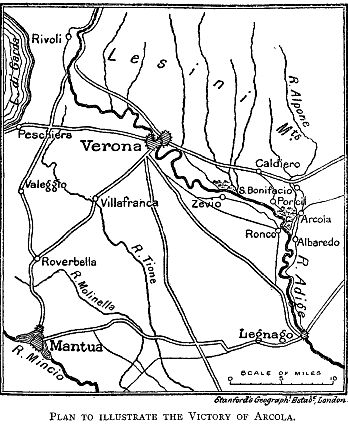
This memorable first day of fighting at Arcola (November 15th) closed on the strange scene of two armies encamped on dykes, exhausted by an almost amphibious conflict, like that waged by the Dutch "Beggars" in their war of liberation against Spain. Though at Arcola the republicans had been severely checked, yet further west Masséna had held his own; and the French movement as a whole had compelled Alvintzy to suspend any advance on Verona or on Mantua, to come down from the heights of Caldiero, and to fight on ground where his superior numbers were of little avail. This was seen on the second day of fighting on the dykes opposite Arcola, which was, on the whole, favourable to the smaller veteran force. On the third day Bonaparte employed a skilful ruse to add to the discouragement of his foes. He posted a small body of horsemen behind a spinney near the Austrian flank, with orders to sound their trumpets as if for a great cavalry charge. Alarmed by the noise and by the appearance of French troops from the side of Legnago and behind Arcola, the demoralized white-coats suddenly gave way and retreated for Vicenza.
Victory again declared for the troops who could dare the longest, and whose general was never at a loss in face of any definite danger. Both armies suffered severely in these desperate conflicts;[68] but, while the Austrians felt[pg.127] that the cup of victory had been snatched from their very lips, the French soldiery were dazzled by this transcendent exploit of their chief. They extolled his bravery, which almost vied with the fabulous achievement of Horatius Cocles, and adored the genius which saw safety and victory for his discouraged army amidst swamps and dykes. Bonaparte himself, with that strange mingling of the practical and the superstitious which forms the charm of his character, ever afterwards dated the dawn of his fortune in its full splendour from those hours of supreme crisis among the morasses of Arcola. But we may doubt whether this posing as the favourite of fortune was not the result of his profound knowledge of the credulity of the vulgar herd, which admires genius and worships bravery, but grovels before persistent good luck.
Though it is difficult to exaggerate the skill and bravery of the French leader and his troops, the failure of his opponents is inexplicable but for the fact that most of their troops were unable to manoeuvre steadily in the open, that Alvintzy was inexperienced as a commander-in-chief, and was hampered throughout by a bad plan of campaign. Meanwhile the other Austrian army, led by Davidovich, had driven Vaubois from his position at Rivoli; and had the Imperialist generals kept one another informed of their moves, or had Alvintzy, disregarding a blare of trumpets and a demonstration on his flank and rear, clung to Arcola for two days longer—the French would have been nipped between superior forces. But, as it was, the lack of accord in the Austrian movements nearly ruined the Tyrolese wing, which pushed on triumphantly towards Verona, while Alvintzy was retreating eastwards. Warned just in time, Davidovich hastily retreated to Roveredo, leaving a whole battalion in the hands of the French. To crown this chapter of blunders, Würmser, whose sortie after Caldiero might have been most effective, tardily essayed to break through the blockaders, when both his colleagues were in retreat. How different were these ill-assorted moves[pg.128] from those of Bonaparte. His maxims throughout this campaign, and his whole military career, were: (1) divide for foraging, concentrate for fighting; (2) unity of command is essential for success; (3) time is everything. This firm grasp of the essentials of modern warfare insured his triumph over enemies who trusted to obsolete methods for the defence of antiquated polities.[69]
The battle of Arcola had an important influence on the fate of Italy and Europe. In the peninsula all the elements hostile to the republicans were preparing for an explosion in their rear which should reaffirm the old saying that Italy was the tomb of the French. Naples had signed terms of peace with them, it is true; but the natural animosity of the Vatican against its despoilers could easily have leagued the south of Italy with the other States that were working secretly for their expulsion. While the Austrians were victoriously advancing, these aims were almost openly avowed, and at the close of the year 1796 Bonaparte moved south to Bologna in order to guide the Italian patriots in their deliberations and menace the Pope with an invasion of the Roman States. From this the Pontiff was for the present saved by new efforts on the part of Austria. But before describing the final attempt of the Hapsburgs to wrest Italy from their able adversary, it will be well to notice his growing ascendancy in diplomatic affairs.
While Bonaparte was struggling in the marshes of Arcola, the Directory was on the point of sending to Vienna an envoy, General Clarke, with proposals for an armistice preliminary to negotiations for peace with Austria. This step was taken, because France was distracted by open revolt in the south, by general discontent in the west, and by the retreat of her Rhenish armies, now flung back on the soil of the Republic by the Austrian Arch-duke Charles. Unable to support large[pg.129] forces in the east of France out of its bankrupt exchequer, the Directory desired to be informed of the state of feeling at Vienna. It therefore sent Clarke with offers, which might enable him to look into the political and military situation at the enemy's capital, and see whether peace could not be gained at the price of some of Bonaparte's conquests. The envoy was an elegant and ambitious young man, descended from an Irish family long settled in France, who had recently gained Carnot's favour, and now desired to show his diplomatic skill by subjecting Bonaparte to the present aims of the Directory.
The Directors' secret instructions reveal the plans which they then harboured for the reconstruction of the Continent. Having arranged an armistice which should last up to the end of the next spring, Clarke was to set forth arrangements which might suit the House of Hapsburg. He might discuss the restitution of all their possessions in Italy, and the acquisition of the Bishopric of Salzburg and other smaller German and Swabian territories: or, if she did not recover the Milanese, Austria might gain the northern parts of the Papal States as compensation; and the Duke of Tuscany—a Hapsburg—might reign at Rome, yielding up his duchy to the Duke of Parma; while, as this last potentate was a Spanish Bourbon, France might for her good offices to this House gain largely from Spain in America.[70] In these and other proposals two methods of bargaining are everywhere prominent. The great States are in every case to gain at the expense of their weaker neighbours; Austria is to be appeased; and France is to reap enormous gains ultimately at the expense of smaller Germanic or Italian States. These facts should clearly be noted. Napoleon was afterwards deservedly blamed for carrying out these unprincipled methods; but, at the worst, he only developed them from those of the Directors, who, with the cant of[pg.130] Liberty, Equality, and Fraternity on their lips, battened on the plunder of the liberated lands, and cynically proposed to share the spoil of weaker States with the potentates against whom they publicly declaimed as tyrants.
The chief aim of these negotiations, so Clarke was assured, was to convince the Court of Vienna that it would get better terms by treating with France directly and alone, rather than by joining in the negotiations which had recently been opened at Paris by England. But the Viennese Ministers refused to allow Clarke to proceed to their capital, and appointed Vicenza as the seat of the deliberations.
They were brief. Through the complex web of civilian intrigue, Bonaparte forthwith thrust the mailed hand of the warrior. He had little difficulty in proving to Clarke that the situation was materially altered by the battle of Arcola. The fall of Mantua was now only a matter of weeks. To allow its provisions to be replenished for the term of the armistice was an act that no successful general could tolerate. For that fortress the whole campaign had been waged, and three Austrian armies had been hurled back into Tyrol and Friuli. Was it now to be provisioned, in order that the Directory might barter away the Cispadane Republic? He speedily convinced Clarke of the fatuity of the Directors' proposals. He imbued him with his own contempt for an armistice that would rob the victors of their prize; and, as the Court of Vienna still indulged hopes of success in Italy, Clarke's negotiations at Vicenza came to a speedy conclusion.
In another important matter the Directory also completely failed. Nervous as to Bonaparte's ambition, it had secretly ordered Clarke to watch his conduct and report privately to Paris. Whether warned by a friend at Court, or forearmed by his own sagacity, Bonaparte knew of this, and in his intercourse with Clarke deftly let the fact be seen. He quickly gauged Clarke's powers, and the aim of his mission. "He is a spy," he remarked a little later to Miot, "whom the Directory have set [pg.131] upon me: he is a man of no talent—only conceited." The splendour of his achievements and the mingled grace and authority of his demeanour so imposed on the envoy that he speedily fell under the influence of the very man whom he was to watch, and became his enthusiastic adherent.
Bonaparte was at Bologna, supervising the affairs of the Cispadane Republic, when he heard that the Austrians were making a last effort for the relief of Mantua. Another plan had been drawn up by the Aulic Council at Vienna. Alvintzy, after recruiting his wearied force at Bassano, was quickly to join the Tyrolese column at Roveredo, thereby forming an army of 28,000 men wherewith to force the position of Rivoli and drive the French in on Mantua: 9,000 Imperialists under Provera were also to advance from the Brenta upon Legnago, in order to withdraw the attention of the French from the real attempt made by the valley of the Adige; while 10,000 others at Bassano and elsewhere were to assail the French front at different points and hinder their concentration. It will be observed that the errors of July and November, 1796, were now yet a third time to be committed: the forces destined merely to make diversions were so strengthened as not to be merely light bodies distracting the aim of the French, while Alvintzy's main force was thereby so weakened as to lack the impact necessary for victory.
Nevertheless, the Imperialists at first threw back their foes with some losses; and Bonaparte, hurrying northwards to Verona, was for some hours in a fever of uncertainty as to the movements and strength of the assailants. Late at night on January 13th he knew that Provera's advance was little more than a demonstration, and that the real blow would fall on the 10,000 men marshalled by Joubert at Monte Baldo and Rivoli. Forthwith he rode to the latter place, and changed retreat and discouragement into a vigorous offensive by the news that 13,000 more men were on the march to defend the strong position of Rivoli.[pg.132]
The great defensive strength of this plateau had from the first attracted his attention. There the Adige in a sharp bend westward approaches within six miles of Lake Garda. There, too, the mountains, which hem in the gorge of the river on its right bank, bend away towards the lake and leave a vast natural amphitheatre, near the centre of which rises the irregular plateau that commands the exit from Tyrol. Over this plateau towers on the north Monte Baldo, which, near the river gorge, sends out southward a sloping ridge, known as San Marco, connecting it with the plateau. At the foot of this spur is the summit of the road which leads the traveller from Trent to Verona; and, as he halts at the top of the zigzag, near the village of Rivoli, his eye sweeps over the winding gorge of the river beneath, the threatening mass of Monte Baldo on the north, and on the west of the village he gazes down on a natural depression which has been sharply furrowed by a torrent. The least experienced eye can see that the position is one of great strength. It is a veritable parade ground among the mountains, almost cut off from them by the ceaseless action of water, and destined for the defence of the plains of Italy. A small force posted at the head of the winding roadway can hold at bay an army toiling up from the valley; but, as at Thermopylae, the position is liable to be outflanked by an enterprising foe, who should scale the footpath leading over the western offshoots of Monte Baldo, and, fording the stream at its foot, should then advance eastwards against the village. This, in part, was Alvintzy's plan, and having nearly 28,000 men,[71][pg.133] he doubted not that his enveloping tactics must capture Joubert's division of 10,000 men. So daunted was even this brave general by the superior force of his foes that he had ordered a retreat southwards when an aide-de-camp arrived at full gallop and ordered him to hold Rivoli at all costs. Bonaparte's arrival at 4 a.m. explained the order, and an attack made during the darkness wrested from the Austrians the chapel on the San Marco ridge which stands on the ridge above the zigzag track. The reflection of the Austrian watch-fires in the wintry sky showed him their general position. To an unskilled observer the wide sweep of the glare portended ruin for the French. To the eye of Bonaparte the sight brought hope. It proved that his foes were still bent on their old plan of enveloping him: and from information which he treacherously received from Alvintzy's staff he [pg.134] must have known that that commander had far fewer than the 45,000 men which he ascribed to him in bulletins.
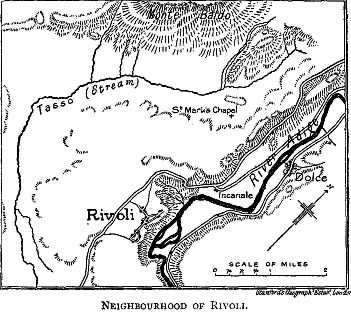
Yet the full dawn of that January day saw the Imperialists flushed with success, as their six separate columns drove in the French outposts and moved towards Rivoli. Of these, one was on the eastern side of the Adige and merely cannonaded across the valley: another column wound painfully with most of the artillery and cavalry along the western bank, making for the village of Incanale and the foot of the zigzag leading up to Rivoli: three others denied over Monte Baldo by difficult paths impassable to cannon: while the sixth and westernmost column, winding along the ridge near Lake Garda, likewise lacked the power which field-guns and horsemen would have added to its important turning movement. Never have natural obstacles told more potently on the fortunes of war than at Rivoli; for on the side where the assailants most needed horses and guns they could not be used; while on the eastern edge of their broken front their cannon and horse, crowded together in the valley of the Adige, had to climb the winding road under the plunging fire of the French infantry and artillery. Nevertheless, such was the ardour of the Austrian attack, that the tide of battle at first set strongly in their favour. Driving the French from the San Marco ridge and pressing their centre hard between Monte Baldo and Rivoli, they made it possible for their troops in the valley to struggle on towards the foot of the zigzag; and on the west their distant right wing was already beginning to threaten the French rear. Despite the arrival of Masséna's troops from Verona about 9 a.m., the republicans showed signs of unsteadiness. Joubert on the ground above the Adige, Berthier in the centre, and Masséna on the left, were gradually forced back. An Austrian column, advancing from the side of Monte Baldo by the narrow ravine, stole round the flank of a French regiment in front of Masséna's division, and by a vigorous charge sent it flying in a panic which promised to spread to another regiment thus uncovered. This was too much [pg.135] for the veteran, already dubbed "the spoilt child of victory "; he rushed to its captain, bitterly upbraided him and the other officers, and finally showered blows on them with the flat of his sword. Then, riding at full speed to two tried regiments of his own division, he ordered them to check the foe; and these invincible heroes promptly drove back the assailants. Even so, however, the valour of the best French regiments and the skill of Masséna, Berthier, and Joubert barely sufficed to hold back the onstreaming tide of white-coats opposite Rivoli.
Yet even at this crisis the commander, confident in his central position, and knowing his ability to ward off the encircling swoops of the Austrian eagle, maintained that calm demeanour which moved the wonder of smaller minds. His confidence in his seasoned troops was not misplaced. The Imperialists, overburdened by long marches and faint now for lack of food, could not maintain their first advantage. Some of their foremost troops, that had won the broken ground in front of St. Mark's Chapel, were suddenly charged by French horse; they fled in panic, crying out, "French cavalry!" and the space won was speedily abandoned to the tricolour. This sudden rebuff was to dash all their hopes of victory; for at that crisis of the day the chief Austrian column of nearly 8,000 men was struggling up the zigzag ascent leading from the valley of the Adige to the plateau, in the fond hope that their foes were by this time driven from the summit. Despite the terrible fire that tore their flanks, the Imperialists were clutching desperately at the plateau, when Bonaparte put forth his full striking power. He could now assail the crowded ranks of the doomed column in front and on both flanks. A charge of Leclerc's horse and of Joubert's infantry crushed its head; volleys of cannon and musketry from the plateau tore its sides; an ammunition wagon exploded in its midst; and the great constrictor forthwith writhed its bleeding coils back into the valley, where it lay crushed and helpless for the rest of the fight. [pg.136]
Animated by this lightning stroke of their commander, the French turned fiercely towards Monte Baldo and drove back their opponents into the depression at its foot. But already at their rear loud shouts warned them of a new danger. The western detachment of the Imperialists had meanwhile worked round their rear, and, ignorant of the fate of their comrades, believed that Bonaparte's army was caught in a trap. The eyes of all the French staff officers were now turned anxiously on their commander, who quietly remarked, "We have them now." He knew, in fact, that other French troops marching up from Verona would take these new foes in the rear; and though Junot and his horsemen failed to cut their way through so as to expedite their approach, yet speedily a French regiment burst through the encircling line and joined in the final attack which drove these last assailants from the heights south of Rivoli, and later on compelled them to surrender.
Thus closed the desperate battle of Rivoli (January 14th). Defects in the Austrian position and the opportune arrival of French reinforcements served to turn an Austrian success into a complete rout. Circumstances which to a civilian may seem singly to be of small account sufficed to tilt the trembling scales of warfare, and Alvintzy's army now reeled helplessly back into Tyrol with a total loss of 15,000 men and of nearly all its artillery and stores. Leaving Joubert to pursue it towards Trent, Bonaparte now flew southwards towards Mantua, whither Provera had cut his way. Again his untiring energy, his insatiable care for all probable contingencies, reaped a success which the ignorant may charge to the account of his fortune. Strengthening Augereau's division by light troops, he captured the whole of Provera's army at La Favorita, near the walls of Mantua (January 16th). The natural result of these two dazzling triumphs was the fall of the fortress for which the Emperor Francis had risked and lost five armies. Würmser surrendered Mantua on February 2nd with 18,000 men and immense supplies of arms and stores. [pg.137] The close of this wondrous campaign was graced by an act of clemency. Generous terms were accorded to the veteran marshal, whose fidelity to blundering councillors at Vienna had thrown up in brilliant relief the prudence, audacity, and resourcefulness of the young war-god.
It was now time to chastise the Pope for his support of the enemies of France. The Papalini proved to be contemptible as soldiers. They fled before the republicans, and a military promenade brought the invaders to Ancona, and then inland to Tolentino, where Pius VI. sued for peace. The resulting treaty signed at that place (February 19th) condemned the Holy See to close its ports to the allies, especially to the English; to acknowledge the acquisition of Avignon by France, and the establishment of the Cispadane Republic at Bologna, Ferrara, and the surrounding districts; to pay 30,000,000 francs to the French Government; and to surrender 100 works of art to the victorious republicans.
It is needless to describe the remaining stages in Bonaparte's campaign against Austria. Hitherto he had contended against fairly good, though discontented and discouraged troops, badly led, and hampered by the mountain barrier which separated them from their real base of operations. In the last part of the war he fought against troops demoralized by an almost unbroken chain of disasters. The Austrians were now led by a brave and intelligent general, the Archduke Charles; but he was hampered by rigorous instructions from Vienna, by senile and indolent generals, by the indignation or despair of the younger officers at the official favouritism which left them in obscurity, and by the apathy of soldiers who had lost heart. Neither his skill nor the natural strength of their positions in Friuli and Carinthia could avail against veterans flushed with victory and marshalled with unerring sagacity. The rest of the war only served to emphasize the truth of Napoleon's later statement, that the moral element constitutes three-fourths of an army's strength. The barriers offered by the River Tagliamento and the many [pg.138] commanding heights of the Carnic and the Noric Alps were as nothing to the triumphant republicans; and from the heights that guard the province of Styria, the genius of Napoleon flashed as a terrifying portent to the Court of Vienna and the potentates of Central Europe. When the tricolour standards were nearing the town of Leoben, the Emperor Francis sent envoys to sue for peace;[72] and the preliminaries signed there, within one hundred miles of the Austrian capital, closed the campaign which a year previously had opened with so little promise for the French on the narrow strip of land between the Maritime Alps and the petty township of Savona.
These brilliant results were due primarily to the consummate leadership of Bonaparte. His geographical instincts discerned the means of profiting by natural obstacles and of turning them when they seemed to screen his opponents. Prompt to divine their plans, he bewildered them by the audacity of his combinations, which overbore their columns with superior force at the very time when he seemed doomed to succumb. Genius so commanding had not been displayed even by Frederick or Marlborough. And yet these brilliant results could not have been achieved by an army which rarely exceeded 45,000 men without the strenuous bravery and tactical skill of the best generals of division, Augereau, Masséna, and Joubert, as well as of officers who had shown their worth in many a doubtful fight; Lannes, the hero of Lodi and Arcola; Marmont, noted for his daring advance of the guns at Castiglione; Victor, who justified his name by hard fighting at La Favorita; Murat, the beau sabreur, and Junot, both dashing cavalry generals; and many more whose daring earned them a soldier's death in order to gain glory for France and[pg.139] liberty for Italy. Still less ought the soldiery to be forgotten; those troops, whose tattered uniforms bespoke their ceaseless toils, who grumbled at the frequent lack of bread, but, as Masséna observed, never before a battle, who even in retreat never doubted the genius of their chief, and fiercely rallied at the longed-for sign of fighting. The source of this marvellous energy is not hard to discover. Their bravery was fed by that wellspring of hope which had made of France a nation of free men determined to free the millions beyond their frontiers. The French columns were "equality on the march"; and the soldiery, animated by this grand enthusiasm, found its militant embodiment in the great captain who seemed about to liberate Italy and Central Europe. [pg.140]
In signing the preliminaries of peace at Leoben, which formed in part the basis for the Treaty of Campo Formio, Bonaparte appears as a diplomatist of the first rank. He had already signed similar articles with the Court of Turin and with the Vatican. But such a transaction with the Emperor was infinitely more important than with the third-rate powers of the peninsula. He now essays his first flight to the highest levels of international diplomacy. In truth, his mental endowments, like those of many of the greatest generals, were no less adapted to success in the council-chamber than on the field of battle; for, indeed, the processes of thought and the methods of action are not dissimilar in the spheres of diplomacy and war. To evade obstacles on which an opponent relies, to multiply them in his path, to bewilder him by feints before overwhelming him by a crushing onset, these are the arts which yield success either to the negotiator or to the commander.
In imposing terms of peace on the Emperor at Leoben (April 18th, 1797), Bonaparte reduced the Directory, and its envoy, Clarke, who was absent in Italy, to a subordinate rôle. As commander-in-chief, he had power only to conclude a brief armistice, but now he signed the preliminaries of peace. His excuse to the Directory was ingenious. While admitting the irregularity of his conduct, he pleaded the isolated position of his army, and the absence of Clarke, and that, under the circumstances, his act had been merely "a military operation." He could also urge that he had in his rear a disaffected [pg.141] Venetia, and that he believed the French armies on the Rhine to be stationary and unable to cross that river. But the very tardy advent of Clarke on the scene strengthens the supposition that Bonaparte was at the time by no means loth to figure as the pacifier of the Continent. Had he known the whole truth, namely, that the French were gaining a battle on the east bank of the Rhine while the terms of peace were being signed at Leoben, he would most certainly have broken off the negotiations and have dictated harsher terms at the gates of Vienna. That was the vision which shone before his eyes three years previously, when he sketched to his friends at Nice the plan of campaign, beginning at Savona and ending before the Austrian capital; and great was his chagrin at hearing the tidings of Moreau's success on April 20th. The news reached him on his return from Leoben to Italy, when he was detained for a few hours by a sudden flood of the River Tagliamento. At once he determined to ride back and make some excuse for a rupture with Austria; and only the persistent remonstrances of Berthier turned him from this mad resolve, which would forthwith have exhibited him to the world as estimating more highly the youthful promptings of destiny than the honour of a French negotiator.
The terms which he had granted to the Emperor were lenient enough. The only definitive gain to France was the acquisition of the Austrian Netherlands (Belgium), for which troublesome possession the Emperor was to have compensation elsewhere. Nothing absolutely binding was said about the left, or west, bank of the Rhine, except that Austria recognized the "constitutional limits" of France, but reaffirmed the integrity of "The Empire."[73] These were contradictory statements; for France had declared the Rhine to be her natural boundary, and the old "Empire" included Belgium, Trèves, and Luxemburg. But, for the interpretation of these vague formularies, the following secret and all-important articles were appended. While the[pg.142] Emperor renounced that part of his Italian possessions which lay to the west of the Oglio, he was to receive all the mainland territories of Venice east of that river, including Dalmatia and Istria, Venice was also to cede her lands west of the Oglio to the French Government; and in return for these sacrifices she was to gain the three legations of Romagna, Ferrara, and Bologna—the very lands which Bonaparte had recently formed into the Cispadane Republic! For the rest, the Emperor would have to recognize the proposed Republic at Milan, as also that already existing at Modena, "compensation" being somewhere found for the deposed duke.
From the correspondence of Thugut, the Austrian Minister, it appears certain that Austria herself had looked forward to the partition of the Venetian mainland territories, and this was the scheme which Bonaparte actually proposed to her at Leoben. Still more extraordinary was his proposal to sacrifice, ostensibly to Venice but ultimately to Austria, the greater part of the Cispadane Republic. It is, indeed, inexplicable, except on the ground that his military position at Leoben was more brilliant than secure. His uneasiness about this article of the preliminaries is seen in his letter of April 22nd to the Directors, which explains that the preliminaries need not count for much. But most extraordinary of all was his procedure concerning the young Lombard Republic. He seems quite calmly to have discussed its retrocession to the Austrians, and that, too, after he had encouraged the Milanese to found a republic, and had declared that every French victory was "a line of the constitutional charter."[74] The most reasonable explanation is that Bonaparte over-estimated the military strength of Austria, and undervalued the energy of the men of Milan, Modena, and Bologna, of whose levies he spoke most contemptuously. Certain it is that he desired to disengage himself from their affairs so as to be free for the grander visions of oriental[pg.143] conquest that now haunted his imagination. Whatever were his motives in signing the preliminaries at Leoben, he speedily found means for their modification in the ever-enlarging area of negotiable lands.
It is now time to return to the affairs of Venice. For seven months the towns and villages of that republic had been a prey to pitiless warfare and systematic rapacity, a fate which the weak ruling oligarchy could neither avert nor avenge. In the western cities, Bergamo and Brescia, whose interests and feelings linked them with Milan rather than Venice, the populace desired an alliance with the nascent republic on the west and a severance from the gloomy despotism of the Queen of the Adriatic. Though glorious in her prime, she now governed with obscurantist methods inspired by fear of her weakness becoming manifest; and Bonaparte, tearing off the mask which hitherto had screened her dotage, left her despised by the more progressive of her own subjects. Even before he first entered the Venetian territory, he set forth to the Directory the facilities for plunder and partition which it offered. Referring to its reception of the Comte de Provence (the future Louis XVIII.) and the occupation of Peschiera by the Austrians, he wrote (June 6th, 1796):
"If your plan is to extract five or six million francs from Venice, I have expressly prepared for you this sort of rupture with her.... If you have intentions more pronounced, I think that you ought to continue this subject of contention, instruct me as to your desires, and wait for the favourable opportunity, which I will seize according to circumstances, for we must not have everybody on our hands at the same time."
The events which now transpired in Venetia gave him excuses for the projected partition. The weariness felt by the Brescians and Bergamesques for Venetian rule had been artfully played on by the Jacobins of Milan and by the French Generals Kilmaine and Landrieux; and an effort made by the Venetian officials to repress the growing discontent brought about disturbances in [pg.144] which some men of the "Lombard legion" were killed. The complicity of the French in the revolt is clearly established by the Milanese journals and by the fact that Landrieux forthwith accepted the command of the rebels at Bergamo and Brescia.[75] But while these cities espoused the Jacobin cause, most of the Venetian towns and all the peasantry remained faithful to the old Government. It was clear that a conflict must ensue, even if Bonaparte and some of his generals had not secretly worked to bring it about. That he and they did so work cannot now be disputed. The circle of proof is complete. The events at Brescia and Bergamo were part of a scheme for precipitating a rupture with Venice; and their success was so far assured that Bonaparte at Leoben secretly bargained away nearly the whole of the Venetian lands. Furthermore, a fortnight before the signing of these preliminaries, he had suborned a vile wretch, Salvatori by name, to issue a proclamation purporting to come from the Venetian authorities, which urged the people everywhere to rise and massacre the French. It was issued on April 5th, though it bore the date of March 20th. At once the Doge warned his people that it was a base fabrication, But the mischief had been done. On Easter Monday (April 17th) a chance affray in Verona let loose the passions which had been rising for months past: the populace rose in fury against the French detachment quartered on them: and all the soldiers who could not find shelter in the citadel, even the sick in the hospitals, fell victims to the craving for revenge for the humiliations and exactions of the last seven months.[76] Such was Easter-tide at Verona—les Pâques véronaises—an event[pg.145] that recalls the Sicilian Vespers of Palermo in its blind southern fury.
The finale somewhat exceeded Bonaparte's expectations, but he must have hailed it with a secret satisfaction. It gave him a good excuse for wholly extinguishing Venice as an independent power. According to the secret articles signed at Leoben, the city of Venice was to have retained her independence and gained the Legations. But her contumacy could now be chastised by annihilation. Venice could, in fact, indemnify the Hapsburgs for the further cessions which France exacted from them elsewhere; and in the process Bonaparte would free himself from the blame which attached to his hasty signature of the preliminaries at Leoben.[77] He was now determined to secure the Rhine frontier for France, to gain independence, under French tutelage, not only for the Lombard Republic, but also for Modena and the Legations. These were his aims during the negotiations to which he gave the full force of his intellect during the spring and summer of 1797.
The first thing was to pour French troops into Italy so as to extort better terms: the next was to declare war on Venice. For this there was now ample justification; for, apart from the massacre at Verona, another outrage had been perpetrated. A French corsair, which had persisted in anchoring in a forbidden part of the harbour of Venice, had been riddled by the batteries and captured. For this act, and for the outbreak at Verona, the Doge and Senate offered ample reparation: but Bonaparte refused to listen to these envoys, "dripping with French blood," and haughtily bade Venice evacuate her mainland territories.[78] For various reasons he decided to use guile rather than force. He found in Venice a secretary of the French legation, Villetard by name, who could be trusted dextrously to undermine the crumbling fabric of the oligarchy.[79] This man persuaded[pg.146] the terrified populace that nothing would appease the fury of the French general but the deposition of the existing oligarchy and the formation of a democratic municipality. The people and the patricians alike swallowed the bait; and the once haughty Senate tamely pronounced its own doom. Disorders naturally occurred on the downfall of the ancient oligarchy, especially when the new municipality ordered the removal of Venetian men-of-war into the hands of the French and the introduction of French troops by help of Venetian vessels. A mournful silence oppressed even the democrats when 5,000 French troops entered Venice on board the flotilla. The famous State, which for centuries had ruled the waters of the Levant, and had held the fierce Turks at bay, a people numbering 3,000,000 souls and boasting a revenue of 9,000,000 ducats, now struck not one blow against conquerors who came in the guise of liberators.
On the same day Bonaparte signed at Milan a treaty of alliance with the envoys of the new Venetian Government. His friendship was to be dearly bought. In secret articles, which were of more import than the vague professions of amity which filled the public document, it was stipulated that the French and Venetian Republics should come to an understanding as to the exchange of certain territories, that Venice should pay a contribution in money and in materials of war, should aid the French navy by furnishing three battleships and two frigates, and should enrich the museums of her benefactress by 20 paintings and 500 manuscripts. While he was signing these conditions of peace, the Directors were despatching from Paris a declaration of war against Venice. Their decision was already obsolete: it was founded on Bonaparte's despatch of April 30th; but in the interval their proconsul had wholly changed the situation by overthrowing the rule of the Doge and Senate, and by setting up a democracy, through which he could extract the wealth of that land. The Directors' declaration of war was accordingly stopped at Milan, and no more was heard of it. They were thus forcibly [pg.147] reminded of the truth of his previous warning that things would certainly go wrong unless they consulted him on all important details.[80]
This treaty of Milan was the fourth important convention concluded by the general, who, at the beginning of the campaign of 1796, had been forbidden even to sign an armistice without consulting Salicetti!
It was speedily followed by another, which in many respects redounds to the credit of the young conqueror. If his conduct towards Venice inspires loathing, his treatment of Genoa must excite surprise and admiration. Apart from one very natural outburst of spleen, it shows little of that harshness which might have been expected from the man who had looked on Genoa as the embodiment of mean despotism. Up to the summer of 1796 Bonaparte seems to have retained something of his old detestation of that republic; for at midsummer, when he was in the full career of his Italian conquests, he wrote to Faypoult, the French envoy at Genoa, urging him to keep open certain cases that were in dispute, and three weeks later he again wrote that the time for Genoa had not yet come. Any definite action against this wealthy city was, indeed, most undesirable during the campaign; for the bankers of Genoa supplied the French army with the sinews of war by means of secret loans, and their merchants were equally complaisant in regard to provisions. These services were appreciated by Bonaparte as much as they were resented by Nelson; and possibly the succour which Genoese money and shipping covertly rendered to the French expeditions for the recovery of Corsica may have helped to efface from Bonaparte's memory the associations clustering around the once-revered name of Paoli. From ill-concealed hostility he drifted into a position of tolerance and finally of friendship[pg.148] towards Genoa, provided that she became democratic. If her institutions could be assimilated to those of France, she might prove a valuable intermediary or ally.
The destruction of the Genoese oligarchy presented no great difficulties. Both Venice and Genoa had long outlived their power, and the persistent violation of their neutrality had robbed them of that last support of the weak, self-respect. The intrigues of Faypoult and Salicetti were undermining the influence of the Doge and Senate, when the news of the fall of the Venetian oligarchy spurred on the French party to action, But the Doge and Senate armed bands of mountaineers and fishermen who were hostile to change; and in a long and desperate conflict in the narrow streets of Genoa the democrats were completely worsted (May 23rd). The victors thereupon ransacked the houses of the opposing faction and found lists of names of those who were to have been proscribed, besides documents which revealed the complicity of the French agents in the rising. Bonaparte was enraged at the folly of the Genoese democrats, which deranged his plans. As he wrote to the Directory, if they had only remained quiet for a fortnight, the oligarchy would have collapsed from sheer weakness. The murder of a few Frenchmen and Milanese now gave him an excuse for intervention. He sent an aide-de-camp, Lavalette, charged with a vehement diatribe against the Doge and Senate, which lost nothing in its recital before that august body. At the close a few senators called out, "Let us fight": but the spirit of the Dorias flickered away with these protests; and the degenerate scions of mighty sires submitted to the insults of an aide-de-camp and the dictation of his master.
The fate of this ancient republic was decided by Bonaparte at the Castle of Montebello, near Milan, where he had already drawn up her future constitution. After brief conferences with the Genoese envoys, he signed with them the secret convention which placed their republic—soon to be renamed the Ligurian Republic—under the protection of France and substituted for the [pg.149] close patrician rule a moderate democracy. The fact is significant. His military instincts had now weaned him from the stiff Jacobinism of his youth; and, in conjunction with Faypoult and the envoys, he arranged that the legislative powers should be intrusted to two popularly elected chambers of 300 and 150 members, while the executive functions were to be discharged by twelve senators, presided over by a Doge; these officers were to be appointed by the chambers: for the rest, the principles of religious liberty and civic equality were recognized, and local self-government was amply provided for. Cynics may, of course, object that this excellent constitution was but a means of insuring French supremacy and of peacefully installing Bonaparte's regiments in a very important city; but the close of his intervention may be pronounced as creditable to his judgment as its results were salutary to Genoa. He even upbraided the demagogic party of that city for shivering in pieces the statue of Andrea Doria and suspending the fragments on some of the innumerable trees of liberty recently planted.
"Andrea Doria," he wrote, "was a great sailor and a great statesman. Aristocracy was liberty in his time. The whole of Europe envies your city the honour of having produced that celebrated man. You will, I doubt not, take pains to rear his statue again: I pray you to let me bear a part of the expense which that will entail, which I desire to share with those who are most zealous for the glory and welfare of your country."
In contrasting this wise and dignified conduct with the hatred which most Corsicans still cherished against Genoa, Bonaparte's greatness of soul becomes apparent and inspires the wish: Utinam semper sic fuisses!
Few periods of his life have been more crowded with momentous events than his sojourn at the Castle of Montebello in May-July, 1797. Besides completing the downfall of Venice and reinvigorating the life of Genoa, he was deeply concerned with the affairs of the Lombard or Cisalpine Republic, with his family concerns, [pg.0] with the consolidation of his own power in French politics, and with the Austrian negotiations. We will consider these affairs in the order here indicated.
The future of Lombardy had long been a matter of concern to Bonaparte. He knew that its people were the fittest in all Italy to benefit by constitutional rule, but it must be dependent on France. He felt little confidence in the Lombards if left to themselves, as is seen in his conversation with Melzi and Miot de Melito at the Castle of Montebello. He was in one of those humours, frequent at this time of dawning splendour, when confidence in his own genius betrayed him into quite piquant indiscretions. After referring to the Directory, he turned abruptly to Melzi, a Lombard nobleman:
"As for your country, Monsieur de Melzi, it possesses still fewer elements of republicanism than France, and can be managed more easily than any other. You know better than anyone that we shall do what we like with Italy. But the time has not yet come. We must give way to the fever of the moment. We are going to have one or two republics here of our own sort. Monge will arrange that for us."
He had some reason for distrusting the strength of the democrats in Italy. At the close of 1796 he had written that there were three parties in Lombardy, one which accepted French guidance, another which desired liberty even with some impatience, and a third faction, friendly to the Austrians: he encouraged the first, checked the second, and repressed the last. He now complained that the Cispadanes and Cisalpines had behaved very badly in their first elections, which had been conducted in his absence; for they had allowed clerical influence to override all French predilections. And, a little later, he wrote to Talleyrand that the genuine love of liberty was feeble in Italy, and that, as soon as French influences were withdrawn, the Italian Jacobins would be murdered by the populace. The sequel was to justify his misgivings, and therefore to refute the charges of those [pg.151] who see in his conduct respecting the Cisalpine Republic nothing but calculating egotism. The difficulty of freeing a populace that had learnt to hug its chains was so great that the temporary and partial success which his new creation achieved may be regarded as a proof of his political sagacity.
After long preparations by four committees, which Bonaparte kept at Milan closely engaged in the drafting of laws, the constitution of the Cisalpine Republic was completed. It was a miniature of that of France, and lest there should be any further mistakes in the elections, Bonaparte himself appointed, not only the five Directors and the Ministers whom they were to control, but even the 180 legislators, both Ancients and Juniors. In this strange fashion did democracy descend on Italy, not mainly as the work of the people, but at the behest of a great organizing genius. It is only fair to add that he summoned to the work of civic reconstruction many of the best intellects of Italy. He appointed a noble, Serbelloni, to be the first President of the Cisalpine Republic, and a scion of the august House of the Visconti was sent as its ambassador to Paris. Many able men that had left Lombardy during the Austrian occupation or the recent wars were attracted back by Bonaparte's politic clemency; and the festival of July 9th at Milan, which graced the inauguration of the new Government, presented a scene of civic joy to which that unhappy province had long been a stranger. A vast space was thronged with an enormous crowd which took up the words of the civic oath uttered by the President. The Archbishop of Milan celebrated Mass and blessed the banners of the National Guards; and the day closed with games, dances, and invocations to the memory of the Italians who had fought and died for their nascent liberties. Amidst all the vivas and the clash of bells Bonaparte took care to sound a sterner note. On that very day he ordered the suppression of a Milanese club which had indulged in Jacobinical extravagances, and he called on the people "to show to the [pg.152] world by their wisdom, energy, and by the good organization of their army, that modern Italy has not degenerated and is still worthy of liberty."
The contagion of Milanese enthusiasm spread rapidly. Some of the Venetian towns on the mainland now petitioned for union with the Cisalpine Republic; and the deputies of the Cispadane, who were present at the festival, urgently begged that their little State might enjoy the same privilege. Hitherto Bonaparte had refused these requests, lest he should hamper the negotiations with Austria, which were still tardily proceeding; but within a month their wish was gratified, and the Cispadane State was united to the larger and more vigorous republic north of the River Po, along with the important districts of Como, Bergamo, Brescia, Crema, and Peschiera. Disturbances in the Swiss district of the Valteline soon enabled Bonaparte to intervene on behalf of the oppressed peasants, and to merge this territory also in the Cisalpine Republic, which consequently stretched from the high Alps southward to Rimini, and from the Ticino on the west to the Mincio on the east.[81]
Already, during his sojourn at the Castle of Montebello, Bonaparte figured as the all-powerful proconsul of the French Republic. Indeed, all his surroundings—his retinue of complaisant generals, and the numerous envoys and agents who thronged his ante-chambers to beg an audience—befitted a Sulla or a Wallenstein, rather than a general of the regicide Republic. Three hundred Polish soldiers guarded the approaches to the castle; and semi-regal state was also observed in its spacious corridors and saloons. There were to be seen Italian nobles, literati, and artists, counting it the highest honour to visit the liberator of their land; and to them Bonaparte behaved with that mixture of affability and inner reserve,[pg.153] of seductive charm alternating with incisive cross-examination which proclaimed at once the versatility of his gifts, the keenness of his intellect, and his determination to gain social, as well as military and political, supremacy. And yet the occasional abruptness of his movements, and the strident tones of command lurking beneath his silkiest speech, now and again reminded beholders that he was of the camp rather than of the court. To his generals he was distant; for any fault even his favourite officers felt the full force of his anger; and aides-de-camp were not often invited to dine at his table. Indeed, he frequently dined before his retinue, almost in the custom of the old Kings of France.
With him was his mother, also his brothers, Joseph and Louis, whom he was rapidly advancing to fortune. There, too, were his sisters; Elise, proud and self-contained, who at this period married a noble but somewhat boorish Corsican, Bacciocchi; and Pauline, a charming girl of sixteen, whose hand the all-powerful brother offered to Marmont, to be by him unaccountably refused, owing, it would seem, to a prior attachment. This lively and luxurious young creature was not long to remain unwedded. The adjutant-general, Leclerc, became her suitor; and, despite his obscure birth and meagre talents, speedily gained her as his bride. Bonaparte granted her 40,000 francs as her dowry; and—significant fact—the nuptials were privately blessed by a priest in the chapel of the Palace of Montebello.
There, too, at Montebello was Josephine.
Certainly the Bonapartes were not happy in their loves: the one dark side to the young conqueror's life, all through this brilliant campaign, was the cruelty of his bride. From her side he had in March, 1796, torn himself away, distracted between his almost insane love for her and his determination to crush the chief enemy of France: to her he had written long and tender letters even amidst the superhuman activities of his campaign. Ten long despatches a day had not prevented him covering as [pg.154] many sheets of paper with protestations of devotion to her and with entreaties that she would likewise pour out her heart to him. Then came complaints, some tenderly pleading, others passionately bitter, of her cruelly rare and meagre replies. The sad truth, that Josephine cares much for his fame and little for him himself, that she delays coming to Italy, these and other afflicting details rend his heart. At last she comes to Milan, after a passionate outburst of weeping—at leaving her beloved Paris. In Italy she shows herself scarcely more than affectionate to her doting spouse. Marlborough's letters to his peevish duchess during the Blenheim campaign are not more crowded with maudlin curiosities than those of the fierce scourge of the Austrians to his heartless fair. He writes to her agonizingly, begging her to be less lovely, less gracious, less good—apparently in order that he may love her less madly: but she is never to be jealous, and, above all, never to weep: for her tears burn his blood: and he concludes by sending millions of kisses, and also to her dog! And this mad effusion came from the man whom the outside world took to be of steel-like coldness: yet his nature had this fevered, passionate side, just as the moon, where she faces the outer void, is compact of ice, but turns a front of molten granite to her blinding, all-compelling luminary.
Undoubtedly this blazing passion helped to spur on the lover to that terrific energy which makes the Italian campaign unique even amidst the Napoleonic wars. Beaulieu, Würmser, and Alvintzy were not rivals in war; they were tiresome hindrances to his unsated love. On the eve of one of his greatest triumphs he penned to her the following rhapsody:
"I am far from you, I seem to be surrounded by the blackest night: I need the lurid light of the thunder-bolts which we are about to hurl on our enemies to dispel the darkness into which your absence has plunged me. Josephine, you wept when we parted: you wept! At that thought all my being trembles. But be consoled! Würmser shall pay dearly for the tears which I have seen you shed."
[pg.155] What infatuation! to appease a woman's fancied grief, he will pile high the plains of Mincio with corpses, recking not of the thousand homes where bitter tears will flow. It is the apotheosis of sentimental egotism and social callousness. And yet this brain, with its moral vision hopelessly blurred, judged unerringly in its own peculiar plane. What power it must have possessed, that, unexhausted by the flames of love, it grasped infallibly the myriad problems of war, scanning them the more clearly, perchance, in the white heat of its own passion.
At last there came the time of fruition at Montebello: of fruition, but not of ease or full contentment; for not only did an average of eight despatches a day claim several hours, during which he jealously guarded his solitude; but Josephine's behaviour served to damp his ardour. As, during the time of absence, she had slighted his urgent entreaties for a daily letter, so too, during the sojourn at Montebello, she revealed the shallowness and frivolity of her being. Fêtes, balls, and receptions, provided they were enlivened by a light crackle of compliments from an admiring circle, pleased her more than the devotion of a genius. She had admitted, before marriage, that her "Creole nonchalance" shrank wearily away from his keen and ardent nature; and now, when torn away from the salons of Paris, she seems to have taken refuge in entertainments and lap-dogs.[82] Doubtless even at this period Josephine evinced something of that warm feeling which deepened with ripening years and lit up her later sorrows with a mild radiance; but her recent association with Madame Tallien and that giddy cohue had accentuated her habits of feline complaisance to all and sundry. Her facile fondnesses certainly welled forth far too widely to carve out a single channel of love and mingle with the deep torrent of Bonaparte's early passion. In time, therefore, his affections strayed into many other courses; and it would seen that even in the later part of this Italian epoch his conduct was irregular.
[pg.156]For this Josephine had herself mainly to thank. At last she awakened to the real value and greatness of the love which her neglect had served to dull and tarnish, but then it was too late for complete reunion of souls: the Corsican eagle had by that time soared far beyond reach of her highest flutterings.[83]
At Montebello, as also at Passeriano, whither the Austrian negotiations were soon transferred, Bonaparte, though strictly maintaining the ceremonies of his proconsular court, yet showed the warmth of his social instincts. After the receptions of the day and the semi-public dinner, he loved to unbend in the evening. Sometimes, when Josephine formed a party of ladies for vingt-et-un, he would withdraw to a corner and indulge in the game of goose; and bystanders noted with amusement that his love of success led him to play tricks and cheat in order not to "fall into the pit." At other times,[pg.157] if the conversation languished, he proposed that each person should tell a story; and when no Boccaccio-like facility inspired the company, he sometimes launched out into one of those eerie and thrilling recitals, such as he must often have heard from the improvisatori of his native island. Bourrienne states that Bonaparte's realism required darkness and daggers for the full display of his gifts, and that the climax of his dramatic monologue was not seldom enhanced by the screams of the ladies, a consummation which gratified rather than perturbed the accomplished actor.
A survey of Bonaparte's multifarious activity in Italy enables the reader to realize something of the wonder and awe excited by his achievements. Like an Athena he leaped forth from the Revolution, fully armed for every kind of contest. His mental superiority impressed diplomats as his strategy baffled the Imperialist generals; and now he was to give further proofs of his astuteness by intervening in the internal affairs of France.
In order to understand Bonaparte's share in the coup d'état of Fructidor, we must briefly review the course of political events at Paris. At the time of the installation of the Directory the hope was widely cherished that the Revolution was now entirely a thing of the past. But the unrest of the time was seen in the renewal of the royalist revolts in the west, and in the communistic plot of Babeuf for the overthrow of the whole existing system of private property. The aims of these desperadoes were revealed by an accomplice; the ringleaders were arrested, and after a long trial Babeuf was guillotined and his confederates were transported (May, 1797). The disclosure of these ultra-revolutionary aims shocked not only the bourgeois, but even the peasants who were settled on the confiscated lands of the nobles and clergy. The very class which had given to the events of 1789 their irresistible momentum was now inclined to rest and be thankful; and in this swift revulsion of popular feeling the royalists began to gain [pg.158] ground. The elections for the renewal of a third part of the Councils resulted in large gains for them, and they could therefore somewhat influence the composition of the Directory by electing Barthélemy, a constitutional royalist. Still, he could not overbear the other four regicide Directors, even though one of these, Carnot, also favoured moderate opinions more and more. A crisis therefore rapidly developed between the still Jacobinical Directory and the two legislative Councils, in each of which the royalists, or moderates, had the upper hand. The aim of this majority was to strengthen the royalist elements in France by the repeal of many revolutionary laws. Their man of action was Pichegru, the conqueror of Holland, who, abjuring Jacobinism, now schemed with a club of royalists, which met at Clichy, on the outskirts of Paris. That their intrigues aimed at the restoration of the Bourbons had recently been proved. The French agents in Venice seized the Comte d'Entraigues, the confidante of the soi-disant Louis XVIII.; and his papers, when opened by Bonaparte, Clarke, and Berthier at Montebello, proved that there was a conspiracy in France for the recall of the Bourbons. With characteristic skill, Bonaparte held back these papers from the Directory until he had mastered the difficulties of the situation. As for the count, he released him; and in return for this signal act of clemency, then very unusual towards an émigré, he soon became the object of his misrepresentation and slander.
The political crisis became acute in July, when the majority of the Councils sought to force on the Directory Ministers who would favour moderate or royalist aims. Three Directors, Barras, La Réveillière-Lépeaux, and Rewbell, refused to listen to these behests, and insisted on the appointment of Jacobinical Ministers even in the teeth of a majority of the Councils. This defiance of the deputies of France was received with execration by most civilians, but with jubilant acclaim by the armies; for the soldiery, far removed from the partisan strifes of the capital, still retained their strongly [pg.159] republican opinions. The news that their conduct towards Venice was being sharply criticised by the moderates in Paris aroused their strongest feelings, military pride and democratic ardour.
Nevertheless, Bonaparte's conduct was eminently cautious and reserved. In the month of May he sent to Paris his most trusted aide-de-camp, Lavalette, instructing him to sound all parties, to hold aloof from all engagements, and to report to him dispassionately on the state of public opinion.[84] Lavalette judged the position of the Directory, or rather of the Triumvirate which swayed it, to be so precarious that he cautioned his chief against any definite espousal of its cause; and in June-July, 1797, Bonaparte almost ceased to correspond with the Directors except on Italian affairs, probably because he looked forward to their overthrow as an important step towards his own supremacy. There was, however, the possibility of a royalist reaction sweeping all before it in France and ranging the armies against the civil power. He therefore waited and watched, fully aware of the enhanced importance which an uncertain situation gives to the outsider who refuses to show his hand.
Duller eyes than his had discerned that the constitutional conflict between the Directory and the Councils could not be peaceably adjusted. The framers of the constitution had designed the slowly changing Directory as a check on the Councils, which were renewed to the extent of one-third every year; but, while seeking to put a regicide drag on the parliamentary coach, they had omitted to provide against a complete overturn. The Councils could not legally override the Directory; neither could the Directory veto the decrees of the Councils, nor, by dissolving them, compel an appeal to the country. This defect in the constitution had been clearly pointed out by Necker, and it now drew from Barras the lament: [pg.160]
"Ah, if the constitution of the Year III., which offers so many sage precautions, had not neglected one of the most important; if it had foreseen that the two great powers of the State, engaged in heated debates, must end with open conflicts, when there is no high court of appeal to arrange them; if it had sufficiently armed the Directory with the right of dissolving the Chamber!"[85]
As it was, the knot had to be severed by the sword: not, as yet, by Bonaparte's trenchant blade: he carefully drew back; but where as yet he feared to tread, Hoche rushed in. This ardently republican general was inspired by a self-denying patriotism, that flinched not before odious duties. While Bonaparte was culling laurels in Northern Italy, Hoche was undertaking the most necessary task of quelling the Vendéan risings, and later on braved the fogs and storms of the Atlantic in the hope of rousing all Ireland in revolt. His expedition to Bantry Bay in December, 1796, having miscarried, he was sent into the Rhineland. The conclusion of peace by Bonaparte at Leoben again dashed his hopes, and he therefore received with joy the orders of the Directory that he should march a large part of his army to Brest for a second expedition to Ireland. The Directory, however, intended to use those troops nearer home, and appointed him Minister of War (July 16th). The choice was a good one; Hoche was active, able, and popular with the soldiery; but he had not yet reached the thirtieth year of his age, the limit required by the constitution. On this technical defect the majority of the Councils at once fastened; and their complaints were redoubled when a large detachment of his troops came within the distance of the capital forbidden to the army. The moderates could therefore accuse the triumvirs and Hoche of conspiracy against the laws; he speedily resigned the Ministry (July 22nd), and withdrew his troops into Champagne, and finally to the Rhineland. [pg.161]
Now was the opportunity for Bonaparte to take up the rôle of Cromwell which Hoche had so awkwardly played. And how skilfully the conqueror of Italy plays it—through subordinates. He was too well versed in statecraft to let his sword flash before the public gaze. By this time he had decided to act, and doubtless the fervid Jacobinism of the soldiery was the chief cause determining his action. At the national celebration on July 14th he allowed it to have free vent, and thereupon wrote to the Directory, bitterly reproaching them for their weakness in face of the royalist plot: "I see that the Clichy Club means to march over my corpse to the destruction of the Republic." He ended the diatribe by his usual device, when he desired to remind the Government of his necessity to them, of offering his resignation, in case they refused to take vigorous measures against the malcontents. Yet even now his action was secret and indirect. On July 27th he sent to the Directors a brief note stating that Augereau had requested leave to go to Paris, "where his affairs call him"; and that he sent by this general the originals of the addresses of the army, avowing its devotion to the constitution. No one would suspect from this that Augereau was in Bonaparte's confidence and came to carry out the coup d'état. The secret was well preserved. Lavalette was Bonaparte's official representative; and his neutrality was now maintained in accordance with a note received from his chief: "Augereau is coming to Paris: do not put yourself in his power: he has sown disorder in the army: he is a factious man."
But, while Lavalette was left to trim his sails as best he might, Augereau was certain to act with energy. Bonaparte knew well that his Jacobinical lieutenant, famed as the first swordsman of the day, and the leader of the fighting division of the army, would do his work thoroughly, always vaunting his own prowess and decrying that of his commander. It was so. Augereau rushed to Paris, breathing threats of slaughter against the royalists. Checked for a time by the calculating [pg.162] finesse of the triumvirs, he prepared to end matters by a single blow; and, when the time had come, he occupied the strategic points of the capital, drew a cordon of troops round the Tuileries, where the Councils sat, invaded the chambers of deputies and consigned to the Temple the royalists and moderates there present, with their leader, Pichegru. Barthélemy was also seized; but Carnot, warned by a friend, fled during the early hours of this eventful day—September 4th (or 18 Fructidor). The mutilated Councils forthwith annulled the late elections in forty-nine Departments, and passed severe laws against orthodox priests and the unpardoned émigrés who had ventured to return to France. The Directory was also intrusted with complete power to suppress newspapers, to close political clubs, and to declare any commune in a state of siege. Its functions were now wellnigh as extensive and absolute as those of the Committee of Public Safety, its powers being limited only by the incompetence of the individual Directors and by their paralyzing consciousness that they ruled only by favour of the army. They had taken the sword to solve a political problem: two years later they were to fall by that sword.[86]
Augereau fully expected that he would be one of the two Directors who were elected in place of Carnot and Barthélemy; but the Councils had no higher opinion of his civic capacity than Bonaparte had formed; and, to his great disgust, Merlin of Douai and François of Neufchâtel were chosen. The last scenes of the coup d'état centred around the transportation of the condemned deputies. One of the early memories of the future Duc de Broglie recalled the sight of the "députés fructidorisés travelling in closed carriages, railed up like cages," to the seaport whence they were to sail to the lingering agonies of a tropical prison in French Guiana.
It was a painful spectacle: the indignation was great, but the consternation was greater still. Everybody[pg.163] foresaw the renewal of the Reign of Terror and resignedly prepared for it.
Such were the feelings, even of those who, like Madame de Staël and her friend Benjamin Constant, had declared before the coup d'état that it was necessary to the salvation of the Republic. That accomplished woman was endowed with nearly every attribute of genius except political foresight and self-restraint. No sooner had the blow been dealt than she fell to deploring its results, which any fourth-rate intelligence might have foreseen. "Liberty was the only power really conquered"—such was her later judgment on Fructidor. Now that Liberty fled affrighted, the errant enthusiasms of the gifted authoress clung for a brief space to Bonaparte. Her eulogies on his exploits, says Lavalette, who listened to her through a dinner in Talleyrand's rooms, possessed all the mad disorder and exaggeration of inspiration; and, after the repast was over, the votaress refused to pass out before an aide-de-camp of Bonaparte! The incident is characteristic both of Madame de Staël's moods and of the whims of the populace. Amidst the disenchantments of that time, when the pursuit of liberty seemed but an idle quest, when royalists were the champions of parliamentary rule and republicans relied on military force, all eyes turned wearily away from the civic broils at Paris to the visions of splendour revealed by the conqueror of Italy. Few persons knew how largely their new favourite was responsible for the events of Fructidor; all of them had by heart the names of his victories; and his popularity flamed to the skies when he recrossed the Alps, bringing with him a lucrative peace with Austria.
The negotiations with that Power had dragged on slowly through the whole summer and far into the autumn, mainly owing to the hopes of the Emperor Francis that the disorder in France would filch from her the meed of victory. Doubtless that would have been the case, had not Bonaparte, while striking down the royalists at Paris through his lieutenant, remained [pg.164] at the head of his victorious legions in Venetia ready again to invade Austria, if occasion should arise.
In some respects, the coup d'état of Fructidor helped on the progress of the negotiations. That event postponed, if it did not render impossible, the advent of civil war in France; and, like Pride's Purge in our civil strifes, it installed in power a Government which represented the feelings of the army and of its chief. Moreover, it rid him of the presence of Clarke, his former colleague in the negotiations, whose relations with Carnot aroused the suspicions of Barras and led to his recall. Bonaparte was now the sole plenipotentiary of France. The final negotiations with Austria and the resulting treaty of Campo Formio may therefore be considered as almost entirely his handiwork.
And yet, at this very time, the head of the Foreign Office at Paris was a man destined to achieve the greatest diplomatic reputation of the age. Charles Maurice de Talleyrand seemed destined for the task of uniting the society of the old régime with the France of the Revolution. To review his life would be to review the Revolution. With a reforming zeal begotten of his own intellectual acuteness and of resentment against his family, which had disinherited him for the crime of lameness, he had led the first assaults of 1789 against the privileges of the nobles and of the clerics among whom his lot had perforce been cast. He acted as the head of the new "constitutional" clergy, and bestowed his episcopal blessing at the Feast of Pikes in 1790; but, owing to his moderation, he soon fell into disfavour with the extreme men who seized on power. After a sojourn in England and the United States, he came back to France, and on the suggestion of Madame de Staël was appointed Minister for Foreign Affairs (July, 1797). To this post he brought the highest gifts: his early clerical training gave a keen edge to an intellect naturally subtle and penetrating: his intercourse with Mirabeau gave him a grip on the essentials of sound policy and diplomacy: his sojourn abroad widened his vision, and imbued him [pg.165] with an admiration for English institutions and English moderation. Yet he loved France with a deep and fervent love. For her he schemed; for her he threw over friends or foes with a Macchiavellian facility. Amidst all the glamour of the Napoleonic Empire he discerned the dangers that threatened France; and he warned his master—as uselessly as he warned reckless nobles, priestly bigots, and fanatical Jacobins in the past, or the unteachable zealots of the restored monarchy. His life, when viewed, not in regard to its many sordid details, but to its chief guiding principle, was one long campaign against French élan and partisan obstinacy; and he sealed it with the quaint declaration in his will that, on reviewing his career, he found he had never abandoned a party before it had abandoned itself. Talleyrand was equipped with a diversity of gifts: his gaze, intellectual yet composed, blenched not when he uttered a scathing criticism or a diplomatic lie: his deep and penetrating voice gave force to all his words, and the curl of his lip or the scornful lifting of his eyebrows sometimes disconcerted an opponent more than his biting sarcasm. In brief, this disinherited noble, this unfrocked priest, this disenchanted Liberal, was the complete expression of the inimitable society of the old régime, when quickened intellectually by Voltaire and dulled by the Terror. After doing much to destroy the old society, he was now to take a prominent share in its reconstruction on a modern basis.[87]
Such was the man who now commenced his chief life-work, the task of guiding Napoleon. "The mere name of Bonaparte is an aid which ought to smooth away all my difficulties"—these were the obsequious terms in which he began his correspondence with the great general. In reality, he distrusted him; but whether from diffidence, or from the weakness of his own position, which as yet was little more than that of the head clerk of his department, he did nothing to assert the predominance of civil[pg.166] over military influence in the negotiations now proceeding.
Two months before Talleyrand accepted office, Bonaparte had enlarged his original demands on Austria, and claimed for France the whole of the lands on the left or west bank of the Rhine, and for the Cisalpine Republic all the territory up to the River Adige. To these demands the Court of Vienna offered a tenacious resistance which greatly irritated him. "These people are so slow," he exclaimed, "they think that a peace like this ought to be meditated upon for three years first."
Concurrently with the Franco-Austrian negotiations, overtures for a peace between France and England were being discussed at Lille. Into these it is impossible to enter farther than to notice that in these efforts Pitt and the other British Ministers (except Grenville) were sincerely desirous of peace, and that negotiations broke down owing to the masterful tone adopted by the Directory. It was perhaps unfortunate that Lord Malmesbury was selected as the English negotiator, for his behaviour in the previous year had been construed by the French as dilatory and insincere. But the Directors may on better evidence be charged with postponing a settlement until they had struck down their foes within France. Bonaparte's letters at this time show that he hoped for the conclusion of a peace with England, doubtless in order that his own pressure on Austria might be redoubled. In this he was to be disappointed. After Fructidor the Directory assumed overweening airs. Talleyrand was bidden to enjoin on the French plenipotentiaries the adoption of a loftier tone. Maret, the French envoy at Lille, whose counsels had ever been on the side of moderation, was abruptly replaced by a "Fructidorian"; and a decisive refusal was given to the English demand for the retention of Trinidad and the Cape, at the expense of Spain and the Batavian Republic respectively. Indeed, the Directory intended to press for the cession of the Channel Islands to France and of [pg.167] Gibraltar to Spain, and that, too, at the end of a maritime war fruitful in victories for the Union Jack.[88]
Towards the King of Sardinia the new Directory was equally imperious. The throne of Turin was now occupied by Charles Emmanuel IV. He succeeded to a troublous heritage. Threatened by democratic republics at Milan and Genoa, and still more by the effervescence of his own subjects, he strove to gain an offensive and defensive alliance with France, as the sole safeguard against revolution. To this end he offered 10,000 Piedmontese for service with Bonaparte, and even secretly covenanted to cede the island of Sardinia to France. But these offers could not divert Barras and his colleagues from their revolutionary policy. They spurned the alliance with the House of Savoy, and, despite the remonstrances of Bonaparte, they fomented civil discords in Piedmont such as endangered his communications with France. Indeed, the Directory after Fructidor was deeply imbued with fear of their commander in Italy. To increase his difficulties was now their paramount[pg.168] desire; and under the pretext of extending liberty in Italy, they instructed Talleyrand to insist on the inclusion of Venice and Friuli in the Cisalpine Republic. Austria must be content with Trieste, Istria, and Dalmatia, must renounce all interest in the fate of the Ionian Isles, and find in Germany all compensation for her losses in Italy. Such was the ultimatum of the Directory (September 16th). But a loophole of escape was left to Bonaparte; the conduct of these negotiations was confided solely to him, and he had already decided their general tenor by giving his provisional assent to the acquisition by Austria of the east bank of the Adige and the city of Venice. From these terms he was disinclined to diverge. He was weary of "this old Europe": his gaze was directed towards Corfu, Malta, and Egypt; and when he received the official ultimatum, he saw that the Directory desired a renewal of the war under conditions highly embarrassing for him. "Yes: I see clearly that they are preparing defeats for me," he exclaimed to his aide-de-camp Lavalette. They angered him still more when, on the death of Hoche, they intrusted their Rhenish forces, numbering 120,000 men, to the command of Augereau, and sent to the Army of Italy an officer bearing a manifesto written by Augereau concerning Fructidor, which set forth the anxiety felt by the Directors concerning Bonaparte's political views. At this Bonaparte fired up and again offered his resignation (September 25th):
"No power on earth shall, after this horrible and most unexpected act of ingratitude by the Government, make me continue to serve it. My health imperiously demands calm and repose.... My recompense is in my conscience and in the opinion of posterity. Believe me, that at any time of danger, I shall be the first to defend the Constitution of the Year III."
The resignation was of course declined, in terms most flattering to Bonaparte; and the Directors prepared to ratify the treaty with Sardinia.
Indeed, the fit of passion once passed, the determination [pg.169] to dominate events again possessed him, and he decided to make peace, despite the recent instructions of the Directory that no peace would be honourable which sacrificed Venice to Austria. There is reason to believe that he now regretted this sacrifice. His passionate outbursts against Venice after the Pâques véronaises, his denunciations of "that fierce and bloodstained rule," had now given place to some feelings of pity for the people whose ruin he had so artfully compassed; and the social intercourse with Venetians which he enjoyed at Passeriano, the castle of the Doge Manin, may well have inspired some regard for the proud city which he was now about to barter away to Austria. Only so, however, could he peacefully terminate the wearisome negotiations with the Emperor. The Austrian envoy, Count Cobenzl, struggled hard to gain the whole of Venetia, and the Legations, along with the half of Lombardy.[89] From these exorbitant demands he was driven by the persistent vigour of Bonaparte's assaults. The little Corsican proved himself an expert in diplomatic wiles, now enticing the Imperialist on to slippery ground, and occasionally shocking him by calculated outbursts of indignation or bravado. After many days spent in intellectual fencing, the discussions were narrowed down to Mainz, Mantua, Venice, and the Ionian Isles. On the fate of these islands a stormy discussion arose, Cobenzl stipulating for their complete independence, while Bonaparte passionately claimed them for France. In one of these sallies his vehement gestures overturned a cabinet with a costly vase; but the story that he smashed the vase, as a sign of his power to crush the House of Austria, is a later refinement on the incident, about which Cobenzl merely reported to Vienna—"He behaved like a fool." Probably his dextrous disclosure of the severe terms which the Directory ordered him to extort was far more effective than this boisterous gasconnade. Finally, after threatening an immediate[pg.170] attack on the Austrian positions, he succeeded on three of the questions above named, but at the sacrifice of Venice to Austria.
The treaty was signed on October 17th at the village of Campo Formio. The published articles may be thus summarized: Austria ceded to the French Republic her Belgic provinces. Of the once extensive Venetian possessions France gained the Ionian Isles, while Austria acquired Istria, Dalmatia, the districts at the mouth of the Cattaro, the city of Venice, and the mainland of Venetia as far west as Lake Garda, the Adige, and the lower part of the River Po. The Hapsburgs recognized the independence of the now enlarged Cisalpine Republic. France and Austria agreed to frame a treaty of commerce on the basis of "the most favoured nation." The Emperor ceded to the dispossessed Duke of Modena the territory of Breisgau on the east of the Rhine. A congress was to be held at Rastadt, at which the plenipotentiaries of France and of the Germanic Empire were to regulate affairs between these two Powers.
Secret articles bound the Emperor to use his influence in the Empire to secure for France the left bank of the Rhine; while France was to use her good offices to procure for the Emperor the Archbishopric of Salzburg and the Bavarian land between that State and the River Inn. Other secret articles referred to the indemnities which were to be found in Germany for some of the potentates who suffered by the changes announced in the public treaty.
The bartering away of Venice awakened profound indignation. After more than a thousand years of independence, that city was abandoned to the Emperor by the very general who had promised to free Italy. It was in vain that Bonaparte strove to soothe the provisional government of that city through the influence of a Venetian Jew, who, after his conversion, had taken the famous name of Dandolo. Summoning him to Passeriano, he explained to him the hard necessity which now dictated the transfer of Venice to Austria. [pg.171]
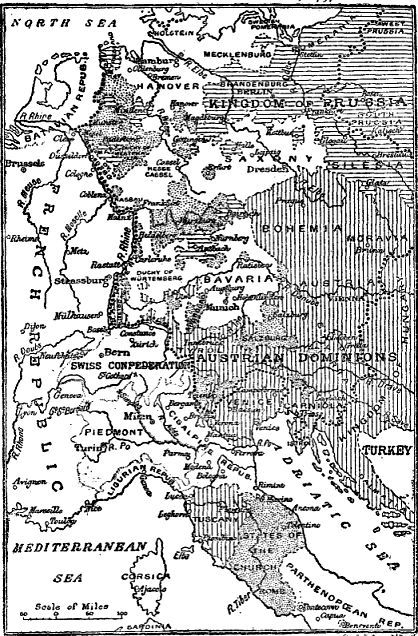
[CENTRAL EUROPE AFTER THE PEACE OF CAMPO FORMIO, 1797
The boundaries of the Holy Roman Empire are indicated by thick
dots. The Austrian Dominions are indicated by vertical lines. The
Prussian Dominions are indicated by horizontal lines. The
Ecclesiastical States are indicated by dotted areas.]
Acribus initiis, ut ferme talia, incuriosa fine; these cynical words, with which the historian of the Roman Empire blasted the movements of his age, may almost serve as the epitaph to Bonaparte's early enthusiasms. Proclaiming at the beginning of his Italian campaigns that he came to free Italy, he yet finished his course of almost unbroken triumphs by a surrender which his panegyrists have scarcely attempted to condone. But the fate of Venice was almost forgotten amidst the jubilant acclaim which greeted the conqueror of Italy on his arrival at Paris. All France rang with the praises of the hero who had spread liberty throughout Northern and Central Italy, had enriched the museums of Paris with priceless masterpieces of art, whose army had captured 150,000 prisoners, and had triumphed in 18 pitched battles—for Caldiero was now reckoned as a French victory—and 47 smaller engagements. The Directors, shrouding their hatred and fear of the masterful proconsul under their Roman togas, greeted him with uneasy effusiveness. The climax of the official comedy was [pg.173] reached when, at the reception of the conqueror, Barras, pointing northwards, exclaimed: "Go there and capture the giant corsair that infests the seas: go punish in London outrages that have too long been unpunished": whereupon, as if overcome by his emotions, he embraced the general. Amidst similar attentions bestowed by the other Directors, the curtain falls on the first, or Italian, act of the young hero's career, soon to rise on oriental adventures that were to recall the exploits of Alexander. [pg.174]
Among the many misconceptions of the French revolutionists none was more insidious than the notion that the wealth and power of the British people rested on an artificial basis. This mistaken belief in England's weakness arose out of the doctrine taught by the Economistes or Physiocrates in the latter half of last century, that commerce was not of itself productive of wealth, since it only promoted the distribution of the products of the earth; but that agriculture was the sole source of true wealth and prosperity. They therefore exalted agriculture at the expense of commerce and manufactures, and the course of the Revolution, which turned largely on agrarian questions, tended in the same direction. Robespierre and St. Just were never weary of contrasting the virtues of a simple pastoral life with the corruptions and weakness engendered by foreign commerce; and when, early in 1793, Jacobinical zeal embroiled the young Republic with England, the orators of the Convention confidently prophesied the downfall of the modern Carthage. Kersaint declared that "the credit of England rests upon fictitious wealth: ... bounded in territory, the public future of England is found almost wholly in its bank, and this edifice is entirely supported by naval commerce. It is easy to cripple this commerce, and especially so for a power like France, which stands alone on her own riches."[90] [pg.175]
Commercial interests played a foremost part all through the struggle. The official correspondence of Talleyrand in 1797 proves that the Directory intended to claim the Channel Islands, the north of Newfoundland, and all our conquests in the East Indies made since 1754, besides the restitution of Gibraltar to Spain.[91] Nor did these hopes seem extravagant. The financial crisis in London and the mutiny at the Nore seemed to betoken the exhaustion of England, while the victories of Bonaparte raised the power of France to heights never known before. Before the victory of Duncan over the Dutch at Camperdown (October 11th, 1797), Britain seemed to have lost her naval supremacy.
The recent admission of State bankruptcy at Paris, when two-thirds of the existing liabilities were practically expunged, sharpened the desire of the Directory to compass England's ruin, an enterprise which might serve to restore French credit and would certainly engage those vehement activities of Bonaparte that could otherwise work mischief in Paris. On his side he gladly accepted the command of the Army of England.
"The people of Paris do not remember anything," he said to Bourrienne. "Were I to remain here long, doing nothing, I should be lost. In this great Babylon everything wears out: my glory has already disappeared. This little Europe does not supply enough of it for me. I must seek it in the East: all great fame comes from that quarter. However, I wish first to make a tour along the [northern] coast to see for myself what may be attempted. If the success of a descent upon England appear doubtful, as I suspect it will, the Army of England shall become the Army of the East, and I go to Egypt."[92]
In February, 1798, he paid a brief visit to Dunkirk and the Flemish coast, and concluded that the invasion of England was altogether too complicated to be hazarded[pg.176] except as a last desperate venture. In a report to the Government (February 23rd) he thus sums up the whole situation:
"Whatever efforts we make, we shall not for some years gain the naval supremacy. To invade England without that supremacy is the most daring and difficult task ever undertaken.... If, having regard to the present organization of our navy, it seems impossible to gain the necessary promptness of execution, then we must really give up the expedition against England, be satisfied with keeping up the pretence of it, and concentrate all our attention and resources on the Rhine, in order to try to deprive England of Hanover and Hamburg:[93] ... or else undertake an eastern expedition which would menace her trade with the Indies. And if none of these three operations is practicable, I see nothing else for it but to conclude peace with England."
The greater part of his career serves as a commentary on these designs. To one or other of them he was constantly turning as alternative schemes for the subjugation of his most redoubtable foe. The first plan he now judged to be impracticable; the second, which appears later in its fully matured form as his Continental System, was not for the present feasible, because France was about to settle German affairs at the Congress of Rastadt; to the third he therefore turned the whole force of his genius.
The conquest of Egypt and the restoration to France of her supremacy in India appealed to both sides of Bonaparte's nature. The vision of the tricolour floating above the minarets of Cairo and the palace of the Great Mogul at Delhi fascinated a mind in which the mysticism of the south was curiously blent with the practicality and passion for details that characterize the northern races. To very few men in the world's history has it been granted to dream grandiose dreams and all but[pg.177] realize them, to use by turns the telescope and the microscope of political survey, to plan vast combinations of force, and yet to supervise with infinite care the adjustment of every adjunct. Cæsar, in the old world, was possibly the mental peer of Bonaparte in this majestic equipoise of the imaginative and practical qualities; but of Cæsar we know comparatively little; whereas the complex workings of the greatest mind of the modern world stand revealed in that storehouse of facts and fancies, the "Correspondance de Napoléon." The motives which led to the Eastern Expedition are there unfolded. In the letter which he wrote to Talleyrand shortly before the signature of the peace of Campo Formio occurs this suggestive passage:
"The character of our nation is to be far too vivacious amidst prosperity. If we take for the basis of all our operations true policy, which is nothing else than the calculation of combinations and chances, we shall long be la grande nation and the arbiter of Europe. I say more: we hold the balance of Europe: we will make that balance incline as we wish; and, if such is the order of fate, I think it by no means impossible that we may in a few years attain those grand results of which the heated and enthusiastic imagination catches a glimpse, and which the extremely cool, persistent, and calculating man will alone attain."
This letter was written when Bonaparte was bartering away Venice to the Emperor in consideration of the acquisition by France of the Ionian Isles. Its reference to the vivacity of the French was doubtless evoked by the orders which he then received to "revolutionize Italy." To do that, while the Directory further extorted from England Gibraltar, the Channel Islands, and her eastern conquests, was a programme dictated by excessive vivacity. The Directory lacked the practical qualities that selected one great enterprise at a time and brought to bear on it the needful concentration of effort. In brief, he selected the war against England's eastern commerce as his next sphere of action; for it offered "an arena vaster, more necessary [pg.178] and resplendent" than war with Austria; "if we compel the [British] Government to a peace, the advantages we shall gain for our commerce in both hemispheres will be a great step towards the consolidation of liberty and the public welfare."[94]
For this eastern expedition he had already prepared. In May, 1797, he had suggested the seizure of Malta from the Knights of St. John; and when, on September 27th, the Directory gave its assent, he sent thither a French commissioner, Poussielgue, on a "commercial mission," to inspect those ports, and also, doubtless, to undermine the discipline of the Knights. Now that the British had retired from Corsica, and France disposed of the maritime resources of Northern Italy, Spain, and Holland, it seemed quite practicable to close the Mediterranean to those "intriguing and enterprising islanders," to hold them at bay in their dull northern seas, to exhaust them by ruinous preparations against expected descents on their southern coasts, on Ireland, and even on Scotland, while Bonaparte's eastern conquests dried up the sources of their wealth in the Orient: "Let us concentrate all our activity on our navy and destroy England. That done, Europe is at our feet."[95]
But he encountered opposition from the Directory. They still clung to their plan of revolutionizing Italy; and only by playing on their fear of the army could he bring these civilians to assent to the expatriation of 35,000 troops and their best generals. On La Réveillière-Lépeaux[pg.179] the young commander worked with a skill that veiled the choicest irony. This Director was the high-priest of a newly-invented cult, termed Théo-philanthropie, into the dull embers of which he was still earnestly blowing. To this would-be prophet Bonaparte now suggested that the eastern conquests would furnish a splendid field for the spread of the new faith; and La Réveillière was forthwith converted from his scheme of revolutionizing Europe to the grander sphere of moral proselytism opened out to him in the East by the very chief who, on landing in Egypt, forthwith professed the Moslem creed.
After gaining the doubtful assent of the Directory, Bonaparte had to face urgent financial difficulties. The dearth of money was, however, met by two opportune interventions. The first of these was in the affairs of Rome. The disorders of the preceding year in that city had culminated at Christmas in a riot in which General Duphot had been assassinated; this outrage furnished the pretext desired by the Directory for revolutionizing Central Italy. Berthier was at once ordered to lead French troops against the Eternal City. He entered without resistance (February 15th, 1798), declared the civil authority of the Pope at an end, and proclaimed the restoration of the Roman Republic. The practical side of the liberating policy was soon revealed. A second time the treasures of Rome, both artistic and financial, were rifled; and, as Lucien Bonaparte caustically remarked in his "Memoirs," the chief duty of the newly-appointed consuls and quæstors was to superintend the packing up of pictures and statues designed for Paris. Berthier not only laid the basis of a large private fortune, but showed his sense of the object of the expedition by sending large sums for the equipment of the armada at Toulon. "In sending me to Rome," wrote Berthier to Bonaparte, "you appoint me treasurer to the expedition against England. I will try to fill the exchequer."
The intervention of the Directory in the affairs of Switzerland was equally lucrative. The inhabitants of[pg.180] the district of Vaud, in their struggles against the oppressive rule of the Bernese oligarchy, had offered to the French Government the excuse for interference: and a force invading that land, overpowered the levies of the central cantons.[96] The imposition of a centralized form of government modelled on that of France, the wresting of Geneva from this ancient confederation, and its incorporation with France, were not the only evils suffered by Switzerland. Despite the proclamation of General Brune that the French came as friends to the descendants of William Tell, and would respect their independence and their property, French commissioners proceeded to rifle the treasuries of Berne, Zürich, Solothurn, Fribourg, and Lucerne of sums which amounted in all to eight and a half million francs; fifteen millions were extorted in forced contributions and plunder, besides 130 cannon and 60,000 muskets which also became the spoils of the liberators.[97] The destination of part of the treasure was already fixed; on April 13th Bonaparte wrote an urgent letter to General Lannes, directing him to expedite the transit of the booty to Toulon, where three million francs were forthwith expended on the completion of the armada.
This letter, and also the testimony of Madame de Staël, Barras, Bourrienne, and Mallet du Pan, show that he must have been a party to this interference in Swiss affairs, which marks a debasement, not only of Bonaparte's character, but of that of the French army and people. It drew from Coleridge, who previously had seen in the Revolution the dawn of a nobler era, an indignant protest against the prostitution of the ideas of 1789:
"Oh France that mockest Heaven,
adulterous, blind,
Are these thy boasts, champion of
human kind?
[pg.181]
To mix with Kings in the low lust
of sway,
Yell in the hunt and join the
murderous prey? ...
The sensual and the dark rebel in
vain
Slaves by their own compulsion. In
mad game
They burst their manacles: but wear
the name
Of Freedom, graven on a heavier
chain."
The occupation by French troops of the great central bastion of the European system seemed a challenge, not only to idealists, but to German potentates. It nearly precipitated a rupture with Vienna, where the French tricolour had recently been torn down by an angry crowd. But Bonaparte did his utmost to prevent a renewal of war that would blight his eastern prospects; and he succeeded. One last trouble remained. At his final visit to the Directory, when crossed about some detail, he passionately threw up his command. Thereupon Rewbell, noted for his incisive speech, drew up the form of resignation, and presenting it to Bonaparte, firmly said, "Sign, citizen general." The general did not sign, but retired from the meeting apparently crestfallen, but really meditating a coup d'état. This last statement rests on the evidence of Mathieu Dumas, who heard it through General Desaix, a close friend of Bonaparte; and it is clear from the narratives of Bourrienne, Barras, and Madame Junot that, during his last days in Paris, the general was moody, preoccupied, and fearful of being poisoned.
At last the time of preparation and suspense was at an end. The aims of the expedition as officially defined by a secret decree on April 12th included the capture of Egypt and the exclusion of the English from "all their possessions in the East to which the general can come"; Bonaparte was also to have the isthmus of Suez cut through; to "assure the free and exclusive possession of the Red Sea to the French Republic"; to improve the condition of the natives of Egypt, and to cultivate good relations with the Grand Signior. Another secret decree empowered Bonaparte to seize Malta. To these schemes he added another of truly colossal dimensions. After [pg.182] conquering the East, he would rouse the Greeks and other Christians of the East, overthrow the Turks, seize Constantinople, and "take Europe in the rear."
Generous support was accorded to the savants who were desirous of exploring the artistic and literary treasures of Egypt and Mesopotamia. It has been affirmed by the biographer of Monge that the enthusiasm of this celebrated physicist first awakened Bonaparte's desire for the eastern expedition; but this seems to have been aroused earlier by Volney, who saw a good deal of Bonaparte in 1791. In truth, the desire to wrest the secrets of learning from the mysterious East seems always to have spurred on his keenly inquisitive nature. During the winter months of 1797-8 he attended the chemical lectures of the renowned Berthollet; and it was no perfunctory choice which selected him for the place in the famous institute left vacant by the exile of Carnot. The manner in which he now signed his orders and proclamations—Member of the Institute, General in Chief of the Army of the East—showed his determination to banish from the life of France that affectation of boorish ignorance by which the Terrorists had rendered themselves uniquely odious.
After long delays, caused by contrary winds, the armada set sail from Toulon. Along with the convoys from Marseilles, Genoa, and Civita Vecchia, it finally reached the grand total of 13 ships of the line, 7 frigates, several gunboats, and nearly 300 transports of various sizes, conveying 35,000 troops. Admiral Brueys was the admiral, but acting under Bonaparte. Of the generals whom the commander-in-chief took with him, the highest in command were the divisional generals Kléber, Desaix, Bon, Menou, Reynier, for the infantry: under them served 14 generals, a few of whom, as Marmont, were to achieve a wider fame. The cavalry was commanded by the stalwart mulatto, General Alexandre Dumas, under whom served Leclerc, the husband of Pauline Bonaparte, along with two men destined to world-wide renown, Murat and Davoust. The artillery [pg.183] was commanded by Dommartin, the engineers by Caffarelli: and the heroic Lannes was quarter-master general.
The armada appeared off Malta without meeting with any incident. This island was held by the Knights of St. John, the last of those companies of Christian warriors who had once waged war on the infidels in Palestine. Their courage had evaporated in luxurious ease, and their discipline was a prey to intestine schisms and to the intrigues carried on with the French Knights of the Order. A French fleet had appeared off Valetta in the month of March in the hope of effecting a surprise; but the admiral, Brueys, judging the effort too hazardous, sent an awkward explanation, which only served to throw the knights into the arms of Russia. One of the chivalrous dreams of the Czar Paul was that of spreading his influence in the Mediterranean by a treaty with this Order. It gratified his crusading ardour and promised to Russia a naval base for the partition of Turkey which was then being discussed with Austria: to secure the control of the island, Russia was about to expend 400,000 roubles, when Bonaparte anticipated Muscovite designs by a prompt seizure.[98] An excuse was easily found for a rupture with the Order: some companies of troops were disembarked, and hostilities commenced.
Secure within their mighty walls, the knights might have held the intruders at bay, had they not been divided by internal disputes: the French knights refused to fight against their countrymen; and a revolt of the native Maltese, long restless under the yoke of the Order, now helped to bring the Grand Master to a surrender. The evidence of the English consul, Mr. Williams, seems to show that the discontent of the natives was even more potent than the influence of French gold in bringing about this result.[99] At any rate, one of the[pg.184] strongest places in Europe admitted a French garrison, after so tame a defence that General Caffarelli, on viewing the fortifications, remarked to Bonaparte: "Upon my word, general, it is lucky there was some one in the town to open the gates to us."
During his stay of seven days at Malta, Bonaparte revealed the vigour of those organizing powers for which the half of Europe was soon to present all too small an arena. He abolished the Order, pensioning off those French knights who had been serviceable: he abolished the religious houses and confiscated their domains to the service of the new government: he established a governmental commission acting under a military governor: he continued provisionally the existing taxes, and provided for the imposition of customs, excise, and octroi dues: he prepared the way for the improvement of the streets, the erection of fountains, the reorganization of the hospitals and the post office. To the university he gave special attention, rearranging the curriculum on the model of the more advanced écoles centrales of France, but inclining the studies severely to the exact sciences and the useful arts. On all sides he left the imprint of his practical mind, that viewed life as a game at chess, whence bishops and knights were carefully banished, and wherein nothing was left but the heavy pieces and subservient pawns.
After dragging Malta out of its mediaeval calm and plunging it into the full swirl of modern progress, Bonaparte set sail for Egypt. His exchequer was the richer by all the gold and silver, whether in bullion or in vessels, discoverable in the treasury of Malta or in the Church of St. John. Fortunately, the silver gates of this church had been coloured over, and thus escaped the fate of the other treasures.[100] On the voyage to Alexandria[pg.185] he studied the library of books which he had requested Bourrienne to purchase for him. The composition of this library is of interest as showing the strong trend of his thoughts towards history, though at a later date he was careful to limit its study in the university and schools which he founded. He had with him 125 volumes of historical works, among which the translations of Thucydides, Plutarch, Tacitus, and Livy represented the life of the ancient world, while in modern life he concentrated his attention chiefly on the manners and institutions of peoples and the memoirs of great generals—as Turenne, Condé, Luxembourg, Saxe, Marlborough, Eugène, and Charles XII. Of the poets he selected the so-called Ossian, Tasso, Ariosto, Homer, Virgil, and the masterpieces of the French theatre; but he especially affected the turgid and declamatory style of Ossian. In romance, English literature was strongly represented by forty volumes of novels, of course in translations. Besides a few works on arts and sciences, he also had with him twelve volumes of "Barclay's Geography," and three volumes of "Cook's Voyages," which show that his thoughts extended to the antipodes; and under the heading of Politics he included the Bible, the Koran, the Vedas, a Mythology, and Montesquieu's "Esprit des Lois"! The composition and classification of this library are equally suggestive. Bonaparte carefully searched out the weak places of the organism which he was about to attack—in the present campaign, Egypt and the British Empire. The climate and natural products, the genius of its writers and the spirit of its religion—nothing came amiss to his voracious intellect, which assimilated the most diverse materials and pressed them all into his service. Greek mythology provided allusions for the adornment of his proclamations, the Koran would dictate his behaviour towards the Moslems, and the Bible was to be his guide-book concerning the Druses and Armenians. All three were therefore grouped together under the head of Politics.[pg.186]
And this, on the whole, fairly well represents his mental attitude towards religion: at least, it was his work-a-day attitude. There were moments, it is true, when an overpowering sense of the majesty of the universe lifted his whole being far above this petty opportunism: and in those moments, which, in regard to the declaration of character, may surely be held to counterbalance whole months spent in tactical shifts and diplomatic wiles, he was capable of soaring to heights of imaginative reverence. Such an episode, lighting up for us the recesses of his mind, occurred during his voyage to Egypt. The savants on board his ship, "L'Orient," were discussing one of those questions which Bonaparte often propounded, in order that, as arbiter in this contest of wits, he might gauge their mental powers. Mental dexterity, rather than the Socratic pursuit after truth, was the aim of their dialectic; but on one occasion, when religion was being discussed, Bonaparte sounded a deeper note: looking up into the midnight vault of sky, he said to the philosophizing atheists: "Very ingenious, sirs, but who made all that?" As a retort to the tongue-fencers, what could be better? The appeal away from words to the star-studded canopy was irresistible: it affords a signal proof of what Carlyle has finely called his "instinct for nature" and his "ineradicable feeling for reality." This probably was the true man, lying deep under his Moslem shifts and Concordat bargainings.
That there was a tinge of superstition in Bonaparte's nature, such as usually appears in gifted scions of a coast-dwelling family, cannot be denied;[101] but his usual attitude towards religion was that of the political mechanician, not of the devotee, and even while professing the forms of fatalistic belief, he really subordinated them to his own designs. To this profound calculation of the credulity of mankind we may probably refer his allusions to his star. The present writer[pg.187] regards it as almost certain that his star was invoked in order to dazzle the vulgar herd. Indeed, if we may trust Miot de Melito, the First Consul once confessed as much to a circle of friends. "Cæsar," he said, "was right to cite his good fortune and to appear to believe in it. That is a means of acting on the imagination of others without offending anyone's self-love." A strange admission this; what boundless self-confidence it implies that he should have admitted the trickery. The mere acknowledgment of it is a proof that he felt himself so far above the plane of ordinary mortals that, despite the disclosure, he himself would continue to be his own star. For the rest, is it credible that this analyzing genius could ever have seriously adopted the astrologer's creed? Is there anything in his early note-books or later correspondence which warrants such a belief? Do not all his references to his star occur in proclamations and addresses intended for popular consumption?
Certainly Bonaparte's good fortune was conspicuous all through these eastern adventures, and never more so than when he escaped the pursuit of Nelson. The English admiral had divined his aim. Setting all sail, he came almost within sight of the French force near Crete, and he reached Alexandria barely two days before his foes hove in sight. Finding no hostile force there, he doubled back on his course and scoured the seas between Crete, Sicily, and the Morca, until news received from a Turkish official again sent him eastwards. On such trifles does the fate of empires sometimes depend.
Meanwhile events were crowding thick and fast upon Bonaparte. To free himself from the terrible risks which had menaced his force off the Egyptian coast, he landed his troops, 35,000 strong, with all possible expedition at Marabout near Alexandria, and, directing his columns of attack on the walls of that city, captured it by a rush (July 2nd).
For this seizure of neutral territory he offered no excuse other than that the Beys, who were the real rulers [pg.188] of Egypt, had favoured English commerce and were guilty of some outrages on French merchants. He strove, however, to induce the Sultan of Turkey to believe that the French invasion of Egypt was a friendly act, as it would overthrow the power of the Mamelukes, who had reduced Turkish authority to a mere shadow. This was the argument which he addressed to the Turkish officials, but it proved to be too subtle even for the oriental mind fully to appreciate. Bonaparte's chief concern was to win over the subject population, which consisted of diverse races. At the surface were the Mamelukes, a powerful military order, possessing a magnificent cavalry, governed by two Beys, and scarcely recognizing the vague suzerainty claimed by the Porte. The rivalries of the Beys, Murad and Ibrahim, produced a fertile crop of discords in this governing caste, and their feuds exposed the subject races, both Arabs and Copts, to constant forays and exactions. It seemed possible, therefore, to arouse them against the dominant caste, provided that the Mohammedan scruples of the whole population were carefully respected. To this end, the commander cautioned his troops to act towards the Moslems as towards "Jews and Italians," and to respect their muftis and imams as much as "rabbis and bishops." He also proclaimed to the Egyptians his determination, while overthrowing Mameluke tyranny, to respect the Moslem faith: "Have we not destroyed the Pope, who bade men wage war on Moslems? Have we not destroyed the Knights of Malta, because those fools believed it to be God's will to war against Moslems?" The French soldiers were vastly amused by the humour of these proceedings, and the liberated people fully appreciated the menaces with which Bonaparte's proclamation closed, backed up as these were by irresistible force.[102]
After arranging affairs at Alexandria, where the gallant[pg.189] Kléber was left in command, Bonaparte ordered an advance into the interior. Never, perhaps, did he show the value of swift offensive action more decisively than in this prompt march on Damanhour across the desert. The other route by way of Rosetta would have been easier; but, as it was longer, he rejected it, and told off General Menou to capture that city and support a flotilla of boats which was to ascend the Nile and meet the army on its march to Cairo. On July 4th the first division of the main force set forth by night into the desert south of Alexandria. All was new and terrible; and, when the rays of the sun smote on their weary backs, the murmurings of the troops grew loud. This, then, was the land "more fertile than Lombardy," which was the goal of their wanderings. "See, there are the six acres of land which you are promised," exclaimed a waggish soldier to his comrade as they first gazed from ship-board on the desert east of Alexandria; and all the sense of discipline failed to keep this and other gibes from the ears of staff officers even before they reached that city. Far worse was their position now in the shifting sand of the desert, beset by hovering Bedouins, stung by scorpions, and afflicted by intolerable thirst. The Arabs had filled the scanty wells with stones, and only after long toil could the sappers reach the precious fluid beneath. Then the troops rushed and fought for the privilege of drinking a few drops of muddy liquor. Thus they struggled on, the succeeding divisions faring worst of all. Berthier, chief of the staff, relates that a glass of water sold for its weight in gold. Even brave officers abandoned themselves to transports of rage and despair which left them completely prostrate.[103]
But Bonaparte flinched not. His stern composure offered the best rebuke to such childish sallies; and when out of a murmuring group there came the bold remark, "Well, General, are you going to take us to India thus," he abashed the speaker and his comrades by the quick[pg.190] retort, "No, I would not undertake that with such soldiers as you." French honour, touched to the quick, reasserted itself even above the torments of thirst; and the troops themselves, when they tardily reached the Nile and slaked their thirst in its waters, recognized the pre-eminence of his will and his profound confidence in their endurance. French gaiety had not been wholly eclipsed even by the miseries of the desert march. To cheer their drooping spirits the commander had sent some of the staunchest generals along the line of march. Among them was the gifted Caffarelli, who had lost a leg in the Rhenish campaign: his reassuring words called forth the inimitable retort from the ranks: "Ah! he don't care, not he: he has one leg in France." Scarcely less witty was the soldier's description of the prowling Bedouins, who cut off stragglers and plunderers, as "The mounted highway police."
After brushing aside a charge of 800 Mamelukes at Chebreiss, the army made its way up the banks of the Nile to Embabeh, opposite Cairo. There the Mamelukes, led by the fighting Bey, Murad, had their fortified camp; and there that superb cavalry prepared to overwhelm the invaders in a whirlwind rush of horse (July 21st, 1798). The occasion and the surroundings were such as to inspire both sides with deperate resolution. It was the first fierce shock on land of eastern chivalry and western enterprise since the days of St. Louis; and the ardour of the republicans was scarcely less than that which had kindled the soldiers of the cross. Beside the two armies rolled the mysterious Nile; beyond glittered the slender minarets of Cairo; and on the south there loomed the massy Pyramids. To the forty centuries that had rolled over them, Bonaparte now appealed, in one of those imaginative touches which ever brace the French nature to the utmost tension of daring and endurance. Thus they advanced in close formation towards the intrenched camp of the Mamelukes. The divisions on the left at once rushed at its earthworks, silenced its feeble artillery, and slaughtered the fellahin inside. [pg.191]
But the other divisions, now ranged in squares, while gazing at this exploit, were assailed by the Mamelukes. From out the haze of the mirage, or from behind the ridges of sand and the scrub of the water-melon plants that dotted the plain, some 10,000 of these superb horsemen suddenly appeared and rushed at the squares commanded by Desaix and Reynier. Their richly caparisoned chargers, their waving plumes, their wild battle-cries, and their marvellous skill with carbine and sword, lent picturesqueness and terror to the charge. Musketry and grapeshot mowed down their front coursers in ghastly swathes; but the living mass swept on, wellnigh overwhelming the fronts of the squares, and then, swerving aside, poured through the deadly funnel between. Decimated here also by the steady fire of the French files, and by the discharges of the rear face, they fell away exhausted, leaving heaps of dead and dying on the fronts of the squares, and in their very midst a score of their choicest cavaliers, whose bravery and horsemanship had carried them to certain death amidst the bayonets. The French now assumed the offensive, and Desaix's division, threatening to cut off the retreat of Murad's horsemen, led that wary chief to draw off his shattered squadrons; others sought, though with terrible losses, to escape across the Nile to Ibrahim's following. That chief had taken no share in the fight, and now made off towards Syria. Such was the battle of the Pyramids, which gained a colony at the cost of some thirty killed and about ten times as many wounded: of the killed about twenty fell victims to the cross fire of the two squares.[104]
After halting for a fortnight at Cairo to recruit his weary troops and to arrange the affairs of his conquest, Bonaparte marched eastwards in pursuit of Ibrahim and drove him into Syria, while Desaix waged an arduous but successful campaign against Murad in Upper Egypt. But the victors were soon to learn the uselessness of[pg.192] merely military triumphs in Egypt. As Bonaparte returned to complete the organization of the new colony, he heard that Nelson had destroyed his fleet.
On July 3rd, before setting out from Alexandria, the French commander gave an order to his admiral, though it must be added that its authenticity is doubtful:
"The admiral will to-morrow acquaint the commander-in-chief by a report whether the squadron can enter the port of Alexandria, or whether, in Aboukir Roads, bringing its broadside to bear, it can defend itself against the enemy's superior force; and in case both these plans should be impracticable, he must sail for Corfu ... leaving the light ships and the flotilla at Alexandria."
Brueys speedily discovered that the first plan was beset by grave dangers: the entrance to the harbour of Alexandria, when sounded, proved to be most difficult for large ships—such was his judgment and that of Villeneuve and Casabianca—and the exit could be blocked by a single English battleship. As regards the alternatives of Aboukir or Corfu, Brueys went on to state: "My firm desire is to be useful to you in every possible way: and, as I have already said, every post will suit me well, provided that you placed me there in an active way." By this rather ambiguous phrase it would seem that he scouted the alternative of Corfu as consigning him to a degrading inactivity; while at Aboukir he held that he could be actively useful in protecting the rear of the army. In that bay he therefore anchored his largest ships, trusting that the dangers of the approach would screen him from any sudden attack, but making also special preparations in case he should be compelled to fight at anchor.[105] His decision was probably less sound than that of Bonaparte, who, while[pg.193] marching to Cairo, and again during his sojourn there, ordered him to make for Corfu or Toulon; for the general saw clearly that the French fleet, riding in safety in those well-protected roadsteads, would really dominate the Mediterranean better than in the open expanse of Aboukir. But these orders did not reach the admiral before the blow fell; and it is, after all, somewhat ungenerous to censure Brueys for his decision to remain at Aboukir and risk a fight rather than comply with the dictates of a prudent but inglorious strategy.
The British admiral, after sweeping the eastern Mediterranean, at last found the French fleet in Aboukir Bay, about ten miles from the Rosetta mouth of the Nile. It was anchored under the lee of a shoal which would have prevented any ordinary admiral from attacking, especially at sundown. But Nelson, knowing that the head ship of the French was free to swing at anchor, rightly concluded that there must be room for British ships to sail between Brueys' stationary line and the shallows. The British captains thrust five ships between the French and the shoal, while the others, passing down the enemy's line on the seaward side, crushed it in detail; and, after a night of carnage, the light of August 2nd dawned on a scene of destruction unsurpassed in naval warfare. Two French ships of the line and two frigates alone escaped: one, the gigantic "Orient," had blown up with the spoils of Malta on board: the rest, eleven in number, were captured or burnt.
To Bonaparte this disaster came as a bolt from the blue. Only two days before, he had written from Cairo to Brueys that all the conduct of the English made him believe them to be inferior in numbers and fully satisfied with blockading Malta. Yet, in order to restore the morale of his army, utterly depressed by this disaster,[pg.194] he affected a confidence which he could no longer feel, and said: "Well! here we must remain or achieve a grandeur like that of the ancients."[106] He had recently assured his intimates that after routing the Beys' forces he would return to France and strike a blow direct at England. Whatever he may have designed, he was now a prisoner in his conquest. His men, even some of his highest officers, as Berthier, Bessières, Lannes, Murat, Dumas, and others, bitterly complained of their miserable position. But the commander, whose spirits rose with adversity, took effective means for repressing such discontent. To the last-named, a powerful mulatto, he exclaimed: "You have held seditious parleys: take care that I do not perform my duty: your six feet of stature shall not save you from being shot": and he offered passports for France to a few of the most discontented and useless officers, well knowing that after Nelson's victory they could scarcely be used. Others, again, out-Heroding Herod, suggested that the frigates and transports at Alexandria should be taken to pieces and conveyed on camels' backs to Suez, there to be used for the invasion of India.[107]
The versatility of Bonaparte's genius was never more marked than at this time of discouragement. While his enemies figured him and his exhausted troops as vainly seeking to escape from those arid wastes; while Nelson was landing the French prisoners in order to increase his embarrassment about food, Bonaparte and his savants were developing constructive powers of the highest order, which made the army independent of Europe. It was a vast undertaking. Deprived of most of their treasure and many of their mechanical appliances by the loss of the fleet, the savants and engineers had, as it were, to start from the beginning. Some strove to meet the difficulties of food-supply by extending the cultivation of corn and rice, or by the construction of large ovens and bakeries, or of windmills for grinding[pg.195] corn. Others planted vineyards for the future, or sought to appease the ceaseless thirst of the soldiery by the manufacture of a kind of native beer. Foundries and workshops began, though slowly, to supply tools and machines; the earth was rifled of her treasures, natron was wrought, saltpetre works were established, and gunpowder was thereby procured for the army with an energy which recalled the prodigies of activity of 1793.
With his usual ardour in the cause of learning, Bonaparte several times a week appeared in the chemical laboratory, or witnessed the experiments performed by Berthollet and Monge. Desirous of giving cohesion to the efforts of his savants, and of honouring not only the useful arts but abstruse research, he united these pioneers of science in a society termed the Institute of Egypt. On August 23rd, 1798, it was installed with much ceremony in the palace of one of the Beys, Monge being president and Bonaparte vice-president. The general also enrolled himself in the mathematical section of the institute. Indeed, he sought by all possible means to aid the labours of the savants, whose dissertations were now heard in the large hall of the harem that formerly resounded only to the twanging of lutes, weary jests, and idle laughter. The labours of the savants were not confined to Cairo and the Delta. As soon as the victories of Desaix in Upper Egypt opened the middle reaches of the Nile to peaceful research, the treasures of Memphis were revealed to the astonished gaze of western learning. Many of the more portable relics were transferred to Cairo, and thence to Rosetta or Alexandria, in order to grace the museums of Paris. The savants proposed, but sea-power disposed, of these treasures. They are now, with few exceptions, in the British Museum.
Apart from archæology, much was done to extend the bounds of learning. Astronomy gained much by the observations of General Caffarelli. A series of measurements was begun for an exact survey of Egypt: the geologists and engineers examined the course of[pg.196] the Nile, recorded the progress of alluvial deposits at its mouth or on its banks, and therefrom calculated the antiquity of divers parts of the Delta. No part of the great conqueror's career so aptly illustrates the truth of his noble words to the magistrates of the Ligurian Republic: "The true conquests, the only conquests which cost no regrets, are those achieved over ignorance."
Such, in brief outline, is the story of the renascence in Egypt. The mother-land of science and learning, after a wellnigh barren interval of 1,100 years since the Arab conquest, was now developed and illumined by the application of the arts with which in the dim past she had enriched the life of barbarous Europe. The repayment of this incalculable debt was due primarily to the enterprise of Bonaparte. It is one of his many titles to fame and to the homage of posterity. How poor by the side of this encyclopaedic genius are the gifts even of his most brilliant foes! At that same time the Archduke Charles of Austria was vegetating in inglorious ease on his estates. As for Beaulieu and Würmser, they had subsided into their native obscurity. Nelson, after his recent triumph, persuading himself that "Bonaparte had gone to the devil," was bending before the whims of a professional beauty and the odious despotism of the worst Court in Europe. While the admiral tarnished his fame on the Syren coast of Naples, his great opponent bent all the resources of a fertile intellect to retrieve his position, and even under the gloom of disaster threw a gleam of light into the dark continent. While his adversaries were merely generals or admirals, hampered by a stupid education and a narrow nationality, Bonaparte had eagerly imbibed the new learning of his age and saw its possible influence on the reorganization of society. He is not merely a general. Even when he is scattering to the winds the proud chivalry of the East, and is prescribing to Brueys his safest course of action, he finds time vastly to expand the horizon of human knowledge. [pg.197]
Nor did he neglect Egyptian politics. He used a native council for consultation and for the promulgation of his own ideas. Immediately after his entry into Cairo he appointed nine sheikhs to form a divan, or council, consulting daily on public order and the food-supplies of the city. He next assembled a general divan for Egypt, and a smaller council for each province, and asked their advice concerning the administration of justice and the collection of taxes.[108] In its use of oriental terminology, this scheme was undeniably clever; but neither French, Arabs, nor Turks were deceived as to the real government, which resided entirely in Bonaparte; and his skill in reapportioning the imposts had some effect on the prosperity of the land, enabling it to bear the drain of his constant requisitions. The welfare of the new colony was also promoted by the foundation of a mint and of an Egyptian Commercial Company.
His inventive genius was by no means exhausted by these varied toils. On his journey to Suez he met a camel caravan in the desert, and noticing the speed of the animals, he determined to form a camel corps; and in the first month of 1799 the experiment was made with such success that admission into the ranks of the camelry came to be viewed as a favour. Each animal carried two men with their arms and baggage: the uniform was sky-blue with a white turban; and the speed and precision of their movements enabled them to deal terrible blows, even at distant tribes of Bedouins, who bent before a genius that could outwit them even in their own deserts.
The pleasures of his officers and men were also met by the opening of the Tivoli Gardens; and there, in sight of the Pyramids, the life of the Palais Royal took root: the glasses clinked, the dice rattled, and heads reeled to the lascivious movements of the eastern dance; and Bonaparte himself indulged a passing passion for[pg.198] the wife of one of his officers, with an openness that brought on him a rebuke from his stepson, Eugène Beauharnais. But already he had been rendered desperate by reports of the unfaithfulness of Josephine at Paris; the news wrung from him this pathetic letter to his brother Joseph—the death-cry of his long drooping idealism:
"I have much to worry me privately, for the veil is entirely torn aside. You alone remain to me; your affection is very dear to me: nothing more remains to make me a misanthrope than to lose her and see you betray me.... Buy a country seat against my return, either near Paris or in Burgundy. I need solitude and isolation: grandeur wearies me: the fount of feeling is dried up: glory itself is insipid. At twenty-nine years of age I have exhausted everything. It only remains to me to become a thorough egoist."[109]
Many rumours were circulated as to Bonaparte's public appearance in oriental costume and his presence at a religious service in a mosque. It is even stated by Thiers that at one of the chief festivals he repaired to the great mosque, repeated the prayers like a true Moslem, crossing his legs and swaying his body to and fro, so that he "edified the believers by his orthodox piety." But the whole incident, however attractive scenically and in point of humour, seems to be no better authenticated than the religious results about which the historian cherished so hopeful a belief. The truth seems to be that the general went to the celebration of the birth of the Prophet as an interested spectator, at the house of the sheik, El Bekri. Some hundred sheikhs were there present: they swayed their bodies to and fro while the story of Mahomet's life was recited; and Bonaparte afterwards partook of an oriental repast. But he never forgot his dignity so far as publicly to appear in a turban and loose trousers, which he donned only once for the amusement of his staff.[110] That he[pg.199] endeavoured to pose as a Moslem is beyond doubt. Witness his endeavour to convince the imams at Cairo of his desire to conform to their faith. If we may believe that dubious compilation, "A Voice from St. Helena," he bade them consult together as to the possibility of admission of men, who were not circumcised and did not abstain from wine, into the true fold. As to the latter disability, he stated that the French were poor cold people, inhabitants of the north, who could not exist without wine. For a long time the imams demurred to this plea, which involved greater difficulties than the question of circumcision: but after long consultations they decided that both objections might be waived in consideration of a superabundance of good works. The reply was prompted by an irony no less subtle than that which accompanied the claim, and neither side was deceived in this contest of wits.
A rude awakening soon came. For some few days there had been rumours that the division under Desaix which was fighting the Mamelukes in Upper Egypt had been engulfed in those sandy wastes; and this report fanned to a flame the latent hostility against the unbelievers. From many minarets of Cairo a summons to arms took the place of the customary call to prayer: and on October 21st the French garrison was so fiercely and suddenly attacked as to leave the issue doubtful. Discipline and grapeshot finally prevailed, whereupon a repression of oriental ferocity cowed the spirits of the townsfolk and of the neighbouring country. Forts were constructed in Cairo and at all the strategic points along the lower Nile, and Egypt seemed to be conquered.
Feeling sure now of his hold on the populace, Bonaparte, at the close of the year, undertook a journey to Suez and the Sinaitic peninsula. It offered that combination of utility and romance which ever appealed to him. At Suez he sought to revivify commerce by lightening the customs' dues, by founding a branch of his Egyptian commercial company, and by graciously [pg.200] receiving a deputation of the Arabs of Tor who came to sue for his friendship.[111] Then, journeying on, he visited the fountains of Moses; but it is not true that (as stated by Lanfrey) he proceeded to Mount Sinai and signed his name in the register of the monastery side by side with that of Mahomet. On his return to the isthmus he is said to have narrowly escaped from the rising tide of the Red Sea. If we may credit Savary, who was not of the party, its safety was due to the address of the commander, who, as darkness fell on the bewildered band, arranged his horsemen in files, until the higher causeway of the path was again discovered. North of Suez the traces of the canal dug by Sesostris revealed themselves to the trained eye of the commander. The observations of his engineers confirmed his conjecture, but the vast labour of reconstruction forbade any attempt to construct a maritime canal. On his return to Cairo he wrote to the Imam of Muscat, assuring him of his friendship and begging him to forward to Tippoo Sahib a letter offering alliance and deliverance from "the iron yoke of England," and stating that the French had arrived on the shores of the Red Sea "with a numerous and invincible army." The letter was intercepted by a British cruiser; and the alarm caused by these vast designs only served to spur on our forces to efforts which cost Tippoo his life and the French most of their Indian settlements. [pg.201]
Meanwhile Turkey had declared war on France, and was sending an army through Syria for the recovery of Egypt, while another expedition was assembling at Rhodes. Like all great captains, Bonaparte was never content with the defensive: his convictions and his pugnacious instincts alike urged him to give rather than to receive the blow; and he argued that he could attack and destroy the Syrian force before the cessation of the winter's gales would allow the other Turkish expedition to attempt a disembarkation at Aboukir. If he waited in Egypt, he might have to meet the two attacks at once, whereas, if he struck at Jaffa and Acre, he would rid himself of the chief mass of his foes. Besides, as he explained in his letter of February 10th, 1799, to the Directors, his seizure of those towns would rob the English fleet of its base of supplies and thereby cripple its activities off the coast of Egypt. So far, his reasons for the Syrian campaign are intelligible and sound. But he also gave out that, leaving Desaix and his Ethiopian supernumeraries to defend Egypt, he himself would accomplish the conquest of Syria and the East: he would raise in revolt the Christians of the Lebanon and Armenia, overthrow the Turkish power in Asia, and then march either on Constantinople or Delhi.
It is difficult to take this quite seriously, considering that he had only 12,000 men available for these adventures; and with anyone but Bonaparte they might be dismissed as utterly Quixotic. But in his case we must seek for some practical purpose; for he never divorced [pg.202] fancy from fact, and in his best days imagination was the hand-maid of politics and strategy rather than the mistress. Probably these gorgeous visions were bodied forth so as to inspirit the soldiery and enthrall the imagination of France. He had already proved the immense power of imagination over that susceptible people. In one sense, his whole expedition was but a picturesque drama; and an imposing climax could now be found in the plan of an Eastern Empire, that opened up dazzling vistas of glory and veiled his figure in a grandiose mirage, beside which the civilian Directors were dwarfed into ridiculous puppets.
If these vast schemes are to be taken seriously, another explanation of them is possible, namely, that he relied on the example set by Alexander the Great, who with a small but highly-trained army had shattered the stately dominions of the East. If Bonaparte trusted to this precedent, he erred. True, Alexander began his enterprise with a comparatively small force: but at least he had a sure base of operations, and his army in Thessaly was strong enough to prevent Athens from exchanging her sullen but passive hostility for an offensive that would endanger his communications by sea. The Athenian fleet was therefore never the danger to the Macedonians that Nelson and Sir Sidney Smith were to Bonaparte. Since the French armada weighed anchor at Toulon, Britain's position had became vastly stronger. Nelson was lord of the Mediterranean: the revolt in Ireland had completely failed: a coalition against France was being formed; and it was therefore certain that the force in Egypt could not be materially strengthened. Bonaparte did not as yet know the full extent of his country's danger; but the mere fact that he would have to bear the pressure of England's naval supremacy along the Syrian coast should have dispelled any notion that he could rival the exploits of Alexander and become Emperor of the East.[112] [pg.203]
From conjectures about motives we turn to facts. Setting forth early in February, the French captured most of the Turkish advanced guard at the fort of El Arisch, but sent their captives away on condition of not bearing arms against France for at least one year. The victors then marched on Jaffa, and, in spite of a spirited defence, took it by storm (March 7th). Flushed with their triumph over a cruel and detested foe, the soldiers were giving up the city to pillage and massacre, when two aides-de-camp promised quarter to a large body of the defenders, who had sought refuge in a large caravanserai; and their lives were grudgingly spared by the victors. Bonaparte vehemently reproached his aides-de-camp for their ill-timed clemency. What could he now do with these 2,500 or 3,000 prisoners? They could not be trusted to serve with the French; besides, the provisions scarcely sufficed for Bonaparte's own men, who began to complain loudly at sharing any with Turks and Albanians. They could not be sent away to Egypt, there to spread discontent: and only 300 Egyptians were so sent away.[113] Finally, on the demand of his generals and troops, the remaining prisoners were shot down on the seashore. There is, however, no warrant for the malicious assertion that Bonaparte readily gave the fatal order. On the contrary, he delayed it for[pg.204] three days, until the growing difficulties and the loud complaints of his soldiers wrung it from him as a last resort.
Moreover, several of the victims had already fought against him at El Arisch, and had violated their promise that they would fight no more against the French in that campaign. M. Lanfrey's assertion that there is no evidence for the identification is untenable, in view of a document which I have discovered in the Records of the British Admiralty. Inclosed with Sir Sidney Smith's despatches is one from the secretary of Gezzar, dated Acre, March 1st, 1799, in which the Pacha urgently entreats the British commodore to come to his help, because his (Gezzar's) troops had failed to hold El Arisch, and the same troops had also abandoned Gaza and were in great dread of the French at Jaffa. Considered from the military point of view, the massacre at Jaffa is perhaps defensible; and Bonaparte's reluctant assent contrasts favourably with the conduct of many commanders in similar cases. Perhaps an episode like that at Jaffa is not without its uses in opening the eyes of mankind to the ghastly shifts by which military glory may have to be won. The alternative to the massacre was the detaching of a French battalion to conduct their prisoners to Egypt. As that would seriously have weakened the little army, the prisoners were shot.
A deadlier foe was now to be faced. Already at El Arisch a few cases of the plague had appeared in Kléber's division, which had come from Rosetta and Damietta; and the relics of the retreating Mameluke and Turkish forces seem also to have bequeathed that disease as a fatal legacy to their pursuers. After Jaffa the malady attacked most battalions of the army; and it may have quickened Bonaparte's march towards Acre. Certain it is that he rejected Kléber's advice to advance inland towards Nablus, the ancient Shechem, and from that commanding centre to dominate Palestine and defy the power of Gezzar. [114]
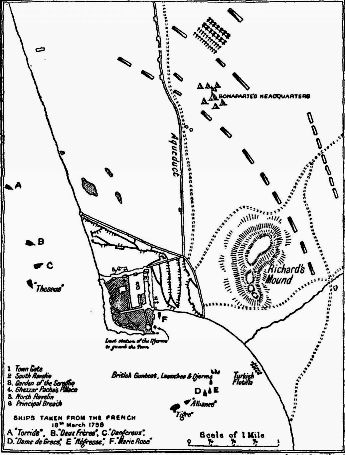
Always prompt to strike at the [pg.205] heart, the commander-in-chief determined to march straight on Acre, where that notorious Turkish pacha sat intrenched behind weak walls and the ramparts of terror which his calculating ferocity had reared around him. Ever since the age of the Crusades that seaport [pg.206] had been the chief place of arms of Palestine; but the harbour was now nearly silted up, and even the neighbouring roadstead of Hayfa was desolate. The fortress was formidable only to orientals. In his work, "Les Ruines," Volney had remarked about Acre: "Through all this part of Asia bastions, lines of defence, covered ways, ramparts, and in short everything relating to modern fortification are utterly unknown; and a single thirty-gun frigate would easily bombard and lay in ruins the whole coast." This judgment of his former friend undoubtedly lulled Bonaparte into illusory confidence, and the rank and file after their success at Jaffa expected an easy triumph at Acre.
This would doubtless have happened but for British help. Captain Miller, of H.M.S. "Theseus," thus reported on the condition of Acre before Sir Sidney Smith's arrival:
"I found almost every embrasure empty except those towards the sea. Many years' collection of the dirt of the town thrown in such a situation as completely covered the approach to the gate from the only guns that could flank it and from the sea ... none of their batteries have casemates, traverses, or splinter-proofs: they have many guns, but generally small and defective—the carriages in general so." [115]
Captain Miller's energy made good some of these defects; but the place was still lamentably weak when, on March 15th, Sir Sidney Smith arrived. The English squadron in the east of the Mediterranean had, to Nelson's chagrin, been confided to the command of this ardent young officer, who now had the good fortune to capture off the promontory of Mount Carmel seven French vessels containing Bonaparte's siege-train. This event had a decisive influence on the fortunes of the siege and of the whole campaign. The French cannon were now hastily mounted on the very walls that they had been intended to breach; while the gun vessels reinforced the two English frigates, and were[pg.207] ready to pour a searching fire on the assailants in their trenches or as they rushed against the walls. These had also been hastily strengthened under the direction of a French royalist officer named Phélippeaux, an old schoolfellow of Bonaparte, and later on a comrade of Sidney Smith, alike in his imprisonment and in his escape from the clutches of the revolutionists. Sharing the lot of the adventurous young seaman, Phélippeaux sailed to the Levant, and now brought to the defence of Acre the science of a skilled engineer. Bravely seconded by British officers and seamen, he sought to repair the breach effected by the French field-pieces, and constructed at the most exposed points inner defences, before which the most obstinate efforts of the storming parties melted away. Nine times did the assailants advance against the breaches with the confidence born of unfailing success and redoubled by the gaze of their great commander; but as often were they beaten back by the obstinate bravery of the British seamen and Turks.
The monotony was once relieved by a quaint incident. In the course of a correspondence with Bonaparte, Sir Sidney Smith is said to have shown his annoyance by sending him a challenge to a duel. It met with the very proper reply that he would fight, if the English would send out a Marlborough.
During these desperate conflicts Bonaparte detached a considerable number of troops inland to beat off a large Turkish and Mameluke force destined for the relief of Acre and the invasion of Egypt. The first encounter was near Nazareth, where Junot displayed the dash and resource which had brought him fame in Italy; but the decisive battle was fought in the Plain of Esdraëlon, not far from the base of Mount Tabor. There Kléber's division of 2,000 men was for some hours hard pressed by a motley array of horse and foot drawn from diverse parts of the Sultan's dominions. The heroism of the burly Alsacian and the toughness of his men barely kept off the fierce rushes of the Moslem [pg.208] horse and foot. At last Bonaparte's cannon were heard. The chief, marching swiftly on with his troops drawn up in three squares, speedily brushed aside the enveloping clouds of orientals; finally, by well-combined efforts the French hurled back the enemy on passes, some of which had been seized by the commander's prescience. At the close of this memorable day (April 15th) an army of nearly 30,000 men was completely routed and dispersed by the valour and skilful dispositions of two divisions which together amounted to less than a seventh of that number. No battle of modern times more closely resembles the exploits of Alexander than this masterly concentration of force; and possibly some memory of this may have prompted the words of Kléber—"General, how great you are!"—as he met and embraced his commander on the field of battle. Bonaparte and his staff spent the night at the Convent of Nazareth; and when his officers burst out laughing at the story told by the Prior of the breaking of a pillar by the angel Gabriel at the time of the Annunciation, their untimely levity was promptly checked by the frown of the commander.
The triumph seemed to decide the Christians of the Lebanon to ally themselves with Bonaparte, and they secretly covenanted to furnish 12,000 troops at his cost; but this question ultimately depended on the siege of Acre. On rejoining their comrades before Acre, the victors found that the siege had made little progress: for a time the besiegers relied on mining operations, but with little success; though Phélippeaux succumbed to a sunstroke (May 1st), his place was filled by Colonel Douglas, who foiled the efforts of the French engineers and enabled the place to hold out till the advent of the long-expected Turkish succours. On May 7th their sails were visible far out on an almost windless sea. At once Bonaparte made desperate efforts to carry the "mud-hole" by storm. Led with reckless gallantry by the heroic Lannes, his troops gained part of the wall and planted the tricolour on the north-east tower; but all further progress was checked by English blue-jackets, [pg.209] whom the commodore poured into the town; and the Turkish reinforcements, wafted landwards by a favouring breeze, were landed in time to wrest the ramparts from the assailants' grip. On the following day an assault was again attempted: from the English ships Bonaparte could be clearly seen on Richard Coeur de Lion's mound urging on the French; but though, under Lannes' leadership, they penetrated to the garden of Gezzar's seraglio, they fell in heaps under the bullets, pikes, and scimitars of the defenders, and few returned alive to the camp. Lannes himself was dangerously wounded, and saved only by the devotion of an officer.
Both sides were now worn out by this extraordinary siege. "This town is not, nor ever has been, defensible according to the rules of art; but according to every other rule it must and shall be defended"—so wrote Sir Sidney Smith to Nelson on May 9th. But a fell influence was working against the besiegers; as the season advanced, they succumbed more and more to the ravages of the plague; and, after failing again on May 10th, many of their battalions refused to advance to the breach over the putrid remains of their comrades. Finally, Bonaparte, after clinging to his enterprise with desperate tenacity, on the night of May 20th gave orders to retreat.
This siege of nine weeks' duration had cost him severe losses, among them being Generals Caffarelli and Bon: but worst of all was the loss of that reputation for invincibility which he had hitherto enjoyed. His defeat at Caldiero, near Verona, in 1796 had been officially converted into a victory: but Acre could not be termed anything but a reverse. In vain did the commander and his staff proclaim that, after dispersing the Turks at Mount Tabor, the capture of Acre was superfluous; his desperate efforts in the early part of May revealed the hollowness of his words. There were, it is true, solid reasons for his retreat. He had just heard of the breaking out of the war of the Second Coalition against France; and revolts in Egypt also demanded his [pg.210] presence.[116] But these last events furnished a damning commentary on his whole Syrian enterprise, which had led to a dangerous diffusion of the French forces. And for what? For the conquest of Constantinople or of India? That dream seems to have haunted Bonaparte's brain even down to the close of the siege of Acre. During the siege, and later, he was heard to inveigh against "the miserable little hole" which had come between him and his destiny—the Empire of the East; and it is possible that ideas which he may at first have set forth in order to dazzle his comrades came finally to master his whole being. Certainly the words just quoted betoken a quite abnormal wilfulness as well as a peculiarly subjective notion of fatalism. His "destiny" was to be mapped out by his own prescience, decided by his own will, gripped by his own powers. Such fatalism had nothing in common with the sombre creed of the East: it was merely an excess of individualism: it was the matured expression of that feature of his character, curiously dominant even in childhood, that what he wanted he must of necessity have. How strange that this imperious obstinacy, this sublimation of western willpower, should not have been tamed even by the overmastering might of Nature in the Orient!
As for the Empire of the East, the declared hostility of the tribes around Nablus had shown how futile were Bonaparte's efforts to win over Moslems: and his earlier Moslem proclamations were skilfully distributed by Sir Sidney Smith among the Christians of Syria, and served partly to neutralize the efforts which Bonaparte made to win them over.[117] Vain indeed was the effort to conciliate the Moslems in Egypt, and yet in Syria to arouse the Christians against the Commander of the Faithful. Such religious opportunism smacked of the Parisian boulevards: it utterly ignored the tenacity of belief of the East, where the creed is the very life. The outcome of all that finesse was seen in the closing days of the[pg.211] siege and during the retreat towards Jaffa, when the tribes of the Lebanon and of the Nablûs district watched like vultures on the hills and swooped down on the retreating columns. The pain of disillusionment, added to his sympathy with the sick and wounded, once broke down Bonaparte's nerves. Having ordered all horsemen to dismount so that there might be sufficient transport for the sick and maimed, the commander was asked by an equerry which horse he reserved for his own use. "Did you not hear the order," he retorted, striking the man with his whip, "everyone on foot." Rarely did this great man mar a noble action by harsh treatment: the incident sufficiently reveals the tension of feelings, always keen, and now overwrought by physical suffering and mental disappointment.
There was indeed much to exasperate him. At Acre he had lost nearly 5,000 men in killed, wounded, and plague-stricken, though he falsely reported to the Directory that his losses during the whole expedition did not exceed 1,500 men: and during the terrible retreat to Jaffa he was shocked, not only by occasional suicides of soldiers in his presence, but by the utter callousness of officers and men to the claims of the sick and wounded. It was as a rebuke to this inhumanity that he ordered all to march on foot, and his authority seems even to have been exerted to prevent some attempts at poisoning the plague-stricken. The narrative of J. Miot, commissary of the army, shows that these suggestions originated among the soldiery at Acre when threatened with the toil of transporting those unfortunates back to Egypt; and, as his testimony is generally adverse to Bonaparte, and he mentions the same horrible device, when speaking of the hospitals at Jaffa, as a camp rumour, it may be regarded as scarcely worthy of credence.[118]
[pg.212] Undoubtedly the scenes were heartrending at Jaffa; and it has been generally believed that the victims of the plague were then and there put out of their miseries by large doses of opium. Certainly the hospitals were crowded with wounded and victims of the plague; but during the seven days' halt at that town adequate measures were taken by the chief medical officers, Desgenettes and Larrey, for their transport to Egypt. More than a thousand were sent away on ships, seven of which were fortunately present; and 800 were conveyed to Egypt in carts or litters across the desert.[119] Another fact suffices to refute the slander mentioned above. From the despatch of Sir Sidney Smith to Nelson of May 30th, 1799, it appears that, when the English commodore touched at Jaffa, he found some of the abandoned ones still alive: "We have found seven poor fellows in the hospital and will take care of them." He also supplied the French ships conveying the wounded with water, provisions, and stores, of which they were much in need, and allowed them to proceed to their destination. It is true that the evidence of Las Cases at St. Helena, eagerly cited by Lanfrey, seems to show that some of the worst cases in the Jaffa hospitals were got rid of by opium; but the admission by Napoleon that the administering of opium was justifiable occurred in one of those casuistical discussions which turn, not on facts, but on motives. Conclusions drawn from such conversations, sixteen years or more after the supposed occurrence, must in any case give ground before the evidence of contemporaries, which proves that every care was taken of the sick and wounded, that the proposals of poisoning first came from the soldiery, that Napoleon both before and after Jaffa set the noble example of marching on foot so that there might be sufficiency of transport, that nearly all the unfortunates arrived in Egypt and in fair condition,[pg.213] and that seven survivors were found alive at Jaffa by English officers.[120]
The remaining episodes of the Eastern Expedition may be briefly dismissed. After a painful desert march the army returned to Egypt in June; and, on July 25th, under the lead of Murat and Lannes, drove into the sea a large force of Turks which had effected a landing in Aboukir Bay. Bonaparte was now weary of gaining triumphs over foes whom he and his soldiers despised. While in this state of mind, he received from Sir Sidney Smith a packet of English and German newspapers giving news up to June 6th, which brought him quickly to a decision. The formation of a powerful coalition, the loss of Italy, defeats on the Rhine, and the schisms, disgust, and despair prevalent in France—all drew his imagination westwards away from the illusory Orient; and he determined to leave his army to the care of Kléber and sail to France.
The morality of this step has been keenly discussed. The rank and file of the army seem to have regarded it as little less than desertion,[121] and the predominance of personal motives in this important decision can scarcely be denied. His private aim in undertaking the Eastern Expedition, that of dazzling the imagination of the French people and of exhibiting the incapacity of the Directory, had been abundantly realized. His eastern enterprise had now shrunk to practical and prosaic dimensions, namely, the consolidation of French power in Egypt. Yet, as will appear in later chapters, he did not give up his oriental schemes; though at St. Helena he once oddly spoke of the Egyptian expedition as an "exhausted enterprise," it is clear that he worked hard[pg.214] to keep his colony. The career of Alexander had for him a charm that even the conquests of Cæsar could not rival; and at the height of his European triumphs, the hero of Austerlitz was heard to murmur: "J'ai manqué à ma fortune à Saint-Jean d'Acre."[122]
In defence of his sudden return it may be urged that he had more than once promised the Directory that his stay in Egypt would not exceed five months; and there can be no doubt that now, as always, he had an alternative plan before him in case of failure or incomplete success in the East. To this alternative he now turned with that swiftness and fertility of resource which astonished both friends and foes in countless battles and at many political crises.
It has been stated by Lanfrey that his appointment of Kléber to succeed him was dictated by political and personal hostility; but it may more naturally be considered a tribute to his abilities as a general and to his influence over the soldiery, which was only second to that of Bonaparte and Desaix. He also promised to send him speedy succour; and as there seemed to be a probability of France regaining her naval supremacy in the Mediterranean by the union of the fleet of Bruix with that of Spain, he might well hope to send ample reinforcements. He probably did not know the actual facts of the case, that in July Bruix tamely followed the Spanish squadron to Cadiz, and that the Directory had ordered Bruix to withdraw the French army from Egypt. But, arguing from the facts as known to him, Bonaparte might well believe that the difficulties of France would be fully met by his own return, and that Egypt could be held with ease. The duty of a great commander is to be at the post of greatest danger, and that was now on the banks of the Rhine or Mincio.
The advent of a south-east wind, a rare event there at that season of the year, led him hastily to embark at Alexandria in the night of August 22nd-23rd. His two frigates bore with him some of the greatest sons of France; his chief of the staff, Berthier, whose ardent love for Madame Visconti had been repressed by his[pg.215] reluctant determination to share the fortunes of his chief; Lannes and Murat, both recently wounded, but covered with glory by their exploits in Syria and at Aboukir; his friend Marmont, as well as Duroc, Andréossi, Bessières, Lavalette, Admiral Gantheaume, Monge, and Berthollet, his secretary Bourrienne, and the traveller Denon. He also left orders that Desaix, who had been in charge of Upper Egypt, should soon return to France, so that the rivalry between him and Kléber might not distract French councils in Egypt. There seems little ground for the assertion that he selected for return his favourites and men likely to be politically serviceable to him. If he left behind the ardently republican Kléber, he also left his old friend Junot: if he brought back Berthier and Marmont, he also ordered the return of the almost Jacobinical Desaix. Sir Sidney Smith having gone to Cyprus for repairs, Bonaparte slipped out unmolested. By great good fortune his frigates eluded the English ships cruising between Malta and Cape Bon, and after a brief stay at Ajaccio, he and his comrades landed at Fréjus (October 9th). So great was the enthusiasm of the people that, despite all the quarantine regulations, they escorted the party to shore. "We prefer the plague to the Austrians," they exclaimed; and this feeling but feebly expressed the emotion of France at the return of the Conqueror of the East.
And yet he found no domestic happiness. Josephine's liaison with a young officer, M. Charles, had become notorious owing to his prolonged visits to her country house, La Malmaison. Alarmed at her husband's return, she now hurried to meet him, but missed him on the way; while he, finding his home at Paris empty, raged at her infidelity, refused to see her on her return, and declared he would divorce her. From this he was turned by the prayers of Eugène and Hortense Beauharnais, and the tears of Josephine herself. A reconciliation took place; but there was no reunion of hearts, and Mme. Reinhard echoed the feeling of respectable society when she wrote that he should have divorced her outright. Thenceforth he lived for Glory alone.[pg.216]
Rarely has France been in a more distracted state than in the summer of 1799. Royalist revolts in the west and south rent the national life. The religious schism was unhealed; education was at a standstill; commerce had been swept from the seas by the British fleets; and trade with Italy and Germany was cut off by the war of the Second Coalition.
The formation of this league between Russia, Austria, England, Naples, Portugal, and Turkey was in the main the outcome of the alarm and indignation aroused by the reckless conduct of the Directory, which overthrew the Bourbons at Naples, erected the Parthenopæan Republic, and compelled the King of Sardinia to abdicate at Turin and retire to his island. Russia and Austria took a leading part in forming the Coalition. Great Britain, ever hampered by her inept army organization, offered to supply money in place of the troops which she could not properly equip.
But under the cloak of legitimacy the monarchical Powers harboured their own selfish designs. This Nessus' cloak of the First Coalition soon galled the limbs of the allies and rendered them incapable of sustained and vigorous action. Yet they gained signal successes over the raw conscripts of France. In July, 1799, the Austro-Russian army captured Mantua and Alessandria; and in the following month Suvoroff gained the decisive victory of Novi and drove the remains of the French forces towards Genoa. The next months were far more favourable to the tricolour flag, for, owing to [pg.217] Austro-Russian jealousies, Masséna was able to gain an important victory at Zurich over a Russian army. In the north the republicans were also in the end successful. Ten days after Bonaparte's arrival at Fréjus, they compelled an Anglo-Russian force campaigning in Holland to the capitulation of Alkmaar, whereby the Duke of York agreed to withdraw all his troops from that coast. Disgusted by the conduct of his allies, the Czar Paul withdrew his troops from any active share in the operations by land, thenceforth concentrating his efforts on the acquisition of Corsica, Malta, and posts of vantage in the Adriatic. These designs, which were well known to the British Government, served to hamper our naval strength in those seas, and to fetter the action of the Austrian arms in Northern Italy.[123]
Yet, though the schisms of the allies finally yielded a victory to the French in the campaigns of 1799, the position of the Republic was precarious. The danger was rather internal than external. It arose from embarrassed finances, from the civil war that burst out with new violence in the north-west, and, above all, from a sense of the supreme difficulty of attaining political stability and of reconciling liberty with order. The struggle between the executive and legislative powers which had been rudely settled by the coup d'état of Fructidor, had been postponed, not solved. Public opinion was speedily ruffled by the Jacobinical violence which ensued. The stifling of liberty of the press and the curtailment of the right of public meeting served only to instill new energy into the party of resistance in the elective Councils, and to undermine a republican government that relied on Venetian methods of rule. Reviewing the events of those days, Madame de Staël finely remarked that only the free consent of the people could breathe life into political institutions; and that the monstrous system of guaranteeing freedom by despotic means served only to manufacture governments[pg.218] that had to be wound up at intervals lest they should stop dead.[124] Such a sarcasm, coming from the gifted lady who had aided and abetted the stroke of Fructidor, shows how far that event had falsified the hopes of the sincerest friends of the Revolution. Events were therefore now favourable to a return from the methods of Rousseau to those of Richelieu; and the genius who was skilfully to adapt republicanism to autocracy was now at hand. Though Bonaparte desired at once to attack the Austrians in Northern Italy, yet a sure instinct impelled him to remain at Paris, for, as he said to Marmont: "When the house is crumbling, is it the time to busy oneself with the garden? A change here is indispensable."
The sudden rise of Bonaparte to supreme power cannot be understood without some reference to the state of French politics in the months preceding his return to France. The position of parties had been strangely complicated by the unpopularity of the Directors. Despite their illegal devices, the elections of 1798 and 1799 for the renewal of a third part of the legislative Councils had signally strengthened the anti-directorial ranks. Among the Opposition were some royalists, a large number of constitutionals, whether of the Feuillant or Girondin type, and many deputies, who either vaunted the name of Jacobins or veiled their advanced opinions under the convenient appellation of "patriots." Many of the deputies were young, impressionable, and likely to follow any able leader who promised to heal the schisms of the country. In fact, the old party lines were being effaced. The champions of the constitution of 1795 (Year III.) saw no better means of defending it than by violating electoral liberties—always in the sacred name of Liberty; and the Directory, while professing to hold the balance between the extreme parties, repressed them by turns with a vigour which rendered them popular and official moderation odious.[pg.219]
In this general confusion and apathy the dearth of statesmen was painfully conspicuous. Only true grandeur of character can defy the withering influences of an age of disillusionment; and France had for a time to rely upon Sieyès. Perhaps no man has built up a reputation for political capacity on performances so slight as the Abbé Sieyès. In the States General of 1789 he speedily acquired renown for oracular wisdom, owing to the brevity and wit of his remarks in an assembly where such virtues were rare. But the course of the Revolution soon showed the barrenness of his mind and the timidity of his character. He therefore failed to exert any lasting influence upon events. In the time of the Terror his insignificance was his refuge. His witty reply to an inquiry how he had then fared—"J'ai vécu "—sufficiently characterizes the man. In the Directorial period he displayed more activity. He was sent as French ambassador to Berlin, and plumed himself on having persuaded that Court to a neutrality favourable to France. But it is clear that the neutrality of Prussia was the outcome of selfish considerations. While Austria tried the hazards of war, her northern rival husbanded her resources, strengthened her position as the protectress of Northern Germany, and dextrously sought to attract the nebula of middle German States into her own sphere of influence. From his task of tilting a balance which was already decided, Sieyès was recalled to Paris in May, 1799, by the news of his election to the place in the Directory vacated by Rewbell. The other Directors had striven, but in vain, to prevent his election: they knew well that this impracticable theorist would speedily paralyze the Government; for, when previously elected Director in 1795, he had refused to serve, on the ground that the constitution was thoroughly bad. He now declared his hostility to the Directory, and looked around for some complaisant military chief who should act as his tool and then be cast away. His first choice, Joubert, was killed at the battle of Novi. Moreau seems then to have been looked [pg.220] on with favour; he was a republican, able in warfare and singularly devoid of skill or ambition in political matters. Relying on Moreau, Sieyès continued his intrigues, and after some preliminary fencing gained over to his side the Director Barras. But if we may believe the assertions of the royalist, Hyde de Neuville, Barras was also receiving the advances of the royalists with a view to a restoration of Louis XVIII., an event which was then quite within the bounds of probability. For the present, however, Barras favoured the plans of Sieyès, and helped him to get rid of the firmly republican Directors, La Réveillière-Lépeaux and Merlin, who were deposed (30th Prairial).[125]
The new Directors were Gohier, Roger Ducos, and Moulin; the first, an elderly respectable advocate; the second, a Girondin by early associations, but a trimmer by instinct, and therefore easily gained over by Sieyès; while the recommendation of the third, Moulin, seem to have been his political nullity and some third-rate military services in the Vendéan war. Yet the Directory of Prairial was not devoid of a spasmodic energy, which served to throw back the invaders of France. Bernadotte, the fiery Gascon, remarkable for his ardent gaze, his encircling masses of coal-black hair, and the dash of Moorish blood which ever aroused Bonaparte's respectful apprehensions, was Minister of War, and speedily formed a new army of 100,000 men: Lindet undertook to re-establish the finances by means of progressive taxes: the Chouan movement in the northern and western departments was repressed by a law legalising the seizure of hostages; and there seemed some hope that France would roll back the tide of invasion, keep her "natural frontiers," and return to normal methods of government.
Such was the position of affairs when Bonaparte's arrival inspired France with joy and the Directory with ill-concealed dread. As in 1795, so now in 1799, he appeared at Paris when French political life was in a[pg.221] stage of transition. If ever the Napoleonic star shone auspiciously, it was in the months when he threaded his path between Nelson's cruisers and cut athwart the maze of Sieyès' intrigues. To the philosopher's "J'ai vécu" he could oppose the crushing retort "J'ai vaincu."
The general, on meeting the thinker at Gohier's house, studiously ignored him. In truth, he was at first disposed to oust both Sieyès and Barras from the Directory. The latter of these men was odious to him for reasons both private and public. In time past he had had good reasons for suspecting Josephine's relations with the voluptuous Director, and with the men whom she met at his house. During the Egyptian campaign his jealousy had been fiercely roused in another quarter, and, as we have seen, led to an almost open breach with his wife. But against Barras he still harboured strong suspicions; and the frequency of his visits to the Director's house after returning from Egypt was doubtless due to his desire to sound the depths of his private as well as of his public immorality. If we may credit the embarras de mensonges which has been dignified by the name of Barras' "Memoirs," Josephine once fled to his house and flung herself at his knees, begging to be taken away from her husband; but the story is exploded by the moral which the relator clumsily tacks on, as to the good advice which he gave her.[126] While Bonaparte seems to have found no grounds for suspecting Barras on this score, he yet discovered his intrigues with various malcontents; and he saw that Barras, holding the balance of power in the Directory between the opposing pairs of colleagues, was intriguing to get the highest possible price for the betrayal of the Directory and of the constitution of 1795.
For Sieyès the general felt dislike but respect. He soon saw the advantage of an alliance with so learned a thinker, so skilful an intriguer, and so weak a man. It was, indeed, necessary; for, after making vain overtures to Gohier for the alteration of the law which excluded from the Directory men of less than forty years of age,[pg.222] the general needed the alliance of Sieyès for the overthrow of the constitution. In a short space he gathered around him the malcontents whom the frequent crises had deprived of office, Roederer, Admiral Bruix, Réal, Cambacérès, and, above all, Talleyrand. The last-named; already known for his skill in diplomacy, had special reasons for favouring the alliance of Bonaparte and Sieyès: he had been dismissed from the Foreign Office in the previous month of July because in his hands it had proved to be too lucrative to the holder and too expensive for France. It was an open secret that, when American commissioners arrived in Paris a short time previously, for the settlement of various disputes between the two countries, they found that the negotiations would not progress until 250,000 dollars had changed hands. The result was that hostilities continued, and that Talleyrand soon found himself deprived of office, until another turn of the revolutionary kaleidoscope should restore him to his coveted place.[127] He discerned in the Bonaparte-Sieyès combination the force that would give the requisite tilt now that Moreau gave up politics.
The army and most of the generals were also ready for some change, only Bernadotte and Jourdan refusing to listen to the new proposals; and the former of these came "with sufficiently bad grace" to join Bonaparte at the time of action. The police was secured through that dextrous trimmer, the regicide Fouché, who now turned against the very men who had recently appointed him to office. Feeling sure of the soldiery and police, the innovators fixed the 18th of Brumaire as the date of their enterprise. There were many conferences at the houses of the conspirators; and one of the few vivid touches which relieve the dull tones of the Talleyrand "Memoirs" reveals the consciousness of these men that they were conspirators. Late on a night in the middle of Brumaire, Bonaparte came to Talleyrand's house to arrange details of the coup d'état, when the noise of[pg.223] carriages stopping outside caused them to pale with fear that their plans were discovered. At once the diplomatist blew out the lights and hurried to the balcony, when he found that their fright was due merely to an accident to the carriages of the revellers and gamesters returning from the Palais Royal, which were guarded by gendarmes. The incident closed with laughter and jests; but it illustrates the tension of the nerves of the political gamesters, as also the mental weakness of Bonaparte when confronted by some unknown danger. It was perhaps the only weak point in his intellectual armour; but it was to be found out at certain crises of his career.
Meanwhile in the legislative Councils there was a feeling of vague disquiet. The Ancients were, on the whole, hostile to the Directory, but in the Council of Five Hundred the democratic ardour of the younger deputies foreboded a fierce opposition. Yet there also the plotters found many adherents, who followed the lead now cautiously given by Lucien Bonaparte. This young man, whose impassioned speeches had marked him out as an irreproachable patriot, was now President of that Council. No event could have been more auspicious for the conspirators. With Sieyès, Barras, and Ducos, as traitors in the Directory, with the Ancients favourable, and the junior deputies under the presidency of Lucien, the plot seemed sure of success.
The first important step was taken by the Council of Ancients, who decreed the transference of the sessions of the Councils to St. Cloud. The danger of a Jacobin plot was urged as a plea for this motion, which was declared carried without the knowledge either of the Directory as a whole, or of the Five Hundred, whose opposition would have been vehement. The Ancients then appointed Bonaparte to command the armed forces in and near Paris. The next step was to insure the abdication of Gohier and Moulin. Seeking to entrap Gohier, then the President of the Directory, Josephine invited him to breakfast on the morning of 18th Brumaire; but Gohier, suspecting a snare, remained at his official [pg.224] residence, the Luxemburg Palace. None the less the Directory was doomed; for the two defenders of the institution had not the necessary quorum for giving effect to their decrees. Moulin thereupon escaped, and Gohier was kept under guard—by Moreau's soldiery![128]
Meanwhile, accompanied by a brilliant group of generals, Bonaparte proceeded to the Tuileries, where the Ancients were sitting; and by indulging in a wordy declamation he avoided taking the oath to the constitution required of a general on entering upon a new command. In the Council of Five Hundred, Lucien Bonaparte stopped the eager questions and murmurs, on the pretext that the session was only legal at St. Cloud.
There, on the next day (19th Brumaire or 10th November), a far more serious blow was to be struck. The overthrow of the Directory was a foregone conclusion. But with the Legislature it was far otherwise, for its life was still whole and vigorous. Yet, while amputating a moribund limb, the plotters did not scruple to paralyze the brain of the body politic.
Despite the adhesion of most of the Ancients to his plans, Bonaparte, on appearing before them, could only utter a succession of short, jerky phrases which smacked of the barracks rather than of the Senate. Retiring in some confusion, he regains his presence of mind among the soldiers outside, and enters the hall of the Five Hundred, intending to intimidate them not only by threats, but by armed force. At the sight of the uniforms at the door, the republican enthusiasm of the younger deputies catches fire. They fiercely assail him with cries of "Down with the tyrant! down with the Dictator! outlaw him!" In vain Lucien Bonaparte commands order. Several deputies rush at the general, and fiercely shake him by the collar. He turns faint with excitement and chagrin; but Lefebvre and a few grenadiers rushing up drag him from the hall. He comes forth like a somnambulist (says an onlooker), pursued by[pg.225] the terrible cry, "Hors la loi!" Had the cries at once taken form in a decree, the history of the world might have been different. One of the deputies, General Augereau, fiercely demands that the motion of outlawry be put to the vote. Lucien Bonaparte refuses, protests, weeps, finally throws off his official robes, and is rescued from the enraged deputies by grenadiers whom the conspirators send in for this purpose. Meanwhile Bonaparte and his friends were hastily deliberating, when one of their number brought the news that the deputies had declared the general an outlaw. The news chased the blood from his cheek, until Sieyès, whose sang froid did not desert him in these civilian broils, exclaims, "Since they outlaw you, they are outlaws." This revolutionary logic recalls Bonaparte to himself. He shouts, "To arms!" Lucien, too, mounting a horse, appeals to the soldiers to free the Council from the menaces of some deputies armed with daggers, and in the pay of England, who are terrorising the majority. The shouts of command, clinched by the adroit reference to daggers and English gold, cause the troops to waver in their duty; and Lucien, pressing his advantage to the utmost, draws a sword, and, holding it towards his brother, exclaims that he will stab him if ever he attempts anything against liberty. Murat, Leclerc, and other generals enforce this melodramatic appeal by shouts for Bonaparte, which the troops excitedly take up. The drums sound for an advance, and the troops forthwith enter the hall. In vain the deputies raise the shout, "Vive la République," and invoke the constitution. Appeals to the law are overpowered by the drum and by shouts for Bonaparte; and the legislators of France fly pell-mell from the hall through doors and windows.[129]
Thus was fulfilled the prophecy which eight years[pg.226] previously Burke had made in his immortal work on the French Revolution. That great thinker had predicted that French liberty would fall a victim to the first great general who drew the eyes of all men upon himself. "The moment in which that event shall happen, the person who really commands the army is your master, the master of your king, the master of your Assembly, the master of your whole republic."
Discussions about the coup d'état of Brumaire generally confuse the issue at stake by ignoring the difference between the overthrow of the Directory and that of the Legislature. The collapse of the Directory was certain to take place; but few expected that the Legislature of France would likewise vanish. For vanish it did: not for nearly half a century had France another free and truly democratic representative assembly. This result of Brumaire was unexpected by several of the men who plotted the overthrow of unpopular Directors, and hoped for the nipping of Jacobinical or royalist designs. Indeed, no event in French history is more astonishing than the dispersal of the republican deputies, most of whom desired a change of personnel but not a revolution in methods of government. Until a few days previously the Councils had the allegiance of the populace and of the soldiers; the troops at St. Cloud were loyal to the constitution, and respected the persons of the deputies until they were deluded by Lucien. For a few minutes the fate of France trembled in the balance; and the conspirators knew it.[130] Bonaparte confessed it by his incoherent gaspings; Sieyès had his carriage ready, with six horses, for flight; the terrible cry, "Hors la loi!" if raised against Bonaparte in the heart of Paris, would certainly have roused the populace to fury in the cause of liberty and have swept the conspirators to the guillotine. But, as it was, the affair was decided in the solitudes of St. Cloud by Lucien and a battalion of soldiers.
Efforts have frequently been made to represent the[pg.227] events of Brumaire as inevitable and to dovetail them in with a pretended philosophy of history. But it is impossible to study them closely without observing how narrow was the margin between the success and failure of the plot, and how jagged was the edge of an affair which philosophizers seek to fit in with their symmetrical explanations. In truth, no event of world-wide importance was ever decided by circumstances so trifling. "There is but one step from triumph to a fall. I have seen that in the greatest affairs a little thing has always decided important events"—so wrote Bonaparte three years before his triumph at St. Cloud: he might have written it of that event. It is equally questionable whether it can be regarded as saving France from anarchy. His admirers, it is true, have striven to depict France as trodden down by invaders, dissolved by anarchy, and saved only by the stroke of Brumaire. But she was already triumphant: it was quite possible that she would peacefully adjust her governmental difficulties: they were certainly no greater than they had been in and since the year 1797: Fouché had closed the club of the Jacobins: the Councils had recovered their rightful influence, and, but for the plotters of Brumaire, might have effected a return to ordinary government of the type of 1795-7. This was the real blow; that the vigorous trunk, the Legislature, was struck down along with the withering Directorial branch.
The friends of liberty might well be dismayed when they saw how tamely France accepted this astounding stroke. Some allowance was naturally to be made, at first, for the popular apathy: the Jacobins, already discouraged by past repression, were partly dazed by the suddenness of the blow, and were also ignorant of the aims of the men who dealt it; and while they were waiting to see the import of events, power passed rapidly into the hands of Bonaparte and his coadjutors. Such is an explanation, in part at least, of the strange docility now shown by a populace which still vaunted its loyalty to the democratic republic. But there is another [pg.228] explanation, which goes far deeper. The revolutionary strifes had wearied the brain of France and had predisposed it to accept accomplished facts. Distracted by the talk about royalist plots and Jacobin plots, cowering away from the white ogre and the red spectre, the more credulous part of the populace was fain to take shelter under the cloak of a great soldier, who at least promised order. Everything favoured the drill-sergeant theory of government. The instincts developed by a thousand years of monarchy had not been rooted out in the last decade. They now prompted France to rally round her able man; and, abandoning political liberty as a hopeless quest, she obeyed the imperious call which promised to revivify the order and brilliance of her old existence with the throbbing blood of her new life.
The French constitution was now to be reconstructed by a self-appointed commission which sat with closed doors. This strange ending to all the constitution-building of a decade was due to the adroitness of Lucien Bonaparte. At the close of that eventful day, the 19th of Brumaire, he gathered about him in the deserted hall at St. Cloud some score or so of the dispersed deputies known to be favourable to his brother, declaimed against the Jacobins, whose spectral plot had proved so useful to the real plotters, and proposed to this "Rump" of the Council the formation of a commission who should report on measures that were deemed necessary for the public safety. The measures were found to be the deposition of the Directory, the expulsion of sixty-one members from the Councils, the nomination of Sieyès, Roger Ducos, and Bonaparte as provisional Consuls and the adjournment of the Councils for four months. The Consuls accordingly took up their residence in the Luxemburg Palace, just vacated by the Directors, and the drafting of a constitution was confided to them and to an interim commission of fifty members chosen equally from the two Councils.
The illegality of these devices was hidden beneath a cloak of politic clemency. To this commission the [pg.229] Consuls, or rather Bonaparte—for his will soon dominated that of Sieyès—proposed two most salutary changes. He desired to put an end to the seizure of hostages from villages suspected of royalism; and also to the exaction of taxes levied on a progressive scale, which harassed the wealthy without proportionately benefiting the exchequer. These two expedients, adopted by the Directory in the summer of 1799, were temporary measures adopted to stem the tide of invasion and to crush revolts; but they were regarded as signs of a permanently terrorist policy, and their removal greatly strengthened the new consular rule. The blunder of nearly all the revolutionary governments had been in continuing severe laws after the need for them had ceased to be pressing. Bonaparte, with infinite tact, discerned this truth, and, as will shortly appear, set himself to found his government on the support of that vast neutral mass which was neither royalist nor Jacobin, which hated the severities of the reds no less than the abuses of the ancien régime.
While Bonaparte was conciliating the many, Sieyès was striving to body forth the constitution which for many years had been nebulously floating in his brain. The function of the Socratic [Greek: maieutaes] was discharged by Boulay de la Meurthe, who with difficulty reduced those ideas to definite shape. The new constitution was based on the principle: "Confidence comes from below, power from above." This meant that the people, that is, all adult males, were admitted only to the preliminary stages of election of deputies, while the final act of selection was to be made by higher grades or powers. The "confidence" required of the people was to be shown not only towards their nominees, but towards those who were charged with the final and most important act of selection. The winnowing processes in the election of representatives were to be carried out on a decimal system. The adult voters meeting in their several districts were to choose one-tenth of their number, this tenth being named the Notabilities of the Commune. These, some five or [pg.230] six hundred thousand in number, meeting in their several Departments, were thereupon to choose one-tenth of their number; and the resulting fifty or sixty thousand men, termed Notabilities of the Departments, were again to name one-tenth of their number, who were styled Notabilities of the Nation. But the most important act of selection was still to come—from above. From this last-named list the governing powers were to select the members of the legislative bodies and the chief officials and servants of the Government.
The executive now claims a brief notice. The well-worn theory of the distinction of powers, that is, the legislative and executive powers, was maintained in Sieyès' plan. At the head of the Government the philosopher desired to enthrone an august personage, the Grand Elector, who was to be selected by the Senate. This Grand Elector was to nominate two Consuls, one for peace, the other for war; they were to nominate the Ministers of State, who in their turn selected the agents of power from the list of Notabilities of the Nation. The two Consuls and their Ministers administered the executive affairs. The Senate, sitting in dignified ease, was merely to safeguard the constitution, to elect the Grand Elector, and to select the members of the Corps Législatif (proper) and the Tribunate.
Distrust of the former almost superhuman activity in law-making now appeared in divisions, checks, and balances quite ingenious in their complexity. The Legislature was divided into three councils: the Corps Législatif, properly so called, which listened in silence to proposals of laws offered by the Council of State and criticised or orally approved by the Tribunate.[131] These three bodies were not only divided, but were placed in opposition, especially the two talking bodies, which[pg.231] resembled plaintiff and defendant pleading before a gagged judge. But even so the constitution was not sufficiently guarded against Jacobins or royalists. If by any chance a dangerous proposal were forced through these mutually distrustful bodies, the Senate was charged with the task of vetoing it, and if the Grand Elector, or any other high official, strove to gain a perpetual dictatorship, the Senate was at once to absorb him into its ranks.
Moreover, lest the voters should send up too large a proportion of Jacobins or royalists, the first selection of members of the great Councils and the chief functionaries for local affairs was to be made by the Consuls, who thus primarily exercised not only the "power from above," but also the "confidence" which ought to have come from below. Perhaps this device was necessary to set in motion Sieyès' system of wheels within wheels; for the Senate, which was to elect the Grand Elector, by whom the executive officers were indirectly to be chosen, was in part self-sufficient: the Consuls named the first members, who then co-opted, that is, chose the new members. Some impulse from without was also needed to give the constitution life; and this impulse was now to come. Where Sieyès had only contrived wheels, checks, regulator, break, and safety-valve, there now rushed in an imperious will which not only simplified the parts but supplied an irresistible motive power.
The complexity of much of the mechanism, especially that relating to popular election and the legislature, entirely suited Bonaparte. But, while approving the triple winnowing, to which Sieyès subjected the results of manhood suffrage, and the subordination of the legislative to the executive authority,[132] the general expressed his entire disapproval of the limitations of the Grand Elector's powers. The name was anti-republican: let it be changed to First Consul. And whereas Sieyès[pg.232] condemned his grand functionary to the repose of a roi fainéant, Bonaparte secured to him practically all the powers assigned by Sieyès to the Consuls for Peace and for War. Lastly, Bonaparte protested against the right of absorbing him being given to the Senate. Here also he was successful; and thus a delicately poised bureaucracy was turned into an almost unlimited dictatorship.
This metamorphosis may well excite wonder. But, in truth, Sieyès and his colleagues were too weary and sceptical to oppose the one "intensely practical man." To Bonaparte's trenchant reasons and incisive tones the theorist could only reply by a scornful silence broken by a few bitter retorts. To the irresistible power of the general he could only oppose the subtlety of a student. And, indeed, who can picture Bonaparte, the greatest warrior of the age, delegating the control of all warlike operations to a Consul for War while Austrian cannon were thundering in the county of Nice and British cruisers were insulting the French coasts? It was inevitable that the reposeful Grand Elector should be transformed into the omnipotent First Consul, and that these powers should be wielded by Bonaparte himself.[133]
The extent of the First Consul's powers, as finally settled by the joint commission, was as follows. He had the direct and sole nomination of the members of the general administration, of those of the departmental and municipal councils, and of the administrators, afterwards called prefects and sub-prefects. He also appointed all military and naval officers, ambassadors and agents sent to foreign Powers, and the judges in civil and criminal suits, except the juges de paix and, later on, the members of the Cour de Cassation. He therefore controlled the army, navy, and diplomatic service, as well as the general administration. He also signed treaties, though these might be discussed, and must be ratified, by the legislative bodies. The three Consuls were to reside in the Tuileries palace; but, apart from the[pg.233] enjoyment of 150,000 francs a year, and occasional consultation by the First Consul, the position of these officials was so awkward that Bonaparte frankly remarked to Roederer that it would have been better to call them Grand Councillors. They were, in truth, supernumeraries added to the chief of the State, as a concession to the spirit of equality and as a blind to hide the reality of the new despotism. All three were to be chosen for ten years, and were re-eligible.
Such is an outline of the constitution of 1799 (Year VIII.). It was promulgated on December 15th, 1799, and was offered to the people for acceptance, in a proclamation which closed with the words: "Citizens, the Revolution is confined to the principles which commenced it. It is finished." The news of this last fact decided the enthusiastic acceptance of the constitution. In a plébiscite, or mass vote of the people, held in the early days of 1800, it was accepted by an overwhelming majority, viz., by 3,011,007 as against only 1,562 negatives. No fact so forcibly proves the failure of absolute democracy in France; and, whatever may be said of the methods of securing this national acclaim, it was, and must ever remain, the soundest of Bonaparte's titles to power. To a pedant who once inquired about his genealogy he significantly replied: "It dates from Brumaire."
Shortly before the plébiscite, Sieyès and Ducos resigned their temporary commissions as Consuls: they were rewarded with seats in the Senate; and Sieyès, in consideration of his constitutional work, received the estate of Crosne from the nation.
"Sieyès à Bonaparte a fait present du trône,The sting in the tail of Lebrun's epigram struck home. Sieyès' acceptance of Crosne was, in fact, his acceptance of notice to quit public affairs, in which he had always [pg.234] moved with philosophic disdain. He lived on to the year 1836 in dignified ease, surveying with Olympian calm the storms of French and Continental politics.
The two new Consuls were Cambacérès and Lebrun. The former was known as a learned jurist and a tactful man. He had voted for the death of Louis XVI., but his subsequent action had been that of a moderate, and his knowledge of legal affairs was likely to be of the highest service to Bonaparte, who intrusted him with a general oversight of legislation. His tact was seen in his refusal to take up his abode in the Tuileries, lest, as he remarked to Lebrun, he might have to move out again soon. The third Consul, Lebrun, was a moderate with leanings towards constitutional royalty. He was to prove another useful satellite to Bonaparte, who intrusted him with the general oversight of finance and regarded him as a connecting link with the moderate royalists. The chief secretary to the Consuls was Maret, a trusty political agent, who had striven for peace with England both in 1793 and in 1797.
As for the Ministers, they were now reinforced by Talleyrand, who took up that of Foreign Affairs, and by Berthier, who brought his powers of hard work to that of War, until he was succeeded for a time by Carnot. Lucien Bonaparte, and later Chaptal, became Minister of the Interior, Gaudin controlled Finance, Forfait the Navy, and Fouché the Police. The Council of State was organized in the following sections; that of War, which was presided over by General Brune: Marine, by Admiral Gantheaume: Finance, by Defermon: Legislation, by Boulay de la Meurthe: the Interior, by Roederer.
The First Consul soon showed that he intended to adopt a non-partisan and thoroughly national policy. That had been, it is true, the aim of the Directors in their policy of balance and repression of extreme parties on both sides. For the reasons above indicated, they had failed: but now a stronger and more tactful grasp was to succeed in a feat which naturally became easier every year that removed the passions of the revolutionary epoch further [pg.235] into the distance. Men cannot for ever perorate, and agitate and plot. A time infallibly comes when an able leader can successfully appeal to their saner instincts: and that hour had now struck. Bonaparte's appeal was made to the many, who cared not for politics, provided that they themselves were left in security and comfort: it was urged quietly, persistently, and with the reserve power of a mighty prestige and of overwhelming military force. Throughout the whole of the Consulate, a policy of moderation, which is too often taken for weakness, was strenuously carried through by the strongest man and the greatest warrior of the age.
The truly national character of his rule was seen in many ways. He excluded from high office men who were notorious regicides, excepting a few who, like Fouché, were too clever to be dispensed with. The constitutionals of 1791 and even declared royalists were welcomed back to France, and many of the Fructidorian exiles also returned.[134] The list of émigrés was closed, so that neither political hatred nor private greed could misrepresent a journey as an act of political emigration. Equally generous and prudent was the treatment of Roman Catholics. Toleration was now extended to orthodox or non-juring priests, who were required merely to promise allegiance to the new constitution. By this act of timely clemency, orthodox priests were allowed to return to France, and they were even suffered to officiate in places where no opposition was thereby aroused.
While thus removing one of the chief grievances of the Norman, Breton and Vendéan peasants, who had risen as much for their religion as for their king, he determined to crush their revolts. The north-west, and indeed parts of the south of France, were still simmering with rebellions and brigandage. In Normandy a daring and able leader named Frotté headed a considerable band of malcontents, and still more formidable were the[pg.236] Breton "Chouans" that followed the peasant leader Georges Cadoudal. This man was a born leader. Though but thirty years of age, his fierce courage had long marked him out as the first fighter of his race and creed. His features bespoke a bold, hearty spirit, and his massive frame defied fatigue and hardship. He struggled on; and in the autumn of 1799 fortune seemed about to favour the "whites": the revolt was spreading; and had a Bourbon prince landed in Brittany before Bonaparte returned from Egypt, the royalists might quite possibly have overthrown the Directory. But Bonaparte's daring changed the whole aspect of affairs. The news of the stroke of Brumaire gave the royalists pause. At first they believed that the First Consul would soon call back the king, and Bonaparte skilfully favoured this notion: he offered a pacification, of which some of the harassed peasants availed themselves. Georges himself for a time advised a reconciliation, and a meeting of the royalist leaders voted to a man that they desired "to have the king and you" (Bonaparte). One of them, Hyde de Neuville, had an interview with the First Consul at Paris, and has left on record his surprise at seeing the slight form of the man whose name was ringing through France. At the first glance he took him for a rather poorly dressed lackey; but when the general raised his eyes and searched him through and through with their eager fire, the royalist saw his error and fell under the spell of a gaze which few could endure unmoved. The interview brought no definite result.
Other overtures made by Bonaparte were more effective. True to his plan of dividing his enemies, he appealed to the clergy to end the civil strife. The appeal struck home to the heart or the ambitions of a cleric named Bernier. This man was but a village priest of La Vendée: yet his natural abilities gained him an ascendancy in the councils of the insurgents, which the First Consul was now victoriously to exploit. Whatever may have been Bernier's motives, he certainly acted with some [pg.237] duplicity. Without forewarning Cadoudal, Bourmont, Frotté, and other royalist leaders, he secretly persuaded the less combative leaders to accept the First Consul's terms; and a pacification was arranged (January 18th), In vain did Cadoudal rage against this treachery: in vain did he strive to break the armistice. Frotté in Normandy was the last to capitulate and the first to feel Bonaparte's vengeance: on a trumped-up charge of treachery he was hurried before a court-martial and shot. An order was sent from Paris for his pardon; but a letter which Bonaparte wrote to Brune on the day of the execution contains the ominous phrase: By this time Frotté ought to be shot; and a recently published letter to Hédouville expresses the belief that the punishment of that desperate leader will doubtless contribute to the complete pacification of the West.[135]
In the hope of gaining over the Chouans, Bonaparte required their chiefs to come to Paris, where they received the greatest consideration. In Bernier the priest, Bonaparte discerned diplomatic gifts of a high order, which were soon to be tested in a far more important negotiation. The nobles, too, received flattering attentions which touched their pride and assured their future insignificance. Among them was Count Bourmont, the Judas of the Waterloo campaign.
In contrast with the priest and the nobles, Georges Cadoudal stood firm as a rock. That suave tongue spoke to him of glory, honour, and the fatherland: he heeded it not, for he knew it had ordered the death of Frotté. There stood these fighters alone, face to face, types of the north and south, of past and present, fiercest and toughest of living men, their stern wills racked in wrestle for two hours. But southern craft was foiled by Breton steadfastness, and Georges went his way unshamed. Once outside the palace, his only words to his friend, Hyde de Neuville, were: "What a mind I had to strangle him in these arms!" Shadowed by[pg.238] Bonaparte's spies, and hearing that he was to be arrested, he fled to England; and Normandy and Brittany enjoyed the semblance of peace.[136]
Thus ended the civil war which for nearly seven years had rent France in twain. Whatever may be said about the details of Bonaparte's action, few will deny its beneficent results on French life. Harsh and remorseless as Nature herself towards individuals, he certainly, at this part of his career, promoted the peace and prosperity of the masses. And what more can be said on behalf of a ruler at the end of a bloody revolution?
Meanwhile the First Consul had continued to develop Sieyès' constitution in the direction of autocracy. The Council of State, which was little more than an enlarged Ministry, had been charged with the vague and dangerous function of "developing the sense of laws" on the demand of the Consuls; and it was soon seen that this Council was merely a convenient screen to hide the operations of Bonaparte's will. On the other hand, a blow was struck at the Tribunate, the only public body which had the right of debate and criticism. It was now proposed (January, 1800) that the time allowed for debate should be strictly limited. This restriction to the right of free discussion met with little opposition. One of the most gifted of the new tribunes, Benjamin Constant, the friend of Madame de Staël, eloquently pleaded against this policy of distrust which would reduce the Tribunate to a silence that would be heard by Europe. It was in vain. The rabid rhetoric of the past had infected France with a foolish fear of all free debate. The Tribunate signed its own death warrant; and the sole result of its feeble attempt at opposition was that Madame de Staël's salon was forthwith deserted by the Liberals who had there found inspiration; while the gifted authoress herself was officially requested to retire into the country.
The next act of the central power struck at freedom[pg.239] of the press. As a few journals ventured on witticisms at the expense of the new Government, the Consuls ordered the suppression of all the political journals of Paris except thirteen; and three even of these favoured papers were suppressed on April 7th. The reason given for this despotic action was the need of guiding public opinion wisely during the war, and of preventing any articles "contrary to the respect due to the social compact, to the sovereignty of the people, and to the glory of the armies." By a finely ironical touch Rousseau's doctrine of the popular sovereignty was thus invoked to sanction its violation. The incident is characteristic of the whole tendency of events, which showed that the dawn of personal rule was at hand. In fact, Bonaparte had already taken the bold step of removing to the Tuileries, and that too, on the very day when he ordered public mourning for the death of Washington (February 7th). No one but the great Corsican would have dared to brave the comments which this coincidence provoked. But he was necessary to France, and all men knew it. At the first sitting of the provisional Consuls, Ducos had said to him: "It is useless to vote about the presidence; it belongs to you of right"; and, despite the wry face pulled by Sieyès, the general at once took the chair. Scarcely less remarkable than the lack of energy in statesmen was the confusion of thought in the populace. Mme. Reinhard tells us that after the coup d'état people believed they had returned to the first days of liberty. What wonder, then, that the one able and strong-willed man led the helpless many and re-moulded Sieyès' constitution in a fashion that was thus happily parodied:
"J'ai, pour les fous, d'un TribunatReserving for the next chapter a description of the new civil institutions of France, it will be convenient now to turn to foreign affairs. Having arranged the most urgent of domestic questions, the First Consul was ready to encounter the forces of the Second Coalition. He had already won golden opinions in France by endeavouring peacefully to dissolve it. On the 25th of December, 1799, he sent two courteous letters, one to George III., the other to the Emperor Francis, proposing an immediate end to the war. The close of the letter to George III. has been deservedly admired: "France and England by the abuse of their strength may, for the misfortune of all nations, be long in exhausting it: but I venture to declare that the fate of all civilized nations is concerned in the termination of a war which kindles a conflagration over the whole world." This noble sentiment touched the imagination of France and of friends of peace everywhere.
And yet, if the circumstances of the time be considered, the first agreeable impressions aroused by the perusal of this letter must be clouded over by doubts. The First Consul had just seized on power by illegal and forcible means, and there was as yet little to convince foreign States that he would hold it longer than the men whom he had displaced. Moreover, France was in a difficult position. Her treasury was empty; her army in Italy was being edged into the narrow coast-line near Genoa; and her oriental forces were shut up in their new conquest. Were not the appeals to Austria and England [pg.241] merely a skillful device to gain time? Did his past power in Italy and Egypt warrant the belief that he would abandon the peninsula and the new colony? Could the man who had bartered away Venetia and seized Malta and Egypt be fitly looked upon as the sacred'r peacemaker? In diplomacy men's words are interpreted by their past conduct and present circumstances, neither of which tended to produce confidence in Bonaparte's pacific overtures; and neither Francis nor George III. looked on the present attempt as anything but a skilful means of weakening the Coalition.
Indeed, that league was, for various reasons, all but dissolved by internal dissensions. Austria was resolved to keep all the eastern part of Piedmont and the greater part of the Genoese Republic. While welcoming the latter half of this demand, George III.'s Ministers protested against the absorption of so great a part of Piedmont as an act of cruel injustice to the King of Sardinia. Austria was annoyed at the British remonstrances and was indignant at the designs of the Czar on Corsica. Accordingly no time could have been better chosen by Bonaparte for seeking to dissolve the Coalition, as he certainly hoped to do by these two letters. Only the staunch support of legitimist claims by England then prevented the Coalition from degenerating into a scramble for Italian territories.[137] And, if we may trust the verdict of contemporaries and his own confession at St. Helena, Bonaparte never expected any other result from these letters than an increase of his popularity in France. This was enhanced by the British reply, which declared that His Majesty could not place his reliance on "general professions of pacific dispositions": France had waged aggressive war, levied exactions, and overthrown institutions in neighbouring States; and the British Government could not as yet discern any abandonment of this system: something more was required for[pg.242] a durable peace: "The best and most natural pledge of its reality and permanence would be the restoration of that line of princes which for so many centuries maintained the French nation in prosperity at home and in consideration and respect abroad." This answer has been sharply criticised, and justly so, if its influence on public opinion be alone considered. But a perusal of the British Foreign Office Records reveals the reason for the use of these stiffly legitimist claims. Legitimacy alone promised to stop the endless shiftings of the political kaleidoscope, whether by France, Austria, or Russia. Our ambassador at Vienna was requested to inform the Government of Vienna of the exact wording of the British reply:
"As a proof of the zeal and steadiness with which His Majesty adheres to the principles of the Confederacy, and as a testimony of the confidence with which he anticipates a similar answer from His Imperial Majesty, to whom an overture of a similar nature has without doubt been made."
But this correct conduct, while admirably adapted to prop up the tottering Coalition, was equally favourable to the consolidation of Bonaparte's power. It helped to band together the French people to resist the imposition of their exiled royal house by external force. Even George III. thought it "much too strong," though he suggested no alteration. At once Bonaparte retorted in a masterly note; he ironically presumed that His Britannic Majesty admitted the right of nations to choose their form of government, since only by that right did he wear the British crown; and he invited him not to apply to other peoples a principle which would recall the Stuarts to the throne of Great Britain.
Bonaparte's diplomatic game was completely won during the debates on the King's speech at Westminster at the close of January, 1800. Lord Grenville laboriously proved that peace was impossible with a nation whose war was against all order, religion, and morality; and he cited examples of French lawlessness from Holland and [pg.243] Switzerland to Malta and Egypt. Pitt declared that the French Revolution was the severest trial which Providence had ever yet inflicted on the nations of the earth; and, claiming that there was no security in negotiating with France, owing to her instability, he summed up his case in the Ciceronian phrase: Pacem nolo quia infida. Ministers carried the day by 260 votes to 64; but they ranged nearly the whole of France on the side of the First Consul. No triumph in the field was worth more to him than these Philippics, which seemed to challenge France to build up a strong Government in order that the Court of St. James might find some firm foundation for future negotiations.
Far more dextrous was the conduct of the Austrian diplomatists. Affecting to believe in the sincerity of the First Consul's proposal for peace, they so worded their note as to draw from him a reply that he was prepared to discuss terms of peace on the basis of the Treaty of Campo Formio.[138] As Austria had since then conquered the greater part of Italy, Bonaparte's reply immediately revealed his determination to reassert French supremacy in Italy and the Rhineland. The action of the Courts of Vienna and London was not unlike that of the sun and the wind in the proverbial saw. Viennese suavity induced Bonaparte to take off his coat and show himself as he really was: while the conscientious bluster of Grenville and Pitt made the First Consul button up his coat, and pose as the buffeted peacemaker.
The allies had good grounds for confidence. Though Russia had withdrawn from the Second Coalition yet the Austrians continued their victorious advance in Italy. In April, 1800, they severed the French forces near Savona, driving back Suchet's corps towards Nice, while the other was gradually hemmed in behind the redoubts of Genoa. There the Imperialist advance was stoutly stayed. Masséna, ably seconded by Oudinot and Soult, who now gained their first laurels as generals, maintained[pg.244] a most obstinate resistance, defying alike the assaults of the white-coats, the bombs hurled by the English squadron, and the deadlier inroads of famine and sickness. The garrison dwindled by degrees to less than 10,000 effectives, but they kept double the number of Austrians there, while Bonaparte was about to strike a terrible blow against their rear and that of Melas further west. It was for this that the First Consul urged Masséna to hold out at Genoa to the last extremity, and nobly was the order obeyed.
Suchet meanwhile defended the line of the River Var against Melas. In Germany, Moreau with his larger forces slowly edged back the chief Austrian army, that of General Kray, from the defiles of the Black Forest, compelling it to fall back on the intrenched camp at Ulm.
On their side, the Austrians strove to compel Masséna to a speedy surrender, and then with a large force to press on into Nice, Provence, and possibly Savoy, surrounding Suchet's force, and rousing the French royalists of the south to a general insurrection. They also had the promise of the help of a British force, which was to be landed at some point on the coast and take Suchet in the flank or rear.[139] Such was the plan, daring in outline and promising great things, provided that everything went well. If Masséna surrendered, if the British War Office and Admiralty worked up to time, if the winds were favourable, and if the French royalists again ventured on a revolt, then France would be crippled, perhaps conquered. As for the French occupation of Switzerland and Moreau's advance into Swabia, that was not to prevent the prosecution of the original Austrian plan of advancing against Provence and wresting Nice and[pg.245] Savoy from the French grasp. This scheme has been criticised as if it were based solely on military considerations; but it was rather dictated by schemes of political aggrandizement. The conquest of Nice and Savoy was necessary to complete the ambitious schemes of the Hapsburgs, who sought to gain a large part of Piedmont at the expense of the King of Sardinia, and after conquering Savoy and Nice, to thrust that unfortunate king to the utmost verge of the peninsula, which the prowess of his descendants has ultimately united under the Italian tricolour.
The allied plan sinned against one of the elementary rules of strategy; it exposed a large force to a blow from the rear, namely, from Switzerland. The importance of this immensely strong central position early attracted Bonaparte's attention. On the 17th of March he called his secretary, Bourrienne (so the latter states), and lay down with him on a map of Piedmont: then, placing pins tipped, some with red, others with black wax, so as to denote the positions of the troops, he asked him to guess where the French would beat their foes:
"How the devil should I know?" said Bourrienne. "Why, look here, you fool," said the First Consul: "Melas is at Alessandria with his headquarters. There he will remain until Genoa surrenders. He has at Alessandria his magazines, his hospitals, his artillery, his reserves. Crossing the Alps here (at the Great St. Bernard), I shall fall upon Melas, cut off his communications with Austria, and meet him here in the plains of the River Scrivia at San Giuliano."
I quote this passage as showing how readily such stories of ready-made plans gain credence, until they come to be tested by Napoleon's correspondence. There we find no strategic soothsaying, but only a close watching of events as they develop day by day. In March and April he kept urging on Moreau the need of an early advance, while he considered the advantages offered by the St. Gotthard, Simplon, and Great St. Bernard passes for his own army. On April 27th he decided [pg.246] against the first (except for a detachment), because Moreau's advance was too slow to safeguard his rear on that route. He now preferred the Great St. Bernard, but still doubted whether, after crossing, he should make for Milan, or strike at Masséna's besiegers, in case that general should be very hard pressed. Like all great commanders, he started with a general plan, but he arranged the details as the situation required. In his letter of May 19th, he poured scorn on Parisian editors who said he prophesied that in a month he would be at Milan. "That is not in my character. Very often I do not say what I know: but never do I say what will be."
The better to hide his purpose, he chose as his first base of operations the city of Dijon, whence he seemed to threaten either the Swabian or the Italian army of his foes. But this was not enough. At the old Burgundian capital he assembled his staff and a few regiments of conscripts in order to mislead the English and Austrian spies; while the fighting battalions were drafted by diverse routes to Geneva or Lausanne. So skilful were these preparations that, in the early days of May, the greater part of his men and stores were near the lake of Geneva, whence they were easily transferred to the upper valley of the Rhone. In order that he might have a methodical, hard-working coadjutor he sent Berthier from the office of the Ministry of War, where he had displayed less ability than Bernadotte, to be commander-in-chief of the "army of reserve." In reality Berthier was, as before in Italy and Egypt, chief of the staff; but he had the titular dignity of commander which the constitution of 1800 forbade the First Consul to assume.
On May 6th Bonaparte left Paris for Geneva, where he felt the pulse of every movement in both campaigns. At that city, on hearing the report of his general of engineers, he decided to take the Great St. Bernard route into Italy, as against the Simplon. With redoubled energy, he now supervised the thousands of [pg.247] details that were needed to insure success: for, while prone to indulging in grandiose schemes, he revelled in the work which alone could bring them within his grasp: or, as Wellington once remarked, "Nothing was too great or too small for his proboscis." The difficulties of sending a large army over the Great St. Bernard were indeed immense. That pass was chosen because it presented only five leagues of ground impracticable for carriages. But those five leagues tested the utmost powers of the army and of its chiefs. Marmont, who commanded the artillery, had devised the ingenious plan of taking the cannon from their carriages and placing them in the hollowed-out trunks of pine, so that the trunnions fitting into large notches kept them steady during the ascent over the snow and the still more difficult descent.[140] The labour of dragging the guns wore out the peasants; then the troops were invited—a hundred at a time—to take a turn at the ropes, and were exhilarated by martial airs played by the bands, or by bugles and drums sounding the charge at the worst places of the ascent.
The track sometimes ran along narrow ledges where a false step meant death, or where avalanches were to be feared. The elements, however, were propitious, and the losses insignificant. This was due to many causes: the ardour of the troops in an enterprise which appealed to French imagination and roused all their activities; the friendliness of the mountaineers; and the organizing powers of Bonaparte and of his staff; all these may be cited as elements of success. They present a striking contrast to the march of Hannibal's army over one of the western passes of the Alps. His motley host struggled over a long stretch of mountains in the short days of October over unknown paths, in one part swept away by a fall of the cliff, and ever and anon beset by clouds of treacherous Gauls. Seeing that the great Carthaginian's difficulties began long before he reached the Alps, that[pg.248] he was encumbered by elephants, and that his army was composed of diverse races held together only by trust in the prowess of their chief, his exploit was far more wonderful than that of Bonaparte, which, indeed, more nearly resembles the crossing of the St. Bernard by Francis I. in 1515. The difference between the conditions of Hannibal's and Bonaparte's enterprises may partly be measured by the time which they occupied. Whereas Hannibal's march across the Alps lasted fifteen days, three of which were spent in the miseries of a forced halt amidst the snow, the First Consul's forces took but seven days. Whereas the Carthaginian army was weakened by hunger, the French carried their full rations of biscuit; and at the head of the pass the monks of the Hospice of St. Bernard served out the rations of bread, cheese, and wine which the First Consul had forwarded, and which their own generosity now doubled. The hospitable fathers themselves served at the tables set up in front of the Hospice.
After insuring the regular succession of troops and stores, Bonaparte himself began the ascent on May 20th. He wore the gray overcoat which had already become famous; and his features were fixed in that expression of calm self-possession which he ever maintained in face of difficulty. The melodramatic attitudes of horse and rider, which David has immortalized in his great painting, are, of course, merely symbolical of the genius of militant democracy prancing over natural obstacles and wafted onwards and upwards by the breath of victory. The living figure was remarkable only for stern self-restraint and suppressed excitement; instead of the prancing war-horse limned by David, his beast of burden was a mule, led by a peasant; and, in place of victory, he had heard that Lannes with the vanguard had found an unexpected obstacle to his descent into Italy. The narrow valley of the Dora Baltea, by which alone they could advance, was wellnigh blocked by the fort of Bard, which was firmly held by a small Austrian garrison and defied all the efforts of [pg.249] Lannes and Berthier. This was the news that met the First Consul during his ascent, and again at the Hospice. After accepting the hospitality of the monks, and spending a short time in the library and chapel, he resumed his journey; and on the southern slopes he and his staff now and again amused themselves by sliding down the tracks which the passage of thousands of men had rendered slippery. After halting at Aosta, he proceeded down the valley to the fort of Bard.
Meanwhile some of his foot-soldiers had worked their way round this obstacle by a goat-track among the hills and had already reached Ivrea lower down the valley. Still the fort held out against the cannonade of the French. Its commanding position seemed to preclude all hope of getting the artillery past it; and without artillery the First Consul could not hope for success in the plains of Piedmont. Unable to capture the fort, he bethought him of hurrying by night the now remounted guns under the cover of the houses of the village. For this purpose he caused the main street to be strewn with straw and dung, while the wheels of the cannon were covered over so as to make little noise. They were then dragged quietly through the village almost within pistol shot of the garrison: nevertheless, the defenders took alarm, and, firing with musketry and grenades, exploded some ammunition wagons and inflicted other losses; yet 40 guns and 100 wagons were got past the fort.
How this unfailing resource contrasts with the heedless behaviour of the enemy! Had they speedily reinforced their detachment at Bard, there can be little doubt that Bonaparte's movements could have been seriously hampered. But, up to May 21st, Melas was ignorant that his distant rear was being assailed, and the 3,000 Austrians who guarded the vale of the Dora Baltea were divided, part being at Bard and others at Ivrea. The latter place was taken by a rush of Lannes' troops on May 22nd, and Bard was blockaded by part of the French rearguard. [pg.250] Bonaparte's army, if the rearguard be included, numbered 41,000 men. Meanwhile, farther east, a French force of 15,000 men, drawn partly from Moreau's army and led by Moncey, was crossing the St. Gotthard pass and began to drive back the Austrian outposts in the upper valley of the Ticino; and 5,000 men, marching over the Mont Cenis pass, threatened Turin from the west. The First Consul's aim now was to unite the two chief forces, seize the enemy's magazines, and compel him to a complete surrender. This daring resolve took shape at Aosta on the 24th, when he heard that Melas was, on the 19th, still at Nice, unconscious of his doom. The chance of ending the war at one blow was not to be missed, even if Masséna had to shift for himself.
But already Melas' dream of triumph had vanished. On the 21st, hearing the astonishing news that a large force had crossed the St. Bernard, he left 18,000 men to oppose Suchet on the Var, and hurried back with the remainder to Turin. At the Piedmontese capital he heard that he had to deal with the First Consul; but not until the last day of May did he know that Moncey was forcing the St. Gotthard and threatening Milan. Then, realizing the full extent of his danger, he hastily called in all the available troops in order to fight his way through to Mantua. He even sent an express to the besiegers of Genoa to retire on Alessandria; but negotiations had been opened with Masséna for the surrender of that stronghold, and the opinion of Lord Keith, the English admiral, decided the Austrian commander there to press the siege to the very end. The city was in the direst straits. Horses, dogs, cats, and rats were at last eagerly sought as food: and at every sortie crowds of the starving inhabitants followed the French in order to cut down grass, nettles, and leaves, which they then boiled with salt.[141] A revolt threatened by the wretched townsfolk was averted by Masséna ordering his troops to fire on every gathering of more than four men. At[pg.251] last, on June 4th, with 8,000 half-starved soldiers he marched through the Austrian posts with the honours of war. The stern warrior would not hear of the word surrender or capitulation. He merely stated to the allied commanders that on June 4th his troops would evacuate Genoa or clear their path by the bayonet.
Bonaparte has been reproached for not marching at once to succour Masséna: the charge of desertion was brought by Masséna and Thiébault, and has been driven home by Lanfrey with his usual skill. It will, however, scarcely bear a close examination. The Austrians, at the first trustworthy news of the French inroads into Piedmont and Lombardy, were certain to concentrate either at Turin or Alessandria. Indeed, Melas was already near Turin, and would have fallen on the First Consul's flank had the latter marched due south towards Genoa.[142] Such a march, with only 40,000 men, would have been perilous: and it could at most only have rescued a now reduced and almost famishing garrison. Besides, he very naturally expected the besiegers of Genoa to retreat now that their rear was threatened.
Sound policy and a desire to deal a dramatic stroke spurred on the First Consul to a more daring and effective plan; to clear Lombardy of the Imperialists and seize their stores; then, after uniting with Moncey's 15,000 troops, to cut off the retreat of all the Austrian forces west of Milan.
On entering Milan he was greeted with wild acclaim by the partisans of France (June 2nd); they extolled the energy and foresight that brought two armies, as it were down from the clouds, to confound their oppressors. Numbers of men connected with the Cisalpine Republic had been proscribed, banished, or imprisoned by the [pg.252] Austrians; and their friends now hailed him as the restorer of their republic. The First Consul spent seven days in selecting the men who were to rebuild the Cisalpine State, in beating back the eastern forces of Austria beyond the River Adda, and in organizing his troops and those of Moncey for the final blow. The military problems, indeed, demanded great care and judgment. His position was curiously the reverse of that which he had occupied in 1796. Then the French held Tortona, Alessandria, and Valenza, and sought to drive back the Austrians to the walls of Mantua. Now the Imperialists, holding nearly the same positions, were striving to break through the French lines which cut them off from that city of refuge; and Bonaparte, having forces slightly inferior to his opponents, felt the difficulty of frustrating their escape.
Three routes were open to Melas. The most direct was by way of Tortona and Piacenza along the southern bank of the Po, through the difficult defile of Stradella: or he might retire towards Genoa, across the Apennines, and regain Mantua by a dash across the Modenese: or he might cross the Po at Valenza and the Ticino near Pavia. All these roads had to be watched by the French as they cautiously drew towards their quarry. Bonaparte's first move was to send Murat with a considerable body of troops to seize Piacenza and to occupy the defile of Stradella. These important posts were wrested from the Austrian vanguard; and this success was crowned on June 9th by General Lannes' brilliant victory at Montebello over a superior Austrian force marching from Genoa towards Piacenza, which he drove back towards Alessandria. Smaller bodies of French were meanwhile watching the course of the Ticino, and others seized the magazines of the enemy at Cremona.
After gaining precious news as to Melas' movements from an intercepted despatch, Bonaparte left Milan on June 9th, and proceeded to Stradella. There he waited for news of Suchet and Masséna from the side of Savona and Ceva; for their forces, if united, might [pg.253] complete the circle which he was drawing around the Imperialists.[143] He hoped that Masséna would have joined Suchet near Savona; but owing to various circumstances, for which Masséna was in no wise to blame, their junction was delayed; and Suchet, though pressing on towards Acqui, was unable to cut off the Austrian retreat on Genoa. Yet he so harassed the corps opposed to him in its retreat from Nice that only about 8,000 Austrians joined Melas from that quarter.[144]
Doubtless, Melas' best course would still have been to make a dash for Genoa and trust to the English ships. But this plan galled the pride of the general, who had culled plenteous laurels in Italy until the approach of Bonaparte threatened to snatch the whole chaplet from his brow. He and his staff sought to restore their drooping fortunes by a bold rush against the ring of foes that were closing around. Never has an effort of this kind so nearly succeeded and yet so wholly failed.
The First Consul, believing that the Austrians were bent solely on flight, advanced from Stradella, where success would have been certain, into the plains of Tortona, whence he could check any move of theirs southwards on Genoa. But now the space which he occupied was so great as to weaken his line at any one point; while his foes had the advantage of the central position.[pg.254] Bonaparte was also forced to those enveloping tactics which had so often proved fatal to the Austrians four years previously; and this curious reversal of his usual tactics may account for the anxiety which he betrayed as he moved towards Marengo. He had, however, recently been encouraged by the arrival of Desaix from Paris after his return from Egypt. This dashing officer and noble man inspired him with a sincere affection, as was seen by the three hours of eager converse which he held with him on his arrival, as also by his words to Bourrienne: "He is quite an antique character." Desaix with 5,300 troops was now despatched on the night of June 13th towards Genoa to stop the escape of the Austrians in that direction. This eccentric move has been severely criticised: but the facts, as then known by Bonaparte, seemed to show that Melas was about to march on Genoa. The French vanguard under Gardane had in the afternoon easily driven the enemy's front from the village of Marengo; and Gardane had even reported that there was no bridge over the River Bormida by which the enemy could debouch into the plain of Marengo. Marmont, pushing on later in the evening, had discovered that there was at least one well-defended bridge; and when early next morning Gardane's error was known, the First Consul, with a blaze of passion against the offender, sent a courier in hot haste to recall Desaix. Long before he could arrive, the battle of Marengo had begun: and for the greater part of that eventful day, June the 14th, the French had only 18000 men wherewith to oppose the onset of 31,000 Austrians. [145]
As will be seen by the accompanying map, the village of Marengo lies in the plain that stretches eastwards from the banks of the River Bormida towards the hilly country of Stradella.
[pg.255]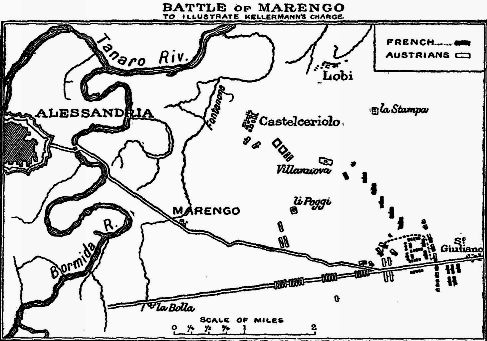
The village lies on the high-road leading eastwards from the fortress of Alessandria, the chief stronghold of north-western Italy. The plain is cut up by numerous obstacles. Through Marengo runs a stream called the Fontanone. The deep curves of the Bormida, the steep banks of the Fontanone, along with the villages, farmsteads, and vineyards scattered over the plain, all helped to render an advance exceedingly difficult in face of a determined enemy; and these natural features had no small share in deciding the fortunes of the day.
Shortly after dawn Melas began to pour his troops across the Bormida, and drove in the French outposts on Marengo: but there they met with a tough resistance from the soldiers of Victor's division, while Kellermann, the son of the hero of Valmy, performed his first great exploit by hurling back some venturesome Austrian horsemen into the deep bed of the Fontanone. This gave time to Lannes to bring up his division, 5,000 strong, into line between Marengo and Castel Ceriolo. But when the full force of the Austrian attack was developed about 10 a.m., the Imperialists not only gained Marengo, but threw a heavy column, led by General Ott, against Lannes, who was constrained to retire, contesting every inch of the ground. Thus, when, an hour later, Bonaparte rode up from the distant rear, hurrying along his Consular Guard, his eye fell upon his battalions overpowered in front and outflanked on both wings. At once he launched his Consular Guard, 1,000 strong, against Ott's triumphant ranks. Drawn up in square near Castel Ceriolo, it checked them for a brief space, until, plied by cannon and charged by the enemy's horse, these chosen troops also began to give ground. But at this crisis Monnier's division of 3,600 men arrived, threw itself into the fight, held up the flood of white-coats around the hamlet of Li Poggi, while Carra St. Cyr fastened his grip on Castel Ceriolo. Under cover of this welcome screen, Victor and Lannes restored some order to their divisions and checked for a time the onsets of [pg.257] the enemy. Slowly but surely, however, the impact of the Austrian main column, advancing along the highroad, made them draw back on San Giuliano.
By 2 p.m. the battle seemed to be lost for the French; except on the north of their line they were in full retreat, and all but five of their cannon were silenced. Melas, oppressed by his weight of years, by the terrific heat, and by two slight wounds, retired to Alessandria, leaving his chief of the staff, Zach, to direct the pursuit. But, unfortunately, Melas had sent back 2,200 horsemen to watch the district between Alessandria and Acqui, to which latter place Suchet's force was advancing. To guard against this remoter danger, he weakened his attacking force at the critical time and place; and now, when the Austrians approached the hill of San Giuliano with bands playing and colours flying, their horse was not strong enough to complete the French defeat. Still, such was the strength of their onset that all resistance seemed unavailing, until about 5 p.m. the approach of Desaix breathed new life and hope into the defence. At once he rode up to the First Consul; and if vague rumours may be credited, he was met by the eager question: "Well, what do you think of it?" To which he replied: "The battle is lost, but there is time to gain another." Marmont, who heard the conversation, denies that these words were uttered; and they presume a boldness of which even Desaix would scarcely have been guilty to his chief. What he unquestionably did urge was the immediate use of artillery to check the Austrian advance: and Marmont, hastily reinforcing his own five guns with thirteen others, took a strong position and riddled the serried ranks of the enemy as, swathed in clouds of smoke and dust, they pressed blindly forward. The First Consul disposed the troops of Desaix behind the village and a neighbouring hill; while at a little distance on the French left, Kellermann was ready to charge with his heavy cavalry as opportunity offered.
It came quickly. Marmont's guns unsteadied Zach's [pg.258] grenadiers: Desaix's men plied them with musketry; and while they were preparing for a last effort, Kellermann's heavy cavalry charged full on their flank. Never was surprise more complete. The column was cut in twain by this onset; and veterans, who but now seemed about to overbear all obstacles, were lying mangled by grapeshot, hacked by sabres, flying helplessly amidst the vineyards, or surrendering by hundreds. A panic spread to their comrades; and they gave way on all sides before the fiercely rallying French. The retreat became a rout as the recoiling columns neared the bridges of the Bormida: and night closed over a scene of wild confusion, as the defeated army, thrust out from the shelter of Marengo, flung itself over the river into the stronghold of Alessandria.
Such was the victory of Marengo. It was dearly bought; for, apart from the heavy losses, amounting on either side to about one-third of the number engaged, the victors sustained an irreparable loss in the death of Desaix, who fell in the moment when his skill and vigour snatched victory from defeat. The victory was immediately due to Kellermann's brilliant charge; and there can be no doubt, in spite of Savary's statements, that this young officer made the charge on his own initiative. Yet his onset could have had little effect, had not Desaix shaken the enemy and left him liable to a panic like that which brought disaster to the Imperialists at Rivoli. Bonaparte's dispositions at the crisis were undoubtedly skilful; but in the first part of the fight his conduct was below his reputation. We do not hear of him electrifying his disordered troops by any deed comparable with that of Cæsar, when, shield in hand, he flung himself among the legionaries to stem the torrent of the Nervii. At the climax of the fight he uttered the words "Soldiers, remember it is my custom to bivouac on the field of battle"—tame and egotistical words considering the gravity of the crisis.
On the evening of the great day, while paying an exaggerated compliment to Bessières and the cavalry of [pg.259] the Consular Guard, he merely remarked to Kellermann: "You made a very good charge"; to which that officer is said to have replied: "I am glad you are satisfied, general: for it has placed the crown on your head." Such pettiness was unworthy of the great captain who could design and carry through the memorable campaign of Marengo. If the climax was not worthy of the inception, yet the campaign as a whole must be pronounced a masterpiece. Since the days of Hannibal no design so daring and original had startled the world. A great Austrian army was stopped in its victorious career, was compelled to turn on its shattered communications, and to fight for its existence some 120 miles to the rear of the territory which it seemed to have conquered. In fact, the allied victories of the past year were effaced by this march of Bonaparte's army, which, in less than a month after the ascent of the Alps, regained Nice, Piedmont, and Lombardy, and reduced the Imperialists to the direst straits.
Staggered by this terrific blow, Melas and his staff were ready to accept any terms that were not deeply humiliating; and Bonaparte on his side was not loth to end the campaign in a blaze of glory. He consented that the Imperial troops should retire to the east of the Mincio, except at Peschiera and Mantua, which they were still to occupy. These terms have been variously criticised: Melas has been blamed for cowardice in surrendering the many strongholds, including Genoa, which his men firmly held. Yet it must be remembered that he now had at Alessandria less than 20,000 effectives, and that 30,000 Austrians in isolated bodies were practically at the mercy of the French between Savona and Brescia. One and all they could now retire to the Mincio and there resume the defence of the Imperial territories. The political designs of the Court of Vienna on Piedmont were of course shattered; but it now recovered the army which it had heedlessly sacrificed to territorial greed. Bonaparte has also been blamed for the lenience of his terms. Severer conditions could [pg.260] doubtless have been extorted; but he now merged the soldier in the statesman. He desired peace for the sake of France and for his own sake. After this brilliant stroke peace would be doubly grateful to a people that longed for glory but also yearned to heal the wounds of eight years' warfare. His own position as First Consul was as yet ill-established; and he desired to be back at Paris so as to curb the restive Tribunate, overawe Jacobins and royalists, and rebuild the institutions of France.
Impelled by these motives, he penned to the Emperor Francis an eloquent appeal for peace, renewing his offer of treating with Austria on the basis of the treaty of Campo Formio.[146] But Austria was not as yet so far humbled as to accept such terms; and it needed the master-stroke of Moreau at the great battle of Hohenlinden (December 2nd, 1800), and the turning of her fortresses on the Mincio by the brilliant passage of the Splügen in the depths of winter by Macdonald—a feat far transcending that of Bonaparte at the St. Bernard—to compel her to a peace. A description of these events would be beyond the scope of this work; and we now return to consider the career of Bonaparte as a statesman.
After a brief stay at Milan and Turin, where he was received as the liberator of Italy, the First Consul crossed the Alps by the Mont Cenis pass and was received with rapturous acclaim at Lyons and Paris. He had been absent from the capital less than two calendar months.
He now sent a letter to the Czar Paul, offering that, if the French garrison of Malta were compelled by famine to evacuate that island, he would place it in the hands of the Czar, as Grand Master of the Knights of St. John. Rarely has a "Greek gift" been more skilfully tendered. In the first place, Valetta was so closely blockaded by Nelson's cruisers and invested by the native Maltese[pg.261] that its surrender might be expected in a few weeks; and the First Consul was well aware how anxiously the Czar had been seeking to gain a foothold at Malta, whence he could menace Turkey from the south-east. In his wish completely to gain over Russia, Bonaparte also sent back, well-clad and well-armed, the prisoners taken from the Russian armies in 1799, a step which was doubly appreciated at Petersburg because the Russian troops which had campaigned with the Duke of York in Holland were somewhat shabbily treated by the British Government in the Channel Islands, where they took up their winter quarters. Accordingly the Czar now sent Kalicheff to Paris, for the formation of a Franco-Russian alliance. He was warmly received. Bonaparte promised in general terms to restore the King of Sardinia to his former realm and the Pope to his States. On his side, the Czar sent the alluring advice to Bonaparte to found a dynasty and thereby put an end to the revolutionary principles which had armed Europe against France. He also offered to recognize the natural frontiers of France, the Rhine and the Maritime Alps, and claimed that German affairs should be regulated under his own mediation. When both parties were so complaisant, a bargain was easily arranged. France and Russia accordingly joined hands in order to secure predominance in the affairs of Central and Southern Europe, and to counterbalance England's supremacy at sea.
For it was not enough to break up the Second Coalition and recover Northern Italy. Bonaparte's policy was more than European; it was oceanic. England must be beaten on her own element: then and then only could the young warrior secure his grasp on Egypt and return to his oriental schemes. His correspondence before and after the Marengo campaign reveals his eagerness for a peace with Austria and an alliance with Russia. His thoughts constantly turn to Egypt. He bargains with Britain that his army there may be revictualled, and so words his claim that troops can easily [pg.262] be sent also. Lord Grenville refuses (September 10th); whereupon Bonaparte throws himself eagerly into further plans for the destruction of the islanders. He seeks to inflame the Czar's wrath against the English maritime code. His success for the time is complete. At the close of 1800 the Russian Emperor marshals the Baltic Powers for the overthrow of England's navy, and outstrips Bonaparte's wildest hopes by proposing a Franco-Russian invasion of India with a view to "dealing his enemy a mortal blow." This plan, as drawn up at the close of 1800, arranged for the mustering of 35,000 Russians at Astrakan; while as many French were to fight their way to the mouth of the Danube, set sail on Russian ships for the Sea of Azov, join their allies on the Caspian Sea, sail to its southern extremity, and, rousing the Persians and Afghans by the hope of plunder, sweep the British from India. The scheme received from Bonaparte a courteous perusal; but he subjected it to several criticisms, which led to less patient rejoinders from the irascible potentate. Nevertheless, Paul began to march his troops towards the lower Volga, and several polks of Cossacks had crossed that river on the ice, when the news of his assassination cut short the scheme.[147]
The grandiose schemes of Paul vanished with their fantastic contriver; but the rapprochement of Russia to revolutionary France was ultimately to prove an event of far-reaching importance; for the eastern power thereby began to exert on the democracy of western Europe that subtle, semi-Asiatic influence which has so powerfully warped its original character.
The dawn of the nineteenth century witnessed some startling rearrangements on the political chess-board.
[pg.263] While Bonaparte brought Russia and France to sudden amity, the unbending maritime policy of Great Britain leagued the Baltic Powers against the mistress of the seas. In the autumn of 1800 the Czar Paul, after hearing of our capture of Malta, forthwith revived the Armed Neutrality League of 1780 and opposed the forces of Russia, Prussia, Sweden, and Denmark to the might of England's navy. But Nelson's brilliant success at Copenhagen and the murder of the Czar by a palace conspiracy shattered this league only four months after its formation, and the new Czar, Alexander, reverted for a time to friendship with England.[148] This sudden ending to the first Franco-Russia alliance so enraged Bonaparte that he caused a paragraph to be inserted in the official "Moniteur," charging the British Government with procuring the assassination of Paul, an insinuation that only proclaimed his rage at this sudden rebuff to his hitherto successful diplomacy. Though foiled for a time, he never lost sight of the hoped-for alliance, which, with a deft commixture of force and persuasion, he gained seven years later after the crushing blow of Friedland.
Dread of a Franco-Russian alliance undoubtedly helped to compel Austria to a peace. Humbled by Moreau at the great battle of Hohenlinden, the Emperor Francis opened negotiations at Lunéville in Lorraine. The subtle obstinacy of Cobenzl there found its match in the firm yet suave diplomacy of Joseph Bonaparte, who wearied out Cobenzl himself, until the march of Moreau towards Vienna compelled Francis to accept the River Adige as his boundary in Italy. The other terms of the treaty (February 9th, 1801) were practically the same as those of the treaty of Campo Formio, save that the Hapsburg Grand Duke of Tuscany was[pg.264] compelled to surrender his State to a son of the Bourbon Duke of Parma. He himself was to receive "compensation" in Germany, where also the unfortunate Duke of Modena was to find consolation in the district of the Breisgau on the Upper Rhine. The helplessness of the old Holy Roman Empire was, indeed, glaringly displayed; for Francis now admitted the right of the French to interfere in the rearrangement of that medley of States. He also recognized the Cisalpine, Ligurian, Helvetic, and Batavian Republics, as at present constituted; but their independence, and the liberty of their peoples to choose what form of government they thought fit, were expressly stipulated.
The Court of Naples also made peace with France by the treaty of Florence (March, 1801), whereby it withdrew its troops from the States of the Church, and closed its ports to British and Turkish ships; it also renounced in favour of the French Republic all its claims over a maritime district of Tuscany known as the Présidii, the little principality of Piombino, and a port in the Isle of Elba. These cessions fitted in well with Napoleon's schemes for the proposed elevation of the heir of the Duchy of Parma to the rank of King of Tuscany or Etruria. The King of Naples also pledged himself to admit and support a French corps in his dominions. Soult with 10,000 troops thereupon occupied Otranto, Taranto, and Brindisi, in order to hold the Neapolitan Government to its engagements, and to facilitate French intercourse with Egypt.
In his relations with the New World Bonaparte had also prospered. Certain disputes between France and the United States had led to hostilities in the year 1798. Negotiations for peace were opened in March, 1800, and led to the treaty of Morfontaine, which enabled Bonaparte to press on the Court of Madrid the scheme of the Parma-Louisiana exchange, that promised him a magnificent empire on the banks of the Mississippi.
These and other grandiose designs were confided only to Talleyrand and other intimate counsellors. But, even [pg.265] to the mass of mankind, the transformation scene ushered in by the nineteenth century was one of bewildering brilliance. Italy from the Alps to her heel controlled by the French; Austria compelled to forego all her Italian plans; Switzerland and Holland dominated by the First Consul's influence; Spain following submissively his imperious lead; England, despite all her naval triumphs, helpless on land; and France rapidly regaining more than all her old prestige and stability under the new institutions which form the most enduring tribute to the First Consul's glory. [pg.266]
"We have done with the romance of the Revolution: we must now commence its history. We must have eyes only for what is real and practicable in the application of principles, and not for the speculative and hypothetical." Such were the memorable words of Bonaparte to his Council of State at one of its early meetings. They strike the keynote of the era of the Consulate. It was a period of intensely practical activity that absorbed all the energies of France and caused the earlier events of the Revolution to fade away into a seemingly remote past. The failures of the civilian rulers and the military triumphs of Bonaparte had exerted a curious influence on the French character, which was in a mood of expectant receptivity. In 1800 everything was in the transitional state that favours the efforts of a master builder; and one was now at hand whose constructive ability in civil affairs equalled his transcendent genius for war.
I propose here briefly to review the most important works of reconstruction which render the Consulate and the early part of the Empire for ever famous. So vast and complex were Bonaparte's efforts in this field that they will be described, not chronologically, but subject by subject. The reader will, however, remember that for the most part they went on side by side, even amidst the distractions caused by war, diplomacy, colonial enterprises, and the myriad details of a vast administration. What here appears as a series of canals was in reality a mighty river of enterprise rolling in undivided volume [pg.267] and fed by the superhuman vitality of the First Consul. It was his inexhaustible curiosity which compelled functionaries to reveal the secrets of their office: it was his intelligence that seized on the salient points of every problem and saw the solution: it was his ardour and mental tenacity which kept his Ministers and committees hard at work, and by toil of sometimes twenty hours a day supervised the results: it was, in fine, his passion for thoroughness, his ambition for France, that nerved every official with something of his own contempt of difficulties, until, as one of them said, "the gigantic entered into our very habits of thought."[149]
The first question of political reconstruction which urgently claimed attention was that of local government. On the very day when it was certain that the nation had accepted the new constitution, the First Consul presented to the Legislature a draft of a law for regulating the affairs of the Departments. It must be admitted that local self-government, as instituted by the men of 1789 in their Departmental System, had proved a failure. In that time of buoyant hope, when every difficulty and abuse seemed about to be charmed away by the magic of universal suffrage, local self-government of a most advanced type had been intrusted to an inexperienced populace. There were elections for the commune or parish, elections for the canton, elections for the district, elections for the Department, and elections for the National Assembly, until the rustic brain, after reeling with excitement, speedily fell back into muddled apathy and left affairs generally to the wire-pullers of the nearest Jacobin club. A time of great confusion ensued. Law went according to local opinion, and the national taxes were often left unpaid. In the Reign of Terror this lax system was replaced by the despotism of the secret[pg.268] committees, and the way was thus paved for a return to organized central control, such as was exercised by the Directory.
The First Consul, as successor to the Directory, therefore found matters ready to his hand for a drastic measure of centralization, and it is curious to notice that the men of 1789 had unwittingly cleared the ground for him. To make way for the "supremacy of the general will," they abolished the Parlements, which had maintained the old laws, customs, and privileges of their several provinces, and had frequently interfered in purely political matters. The abolition of these and other privileged corporations in 1789 unified France and left not a single barrier to withstand either the flood of democracy or the backwash of reaction. Everything therefore favoured the action of the First Consul in drawing all local powers under his own control. France was for the moment weary of elective bodies, that did little except waste the nation's taxes; and though there was some opposition to the new proposal, it passed on February 16th, 1800 (28 Pluviose, an, viii).
It substituted local government by the central power for local self-government. The local divisions remained the same, except that the "districts," abolished by the Convention, were now reconstituted on a somewhat larger scale, and were termed arrondissements, while the smaller communes, which had been merged in the cantons since 1795, were also revived. It is noteworthy that, of all the areas mapped out by the Constituent Assembly in 1789-90, only the Department and canton have had a continuous existence—a fact which seems to show the peril of tampering with well-established boundaries, and of carving out a large number of artificial districts, which speedily become the corpus vile of other experimenters. Indeed, so little was there of effective self-government that France seems to have sighed with relief when order was imposed by Bonaparte in the person of a Prefect. This important official, a miniature First Consul, was to administer the affairs [pg.269] of the Department, while sub-prefects were similarly placed over the new arrondissements, and mayors over the communes. The mayors were appointed by the First Consul in communes of more than 5,000 souls: by the prefects in the smaller communes: all were alike responsible to the central power.
The rebound from the former electoral system, which placed all local authority ultimately in the hands of the voters, was emphasized by Article 75 of the constitution, which virtually raised officials beyond reach of prosecution. It ran thus: "The agents of the Government, other than the Ministers, cannot be prosecuted for facts relating to their duties except by a decision of the Council of State: in that case the prosecution takes place before the ordinary tribunals." Now, as this decision rested with a body composed almost entirely of the higher officials, it will be seen that the chance of a public prosecution of an official became extremely small. France was therefore in the first months of 1800 handed over to a hierarchy of officials closely bound together by interest and esprit de corps; and local administration, after ten years of democratic experiments, practically reverted to what it had been under the old monarchy. In fact, the powers of the Prefects were, on the whole, much greater than those of the royal Intendants: for while the latter were hampered by the provincial Parlements, the nominees of the First Consul had to deal with councils that retained scarce the shadow of power. The real authority in local matters rested with the Prefects. The old elective bodies survived, it is true, but their functions were now mainly advisory; and, lest their advice should be too copious, the sessions of the first two bodies were limited to a fortnight a year. Except for a share in the assessment of taxation, their existence was merely a screen to hide the reality of the new central despotism.[150] Beneficent it may[pg.270] have been; and the choice of Prefects was certainly a proof of Bonaparte's discernment of real merit among men of all shades of opinion; but for all that, it was a despotism, and one that has inextricably entwined itself with the whole life of France.[151]
It seems strange that this law should not have aroused fierce opposition; for it practically gagged democracy in its most appropriate and successful sphere of action, local self-government, and made popular election a mere shadow, except in the single act of the choice of the local juges de paix. This was foreseen by the Liberals in the Tribunate: but their power was small since the regulations passed in January: and though Daunou, as "reporter," sharply criticised this measure, yet he lamely concluded with the advice that it would be dangerous to reject it. The Tribunes therefore passed the proposal by 71 votes to 25: and the Corps Législatif by 217 to 68.
The results of this new local government have often been considered so favourable as to prove that the genius of the French people requires central control rather than self-government. But it should be noted that the conditions of France from 1790 to 1800 were altogether hostile to the development of free institutions. The fierce feuds at home, the greed and the class jealousies awakened by confiscation, the blasts of war and the blight of bankruptcy, would have severely tested the firmest of local institutions; they were certain to wither so delicate an organism as an absolute democracy, which requires peace, prosperity, and infinite patience for its development. Because France then came to despair of her local self-government, it did not follow that she would fail after Bonaparte's return had restored her prestige and prosperity. But the national[pg.271] élan forbade any postponement or compromise; and France forthwith accepted the rule of an able official hierarchy as a welcome alternative to the haphazard acts of local busybodies. By many able men the change has been hailed as a proof of Bonaparte's marvellous discernment of the national character, which, as they aver, longs for brilliance, order, and strong government, rather than for the steep and thorny paths of liberty. Certainly there is much in the modern history of France which supports this opinion. Yet perhaps these characteristics are due very largely to the master craftsman, who fashioned France anew when in a state of receptivity, and thus was able to subject democracy to that force which alone has been able to tame it—the mighty force of militarism.
The return to a monarchical policy was nowhere more evident than in the very important negotiations which regulated the relations of Church and State and produced the Concordat or treaty of peace with the Roman Catholic Church. But we must first look back at the events which had reduced the Roman Catholic Church in France to its pitiable condition.
The conduct of the revolutionists towards the Church of France was actuated partly by the urgent needs of the national exchequer, partly by hatred and fear of so powerful a religious corporation. Idealists of the new school of thought, and practical men who dreaded bankruptcy, accordingly joined in the assault on its property and privileges: its tithes were confiscated, the religious houses and their property were likewise absorbed, and its lands were declared to be the lands of the nation. A budget of public worship was, it is true, designed to support the bishops and priests; but this solemn obligation was soon renounced by the fiercer revolutionists. Yet robbery was not their worst offence. In July, 1790, they passed a law called the Civil Constitution of the Clergy, which aimed at subjecting the Church to the State. It compelled bishops and priests to seek election [pg.272] by the adult males of their several Departments and parishes, and forced them to take a stringent oath of obedience to the new order of things. All the bishops but four refused to take an oath which set at naught the authority of the Pope: more than 50,000 priests likewise refused, and were ejected from their livings: the recusants were termed orthodox or non-juring priests, and by the law of August, 1792, they were exiled from France, while their more pliable or time-serving brethren who accepted the new decree were known as constitutionals. About 12,000 of the constitutionals married, while some of them applauded the extreme Jacobinical measures of the Terror. One of them shocked the faithful by celebrating the mysteries, having a bonnet rouge on his head, holding a pike in his hand, while his wife was installed near the altar.[152] Outrages like these were rare: but they served to discredit the constitutional Church and to throw up in sharper relief the courage with which the orthodox clergy met exile and death for conscience' sake. Moreover, the time-serving of the constitutionals was to avail them little: during the Terror their stipends were unpaid, and the churches were for the most part closed. After a partial respite in 1795-6, the coup d'état of Fructidor (1797) again ushered in two years of petty persecutions; but in the early summer of 1799 constitutionals were once more allowed to observe the Christian Sunday, and at the time of Bonaparte's return from Egypt their services were more frequented than those of the Theophilanthropists on the décadis. It was evident, then, that the anti-religious furor had burnt itself out, and that France was turning back to her old faith. Indeed, outside Paris and a few other large towns, public opinion mocked at the new cults, and in the country districts the peasantry clung with deep affection to their old orthodox priests, often following them into the forests to receive their services and forsaking those of their supplanters.
Such, then, was the religious state of France in 1799:[pg.273] her clergy were rent by a formidable schism; the orthodox priests clung where possible to their parishioners, or lived in destitution abroad; the constitutional priests, though still frowned on by the Directory, were gaining ground at the expense of the Theophilanthropists, whose expiring efforts excited ridicule. In fine, a nation weary of religious experiments and groping about for some firm anchorage in the midst of the turbid ebb-tide and its numerous backwaters.[153]
Despite the absence of any deep religious belief, Bonaparte felt the need of religion as the bulwark of morality and the cement of society. During his youth he had experienced the strength of Romanism in Corsica, and during his campaigns in Italy he saw with admiration the zeal of the French orthodox priests who had accepted exile and poverty for conscience' sake. To these outcasts he extended more protection than was deemed compatible with correct republicanism; and he received their grateful thanks. After Brumaire he suppressed the oath previously exacted from the clergy, and replaced it by a promise of fidelity to the constitution. Many reasons have been assigned for this conduct, but doubtless his imagination was touched by the sight of the majestic hierarchy of Rome, whose spiritual powers still prevailed, even amidst the ruin of its temporal authority, and were slowly but surely winning back the ground lost in the Revolution. An influence so impalpable yet irresistible, that inherited from the Rome of the Cæsars the gift of organization and the power of maintaining discipline, in which the Revolution was so signally lacking, might well be the ally of the man who now dominated the Latin peoples. The pupil of Cæsar could certainly not neglect the aid of the spiritual hierarchy, which was all that remained of the old Roman grandeur.
[pg.274] Added to this was his keen instinct for reality, which led him to scorn such whipped-up creeds as Robespierre's Supreme Being and that amazing hybrid, Theophilanthropy, offspring of the Goddess of Reason and La Réveillière-Lépeaux. Having watched their manufacture, rise and fall, he felt the more regard for the faith of his youth, which satisfied one of the most imperious needs of his nature, a craving for certainty. Witness this crushing retort to M. Mathieu: "What is your Theophilanthropy? Oh, don't talk to me of a religion which only takes me for this life, without telling me whence I come or whither I go." Of course, this does not prove the reality of Napoleon's religion; but it shows that he was not devoid of the religious instinct.
The victory of Marengo enabled Bonaparte to proceed with his plans for an accommodation with the Vatican; and he informed one of the Lombard bishops that he desired to open friendly relations with Pope Pius VII., who was then about to make his entry into Rome. There he received the protection of the First Consul, and soon recovered his sovereignty over his States, excepting the Legations.
The negotiations between Paris and the Vatican were transacted chiefly by a very able priest, Bernier by name, who had gained the First Consul's confidence during the pacification of Brittany, and now urged on the envoys of Rome the need of deferring to all that was reasonable in the French demands. The negotiators for the Vatican were Cardinals Consalvi and Caprara, and Monseigneur Spina—able ecclesiastics, who were fitted to maintain clerical claims with that mixture of suppleness and firmness which had so often baffled the force and craft of mighty potentates. The first difficulty arose on the question of the resignation of bishops of the Gallican Church: Bonaparte demanded that, whether orthodox or constitutionals, they must resign their sees into the Pope's hands; failing that, they must be deposed by the papal authority. Sweeping as this proposal seemed, Bonaparte claimed that bishops of both sides must resign, [pg.275] in order that a satisfactory selection might be made. Still more imperious was the need that the Church should renounce all claim to her confiscated domains. All classes of the community, so urged Bonaparte, had made immense sacrifices during the Revolution; and now that peasants were settled on these once clerical lands, the foundations of society would be broken up by any attempt to dispossess them.
To both of these proposals the Court of Rome offered a tenacious resistance. The idea of compelling long-persecuted bishops to resign their sees was no less distasteful than the latter proposal, which involved acquiescence in sacrilegious robbery. At least, pleaded Mgr. Spina, let tithes be re-established. To this request the First Consul deigned no reply. None, indeed, was possible except a curt refusal. Few imposts had been so detested as the tithe; and its reimposition would have wounded the peasant class, on which the First Consul based his authority. So long as he had their support he could treat with disdain the scoffs of the philosophers and even the opposition of his officers; but to have wavered on the subject of tithe and of the Church lands might have been fatal even to the victor of Marengo.[154]
In fact, the difficulty of effecting any compromise was enormous. In seeking to reconcile the France of Rousseau and Robespierre to the unchanging policy of the Vatican, the "heir to the Revolution" was essaying a harder task than any military enterprise. To slay men has ever been easier than to mould their thoughts anew; and Bonaparte was now striving not only to remould French thought but also to fashion anew the ideas of the Eternal City. He soon perceived that this latter enterprise was more difficult than the former. The Pope and his councillors rejoiced at the signs of his repentance, but required to see the fruits thereof. Instead of first-fruits they received unheard-of demands—the surrender of the three[pg.276] Legations of Bologna, Ferrara, and Romagna, the renunciation of all tithes and Church lands in France, and the acceptance of a compromise with schismatics. What wonder that the replies from Rome were couched in the non possumus terms which form the last refuge of the Vatican. Finding that negotiations made no progress, Bonaparte intrusted Berthier and Murat to pay a visit to Rome and exercise a discreet but burdensome pressure in the form of requisitions for the French troops in the Papal States.
The ratification of peace with Austria gave greater weight to his representations at Rome, and he endeavoured to press on the signature of the Concordat, so as to startle the world by the simultaneous announcement of the pacification of the Continent and of the healing of the great religious schism in France. But the clerical machinery worked too slowly to admit of this projected coup de théâtre. In Bonaparte's proposals of February 25th, 1801, there were several demands already found to be inadmissible at the Vatican;[155] and matters came to a deadlock until the Pope invested Spina with larger powers for negotiating at Paris. Consalvi also proceeded to Paris, where he was received in state with other ambassadors at the Tuileries, the sight of a cardinal's robe causing no little sensation. The First Consul granted him a long interview, speaking at first somewhat seriously, but gradually becoming more affable and gracious. Yet as his behaviour softened his demands stiffened; and at the close of the audience he pressed Consalvi to sign a somewhat unfavourable version of the compact within five days, otherwise the negotiations would be at an end and a national religion would be adopted—an enterprise for which the auguries promised complete success. At a later interview he expressed the same resolution in homely phrase: when Consalvi pressed him to take a firm stand against the "constitutional" intruders, he laughingly remarked that he could do no more until he knew how he stood with Rome; for "you[pg.277] know that when one cannot arrange matters with God, one comes to terms with the devil."[156]
This dalliance with the "constitutionals" might have been more than an astute ruse, and Consalvi knew it. In framing a national Church the First Consul would have appealed not only to the old Gallican feeling, still strong among the clerics and laity, but also to the potent force of French nationality. The experiment might have been managed so as to offend none but the strictest Catholics, who were less to be feared than the free-thinkers. Consalvi was not far wrong when, writing of the official world at Paris, he said that only Bonaparte really desired a Concordat.
The First Consul's motives in seeking the alliance of Rome have, very naturally, been subjected to searching criticism; and in forcing the Concordat on France, and also on Rome, he was certainly undertaking the most difficult negotiation of his life.[157] But his preference for the Roman connection was an act of far-reaching statecraft. He saw that a national Church, unrecognized by Rome, was a mere half-way house between Romanism and Protestantism; and he disliked the latter creed because of its tendency to beget sects and to impair the validity of the general will. He still retained enough of Rousseau's doctrine to desire that the general will should be uniform, provided that it could be controlled by his own will. Such uniformity in the sphere of religion was impossible unless he had the support of the Papacy. Only by a bargain with Rome could he gain the support of a solid ecclesiastical phalanx. Finally, by erecting a French national Church, he would not only have perpetuated schism at home, but would have disqualified himself for acting the part of Charlemagne over central and southern Europe. To re-fashion Europe in a cosmopolitan mould he needed a clerical police that was more than merely French. To achieve those grander designs the successor of Cæsar would need the aid of the[pg.278] successor of Peter; and this aid would be granted only to the restorer of Roman Catholicism in France, never to the perpetuator of schism.
These would seem to be the chief reasons why he braved public opinion in Paris and clung to the Roman connection, bringing forward his plan of a Gallican Church only as a threatening move against the clerical flank. When the Vatican was obdurate he coquetted with the "constitutional" bishops, allowing them every facility for free speech in a council which they held at Paris at the close of June, 1801. He summoned to the Tuileries their president, the famous Grégoire, and showed him signal marks of esteem. "Put not your trust in princes" must soon have been the thought of Grégoire and his colleagues: for a fortnight later Bonaparte carried through his treaty with Rome and shelved alike the congress and the church of the "constitutionals."
It would be tedious to detail all the steps in this complex negotiation, but the final proceedings call for some notice. When the treaty was assuming its final form, Talleyrand, the polite scoffer, the bitter foe of all clerical claims, found it desirable to take the baths at a distant place, and left the threads of the negotiation in the hands of two men who were equally determined to prevent its signature, Maret, Secretary of State, and Hauterive, who afterwards become the official archivist of France. These men determined to submit to Consalvi a draft of the treaty differing widely from that which had been agreed upon; and that, too, when the official announcement had been made that the treaty was to be signed immediately. In the last hours the cardinal found himself confronted with unexpected conditions, many of which he had successfully repelled. Though staggered by this trickery, which compelled him to sign a surrender or to accept an open rupture, Consalvi fought the question over again in a conference that lasted twenty-four hours; he even appeared at the State dinner given on July 14th by the First Consul, who informed him before the other guests that it was a question of "my draft of the treaty or none [pg.279] at all." Nothing baffled the patience and tenacity of the Cardinal; and finally, by the good offices of Joseph Bonaparte, the objectionable demands thrust forward at the eleventh hour were removed or altered.
The question has been discussed whether the First Consul was a party to this device. Theiner asserts that he knew nothing of it: that it was an official intrigue got up at the last moment by the anti-clericals so as to precipitate a rupture. In support of this view, he cites letters of Maret and Hauterive as inculpating these men and tending to free Bonaparte from suspicion of complicity. But the letters cannot be said to dissipate all suspicion. The First Consul had made this negotiation peculiarly his own: no officials assuredly would have dared secretly to foist their own version of an important treaty; or, if they did, this act would have been the last of their career. But Bonaparte did not disgrace them; on the contrary, he continued to honour them with his confidence. Moreover, the First Consul flew into a passion with his brother Joseph when he reported that Consalvi could not sign the document now offered to him, and tore in pieces the articles finally arranged with the Cardinal. On the return of his usually calm intelligence, he at last allowed the concessions to stand, with the exception of two; but in a scrutiny of motives we must assign most importance, not to second and more prudent thoughts, but to the first ebullition of feelings, which seem unmistakably to prove his knowledge and approval of Hauterive's device. We must therefore conclude that he allowed the antagonists of the Concordat to make this treacherous onset, with the intention of extorting every possible demand from the dazed and bewildered Cardinal.[158][pg.280]
After further delays the Concordat was ratified at Eastertide, 1802. It may be briefly described as follows: The French Government recognized that the Catholic apostolic and Roman religion was the religion of the great majority of the French people, "especially of the Consuls"; but it refused to declare it to be the religion of France, as was the case under the ancien régime. It was to be freely and publicly practised in France, subject to the police regulations that the Government judged necessary for the public tranquillity. In return for these great advantages, many concessions were expected from the Church. The present bishops, both orthodox and constitutional, were, at the Pope's invitation, to resign their sees; or, failing that, new appointments were to be made, as if the sees were vacant. The last proviso was necessary; for of the eighty-one surviving bishops affected by this decision as many as thirteen orthodox and two "constitutionals" offered persistent but unavailing protests against the action of the Pope and First Consul.
A new division of archbishoprics and bishoprics was now made, which gave in all sixty sees to France. The First Consul enjoyed the right of nomination to them, whereupon the Pope bestowed canonical investiture. The archbishops and bishops were all to take an oath of fidelity to the constitution. The bishops nominated the lower clerics provided that they were acceptable to the Government: all alike bound themselves to watch over governmental interests. The stability of France was further assured by a clause granting complete and permanent security to the holders of the confiscated Church lands—a healing and salutary compromise which restored peace to every village and soothed the qualms of many a troubled conscience. On its side, the State undertook to furnish suitable stipends to the clergy, a promise which[pg.281] was fulfilled in a rather niggardly spirit. For the rest, the First Consul enjoyed the same consideration as the Kings of France in all matters ecclesiastical; and a clause was added, though Bonaparte declared it needless, that if any succeeding First Consul were not a Roman Catholic, his prerogatives in religious matters should be revised by a Convention. A similar Concordat was passed a little later for the pacification of the Cisalpine Republic.
The Concordat was bitterly assailed by the Jacobins, especially by the military chiefs, and had not the infidel generals been for the most part sundered by mutual jealousies they might perhaps have overthrown Bonaparte. But their obvious incapacity for civil affairs enabled them to venture on nothing more than a few coarse jests and clumsy demonstrations. At the Easter celebration at Notre Dame in honour of the ratification of the Concordat, one of them, Delmas by name, ventured on the only protest barbed with telling satire: "Yes, a fine piece of monkery this, indeed. It only lacked the million men who got killed to destroy what you are striving to bring back." But to all protests Bonaparte opposed a calm behaviour that veiled a rigid determination, before which priests and soldiers were alike helpless.
In subsequent articles styled "organic," Bonaparte, without consulting the Pope, made several laws that galled the orthodox clergy. Under the plea of legislating for the police of public worship, he reaffirmed some of the principles which he had been unable to incorporate in the Concordat itself. The organic articles asserted the old claims of the Gallican Church, which forbade the application of Papal Bulls, or of the decrees of "foreign" synods, to France: they further forbade the French bishops to assemble in council or synod without the permission of the Government; and this was also required for a bishop to leave his diocese, even if he were summoned to Rome. Such were the chief of the organic articles. Passed under the plea of securing public tranquillity, they proved a fruitful source of discord, which during the Empire became so acute as to weaken Napoleon's [pg.282] authority. In matters religious as well as political, he early revealed his chief moral and mental defect, a determination to carry his point by whatever means and to require the utmost in every bargain. While refusing fully to establish Roman Catholicism as the religion of the State, he compelled the Church to surrender its temporalities, to accept the regulations of the State, and to protect its interests. Truly if, in Chateaubriand's famous phrase, he was the "restorer of the altars," he exacted the uttermost farthing for that restoration.
In one matter his clear intelligence stands forth in marked contrast to the narrow pedantry of the Roman Cardinals. At a time of reconciliation between orthodox and "constitutionals," they required from the latter a complete and public retractation of their recent errors. At once Bonaparte intervened with telling effect. So condign a humiliation, he argued, would altogether mar the harmony newly re-established. "The past is past: and the bishops and prefects ought to require from the priests only the declaration of adhesion to the Concordat, and of obedience to the bishop nominated by the First Consul and instituted by the Pope." This enlightened advice, backed up by irresistible power, carried the day, and some ten thousand constitutional priests were quietly received back into the Roman communion, those who had contracted marriages being compelled to put away their wives. Bonaparte took a deep interest in the reconstruction of dioceses, in the naming of churches, and similar details, doubtless with the full consciousness that the revival of the Roman religious discipline in France was a more important service than any feat of arms.
He was right: in healing a great schism in France he was dealing a deadly blow at the revolutionary feeling of which it was a prominent manifestation. In the words of one of his Ministers, "The Concordat was the most brilliant triumph over the genius of Revolution, and all the following successes have without exception resulted from it."[159] After this testimony it is needless to ask why[pg.283] Bonaparte did not take up with Protestantism. At St. Helena, it is true, he asserted that the choice of Catholicism or Protestantism was entirely open to him in 1801, and that the nation would have followed him in either direction: but his religious policy, if carefully examined, shows no sign of wavering on this subject, though he once or twice made a strategic diversion towards Geneva, when Rome showed too firm a front. Is it conceivable that a man who, as he informed Joseph, was systematically working to found a dynasty, should hesitate in the choice of a governmental creed? Is it possible to think of the great champion of external control and State discipline as a defender of liberty of conscience and the right of private judgment?
The regulation of the Protestant cult in France was a far less arduous task. But as Bonaparte's aim was to attach all cults to the State, he decided to recognize the two chief Protestant bodies in France, Calvinists and Lutherans, allowing them to choose their own pastors and to regulate their affairs in consistories. The pastors were to be salaried by the State, but in return the Government not only reserved its approval of every appointment, but required the Protestant bodies to have no relations whatever with any foreign Power or authority. The organic articles of 1802, which defined the position of the Protestant bodies, form a very important landmark in the history of the followers of Luther and Calvin. Persecuted by Louis XIV. and XV., they were tolerated by Louis XVI.; they gained complete religious equality[pg.284] in 1789, and after a few years of anarchy in matters of faith, they found themselves suddenly and stringently bound to the State by the organizing genius of Bonaparte.
In the years 1806-1808 the position of the Jews was likewise defined, at least for all those who recognized France as their country, performed all civic duties, and recognized all the laws of the State. In consideration of their paying full taxes and performing military service, they received official protection and their rabbis governmental support.
Such was Bonaparte's policy on religious subjects. There can be little doubt that its motive was, in the main, political. This methodizing genius, who looked on the beliefs and passions, the desires and ambitions of mankind, as so many forces which were to aid him in his ascent, had already satisfied the desires for military glory and material prosperity; and in his bargain with Rome he now won the support of an organized priesthood, besides that of the smaller Protestant and Jewish communions. That he gained also peace and quietness for France may be granted, though it was at the expense of that mental alertness and independence which had been her chief intellectual glory; but none of his intimate acquaintances ever doubted that his religion was only a vague sentiment, and his attendance at mass merely a compliment to his "sacred gendarmerie."[160]
Having dared and achieved the exploit of organizing religion in a half-infidel society, the First Consul was ready to undertake the almost equally hazardous task of establishing an order of social distinction, and that too in the very land where less than eight years previously every title qualified its holder for the guillotine. For his new experiment, the Legion of Honour, he could adduce only one precedent in the acts of the last twelve years.
[pg.285] The whole tendency had been towards levelling all inequalities. In 1790 all titles of nobility were swept away; and though the Convention decreed "arms of honour" to brave soldiers, yet its generosity to the deserving proved to be less remarkable than its activity in guillotining the unsuccessful. Bonaparte, however, adduced its custom of granting occasional modest rewards as a precedent for his own design, which was to be far more extended and ambitious.
In May, 1802, he proposed the formation of a Legion of Honour, organized in fifteen cohorts, with grand officers, commanders, officers, and legionaries. Its affairs were to be regulated by a council presided over by Bonaparte himself. Each cohort received "national domains" with 200,000 francs annual rental, and these funds were disbursed to the members on a scale proportionate to their rank. The men who had received "arms of honour" were, ipso facto to be legionaries; soldiers "who had rendered considerable services to the State in the war of liberty," and civilians "who by their learning, talents, and virtues contributed to establish or to defend the principles of the Republic," might hope for the honour and reward now held out. The idea of rewarding merit in a civilian, as well as among the military caste which had hitherto almost entirely absorbed such honours, was certainly enlightened; and the names of the famous savants Laplace, Monge, Berthollet, Lagrange, Chaptal, and of jurists such as Treilhard and Tronchet, imparted lustre to what would otherwise have been a very commonplace institution. Bonaparte desired to call out all the faculties of the nation; and when Dumas proposed that the order should be limited to soldiers, the First Consul replied in a brilliant and convincing harangue:
"To do great things nowadays it is not enough to be a man of five feet ten inches. If strength and bravery made the general, every soldier might claim the command. The general who does great things is he who also possesses civil qualities. The soldier knows no law but force, sees nothing but it, and measures everything by it. The civilian, on the other hand, [pg.286] only looks to the general welfare. The characteristic of the soldier is to wish to do everything despotically: that of the civilian is to submit everything to discussion, truth, and reason. The superiority thus unquestionably belongs to the civilian."
In these noble words we can discern the secret of Bonaparte's supremacy both in politics and in warfare. Uniting in his own person the ablest qualities of the statesman and the warrior, he naturally desired that his new order of merit should quicken the vitality of France in every direction, knowing full well that the results would speedily be felt in the army itself. When admitted to its ranks, the new member swore:
"To devote himself to the service of the Republic, to the maintenance of the integrity of its territory, the defence of its government, laws, and of the property which they have consecrated; to fight by all methods authorized by justice, reason, and law, against every attempt to re-establish the feudal régime or to reproduce the titles and qualities thereto belonging; and finally to strive to the uttermost to maintain liberty and equality."
It is not surprising that the Tribunate, despite the recent purging of its most independent members, judged liberty and equality to be endangered by the method of defence now proposed. The members bitterly criticised the scheme as a device of the counter-revolution; but, with the timid inconsequence which was already sapping their virility, they proceeded to pass by fifty-six votes to thirty-eight a measure of which they had so accurately gauged the results. The new institution was, indeed, admirably suited to consolidate Bonaparte's power. Resting on the financial basis of the confiscated lands, it offered some guarantee against the restoration of the old monarchy and feudal nobility; while, by stimulating that love of distinction and brilliance which is inherent in every gifted people, it quietly began to graduate society and to group it around the Paladins of a new Gaulish chivalry. The people had recently cast off the overlordship of the old Frankish nobles, but admiration of merit (the ultimate [pg.287] source of all titles of distinction) was only dormant even in the days of Robespierre; and its insane repression during the Terror now begat a corresponding enthusiasm for all commanding gifts. Of this inevitable reaction Bonaparte now made skillful use. When Berlier, one of the leading jurists of France, objected to the new order as leading France back to aristocracy, and contemptuously said that crosses and ribbons were the toys of monarchy, Bonaparte replied:
"Well: men are led by toys. I would not say that in a rostrum, but in a council of wise men and statesmen one ought to speak one's mind. I don't think that the French love liberty and equality: the French are not at all changed by ten years of revolution: they are what the Gauls were, fierce and fickle. They have one feeling—honour. We must nourish that feeling: they must have distinctions. See how they bow down before the stars of strangers."[161]
After so frank an exposition of motives to his own Council of State, little more need be said. We need not credit Bonaparte or the orators of the Tribunate with any superhuman sagacity when he and they foresaw that such an order would prepare the way for more resplendent titles. The Legion of Honour, at least in its highest grades, was the chrysalis stage of the Imperial noblesse. After all, the new Charlemagne might plead that his new creation satisfied an innate craving of the race, and that its durability was the best answer to hostile critics. Even when, in 1814, his Senators were offering the crown of France to the heir of the Bourbons, they expressly stipulated that the Legion of Honour should not be abolished: it has survived all the shocks of French history, even the vulgarizing associations of the Second Empire.
The same quality of almost pyramidal solidity characterizes another great enterprise of the Napoleonic period, the codification of French law.
The difficulties of this undertaking consisted mainly[pg.288] in the enormous mass of decrees emanating from the National Assemblies, relative to political, civil, and criminal affairs. Many of those decrees, the offspring of a momentary enthusiasm, had found a place in the codes of laws which were then compiled; and yet sagacious observers knew that several of them warred against the instincts of the Gallic race. This conviction was summed up in the trenchant statement of the compilers of the new code, in which they appealed from the ideas of Rousseau to the customs of the past: "New theories are but the maxims of certain individuals: the old maxims represent the sense of centuries." There was much force in this dictum. The overthrow of Feudalism and the old monarchy had not permanently altered the French nature. They were still the same joyous, artistic, clan-loving people whom the Latin historians described: and pride in the nation or the family was as closely linked with respect for a doughty champion of national and family interests as in the days of Cæsar. Of this Roman or quasi-Gallic reaction Napoleon was to be the regulator; and no sphere of his activities bespeaks his unerring political sagacity more than his sifting of the old and the new in the great code which was afterwards to bear his name.
Old French law had been an inextricable labyrinth of laws and customs, mainly Roman and Frankish in origin, hopelessly tangled by feudal customs, provincial privileges, ecclesiastical rights, and the later undergrowth of royal decrees; and no part of the legislation of the revolutionists met with so little resistance as their root and branch destruction of this exasperating jungle. Their difficulties only began when they endeavoured to apply the principles of the Rights of Man to political, civil, and criminal affairs. The chief of these principles relating to criminal law were that law can only forbid actions that are harmful to society, and must only impose penalties that are strictly necessary. To these epoch-making pronouncements the Assembly added, in 1790, that crimes should be visited only on the guilty individual, not on the family; and that [pg.289] penalties must be proportioned to the offences. The last two of these principles had of late been flagrantly violated; but the general pacification of France now permitted a calm consideration of the whole question of criminal law, and of its application to normal conditions.
Civil law was to be greatly influenced by the Rights of Man; but those famous declarations were to a large extent contravened in the ensuing civil strifes, and their application to real life was rendered infinitely more difficult by that predominance of the critical over the constructive faculties which marred the efforts of the revolutionary Babel-builders. Indeed, such was the ardour of those enthusiasts that they could scarcely see any difficulties. Thus, the Convention in 1793 allowed its legislative committee just one month for the preparation of a code of civil law. At the close of six weeks Cambacérès, the reporter of the committee, was actually able to announce that it was ready. It was found to be too complex. Another commission was ordered to reconstruct it: this time the Convention discovered that the revised edition was too concise. Two other drafts were drawn up at the orders of the Directory, but neither gave satisfaction. And thus it was reserved for the First Consul to achieve what the revolutionists had only begun, building on the foundations and with the very materials which their ten years' toil had prepared.
He had many other advantages. The Second Consul, Cambacérès, was at his side, with stores of legal experience and habits of complaisance that were of the highest value. Then, too, the principles of personal liberty and social equality were yielding ground before the more autocratic maxims of Roman law. The view of life now dominant was that of the warrior not of the philosopher. Bonaparte named Tronchet, Bigot de Préameneu, and the eloquent and learned Portalis for the redaction of the code. By ceaseless toil they completed their first draft in four months. Then, after receiving the criticisms of the Court of Cassation and the Tribunals of Appeal, it came before the Council of State for the decision of [pg.290] its special committee on legislation. There it was subjected to the scrutiny of several experts, but, above all, to Bonaparte himself. He presided at more than half of the 102 sittings devoted to this criticism; and sittings of eight or nine hours were scarcely long enough to satisfy his eager curiosity, his relentless activity, and his determined practicality.
From the notes of Thibaudeau one of the members of this revising committee, we catch a glimpse of the part there played by the First Consul. We see him listening intently to the discussions of the jurists, taking up and sorting the threads of thought when a tangle seemed imminent, and presenting the result in some striking pattern. We watch his methodizing spirit at work on the cumbrous legal phraseology, hammering it out into clear, ductile French. We feel the unerring sagacity, which acted as a political and social touchstone, testing, approving, or rejecting multifarious details drawn from old French law or from the customs of the Revolution; and finally we wonder at the architectural skill which worked the 2,281 articles of the Code into an almost unassailable pile. To the skill and patience of the three chief redactors that result is, of course, very largely due: yet, in its mingling of strength, simplicity, and symmetry, we may discern the projection of Napoleon's genius over what had hitherto been a legal chaos.
Some blocks of the pyramid were almost entirely his own. He widened the area of French citizenship; above all, he strengthened the structure of the family by enhancing the father's authority. Herein his Corsican instincts and the requirements of statecraft led him to undo much of the legislation of the revolutionists. Their ideal was individual liberty: his aim was to establish public order by autocratic methods. They had sought to make of the family a little republic, founded on the principles of liberty and equality; but in the new code the paternal authority reappeared no less strict, albeit less severe in some details than that of the ancien régime. The family was thenceforth modelled on the idea dominant [pg.291] in the State, that authority and responsible action pertained to a single individual. The father controlled the conduct of his children: his consent was necessary for the marriage of sons up to their twenty-fifth year, for that of daughters up to their twenty-first year; and other regulations were framed in the same spirit.[162] Thus there was rebuilt in France the institution of the family on an almost Roman basis; and these customs, contrasting sharply with the domestic anarchy of the Anglo-Saxon race, have had a mighty influence in fashioning the character of the French, as of the other Latin peoples, to a ductility that yields a ready obedience to local officials, drill-sergeants, and the central Government.
In other respects Bonaparte's influence on the code was equally potent. He raised the age at which marriage could be legally contracted to that of eighteen for men, and fifteen for women, and he prescribed a formula of obedience to be repeated by the bride to her husband; while the latter was bound to protect and support the wife.[163]
And yet, on the question of divorce, Bonaparte's action was sufficiently ambiguous to reawaken Josephine's fears; and the detractors of the great man have some ground for declaring that his action herein was dictated by personal considerations. Others again may point to the declarations of the French National Assemblies that[pg.292] the law regarded marriage merely as a civil contract, and that divorce was to be a logical sequel of individual liberty, "which an indissoluble tie would annul." It is indisputable that extremely lax customs had been the result of the law of 1792, divorce being allowed on a mere declaration of incompatibility of temper.[164] Against these scandals Bonaparte firmly set his face. But he disagreed with the framers of the new Code when they proposed altogether to prohibit divorce, though such a proposition might well have seemed consonant with his zeal for Roman Catholicism. After long debates it was decided to reduce the causes which could render divorce possible from nine to four—adultery, cruelty, condemnation to a degrading penalty, and mutual consent—provided that this last demand should be persistently urged after not less than two years of marriage, and in no case was it to be valid after twenty years of marriage.[165]
We may also notice here that Bonaparte sought to surround the act of adoption with much solemnity, declaring it to be one of the grandest acts imaginable. Yet, lest marriage should thereby be discouraged, celibates were expressly debarred from the privileges of adopting heirs. The precaution shows how keenly this able ruler peered into the future. Doubtless, he surmised that in the future the population of France would cease to expand at the normal rate, owing to the working of the law compelling the equal division of property among all the children of a family. To this law he was certainly opposed. Equality in regard to the bequest of property was one of the sacred maxims of revolutionary jurists, who had limited the right of free disposal by bequest to one-tenth of each estate: nine-tenths being of necessity divided equally among the direct heirs. Yet so strong was the reaction in favour of the Roman principle of paternal authority, that Bonaparte and a majority of the drafters of the new Code scrupled not to assail that maxim, and to claim for the father larger discretionary[pg.293] powers over the disposal of his property. They demanded that the disposable share should vary according to the wealth of the testator—a remarkable proposal, which proves him to be anything but the unflinching champion of revolutionary legal ideas which popular French histories have generally depicted him.
This proposal would have re-established liberty of bequest in its most pernicious form, granting almost limitless discretionary power to the wealthy, while restricting or denying it to the poor.[166] Fortunately for his reputation in France, the suggestion was rejected; and the law, as finally adopted, fixed the disposable share as one-half of the property, if there was but one heir; one-third, if there were two heirs; one-fourth, if there were three; and so on, diminishing as the size of the family increased. This sliding scale, varying inversely with the size of the family, is open to an obvious objection: it granted liberty of bequest only in cases where the family was small, but practically lapsed when the family attained to patriarchal dimensions. The natural result has been that the birth-rate has suffered a serious and prolonged check in France. It seems certain that the First Consul foresaw this result. His experience of peasant life must have warned him that the law, even as now amended, would stunt the population of France and ultimately bring about that [Greek: oliganthrôpia] which saps all great military enterprises. The great captain did all in his power to prevent the French settling down in a self-contained national life; he strove to stir them up to world-wide undertakings, and for the success of his future imperial schemes a redundant population was an absolute necessity.
The Civil Code became law in 1804: after undergoing some slight modifications and additions, it was, in 1807 renamed the Code Napoléon. Its provisions had already, in 1806, been adopted in Italy. In 1810 Holland, and the newly-annexed coast-line of the North Sea as far as Hamburg, and even Lübeck on the Baltic,[pg.294] received it as the basis of their laws, as did the Grand Duchy of Berg in 1811. Indirectly it has also exerted an immense influence on the legislation of Central and Southern Germany, Prussia, Switzerland, and Spain: while many of the Central and South American States have also borrowed its salient features.
A Code of Civil Procedure was promulgated in France in 1806, one of Commerce in 1807, of "Criminal Instruction" in 1808, and a Penal Code in 1810. Except that they were more reactionary in spirit than the Civil Code, there is little that calls for notice here, the Penal Code especially showing little advance in intelligence or clemency on the older laws of France. Even in 1802, officials favoured severity after the disorders of the preceding years. When Fox and Romilly paid a visit to Talleyrand at Paris, they were informed by his secretary that:
"In his opinion nothing could restore good morals and order in the country but 'la roue et la religion de nos ancêtres.' He knew, he said, that the English did not think so, but we knew nothing of the people. Fox was deeply shocked at the idea of restoring the wheel as a punishment in France."[167]
This horrible punishment was not actually restored: but this extract from Romilly's diary shows what was the state of feeling in official circles at Paris, and how strong was the reaction towards older ideas. The reaction was unquestionably emphasized by Bonaparte's influence, and it is noteworthy that the Penal and other Codes, passed during the Empire, were more reactionary than the laws of the Consulate. Yet, even as First Consul, he exerted an influence that began to banish the customs and traditions of the Revolution, except in the single sphere of material interests; and he satisfied the peasants' love of land and money in order that he might the more securely triumph over revolutionary ideals and draw France insensibly back to the age of Louis XIV.
[pg.295] While the legislator must always keep in reserve punishment as the ultima ratio for the lawless, he will turn by preference to education as a more potent moralizing agency; and certainly education urgently needed Bonaparte's attention. The work of carrying into practice the grand educational aims of Condorcet and his coadjutors in the French Convention was enough to tax the energies of a Hercules. Those ardent reformers did little more than clear the ground for future action: they abolished the old monastic and clerical training, and declared for a generous system of national education in primary, secondary, and advanced schools. But amid strifes and bankruptcy their aims remained unfulfilled. In 1799 there were only twenty-four elementary schools open in Paris, with a total attendance of less than 1,000 pupils; and in rural districts matters were equally bad. Indeed, Lucien Bonaparte asserted that scarcely any education was to be found in France. Exaggerated though this statement was, in relation to secondary and advanced education, it was proximately true of the elementary schools. The revolutionists had merely traced the outlines of a scheme: it remained for the First Consul to fill in the details, or to leave it blank.
The result can scarcely be cited as a proof of his educational zeal. Elementary schools were left to the control and supervision of the communes and of the sous-préfets, and naturally made little advance amidst an apathetic population and under officials who cared not to press on an expensive enterprise. The law of April 30th, 1802, however, aimed at improving the secondary education, which the Convention had attempted to give in its écoles centrales. These were now reconstituted either as écoles secondaires or as lycées. The former were local or even private institutions intended for the most promising pupils of the commune or group of communes; while the lycées, far fewer in number, were controlled directly by the Government. In both of these schools great prominence was given to the exact and applied sciences. The aim of the instruction was not to awaken thought and [pg.296] develop the faculties, but rather to fashion able breadwinners, obedient citizens, and enthusiastic soldiers. The training was of an almost military type, the pupils being regularly drilled, while the lessons began and ended with the roll of drums. The numbers of the lycées and of their pupils rapidly increased; but the progress of the secondary and primary schools, which could boast no such attractions, was very slow. In 1806 only 25,000 children were attending the public primary schools. But two years later elementary and advanced instruction received a notable impetus from the establishment of the University of France.
There is no institution which better reveals the character of the French Emperor, with its singular combination of greatness and littleness, of wide-sweeping aims with official pedantry. The University, as it existed during the First Empire, offers a striking example of that mania for the control of the general will which philosophers had so attractively taught and Napoleon so profitably practised. It is the first definite outcome of a desire to subject education and learning to wholesale regimental methods, and to break up the old-world bowers of culture by State-worked steam-ploughs. His aims were thus set forth:
"I want a teaching body, because such a body never dies, but transmits its organization and spirit. I want a body whose teaching is far above the fads of the moment, goes straight on even when the government is asleep, and whose administration and statutes become so national that one can never lightly resolve to meddle with them.... There will never be fixity in politics if there is not a teaching body with fixed principles. As long as people do not from their infancy learn whether they ought to be republicans or monarchists, Catholics or sceptics, the State will never form a nation: it will rest on unsafe and shifting foundations, always exposed to changes and disorders."
Such being Napoleon's designs, the new University of France was admirably suited to his purpose. It was not a local university: it was the sum total of all the public [pg.297] teaching bodies of the French Empire, arranged and drilled in one vast instructional array. Elementary schools, secondary schools, lycées, as well as the more advanced colleges, all were absorbed in and controlled by this great teaching corporation, which was to inculcate the precepts of the Catholic religion, fidelity to the Emperor and to his Government, as guarantees for the welfare of the people and the unity of France. For educational purposes, France was now divided into seventeen Academies, which formed the local centres of the new institution. Thus, from Paris and sixteen provincial Academies, instruction was strictly organized and controlled; and within a short time of its institution (March, 1808), instruction of all kinds, including that of the elementary schools, showed some advance. But to all those who look on the unfolding of the mental and moral faculties as the chief aim of true education, the homely experiments of Pestalozzi offer a far more suggestive and important field for observation than the barrack-like methods of the French Emperor. The Swiss reformer sought to train the mind to observe, reflect, and think; to assist the faculties in attaining their fullest and freest expression; and thus to add to the richness and variety of human thought. The French imperial system sought to prune away all mental independence, and to train the young generation in neat and serviceable espalier methods: all aspiring shoots, especially in the sphere of moral and political science, were sharply cut down. Consequently French thought, which had been the most ardently speculative in Europe, speedily became vapid and mechanical.
The same remark is proximately true of the literary life of the First Empire. It soon began to feel the rigorous methods of the Emperor. Poetry and all other modes of expression of lofty thought and rapt feeling require not only a free outlet but natural and unrestrained surroundings. The true poet is at home in the forest or on the mountain rather than in prim parterres. The philosopher sees most clearly and reasons most[pg.298] suggestively, when his faculties are not cramped by the need of observing political rules and police regulations. And the historian, when he is tied down to a mere investigation and recital of facts, without reference to their meaning, is but a sorry fowl flapping helplessly with unequal wings.
Yet such were the conditions under which the literature of France struggled and pined. Her poets, a band sadly thinned already by the guillotine, sang in forced and hollow strains until the return of royalism begat an imperialist fervour in the soul-stirring lyrics of Béranger: her philosophy was dumb; and Napoleonic history limped along on official crutches, until Thiers, a generation later, essayed his monumental work. In the realm of exact and applied science, as might be expected, splendid discoveries adorned the Emperor's reign; but if we are to find any vitality in the literature of that period, we must go to the ranks, not of the panegyrists, but of the opposition. There, in the pages of Madame de Staël and Chateaubriand, we feel the throb of life. Genius will out, of its own native force: but it cannot be pressed out, even at a Napoleon's bidding. In vain did he endeavour to stimulate literature by the reorganization of the Institute, and by granting decennial prizes for the chief works and discoveries of the decade. While science prospered, literature languished: and one of his own remarks, as to the desirability of a public and semi-official criticism of some great literary work, seems to suggest a reason for this intellectual malaise:
"The public will take interest in this criticism; perhaps it will even take sides: it matters not, as its attention will be fixed on these interesting debates: it will talk about grammar and poetry: taste will be improved, and our aim will be fulfilled: out of that will come poets and grammarians."
And so it came to pass that, while he was rescuing a nation from chaos and his eagles winged their flight to Naples, Lisbon, and Moscow, he found no original thinker worthily to hymn his praises; and the chief literary triumphs of [pg.299] his reign came from Chateaubriand, whom he impoverished, and Madame de Staël, whom he drove into exile.
Such are the chief laws and customs which are imperishably associated with the name of Napoleon Bonaparte. In some respects they may be described as making for progress. Their establishment gave to the Revolution that solidity which it had previously lacked. Among so "inflammable" a people as the French—the epithet is Ste. Beuve's—it was quite possible that some of the chief civil conquests of the last decade might have been lost, had not the First Consul, to use his own expressive phrase, "thrown in some blocks of granite." We may intensify his metaphor and assert that out of the shifting shingle of French life he constructed a concrete breakwater, in which his own will acted as the binding cement, defying the storms of revolutionary or royalist passion which had swept the incoherent atoms to and fro, and had carried desolation far inland. Thenceforth France was able to work out her future under the shelter of institutions which unquestionably possess one supreme merit, that of durability. But while the chief civic and material gains of the Revolution were thus perpetuated, the very spirit and life of that great movement were benumbed by the personality and action of Napoleon. The burning enthusiasm for the Rights of Man was quenched, the passion for civic equality survived only as the gibbering ghost of what it had been in 1790, and the consolidation of revolutionary France was effected by a process nearly akin to petrifaction.
And yet this time of political and intellectual reaction in France was marked by the rise of the greatest of her modern institutions. There is the chief paradox of that age. While barren of literary activity and of truly civic developments, yet it was unequalled in the growth of institutions. This is generally the characteristic of epochs when the human faculties, long congealed by untoward restraints, suddenly burst their barriers and run riot in a spring-tide of hope. The time of disillusionment or [pg.300] despair which usually supervenes may, as a rule, be compared with the numbing torpor of winter, necessary doubtless in our human economy, but lacking the charm and vitality of the expansive phase. Often, indeed, it is disgraced by the characteristics of a slavish populace, a mean selfishness, a mad frivolity, and fawning adulation on the ruler who dispenses panem et circenses. Such has been the course of many a political reaction, from the time of degenerate Athens and imperial Rome down to the decay of Medicean Florence and the orgies of the restored Stuarts.
The fruitfulness of the time of monarchical reaction in France may be chiefly attributed to two causes, the one general, the other personal; the one connected with the French Revolution, the other with the exceptional gifts of Bonaparte. In their efforts to create durable institutions the revolutionists had failed: they had attempted too much: they had overthrown the old order, had undertaken crusades against monarchical Europe, and striven to manufacture constitutions and remodel a deeply agitated society. They did scarcely more than trace the outlines of the future social structure. The edifice, which should have been reared by the Directory, was scarcely advanced at all, owing to the singular dullness of the new rulers of France. But the genius was at hand. He restored order, he rallied various classes to his side, he methodized local government, he restored finance and credit, he restored religious peace and yet secured the peasants in their tenure of the confiscated lands, he rewarded merit with social honours, and finally he solidified his polity by a comprehensive code of laws which made him the keystone of the now rounded arch of French life.
His methods in this immense work deserve attention: they were very different from those of the revolutionary parties after the best days of 1789 were past. The followers of Rousseau worked on rigorous a priori methods. If institutions and sentiments did not square with the principles of their master, they were swept away or were forced into conformity with the new evangel. A [pg.301] correct knowledge of the "Contrat Social" and keen critical powers were the prime requisites of Jacobinical statesmanship. Knowledge of the history of France, the faculty of gauging the real strength of popular feelings, tact in conciliating important interests, all were alike despised. Institutions and class interests were as nothing in comparison with that imposing abstraction, the general will. For this alone could philosophers legislate and factions conspire.
From these lofty aims and exasperating methods Bonaparte was speedily weaned. If victorious analysis led to this; if it could only pull down, not reconstruct; if, while legislating for the general will, Jacobins harassed one class after another and produced civil war, then away with their pedantries in favour of the practical statecraft which attempted one task at a time and aimed at winning back in turn the alienated classes. Then, and then alone, after civic peace had been re-established, would he attempt the reconstruction of the civil order in the same tentative manner, taking up only this or that frayed end at once, trusting to time, skill, and patience to transform the tangle into a symmetrical pattern. And thus, where Feuillants, Girondins, and Jacobins had produced chaos, the practical man and his able helpers succeeded in weaving ineffaceable outlines. As to the time when the change took place in Bonaparte's brain from Jacobinism to aims and methods that may be called conservative, we are strangely ignorant. But the results of this mental change will stand forth clear and solid for many a generation in the customs, laws, and institutions of his adopted country. If the Revolution, intellectually considered, began and ended with analysis, Napoleon's faculties supplied the needed synthesis. Together they made modern France. [pg.302]
With the view of presenting in clear outlines the chief institutions of Napoleonic France, they have been described in the preceding chapter, detached from their political setting. We now return to consider the events which favoured the consolidation of Bonaparte's power.
No politician inured to the tricks of statecraft could more firmly have handled public affairs than the man who practically began his political apprenticeship at Brumaire. Without apparent effort he rose to the height whence the five Directors had so ignominiously fallen; and instinctively he chose at once the policy which alone could have insured rest for France, that of balancing interests and parties. His own political views being as yet unknown, dark with the excessive brightness of his encircling glory, he could pose as the conciliator of contending factions. The Jacobins were content when they saw the regicide Cambacérès become Second Consul; and friends of constitutional monarchy remembered that the Third Consul, Lebrun, had leanings towards the Feuillants of 1791. Fouché at the inquisitorial Ministry of Police, and Merlin, Berlier, Real, and Boulay de la Meurthe in the Council of State seemed a barrier to all monarchical schemes; and the Jacobins therefore remained quiet, even while Catholic worship was again publicly celebrated, while Vendean rebels were pardoned, and plotting émigrés were entering the public service.
Many, indeed, of the prominent terrorists had settled profitably on the offices which Bonaparte had multiplied [pg.303] throughout France, and were therefore dumb: but some of the less favoured ones, angered by the stealthy advance of autocracy, wove a plot for the overthrow of the First Consul. Chief among them were a braggart named Demerville, a painter, Topino Lebrun, a sculptor, Ceracchi, and Aréna, brother of the Corsican deputy who had shaken Bonaparte by the collar at the crisis of Brumaire. These men hit upon the notion that, with the aid of one man of action, they could make away with the new despot. They opened their hearts to a penniless officer named Harel, who had been dismissed from the army; and he straightway took the news to Bonaparte's private secretary, Bourrienne. The First Consul, on hearing of the matter, at once charged Bourrienne to supply Harel with money to buy firearms, but not to tell the secret to Fouché, of whose double dealings with the Jacobins he was already aware. It became needful, however, to inform him of the plot, which was now carefully nursed by the authorities. The arrests were planned to take place at the opera on October 10th. About half an hour after the play had begun, Bonaparte bade his secretary go into the lobby to hear the news. Bourrienne at once heard the noise caused by a number of arrests: he came back, reported the matter to his master, who forthwith returned to the Tuileries. The plot was over.[168]
A more serious attempt was to follow. On the 3rd day of Nivôse (December 24th, 1800), as the First[pg.304] Consul was driving to the opera to hear Haydn's oratorio, "The Creation," his carriage was shaken by a terrific explosion. A bomb had burst between his carriage and that of Josephine, which was following. Neither was injured, though many spectators were killed or wounded. "Josephine," he calmly said, as she entered the box, "those rascals wanted to blow me up: send for a copy of the music." But under this cool demeanour he nursed a determination of vengeance against his political foes, the Jacobins. On the next day he appeared at a session of the Council of State along with the Ministers of Police and of the Interior, Fouché and Chaptal. The Aréna plot and other recent events seemed to point to wild Jacobins and anarchists as the authors of this outrage: but Fouché ventured to impute it to the royalists and to England.
"There are in it," Bonaparte at once remarked, "neither nobles, nor Chouans, nor priests. They are men of September (Septembriseurs), wretches stained with blood, ever conspiring in solid phalanx against every successive government. We must find a means of prompt redress."
The Councillors at once adopted this opinion, Roederer hotly declaring his open hostility to Fouché for his reputed complicity with the terrorists; and, if we may credit the on dit of Pasquier, Talleyrand urged the execution of Fouché within twenty-four hours. Bonaparte, however, preferred to keep the two cleverest and most questionable schemers of the age, so as mutually to check each other's movements. A day later, when the Council was about to institute special proceedings, Bonaparte again intervened with the remark that the action of the tribunal would be too slow, too restricted: a signal revenge was needed for so foul a crime, rapid as lightning:
"Blood must be shed: as many guilty must be shot as the innocent who had perished—some fifteen or twenty—and two hundred banished, so that the Republic might profit by that event to purge itself."
This was the policy now openly followed. In vain did some members of the usually obsequious Council object to this summary procedure. Roederer, Boulay, even the Second Consul himself, now perceived how trifling was their influence when they attempted to modify Bonaparte's plans, and two sections of the Council speedily decided that there should be a military commission to judge suspects and "deport" dangerous persons, and that the Government should announce this to the Senate, Corps Législatif, and Tribunate. Public opinion, meanwhile, was carefully trained by the official "Moniteur," which described in detail various so-called anarchist attempts; but an increasing number in official circles veered round to Fouché's belief that the outrage was the work of the royalists abetted by England. The First Consul himself, six days after the event, inclined to this version. Nevertheless, at a full meeting of the Council of State, on the first day of the year 1801, he brought up a list of "130 villains who were troubling the public peace," with a view to inflicting summary punishment on them. Thibaudeau, Boulay, and Roederer haltingly expressed their fears that all the 130 might not be guilty of the recent outrage, and that the Council had no powers to decide on the proscription of individuals. Bonaparte at once assured them that he was not consulting them about the fate of individuals, but merely to know whether they thought an exceptional measure necessary. The Government had only
"Strong presumptions, not proofs, that the terrorists were the authors of this attempt. Chouannerie and emigration are surface ills, terrorism is an internal disease. The measure ought to be taken independently of the event. It is only the occasion of it. We banish them (the terrorists) for the massacres of September 2nd, May 31st, the Babeuf plot, and every subsequent attempt."[169]
The Council thereupon unanimously affirmed the need of an exceptional measure, and adopted a suggestion of[pg.306] Talleyrand (probably emanating from Bonaparte) that the Senate should be invited to declare by a special decision, called a senatus consultum, whether such an act were "preservative of the constitution." This device, which avoided the necessity of passing a law through two less subservient bodies, the Tribunate and Corps Législatif, was forthwith approved by the guardians of the constitution. It had far-reaching results. The complaisant Senate was brought down from its constitutional watchtower to become the tool of the Consuls; and an easy way for further innovations was thus dextrously opened up through the very portals which were designed to bar them out.
The immediate results of the device were startling. By an act of January 4th, 1801, as many as 130 prominent Jacobins were "placed under special surveillance outside the European territory of the Republic"—a specious phrase for denoting a living death amidst the wastes of French Guiana or the Seychelles. Some of the threatened persons escaped, perhaps owing to the connivance of Fouché; some were sent to the Isle of Oléron; but the others were forthwith despatched to the miseries of captivity in the tropics. Among these were personages so diverse as Rossignol, once the scourge of France with his force of Parisian cut-throats, and Destrem, whose crime was his vehement upbraiding of Bonaparte at St. Cloud. After this measure had taken effect, it was discovered by judicial inquiry that the Jacobins had no connection with the outrage, which was the work of royalists named Saint-Réjant and Carbon. These were captured, and on January 31st, 1801, were executed; but their fate had no influence whatever on the sentence of the transported Jacobins. Of those who were sent to Guiana and the Seychelles, scarce twenty saw France again.[170]
[pg.307] Bonaparte's conduct with respect to plots deserves close attention. Never since the age of the Borgias have conspiracies been so skilfully exploited, so cunningly countermined. Moreover, his conduct with respect to the Aréna and Nivôse affairs had a wider significance; for he now quietly but firmly exchanged the policy of balancing parties for one which crushed the extreme republicans, and enhanced the importance of all who were likely to approve or condone the establishment of personal rule.
It is now time to consider the effect which Bonaparte's foreign policy had on his position in France. Reserving for a later chapter an examination of the Treaty of Amiens, we may here notice the close connection between Bonaparte's diplomatic successes and the perpetuation of his Consulate. All thoughtful students of history must have observed the warping influence which war and diplomacy have exerted on democratic institutions. The age of Alcibiades, the doom of the Roman Republic, and many other examples might be cited to show that free institutions can with difficulty survive the strain of a vast military organization or the insidious results of an exacting diplomacy. But never has the gulf between democracy and personal rule been so quickly spanned as by the commanding genius of Bonaparte.
The events which disgusted both England and France with war have been described above. Each antagonist had parried the attacks of the other. The blow which Bonaparte had aimed at Britain's commerce by his eastern expedition had been foiled; and a considerable French force was shut up in Egypt. His plan of relieving his starving garrison in Malta, by concluding a maritime truce, had been seen through by us; and after a blockade of two years, Valetta fell (September, 1800). But while Great[pg.308] Britain regained more than all her old power in the Mediterranean, she failed to make any impression on the land-power of France. The First Consul in the year 1801 compelled Naples and Portugal to give up the English alliance and to exclude our vessels and goods. In the north the results of the war had been in favour of the islanders. The Union Jack again waved triumphant on the Baltic, and all attempts of the French to rouse and support an Irish revolt had signally failed. Yet the French preparations for an invasion of England strained the resources of our exchequer and the patience of our people. The weary struggle was evidently about to close in a stalemate.
For political and financial reasons the two Powers needed repose. Bonaparte's authority was not as yet so firmly founded that he could afford to neglect the silent longings of France for peace; his institutions had not as yet taken root; and he needed money for public works and colonial enterprises. That he looked on peace as far more desirable for France than for England at the present time is clear from a confidential talk which he had with Roederer at the close of 1800. This bright thinker, to whom he often unbosomed himself, took exception to his remark that England could not wish for peace; whereupon the First Consul uttered these memorable words:
"My dear fellow, England ought not to wish for peace, because we are masters of the world. Spain is ours. We have a foothold in Italy. In Egypt we have the reversion to their tenure. Switzerland, Holland, Belgium—that is a matter irrevocably settled, on which we have declared to Prussia, Russia, and the Emperor that we alone, if it were necessary, would make war on all, namely, that there shall be no Stadholder in Holland, and that we will keep Belgium and the left bank of the Rhine. A stadholder in Holland would be as bad as a Bourbon in the St. Antoine suburb."[171]
[pg.309] The passage is remarkable, not only for its frank statement of the terms on which England and the Continent might have peace, but also because it discloses the rank undergrowth of pride and ambition that is beginning to overtop his reasoning faculties. Even before he has heard the news of Moreau's great victory of Hohenlinden, he equates the military strength of France with that of the rest of Europe: nay, he claims without a shadow of doubt the mastery of the world: he will wage, if necessary, a double war, against England for a colonial empire, and against Europe for domination in Holland and the Rhineland. It is naught to him that that double effort has exhausted France in the reigns of Louis XIV. and Louis XV. Holland, Switzerland, Italy, shall be French provinces, Egypt and the Indies shall be her satrapies, and la grande nation may then rest on her glories.
Had these aims been known at Westminster, Ministers would have counted peace far more harmful than war. But, while ambition reigned at Paris, dull common sense dictated the policy of Britain. In truth, our people needed rest: we were in the first stages of an industrial revolution: our cotton and woollen industries were passing from the cottage to the factory; and a large part of our folk were beginning to cluster in grimy, ill-organized townships. Population and wealth advanced by leaps and bounds; but with them came the nineteenth-century problems of widening class distinctions and uncertainty of employment. The food-supply was often inadequate, and in 1801 the price of wheat in the London market ranged from £6 to £8 the quarter; the quartern loaf selling at times for as much as 1s. 10-1/2d.[172]
The state of the sister island was even worse. The discontent of Ireland had been crushed by the severe repression which followed the rising of 1798; and the bonds connecting the two countries were forcibly tightened by the Act of Union of 1800. But rest and reform were urgently needed if this political welding was to acquire solid strength, and rest and reform were alike[pg.310] denied. The position of the Ministry at Westminster was also precarious. The opposition of George III. to the proposals for Catholic Emancipation, to which Pitt believed himself in honour bound, led to the resignation in February, 1801, of that able Minister. In the following month Addington, the Speaker of the House of Commons, with the complacence born of bland obtuseness, undertook to fill his place. At first, the Ministry was treated with the tolerance due to the new Premier's urbanity, but it gradually faded away into contempt for his pitiful weakness in face of the dangers that threatened the realm.
Certain unofficial efforts in the cause of peace had been made during the year 1800, by a Frenchman, M. Otto, who had been charged to proceed to London to treat with the British Government for the exchange of prisoners. For various reasons his tentative proposals as to an accommodation between the belligerents had had no issue: but he continued to reside in London, and quietly sought to bring about a good understanding. The accession of the Addington Ministry favoured the opening of negotiations, the new Secretary for Foreign Affairs, Lord Hawkesbury, announcing His Majesty's desire for peace. Indeed, the one hope of the new Ministry, and of the king who supported it as the only alternative to Catholic Emancipation, was bound up with the cause of peace. In the next chapter it will appear how disastrous were the results of that strange political situation, when a morbidly conscientious king clung to the weak Addington, and jeopardised the interests of Britain, rather than accept a strong Minister and a measure of religious equality.
Napoleon received Hawkesbury's first overtures, those of March 21st, 1801, with thinly veiled scorn; but the news of Nelson's victory at Copenhagen and of the assassination of the Czar Paul, the latter of which wrung from him a cry of rage, ended his hopes of crushing us; and negotiations were now formally begun. On the 14th of April, Great Britain demanded that the French[pg.311] should evacuate Egypt, while she herself would give up Minorca, but retain the following conquests: Malta, Tobago, Martinique, Trinidad, Essequibo, Demerara, Berbice, Ceylon, and (a little later) Curaçoa; while, if the Cape of Good Hope were restored to the Dutch, it was to be a free port: an indemnity was also to be found for the Prince of Orange for the loss of his Netherlands. These claims were declared by Bonaparte to be inadmissible. He on his side urged the far more impracticable demand of the status quo ante bellum in the East and West Indies and in the Mediterranean; which would imply the surrender, not only of our many naval conquests, but also of our gains in Hindostan at the expense of the late Tippoo Sahib's dominions. In the ensuing five months the British Government gained some noteworthy successes in diplomacy and war. It settled the disputes arising out of the Armed Neutrality League; there was every prospect of our troops defeating those of France in Egypt; and our navy captured St. Eustace and Saba in the West Indies.
As a set-off to our efforts by sea, Bonaparte instigated a war between Spain and Portugal, in order that the latter Power might be held as a "guarantee for the general peace." Spain, however, merely waged a "war of oranges," and came to terms with her neighbour in the Treaty of Badajoz, June 6th, 1801, whereby she gained the small frontier district of Olivenza. This fell far short of the First Consul's intentions. Indeed, such was his annoyance at the conduct of the Court of Madrid and the complaisance of his brother Lucien Bonaparte, who was ambassador there, that he determined to make Spain bear a heavy share of the English demands. On June 22nd, 1801, he wrote to his brother at Madrid:
"I have already caused the English to be informed that I will never depart, as regards Portugal, from the ultimatum addressed to M. d'Araujo, and that the status quo ante bellum for Portugal must amount, for Spain, to the restitution of Trinidad; for France, to the restitution of Martinique and[pg.312] Tobago; and for Batavia [Holland], to that of Curaçoa and some other small American isles."[173]
In other words, if Portugal at the close of this whipped-up war retained her present possessions, then England must renounce her claims to Trinidad, Martinique, Tobago, Curaçoa, etc.: and he summed up his contention in the statement that "in signing this treaty Charles IV. has consented to the loss of Trinidad." Further pressure on Portugal compelled her to cede part of Northern Brazil to France and to pay her 20,000,000 francs.
A still more striking light is thrown on Bonaparte's diplomatic methods by the following question, addressed to Lord Hawkesbury on June 15th:
"If, supposing that the French Government should accede to the arrangements proposed for the East Indies by England, and should adopt the status quo ante bellum for Portugal, the King of England would consent to the re-establishment of the status quo in the Mediterranean and in America."
The British Minister in his reply of June 25th explained what the phrase status quo ante bellum in regard to the Mediterranean would really imply. It would necessitate, not merely the evacuation of Egypt by the French, but also that of the Kingdom of Sardinia (including Nice), the Duchy of Tuscany, and the independence of the rest of the peninsula. He had already offered that we should evacuate Minorca; but he now stated that, if France retained her influence over Italy, England would claim Malta as a set-off to the vast extension of French territorial influence, and in order to protect English commerce in those seas: for the rest, the British Government could not regard the maintenance of the integrity of Portugal as an equivalent to the surrender by Great Britain of her West Indian conquests, especially as France had acquired further portions of Saint Domingo. Nevertheless he offered to restore Trinidad to Spain, if she would reinstate Portugal in the frontier strip of Olivenza; and, on[pg.313] August 5th, he told Otto that we would give up Malta if it became independent.
Meanwhile events were, on the whole, favourable to Great Britain. She made peace with Russia on favourable terms; and in the Mediterranean, despite a first success gained by the French Admiral Linois at Algesiras, a second battle brought back victory to the Union Jack. An attack made by Nelson on the flotilla at Boulogne was a failure (August 15th). But at the close of August the French commander in Egypt, General Menou, was constrained to agree to the evacuation of Egypt by his troops, which were to be sent back to France on English vessels. This event had been expected by Bonaparte, and the secret instruction which he forwarded to Otto at London shows the nicety of his calculation as to the advantages to be reaped by France owing to her receiving the news while it was still unknown in England. He ordered Otto to fix October the 2nd for the close of the negotiations:
"You will understand the importance of this when you reflect that Menou may possibly not be able to hold out in Alexandria beyond the first of Vendémiaire (September 22nd); that, at this season, the winds are fair to come from Egypt, and ships reach Italy and Trieste in very few days. Thus it is necessary to push them [the negotiations] to a conclusion before Vendémiaire 10."
The advantages of an irresponsible autocrat in negotiating with a Ministry dependent on Parliament have rarely been more signally shown. Anxious to gain popularity, and unable to stem the popular movement for peace, Addington and Hawkesbury yielded to this request for a fixed limit of time; and the preliminaries of peace were signed at London on October 1st, 1801, the very day before the news arrived there that one of our demands was rendered useless by the actual surrender of the French in Egypt.[174]
[pg.314] The chief conditions of the preliminaries were as follows: Great Britain restored to France, Spain, and the Batavian Republic all their possessions and colonies recently conquered by her except Trinidad and Ceylon. The Cape of Good Hope was given back to the Dutch, but remained open to British and French commerce. Malta was to be restored to the Order of St. John, and placed under the guarantee and protection of a third Power to be agreed on in the definitive treaty. Egypt returned to the control of the Sublime Porte. The existing possessions of Portugal (that is, exclusive of Olivenza) were preserved intact. The French agreed to loose their hold on the Kingdom of Naples and the Roman territory; while the British were also to evacuate Porto Ferrajo (Elba) and the other ports and islands which they held in the Mediterranean and Adriatic. The young Republic of the Seven Islands (Ionian Islands) was recognized by France: and the fisheries on the coasts of Newfoundland and the adjacent isles were placed on their former footing, subject to "such arrangements as shall appear just and reciprocally useful."
It was remarked as significant of the new docility of George III., that the empty title of "King of France," which he and his predecessors had affected, was now formally resigned, and the fleurs de lys ceased to appear on the royal arms.
Thus, with three exceptions, Great Britain had given way on every point of importance since the first declaration of her claims; the three exceptions were Trinidad and Ceylon, which she gained from the allies of France; and Egypt, the recovery of which from the French was already achieved, though it was unknown at London. On every detail but these Bonaparte had gained a signal diplomatic success. His skill and tenacity bade fair to recover for France, Martinique, Tobago, and Santa Lucia, then in British hands, as well as the French stations in[pg.315] India. The only British gains, after nine years of warfare, fruitful in naval triumphs, but entailing an addition of £290,000,000 to the National Debt, were the islands of Trinidad and the Dutch possessions in Ceylon. And yet in the six months spent in negotiations the general course of events had been favourable to the northern Power. What then had been lacking? Certainly not valour to her warriors, nor good fortune to her flag; but merely brain power to her rulers. They had little of that foresight, skill, and intellectual courage, without which even the exploits of a Nelson are of little permanent effect.
Reserving for treatment in the next chapter the questions arising from these preliminaries and the resulting Peace of Amiens, we turn now to consider their bearing on Bonaparte's position as First Consul. The return of peace after an exhausting war is always welcome; yet the patriotic Briton who saw the National Debt more than doubled, with no adequate gain in land or influence, could not but contrast the difference in the fortunes of France. That Power had now gained the Rhine boundary; her troops garrisoned the fortresses of Holland and Northern Italy; her chief dictated his will to German princelings and to the once free Switzers; while the Court of Madrid, nay, the Eternal City herself, obeyed his behests. And all this prodigious expansion had been accomplished at little apparent cost to France herself; for the victors' bill had been very largely met out of the resources of the conquered territories. It is true that her nobles and clergy had suffered fearful losses in lands and treasure, while her trading classes had cruelly felt the headlong fall in value of her paper notes: but in a land endowed with a bounteous soil and climate such losses are soon repaired, and the signature of the peace with England left France comparatively prosperous. In October the First Consul also concluded peace with Russia, and came to a friendly understanding with the Czar on Italian affairs and the question of indemnities for the dispossessed German Princes.[175]
[pg.316] Bonaparte now strove to extend the colonies and commerce of France, a topic to which we shall return later on, and to develop her internal resources. The chief roads were repaired, and ceased to be in the miserable condition in which the abolition of the corvées in 1789 had left them: canals were dug to connect the chief river systems of France, or were greatly improved; and Paris soon benefited from the construction of the Scheldt and Oise canal, which brought the resources of Belgium within easy reach of the centre of France. Ports were deepened and extended; and Marseilles entered on golden vistas of prosperity soon to be closed by the renewal of war with England. Communications with Italy were facilitated by the improvement of the road between Marseilles and Genoa, as also of the tracks leading over the Simplon, Mont Cenis, and Mont Genèvre passes: the roads leading to the Rhine and along its left bank also attested the First Consul's desire, not only to extend commerce, but to protect his natural boundary on the east. The results of this road-making were to be seen in the campaign of Ulm, when the French forces marched from Boulogne to the Black Forest at an unparalleled speed.
Paris in particular felt his renovating hand. With the abrupt, determined tones which he assumed more and more on reaching absolute power, he one day said to Chaptal at Malmaison:
"I intend to make Paris the most beautiful capital of the world: I wish that in ten years it should number two millions of inhabitants." "But," replied his Minister of the Interior, "one cannot improvise population; ... as it is, Paris would scarcely support one million"; and he instanced the want of good drinking water. "What are your plans for giving water to Paris?" Chaptal gave two alternatives—artesian wells or the bringing of water from the River Ourcq to Paris. "I adopt the latter plan: go home and order five hundred men to set to work to-morrow at La Villette to dig the canal."
Such was the inception of a great public work which cost more than half a million sterling. The provisioning of Paris also received careful attention, a large reserve [pg.317] of wheat being always kept on hand for the satisfaction of "a populace which is only dangerous when it is hungry." Bonaparte therefore insisted on corn being stored and sold in large quantities and at a very low price, even when considerable loss was thereby entailed.[176] But besides supplying panem he also provided circenses to an extent never known even in the days of Louis XV. State aid was largely granted to the chief theatres, where Bonaparte himself was a frequent attendant, and a willing captive to the charms of the actress Mlle. Georges.
The beautifying of Paris was, however, the chief means employed by Bonaparte for weaning its populace from politics; and his efforts to this end were soon crowned with complete success. Here again the events of the Revolution had left the field clear for vast works of reconstruction such as would have been impossible but for the abolition of the many monastic institutions of old Paris. On or near the sites of the famous Feuillants and Jacobins he now laid down splendid thoroughfares; and where the constitutionals or reds a decade previously had perorated and fought, the fashionable world of Paris now rolled in gilded cabriolets along streets whose names recalled the Italian and Egyptian triumphs of the First Consul. Art and culture bowed down to the ruler who ordered the renovation of the Louvre, which now became the treasure-house of painting and sculpture, enriched by masterpieces taken from many an Italian gallery. No enterprise has more conspicuously helped to assure the position of Paris as the capital of the world's culture than Bonaparte's grouping of the nation's art treasures in a central and magnificent building. In the first year of his Empire Napoleon gave orders for the construction of vast galleries which were to connect the northern pavilion of the Tuileries with the Louvre and form a splendid façade to the new Rue de Rivoli. Despite the expense, the work was pushed on until it was suddenly arrested by the downfall of the Empire, and was left to the great man's nephew to complete. Though it is[pg.318] possible, as Chaptal avers, that the original design aimed at the formation of a central fortress, yet to all lovers of art, above all to the hero-worshipping Heine, the new Louvre was a sure pledge of Napoleon's immortality.
Other works which combined beauty with utility were the prolongation of the quays along the left bank of the Seine, the building of three bridges over that river, the improvement of the Jardin des Plantes, together with that of other parks and open spaces, and the completion of the Conservatoire of Arts and Trades. At a later date, the military spirit of the Empire received signal illustration in the erection of the Vendôme column, the Arc de Triomphe, and the consecration, or desecration, of the Madeleine as a temple of glory.
Many of these works were subsequent to the period which we are considering; but the enterprises of the Emperor represent the designs of the First Consul; and the plans for the improvement of Paris formed during the Consulate were sufficient to inspire the Parisians with lively gratitude and to turn them from political speculations to scenes of splendour and gaiety that recalled the days of Louis XIV. If we may believe the testimony of Romilly, who visited Paris in 1802, the new policy had even then attained its end.
"The quiet despotism, which leaves everybody who does not wish to meddle with politics (and few at present have any such wish) in the full and secure enjoyment of their property and of their pleasures, is a sort of paradise, compared with the agitation, the perpetual alarms, the scenes of infamy, of bloodshed, which accompanied the pretended liberties of France."
But while acknowledging the material benefits of Bonaparte's rule, the same friend of liberty notes with concern:
"That he [Bonaparte] meditates the gaining fresh laurels in war can hardly be doubted, if the accounts which one hears of his restless and impatient disposition be true."
However much the populace delighted in this new [pg.319] régime, the many ardent souls who had dared and achieved so much in the sacred quest of liberty could not refrain from protesting against the innovations which were restoring personal rule. Though the Press was gagged, though as many as thirty-two Departments were subjected to the scrutiny of special tribunals, which, under the guise of stamping out brigandage, frequently punished opponents of the Government, yet the voice of criticism was not wholly silenced. The project of the Concordat was sharply opposed in the Tribunate, which also ventured to declare that the first sections of the Civil Codes were not conformable to the principles of 1789 and to the first draft of a code presented to the Convention. The Government thereupon refused to send to the Tribunate any important measures, but merely flung them a mass of petty details to discuss, as "bones to gnaw" until the time for the renewal by lot of a fifth of its members should come round. During a discussion at the Council of State, the First Consul hinted with much frankness at the methods which ought to be adopted to quell the factious opposition of the Tribunate:
"One cannot work with an institution so productive of disorder. The constitution has created a legislative power composed of three bodies. None of these branches has any right to organize itself: that must be done by the law. Therefore we must make a body which shall organize the manner of deliberations of these three branches. The Tribunate ought to be divided into five sections. The discussion of laws will take place secretly in each section: one might even introduce a discussion between these sections and those of the Council of State. Only the reporter will speak publicly. Then things will go on reasonably."
Having delivered this opinion, ex cathedra, he departed (January 7th, 1802) for Lyons, there to be invested with supreme authority in the reconstituted Cisalpine, or as it was now termed, Italian Republic[177]
[pg.320] Returning at the close of the month, radiant with the lustre of this new dignity, he was able to bend the Tribunate and the Corps Législatif to his will. The renewal of their membership by one-fifth served as the opportunity for subjecting them to the more pliable Senate. This august body of highly-paid members holding office for life had the right of nominating the new members; but hitherto the retiring members had been singled out by lot. Roederer, acting on a hint of the time-serving Second Consul, now proposed in the Council of State that the retiring members of those Chambers should thenceforth be appointed by the Senate, and not by lot; for the principle of the lot, he quaintly urged, was hostile to the right of election which belonged to the Senate. Against such conscious sophistry all the bolts of logic were harmless. The question was left undecided, in order that the Senate might forthwith declare in favour of its own right to determine every year not only the elections to, but the exclusions from, the Tribunate and the Corps Législatif. A senatus consultant of March legalized this monstrous innovation, which led to the exclusion from the Tribunate of zealous republicans like Benjamin Constant, Isnard, Ganilh, Daunou, and Chénier. The infusion of the senatorial nominees served to complete the nullity of these bodies; and the Tribunate, the lineal descendant of the terrible Convention, was gagged and bound within eight years of the stilling of Danton's mighty voice.
In days when civic zeal was the strength of the French Republic, the mere suggestion of such a violation of liberty would have cost the speaker his life. But since the rise of Bonaparte, civic sentiments had yielded place to the military spirit and to boundless pride in the nation's glory. Whenever republican feelings were outraged, there were sufficient distractions to dissipate any of the sombre broodings which Bonaparte so heartily disliked; and an event of international importance now came to still the voice of political criticism. [pg.321]
The signature of the definitive treaty of peace with Great Britain (March 25th, 1802) sufficed to drown the muttered discontent of the old republican party under the paeans of a nation's joy. The jubilation was natural. While Londoners were grumbling at the sacrifices which Addington's timidity had entailed, all France rang with praises of the diplomatic skill which could rescue several islands from England's grip and yet assure French supremacy on the Continent. The event seemed to call for some sign of the nation's thankfulness to the restorer of peace and prosperity. The hint having been given by the tactful Cambacérès to some of the members of the Tribunate, this now docile body expressed a wish that there should be a striking token of the national gratitude; and a motion to that effect was made by the Senate to the Corps Législatif anà to the Government itself.
The form which the national memorial should take was left entirely vague. Under ordinary circumstances the outcome would have been a column or a statue: to a Napoleon it was monarchy.
The Senate was in much doubt as to the fit course of action. The majority desired to extend the Consulate for a second term of ten years, and a formal motion to that effect was made on May 7th. It was opposed by a few, some of whom demanded the prolongation for life. The president, Tronchet, prompted by Fouché and other republicans, held that only the question of prolonging the Consulate for another term of ten years was before the Senate: and the motion was carried by sixty votes against one: the dissentient voice was that of the Girondin Lanjuinais. The report of this vote disconcerted the First Consul, but he replied with some constraint that as the people had invested him with the supreme magistrature, he would not feel assured of its confidence unless the present proposal were also sanctioned by its vote: "You judge that I owe the people another sacrifice: I will give it if the people's voice orders what your vote now authorizes." But before the mass vote of the people was taken, an important change had been made in the [pg.322] proposal itself. It was well known that Bonaparte was dissatisfied with the senatorial offer: and at a special session of the Council of State, at which Ministers were present, the Second Consul urged that they must now decide how, when, and on what question the people were to be consulted. The whole question recently settled by the Senate was thus reopened in a way that illustrated the advantage of multiplying councils and of keeping them under official tutelage. The Ministers present asserted that the people disapproved of the limitations of time imposed by the Senate; and after some discussion Cambacérès procured the decision that the consultation of the people should be on the questions whether the First Consul should hold his power for life, and whether he should nominate his successor.
To the latter part of this proposal the First Consul offered a well-judged refusal. To consult the people on the restoration of monarchy would, as yet, have been as inopportune as it was superfluous. After gaining complete power, Bonaparte could be well assured as to the establishment of an hereditary claim. The former and less offensive part of the proposal was therefore submitted to the people; and to it there could be only one issue amidst the prosperity brought by the peace, and the surveillance exercised by the prefects and the grateful clergy now brought back by the Concordat. The Consulate for Life was voted by the enormous majority of more than 3,500,000 affirmative votes against 8,374 negatives. But among these dissentients were many honoured names: among military men Carnot, Drouot, Mouton, and Bernard opposed the innovation; and Lafayette made the public statement that he could not vote for such a magistracy unless political liberty were guaranteed. A senatus consultum of August 1st forthwith proclaimed Napoleon Bonaparte Consul for Life and ordered the erection of a Statue of Peace, holding in one hand the victor's laurel and in the other the senatorial decree.
On the following day Napoleon—for henceforth he [pg.323] generally used his Christian name like other monarchs—presented to the Council of State a project of an organic law, which virtually amounted to a new constitution. The mere fact of its presentation at so early a date suffices to prove how completely he had prepared for the recent change and how thoroughly assured he was of success. This important measure was hurried through the Senate, and, without being submitted to the Tribunate or Corps Législatif, still less to the people, for whose sanction he had recently affected so much concern—was declared to be the fundamental law of the State.
The fifth constitution of revolutionary France may be thus described. It began by altering the methods of election. In place of Sieyès' lists of notabilities, Bonaparte proposed a simpler plan. The adult citizens of each canton were thenceforth to meet, for electoral purposes, in primary assemblies, to name two candidates for the office of juge de paix (i.e., magistrate) and town councillor, and to choose the members of the "electoral colleges" for the arrondissement and for the Department. In the latter case only the 600 most wealthy men of the Department were eligible. An official or aristocratic tinge was to be imparted to these electoral colleges by the infusion of members selected by the First Consul from the members of the Legion of Honour. Fixity of opinion was also assured by members holding office for life; and, as they were elected in the midst of the enthusiasm aroused by the Peace of Amiens, they were decidedly Bonapartist.
The electoral colleges had the following powers: they nominated two candidates for each place vacant in the merely consultative councils of their respective areas, and had the equally barren honour of presenting two candidates for the Tribunate—the final act of selection being decided by the executive, that is, by the First Consul. Corresponding privileges were accorded to the electoral colleges of the Department, save that these plutocratic bodies had the right of presenting candidates for admission to the Senate. The lists of candidates for the Corps [pg.324] Législatif were to be formed by the joint action of the electoral colleges, namely, those of the Departments and those of the arrondissements. But as the resulting councils and parliamentary bodies had only the shadow of power, the whole apparatus was but an imposing machine for winnowing the air and threshing chaff.
The First Consul secured few additional rights or attributes, except the exercise of the royal prerogative of granting pardon. But, in truth, his own powers were already so large that they were scarcely susceptible of extension. The three Consuls held office for life, and were ex officio members of the Senate. The second and third Consuls were nominated by the Senate on the presentation of the First Consul: the Senate might reject two names proposed by him for either office, but they must accept his third nominee. The First Consul might deposit in the State archives his proposal as to his successor: if the Senate rejected this proposal, the second and third Consuls made a suggestion; and if it were rejected, one of the two whom they thereupon named must be elected by the Senate. The three legislative bodies lost practically all their powers, those of the Corps Législatif going to the Senate, those of the Council of State to an official Cabal formed out of it; while the Tribunate was forced to debate secretly in five sections, where, as Bonaparte observed, they might jabber as they liked.
On the other hand, the attributes of the Senate were signally enhanced. It was thenceforth charged, not only with the preservation of the republican constitution, but with its interpretation in disputed points, and its completion wherever it should be found wanting. Furthermore, by means of organic senatus consulta it was empowered to make constitutions for the French colonies, or to suspend trial by jury for five years in any Department, or even to declare it outside the limits of the constitution. It now gained the right of being consulted in regard to the ratification of treaties, previously enjoyed by the Corps Législatif. Finally, it could dissolve the Corps Législatif and the Tribunate. But this formidable machinery was [pg.325] kept under the strict control of the chief engineer: all these powers were set in motion on the initiative of the Government; and the proposals for its laws, or senatus consulta, were discussed in the Cabal of the Council of State named by the First Consul. This precaution might have been deemed superfluous by a ruler less careful about details than Napoleon; the composition of the Senate was such as to assure its pliability; for though it continued to renew its ranks by co-optation, yet that privilege was restricted in the following way: from the lists of candidates for the Senate sent up by the electoral colleges of the Departments, Napoleon selected three for each seat vacant; one of those three must be chosen by the Senate. Moreover, the First Consul was to be allowed directly to nominate forty members in addition to the eighty prescribed by the constitution of 1799. Thus, by direct or indirect means, the Senate soon became a strict Napoleonic preserve, to which only the most devoted adherents could aspire. And yet, such is the vanity of human efforts, it was this very body which twelve years later was to vote his deposition.[178]
The victory of action over talk, of the executive over the legislature, of the one supremely able man over the discordant and helpless many, was now complete. The process was startlingly swift; yet its chief stages are not difficult to trace. The orators of the first two National Assemblies of France, after wrecking the old royal authority, were constrained by the pressure of events to intrust the supervision of the executive powers to important committees, whose functions grew with the intensity of the national danger. Amidst the agonies of 1793, when France was menaced by the First Coalition, the Committee of Public Safety leaped forth as the ensanguined champion of democracy; and, as the crisis, developed in intensity, this terrible body and the Committee of General Security virtually governed France.
After the repulse of the invaders and the fall of Robespierre, the return to ordinary methods was marked by the[pg.326] institution of the Directory, when five men, chosen by the legislature, controlled the executive powers and the general policy of the Republic: that compromise was forcibly ended by the stroke of Brumaire. Three Consuls then seized the reins, and two years later a single charioteer gripped the destinies of France. His powers were, in fact, ultimately derived from those of the secret committees of the terrorists. But, unlike the supremacy of Robespierre, that of Napoleon could not be disputed; for the general, while guarding all the material boons which the Revolution had conferred, conciliated the interests and classes whereon the civilian had so brutally trampled. The new autocracy therefore possessed a solid strength which that of the terrorists could never possess. Indeed, it was more absolute than the dictatorial power that Rousseau had outlined. The philosopher had asserted that, while silencing the legislative power, the dictator really made it vocal, and that he could do everything but make laws. But Napoleon, after 1802, did far more: he suppressed debates and yet drew laws from his subservient legislature. Whether, then, we regard its practical importance for France and Europe, or limit our view to the mental sagacity and indomitable will-power required for its accomplishment, the triumph of Napoleon in the three years subsequent to his return from Egypt is the most stupendous recorded in the history of civilized peoples.
The populace consoled itself for the loss of political liberty by the splendour of the fête which heralded the title of First Consul for Life, proclaimed on August 15th: that day was also memorable as being the First Consul's thirty-third birthday, the festival of the Assumption, and the anniversary of the ratification of the Concordat. The decorations and fireworks were worthy of so remarkable a confluence of solemnities. High on one of the towers of Notre Dame glittered an enormous star, and at its centre there shone the sign of the Zodiac which had shed its influence over his first hours of life. The myriads of spectators who gazed at that natal emblem [pg.327] might well have thought that his life's star was now at its zenith. Few could have dared to think that it was to mount far higher into unknown depths of space, blazing as a baleful portent to kings and peoples; still less was there any Cassandra shriek of doom as to its final headlong fall into the wastes of ocean. All was joy and jubilation over a career that had even now surpassed the records of antique heroism, that blended the romance of oriental prowess with the beneficent toils of the legislator, and prospered alike in war and peace.
And yet black care cast one shadow over that jubilant festival. There was a void in the First Consul's life such as saddened but few of the millions of peasants who looked up to him as their saviour. His wife had borne him no heir: and there seemed no prospect that a child of his own would ever succeed to his glorious heritage. Family joys, it seemed, were not for him. Suspicions and bickerings were his lot. His brothers, in their feverish desire for the establishment of a Bonapartist dynasty, ceaselessly urged that he should take means to provide himself with a legitimate heir, in the last resort by divorcing Josephine. With a consideration for her feelings which does him credit, Napoleon refused to countenance such proceedings. Yet it is certain that from this time onwards he kept in view the desirability, on political grounds, of divorcing her, and made this the excuse for indulgence in amours against which Josephine's tears and reproaches were all in vain.
The consolidation of personal rule, the institution of the Legion of Honour, and the return of very many of the emigrant nobles under the terms of the recent amnesty, favoured the growth of luxury in the capital and of Court etiquette at the Tuileries and St. Cloud. At these palaces the pomp of the ancien régime was laboriously copied. General Duroc, stiff republican though he was, received the appointment of Governor of the Palace; under him were chamberlains and prefects of the palace, who enforced a ceremonial that struggled to be monarchical. The gorgeous liveries and sumptuous garments [pg.328] of the reign of Louis XV. speedily replaced the military dress which even civilians had worn under the warlike Republic. High boots, sabres, and regimental headgear gave way to buckled shoes, silk stockings, Court rapiers, and light hats, the last generally held under the arm. Tricolour cockades were discarded, along with the revolutionary jargon which thou'd and citizen'd everyone; and men began to purge their speech of some of the obscene terms which had haunted clubs and camps.
It was remarked, however, that the First Consul still clung to the use of the term citizen, and that amidst the surprising combinations of colours that flecked his Court, he generally wore only the uniform of a colonel of grenadiers or of the light infantry of the consular guard. This conduct resulted partly from his early dislike of luxury, but partly, doubtless, from a conviction that republicans will forgive much in a man who, like Vespasian, discards the grandeur which his prowess has won, and shines by his very plainness. To trifling matters such as these Napoleon always attached great importance; for, as he said to Admiral Malcolm at St. Helena: "In France trifles are great things: reason is nothing."[179] Besides, genius so commanding as his little needed the external trappings wherewith ordinary mortals hide their nullity. If his attire was simple, it but set off the better the play of his mobile features, and the rich, unfailing flow of his conversation. Perhaps no clearer and more pleasing account of his appearance and his conduct at a reception has ever been given to the world than this sketch of the great man in one of his gentler moods by John Leslie Foster, who visited Paris shortly after the Peace of Amiens:
"He is about five feet seven inches high, delicately and gracefully made; his hair a dark brown crop, thin and lank; his complexion smooth, pale, and sallow; his eyes gray, but very animated; his eye-brows light brown, thin and projecting. All his features, particularly his mouth and nose, fine, sharp,[pg.329] defined, and expressive beyond description; expressive of what? Not of anythingpercé as the prints expressed him, still less of anything méchant; nor has he anything of that eye whose bend doth awe the world. The true expression of his countenance is a pleasing melancholy, which, whenever he speaks, relaxes into the most agreeable and gracious smile you can conceive. To this you must add the appearance of deep and intense thought, but above all the predominating expression a look of calm and tranquil resolution and intrepidity which nothing human could discompose. His address is the finest I have ever seen, and said by those who have travelled to exceed not only every Prince and Potentate now in being, but even all those whose memory has come down to us. He has more unaffected dignity than I could conceive in man. His address is the gentlest and most prepossessing you can conceive, which is seconded by the greatest fund of levée conversation that I suppose any person ever possessed. He speaks deliberately, but very fluently, with particular emphasis, and in a rather low tone of voice. While he speaks, his features are still more expressive than his words."[180]
In contrast with this intellectual power and becoming simplicity of attire, how stupid and tawdry were the bevies of soulless women and the dumb groups of half-tamed soldiers! How vapid also the rules of etiquette and precedence which starched the men and agitated the minds of their consorts! Yet, while soaring above these rules with easy grace, the First Consul imposed them rigidly on the crowd of eager courtiers. On these burning questions he generally took the advice of M. de Rémusat, whose tact and acquaintance with Court customs were now of much service; while the sprightly wit of his young wife attracted Josephine, as it has all readers of her piquant but rather spiteful memoirs. In her pages we catch a glimpse of the life of that singular Court; the attempts at aping the inimitable manners of[pg.330] the ancien régime; the pompous nullity of the second and third Consuls; the tawdry magnificence of the costumes; the studied avoidance of any word that implied even a modicum of learning or a distant acquaintance with politics; the nervous preoccupation about Napoleon's moods and whims; the graceful manners of Josephine that rarely failed to charm away his humours, except when she herself had been outrageously slighted for some passing favourite; above all, the leaden dullness of conversation, which drew from Chaptal the confession that life there was the life of a galley slave. And if we seek for the hidden reason why a ruler eminently endowed with mental force and freshness should have endured so laboured a masquerade, we find it in his strikingly frank confession to Madame de Rémusat: It is fortunate that the French are to be ruled through their vanity.[pg.331]
The previous chapter dealt in the main with the internal affairs of France and the completion of Napoleon's power: it touched on foreign affairs only so far as to exhibit the close connection between the First Consul's diplomatic victory over England and his triumph over the republican constitution in his adopted country. But it is time now to review the course of the negotiations which led up to the Treaty of Amiens.
In order to realize the advantages which France then had over England, it will be well briefly to review the condition of our land at that time. Our population was far smaller than that of the French Republic. France, with her recent acquisitions in Belgium, the Rhineland, Savoy, Nice, and Piedmont, numbered nearly 40,000,000 inhabitants: but the census returns of Great Britain for 1801 showed only a total of 10,942,000 souls, while the numbers for Ireland, arguing from the rather untrustworthy return of 1813, may be reckoned at about six and a half millions. The prodigious growth of the English-speaking people had not as yet fully commenced either in the motherland, the United States, or in the small and struggling settlements of Canada and Australia. Its future expansion was to be assured by industrial and social causes, and by the events considered in this and in subsequent chapters. It was a small people that had for several months faced with undaunted front the gigantic power of Bonaparte and that of the Armed Neutrals.
This population of less than 18,000,000 souls, of which [pg.332] nearly one-third openly resented the Act of Union recently imposed on Ireland, was burdened by a National Debt which amounted to £537,000,000, and entailed a yearly charge of more than £20,000,000 sterling. In the years of war with revolutionary France the annual expenditure had risen from £19,859,000 (for 1792) to the total of £61,329,000, which necessitated an income tax of 10 per cent. on all incomes of £200 and upwards. Yet, despite party feuds, the nation was never stronger, and its fleets had never won more brilliant and solid triumphs. The chief naval historian of France admits that we had captured no fewer than 50 ships of the line, and had lost to our enemies only five, thereby raising the strength of our fighting line to 189, while that of France had sunk to 47.[181] The prowess of Sir Arthur Wellesley was also beginning to revive in India the ancient lustre of the British arms; but the events of 1802-3 were to show that our industrial enterprise, and the exploits of our sailors and soldiers, were by themselves of little avail when matched in a diplomatic contest against the vast resources of France and the embodied might of a Napoleon.
Men and institutions were everywhere receiving the imprint of his will. France was as wax under his genius. The sovereigns of Spain, Italy, and Germany obeyed his fiat. Even the stubborn Dutch bent before him. On the plea of defeating Orange intrigues, he imposed a new constitution on the Batavian Republic whose independence he had agreed to respect. Its Directory was now replaced by a Regency which relieved the deputies of the people of all responsibility. A plébiscite showed 52,000 votes against, and 16,000 for, the new régime; but, as 350,000 had not voted, their silence was taken for consent, and Bonaparte's will became law (September, 1801).
We are now in a position to appreciate the position of France and Great Britain. Before the signature of the preliminaries of peace at London on October 1st, 1801,[pg.333] our Government had given up its claims to the Cape, Malta, Tobago, Martinique, Essequibo, Demerara, Berbice, and Curaçoa, retaining of its conquests only Trinidad and Ceylon.
A belated attempt had, indeed, been made to retain Tobago. The Premier and the Foreign Secretary, Lord Hawkesbury, were led by the French political agent in London, M. Otto, to believe that, in the ensuing negotiations at Amiens, every facility would be given by the French Government towards its retrocession to us, and that this act would be regarded as the means of indemnifying Great Britain for the heavy expense of supporting many thousands of French and Dutch prisoners. The Cabinet, relying on this promise as binding between honourable men, thereupon endeavoured to obtain the assent of George III. to the preliminaries in their ultimate form, and only the prospect of regaining Tobago by this compromise induced the King to give it. When it was too late, King and Ministers realized their mistake in relying on verbal promises and in failing to procure a written statement.[182]
The abandonment by Ministers of their former claim to Malta is equally strange. Nelson, though he held Malta to be useless as a base for the British fleet watching Toulon, made the memorable statement: "I consider Malta as a most important outwork to India." But a despatch from St. Petersburg, stating that the new Czar had concluded a formal treaty of alliance with the Order of St. John settled in Russia, may have convinced Addington and his colleagues that it would be better to forego all claim to Malta in order to cement the newly won friendship of Russia. Whatever may have been their motive, British Ministers consented to cede the island to the Knights of St. John under the protection of some third Power.
The preliminaries of peace were further remarkable for[pg.334] three strange omissions. They did not provide for the renewal of previous treaties of peace between the late combatants. War is held to break all previous treaties; and by failing to require the renewal of the treaties of 1713, 1763, and 1783, it was now open to Spain and France to cement, albeit in a new form, that Family Compact which it had long been the aim of British diplomacy to dissolve: the failure to renew those earlier treaties rendered it possible for the Court of Madrid to alienate any of its colonies to France, as at that very time was being arranged with respect to Louisiana.
The second omission was equally remarkable. No mention was made of any renewal of commercial intercourse between England and France. Doubtless a complete settlement of this question would have been difficult. British merchants would have looked for a renewal of that enlightened treaty of commerce of 1786-7, which had aroused the bitter opposition of French manufacturers. But the question might have been broached at London, and its omission from the preliminaries served as a reason for shelving it in the definitive treaty—a piece of folly which at once provoked the severest censure from British manufacturers, who thereby lost the markets of France, and her subject States, Holland, Spain, Switzerland, Genoa, and Etruria.
And, finally, the terms of peace provided no compensation either for the French royal House or for the dispossessed House of Orange. Here again, it would have been very difficult to find a recompense such as the Bourbons could with dignity have accepted; and the suggestion made by one of the royalist exiles to Lord Hawkesbury, that Great Britain should seize Crete and hand it over to them, will show how desperate was their case.[183] Nevertheless, some effort should have been made by a Government which had so often proclaimed its championship of the legitimist cause. Still more glaring was the omission of any stipulation for an indemnity for[pg.335] the House of Orange, now exiled from the Batavian Republic. That claim, though urged at the outset, found no place in the preliminaries; and the mingled surprise and contempt felt in the salons of Paris at the conduct of the British Government is shown in a semiofficial report sent thence by one of its secret agents:
"I cannot get it into my head that the British Ministry has acted in good faith in subscribing to preliminaries of peace, which, considering the respective position of the parties, would be harmful to the English people.... People are persuaded in France that the moderation of England is only a snare put in Bonaparte's way, and it is mainly in order to dispel it that our journals have received the order to make much of the advantages which must accrue to England from the conquests retained by her; but the journalists have convinced nobody, and it is said openly that if our European conquests are consolidated by a general peace, France will, within ten years, subjugate all Europe, Great Britain included, despite all her vast dominions in India. Only within the last few days have people here believed in the sincerity of the English preliminaries of peace, and they say everywhere that, after having gloriously sailed past the rocks that Bonaparte's cunning had placed in its track, the British Ministry has completely foundered at the mouth of the harbour. People blame the whole structure of the peace as betraying marks of feebleness in all that concerns the dignity and the interests of the King; ... and we cannot excuse its neglect of the royalists, whose interests are entirely set aside in the preliminaries. Men are especially astonished at England's retrocession of Martinique without a single stipulation for the colonists there, who are at the mercy of a government as rapacious as it is fickle. All the owners of colonial property are very uneasy, and do not hide their annoyance against England on this score."[184]
This interesting report gives a glimpse into the real thought of Paris such as is rarely afforded by the tamed or venal Press. As Bonaparte's spies enabled him to feel every throb of the French pulse, he must at once have seen how great was the prestige which he gained by[pg.336] these first diplomatic successes, and how precarious was the foothold of the English Ministers on the slippery grade of concession to which they had been lured. Addington surely should have remembered that only the strong man can with safety recede at the outset, and that an act of concession which, coming from a master mind, is interpreted as one of noble magnanimity, will be scornfully snatched from a nerveless hand as a sign of timorous complaisance. But the public statements and the secret avowals of our leaders show that they wished "to try the experiment of peace," now that France had returned to ordinary political conditions and Jacobinism was curbed by Bonaparte. "Perhaps," wrote Castlereagh, "France, satisfied with her recent acquisitions, will find her interest in that system of internal improvement which is necessarily connected with peace."[185] There is no reason for doubting the sincerity of this statement. Our policy was distinctly and continuously complaisant: France regained her colonies: she was not required to withdraw from Switzerland and Holland. Who could expect, from what was then known of Bonaparte's character, that a peace so fraught with glory and profit would not satisfy French honour and his own ambition?
Peace, then, was an "experiment." The British Government wished to see whether France would turn from revolution and war to agriculture and commerce, whether her young ruler be satisfied with a position of grandeur and solid power such as Louis XIV. had rarely enjoyed. Alas! the failure of the experiment was patent to all save the blandest optimists long before the Preliminaries of London took form in the definitive Treaty of Amiens. Bonaparte's aim now was to keep our Government strictly to the provisional terms of peace which it had imprudently signed. Even before the negotiations were opened at Amiens, he ordered Joseph Bonaparte to listen to no proposal concerning the King of Sardinia and the ex-Stadholder of Holland,[pg.337] and asserted that the "internal affairs of the Batavian Republic, of Germany, of Helvetia, and of the Italian Republics" were "absolutely alien to the discussions with England." This implied that England was to be shut out from Continental politics, and that France was to regulate the affairs of central and southern Europe. This observance of the letter was, however, less rigid where French colonial and maritime interests were at stake. Dextrous feelers were put forth seawards, and it was only when these were repulsed that the French negotiators encased themselves in their preliminaries.
The task of reducing those articles to a definitive treaty devolved, on the British side, on the Marquis Cornwallis, a gouty, world-weary old soldier, chiefly remembered for the surrender which ended the American War. Nevertheless, he had everywhere won respect for his personal probity in the administration of Indian affairs, and there must also have been some convincing qualities in a personality which drew from Napoleon at St. Helena the remark: "I do not believe that Cornwallis was a man of first-rate abilities: but he had talent, great probity, sincerity, and never broke his word.... He was a man of honour—a true Englishman."
Against Lord Cornwallis, and his far abler secretary, Mr. Merry, were pitted Joseph Bonaparte and his secretaries. The abilities of the eldest of the Bonapartes have been much underrated. Though he lacked the masterful force and wide powers of his second brother, yet at Lunéville Joseph proved himself to be an able diplomatist, and later on in his tenure of power at Naples and Madrid he displayed no small administrative gifts. Moreover, his tact and kindliness kindled in all who knew him a warmth of friendship such as Napoleon's sterner qualities rarely inspired. The one was loved as a man: for the other, even his earlier acquaintances felt admiration and devotion, but always mingled with a certain fear of the demi-god that would at times blaze forth. This was the dread personality that urged Talleyrand and Joseph Bonaparte to their utmost [pg.338] endeavours and steeled them against any untoward complaisance at Amiens.
The selection of so honourable a man as Cornwallis afforded no slight guarantee for the sincerity of our Government, and its sincerity will stand the test of a perusal of its despatches. Having examined all those that deal with these negotiations, the present writer can affirm that the official instructions were in no respect modified by the secret injunctions: these referred merely to such delicate and personal topics as the evacuation of Hanover by Prussian troops and the indemnities to be sought for the House of Orange and the House of Savoy. The circumstances of these two dispossessed dynasties were explained so as to show that the former Dutch Stadholder had a very strong claim on us, as well as on France and the Batavian Republic; while the championship of the House of Savoy by the Czar rendered the claims of that ancient family on the intervention of George III. less direct and personal than those of the Prince of Orange. Indeed, England would have insisted on the insertion of a clause to this effect in the preliminaries had not other arrangements been on foot at Berlin which promised to yield due compensation to this unfortunate prince. Doubtless the motives of the British Ministers were good, but their failure to insert such a clause fatally prejudiced their case all through the negotiations at Amiens.
The British official declaration respecting Malta was clear and practical. The island was to be restored to the Knights of the Order of St. John and placed under the protection of a third Power other than France and England. But the reconstitution of the Order was no less difficult than the choice of a strong and disinterested protecting Power. Lord Hawkesbury proposed that Russia be the guaranteeing Power. No proposal could have been more reasonable. The claims of the Czar to the protectorate of the Order had been so recently asserted by a treaty with the knights that no other conclusion seemed feasible. And, in order to assuage [pg.339] the grievances of the islanders and strengthen the rule of the knights, the British Ministry desired that the natives of Malta should gain a foothold in the new constitution. The lack of civil and political rights had contributed so materially to the overthrow of the Order that no reconstruction of that shattered body could be deemed intelligent, or even honest, which did not cement its interests with those of the native Maltese. The First Consul, however, at once demurred to both these proposals. In the course of a long interview with Cornwallis at Paris,[186] he adverted to the danger of bringing Russia's maritime pressure to bear on Mediterranean questions, especially as her sovereigns "had of late shown themselves to be such unsteady politicians." This of course referred to the English proclivities of Alexander I., and it is clear that Bonaparte's annoyance with Alexander was the first unsettling influence which prevented the solution of the Maltese question. The First Consul also admitted to Cornwallis that the King of Naples, despite his ancient claims of suzerainty over Malta, could not be considered a satisfactory guarantor, as between two Great Powers; and he then proposed that the tangle should be cut by blowing up the fortifications of Valetta.
The mere suggestion of such an act affords eloquent proof of the difficulties besetting the whole question. To destroy works of vast extent, which were the bulwark of Christendom against the Barbary pirates, would practically have involved the handing over of Valetta to those pests of the Mediterranean; and from Malta as a new base of operations they could have spread devastation along the coasts of Sicily and Italy. This was the objection which Cornwallis at once offered to an[pg.340] other-wise specious proposal: he had recently received papers from Major-General Pigot at Malta, in which the same solution of the question was examined in detail. The British officer pointed out that the complete dismantling of the fortifications would expose the island, and therefore the coasts of Italy, to the rovers; yet he suggested a partial demolition, which seems to prove that the British officers in command at Malta did not contemplate the retention of the island and the infraction of the peace.
Our Government, however, disapproved of the destruction of the fortifications of Valetta as wounding the susceptibilities of the Czar, and as in no wise rendering impossible the seizure of the island and the reconstruction of those works by some future invader. In fact, as the British Ministry now aimed above all at maintaining good relations with the Czar, Bonaparte's proposal could only be regarded as an ingenious device for sundering the Anglo-Russian understanding. The French Minister at St. Petersburg was doing his utmost to prevent the rapprochement of the Czar to the Court of St James, and was striving to revive the moribund league of the Armed Neutrals. That last offer had "been rejected in the most peremptory manner and in terms almost bordering upon derision." Still there was reason to believe that the former Anglo-Russian disputes about Malta might be so far renewed as to bring Bonaparte and Alexander to an understanding. The sentimental Liberalism of the young Czar predisposed him towards a French alliance, and his whole disposition inclined him towards the brilliant opportunism of Paris rather than the frigid legitimacy of the Court of St. James. The Maltese affair and the possibility of reopening the Eastern Question were the two sources of hope to the promoters of a Franco-Russian alliance; for both these questions appealed to the chivalrous love of adventure and to the calculating ambition so curiously blent in Alexander's nature. Such, then, was the motive which doubtless prompted Bonaparte's proposal concerning Valetta; such also were the reasons which certainly dictated its rejection by Great Britain. [pg.341]
In his interview with the First Consul at Paris, and in the subsequent negotiations at Amiens with Joseph Bonaparte, the question of Tobago and England's money claim for the support of French prisoners was found to be no less thorny than that of Malta. The Bonapartes firmly rejected the proposal for the retention of Tobago by England in lieu of her pecuniary demand. A Government which neglected to procure the insertion of its claim to Tobago among the Preliminaries of London could certainly not hope to regain that island in exchange for a concession to France that was in any degree disputable. But the two Bonapartes and Talleyrand now took their stand solely on the preliminaries, and politely waved on one side the earlier promises of M. Otto as unauthorized and invalid, They also closely scrutinized the British claim to an indemnity for the support of French prisoners. Though theoretically correct, it was open to an objection, which was urged by Bonaparte and Talleyrand with suave yet incisive irony. They suggested that the claim must be considered in relation to a counter-claim, soon to be sent from Paris, for the maintenance of all prisoners taken by the French from the various forces subsidized by Great Britain, a charge which "would probably not leave a balance so much in favour of His [Britannic] Majesty as His Government may have looked forward to." This retort was not so terrible as it appeared; for most of the papers necessary for the making up of the French counterclaim had been lost or destroyed during the Revolution. Yet the threat told with full effect on Cornwallis, who thereafter referred to the British claim as a "hopeless debt."[187] The officials of Downing Street drew a distinction between prisoners from armies merely subsidized by us and those taken from foreign forces actually under our control; but it is clear that Cornwallis ceased to press the claim. In fact, the British case was mismanaged from beginning to end: the accounts for the maintenance of French and Dutch prisoners were, in the first instance, wrongly drawn up; and there seems to have been little[pg.342] or no notion of the seriousness of the counter-claim, which came with all the effect of a volley from a masked battery, destructive alike to our diplomatic reputation and to our hope of retaining Tobago.
It is impossible to refer here to all the topics discussed at Amiens. The determination of the French Government to adopt a forward colonial and oceanic policy is clearly seen in its proposals made at the close of the year 1801. They were: (1) the abolition of salutes to the British flag on the high seas; (2) an absolute ownership of the eastern and western coasts of Newfoundland in return for a proposed cession of the isles of St. Pierre and Miquelon to us—which would have practically ceded to France in full sovereignty all the best fishing coasts of that land, with every prospect of settling the interior, in exchange for two islets devastated by war and then in British hands; (3) the right of the French to a share in the whale fishery in those seas; (4) the establishment of a French fishing station in the Falkland Isles; and (5) the extension of the French districts around the towns of Yanaon and Mahé in India.[188] To all these demands Lord Cornwallis opposed an unbending opposition. Weak as our policy had been on other affairs, it was firm as a rock on all maritime and Indian questions. In fact, the events to be described in the next chapter, which led to the consolidation of British power in Hindostan, would in all probability never have occurred but for the apprehensions excited by these French demands; and our masterful proconsul in Bengal, the Marquis Wellesley, could not have pursued his daring and expensive schemes of conquest, annexation, and forced alliances, had not the schemes of the First Consul played into the hands of the soldiers at Calcutta and weakened the protests of the dividend-hunters of Leadenhall Street.
The persistence of French demands for an increase of influence in Newfoundland and the West and East Indies, the vastness of her expedition to Saint Domingo[pg.343] and the thinly-veiled designs of her Australian expedition (which we shall notice in the next chapter), all served to awaken the suspicions of the British Government. The negotiations consequently progressed but slowly. From the outset they were clogged by the suspicion of bad faith. Spain and Holland, smarting under the conditions of a peace which gave to France all the glory and to her allies all the loss, delayed sending their respective envoys to the conferences at Amiens, and finally avowed their determination to resist the surrender of Trinidad and Ceylon. In fact, pressure had to be exerted from Paris and London before they yielded to the inevitable. This difficulty was only one of several: there then remained the questions whether Portugal and Turkey should be admitted to share in the treaty, as England demanded; or whether they should sign a separate peace with France. The First Consul strenuously insisted on the exclusion of those States, though their interests were vitally affected by the present negotiations, He saw that a separate treaty with the Sublime Porte would enable him, not only to extract valuable trading concessions in the Black Sea trade, but also to cement a good understanding with Russia on the Eastern Question, which was now being adroitly reopened by French diplomacy. Against the exclusion of Turkey from the negotiations at Amiens, Great Britain firmly but vainly protested. In fact, Talleyrand had bound the Porte to a separate agreement which promised everything for France and nothing for Turkey, and seemed to doom the Sublime Porte to certain humiliation and probable partition.[189]
Then there were the vexed questions of the indemnities claimed by George III. for the Houses of Orange and of Savoy. In his interview with Cornwallis, Bonaparte had effusively promised to do his utmost for the[pg.344] ex-Stadholder, though he refused to consider the case of the King of Sardinia, who, he averred, had offended him by appealing to the Czar. The territorial interests of France in Italy doubtless offered a more potent argument to the First Consul: after practically annexing Piedmont and dominating the peninsula, he could ill brook the presence on the mainland of a king whom he had already sacrificed to his astute and masterful policy. The case of the Prince of Orange was different. He was a victim to the triumph of French and democratic influence in the Dutch Netherlands. George III. felt a deep interest in this unfortunate prince and made a strong appeal to the better instincts of Bonaparte on his behalf. Indeed, it is probable that England had acquiesced in the consolidation of French influence at the Hague, in the hope that her complaisance would lead the First Consul to assure him some position worthy of so ancient a House. But though Cornwallis pressed the Batavian Republic on behalf of its exiled chief, yet the question was finally adjourned by the XVIIIth clause of the definitive Treaty of Amiens; and the scion of that famous House had to take his share in the forthcoming scramble for the clerical domains of Germany.[190]
For the still more difficult cause of the House of Savoy the British Government made honest but unavailing efforts, firmly refusing to recognize the newest creations of Bonaparte in Italy, namely, the Kingdom of Etruria and the Ligurian Republic, until he indemnified the House of Savoy. Our recognition was withheld for the reasons that prompt every bargainer to refuse satisfaction to his antagonist until an equal concession is accorded. This game was played by both Powers at Amiens, and with little other result than mutual exasperation. Yet[pg.345] here, too, the balance of gain naturally accrued to Bonaparte; for he required the British Ministry to recognize existing facts in Etruria and Liguria, while Cornwallis had to champion the cause of exiles and of an order that seemed for ever to have vanished. To pit the non-existent against the actual was a task far above the powers of British statesmanship; yet that was to be its task for the next decade, while the forces of the living present were to be wielded by its mighty antagonist. Herein lay the secret of British failures and of Napoleon's extraordinary triumphs.
Leaving, for a space, the negotiations at Amiens, we turn to consider the events which transpired at Lyons in the early weeks of 1802, events which influenced not only the future of Italy, but the fortunes of Bonaparte.
It will be remembered that, after the French victories of Marengo and Hohenlinden, Austria agreed to terms of peace whereby the Cisalpine, Ligurian, Helvetic, and Batavian Republics were formally recognized by her, though a clause expressly stipulated that they were to be independent of France. A vain hope! They continued to be under French tutelage, and their strongholds in the possession of French troops.
It now remained to legalize French supremacy in the Cisalpine Republic, which comprised the land between the Ticino and the Adige, and the Alps and the Rubicon. The new State received a provisional form of government after Marengo, a small council being appointed to supervise civil affairs at the capital, Milan. With it and with Marescalchi, the Cisalpine envoy at Paris, Bonaparte had concerted a constitution, or rather he had used these men as a convenient screen to hide its purely personal origin. Having, for form's sake, consulted the men whom he had himself appointed, he now suggested that the chief citizens of that republic should confer with him respecting their new institutions. His Minister at Milan thereupon proposed that they should cross the Alps for that purpose, assembling, not at Paris, where their dependence on the First Consul's will might provoke too [pg.346] much comment, but at Lyons. To that city, accordingly, there repaired some 450 of the chief men of Northern Italy, who braved the snows of a most rigorous December, in the hope of consolidating the liberties of their long-distracted country. And thus was seen the strange spectacle of the organization of Lombardy, Modena, and the Legations being effected in one provincial centre of France, while at another of her cities the peace of Europe and the fortunes of two colonial empires were likewise at stake. Such a conjunction of events might well impress the imagination of men, bending the stubborn will of the northern islanders, and moulding the Italian notables to complete complaisance. And yet, such power was there in the nascent idea of Italian nationality, that Bonaparte's proposals, which, in his absence, were skilfully set forth by Talleyrand, met with more than one rebuff from the Consulta at Lyons.
Bitterly it opposed the declaration that the Roman Catholic religion was the religion of the Cisalpine Republic and must be maintained by a State budget. Only the first part of this proposal could be carried: so keen was the opposition to the second part that, as a preferable plan, property was set apart for the support of the clergy; and clerical discipline was subjected to the State, on terms somewhat similar to those of the French Concordat.[191]
Secular affairs gave less trouble. The apparent success of the French constitution furnished a strong motive for adopting one of a similar character for the Italian State; and as the proposed institutions had been approved at Milan, their acceptance by a large and miscellaneous body was a foregone conclusion. Talleyrand also took the most unscrupulous care that the affair of the Presidency should be judiciously settled. On December 31st, 1801, he writes to Bonaparte from Lyons:
"The opinion of the Cisalpines seems not at all decided as to the choice to be made: they will gladly receive the man[pg.347] whom you nominate: a President in France and a Vice-President at Milan would suit a large number of them."
Four days later he confidently assures the First Consul:
"They will do what you want without your needing even to show your desire. What they think you desire will immediately become law."[192]
The ground having been thus thoroughly worked, Bonaparte and Josephine, accompanied by a brilliant suite, arrived at Lyons on January 11th, and met with an enthusiastic reception. Despite the intense cold, followed by a sudden thaw, a brilliant series of fêtes, parades, and receptions took place; and several battalions of the French Army of Egypt, which had recently been conveyed home on English ships, now passed in review before their chief. The impressionable Italians could not mistake the aim of these demonstrations; and, after general matters had been arranged by the notables, the final measures were relegated to a committee of thirty. The desirability of this step was obvious, for urgent protests had already been raised in the Consulta against the appointment of a foreigner as President of the new State. When a hubbub arose on this burning topic:
"Some officers of the regiments in garrison at Lyons appeared in the hall and imposed silence upon all parties. Notwithstanding this, Count Melzi was actually chosen President by the majority of the Committee of Thirty; but he declined the honour, and suggested in significant terms that, to enable him to render any service to the country, the committee had better fix upon General Bonaparte as their Chief Magistrate. This being done, Bonaparte immediately appointed Count Melzi Vice-President."[193]
Bonaparte's determination to fill this important[pg.348] position is clearly seen in his correspondence. On the 2nd and 4th of Pluviôse (January 22nd and 24th), he writes from Lyons:
"All the principal affairs of the Consulta are settled. I count on being back at Paris in the course of the decade."
"To-morrow I shall review the troops from Egypt. On the 6th [of Pluviôse] all the business of the Consulta will be finished, and I shall probably set out on my journey on the 7th."
The next day, 5th Pluviôse, sees the accomplishment of his desires:
"To-day I have reviewed the troops on the Place Bellecour; the sun shone as it does in Floréal. The Consulta has named a committee of thirty individuals, which has reported to it that, considering the domestic and foreign affairs of the Cisalpine, it was indispensable to let me discharge the first magistracy, until circumstances permit and I judge it suitable to appoint a successor."
These extracts prove that the acts of the Consulta could be planned beforehand no less precisely than the movements of the soldiery, and that even so complex a matter as the voting of a constitution and the choice of its chief had to fall in with the arrangements of this methodizing genius. Certainly civilization had progressed since the weary years when the French people groped through mists and waded in blood in order to gain a perfect polity: that precious boon was now conferred on a neighbouring people in so sure a way that the plans of their benefactor could be infallibly fixed and his return to Paris calculated to the hour.
The final address uttered by Bonaparte to the Italian notables is remarkable for the short, sharp sentences, which recall the tones of the parade ground. Passing recent events in rapid review, he said, speaking in his mother tongue:
"...Every effort had been made to dismember you: the protection of France won the day: you have been recognized[pg.349] at Lunéville. One-fifth larger than before, you are now more powerful, more consolidated, and have wider hopes. Composed of six different nations, you will be now united under a constitution the best possible for your social and material condition. ... The selections I have made for your chief offices have been made independently of all idea of party or feeling of locality. As for that of President, I have found no one among you with sufficient claims on public opinion, sufficiently free from local feelings, and who had rendered great enough services to his country, to intrust it to him.... Your people has only local feelings: it must now rise to national feelings."
In accordance with this last grand and prophetic remark, the name Italian was substituted for that of Cisalpine: and thus, for the first time since the Middle Ages, there reappeared on the map of Europe that name, which was to evoke the sneers of diplomatists and the most exalted patriotism of the century. If Bonaparte had done naught else, he would deserve immortal glory for training the divided peoples of the peninsula for a life of united activity.
The new constitution was modelled on that of France; but the pretence of a democratic suffrage was abandoned. The right of voting was accorded to three classes, the great proprietors, the clerics and learned men, and the merchants. These, meeting in their several "Electoral Colleges," voted for the members of the legislative bodies; a Tribunal was also charged with the maintenance of the constitution. By these means Bonaparte endeavoured to fetter the power of the reactionaries no less than the anti-clerical fervour of the Italian Jacobins. The blending of the new and the old which then began shows the hand of the master builder, who neither sweeps away materials merely because they are old, nor rejects the strength that comes from improved methods of construction: and, however much we may question the disinterestedness of his motives in this great enterprise, there can be but one opinion as to the skill of the methods and the beneficence of the results in Italy.[194]
[pg.350] The first step in the process of Italian unification had now been taken at Lyons. A second soon followed. The affairs of the Ligurian Republic were in some confusion; and an address came from Genoa begging that their differences might be composed by the First Consul. The spontaneity of this offer may well be questioned, seeing that Bonaparte found it desirable, in his letter of February 18th, 1802, to assure the Ligurian authorities that they need feel no disquietude as to the independence of their republic. Bonaparte undertook to alter their constitution and nominate their Doge.
That the news of the events at Lyons excited the liveliest indignation in London is evident from Hawkesbury's despatch of February 12th, 1802, to Cornwallis:
"The proceedings at Lyons have created the greatest alarm in this country, and there are many persons who were pacifically disposed, who since this event are desirous of renewing the war. It is impossible to be surprised at this feeling when we consider the inordinate ambition, the gross breach of faith, and the inclination to insult Europe manifested by the First Consul on this occasion. The Government here are desirous of avoiding to take notice of these proceedings, and are sincerely desirous to conclude the peace, if it can be obtained on terms consistent with our honour."
Why the Government should have lagged behind the far surer instincts of English public opinion it is difficult to say. Hawkesbury's despatch of four days later supplies an excuse for his contemptible device of pretending not to see this glaring violation of the Treaty of Lunéville. Referring to the events at Lyons, he writes:
"Extravagant and unjustifiable as they are in themselves, [they] must have led us to believe that the First Consul would[pg.351] have been more anxious than ever to have closed his account with this country."
Doubtless that was the case, but only on condition that England remained passive while French domination was extended over all neighbouring lands. If our Ministers believed that Bonaparte feared the displeasure of Austria, they were completely in error. Thanks to the utter weakness of the European system, and the rivalry of Austria and Prussia, he was now able to concentrate his ever-increasing power and prestige on the negotiations at Amiens, which once more claim our attention.
Far from being sated by the prestige gained at Lyons, he seemed to grow more exacting with victory. Moreover, he had been cut to the quick by some foolish articles of a French émigré named Peltier, in a paper published at London: instead of treating them with the contempt they deserved, he magnified these ravings of a disappointed exile into an event of high policy, and fulminated against the Government which allowed them. In vain did Cornwallis object that the Addington Cabinet could not venture on the unpopular act of curbing freedom of the Press in Great Britain. The First Consul, who had experienced no such difficulty in France, persisted now, as a year later, in considering every uncomplimentary reference to himself as an indirect and semiofficial attack.
To these causes we may attribute the French demands of February 4th: contradicting his earlier proposal for a temporary Neapolitan garrison of Malta, Bonaparte now absolutely refused either to grant that necessary protection to the weak Order of St. John, or to join Great Britain in an equal share of the expenses—£20,000 a year—which such a garrison would entail. The astonishment and indignation aroused at Downing Street nearly led to an immediate rupture of the negotiations; and it needed all the patience of Cornwallis and the suavity of Joseph Bonaparte to smooth away the asperities caused by Napoleon's direct intervention. It needs only a [pg.352] slight acquaintance with the First Consul's methods of thought and expression to recognize in the Protocol of February 4th the incisive speech of an autocrat confident in his newly-consolidated powers and irritated by the gibes of Peltier.[195]
The good sense of the two plenipotentiaries at Amiens before long effected a reconciliation. Hawkesbury, writing from Downing Street, warned Cornwallis that if a rupture were to take place it must not be owing to "any impatience on our part": and he, in his turn, affably inquired from Joseph Bonaparte whether he had any more practicable plan than that of a Neapolitan garrison, which he had himself proposed. No plan was forthcoming other than that of a garrison of 1,000 Swiss mercenaries; and as this was open to grave objections, the original proposal was finally restored. On its side, the Court of St. James still refused to blow up the fortifications at Valetta; and rather than destroy those works, England had already offered that the independence of Malta should be guaranteed by the Great Powers—Great Britain, France, Austria, Russia, Spain, and Prussia: to this arrangement France soon assented. Later on we demanded that the Neapolitan garrison should remain in Malta for three years after the evacuation of the island by the British troops; whereas France desired to limit the period to one year. To this Cornwallis finally assented, with the proviso that, "if the Order of St. John shall not have raised a sufficient number of men, the Neapolitan troops shall remain until they shall be relieved by an adequate force, to be agreed upon by the guaranteeing Powers." The question of the garrison having been arranged, other details gave less trouble, and the Maltese question was settled in the thirteen conditions added to Clause X. of the definitive treaty.
Though this complex question was thus adjusted by March 17th, other matters delayed a settlement. [pg.353]
Hawkesbury still demanded a definite indemnity for the Prince of Orange, but Cornwallis finally assented to Article XVIII. of the treaty, which vaguely promised "an adequate compensation." Cornwallis also persuaded his chief to waive his claims for the direct participation of Turkey in the treaty. The British demand for an indemnity for the expense of supporting French prisoners was to be relegated to commissioners—who never met. Indeed, this was the only polite way of escaping from the untenable position which our Government had heedlessly taken upon this topic.
It is clear from the concluding despatches of Cornwallis that he was wheedled by Joseph Bonaparte into conceding more than the British Government had empowered him to do; and, though the "secret and most confidential" despatch of March 22nd cautioned him against narrowing too much the ground of a rupture, if a rupture should still occur, yet three days later, and after the receipt of this despatch, he signed the terms of peace with Joseph Bonaparte, and two days later with the other signatory Powers.[196] It may well be doubted whether peace would ever have been signed but for the skill of Joseph Bonaparte in polite cajolery and the determination of Cornwallis to arrive at an understanding. In any case the final act of signature was distinctly the act, not of the British Government, but of its plenipotentiary.
[pg.354] That fact is confirmed by his admission, on March 28th, that he had yielded where he was ordered to remain inflexible. At St. Helena, Napoleon also averred that after Cornwallis had definitely pledged himself to sign the treaty as it stood on the night of March 24th, he received instructions in a contrary sense from Downing Street; that nevertheless he held himself bound by his promise and signed the treaty on the following day, observing that his Government, if dissatisfied, might refuse to ratify it, but that, having pledged his word, he felt bound to abide by it. This story seems consonant with the whole behaviour of Cornwallis, so creditable to him as a man, so damaging to him as a diplomatist. The later events of the negotiation aroused much annoyance at Downing Street, and the conduct of Cornwallis met with chilling disapproval.
The First Consul, on the other hand, showed his appreciation of his brother's skill with unusual warmth; for when they appeared together at the opera in Paris, he affectionately thrust his elder brother to the front of the State box to receive the plaudits of the audience at the advent of a definite peace. That was surely the purest and noblest joy which the brothers ever tasted.
With what feelings of pride, not unmixed with awe, must the brothers have surveyed their career. Less than nine years had elapsed since their family fled from Corsica, and landed on the coast of Provence, apparently as bankrupt in their political hopes as in their material fortunes. Thrice did the fickle goddess cast Napoleon to the ground in the first two years of his new life, only that his wondrous gifts and sublime self-confidence might tower aloft the more conspicuously, bewildering alike the malcontents of Paris, the generals of the old Empire, the peoples of the Levant, and the statesmen of Britain. Of all these triumphs assuredly the last was not the least. The Peace of Amiens left France the arbitress of Europe, and, by restoring to her all her lost colonies, it promised to place her in the van of the oceanic and colonizing peoples. [pg.355]
ST. DOMINGO—LOUISIANA—INDIA—AUSTRALIA
"Il n'y a rien dans l'histoire du monde de comparable aux forces navales de l'Angleterre, à l'étendue et à la richesse de son commerce, à la masse de ses dettes, de ses défenses, de ses moyens, et à la fragilité des bases sur lesquelles repose l'édifice immense de sa fortune."—BARON MALOUET, Considérations historiques sur l'Empire de la Mer.
There are abundant reasons for thinking that Napoleon valued the Peace of Amiens as a necessary preliminary to the restoration of the French Colonial Empire. A comparison of the dates at which he set on foot his oceanic schemes will show that they nearly all had their inception in the closing months of 1801 and in the course of the following year. The sole important exceptions were the politico-scientific expedition to Australia, the ostensible purpose of which insured immunity from the attacks of English cruisers even in the year 1800, and the plans for securing French supremacy in Egypt, which had been frustrated in 1801 and were, to all appearance, abandoned by the First Consul according to the provisions of the Treaty of Amiens. The question whether he really relinquished his designs on Egypt is so intimately connected with the rupture of the Peace of Amiens that it will be more fitly considered in the following chapter. It may not, however, be out of place to offer some proofs as to the value which Bonaparte set on the valley of the Nile and the Isthmus of Suez. A letter from a spy at Paris, preserved in the [pg.356] archives of our Foreign Office, and dated July 10th, 1801, contains the following significant statement with reference to Bonaparte: "Egypt, which is considered here as lost to France, is the only object which interests his personal ambition and excites his revenge." Even at the end of his days, he thought longingly of the land of the Pharaohs. In his first interview with the governor of St. Helena, the illustrious exile said emphatically: "Egypt is the most important country in the world." The words reveal a keen perception of all the influences conducive to commercial prosperity and imperial greatness. Egypt, in fact, with the Suez Canal, which his imagination always pictured as a necessary adjunct, was to be the keystone of that arch of empire which was to span the oceans and link the prairies of the far west to the teeming plains of India and the far Austral Isles.
The motives which impelled Napoleon to the enterprises now to be considered were as many-sided as the maritime ventures themselves. Ultimately, doubtless, they arose out of a love of vast undertakings that ministered at once to an expanding ambition and to that need of arduous administrative toils for which his mind ever craved in the heyday of its activity. And, while satiating the grinding powers of his otherwise morbidly restless spirit, these enterprises also fed and soothed those imperious, if unconscious, instincts which prompt every able man of inquiring mind to reclaim all possible domains from the unknown or the chaotic. As Egypt had, for the present at least, been reft from his grasp, he turned naturally to all other lands that could be forced to yield their secrets to the inquirer, or their comforts to the benefactors of mankind. Only a dull cynicism can deny this motive to the man who first unlocked the doors of Egyptian civilization; and it would be equally futile to deny to him the same beneficent aims with regard to the settlement of the plains of the Mississippi, and the coasts of New Holland.
The peculiarities of the condition of France furnished another powerful impulse towards colonization. In the [pg.357] last decade her people had suffered from an excess of mental activity and nervous excitement. From philosophical and political speculation they must be brought back to the practical and prosaic; and what influence could be so healthy as the turning up of new soil and other processes that satisfy the primitive instincts? Some of these, it was true, were being met by the increasing peasant proprietary in France herself. But this internal development, salutary as it was, could not appease the restless spirits of the towns or the ambition of the soldiery. Foreign adventures and oceanic commerce alone could satisfy the Parisians and open up new careers for the Prætorian chiefs, whom the First Consul alone really feared.
Nor were these sentiments felt by him alone. In a paper which Talleyrand read to the Institute of France in July, 1797, that far-seeing statesman had dwelt upon the pacifying influences exerted by foreign commerce and colonial settlements on a too introspective nation. His words bear witness to the keenness of his insight into the maladies of his own people and the sources of social and political strength enjoyed by the United States, where he had recently sojourned. Referring to their speedy recovery from the tumults of their revolution, he said: "The true Lethe after passing through a revolution is to be found in the opening out to men of every avenue of hope.—Revolutions leave behind them a general restlessness of mind, a need of movement." That need was met in America by man's warfare against the forest, the flood, and the prairie. France must therefore possess colonies as intellectual and political safety-valves; and in his graceful, airy style he touched on the advantages offered by Egypt, Louisiana, and West Africa, both for their intrinsic value and as opening the door of work and of hope to a brain-sick generation.
Following up this clue, Bonaparte, at a somewhat later date, remarked the tendency of the French people, now that the revolutionary strifes were past, to settle down contentedly on their own little plots; and he[pg.358] emphasized the need of a colonial policy such as would widen the national life. The remark has been largely justified by events; and doubtless he discerned in the agrarian reforms of the Revolution an influence unfavourable to that racial dispersion which, under wise guidance, builds up an oceanic empire. The grievances of the ancien régime had helped to scatter on the shores of the St. Lawrence the seeds of a possible New France. Primogeniture was ever driving from England her younger sons to found New Englands and expand the commerce of the motherland. Let not France now rest at home, content with her perfect laws and with the conquest of her "natural frontiers." Let her rather strive to regain the first place in colonial activity which the follies of Louis XV. and the secular jealousy of Albion had filched from her. In the effort she would extend the bounds of civilization, lay the ghost of Jacobinism, satisfy military and naval adventures, and unconsciously revert to the ideas and governmental methods of the age of le grand monarque.
The French possessions beyond the seas had never shrunk to a smaller area than in the closing years of the late war with England. The fact was confessed by the First Consul in his letter of October 7th, 1801, to Decrès, the Minister for the Navy and the Colonies: "Our possessions beyond the sea, which are now in our power, are limited to Saint Domingo, Guadeloupe, the Isle of France (Mauritius), the Isle of Bourbon, Senegal, and Guiana." After rendering this involuntary homage to the prowess of the British navy, Bonaparte proceeded to describe the first measures for the organization of these colonies: for not until March 25th, 1802, when the definitive treaty of peace was signed, could the others be regained by France.
First in importance came the re-establishment of French authority in the large and fertile island of Hayti, or St. Domingo. It needs an effort of the imagination for the modern reader to realize the immense [pg.i359] importance of the West Indian islands at the beginning of the century, whose close found them depressed and half bankrupt. At the earlier date, when the name Australia was unknown, and the half-starved settlement in and around Sydney represented the sole wealth of that isle of continent; when the Cape of Good Hope was looked on only as a port of call; when the United States numbered less than five and a half million souls, and the waters of the Mississippi rolled in unsullied majesty past a few petty Spanish stations—the plantations of the West Indies seemed the unfailing mine of colonial industry and commerce. Under the ancien régime, the trade of the French portion of San Domingo is reported to have represented more than half of her oceanic commerce. But during the Revolution the prosperity of that colony reeled under a terrible blow.
The hasty proclamation of equality between whites and blacks by the French revolutionists, and the refusal of the planters to recognize that decree as binding, led to a terrible servile revolt, which desolated the whole of the colony. Those merciless strifes had, however, somewhat abated under the organizing power of a man, in whom the black race seemed to have vindicated its claims to political capacity. Toussaint l'Ouverture had come to the front by sheer sagacity and force of character. By a deft mixture of force and clemency, he imposed order on the vapouring crowds of negroes: he restored the French part of the island to comparative order and prosperity; and with an army of 20,000 men he occupied the Spanish portion. In this, as in other matters, he appeared to act as the mandatory of France; but he looked to the time when France, beset by European wars, would tacitly acknowledge his independence. In May, 1801, he made a constitution for the island, and declared himself governor for life, with power to appoint his successor. This mimicry of the consular office, and the open vaunt that he was the "Bonaparte of the Antilles," incensed Bonaparte; and the haste with which, on the day after the Preliminaries of London, he [pg.360] prepared to overthrow this contemptible rival, tells its own tale.
Yet Corsican hatred was tempered with Corsican guile. Toussaint had requested that the Haytians should be under the protection of their former mistress. Protection was the last thing that Bonaparte desired; but he deemed it politic to flatter the black chieftain with assurances of his personal esteem and gratitude for the "great services which you have rendered to the French people. If its flag floats over St. Domingo it is due to you and your brave blacks"—a reference to Toussaint's successful resistance to English attempts at landing. There were, it is true, some points in the new Haytian constitution which contravened the sovereign rights of France, but these were pardonable in the difficult circumstances which had pressed on Toussaint: he was now, however, invited to amend them so as to recognize the complete sovereignty of the motherland and the authority of General Leclerc, whom Bonaparte sent out as captain-general of the island. To this officer, the husband of Pauline Bonaparte, the First Consul wrote on the same day that there was reported to be much ferment in the island against Toussaint, that the obstacles to be overcome would therefore be much less formidable than had been feared, provided that activity and firmness were used. In his references to the burning topic of slavery, the First Consul showed a similar reserve. The French Republic having abolished it, he could not, as yet, openly restore an institution flagrantly opposed to the Rights of Man. Ostensibly therefore he figured as the champion of emancipation, assuring the Haytians in his proclamation of November 8th, 1801, that they were all free and all equal in the sight of God and of the French Republic: "If you are told, 'These forces are destined to snatch your liberty from you,' reply, 'The Republic has given us our liberty: it will not allow it to be taken from us.'" Of a similar tenor was his public declaration a fortnight later, that at St. Domingo and Guadeloupe everybody was free and [pg.361] would remain free. Very different were his private instructions. On the last day of October he ordered Talleyrand to write to the British Government, asking for their help in supplying provisions from Jamaica to this expedition destined to "destroy the new Algiers being organized in American waters"; and a fortnight later he charged him to state his resolve to destroy the government of the blacks at St. Domingo; that if he had to postpone the expedition for a year, he would be "obliged to constitute the blacks as French"; and that "the liberty of the blacks, if recognized by the Government, would always be a support for the Republic in the New World." As he was striving to cajole our Government into supporting his expedition, it is clear that in the last enigmatic phrase he was bidding for that support by the hint of a prospective restoration of slavery at St. Domingo. A comparison of his public and private statements must have produced a curious effect on the British Ministers, and many of the difficulties during the negotiations at Amiens doubtless sprang out of their knowledge of his double-dealing in the West Indies.
The means at the First Consul's disposal might have been considered sufficient to dispense with these paltry devices; for when the squadrons of Brest, Lorient, Rochefort, and Toulon had joined their forces, they mustered thirty-two ships of the line and thirty-one frigates, with more than 20,000 troops on board. So great, indeed, was the force as to occasion strong remonstrances from the British Government, and a warning that a proportionately strong fleet would be sent to watch over the safety of our West Indies.[197] The size of the French armada and the warnings which Toussaint received from Europe induced that wily dictator to adopt stringent precautionary measures. He persuaded[pg.362] the blacks that the French were about to enslave them once more, and, raising the spectre of bondage, he quelled sedition, ravaged the maritime towns, and awaited the French in the interior, in confident expectation that yellow fever would winnow their ranks and reduce them to a level with his own strength.
His hopes were ultimately realized, but not until he himself succumbed to the hardihood of the French attack. Leclerc's army swept across the desolated belt with an ardour that was redoubled by the sight of the mangled remains of white people strewn amidst the negro encampments, and stormed Toussaint's chief stronghold at Crête-à-Pierrot. The dictator and his factious lieutenants thereupon surrendered (May 8th, 1802), on condition of their official rank being respected—a stipulation which both sides must have regarded as unreal and impossible. The French then pressed on to secure the subjection of the whole island before the advent of the unhealthy season, which Toussaint eagerly awaited. It now set in with unusual virulence; and in a few days the conquerors found their force reduced to 12,000 effectives. Suspecting Toussaint's designs, Leclerc seized him. He was empowered to do so by Bonaparte's orders of March 16th, 1802:
"Follow your instructions exactly, and as soon as you have done with Toussaint, Christopher, Dessalines, and the chief brigands, and the masses of the blacks are disarmed, send to the continent all the blacks and the half-castes who have taken part in the civil troubles."
Toussaint was hurried off to France, where he died a year later from the hardships to which he was exposed at the fort of Joux among the Juras.
Long before the cold of a French winter claimed the life of Toussaint, his antagonist fell a victim to the sweltering heats of the tropics. On November 2nd, 1802, Leclerc succumbed to the unhealthy climate and to his ceaseless anxieties. In the Notes dictated at St. Helena, Napoleon submitted Leclerc's memory to [pg.363] some strictures for his indiscretion in regard to the proposed restoration of slavery. The official letters of that officer expose the injustice of the charge. The facts are these. After the seeming submission of St. Domingo, the First Consul caused a decree to be secretly passed at Paris (May 20th, 1802), which prepared to re-establish slavery in the West Indies; but Decrès warned Leclerc that it was not for the present to be applied to St. Domingo unless it seemed to be opportune. Knowing how fatal any such proclamation would be, Leclerc suppressed the decree; but General Richepanse, who was now governor of the island of Guadeloupe, not only issued the decree, but proceeded to enforce it with rigour. It was this which caused the last and most desperate revolts of the blacks, fatal alike to French domination and to Leclerc's life. His successor, Rochambeau, in spite of strong reinforcements of troops from France and a policy of the utmost rigour, succeeded no better. In the island of Guadeloupe the rebels openly defied the authority of France; and, on the renewal of war between England and France, the remains of the expedition were for the most part constrained to surrender to the British flag or to the insurgent blacks. The island recovered its so-called independence; and the sole result of Napoleon's efforts in this sphere was the loss of more than twenty generals and some 30,000 troops.
The assertion has been repeatedly made that the First Consul told off for this service the troops of the Army of the Rhine, with the aim of exposing to the risks of tropical life the most republican part of the French forces. That these furnished a large part of the expeditionary force cannot be denied; but if his design was to rid himself of political foes, it is difficult to see why he should not have selected Moreau, Masséna, or Augereau, rather than Leclerc. The fact that his brother-in-law was accompanied by his wife, Pauline Bonaparte, for whom venomous tongues asserted that Napoleon cherished a more than brotherly affection, [pg.364] will suffice to refute the slander. Finally, it may be remarked that Bonaparte had not hesitated to subject the choicest part of his Army of Italy and his own special friends to similiar risks in Egypt and Syria. He never hesitated to sacrifice thousands of lives when a great object was at stake; and the restoration of the French West Indian Colonies might well seem worth an army, especially as St. Domingo was not only of immense instrinsic value to France in days when beetroot sugar was unknown, but was of strategic importance as a base of operations for the vast colonial empire which the First Consul proposed to rebuild in the basin of the Mississippi.
The history of the French possessions on the North American continent could scarcely be recalled by ardent patriots without pangs of remorse. The name Louisiana, applied to a vast territory stretching up the banks of the Mississippi and the Missouri, recalled the glorious days of Louis XIV., when the French flag was borne by stout voyageurs up the foaming rivers of Canada and the placid reaches of the father of rivers. It had been the ambition of Montcalm to connect the French stations on Lake Erie with the forts of Louisiana; but that warrior-statesman in the West, as his kindred spirit, Dupleix, in the East, had fallen on the evil days of Louis XV., when valour and merit in the French colonies were sacrificed to the pleasures and parasites of Versailles. The natural result followed. Louisiana was yielded up to Spain in 1763, in order to reconcile the Court of Madrid to cessions required by that same Peace of Paris. Twenty years later Spain recovered from England the provinces of eastern and western Florida; and thus, at the dawn of the nineteenth century, the red and yellow flag waved over all the lands between California, New Orleans, and the southern tip of Florida.[198] [pg.365]
Many efforts were made by France to regain her old Mississippi province; and in 1795, at the break up of the First Coalition, the victorious Republic pressed Spain to yield up this territory, where the settlers were still French at heart. Doubtless the weak King of Spain would have yielded; but his chief Minister, Godoy, clung tenaciously to Louisiana, and consented to cede only the Spanish part of St. Domingo—a diplomatic success which helped to earn him the title of the Prince of the Peace. So matters remained until Talleyrand, as Foreign Minister, sought to gain Louisiana from Spain before it slipped into the horny fists of the Anglo-Saxons.
That there was every prospect of this last event was the conviction not only of the politicians at Washington, but also of every iron-worker on the Ohio and of every planter on the Tennessee. Those young but growing settlements chafed against the restraints imposed by Spain on the river trade of the lower Mississippi—the sole means available for their exports in times when the Alleghanies were crossed by only two tracks worthy the name of roads. In 1795 they gained free egress to the Gulf of Mexico and the right of bonding their merchandise in a special warehouse at New Orleans. Thereafter the United States calmly awaited the time when racial vigour and the exigencies of commerce should yield to them the possession of the western prairies and the little townships of Arkansas and New Orleans. They reckoned without taking count of the eager longing of the French for their former colony and the determination of Napoleon to give effect to this honourable sentiment.
In July, 1800, when his negotiations with the United[pg.366] States were in good train, the First Consul sent to Madrid instructions empowering the French Minister there to arrange a treaty whereby France should receive Louisiana in return for the cession of Tuscany to the heir of the Duke of Parma. This young man had married the daughter of Charles IV. of Spain; and, for the aggrandizement of his son-in-law, that roi fainéant, was ready, nay eager, to bargain away a quarter of a continent; and he did so by a secret convention signed at St. Ildefonso on October 7th, 1800.
But though Charles rejoiced over this exchange, Godoy, who was gifted with some insight into the future, was determined to frustrate it. Various events occurred which enabled this wily Minister, first to delay, and then almost to prevent, the odious surrender. Chief among these was the certainty that the transfer from weak hands to strong hands would be passionately resented by the United States; and until peace with England was fully assured, and the power of Toussaint broken, it would be folly for the First Consul to risk a conflict with the United States. That they would fight rather than see the western prairies pass into the First Consul's hands was abundantly manifest. It is proved by many patriotic pamphlets. The most important of these—"An Address to the Government of the United States on the Cession of Louisiana to the French," published at Philadelphia in 1802—quoted largely from a French brochure by a French Councillor of State. The French writer had stated that along the Mississippi his countrymen would find boundless fertile prairies, and as for the opposition of the United States—"a nation of pedlars and shopkeepers"—that could be crushed by a French alliance with the Indian tribes. The American writer thereupon passionately called on his fellow-citizens to prevent this transfer: "France is to be dreaded only, or chiefly, on the Mississippi. The Government must take Louisiana before it passes into her hands. The iron is now hot: command us to rise as one man and strike." These and other like protests at last stirred [pg.367] the placid Government at Washington; and it bade the American Minister at Paris to make urgent remonstrances, the sole effect of which was to draw from Talleyrand the bland assurance that the transfer had not been seriously contemplated.[199]
By the month of June, 1802, all circumstances seemed to smile on Napoleon's enterprise: England had ratified the Peace of Amiens, Toussaint had delivered himself up to Leclerc: France had her troops strongly posted in Tuscany and Parma, and could, if necessary, forcibly end the remaining scruples felt at Madrid; while the United States, with a feeble army and a rotting navy, were controlled by the most peaceable and Franco-phil of their presidents, Thomas Jefferson. The First Consul accordingly ordered an expedition to be prepared, as if for the reinforcement of Leclerc in St. Domingo, though it was really destined for New Orleans; and he instructed Talleyrand to soothe or coerce the Court of Madrid into the final act of transfer. The offer was therefore made by the latter (June 19th) in the name of the First Consul that in no case would Louisiana ever be alienated to a Third Power. When further delays supervened, Bonaparte, true to his policy of continually raising his demands, required that Eastern and Western Florida should also be ceded to him by Spain, on condition that the young King of Etruria (for so Tuscany was now to be styled) should regain his father's duchy of Parma.[200]
A word of explanation must here find place as to this singular proposal. Parma had long been under French control; and, in March, 1801, by the secret Treaty of Madrid, the ruler of that duchy, whose death seemed imminent, was to resign his claims thereto, provided that his son should gain Etruria—as had been already provided for at St. Ildefonso and Lunéville. The duke was, however, allowed to keep his duchy until his death,[pg.368] which occurred on October 9th, 1802; and it is stated by our envoy in Paris to have been hastened by news of that odious bargain.[201] His death now furnished Bonaparte with a good occasion for seeking to win an immense area in the New World at the expense of a small Italian duchy, which his troops could at any time easily overrun. This consideration seems to have occurred even to Charles IV.; he refused to barter the Floridas against Parma. The re-establishment of his son-in-law in his paternal domains was doubtless desirable, but not at the cost of so exacting a heriot as East and West Florida.
From out this maze of sordid intrigues two or three facts challenge our attention. Both Bonaparte and Charles IV. regarded the most fertile waste lands then calling for the plough as fairly exchanged against half a million of Tuscans; but the former feared the resentment of the United States, and sought to postpone a rupture until he could coerce them by overwhelming force. It is equally clear that, had he succeeded in this enterprise, France might have gained a great colonial empire in North America protected from St. Domingo as a naval and military base, while that island would have doubly prospered from the vast supplies poured down the Mississippi; but this success he would have bought at the expense of a rapprochement between the United States and their motherland, such as a bitter destiny was to postpone to the end of the century.
The prospect of an Anglo-American alliance might well give pause even to Napoleon. Nevertheless, he resolved to complete this vast enterprise, which, if successful, would have profoundly affected the New World and the relative importance of the French and English peoples. The Spanish officials at New Orleans, in pursuance of orders from Madrid, now closed the lower Mississippi to vessels of the United States (October, 1802). At once a furious outcry arose in the States against an act which not only violated their treaty rights, but[pg.369] foreshadowed the coming grip of the First Consul. For this outburst he was prepared: General Victor was at Dunkirk, with five battalions and sixteen field-pieces, ready to cross the Atlantic, ostensibly for the relief of Leclerc, but really in order to take possession of New Orleans.[202] But his plan was foiled by the sure instincts of the American people, by the disasters of the St. Domingo expedition, and by the restlessness of England under his various provocations. Jefferson, despite his predilections for France, was compelled to forbid the occupation of Louisiana: he accordingly sent Monroe to Paris with instructions to effect a compromise, or even to buy outright the French claims on that land. Various circumstances favoured this mission. In the first week of the year 1803 Napoleon received the news of Leclerc's death and the miserable state of the French in St. Domingo; and as the tidings that he now received from Egypt, Syria, Corfu, and the East generally, were of the most alluring kind, he tacitly abandoned his Mississippi enterprise in favour of the oriental schemes which were closer to his heart. In that month of January he seems to have turned his gaze from the western hemisphere towards Turkey, Egypt, and India. True, he still seemed to be doing his utmost for the occupation of Louisiana, but only as a device for sustaining the selling price of the western prairies.
When the news of this change of policy reached the ears of Joseph and Lucien Bonaparte, it aroused their bitterest opposition. Lucien plumed himself on having struck the bargain with Spain which had secured that vast province at the expense of an Austrian archduke's[pg.370] crown; and Joseph knew only too well that Napoleon was freeing himself in the West in order to be free to strike hard in Europe and the East. The imminent rupture of the Peace of Amiens touched him keenly: for that peace was his proudest achievement. If colonial adventures must be sought, let them be sought in the New World, where Spain and the United States could offer only a feeble resistance, rather than in Europe and Asia, where unending war must be the result of an aggressive policy.
At once the brothers sought an interview with Napoleon. He chanced to be in his bath, a warm bath perfumed with scents, where he believed that tired nature most readily found recovery. He ordered them to be admitted, and an interesting family discussion was the result. On his mentioning the proposed sale, Lucien at once retorted that the Legislature would never consent to this sacrifice. He there touched the wrong chord in Napoleon's nature: had he appealed to the memories of le grand monarque and of Montcalm, possibly he might have bent that iron will; but the mention of the consent of the French deputies roused the spleen of the autocrat, who, from amidst the scented water, mockingly bade his brother go into mourning for the affair, which he, and he alone, intended to carry out. This gibe led Joseph to threaten that he would mount the tribune in the Chambers and head the opposition to this unpatriotic surrender. Defiance flashed forth once more from the bath; and the First Consul finally ended their bitter retorts by spasmodically rising as suddenly falling backwards, and drenching Joseph to the skin. His peals of scornful laughter, and the swooning of the valet, who was not yet fully inured to these family scenes, interrupted the argument of the piece; but, when resumed a little later, à sec, Lucien wound up by declaring that, if he were not his brother, he would be his enemy. "My enemy! That is rather strong," exclaimed Napoleon. "You my enemy! I would break you, see, like this box"—and he dashed his snuff-box on the carpet. It did [pg.371] not break: but the portrait of Josephine was detached and broken. Whereupon Lucien picked up the pieces and handed them to his brother, remarking: "It is a pity: meanwhile, until you can break me, it is your wife's portrait that you have broken."[203]
To Talleyrand, Napoleon was equally unbending: summoning him on April 11th, he said:
"Irresolution and deliberation are no longer in season. I renounce Louisiana. It is not only New Orleans that I cede: it is the whole colony, without reserve; I know the price of what I abandon. I have proved the importance I attach to this province, since my first diplomatic act with Spain had the object of recovering it. I renounce it with the greatest regret: to attempt obstinately to retain it would be folly. I direct you to negotiate the affair."[204]
After some haggling with Monroe, the price agreed on for this territory was 60,000,000 francs, the United States also covenanting to satisfy the claims which many of their citizens had on the French treasury. For this paltry sum the United States gained a peaceful title to the debatable lands west of Lake Erie and to the vast tracts west of the Mississippi. The First Consul carried out his threat of denying to the deputies of France any voice in this barter. The war with England sufficed to distract their attention; and France turned sadly away from the western prairies, which her hardy sons had first opened up, to fix her gaze, first on the Orient, and thereafter on European conquests. No more was heard of Louisiana, and few references were permitted to the disasters in St. Domingo; for Napoleon abhorred any mention of a coup manqué, and strove to banish from the imagination of France those dreams of a trans-Atlantic Empire which had drawn him, as they were destined sixty years later to draw his nephew, to the verge of war with[pg.372] the rising republic of the New World. In one respect, the uncle was more fortunate than the nephew. In signing the treaty with the United States, the First Consul could represent his conduct, not as a dexterous retreat from an impossible situation, but as an act of grace to the Americans and a blow to England. "This accession of territory," he said, "strengthens for ever the power of the United States, and I have just given to England a maritime rival that sooner or later will humble her pride."[205]
In the East there seemed to be scarcely the same field for expansion as in the western hemisphere. Yet, as the Orient had ever fired the imagination of Napoleon, he was eager to expand the possessions of France in the Indian Ocean. In October, 1801, these amounted to the Isle of Bourbon and the Isle of France; for the former French possessions in India, namely, Pondicherry, Mahé, Karikal, Chandernagore, along with their factories at Yanaon, Surat, and two smaller places, had been seized by the British, and were not to be given back to France until six months after the definitive treaty of peace was signed. From these scanty relics it seemed impossible to rear a stable fabric: yet the First Consul grappled with the task. After the cessation of hostilities, he ordered Admiral Gantheaume with four ships of war to show the French flag in those seas, and to be ready in due course to take over the French settlements in India. Meanwhile he used his utmost endeavours in the negotiations at Amiens to gain an accession of land for Pondicherry, such as would make it a possible base for military enterprise. Even before those negotiations began he expressed to Lord Cornwallis his desire for such an extension; and when the British plenipotentiary urged the cession of Tobago to Great Britain, he offered to exchange it for an[pg.373] establishment or territory in India.[206] Herein the First Consul committed a serious tactical blunder; for his insistence on this topic and his avowed desire to negotiate direct with the Nabob undoubtedly aroused the suspicions of our Government.
Still greater must have been their concern when they learnt that General Decaen was commissioned to receive back the French possessions in India; for that general in 1800 had expressed to Bonaparte his hatred of the English, and had begged, even if he had to wait ten years, that he might be sent where he could fight them, especially in India. As was his wont, Bonaparte said little at the time; but after testing Decaen's military capacity, he called him to his side at midsummer, 1802, and suddenly asked him if he still thought about India. On receiving an eager affirmative, he said, "Well, you will go." "In what capacity?" "As captain-general: go to the Minister of Marine and of the Colonies and ask him to communicate to you the documents relating to this expedition." By such means did Bonaparte secure devoted servants. It is scarcely needful to add that the choice of such a man only three months after the signature of the Treaty of Amiens proves that the First Consul only intended to keep that peace as long as his forward colonial policy rendered it desirable.[207]
Meanwhile our Governor-General, Marquis Wellesley, was displaying an activity which might seem to be dictated by knowledge of Bonaparte's designs. There was, indeed, every need of vigour. Nowhere had French and British interests been so constantly in collision as in India. In 1798 France had intrigued with Tippoo Sahib at Seringapatam, and arranged a treaty for the purpose of expelling the British nation from India. When in 1799 French hopes were dashed by Arthur Wellesley's capture of that city and the death of Tippoo, there still remained[pg.374] some prospect of overthrowing British supremacy by uniting the restless Mahratta rulers of the north and centre, especially Scindiah and Holkar, in a powerful confederacy. For some years their armies, numbering some 60,000 men, had been drilled and equipped by French adventurers, the ablest and most powerful of whom was M. Perron. Doubtless it was with the hope of gaining their support that the Czar Paul and Bonaparte had in 1800 formed the project of invading India by way of Persia. And after the dissipation of that dream, there still remained the chance of strengthening the Mahratta princes so as to contest British claims with every hope of success. Forewarned by the home Government of Bonaparte's eastern designs, our able and ambitious Governor-General now prepared to isolate the Mahratta chieftains, to cut them off from all contact with France, and, if necessary, to shatter Scindiah's army, the only formidable native force drilled by European methods.
Such was the position of affairs when General Decaen undertook the enterprise of revivifying French influences in India.
The secret instructions which he received from the First Consul, dated January 15th, 1803, were the following:
"To communicate with the peoples or princes who are most impatient under the yoke of the English Company.... To send home a report six months after his arrival in India, concerning all information that he shall have collected, on the strength, the position, and the feeling of the different peoples of India, as well as on the strength and position of the different English establishments; ... his views, and hopes that he might have of finding support, in case of war, so as to be able to maintain himself in the Peninsula.... Finally, as one must reason on the hypothesis that we should not be masters of the sea and could hope for slight succour,"
Decaen is to seek among the French possessions or elsewhere a place serving as a point d'appui, where in the last resort he could capitulate and thus gain the means [pg.375] of being transported to France with arms and baggage. Of this point d'appui he will
"strive to take possession after the first months ... whatever be the nation to which it belongs, Portuguese, Dutch, or English.... If war should break out between England and France before the 1st of Vendémiaire, Year XIII. (September 22nd, 1804), and the captain general is warned of it before receiving the orders of the Government, he has carte blanche to fall back on the Ile de France and the Cape, or to remain in India.... It is now considered impossible that we should have war with England without dragging in Holland. One of the first cares of the captain-general will be to gain control over the Dutch, Portuguese, and Spanish establishments, and of their resources. The captain-general's mission is at first one of observation, on political and military topics, with the small forces that he takes out, and an occupation of comptoirs for our commerce: but the First Consul, if well informed by him, will perhaps be able some day to put him in a position to acquire that great glory which hands down the memory of men beyond the lapse of centuries."[208]
Had these instructions been known to English statesmen, they would certainly have ended the peace which was being thus perfidiously used by the First Consul for the destruction of our Indian Empire. But though their suspicions were aroused by the departure of Decaen's expedition and by the activity of French agents in India, yet the truth remained half hidden, until, at a later date, the publication of General Decaen's papers shed a flood of light on Napoleon's policy.
Owing to various causes, the expedition did not set sail from Brest until the beginning of March, 1803. The date should be noticed. It proves that at this time Napoleon judged that a rupture of peace was not imminent; and when he saw his miscalculation, he sought to delay the war with England as long as possible in order to allow time for Decaen's force at least to reach the Cape, then[pg.376] in the hands of the Dutch. The French squadron was too weak to risk a fight with an English fleet; it comprised only four ships of war, two transports, and a few smaller vessels, carrying about 1,800 troops.[209] The ships were under the command of Admiral Linois, who was destined to be the terror of our merchantmen in eastern seas. Decaen's first halt was at the Cape, which had been given back by us to the Dutch East India Company on February 21st, 1803. The French general found the Dutch officials in their usual state of lethargy: the fortifications had not been repaired, and many of the inhabitants, and even of the officials themselves, says Decaen, were devoted to the English. After surveying the place, doubtless with a view to its occupation as the point d'appui hinted at in his instructions, he set sail on the 27th of May, and arrived before Pondicherry on the 11th of July.[210]
In the meantime important events had transpired which served to wreck not only Decaen's enterprise, but the French influence in India. In Europe the flames of war had burst forth, a fact of which both Decaen and the British officials were ignorant; but the Governor of Fort St. George (Madras), having, before the 15th of June, "received intelligence which appeared to indicate the certainty of an early renewal of hostilities between His Majesty and France," announced that he must postpone the restitution of Pondicherry to the French, until he should have the authority of the Governor-General for such action.[211] [pg.377]
The Marquis Wellesley was still less disposed to any such restitution. French intervention in the affairs of Switzerland, which will be described later on, had so embittered Anglo-French relations that on October the 17th, 1802, Lord Hobart, our Minister of War and for the Colonies, despatched a "most secret" despatch, stating that recent events rendered it necessary to postpone this retrocession. At a later period Wellesley received contrary orders, instructing him to restore French and Dutch territories; but he judged that step to be inopportune considering the gravity of events in the north of India. So active was the French propaganda at the Mahratta Courts, and so threatening were their armed preparations, that he redoubled his efforts for the consolidation of British supremacy. He resolved to strike at Scindiah, unless he withdrew his southern army into his own territories; and, on receiving an evasive answer from that prince, who hoped by temporizing to gain armed succours from France, he launched the British forces against him. Now was the opportunity for Arthur Wellesley to display his prowess against the finest forces of the East; and brilliantly did the young warrior display it. The victories of Assaye in September, and of Argaum in November, scattered the southern Mahratta force, but only after desperate conflicts that suggested how easily a couple of Decaen's battalions might have turned the scales of war.
Meanwhile, in the north, General Lake stormed Aligarh, and drove Scindiah's troops back to Delhi. Disgusted at the incapacity and perfidy that surrounded him, Perron threw up his command; and another conflict near Delhi yielded that ancient seat of Empire to our trading Company. In three months the results of the toil of Scindiah, the restless ambition of Holkar, [pg.378] the training of European officers, and the secret intrigues of Napoleon, were all swept to the winds.
Wellesley now annexed the land around Delhi and Agra, besides certain coast districts which cut off the Mahrattas from the sea, also stipulating for the complete exclusion of French agents from their States. Perron was allowed to return to France; and the brusque reception accorded him from Bonaparte may serve to measure the height of the First Consul's hopes, the depth of his disappointment, and his resentment against a man who was daunted by a single disaster.[212]
Meanwhile it was the lot of Decaen to witness, in inglorious inactivity, the overthrow of all his hopes. Indeed, he barely escaped the capture which Wellesley designed for his whole force, as soon as he should hear of the outbreak of war in Europe; but by secret and skilful measures all the French ships, except one transport, escaped to their appointed rendezvous, the Ile de France. Enraged by these events, Decaen and Linois determined to inflict every possible injury on their foes. The latter soon swept from the eastern seas British merchantmen valued at a million sterling, while the general ceased not to send emissaries into India to encourage the millions of natives to shake off the yoke of "a few thousand English."
These officers effected little, and some of them were handed over to the English authorities by the now obsequious potentates. Decaen also endeavoured to carry out the First Consul's design of occupying strategic points in the Indian Ocean. In the autumn of 1803 he sent a fine cruiser to the Imaum of Muscat, to induce him to cede a station for commercial purposes at that port. But Wellesley, forewarned by our agent at[pg.379] Bagdad, had made a firm alliance with the Imaum, who accordingly refused the request of the French captain. The incident, however, supplies another link in the chain of evidence as to the completeness of Napoleon's oriental policy, and yields another proof of the vigour of our great proconsul at Calcutta, by whose foresight our Indian Empire was preserved and strengthened.[213]
Bonaparte's enterprises were by no means limited to well-known lands. The unknown continent of the Southern Seas appealed to his imagination, which pictured its solitudes transformed by French energy into a second fatherland. Australia, or New Holland, as it was then called, had long attracted the notice of French explorers, but the English penal settlements at and near Sydney formed the only European establishment on the great southern island at the dawn of the nineteenth century.
Bonaparte early turned his eyes towards that land. On his voyage to Egypt he took with him the volumes in which Captain Cook described his famous discoveries; and no sooner was he firmly installed as First Consul than he planned with the Institute of France a great French expedition to New Holland. The full text of the plan has never been published: probably it was suppressed or destroyed; and the sole public record relating to it is contained in the official account of the expedition published at the French Imperial Press in 1807.[214] According to this description, the aim was solely geographical and scientific. The First Consul and the Institute of France desired that the ships should proceed to Van Diemen's Land, explore its rivers, and then complete the survey of the south coast of the continent, so as to[pg.380] see whether behind the islands of the Nuyts Archipelago there might be a channel connecting with the Gulf of Carpentaria, and so cutting New Holland in half. They were then to sail west to "Terre Leeuwin," ascend the Swan River, complete the exploration of Shark's Bay and the north-western coasts, and winter in Timor or Amboyne. Finally, they were to coast along New Guinea and the Gulf of Carpentaria, and return to France in 1803.
In September, 1800, the ships, having on board twenty-three scientific men, set sail from Havre under the command of Commodore Baudin. They received no molestation from English cruisers, it being a rule of honour to give Admiralty permits to all members of genuinely scientific and geographical parties. Nevertheless, even on its scientific side, this splendidly-equipped expedition produced no results comparable with those achieved by Lieutenant Bass or by Captain Flinders. The French ships touched at the Ile de France, and sailed thence for Van Diemen's Land. After spending a long time in the exploration of its coasts and in collecting scientific information, they made for Sydney in order to repair their ships and gain relief for their many invalids. Thence, after incidents which will be noticed presently, they set sail in November, 1802, for Bass Strait and the coast beyond. They seem to have overlooked the entrance to Port Phillip—a discovery effected by Murray in 1801, but not made public till three years later—and failed to notice the outlet of the chief Australian river, which is obscured by a shallow lake.
There they were met by Captain Flinders, who, on H.M.S. "Investigator," had been exploring the coast between Cape Leeuwin and the great gulfs which he named after Lords St. Vincent and Spencer. Flinders was returning towards Sydney, when, in the long desolate curve of the bay which he named from the incident Encounter Bay, he saw the French ships. After brief and guarded intercourse the explorers separated, the French proceeding to survey the gulfs whence the "Investigator" had just sailed; while Flinders, after a[pg.381] short stay at Sydney and the exploration of the northern coast and Torres Strait, set out for Europe.[215]
Apart from the compilation of the most accurate map of Australia which had then appeared, and the naming of several features on its coasts—e.g., Capes Berrouilli and Gantheaume, the Bays of Rivoli and of Lacépède, and the Freycinet Peninsula, which are still retained—the French expedition achieved no geographical results of the first importance.
Its political aims now claim attention. A glance at the accompanying map will show that, under the guise of being an emissary of civilization, Commodore Baudin was prepared to claim half the continent for France. Indeed, his final inquiry at Sydney about the extent of the British claims on the Pacific coast was so significant as to elicit from Governor King the reply that the whole of Van Diemen's Land and of the coast from Cape Howe on the south of the mainland to Cape York on the north was British territory. King also notified the suspicious action of the French Commander to the Home Government;[pg.382] and when the French sailed away to explore the coast of southern and central Australia he sent a ship to watch their proceedings. When, therefore, Commodore Baudin effected a landing on King Island, the Union Jack was speedily hoisted and saluted by the blue-jackets of the British vessel; for it was rumoured that French officers had said that King Island would afford a good station for the command of Bass Strait and the seizure of British ships. This was probably mere gossip. Baudin in his interviews with Governor King at Sydney disclaimed any intention of seizing Van Diemen's Land; but he afterwards stated that he did not know what were the plans of the French Government with regard to that island.[216]
Long before this dark saying could be known at Westminster, the suspicions of our Government had been aroused; and, on February 13th, 1803, Lord Hobart penned a despatch to Governor King bidding him to take every precaution against French annexations, and to form settlements in Van Diemen's Land and at Port Phillip. The station of Risden was accordingly planted on the estuary of the Derwent, a little above the present town of Hobart; while on the shores of Port Phillip another expedition sent out from the mother country sought, but for the present in vain, to find a suitable site. The French cruise therefore exerted on the fortunes of the English and French peoples an influence such as has frequently accrued from their colonial rivalry: it spurred on the island Power to more vigorous efforts than she would otherwise have put forth, and led to the discomfiture of her continental rival. The plans of Napoleon for the acquisition of Van Diemen's Land and the middle of Australia had an effect like that which the ambition of Montcalm, Dupleix, Lally, and Perron has exerted on the ultimate destiny of many a vast and fertile territory. [pg.383]
Still, in spite of the destruction of his fleet at Trafalgar, Napoleon held to his Australian plans. No fact, perhaps, is more suggestive of the dogged tenacity of his will than his order to Péron and Freycinet to publish through the Imperial Press at Paris an exhaustive account of their Australian voyage, accompanied by maps which claimed half of that continent for the tricolour flag. It appeared in 1807, the year of Tilsit and of the plans for the partition of Portugal and her colonies between France and Spain. The hour seemed at last to have struck for the assertion of French supremacy in other continents, now that the Franco-Russian alliance had durably consolidated it in Europe. And who shall say that, but for the Spanish Rising and the genius of Wellington, a vast colonial empire might not have been won for France, had Napoleon been free to divert his energies away from this "old Europe" of which he professed to be utterly weary?
His whole attitude towards European and colonial politics revealed a statesmanlike appreciation of the forces that were to mould the fortunes of nations in the nineteenth century. He saw that no rearrangement of the European peoples could be permanent. They were too stubborn, too solidly nationalized, to bear the yoke of the new Charlemagne. "I am come too late," he once exclaimed to Marmont; "men are too enlightened, there is nothing great left to be done." These words reveal his sense of the artificiality of his European conquests. His imperial instincts could find complete satisfaction only among the docile fate-ridden peoples of Asia, where he might unite the functions of an Alexander and a Mahomet: or, failing that, he would carve out an empire from the vast southern lands, organizing them by his unresting powers and ruling them as œkist and as despot. This task would possess a permanence such as man's conquests over Nature may always enjoy, and his triumphs over his fellows seldom or never. The political reconstruction of Europe was at best one of an infinite number of such changes, always progressing and [pg.384] never completed; while the peopling of new lands and the founding of States belonged to that highest plane of political achievement wherein schemes of social beneficence and the dictates of a boundless ambition could maintain an eager and unending rivalry. While a strictly European policy could effect little more than a raking over of long-cultivated parterres, the foundation of a new colonial empire would be the turning up of the virgin soil of the limitless prairie.
If we inquire by the light of history why these grand designs failed, the answer must be that they were too vast fitly to consort with an ambitious European policy. His ablest adviser noted this fundamental defect as rapidly developing after the Peace of Amiens, when "he began to sow the seeds of new wars which, after overwhelming Europe and France, were to lead him to his ruin." This criticism of Talleyrand on a man far greater than himself, but who lacked that saving grace of moderation in which the diplomatist excelled, is consonant with all the teachings of history. The fortunes of the colonial empires of Athens and Carthage in the ancient world, of the Italian maritime republics, of Portugal and Spain, and, above all, the failure of the projects of Louis XIV. and Louis XV. serve to prove that only as the motherland enjoys a sufficiency of peace at home and on her borders can she send forth in ceaseless flow those supplies of men and treasure which are the very life-blood of a new organism. That beneficent stream might have poured into Napoleon's Colonial Empire, had not other claims diverted it into the barren channels of European warfare. The same result followed as at the time of the Seven Years' War, when the double effort to wage great campaigns in Germany and across the oceans sapped the strength of France, and the additions won by Dupleix and Montcalm fell away from her flaccid frame.
Did Napoleon foresee a similar result? His conduct in regard to Louisiana and in reference to Decaen's expedition proves that he did, but only when it was too late. As soon as he saw that his policy was about to provoke [pg.385] another war with Britain long before he was ready for it, he decided to forego his oceanic schemes and to concentrate his forces on his European frontiers. The decision was dictated by a true sense of imperial strategy. But what shall we say of his sense of imperial diplomacy? The foregoing narrative and the events to be described in the next chapters prove that his mistake lay in that overweening belief in his own powers and in the pliability of his enemies which was the cause of his grandest triumphs and of his unexampled overthrow. [pg.386]
War, said St. Augustine, is but the transition from a lower to a higher state of peace. The saying is certainly true for those wars that are waged in defence of some great principle or righteous cause. It may perhaps be applied with justice to the early struggles of the French revolutionists to secure their democratic Government against the threatened intervention of monarchical States. But the danger of vindicating the cause of freedom by armed force has never been more glaringly shown than in the struggles of that volcanic age. When democracy had gained a sure foothold in the European system, the war was still pushed on by the triumphant republicans at the expense of neighbouring States, so that, even before the advent of Bonaparte, their polity was being strangely warped by the influence of military methods of rule. The brilliance of the triumphs won by that young warrior speedily became the greatest danger of republican France; and as the extraordinary energy developed in her people by recent events cast her feeble neighbours to the ground, Europe cowered away before the ever-increasing bulk of France. In their struggles after democracy the French finally reverted to the military type of Government, which accords with many of the cherished instincts of their race: and the military-democratic compromise embodied in Napoleon endowed that people with the twofold force of national pride and of conscious strength springing from their new institutions.
With this was mingled contempt for neighbouring [pg.387] peoples who either could not or would not gain a similar independence and prestige. Everything helped to feed this self-confidence and contempt for others. The venerable fabric of the Holy Roman Empire was rocking to and fro amidst the spoliations of its ecclesiastical lands by lay princes, in which its former champions, the Houses of Hapsburg and Hohenzollern, were the most exacting of the claimants. The Czar, in October, 1801, had come to a profitable understanding with France concerning these "secularizations." A little later France and Russia began to draw together on the Eastern Question in a way threatening to Turkey and to British influence in the Levant.[217] In fact, French diplomacy used the partition of the German ecclesiastical lands and the threatened collapse of the Ottoman power as a potent means of busying the Continental States and leaving Great Britain isolated. Moreover, the great island State was passing through ministerial and financial difficulties which robbed her of all the fruits of her naval triumphs and made her diplomacy at Amiens the laughing-stock of the world. When monarchical ideas were thus discredited, it was idle to expect peace. The struggling upwards towards a higher plane had indeed begun; democracy had effected a lodgment in Western Europe; but the old order in its bewildered gropings after some sure basis had not yet touched bottom on that rock of nationality which was to yield a new foundation for monarchy amidst the strifes of the nineteenth century. Only when the monarchs received the support of their French-hating subjects could an equilibrium of force and of enthusiasms yield the long-sought opportunity for a durable peace.[218]
[pg.388] The negotiations at Amiens had amply shown the great difficulty of the readjustment of European affairs. If our Ministers had manifested their real feelings about Napoleon's presidency of the Italian Republic, war would certainly have broken forth. But, as has been seen, they preferred to assume the attitude of the ostrich, the worst possible device both for the welfare of Europe and the interests of Great Britain; for it convinced Napoleon that he could safely venture on other interventions; and this he proceeded to do in the affairs of Italy, Holland, and Switzerland.
On September 21st, 1802, appeared a senatus consultum ordering the incorporation of Piedmont in France. This important territory, lessened by the annexation of its eastern parts to the Italian Republic, had for five months been provisionally administered by a French general as a military district of France. Its definite incorporation in the great Republic now put an end to all hopes of restoration of the House of Savoy. For the King of Sardinia, now an exile in his island, the British Ministry had made some efforts at Amiens; but, as it knew that the Czar and the First Consul had agreed on offering him some suitable indemnity, the hope was cherished that the new sovereign, Victor Emmanuel I., would be restored to his mainland possessions. That hope was now at an end. In vain did Lord Whitworth, our ambassador at Paris, seek to help the Russian envoy to gain a fit indemnity. Sienna and its lands were named, as if in derision; and though George III. and the Czar ceased not to press the claims of the House of Savoy, yet no more tempting offer came from Paris,[pg.389] except a hint that some part of European Turkey might be found for him; and the young ruler nobly refused to barter for the petty Siennese, or for some Turkish pachalic, his birthright to the lands which, under a happier Victor Emmanuel, were to form the nucleus of a United Italy.[219] A month after the absorption of Piedmont came the annexation of Parma. The heir to that duchy, who was son-in-law to the King of Spain, had been raised to the dignity of King of Etruria; and in return for this aggrandizement in Europe, Charles IV. bartered away to France the whole of Louisiana. Nevertheless, the First Consul kept his troops in Parma, and on the death of the old duke in October, 1802, Parma and its dependencies were incorporated in the French Republic.
The naval supremacy of France in the Mediterranean was also secured by the annexation of the Isle of Elba with its excellent harbour of Porto Ferrajo. Three deputies from Elba came to Paris to pay their respects to their new ruler. The Minister of War was thereupon charged to treat them with every courtesy, to entertain them at dinner, to give them 3,000 francs apiece, and to hint that on their presentation to Bonaparte they might make a short speech expressing the pleasure of their people at being united with France. By such deft rehearsals did this master in the art of scenic displays weld Elba on to France and France to himself.
Even more important was Bonaparte's intervention in Switzerland. The condition of that land calls for some explanation. For wellnigh three centuries the Switzers had been grouped in thirteen cantons, which differed widely in character and constitution. The Central or Forest Cantons still retained the old Teutonic custom of regulating their affairs in their several folk-moots, at which every householder appeared fully armed. Elsewhere the confederation had developed less admirable customs, and the richer lowlands especially were under the hereditary control of rich burgher families. There[pg.390] was no constitution binding these States in any effective union. Each of the cantons claimed a governmental sovereignty that was scarcely impaired by the deliberations of the Federal Diet. Besides these sovereign States were others that held an ill-defined position as allies; among these were Geneva, Basel, Bienne, Saint Gall, the old imperial city of Mühlhausen in Alsace, the three Grisons, the principality of Neufchâtel, and Valais on the Upper Rhone. Last came the subject-lands, Aargau, Thurgau, Ticino, Vaud, and others, which were governed in various degrees of strictness by their cantonal overlords. Such was the old Swiss Confederacy: it somewhat resembled that chaotic Macedonian league of mountain clans, plain-dwellers, and cities, which was so profoundly influenced by the infiltration of Greek ideas and by the masterful genius of Philip. Switzerland was likewise to be shaken by a new political influence, and thereafter to be controlled by the greatest statesman of the age.
On this motley group of cantons and districts the French Revolution exerted a powerful influence; and when, in 1798, the people of Vaud strove to throw off the yoke of Berne, French troops, on the invitation of the insurgents, invaded Switzerland, quelled the brave resistance of the central cantons, and ransacked the chief of the Swiss treasuries. After the plunderers came the constitution-mongers, who forthwith forced on Switzerland democracy of the most French and geometrical type: all differences between the sovereign cantons, allies, and subject-lands were swept away, and Helvetia was constituted as an indivisible republic—except Valais, which was to be independent, and Geneva and Mühlhausen, which were absorbed by France. The subject districts and non-privileged classes benefited considerably by the social reforms introduced under French influence; but a constitution recklessly transferred from Paris to Berne could only provoke loathing among a people that never before had submitted to foreign dictation. Moreover, the new order of things violated the most elementary [pg.391] needs of the Swiss, whose racial and religious instincts claimed freedom of action for each district or canton.
Of these deep-seated feelings the oligarchs of the plains, no less than the democrats of the Forest Cantons, were now the champions; while the partisans of the new-fangled democracy were held up to scorn as the supporters of a cast-iron centralization. It soon became clear that the constitution of 1798 could be perpetuated only by the support of the French troops quartered on that unhappy land; for throughout the years 1800 and 1801 the political see-saw tilted every few months, first in favour of the oligarchic or federal party, then again towards their unionist opponents. After the Peace of Lunéville, which recognized the right of the Swiss to adopt what form of government they thought fit, some of their deputies travelled to Paris with the draft of a constitution lately drawn up by the Chamber at Berne, in the hope of gaining the assent of the First Consul to its provisions and the withdrawal of French troops. They had every reason for hope: the party then in power at Berne was that which favoured a centralized democracy, and their plenipotentiary in Paris, a thorough republican named Stapfer, had been led to hope that Switzerland would now be allowed to carve out its own destiny. What, then, was his surprise to find the First Consul increasingly enamoured of federalism. The letters written by Stapfer to the Swiss Government at this time are highly instructive.[220]
On March 10th, 1801, he wrote:
"What torments us most is the cruel uncertainty as to the real aims of the French Government. Does it want to federalize us in order to weaken us and to rule more surely by our divisions: or does it really desire our independence and welfare, and is its delay only the result of its doubts as to the true wishes of the Helvetic nation?"
Stapfer soon found that the real cause of delay was the[pg.392] non-completion of the cession of Valais, which Bonaparte urgently desired for the construction of a military road across the Simplon Pass; and as the Swiss refused this demand, matters remained at a standstill. "The whole of Europe would not make him give up a favourite scheme," wrote Stapfer on April 10th; "the possession of Valais is one of the matters closest to his heart."
The protracted pressure of a French army of occupation on that already impoverished land proved irresistible; and some important modifications of the Swiss project of a constitution, on which the First Consul insisted, were inserted in the new federal compact of May, 1801. Switzerland was now divided into seventeen cantons; and despite the wish of the official Swiss envoys for a strongly centralized government, Bonaparte gave large powers to the cantonal authorities. His motives in this course of action have been variously judged. In giving greater freedom of movement to the several cantons, he certainly adopted the only statesmanlike course: but his conduct during the negotiation, his retention of Valais, and the continued occupation of Switzerland by his troops, albeit in reduced numbers, caused many doubts as to the sincerity of his desire for a final settlement.
The unionist majority at Berne soon proceeded to modify his proposals, which they condemned as full of defects and contradictions; while the federals strove to keep matters as they were. In the month of October their efforts succeeded, thanks to the support of the French ambassador and soldiery; they dissolved the Assembly, annulled its recent amendments; and their influence procured for Reding, the head of the oligarchic party, the office of Landamman, or supreme magistrate. So reactionary, however, were their proceedings, that the First Consul recalled the French general as a sign of his displeasure at his help recently offered to the federals. Their triumph was brief: while their chiefs were away at Easter, 1802, the democratic unionists effected another coup d'état—it was the fourth—and promulgated one more constitution. This change seems also to have [pg.393] been brought about with the connivance of the French authorities:[221] their refusal to listen to Stapfer's claims for a definite settlement, as well as their persistent hints that the Swiss could not by themselves arrange their own affairs, argued a desire to continue the epoch of quarterly coups d'état.
The victory of the so-called democrats at Berne now brought the whole matter to the touch. They appealed to the people in the first Swiss plébiscite, the precursor of the famous referendum. It could now be decided without the interference of French troops; for the First Consul had privately declared to the new Landamman, Dolder, that he left it to his Government to decide whether the foreign soldiery should remain as a support or should evacuate Switzerland.[222] After many searchings of heart, the new authorities decided to try their fortunes alone—a response which must have been expected at Paris, where Stapfer had for months been urging the removal of the French forces. For the first time since the year 1798 Switzerland was therefore free to declare her will. The result of the plébiscite was decisive enough, 72,453 votes being cast in favour of the latest constitution, and 92,423 against it. Nothing daunted by this rebuff, and, adopting a device which the First Consul had invented for the benefit of Dutch liberty, the Bernese leaders declared that the 167,172 adult voters who had [pg.394] not voted at all must reckon as approving the new order of things. The flimsiness of this pretext was soon disclosed. The Swiss had had enough of electioneering tricks, hole-and-corner revolutions, and paper compacts. They rushed to arms; and if ever Carlyle's appeal away from ballot-boxes and parliamentary tongue-fencers to the primæval mights of man can be justified, it was in the sharp and decisive conflicts of the early autumn of 1802 in Switzerland. The troops of the central authorities, marching forth from Berne to quell the rising ferment, sustained a repulse at the foot of Mont Pilatus, as also before the walls of Zürich; and, the revolt of the federals ever gathering force, the Helvetic authorities were driven from Berne to Lausanne. There they were planning flight across the Lake of Geneva to Savoy, when, on October 15th, the arrival of Napoleon's aide-de-camp, General Rapp, with an imperious proclamation dismayed the federals and promised to the discomfited unionists the mediation of the First Consul for which they had humbly pleaded.[223]
Napoleon had apparently viewed the late proceedings in Switzerland with mingled feelings of irritation and amused contempt. "Well, there you are once more in a Revolution" was his hasty comment to Stapfer at a diplomatic reception shortly after Easter; "try and get tired of all that." It is difficult, however, to believe that so keen-sighted a statesman could look forward to anything but commotions for a land that was being saddled with an impracticable constitution, and whence the controlling French forces were withdrawn at that very crisis. He was certainly prepared for the events of September: many times he had quizzingly asked Stapfer how the constitution was faring, and he must have received with quiet amusement the solemn reply that there could be no doubt as to its brilliant success. When the truth flashed[pg.395] on Stapfer he was dumbfoundered, especially as Talleyrand at first mockingly repulsed any suggestion of the need of French mediation, and went on to assure him that his master had neither counselled nor approved the last constitution, the unfitness of which was now shown by the widespread insurrection. Two days later, however, Napoleon altered his tone and directed Talleyrand vigorously to protest against the acts and proclamations of the victorious federals as "the most violent outrage to French honour." On the last day of September he issued a proclamation to the Swiss declaring that he now revoked his decision not to mingle in Swiss politics, and ordered the federal authorities and troops to disperse, and the cantons to send deputies to Paris for the regulation of their affairs under his mediation. Meanwhile he bade the Swiss live once more in hope: their land was on the brink of a precipice, but it would soon be saved! Rapp carried analogous orders to Lausanne and Berne, while Ney marched in with a large force of French troops that had been assembled near the Swiss frontiers.
So glaring a violation of Swiss independence and of the guaranteeing Treaty of Lunéville aroused indignation throughout Europe. But Austria was too alarmed at Prussian aggrandizement in Germany to offer any protest; and, indeed, procured some trifling gains by giving France a free hand in Switzerland.[224] The Court of Berlin, then content to play the jackal to the French lion, revealed to the First Consul the appeals for help privately made to Prussia by the Swiss federals:[225] the Czar, influenced doubtless by his compact with France concerning German affairs, and by the advice of his former tutor, the Swiss Laharpe, offered no encouragement; and it was left to Great Britain to make the sole effort then attempted for the cause of Swiss independence. For some time past the cantons had made appeals to[pg.396] the British Government, which now, in response, sent an English agent, Moore, to confer with their chiefs, and to advance money and promise active support if he judged that a successful resistance could be attempted.[226] The British Ministry undoubtedly prepared for an open rupture with France on this question. Orders were immediately sent from London that no more French or Dutch colonies were to be handed back; and, as we have seen, the Cape of Good Hope and the French settlements in India were refused to the Dutch and French officers who claimed their surrender.
Hostilities, however, were for the present avoided. In face of the overwhelming force which Ney had close at hand, the chiefs of the central cantons shrank from any active opposition; and Moore, finding on his arrival at Constance that they had decided to submit, speedily returned to England. Ministers beheld with anger and dismay the perpetuation of French supremacy in that land; but they lacked the courage openly to oppose the First Consul's action, and gave orders that the stipulated cessions of French and Dutch colonies should take effect.
The submission of the Swiss and the weakness of all the Powers encouraged the First Consul to impose his will on the deputies from the cantons, who assembled at Paris at the close of the year 1802. He first caused their aims and the capacity of their leaders to be sounded in a Franco-Swiss Commission, and thereafter assembled them at St. Cloud on Sunday, December 12th. He[pg.397] harangued them at great length, hinting very clearly that the Swiss must now take a far lower place in the scale of peoples than in the days when France was divided into sixty fiefs, and that union with her could alone enable them to play a great part in the world's affairs: nevertheless, as they clung to independence he would undertake in his quality of mediator to end their troubles, and yet leave them free. That they could attain unity was a mere dream of their metaphysicians: they must rely on the cantonal organization, always provided that the French and Italian districts of Vaud and the upper Ticino were not subject to the central or German cantons: to prevent such a dishonour he would shed the blood of 50,000 Frenchmen: Berne must also open its golden book of the privileged families to include four times their number. For the rest, the Continental Powers could not help them, and England had "no right to meddle in Swiss affairs." The same menace was repeated in more strident tones on January 29th:
"I tell you that I would sacrifice 100,000 men rather than allow England to meddle in your affairs: if the Cabinet of St. James uttered a single word for you, it would be all up with you, I would unite you to France: if that Court made the least insinuation of its fears that I would be your Landamman, I would make myself your Landamman."
There spake forth the inner mind of the man who, whether as child, youth, lieutenant, general, Consul, or Emperor, loved to bear down opposition.[227]
In those days of superhuman activity, when he was carving out one colonial Empire in the New World and preparing to found another in India, when he was outwitting the Cardinals, rearranging the map of Germany,[pg.398] breathing new life into French commerce and striving to shackle that of Britain, he yet found time to utter some of the sagest maxims as to the widely different needs of the Swiss cantons. He assured the deputies that he spoke as a Corsican and a mountaineer, who knew and loved the clan system. His words proved it. With sure touch he sketched the characteristics of the French and Swiss people. Switzerland needed the local freedom imparted by her cantons: while France required unity, Switzerland needed federalism: the French rejected this last as damaging their power and glory; but the Swiss did not ask for glory; they needed "political tranquillity and obscurity": moreover, a simple pastoral people must have extensive local rights, which formed their chief distraction from the monotony of life: democracy was a necessity for the forest cantons; but let not the aristocrats of the towns fear that a wider franchise would end their influence, for a people dependent on pastoral pursuits would always cling to great families rather than to electoral assemblies: let these be elected on a fairly wide basis. Then again, what ready wit flashed forth in his retort to a deputy who objected to the Bernese Oberland forming part of the Canton of Berne: "Where do you take your cattle and your cheese?"—"To Berne."—"Whence do you get your grain, cloth, and iron?"—"From Berne."—"Very well: 'To Berne, from Berne'—you consequently belong to Berne." The reply is a good instance of that canny materialism which he so victoriously opposed to feudal chaos and monarchical ineptitude.
Indeed, in matters great as well as small his genius pierced to the heart of a problem: he saw that the democratic unionists had failed from the rigidity of their centralization, while the federals had given offence by insufficiently recognizing the new passion for social equality.[228] He now prepared to federalize Switzerland[pg.399] on a moderately democratic basis; for a policy of balance, he himself being at the middle of the see-saw, was obviously required by good sense as well as by self-interest. Witness his words to Roederer on this subject:
"While satisfying the generality, I cause the patricians to tremble. In giving to these last the appearance of power, I oblige them to take refuge at my side in order to find protection. I let the people threaten the aristocrats, so that these may have need of me. I will give them places and distinctions, but they will hold them from me. This system of mine has succeeded in France. See the clergy. Every day they will become, in spite of themselves, more devoted to my government than they had foreseen."
How simple and yet how subtle is this statecraft; simplicity of aim, with subtlety in the choice of means: this is the secret of his success.
After much preliminary work done by French commissioners and the Swiss deputies in committee, the First Consul summed up the results of their labours in the Act of Mediation of February 19th, 1803, which constituted the Confederation in nineteen cantons, the formerly subject districts now attaining cantonal dignity and privileges. The forest cantons kept their ancient folk-moots, while the town cantons such as Berne, Zürich, and Basel were suffered to blend their old institutions with democratic customs, greatly to the chagrin of the unionists, at whose invitation Bonaparte had taken up the work of mediation.
The federal compact was also a compromise between the old and the new. The nineteen cantons were to enjoy sovereign powers under the shelter of the old federal pact. Bonaparte saw that the fussy imposition of French governmental forms in 1798 had wrought infinite harm, and he now granted to the federal authorities merely the powers necessary for self-defence: the federal forces were to consist of 15,200 men—a number less than that which by old treaty Switzerland had to furnish to France. The central power was vested in a [pg.400] Landamman and other officers appointed yearly by one of the six chief cantons taken in rotation; and a Federal Diet, consisting of twenty-five deputies—one from each of the small cantons, and two from each of the six larger cantons—met to discuss matters of general import, but the balance of power rested with the cantons: further articles regulated the Helvetic debt and declared the independence of Switzerland—as if a land could be independent which furnished more troops to the foreigner than it was allowed to maintain for its own defence. Furthermore, the Act breathed not a word about religious liberty, freedom of the Press, or the right of petition: and, viewing it as a whole, the friends of freedom had cause to echo the complaint of Stapfer that "the First Consul's aim was to annul Switzerland politically, but to assure to the Swiss the greatest possible domestic happiness."
I have judged it advisable to give an account of Franco-Swiss relations on a scale proportionate to their interest and importance; they exhibit, not only the meanness and folly of the French Directory, but the genius of the great Corsican in skilfully blending the new and the old, and in his rejection of the fussy pedantry of French theorists and the worst prejudices of the Swiss oligarchs. Had not his sage designs been intertwined with subtle intrigues which assured his own unquestioned supremacy in that land, the Act of Mediation might be reckoned among the grandest and most beneficent achievements. As it is, it must be regarded as a masterpiece of able but selfish statecraft, which contrasts unfavourably with the disinterested arrangements sanctioned by the allies for Switzerland in 1815. [pg.401]
The re-occupation of Switzerland by the French in October, 1802, was soon followed by other serious events, which convinced the British Ministry that war was hardly to be avoided. Indeed, before the treaty was ratified, ominous complaints had begun to pass between Paris and London.
Some of these were trivial, others were highly important. Among the latter was the question of commercial intercourse. The British Ministry had neglected to obtain any written assurance that trade relations should be resumed between the two countries; and the First Consul, either prompted by the protectionist theories of the Jacobins, or because he wished to exert pressure upon England in order to extort further concessions, determined to restrict trade with us to the smallest possible dimensions. This treatment of England was wholly exceptional, for in his treaties concluded with Russia, Portugal, and the Porte, Napoleon had procured the insertion of clauses which directly fostered French trade with those lands. Remonstrances soon came from the British Government that "strict prohibitions were being enforced to the admission of British commodities and manufactures into France, and very vigorous restrictions were imposed on British vessels entering French ports"; but, in spite of all representations, we had the mortification of seeing the hardware of Birmingham, and the ever-increasing stores of cotton and woollen goods, shut out from France and her subject-lands, as well as [pg.402] from the French colonies which we had just handed back.
In this policy of commercial prohibition Napoleon was confirmed by our refusal to expel the Bourbon princes. He declined to accept our explanation that they were not officially recognized, and could not be expelled from England without a violation of the rights of hospitality; and he bitterly complained of the personal attacks made upon him in journals published in London by the French émigrés. Of these the most acrid, namely, those of Peltier's paper, "L'Ambigu," had already received the reprobation of the British Ministry; but, as had been previously explained at Amiens, the Addington Cabinet decided that it could not venture to curtail the liberty of the Press, least of all at the dictation of the very man who was answering the pop-guns of our unofficial journals by double-shotted retorts in the official "Moniteur." Of these last His Majesty did not deign to make any formal complaint; but he suggested that their insertion in the organ of the French Government should have prevented Napoleon from preferring the present protests.
This wordy war proceeded with unabated vigour on both sides of the Channel, the British journals complaining of the Napoleonic dictatorship in Continental affairs, while the "Moniteur" bristled with articles whose short, sharp sentences could come only from the First Consul. The official Press hitherto had been characterized by dull decorum, and great was the surprise of the older Courts when the French official journals compared the policy of the Court of St. James with the methods of the Barbary rovers and the designs of the Miltonic Satan.[229] Nevertheless, our Ministry prosecuted and convicted Peltier for libel, an act which, at the time, produced an excellent impression at Paris.[230]
[pg.403] But more serious matters were now at hand. Newspaper articles and commercial restrictions were not the cause of war, however much they irritated the two peoples.
The general position of Anglo-French affairs in the autumn of 1802 is well described in the official instructions given to Lord Whitworth when he was about to proceed as ambassador to Paris. For this difficult duty he had several good qualifications. During his embassy at St. Petersburg he had shown a combination of tact and firmness which imposed respect, and doubtless his composure under the violent outbreaks of the Czar Paul furnished a recommendation for the equally trying post at Paris, which he filled with a sang froid that has become historic. Possibly a more genial personality might have smoothed over some difficulties at the Tuileries: but the Addington Ministry, having tried geniality in the person of Cornwallis, naturally selected a man who was remarkable for his powers of quiet yet firm resistance.
His first instructions of September 10th, 1802, are such as might be drawn up between any two Powers entering on a long term of peace. But the series of untoward events noticed above overclouded the political horizon; and the change finds significant expression in the secret instructions of November 14th. He is now charged to state George III.'s determination "never to forego his right of interfering in the affairs of the Continent on any occasion in which the interests of his own dominions or those of Europe in general may appear to him to require it." A French despatch is then quoted, as admitting that, for every considerable gain of France on the Continent, Great Britain had some claim to compensation: and such a claim, it was hinted, might now be proffered after the annexation of Piedmont and Parma. Against the continued occupation of Holland by French troops and their invasion of Switzerland, Whitworth was to make moderate but firm remonstrances, but in such a way as not to commit us finally. He was to employ [pg.404] an equal discretion with regard to Malta. As Russia and Prussia had as yet declined to guarantee the arrangements for that island's independence, it was evident that the British troops could not yet be withdrawn.
"His Majesty would certainly be justified in claiming the possession of Malta, as some counterpoise to the acquisitions of France, since the conclusion of the definitive treaty: but it is not necessary to decide now whether His Majesty will be disposed to avail himself of his pretensions in this respect."
Thus between September 10th and November 14th we passed from a distinctly pacific to a bellicose attitude, and all but formed the decision to demand Malta as a compensation for the recent aggrandizements of France. To have declared war at once on these grounds would certainly have been more dignified. But, as our Ministry had already given way on many topics, a sudden declaration of war on Swiss and Italian affairs would have stultified its complaisant conduct on weightier subjects. Moreover, the whole drift of eighteenth-century diplomacy, no less than Bonaparte's own admission, warranted the hope of securing Malta by way of "compensation." The adroit bargainer, who was putting up German Church lands for sale, who had gained Louisiana by the Parma-Tuscany exchange, and still professed to the Czar his good intentions as to an "indemnity" for the King of Sardinia, might well be expected to admit the principle of compensation in Anglo-French relations when these were being jeopardized by French aggrandizement; and, as will shortly appear, the First Consul, while professing to champion international law against perfidious Albion, privately admitted her right to compensation, and only demurred to its practical application when his oriental designs were thereby compromised.
Before Whitworth proceeded to Paris, sharp remonstrances had been exchanged between the French and British Governments. To our protests against Napoleon's interventions in neighbouring States, he retorted [pg.405] by demanding "the whole Treaty of Amiens and nothing but that treaty." Whereupon Hawkesbury answered: "The state of the Continent at the period of the Treaty of Amiens, and nothing but that state." In reply Napoleon sent off a counterblast, alleging that French troops had evacuated Taranto, that Switzerland had requested his mediation, that German affairs possessed no novelty, and that England, having six months previously waived her interest in continental affairs, could not resume it at will. The retort, which has called forth the admiration of M. Thiers, is more specious than convincing. Hawkesbury's appeal was, not to the sword, but to law; not to French influence gained by military occupations that contravened the Treaty of Lunéville, but to international equity.
Certainly, the Addington Cabinet committed a grievous blunder in not inserting in the Treaty of Amiens a clause stipulating the independence of the Batavian and Helvetic Republics. Doubtless it relied on the Treaty of Lunéville, and on a Franco-Dutch convention of August, 1801, which specified that French troops were to remain in the Batavian Republic only up to the time of the general peace. But it is one thing to rely on international law, and quite another thing, in an age of violence and chicanery, to hazard the gravest material interests on its observance. Yet this was what the Addington Ministry had done: "His Majesty consented to make numerous and most important restitutions to the Batavian Government on the consideration of that Government being independent and not being subject to any foreign control."[231] Truly, the restoration of the Cape of Good Hope and of other colonies to the Dutch, solely in reliance on the observance of international law by Napoleon and Talleyrand, was, as the event proved, an act of singular credulity. But, looking at this matter fairly and squarely, it must be allowed that Napoleon's reply evaded the essence of the British complaint; it was merely an argumentum ad hominem; it convicted[pg.406] the Addington Cabinet of weakness and improvidence; but in equity it was null and void, and in practical politics it betokened war.
As Napoleon refused to withdraw his troops from Holland, and continued to dominate that unhappy realm, it was clear that the Cape of Good Hope would speedily be closed to our ships—a prospect which immensely enhanced the value of the overland route to India, and of those portals of the Orient, Malta and Egypt. To the Maltese Question we now turn, as also, later on, to the Eastern Question, with which it was then closely connected.
Many causes excited the uneasiness of the British Government about the fate of Malta. In spite of our effort not to wound the susceptibilities of the Czar, who was protector of the Order of St. John, that sensitive young ruler had taken umbrage at the article relating to that island. He now appeared merely as one of the six Powers guaranteeing its independence, not as the sole patron and guarantor, and he was piqued at his name appearing after that of the Emperor Francis![232] For the present arrangement the First Consul was chiefly to blame; but the Czar vented his displeasure on England. On April 28th, 1802, our envoy at Paris, Mr. Merry, reported as follows:
"Either the Russian Government itself, or Count Markoff alone personally, is so completely out of humour with us for not having acted in strict concert with them, or him, or in conformity to their ideas in negotiating the definitive treaty [of Amiens], that I find he takes pains to turn it into ridicule, and particularly to represent the arrangement we have made for Malta as impracticable and consequently as completely null."
The despatches of our ambassador at St. Petersburg, Lord St. Helens, and of his successor, Admiral Warren, are of the same tenor. They report the Czar's annoyance with England over the Maltese affair, and his refusal to listen even to the joint Anglo-French request,[pg.407] of November 18th, 1802, for his guarantee of the Amiens arrangements.[233] A week later Alexander announced that he would guarantee the independence of Malta, provided that the complete sovereignty of the Knights of St. John was recognized—that is, without any participation of the native Maltese in the affairs of that Order—and that the island should be garrisoned by Neapolitan troops, paid by France and England, until the Knights should be able to maintain their independence. This reopening of the question discussed, ad nauseam, at Amiens proved that the Maltese Question would long continue to perplex the world. The matter was still further complicated by the abolition of the Priories, Commanderies, and property of the Order of St. John by the French Government in the spring of 1802—an example which was imitated by the Court of Madrid in the following autumn; and as the property of the Knights in the French part of Italy had also lapsed, it was difficult to see how the scattered and impoverished Knights could form a stable government, especially if the native Maltese were not to be admitted to a share in public affairs. This action of France, Spain, and Russia fully warranted the British Government in not admitting into the fortress the 2,000 Neapolitan troops that arrived in the autumn of 1802. Our evacuation of Malta was conditioned by several stipulations, five of which had not been fulfilled.[234] But the difficulties arising out of the reconstruction of this moribund Order were as nothing when compared[pg.408] with those resulting from the reopening of a far vaster and more complex question—the "eternal" Eastern Question.
Rarely has the mouldering away of the Turkish Empire gone on so rapidly as at the beginning of the nineteenth century. Corruption and favouritism paralyzed the Government at Constantinople; masterful pachas, aping the tactics of Ali Pacha, the virtual ruler of Albania, were beginning to carve out satrapies in Syria, Asia Minor, Wallachia, and even in Roumelia itself. Such was the state of Turkey when the Sultan and his advisers heard with deep concern, in October, 1801, that the only Power on whose friendship they could firmly rely was about to relinquish Malta. At once he sent an earnest appeal to George III. begging him not to evacuate the island. This despatch is not in the archives of our Foreign Office; but the letter written from Malta by Lord Elgin, our ambassador at Constantinople, on his return home, sufficiently shows that the Sultan was conscious of his own weakness and of the schemes of partition which were being concocted at Paris. Bonaparte had already begun to sound both Austria and Russia on this subject, deftly hinting that the Power which did not early join in the enterprise would come poorly off. For the present both the rulers rejected his overtures; but he ceased not to hope that the anarchy in Turkey, and the jealousy which partition schemes always arouse among neighbours, would draw first one and then the other into his enterprise.[235]
The young Czar's disposition was at that period restless and unstable, free from the passionate caprices of his ill-fated father, and attuned by the fond efforts of the Swiss democrat Laharpe, to the loftiest aspirations of the France of 1789. Yet the son of Paul I. could hardly free himself from the instincts of a line of conquering Czars; his frank blue eyes, his graceful yet commanding figure, his high broad forehead and close[pg.409] shut mouth gave promise of mental energy; and his splendid physique and love of martial display seemed to invite him to complete the campaigns of Catherine II. against the Turks, and to wash out in the waves of the Danube the remorse which he still felt at his unwitting complicity in a parricidal plot. Between his love of liberty and of foreign conquest he for the present wavered, with a strange constitutional indecision that marred a noble character and that yielded him a prey more than once to a masterful will or to seductive projects. He is the Janus of Russian history. On the one side he faces the enormous problems of social and political reform, and yet he steals many a longing glance towards the dome of St. Sofia. This instability in his nature has been thus pointedly criticised by his friend Prince Czartoryski:[236]
"Grand ideas of the general good, generous sentiments, and the desire to sacrifice to them a part of the imperial authority, had really occupied the Emperor's mind, but they were rather a young man's fancies than a grown man's decided will. The Emperor liked forms of liberty, as he liked the theatre: it gave him pleasure and flattered his vanity to see the appearances of free government in his Empire: but all he wanted in this respect was forms and appearances: he did not expect them to become realities. He would willingly have agreed that every man should be free, on the condition that he should voluntarily do only what the Emperor wished."
This later judgment of the well-known Polish nationalist is probably embittered by the disappointments which he experienced at the Czar's hands; but it expresses the feeling of most observers of Alexander's early career, and it corresponds with the conclusion arrived at by Napoleon's favourite aide-de-camp, Duroc, who went to congratulate the young Czar on his accession and to entice him into oriental schemes—that there was nothing to hope and nothing to fear from the Czar. The mot was deeply true.[237]
[pg.410] From these oriental schemes the young Czar was, for the time, drawn aside towards the nobler path of social reform. The saving influence on this occasion was exerted by his old tutor, Laharpe. The ex-Director of Switzerland readily persuaded the Czar that Russia sorely needed political and social reform. His influence was powerfully aided by a brilliant group of young men, the Vorontzoffs, the Strogonoffs, Novossiltzoff, and Czartoryski, whose admiration for western ideas and institutions, especially those of Britain, helped to impel Alexander on the path of progress. Thus, when Napoleon was plying the Czar with notes respecting Turkey, that young ruler was commencing to bestow system on his administration, privileges on the serfs, and the feeble beginnings of education on the people.
While immersed in these beneficent designs, Alexander heard with deep chagrin of the annexation of Piedmont and Parma, and that Napoleon refused to the King of Sardinia any larger territory than the Siennese. This breach of good faith cut the Czar to the quick. It was in vain that Napoleon now sought to lure him into Turkish adventures by representing that France should secure the Morea for herself, that other parts of European Turkey might be apportioned to Victor Emmanuel I. and the French Bourbons. This cold-blooded proposal, that ancient dynasties should be thrust from the homes of their birth into alien Greek or Moslem lands, wounded the Czar's monarchical sentiments. He would none of it; nor did he relish the prospect of seeing the French in the Morea, whence they could complete the disorder of Turkey and seize on Constantinople. He saw whither Napoleon was leading him. He drew back abruptly, and even notified to our ambassador, Admiral Warren, that England had better keep Malta.[238]
[pg.411] Alexander also, on January 19th, 1803 (O.S.), charged his ambassador at Paris to declare that the existing system of Europe must not be further disturbed, that each Government should strive for peace and the welfare of its own people; that the frequent references of Napoleon to the approaching dissolution of Turkey were ill-received at St. Petersburg, where they were considered the chief cause of England's anxiety and refusal to disarm. He also suggested that the First Consul by some public utterance should dispel the fears of England as to a partition of the Ottoman Empire, and thus assure the peace of the world.[239]
Before this excellent advice was received, Napoleon astonished the world by a daring stroke. On the 30th of January the "Moniteur" printed in full the bellicose report of Colonel Sebastiani on his mission to Algiers, Egypt, Syria, and the Ionian Isles. As that mission was afterwards to be passed off as merely of a commercial character, it will be well to quote typical passages from the secret instructions which the First Consul gave to his envoy on September 5th, 1802:
"He will proceed to Alexandria: he will take note of what is in the harbour, the ships, the forces which the British as well as the Turks have there, the state of the fortifications, the state of the towers, the account of all that has passed since our departure both at Alexandria and in the whole of Egypt: finally, the present state of the Egyptians.... He will proceed to St. Jean d'Acre, will recommend the convent of Nazareth to Djezzar: will inform him that the agent of the [French] Republic is to appear at Acre: will find out about the fortifications he has had made: will walk along them himself, if there be no danger."
Fortifications, troops, ships of war, the feelings of the natives, and the protection of the Christians—these subjects were to be Sebastiani's sole care. Commerce was not once named. The departure of this officer had already alarmed our Government. Mr. Merry, our chargé[pg.412] d'affaires in Paris, had warned it as to the real aims in view, in the following "secret despatch:
"PARIS, September 25th, 1802.
" ... I have learnt from good authority that he [Sebastiani] was accompanied by a person of the name of Jaubert (who was General Bonaparte's interpreter and confidential agent with the natives during the time he commanded in Egypt), who has carried with him regular powers and instructions, prepared by M. Talleyrand, to treat with Ibrahim-Bey for the purpose of creating a fresh and successful revolt in Egypt against the power of the Porte, and of placing that country again under the direct or indirect dependence of France, to which end he has been authorized to offer assistance from hence in men and money. The person who has confided to me this information understands that the mission to Ibrahim-Bey is confided solely to M. Jaubert, and that his being sent with Colonel Sebastiani has been in order to conceal the real object of it, and to afford him a safe conveyance to Egypt, as well as for the purpose of assisting the Colonel in his transactions with the Regencies of Algiers, Tunis, and Tripoli."[240]
Merry's information was correct: it tallied with the secret instructions given by Napoleon to Sebastiani: and our Government, thus forewarned, at once adopted a stiffer tone on all Mediterranean and oriental questions. Sebastiani was very coldly received by our officer commanding in Egypt, General Stuart, who informed him that no orders had as yet come from London for our evacuation of that land. Proceeding to Cairo, the commercial emissary proposed to mediate between the Turkish Pacha and the rebellious Mamelukes, an offer which was firmly declined.[241] In vain did Sebastiani bluster and cajole by turns. The Pacha refused to allow him to go on to Assouan, the headquarters of the insurgent Bey, and the discomfited envoy made his way[pg.413] back to the coast and took ship for Acre. Thence he set sail for Corfu, where he assured the people of Napoleon's wish that there should be an end to their civil discords. Returning to Genoa, and posting with all speed to Paris, he arrived there on January 25th, 1803. Five days later that gay capital was startled by the report of his mission, which was printed in full in the "Moniteur." It described the wretched state of the Turks in Egypt—the Pacha of Cairo practically powerless, and on bad terms with General Stuart, the fortifications everywhere in a ruinous state, the 4,430 British troops cantoned in and near Alexandria, the Turkish forces beneath contempt. "Six thousand French would at present be enough to conquer Egypt." And as to the Ionian islands, "I do not stray from the truth in assuring you that these islands will declare themselves French as soon as an opportunity shall offer itself."[242]
Such were the chief items of this report. Various motives have been assigned for its publication. Some writers have seen in it a crushing retort to English newspaper articles. Others there are, as M. Thiers, who waver between the opinion that the publication of this report was either a "sudden unfortunate incident," or a protest against the "latitude" which England allowed herself in the execution of the Treaty of Amiens.
[pg.414] A consideration of the actual state of affairs at the end of January, 1803, will perhaps guide us to an explanation which is more consonant with the grandeur of Napoleon's designs. At that time he was all-powerful in the Old World. As First Consul for Life he was master of forty millions of men: he was President of the Italian Republic: to the Switzers, as to the Dutch, his word was law. Against the infractions of the Treaty of Lunéville, Austria dared make no protest. The Czar was occupied with domestic affairs, and his rebuff to Napoleon's oriental schemes had not yet reached Paris. As for the British Ministry, it was trembling from the attacks of the Grenvilles and Windhams on the one side, and from the equally vigorous onslaughts of Fox, who, when the Government proposed an addition to the armed forces, brought forward the stale platitude that a large standing army "was a dangerous instrument of influence in the hands of the Crown." When England's greatest orator thus impaired the unity of national feeling, and her only statesman, Pitt, remained in studied seclusion, the First Consul might well feel assured of the impotence of the Island Power, and view the bickering of her politicians with the same quiet contempt that Philip felt for the Athens of Demosthenes.
But while his prospects in Europe and the East were roseate, the western horizon bulked threateningly with clouds. The news of the disasters in St. Domingo reached Paris in the first week of the year 1803, and shortly afterwards came tidings of the ferment in the United States and the determination of their people to resist the acquisition of Louisiana by France. If he persevered with this last scheme, he would provoke war with that republic and drive it into the arms of England. From that blunder his statecraft instinctively saved him, and he determined to sell Louisiana to the United States.
So unheroic a retreat from the prairies of the New World must be covered by a demonstration towards the banks of the Nile and of the Indus. It was ever his plan to cover retreat in one direction by brilliant diversions in [pg.415] another: only so could he enthrall the imagination of France, and keep his hold on her restless capital. And the publication of Sebastiani's report, with its glowing description of the fondness cherished for France alike by Moslems, Syrian Christians, and the Greeks of Corfu; its declamation against the perfidy of General Stuart; and its incitation to the conquest of the Levant, furnished him with the motive power for effecting a telling transformation scene and banishing all thoughts of losses in the West.[243]
The official publication of this report created a sensation even in France, and was not the bagatelle which M. Thiers has endeavoured to represent it.[244] But far greater was the astonishment at Downing Street, not at the facts disclosed by the report—for Merry's note had prepared our Ministers for them—but rather at the official avowal of hostile designs. At once our Government warned Whitworth that he must insist on our retaining Malta. He was also to protest against the publication of such a document, and to declare that George III. could not "enter into any further discussion relative to Malta until he received a satisfactory explanation." Far from offering it, Napoleon at once complained of our non-evacuation of Alexandria and Malta.
"Instead of that garrison [of Alexandria] being a means of protecting Egypt, it was only furnishing him with a pretence[pg.416] for invading it. This he should not do, whatever might be his desire to have it as a colony, because he did not think it worth the risk of a war, in which he might perhaps be considered the aggressor, and by which he should lose more than he could gain, since sooner or later Egypt would belong to France, either by the falling to pieces of the Turkish Empire, or by some arrangement with the Porte.... Finally," he asked, "why should not the mistress of the seas and the mistress of the land come to an arrangement and govern the world?"
A subtler diplomatist than Whitworth would probably have taken the hint for a Franco-British partition of the world: but the Englishman, unable at that moment to utter a word amidst the torrent of argument and invective, used the first opportunity merely to assure Napoleon of the alarm caused in England by Sebastiani's utterance concerning Egypt. This touched the First Consul at the wrong point, and he insisted that on the evacuation of Malta the question of peace or war must depend. In vain did the English ambassador refer to the extension of French power on the Continent. Napoleon cut him short: "I suppose you mean Piedmont and Switzerland: ce sont des——: vous n'avez pas le droit d'en parler à cette heure." Seeing that he was losing his temper, Lord Whitworth then diverted the conversation.[245]
This long tirade shows clearly what were the aims of the First Consul. He desired peace until his eastern plans were fully matured. And what ruler would not desire to maintain a peace so fruitful in conquests—that perpetuated French influence in Italy, Switzerland, and Holland, that enabled France to prepare for the dissolution of the Turkish Empire and to intrigue with the Mahrattas? Those were the conditions on which England could enjoy peace: she must recognize the arbitrament of France in the affairs of all neighbouring States, she must make no claim for compensation in the Mediterranean, and she must endure to be officially informed[pg.417] that she alone could not maintain a struggle against France.[246]
But George III. was not minded to sink to the level of a Charles II. Whatever were the failings of our "farmer king," he was keenly alive to national honour and interests. These had been deeply wounded, even in the United Kingdom itself. Napoleon had been active in sending "commercial commissioners" into our land. Many of them were proved to be soldiers: and the secret instructions sent by Talleyrand to one of them at Dublin, which chanced to fall into the hands of our Government, showed that they were charged to make plans of the harbours, and of the soundings and moorings.[247]
Then again, the French were almost certainly helping Irish conspirators. One of these, Emmett, already suspected of complicity in the Despard conspiracy which aimed at the King's life, had, after its failure, sought shelter in France. At the close of 1802 he returned to his native land and began to store arms in a house near Rathfarnham. It is doubtful whether the authorities were aware of his plans, or, as is more probable, let the plot come to a head. The outbreak did not take place till the following July (after the renewal of war), when Emmett and some of his accomplices, along with Russell, who stirred up sedition in Ulster, paid for their folly with their lives. They disavowed any connection with France, but they must have based their hope of success on a promised French invasion of our coasts.[248]
The dealings of the French commercial commissioners and the beginnings of the Emmett plot increased the tension caused by Napoleon's masterful foreign policy; and the result was seen in the King's message to[pg.418] Parliament on March 8th, 1803. In view of the military preparations and of the wanton defiance of the First Consul's recent message to the Corps Législatif, Ministers asked for the embodiment of the militia and the addition of 10,000 seamen to the navy. After Napoleon's declaration to our ambassador that France was bringing her forces on active service up to 480,000 men, the above-named increase of the British forces might well seem a reasonable measure of defence. Yet it so aroused the spleen of the First Consul that, at a public reception of ambassadors on March 13th, he thus accosted Lord Whitworth:
"'So you are determined to go to war.' 'No, First Consul,' I replied, 'we are too sensible of the advantage of peace.' 'Why, then, these armaments? Against whom these measures of precaution? I have not a single ship of the line in the French ports, but if you wish to arm I will arm also: if you wish to fight, I will fight also. You may perhaps kill France, but will never intimidate her.' 'We wish,' said I, 'neither the one nor the other. We wish to live on good terms with her.' 'You must respect treaties then,' replied he; 'woe to those who do not respect treaties. They shall answer for it to all Europe.' He was too agitated to make it advisable to prolong the conversation: I therefore made no answer, and he retired to his apartment, repeating the last phrase."[249]
This curious scene shows Napoleon in one of his weaker petulant moods: it left on the embarrassed spectators no impression of outraged dignity, but rather of the over-weening self-assertion of an autocrat who could push on hostile preparations, and yet flout the ambassador of the Power that took reasonable precautions in return. The slight offered to our ambassador, though hotly resented in Britain, had no direct effect on the negotiations, as the First Consul soon took the opportunity of tacitly apologizing for the occurrence; but indirectly the matter was infinitely important. By that utterance he nailed his colours to the mast with respect[pg.419] to the British evacuation of Malta. With his keen insight into the French nature, he knew that "honour" was its mainspring, and that his political fortunes rested on the satisfaction of that instinct. He could not now draw back without affronting the prestige of France and undermining his own position. In vain did our Government remind him of his admission that "His Majesty should keep a compensation out of his conquests for the important acquisitions of territory made by France upon the Continent."[250] That promise, although official, was secret. Its violation would, at the worst, only offend the officials of Whitehall. Whereas, if he now acceded to their demand that Malta should be the compensation, he at once committed that worst of all crimes in a French statesman, of rendering himself ludicrous. In this respect, then, the scene of March 13th at the Tuileries was indirectly the cause of the bloodiest war that has desolated Europe.
Napoleon now regarded the outbreak of hostilities as probable, if not certain. Facts are often more eloquent than diplomatic assurances, and such facts are not wanting. On March 6th Decaen's expedition had set sail from Brest for the East Indies with no anticipation of immediate war. On March 16th a fast brig was sent after him with orders that he should return with all speed from Pondicherry to the Mauritius. Napoleon's correspondence also shows that, as early as March 11th, that is, after hearing of George III.'s message to Parliament, he expected the outbreak of hostilities: on that day he ordered the formation of flotillas at Dunkirk and Cherbourg, and sent urgent messages to the sovereigns of Russia, Prussia, and Spain, inveighing against England's perfidy. The envoy despatched to St. Petersburg was specially charged to talk to the Czar on philosophic questions, and to urge him to free the seas from England's tyranny.
Much as Addington and his colleagues loved peace, they were now convinced that it was more hazardous than open war. Malta was the only effectual bar to a[pg.420] French seizure of Egypt or an invasion of Turkey from the side of Corfu. With Turkey partitioned and Egypt in French hands, there would be no security against Napoleon's designs on India. The British forces evacuated the Cape of Good Hope on February 21st, 1803; they set sail from Alexandria on the 17th of the following month. By the former act we yielded up to France the sea route to India—for the Dutch at the Cape were but the tools of the First Consul: by the latter we left Malta as the sole barrier against a renewed land attack on our Eastern possessions. The safety of our East Indian possessions was really at stake, and yet Europe was asked to believe that the question was whether England would or would not evacuate Malta. This was the French statement of the case: it was met by the British plea that France, having declared her acceptance of the principle of compensation for us, had no cause for objecting to the retention of an island so vital to our interests.
Yet, while convinced of the immense importance of Malta, the Addington Cabinet did not insist on retaining it, if the French Government would "suggest some other equivalent security by which His Majesty's object in claiming the permanent possession of Malta may be accomplished and the independence of the island secured conformably to the spirit of the 10th Article of the Treaty of Amiens."[251] To the First Consul was therefore left the initiative in proposing some other plan which would safeguard British interests in the Levant; and, with this qualifying explanation, the British ambassador was charged to present to him the following proposals for a new treaty: Malta to remain in British hands, the Knights to be indemnified for any losses of property which they may thereby sustain: Holland and Switzerland to be evacuated by French troops: the island of Elba to be confirmed to France, and the King of Etruria to be acknowledged by Great Britain: the Italian and Ligurian Republics also to be acknowledged, if "an[pg.421] arrangement is made in Italy for the King of Sardinia, which shall be satisfactory to him."
Lord Whitworth judged it better not to present these demands point blank, but gradually to reveal their substance. This course, he judged, would be less damaging to the friends of peace at the Tuileries, and less likely to affront Napoleon. But it was all one and the same. The First Consul, in his present state of highly wrought tension, practically ignored the suggestion of an equivalent security, and declaimed against the perfidy of England for daring to infringe the treaty, though he had offered no opposition to the Czar's proposals respecting Malta, which weakened the stability of the Order and sensibly modified that same treaty.
Talleyrand was more conciliatory; and there is little doubt that, had the First Consul allowed his brother Joseph and his Foreign Minister wider powers, the crisis might have been peaceably passed. Joseph Bonaparte urgently pressed Whitworth to be satisfied with Corfu or Crete in place of Malta; but he confessed that the suggestion was quite unauthorized, and that the First Consul was so enraged on the Maltese Question that he dared not broach it to him.[252] Indeed, all through these critical weeks Napoleon's relations to his brothers were very strained, they desiring peace in Europe so that Louisiana might even now be saved to France, while the First Consul persisted in his oriental schemes. He seems now to have concentrated his energies on the task of postponing the rupture to a convenient date and of casting on his foes the odium of the approaching war. He made no proposal that could reassure Britain as to the security of the overland routes; and he named no other island which could be considered as an equivalent to Malta.
To many persons his position has seemed logically unassailable; but it is difficult to see how this view can be held. The Treaty of Amiens had twice over been rendered, in a technical sense, null and void by the[pg.422] action of Continental Powers. Russia and Prussia had not guaranteed the state of things arranged for Malta by that treaty; and the action of France and Spain in confiscating the property of the Knights in their respective lands had so far sapped the strength of the Order that it could never again support the expense of the large garrison which the lines around Valetta required.
In a military sense, this was the crux of the problem; for no one affected to believe that Malta was rendered secure by the presence at Valetta of 2,000 troops of the King of Naples, whose realm could within a week be overrun by Murat's division. This obvious difficulty led Lord Hawkesbury to urge, in his notes of April 13th and later, that British troops should garrison the chief fortifications of Valetta and leave the civil power to the Knights: or, if that were found objectionable, that we should retain complete possession of the island for ten years, provided that we were left free to negotiate with the King of Naples for the cession of Lampedusa, an islet to the west of Malta. To this last proposal the First Consul offered no objection; but he still inflexibly opposed any retention of Malta, even for ten years, and sought to make the barren islet of Lampedusa appear an equivalent to Malta. This absurd contention had, however, been exploded by Talleyrand's indiscreet confession "that the re-establishment of the Order of St. John was not so much the point to be discussed as that of suffering Great Britain to acquire a possession in the Mediterranean."[253]
This, indeed, was the pith and marrow of the whole question, whether Great Britain was to be excluded from that great sea—save at Gibraltar and Lampedusa—looking on idly at its transformation into a French lake by the seizure of Corfu, the Morea, Egypt, and Malta itself; or whether she should retain some hold on the overland route to the East. The difficulty was frankly pointed out by Lord Whitworth; it was as frankly admitted by Joseph Bonaparte; it was recognized by Talleyrand; and Napoleon's desire for a durable peace must have been[pg.423] slight when he refused to admit England's claim effectively to safeguard her interests in the Levant, and ever fell back on the literal fulfilment of a treaty which had been invalidated by his own deliberate actions.
Affairs now rapidly came to a climax. On April 23rd the British Government notified its ambassador that, if the present terms were not granted within seven days of his receiving them, he was to leave Paris. Napoleon was no less angered than surprised by the recent turn of events. In place of timid complaisance which he had expected from Addington, he was met with open defiance; but he now proposed that the Czar should offer his intervention between the disputants. The suggestion was infinitely skilful. It flattered the pride of the young autocrat and promised to yield gains as substantial as those which Russian mediation had a year before procured for France from the intimidated Sultan; it would help to check the plans for an Anglo-Russian alliance then being mooted at St. Petersburg, and, above all, it served to gain time.
All these advantages were to a large extent realized. Though the Czar had been the first to suggest our retention of Malta, he now began to waver. The clearness and precision of Talleyrand's notes, and the telling charge of perfidy against England, made an impression which the cumbrous retorts of Lord Hawkesbury and the sailor-like diplomacy of Admiral Warren failed to efface.[254] And the Russian Chancellor, Vorontzoff, though friendly to England, and desirous of seeing her firmly established at Malta, now began to complain of the want of clearness in her policy. The Czar emphasized this complaint, and suggested that, as Malta could not be the real cause of dispute, the British Government should formulate distinctly its grievances and so set the matter in train for a[pg.424] settlement. The suggestion was not complied with. To draw up a long list of complaints, some drawn from secret sources and exposing the First Consul's schemes, would have exasperated his already ruffled temper; and the proposal can only be regarded as an adroit means of justifying Alexander's sudden change of front.
Meanwhile events had proceeded apace at Paris. On April 26th Joseph Bonaparte made a last effort to bend his brother's will, but only gained the grudging concession that Napoleon would never consent to the British retention of Malta for a longer time than three or four years. As this would have enabled him to postpone the rupture long enough to mature his oriental plans, it was rejected by Lord Whitworth, who insisted on ten years as the minimum. The evident determination of the British Government speedily to terminate the affair, one way or the other, threw Napoleon into a paroxysm of passion; and at the diplomatic reception of May 1st, from which Lord Whitworth discreetly absented himself, he vehemently inveighed against its conduct. Fretted by the absence of our ambassador, for whom this sally had been intended, he returned to St. Cloud, and there dictated this curious epistle to Talleyrand:
"I desire that your conference [with Lord Whitworth] shall not degenerate into a conversation. Show yourself cold, reserved, and even somewhat proud. If the [British] note contains the word ultimatum make him feel that this word implies war; if it does not contain this word, make him insert it, remarking to him that we must know where we are, that we are tired of this state of anxiety.... Soften down a little at the end of the conference, and invite him to return before writing to his Court."
But this careful rehearsal was to avail nothing; our stolid ambassador was not to be cajoled, and on May 2nd, that is, seven days after his presenting our ultimatum, he sent for his passports. He did not, however, set out immediately. Yielding to an urgent request, he delayed his departure in order to hear the French reply [pg.425] to the British ultimatum.[255] It notified sarcastically that Lampedusa was not in the First Consul's power to bestow, that any change with reference to Malta must be referred by Great Britain to the Great Powers for their concurrence, and that Holland would be evacuated as soon as the terms of the Treaty of Amiens were complied with. Another proposal was that Malta should be transferred to Russia—the very step which was proposed at Amiens and was rejected by the Czar: on that account Lord Whitworth now refused it as being merely a device to gain time. The sending of his passports having been delayed, he received one more despatch from Downing Street, which allowed that our retention of Malta for ten years should form a secret article—a device which would spare the First Consul's susceptibilities on the point of honour. Even so, however, Napoleon refused to consider a longer tenure than two or three years. And in this he was undoubtedly encouraged by the recent despatch from St. Petersburg, wherein the Czar promised his mediation in a sense favourable to France. This unfortunate occurrence completed the discomfiture of the peace party at the Consular Court, and in a long and heated discussion in a council held at St. Cloud on May 11th all but Joseph Bonaparte and Talleyrand voted for the rejection of the British demands.
On the next day Lord Whitworth left Paris. During his journey to Calais he received one more proposal, that France should hold the peninsula of Otranto for ten years if Great Britain retained Malta for that period; but if this suggestion was made in good faith, which is doubtful, its effect was destroyed by a rambling diatribe which Talleyrand, at his master's orders, sent shortly afterwards.[256] In any case it was looked upon by our ambassador as a last attempt to gain time for the[pg.426] concentration of the French naval forces. He crossed the Straits of Dover on May 17th, the day before the British declaration of war was issued.
On May 22nd, 1803, appeared at Paris the startling order that, as British frigates had captured two French merchantmen on the Breton coast, all Englishmen between eighteen and sixty years of age who were in France should be detained as prisoners of war. The pretext for this unheard-of action, which condemned some 10,000 Britons to prolonged detention, was that the two French ships were seized prior to the declaration of war. This is false: they were seized on May 18th, that is, on the day on which the British Government declared war, three days after an embargo had been laid on British vessels in French ports, and seven days after the First Consul had directed his envoy at Florence to lay an embargo on English ships in the ports of Tuscany.[257] It is therefore obvious that Napoleon's barbarous decree merely marked his disappointment at the failure of his efforts to gain time and to deal the first stroke. How sorely his temper was tried by the late events is clear from the recital of the Duchesse d'Abrantès, who relates that her husband, when ordered to seize English residents, found the First Consul in a fury, his eyes flashing fire; and when Junot expressed his reluctance to carry out this decree, Napoleon passionately exclaimed: "Do not trust too far to my friendship: as soon as I conceive doubt as to yours, mine is gone."
Few persons in England now cherished any doubts as to the First Consul's hatred of the nation which stood between him and his oriental designs. Ministers alone knew the extent of those plans: but every ploughboy could feel the malice of an act which cooped up innocent travellers on the flimsiest of pretexts. National ardour, and, alas, national hatred were deeply stirred.[258] The[pg.427] Whigs, who had paraded the clemency of Napoleon, were at once helpless, and found themselves reduced to impotence for wellnigh a generation; and the Tories, who seemed the exponents of a national policy, were left in power until the stream of democracy, dammed up by war in 1793 and again in 1803, asserted its full force in the later movement for reform.
Yet the opinion often expressed by pamphleteers, that the war of 1803 was undertaken to compel France to abandon her republican principles, is devoid of a shred of evidence in its favour. After 1802 there were no French republican principles to be combated; they had already been jettisoned; and, since Bonaparte had crushed the Jacobins, his personal claims were favourably regarded at Whitehall, Addington even assuring the French envoy that he would welcome the establishment of hereditary succession in the First Consul's family.[259] But while Bonaparte's own conduct served to refute the notion that the war of 1803 was a war of principles, his masterful policy in Europe and the Levant convinced every well-informed man that peace was impossible; and the rupture was accompanied by acts and insults to the "nation of shopkeepers" that could be avenged only by torrents of blood. Diatribes against perfidious Albion filled the French Press and overflowed into splenetic pamphlets, one of which bade odious England tremble under the consciousness of her bad faith and the expectation of swift and condign chastisement. Such was the spirit in which these nations rushed to arms; and the conflict was scarcely to cease until Napoleon was flung out into the solitudes of the southern Atlantic.
The importance of the rupture of the Peace of Amiens will be realized if we briefly survey Bonaparte's position[pg.428] after that treaty was signed. He had regained for his adopted country a colonial empire and had given away not a single French island. France was raised to a position of assured strength far preferable to the perilous heights attained later on at Tilsit. In Australia there was a prospect that the tricolour would wave over areas as great and settlements as prosperous as those of New South Wales and the infant town of Sydney. From the Ile de France and the Cape of Good Hope as convenient bases of operations, British India could easily be assailed; and a Franco-Mahratta alliance promised to yield a victory over the troops of the East India Company. In Europe the imminent collapse of the Turkish Empire invited a partition, whence France might hope to gain Egypt and the Morea. The Ionian Isles were ready to accept French annexation; and, if England withdrew her troops from Malta, the fate of the weak Order of St. John could scarcely be a matter of doubt.
For the fulfilment of these bright hopes one thing alone was needed, a policy of peace and naval preparation. As yet Napoleon's navy was comparatively weak. In March, 1803, he had only forty-three line-of-battle ships, ten of which were on distant stations; but he had ordered twenty-three more to be built—ten of them in Holland; and, with the harbours of France, Holland, Flanders, and Northern Italy at his disposal, he might hope, at the close of 1804, to confront the flag of St. George with a superiority of force. That was the time which his secret instructions to Decaen marked out for the outbreak of the war that would yield to the tricolour a world-wide supremacy.
These schemes miscarried owing to the impetuosity of their contriver. Hustled out of the arena of European politics, and threatened with French supremacy in the other Continents, England forthwith drew the sword; and her action, cutting athwart the far-reaching web of the Napoleonic intrigues, forced France to forego her oceanic plans, to muster her forces on the Straits of Dover, and thereby to yield to the English race the [pg.429] supremacy in Louisiana, India, and Australia, leaving also the destinies of Egypt to be decided in a later age. Viewed from the standpoint of racial expansion, the renewal of war in 1803 is the greatest event of the century.
[Since this chapter was printed, articles on the same subject have appeared in the "Revue Historique" (March-June, 1901) by M. Philippson, which take almost the same view as that here presented. I cannot, however, agree with the learned writer that Napoleon wanted war. I think he did not, until his navy was ready; but it was not in him to give way.]
NOTE TO THE FIFTH EDITION
M. Coquelle, in a work which has been translated into English by Mr. Gordon D. Knox (G. Bell and Sons, Ltd.), has shown clearly that the non-evacuation of Holland by Napoleon's troops and the subjection of that Republic to French influence formed the chief causes of war. I refer my readers to that work for details of the negotiations in their final stages.
The disappointment felt by Napoleon at England's interruption of his designs may be measured, first by his efforts to postpone the rupture, and thereafter by the fierce energy which he threw into the war. As has been previously noted, the Czar had responded to the First Consul's appeal for mediation in notes which seemed to the British Cabinet unjustly favourable to the French case. Napoleon now offered to recognize the arbitration of the Czar on the questions in dispute, and suggested that meanwhile Malta should be handed over to Russia to be held in pledge: he on his part offered to evacuate Hanover, Switzerland, and Holland, if the British would suspend hostilities, to grant an indemnity to the King of Sardinia, to allow Britain to occupy Lampedusa, and fully to assure "the independence of Europe," if France retained her present frontiers. But when the Russian envoy, Markoff, urged him to crown these proposals by allowing Britain to hold Malta for a certain time, thereafter to be agreed upon, he firmly refused to do so on his own initiative, for that would soil his honour: but he would view with resignation its cession to Britain if that proved to be the award of Alexander. Accordingly Markoff wrote to his colleague at London, assuring him that the peace of the world was now once again assured by the noble action of the First Consul.[260]
Were these proposals prompted by a sincere desire to assure a lasting peace, or were they put forward as a[pg.431] device to gain time for the completion of the French naval preparations? Evidently they were completely distrusted by the British Government, and with some reason. They were nearly identical with the terms formulated in the British ultimatum, which Napoleon had rejected. Moreover, our Foreign Office had by this time come to suspect Alexander. On June 23rd Lord Hawkesbury wrote that it might be most damaging to British interests to place Malta "at the hazard of the Czar's arbitration"; and he informed the Russian ambassador, Count Vorontzoff, that the aim of the French had obviously been merely to gain time, that their explanations were loose and unsatisfactory, and their demands inadmissible, and that Great Britain could not acknowledge the present territories of the French Republic as permanent while Malta was placed in arbitration. In fact, our Government feared that, when Malta had been placed in Alexander's hands, Napoleon would lure him into oriental adventures and renew the plans of an advance on India. Their fears were well founded.
Napoleon's preoccupation was always for the East: on February 21st, 1803, he had charged his Minister of Marine to send arms and ammunition to the Suliotes and Maniotes then revolting against the Sultan; and at midsummer French agents were at Ragusa to prepare for a landing at the mouth of the River Cattaro.[261] With Turkey rent by revolt, Malta placed as a pledge in Russian keeping, and Alexander drawn into the current of Napoleon's designs, what might not be accomplished? Evidently the First Consul could expect more from this course of events than from barren strifes with Nelson's ships in the Straits of Dover. For us, such a peace was far more risky than war. And yet, if the Czar's offer were too stiffly repelled, public opinion would everywhere be alienated, and in that has always lain half the strength of England's policy.[262] Ministers therefore declared that,[pg.432] while they could not accept Russia's arbitration without appeal, they would accede to her mediation if it concerned all the causes of the present war. This reasonable proposal was accepted by the Czar, but received from Napoleon a firm refusal. He at once wrote to Talleyrand, August 23rd, 1803, directing that the Russian proposals should be made known to Haugwitz, the Prussian Foreign Minister:
"Make him see all the absurdity of it: tell him that England will never get from me any other treaty than that of Amiens: that I will never suffer her to have anything in the Mediterranean; that I will not treat with her about the Continent; that I am resolved to evacuate Holland and Switzerland; but that I will never stipulate this in an article."
As for Russia, he continued, she talked much about the integrity of Turkey, but was violating it by the occupation of the Ionian Isles and her constant intrigues in Wallachia. These facts were correct: but the manner in which he stated them clearly revealed his annoyance that the Czar would not wholly espouse the French cause. Talleyrand's views on this question may be seen in his letter to Bonaparte, when he assures his chief that he has now reaped from his noble advance to the Russian Emperor the sole possible advantage—"that of proving to Europe by a grand act of frankness your love of peace and to throw upon England the whole blame for the war." It is not often that a diplomatist so clearly reveals the secrets of his chief's policy.[263]
The motives of Alexander were less questionable. His chief desire at that time was to improve the lot of his people. War would disarrange these noble designs: France would inevitably overrun the weaker Continental States: England would retaliate by enforcing her severe maritime code; and the whole world would be rent in twain by this strife of the elements.
[pg.433] These gloomy forebodings were soon to be realized. Holland was the first to suffer. And yet one effort was made to spare her the horrors of war. Filled with commiseration for her past sufferings, the British Government at once offered to respect her neutrality, provided that the French troops would evacuate her fortresses and exact no succour either in ships, men, or money.[264] But such forbearance was scarcely to be expected from Napoleon, who not only had a French division in that land, supported at its expense, but also relied on its maritime resources.[265] The proposal was at once set aside at Paris. Napoleon's decision to drag the Batavian Republic into the war arose, however, from no spasm of the war fever; it was calmly stated in the secret instructions issued to General Decaen in the preceding January. "It is now considered impossible that we could have war with England, without dragging Holland into it." Holland was accordingly once more ground between the upper and the nether millstone, between the Sea Power and the Land Power, pouring out for Napoleon its resources in men and money, and losing to the masters of the sea its ships, foreign commerce, and colonies.
Equally hard was the treatment of Naples. In spite of the Czar's plea that its neutrality might be respected, this kingdom was at once occupied by St. Cyr with troops that held the chief positions on the "heel" of Italy. This infraction of the Treaty of Florence was to be justified by a proclamation asserting that, as England had retained Malta, the balance of power required that France should hold these positions as long as England held Malta.[266] This action punished the King and Queen of Naples for their supposed subservience to English policy; and, while lightening the burdens of the French exchequer, it compelled England to keep a large fleet in the Mediterranean for the protection of Egypt, and[pg.434] thereby weakened her defensive powers in the Straits of Dover. To distract his foes, and compel them to extend their lines, was ever Napoleon's aim both in military and naval strategy; and the occupation of Taranto, together with the naval activity at Toulon and Genoa, left it doubtful whether the great captain determined to strike at London or to resume his eastern adventures. His previous moves all seemed to point towards Egypt and India; and the Admiralty instructions of May 18th, 1803, to Nelson, reveal the expectation of our Government that the real blow would fall on the Morea and Egypt. Six weeks later our admiral reported the activity of French intrigues in the Morea, which was doubtless intended to be their halfway house to Egypt—"when sooner or later, farewell India."[267] Proofs of Napoleon's designs on the Morea were found by Captain Keats of H.M.S. "Superb" on a French vessel that he captured, a French corporal having on him a secret letter from an agent at Corfu, dated May 23rd, 1803. It ended thus:
"I have every reason to believe that we shall soon have a revolution in the Morea, as we desire. I have close relations with Crepacchi, and we are in daily correspondence with all the chiefs of the Morea: we have even provided them with munitions of war."[268]
On the whole, however, it seems probable that Napoleon's chief aim now was London and not Egypt; but his demonstrations eastwards were so skilfully maintained as to convince both the English Government and Nelson that his real aim was Egypt or Malta. For this project the French corps d'armée in the "heel" of Italy held a commanding position. Ships alone were wanting; and these he sought to compel the King of Naples to furnish. As early as April 20th, 1803, our charge d'affaires at[pg.435] Naples, Mr. à Court, reported that Napoleon was pressing on that Government a French alliance, on the ground that:
"The interests of the two countries are the same: it is the intention of France to shut every port to the English, from Holland to the Turkish dominions, to prevent the exportation of her merchandise, and to give a mortal blow to her commerce, for there she is most vulnerable. Our joint forces may wrest from her hands the island of Malta. The Sicilian navy may convoy and protect the French troops in the prosecution of such a plan, and the most happy result may be augured to their united exertions."
Possibly the King and his spirited but whimsical consort, Queen Charlotte, might have bent before the threats which accompanied this alluring offer; but at the head of the Neapolitan administration was an Englishman, General Acton, whose talents and force of will commanded their respect and confidence. To the threats of the French ambassador he answered that France was strong and Naples was weak; force might overthrow the dynasty; but nothing would induce it to violate its neutrality towards England. So unwonted a defiance aroused Napoleon to a characteristic revenge. When his troops were quartered on Southern Italy, and were draining the Neapolitan resources, the Queen wrote appealing to his clemency on behalf of her much burdened people. In reply he assured her of his desire to be agreeable to her: but how could he look on Naples as a neutral State, when its chief Minister was an Englishman? This was "the real reason that justified all the measures taken towards Naples."[269] The brutality and falseness of this reply had no other effect than to embitter Queen Charlotte's hatred against the arbiter of the world's destinies, before whom she and her consort refused to bow, even when, three years later, they were forced to seek shelter behind the girdle of the inviolate sea. [pg.436]
Hanover also fell into Napoleon's hands. Mortier with 25,000 French troops speedily overran that land and compelled the Duke of Cambridge to a capitulation. The occupation of the Electorate not only relieved the French exchequer of the support of a considerable corps; it also served to hold in check the Prussian Court, always preoccupied about Hanover; and it barred the entrance of the Elbe and Weser to British ships, an aim long cherished by Napoleon. To this we retorted by blockading the mouths of those rivers, an act which must have been expected by Napoleon, and which enabled him to declaim against British maritime tyranny. In truth, the beginnings of the Continental System were now clearly discernible. The shores of the Continent from the south of Italy to the mouth of the Elbe were practically closed to English ships, while by a decree of July 15th any vessel whatsoever that had cleared from a British port was to be excluded from all harbours of the French Republic. Thus all commercial nations were compelled, slowly but inevitably, to side with the master of the land or the mistress of the seas.
In vain did the King of Prussia represent to Napoleon that Hanover was not British territory, and that the neutrality of Germany was infringed and its interests damaged by the French occupation of Hanover and Cuxhaven. His protest was met by an offer from Napoleon to evacuate Hanover, Taranto and Otranto, only at the time when England should "evacuate Malta and the Mediterranean"; and though the special Prussian envoy, Lombard, reported to his master that Napoleon was "truth, loyalty, and friendship personified," yet he received not a word that betokened real regard for the susceptibilities of Frederick William III. or the commerce of his people.[270] For the present, neither King nor Czar ventured on further remonstrances; but the First Consul had sown seeds of discord which were to bear fruit in the Third Coalition.
Having quartered 60,000 French troops on Naples[pg.437] and Hanover, Napoleon could face with equanimity the costs of the war. Gigantic as they were, they could be met from the purchase money of Louisiana, the taxation and voluntary gifts of the French dominions, the subsidies of the Italian and Ligurian Republics, and a contribution which he now exacted from Spain.
Even before the outbreak of hostilities he had significantly reminded Charles IV. that the Spanish marine was deteriorating, and her arsenals and dockyards were idle: "But England is not asleep; she is ever on the watch and will never rest until she has seized on the colonies and commerce of the world."[271] For the present, however, the loss of Trinidad and the sale of Louisiana rankled too deeply to admit of Spain entering into another conflict, whence, as before, Napoleon would doubtless gain the glory and leave to her the burden of territorial sacrifices. In spite of his shameless relations to the Queen of Spain, Godoy, the Spanish Minister, was not devoid of patriotism; and he strove to evade the obligations which the treaty of 1796 imposed on Spain in case of an Anglo-French conflict. He embodied the militia of the north of Spain and doubtless would have defied Bonaparte's demands, had Russia and Prussia shown any disposition to resist French aggressions. But those Powers were as yet wholly devoted to private interests; and when Napoleon threatened Charles IV. and Godoy with an inroad of 80,000 French troops unless the Spanish militia were dissolved and 72,000,000 francs were paid every year into the French exchequer, the Court of Madrid speedily gave way. Its surrender was further assured by the thinly veiled threat that further resistance would lead to the exposure of the liaison between Godoy and the Queen. Spain therefore engaged to pay the required sum—more than double the amount stipulated in 1796—to further the interests of French commerce and to bring pressure to bear on Portugal. At the close of the year the Court of Lisbon, yielding to the threats of France and Spain, consented to purchase its neutrality by the[pg.438] payment of a million francs a month to the master of the Continent.[272]
Meanwhile the First Consul was throwing his untiring energies into the enterprise of crushing his redoubtable foe. He pushed on the naval preparations at all the dockyards of France, Holland, and North Italy; the great mole that was to shelter the roadstead at Cherbourg was hurried forward, and the coast from the Seine to the Rhine became "a coast of iron and bronze"—to use Marmont's picturesque phrase—while every harbour swarmed with small craft destined for an invasion. Troops were withdrawn from the Rhenish frontiers and encamped along the shores of Picardy; others were stationed in reserve at St. Omer, Montreuil, Bruges, and Utrecht; while smaller camps were formed at Ghent, Compiègne, and St. Malo. The banks of the Elbe, Weser, Scheldt, Somme, and Seine—even as far up as Paris itself—rang with the blows of shipwrights labouring to strengthen the flotilla of flat-bottomed vessels designed for the invasion of England. Troops, to the number of 50,000 at Boulogne under Soult, 30,000 at Etaples, and as many at Bruges, commanded by Ney and Davoust respectively, were organized anew, and by constant drill and exposure to the elements formed the tough nucleus of the future Grand Army, before which the choicest troops of Czar and Kaiser were to be scattered in headlong rout. To all these many-sided exertions of organization and drill, of improving harbours and coast fortifications, of ship-building, testing, embarking, and disembarking, the First Consul now and again applied the spur of his personal supervision; for while the warlike enthusiasm which he had aroused against perfidious Albion of itself achieved wonders, yet work was never so strenuous and exploits so daring as under the eyes of the great captain himself. He therefore paid frequent visits to the north coast, surveying with critical eyes the works at Boulogne, Calais, Dunkirk,[pg.439] Ostend, and Antwerp. The last-named port engaged his special attention. Its position at the head of the navigable estuary of the Scheldt, exactly opposite the Thames, marked it out as the natural rival of London; he now encouraged its commerce and ordered the construction of a dockyard fitted to contain twenty-five battleships and a proportionate number of frigates and sloops. Antwerp was to become the great commercial and naval emporium of the North Sea. The time seemed to favour the design; Hamburg and Bremen were blockaded, and London for a space was menaced by the growing power of the First Consul, who seemed destined to restore to the Flemish port the prosperity which the savagery of Alva had swept away with such profit to Elizabethan London. But grand as were Napoleon's enterprises at Antwerp, they fell far short of his ulterior designs. He told Las Cases at St. Helena that the dockyard and magazines were to have been protected by a gigantic fortress built on the opposite side of the River Scheldt, and that Antwerp was to have been "a loaded pistol held at the head of England."
In both lands warlike ardour rose to the highest pitch. French towns and Departments freely offered gifts of gunboats and battleships. And in England public men vied with one another in their eagerness to equip and maintain volunteer regiments. Wordsworth, who had formerly sung the praises of the French Revolution, thus voiced the national defiance:
"No parleying now! In Britain is one breath;In one respect England enjoyed a notable advantage. Having declared war before Napoleon's plans were matured, she held the command of the seas, even against the naval resources of France, Holland, and North Italy. The first months of the war witnessed the surrender of St. Lucia and Tobago to our fleets; and before the close of the year Berbice, Demerara, Essequibo, together with [pg.440] nearly the whole of the French St. Domingo force, had capitulated to the Union Jack. Our naval supremacy in the Channel now told with full effect. Frigates were ever on the watch in the Straits to chase any French vessels that left port. But our chief efforts were to blockade the enemy's ships. Despite constant ill-health and frequent gales, Nelson clung to Toulon. Admiral Cornwallis cruised off Brest with a fleet generally exceeding fifteen sail of the line and several smaller vessels: six frigates and smaller craft protected the coast of Ireland; six line-of-battle ships and twenty-three lesser vessels were kept in the Downs under Lord Keith as a central reserve force, to which the news of all events transpiring on the enemy's coast was speedily conveyed by despatch boats; the newly invented semaphore telegraphs were also systematically used between the Isle of Wight and Deal to convey news along the coast and to London. Martello towers were erected along the coast from Harwich to Pevensey Bay, at the points where a landing was easy. Numerous inventors also came forward with plans for destroying the French flotilla, but none was found to be serviceable except the rockets of Colonel Congreve, which inflicted some damage at Boulogne and elsewhere. Such were the dispositions of our chief naval forces: they comprised 469 ships of war, and over 700 armed boats, of all sizes.[273]
Our regular troops and militia mustered 180,000 strong; while the volunteers, including 120,000 men armed with pikes or similar weapons, numbered 410,000. Of course little could be hoped from these last in a conflict with French veterans; and even the regulars, in the absence of any great generals—for Wellesley was then in India—might have offered but a poor resistance to Napoleon's military machine. Preparations were, however, made for a desperate resistance. Plans were quietly framed for the transfer of the Queen and the royal family[pg.441] to Worcester, along with the public treasure, which was to be lodged in the cathedral; while the artillery and stores from Woolwich arsenal were to be conveyed into the Midlands by the Grand Junction Canal.[274]
The scheme of coast-defence which General Dundas had drawn up in 1796 was now again set in action. It included, not only the disposition of the armed forces, but plans for the systematic removal of all provisions, stores, animals, and fodder from the districts threatened by the invader; and it is clear that the country was far better prepared than French writers have been willing to admit. Indeed, so great was the expense of these defensive preparations that, when Nelson's return from the West Indies disconcerted the enemy's plans, Fox merged the statesman in the partisan by the curious assertion that the invasion scare had been got up by the Pitt Ministry for party purposes.[275] Few persons shared that opinion. The nation was animated by a patriotism such as had never yet stirred the sluggish veins of Georgian England. The Jacobinism, which Dundas in 1796 had lamented as paralyzing the nation's energy, had wholly vanished; and the fatality which dogged the steps of Napoleon was already discernible. The mingled hatred and fear which he inspired outside France was beginning to solidify the national resistance: after uniting rich and poor, English and Scots in a firm phalanx in the United Kingdom, the national principle was in turn to vivify Spain, Russia, and Germany, and thus to assure his overthrow.
Reserving for consideration in another chapter the later developments of the naval war, it will be convenient now to turn to important events in the history of the Bonaparte family.
The loves and intrigues of the Bonapartes have furnished material enough to fill several volumes devoted to light gossip, and naturally so. Given an ambitious family, styled parvenus by the ungenerous, shooting aloft[pg.442] swiftly as the flames of Vesuvius, ardent as its inner fires, and stubborn as its hardened lava—given also an imperious brother determined to marry his younger brothers and sisters, not as they willed, but as he willed—and it is clear that materials are at hand sufficient to make the fortunes of a dozen comediettas.
To the marriage of Pauline Bonaparte only the briefest reference need here be made. The wild humour of her blood showed itself before her first marriage; and after the death of her husband, General Leclerc, in San Domingo, she privately espoused Prince Borghese before the legal time of mourning had expired, an indiscretion which much annoyed Napoleon (August, 1803). Ultimately this brilliant, frivolous creature resided in the splendid mansion which now forms the British embassy in Paris. The case of Louis Bonaparte was somewhat different. Nurtured as he had been in his early years by Napoleon, he had rewarded him by contracting a dutiful match with Hortense Beauharnais (January, 1802); but that union was to be marred by a grotesquely horrible jealousy which the young husband soon conceived for his powerful brother.
For the present, however, the chief trouble was caused by Lucien, whose address had saved matters at the few critical minutes of Brumaire. Gifted with a strong vein of literary feeling and oratorical fire he united in his person the obstinacy of a Bonaparte, the headstrong feelings of a poet, and the dogmatism of a Corsican republican. His presumptuous conduct had already embroiled him with the First Consul, who deprived him of his Ministry and sent him as ambassador to Madrid.[276] He further sinned, first by hurrying on peace with Portugal—it is said for a handsome present from Lisbon—and later by refusing to marry the widow of the King of Etruria. In this he persisted, despite the urgent representations of Napoleon and Joseph: "You know very well that I am a republican, and that a queen is not what suits me, an ugly queen too!"—"What a pity your answer was[pg.443] not cut short, it would have been quite Roman," sneered Joseph at his younger brother, once the Brutus of the Jacobin clubs. But Lucien was proof against all the splendours of the royal match; he was madly in love with a Madame Jouberthon, the deserted wife of a Paris stockbroker; and in order to checkmate all Napoleon's attempts to force on a hated union, he had secretly married the lady of his choice at the village of Plessis-Chamant, hard by his country house (October 26th, 1803).
The letter which divulged the news of this affair reached the First Consul at St. Cloud on an interesting occasion.[277] It was during a so-called family concert, to which only the choicest spirits had been invited, whence also, to Josephine's chagrin, Napoleon had excluded Madame Tallien and several other old friends, whose reputation would have tainted the air of religion and morality now pervading the Consular Court. While this select company was enjoying the strains of the chamber music, and Napoleon alone was dozing, Lucien's missive was handed in by the faithful if indiscreet Duroc. A change came over the scene. At once Napoleon started up, called out "Stop the music: stop," and began with nervous strides and agitated gestures to pace the hall, exclaiming "Treason! it is treason!" Round-eyed, open-mouthed wonder seized on the disconcerted musicians, the company rose in confusion, and Josephine, following her spouse, besought him to say what had happened. "What has happened—why—Lucien has married his—mistress."[278]
The secret cause for this climax of fashionable comedy is to be sought in reasons of state. The establishment of hereditary power was then being secretly and anxiously discussed. Napoleon had no heirs: Joseph's children were girls: Lucien's first marriage also had naught but[pg.444] female issue: the succession must therefore devolve on Lucien's children by a second marriage. But a natural son had already been born to him by Madame Jouberthon; and his marriage now promised to make this bastard the heir to the future French imperial throne. That was the reason why Napoleon paced the hall at St. Cloud, "waving his arms like a semaphore," and exclaiming "treason!" Failing the birth of sons to the two elder brothers, Lucien's marriage seriously endangered the foundation of a Napoleonic dynasty; besides, the whole affair would yield excellent sport to the royalists of the Boulevard St. Germain, the snarling Jacobins of the back streets, and the newspaper writers of hated Albion.
In vain were negotiations set on foot to make Lucien divorce his wife. The attempt only produced exasperation, Joseph himself finally accusing Napoleon of bad faith in the course of this affair. In the following springtime Lucien shook off the dust of France from his feet, and declared in a last letter to Joseph that he departed, hating Napoleon. The moral to this curious story was well pointed by Joseph Bonaparte: "Destiny seems to blind us, and intends, by means of our own faults, to restore France some day to her former rulers." [279]
At the very time of the scene at St. Cloud, fortune was preparing for the First Consul another matrimonial trouble. His youngest brother, Jerome, then aged nineteen years, had shown much aptitude for the French navy, and was serving on the American station, when a quarrel with the admiral sent him flying in disgust to the shore. There, at Baltimore, he fell in love with Miss Paterson, the daughter of a well-to-do merchant, and sought her hand in marriage. In vain did the French consul remind him that, were he five years older, he would still need the consent of his mother. The headstrong nature of his race brooked no opposition, and he secretly espoused the young lady at her father's residence.
[pg.445] Napoleon's ire fell like a blasting wind on the young couple; but after waiting some time, in hopes that the storm would blow over, they ventured to come to Europe. Thereupon Napoleon wrote to Madame Mère in these terms:
"Jerome has arrived at Lisbon with the woman with whom he lives.... I have given orders that Miss Paterson is to be sent back to America.... If he shows no inclination to wash away the dishonour with which he has stained my name, by forsaking his country's flag on land and sea for the sake of a wretched woman, I will cast him off for ever."[280]
The sequel will show that Jerome was made of softer stuff than Lucien; and, strange to say, his compliance with Napoleon's dynastic designs provided that family with the only legitimate male heirs that were destined to sustain its wavering hopes to the end of the century.[pg.446]
From domestic comedy, France turned rapidly in the early months of 1804 to a sombre tragedy—the tragedy of the Georges Cadoudal plot and the execution of the Duc d'Enghien.
There were varied reasons why the exiled French Bourbons should compass the overthrow of Napoleon. Every month that they delayed action lessened their chances of success. They had long clung to the hope that his Concordat with the Pope and other anti-revolutionary measures betokened his intention to recall their dynasty. But in February, 1803, the Comte de Provence received overtures which showed that Bonaparte had never thought of playing the part of General Monk. The exiled prince, then residing at Warsaw, was courteously but most firmly urged by the First Consul to renounce both for himself and for the other members of his House all claims to the throne of France, in return for which he would receive a pension of two million francs a year. The notion of sinking to the level of a pensionary of the French Republic touched Bourbon pride to the quick and provoked this spirited reply:
"As a descendant of St. Louis, I shall endeavour to imitate his example by respecting myself even in captivity. As successor to Francis I., I shall at least aspire to say with him: 'We have lost everything but our honour."'
To this declaration the Comte d'Artois, his son, the Duc de Berri, Louis Philippe of Orleans, his two sons, and the two Condés gave their ardent assent; and the same [pg.447] loyal response came from the young Condé, the Duc d'Enghien, dated Ettenheim, March 22nd, 1803. Little did men think when they read this last defiance to Napoleon that within a year its author would be flung into a grave in the moat of the Castle of Vincennes.
Scarcely had the echoes of the Bourbon retorts died away than the outbreak of war between England and France raised the hopes of the French royalist exiles in London; and their nimble fancy pictured the French army and nation as ready to fling themselves at the feet of Louis XVIII. The future monarch did not share these illusions. In the chilly solitudes of Warsaw he discerned matters in their true light, and prepared to wait until the vaulting ambition of Napoleon should league Europe against him. Indeed, when the plans of the forward wing in London were explained to him, with a view of enlisting his support, he deftly waved aside the embarrassing overtures by quoting the lines:
"Et pour être approuvésa cautious reply which led his brother, then at Edinburgh, scornfully to contemn his feebleness as unworthy of any further confidences.[281] In truth, the Comte d'Artois, destined one day to be Charles X. of France, was not fashioned by nature for a Fabian policy of delay: not even the misfortunes of exile could instill into the watertight compartments of his brain the most elementary notions of prudence. Daring, however, attracts daring; and this prince had gathered around him in our land the most desperate of the French royalists, whose hopes, hatreds, schemes, and unending requests for British money may be scanned by the curious in some thirty[pg.448] large volumes of letters bequeathed by their factotum the Comte de Puisaye, to the British Museum. Unfortunately this correspondence throws little light on the details of the plot which is fitly called by the name of Georges Cadoudal.
This daring Breton was, in fact, the only man of action on whom the Bourbon princes could firmly rely for an enterprise that demanded a cool head, cunning in the choice of means, and a remorseless hand. Pichegru it is true, lived near London, but saw little of the émigrés, except the venerable Condé. Dumouriez also was in the great city, but his name was too generally scorned in France for his treachery in 1793 to warrant his being used. But there were plenty of swashbucklers who could prepare the ground in France, or, if fortune favoured, might strike the blow themselves; and a small committee of French royalists, which had the support of that furious royalist, Mr. Windham, M.P., began even before the close of 1802 to discuss plans for the "removal" of Bonaparte. Two of their tools, Picot and Le Bourgeois by name, plunged blindly into a plot, and were arrested soon after they set foot in France. Their boyish credulity seems to have suggested to the French authorities the sending of an agent so as to entrap not only French émigrés, but also English officials and Jacobinical generals.
The agent provocateur has at all times been a favourite tool of continental Governments: but rarely has a more finished specimen of the class been seen than Méhée de la Touche. After plying the trade of an assassin in the September massacres of 1792, and of a Jacobin spy during the Terror, he had been included by Bonaparte among the Jacobin scapegoats who expiated the Chouan outrage of Nivôse. Pining in the weariness of exile, he heard from his wife that he might be pardoned if he would perform some service for the Consular Government. At once he consented, and it was agreed that he should feign royalism, should worm himself into the secrets of the émigrés at London, and act as intermediary [pg.449] between them and the discontented republicans of Paris.
The man who seems to have planned this scheme was the ex-Minister of Police. Fouché had lately been deprived by Bonaparte of the inquisitorial powers which he so unscrupulously used. His duties were divided between Régnier, the Grand Judge and Minister of Justice, and Réal, a Councillor of State, who watched over the internal security of France. These men had none of the ability of Fouché, nor did they know at the outset what Méhée was doing in London. It may, therefore, be assumed that Méhée was one of Fouché's creatures, whom he used to discredit his successor, and that Bonaparte welcomed this means of quickening the zeal of the official police, while he also wove his meshes round plotting émigrés, English officials, and French generals.[282]
Among these last there was almost chronic discontent, and Bonaparte claimed to have found out a plot whereby twelve of them should divide France into as many portions, leaving to him only Paris and its environs. If so, he never made any use of his discovery. In fact, out of this group of malcontents, Moreau, Bernadotte, Augereau, Macdonald, and others, he feared only the hostility of the first. The victor of Hohenlinden lived in sullen privacy near to Paris, refusing to present himself at the Consular Court, and showing his contempt for those who donned a courtier's uniform. He openly mocked at the Concordat; and when the Legion of Honour was instituted, he bestowed a collar of honour upon his dog. So keen was Napoleon's resentment at this raillery that he even proposed to send him a challenge to a duel in the Bois de Boulogne.[283] The challenge, of course, was not sent; a show of reconciliation was assumed between the two warriors; but Napoleon retained a covert dislike of the man whose[pg.450] brusque republicanism was applauded by a large portion of the army and by the frondeurs of Paris.
The ruin of Moreau, and the confusion alike of French royalists and of the British Ministry, could now be assured by the encouragement of a Jacobin-Royalist conspiracy, in which English officials should be implicated. Moreau was notoriously incapable in the sphere of political intrigue: the royalist coteries in London presented just the material on which the agent provocateur delights to work; and some British officials could, doubtless, with equal ease be drawn into the toils. Méhée de la Touche has left a highly spiced account of his adventures; but it must, of course, be received with distrust.[284]
Proceeding first to Guernsey, he gained the confidence of the Governor, General Doyle; and, fortified by recommendations from him, he presented himself to the émigrés at London, and had an interview with Lord Hawkesbury and the Under-Secretaries of State, Messrs. Hammond and Yorke. He found it easy to inflame the imagination of the French exiles, who clutched at the proposed union between the irreconcilables, the extreme royalists, and the extreme republicans; and it was forthwith arranged that Napoleon's power, which rested on the support of the peasants, in fact of the body of France, should be crushed by an enveloping move of the tips of the wings.
Méhée's narrative contains few details and dates, such as enable one to test his assertions. But I have examined the Puisaye Papers,[285] and also the Foreign and Home Office archives, and have found proofs of the complicity of our Government, which it will be well to present here connectedly. Taken singly they are inconclusive, but collectively their importance is considerable. In our Foreign Office Records (France, No 70) there is a letter, dated London, August 30th, 1803, from the Baron de Roll, the factotum of the exiled Bourbons, to Mr. Hammond, our Permanent Under-Secretary at the Foreign Office, asking[pg.451] him to call on the Comte d'Artois at his residence, No. 46, Baker Street. That the deliberations at that house were not wholly peaceful appears from a long secret memorandum of October 24th, 1803, in which the Comte d'Artois reviews the career of "that miserable adventurer" (Bonaparte), so as to prove that his present position is precarious and tottering. He concludes by naming those who desired his overthrow—Moreau, Reynier, Bernadotte, Simon, Masséna, Lannes, and Férino: Sieyès, Carnot, Chénier, Fouché, Barras, Tallien, Rewbel, Lamarque, and Jean de Bry. Others would not attack him "corps à corps," but disliked his supremacy. These two papers prove that our Government was aware of the Bourbon plot. Another document, dated London, November 18th, 1803, proves its active complicity. It is a list of the French royalist officers "who had set out or were ready to set out." All were in our pay, two at six shillings, five at four shillings, and nine at two shillings a day. It would be indelicate to reveal the names, but among them occurs that of Joachim P.J. Cadoudal. The list is drawn up and signed by Frieding—a name that was frequently used by Pichegru as an alias. In his handwriting also is a list of "royalist officers for whom I demand a year's pay in advance"—five generals, thirteen chefs de légion, seventeen chefs de bataillon, and nineteen captains. The pay claimed amounts to £3,110 15s.[286] That some, at least, of our Admiralty officials also aided Cadoudal is proved by a "most secret" letter, dated Admiralty Office, July 31st, 1803, from E. N[epean] to Admiral Montagu in the Downs, charging him to help the bearer, Captain Wright, in the execution of "a very important service," and to provide for him "one of the best of the hired cutters or luggers under your orders." Another "most secret" Admiralty letter, of January 9th, 1804, orders a[pg.452] frigate or large sloop to be got ready to convey secretly "an officer of rank and consideration" (probably Pichegru) to the French coast. Wright carried over the conspirators in several parties, until chance threw him into Napoleon's power and consigned him to an ignominious death, probably suicide.
Finally, there is the letter of Mr. Arbuthnot, Parliamentary Secretary at the Foreign Office (dated March 12th, 1804), to Sir Arthur Paget, in which he refers to the "sad result of all our fine projects for the re-establishment of the Bourbons: ... we are, of course, greatly apprehensive for poor Moreau's safety."[287]
In face of this damning evidence the ministerial denials of complicity must be swept aside.[288] It is possible, however, that the plot was connived at, not by the more respectable chiefs, but by young and hot-headed officials. Even in the summer of 1803 that Cabinet was already tottering under the attacks of the Whigs and the followers of Pitt. The blandly respectable Addington and Hawkesbury with his "vacant grin "[289] were evidently no match for Napoleon; and Arbuthnot himself dubs Addington "a poor wretch universally despised and laught at," and pronounces the Cabinet "the most inefficient that ever curst a country." I judge, therefore, that our official aid to the conspirators was limited to the Under-Secretaries of the Foreign, War, and Admiralty Offices. Moreover, the royalist plans, as revealed to our officials, mainly concerned a rising in Normandy and Brittany. Our Government would not have paid the salaries of fifty-four royalist[pg.453] officers—many of them of good old French families—if it had been only a question of stabbing Napoleon. The lists of those officers were drawn up here in November, 1803, that is, three months after Georges Cadoudal had set out for Normandy and Paris to collect his desperadoes; and it seems most probable that the officers of the "royal army" were expected merely to clinch Cadoudal's enterprise by rekindling the flame of revolt in the north and west. French agents were trying to do the same in Ireland, and a plot for the murder of George III. was thought to have been connived at by the French authorities. But, when all is said, the British Government must stand accused of one of the most heinous of crimes. The whole truth was not known at Paris; but it was surmised; and the surmise was sufficient to envenom the whole course of the struggle between England and Napoleon.
Having now established the responsibility of British officials in this, the most famous plot of the century, we return to describe the progress of the conspiracy and the arts employed by Napoleon to defeat it. His tool, Méhée de la Touche, after entrapping French royalists and some of our own officials in London, proceeded to the Continent in order to inveigle some of our envoys. He achieved a brilliant success. He called at Munich, in order, as he speciously alleged, to arrange with our ambassador there the preparations for the royalist plot. The British envoy, who bore the honoured name of Francis Drake, was a zealous intriguer closely in touch with the émigrés: he was completely won over by the arts of Méhée: he gave the spy money, supplied him with a code of false names, and even intrusted him with a recipe for sympathetic ink. Thus furnished, Méhée proceeded to Paris, sent his briber a few harmless bulletins, took his information to the police, and, at Napoleon's dictation, gave him news that seriously misled our Government and Nelson.[290]
[pg.454] The same trick was tried on Stuart, our ambassador at Vienna, who had a tempting offer from a French agent to furnish news from every French despatch to or from Vienna. Stuart had closed with the offer, when suddenly the man was seized at the instance of the French ambassador, and his papers were searched.[291] In this case there were none that compromised Stuart, and his career was not cut short in the ignominious manner that befell Drake, over whom there may be inscribed as epitaph the warning which Talleyrand gave to young aspirants—"et surtout pas trop de zèle."
Thus, while the royalists were conspiring the overthrow of Napoleon, he through his agents was countermining their clumsy approach to his citadel, and prepared to blow them sky high when their mines were crowded for the final rush. The royalist plans matured slowly owing to changes which need not be noticed. Georges Cadoudal quitted London, and landed at Biville, a smuggler's haunt not far from Dieppe, on August 23rd, 1803. Thence he made his way to Paris, and spent some months in striving to enlist trusty recruits. It has been stated that the plot never aimed at assassination, but at the overpowering of the First Consul's escort, and the seizure of his person, during one of his journeys. Then he was to be forcibly transferred to the northern coast on relays of horses, and hurried over to England.[292] But, though the plotters threw the veil of decency over their enterprise by calling it kidnapping, they undoubtedly meant murder. Among Drake's papers there is a hint that the royalist emissaries were at first to speak only of the seizure and deportation of the First Consul.
Whatever may have been their precise aims, they were certainly known to Napoleon and his police. On November 1st, 1803, he wrote to Régnier:[pg.455]
"You must not be in a hurry about the arrests: when the author [Méhée] has given in all the information, we will draw up a plan with him, and will see what is to be done. I wish him to write to Drake, and, in order to make him trustful, inform him that, before the great blow can be dealt, he believes he [Méhée] can promise to have seized on the table of the First Consul, in his secret room, notes written in his own hand relating to his great expedition, and every other important document."
Napoleon revelled in the details of his plan for hoisting the engineers with their own petards.[293] But he knew full well that the plot, when fully ripe, would yield far more than the capture of a few Chouans. He must wait until Moreau was implicated. The man selected by the émigrés to sound Moreau was Pichegru, and this choice was the sole instance of common sense displayed by them. It was Pichegru who had marked out the future fortune of Moreau in the campaign of 1793, and yet he had seemed to be the victim of that general's gross ingratitude at Fructidor. Who then so fitted as he to approach the victor of Hohenlinden? Through a priest named David and General Lajolais, an interview was arranged; and shortly after Pichegru's arrival in France, these warriors furtively clasped hands in the capital which had so often resounded with their praises (January, 1804). They met three or four times, and cleared away some of the misunderstandings of the past. But he would have nothing to do with Georges, and when Pichegru mooted the overthrow of Bonaparte and the restoration of the Bourbons, he firmly warned him: "Do with Bonaparte what you will, but do not ask me to put a Bourbon in his place."
From this resolve Moreau never receded. But his calculating reserve did not save him. Already several suspects had been imprisoned in Normandy. At Napoleon's suggestion five of them were condemned to death,[pg.456] in the hope of extorting a confession; and the last a man named Querelle, gratified his gaolers by revealing (February 14th) not only the lodging of Georges in Paris, but the intention of other conspirators, among whom was a French prince, to land at Biville. The plot was now coming to a head, and so was the counter-plot. On the next day Moreau was arrested by order of Napoleon, who feigned the utmost grief and surprise at seeing the victor of Hohenlinden mixed up with royalist assassins in the pay of England.[294]
Elated by this success, and hoping to catch the Comte d'Artois himself, Napoleon forthwith despatched to that cliff one of his most crafty and devoted servants, Savary, who commanded the gendarmerie d'élite. Tricked out in suitable disguises, and informed by a smuggler as to the royalist signals, Savary eagerly awaited the royal quarry, and when Captain Wright's vessel hove in sight, he used his utmost arts to imitate the signals that invited a landing. But the crew were not to be lured to shore; and after fruitless endeavours he returned to Paris—in time to take part in the murder of the Duc d'Enghien.
Meanwhile the police were on the tracks of Pichegru and Georges. On the last day of February the general was seized in bed in the house of a treacherous friend: but not until the gates of Paris had been closed, and domiciliary visits made, was Georges taken, and then only after a desperate affray (March 9th). The arrest of the two Polignacs and the Marquis de Rivière speedily followed.
Hitherto Napoleon had completely outwitted his foes. He knew well enough that he was in no danger.
"I have run no real risks," he wrote to Melzi, "for the police had its eyes on all these machinations, and I have the consolation of not finding reason to complain of a single man[pg.457] among all those I have placed in this huge administration, Moreau stands alone." [295]
But now, at the moment of victory, when France was swelling with rage against royalist assassins, English gold, and Moreau's treachery, the First Consul was hurried into an enterprise which gained him an imperial crown and flecked the purple with innocent blood.
There was living at Ettenheim, in Baden, not far from the Rhine, a young prince of the House of Condé, the Duc d'Enghien. Since the disbanding of the corps of Condé he had been tranquilly enjoying the society of the Princess Charlotte de Rohan, to whom he had been secretly married. Her charms, the attractions of the chase, the society of a small circle of French émigrés, and an occasional secret visit to the theatre at Strassburg, formed the chief diversions to an otherwise monotonous life, until he was fired with the hope of a speedy declaration of war by Austria and Russia against Napoleon. Report accused him of having indiscreetly ventured in disguise far into France; but he indignantly denied it. His other letters also prove that he was not an accomplice of the Cadoudal-Pichegru conspiracy. But Napoleon's spies gave information which seemed to implicate him in that enterprise. Chief among them was Méhée, who, at the close of February, hovered about Ettenheim and heard that the duke was often absent for many days at a time.
Napoleon received this news on March 1st, and ordered the closest investigation to be made. One of his spies reported that the young duke associated with General Dumouriez. In reality the general was in London, and the spy had substituted the name of a harmless old gentleman called Thumery. When Napoleon saw the name of Dumouriez with that of the young duke his rage knew no bounds. "Am I a dog to be beaten to death in the street? Why was I not warned that they were assembling at Ettenheim? Are my[pg.458] murderers sacred beings? They attack my very person. I'll give them war for war." And he overwhelmed with reproaches both Réal and Talleyrand for neglecting to warn him of these traitors and assassins clustering on the banks of the Rhine. The seizure of Georges Cadoudal and the examination of one of his servants helped to confirm Napoleon's surmise that he was the victim of a plot of which the duke and Dumouriez were the real contrivers, while Georges was their tool. Cadoudal's servant stated that there often came to his master's house a mysterious man, at whose entry not only Georges but also the Polignacs and Rivière always arose. This convinced Napoleon that the Duc d'Enghien was directing the plot, and he determined to have the duke and Dumouriez seized. That they were on German soil was naught to him. Talleyrand promised that he could soon prevail on the Elector to overlook this violation of his territory, and the question was then discussed in an informal council. Talleyrand, Réal, and Fouché advised the severest measures. Lebrun spoke of the outcry which such a violation of neutral territory would arouse, but bent before the determination of the First Consul; and the regicide Cambacérès alone offered a firm opposition to an outrage which must embroil France with Germany and Russia. Despite this protest, Napoleon issued his orders and then repaired to the pleasing solitudes of La Malmaison, where he remained in almost complete seclusion. The execution of the orders was now left to Generals Ordener and Caulaincourt, who arranged the raid into Baden; to Murat, who was now Governor of Paris; and to the devoted and unquestioning Savary and Réal.
The seizure of the duke was craftily effected. Troops and gendarmes were quietly mustered at Strassburg: spies were sent forward to survey the ground; and as the dawn of the 15th of March was lighting up the eastern sky, thirty Frenchmen encircled Enghien's abode. His hot blood prompted him to fight, but on the advice of a friend he quietly surrendered, was haled away to Strassburg, [pg.459] and thence to the castle of Vincennes on the south-east of Paris. There everything was ready for his reception on the evening of March 20th. The pall of secrecy was spread over the preparations. The name of Plessis was assigned to the victim, and Harel, the governor of the castle, was left ignorant of his rank.[296]
Above all, he was to be tried by a court-martial of officers, a form of judgment which was summary and without appeal; whereas the ordinary courts of justice must be slow and open to the public gaze. It was true that the Senate had just suspended trial by jury in the case of attempts against the First Consul's life—a device adopted in view of the Moreau prosecution. But the certainty of a conviction was not enough: Napoleon determined to strike terror into his enemies, such as a swift and secret blow always inspires. He had resolved on a trial by court-martial when he still believed Enghien to be an accomplice of Dumouriez; and when, late on Saturday, March 17th, that mistake was explained, his purpose remained unshaken—unshaken too by the high mass of Easter Sunday, March 18th, which he heard in state at the Chapel of the Tuileries. On the return journey to Malmaison Josephine confessed to Madame de Rémusat her fears that Bonaparte's will was unalterably fixed: "I have done what I could, but I fear his mind is made up." She and Joseph approached him once more in the park while Talleyrand was at his side. "I fear that cripple," she said, as they came near, and Joseph drew the Minister aside. All was in vain. "Go away; you are a child; you don't understand public duties." This was Josephine's final repulse.
On March 20th Napoleon drew up the form of questions to be put to the prisoner. He now shifted the ground of accusation. Out of eleven questions only the last three referred to the duke's connection with the Cadoudal plot.[297] For in the meantime he had found in [pg.460] the duke's papers proofs of his having offered his services to the British Government for the present war,[298] his hopes of participation in a future Continental war, but nothing that could implicate him in the Cadoudal plot. The papers were certainly disappointing; and that is doubtless the reason why, after examining them on March 19th, he charged Réal "to take secret cognizance of these papers, along with Desmarest. One must prevent any talk on the more or less of charges contained in these papers." The same fact doubtless led to their abstraction along with the dossier of the proceedings of the court-martial.[299]
The task of summoning the officers who were to form the court-martial was imposed on Murat. But when this bluff, hearty soldier received this order, he exclaimed: "What! are they trying to soil my uniform! I will not allow it! Let him appoint them himself if he wants to." But a second and more imperious mandate compelled him to perform this hateful duty. The seven senior officers of the garrison of Paris now summoned were ordered not to separate until judgment was passed.[300] At their head was General Hulin, who had shown such daring in the assault on the Bastille; and thus one of the early heroes of the Revolution had the evening of his days shrouded over with the horrors of a midnight murder. Finally, the First Consul charged Savary, who had just returned to Paris from Biville, furious at being baulked of his prey, to proceed to Vincennes with a band of his gendarmes for the carrying out of the sentence.
The seven officers as yet knew nothing of the nature of their mission, or of martial law. "We had not," wrote[pg.461] Hulin long afterwards, "the least idea about trials; and, worst of all, the reporter and clerk had scarcely any more experience."[301] The examination of the prisoner was curt in the extreme. He was asked his name, date and place of birth, whether he had borne arms against France and was in the pay of England. To the last questions he answered decisively in the affirmative, adding that he wished to take part in the new war against France.
His replies were the same as he made in his preliminary examination, which he closed with the written and urgent request for a personal interview with Napoleon. To this request the court proposed to accede; but Savary, who had posted himself behind Hulin's chair, at once declared this step to be inopportune. The judges had only one chance of escape from their predicament, namely, to induce the duke to invalidate his evidence: this he firmly refused to do, and when Hulin warned him of the danger of his position, he replied that he knew it, and wished to have an interview with the First Consul.
The court then passed sentence, and, "in accordance with article (blank) of the law (blank) to the following effect (blank) condemned him to suffer death." Ashamed, as it would seem, of this clumsy condemnation, Hulin was writing to Bonaparte to request for the condemned man the personal interview which he craved, when Savary took the pen from his hands, with the words: "Your work is done: the rest is my business."[302] The duke was forthwith led out into the moat of the castle, where a few torches shed their light on the final scene of this sombre tragedy: he asked for a priest, but this was denied him: he then bowed his head in prayer, lifted those noble features towards the soldiers, begged them not to miss their aim, and fell, shot through the heart. Hard by was a grave, which, in accordance with orders received on the previous day, the governor had caused to be made ready; into this the body was thrown pell-mell, and the earth[pg.462] closed over the remains of the last scion of the warlike House of Condé.
Twelve years later loving hands disinterred the bones and placed them in the chapel of the castle. But even then the world knew not all the enormity of the crime. It was reserved for clumsy apologists like Savary to provoke replies and further investigations. The various excuses which throw the blame on Talleyrand, and on everyone but the chief actor, are sufficiently disposed of by the ex-Emperor's will. In that document Napoleon brushed away the excuses which had previously been offered to the credulity or malice of his courtiers, and took on himself the responsibility for the execution:
"I caused the Duc d'Enghien to be arrested and judged, because it was necessary for the safety, the interest, and the honour of the French people when the Comte d'Artois, by his own confession, was supporting sixty assassins at Paris. In similar circumstances I would act in the same way again."[303]
[pg.463] The execution of the Duc d'Enghien is one of the most important incidents of this period, so crowded with momentous events. The sensation of horror which it caused can be gauged by the mental agony of Madame de Rémusat and of others who had hitherto looked on Bonaparte as the hero of the age and the saviour of the country. His mother hotly upbraided him, saying it was an atrocious act, the stain of which could never be wiped out, and that he had yielded to the advice of enemies' eager to tarnish his fame.[304] Napoleon said nothing, but shut himself up in his cabinet, revolving these terrible words, which doubtless bore fruit in the bitter reproaches later to be heaped upon Talleyrand for his share in the tragedy. Many royalists who had begun to rally to his side now showed their indignation at the deed. Chateaubriand, who was about to proceed as the envoy of France to the Republic of Valais, at once offered his resignation and assumed an attitude of covert defiance. And that was the conduct of all royalists who were not dazzled by the glamour of success or cajoled by Napoleon's favours. Many of his friends ventured to show their horror of this Corsican vendetta; and a mot which was plausibly, but it seems wrongly, attributed to Fouché, well sums up the general opinion of that callous society: "It was worse than a crime—it was a blunder."
Scarcely had Paris recovered from this sensation when, on April 6th, Pichegru was found strangled in[pg.464] prison; and men silently but almost unanimously hailed it as the work of Napoleon's Mamelukes. This judgment, however natural after the Enghien affair, seems to be incorrect. It is true the corpse bore marks which scarcely tallied with suicide: but Georges Cadoudal, whose cell was hard by, heard no sound of a scuffle; and it is unlikely that so strong a man as Pichegru would easily have succumbed to assailants. It is therefore more probable that the conqueror of Holland, shattered by his misfortunes and too proud to undergo a public trial, cut short a life which already was doomed. Never have plotters failed more ignominiously and played more completely into the hands of their enemy. A mot of the Boulevards wittily sums up the results of their puny efforts: "They came to France to give her a king, and they gave her an Emperor."[pg.465]
For some time the question of a Napoleonic dynasty had been freely discussed; and the First Consul himself had latterly confessed his intentions to Joseph in words that reveal his super-human confidence and his caution: "I always intended to end the Revolution by the establishment of heredity: but I thought that such a step could not be taken before the lapse of five or six years." Events, however, bore him along on a favouring tide. Hatred of England, fear of Jacobin excesses, indignation at the royalist schemes against his life, and finally even the execution of Enghien, helped on the establishment of the Empire. Though moderate men of all parties condemned the murder, the remnants of the Jacobin party hailed it with joy. Up to this time they had a lingering fear that the First Consul was about to play the part of Monk. The pomp of the Tuileries and the hated Concordat seemed to their crooked minds but the prelude to a recall of the Bourbons, whereupon priestcraft, tithes, and feudalism would be the order of the day. Now at last the tragedy of Vincennes threw a lurid light into the recesses of Napoleon's ambition; and they exclaimed, "He is one of us." It must thenceforth be war to the knife between the Bourbons and Bonaparte; and his rule would therefore be the best guarantee for the perpetual ownership of the lands confiscated during the Revolution.[305]
To a materialized society that great event had come to[pg.466] be little more than a big land investment syndicate, of which Bonaparte was now to be the sole and perpetual director. This is the inner meaning of the references to the Social Contract which figure so oddly among the petitions for hereditary rule. The Jacobins, except a few conscientious stalwarts, were especially alert in the feat of making extremes meet. Fouché, who now wriggled back into favour and office, appealed to the Senate, only seven days after the execution, to establish hereditary power as the only means of ending the plots against Napoleon's life; for, as the opportunist Jacobins argued, if the hereditary system were adopted, conspiracies to murder would be meaningless, when, even if they struck down one man, they must fail to shatter the system that guaranteed the Revolution.
The cue having been thus dextrously given, appeals and petitions for hereditary rule began to pour in from all parts of France. The grand work of the reorganization of France certainly furnished a solid claim on the nation's gratitude. The recent promulgation of the Civil Code and the revival of material prosperity redounded to Napoleon's glory; and with equal truth and wit he could claim the diadem as a fit reward for having revived many interests while none had been displaced. Such a remark and such an exploit proclaim the born ruler of men. But the Senate overstepped all bounds of decency when it thus addressed him: "You are founding a new era: but you ought to make it last for ever: splendour is nothing without duration." The Greeks who fawned on Persian satraps did not more unman themselves than these pensioned sycophants, who had lived through the days of 1789 but knew them not. This fulsome adulation would be unworthy of notice did it not convey the most signal proof of the danger which republics incur when men lose sight of the higher aims of life and wallow among its sordid interests.[306]
[pg.467] After the severe drilling of the last four years, the Chambers voted nearly unanimously in favour of a Napoleonic dynasty. The Corps Législatif was not in session, and it was not convoked. The Senate, after hearing Fouché's unmistakable hints, named a commission of its members to report on hereditary rule, and then waited on events. These were decided mainly in private meetings of the Council of State, where the proposal met with some opposition from Cambacérès, Merlin, and Thibaudeau. But of what avail are private remonstrances when in open session opponents are dumb and supporters vie in adulation? In the Tribunate, on April 23rd, an obscure member named Curée proposed the adoption of the hereditary principle. One man alone dared openly to combat the proposal, the great Carnot; and the opposition of Curée to Carnot might have recalled to the minds of those abject champions of popular liberty the verse that glitters amidst the literary rubbish of the Roman Empire:
"Victrix causa deis placuit, sed victa Catoni."The Tribunate named a commission to report; it was favourable to the Bonapartes. The Senate voted in the same sense, three Senators alone, among them Grégoire, Bishop of Blois, voting against it. Sieyès and Lanjuinais were absent; but the well-salaried lord of the manor of Crosne must have read with amused contempt the resolution of this body, which he had designed to be the guardian of the republican constitution:
"The French have conquered liberty: they wish to preserve their conquest: they wish for repose after victory. They will owe this glorious repose to the hereditary rule of a single man, who, raised above all, is to defend public liberty, maintain equality, and lower his fasces before the sovereignty of the people that proclaims him."
[pg.468] In this way did France reduce to practice the dogma of Rousseau with regard to the occasional and temporary need of a dictator.[307]
When the commonalty are so obsequious, any title can be taken by the one necessary man. Napoleon at first affected to doubt whether the title of Stadtholder would not be more seemly than that of Emperor; and in one of the many conferences held on this topic, Miot de Melito advocated the retention of the term Consul for its grand republican simplicity. But it was soon seen that the term Emperor was the only one which satisfied Napoleon's ambition and French love of splendour. Accordingly a senatus consultum of May 18th, 1804, formally decreed to him the title of Emperor of the French. As for his former colleagues, Cambacérès and Lebrun, they were stultified with the titles of Arch-chancellor and Arch-treasurer of the Empire: his brother Joseph received the title of Grand Elector, borrowed from the Holy Roman Empire, and oddly applied to an hereditary empire where the chief had been appointed: Louis was dubbed Constable: two other grand dignities, those of Arch-chancellor of State and High Admiral, were not as yet filled, but were reserved for Napoleon's relatives by marriage, Eugène Beauharnais and Murat. These six grand dignitaries of the new Empire were to be irresponsible and irremovable, and, along with the Emperor, they formed the Grand Council of the Empire.
On lesser individuals the rays of the imperial diadem cast a fainter glow. Napoleon's uncle, Cardinal Fesch, became Grand Almoner; Berthier, Grand Master of the Hounds; Talleyrand, Grand Chamberlain; Duroc, Grand Marshal of the Palace; and Caulaincourt, Master of the Horse, the acceptance of which title seemed to the world to convict him of full complicity in the schemes for the murder of the Duc d'Enghien. For the rest, the Emperor's mother was to be styled Madame Mère; his sisters became Imperial Highnesses, with their several establishments of ladies-in-waiting; and Paris fluttered[pg.469] with excitement at each successive step upwards of expectant nobles, regicides, generals, and stockjobbers towards the central galaxy of the Corsican family, which, ten years before, had subsisted on the alms of the Republic one and indivisible.
It remained to gain over the army. The means used were profuse, in proportion as the task was arduous. The following generals were distinguished as Marshals of the Empire (May 19th): Berthier, Murat, Masséna, Augereau, Lannes, Jourdan, Ney, Soult, Brune, Davoust, Bessières, Moncey, Mortier, and Bernadotte; two marshal's bâtons were held in reserve as a reward for future service, and four aged generals, Lefebvre, Serrurier, Pérignon, and Kellerman (the hero of Valmy), received the title of honorary marshals. In one of his conversations with Roederer, the Emperor frankly avowed his reasons for showering these honours on his military chiefs; it was in order to assure the imperial dignity to himself; for how could they object to this, when they themselves received honours so lofty?[308] The confession affords a curious instance of Napoleon's unbounded trust in the most elementary, not to say the meanest, motives of human conduct. Suitable rewards were bestowed on officers of the second rank. But it was at once remarked that determined and outspoken republicans like Suchet, Gouvion St. Cyr, and Macdonald, whose talents and exploits far outstripped those of many of the marshals, were excluded from their ranks. St. Cyr was at Taranto, and Macdonald, after an enforced diplomatic mission to Copenhagen, was received on his recall with much coolness.[309] Other generals who had given umbrage at the Tuileries were more effectively broken in by a term of diplomatic banishment. Lannes at Lisbon and Brune[pg.470] at Constantinople learnt a little diplomacy and some complaisance to the head of the State, and were taken back to Napoleon's favour. Bernadotte, though ever suspected of Jacobinism and feared for the forceful ambition that sprang from the blending of Gascon and Moorish blood in his veins, was now also treated with the consideration due to one who had married Joseph Bonaparte's sister-in-law: he received at Napoleon's hands the house in Paris which had formerly belonged to Moreau: the exile's estate of Grosbois, near Paris, went to reward the ever faithful Berthier. Augereau, half cured of his Jacobinism by the disfavour of the Directory, was now drilling a small French force and Irish volunteers at Brest. But the Grand Army, which comprised the pick of the French forces, was intrusted to the command of men on whom Napoleon could absolutely rely, Davoust, Soult, and Ney; and, in that splendid force, hatred of England and pride in Napoleon's prowess now overwhelmed all political considerations.
These arrangements attest the marvellous foresight and care which Napoleon brought to bear on all affairs: even if the discontented generals and troops had protested against the adoption of the Empire and the prosecution of Moreau, they must have been easily overpowered. In some places, as at Metz, the troops and populace fretted against the Empire and its pretentious pomp; but the action of the commanders soon restored order. And thus it came to pass that even the soldiery that still cherished the Republic raised not a musket while the Empire was founded, and Moreau was accused of high treason.
The record of the French revolutionary generals is in the main a gloomy one. If in 1795 it had been prophesied that all those generals who bore the tricolour to victory would vanish or bow their heads before a Corsican, the prophet would speedily have closed his croakings for ever. Yet the reality was even worse. Marceau and Hoche died in the Rhineland: Kléber and Desaix fell on the same day, by assassination and in battle: [pg.471] Richepanse, Leclerc, and many other brave officers rotted away in San Domingo: Pichegru died a violent death in prison: Carnot was retiring into voluntary exile: Masséna and Macdonald were vegetating in inglorious ease: others were fast descending to the rank of flunkeys; and Moreau was on his trial for high treason.
Even the populace, dazzled with glitter and drunk with sensations, suffered some qualms at seeing the victor of Hohenlinden placed in the dock; and the grief of the scanty survivors of the Army of the Rhine portended trouble if the forms of justice were too much strained. Trial by jury had been recently dispensed with in cases that concerned the life of Napoleon. Consequently the prisoner, along with Georges and his confederates, could be safely arraigned before judges in open court; and in that respect the trial contrasted with the midnight court-martial of Vincennes. Yet in no State trial have judges been subjected to more official pressure for the purpose of assuring a conviction.[310] The cross examination of numerous witnesses proved that Moreau had persistently refused his help to the plot; and the utmost that could be urged against him was that he desired Napoleon's overthrow, had three interviews with Pichegru, and did not reveal the plot to the authorities. That is to say, he was guilty of passively conniving at the success of a plot which a "good citizen" ought to have denounced.
For these reasons the judges sentenced him to two years' imprisonment. This judgment excessively annoyed Napoleon, who desired to use his imperial prerogative of pardon on Moreau's life, not on a mere term of imprisonment; and with a show of clemency that veiled a hidden irritation, he now released him provided that he retired to the United States.[311] To that land of free men the[pg.472] victor of Hohenlinden retired with a dignity which almost threw a veil over his past incapacity and folly; and, for the present at least, men could say that the end of his political career was nobler than Pompey's, while Napoleon's conduct towards his rival lacked the clemency which graced the triumph of Cæsar.
As for the actual conspirators, twenty of them were sentenced to death on June 10th, among them being the elder of the two Polignacs, the Marquis de Rivière, and Georges Cadoudal. Urgent efforts were made on behalf of the nobles by Josephine and "Madame Mère"; and Napoleon grudgingly commuted their sentence to imprisonment. But the plebeian, Georges Cadoudal, suffered death for the cause that had enlisted all the fierce energies of his youth and manhood. With him perished the bravest of Bretons and the last man of action of the royalists. Thenceforth Napoleon was not troubled by Bourbon plotters; and doubtless the skill with which his agents had nursed this silly plot and sought to entangle all waverers did far more than the strokes of the guillotine to procure his future immunity. Men trembled before a union of immeasurable power with unfathomable craft such as recalled the days of the Emperor Tiberius.
Indeed, Napoleon might now almost say that his chief foes were the members of his own household. The question of hereditary succession had already reawakened and intensified all the fierce passions of the Emperor's relatives. Josephine saw in it the fatal eclipse of a divorce sweeping towards the dazzling field of her new life, and Napoleon is known to have thrice almost decided on this step. She no longer had any hopes of bearing a child; and she is reported by the compiler of the Fouché "Memoirs" to have clutched at that absurd device, a supposititious child, which Fouché had taken care to ridicule in advance. Whatever be the truth of this rumour, she certainly used all her powers over Napoleon and over [pg.473] her daughter Hortense, the spouse of Louis Bonaparte, to have their son recognized as first in the line of direct succession. But this proposal, which shelved both Joseph and Louis, was not only hotly resented by the eldest brother, who claimed to be successor designate, it also aroused the flames of jealousy in Louis himself. It was notorious that he suspected Napoleon of an incestuous passion for Hortense, of which his fondness for the little Charles Napoleon was maliciously urged as proof; and the proposal, when made with trembling eagerness by Josephine, was hurled back by Louis with brutal violence. To the clamour of Louis and Joseph the Emperor and Josephine seemed reluctantly to yield.
New arrangements were accordingly proposed. Lucien and Jerome having, for the present at least, put themselves out of court by their unsatisfactory marriages, Napoleon appeared to accept a reconciliation with Joseph and Louis, and to place them in the order of succession, as the Senate recommended. But he still reserved the right of adopting the son of Louis and of thus favouring his chances of priority. Indeed, it must be admitted that the Emperor at this difficult crisis showed conjugal tact and affection, for which he has received scant justice at the hands of Josephine's champions. "How could I divorce this good wife," he said to Roederer, "because I am becoming great?" But fate seemed to decree the divorce, which, despite the reasonings of his brothers, he resolutely thrust aside; for the little boy on whose life the Empress built so many fond hopes was to be cut off by an early death in the year 1807.
Then there were frequent disputes between Napoleon and Joseph. Both of them had the Corsican's instinct in favour of primogeniture; and hitherto Napoleon had in many ways deferred to his elder brother. Now, however, he showed clearly that he would brook not the slightest interference in affairs of State. And truly, if we except Joseph's diplomatic services, he showed no commanding gifts such as could raise him aloft along [pg.474] with the bewildering rush of Napoleon's fortunes. The one was an irrepressible genius, the other was a man of culture and talent, whose chief bent was towards literature, amours, and the art of dolce far niente, except when his pride was touched: then he was capable of bursts of passion which seemed to impose even on his masterful second brother. Lucien, Louis, and even the youthful Jerome, had the same intractable pride which rose defiant even against Napoleon. He was determined that his brothers should now take a subordinate rank, while they regarded the dynasty as largely due to their exertions at or after Brumaire, and claimed a proportionate reward. Napoleon, however, saw that a dynasty could not thus be founded. As he frankly said to Roederer, a dynasty could only take firm root in France among heirs brought up in a palace: "I have never looked on my brothers as the natural heirs to power: I only consider them as men fit to ward off the evils of a minority."
Joseph deeply resented this conduct. He was a Prince of the Empire, and a Grand Elector; but he speedily found out that this meant nothing more than occasionally presiding at the Senate, and accordingly indulged in little acts of opposition that enraged the autocrat. In his desire to get his brother away from Paris, the Emperor had already recommended him to take up the profession of arms; for he could not include him in the succession, and place famous marshals under him if he knew nothing of an army. Joseph perforce accepted the command of a regiment, and at thirty-six years of age began to learn drill near Boulogne.[312] This piece of burlesque was one day to prove infinitely regrettable. After the disaster of Vittoria, Napoleon doubtless wished that Joseph had for ever had free play in the tribune of the Senate rather than have dabbled in military affairs. But in the spring and summer of 1804 the Emperor noted his every word; so that, when he ventured to suggest that Josephine should not be crowned at the coming[pg.475] coronation, Napoleon's wrath blazed forth. Why should Joseph speak of his rights and his interests? Who had won power? Who deserved to enjoy power? Power was his (Napoleon's) mistress, and he dared Joseph to touch her. The Senate or Council of State might oppose him for ten years, without his becoming a tyrant: "To make me a tyrant one thing alone is necessary—a movement of my family."[313]
The family, however, did not move. As happened with all the brothers except Lucien, Joseph gave way at the critical moment. After threatening at the Council of State to resign his Grand Electorate and retire to Germany if his wife were compelled to bear Josephine's train at the coronation, he was informed by the Emperor that either he must conduct himself dutifully as the first subject of the realm, or retire into private life, or oppose—and be crushed. The argument was unanswerable, and Joseph yielded. To save his own and his wife's feelings, the wording of the official programme was altered: she was to support Josephine's mantle, not to bear her train.
In things great and small Napoleon carried his point. Although Roederer pleaded long and earnestly that Joseph and Louis should come next to the Emperor in the succession, and inserted a clause in the report which he was intrusted to draw up, yet by some skilful artifice this clause was withdrawn from the constitutional act on which the nation was invited to express its opinion: and France assented to a plébiscite for the establishment of the Empire in Napoleon's family, which passed over Joseph and Louis, as well as Lucien and Jerome, and vested the succession in the natural or adopted son of Napoleon, and in the heirs male of Joseph or Louis. Consequently these princes had no place in the succession, except by virtue of the senatus consultant of May 18th, which gave them a legal right, it is true, but without the added sanction of the popular vote. More than three and a half million votes were[pg.476] cast for the new arrangement, a number which exceeded those given for the Consulate and the Consulate for Life. As usual, France accepted accomplished facts.
Matters legal and ceremonial were now approaching completion for the coronation. Negotiations had been proceeding between the Tuileries and the Vatican, Napoleon begging and indeed requiring the presence of the Pope on that occasion. Pius VII. was troubled at the thought of crowning the murderer of the Duc d'Enghien; but he was scarcely his own master, and the dextrous hints of Napoleon that religion would benefit if he were present at Notre Dame seem to have overcome his first scruples, besides quickening the hope of recovering the north of his States. He was to be disappointed in more ways than one. Religion was to benefit only from the enhanced prestige given to her rites in the coming ceremony, not in the practical way that the Pope desired. And yet it was of the first importance for Napoleon to receive the holy oil and the papal blessing, for only so could he hope to wean the affections of royalists from their uncrowned and exiled king. Doubtless this was one of the chief reasons for the restoration of religion by the Concordat, as was shrewdly seen at the time by Lafayette, who laughingly exclaimed: "Confess, general, that your chief wish is for the little phial."[314] The sally drew from the First Consul an obscene disclaimer worthy of a drunken ostler. Nevertheless, the little phial was now on its way.
In order to divest the meeting of Pope and Emperor of any awkward ceremony, Napoleon arranged that it should take place on the road between Fontainebleau and Nemours, as a chance incident in the middle of a day's hunting. The benevolent old pontiff was reclining in his carriage, weary with the long journey through the cold of an early winter, when he was startled to see the retinue of his host. The contrast in every way was striking. The figure of the Emperor had now attained the fullness which betokens abounding health and strength: his face[pg.477] was slightly flushed with the hunt and the consciousness that he was master of the situation, and his form on horseback gained a dignity from which the shortness of his legs somewhat detracted when on foot. As he rode up attired in full hunting costume, he might have seemed the embodiment of triumphant strength. The Pope, on the other hand, clad in white garments and with white silk shoes, gave an impression of peaceful benevolence, had not his intellectual features borne signs of the protracted anxieties of his pontificate. The Emperor threw himself from his horse and advanced to meet his guest, who on his side alighted, rather unwillingly, in the mud to give and receive the embrace of welcome. Meanwhile Napoleon's carriage had been driven up: footmen were holding open both doors, and an officer of the Court politely handed Pius VII. to the left door, while the Emperor, entering by the right, took the seat of honour, and thus settled once for all the vexed question of social precedence.[315]
During the Pope's sojourn at Fontainebleau, Josephine breathed to him her anxiety as to her marriage; it having been only a civil contract, she feared its dissolution, and saw in the Pope's intervention a chance of a firmer union with her consort. The pontiff comforted her and required from Napoleon the due solemnization of his marriage; it was therefore secretly performed by Napoleon's uncle, Cardinal Fesch, two days before the coronation.[316]
It was not enough, however, that the successor of St. Peter should grace the coronation with his presence:[pg.478] the Emperor sought to touch the imagination of men by figuring as the successor of Charlemagne. We here approach one of the most interesting experiments of the modern world, which, if successful, would profoundly have altered the face of Europe and the character of its States. Even in its failure it attests Napoleon's vivid imagination and boundless mental resources. He aspired to be more than Emperor of the French: he wished to make his Empire a cosmopolitan realm, whose confines might rival those of the Holy Roman Empire of one thousand years before, and embrace scores of peoples in a grand, well-ordered European polity.
Already his dominions included a million of Germans in the Rhineland, Italians of Piedmont, Genoa, and Nice, besides Savoyards, Genevese, and Belgians. How potent would be his influence on the weltering chaos of German and Italian States, if these much-divided peoples learnt to look on him as the successor to the glories of Charlemagne! And this honour he was now to claim. However delusive was the parallel between the old semi-tribal polity and modern States where the peoples were awakening to a sense of their nationality, Napoleon was now in a position to clear the way for his great experiment. He had two charms wherewith to work, material prosperity and his gift of touching the popular imagination. The former of these was already silently working in his favour: the latter was first essayed at the coronation.
Already, after a sojourn at Boulogne, he had visited Aix-la-Chapelle, the city where Charlemagne's relics are entombed, and where Victor Hugo in some of his sublimest verse has pictured Charles V. kneeling in prayer to catch the spirit of the mediæval hero. Thither went Napoleon, but in no suppliant mood; for when Josephine was offered the arm-bones of the great dead, she also proudly replied that she would not deprive the city of that precious relic, especially as she had the support of an arm as great as that of Charlemagne.[317] The insignia and the sword of that monarch were now brought to[pg.479] Paris, and shed on the ceremony of coronation that historic gleam which was needed to redeem it from tawdry commonplace.
All that money and art could do to invest the affair with pomp and circumstance had already been done. The advice of the new Master of the Ceremonies, M. de Ségur, and the hints of the other nobles who had rallied to the new Empire, had been carefully collated by the untiring brain that now watched over France. The sum of 1,123,000 francs had been expended on the coronation robes of Emperor and Empress, and far more on crowns and tiaras. The result was seen in costumes of matchless splendour; the Emperor wore a French coat of red velvet embroidered in gold, a short cloak adorned with bees and the collar of the Legion of Honour in diamonds; and at the archbishop's palace he assumed the long purple robe of velvet profusely ornamented with ermine, while his brow was encircled by a wreath of laurel, meed of mighty conquerors. In the pommel of his sword flashed the famous Pitt diamond, which, after swelling the family fortune of the British statesman, fell to the Regent of France, and now graced the coronation of her Dictator. The Empress, radiant with joy at her now indissoluble union, bore her splendours with an easy grace that charmed all beholders and gave her an almost girlish air. She wore a robe of white satin, trimmed with silver and gold and besprinkled with golden bees: her waist and shoulders glittered with diamonds, while on her brows rested a diadem of the finest diamonds and pearls valued at more than a million francs.[318] The curious might remember that for a necklace of less than twice that value the fair fame of Marie Antoinette had been clouded over and the House of Bourbon shaken to its base.
The stately procession began with an odd incident: Napoleon and Josephine, misled apparently by the[pg.480] all-pervading splendour of the new state carriage, seated themselves on the wrong side, that is, in the seats destined for Joseph and Louis: the mistake was at once made good, with some merriment; but the superstitious saw in it an omen of evil.[319] And now, amidst much enthusiasm and far greater curiosity, the procession wound along through the Rue Nicaise and the Rue St. Honoré—streets where Bonaparte had won his spurs on the day of Vendémiaire—over the Pont-Neuf, and so to the venerable cathedral, where the Pope, chilled by long waiting, was ready to grace the ceremony. First he anointed Emperor and Empress with the holy oil; then, at the suitable place in the Mass he blessed their crowns, rings, and mantles, uttering the traditional prayers for the possession of the virtues and powers which each might seem to typify. But when he was about to crown the Emperor, he was gently waved aside, and Napoleon with his own hands crowned himself. A thrill ran through the august assembly, either of pity for the feelings of the aged pontiff or of admiration at the "noble and legitimate pride" of the great captain who claimed as wholly his own the crown which his own right arm had won. Then the cortège slowly returned to the middle of the nave, where a lofty throne had been reared.
Another omen now startled those who laid store by trifles. It was noticed that the sovereigns in ascending the steps nearly fell backwards under the weight of their robes and trains, though in the case of Josephine the anxious moment may have been due to the carelessness, whether accidental or studied, of her "mantle-bearers." But to those who looked beneath the surface of things was not this an all-absorbing portent, that all this religious pomp should be removed by scarcely eleven years from the time when this same nave echoed to the shouts and gleamed with the torches of the worshippers of the newly enthroned Goddess of Reason?
Revolutionary feelings were not wholly dead, but they now vented themselves merely in gibes. On the night[pg.481] before the coronation the walls of Paris were adorned with posters announcing: The last Representation of the French Revolution—for the Benefit of a poor Corsican Family. And after the event there were inquiries why the new throne had no glands d'or; the answer suggested because it was sanglant.[320] Beyond these quips and jests the Jacobins and royalists did not go. When the phrase your subjects was publicly assigned to the Corps Législatif by its courtier-like president, Fontanes, there was a flutter of wrath among those who had hoped that the new Empire was to be republican. But it quickly passed away; and no Frenchman, except perhaps Carnot, made so manly a protest as the man of genius at Vienna, who had composed the "Sinfonia Eroïca," and with grand republican simplicity inscribed it, "Beethoven à Bonaparte." When the master heard that his former hero had taken the imperial crown, he tore off the dedication with a volley of curses on the renegade and tyrant; and in later years he dedicated the immortal work to the memory of a great man.[pg.482]
The establishment of the Empire, as has been seen, provoked few signs of opposition from the French armies, once renowned for their Jacobinism; and by one or two instances of well-timed clemency, the Emperor gained over even staunch republicans. Notably was this the case with a brave and stalwart colonel, who, enraged at the first volley of cheers for the Empire, boldly ordered "Silence in the ranks." At once Napoleon made him general and appointed him one of his aides-de-camp; and this brave officer, Mouton by name, was later to gain glory and the title of Comte de Lobau in the Wagram campaign. These were the results of a timely act of generosity, such as touches the hearts of any soldiery and leads them to shed their blood like water. And so when Napoleon, after the coronation, distributed to the garrison of Paris their standards, topped now by the imperial eagles, the great Champ de Mars was a scene of wild enthusiasm. The thunderous shouts that acclaimed the prowess of the new Frankish leader were as warlike as those which ever greeted the hoisting of a Carolingian King on the shields of his lieges. Distant nations heard the threatening din and hastened to muster their forces for the fray.
As yet only England was at war with the Emperor. Against her Napoleon now prepared to embattle the might of his vast Empire. The preparations on the northern coast were now wellnigh complete, and there was only one question to be solved—how to "leap the ditch." It seems strange to us now that no attempt [pg.483] was made to utilize the great motive force of the nineteenth century—steam power. And the French memoir-writers, Marmont, Bourrienne, Pasquier, and Bausset, have expressed their surprise that so able a chief as Napoleon should have neglected this potent ally.
Their criticisms seem to be prompted by later reflections rather than based on an accurate statement of facts. In truth, the nineteenth-century Hercules was still in his cradle. Henry Bell had in 1800 experimented with a steamer on the Clyde; but it aroused the same trembling curiosity as Trevithick's first locomotive, or as Fulton's first paddle-boat built on the Seine in 1803. In fact, this boat of the great American inventor was so weak that, when at anchor, it broke in half during a gale, thus ridding itself of the weight of its cumbrous engine. With his usual energy, Fulton built a larger and stronger craft, which not only carried the machinery, but, in August, 1803, astonished the members of the French Institute by moving, though with much circumspection.
Fulton, however, was disappointed, and if we may judge from the scanty records of his life, he never offered this invention to Napoleon.[321] He felt the need of better machinery, and as this could only be procured in England, he gave the order to a Birmingham firm, which engined his first successful boat, the "Clermont," launched on the Hudson in 1807. But for the war, perhaps, Fulton would have continued to live in Paris and made his third attempt there. He certainly never offered his imperfect steamship to the First Consul. Probably the fact that his first boat foundered when at anchor in the Seine would have procured him a rough reception, if he had offered to equip the whole of the Boulogne flotilla with an invention which had sunk its first receptacle and propelled the second boat at a snail's pace.
Besides, he had already met with one repulse from Napoleon. He had offered, first to the Directory and later to the First Consul, a boat which he claimed would "deliver France and the world from British oppression."
[pg.484] This was a sailing vessel, which could sink under water and then discharge under a hostile ship a "carcass" of gunpowder or torpedo—another invention of his fertile brain. The Directory at once repulsed him. Bonaparte instructed Monge, Laplace, and Volney to report on this submarine or "plunging" boat, which had a partial success. It succeeded in blowing up a small vessel in the harbour at Brest in July, 1801; but the Commission seems to have reported unfavourably on its utility for offensive purposes. In truth, as Fulton had not then applied motive power to this invention, the name "plunging boat" conveyed an exaggerated notion of its functions, which were more suited to a life of ascetic contemplation than of destructive activity.
It appears that the memoir-writers named above have confused the two distinct inventions of Fulton just referred to. In the latter half of 1803 he repaired to England, and later on to the United States, and after the year 1803 he seems to have had neither the will nor the opportunity to serve Napoleon. In England he offered his torpedo patent to the English Admiralty, expressing his hatred of the French Emperor as a "wild beast who ought to be hunted down." Little was done with the torpedo in England, except to blow up a vessel off Walmer as a proof of what it could do. It is curious also that when Bell offered his paddle-boat to the Admiralty it was refused, though Nelson is said to have spoken in its favour. The official mind is everywhere hostile to new inventions; and Marmont suggestively remarks that Bonaparte's training as an artillerist, and his experience of the inconvenience and expense resulting from the adoption of changes in that arm, had no slight influence in setting him against all innovations.
But, to resume our description of the Boulogne flotilla, it may be of interest to give some hitherto unpublished details about the flat-bottomed boats, and then to pass in brief review Napoleon's plans for assuring a temporary command of the Channel.
It is clear that he at first relied almost solely on the [pg.485] flotilla. After one of his visits to Boulogne, he wrote on November 23rd, 1803, to Admiral Gantheaume that he would soon have on the northern coast 1,300 flat-bottomed boats able to carry 100,000 men, while the Dutch flotilla would transport 60,000. "Do you think it will take us to the English coast? Eight hours of darkness which favour us would decide the fate of the universe." There is no mention of any convoying fleet: the First Consul evidently believed that the flotilla could beat off any attack at sea. This letter offers a signal proof of his inability, at least at that time, to understand the risks of naval warfare. But though his precise and logical mind seems then to have been incapable of fully realizing the conditions of war on the fickle, troublous, and tide-swept Channel, his admirals urgently warned him against trusting to shallow, flat-bottomed boats to beat the enemy out at sea; for though these praams in their coasting trips repelled the attacks of British cruisers, which dared not come into shallow waters, it did not follow that they would have the same success in mid-Channel, far away from coast defences and amidst choppy waves that must render the guns of keelless boats wellnigh useless.[320]
The present writer, after going through the reports of our admiral stationed in the Downs, is convinced that our seamen felt a supreme contempt for the flat-bottomed boats when at sea. After the capture of one of them, by an English gun-brig, Admiral Montagu reported, November 23rd, 1803:
"It is impossible to suppose for an instant that anything effective can be produced by such miserable tools, equally ill-calculated for the grand essentials in a maritime formation, battle and speed: that floored as this wretched vessel is, she cannot hug the wind, but must drift bodily to leeward, which[pg.486] indeed was the cause of her capture; for, having got a little to leeward of Boulogne Bay, it was impossible to get back and she was necessitated to steer large for Calais. On the score of battle, she has one long 18-pounder, without breeching or tackle, traversing on a slide, which can only be fired stem on. The 8-pounder is mounted aft, but is a fixture: so that literally, if one of our small boats was to lay alongside there would be nothing but musketry to resist, and those [sic] placed in the hands of poor wretches weakened by the effect of seasickness, exemplified when this gun-boat was captured—the soldiers having retreated to the hold, incapable of any energy or manly exertion.... In short, Sir, these vessels in my mind are completely contemptible and ridiculous, and I therefore conclude that the numbers collected at Boulogne are to keep our attention on the qui vive, and to gloss over the real attack meditated from other points."
The vessel which provoked the contempt of our admiral was not one of the smallest class: she was 58-1/3 ft. long, 14-1/2 ft. wide, drew 3 ft. forward and 4 ft. aft: her sides rose 3 ft. above the water, and her capacity was 35 tons. The secret intelligence of the Admiralty for the years 1804 and 1805 also shows that Dutch sailors were equally convinced of the unseaworthiness of these craft: Admiral Verhuell plainly told the French Emperor that, however flatterers might try to persuade him of the feasibility of the expedition, "nothing but disgrace could be expected." The same volume (No. 426) contains a report of the capture of two of the larger class of French chaloupes off Cape La Hogue. Among the prisoners was a young French royalist named La Bourdonnais: when forced by the conscription to enter Napoleon's service, he chose to serve with the chaloupes "because of his conviction that all these flotillas were nothing but bugbears and would never attempt the invasion so much talked of and in which so few persons really believe." The same was the opinion of the veteran General Dumouriez, who, now an exile in England, drew up for our Government a long report on the proposed invasion and the means of thwarting it. The [pg.487] reports of our spies also prove that all experienced seamen on the Continent declared Napoleon's project to be either a ruse or a foolhardy venture.
The compiler of the Ney "Memoirs," who was certainly well acquainted with the opinions of that Marshal, then commanding the troops at Boulogne, also believed that the flotilla was only able to serve as a gigantic ferry.[322] The French admirals were still better aware of the terrible risks to their crowded craft in a fight out at sea. They also pointed out that the difference in the size, draught, and speed of the boats must cause the dispersion of the flotilla, when its parts might fall a prey to the more seaworthy vessels of the enemy. Indeed, the only chance of crossing without much loss seemed to be offered by a protracted calm, when the British cruisers would be helpless against a combined attack of a cloud of row-boats. The risks would be greater during a fog, when the crowd of boats must be liable to collision, stranding on shoals, and losing their way. Even the departure of this quaint armada presented grave difficulties: it was found that the whole force could not clear the harbour in a single tide; and a part of the flotilla must therefore remain exposed to the British fire before the whole mass could get under way. For all these reasons Bruix, the commander of the flotilla, and Decrès, Minister of Marine, dissuaded Napoleon from attempting the descent without the support of a powerful covering fleet.
Napoleon's correspondence shows that, by the close of the year 1803, he had abandoned that first fatuous scheme which gained him from the wits of Paris the soubriquet of "Don Quixote de la Manche."[323] On the 7th of December he wrote to Gantheaume, maritime prefect at Toulon, urging him to press on the completion of his nine ships of the line and five frigates, and sketching plans of a naval combination that promised to insure[pg.488] the temporary command of the Channel. Of these only two need be cited here:
1. "The Toulon squadron will set out on 20th nivôse (January 10th, 1804), will arrive before Cadiz (or Lisbon), will find there the Rochefort squadron, will sail on without making land, between Brest and the Sorlingues, will touch at Cape La Hogue, and will pass in forty-eight hours before Boulogne: thence it will continue to the mouth of the Scheldt (there procuring masts, cordage, and all needful things)—or perhaps to Cherbourg.
2. "The Rochefort squadron will set out on 20th nivôse, will reach Toulon the 20th pluviôse: the united squadrons will set sail in ventôse, and arrive in germinal before Boulogne—that is rather late. In any case the Egyptian Expedition will cover the departure of the Toulon squadron: everything will be managed so that Nelson will first sail for Alexandria."
These schemes reveal the strong and also the weak qualities of Napoleon. He perceived the strength of the central position which France enjoyed on her four coasts; and he now contrived all his dispositions, both naval and political, so as to tempt Nelson away eastwards from Toulon during the concentration of the French fleet in the Channel; and for this purpose he informed the military officers at Toulon that their destination was Taranto and the Morea. It was to these points that he wished to decoy Nelson; for this end had he sent his troops to Taranto, and kept up French intrigues in Corfu, the Morea, and Egypt; it was for this purpose that he charged that wily spy Méhée to inform Drake that the Toulon fleet was to take 40,000 French troops to the Morea, and that the Brest fleet, with 200 highly trained Irish officers, was intended solely for Ireland. But, while displaying consummate guile, he failed to allow for the uncertainties of operations conducted by sea. Ignoring the patent fact that the Toulon fleet was blockaded by Nelson, and that of Rochefort by Collingwood, he fixed the dates of their departure and junction as though he were ordering the movements of a corps d'armée in Provence; and this craving for certainty was [pg.489] to mar his naval plans and dog his footsteps with the shadow of disaster.[324]
The plan of using the Toulon fleet to cover an invasion of England was not entirely new. As far back as the days of De Tourville, a somewhat similar plan had been devised: the French Channel and Atlantic fleets under that admiral were closely to engage Russell off the Isle of Wight, while the Toulon squadron, sailing northwards, was to collect the French transports on the coasts of Normandy for the invasion of England. Had Napoleon carefully studied French naval history, he would have seen that the disaster of La Hogue was largely caused by the severe weather which prevented the rendezvous, and brought about a hasty and ill-advised alteration in the original scheme. But of all subjects on which he spoke as an authority, there was perhaps not one that he had so inadequately studied as naval strategy: yet there was none wherein the lessons of experience needed so carefully to be laid to heart.
Fortune seemed to frown on Napoleon's naval schemes: yet she was perhaps not unkind in thwarting them in their first stages. Events occurred which early suggested a deviation from the combinations noticed above. In the last days of 184893, hearing that the English were about to attack Martinique, he at once wrote to Gantheaume, urging him to despatch the Toulon squadron under Admiral Latouche-Tréville for the rescue of this important island. The commander of the troops, Cervoni, was to be told that the expedition aimed at the Morea, so that spies might report this news to Nelson, and it is clear from our admiral's despatches that the ruse half succeeded. Distracted, however, by the thought that the French might, after all, aim at Ireland, Nelson clung[pg.490] to the vicinity of Toulon, and his untiring zeal kept in harbour the most daring admiral in the French navy, who, despite his advanced age, excited an enthusiasm that none other could arouse.
To him, in spite of his present ill-fortune, Napoleon intrusted the execution of a scheme bearing date July 2nd, 1804. Latouche was ordered speedily to put to sea with his ten ships of the line and four frigates, to rally a French warship then at Cadiz, release the five ships of the line and four frigates blockaded at Rochefort by Collingwood, and then sweep the Channel and convoy the flotilla across the straits. This has been pronounced by Jurien de la Gravière the best of all Napoleon's plans: it exposed ships that had long been in harbour only to a short ocean voyage, and it was free from the complexity of the later and more grandiose schemes.
But fate interposed and carried off the intrepid commander by that worst of all deaths for a brave seaman, death by disease in harbour, where he was shut up by his country's foes (August 20th).
Villeneuve was thereupon appointed to succeed him, while Missiessy held command at Rochefort. The choice of Villeneuve has always been considered strange; and the riddle is not solved by the declaration of Napoleon that he considered that Villeneuve at the Nile showed his good fortune in escaping with the only French ships which survived that disaster. A strange reason this: to appoint an admiral commander of an expedition that was to change the face of the world because his good fortune consisted in escaping from Nelson![325]
Napoleon now began to widen his plans. According to the scheme of September 29th, three expeditions were now to set out; the first was to assure the safety of the French West Indies; the second was to recover the Dutch colonies in those seas and reinforce the French troops still holding out in part of St. Domingo; while[pg.491] the third had as its objective West Africa and St. Helena. The Emperor evidently hoped to daze us by simultaneous attacks in Africa, America, and also in Asiatic waters. After these fleets had set sail in October and November, 1804, Ireland was to be attacked by the Brest fleet now commanded by Gantheaume. Slipping away from the grip of Cornwallis, he was to pass out of sight of land and disembark his troops in Lough Swilly. These troops, 18,000 strong, were under that redoubtable fighter, Augereau; and had they been landed, the history of the world might have been different. Leaving them to revolutionize Ireland, Gantheaume was to make for the English Channel, touch at Cherbourg for further orders, and proceed to Boulogne to convoy the flotilla across: or, if the weather prevented this, as was probable in January, he was to pass on to the Texel, rally the seven Dutch battleships and the transports with their 25,000 troops, beat back down the English Channel and return to Ireland. Napoleon counted on the complete success of one or other of Gantheaume's moves: "Whether I have 30,000 or 40,000 men in Ireland, or whether I am both in England and Ireland, the war is ours."[326]
The objections to the September combination are fairly obvious. It was exceedingly improbable that the three fleets could escape at the time and in the order which Napoleon desired, or that crews enervated by long captivity in port would succeed in difficult operations when thrust out into the wintry gales of the Atlantic and the Channel. Besides, success could only be won after a serious dispersion of French naval resources; and the West Indian expeditions must be regarded as prompted quite as much by a colonial policy as by a determination to overrun England or Ireland.[327]
[pg.492] At any rate, if the Emperor's aim was merely to distract us by widely diverging attacks, that could surely have been accomplished without sending twenty-six sail of the line into American and African waters, and leaving to Gantheaume so disproportionate an amount of work and danger. This September combination may therefore be judged distinctly inferior to that of July, which, with no scattering of the French forces, promised to decoy Nelson away to the Morea and Egypt, while the Toulon and Rochefort squadrons proceeded to Boulogne.
The September schemes hopelessly miscarried. Gantheaume did not elude Cornwallis, and remained shut up in Brest. Missiessy escaped from Rochefort, sailed to the West Indies, where he did some damage and then sailed home again. "He had taken a pawn and returned to his own square."[328] Villeneuve slipped out from Toulon (January 19th, 1805), while Nelson was sheltering from westerly gales under the lee of Sardinia; but the storm which promised to renew his reputation for good luck speedily revealed the weakness of his ships and crews.
"My fleet looked well at Toulon," he wrote to Decrès, Minister of Marine, "but when the storm came on, things changed at once. The sailors were not used to storms: they were lost among the mass of soldiers: these from sea-sickness lay in heaps about the decks: it was impossible to work the ships: hence yard-arms were broken and sails were carried away: our losses resulted as much from clumsiness and inexperience as from defects in the materials delivered by the arsenals."[329]
[pg.493] Inexperience and sea-sickness were factors that found no place in Napoleon's calculations; but they compelled Villeneuve to return to Toulon to refit; and there Nelson closed on him once more.
Meanwhile events were transpiring which seemed to add to Napoleon's naval strength and to the difficulties of his foes. On January 4th, 1805, he concluded with Spain a treaty which added her naval resources to those of France, Holland, and Northern Italy. The causes that led to an open rupture between England and Spain were these. Spain had been called upon by Napoleon secretly to pay him the stipulated sum of 72,000,000 francs a year (see p. 437), and she reluctantly consented. This was, of course, a covert act of hostility against England; and the Spanish Government was warned at the close of 1803 that, if this subsidy continued to be paid to France, it would constitute "at any future period, when circumstances may render it necessary, a just cause of war" between England and Spain. Far from complying with this reasonable remonstrance, the Spanish Court yielded to Napoleon's imperious order to repair five French warships that had taken refuge in Ferrol from our cruisers, and in July, 1804, allowed French seamen to travel thither overland to complete the crews of these vessels. Thus for some months our warships had to observe Ferrol, as if it were a hostile port.
Clearly, this state of things could not continue; and when the protests of our ambassador at Madrid were persistently evaded or ignored, he was ordered, in the month of September, to leave that capital unless he received satisfactory assurances. He did not leave until November 10th, and before that time a sinister event had taken place. The British Ministry determined that Spanish treasure-ships from South America should not[pg.494] be allowed to land at Cadiz the sinews of war for France, and sent orders to our squadrons to stop those ships. Four frigates were told off for that purpose. On the 5th of October they sighted the four rather smaller Spanish frigates that bore the ingots of Peru, and summoned them to surrender, thereafter to be held in pledge. The Spaniards, nobly resolving to yield only to overwhelming force, refused; and in the ensuing fight one of their ships blew up, whereupon the others hauled down their flags and were taken to England. Resenting this action, Spain declared war on December 12th, 1804.
Stripped of all the rodomontade with which French historians have enveloped this incident, the essential facts are as follows. Napoleon compelled Spain by the threat of invasion to pay him a large subsidy: England declared this payment, and accompanying acts, to be acts of war; Spain shuffled uneasily between the two belligerents but continued to supply funds to Napoleon and to shelter and repair his warships; thereupon England resolved to cut off her American subsidies, but sent a force too small to preclude the possibility of a sea-fight; the fight took place, with a lamentable result, which changed the covert hostility of Spain into active hostility.
Public opinion and popular narratives are, however, fashioned by sentiment rather than founded on evidence; accordingly, Britain's prestige suffered from this event. The facts, as currently reported, seemed to convict her of an act of piracy; and few persons on the Continent or among the Whig coteries of Westminster troubled to find out whether Spain had not been guilty of acts of hostility and whether the French Emperor was not the author of the new war. Undoubtedly it was his threatening pressure on Spain that had compelled her to her recent action: but that pressure had been for the most part veiled by diplomacy, while Britain's retort was patent and notorious. Consequently, every version of this incident that was based merely on newspaper reports condemned her conduct as brutally piratical; and only those who have delved into archives have discovered the real [pg.495] facts of the case.[330] Napoleon's letter to the King of Spain quoted on p. 437 shows that even before the war he was seeking to drag him into hostilities with England, and he continued to exert a remorseless pressure on the Court of Madrid; it left two alternatives open to England, either to see Napoleon close his grip on Spain and wield her naval resources when she was fully prepared for war, or to precipitate the rupture. It was the alternative, mutatis mutandis, presented to George III. and the elder Pitt in 1761, when the King was for delay and his Minister was for war at once. That instance had proved the father's foresight; and now at the close of 1804 the younger Pitt might flatter himself that open war was better than a treacherous peace.
In lieu of a subsidy Spain now promised to provide from twenty-five to twenty-nine sail of the line, and to have them ready by the close of March. On his side, Napoleon agreed to guarantee the integrity of the Spanish dominions, and to regain Trinidad for her. The sequel will show how his word was kept.
The conclusion of this alliance placed the hostile navies almost on an equality, at least on paper. But, as the equipment of the Spanish fleet was very slow, Napoleon for the present adhered to his plan of September, 1804, with the result already detailed. Not until March 2nd, 1805, do we find the influence of the Spanish alliance observable in his naval schemes. On that date he issued orders to Villeneuve and Gantheaume, which assigned to the latter most of the initiative, as also the chief[pg.496] command after their assumed junction. Gantheaume, with the Brest fleet, after eluding the blockaders, was to proceed first to Ferrol, capture the British ships off that port and, reinforced by the French and Spanish ships there at anchor, proceed across the Atlantic to the appointed rendezvous at Martinique. The Toulon squadron under Villeneuve was at the same time to make for Cadiz, and, after collecting the Spanish ships, set sail for the West Indies. Then the armada was to return with all speed to Boulogne, where Napoleon expected it to arrive between June 10th and July 10th.[331]
Diverse judgments have been passed on this, the last and grandest of Napoleon's naval combinations. On the one hand, it is urged that, as the French fleets had seen no active service, a long voyage was necessary to impart experience and efficiency before matters were brought to the touch in the Straits of Dover; and as Britain and France both regarded their West Indian islands as their most valued possessions, a voyage thither would be certain to draw British sails in eager pursuit. Finally, those islands dotted over a thousand miles of sea presented a labyrinth wherein it would be easy for the French to elude Nelson's cruisers.
On the other hand, it may be urged that the success of the plan depended on too many ifs. Assuming that the Toulon and Brest squadrons escaped the blockaders, their subsequent movements would most probably be reported by some swift frigate off Gibraltar or Ferrol. The chance of our divining the French plans was surely as great as that Gantheaume and Villeneuve would unite in the West Indies, ravage the British possessions, and return in undiminished force. The English fleets, after weary months of blockade, were adepts at scouting; their wings covered with ease a vast space, their frigates rapidly signalled news to the flagship, and their concentration was swift and decisive. Prompt to note every varying puff of wind, they bade fair to overhaul their enemies when the chase began in earnest, and when[pg.497] once the battle was joined, numbers counted for little: the English crews, inured to fights on the ocean, might be trusted to overwhelm the foe by their superior experience and discipline, hampered as the French now were by the lumbering and defective warships of Spain.
Napoleon, indeed, amply discounted the chances of failure of his ultimate design, the command of the Channel. The ostensible aims of the expedition were colonial. The French fleets were to take on board 11,908 soldiers, of whom three-fourths were destined for the West Indies; and, in case Gantheaume did not join Villeneuve at Martinique, the latter was ordered, after waiting forty days, to set sail for the Canaries, there to intercept the English convoys bound for Brazil and the East Indies.
In the spring and summer of 1805 Napoleon's correspondence supplies copious proof of the ideas and plans that passed through his brain. After firmly founding the new Empire, he journeyed into Piedmont, thence to Milan for his coronation as King of Italy, and finally to Genoa. In this absence of three months from Paris (April-July) many lengthy letters to Decrès attest the alternations of his hopes and fears. He now keeps the possibility of failure always before him: his letters no longer breathe the crude confidence of 1803: and while facing the chances of failure in the West Indies, his thoughts swing back to the Orient:
"According to all the news that I receive, five or six thousand men in the [East] Indies would ruin the English Company. Supposing that our [West] Indian expedition is not fully successful, and I cannot reach the grand end which will demolish all the rest, I think we must arrange the [East] Indian expedition for September. We have now greater resources for it than some time ago."[332]
How tenacious is his will! He here recurs to the plan laid down before Decaen sailed to the East Indies in[pg.498] March, 1803. Even the prospects of a continental coalition fail to dispel that gorgeous dream. But amid much that is visionary we may discern this element of practicality: in case the blow against England misses the mark, Napoleon has provided himself with a splendid alternative that will banish all thought of failure.
It is needless to recount here the well-known details of Villeneuve's voyage and Nelson's pursuit. The Toulon and Cadiz fleets got clear away to the West Indies, and after a last glance towards the Orient, Nelson set out in pursuit. On the 4th of June the hostile fleets were separated by only a hundred miles of sea; and Villeneuve, when off Antigua, hearing that Nelson was so close, decided forthwith to return to Europe. After disembarking most of his troops and capturing a fleet of fourteen British merchantmen, he sailed for Ferrol, in pursuance of orders just received from Napoleon, which bade him rally fifteen allied ships at that port, and push on to Brest, where he must release Gantheaume.
In this gigantic war game, where the Atlantic was the chess-board, and the prize a world-empire, the chances were at this time curiously even. Fortune had favoured Villeneuve but checked Gantheaume. Villeneuve successfully dodged Nelson in the West Indies, but ultimately the pursuer divined the enemy's scheme of returning to Europe, and sent a swift brig to warn the Admiralty, which was thereby informed of the exact position of affairs on July 8th, that is, twelve days before Napoleon himself knew of the state of affairs. On July 20th, the French Emperor heard, through English newspapers, that his fleet was on its return voyage: and his heart beat high with hope that Villeneuve would now gather up his squadrons in the Bay of Biscay and appear before Boulogne in overwhelming force; for he argued that, even if Villeneuve should keep right away from Brest, and leave blockaders and blockaded face to face, he would still be at least sixteen ships stronger than any force that could be brought against him.
But Napoleon was now committing the blunder which [pg.499] he so often censured in his inferiors. He was "making pictures" to himself, pictures in which the gleams of fortune were reserved for the tricolour flag, and gloom and disaster shrouded the Union Jack; he conceived that Nelson had made for Jamaica, and that the British squadrons were engaged in chasing phantom French fleets around Ireland or to the East Indies. "We have not to do," he said, "with a far-seeing, but with a very proud, Government."
In reality, Nelson was nearing the coast of Portugal, Cornwallis had been so speedily reinforced as to marshal twenty-eight ships of the line off Brest, while Calder was waiting for Villeneuve off Cape Finisterre with a fleet of fifteen battleships. Thus, when Villeneuve neared the north-west of Spain, his twenty ships of the line were confronted by a force which he could neither overwhelm nor shake off. The combat of July 22nd, fought amidst a dense haze, was unfavourable to the allies, two Spanish ships of the line striking their colours to Calder before the gathering fog and gloom of night separated the combatants: on the next two days Villeneuve strove to come to close quarters, but Calder sheered off; thereupon the French, unable then to make Ferrol, put into Vigo, while Calder, ignorant of their position, joined Cornwallis off Brest. This retreat of the British admiral subjected him to a court-martial, and consternation reigned in London when Villeneuve was known to be on the Spanish coast unguarded; but the fear was needless; though the French admiral succeeded in rallying the Ferrol squadron, yet, as he was ordered to avoid Ferrol, he put into Corunna, and on August 15th he decided to sail for Cadiz.
To realize the immense importance of this decision we must picture to ourselves the state of affairs just before this time.
Nelson, delayed by contrary winds and dogged by temporary ill-luck, had made for Gibraltar, whence, finding that no French ships had passed the straits, he doubled back in hot haste northwards, and there is clear [pg.500] proof that his speedy return to the coast of Spain spread dismay in official circles at Paris. "This unexpected union of forces undoubtedly renders every scheme of invasion impracticable for the present," wrote Talleyrand to Napoleon on August 2nd, 1805.[333] Missing Villeneuve off Ferrol, Nelson joined Cornwallis off Ushant on the very day when the French admiral decided to make for Cadiz. Passing on to Portsmouth, the hero now enjoyed a few days of well-earned repose, until the nation called on him for his final effort.
Meanwhile Napoleon had arrived on August 3rd at Boulogne, where he reviewed a line of soldiery nine miles long. The sight might well arouse his hopes of assured victory. He had ground for hoping that Villeneuve would soon be in the Channel. Not until August 8th did he receive news of the fight with Calder, and he took pains to parade it as an English defeat. He therefore trusted that, in the spirit of his orders to Villeneuve dated July the 26th, that admiral would sail to Cadiz, gather up other French and Spanish ships, and return to Ferrol and Brest with a mighty force of some sixty sail of the line:
"I count on your zeal for my service, on your love for the fatherland, on your hatred of this Power which for forty generations has oppressed us, and which a little daring and perseverance on your part will for ever reduce to the rank of the small Powers: 150,000 soldiers ... and the crews complete are embarked on 2,000 craft of the flotilla, which, despite the English cruisers, forms a long line of broadsides from Etaples to Cape Grisnez. Your voyage, and it alone, makes us without any doubt masters of England."
Austria and Russia were already marshalling their forces for the war of the Third Coalition. Yet, though menaced by those Powers, to whom he had recently offered the most flagrant provocations, this astonishing man was intent only on the ruin of England, and secretly[pg.501] derided their preparations. "You need not" (so he wrote to Eugène, Viceroy of Italy) "contradict the newspaper rumours of war, but make fun of them.... Austria's actions are probably the result of fear."—Thus, even when the eastern horizon lowered threateningly with clouds, he continued to pace the cliffs of Boulogne, or gallop restlessly along the strand, straining his gaze westward to catch the first glimpse of his armada. That horizon was never to be flecked with Villeneuve's sails: they were at this time furled in the harbour of Cadiz.
Unmeasured abuse has been showered upon Villeneuve for his retreat to that harbour. But it must be remembered that in both of Napoleon's last orders to him, those of July 16th and 26th, he was required to sail to Cadiz under certain conditions. In the first order prescribing alternative ways of gaining the mastery of the Channel, that step was recommended solely as a last alternative in case of misfortune: he was directed not to enter the long and difficult inlet of Ferrol, but, after collecting the squadron there, to cast anchor at Cadiz. In the order of July 26th he was charged positively to repair to Cadiz: "My intention is that you rally at Cadiz the Spanish ships there, disembark your sick, and, without stopping there more than four days at most, again set sail, return to Ferrol, etc." Villeneuve seems not to have received these last orders, but he alludes to those of July 16th.[334]
These, then, were probably the last instructions he received from Napoleon before setting sail from the roads of Corunna on August 13th. The censures passed on his retreat to Cadiz are therefore based on the supposition that he received instructions which he did not receive.[335] He expressly based his move to Cadiz on Napoleon's orders of July 16th. The mishaps which the Emperor then contemplated as necessitating such a step had, in Villeneuve's eyes, actually happened. The[pg.502] admiral considered the fight of July 22nd la malheureuse affaire; his ships were encumbered with sick; they worked badly; on August 15th a north-east gale carried away the top-mast of a Spanish ship; and having heard from a Danish merchantman the news—false news, as it afterwards appeared—that Cornwallis with twenty-five ships was to the north, he turned and scudded before the wind. He could not divine the disastrous influence of his conduct on the plan of invasion. He did not know that his master was even then beginning to hesitate between a dash on London or a campaign on the Danube, and that the events of the next few days were destined to tilt the fortunes of the world. Doubtless he ought to have disregarded the Emperor's words about Cadiz and to have struggled on to Brest, as his earlier and wider orders enjoined. But the Emperor's instructions pointed to Cadiz as the rendezvous in case of misfortune or great difficulty. As a matter of fact, Napoleon on July 26th ordered the Rochefort squadron to meet Villeneuve at Cadiz; and it is clear that by that date Napoleon had decided on that rendezvous, apparently because it could be more easily entered and cleared than Ferrol, and was safer from attack. But, as it happened, the Rochefort squadron had already set sail and failed to sight an enemy or friend for several weeks.
Such are the risks of naval warfare, in which even the greatest geniuses at times groped but blindly. Nelson was not afraid to confess the truth. The French Emperor, however, seems never to have made an admission which would mar his claim to strategic infallibility. Even now, when the Spanish ships were proved to clog the enterprise, he persisted in merely counting numbers, and in asserting that Villeneuve might still neutralize the force of Calder and Cornwallis. These hopes he cherished up to August 23rd, when, as the next chapter will show, he faced right about to confront Austria. His Minister of Marine, who had more truly gauged the difficulties of all parts of the naval enterprise, continued earnestly to warn him of the terrible risk of burdening Villeneuve's [pg.503] ships with the unseaworthy craft of Spain and of trusting to this ill-assorted armada to cover the invasion now that their foes had divined its secret. The Emperor bitterly upbraided his Minister for his timidity, and in the presence of Daru, Intendant General of the army, indulged in a dramatic soliloquy against Villeneuve for his violation of orders: "What a navy! What an admiral! What sacrifices for nothing! My hopes are frustrated—- Daru, sit down and write"—whereupon it is said that he traced out the plans of the campaign which was to culminate at Ulm and Austerlitz.[336]
The question has often been asked whether Napoleon seriously intended the invasion of England. Certainly the experienced seamen of England, France, and Holland, with few exceptions, declared that the flat-bottomed boats were unseaworthy, and that a frightful disaster must ensue if they were met out at sea by our ships. When it is further remembered that our coasts were defended by batteries and martello towers, that several hundreds of pinnaces and row-boats were ready to attack the flotilla before it could attempt the disembarkation of horses, artillery, and stores, and that 180,000 regulars and militia, aided by 400,000 volunteers, were ready to defend our land, the difficulties even of capturing London will be obvious. And the capture of the capital would not have decided the contest. Napoleon seems to have thought it would. In his voyage to St. Helena he said: "I put all to the hazard; I entered into no calculations as to the manner in which I was to return; I trusted all to the impression the occupation of the capital would have occasioned."[337]—But, as has been shown above (p. 441),[pg.504] plans had been secretly drawn up for the removal of the Court and the national treasure to Worcester; the cannon of Woolwich were to be despatched into the Midlands by canal; and our military authorities reckoned that the systematic removal of provisions and stores from all the districts threatened by the enemy would exhaust him long before he overran the home counties. Besides, the invasion was planned when Britain's naval power had been merely evaded, not conquered. Nelson and Cornwallis and Calder would not for ever be chasing phantom fleets; they would certainly return, and cut Napoleon from his base, the sea.
Again, if Napoleon was bent solely on the invasion of England, why should he in June, 1805, have offered to Russia and Austria so gratuitous an affront as the annexation of the Ligurian Republic? He must have known that this act would hurry them into war. Thiers considers the annexation of Genoa a "grave fault" in the Emperor's policy—but many have doubted whether Napoleon did not intend Genoa to be the gate leading to a new avenue of glory, now that the success of his naval dispositions was doubtful. Marbot gives the general opinion of military circles when he says that the Emperor wanted to provoke a continental war in order to escape the ridicule which the failure of his Boulogne plans would otherwise have aroused. "The new coalition came just at the right moment to get him out of an annoying situation." The compiler of the Fouché "Memoirs," which, though not genuine, may be accepted as generally correct, took the same view. He attributes to Napoleon the noteworthy words: "I may fail by sea, but not by land; besides, I shall be able to strike the blow before the old coalition machines are ready: the kings have neither activity nor decision of character: I do not fear old Europe." The Emperor also remarked to the Council of State that the expense of all the[pg.505] preparations at Boulogne was fully justified by the fact that they gave him "fully twenty days' start over all enemies.... A pretext had to be found for raising the troops and bringing them together without alarming the Continental Powers: and that pretext was afforded me by the projected descent upon England."[338]
It is also quite possible that his aim was Ireland as much as England. It certainly was in the plan of September, 1804: and doubtless it still held a prominent place in his mind, except during the few days when he pictured Calder vanquished and Nelson scouring the West Indies. Then he doubtless fixed his gaze solely upon London. But there is much indirect evidence which points to Ireland as forming at least a very important part of his scheme. Both Nelson and Collingwood believed him to be aiming at Ireland.[339]
But indeed Napoleon is often unfathomable. Herein lies much of the charm of Napoleonic studies. He is at once the Achilles, the Mercury, and the Proteus of the modern world. The ease with which his mind grasped all problems and suddenly concentrated its force on some new plan may well perplex posterity as it dazed his contemporaries. If we were dealing with any other man than Napoleon, we might safely say that an invasion of England, before the command of the sea had been secured, was infinitely less likely than a descent on Ireland. The landing of a corps d'armée there would have provoked a revolution; and British ascendancy would have vanished in a week. Even had Nelson returned and swept the seas, Ireland would have been lost to the United Kingdom; and Britain, exhausted also by the expenses which the Boulogne preparations had compelled her to make for the defence of London, must have succumbed.
If ever Napoleon intended risking all his fortunes on[pg.506] the conquest of England, it can be proved that his mind was gradually cleared of illusions. He trusted that a popular rising would overthrow the British Government: people and rulers showed an accord that had never been known since the reign of Queen Anne. He believed, for a short space, that the flotilla could fight sea-going ships out at sea: the converse was proved up to the hilt. Finally, he trusted that Villeneuve, when burdened with Spanish ships, would outwit and outmanoeuvre Nelson!
What then remained after these and many other disappointments? Surely that scheme alone was practicable, in which the command of the sea formed only an unimportant factor. For the conquest of England it was an essential factor. In Ireland alone could Napoleon find the conditions on which he counted for success—a discontented populace that would throng to the French eagles, and a field of warfare where the mere landing of 20,000 veterans would decide the campaign.[340]
And yet it is, on the whole, certain that his expedition for Ireland was meant merely to distract and paralyze the defenders of Great Britain, while he dealt the chief blow at London. Instinct and conviction alike prompted him to make imposing feints that should lead his enemy to lay bare his heart, and that heart was our great capital. His indomitable will scorned the word impossible—"a word found only in the dictionary of fools"; he felt England to be the sole barrier to his ambitions; and to crush her power he was ready to brave, not only her stoutest seamen, but also her guardian angels, the winds and storms. Both the man and the occasion were unique in the world's history and must not be judged according to tame probabilities. For his honour was at stake. He was so deeply pledged to make use of the vast preparations at his northern ports that, had all his complex dispositions worked smoothly,[pg.507] he would certainly have attempted a dash at London; and only after some adequate excuse could he consent to give up that adventure.
The excuse was now furnished by Villeneuve's retreat to Cadiz; and public opinion, ignorant of Napoleon's latest instructions on that subject, and knowing only the salient facts of the case, laid on that luckless admiral the whole burden of blame for the failure of the scheme of invasion. With front unabashed and a mind presaging certain triumphs, Napoleon accordingly wheeled his legions eastward to prosecute that alluring alternative, the conquest of England through the Continent.[pg.508] [pg.509]
[The two following State Papers have never before been published]
No. I. is a despatch from Mr. Thornton, our chargé d'affaires at Washington, relative to the expected transfer of the vast region of Louisiana from Spain to France (see ch. xv. of this vol.).
[In "F O.," America, No. 35.]"MY LORD,
" ... About four years ago, when the rumour of the transfer of Louisiana to France was first circulated, I put into Mr. Pickering's hands for his perusal a despatch written by Mr. Fauchet about the year 1794, which with many others was intercepted by one of H.M. ships. In that paper the French Minister urged to his Government the absolute necessity of acquiring Louisiana or some territory in the vicinity of the United States in order to obtain a permanent influence in the country, and he alluded to a memorial written some years before by the Count du Moutier to the same effect, when he was employed as His Most Christian Majesty's Minister to the United States. The project seems therefore to have been long in the contemplation of the French Government, and perhaps no period is more favourable than the present for carrying it into execution.
"When I paid my respects to the Vice-President, Mr. Burr, on his arrival at this place, he, of his own accord, directed conversation to this topic. He owned that he had made some exertion indirectly to discover the truth of the report, and thought he had reason to believe it. He appeared to think that the great armament destined by France to St. Domingo, had this ulterior object in view, and expressed much apprehension that the transfer and colonization of Louisiana were meditated by her with the concurrence or acquiescence of His Maj's Govt. It was impossible for me to give any opinion on this part of the measure, which, whatever may be its ultimate tendency, presents at first view nothing but danger to His Maj's Trans-Atlantic possessions.
"Regarding alone the aim of France to acquire a preponderating influence in the councils of the United States, it may be very well doubted whether the possession of Louisiana, and the means which she would chuse to employ are calculated to secure that end. Experience seems now to have sanctioned the opinion that if the provinces of Canada had been restored to France at the Peace of Paris, and if from that quarter she had been left to press upon the American frontier, to harass the exterior settlements and to mingle in the feuds of the Indian Tribes, the colonies might still have preserved their allegiance to the parent country and have retained their just jealousy of that system of encroachment adopted by France from the beginning of the last century. The present project is but a continuance of the same system; and neither her power nor her present temper leave room for expectation that she will pursue it with less eagerness or greater moderation than before. Whether, therefore, she attempt to restrain the navigation of the Mississippi or limit the freedom of the port of New Orleans; whether she press upon the Western States with any view to conquest, or seduce them by her principles of fraternity (for which indeed they are well prepared) she must infallibly alienate the Atlantic States and force them into a straiter connection with Great Britain.
"I have scarcely met with a person under whatever party he may rank himself, who does not dread this event, and who would not prefer almost any neighbours to the French: and it seems perfect infatuation in the Administration of this country that they chuse the present moment for leaving that frontier almost defenceless by the reduction of its military establishment.
"I have, etc.,
"[Signed] EDW'D THORNTON."
No. II. is a report in "F.O.," France, No. 71, by one of our spies in Paris on the doings of the Irish exiles there, especially O'Connor, whom Napoleon had appointed General of Division in Marshal Augereau's army, then assembling at Brest for the expedition to Ireland. After stating O'Connor's appointment, the report continues:
"About eighty Irishmen were sent to Morlaix to be formed into a company of officers and taught how they were to discipline and instruct their countrymen when they landed in Ireland. McShee, Général de Brigade, commands them. He and Blackwell are, I believe, the only persons among them of any consequence, who have seen actual service. Emmett's brother and McDonald, who were jealous of the attention paid to O'Connor, would not go to [pg.511]
Morlaix. They were prevailed on to go to Brest towards the end of May, and there to join General Humbert. Commandant Dalton, a young man of Irish extraction, and lately appointed to a situation in the Army at Boulogne, translated everything between O'Connor and the War Department at Paris. There is no Irish Committee at Paris as is reported. O'Connor and General Hartry, an old Irishman who has been long in the French service, are the only persons applied to by the French Government, O'Connor for the expedition, and Hartry for the Police, etc., of the Irish in France.
"O'Connor, though he had long tried to have an audience of Bonaparte, never saw him till the 20th of May [1805], when he was presented to him at the levee by Marshal Augereau. The Emperor and the Empress complimented him on his dress and military appearance, and Bonaparte said to him Venez me voir en particulier demain matin. O'Connor went and was alone with him near two hours. On that day Bonaparte did not say a word to him respecting his intention on England; all their conversation regarded Ireland. O'Connor was with him again on the Thursday and Friday following. Those three audiences are all that O'Connor ever had in private with Bonaparte.
"He told me on the Saturday evening that he should go to Court the next morning to take public leave of the Emperor and leave Paris as soon as he had received 10,000 livres which Maret was to give him for his travelling expenses, etc., and which he was to have in a day or two. His horses and all his servants but one had set off for Brest some time before.
"Bonaparte told O'Connor, when speaking of the prospect of a continental War, 'la Russie peut-être pourroit envoyer cette année 100,000 hommes contre la France, mais j'ai pour cela assez de monde à ma disposition: je ferois même marcher, s'il le faut, une armée contre la Ruissie, et si l'Empereur d'Allemagne refusoit un passage à cette armée dans son pays, je la ferois passer malgré lui.' He afterwards said—'il y a plusieurs moyens de détruire l'Anglterre, mais celui de lui ôter Irlande est bon. Je vous donnerai 25,000 bonnes troupes et s'il en arrive seulement 15,000, ce sera assez. Vous aurez aussi 150,000 fusils pour armer vos compatriotes, et un parc d'artillerie légère, des pièces de 4 et de 6 livres, et toutes les provisions de guerre nécessaires.'
"O'Connor endeavoured to persuade Bonaparte that the best way to conquer England was first to go to Ireland, and thence to England with 200,000 Irishmen. Bonaparte said he did not think that would do; d'ailleurs, he added, ce seroit trop long. They agreed that all the English in Ireland should be exterminated as the whites had been in St. Domingo. Bonaparte assured him that, as soon as he had formed an Irish army, he should be Commander in Chief of the French and Irish forces. Bonaparte directed O'Connor to try to gain over to his interest Laharpe, the Emperor [pg.512] of Russia's tutor. Laharpe had applied for a passport to go to St. Pétersbourg. He says he will do everything in his power to engage the Emperor to go to war with Bonaparte. Laharpe breathes nothing but vengeance against Bonaparte, who, besides other injuries, turned his back on him in public and would not speak to him. Laharpe was warned of O'Connor's intended visit, and went to the country to avoid seeing him: The Senator Garat is to go to Brest with O'Connor to write a constitution for Ireland. O'Connor is getting out of favor with the Irish in France; they begin to suspect his ambitious and selfish views. There was a coolness between Admiral Truguet and him for some time previous to Truguet's return to Brest. Augereau had given a dinner to all the principal officers of his army then at Paris. Truguet invited all of them to dine with him, two or three days after, except O'Connor. O'Connor told me he would never forgive him for it."
"Napoleon is the only man in Europe that knows the value of time."—Czartoryski.
Before describing the Continental campaign which shattered the old European system to its base, it will be well to take a brief glance at the events which precipitated the war of the Third Coalition. Even at the time of Napoleon's rupture with England, his highhanded conduct towards the Italian Republic, Holland, Switzerland, and in regard to the Secularizations in Germany, had exposed him to the hostility of Russia, Sweden, and Austria; but as yet it took the form of secret resentment. The last-named Power, under the Ministry of Count Cobenzl, had relapsed into a tame and undignified policy, which the Swedish Ambassador at Vienna described as "one of fear and hope—fear of the power of France, and hope to obtain favours from her." [1] At Berlin, Frederick William clung nervously to neutrality, even though the French occupation of Hanover was a threat to Prussia's influence in North Germany. The Czar Alexander was, at present, wrapt up in home [pg.2] affairs; and the only monarch who as yet ventured to show his dislike of the First Consul was the King of Sweden. In the autumn of 1803 Gustavus IV. defiantly refused Napoleon's proposals for a Franco-Swedish alliance, baited though they were with the offer of Norway as an eventual prize for Sweden, and a subsidy for every Swedish warship serving against England. And it was not the dislike of a proud nature to receive money which prompted his refusal; for Gustavus, while in Germany, hinted to Drake that he desired to have pecuniary help from England for the defence of his province of Pomerania. [2]
But a doughtier champion of European independence was soon to enter the field. The earlier feelings of respect and admiration which the young Czar had cherished towards Napoleon were already overclouded, when the news of the execution of the Duc d'Enghien at once roused a storm of passion in his breast. The chivalrous protection which he loved to extend to smaller States, the guarantee of the Germanic system which the Treaty of Teschen had vested in him, above all, his horror at the crime, led him to offer an emphatic protest. The Russian Court at once went into mourning, and Alexander expressed both to the German Diet and to the French Government his indignation at the outrage. It was ever Napoleon's habit to return blow with blow; and he now instructed Talleyrand to reply that in the D'Enghien affair he had acted solely on the defensive, and that Russia's complaint "led him to ask if, at the time when England was compassing the assassination of Paul I., the authors of the plot had been known to be one league beyond the [Russian] frontiers, every effort would not have been made to have them seized?" Never has a poisoned dart been more deftly sped at the weak spot of an enemy's armour. The Czar, ever haunted by the thought of his complicity in a parricidal plot, was deeply wounded by this malicious taunt, and all the more so [pg.3] because, as the death of Paul had been officially ascribed to a fit, the insult could not be flung back. [3] The only reply was to break off all diplomatic relations with Napoleon; and this took place in the summer of 1804. [4]
Yet war was not to break out for more than a year. This delay was due to several causes. Austria could not be moved from her posture of timid neutrality. In fact, Francis II. and Cobenzl saw in Napoleon's need of a recognition of his new imperial title a means of assuring a corresponding change of title for the Hapsburg Dominions. Francis had long been weary of the hollow dignity of Elective Emperor of the Holy Roman Empire. The faded pageantry of Ratisbon and Frankfurt was all that remained of the glories of the realm of Charlemagne: the medley of States which owned him as elected lord cared not for the decrees of this ghostly realm; and Goethe might well place in the mouth of his jovial toper, in the cellar scene of "Faust," the words:
"Dankt Gott mit jedem MorgenIn that bargaining and burglarious age, was it not better to build a more lasting habitation than this venerable ruin? Would not the hereditary dominions form a more lasting shelter from the storm? Such were doubtless the thoughts that prompted the assumption of the title of Hereditary Emperor of Austria (August 11th, 1804). The letter-patent, in which this change was announced, cited as parallels "the example of the Imperial Court of Russia in the last century and of the new sovereign of France." Both references gave umbrage to Alexander, who saw no parallel between the assumption of the title of Emperor by Peter the Great and the [pg.4] game of follow-the-leader played by Francis to Napoleon.[5]
Prussian complaisance to the French Emperor was at this time to be expected. Frederick William III. reigned over 10,000,000 subjects; he could marshal 248,000 of the best trained troops in Europe, and his revenue was more fruitful than that of the great Frederick. Yet the effective power of Prussia had sadly waned; for her policy was now marked by an enervating indecision. In the autumn of 1804, however, the Prussian King was for a time spurred into action by the news that Sir George Rumbold, British envoy at Hamburg, had been seized on the night of October 24th, by French troops, and carried off to Paris. This aggression upon the Circle of Lower Saxony, of which Frederick William was Director, aroused lively indignation at Berlin; and the King at once wrote to Napoleon a request for the envoy's liberation as a proof of his "friendship and high consideration...a seal on the past and a pledge for the future."
To this appeal Napoleon returned a soothing answer that Sir George would at once be released, though England was ever violating the rights of neutrals, and her agents were conspiring against his life. The Emperor, in fact, saw that he had taken a false step, which might throw Prussia into the arms of England and Russia. For this latter Power had already (May, 1804) offered her armed help to the Court of Berlin in case the French should violate any other German territory. [6] But the King was easily soothed; and when, in the following spring, Napoleon sent seven Golden Eagles of the Legion of Honour to the Court of Berlin, seven Black Eagles of the renowned Prussian Order were sent in return—an occurrence which led Gustavus IV. to return his Order of the Black Eagle with the remark that he could not recognize "Napoleon and his like" as comrades in an Order of Chivalry and Religion. [7] Napoleon's aim was achieved: [pg.5] Prussia was sundered from any league in which Gustavus IV. was a prominent member.
Thus, the chief steps in the formation of the Third Coalition were taken by Sweden, England, and Russia. Early in 1804 Gustavus proposed a League of the Powers; and, on the advent of the Pitt Ministry to office, overtures began to pass between St. Petersburg and London for an alliance. Important proposals were made by Pitt and our Foreign Minister, the Earl of Harrowby, in a note of June 26th, 1804, in which hopes were expressed that Russia, England, Austria, Sweden, and if possible Prussia, might be drawn together. [8] Alexander and Czartoryski were already debating the advantages of an alliance with England. Their aims were certainly noble. International law and the rights of the weak States bordering on France were to be championed, and it was suggested by Czartoryski that disputes should be settled, not by force, but by arbitration. [9]
The statement of these exalted ideas was intrusted to a special envoy to London, M. Novossiltzoff, who propounded to Pitt the scheme of a European polity where the States should be independent and enjoy institutions "founded on the sacred rights of humanity." With this aim in view, the Czar desired to curb the power of Napoleon, bring back France to her old limits, and assure the peace of Europe on a firm basis, namely on the principle of the balance of power. Pitt and Lord Harrowby having agreed to these proposals, details were discussed at the close of 1804. None of the allies were, in any case, to make a separate peace; and England (said M. Novossiltzoff) must not only use her own troops, but grant subsidies to enable the Powers to set on foot effective forces.
This last sentence claims special notice, as it disposes of the well-worn phrase, that the Third Coalition was built up by Pitt's gold. On the contrary, Russia was the first to set forth the need of English subsidies, which Pitt [pg.6] was by no means eager to supply. The phrase used by French historians is doubtless correct in so far as English gold enabled our allies to arm efficiently; but it is wholly false if it implies that the Third Coalition was merely trumped up by our money, and that the Russian, Austrian, and Swedish Governments were so many automatic machines which, if jogged with coins, would instantly supply armies to the ready money purchaser. This is practically the notion still prevalent on the Continent; and it is clearly traceable to the endless diatribes against Pitt's gold with which Napoleon seasoned his bulletins, and to the caricatures which he ordered to be drawn. The following was his direction to his Minister of Police, Fouché: "Have caricatures made—an Englishman purse in hand, entreating the various Powers to take his money. This is the real direction to give the whole business." How well he knew mankind: he rightly counted on its gullibility where pictures were concerned; and the direction which he thus gave to public opinion bids fair to persist, in spite of every exposure of the trickery. [10]
But, to return to the plans of the allies, Holland, Switzerland, and Italy were to be liberated from their "enslavement to France," and strengthened so as to provide barriers to future aggressions: the King of Sardinia was to be restored to his mainland possessions, and receive in addition the Ligurian, or Genoese, Republic. [11] [pg.7]
On all essential topics the British Government was in full accord with the views of the Czar, and Pitt insisted on the need of a system of international law which should guarantee the Continent against further rapacious acts. But Europe was not destined to find peace on these principles until after ten years of desolating war.
Various causes hindered the formation of this league. On January 2nd, 1805, Napoleon sent to George III. an offer of peace; and those persons who did not see that this was a device for discovering the course of negotiations believed that he ardently desired it. We now know that the offer was despatched a week after he had ordered Missiessy to ravage the British West Indies. [12] And, doubtless, his object was attained when George III. replied in the speech from the throne (January 15th) that he could not entertain the proposal without reference to the Powers with whom he was then engaged in confidential intercourse, and especially the Emperor of Russia. Yet the British Government discussed with the Czar the basis for a future pacification of Europe; and the mission of Novossiltzoff at midsummer to Berlin, on his way to Paris, was the answer, albeit a belated one, to Napoleon's New Year's pacific appeal. We shall now see why this delay occurred, and what acts of the French Emperor finally dispelled all hopes of peace.
The delay was due to differences between Russia and England respecting Malta and our maritime code. The Czar insisted on our relinquishing Malta and relaxing the rigours of the right of search for deserters from our navy. To this the Pitt Ministry demurred, seeing that Malta was our only means of protecting the Mediterranean States, and our only security against French aggressions in the Levant, while the right of searching neutral vessels [pg.8] was necessary to prevent the enfeebling of our navy. [13] Negotiations were nearly broken off even after a treaty between the two Powers had been brought to the final stage on April 11th, 1805; but in July (after the Czar had recorded his solemn protest against our keeping Malta) it was ratified, and formed the basis for the Third Coalition. The aims of the allies were to bring about the expulsion of French troops from North Germany; to assure the independence of the Republics of Holland and Switzerland; and to reinstate the King of Sardinia in Piedmont. Half a million of men were to be set in motion, besides the forces of Great Britain; and the latter Power, as a set-off to her lack of troops, agreed to subsidize her allies to the extent of; £1,250,000 a year for every 100,000 men actually employed in the war. It was further stipulated that a European Congress at the close of the war should endeavour to fix more surely the principles of the Law of Nations and establish a federative system. Above all, the allies bound themselves not to hinder the popular wish in France respecting the form of government—a clause which deprived the war of the Third Coalition of that monarchical character which had pervaded the league of 1793 and, to a less extent, that of 1799. [14]
What was the attitude of Napoleon towards this [pg.9] league? He certainly took little pains to conciliate the Czar. In fact, his actions towards Russia were almost openly provocative. Thus, while fully aware of the interest which Alexander felt in the restoration of the King of Sardinia, he sent the proposal that that unlucky King should receive the Ionian Isles and Malta as indemnities for his losses, and that too when Russia looked upon Corfu as her own. To this offer the Czar deigned not a word in reply. Napoleon also sent an envoy to the Shah of Persia with an offer of alliance, so as to check the advances of Russia on the shores of the Caspian. [15]
On the other hand, he used every effort to allure Prussia, by secretly offering her Hanover, and that too as early as the close of July. [16] For a brief space, also, he took some pains to conciliate Austria. This indeed was necessary: for the Court of Vienna had already (November 6th, 1804) framed a secret agreement with Russia to make war on Napoleon if he committed any new aggression in Italy or menaced any part of the Turkish Empire. [17] Yet this act was really defensive. Francis desired only to protect himself against Napoleon's ambition, and, had he been treated with consideration, would doubtless have clung to peace.
For a time Napoleon humoured that Court, even as regards the changes now mooted in Italy. On January 1st, 1805, he wrote to Francis, stating that he was about to proclaim Joseph Bonaparte King of Italy, if the latter would renounce his claim to the crown of France, and so keep the governments of France and Italy separate, as the Treaty of Lunéville required; that this action would enfeeble his (Napoleon's) power, but would carry its own recompense if it proved agreeable to the Emperor Francis. [pg.10]
But it soon appeared that Joseph was by no means inclined to accept the crown of Lombardy if it entailed the sacrifice of all hope of succeeding to the French Empire. He had already demurred to le vilain titre de roi, and on January 27th announced his final rejection of the offer. Napoleon then proposed to Louis that he should hold that crown in trust for his son; but the suggestion at once rekindled the flames of jealousy which ever haunted Louis; and, after a violent scene, the Emperor thrust his brother from the room.
Perhaps this anger was simulated. He once admitted that his rage only mounted this high—pointing to his chin; and the refusals of his brothers were certainly to be expected. However that may be, he now resolved to assume that crown himself, appointing as Viceroy his step-son, Eugène Beauharnais. True, he announced to the French Senate that the realms of France and Italy would be kept separate: but neither the Italian deputies, who had been summoned to Paris to vote this dignity to their master, nor the servile Senate, nor the rulers of Europe, were deceived. Thus, when in the early summer Napoleon reviewed a large force that fought over again in mimic war the battle of Marengo; when, amidst all the pomp and pageantry that art could devise, he crowned himself in the cathedral of Milan with the iron circlet of the old Lombard Kings, using the traditional formula: "God gave it me, woe to him who touches it"; when, finally, he incorporated the Ligurian Republic in the French Empire, Francis of Austria reluctantly accepted the challenges thus threateningly cast down, and began to arm. [18] The records of our Foreign Office show conclusively that the Hapsburg ruler felt himself girt with difficulties: the Austrian army was as yet ill [pg.11] organized: the reforms after which the Archduke Charles had been striving were ill received by the military clique; and the sole result had been to unsettle rather than strengthen the army, and to break down the health of the Archduke. [19] Yet the intention of Napoleon to treat Italy as a French province was so insultingly paraded that Francis felt war to be inevitable, and resolved to strike a blow while the French were still entangled in their naval schemes. He knew well the dangers of war; he would have eagerly welcomed any sign of really peaceful intentions at Paris; but no signs were given; in fact, French agents were sent into Switzerland to intrigue for a union of that land with France. Here again the pride of the Hapsburgs was cut to the quick, and they disdained to submit to humiliations such as were eating the heart out of the Prussian monarchy.
The Czar, too, was far from eager for war. He had sent Novossiltzoff to Berlin en route for Paris, in the hope of coming to terms with Napoleon, when the news of the annexation of Genoa ended the last hopes of a compromise. "This man is insatiable," exclaimed Alexander; "his ambition knows no bounds; he is a scourge of the world; he wants war; well, he shall have it, and the sooner the better," The Czar at once ordered all negotiations to be broken off. Novossiltzoff, on July 10th, declared to Baron Hardenberg, the successor of Haugwitz at the Prussian Foreign Office, that Napoleon had now passed the utmost limits of the Czar's patience; and he at once returned his French passports. In forwarding them to the French ambassador at Berlin, Hardenberg expressed the deep regret of the Prussian monarch at the breakdown of this most salutary negotiation—a phrase which showed that the patience of Berlin was nearly exhausted. [20] [pg.12]
Clearly, then, the Third Coalition was not cemented by English gold, but by Napoleon's provocations. While England and Russia found great difficulty in coming to an accord, and Austria was arming only from fear, the least act of complaisance on his part would have unravelled this ill-knit confederacy. But no such action was forthcoming. All his letters written in North Italy after his coronation are puffed up with incredible insolence. Along with hints to Eugène to base politics on dissimulation and to seek only to be feared, we find letters to Ministers at Paris scorning the idea that England and Russia can come to terms, and asserting that the annexation of Genoa concerns England alone; but if Austria wants to find a pretext for war, she may now find it.
Then he hurries back to Fontainebleau, covering the distance from Turin in eighty-five hours; and, after a brief sojourn at St. Cloud, he reaches Boulogne. There, on August the 22nd, he hears that Austria is continuing to arm: a few hours later comes the news that Villeneuve has turned back to Cadiz. Fiercely and trenchantly he resolves this fateful problem. He then sketches to Talleyrand the outlines of his new policy. He will again press, and this time most earnestly, his offer of Hanover to Prussia as the price of her effective alliance against the new coalition. Perhaps this new alliance will strangle the coalition at its birth; at any rate it will paralyze Austria. Accordingly, he despatches to Berlin his favourite aide-de-camp, General Duroc, to persuade the King that his alliance will save the Continent from war. [21]
Meanwhile the Hapsburgs were completely deceived. [pg.13] They imagined Napoleon to be wholly immersed in his naval enterprise, and accordingly formed a plan of campaign, which, though admirable against a weak and guileless foe, was fraught with danger if the python's coils were ready for a spring. As a matter of fact, he was far better prepared than Austria. As late as July 7th, the Court of Vienna had informed the allies that its army would not be ready for four months; yet the nervous anxiety of the Hapsburgs to be beforehand with Napoleon led them to hurry on war: and on August 9th they secretly gave their adhesion to the Russo-British alliance.
Then, too, by a strange fatuity, their move into Bavaria was to be made with a force of only 59,000 men, while their chief masses, some 92,000 strong, were launched into Italy against the strongholds on the Mincio. To guard the flanks of these armies, Austria had 34,000 men in Tyrol; but, apart from raw recruits, there were fewer than 20,000 soldiers in the rest of that vast empire. In fact, the success of the autumn campaign was known to depend on the help of the Russians, who were expected to reach the banks of the Inn before the 20th of October, while it was thought that the French could not possibly reach the Danube till twenty days later. [22] It was intended, however, to act most vigorously in Italy, and to wage a defensive campaign on the Danube.
Such was the plan concocted at Vienna, mainly under the influence of the Archduke Charles, who took the [pg.14] command of the army in Italy, while that of the Danube was assigned to the Archduke Ferdinand and Mack, the new Quarter-Master-General. This soldier had hitherto enjoyed a great reputation in Austria, probably because he was the only general who had suffered no great defeat. Amidst the disasters of 1797 he seemed the only man able to retrieve the past, and to be shut out from command by Thugut's insane jealousy of his "transcendent abilities." [23] Brave he certainly was: but his mind was always swayed by preconceived notions; he belonged to the school of "manoeuvre strategists," of whom the Duke of Brunswick was the leader; and he now began the campaign of 1805 with the fixed purpose of holding a commanding military position. Such a position the Emperor Francis and Mack had discovered in the weak fortress of Ulm and the line of the River Iller. Towards these points of vantage the Austrians now began to move.
The first thing was to gain over the Elector of Bavaria. The Court of Vienna, seeking to persuade or compel that prince to join the Coalition, made overtures (September 3rd to 6th) with which he dallied for a day or two until an opportunity came of escaping to the fortress of Würzburg. Mack thereupon crossed the River Inn and sought, but in vain, to cut off the Bavarian troops from that stronghold. Accordingly, the Austrian leader marched on to Ulm, where he arrived in the middle of September; and, not satisfied with holding this advanced position, he pushed on his outposts to the chief defiles of the Black Forest, while other regiments held the valley of the River Iller and strengthened the fortress of Memmingen. Doubtless this would have been good strategy, had his forces been equal in numbers to those of Napoleon. At that time the Black Forest was the only [pg.15] [pg.16] physical barrier between France and Southern Germany; the Rhine was then practically a French river; and, only by holding the passes of that range could the Austrians hope to screen Swabia from invasion on the side of Alsace.
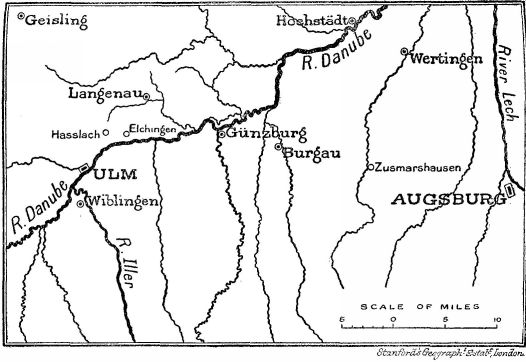
But Mack forgot two essential facts. Until the Russians arrived, he was too weak to hold so advanced a position in what was hostile ground, now that Bavaria and the other South German States obeyed Napoleon's summons to range themselves on his side. Further, he was dangerously exposed on the north, as a glance at the map will show. Ulm and the line of the Iller formed a strong defence against the south-west: but on the north that position is singularly open: it can be turned from the valleys of the Main, the Neckar, and the Altmühl, all of which conduct an invader to the regions east of Ulm. Indeed, it passes belief how even the Aulic Council could have ignored the dangers of that position. Possibly the fact that Ulm had been stoutly held by Kray in 1796 now induced them to overrate its present importance; but at that time the fortified camp of Ulm was the central knot of vast operations, whereas now it was but an advanced outpost. [24] If Francis and his advisers were swayed by historical reminiscences it is strange that they forgot the fate of Melas in Piedmont. The real parallel had been provided, not by Kray, but by the general who was cut off at Marengo. Indeed, in its broad outlines, the campaign of Ulm resembles that of Marengo. Against foes who had thrust their columns far from their base, Napoleon now, as in 1800, determined to deal a crushing blow. On the part of the Austrians we notice the same misplaced confidence, the same lack of timely news, and the same inability to understand Napoleon's plan until his dispositions are complete; while his strategy and tactics in 1805 recall to one's mind the masterly simplicity of design, the subtlety and energy of execution, which led up to his triumph in the plains of Piedmont. [pg.17]
Meanwhile the allies were dissipating their strength. A Russian corps, acting from Corfu as a base, and an English expedition from Malta, were jointly to attack St. Cyr in the south of Italy, raise the country at his rear and compel him to surrender. This plan was left helplessly flapping in the air by a convention which Napoleon imposed on the Neapolitan ambassador. On September 21st Talleyrand induced that envoy to guarantee the neutrality of the kingdom of Naples, all belligerents being excluded from its domains. Consequently St. Cyr's corps evacuated that land and brought a welcome reinforcement to Masséna on the Mincio. Equally skilful was Napoleon's action as regards Hanover. On that side also the allies planned a formidable expedition. From the fortress of Stralsund in Swedish Pomerania, a force of Russians and Swedes, which Gustavus burned to command, was to march into Hanover, and, when strengthened by an Anglo-Hanoverian corps, drive the French from the Low Countries. It is curious to contrast the cumbrous negotiations concerning this expedition—the quarrels about the command, the anxiety at the outset lest Villeneuve should perhaps sail into the Baltic, the delays of the British War Office, the remonstrances of the Czar, and the efforts to avert the jealousy of Prussia—with the serene indifference of Napoleon as to the whole affair. He knew full well that the war would not be decided by diversions at the heel of Italy or on the banks of the Ems, but by the shock of great masses of men on the Danube. He denuded Hanover of French troops, except at its southern fortress of Hameln, so that he could overwhelm the levies of Austria before the Russians came up. In brief, while the Coalition sought, like a Briareus, to envelop him on all sides, he prepared to deal a blow at its heart.
As the first part of the campaign depended almost entirely on problems of time and space, it will be well to follow the chief movements of the hostile forces somewhat closely. The Austrian plan aimed at forestalling the French in the occupation of Swabia; and its [pg.18] apparent success puffed up Mack with boundless confidence. At Ulm he threw up extensive outworks to strengthen that obsolete fortress, extended his lines to Memmingen far on the south, and trusted that the Muscovites would come up long before the French eagles hovered above the sources of the Danube. But at that time the Russian vanguard had not reached Linz in Upper Austria, and not before October 10th did it appear on the banks of the River Inn. [25]
Far from being the last to move, the French Emperor outstripped his enemies in the speed of his preparations. Whereas the Austrians believed he would not be able to reach the Danube in force before November 10th, he intended to have 200,000 men in Germany by September 18th. But he knew not at first the full extent of his good fortune: it did not occur to him that the Austrians would cross the Inn: all he asks Talleyrand, on August 23rd, is that such news may appear in the "Moniteur" as will gain him twenty days and give General Bertrand time to win over Bavaria, while "I make my 200,000 men pirouette into Germany." On August 29th the Army of England became the Grand Army, composed of seven corps, led by Bernadotte, Marmont, Davoust, Soult, Lannes, Ney and Augereau. The cavalry was assigned to Murat; while Bessières was in command of the Imperial Guard, now numbering some 10,000 men.
Already the greater part of this vast array was beginning to move inland; Davoust and Soult left some regiments, 30,000 strong, to guard the flotilla, and Marmont detached 14,000 men to defend the coasts of Holland; but the other corps on September 2nd began their march Rhine-wards in almost their full strength. On that day Bernadotte broke up his cantonments in Hanover, and began his march towards the Main, on which so much was to turn. The Elector of Hesse-Cassel now espoused Napoleon's cause. Thus, without meeting any opposition, Bernadotte's columns reached Würzburg at the close of [pg.19] September; there the Elector of Bavaria welcomed the Marshal and gave him the support of his 20,000 troops; and at that stronghold he was also joined by Marmont.
In order to mislead the Austrians, Napoleon remained up to September 23rd at St. Cloud or Paris; and during his stay appeared a Senatus Consultum ordering that, after January 1st, 1806, France should give up its revolutionary calendar and revert to the Gregorian. He then set out for Strassburg, as though the chief blows were to be dealt through the passes of the Black Forest at the front of Mack's line of defence; and, to encourage that general in this belief, Murat received orders to show his horsemen in the passes held by Mack's outposts, but to avoid any serious engagements. This would give time for the other corps to creep up to the enemy's rear. Mack, meanwhile, had heard of the forthcoming junction of the French and Bavarians at Würzburg, but opined that it threatened Bohemia. [26]
Accordingly, he still clung to his lines, contenting himself with sending a cavalry regiment to observe Bernadotte's movements; but neither he nor his nominal chief, the Archduke Ferdinand, divined the truth. Indeed, so far did they rely on the aid of the Russians as to order back some regiments sent from Italy by the more sagacious Archduke Charles; but 11,000 troops from Tyrol reached the Swabian army. That force was now spread out so as to hold the bridges of the Danube between Ingolstadt and Ulm; and on October 7th the Austrians were disposed as follows: 18,000 men under Kienmayer were guarding Ingolstadt, Neuburg, Donauwörth, Günzburg, and lesser points, while Mack had about 35,000 men at Ulm and along the line of the Iller; the arrival of other detachments brought the Austrian total to upwards of 70,000 men. Against this long scattered line [pg.20] Napoleon led greatly superior forces. [27] The development of his plans proceeded apace. Though Prussia had proclaimed her strict neutrality, he did not scruple to violate it by sending Bernadotte's corps through her principality of Ansbach, which lay in their path. He charged Bernadotte to "offer many assurances favourable to Prussia, and testify all possible affection and respect for her—and then rapidly cross her land, asserting the impossibility of doing anything else." Accordingly, that Marshal was lavish in his regrets and apologies, but ordered his columns to defile past the battalions and squadrons of Prussia, that were powerless to resent the outrage. [28]
The news of this trespass on Prussian territory reached the ears of Frederick William at a critical time, when the Czar sent to Berlin a kind of ultimatum, intimating that, even if Prussia deserted the cause of European independence, Russian troops must nevertheless pass through part of Prussian Poland. Stung by this note from his usually passive demeanour, the King sent off an answer that such a step would entail a Franco-Prussian alliance against the violators of his territory, when the news came that Napoleon had actually done at Ansbach what Alexander had announced his intention of doing in the east. The revulsion of feeling was violent: for a short space the King declared he would dismiss Duroc and make war on Napoleon for this insult, but in the end he called a cabinet council and invited the Czar to come to Berlin. [29]
While the Gallophil counsellors, Haugwitz and [pg.21] Lombard, were using all their arts to hinder the Prusso-Russian understanding, the meshes were being woven fast around Mack and the Archduke Ferdinand. Bernadotte's corps, after making history in its march, was detached to the south-east so as to hold in check the Russian vanguard, and to give plenty of room to the troops that were to cut off Mack from Austria, a move which may be compared with the march of Bonaparte to Milan before he essayed the capture of Melas. Both steps bespeak his desire to have ample space at his back before circling round his prey.
On October 6th the corps of Soult and Lannes, helped by Murat's powerful cavalry, cut the Austrian lines on the Danube at Donauwörth, and gained a firm footing on the right bank. Over the crossing thus secured far in Mack's rear, the French poured in dense array, and marched south and south-west towards the back of the Austrian positions, while Ney's corps marched to seize the chief bridges over the Danube.
A study of the processes of Mack's brain at this time is not without interest. It shows the danger of intrusting the fate of an army to a man who cannot weigh evidence. Mack was not ignorant of the course of events, though his news generally came late. The mischief was that his brain warped the news. On October 6th he wrote to Vienna that the enemy seemed about to aim a blow at his communications: on October 7th, when he heard of the loss of Donauwörth, he described it as an unfortunate event, which no one thought to be possible. The Archduke now urged the need of an immediate retreat towards Munich, and marched in an easterly direction on Günzburg: another Austrian division of 8,000 men moved on Wertingen, where, on October 8th, it was furiously attacked by the troops of Murat and Lannes. At first the Imperialists firmly kept their ranks; but the unequal contest closed with a hasty flight, which left 2,000 men in the hands of the French Then Murat, pressing on through the woods, cut off Mack's retreat to Augsburg. Yet that general still took [pg.22] a cheerful view of his position. On that same day he wrote from Günzburg that, as soon as the enemy had passed over the Lech, he would cross the Danube and cut their communications at Nördlingen. He wrote thus when Ney's corps was striving to seize the Danube bridges below Ulm. If Mack were to march north-east against the French communications it was of the utmost importance for him to hold the chief of these bridges: but Ney speedily seized three of them, and on the 9th was able to draw closer the toils around Ulm.
From his position at Augsburg the French Emperor now directed the final operations; and, as before Marengo, he gave most heed to that side by which he judged his enemy would strive to break through, in this case towards Kempten and Tyrol. This would doubtless have been Mack's safest course; for he was strong enough to brush aside Soult, gain Tyrol, seal up its valleys against Napoleon, and carry reinforcements to the Archduke Charles. But he was still intent on his Nördlingen scheme, even after the loss of the Danube bridges exposed his march thither to flank attacks from the four French corps now south of the river. Nevertheless, Napoleon's miscalculation of Mack's plans, or, as Thiers has striven to prove, a misunderstanding of his orders by Murat, gave the Austrians a chance such as fortune rarely bestows. [30]
In spite of Ney's protests, one of his divisions, that led by Dupont, had been left alone to guard the northern bank of the Danube, a position where it might have been overwhelmed by an enterprising foe. What is more extraordinary, Dupont, with only 6,000 men, was charged to advance on Ulm, and carry it by storm. On the 11th he accordingly advanced against Mack's fortified camp north of that city. The Austrians met him in force, and, despite the utmost heroism of his troops, finally wrested the village of Hasslach from his grasp; later in the day a cloud of their horsemen, swooping [pg.23] round his right wing, cut up his tired troops, took 1,000 prisoners, and left 1,500 dead and wounded on the field. Among the booty was found a despatch of Napoleon ordering Dupont to carry Ulm by storm—which might have shown them that the French Emperor believed that city to be all but deserted. [31] In truth, Napoleon's miscalculation opened for Mack a path of safety; and had he at once marched away to the north, the whole aspect of affairs might have changed. The Russian vanguard was on the banks of the Inn: all the French, except the relics of Dupont's division, were south of the Danube, and a few vigorous blows at their communications might have greatly embarrassed troops that had little artillery, light stores of ammunition, and lived almost entirely on the produce of the country. We may picture to ourselves the fierce blows that, in such a case, Frederick the Great would have rained on his assailants as he wheeled round on their rear and turned their turning movements. With Frederick matched against Napoleon, the Lech and the Danube would have witnessed a very cyclone of war.
But Mack was not Frederick: and he had to do with a foe who speedily made good an error. On October 13th, when Mack seemed about to cut off the French from the Main, he received news through Napoleon's spies that the English had effected a landing at Boulogne, and a revolution had broken out in France. The tidings found easy entrance into a brain that had a strange bias towards pleasing falsities and rejected disagreeable facts. At once he leaped to the conclusion that the moves of Soult, Murat, Lannes, Marmont, and Ney round his rear were merely desperate efforts to cut back a way to Alsace. He therefore held fast to his lines, made only feeble efforts to clear the northern road, and despatched reinforcements to Memmingen. The next day brought other news; that Memmingen had been invested by [pg.24] Soult; that Ney by a brilliant dash across the Danube at Elchingen had routed an Austrian division there, and was threatening Ulm from the north-east; and that the other French columns were advancing from the south-east. Yet Mack, still viewing these facts in the twilight of his own fancies, pictured them as the efforts of despair, not as the drawing in of the hunter's toils.
He was now almost alone in his reading of events. The Archduke Ferdinand, though nominally in supreme command, had hitherto deferred to Mack's age and experience, as the Emperor Francis enjoined. But he now urged the need of instantly marching away to the north with all available forces. Still Mack clung to his notion that it was the French who were in sore straits; and he forbade the evacuation of Ulm; whereupon the Archduke, with Schwarzenberg, Kollowrath, Gyulai, and all whose instincts or rank prompted and enabled them to defy the madman's authority, assembled 1,500 horsemen and rode off by the northern road. It was high time; for Ney, firmly established at Elchingen, was pushing on his vanguard towards the doomed city: Murat and Lannes were charged to support him on the north bank, while across the river Marmont, and further south Soult, cut off the retreat on Tyrol.
At last the scales fell from Mack's eyes. Even now he protested against the mere mention of surrender. But again he was disappointed. Ney stormed the Michaelsberg north of Ulm, a position on which the Austrians had counted; and on October 17th the hapless commander agreed to terms of capitulation, whereby his troops were to march out and lay down their arms in six days' time, if an Austro-Russian army able to raise the siege did not come on the scene. These conditions were afterwards altered by the captor, who, wheedling his captive with a few bland words, persuaded him to surrender on the 20th on condition that Ney and his corps remained before Ulm until the 25th. This was Mack's last offence against his country and his profession; his assent to this wily compromise at once [pg.25] set free the other French corps for offensive operations; and that too when every day was precious to Austria, Russia, and Prussia.
On October 20th the French Emperor, with a brilliant staff, backed by the solid wall of his Guard and flanked by eight columns of his troops, received the homage of the vanquished. First came their commander, who, bowed down by grief, handed his sword to the victor with the words, "Here is the unfortunate Mack." Then there filed out to the foot of the Michaelsberg 20,000 foot and 3,000 horse, who laid down their arms before the Emperor, some with defiant rage, the most part in stolid dejection, while others flung them away with every sign of indecent joy. [32] As if the elements themselves conspired to enhance the brilliance of Napoleon's triumph, the sun, which had been obscured for days by storm-clouds and torrents of rain, now shone brightly forth, bathing the scene in the mild radiance of autumn, lighting up the French forces disposed on the slopes of that natural amphitheatre, while it cast deep shadows from the long trail of the vanquished beneath. The French were electrified by the sight: the fatigues of their forced marches through the dusty heats of September, and the slush, swamps, and torrents of the last few days were all forgotten, and they hailed with jubilant shouts the chief whose sagacity had planned and achieved a triumph hitherto unequalled in the annals of war. "Our Emperor," said they, "has found out a new way of making war: he no longer makes it with our arms, but with our legs." [33]
Meanwhile the other Austrian detachments were being hunted down. Only a few men escaped from Memmingen into Tyrol: the division, which, if properly [pg.26] supported, might have cut a way through to Nördlingen three days earlier, was now overwhelmed by the troops of Murat and Lannes; out of 13,000 foot-soldiers very few escaped. Most of the horsemen succeeded in joining the Archduke Ferdinand, on whose track Murat now flung himself with untiring energy. The beau sabreur swept through part of Ansbach in pursuit, came up with Ferdinand near Nuremberg, and defeated his squadrons, their chief, with about 1,700 horse and some 500 mounted artillerymen, finally reaching the shelter of the Bohemian Mountains. All the rest of Mack's great array had been engulfed.
Thus closed the first scene of the War of the Third Coalition. Hasty preparations, rash plans, and, above all, Mack's fatal ingenuity in reading his notions into facts—these were the causes of a disaster which ruined the chances of the allies. The Archduke Charles, who had been foiled by Masséna's stubborn defence, was at once recalled from Italy in order to cover Vienna; and, worst of all, the Court of Berlin now delayed drawing the sword.
Yet, even amidst the unstinted boons that she showered on Napoleon by land, Fortune rudely baffled him at sea. When he was hurrying from Ulm towards the River Inn, to carry the war into Austria, he heard that the French navy had been shattered. Trafalgar was fought the day after Mack's army filed out of Ulm. The greatest sea-fight of the century was the outcome of Napoleon's desire that his ships should carry succour to his troops in Italy. For this voyage the Emperor was about to substitute Admiral Rosily for Villeneuve: and the unfortunate admiral, divining that resolve, sought by a bold stroke to retrieve his fortunes. He put to sea, and Trafalgar was the result. It would be superfluous to describe this last and most splendid of Nelson's exploits; but a few words as to the bearing of this great victory on the events of that time may not be out of place. It is certain that Villeneuve at Trafalgar fought under more favourable conditions than in the conflict [pg.27] of July 22nd. He had landed his very numerous sick, his crews had been refreshed and reinforced, and, above all, the worst of the Spanish ships had been replaced by seaworthy and serviceable craft. Yet out of the thirty-three sail of the line, he lost eighteen to an enemy that numbered only twenty-seven sail; and that fact alone absolves him from the charge of cowardice in declining to face Cornwallis and Calder in July with ships that were cumbered with sick and badly needed refitting.
Then again: it is often stated that Trafalgar saved England from invasion. To refute this error it is merely needful to remind the reader that all immediate fear of invasion was over, when, at the close of August, Napoleon wheeled the Grand Army against Austria. Not until the Continent was conquered could the landing in Kent become practicable. That opportunity occurred two years later, after Tilsit; then, in truth, the United Kingdom was free from panic because Trafalgar had practically destroyed the French navy. For these islands, then, the benefits of Trafalgar were prospective. But, for the British Empire, they were immediate. Every French, Dutch, and Spanish colony that now fell into our hands was in great measure the fruit of Nelson's victory, which heralded the second and vaster stage of imperial growth.
Finally, the decisive advantage which Britain now gained over Napoleon at sea compelled him, if he would realize the world-wide schemes ever closest to his heart, to adopt the method of warfare against us which he had all along contemplated as an effective alternative. As far back as February, 1798, he pointed out that there were three ways of attacking and ruining England, either a direct invasion, or a French control of North Germany which would ruin British commerce, or an expedition to the Indies. After Trafalgar the first of these alternatives was impossible, and the last receded for a time into the background. The second now took the first place in his thoughts; he could only bring England to his feet and gain a world-empire by shutting [pg.28] out her goods from the whole of the Continent, and thus condemning her to industrial strangulation. In a word, Trafalgar necessitated the adoption of the Continental System, which was built up by the events now to be described.
Note to the Third Edition.—An American critic has charged me with inconsistency in saying that the Third Coalition was not built up by English gold, because I state (p. 5) that the first advances were made by England to Russia. I ought to have used the phrase "the first written proposals that I have found were made," etc. Czartoryski's "Memoirs" (vol. ii., chs. ii.-iii.), to which I referred my readers for details, show clearly that Alexander and his advisers looked on a rupture with France as inevitable, but wished to temporize for some three months or so, until certain matters were cleared up; they therefore cautiously sounded the position at Vienna and London. This passage from Czartoryski (vol. ii., ch. iii.) proves that Russia wanted the English alliance:
"After the diplomatic rupture consequent upon the execution of the Duc d'Enghien, it became indispensable to come to an understanding with the only Power, except Russia, which thought herself strong enough to contend with France—to ascertain as thoroughly as possible what were her inclinations and designs, the principles of her policy, and those which she could be led to adopt in certain contingencies. It would have been a great advantage to obtain the concurrence in our views of so powerful a State as England, and to strive with her for the same objects; but for this it was necessary, not only to make sure of her present inclinations, but to weigh well the possibilities of the future after the death of George III. and the fall of the Pitt Ministry. We had to make England understand that the wish to fight Napoleon was not in itself sufficient to establish an indissoluble bond between her Government and that of St. Petersburg...."
In "F.O.," Russia, No. 55, is a despatch of our ambassador at St. Petersburg, Admiral Warren, of June 30, 1804, in which he reports Czartoryski's concern at rumours of negotiations between England and France: "The prince [Czartoryski] remarked that he could not suppose, after what had passed between the two Courts, and the manner in which the Emperor [Alexander] had explained himself to England, and after the measures which Russia had since proposed, that Great Britain would make a peace at once by herself."
Of these earlier negotiations I have found no trace; but obviously the first proposals for an alliance must have come from Russia. Sweden was the first to propose a monarchical league against Napoleon. (See my article in the "Revue Napoléonienne" for June, 1902.)
After the capitulation of Ulm, the French Emperor marched against the Russian army, which, as he told his troops, English gold had brought from the ends of the earth. As is generally the case with coalitions, neither of the allies was ready in time or sent its full quota. In place of the 54,000 which Alexander had covenanted to send to Austria's support, he sent as yet only 46,000; and of these 8,000 were detached into Podolia in order to watch the warlike moves of the Turks, whom the French had stirred up against the Muscovite.
But Alexander had another and weightier excuse for not denuding his realm of troops, namely, the ambiguous policy of Prussia. Up to the middle of October this great military Power clung to her somewhat threatening neutrality, an attitude not unlike that of the Scandinavian States, which, in 1691, remained deaf to the entreaties of William of Orange to take up the cause of European freedom against Louis XIV., and were dubbed the Third Party. It would seem, however, that the Prussian King had some grounds for his conduct: he feared the Polish influence which Czartoryski wielded over the Czar, and saw in the Russian request for a right of way through Prussian Poland a deep-laid scheme for the seizure of that territory. Indeed, the letters of Czartoryski prove that such a plan was pressed forward, and found much favour with the Czar, though at the last moment he prudently shelved it. [34] [pg.30]
For a time the hesitations of Prussia were ended by Napoleon's violation of Ansbach, and by Alexander's frank explanations at Potsdam; but meanwhile the delays caused by Prussia's suspicions had marred the Austrian plans. A week's grace granted by Napoleon, or a week gained by the Russians on their actual marching time, would have altered the whole situation in Bavaria—and Prussia would have drawn the sword against France to avenge the insult at Ansbach.
On October 10th Hardenberg informed the Austrian ambassador, Metternich, that Frederick William was on the point of declaring for the allies. Nothing, however, was done until Alexander reached Potsdam, and the first news that he received on his arrival (October 25th) was of the surrender of Ulm. Nevertheless, the influence of the Czar checkmated the efforts of Haugwitz and the French party, and kept that Government to its resolve, which on November 3rd took the form of the Treaty of Potsdam between Russia, Austria, and Prussia. Frederick William pledged himself to offer the armed mediation of Prussia, and, if it were refused by Napoleon, to join the allies. The Prussian demands were as follows: indemnities for the King of Sardinia in Lombardy, Liguria, and Parma; the independence of Naples, Holland, Germany, and Switzerland; and the Mincio as Austria's boundary in Italy. [35]
An envoy was to offer these terms to Napoleon, and to bring back a definite answer within one month from the time of his departure, and in the meantime 180,000 Prussians prepared to threaten his flank and rear. Alexander also secretly pledged himself to use his influence with George III. to gain Hanover for Frederick William at the close of the war, England meanwhile subsidizing Prussia and her Saxon allies on the usual scale. The Czar afterwards accompanied the King and Queen to the crypt of the Great Frederick, kissed the [pg.31] tomb, and, as he took his leave of their majesties, cast a significant look at the altar. [36]
Did he fear the peace-loving tendencies of the King, or the treachery of Haugwitz? It is difficult to see good faith in every detail of the treaty. Apart from the strange assumption that England would subsidize Prussia and also give up Hanover, the manner in which the armed mediation was to be offered left several loopholes for escape. After the surrender of Ulm, speedy and vigorous action was needed to restore the balance; yet a month's delay was bargained for. Then, too, Haugwitz, who was charged with this most important mission, deferred his departure for ten days on the plea that Prussia's forces could not be ready before the middle of December. Such was the statement of the leisurely Duke of Brunswick; but it can scarcely be reconciled with Frederick William's threat, a month earlier, of immediate war against the Russians if they entered his lands. Yet now that monarch approved of the delay. Haugwitz therefore did not set out till November 14th, and by that time Napoleon was master of Vienna, and the allies were falling back into Moravia.
We now turn to the scene of war. For the first time in modern history the Hapsburg capital had fallen into the hands of a foreign foe. Napoleon now installed himself at the stately palace of Schönbrunn, while Francis was fleeing to Olmütz and the Archdukes Charles and John were struggling in the defiles of the Alps to disengage themselves from the vanguard of Masséna. The march of the French on Vienna, and thence northwards to Brünn, led to only one incident of general interest, namely, the filching away from the Austrians of the bridge over the Danube to the north of Vienna. As it nears the city, that great river spreads out into several channels, the largest being on the north. The wooden bridge further up the river having been burnt by the Russian rearguard, there remained only the[pg.32] bridge or bridges, opposite the city, on the possession of which Napoleon set much store. He therefore charged Murat and Lannes to secure them if possible.
Murat was smarting under the Emperor's displeasure for a rash advance on Vienna which had wellnigh cost the existence of Mortier's corps on the other bank. Indeed, only by the most resolute bravery did the remnant of that corps hew its way through overwhelming numbers. Murat, who should have kept closely in touch with Mortier by a flotilla of boats, was eager to retrieve his fault, and, with Lannes, Bertrand, and an officer of engineers, he now approached the first part of the bridge as if for a parley during an informal armistice which had just been discussed but not concluded. The French Marshals had disposed the grenadiers of General Oudinot, a body of men as renowned as their leader for fighting qualities, behind some thickets that spread along the southern bank and partly screened the approach. The plank barricade at the southern end was now thrown down, and the four Frenchmen advanced. An Austrian mounted sentinel fired his carbine and galloped away to the main bridge; thereupon the four men advanced, called to the officer there in command as if for a parley, and stopped him in the act of firing the gunpowder stored beneath the bridge, with the assurance that an armistice was, or was about to be, concluded.
Reaching the northern end they repeated their tale, and claimed to see the commander. While the defenders were hesitating, Oudinot's grenadiers were rapidly marching forward. As soon as they were seen, the Austrians prepared once more to fire the bridge. Again they were implored to desist, as peace was as good as signed. But when the grenadiers had reached the northern bank, the mask was dropped: fresh troops were hurrying up and the chance of saving the bridge from their grasp was now lost. By these means did Murat and Lannes secure an undisputed passage to the northern bank, for which four years later the French had desperately to fight. Napoleon was delighted at Murat's exploit, which greatly furthered his[pg.33] pursuit of the allies, and he at once restored that Marshal to high favour. But those who placed gentlemanly conduct above the glamour of a trickster's success were not slow, even then, to express their disapproval of this act of perfidy.[37]
The prolonged retreat into Moravia, the unexpected feebleness of the Hapsburg arms, and the lack of supplies weighed heavily on Alexander's spirits, as is shown in his letter from Olmütz to the King of Prussia on November 19th: "Our position is more than critical: we stand almost alone against the French, who are close on our heels. As for the Austrian army, it does not exist.... If your armies advance, the whole position will alter at once."[38] A few days later, however, when 27,000 more Russians were at hand, including his Imperial Guard, the Czar passed from the depths of depression to the heights of confidence. The caution of his wary commander, Kutusoff, who urged a Fabian policy of delay and retreat, now began to weary him. To retire into northern Hungary seemed ignominious. And though Frederick William held to his resolve of not drawing the sword before December 15th, and by that time the Archduke Charles with a large army was expected below Vienna, yet the susceptible young autocrat spurned the behests of irksome prudence. In vain did Kutusoff and Schwarzenberg urge the need of delay and retreat: Alexander gave more heed to the rash counsels of his younger officers. An advance was ordered on Brünn, and a successful cavalry skirmish at Wischau confirmed the Czar in his change from the strategy of Fabius to that of Varro.
Napoleon, who was now at Brünn, had already divined this change in the temper of his foe, and called back his[pg.34] men with the express purpose of humouring Alexander's latest mood and tempting him on to a decisive battle. He saw clearly the advantage of fighting at once. The renewed offers of an armistice, which he received from the prudent Francis, might alone have convinced him of this; and they came in time to give him an argument, telling enough to daunt the Prussian envoy, who was now drawing near to his headquarters.
After proceeding towards Vienna and being sent back to Brünn, Haugwitz arrived there on November 29th.[39] Of the four hours' private conference that ensued with Napoleon we have but scanty records, and those by Haugwitz himself, who had every reason for warping the truth. He states that he was received with icy coldness, and at once saw that the least threat of hostile pressure by Prussia would drive Napoleon to make a separate peace with Austria. But after the first hour the Emperor appeared to thaw: he discussed the question of a Continental peace and laid aside all resentment at Prussia's conduct: finally, he gave a general assent to her proposals, on two conditions, namely, that the allied force then in Hanover should not be allowed by Prussia to invade Holland, and that the French garrison in the fortress of Hameln, now compassed about by Prussians, should be provisioned. To both of these requests Haugwitz assented, and pledged the word of his King, an act of presumption which that monarch was to repudiate.
While exceeding his instructions on this side, Haugwitz did practically nothing to advance the chief business of his mission. Either his own fears, or the crafty mixture of threats and flattery that cajoled so many envoys, led him to neglect the interests of Prussia, and to play into the hands of the very man whose ambition he was sent to check. After the interview, when the envoy had retired to his lodging, Caulaincourt came up in haste to warn him that a battle was imminent, that his personal safety might be endangered, and that Napoleon requested[pg.35] him to repair to Vienna, where he might consult with Talleyrand on affairs of State. Horses and an escort were ready, and Haugwitz set out for that city, where he arrived on November 30th, only to find that Talleyrand was strictly forbidden to do more than entertain him with commonplaces. Thus, the all-important question as to the action of Prussia's legions was again postponed, even when 150,000 Prussians and Saxons were ready to march against the French communications.
Napoleon's letter of November 30th to Talleyrand reveals his secret anxiety at this time. In truth, the crisis was terrible. With a superior force in front, with the Archdukes Ferdinand and Charles threatening to raise Bohemia and Hungary on his flanks, while two Prussian armies were about to throw themselves on his rear, his position was fully as serious as that of Hannibal before Cannæ, from which the Carthaginian freed himself only by that staggering blow. Did that example inspire the French Emperor, or did he take counsel from his own boundless resources of brain and will? Certain it is that, after a passing fit of discouragement, he braced himself for a final effort, and staked all on the effect of one mighty stroke. In order to hurry on the battle he feigned discouragement and withdrew his lines from Austerlitz to the Goldbach. Already he had sent General Savary to the Czar with proposals for a short truce.[40] The word truce now spelt guile; its offer through Savary, whose hands were stained with the blood of the Duc d'Enghien, was in itself an insult, and Alexander gave that envoy the coolest reception. In return he sent Prince Dolgoruki, the leader of the bellicose youths now high in favour, who proudly declared to the French Emperor the wishes of his master for the independence of Europe—adding among other things that Holland must be free and have Belgium added to it.
This suggestion greatly amused Napoleon, who replied that Russia ought now to think of her own advantages[pg.36] on the side of Turkey. The answer convinced the Czar that Napoleon dreaded a conflict in his dangerously advanced position. He knew not his antagonist's resources. Napoleon had hurried up every available regiment. Bernadotte's corps was recalled from the frontier of Bohemia; Friant's division of 4,000 men was ordered up from Pressburg; and by forced marches it also was nigh at hand on the night of December 1st, worn with fatigue after covering an immense space in two days, but ready to do excellent service on the morrow.[41] By this timely concentration Napoleon raised his forces to a total of at least 73,000 men, while the enemy founded their plan on the assumption that Napoleon had less than 50,000, and would scarcely resist the onset of superior forces.
Their plan was rash, even for an army which numbered about 80,000 men. The Austrian General Weyrother had convinced the Czar that an energetic advance of his left wing, which rested on the southern spurs of the Pratzenberg, would force back Napoleon's right, which was ranged between the villages of Kobelnitz and Sokelnitz, and so roll up his long line that stretched beyond Schlapanitz. This move, if successful, would not only win the day, but decide the campaign, by cutting off the French from their supplies coming from the south and driving them into the exhausted lands around Olmütz. Such was Weyrother's scheme, which enchanted the Czar and moved the fears of the veteran Kutusoff: it was expounded to the Russian and Austrian generals after midnight on December the 2nd. Strong in the great central hill, the Pratzenberg, and the cover of its village at the foot, the Czar had no fear for his centre: to his right or northern wing he gave still less heed, as it rested firmly on villages and was powerful in cavalry and artillery; but his left wing, comprising fully two-fifths of the allied army, was expected easily to defeat Napoleon's weak and scattered right, and so decide the day. Kutusoff[pg.37] saw the peril of massing so great a force there and weakening the centre, but sadly held his peace.
Napoleon had already divined their secret. In his order of battle he took his troops into his confidence, telling them that, while the enemy marched to turn his right, they would expose their flank to his blows. To announce this beforehand was strangely bold, and it has been thought that he had the plan from some traitor on the enemy's staff. No proof of this has been given; and such an explanation seems superfluous to those who have observed Napoleon's uncanny power of fathoming his adversary's designs. The idea of withdrawing one wing in order to tempt the foe unduly to prolong his line on that side, and then to crush it at the centre, or sever it from the centre, is common both to Castiglione and Austerlitz. It is true, the peculiarities of the ground, the ardour of the Russian attack, and the vastness of the operations lent to the present conflict a splendour and a horror which Castiglione lacked. But the tactics which won both battles were fundamentally the same.
He had studied the ground in front of Austerlitz; and the priceless gift of strategic imagination revealed to him what a rash and showy leader would be certain to do on that ground;[42] he tempted him to it, and the announcement of the enemy's plan to the French soldiery supplied the touch of good comradeship which insured their utmost devotion on the morrow. At midnight, as he returned from visiting the outposts, the soldiers greeted him with a weird illumination: by a common impulse they tore down the straw from their rude shelters and held aloft the burning wisps on long poles, dancing the while in honour of the short gray-coated figure, and shouting, "It is the anniversary of the coronation. Long live the Emperor." Thus was the great day ushered in. The welkin glowed with this tribute of an army's [pg.38] heroworship: the frost-laden clouds echoed back the multitudinous acclaim; and the Russians, as they swung forward their left, surmised that, after all, the French would stand their ground and fight, whilst others saw in the flare a signal that Napoleon was once more about to retreat.
December the 2nd may well be the most famous day of the Napoleonic calendar: it was the day of his coronation, it was the day of Austerlitz, and, a generation later, another Napoleon chose it for his coup d'état. The "sun of Austerlitz," which the nephew then hailed, looked down on a spectacle far different from that which he wished to gild with borrowed splendour. Struggling dimly through dense banks of mist, it shone on the faces of 73,000 Frenchmen resolved to conquer or to die: it cast weird shadows before the gray columns of Russia and the white-coats of Austria as they pressed in serried ranks towards the frozen swamps of the Goldbach. At first the allies found little opposition; and Kienmayer's horse cleared the French from Tellnitz and the level ground beyond. But Friant's division, hurrying up from the west, restored the fight and drove the first assailants from the village. Others, however, were pressing on, twenty-nine battalions strong, and not all the tenacious bravery of Davoust's soldiery availed to hold that spot. Nor was it necessary. Napoleon's plan was to let the allied left compromise itself on this side, while he rained the decisive blows at its joint with the centre on the southern spur of the Pratzenberg.
For this reason he reduced Davoust to defensive tactics, for which his stubborn methodical genius eminently fitted him, until the French centre had forced the Russians from the plateau. Opposite or near that height he had posted the corps of Soult and Bernadotte, supporting them with the grenadiers of Oudinot and the Imperial Guard. Confronting these imposing forces was the Russian centre, weakened by the heavy drafts sent towards Tellnitz, but strong in its position and in the experience of its leader Kutusoff. Caution urged him to [pg.39] hold back his men to the last moment, until the need of giving cohesion to the turning movement led the Czar impatiently to order his advance. Scarcely had the Russians descended beyond Pratzen when they were exposed to a furious attack. Vandamme, noted even then as one of the hardest hitters in the army, was leading his division of Soult's corps up the northern slopes of the plateau; by a sidelong slant his men cut off a detachment of Russians in the village, and, aided by the brigade of Thiébault, swarmed up the hill at a speed which surprised and unsteadied its defenders. Oudinot's grenadiers and the Imperial Guard were ready to sustain Soult: but the men of his corps had the glory of seizing the plateau and driving back the Russians. Yet these returned to the charge. Alexander and Kutusoff saw the importance of the heights, and brought up a great part of their reserves. Soon the divisions of
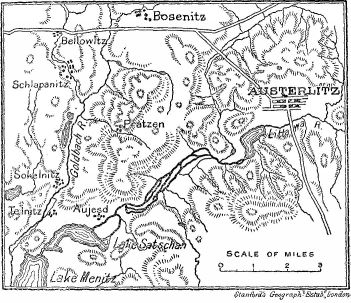
But the Emperor was awaiting the development of events on the wings. A sharp fight of all arms was raging on the plain further to the north. There the allies at first gained ground, the Austrian horse well maintaining its old fame: but the infantry of Lannes' corps, supported by powerful artillery ranged on a small conical hill, speedily checked their charges; the French horse, marshalled by Murat and Kellermann somewhat after the fashion of the British cavalry at Waterloo, so as to support the squares and dash through the intervals in pursuit, soon made most effective charges upon the dense squadrons of the allies, and finally a general advance of Lannes and Murat overthrew the wavering lines opposite and chased them back towards the small town of Austerlitz.
Thus by noon the lines of fighting swerved till they ranged along the course of the Littawa stream, save where the allies had thrust forward a long and apparently successful wedge beyond Tellnitz. The Czar saw the danger of this almost isolated wing, and sought to keep touch with it; but the defects of the allied plan were now painfully apparent. Napoleon, having the interior lines, while his foes were scattered over an irregular arc, could reinforce his hard-pressed right. There Davoust was being slowly borne back, when the march of Duroc with part of the Imperial Guard restored the balance on that side. The French centre also was strengthened by the timely arrival of part of Bernadotte's corps. That Marshal detached a division towards the northern slopes of the plateau; for he divined that there his master would need every man to deal the final blows.[43][pg.41]
In truth, Alexander and Kutusoff were struggling hard to regain the Pratzenberg. Four times did the Muscovites fling themselves on the French centre, and not without some passing gleams of success. Here occurred the most famous cavalry fight of the war. The Russian Guards, mounted on superb horses, had cut up two of Vandamme's battalions, when Rapp rode to their rescue with the chasseurs of the French Imperial Guard. These choice bodies of horsemen met with a terrible shock, which threw the Russians into disorder. Rallied by other squadrons, these now overthrew their assailants and seemed about to overpower them, when Bessières with the heavy cavalry of the Guard fell on the flank of the Muscovite horse and drove their lines, horse and foot, into the valley beyond.
Assured of his centre, Napoleon now launched Soult's corps down the south-western spurs of the plateau upon the flank and rear of the allied left: this unexpected onset was decisive: the French, sweeping down the slopes with triumphant shouts, cut off several battalions on the banks of the Goldbach, scattered others in headlong flight towards Brünn, and drove the greater part down to the Lake of Tellnitz. Here the troubles of the allies culminated. A few gained the narrow marshy gap between the two lakes; but dense bodies found no means of escape save the frozen surface of the upper lake. In some parts the ice bore the weight of the fugitives; but where they thronged pell-mell, or where it was cut up by the plunging fire of the French cannon on the heights, crowds of men sank to destruction. The victors themselves stood aghast at this spectacle; and, for the credit of human nature be it said, many sought to save their drowning foes. Among others, the youthful Marbot swam to a floe to help bring a Russian officer to land, a chivalrous exploit which called forth the praise of Napoleon. The Emperor brought this glorious day to a fitting close by visiting the ground most thickly strewn with his wounded,[pg.42] and giving directions for their treatment or removal. As if satisfied with the victory, he gave little heed to the pursuit. In truth, never since Marlborough cut the Franco-Bavarian army in twain at Blenheim, had there been a battle so terrible in its finale, and so decisive in its results as this of the three Emperors, which cost the allies 33,000 men and 186 cannon.
The Emperors Alexander and Francis fled eastwards into the night. Between them there was now a tacit understanding that the campaign was at an end. On that night Francis sent proposals for a truce; and in two days' time Napoleon agreed to an armistice (signed on December 6th) on condition that Francis would send away the Russian army and entirely exclude that of Prussia from his territories. A contribution of 100,000,000 francs was also laid upon the Hapsburg dominions. On the next day Alexander pledged himself to withdraw his army at once; and Francis proceeded to treat for peace with Napoleon. This was an infraction of the treaties of the Third Coalition, which prescribed that no separate peace should be made.
Under the circumstances, the conduct of the Hapsburgs was pardonable: but the seeming break-up of the coalition furnished the Court of Berlin with a good reason for declining to bear the burden alone. It was not Austerlitz that daunted Frederick William; for, after hearing of that disaster, he wrote that he would be true to his pledge given on November 3rd. But then, on the decisive day (December 15th), came the news of the defection of Austria, the withdrawal of Alexander's army, and the closing of the Hapsburg lands to a Prussian force. These facts absolved Frederick William from his obligations to those Powers, and allowed him with perfect good faith to keep his sword in the scabbard. The change, it is true, sadly dulled the warlike ardour of his army; but it could not be called desertion of Russia and Austria.[44] The disgrace came later, when,[pg.43] on Christmas Day, Haugwitz reached Berlin, and described to the King and Ministers his interview with Napoleon in the palace of Schönbrunn, and the treaty which the victor then and there offered to Prussia at the sword's point.
For most men a great victory such as Austerlitz would have brought a brief spell of rest, especially after the ceaseless toils and anxieties of the previous fortnight. Yet now, after ridding himself of all fear of Austria, Napoleon at once used every device of his subtle statecraft to dissolve the nascent coalition. And Fortune had willed that, when flushed with triumph, he should have to deal with a timorous time-server.
It is the curse of a policy of keeping up a dainty balance in a hurricane that it unmans the balancer, until at last the peacemaker resembles a juggler. A decade of compromise and evasion of difficulties had enfeebled the spirit of Prussia, until the hardest trial for her King was to take any step that could not be retraced. He had often spoken "feelingly, if not energetically," of the predicaments of his position between France, England, and Russia.[45] And, as in the case of that other bon père de famille, Louis XVI., whom Nature framed for a farmhouse and Fate tossed into a revolution, his lack of foresight and resolution took the heart out of his advisers and turned statesmen into trimmers. Even before the news of Austerlitz reached the ears of Talleyrand and Haugwitz at Vienna, the bearer of Prussia's ultimatum was posing as the friend of France. On all occasions he wore the cordon of the Legion of Honour; and while the hosts of East and West were in the death-grapple on the Pratzenberg, he strove to convince the French Foreign Minister that the Prussians had entered Hanover only in order to keep the peace in North Germany; that, as[pg.44] Russians had traversed Prussian territory, the French would, of course, be equally free to do so; that Frederick William objected to the descent of any English force in Hanover, which belonged de facto to France; and finally that the Treaty of Potsdam was not a treaty at all, but merely a declaration with the "offer of Prussia's good offices and of mediation, but without any mingling of hostile intentions." Well might Talleyrand write to Napoleon: "I am very satisfied with M. Haugwitz."[46]
Napoleon's victory over Prussian diplomacy was therefore won, even before the lightning-stroke of Austerlitz blasted the Third Coalition. Haugwitz began his conference with the victor at Schönbrunn on December 13th, by offering Frederick William's congratulations on his triumph at Austerlitz, to which the Emperor replied by a sarcastic query whether, if the result of that battle had been different, he would have spoken at all about the friendship of his master.[47] After thus disconcerting the envoy and upbraiding him with the Treaty of Potsdam, Napoleon unmasked his battery by offering Prussia the Electorate of Hanover in return for the comparatively petty sacrifices of Ansbach to Bavaria, and Cleves and Neufchâtel to France. For the loss of these outlying districts Prussia could buy that long-coveted land.[48] The envoy was dazzled by this glittering offer, and by others that followed. The conqueror proposed an offensive and defensive alliance, whereby France and Prussia mutually guaranteed their lands along with prospective additions in Germany and Italy; and the Court of Berlin was also to uphold the independence of Turkey.
Such were the terms that Napoleon peremptorily required Haugwitz to sign within a few hours: and the bearer of Prussia's ultimatum on December 15th signed[pg.45] this Treaty of Schönbrunn, which degraded the would-be arbitress of Europe to her former position of well-fed follower of France. This was the news which Haugwitz brought back to his astonished King. His reception was of the coolest; for Frederick William was an honest man, who sought peace, prosperity, and the welfare of his people, and now saw himself confronted by the alternative of war or national humiliation. In truth, every turn and double of his course was now leading him deeper into the discredit and ruin which will be described in the next chapter.
Leaving for the present that unhappy King amidst his increasing perplexities, we return to the affairs of Austria. Mack's disaster alone had cast that Government into the depths of despair, and we learn from Lord Gower, our ambassador at St. Petersburg, that he had seen copies of letters written by the Emperor Francis to Napoleon "couched in terms of humility and submission unworthy of a great monarch," to which the latter replied in a tone of superiority and affected commiseration, and with a demand for the Hapsburg lands in Venetia and Swabia.[49]
The same tone of whining dejection was kept up by Cobenzl and other Austrian Ministers, even before Austerlitz, when Prussia was on the point of drawing the sword; and they sent offers of peace, when it was rather for their foe to sue for it. After that battle, and, still more so, after signing the armistice of December 6th, they were at the conqueror's mercy; and Napoleon knew it. After probing the inner weakness of the Berlin Court, he now pressed with merciless severity on the Hapsburgs. He proposed to tear away their Swabian and Tyrolese lands and their share of the spoils of Venice. In vain did the Austrian plenipotentiaries struggle against these harsh terms, pleading for Tyrol and Dalmatia, and pointing out the impossibility of raising 100,000,000 francs from territories ravaged by war. In vain did they proffer a claim to Hanover for one of[pg.46] their Archdukes: though Talleyrand urged the advantage of this step as dissolving the Anglo-Austrian alliance, yet Napoleon refused to hear of it; for at that time he was offering that Electorate to Haugwitz.[50] Still less would he hear a word in favour of the Court of Naples, whose conduct had aroused his resentment. The utmost that the Austrian envoys could wring from him was the reduction of the war contribution to 40,000,000 francs.
The terms finally arranged in the Treaty of Pressburg (December 26th, 1805) may be thus summarized: Austria recognized the recent acquisitions and changes of title made by Napoleon in Italy, and ceded to him her parts of Venetia, Istria, and Dalmatia. She recognized the title of King now bestowed by Napoleon on the Electors of Bavaria and Würtemberg, a change which was not to invalidate their membership of the "Germanic Confederation." To those potentates and to the Elector (now Grand Duke) of Baden, the Hapsburgs ceded all their scattered Swabian domains, while Bavaria also gained Tyrol and Vorarlberg. As a slight compensation for these grievous losses, Austria gained Salzburg, whose Elector was to receive from Bavaria the former principality of Würzburg. The domains and revenues of the Teutonic and Maltese Orders were secularized, so as to furnish appanages to some other princes of the Hapsburg House; and another blow was dealt at the Germanic system by the declaration that Napoleon guaranteed the full and entire sovereignty of the rulers of Bavaria, Würtemberg, and Baden. In fact, as will appear in the next chapter, Napoleon now usurped the place in Germany previously held by the Hapsburgs, and extended his influence as far east as the River Inn, and, on the south, down to the remote city of Ragusa on the Adriatic.
But it is one thing to win a brilliant diplomatic triumph, and quite another thing to secure a firm and lasting peace. The Peace of Pressburg raised Napoleon to[pg.47] heights of power never dreamt of by Louis XIV.: but his pre-eminence was at best precarious. When by moderate terms he might have secured the alliance of Austria and severed her friendship with England, he chose to place his heel on her neck and drive her to secret but irreconcilable hatred.
And his choice was deliberate. Two months earlier, Talleyrand had sent him a memorandum on the subject of a Franco-Austrian alliance, which is instinct with statesmanlike foresight. He stated that there were four Great Powers—France, Great Britain, Russia, and Austria: he excluded Prussia, whose rise to greatness under Frederick the Great was but temporary. Austria, he claimed, must remain a Great Power. She had opposed revolutionary France; but with Imperial France she had no lasting quarrel. Rather did her manifest destiny clash with that of Russia on the lower Danube, where the approaching break-up of the Ottoman Power must bring those States into conflict. It was good policy, then, to give a decided but friendly turn of Hapsburg policy towards the east. Let Napoleon frankly approach the Emperor Francis and say in effect: "I never sought this war with you, but I have conquered: I wish to restore complete harmony between us: and, in order to remove all causes of dispute, you must give up your Swabian, Tyrolese, and Venetian lands: of these Tyrol shall fall to a prince of your choice, and Venice (along with Trieste and Istria) shall form an aristocratic Republic under a magistrate nominated in the first instance by me. As a set-off to these losses, you shall receive Moldavia, Wallachia, and northern Bulgaria. If the Russians object to this and attack you, I will be your ally." Such was Talleyrand's proposal.[51]
It is easy to criticise it in many details; but there can be little doubt that its adoption by Napoleon would have[pg.48] laid a firmer foundation for French supremacy than was afforded by the Treaties of Pressburg and Tilsit. Austria would not have been deeply wounded, as she now was by the transfer of her faithful Tyrolese to the detested rule of Bavaria, and by the undisguised triumph of Napoleon in Italy and along the Adriatic. Moreover, the erection of Tyrol and Venetia into separate States would have been a wise concession to those clannish societies; and Austria could not have taken up the championship of outraged Tyrolese sentiment, which she assumed four years later. Instead of figuring as the leader of German nationality, she would have been on the worst of terms with the Czar over the Eastern Question; and their discord would have enabled France to dictate her own terms as to the partition of the Sultan's dominions. Talleyrand had no specific for dissolving the traditional friendship of England and Austria, and we may imagine the joy with which he heard from the Hapsburg envoys the demand for Hanover, at a time when English gold was pouring into the empty coffers at Vienna. Here was the sure means of embroiling England and Austria for a generation at least. But this further chance of preventing future coalitions was likewise rejected by Napoleon, who deliberately chose to make Austria a deadly foe, and to aggrandize her rival Prussia.[52]
Why did Napoleon reject Talleyrand's plan? Unquestionably, I think, because he had resolved to build up a Continental System, which should "hermetically seal" the coasts of Europe against English commerce. If he was to realize those golden visions of his youth, ships, colonies, and an Eastern empire, which, even amidst the glories of Austerlitz, he placed far above any European triumph, he must extend his coast system and subject or conciliate the maritime States. Of these the most important were Prussia and Russia. The seaborne commerce of Austria was insignificant, and could[pg.49] easily be controlled from his vassal lands of Venetia and Dalmatia. To the would-be conqueror of England the friendship or hatred of Austria seemed unimportant: he preferred to depress this now almost land-locked Power, and to draw tight the bonds of union with Prussia, always provided that she excluded British goods.[53]
The same reason led him to hope for a Russian alliance. Only by the help of Russia and Prussia could he shut England out from the Baltic; and, to win that help, he destined Hanover for Prussia and the Danubian States for the Czar. For the founder of the Continental System such a choice was natural; but, viewed from the standpoint of Continental politics, his treatment of Austria was a serious blunder. His frightful pressure on her motley lands endowed them with a solidity which they had never known before; and in less than four years, the conqueror had cause to regret having driven the Hapsburgs to desperation. It may even be questioned whether Austerlitz itself was not a misfortune to him. Just before that battle he thought of treating Austria leniently, taking only Verona and Legnago, and exchanging Venetia against Salzburg. This would have detached her from the Coalition, and made a friend of a Power that is naturally inclined to be conservative.
After Austerlitz, he rushed to the other extreme and forced the Hapsburgs to a hostility in which the Marie Louise marriage was only a forced and uneasy truce. His motives are not, in my judgment, to be assigned to mere lust of domination, but rather to a reasoned though exaggerated conviction of the need of Prussia and Russia to his Continental System. Above all things, he now sought to humble England, so that finally he might be free for his long-deferred Oriental enterprise. This is the irony of his career, that, though he preferred the career of Alexander the Great to that of Cæsar; though he placed his victory at Austerlitz far below the triumph[pg.50] of the great Macedonian at Issus which assured the conquest of the Orient, yet he felt himself driven to the very measures which tethered him to cette vieille Europe and which finally roused the Continent against him.
Among his errors of judgment, assuredly his behaviour to Austria in 1805 was not the least. The recent history of Europe supplies a suggestive contrast. Two generations after Austerlitz, the Hapsburg Power was shattered by the disaster of Königgrätz, and once more lost all influence in Germany and Italy. But the victor then showed consideration for the vanquished. Bismarck had pondered over the lessons of history, because, as he said, history teaches one how far one may safely go. He therefore persuaded King William to forego claims that would have embittered the rivalry of Prussia and Austria. Nay! he recurred to Talleyrand's policy of encouraging the Hapsburgs to seek in the Balkan Peninsula compensation for their losses in the west: and within fifteen years the basis of the Triple Alliance was firmly laid. Napoleon, on the other hand, for lack of that statesmanlike moderation which consecrates victory and cements the fabric of an enduring Empire, soon saw the political results of Austerlitz swept away by the rising tide of the nations' wrath. In less than nine years the Austrians and their allies were masters of Paris.
NOTE TO THE THIRD EDITION.—The account given on p. 41 of the drowning of numbers of Russians at the close of the Battle of Austerlitz was founded upon the testimony of Napoleon and many French generals; the facts, as related by Lejeune, seemed quite convincing; the Czar Alexander also asserted at Vienna in 1815 that 20,000 Russians had been drowned there. But the local evidence (kindly furnished to me by Professor Fournier of Vienna) seems to prove that the story is a myth. Both lakes were drained only a few days after the battle, at Napoleon's orders; in the lower lake not a single corpse was found; in the upper lake 150 corpses of horses, but only two, some say three, of men, were found. Probably Napoleon invented the catastrophe for the sake of dramatic effect, and others followed the lead given in his bulletin. The Czar may have adopted the story because it helped to excuse his defeat. (See my article in the "Eng. Hist. Rev." for July, 1902.)
An eminent German historian, who has striven to say some kind words about Frederick William's Government before the collapse at Jena, prefaces his apology by the axiom that from a Prussian monarch one ought to expect, not French, English, or Russian policy, but only Prussian policy. The claim may well be challenged. Doubtless, there are some States concerning which it would be true. Countries such as Great Britain and Spain, whose areas are clearly defined by nature, may with advantage be self-contained until their peoples overflow into new lands: before they become world Powers, they may gain in strength by being narrowly national. But there are other States whose fortunes are widely different. They represent some principle of life or energy, in the midst of mere political wreckage. If the binding power, which built up an older organism, should decline, as happened to the Holy Roman Empire after the religious wars, fragments will fall away and join bodies to which they are now more akin.
Of the States that throve among the crumbling masses of the old Empire the chief was Brandenburg-Prussia. She had a twofold energy which the older organism lacked: she was Protestant and she was national; she championed the new creed cherished by the North Germans, and she felt, though dimly as yet, the strength that came from an almost single kin. Until she seized on part of the spoils of Poland, her Slavonic subjects were for the most part germanized Slavs; and even[pg.52] after acquiring Posen and Warsaw at the close of the eighteenth century, she could still claim to be the chief Germanic State. A generation earlier, Frederick the Great had seen this to be the source of her strength. His policy was not merely Prussian: in effect, if not in aim, it was German. His victory at Rossbach over a great polyglot force of French and Imperialists first awakened German nationality to a thrill of conscious life; and the last success of his career was the championship of the lesser German princes against the encroachments of the Hapsburgs. In fact, it seems now a mere commonplace to assert that Prussia has prospered most when, as under Frederick the Great and William the Great, her policy has been truly German, and that she has fallen back most in the years 1795-1806 and 1848-1852, when the subservience of her Frederick Williams to France and Austria has lost them the respect and support of the rest of the Fatherland. A State that would attract other fragments of the same nation must be attractive, and it must be broadly national if it is to attract. If Stein and Bismarck had been merely Prussians, if Cavour's policy had been narrowly Sardinian, would their States ever have served as the rallying centres for the Germany and Italy of to-day?
The difficulties which beset Frederick William III. in 1805 were not entirely of his own making. His predecessor of the same ill-omened name, when nearing the close of his inglorious reign, made the Peace of Basel (1795), which began to place the policy of Berlin at the beck and call of the French revolutionists. But the present ruler had assured Prussia's subservience to France at the time of the Secularizations, when he gained Erfurt, Eichsfeld, Hildesheim, Paderborn, and a great part of the straggling bishopric of Münster. Even at that time of shameless rapacity, there were those who saw that the gain of half a million of subjects to Prussia was a poor return for the loss of self-respect that befell all who shared in the sacrilegious plunder bartered away by Bonaparte and Talleyrand. Frederick William III.[pg.53] was even suspected of a leaning towards French methods of Government; and a Prussian statesman said to the French ambassador:
"You have only the nobles against you: the King and the people are openly for France. The revolution which you have made from below upwards will be slowly effected in Prussia from above downwards: the King is a democrat after his fashion: he is always striving to curtail the privileges of the nobles, but by slow means. In a few years feudal rights will cease to exist in Prussia."[54]
Could the King have carried out these much-needed reforms, he might perhaps have opposed a solid society to the renewed might of France. But he failed to set his house in order before the storm burst; and in 1803 he so far gave up his championship of North German affairs as to allow the French to occupy Hanover, a land that he and his Ministers had long coveted.
We saw in the last chapter that Hanover was the bait whereby Napoleon hooked the Prussian envoy, Haugwitz, at Schönbrunn; and that the very man who had been sent to impose Prussia's will upon the French Emperor returned to Berlin bringing peace and dishonour. The surprise and annoyance of Frederick William may be imagined. On all sides difficulties were thickening around him. Shortly before the return of Haugwitz to Berlin, the Russian troops campaigning in Hanover had been placed under the protection of Prussia; and the King himself had offered to our Minister, Lord Harrowby, to protect Cathcart's Anglo-Hanoverian corps which, with the aid of Prussian troops, was restoring the authority of George III. in that Electorate.
Moreover, Frederick William could not complain of any shabby treatment from our Government. Knowing that he was set on the acquisition of Hanover and could only be drawn into the Coalition by an equally attractive offer, the Pitt Ministry had proposed through Lord Harrowby[pg.54] the cession to Prussia at the general peace of the lands south-west of the Duchy of Cleves, "bounded by a frontier line drawn from Antwerp to Luxemburg," and connected with the rest of her territories.[55] This plan, which would have planted Prussia firmly at Antwerp, Liège, Luxemburg, and Cologne, also aimed at installing the Elector of Salzburg in the rest of the new Rhenish acquisitions of France; while the equipoise of the Powers was to be adjusted by the cession of Salzburg, the Papal Legations, and the line of the Mincio to Austria, she in her turn giving up part of her Dalmatian lands to Russia. Prussia was to be the protectress of North Germany and regard any incursion of the French, "north of the Maine or at least of the Lahn," as an act of war. Great Britain, after subsidizing Prussia for 100,000 troops on the usual scale, pledged herself to restore all her conquests made, or to be made, during the war, with the exception of the Cape of Good Hope: but no questions were to be raised about that desirable colony, or Malta, or the British maritime code.[56]
At the close of 1805, then, Frederick William was face to face with the offers of England and those brought by Haugwitz from Napoleon. That is, he had to choose between the half of Belgium and the Rhineland as offered by England, or Hanover as a gift from Napoleon. The former gain was the richer, but apparently the more risky, for it entailed the hatred of France: the latter seemed to secure the friendship of the conqueror, though at the expense of the claims of honour and a naval[pg.55] war with England. His confidential advisers, Lombard, Beyme, and Haugwitz, were determined to gain the Electorate, preferably at Napoleon's hands; while his Foreign Minister, Hardenberg, a Hanoverian by birth, desired to assure the union of his native land with Prussia by more honourable means, and probably by means of an exchange with George III., which will be noticed presently. In his opposition to French influence, Hardenberg had the support of the more patriotic Prussians, who sought to safeguard Prussia's honour, and to avert war with England. The difficulty in accepting the Electorate at the point of Napoleon's sword was not merely on the score of morality: it was due to the presence of a large force of English, Hanoverians, and Russians on the banks of the Weser, and to the protection which the Prussian Government had offered to those troops against any French attack, always provided that they did not move against Holland and retired behind the Prussian battalions.[57] The indignation of British officers at this last order is expressed by Christian Ompteda, of the King's German Legion, in a letter to his brother at Berlin: "My dear fellow, if this sort of thing goes on, the Continent will soon be irrecoverably lost. The Russian and English armies will not long creep for refuge under the contemptible Prussian cloak. We are here, 40,000 of the best and bravest troops. A swift move on Holland only would have opened the road to certain success.... And this is Lombard's and Haugwitz's work!"[58]
What meanwhile were George III.'s Ministers doing? At this crisis English policy suffered a terrible blow. Death struck down the "stately column" that held up the swaying fortunes of our race. William Pitt, long failing in health, was sore-stricken by the news of Austerlitz and the defection of Austria. But the popular version as to the cause of his death—that Austerlitz killed Pitt—is more melodramatic than correct. Among the many causes that broke that [pg.56] unbending spirit, the news of the miserable result of the Hanoverian Expedition was the last and severest. The files of our Foreign Office papers yield touching proof of the hopes which the Cabinet cherished, even after Vienna was in Napoleon's hands. Harrowby was urged to do everything in his power—short of conceding Hanover—to bring Prussia into the field, in which case "nearly 300,000 men will be available in North Germany at the beginning of the next campaign, which will include 70,000 British and Hanoverian troops employed there or in maritime enterprises."[59] To this hope Pitt clung, even after hearing the news of Austerlitz, and it was doubtless this which enabled him to bear that last journey from Bath to Putney Heath, with less fatigue and far more quickly than had been expected. He arrived home on Saturday night, January 11th. On the following Wednesday his friend, George Rose, called on him and found that a serious change for the worse had set in.
"On the Sunday he was better, and continued improving till Monday in the afternoon, when Lord Castlereagh insisted on seeing him, and, having obtained access to him, entered (Lord Hawkesbury being also present) on points of public business of the most serious importance (principally respecting the bringing home the British troops from the Continent), which affected him visibly that evening and the next day, and this morning the effect was more plainly observed: ... his countenance is extremely changed, his voice weak, and his body almost wasted."
It is clear also from the medical evidence which the diarist gives that the news from Hanover was the cause of this sudden change. On the previous Sunday, that is, just after the fatigue of the three days' journey, the physicians "thought there was a reasonable prospect of Mr. Pitt's recovery, that the probability was in favour of it, and that, if his complaint should not take an unfavourable turn, he might be able to attend to business in about a[pg.57] month."[60] That unfavourable turn took place when the heroic spirit lost all hope under the distressing news from Berlin and Hanover. Austerlitz, it is true, had depressed him. Yet that, after all, did not concern British honour and the dearest interests of his master.
But, that Frederick William, from whom he had hoped so much, to whom he was on the point of advancing a great subsidy, should now fall away, should talk of peace with Napoleon and claim Hanover, should forbid an invasion of Holland and request the British forces to evacuate North Germany—this was a blow to George III., to our military prestige, and to the now tottering Ministry. How could he face the Opposition, already wellnigh triumphant in the sad Melville business, with a King's Speech in which this was the chief news? Losing hope, he lost all hold on life: he sank rapidly: in the last hours his thoughts wandered away to Berlin and Lord Harrowby. "What is the wind?" he asked. "East; that will do; that will bring him fast," he murmured. And, on January 23rd, about half an hour before he breathed his last, the servant heard him say: "My country: oh my country."[61]
Thus sank to rest, amidst a horror of great darkness, the statesman whose noon had been calm and glorious. Only a superficial reading of his career can represent him as eager for war and a foe to popular progress. His best friends knew full well his pride in the great financial achievements of 1784-6, his resolute clinging to peace in 1792, and his longing for a pacification in 1796, 1797, and 1800, provided it could be gained without detriment to our allies and to the vital interests of Britain. His defence lies buried amidst the documents of our Record Office, and has not yet fully seen the light. For he was a reserved man, the warmth of whose nature blossomed forth only to a few friends, or on such occasions as his inspired speech on the emancipation of slaves. To outsiders he had more than the usual fund of English[pg.58] coldness: he wrote no memoirs, he left few letters, he had scant means of influencing public opinion; and he viewed with lofty disdain the French clamour that it was he who made and kept up the war. "I know it," he said; "the Jacobins cry louder than we can, and make themselves heard."[62] He was, in fact, a typical champion of our rather dumb and stolid race, that plods along to the end of the appointed stage, scarcely heeding the cloud of stinging flies. Both the people and its champion were ill fitted to cope with Napoleon. None of our statesmen had the Latin tact and the histrionic gifts needful to fathom his guile, to arouse the public opinion of Europe against him, or to expose his double-dealing.
But Pitt was unfortunate above all of them. It was his fate to begin his career in an age of mediocrities and to finish it in an almost single combat with the giant. He was no match for Napoleon. The Coalition, which the Czar and he did so much to form, was a house of cards that fell at the conqueror's first touch; and the Prussian alliance now proved to be a broken reed. His notions of strategy were puerile. The French Emperor was not to be beaten by small forces tapping at his outworks; and Austria might reasonably complain that our neglect to attack the rear of the Grand Army in Flanders exposed her to the full force of its onset on the Danube. But though his genius pales before the fiery comet of Napoleon, it shines with a clear and steady radiance when viewed beside that of the Continental statesmen of his age. They flickered for a brief space and set. His was the rare virtue of dauntless courage and unswerving constancy. By the side of their wavering groups he stands forth like an Abdiel:
"Unshaken, unseduced, unterrified,While English statesmanship was essaying the task of[pg.59] forming a Coalition Ministry under Fox and Grenville, Napoleon with untiring activity was consolidating his position in Germany, Italy, and France. In Germany he allied his family by marriage with the now royal Houses of Bavaria and Würtemberg. He chased the Bourbons of Naples from their Continental domains. In France he found means to mitigate a severe financial crisis, and to strengthen his throne by a new order of hereditary nobility. In a word, he became the new Charlemagne.
The exaltation of the South German dynasties had long been a favourite project with Napoleon, who saw in the hatred of the House of Bavaria for Austria a sure basis for spreading French influence into the heart of Germany. Not long after the battle of Austerlitz, the Elector of Bavaria, while out shooting, received from a French courier a letter directed to "Sa Majesté le Roi de Bavière et de Suabe."[63] This letter was despatched six days after a formal request was sent through Duroc, that the Elector would give his daughter Augusta in marriage to Eugène Beauharnais. The affair had been mooted in October: it was clinched by the victory of Austerlitz; and after Napoleon's arrival at Munich on the last day of the year, the final details were arranged. The bridegroom was informed of it in the following laconic style: "I have arrived at Munich. I have arranged your marriage with the Princess Augusta. It has been announced. This morning the princess visited me, and I spoke with her for a long time. She is very pretty. You will find herewith her portrait on a cup; but she is much better looking." The wedding took place at Munich as soon as the bridegroom could cross the Alps; and Napoleon delayed his departure for France in order to witness the ceremony which linked him with an old reigning family. At the same time he arranged a match between Jerome Bonaparte and Princess Catherine of Würtemberg. This was less expeditious, partly because, in the case of a Bonaparte, Napoleon judged it needful to sound the[pg.60] measure of his obedience. But Jerome had been broken in: he had thrown over Miss Paterson, and, after a delay of a year and a half, obeyed his brother's behests, and strengthened the ties connecting Swabia with France. A third alliance was cemented by the marriage of the heir to the Grand Duchy of Baden with Stéphanie de Beauharnais, niece of Josephine.
In the early part of 1806 Napoleon might flatter himself with his brilliant success as a match-maker. Yet, after all, he was less concerned with the affairs of Hymen than with those of Mars and Mercury. He longed to be at Paris for the settlement of finances; and he burned to hear of the expulsion of the Bourbons from Naples. For this last he had already sent forth his imperious mandates from Vienna; and, after a brief sojourn at the Swabian capitals, he set out for Paris, where he arrived incognito at midnight of January 26th. During his absence of one hundred and twenty-five days he had captured or destroyed two armies, stricken a mighty coalition to the heart, shattered the Hapsburg Power, and revolutionized the Germanic system by establishing two Napoleonic kingdoms in its midst.
Yet, as if nothing had been done, and all his hopes and thoughts lay in the future, he summoned his financial advisers to a council for eight o'clock in the morning. Scarcely did he deign to notice their congratulations on his triumphs. "We have," he said, "to deal with more serious questions: it seems that the greatest dangers of the State were not in Austria: let us hear the report of the Minister of the Treasury." It then appeared that Barbé-Marbois had been concerned in risky financial concerns with the Court of Spain, through a man named Ouvrard. The Minister therefore was promptly dismissed, and Mollien then and there received his post. The new Minister states in his memoirs that the money, which had sufficed to carry the French armies from the English Channel to the Rhine, had been raised on extravagant terms, largely on loans on the national domains. In fact, it had been an open question whether victory[pg.61] would come promptly enough to avert a wholesale crash at Paris.
So bad were the finances that, though 40,000,000 francs were poured every year into France as subsidies from Italy and Spain, yet loans of 120,000,000 francs had been incurred in order to meet current expenses.[64] It would exceed the limits of our space to describe by what forceful means Napoleon restored the financial equilibrium and assuaged the commercial crisis resulting from the war with England. Mollien soon had reason to know that, so far from avoiding Continental wars, the Emperor thenceforth seemed almost to provoke them, and that the motto—War must support war—fell far short of the truth. Napoleon's wars, always excepting his war with England, supported the burdens of an armed peace. In this respect his easy and gainful triumph over Austria was a disaster for France and Europe. It beckoned him on to Jena and Tilsit.
While reducing his finances to order and newspaper editors to servility, the conqueror received news of the triumph of his arms in Southern Italy. There the Bourbons of Naples had mortally offended him. After concluding a convention for the peaceable withdrawal of St. Cyr's corps and the strict observance of neutrality by the kingdom of Naples, Ferdinand IV. and his Queen Caroline welcomed the arrival at their capital of an Anglo-Russian force of 20,000 men, and intrusted the command of these and of the Neapolitan troops to General Lacy.[65] This force, it is true, did little except weaken the northward march of Masséna; but the violation of neutrality by the Bourbons galled Napoleon. At Vienna he refused to listen to the timid pleading of the Hapsburgs on their behalf, and as soon as peace was signed at[pg.62] Pressburg he put forth a bulletin stating that St. Cyr was marching on Naples to hurl from the throne that guilty woman who had so flagrantly violated all that is sacred among men. France would fight for thirty years rather than pardon her atrocious act of perfidy: the Queen of Naples had ceased to reign: let her go to London and form a committee of sympathetic ink with Drake, Spencer-Smith, Taylor, and Wickham.
This diatribe was not the first occasion on which the conqueror had proved that he was no gentleman. In his brutal letter of January 2nd, 1805, to Queen Caroline, he told her that, if she was the cause of another war, she and her children would beg their bread all through Europe. That and similar outbursts afford some excuse for the conduct of the Bourbons in the autumn of 1805. They infringed the neutrality which their ambassador had engaged to observe: but it is to be remembered that Napoleon's invasion of the Neapolitan States in 1803 was a gross violation of international law, which the French Foreign Office sought to cloak by fabricating two secret articles of the Treaty of Amiens.[66] And though troth should doubtless be kept, even with a law-breaker, yet its violation becomes venial when the latter adopts the tone of a bully. For the present he triumphed. Joseph Bonaparte invaded Naples in force, and on January 13th the King, Queen, and Court set sail for Palermo. The Anglo-Russian divisions re-embarked and sailed away for Malta and Corfu. One of the Neapolitan strongholds, Gaëta, held out till the middle of July. Elsewhere the Bourbon troops gave little trouble.
The conquest of Naples enabled Napoleon to extend his experiment of a federation of Bonapartist Kings. He announced to Miot de Melito, now appointed one of Joseph's administrators, his intentions in an interview at the Tuileries on January 28th. Joseph was to be King of Naples, if he accepted the honour quickly. If not, the Emperor would adopt a son, as in the case of Eugène,[pg.63] and make him King.—"I don't need a wife to have an heir. It is by my pen that I get children."—But Joseph must also show himself worthy of the honour. Let him despise fatigue, get wounded, break a leg.
"Look at me. The recent campaign, agitation, and movement have made me fat. I believe that if all the kings coalesced against me, I should get a quite ridiculous stomach.... You have heard my words. I can no longer have relatives in obscurity. Those who will not rise with me, shall no longer be of my family. I am making a family of kings attached to my federative system."[67]
The threat having had its effect, Joseph was proclaimed King of Naples by a decree of Napoleon. "Keep a firm hand: I only ask one thing of you: be entirely the master there."[68] Such was the advice given to his amiable brother, who after enjoying a military promenade southwards was charged to undertake the conquest of Sicily. It mattered little that the overthrow of the Neapolitan Bourbons offended the Czar, who had undertaken the protection of that House.
As though intent on browbeating Alexander by an exhibition of his power, Napoleon lavished Italian titles on his Marshals and statesmen. Talleyrand became Prince of Benevento; and Bernadotte, Prince of Ponte-Corvo (two Papal enclaves in Neapolitan soil). To these and other titles were attached large domains (not divisible at death), which enabled his paladins and their successors to support their new dignities with pomp and splendour; especially was this so with the two titles which his bargains with Prussia and Bavaria enabled him to bestow. Thanks to the complaisance of their Kings, the[pg.64] Grand Duchy of Berg and Cleves was granted to Murat, while the energetic and trusty Berthier was rewarded with the Principality of Neufchâtel and a truly princely fortune.[69]
Thus was founded the Napoleonic nobility; and thus was fulfilled Mme. de Staël's prophecy that the priests and nobles would be the caryatides of the future throne. The change was brought about skilfully. It took place when pride in Napoleon's exploits was at its height, and when the "Gazette de France" asserted:
"France is henceforth the arbitress of Europe.... Civilization would have perished in Europe, if forth from the ruins there had not arisen one of these men before whom the world keeps silence, and to whom Providence seems to intrust its destinies."[70]
This adulation, which recalls that of the Court of Augustus or Tiberius, gives the measure of French thought. In truth, Napoleon showed profound insight into human nature when he judged the hatred of an order of nobility to be a mere passing spasm of revolutionary fever; and he evinced equal good sense in restoring that order through the chiefs of the one truly popular institution in France, the army. Besides, the new titles were not taken from French domains, which would have revived the idea of feudal dependence in France: they were the fruit of Napoleon's great victory; and the sound of distant names like Benevento, Berg, and Dalmatia skilfully flattered the pride of la grande nation.
It is now time to return to the affairs of Prussia and to point out the chief stages in her downward course. On January 3rd, 1806, an important State Council was held at Berlin in order to decide on certain modifications to the Schönbrunn Treaty with Napoleon. The chief change resolved on was as follows: Instead of the[pg.65] cessions of territory being immediate and absolute, as proposed by Napoleon, they were not to take effect before the general peace. Until that took place, Frederick William resolved to occupy Hanover provisionally, meanwhile answering to France for the tranquillity of the north of Germany.[71] The Prussian Government therefore gave strong hints that the presence of a British force there was objectionable, and the troops were withdrawn.[72]
Napoleon was to be less pliable. And yet Haugwitz assured the Prussian King and council that he had looked Napoleon through and through, and had discerned an unexpressed wish to deal easily with Prussia. As to his acceptance of these changes in the Schönbrunn Treaty, Haugwitz felt no doubt whatever, at least so his foe, Hardenberg, states. But the Prussian Ministers were now proposing, not the offensive and defensive treaty of alliance that Napoleon required, but rather a mediation for peace between France and England. They were, in fact, striving to steer halfway between Napoleon and George III.—and gain Hanover. Verily, here was a belief in half measures passing that of women.
The envoy despatched to assure Napoleon's assent to these new conditions was the very man who had quailed before the Emperor at Schönbrunn. Count Haugwitz set out on January 14th for Munich and thence for Paris; but long before any definite news was received from him, the Court of Berlin decided, on the strength of a few oily compliments from the French ambassador, Laforest, to regard the acceptance of Napoleon as fully assured. Accordingly, on January 24th, the Government resolved to place the Prussian army on a peace-footing and recall the troops from Franconia, as a daily saving of 100,000 thalers might thereby be effected. Never was there a greater act of extravagance. As soon as the retreat and demobilizing of the Prussian forces was announced, the French troops in Bavaria and Franconia began to press forward, while others poured across the[pg.66] Rhine. Affecting to ignore these threatening moves, the Prussian Court strove peaceably to acquire Hanover by secretly offering George III. a re-arrangement of territories, whereby the Hanoverian lands east of the Weser, along with a few districts west of Hameln and Nienburg, should pass to Prussia. Frederick William proposed to keep Minden and Ravensburg, but to cede East Frisia and all the rest of his Westphalian possessions to King George, who would retain the electoral dignity for these new lands.[73] The only reply that our ruler deigned to this offer was that he trusted:
"His Prussian Majesty will follow the honourable dictates of his own heart, and will demonstrate to the world that he will not set the dreadful example of indemnifying himself at the expense of a third party, whose sentiments and conduct towards him and his subjects have been uniformly friendly and pacifick."[74]
But by the close of February this appeal fell on deaf ears. Frederick William had decided to comply with Napoleon's terms and was about to take formal possession of Hanover.
The conqueror was far from taking that easy view of the changes made in the Schönbrunn Treaty which the discerning Haugwitz had trustfully expected. At first, every effort was made by Talleyrand to delay his interview with the Emperor, evidently in the hope that the subtle flattery of Laforest at Berlin would lead to the demobilization of the Prussian forces. This fatal step was known at Paris before February 6th, when Haugwitz was received by the Emperor; and the knowledge that Prussia was at his mercy decided the conqueror's tone. He began by some wheedling words as to the ability shown by Haugwitz in the Schönbrunn negotiation:[pg.67]
"If anyone but myself had treated with you I should have thought him bought over by you; but, let me confess to you, the treaty was due to your talents and merit. You were in my eyes the first statesman in Europe, and covered yourself with immortal glory."
Before that interview, forsooth, he had decided to make war on Prussia; and only Haugwitz had induced him to offer her peace and the gift of Hanover. Why, then, had that treaty been so criticised at Berlin? Why had the French ambassador been slighted? Why was Hardenberg high in favour? Why had not the King dismissed that tool of England? Here the envoy strove to stem the rising torrent of the Emperor's wrath; his words were at once swept aside; and the deluge flowed on. As Prussia had not ratified the treaty pure and simple, she was in a state of war with France; for she still had Russian and English troops on her soil. Here again Haugwitz observed that those forces were withdrawing, and that the Prussians were entering Hanover in force. The storm burst forth anew. What right had Prussia thus to carry into effect a treaty which she had not ratified? If her forces entered Hanover, his troops should forthwith occupy Ansbach, Cleves, and Neufchâtel: if Frederick William meant to have Hanover, he should pay dearly for it. But he would allow Haugwitz to see Talleyrand, so as to prevent an immediate war.[75]
The calm of the Foreign Minister was as dangerous as the bluster of the Emperor. Talleyrand was no friend to Prussia. He had long known Napoleon's determination to press on a war between England and Prussia, and he lent himself to the plan of undermining the Hohenzollerns. The scales now fell from the envoy's eyes. He saw that his country stood friendless before an exacting creditor, who now claimed further sacrifices—or Prussia's life-blood. The Emperor's threats were partly fictitious; and when Haugwitz was thoroughly frightened[pg.68] and ready to concede almost anything, Napoleon came to the real point at issue, and demanded that the whole of the German coast-line on the North Sea should be closed to English commerce. With this stringent clause superadded, Hanover was now handed over to Prussia. Never was a Greek gift more skilfully offered. The present of Hanover on those terms implied for the recipient Russia's disapproval and the hostility of England.[76]
This was the news brought by Haugwitz to Berlin. Frederick William was now on the horns of the very dilemma which he had sought to avoid. Either he must accept Napoleon's terms, or defy the conqueror to almost single combat. The irony of his position was now painfully apparent. In his longing for peace and retrenchment he had dismissed his would-be allies, and had sent his own soldiers grumbling to their homes. Moreover, he was tied by his previous action. If he accepted peace from Napoleon at Christmas, when 300,000 men could have disputed the victor's laurels, how much more must he accept it now! He not only gave way on this point: he even complied with Napoleon's wishes by keeping Hardenberg at a distance. He did not dismiss him—the friendship of the spirited Queen Louisa forbade that: but Hardenberg yielded up to Haugwitz the guidance of foreign affairs, and was granted unlimited leave of absence.
Popular feeling was deeply moved by this craven compliance with French behests. The officers of the Berlin garrison serenaded the patriotic statesman, while Haugwitz twice had his windows smashed. Public opinion, it is true, counted for little in Prussia. The rigorous separation of classes, the absence of popular education, the complete subjection of the journals to Government,[pg.69] and the mutual jealousy of soldiers and civilians, prevented any general expression of opinion in that almost feudal society.
But when the people of Ansbach piteously begged not to be handed over to Bavaria, and forthwith saw their land occupied by the French before Prussia had ratified the cession of that principality; when the North Germans found that the gain of Hanover by Prussia was at the price of war with England and the ruin of their commerce; when it was seen that Frederick William and Haugwitz had clipped the wings of the Prussian eagle till it shunned a fight with the Gallic cock, a feeling of shame and indignation arose which proved that the limits of endurance had been reached. Observers saw that, after all, the old German feeling was not dead; it was only torpid; and forces were beginning to work which threatened ruin to the Hohenzollerns if they again tarnished the national honour.[77]
Meanwhile the first overtures for peace were exchanged between Paris, London, and St. Petersburg. In the spring of 1806 there seemed some ground for hope that Europe might find repose, at least on land, after fourteen years of almost constant war. France was no longer Jacobinical. Under Napoleon she had quickly fallen into line with the monarchical States, and the questions now at stake merely related to boundaries and the balance of power. The bellicose ardour of the Czar had melted away at Austerlitz. The seizure of Hanover by Prussia moved him but little, and he sought to compose the resulting strife. As for the other Powers, they were either helpless or torpid. The King of Sweden was venting his spleen upon Prussia. Italy, South Germany, Holland, and Spain were at Napoleon's beck; and the[pg.70] policy of England under the new Grenville-Fox Ministry inclined strongly towards peace. There seemed, then, every chance of founding the supremacy of France upon lasting foundations, if the claims of Britain and Austria received reasonable satisfaction. Napoleon also seems to have wanted peace for the consolidation of his power in Europe and the extension of his colonies and commerce. As at the close of all his land campaigns, his thoughts turned to the East, and on January 31st, 1806, he issued orders to Decrès which, far from showing any despair as to the French navy, foreshadowed a vigorous naval and colonial policy; while his moves on the Dalmatian coast, and the despatch of Sebastiani on a mission to the Porte, revealed the magnetic attraction which the Levant still had for him.
A peculiar interest therefore attaches to the negotiations for peace in 1806, especially as they were pushed on by that generous orator, Fox, who had so long pleaded for a good understanding with France. On February 20th, 1806, he disclosed to Talleyrand the details of a supposed plot for the murder of the French Emperor, which some person had proposed to him, an offer which he rejected with horror, at the same time ordering the man to be expelled from the kingdom. It is more than probable that the whole thing was got up by the French police as a test of the esteem which Fox had always expressed for Bonaparte.
The experiment having turned out well, Talleyrand assured Fox of the pacific desires of the French Emperor as recently stated to the Corps Législatif, namely, that peace could be had on the terms of the Treaty of Amiens. Fox at once clasped the outstretched hand, but stated that the negotiations must be in concert with Russia, and the treaty such as our allies could honourably accept. To this Talleyrand, on April 1st, gave a partial assent, adding that Napoleon was convinced that the rupture of the Peace of Amiens was due solely to the refusal of France to grant a treaty of commerce. France and England could now come to satisfactory[pg.71] terms, if England would be content with the sovereignty of the seas, and not interfere with Continental affairs.[78] France desired, not a truce, but a durable peace.
To this Fox assented, but traversed the French claim that Russia's participation would imply her mediation. Peace could only come from an honourable understanding between all the Powers actually at war. Talleyrand denied that Russia was at war with France, as the Third Coalition had lapsed; but Fox held his ground, and declared there must be peace with England and Russia, or not at all: otherwise France would be seen to aim at "excluding us from any connection with the Continental Powers of Europe."[79]
Such a beginning was disappointing: it showed that Napoleon and Talleyrand were intent on sowing distrust between England and Russia, who were mutually pledged not to make peace separately; and for a time all overtures ceased between London and Paris, until it was known that a Russian envoy was going to Paris. Hitherto the French Foreign Office had won brilliant successes by skilfully separating and embittering allies. But now it seemed that their tactics were foiled. Two firm and trusty allies yet remained, Britain and Russia. To Czartoryski our Foreign Minister had expressed his desire that the former offensive alliance should now take a solely defensive character: "If we cannot reduce the enormous power of France, it will always be something to stop its progress." To these opinions the Russian Minister gave a cordial assent, and despatched a special envoy to London to concert terms of peace along with the British Ministry, while Oubril, "a safe man on whose prudence and principles the two allied Courts may safely rely," was despatched to Vienna and Paris. [80][pg.72]
Oubril proceeded to Vienna, where he had long discussions with the British and French ambassadors: Fox also requested that Lord Yarmouth, one of the many hundreds of Englishmen still kept under restraint in France, might have his freedom and repair at once to Paris for a preliminary discussion with Talleyrand. The request being granted, the prisoner left the depot at Verdun, and, early in June, saw that Minister in his first flush of pride at the new title of Prince of Benevento. At that time Paris was intoxicated with Napoleon's glory. The French were lords of Franconia, whence they levied heavy exactions: in Italy they defied the Pope's authority. [81] They were firmly installed at Ancona, despite repeated protests of Pius VII. King Joseph with an army of 45,000 men was planning the expulsion of the Bourbons from Sicily. And in these early days of June, Louis Bonaparte was declared King of Holland.
Yet Talleyrand was not so dazzled by this splendour as to slight the idea of peace with England; and when Lord Yarmouth stated that George III. would above all things require the restoration of Hanover, the Minister, after a delay in which he consulted his master, stated that that would make no difficulty. As to the other questions, namely, Sicily and the maintenance of the Turkish Empire, he replied: "You hold Sicily, we do not ask it of you: if we possessed it, it might much increase our difficulties"; and as regards Turkey he advised that England should speedily gain the guarantee of its integrity from France—"for much is being prepared, but nothing is yet done." After reporting these views at Downing Street, Lord Yarmouth returned to Paris for further discussions, with the general understanding that the principle of uti possidetis should form their basis—except as regards Hanover. He now was informed by Talleyrand that the negotiations with Russia were to be kept separate, and that Napoleon had other [pg.73] views about Sicily, as he looked on its conquest as necessary for Joseph's security on the mainland.
Surprised at this change, our envoy stated that he could not discuss any terms of peace in which Sicily was not kept for the Bourbons; whereupon Talleyrand replied that things were altered, and that we ought to be content with regaining Hanover from Prussia and keeping Malta and the Cape of Good Hope. On Lord Yarmouth declining to proceed further until the French claims to Sicily were renounced, the offer of the Hanse Towns (Lübeck, Hamburg, and Bremen) was made for his Sicilian Majesty; and on the refusal of that bait, Dalmatia, Ragusa, and Albania were proposed.
As Napoleon had offered to guarantee the integrity of the Turkish Empire, Lord Yarmouth showed some indignation at a proposal which would have begun its partition; and, but for the expected arrival of Oubril, would have broken off the negotiation. On July 8th he saw the Russian envoy and found him a man of straw. Oubril approved everything. He was glad that France would give back Hanover to England, because that would sever the Franco-Prussian union and make the Court of Berlin dependent on Russia. He even thought it might be well for the Hanse Towns to go to the Neapolitan Bourbons, provided those towns were placed under the Czar's protection. But even better was the proposal that those Bourbons should have Dalmatia and neighbouring lands; for that would drive a wedge between Napoleon and Turkey. Such was the gist of this curious interview. Desirous of testing the accuracy of his account of it, Lord Yarmouth read it over to Oubril at their next interview, when the Russian envoy added the following written corrections:
"N.B.M. d'Oubril believes, though he has no directions on this subject, that it would be suitable to Russia, and even advantageous for the assuring their own independence, that Hamburg and Lübeck should pass under the suzerainty of Russia.—N.B. Although M. d'Oubril has a positive order to insist on the preservation of Sicily for the King of Naples, yet[pg.74] he is of opinion that the acquisition of Venetia, Istria, Dalmatia, and Albania" [should be an establishment for his Sicilian Majesty].[82]
That a reed shaken by every breeze should bow before Napoleon's will was not surprising; and late at night on July 20th Lord Yarmouth heard that the Russian envoy had just signed a separate peace with France, whereby the independence of the Ionian Isles was recognized (Russia keeping only 4,000 troops in Corfu), and Germany was to be evacuated by the French. But the sting was in the tail: for a secret article stipulated that Ferdinand IV. should cede Sicily to Joseph Bonaparte and receive the Balearic Isles from Napoleon's ally, Spain.
Such was the news which our envoy heard, after forcing his way to Oubril's presence, just as the latter was hurrying off to St. Petersburg. At that city an important change had taken place; Czartoryski had retired in favour of Baron Budberg, who was less favourable to a close alliance with England; and it appears certain that Oubril would not have broken through his instructions had he not known of this change. What other motives led him to break faith with England, Sicily, and Spain are not clearly known. He claimed that the new order of things in Germany rendered it highly important to get the French troops out of that land. Doubtless this was so; but even that benefit would have been dearly bought at the price of disgrace to the Czar.[83][pg.75]
Leaving for the present Oubril to face his indignant master, we turn to notice an epoch-making change, the details of which were settled at Paris in the midst of the negotiations with England and Russia. On July 17th was quietly signed the Act of the Confederation of the Rhine, that destroyed the old Germanic Empire.
Some such event had long been expected. The Holy Roman Empire, after a thousand years of life, had been stricken unto death at Austerlitz. The seizure of Hanover by Prussia had led the King of Sweden to declare that he, for his Pomeranian lands, would take no more share in the deliberations of the senile Diet at Ratisbon which took no notice of that outrage. Moreover, Ratisbon was now merely the second city of Bavaria, whose King might easily deny to that body its local habitation; and the use of the term Germanic Confederation in the Treaty of Pressburg sounded the death-knell of an Empire which Voltaire with equal wit and truth had described as neither holy, nor Roman, nor an Empire. In the new age of trenchant realities how could that venerable figment survive—where the election of the Emperor was a sham, his coronation a mere parade of tattered robes before a crowd of landless Serenities, and where the Diet was largely concerned with regulating the claims of the envoys of princes to sit on seats of red cloth or on the less honourable green cloth, or with apportioning the traditional thirty-seven dishes of the imperial banquet so that the last should be borne by a Westphalian envoy?[84]
Among these spectral survivals of an outworn life the incursion of Napoleon across the Rhine had aroused a[pg.76] panic not unlike that which the sturdy form of Æneas cast on the gibbering shades of the Greeks in the mourning fields of Hades. And when, on August 1st, 1806, the heir to the Revolution notified to the Diet at Ratisbon that neither he nor the States of South and Central Germany any longer recognized the existence of the old Empire, feebler protests arose than came from the straining throats of the scared comrades of Agamemnon. The Diet itself uttered no audible sound. The Emperor, Francis II., forthwith declared that he laid down his crown, absolved all the electors and princes from their allegiance, and retired within the bounds of the Austrian Empire.
Thus feebly flickered out the light which had shed splendour on mediæval Christendom. Kindled in the basilica of St. Peter's on Christmas Day of the year 800 in an almost mystical union of spiritual and earthly power, by the blessing of Pope Leo on Karl the Great, it was now trodden under foot by the chief of a more than Frankish State, who aspired to unquestioned sway over a dominion as great as that of the mediæval hero. For Napoleon, as Protector of the Rhenish Confederation, now controlled most of the German lands that acknowledged Charlemagne, while his hold on Italy was immeasurably stronger. Further parallels between two ages and systems so unlike as those of Charlemagne and his imitator are of course superficial; and Napoleon's attempt at impressing the imagination of the Germans seems to us to smack of unreality. Yet we must remember that they were then the most impressionable and docile of nations, that his attempt was made with much skill, and that none of the appointed guardians of the old Empire raised a voice in protest while he imposed a constitution on the fifteen Princes of the new Confederation.
They included the rulers of South Germany, as well as Dalberg the Arch-Chancellor, who now took the title of Prince Primate, the Grand-Duke of Berg, the Landgrave, now Grand-Duke, of Hesse-Darmstadt, two Princes[pg.77] of the House of Nassau, and seven lesser potentates. In some cases German laws were abolished in favour of the Code Napoléon. A close offensive and defensive alliance was framed between France and these States, that were to furnish in all 63,000 troops at the bidding of the Protector. Napoleon also gained some control over their fiscal and commercial codes—an important advantage, in view of the Continental System, that was soon to take definite form.[85]
As a set-off to this surrender of all questions of foreign policy and many internal rights, what did these rulers receive? As happened almost uniformly in Napoleon's aggrandizements, he struck a bargain extremely serviceable to himself, less so to those whose support he sought, and in which the losses fell crushingly on the weak. His statecraft in this respect was more cynical than that of the crowned robbers who had degraded eighteenth-century politics into a game of grab. Their robberies were at least direct and straightforward. It was reserved for Napoleon at the Treaty of Campo Formio to win huge gains mostly at the expense of a weak third party, namely, Venice. He pursued the same profitable tactics in the Secularizations, when France and the greater German Powers gained enormously at the final cost of the Church lands and the little States; and now he ground up the German domains that were to cement his new Rhenish system.
There were still numbers of Imperial Counts and Knights, as well as free cities, that had not been absorbed in 1803. The survivors were now wiped out by Napoleon for the benefit of his Rhenish underlings, the spoliation being veiled under the term Mediatization. The euphemism claims a brief explanation. In old German law the nobles and cities that gained local independence by shaking off the control of the local potentate were termed immediate, because they owed allegiance directly to the Emperor, without any feudal [pg.78] intermediary: if by mischance they fell under that hated control they were said to be mediatized. This term was now applied to acts that subjected the knight, or city, not to feudal control, but to complete absorption by the king or prince of Napoleon's creation. Six Imperial or Free Cities survived the Secularizations, namely, the three Hanse towns, and Augsburg, Frankfurt, and Nuremberg. The northern towns still held their ancient rights; but Augsburg and Nuremberg now fell to the King of Bavaria, and Frankfurt was bestowed by Napoleon on Dalberg, the Prince Primate of the Confederation.
German life began to lose much of the quaint diversity beloved of artists and poets; but it also gained much. No longer did the Count of Limburg-Styrum parade his army of one colonel, six officers, and two privates in the valley of the Roehr: he and his passed under the sway of Murat, and the lapse of these pigmy forces made a national army possible in the dim future. No more did the Imperial lawyers at Wetzlar browse on evergreen lawsuits: justice was administered after the concise methods of Napoleon. The crops of the Swabian peasant were now comparatively safe from the deer of His Translucency of the castle hard by; for the spirit of the French Revolution breathed upon the old game laws and robbed them of their terrors. And the German patriot of to-day must still confess that the first impulse for reform, however questionable its motives and brutal its application, came from the new Charlemagne.
NOTE TO THE FOURTH EDITION.—In a volume of Essays entitled "Napoleonic Studies" (George Bell and Sons, 1904) I have treated somewhat fully the questions of Pitt's Continental policy, and of Napoleon's relations to the new thought of the age, in two Essays, entitled "Pitt's Plans for the Settlement of Europe" and "Wordsworth, Schiller, Fichte, and the Idealist Revolt against Napoleon."[pg.79]
We now turn to consider the influence which the founding of the Rhenish Confederation exerted on the international problems which were being discussed at Paris. Having gained this diplomatic victory, Napoleon, it seems, might well afford to be lenient to Prussia, to the Czar, even to England. Would he seize this opportunity, and soothe the fears of these Powers by a few timely concessions, or would he press them all the harder because the third of Germany was now under his control? Here again he was at the parting of the ways.
As the only obstacles to the conclusion of a durable peace with England were Sicily and Hanover, it may be well to examine here the bearing of these questions on the peace of Europe and Napoleon's future.
It is clear from his letters to Joseph that he had firmly resolved to conquer Sicily. Before his brother had reached Naples he warned him to prepare for the expulsion of the Bourbons from that island. For that purpose the French pushed on into Calabria and began to make extensive preparations—at the very time when Talleyrand stated to Lord Yarmouth that the French did not want Sicily. But the English forces defending that island prepared to deal a blow that would prevent a French descent. A force of about 5,000 men under Sir John Stuart landed in the Bay of St. Euphemia: and when, on the 4th of July, 1806, Reynier led 7,000 troops against them in full assurance of victory, his choicest battalions sank before the fierce bayonet charge[pg.80] of the British: in half an hour the French were in full retreat, leaving half their numbers on the field.
The moral effect of this victory was very great. Hitherto our troops, except in Egypt, had had no opportunity of showing their splendid qualities. More than half a century had passed since at Minden a British force had triumphed over a French force in Europe; and Napoleon expressed the current opinion when he declared to Joseph his joy that at last the slow and clumsy English had ventured on the mainland.[86] Moreover, the success at Maida, the general rising of the Calabrias that speedily followed, and Stuart's capture of Reggio, Cortone, and other towns, with large stores and forty cannon destined for the conquest of Sicily, scattered to the winds the French hope of carrying Sicily by a coup de main.
If there was any chance of the Russian and British Governments deserting the cause of the Bourbons, it was ended by the news from the Mediterranean; and Napoleon now realized that the mastery of that sea—"the principal and constant aim of my policy"—had once more slipped from his grasp! On their side the Bourbons were unduly elated by a further success which was more brilliant than solid. Queen Caroline, excited at the capture of Capri by Sir Sidney Smith, sought to rouse all her lost provinces: she intrigued behind the back of the King and of General Acton, while the knight-errant succeeded in paralyzing the plans of Sir John Stuart.[87] Meanwhile Masséna, after reducing the fortress of Gaëta to surrender, marched southward with a large force, and the British and Bourbon forces re-embarked for Sicily, leaving the fierce peasants and bandits of Calabria to the mercies of the conquerors. But Maida was not fought in vain. Sicily thenceforth was safe, the British army regained something of its ancient fame, and the hope of resisting Napoleon was strengthened both at St. Petersburg and London.[pg.81]
Peace can rarely be attained unless one of the combatants is overcome or both are exhausted. But neither Great Britain nor France was in this position. By sea our successes had been as continuous as those of Napoleon over our allies on land. In January we captured the Cape from the Dutch: in February the French force at St. Domingo surrendered to Sir James Duckworth: Admiral Warren in March closed the career of the adventurous Linois; and early in July a British force seized great treasure at Buenos Ayres, whence, however, it was soon obliged to retire. After these successes Fox could not but be firm. He refused to budge from the standpoint of uti possidetis which our envoy had stated as the basis of negotiations: and the Earl of Lauderdale, who was sent to support and finally to supersede the Earl of Yarmouth, at once took a firm tone which drew forth a truculent rejoinder. If that was to be the basis, wrote Clarke, the French plenipotentiary, then France would require Moravia, Styria, the whole of Austria (Proper), and Hanover, and in that case leave England her few colonial conquests.
This reply of August 8th nearly severed the negotiations on the spot: but Talleyrand persistently refused to grant the passports which Lauderdale demanded—evidently in the hope that the Czar's ratification of Oubril's treaty would cause us to give up Sicily.[88] He was in error. On September 3rd the news reached Paris that Alexander scornfully rejected his envoy's handiwork. Nevertheless, Napoleon refused to forego his claims to Sicily; and the closing days of Fox were embittered by the thought that this negotiation, the last hope of a career fruitful in disappointments, was doomed to failure. After using his splendid eloquence for fifteen years in defence of the Revolution and its "heir," he came to the bitter conclusion that liberty had miscarried in France, and that that land had bent beneath the[pg.82] yoke in order the more completely to subjugate the Continent. He died on September 13th.
French historians, following an article in the "Moniteur" of November 26th, have often asserted that the death of Fox and the accession to power of the warlike faction changed the character of the negotiations.[89] Nothing can be further from the truth. Not long before his end, Fox thus expressed to his nephew his despair of peace:
"We can in honour do nothing without the full and bonâ fide consent of the Queen and Court of Naples; but, even exclusive of that consideration and of the great importance of Sicily, it is not so much the value of the point in dispute as the manner in which the French fly from their word that disheartens me. It is not Sicily, but the shuffling, insincere way in which they act, that shows me that they are playing a false game; and in that case it would be very imprudent to make any concessions, which by any possibility could be thought inconsistent with our honour, or could furnish our allies with a plausible pretence for suspecting, reproaching, or deserting us."
It is further to be noted that Lauderdale stayed on at Paris three weeks after the death of Fox; that he put forward no new demand, but required that Talleyrand should revert to his first promise of renouncing all claim to Sicily, and should treat conjointly with England and Russia. It was in vain. Napoleon's final concessions were that the Bourbons, after losing Sicily, should have the Balearic Isles and be pensioned by Spain; that Russia should hold Corfu (as she already did); and that we should recover Hanover from Prussia, and keep Malta, the Cape, Tobago, and the three French towns in India; but, except Hanover, all of these were in our power. On Sicily he would not bate one jot of his pretensions. The negotiations were therefore broken off on October 6th, twelve days after Napoleon left Paris to marshal his troops against Prussia.[90] The whole affair revealed[pg.83] Napoleon's determination to trick the allies into signing separate and disadvantageous treaties, and thus to regain by craft the ground which he had lost in fair fight at Maida.
If Sicily was the rock of stumbling between us and Napoleon, Hanover was the chief cause of the war between France and Prussia. During the negotiations at Paris, Lord Yarmouth privately informed Lucchesini, the Prussian ambassador, that Talleyrand made no difficulty about the restitution of Hanover to George III. The news, when forwarded to Berlin at the close of July, caused a nervous flutter in ministerial circles, where every effort was being made to keep on good terms with France.
Even before this news arrived, the task was far from easy. Murat, when occupying his new Duchy of Berg, pushed on his troops into the old Church lands of Essen and Werden. Prussia looked on these districts as her own, and the sturdy patriot Blücher at once marched in his soldiers, tore down Murat's proclamations, and restored the Prussian eagle with blare of trumpet and beat of drum.[91] A collision was with difficulty averted by the complaisance of Frederick William, who called back his troops and referred the question to lawyers; but even the King was piqued when the Grand-Duke of Berg sent him a letter of remonstrance on Blücher's conduct, commencing with the familiar address, Mon frère.
Blücher meanwhile and the soldiery were eating out their hearts with rage, as they saw the French pouring across the Rhine, and constructing a bridge of boats at Wesel; and had they known that that important stronghold, the key of North Germany, was quietly declared to be a French garrison town, they would probably have forced the hands of the King.[92] For at this time Frederick William and Haugwitz were alarmed by the formation of the Rhenish Confederation, and were not wholly reassured by Napoleon's suggestion that the abolition of the old[pg.84] Empire must be an advantage to Prussia. They clutched eagerly, however, at his proposal that Prussia should form a league of the North German States, and made overtures to the two most important States, Saxony and Hesse-Cassel. During a few halcyon days the King even proposed to assume the title Emperor of Prussia, from which, however, the Elector of Saxony ironically dissuaded him. This castle in the air faded away when news reached Berlin at the beginning of August that Napoleon was seeking to bring the Elector of Hesse-Cassel into the Rhenish Confederation, and was offering as a bait the domains of some Imperial Knights and the principality of Fulda, now held by the Prince of Orange, a relative of Frederick William. Moreover, the moves of the French troops in Thuringia were so threatening to Saxony that the Court of Dresden began to scout the project of a North German Confederation.
Still, the King and Haugwitz tried to persuade themselves that Napoleon meant well for Prussia, that England had been doing her utmost to make bad blood between the two allies, and that "great results could not be attained without some friction." In this hope they were encouraged by the French ambassador, the man who had enticed Prussia to her demobilization. He was charged by Talleyrand to report at Berlin that "peace with England would be made, as well as with Russia, if France had consented to the restitution of Hanover.—I have renewed," added Laforest, "the assurance that the Emperor [Napoleon] would never yield on this point."
And yet at that very time the French Foreign Office was at work upon a Project of a Treaty in which the restitution of Hanover to George III. was expressly named and received the assent of Napoleon.[93] The Prussian ambassador, Lucchesini, had some inkling of[pg.85] this from French sources,[94] as well as from Lord Yarmouth, and on July 28th penned a despatch which fell like a thunderbolt on the optimists of Berlin. It crossed on the way—such is the irony of diplomacy—a despatch from Berlin that required him to show unlimited confidence in Napoleon. From confidence the King now rushed to the opposite extreme, and saw Napoleon's hand in all the friction of the last few weeks.
Here again he was wrong; for the French Emperor had held back Murat and the other hot-bloods of the army who were longing to measure swords with Prussia.[95] His correspondence proves that his first thoughts were always in the Mediterranean. For one page that he wrote about German affairs he wrote twenty to Joseph or Eugène on the need of keeping a firm hand and punishing Calabrian rebels—"shoot three men in every village"—above all, on the plans for conquering Sicily. It was therefore with real surprise that on August 16th-18th he learnt from a purloined despatch of Lucchesini that the latter suspected him of planning with the Czar the partition of Prussian Poland. He treated the matter with contempt, and seems to have thought that Prussia would meekly accept the morsels which he proposed to throw to her in place of Hanover. But he misread the character of Frederick William, if he thought so grievous an insult would be passed over, and he knew not the power of the Prussian Queen to kindle the fire of patriotism.
Queen Louisa was at this time thirty years of age and in the flower of that noble matronly beauty which bespoke a pure and exalted being. As daughter of a poverty-stricken prince of Mecklenburg-Strelitz, her youth had been spent in the homeliest fashion, until her charms won the heart of the Crown Prince of Prussia. Her first entry into Berlin was graced by an act that proclaimed a loving nature. When a group of children dressed in white greeted her with verses of welcome, she[pg.86] lifted up and kissed their little leader, to the scandal of stiff dowagers, and the joy of the citizens. The incident recalls the easy grace and disregard of etiquette shown by Marie Antoinette at Versailles in her young bridal days; and, in truth, these queens have something in common, besides their loveliness and their misfortunes. Both were mated with cold and uninspiring consorts. Destiny had refused both to Frederick William and to Louis XVI. the power of exciting feelings warmer than the esteem and respect due to a worthy man; and all the fervour of loyalty was aroused by their queens.
Louisa was a North German Marie Antoinette, but more staid and homely than the vivacious daughter of Maria Theresa. Neither did she interfere much in politics, until the great crash came: even when the blow was impending, and the patriotic statesmen, with whom she sympathized, begged the King to remove Haugwitz, she disappointed them by withholding the entreaties which her instincts urged but her wifely obedience restrained. Her influence as yet was that of a noble, fascinating woman, who softened the jars occasioned by the King's narrow and pedantic nature, and purified the Court from the grossness of the past. But in the dark days that were to come, her faith and enthusiasm breathed new force into a down-trodden people; and where all else was shattered, the King and Queen still held forth the ideal of that first and strongest of Teutonic institutions, a pure family life.
The "Memoirs" of Hardenberg show that the Queen quietly upheld the patriotic cause;[96] and in the tone of the letter that Frederick William wrote to the Czar (August 8th) there is something of feminine resentment against the French Emperor: after recounting his grievances at Napoleon's hands, he continued:
"If the news be true, if he be capable of perfidy so black,[pg.87] be convinced, Sire, that it is not merely a question about Hanover between him and me, but that he has decided to make war against me at all costs. He wants no other Power beside his own.... Tell me, Sire, I conjure you, if I may hope that your troops will be within reach of succour for me, and if I may count on them in case of aggression."
Alexander wrote a cheering response, advising him to settle his differences with England and Sweden, and assuring him of help. Whereupon the King replied (September 6th) that he had reopened the North Sea rivers to British ships and hoped for peace and pecuniary help from London. He concluded thus:
"Meanwhile, Bonaparte has left me at my ease: for not only does he not enter into any explanation about my armaments, but he has even forbidden his Ministers to give and receive any explanations whatever. It appears, then, that it is I who am to take the initiative. My troops are marching on all sides to hasten that moment."[97]
These last sentences are the handwriting on the wall for the ancien régime in Prussia. Taking the bland assurances of Talleyrand and the studied indifference of Laforest as signs that Napoleon might be caught off his guard, Prussia continued her warlike preparations; and in order to gain time Lucchesini was recalled and replaced by an envoy who was to enter into lengthy explanations. The trick did not deceive Napoleon, who on September 3rd had heard with much surprise that Russia meant to continue the war. At once he saw the germ of a new Coalition, and bent his energies to the task of conciliating Austria, and of fomenting the disputes between Russia and Turkey. Towards Frederick William his tone was that of a friend who grieves at an unexpected quarrel. How—he exclaimed to Lucchesini on the ambassador's departure—how could the King credit him with encouraging the intrigues of a fussy ambassador at Cassel or the bluster of Murat?[pg.88]
As for Hanover, he had intended sending some one to Berlin to propose an equivalent for it in case England still made its restitution a sine quâ non of peace. "But," he added, "if your young officers and your women at Berlin want war, I am preparing to satisfy them. Yet my ambition turns wholly to Italy. She is a mistress whose favours I will share with no one. I will have all the Adriatic. The Pope shall be my vassal, and I will conquer Sicily. On North Germany I have no claims: I do not object to the Hanse towns entering your confederation. As to the inclusion of Saxony in it, my mind is not yet made up."[98]
Indeed, the tenor of his private correspondence proves that before the first week of September he did not expect a new Coalition. He believed that England and Russia would give way before him, and that Prussia would never dare to stir. For the Court of Berlin he had a sovereign contempt, as for the "old coalition machines" in general. His conduct of affairs at this time betokens, not so much desire for war as lack of imagination where other persons' susceptibilities are concerned. It is probable that he then wanted peace with England and peace on the Continent; for his diplomacy won conquests fully as valuable as the booty of his sword, and only in a naval peace could he lay the foundations of that oriental empire which, he assured O'Meara at St. Helena, held the first place in his thoughts after the overthrow of Austria. But it was not in his nature to make the needful concessions. "I must follow my policy in a geometrical line" he said to Lucchesini. England might have Hanover and a few colonies if she would let Sicily go to a Bonaparte: as for Prussia, she might absorb half-a-dozen neighbouring princelings.
That is the gist of Napoleon's European policy in the summer of 1806; and the surprise which he expressed to Mollien at the rejection of his offers is probably genuine. Sensitive to the least insult himself, his bluntness of [pg.89] perception respecting the honour of others might almost qualify him to rank with Aristotle's man devoid of feeling. It is perfectly true that he did not make war on Prussia in 1806 any more than on England in 1803. He only made peace impossible.[99]
The condition on which Prussia now urgently insisted was the entire evacuation of Germany by French troops. This Napoleon refused to concede until Frederick William demobilized his army, a step that would have once more humbled him in the eyes of this people. It might even have led to his dethronement. For an incident had just occurred in Bavaria that fanned German sentiment to a flame. A bookseller of Nuremberg, named Palm, was proved by French officers to have sold an anonymous pamphlet entitled "Germany in her deep Humiliation." It was by no means of a revolutionary type, and the worthy man believed it to be a mistake when he was arrested by the military authorities. He was wrong. Napoleon had sent orders that a terrible example must be made in order to stop the sale of patriotic German pamphlets. Palm was therefore haled away to Braunau, an Austrian town then held by French troops, was tried by martial law and shot (August 25th). Never did the Emperor commit a greater blunder. The outrage sent a thrill of indignation through the length and breadth of Germany. Instead of quenching, it inflamed the national sentiment, and thus rendered doubly difficult any peaceful compromise between Frederick William and Napoleon. The latter was now looked upon as a tyrant by the citizen class which his reforms were designed to conciliate: and Frederick William became almost the champion of Germany when he demanded the withdrawal of the French troops.
Unfortunately, the King refused to appoint Ministers who inspired confidence. With Hardenberg in place of Haugwitz, men would have felt sure that the sword[pg.90] would not again be tamely sheathed; great efforts were made to effect this change, but met with a chilling repulse from the King.[100] It is true that Haugwitz and Beyme now expressed the bitterest hatred of Napoleon, as well they might for a man who had betrayed their confidence. But, none the less, the King's refusal to change his men along with his policy was fatal. Both at St. Petersburg and London no trust was felt in Prussia as long as Haugwitz was at the helm. The man who had twice steered the ship of state under Napoleon's guns might do it again; and both England and Russia waited to see some irrevocable step taken before they again risked an army for that prince of waverers.
Grenville rather tardily sent Lord Morpeth to arrange an alliance, but only after he should receive a solemn pledge that Hanover would be restored. That envoy approached the Prussian headquarters just in time to be swept away in the torrent of fugitives from Jena. As for Russia, she had awaited the arrival of a Prussian officer at St. Petersburg to concert a plan of campaign. When he arrived he had no plan; and the Czar, perplexed by the fatuity of his ally, and the hostility of the Turks, refused to march his troops forthwith into Prussia.[101] Equally disappointing was the conduct of Austria. This Power, bleeding from the wounds of last year and smarting under the jealousy of Russia, refused to move until the allies had won a victory. And so, thanks to the jealousies of the old monarchies, Frederick William had no Russian or Austrian troops at his side, no sinews of war from London to invigorate his preparations, when he staked his all in the high places of Thuringia. He gained, it is true, the support of Saxony and Weimar; but this brought less than 21,000 men to his side.[pg.91]
On the other hand, Napoleon, as Protector of the Rhenish Confederation, secured the aid of 25,000 South Germans, as well as an excellent fortified base at Würzburg. His troops, holding the citadels of Passau and Braunau on the Austrian frontier, kept the Hapsburgs quiet; and 60,000 French and Dutch troops at Wesel menaced the Prussians in Hanover. Above all, his forces already in Germany were strengthened until, in the early days of October, some 200,000 men were marching from the Main towards the Duchy of Weimar. Soult and Ney led 60,000 men from Amberg towards Baireuth and Hof: Bernadotte and Davoust, with 90,000, marched towards Schleitz, while Lannes and Augereau, with 46,000, moved by a road further to the left towards Saalfeld.
The progress of these dense columns near together and through a hilly country presented great difficulties, which only the experience of the officers, the energy and patience of the men, and the genius of their great leader could overcome. Meanwhile Napoleon had quietly left Paris on September 25th. Travelling at his usual rapid rate, he reached Mainz on the 28th: he was at Würzburg on October 2nd; there he directed the operations, confident that the impact of his immense force would speedily break the Prussians, drive them down the valley of the Saale and thus detach the Elector of Saxony from an alliance that already was irksome.
The French, therefore, had a vast mass of seasoned fighters, a good base of operations, and a clear plan of attack. The Prussians, on the contrary, could muster barely 128,000 men, including the Saxons, for service in the field; and of these 27,000 with Rüchel were on the frontier of Hesse-Cassel seeking to assure the alliance of the Elector. The commander-in-chief was the septuagenarian Duke of Brunswick, well known for his failure at Valmy in 1792 and his recent support to the policy of complaisance to France. His appointment aroused anger and consternation; and General Kalckreuth expressed to Gentz the general opinion when he said that the Duke was quite incompetent for such a[pg.92] command: "His character is not strong enough, his mediocrity, irresolution, and untrustworthiness would ruin the best undertaking." The Duke himself was aware of his incompetence. Why then, we ask, did he accept the command? The answer is startling; but it rests on the evidence of General von Müffling:
"The Duke of Brunswick had accepted the command in order to avert war. I can affirm this with perfect certainty, since I have heard it from his own lips more than once. He was fully aware of the weaknesses of the Prussian army and the incompetence of its officers."[102]
Thus there was seen the strange sight of a diffident, peace-loving King accompanying the army and sharing in all the deliberations; while these were nominally presided over by a despondent old man who still intrigued to preserve peace, and shifted on to the King the responsibility of every important act. And yet there were able generals who could have acted with effect, even if they fell short of the opinion hopefully bruited by General Rüchel, that "several were equal to M. de Bonaparte." Events were to prove that Gneisenau, Scharnhorst, and Blücher rivalled the best of the French Marshals; but in this war their lights were placed under bushels and only shone forth when the official covers had been shattered. Scharnhorst, already renowned for his strategic and administrative genius, took part in some of the many councils of war where everything was discussed and little was decided; but his opinion had no weight, for on October 7th he wrote: "What we ought to do I know right well, what we shall do only the gods know."[103] He evidently referred to the need of concentration. At that time the thin Prussian lines were spread out over a front of eighty-five miles, the Saxons being near Gera, the chief army, under Brunswick, at Erfurth, while Rüchel was so far distant on the west that he could only come up at Jena just one hour too late to avert disaster.[pg.93]
And yet with these weak and scattered forces, Prince Hohenlohe proposed a bold move forward to the Main. Brunswick, on the other hand, counselled a prudent defensive; but he could not, or would not, enforce his plan; and the result was an oscillation between the two extremes. Had he massed all his forces so as to command the valleys of the Saale and Elster near Jena and Gera, the campaign might possibly have been prolonged until the Russians came up. As it was, the allies dulled the ardour of their troops by marches, counter-marches, and interminable councils-of-war, while Napoleon's columns were threading their way along those valleys at the average rate of fifteen miles a day, in order to turn the allied left and cut the connection between Prussia and Saxony.[104]
The first serious fighting was on October the 10th at Saalfeld, where Prince Louis Ferdinand of Prussia with a small force sought to protect Hohenlohe's flank march westwards on Jena. The task was beyond the strength even of this flower of Prussian chivalry. He was overpowered by the weight and vigour of Lannes' attack, and when already wounded in a cavalry mêlée was pierced through the body by an officer to whom he proudly refused to surrender. The death of this hero, the "Alcibiades" of Prussia, cast a gloom over the whole army, and mournful faces at headquarters seemed to presage yet worse disasters. Perhaps it was some inkling of this discouragement, or a laudable desire to stop "an impolitic war," that urged Napoleon two days later to pen a letter to the King of Prussia urging him to make peace before he was crushed, as he assuredly would be. In itself the letter seems admirable—until one remembers the circumstances of the case. The King had pledged his word to the Czar to make war; if, therefore, he now made peace and sent the Russians back, he would once more stand condemned of preferring dishonourable ease to the noble[pg.94] hazards of an affair of honour. As Napoleon was aware of the union of the King and Czar, this letter must be regarded as an attempt to dissolve the alliance and tarnish Frederick William's reputation. It was viewed in that light by that monarch; and there is not a hint in Napoleon's other letters that he really expected peace.
He was then at Gera, pushing forward his corps towards Naumburg so as to cut off the Prussians from Saxony and the Elbe. Great as was his superiority, these movements occasioned such a dispersion of his forces as to invite attack from enterprising foes; but he despised the Prussian generals as imbeciles, and endeavoured to unsteady their rank and file by seizing and burning their military stores at the latter town. He certainly believed that they were all in retreat northwards, and great was his surprise when he heard from Lannes early on October 13th that his scouts, after scaling the hills behind Jena in a dense mist, had come upon the Prussian army. The news was only partly correct. It was only Hohenlohe's corps: for the bulk of that army, under Brunswick, was retreating northwards, and nearly stumbled upon the corps of Davoust and Bernadotte behind Naumburg.
Lannes also was in danger on the Landgrafenberg. This is a lofty hill which towers above the town of Jena and the narrow winding vale of the Saale; while its other slopes, to the north and west, rise above and dominate the broken and irregular plateau on which Hohenlohe's force was encamped. Had the Prussians attacked his weary regiments in force, they might easily have hurled them into the Saale. But Hohenlohe had received orders to retire northwards in the rear of Brunswick, as soon as he had rallied the detachment of Rüchel near Weimar, and was therefore indisposed to venture on the bold offensive which now was his only means of safety. The respite thus granted was used by the French to hurry every available regiment up the slopes north and west of Jena. Late in the afternoon, Napoleon [pg.95] himself ascended the Landgrafenberg to survey the plateau; while a pastor of the town was compelled to show a path further north which leads to the same plateau through a gulley called the Rau-thal. [105]
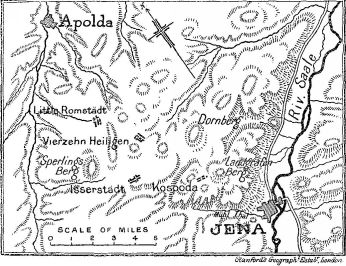
On the south the heights sink away into a wider valley, the Mühl-thal, along which runs the road to Weimar; and on this side too their wooded brows are broken by gulleys, up one of which runs a winding track known as the Schnecke or Snail. Villages and woods diversified the plateau and hindered the free use of that extended line formation on which the Prussians relied, while favouring the operations of dense columns preceded by clouds of skirmishers by which Napoleon so often hewed his way to victory. His greatest advantage, however, lay in the ignorance of his foes. Hohenlohe, believing that he was confronted only by Lannes' corps, took little thought about what was going on in his front, and [pg.96] judging the Mühl-thal approach alone to be accessible, posted his chief force on this side. So insufficient a guard was therefore kept on the side of the Landgrafenberg that the French, under cover of the darkness, not only crowned the summit densely with troops, but dragged up whole batteries of cannon.
The toil was stupendous: in one of the steep hollow tracks a number of cannon and wagons stuck fast; but the Emperor, making his rounds at midnight, brought the magic of his presence to aid the weary troops and rebuke the officers whose negligence had caused this block. Lantern in hand, he went up and down the line to direct the work; and Savary, who saw this scene, noted the wonder of the men, as they caught sight of the Emperor, the renewed energy of their blows at the rocks, and their whispers of surprise that he should come in person when their officers were asleep. The night was far spent when, after seeing the first wagon right through the narrow steep, he repaired to his bivouac amidst his Guards on the summit, and issued further orders before snatching a brief repose. By such untiring energy did he assure victory. Apart from its immense effect on the spirits of his troops, his vigilance reaped a rich reward. Jena was won by a rapid concentration of troops, and the prompt seizure of a commanding position almost under the eyes of an unenterprising enemy. The corps of Soult and Ney spent most of the night and early morning in marching towards Jena and taking up their positions on the right or north wing, while Lannes and the Guard held the central height, and Augereau's corps in the Mühl-thal threatened the Saxons and Prussians guarding the Schnecke.[106]
A dense fog screened the moves of the assailants early on the morrow, and, after some confused but obstinate fighting, the French secured their hold on the plateau not only above the town of Jena, where their onset took the Prussians by surprise, but also above the Mühl-thal, where the enemy were in force.[pg.97]
By ten o'clock the fog lifted, and the warm rays of the autumn sun showed the dense masses of the French advancing towards the middle of the plateau. Hohenlohe now saw the full extent of his error and despatched an urgent message to Rüchel for aid. It was too late. The French centre, led by Lannes, began to push back the Prussian lines on the village named Vierzehn Heiligen. It was in vain that Hohenlohe's choice squadrons flung themselves on the serried masses in front: the artillery and musketry fire disordered them, while French dragoons were ready to profit by their confusion. The village was lost, then retaken by a rally of the Prussians, then lost again when Ney was reinforced; and when the full vigour of the French attack was developed by the advance of Soult and Augereau on either wing, Napoleon launched his reserves, his Guard, and Murat's squadrons on the disordered lines. The impact was irresistible, and Hohenlohe's force was swept away. Then it was that Rüchel's force drew near, and strove to stem the rout. Advancing steadily, as if on parade, his troops for a brief space held up the French onset; but neither the dash of the Prussian horse nor the bravery of the foot-soldiers could dam that mighty tide, which laid low the gallant leader and swept his lines away into the general wreck.[107]
In the headlong flight before Murat's horsemen, the fugitives fell in with another beaten array, that of Brunswick. At Jena the Prussians, if defeated, were not disgraced: before the first shot was fired their defeat was a mathematical certainty. At the crisis of the battle they had but 47,400 men at hand, while Napoleon then disposed of 83,600 combatants.[108] But at Auerstädt they were driven back and disgraced. There they had a[pg.98] decided superiority in numbers, having more than 35,000 of their choicest troops, while opposite to them stood only the 27,000 men of Davoust's corps.
Hitherto Davoust had been remarkable rather for his dog-like devotion to Napoleon than for any martial genius; and the brilliant Marmont had openly scoffed at his receiving the title of Marshal. But, under his quiet exterior and plodding habits, there lay concealed a variety of gifts which only needed a great occasion to shine forth and astonish the world.[109] The time was now at hand. Frederick William and Brunswick were marching from Auerstädt to make good their retreat on the Elbe, when their foremost horsemen, led by the gallant Blücher, saw a solid wall of French infantry loom through the morning fog. It was part of Davoust's corps, strongly posted in and around the village of Hassenhausen.
At once Blücher charged, only to be driven back with severe loss. Again he came on, this time supported by infantry and cannon: again he was repulsed; for Davoust, aided by the fog, had seized the neighbouring heights which commanded the high road, and held them with firm grip. Determined to brush aside or crush this stubborn foe, the Duke of Brunswick now led heavy masses along the narrow defile; but the steady fire of the French laid him low, with most of the officers; and as the Prussians fell back, Davoust swung forward his men to threaten their flanks. The King was dismayed at these repeated checks, and though the Prussian reserves under Kalckreuth could have been called up to overwhelm the hard-pressed French by the weight of numbers, yet he judged it better to draw off his men and fall back on Hohenlohe for support.
But what a support! Instead of an army, it was a[pg.99] terrified mob flying before Murat's sabres, that met them halfway between Auerstädt and Weimar. Threatened also by Bernadotte's corps on their left flank, the two Prussian armies now melted away in one indistinguishable torrent, that was stemmed only by the sheltering walls of Erfurt, Magdeburg, and of fortresses yet more remote.
Of the twin battles of Jena and Auerstädt, the latter was unquestionably the more glorious for the French arms. That Napoleon should have beaten an army of little more than half his numbers is in no way remarkable. What is strange is that so consummate a leader should have been entirely ignorant of the distribution of the enemy's forces, and should have left Davoust with only 27,000 men exposed to the attack of Brunswick with nearly 40,000.[110] In his bulletins, as in the "Relation Officielle," the Emperor sought to gloze over his error by magnifying Hohenlohe's corps into a great army and attenuating Davoust's splendid exploit, which in his private letters he warmly praised. The fact is, he had made all his dispositions in the belief that he had the main body of the Prussians before him at Jena.
That is why, on the afternoon of the 13th, he hastily sent to recall Murat's horse and Bernadotte's corps from Naumburg and its vicinity; and in consequence Bernadotte took no very active part in the fighting. For this he has been bitterly blamed, on the strength of an assertion that Napoleon during the night of the 13th-14th sent him an order to support Davoust. This order has never been produced, and it finds no place in the latest and fullest collection of French official despatches, which, however, contains some that fully exonerate Bernadotte.[111] Unfortunately for Bernadotte's fame, the tattle of [pg.100]memoir writers is more attractive and gains more currency than the prosaic facts of despatches.
Fortune plays an immense part in warfare; and never did she favour the Emperor more than on October the 14th, 1806. Fortune and the skill and bravery of Davoust and his corps turned what might have been an almost doubtful conflict into an overwhelming victory. Though Napoleon was as ignorant of the movements of Brunswick as he was of the flank march of Blücher at Waterloo, yet the enterprise and tenacity of Davoust and Lannes yielded him, on the Thuringian heights, a triumph scarcely paralleled in the annals of war. It is difficult to overpraise those Marshals for the energy with which they clung to the foe and brought on a battle under conditions highly favourable to the French: without their efforts, the Prussian army could never have been shattered on a single day.
The flood of invasion now roared down the Thuringian valleys and deluged the plains of Saxony and Brandenburg. Rivers and ramparts were alike helpless to stay that all-devouring tide. On October the 16th, 16,000 men surrendered at Erfurt to Murat: then, spurring eastward, le beau sabreur rushed on the wreck of Hohenlohe's force, and with the aid of Lannes' untiring corps compelled it to surrender at Prenzlau.[112] Blücher meanwhile stubbornly retreated to the north; but, with Murat, Soult, and Bernadotte dogging his steps, he finally threw himself into Lübeck, where, after a last desperate effort, he surrendered to overpowering numbers (November 7th).
Here the gloom of defeat was relieved by gleams of heroism; but before the walls of other Prussian strongholds disaster was blackened by disgrace. Held by timid old men or nerveless pedants, they scarcely waited for a vigorous attack. A few cannon-shots, or even a[pg.101] demonstration of cavalry, generally brought out the white flag. In quick succession, Spandau, Stettin, Küstrin, Magdeburg, and Hameln opened their gates, the governor of the last-named being mainly concerned about securing his future retiring pension from the French as soon as Hanover passed into their keeping.
Amidst these shameful surrenders the capital fell into the hands of Davoust (October 25th). Varnhagen von Ense had described his mingled surprise and admiration at seeing those "lively, impudent, mean-looking little fellows," who had beaten the splendid soldiers trained in the school of Frederick the Great. His wonder was natural; but all who looked beneath the surface well knew that Prussia was overthrown before the first shot was fired. She was the victim of a deadening barrack routine, of official apathy or corruption, and of a degrading policy which dulled the enthusiasm of her sons.
Thirteen days after the great battle, Napoleon himself entered Berlin in triumph. It was the first time that he allowed himself a victor's privilege, and no pains were spared to impress the imagination of mankind by a parade of his choicest troops. First came the foot grenadiers and chasseurs of the Imperial Guard: behind the central group marched other squadrons and battalions of these veterans, already famed as the doughtiest fighters of their age. In their midst came the mind of this military machine—Napoleon, accompanied by three Marshals and a brilliant staff. Among them men noted the plain, soldierlike Berthier, the ever trusty and methodical chief of the staff. At his side rode Davoust, whose round and placid face gave little promise of his rapid rush to the front rank among the French paladins. There too was the tall, handsome, threatening form of Augereau, whose services at Jena, meritorious as they were, scarcely maintained his fame at the high level to which it soared at Castiglione. Then came Napoleon's favourite aide-de-camp, Duroc, a short, stern, war-hardened man, well known in Berlin, where twice he had sought to rivet close the bonds of the French alliance.[pg.102]
Above all, the gaze of the awe-struck crowd was fixed on the figure of the chief, now grown to the roundness of robust health amidst toils that would have worn most men to a shadow; and on the face, no longer thin with the unsatisfied longings of youth, but square and full with toil requited and ambition wellnigh sated—a visage redeemed from the coarseness of the epicure's only by the knitted brows that bespoke ceaseless thought, and by the keen, melancholy, unfathomable eyes.
NOTE ADDED TO THE FOURTH EDITION
Several facts of considerable interest and importance respecting the Anglo-French negotiations of 1806 have been brought to light by M. Coquelle in his recently published work "Napoleon and England, 1803-1813," chapters xi.-xvii. (George Bell and Sons, 1904).[pg.103]
"I know full well that London is a corner of the world, and that Paris is its centre."—Letter of Napoleon, August 18th, 1806.
On the 21st of November, 1806, Napoleon issued at Berlin the decree which proclaimed open and unrelenting war on English industry and commerce, a war that was to embroil the whole civilized world and cease only with his overthrow. After reciting his complaints against the English maritime code, he declared the British Isles to be in a state of blockade, interdicted all commerce with them, threatened seizure and imprisonment to English goods and subjects wherever found by French or allied troops, forbade all trade in English and colonial wares, and excluded from French and allied ports any ship that had touched at those of Great Britain; while any ship that connived at the infraction of the present decree was to be held a good prize of war.[113] This ukase, which was binding for France, Italy, Switzerland, Holland, and the Rhenish Confederation, formed the foundation of the Continental System, a term applicable to the sum total of the measures that aimed at ruining England by excluding her goods from the Continent.
The plan of strangling Britain by her own wealth was not peculiar to Napoleon. In common with much of his political stock-in-trade he had it from the Jacobins, who stoutly maintained that England's wealth was fictitious and would collapse as soon as her commerce was[pg.104] attacked in the Indies and excluded from the Rhine and Elbe. At first the fulminations of Parisian legislators fell idly on the stately pile of British industry; but when the young Bonaparte appeared on the scene, the commercial warfare became serious. As soon as his victories in Italy widened the sphere of French influence, the Directory banned the entry of all our products, counting all cotton and woollen goods as English unless the contrary could be proved by certificates of origin.[114] Public opinion in France, which, unless held in by an intelligent monarch, has always swung towards protection or prohibition, welcomed that vigorous measure; and great was the outcry of manufacturers when it was rumoured in 1802 that Napoleon was about to make a commercial treaty with the national enemy. Tradition and custom, therefore, were all on his side, when, after Trafalgar, he concentrated all his energy on his "coast-system."[115]
Ostensibly the Berlin Decree was a retort to our Order in Council of May 16th, 1806, which declared all the coast between Brest and the Elbe in a state of blockade; and French historians have defended it on this ground, asserting that it was a necessary reply to England's aggressive action.[116] But this plea can scarcely be maintained. The aggressor, surely, was the man who forced Prussia to close the neutral North German coast to British goods (February, 1806). Besides, there is indirect proof that Napoleon looked on our blockade of the northern coasts as not unreasonable. In his subsequent negotiations with us, he raised no protest against it, and made no difficulty about our maritime code: if we would[pg.105] let him seize Sicily, we might, it seems, have re-enacted that code in all its earlier stringency. Far from doing so, Fox and his successors relaxed the blockade of North Germany; and by an order dated September 25th, the coast between the Elbe and the Ems was declared free.
Napoleon's grievance against us was thereby materially lessened, and his protest against fictitious blockades in the preamble of the Berlin Decree really applied only to our action on the coast between the Helder and Brest, where our cruisers were watching the naval preparations still going on. His retort in the interests of outraged law was certainly curious; he declared our 3,000 miles of coast in a state of blockade—a mere brutum fulmen in point of fact, but designed to give a show of legality to his Continental System. Yet, apart from this thin pretext, he troubled very little about law. Indeed, blockade is an act of war; and its application to this or that part or coast depends on the will and power of the belligerents. Napoleon frankly recognized that fact; and, however much his preambles appealed to law, his conduct was decided solely by expediency. When he wanted peace (along with Sicily) he said nothing about our maritime claims: when the war went on, he used them as a pretext for an action that was ten times as stringent.
The gauntlet thrown down by him at Berlin was promptly taken up by Great Britain. An Order in Council of January 7th, 1807, forbade neutrals to trade between the ports of France and her allies, or between ports that observed the Berlin Decree, under pain of seizure and confiscation of the ship and cargo. In return Napoleon issued from Warsaw (January 27th) a decree, ordering the seizure in the Hanse Towns of all English goods and colonial produce. By way of reprisal England reimposed a strict blockade on the North German coast (March 11th); and after the Peace of Tilsit laid the Continent at the feet of Napoleon, he frankly told the diplomatic circle at Fontainebleau that he would no longer allow any commercial or political relations between the Continent and England.[pg.106] "The sea must be subdued by the land." In these words Napoleon pithily summed up his enterprise; and whatever may be thought of the means which he adopted, the design is not without grandeur. Granted that Britannia ruled the waves, yet he ruled the land; and the land, as the active fruitful element, must overpower the barren sea. Such was the notion: it was fallacious, as will appear later on; but it appealed strongly to the French imagination as providing an infallible means of humbling the traditional foe. Furthermore, it placed in Napoleon's hands a potent engine of government, not only for assuring his position in France, but for extending his sway over North Germany and all coasts that seemed needful to the success of the experiment.
Indirectly also it seems to have fed, without satisfying, his ever-growing love of power. Here we touch on the difficult question of motive; and it is perhaps impossible, except for dogmatists, to determine whether the enterprises that led to his ruin—the partition of Portugal, which slid easily into the occupation of Spain, together with his Moscow adventure—were prompted by ambition or by a semi-fatalistic feeling that they were necessary to the complete triumph of his Continental System. He himself, with a flash of almost uncanny insight, once remarked to Roederer that his ambition was different from that of other men: for they were slaves to it, whereas it was so interwoven with the whole texture of his being as to interfere with no single process of thought and will. Whether that is possible is a question for psychologists and casuists; but every open-minded student of Napoleon's career must at times pause in utter doubt, whether this or that act was prompted by mad ambition, or followed naturally, perhaps inevitably, from that world-embracing postulate, the Continental System.
England also derived some secondary advantages from this war of the elements. In order to stalemate her mighty foe, she pushed on her colonial conquests so as to control the resources of the tropics, and thus prevent[pg.107] that deadly tilting of the balance landwards which Napoleon strove to effect. And fate decreed that the conquests of English seamen and settlers were to be more enduring than those of Napoleon's legions. While the French were gaining barren victories beyond the Vistula and Ebro, our seamen seized French and Dutch colonies and our pioneers opened up the interior of Australia and South Africa.
We also used our maritime monopoly to depress neutral commerce. We have not space to discuss the complex question of the rights of neutrals in time of war, which would involve an examination of the "rule of 1756" and the compromises arrived at after the two Armed Neutrality Leagues. Suffice it to say that our merchants had recently been indignant at the comparative immunity enjoyed by neutral ships, and had pressed for more vigorous action against such as traded to French ports.[117] Yet the statement that our Orders in Council were determined by the clamour of the mercantile class is an exaggeration: they were reprisals against Napoleon's acts, following them in almost geometrical gradations. To his domination over the industrial resources of the Continent we had nothing to oppose but our manufacturing skill, our supremacy in the tropics, and our control of the sea. The methods used on both sides were alike brutal, and, when carried to their logical conclusion at the close of the year, crushed the neutrals between the upper and the nether millstone. But it is difficult to see what other alternative was open to an insular State that was all-powerful at sea and weak on land. Our very existence was bound up with maritime commerce; and an abandonment of the carrying trade[pg.108] to neutrals would have been the tamest of surrenders, at a time when surrender meant political extinction.
We turn now to follow the chief steps in Napoleon's onward march, which enabled him to impose his system on nearly the whole of the Continent. While encamped in the Prussian capital he decreed the deposition of the Elector of Hesse-Cassel, and French and Dutch troops forthwith occupied that Electorate. Towards Saxony he acted with politic clemency; and on December 11th, 1806, the Elector accepted the French alliance, entered the Confederation of the Rhine, and received the title of King.[118]
Meanwhile Frederick William, accompanied by his grief-stricken consort, was striving to draw together an army in his eastern provinces. Some overtures with a view to peace had been made after Jena; but Napoleon finally refused to relax his pursuit unless the Prussians retired beyond the Vistula, and yielded up to him all the western parts of the kingdom, with their fortresses. Besides, he let it be known that Prussia must join him in a close alliance against Russia, with a view to checking her ambitious projects against Turkey; for the Czar, resenting the Sultan's deposition of the hospodars of the Danubian Principalities, an act suggested by the French, had sent an army across the River Pruth, even when the Porte timidly revoked its objectionable firman.[119] The Eastern Question having been thus reopened, Napoleon suggested a Franco-Prussian alliance so as to avert a Russian conquest of the Balkan Peninsula. But now, as ever, his terms to Prussia were too exacting. The King deigned not to stoop to such humiliation, but resolved to stake his all on the courage of his troops and the fidelity of the Czar.
The Russians, though delayed by their distrust of Haugwitz, and by their insensate war with Turkey, were now marching, 73,000 strong, into Prussian Poland, but were too late to save the Silesian fortresses, most of[pg.109] which surrendered to the French. The fighting in the open also went against the allies, though at Pultusk, a town north of Warsaw, the Russians claimed that the contest had been drawn in their favour.
At the close of the year the armies went into winter-quarters. It was high time. The French were ill supplied for a winter campaign amid the desolate wastes of Poland. Snow and rain, frosts and thaws had turned the wretched tracks into muddy swamps, where men sank to their knees, horses to their bellies, and carriages beyond their axles. The carriage conveying Talleyrand was a whole night stuck fast, in spite of the efforts of ten horses to drag it out. The opinion of the soldiery on Poland and the Poles is well expressed by that prince of raconteurs, Marbot: "Weather frightful, victuals very scarce, no wine, beer detestable, water muddy, no bread, lodgings shared with cows and pigs. 'And they call this their country,' said our soldiers."
Yet Polish patriotism had been a mighty power in the world; and Napoleon, ever on the watch for the weak places of his foes, saw how effective a lever it might be. This had been his constant practice: he had pitted Italians against Austrians, Copts against Mamelukes, Druses against Turks, Irish against English, South Germans against the Hapsburgs and Hohenzollerns, and for the most part with success. But, except in the case of the Italian people and the South German princes, he rarely, if ever, bestowed boons proportionate to the services rendered. It is very questionable whether he felt more warmly for Irish nationalists than for Copts and Druses.[120] Except in regard to his Italian kindred, none of the nationalist aspirations that were to mould the history of the century touched a responsive chord in his nature. In this, as in other affairs of state, he held "true[pg.110] policy" to be "nothing else than the calculation of combinations and chances."
It was in this spirit that he surveyed the Polish Question. Arising out of the partitions of that unhappy land by Russia, Austria, and Prussia, it had distracted the repose of Europe scarcely less than the French Revolution; and now the heir to the Revolution, after hewing his way through the weak monarchies of Central Europe, was about to probe this ulcer of Christendom. As usual, nothing had been done to forestall him. Czartoryski had begged Alexander to declare Russian Poland an autonomous kingdom united with Russia only by the golden link of the crown, but this timely proposal was rejected;[121] and the Czar displayed the weakness of his judgment and the strength of his vanity by plunging into war with Turkey and Persia, at a time when Poland was opening her arms to the victor of a hundred fights. It was, therefore, easy for Napoleon to surround Russia with foes; and, as will shortly appear, he took steps to invigorate even the remote Persian Empire.
But, above all, he spurred on the Poles to take up arms. His encouragements were discreetly vague. True, he countenanced Polish proclamations, which spoke grandiloquently of national liberty; but proclamations he ever viewed as the ballons d'essai of politics. He also warned Murat not to promise the Poles too much: "My greatness does not depend on the aid of a few thousand Poles. Let them show a firm resolve to be independent: let them pledge themselves to support the King that will be given to them, and then I will see what is to be done."
There were two reasons for this caution. His Marshals found no very general disposition among the Poles to take up arms for France; and he desired not to offend Austria by revolutionizing Galicia and her districts south and east of Warsaw. Already the Hapsburgs were nervously mustering their troops, and Napoleon had no wish to tempt fortune by warring against three Powers a thousand[pg.111] miles away from his own frontiers. He therefore calmed the Court of Vienna by promising that he would discourage any rising in Austrian Poland, and he held forth the prospect of regaining Silesia. This tempting offer was made secretly and conditionally; and evoked no expression of thanks, but rather a redoubling of precautions. Yet, despite the efforts of England and Russia, the Hapsburg ruler refused to join the allies: he preferred to play the waiting game which had ruined Prussia.[122]
The campaign was reopened amidst terrible weather by a daring move of Bennigsen's Russians westwards, in the hope of saving Danzig and Graudenz from the French. At first a screen of forests well concealed his advance. But, falling in with Bernadotte near the River Passarge, his progress was checked and his design revealed. At once Napoleon prepared to march northwards and throw the Russians into the sea, a plan which in its turn was foiled by the seizure of a French despatch by Cossacks. Bennigsen, now aware of his danger, at once retreated towards Königsberg, but at Eylau turned on his pursuers and fought the bloodiest battle fought in Europe since Malplaquet. The numbers on both sides were probably about equal, numbering some 75,000 men, the Russians having a slight superiority in men and still more in[pg.112] artillery. Driven from Eylau on the night of February 7th after confused fighting, the Muscovite withdrew to a strong position formed by an irregular line of hills, which he crowned with cannon.
As the dawn peered through the snow-laden clouds, guns began to deal death amongst the hostile masses, and heavy columns moved forward. Davoust, on the French right, began to push back the Russians on that side, whereupon Napoleon ordered Augereau's corps to complete the advantage by driving in the enemy's centre. Gallantly the French advanced. Their leading regiment, the 14th, had seized a hillock which commanded the enemy's lines,[123] when, amidst a whirlwind of snow that beat in their faces, a deadly storm of grape and canister almost annihilated the corps. Its shattered lines fell back, leaving the 14th to its fate. But a cloud of Cossacks now swept on the retiring companies, stabbing with their long spears; and it was a scanty band that found safety in their former position. Russian cannon and cavalry also stopped the advance of Davoust, and the fighting for a time resolved itself into confused but murderous charges at close quarters. As if to increase the horrors of the scene, snowstorms again swept over the field, dazing the French and shrouding with friendly wings the fierce charges of Cossacks. Yet the Grand Army fought on with devoted heroism; and the chief, determined to snatch at victory, launched eighty squadrons of horse against the Russian centre. Sweeping aside the Cossacks, and defying the cannon that riddled their files, they poured upon the first line of Russian infantry: for a time they were stemmed, but, finding some weaker places, the cuirassiers burst through, only to be thrown back by the second line; and, when furiously charged by Cossacks, they fell back in disorder. "These Russians fight like bulls," said the French. The simile was just. Even while Murat was hacking at their centre a column of 4,000 Russian grenadiers, [pg.113] detaching itself from their mangled line, marched straight forward on the village of Eylau. With the same blind courage that nerved Solmes' division at Steinkirk, they beat aside the French light horse and foot, and were now threatening the cemetery where Napoleon and his staff were standing.
"I never was so much struck with anything in my life," said General Bertrand at St. Helena, "as by the Emperor at Eylau when he was almost trodden under foot by the Russian column. He kept his ground as the Russians advanced, saying frequently, 'What boldness.'"
But, when all around him trembled, and Berthier ordered up the horses as if for retreat, he himself quietly signalled for his Guards. These sturdy troops, long fuming at their inaction, marched forward with a stern joy. As at Steinkirk the French Household Brigade disdained to fire on the bull-dogs, so now the Guards rushed on the Muscovites with the cold steel. The shock was terrible; but the pent-up fury of the French carried all before it, and the grenadiers were wellnigh destroyed. The battle might still have ended in a French victory; for Davoust was obstinately holding the village which he had seized in the morning, and even threatened the rear of Bennigsen's centre. But when both sides were wellnigh exhausted, the Prussian General Lestocq with 8,000 men, urged on by the counsels of Scharnhorst, hurried up from the side of Königsberg, marched straight on Davoust, and checked his forward movements. Ney followed Lestocq, but at so great a distance that his arrival at nightfall served only to secure the French left.
Thus darkness closed over some 100,000 men, who wearily clung to their posts, and over snowy wastes where half that number lay dead, dying, or disabled. Well might Ney exclaim: "What a massacre, and without any issue!" Each side claimed the victory, and, as is usual in such cases, began industriously to minimize its own and to magnify the enemy's losses. The truth seems to[pg.114] be that both sides had about 25,000 men hors de combat; but, as Bennigsen lacked tents, supplies, and above all, the dauntless courage of Napoleon, he speedily fell back, and this enabled the Emperor to claim a decisive victory.[124]
Exhausted by this terrific strife, the combatants now relaxed their efforts for a brief space; but while Napoleon used the time of respite in hurrying up troops from all parts of his vast dominions, the allies did little to improve their advantage. This inertness is all the more strange as Prussia and Russia came to closer accord in the Treaty of Bartenstein (April 26th, 1807).[125]
The two monarchs now recur to the generous scheme of a European peace, for which the Czar and William Pitt had vainly struggled two years before. The present war is to be fought out to the end, not so as to humble France and interfere in her internal concerns, but in order to assure to Europe the blessings of a solid peace based on the claims of justice and of national independence. France must be satisfied with reasonable boundaries, and Prussia be restored to the limits of 1805 or their equivalent. Germany is to be freed from the dictation of the French, and become a "constitutional federation," with a boundary "parallel to the Rhine." Austria is to be asked to join the present league, regaining Tyrol and the Mincio frontier. England and Sweden must be rallied to the common cause. The allies will also take steps to cause Denmark to join the league. For the rest, the integrity of Turkey is to be maintained, and the future of Italy decided in concert with Austria and[pg.115] England, the Kings of Sardinia and Naples being restored. Even should Austria, England, and Sweden not join them, yet Russia and Prussia will continue the struggle and not lay down their arms save by mutual consent.
Had all the Powers threatened by Napoleon at once come forward and acted with vigour, these ends might, even now, have been attained. But Austria merely renewed her offers of mediation, a well-meaning but hopeless proposal. England, a prey to official incapacity, joined the league, promised help in men and money, and did little or nothing except send fruitless expeditions to Alexandria and the Dardanelles with the aim of forcing the Turks to a peace with Russia. In Sicily we held our own against Joseph's generals, but had no men to spare for a diversion against Marmont's forces in Dalmatia, which Alexander urged. Still less could we send from our own shores any force for the effective aid of Prussia. Though we had made peace with that Power, and ordinary prudence might have dictated the taking of steps to save the coast fortresses, Danzig and Colberg, from the French besiegers, yet our efforts were limited to the despatch of a few cruisers to the former stronghold. Even more urgent was the need of rescuing Stralsund, the chief fortress of Swedish Pomerania. Such an expedition clearly offered great possibilities with the minimum of risk. From the Isle of Rügen Mortier's corps could be attacked; and when Stralsund was freed, a dash on Stettin, then weakly held by the French, promised an easy success that would raise the whole of North Germany in Napoleon's rear.[126]
But arguments were thrown away upon the Grenville Ministry, which clung to its old plan of doing[pg.116] nothing and of doing it expensively. The Foreign Secretary, Lord Howick, replied that the allies must not expect any considerable aid from our land forces. Considering that the Income or War Tax of 2s. in the £ had yielded close on £20,000,000, and that the army numbered 192,000 men (exclusive of those in India), this declaration did not shed lustre on the Ministry of all the Talents. That bankrupt Cabinet, however, was dismissed by George III. in March, 1807, because it declined to waive the question of Catholic Emancipation, and its place was filled by the Duke of Portland, with Canning as Foreign Minister. Soon it was seen that Pitt's cloak had fallen on worthy shoulders, and a new vigour began to inspirit our foreign policy. Yet the bad results of frittering away our forces on distant expeditions could not be wiped out at once. In fact, our military expert, Lord Cathcart, reported that only some 12,000 men could at present be spared for service in the Baltic; and, as it would be beneath our dignity to send so small a force, it would be better to keep it at home ready to menace any part of the French coast. As to Stralsund, he thought that plan was more feasible, but that, even there, the allies would not make head against Mortier's corps.[127]
This is a specimen of the reasoning that was fast rendering Britain contemptible alike to friends and foes. It is not surprising that such timorous selfishness should have at last moved the Czar to say to our envoy: "Act where you please, provided that you act at all."[128] In the end the new Ministry did venture to act: it engaged to send 20,000 men to the succour of Stralsund; but, with the fatality that then dogged our steps, that decision was[pg.117] formed on June the 17th, three days after the Coalition was shattered by the mighty blow of Friedland.
In striking contrast to the faint-hearted measures of the allies was the timely energy of Napoleon in bringing up reinforcements. These were drawn partly from Mortier's corps in Pomerania, now engaged in watching the Swedes, who made a truce; partly from the Bavarians and Saxons; but mostly from French troops already in Central Germany, their places being taken by Italians, Spaniards, Swiss, and Dutch. In France a new levy of conscripts was ordered—the third since the outbreak of war with Prussia. The Turks were encouraged to press on the war against Russia and England; and a mission was sent to the Shah of Persia to strengthen his arms against the Czar. To this last we will now advert.
For some time past Napoleon had been coquetting with Persia, and an embassy from the Shah now came to the castle of Finkenstein, a beautiful seat not far from the Vistula, where the Emperor spent the months of spring. A treaty was drawn up, and General Gardane was deputed to draw closer the bonds of friendship with the Court of Teheran. The instructions secretly issued to this officer are of great interest. He is ordered to proceed to Persia by way of Constantinople, to concert an alliance between Sultan and Shah, to redouble Persia's efforts against her "natural enemy," Russia, and to examine the means of invading India. For this purpose a number of officers are sent with him to examine the routes from Egypt or Syria to Delhi, as also to report on the harbours in Persia with a view to a maritime expedition, either by way of Suez or the Cape of Good Hope. The Shah is to be induced to form a corps of 12,000 men, drilled on the European model and armed with weapons sold by France. This force will attack the Russians in Georgia and serve later in an expedition to India. With a view to the sending of 20,000 French troops to India, Gardane is to communicate with the Mahratta princes and prepare for this enterprise by every possible means.[pg.118]
We may note here that Gardane proceeded to Persia and was urging on the Shah to more active measures against Russia when the news of the Treaty of Tilsit diverted his efforts towards the east. At the close of the year, he reported to Napoleon that, for the march overland from Syria to the Ganges, Cyprus was an indispensable base of supplies: he recommended the route Bir, Mardin, Teheran, Herat, Cabul, and Peshawur: forty to fifty thousand French troops would be needed, and thirty or forty thousand Persians should also be taken up. Nothing came of these plans; but it is clear that, even when Napoleon was face to face with formidable foes on the Vistula, his thoughts still turned longingly to the banks of the Ganges.[129]
The result of Napoleon's activity and the supineness of his foes were soon apparent. Danzig surrendered to the French on May the 24th, and Neisse in Silesia a little later; and it was not till the besiegers of these fortresses came up to swell the French host that Bennigsen opened the campaign. He was soon to rue the delay. His efforts to drive the foe from the River Passarge were promptly foiled, and he retired in haste to his intrenched camp at Heilsberg. There, on June the 10th, he turned fiercely at bay and dealt heavy losses to the French vanguard. In vain did Soult's corps struggle up towards the intrenchments; his men were mown down by grapeshot and musketry: in vain did Napoleon, who hurried up in the afternoon, launch the fusiliers of the Guard and a division of Lannes' corps. The Muscovites held firm, and the day closed ominously for the French. It was Eylau over again on a small scale.
But Bennigsen was one of those commanders who, after fighting with great spirit, suffer a relapse. Despite the entreaties of his generals, he had retreated after Eylau;[pg.119] and now, after a day of inaction, his columns filed off towards Königsberg under cover of the darkness. In excuse for this action it has been urged that he had but two days' supply of bread in the camp, and that a forward move of Davoust's corps round his right flank threatened to cut him off from his base of supplies, Königsberg.[130]
The first excuse only exposes him to greater censure. The Russian habit at that time usually was to live almost from hand to mouth; but that a carefully-prepared position like that of Heilsberg should be left without adequate supplies is unpardonable. On the two next days the rival hosts marched northward, the one to seize, the other to save, Königsberg. They were separated by the winding vale of the Alle. But the course of this river favoured Napoleon as much as it hindered Bennigsen. The Alle below Heilsberg makes a deep bend towards the north-east, then northwards again towards Friedland, where it comes within forty miles of Königsberg, but in its lower course flows north-east until it joins the Pregel.
An army marching from Heilsberg to the old Prussian capital by the right bank would therefore easily be outstripped by one that could follow the chord of the arc instead of the irregular arc itself. Napoleon was in this fortunate position, while the Russians plodded amid heavy rains over the semicircular route further to the east. Their mistake in abandoning Heilsberg was now obvious. The Emperor halted at Eylau on the 13th for news of the Prussians in front and of Bennigsen on his right flank. Against the former he hurled his chief masses under the lead of Murat in the hope of seizing Königsberg at one blow. [131] But, foreseeing that the Russians would probably pass over the Alle at Friedland he despatched Lannes to Domnau to see whether they had already crossed in force. Clearly, then, Napoleon [pg.120] did not foresee what the morrow had in store for him: his aim was to drive a solid wedge between Bennigsen and the defenders of Königsberg, to storm that city first, and then to turn on Bennigsen. The claim of some of Napoleon's admirers that he laid a trap for the Russians at Friedland, as he had done at Austerlitz, is therefore refuted by the Emperor's own orders.
None the less did Bennigsen walk into a trap, and one of his own choosing. Anxious to thrust himself between Napoleon and the old Prussian capital, he crossed the river at Friedland and sought to strengthen his position on the left bank by driving Lannes' vanguard back on Domnau, by throwing three bridges over the stream, and by crowning the hills on the right bank with a formidable artillery. But he had to deal with a tough and daring opponent. Throughout the winter Lannes had been a prey to ill-health and resentment at his chief's real or fancied injustice: but the heats of summer re-awakened his thirst for glory and restored him to his wonted vigour. Calling up the Saxon horse, Grouchy's dragoons, and Oudinot's grenadiers, he held his ground through the brief hours of darkness. Before dawn he posted his 10,000 troops among the woods and on the plateau of Posthenen that lies to the west of Friedland and strove to stop the march of 40,000 Russians. After four hours of fighting, his men were about to be thrust back, when the divisions of Verdier and Dupas—the latter from Mortier's corps—shared the burden of the fight until the sun was at its zenith. When once more the fight was doubtful, the dense columns of Ney and Victor were to be seen, and by desperate efforts the French vanguard held its ground until this welcome aid arrived.
Napoleon, having received Lannes' urgent appeals for help, now rode up in hot haste, and in response to the cheers of his weary troops repeatedly exclaimed: "Today is a lucky day, the anniversary of Marengo." Their ardour was excited to the highest pitch, Oudinot saluting his chief with the words: "Quick, sire! my grenadiers can hold no longer: but give me reinforcements and I'll [pg.121] pitch the
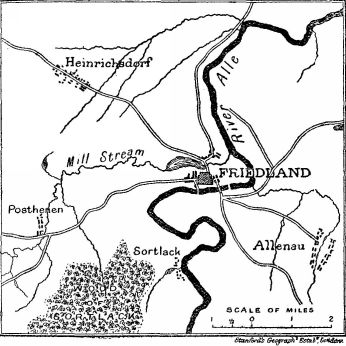
Nevertheless, as late as 3 p.m., Napoleon was in doubt whether he should not await the arrival of Murat. At his instructions, Berthier ordered that Marshal to leave Soult at Königsberg and hurry back with Davoust and the cavalry towards Friedland: "If I perceive at the beginning of this fight that the enemy is in too great force, I might be content with cannonading to-day and awaiting your arrival." But a little later the Emperor decides for instant attack. The omens are all favourable. If driven back the Russians will fight with their backs to a deep river. Besides, their position is cut in twain by a mill-stream which flows in a gulley, and near the town is dammed up so as to form a small lake. Below this lies Friedland in a deep bend of the river itself. Into this cul-de-sac he will drive the Russian left, and fling their broken lines into the lake and river.
At five o'clock a salvo of twenty guns opened the second and greater battle of Friedland. To rush on the Muscovite van and clear it from the wood of Sortlack was for Ney's leading division the work of a moment; but on reaching the open ground their ranks were ploughed by the shot of the Russian guns ranged on the hills beyond the river. Staggered by this fire, the division was wavering, when the Russian Guards and their choicest squadrons of horse charged home with deadly effect. But Ney's second division, led by the gallant[pg.123] Dupont, hurried up to restore the balance, while Latour-Maubourg's dragoons fell on the enemy's horsemen and drove them pell-mell towards Friedland.
The Russian artillery fared little better: Napoleon directed Sénarmont with thirty-six guns to take it in flank and it was soon overpowered. Freed now from the Russian grapeshot and sabres, Ney held on his course like a torrent that masters a dam, reached the upper part of the lake, and threw the bewildered foe into its waters or into the town. Friedland was now a death-trap: huddled together, plied by shell, shot and bayonet, the Russians fought from street to street with the energy of despair, but little by little were driven back on the bridges. No help was to be found there; for Sénarmont, bringing up his guns, swept the bridges with a terrific fire: when part of the Russian left and centre had fled across, they burst into flames, a signal that warned their comrades further north of their coming doom. On that side, too, a general advance of the French drove the enemy back towards the steep banks of the river. But on those open plains the devotion and prowess of the Muscovite cavalry bore ampler fruit: charging the foe while in the full swing of victory, these gallant riders gave time for the infantry to attempt the dangers of a deep ford: hundreds were drowned, but others, along with most of the guns, stole away in the darkness down the left bank of the river.
On the morrow Bennigsen's army was a mass of fugitives straggling towards the Pregel and fighting with one another for a chance to cross its long narrow bridge. Even on the other side they halted not, but wandered on towards the Niemen, no longer an army but an armed mob. On its banks they were joined by the defenders of Königsberg, who after a stout stand cut their way through Soult's lines and made for Tilsit. There, behind the broad stream of the Niemen, the fugitives found rest.
It will always be a mystery why Bennigsen held on to Friedland after French reinforcements arrived; and[pg.124] the feeling of wonder and exasperation finds expression in the report of our envoy, Lord Hutchinson, founded on the information of two British officers who were at the Russian headquarters:
"Many of the circumstances attending the Battle of Friedland are unexampled in the annals of war. We crossed the River Alle, not knowing whether we had to contend with a corps or the whole French army. From the commencement of the battle it was manifest that we had a great deal to lose and probably little to gain: ... General Bennigsen would, I believe, have retired early in the day from ground which he ought never to have occupied; but the corps in our front made so vigorous a resistance that, though occasionally we gained a little ground, yet we were never able to drive them from the woods or the village of Heinrichsdorf."[133]
This evidence shows the transcendent services of Lannes, Oudinot, and Grouchy in the early part of the day; and it is clear that, as at Jena, no great battle would have been fought at all but for the valour and tenacity with which Lannes clung to the foe until Napoleon came up.[pg.125]
Even now matters were not hopeless for the allies. Crowds of stragglers rejoined the colours at Tilsit, and Tartar reinforcements were near at hand. The gallant Gneisenau was still holding out bravely at Kolberg against Brune's divisions; and two of the Silesian fortresses had not yet surrendered. Moreover, Austria seemed about to declare against Napoleon, and there were hopes that before long England would do something. But, above all, since the war was for Prussia solely an affair of honour,[134] it deeply concerned Alexander's good name not to desert an ally to whom he was now pledged by all the claims of chivalry until satisfactory terms could be gained.
But Alexander's nature had not as yet been strengthened by misfortune and religious convictions: it was a sunny background of flickering enthusiasms, flecked now and again by shadows of eastern cunning or darkened by warlike ambitions—a nature in which the sentimentalism of Rousseau and the passions of a Boyar alternately gained the mastery. No realism is more crude than that of the disillusionized idealist; and for months the young Czar had seen his dream of a free and happy Europe fade away amidst the smoke of Napoleon's guns and the mists of English muddling. At first he blenched not even at the news of Friedland. In an [pg.126] interview with our ambassador, Lord Gower, on June the 17th, he bitterly upbraided him with our inactivity in the Baltic and the Mediterranean, and the non-fulfilment of our promise of a loan; as for himself, "he would never stoop to Bonaparte: he would rather retire to Kazan or even to Tobolsk." But five days later, acting under pressure from his despairing generals, some of whom reminded him of his father's fate, he arranged an armistice with the conqueror.[135] Five days only were allowed in which Prussia might decide to follow his example or proceed with the war alone. She accepted the inevitable on the following day.
The international situation was now strangely like that which followed immediately upon the battle of Austerlitz. Then it was Prussia, now it was Austria, that played the part of the cautious friend at the very time when the beaten allies were meditating surrender. For some time past the Court of Vienna had been offering its services for mediation: they were well received at London, with open disappointment by Prussia, and with ill-concealed annoyance by Napoleon. As at the time when Haugwitz came to him to dictate Prussia's terms, so now the Emperor kept the Austrian envoy waiting without an answer, until the blow of Friedland was dealt.[136] Even then Austria seemed about to enter the lists, when news arrived of the conclusion of the armistice at Tilsit. This enabled her to sheathe her sword with no loss of honour; but, as was the case with Prussia at the close of 1805, her conduct was seen to be timid and time-serving; and it merited the secret rebuke of Canning that she "was (as usual) just ten days too late in her determination, or the world might have been saved."[137][pg.127]
Whether Austria had been beguiled by the recent diplomatic caresses of Napoleon may well be doubted; for they were obviously aimed at keeping her quiet until he had settled scores with Prussia and Russia. His advances only began on the eve of the last war, and the sharpness of the transition from threats to endearments could not be smoothed over even by Talleyrand's finesse.[138] When the slaughter at Eylau placed him in peril, he again bade Talleyrand soothe the Austrian envoy with assurances that, if his master was anxious to maintain the integrity of Turkey, France would maintain it; or if he desired to share in an eventual partition, France would also arrange that to his liking.[139] But as the prospects for the campaign improved, Napoleon's tone hardened. On March the 14th he states that he has enough men to keep Austria quiet and to "get rid of the Russians in a month." And now he looks on an alliance with the Hapsburgs merely as giving a short time of quiet, whereas an alliance with Russia would be "very advantageous."[140] He had also felt the value of alliance with Prussia, as his repeated overtures during the campaign testify; but when Frederick William persistently rejected all accommodation with the man who had so deeply outraged his kingly honour, he turned finally to Alexander.
The Czar was made of more pliable stuff. Moreover, he now cherished one sentiment that brought him into sympathy with Napoleon, namely, hatred of England. He certainly had grave cause for complaint. We had done nothing to help the allies in the Polish campaign except to send a few cruisers and 60,000 muskets, which last did not reach the Swedish and Russian ports until the war was over. True, we had gone out of our way[pg.128] to attack Constantinople at his request; but that attack had failed; and our attitude towards his Turkish policy was one of veiled suspicion, varied with moral lectures.[141] As for the loan of five millions sterling which the Czar had asked us to guarantee, we had put him off, our envoy finally reminding him that it had been of the first importance to help Austria to move. Worst of all, our cruisers had seized some Russian merchantmen coming out of French ports, and despite protests from St. Petersburg the legality of that seizure was maintained. Thus, in a war which concerned our very existence we had not rendered him a single practical service, and yet strained the principles of maritime law at the expense of Russian commerce.[142]
Over against our policy of blundering delay there was that of Napoleon, prompt, keen, and ever victorious. The whole war had arisen out of the conflict of these two Powers; and Napoleon had never ceased to declare that it was essentially a struggle between England and the Continent. After Eylau Alexander was proof against these arguments; but now the triumphant energy of Napoleon and the stolid apathy of England brought about a quite bewildering change in Russian policy. Delicate advances having been made by the two Emperors, an interview was arranged to take place on a raft moored in the middle of the River Niemen (June 25th).
"I hate the English as much as you do, and I will second you in all your actions against them." Such are said to have been the words with which Alexander greeted Napoleon as they stepped on to the raft. Whereupon the conqueror replied: "In that case all can be arranged and peace is made."[143] As the two Emperors were unaccompanied at that first interview, it is difficult to see on what evidence this story rests. It is most[pg.129] unlikely that either Emperor would divulge the remarks of the other on that occasion; and the words attributed to Alexander seem highly impolitic. For what was his position at this time? He was striving to make the best of a bad case against an opponent whose genius he secretly feared. Besides, we know for certain that he was most anxious to postpone his rupture with England for some months.[144] All desire for an immediate break was on Napoleon's side.
We can therefore only guess at what transpired, from the vague descriptions of the two men themselves. They are characteristic enough: "I never had more prejudices against anyone than against him," said Alexander afterwards; "but, after three-quarters of an hour of conversation, they all disappeared like a dream"; and later he exclaimed: "Would that I had seen him sooner: the veil is torn aside and the time of error is past." As for Napoleon, he wrote to Josephine: "I have just seen the Emperor Alexander: I have been very pleased with him: he is a very handsome, good, and young Emperor: he has an intellect above what is commonly attributed to him."[145] The tone of these remarks strikes the keynote of all the conversations that followed. At the next day's conference, also held in the sumptuous pavilion erected on the raft, the King of Prussia was present; but towards him Napoleon's demeanour was cold and threatening. He upbraided him with the war, lectured him on the duty of a king to his people, and bade him dismiss Hardenberg. Frederick William listened for the most part in silence; his nature was too stiff and straightforward to practise any Byzantine arts; but when his trusty Minister was attacked, he protested that he should not know how to replace him. Napoleon[pg.130] had foreseen the plea and at once named three men who would give better advice. Among them was the staunch patriot Stein!
From the ensuing conferences the King was almost wholly excluded. They were held in a part of the town of Tilsit which was neutralized for that purpose, as also for the guards and diplomatists of the three sovereigns. There, too, lived the two Emperors in closest intercourse, while on most days the Prussian King rode over from a neighbouring village to figure as a sad, reproachful guest at the rides, parades, and dinners that cemented the new Franco-Russian alliance. Yet, amid all the melodious raptures of Alexander over Napoleon's newly discovered virtues, it is easy to detect the clinging ground-tone of Muscovite ambition. An event had occurred which excited the hopes of both Emperors. At the close of May, the Sultan Selim was violently deposed by the Janissaries who clamoured for more vigorous measures against the Russians. Never did news come more opportunely for Napoleon than this, which reached him at Tilsit on, or before, June the 24th. He is said to have exclaimed to the Czar with a flash of dramatic fatalism: "It is a decree of Providence which tells me that the Turkish Empire can no longer exist."[146]
Certain it is that the most potent spell exerted by the great conqueror over his rival was a guarded invitation to share in some future partition of the Turkish Empire. That scheme had fascinated Napoleon ever since the year 1797, when he gazed on the Adriatic. Though laid aside for a time in 1806, when he roused the Turks against Russia, it was never lost sight of; and now, on the basis of a common hatred of England and a common desire to[pg.131] secure the spoils of the Ottoman Power, the stately fabric of the Franco-Russian alliance was reared.
On his side, Alexander required some assurance that Poland should not be reconstituted in its integrity—a change that would tear from Russia the huge districts stretching almost up to Riga, Smolensk, and Kiev, which were still Polish in sympathy. Here Napoleon reassured him, at least in part. He would not re-create the great kingdom of Poland: he would merely carve out from Prussia the greater part of her Polish possessions.
These two important questions being settled, it only remained for the Czar to plead for the King of Prussia, to acknowledge Napoleon's domination as Emperor of the West, while he himself, as autocrat of the East, secured a better western boundary for Russia. At first he strove to gain for Frederick William the restoration of several of his lands west of the Elbe. This championship was not wholly disinterested; for it is now known that the Czar had set his heart on a great part of Prussian Poland.
In truth, he was a sufficiently good disciple of the French revolutionists to plead very cogently his claims to a "natural frontier." He disliked a "dry frontier": he must have a riverine boundary: in fact, he claimed the banks of the Lower Niemen, and, further south, the course of the rivers Wavre, Narew and Bug. To this claim he had perhaps been encouraged by some alluring words of Napoleon that thenceforth the Vistula must be the boundary of their empires. But his ally was now determined to keep Russia away from the old Polish capital; and in strangely prophetic words he pointed out that the Czar's claims would bring the Russian eagles within sight of Warsaw, which would be too clear a sign that that city was destined to pass under the Russian rule.[147] Divining also that Alexander's plea for the restoration by France of some of Prussia's western lands was linked with a plan which would give Russia some of her eastern [pg.132] districts,[148] Napoleon resolved to press hard on Prussia from the west. While handing over to the Czar only the small district around Bialystock, he remorselessly thrust Prussia to the east of the Elbe.
From this neither the arguments of the Czar nor the entreaties of Queen Louisa availed to move him. And yet, in the fond hope that her tears might win back Magdeburg, that noble bulwark of North German independence, the forlorn Queen came to Tilsit to crave this boon (July 6th). It was a terrible ordeal to do this from the man who had repeatedly insulted her in his official journals, figuring her, first as a mailed Amazon galloping at the head of her regiment, and finally breathing forth scandals on her spotless reputation.
Yet, for the sake of her husband and her people, she braced herself up to the effort of treating him as a gentleman and appealing to his generosity. If she was able to conceal her loathing, this was scarcely so with her devoted lady in waiting, the Countess von Voss, who has left us an acrid account of Napoleon's visit to the Queen at the miller's house at Tilsit.[149]
"He is excessively ugly, with a fat swollen sallow face, very corpulent, besides short and entirely without figure. His great eyes roll gloomily around; the expression of his features is severe; he looks like the incarnation of fate: only his mouth is well shaped, and his teeth are good. He was extremely polite, talked to the Queen a long time alone.... Again, after dinner, he had a long conversation with the Queen, who also seemed pretty well satisfied with the result."[150][pg.133]
Queen Louisa's verdict about his appearance was more favourable; she admired his head "as that of a Cæsar." With winsome boldness inspired by patriotism, she begged for Magdeburg. Taken aback by her beauty and frankness, Napoleon had recourse to compliments about her dress. "Are we to talk about fashion, at such a time?" was her reply. Again she pleaded, and again he fell back on vapidities. Nevertheless, her appeals to his generosity seemed to be thawing his statecraft, when the entrance of that unlucky man, her husband, gave the conversation a colder tone. The dinner, however, passed cheerfully enough; and, according to French accounts, Napoleon graced the conclusion of dessert by offering her a rose. Her woman's wit flew to the utterance: "May I consider it a token of friendship, and that you grant my request for Magdeburg?" But he was on his guard, parried her onset with a general remark as to the way in which such civilities should be taken, and turned the conversation. Then, as if he feared the result of a second interview, he hastened to end matters with the Prussian negotiators.[151]
He thus described the interview in a letter to Josephine:
"I have had to be on my guard against her efforts to oblige me to some concessions for her husband; but I have been gallant, and have held to my policy."
This was only too clear on the following day, when the Queen again dined with the sovereigns.
"Napoleon," says the Countess von Voss, "seemed malicious and spiteful, and the conversation was brief and constrained. After dinner the Queen again conversed apart with him. On taking leave she said to him that she went away feeling it deeply that he should have deceived her. My poor Queen: she is quite in despair."[pg.134]
When conducted to her carriage by Talleyrand and Duroc, she sank down overcome by emotion. Yet, amid her tears and humiliation, the old Prussian pride had flashed forth in one of her replies as the rainbow amidst the rain-storm. When Napoleon expressed his surprise that she should have dared to make war on him with means so utterly inadequate, she at once retorted: "Sire, I must confess to Your Majesty, the glory of Frederick the Great had misled us as to our real strength"—a retort which justly won the praise of that fastidious connoisseur, Talleyrand, for its reminder of Prussia's former greatness and the transitoriness of all human grandeur.[152]
On that same day (July 7th) the Treaty of Tilsit was signed. Its terms may be thus summarized. Out of regard for the Emperor of Russia, Napoleon consented to restore to the King of Prussia the province of Silesia, and the old Prussian lands between the Elbe and Niemen. But the Polish lands seized by Prussia in the second and third partitions were (with the exception of the Bialystock district, now gained by Russia) to form a new State called the Duchy of Warsaw. Of this duchy the King of Saxony was constituted ruler. Danzig, once a Polish city, was now declared a free city under the protection of the Kings of Prussia and Saxony, but the retention there of a French garrison until the peace made it practically a French fortress. Saxe-Coburg, Oldenburg, and Mecklenburg-Schwerin were restored to their dukes, but the two last were to be held by French troops until England made peace with France. With this aim in view, Napoleon accepted Alexander's mediation for the conclusion of a treaty of peace with England, provided that she accepted that mediation within one month of the ratification of the present treaty.
On his side, the Czar now recognized the recent changes in Naples, Holland, and Germany; among the last of these was the creation of the Kingdom of [pg.135] Westphalia for Jerome Bonaparte out of the Prussian lands west of the Elbe, the Duchy of Brunswick, and the Electorate of Hesse-Cassel. Holland gained East Frisia at the expense of Prussia. As regards Turkey, the Czar pledged himself to cease hostilities at once, to accept the mediation of Napoleon in the present dispute, and to withdraw Russian troops from the Danubian Provinces as soon as peace was concluded with the Sublime Porte. Finally, the two Emperors mutually guaranteed the integrity of their possessions and placed their ceremonial and diplomatic relations on a footing of complete equality.
Such were the published articles of the Treaty of Tilsit. Even if this had been all, the European system would have sustained the severest blow since the Thirty Years' War. The Prussian monarchy was suddenly bereft of half its population, and now figured on the map as a disjointed land, scarcely larger than the possessions of the King of Saxony, and less defensible than Jerome Bonaparte's Kingdom of Westphalia; while the Confederation of the Rhine, soon to be aggrandized by the accession of Mecklenburg and Oldenburg, seemed to doom the House of Hohenzollern to lasting insignificance.[153]
But the published treaty was by no means all. There were also secret articles, the chief of which were that the Cattaro district—to the west of Montenegro—and the Ionian Islands should go to France, and that the Czar would recognize Joseph Bonaparte as King of Sicily when Ferdinand of Naples should have received "an indemnity such as the Balearic Isles, or Crete, or their equivalent." Also, if Hanover should eventually be annexed to the Kingdom of Westphalia, a Westphalian district with a population of from three to four hundred thousand souls would be retroceded to Prussia. Finally, the chiefs of the Houses of Orange-Nassau, Hesse-Cassel, and Brunswick were to receive pensions from Murat and Jerome Bonaparte, who dispossessed them.
Most important of all was the secret treaty of alliance[pg.136] with Russia, also signed on July 7th, whereby the two Emperors bound themselves to make common cause in any war that either of them might undertake against any European Power, employing, if need be, the whole of their respective forces. Again, if England did not accept the Czar's mediation, or if she did not, by the 1st of December, 1807, recognize the perfect equality of all flags at sea, and restore her conquests made from France and her allies since 1805, then Russia would make war on her. In that case, the present allies will "summon the three Courts of Copenhagen, Stockholm, and Lisbon to close their ports against the English and declare war against England. If any one of the three Courts refuse, it shall be treated as an enemy by the high contracting parties, and if Sweden refuse, Denmark shall be compelled to declare war on her." Pressure would also be put on Austria to follow the same course. But if England made peace betimes, she might recover Hanover, on restoring her conquests in the French, Spanish, and Dutch colonies. Similarly, if Turkey refused the mediation of Napoleon, he would in that case help Russia to drive the Turks from Europe—"the city of Constantinople and the province of Roumelia alone excepted."[154]
The naming of the city of Constantinople, which is in Roumelia, betokens a superfluity of prudence. But it helps to confirm the statement of Napoleon's secretary, M. Méneval, that the future of that city led to a decided difference of opinion between the Emperors. After one of their discussions, Napoleon stayed poring over a map, and finally exclaimed, "Constantinople! Never! It is the empire of the world." Doubtless it was on this subject that Alexander cherished some secret annoyance. Certain it is that, despite all his professions of devotion to Napoleon, he went back to St. Petersburg ill at ease and possessed with a certain awe of the conqueror. For what had he gained? He received a small slice of[pg.137] Prussian Poland, and the prospect of aggrandizement on the side of Turkey and Sweden, Finland being pointed out as an easy prey. For these future gains he was to close his ports to England and see his commerce, his navy, and his seaboard suffer. It is not surprising that before leaving Tilsit he remarked to Frederick William that "the most onerous condition imposed by Napoleon was common to Russia and Prussia."[155]
This refers to the compulsion put upon them to join Napoleon's Continental System. In the treaty signed with Prussia on July 9th, Napoleon not only wrested away half her lands, but required the immediate closing of all her ports to British vessels. We may also note here that, by the extraordinary negligence of the Prussian negotiator, Marshal Kalckreuth, the subsequent convention as to the evacuation of Prussia by the French troops left open a loophole for its indefinite occupation. Each province or district was to be evacuated when the French requisitions had been satisfied.[156] The exaction of impossible sums would therefore enable the conquerors, quite legally, to keep their locust swarms in that miserable land. And that was the policy pursued for sixteen months.
Why this refinement of cruelty to his former ally? Why not have annexed Prussia outright? Probably there were two reasons against annexation: first, that his army could live on her in a way that would not be possible with his own subjects or allies; second, that the army of occupation would serve as a guarantee both for Russia's good faith and for the absolute exclusion of British goods from Prussia.[157] This had long been his aim. He now[pg.138] attained it, but only by war that bequeathed a legacy of war, and a peace that was no peace.
Napoleon's behaviour at Tilsit has generally been regarded, at least in England, as prompted by an insane lust of power; and the treaty has been judged as if its aim was the domination of the Continent. But another explanation, though less sweeping and attractive, seems more consonant with the facts of the case.
He hoped that, before so mighty a confederacy as was framed at Tilsit, England would bend the knee, give up not only her maritime claims but her colonial conquests, and humbly take rank with Powers that had lived their day. The conqueror who had thrice crumpled up the Hapsburg States, and shattered Prussia in a day, might well believe that the men of Downing Street, expert only in missing opportunities and exasperating their friends, would not dare to defy the forces of united Europe, but would bow before his prowess and grant peace to a weary world. In his letter of July 6th, 1807, to the Czar, he advised the postponement of the final summons to the British Government, because it would "give five months in which the first exasperation will die down in England, and she will have time to understand the immense consequences that would result from so imprudent a struggle." Neither Napoleon nor Alexander was deaf to generous aspirations. They both desired peace, so that their empires might expand and consolidate. Above all, France was weary of war; and by peace the average Frenchman meant, not respite from Continental strifes that yielded a surfeit of barren glories, but peace with England. The words of Lucchesini, the former Prussian ambassador in Paris, on this subject are worth quoting:
"The war with England was at bottom the only one in which the French public took much interest, since the evils it inflicted on France were felt every moment: nothing was[pg.139] spoken of so decidedly among all classes of the people as the wish to have done with that war; and when one spoke of peace at Paris, one always meant peace with England: peace with the others was as indifferent to the public as the victories or the conquests of Bonaparte."[158]
If the French middle classes longed for a maritime peace so that coffee and sugar might become reasonably cheap, how much more would their ruler, whose heart was set on colonies and a realm in the Orient? In Poland he had cheered his troops with the thought that they were winning back the French colonial empire; and, as we have seen, he was even then preparing the ground in Persia for a future invasion of India. These plans could only be carried out after a time of peace that should rehabilitate the French navy. Humanitarian sentiment, patriotism, and even the promptings of a wider ambition, therefore bade him strive for a general pacification, such as he seemed to have assured at Tilsit.
But the means which he adopted were just those that were destined to defeat this aim. Where he sought to intimidate, he only aroused a more stubborn resistance: where he should have allayed national fears, he redoubled them. He did not understand our people: he saw not that, behind our official sluggishness and muddling, there was a quenchless national vitality, which, if directed by a genius, could defy a world-wide combination. If, instead of making secret compacts with the Czar and trampling on Prussia; if, instead of intriguing with the Sultan and the Shah, and thus reawakening our fears respecting Egypt and India, he had called a Congress and submitted all the present disputes to general discussion, there is reason to think that Great Britain would have received his overtures. George III.'s Ministers had favoured the proposal of a Congress when put forward by Austria in the spring;[159] and they would doubtless[pg.140] have welcomed it from Napoleon after Friedland, had they not known of far-reaching plans which rendered peace more risky than open war. This great genius had, in fact, one fatal defect; he had little faith except in outward compulsion; and his superabundant energy of menace against England blighted the hopes of peace which he undoubtedly cherished.
Long before Alexander's offer of mediation was forwarded to London, our Ministers had taken a sudden and desperate resolution. They determined to compel Denmark to join England and Sweden, and to hold the fleet at Copenhagen as a gauge of Danish fidelity.
That momentous resolve was formed on or just before July the 16th, in consequence of news that had arrived from Memel and Tilsit. The exact purport of that news, and the manner of its acquisition, have been one of the puzzles of modern history. But the following facts seem to furnish a solution. Our Foreign Office Records show that our agent at Tilsit, Mr. Mackenzie, who was on confidential terms with General Bennigsen, left post haste for England immediately after the first imperial interview; and the news which he brought, together with reports of the threatening moves of the French on Holstein, clinched the determination of our Government to checkmate the Franco-Russian aims by bringing strong pressure to bear on Denmark. To keep open the mouth of the Baltic was an urgent necessity, otherwise we should lose touch with the Anglo-Swedish forces campaigning against the French near Stralsund.[160] Furthermore, it should be noted that Denmark held the balance in naval affairs. France and her allies now had fifty-nine sail of the line ready for sea: the compact with the Czar would give her twenty-four more; and if Napoleon seized the eighteen Danish and nine Portuguese battleships, his fighting strength would be nearly equal to[pg.141] our own.[161] Canning therefore determined, on July 16th, to compel Denmark to side with us, or at least to observe a neutrality favourable to the British cause; and, to save her honour, he proposed to send an irresistible naval force.
"Denmark's safety," he wrote on July 16th, "is to be found, under the present circumstances of the world, only in a balance of opposite dangers. For it is not to be disguised that the influence which France has acquired from recent events over the North of Europe, might, unless balanced by the naval power of Great Britain, leave to Denmark no other option than that of compliance with the demands of Bonaparte."[162]
A balance of opposite dangers! In this phrase Canning summed up his policy towards Denmark. Threatened by Napoleon on the land, she was to be threatened by us from the sea; and Canning hoped that these opposite forces would, at least, secure Danish neutrality, without which Sweden must succumb in her struggle against France. That some compulsion would be needed had long been clear. In fact, the use of compulsion had first been recommended by the Russian and Prussian Governments, which had gone so far as to include in the Treaty of Bartenstein a proposal of common action, along with England, Austria and Sweden, to compel Denmark to side with the allies against Napoleon.[163] To this resolve England still clung, despite the defection of the Czar. In truth, his present conduct made the case for the coercion of Denmark infinitely more urgent.
As to the reality of Napoleon's designs on Denmark, there can be no doubt. After his return to France, he wrote from St. Cloud, directing Talleyrand to express his displeasure that Denmark had not fulfilled her promises: "Whatever my desire to treat Denmark well, I cannot hinder her suffering from having allowed the Baltic to be violated [by the English expedition to[pg.142] Stralsund]; and, if England refuses Russia's mediation, Denmark must choose either to make war against England, or against me."[164] Whence it is clear that Denmark had given Napoleon grounds for hoping that she would declare the Baltic a mare clausum.
The British Government had so far fathomed these designs as to see the urgency of the danger. Accordingly it proposed to Denmark a secret defensive alliance, the chief terms of which were the handing over of the Danish fleet, to be kept as a "sacred pledge" by us till the peace, a subsidy of £100,000 paid to Denmark for that fleet, and the offer of armed assistance in case she should be attacked by France. This offer of defensive alliance was repulsed, and the Danish Prince Royal determined to resist even the mighty armada which was now nearing his shores. Towards the close of August, eighty-eight British ships were in the Sound and the Belt; and when the transports from Rügen and Stralsund joined those from Yarmouth, as many as 15,400 troops were at hand, under the command of Lord Cathcart. A landing was effected near Copenhagen, and offers of alliance were again made, including the deposit of the Danish fleet; "but if this offer is rejected now, it cannot be repeated. The captured property, public and private, must then belong to the captors: and the city, when taken, must share the fate of conquered places." The Danes stoutly repelled offers and threats alike: the English batteries thereupon bombarded the city until the gallant defenders capitulated (September 7th). The conditions hastily concluded by our commanders were that the British forces should occupy the citadel and dockyard for six weeks, should take possession of the ships and naval stores, and thereupon evacuate Zealand.
These terms were scrupulously carried out; and at the close of six weeks our forces sailed away with the[pg.143] Danish fleet, including fifteen sail of the line, fifteen frigates, and thirty-one small vessels. This end to the expedition was keenly regretted by Canning. In a lengthy Memorandum he left it on record that he desired, not merely Denmark's fleet, but her alliance. In his view nothing could save Europe but a firm Anglo-Scandinavian league, which would keep open the Baltic and set bounds to the designs of the two Emperors. Only by such an alliance could Sweden be saved from Russia and France. Indeed, foreseeing the danger to Sweden from a French army acting from Zealand as a base, Canning proposed to Gustavus that he should occupy that island, or, failing that, receive succour from a British force on his own shore of the Sound. But both offers were declined. The final efforts made to draw Denmark into our alliance were equally futile, and she kept up hostilities against us for nearly seven years. Thus Canning's scheme of alliance with the Scandinavian States failed. Britain gained, it is true, a further safeguard against invasion; but our statesman, while blaming the precipitate action of our commanders in insisting solely upon the surrender of the fleet, declared that that action, apart from an Anglo-Danish alliance, was "an act of great injustice."[165]
And as such it has been generally regarded, that is, by those who did not, and could not, know the real state of the case. In one respect our action was unpardonable: it was not the last desperate effort of a long period of struggle: it came after a time of selfish torpor fatal alike to our reputation and the interests of our allies. After protesting their inability to help them, Ministers belied their own words by the energy with which they acted against a small State. And the prevalent opinion found expression in the protests uttered in Parliament that it[pg.144] would have been better to face the whole might of the French, Russian, and Danish navies than to emulate the conduct of those who had overrun and despoiled Switzerland.
Moreover, our action did not benefit Sweden, but just the reverse. Cathcart's force, that had been helping the Swedes in the defence of their Pomeranian province, was withdrawn in order to strengthen our hands against Copenhagen. Thereupon the gallant Gustavus, overborne by the weight of Marshal Brune's corps, sued for an armistice. It was granted only on the condition that Stralsund should pass into Brune's hands (August 20th); and the Swedes, unable even to hold Rügen, were forced to give up that island also. Sick in health and weary of a world that his chivalrous instincts scorned, Gustavus withdrew his forces into Sweden. Even there he was menaced. The hostilities which Denmark forthwith commenced against England and Sweden exposed his southern coasts; but he now chose to lean on the valour of his own subjects rather than on the broken reed of British assistance, and awaited the attacks of the Danes on the west and of the Russians on his province of Finland.
The news from Copenhagen also furnished the Czar with a good excuse for hostilities with England. For such an event he had hitherto been by no means desirous. On his return from Tilsit to St. Petersburg he found the nobility and merchants wholly opposed to a rupture with the Sea Power, the former disdaining to clasp the hand of the conqueror of Friedland, the latter foreseeing ruin from the adoption of the Continental System; and when Napoleon sent Savary on a special mission to the Czar's Court, the Empress-Mother and nobles alike showed their abhorrence of "the executioner of the Duc d'Enghien." In vain were imperial favours lavished on this envoy. He confessed to Napoleon that only the Czar and the new Foreign Minister, Romantzoff, were favourable to France; and it was soon obvious that their ardour for a partition of Turkey must disturb[pg.145] the warily balancing policy which Napoleon adopted as soon as the Czar's friendship seemed assured.
The dissolution of this artificial alliance was a task far beyond the powers of British statesmanship. To Alexander's offer of mediation between France and England Canning replied that we desired first to know what were "the just and equitable terms on which France intended to negotiate," and secondly what were the secret articles of the Treaty of Tilsit. That there were such was obvious; for the published treaty made no mention of the Kings of Sardinia and of the two Sicilies, in whom Alexander had taken so deep an interest. But the second request annoyed the Czar; and this feeling was intensified by our action at Copenhagen. Yet, though he pronounced it an act of "unheard-of violence," the Russian official notes to our Government were so far reassuring that Lord Castlereagh was able to write to Lord Cathcart (September 22nd): "Russia does not show any disposition to resent or to complain of what we have done at Copenhagen.... The tone of the Russian cabinet has become much more conciliatory to us since they heard of your operations at Copenhagen."[166] It would seem, however, that this double-dealing was prompted by naval considerations. The Czar desired to temporize until his Mediterranean squadron should gain a place of safety and his Baltic ports be encased in ice; but on 27th October (8th November, N.S.) he broke off all communications with us, and adopted the Continental System.
Meanwhile, at the other extremity of Europe, events were transpiring that served as the best excuse for our harshness towards Denmark. Even before our fleet sailed for the Sound, Napoleon was weaving his plans for the destruction of Portugal. It is clear that he designed to strike her first before taking any action against[pg.146] Denmark. During his return journey from Tilsit to Paris, he directed Talleyrand to send orders to Lisbon for the closing of all Portuguese ports against British goods by September the 1st—"in default of which I declare war on Portugal." He also ordered the massing of 20,000 French troops at Bayonne in readiness to join the Spanish forces that were to threaten the little kingdom.[167]
What crime had Portugal committed? She had of late been singularly passive: anxiously she looked on at the gigantic strifes that were engulfing the smaller States one by one. Her conduct towards Napoleon had been far less provocative than that of Denmark towards England. Threatened with partition by him and Spain in 1801, she had eagerly snatched at peace, and on the rupture of the Peace of Amiens was fain to purchase her neutrality at the cost of a heavy subsidy to France, which she still paid in the hope of prolonging her "existence on sufferance."[168] That hope now faded away.
As far back as February, 1806, Napoleon had lent a ready ear to the plans which Godoy, the all-powerful Minister at Madrid, had proposed for the partition of Portugal; and, in the month of July following, Talleyrand held out to our plenipotentiary at Paris the threat that, unless England speedily made peace with France, Napoleon would annex Switzerland—"but still less can we alter, for any other consideration, our intention of invading Portugal. The army destined for that purpose is already assembling at Bayonne." A year's respite was gained for the House of Braganza by the campaigns of Jena and Friedland. But now, with the tenacity of his nature, the Emperor returned to the plan, actually tried in 1801 and prepared for in 1806, of crushing our faithful ally in order to compel us to make peace. On this occasion he counted on certain success, as may be seen[pg.147] by the following extract from the despatch of the Portuguese ambassador at Paris to his Government:
"On Sunday afternoon [August 2nd] there was a diplomatic Levée. The Emperor came up to me as I stood in the circle, and in a low voice said: 'Have you written to your Court? Have you despatched a courier with my final determination?'—I replied in the affirmative.—'Very well,' said the Emperor, 'then by this time your Court knows that she must break with England before the 1st of September. It is the only way to accelerate peace.'—As the place did not permit discussion on my part, I answered: 'I should think, Sire, that England must now be sincerely anxious to make peace.'—'Oh,' replied the Emperor, 'we are very certain of that: however, in all cases, you must break either with England or France before the 1st of September.'—He then turned about and addressed himself to the Danish Minister, as far as I could judge to the same purport."[169]
Equally confident is Napoleon's tone in the lately published letter of September 7th:
"As soon as I received news of the English expedition against Copenhagen,[170] I caused Portugal to be informed that all her ports must be closed to England, and I massed an army of 40,000 men at Bayonne to join the Spaniards in enforcing this action, if necessary. But a letter I have just received from the Prince Regent [of Portugal] leads me to presume that this last measure will not be necessary, that the Portuguese ports will be closed to the English by the time this is read, and that Portugal will have declared war against England. On the other hand, my flotilla will be ready for action on 1st October, and I shall have a large army at Boulogne, ready to attempt a coup de main on England."
The letter concludes by ordering that all British diplomatists are to be driven out of Europe, and that Sweden[pg.148] must make common cause with France and Russia. Such were the means to be used for forcing affrighted Peace again to visit this distracted earth.
In truth, the fate of the British race seemed for the time to hang upon the events at Copenhagen and Lisbon. Very much depended on the action of the Prince Regent of Portugal. Had he tamely submitted to Napoleon's ukase and placed his fleet and his vast colonial empire at the service of France, it is doubtful whether even the high-souled Canning would not have stooped to surrender in face of odds so overwhelming. The young statesman's anxiety as to the action of Portugal is attested by many a long and minutely corrected despatch to Viscount Strangford, our envoy at Lisbon. But, fortunately for us, Napoleon committed the blunder which so often marred his plans: he pushed them too far: he required the Prince Regent to adopt a course of conduct repellent to an honourable man, namely, to confiscate the merchandise and property of British merchants who had long trusted the good faith of the House of Braganza. To this last demand the prince opposed a dignified resistance, though on all other points he gave way. This will appear from Lord Strangford's despatch of August 13th:
" ... The Portuguese Ministers place all their hopes of being able to ward off this terrible blow in the certainty which they entertain of England being obliged to enter into negotiations for a general peace.... The very existence of the Portuguese Monarchy depends on the celerity with which England shall meet the pacific interference of the Emperor of Russia. The Prince Regent gives the most solemn promise that he will not on any account consent to the measure of confiscating the property of British subjects residing under his protection. But I think that if France could be induced to give up this point, and limit her demands to the exclusion of British commerce from Portugal, the Government of this country would accede to them...."
A week later he states that Portugal begged England to put up with a temporary rupture, and reports that a[pg.149] quantity of diamonds had been taken out of the Treasury and sent to Paris to be distributed in presents to persons supposed to possess influence over the minds of Bonaparte and Talleyrand. It would be interesting to trace the history of these diamonds. But, as Napoleon had recently awarded sums amounting in all to 26,582,000 francs from out of the estates confiscated in Poland,[171] signs of sudden affluence were widespread in Paris and rendered it difficult to detect the receivers of the gems. Talleyrand was the usual recipient of such douceurs. But on August the 14th he had retired from the Ministry of Foreign Affairs, gaining the title of Vice Grand-Elector; and, if we are to be guided, not by the statements of his personal foes, Hauterive and Pasquier, but by the determination which he is known to have formed at Tilsit, that he would not be "the executioner of Europe," we may judge that he disapproved of the barbarous treatment meted out to Prussia and now planned against Portugal.[172]
As has been stated above, the partition of this kingdom had been planned by Godoy in concert with Napoleon early in 1806. That pampered minion of the Spanish Court, angry at the shelving of plans which promised to yield him a third of Portugal, called Spain to arms while Napoleon was marching to Jena, an affront which the conqueror seemed to overlook but never really forgave. Now, however, he appeared wholly to enter into Godoy's scheme; and, while the Prince Regent of[pg.150] Portugal was appealing to his pity, the Emperor (September 25th, 1807) charged Duroc to confer with Godoy's confidential agent at Paris, Don Izquierdo. "...As for Portugal, I make no difficulty about granting to the King of Spain a suzerainty over Portugal, and even taking part of it away for the Queen of Etruria and the Prince of the Peace [Godoy]." Duroc was also to point out the difficulty, now that "all Italy" belonged to Napoleon, of allowing "that deformity," the kingdom of Etruria, to disfigure the peninsula. The change would in fact, doubly benefit the French Emperor. It would enable him completely to exclude British commerce from the port of Leghorn, where it was trickling in alarmingly, and also to place the mouths of the Tagus and Douro in the hands of obedient vassals.
Such was the scheme in outline. Despite the offer of the Prince Regent to obey all Napoleon's behests except that relating to the seizure of British subjects and their property, war was irrevocably resolved on by October the 12th.[173] And on October the 27th a secret convention was signed at the Palace of Fontainebleau for arranging "the future lot of Portugal by a healthy policy and conformably to the interests of France and Spain." Portugal was now to be divided into three very unequal parts: the largest portion, comprising Estremadura, Beira, and Tras-os Montes, was reserved for a future arrangement at the general peace, but meanwhile was to be held by France: Algarve and Alemtejo were handed over to Godoy; while the diminutive province of Entre Minho e Douro was flung as a sop to the young King of Etruria and his mother, a princess of the House of Spain, to console them for the loss of Etruria. A vague promise was made that the House of Braganza might be reinstated in the first of these three portions, in case England restored Gibraltar, Trinidad, and other colonies taken by her from Spain or her allies; and Napoleon guaranteed to the King of Spain his possessions in Europe, exclusive[pg.151] of the Balearic Isles, offering also to recognize him as Emperor of the Two Americas.
Meanwhile Junot was leading his army corps from Bayonne towards Salamanca and Ciudad Rodrigo, to give effect to this healthful arrangement. This general, whom it was desirable to remove from Paris on account of his rather too open liaison with one of the Bonaparte princesses, was urged to the utmost speed and address by the Emperor. He must cover the whole 200 leagues in thirty-five days; lack of provisions must not hinder the march, for "20,000 men can live anywhere, even in a desert"; and, above all, as the Prince Regent had again offered to declare war on England, he (Junot) could represent that he came as an ally: "I have already informed you that my intention in authorizing you to enter that land as an ally was to enable you to seize its fleet, but that my mind was fully made up to take possession of Portugal."[174] Lisbon, in fact, was to be served as Venice was ten years before, the lion donning the skin of the fox so as to effect a peaceful seizure. But that ruse could hardly succeed twice. The Prince Regent had his ships ready for flight. The bluff and headstrong Junot, nicknamed "the tempest" by the army, was too artless to catch the prince by guile; but he hurried his soldiers over mountains and through flooded gorges until, on November 30th, 1,500 tattered, shoeless, famished grenadiers straggled into Lisbon—to find that the royal quarry had flown.
The Prince Regent took this momentous resolve with the utmost reluctance. For many weeks he had clung to the hope that Napoleon would spare him; and though he accepted a convention with England, whereby he gained the convoy of our men-of-war across the Atlantic and the promise of aggrandizement in South America, he still continued to temporize, and that too, when a[pg.152] British fleet was at hand in the Tagus strong enough to thwart the designs of the Russian squadron there present to prevent his departure. When the French were within two days' march of Lisbon, Lord Strangford feared that the Portuguese fleet would be delivered into their hands; and only after a trenchant declaration that further vacillation would be taken as a sign of hostility to Great Britain, did the Prince Regent resolve to seek beyond the seas the independence which was denied to him in his own realm.[175]
Few scenes are more pathetic than the departure of the House of Braganza from the cradle of its birth. Love for the Prince Regent as a man, mingled with pity for the demented Queen, held the populace of Lisbon in tearful silence as the royal family and courtiers filed along the quays, followed by agonized groups of those who had decided to share their trials. But silence gave way to wails of despair as the exiles embarked on the heaving estuary and severed the last links with Europe. Slowly the fleet began to beat down the river in the teeth of an Atlantic gale. Near the mouth the refugees were received with a royal salute by the British fleet, and under its convoy they breasted the waves of the ocean and the perils of the future.
The conduct of England towards Denmark and that of Napoleon towards Portugal call for a brief comparison. Those small kingdoms were the victims of two powerful States whose real or fancied interests prompted them to the domination of the land and of the sea. But when we compare the actions of the two Great Powers, important differences begin to reveal themselves. England had far more cause for complaint against Denmark than Napoleon[pg.153] had against Portugal. The hostility of the Danes to the recent coalition was notorious. To compel them to change their policy without loss of national honour, we sent the most powerful armada that had ever left our shores, with offers of alliance and a demand that their fleet, the main object of Napoleon's designs, should be delivered up to be held in deposit. The offer was refused, and we seized the fleet. The act was brutal, but it was at least open and above board, and the capitulation of September 7th was scrupulously observed, even when the Danes prepared to renew hostilities.
On the other hand, the demands of Napoleon on the Court of Lisbon were such as no honourable prince could accept; they were relentlessly pressed on in spite of the offer of the Prince Regent to meet him in every particular save one; the appeals of the victim were deliberately used by the aggressor to further his own rapacious designs; and the enterprise fell short of ending in a massacre only because the glamour of the French arms so dazzled the susceptible people of the south that, for the present, they sank helplessly away at the sight of two battalions of spectres. Finally, Portugal was partitioned—or rather it was kept entirely by Napoleon; for, after the promises of partition had done their work, the sleeping partners in the transaction were quietly shelved, and it was then seen that Portugal had finally served as the bait for ensnaring Spain. To this subject we shall return in the next chapter.
In Italy also, the Juggernaut car of the Continental System rolled over the small States. The Kingdom of Etruria, which in 1802 had served as an easy means of buying the whole of Louisiana from the Spanish Bourbons, was now wrested from that complaisant House, and in December was annexed to the French Empire.
The Pope also passed under the yoke. For a long time the relations between Pius VII. and Napoleon had been strained. Gentle as the Pontiff was by nature, he had declined to exclude all British merchandise from his States, or to accept an alliance with Eugène and Joseph.[pg.154] He also angered Napoleon by persistently refusing to dissolve the marriage of Jerome Buonaparte with Miss Paterson; and an interesting correspondence ensued, culminating in a long diatribe which Eugène was charged to forward to the Vatican as an extract from a private letter of Napoleon to himself.[176] Pius VII. was to be privately warned that Napoleon had done more good to religion than the Pope had done harm. Christ had said that His Kingdom was not of this world. Why then did the Pope set himself above Christ? Why did he refuse to render to Cæsar that which was Cæsar's?—A fortnight later the Emperor advised Eugène to despatch troops in the direction of Bologna—"and if the Pope commits an imprudence, it will be a fine opportunity for depriving him of the Roman States."
No imprudence was committed. Yet, in the following January, Napoleon ordered his troops to occupy Rome, alleging that the Eternal City was a hotbed of intrigues fomented by England and the ex-Queen of Naples, that Neapolitan rebels had sought an asylum in the Papal States, and that, though he had no wish to deprive the Pope of his territories, yet he must include him in his "system." When Pius VII. refused to commit himself to a policy which would involve war with England, Napoleon ordered that his lands east of the Apennines should be annexed to the Kingdom of Italy (April 2nd, 1808). Napoleon thus gained complete control over the Adriatic coasts, which, along with the island of Corfu, had long engaged his most earnest attention.[177]
True to his aim of forcing or enticing all maritime States into a mighty confederacy for the humiliation of England, Napoleon had given most heed to lands[pg.155] possessing extensive seaboards. Northern Italy, Holland, Naples, North Germany, Prussia, Russia, Portugal, Spain, Denmark, and Central Italy had, in turn, adopted his system. On Austria he exerted a less imperious pressure; for her coast-line of Trieste and Croatia was so easily controlled by his Italian and Dalmatian territories that English merchandise with difficulty found admittance. Yet, in order to carry out there also his policy of "Thorough," he brought the arguments of Paris and St. Petersburg to bear on the Court of Vienna; and on February 18th, 1808, Austria was enrolled in a league that might well be called continental; for in the spring of that year it embraced every land save Sweden and Turkey.
His activity at this time almost passes belief. While he fastened his grip on the Continent, gallicized the institutions of Italy and Germany, and almost daily instructed his brothers in the essentials of successful statecraft, he found time to turn his thoughts once more to the East, and to mark every device of England for lengthening her lease of life. Noticing that we had annulled our blockade of the Elbe and Weser, with the aim of getting our goods introduced there by neutral ships, Napoleon charged his Finance Minister, Gaudin, to prepare a decree for pressing hard on neutrals who had touched at any of our ports or carried wares that could be proved to be of British origin.[178]
He was perfectly correct in his surmise that English goods were about to be sent into the Continent extensively on neutral vessels. After the consequences of the Treaty of Tilsit had been fully developed, that was almost their only means of entry. "In August, September and October, British commerce lay prostrate and motionless until a protecting and self-defensive system was interposed by our Orders in Council."[179] The first of these ordered reprisals against the new Napoleonic States (November 4th): a week later came a second[pg.156] which declared that, as the Orders of January had not induced the enemy to relax his commercial hostilities, but these were now enforced with increased rigour, any port whence the British flag was excluded would be treated as if it were actually blockaded; that is, the principle of the legality of a nominal blockade, abandoned in 1801, was now reaffirmed. The carriage of hostile colonial products was likewise prohibited to neutrals, though certain exceptions were allowed. Also any neutral vessel carrying "certificates of origin"—a device for distinguishing between British and neutral goods—was to be considered a lawful prize of war. A third Order in Council of the same date allowed goods to be imported into the United Kingdom from a hostile port in neutral ships, subject to the ordinary duties, and bonding facilities were granted for the re-exportation of such goods to any friendly or neutral port.[180] These orders were designed to draw neutral commerce through our ports, and to give secret facilities for the carriage of our goods by neutrals, while pressing upon those that obeyed Napoleon's system.
The harshest of them was that which encouraged the searching of neutral vessels for certificates of origin—a measure as severe as the confiscation of British property by Napoleon, which it was designed to defeat. And we may note here that the friction resulting from our Orders in Council and our enforcement of the right of search led to the United States passing a Non-Intercourse Act (December 23rd, 1807) that preluded active hostilities against us. It also led Napoleon to confiscate all American ships in his harbours after April 17th, 1808.
The November Orders in Council soon drew a reply from Napoleon. He heard of them during a progress through the north of Italy, and from Milan he flung[pg.157] back his retort, the famous Milan Decrees of November 23rd and December 17th. He thereby declared every neutral ship, which submitted to those orders, to be denationalized and good prize of war; and the same doom was pronounced against every vessel sailing to or from any port in the United Kingdom or its colonies or possessions. But these measures were not to affect ships of those States that compelled Great Britain to respect their flag. The islanders might well be dismayed at the prospect of a seclusion which promised to recall the Virgilian line:
"penitus toto divisos orbe Britannos."Yet they resolved to pit the resources of the outer world against the militarism of Napoleon; and, drawing the resources of the tropics to the new power-looms of Lancashire and Yorkshire, they might well hope to pour their unequalled goods into Europe from points of vantage such as Sicily, Gibraltar, the Channel Islands, and Heligoland. There were many Englishmen who believed that the November Orders in Council brought nothing but harm to our cause. They argued that our manufactured goods must find their way into the Continent in spite of the Berlin Decrees; and they could point to the curious fact that Bourrienne, Napoleon's agent at Hamburg, when charged to procure 50,000 overcoats for the French army during the Eylau campaign, was obliged to buy them from England.[181]
The incident certainly proves the folly of the Continental System. And if we had had to consult our manufacturing interests alone, a policy of laisser faire would doubtless have been the best. England, however, prided herself on her merchant service: to that she looked as the nursery for the royal navy: and the abandonment of the world's carrying trade to neutrals would have seemed an act of high treason. Her acts of retaliation against the[pg.158] Berlin Decrees and the policy of Tilsit were harsh and high-handed. But they were adopted during a pitiless commercial strife; and, in warfare of so novel and desperate a kind, acts must unfortunately be judged by their efficacy to harm the foe rather than by the standards of morality that hold good during peace. Outwardly, it seemed as if England were doomed. She had lost her allies and alienated the sympathies of neutrals. But from the sea she was able to exert on the Napoleonic States a pressure that was gradual, cumulative, and resistless; and the future was to prove the wisdom of the words of Mollien: "England waged a warfare of modern times; Napoleon, that of ancient times. There are times and cases when an anachronism is fatal."
Moreover, at the very time when the Emperor was about to complete his great experiment by subduing Sweden and preparing for the partition of Turkey, it sustained a fatal shock by the fierce rising of the Spanish people against his usurped authority.[pg.159]
The relations of Spain to France during the twelve years that preceded the rising of 1808 are marked by acts of folly and unmanly complaisance that promised utterly to degrade a once proud and sensitive people. They were the work of the senile and spiritless King, Charles IV., of his intriguing consort, and, above all, of her paramour, the all-powerful Minister Godoy. Of an ancient and honourable family, endowed with a fine figure, courtly address, and unscrupulous arts, this man had wormed himself into the royal confidence; and after bringing about a favourable peace with France in 1795, he was styled The Prince of the Peace.
In the next year the meaning of the French alliance was revealed in the Treaty of St. Ildefonso, which required Spain to furnish troops, ships, and subsidies for the war against England, a state of vassalage which was made harder by Napoleon. The results are well known. After being forced by him to cede Trinidad to us at the Peace of Amiens, she sacrificed her navy at Trafalgar, saw her colonies and commerce decay and her finances shrivel for lack of the golden streams formerly poured in by Mexico and Peru.
In the summer of 1806, while sinking into debt and disgrace, the Court of Madrid heard with indignation of Napoleon's design to hand over the Balearic Isles to the Spanish Bourbons whom he had driven from Naples and proposed to drive from Sicily. At once Spanish pride caught fire and clutched at means[pg.160] of revenge.[182] Godoy was further incensed by the sudden abandonment of the plans which he had long discussed with Napoleon for the partition of Portugal, plans which gave him the prospect of reigning as King over the southern portion of that realm.[183] Accordingly, when the Emperor was entering upon the Jena campaign, he summoned the Spanish people to arms in a most threatening manner. The news of the collapse of Prussia ended his bravado. Complaisance again reigned at Madrid, and 15,000 Spaniards were sent, at Napoleon's demand, to serve on the borders of Denmark, while the autocrat of the West perfected his plans against the Iberian Peninsula. As was noted in the previous chapter, the Emperor renewed his offers of a partition of Portugal in the early autumn of 1807; and in pursuance of the secret Treaty of Fontainebleau, Junot's corps marched through Spain into Portugal, where they were helped by a Spanish corps.
It is significant that, as early as October 17th, 1807, Napoleon ordered his general to send a detailed description of the country and of his line of march, the engineer officers being specially charged to send sketches, "which it is important to have." Other French divisions then crossed the Pyrenees, under plea of keeping open Junot's communications with France; and spies were sent to observe the state of the chief Spanish strongholds. Others were charged to report on the condition of the Spanish army and the state of public opinion; while Junot was cautioned to keep a sharp watch on the Spanish troops in Portugal, to allow no fortress to be in their hands, and to send all the Portuguese troops away to France. Thus, in the early days of 1808, Napoleon had some 20,000 troops in Portugal, about 40,000 in the north of Spain, and 12,000 in Catalonia. By various artifices they gained admission into the strongholds of[pg.161] Pamplona, Monjuik, Barcelona, St. Sebastian, and Figueras, so that by the month of March the north and west of the peninsula had passed quietly into his hands, while the greater part of the Spanish army was doing his work in Portugal or on the shores of the Baltic.[184]
These proceedings began to arouse alarm and discontent among the Spanish people; but on its Government their influence was as benumbing as that which the boa-constrictor exerts on its prey. In vain did Charles IV. and Godoy strive to set a limit to the numbers of the auxiliaries that poured across the Pyrenees to help them against fabled English expeditions. In vain did they beg that the partition of Portugal might now proceed in accordance with the terms of the secret Treaty of Fontainebleau. The King was curtly told that affairs were not yet ripe for the publication of that treaty.[185] And the growing conviction that he had been duped poured gall into the cup of family bitterness that had long been full to overflowing.
The scandalous relations of the Queen with Godoy had deeply incensed the heir to the throne, Ferdinand, Prince of Asturias. His attitude of covert opposition to his parents and their minion was strengthened by the influence of his bride, a daughter of the ex-Queen of Naples, and their palace was the headquarters of all who hoped to end the degradation of the kingdom. As later events were to prove, Ferdinand had not the qualities of courage and magnanimity that command general homage; but it was enough for his countrymen that he opposed the Court. In 1806 his consort died; and on October 11th, 1807, without consulting his father, he secretly wrote to Napoleon, requesting the hand of a Bonaparte princess in marriage, and stating that such an alliance was the ardent wish of all Spaniards, while they would abhor his union with a sister of the Princess[pg.162] of the Peace. To this letter Napoleon sent no reply. But Charles IV. had some inkling of the fact that the prince had been treating direct with Napoleon; and this, along with another unfilial action of the prince, furnished an excuse for a charge of high treason. It was spitefully pressed home and was revoked only on his humble request for the King's pardon.
Now, this "School for Scandal" was being played at Madrid at the time when Napoleon was arranging the partition of Portugal; and the schism in the Spanish royal House may well have strengthened his determination to end its miserable existence and give a good government to Spain. At the close of the so-called palace plot, Charles IV. informed his august ally of that frightful attempt, and begged him to give the aid of his lights and his counsels.[186] The craven-hearted King thus himself opened the door for that intervention which Napoleon had already meditated. His resolve now rapidly hardened. At the close of January, 1808, he wrote to Junot asking him: "If unexpected events occurred in Spain, what would you fear from the Spanish troops? Could you easily rid yourself of them?"[187] On February the 20th he appointed Murat, Grand Duke of Berg, to be his Lieutenant in Spain and commander of the French Forces. The choice of this bluff, headstrong cavalier, who had done so much to provoke Prussia in 1806, certainly betokened a forward policy. Yet the Emperor continued to smile on the Spanish Court, and gave a sort of half sanction to the union of Ferdinand with a daughter of Lucien Bonaparte.[188] In fact, the hope of this alliance was now used to keep quiet the numerous partisans of Ferdinand, while Murat advanced rapidly towards Madrid. To his Lieutenant the Emperor wrote (March 16th): "Continue your kindly talk. Reassure[pg.163] the King, the Prince of the Peace, the Prince of Asturias, the Queen. The chief thing is to reach Madrid, to rest your troops and replenish your provisions. Say that I am about to come so as to arrange matters."
As to Napoleon's real aims, Murat was in complete ignorance; and he repeatedly complained of the lack of confidence which a brother-in-law had a right to expect.[189] But while the Grand Duke of Berg beamed on the Spaniards with meaningless affability, Izquierdo, Godoy's secret agent at Paris, troubled his master with gloomy reports of the deepening reserve and lowering threats of Ministers at Paris. There was talk of requiring from Spain the cession of her lands between the Pyrenees and the Ebro: there were even dark suggestions as to the need of dethroning the Spanish Bourbons once for all. Interpreting these hints in the light of their own consciences, the King, Queen, and favourite saw themselves in imagination flung forth into the Atlantic, a butt to the scorn of mankind; and they prepared to flee to the New World betimes, with the needful treasure.
But there, too, Napoleon forestalled them. On February 21st a secret order was sent to a French squadron to anchor off Cadiz and stop the King and Queen of Spain if they sought to "repeat the scene of Lisbon."[190] Their escape to America would be even more favourable to England than the flight of the Court of Lisbon had been; and Napoleon took good care that the King, to whom he had awarded the title of Emperor of the two Americas, should remain a prisoner in Europe. Scared, however, by the approach of Murat and the news from Paris, Charles still prepared for flight; and the Queen's anxiety to save her favourite from the growing fury of the populace also bent her desires seawards.
The Court was at the palace of Aranjuez, not far from Madrid, and it seemed easy to escape into Andalusia, and to carry away, by guile or by force, the heir[pg.164] to the throne. But Ferdinand, who hoped for deliverance at the hands of the French, thwarted the scheme by a timely hint to his faithful guards. At once his partisans gathered round him; and the people, rushing to Godoy's residence, madly ransacked it in the hope of tearing to pieces the author of the nation's ruin. After thirty-six hours' concealment, Godoy ventured to steal forth; at once he was discovered, was kicked and beaten; and only the intervention of Ferdinand, prompted by the agonized entreaties of his mother, availed to save the dregs of that wretched life. The roars of the crowd around the palace, and the smashing of the royal carriage, now decided the King to abdicate; and he declared that his declining years and failing health now led him to yield the crown to Ferdinand (March 19th, 1808).
Loud was the acclaim that greeted the young King when he entered Madrid; but the rejoicings were soon damped by the ambiguous behaviour of Murat, who, on entering Madrid at the head of his troops, skilfully evaded any recognition of Ferdinand as King. In fact, Murat had received (March 21st) a letter from Charles IV.'s daughter begging for his help to her parents at Aranjuez; and it soon transpired that the ex-King and Queen now repented of their abdication, which they represented as brought about by force and therefore null and void. The Grand Duke of Berg saw the advantage which this dispute might give to Napoleon; and he begged the Emperor to come immediately to Madrid for the settlement of matters on which he alone could decide. To this Napoleon replied (March 30th) commending his Lieutenant's prudence, and urging him to escort Charles IV. to the Escurial as King, while Godoy was also to be protected and sent to Bayonne.
To this town the Emperor set out on April the 2nd, as though he would thence proceed to Madrid. Ferdinand, meanwhile, was treated with guarded courtesy that kept alive his hope of an alliance with a French princess. To favour this notion, Napoleon despatched the wariest[pg.165] of his agents, Savary, who artfully persuaded him to meet the Emperor at Burgos. He succeeded, and even induced him to continue his journey to Vittoria. At that place the citizens sought to cut the traces of the royal carriage, so much did they fear treachery if he proceeded further. Yet the young King, beguiled by the Emperor's letter of April 16th, which offered the hand of a French princess, prolonged his journey, crossed the frontier, and was received by Napoleon at Bayonne (April 20th). His arguments, proving that his father's abdication had been voluntary, fell on deaf ears. The Emperor invited him to dinner, and afterwards sent Savary to inform him that he must hand back the crown to his father. To this Ferdinand returned a firm refusal; and his advisers, Escoiquiz and Labrador, ventured to warn the Emperor that the Spaniards would swear eternal hatred to France if he tampered with the crown of Spain. Napoleon listened good-humouredly, pulled Escoiquiz by the ear as a sign of his personal regard, and added: "You are a deep fellow; but, I tell you, the Bourbons will never let me alone." On the next day he offered Ferdinand the throne of Etruria. It was coldly declined.[191]
Charles IV., his Queen, and Godoy, arrived at Bayonne at the close of April. The ex-King had offered to put himself and his claim in Napoleon's hands, which was exactly what the Emperor desired. The feeble creature now poured forth his bile on his disobedient son, and peevishly bade him restore the crown. Ferdinand assented, provided his father would really reign, and would dismiss those advisers who were hated by the nation; but the attempt to impose conditions called forth a flash of senile wrath, along with the remark that "one ought to do everything for the people and nothing by the people."
Meanwhile the men of Madrid were not acting with[pg.166] the passivity desired by their philosophizing monarch. At first they had welcomed Murat as delivering them from the detested yoke of Godoy; but the conduct of the French in their capital, and the detention of Ferdinand at Bayonne, aroused angry feelings, which burst forth on May the 2nd, and long defied the grapeshot of Murat's guns and the sabres of his troopers. The news of this so-called revolt gave Napoleon another handle against his guests. He hurried to Charles and cowed him by well-simulated signs of anger, which that roi fainéant thereupon vented on his son, with a passion that was outdone only by the shrill gibes of the Queen. At the close of this strange scene, the Emperor interposed with a few stern words, threatening to treat the prince as a rebel if he did not that very evening restore the crown to his father. Ferdinand braved the parental taunts in stolid silence, but before the trenchant threats of Napoleon he quailed, and broke down.
Resistance was now at an end. On that same night (May 5th) the Emperor concluded with Godoy a convention whereby Charles IV. agreed to hand over to Napoleon the crowns of Spain and the Indies, on consideration that those dominions should remain intact, should keep the Roman Catholic faith to the exclusion of all others, and that he himself should be pensioned off with the estates of Compiègne and Chambord, receiving a yearly income of seven and a half million francs, payable by the French treasury. The Spanish princes were similarly treated, Ferdinand signing away his rights for a castle and a pension. To crown the farce, Napoleon ordered Talleyrand to receive them at his estate of Valençay, and amuse them with actors and the charms of female society. Thus the choicest humorist of the age was told off to entertain three uninteresting exiles; and the ex-Minister of Foreign Affairs, who disapproved of the treachery of Bayonne, was made to appear the Emperor's accomplice.
Such were the means whereby Napoleon gained the crowns of Spain and the Indies, without striking a blow.[pg.167]
His excuse for the treachery as expressed at the time was as follows: "My action is not good from a certain point of view, I know. But my policy demands that I shall not leave in my rear, so near to Paris, a dynasty hostile to mine." From this and from other similar remarks, it would seem that his resolve to dethrone the Bourbons was taken while on his march to Jena, but was thrust down into the abyss of his inscrutable will for a whole year, until Junot's march to Lisbon furnished a safe means for effecting the subjugation of Spain. This end he thenceforth pursued unswervingly with no sign of remorse, or even of hesitation—unless we accept as genuine the almost certainly spurious letter of March 29th, 1808. That letter represents him as blaming Murat for entering Madrid, when he had repeatedly urged him to do so; as asking his advice after he had all along kept him in ignorance as to his aims; and as writing a philosophical homily on the unused energies of the Spanish people, for whom in his genuine letters he expressed a lofty contempt.[192]
The whole enterprise is, indeed, a masterpiece of skill, but a masterpiece marred by ineffaceable stains of treachery. And at the close of his life, he himself said: "I embarked very badly on the Spanish affair, I confess: the immorality of it was too patent, the injustice too cynical, and the whole thing wears an ugly look since I have fallen; for the attempt is only seen in its hideous nakedness deprived of all majesty and of the many benefits which completed my intention."
That he hoped to reform Spain is certain. Political and social reforms had hitherto consolidated the work[pg.168] of conquest; and those which he soon offered to the Spaniards might possibly have renovated that nation, had they not been handed in at the sword's point; but the motive was too obvious, the intervention too insulting, to render success possible with the most sensitive people in Europe. On May 2nd he wrote to Murat that he intended King Joseph of Naples to reign at Madrid, and offered to Murat either Portugal or Naples.[193] He chose the latter. Joseph was allowed no choice in the matter. He was summoned from Naples to Bayonne, and, on arriving at Pau, heard with great surprise that he was King of Spain.
Napoleon's selection was tactful. At Naples, the eldest of the Bonapartes had effected many reforms and was generally popular; but the treachery of Bayonne blasted all hopes of his succeeding at Madrid. Though the grandees of Spain welcomed the new monarch with courtly grace, though Charles IV. gave him his blessing, though Ferdinand demeaned himself by advising his former subjects quietly to submit, the populace willed otherwise.
Every instinct of the Spanish nature was aflame with resentment. Loathing for Charles IV., his Queen, and their favourite, whom Napoleon richly dowered, love of the young King whom he falsely filched away, detestation of the French troops who outraged the rights of hospitality, and zeal for the Roman Catholic Church, whose chief had just been robbed of half his States, goaded the Spaniards to madness. Their indignation rumbled hoarsely for a time, like a volcano in labour, and then burst forth in an explosion of fury. The constitution which Napoleon presented to the Spanish Notables at Bayonne was accepted by them, only to be flung back with scorn by the people. The men of enlightenment who[pg.169] counselled prudence and patience were slain by raging mobs or sought safety in flight. The rising was at once national in its grand spontaneity and local in its intensity. Province after province rose in arms, except the north and centre, where 80,000 French troops held the patriots in check. In the van of the movement was the rugged little province of Asturias, long ago the forlorn hope of the Christians in their desperate conflicts with the Moors. Intrenched behind their mountains and proud of their ancient fame, the Asturians ventured on the sublime folly of declaring war against the ruler of the West and the lord of 900,000 warriors. Swiftly Galicia and Leon in the north repeated the challenge; while in the south, the fertile lands of Andalusia, Murcia, and Valencia flashed back from their mountains the beacon lights of a national war. The former dislike of England was forgotten. The Juntas of Asturias, Galicia, and Andalusia sent appeals to us for help, to which Canning generously responded; and, on July 4th, we passed at a single bound from war with the Spanish Bourbons to an informal alliance with the people of Spain.
Napoleon now began to see the magnitude of his error. Instead of gaining control over Spain and the Indies, he had changed long-suffering allies into irreconcilable foes. He prepared to conquer Spain. While Joseph was escorted to his new capital by a small army, Napoleon from Bayonne directed the operations of his generals. Holding the northern road from Bayonne to Burgos and Madrid, they were to send out cautious feelers against the bands of insurgents; for, as Napoleon wrote to Savary (July 13th): "In civil wars it is the important posts that must be held: one ought not to go everywhere." Weighty words, which his lieutenants in Spain were often to disregard! Bessières in the north gained a success at Medina de Rio Seco; but a signal disaster in the south ruined the whole campaign. Dupont, after beating the levies of Andalusia, penetrated into the heart of that great province, and, when cumbered with plunder, his divided forces were surrounded, cut off from their[pg.170] supplies, and forced to surrender at Baylen—in all about 20,000 men (July 19th). The news that a French army had laid down its arms caused an immense sensation in an age when Napoleon's troops were held to be invincible. Baylen was hailed everywhere by despairing patriots as the dawn of a new era. And such it was to be. If Valmy proclaimed the advent of militant democracy, the victory of Spaniards over one of the bravest of Napoleon's generals was felt to be an even greater portent. It ushered in the epoch of national resistance to the overweening claims of the Emperor of the West.
That truth he seems dimly to have surmised. His rage on hearing of the capitulation was at first too deep for words. Then he burst out: "Could I have expected that from Dupont, a man whom I loved, and was rearing up to become a Marshal? They say he had no other way to save the lives of his soldiers. Better, far better, to have died with arms in their hands. Their death would have been glorious: we should have avenged them. You can always supply the place of soldiers. Honour alone, when once lost, can never be regained."
Moreover, the material consequences were considerable. The Spaniards speedily threatened Madrid; and, on the advice of Savary, Joseph withdrew from his capital after a week's sojourn, and fell back hurriedly on the line of the Upper Ebro, where the French rallied for a second advance.
Their misfortunes did not end here. In the north-east the hardy Catalans had risen against the invaders, and by sheer pluck and audacity cooped them up in their ill-gotten strongholds of Barcelona and Figueras. The men of Arragon, too, never backward in upholding their ancient liberties, rallied to defend their capital Saragossa. Their rage was increased by the arrival of Palafox, who had escaped in disguise from the suite of Ferdinand at Bayonne, and brought news of the treachery there perpetrated. Beaten outside their ancient city, and unable to hold its crumbling walls against the French cannon and columns of assault, the defenders yet fiercely[pg.171] turned to bay amidst its narrow lanes and massive monasteries. There a novel warfare was waged. From street to street and house to house the fight eddied for days, the Arragonese opposing to French valour the stubborn devotion ever shown by the peoples of the peninsula in defence of their walled cities, and an enthusiasm kindled by the zeal of their monks and the heroism of the Maid of Saragossa. Finally, on August 10th, the noble city shook off the grip of the 15,000 assailants, who fell back to join Joseph's forces higher up the Ebro.
Even now the Emperor did not fully realize the serious nature of the war that was beginning. Despite Savary's warnings of the dangers to be faced in Spain, he persisted in thinking of it as an ordinary war that could be ended by good strategy and a few victories. He censured Joseph and Savary for giving up the line of the Upper Douro: he blamed them next for the evacuation of Tudela, and summed up the situation by stating that "all the Spanish forces are not able to overthrow 25,000 French in a reasonable position"—adding, with stinging satire: "In war men are nothing: it is a man who is everything."
When, at the close of August, Napoleon penned these memorable words in his palace of St. Cloud, he knew not that a man had arrived on the scene of action. At the beginning of that month, Sir Arthur Wellesley with a British force of 12,300 men landed at the mouth of the River Mondego, and, aided by Portuguese irregulars, began his march on Lisbon. This is not the place for a review of the character and career of our great warrior: in truth, a volume would be too short for the task. With fine poetic insight, Lord Tennyson has noted in his funeral Ode the qualities that enabled him to overcome the unexampled difficulties caused by our own incompetent Government and by jealous, exacting, and slipshod allies:
"Mourn for the man of long-enduring
blood,
The statesman-warrior, moderate,
resolute,
Whole in himself, a common
good."[pg.172]
Glory and vexation were soon to be his. On the 17th he drove the French vanguard from Roliça; and when, four days later, Junot hurried up with all his force, the British inflicted on that presumptuous leader a signal defeat at Vimiero. So bad were Junot's tactics that his whole force would have been cut off from Torres Vedras, had not Wellesley's senior officer, Sir Harry Burrard, arrived just in time to take over the command and stop the pursuit. Thereupon Wellesley sarcastically exclaimed to his staff: "Gentlemen, nothing now remains to us but to go and shoot red-legged partridges." The peculiarities of our war administration were further seen in the supersession of Burrard by Sir Hew Dalrymple, whose chief title to fame is his signing of the Convention of Cintra.
By this strange compact the whole of Junot's force was to be conveyed from Portugal to France on British ships, while the Russian squadron blockaded in the Tagus was to be held by us in pledge till the peace, the crews being sent on to Russia. The convention itself was violently attacked by the English public; but it has found a defender in Napier, who dwells on the advantages of getting the French at once out of Portugal, and thus providing a sure base for the operations in Spain. Seeing, however, that Junot's men were demoralized by defeat, and that the nearest succouring force was in Navarre, these excuses seem scarcely tenable, except on the ground that, with such commanders as Burrard and Dalrymple, it was certainly desirable to get the French speedily away.
On his side, Napoleon showed much annoyance at Junot's acceptance of this convention, and remarked: "I was about to send Junot to a council of war: but happily the English got the start of me by sending their generals to one, and thus saved me from the pain of punishing an old friend." With his customary severity to those who had failed, he frowned on all the officers of the Army of Portugal, and, on landing in France, they were strictly forbidden to come to Paris. The fate of[pg.173] Dupont and of his chief lieutenants, who were released by the Spaniards, was even harder: on their return they were condemned to imprisonment. By such means did Napoleon exact the uttermost from his troops, even in a service so detested as that in Spain ever was.[194]
Despite the blunderings of our War Office, the silly vapourings of the Spaniards, and the insane quarrels of their provincial juntas about precedence and the sharing of English subsidies, the summer of 1808 saw Napoleon's power stagger under terrible blows. Not only did he lose Spain and Portugal and the subsidies which they had meekly paid, but most of the 15,000 Spanish troops which had served him on the shores of the Baltic found means to slip away on British ships and put a backbone into the patriotic movements in the north of Spain. But worst of all was the loss of that moral strength, which he himself reckoned as three-fourths of the whole force in war. Hitherto he had always been able to marshal the popular impulse on his side. As the heir to the Revolution he had appealed, and not in vain, to the democratic forces which he had hypnotized in France but sought to stir up in his favour abroad. Despite the efforts of Czartoryski and Stein to tear the democratic mask from his face, it imposed on mankind until the Spanish Revolution laid bare the truth; and at St. Helena the exile gave his own verdict on the policy of Bayonne: "It was the Spanish ulcer which ruined me."
NOTE TO THE THIRD EDITION.—For a careful account of the Convention of Cintra in its military and political aspects, see Mr. Oman's recently published "History of the Peninsular War," vol. i., pp. 268-278, 291-300. I cannot, however, agree with the learned author that that Convention was justifiable on military grounds, after so decisive a victory as Vimiero.[pg.0]
"At bottom the great question is—who shall have Constantinople?"—NAPOLEON, May 31st, 1808.
The Spanish Rising made an immense rent in Napoleon's plans. It opened valuable markets for British goods both in the Peninsula and in South and Central America, and that too at the very time when the Continental System was about to enfold us in its deadly grip.[195] And finally it disarranged schemes that reached far beyond Europe. To these we must now briefly recur.
Even amidst his greatest military triumphs Napoleon's gaze turned longingly towards the East; and no sooner did he force peace on the conquered than his thoughts centred once more on his navy and colonies, on Egypt and India. The Treaty of Tilsit gave him leisure to renew these designs. The publication in 1807 of his official Atlas of Australia, in which he claimed nearly half that continent for France, proves that he never accepted Trafalgar as a death-blow to his maritime and colonial aspirations. And the ardour of his desire for the conquest of India is seen in the letter which he wrote to the Czar on February 2nd, 1808. After expressing[pg.175] his desire for the glory and expansion of Russia, and advising the Czar to conquer Finland, he proceeds:
"An army of 50,000 men, Russians, French, and perhaps a few Austrians, that penetrated by way of Constantinople into Asia, would not reach the Euphrates before England would tremble and bow the knee before the Continent. I am ready in Dalmatia. Your Majesty is ready on the Danube. A month after we came to an agreement the army could be on the Bosporus.... By the 1st of May our troops can be in Asia, and at the same time those of Your Majesty, at Stockholm. Then the English, threatened in the Indies, and chased from the Levant, will be crushed under the weight of events with which the atmosphere will be charged."[196]
There were several reasons why Napoleon should urge on this scheme. He was irritated by the continued resistance of Great Britain, and thought to terrify us into surrender by means of those oriental enterprises which convinced our statesmen that we must fight on for dear life. He also desired to restore the harmony of his relations with Alexander. For, in truth, the rapturous harmonies of Tilsit had soon been marred by discord. Alexander did not withdraw his troops from the Danubian provinces; whereupon Napoleon declined to evacuate Silesia; and the friction resulting from this wary balancing of interests was increased, when, at the close of 1807, a formal proposal was sent from Paris that, if Russia retained those provinces, Silesia should be at the disposal of France.[197] The dazzling vistas opened up to Alexander's gaze at Tilsit were thus shrouded by a sordid and distasteful bargain, which he hotly repelled. To repair this false step, Napoleon now wrote the alluring letter quoted above; and the Czar exclaimed on perusing it: "Ah, this is the language of Tilsit."
Yet, it may be questioned whether Napoleon desired to press on an immediate partition of the Ottoman[pg.176] Power. His letter invited the Czar to two great enterprises, the conquest of Finland and the invasion of Persia and India. The former by itself was destined to tax Russia's strength. Despite Alexander's offer of a perpetual guarantee for the Finnish constitution and customs, that interesting people opposed a stubborn resistance. Napoleon must also have known that Russia's forces were then wholly unequal to the invasion of India; and his invitation to Alexander to engage in two serious enterprises certainly had the effect of postponing the partition of Turkey. Delay was all in his favour, if he was to gain the lion's share of the spoils. Russian troops were ready on the banks of the Danube; but he was not as yet fully prepared. His hold on Dalmatia, Ragusa, and Corfu was not wholly assured. Sicily and Malta still defied him; and not until he seized Sicily could he gain the control of the Mediterranean—"the constant aim of my policy." Only when that great sea had become a French lake could he hope to plant himself firmly in Albania, Thessaly, Greece, Crete, Egypt, and Syria.
For the present, then, the Czar was beguiled with the prospect of an eastern expedition; and, while Russian troops were overrunning Finland, Napoleon sought to conquer Sicily and reduce Spain to the rank of a feudatory State. From this wider point of view, he looked on the Iberian Peninsula merely as a serviceable base for a greater enterprise, the conquest of the East. This is proved by a letter that he wrote to Decrès, Minister of Marine and of the Colonies, from Bayonne on May 17th, 1808, when the Spanish affair seemed settled: "There is not much news from India. England is in great penury there, and the arrival of an expedition [from France] would ruin that colony from top to bottom. The more I reflect on this step, the less inconvenience I see in taking it." Two days later he wrote to Murat that money must be found for naval preparations at the Spanish ports: "I must have ships, for I intend striking a heavy blow towards the end of the season." But at[pg.177] the close of June he warned Decrès that as Spanish affairs were going badly, he must postpone his design of despatching a fleet far from European waters.[198]
Spain having proved to be, not a meek purveyor of fleets, but a devourer of French armies, there was the more need of a close accord with the Czar. Napoleon desired, not only to assure a further postponement of the Turkish enterprise, but also to hold Austria and Germany in check. The former Power, seeing Napoleon in difficulties, pushed on apace her military organization; and Germany heaved with suppressed excitement at the news of the Spanish Rising. The dormant instinct of German nationality had already shown signs of awakening. In the early days of 1808 the once cosmopolitan philosopher, Fichte, delivered at Berlin within sound of the French drums his "Addresses to the German Nation," in which he dwelt on the unquenchable strength of a people that determined at all costs to live free.
On the philosopher's theme the Spaniards now furnished a commentary written with their life-blood. Thinkers and soldiers were alike moved by the stories of Baylen and Saragossa. Varnhagen von Ense relates how deep was the excitement of the quaint sage, Jean Paul Richter, who "doubted not that the Germans would one day rise against the French as the Spaniards had done, and that Prussia would revenge its insults and give freedom to Germany.... I proved to him how hollow and weak was Napoleon's power: how deeply rooted was the opposition to it. The Spaniards were the refrain to everything, and we always returned to them."
The beginnings of a new civic life were then being laid in Prussia by Stein. Called by the King to be[pg.178] virtually a civic dictator, this great statesman carried out the most drastic reforms. In October, 1807, there appeared at Memel the decrees of emancipation which declared the abolition of serfdom with all its compulsory and menial services. The old feudal society was further invigorated by the admission of all classes to the holding of land or to any employment, while trade monopolies were similarly swept away. Municipal self-government gave new zest and energy to civic life; and the principle that the army "ought to be the union of all the moral and physical energies of the nation" was carried out by the military organizer Scharnhorst, who conceived and partly realized the idea that all able-bodied men should serve their time with the colours and then be drafted into a reserve. This military reform excited Napoleon's distrust, and he forced the King to agree by treaty (September, 1808) that the Prussian army should never exceed 42,000 men, a measure which did not hinder the formation of an effective reserve, and was therefore complied with to the letter, if not in spirit.
In fact, in the previous month a plan of a popular insurrection had been secretly discussed by Stein, Scharnhorst, and other patriotic Ministers. The example of the Spaniards was everywhere to be followed, and, if Austria sent forth her legions on the Danube and England helped in Hanover, there seemed some prospect of shaking off the Napoleonic yoke. The scheme miscarried, and largely owing to the interception of a letter in which Stein imprudently referred to the exasperation of public feeling in Germany and the lively hope excited by the events in Spain and the preparations of Austria. Napoleon caused the letter to be printed in the "Moniteur" of September 8th, and sequestered Stein's property in Westphalia. He also kept his grip on Prussia; for while withdrawing most of his troops from that exhausted land, he retained French garrisons in Stettin, Glogau, and Küstrin. Holding these fortresses on the strong defensive line of the Oder, he might smile at the puny efforts of Prussian patriots and hope speedily to crush[pg.179] the Spanish rebels, provided he could count on the loyal support of Alexander in holding Austria in check.
To gain this support and to clear away the clouds that bulked on their oriental horizon, Napoleon urgently desired an interview with his ally. For some months it had been proposed; but the Spanish Rising and the armaments of Austria made it essential.
The meeting took place at Erfurt (September 27th). The Thuringian city was ablaze with uniforms, and the cannon thundered salvoes of welcome as the two potentates and their suites entered the ancient walls and filed through narrow streets redolent of old German calm, an abode more suited to the speculations of a Luther than to the world-embracing schemes of the Emperors of the West and East. With them were their chief warriors and Ministers, personages who now threw into the shade the new German kings. There, too, were the lesser German princes, some of them to grace the Court of the man who had showered lands and titles on them, others to hint a wish for more lands and higher titles. In truth, the title of king was tantalizingly common; and if we may credit a story of the time, the French soldiery had learnt to despise it. For, on one occasion, when the guard of honour, deceived by the splendour of the King of Würtemberg's chariot, was about to deliver the triple salute accorded only to the two Emperors, the officer in command angrily exclaimed: "Be quiet: it's only a king."
The Emperors at Erfurt devoted the mornings to personal interviews, the afternoons to politics, the evenings to receptions and the theatre. The actors of the Comédie Française had been brought from Paris, and played to the Emperors and a parterre of princes the masterpieces of the French stage, especially those which contained suitable allusions. A notable incident occurred on the recital of the line in the "Oedipe" of Voltaire:
"L'amitié d'un grand homme est un bienfait des dieux."As if moved by a sudden inspiration, Alexander arose[pg.180] and warmly pressed the hand of Napoleon, who was then half-dozing at his side.[199] On the surface, indeed, everything was friendship and harmony. With urbane facility, the Czar accompanied his ally to the battlefield of Jena, listened to the animated description of the victor, and then joined in the chase in a forest hard by.
But beneath these brilliant shows there lurked suspicions and fears. Alexander was annoyed that Napoleon retained French garrisons in the fortresses on the Oder and claimed an impossible sum as indemnity from Prussia. This was not the restoration of Prussia's independence, for which he, Alexander, had pleaded; and while the French eagles were at Küstrin, the Russian frontier could not be deemed wholly safe.[200] Then again the Czar had been secretly warned by Talleyrand against complaisance to the French Emperor. "Sire, what are you coming here for? It is for you to save Europe, and you will only succeed in that by resisting Napoleon. The French are civilized, their sovereign is not. The sovereign of Russia is civilized, her people are not. Therefore the sovereign of Russia must be the ally of the French people."[201] We may doubt whether this symmetrical proposition would have had much effect, if Alexander had not received similar warnings from his own ambassador at Paris; and it would seem that too much importance has been assigned to what is termed Talleyrand's treachery at Erfurt.[202] Affairs of high policy are determined, not so much by the logic of words as by the sterner logic of facts. Ever since Tilsit, Napoleon had been prodigal of promises to his ally, but of little else. The alluring visions set forth in his letter of February 2nd were as visionary as ever; and Romantzoff[pg.181] expressed the wish of his countrymen in his remark to Champagny: "We have come to Erfurt to set a limit to this conduct." It was evident that if Napoleon had his way completely, the partition of Turkey would take place at the time and in the manner desired by him; this the Czar was determined to prevent, and therefore turned a deaf ear to his ally's proposal that they should summon Austria to explain her present ambiguous behaviour and frankly to recognize Joseph Bonaparte as King of Spain. If Austria put a stop to her present armaments, the supremacy of Napoleon in Central Europe would be alarmingly great. Clearly it was not to Russia's interest to weaken the only buffer-state that remained between her and the Empire of the West.
These fears were quietly fed by a special envoy of the Court of Vienna, Baron Vincent, who brought complimentary notes to the two Emperors and remained to feel the pulse of European policy. It boded peace for Austria for the present. Despite Napoleon's eager arguments that England would never make peace until Austria accepted the present situation in Spain, Alexander quietly but firmly refused to take any steps to depress the Hapsburg Power. The discussions waxed warm; for Napoleon saw that, unless the Court of Vienna were coerced, England would persist in aiding the Spanish patriots; and Alexander showed an unexpected obstinacy. Napoleon's plea, that peace could only be assured by the entire discouragement of England, Austria, and the Spanish "rebels," had no effect on him: in fact, he began to question the sincerity of a peacemaker whose methods were war and intimidation. Finding arguments useless, Napoleon had recourse to anger. At the end of a lively discussion, he threw his cap on the ground and stamped on it. Alexander stopped, looked at him with a meaning smile, and said quietly: "You are violent: as for me, I am obstinate: anger gains nothing from me: let us talk, let us reason, or I go." He moved towards the door, whereupon Napoleon called him back—and they reasoned.[pg.182]
It was of no avail. Though Alexander left his ally a free hand in Spain, he refused to join him in a diplomatic menace to Austria; and Napoleon saw that "those devilish Spanish affairs" were at the root of this important failure, which was to cost him the war on the Danube in the following year.
As a set-off to this check, he disappointed Alexander respecting Prussia and Turkey. He refused to withdraw his troops from the fortresses on the Oder, and grudgingly consented to lower his pecuniary claims on Prussia from 140,000,000 francs to 120,000,000. Towards the Czar's Turkish schemes he showed little more complaisance. After sharp discussions it was finally settled that Russia should gain the Danubian provinces, but not until the following year. France renounced all mediation between Alexander and the Porte, but required him to maintain the integrity of all the other Turkish possessions, which meant that the partition of Turkey was to be postponed until it suited Napoleon to take up his oriental schemes in earnest. The golden visions of Tilsit were thus once more relegated to a distant future, and the keenness of the Czar's disappointment may be measured by his striking statement quoted by Caulaincourt in one of his earlier reports from St. Petersburg: "Let the world be turned upside down provided that Russia gains Constantinople and the Dardanelles."[203]
The Erfurt interview left another hidden sore. It was there that the divorce from Josephine was officially discussed, with a view to a more ambitious alliance. Persistent as the rumours of a divorce had been for seven years past, they seem to have emanated, not from the husband, but from jealous sisters-in-law, intriguing relatives, and officious Ministers. To the most meddlesome of these satellites, Fouché, who had ventured to suggest to Josephine the propriety of sacrificing herself for the good of the State, Napoleon had lately administered a severe rebuke. But now he caused [pg.183] Talleyrand and Caulaincourt to sound the Czar as to the feasibility of an alliance with one of his sisters. The response was equally vague and discreet. Alexander expressed his gratification at the friendship which proffered such a request and his desire for the founding of a Napoleonic House. Further than this he did not go: and eight days after his return to St. Petersburg his only marriageable sister, Catherine, was affianced to the heir to the Duchy of Oldenburg. This event, it is true, was decided by the Dowager Empress; but no one, least of all Napoleon, could harbour any doubts as to its significance.
In truth, Napoleon's chief triumphs at Erfurt were social and literary. His efforts to dazzle German princes and denationalize two of her leading thinkers were partly successful. Goethe and Wieland bowed before his greatness. To the former Napoleon granted a lengthy interview. He flattered the aged poet at the outset by the words, "You are a man": he then talked about several works in a way that Goethe thought very just; and he criticised one passage of the poet's youthful work, "Werther," as untrue to nature, with which Goethe agreed. On Voltaire's "Mahomet" he heaped censure, for its unworthy portraiture of the conqueror of the East and its ineffective fatalism. "These pieces belong to an obscure age. Besides, what do they mean with their fatalism? Politics is fatalism." The significance of this saying was soon to be emphasized, so that misapprehension was impossible. After witnessing Voltaire's "La Mort de César," Napoleon suggested that the poet ought to write a tragedy in a grander style than Voltaire's, so as to show how the world would have benefited if the great Roman had had time to carry out his vast plans.
Finally, Goethe was invited to come to Paris, where he would find abundant materials for his poetic creations. Fortunately, Goethe was able to plead his age in excuse; and the world was therefore spared the sight of a great genius saddled with an imperial commission and[pg.184] writing a Napoleonized version of Cæsar's exploits and policy. But the pressing character of the invitation reveals the Emperor's dissatisfaction with his French poetasters and his intention to denationalize German literature. He had a dim perception that Teutonic idealism was a dangerous foe, inasmuch as it kept alive the sense of nationality which he was determined to obliterate. He was right. The last and most patriotic of Schiller's works, "Wilhelm Tell," the impassioned discourses of Fichte, the efforts of the new patriotic league, the Tugendbund, and last, but not least, the memory of the murdered Palm, all these were influences that baffled bayonets and diplomacy. Conquer and bargain as he might, he could not grapple with the impalpable forces of the era that was now dawning. The younger generation throbbed responsive to the teachings of Fichte, the appeals of Stein, and the exploits of the Spaniards; it was blind to the splendours of Erfurt: and it heard with grief, but with no change of conviction, that Goethe and Wieland had accepted from Napoleon the cross of the Legion of Honour, and that too on the anniversary of the Battle of Jena.
After thus finally belittling the two poets, he shot a parting shaft at German idealism in his farewell to the academicians. He bade them beware of idealogues as dangerous dreamers and disguised materialists. Then, raising his voice, he exclaimed: "Philosophers plague themselves with weaving systems: they will never find a better one than Christianity, which, reconciling man with himself, also assures public order and repose. Your idealogues destroy every illusion; and the time of illusions is for peoples and individuals alike the time of happiness. I carry one away, that you will think kindly of me." He then mounted his carriage and drove away to Paris to resume his conquest of Spain.[204][pg.185]
The last diplomatic proceeding at Erfurt was the drawing up of a secret convention which assigned Finland and the Danubian Provinces to Russia, and promised Russia's help to Napoleon in case Austria should attack him. The Czar also recognized Joseph Bonaparte as King of Spain and joined Napoleon in a joint note to George III. summoning him to make peace. On the same day (October 12th) that note was drawn up and despatched to London. In reply, Canning stated our willingness to treat for peace, provided that it should include all parties: that, although bound by no formal treaty to Ferdinand VII. and the Spanish people, yet we felt ourselves none the less pledged to them, and presumed that they, as well as our other allies, would be admitted to the negotiations. Long before this reply reached Paris, Napoleon had left for Spain. But on November 19th, he charged Champagny to state that the Spanish rebels could no more be admitted than the Irish insurgents: as for the other parties to the dispute he would not refuse to admit "either the King reigning in Sweden, or the King reigning in Sicily, or the King reigning in Brazil." This insulting reply sufficiently shows the insincerity of his overtures and the peculiarity of his views of monarchy. The Spaniards were rebels because they refused to recognize the forced abdication of their young King; and the rulers of Sweden, Naples and Portugal, were Kings as long as it suited Napoleon to tolerate them, and no longer. It is needless to add that our Government refused to desert the Spaniards; and in his reply to St. Petersburg, Canning expressed George III.'s deep regret that Alexander should sanction
"An usurpation unparalleled in the history of the world.... If these be the principles to which the Emperor of Russia has inviolably attached himself ... deeply does His Majesty [George III.] lament a determination by which the sufferings[pg.186] of Europe must be aggravated and prolonged. But not to His Majesty is to be attributed the continuance of the calamities of war, by the disappointment of all hope of such a peace as would be compatible with justice and honour."[205]
No open-minded person can peruse the correspondence on this subject without concluding that British policy, if lacking the breadth, grip and finesse that marked that of France and Russia, yet possessed the sterling merits of manly truthfulness and staunch fidelity. The words quoted above were the words of Canning, but the spirit that animated them was that of George III. His storm-tossed life was now verging towards the dread bourne of insanity; but it was given to him to make this stern yet half-pleading appeal to the Czar's better nature. And who shall say that the example of constancy which the aged King displayed amidst the gathering gloom of his public and private life did not ultimately bear fruit in the later and grander phase of Alexander's character and career?
Meanwhile Napoleon was bursting through the Spanish defence. The patriots, puffed up with their first successes, had been indulging in dreams of an invasion of France; and their provincial juntas quarrelled over the sharing of the future spoils as over the apportionment of English arms and money. Their awakening was terrible. With less than 90,000 raw troops they were attacked by 250,000 men led by the greatest warrior of the age. Everywhere they were routed, and at a last fight at the pass over the Somosierra mountain, the superiority of the French was strikingly shown. While the Spaniards were pouring down grapeshot on the struggling masses of the assailants, the Emperor resolved to hurl his light Polish horse uphill at the death-dealing guns. Dashingly was the order obeyed. Some forty or fifty riders bit the[pg.187] dust, but the rest swept on, sabred the gunners, and decided the day. The Spaniards, amazed at these unheard-of tactics, took to their heels, and nothing now stayed Napoleon's entry into Madrid (December 4th). There he strove to popularize Joseph's rule by offering several desirable reforms, such as the abolition of feudal laws and of the Inquisition. It was of no avail. The Spaniards would have none of them at his hands.
After a brief stay in Madrid, he turned to crush Sir John Moore. That brave soldier, relying on the empty promises of the patriots, had ventured into the heart of Leon with a British force of 26,000 men. If he could not save Madrid, he could at least postpone a French conquest of the south. In this he succeeded; his chivalrous daring drew on him the chief strength of the invaders; and when hopelessly outnumbered he beat a lion-like retreat to Corunna. There he turned and dealt the French a blow that closed his own career with glory and gained time for his men to embark in safety.
While the red-coats saw the snowy heights of Galicia fade into the sky, Napoleon was spurring back to the Pyrenees. He had received news that portended war with Austria; and, cherishing the strange belief that Spain was conquered, he rushed back to Paris to confront the Hapsburg Power. But Spain was not conquered. Scattered her armies were in the open, and even brave Saragossa fell in glorious ruins under Lannes' persistent attacks. But the patriots fiercely rallied in the mountains, and Napoleon was to find out the truth of the Roman historian's saying: "In no land does the character of the people and the nature of the country help to repair disasters more readily than in Spain."
There was another reason for Napoleon's sudden return. Rumours had reached him as to the rapprochement of those usually envious rivals, Talleyrand and Fouché, who now walked arm in arm, held secret conclaves, and seemed to have some understanding with Murat. Were they plotting to bring this ambitious man and his still more ambitious and vindictive consort from[pg.188] the despised throne at Naples to seize on power at Paris while the Emperor was engulfed in the Spanish quagmire? A story ran that Fouché had relays of horses ready between Naples and Paris for this enterprise.[206] But where Fouché and Talleyrand are concerned, truth lurks at the bottom of an unfathomable well.
All that we know for certain is that Napoleon flew back to Paris in a towering rage, and that, after sharply rebuking Fouché, he subjected the Prince of Benevento to a violent tirade: just as he (Talleyrand) had first advised the death of the Duc d'Enghien and then turned that event to his sovereign's discredit, so now, after counselling the overthrow of the Spanish dynasty, he was making the same underhand use of the miscarriage of that enterprise. The Grand Chamberlain stood as if unmoved until the storm swept by, and then coldly remarked to the astonished circle: "What a pity that so great a man has been so badly brought up." Nevertheless, the insult rankled deep in his being, there to be nursed for five years, and then in the fullness of time to dart forth with a snake-like revenge. In 1814 and 1815 men saw that not the least serious result of Napoleon's Spanish policy was the envenoming of his relations with the two cleverest of living Frenchmen.
NOTE TO THE THIRD EDITION.—In the foregoing narrative, describing the battle of the Somosierra, I followed the usually accepted account, which assigns the victory solely to the credit of the Polish horsemen. But Mr. Oman has shown ("History of the Peninsular War," vol. i., pp. 459-461) that their first charge failed, and that only when a brigade of French infantry skirmished right up to the crest, did a second effort of the Poles, supported by cavalry of the Guard, secure the pass. Napier's description (vol. i., p. 267), based on the French bulletin, is incorrect.[pg.189]
"Never maltreat an enemy by halves": such was the sage advice of Prussia's warrior King Frederick the Great, who instinctively saw the folly of half measures in dealing with a formidable foe. The only statesmanlike alternatives were, to win his friendship by generous treatment, or to crush him to the earth so that he could not rise to deal another blow.
As we have seen, Napoleon deliberately took the perilous middle course with the Hapsburgs after Austerlitz. He tore away from them their faithful Tyrolese along with all their Swabian lands, and he half crippled them in Italy by leaving them the line of the Adige instead of the Mincio. Later on, he compelled Austria to join the Continental System, to the detriment of her commerce and revenue; and his thinly veiled threats at Erfurt nerved her to strike home as soon as she saw him embarked on the Spanish enterprise. She had some grounds for confidence. The blows showered on the Hapsburg States had served to weld them more closely together; reforms effected in the administration under the guidance of the able and high-spirited minister, Stadion, promised to reinvigorate the whole Empire; and army reforms, championed by the Archduke Charles, had shelved the petted incapables of the Court and opened up undreamt-of vistas of hope even to the common soldier. Moreover, it was certain that the Tyrolese would revolt against the cast-iron Liberalism now imposed on them from Munich, which interfered with their cherished customs and church festivals.[pg.190]
Throughout Germany, too, there were widespread movements for casting off the yoke of Napoleon. The benefits gained by the adoption of his laws were already balanced by the deepening hardships entailed by the Continental System; and the national German sentiment, which Napoleon ever sought to root out, persistently clung to Berlin and Vienna. A new thrill of resentment ran through Germany when Napoleon launched a decree of proscription against Stein, who had resigned office on November 24th. It was dated from Madrid (December 16th, 1808), and ordered that "the man named Stein," for seeking to excite troubles in Germany, should be held an enemy of France and the Confederation of the Rhine, and suffer confiscation of his property and seizure of his person, wherever he might be. The great statesman thereupon fled into Austria, where all the hopes of German nationalists now centred.[207]
On April the 6th the Archduke Charles issued a proclamation in which the new hopes of reformed Austria found eloquent expression: "The freedom of Europe has sought refuge beneath your banners. Soldiers, your victories will break her chains: your German brothers who are now in the ranks of the enemy wait for their deliverance." These hopes were premature. Austria was too late or too soon: she was too late to overpower the Bavarians, or to catch the French forces leaderless, and too soon to gain the full benefit from her recent army reforms and from the diversion promised by England on the North Sea.[208] But our limits of space render it impossible adequately to describe the course of the struggle on the Danube or of the Tyrolese rising.
Napoleon, hurrying from Paris, found his forces spread[pg.191] out over a front of sixty miles from Ratisbon to positions south of Augsburg, and it needed all his skill to mass them before the Archduke's blows fell. Thanks to Austrian slowness the danger was averted, and a difficult retrograde movement was speedily changed into a triumphant offensive. Five successive days saw as many French victories, the chief of which, at Eckmühl (April 22nd), forced the Archduke with the Austrian right wing northwards towards Ratisbon, which was stormed on the following day, Charles now made for the Böhmer Wald, while his left wing on the south of the Danube fell back towards the Inn. Pushing his advantage to the utmost, the victor invaded Austria and forced Vienna to surrender (May 13th).
At that city Napoleon issued (May 17th) a decree which reveals the excess of his confidence. It struck down the temporal power of the Pope, and annexed to the French Empire the part of the Papal States which he had spared the year before. The form of the decree was as remarkable as its substance. With an effrontery only equalled by its historical falsity, it cited the example of "Charlemagne, my august predecessor, Emperor of the French"; and, after exalting the Imperial dignity, it proceeded to lower the Popes to the position of Bishops of Rome. The subordination of the spiritual to the civil power was also assured by the assigning of a yearly stipend of 2,000,000 francs to the Pope.
When Pius VII. protested against the seizure of his States, and hurled a bull of excommunication at the spoliator, Napoleon issued orders which led to his arrest; and shortly after midsummer the unfortunate pontiff was hurried away from Rome to Florence.
Meanwhile Napoleon had experienced an unlooked-for reverse. Though so far cowed by his defeats in Bavaria as to send Napoleon a cringing request for peace, to which the victor deigned no reply, the Archduke Charles obstinately clung to the northern bank of the Danube opposite the capital, and inflicted a severe defeat on the Emperor when the latter sought to drive him from[pg.192] Aspern-Essling (May 21st-22nd). Had the Austrian commander had that remorseless resolve which ever prompted Napoleon to wrest from Fortune her utmost favours, the white-coats might have driven their foes into the river; for at the close of both of those days of carnage they had a clear advantage. A French disaster was in fact averted only by the combined efforts of Napoleon, Masséna, Lannes, and General Mouton; and even they were for a time dismayed by the frightful losses, and by the news that the bridges, over which alone they could retire, had been swept away by trees and barges sent down the flooded stream. But, as at Eylau, Napoleon's iron will imposed on his foes, and, under cover of darkness, the French were withdrawn into the island of Lobau, after losing some 25,000 men.[209]
Among them was that prince of vanguard leaders, Lannes. On hearing that his old friend was mortally wounded, the Emperor hurried to him, and tenderly embraced him. The interview, says Marbot, who was supporting the Marshal's shoulders, was most affecting, both these stern warriors displaying genuine emotion. And yet, it is reported that, after Lannes was removed to Ebersdorf, his last words were those of reproach to the Emperor for his ambition. At that time, however, the patient was delirious, and the words, if really uttered, were meaningless; but the inventor of the anecdote might plead that it was consonant with the recent tenor of the Marshal's thoughts. Like all thoughtful soldiers, who placed France before Napoleon, Lannes was weary of these endless wars. After Jena his heart was not in the work; and[pg.193] he wrote thus about Napoleon during the siege of Danzig: "I have always been the victim of my attachment to him. He only loves you by fits and starts, that is, when he has need of you." His presentiment was true. He was a victim to a war that was the outcome solely of Napoleon's Continental System, and not of the needs of France. He passed away, leaving a brilliant military fame and a reputation for soldierly republican frankness which was fast vanishing from the camps and salons of the Empire.[210]
As yet, however, Napoleon's genius and the martial ardour of his soldiers sufficed to overbear the halting efforts of Austria and her well-wishers. On retiring into Lobau Island he put forth to the utmost his extraordinary powers of organization. Boats brought vast supplies of stores and ammunition from Vienna, which the French still held. The menacing front of Masséna and Davoust imposed on the enemy. Reinforcements were hurried up from Bavaria. Tyrol was denuded of Franco-Bavarian troops, so that the peasants, under the lead of the brave innkeeper, Hofer, were able to organize a systematic defence. And a French army which had finally beaten the Austrians in Venetia, now began to drive them back into Hungary. In Poland the white-coats were held in check, and the Franco-Russian compact deterred Frederick William from making any move against France such as Prussian patriots ardently counselled.
To have done so would have been madness, unless England sent powerful aid on the side of Hanover; and that aid was not forthcoming. Yet the patriotic ardour of the Germans led to two daring efforts against the French. Schill, with a Prussian cavalry regiment, sought to seize Magdeburg, and failing there moved north in hopes of British help. His adventurous ride was ended by Napoleon's Dutch and North German troops, who closed in on him at Stralsund, and, on May 31st, cut to pieces his brave troop. Schill met a warrior's death:[pg.194] most of the survivors were sent to the galleys in France. Undeterred by this failure, the young Duke of Brunswick sought to rouse Saxony and Westphalia by a dashing cavalry raid (June); but, beyond showing the weakness of Jerome Bonaparte's rule and the general hatred of the French, he effected little: with his 2,000 followers he was finally saved by British cruisers (August). Had the British expedition, which in the ensuing autumn rotted away on Walcheren, been landed at Stralsund, or in Hanover during the spring, it is certain that Germany would have risen in Napoleon's rear; and in that case, the doubtful struggle which closed at Wagram might have ended very differently.[211]
All hopes for European independence centred in Wellesley and the Archduke Charles. Although there was no formal compact between England and Austria, yet the Hapsburgs rested their hopes largely on the diversions made by our troops. In the early part of the Peninsular campaign of 1809, these hopes were brilliantly fulfilled. Wellesley moved against Soult at Oporto, and, by a dextrous crossing of that river in his rear, compelled him to beat a calamitous retreat on Spain, with the loss of all his cannon and stores. The French reached Lugo an armed rabble, and were greeted there with jeers and execrations by the men of Ney's corps. The two Marshals themselves took up the quarrel, and so fierce were the taunts of Ney that Soult drew his sword and a duel was barely averted.[212] An appearance of concord was restored during their operations in Galicia and Asturias: but no opportunity was missed of secretly thwarting the hated rival; and here, as all through the Peninsular War, the private jealousies of the French leaders fatally compromised the success of their arms. Wellesley, seeing that the operations in Galicia would never decide the[pg.195] war, began to prepare a deadly blow at the centre of French authority, Madrid.
While Wellesley thrust a thin wedge into the heart of Spain, the Archduke Charles was overthrown on the banks of the Danube. After drawing in reinforcements from France, the Rhenish Confederation, and Eugène's army of Italy, the French Emperor disposed of 180,000 highly-trained troops, whom he massed in the Lobau Island, or on the right shore of the Danube. Every preparation was made for deceiving the Austrians as to the point of crossing and with complete success. With great labour the defenders threw up intrenchments facing the north side of the island. But, on a thick stormy night (July 4th), six bridges of boats were quickly swung across the stream lower down, that is, on the east side of Lobau, while a furious cannonade on the north side misled their foes. The crossing was effected without loss by Oudinot and Masséna; and sunrise saw the whole French army advancing rapidly northwards, thereby outflanking the Austrian earthworks, which were now evacuated.
Charles was outmanoeuvred and outnumbered. His brother, the Archduke John, was at Pressburg with 20,000 men, watched hitherto by Davoust. But the French Marshal cleverly withdrew his corps, leaving only enough men to impose on that unenterprising leader. Other Austrian detachments were also far away at the critical time, and thus Napoleon had a superiority of force of about 50,000 men. Nevertheless, the defence at Wagram was most obstinate (July 6th). Holding his own on the hills behind the Russbach, the Archduke swung forward his right in such strength as to drive back Masséna on Aspern; but his weakened centre was now pushed back and endangered by the persistent vigour of Macdonald's onset. This success at the centre gave time for Davoust to wrest Neusiedel from the white-coats, a movement which would have been stopped or crushed, had the Archduke John obeyed his brother's orders and marched from the side of Pressburg on Napoleon's unguarded right flank. Finally, after an obstinate stand, the [pg.196] Austrians fell back in good order, effectively covering their retreat by a murderous artillery fire. A total loss of some 50,000 men, apportioned nearly equally on either side, was the chief result of this terrible day. It was not remarkable for brilliant tactics; and, as at Aspern, the Austrians fully equalled their foes in courage.
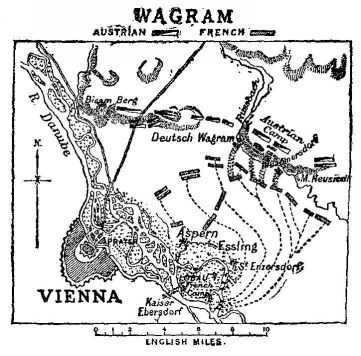
Such was the battle of Wagram, one of the greatest of all time, if the number of combatants be counted, but one of the least decisive in its strictly military results. If we may compare Austerlitz with Blenheim, Wagram may with equal fitness be matched with the vast slaughter of Malplaquet exactly a century before. The French now felt the hardening of the national defence of Austria and the falling off in their own fighting powers. Marmont tells how, at the close of the day, the approach of the Archduke John's scouts struck panic into the conquerors, so that for a time the plain on the east was covered with runaway conscripts and disconcerted plunderers. The incident proved the deterioration of the Grand Army from the times of Ulm and Jena. Raw conscripts raised before their time and[pg.197] hurriedly drafted into the line had impaired its steadiness, and men noted as another ominous fact that few unwounded prisoners were taken from the Austrians, and only nine guns and one colour. In fact, the only reputation enhanced was that of Macdonald, who for his great services at the centre enjoyed the unique honour of receiving a Marshal's bâton from Napoleon on the field of battle.
Had the Archduke Charles been made of the same stuff as Wellington, the campaign might still have been retrieved. But softness and irresolution were the characteristics of Austria's generals no less than of her rulers.[213] The Hapsburg armies were still led with the old leisurely insouciance; and their counsels swayed to and fro under the wavering impulses of a seemingly decrepit dynasty. Francis had many good qualities: he was a good husband and father, and his kindly manners endeared him to the Viennese even in the midst of defeat. But he was capricious and shortsighted; anything outside of the well-worn ruts of routine vexed and alarmed him; and it is a supreme proof of the greatness and courage of his reforming Minister, Stadion, that his innovations should have been tolerated for so long. Now that disasters were shaking his throne he began to suspect the reformer; and Stadion confessed to the publicist, Gentz, that it was impossible to reckon on the Emperor for a quarter of an hour together, unless one stayed by him all the twenty-four hours.—"After a great defeat, he will take himself off at once and will calmly commend us to God."—This was what now happened. Another failure at Znaim so daunted the Archduke that he sued for an armistice (July 12th). For this there was some excuse. The latest news both from Spain and Prussia inspired the hope that, if time were gained, important diversions might be made in both quarters.
As we have seen, Sir Arthur Wellesley opened the[pg.198] campaign with a brilliant success, and then prepared to strike at the heart of the French power. The memorable campaign of Talavera was the result. Relying on promises of aid from the Spanish Junta and from their cross-grained commander, Cuesta, he led a small British force up the valley of the Tagus to seize Madrid, while the chief French armies were engaged in distant provinces. In one sense he achieved his aim. He compelled the enemy to loose their hold on those provinces and concentrate to save the capital. And before they fully effected their concentration, he gave battle to King Joseph and Marshals Jourdan and Victor at Talavera (July 28th). Skilfully posting the Spaniards behind intrenchments and in gardens where their raw levies could fight with every advantage, he extended his thin red lines—he had only 17,000 British troops—along a ridge stretching up to a plateau that dominated the broken ground north of the town. On that hill Wellesley planted his left: and all the efforts of Victor to turn that wing or to break it by charges across the intervening ravine were bloodily beaten off.
The fierce heat served but to kindle French and British to greater fury. Finally, the dashing charge of our 23rd dragoons and the irresistible advance of the 48th regiment of foot overthrew the enemy's centre; and as the day waned, the 30,000 French retired, with a loss of 17 cannon and of 7,000 men in killed, wounded, and prisoners. Had the other Spanish armies now offered the support which Wellesley expected, he would doubtless have seized Madrid. He had written three days before Talavera: "With or without a battle we shall be at Madrid soon." But his allies now failed him utterly: they did not hold the mountain passes which confronted Soult in his march from Salamanca into the valley of the Tagus; and they left the British forces half starving.—"We are here worse off than in a hostile country," wrote our commander; "never was an army so ill used: we had no assistance from the Spanish army: we were obliged to unload our ammunition and[pg.199] our treasure in order to employ the cars in the removal of our sick and wounded." Meanwhile Soult, with 50,000 men, was threading his way easily through the mountains and threatened to cut us off from Portugal: but by a rapid retreat Wellesley saved his army, vowing that he would never again trust Spanish offers of help.[214]
Far more dispiriting was the news that reached the Austrian negotiators from the North Sea. There the British Government succeeded in eclipsing all its former achievements in forewarning foes and disgusting its friends. Very early in the year, the men of Downing Street knew that Austria was preparing to fight Napoleon and built her hopes of success, partly on the Peninsular War, partly on a British descent in Hanover, where everything was ripe for revolution. Unfortunately, we were still, formally, at war with her: and the conclusion of the treaty of peace was so long delayed at Vienna that July was almost gone before the Austrian ratification reached London, and our armada set sail from Dover.[215] The result is well known. Official favouritism handed over the command of 40,000 troops to the Earl of Chatham, who wasted precious days in battering down[pg.200] the walls of Flushing when he should have struck straight at the goal now aimed at, Antwerp. That fortress was therefore ready to beat him off; and he finally withdrew his army into the Isle of Walcheren, into whose fever-laden swamps Napoleon had refused to send a single French soldier. A tottering remnant was all that survived by the close of the year: and the climax of our national disgrace was reached when a court-martial acquitted the commanders. Napoleon would have had them shot.
Helpless as the old monarchies were to cope with Napoleon, a wild longing for vengeance was beginning to throb among the peoples. It showed itself in a remarkable attempt on his life during a review at Schönbrunn. A delicate youth named Staps, son of a Thuringian pastor, made his way to the palace, armed with a long knife, intending to stab him while he read a petition (October 12th). Berthier and Rapp, noting the lad's importunity, had him searched and brought before Napoleon. "What did you mean to do with that knife?" asked the Emperor. "Kill you," was the reply. "You are an idiot or an Illuminat." "I am not an idiot and do not know what an Illuminat is." "Then you are diseased." "No, I am quite well." "Why do you wish to kill me?" "Because you are the curse of my Fatherland." "You are a fanatic; I will forgive you and spare your life." "I want no forgiveness." "Would you thank me if I pardoned you?" "I would seek to kill you again." The quiet firmness with which Staps gave these replies and then went to his doom made a deep impression on Napoleon; and he sought to hurry on the conclusion of peace with these odd Germans whom he could conquer but not convince.
The Emperor Francis was now resigned to his fate, but he refused to hear of giving up his remaining sea-coast in Istria. On this point Metternich strove hard to bend Napoleon's will, but received as a final answer: "Then war is unavoidable."[216] In fact, the victor knew[pg.201] that Austria was in his power. The Archduke Charles had thrown up his command, the soldiery were depressed, and a great part of the Empire was in the hands of the French. England's efforts had failed; and of all the isolated patriotic movements in Germany only that of the Tyrolese mountaineers still struggled on. Napoleon could therefore dictate his own terms in the Treaty of Schönbrunn (October 14th), which he announced as complete, when as yet Francis had not signed it.[217] Austria thereby recognized Joseph as King of Spain, and ceded Salzburg and the Inn-viertel to Napoleon, to be transferred by him to Bavaria. To the French Empire she yielded up parts of Austrian Friuli and Carinthia, besides Carniola, the city and district of Trieste, and portions of Croatia and Dalmatia to the south of the River Save. Her spoils of the old Polish lands now went to aggrandize the Duchy of Warsaw, a small strip of Austrian Gallicia also going to Russia. Besides losing 3,500,000 subjects, Austria was mulcted in an indemnity of £3,400,000, and again bound herself to exclude all British products. By a secret clause she agreed to limit her army to 150,000 men.
Perhaps the severest loss was the abandonment of the faithful Tyrolese. After Aspern, the Emperor Francis promised that he would never lay down his arms until they were re-united with his Empire. This promise now went the way of the many fond hopes of reform and championship of German nationality which her ablest men had lately cherished, and the Empire settled down in torpor and bankruptcy. In dumb wrath and despair Austrian patriots looked on, while the Tyrolese were beaten down by French, Bavarian, and Italian forces. Hofer finally took to the hills, was betrayed by a friend, and was taken to Mantua. Some of the officers who there tried him desired to spare his life, but a special despatch of Napoleon[218] ordered his execution, and the[pg.202] brave mountaineer fell, with the words on his lips: "Long live the Emperor Francis." Tyrol, meanwhile, was parcelled out between Bavaria, Illyria, and the Kingdom of Italy; but bullets and partitions were of no avail against the staunch patriotism of her people, and the Tyrolese campaign boded ill for Napoleon if monarchs, generals, and statesmen should ever be inspired by the sturdy faith and hardihood of that noble peasantry.
As yet, however, prudence and timidity reigned supreme. Though the Czar uttered some snappish words at the threatening increase to the Duchy of Warsaw, he still posed as Napoleon's ally. The Swedes, weary of their hopeless strifes with France, Russia, and Denmark, deposed the still bellicose Gustavus IV.; and his successor, Charles XIII., made peace with those Powers, retaining Swedish Pomerania, but only at the cost of submitting to the Continental System. Prussia seemed, to official eyes, utterly cowed. The Hapsburgs, having failed in their bold championship of the cause of reform and of German nationality, now fell back into a policy marked by timid opportunism and decorously dull routine.
The change was marked by the retirement of Stadion, a man whose enterprising character, no less than his enthusiasm for reform, ill fitted him for the time of compromise and subservience now at hand. He it was who had urged Austria forward in the paths of progress and had sought safety in the people: he was the Stein of Austria. But now, on the eve of peace, he earnestly begged to be allowed to resign the Ministry of Foreign Affairs; and the Emperor Francis thereupon summoned to that seemingly thankless office a young diplomatist, who was destined to play a foremost part in the mighty drama of Napoleon's overthrow, and thereafter to wield by his astute policy almost as great an influence in Central and Southern Europe as the autocrat himself.
Metternich was born at Coblentz in 1773, and was therefore four years the junior of Napoleon. He came of an old family of the Rhineland, and his father's position in the service of the old Empire secured him early entrance[pg.203] into the diplomatic circle. After acting as secretary to the Imperial delegates at the Congress of Rastatt, he occupied the post of Austrian ambassador successively at the Courts of Dresden and Berlin; and in 1806 he was suddenly called to take up the embassy in Paris. There he displayed charms of courtly tact, and lively and eloquent conversation, which won Napoleon's admiration and esteem. He was looked on as a Gallophil; and, like Bismarck at a later crisis, he used his social gifts and powers of cajolery so as to gain a correct estimate of the characters of his future opponents.
Yet, besides these faculties of finesse and intrigue—and the Miltonic Belial never told lies with more winsome grace—Metternich showed at times a manly composure and firmness, even when Napoleon unmasked a searching fire of diplomatic questions and taunts. Of this he had given proof shortly before the outbreak of the late war, and his conduct had earned the thanks of the other ambassadors for giving the French Emperor a lesson in manners, while the autocrat liked him none the less, but rather the more, for standing up to him. But now, after the war, all was changed; craft was more serviceable than fortitude; and the gay Rhinelander brought to the irksome task of subservience to the conqueror a courtly insouciance under which he nursed the hope of ultimate revenge.—"From the day when peace is signed," he wrote to the Emperor Francis on August 10th, 1809, "we must confine our system to tacking and turning, and flattering. Thus alone may we possibly preserve our existence, till the day of general deliverance."[219] This was to be the general drift of Austrian policy for the next four years; and it may be granted that only by bending before the blast could that sore-stricken monarchy be saved from destruction. An opportunity soon occurred of carryingthe new system into effect. Metternich offered the conqueror an Austrian Archduchess as a bride.
After the humiliation of the Hapsburgs and of the Spanish patriots, nothing seemed wanting to Napoleon's[pg.204] triumph but an heir who should found a durable dynasty. This aim was now to be reached. As soon as the Emperor returned to Paris, his behaviour towards Josephine showed a marked reserve. The passage communicating between their private apartments was closed, and the gleams of triumphant jealousy that flashed from her sisters-in-law warned Josephine of her approaching doom. The divorce so long bruited by news-mongers was at hand. The Emperor broke the tidings to his consort in the private drawing-room of the Tuileries on November 30th, and strove to tone down the harshness of his decision by basing it on the imperative needs of the State. But she spurned the dictates of statecraft. With all her faults, she was affectionate and tender; she was a woman first and an Empress afterwards; she now clung to Napoleon, not merely for the splendour of the destiny which he had opened to her, but also from genuine love.
Their relations had curiously changed. At the outset she had slighted his mad devotion by her shallow coldness and occasional infidelities, until his lava-like passion petrified. Thenceforth it was for her to woo, and woo in vain. For years past she had to bemoan the waning of his affection and his many conjugal sins. And now the chasm, which she thought to have spanned by the religious ceremony on the eve of the coronation, yawned at her feet. The woman and the Empress in her shrank back from the black void of the future; and with piteous reproaches she flung back the orders of the Emperor and the soothings of the husband. Napoleon, it would seem, had nerved himself against such an outbreak. In vain did Josephine sink down at his feet with heart-rending cries that she would never survive the disgrace: failing to calm her himself, he opened the door and summoned the prefect of the palace, Bausset, and bade him bear her away to her private apartments. Down the narrow stairs she was borne, the Emperor lifting her feet and Bausset supporting her shoulders, until, half fainting, she was left to the sympathies of her women[pg.205] and the attentions of Corvisart. But hers was a wound that no sympathy or skill could cure.[220]
On his side, Napoleon felt the wrench. Not only the ghost of his early love, but his dislike of new associates and novel ways cried out against the change. "In separating myself from my wife," Napoleon once said to Talleyrand, "I renounce much. I should have to study the tastes and habits of a young woman. Josephine accommodates herself to everything: she understands me perfectly."[221] But his boundless triumphs, his alliance with the Czar and total overthrow of the Bourbons and the Pope, had fed the fires of his ambition. He aspired to give the mot d'ordre to the universe; and he scrupled not to put aside a consort who could not help him to found a dynasty. Yet it was not without pangs of sorrow and remorse. His laboured, panting breath and almost gasping words left on Bausset the impression that he was genuinely affected; and, consummate actor though he was, we may well believe that he felt the parting from his early associations. Underneath his generally cold exterior he hid a nervous nature, dominated by an inflexible will, but which now and again broke through all restraint, bathing the beloved object with sudden tenderness or blasting a foe with fiery passion. And it would seem that Josephine's pangs had power to reawaken the feelings of his more generous youth. The ceremony of divorce took place on December 15th Josephine declaring with agonized pride that she gave her assent for the welfare of France.
Already the new marriage negotiations had begun. They are unique even amidst the frigid annals of royal betrothals. The French ambassador, Caulaincourt, was charged to make definite overtures at St. Petersburg for the hand of the Czar's younger sister; the conditions could easily be arranged; religion need be no difficulty; but time was pressing; the Emperor had need of an heir; "we are counting the minutes here," ran the despatch;[pg.206] and an answer was expected from St. Petersburg after an interval of two days.[222] The request caused Alexander the greatest perplexity. He parried it with the reply, correct enough in form as in fact, that the disposal of his sister rested with the Dowager Empress. But her hostility to Napoleon was well known. After the half overtures of Erfurt she had at once betrothed her elder daughter to the Duke of Oldenburg. No similar escape was now possible for the younger one: but, after leaving Napoleon's request unanswered until February 4th, the reply was then despatched that the tender age of the princess, she being only twenty years old, formed an insuperable obstacle.
Some such answer had long been expected at Paris. Metternich asserts in his "Memoirs" that Napoleon had caused Laborde, one of his diplomatic agents at Vienna, tentatively to sound that Court as to his betrothal with the Archduchess Marie Louise. But the French archives show that the first hint came from Metternich, who saw in it a means of weakening the Franco-Russian alliance and saving Austria from further disasters.[223] A little later the Countess Metternich was at Paris; and great was her surprise when, on January 2nd, 1810, Josephine informed her that she favoured a marriage between Napoleon and Marie Louise. "I spoke to him of it yesterday," she said; "his choice is not yet fixed; but he thinks that this would be his choice if he were sure of its being accepted." Thereafter the Countess received the most flattering attentions at Court, a proof that the Hapsburg match was now favoured, even though the coyness of the Czar was as yet unknown.[pg.207]
At the close of January a Privy Council was held at the Tuileries to decide on the imperial bride. The votes were nearly equal: four voted for Austria, four for Saxony, and three for Russia. After listening quietly to the arguments, Napoleon summed up the discussion by pronouncing firmly and warmly in favour of Austria. The marriage contract was therefore drawn up on February 7th; and Berthier was despatched to Vienna to claim the hand of Marie Louise. He entered that city over the ruins of the old ramparts, which were now being dismantled in accordance with the French demands.
The marriage took place at Vienna by proxy; the bride was conducted to Paris; and the final ceremony took place at Notre Dame on April 2nd, but not until the union had been consummated. Such were Napoleon's second wooing and wedding. Nevertheless, he showed himself an attentive and even indulgent spouse, and he remarked at St. Helena that if Josephine was all grace and charm, Marie Louise was innocence and nature herself.
The Austrian marriage was an event of the first importance. It gained a few years' respite for the despairing Hapsburgs, and gave tardy satisfaction to Talleyrand's statesmanlike scheme of a Franco-Austrian alliance which should be in the best sense conservative. Had Napoleon taken this step after Austerlitz in the way that his counsellor advised, possibly Europe might have reached a condition of stable equilibrium, always provided that he gave up his favourite scheme of partitioning Turkey. But that was not to be; and when Austria finally yielded up Marie Louise as an unpicturesque Iphigenia on the marriage altar, she did so only as a desperate device for appeasing an inexorable destiny. And, strange to say, she succeeded. For Alexander took offence at the marriage negotiations; and thus was opened a breach in the Franco-Russian alliance which other events were rapidly to widen, until Western and Central Europe hurled themselves against the East, and reached Moscow.[pg.208]
Napoleon's star had now risen to its zenith. After his marriage with a daughter of the most ancient of continental dynasties, nothing seemed lacking to his splendour. He had humbled Pope and Emperor alike: Germany crouched at his feet: France, Italy, and the Confederation of the Rhine gratefully acknowledged the benefits of his vigorous sway: the Czar was still following the lead given at Erfurt: Sweden had succumbed to the pressure of the two Emperors: and Turkey survived only because it did not yet suit Napoleon to shear her asunder: he must first complete the commercial ruin of England and drive Wellington into the sea. Then events would at last be ripe for the oriental schemes which the Spanish Rising had postponed.
He might well hope that England's strength was running out: near the close of 1810 the three per cent. consols sank to sixty-five, and the declared bankruptcies averaged 250 a month. The failure of the Walcheren expedition had led to terrible loss of men and treasure, and had clouded over the reputation of her leaders. After mutual recriminations Canning and Castlereagh resigned office and fought a duel. Shortly afterwards the Premier, the Duke of Portland, fell ill and resigned: his place was taken by Mr. Perceval, a man whose sole recommendation for the post was his conscientious Toryism and powers of dull plodding. Ruled by an ill-assorted Ministry and a King whose reason was now hopelessly overclouded, weakened by the strangling grip of the Continental System, England seemed on the[pg.209] verge of ruin; and, encouraged alike by the factious conduct of our parliamentary Opposition and by Soult's recent conquest of Andalusia, Napoleon bent himself to the final grapple by extending his coast system, and by sending Masséna and his choicest troops into Spain to drive the leopards into the sea.
The limits of our space prevent any description of the ensuing campaign of Torres Vedras; and we must refer our readers to the ample canvas of Napier if they would realize the sagacity of Wellington in constructing to the north of Lisbon that mighty tête de pont for the Sea Power against Masséna's veteran army. After dealing the staggering blow of Busaco at that presumptuous Marshal, our great leader fell back, through a tract which he swept bare of supplies, on this sure bulwark, and there watched the French host of some 65,000 men waste away amidst the miseries of hunger and the rains and diseases of autumn. At length, in November, Masséna drew off to positions near Santarem, where he awaited the succour which Napoleon ordered Soult to bring. It was in vain: Soult, puffed up by his triumphs in Andalusia, was resolved to play his own game and reduce Badajoz; he won his point but marred the campaign; and, at last, foiled by Wellington's skilful tactics, Masséna beat a retreat northwards out of Portugal after losing some 35,000 men (March, 1811). Wellington's success bore an immeasurable harvest of results. The unmanly whinings of the English Opposition were stilled; the replies of the Czar to Napoleon's demands grew firmer; and the patriots of the Peninsula stiffened their backs in a resistance so stubborn, albeit unskilful, that 370,000 French troops utterly failed to keep Wellington in check, and to stamp out the national defence in the summer of 1811.
In truth, Napoleon had exasperated the Spaniards no less than their soi disant king, by a series of provocations extending over the year 1810. On the plea that Spain must herself meet the expenses of the war, he erected the four northern provinces into commands for[pg.210] French generals, who were independent of his brother's authority and levied all the taxes over that vast area (February). On May 29th he withdrew Burgos and Valladolid from Joseph's control, and divided the greater part of Spain for military and administrative purposes into districts that were French satrapies in all but name. The decree was doubly disastrous: it gave free play to the feuds of the French chiefs; and it seemed to the Spaniards to foreshadow a speedy partition of Spain. The surmise was correct. Napoleon intended to unite to France the lands between the Pyrenees and the Ebro. Indeed, in his conception, the conquest of Portugal was mainly desirable because it would provide his brother with an indemnity in the west for the loss of his northern provinces. Joseph's protests against such a partition of the land, which Napoleon had sworn at Bayonne to keep intact, were disregarded; but letters on this subject fell into the hands of the Spanish guerillas and were published by order of the Regency at Cadiz. Despised by the Spaniards, flouted by Napoleon, set at defiance by the French satraps, and reduced wellnigh to bankruptcy, the puppet King felt his position insupportable, and, hurrying to Paris, tendered his resignation of the crown (May, 1811). In his anxiety to huddle up the scandal, Napoleon appeased his brother, promised him one-fourth of the taxes levied by the French commanders, and coaxed or drove him to resume his thankless task at Madrid. But the doggedness of the Emperor's resolve may be measured by the fact that, even when on the brink of war with Russia, he defied Spanish national sentiment by annexing Catalonia to France (March, 1812).
It seems strange that Napoleon did not himself proceed to Spain in order to direct the operations in person and thus still the jealousies of the Marshals which so hampered his armies. Wellington certainly feared his coming. At a later date he told Earl Stanhope that Napoleon was vastly superior to any of his Marshals: "There was nothing like him. He suited a French army[pg.211] so exactly.... His presence on the field made a difference of 40,000 men."[224] That estimate is certainly modest if one looks not merely at tactics but at the strategy of the whole Peninsular War. But the Emperor did not again come into Spain. At the outset of 1810 he prepared to do so; but, as soon as the Austrian marriage was arranged, he abandoned this salutary project.
There were thenceforth several reasons why he should remain in or near Paris. His attentions to his young wife, and his desire to increase the splendour of the Court, counted for much. Yet more important was it to curb the clericals (now incensed at the imprisonment of the Pope), and sharply to watch the intrigues of the royalists and other malcontents. Public opinion, also, still needed to be educated; the constant drain of men for the wars and the increase in the price of necessaries led to grumblings in the Press, which claimed the presence of his Argus eye and the adoption of a very stringent censorship.[225] But, above all, there was the commercial war with England. This could be directed best from Paris, where he could speedily hear of British endeavours to force goods into Germany, Holland, or Italy, and of any change in our maritime code.
Important as was the war in Spain, it was only one phase of his world-wide struggle with the mistress of the seas; and he judged that if she bled to death under his Continental System, the Peninsular War must subside into a guerilla strife, Spain thereafter figuring merely as a greater Vendée. Accordingly, the year 1810 sees the climax of his great commercial experiment.
The first land to be sacrificed to this venture was[pg.212] Holland. For many months the Emperor had been discontented with his brother Louis, who had taken into his head the strange notion that he reigned there by divine right. As Napoleon pathetically said at St. Helena, when reviewing the conduct of his brothers, "If I made one a king, he imagined that he was King by the grace of God. He was no longer my lieutenant: he was one enemy more for me to watch." A singular fate for this king-maker, that he should be forgotten and the holy oil alone remembered! Yet Louis probably used that mediæval notion as a shield against his brother's dictation. The tough Bonaparte nature brooked not the idea of mere lieutenancy. He declined to obey orders from the brother whom he secretly detested. He flatly refused to be transferred from the Hague to Madrid, or to put in force the burdensome decrees of the Continental System.
On his side, Napoleon upbraided him with governing too softly, and with seeking popularity where he should seek control. After the Walcheren expedition, he chid him severely for allowing the English fleet ever to show its face in the Scheldt; for "the fleets of that Power ought to find nothing but rocks of iron" in that river, "which was as important to France as the Thames to England."[226] But the head and front of his offending was that British goods still found their way into Holland. In vain did the Emperor forbid that American ships which had touched at English ports should be debarred from those of Holland. In vain did he threaten to close the Scheldt and Rhine to Dutch barges. Louis held on his way, with kindly patience towards his merchants, and with a Bonapartist obstinacy proof against fraternal advice or threats. At last, early in 1810, Napoleon sent troops to occupy Walcheren and neighbouring Dutch lands. It seemed for a time as though this was but a device to extort favourable terms of peace from England in return for an offer that France would not annex Holland. Negotiations to this effect were set on foot through[pg.213] the medium of Ouvrard and Labouchere, son-in-law of the banker Baring: Fouché also, without the knowledge of his master, ventured to put forth a diplomatic feeler as to a possible Anglo-French alliance against the United States, an action for which he was soon very properly disgraced.[227]
The negotiation failed, as it deserved to do. Our objections were, not merely to the absurd proposal that we should give up our maritime code if Napoleon would abstain from annexing Holland and the Hanseatic towns, but still more against the man himself and his whole policy. We had every reason to distrust the good faith of the man who had betrayed the Turks at Tilsit, Portugal at Fontainebleau, and the Spaniards at Bayonne. To pause in the strife, to relax our hold on our new colonies, and to desert the Spaniards, in order to preserve the merely titular independence of Holland and the Hanse Towns, would have been an act of singular simplicity. Nor does Napoleon seem to have expected it. He wrote to his Foreign Minister, Champagny, on March 20th, 1810: "From not having made peace sooner, England has lost Naples, Spain, Portugal, and the market of Trieste. If she delays much longer, she will lose Holland, the Hanse Towns, and Sicily." And surely this Sibylline conduct of his required that he should annex these lands and all Europe in order to exact a suitable price from the exhausted islanders. Such was the corollary of the Continental System.
Meanwhile Louis, nettled by the inquisitions of the French douaniers, and by the order of his brother to seize all American ships in Dutch ports, was drawing on himself further reproaches and threats: "Louis, you are incorrigible ... you do not want to reign for any length of time. States are governed by reason and policy, and not by acrimony and weakness." Twenty thousand French troops were approaching Amsterdam to bring him to[pg.214] reason, when the young ruler decided to be rid of this royal mummery. On the night of July 1st he fled from Haarlem, and travelled swiftly and secretly eastwards until he reached Teplitz, in Bohemia. The ignominy of this flight rested on the brother who had made kingship a mockery. The refugee left behind him the reputation of a man who, lovable by nature but soured by domestic discords, sought to shield his subjects from the ruin into which the rigid application of the Continental System was certain to plunge them. That fate now befell the unhappy little land. On July 9th it was annexed to the French Empire, and all the commercial decrees were carried out as rigidly at Rotterdam as at Havre.
At the close of the year, Napoleon's coast system was extended to the borders of Holstein by the annexation of Oldenburg, the northern parts of Berg, Westphalia, and Hanover, along with Lauenburg and the Hanse Towns, Bremen, Hamburg, and Lübeck. The little Swiss Republic of Valais was also absorbed in the Empire.
This change in North Germany, which carried the French flag to the shores of the Baltic, was his final expedient for assuring England's commercial ruin. As far back as February, 1798, he had recommended the extension of French influence over the Hanse Towns as a means of reducing his most redoubtable foe to surrender, and now there were two special reasons for this annexation. First, the ships of Oldenburg had been largely used for conveying British produce into North Germany; [228] and secondly, the French commercial code was so rigorous that no officials with even the semblance of independence could be trusted with its execution. On August 5th a decree had been promulgated at the Trianon, near Versailles, which imposed enormous duties on every important colonial product. Cotton—especially that from America—sugar, tea, coffee, cocoa, and other articles were subjected to dues, generally of half their value and irrespective of their place of production. [pg.215]
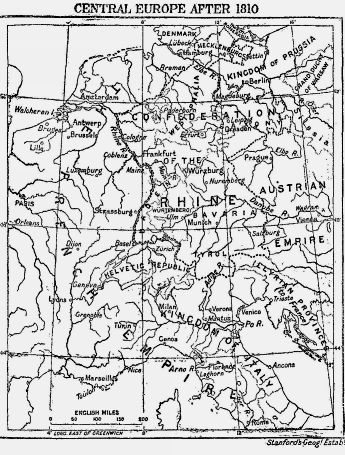
Traders were ordered to declare their possession of all colonial wares and to pay the duty, under pain of confiscation. Depôts of such goods within four days' distance from the frontiers of the Empire were held to be clandestine; and troops were sent forthwith into Germany, Switzerland, and Spain to seize such stores, a proceeding which aroused the men of Stuttgart, [pg.216] Frankfurt, and Berne to almost open resistance. It is difficult to see the reason for this decree, except on the supposition that the Continental System did not stop British imports, and that all tropical products were British.
Napoleon's own correspondence shows that he believed this to be so. At that same time he issued orders that all colonial produce found at Stettin should be confiscated because it was evidently English property brought on American ships. He further recommended Murat and Eugène to press hard on such wares in order to replenish their exchequers and raise funds for restoring their commerce. Eugène must, however, be careful to tax American and colonial cotton most heavily, while letting in that of the Levant on favourable terms.
Jerome, too, was bidden rigorously to enforce the Trianon tariff in Westphalia; and the hint was to be passed on to Prussia and the Rhenish Confederation that, by subjecting colonial goods to these enormous imposts, those States would gain several millions of francs "and the loss would fall partly on English commerce and partly on the smugglers."[229] In fact, all his acts and words at this time reveal the densest ignorance, not only of political economy, but of the elementary facts of commerce, as when he imagined that officials, who were sufficiently hard worked with watching a nimble host of some 100,000 smugglers along an immense frontier, would also be able to distinguish between Syrian and American cottons, and to exact 800 francs from 100 kilogrammes of the latter, as against 400 francs from the former, or that six times as much could ever be levied on Chinese teas as on other teas! Such a tariff called for a highly drilled army of those sufficiently rare individuals, honest douaniers, endowed also with Napoleonic activity and omniscience. But, as Chaptal[pg.217] remarked, the Emperor had never thought much about the needs of commerce, and he despised merchants as persons who had "neither a faith nor a country, whose sole object was gain." His own notion about commerce was that he could "make it manoeuvre like a regiment"; and this military conception of trade led him to entertain the fond hope that exchequers benefited by confiscation and prohibitive tariffs, that a "national commerce" could be speedily built up by cutting off imports, and that the burden of loss in the present commercial war fell on England and not on the continental consumer.
Such was the penalty which the great man paid for scorning all new knowledge as idéalogie. The principles set forth by Quesnay, Turgot, and Adam Smith were to him mere sophistical juggling. He once said to Mollien: "I seek the good that is practical, not the ideal best: the world is very old: we must profit by its experience: it teaches that old practices are worth more than new theories: you are not the only one who knows trade secrets."[230] This was his general attitude towards the exponents of new financial or commercial views. Indeed, we can hardly think of this great champion of external control and state intervention favouring the open-handed methods of laisser faire. Unhappy France, that gave this motto to the world but let her greatest ruler emphasize her recent reaction towards commercial mediævalism! Luckless Emperor, who aspired to found the United States of Europe, but outraged the principle which most surely and lastingly works for international harmony, that of Free Trade!
While the Trianon tariff sought to hinder the import of England's colonial products, or, failing that, to reap a golden harvest from them, Napoleon further endeavoured to terrify continental dealers from accepting any of her manufactures. His Fontainebleau decree of October 18th, 1810, ordered that all such goods should be seized and publicly burnt; and five weeks later special tribunals were instituted for enforcing these ukases and for trying[pg.218] all persons, whether smugglers caught red-handed or shopkeepers who inadvertently offered for sale the cottons of Lancashire or the silks of Bengal.
The canon was now complete. It only remained to convert the world to the new gospel of pacific war. The results were soon clearly visible in a sudden rise of prices throughout France, Germany, and Italy. Raw cotton now fetched 10 to 11 francs, sugar 6 to 7 francs, coffee 8 francs, and indigo 21 francs, per pound, or on the average about ten times the prices then ruling at London.[231] The reason for this advantage to the English consumer and manufacturer is clear. England swayed the tropics and held the seas; and, having a monopoly of colonial produce, she could import it easily and abundantly, while the continental purchaser had ultimately to pay for the risks incurred by his shopkeeper, by British merchants, and by their smugglers, who "ran in" from Heligoland, Jersey, or Sicily. These classes vied in their efforts to prick holes in the continental decrees. Bargees and women, dogs and hearses, were pressed into service against Napoleon. The last-named device was for a time tried with much success near Hamburg, until the French authorities, wondering at the strange increase of funerals in a river-side suburb, peered into the hearses, and found them stuffed full with bales of British merchandise. This gruesome plan failing, others were tried. Large quantities of sand were brought from the seashore, until, unfortunately for the housewives, some inquisitive official found that it hailed from the West Indies.
Or again, devious routes were resorted to. Sugar was smuggled from London into Germany by way of Salonica, that being now almost the only neutral port open to British commerce. Thence it was borne in panniers on the backs of mules over the Balkans to Belgrade, where it was transferred to barges and carried up the Danube. Another illicit trade route was from the desolate shores of Dalmatia through Hungary. The writer of a [pg.219] pamphlet, "England, Ireland, and America," states that his firm then employed 500 horses on and near that coast in carrying British goods into Central Europe, and that the cost of getting them into France was "about £28 per cwt., or more than fifty times the present freight to Calcutta." In fact, the result of the Emperor's economic experiments may be summed up in the statement of Chaptal that the general run of prices in France was higher by one-third than it was before 1789.
Now the merest tyro might see that the difference in price above the normal level was paid by the consumer. The colonial producer, the British merchant and shipper were certainly harassed, and trade was dislocated; but, as Mollien observed, commerce soon adapted itself to altered conditions; and merchants never parted with their wares without getting hard cash or resorting to the primitive method of barter. Money was also frequently melted down in France and Germany so as to effect bargains with England in bars of metal. And so, in one way or another, trade was carried on, with infinite discomfort and friction, it is true; but it never wholly ceased even between England and France direct.
In fact, Napoleon so clung to the old mercantilist craze of stimulating exports in order that they might greatly exceed the imports, as to favour the sending of agricultural produce to England, provided that such cargoes comprised manufactured goods. He allowed this privilege not only to his Empire but also to the Kingdom of Italy.[232] The difficulty was that England would not receive the manufactured goods of her enemies; and, as corn and cheese could not be exported to England, unless a certain proportion of silk and cloths went with them, the latter were got up so as to satisfy the French customs officers and then cast into the sea. It is needless to add that this export of manufactures to England, on which Napoleon prided himself, was limited to showy but worthless articles, which were made solely ad usum delphinorum.[pg.220]
It was fortunate for us that Napoleon entertained these crude ideas on political economy; for his action opened for us a loophole of escape from a very serious difficulty. At that time our fast growing population was barely fed by our own wheat even after good seasons; and Providence afflicted us in 1809 and 1810 with very poor harvests. In 1810 the average price was 103 shillings the quarter, the highest ever known except in 1800 and 1801; and as commerce was dislocated by the Continental System and hand-labour was being largely replaced by the new power-looms and improved spinning machinery, the outlook would have been hopeless, had not our great enemy allowed us to import continental corn. This device, which he imagined would impoverish us to enrich his own States, was the greatest aid that he could have rendered to our hard-pressed social system; and readers of Charlotte Brontë's realistic sketches of the Luddite rioting in Yorkshire may imagine what would have befallen England if, besides lack of work and low wages, there had been the added horrors of a bread famine. But fortunately the curious commercial notions harboured by our foe enabled us in the winter of 1810-11 to get supplies of corn not only from Prussia and Poland but even from Italy and France.
In one sense this incident has been misunderstood. It has been referred to by Porter[233] and other hopeful persons as proof positive that as long as we can buy corn we shall get it, even from our enemies. It proves nothing of the sort. Napoleon's correspondence and his whole policy with regard to licences, which we shall presently examine, shows clearly that he believed he would greatly benefit his own States and impoverish our people by selling us large stores of corn at a very high price. There is no hint in any of his letters that he ever framed the notion of starving us into surrender. All that he looked to was the draining away of our wealth by cutting off our exports, and by allowing imports to enter our harbours much as usual. As long as he prevented us selling[pg.221] our produce, he heeded little how much we bought from his States: in fact, the more we bought, the sooner we should be bankrupt—such was his notion.
It is strange that he never sought to cut off our corn-supplies. They were then drawn almost entirely from the Baltic ports. The United States and Canada had as yet only sent us a few driblets of corn. La Plata and the Cape of Good Hope were quite undeveloped; and our settlements in New South Wales were at that time often troubled by dearth. The plan of sealing up the cornfields of Europe from Riga to Trieste would have been feasible, at least for a few weeks; French troops held Danzig and Stettin; Russia, Prussia, and Denmark were at his beck and call; and an imperial decree forbidding the export of corn from France and her allied States to the United Kingdom could hardly have failed to reduce us to starvation and surrender in the very critical winter of 1810-11. But that strange mental defect of clinging with ever increasing tenacity to preconceived notions led Napoleon to allow and even to favour exports of corn to us in the time of our utmost need; and Britain survived the strain.[234]
What folly, however, to refer to the action of this man of one economic idea as being likely to determine the conduct of continental statesmen in some future naval war with England. In truth, the urgency of the problem of our national food-supply in time of a great war can only be fully understood by those who have studied the Napoleonic era. England then grew nearly enough corn for her needs; her fleets swept the seas; and Napoleon's economic hobby left her foreign food-supply unhampered at the severest crisis. Yet, even so, the price of the quartern loaf rose to more than fifteenpence, and we[pg.222] were brought to the verge of civil war. A comparison of that time with the conditions that now prevail must yield food for reflection to all but the case-hardened optimists.
But already Napoleon was convinced that the Continental System must be secretly relaxed in special cases. Despite the fulsome addresses which some Chambers of Commerce sent up, he knew that his seaports were in the depths of distress, and that French cotton manufacturers could not hope to compete with those of Lancashire now that his own tariff had doubled the price of raw cotton and dyes in France. He therefore hit upon the curious device of allowing continental merchants to buy licences for the privilege of secretly evading his own decrees. The English Government seems to have been the first to issue similar secret permits; but Napoleon had scarcely signed his Berlin Decree for the blockade of England before he connived at its infraction. When sugar, coffee, and other comforts became scarce, they were secretly imported from perfidious Albion for the imperial table. The final stage was reached in July, 1810, when licences to import forbidden goods were secretly sold to favoured merchants, and many officials—among them Bourrienne—reaped a rich harvest from the sale of these imperial indulgences. Merchants were so eager to evade the hated laws that they offered high prices to the treasury and douceurs to officials for the coveted boon; and as much as £40,000 is said to have been paid for a single licence.
On both sides of the Channel this device was abhorred, but its results were specially odious in Napoleon's States, where the burdens to be evaded were far heavier than those entailed by the Orders in Council. In fact, the Continental System was now seen to be an organized hypocrisy, which, in order to ruin the mistress of the seas, exposed the peoples to burdens more grievous than those borne by England, and left all but the wealthiest merchants a prey to a grinding fiscal tyranny. And the sting of it all was its social injustice; for while the poor[pg.223] were severely punished, sometimes with death, for smuggling sugar or tobacco, Napoleon and the favoured few who could buy licences often imported these articles in large quantities. What wonder, then, that Russia and Sweden should decline long to endure these gratuitous hardships, and should seek to evade the behests of the imperial smuggler of the Tuileries!
Nevertheless, as no inventive people can ever be thrown wholly on its own resources without deriving some benefit, we find that France met the crisis with the cheery patience and unflagging ingenuity which she has ever evinced. In a great Empire which embraced all the lands between Hamburg, Bayonne, and Rome, not to mention Illyria and Dalmatia, a great variety of products might readily reward the inventor and the husbandman. Tobacco, rice, and cotton could be reared in the southern portions. Valiant efforts were also made to get Asiatic produce overland, so as to disappoint the English cruisers; and the coffee of Arabia was taxed very lightly, so as to ruin the American producer. When the fragrant berry became more and more scarce, chicory was discovered by good patriots to be a palatable substitute, and scientific men sought to induce French manufacturers to use the isatis plant instead of indigo. Prizes were offered by the State and by local Chambers of Commerce to those who should make up for the lack of tropical goods and dyes.
A notable discovery was made by Chaptal and Delessert, who improved on Markgraf's process of procuring sugar from beetroot and made it a practical success. Napoleon also hoped that a chemical substitute for indigo had been found, and exclaimed to a doleful deputation of merchants, who came to the Tuileries in the early summer of 1811, that chemistry would soon revolutionize commerce as completely as the discovery of the compass had done. Besides, the French Empire was the richest country in the world, and could almost do without foreign commerce, at least until England had given way; and that would soon come to pass; for the pressure of events would soon[pg.224] compel London merchants to throw their sugar and indigo into the Thames.[235]
In reality, he placed commerce far behind agriculture, which he considered to be the basis of a nation's wealth and a nation's health. But he also took a keen interest in manufactures. The silk industry at Lyons found in him a generous patron. He ordered that the best scientific training should there be given, so as to improve the processes of manufacture; and, as silk of nearly all kinds could be produced in France and Italy, Lyons was comparatively prosperous. When, however, it suffered from the general rise of prices and from the impaired buying power of the community, he adopted heroic remedies. He ordered that all ships leaving France should carry silk fabrics equal in value to one-fourth of the whole freight; but whether these stuffs went to adorn women or mermaids seems an open question. Or again, on the advice of Chaptal, the Emperor made large purchases of surplus stocks of Lyons silk, Rouen cottons, and Ste. Antoine furniture, so as to prevent an imminent collapse of credit and a recrudescence of Jacobinism in those industrial centres; for as he said: "I fear a rising brought about by want of bread: I had rather fight an army of 200,000 men than that."[236]
In the main, this policy of giving panem et circenses was successful in France; at least, it kept her quiet. The national feeling ran strongly in favour of commercial prohibition. In 1787 Arthur Young found the cotton-workers of the north furious at the recent inroads of Lancashire cottons, while the wine-growers of the Garonne were equally favourable to the enlightened Anglo-French commercial treaty of 1786. It was Napoleon's lot to win the favour of the rigid[pg.225] protectionists, while not alienating that of the men of the Gironde, who saw in him the champion of agrarian liberty against the feudal nobles. Moreover, the nation still cherished the pathetic belief that the war was due to Albion's perfidy respecting Malta, and burned with a desire to chastise the recreant islanders. For these reasons, Frenchmen endured the drain of men and money with but little show of grumbling.
They were tired of the wars. We have had enough glory, they said, even in the capital itself, and an acute German observer describes the feeling there as curiously mixed. Parisian gaiety often found vent in lampoons against the Emperor; and much satire at his expense might with safety be indulged in among a crowd, provided it were seasoned with wit. The people seemed not to fear Napoleon, as he was feared in Germany: the old revolutionary party was still active and might easily become far more dangerous than the royalist coteries of the Boulevard St. Germain. For the rest, they were all so accustomed to political change that they looked on his government as provisional, and put up with him only as long as the army triumphed abroad and he could make his power felt at home. Such was the impression of Paris gained by Varnhagen von Ense. Public opinion in the provinces seems to have been more favourable to Napoleon; and, on the whole, pride in the army and in the vigorous administration which that nation loves, above all, hatred of England and the hope of wresting from her the world's empire, led the French silently to endure rigorous press laws, increased taxes, war prices, licences, and chicory.
For Germans the hardships were much greater and the alleviations far less. They had no deep interest in Malta or in the dominion of the seas; and political economy was then only beginning to dawn on the Teutonic mind. The general trend of German thought had inclined towards the Everlasting Nay, until Napoleon flashed across its ken. For a time he won the admiration of the chief thinkers of Germany by brushing away the feudal[pg.226] cobwebs from her fair face. He seemed about to call her sons to a life of public activity; and in the famous soliloquy of Faust, in which he feels his way from word to thought, from thought to might, and from might to action, we may discern the literary projection of the influence exerted by the new Charlemagne on that nation of dreamers.[237] But the promise was fulfilled only in the most harshly practical way, namely, by cutting off all supplies of tobacco and coffee; and when Teufelsdröckh himself, admirer though he was of the French Revolution, found that the summons for his favourite beverage—the "dear melancholy coffee, that begets fancies," of Lessing—produced only a muddy decoction of acorns, there was the risk of his tendencies earthwards taking a very practically revolutionary turn.
In truth, the German universities were the leaders of the national reaction against the Emperor of the West. Fichte's pleading for a truly national education had taken effect. Elementary instruction was now being organized in Prussia; and the divorce of thought from action, which had so long sterilized German life, was ended by the foundation of the University of Berlin by Humboldt. Thus, in 1810, the year of Prussia's deepest woe, when her brave Queen died of a stricken heart, when French soldiers and douaniers were seizing and burning colonial wares, her thinkers came into closer touch with her men of action, with mutually helpful results. Thinkers ceased to be mere dreamers, and Prussian officials gained a wider outlook on life. The life of beneficent activity, to which Napoleon might have summoned the great majority of Germans, dawned on them from Berlin, not from Paris.
His influence was more and more oppressive. The final results of his commercial decrees on the trade of Hamburg were thus described by Perthes, a well-known writer and bookseller of that town: "Of the 422 sugar-boiling houses, few now stood open: the printing of cottons had ceased entirely: the tobacco-dressers were[pg.227] driven away by the Government. The imposition of innumerable taxes, door and window, capitation and land taxes, drove the inhabitants to despair." But the same sagacious thinker was able to point the moral of it all, and prove to his friends that their present trials were due to the selfish particularism of the German States: "It was a necessity that some great power should arise in the midst of the degenerate selfishness of the times and also prove victorious, for there was nothing vigorous to oppose it. Napoleon is an historical necessity."[238]
Thus, both in the abodes of learning and in the centres of industry men were groping after a higher unity and a firmer political organization, which, after the Napoleonic deluge had swept by, was to lay the foundation of a New Germany.
To all appearances, however, Napoleon's power seemed to be more firmly established than ever in the ensuing year. On March 20th, 1811, a son was born to him. At the crisis of this event, he revealed the warmth of his family instincts. On hearing that the life of mother or infant might have to be sacrificed, he exclaimed at once, "Save the mother."[239] When the danger was past, he very considerately informed Josephine, stating, "he has my chest, my mouth and my eyes. I trust that he will fulfil his destiny." That destiny was mapped out in the title conferred on the child, "King of Rome," which was designed to recall the title "King of the Romans," used in the Holy Roman Empire.
Napoleon resolved that the old elective dignity should now be renewed in a strictly hereditary Empire, vaster than that of Charlemagne. Paris was to be its capital, Rome its second city, and the future Emperors were always to be crowned a second time at Rome. Furthermore, lest the mediæval dispute as to the supremacy of Emperor or Pope in Rome should again vex mankind, the Papacy was virtually annexed: the status of the pontiff was defined in the most Erastian sense, imperial funds were[pg.228] assigned for his support, and he was bidden to maintain two palaces, "the one necessarily at Paris, the other at Rome."
It is impossible briefly to describe the various conflicts between Pius VII. and Napoleon. Though now kept in captivity by Napoleon, the Pope refused to ratify these and other ukases of his captor; and the credit which Napoleon had won by his wordly-wise Concordat was now lost by his infraction of many of its clauses and by his harsh treatment of a defenceless old man. It is true that Pius had excommunicated Napoleon; but that was for the crime of annexing the Papal States, and public opinion revolted at the spectacle of an all-powerful Emperor now consigning to captivity the man who in former years had done so much to consolidate his authority. After the disasters of the Russian campaign, he sought to come to terms with the pontiff; but even then the bargain struck at Fontainebleau was so hard that his prisoner, though unnerved by ill-health, retracted the unholy compromise. Whereupon Napoleon ordered that the cardinals who advised this step should be seized and carried away from Fontainebleau. Few of Napoleon's actions were more harmful than this series of petty persecutions; and among the influences that brought about his fall, we may reckon the dignified resistance of the pontiff, whose meekness threw up in sharp relief the pride and arrogance of his captor. The Papacy stooped, but only to conquer.
For the present, everything seemed to favour the new Charlemagne. Never had the world seen embodied might like that of Napoleon's Empire; and well might he exclaim at the birth of the King of Rome, "Now begins the finest epoch of my reign." All the auguries seemed favourable. In France, the voice of opposition was all but hushed. Italians, Swiss, and even some Spaniards, helped to keep down Prussia. Dutchmen and Danes had hunted down Schill for him at Stralsund. Polish horsemen had charged up the Somosierra Pass against the Spanish guns, and did valiant service on the[pg.229] bloody field of Albuera. The Confederation of the Rhine could send forth 150,000 men to fight his battles. The Hapsburgs were his vassals, and only faint shadows of discord as yet clouded his relations with Alexander. One of his Marshals, Bernadotte, had been chosen to succeed to the crown of Sweden; and at the other end of Europe, it seemed that Wellington and the Spanish patriots must ultimately succumb to superior numbers.
Surely now was the time for the fulfilment of those glowing oriental designs beside which his European triumphs seemed pale. In the autumn of 1810 he sent agents carefully to inspect the strongholds of Egypt and Syria, and his consuls in the Levant were ordered to send a report every six months on the condition of the Turkish Empire.[240] Above all, he urged on the completion of dockyards and ships of war. Vast works were pushed on at Antwerp and Cherbourg: ships and gunboats were to be built at every suitable port from the Texel to Naples and Trieste; and as the result of these labours, the Emperor counted on having 104 ships of the line, which would cover the transports from the Mediterranean, Cherbourg, Boulogne and the Scheldt, and threaten England with an array of 200,000 fighting men.[241]
In March, 1811, this plan was modified, possibly because, as in 1804, he found the difficulties of a descent on our coasts greater than he first imagined. He now seeks merely to weary out the English in the present year. But in the next year, or in 1813, he will send an expedition of 40,000 men from the Scheldt, as if to menace Ireland; and, having thrown us off our guard, he will divide that force into four parts for the recovery of the French and Dutch colonies in the West Indies. He counts also on having a part of his army in Spain free for service elsewhere: it must be sent to seize Sicily or Egypt.
But this was not all. His thoughts also turn to the Cape of Good Hope. Eight thousand men are to sail from Brest to seize that point of vantage at which he had[pg.230] gazed so longingly in 1803. Of these plans, the recovery of Egypt evidently lay nearest to his heart. He orders the storage at Toulon of everything needful for an Egyptian expedition, along with sixty gun-vessels of light draught suitable for the navigation of the Nile or of the lakes near the coast.[242] Decrès is charged to send models of these craft; and we may picture the eager scrutiny which they received. For the Orient was still the pole to which Napoleon's whole being responded. Turned away perforce by wars with Austria, Russia, Prussia, and Spain, it swung round towards Egypt and India on the first chance of European peace, only to be driven back by some untoward shock nearer home. In 1803 he counted on the speedy opening of a campaign on the Ganges. In 1811 he proposes that the tricolour shall once more wave on the citadel of Cairo, and threaten India from the shores of the Red Sea. But a higher will than his disposed of these events, and ordained that he should then be flung back from Russia and fight for his Empire in the plains of Saxony.[pg.231]
Two mighty and ambitious potentates never fully trust one another. Under all the shows of diplomatic affection, there remains a thick rind of reserve or fear. Especially must that be so with men who spring from a fierce untamed stock. Despite the training of Laharpe, Alexander at times showed the passions and finesse of a Boyar. And who shall say that the early Jacobinism and later culture of Napoleon was more than a veneer spread all too thinly over an Italian condottiere of the Renaissance age? These men were too expert at wiles really to trust to the pompous assurances of Tilsit and Erfurt. De Maistre tells us that Napoleon never partook of Alexander's repasts on the banks of the Niemen. For him Muscovite cookery was suspect.
Amidst the glories of Erfurt, Oudinot saw an incident that revealed the Czar's hidden feelings. During one of their rides, the Emperors were stopped by a dyke, which Napoleon's steed refused to take; accordingly the Marshal had to help it across; but the Czar, proud of his horsemanship, finally cleared the obstacle with a splendid bound, though at the cost of a shock which broke his sword-belt. The sword fell to the ground, and Oudinot was about to hand it to Alexander, when Napoleon quickly said: "Keep that sword and bring it to me later": then, turning to the Czar, he added: "You have no objection, Sire?" A look of surprise and distrust flashed across the Czar's features; but, resuming his easy bearing, he gave his assent. Later in the day, Napoleon sent his own sword to Alexander, and thus[pg.232] came off easily best from an incident which threatened at first to throw him into the shade. The affair shows the ready wit and mental superiority of the one man no less than the veiled reserve and uneasiness of the other.
At the close of 1809, Alexander confessed his inner feeling to Czartoryski. Napoleon, he said, was a man who would not scruple to use any means so long as he gained his end: his mental strength was unquestioned: in the worst troubles he was cool and collected: his fits of passion were only meant to intimidate: his every act was the result of calculation: it was absurd to say that his prodigious exertions would drive him mad: his health was splendid and was equal to any effort provided that he had eight hours' sleep every day. The impression left on the ex-Minister was that Alexander understood his ally thoroughly and feared him greatly.[243]
A few days later came Napoleon's request for the hand of the Czar's sister, a request which Alexander declined with many expressions of goodwill and regret. What, then, was his surprise to find that, before the final answer had been returned, Napoleon was in treaty for the hand of an Austrian Archduchess.[244] This time it was for him to feel affronted. And so this breathless search for a bride left sore feelings at both capitals, at Paris because the Czar declined Napoleon's request, at St. Petersburg because the imperial wooer was off on another scent before the first had given out.
Alexander's annoyance was increased by his ally's doubtful behaviour about Poland. After the recent increase of the Duchy of Warsaw he had urged Napoleon to make a declaration that "the Kingdom of Poland shall never be re-established." This matter was being discussed side by side with the matrimonial overtures;[pg.233] and, after their collapse, Napoleon finally declined to give this assurance which Alexander felt needful for checking the rising hopes of Poles and Lithuanians. The utmost the French Emperor would do was to promise, in a secret clause, that he would never aid any other Power or any popular movement that aimed at the re-establishment of that kingdom.[245] In fact, as the Muscovite alliance was on the wane, he judged it bad policy to discourage the Poles, who might do so much for him in case of a Franco-Russian war. He soon begins to face seriously the prospect of such an event. At the close of 1810 he writes that the Russians are intrenching themselves on the Dwina and Dniester, which "shows a bad spirit."
But the great difficulty is Russia's imperfect observation of the Continental System. He begs the Czar to close his ports against English ships: 600 of them are wandering about the Baltic, after being repulsed from its southern shores, in the hope of getting into Russian harbours. Let Alexander seize their cargoes, and England, now at her last gasp, must give in. Five weeks later he returns to the charge. It is not enough to seize British ships; the hated wares get in under American, Swedish, Spanish, and Portuguese, even under French flags. Of the 2,000 ships that entered the Baltic in 1810, not one was really a neutral: they were all charged with English goods, with false papers and forged certificates of origin manufactured in London.[246] Any other unit among earth's millions would have been convinced of the futility of the whole enterprise, now that his own special devices were being turned against him. It was not enough to conquer and enchain the Continent. Every customs officer must be an expert in manufactures, groceries, documents, and the water-marks of paper, if he was to detect the new "frauds of the neutral flags."[pg.234]
But Napoleon knew not the word impossible—"a word that exists only in the dictionary of fools." In fact, his mind, naturally unbending, was now working more and more in self-made grooves. Of these the deepest was his commercial warfare; and he pushed on, reckless of Europe and reckless of the Czar. In the middle of December he annexed the North Sea coast of Germany, including Oldenburg. The heir to this duchy had married Alexander's sister, whose hand Napoleon had claimed at Erfurt. The duke, it is true, was offered the district of Erfurt as an indemnity; but that proposal only stung the Czar the more. The deposition of the duke was not merely a personal affront; it was an infraction of the Treaty of Tilsit which had restored him to his duchy.
A fortnight later, when as yet he knew not of the Oldenburg incident, Alexander himself broke that treaty.[247] At the close of 1810 he declined to admit land-borne goods on the easy terms arranged at Tilsit, but levied heavy dues on them, especially on the articles de luxe that mostly hailed from France. Some such step was inevitable. Unable to export freely to England, Russia had not money enough to buy costly French goods without disordering the exchange and ruining her credit. While seeking to raise revenue on French manufactures, the Czar resolved to admit on easy terms all colonial goods, especially American. English goods he would shut out as heretofore; and he claimed that this new departure was well within the limits of the Treaty of Tilsit. Far different was Napoleon's view: "Here is a great planet taking a wrong direction. I do not understand its course at all."[248] Such were his first words on reading the text of the new ukase. A fatalistic tone now haunts his references to Russia's policy. On April 2nd he writes: "If Alexander does not quickly stop the impetus which has been given, he will be carried away by it next year; and thus war will take place in spite of him, in spite of me, in spite of the interests of France and Russia.[pg.235] ... It is an operatic scene, of which the English are the shifters." What madness! As if Russia's craving for colonial wares and solvency were a device of the diabolical islanders.[249] As if his planetary simile were anything more than a claim that he was the centre of the universe and his will its guiding and controlling power.
Nevertheless, Russia held on her way. In vain did Alexander explain to his ally the economic needs of his realm, protest his fidelity to the Continental System, and beg some consideration for the Duke of Oldenburg. It was evident that the Emperor of the West would make no real concession. In fact, the need of domination was the quintessence of his being. And Maret, Duc de Bassano, who was now his Foreign Minister, or rather, we should say, the man who wrote and signed his despatches, revealed the psychological cause of the war which cost the lives of nearly a million of men, in a note to Lauriston, the French ambassador at St. Petersburg. Napoleon, he wrote, cared little about interviews or negotiations unless the movements of his 450,000 men caused serious concern in Russia, recalled her to the Continental System as settled at Tilsit, and "brought her back to the state of inferiority in which she was then."[250]
This was, indeed, the gist of the whole question. Napoleon saw that Alexander was slipping out of the leading strings of Tilsit, and that he was likely to come off best from that bargain, which was intended to confirm the supremacy of the Western Empire. For both potentates that treaty had been, at bottom, nothing more than a truce. Napoleon saw in it a means of subjecting the Continent to his commercial code, and of preparing for a Franco-Russian partition of Turkey. The Czar hailed it as a breathing space wherein he could reorganize his army, conquer Finland, and stride towards the Balkans. The Erfurt interview prolonged the truce;[pg.236] for Napoleon felt the supreme need of stamping out the Spanish Rising and of postponing the partition of Turkey which his ally was eager to begin. By the close of 1811 both potentates had exhausted all the benefits likely to accrue from their alliance.[251] Napoleon flattered himself that the conquest of Spain was wellnigh assured, and that England was in her last agonies. On the other hand, Russia had recovered her military strength, had gained Finland and planted her foot on the Lower Danube, and now sought to shuffle off Napoleon's commercial decrees. In fine, the monarch, who at Tilsit had figured as mere clay in the hands of the Corsican potter, had proved himself to be his equal both in cunning and tenacity. The seeming dupe of 1807 now promised to be the victor in statecraft.
Then there was the open sore of Poland. The challenge, on this subject, was flung down by Napoleon at a diplomatic reception on his birthday, August 15th, 1811. Addressing the Russian envoy, he exclaimed: "I am not so stupid as to think that it is Oldenburg which troubles you. I see that Poland is the question: you attribute to me designs in favour of Poland. I begin to think that you wish to seize it. No: if your army were encamped on Montmartre, I would not cede an inch of the Warsaw territory, not a village, not a windmill." His fears as to Russia's designs were far-fetched. Alexander's sounding of the Poles was a defensive measure, seriously undertaken only after Napoleon's refusal to discourage the Polish nationalists. But it suited the French Emperor to aver that the quarrel was about Poland rather than the Continental System, and the scene just described is a good specimen of his habit of cool calculation even in seemingly chance outbursts of temper. His rhapsody gained him the ardent support of the Poles, and was vague enough to cause no great alarm to Austria and Prussia.[252][pg.237]
On the next day Napoleon sketched to his Ministers the general plan of campaign against Russia. The whole of the Continent was to be embattled against her. On the Hapsburg alliance he might well rely. But the conduct of Prussia gave him some concern. For a time she seemed about to risk a war à outrance, such as Stein, Fichte, and the staunch patriots of the Tugendbund ardently craved. Indeed, Napoleon's threats to this hapless realm seemed for a time to portend its annihilation. The King, therefore, sent Scharnhorst first to St. Petersburg and then to Vienna with secret overtures for an alliance. They were virtually refused. Prudence was in the ascendant at both capitals; and, as will presently appear, the more sagacious Prussians soon came to see that a war, in which Napoleon could be enticed into the heart of Russia, might deal a mortal blow at his overgrown Empire. Certainly it was quite impossible for Prussia to stay the French advance. A guerilla warfare, such as throve in Spain, must surely be crushed in her open plains; and the diffident King returned Gneisenau's plan of a rising of the Prussian people against Napoleon with the chilling comment, "Very good as poetry."
Thus, when Napoleon wound up his diplomatic threats by an imperious summons to side with him or against him, Frederick William was fain to abide by his terms, sending 20,000 troops against Russia, granting free passage to Napoleon's army, and furnishing immense supplies of food and forage, the payment of which was to be settled by some future arrangement (February, 1812). These conditions seemed to thrust Prussia down to the lowest circle of the Napoleonic Inferno; and great was the indignation of her patriots. They saw not that only by stooping before the western blast could Prussia be saved. To this topic we shall recur presently, when we treat of the Russian plan of campaign.
Sweden was less tractable than Napoleon expected.[pg.238] He had hoped that the deposition of his personal enemy, Gustavus IV., the enthronement of a feeble old man, Charles XIII., and the choice of Bernadotte as heir to the Swedish crown, would bring that land back to its traditional alliance with France. But, on accepting his new dignity, Bernadotte showed his customary independence of thought by refusing to promise that he would never bear arms against France—a refusal that cost him his principality of Ponte Corvo. He at once adopted a forward Scandinavian policy; and, as the Franco-Russian alliance waned, he offered Swedish succour to Napoleon if he would favour the acquisition of Norway by the Court of Stockholm.
The Emperor had himself mooted this project in 1802, but he now returned a stern refusal (February 25th, 1811), and bade Sweden enforce the Continental System under pain of the occupation of Swedish Pomerania by French troops. Even this threat failed to bend the will of Bernadotte, and the Swedes preferred to forego their troublesome German province rather than lose their foreign commerce. In the following January, Napoleon carried out his threat, thereby throwing Sweden into the arms of Russia. By the treaty of March-April, 1812, Bernadotte gained from Alexander the prospect of acquiring Norway, in return for the aid of Sweden in the forthcoming war against Napoleon. This was the chief diplomatic success gained by Alexander; for though he came to terms with Turkey two months later (retaining Bessarabia), the treaty was ratified too late to enable him to concentrate all his forces against the Napoleonic host that was now flooding the plains of Prussia.[253][pg.239]
The results of this understanding with the Court of Stockholm were seen in the Czar's note presented at Paris at the close of April. He required of Napoleon the evacuation of Swedish Pomerania by French troops and a friendly adjustment of Franco-Swedish disputes, the evacuation of Prussia by the French, the reduction of their large garrison at Danzig, and the recognition of Russia's right to trade with neutrals. If these terms were accorded by France, Alexander was ready to negotiate for an indemnity for the Duke of Oldenburg and a mitigation of the Russian customs dues on French goods.[254] The reception given by Napoleon to these reasonable terms was unpromising. "You are a gentleman," he exclaimed to Prince Kurakin, "—and yet you dare to present to me such proposals?—You are acting as Prussia did before Jena." Alexander had already given up all hope of peace. A week before that scene, he had left St. Petersburg for the army, knowing full well that Napoleon's cast-iron will might be shivered by a mighty blow, but could never be bent by diplomacy.
On his side, Napoleon sought to overawe his eastern rival by a display of imposing force. Lord of a dominion that far excelled that of the Czar in material resources, suzerain of seven kingdoms and thirty principalities, he called his allies and vassals about him at Dresden, and gave to the world the last vision of that imperial splendour which dazzled the imagination of men.
It was an idle display. In return for secret assurances that he might eventually regain his Illyrian provinces, the Emperor Francis had pledged himself by treaty to send 30,000 men to guard Napoleon's flank in Volhynia. But everyone at St. Petersburg knew that this aid, along with that of Prussia, was forced and hollow.[255] The [pg.240] example of Spain and the cautious strategy of Wellington had dissolved the spell of French invincibility; and the Czar was resolved to trust to the toughness of his people and the defensive strength of his boundless plains. The time of the Macks, the Brunswicks, the Bennigsens was past: the day of Wellington and of truly national methods of warfare had dawned.
Yet the hosts now moving against Alexander bade fair to overwhelm the devotion of his myriad subjects and the awful solitudes of his steppes. It was as if Peter the Hermit had arisen to impel the peoples of Western and Central Europe once more against the immobile East. Frenchmen to the number of 200,000 formed the kernel of this vast body: 147,000 Germans from the Confederation of the Rhine followed the new Charlemagne: nearly 80,000 Italians under Eugène formed an Army of Observation: 60,000 Poles stepped eagerly forth to wrest their nation's liberty from the Muscovite grasp; and Illyrians, Swiss, and Dutch, along with a few Spaniards and Portuguese, swelled the Grand Army to a total of 600,000 men. Nor was this all. Austria and Prussia sent their contingents, amounting in all to 50,000 men, to guard Napoleon's flanks on the side of Volhynia and Courland. And this mighty mass, driven on by Napoleon's will, gained a momentum which was to carry its main army to Moscow.
After reviewing his vassals at Dresden, and hurrying on the arrangements for the transport of stores, Napoleon journeyed to the banks of the Niemen. On all sides were to be seen signs of the passage of a mighty host, broken-down carts, dead horses, wrecked villages, and dense columns of troops that stripped Prussia wellnigh bare. Yet, despite these immense preparations, no hint of discouragement came from the Czar's headquarters. On arriving at the Niemen, Napoleon issued to the Grand Army a proclamation which was virtually a declaration of war. In it there occurred the fatalistic[pg.241] remark: "Russia is drawn on by fate: her destinies must be fulfilled." Alexander's words to his troops breathed a different spirit: "God fights against the aggressor."
Much that is highly conjectural has been written about the plans of campaign of the two Emperors. That of Napoleon may be briefly stated: it was to find out the enemy's chief forces, divide them, or cut them from their communications, and beat them in detail. In other words, he never started with any set plan of campaign, other than the destruction of the chief opposing force. But, in the present instance, it may be questioned whether he had not sought by his exasperating provocations to drive Prussia into alliance with the Czar. In that case, Alexander would have been bound in honour to come to the aid of his ally. And if the Russians ventured across the Niemen, or the Vistula, as Napoleon at first believed they would,[256] his task would doubtless have been as easy as it proved at Friedland. Many Prussian officers, so Müffling asserts, believed that this was the aim of French diplomacy in the early autumn of 1811, and that the best reply was an unconditional surrender. On the other hand, there is the fact that St. Marsan, Napoleon's ambassador at Berlin, assured that Government, on October 29th, that his master did not wish to destroy Prussia, but laid much stress on the supplies which she could furnish him—a support that would enable the Grand Army to advance on the Niemen like a rushing stream.
The metaphor was strangely imprudent. It almost invited Prussia to open wide her sluices and let the flood foam away on to the sandy wastes of Lithuania; and we may fancy that the more discerning minds at Berlin now saw the advantage of a policy which would entice the French into the wastes of Muscovy. It is strange that Napoleon's Syrian adage, "Never make war against a desert," did not now recur to his mind. But he gradually steeled himself to the conviction that war with Alexander was[pg.242] inevitable, and that the help of Austria and Prussia would enable him to beat back the Muscovite hordes into their eastern steppes. For a time he had unquestionably thought of destroying Prussia before he attacked the Czar; but he finally decided to postpone her fate until he had used her for the overthrow of Russia.[257]
After the experiences of Austerlitz and Friedland, the advantages of a defensive campaign could not escape the notice of the Czar. As early as October, 1811, when Scharnhorst was at St. Petersburg, he discussed these questions with him; and not all that officer's pleading for the cause of Prussian independence induced Alexander to offer armed help unless the French committed a wanton aggression on Königsberg. Seeing that there was no hope of bringing the Russians far to the west, Scharnhorst seems finally to have counselled a Fabian strategy for the ensuing war; and, when at Vienna, he drew up a memoir in this sense for the guidance of the Czar.[258]
Alexander was certainly much in need of sound guidance. Though Scharnhorst had pointed out the way of salvation, a strategic tempter was soon at hand in the person of General von Phull, an uncompromising theorist who planned campaigns with an unquestioning devotion to abstract principles. Untaught by the catastrophes of the past, Alexander once more let his enthusiasm for[pg.243] theories and principles lead him to the brink of the abyss. Phull captivated him by setting forth the true plan of a defensive campaign which he had evolved from patient study of the Seven Years' War. Everything depended on the proper selection of defensive positions and the due disposition of the defending armies. There must be two armies of defence, and at least one great intrenched camp. One army must oppose the invader on a line near, or leading up to, the camp; while the other army must manoeuvre on his rear or flanks. And the camp must be so placed as to stretch its protecting influence over one, or more, important roads. It need not be on any one of them: in fact, it was better that it should be some distance away; for it thus fulfilled better the all-important function of a "flanking position."
Such a position Phull had discovered at Drissa in a curve of the River Dwina. It was sufficiently far from the roads leading from the Niemen to St. Petersburg and to Moscow efficiently to protect them both. There, accordingly, he suggested that vast earthworks should be prepared; for there, at that artificial Torres Vedras, Russia's chief force might await the Grand Army, while the other force harassed its flank or rear.[259]
Napoleon had not probed this absurdity to its inmost depths: but he early found out that the Russians were in two widely separated armies; and this sufficed to decide his movements and the early part of the campaign. Having learnt that one army was near Vilna, and the other in front of the marshes of the Pripet, he sought to hold them apart by a rapid irruption into the intervening space, and thereafter to destroy them piecemeal. Never was a visionary theory threatened by a more terrible realism. For Napoleon at midsummer was mustering a third of a million of men on the banks of the Niemen, while the Russians, with little more than half those numbers as yet available for the fighting-line, had them[pg.244] spread out over an immense space, so as to facilitate those flanking operations on which Phull set such store.[260]
On the morn of June 23rd, three immense French columns wound their way to the pontoon bridges hastily thrown over the Niemen near Kovno; and loud shouts of triumph greeted the great leader as the vanguard set foot on Lithuanian soil. No Russians were seen except a few light horsemen, who galloped up, inquired of the engineers why they were building the bridges, and then rode hastily away. During three days the Grand Army filed over the river and melted away into the sandy wastes. No foe at first contested their march, but neither were they met by the crowds of downtrodden natives whom their fancy pictured as thronging to welcome the liberators. In truth, the peasants of Lithuania had no very close racial affinity to the Poles, whose offshoots were found chiefly among the nobles and the wealthier townsfolk. Solitude, the sultry heat of a Russian mid-summer, and drenching thunderstorms depressed the spirits of the invaders. The miserable cart tracks were at once cut up by the passage of the host, and 10,000 horses perished of fatigue or of disease caused by the rank grass, in the fifty miles' march from the Niemen to Vilna.
The difficulties of the transport service began at once, and they were to increase with every day's march. With his usual foresight, Napoleon had ordered the collection of immense stores of all kinds at Danzig, his chief base of supplies. Two million pairs of boots were required for the wear and tear of a long campaign, and all preparations were on the same colossal scale. In this connection it is noteworthy that no small proportion of the cloaks and boots came from England, as the industrial[pg.245] resources of the Continent were wholly unequal to supplying the crusaders of the Continental System.
A great part of those stores never reached the troops in Russia. The wherries sent from Danzig to the Niemen were often snapped up by British cruisers, and the carriage of stores from the Niemen entailed so frightful a waste of horseflesh that only the most absolute necessaries could keep pace with the army in its rapid advance. The men were thus left without food except such as marauding could extort. In this art Napoleon's troops were experts. Many miles of country were scoured on either side of the line of march, and the Emperor, on reaching Vilna, had to order Ney to send out cavalry patrols to gather in the stragglers, who were committing "horrible devastations" and would "fall into the hands of the Cossacks."
At Vilna the Grand Army met with a more cheering reception than heretofore. Deftly placing his Polish regiments in front and chasing the retiring Russians beyond the town, Napoleon then returned to find a welcome in the old Lithuanian capital. The old men came forth clad in the national garb, and it seemed that that province, once a part of the great Polish monarchy, would break away from the empire of the Czars and extend Napoleon's influence to within a few miles of Smolensk.[261] The newly-formed Diet at Warsaw also favoured this project: it constituted itself into a general confederation, declared the Kingdom of Poland to be restored, and sent a deputation to Napoleon at Vilna begging him to utter the creative words: "Let the Kingdom of Poland exist." The Emperor gave a guarded answer. He declared that he loved the Poles, he commended them for their patriotism, which was "the first duty of civilized man," but added that only by a unanimous effort could they now compel their enemies to recognize their rights; and that, having guaranteed the integrity of the Austrian Empire, he could not sanction any movement which would disturb its remaining Polish provinces.[pg.246]
This diplomatic reply chilled his auditors. But what would have been their feelings had they known that the calling of the Diet at Warsaw, and the tone of its address to Napoleon; had all been sketched out five weeks before by the imperial stage manager himself? Yet such was the case.
The scene-shifter was the Abbé de Pradt, Archbishop of Malines, whom Napoleon sent as ambassador to Warsaw, with elaborate instructions as to the summoning of the Diet, the whipping-up of Polish enthusiasm, the revolutionizing of Russian Poland, and the style of the address to him. Nay, his passion for the regulation of details even led him to inform the ambassador that the imperial reply would be one of praise of Polish patriotism and of warning that Polish liberty could only be won by their "zeal and their efforts." The trickery was like that which he had played upon the Poles shortly before Eylau. In effect, he said now, as then: "Pour out your blood for me first, and I will do something for you." But on this occasion the scenic setting was more impressive, the rush of the Poles to arms more ardent, the diplomatic reply more astutely postponed, and the finale more awful.[262]
Still, the Poles marched on; but their devotion became more questioning. The feelings of the Lithuanians were also ruffled by Napoleon's reply to the Polish deputies: nor were they consoled by his appointment of seven magnates to regulate the affairs of the districts of Lithuania, under the ægis of French commissioners, who proved to be the real governors. Worst of all was the marauding of Napoleon's troops, who, after their long habituation to the imperial maxim that "war must support war," could not now see the need of enduring the[pg.247]
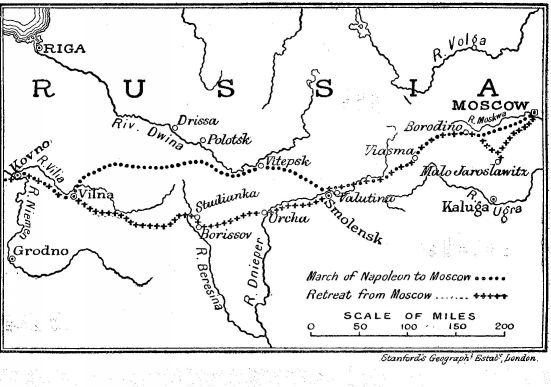
Meanwhile the war had not progressed altogether as he desired. His aim had been to conceal his advance across the Niemen, to surprise the two chief Russian armies while far separated, and thus to end the war on Lithuanian soil by a blow such as he had dealt at Friedland. The Russian arrangements seemed to favour his plan. Their two chief arrays, that led by the Czar and by General Barclay de Tolly, some 125,000 strong north of Vilna, and that of Prince Bagration mustering now about 45,000 effectives, in the province of Volhynia, were labouring to carry out the strategy devised by Phull. The former was directly to oppose the march of Napoleon's main army, while the smaller Russian force was to operate on its flanks and rear. Such a plan could only have succeeded in the good old times when war was conducted according to ceremonious etiquette; it courted destruction from Napoleon. At Vilna the Emperor directed the movements that were to ensnare Bagration. Already he had urged on the march of Davoust, who was to circle round from the north, and the advance of Jerome Bonaparte's Westphalians, who were bidden to hurry on eastwards from the town of Grodno on the Upper Niemen. Their convergence would drive Bagration into the almost trackless marshes of the Pripet, whence his force would emerge, if at all, as helpless units.
Such was Napoleon's plan, and it would have succeeded but for a miscalculation in the time needed for Jerome's march. Napoleon underrated the difficulties of his advance or else overrated his brother's military capacity. The King of Westphalia was delayed a few days at Grodno by bad weather and other difficulties; thus Bagration, who had been ordered by the Czar to retire, was able to escape the meshes closing around him by a speedy retreat to Bobruisk, whence he moved northwards. Napoleon was enraged at this loss of a priceless opportunity, and addressed vehement reproaches to Jerome for his slowness and "small-mindedness." The youngest[pg.249] of the Bonapartes resented this rebuke which ignored the difficulties besetting a rapid advance. The prospect of being subjected to that prince of martinets, Davoust, chafed his pride; and, throwing up his command, he forthwith returned to the pleasures of Cassel.
By great good fortune, Bagration's force had escaped from the snares strewn in its path by the strategy of Phull and the counter-moves of Napoleon. The fickle goddess also favoured the rescue of the chief Russian army from imminent peril at Drissa. In pursuance of Phull's scheme, the Czar and Barclay de Tolly fell back with that army towards the intrenched camp on the Dwina. But doubts had already begun to haunt their minds as to the wisdom of Phull's plans. In fact, the bias of Barclay's nature was towards the proven and the practical. He came of a Scottish family which long ago had settled in Livonia, and had won prosperity and esteem in the trade of Riga. His ancestry and his early surroundings therefore disposed him to the careful weighing of evidence and distrust of vague theories. His thoroughness in military organization during the war in Finland and his unquestioned probity and open-mindedness, had recently brought him high into favour with the Czar, who made him War Minister. He had no wide acquaintance with the science of warfare, and has been judged altogether deficient in a wide outlook on events and in those masterly conceptions which mark the great warrior.[263] But nations are sometimes ruined by lofty genius, while at times they may be saved by humdrum prudence; and Barclay's common sense had no small share in saving Russia.
Two months before the Grand Army passed the Niemen, he had expressed the hope that God would send retreat to the Russian armies; and we may safely attribute to his influence with the Czar the timely order to Bagration to desist from flanking tactics and beat a retreat while yet there was time. That portion of Phull's strategy having[pg.250] signally failed, Alexander naturally became more suspicious about the Drissa plan; and during the retirement from Vilna, he ordered a survey of the works to be made by Phull's adjutant, a young German named Clausewitz, who was destined to win a name as an authority in strategy. This officer was unable conscientiously to present a cheering report. He found the camp deficient in many respects. Nevertheless, Alexander still clung to the hope of checking the French advance before these great intrenchments.
On his arrival there, on July 8th, this hope also was dashed. Michaud, a young Sardinian engineer, pointed out several serious defects in their construction. Barclay also protested against shutting up a large part of the defending army in a camp which could easily be blockaded by Napoleon's vast forces. Finally, as the Russian reserves stationed there proved to be disappointingly weak both in numbers and efficiency, the Czar determined to evacuate the camp, intrust the sole command to Barclay, and retire to his northern capital. It is said that, before he left the army, the Grand Duke Constantine, a friend of the French cause, made a last effort to induce him to come to terms with Napoleon, now that the plan of campaign had failed. If so, Alexander repelled the attempt. Pride as a ruler and a just resentment against Napoleon prevented any compromise; and probably he now saw that safety for himself and ruin for his foe lay in the firm adoption of that Fabian policy of retreat and delay, which Scharnhorst had advocated and Barclay was now determined to carry out.
Though still hampered by the intrigues of Constantine, Bennigsen, and other generals, who hated him as a foreigner and feigned to despise him as a coward, Barclay at once took the step which he had long felt to be necessary; he ordered a retreat which would bring him into touch with Bagration. Accordingly, leaving Wittgenstein with 25,000 men to hold Oudinot's corps in check on the middle Dwina, he marched eastwards towards Vitepsk. True, he left St. Petersburg open to[pg.251] attack; but it was not likely that Napoleon, when the summer was far spent, would press so far north and forego his usual plan of striking at the enemy's chief forces. He would certainly seek to hinder the junction of the two Russian armies, as soon as he saw that this was Barclay's aim. Such proved to be the case. Napoleon soon penetrated his design, and strove to frustrate it by a rapid move from Vilna towards Polotsk on Barclay's flank, but he failed to cut into his line of march, and once more had to pursue.
Despite the heavy shrinkage in the Grand Army caused by a remorseless rush through a country wellnigh stripped of supplies, the Emperor sought to force on a general engagement. He hoped to catch Barclay at Vitepsk. "The whole Russian army is at Vitepsk—we are on the eve of great events," he writes on July 25th. But the Russians skilfully withdrew by night from their position in front of that town, which he entered on July 28th. Chagrined and perplexed, the chief stays a fortnight to organize supplies and stores, while his vanguard presses on to envelop the Russians at Smolensk. Again his hopes revive when he hears that Barclay and Bagration are about to join near that city. In fact, those leaders there concluded that strategic movement to the rear which was absolutely necessary if they were not to be overwhelmed singly. They viewed the retreat in a very different light. To the cautious Barclay it portended a triumph long deferred, but sure: while the more impulsive Muscovite looked upon the constant falling back as a national disgrace.
The feelings of the soldiery also forbade a spiritless abandonment of the holy city of the Upper Dnieper that stands as sentinel to Russia Proper. On these feelings Napoleon counted, and rightly. He was now in no haste to strike: the blow must be crushing and final. At last he hears that Davoust, the leader whose devotion and methodical persistence merit his complete trust, has bridged the River Dnieper below the city, and has built ovens for supplying the host with bread. And having[pg.252] now drawn up troops and supplies from the rear, he pushes on to end the campaign.
Barclay was still for retreat; but religious sentiment and patriotism bade the defenders stand firm behind those crumbling walls, while Bagration secured the line of retreat. The French, ranged around on the low hills which ring it on the south, looked for an easy triumph, and Napoleon seems to have felt an excess of confidence. At any rate, his dispositions were far from masterly. He made no serious effort to threaten the Russian communications with Moscow, nor did he wait for his artillery to overwhelm the ramparts and their defenders. The corps of Ney, Davoust, and Poniatowski, with Murat's cavalry and the Imperial Guard posted in reserve, promised an easy victory, and the dense columns of foot moved eagerly to the assault. They were received with a terrific fire. Only after three hours' desperate fighting did they master the southern suburbs, and at nightfall the walls still defied their assaults. Yet in the meantime Napoleon's cannon had done their work. The wooden houses were everywhere on fire; a speedy retreat alone could save the garrison from ruin; and amidst a whirlwind of flame and smoke Barclay drew off his men to join Bagration on the road to Moscow (August 17th).
Once more, then, the Russian army had slipped from Napoleon's grasp, though this time it dealt him a loss of 12,000 in killed or wounded. And the momentous question faced him whether he should halt, now that summer was on the wane, or snatch under the walls of Moscow the triumph which Vilna, Vitepsk, and Smolensk had promised and denied. It is stated by that melodramatic narrator, Count Philip Ségur, that on entering Vitepsk, the Emperor exclaimed: "The campaign of 1812 is ended, that of 1813 will do the rest." But the whole of Napoleon's "Correspondence" refutes the anecdote. Besides, it was not Napoleon's habit to go into winter quarters in July, or to rest before he had defeated the enemy's main army.[264][pg.253]
At Smolensk the question wore another aspect. Napoleon told Metternich at Dresden that he would not in the present year advance beyond Smolensk, but would organize Lithuania during winter and advance again in the spring of 1813, adding: "My enterprise is one of those of which the solution is to be found in patience." A policy of masterly inactivity certainly commended itself to his Marshals. But the desire to crush the enemy's rear drew Ney and Murat into a sharp affair at Valutino or Lubino: the French lost heavily, but finally gained the position: and the hope that the foe were determined to fight the decisive battle at Dorogobuzh lured Napoleon on, despite his earlier decision.[265] Besides, his position seemed less hazardous than it was before Austerlitz. The Grand Army was decidedly superior to the united forces of Barclay and Bagration. On the Dwina, Oudinot held the Russians at bay; and when he was wounded, his successor, Gouvion St. Cyr, displayed a tactical skill which enabled[pg.254] him easily to foil a mere fighter like Wittgenstein. On the French right flank, affairs were less promising; for the ending of the Russo-Turkish war now left the Russian army of the Pruth free to march into Volhynia. But, for the present, Napoleon was able to summon up strong reserves under Victor, and assure his rear.
With full confidence, then, he pressed onwards to wrest from Fortune one last favour. It was granted to him at Borodino. There the Russians made a determined stand. National jealousy of Barclay, inflamed by his protracted retreat, had at last led to his being superseded by Kutusoff; and, having about 110,000 troops, the old fighting general now turned fiercely to bay. His position on the low convex curve of hills that rise behind the village of Borodino was of great strength. On his right was the winding valley of the Kolotza, an affluent of the Moskwa, and before his centre and left the ground sloped down to a stream. On this more exposed side the Russians had hastily thrown up earthworks, that at the centre being known as the Great Redoubt, though it had no rear defences.
Napoleon halted for two days, until his gathering forces mustered some 125,000 men, and he now prepared to end the war at a blow. After surveying the Russian position, he saw Kutusoff's error in widely extending his lines to the north; and while making feints on that side, so as to prevent any concentration of the Muscovite array, he planned to overwhelm the more exposed centre and left, by the assaults of Davoust and Poniatowski on the south, and of Ney's corps and Eugène's Italians on the redoubts at the centre. Davoust begged to be allowed to outflank the Russian left; but Napoleon refused, perhaps owing to a fear that the Russians might retreat early in the day, and decided on dealing direct blows at the left and centre. As the 7th of September dawned with all the splendour of a protracted summer, cannon began to thunder against the serried arrays ranged along the opposing slopes, and Napoleon's columns moved against the redoubts and woods that sheltered the [pg.255] Muscovite lines. The defence was most obstinate. Time after time the smaller redoubts were taken and retaken; and while, on the French right centre, the tide of battle surged up and down the slope, the Great Redoubt dealt havoc among Eugène's Italians, who bravely but, as it seemed, hopelessly struggled up that fatal rise.
Then was seen a soul-stirring sight. Of a sudden, a mass of Cuirassiers rushed forth from the invaders' ranks, flung itself uphill, and girdled the grim earthwork with a stream of flashing steel There, for a brief space, it was stayed by the tough Muscovite lines, until another billow of horsemen, marshalled by Grouchy and Chastel, swept all before it, took the redoubt on its weak reverse, and overwhelmed its devoted defenders.[266] In vain did the Russian cavalry seek to save the day: Murat's horsemen were not to be denied, and Kutusoff was at last fain to draw back his mangled lines, but slowly and defiantly, under cover of a crushing artillery fire.
Thus ended the bloodiest fight of the century. For several hours 800 cannon had dealt death among the opposing masses; the Russians lost about 40,000 men, and, whatever Napoleon said in his bulletins, the rents in his array were probably nearly as great. He has been censured for not launching his Guard at the wavering foe at the climax of the fight; and the soldiery loudly blamed its commander, Bessières, for dissuading his master from this step. But to have sacrificed those veterans to Russian cannon would have been a perilous act.[267] His Guard was the solid kernel of his army: on it he could always rely, even when French regulars dissolved, as often happened after long marches, into bands of unruly marauders; and its value was to be found out during[pg.256] the retreat. More fitly may Napoleon be blamed for not seeking earlier in the day to turn the Russian left, and roll that long line up on the river. Here, as at Smolensk, he resorted to a frontal attack, which could only yield success at a frightful cost. The day brought little glory to the generals, except to Ney, Murat, and Grouchy. For his valour in the mêlée, Ney received the title of Prince de la Moskwa.
A week before this Pyrrhic triumph, Napoleon had heard of a terrible reverse to French arms in Spain. His old friend, Marmont, who had won the Marshal's baton after Wagram, measured his strength with Wellington in the plains of Leon with brilliant success until a false move near Salamanca exposed him to a crushing rejoinder, and sent his army flying back towards Burgos. Madrid was now uncovered and was occupied for a time by the English army (August 13th). Thus while Napoleon was gasping at Moscow, his brother was expelled from Madrid, until the recall of Soult from Andalusia gave the French a superiority in the centre of Spain which forced Wellington to retire to Ciudad Rodrigo. He lost the fruits of his victory, save that Andalusia was freed: but he saved his army for the triumphant campaign of 1813. Had Napoleon shown the like prudence by beating a timely retreat from Moscow, who can say that the next hard-fought fights in Silesia and Saxony would not have once more crowned his veterans with decisive triumph?
As it was, the Grand Army toiled on through heat, dust, and the smoke of burning villages, to gain peace and plenty at Moscow. But when, on September the 14th, the conqueror entered that city with his vanguard, solitude reigned almost unbroken. A few fanatics, clinging to the tradition that the Kremlin was impregnable, idly sought to defend it; but troops, officials, nobles, merchants, and the great mass of the people were gone, and the military stores had been burnt or removed. Rostopchin, the governor, had released the prisoners and broken the fire engines. Flames speedily burst forth,[pg.257] and Bausset, the Prefect of Napoleon's Palace, affirms that while looking forth from the Kremlin he saw the flames burst forth in several districts in quick succession; and that a careful examination of cellars often proved them to be stored with combustibles, vitriol in one case being swallowed by a French soldier who took it for brandy! If all this be true, it proves that the Muscovites were determined to fire their capital. But their writers have as stoutly affirmed that the fires were caused by French and Polish plunderers.[268] Three days later, the powers of the air and the demons of drink and frenzy raged uncontrolled; and Napoleon himself barely escaped from the whirlwinds of flame that enveloped the Kremlin and nearly scorched to death the last members of his staff. For several hours the conflagration was fanned by an equinoctial gale, and when, on the 20th, it died down, convicts or plunderers kindled it anew.
Yet the army did not want for shelter, and, as Sergeant Bourgogne remarks, if every house had been gutted there were still the caves and cellars that promised protection from the cold of winter. The real problem was now, as ever, the food-supply. The Russians had swept the district wellnigh bare; and though the Grand Army feasted for a fortnight on dainties and drink, yet bread, flour, and meat were soon very scarce. In vain did the Emperor seek to entice the inhabitants back; they knew the habits of the invaders only too well; and despite several distant raids, which sometimes cost the French dear, the soldiery began to suffer.
October wore on with delusive radiance, but brought no peace. Soon after the great conflagration at Moscow, Napoleon sent secret and alluring overtures to Alexander, offering to leave Russia a free hand in regard to Turkey, inclusive of Constantinople, which he had hitherto strictly[pg.258] reserved, and hinting that Polish affairs might also be arranged to the Czar's liking.[269] But Alexander refused tamely to accept the fruits of victory from the man who, he believed, had burnt holy Moscow, and clung to his vow never to treat with his rival as long as a single French soldier stood on Russian soil. His resolve saved Europe. Yet it cost him much to defy the great conqueror to the death: he had so far feared the capture of St. Petersburg as to request that the Cronstadt fleet might be kept in safety in England.[270] But gradually he came to see that the sacrifice of Moscow had saved his empire and lured Napoleon to his doom. Kutusoff also played a waiting game. Affecting a wish for peace, he was about secretly to meet Napoleon's envoy, Lauriston, when the Russian generals and our commissioner, Sir R. Wilson, intervened, and required that it should be a public step. It seems likely, however, that Kutusoff was only seeking to entrap the French into barren negotiations; he knew that an answer could not come from the banks of the Neva until winter began to steal over the northern steppes.
Slowly the truth begins to dawn on Napoleon that Moscow is not the heart of Russia, as he had asserted to De Pradt that it was. Gradually he sees that that primitive organism had no heart, that its almost amorphous life was widespread through myriads of village communes, vegetating apart from Moscow or Petersburg, and that his march to the old capital was little more than a sword-slash through a pond.[271] Had he set himself to study with his former care the real nature of the hostile organism, he would certainly never have ventured beyond Smolensk in the present year. But he had[pg.259] now merged the thinker in the conqueror, and—sure sign of coming disaster—his mind no longer accurately gauged facts, it recast them in its own mould.
By long manipulation of men and events, it had framed a dogma of personal infallibility. This vice had of late been growing on him apace. It was apparent even in trifles. The Countess Metternich describes how, early in 1810, he persisted in saying that Kaunitz was her brother, in spite of her frequent disclaimers of that honour; and, somewhat earlier, Marmont noticed with half-amused dismay that when the Emperor gave a wrong estimate of the numbers of a certain corps, no correction had the slightest effect on him; his mind always reverted to the first figure. In weightier matters this peculiarity was equally noticeable. His clinging to preconceived notions, however unfair or burdensome they were to Britain, Prussia, or Austria, had been the underlying cause of his wars with those Powers. And now this same defect, burnt into his being by the blaze of a hundred victories, held him to Moscow for five weeks, in the belief that Russia was stricken unto death, and that the facile Czar whom he had known at Tilsit would once more bend the knee. An idle hope. "I have learnt to know him now," said the Czar, "Napoleon or I; I or Napoleon; we cannot reign side by side." Buoyed up by religious faith and by his people's heroism, Alexander silently defied the victor of Moscow and rebuked Kutusoff for receiving the French envoy.
At last, on October 18th, the Russians threw away the scabbard and surprised Murat's force some forty miles south of Moscow, inflicting a loss of 3,000 men. But already, a day or two earlier, Napoleon had realized the futility of his hope of peace and had resolved to retreat. The only alternative was to winter at Moscow, and he judged that the state of French and Spanish affairs rendered such a course perilous. He therefore informed Maret that the Grand Army would go into winter quarters between the Dnieper and the Dwina.[272][pg.260]
There is no hint in his letters that he anticipated a disastrous retreat. The weather hitherto had been "as fine as that at Fontainebleau in September," and he purposed retiring by a more southerly route which had not been exhausted by war. Full of confidence, then, he set out on the 19th, with 115,000 men, persuaded that he would easily reach friendly Lithuania and his winter quarters "before severe cold set in." The veil was rudely torn from his eyes when, south of Malo-Jaroslavitz, his Marshals found the Russians so strongly posted that any further attack seemed to be an act of folly. Eugène's corps had suffered cruelly in an obstinate fight in and around that town, and the advice of Berthier, Murat, and Bessières was against its renewal. For an hour or more the Emperor sat silently gazing at a map. The only prudent course now left was to retreat north and then west by way of Borodino, over his devastated line of advance.[273] Back, then, towards Borodino the army mournfully trudged (October 26th):
"Everywhere (says Labaume) we saw wagons abandoned for want of horses to draw them. Those who bore along with them the spoils of Moscow trembled for their riches; but we were disquieted most of all at seeing the deplorable state of our cavalry. The villages which had but lately given us shelter were level with the ground: under their ashes were the bodies of hundreds of soldiers and peasants.... But most horrible was the field of Borodino, where we saw the forty thousand men, who had perished there, yet lying unburied."
For a time, Kutusoff forbore to attack the sore-stricken host; but, early in November, the Russian horse began to infest the line of march, and at Viasma their [pg.261] gathering forces were barely held off: had Kutusoff aided his lieutenants, he might have decimated his famished foes.
Hitherto the weather had been singularly mild and open, so much so that the superstitious peasants looked on it as a sign that God was favouring Napoleon. But, at last, on November the 6th, the first storm of winter fell on the straggling array, and completed its miseries. The icy blasts struck death to the hearts of the feeble; and the puny fighting of man against man was now merged in the awful struggle against the powers of the air. Drifts of snow blotted out the landscape; the wandering columns often lost the road and thousands forthwith ended their miseries. Except among the Old Guard all semblance of military order was now lost, and battalions melted away into groups of marauders.
The search for food and fuel became furious, even when the rigour of the cold abated. The behaviour of Bourgogne, a sergeant in the Imperial Guard, may serve to show by what shifts a hardy masterful nature fought its way through the wreckage of humanity around: "If I could meet anybody in the world with a loaf, I would make him give me half—nay, I would kill him so as to get the whole." These were his feelings: he acted on them by foraging in the forest and seizing a pot in which an orderly was secretly cooking potatoes for his general. Bourgogne made off with the potatoes, devoured most of them half-boiled, returned to his comrades and told them he had found nothing. Taking his place near their fire, he scooped out his bed in the snow, lay under his bearskin, and clasped his now precious knapsack, while the others moaned with hunger. Yet, as his narrative shows, he was not naturally a heartless man: in such a situation man is apt to sink to the level of the wolf. The best food obtainable was horseflesh, and hungry throngs rushed at every horse that fell, disputing its carcass with the packs of dogs or wolves that hung about the line of march.[274][pg.262]
Smolensk was now the thought dearest to every heart; and, buoyed with the hope of rest and food, the army tottered westwards as it had panted eastwards through the fierce summer heats with Moscow as its cynosure. The hope that clung about Smolensk was but a cruel mirage. The wreck of that city offered poor shelter; the stores were exhausted by the vanguard; and, to the horror of Eugène's Italians, men swarmed out of that fancied abode of plenty and pounced on every horse that stumbled to its doom on the slippery banks of the Dnieper. With inconceivable folly, Napoleon, or his staff, had provided no means for roughing the horses' shoes. The Cossacks, when they knew this, exclaimed to Wilson: "God has made Napoleon forget that there was a winter here."
Disasters now thickened about the Grand Army. During his halt at Smolensk (November 9th-14th), Napoleon heard that Victor's force on the Dwina had been worsted by the Russians, and there was ground for fearing that the Muscovite army of the Ukraine would cut into the line of retreat. The halt at Smolensk also gave time for Kutusoff to come up parallel with the main force, and had he pressed on with ordinary speed and showed a tithe of his wonted pugnacity, he might have captured the Grand Army and its leader. As it was, his feeble attack on the rearguard at Krasnoe only gave Ney an opportunity of showing his dauntless courage. The "bravest of the brave" fought his way through clouds[pg.263] of Cossacks, crossed the Dnieper, though with the loss of all his guns, and rejoined the main body. Napoleon was greatly relieved on hearing of the escape of this Launcelot of the Imperial chivalry. He ordered cannon to be fired at suitable intervals so as to forward the news if it were propitious; and on hearing their distant boomings, he exclaimed to his officers: "I have more than 400,000,000 francs in the cellars of the Tuileries, and would gladly have given the whole for the ransom of my faithful companion in arms."[275]
Far greater was the danger at the River Beresina. The Russian army of the south had seized the bridge at Borisoff on which Napoleon's safety depended, and Oudinot vainly struggled to wrest it back. The Muscovites burnt it under his eyes. Such was the news which Napoleon heard at Bobr on November 24th. It staggered him; for, with his usual excess of confidence, he had destroyed his pontoons on the banks of the Dnieper; and now there was no means of crossing a river, usually insignificant, but swollen by floods and bridged only by half-thawed ice. Yet French resource was far from vanquished. General Corbineau, finding from some peasants that the river was fordable three leagues above Borisoff, brought the news to Oudinot, who forthwith prepared to cross there. Napoleon, coming up on the 26th, approved the plan, and cheeringly said to his Marshal, "Well, you shall be my locksmith and open that passage for me."[276]
To deceive the foe, the Emperor told off a regiment or two southwards with a long tail of camp-followers that were taken to be an army. And this wily move, harmonizing with recent demonstrations of the Austrians on the side of Minsk, convinced the Muscovite leader that Napoleon was minded to clasp hands with them.[277] While the Russians patrolled the river on the south, French sappers were working, often neck deep in the water, to throw two light bridges across the stream higher up. By heroic toil,[pg.264] which to most of them brought death, the bridges were speedily finished, and, as the light of November 26th was waning Oudinot's corps of 7,000 men gained a firm footing on the homeward side. But they were observed by Russian scouts, and when on the next day Napoleon and other corps had struggled across, the enemy came up, captured a whole division, and on the morrow strove to hurl the invaders into the river. Victor and the rearguard staunchly kept them at bay; but at one point the Russian army of the Dwina temporarily gained ground and swept the bridges and their approaches with artillery fire.
Then the panic-stricken throngs of wounded and stragglers, women and camp-followers, writhed and fought their way until the frail planks were piled high with living and dead. To add to the horrors, one bridge gave way under the weight of the cannon. The rush for the one remaining bridge became yet more frantic and the day closed amidst scenes of unspeakable woe. Stout swimmers threw themselves into the stream, only to fall victims to the ice floes and the numbing cold. At dawn of the 29th, the French rearguard fired the bridge to cover the retreat. Then a last, loud wail of horror arose from the farther bank, and despair or a loathing of life drove many to end their miseries in the river or in the flames.
Such was the crossing of the Beresina. The ghastly tale was told once more with renewed horrors when the floods of winter abated and laid bare some 12,000 corpses along the course of that fatal stream. It would seem that if Napoleon, or his staff, had hurried on the camp-followers to cross on the night of the 27th to the 28th, those awful scenes would not have happened, for on that night the bridges were not used at all. Grosser carelessness than this cannot be conceived; and yet, even after this shocking blunder, the devotion of the soldiers to their chief found touching expression. When he was suffering from cold in the wretched bivouac west of the river, officers went round calling for dry wood for[pg.265] his fire; and shivering men were seen to offer precious sticks, with the words, "Take it for the Emperor."[278]
On that day Napoleon wrote to Maret that possibly he would leave the army and hurry on to Paris. His presence there was certainly needed, if his crown was to be saved. On November 6th, the day of the first snowstorm, he heard of the Quixotic attempt of a French republican, General Malet, to overthrow the Government at Paris. With a handful of followers, but armed with a false report of Napoleon's capture in Russia, this man had apprehended several officials, until the scheme collapsed of sheer inanity.[279] "How now, if we were at Moscow," exclaimed the Emperor, on hearing this curious news; and he saw with chagrin that some of his generals merely shrugged their shoulders. After crossing the Beresina, he might hope that the worst was over and that the stores at Vilna and Kovno would suffice for the remnant of his army. The cold for a time had been less rigorous. The behaviour of Prussia and Austria was, in truth, more important than the conduct of the retreat. Unless those Powers were kept to their troth, not a Frenchman would cross the Elbe.
At Smorgoni, then, on December the 5th, he informed his Marshals that he left them in order to raise 300,000 men; and, intrusting the command to Murat, he hurried away. His great care was to prevent the extent of the disaster being speedily known. "Remove all strangers from Vilna," he wrote to Maret: "the army is not fine to look upon just now." The precaution was much needed. Frost set in once more, and now with unending grip. Vilna offered a poor haven of refuge. The stores were soon plundered, and, as the Cossacks drew near, Murat and the remnant of the Grand Army decamped in pitiable panic. Amidst ever deepening misery they struggled on, until, of the 600,000 men who had proudly crossed the Niemen for the conquest of Russia, only 20,000 famished, frost-bitten, unarmed spectres staggered across the bridge of Kovno in the middle of December. The[pg.266] auxiliary corps furnished by Austria and Prussia fell back almost unscathed. But the remainder of that mighty host rotted away in Russian prisons or lay at rest under Nature's winding-sheet of snow.[280][pg.267]
Despite the loss of the most splendid army ever marshalled by man, Napoleon abated no whit of his resolve to dominate Germany and dictate terms to Russia. At Warsaw, in his retreat, he informed De Pradt that there was but one step from the sublime to the ridiculous, that is, from the advance on Moscow to the retreat. At Dresden he called on his allies, Austria and Prussia, to repel the Russians; and at Paris he strained every nerve to call the youth of the Empire to arms. The summons met with a ready response: he had but to stamp his foot when the news from East Prussia looked ominous, and an array of 350,000 conscripts was promised by the Senate (January 10th).
In truth, his genius had enthralled the mind of France. The magnificence of his aims, his hitherto triumphant energy, and the glamour of his European supremacy had called forth all the faculties of the French and Italian peoples, and set them pulsating with ecstatic activity. He knew by instinct all the intricacies of their being, which his genius controlled with the easy decisiveness of a master-key. The rude shock of the Russian disaster served but to emphasize the thoroughness of his domination, and the dumb trustfulness of his forty-three millions of subjects.
And yet their patience might well have been exhausted. His military needs had long ago drawn in levies the year before they were legally liable; but the mighty swirl of the Moscow campaign now sucked 150,000 lads of under twenty years of age into the[pg.268] devouring vortex. In the Dutch and German provinces of his Empire the number of those who evaded the clutches of the conscription was very large. In fact, the number of "refractory conscripts" in the whole realm amounted to 40,000. Large bands of them ranged the woods of Brittany and La Vendée, until mobile columns were sent to sweep them into the barracks.
But in nearly the whole of France (Proper), Napoleon's name was still an unfailing talisman, appealing as it did to the two strongest instincts of the Celt, the clinging to the soil and the passion for heroic enterprise. Thus it came about that the peasantry gave up their sons to be "food for cannon" with the same docility that was shown by soldiers who sank death-stricken into a snowy bed with no word of reproach to the author of their miseries. A like obsequiousness was shown by the officials and legislators of France, who meekly listened to the Emperor's reproaches for their weakness in the Malet affair, and heard with mild surprise his denunciation against republican idealogy—the cloudy metaphysics to which all the misfortunes of our fair France may be attributed. No tongue dared to utter the retort which must have fermented in every brain.[281]
But his explanations and appeals did not satisfy every Frenchman. Many were appalled at the frightful drain on the nation's strength. They asked in private how the deficit of 1812 and the further expenses of 1813 were to be met, even if he allotted the communal domains to the service of the State. They pointed to allies ruined or lost; to Spain, where Joseph's throne still tottered from the shock of Salamanca; to Poland, lying mangled at the feet of the Muscovites; to Italy, desolated by the loss of her bravest sons; to the Confederation of the Rhine, equally afflicted and less resigned; to Austria[pg.269] and Prussia, where timid sovereigns and calculating Courts alone kept the peoples true to the hated French alliance. Only by a change of system, they averred, could the hatred of Europe be appeased, and the formation of a new and vaster Coalition avoided. Let Napoleon cease to force his methods of commercial warfare on the Continent: let him make peace on honourable terms with Russia, where the chief Minister, Romantzoff, was ready to meet him halfway: let him withdraw his garrisons from Prussian fortresses, soothe the susceptibilities of Austria—and events would tend to a solid and honourable peace.
To all promptings of prudence Napoleon was deaf. His instincts and his experience of the Kings prevented him yielding on any important point. He determined to carry on the war from the Tagus to the Vistula, to bolster up Joseph in Spain, to keep his garrisons fast rooted in every fortress as far east as Danzig. Russia and Prussia, he said, had more need of peace than France. If he began by giving up towns, they would demand kingdoms, whereas by yielding nothing he would intimidate them. And if they did form a league, their forces would be thinly spread out over an immense space; he would easily dispose of their armies when they were not aided by the climate; and a single victory would undo the clumsy knot (ce noeud mal assorti).[282]
In truth, if he left Spain out of his count, the survey of the military position was in many ways reassuring. England's power was enfeebled by the declaration of war by the United States. In Central Europe his position was still commanding. He held nearly all the fortresses of Prussia, and though he had lost a great army, that loss was spread out very largely over Poles, Germans, Italians, and smaller peoples. Many of the best French troops and all his ablest generals had survived. His[pg.270] Guard could therefore be formed again, and the brains of his army were also intact. The war had brought to light no military genius among the Russians; and all his past experience of the "old coalition machines" warranted the belief that their rusty cogwheels, even if oiled by English subsidies, would clank slowly along and break down at the first exceptional strain. Such had been the case at Marengo, at Austerlitz, at Friedland. Why should not history repeat itself?
While he was guiding his steps solely by the light of past experience, events were occurring that heralded the dawn of a new era for Central Europe. On the 30th of December, the Prussian General Yorck, who led the Prussian corps serving previously under Macdonald in Courland, concluded the Convention of Tauroggen with the Russians, stipulating that this corps should hold the district around Memel and Tilsit as neutral territory, until Frederick William's decision should be known. Strictly considered, this convention was a grave breach of international law and an act of treachery towards Napoleon. The King at first viewed it in that light; but to all his subjects it seemed a noble and patriotic action. To continue the war with Russia for the benefit of Napoleon would have been an act of political suicide.
Yet, for some weeks, Frederick William waited on events; and these events decided for war, not against Russia, but against France. The Prussian Chancellor, Hardenberg, did his best to hoodwink the French at Berlin, and quietly to play into the hands of the ardent German patriots. After publishing an official rebuke to Yorck, he secretly sent Major Thile to reassure him. He did more: in order to rescue the King from French influence, still paramount at Berlin, he persuaded him to set out for Breslau, on the pretext of raising there another contingent for service under Napoleon. The ruse completely succeeded: it deceived the French ambassador, St. Marsan: it fooled even Napoleon himself. With his now invariable habit of taking for granted that events would march according to his word of command, the[pg.271] Emperor assumed that this was for the raising of the corps of 30,000 men which he had requested Frederick William to provide, and said to Prince Hatzfeld (January 29th): "Your King is going to Breslau: I think it a timely step." Such was Napoleon's frame of mind, even after he heard of Yorck's convention with the Russians. That event he considered "the worst occurrence that could happen." Yet neither that nor the patriotic ferment in Prussia reft the veil from his eyes. He still believed that the Prussians would follow their King, and that the King would obey him. On February the 3rd he wrote to Maret, complaining that 2,000 Prussian horsemen were shutting themselves up in Silesian towns, "as if they were afraid of us, instead of helping us and covering their country."
Once away from Berlin, Frederick William found himself launched on a resistless stream of national enthusiasm. At heart he was no less a patriot than the most ardent of the university students; but he knew far better than they the awful risks of war with the French Empire. His little kingdom of 4,700,000 souls, with but half-a-dozen strongholds it could call its own, a realm ravaged by Napoleon's troops alike in war and peace until commerce and credit were but a dim memory—such a land could ill afford to defy an empire ten times as populous and more than ten times as powerful. True, the Russians were pouring in under the guise of friendship; but the bitter memories of Tilsit forbade any implicit trust in Alexander. And, if the dross had been burnt out of his nature by a year of fiery trial, could his army, exhausted by that frightful winter campaign and decimated by the diseases which Napoleon's ghastly array scattered broadcast in its flight, ever hope, even with the help of Prussia's young levies, to cope with the united forces of Napoleon and Austria?
For at present it seemed that the Court of Vienna would hold fast to the French alliance. There Metternich was all-powerful, and the keystone of his system was a guarded but profit-seeking subservience to[pg.272] Napoleon. Not that the Emperor Francis and he loved the French potentate; but they looked on him now as a pillar of order, as a barrier against Jacobinism in France, against the ominous pan-Germanism preached by Prussian enthusiasts, and against Muscovite aggandizement in Turkey and Poland. Great was their concern, first at the Russo-Turkish peace which installed the Muscovites at the northern mouth of the Danube, and still more at the conquering swoops of the Russian eagle on Warsaw and Posen. How could they now hope to gain from Turkey the set-off to the loss of Tyrol and Illyria on which they had recently been counting, and how save any of the Polish lands from the grip of Russia? For the present Russia was more to be feared than Napoleon. Her influence seemed the more threatening to the policy of balance on which the fortunes of the Hapsburgs were delicately poised.
Only by degrees were these fears and jealousies laid to rest. It needed all the address of a British envoy, Lord Walpole, who repaired secretly to Vienna and held out the promise of tempting gains, to assuage these alarms, and turn Austria's gaze once more on her lost provinces, Tyrol, Illyria, and Venetia. For the present, however, nothing came of these overtures; and when the French discovered Walpole's presence at Vienna, Metternich begged him to leave.[283]
For the present, then, Austria assumed a neutral attitude. A truce was concluded with Russia, and a special envoy was sent to Paris to explain the desire of the Emperor Francis to act as mediator, with a view to the conclusion of a general peace. The latest researches into Austrian policy show that the Kaiser desired an[pg.273] honourable peace for all parties concerned, and that Metternich may have shared his views. But, early in the negotiations, Napoleon showed flashes of distrust as to the sincerity of his father-in-law, and Austria gradually changed her attitude. The change was to be fatal to Napoleon. But the question whether it was brought about by Napoleon's obstinacy, or Metternich's perfidy, or the force of circumstances, must be postponed for the present, while we consider events of equal importance and of greater interest.
While Austria balanced and Frederick William negotiated, the sterner minds of North Germany rushed in on the once sacred ground of diplomacy and statecraft. The struggle against Napoleon was prepared for by the exile Stein, and war was first proclaimed by a professor.
Among the many influences that urged on the Czar to a war for the liberation of Prussia and Europe, not the least was that wielded at his Court in the latter half of 1812 by the staunch German patriot, Stein. His heroic spirit never quailed, even in the darkest hour of Prussia's humiliation; and he now pointed out convincingly that the only sure means of overthrowing Napoleon was to raise Germany against him. To remain on a tame defensive at Warsaw would be to court another French invasion in 1813. The safety of Russia called for a pursuit of the French beyond the Elbe and a rally of the Germans against the man they detested. The appeal struck home. It revived Alexander's longings for the liberation of Europe, which he had buried at Tilsit; and it agreed with the promptings of an ambitious statecraft. Only by overthrowing Napoleon's supremacy in Germany could the Czar gain a free hand for a lasting settlement of the Polish Question. The eastern turn given to his policy in 1807 was at an end—but not before Russia had taken another step towards the Bosphorus. With one leg planted at the mouth of the Danube, the Colossus now prepared to stride over Central Europe. The aims of Catherine II. in 1792[pg.274] were at last to be realized. While Europe was wrestling with Revolutionary France, the Muscovite grasp was to tighten on Poland. It is not surprising that Alexander, on January 13th, commented on the "brilliance of the present situation," or that he decided to press onward. He gave little heed to the Gallophil counsels of Romantzoff or the dolorous warnings of the German-hating Kutusoff; and, on January 18th, he empowered Stein provisionally to administer in his name the districts of Prussia (Proper) when occupied by Russian troops.
So irregular a proceeding could only be excused by dire necessity and by success. It was more than excused; it was triumphantly justified. Four days later Stein arrived at Königsberg, in company with the patriotic poet, Arndt. The Estates, or Provincial Assemblies, of East and West Prussia were summoned, and they heartily voted supplies for forming a Landwehr or militia, as well as a last line of defence called the Landsturm. This step, unique in the history of Prussia, was taken apart from, almost in defiance of, the royal sanction: it was, in fact, due to the masterful will of Stein, who saw that a great popular impulse, and it alone, could overcome the inertia of King and officials. That impulse he himself originated, and by virtue of powers conferred on him by the Emperor Alexander. And the ball thus set rolling at Königsberg was to gather mass and momentum until, thanks to the powerful aid of Wellington in the South, it overthrew Napoleon at Paris.
The action of the exile was furthered by the word of a thinker and seer. A worthy professor at the University of Breslau, named Steffens, had long been meditating on some means of helping his country. The arrival of Frederick William had kindled a flame of devotion which perplexed that modest and rather pedantic ruler. But he so far responded to it as to allow Hardenberg to issue (February 3rd) an appeal for volunteers to "reinforce the ranks of the old defenders of the country." The appeal was entirely vague: it did not specify whether[pg.275] they would serve against the nominal enemy, Russia, or the real enemy, Napoleon. Pondering this weighty question, as did all good patriots, Steffens heard, in the watches of the night, the voice of conscience declare: "Thou must declare war against Napoleon." At his early morning lecture on Physics, which was very thinly attended, he told the students that he would address them at eleven on the call for volunteers. That lecture was thronged; and to the sea of eager faces Steffens spoke forth the thought that simmered in every brain, the burning desire for war with Napoleon. He offered himself as a recruit: 200 students from Breslau and 258 from the University of Berlin soon flocked to the colours, and that, too, chiefly from the classes which of yore had detested the army. Thanks to the teachings of Fichte and the still deeper lessons of adversity, the mind of Germany was now ranged on the side of national independence and against an omnivorous imperialism.
Where the mind led the body followed, yet still somewhat haltingly. In truth, the King and his officials were in a difficult position. They distrusted the Russians, who seemed chiefly eager to force Frederick William into war with France and to arrange the question of a frontier afterwards. But the eastern frontier was a question of life and death for Prussia. If Alexander kept the whole of the great Duchy of Warsaw, the Hohenzollern States would be threatened from the east as grievously as ever they were on the west by the French at Magdeburg. And the Czar seemed resolved to keep the whole of Poland. He told the Prussian envoy, Knesebeck, that, while handing over to Frederick William the whole of Saxony, Russia must retain all the Polish lands, a resolve which would have planted the Russian standards almost on the banks of the Oder. Nay, more: Knesebeck detected among the Russian officials a strong, though as yet but half expressed, longing for the whole of Prussia east of the lower Vistula.
For his part, Frederick William cherished lofty hopes.[pg.276] He knew that the Russian troops had suffered horribly from privations and disease, that as yet they mustered only 40,000 effectives on the Polish borders, and that they urgently needed the help of Prussia. He therefore claimed that, if he joined Russia in a war against Napoleon, he must recover the whole of what had been Prussian Poland, with the exception of the district of Bialystock ceded at Tilsit.[284] It seemed, then, that the Polish Question would once more exert on the European concert that dissolving influence which had weakened the Central Powers ever since the days of Valmy. Had Napoleon now sent to Breslau a subtle schemer like Savary, the apple of discord might have been thrown in with fatal results. But the fortunes of his Empire then rested on a Piedmontese nobleman, St. Marsan, who showed a singular credulity as to Prussia's subservience. He accepted all Hardenberg's explanations (including a thin official reproof to Steffens), and did little or nothing to countermine the diplomatic approaches of Russia. The ground being thus left clear, it was possible for the Czar to speak straight to the heart of Frederick William. This he now did. Knesebeck was set aside; and Alexander, meeting the Prussian demands halfway, promised in a treaty, signed at Kalisch on February 27th, to leave Prussia all her present territories, and to secure for her the equivalent, in a "statistical, financial, and geographical sense," of the lands which she had lost since 1806, along with a territory adapted to connect Prussia Proper with the province of Silesia.[285]
It seems certain that Stein's influence weighed much with Alexander in this final compromise, which postponed the irritating question of the eastern frontier and bent all the energies of two great States to the War of Liberation. Stein was sent to Frederick William at Breslau; but the King hardly deigned to see him,[pg.277] and the greatest of German patriots was suffered to remain in a garret of that city during a wearisome attack of fever. But he lived through disease and official neglect as he triumphed over Slavonic intrigues; and he had at hand that salve of many an able man—the knowledge that, even while he himself was slighted, his plans were adopted with beneficent and far-reaching results.
The Russo-Prussian alliance was firmly upheld by Lord Cathcart, the British ambassador to Russia, who reached headquarters on March the 2nd. For the present, Great Britain did not definitely join the allies; but the discussions on the Hanoverian Question, which had previously sundered us from Prussia, soon proved that wisdom had been learnt in the school of adversity. The Hohenzollerns now renounced all claims to Hanover, though they showed some repugnance to our Prince-Regent's demand that the Electorate should receive some territorial gain.
Thus the two questions on which Napoleon had counted as certain to clog the wheels of the Coalition, as they had done in the past, were removed, and the way was cleared for a compact firmer than any which Europe had hitherto known. On March 17th a Russo-Prussian Convention was concluded at Breslau whereby those Powers agreed to deliver Germany from France, to dissolve the Confederation of the Rhine, and to summon the German princes and people to help them; every prince that refused would suffer the loss of his States; and arrangements were made for the provisional administration of the lands which the allies should occupy. Frederick William also appealed to his people and to his army, and instituted that coveted order of merit, the Iron Cross.
But there was small need of appeals and decorations. The people rushed to arms with an ardour that rivalled the levée en masse of France in 1793. Nobles and students, professors and peasants, poets and merchants, shouldered their muskets. Housewives and maidens[pg.278] brought their scanty savings or their treasured trinkets as offerings for the altar of the Fatherland. One incident deserves special notice. A girl, Nanny by name, whose ringlets were her only wealth, shore them off, sold them, and brought the price of them, two thalers, for the sacred cause. A noble impulse thrilled through Germany. Volunteers came from far, many of whom were to ride with Lützow's irregular horse in his wild ventures. Most noteworthy of these was the gifted young poet, Korner, a Saxon by birth, who now forsook a life of ease, radiant with poetic promise, at the careless city of Vienna, to follow the Prussian eagle. "A great time calls for great hearts," he wrote to his father: "am I to write vaudevilles when I feel within me the courage and strength for joining the actors on the stage of real life?" Alas! for him the end was to be swift and tragic. Not long after inditing an ode to his sword, he fell in a skirmish near Hamburg.
Germany mourned his loss; but she mourned still more that her greatest poet, Goethe, felt no throb of national enthusiasm. The great Olympian was too much wrapped up in his lofty speculations to spare much sympathy for struggling mortals below: "Shake your chains, if you will: the man (Napoleon) is too strong for you: you will not break them." Such was his unprophetic utterance at Dresden to the elder Korner. Men who touched the people's pulse had no such doubts. "Ah! those were noble times," wrote Arndt: "the fresh young hope of life and honour sang in all hearts; it echoed along every street; it rolled majestically down every chancel." The sight of Germans thronging from all parts into Silesia to fight for their Prussian champions awakened in him the vision of a United Germany, which took form in the song, "What is the German's Fatherland?"[286]
Against this ever-rising tide of national enthusiasm Napoleon pitted the resources which Gallic devotion still yielded up to his demands. They were surprisingly[pg.279] great. In less than half a year, after the loss of half a million of men, a new army nearly as numerous was marshalled under the imperial eagles. Thirty thousand tried troops were brought from Spain, thereby greatly relieving the pressure on Wellington. Italy and the garrison towns of the Empire sent forth a vast number. But the majority were young, untrained troops; and it was remarked that the conscripts born in the years of the Terror, 1793-4, had not the stamina of the earlier levies. Brave they were, superbly brave; and the Emperor sought by every means to breathe into them his own indomitable spirit. One of them has described how, on handing them their colours, he made a brief speech; and, at the close, rising in his stirrups and stretching forth his hand, he shot at them the question: "'You swear to guard them?' I felt, as we all felt, that he snatched from our very navel the cry, 'Yes, we swear.'" Truly, the Emperor could make boys heroes, but he could never repair the losses of 1812. Guns he possessed to the number of a thousand in his arsenals; but he lacked the thousands of skilled artillerymen: youths he could find and horses he could buy: but not for many a month had he the resistless streams of horsemen that poured over Prussia after Jena, or swept into the Great Redoubt at Borodino. Nevertheless, the energy which embattled a new host within five months of a seemingly overwhelming disaster, must be considered the most extraordinary event of an age fertile in marvels. "The imagination sinks back confounded," says Pasquier, "when one thinks of all the work to be done and the resources of all kinds to be found, in order to raise, clothe, and equip such an army in so short a time."
While immersed in this prodigious task, the Emperor heard, with some surprise but with no dismay, the news of Prussia's armaments and disaffection. At first he treats it as a passing freak which will vanish with firm treatment. "Remain at Berlin as long as you can," he writes to Eugène, March 5th. "Make examples for the[pg.280] sake of discipline. At the least insult, whether from a village or a town, were it from Berlin itself, burn it down." The chief thing that still concerns him is the vagueness of Eugène's reports, which leave him no option but to get news about his troops in Germany from the English newspapers. "Do not forget," he writes again on March 14th, "that Prussia has only four millions of people. She never in her most prosperous times had more than 150,000 troops. She will not have more than 40,000 now." That, indeed, was the number to which he had limited her after Tilsit; and he was unable to conceive that Scharnhorst's plan of passing men into a reserve would send triple that force into the field.[287] As for the Russians, he writes, they are thinned by disease, and must spread out widely in order to besiege the many fortresses between the Vistula and the Elbe. Indeed, he assures his ally, the King of Bavaria, that it will be good policy to let them advance: "The farther they advance, the more certain is their ruin." Sixty thousand troops were being led by Bertrand from Italy into Bavaria.[288] These, along with the corps of Eugène and Davoust, would crush the Russian columns. And, while the allies were busy in Saxony, Napoleon proposed to mass a great force under the shelter of the Harz Mountains, cross the Elbe near Havelberg, make a rush for the relief of Stettin, and stretch a hand to the large French force beleaguered at Danzig.
Such was his first plan. It was upset by the rapidity of the Cossacks and the general uprising of Prussia. Augereau's corps was driven from Berlin by a force of Cossacks led by Tettenborn; and this daring free lance, a native of Hamburg, thereupon made a dash for the liberation of his city. For the time he was completely successful: the fury of the citizens against the French[pg.281] douaniers gave the Cossacks and patriots an easy triumph there and throughout Hanover. This news caused Napoleon grave concern. The loss of the great Hanse Town opened a wide door for English goods, English money, and English troops into Germany. It must be closed at all costs: and, with severe rebukes to Eugène and Lauriston, who were now holding the line of the middle Elbe, he charged Davoust (March 18th) to hold the long winding course of that river between Magdeburg and Hamburg. The advance of this determined leader was soon to change the face of affairs in North Germany.
Shortly before Napoleon left Paris for the seat of war, he received the new Austrian ambassador, Prince Schwarzenberg (April 9th). With a jocular courtesy that veiled the deepest irony, he complimented him on having waged a fine campaign in 1812. Austria's present requests were not reassuring. While professing the utmost regard for the welfare of Napoleon, she renewed her offer of mediation in a more pressing way. In fact, Metternich's aim now was to free Austria from the threatening pressure of Napoleon on the west and of Russia on the east. She must now assure to Europe a lasting peace—"not a mere truce in disguise, like all former treaties with Napoleon"—but a peace that would restrict the power of France and "establish a balance of power among the chief States."[289] Such was the secret aim of Austria's mediation. Obviously, it gave her many advantages. While posing as mediator, she could claim her share in the territorial redistribution which must accompany the peace. The blessing awarded to the peacemaker must be tangible and immediate.
Napoleon's reply to the ambassador was carefully guarded. War was not to his interest. It would cost more blood than the Moscow campaign. The great hindrance to any settlement would be England. Russia also seemed disposed to a fight à outrance; but if the[pg.282] Czar wanted peace, it was for him, not for France, to take the initiative: "I cannot take the initiative: that would be like capitulating as if I were in a fort: it is for the others to send me their proposals." And he expressed his resolve to accept no disadvantageous terms in these notable words: "If I concluded a dishonourable peace, it would be my overthrow. I am a new man; I must pay the more heed to public opinion, because I stand in need of it. The French have lively imaginations: they love fame and excitement, and are nervous. Do you know the prime cause of the fall of the Bourbons? It dates from Rossbach." Benevolent assurances as to Napoleon's desire for peace and for the assembly of a Congress were all that Schwarzenberg could gain; and his mission was barren of result, except to increase suspicions on both sides.
In fact, Napoleon was playing his cards at Vienna. He had sent Count Narbonne thither on a special mission, the purport of which stands revealed in the envoy's "verbal note" of April 7th. In that note Austria was pressed to help France with 100,000 men, against Russia and Prussia, in case they should open hostilities; her reward was to be the rich province of Silesia. As for the rest of Prussia, two millions of that people were to be assigned to Saxony, Frederick William being thrust to the east of the lower Vistula, and left with one million subjects.[290] Such was the glittering prize dangled before Metternich. But even the prospect of regaining the province torn away by the great Frederick moved him not. He judged the establishment of equilibrium in Europe to be preferable to a mean triumph over Prussia. To her and to the Czar he had secretly held out hopes of succour in case Napoleon should prove intractable: and to this course of action he still clung. True, he trampled on la petite morale in neglecting to aid his nominal ally, Napoleon. But to abandon him, if he remained obdurate, was, after all, but an act of treachery to an individual who had slight claims on Austria, and[pg.283] whose present offer was alike immoral and insulting. Four days later Metternich notified to Russia and Prussia that the Emperor Francis would now proceed with his task of armed mediation.[291]
Austria's overtures for a general peace met with no encouragement at London. Her envoy, Count Wessenberg, was now treated with the same cold reserve that had been accorded to Lord Walpole at Vienna early in the year. On April 9th Castlereagh informed him that all hope of peace had failed since the "Ruler of France" had declared to the Legislative Body that the French Dynasty reigned and would continue to reign in Spain, and that he had already stated all the sacrifices that he could consent to make for peace.
"Whilst he [Napoleon] shall continue to declare that none of the territories arbitrarily incorporated into the French Empire shall become matter of negotiation, it is in vain to hope that His Imperial Majesty's beneficent intentions can by negotiation be accomplished. It is for His Imperial Majesty to consider, after a declaration in the nature of a defiance from the Ruler of France, a declaration highly insulting to His Imperial Majesty when his intervention for peace had been previously accepted, whether the moment is not arrived for all the Great Powers of Europe to act in concert for their common interests and honour. To obtain for their States what may deserve the name of peace they must look again to establish an Equilibrium in Europe."
Finally, the British Government refused to lend itself to a negotiation which must weaken and distract the efforts of Russia and Prussia.[292][pg.284]
For the present Napoleon indulged the hope that the bribe of Silesia would range Austria's legions side by side with his own, and with Poniatowski's Poles. Animated with this hope, he left Paris before the dawn of April 15th; and, travelling at furious speed, his carriage rolled within the portals of Mainz in less than forty hours. There he stayed for a week, feeling every throb of the chief arteries of his advance. They beat full and fast; the only bad symptom was the refusal of Saxony to place her cavalry at his disposal. But, at the close of the week, Austria's attitude gave him concern. It was clear that she had not swallowed the bait of Silesia, and that her troops could not be counted on.
At once he takes precautions. His troops in Italy are to be made ready, the strongholds of the Upper Danube strengthened, and his German vassals are closely to watch the policy of Vienna.[293] He then proceeds to Weimar. There, on April 29th, he mounts his war-horse and gazes with searching eyes into the columns that are winding through the Thuringian vales towards Leipzig. The auguries seem favourable. The men are full of ardour: the line of march is itself an inspiration; and the veterans cheer the young conscripts with tales of the great day of Jena and Auerstadt.
At the close of April the military situation was as follows. Eugène Beauharnais, who commanded the relics of the Grand Army, after suffering a reverse at Mockern, had retired to the line of the Elbe; and French garrisons were thus left isolated in Danzig, Modlin, Zamosc, Glogau, Küstrin, and Stettin.[294] Napoleon's first plan of an advance direct to Stettin and Danzig having miscarried, he now sought to gather an[pg.285] immense force as secretly as possible near the Main, speedily to reinforce Eugène, crush the heads of the enemy's columns, and, rolling them up in disorder, carry the war to the banks of the Oder, and relieve his beleaguered garrisons by way of Leipzig and Torgau. The plan would have the further advantage of bringing a formidable force near to the Austrian frontier, and holding fast the Hapsburgs and Saxons to the French alliance.
Meanwhile the allied army was pressing westwards with no less determination. The Czar and King had addressed a menacing summons to the King of Saxony to join them, but, receiving no response, invaded his States. Thereupon Frederick Augustus fled into Bohemia, relying on an offer from Vienna which guaranteed him his German lands if he would join the Hapsburgs in their armed mediation.[295] For the present, however, Saxony was to be the battlefield of the two contending principles of nationality and Napoleonic Imperialism.
They clashed together on the historic ground of Lützen. Not only the associations of the place, but the reputation of the leaders helped to kindle the enthusiasm of the rank and file. On the one side was the great conqueror himself, with faculties and prestige undimmed even by the greatest disaster recorded in the annals of civilized nations. He was opposed by men no less determined than himself. The illness and finally the death of the obstinate old Kutusoff had stopped the intrigues of the Slav peace party, hitherto strong in the Russian camp: and the command now devolved on Wittgenstein, a more energetic man, whose heart was in his work.
But the most inspiring influence was that of Blücher. The staunch patriot seemed to embody the best qualities of the old régime and of the new era. The rigour learnt in the school of Frederick the Great was vivified by the fresh young enthusiasm of the dawning age of nationality. Not that the old soldier could[pg.286] appreciate the lofty teachings of Fichte the philosopher and Schleiermacher the preacher. But his lack of learning—he could never write a despatch without strange torturings of his mother-tongue—was more than made up by a quenchless love of the Fatherland, by a robust common sense, which hit straight at the mark where subtler minds strayed off into side issues, by a comradeship that endeared him to every private, and by a courage that never quailed. And all these gifts, homely but invaluable in a people's war, were wrought to utmost tension by an all-absorbing passion, hatred of Napoleon. In the dark days after Jena, when, pressed back to the Baltic, his brave followers succumbed to the weight of numbers, he began to store up vials of fury against the insolent conqueror. Often he beguiled the weary hours with lunging at an imaginary foe, calling out—Napoleon. And this almost Satanic hatred bore the old man through seven years of humiliation; it gave him at seventy-two years of age the energy of youth; far from being sated by triumphs in Saxony and Champagne, it nerved him with new strength after the shocks to mind and body which he sustained at Ligny; it carried him and his army through the miry lanes of Wavre on to the sunset radiance of Waterloo.
What he lacked in skill and science was made up by his able coadjutors, Scharnhorst and Gneisenau, the former pre-eminent in organization, the latter in strategy. After organizing Prussia's citizen army, it was Scharnhorst's fate to be mortally wounded in the first battle; but his place, as chief of staff, was soon filled by Gneisenau, in whose nature the sternness of the warrior was happily blended with the coolness of the scientific thinker. The accord between him and Blücher was close and cordial; and the latter, on receiving the degree of doctor of laws from the University of Oxford, wittily acknowledged his debt to the strategist. "Well," said he, "if I am to be a doctor, they must make Gneisenau an apothecary; for he makes up the pills and I then administer them."[pg.287]
On these resolute chiefs and their 33,000 Prussians fell the brunt of the fighting near Lützen. Wittgenstein, with his 35,000 Russians, showed less energy; but if a fourth Russian corps under Miloradovitch, then on the Elster, had arrived in time, the day might have closed with victory for the allies. Their plan was to cross a stream, called the Floss Graben, some five miles to the south of Lützen, storm the villages of Gross Görschen, Rahna, and Starsiedel, held by the French vanguard, and, cutting into Napoleon's line of march towards Lützen and Leipzig, throw it into disorder and rout. But their great enemy had recently joined his array to that of Eugène: he was in force, and was then planning a turning movement on the north, similar to that which threatened his south flank. Ney, on whom fell Blücher's first blows, had observed the preparations, and one of his divisions, that of Souham, had strengthened the village of Gross Görschen for an obstinate defence. The French position is thus described by Lord Cathcart, who was then present at the allied headquarters:
"The country is uncovered and open, but with much variety of hill and valley, and much intersected by hollow ways and millstreams, the former not discernible till closely approached. The enemy, placed behind a long ridge and in a string of villages, with a hollow way in front, and a stream sufficient to float timber on the left, waited the near approach of the allies. He had an immense quantity of ordnance: the batteries in the open country were supported by masses of infantry in solid squares. The plan of our operations was to attack Gross Görschen with artillery and infantry, and meanwhile to pierce the line, to the enemy's right of the villages, with a strong column of cavalry in order to cut off the troops in the villages from support.... The cavalry of the Prussian Reserve, to whose lot this attack fell, made it with great gallantry; but the showers of grapeshot and musketry to which they were exposed in reaching the hollow way made it impracticable for them to penetrate; and, the enemy appearing determined to hold the villages at any expense, the affair assumed the most expensive character of attack and defence of a post repeatedly taken, lost, and retaken. The cavalry made several attempts to break[pg.288] the enemy's line, and in some of their attacks succeeded in breaking into the squares and cutting down the infantry. Late in the evening, Bonaparte, having called in the troops from [the side of] Leipzig and collected all his reserves, made an attack on the right of the allies, supported by the fire of several batteries advancing. The vivacity of this movement made it expedient to change the front of our nearest brigades on our right; and, as the whole cavalry from our left was ordered to the right to turn this attack, I was not without hopes of witnessing the destruction of Bonaparte and of all his army; but before the cavalry could arrive, it became so dark that nothing could be seen but the flashes of the guns."[296]
The desperate fight thus closed with a slight advantage to the French, due to the timely advance of Eugène with Macdonald's corps against the right flank of the wearied allies, when it was too late for them to make any counter-move. These had lost severely, and among the fallen was Scharnhorst, whose wound proved to be mortal. But Blücher, far from being daunted by defeat or by a wound, led seven squadrons of horse against the victors after nightfall, threw them for a brief space into a panic, and nearly charged up to the square which sheltered Napoleon. The Saxon Captain von Odeleben, who was at the French headquarters, states that the Emperor was for a few minutes quite dazed by the daring of this stroke; and he now had too few squadrons to venture on any retaliation. Both sides were, in fact, exhausted. The allies had lost 10,000 men killed and wounded, but no prisoners or guns: the French losses were nearly as heavy, and five guns and 800 prisoners fell into Blücher's hands. Both armies camped on the field of battle; but, as the supplies of ammunition of the allies had run low, and news came to hand that[pg.289] Lauriston had dislodged Kleist from Leipzig, it was decided to retreat towards Dresden.
Napoleon cautiously followed them, leaving behind Ney's corps, which had suffered frightfully at Gross Görschen; and he strove to inspirit the conscripts, many of whom had shown unsteadiness, by proclaiming to the army that the victory of Lützen would rank above Austerlitz, Jena, Friedland, and Borodino.
Far from showing dejection, Alexander renewed to Cathcart his assurance of persevering in the war. At Dresden our envoy was again assured (May 7th) that the allies would not give in, but that "Austria will wear the cloak of mediation till the time her immense force is ready to act, the 24th instant. Count Stadion is hourly expected here: he will bring proposals of terms of peace and similar ones will be sent to the French headquarters. Receiving and refusing these proposals will occupy most of the time." In fact, Metternich was on the point of despatching from Vienna two envoys, Stadion to the allies, Count Bubna to Napoleon, with the offer of Austria's armed mediation.
It found him in no complaisant mood. He had entered Dresden as a conqueror: he had bitterly chidden the citizens for their support of the Prussian volunteers, and ordered them to beg their own King to return from Bohemia. To that hapless monarch he had sent an imperious mandate to come back and order the Saxon troops, who obstinately held Torgau, forthwith to hand it over to the French. On all sides his behests were obeyed, the Saxon troops grudgingly ranging themselves under the French eagles. And while he was tearing Saxony away from the national cause, he was summoned by Austria to halt. The victor met the request with a flash of defiance. After a reproachful talk with Bubna, on May 17th, he wrote two letters to the Emperor Francis. In the more official note he assured him that he desired peace, and that he assented to the opening of a Congress with that aim in view, in which England, Russia, Prussia, and even the Spanish[pg.290] insurgents might take part. He therefore proposed that an armistice should be concluded for the needful preparations. But in the other letter he assured his father-in-law that he was ready to die at the head of all the generous men of France rather than become the sport of England. His resentment against Austria finds utterance in his despatch of the same day, in which he bids Caulaincourt seek an interview at once with the Czar: "The essential thing is to have a talk with him.... My intention is to build him a golden bridge so as to deliver him from the intrigues of Metternich. If I must make sacrifices, I prefer to make them to a straightforward enemy, rather than to the profit of Austria, which Power has betrayed my alliance, and, under the guise of mediator, means to claim the right of arranging everything." Caulaincourt is to remind Alexander how badly Austria behaved to him in 1812, and to suggest that if he treats at once before losing another battle, he can retire with honour and with good terms for Prussia, without any intervention from Austria.
His other letters of this time show that it is on the Hapsburgs that his resentment will most heavily fall. Eugène, who had recently departed to organize the forces in Italy, is urged to threaten Austria with not fewer than 80,000 men, and to give out that he will soon have 150,000 men under arms. And, while straining every nerve in Germany, France, and Italy, Napoleon asserts that there will be an armistice for the conclusion of a general peace.[297] But the allies were not to be duped into a peace that was no peace. They had good grounds for expecting the eventual aid of Austria; and when Caulaincourt craved an interview, the Czar refused his request, thus bringing affairs once more to the arbitrament of the sword. The only effect of Caulaincourt's mission, and of Napoleon's bitter words to Bubna, was to alarm Austria.
On their side, the allies desired to risk no further[pg.291] check; and they had therefore taken up a strong position near Bautzen, where they could receive reinforcements and effectually cover Silesia. Their extreme left rested on the spurs of the Lusatian mountains, while their long front of some four miles in extent stretched northwards along a ridge that rose between the River Spree and an affluent, and bent a convex threatening brow against that river and town. There they were joined by Barclay, whose arrival brought their total strength to 82,000 men. But again Napoleon had the advantage in numbers. Suddenly calling in Ney's and Lauriston's force of 60,000 men, which had been sent north so as to threaten Berlin, he confronted the allies with at least 130,000 men.[298]
On the first day of fighting (May 20th) the French seized the town of Bautzen, but failed to drive the allies from the hilly, wooded ground on the south. The fighting on the next day was far more serious. At dawn of a beautiful spring morning, in a country radiant with verdure and diversified by trim villages, the thunder of cannon and the sputter of skirmishers' lines presaged a stubborn conflict. The allied sovereigns from the commanding ridge at their centre could survey all the enemy's movements on the hills opposite; and our commissary, Colonel (afterwards Sir Hudson) Lowe, has thus described his view of Napoleon, who was near the French centre:
"He was about fifty paces in front of the others, accompanied by one of his marshals, with whom he walked backwards and forwards for nearly an hour. He was dressed in a plain uniform coat and a star [sic], with a plain hat, different from that of his marshals and generals, which was feathered. In the rear, and to the left of the ridge on which he stood, were his reserves. They were formed in lines of squadrons and battalions, appearing like a large column of battalions: their number must have been between 15,000 and 20,000.[pg.292]
After he had retired from the eminence, several of the battalions were observed to be drawn off to his left, and to be replaced by others from the rear: the masses of his reserves appeared to suffer scarcely any diminution.... Those troops which were to act against our right continued their march: the others, opposite our centre, planted themselves about midway on the slope, which descended from the ridge towards our position; and, under the protection of the guns that crowned the ridge, they appeared to set our cavalry at defiance.... Yet there was no forward movement in that part. To turn and overthrow our flanks, particularly the right one, appeared now to be their main object."
This was the case. Napoleon was employing his usual tactics of assailing the allies everywhere by artillery and musketry fire, so as to keep them in their already very extended position until he could deliver a decisive blow. This was dealt, though somewhat tardily, by Ney with his huge corps at the allied right, where Barclay's 5,000 Russians were outmatched and driven back. The village of Preititz was lost, and with it the allies' communications were laid bare. It was of the utmost importance to recover the village; and Blücher, at the right centre, hard pressed though he was, sent down Kleist's brigade, which helped to wrench the prize from that Marshal's grasp. But Ney was too strong to be kept off, even by the streams of cannon-shot poured upon his dense columns. With the help of Lauriston's corps, he again slowly pressed on, began to envelop the allies' right, and threatened to cut off their retreat. Blücher was also furiously assailed by Marmont and Bertrand. On the left, it is true, the Russians had beaten back Oudinot with heavy loss; but, as Napoleon had not yet seriously drawn on his reserves, the allied chiefs decided to draw off their hard-pressed troops from this unequal contest, where victory was impossible and delay might place everything in jeopardy.
The retirement began late in the afternoon. Covered by the fire of a powerful artillery from successive crests, and by the charges of their dauntless cavalry, the allies[pg.293] beat off every effort of the French to turn the retreat into a rout. In vain did Napoleon press the pursuit. As at Lützen, he had cause to mourn the loss in the plains of Russia of those living waves that had swept his enemies from many a battlefield. But now their columns refused to melt away. They filed off, unbroken and defiant, under the covering wings of Uhlans and Cossacks.[299]
The next day witnessed the same sight, the allies drawing steadily back, showering shot from every post of vantage, and leaving not a prisoner or a caisson in the conquerors' hands. "What!" said Napoleon, "after such a butchery, no results? no prisoners?" Scarcely had he spoken these words, when a cannon-ball tore through his staff, killing one general outright, wounding another, and shattering the frame of Duroc, Duc de Friuli. Napoleon was deeply affected by this occurrence. He dismounted, went into the cottage where Duroc was taken, and for some time pressed his hand in silence. Then he uttered the words: "Duroc, there is another world where we shall meet again." To which the Grand Marshal made reply: "Yes, sire; but it will be in thirty years, when you have triumphed over your enemies and realized all the hopes of your country." After a long pause of painful silence, the Emperor mournfully left the man for whom he felt, perhaps, the liveliest sympathy and affection he ever bestowed. Under Duroc's cold, reserved exterior the Emperor knew that there beat a true heart, devoted and loyal ever since they had first met at Toulon. He received no one else for the rest of that night, and a hush of awe fell on the camp at the unwonted signs of grief of their great leader.
Possibly this loss strengthened the Emperor's desire for a truce, a feeling not lessened by a mishap befalling one of his divisions, which fell into an ambush laid by[pg.294] the Prussians at Hainau, and lost 1,500 men and 18 guns.
For their part, the allies equally desired a suspension of arms. Their forces were in much confusion. Alexander had superseded Wittgenstein by Barclay, who now insisted on withdrawing the Russians into Poland. To this the Prussian staff offered the most strenuous resistance. Such a confession of weakness, urged Müffling, would dishearten the troops and intimidate the Austrian statesmen who had promised speedy succour. Let the allies cling to the sheltering rampart of the Riesengebirge, where they might defy Napoleon's attacks and await the white-coats. The fortress of Schweidnitz would screen their retreat, and the Landwehr of Silesia would make good the gaps in their ranks. Towards Schweidnitz, then, the Czar ordered Barclay to retreat.
There two disappointments awaited them. The fortifications, dismantled by the French in 1807, were still in disrepair, and the 20,000 muskets bought in Austria for the Silesian levies were without touch-holes! Again Barclay declared that he must retreat into Poland, and only the offer of a truce by Napoleon deterred him from that step, which must have compromised the whole military and political situation. What would not Napoleon have given to know the actual state of things at the allied headquarters?[300] But no spy warned him of the truth; and as his own instincts prompted him to turn aside, so as to prepare condign chastisement for Austria, he continued to treat for an armistice.
"Nothing," he wrote to Eugène on June 2nd, "can be more perfidious than that Court. If I granted her present demands, she would afterwards ask for Italy and Germany. Certainly she shall have nothing from me." Events served to strengthen his resolve. The French entered Breslau in triumph, and raised the siege of Glogau. The coalition seemed to be tottering. That the punishment dealt to the allies and Austria might be severe and final, he only needed a few weeks for the[pg.295] reorganization of his once formidable cavalry. Then he could vent his rage upon Austria. Then he could overthrow the Hungarian horse, and crumple up the ill-trained Austrian foot. A short truce, he believed, was useless: it would favour the allies more than the French. And, under the specious plea that the discussion of a satisfactory peace must take up at least forty days, he ordered his envoy, Caulaincourt, to insist on a space of time which would admit of the French forces being fully equipped in Saxony, Bavaria, and Illyria. "If," he wrote to Caulaincourt on June 4th, "we did not wish to treat with a view to peace, we should not be so stupid as to treat for an armistice at the present time." And he urged him to insist on the limit of July 20th, "always on the same reasoning, namely, that we must have forty full days to see if we can come to an understanding." Far different was his secret warning to General Clarke, the Minister of War. To him he wrote on June 2nd:
"If I can, I will wait for the month of September to deal great blows. I wish then to be in a position to crush my enemies, though it is possible that, when Austria sees me about to do so, she may make use of her pathetic and sentimental style, in order to recognize the chimerical and ridiculous nature of her pretensions. I have wished to write you this letter so that you may thoroughly know my thoughts once for all."
And to Maret, his Minister for Foreign Affairs, he wrote on the same day:
"We must gain time, and to gain time without displeasing Austria, we must use the same language we have used for the last six months—that we can do everything if Austria is our ally.... Work on this, beat about the bush, and gain time.... You can embroider on this canvas for the next two months, and find matter for sending twenty couriers."[301]
In such cases, where Napoleon's diplomatic assurances[pg.296] are belied by his secret military instructions, no one who has carefully studied his career can doubt which course would be adopted. The armistice was merely the pause that would be followed by a fiercer onset, unless the allies and Austria bent before his will. Of this they gave no sign even after the blow of Bautzen. In the negotiations concerning the armistice they showed no timidity; and when, on June 4th, it was signed at Poischwitz up to July 20th, Napoleon felt some doubts whether he had not shown too much complaisance.
It was so: in granting a suspension of arms he had signed his own death warrant.
The news that reached him at Dresden in the month of June helped to stiffen his resolve once more. Davoust and Vandamme had succeeded in dispersing the raw levies of North Germany and in restoring Napoleon's authority at the mouths of the Elbe and Weser; and in this they now had the help of the Danes.
For some time the allies had been seeking to win over Denmark. But there was one insurmountable barrier in the way, the ambition of Bernadotte. As we have seen, he was desirous of signalizing his prospective succession to the Swedish throne by bringing to his adopted country a land that would amply recompense it for the loss of Finland.[302] This could only be found in Norway, then united with Denmark; and this was the price of Swedish succour, to which the Czar had assented during the war of 1812. For reasons which need not be detailed here, Swedish help was not then forthcoming. But early in 1813 it was seen that a diversion caused by the landing of 30,000 Swedes in North Germany might be most valuable, and it was especially desired by the British Government. Still, England was loth to gain the alliance of Bernadotte at the price of Norway, which must drive Denmark into the arms of France. Castlereagh, therefore, sought to tempt him by the offer of our recent conquest of Guadeloupe. Or, if he must have Norway,[pg.297] would not Denmark give her assent if she received Swedish Pomerania and Lübeck? Bernadotte himself once suggested that he would be satisfied with the Bishopric of Trondjem, the northern part of Norway, if he could gain no compensation for Denmark in Germany.[303]
This offer was tentatively made. It was all one. Denmark would not hear of the cession of Norway or any part of it; and in the course of the negotiations with England she even put in a claim to the Hanse Towns, which was at once rejected. As Denmark was obdurate, Bernadotte insisted that Sweden should gain the whole of Norway as the price of her help to the allies. By the treaty of Stockholm (March 3rd, 1813) we acceded to the Russo-Swedish compact of the previous year, which assigned Norway to Sweden: we also promised to cede Guadeloupe to Bernadotte, and to pay £1,000,000 towards the support of the Swedish troops serving against Napoleon.[304] In the middle of May it was known at Copenhagen that nothing was to be hoped for from Russia and England. The Danes, therefore, ranged themselves on the French side, with results that were to prove fatal to the welfare of their kingdom.
Thus the bargain which Bernadotte drove with the allies leagued Denmark against them, and thereby hindered the liberation of North Germany. But, such is the irony of fate, the transfer of Norway from Denmark to Sweden has had a permanence in which Napoleon's territorial arrangements have been signally lacking.
Bernadotte landed at Stralsund with 24,000 men, on May 18th. But the organization of his troops for the campaign was so slow that he could send no effective help to the Cossacks and patriots at Hamburg. His seeming lethargy at once aroused the Czar's suspicions. This the Swedish Prince Royal speedily detected; and,[pg.298] on hearing of the armistice, he feared that another Tilsit would be the result. In a passionate letter, of June 10th, he begged Alexander not to accept peace: "To accept a peace dictated by Napoleon is to rear a sepulchre for Europe: and if this misfortune happens, only England and Sweden can remain intact."
This was the real Bernadotte. Those who called him a disguised friend of Napoleon little knew the depth of his hatred for the Emperor, a hatred which was even then compassing the earth for means of overthrowing him, and saw in the person of a lonely French exile beyond the Atlantic an instrument of vengeance. Already he had bidden his old comrade in arms, Moreau, to come over and direct the people's war against the tyrant who had exiled him; and the victor of Hohenlinden was soon to land at Stralsund and spend his last days in serving against the tricolour.
For the present the prospects of the allies seemed gloomy indeed. In the south-east they had lost all the land up to Breslau and Glogau; and in North Germany Davoust began to turn Hamburg into a great fortress. This was in obedience to Napoleon's orders. "I shall never feel assured," the Emperor wrote to his Marshal, "until Hamburg can be looked on as a stronghold provisioned for several months and prepared in every way for a long defence."—The ruin of commercial interests was nought to him; and when Savary ventured to hint at the discontent caused in French mercantile circles by these steps, he received a sharp rebuke: " ... The cackling of the Paris bankers matters very little to me. I am having Hamburg fortified. I am having a naval arsenal formed there. Within a few months it will be one of my strongest fortresses. I intend to keep a standing army of 15,000 men there."[305] His plan was ruthlessly carried out. The wealth of Hamburg was systematically extorted in order to furnish means for a completer subjection. Boundless exactions, robbery of[pg.299] the bank, odious oppression of all classes, these were the first steps. Twenty thousand persons were thereafter driven out, first the young and strong as being dangerous, then the old and weak as being useless; and a once prosperous emporium of trade became Napoleon's chief northern stronghold, a centre of hope for French and Danes, and a stimulus to revenge for every patriotic Teuton.[306]
Yet the patriots were not cast down by recent events. Their one desire was for the renewal of war: their one fear was that the diplomatists would once more barter away German independence. "Our people," cried Karl Müller, "is still too lazy because it is too wealthy. Let us learn, as the Russians did, to go round and burn, and then find ourselves dagger and poison, as the Spaniards did. Against those two peoples Napoleon's troops could effect nothing." And while gloom and doubt hung over Germany, a cheering ray shot forth once more from the south-west. At the close of June came the news that Wellington had utterly routed the French at Vittoria.[pg.300]
It would be beyond the scope of this work to describe in detail the campaign that culminated at Vittoria. Our task must be limited to showing what was the position of affairs at the close of 1812, what were the Emperor's plans for holding part, at least, of Spain, and why they ended in utter failure.
The causes, which had all along weakened the French operations in Spain, operated in full force during the campaign of 1812. The jealousy of the Marshals, and, still more, their insubordination to King Joseph, prevented that timely concentration of force by which the Emperor won his greatest triumphs. Discordant aims and grudging co-operation marked their operations. Military writers have often been puzzled to account for the rash moves of Marmont, which brought on him the crushing blow of Salamanca. Had he waited but a few days before pressing Wellington hard, he would have been reinforced by King Joseph with 14,000 men.[307] But he preferred to risk all on a last dashing move rather than to wait for the King and contribute, as second in command, to securing a substantial success.
The correspondence of Joseph before and after Salamanca is instructive. We see him unable to move quickly to the support of Marmont, because the French Army of the North neglects to send him the detachment needed for the defence of Madrid; and when, on hearing the news of Salamanca, he orders Soult to[pg.301] evacuate Andalusia so as to concentrate forces for the recovery of the capital, his command is for some time disobeyed. When, at last, Joseph, Soult, and Suchet concentrate their forces for a march on Madrid, Wellington is compelled to retire. Pushing on his rear with superior forces, Joseph then seeks to press on a battle; but again Soult moves so slowly that Wellington is able to draw off his men and make good his retreat to Ciudad Rodrigo.[308]
Apparently Joseph came off victor from the campaign of 1812; but the withdrawal of French troops towards Madrid and the valley of the Douro had fatal consequences. The south was at once lost to the French; and the sturdy mountaineers of Biscay, Navarre, and Arragon formed large bands whose persistent daring showed that the north was far from conquered. Encouraged by the presence of a small British force, they seized on most of the northern ports; and their chief, Mina, was able to meet the French northern army on almost equal terms. In the east, Suchet held his own against the Spaniards and an Anglo-Sicilian expedition. But in regard to the rest of Spain, Soult's gloomy prophecy was fulfilled: "The loss of Andalusia and the raising of the siege of Cadiz are events whose results will be felt throughout the whole of Europe."
The Spanish Cortes, or Parliament, long cooped up in Cadiz, now sought to put in force the recently devised democratic constitution. It was hailed with joy by advanced thinkers in the cities, and with loathing by the clergy, the nobles, the wealthy, and the peasants. But, though the Cortes sowed the seeds of political discord, they took one very commendable step. They appointed Wellington generalissimo of all the Spanish armies; and, in a visit which he paid to the Cortes at Christmastide, he prepared for a real co-operation of Spanish forces in the next campaign.
At that time Napoleon was uneasily looking into the[pg.302] state of Spanish affairs. As soon as he mastered the contents of the despatches from Madrid he counselled a course of action that promised, at any rate, to postpone the overthrow of his power. The advice is set forth in letters written on January 4th and February 12th by the Minister of War, General Clarke; for Napoleon had practically ceased to correspond with his brother. In the latter of these despatches Clarke explained in some detail the urgent need of acting at once, while the English were inactive, so as to stamp out the ever-spreading flame of revolt in the northern provinces. Two French armies, that of the North and the so-called "Army of Portugal," were to be told off for this duty; and Joseph was informed that his armies of the south and of the centre would for the present suffice to hold the British in check. As to Joseph's general course of action, it was thus prescribed:
"The Emperor commands me to reiterate to your Majesty that the use of Valladolid as a residence and as headquarters is an indispensable preliminary. From that place must be sent out on the Burgos road, and on other fit points, the troops which are to strengthen or to second the army of the north. Madrid, and even Valencia, form parts of this system only as posts to be held by your extreme left, not as places to be kept by a concentration of forces.... To occupy Valladolid and Salamanca, to use the utmost exertion to pacify Navarre and Arragon to keep the communication with France rapid and safe, to be always ready to take the offensive—these are the Emperor's instructions for the campaign, and the principles on which all its operations ought to be founded...."[309]
A fortnight later, Clarke bade the King threaten Ciudad Rodrigo so as to make Wellington believe that the French would invade Portugal. He was also to lay heavy contributions on Madrid and Toledo. In fact, the capital was to be held only as long as it could be squeezed.
Such were the plans. They show clearly that the[pg.303] Emperor was impressed with the need of crushing the rising in the north of Spain; for he ordered as great a force against Mina and his troublesome bands as he deemed necessary to watch the Portuguese frontier. Clausel was charged to stamp out the northern rising, and Napoleon seems to have judged that this hardy fighter would end this tedious task before Wellington dealt any serious blows. The miscalculation was to be fatal. Mina was not speedily to be beaten, nor was the British general the slow unenterprising leader that the Emperor took him to be. And then again, in spite of all the experiences of the past, Napoleon failed to allow for the delays caused by the capture of his couriers, or by their long detours. Yet, never were these more serious. Clarke's first urgent despatch, that of January 4th, did not reach the King until February 16th.[310] When its directions were being doubtfully obeyed, those quoted above arrived on March 12th, and led to changes in the disposition of the troops. Thus the forces opposed to Wellington were weakened in order to crush the northern revolt, and yet these detachments were only sent north at the close of March for a difficult enterprise which was not to be completed before the British leader threw his sword decisively into the scales of war.
Joseph has been severely blamed for his tardy action: but, in truth, he was in a hopeless impasse: on all sides he saw the walls of his royal prison house closing in. The rebels in the north cut off the French despatches, thus forestalling his movements and delaying by some weeks his execution of Napoleon's plans. Worst of all, the Emperor withdrew the pith and marrow of his forces: 1,200 officers, 6,000 non-commissioned officers, and some 24,000 of the most seasoned soldiers filed away towards France to put strength and firmness into the new levies of the line, or to fill out again the skeleton battalions and squadrons of the Imperial Guard.[311][pg.304]
It is strange that Napoleon did not withdraw all his troops from Spain. They still exceeded 150,000 men; and yet, after he had flung away army after army, the Spaniards were everywhere in arms, except in Valencia. The north defied all the efforts of Clausel for several weeks, until he declared that it would take 50,000 men three months to crush the mountaineers.[312] Above all, Wellington was known to be mustering a formidable force on the Portuguese borders. In truth, Napoleon seems long to have been afflicted with political colour blindness in Spanish affairs. Even now he only dimly saw the ridiculous falsity of his brother's position—a parvenu among the proudest nobility in the world, a bankrupt King called upon to keep up regal pomp before a ceremonious race, a benevolent ruler forced to levy heavy loans and contributions on a sensitive populace whose goodwill he earnestly strove to gain, an easy-going epicure spurred on to impetuous action by orders from Paris which he dared not disregard and could not execute, a peace-loving valetudinarian upon whom was thrust the task of controlling testy French Marshals, and of holding a nation in check and Wellington at bay.
The concentration on which Napoleon laid such stress would doubtless have proved a most effective step had the French forces on the Douro been marshalled by an able leader. But here, again, the situation had been fatally compromised by the recall of the ablest of the French commanders in Spain. Wellington afterwards said that Soult was second only to Masséna among the French Marshals pitted against him. He had some defects. "He did not quite understand a field of battle: he was an excellent tactician, knew very well how to bring his troops up to the field, but not so well how to use them when he had brought them up."[313] But the fact remains that, with the exception of his Oporto failure,[pg.305] Soult came with credit, if not glory, out of every campaign waged against Wellington. Yet he was now recalled.
Indeed, this vain and ambitious man had mortally offended King Joseph. After Salamanca he had treated him with gross disrespect. Not only did he, at first, refuse to move from Andalusia, but he secretly revealed to six French generals his fears that Joseph was betraying the French cause by treating with the Spanish national government at Cadiz. He even warned Clarke of the King's supposed intentions, in a letter which by chance fell into Joseph's hands.[314] The hot blood of the Bonapartes boiled at this underhand dealing, and he at once despatched Colonel Desprez to Napoleon to demand Soult's instant recall. The Emperor, who was then at Moscow, temporized. Perhaps he was not sorry to have in Spain so vigilant an informer; and he made the guarded reply that Soult's suspicions did not much surprise him, that they were shared by many other French generals, who thought King Joseph preferred Spain to France, and that he could not recall Soult, as he had "the only military head in Spain." The threatening war-cloud in Central Europe led Napoleon to change his resolve. Soult was recalled, but not disgraced, and, after the death of Bessières, he received the command of the Imperial Guard.
The commander who now bore the brunt of responsibility was Jourdan, who acted as major-general at the King's side, a post which he had held once before, but had forfeited owing to his blunders in the summer of 1809. The victor of Fleurus was now fifty-one years of age, and his failing health quite unfitted him for the Herculean tasks of guiding refractory generals, and of propping up a tottering monarchy. For Jourdan's talents Napoleon had expressed but scanty esteem, whereas on many occasions he extolled the abilities of Suchet, who was now holding down Valencia and Catalonia. Certainly Suchet's tenacity and administrative skill rendered[pg.306] his stay in those rich provinces highly desirable. But the best talent was surely needed on Wellington's line of advance, namely, at Valladolid. To the shortcomings and mishaps of Joseph and Jourdan in that quarter may be chiefly ascribed the collapse of the French power.
In fact, the only part of Spain that now really interested Napoleon was the north and north-east. So long as he firmly held the provinces north of the Ebro, he seems to have cared little whether Joseph reigned, or did not reign, at Madrid. All that concerned him was to hold the British at bay from the line of the Douro, while French authority was established in the north and north-east. This he was determined to keep; and probably he had already formed the design, later on to be mooted to Ferdinand VII. at Valençay, of restoring him to the throne of Spain and of indemnifying him with Portugal for the loss of the north-eastern provinces. This scheme may even have formed part of a plan of general pacification; for at Dresden, on May 17th, he proposed to Austria the admission of representatives of the Spanish insurgents to the European Congress. But it is time to turn from the haze of conjecture to the sharp outlines of Wellington's campaign.[315]
While the French cause in Spain was crumbling to pieces, that of the patriots was being firmly welded together by the organizing genius of Wellington. By patient efforts, he soon had the Spanish and Portuguese contingents in an efficient condition: and, as large reinforcements had come from England, he was able early in May to muster 70,000 British and Portuguese troops and 30,000 Spaniards for a move eastwards. Murray's force tied Suchet fast to the province of Valencia; Clausel was fully employed in Navarre, and thus Joseph's army on the Douro was left far too weak to stem Wellington's tide of war. Only some 45,000 French were ready in the districts between Salamanca and [pg.307] Valladolid. Others remained in the basin of the Tagus in case the allies should burst in by that route.
Wellington kept up their illusions by feints at several points, while he prepared to thrust a mighty force over the fords of the Tormes and Esla. He completely succeeded. While Joseph and Jourdan were haltingly mustering their forces in Leon, the allies began that series of rapid flanking movements on the north which decided the campaign. Swinging forward his powerful left wing he manoeuvred the French out of one strong position after another. The Tormes, the Esla, the Douro, the Carrion, the Pisuerga, none of these streams stopped his advance. Joseph nowhere showed fight; he abandoned even the castle of Burgos, and, fearing to be cut off from France, retired behind the upper Ebro.
The official excuse given for this rapid retreat was the lack of provisions: but the diaries of two British officers, Tomkinson and Simmons, show that they found the country between the Esla and the Ebro for the most part well stocked and fertile. Simmons, who was with the famous Light Division, notes that the Rifles did not fire a shot after breaking up their winter quarters, until they skirmished with the French in the hills near the source of the Ebro. The French retreat was really necessary in order to bring the King's forces into touch with the corps of Generals Clausel and Foy, in Navarre and Biscay respectively. Joseph had already sent urgent orders to call in these corps; for, as he explained to Clarke, the supreme need now was to beat Wellington; that done, the partisan warfare would collapse.
But Clausel and Foy took their orders, not from the King, but from Paris; and up to June 5th, Joseph heard not a word from Clausel. At last, on June 15th, that general wrote from Pamplona that he had received Joseph's commands of May 30th and June 7th, and would march to join him. Had he at once called in his mobile columns and covered with all haste the fifty miles that separated him from the King, the French army would have been the stronger by at least 14,000 men. But his[pg.308] concentration was a work of some difficulty, and he finally drew near to Vittoria on June 22nd, when the French cause was irrecoverably lost.[316]
Wellington, meanwhile, had foreseen the supreme need of despatch. Early in the year he had urged our naval authorities to strengthen our squadron on the north of Spain, so that he might in due course make Santander his base of supplies. Naval support was not forthcoming to the extent that he expected;[317] but after leaving Burgos he was able to make some use of the northern ports, thereby shortening his line of communications. In fact, the Vittoria campaign illustrates the immense advantages gained by a leader, who is sure of his rear and of one flank, over an enemy who is ever nervous about his communications. The British squadron acted like a covering force on the north to Wellington: it fed the guerilla warfare in Biscay, and menaced Joseph with real though invisible dangers. This explains, in large measure, why our commander moved forward so rapidly, and pushed forward his left wing with such persistent daring. Mountain fastnesses and roaring torrents stayed not the advance of his light troops on that side. Near the sources of the Ebro, the French again felt their communications with France threatened, and falling back from the main stream, up the defile carved out by a tributary, the Zadora, they halted wearily in the basin of Vittoria.
There Joseph and Jourdan determined to fight. As usual, there had been recriminations at headquarters. "Jourdan, ill and angry, kept his room; and the King was equally invisible."[318] Few orders were given. The town was packed with convoys and vehicles of all kinds,[pg.309] and it was not till dawn of that fatal midsummer's day that the last convoy set out for France, under the escort of 3,000 troops. Nevertheless, Joseph might hope to hold his own. True, he had but 70,000 troops at hand, or perhaps even fewer; yet on the evening of the 19th he heard that Clausel had set out from Pamplona.
At once he bade him press on his march, but that message fell into the enemy's hands.[319] Relying, then, on help which was not to arrive, Joseph confronted the allied army. It numbered, in all, 83,000 men, though Napier asserts that not more than 60,000 took part in the fighting. The French left wing rested on steep hills near Puebla, which tower above the River Zadora, and leave but a narrow defile. Their centre held a less precipitous ridge, which trends away to the north parallel to the middle reaches of that stream. Higher up its course, the Zadora describes a sharp curve that protects the ridge on its northern flank; and if a daring foe drove the defenders away from these heights, they could still fall back on two lower ridges nearer Vittoria. But these natural advantages were not utilized to the full. The bridges opposite the French front were not broken, and the defenders were far too widely spread out. Their right wing, consisting of the "Army of Portugal" under General Reille, guarded the bridge north of Vittoria, and was thus quite out of touch with the main force that held the hills five miles away to the west.
The dawn broke heavily; the air was thick with rain and driving mists, under cover of which Hill's command moved up against the steeps of Puebla. A Spanish brigade, under General Morillo, nimbly scaled those slopes on the south-west, gained a footing near the summit, and, when reinforced, firmly held their ground. Meanwhile the rest of Hill's troops threaded their way [pg.310] beneath through the pass of Puebla, and, after a tough fight, wrested the village of Subijana from the foe. In vain did Joseph and Jourdan bring up troops from the centre; the British and Spaniards were not to be driven either from the village or from the heights. Wellington's main array was also advancing to attack the French centre occupying the ridge behind the Zadora; and Graham, after making a long détour to the north through very broken country, sought to surprise Reille and drive him from the bridge north of Vittoria. In this advance the guidance of the Spanish irregulars, under Colonel Longa, was of priceless value. So well was Graham covered by their bands, that, up to the moment of attack, Reille knew not that a British division was also at hand. At the centre, too, a Spanish peasant informed Wellington that the chief bridge of Tres Puentes
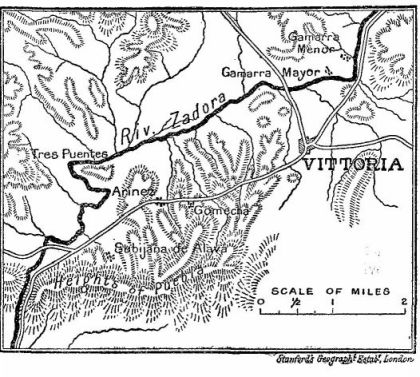
The bridge was seized, Joseph's outposts were completely turned, and time was given for the muster of Picton's men. Stoutly they breasted the slopes, and unsteadied the weakened French centre, which was also assailed on its northern flank. At the same time Joseph's left wing began to waver under Hill's repeated onslaughts; and, distracted by the distant cannonade, which told of a stubborn fight between Graham and Reille, the King now began to draw in his lines towards Vittoria. For a time the French firmly held the village of Arinez, but Picton's men were not to be denied. They burst through the rearguard, and the battle now became a running fight, extending over some five miles of broken country. At the last slopes, close to Vittoria, the defenders made a last heroic stand, and their artillery dealt havoc among the assailants; but our fourth division, rushing forward into the smoke, carried a hill that commanded their left, and the day was won. Nothing now remained for the French but a speedy retreat, while the gallant Reille could still hold Graham's superior force at bay.
There, too, the fight at last swirled back, albeit with many a rallying eddy, into Vittoria. That town was no place of refuge, but a death-trap; for Graham had pushed on a detachment to Durana, on the high-road leading direct to France, and thus blocked the main line of retreat. Joseph's army was now in pitiable plight. Pent up in the choked streets of Vittoria, torn by cannon-shot from the English lines, the wreckage of its three armies for a time surged helplessly to and fro, and then broke away eastwards towards Pamplona. On that side only was safety to be found, for British hussars scoured the plain to the north-east, lending wings to the flight. The narrow causeway, leading through marshes, was soon blocked, and panic seized on all: artillerymen cut their traces and fled; carriages crowded with women, once called gay, but now frantic with terror, wagons laden[pg.312] with ammunition, stores, treasure-chests, and the booty amassed by generals and favourites during five years of warfare and extortion, all were left pell-mell. Jourdan's Marshal's baton was taken, and was sent by Wellington to the Prince Regent, who acknowledged it by conferring on the victor the title of Field-Marshal.
Richly was the title deserved. After four years of battling with superior numbers, the British leader at last revealed the full majesty of his powers now that the omens were favourable. In six weeks he marched more than five hundred miles, crossed six rivers, and, using the Navarrese revolt as the anvil, dealt the hammer-stroke of Vittoria. It cost Napoleon 151 pieces of cannon, nearly all the stores piled up for his Peninsular campaigns—and Spain itself.[320]
As for Joseph, he left his carriage and fled on horseback towards France, reaching St. Jean de Luz "with only a napoleon left." He there also assured his queen that he had always preferred a private station to the grandeur and agitations of public life.[321] This, indeed, was one of the many weak points of his brother's Spanish policy. It rested on the shoulders of an amiable man who was better suited to the ease of Naples than to the Herculean toils of Madrid. Napoleon now saw the magnitude of his error. On July 1st he bade Soult leave Dresden at once for Paris. There he was to call on Clarke, with him repair to Cambacérès; and, as Lieutenant-General, take steps to re-establish the Emperor's affairs in Spain. A Regency was to govern in place of Joseph, who was ordered to remain, according to the state of affairs, either at Burgos(!) or St. Sebastian or Bayonne.
"All the follies in Spain" (he wrote to Cambacérès on that[pg.313] day) "are due to the mistaken consideration I have shown the King, who not only does not know how to command, but does not even know his own value enough to leave the military command alone."
And to Savary he wrote two days later:
"It is hard to imagine anything so inconceivable as what is now going on in Spain. The King could have collected 100,000 picked men: they might have beaten the whole of England."
Reflection, however, showed him that the fault was his own; that if, as had occurred to him when he left Paris, he had intrusted the supreme command in Spain to Soult, the disaster would never have happened.[322] His belief in Soult's capacity was justified by the last events of the Peninsular War. But neither his splendid rally of the scattered French forces, nor the skilful movements of Clausel and Suchet, nor the stubborn defence of Pamplona and San Sebastian, could now save the French cause. The sole result of these last operations was to restore the lustre of the French arms and to keep 150,000 men in Spain when the scales of war were wavering in the plains of Saxony.
Napoleon's letters betray the agitation which he felt even at the first vague rumours of the disaster of Vittoria. On the first three days of July he penned at Dresden seven despatches on that topic in a style so vehement that the compilers of the "Correspondance de Napoléon" have thought it best to omit them. He further enjoined the utmost reserve, and ordered the official journals merely to state that, after a brisk engagement at Vittoria, the French army was concentrating in Arragon, and that the British had captured about a hundred guns and wagons left behind in the town for lack of horses.
There was every reason for hiding the truth. He saw how seriously it must weaken his chances of browbeating the Eastern Powers, and of punishing Austria for her[pg.314] armed mediation. Hitherto there seemed every chance of his succeeding. The French standards flew on all the fortresses of the Elbe and Oder. Hamburg was fast becoming a great French camp, and Denmark was ranged on the side of France.
Indeed, on reviewing the situation on June 4th, the German publicist, Gentz, came to the conclusion that the Emperor Francis would probably end his vacillations by some inglorious compromise. The Kaiser desired peace; but he also wished to shake off the irksome tutelage of his son-in-law, and regain Illyria. For the present he wavered. Before the news of Lützen reached him, he undoubtedly encouraged the allies: but that reverse brought about a half left turn towards Napoleon. "Boney's success at Lützen," wrote Sir G. Jackson in his Diary, "has made Francis reconsider his half-formed resolutions." Here was the chief difficulty for the allies. Their fortunes, and the future of Europe, rested largely on the decision of a man whose natural irresolution of character had been increased by adversity. Fortunately, the news from Spain finally helped to incline him towards war; but for some weeks his decision remained the unknown quantity in European politics. Fortunately, too, he was amenable to the gentle but determining pressure of the kind which Metternich could so skilfully exert. That statesman, as usual, schemed and balanced. He saw that Austria had much to gain by playing the waiting game. Her forces were improving both in numbers and efficiency, and under cover of her offer of armed mediation were holding strong positions in Bohemia. In fact, she was regaining her prestige, and might hope to impose her will on the combatants at the forthcoming European Congress at Prague. Metternich, therefore, continued to pose as the well-wisher of both parties and the champion of a reasonable and therefore durable compromise.
He had acted thus, not only in his choice of measures, but in his selection of men. He had sent to Napoleon's headquarters at Dresden Count Bubna, whose sincere[pg.315] and resolute striving for peace served to lull animosity and suspicions in that place. But to the allied headquarters, now at Reichenbach, he had despatched Count Stadion, who worked no less earnestly for war. While therefore the Courts of St. Petersburg, Berlin, and London hoped, from Stadion's language, that Austria meant to draw the sword, Napoleon inclined to the belief that she would never do more than rattle her scabbard, and would finally yield to his demands.
Stadion's letters to Metternich show that he feared this result. He pressed him to end the seesaw policy of the last six months. "These people are beaten owing to our faults, our half wishes, our half measures, and presently they will get out of the scrape and leave us to pay the price." As for Austria's forthcoming demand of Illyria, who would guarantee that the French Emperor would let her keep it six months, if he remained master of Germany and Italy? Only by a close union with the allies could she be screened from Napoleon's vengeance, which must otherwise lead to her utter destruction. Let, then, all timid counsellors be removed from the side of the Emperor Francis. "I cling to my oft-expressed conviction that we are no longer masters of our own affairs, and that the tide of events will carry us along."[323] If we may judge from Metternich's statements in his "Memoirs," written many years later, he was all along in secret sympathy with these views. But his actions and his official despatches during the first six weeks of the armistice bore another complexion; they were almost colourless, or rather, they were chameleonic. At Dresden they seemed, on the whole, to be favourable to France: at Reichenbach, when coloured by Stadion, they were thought to hold out the prospect of another European coalition.
A new and important development was given to Austrian policy when, on June 7th, Metternich drew up the conditions on which Austria would insist as the basis[pg.316] of her armed mediation. They were as follows: (1) Dissolution of the Duchy of Warsaw; (2) A consequent reconstruction of Prussia, with the certainty of recovering Danzig; (3) Restitution of the Illyrian provinces, including Dalmatia, to Austria; (4) Re-establishment of the Hanse Towns, and an eventual arrangement as to the cession of the other parts of the 32nd military division [the part of North Germany annexed by Napoleon in 1810]. To these were added two other conditions on which Austria would lay great stress, namely: (5) Dissolution of the Confederation of the Rhine; (6) Reconstruction of Prussia conformably with her territorial extent previous to 1805.
At first sight these terms seem favourable to the allied cause; but they were much less extensive than the proposals submitted by Alexander in the middle of May. Therefore, when they were set forth to the allies at Reichenbach, they were unfavourably received, and for some days suspicion of Austria overclouded the previous goodwill. It was removed only by the labours of Stadion and by the tact which Metternich displayed during an interview with the Czar at Opotschna (June 17th).
Alexander came there prejudiced against Metternich as a past master in the arts of double-dealing: he went away convinced that he meant well for the allies. "What will become of us," asked the Czar, "if Napoleon accepts your mediation?" To which the statesman replied: "If he refuses it, the truce will be at an end, and you will find us in the ranks of your allies. If he accepts it, the negotiations will prove to a certainty that Napoleon is neither wise nor just; and the issue will be the same." Alexander knew enough of his great enemy's character to discern the sagacity of Metternich's forecast; and both Frederick William and he agreed to the Austrian terms. [324] Accordingly, on June 27th, a treaty[pg.317] was secretly signed at Reichenbach, wherein Austria pledged herself to an active alliance with Russia and Prussia in case Napoleon should not, by the end of the armistice, have acceded to her four conditiones sine quibus non. To these was now added a demand for the evacuation of all Polish and Prussian fortresses by French troops, a stipulation which it was practically certain that Napoleon would refuse. [325]
The allies meanwhile were gaining the sinews of war from England. The Czar had informed Cathcart at Kalisch that, though he did not press our Government for subsidies, yet he would not be able to wage a long campaign without such aid. On June 14th and 15th, our ambassador signed treaties with Russia and Prussia, whereby we agreed to aid the former by a yearly subsidy of £1,133,334, and the latter by a sum of half that amount, and to meet all the expenses of the Russian fleet then in our harbours. The Czar and the King of Prussia bound themselves to maintain in the field (exclusive of garrisons) 160,000 and 80,000 men respectively.[326][pg.318]
There was every reason for these preparations. Everything showed that Napoleon was bent on browbeating the allies. On June 17th Napoleon's troops destroyed or captured Lützow's volunteers at Kitzen near Leipzig. The excuse for this act was that Lützow had violated the armistice; but he had satisfied Nisas, the French officer there in command, that he was loyally observing it. Nevertheless, his brigade was cut to pieces. The protests of the allies received no response except that Lützow's men might be exchanged—as if they had been captured in fair fight. Finally, Napoleon refused to hear the statement of Nisas in his own justification, reproached him for casting a slur on the conduct of French troops, and deprived him of his command.[327]
But it was Napoleon's bearing towards Metternich, in an interview held on June 26th at the Marcolini Palace at Dresden, that most clearly revealed the inflexibility of his policy. Ostensibly, the interview was fixed in order to arrange the forms of the forthcoming Congress that was to insure the world's peace. In reality, however, Napoleon hoped to intimidate the Austrian statesman, and to gather from him the results of his recent interview with the Czar. Carrying his sword at his side and his hat under his arm, he received Metternich in state. After a few studied phrases about the health of the Emperor Francis, his brow clouded and he plunged in medias res: "So you too want war: well, you shall have it. I have beaten the Russians at Bautzen: now you wish your turn to come. Be it so, the rendezvous shall be in Vienna. Men are incorrigible: experience is lost upon you. Three times I have replaced the Emperor Francis on his throne. I have promised always to live[pg.319] at peace with him: I have married his daughter. At the time I said to myself—you are perpetrating a folly; but it was done, and now I repent of it."
Metternich saw his advantage: his adversary had lost his temper and forgotten his dignity. He calmly reminded Napoleon that peace depended on him; that his power must be reduced within reasonable limits, or he would fall in the ensuing struggle. No matador fluttered the cloak more dextrously. Napoleon rushed on. No coalition should daunt him: he could overpower any number of men—everything except the cold of Russia—and the losses of that campaign had been made good. He then diverged into stories about that war, varied by digressions as to his exact knowledge of Austria's armaments, details of which were sent to him daily. To end this wandering talk, Metternich reminded him that his troops now were not men but boys. Whereupon the Emperor passionately replied: "You do not know what goes on in the mind of a soldier; a man such as I does not take much heed of the lives of a million of men,"—and he threw aside his hat. Metternich did not pick it up.
Napoleon noticed the unspoken defiance, and wound up by saying: "When I married an Archduchess I tried to weld the new with the old, Gothic prejudices with the institutions of my century: I deceived myself, and this day I see the whole extent of my error. It may cost me my throne, but I will bury the world beneath its ruins." In dismissing Metternich, the Emperor used the device which, shortly before the rupture with England in 1803, he had recommended Talleyrand to employ upon Whitworth, namely, after trying intimidation to resort to cajolery. Touching the Minister on the shoulder, he said quietly: "Well, now, do you know what will happen? You will not make war on me?" To which came the quick reply: "You are lost, Sire; I had the presentiment of it when I came: now, in going, I have the certainty." In the anteroom the generals crowded around the illustrious visitor. Berthier had previously begged[pg.320] him to remember that Europe, and France, urgently needed peace; and now, on conducting him to his carriage, he asked him whether he was satisfied with Napoleon. "Yes," was the answer, "he has explained everything to me: it is all over with the man."[328]
Substantially, this was the case. Napoleon's resentment against Austria, not unnatural under the circumstances, had hurried him into outbursts that revealed the inner fires of his passion. In a second interview, on June 30th, he was far more gracious, and allowed Austria to hope that she would gain Illyria. He also accepted Austria's mediation; and it was stipulated that a Congress should meet at Prague for the discussion of a general pacification. Metternich appeared highly pleased with this condescension, but he knew by experience that Napoleon's caresses were as dangerous as his wrath; and he remained on his guard. The Emperor soon disclosed his real aim. In gracious tones he added: "But this is not all: I must have a prolongation of the armistice. How can we between July 5th and 20th end a negotiation which ought to embrace the whole world?" He proposed August 20th as the date of its expiration. To this Metternich demurred because the allies already thought the armistice too long for their interests. August 10th was finally agreed on, but not without much opposition on the part of the allied generals, who insisted that such a prolongation would greatly embarrass them.
Outwardly, this new arrangement seemed to portend peace: but it is significant that on June 28th Napoleon[pg.321] wrote to Eugène that all the probabilities appeared for war; and on June 30th he wrote his father-in-law a cold and almost threatening letter.[329]
Late on that very evening came to hand the first report of the disaster of Vittoria. Despite all Napoleon's precautions, the news leaked out at Dresden. Bubna's despatches of July 5th, 6th, and 7th soon made it known to the Emperor Francis, then at Brandeis in Bohemia. Thence it reached the allied monarchs and Bernadotte on July 12th at Trachenberg in the midst of negotiations which will be described presently. The effect of the news was very great. The Czar at once ordered a Te Deum to be sung: "It is the first instance," wrote Cathcart, "of a Te Deum having been sung at this Court for a victory in which the forces of the Russian Empire were not engaged."[330] But its results were more than ceremonial: they were practical. Our envoy, Thornton, who followed Bernadotte to Trachenberg, states that Bubna had learnt that Wellington had completely routed three French corps with a débandade like that of the retreat from Moscow. Thornton adds: "The Prince Royal [Bernadotte] thinks that the French army will be very soon withdrawn from Silesia and that Buonaparte must soon commence his retreat nearer the Rhine. I have no doubt of its effect upon Austria. This is visible in the answer of the Emperor [Francis] to the Prince, which came to-day from the Austrian head-quarters." That letter, dated July 9th, was indeed of the most cordial character. It expressed great pleasure at hearing that "the obstacles which seemed to hinder the co-operation of the forces under your Royal Highness are now removed. I regard this co-operation as one of the surest supports of the cause which the Powers may once more be called on to defend by a war which can only offer chances of success unless sustained by the greatest[pg.322] and most unanimous measures."[331] Further than this Francis could scarcely go without pledging himself unconditionally to an alliance; and doubtless it was the news of Vittoria that evoked these encouraging assurances.
It is even more certain that the compact of Trachenberg also helped to end the hesitations of Austria. This compact arose out of the urgent need of adopting a general plan of campaign, and, above all, of ending the disputes between the allied sovereigns and Bernadotte. The Prince Royal of Sweden had lost their confidence through his failure to save Hamburg from the French and Danes. Yet, on his side, he had some cause for complaint. In the previous summer, Alexander led him to expect the active aid of 35,000 Russian troops for a campaign in Norway: but, mainly at the instance of England, he now landed in Pomerania and left Sweden exposed to a Danish attack on the side of Norway. He therefore suggested an interview with the allied sovereigns, a request which was warmly seconded by Castlereagh.[332] Accordingly it took place at Trachenberg, a castle north of Breslau, with the happiest results. The warmth of the great Gascon's manner cleared away all clouds, and won the approval of Frederick William.
There was signed the famous compact, or plan, of Trachenberg (July 12th). It bound the allies to turn their main forces against Napoleon's chief army, wherever it was: those allied corps that threatened his flanks or communications were to act on the line that most directly cut into them: and the salient bastion of Bohemia was expressly named as offering the greatest advantages for attacking Napoleon's main force. The first and third of these axioms were directly framed so as to encourage Austria: the second aimed at concentrating Bernadotte's force on the main struggle and preventing his waging war merely against Denmark.[pg.323]
The plan went even further: 100,000 allied troops were to be sent into Bohemia, as soon as the armistice should cease, so as to form in all an army of 200,000 men. On the north, Bernadotte, after detaching a corps towards Hamburg, was to advance with a Russo-Prusso-Swedish army of 70,000 men towards the middle course of the Elbe, his objective being Leipzig; and the rest of the allied forces, those remaining in Silesia, were to march towards Torgau, and thus threaten Napoleon's positions in Saxony from the East. This plan of campaign was an immense advance on those of the earlier coalitions. There was no reliance here on lines and camps: the days of Mack and Phull were past: the allies had at last learnt from Napoleon the need of seeking out the enemy's chief army, and of flinging at it all the available forces. Politically, also, the compact deserves notice. In concerting a plan of offensive operations from Bohemia, the allies were going far to determine the conduct of Austria.
On that same day the peace Congress was opened at Prague. Its proceedings were farcical from the outset. Only Anstett and Humboldt, the Russian and Prussian envoys, were at hand; and at the appointment of the former, an Alsatian by birth, Napoleon expressed great annoyance. The difficulties about the armistice also gave him the opportunity, which he undoubtedly sought, of further delaying negotiations. In vain did Metternich point out to the French envoy, Narbonne, at Prague, that these frivolous delays must lead to war if matters were not amicably settled by August 10th, at midnight.[333] In vain did Narbonne and Caulaincourt beg their master to seize this opportunity for concluding a safe and [pg.324] honourable peace. It was not till the middle of July that he appointed them his plenipotentiaries at the Congress; and, even then, he retained the latter at Dresden, while the former fretted in forced inaction at Prague. "I send you more powers than power," wrote Maret to Narbonne with cynical jauntiness: "you will have your hands tied, but your legs and mouth free so that you may walk about and dine."[334] At last, on the 26th, Caulaincourt received his instructions; but what must have been the anguish of this loyal son of France to see that Napoleon was courting war with a united Europe. Austria, said his master, was acting as mediator: and the mediator ought not to look for gains: she had made no sacrifice and deserved to gain nothing at all: her claims were limitless; and every concession granted by France would encourage her to ask for more: he was disposed to make peace with Russia on satisfactory terms so as to punish Austria for her bad faith in breaking the alliance of 1812.[335]
Such trifling with the world's peace seems to belong, not to the sphere of history, but to the sombre domain of Greek tragedy, where mortals full blown with pride rush blindly on the embossed bucklers of fate. For what did Austria demand of him? She proposed to leave him master of all the lands from the swamps of the Ems down to the Roman Campagna: Italy was to be his, along with as much of the Iberian Peninsula as he could hold. His control of Illyria, North Germany, and the Rhenish Confederation he must give up. But France, Belgium, Holland, and Italy would surely form a noble realm for a man who had lost half a million of men, and was even now losing Spain. Yet his correspondence proves that, even so, he thought little of his foes, and, least of all, of the Congress at Prague.
Leaving his plenipotentiaries tied down to the discussion of matters of form, he set out from Dresden on[pg.325] July 24th for a visit to Mainz, where he met the Empress and reviewed his reserves. Every item of news fed his warlike resolve. Soult, with nearly 100,000 men, was about to relieve Pamplona (so he wrote to Caulaincourt): the English were retiring in confusion: 12,000 veteran horsemen from his armies in Spain would soon be on the Rhine; but they could not be on the Elbe before September. If the allies wanted a longer armistice, he (Napoleon) would agree to it: if they wished to fight, he was equally ready, even against the Austrians as well.[336] To Davoust, at Hamburg, he expressed himself as if war was certain; and he ordered Clarke, at Paris, to have 110,000 muskets made by the end of the year, so that, in all, 400,000 would be ready. Letters about the Congress are conspicuous by their absence; and everything proves that, as he wrote to Clarke at the beginning of the armistice, he purposed striking his great blows in September. Little by little we see the emergence of his final plan—to overthrow Russia and Prussia, while, for a week or two, he amused Austria with separate overtures at Prague.
But, during eight years of adversity, European statesmen had learnt that disunion spelt disaster; and it was evident that Napoleon's delays were prompted solely by the need of equipping and training his new cavalry brigades. As for the Congress, no one took it seriously. Gentz, who was then in close contact with Metternich, saw how this tragi-comedy would end. "We believe that on his return to Dresden, Napoleon will address to this Court a solemn Note in which he will accuse everybody of the delays which he himself has caused, and will end up by proclaiming a sort of ultimatum. Our reply will be a declaration of war."[337]
This was what happened. As July wore on and brought no peaceful overtures, but rather a tightening of[pg.326] Napoleon's coils in Saxony, Bavaria, and Illyria, the Emperor Francis inclined towards war. As late as July 18th he wrote to Metternich that he was still for peace, provided that Illyria could be gained.[338] But the French military preparations decided him, a few days later, to make war, unless every one of the Austrian demands should be conceded by August 10th. His counsellors had already come to that conclusion, as our records prove. On July 20th Stadion wrote to Cathcart urging him to give pecuniary aid to General Nugent, who would wait on him to concert means for rousing a revolt against Napoleon in Tyrol and North Italy; and our envoy agreed to give £5,000 a month for the "support of 5,000 Austrians acting in communication with our squadron in the Adriatic." This step met with Metternich's approval; and, when writing to Stadion from Prague (July 25th), he counselled Cathcart to send a despatch to Wellington and urge him to make a vigorous move against the south of France. He (Metternich) would have the letter sent safely through Switzerland and the south of France direct to our general.[339]
With the solemn triflings of the Congress we need not concern ourselves. The French plenipotentiaries saw clearly that their master "would allow of no peace but that which he should himself dictate with his foot on the enemy's neck." Yet they persevered in their thankless task, for "who could tell whether the Emperor, when he found himself placed between highly favourable conditions and the fear of having 200,000 additional troops against him, might not hesitate; whether just one grain of common sense, one spark of wisdom, might not enter his head?" Alas! That[pg.327] brain was now impervious to advice; and the young De Broglie, from whom we quote this extract, sums up the opinion of the French plenipotentiaries in the trenchant phrase, "the devil was in him."[340]
But there was method in his madness. In the Dresden interview he had warned Metternich that not till the eleventh hour would he disclose his real demands. And now was the opportunity of trying the effect of a final act of intimidation. On August 4th he was back again in Dresden: on the next day he dictated the secret conditions on which he would accept Austria's mediation; and, on August 6th, Caulaincourt paid Metternich a private visit to find out what Austria's terms really were. After a flying visit to the Emperor Francis at Brandeis, the Minister brought back as an ultimatum the six terms drawn up on June 7th (see p. 316); and to these he now added another which guaranteed the existing possessions of every State, great or small.
Napoleon was taken aback by this boldness, which he attributed to the influence of Spanish affairs and to English intrigues.[341] On August 9th he summoned Bubna[pg.328] and offered to give up the Duchy of Warsaw—provided that the King of Saxony gained an indemnity—also the Illyrian Provinces (but without Istria), as well as Danzig, if its fortifications were destroyed. As for the Hanse Towns and North Germany, he would not hear of letting them go. Bubna thought that Austria would acquiesce. But she had said her last word: she saw that Napoleon was trifling with her until he had disposed of Russia and Prussia. And, at midnight of August 10th, beacon fires on the heights of the Riesengebirge flashed the glad news to the allies in Silesia that they might begin to march their columns into Bohemia. The second and vaster Act in the drama of liberation had begun.
Did Napoleon remember, in that crisis of his destiny, that it was exactly twenty-one years since the downfall of the old French monarchy, when he looked forth on the collapse of the royalist defence at the Tuileries and the fruitless bravery of the Swiss Guards? [pg.329]
The militant Revolution had now attained its majority. It had to confront an embattled Europe. Hitherto the jealousies or fears of the Eastern Powers had prevented any effective union. The Austro-Prussian league of 1792 was of the loosest description owing to the astute neutrality of the Czarina Catherine. In 1798 and 1805 Prussia seemed to imitate her policy, and only after Austria had been crushed did the army of Frederick the Great try conclusions with Napoleon. In the Jena and Friedland campaigns, the Hapsburgs played the part of the sulking Achilles, and met their natural reward in 1809. The war of 1812 marshalled both Austria and Prussia as vassal States in Napoleon's crusade against Russia. But it also brought salvation, and Napoleon's fateful obstinacy during the negotiations at Prague virtually compelled his own father-in-law to draw the sword against him. Ostensibly, the points at issue were finally narrowed down to the control of the Confederation of the Rhine, the ownership of North Germany, and a few smaller points. But really there was a deeper cause, the character of Napoleon.
The vindictiveness with which he had trampled on his foes, his almost superhuman lust of domination, and the halting way in which he met all overtures for a compromise—this it was that drove the Hapsburgs into an alliance with their traditional foes. His conduct may be explained on diverse grounds, as springing from the vendetta instincts of his race, or from his still viewing events through the distorting medium of the Continental[pg.330] System, or from his ingrained conviction that, at bottom, rulers are influenced only by intimidation.
In any case, he had now succeeded in bringing about the very thing which Charles James Fox had declared to be impossible. In opening the negotiations for peace with France in April, 1806, our Foreign Minister had declared to Talleyrand that "the project of combining the whole of Europe against France is to the last degree chimerical." Yet Great Britain and the Spanish patriots, after struggling alone against the conqueror from 1808 to 1812, saw Russia, Sweden, Prussia, and Austria, successively range themselves on their side. It is true, the Germans of the Rhenish Confederation, the Italians, Swiss, and Danes were still enrolled under the banners of the new Charlemagne; but, with the exception of the last, they fought wearily or questioningly, as for a cause that promised naught but barren triumphs and unending strife.
Truly, the years that witnessed Napoleon's fall were fruitful in paradox. The greatest political genius of the age, for lack of the saving grace of moderation, had banded Europe against him: and the most calculating of commanders had also given his enemies time to frame an effective military combination. The Prussian General von Boyen has told us in his Memoirs how dismayed ardent patriots were at the conclusion of the armistice in June, and how slow even the wiser heads were to see that it would benefit their cause. If Napoleon needed it in order to train his raw conscripts and organize new brigades of cavalry, the need of the allies was even greater. Their resources were far less developed than his own. At Bautzen, their army was much smaller; and Boyen states that had the Emperor pushed them hard, driven the Russians back into Poland and called the Poles once more to arms, the allies must have been in the most serious straits.[342]
Napoleon, it is true, gained much by the armistice. His conscripts profited immensely by the training of[pg.331] those nine weeks: his forces now threatened Austria on the side of Bavaria and Illyria, as well as from the newly intrenched camp south of Dresden: his cavalry was re-recovering its old efficiency: Murat, in answer to his imperious summons, ended his long vacillations and joined the army at Dresden on August 14th.
Above all, the French now firmly held that great military barrier, the River Elbe. Napoleon's obstinacy during the armistice was undoubtedly fed by his boundless confidence in the strength of his military position. In vain did his Marshals remind him that he was dangerously far from France; that, if Austria drew the sword, she could cut him off from the Rhine, and that the Saale, or even the Rhine itself, would be a safer line of defence.—Ten battles lost, he retorted, would scarcely force him to that last step. True, he now exposed his line of communications with France; but if the art of war consisted in never running any risk, glory would be the prize of mediocre minds. He must have a complete triumph. The question was not of abandoning this or that province: his political superiority was at stake. At Marengo, Austerlitz, and Wagram, he was in greater danger. His forces now were not in the air; they rested on the Elbe, on its fortresses, and on Erfurt. Dresden was the pivot on which all his movements turned. His enemies were spread out on a circumference stretching from Prague to Berlin, while he was at the centre; and, operating on interior and therefore shorter lines, he could outmarch and outmanoeuvre them. "But," he concluded, "where I am not my lieutenants must wait for me without trusting anything to chance. The allies cannot long act together on lines so extended, and can I not reasonably hope sooner or later to catch them in some false move? If they venture between my fortified lines of the Elbe and the Rhine, I will enter Bohemia and thus take them in the rear."[343]
The plan promised much. The central intrenched[pg.332] camps of Dresden and Pirna, together with the fortresses of Königstein above, and of Torgau below, the Saxon capital, gave great strategic advantages. The corps of St. Cyr at Königstein and those of Vandamme, Poniatowski, and Victor further to the east, watched the defiles leading from Bohemia. The corps of Macdonald, Lauriston, Ney, and Marmont held in check Blücher's army of Silesia. On Napoleon's left, and resting on the fortresses of Wittenberg and Magdeburg, the corps of Oudinot, Bertrand, and Reynier threatened Berlin and Bernadotte's army of the north cantonned in its neighbourhood; while Davoust at Hamburg faced Bernadotte's northern detachments and menaced his communications with Stralsund. Davoust certainly was far away, and the loss of this ablest of Napoleon's lieutenants was severely to be felt in the subsequent complicated moves; with this exception, however, Napoleon's troops were well in hand and had the advantage of the central position, while the allies were, as yet, spread out on an extended arc.
But Napoleon once more made the mistake of underrating both the numbers and the abilities of his foes. By great exertions they now had close on half a million of men under arms, near the banks of the Oder and the Elbe, or advancing from Poland and Hungary. True, many of these were reserves or raw recruits, and Colonel Cathcart doubted whether the Austrian reserves were then in existence.[344] But the best authorities place the total at 496,000 men and 1,443 cannon. Moreover, as was agreed on at Trachenberg, 77,000 Russians and 49,000 Prussians now marched from Glatz and Schweidnitz into Bohemia, and speedily came into touch with the 110,000 Austrians now ranged behind the River Eger. The formation of this allied Grand Army was a masterly step. Napoleon did not hear of it before August 16th, and it was not until a week later that he realized how vast were the forces that would threaten his rear. For the present his plan was to hold the Bohemian[pg.333] passes south of Bautzen and Pirna, so as to hinder any invasion of Saxony, while he threw himself in great force on the Army of Silesia, now 95,000 strong, though he believed it to number only 50,000.[345] While he was crushing Blücher, his lieutenants, Oudinot, Reynier, and Bertrand, were charged to drive Bernadotte's scattered corps from Berlin; whereupon Davoust was to cut him off from the sea and relieve the French garrisons at Stettin and Küstrin. Thus Napoleon proposed to act on the offensive in the open country towards Berlin and in Silesia, remaining at first on the defensive at Dresden and in the Lusatian mountains. This was against the advice of Marmont, who urged him to strike first at Prague, and not to intrust his lieutenants with great undertakings far away from Dresden. The advice proved to be sound; but it seems certain that Napoleon intended to open the campaign by a mighty blow dealt at Blücher, and then to lead a great force through the Lusatian defiles into Bohemia and drive the allies before him towards Vienna.
But what did he presume that the allied forces in Bohemia would be doing while he overwhelmed Blücher in Silesia? Would not Dresden and his communications with France be left open to their blows? He decided to run this risk. He had 100,000 men among the Lusatian hills between Bautzen and Zittau. St. Cyr's corps was strongly posted at Pirna and the small fortress of Königstein, while his light troops watched the passes north of Teplitz and Karlsbad. If the allies sought to invade Saxony, they would, so Napoleon thought, try to force the Zittau road, which presented few natural difficulties. If they threatened Dresden by the passages further west, Vandamme would march from near Zittau to reinforce St. Cyr, or, if need be, the Emperor himself would hurry back from Silesia with his Guards. If the enemy invaded Bavaria, [pg.334] Napoleon wished them bon voyage: they would soon come back faster than they went; for, in that case, he would pour his columns down from Zittau towards Prague and Vienna. The thought that he might for a time be cut off from France troubled him not: "400,000 men," he said, "resting on a system of strongholds, on a river like the Elbe, are not to be turned." In truth, he thought little about the Bohemian army. If 40,000 Russians had entered Bohemia, they would not reach Prague till the 25th; so he wrote to St. Cyr On the 17th, the day when hostilities could first begin; and he evidently believed that Dresden would be safe till September. Its defence seemed assured by the skill of that master of defensive warfare, St. Cyr, by the barrier of the Erz Mountains, and still more by Austrian slowness.
Of this characteristic of theirs he cherished great hopes. Their finances were in dire disorder; and Fouché, who had just returned from a tour in the Hapsburg States, reported that the best way of striking at that Power would be "to affect its paper currency, on which all its armaments depend."[346] And truly if the transport of a great army over a mountain range had depended solely on the almost bankrupt exchequer at Vienna, Dresden would have been safe until Michaelmas; but, beside the material aid brought by the Russians and Prussians into Bohemia, England also gave her financial support. In pursuance of the secret article agreed on at Reichenbach, Cathcart now advanced £250,000 at once; and the knowledge that our financial support was given to the federative paper notes issued by the allies enabled the Court of Vienna privately to raise loans and to wage war with a vigour wholly unexpected by Napoleon.[347]
Certainly the allied Grand Army suffered from no[pg.335] lack of advisers. The Czar, the Emperor Francis, and the King of Prussia were there; as a compliment to Austria, the command was intrusted to Field-Marshal Schwarzenberg, a man of diplomatic ability rather than of military genius. By his side were the Russians, Wittgenstein, Barclay, and Toll, the Prussian Knesebeck, the Swiss Jomini, and, above all, Moreau.
The last-named, as we have seen, came over on the inducement of Bernadotte, and was received with great honour by the allied sovereigns. Jomini also was welcomed for his knowledge of the art of war. This great writer had long served as a French general; but the ill-treatment that he had lately suffered at Berthier's hands led him, on August 14th, to quit the French service and pass over to the allies. His account of his desertion, however, makes it clear that he had not penetrated Napoleon's designs, for the best of all reasons, because the Emperor kept them to himself to the very last moment.[348]
The second part of the campaign opens with the curious sight of immense forces, commanded by experienced leaders, acting in complete ignorance of the moves of the enemy only some fifty miles away. Leaving Bautzen on August 17th, Napoleon proceeded eastwards to Görlitz, turned off thence to Zittau, and hearing a false rumour that the Russo-Prussian force in Bohemia was only 40,000 strong, returned to Görlitz with the aim of crushing Blücher. Disputes about the armistice had given that enterprising leader the excuse for entering the neutral zone before its expiration; and he had had sharp affairs with Macdonald and Ney near Löwenberg on the River Bober. Napoleon hurried up with his Guards, eager to catch Blücher;[349] the French were now[pg.336] 140,000 strong, while the allies had barely 95,000 at hand. But the Prussian veteran, usually as daring as a lion, was now wily as a fox. Under cover of stiff outpost affairs, he skilfully withdrew to the south-east, hoping to lure the French into the depths of Silesia and so give time to Schwarzenberg to seize Dresden.
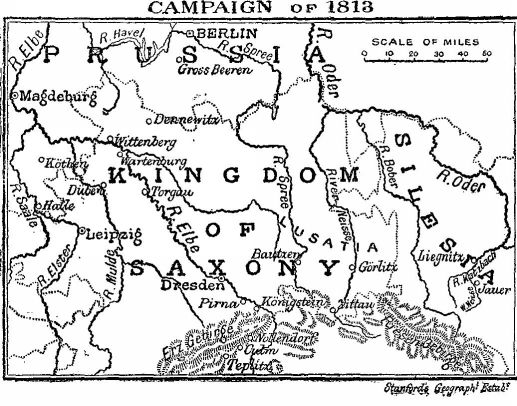
But Napoleon was not to be drawn further afield. Seeing that his foes could not be forced to a pitched battle, he intrusted the command to Macdonald, and rapidly withdrew with Ney and his Guard towards Görlitz; for he now saw the possible danger to Dresden if Schwarzenberg struck home. If, however, that leader remained on the defensive, the Emperor determined to fall back on what had all along been his second plan, and make a rush through the Lusatian defiles on Prague.[350] But a[pg.337] despatch from St. Cyr, which reached him at Görlitz late at night on the 23rd, showed that Dresden was in serious danger from the gathering masses of the allies. This news consigned his second plan to the limbo of vain hopes. Yet, as will appear a little later, his determination to defend by taking the offensive soon took form in yet a third design for the destruction of the allies.
It is a proof of the quenchless pugnacity of his mind that he framed this plan during the fatigues of the long forced march back towards Dresden, amidst pouring rain and the discouragement of knowing that his raid into Silesia had ended merely in the fruitless wearying of his choicest troops. Accompanied by the Old Guard, the Young Guard, a division of infantry, and Latour-Maubourg's cavalry, he arrived at Stolpen, south-east of Dresden, before dawn of the 25th. Most of the battalions had traversed forty miles in little more than forty-eight hours, and that, too, after a partial engagement at Löwenberg, and despite lack of regular rations. Leaving him for a time, we turn to glance at the fortunes of the war in Brandenburg and Silesia.
Napoleon had bidden Oudinot, with his own corps and those of Reynier and Bertrand, in all about 70,000 men, to fight his way to Berlin, disperse the Landwehr and the "mad rabble" there, and, if the city resisted, set it in flames by the fire of fifty howitzers. That Marshal found that a tough resistance awaited him, although the allied commander-in-chief, Bernadotte, moved with the utmost caution, as if he were bent on justifying Napoleon's recent sneer that he would "only make a show" (piaffer). It is true that the position of the Swedish Prince, with Davoust threatening his rear, was far from safe; but he earned the dislike of the Prussians by playing the grand seigneur.[351] Meanwhile most of the[pg.338] defence was carried out by the Prussians, who flooded the flat marshy land, thus delaying Oudinot's advance and compelling him to divide his corps. Nevertheless, it seemed that Bernadotte was about to evacuate Berlin.
At this there was general indignation, which found vent in the retort of the Prussian General, von Bülow: "Our bones shall bleach in front of Berlin, not behind it." Seeing an opportune moment while Oudinot's other corps were as yet far off, Bülow sharply attacked Reynier's corps of Saxons at Grossbeeren, and gained a brilliant success, taking 1,700 prisoners with 26 guns, and thus compelling Oudinot's scattered array to fall back in confusion on Wittenberg (August 23rd).[352] Thither the Crown Prince cautiously followed him. Four days later, a Prussian column of Landwehr fought a desperate fight at Hagelberg with Girard's conscripts, finally rushing on them with wolf-like fury, stabbing and clubbing them, till the foss and the lanes of the town were piled high with dead and wounded. Scarce 1,700 out of Girard's 9,000 made good their flight to Magdeburg. The failures at Grossbeeren and Hagelberg reacted unfavourably on Davoust. That leader, advancing into Mecklenburg, had skirmished with Walmoden's corps of Hanoverians, British, and Hanseatics; but, hearing of the failure of the other attempts on Berlin, he fell back and confined himself mainly to a defensive which had never entered into the Emperor's designs on that side, or indeed on any side.
Even when Napoleon left Macdonald facing Blücher in Silesia, his orders were, not merely to keep the allies in check: if possible Macdonald was to attack him and drive him beyond the town of Jauer.[353] This was what the French Marshal attempted to do on the 26th of[pg.339] August. The conditions seemed favourable to a surprise. Blücher's army was stationed amidst hilly country deeply furrowed by the valleys of the Katzbach and the "raging Neisse."[354] Less than half of the allied army of 95,000 men was composed of Prussians: the Russians naturally obeyed his orders with some reluctance, and even his own countryman, Yorck, grudgingly followed the behests of the "hussar general."
Macdonald also hoped to catch the allies while they were sundered by the deep valley of the Neisse. The Prussians with the Russian corps led by Sacken were to the east of the Neisse near the village of Eichholz, the central point of the plateau north of Jauer, which was the objective of the French right wing; while Langeron's Russian corps was at Hennersdorf, some three miles away and on the west of that torrent. On his side, Blücher was planning an attack on Macdonald, when he heard that the French had crossed the Neisse near its confluence with the Katzbach, and were struggling up the streaming gullies that led to Eichholz.
Driving rain-storms hid the movements on both sides, and as Souham, who led the French right, had neglected to throw out flanking scouts, the Prussian staff-officer, Muffling, was able to ride within a short distance of the enemy's columns and report to his chief that they could be assailed before their masses were fully deployed on the plateau. While Souham's force was still toiling up, Sacken's artillery began to ply it with shot, and had Yorck charged quickly with his corps of Prussians, the day might have been won forthwith. But that opinionated general insisted on leisurely deploying his men. Souham was therefore able to gain a foothold on the plateau: Sebastiani's men dragged up twenty-four light cannon: and at times the devoted bravery of the French endangered the defence. But the defects in their position slowly but surely told against them, and the vigour of their attack spent itself. Their cavalry was exhausted by the mud: their muskets were rendered wellnigh[pg.340] useless by the ceaseless rain; and when Blücher late in the afternoon headed a dashing charge of Prussian and Russian horsemen, the wearied conscripts gave way, fled pell-mell down the slopes, and made for the fords of the Neisse and the Katzbach, where many were engulfed by the swollen waters. Meanwhile the Russians on the allied left barely kept off Lauriston's onsets, and on that side the day ended in a drawn fight. Macdonald, however, seeing Lauriston's rear threatened by the advance of the Prussians over the Katzbach, retreated during the night with all his forces. On the next few days, the allies, pressing on his wearied and demoralized troops, completed their discomfiture, so that Blücher, on the 1st of September, was able thus to sum up the results of the battle and the pursuit—two eagles, 103 cannon, 18,000 men, and a vast quantity of ammunition and stores captured, and Silesia entirely freed from the foe.[355]
We now return to the events that centred at Dresden. When, on August 21st and 22nd, the allies wound their way through the passes of the Erz, they were wholly ignorant of Napoleon's whereabouts. The generals, Jomini and Toll, who were acquainted with the plan of operations agree in stating that the aim of the allies was to seize Leipzig. The latter asserts that they believed Napoleon to be there, while the Swiss strategist saw in this movement merely a means of effecting a junction with Bernadotte's army, so as to cut off Napoleon from the Rhine.[356] Unaware that the rich prize of Dresden was left almost within their grasp by Napoleon's eastward move, the allies plodded on towards Freiberg and Chemnitz, when, on the 23rd, the capture of one of St. Cyr's despatches flashed the truth upon them.
At once they turned eastwards towards Dresden; but[pg.341] so slow was their progress over the wretched cross-roads now cut up by the rains, that not till the early morning of the 25th did the heads of their columns appear on the heights south-west of the Saxon capital. Yet, even so, the omens were all in their favour. On their right, Wittgenstein had already carried the French lines at Pirna, and was now driving in St. Cyr's outposts towards Dresden. The daring spirits at Schwarzenberg's headquarters therefore begged him to push on the advantage already gained, while Napoleon was still far away. Everything, they asserted, proved that the French were surprised; Dresden could not long hold out against an attack by superior numbers: its position in a river valley dominated by the southern and western slopes, which the allies strongly held, was fatal to a prolonged defence: the thirteen redoubts hastily thrown up by the French could not long keep an army at bay, and of these only five were on the left side of the Elbe on which the allies were now encamped.
Against these manly counsels the voice of prudence pleaded for delay. It was not known how strong were St. Cyr's forces in Dresden and in the intrenched camp south of the city. Would it not therefore be better to await the development of events? Such was the advice of Toll and Moreau, the latter warning the Czar, with an earnestness which we may deem fraught with destiny for himself—"Sire, if we attack, we shall lose 20,000 men and break our nose."[357] The multitude of counsellors did not tend to safety. Distracted by the strife of tongues, Schwarzenberg finally took refuge in that last resort of weak minds, a tame compromise. He decided to wait until further corps reached the front, and at four o'clock of the [pg.342] following afternoon to push forward five columns for a general reconnaissance in force. As Jomini has pointed out, this plan rested on sheer confusion of thought. If the commander meant merely to find out the strength of the defenders, that could be ascertained at once by sending forward light troops, screened by skirmishers, at the important points. If he wished to attack in force, his movement was timed too late in the day safely to effect a lodgment in a large city held by a resolute foe. Moreover, the postponement of the attack for thirty hours gave time for the French Emperor to appear on the scene with his Guards.
As we have seen, Napoleon reached Stolpen, a town distant some sixteen miles from Dresden, very early on the morning of the 25th. His plans present a telling contrast to the slow and clumsy arrangements of the allies. He proposed to hurl his Guards at their rear and cut them off from Bohemia. Crossing the Elbe at Königstein, he would recover the camp of Pirna, hold the plateau further west and intercept Schwarzenberg's retreat.[358] For the success of this plan he needed a day's rest for his wearied Guards and the knowledge that Dresden could hold out for a short time. His veterans could perhaps dispense with rest; where their Emperor went they would follow; but Dresden was the unknown quantity. Shortly after midnight of the 25th and 26th, he heard from St. Cyr that Dresden would soon be attacked in such force that a successful defence was doubtful.
At once he changed his plan and at 1 a.m. sent off four despatches ordering his Guards and all available troops to succour St. Cyr. Vandamme's corps alone was now charged with the task of creeping round the enemy's rear, while the Guards long before dawn resumed their march through the rain and mud. The Emperor followed and passed them at a gallop, reaching the capital at 9 a.m. with Latour-Maubourg's cuirassiers; and, early in the afternoon, the bearskins of the Guards were seen on the heights east of Dresden, while the dark [pg.343] masses of the allies were gathering on the south and west for their reconnaissance in force.
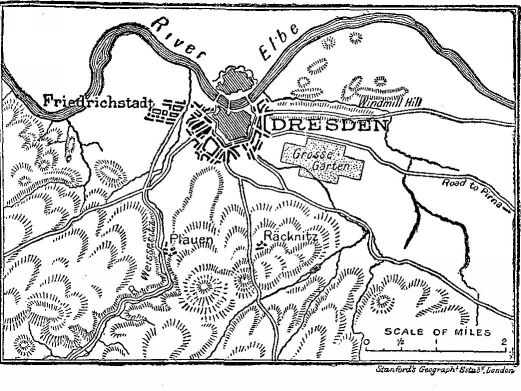
Lowering clouds and pitiless rain robbed the scene of all brilliance, but wreathed it with a certain sombre majesty. On the one side was the fair city, the centre of German art and culture, hastily girdled with redoubts and intrenchments manned now by some 120,000 defenders. Fears and murmurings had vanished as soon as the Emperor appeared; and though in many homes men still longed for the triumph of the allies, yet loyalty to their King and awe of Napoleon held the great mass of the citizens true to his alliance. As for the French soldiery, their enthusiasm was unbounded. As regiment after regiment tramped in wearily from the east over the Elbe bridge and the men saw that well-known figure in the gray overcoat, fatigues and discomforts were forgotten; thunderous shouts of "Vive l'Empereur" rent the air and rolled along the stream, carrying inspiration to the defenders, doubt and dismay to the hostile lines. Yet these too were being strengthened, until they finally[pg.344] mustered close on 200,000 men, who crowned the slopes south of Dresden with a war-cloud that promised to sweep away its hasty defences—had not Napoleon been there.
The news of his arrival shook the nerves of the Russian Emperor, and it was reserved for the usually diffident King of Prussia to combat all notion of retreat. Schwarzenberg's reconnaissance in force therefore took place punctually at four o'clock, when the French, after a brief rest, were well prepared to meet them. The Prussians had already seized the "Great Garden" which lines the Pirna road; and from this point of vantage they now sought to drive St. Cyr from the works thrown up on its flank and rear. But their masses were torn by a deadly fire and finally fell back shattered. The Russians, on their right, fared no better. At the allied centre and left, the attack at one time promised success. Under cover of a heavy cannonade from their slopes, the Austrians carried two redoubts: but, with a desperate charge, the Old Guard drove in through the gorges of these works and bayoneted the victors of an hour. As night fell, the assailants drew off baffled, after sustaining serious losses.
Nevertheless, the miseries of the night, the heavy rains of the dawning day and the knowledge of the strength of the enemy's position in front and of Vandamme's movement in their rear, failed to daunt their spirits. If they were determined, Napoleon was radiant with hope. His force, though smaller, held the inner line and spread over some three miles; while the concave front of the allies extended over double that space, and their left wing was separated from the centre by the stream and defile of Plauen. From his inner position he could therefore readily throw an overpowering mass on any part of their attenuated array. He prepared to do so against their wings. At those points everything promised success to his methods of attack.
Never, perhaps, in all modern warfare has the musket been so useless as amidst the drenching rains which beat[pg.345] upon the fighters at the Katzbach and before Dresden. So defective was its firing arrangement then that after a heavy storm only a feeble sputter came from whole battalions of foot: and on those two eventful days the honours lay with the artillery and l'arme blanche. As for the infantrymen, they could effect little except in some wild snatches of bayonet work at close quarters. This explains the course of events both at the Katzbach on the 26th, and at Dresden on the following day. The allied centre was too strongly posted on the slopes south of Dresden to be assailed with much hope of success. But, against the Russian vanguard on the allied right, Napoleon launched Mortier's corps and Nansouty's cavalry with complete success, until Wittgenstein's masses on the heights stayed the French onset. Along the centre, some thousand cannon thundered against one another, but with no very noteworthy result, save that Moreau had his legs carried away by a shot from a field battery that suddenly opened upon the Czar's suite. It was the first shot that dealt him this fatal wound, but several other balls fell among the group until Alexander and his staff moved away.
Meanwhile the great blow was struck by Napoleon at the allied left. There the Austrian wing was sundered from the main force by the difficult defile of Plauen; and it was crushed by one of the Emperor's most brilliant combinations. Directing Victor with 20,000 men of all arms to engage the white-coats in front, he bade Murat, with 10,000 horsemen, steal round near the bank of the Elbe and charge their flank and rear. The division of Count Metzko bore the brunt of this terrible onset. Nobly it resisted. Though not one musket in fifty would fire, the footmen in one place beat off two charges of Latour-Maubourg's cuirassiers, until he headed his line with lancers, who mangled their ranks and opened a way for the sword.[359] Then all was slaughter;[pg.346] and as Murat's squadrons raged along their broken lines, 10,000 footmen, cut off from the main body, laid down their arms. News of this disaster on the left and the sound of Vandamme's cannon thundering among the hills west of Pirna decided the allied sovereigns and Schwarzenberg to prepare for a timely retreat into Bohemia. Yet so bold a front did they keep at the centre and right that the waning light showed the combatants facing each other there on even terms.
During the night, the rumbling of wagons warned Marmont's scouts that the enemy were retreating;[360] and the Emperor, coming up at break of day, ordered that Marshal and St. Cyr to press directly on their rear, while Murat pursued the fugitives along the Freiburg road further to the west. The outcome of these two days of fighting was most serious for the allies. They lost 35,000 men in killed, wounded and prisoners—a natural result of their neglect to seize Fortune's bounteous favours on the 25th; a result, too, of Napoleon's rapid movements and unerring sagacity in profiting by the tactical blunders of his foes.
It was the last of his great victories. And even here the golden fruit which he hoped to cull crumbled to bitter dust in his grasp. As has been pointed out, he had charged General Vandamme, one of the sternest fighters in the French army, to undertake with 38,000 men a task which he himself had previously hoped to achieve with more than double that number. This was to seize Pirna and the plateau to the west, which commands the three roads leading towards Teplitz in Bohemia. The best of these roads crosses the Erzgebirge by way of Nollendorf and the gorge leading down to Kulm, the other by the Zinnwald pass, while between them is a third and yet more difficult track. Vandamme[pg.347] was to take up a position west or south-west of Pirna so as to cut off the retreat of the foe.
Accordingly, he set out from Stolpen at dawn of the 26th, and on the next two days fought his way far round the rear of the allied Grand Army. A Russian force of 14,000 men, led by the young Prince Eugène of Würtemberg and Count Ostermann, sought in vain to stop his progress: though roughly handled on the 28th by the French, the Muscovites disengaged themselves, fell back ever fighting to the Nollendorf pass, and took up a strong position behind the village of Kulm. There they received timely support from the forces of the Czar and Frederick William, who, after crossing by the Zinnwald pass, heard the firing on the east and divined the gravity of the crisis. Unless they kept Vandamme at bay, the Grand Army could with difficulty struggle through into Bohemia. But now, with the supports hastily sent him, Ostermann finally beat back Vandamme's utmost efforts. The defenders little knew what favours Fortune had in store.
A Prussian corps under Kleist was slowly plodding up the middle of the three defiles, when, at noonday of the 29th, an order came from the King to hurry over the ridge and turn east to the support of Ostermann. This was impossible: the defile was choked with wagons and artillery: but one of Kleist's staff-officers proposed the daring plan of plunging at once into cross tracks and cutting into Vandamme's rear. This novel and romantic design was carried out. While, then, the French general was showering his blows against the allies below Kulm, the Prussians swarmed down from the heights of Nollendorf on his rear. Even so, the French struggled stoutly for liberty. Their leader, scorning death or surrender, flung himself with his braves on the Russians in front, but was borne down and caught, fighting to the last. Several squadrons rushed up the steeps against the Prussians and in part hewed their way through. Four thousand footmen held their own on a natural stronghold until their bullets failed, and the survivors [pg.348] surrendered. Many more plunged into the woods and met various fates, some escaping through to their comrades, others falling before Kleist's rearguard. Such was the disaster of Kulm. Apart from the unbending heroism shown by the conquered, it may be called the Caudine Forks of modern war. A force of close on 40,000 men was nearly destroyed: it lost all its cannon and survived only in bands of exhausted stragglers.[361]
Who is to be blamed for this disaster? Obviously, it could not have occurred had Vandamme kept in touch with the nearest French divisions: otherwise, these could have closed in on Kleist's rear and captured him. Napoleon clearly intended to support Vandamme by the corps of St. Cyr, who, early on the 28th, was charged to co-operate with that general, while Mortier covered Pirna. But on that same morning the Emperor rode to Pirna, found that St. Cyr, Marmont, and Murat were sweeping in crowds of prisoners, and directed Berthier to order Vandamme to "penetrate into Bohemia and overwhelm the Prince of Würtemberg."[362] Then, without waiting to organize the pursuit, he forthwith returned to Dresden, either because, as some say, the rains of the previous days had struck a chill to his system, or as Marmont, with more reason, asserts, because of his concern at the news of Macdonald's disaster on the Katzbach. Certain it is that he recalled his Old Guard to Dresden, busied himself with plans for a march on Berlin, and at 5.30 next morning directed Berthier to order St. Cyr to "pursue the foe to Maxen and in all directions that he has taken." This order led St. Cyr westwards, in pursuit of Barclay's Russians, who had diverged sharply in that direction in order to escape Vandamme.
The eastern road to Teplitz was thus left comparatively clear, while the middle road was thronged with pursuers[pg.349] and pursued.[363] No directions were given by Napoleon to warn Vandamme of the gap thus left in his rear: neither was Mortier at Pirna told to press on and keep in touch with Vandamme now that St. Cyr was some eight miles away to the west. Doubtless St. Cyr and Mortier ought to have concerted measures for keeping in touch with Vandamme, and they deserve censure for their lack of foresight; but it was not usual, even for the Marshals, to take the initiative when the Emperor was near at hand. To sum up: the causes of Vandamme's disaster were, firstly, his rapid rush into Bohemia in quest of the Marshal's baton which was to be his guerdon of victory: secondly, the divergence of St. Cyr westward in pursuance of Napoleon's order of the 29th to pursue the enemy towards Maxen: thirdly, the neglect of St. Cyr and Mortier to concert measures for the support of Vandamme along the Nollendorf road: but, above all, the return of Napoleon to Dresden, and his neglect to secure a timely co-operation of his forces along the eastern line of pursuit.[364]
The disaster at Kulm ruined Napoleon's campaign. While Vandamme was making his last stand, his master at Dresden was drawing up a long Note as to the[pg.350] respective advantages of a march on Berlin or on Prague. He decided on the former course, which would crush the national movement in Prussia, and bring him into touch with Davoust and the French garrisons at Küstrin and Stettin. "Then, if Austria begins her follies again, I shall be at Dresden with a united army."
He looked on Austria as cowed by the blows dealt her south of Dresden, which would probably bring her to sue for peace, and he hoped that one more great battle would end the war. The mishaps to Macdonald and Vandamme dispelled these dreams. Still, with indomitable energy, he charged Ney to take command of Oudinot's army (a post of which this unfortunate leader begged to be relieved) and to strike at Berlin. He ordered Friant with a column of the Old Guard to march to Bautzen and drive in Macdonald's stragglers with the butt ends of muskets.[365] Then, hearing how pressing was the danger of this Marshal, he himself set out secretly with the cavalry of the Guard in hope of crushing Blücher. But again that leader retreated (September 4th and 5th), and once more the allied Grand Army thrust its columns through the Erz and threatened Dresden. Hurrying back in the worst of humours to defend that city, Napoleon heard bad news from the north. On September 6th Ney had been badly beaten at Dennewitz. In truth, that brave fighter was no tactician: his dispositions were worse than those of Oudinot, and the obstinate bravery of the Prussians, led by Bülow and Tauenzien, wrested a victory from superior numbers. Night alone saved Ney's army from complete dissolution: as it was, he lost some 9,000 killed and wounded, 15,000 prisoners along with eighty cannon, and frankly summed up the situation thus to his master: "I have been totally beaten, and still do not know whether my army has reassembled."[366] Ultimately his[pg.351] army assembled and fell back behind the Elbe at Torgau.
Thus, in a fortnight (August 23rd-September 6th), Napoleon had gained a great success at Dresden, while, on the circumference of operations, his lieutenants had lost five battles—Grossbeeren, Hagelberg, Katzbach, Kulm, and Dennewitz. The allies could therefore contract that circumference, come into closer touch, and threaten his central intrenched camps at Pirna and Dresden. Yet still, in pursuance of a preconcerted plan, they drew back where he advanced in person. Thus, when he sought to drive back Schwarzenberg's columns into Bohemia, that leader warily retired to the now impregnable passes; and the Emperor fell back on Dresden, wearied and perplexed. As he said to Marmont: "The chess-board is very confused: it is only I who can know where I am." Yet once more he plunged into the Erzgebirge, engaged in a fruitless skirmish in the defile above Kulm, and again had to lead his troops back to Pirna and Dresden. A third move against Blücher led to the same wearisome result.
The allies, having worn down the foe, planned a daring move. Blücher persuaded the allied sovereigns to strike from Bohemia at Leipzig, thus turning the flank of the defensive works that the French had thrown up south of Dresden, and cutting their communications with France. He himself would march north-west, join the northern army, and thereafter meet them at Leipzig. This rendezvous he kept, as later he staunchly kept troth with Wellington at Waterloo; and we may detect here, as in 1815, the strategic genius of Gneisenau as the prime motive force.
Leaving a small force to screen his former positions at Bautzen, the veteran, with 65,000 men, stealthily set out on his flank march towards Wittenberg, threw two[pg.352] pontoon bridges over the Elbe at Wartenburg, about ten miles above that fortress, drove away Bertrand's battalions who hindered the crossing, and threw up earthworks to protect the bridges (October 3rd). This done, he began to feel about for Bernadotte, and came into touch with him south of Dessau. By this daring march he placed two armies, amounting to 160,000 men, on the north of Napoleon's lines; and his personal influence checked, even if it did not wholly stop, the diplomatic loiterings of the Swedish Crown Prince.[368] Bernadotte's hesitations were finally overcome by the news that Blücher was marching south towards Leipzig. Finally he gave orders to follow him; but we may judge how easy would have been the task of overthrowing Bernadotte's discordant array if Napoleon could have carried out his project of September 30th.
As it was, the disaster of Kulm kept the Emperor tethered for some days within a few leagues of Dresden, while Bülow and Blücher saved the campaign for the allies in the north, thereby exciting a patriotic ferment which drove Jerome Bonaparte from Cassel and kept Davoust to the defensive around Hamburg. There the skilful moves of Walmoden with a force of Russians, British, Swedes, and North Germans kept in check the ablest of the French Marshals, and prevented his junction with the Emperor, for which the latter never ceased to struggle.
Meanwhile the Grand Army of the allies, strengthened by the approach from Poland of 50,000 Russians of the Army of Reserve, was creeping through the western passes of the Erz into the plains south of Leipzig. This move was not unexpected by Napoleon. The importance of that city was obvious. Situated in the midst of the fertile Saxon plain, the centre of a great system of[pg.353]roads, its position and its wealth alike marked it out as the place likely to be seized by a daring foe who should seek to cut Napoleon off from France.
As fortune turned against him, he became ever more nervous about Leipzig. Yet, for the present, the northward march of Blücher rivetted his attention. It puzzled him. Even as late as October 2nd he had not fathomed Blücher's real aim[369]. But four days later he heard that the Prussian leader had crossed the Elbe. At once he hurried north-west with the Guard to crush him, and to resume the favourite project of threatening Berllin and join hands with Davoust. Charging St-Cyr with the defence of Dresden, and Murat with the defence of Leipzig, he took his stand at Düben, a small town on the Mulde, nearly midway between Leipzig and Wittenberg. Thence he reinforced Ney's army, and ordered that Marshal northwards to fall on the rear of Bernadotte and Blücher; while he himself waited in a moated castle at Düben to learn the issue of events.
The saxon Colonel, von Odeleben, has left us a vivid picture of the great man's restlessness during those four days. Surrounded by maps and despatches, and waited on by watchful geographer and apprehensive secretary, he spent much of the time scrawling large letters on a sheet of paper, uneasily listening for the tramp of a courier. In truth, few days of his life were more critical that those spent amidst the rains, swamps, and fogs of Düben. Could he have caught Bernadotte and Blücher far apart, he might have overwhelmed them singly, and then have carried the war into the heart of Prussia. But he knows that Dresden and Leipzig are far from safe. The news from that side begins to alarm him: and [pg.354] though, on the north, Ney, Bertrand, and Reynier cut up the rearguard of the allies, he learns with some disquiet that Blücher is withdrawing westwards behind the River Saale, a move which betokens a wish to come into touch with Schwarzenberg near Leipzig.
Yet this disconcerting thought spurs him on to one of his most daring designs. "As a means of upsetting all their plans, I will march to the Elbe. There I have the advantage, since I have Hamburg, Magdeburg, Wittenberg, Torgau, and Dresden."[370] What faith he had in the defensive capacities of a great river line dotted with fortresses! His lieutenants did not share it. Caulaincourt tells us that his plan of dashing at Berlin roused general consternation at headquarters, and that the staff came in a body to beg him to give it up, and march back to protect Leipzig. Reluctantly he abandons it, and then only to change it for one equally venturesome. He will crush Bernadotte and Blücher, or throw them beyond the Elbe, and then, himself crossing the Elbe, ascend its right bank, recross it at Torgau, and strike at Schwarzenberg's rear near Leipzig.
The plan promised well, provided that his men were walking machines, and that Schwarzenberg did nothing in the interval. But gradually the truth dawns on him that, while he sits weaving plans and dictating despatches—he sent off six in the small hours of October 12th—Blücher and Schwarzenberg are drawing near to Leipzig. On that day he prepared to fall back on that city, a resolve strengthened on the morrow by the capture of one of the enemy's envoys, who reported that they had great hopes of detaching Bavaria from the French cause.
The news was correct. Five days earlier, the King of Bavaria had come to terms with Austria, offering to[pg.355] place 36,000 troops at her disposal, while she, in return, guaranteed his complete sovereignty and a full territorial indemnity for any districts that he might be called on to restore to the Hapsburgs.[371] Napoleon knew not as yet the full import of the news, and it is quite incorrect to allege, as some heedless admirers have done, that this was the only thing that stayed his conquering march northwards.[372] His retreat to Leipzig was arranged before he heard the first rumour as to Bavaria's defection. But the tidings saddened his men on their miry march southwards; and, strange to say, the Emperor published it to all his troops at Leipzig on the 15th, giving it as the cause why they were about to fall back on the Rhine.
There was much to depress the Emperor when, on the 14th, he drew near to Leipzig. With him came the King and Queen of Saxony, who during the last days had resignedly moved along in the tail of this comet, which had blasted their once smiling realm. Outside the city they parted, the royal pair seeking shelter under its roofs, while the Emperor pressed on to Murat's headquarters near Wachau. There, too the news was doubtful. The King of Naples had not, on that day, shown his old prowess. Though he disposed of larger masses of horsemen than those which the allies sent out to reconnoitre, he chose his ground of attack badly, and led his brigades in so loose an array that, after long swayings to and fro, the fight closed with advantage to the allies.[373] It was not without reason that Napoleon on that night received his Marshals rather coolly at his modest quarters in the village of Reudnitz. Leaning against the stove, he ran over several names of those who were now slack in their duty; and when Augereau[pg.356] was announced, he remarked that he was not the Augereau of Castiglione. "Ah! give me back the old soldiers of Italy, and I will show you that I am," retorted the testy veteran.
As a matter of fact, Napoleon was not the old Napoleon, not even the Napoleon of Dresden. There he had overwhelmed the foe by a rapid concentration. Now nothing decisive was done on the 15th, and time was thereby given the allies to mature their plans. Early on that day Blücher heard that on the morrow Schwarzenberg would attack Leipzig from the south-east, but would send a corps westwards to threaten it on the side of Lindenau. The Prussian leader therefore hurried on from the banks of the Saale, and at night the glare of his watch-fires warned Marmont that Leipzig would be assailed also from the north-west. Yet, despite the warnings which Napoleon received from his Marshal, he refused to believe that the north side was seriously threatened; and, as late as the dawn of the 16th, he bade his troops there to be ready to march through Leipzig and throw themselves on the masses of Schwarzenberg.[374] Had Napoleon given those orders on the 15th, all might have gone well; for all his available forces, except Ney's and Reynier's corps, were near at hand, making a total of nearly 150,000 men, while Schwarzenberg had as yet not many more. But those orders on the 16th were not only belated: they contributed to the defeat on the north side.
The Emperor's thoughts were concentrated on the south. There his lines stretched in convex front along undulating ground near Wachau and Liebertwolkwitz, about a league to the south and south-east of the town. His right was protected by the marshy ground of the small river Pleisse; his centre stretched across the roads leading towards Dresden, while his left rested on a small stream, the Parthe, which curves round towards the[pg.357] north-west and forms a natural defence to the town on the north. Yet to cautious minds his position seemed unsafe; he had in his rear a town whose old walls were of no military value, a town on which several roads converged from the north, east, and south, but from which, in case of defeat, he could retire westward only by one road, that leading over the now flooded streams of the Pleisse and the Elster. But the great captain himself thought only of victory. He had charged Macdonald and Ney to march from Taucha to his support: Marmont was to do the same; and, with these concentrated forces acting against the far more extended array of Schwarzenberg, he counted on overthrowing him on the morrow, and then crushing the disunited forces of Blücher and Bernadotte. [375]
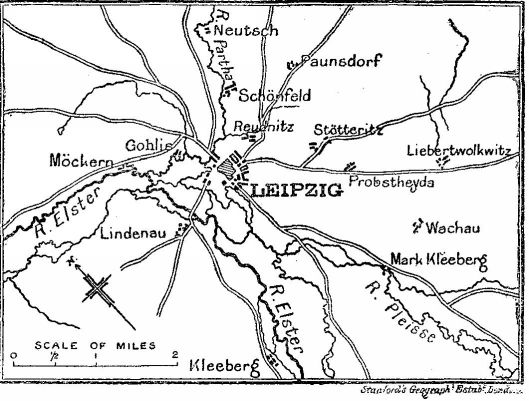
The Emperor and Murat were riding along the ridge near Liebertwolkwitz, when, at nine o'clock, three shots fired in quick succession from the allies on the opposite heights, opened the series of battles fitly termed the Battle of the Nations. For six hours a furious cannonade shook the earth, and the conflict surged to and fro with little decisive result; but when Macdonald's corps struck in from the north-east, the allies began to give ground. Thereupon Napoleon launched two cavalry corps, those of Latour-Maubourg and Pajol, against the allied centre.
Then was seen one of the most superb sights of war. Rising quickly from behind the ridge, 12,000 horsemen rode in two vast masses against a weak point in the opposing lines. They were led by the King of Naples with all his wonted dash. Panting up the muddy slopes opposite, they sabred the gunners, enveloped the Russian squares, and the three allied sovereigns themselves had to beat a hasty retreat to avoid capture. But the horses were soon spent by the furious pace at which Murat careered along; and a timely charge by Pahlen's Cossacks and the Silesian cuirassiers, brought up from the allied reserves beyond the Pleisse, drove the French brigades back in great disorder, with the loss of their able corps leaders. The allies by a final effort regained all the lost ground, and the day here ended in a drawn fight, with the loss of about 20,000 men to either side.
Meanwhile, on the west side of Leipzig, Bertrand had beaten off the attack of Giulay's Austrian corps on the village of Lindenau. But, further north, Marmont sustained a serious reverse. In obedience to Napoleon's order, he was falling back towards Leipzig, when he was sharply attacked by Yorck's corps at Möckern. Between that village and Eutritzsch further east the French Marshal offered a most obstinate resistance. Blücher, hoping to capture his whole corps, begged Sir Charles Stewart to ride back to Bernadotte and request his succour. The British envoy found the Swedish Prince at Halle and conjured him to make every exertion not to be the only[pg.359] leader left out of the battle.[376] It was in vain: his army was too far away; and only after the village of Möckern had been repeatedly taken and re-taken, was Marmont finally driven out by Yorck's Prussians.[377]
In truth, Marmont lacked the support of Ney's corps, which Berthier had led him to expect if he were attacked in force. But the orders were vague or contradictory. Ney had been charged to follow Macdonald and impart irresistible momentum to the onset which was to have crushed Schwarzenberg's right wing. He therefore only detached one weak division to cover Marmont's right flank, and with the other divisions marched away south, when an urgent message from Möckern recalled him to that side of Leipzig, with the result that his 15,000 men spent the whole day in useless marches and counter-marches.[378] The mishap was most serious. Had he strengthened Macdonald's outflanking move, the right wing of the allied Grand Army might have been shattered. Had he reinforced Marmont effectively, the position on the north might have been held. As it was, the French fell back from Möckern in confusion, losing 53 cannon; but they had inflicted on Yorck's corps a loss of 8,000 men out of 21,000. Relatively to the forces engaged, Albuera and Möckern are the bloodiest battles of the Napoleonic wars.
On the whole, Napoleon had dealt the allies heavier losses than he had sustained. But they could replace them. On the morrow Bennigsen was near at hand on the east with 41,000 Russians of the Army of Reserve; Colloredo's Austrian corps had also come up; and, in the north, Bernadotte's Army of the North, 60,000 strong,[pg.360] was known to be marching from Halle to reinforce Blücher. Napoleon, however, could only count on Reynier's corps of 15,000 men, mostly Saxons, who marched in from Düben. St. Cyr's corps of 27,000 men was too far away, at Dresden; and Napoleon must have bitterly rued his rashness in leaving that Marshal isolated on the south-east, while Davoust was also cut off at Hamburg. He now had scarcely 150,000 effectives left after the slaughter of the 16th; and of these, the German divisions were murmuring at the endless marches and privations. Everything helped to depress men's minds. On that Sabbath morning all was sombre desolation around Leipzig, while within that city naught was heard but the groans of the wounded and the lamentations of the citizens. Still Napoleon's spirit was unquenched. Amidst the steady rain he paced restlessly with Murat along the dykes of the Pleisse. The King assured him that the enemy had suffered enormous losses. Then, the dreary walk ended, the Emperor shut himself in his tent. His resolve was taken. He would try fortune once more.[379]
Among the prisoners was the Austrian General Merveldt, over whom Napoleon had gained his first diplomatic triumph, that at Leoben. He it was, too, who had brought the first offers of an armistice after Austerlitz. These recollections touched the superstitious chords in the great Corsican's being; for in times of stress the strongest nature harks back to early instincts. This harbinger of good fortune the Emperor now summoned and talked long and earnestly with him.[380] First, he complimented him on his efforts of the previous day to turn[pg.361] the French left at Dölitz; next, he offered to free him on parole in order to return to the allied headquarters with proposals for an armistice. Then, after giving out that he had more than 200,000 men round Leipzig, he turned to the European situation. Why had Austria deserted him? At Prague she might have dictated terms to Europe. But the English did not want peace. To this Merveldt answered that they needed it sorely, but it must be not a truce, but a peace founded on the equilibrium of Europe.—"Well," replied Napoleon, "let them give me back my isles and I will give them back Hanover; I will also re-establish the Hanse Towns and the annexed departments [of North Germany].... But how treat with England, who wishes to bind me not to build more than thirty ships of the line in my ports?"[381]
As for the Confederation of the Rhine, those States might secede that chose to do so: but never would he cease to protect those that wanted his protection. As to giving Holland its independence, he saw a great difficulty: that land would then fall under the control of England. Italy ought to be under one sovereign; that would suit the European system. As he had abandoned Spain, that question was thereby decided. Why then should not peace be the result of an armistice?—The allied sovereigns thought differently, and at once waved aside the proposal. No answer was sent.
In fact, they had Napoleon in their power, as he surmised. Late on that Sunday, he withdrew his drenched and half-starved troops nearer to Leipzig; for Blücher had gained ground on the north and threatened the French line of retreat. Why the Emperor did not retreat during the night must remain a mystery. All the peoples of Europe were now closing in on him. On the north[pg.362] were Prussians, Russians, Swedes, and a few British troops. To the south-east were the dense masses of the allied Grand Army drawn from all the lands between the Alps and the Urals; and among Bennigsen's array on the east of Leipzig were to be seen the Bashkirs of Siberia, whose bows and arrows gained them from the French soldiery the sobriquet of les Amours.
To this ring of 300,000 fighters Napoleon could oppose scarcely half as many. Yet the French fought on, if not for victory, yet for honour; and, under the lead of Prince Poniatowski, whose valour on the 16th had gained him the coveted rank of a Marshal of France, the Poles once more clutched desperately at the wraith of their national independence. Napoleon took his stand with his staff on a hill behind Probstheyde near a half-ruined windmill, fit emblem of his fortunes; while, further south, the three allied monarchs watched from a higher eminence the vast horse-shoe of smoke slowly draw in towards the city. In truth, this immense conflict baffles all description. On the north-east, the Crown Prince of Sweden gradually drove his columns across the Parthe, while Blücher hammered at the suburbs.
Near the village of Paunsdorf, the allies found a weak place in the defence, where Reynier's Saxons showed signs of disaffection. Some few went over to the Russians in the forenoon, and about 3 p.m. others marched over with loud hurrahs. They did not exceed 3,000 men, with 19 cannon, but these pieces were at once effectively used against the French. Napoleon hurried towards the spot with part of his Guards, who restored the fight on that side. But it was only for a time. The defence was everywhere overmatched.
Even the inspiration of his presence and the desperate efforts of Murat, Poniatowski, Victor, Macdonald, and thousands of nameless heroes, barely held off the masses of the allied Grand Army. On the north and north-east, Marmont and Ney were equally overborne.[382] Worst of all, the supply of cannon balls was[pg.363] running low. With pardonable exaggeration the Emperor afterwards wrote to Clarke: "If I had then had 30,000 rounds, I should to-day be the master of the world."
At nightfall, the chief returned weary and depressed to the windmill, and instructed Berthier to order the retreat. Then, beside a watch-fire, he sank down on a bench into a deep slumber, while his generals looked on in mournful silence. All around them there surged in the darkness the last cries of battle, the groans of the wounded, and the dull rumble of a retreating host. After a quarter of an hour he awoke with a start and threw an astonished look on his staff; then, recollecting himself, he bade an officer repair to the King of Saxony and tell him the state of affairs.
Early next morning, he withdrew into Leipzig, and, after paying a brief visit to the King, rode away towards the western gate. It was none too soon. The conflux of his still mighty forces streaming in by three high roads, produced in all the streets of the town a crush which thickened every hour. The Prussians and Swedes were breaking into the northern suburbs, while the white-coats drove in the defenders on the south. Slowly and painfully the throng of fugitives struggled through the town towards the western gate. On that side the confusion became ever worse, as the shots of the allies began to whiz across the arches and causeway that led over the Pleisse and the Elster, while the hurrahs of the Russians drew near on the north. Ammunition wagons, gendarmes, women, grenadiers and artillery, cavalry and cattle, the wounded, the dying, Marshals and sutlers, all were wedged into an indistinguishable throng that fought for a foothold on that narrow road of safety;[pg.364] and high above the din came the clash of merry bells from the liberated suburbs, bells that three days before had rung forced peals of triumph at Napoleon's orders, but now bade farewell for ever to French domination. To increase the rout, a temporary bridge thrown over the Elster broke down under the crush; and the rush for the roadway became more furious. In despair of reaching it, hundreds threw themselves into the flooded stream, but few reached the further shore: among the drowned was that flower of Polish chivalry, Prince Poniatowski.
But this mishap was soon to be outdone. A corporal of engineers, in the absence of his chief, had received orders to blow up the bridge outside the western gate, as soon as the pursuers were at hand; but, alarmed by the volleys of Sacken's Russians, whom Blücher had sent to work round by the river courses north-west of the town, the bewildered subaltern fired the mine while the rearguard and a great crowd of stragglers were still on the eastern side.[383] This was the climax of this day of disaster, which left in the hands of the allies as many as thirty generals, including Lauriston and Reynier, and 33,000 of the rank and file, along with 260 cannon[pg.365] and 870 ammunition wagons. From the village of Lindenau Napoleon gazed back at times over the awesome scene, but in general he busied himself with reducing to order the masses that had struggled across. The Old Guard survived, staunch as ever, and had saved its 120 cannon, but the Young Guard was reduced to a mere wreck. Amidst all the horrors of that day, the Emperor maintained a stolid composure, but observers saw that he was bathed in sweat. Towards evening, he turned and rode away westwards; and from the weary famished files, many a fierce glance and muttered curse shot forth as he passed by. Men remembered that it was exactly a year since the Grand Army broke up from Moscow.
Yet, despite the ravages of typhus, the falling away of the German States and the assaults of the allied horse, the retreating host struggled stoutly on towards the Rhine. At Hanau it swept aside an army of Bavarians and Austrians that sought to bar the road to France; and, early in November, 40,000 armed men, with a larger number of unarmed stragglers, filed across the bridge at Mainz. Napoleon had not only lost Germany; he left behind in its fortresses as many as 190,000 troops, of whom nearly all were French; and of the 1,300 cannon with which he began the second part of the campaign, scarce 200 were now at hand for the defence of his Empire.
The causes of this immense disaster are not far to seek. They were both political and military. In staking all on the possession of the line of the Elbe, Napoleon was engulfing himself in a hostile land. At the first signs of his overthrow, the national spirit of Germany was certain to inflame the Franconians and Westphalians in his rear, and imperil his communications. In regard to strategy, he committed the same blunder as that perpetrated by Mack in 1805. He trusted to a river line that could easily be turned by his foes. As soon as Austria declared against him, his position on the Elbe was fully as perilous as Mack's lines of the Iller at Ulm.[pg.366]
And yet, in spite of the obvious danger from the great mountain bastion of Bohemia that stretched far away in his rear, the Emperor kept his troops spread out from Königstein to Hamburg, and ventured on long and wearying marches into Silesia, and north to Düben, which left his positions in Saxony almost at the mercy of the allied Grand Army.[384] By emerging from the mighty barrier of the Erzgebirge, that army compelled him three times to give up his offensive moves and hastily to fall back into the heart of Saxony.
The plain truth is that he was out-generalled by the allies. The assertion may seem to savour of profanity. Yet, if words have any meaning, the phrase is literally correct. His aim was primarily to maintain himself on the line of the Elbe, but also, though in the second place, to keep up his communication with France. Their aim was to leave him the Elbe line, but to cut him off from France. Even at the outset they planned to strike at Leipzig: their attack on Dresden was an afterthought, timidly and slowly carried out. As long, however, as their Grand Army clung to the Erz mountains, they paralyzed his movements to the east and north, which merely played into their hands.
As regards the execution of the allied plans, the honours must unquestionably rest with Blücher and Gneisenau. Their tactful retreats before Napoleon in Silesia, their crushing blow at Macdonald, above all, their daring flank march to Wartenburg and thence to Halle, are exploits of a very high order; and doubtless it was the emergence of this unsuspected volcanic force from the unbroken flats of continental mediocrity that nonplussed Napoleon and led to the results described above. Truly heroic was Blücher's determination to push on to Leipzig, even when the enemy was seizing the Elbe bridges in his rear. The veteran saw clearly that a junction with Schwarzenberg[pg.367] near Leipzig was the all-important step, and that it must bring back the French to that point. His judgment was as sound as his strokes were trenchant; and, owing to the illusions which Napoleon still cherished as to the saving strength of the Elbe line, the French arrived on that mighty battlefield half-famished and wearied by fruitless marches and countermarches. Of all Napoleon's campaigns, that of the second part of 1813 must rank as by far the weakest in conception, the most fertile in blunders, and the most disastrous in its results for France.
NOTE TO THE THIRD EDITION.—In order not to overcrowd these chapters with diplomatic details, I have made only the briefest reference to the Treaties signed at Teplitz on Sept. 9th, 1813, with Russia and Prussia, which cemented the fourth great Coalition; but it will be well to describe them here.
A way having been paved for a closer union by the Treaty of Kalisch (see p. 276) and by that of Reichenbach (see p. 317), it was now agreed (1) that Austria and Prussia should be restored as nearly as possible to the position which they held in 1805; (2) that the Confederation of the Rhine should be dissolved; (3) and that "full and unconditional independence" should be accorded to the princes of the other German States. This last clause was firmly but vainly opposed by Stein and the German Unionist party. Austria's help was so sorely needed that she could dictate her terms, and she began to scheme for the creation of a sort of Fürstenbund, or League of Princes, under her hegemony. The result was seen in her Treaty of October 7th, 1813, with Bavaria, which detached that State from the French alliance and assured the success of Metternich's plans for Germany (see pp. 354-355). The smaller States soon followed the lead given by Bavaria; and the reconstruction of Germany on the Austrian plan was further assured by the Treaty of Chaumont (see pp. 402-403). Thus the dire need of Austrian help felt by Russia and Prussia throughout the campaigns of 1813-1814 had no small share in moulding the future of Europe.[pg.368]
"The Emperor Napoleon must become King of France. Up to now all his work has been done for the Empire. He lost the Empire when he lost his army. When he no longer makes war for the army, he will make peace for the French people, and then he will become King of France."—Such were the words of the most sagacious of French statesmen to Schwarzenberg. They were spoken on April 15th, 1813, when it still seemed likely that Napoleon would meet halfway the wishes of Austria. Such, at least, was Talleyrand's ardent hope. He saw the innate absurdity of attempting to browbeat Austria, and strangle the infant Hercules of German nationality, after the Grand Army had been lost in Russia.
If this was reasonable in the spring of 1813, it was an imperative necessity at the close of the year. Napoleon had in the meantime lost 400,000 men: and he could not now say, as he did to Metternich of his losses in Russia, that "nearly half were Germans." The men who had fallen in Saxony, or who bravely held out in the Polish, German, and Spanish fortresses, were nearly all French. They were, what the triarii were to the Roman legion, the reserves of the fighting manhood of France. That unhappy land was growing restless under its disasters. In Spain, Wellington had blockaded Pamplona, stormed St. Sebastian, thrown Soult back on the Pyrenees in a series of desperate conflicts, and planted the British flag on the soil of France, eleven days before Napoleon was overthrown at Leipzig. Then,[pg.369] pressing northwards, in compliance with the urgent appeals of the allied sovereigns, our great commander assailed the lines south of the Nivelle, on which the French had been working for three months, drove the enemy out of them and back over the river, with a loss of 4,200 men and 51 guns (November 10th).[385]
The same tale was told in the north. The allies were welcomed by the secondary German princes, who, in return for compacts guaranteeing their sovereignty, promised to raise contingents that amounted in all to upwards of a quarter of a million of men. Bernadotte marched against the Danes and cut off Davoust in Hamburg, where that Marshal bravely held out to the end of the war. Elsewhere in the north Napoleon's domination quickly mouldered away. Bülow, aided by a small British force, invaded Holland early in November; and, with the old cry of Orange boven, the Dutch tore down the French tricolour and welcomed back the Prince of Orange. In Italy, Eugène remained faithful to his step-father and repulsed all the overtures of the allies: but Murat, whose allegiance had already been shaken by the secret offers of the allies, now began to show signs of going over to them, as he did at the dawn of the New Year.[386][pg.370]
Meanwhile Napoleon had arrived at Paris (November 9th). He found his capital sunk in depression, and indignant at the author of its miseries. Peace was the dearest wish of all. Marie Louise confessed it by her tears, Cambacérès by his tactful reserve, and the people by their cries, while the sullen demeanour or bitter words of the Marshals showed that their patience was exhausted. Evidently a scapegoat was needed: it was found in the person of Maret, Duc de Bassano, whose devotion to Napoleon had reduced the Ministry of Foreign Affairs to a highly paid clerkship. For the crime of not bending his master's inflexible will at Dresden, he was now cast as a sop to the peace party; and his portfolio was intrusted to Caulaincourt, Duc de Vicenza (November 20th). The change was salutary. The new Minister, when ambassador at St. Petersburg, had been highly esteemed by the Czar for his frank, chivalrous demeanour. Our countrywoman, Lady Burghersh, afterwards testified to his personal charm: "I never saw a countenance so expressive of kindness, sweetness, and openness."[387] And these gifts were fortified by a manly intelligence, a profound love of France, and by devotion to her highest interests. The first of her interests was obviously peace; and there now seemed some chance of his conferring this boon on her and on the world at large.
On November the 8th and 9th Metternich had two interviews at Frankfurt with Baron St. Aignan, a brother-in-law of Caulaincourt, and formerly the French envoy at Weimar. The Austrian Minister assured him of the[pg.371] moderation of the allies, especially of England, and of their wish for a lasting peace founded on the principle of the balance of power. France must give up all control of Spain, Italy, and Germany, and return to her natural frontiers, the Rhine, the Alps, and the Pyrenees. Lord Aberdeen, our ambassador to Austria, and Count Nesselrode, the Russian Minister for Foreign Affairs, were present at the second interview, and assented to this statement, the latter pledging his word that it had the approval of Prussia. Aberdeen added his assurance that England was prepared to relax her maritime code and sacrifice many of her conquests in order to attain a durable peace. To these Frankfurt overtures Napoleon charged Maret to answer in vaguely favourable terms, and to suggest the meeting of a European Congress at Mannheim. The effect of this Note (November 16th) was marred by the strange statement—"a peace based on the independence of all nations, both from the continental and the maritime point of view, has always been the constant object of the desires and policy of the Emperor [Napoleon]."[388]
Metternich in reply pointed out that the French Government had not accepted the proposed terms as a basis for negotiations. The new Foreign Minister, Caulaincourt, sent off (December 2nd) an acceptance which was far more frank and satisfactory; but the day before he penned it, the allies had virtually withdrawn their offer, as they had told him they would do if it was not speedily accepted. They had all along decided not to stay the military operations; and, as these were still flowing strongly in their favour, they could not be expected to keep open an offer which was exceedingly favourable to[pg.372] Napoleon even at the time when it was made, that is, before the support of the Dutch, of the Swiss, and of Murat was fully assured.
It may be well to pause for a moment to inquire what were the views of the allied Governments, and of Napoleon himself, at this crisis when Europe was seething in the political crucible. Had Metternich the full assent of those Governments when he offered the French Emperor the natural frontiers? Here we must separate the views of Lord Aberdeen from those of the British Cabinet, as represented by its Foreign Minister, Lord Castlereagh: and we must also distinguish between the Emperor Alexander and his Minister, Nesselrode, a man of weak character, in whom he had little confidence. Certainly the British Cabinet was not disposed to leave Antwerp in Napoleon's hands.
"This nation," wrote Castlereagh to Aberdeen on November 13th, "is likely to view with disfavour any peace which does not confine France within her ancient limits.... We are still ready to encounter, with our allies, the hazards of peace, if peace can be made on the basis proposed, satisfactorily executed [sic]; and we are not inclined to go out of our way to interfere in the internal government of France, however much we might desire to see it placed in more pacific hands. But I am satisfied we must not encourage our allies to patch up an imperfect arrangement. If they will do so, we must submit; but it should appear, in that case, to be their own act, and not ours.... I must particularly entreat you to keep your attention upon Antwerp. The destruction of that arsenal is essential to our safety. To leave it in the hands of France is little short of imposing upon Great Britain the charge of a perpetual war establishment."[389][pg.373]
Thenceforth British policy inclined, though tentatively and with some hesitations, to the view that it was needful in the interests of peace to bring France back to the limits of 1791, that is, of withdrawing from her, not only Holland, the Rhineland and Italy, but also Belgium, Savoy, and Nice. The Prussian patriots were far more decided. They were determined that France should not dominate the Rhineland and overawe Germany from the fortresses of Mainz, Coblenz, and Wesel. On this subject Arndt spoke forth with no uncertain sound in a pamphlet—"The Rhine, Germany's river, not her boundary"—which proved that the French claim to the Rhine frontier was consonant neither with the teachings of history nor the distribution of the two peoples. The pamphlet had an immense effect in stirring up Germans to attack the cherished French doctrine of the natural frontiers, and it clinched the claim which he had put forward in his "Fatherland" song of the year before. It bade Germans strive for Trèves and Cologne, aye, even for Strassburg and Metz. Hardenberg and Stein, differing on most points, united in praising this work. Even before it appeared, the former chafed at the thought of Napoleon holding the left bank of the Rhine. On hearing of Metternich's Frankfurt offer to the French Emperor, he wrote in his diary: "Propositions of peace without my assent—Rhine, Alps, Pyrenees: a mad business."[390]
Frederick William's views were less pronounced: in fact, his proneness to see a lion in every path earned for him the sobriquet of Cassandra in his Chancellor's diary. But in the main he was swayed by the Czar; and that autocrat was now determined to dictate at Paris a peace that would rid him of all prospect of his great rival's revenge. Vanity and fear alike prescribed such a course of action. He longed to lead[pg.374] his magnificent Guards to Paris, there to display his clemency in contrast to the action of the French at Moscow; and this sentiment was fed by fear of Napoleon. The latter motive was concealed, of course, but Lord Aberdeen gauged its power during a private interview that he had with Alexander at Freiburg (December 24th): "He talked with great freedom: he is more decided than ever as to the necessity of perseverance, and puts little trust in the fair promises of Bonaparte.—'So long as he lives there can be no security'—he repeated it two or three times."[391] We can therefore understand his concern lest the Frankfurt terms should be accepted outright by Napoleon. Metternich, however, assured him that the French Emperor would not assent;[392] and, as in regard to the Prague Congress, he was substantially correct.
Here again we touch on the disputed question whether Metternich played a fair game against Napoleon, or whether he tempted him to play with loaded dice while his throne was at stake. The latter supposition for a long time held the field; but it is untenable. On several occasions the Austrian statesman warned Napoleon, or his trusty advisers, that the best course open to him was to sign peace at once. He did so at Dresden, and he did so now. On November 10th he sent Caulaincourt a letter, of which these are the most important sentences:
" ... M. de St. Aignan will speak to you of my conversations [with him]. I expect nothing from them, but I shall have done my duty. France will never sign a more fortunate peace than that which the Powers will make to-day, and tomorrow if they have reverses. New successes may extend their views.... I do not doubt that the approach of the allied armies to the frontiers of France may facilitate the formation of great armaments by her Government. The questions will become problematical for the civilized world; but the Emperor Napoleon will not make peace. There is my profession of faith, and I shall never be happier than if I am wrong."[pg.375]
The letter rings true in every part. Metternich made no secret of sending it, but allowed Lord Aberdeen to see it.[393] And by good fortune it reached Caulaincourt about the time when he assumed the portfolio of Foreign Affairs. Its substance must therefore have been known to Napoleon; and the tone of the Frankfurt proposals ought to have convinced him of the need of speedily making peace while Austria held out the olive branch from across the Rhine. But Metternich's gloomy forecast was only too true. During his sojourn at Paris he had tested the rigidity of that cast-iron will.
In fact, no one who knew the Emperor's devotion to Italy could believe that he would give up Piedmont and Liguria. His own despatches show that he never contemplated such a surrender. On November 20th he gave orders for the enrolling of 46,000 Frenchmen of mature age—"not Italians or Belgians"—who were to reinforce Eugène and help him to defend Italy; that, too, at a time when the defence of Champagne and Languedoc was about to devolve on lads of eighteen.
He was equally determined not to give up Holland. On the possession of this maritime and industrious community he had always laid great stress. He once remarked to Roederer that the ruin of the French Bourbons was due to three events—the Battle of Rossbach, the affair of the diamond necklace, and the victory of Anglo-Prussian influence over that of France in Dutch affairs (1787). He even appealed to Nature to prove that that land must form part of the French Empire. "Holland," said one of his Ministers in 1809, "is the alluvium of the Rhine, Meuse, and Scheldt—in other words, one of the great arteries of the Empire." Before the last battle at Leipzig he told Merveldt that he could not grant Holland its independence, for it would fall under the tutelage of England. And even while his Empire was crumbling away after that disaster, he wrote to his[pg.376] mother: "Holland is a French country, and will remain so for ever."[394]
Russia, Prussia, and Britain were equally determined that the Dutch should be independent; and if Metternich wavered on the subject of Dutch independence, his hesitation was at an end by the middle of December, for a memorandum of the Russian diplomatist, Pozzo di Borgo, states that Metternich then regarded the Rhine boundary as ending at Düsseldorf: "after that town the river takes the name of Waal."[395] Such juggling with geography was surely superfluous; for by that time the Frankfurt terms had virtually lapsed, owing to Napoleon's belated acceptance; and Metternich had joined the other allied Governments that now demanded a more thorough solution of the boundary question.
In fact, the allies were now able to make political capital out of their recent moderation.[396] On December 1st they issued an appeal to the French nation to the following effect: "We do not make war on France, but we are casting off the yoke which your Government imposed on our countries. We hoped to have found peace before touching your soil: we now go to find it there."
If the sovereigns hoped by means of this declaration to separate France from Napoleon, they erred. To cross the Rhine was to attack, not Napoleon, but the French Revolution. Belgium and the Rhine boundary had been won by Dumouriez, Jourdain, Pichegru, and Moreau, at a time when Bonaparte's name was unknown outside Corsica and Provence. France had looked on wearily at Napoleon's wars in Germany, Spain, and Russia: they concerned him, not her. But when the "sacred soil" was threatened, citizens began to close their ranks: they ceased their declamations against the crushing taxes and youth-slaying conscription: they submitted[pg.377] to heavier taxes and levies of still younger lads. In fact, by doffing the mask of Charlemagne, the Emperor became once more the Bonaparte of the days of Marengo.
He counted on some such change in public opinion; and it enabled him to defy with impunity the beginnings of a Parliamentary opposition. The Senate had been puffily obsequious, as usual; but the Corps Législatif had mistaken its functions. Summoned to vote new taxes, it presumed to give advice. A commission of its members agreed to a report on the existing situation, drawn up by Lainé, which gave the Emperor great offence. Its crime lay in its outspoken requests that peace should be concluded on the basis of the natural frontiers, that the rigours of the conscription should be abated, and that the laws which guaranteed the free exercise of political rights should be maintained intact. The Emperor was deeply incensed, and, despite the advice of his Ministers, determined to dissolve the Chamber forthwith (December 31st). Not content with this exercise of arbitrary power, he subjected its members to a barrack-like rebuke at the official reception on New Year's Day.—He had convoked them to do good, and they had done evil. Two battles lost in Champagne would not have been so harmful as their last action. What was their mandate compared with his? France had twice chosen him by some millions of votes: while they were nominated only by a few hundreds apiece. They had flung mud at him: but he was a man who might be slain, never dishonoured. He would fight for the nation, hurl back the foe, and conclude an honourable peace. Then, for their shame, he would print and circulate their report.—Such was the gist of this diatribe, which he shot forth in strident tones and with flashing eyes. He had the copies of the report destroyed, and dismissed the deputies to their homes throughout France.
The country, in the main, took his side; and doubtless the national instinct was sound; for the allies had crossed the Rhine, and France once more was in danger.[pg.378] As in 1793, when the nation welcomed the triumph of the dare-devil Jacobins over the respectable parliamentary Girondins, as promising a vigorous rule and the expulsion of the monarchical invaders, so now the soldiers and peasants, if not the middle classes, rejoiced at the discomfiture of the talkers by the one necessary man of action. The general feeling was pithily expressed by an old peasant: "It's no longer a question of Bonaparte. Our soil is invaded: let us go and fight."
This was the feeling which the Emperor ruthlessly exploited. He decreed the enrolment of a great force of National Guards, exacted further levies for the regular army, and ordered a levée en masse for the eastern Departments. The difficulties in his way were enormous. But he flung himself at the task with incomparable verve. Soldiers were wanting: youths were dragged forth, even from the royalist districts of the extreme north and west and south. Money was wanting: it was extorted from all quarters, and Napoleon not only lavished 55,000,000 francs from his own private hoard, but seized that of his parsimonious mother.[397] Cannon, muskets, uniforms were wanting: their manufacture was pushed on with feverish haste: Napoleon ordered his War Office to "procure all the cloth in France, good and bad," so as to have 200,000 uniforms ready by the end of February; and he counted on having half a million of effectives in the field at the close of spring.
Among these he reckoned—so, at least, he wrote to Melzi—"nearly 200,000" French soldiers from Arragon, Catalonia, and at Bayonne. Even if we allow for his desire to encourage his officials in Italy, the estimate is curious. Wellington at that time, it is true, had lessened his numbers by sending back across the Pyrenees all his Spanish troops, whose atrocities endangered that good understanding with the French peasantry which our great leader, for political motives, was determined[pg.379] to cultivate.[398] Yet, despite the shrinkage in numbers, he drove the French from the banks of the River Nive, and inflicted on them severe losses in desperate conflicts near Bayonne (December 9th-13th). In fact, the intrenched camp in front of that town was now the sole barrier to Wellington's advance northwards, and it was with difficulty that Soult clung to this position. The peasantry, too, finding that they were far better treated by Wellington's troops than by their own soldiers, began to favour the allied cause, with results that will shortly appear. Yet these disquieting symptoms did not daunt Napoleon; for he now based his hopes of resisting the British advance on a compact which he had concluded with Ferdinand VII., the rightful King of Spain.
As soon as he returned to St. Cloud after the Leipzig campaign he made secret overtures to that unhappy exile;[399] and by the Treaty of Valençay (December 11th, 1813) he agreed to recognize him as King of the whole of Spain, provided that British and French troops evacuated that land. His imagination ran riot in picturing the results of this treaty. Ferdinand was to enter Spain; Suchet, then playing a losing game in Catalonia, was quietly to withdraw his columns through the Pyrenees, while Wellington would have his base of operations cut from under him, and thenceforth be a negligeable quantity.[400] These pleasing fancies all rested on the [pg.380] acceptance of the new treaty by the Spanish Regency and Cortès. But, alas for Napoleon! they at once rejected it, declaring null and void all acts of Ferdinand while he was a prisoner, and forbidding all negotiations with France while French troops remained in the Peninsula (January 8th).
Equally disappointing were affairs in Italy. On the 11th of January, Murat made an alliance with Austria, and promised to aid her with a corps of 30,000 Neapolitans, while she guaranteed him his throne and a slice of the Roman territory. Napoleon directed Eugène, as soon as this bad news was confirmed, to prepare to fall back on the Alps. But, in order to clog Murat's movements, the Emperor resolved to make use of the spiritual power, which for six years he had slighted. He gave orders that the aged Pope should be released from his detention at Fontainebleau, and hurried secretly to Rome. "Let him burst on that place like a clap of thunder," he wrote to Savary (January 21st). But this stagey device was not to succeed. Even now Napoleon insisted on conditions with which Pius VII. could not conscientiously comply, and he was still detained at Tarrascon when his captor was setting out for Elba.
Three days after Murat's desertion, Denmark fell away from Napoleon. Overborne by the forces of Bernadotte, the little kingdom made peace with England and Sweden, agreeing to yield up Norway to the latter Power in consideration of recovering an indemnity in Germany. To us the Danes ceded Heligoland. Thus, within three months of the disaster at Leipzig, all Napoleon's allies forsook him, and all but the Danes were now about to fight against him—a striking proof of the artificiality of his domination.[pg.381]
By this time it was clear that even France would soon be stricken to the heart unless Napoleon speedily concentrated his forces. On the north and east the allies were advancing with a speed that nonplussed the Emperor. Accustomed to sluggish movements on their part, he had not expected an invasion in force before the spring, and here it was in the first days of January. Bülow and Graham had overrun Holland. The allies, with the exception of the Czar, had no scruples about infringing the neutrality of Switzerland, as Napoleon had consistently done, and the constitution, which he had imposed upon that land eleven years before, now straightway collapsed. Detaching a strong corps southwards to hold the Simplon and Great St. Bernard Passes and threaten Lyons, Schwarzenberg led the allied Grand Army into France by way of Basel, Belfort, and Langres. The prompt seizure of the Plateau of Langres was an important success. The allies thereby turned the strong defensive lines of the Vosges Mountains, and of the Rivers Moselle and Meuse, so that Blücher, with his "Army of Silesia," was able rapidly to advance into Lorraine, and drive Victor from Nancy. Toul speedily surrendered, and the sturdy veteran then turned to the south-west, in order to come into touch with Schwarzenberg's columns. Neither leader delayed before the eastern fortresses. The allies had learnt from Napoleon to invest or observe them and press on, a course which their vast superiority of force rendered free from danger. Schwarzenberg, on the 25th, had 150,000 men between Langres, Chaumont, and Bar-sur-Aube; while Blücher, with about half those numbers, crossed the Marne at St. Dizier, and was drawing near to Brienne. In front of them were the weak and disheartened corps of Marmont, Ney, Victor, and Macdonald, mustering in all about 50,000 men. Desertions to the allies were frequent, and Blücher, wishing to show that the war was practically over, dismissed both deserters and prisoners to their homes.[401]
But the war was far from over: it had not yet begun.[pg.382] Hitherto Napoleon had hurried on the preparations from Paris, but the urgency of the danger now beckoned him eastwards. As before, he left the Empress as Regent of France, but appointed King Joseph as Lieutenant-General of France. On Sunday, January 23rd, he held the last reception. It was in the large hall of the Tuileries, where the Parisian rabble had forced Louis XVI. to don the bonnet rouge. Another dynasty was now tottering to its fall; but none could have read its doom in the faces of the obsequious courtiers, or of the officers of the Parisian National Guards, who offered their homage to the heir of the Revolution.
He came forward with the Empress and the King of Rome, a flaxen-haired child of three winters, clad in the uniform of the National Guard. Taking the boy by the hand into the midst of the circle, he spoke these touching words: "Gentlemen,—I am about to set out for the army. I intrust to you what I hold dearest in the world—my wife and my son. Let there be no political divisions." He then carried him amidst his dignitaries and officers, while sobs and shouts bespoke the warmth of the feelings kindled by this scene. And never, surely, since the young Maria Theresa appealed in person to the Hungarian magnates to defend her against rapacious neighbours, had any monarch spoken so straight to the hearts of his lieges. The secret of his success is not far to seek. He had not commanded as Emperor: he had appealed as a father to fathers and mothers.
It is painful to have to add that many who there swore to defend him were even then beginning to plot his overthrow. Most painful of all is it to remember that when, before dawn of the 25th, Marie Louise bade him farewell, it was her last farewell: for she, too, deserted him in his misfortunes, refused to share his exile, and ultimately degraded herself by her connection with Count Neipperg.
Heedless of all that the future might bring, and concentrating his thoughts on the problems of the present, the great warrior journeyed rapidly eastwards to [pg.383] Châlons-sur-Marne, and opened the most glorious of his campaigns. [Illustration (missing): THE CAMPAIGN OF 1814 to face] And yet it began with disaster. At Brienne, among the scenes of his school-days, he assailed Blücher in the hope of preventing the junction of the Army of Silesia with that of Schwarzenberg further south (January 29th). After sharp fighting, the Prussians were driven from the castle and town. But the success was illusory. Blücher withdrew towards Bar-sur-Aube, in order to gain support from Schwarzenberg, and, three days later, turned the tables on Napoleon while the latter was indulging in hopes that the allies were about to treat seriously for peace.[402] Nevertheless, though surprised by greatly superior numbers, the 40,000 French clung obstinately to the village of La Rothière until their thin lines were everywhere driven in or outflanked, with the loss of 73 cannon and more than 3,000 prisoners. Each side lost about 5,000 killed and wounded—a mere trifle to the allies, but a grave disaster to the defenders.
The Emperor was much discouraged. He had put forth his full strength, exposed his own person to the hottest fire, so as to encourage his men, and yet failed to prevent the union of the allied armies, or to hold the line of the River Aube. Early on the morrow he left the castle of Brienne, and took the road for Troyes; while Marmont, with a corps now reduced to less than 3,000 men, bravely defended the passage of the Voire at Rosnay, and, after delaying the pursuit, took post at Arcis-sur-Aube. The means of defence, both moral and material, seemed wellnigh exhausted. When, on February 3rd, Napoleon entered Troyes, scarcely a single vivat was heard. Even the old troops were cast down by defeat and hunger, while as many as 6,000 conscripts are said to have deserted. The inhabitants refused to supply the necessaries of life except upon requisition. "The army is perishing of famine," writes the Emperor at Troyes. Again at Nogent: "Twelve men have died of hunger, though we have used fire and sword to get food on our way here." And, now, into the space left undefended[pg.384] between the Marne and the Aube, Blücher began to thrust his triumphant columns, with no barrier to check him until he neared the environs of Paris. Once more the Prussian and Russian officers looked on the war as over, and invited one another to dinner at the Palais-Royal in a week's time.[403]
But it was on this confidence of the old hussar-general that Napoleon counted. He knew his proneness to daring movements, and the strong bias of Schwarzenberg towards delay: he also divined that they would now separate their forces, Blücher making straight for Paris, while other columns would threaten the capital by way of Troyes and Sens. That was why he fell back on Troyes, so as directly to oppose the latter movement, "or so as to return and manoeuvre against Blücher and stay his march."[404] Another motive was his expectation of finding at Nogent the 15,000 veterans whom he had ordered Soult to send northwards. And doubtless the final reason was his determination to use the sheltering curve of the Seine, which between Troyes and Nogent flows within twenty miles of the high-road that Blücher must use if he struck at Paris. At many a crisis Napoleon had proved the efficacy of a great river line. From Rivoli to Friedland his career abounds in examples of riverine tactics. The war of 1813 was one prolonged struggle for the line of the Elbe. He still continued the war because he could not yet bring himself to sign away the Rhenish fortresses: and he now hoped to regain that "natural boundary" by blows showered on divided enemies from behind the arc of the Seine.
With wonderful prescience he had guessed at the general plan of the allies. But he could scarcely have dared to hope that on that very day (February 2nd) they were holding a council of war at Brienne, and formally resolved that Blücher should march north-west on Paris with about 50,000 men, while the allied Grand[pg.385] Army of nearly three times those numbers was to diverge south-west towards Bar-sur-Seine and Sens. So unequal a partition of forces seemed to court disaster. It is true that the allies had no magazines of supplies: they could not march in an undivided host through a hostile land where the scanty defenders themselves were nearly starving. If, however, they decided to move at all, it was needful to allot the more dangerous task to a powerful force. Above all, it was necessary to keep their main armies well in touch with one another and with the foe. Yet these obvious precautions were not taken. In truth, the separation of the allies was dictated more by political jealousy than by military motives. To these political affairs we must now allude; for they had no small effect in leading Napoleon on to an illusory triumph and an irretrievable overthrow. We will show their influence, first on the conduct of the allies, and then on the actions of Napoleon.
The alarm of Austria at the growing power of Russia and Prussia was becoming acute. She had drawn the sword only because Napoleon's resentment was more to be feared than Alexander's ambition. But all had changed since then. The warrior who, five months ago, still had his sword at the throat of Germany, was now being pursued across the dreary flats of Champagne. And his eastern rival, who then plaintively sued for Austria's aid, now showed a desire to establish Russian control over all the Polish lands, indemnifying Prussia for losses in that quarter by the acquisition of Saxony. Both of these changes would press heavily on Austria from the north; and she was determined to prevent them as far as possible. Then there was the vexed question of the reconstruction of Germany to which we shall recur later on. Smaller matters, involving the relations of the allies to Bernadotte, Denmark, and Switzerland further complicated the situation: but, above all, there was the problem of the future limits and form of government of France.
On that topic there were two chief parties: those who[pg.386] desired merely to clip Napoleon's wings, and those who sought to bring back France to her old boundaries. The Emperor Francis was still disposed to leave him the "natural frontiers," provided he gave up all control of Germany, Holland, and Italy. On the other side were the Czar and the forward wing of the Prussian patriots. Frederick William was more cautious, but in the main he deferred to the Czar's views on the boundary question. Still, so powerful was the influence of the Emperor Francis, Metternich, and Schwarzenberg, that the two parties were evenly balanced and beset by many suspicions and fears, until the arrival of the British Foreign Minister, Castlereagh, began to restore something like confidence and concord.
The British Cabinet had decided that, as none of our three envoys then at the allied headquarters had much diplomatic experience, our Minister should go in person to supervise the course of affairs. He reached head-quarters in the third week of January, and what Thiers has called the proud simplicity of his conduct, contrasting as it did with the uneasy finesse of Metternich and Nesselrode, imparted to his counsels a weight which they merited from their disinterestedness. Great Britain was in a very strong position. She had borne the brunt of the struggle before the present coalition took shape: apart from some modest gains to Hanover, she was about to take no part in the ensuing territorial scramble: she even offered to give up many of her oceanic conquests, provided that the European settlement would be such as to guarantee a lasting peace.[405] And this, the British Minister came to see, could not be attained while Napoleon reigned over a Great France: the only sure pledge of peace would be the return of that country to its old frontiers, and preferably to its ancient dynasty.
On the question of boundaries the Czar's views were not clearly defined; they were personal rather than territorial. He was determined to get rid of Napoleon; but[pg.387] he would not, as yet, hear of the re-establishment of the Bourbons. He disliked that dynasty in general, and Louis XVIII. in particular. Bernadotte seemed to him a far fitter successor to Napoleon than the gouty old gentleman who for three and twenty years had been morosely flitting about Europe and issuing useless proclamations.
Here, indeed, was Napoleon's great chance: there was no man fit to succeed him, and he knew it. Scarcely anyone but Bernadotte himself agreed with the Czar as to the fitness of the choice just named. To the allies the Prince Royal of Sweden was suspect for his loiterings, and to Frenchmen he seemed a traitor. We find that Stein disagreed with the Czar on this point, and declared that the Bourbons were the only alternative to Napoleon. Assuredly, this was not because the great German loved that family, but simply because he saw that their very mediocrity would be a pledge that France would not again overflow her old limits and submerge Europe.
Here, then, was the strength of Castlereagh's position. Amidst the warping disputes and underhand intrigues his claims were clear, disinterested, and logically tenable. Besides, they were so urged as to calm the disputants. He quietly assured Metternich that Britain would resist the absorption of the whole of Poland and Saxony by Russia and Prussia; and on his side the Austrian statesman showed that he would not oppose the return of the Bourbons to France "from any family considerations," provided that that act came as the act of the French nation.[406] And this was a proviso on which our Government and Wellington already laid great stress.
Castlereagh's straightforward behaviour had an immense influence in leading Metternich to favour a more drastic solution of the French question than he had previously advocated. The Frankfurt proposals were now quietly waived, and Metternich came to see the need of withdrawing Belgium from France and intrusting it to the[pg.388] House of Orange. Still, the Austrian statesman was for concluding peace with Napoleon as soon as might be, though he confessed in his private letters that peace did not depend on the Châtillon parleys. Some persons, he wrote, wanted the Bourbons back: still more wished for a Regency (i.e., Marie Louise as Regent for Napoleon II.): others said: "Away with Napoleon, no peace is possible with him": the masses cried out for peace, so as to end the whole affair: but added Metternich: "The riddle will be solved before or in Paris."[407] There spoke the discreet opportunist, always open to the logic of facts and the persuasion of Castlereagh.
Our Minister found the sovereigns of Russia and Prussia far less tractable; and he only partially succeeded in lulling their suspicions that Metternich was hand and glove with Napoleon. So deep was the Czar's distrust of the Austrian statesman and commander-in-chief that he resolved to brush aside Metternich's diplomatic pourparlers, to push on rapidly to Paris, and there dictate peace.[408]
But it was just this eagerness of the Czar and the Prussians to reach Paris which kept alive Austrian fears. A complete triumph to their arms would seal the doom of Poland and Saxony; and it has been thought that Schwarzenberg, who himself longed for peace, not only sought to save Austrian soldiers by keeping them back, but that at this time he did less than his duty in keeping touch with Blücher. Several times during the ensuing days the charge of treachery was hurled by the Prussians against the Austrians, and once at least by Frederick William himself. But it seems more probable that Metternich and Schwarzenberg held their men back[pg.389] merely for prudential motives until the resumption of the negotiations with France should throw more light on the tangled political jungle through which the allies were groping. It is significant that while Schwarzenberg cautiously felt about for Napoleon's rearguard, of which he lost touch for two whole days, Metternich insisted that the peace Congress must be opened. Caulaincourt had for several days been waiting near the allied head-quarters; and, said the Austrian Minister, it would be a breach of faith to put him off any longer now that Castlereagh had arrived. Only when Austria threatened to withdraw from the Coalition did Alexander concede this point, and then with a very bad grace; for the resumption of the negotiations virtually tied him to the neighbourhood of Châtillon-sur-Seine, the town fixed for the Congress, while Blücher was rapidly moving towards Paris with every prospect of snatching from the imperial brow the coveted laurel of a triumphal entry.
To prevent this interference with his own pet plans, the susceptible autocrat sent off from Bar-sur-Seine (February 7th) an order that Blücher was not to enter Paris, but must await the arrival of the sovereigns. The order was needless. Napoleon, goaded to fury by the demands which the allies on that very day formulated at Châtillon, flung himself upon Blücher and completely altered the whole military situation. But before describing this wonderful effort, we must take a glance at the diplomatic overtures which spurred him on.
The Congress of Châtillon opened on February 5th, and on that day Castlereagh gained his point, that questions about our maritime code should be completely banished from the discussions. Two days later the allies declared that France must withdraw within the boundaries of 1791, with the exception of certain changes made for mutual convenience and of some colonial retrocessions that England would grant to France. The French plenipotentiary, Caulaincourt, heard this demand with a quiet but strained composure: he reminded them that at Frankfurt they had proposed to leave France the[pg.390] Rhine and the Alps; he inquired what colonial sacrifices England was prepared to make if she cooped up France in her old limits in Europe. To this our plenipotentiaries Aberdeen, Cathcart, and Stewart refused to reply until he assented to the present demand of the allies. He very properly refused to do this; and, despite his eagerness to come to an arrangement and end the misfortunes of France, referred the matter to his master.[409]
What were Napoleon's views on these questions? It is difficult to follow the workings of his mind before the time when Caulaincourt's despatch flashed the horrible truth upon him that he might, after all, leave France smaller and weaker than he found her. Then the lightnings of his wrath flash forth, and we see the tumult and anguish of that mighty soul: but previously the storm-wrack of passion and the cloud-bank of his clinging will are lit up by few gleams of the earlier piercing intelligence. On January the 4th he had written to Caulaincourt that the policy of England and the personal rancour of the Czar would drag Austria along. If Fortune betrayed him (Napoleon) he would give up the throne: never would he sign any shameful peace. But he added: "You must see what Metternich wants: it is not to Austria's interest to push matters to the end." In the accompanying instructions to his plenipotentiary, he seems to assent to the Alpine and Rhenish frontiers, but advises him to sign the preliminaries as vaguely as possible, "as we have everything to gain by delay." The Rhine frontier must be so described as to leave France the Dutch fortresses: and Savona and Spezzia must also count as on the French side of the Alps. These, be it observed, are his notions[pg.391] when he has not heard of the defection of Murat, or the rejection of his Spanish bargain by the Cortès.
Twelve days later he proposes to Metternich an armistice, and again suggests that it is not to Austria's interest to press matters too far. But the allies are too wary to leave such a matter to Metternich: at Teplitz they bound themselves to common action; and the proposal only shows them the need of pushing on fast while their foe is still unprepared. Once more his old optimism asserts itself. The first French success, that at Brienne, leads him to hope that the allies will now be ready to make peace. Even after the disaster at La Rothière, he believes that the mere arrival of Caulaincourt at the allied headquarters will foment the discords which there exist.[410] Then, writing amidst the unspeakable miseries at Troyes (February 4th), he upbraids Caulaincourt for worrying him about "powers and instructions when it is still doubtful if the enemy wants to negotiate. His terms, it seems, are determined on beforehand. As soon as you have them, you have the power to accept them or to refer them to me within twenty-four hours."
After midnight, he again directs him to accept the terms, if acceptable: "in the contrary case we will run the risks of a battle; even the loss of Paris, and all that will ensue." Later on that day he allows Maret to send a despatch giving Caulaincourt "carte blanche" to conclude peace.[411] But the plenipotentiary dared not take on himself the responsibility of accepting the terms offered by the allies two days later. The last despatch was too vague to enable him to sign away many thousands of square miles of territory: it contradicted the tenor of Napoleon's letters, which empowered him to assent to nothing less than the Frankfurt terms. And thus was to slip away[pg.392] one more chance of bringing about peace—a peace that would strip the French Empire of frontier lands and alien peoples, but leave it to the peasants' ruler, Napoleon.
In truth, the Emperor's words and letters breathed nothing but warlike resolve. Famine and misery accompany him on his march to Nogent, and there, on the 7th, he hears tidings that strike despair to every heart but his. An Anglo-German force is besieging the staunch old Carnot in Antwerp; Bülow has entered Brussels; Belgium is lost: Macdonald's weak corps is falling back on Epernay, hard pressed by Yorck, while Blücher is heading for Paris. Last of all comes on the morrow Caulaincourt's despatch announcing that the allies now insist on France returning to the limits of 1791.
Never, surely, since the time of Job did calamity shower her blows so thickly on the head of mortal man: and never were they met with less resignation and more undaunted defiance. After receiving the black budget of news the Emperor straightway shut himself up. For some time his Marshals left him alone: but, as Caulaincourt's courier was waiting for the reply, Berthier and Maret ventured to intrude on his grief. He tossed them the letter containing the allied terms. A long silence ensued, while they awaited his decision. As he spoke not a word, they begged him to give way and grant peace to France. Then his pent-up feelings burst forth: "What, you would have me sign a treaty like that, and trample under foot my coronation oath! Unheard-of disasters may have snatched from me the promise to renounce my conquests: but, give up those made before me—never! God keep me from such a disgrace. Reply to Caulaincourt since you wish it, but tell him that I reject this treaty. I prefer to run the uttermost risks of war." He threw himself on his camp bed. Maret waited by his side, and gained from him in calmer moments permission to write to Caulaincourt in terms that allowed the negotiation to proceed. At dawn on the 9th Maret came back hoping to gain assent to[pg.393] despatches that he had been drawing up during the night. To his surprise he found the Emperor stretched out over large charts, compass in hand. "Ah, there you are," was his greeting; "now it's a question of very different matters. I am going to beat Blücher: if I succeed, the state of affairs will entirely change, and then we will see."
The tension of his feelings at this time, when rage and desperation finally gave way to a fixed resolve to stake all on a blow at Blücher's flank, finds expression in a phrase which has been omitted from the official correspondence.[412] In one of the five letters which he wrote to Joseph on the 9th, he remarked: "Pray the Madonna of armies to be for us: Louis, who is a saint, may engage to give her a lighted candle." A curiously sarcastic touch, probably due to his annoyance at the Misereres and "prayers forty hours long" at Paris which he bade his Ministers curtail. Or was it a passing flash of that religious sentiment which he professed in his declining years?
He certainly counted on victory over Blücher. A week earlier, he had foreseen the chance that that leader would expose his flank: on the 7th he charged Marmont to occupy Sézanne, where he would be strongly supported; on the afternoon of the 9th he set out from Nogent to reinforce his Marshal; and on the morrow Marmont and Ney fell upon one of Blücher's scattered columns at Champaubert. It was a corps of Russians, less than 5,000 strong, with no horsemen and but twenty-four cannon; the Muscovites offered a stout resistance, but only 1,500 escaped.[413] Blücher's line of march was now cut in twain. He himself was at Vertus with the last column; his foremost corps, under Sacken, was west of Montmirail, while Yorck was far to the north of that village observing Macdonald's movements along the Château-Thierry road.
The Emperor with 20,000 men might therefore hope[pg.394] to destroy these corps piecemeal. Leaving Marmont along with Grouchy's horse to hold Blücher in check on the east, he struck westwards against Sacken's Russians near Montmirail. The shock was terrible; both sides were weary with night marches on miry roads, along which cannon had to be dragged by double teams: yet, though footsore and worn with cold and hunger, the men fought with sustained fury, the French to stamp out the barbarous invaders who had wasted their villages, the Russians to hold their position until Yorck's Prussians should stretch a succouring hand from the north. Many a time did the French rush at the village of Marchais held by Sacken: they were repeatedly repulsed, until, as darkness came on, Ney and Mortier with the Guard stormed a large farmhouse on their left. Then, at last, Sacken's men drew off in sore plight north-west across the fields, where Yorck's tardy advent alone saved them from destruction. The next day completed their discomfiture. Napoleon and Mortier pursued both allied corps to Château-Thierry and, after sharp fighting in the streets of that place, drove them across the Marne. The townsfolk hailed the advent of their Emperor with unbounded joy: they had believed him to be at Troyes, beaten and dispirited; and here he was delivering them from the brutal licence of the eastern soldiery. Nothing was impossible to him.
Next it was Blücher's turn. Leaving Mortier to pursue the fugitives of Sacken and Yorck along the Soissons road, Napoleon left Château-Thierry late at night on the 13th, following the mass of his troops to reinforce Marmont. That Marshal had yielded ground to Blücher's desperate efforts, but was standing at bay at Vauchamps, when Napoleon drew near to the scene of the unequal fight. Suddenly a mighty shout of "Vive l'Empereur" warned the assailants that they now had to do with Napoleon. Yet no precipitation weakened the Emperor's blow: not until his cavalry greatly outnumbered that of the allies did he begin the[pg.395] chief attack. Stoutly it was beaten off by the allied squares: but Drouot's artillery ploughed through their masses, while swarms of horsemen were ready to open out those ghastly furrows. There was nothing for it but retreat, and that across open country, where the charges and the pounding still went on. But nothing could break that stubborn infantry: animated by their leader, the Prussians and Russians plodded steadily eastwards, until, as darkness drew on, they found Grouchy's horse barring the road before Etoges. "Forward" was still the veteran's cry: and through the cavalry they cut their way: through hostile footmen that had stolen round to the village they also burst, and at last found shelter near Bergères. "Words fail me," wrote Colonel Hudson Lowe, "to express my admiration at their undaunted and manly behaviour."
This gallant retreat shed lustre over the rank and file. But the sins of the commanders had cost the allies dear. In four days the army of Silesia lost fully 15,000 men, and its corps were driven far asunder by Napoleon's incursion. His brilliant moves and trenchant strokes astonished the world. With less than 30,000 men he had burst into Blücher's line of march, and scattered in flight 50,000 warriors advancing on Paris in full assurance of victory. It was not chance, but science, that gave him these successes. Acting from behind the screen of the Seine, he had thrown his small but undivided force against scattered portions of a superior force. It was the strategy of Lonato and Castiglione over again; and the enthusiasm of those days bade fair to revive.
His men, who previously had tramped downheartedly over wastes of snow and miry cross-roads, now marched with head erect as in former days; the villagers, far from being cowed by the brutalities of the Cossacks, formed bands to hang upon the enemies' rear and entrap their foragers. Above all, Paris was herself once more. Before he began these brilliant moves, he had to upbraid Cambacérès for his unmanly conduct. "I see that instead of sustaining the Empress, you are discouraging [pg.396]her. Why lose your head thus? What mean these Miserere and these prayers of forty hours? Are you going mad at Paris?" Now the capital again breathed defiance to the foe, and sent the Emperor National Guards. Many of these from Brittany, it is true, came "in round hats and sabots": they had no knapsacks: but they had guns, and they fought.
Could he have pursued Blücher on the morrow he might probably have broken up even that hardy infantry, now in dire straits for want of supplies. But bad news came to hand from the south-west. Under urgent pressure from the Czar, Schwarzenberg had pushed forward two columns from Troyes towards Paris: one of them had seized the bridge over the Seine at Bray, a day's march below Nogent: the other was nearing Fontainebleau. Napoleon was furious at the neglect of Victor to guard the crossing at Bray, and reluctantly turned away from Blücher to crush these columns. His men marched or were carried in vehicles, by way of Meaux and Guignes, to reinforce Victor: on the 17th they drove back the outposts of Schwarzenberg's centre, while Macdonald and Oudinot marched towards Nogent to threaten his right. These rapid moves alarmed the Austrian commander, whose left, swung forward on Fontainebleau, was in some danger of being cut off. He therefore sued for an armistice. It was refused; and the request drew from Napoleon a letter to his brother Joseph full of contempt for the allies (February 18th). "It is difficult," he writes, "to be so cowardly as that! He [Schwarzenberg] had constantly, and in the most insulting terms, refused a suspension of arms of any kind, ... and yet these wretches at the first check fall on their knees. I will grant no armistice till my territory is clear of them." He adds that he now expected to gain the "natural frontiers" offered by the allies at Frankfurt—the minimum that he could accept with honour; and he closes with these memorable words, which flash a searchlight on his pacific professions of thirteen months later: "If I had agreed to the old[pg.397] boundaries, I should have rushed to arms two years later, telling the nation that I had signed not a peace, but a capitulation."[414]
The events of the 18th strengthened his resolve. He then attacked the Crown Prince of Würtemberg on the north side of the Seine, opposite Montereau, overthrew him by the weight of the artillery of the Guard, whereupon a brilliant charge of Pajol's horsemen wrested the bridge from the South Germans and restored to the Emperor the much-needed crossing over the river. Napoleon's activity on that day was marvellous. He wrote or dictated eleven despatches, six of them long before dawn, gave instructions to an officer who was to encourage Eugène to hold firm in Italy, fought a battle, directed the aim of several cannon, and wound up the day by severe rebukes to Marshal Victor and two generals for their recent blunders. Thus, on a brief winter's day, he fills the rôle of Emperor, organizer, tactician, cannoneer, and martinet; in fact, he crowns it by pardoning Victor, when that brave man vows that he cannot live away from the army, and will fight as a common soldier among the Guards: he then and there assigns to him two divisions of the Guard. To the artillerymen the camaraderie of the Emperor gave a new zest: and when they ventured to reproach him for thus risking his life, he replied with a touch of the fatalism which enthralls a soldier's mind: "Ah! don't fear: the ball is not cast that will kill me."
Yes: Napoleon displayed during these last ten days a fertility of resource, a power to drive back the tide of events, that have dazzled posterity, as they dismayed his foes. We may seek in vain for a parallel, save perhaps in the careers of Hannibal and Frederick. Alexander the Great's victories were won over Asiatics: Cæsar's magnificent rally of his wavering bands against the onrush of the Nervii was but one effort of disciplined valour crushing the impetuosity of the barbarian. Marlborough and Wellington often triumphed over great[pg.398]odds and turned the course of history. But their star had never set so low as that of Napoleon's after La Rothière, and never did it rush to the zenith with a splendour like that which blinded the trained hosts of Blücher and Schwarzenberg. Whatever the mistakes of these leaders, and they were great, there is something that defies analysis in Napoleon's sudden transformation of his beaten dispirited band into a triumphant array before which four times their numbers sought refuge in retreat. But it is just this transcendent quality that adds a charm to the character and career of Napoleon. Where analysis fails, there genius begins.[pg.399]
It now remained to be seen whether Napoleon would make a wise use of his successes. While the Grand Army drew in its columns behind the sheltering line of the Seine at Troyes, the French Emperor strove to reap in diplomacy the fruits of his military prowess. In brief, he sought to detach Austria from the Coalition. From Nogent he wrote, on February 21st, to the Emperor Francis, dwelling on the impolicy of Austria continuing the war. Why should she subordinate her policy to that of England and to the personal animosities of the Czar? Why should she see her former Belgian provinces handed over to a Protestant Dutch Prince about to be allied with the House of Brunswick by marriage? France would never give up Belgium; and he, as French Emperor, would never sign a peace that would drive her from the Rhine and exclude her from the circle of the Great Powers. But if Austria really wished for the equilibrium of Europe, he (Napoleon) was ready to forget the past and make peace on the basis of the Frankfurt terms.[415]
Had these offers been rather less exacting, and reached the allied headquarters a week earlier, they might have led to the break up of the Coalition. For the political[pg.400] situation of the allies had been even more precarious than that of their armies. The pretensions of the Czar had excited indignation and alarm. Swayed to and fro between the counsels of his old tutor, Laharpe, now again at his side, and his own autocratic instincts, he declared that he would push on to Paris, consult the will of the French people by a plébiscite, and abide by its decision, even if it gave a new lease of power to Napoleon. But side by side with this democratic proposal came another of a more despotic type, that the military Governor of Paris must be a Russian officer.
The amusement caused by these odd notions was overshadowed by alarm. Metternich, Castlereagh, and Hardenberg saw in them a ruse for foisting on France either Bernadotte, or an orientalized Republic, or a Muscovite version of the Treaty of Tilsit. Then again, on February 9th, Alexander sent a mandate to the plenipotentiaries at Châtillon, requesting that their sessions should be suspended, though he had recently agreed at Langres to enter into negotiations with France, provided that the military operations were not suspended. Evidently, then, he was bent on forcing the hands of his allies, and Austria feared that he might at the end of the war insist on her taking Alsace, as a set-off to the loss of Eastern Galicia which he wished to absorb. So keen was the jealousy thus aroused, that at Troyes Metternich and Hardenberg signed a secret agreement to prevent the Czar carrying matters with a high hand at Paris (February 14th); and on the same day they sent him a stiff Note requesting the resumption of the negotiations with Napoleon. Indeed, Austria formally threatened to withdraw her troops from the war, unless he limited his aims to the terms propounded by the allies at Châtillon. Alexander at first refused; but the news of Blücher's disasters shook his determination, and he assented on that day, provided that steps were at once taken to lighten the pressure on the Russian corps serving under Blücher. Thus, by February 14th, the crisis was over.[416][pg.401]
Schwarzenberg cautiously pushed on three columns to attract the thunderbolts that otherwise would have destroyed the Silesian Army root and branch; and he succeeded. True, his vanguard was beaten at Montereau; but, by drawing Napoleon south and then east of the Seine, he gave time to Blücher to strengthen his shattered array and resume the offensive. Meanwhile Bülow, with the northern army, began to draw near to the scene of action, and on the 23rd the allies took the wise step of assigning his corps, along with those of Winzingerode, Woronzoff, and Strogonoff, to the Prussian veteran. The last three corps were withdrawn from the army of Bernadotte, and that prince was apprized of the fact by the Czar in a rather curt letter.
The diplomatic situation had also cleared up before Napoleon's letter reached the Emperor Francis. The negotiations with Caulaincourt were resumed at Châtillon on February the 17th; and there is every reason to think that Austria, England, Prussia, and perhaps even Russia would now gladly have signed peace with Napoleon on the basis of the French frontiers of 1791, provided that he renounced all claims to interference in the affairs of Europe outside those limits.[417]
These demands would certainly have been accepted by the French plenipotentiary had he listened to his own pacific promptings. But he was now in the most painful position. Maret had informed him, the day after Montmirail, that Napoleon was set on keeping the Rhenish and Alpine frontiers.[418] He could, therefore, do nothing but temporize. He knew how precarious was the military supremacy just snatched by his master, and trusted that a few days more would bring wisdom before it was too late. But his efforts for delay were useless.
While he was marking time, Napoleon was sending him despatches instinct with pride. "I have made 30,000 to 40,000 prisoners," he wrote on the 17th: "I have taken[pg.402] 200 cannon, a great number of generals, and destroyed several armies, almost without striking a blow. I yesterday checked Schwarzenberg's army, which I hope to destroy before it recrosses my frontier." And two days later, after hearing the allied terms, he wrote that they would make the blood of every Frenchman boil with indignation, and that he would dictate his ultimatum at Troyes or Châtillon. Of course, Caulaincourt kept these diatribes to himself, but his painfully constrained demeanour betrayed the secret that he longed for peace and that his hands were tied.
On all sides proofs were to be seen that Napoleon would never give up Belgium and the Rhine frontier. When the allies (at the suggestion of Schwarzenberg, and with the approval of the Czar) sued for an armistice, he forbade his envoys to enter into any parleys until the allies agreed to accept the "natural frontiers" as the basis for a peace, and retired in the meantime on Alsace, Lorraine, and Holland.[419] These last conditions he agreed three days later to relax; but on the first point he was inexorable, and he knew that the military commissioners appointed to arrange the truce had no power to agree to the political article which he made a sine quâ non.
Accordingly, no armistice was concluded, and his unbending attitude made a bad impression on the Emperor Francis, who, on the 27th, replied to his son-in-law in terms which showed that his blows were welding the Coalition more firmly together.[420]
In fact, while the plenipotentiaries at Châtillon were exchanging empty demands, a most important compact was taking form at Chaumont: it was dated from the 1st of March, but definitively signed on the 9th. Great Britain, Russia, Austria, and Prussia thereby bound themselves not to treat singly with France for peace, but to continue the war until France was brought back to her old frontiers, and the complete independence of[pg.403] Germany, Holland, Switzerland, and Spain was secured. Each of the four Powers must maintain 150,000 men in the field (exclusive of garrisons); and Britain agreed to aid her allies with equal yearly subsidies amounting in all to £5,000,000 for the year 1814.[421] The treaty would be only defensive if Napoleon accepted the allied terms formulated at Châtillon: otherwise it would be offensive and hold good, if need be, for twenty years.
Undoubtedly this compact was largely the work of Castlereagh, whose tact and calmness had done wonders in healing schisms; but so intimate a union could never have been formed among previously discordant allies but for their overmastering fear of Napoleon. Such a treaty was without parallel in European history; and the stringency of its clauses serves as the measure of the prowess and perversity of the French Emperor. It is puerile to say, as Mollien does, that England bribed the allies to this last effort. Experiences of the last months had shown them that peace could not be durable as long as Napoleon remained in a position to threaten Germany. Even now they were ready to conclude it with Napoleon on the basis of the old frontiers of France, provided that he assented before the 11th of March; but the most pacific of their leaders saw that the more they showed their desire for peace, the more they strengthened Napoleon's resolve to have it only on terms which they saw to be fraught with future danger.[422][pg.404]
While the conferences at Châtillon followed one another in fruitless succession, Blücher, with 48,000 effectives, was once more resuming the offensive. Napoleon heard the news at Troyes (February 25th). He was surprised at the veteran's temerity: he had pictured him crushed and helpless beyond Chalons, and had cherished the hope of destroying Schwarzenberg.—"If," he wrote to Clarke on the morrow, "I had had a pontoon bridge, the war would be over, and Schwarzenberg's army would no longer exist.... For want of boats, I could not pass the Seine at the necessary points. It was not 50 boats that I needed, only 20."—With this characteristic outburst against his War Minister, whose neglect to send up twenty boats from Paris had changed the world's history, the Emperor turned aside to overwhelm Blücher. The Prussian commander was near the junction of the Seine and the Aube; and seemed to offer his flank as unguardedly as three weeks before.
Napoleon sent Ney, Victor, and Arrighi northwards to fall on his rear, and on the 27th repaired to Arcis-sur-Aube to direct the operations. What, then, was his annoyance when, in pursuance of the allied plan formed on the 23rd, Blücher skilfully retired northwards, withdrew beyond the Marne and broke the bridges behind him. Then after failing to drive Marmont and Mortier from Meaux and the line of the Ourcq, the Prussian leader marched towards Soissons, near which town he expected to meet the northern army of the allies. For some hours he was in grave danger: Marmont hung on his rear, and Napoleon with 35,000 hardy troops was preparing to turn his right flank. In fact, had he not broken the bridge over the Marne at La Ferté-sous-Jouarre, and thereby delayed[pg.405] the Emperor thirty-six hours, he would probably have been crushed before he could cross the River Aisne. His men were dead beat by marching night and day over roads first covered by snow and now deep in slush: for a week they had had no regular rations, and great was their joy when, at the close of the 2nd, they drew near to the 42,000 troops that Bülow and Winzingerode mustered near the banks of the Aisne and Vesle.
On that day Napoleon, when delayed at La Ferté, conceived the daring idea of rushing on the morrow after Blücher, who was "very embarrassed in the mire," and then of carrying the war into Lorraine, rescuing the garrisons of Verdun, Toul, and Metz, and rousing the peasantry of the east of France against the invaders. It mattered not that Schwarzenberg had dealt Oudinot and Gérard a severe check at Bar-sur-Aube, as soon as Napoleon's back was turned. That cautious leader would be certain, he thought, to beat a retreat towards the Rhine as soon as his rear was threatened; and Napoleon pictured France rising as in 1793, shaking off her invaders and dictating a glorious peace.
Far different was the actual situation. Blücher was not to be caught; a sharp frost on the 3rd improved the roads; and his complete junction with the northern army was facilitated by the surrender of Soissons on that same afternoon. This fourth-rate fortress was ill-prepared to withstand an attack; and, after a short bombardment by Winzingerode, two allied officers made their way to the Governor, praised his bravery, pointed out the uselessness of further resistance, and offered to allow the garrison to march out with the honours of war and rejoin the Emperor, where they could fight to more advantage. The Governor, who bore the ill-starred name of Moreau, finally gave way, and his troops, nearly all Poles, marched out at 4 p.m., furious at his "treason"; for the distant thunder of Marmont's cannon was already heard on the side of Oulchy. Rumour said that they were the Emperor's cannon, but rumour lied. At dawn Napoleon's troops had begun to cross the temporary[pg.406] bridge over the Marne, thirty-five miles away; but by great exertions his outposts on that evening reached Rocourt, only some twenty miles south of Soissons.[423]
The fact deserves notice: for it disposes of the strange statement of Thiers that the surrender of Soissons was, next to Waterloo, the most fatal event in the annals of France. The gifted historian, as also, to some extent, M. Houssaye, assumed that, had Soissons held out, Blücher and Bülow could not have united their forces. But Bülow had not relied solely on the bridge at Soissons for the union of the armies; on the 2nd he had thrown a bridge over the Aisne at Vailly, some distance above that city, and another on the third near to its eastern suburb.[424] It is clear, then, that the two armies, numbering in all over 100,000 men, could have joined long before Napoleon, Marmont, and Mortier were in a position to attack. Before the Emperor heard of the surrender, he had marched to Fismes, and had detached Corbineau to occupy Rheims, evidently with the aim of cutting Blücher's communications with Schwarzenberg, and opening up the way to Verdun and Metz.
For that plan was now his dominant aim, while the repulse of Blücher was chiefly of importance because it would enable him to stretch a hand eastwards to his beleaguered garrisons.[425] But Blücher was not to be thus disposed of. While withdrawing from Soissons to the natural fortress of Laon, he heard that Napoleon had crossed the Aisne at Berry-au-Bac, and was making for Craonne. Above that town there rises a long narrow ridge or plateau, which Blücher ordered his Russian corps to occupy. There was fought one of the bloodiest battles of the war (March 7th). The aim of the allies was to await the French attack on the plateau, while 10,000 horsemen and sixty guns worked round and fell on their rear.[pg.407]
The plan failed, owing to a mistake in the line of march of this flanking force: and the battle resolved itself into a soldiers' fight. Five times did Ney lead his braves up those slopes, only to be hurled back by the dogged Muscovites. But the Emperor now arrived; a sixth attack by the cavalry and artillery of the Guard battered in the defence; and Blücher, hearing that the flank move had failed, ordered a retreat on Laon. This confused and desperate fight cost both sides about 7,000 men, nearly a fourth of the numbers engaged. Victor, Grouchy, and six French generals were among the wounded.[426]
Nevertheless, Napoleon struggled on: he called up Marmont and Mortier, gave out that he was about to receive other large reinforcements, and bade his garrisons in Belgium and Lorraine fall on the rear of the foe. One more victory, he thought, would end the war, or at least lower the demands of the allies. It was not to be. Blücher and Bülow held the strong natural citadel of Laon; and all Napoleon's efforts on March the 9th and 10th failed to storm the southern approaches. Marmont fared no better on the east; and when, at nightfall, the weary French fell back, the Prussians resolved to try a night attack on Marmont's corps, which was far away from the main body. Never was a surprise more successful; Marmont was quite off his guard; horse and foot fled in wild confusion, leaving 2,500 prisoners and forty-five cannon in the hands of the victorious Yorck. Could the allies have pressed home their advantage, the result must have been decisive; but Blücher had fallen ill, and a halt was called.[427]
Alone, among the leaders in this campaign, the Emperor remained unbroken. All the allied leaders[pg.408] had at one time or another bent under his blows; and the French Marshals seemed doomed, as in 1813, to fail wherever their Emperor was not. Ney, Victor, and Mortier had again evinced few of the qualities of a commander, except bravery. Augereau was betraying softness and irresolution in the Lyonnais in front of a smaller Austrian force. Suchet and Davoust were shut up in Catalonia and Hamburg. St. Cyr and Vandamme were prisoners. Soult had kept a bold front near Bayonne: but now news was to hand that Wellington had surprised and routed him at Orthez. On the Seine, Macdonald and Oudinot failed to hold Troyes against the masses of Schwarzenberg. Of all the French Marshals, Marmont had distinguished himself the most in this campaign, and now at Laon he had been caught napping. Yet, while all others failed, Napoleon seemed invincible. Even after Marmont's disaster, the allies forbore to attack the chief; and, just as a lion that has been beaten off by a herd of buffaloes stalks away, mangled but full of fight and unmolested, so the Emperor drew off in peace towards Soissons. Thence he marched on Rheims, gained a victory over a Russian division there, and hoped to succour his Lorraine garrisons, when, on the 17th, the news of Schwarzenberg's advance towards Paris led him southwards once more.
Yielding to the remonstrances of the Czar, the Austrian leader had purposed to march on the French capital, if everything went well; but he once more drew back on receiving news of Napoleon's advance against his right flank. While preparing to retire towards Brienne, he heard that his great antagonist had crossed that river at Plancy with less than 20,000 troops. To retrace his steps, fall upon this handful of weary men with 100,000, and drive them into the river, was not a daring conception: but so accustomed were the allies to dalliance and delay that a thrill of surprise ran through the host when he began to call up its retiring columns for a fight. [428][pg.409]
Napoleon also was surprised: he believed the Grand Army to be in full retreat, and purposed then to dash on Vitry and Verdun. [429] But the allies gave him plenty of time to draw up Macdonald's and Oudinot's corps, while they themselves were still so widely sundered as at first scarcely to stay his onset. The fighting behind Arcis was desperate: Napoleon exposed his person freely to snatch victory from the deepening masses in front. At one time a shell burst in front of him, and his staff shivered as they saw his figure disappear in the cloud of smoke and dust; but he arose unhurt, mounted another charger and pressed on the fight. It was in vain: he was compelled to draw back his men to the town (March 20th). On the morrow a bold attack by Schwarzenberg could have overwhelmed Napoleon's 30,000 men; but his bold front imposed on the Austrian leader, while the French were drawn across the river, only the rearguard suffering heavily from the belated attack of the allies. With the loss of 4,000 men, Napoleon fell back northwards into the wasted plains of Sézanne. Hope now vanished from every breast but his. And surely if human weakness had ever found a place in that fiery soul, it might now have tempted him to sue for peace. He had flung himself first north, then south, in order to keep for France the natural frontiers that he might have had as a present last November; he had failed; and now he might with honour accept the terms of the victors. But once more he was too late.
The negotiations at Châtillon had ended on March[pg.410] 19th, that is, nine days later than had been originally fixed by the allies. The extension of time was due mainly to their regard and pity for Caulaincourt; and, indeed, he was in the most pitiable position, a plenipotentiary without full powers, a Minister kept partly in the dark by his sovereign, and a patriot unable to rescue his beloved France from the abyss towards which Napoleon's infatuation was hurrying her. He knew the resolve of the allies far better than his master's intentions. It was from Lord Aberdeen that he heard of the failure of the parleys for an armistice: from him also he learnt that Napoleon had written a "passionate" letter to Kaiser Francis, and he expressed satisfaction that the reply was firm and decided.[430] His private intercourse at Châtillon with the British plenipotentiaries was frank and friendly, as also with Stadion. He received frequent letters from Metternich, advising him quickly to come to terms with the allies;[431] and the Austrian Minister sent Prince Esterhazy to warn him that the allies would never recede from their demand of the old frontiers for France, not even if the fortune of war drove them across the Rhine for a time. "Is there, then, no means to enlighten Napoleon as to his true situation, or to save him if he persists in destroying himself? Has he irrevocably staked his own and his son's fate on the last cannon?"—Let Napoleon, then, accept the allied proposal by sending a counter-project, differing only very slightly from theirs, and peace would be made.[432] Caulaincourt needed no spur. "He works tooth and nail for a peace," wrote Stewart, "as far as depends on him. He dreads Bonaparte's successes even more than ours, lest they should make him more impracticable."[433][pg.411]
But, unfortunately, his latest and most urgent appeal to the Emperor reached the latter just after the Pyrrhic victory at Craonne, which left him more stubborn than ever. Far from meeting the allies halfway, he let fall words that bespoke only injured pride: "If one must receive lashes," he said within hearing of the courier, "it is not for me to offer my back to them." On the morrow he charged Maret to reply to his distressed plenipotentiary that he (Napoleon) knew best what the situation demanded; the demand of the allies that France should retire within her old frontiers was only their first word: Caulaincourt must get to know their ultimatum: if this was their ultimatum, he must reject it. He (Napoleon) would possibly give up Dutch Brabant and the fortresses of Wesel, Castel (opposite Mainz), and Kehl, but would make no substantial changes on the Frankfurt terms. Still, Caulaincourt struggled on. When the session of March 10th was closing, he produced a declaration offering to give up all Napoleon's claims to control lands beyond the natural limits.
The others divined that it was his own handiwork, drawn up in order to spin out the negotiations and leave his master a few days of grace.[434] They respected his intentions, and nine days of grace were gained; but the only answer that Napoleon vouchsafed to Caulaincourt's appeals was the missive of March 17th from Rheims: "I have received your letters of the 13th. I charge the Duke of Bassano to answer them in detail. I give you directly the power to make the concessions which would be indispensable to keep up the activity of the negotiations, and to get to know at last the ultimatum of the allies, it being well understood that the treaty would have for result the evacuation of our territory and the release of all prisoners on both sides." The instructions[pg.412] which he charged the Duke of Bassano to send to Caulaincourt were such as a victor might have dictated. The allies must evacuate his territory and give up all the fortresses as soon as the preliminaries of peace were signed: if the negotiations were to break off they had better break off on this question. He himself would cease to control lands beyond the natural frontiers, and would recognize the independence of Holland: as regards Belgium, he would refuse to cede it to a prince of the House of Orange, but he hinted that it might well go to a French prince as an indemnity—evidently Joseph Bonaparte was meant. If this concession were made, he expected that all the French colonies, including the Ile de France, would be restored. Nothing definite was said about the Rhine frontier.
The courier who carried these proposals from Rheims to Châtillon was twice detained by the Russians, and had not reached the town when the Congress came to an end (March 19th). Their only importance, therefore, is to show that, despite all the warnings in which the Prague negotiations were so fruitful, Napoleon clung to the same threatening and dilatory tactics which had then driven Austria into the arms of his foes. He still persisted in looking on the time limit of the allies as meaningless, on their ultimatum as their first word, from which they would soon shuffle away under the pressure of his prowess—and this, too, when Caulaincourt was daily warning him that the hours were numbered, that nothing would change the resolve of his foes, and that their defeats only increased their exasperation against him.
If anything could have increased this exasperation, it was the discovery that he was playing with them all the time. On the 20th the allied scouts brought to head-quarters a despatch written by Maret the day before to Caulaincourt which contained this damning sentence: "The Emperor's desires remain entirely vague on everything relating to the delivering up of the strongholds, Antwerp, Mayence, and Alessandria, if you should be obliged to consent to these cessions, as he has the[pg.413] intention, even after the ratification of the treaty, to take counsel from the military situation of affairs. Wait for the last moment."[435] Peace, then, was to be patched up for Napoleon's convenience and broken by him at the first seasonable opportunity. Is it surprising that on that same day the Ministers of the Powers decided to have no more negotiations with Napoleon, and that Metternich listened not unfavourably to the emissary of the Bourbons, the Count de Vitrolles, whom he had previously kept at arm's length?
In truth, Napoleon was now about to stake everything on a plan from which other leaders would have recoiled, but which, in his eyes, promised a signal triumph. This was to rally the French garrisons in Lorraine and throw himself on Schwarzenberg's rear. It was, indeed, his only remaining chance. With his band of barely 40,000 men, kept up to that number by the arrival of levies that impaired its solidity, he could scarcely hope to beat back the dense masses now marshalled behind the Aube, the Seine, and the Marne.
A glance at the map will show that behind those rivers the allies could creep up within striking distance of Paris, while from his position north of the Aube he could attack them only by crossing one or other of those great streams, the bridges of which were in their hands. He still held the central position; but it was robbed of its value if he could not attack. Warfare for him was little else than the art of swift and decisive attack; or, as he tersely phrased it, "The art of war is to march[pg.414] twelve leagues, fight a battle, and march twelve more in pursuit." As this was now impossible against the fronts and flanks of the allies, it only remained to threaten the rear of the army which was most likely to be intimidated by such a manoeuvre. And this was clearly the army led by Schwarzenberg. From Blücher and Bülow naught but defiance to the death was to be expected, and their rear was supported by the Dutch strongholds.
But the Austrians had shown themselves as soft in their strategy as in their diplomacy. Everyone at the allied headquarters knew that Schwarzenberg was unequal to the load of responsibility thrust on him, that the incursion of a band of Alsatian peasants on his convoys made him nervous, and that he would not move on Paris as long as his "communications were exposed to a movement by Chalons and Vitry."[436] What an effect, then, would be produced on that timid commander by an "Imperial Vendée" in Alsace, Lorraine, and Franche-Comté!
And such a rising might then have become fierce and widespread. The east and centre were the strongholds of French democracy, as they had been the hotbed of feudal and monarchical abuses; and at this very time the Bourbon princes declared themselves at Nancy and Bordeaux. The tactless Comte d'Artois was at Nancy, striving to whip up royalist feeling in Lorraine, and his eldest son, the Duc d'Angoulême, entered Bordeaux with the British red-coats (March 12th).
To explain how this last event was possible we must retrace our steps. After Soult was driven by Wellington from the mountains at the back of the town of Orthez, he drew back his shattered troops over the River Adour, and then turned sharply to the east in order to join hands with Suchet's corps. This move, excellent as it was in a military sense, left Bordeaux open to the British; and Wellington forthwith sent Beresford northwards with 12,000 troops to occupy that great city. He met with a warm greeting from the French royalists, as[pg.415] also did the Duc d'Angoulême, who arrived soon after. The young prince at once proclaimed Louis XVIII. King of France, and allowed the royalist mayor to declare that the allies were advancing to Paris merely in order to destroy Napoleon and replace him by the rightful monarch. Strongly as Wellington's sympathies ran with the aim of this declaration, he emphatically repudiated it. Etiquette compelled him to do so; for the allies were still negotiating with Napoleon; and his own tact warned him that the Bourbons must never come into France under the cloak of the allies.
The allied sovereigns had as yet done nothing to favour their cause; and the wiser heads among the French royalists saw how desirable it was that the initiative should come from France. The bad effects of the Bordeaux manifesto were soon seen in the rallying of National Guards and peasants to the tricolour against the hated fleur-de-lys; and Beresford's men could do little more than hold their own.[437] If that was the case in the monarchical south, what might not Napoleon hope to effect in the east, now that the Bourbon "chimæra" threatened to become a fact?
The news as to the state of Paris was less satisfactory. That fickle populace cheered royalist allusions at the theatres, hissed off an "official" play that represented Cossack marauders,[438] and caused such alarm to Savary that he wrote to warn his master of the inability of the police to control the public if the war rolled on towards Paris. Whether Savary's advice was honestly stupid, or whether, as Lavalette hints, Talleyrand's intrigues were undermining his loyalty to Napoleon, it is difficult to say. But certainly the advice gave Napoleon an additional reason for flinging himself on Schwarzenberg's rear and drawing him back into Lorraine. He had reason to hope that Augereau, reinforced by some of Suchet's troops, would march towards Dijon and threaten the[pg.416] Austrians on the south, while he himself pressed on them from the north-east. In that case, would not Austria make peace, and leave Alexander and Blücher at his mercy? And might he not hope to cut off the Comte d'Artois, and possibly also catch Bernadotte, who had been angling unsuccessfully for popular support in the north-east?
But, while basing all his hopes on the devotion of the French peasantry and the pacific leanings of Austria, the French Emperor left out of count the eager hatred of the Czar and the Prussians. "Blücher would be mad if he attempted any serious movement," so Napoleon wrote to Berthier on the 20th, apparently on the strength of his former suggestion that Joseph should persuade Bernadotte to desert the allies and attack Blücher's rear.[439] At least, it is difficult to find any other reason for Napoleon's strange belief that Blücher would sit still while his allies were being beaten; unless, indeed, we accept Marmont's explanation that Napoleon's brain now rejected all unpleasing news and registered wishes as facts.
Fortune seemed to smile on his enterprise. Though he failed to take Vitry from the allied garrison, yet near St. Dizier he fell on a Prussian convoy, captured 800 men and 400 wagons filled with stores. Everywhere he ordered the tocsin to proclaim a levée en masse, and sent messengers to warn his Lorraine garrisons to cut their way to his side. His light troops spread up the valley of the Marne towards Chaumont, capturing stores and couriers; and he seized this opportunity, when he pictured the Austrians as thoroughly demoralized, to send Caulaincourt from Doulevant with offers to renew the negotiations for peace (March 25th).[440] But while[pg.417] Napoleon awaits the result of these proposals, his rear is attacked: he retraces his steps, falls on the assailants, and finds that they belong to Blücher. But how can Prussians be there in force? Is not Blücher resting on the banks of the Aisne? And where is Schwarzenberg? The Emperor pushes a force on to Vitry to solve this riddle, and there the horrible truth unfolds itself little by little that he stands on the brink of ruin.
It is a story instinct with an irony like that of the infatuation of King Oedipus in the drama of Sophocles. Every step that the warrior has taken to snatch at victory increases the completeness of the disaster. The Emperor Francis, scared by the approach of the French horsemen, and not wishing to fall into the hands of his son-in-law, has withdrawn with Metternich to Dijon.[pg.418]
Napoleon's letter to him is lost.[441] Metternich, well guarded by Castlereagh, is powerless to meet Caulaincourt's offer, and their flight leaves Schwarzenberg under the influence of the Czar.[442] Moreover, Blücher has not been idle. While Napoleon is hurrying eastwards to Vitry, the Prussian leader drives back Marmont's weak corps, his vanguard crosses the Marne near Epernay on the 23rd, his Cossacks capture a courier bearing a letter written on that day by Napoleon to Marie Louise. It ends thus: "I have decided to march towards the Marne, in order to push the enemy's army further from Paris, and to draw near to my fortresses. I shall be this evening at St. Dizier. Adieu, my friend! Embrace my son." Warned by this letter of Napoleon's plan, Blücher pushes on; his outposts on the morrow join hands with those of Schwarzenberg, and send a thrill of vigour into the larger force.
That leader, held at bay by Macdonald's rearguard, was groping after Napoleon, when the capture of a French despatch, and the news forwarded by Blücher, informed him of the French Emperor's eastward march. A council of war was therefore held at Pougy on the afternoon of the 23rd, when the Czar and the bolder spirits led Schwarzenberg to give up his communications with Switzerland, and stake everything on joining Blücher, and following Napoleon's 40,000 with an array of 180,000 men. But the capture of another French despatch a few hours later altered the course of events once more. This time it was a budget of official news from Paris to Napoleon, describing the exhaustion of the finances, the discontent of the populace, and the sensation caused by Wellington's successes and the capture of Bordeaux. These glad tidings inspired Alexander with a far more incisive plan—to march on Paris. This suggestion had been pressed on him on the 17th[pg.419] by Baron de Vitrolles, a French royalist agent, at the close of a long interview; and now its advantages were obvious. Accordingly, at Sommepuis, on the 24th, he convoked his generals, Barclay, Volkonski, Toll, and Diebitsch, to seek their advice. Barclay was for following Napoleon, but the two last voted for the advance to Paris, Toll maintaining that only 10,000 horsemen need be left behind to screen their movements. The Czar signified his warm approval of this plan; a little later the King of Prussia gave his assent, and Schwarzenberg rather doubtfully deferred to their wishes. Thus the result of Napoleon's incursion on the rear of the allies signally belied his expectations. Instead of compelling the enemy to beat a retreat on the Rhine, it left the road open to his capital.[443]
At dawn on the 25th, then, the allied Grand Army turned to the right-about, while Blücher's men marched joyfully on the parallel road from Chalons. Near La Fère-Champenoise, on that day, a cloud of Russian and Austrian horse harassed Marmont's and Mortier's corps, and took 2,500 prisoners and fifty cannon. Further to the north, Blücher's Cossacks swooped on a division of 4,500 men, mostly National Guards, that guarded a large convoy. Stoutly the French formed in squares, and beat them off again and again. Thereupon Colonel Hudson Lowe rode away southwards, to beg reinforcements from Wrede's Bavarians.
They, too, failed to break that indomitable infantry. The 180 wagons had to be left behind; but the recruits plodded on, and seemed likely to break through to[pg.420] Marmont, when the Czar came on the scene. At once he ordered up artillery, riddled their ranks with grapeshot, and when their commander, Pacthod, still refused to surrender, threatened to overwhelm their battered squares by the cavalry of his Guard. Pacthod thereupon ordered his square to surrender. Another band also grounded arms; but the men in the last square fought on, reckless of life, and were beaten down by a whirlwind of sabring, stabbing horsemen, whose fury the generous Czar vainly strove to curb. "I blushed for my very nature as a man," wrote Colonel Lowe, "at witnessing this scene of carnage." The day was glorious for France, but it cost her, in all, more than 5,000 killed and wounded, 4,000 prisoners, and 80 cannon, besides the provisions and stores designed for Napoleon's army.[444] Nothing but the wreck of Marmont's and Mortier's corps, about 12,000 men in all, now barred the road to Paris. Meeting with no serious resistance, the allies crossed the Marne at Meaux, and on the 29th reached Bondy, within striking distance of the French capital.
In that city the people were a prey, first to sheer incredulity, then to the wildest dismay. To them history was but a melodrama and war a romance. Never since the time of Jeanne d'Arc had a foreign enemy come within sight of their spires. For ramparts they had octroi walls, and in place of the death-dealing defiance of 1792 they now showed only the spasmodic vehemence or ironical resignation of an over-cultivated stock. As M. Charles de Rémusat finely remarks on their varying moods, "The despotism which makes a constant show of prosperity gives men little fortitude to meet adversity." Doubtless the royalists, with Talleyrand as their[pg.421] factotum, worked to paralyze the defence; but they formed a small minority, and the masses would have fought for Napoleon had he been present to direct everything. But he was far away, rushing back through Champagne to retrieve his blunder, and in his place they had Joseph. The ex-King of Spain was not the man for the hour. He was no hero to breathe defiance into a bewildered crowd, nor was he well seconded. Clarke, and Moncey, the commander of the 12,000 National Guards, had not armed one-half of that doubtful militia. Marmont and Mortier were at hand, and, with the garrison and National Guards, mustered some 42,000 men.
But what were these against the trained host of more than 100,000 men now marching against the feeble barriers on the north and east? Moreover, Joseph and the Council of Regency had dispirited the defenders by causing the Empress Regent and the infant King of Rome to leave the capital along with the treasure. In Joseph's defence it should be said that Napoleon had twice warned him to transfer the seat of Government to the south of the Loire if the allies neared Paris, and in no case to allow the Empress and the King of Rome to be captured. "Do not leave the side of my son: I had rather know that he was in the Seine than in the hands of the enemies of France." The Emperor's views as to the effect of the capture of Paris were also well known. In January he remarked to Mollien, the Minister of the Treasure, "My dear fellow, if the enemy reaches the gates of Paris, the Empire is no more."[445]
Oppressed by these gloomy omens, the defenders awaited the onset of the allies at Montreuil, Romainville Pantin, and on the northern plain (March 30th). At some points French valour held up successfully against the dense masses; but in the afternoon Marmont, seeing his thin lines overlapped, and in imminent danger of[pg.422] being cut off at Belleville, sent out a request for a truce, as Joseph had empowered him to do if affairs proved to be irretrievable. At all points resistance was hopeless; Mortier was hard pressed on the north-east; at the Clichy gate Moncey and his National Guards fought only for honour; and so, after a whole day of sanguinary conflicts, the great city surrendered on honourable terms.
And thus ended the great impulse which had gone forth from Paris since 1789, which had flooded the plains of Germany, the plateaux of Spain, the cities of Italy, and the steppes of Russia, levelling the barriers of castes and creeds, and binding men in a new and solid unity. The reaction against that great centrifugal and international movement had now become centripetal and profoundly national. Thanks to Napoleon's statecraft, the peoples of Europe from the Volga to the Tagus were now embattled in a mighty phalanx, and were about to enter in triumph the city that only twenty-five years before had heralded the dawn of their nascent liberties.
And what of Napoleon, in part the product and in part the cause, of this strange reaction? By a strange Nemesis, his military genius and his overweening contempt of Schwarzenberg drew him aside at the very time when the allies could strike with deadly effect at the heart of his centralized despotism. On the 29th he hears of disaffection at Paris, of the disaster at La Fère Champenoise, and of the loss of Lyons by Augereau. He at once sees the enormity of his blunder. His weary Guards and he seek to annihilate space. They press on by the unguarded road by way of Troyes and Fontainebleau, thereby cutting off all chance of the Emperor Francis and Metternich sending messages from Dijon to Paris. By incredible exertions the men cover seventeen leagues on the 29th and reach Troyes.
Napoleon, accompanied by Caulaincourt, Drouot, Flahaut, and Lefebvre, rushes on, wearing out horses at every stage: at Fontainebleau on the 30th he hears that [pg.423]his consort has left Paris; at Essonne, that the battle is raging. Late at night, near Athis, he meets a troop of horse under General Belliard: eagerly he questions this brave officer, and learns that Joseph has left Paris, and that the battle is over. "Forward then to Paris: everywhere where I am not they act stupidly."—"But, sire," says the general, "it is too late: Paris has capitulated."
The indomitable will is not yet broken. He must go on; he will sound the tocsin, rouse the populace, tear up the capitulation, and beat the insolent enemy. The sight of Mortier's troops, a little further on, at last burns the truth into his brain: he sends on Caulaincourt with full powers to treat for peace, and then sits up for the rest of the night, poring over his maps and measuring the devotion of his Guard against the inexorable bounds of time and space. He is within ten miles of Paris, and sees the glare of the enemy's watch-fires all over the northern sky.
On the morrow he hears that the allied sovereigns are about to enter Paris, and Marmont warns him by letter that public opinion has much changed since the withdrawal, first of the Empress, and then of Joseph, Louis, and Jerome. This was true. The people were disgusted by their flight; Blücher now had eighty cannon planted on the heights of Montmartre; and men knew that he would not spare Paris if she hazarded a further effort. And thus, when, on that same morning, the Czar, with the King of Prussia on his right, and Schwarzenberg on his left, rode into Paris at the head of the Russian and Prussian Guards, they met with nothing worse than sullen looks on the part of the masses, while knots of enthusiastic royalists shouted wildly for the Bourbons, and women flung themselves to kiss the boots of the liberating Emperor. The Bourbon party, however, was certainly in the minority; but at places along the route their demonstrations were effective enough to influence an impressionable populace, and to delight the conquerors.—"The white cockade appeared very universally:"—wrote Stewart with suspicious[pg.424] emphasis—"many of the National Guards, whom I saw, wore them."[446]
Fearing that the Elysée Palace had been mined, the Czar installed himself at Talleyrand's mansion, opposite the Place de la Concorde; and forthwith there took place a most important private Council. The two monarchs were present, along with Nesselrode and Napoleon's Corsican enemy, Pozzo di Borgo. Princes Schwarzenberg and Lichtenstein represented Austria; while Talleyrand and Dalberg were there to plead for the House of Bourbon: De Pradt and Baron Louis were afterwards summoned. The Czar opened the deliberations by declaring that there were three courses open, to make peace with Napoleon, to accept Marie Louise as Regent for her son, or to recall the Bourbons.[447] The first he declared to be impossible; the second was beset by the gravest difficulties; and, while stating the objections to the Bourbons, he let it be seen that he now favoured this solution, provided that it really was the will of France. He then called on Talleyrand to speak; and that pleader set forth the case of the Bourbons with his usual skill. The French army, he said, was more devoted to its own glory than to Napoleon. France longed for peace, and she could only find it with due sureties under her old dynasty. If the populace had not as yet declared for the Bourbons, who could wonder at that, when the allies persisted in negotiating with Napoleon? But let them declare that they will no more treat with him, and France would at once show her real desires. For himself, he would answer for the Senate. The Czar was satisfied; Frederick William assented; the Austrian princes said not a word on behalf of the[pg.425] claims of Marie Louise; and the cause of the House of Bourbon easily triumphed.[448]
On the morrow appeared in the "Journal des Débats" a decisive proclamation, signed by Alexander on behalf of all the allied Powers; but we must be permitted to doubt whether the Emperor Francis, if present, would have allowed it to appear, especially if his daughter were present in Paris as Regent. The proclamation set forth that the allies would never again treat with "Napoleon Bonaparte" or any member of his family; that they would respect the integrity of France as it existed under its lawful kings, and would recognize and guarantee the constitution which the French nation should adopt.
Accordingly, they invited the Senate at once to appoint a Provisional Government. Talleyrand, as Grand Elector of the Empire, had the power to summon that guardian of the commonwealth, whose vote would clearly be far more expeditious than the plébiscite on which Alexander had previously set his heart. Of the 140 Senators only 64 assembled, but over them Talleyrand's influence was supreme. He spake, and they silently registered his suggestions. Thus it was that the august body, taught by ten years of despotism to bend gracefully before every breeze, fulfilled its last function in the Napoleonic régime by overthrowing the very constitution which it had been expressly charged to uphold. The date was the 1st of April. Talleyrand, Dalberg, Beurnonville, Jaucourt, and l'Abbé de Montesquiou at once formed a Provisional Government; but the soul of it was Talleyrand. The Czar gave the word, and Talleyrand acted as scene-shifter. The last tableau of this constitutional farce was reached on the following day, when the Senate and the Corps Législatif declared that Napoleon had ceased to reign.[pg.426]
Such was the ex-bishop's revenge for insults borne for many a year with courtly tact, but none the less bitterly felt. Napoleon and he had come to regard each other with instinctive antipathy; but while the diplomatist hid his hatred under the cloak of irony, the soldier blurted forth his suspicions. Before leaving Paris, the Emperor had wound up his last Council-meeting by a diatribe against enemies left in the citadel; and his words became all the hotter when he saw that Talleyrand, who was then quietly conversing with Joseph in a corner, took no notice of the outburst. From Champagne he sent off an order to Savary to arrest the ex-Minister, but that functionary took upon himself to disregard the order. Probably there was some understanding between them. And thus, after steering past many a rock, the patient schemer at last helped Europe to shipwreck that mighty adventurer when but a league or two from port.
But all was not over yet. Napoleon had fallen back on Fontainebleau, in front of which town he was assembling a force of nearly 60,000 men. Marie Louise, with the Ministers, was at Blois, and desired to make her way to the side of her consort. Had she done so, and had her father been present at Paris, a very interesting and delicate situation would have been the result; and we may fancy that it would have needed all Metternich's finesse and Castlereagh's common sense to keep the three monarchs united. But Francis was still at Dijon; and Metternich and Castlereagh did not reach Paris until April 10th; so that everything in these important days was decided by the Czar and Talleyrand, both of them irreconcilable foes of Napoleon. It was in vain that Caulaincourt (April 1st) begged the Czar to grant peace to Napoleon on the basis of the old frontiers. "Peace with him would only be a truce," was the reply.
The victor did not repulse the idea of a Regency so absolutely, and the faithful Minister at once hurried to Fontainebleau to persuade his master to abdicate in favour of his son. Napoleon repulsed the offer with disdain: rather than that, he would once more try the[pg.427] hazards of war. He knew that the Old and the Young Guard, still nearly 9,000 strong in all, burned to revenge the insult to French pride; and at the close of a review held on the 3rd in the great court of the palace, they shouted, "To Paris!" and swore to bury themselves under its ruins. It needed not the acclaim of his veterans to prompt him to the like resolve. When, on April 1st, he received a Verbal Note from Alexander, stating that the allies would no longer treat with him, except on his private and family concerns, he exclaimed to Marmont, at the line of the Essonne, that he must fight, for it was a necessity of his position. He also proposed to that Marshal to cross the Seine and attack the allies, forgetting that the Marne, with its bridges held by them, was in the way. Marmont, endowed with a keen and sardonic intelligence, had already seen that his master was more and more the victim of illusions, never crediting the existence of difficulties that he did not actually witness. And when, on the 3rd, or perhaps earlier, offers came from the royalists, the Marshal promised to help them in the way that will shortly appear.
Napoleon's last overtures to the Czar came late on the following day. On that morning he had a long and heated discussion with Berthier, Ney, Oudinot, and Lefebvre. Caulaincourt and Maret were present as peacemakers. The Marshals upbraided Napoleon with the folly of marching on Paris. Angered by their words Napoleon at last said: "The army will obey me." "No," retorted Ney, "it will obey its commanders."
Macdonald, who had just arrived with his weary corps, took up their case with his usual frankness. "Our horses," he said, "can go no further: we have not enough ammunition for one skirmish, and no means of procuring more. If we fail, as we probably shall, the whole of France will be destroyed. We can still impose on the enemy: let us retain our attitude.... We have had enough of war without kindling civil war." Finally the Emperor gave way, and drew up a declaration couched[pg.428] in these terms: "The allied Powers having proclaimed that the Emperor Napoleon was the sole obstacle to the re-establishment of peace in Europe, the Emperor Napoleon, faithful to his oaths, declares that he is ready to descend from the throne, to leave France, and even give up his life, for the good of the fatherland, inseparable from the rights of his son, of those of the regency of the Empress and of the maintenance of the laws of the Empire."[449]
A careful reading of this document will show that it was not an act of abdication, but merely a conditional offer to abdicate, which would satisfy those undiplomatic soldiers and gain time. Macdonald also relates that, after drawing it up, the Emperor threw himself on the sofa, struck his thigh, and said: "Nonsense, gentlemen! let us leave all that alone and march to-morrow, we shall beat them." But they held him to his promise; and Caulaincourt, Ney, and Macdonald straightway proceeding to Paris, beset the Czar with many entreaties and some threats to recognize the Regency.
In their interview, late at night on the 4th, they seemed to make a great impression, especially when they reminded him of his promise not to force any government on France. Next, the Czar called in the members of the Provisional Government, and heard their arguments that a Regency must speedily give way before the impact of the one masterful will. Yet again Alexander listened to the eloquence of Caulaincourt, and finally to the pleadings of the now anxious provisionals. So the night wore on at Talleyrand's mansion, the Czar finally stating that, after hearing the Prussian monarch's advice, he would give his decision. And shortly before dawn came the news that Marmont's corps had marched over to the enemy. "You see," said Alexander to Pozzo di Borgo, "it is Providence that wills it: no more doubt or hesitation now."[450][pg.429]
On that same night, in fact, Marmont's corps of 12,000 men was brought from Essonne within the lines of the allies, by the Marshal's generals. Marmont himself was then in Paris, having been induced by Ney and Macdonald to come with them, so as to hinder the carrying out of his treasonable design; but his generals, who were in the secret, were alarmed by the frequency of Napoleon's couriers, and carried out the original plan. Thus, at dawn of the 5th, the rank and file found themselves amidst the columns and squadrons of the allies. It was now too late to escape; the men swore at their leaders with helpless fury; and 12,000 men were thus filched from Napoleon's array.[451]
If this conduct be viewed from the personal standpoint, it must be judged a base betrayal of an old friend and benefactor; and it is usually regarded in that light alone. And yet Marmont might plead that his action was necessary to prevent Napoleon sacrificing his troops, and perhaps also his capital, to a morbid pride and desire for revenge. The Marshal owed something to France. The Chambers had pronounced his master's abdication, and Paris seemed to acquiesce in their decision: Bordeaux and Lyons had now definitely hoisted the white flag: Wellington had triumphed in the south; Schwarzenberg marshalled 140,000 men around the capital; and Marmont knew, perhaps, better than any of the Marshals, the obstinacy of that terrible will which had strewn the roads between Moscow, Paris, and Lisbon with a million of corpses. Was it not time that this should end? And would it end as long as Napoleon saw any chance of snatching a temporary success?
However we may regard Marmont's conduct, there can be no doubt that it helped on Napoleon's fall. The Czar was too subtle a diplomatist to attach much importance to Napoleon's declaration cited above. He[pg.430] must have seen in it a device to gain time. But he himself also wished for a few more hours' respite before flinging away the scabbard; and we may regard his lengthy balancings between the pleas of Caulaincourt and Talleyrand as prompted partly by a wish to sip to the full the sweets of revenge for the occupation of Moscow, but mainly by the resolve to mark time until Marmont's corps had been brought over.
Now that the head was struck off Napoleon's lance, the Czar repulsed all notion of a Regency, but declared that he was ready to grant generous terms to Napoleon if the latter abdicated outright. "Now, when he is in trouble," he said, "I will become once more his friend and will forget the past." In conferences with Napoleon's representatives, Alexander decided that Napoleon must keep the title of Emperor, and receive a suitable pension. The islands of Corfu, Corsica, and Elba were considered for his future abode: the last offered the fewest objections; and though Metternich later on protested against the choice of Elba, the Czar felt his honour pledged to this arrangement.[452]
Napoleon himself now began to yield to the inevitable. On hearing the news of Marmont's defection, he sat for some time as if stupefied, then sadly remarked: "The ungrateful man: well! he will be more unhappy than I." But once more, on the 6th, the fighting instinct comes uppermost. He plans to retire with his faithful troops beyond the Loire, and rally the corps of Augereau, Suchet, and Soult. "Come," he cries to his generals, "let us march to the Alps." Not one of them speaks in reply. "Ah," replies the Emperor to their unspoken thoughts; "you want repose: have it then. Alas! you know not how many disappointments and dangers await you on your beds of down." He then wrote his formal abdication:
"The allied Powers having declared that the Emperor was[pg.431] the sole obstacle to the re-establishment of peace in Europe, the Emperor, faithful to his oaths, declares that he renounces, for himself and his heirs, the thrones of France and Italy, and that there is no sacrifice, not even that of life, which he is not ready to make for the interest of France."
The allies made haste to finish the affair; for even now they feared that the caged lion would burst his bars. Indeed, the trusty secretary Fain asserts that when on Easter Monday, the 11th, Caulaincourt brought back the allies' ratification of this deed, Napoleon's first demand was to retract the abdication. It would be unjust, however, to lay too much stress on this strange conduct; for at that time the Emperor's mind was partly unhinged by maddening tumults.
His anguish increased when he heard the final terms of the allies. They allotted to him the isle of Elba; to his consort and heir, the duchies of Parma, Placentia and Guastalla, and two millions of francs as an annual subsidy, divided equally between himself and her. They were to keep the title of Emperor and Empress; but their son would bear the name of Duke of Parma, etc. The other Bonapartes received an annual subsidy of 2,500,000 francs, this and the former sum being paid by France. Four hundred soldiers might accompany him to Elba. A "suitable establishment" was to be provided for Eugène outside of France.[453] For some hours Napoleon refused to ratify this compact. All hope of resistance was vain, for Oudinot, Victor, Lefebvre, and, finally, Ney and Berthier, had gone over to the royalists: even the soldiery began to waver. But a noble pride held back the mighty conqueror from accepting Elba and signing a money compact. It is not without a struggle that a Cæsar sinks to the level of a Sancho Panza.
He then talked to Caulaincourt with the insight that always illumined his judgments. Marie Louise ought to have Tuscany, he said: Parma would not befit her[pg.432] dignity. Besides, if she had to traverse other States to come to him, would she ever do so? He next talked of his Marshals. Masséna's were the greatest exploits: but Suchet had shown himself the wisest both in war and administration. Soult was able, but too ambitious. Berthier was honest, sensible, the model of a chief of the staff; and "yet he has now caused me much pain." Not a word escaped him about Davoust, still manfully struggling at Hamburg. Not one of his Ministers, he complained, had come from Blois to bid him farewell. He then spoke of his greatest enemy—England. "She has done me much harm, doubtless, but I have left in her flanks a poisoned dart. It is I who have made this debt, that will ever burden, if not crush, future generations." Finally, he came back to the hateful compact which Caulaincourt pressed him in vain to sign. How could he take money from the allies. How could he leave France so small, after receiving her so great!
That same night he sought to end his life. On February the 8th he had warned his brother Joseph that he would do so if Paris were captured. During the retreat from Moscow he had carried about a phial which was said to contain opium, and he now sought to end his miseries. But Caulaincourt, his valet Constant, and the surgeon Ivan were soon at hand with such slight cures as were possible. After violent sickness the Emperor sank into deep prostration; but, when refreshed by tea, and by the cool air of dawning day, he gradually revived. "Fate has decided," he exclaimed: "I must live and await all that Providence has in store for me."[454] He then signed the treaty with the allies, presented Macdonald with the sword of Murad Bey, and calmly began to prepare for his departure.
Marie Louise did not come to see him. Her decision to do so was overruled by her father, in obedience to whose behests she repaired from Blois to Rambouillet.[pg.433]
There, guarded by Cossacks, she saw Francis, Alexander, and Frederick William in turn. What passed between them is not known: but the result was that, on April 23rd, she set out for Vienna, whence she finally repaired to Parma; she manifested no great desire to see her consort at Elba, but soon consoled herself with the Count de Neipperg.
No doubts as to her future conduct, no qualms of conscience as to the destiny of France now ruffled Napoleon's mind. Like a sky cleared by a thunderstorm, once more it shone forth with clear radiance. Those who saw him now were astonished at his calmness, except in some moments when he declaimed at his wife and child being kept from him by Austrian schemes. Then he stormed and wept and declared that he would seek refuge in England, which General Köller, the Austrian commissioner appointed to escort him to Elba, strongly advised him to do. But for the most part he showed remarkable composure. When Bausset sought to soothe him by remarking that France would still form one of the finest of realms, he replied: "with remarkable serenity—'I abdicate and I yield nothing.'"[455] The words hide a world of meaning: they inclose the secret of the Hundred Days.
On the 20th, he bade farewell to his Guard: in thrilling words he told them that his mission thenceforth would be to describe to posterity the wonders they had achieved: he then embraced General Petit, kissed the war-stained banner, and, wafted on his way by the sobs of these unconquered heroes, set forth for the Mediterranean. In the central districts, and as far as Lyons, he was often greeted by the well-known shouts, but, further south, the temper of the people changed.
At Orange they cursed him to his face, and hurled stones at the windows of the carriage; Napoleon, protected by Bertrand, sat huddled up in the corner, "apparently very much frightened." After forcing a way through the rabble, the Emperor, when at a safe distance,[pg.434] donned a plain great coat, a Russian cloak, and a plain round hat with a white cockade: in this or similar disguises he sought to escape notice at every village or town, evincing, says the British Commissioner, Colonel Campbell, "much anxiety to save his life."
By a détour he skirted the town of Avignon, where the mob thirsted for his blood; and by another device he disappointed the people of Orgon, who had prepared an effigy of him in uniform, smeared with blood, and placarded with the words: "Voilà donc l'odieux tyran! Tôt ou tard le crime est puni."[456] In this humiliating way he hurried on towards the coast, where a British frigate, the "Undaunted," was waiting for him. There some suspicious delays ensued, which aroused the fears of the allied commissioners, especially as bands of French soldiers began to draw near after the break-up of Eugène's army.[457]
At last, on the 28th, accompanied by Counts Bertrand and Drouot, he set sail from Fréjus. It was less than fifteen years since he had landed there crowned with the halo of his oriental adventures.[pg.435]
If it be an advantage to pause in the midst of the rush of life and take one's bearings afresh, then Napoleon was fortunate in being drifted to the quiet eddy of Elba. He there had leisure to review his career, to note where he had served his generation and succeeded, where also he had dashed himself fruitlessly against the fundamental instincts of mankind. Undoubtedly he did essay this mental stock-taking. He remarked to the conscientious Drouot that he was wrong in not making peace at the Congress of Prague; that trust in his own genius and in his soldiery led him astray; "but those who blame me have never drunk of Fortune's intoxicating cup." When a turn of her wheel brought him uppermost again, he confessed that at Elba he had heard, as in a tomb, the verdict of posterity; and there are signs that his maturer convictions thenceforth strove to curb the old domineering instincts that had wrecked his life.
Introspection, however, was alien to his being; he was made for the camp rather than the study; his critical powers, if turned in for a time on himself, quickly swung back to work upon men and affairs; and they found the needed exercise in organizing his Liliputian Empire and surveying the course of European politics. In the first weeks he was up at dawn, walking or riding about Porto Ferrajo and its environs, planning better defences, or tracing out new roads and avenues of mulberry trees. "I have never seen a man," wrote Campbell, "with so much activity and restless perseverance: he appears to take pleasure in perpetual movement, and in seeing [pg.436]those who accompany him sink under fatigue." About seven hundred of his Guards were brought over on British transports; and these, along with Corsicans and Tuscans, guarded him against royalist plotters, real or supposed. In a short time he purchased a few small vessels, and annexed the islet of Pianosa. These affairs and the formation of an Imperial Court for the delectation of his mother and his sister Pauline, who now joined him, served to drive away ennui; but he bitterly resented the Emperor Francis's refusal to let his wife and son come to him. Whether Marie Louise would have come is more than doubtful, for her relations to Count Neipperg were already notorious; but the detention of his son was a heartless action that aroused general sympathy for the lonely man. The Countess Walewska paid him a visit for some days, bringing the son whom she had borne him.[458]
Meanwhile Europe was settling down uneasily on its new political foundations. Considering that France had been at the mercy of the allies, she had few just grounds of complaint against them. The Treaties of Paris (May 30th, 1814) left her with rather wider bounds than those of 1791; and she kept the art treasures reft by Napoleon. Perfidious Albion yielded up all her French colonial conquests, except Mauritius, Tobago, and St. Lucia. Britons grumbled at the paltry gains brought by a war that had cost more than £600,000,000: but Castlereagh justified the policy of conciliation. "It is better," said he, "for France to be commercial and pacific than a warlike and conquering State." We insisted on her ceding Belgium to the House of Orange, while we retained the Dutch colonies conquered by us, the Cape, Demerara, and Curaçoa—paying £6,000,000 for them.[pg.437]
The loss of the Netherlands, the Rhineland, and Italy galled French pride. Loud were the murmurs of the throngs of soldiers that came from the fortresses of Germany, or the prisons of Spain, Russia, and England—70,000 crossed over from our shores alone—at the harshness of the allies and the pusillanimity of the Bourbons. The return from war to peace is always hard; and now these gaunt warriors came back to a little France that perforce discharged them or placed them on half-pay. Perhaps they might have been won over by a tactful Court: but the Bourbons, especially that typical émigré, the Comte d'Artois, were nothing if not tactless, witness their shelving of the Old Guard and formation of the Maison du Roi, a privileged and highly paid corps of 6,000 nobles and royalist gentlemen. The peasants, too, were uneasy, especially those who held the lands of nobles confiscated in the Revolution. To indemnify the former owners was impossible in face of the torrent of exorbitant claims that flowed in. And the year 1814, which began as a soul-stirring epic, ended with sordid squabbles worthy of a third-rate farce.
Moreover, at this very time, the former allies seemed on the brink of war. The limits of our space admit only of the briefest glance at the disputes of the Powers at the Congress of Vienna. The storm centre of Europe was the figure of the Czar. To our ambassador at Vienna, Sir Charles Stewart, he declared his resolve to keep western Poland and never to give up 7,000,000 of his "Polish subjects."[459] Strange to say, he ultimately gained the assent of Prussia to this objectionable scheme, provided that she acquired the whole of Saxony, while Frederick Augustus was to be transplanted to the Rhineland with Bonn as capital. To these proposals[pg.438] Austria, England, and France offered stern opposition, and framed a secret compact (January 3rd, 1815) to resist them, if need be, with armies amounting to 450,000 men. But, though swords were rattled in their scabbards, they were not drawn. When news reached Vienna of the activity of Bonapartists in France and of Murat in Italy, the Powers agreed (February 8th) to the Saxon-Polish compromise which took shape in the map of Eastern Europe. The territorial arrangements in the west were evidently inspired by the wish to build up bulwarks against France. Belgium was tacked on to Holland; Germany was huddled into a Confederation, in which the princes had complete sovereign powers; and the Kingdom of Sardinia grew to more than its former bulk by recovering Savoy and Nice and gaining Genoa.
This piling up of artificial barriers against some future Napoleon was to serve the designs of the illustrious exile himself. The instinct of nationality, which his blows had aroused to full vigour, was now outraged by the sovereigns whom it carried along to victory. Belgians strongly objected to Dutch rule, and German "Unitarians," as Metternich dubbed them, spurned a form of union which subjected the Fatherland to Austria and her henchmen. Hardest of all was the fate of Italy. After learning the secret of her essential unity under Napoleon, she was now parcelled out among her former rulers; and thrills of rage shot through the peninsula when the Hapsburgs settled down at Venice and Milan, while their scions took up the reins at Modena, Parma, and Florence.
It was on this popular indignation that Murat now built his hopes. After throwing over Napoleon, he had looked to find favour with the allies; but his movements in 1814 had been so suspicious that the fate of his kingdom remained hanging in the balance. The Bourbons of Paris and Madrid strove hard to effect his overthrow; but Austria and England, having tied their hands early in 1814 by treaties with him, could only wait and watch [pg.439]in the hope that the impetuous soldier would take a false step. He did so in February, 1815, when he levied forces, summoned Louis XVIII. to declare whether he was at war with him, and prepared to march into Northern Italy.
The disturbed state of the peninsula caused the Powers much uneasiness as to the presence of Napoleon at Elba. Louis XVIII. in his despatches, and Talleyrand in private conversations, two or three times urged his removal to the Azores; but, with the exception of Castlereagh, who gave a doubtful assent, the plenipotentiaries scouted the thought of it. Metternich entirely opposed it, and the Czar would certainly have objected to the reversal of his Elba plan, had Talleyrand made a formal proposal to that effect. But he did not do so. The official records of the Congress contain not a word on the subject. Equally unfounded were the newspaper rumours that the Congress was considering the advisability of removing Napoleon to St. Helena. On this topic the official records are also silent; and we have the explicit denial of the Duke of Wellington (who reached Vienna on the 1st of February to relieve Castlereagh) that "the Congress ever had any intention of removing Bonaparte from Elba to St. Helena."[460]
Napoleon's position was certainly one of unstable equilibrium, that tended towards some daring enterprise or inglorious bankruptcy. The maintenance of his troops cost him more than 1,000,000 francs a year, while his revenue was less than half of that sum. He ought to[pg.440] have received 2,000,000 francs a year from Louis XVIII.; but that monarch, while confiscating the property of the Bonapartes in France, paid not a centime of the sums which the allies had pledged him to pay to the fallen House. Both the Czar and our envoy, Castlereagh, warmly reproached Talleyrand with his master's shabby conduct; to which the plenipotentiary replied that it was dangerous to furnish Napoleon with money as long as Italy was in so disturbed a state. Castlereagh, on his return to England by way of Paris, again pressed the matter on Louis XVIII., who promised to take the matter in hand. But he was soon quit of it: for, as he wrote to Talleyrand on March 7th, Bonaparte's landing in France spared him the trouble.[461]
To assert, however, that Napoleon's escape from Elba was prompted by a desire to avoid bankruptcy, is to credit him with respectable bourgeois scruples by which he was never troubled. Though "Madame Mère" and Pauline complained bitterly to Campbell of the lack of funds at Elba, the Emperor himself was far from depressed. "His spirits seem of late," wrote Campbell on December 28th, "rather to rise, and not to yield in the smallest degree to the pressure of pecuniary difficulties." Both Campbell and Lord John Russell, who then paid the Emperor a flying visit, thought that he was planning some great move, and warned our Ministers.[462] But they shared the view of other wiseacres, that Italy would be his goal, and that too, when Campbell's despatches teemed with remarks made to him by Napoleon as to the certainty of an outbreak in France. Here are two of them:[pg.441]
He said that there would be a violent outbreak, similar to the Revolution, in consequence of their present humiliation: every man in France considers the Rhine to be the natural frontier of France, and nothing can alter this opinion. If the spirit of the nation is roused into action nothing can oppose it. It is like a torrent.... The present Government of France is too feeble: the Bourbons should make war as soon as possible so as to establish themselves upon the throne. It would not be difficult to recover Belgium. It is only for the British troops there that the French army has the smallest awe" (sic).
His final resolve to put everything to the hazard was formed about February 13th, when, shortly after receiving tidings as to the unrest in Italy, the discords of the Powers, and the resolve of the allied sovereigns to leave Vienna on the 20th, he heard news of the highest importance from France. On that day one of his former officials, Fleury de Chaboulon, landed in Elba, and informed him of the hatching of a plot by military malcontents, under the lead of Fouché, for the overthrow of Louis XVIII.[463] Napoleon at once despatched his informant to Naples, and ordered his brig, "L'Inconstant," to be painted like an English vessel. Most fortunately for him, Campbell on the 16th set sail for Tuscany—"for his health and on private affairs"—on the small war-vessel, "Partridge," to which the British Government had intrusted the supervision of Napoleon. Captain Adye, of that vessel, promised, after taking Campbell to Leghorn, to return and cruise off Elba. He called at Porto Ferrajo on the 24th, and to Bertrand's question, when he was to bring Campbell back, returned the undiplomatic answer that it was fixed for the 26th. The news seems to have decided Napoleon to escape on that day, when the "Partridge" would be absent at Leghorn. Meanwhile Campbell, alarmed by the news of the preparations at Elba, was sending off a request to Genoa that another British warship should be sent to frustrate the designs of the "restless villain."[pg.442]
But it was now too late. On that Sunday night at 9 p.m., the Emperor, with 1,050 officers and men, embarked at Porto Ferrajo on the "Inconstant" and six smaller craft. Favoured by the light airs that detained the British vessel, his flotilla glided away northwards; and not before the 28th did Adye and Campbell find that the imperial eagle had flown. Meanwhile Napoleon had eluded the French guard-ship, "Fleur-de-Lys," and ordered his vessels to scatter. On doubling the north of Corsica, he fell in with another French cruiser, the "Zephyr," which hailed his brig and inquired how the great man was. "Marvellously well," came the reply, suggested by Napoleon himself to his captain. The royalist cruiser passed on contented. And thus, thanks to the imbecility of the old Governments and of their servants, Napoleon was able to land his little force safely in the Golfe de Jouan on the afternoon of March 1st.[464] Is it surprising that foreigners, who had not yet fathomed the eccentricities of British officialdom, should have believed that we connived at Napoleon's escape? It needed the blood shed at Waterloo to wipe out the misconception.
"I shall reach Paris without firing a shot." Such was the prophecy of Napoleon to his rather questioning followers as they neared the coast of Provence. It seemed the wildest of dreams. Could the man, who had been wellnigh murdered by the rabble of Avignon and Orgon, hope to march in peace through that royalist province? And, if he ever reached the central districts where men loved him better, would the soldiery dare to disobey the commands of Soult, the new Minister of War, of Ney, Berthier, Macdonald, St. Cyr, Suchet, Augereau, and of many more who were now honestly serving the Bourbons? The King and his brothers had no fears. They laughed at the folly of this rash intruder.
At first their confidence seemed justified. Napoleon's overtures to the officer and garrison of Antibes were repulsed, and the small detachment which he sent[pg.443] there was captured. Undaunted by this check, he decided to hurry on by way of Grasse towards Grenoble, thus forestalling the news of his first failure, and avoiding the royalist districts of the lower Rhone.
Napoleon was visibly perturbed as he drew near to Grenoble. There the officer in command, General Marchand, had threatened to exterminate this "band of brigands"; and his soldiers as yet showed no signs of defection. But, by some bad management, only one battalion held the defile of Laffray on the south. As the bear-skins of the Guard came in sight, the royalist ranks swerved and drew back. Then the Emperor came forward, and ordered his men to lower their arms. "There he is: fire on him," cried a royalist officer. Not a shot rang out.—"Soldiers," said the well-known voice, "if there is one among you who wishes to kill his Emperor, he can do so. Here I am." At once a great shout of "Vive l'Empereur" burst forth: and the battalion broke into an enthusiastic rush towards the idol of the soldiery.
That scene decided the whole course of events. A little later, a young noble, Labédoyère, leads over his regiment; at Grenoble the garrison stands looking on and cheering while the Bonapartists batter in the gates; and the hero is borne in amidst a whirlwind of cheers. At Lyons, the Comte d'Artois and Macdonald seek safety in flight; and soldiers and workmen welcome their chief with wild acclaim; but amidst the wonted cries are heard threats of "The Bourbons to the guillotine," "Down with the priests!"
The shouts were ominous: they showed that the Jacobins meant to use Napoleon merely as a tool for the overthrow of the Bourbons. The "have-nots" cheered him, but the "haves" shivered at his coming, for every thinking man knew that it implied war with Europe.[465] Napoleon saw the danger of relying merely on malcontents and sought to arouse a truly national feeling. He therefore on March 13th issued a series of popular[pg.444] decrees, that declared the rule of the Bourbons at an end, dissolved the Senate and Chamber of Deputies, and summoned the "electoral colleges" of the Empire to a great assembly, or Champ de Mai, at Paris. He further proscribed the white flag, ordered the wearing of the tri-colour cockade, disbanded the hated "Maison du Roi," abolished feudal titles, and sequestered the domains of the Bourbon princes. In brief, he acted as the Bonaparte of 1799. He then set forth for Paris, at the head of 14,000 men.
Ney was at the same time marching with 6,000 men from Besançon. He had lately assured Louis XVIII. that Napoleon deserved to be brought to Paris in an iron cage. But now his soldiers kept a sullen silence. At Bourg the leading regiment deserted; and while beset by difficulties, the Marshal received from Napoleon the assurance that he would be received as he was on the day after the Moskwa (Borodino). This was enough. He drew his troops around him, and, to their lively joy, declared for the Emperor (March 14th). Napoleon was as good as his word. Never prone to petty malice, he now received with equal graciousness those officers who flung themselves at his feet, and those who staunchly served the King to the very last. Before this sunny magnanimity the last hopes of the Bourbons melted away. Greeted on all sides by soldiers and peasants, the enchanter advances on Paris, whence the King and Court beat a hasty retreat towards Lille.
Crowds of peasants line and almost block the road from Fontainebleau to catch a glimpse of the gray coat; and, to expedite matters, he drives on in a cabriolet with his faithful Caulaincourt. Escorted by a cavalcade of officers he enters Paris after nightfall; but there the tone of the public is cool and questioning, until the front of the Tuileries facing the river is reached.[466] Then a mighty shout arises from the throng of jubilant half-pay officers as the well-known figure alights: he passes in,[pg.445] and is half carried up the grand staircase, "his eyes half closed," says Lavalette, "his hands extended before him like a blind man, and expressing his joy only by a smile." Ladies are there also, who have spent the weary hours of waiting in stripping off fleurs-de-lys, and gleefully exposing the N's and golden bees concealed by cheap Bourbon upholstery. Anon they fly back to this task; the palace wears its wonted look; and the brief spell of Bourbon rule seems gone for ever.
To his contemporaries this triumph of Napoleon appeared a miracle before which the voice of criticism must be dumb. And yet, if we remember the hollowness of the Bourbon restoration, the tactlessness of the princes and the greed of their partisans, it seems strange that the house of cards reared by the Czar and Talleyrand remained standing even for eleven months. Napoleon correctly described the condition of France when he said to his comrades on the "Inconstant": "There is no historic example that induces me to venture on this bold enterprise: but I have taken into account the surprise that will seize on men, the state of public feeling, the resentment against the allies, the love of my soldiers, in fine, all the Napoleonic elements that still germinate in our beautiful France."[467]
Still less was he deceived by the seemingly overwhelming impulse in his favour. He looked beyond the hysteria of welcome to the cold and critical fit which follows; and he saw danger ahead. When Mollien complimented him on his return, he replied, alluding to the general indifference at the departure of the Bourbons: "My dear fellow! People have let me come, just as they let the others go." The remark reveals keen insight into the workings of French public opinion. The whole course of the Revolution had shown how easy it was to destroy a Government, how difficult to rebuild. In truth, the events of March, 1815, may be called the epilogue of the revolutionary drama. The royal House had offended the two most powerful of French interests, the military[pg.446] and the agrarian, so that soldiers and peasants clutched eagerly at Napoleon as a mighty lever for its overthrow.
The Emperor wisely formed his Ministry before the first enthusiasm cooled down. Maret again became Secretary of State; Decrès took the Navy; Gaudin the finances; Mollien was coaxed back to the Treasury, and Davoust reluctantly accepted the Ministry of War. Savary declined to be burdened with the Police, and Napoleon did not press him: for that clever intriguer, Fouché, was pointed out as the only man who could rally the Jacobins around the imperial throne: to him, then, Napoleon assigned this important post, though fully aware that in his hands it was a two-edged tool. Carnot was finally persuaded to become Minister for Home Affairs.
Napoleon's fate, however, was to be decided, not at Paris, but by the statesmen assembled at Vienna. There time was hanging somewhat heavily, and the news of Napoleon's escape was welcomed at first as a grateful diversion. Talleyrand asserted that Napoleon would aim at Italy, but Metternich at once remarked: "He will make straight for Paris." When this prophecy proved to be alarmingly true, a drastic method was adopted to save the Bourbons. The plenipotentiaries drew up a declaration that Bonaparte, having broken the compact which established him at Elba—the only legal title attaching to his existence—had placed himself outside the bounds of civil and social relations, and, as an enemy and disturber of the peace of the world, was consigned to "public prosecution" (March 13th).[468] The rigour of this decree has been generally condemned. But, after all, it did not exceed in harshness Napoleon's own act of proscription against Stein; it was a desperate attempt to stop the flight of[pg.447] the imperial eagle to Paris and to save France from war with Europe.
Public considerations were doubtless commingled with the promptings of personal hatred. We are assured that Talleyrand was the author of this declaration, which had the complete approval of the Czar. But Napoleon had one enemy more powerful than Alexander, more insidious than Talleyrand, and that was—his own past. Everywhere the spectre of war rose up before the imagination of men. The merchant pictured his ships swept off by privateers: the peasant saw his homestead desolate: the housewife dreamt of her larder emptied by taxes, and sons carried off for the war. At Berlin, wrote Jackson, all was agitation, and everybody said that the work of last year would have to be done over again.
In England the current of public feeling was somewhat weakened by the drifts and eddies of party politics. Many of the Whigs made a popular hero of Napoleon, some from a desire to overthrow the Liverpool Ministry that proscribed him; others because they believed, or tried to believe, that the return of Napoleon concerned only France, and that he would leave Europe alone if Europe left him alone. Others there were again, as Hazlitt, who could not ignore the patent fact that Napoleon was an international personage and had violated a European compact, yet nevertheless longed for his triumph over the bad old Governments and did not trouble much as to what would come next. But, on the whole, the judgment of well-informed people may be summed up in the conclusion of that keen lawyer, Crabb Robinson: "The question is, peace with Bonaparte now, or war with him in Germany two years hence."[469] The matter came to a test on April 28th, when Whitbread's motion against war was rejected by 273 to 72.[470]
If that was the general opinion in days when Ministers and diplomatists alone knew the secrets of the game, it was certain that the initiated, who remembered his[pg.448] wrongheaded refusals to make peace even in the depressing days of 1814, would strive to crush him before he could gather all his strength. In vain did he protest that he had learnt by sad experience and was a changed man. They interpreted his pacific speeches by their experience of his actions; and thus his overweening conduct in the past blotted out all hope of his crowning a romantic career by a peaceful and benignant close. The declaration of outlawry was followed, on March 25th, by the conclusion of treaties between the Powers, which virtually renewed those framed at Chaumont. In quick succession the smaller States gave in their adhesion; and thus the coalition which tact and diplomacy had dissolved was revivified by the fears which the mighty warrior aroused. Napoleon made several efforts to sow distrust among the Powers; and chance placed in his hands a veritable apple of discord.
The Bourbons in their hasty flight from Paris had left behind several State papers, among them being the recent secret compact against Russia and Prussia. Napoleon promptly sent this document to the Czar at Vienna; but his hopes of sundering the allies were soon blighted. Though Alexander and Metternich had for months refused to exchange a word or a look, yet the news of Napoleon's adventure brought about a speedy reconciliation; and when the compromising paper from Paris was placed in the Czar's hands, he took the noble revenge of sending for Metternich, casting it into the fire, and adjuring the Minister to forget recent disputes in the presence of their common enemy. Napoleon strove to detach Austria from the Coalition, as did also Fouché on his own account; but the overtures led to no noteworthy result, except that Napoleon, on finding out Fouché's intrigue, threatened to have him shot—a threat which that necessary tool treated with quiet derision.
A few acts of war occurred at once; but Austria and Russia pressed for delay, the latter with the view of overthrowing Murat. That potentate now drew the sword on behalf of Napoleon, and summoned the Italians[pg.449] to struggle for their independence. But he was quickly overpowered at Tolentino (May 3rd), and fled from his kingdom, disguised as a sailor, to Toulon. There he offered his sword to Napoleon; but the Emperor refused his offer and blamed him severely, alleging that he had compromised the fortunes of France by rendering peace impossible. The charge must be pronounced not proven. The allies had taken their resolve to destroy Napoleon on March 13th, and Murat's adventure merely postponed the final struggle for a month or so.
Napoleon used this time of respite to form his army and stamp out opposition in France. The French royalist bands gave him little trouble. In the south-west the fleur-de-lys was speedily beaten down; but in La Vendée royalism had its roots deep-seated. Headed by the two Larochejacqueleins, the peasants made a brave fight; and 20,000 regulars failed to break them up until the month of June was wearing on. What might not those 20,000 men, detained in La Vendée, have effected on the crest of Waterloo?
Napoleon's preoccupation, however, was the conduct of the Jacobins in France, who had been quickened to immense energy by the absurdities of the royalist reaction and felt that they had the new ruler in their power. A game of skill ensued, which took up the greater part of the "Hundred Days" of Napoleon's second reign. His conduct proved that he was not sure of success. He felt out of touch with this new liberty-loving France, so different from the passively devoted people whom he had left in 1814; he bridled his impetuous nature, reasoning with men, inviting criticism, and suggesting doubts as to his own proposals, in a way that contrasted curiously with the old sledge-hammer methods.
"He seemed," writes Mollien, "habitually calm, pensive, and preserved without affectation a serious dignity, with little of that old audacity and self-confidence which had never met with insuperable obstacles.... As his thoughts were cramped in a narrow space girt with precipices instead of soaring freely over a vast horizon of power, they became laborious and [pg.450]
This Pegasus in harness chafed at the unwonted yoke; and at times the old instincts showed themselves. On one occasion, when the subject turned on the new passion for liberty, he said to Lavalette with a question in his voice: "All this will last two or three years?" "Your Majesty," replied the Minister, "must not believe that. It will last for ever."
The first grave difficulty was to frame a constitution, especially as his Lyons decrees led men to believe that it would emanate from the people, and be sanctioned by them in a great Champ de Mai. Perhaps this was impossible. A great part of France was a prey to civil strifes; and it was a skilful device to intrust the drafting of a constitution to Benjamin Constant.
This brilliant writer and talker had now run through the whole gamut of political professions. A pronounced Jacobin and free-thinker during the Consulate, he subsequently retired to Germany, where he unlearnt his politics, his religion, and his philosophy. The sight of Napoleon's devastations made him a supporter of the throne and altar, compelled him to recast his treatises, and drove him to consort with the quaint circle of pietists who prayed and grovelled with Madame de Krudener. Returning to France at the Restoration, he wielded his facile pen in the cause of the monarchy, and fluttered after the fading charms of Madame Récamier, confiding to his friend, De Broglie, that he knew not whether to trust most to divine or satanic agencies for success in this lawless chase. In March, 1815, he thundered in the Press against the brigand of Elba—until the latter won him over in the space of a brief interview, and persuaded him to draft, with a few colleagues, the final constitution of the age.
Not that Constant had a free hand: he worked under imperial inspiration. The present effort was named the Additional Act—additional, that is, to the Constitutions of the Empire (April 22nd, 1815). It established a[pg.451] Chamber of Peers nominated by Napoleon, with hereditary rights, and a Chamber of Representatives elected on the plan devised in August, 1802. The Emperor was to nominate all the judges, including the juges de paix; the jury system was maintained, and liberty of the Press was granted. The Chambers also gained somewhat wider control over the Ministers.[471]
This Act called forth a hail of criticisms. When the Council of State pointed out that there was no guarantee against confiscations, Napoleon's eyes flashed fire, and he burst forth:
"You are pushing me in a way that is not mine. You are weakening and chaining me. France looks for me and does not find me. Public opinion was excellent: now it is execrable. France is asking what has come to the Emperor's arm, this arm which she needs to master Europe. Why speak to me of goodness, abstract justice, and of natural laws? The first law is necessity: the first justice is the public safety."
The councillors quailed under this tirade and conceded the point—though we may here remark that Napoleon showed a wise clemency towards his foes, and confiscated the estates of only thirteen of them.
Public opinion became more and more "execrable." Some historians have asserted that the decline of Napoleon's popularity was due, not to the Additional Act, but to the menaces of war from a united Europe: this may be doubted. Miot de Melito, who was working for the Emperor in the West, states that "never had a political error more immediate effects" than that Act; and Lavalette, always a devoted adherent, asserts that[pg.452]Frenchmen thenceforth "saw only a despot in the Emperor and forgot about the enemy."
As a display of military enthusiasm, the Champ de Mai, of June 1st, recalled the palmy days gone by. Veterans and conscripts hailed their chief with jubilant acclaim, as with a few burning words he handed them their eagles. But the people on the outskirts cheered only when the troops cheered. Why should they, or the "electors" of France, cheer? They had hoped to give her a constitution; and they were now merely witnesses to Napoleon's oath that he would obey the constitution of his own making. As a civic festival, it was a mockery in the eyes of men who remembered the "Feast of Pikes," and were not to be dazzled by the waving of banners and the gorgeous costumes of Napoleon and his brothers. The opening of the Chambers six days later gave an outlet to the general discontent. The report that Napoleon designed his brother Lucien for the Presidency of the Lower House is incorrect. That honest democrat Lanjuinais was elected. Everything portended a constitutional crisis, when the summons to arms rang forth; and the chief, warning the deputies not to imitate the Greeks of the late Empire by discussing abstract propositions while the battering-ram thundered at their gates, cut short these barren debates by that appeal to the sword which had rarely belied his hopes. [pg.45]
A less determined optimist than Napoleon might well have hoped for success over the forces of the new coalition. True, they seemed overwhelmingly great. But many a coalition had crumbled away under the alchemy of his statecraft; and the jealousies that had raged at the Congress of Vienna inspired the hope that Austria, and perhaps England, might speedily be detached from their present allies. Strange as it seems to us, the French people opined that Napoleon's escape from Elba was due to the connivance of the British Government; and Captain Mercer states that, even at Waterloo, many of the French clung to the belief that the British resistance would be a matter of form. Napoleon cherished no such illusion: but he certainly hoped to surprise the British and Prussian forces in Belgium, and to sever at one blow an alliance which he judged to be ill cemented. Thereafter he would separate Austria from Russia, a task that was certainly possible if victory crowned the French eagles.[472]
His military position was far stronger than it had been since the Moscow campaign. The loss of Germany and Spain had really added to his power. No longer were his veterans shut up in the fortresses of Europe from Danzig to Antwerp, from Hamburg to Ragusa; and the Peninsular War no longer engulfed great armies of his choicest troops. In the eyes of Frenchmen he[pg.454] was not beaten in 1814; he was only tripped up by a traitor when on the point of crushing his foes. And, now that peace had brought back garrisons and prisoners of war, as many as 180,000 well-trained troops were ranged under the imperial eagles. He hoped by the end of June to have half a million of devoted soldiers ready for the field.
The difficulties that beset him were enough to daunt any mind but his. Some of the most experienced Marshals were no longer at his side. St. Cyr, Macdonald, Oudinot, Victor, Marmont, and Augereau remained true to Louis XVIII. Berthier, on hearing of Napoleon's return from Elba, forthwith retired into Germany, and, in a fit of frenzy, threw himself from the window of a house in Bamberg while a Russian corps was passing through that town. Junot had lost his reason. Masséna and Moncey were too old for campaigning; Mortier fell ill before the first shots were fired. Worst of all, the unending task of army organization detained Davoust at Paris. Certainly he worked wonders there; but, as in 1813 and 1814, Napoleon had cause to regret the absence of a lieutenant equally remarkable for his acuteness of perception and doggedness of purpose, for a good fortune that rarely failed, and a devotion that never faltered. Doubtless it was this last priceless quality, as well as his organizing gifts, that marked him out as the ideal Minister of War and Governor of Paris. Besides him he left a Council charged with the government during his absence, composed of Princes Joseph and Lucien and the Ministers.
But, though the French army of 1815 lacked some of the names far famed in story, numbers of zealous and able officers were ready to take their place. The first and second corps were respectively assigned to Drouet, Count d'Erlon, and Reille, the former of whom was the son of the postmaster of Varennes, who stopped Louis XVI.'s flight. Vandamme commanded the third corps; Gérard, the fourth; Rapp, the fifth; while the sixth fell to Mouton, better known as Count Lobau. Rapp's corps was charged with the defence of Alsace; other forces, led by Brune, Decaen, and Clausel, protected the southern [pg.455]borders, while Suchet guarded the Alps; but the rest of these corps were gradually drawn together towards the north of France, and the addition of the Guard, 20,800 strong, brought the total of this army to 125,000 men.
There was one post which the Emperor found it most difficult to fill, that of Chief of the Staff. There the loss of Berthier was irreparable. While lacking powers of initiative, he had the faculty of lucidly and quickly drafting Napoleon's orders, which insures the smooth working of the military machine. Who should succeed this skilful and methodical officer? After long hesitation Napoleon chose Soult. In a military sense the choice was excellent. The Duke of Dalmatia had a glorious military record; in his nature activity was blended with caution, ardour with method; but he had little experience of the special duties now required of him; and his orders were neither drafted so clearly nor transmitted so promptly as those of Berthier.
The concentration of this great force proceeded with surprising swiftness; and, in order to lull his foes into confidence, the Emperor delayed his departure from Paris to the last moment possible. As dawn was flushing the eastern sky, on June 12th, he left his couch, after four hours' sleep, entered his landau, and speedily left his slumbering capital behind. In twelve hours he was at Laon. There he found that Grouchy's four cavalry brigades were not sharing in the general advance owing to Soult's neglect to send the necessary orders. The horsemen were at once hurried on, several regiments covering twenty leagues at a stretch and exhausting their steeds. On the 14th the army was well in hand around Beaumont, within striking distance of the Prussian vanguard, from which it was separated by a screen of dense woods. There the Emperor mounted his charger and rode along the ranks, raising such a storm of cheers that he vainly called out: "Not so loud, my children, the enemy will hear you." There, too, on this anniversary of Marengo and Friedland, he inspired his men by a stirring appeal on behalf of the independence of Poles,[pg.456] Italians, the smaller German States, and, above all, of France herself. "For every Frenchman of spirit the time has come to conquer or die."
What, meanwhile, was the position of the allies? An Austro-Sardinian force threatened the south-east of France. Mighty armies of 170,000 Russians and 250,000 Austrians were rolling slowly on towards Lorraine and Alsace respectively; 120,000 Prussians, under Blücher, were cantoned between Liège and Charleroi; while Wellington's composite array of British, German, and Dutch-Belgian troops, about 100,000 strong, lay between Brussels and Mons.[473] The original plan of these two famous leaders was to push on rapidly into France; but the cautious influences of the Military Council sitting at Vienna prevailed, and it was finally decided not to open the campaign until the Austrians and Russians should approach the frontiers of France. Even as late as June 15th we find Wellington writing to the Czar in terms that assume a co-operation of all the allies in simultaneous moves towards Paris—movements which Schwarzenberg had led him to expect would begin about the 20th of June.[474]
From this prolonged and methodical warfare Europe was saved by Napoleon's vigorous offensive. His political instincts impelled him to strike at Brussels, where he hoped that the populace would declare for union with France and severance from the detested Dutch. In this war he must not only conquer armies, he must win over public opinion; and how could he gain it so well as in the guise of a popular liberator?[pg.457]
But there were other advantages to be gained in Belgium. By flinging himself on Wellington and the Prussians, and driving them asunder, he would compel Louis XVIII. to another undignified flight; and he would disorganize the best prepared armies of his foes, and gain the material resources of the Low Countries. He seems even to have cherished the hope that a victory over Wellington would dispirit the British Government, unseat the Ministry, and install in power the peace-loving Whigs.
And this victory was almost within his grasp. While his host drew near to the Prussian outposts south of Charleroi and Thuin, the allies were still spread out in cantonments that extended over one hundred miles, namely, from Liège on Blücher's left to Audenarde on Wellington's right. This wide dispersion of troops, when an enterprising foe was known to be almost within striking distance, has been generally condemned. Thus General Kennedy, in his admirable description of Waterloo, admits that there was an "absurd extension" of the cantonments. Wellington, however, was bound to wait and to watch the three good high-roads, by any one of which Napoleon might advance, namely, those of Tournay, Mons, and Charleroi. The Duke had other causes for extending his lines far to the west: he desired to cover the roads from Ostend, whence he was expecting reinforcements, and to stretch a protecting wing over the King of France at Ghent.
There are many proofs, however, that Wellington was surprised by Napoleon. The narratives of Sir Hussey Vivian and Captain Mercer show that the final orders for our advance were carried out with a haste and flurry that would not have happened if the army had been well in hand, or if Wellington had been fully informed of Napoleon's latest moves. [475] There is a wild story that the Duke was duped by Fouché, on whom he was relying for news [pg.458] from Paris. But it seems far more likely that he was misled by the tidings sent to Louis XVIII. at Ghent by zealous royalists in France, the general purport of which was that Napoleon would wage a defensive campaign. [476] On the 13th June, Wellington wrote: "I have accounts
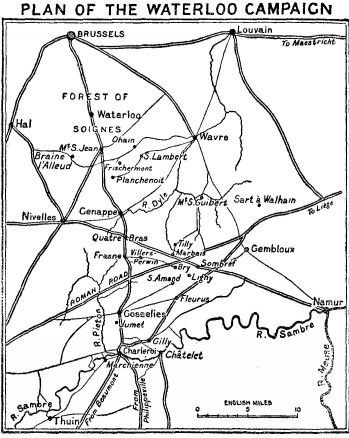
The Duke's forces would, at the outset of the campaign, have been in less danger, if the leaders at the Prussian outposts, Pirch II. and Dörnberg of the King's German Legion, had warned him of the enemy's massing near the Sambre early on the 15th. By some mischance this was not done; and our leader only heard from Hardinge, at the Prussian headquarters, that the enemy seemed about to begin the offensive. He therefore waited for more definite news before concentrating upon any one line.
About 6 p.m. on the 15th he ordered his divisions and brigades to concentrate at Vilvorde, Brussels, Ninove, Grammont, Ath, Braine-le-Comte, Hal, and Nivelles—the first four of which were somewhat remote, while the others were chosen with a view to defending the roads leading northwards from Mons. Not a single British brigade was posted on the Waterloo-Charleroi road, which was at that time guarded only by a Dutch-Belgian division, a fact which supports Mr. Ropes's contention that no definite plan of co-operation had been formed by the allied leaders. Or, if there was one, the Duke certainly refused to act upon it until he had satisfied himself that the chief attack was not by way of Mons or Ath. More definite news reached Brussels near midnight of the 15th, whereupon he gave a general left turn to his advance, namely, towards Nivelles.
Clausewitz maintains that he should already have removed his headquarters to Nivelles; had he done so and hurried up all available troops towards the[pg.460] Soignies-Quatre Bras line, his Waterloo fame would certainly have gained in solidity. A dash of romance was added by his attending the Duchess of Richmond's ball at Brussels on the night of the 15th-16th; lovers of the picturesque will always linger over the scene that followed with its "hurrying to and fro and tremblings of distress"; but the more prosaic inquirer may doubt whether Wellington should not then have been more to the front, feeling every throb of Bellona's pulse.[477]
Blücher's army, comprising 90,000 men, also covered a great stretch of country. The first corps, that of Ziethen, held the bridges of the Sambre at and near Charleroi; but the corps of Pirch I. and Thielmann were at Namur and Ciney; while, owing to a lack of stringency in the orders sent by Gneisenau, chief of the staff, to Bülow, his corps of 32,000 men was still at Liège. Early on the 15th, Pirch I. and Thielmann began hastily to advance towards Sombref; and Ziethen, with 32,000 men, prepared to hold the line of the Sambre as long as possible. His chief of staff, General Reiche, states that one-third of the Prussians were new troops, drafted in from the Landwehr; but all the corps gloried in their veteran Field-Marshal, and were eager to fight.
Such, then, was the general position. Wellington was unaware of his danger; Blücher was straining every nerve to get his army together; while 32,000 Prussians were exposed to the attack of nearly four times their number. It is clear that, had all gone well with the French advance, the fortunes of Wellington and Blücher must have been desperate. But, though the concentration of 125,000 French troops near Beaumont and Maubeuge had been effected with masterly skill (except that Gérard's and D'Erlon's corps were late), the final moves did not work quite smoothly. An accident to the officer who was to order Vandamme's corps to march at 2 a.m. on the 15th caused a long delay to that eager[pg.461] fighter.[478] The 4th corps, that of Gérard, was also disturbed and delayed by an untoward event. General Bourmont, whose old Vendéan opinions seemed to have melted away completely before the sun of Napoleon's glory, rewarded his master by deserting with several officers to the Prussians, very early on that morning. The incident was really of far less importance than is assigned to it in the St. Helena Memoirs, which falsely ascribe it to the 14th: the Prussians were already on the qui vive before Bourmont's desertion; but it clogged the advance of Gérard's corps and fostered distrust among the rank and file. When, on the morrow, Gérard rejoined his chief at the mill of Fleurus, the latter reminded him that he had answered for Bourmont's fidelity with his own head; and, on the general protesting that he had seen Bourmont fight with the utmost devotion, Napoleon replied: "Bah! A man who has been a white will never become a blue: and a blue will never be a white." Significant words, that show the Emperor's belief in the ineradicable strength of instinct and early training.[479]
Despite these two mishaps, the French on the morning of the 15th succeeded in driving Ziethen's men from the banks of the Sambre about Thuin, while Napoleon in person broke through their line at Charleroi. After suffering rather severely, the defenders fell back on Gilly, whither Napoleon and his main force followed them; while the left wing of the French advance, now intrusted to Ney, was swung forward against the all-important position of Quatre Bras.
We here approach one of the knotty questions of the campaign. Why did not Ney occupy the cross-roads in force on the evening of the 15th? We may note first that not till the 11th had Napoleon thought fit to summon Ney to the army, so that the Marshal did not come up till the afternoon of this very day. He at once had an interview with the Emperor, who, according to General Gourgaud, gave the Marshal verbal orders to take command of the[pg.462] corps of Reille and D'Erlon, to push on northwards, take up a position at Quatre Bras, and throw out advanced posts beyond on the Brussels and Namur roads; but it seems unlikely that the Emperor would have given one of the most venturesome of his Marshals an absolute order to push on so far in advance, unless the French right wing had driven the Prussians back beyond the Sombref position. Otherwise, Ney would have been dangerously far in advance of the main body and exposed to blows either from the Prussians or the British.
However this may be, Ney certainly felt insecure, and did not push on with his wonted dash; while, fortunately for the allies, an officer was at hand Prince Bernard of Saxe-Weimar, who saw the need of holding Quatre Bras at all costs.[480] The young leader imposed on the foe by making the most of his men—they were but 4,500 all told, and had only ten bullets apiece—and he succeeded. For once, Ney was prudent to a fault, and did not push home the attack. In his excuse it may be said that the men of Reille's corps, on whom he had to rely—for D'Erlon's corps was still far to the rear—had been marching and fighting ever since dawn, and were too weary for another battle. Moreover, the roar of cannon on the south-east warned him that the right wing of the French advance was hotly engaged between Gilly and Fleurus; until it beat back the Prussians, his own position was dangerously "in the air"; and, as but two hours of daylight remained, he drew back on Frasnes. He is also said to have sent word to the Emperor that "he was occupying Quatre Bras by an advanced guard, and that his main body was close behind." If he deceived his chief by any such report, he deserves the severest censure; but the words[pg.463] quoted above were written later at St. Helena by General Gourgaud, when Ney had come to figure as the scapegoat of the campaign.[481] Ney sent in a report on that evening; but it has been lost.[482] Judging from the orders issued by Napoleon and Soult early on the 16th, there was much uncertainty as to Ney's position. The Emperor's letter bids him post his first division "two leagues in front of les Quatres Chemins"; but Soult's letter to Grouchy states that Ney is ordered to advance to the cross-roads. Confusion was to be expected from the circumstances of the case. Ney did not know his staff-officers, and he hastily took command of the left wing when in the midst of operations whose success, as Janin points out, largely depended on that of the right. He therefore played a cautious game, when, as we now know, caution meant failure and daring spelt safety.
Meanwhile the French right wing, of which Grouchy had received the command, though Napoleon in person was its moving force, had been pressing the Prussians hard near Gilly. Yet here, too, the assailants were weakened by the absence of the corps of Vandamme and Gérard. Irritated by Ziethen's skilful withdrawal, the Emperor at last launched his cavalry at the Prussian rear battalions, four of which were severely handled before they reached the covert of a wood. With the loss, on the whole, of nearly 2,000 men, the Prussians fell back towards Ligny, while Grouchy's vanguard bivouacked near the village of Fleurus.
Napoleon might well be satisfied with the work done on June 15th: he rode back to his headquarters at Charleroi, "exhausted with fatigue," after spending wellnigh eighteen hours in the saddle, but confident that he had sundered the allies. This was certainly his aim now, as it had been in the campaign of 1796. After two decisive blows at their points of connection, he purposed driving them on divergent lines of retreat, just as he had driven the Austrians and Sardinians down the roads that [pg.464] bifurcate near Montenotte. True, there were in Belgium no mountain spurs to prevent their reunion; but the roads on which they were operating were far more widely divergent.[483] He also thought lightly of Wellington and Blücher. The former he had pronounced "incapable and unwise"; as for Blücher, he told Campbell at Elba that he was "no general"; but that he admired the pluck with which "the old devil" came on again after a thrashing.
Unclouded confidence is seen in every phrase of the letters that he penned at Charleroi early on the 16th. He informs Ney that he intends soon to attack the Prussians at Sombref, if he finds them there, to clear the road as far as Gembloux, and then to decide on his further actions as the case demands. Meanwhile Ney is to sweep the road in front of Quatre Bras, placing his first division two leagues beyond that position, if it seemed desirable, with a view to marching on Brussels during the night with his whole force of about 50,000 men. The Guard is to be kept in reserve as much as possible, so as to support either Napoleon on the Gembloux road, or Ney on the Brussels road; and "if any skirmish takes place with the English, it is preferable that the work should fall on the Line rather than on the Guard." As for the Prussian resistance, Napoleon rated it almost as lightly as that of the English; for he regards it as probable that he will in the evening march on Brussels with his Guard.
While he pictured his enemies hopelessly scattered or in retreat, they were beginning to muster at the very points which he believed to be within his grasp. At 11 a.m. only Ziethen's corps, now but 28,000 strong, was in position at Sombref, but the corps of Pirch I. and Thielmann came up shortly after midday. Had Napoleon pushed on early on the 16th, he must easily have gained the Ligny-Sombref position. What, then, caused the delay in the French attack? It can be traced to the slowness of Gérard's advance, to the Emperor's misconception of the situation, and to his despatch to Grouchy. [pg.465]
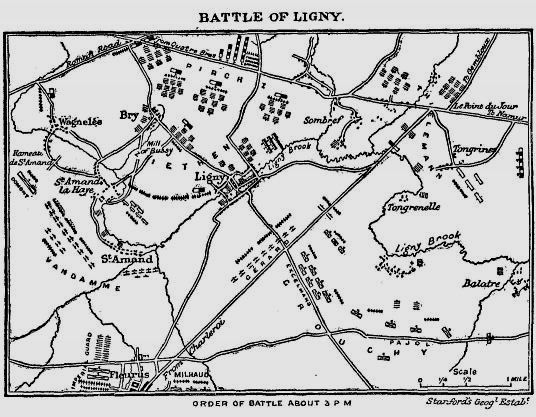
In this he reckoned the Prussians at 40,000 men, and ordered Grouchy to repair with the French right wing to Sombref.
" ... I shall be at Fleurus between 10 and 11 a.m.: I shall proceed to Sombref, leaving my Guard, both infantry and cavalry, at Fleurus: I would not take it to Sombref, unless it should be necessary. If the enemy is at Sombref, I mean to attack him: I mean to attack him even at Gembloux, and to gain this position also, my aim being, after having known about these two positions, to set out to-night, and to operate with my left wing, under the command of Marshal Ney, against the English."
The Emperor did not reach Fleurus until close on 11 a.m., and was undoubtedly taken aback to find Grouchy still there, held in check by the enemy strongly posted around Ligny. Grouchy has been blamed for not having already attacked them; but surely his orders bound him to wait for the Emperor before giving battle: besides, the corps of Gérard, which had been assigned to him was still far away in the rear towards Châtelet.[484] The absence of Gérard, and the uncertainty as to the enemy's aims, annoyed the Emperor. He mounted the windmill situated on the outskirts of Fleurus to survey the enemy's position.
It was a fair scene that lay before him. Straight in front ran the high-road which joined the Namur-Nivelles chaussée, some six miles away to the north-east. On either side stretched cornfields, whose richness bore witness alike to the toils and the warlike passions of mankind. Further ahead might be seen the dark lines of the enemy ranged along slopes that formed an irregular amphitheatre, dotted with the villages of Bry and Sombref. In the middle distance, from out a hollow that lay concealed, rose the steeples and a few of the higher roofs of Ligny. Further to the left and on higher ground lay[pg.467] St. Amand, with its outlying hamlets. All was bathed in the shimmering, sultry heat of midsummer, the harbinger, as it proved, of a violent thunderstorm. The Prussian position was really stronger than it seemed. Napoleon could not fully see either the osier beds that fringed the Ligny brook, or its steep banks, or the many strong buildings of Ligny itself. He saw the Prussians on the slope behind the village, and was at first puzzled by their exposed position. "The old fox keeps to earth," he was heard to mutter. And so he waited until matters should clear up, and Gérard's arrival should give him strength to compass Blücher's utter overthrow while in the act of stretching a feeler towards Wellington. From the time when the Emperor came on the scene to the first swell of the battle's roar, there was a space of more than four hours.
This delay was doubly precious to the allies. It gave Blücher time to bring up the corps of Pirch I. and Thielmann under cover of the high ground near Sombref, thereby raising his total force to about 87,000 men; and it enabled the two allied commanders to meet and hastily confer on the situation. Wellington had left Brussels that morning at 8 o'clock, and thanks to Ney's inaction, was able to reach the crest south of Quatre Bras a little after 10, long before the enemy showed any signs of life. There he penned a note to Blücher, asking for news from him before deciding on his operations for the day.[485] He then galloped over to the windmill of Bussy to meet Blücher.[pg.468]
It was an anxious meeting; the heads of the advancing French columns were already in sight; and the Duke saw with dismay the position of the Prussians on a slope that must expose them to the full force of Napoleon's cannon—or, as he whispered to Hardinge, "they will be damnably mauled if they fight here."[486] In more decorous terms, but to the same effect, he warned Gneisenau, and said nothing to encourage him to hold fast to his position. Neither did he lead him to expect aid from Quatre Bras. The utmost that Gneisenau could get from him was the promise, "Well! I will come provided I am not attacked myself." Did these words induce the Prussians to accept battle at Ligny? It is impossible to think so. Everything tends to show that Blücher had determined to fight there. The risk was great; for, as we learn from General Reiche, the position was seen to admit of no vigorous offensive blows against the French. But fortune smiled on the veteran Field-Marshal, and averted what might have been an irretrievable disaster.[487]
It would seem that the inequalities of the ground hid the strength of Pirch I. and Thielmann; for Napoleon still believed that he had ranged against him at Ligny only a single corps. At 2 p.m. Soult informed Ney that the enemy had united a corps between Sombref and Bry, and that in half an hour Grouchy would attack it. Ney was therefore to beat back the foes at Quatre-Bras, and then turn to envelop the Prussians. But if these were driven in first, the Emperor would move towards Ney to hasten his operations.[488] Not until the battle was about to begin does the Emperor seem to have realized that he was in presence of superior forces.[489] But after 2 p.m.[pg.469] their masses drew down over the slopes of Bry and Sombref, their foremost troops held the villages of Ligny and St. Amand, while their left crowned the ridge of Tongrines. Napoleon reformed his lines, which had hitherto been at right angles to the main road through Fleurus. Vandamme's corps moved off towards St. Amand; and Gérard, after ranging his corps parallel to that road, began to descend towards Ligny, Grouchy meanwhile marshalling the cavalry to protect their flank and rear. Behind all stood the imposing mass of the Imperial Guard on the rising ground near Fleurus.
The fiercest shock of battle fell upon the corps of Vandamme and Gérard. Three times were Gérard's men driven back by the volleys of the Prussians holding Ligny. But the French cannon open fire with terrific effect. Roofs crumble away, and buildings burst into flame. Once more the French rush to the onset, and a furious hand-to-hand scuffle ensues. Half stifled by heat, smoke, and dust, the rival nations fight on, until the defenders give way and fall back on the further part of the village behind the brook; but, when reinforced, they rally as fiercely as ever, and drive the French over its banks; lane, garden, and attic once more become the scene of struggles where no man thinks of giving or taking quarter.
Higher up the stream, at St. Amand, Vandamme's troops fared no better; for Blücher steadily fed that part of his array. In so doing, however, he weakened his reserves behind Ligny, thereby unwittingly favouring Napoleon's design of breaking the Prussian centre, and placing its wreckage and the whole of their right wing between two fires. The Emperor expected that, by 6 o'clock, Ney would have driven back the Anglo-Dutch forces, and would be ready to envelop the Prussian right. That was the purport of Soult's despatch of 3.15 p.m. to Ney: "This army [the Prussian] is lost, if you act with vigour. The fate of France is in your hands."
But at 5.30, when part of the Imperial Guard was about[pg.470] to strengthen Gérard for the decisive blow at the Prussian centre, Vandamme sent word that a hostile force of some twenty or thirty thousand men was marching towards Fleurus. This strange apparition not only unsteadied the French left: it greatly perplexed the Emperor. As he had ordered first Ney and then D'Erlon to march, not on Fleurus, but against the rear of the Prussian right wing, he seems to have concluded that this new force must be that of Wellington about to deal the like deadly blow against the French rear.[490] Accordingly he checked the advance of the Guard until the riddle could be solved. After the loss of nearly two hours it was solved by an aide-de-camp, who found that the force was D'Erlon's, and that it had retired.
Meanwhile the battle had raged with scarcely a pause, the French guns working frightful havoc among the dense masses on the opposite slope. And yet, by withdrawing troops to his right, Blücher had for a time overborne Vandamme's corps and part of the Young Guard, unconscious that his insistence on this side jeopardized the whole Prussian army. His great adversary had long marked the immense extension of its concave front, the massing of its troops against St. Amand, and the remoteness of its left wing, which Grouchy's horsemen still held in check; and he now planned that, while Blücher assailed St. Amand and its hamlets, the Imperial Guard should crush the Prussian centre at Ligny, thrust its fragments back towards St. Amand, and finally shiver the greater part of the Prussian army on the anvil which D'Erlon's corps would provide further to the west. He now felt assured of victory; for the corps of Lobau was nearing Fleurus to take the place of the Imperial Guard; and the Prussians had no supports. "They have no reserve," he remarked,[pg.471] as he swept the hostile position with his glass. This was true: their centre consisted of troops that for four hours had been either torn by artillery or exhausted by the fiendish strife in Ligny.
And now, as if the pent-up powers of Nature sought to cow rebellious man into awe and penitence, the artillery of the sky pealed forth. Crash after crash shook the ground; flash upon flash rent the sulphur-laden rack; darkness as of night stole over the scene; and a deluge of rain washed the blood-stained earth. The storm served but to aid the assailants in their last and fiercest efforts. Amidst the gloom the columns of the Imperial Guard crept swiftly down the slope towards Ligny, gave new strength to Gérard's men, and together with them broke through the defence. A little higher up the stream, Milhaud's cuirassiers struggled across, and, animated by the Emperor's presence, poured upon the shattered Prussian centre. No timely help could it now receive either from Blücher or Thielmann; for the darkness of the storm had shrouded from view the beginnings of the onset, and Thielmann had just suffered from a heedless assault on Grouchy's wing.
As the thunder-clouds rolled by, the gleams of the setting sun lit up the field and revealed to Blücher the full extent of his error.[491] His army was cut in twain. In vain did he call in his troops from St. Amand: in vain did he gallop back to his squadrons between Bry and Sombref and lead them forward. Their dashing charge was suddenly checked at the brink of a hollow way; steady volleys tore away their front; and the cuirassiers completed their discomfiture. Blücher's charger was struck by a bullet, and in his fall badly bruised the Field-Marshal; but his trusty adjutant, Nostitz, managed to hide him in the twilight, while the cuirassiers swept onwards up the hill. Other Prussian squadrons, struggling to save the day, now charged home and drove back the steel-clad ranks. Some Uhlans and mounted Landwehr reached[pg.472] the place where the hero lay; and Nostitz was able to save that precious life. Sorely battered, but still defiant like their chief, the Prussian cavalry covered the retreat at the centre; the wings fell back in good order, the right holding on to the village of Bry till past midnight; but several battalions of disaffected troops broke up and did not rejoin their comrades. About 14,000 Prussians and 11,000 French lay dead or wounded on that fatal field.[492]
Napoleon, as he rode back to Fleurus after nightfall, could claim that he had won a great victory. Yet he had not achieved the results portrayed in Soult's despatch of 3.15 to Ney. This was due partly to Ney's failure to fulfil his part of the programme, and partly to the apparition of D'Erlon's corps, which led to the postponement of Napoleon's grand attack on Ligny.
The mystery as to the movements of D'Erlon and his 20,000 men has never been fully cleared up. The evidence collected by Houssaye leaves little doubt that, as soon as the Emperor realized the serious nature of the conflict at Ligny, he sent orders to D'Erlon, whose vanguard was then near Frasnes, to diverge and attack Blücher's exposed flank. That is to say, D'Erlon was now called on to deal the decisive blow which had before been assigned to Ney, who was now warned, though very tardily, not to rely on the help of D'Erlon's corps. Misunderstanding his order, D'Erlon made for Fleurus, and thus alarmed Napoleon and delayed his final blow for wellnigh two hours. Moreover, at 6 p.m., when D'Erlon might have assailed Blücher's right with crushing effect, he received an urgent command from Ney to return. Assuredly he should not have hesitated now that St. Amand was almost within cannon-shot, while Quatre Bras could scarcely be reached before nightfall; but he was under[pg.473] Ney's command; and, taking a rather pedantic view of the situation, he obeyed his immediate superior. Lastly, no one has explained why the Emperor, as soon as he knew the errant corps to be that of D'Erlon, did not recall him at once, bidding him fall on the exposed wing of the Prussians. Doubtless he assumed that D'Erlon would now fulfil his instructions and march against Bry; but he gave no order to this effect, and the unlucky corps vanished.
At that time a desperate conflict was drawing to a close at Quatre Bras. Ney had delayed his attack until 2 p.m.; for, firstly, Reille's corps alone was at hand—D'Erlon's rearguard early on that morning being still near Thuin—and, secondly, the Marshal heard at 10 a.m. that Prussian columns were marching westwards from Sombref, a move that would endanger his rear behind Frasnes. Furthermore, the approach to Quatre Bras was flanked by the extensive Bossu Wood, and by a spinney to the right of the highway. Reille therefore counselled caution, lest the affair should prove to be "a Spanish battle where the English show themselves only when it is time." When, however, Reille's corps pushed home the attack, the weakness of the defence was speedily revealed. After a stout stand, the 7,000 Dutch-Belgians under the Prince of Orange were driven from the farm of Gémioncourt, which formed the key of the position, and many of them fled from the field.
But at this crisis the Iron Duke himself rode up; and the arrival of a Dutch-Belgian brigade and of Picton's division of British infantry, about 3 p.m., sufficed to snatch victory from the Marshal's grasp.[493] He now opened a destructive artillery fire on our front, to which the weak Dutch-Belgian batteries could but feebly reply. Nothing, however, could daunt the hardihood of Picton's men. Shaking off the fatigue of a twelve hours' march from Brussels under a burning sun, they steadily moved[pg.474] down through the tall crops of rye towards the farm and beat off a fierce attack of Piré's horsemen. On the allied left, the 95th Rifles (now the Rifle Brigade) and Brunswickers kept a clutch on the Namur road which nothing could loosen. But our danger was mainly at the centre. Under cover of the farmhouse, French columns began to drive in our infantry, whose ammunition was already running low. Wellington determined to crush this onset by a counter-attack in line of Picton's division, the "fighting division" of the Peninsula. With threatening shouts they advanced to the charge; and before that moving wall the foe fell back in confusion beyond the rivulet.
Still, the French drove back the Dutch in the wood, and the Brunswickers on its eastern fringe, killing the brave young Duke of Brunswick as he attempted to rally his raw recruits. Into the gap thus left the French horsemen pushed forward, making little impression upon our footmen, but compelling them to keep in a close formation, which exposed them in the intervals between the charges to heavy losses from the French cannon.
So the afternoon wore on. Between 5 and 6 o'clock our weary troops were reinforced by Alten's division. A little later, a brigade of Kellermann's heavy cavalry came up from the rear and renewed Ney's striking power—but again too late. Already he was maddened by the tidings that D'Erlon's corps had been ordered off towards Ligny, and next by Napoleon's urgent despatch of 3.15 p.m. bidding him envelop Blücher's right. Blind with indignation at this seeming injustice, he at once sent an imperative summons to D'Erlon to return towards Quatre Bras, and launched a brigade of Kellermann's cuirassiers at those stubborn squares.
The attack nearly succeeded. The horsemen rushed upon our 69th Regiment just when the Prince of Orange had foolishly ordered it back into line, caught it in confusion, and cut it up badly. Another regiment, the 33rd, fled into the wood, but afterwards re-formed; the other squares beat off the onset. The torrent, however, only[pg.475] swerved aside: on it rushed almost to the cross-roads, there to be stopped by a flanking fire from the wood and from the 92nd (Gordon) Highlanders lining the roadway in front.—"Ninety-second, don't fire till I tell you," exclaimed the Duke. The volley rang out when the horsemen were but thirty paces off. The effect was magical. Their front was torn asunder, and the survivors made off in a panic that spread to Foy's battalions of foot and disordered the whole array.[494]
Ney still persisted in his isolated assaults; but reinforcements were now at hand that brought up Wellington's total to 31,000 men, while the French were less than 21,000. At nightfall the Marshal drew back to Frasnes; and there D'Erlon's errant corps at last appeared. Thanks to conflicting orders, it had oscillated between two battles and taken part in neither of them.
Such was the bloody fight of Quatre Bras. It cost Wellington 4,600 killed and wounded, mainly from the flower of the British infantry, three Highland regiments losing as many as 878 men. The French losses were somewhat lighter. Few conflicts better deserve the name of soldiers' battles. On neither side was the generalship brilliant. Twilight set in before an adequate force of British cavalry and artillery approached the field where their comrades on foot had for five hours held up in unequal contest against cannon, sabre, and lance. The victory was due to the strange power of the British soldier to save the situation when it seems past hope.
Still less did it redound to the glory of Ney. Once more he had merited the name of bravest of the brave. At the crisis of the fight, when the red squares in front defied his utmost efforts, he brandished his sword in helpless wrath, praying that the bullets that flew by might strike him down. The rage of battle had, in fact, partly obscured his reason. He was now a fighter, scarcely a commander; and to this cause we may attribute his neglect adequately to support Kellermann's charge. Had this been done, Quatre Bras might have ended like[pg.476] Marengo. Far more serious, however, was his action in countermanding the Emperor's orders' by recalling D'Erlon to Quatre Bras; for, as we have seen, it robbed his master of the decisive victory that he had the right to expect at Ligny. Yet this error must not be unduly magnified. It is true that Napoleon at 3.15 sent a despatch to Ney bidding him envelop Blücher's flank; but the order did not reach him until some time after 5, when the allies were pressing him hard, and when he had just heard of D'Erlon's deflection towards the Emperor's battle.[495] He must have seen that his master misjudged the situation at Quatre Bras; and in such circumstances a Marshal of France was not without excuse when he corrected an order which he saw to be based on a misunderstanding. Some part of the blame must surely attach to the slow-paced D'Erlon and to the Emperor himself, who first underrated the difficulties both at Ligny and Quatre Bras, and then changed his plans when Ney was in the midst of a furious fight.
Nevertheless, the general results obtained on June the 16th were enormously in favour of Napoleon. He had inflicted losses on the Prussians comparable with those of Jena-Auerstädt; and he retired to rest at Fleurus with the conviction that they must hastily fall back on their immediate bases of supply, Namur and Liège, leaving Wellington at his mercy. The rules of war and the dictates of humdrum prudence certainly prescribed this course for a beaten army, especially as Bülow's corps was known to be on the Liège road.
Scarcely had the Prussian retreat begun in the darkness, when officers pressed up to Gneisenau, on whom now devolved all responsibility, for instructions as to the line of march. At once he gave the order to push northwards to Tilly. General Reiche thereupon pointed out that this village was not marked upon the smaller maps with which colonels were provided; whereupon the command was given to march towards the town of Wavre, farther distant on the same road. An officer was posted at the[pg.477] junction of roads to prevent regiments straying towards Namur; but some had already gone too far on this side to be recalled—a fact which was to confuse the French pursuers on the morrow. The greater part of Thielmann's corps had fallen back on Gembloux; but, with these exceptions, the mass of the Prussians made for Tilly, near which place they bivouacked. Early on the next morning their rearguard drew off from Sombref; and, thanks to the inertness of their foes, the line of retreat remained unknown. During the march to Wavre, their columns were cheered by the sight of the dauntless old Field-Marshal, who was able to sit a horse once more. Thielmann's corps did not leave Gembloux till 2 p.m., but reached Wavre in safety. Meanwhile Bülow's powerful corps was marching unmolested from the Roman road near Hannut to a position two miles east of Wavre, where it arrived at nightfall. Equally fortunate was the reserve ammunition train, which, unnoticed by the French cavalry, wound northwards by cross-roads through Gembloux, and reached the army by 5 p.m.[496]
In his "Commentaries," written at St. Helena, Napoleon sharply criticised the action of Gneisenau in retreating northwards to Wavre, because that town is farther distant from Wellington's line of retreat than Sombref is from Quatre Bras, and is connected with it only by difficult cross-roads. He even asserted that the Prussians ought to have made for Quatre Bras, a statement which presumes that Gneisenau could have rallied his army sufficiently after Ligny to file away on the Quatre Bras chaussée in front of Napoleon's victorious legions. But the Prussian army was virtually cut in half, and could not have reunited so as to attempt the perilous flank[pg.478] march across Napoleon's front. We shall, therefore, probably not be far wrong if we say of this criticism that the wish was father to the thought. A march on Quatre Bras would have been a safe means of throwing away the Prussian army.[497]
To the present writer it seems probable that Gneisenau's action, in the first instance, was undertaken as the readiest means of reuniting the Prussian wings. But Gneisenau cannot have been blind to the advantages of a reunion with Wellington, which a northerly march would open out. The report which he sent to his Sovereign from Wavre shows that by that time he believed the Prussian position to be "not disadvantageous"; while in a private letter written at noon on the 17th he expressly states that the Duke will accept battle at Waterloo if the Prussians help him with two army corps. Gneisenau's only doubts seem to have been whether Wellington would fight and whether his own ammunition would be to hand in time. Until he was sure on these two points caution was certainly necessary.
The results of this prompt rally of the Prussians were infinitely enhanced by the fact that Wellington soon found it out, while Napoleon did not grasp its full import until he was in the thick of the battle of Waterloo. To the final steps that led up to this dramatic finale we must now briefly refer.
It is strange that Gneisenau, on the night of the 16th, took no steps to warn his allies of the Prussian retreat, and merely left them to infer it from his last message, that he must do so if he were not succoured. Müffling,[pg.479] indeed, says that a Prussian officer was sent, but was shot by the French on the British left wing. Seeing, however, that Wellington had beaten back Ney's forces before the Prussian retreat began, the story may be dismissed as a lame excuse of Gneisenau's neglect.[498]
From the risk of being crushed by Napoleon, the Anglo-Dutch forces were saved by the vigilance of their leader and the supineness of the enemy. After a brief rest at Genappe, the Duke was back at the front at dawn, and despatched two cavalry patrols towards Sombref to find out the results of the battle. The patrol, which was accompanied by the Duke's aide-de-camp, Colonel Gordon, came into touch with the Prussian rear. On his return soon after 10, the staff-officer, Basil Jackson, was at once sent to bid Picton immediately prepare to fall back on Waterloo, an order which that veteran received very sulkily.[499] Shortly after Gordon's return, a Prussian orderly galloped up and confirmed the news of their retreat, which drew from the Duke the remark: "Blücher has had a d——d good licking and gone back to Wavre.... As he has gone back, we must go too." The infantry now began to file off by degrees behind hedges or under cover of a screen of cavalry and skirmishers, these keeping Ney's men busy in front, until the bulk of the army was well through the narrow and crowded street of Genappe.
And how came it that Napoleon and Ney missed this golden opportunity? In the first case, it was due to their chiefs of staff, who had not sent overnight any tidings as to the results of their respective battles. Until Count Flahaut returned to the Imperial headquarters about 8 a.m., Napoleon knew nothing as to the position of affairs at Quatre Bras; while a similar carelessness on Soult's part left Ney powerless to attempt anything against Wellington until somewhat later in the morning.[pg.480]
But Napoleon's inaction lasted nearly up to 11.30. How is this to be accounted for? In reply, some attribute his conduct to illness of body and torpor of mind—a topic that will engage our attention presently; others assert that the army urgently needed rest; but the effective cause was his belief that the Prussians were retreating eastwards away from Wellington. This was the universal belief at headquarters. He had ordered Grouchy to follow them at dawn; Grouchy's lieutenant, Pajol, struck to the south-east, and by 4 a.m. reported that Blücher was heading for Namur. Such was the news that the Emperor heard from Grouchy about 8 a.m.—he refused to grant him an audience earlier. Forthwith he dictated a letter to Ney to the following effect: that the Prussians had been routed and were being pursued towards Namur; that the British could not attack him (Ney) at Quatre Bras, for the Emperor would in that case march on their flank and destroy them in an instant; that he heard with pain how isolated Ney's troops had been on the 16th, and ordered him to close up his divisions and occupy Quatre Bras. If he could not effect that task, he must warn the Emperor, who would then come. Finally, he warned him that "the present day is needed to finish this operation, to complete the munitions of war, to rally stragglers and call in detachments."
A singular day's programme this for the man who had trebled the results of the victory of Jena by the remorseless energy of the pursuit. After dictating this despatch, he ordered Lobau to take a division of infantry for the support of Pajol on the Namur road. He then set out for St. Amand in his carriage. On arriving at the place of carnage he mounted his horse and rode slowly over the battle-field, seeing to the needs of the wounded of both nations with kindly care, and everywhere receiving the enthusiastic acclaim of his soldiery. This done, he dismounted and talked long and earnestly with Grouchy, Gérard, and others on the state of political parties at Paris. They listened with [pg.481]ill-concealed restlessness. At Fleurus Grouchy asked for definite orders, and received the brusque reply that he must wait. But now, towards 11 o'clock, the Emperor hears that Wellington is still at Quatre Bras, that Pajol has captured eight Prussian guns on the Namur road, and that Excelmans has seen masses of the enemy at Gembloux. At once he turns from politics to war.
His plan is formed. While he himself falls on the British, Grouchy is to pursue the Prussians with the corps of Gérard and Vandamme, the division of Teste (from Lobau's command), and the cavalry corps of Pajol, Excelmans, and Milhaud. The Marshal begged to be relieved of the task, setting forth the danger of pursuing foes that were now reunited and far away. It was in vain. About 11.30 the Emperor developed his verbal instructions in a written order penned by Bertrand. It bade Grouchy proceed to Gembloux with the forces stated above (except Milhaud's corps and a division of Vandamme's corps, which were to follow Napoleon) to reconnoitre on the roads leading to Namur and Maestricht, to pursue the enemy, and inform the Emperor as to their intentions. If they have evacuated Namur, it is to be occupied by the National Guards. "It is important to know what Blücher and Wellington mean to do, and whether they propose reuniting their armies in order to cover Brussels and Liège, by trying their fortune in another battle...."[500]
As Napoleon's fate was to depend largely on an intelligent carrying out of this order, we may point out that it consisted of two chief parts, the general aim and the means of carrying out that aim. The aim was to find out the direction of the Prussians' retreat, and to prevent them joining Wellington, whether for the defence of Brussels or of Liège. The means were an advance to Gembloux and scouting along the Namur and Maestricht roads. The chance that the allies might reunite for the defence of Brussels was alluded to, but no measures were prescribed as to scouting in that direction: these[pg.482] were left to Grouchy's discretion. It must be confessed that the order was not wholly clear. To name the towns of Brussels and Liège (which are sixty miles apart) was sufficiently distracting; and to suggest that only the eastern and south-eastern roads should be explored was certain to limit Grouchy's immediate attention to those roads alone. For he distrusted alike his own abilities and the power of the force placed at his disposal; and an officer thus situated is sure to inclose himself in the strict letter of his instructions. This was what he did, with disastrous results.
Grouchy had hitherto held no important command. As a cavalry general he had done brilliant service; but now he was launched on a duty that called for strategic insight. His force was scarcely equal to the work. True, it was strong for scouting, having nearly 6,000 light horse; but the 27,000 footmen of Vandamme's and Gérard's corps had been exhausted by the deadly strife in the villages and were expecting a day's rest. Their commanders also resented being placed under Grouchy. In fact, leaders and men disliked the task, and set about it in a questioning, grumbling way. The infantry did not start till about 3 o'clock and only reached Gembloux late that evening—nine miles in six hours! The cavalry, too, was so badly handled by Excelmans around Gembloux that Thielmann's corps slipped away northward. The rain fell in torrents, obscuring the view; but it seems strange that the direction of the Prussian retreat was not surmised until about nightfall.
Meanwhile, on the French left wing, Ney had been equally lax. He must have received Napoleon's order to occupy Quatre Bras, "if there was only a rearguard there," a little before 10 a.m.; but he took no steps beyond futile skirmishing, and apparently knew not that the British were slipping away.
About 2 p.m., when the British cavalry was ready to turn rein, the Duke and Sir H. Vivian saw the glint of cuirasses along the Sombref road. It was the vanguard of the Emperor's advance. Furious that his foes were[pg.483] escaping from his clutches, Napoleon had left his carriage and was pressing on with the foremost horsemen. To Ney he sent an imperative summons to advance, and when that Marshal came up, greeted him with the words "You have ruined France." But it was time for deeds, not words; and he now put forth all his strength. At once he flung his powerful cavalry at the British rear; and even now it might have gone hard with Wellington had not the lowering clouds burst in a deluge of rain. Quickly the road was ploughed up; and the cornfields became impassable for the French horsemen.
While the pursuers struggled in the mire and aimed wildly through the pelting haze, the British rearguard raced for safety. Says Captain Mercer of the artillery: "We galloped for our lives through the storm, striving to gain the hamlets, Lord Uxbridge urging us on, crying 'Make haste; for God's sake gallop, or you will be taken.'"[501] Gaining on the pursuit, they reached Genappe, and, filing over its bridge and up the narrow street, prepared to check the French. At this time the Emperor galloped up, drenched to the skin, his gray overcoat streaming with rain, his hat bent out of all shape by the storm.[502] He was once more the artillery officer of Toulon. "Fire on them," he shouted to his gunners, "they are English." A sharp skirmish ensued, in which our 7th Hussars, charging down into the village, were worsted by the French lancers, "an arm," says Cotton, "with which we were quite unacquainted." In their retreat they were saved by the Life Guards, whose weight and strength carried all before them.
At last, on the ridge of Waterloo, Wellington's force turned at bay. Napoleon, coming up at 6.30 to the brow of the opposite slope, ordered a strong force to advance into the sodden clay of the valley. It was promptly torn by a heavy cannonade; and the truth was borne in on him that the British had escaped him for that day.[pg.484]
As many writers assert that Napoleon at this time was but the shadow of his former self, we must briefly review the evidence of contemporaries on this subject; for if the assertion be true, the Battle of Waterloo deserves little notice.
It seems that for some time past there had been a slight falling off in his mental and bodily powers; but when it began and how far it progressed is matter of doubt. Some observers, including Chaptal, date it from the hardships of the retreat from Moscow. This is very doubtful. He ended that campaign in a better state of health than he had enjoyed during the advance. Besides, in none of his wars did he show such vitality and fertility of resource as in the desperate struggle of 1814, which Wellington pronounced his masterpiece. After this there seems to have been a period of something like relapse at Elba. In September, 1814, Sir Neil Campbell reported: "Napoleon seems to have lost all habits of study and sedentary application. He occasionally falls into a state of inactivity never known before, and sometimes reposes in his bedroom of late for several hours in the day; takes exercise in a carriage and not on horseback. His health excellent and his spirits not at all depressed" ("F.O.," France, No. 114). During his ten months at Elba he became very stout and his cheeks puffy.
On his return to France he displayed his old activity; and the most credible witnesses assert that his faculties showed no marked decline. Guizot, who saw a good deal of him, writes: "I perceive in the intellect and conduct of Napoleon during the Hundred Days no sign of enfeebling: I find in his judgment and actions his accustomed qualities." In a passage quoted above (p. 449) Mollien notes that his master was a prey to lassitude after some hours of work, but he says nothing on the subject of disease; and in a man of forty-six, who had lived a hard life and a "fast" life, we should not expect to find the capacity for the sustained intellectual efforts of the Consulate. Méneval noticed nothing worse in his master's condition than a tendency to "réverie": he detected no disease. The statement of Pasquier that his genius and his physical powers were in a profound decline is a manifest exaggeration, uttered by a man who did not once see him before Waterloo, who was driven from Paris by him, and strove to discourage his supporters. Still less can we accept the following melodramatic description, by Thiébault, of Napoleon's appearance on Sunday, June 11th: "His look, once so formidable and piercing, had lost its strength and even its steadiness: his face had lost all expression and all its force: his mouth, compressed, had none of its former witchery: and his gait was as perplexed as his demeanour and gestures were [pg.485]undecided: the ordinary pallor of his skin was replaced by a strongly pronounced greenish tinge which struck me."
Let us follow this wreck of a man to the war and see what he accomplished. At dawn on June 12th he entered his landau and drove to Laon, a distance of some seventy miles. On the next day he got through an immense amount of work, and proceeded to Beaumont. On the 15th of June he was up at dawn, mounted his horse, and remained on horseback, directing the operations against the Prussians, for nearly eighteen hours. This time was broken by one spell of rest. Near Charleroi, says Baudus, an officer of Soult's staff, he was overcome by sleep and heeded not the cheers of a passing column: at this Baudus was indignant, but most unjustly so. Napoleon needed these snatches of sleep as a relief to prolonged mental tension. At night he returned to Charleroi, "overcome with fatigue." On the next day he was still very weary, says Ségur; he did not exert himself until the battle of Ligny began at 2.30; but he then rode about till nightfall, through a time of terrible heat. Fatigue showed itself again early on the morrow, when he declined to see Grouchy before 8 a.m. Yet his review of the troops and his long discussions on Parisian politics were clearly due, not to torpor, but to the belief that he had sundered the allies, and could occupy Brussels at will; for when he found out his mistake, he showed all the old energy, riding with the vanguard from Quatre Bras to La Belle Alliance through the violent rain.
Whatever, then, were his ailments, they were not incompatible with great and sustained activity. What were those ailments? He is said to have suffered from intermittent affections of the lower bowel, of the bladder, and of the skin, the two last resulting in ischury (Dorsey Gardner's "Quatre Bras, Ligny, and Waterloo," pp. 31-37; O'Connor Morris, pp. 164-166, note). The list is formidable; but it contains its own refutation. A man suffering from these diseases, unless in their earliest and mildest stages, could not have done what Napoleon did. Ischury, if at all pronounced, is a bar to horse exercise. Doubtless his long rides aggravated any trouble that he had in this respect, for Pétiet, who was attached to the staff, noticed that he often dismounted and sat before a little table that was brought to him for the convenience of examining maps; but Pétiet thought this was due, not to ill health (about which he says nothing), but to his corpulence ("Souvenirs militaires," pp. 196 and 212). Prince Jerome and a surgeon of the imperial staff assured Thiers that Napoleon was suffering from a disease of the bladder; but this was contradicted by the valet, Marchand; and if he really was suffering from all, or any one, of the maladies named above, it is very strange that the surgeon allowed him to expose himself to the torrential rain of the night of the 17th-18th for a purpose which a few trusty officers could equally well have discharged (see next chapter). Furthermore, Baron Larrey, Chief Surgeon of the army, who saw Napoleon before the campaign [pg.486] began and during its course, says not a word about the Emperor's health ("Relation médicale des Campagnes, 1815-1840," pp. 5-11).
Again, the intervals of drowsiness on the 15th and 18th of June, on which the theory of physical collapse is largely based, may be explained far more simply. Napoleon had long formed the habit of working a good deal at night and of seeking repose during a busy day by brief snatches of slumber. The habit grew on him at Elba; and this, together with his activity since daybreak, accounts for his sleeping near Charleroi. The same explanation probably holds good as to his occasional drowsiness at Waterloo. He scarcely closed his eyes before 3.30 a.m.; and he cannot have been physically fit for the unexpectedly long and severe strain of that Sunday. That he began the day well we know from a French soldier named Barral (grandfather of the author of "L'Epopée de Waterloo"), who looked at him carefully at 9.30 a.m., and wrote: "He seemed to me in very good health, extraordinarily active and preoccupied." Decoster, the peasant guide who was with Napoleon the whole day, afterwards told Sir W. Scott that he was calm and confident up to the crisis. Gourgaud, who clung to him during the flight to Paris and thence to Rochefort, notes nothing more serious than great fatigue; Captain Maitland, when he received him on board the "Bellerophon," thought him "a remarkably strong, well-built man." During the voyage to St. Helena he suffered from nothing worse than mal de mer; he ate meat in exceptional quantity, even in the tropics.
Very noteworthy, too, is Lavalette's narrative. When he saw Napoleon before his departure from Paris to the Belgian frontier, he found him suffering from depression and a pain in the chest; but he avers that, on the return from Waterloo, apart from one "frightful epileptic laugh," Napoleon speedily settled down to his ordinary behaviour: not a word is added as to his health. (Sir W. Scott, "Life of Napoleon," vol. viii., p. 496; Gourgaud, "Campagne de 1815," and "Journal de St. Hélène," vol. ii., Appendix 32; "Narrative of Captain Maitland," p. 208; Lavalette, "Mems.," ch. xxxiii.; Houssaye ridicules the stories of his ill-health.)
What is the upshot of it all? The evidence seems to show that, whatever was Napoleon's condition before the campaign, he was in his usual health amidst the stern joys of war. And this is consonant with his previous experience: he throve on events which wore ordinary beings to the bone: the one thing that he could not endure was the worry of parliamentary opposition, which aroused a nervous irritation not to be controlled and concealed without infinite effort. During the campaign we find very few trustworthy proofs of his decline and much that points to energy of resolve and great rallying power after exertion. If he was suffering from three illnesses, they were assuredly of a highly intermittent nature. [pg.487]
Would Wellington hold on to his position? This was the thought that troubled the Emperor on the night after the wild chase from Quatre Bras. Before retiring to rest at the Caillou farm, he went to the front with Bertrand and a young officer, Gudin by name, and peered at the enemy's fires dimly seen through the driving sheets of rain. Satisfied that the allies were there, he returned to the farm, dictated a few letters on odious parliamentary topics, and then sought a brief repose. But the same question drove sleep from his eyes. At one o'clock he was up again and with the faithful Bertrand plashed to the front through long rows of drenched recumbent forms. Once more they strained their ears to catch through the hiss of the rain some sound of a muffled retirement. Strange thuds came now and again from the depths of the wood of Hougoumont: all else was still. At last, over the slope on the north-east crowned by the St. Lambert Wood there stole the first glimmer of gray; little by little the murky void bodied forth dim shapes, and the watch-fires burnt pale against the orient gleams. It was enough. He turned back to the farm. Wellington could scarcely escape him now.
While the Emperor was making the round of his outposts, a somewhat cryptic despatch from Grouchy reached headquarters. The Marshal reported from Gembloux, at 10 p.m. of the 17th, that part of the Prussians had retired towards Wavre, seemingly with a view to joining Wellington; that their centre, led by Blücher, had fallen back on Perwez in the direction of Liège; while a column[pg.488] with artillery had made for Namur; if he found the enemy's chief force to be on the Liège chaussée, he would pursue them along that road; if towards Wavre, he would follow them thither "in order that they may not gain Brussels, and so as to separate them from Wellington." This last phrase ought surely to have convinced Napoleon that Grouchy had not fully understood his instructions; for to march on Wavre would not stop the Prussians joining Wellington, if they were in force.[503]
Moreover, Napoleon now knew, what Grouchy did not know, that the Prussians were in force at Wavre. It seems strange that the Emperor did not send this important news to his Marshal; but perhaps we may explain this by his absence at the outposts. As it was, no clear statement of the facts of the case was sent off to Grouchy until 10 a.m. of the 18th. He then informed his Marshal that, according to all the reports, three bodies of Prussians had made for Wavre. Grouchy "must therefore move thither—in order to approach us, to put yourself within the sphere of our operations, and to keep up your communications with us, pushing before you those bodies of Prussians which have taken this direction and which may have stopped at Wavre, where you ought to arrive as soon as possible." Grouchy, however, was not to neglect Blücher's troops that were on his right, but must pick up their stragglers and keep up his communications with Napoleon.
Such was the letter; and again we must pronounce it far from clear. Grouchy was not bidden to throw all his efforts on the side of Wavre; and he was not told whether he must attack the enemy at that town, or interpose a wedge between them and Wellington, or support Napoleon's right. Now Napoleon would certainly have prescribed an immediate concentration of Grouchy's force towards the north-west for one of the last two objects, had he believed Blücher about to attempt a flank march[pg.489] against the chief French army. Obviously it had not yet entered his thoughts that so daring a step would be taken by a foe whom he pictured as scattered and demoralized by defeat.[504]
As we have seen, the Prussians were not demoralized; they had not gone off in three directions; and Blücher was not making for Liège. He was at Wavre and was planning a master-stroke. At midnight, he had sent to Wellington, through Müffling, a written promise that at dawn he would set the corps of Bülow in motion against Napoleon's right; that of Pirch I. was to follow; while the other two corps would also be ready to set out. Wellington received this despatch about 3 a.m. of the 18th, and thereupon definitely resolved to offer battle. A similar message was sent off from Wavre at 9.30 a.m., but with a postscript, in which we may discern Gneisenau's distrust of Wellington, begging Müffling to find out accurately whether the Duke really had determined to fight at Waterloo. Meanwhile Bülow's corps had begun its march from the south-east of Wavre, but with extreme slowness, which was due to a fire at Wavre, to the crowded state of the narrow road, and also to the misgivings of Gneisenau. It certainly was not owing to fear of Grouchy; for at that time the Prussian leaders believed that only 15,000 French were on their track. Not until midday, when the cannonade on the west grew to a roar, did Gneisenau decide to send forward Ziethen's corps towards Ohain, on Wellington's left; but thereafter the defence of the Dyle against Grouchy was left solely to Thielmann's corps.[505] [pg.490]
[Illustration: (missing) BATTLE OF WATERLOO, about 11 o'clock a.m. to face]While this storm was brewing in the east, everything in front of the Emperor seemed to portend a prosperous day. High as he rated Wellington's numbers, he had no doubt as to the result. "The enemy's army," he remarked just after breakfast, "outnumbers ours by more than a fourth; nevertheless we have ninety chances out of a hundred in our favour." Ney, who then chanced to come in, quickly remarked: "No doubt, sire, if Wellington were simple enough to wait for you; but I come to inform you that he is retreating." "You have seen wrong," was the retort, "the time is gone for that." Soult did not share his master's assurance of victory, and once more begged him to recall some of Grouchy's force; to which there came the brutal reply: "Because you have been beaten by Wellington you think him a great general. And I tell you that Wellington is a bad general, that the English are bad troops, and that this will be the affair of a déjeuner." "I hope it may," said Soult. Reille afterwards came in, and, finding how confident the Emperor was, mentioned the matter to D'Erlon, who advised his colleague to return and caution him. "What is the use," rejoined Reille; "he would not listen to us."
In truth, Napoleon was in no mood to receive advice. He admitted on the voyage to St. Helena that "he had not exactly reconnoitred Wellington's position."[506] And, indeed, there seemed to be nothing much to reconnoitre. The Mont St. Jean, or Waterloo, position does not impress the beholder with any sense of strength. The so-called valley, separating the two arrays, is a very shallow depression, nowhere more than fifty feet below the top of the northern slope. It is divided about halfway across by an undulation that affords good cover to assailants about to attack La Haye Sainte. Another slight rise crosses the vale halfway between this farm and Hougoumont, and facilitates the approach to that part of the ridge. In fact, only on their extreme left could the defenders feel much security; for there the[pg.491] slope is steeper, besides being protected in front by marshy ground, copses, and the hamlets of Papelotte, La Haye, and Smohain.
Napoleon paid little attention to the left wing of the allies. The centre and right centre were evidently Wellington's weak points, and there, especially near the transverse rise, our leader chiefly massed his troops. Yet there, too, the defence had some advantages. The front of the centre was protected by La Haye Sainte, "a strong stone and brick building," says Cotton, "with a narrow orchard in front and a small garden in the rear, both of which were hedged around, except on the east side of the garden, where there was a strong wall running along the high-road." It is generally admitted that Wellington gave too little attention to this farm, which Napoleon saw to be the key of the allied position. Loopholes were made in its south and east walls, but none in the western wall, and half of the barn-door opening on the fields had been torn off for firewood by soldiers overnight. The place was held at first by 376 men of the King's German Legion, who threw up a barricade at the barn-door, as also on the high-road outside the orchard; but, as the sappers and carpenters were removed to Hougoumont, little could be done.
Far stronger was the château of Hougoumont, which had been built with a view to defence. The outbuildings were now loopholed, and scaffolds were erected to enable our men to fire over the garden walls which commanded the orchard. The defence was intrusted to the light companies of the second battalions of Coldstreams and Foot Guards (now the Grenadier Guards); while the wood in front was held by Nassauers and Hanoverians. Chassé's Dutch-Belgians were posted at the village of Braine la Leud to give further security to Wellington's right.[507] Napoleon's intention was to pierce the allied[pg.492] centre behind La Haye Sainte, where their lines were thin. But he did not know that behind the crest ran a sunken cross-road, which afforded excellent cover, and that the ground, sloping away towards Wellington's rear, screened his second line and reserves.
It was this peculiarity of the ground, so different from that of the exposed slope behind Ligny, that helped the great master of defensive tactics secretly to meet and promptly to foil every onset of his mighty antagonist.
While under-estimating the strength of Wellington's position Napoleon over-rated his numbers. As we have seen, he remarked that the allies exceeded the French by more than a fourth. Now, as his own numbers were fully 74,000, he credited the allies with upwards of 92,000. In reality, they were not more than 67,000, as Wellington had left 17,000 at Hal; but if this powerful detachment had been included, Napoleon's estimate would not have been far wrong. At St. Helena he gave out that his despatch of cavalry towards Hal had induced Wellington to weaken his army to this extent; but Houssaye has shown that the statement is an entire fabrication. The Emperor certainly believed that all Wellington's troops were close at hand.[508]
The Duke, on his side, would doubtless have retreated had he known that the Prussian advance would be as slow[pg.493] as it was. His composite forces, in which five languages were spoken, were unfit for a long contest with Napoleon's army. The Dutch-Belgian troops, numbering 17,000, were known to be half-hearted; the 2,800 Nassauers, who had served under Soult in 1813, were not above suspicion; the 11,000 Hanoverians and 5,900 Brunswickers were certain to do their best, but they were mostly raw troops. In fact, Wellington could thoroughly rely only on his 23,990 British troops and the 5,800 men of the King's German Legion; and among our men there was a large proportion of recruits or drafts from militia battalions. Events were to prove that this motley gathering could hold its own while at rest; but during the subsequent march to Paris Wellington passed the scathing judgment that, with the exception of his Peninsular men, it was "the worst equipped army, with the worst staff, ever brought together."[509] This was after he had lost De Lancey, Picton, Ponsonby, and many other able officers; but on the morning of the 18th there was no lack of skill in the placing of the troops, witness General Kennedy's arrangement of Alten's division so that it might readily fall into the "chequer" pattern, which proved so effective against the French horsemen.
Napoleon's confidence seemed to be well founded: he had 246 cannon against the allies' 156, and his preponderance in cavalry of the line was equally great. Above all, there were the 13,000 footmen of the Imperial Guard, flanked by 3,000 cavaliers. The effective strength of the two armies has been reckoned by Kennedy as in the proportion of four to seven. Why, then, did he not attack[pg.494] at once? There were two good reasons: first that his men had scattered widely overnight in search of food and shelter, and now assembled very slowly on the plateau; second, that the rain did not abate until 8 a.m., and even then slight drizzles came on, leaving the ground totally unfit for the movements of horse and artillery. Leaving the troops time to form and the ground to improve, the Emperor consulted his charts and took a brief snatch of sleep. He then rode to the front; and, as the gray-coated figure passed along those imposing lines, the enthusiasm found vent in one rolling roar of "Vive l'Empereur," which was wafted threateningly to the thinner array of the allies. There the leader received no whole-hearted acclaim save from the men who knew him; but among these there was no misgiving. "If," wrote Major Simmons of the 95th, "you could have seen the proud and fierce appearance of the British at that tremendous moment, there was not one eye but gleamed with joy."[510]
The first shots were fired at 11.50 to cover the assault on the wood of Hougoumont by Prince Jerome Bonaparte's division of Reille's corps. The Nassauers and Hanoverians briskly replied, and Cleeve's German battery opened fire with such effect that the leading column fell back. Again the assailants came on in greater force under shelter of a tremendous cannonade: this time they gained a lodgment, and step by step drove the defenders back through the copse. Though checked for a time by the Guards, they mastered the wood south of the house by about one o'clock. There they should have stopped. Napoleon's orders were for them to gain a hold only on the wood and throw out a good line of skirmishers: all that he wanted on this side was to prevent any turning movement from Wellington's advanced outposts. Reille also sent orders not to attack the château; but the Prince and his men rushed on at those massive walls, only to meet with a bloody repulse. A second attack fared no better; and though some 12,000 of Reille's men finally[pg.495]attacked the mansion on three sides, yet our Guards, when reinforced, beat off every onset of wellnigh ten times their numbers.
For some time the Emperor paid little heed to this waste of energy; at 2 p.m. he recalled Jerome to his side. He now saw the need of husbanding his resources; for a disaster had overtaken the French right centre. He had fixed one o'clock for a great attack on La Haye Sainte by D'Erlon's corps of nearly 20,000 men. But a delay occurred owing to a cause that we must now describe.
Before his great battery of eighty guns belched forth at the centre and blotted out the view, he swept the horizon with his glass, and discerned on the skirts of the St. Lambert wood, six miles away, a dark object. Was it a spinney, or a body of troops? His staff officers could not agree; but his experienced eye detected a military formation. Thereupon some of the staff asserted that they must be Blücher's men, others that they were Grouchy's. Here he could scarcely be in a doubt. Not long after 10 a.m. he received from Grouchy a despatch, dated from Gembloux at 3 a.m., reporting that the Prussians were retiring in force on Brussels to concentrate or to join Wellington, and that he (Grouchy) was on the point of starting for Sart-à-Walhain and Wavre. He said nothing as to preventing any flank march that the enemy might make from Wavre with a view to joining their allies straightway. Therefore he was not to be looked for on this side of Wavre, and those troops must consequently be Prussians.[511][pg.496]
All doubts were removed when a Prussian hussar officer, captured by Marbot's vedettes near Lasne, was brought to Napoleon. He bore a letter from Bülow to Müffling, stating that the former was on the march to attack the French right wing. In reply to Napoleon's questions the captain stated that Bülow's whole corps was in motion, but wisely said nothing about the other two corps that were following. Such as it was, the news in no way alarmed the Emperor. As Bülow was about to march against the French flank, Grouchy must march on his flank and take his corps en flagrant délit. That is the purport of the postscript added to a rather belated reply that was about to be sent off to Grouchy at 1 p.m. It did not reach him till 5 p.m., too late to influence the result, even had he desisted from his attack on Wavre, which he did not.[512]
We return to the Emperor's actions at half-past one. Domont's and Subervie's light horsemen were sent out towards Frischermont to observe the Prussians; the great battery of eighty guns, placed on the intermediate rise, now opened fire; and under cover of its deadly blasts D'Erlon's four divisions dipped down into the valley. They were ranged in closely packed battalions spread out in a front of some two hundred men, a formation that Napoleon had not suggested, but did not countermand. The left column, that of Alix, was supported by cavalry on its flank. Part of this division gained the orchard of La Haye Sainte, and attacked the farm buildings on all sides. From his position hard by a great elm above the farm, Wellington had marked this onset, and now sent down a Hanoverian battalion to succour their compatriots; but in the cutting of the main road it was charged and routed by Milhaud's cuirassiers, who pursued them up the slope until the rally sounded. Farther to the east, the French seemed still surer of victory. Bylandt's Dutch-Belgians, some 3,000 strong,[pg.497] after suffering heavily in their cruelly exposed position, wavered at the approach of Donzelot's column, and finally broke into utter rout, pelted in their flight with undeserved gibes from the British in their rear. These consisted of Picton's division, the heroes of Quatre Bras. Here they had as yet sustained little loss, thanks to the shelter of the hollow cross-road and a hedge.
The French columns now topped the ridge, uttering shouts of triumph, and began to deploy into line for the final charge. This was the time, as Picton well knew, to pour in a volley and dash on with the cold steel; but as he cheered on his men, a bullet struck him in the temple and cut short his brilliant career. His tactics were successful at some points while at others our thin lines barely held up against the masses. Certainly no decisive result could have been gained but for the timely onset of Ponsonby's Union Brigade—the 1st Royal Dragoons, the Scots Greys, and the Inniskillings.
At the time when Lord Uxbridge gave the order, "Royals and Inniskillings charge, the Greys support," Alix's division was passing the cross-road. But as the Royals dashed in, "the head of the column was seized with a panic, gave us a fire which brought down about twenty men, then went instantly about and endeavoured to regain the opposite side of the hedges; but we were upon and amongst them, and had nothing to do but press them down the slope." So wrote Captain Clark Kennedy, who sabred the French colour-bearer and captured the eagle. Equally brilliant was the charge of the Inniskillings, in the centre of the brigade. They rode down Donzelot's division, jostled its ranks into a helpless mass, and captured a great number of prisoners. The Scots Greys, too, succouring the hard-pressed Gordons, fell fiercely on Marcognet's division. "Both regiments," wrote Major Winchester of the 92nd, "charged together, calling out 'Scotland for ever'; the Scots Greys actually walked over this column, and in less than three minutes it was totally destroyed. The grass field, which was only an instant before as green and smooth as Phoenix[pg.498] Park, was covered with killed and wounded, knapsacks, arms, and accoutrements."[513]
Meanwhile, on the left of the brigade, Vandeleur's horse and some Dutch-Belgian dragoons drove back Durutte's men past Papelotte. On its right, the 2nd Life Guards cut up the cuirassiers while disordered by the sudden dip of the hollow cross-road; and further to the west, the 1st Dragoon Guards and 1st Life Guards met them at the edge of the plateau, clashed furiously, burst through them, and joined in the wild charge of Ponsonby's brigade up the opposite slope, cutting the traces of forty French cannon and sabring the gunners.
But Napoleon was awaiting the moment for revenge, and now sent forward a solid force of lancers and dragoons, who fell on our disordered bands with resistless force, stabbing the men and overthrowing their wearied steeds. Here fell the gallant Ponsonby with hundreds of his men, and, had not Vandeleur's horse checked the pursuit, very few could have escaped. Still, this brigade had saved the day. Two of D'Erlon's columns had gained a hold on the ridge, until the sudden charge of our horsemen turned victory into a disastrous rout that cost the French upwards of 5,000 men.
As if exhausted by this eager strife, both armies relaxed their efforts for a space and re-formed their lines. Wellington ordered Lambert's brigade of 2,200 Peninsular veterans, who had only arrived that morning, to fill the gaps on his left. The Emperor, too, was uneasy, as he showed by taking copious pinches of snuff. He mounted his horse and rode to the front, receiving there the cheers of his blood-stained lancers and battered infantry. Having received another despatch from Grouchy which gave no hope of his speedy arrival, he ordered his cannon once more to waste the British lines and bombard Hougoumont, while Ney led two of D'Erlon's brigades that were the least shaken to resume the attack[pg.499] on La Haye Sainte. Once more they were foiled at the farm buildings by the hardy Germans, to whom Wellington had sent a timely reinforcement.[514] At Hougoumont also the Guards held firm, despite the fierce conflagration in the barn and part of the chapel. But while his best troops everywhere stood their ground, the Duke saw with concern the gaps in his fighting line. Many of the Dutch-Belgians had made off to the rear; and Jackson, when carrying an order to a reserve Dutch battery to advance—an order that was disobeyed—saw what had become of these malingerers. "I peeped into the skirts of the forest and truly felt astonished: entire companies seemed there with regularly piled arms, fires blazing under cooking kettles, while the men lay about smoking!"[515]
Far different was the scene at the front. There the third act of the drama was beginning. After half an hour of the heaviest cannonade ever known, Wellington's faithful troops were threatened by an avalanche of cavalry, and promptly fell into the "chequer" disposition previously arranged for the most exposed division, that of Alten. Napoleon certainly hoped either to crush Wellington outright by a mighty onset of horse, or to strip him bare for the coup de grâce. At the Caillou farm in the morning he said: "I will use my powerful artillery; my cavalry shall charge; and I will advance with my Old Guard." The use of cavalry on a grand scale was no new thing in his wars. By it he had won notable advantages, above all at Dresden; and he believed that footmen, when badly shaken by artillery, could not stand before his squadrons. The French cavalry, 15,000 strong at the outset, had as yet suffered little, and the way had been partly cleared by the last[pg.500] assaults on Hougoumont and La Haye Sainte, where the defenders were wholly occupied in self-defence.
But Ney certainly pressed the first charge too soon. Doubtless he was misled by the retirement of our first line a little way behind the crest to gain some slight shelter from the iron storm. Looking on this prudent move as a sign of retreat he led forward the cuirassiers of Milhaud; and as these splendid brigades trotted forward, the chasseurs à cheval of the Guard and "red" lancers joined them. More than 5,000 strong, these horsemen rode into the valley, formed at the foot of the slope, and then, under cover of their artillery, began to breast the slope. At its crest the guns of the allies opened on them point-blank; but, despite their horrible losses, they swept on, charged through the guns and down the reverse slope towards the squares. Volley after volley now tore through with fearful effect, and the survivors swerved to the intervals. Their second and third lines fared little better; astonished at so stout a stand, where they looked to find only a few last despairing efforts, they fell into faltering groups.
"As to the so-called charges," says Basil Jackson, "I do not think that on a single occasion actual collision occurred. I many times saw the cuirassiers come on with boldness to within some twenty or thirty yards of a square, when, seeing the steady firmness of our men, they invariably edged away and retired. Sometimes they would halt and gaze at the triple row of bayonets, when two or three brave officers would advance and strive to urge the attack, raising their helmets aloft on their sabres—but all in vain, as no efforts could make the men close with the terrible bayonets, and meet certain destruction."[516]
After the fire of the rear squares had done its work, our cavalry fell on the wavering masses; and, as they rode off, the gunners ran forth from the squares and plied them with shot. In a few minutes the mounted host that seemed to have swallowed up the footmen was[pg.501] gone, the red and blue chequers stood forth triumphant, and the guns that should have been spiked dealt forth death. Down below, the confused mass shaped itself for a new charge while its supports routed our horsemen.
In this second attack Ney received a powerful reinforcement. The Emperor ordered the advance of Kellermann and of Guyot with the heavy cavalry of the Guard, thus raising the number of horsemen to about 10,000. At the head of these imposing masses Ney again mounted the slope. But Wellington had strengthened his line by fresh troops, ordering up also Mercer's battery of six 9-pounders, to support two Brunswick regiments that wavered ominously as the French cannon-balls tore through them. Would these bewildered lads stand before the wave of horsemen already topping the crest? It seemed impossible. But just then Mercer's men thundered up between them with the guns, took post behind the raised cross-road, and opened on the galloping horsemen with case-shot. At once the front was strewn with steeds and men; and gunners and infantry riddled the successive ranks, that rushed on only to pile up writhing heaps and bar retreat to the survivors in front. Some of these sought safety by a dash through the guns, while the greater number struggled and even laid about with their sabres to hew their way out of this battue.
Elsewhere the British artillery was too exposed to be defended, and the gunners again fled back to the squares. Once more the cavalry surrounded our footmen, like "heavy surf breaking on a coast beset with isolated rocks, against which the mountainous wave dashes with furious uproar, breaks, divides, and runs hissing and boiling far beyond." Yet, as before, it failed to break those stubborn blocks, and a perplexing pause occurred, varied by partial and spasmodic rushes. "Will those English never show us their backs"—exclaimed the Emperor, as he strained his eyes to catch the first sign of rout "I fear," replied Soult, "they will be cut to pieces first." For the present, it was the cavalry that[pg.502] gave way. Foiled by that indomitable infantry, they were again charged by British and German hussars and driven into the valley.
Once more Ney led on his riders, gathering up all his reserves. But the Duke had now brought up Adam's brigade and Duplat's King's Germans to the space behind Hougoumont; their fire took the horsemen in flank: the blasts of grape and canister were as deadly as before: one and all, the squares held firm, beating back onset after onset: and by 6 o'clock the French cavalry fell away utterly exhausted.[517]
Who is to be held responsible for these wasteful attacks, and why was not French infantry at hand to hold the ground which the cavaliers seemed to have won? Undoubtedly, Ney began the first attack somewhat too early; but Napoleon himself strengthened the second great charge by the addition of Kellermann's and Guyot's brigades, doubtless in the belief that the British, of whose tenacity he had never had direct personal proof, must give way before so mighty a mass. Moreover, time after time it seemed that the attacks were triumphant; the allied guns on the right centre, except Mercer's, were nine or ten times taken, their front squares as often enveloped; and more than once the cry of victory was raised by the Emperor's staff.
Why, then, was not the attack clinched by infantry? To understand this we must review the general situation. Hougoumont still defied the attacks of nearly the whole of Reille's corps, and the effective part of D'Erlon's corps was hotly engaged at and near La Haye Sainte. Above all, the advent of the Prussians on the French right now made itself felt. After ceaseless toil, in which the soldiers were cheered on by Blücher in person, their artillery was got across the valley of the Lasne; and at 4.30 Bülow's vanguard debouched from the wood behind Frischermont. Lobau's corps of 7,800 men, which, according to Janin, was about to support Ney, now swung round to[pg.503] the right to check this advance.[518] Towards 5 o'clock the Prussian cannon opened fire on the horsemen of Domont and Subervie, who soon fell back on Lobau.
Bülow pressed on with his 30,000 men, and, swinging forward his left wing, gained a footing in the village of Planchenoit, while Lobau fell back towards La Belle Alliance. This took place between 5.30 and 6 o'clock, and accounts for Napoleon's lack of attention to the great cavalry charges. To break the British squares was highly desirable; but to ward off the Prussians from his rear was an imperative necessity. He therefore ordered Duhesme with the 4,000 footmen of the Young Guard to regain Planchenoit. Gallantly they advanced at the charge, and drove their weary and half-famished opponents out into the open.
Satisfied with this advantage, the Emperor turned his thoughts to the British and bade Ney capture La Haye Sainte at all costs. Never was duty more welcome. Mistakes and failures could now be atoned by triumph or a soldier's death. Both had as yet eluded his search. Three horses had been struck to the ground under him, but, dauntless as ever, he led Donzelot's men, with engineers, against the farm. Begrimed with smoke, hoarse with shouting, he breathed the lust of battle into those half-despondent ranks; and this time he succeeded. For five hours the brave Germans had held out, beating off rush after rush, until now they had but three or four bullets apiece left. The ordinary British ammunition did not fit their rifles; and their own reserve supply could not be found at the rear. Still, even when firing ceased, bayonet-thrusts and missiles kept off the assailants for a space, even from the half-destroyed barn-door, until Frenchmen mounted the roof of the stables and burst through the chief gateway: then Baring and his brave[pg.504] fellows fled through the house to the garden. "No pardon to these green devils" was now the cry, and those who could not make off to the ridge were bayoneted to a man.[519]
This was a grave misfortune for the allies. French sharpshooters now lined the walls of the farm and pushed up the ridge, pressing our front very hard, so that, for a time, the space behind La Haye Sainte was practically bare of defenders. This was the news that Kennedy took to Wellington. He received it with the calm that bespoke a mighty soul; for, as Sir A. Frazer observed, however indifferent or apparently careless he might appear at the beginning of battles, as the crisis came he rose superior to all that could be imagined. Such was his demeanour now. Riding to the Brunswickers posted in reserve, he led them to the post of danger; Kennedy rallied the wrecks of Alten's division and brought up Germans from the left wing; the cavalry of Vandeleur and Vivian, moving in from the extreme left, also helped to steady the centre; and the approach of Chassé's Dutch-Belgian brigade, lately called in from Braine-la-Leud, strengthened our supports.
Had Napoleon promptly launched his Old and Middle Guard at Wellington's centre, victory might still have crowned the French eagles. But to Ney's request for more troops he returned the petulant answer: "Troops? where do you want me to get them from? Am I to make them?" At this time the Prussians were again masters of Planchenoit. Once more, then, he turned on them, and sent in two battalions, one of the Old, the other of the Middle Guard. In a single rush with the bayonet these veterans mastered the place and drove Bülow's men a quarter of a mile beyond, while Lobau regained ground further north. But the head of Pirch's corps was near at hand to strengthen Bülow; while, after[pg.505] long delays caused by miry lanes and an order from Blücher to make for Planchenoit, Ziethen's corps began to menace the French right at Smohain. Reiche soon opened fire with sixteen cannon, somewhat relieving the pressure on Wellington's left.[520]
Still the Emperor was full of hope. He did not know of the approach of Pirch and Ziethen. Now and again the muttering of Grouchy's guns was heard on the east, and despite that Marshal's last despatch, Napoleon still believed that he would come up and catch the Prussians. Satisfied, then, with holding off Bülow for a while, he staked all on a last effort with the Old and Middle Guard. Leaving two battalions of these in Planchenoit, and three near Rossomme as a last reserve, he led forward nine battalions formed in hollow squares. A thrill ran through the line regiments, some of whom were falling back, as they saw the bearskins move forward; and, to revive their spirits, the Emperor sent on Labédoyère with the news that Grouchy was at hand.
Thus the tension of hope long deferred, which renders Waterloo unique among battles, rose to its climax. Each side had striven furiously for eight hours in the belief that the Prussians, or Grouchy, must come; and now, at the last agony, came the assurance that final triumph was at hand. The troops of D'Erlon and Reille once more clutched at victory on the crest behind La Haye Sainte or beneath the walls of Hougoumont, while the squares of the Guard struck obliquely across the vale in the track of the great cavalry charges. On the rise south-west of La Haye Sainte, Napoleon halted one battalion and handed over to Ney the command of the remaining eight, that hailed him as they passed with enthusiastic shouts. Two aides-de-camp just then galloped up from the right to tell him of the Prussian advance, but he refused to listen to them and bent his eyes on the Guards.[521][pg.506]
Under cover of a whirlwind of shot the veterans pressed on. Having suffered very little at Ligny, they numbered fully 4,000, and formed at first one column, some seventy men in width. The front battalions headed for a point a little to the west of the present Belgian monument, while for some unexplained reason the rear portion diverged to the left, and breasted the slope later than the others and nearer Hougoumont. Flanked by light guns that opened a brisk fire, and most gallantly supported by Donzelot's division close on their right, the leading column struggled on, despite the grape and canister which poured from the batteries of Bolton and Bean, making it wave "like corn blown by the wind." Friant, the Commander of the Old Guard, was severely wounded; Ney's horse fell under him, but the gallant fighter rose undaunted, and waved on his men anew. And now they streamed over the ridge and through the British guns in full assurance of triumph. Few troops seemed to be before them; for Maitland's men (2nd and 3rd battalions of the 1st Foot Guards) had lain down behind the bank of the cross-road to get some shelter from the awful cannonade. "Stand up, Guards, and make ready," exclaimed the Duke when the French were but sixty paces away. The volley that flashed from their lengthy front staggered the column, and seemed to force it bodily back. In vain did the French officers wave their swords and attempt to deploy into line. Mangled in front by Maitland's brigade, on its flank by our 33rd and 69th Regiments drawn up in square, and by the deadly salvos of Chassé's Dutch-Belgians,[522] that stately array shrank and shrivelled up. "Now's the time, my boys," shouted Lord Saltoun; and the thin red line, closing with the mass, drove it pell-mell down the slope.
Near the foot the victors fell under the fire of the rear portion of the Imperial Guards, who, undaunted by their comrades' repulse, rolled majestically upwards. Colborne now wheeled the 52nd (Oxfordshire) Regiment on the[pg.507] crest in a line nearly parallel to their advance, and opened a deadly fire on their flank, which was hotly returned; Maitland's men, re-forming on the crest, gave them a volley in front; and some Hanoverians at the rear of Hougoumont also galled their rear. Seizing the favourable moment when the column writhed in anguish, Colborne cheered his men to the charge, and, aided by the second 95th Rifles, utterly overthrew the last hope of France. Continuing his advance, and now supported by the 71st Regiment, he swept our front clear as far as the orchard of La Haye Sainte.[523][pg.508]
The Emperor had at first watched the charge with feelings of buoyant hope; for Friant, who came back wounded, reported that success was certain. As the truth forced itself on him, he turned pale as a corpse. "Why! they are in confusion," he exclaimed; "all is lost for the present." A thrill of agony also shot through the French lines. Donzelot's onset had at one time staggered Halkett's brigade; but the hopes aroused by the charge of the Guard and the rumour of Grouchy's approach gave place to dismay when the veterans fell back and Ziethen's Prussians debouched from Papelotte. To the cry of "The Guard gives way," there succeeded shouts of "treason." The Duke, noting the confusion, waved on his whole line to the longed-for advance. Menaced in front by the thin red line, and in rear by Colborne's glorious charge, D'Erlon's divisions broke up in general rout. For a time, three rocks stood boldly forth above this disastrous ebb. They were the battalions of the Guard previously repulsed, and that had rallied around the Emperor on the rise south of La Haye Sainte. In front of them the three regiments of Adam's brigade stopped to re-form; but at the Duke's command—"Go on, go on: they will not stand"—Colborne charged them, and they gave way.
And now, as the sun shot its last gleams over the field, the swords of the British horsemen were seen to flash and fall with relentless vigour. The brigades of Vandeleur and Vivian, well husbanded during the day, had been slipped upon the foe. The effect was electrical. The retreat became a rout that surged wildly around the last squares of the Guard. In one of them Napoleon took refuge for a space, still hoping to effect a rally, while outside Ney rushed from band to band, brandishing[pg.509] a broken sword, foaming with fury, and launching at the runaways the taunt, "Cowards! have you forgotten how to die?"[524]
But panic now reigned supreme. Adam's brigade was at hand to support our horsemen; and shortly after nine there knelled from Planchenoit the last stroke of doom, the shouts of Prussians at last victorious over the stubborn defence. "The Guard dies and does not surrender"—such are the words attributed by some to Michel, by others to Cambronne before he was stretched senseless on the ground.[525] Whether spoken or not, some such thought prompted whole companies to die for the honour of their flag. And their chief, why did he not share their glorious fate? Gourgaud says that Soult forced him from the field. If so (and Houssaye discredits the story) Soult never served his master worse. The only dignified course was to act up to his recent proclamation that the time had come for every Frenchman of spirit to conquer or die. To belie those words by an ignominious flight was to court the worst of sins in French political life, ridicule.
And the flight was ignominious. Wellington's weary troops, after several times mistaking friends for foes in the dusk, halted south of Rossomme and handed over the pursuit to the Prussians, many of whom had fought but little and now drank deep the draught of revenge. By the light of the rising moon Gneisenau led on his horsemen in a pursuit compared with which that of Jena was tame. At Genappe Napoleon hoped to make a stand: but the place was packed with wagons and thronged with men struggling to get at the narrow bridge. At the blare of the Prussian trumpets, the panic became frightful; the Emperor left his carriage and took to horse as the hurrahs drew near. Seven times did the French form bivouacs, and seven times were they driven out and away. At Quatre Bras he once more sought to[pg.510] gather a few troops; but ere he could do so the Uhlans came on. With tears trickling down his pallid cheeks, he resumed his flight over another field of carnage, where ghastly forms glinted on all sides under the pale light of dawn. After further futile efforts at Charleroi, he hurried on towards Paris, followed at some distance by groups amounting to about 10,000 men, the sorry remnant still under arms of the host that fought at Waterloo: 25,000 lay dead or wounded there: some thousands were taken prisoners: the rest were scattering to their homes. Wellington lost 10,360 killed and wounded, of whom 6,344 were British: the Prussian loss was about 6,000 men.
The causes of Napoleon's overthrow are not hard to find. The lack of timely pursuit of Blücher and Wellington on the 17th enabled those leaders to secure posts of vantage and to form an incisive plan which he did not fully fathom even at the crisis of the battle. Full of overweening contempt of Wellington, he began the fight heedlessly and wastefully. When the Prussians came on, he underrated their strength and believed to the very end that Grouchy would come up and take them between two fires. But, in the absence of prompt, clear, and detailed instructions, that Marshal was left a prey to his fatal notion that Wavre was the one point to be aimed at and attacked. Despite the heavy cannonade on the west he persisted in this strange course; while Napoleon staked everything on a supreme effort against Wellington. This last was an act of appalling hardihood; but he explained to Cockburn on the voyage to St. Helena that, still confiding in Grouchy's approach, he felt no uneasiness at the Prussian movements, "which were, in fact, already checked, and that he considered the battle to have been, on the whole, rather in his favour than otherwise." The explanation has every appearance of sincerity. But would any other great commander have staked his last reserve and laid bare his rear solely in reliance on the ability of an almost untried leader who had sent not a single word that justified the hopes now placed in him?[pg.511]
We here touch the weak points in Napoleon's intellectual armour. Gifted with almost superhuman insight and energy himself, he too often credited his paladins with possessing the same divine afflatus. Furthermore, he had a supreme contempt for his enemies. Victorious in a hundred fights over second-rate opponents in his youth, he could not now school his hardened faculties to the caution needed in a contest with Wellington, Gneisenau, and Blücher. Only after he had ruined himself and France did he realize his own errors and the worth of the allied leaders. During the voyage to England he confessed to Bertrand: "The Duke of Wellington is fully equal to myself in the management of an army, with the advantage of possessing more prudence."[526]
NOTE ADDED TO THE FOURTH EDITION.—I have discussed several of the vexed questions of the Waterloo Campaign in an Essay, "The Prussian Co-operation at Waterloo," in my volume entitled "Napoleonic Studies" (George Bell and Sons, 1904). In that Essay I have pointed out the inaccuracy or exaggeration of the claims put forward by some German writers to the effect that (1) Wellington played Blücher false at Ligny, (2) that he did not expect Prussian help until late in the day at Waterloo, (3) that the share of credit for the victory rested in overwhelming measure with Blücher and Gneisenau.[pg.512]
Napoleon was far from accepting Waterloo as a final blow. At Philippeville on the day after the battle, he wrote to his brother Joseph that he would speedily have 300,000 men ready to defend France: he would harness his guns with carriage-horses, raise 100,000 conscripts, and arm them with muskets taken from the royalists and malcontent National Guards: he would arouse Dauphiné, Lyonnais, and Burgundy, and overwhelm the enemy. "But the people must help me and not bewilder me.... Write to me what effect this horrible piece of bad luck has had on the Chamber. I believe the deputies will feel convinced that their duty in this crowning moment is to rally round me and save France."[527]
The tenacious will, then, is only bent, not broken. Waterloo is merely a greater La Rothière, calling for a mightier defensive effort than that of 1814. Such are his intentions, even when he knows not that Grouchy is escaping from the Prussians. The letter breathes a firm resolve. He has no scruples as to the wickedness of spurring on a wearied people to a conflict with Europe. As yet he forms no magnanimous resolve to take leave of a nation whom his genius may once more excite to a fatal frenzy. He still seems unable to conceive of France happy and prosperous apart from himself. In indissoluble union they will struggle on and defy the[pg.513] world.
Such was the frame of mind in which he reached the Elysée Palace early on the 21st of June. For a time he was much agitated. "Oh, my God!" he exclaimed to Lavalette, raising his eyes to heaven and walking up and down the room. But after taking a warm bath—his unfailing remedy for fatigue—he became calm and discussed with the Ministers plans of a national defence. The more daring advised the prorogation of the Chambers and the declaration of a state of siege in Paris; but others demurred to a step that would lead to civil war. The Council dragged on at great length, the Emperor only once rousing himself from his weariness to declare that all was not lost; that he, and not the Chambers, could save France. If so, he should have gone to the deputies, thrilled them with that commanding voice, or dissolved them at once. Montholon states that this course was recommended by Cambacérès, Carnot, and Maret, but that most of the Ministers urged him not to expose his wearied frame to the storms of an excited assembly. At St. Helena he told Gourgaud that, despite his fatigue, he would have made the effort had he thought success possible, but he did not.[528]
The Chamber of Deputies meanwhile was acting with vigour. Agonized by the tales of disaster already spread abroad by wounded soldiers, it eagerly assented to Lafayette's proposal to sit in permanence and declare any attempt at dissolution an act of high treason. So unblenching a defiance, which recalled the Tennis Court Oath of twenty-six years before, struck the Emperor almost dumb with astonishment. Lucien bade him prepare for a coup d'état: but Napoleon saw that the days for such an act were passed. He had squandered the physical and moral resources bequeathed by the Revolution. Its armies were mouldering under the soil of Spain, Russia, Germany, and Belgium; and a decade of reckless ambition had worn to tatters Rousseau's serviceable theory of a military dictatorship. Exhausted France was turning[pg.514] away from him to the prime source of liberty, her representatives.
These were doubtless the thoughts that coursed through his brain as he paced with Lucien up and down the garden of the Elysée. A crowd of fédérés and workmen outside cheered him frantically. He saluted them with a smile; but, says Pasquier, "the expression of his eyes showed the sadness that filled his soul." True, he might have led that unthinking rabble against the Chambers; but that would mean civil war, and from this he shrank. Still Lucien bade him strike. "Dare," he whispered with Dantonesque terseness. "Alas," replied his brother, "I have dared only too much already." Davoust also opined that it was too late now that the deputies had firmly seized the reins and were protected by the National Guards of Paris.
And so Napoleon let matters drift. In truth, he was "bewildered" by the disunion of France. It was a France that he knew not, a land given over to idéalogues and traitors. His own Minister, Fouché, was working to sap his power, and yet he dared not have him shot! What wonder that the helpless autocrat paced restlessly to and fro, or sat as in a dream! In the evening Carnot went to the Peers, Lucien to the Deputies, to appeal for a united national effort against the Coalition, but the simple earnestness of the one and the fraternal fervour of the other alike failed. When Lucien finally exclaimed against any desertion of Napoleon, Lafayette fiercely shot at him the long tale of costly sacrifices which France had offered up at the shrine of Napoleon's glory, and concluded: "We have done enough for him: our duty is to save la patrie."
On the morrow came the news that Grouchy had escaped from the Prussians; and that the relics of Napoleon's host were rallying at Laon. But would not this encouragement embolden the Emperor to crush the contumacious Chambers? Evidently the case was urgent. He must abdicate, or they would dethrone him—such was the purport of their message to the Elysée; but, as[pg.515] an act of grace, they allowed him an hour in which to forestall their action. Shortly after midday, on the advice of his Ministers, he took the final step of his official career. Lucien and Carnot begged him for some time to abdicate only in favour of his son;[529] and he did so, but with the bitter remark: "My son! What a chimera! No, it is for the Bourbons that I abdicate! They at least are not prisoners at Vienna."
The deputies were of his opinion. Despite frantic efforts of the Bonapartists, they passed over Napoleon II. without any effective recognition, and at once appointed an executive Commission of five—Carnot, Caulaincourt, Fouché, Grenier, and Quinette. Three of them were regicides, and Fouché was chosen their President. We can gauge Napoleon's wrath at seeing matters thus promptly rolled back to where they were before Brumaire by his biting comment that he had made way for the King of Rome, not for a Directory which included one traitor and two babies. His indignation was just. An abdication forced on by idéalogues was hateful; to be succeeded by Fouché seemed an unforgivable insult; but he touched the lowest depth of humiliation on the 25th, when he received from that despicable schemer an order to leave Paris.
He obeyed on that first Sunday after Waterloo, driving off quietly to Malmaison, there to be joined by Hortense Beauharnais and a few faithful friends. At that ill-omened abode, where Josephine had breathed her last shortly after his first abdication, he spent four uneasy days. At times he was full of fight. He sent to the "Moniteur" a proclamation urging the army to make "some efforts more, and the Coalition will be dissolved." The manifesto was suppressed by Fouché's orders.
Meanwhile the invaders pressed on rapidly towards Compiègne. They met with no attempts at a national rising, a fact which proves the welcome accorded to Napoleon in March to have been mainly the outcome of[pg.516] military devotion and of the dislike generally felt for the Bourbons. It is a libel on the French people to suppose that a truly national impulse in his favour would have vanished with a single defeat. In vain did the Provisional Government sue for an armistice that would stay the advance. Wellington refused outright; but Blücher declared that he would consider the matter if Napoleon were handed over to him, dead or alive. On hearing of this, Wellington at once wrote his ally a private remonstrance, which drew from Gneisenau a declaration that, as the Duke was held back by parliamentary considerations and by the wish to prolong the life of the villain whose career had extended England's power, the Prussians would see to it that Napoleon was handed over to them for execution conformably to the declaration of the Congress of Vienna.[530]
But the Provisional Government acted honestly towards Napoleon. On the 26th Fouché sent General Becker to watch over him and advise him to set out for Rochefort, en route to the United States, for which purpose passports were being asked from Wellington. Becker found the ex-Emperor a prey to quickly varying moods. At one time he seemed "sunk into a kind of mollesse, and very careful about his ease and comfort": he ate hugely at meals: or again he affected a rather coarse joviality, showing his regard for Becker by pulling his ear. His plans varied with his moods. He declared he would throw himself into the middle of France and fight to the end, or that he would take ship at Rochefort with Bertrand and Savary alone, and steal past the English squadron; but when Mme. Bertrand exclaimed that this would be cruel to her, he readily gave up the scheme.[531]
It is not easy to gauge his feelings at this time. Apart from one outburst to Lavalette of pity for France, he[pg.517] seems not to have realized how unspeakably disastrous his influence had been on the land which he found in a victoriously expansive phase, and now left prostrate at the feet of the allies and the Bourbons. Hatred and contempt of the upper classes for their "fickle" desertion of him, these, if we may judge from his frequent allusions to the topic during the voyage, were the feelings uppermost in his mind; and this may explain why he wavered between the thought of staking all on a last effort against the allies and the plan of renewing in America the career now closed to him in Europe.
He certainly was not a prey to torpor and dumb despair. His brain still clutched eagerly at public affairs, as if unable to realize that they had slipped beyond his control; and his behaviour showed that he was still un être politique, with whom power was all in all. He evinced few signs of deep emotion on bidding farewell to his devoted followers: but whether this resulted from inner hardness, or resentment at his fall, or a sense of dignified prudence, it is impossible to say. When Denon, the designer of his medals, sobbed on bidding him adieu, he remarked: Mon cher, ne nous attendrissons pas: il faut dans les crises comme celle-ci se conduire avec froid. This surely was one source of his power over an emotional people: his feelings were the servant, not the master, of his reason.
Meanwhile the Prussians were drawing near to Paris. Early on the 29th they were at Argenteuil, and Blücher detached a flying column to seize the bridge of Chatou over the Seine near Malmaison and carry off Napoleon on the following night. But Davoust and Fouché warded off the danger. While the Marshal had the nearest bridges of the Seine barricaded or burnt, Fouché on the night of the 28th-29th sent an order to Napoleon to leave at once for Rochefort and set sail with two frigates, even though the English passports had not arrived.
He received the news calmly, and then with unusual animation requested Becker to submit to the Government a scheme for rapidly rallying the troops around[pg.518] Paris, whereupon he, as General Bonaparte, would surprise first Blücher and then Wellington—they were two days' marches apart: then, after routing the foe, he would resume his journey to the coast. The Commission would have none of it. The reports showed that the French troops were so demoralized that success was not to be hoped for.[532] And if a second Montmirail were snatched from Blücher, would it bring more of glory to Napoleon or of useless bloodshed to France? Those who look on the world as an arena for the exploits of heroes at the cost of ordinary mortals may applaud the scheme. But could men who were responsible to France regard it as anything but a final proof of Napoleon's perverse optimism, or a flash of his unquenchable ambition, or a last mad bid for power? He showed signs of anger on hearing of their refusal, but set out for Rochefort at 6 p.m.; and thus the Prussians were cheated of their prey by a few hours. Bertrand, Savary, Gourgaud, and Becker accompanied him.
The cheers of troops and people at Niort, and again at Rochefort, where he arrived on July 3rd, re-awakened his fighting instincts; and as the westerly winds precluded all hope of the two frigates slipping quickly down either of the practicable outlets so as to elude the British cruisers, he again sought permission to take command of the French forces, now beginning to fall back from Paris behind the line of the Loire. Again his offer was refused; and messages came thick and fast bidding Becker get him away from the mainland. Such was the desire of his best friends. Paris capitulated to the allies on July 4th, and both French royalists and Prussians were eager to get hold of him. Thus, while he sat weaving plans of a campaign on the Loire, the tottering Government at Paris pressed on his embarkation, hinting that force would be used should further delays ensue. Sadly, then, on July 8th, he went on board the "Saale," moored near L'Ile d'Aix, opposite the mouth of the Charente.[pg.519]
He was now in sore straits. The orders from Paris expressly forbade his setting foot again on the mainland, and most of the great towns had already hoisted the white flag. In front of him was the Bay of Biscay, swept by British cruisers, which the French naval officers had scant hopes of escaping. There was talk among Napoleon's suite, which now included Montholon, Las Cases, and Lallemand, of attempting flight from the Gironde, or in the hold of a small Danish sloop then at Rochefort, or on two fishing boats moored to the north of L'Ile de Ré; but these plans were given up in consequence of the close watch kept by our cruisers at all points. The next day brought with it a despatch from Paris ordering the ex-Emperor to set sail within twenty-four hours.
On the morrow Napoleon sent Savary and Las Cases with a letter to H.M.S. "Bellerophon," then cruising off the main channel—that between the islands of Oléron and Ré—asking whether the permits for Napoleon's voyage to America had arrived, or his departure would be prevented. Savary also inquired whether his passage on a merchant-ship would be stopped. The commander, Captain Maitland, had received strict orders to intercept Napoleon; but, seeking to gain time and to bring Admiral Hotham up with other ships, he replied that he would oppose the frigates by force: neither could he permit Napoleon to set sail on a merchant-ship until he had the warrant of his admiral for so doing. The "Bellerophon," "Myrmidon," and "Slaney" now drew closer in to guard the middle channel, while a corvette watched each of the difficult outlets on the north and south.[533]
Three days of sorrow and suspense now ensued. On[pg.520] the 12th came the news of the entry of Louis XVIII. into Paris, the collapse of the Provisional Government, and the general hoisting of the fleur-de-lys throughout France. On the 13th Joseph Bonaparte came for a last interview with his brother on the Ile d'Aix. Montholon states that the ex-King offered to change places with the ex-Emperor and thus allow him the chance of escaping on a neutral ship from the Gironde. Gourgaud does not refer to any such offer, nor does Bertrand in his letter of July 14th to Joseph. In any case, it was not put to the test; for royalism was rampant on the mainland, and two of our cruisers hovered about the Gironde. Sadly the two brothers parted, and for ever. Then the other schemes were again mooted only to be given up once more; and late on the 13th Napoleon dictated the following letter, to be taken by Gourgaud to the Prince Regent:
"Exposed to the factions which distract my country and to the enmity of the greatest Powers of Europe, I have closed my political career, and I come, like Themistocles, to throw myself upon the hospitality of the British people. I put myself under the protection of their laws, which I claim from your Royal Highness, as the most powerful, the most constant, and the most generous of my enemies."[534]
On the 14th Gourgaud and Las Cases took this letter to the "Bellerophon," whereupon Maitland assured them that he would convey Napoleon to England, Gourgaud preceding them on the "Slaney"; but that the ex-Emperor would be entirely at the disposal of our Government. This last was made perfectly clear to Las Cases, who understood English, though at first he feigned not[pg.521] to do so; but, unfortunately, Maitland did not exact from him a written acknowledgment of this understanding. Gourgaud was transferred to the "Slaney," which soon set sail for Torbay, while Las Cases reported to Napoleon on L'Ile d'Aix what had happened. Thereupon Bertrand wrote to Maitland that Napoleon would come on board on the morrow:
" ... If the Admiral, in consequence of the demand that you have addressed to him, sends you the permits for the United States, His Majesty will go there with pleasure; but in default of them, he will go voluntarily to England as a private individual to enjoy the protection of the laws of your country."
Now, either Las Cases misinterpreted Maitland's words and acts, or Napoleon hoped to impose on the captain by the statements just quoted. Maitland had not sent to Hotham for permits; he held out no hopes of Napoleon's going to America; he only promised to take him to England to be at the disposal of the Prince Regent. Napoleon, taking no notice of the last stipulation, now promised to go to England, not as Emperor, but as a private individual. He took this step soon after dawn on the 15th, when any lingering hopes of his escape were ended by the sight of Admiral Hotham's ship, "Superb," in the offing. On leaving the French brig, "Epervier," he was greeted with the last cheers of Vive l'Empereur, cheers that died away almost in a wail as his boat drew near to the "Bellerophon." There he was greeted respectfully, but without a salute. He wore the green uniform, with gold and scarlet facings, of a colonel of the Chasseurs à Cheval of the Guard, with white waistcoat and military boots; and Maitland thought him "a remarkably strong, well-built man." Keeping up a cheerful demeanour, he asked a number of questions about the ship, and requested to be shown round even thus early, while the men were washing the decks. He inquired whether the "Bellerophon" would have worsted the two French frigates and acquiesced in Maitland's affirmative reply. He expressed admiration of all that [pg.522]he saw, including the portrait of Maitland's wife hanging in the cabin; and the captain felt the full force of that seductive gift of pleasing, which was not the least important of the great man's powers.
He was accompanied by General and Mme. Bertrand, the former a tall, slim, good-looking man, of refined manners and domestic habits, though of a sensitive and hasty temper; his wife, a lady of slight figure, but stately carriage, the daughter of a Irishman named Dillon, who lost his life in the Revolution. Her vivacious manners bespoke a warm impulsive nature, that had revelled in the splendour of her high ceremonial station and now seemed strained beyond endurance by the trials threatening her and her three children. The Bertrands had been with Napoleon at Elba, and enjoyed his complete confidence. Younger than they were General (Count) Montholon and his wife—he, a short but handsome man, his consort, a sweet unassuming woman—who showed their devotion to the ex-Emperor by exchanging a life of luxury for exile in his service. Count Las Cases, a small man, whose thin eager face and furtive glances revealed his bent for intrigue, was the eldest of the party. He had been a naval officer, had then lived in England as an émigré, but after the Peace of Amiens took civil service under Napoleon; he now brought with him his son, a lad of fifteen, fresh from the Lycée. We need not notice the figures of Savary and Lallemand, as they were soon to part company. Maingaud the surgeon, Marchand the head valet, several servants, and the bright little boy of the Montholons completed the list.
The voyage passed without incident. Napoleon's health and appetite were on the whole excellent, and he suffered less than the rest from sea-sickness. The delicate Las Cases, who had donned his naval uniform, was in such distress as to move the mirth of the crew, whereupon Napoleon sharply bade him appear in plain clothes so as not to disgrace the French navy. For the great man himself the crew soon felt a very real regard, witness the final confession of one of them to Maitland: [pg.523] "Well, they may abuse that man as much as they like, but if the people of England knew him as well as we do, they would not hurt a hair of his head."—What a tribute this to the mysterious power of genius!
On passing Ushant, he remained long upon deck, silent and abstracted, casting melancholy looks at the land he was never more to see. As they neared Torbay, the exile was loud in praise of the beauty of the scene, which he compared with that of Porto Ferrajo. Whatever misgivings he felt before embarking on the "Bellerophon" had apparently disappeared. He had been treated with every courtesy and had met with only one rebuff. He prompted Mme. Bertrand, who spoke English well, to sound Maitland as to the acceptance of a box containing his (Napoleon's) portrait set in diamonds. This the captain very properly refused.[535]
In Torbay troubles began to thicken upon the party. Gourgaud rejoined them on the 24th: he had not been allowed to land. Orders came on the 26th for the "Bellerophon" to proceed to Plymouth; and the rumour gained ground that St. Helena would be their destination. It was true. On July 31st, Sir Henry Bunbury, Secretary to the Admiralty, and Lord Keith, Admiral in command at Plymouth, laid before him in writing the decision of our Government, that, in order to prevent any further disturbance to the peace of Europe, it had been decided to restrain his liberty—"to whatever extent may be necessary for securing that first and paramount object"—and that St. Helena would be his place of residence, as it was healthy, and would admit of a smaller degree of restraint than might be necessary elsewhere.
Against this he made a lengthy protest, declaring that he was not a prisoner of war, that he came as a passenger on the "Bellerophon" "after a previous negotiation with the commander," that he demanded the rights of a British citizen, and wished to settle in a country house far from the sea, where he would submit to the surveillance of a commissioner over his actions and[pg.524] correspondence. St. Helena would kill him in three months, for he was wont to ride twenty leagues a day; he preferred death to St. Helena. Maitland's conduct had been a deliberate snare. To deprive him (Napoleon) of his liberty would be an eternal disgrace to England; for in coming to our shores he had offered the Prince Regent the finest page of his history.—Our officials then bowed and withdrew. He recalled Keith, and when the latter remarked that to go to St. Helena was better than being sent to Louis XVIII. or to Russia, the captive exclaimed "Russia! God keep me from that."[536]
It is unnecessary to traverse his statements at length. The foregoing recital of facts will have shown that he was completely at the end of his resources, and that Maitland had not made a single stipulation as to his reception in England. Indeed, Napoleon never reproached Maitland; he left that to Las Cases to do; and the captain easily refuted these insinuations, with the approval of Montholon. If there was any misunderstanding, it was certainly due to Las Cases.[537]
Indeed, the thought of Napoleon settling dully down in the Midlands is ludicrous. How could a man who revelled in vast schemes, whose mind preyed on itself if there were no facts and figures to grind, or difficulties to overcome, ever sink to the level of a Justice Shallow? And if he longed for repose, would the Opposition in England and the malcontents in France have let him rest? Inevitably he would become a rallying point for all the malcontents of Europe. Besides, our engagements to the allies bound us to guard him securely; and we were under few personal obligations to a man who, during the Peace of Amiens, persistently urged us to drive forth the Bourbons from our land, who at its close forcibly detained 10,000 Britons in defiance of the law of nations, and whose ambition added £600,000,000 to our National Debt.
Ministers had decided on St. Helena by July 28th.[pg.525] Their decision was clinched by a Memorandum of General Beatson, late Governor of the island, dated July 29th, recommending St. Helena, because all the landing places were protected by batteries, and the semaphores recently placed on the lofty cliffs would enable the approach of a rescue squadron to be descried sixty miles off, and the news to be speedily signalled to the Governor's House. Napoleon's appeal and protests were accordingly passed over; and, in pursuance of advice just to hand from Castlereagh at Paris, Ministers decided to treat him, not as our prisoner, but as the prisoner of all the Powers. A Convention was set in hand as to his detention; it was signed on August 2nd at Paris, and bound the other Powers to send Commissioners as witnesses to the safety of the custody.[538]
His departure from Plymouth was hastened by curious incidents. Crowds of people assembled there to see the great man, and shoals of boats—Maitland says more than a thousand on fine days—struggled and jostled to get as near the "Bellerophon" as the guard-boats would allow. Two or three persons were drowned; but still the swarm pressed on. Many of the men wore carnations—a hopeful sign this seemed to Las Cases—and the women waved their handkerchiefs when he appeared on the poop or at the open gangway. Maitland was warned that a rescue would be attempted on the night of the 3rd-4th; and certainly the Frenchmen[pg.526] were very restless at that time. They believed that if Napoleon could only set foot on shore he must gain the rights of Habeas Corpus.[539] And there seemed some chance of his gaining them. Very early on August 4th a man came down from London bringing a subpoena from the Court of King's Bench to compel Lord Keith and Captain Maitland to produce the person of Napoleon Bonaparte for attendance in London as witness in a trial for libel then pending. It appears that some one was to be sued for a libel on a naval officer, censuring his conduct in the West Indies; and it was suggested that if he (the defendant) could get Napoleon's evidence to prove that the French ships were at that time unserviceable, his case would be strengthened. An attorney therefore came down to Plymouth armed with a subpoena, with which he chased Keith on land and chased him by sea, until his panting rowers were foiled by the stout crew of the Admiral's barge. Keith also found means to let Maitland know how matters stood early on the 4th, whereupon the "Bellerophon" stood out to sea, her guard-boat keeping at a distance the importunate man with the writ.
The whole affair looks very suspicious. What defendant in a plain straightforward case would ever have thought of so far-fetched a device as that of getting the ex-Emperor to declare on oath that his warships in the West Indies had been unseaworthy? The tempting thought that it was a trick of some enterprising journalist in search of "copy " must also be given up as a glaring anachronism. On the other hand, it is certain that Napoleon's well-wishers in London and Plymouth were moving heaven and earth to get him ashore, or delay his departure.[540] In common with Sieyès, Lavalette, and Las[pg.527] Cases, he had hoped much from the peculiarities of English law; and on July 28th he dictated to Las Cases a paper, "suited to serve as a basis to jurists," which the latter says he managed to send ashore.[541] If this be true, Napoleon himself may have spurred on his friends to the effort just described. Or else the plan may have occurred to some of his English admirers who wished to embarrass the Ministry. If so, their attempt met with the fate that usually befalls the efforts of our anti-national cliques on behalf of their foreign heroes: it did them harm: the authorities acted more promptly than they would otherwise have done: the "Bellerophon" put to sea a few days before the Frenchmen expected, with the result that they were exposed to a disagreeable cruise until the "Northumberland" (the ship destined for the voyage in place of the glorious old "Bellerophon") was ready to receive them on board.[542]
Dropping down from Portsmouth, the newer ship met the "Bellerophon" and "Tonnant," Lord Keith's ship,[pg.528] off the Start. The transhipment took place on the 7th, under the lee of Berry Head, Torbay. After dictating a solemn protest against the compulsion put upon him, the ex-Emperor thanked Maitland for his honourable conduct, spoke of his having hoped to buy a small estate in England where he might end his days in peace, and declaimed bitterly against the Government.
Rear-Admiral Sir George Cockburn, of the "Northumberland," then came by official order to search his baggage and that of his suite, so as to withdraw any large sums of money that might be thereafter used for effecting an escape. Savary and Marchand were present while this was done by Cockburn's secretary with as much delicacy as possible: 4,000 gold Napoleons (80,000 francs) were detained to provide a fund for part maintenance of the illustrious exile. The diamond necklace which Hortense had handed to him at Malmaison was at that time concealed on Las Cases, who continued to keep it as a sacred trust. The ex-Emperor's attendants were required to give up their swords during the voyage. Montholon states that when the same request was made by Keith to Napoleon, the only reply was a flash of anger from his eyes, under which the Admiral's tall figure shrank away, and his head, white with years, fell on his breast. Alas, for the attempt at melodrama! Maitland was expressly told by Lord Keith not to proffer any such request to the fallen chief.
Apart from one or two exclamations that he would commit suicide rather than go to St. Helena, Napoleon had behaved with a calm and serenity that contrasted with the peevish gloom of his officers and the spasms of Mme. Bertrand. This unhappy lady, on learning their fate, raved in turn against Maitland, Gourgaud, Napoleon, and against her husband for accompanying him, and ended by trying to throw herself from a window. From this she was pulled back, whereupon she calmed down and secretly urged Maitland to write to Lord Keith to prevent Bertrand accompanying his master. The captain did so, but of course the Admiral declined[pg.529] to interfere. Her shrill complaints against Napoleon had, however, been heard on the other side of the thin partition, and fanned the dislike which Montholon and Gourgaud had conceived for her, and in part for her husband. These were the officers whom he selected as companions of exile. Las Cases was to go as secretary, and his son as page.
Savary, Lallemand, and Planat having been proscribed by Louis XVIII., were detained by our Government, and subsequently interned at Malta. On taking leave of Napoleon they showed deep emotion, while he bestowed the farewell embrace with remarkable composure. The surgeon, Maingaud, now declined to proceed to St. Helena, alleging that he had wanted to go to America only because his uncle there was to leave him a legacy! At the same time Bertrand asked that O'Meara, the surgeon of the "Bellerophon," might accompany Napoleon to St. Helena. As Maingaud's excuse was very lame, and O'Meara had had one or two talks with Napoleon in Italian, Keith and Maitland should have seen that there was some understanding between them; but the Admiral consented to the proposed change. As to O'Meara's duplicity, we may quote from Basil Jackson's "Waterloo and St. Helena": "I know that he [O'Meara] was fully enlisted for Napoleon's service during the voyage from Rochefort to England." The sequel will show how disastrous it was to allow this man to go with the ex-Emperor.
In the Admiral's barge that took him to the "Northumberland" the ex-Emperor "appeared to be in perfect good humour," says Keith, "talking of Egypt, St. Helena, of my former name being Elphinstone, and many other subjects, and joking with the ladies about being seasick."[543] In this firm matter-of-fact way did Napoleon[pg.530] accept the extraordinary change in his fortunes. At no time of his life, perhaps, was he so great as when, forgetting his own headlong fall, he sought to dispel the smaller griefs of Mmes. Bertrand and Montholon. A hush came over the crew as Napoleon mounted the side and set foot on the deck of the ship that was to bear him away to a life of exile. It was a sight that none could behold unmoved, as the great man uncovered, received the salute, and said with a firm voice: "Here I am, General, at your orders."
The scene was rich, not only in personal interest and pathos, but also in historic import. It marks the end of a cataclysmic epoch and the dawn of a dreary and confused age. We may picture the Muse of History, drawn distractedly from her abodes on the banks of the Seine, gazing in wonder on that event taking place under the lee of Berry Head, her thoughts flashing back, perchance, to the days when William of Orange brought his fleet to shore at that same spot and baffled the designs of the other great ruler of France. The glory of that land is now once more to be shrouded in gloom. For a time, like an uneasy ghost, Clio will hover above the scenes of Napoleon's exploits and will find little to record but promises broken and development arrested by his unteachable successors.
But the march of Humanity is only clogged: it is not stayed. Ere long it breaks away into untrodden paths amidst the busy hives of industry or in the track of the colonizing peoples. The Muse follows in perplexity: her course at first seems dull and purposeless: her story, when it bids farewell to Napoleon, suffers a bewildering fall in dramatic interest: but at length new and varied fields open out to view. Democracy, embattled for seven sad years by Napoleon against her sister, Nationality, little by little awakens to a[pg.531] consciousness of the mistake that has blighted his fortune and hers, and begins to ally herself with the ill-used champion of the Kings. Industry, starved by War, regains her strength and goes forth on a career of conquest more enduring than that of the great warrior. And the peoples that come to the front are not those of the Latin race, whom his wars have stunted, but those of the untamable Teutonic stock, the lords of the sea and the leaders of Central Europe.
The treatment of the ex-Emperor henceforth differed widely from that which had been hastily arranged by the Czar for his sojourn at Elba. In that case he retained the title of Emperor; he reigned over the island, and was free to undertake coasting trips. As these generous arrangements had entailed on Europe the loss of more than 80,000 men in killed and wounded, it is not surprising that the British Ministers should now have insisted on far stricter rules, especially as they and their Commissioner had been branded as accomplices in the former escape. His comfort and dignity were now subordinated to security. As the title of Emperor would enable him to claim privileges incompatible with any measure of surveillance, it was firmly and consistently denied to him; while he as persistently claimed it, and doubtless for the same reason. He was now to rank as a General not on active service; and Cockburn received orders, while treating him with deference and assigning to him the place of honour at table, to abstain from any acknowledgment of the imperial dignity. Napoleon soon put this question to the test by rising from dinner before the others had finished; but, with the exception of his suite, the others did not accompany him on deck. At this he was much piqued, as also at seeing that the officers did not uncover in his presence on the quarter-deck; but when Cockburn's behaviour in this respect was found to be quietly consistent, the anger of the exiles began to wear off—or rather it was thrust down.
One could wish that the conduct of our Government[pg.532] in this matter had been more chivalrous. It is true that we had only on two occasions acknowledged the imperial title, namely during the negotiations of 1806 and 1814; and to recognize it after his public outlawry would have been rather illogical, besides feeding the Bonapartists with hopes which, in the interests of France, it was well absolutely to close. Ministers might also urge that he himself had offered to live in England as a private individual, and that his transference to St. Helena, which allowed of greater personal liberty than could be accorded in England, did not alter the essential character of his detention. Nevertheless, their decision is to be regretted. The zeal of his partisans, far from being quenched, was inflamed by what they conceived to be a gratuitous insult; and these feelings, artfully worked upon by tales, medals, and pictures of the modern Prometheus chained to the rock, had no small share in promoting unrest in France.
Apart from this initial friction, Napoleon's relations to the Admiral and officers were fairly cordial. He chatted with him at the dinner-table and during the hour's walk that they afterwards usually took on the quarter-deck. His conversations showed no signs of despair or mental lethargy. They ranged over a great variety of topics, general and personal. He discussed details of navigation and shipbuilding with a minuteness of knowledge that surprised the men of the sea.
From his political conversations with Cockburn we may cull the following remarks. He said that he really meant to invade England in 1803-5, and to dictate terms of peace at London. He stoutly defended his execution of the Duc d'Enghien, and named none of the paltry excuses that his admirers were later on to discover for that crime. Referring to recent events, he inveighed against the French Liberals, declared that he had humoured the Chambers far too much, and dilated on the danger of representative institutions on the Continent. However much a Parliament might suit England, it was, he declared, highly perilous in Continental States. With[pg.533] respect to the future of France, he expressed the conviction that, as soon as the armies of occupation were withdrawn, there would be a general insurrection owing to the strong military bias of the people and their hatred of the Bourbons, now again brought back by devastating hordes of foreigners.[544]
This last observation probably explains the general buoyancy of his bearing. He did not consider the present settlement as final; and doubtless it was his boundless fund of hope that enabled him to triumph over the discomforts of the present, which left his companions morose and snappish. "His spirits are even," wrote Glover, the Admiral's secretary, at the equator, "and he appears perfectly unconcerned about his fate."[545] His recreations were chess, which he played with more vehemence than skill, and games of hazard, especially vingt-et-un: he began to learn "le wisth" from our officers. Sometimes he and Gourgaud amused themselves by extracting the square and cube roots of numbers; he also began to learn English from Las Cases. On some occasions he diverted his male companions with tales of his adventures, both military and amorous. His interest in the ship and in the events of the voyage did not flag. When a shark was caught and hauled up, "Bonaparte with the eagerness of a schoolboy scrambled on the poop to see it."
His health continued excellent. Despite his avoidance of vegetables and an excessive consumption of meat, he suffered little from indigestion, except during a few days of fierce sirocco wind off Madeira. He breakfasted about 10 on meat and wine, and remained in his cabin reading, dictating, or learning English, until about 3 p.m., when he played games and took exercise preparatory to dinner at 5. After a full meal, in which he partook by preference of the most highly dressed dishes of meat, he walked the deck for an hour or more. On one evening, the Admiral begged to be excused owing to a heavy[pg.534] equatorial rain-storm; but the ex-Emperor went up as usual, saying that the rain would not hurt him any more than the sailors; and it did not. The incident claims some notice: for it proves that, whatever later writers may say as to his decline of vitality in 1815, he himself was unaware of it, and braved with impunity a risk that a vigorous naval officer preferred to avoid. Moreover, the mere fact that he was able to keep up a heavy meat diet all through the tropics bespeaks a constitution of exceptional strength, unimpaired as yet by the internal malady which was to be his doom.
That one element of conviviality was not wanting at meals will appear from the official return of the consumption of wine at the Admiral's table by his seven French guests and six British officers: Port, 20 dozen; Claret, 45 dozen; Madeira, 22 dozen; Champagne, 13 dozen; Sherry, 7 dozen; Malmsey, 5 dozen.[546] The "Peruvian" had been detached from the squadron to Guernsey to lay in a stock of French wines specially for the exiles; and 15 dozen of claret—Napoleon's favourite beverage—were afterwards sent on shore at St. Helena for his use.
Doubtless the evenness of his health, which surprised Cockburn, Warden, and O'Meara alike, was largely due to his iron will. He knew that his exile must be[pg.535] disagreeable, but he had that useful faculty of encasing himself in the present, which dulls the edge of care. Besides, his tastes were not so exacting, or his temperament so volatile, as to shroud him in the gloom that besets weaker natures in time of trouble. Alas for him, it was far otherwise with his companions. The impressionable young Gourgaud, the thought-wrinkled Las Cases, the bright pleasure-loving Montholons, the gloomy Grand Marshal, Bertrand, and his mercurial consort, over whose face there often passed "a gleam of distraction"—these were not fashioned for a life of adversity. Thence came the long spells of ennui, broken by flashes of temper, that marked the voyage and the sojourn at St. Helena.
The storm-centre was generally Mme. Bertrand; her varying moods, that proclaimed her Irish-Creole parentage, early brought on her the hostility of the others, including Napoleon; and as the discovery of her little plot to prevent Bertrand going to St. Helena gave them a convenient weapon, the voyage was for her one long struggle against covert intrigues, thinly veiled sarcasms, sea-sickness, and despair. At last she has to keep to her cabin, owing to some nervous disorder. On hearing of this Napoleon remarks that it is better she should die—such is Gourgaud's report of his words. Unfortunately, she recovers: after ten days she reappears, receives the congratulations of the officers in the large cabin where Napoleon is playing chess with Montholon. He receives her with a stolid stare and goes on with the game. After a time the Admiral hands her to her seat at the dinner-table, on the ex-Emperor's left. Still no recognition from her chief! But the claret bottle that should be in front of him is not there: she reaches over and hands it to him. Then come the looked-for words: "Ah! comment se porte madame?"—That is all.[547]
For Bertrand, even in his less amiable moods, Bonaparte ever had the friendly word that feeds the well-spring of devotion. On the "Bellerophon," when they[pg.536] hotly differed on a trivial subject, Bertrand testily replied to his dogmatic statements: "Oh! if you reply in that manner, there is an end of all argument." Far from taking offence at this retort, Napoleon soothed him and speedily restored him to good temper—a good instance of his forbearance to those whom he really admired.
Certainly the exiles were not happy among themselves. Even the amiable Mme. Montholon was the cause of one quarrel at table. After leaving Funchal, Cockburn states that a Roman Catholic priest there has offered to accompany the ex-Emperor. Napoleon replies in a way that proves his utter indifference; but the ladies launch out on the subject of religion. The discussion waxes hot, until the impetuous Gourgaud shoots out the remark that Montholon is wanting in respect for his wife. Whereupon the Admiral ends the scene by rising from table. Sir George Bingham, Colonel of the 53rd Regiment sailing in the squadron, passes the comment in his diary: "It is not difficult to see that envy, hatred, and all uncharitableness are firmly rooted in Napoleon's family, and that their residence in St. Helena will be rendered very uncomfortable by it."[548]
Intrigues there are of kaleidoscopic complexity, either against the superior Bertrands or the rising influence of Las Cases. This official has but yesterday edged his way into the Emperor's inner circle, and Gourgaud frankly reminds him of the fact: "'If I have come [with the Emperor] it is because I have followed him for four years, except at Elba. I have saved his life; and one loves those whom one has obliged.... But you, sir, he did not know you even by sight: then, why this great devotion of yours?'—I see around me," he continues, "many intrigues and deceptions. Poor Gourgaud, qu'allais-tu faire dans cette galère?"[549]
The young aide-de-camp's influence is not allowed to[pg.537] wane for lack of self-advertisement. Thus, when the battle of Waterloo is mentioned at table, he at once gives his version of it, and stoutly maintains that, whatever Napoleon may say to the contrary, he (Napoleon) did mistake the Prussian army for Grouchy's force: and, waxing eloquent on this theme, he exclaims to his neighbour, Glover, "that at one time he [Gourgaud] might have taken the Duke of Wellington prisoner, but he desisted from it, knowing the effusion of blood it would have occasioned."[550]—It is charitable to assume that this utterance was inspired by some liquid stronger than the alleged "stale water that had been to India and back."
On the whole, was there ever an odder company of shipmates since the days of Noah? A cheery solid Admiral, a shadowy Captain Ross who can navigate but does not open his lips, a talkative creature of the secretary type, the soldierly Bingham, the graceful courtly Montholons, the young General who out-gascons the Gascons, the wire-drawn subtle Las Cases, the melancholy Grand Marshal and his spasmodic consort—all of them there to guard or cheer that pathetic central figure, the world's conqueror and world's exile.
Meanwhile France was feeling the results of his recent enterprise. Enormous armies began to hold her down until the Bourbons, whose nullity was a pledge for peace, should be firmly re-established. Blücher, baulked of his wish to shoot Bonaparte, was with difficulty dissuaded by the protests of Wellington and Louis XVIII. from blowing up the Pont de Jéna at Paris; and the fierce veteran voiced the general opinion of Germans, including Metternich, that France must be partitioned, or at least give back Alsace and Lorraine to the Fatherland. Even Lord Liverpool, our cautious Premier, wrote on July 15th that, if Bonaparte remained at large, the allies ought to retain all the northern fortresses as a security.[551] But the knowledge that the warrior was in our power led [pg.538] our statesmen to bear less hardly on France. From the outset Wellington sought to bring the allies to reason, and on August 11th he wrote a despatch that deserves to rank among his highest titles to fame. While granting that France was still left "in too great strength for the rest of Europe," he pointed out that "revolutionary France is more likely to distress the world, than France, however strong in her frontier, under a regular Government; and that is the situation in which we ought to endeavour to place her."
This generous and statesmanlike judgment, consorting with that of the Czar, prevailed over the German policy of partition; and it was finally arranged by the Treaty of Paris of November 20th, 1815, that France should surrender only the frontier strips around Marienburg, Saarbrücken, Landau, and Chambéry, also paying war indemnities and restoring to their lawful owners all the works of art of which Napoleon had rifled the chief cities of the continent. In one respect these terms were extraordinarily lenient. Great Britain, after bearing the chief financial strain of the war, might have claimed some of the French colonies which she restored in 1814, or at least have required the surrender of the French claims on part of the Newfoundland coast. Even this last was not done, and alone of the States that had suffered loss of valuable lives, we exacted no territorial indemnity for the war of 1815.[552] In truth, our Ministers were content with placing France and her ancient dynasty in an honourable position, in the hope that Europe would thus at last find peace; and the forty years of almost unbroken rest that followed justified their magnanimity.
But there was one condition fundamental to the Treaty of Paris and essential to the peace of Europe, namely, that Napoleon should be securely guarded at St. Helena.[pg.539]
After a voyage of sixty-seven days the exiles sighted St. Helena—"that black wart rising out of the ocean," as Surgeon Henry calls it. Blank dismay laid hold of the more sensitive as they gazed at those frowning cliffs. What Napoleon's feelings were we know not. Watchful curiosity seemed to be uppermost; for as they drew near to Jamestown, he minutely scanned the forts through a glass. Arrangements having been made for his reception, he landed in the evening of the 17th October, so as to elude the gaze of the inhabitants, and entered a house prepared for him in the town.
On the morrow he was up at dawn, and rode with Cockburn and Bertrand to Longwood, the residence of the Lieutenant-Governor. The orders of our East India Company, to which the island then belonged, forbade his appropriation of Plantation House, the Governor's residence; and a glance at the accompanying map will show the reason of this prohibition. This house is situated not far from creeks that are completely sheltered from the south-east trade winds, whence escape by boat would be easy; whereas Longwood is nearer the surf-beaten side and offers far more security. After conferring with Governor Wilks and others, Cockburn decided on this residence.
"At Longwood," wrote Cockburn, "an extent of level ground, easily to be secured by sentries, presents itself, perfectly adapted for horse exercise, carriage exercise, or for pleasant walking, which is not to be met with in all the other parts[pg.540] of the island. The house is certainly small; but ... I trust the carpenters of the 'Northumberland' will in a little time be able to make such additions to the house as will render it, if not as good as might be wished, yet at least as commodious as necessary."[553]
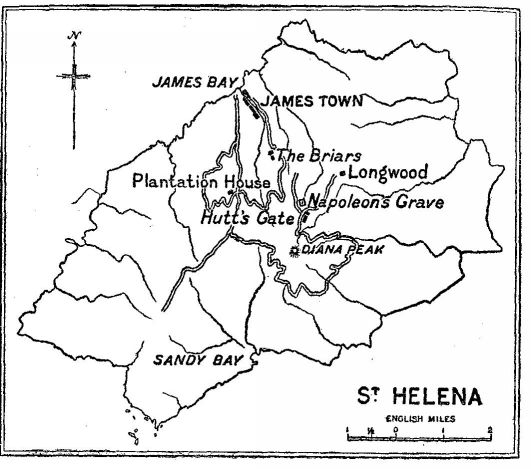
"Napoleon," wrote Glover, "seemed well satisfied with the situation of Longwood, and expressed a desire to occupy it as soon as possible." As he disliked the publicity of the house in Jamestown, Cockburn suggested on their return that he should reside at a pretty little bungalow, not far from the town, named "The Briars." He readily assented, and took up his abode there for seven weeks, occupying a small adjoining annexe, while Las Cases and his son established themselves in the two[pg.541] garrets. A marquee was erected to serve as dining-room. It was a narrow space for the lord of the Tuileries, but he seems to have been not unhappy. There he dictated Memoranda to Las Cases or Gourgaud in the mornings, and often joined the neighbouring family of the Balcombes for dinner and the evening. Mr. Balcombe, an elderly merchant, was appointed purveyor to the party; he and his wife were most hospitable, and their two daughters, of fifteen and fourteen years, frequently beguiled Napoleon's evening hours with games of whist or naïve questions. On one supreme occasion, in order to please the younger girl, Napoleon played at blindman's buff; at such times she ventured to call him "Boney"; and, far from taking offence at this liberty, he delighted in her glee. It is such episodes as these that reveal the softer traits of his character, which the dictates of policy had stunted but not eradicated.[554]
In other respects, the time at "The Briars" was dull and monotonous, and he complained bitterly to Cockburn of the inadequate accommodation. The most exciting times were on the arrival of newspapers from Europe. The reports just to hand of riots in England and royalist excesses in France fed his hopes of general disorders or revolutions which might lead to his recall. He believed the Jacobins would yet lord it over the Continent. "It is only I who can tame them."
Equally noteworthy are his comments on the trials of Labédoyère and Ney for their treason to Louis XVIII. He has little pity for them. "One ought never to break one's word," he remarked to Gourgaud, "and I despise traitors." On hearing that Labédoyère was condemned to death, he at first shows more feeling: but he comes round to the former view: "Labédoyère acted like a man without honour," and "Ney dishonoured himself."[555]
We may hereby gauge [pg.542] the value which Napoleon laid on fidelity. For him it is the one priceless virtue. He esteems those who staunchly oppose him, and seeks to gain them over by generosity: for those who come over he ever has a secret contempt; for those who desert him, hatred. Doubtless that is why he heard the news of Ney's execution unmoved. Brilliantly brave as the Marshal was, he had abandoned him in 1814, and Louis XVIII. in the Hundred Days. The tidings of Murat's miserable fate, at the close of his mad expedition to Calabria, leave Napoleon equally cold.—"I announce the fatal news," writes Gourgaud, "to His Majesty, whose expression remains unchanged, and who says that Murat must have been mad to attempt a venture like that."—Here again his thoughts seem to fly back to Murat's defection in 1814. Later on, he says he loved him for his brilliant bravery, and therefore pardoned his numerous follies. But his present demeanour shows that he never forgave that of 1814.[556]
Meanwhile, thanks to the energy of Cockburn and his sailors, Longwood was ready for the party (December 9th, 1815), and the Admiral hoped that their complaints would cease. The new abode contained five rooms for Napoleon's use, three for the Montholons, two for the Las Cases, and one for Gourgaud: it was situated on a plateau 1,730 feet above the sea: the air there was bracing, and on the farther side of the plain dotted with gum trees stretched the race-course, a mile and a half of excellent turf. The only obvious drawbacks were the occasional mists, and the barren precipitous ravines that flank the plateau on all sides. Seeing, however, that Napoleon disliked the publicity of Jamestown, the isolation of Longwood could hardly be alleged as a serious grievance. The Bertrands occupied Hutt's Gate, a small villa about a mile distant.
The limits within which Napoleon might take exercise unaccompanied by a British officer formed a roughly[pg.543] triangular space having a circumference of about twelve miles. Outside of those bounds he must be so accompanied; and if a strange ship came in sight, he was to return within bounds. The letters of the whole party must be supervised by the acting Governor. This is the gist of the official instructions. Napoleon's dislike of being accompanied by a British officer led him nearly always to restrict himself to the limits and generally to the grounds of Longwood.
And where, we may ask, could a less unpleasant place of detention have been found? In Europe he must inevitably have submitted to far closer confinement. For what safeguards could there have been proof against a subtle intellect and a personality whose charm fired thousands of braves in both hemispheres with the longing to start him once more on his adventures? The Tower of London, the eyrie of Dumbarton Castle, even Fort William itself, were named as possible places of detention. Were they suited to this child of the Mediterranean? He needed sun; he needed exercise; he needed society. All these he could have on the plateau of Longwood, in a singularly equable climate, where the heat of the tropics is assuaged by the south-east trade wind, and plants of the sub-tropical and temperate zones alike flourish.[557]
But nothing pleased the exiles. They moped during the rains; they shuddered at the yawning ravines; they groaned at the sight of the red-coats; above all, they realized that escape was hopeless in face of Cockburn's watchful care. His first steps on arriving at the island were to send on to the Cape seventy-five foreigners whose[pg.544] presence was undesirable. He also despatched the "Peruvian" to hoist the British flag on the uninhabited island, Ascension, in order, as he wrote to the Admiralty, "to prevent America or any other nation from planting themselves [sic] there ... for the purpose of favouring sooner or later the escape of General Bonaparte." Four ships of war were also kept at St. Helena, and no merchantmen but those of the East India Company were to touch there except under stress of weather or when in need of water.
These precautions early provoked protests from the exiles. Bertrand had no wish to draw them up in the trenchant style that the ex-Emperor desired; but Gourgaud's "Journal" shows that he was driven on to the task (November 5th). It only led to a lofty rejoinder from Cockburn, in which he declined to relax his system, but expressed the wish to render their situation "as little disagreeable as possible." On December 21st, Montholon returned to the charge with a letter dictated by Napoleon, complaining that Longwood was the most barren spot on the island, always deluged with rain or swathed in mist; that O'Meara was not to count as a British officer when they went beyond the limits, and had been reprimanded by the Admiral for thus acting; and that the treatment of the exiles would excite the indignation of all times and all people. To this the Admiral sent a crushing rejoinder, declining to explain why he had censured O'Meara or any other British subject: he asserted that Longwood was "the most pleasant as well as the most healthy spot of this most healthful island," expressed the hope that, when the rains had ceased, the party would change their opinion of Longwood, and declared that the treatment of the party would "obtain the admiration of future ages, as well as of every unprejudiced person of the present."
We now know that the Admiral's trust in the judicial impartiality of future ages was a piece of touching credulity, and that the next generation, like his own, was greedily to swallow sensational slander and to neglect the prosaic[pg.545] truth. But, arguing from present signs, he might well believe that Montholon's letter was a tissue of falsehoods; for that officer soon confessed to him that "it was written in a moment of petulance of the General [Bonaparte] ... and that he [Montholon] considered the party to be in point of fact vastly well off and to have everything necessary for them, though anxious that there should be no restrictions as to the General going unattended by an officer wherever he pleased throughout the island."[558] On the last point Cockburn was inflexible.
The Admiral's responsibility was now nearly at an end. On April 14th, 1816, there landed at St. Helena Sir Hudson Lowe, the new Governor, who was to take over the powers wielded both by Cockburn and Wilks. The new arrival, on whom the storms of calumny were thenceforth persistently to beat, had served with distinction in many parts. Born in 1769, within one month of Napoleon, he early entered our army, and won his commission by service in Corsica and Elba, his linguistic and military gifts soon raising him to the command of a corps of Corsican exiles who after 1795 enlisted in our service. With these "Corsican Rangers" Lowe campaigned in Egypt and finally at Capri, their devotion to him nerving them to a gallant but unavailing defence of this islet against a superior force of Murat's troops in 1808.[559] In 1810 Lowe and his Corsicans captured the Isle of Santa Maura, which he thereafter governed to the full satisfaction of the inhabitants. Early in 1813 he was ordered to Russia, and thereafter served as attaché on Blücher's staff in the memorable advance to the Rhine and the Seine. He brought the news of Napoleon's first abdication to England, was knighted by the Prince Regent, and received Russian and Prussian orders of distinction for his[pg.546] services. At the close of 1814 he was appointed Quartermaster-General of our forces in the Netherlands and received flattering letters of congratulation from Blücher and Gneisenau, the latter expressing his appreciation of "Your rare military talents, your profound judgment on the great operations of war, and your imperturbable sang froid in the day of battle. These rare qualities and your honourable character will link me to you eternally." In 1822, when O'Meara was slandering Lowe's character, the Czar Alexander met his step-daughter, the Countess Balmain, at Verona, and in reference to Sir Hudson's painful duties at St. Helena, said of him: "Je l'estime beaucoup. Je l'ai connu dans les temps critiques."[560]
Lowe's firmness of character, command of foreign languages, and intimate acquaintance with Corsicans, seemed to mark him out as the ideal Governor of St. Helena in place of the mild and scholarly Wilks. And yet the appointment was in some ways unfortunate. Though a man of sterling worth, Lowe was reserved, and had little acquaintance with the ways of courtiers. Moreover, the superstitious might deem that all the salient events of his career proclaimed him an evil genius dogging the steps of Napoleon; and, as superstition laid increasing hold on the great Corsican in his later years, we may reasonably infer that this feeling intensified, if it did not create, the repugnance which he ever manifested to la figure sinistre of the Governor. Lowe also at first shrank from an appointment that must bring on him the intrigues of Napoleon and of his partisans in England. Only a man of high rank and commanding influence could hope to live down such attacks; and Lowe had neither rank nor influence. He was the son of an army surgeon, and was almost unknown in the country which for twenty-eight years he had served abroad.
His first visits to Longwood were unfortunate. Cockburn and he arranged to go at 9 a.m., the time when Napoleon frequently went for a drive. On their arrival they were informed that the Emperor was indisposed[pg.547] and could not see them until 4 p.m. of the next day, and it soon appeared that the early hour of their call was taken as an act of rudeness. On the following afternoon Lowe and Cockburn arranged to go in together to the presence; but as Lowe advanced to the chamber, Bertrand stepped forward, and a valet prevented the Admiral's entrance, an act of incivility which Lowe did not observe. Proceeding alone, the new Governor offered his respects in French; but on Napoleon remarking that he must know Italian, for he had commanded a regiment of Corsicans, they conversed in Napoleon's mother-tongue. The ex-Emperor's first serious observation, which bore on the character of the Corsicans, was accompanied by a quick searching glance: "They carry the stiletto: are they not a bad people?"—Lowe saw the snare and evaded it by the reply: "They do not carry the stiletto, having abandoned that custom in our service: I was very well satisfied with them." They then conversed a short time about Egypt and other topics. Napoleon afterwards contrasted him favourably with Cockburn: "This new Governor is a man of very few words, but he appears to be a polite man: however, it is only from a man's conduct for some time that you can judge of him."[561]
Cockburn was indignant at the slight put upon him by Napoleon and Bertrand, which succeeded owing to Lowe's want of ready perception; but he knew that the cause of the exiles' annoyance was his recent firm refusal to convey Napoleon's letter of complaint direct to the Prince Regent, without the knowledge of the Ministry. Failing to bend the Admiral, they then sought to cajole the retiring Governor, Wilks, who, having borne little of the responsibility of their custody, was proportionately better liked. First Bertrand, and then Napoleon, requested him to take this letter without the knowledge of the new Governor. Wilks at once repelled the request, remarking to Bertrand that such attempts at evasion must lead to greater stringency in the future. And this[pg.548] was the case.[562] The incident naturally increased Lowe's suspicion of the ex-Emperor.
At first there was an uneasy truce between them. Gourgaud, though cast down at the departure of the "adorable" Miss Wilks, found strength enough to chronicle in his "Journal" the results of a visit paid by Las Cases to Lowe at Plantation House (April 26th): the Governor received the secretary very well and put all his library at the disposal of the party; but the diarist also notes that Napoleon took amiss the reception of any of his people by the Governor. This had been one of the unconscious crimes of the Admiral. With the hope of brightening the sojourn of the exiles, he had given several balls, at which Mmes. Bertrand and Montholon shone resplendent in dresses that cast into the shade those of the officers' wives. Their triumph was short-lived. When la grande Maréchale ventured to desert the Emperor's table on these and other festive occasions, her growing fondness for the English drew on her sharp rebukes from the ex-Emperor and a request not to treat Longwood as if it were an inn.[563] Many jottings in Gourgaud's diary show that the same policy was thenceforth strictly maintained. Napoleon kept up the essentials of Tuileries etiquette, required the attendance of his courtiers, and jealously checked any familiarity with Plantation House or Jamestown.
On some questions Lowe was more pliable than the home Government, notably in the matter of the declarations signed by Napoleon's followers. But in one matter he was proof against all requests from Longwood: this was the extension of the twelve-mile limit. It afterwards became the custom to speak as if Lowe could have granted this. Even the Duke of Wellington declared to Stanhope that he considered Lowe a stupid man, suspicious and jealous, who might very well have let Napoleon go freely about the island provided that[pg.549] the six or seven landing-places were well guarded and that Napoleon showed himself to a British officer every night and morning. Now, it is futile to discuss whether such liberty would have enabled Napoleon to pass off as someone else and so escape. What is certain is that our Government, believing he could so escape, imposed rules which Lowe was not free to relax.
Napoleon realized this perfectly well, but in the interview of April 30th, 1816, he pressed Lowe for an extension of the limits, saying that he hated the sight of our soldiers and longed for closer intercourse with the inhabitants. Other causes of friction occurred, such as Lowe's withdrawal of the privilege, rather laxly granted by Cockburn to Bertrand, of granting passes for interviews with Napoleon; or again a tactless invitation that Lowe sent to "General Bonaparte" to meet the wife of the Governor-General of India at dinner at Plantation House. But in the midst of the diatribe which Napoleon shortly afterwards shot forth at his would-be host—a diatribe besprinkled with taunts that Lowe was sent to be his executioner—there came a sentence which reveals the cause of his fury: "If you cannot extend my limits, you can do nothing for me."[564]
Why this wish for wider limits? It did not spring from a desire for longer drives; for the plateau offered nearly all the best ground in the island for such exercise. Neither was it due to a craving for wider social intercourse. There can be little doubt that he looked on an extension of limits as a necessary prelude to attempts at escape and as a means of influencing the slaves at the outlying plantations. Gourgaud names several instances of gold pieces being given to slaves, and records the glee shown by his master on once slipping away from the sentries and the British officer. These feelings and attempts were perfectly natural on Napoleon's part; but it was equally natural that the Governor should regard them as part of a plan of escape or rescue—a matter that will engage our closer attention presently.[pg.550]
Napoleon had only two more interviews with Lowe namely, on July 17th and August 18th. In the former of these he was more conciliatory; but in the latter, at which Admiral Sir Pulteney Malcolm was present, he assailed the Governor with the bitterest taunts. Lowe cut short the painful scene by saying: "You make me smile, sir." "How smile, sir?" "You force me to smile: your misconception of my character and the rudeness of your manners excite my pity. I wish you good day." The Admiral also retired.[565]
Various causes have been assigned for the hatred that Napoleon felt for Lowe. His frequents taunts that he was no general, but only a leader of Corsican deserters, suggests one that has already been referred to. It has also been suggested that Lowe was not a gentleman, and references have been approvingly made to comparisons of his physiognomy with that of the devil, and of his eye with "that of a hyæna caught in a trap." As to this we will cite the opinion of Lieutenant (later Colonel) Basil Jackson, who was unknown to Lowe before 1816, and was on friendly terms with the inmates both of Longwood and of Plantation House:
"He [Lowe] stood five feet seven, spare in make, having good features, fair hair, and eyebrows overhanging his eyes: his look denoted penetration and firmness, his manner rather abrupt, his gait quick, his look and general demeanour indicative of energy and decision. He wrote or dictated rapidly, and was fond of writing, was well read in military history, spoke French and Italian with fluency, was warm and steady in his friendships, and popular both with the inhabitants of the isle and the troops. His portrait, prefixed to Mr. Forsyth's book, is a perfect likeness."[566][pg.551]
If overhanging eyebrows, a penetrating glance, and rather abrupt manners be thought to justify comparisons with the devil or a hyæna, the art of historical portraiture will assuredly have to be learnt over again in conformity with impressionist methods. That Lowe was a gentleman is affirmed by Mrs. Smith (née Grant), who, in later years, when prejudiced against him by O'Meara's slanders, met him at Colombo without at first knowing his name:
"I was taken in to dinner by a grave, particularly gentlemanly man, in a General's uniform, whose conversation was as agreeable as his manner. He had been over half the world, knew all celebrities, and contrived without display to say a great deal one was willing to hear.... Years before, with our Whig principles and prejudices, we had cultivated in our Highland retirement a horror of the great Napoleon's gaoler. The cry of party, the feeling for the prisoner, the book of Surgeon O'Meara, had all worked my woman's heart to such a pitch of indignation that this maligned name [Lowe] was an offence. We were to hold the owner in abhorrence. Speak to him, never! Look at him, sit in the same room with him, never! None were louder than I, more vehement; yet here was I beside my bugbear and perfectly satisfied with my position. It was a good lesson."[567]
The real cause of Napoleon's hatred of Lowe is hinted at by Sir George Bingham in his Diary (April 19th). After mentioning Napoleon's rudeness to Cockburn on parting with him, he proceeds:
"You have no idea of the dirty little intrigues of himself [Napoleon] and his set: if Sir H. Lowe has firmness enough not to give way to them, he will in a short time treat him in the same manner. For myself, it is said I am a favourite [of Napoleon], though I do not understand the claim I have to such."[568][pg.552]
Yes! Lowe's offence lay not in his manners, not even in his features, but in his firmness. Napoleon soon saw that all his efforts to bend him were in vain. Neither in regard to the Imperial title, nor the limits, nor the transmission of letters to Europe, would the Governor swerve a hair's breadth from his instructions. At the risk of giving a surfeit of quotations, we must cite two more on this topic. Basil Jackson, when at Paris in 1828, chanced to meet Montholon, and was invited to his Château de Frémigny; during his stay the conversation turned upon their sojourn at St. Helena, to the following effect:
"He [Montholon] enlarged upon what he termed la politique de Longwood, spoke not unkindly of Sir Hudson Lowe, allowing he had a difficult task to execute, since an angel from Heaven, as Governor, could not have pleased them. When I more than hinted that nothing could justify detraction and departure from truth in carrying out a policy, he merely shrugged his shoulders and reiterated: 'C'était notre politique; et que voulez-vous?' That he and the others respected Sir Hudson Lowe, I had not the shadow of a doubt: nay, in a conversation with Montholon at St. Helena, when speaking of the Governor, he observed that Sir Hudson was an officer who would always have distinguished employment, as all Governments were glad of the services of a man of his calibre.
"Happening to mention that, owing to his inability to find an officer who could understand and speak French, the Governor was disposed to employ me as orderly officer at Longwood, Montholon said it was well for me that I was not appointed to the post, as they did not want a person in that capacity who could understand them; in fact, he said, we should have found means to get rid of you, and perhaps ruined you."[569][pg.553]
Las Cases also, in a passage that he found it desirable to suppress when he published his "Journal" wrote as follows (November 30th, 1815):
"We are possessed of moral arms only: and in order to make the most advantageous use of these it was necessary to reduce into a system our demeanour, our words, our sentiments, even our privations, in order that we might thereby excite a lively interest in a large portion of the population of Europe, and that the Opposition in England might not fail to attack the Ministry on the violence of their conduct towards us."[570]
We are now able to understand the real nature of the struggle that went on between Longwood and Plantation House. Napoleon and his followers sought by every means to bring odium upon Lowe, and to furnish the Opposition at Westminster with toothsome details that might lead to the disgrace of the Governor, the overthrow of the Ministry, and the triumphant release of the ex-Emperor. On the other hand, the knowledge of the presence of traitors on the island, and of possible rescuers hovering about on the horizon, kept Lowe ever at work "unravelling the intricate plotting constantly going on at Longwood," until his face wore the preoccupied worried look that Surgeon Henry describes.
That both antagonists somewhat overacted their parts does not surprise us when we think of the five years thus spent within a narrow space and under a tropical sun. Lowe was at times pedantic, witness his refusal to forward to Longwood books inscribed to the "Emperor Napoleon," and his suspicions as to the political significance of green and white beans offered by Montholon to the French Commissioner, Montchenu. But such incidents can be paralleled from the lives of most officials who bear a heavy burden of responsibility. And who has ever borne a heavier burden?[571][pg.554]
Napoleon also, in his calmer moods, regretted the violence of his language to the Governor. He remarked to Montholon: "This is the second time in my life that I have spoilt my affairs with the English. Their phlegm leads me on, and I say more than I ought. I should have done better not to have replied to him." This reference to his attack on Whitworth in 1803 flashes a ray of light on the diatribe against Lowe. In both cases, doubtless, the hot southron would have bridled his passion sooner, had it produced any visible effect on the colder man of the north. Nevertheless, the scene of August 18th, 1816, had an abiding influence on his relations with the Governor. For the rest of that weary span of years they never exchanged a word.
Lowe's official reports prove that he did not cease to consult the comfort of the exiles as far as it was possible. The building of the new house, however, remained in abeyance, as Napoleon refused to give any directions on the subject: and the much-needed repairs to Longwood were stopped owing to his complaints of the noise of the workmen. But by ordering the claret that the ex-Emperor preferred, and by sending occasional presents of game to Longwood, Lowe sought to keep up the ordinary civilities of life; and when the home Government sought to limit the annual cost of the Longwood household to £8,000, Lowe took upon himself to increase that sum by one half.
Napoleon's behaviour in this last affair is noteworthy. On hearing of the need for greater economy, he readily assented, sent away seven servants, and ordered a [pg.555] reduction in the consumption of wine. A day or two later, however, he gave orders that some of his silver plate should be sold in order "to provide those little comforts denied them." Balcombe was accordingly sent for, and, on expressing regret to Napoleon at the order for sale, received the reply: "What is the use of plate when you have nothing to eat off it?" Lowe quietly directed Balcombe to seal up the plate sent to him, and to advance money up to its value (£250); but other portions of the plate were broken and sold later on. O'Meara reveals the reason for these proceedings in his letter of October 10th: "In this he [Napoleon] has also a wish to excite odium against the Governor by saying that he has been obliged to sell his plate in order to provide against starvation, as he himself told me was his object."[572]
Another incident that embittered the relations between Napoleon and the Governor was the arrival from England of more stringent regulations for his custody. The chief changes thus brought about (October 9th, 1816) were a restriction of the limits from a twelve-mile to an eight-mile circumference and the posting of a ring of sentries at a slight distance from Longwood at sunset instead of at 9 p.m.[573] The latter change is to be regretted; for it marred the pleasure of Napoleon's evening strolls in his garden; but, as the Governor pointed out, the three hours after sunset had been the easiest time for escape. The restriction of limits was needful, not only in order to save our troops the labour of watching a wide area that was scarcely ever used for exercise, but also to prevent underhand intercourse with slaves.[pg.556]
Was there really any need for these "nation-degrading" rules, as O'Meara called them? Or were they imposed in order to insult the great man? A reference to the British archives will show that there was some reason for them. Schemes of rescue were afoot that called for the greatest vigilance.
As we have seen (page 527, note), a letter had on August 2nd, 1815, been directed to Mme. Bertrand (really for Napoleon) at Plymouth, stating that the writer had placed sums of money with well-known firms of Boston, New York, Philadelphia, and Charlestown on his behalf, and that he (Napoleon) had only to make known his wishes "avec le thé de la Chine ou les mousselines de l'Inde": for the rest, the writer hoped much from English merchantmen. This letter, after wide wanderings, fell into our hands and caused our Government closely to inspect all letters and merchandise that passed into, or out of, St. Helena. Its attention was directed specially to the United States. There the Napoleonic cult had early taken root, thanks to his overthrow of the kings and his easy sale of Louisiana; the glorifying haze of distance fostered its growth; and now the martyrdom of St. Helena brought it to full maturity. Enthusiasm and money alike favoured schemes of rescue.
In our St. Helena Records (No. 4) are reports as to two of them. Forwarded by the Spanish Ambassador at Washington, the first reached Madrid on May 9th, 1816, and stated that a man named Carpenter had offered to Joseph Bonaparte (then in the States) to rescue Napoleon, and had set sail on a ship for that purpose. This was at once made known to Lord Bathurst, our Minister for War and the Plantations, who forwarded it to Lowe. In August of that year our Foreign Office also received news that four schooners and other smaller vessels had set sail from Baltimore on June 14th with 300 men under an old French naval officer, named Fournier, ostensibly to help Bolivar, but really to rescue Bonaparte. These fast-sailing craft were to lie out of sight of the island by day,[pg.557] creep up at night to different points, and send boats to shore; from each of these a man, in English uniform, was to land and proceed to Longwood, warning Napoleon of the points where the boats would be ready to receive him. The report concludes: "Considerable sums in gold and diamonds will be put at his disposal to bribe those who may be necessary to him. They seem to flatter themselves of a certain co-operation on the part of certain individuals domiciled or employed at St. Helena."[574]
Bathurst sent on to Lowe a copy of this intelligence. Forsyth does not name the affair, though he refers to other warnings, received at various times by Bathurst and forwarded to the Governor, that there were traitors in the island who had been won over by Napoleon's gold to aid his escape.[575] I cannot find out that the plans described above were put to the test, though suspicious vessels sometimes appeared and were chased away by our cruisers. But when we are considering the question whether Bathurst and Lowe were needlessly strict or not, the point at issue is whether plans of escape or rescue existed, and if so, whether they knew of them. As to this there cannot be the shadow of doubt; and it is practically certain that they were the cause of the new regulations of October 9th, 1816.
We have now traced the course of events during the first critical twelvemonth; we have seen how friction burst into a flame, how the chafing of that masterful spirit against all restraint served but to tighten the[pg.558] inclosing grasp, and how the attempts of his misguided friends in America and Europe changed a fairly lax detention into actual custody. It is a vain thing to toy with the "might-have-beens" of history; but we can fancy a man less untamable than Napoleon frankly recognizing that he had done with active life by assuming a feigned name (e.g., that of Colonel Muiron, which he once thought of) and settling down in that equable retreat to the congenial task of compiling his personal and military Memoirs. If he ever intended to live as a country squire in England, there were equal facilities for such a life in St. Helena, with no temptations to stray back into politics. The climate was better for him than that of England, and the possibilities for exercise greater than could there have been allowed. Books there were in abundance—2,700 of them at last: he had back files of the "Moniteur" for his writings, and copies of "The Times" came regularly from Plantation House: a piano had been bought in England for £120. Finally there were the six courtiers whose jealous devotion, varying moods, and frequent quarrels furnished a daily comedietta that still charms posterity.
What then was wanting? Unfortunately everything was wanting. He cared not for music, or animals, or, in recent years, for the chase. He himself divulged the secret, in words uttered to Gallois in the days of his power: "Je n'aime pas beaucoup les femmes, ni le jeu—enfin rien: je suis tout à fait un être politique!"—He never ceased to love politics and power. At St. Helena he pictured himself as winning over the English, had he settled there. Ah! if I were in England, he said, I should have conquered all hearts.[576] And assuredly he would have done so. How could men so commonplace as the Prince Regent, Liverpool, Castlereagh, and Bathurst have made head against the influence of a truly great and enthralling personality? Or if he had gone to the United States, who would have competed with him for the Presidency?[pg.559]
As it was, he chose to remain indoors, in order to figure as the prisoner of Longwood,[577] and spent his time between intrigues against Lowe and dictation of Memoirs. On the subject of Napoleon's writings we cannot here enter, save to say that his critiques of Cæsar, Turenne, and Frederick the Great, are of great interest and value; that the records of his own campaigns, though highly suggestive, need to be closely checked by the original documents, seeing that he had not all the needful facts and figures at hand; and that his record of political events is in the main untrustworthy: it is an elaborate device for enhancing the Napoleonic tradition and assuring the crown to the King of Rome.
We turn, then, to take a brief glance at his last years. The first event that claims notice is the arrest of Las Cases. This subtle intriguer had soon earned the hatred of Montholon and Gourgaud, who detested "the little Jesuit" for his Malvolio-like airs of importance and the hints of Napoleon that he would have ceremonial precedence over them. His rapid rise into favour was due to his conversational gifts, literary ability, and thorough knowledge of the English people and language. This last was specially important. Napoleon very much wished to learn our language, as he hoped that any mail might bring news of the triumph of the Whigs and an order for his own departure for England. His studies with Las Cases were more persevering than successful, as will be seen from the following curious letter, written apparently in the watches of the night: it has been recently re-published by M. de Brotonne.
"COUNT LASCASES,
"Since sixt week y learn the English and y do not any progress. Sixt week do fourty and two day. If might have learn fivty word, for day, i could know it two thousands and two hundred. It is in the dictionary more of fourty thousand: even he could most twenty; bot much of tems. For know it[pg.560] or hundred and twenty week, which do more two years. After this you shall agree that the study one tongue is a great labour who it must do into the young aged."
How much farther Napoleon progressed in his efforts to absorb our language by these mathematical methods we do not know; for no other English letter of his seems to be extant. The arrest and departure of his tutor soon occurred, and there are good grounds for assigning this ultimately to the jealousy of the less cultured Generals. Thus, we find Gourgaud asserting that Las Cases has come to St. Helena solely "in order to get talked about, write anecdotes, and make money." Montholon also did his best to render the secretary's life miserable, and on one occasion predicted to Gourgaud that Las Cases would soon leave the island.[578]
The forecast speedily came true. The secretary intrusted to his servant, a dubious mulatto named Scott, two letters for Europe sewn up in a waistcoat: one of them was a long letter to Lucien Bonaparte. The servant showed the letters to his father, who in some alarm revealed the matter to the Governor. It is curious as illustrating the state of suspicion then prevalent at St. Helena, that Las Cases accused the Scotts of being tools of the Governor; that Lowe saw in the affair the frayed end of a Longwood scheme; while the residents there suspected Las Cases of arranging matters as a means of departure from the island. There was much to justify this last surmise. Las Cases and his son were unwell; their position in the household was very uncomfortable; and for a skilled intriguer to intrust an important letter to a slave, who was already in the Governor's black books, was truly a singular proceeding. Besides, after the arrest, when the Governor searched Las Cases' papers in his presence, they were found to be in good[pg.561] order, among them being parts of his "Journal." Napoleon himself thought Las Cases guilty of a piece of extraordinary folly, though he soon sought to make capital out of the arrest by comparing the behaviour of our officers and their orderlies with "South Sea savages dancing around a prisoner that they are about to devour."[579] After a short detention at Ross Cottage, when he declined the Governor's offer that he should return to Longwood, the secretary was sent to the Cape, and thence made his way to France, where a judicious editing of his "Memoirs" and "Journal" gained for their compiler a rich reward.
Gourgaud is the next to leave. The sensitive young man has long been tormented by jealousy. His diary becomes the long-drawn sigh of a generous but vain nature, when soured by real or fancied neglect. Though often unfair to Napoleon, whose egotism the slighted devotee often magnifies into colossal proportions, the writer unconsciously bears witness to the wondrous fascination that held the little Court in awe. The least attention shown to the Montholons costs "Gogo" a fit of spleen or a sleepless night, scarcely to be atoned for on the morrow by soothing words, by chess, or reversi, or help at the manuscript of "Waterloo." Again and again Napoleon tries to prove to him that the Montholons ought to have precedence: it is in vain. At last the crisis comes: it is four years since the General saved the Emperor from a Cossack's lance at Brienne, and the recollection renders his present "humiliations" intolerable. He challenges Montholon to a duel; Napoleon strictly forbids it; and the aggrieved officer seeks permission to depart.
Napoleon grants his request. It seems that the chief is weary of his moody humours; he further owes him a[pg.562] grudge for writing home to his mother frank statements of the way in which the Longwood exiles are treated. These letters were read by Lowe and Bathurst, and their general purport seems to have been known in French governmental circles, where they served as an antidote to the poisonous stories circulated by Napoleon and his more diplomatic followers. Clearly nothing is to be made of Gourgaud; and so he departs (February 13th, 1818). Bidding a tearful adieu, he goes with Basil Jackson to spend six weeks with him at a cottage near Plantation House, when he is astonished at the delicate reserve shown by the Governor. He then sets sail for England. The only money he has is £100 advanced by Lowe. Napoleon's money he has refused to accept.[580]
And yet he did not pass out of his master's life. Landing in England on May 1st, he had a few interviews with our officials, in which he warned them that Napoleon's escape would be quite easy, and gave a hint as to O'Meara being the tool of Napoleon. But soon the young General came into touch with the leaders of the Opposition. No change in his sentiments is traceable until August 25th, when he indited a letter to Marie Louise, asserting that Napoleon was dying "in the torments of the longest and most frightful agony," a prey to the cruelty of England! To what are we to attribute this change of front? The editors of Gourgaud's "Journal" maintain that there was no change; they hint that the "Journal" may have been an elaborate device for throwing dust into Lowe's eyes; and they point to the fact that before leaving the island Gourgaud received secret instructions from Napoleon bidding him convey to Europe several small letters sewn into the soles of his boots. Whether he acted on these instructions may be doubted; for at his departure he gave his word of honour to Lowe that he was not the bearer of any paper, pamphlet, or letter from Longwood. Furthermore, we hear nothing of these secret letters afterwards; and he allowed[pg.563] nearly four months to elapse in England before he wrote to Marie Louise. The theory referred to above seems quite untenable in face of these facts.[581]
How, then, are we to explain Gourgaud's conduct at St. Helena and afterwards? Now, in threading the mendacious labyrinths of St. Helena literature it is hard ever to find a wholly satisfactory clue; but Basil Jackson's "Waterloo and St. Helena" (p. 103) seems to supply it in the following passage:
"To finish about Gourgaud, I may add that on his reaching England, after one or two interviews with the Under-Secretary of State, he fell into the hands of certain Radicals of note, who represented to him the folly of his conduct in turning against Napoleon; that, as his adherent, he was really somebody, whereas he was only ruining himself by appearing inimical. In short, they so worked upon the poor weak man, that he was induced to try and make it appear that he was still l'homme de l'Empereur: this he did by inditing a letter to Marie Louise, in which he inveighed against the treatment of Napoleon at the hands of the Government and Sir H. Lowe, which being duly published, Gourgaud fell to zero in the opinion of all right-minded persons."
This seems consonant with what we know of Gourgaud's character: frank, volatile, and sensitive, he could never have long sustained a policy of literary and diplomatic deceit. He was not a compound of Chatterton and Fouché. His "Journal" is the artless outpouring of wounded vanity and brings us close to the heart of the hero-worshipper and his hero. At times the idol falls and is shivered but love places it on the shrine again and again, until the fourth anniversary of Brienne finds the spell broken. Even before he leaves St. Helena the old fascination is upon him once more; and then Napoleon seeks to utilize his devotion for the purpose of a political mission. Gourgaud declines the rôle of agent, pledges his word to the Governor, and keeps it; but, thanks to[pg.564] British officialism or the seductions of the Opposition, hero-worship once more gains the day and enrolls him beside Las Cases and Montholon. This we believe to be the real Gourgaud, a genuine, lovable, but flighty being, as every page of his "Journal" shows.
One cannot but notice in passing the extraordinary richness of St. Helena literature. Nearly all the exiles kept diaries or memoirs, or wrote them when they returned to Europe. And, on the other hand, of all the 10,000 Britons whom Napoleon detained in France for eleven years, not one has left a record that is ever read to-day. Consequently, while the woes of Napoleon have been set forth in every civilized tongue, the world has forgotten the miseries causelessly inflicted on 10,000 English families. The advantages possessed by a memoir-writing nation over one that is but half articulate could not be better illustrated. For the dumb Britons not a single tear is ever shed; whereas the voluble inmates of Longwood used their pens to such effect that half the world still believes them to have been bullied twice a week by Lowe, plied with gifts of poisoned coffee, and nearly eaten up by rats at night. On this last topic we are treated to tales of part of a slave's leg being eaten off while he slept at Longwood—nay, of a horse's leg also being gnawed away at night—so that our feelings are divided between pity for the sufferers and envy at the soundness of their slumbers.
Longwood was certainly far from being a suitable abode; but a word from Napoleon would have led to the erection of the new house on a site that he chose to indicate. The materials had all been brought from England; but the word was not spoken until a much later time; and the inference is inevitable that he preferred to remain where he was so that he could represent himself as lodged in cette grange insalubre.[582][pg.565] The third of the Longwood household to depart was the surgeon, OMeara. The conduct of this British officer in facilitating Napoleon's secret correspondence has been so fully exposed by Forsyth and Seaton that we may refer our readers to their works for proofs of his treachery. Gourgaud's "Journal" reveals the secret influence that seduced him. Chancing once to refer to the power of money over Englishmen, Napoleon remarked that that was why we did not want him to draw sums from Europe, and continued: "Le docteur n'est si bien pour moi que depuis que je lui donne mon argent. Ah! j'en suis bien sûr, de celui-là!"[583] This disclosure enables us to understand why the surgeon, after being found out and dismissed from the service, sought to blacken the character of Sir Hudson Lowe by every conceivable device. The wonder is that he succeeded in imposing his version of facts on a whole generation.
The next physician who resided at Longwood, Dr. Stokoe, was speedily cajoled into disobeying the British regulations and underwent official disgrace. An attempt was then made, through Montholon, to bribe his successor, Dr. Verling, who indignantly repelled it and withdrew from his duty.[584]
There can be no doubt that Napoleon found pleasure in these intrigues. In his last interview with Stürmer, the Austrian Commissioner at St. Helena, Gourgaud said, in reference to this topic: "However unhappy he [Napoleon] is here, he secretly enjoys the importance attached to his custody, the interest that the Powers take in it, and the care taken to collect his least words." Napoleon also once remarked to Gourgaud that it was better to be at St. Helena than as he was at Elba.[585] Of the same general[pg.566] tenour are his striking remarks, reported by Las Cases at the close of his first volume:
"Our situation here may even have its attractions. The universe is looking at us. We remain the martyrs of an immortal cause: millions of men weep for us, the fatherland sighs, and Glory is in mourning. We struggle here against the oppression of the gods, and the longings of the nations are for us.... Adversity was wanting to my career. If I had died on the throne amidst the clouds of my omnipotence, I should have remained a problem for many men: to-day, thanks to misfortune, they can judge of me naked as I am."
In terseness of phrase, vividness of fancy, and keenness of insight into the motives that sway mankind, this passage is worthy of Napoleon. He knew that his exile at St. Helena would dull the memory of the wrongs which he had done to the cause of liberty, and that from that lonely peak would go forth the legend of the new Prometheus chained to the rock by the kings and torn every day by the ravening vulture. The world had rejected his gospel of force; but would it not thrill responsive to the gospel of pity now to be enlisted in his behalf? His surmise was amazingly true. The world was thrilled. The story worked wonders, not directly for him, but for his fame and his dynasty. The fortunes of his race began to revive from the time when the popular imagination transfigured Napoleon the Conqueror into Napoleon the Martyr. Viewed in this light, and thrown up into telling relief against the sinister policy of the Holy Alliance of the monarchs, the dreary years spent at St. Helena were not the least successful of his career. Without them there could have been no second Napoleonic Empire.
Not that his life there was a "long-drawn agony." His health was fairly good. There were seasons of something like enjoyment, when he gave himself up to outdoor recreations. Such a time was the latter part of 1819 and the first half of 1820: we may call it the Indian summer of his life, for he was then possessed with a passion for gardening. Lightly clad and protected by a [pg.567] broad-brimmed hat, he went about, sometimes spade in hand, superintending various changes in the grounds at Longwood and around the new house which was being erected for him hard by. Or at other times he used the opportunity afforded by the excavations to show how infantry might be so disposed on a hastily raised slope as to bring a terrific fire to bear on attacking cavalry. Marshalling his followers at dawn by the sound of a bell, he made them all, counts, valets, and servants, dig trenches as if for the front ranks, and throw up the earth for the rear ranks: then, taking his stand in front, as the shortest man, and placing the tallest at the rear (his Swiss valet, Noverraz), he triumphantly showed how the horsemen might be laid low by the rolling volleys of ten ranks.[586] In May or June he took once more to horse exercise, and for a time his health benefited from all this activity. His relations with the Governor were peaceful, if not cordial, and the limits were about this time extended.
Indoors there were recreations other than work at the Memoirs. He often played chess and billiards, at the latter using his hand instead of the cue! Dinner was generally at a very late hour, and afterwards he took pleasure in reading aloud. Voltaire was the favourite author, and Montholon afterwards confessed to Lord Holland that the same plays, especially "Zaïre," were read rather too often.
"Napoleon slept himself when read to, but he was very observant and jealous if others slept while he read. He watched his audience vigilantly, and 'Mme. Montholon, vous dormez' was a frequent ejaculation in the course of reading. He was animated with all that he read, especially poetry, enthusiastic at beautiful passages, impatient of faults, and full of ingenious and lively remarks on style."[587]
During this same halcyon season two priests, who had been selected by the Bonapartes, arrived in the[pg.568] island, as also a Corsican doctor, Antommarchi. Napoleon was disappointed with all three. The doctor, though a learned anatomist, knew little of chemistry, and at an early interview with Napoleon passed a catechism on this subject so badly that he was all but chased from the room. The priests came off little better. The elder of them, Buonavita by name, had lived in Mexico, and could talk of little else: he soon fell ill, and his stay in St. Helena was short. The other, a Corsican named Vignali, having neither learning, culture, nor dialectical skill, was tolerated as a respectable adjunct to the household, but had little or no influence over the master. This is to be regretted on many grounds, and partly because his testimony throws no light on Napoleon's religious views.
Here we approach a problem that perhaps can never be cleared up. Unfathomable on many sides of his nature, Napoleon is nowhere more so than when he confronts the eternal verities. That he was a convinced and orthodox Catholic few will venture to assert. At Elba he said to Lord Ebrington: "Nous ne savons d'où nous venons, ce que nous deviendrons": the masses ought to have some "fixed point of faith whereon to rest their thoughts."—"Je suis Catholique parce que mon père l'étoit, et parce que c'étoit la religion de la France." He also once or twice expressed to Campbell scorn of the popular creed: and during his last voyage, as we have seen, he showed not the slightest interest in the offer of a priest at Funchal to accompany him. At St. Helena the party seems to have limited the observances of religion to occasional reading of the Bible. When Mme. Montholon presented her babe to the Emperor, he teasingly remarked that Las Cases was the most suitable person to christen the infant; to which the mother at once replied that Las Cases was not a good enough Christian for that.
Judging from the entries in Gourgaud's "Journal," this young General pondered more than the rest on religious questions; and to him Napoleon unbosomed his thoughts.—Matter,[pg.569] he says, is everywhere and pervades everything; life, thought, and the soul itself are but properties of matter, and death ends all. When Gourgaud points to the majestic order of the universe as bearing witness to a Creator, Napoleon admits that he believes in "superior intelligences": he avers that he would believe in Christianity if it had been the original and universal creed: but then the Mohammedans "follow a religion simpler and more adapted to their morality than ours." In ten years their founder conquered half the world, which Christianity took three hundred years to accomplish. Or again, he refers to the fact that Laplace, Monge, Berthollet, and Lagrange were all atheists, though they did not proclaim the fact; as for himself, he finds the idea of God to be natural; it has existed at all times and among all peoples. But once or twice he ends this vague talk with the remarkable confession that the sight of myriad deaths in war has made him a materialist. "Matter is everything."—"Vanity of vanities!"[588]
Mirrored as these dialogues are in the eddies of Gourgaud's moods, they may tinge his master's theology with too much of gloom: but, after all, they are by far the most lifelike record of Napoleon's later years, and they show us a nature dominated by the tangible. As for belief in the divine Christ, there seems not a trace. A report has come down to us, enshrined in Newman's prose, that Napoleon once discoursed of the ineffable greatness of Christ, contrasting His enduring hold on the hearts of men with the evanescent rule of Alexander and Cæsar. One hopes that the words were uttered; but they conflict with Napoleon's undoubted statements. Sometimes he spoke in utter uncertainty; at others, as one who wished to believe in Christianity and might perhaps be converted. But in the political testament designed for his son, the only reference to religion is of the diplomatic description that we should expect from the author[pg.570] of the "Concordat": "Religious ideas have more influence than certain narrow-minded philosophers are willing to believe: they are capable of rendering great services to Humanity. By standing well with the Pope, an influence is still maintained over the consciences of a hundred millions of men."
Equally vague was Napoleon's own behaviour as his end drew nigh. For some time past a sharp internal pain—the stab of a penknife, he called it—had warned him of his doom; in April, 1821, when vomiting and prostration showed that the dread ancestral malady was drawing on apace, he bade the Abbé Vignali prepare the large dining-room of Longwood as a chapelle ardente; and, observing a smile on Antommarchi's face, the sick man hotly rebuked his affectation of superiority. Montholon, on his return to England, informed Lord Holland that extreme unction was administered before the end came, Napoleon having ordered that this should be done as if solely on Montholon's responsibility, and that the priest, when questioned on the subject, was to reply that he had acted on Montholon's orders, without having any knowledge of the Emperor's wishes. It was accordingly administered, but apparently he was insensible at the time.[589] In his will, also, he declared that he died in communion with the Apostolical Roman Church, in whose bosom he was born. There, then, we must leave this question, shrouded in the mystery that hangs around so much of his life.
The decease of a great man is always affecting: but the death of the hero who had soared to the zenith of military glory and civic achievement seems to touch the very nadir of calamity. Outliving his mighty Empire, girt around by a thousand miles of imprisoning ocean, guarded by his most steadfast enemies, his son a captive at the Court of the Hapsburgs, and his Empress openly faithless, he sinks from sight like some battered derelict. And Nature is more pitiless than man. The Governor[pg.571] urges on him the best medical advice: but he will have none of it. He feels the grip of cancer, the disease which had carried off his father and was to claim the gay Caroline and Pauline. At times he surmises the truth: at others he calls out "le foie" "le foie." Meara had alleged that his pains were due to a liver complaint brought on by his detention at St. Helena; Antommarchi described the illness as gastric fever (febbre gastrica pituitosa); and not until Dr. Arnott was called in on the 1st of April was the truth fully recognized.
At the close of the month the symptoms became most distressing, aggravated as they were by the refusal of the patient to take medicine or food, or to let himself be moved. On May 4th, at Dr. Arnott's insistence, some calomel was secretly administered and with beneficial results, the patient sleeping and even taking some food. This was his last rally: on the morrow, while a storm was sweeping over the island, and tearing up large trees, his senses began to fail: Montholon thought he heard the words France, armée, tête d'armée, Joséphine: he lingered on insensible for some hours: the storm died down: the sun bathed the island in a flood of glory, and, as it dipped into the ocean, the great man passed away.
By the Governor's orders Dr. Arnott remained in the room until the body could be medically examined—a precaution which, as Montchenu pointed out, would prevent any malicious attempt on the part of the Longwood servants to cause death to appear as the result of poisoning. The examination, conducted in the presence of seven medical men and others, proved that all the organs were sound except the ulcerated stomach; the liver was rather large, but showed no signs of disease; the heart, on the other hand, was rather under the normal size. Far from showing the emaciation that usually results from prolonged inability to take food, the body was remarkably stout—a fact which shows that that tenacious will had its roots in an abnormally firm vitality.[590][pg.572]
After being embalmed, the body was laid out in state, and all beholders were struck with the serene and beautiful expression of the face: the superfluous flesh sank away after death, leaving the well-proportioned features that moved the admiration of men during the Consulate.
Clad in his favourite green uniform, he fared forth to his resting-place under two large weeping willow trees in a secluded valley: the coffin, surmounted by his sword and the cloak he had worn at Marengo, was borne with full military honours by grenadiers of the 20th and 66th Regiments before a long line of red-coats; and their banners, emblazoned with the names of "Talavera," "Albuera," "Pyrenees," and "Orthez," were lowered in a last salute to our mighty foe. Salvos of artillery and musketry were fired over the grave: the echoes rattled upwards from ridge to ridge and leaped from the splintery peaks far into the wastes of ocean to warn the world beyond that the greatest warrior and administrator of all the ages had sunk to rest.
His ashes were not to remain in that desolate nook: in a clause of his will he expressed the desire that they should rest by the banks of the Seine among the people he had loved so well. In 1840 they were disinterred in presence of Bertrand, Gourgaud, and Marchand, and borne to France. Paris opened her arms to receive the mighty dead; and Louis Philippe, on whom he had[pg.573] once prophesied that the crown of France would one day rest, received the coffin in state under the dome of the Invalides. There he reposes, among the devoted people whom by his superhuman genius he raised to bewildering heights of glory, only to dash them to the depths of disaster by his monstrous errors.
Viewing his career as a whole, it seems just and fair to assert that the fundamental cause of his overthrow is to be found, not in the failings of the French, for they served him with a fidelity that would wring tears of pity from Rhadamanthus; not in the treachery of this or that general or politician, for that is little when set against the loyalty of forty millions of men; but in the character of the man and of his age. Never had mortal man so grand an opportunity of ruling over a chaotic Continent: never had any great leader antagonists so feeble as the rulers who opposed his rush to supremacy. At the dawn of the nineteenth century the old monarchies were effete: insanity reigned in four dynasties, and weak or time-serving counsels swayed the remainder. For several years their counsellors and generals were little better. With the exception of Pitt and Nelson, who were carried off by death, and of Wellington, who had but half an army, Napoleon never came face to face with thoroughly able, well-equipped, and stubborn opponents until the year 1812.
It seems a paradox to say that this excess of good fortune largely contributed to his ruin: yet it is true. His was one of those thick-set combative natures that need timely restraint if their best qualities are to be nurtured and their domineering instincts curbed. Just as the strongest Ministry prances on to ruin if the Opposition gives no effective check, so it was with Napoleon. Had he in his early manhood taken to heart the lessons of adversity, would he have ventured at the same time to fight Wellington in Spain and the Russian climate in the heart of the steppes? Would he have spurned the offers of an advantageous peace made to him from Prague in 1813? Would he have let slip the chance of keeping the[pg.574] "natural frontiers" of France after Leipzig, and her old boundaries, when brought to bay in Champagne? Would he have dared the uttermost at all points at Waterloo? In truth, after his fortieth year was past, the fervid energies of youth hardened in the mould of triumph; and thence came that fatal obstinacy which was his bane at all those crises of his career. For in the meantime the cause of European independence had found worthy champions—smaller men than Napoleon, it is true, but men who knew that his determination to hold out everywhere and yield nothing must work his ruin. Finally, the same clinging to unreal hopes and the same love of fight characterized his life in St. Helena; so that what might have been a time of calm and dignified repose was marred by fictitious clamours and petty intrigues altogether unworthy of his greatness.
For, in spite of his prodigious failure, he was superlatively great in all that pertains to government, the quickening of human energies, and the art of war. His greatness lies, not only in the abiding importance of his best undertakings, but still more in the Titanic force that he threw into the inception and accomplishment of all of them—a force which invests the storm-blasted monoliths strewn along the latter portion of his career with a majesty unapproachable by a tamer race of toilers. After all, the verdict of mankind awards the highest distinction, not to prudent mediocrity that shuns the chance of failure and leaves no lasting mark behind, but to the eager soul that grandly dares, mightily achieves, and holds the hearts of millions even amidst his ruin and theirs. Such a wonder-worker was Napoleon. The man who bridled the Revolution and remoulded the life of France, who laid broad and deep the foundations of a new life in Italy, Switzerland, and Germany, who rolled the West in on the East in the greatest movement known since the Crusades and finally drew the yearning thoughts of myriads to that solitary rock in the South Atlantic, must ever stand in the very forefront of the immortals of human story.
LIST OF THE CHIEF APPOINTMENTS AND DIGNITIES BESTOWED BY NAPOLEON
[An asterisk is affixed to the names of his Marshals.]
Arrighi. Duc de Padua.APPENDIX II
THE BATTLE OF WATERLOO
Some critics have blamed me for underrating the rôle of the Prussians at Waterloo; but after careful study I have concluded that it has been overrated by some recent German writers. We now know that the Prussian advance was retarded by Gneisenau's deep-rooted suspicion of Wellington, and that no direct aid was given to the British left until nearly the end of the battle. Napoleon always held that he could readily have kept off the Prussians at Planchenoit, that the main battle throughout was against Wellington, and that it was decided by the final charge of British cavalry. The Prussians did not wholly capture Planchenoit until the French opposing Wellington were in full flight. But, of course, Blücher's advance and onset made the victory the overwhelming triumph that it was.
An able critic in the "Saturday Review" of May 10, 1902, has charged me with neglecting to say that the French left wing (Foy's and Bachelu's divisions) supported the French cavalry at the close of the great charges. I stated (p. 502) that French infantry was not "at hand to hold the ground which the cavaliers seemed to have won." Let me cite the exact words of General Foy, written in his Journal a few days after the battle (M. Girod de L'Ain's "Vie militaire du General Foy," p. 278): "Alors que la cavalerie française faisait cette longue et terrible charge, le feu de notre artillerie était déjà moins nourri, et notre infanterie ne fit aucun mouvement. Quand la cavalerie fut rentrée, et que l'artillerie anglaise, qui avait cessé de tirer pendant une demi-heure, eut recommencé son feu, on donna ordre aux divisions Foy et Bachelu d'avancer droit aux carrés qui s'y étaient avancés pendant la charge de cavalerie et qui ne s'étaient pas repliés. L'attaque fut formée en colonnes par échelons de régiment, Bachelu formant les échelons les plus avancés. Je tenis par ma gauche à la haie [de Hougoumont]: j'avais sur mon front un bataillon en tirailleurs. Près de joindre les Anglais, nous avons reçu un feu très vif de mitraille et de mousqueterie. C'était une grêle de mort. Les carrés ennemis avaient le premier rang genoux en terre et présentaient une haie[pg.577] de baïonettes. Les colonnes de la 1're division ont pris la fuite les premières: leur mouvement a entrainé celui de mes colonnes. En ce moment j'ai été blessé...."
This shows that the advance of the French infantry was far too late to be of the slightest use to the cavalry. The British lines had been completely re-formed.[pg.578]
From a French work, "Moeurs et Coûtumes des Corses" (Paris, 1802), I take the following incident. A priest, charged with the duty of avenging a relative for some fourteen years, met his enemy at the gate of Ajaccio and forthwith shot him, under the eyes of an official—who did nothing. A relative of the murdered man, happening to be near, shot the priest. Both victims were quickly buried, the priest being interred under the altar of the church, "because of his sacred character." See too Miot de Melito, "Mémoires," vol. i., ch. xiii., as to the utter collapse of the jury system in 1800-1, because no Corsican would "deny his party or desert his blood."
As to the tenacity of Corsican devotion, I may cite a curious proof from the unpublished portion of the "Memoirs of Sir Hudson Lowe." He was colonel in command of the Royal Corsican Rangers, enrolled during the British occupation of Corsica, and gained the affections of his men during several years of fighting in Egypt and elsewhere. When stationed at Capri in 1808 he relied on his Corsican levies to defend that island against Murat's attacks; and he did not rely in vain. Though confronted by a French Corsican regiment, they remained true to their salt, even during a truce, when they could recognize their compatriots. The partisan instinct was proof against the promises of Murat's envoys and the shouts even of kith and kin.
The facts as to the family of Napoleon's mother are given in full detail by M. Masson in his "Napoléon Inconnu," ch. i. They correct the statement often made as to her "lowly," "peasant" origin. Masson also proves that the house at Ajaccio, which is shown as Napoleon's birthplace, is of later construction, though on the same site.
See Jacobi, "Hist. de la Corse," vol. ii., ch. viii. The whole story is told with prudent brevity by French historians, even by Masson and Chuquet. The few words in which Thiers dismisses this subject are altogether misleading.
Much has been written to prove that Napoleon was born in 1768, and was really the eldest surviving son. The reasons, stated briefly, are: (1) that the first baptismal name of Joseph Buonaparte was merely Nabulione (Italian for Napoleon), and that Joseph was a later addition to his name on the baptismal register of January 7th, 1768, at Corte; (2) certain statements that Joseph was born at Ajaccio; (3) Napoleon's own statement at his marriage that he was born in 1768. To this it maybe replied that: (a) other letters and statements, still more decisive, prove that Joseph was born at Corte in 1768 and Napoleon at Ajaccio in 1769; (b) Napoleon's entry in the marriage register was obviously designed to lessen the disparity of years of his bride, who, on her side, subtracted four years from her age. See Chuquet, "La Jeunesse de Napoléon," p. 65.
Nasica, "Mémoires," p. 192.
Both letters are accepted as authentic by Jung, "Bonaparte et son Temps," vol. i., pp. 84, 92; but Masson, "Napoléon Inconnu," vol. i., p. 55, tracking them to their source, discredits them, as also from internal evidence.
Chaptal, "Mes Souvenirs sur Napoléon," p. 177.
Joseph Buonaparte, "Mems.," vol. i., p. 29. So too Miot de Melito, "Mems.," vol. i., ch. x.
Chaptal, "Souvenirs sur Napoléon," p. 237. See too Masson, "Napoléon Inconnu," vol. i., p. 158, note.
In an after-dinner conversation on January 11th, 1803, with Roederer, Buonaparte exalted Voltaire at the expense of Rousseau in these significant words: "The more I read Voltaire, the more I like him: he is always reasonable, never a charlatan, never a fanatic: he is made for mature minds. Up to sixteen years of age I would have fought for Rousseau against all the friends of Voltaire. Now it is the contrary. I have been especially disgusted with Rousseau since I have seen the East. Savage man is a dog." ("Oeuvres de Roederer," vol. iii., p. 461.)
In 1804 he even denied his indebtedness to Rousseau. During a family discussion, wherein he also belittled Corsica, he called Rousseau "a babbler, or, if you prefer it, an eloquent enough idéalogue. I never liked him, nor indeed well understood him: truly I had not the courage to read him all, because I thought him for the most part tedious." (Lucien Buonaparte, "Mémoires," vol. ii., ch. xi.)
His later views on Rousseau are strikingly set forth by Stanislas Girardin, who, in his "Memoirs," relates that Buonaparte, on his visit to the tomb of Rousseau, said: "'It would have been better for the repose of France that this man had never been born.' 'Why, First Consul?' said I. 'He prepared the French Revolution.' 'I thought it was not for you to complain of the Revolution.' 'Well,' he replied, 'the future will show whether it would not have been better for the repose of the world that neither I nor Rousseau had existed.'" Méneval confirms this remarkable statement.
Masson, "Napoléon Inconnu," vol. ii., p. 53.
Joseph Buonaparte, "Mémoires," vol. i, p. 44.
M. Chuquet, in his work "La Jeunesse de Napoléon" (Paris, 1898), gives a different opinion: but I think this passage shows a veiled hostility to Paoli. Probably we may refer to this time an incident stated by Napoleon at St. Helena to Lady Malcolm ("Diary," p. 88), namely, that Paoli urged on him the acceptance of a commission in the British army: "But I preferred the French, because I spoke the language, was of their religion, understood and liked their manners, and I thought the Revolution a fine time for an enterprising young man. Paoli was angry—we did not speak afterwards." It is hard to reconcile all these statements.
Lucien Buonaparte states that his brother seriously thought for a time of taking a commission in the forces of the British East India Company; but I am assured by our officials that no record of any application now exists.
The whole essay is evidently influenced by the works of the democrat Raynal, to whom Buonaparte dedicated his "Lettres sur la Corse." To the "Discours de Lyons" he prefixed as motto the words "Morality will exist when governments are free," which he modelled on a similar phrase of Raynal. The following sentences are also noteworthy: "Notre organisation animale a des besoins indispensables: manger, dormir, engendrer. Une nourriture, une cabane, des vêtements, une femme, sont donc une stricte nécessité pour le bonheur. Notre organisation intellectuelle a des appétits non moins impérieux et dont la satisfaction est beaucoup plus précieuse. C'est dans leur entier développement que consiste vraiment le bonheur. Sentir et raisonner, voilà proprement le fait de l'homme."
Nasica; Chuquet, p. 248.
His recantation of Jacobinism was so complete that some persons have doubted whether he ever sincerely held it. The doubt argues a singular naïveté it is laid to rest by Buonaparte's own writings, by his eagerness to disown or destroy them, by the testimony of everyone who knew his early career, and by his own confession: "There have been good Jacobins. At one time every man of spirit was bound to be one. I was one myself." (Thibaudeau, "Mémoires sur le Consulat," p. 59.)
I use the term commissioner as equivalent to the French représentant en mission, whose powers were almost limitless.
See this curious document in Jung, "Bonaparte et son Temps," vol. ii., p. 249. Masson ignores it, but admits that the Paolists and partisans of France were only seeking to dupe one another.
Buonaparte, when First Consul, was dunned for payment by the widow of the Avignon bookseller who published the "Souper de Beaucaire." He paid her well for having all the remaining copies destroyed. Yet Panckoucke in 1818 procured one copy, which preserved the memory of Buonaparte's early Jacobinism.
I have chiefly followed the careful account of the siege given by Cottin in his "Toulon et les Anglais en 1793" (Paris, 1898).
The following official figures show the weakness of the British army. In December, 1792, the parliamentary vote was for 17,344 men as "guards and garrisons," besides a few at Gibraltar and Sydney. In February, 1793, 9,945 additional men were voted and 100 "independent companies": Hanoverians were also embodied. In February, 1794, the number of British regulars was raised to 60,244. For the navy the figures were: December, 1792, 20,000 sailors and 5,000 marines; February, 1793, 20,000 additional seamen; for 1794, 73,000 seamen and 12,000 marines. ("Ann. Reg.")
Barras' "Mémoires" are not by any means wholly his. They are a compilation by Rousselin de Saint-Albin from the Barras papers.
Jung, "Bonaparte et son Temps," vol. ii.
M.G. Duruy's elaborate plea (Barras, "Mems.," Introduction, pp. 69-79) rests on the supposition that his hero arrived at Toulon on September 7th. But M. Chuquet has shown ("Cosmopolis," January, 1897) that he arrived there not earlier than September 16th. So too Cottin, ch, xi.
As the burning of the French ships and stores has been said to be solely due to the English, we may note that, as early as October 3rd, the Spanish Foreign Minister, the Duc d'Alcuida, suggested it to our ambassador, Lord St. Helens: "If it becomes necessary to abandon the harbour, these vessels shall be sunk or set on fire in order that the enemy may not make use of them; for which purpose preparations shall be made beforehand."
Thiers, ch. xxx.; Cottin, "L'Angleterre et les Princes."
See Lord Grenville's despatch of August 9th, 1793, to Lord St. Helens ("F.O. Records, Spain," No. 28), printed by M. Cottin, p. 428. He does not print the more important despatch of October 22nd, where Grenville asserts that the admission of the French princes would tend to invalidate the constitution of 1791, for which the allies were working.
A letter of Lord Mulgrave to Mr. Trevor, at Turin ("F. O.Records, Sardinia," No. 13), states that he had the greatest difficulty in getting on with the French royalists: "You must not send us one émigré of any sort—they would be a nuisance: they are all so various and so violent, whether for despotism, constitution, or republic, that we should be distracted with their quarrels; and they are so assuming, forward, dictatorial, and full of complaints, that no business could go on with them. Lord Hood is averse to receiving any of them."
NOTE TO THE THIRD EDITION.—From the information which Mr. Spenser Wilkinson has recently supplied in his article in "The Owens College Hist. Essays" (1902), it would seem that Buonaparte's share in deciding the fate of Toulon was somewhat larger than has here been stated; for though the Commissioners saw the supreme need of attacking the fleet, they do not seem, as far as we know, to have perceived that the hill behind Fort L'Eguillette was the key of the position. Buonaparte's skill and tenacity certainly led to the capture of this height.
Jung, "Bonaparte et son Temps," vol. ii., p. 430.
"Mémorial," ch. ii., November, 1815. See also Thibaudeau, "Mémoires sur le Consulat," vol. i., p. 59.
Marmont (1774-1852) became sub-lieutenant in 1789, served with Buonaparte in Italy, Egypt, etc., received the title Duc de Ragusa in 1808, Marshal in 1809; was defeated by Wellington at Salamanca in 1812, deserted to the allies in 1814. Junot (1771-1813) entered the army in 1791; was famed as a cavalry general in the wars 1796-1807; conquered Portugal in 1808, and received the title Duc d'Abrantès; died mad.
M. Zivy, "Le treize Vendémiaire," pp.60-62, quotes the decree assigning the different commands. A MS. written by Buonaparte, now in the French War Office Archives, proves also that it was Barras who gave the order to fetch the cannon from the Sablons camp.
Buonaparte afterwards asserted that it was he who had given the order to fire, and certainly delay was all in favour of his opponents.
I caution readers against accepting the statement of Carlyle ("French Revolution," vol. iii. ad fin.) that "the thing we specifically call French Revolution is blown into space by the whiff of grapeshot." On the contrary, it was perpetuated, though in a more organic and more orderly governmental form.
Chaptal, "Mes Souvenirs sur Napoléon," p. 198.
[Footntoe 36: Koch, "Mémoires de Masséna," vol. ii., p. 13, credits the French with only 37,775 men present with the colours, the Austrians with 32,000, and the Sardinians with 20,000. All these figures omit the troops in garrison or guarding communications.]
[37]Napoleon's "Correspondence," March 28th, 1796.
See my articles on Colonel Graham's despatches from Italy in the "Eng. Hist. Review" of January and April, 1899.
Thus Mr. Sargent ("Bonaparte's First Campaign") says that Bonaparte was expecting Beaulieu to move on Genoa, and saw herein a chance of crushing the Austrian centre. But Bonaparte, in his despatch of April 6th to the Directory, referring to the French advance towards Genoa, writes: "J'ai été très fâché et extrêmement mécontent de ce mouvement sur Gênes, d'autant plus déplacé qu'il a obligé cette république à prendre une attitude hostile, et a réveillé l'ennemi que j'aurais pris tranquille: ce sont des hommes de plus qu'il nous en coûtera." For the question how far Napoleon was indebted to Marshal Maillebois' campaign of 1745 for his general design, see the brochure of M. Pierron. His indebtedness has been proved by M. Bouvier ("Bonaparte en Italie," p. 197) and by Mr. Wilkinson ("Owens Coll. Hist. Essays").
Nelson was then endeavouring to cut off the vessels conveying stores from Toulon to the French forces. The following extracts from his despatches are noteworthy. January 6th, 1796: "If the French mean to carry on the war, they must penetrate into Italy. Holland and Flanders, with their own country, they have entirely stripped: Italy is the gold mine, and if once entered, is without the means of resistance." Then on April 28th, after Piedmont was overpowered by the French: "We English have to regret that we cannot always decide the fate of Empires on the Sea." Again, on May 16th: "I very much believe that England, who commenced the war with all Europe for her allies, will finish it by having nearly all Europe for her enemies."
The picturesque story of the commander (who was not Rampon, but Fornésy) summoning the defenders of the central redoubt to swear on their colours and on the cannon that they would defend it to the death has been endlessly repeated by historians. But the documents which furnish the only authentic details show that there was in the redoubt no cannon and no flag. Fornésy's words simply were: "C'est ici, mes amis, qu'il faut vaincre ou mourir"—surely much grander than the histrionic oath. (See "Mémoires de Masséna," Vol. ii.; "Pièces Just.," No. 3; also Bouvier, op. cit.)
Jomini, vol. viii., p. 340; "Pièces Justifs."
"Un Homme d'autrefois," par Costa de Beauregard.
These were General Beaulieu's words to Colonel Graham on May 22nd.
Periods of ten days, which, in the revolutionary calendar, superseded the week.
I have followed the accounts given by Jomini, vol. viii., pp. 120-130; that by Schels in the "Oest. Milit. Zeitschrift" for 1825, vol. ii.; also Bouvier "Bonaparte en Italie," ch. xiii.; and J.G.'s "Etudes sur la Campagne de 1796-97." Most French accounts, being based on Napoleon's "Mémoires," vol. iii., p. 212 et seq., are a tissue of inaccuracies. Bonaparte affected to believe that at Lodi he defeated an army of sixteen thousand men. Thiers states that the French cavalry, after fording the river at Montanasso, influenced the result: but the official report of May 11th, 1796, expressly states that the French horse could not cross the river at that place till the fight was over. See too Desvernois, "Mems.," ch, vii.
Bouvier (p. 533) traces this story to Las Cases and discredits it.
[Footnote: 48 Directorial despatch of May 7th, 1796. The date rebuts the statement of M. Aulard, in M. Lavisse's recent volume, "La Révolution Française," p. 435, that Bonaparte suggested to the Directory the pillage of Lombardy.]
[49]"Corresp.," June 6th, 1797.
"Corresp.," June 1st, 1796.
Gaffarel, "Bonaparte et les Républiques Italiennes," p. 22.
"Corresp.," May 17th, 1796.
Virgil, Aeneid, x. 200.
Colonel Graham's despatches.
"Corresp.," June 26th, 1796.
Despatch of Francis to Würmser, July 14th, 1796.
Jomini (vol. viii., p. 305) blames Weyrother, the chief of Würmser's staff, for the plan. Jomini gives the precise figures of the French on July 25th: Masséna had 15,000 men on the upper Adige; Augereau, 5,000 near Legnago; Sauret, 4,000 at Salo; Sérurier, 10,500 near Mantua; and with others at and near Peschiera the total fighting strength was 45,000. So "J.G.," p. 103.
See Thiébault's amusing account ("Memoirs," vol. i., ch. xvi.) of Bonaparte's contempt for any officer who could not give him definite information, and of the devices by which his orderlies played on this foible. See too Bourrienne for Bonaparte's dislike of new faces.
Marbot, "Mémoires," ch. xvi. J.G., in his recent work, "Etudes sur la Campagne de 1796-97," p. 115, also defends Augereau.
Jomini, vol. viii., p. 321.
"English Hist. Review," January, 1899
Such is the judgment of Clausewitz ("Werke," vol. iv.), and it is partly endorsed by J.G. in his "Etudes sur la Campagne de 1796-97." St. Cyr, in his "Memoirs" on the Rhenish campaigns, also blames Bonaparte for not having earlier sent away his siege-train to a place of safety. Its loss made the resumed siege of Mantua little more than a blockade.
Koch, "Mémoires de Masséna," vol. i., p. 199.
"Corresp.," October 21st, 1796.
"Corresp.," October 24th, 1796. The same policy was employed towards Genoa. This republic was to be lulled into security until it could easily be overthrown or absorbed.
"Ordre du Jour," November 7th, 1796.
Marmont, "Mémoires," vol. i., p. 237. I have followed Marmont's narrative, as that of the chief actor in this strange scene. It is less dramatic than the usual account, as found in Thiers, and therefore is more probable. The incident illustrates the folly of a commander doing the work of a sergeant. Marmont points out that the best tactics would have been to send one division to cross the Adige at Albaredo, and so take Arcola in the rear. Thiers' criticism, that this would have involved too great a diffusion of the French line, is refuted by the fact that on the third day a move on that side induced the Austrians to evacuate Arcola.
Koch, "Mémoires de Masséna," vol. i., p. 255, in his very complete account of the battle, gives the enemy's losses as upwards of 2,000 killed or wounded, and 4,000 prisoners with 11 cannon. Thiers gives 40,000 as Alvintzy's force before the battle—an impossible number. See ante.
The Austrian official figures for the loss in the three days at Arcola give 2,046 killed and wounded, 4,090 prisoners, and 11 cannon. Napoleon put it down as 13,000 in all! See Schels in "Oest. Milit. Zeitschrift" for 1829.
A forecast of the plan realized in 1801-2, whereby Bonaparte gained Louisiana for a time.
Estimates of the Austrian force differ widely. Bonaparte guessed it at 45,000, which is accepted by Thiers; Alison says 40,000; Thiébault opines that it was 75,000; Marmont gives the total as 26,217. The Austrian official figures are 28,022 before the fighting north of Monte Baldo. See my article in the "Eng. Hist. Review" for April, 1899. I have largely followed the despatches of Colonel Graham, who was present at this battle. As "J.G." points out (op.cit. , p. 237), the French had 1,500 horse and some forty cannon, which gave them a great advantage over foes who could make no effective use of these arms.
This was doubtless facilitated by the death of the Czarina, Catherine II., in November, 1796. She had been on the point of entering the Coalition against France. The new Czar Paul was at that time for peace. The Austrian Minister Thugut, on hearing of her death, exclaimed, "This is the climax of our disasters."
Hüffer, "Oesterreich und Preussen," p. 263.
"Moniteur," 20 Floreal, Year V.; Sciout, "Le Directoire," vol. ii., ch. vii.
See Landrieux's letter on the subject in Koch's "Mémoires de Masséna," vol. ii.; "Pièces Justif.," ad fin.; and Bonaparte's "Corresp.," letter of March 24th, 1797. The evidence of this letter, as also of those of April 9th and 19th, is ignored by Thiers, whose account of Venetian affairs is misleading. It is clear that Bonaparte contemplated partition long before the revolt of Brescia.
Botta, "Storia d'Italia," vol. ii., chs. x., etc.; Daru, "Hist. de Venise," vol. v.; Gaffarel, "Bonaparte et les Républiques Italiennes," pp. 137-139; and Sciout, "Le Directoire," vol ii., chs. v. and vii.
Sorel, "Bonaparte et Hoche en 1797," p. 65.
Letter of April 30th, 1797.
Letter of May 13th, 1797.
It would even seem, from Bonaparte's letter of July 12th, 1797, that not till then did he deign to send on to Paris the terms of the treaty with Venice. He accompanied it with the cynical suggestion that they could do what they liked with the treaty, and even annul it!
The name Italian was rejected by Bonaparte as too aggressively nationalist; but the prefix Cis—applied to a State which stretched southward to the Rubicon—was a concession to Italian nationality. It implied that Florence or Rome was the natural capital of the new State.
See Arnault's "Souvenirs d'un sexagénaire" (vol. iii., p. 31) and Levy's "Napoléon intime," p. 131.
For the subjoined version of the accompanying new letter of Bonaparte (referred to in my Preface) I am indebted to Mr. H.A.L. Fisher, in the "Eng. Hist. Rev.," July, 1900:
"Milan, 29 Thermidor [l'an IV.]
"À LA CITOYENNE TALLIEN
"Je vous dois des remerciements, belle citoyenne, pour le souvenir que vous me conservez et pour les choses aimables contenues dans votre apostille. Je sais bien qu'en vous disant que je regrette les moments heureux que j'ai passé dans votre société je ne vous répète que ce que tout le monde vous dit. Vous connaître c'est ne plus pouvoir vous oublier: être loin de votre aimable personne lorsque l'on a goûté les charmes de votre société c'est désirer vivement de s'en rapprocher; mais l'on dit que vous allez en Espagne. Fi! c'est très vilain à moins que vous ne soyez de retour avant trois mois, enfin que cet hiver nous ayons le bonheur de vous voir à Paris. Allez donc en Espagne visiter la caverne de Gil Blas. Moi je crois aussi visiter toutes les antiquités possibles, enfin que dans le cours de novembre jusqu'à février nous puissions raconter sans cesse. Croyez-moi avec toute la considération, je voulais dire le respect, mais je sais qu'en général les jolies femmes n'aiment pas ce mot-là.
"BONAPARTE.
"Mille e mille chose à Tallien."
Lavalette, "Méms.," ch. xiii.; Barras, "Méms.," vol. ii., pp. 511-512; and Duchesse d'Abrantès, "Méms.," vol. i., ch. xxviii.
Barras, "Méms.," vol. ii., ch, xxxi.; Madame de Staël, "Directoire," ch. viii.
"Mémoires de Gohier"; Roederer, "Oeuvres," tome iii., p. 294.
Brougham, "Sketches of Statesmen"; Ste. Beuve, "Talleyrand"; Lady Blennerhasset, "Talleyrand."
Instructions of Talleyrand to the French envoys (September 11th); also Ernouf's "Maret, Duc de Bassano," chs. xxvii. and xxviii., for the bona fides of Pitt in these negotiations.
It seems strange that Baron du Casse, in his generally fair treatment of the English case, in his "Négociations relatives aux Traités de Lunéville et d'Amiens," should have prejudiced his readers at the outset by referring to a letter which he attributes to Lord Malmesbury. It bears no date, no name, and purports to be "Une Lettre de Lord Malmesbury, oubliée à Lille." How could the following sentences have been penned by Malmesbury, and written to Lord Grenville?—"Mais enfin, outre les regrets sincères de Méot et des danseuses de l'Opéra, j'eus la consolation de voir en quittant Paris, que des Français et une multitude de nouveaux convertés à la réligion catholique m'accompagnaient de leurs voeux, de leurs prières, et presque de leurs larmes.... L'évènement de Fructidor porta la désolation dans le coeur de tous les bons ennemis de la France. Pour ma part, j'en fut consterné: je ne l'avais point prévu." It is obviously the clumsy fabrication of a Fructidorian, designed for Parisian consumption: it was translated by a Whig pamphleteer under the title "The Voice of Truth!"—a fit sample of that partisan malevolence which distorted a great part of our political literature in that age.
Bonaparte's letters of September 28th and October 7th to Talleyrand.
See too Marsh's "Politicks of Great Britain and France," ch.xiii.; "Correspondence of W.A. Miles on the French Revolution," letters of January 7th and January 18th, 1793; also Sybel's "Europe during the French Revolution," vol. ii.
Pallain, "Le Ministère de Talleyrand sous le Directoire," p. 42.
Bourrienne, "Memoirs," vol. i., ch. xii. See too the despatch of Sandoz-Rollin to Berlin of February 28th, 1798, in Bailleu's "Preussen und Frankreich," vol. i., No. 150.
The italics are my own. I wish to call attention to the statement in view of the much-debated question whether in 1804-5 Napoleon intended to invade our land, unless he gained maritime supremacy. See Desbrière's "Projets de Débarquement aux Iles Britanniques," vol. i., ad fin.
Letter of October 10th, 1797; see too those of August 16th and September 13th.
The plan of menacing diverse parts of our coasts was kept up by Bonaparte as late as April 13th, 1798. In his letter of this date he still speaks of the invasion of England and Scotland, and promises to return from Egypt in three or four months, so as to proceed with the invasion of the United Kingdom. Boulay de la Meurthe, in his work, "Le Directoire et l'Expédition d'Egypte," ch. i., seems to take this promise seriously. In any case the Directors' hopes for the invasion of Ireland were dashed by the premature rising of the Irish malcontents in May, 1798. For Poussielgue's mission to Malta, see Lavalette's "Mems.," ch. xiv.
Mallet du Pan states that three thousand Vaudois came to Berne to join in the national defence: "Les cantons démocratiques sont les plus fanatisés contre les Français"—a suggestive remark.
Dändliker, "Geschichte der Schweiz," vol. iii., p. 350 (edition of 1895); also Lavisse, "La Rév. Franç.," p. 821.
"Correspondance," No. 2676.
"Foreign Office Records," Malta (No. 1). Mr. Williams states in his despatch of June 30th, 1798, that Bonaparte knew there were four thousand Maltese in his favour, and that most of the French knights were publicly known to be so; but he adds: "I do believe the Maltees [sic] have given the island to the French in order to get rid of the knighthood."
I am indebted for this fact to the Librarian of the Priory of the Knights of St. John, Clerkenwell.
See, for a curious instance, Chaptal, "Mes Souvenirs," p. 243.
The Arab accounts of these events, drawn up by Nakoula and Abdurrahman, are of much interest. They have been well used by M. Dufourcq, editor of Desvernois' "Memoirs," for many suggestive footnotes.
Desgenettes, "Histoire médicale de l'Armée d'Orient" (Paris, 1802); Belliard, "Mémoires," vol. i.
I have followed chiefly the account of Savary, Duc de Rovigo, "Mems.," ch. iv. See too Desvernois, "Mems.," ch. iv.
See his orders published in the "Correspondance officielle et confid. de Nap. Bonaparte, Egypte," vol. i. (Paris, 1819, p. 270). They rebut Captain Mahan's statement ("Influence of Sea Power upon the Fr. Rev. and Emp.," vol. i., p. 263) as to Brueys' "delusion and lethargy" at Aboukir. On the contrary, though enfeebled by dysentery and worried by lack of provisions and the insubordination of his marines, he certainly did what he could under the circumstances. See his letters in the Appendix of Jurien de la Graviere, "Guerres Maritimes," vol. i.
Desvernois, "Mems.," ch. v.
Ib., ch. vi.
Order of July 27th, 1798.
Ducasse, "Les Rois, Frères de Napoléon," p. 8.
"Mémoires de Napoléon," vol. ii.; Bourrienne, "Mems.," vol. i., ch. xvii.
"Méms. de Berthier."
On November 4th, 1798, the French Government forwarded to Bonaparte, in triplicate copies, a despatch which, after setting forth the failure of their designs on Ireland, urged him either (1) to remain in Egypt, of which they evidently disapproved, or (2) to march towards India and co-operate with Tippoo Sahib, or (3) to advance on Constantinople in order that France might have a share in the partition of Turkey, which was then being discussed between the Courts of Petersburg and Vienna. No copy of this despatch seems to have reached Bonaparte before he set out for Syria (February 10th). This curious and perhaps guileful despatch is given in full by Boulay de la Meurthe, "Le Directoire et l'Expédition d'Egypte," Appendix, No. 5.
On the whole, I am compelled to dissent from Captain Mahan ("Influence of Sea Power," vol. i., pp. 324-326), and to regard the larger schemes of Bonaparte in this Syrian enterprise as visionary.
Berthier, "Mémoires"; Belliard, "Bourrienne et ses Erreurs," also corrects Bourrienne. As to the dearth of food, denied by Lanfrey, see Captain Krettly, "Souvenirs historiques."
Emouf, "Le General Kléber," p. 201.
"Admiralty Records," Mediterranean, No. 19.
"Corresp.," No. 4124; Lavalette, "Mems.," ch. xxi.
Sidney Smith's "Despatch to Nelson" of May 30th, 1799.
J. Miot's words are: "Mais s'il en faut croire cette voix publique, trop souvent organe de la vérite tardive, qu'en vain les grands espèrent enchaîner, c'est un fait trop avéré que quelques blessés du Mont Carmel et une grande partie des malades à l'hôpital de Jaffa ont péri par les médicaments qui leur ont été administrés." Can this be called evidence?
Larrey, "Relation historique"; Lavalette, "Mems.," ch. xxi.
See Belliard, "Bourrienne et ses Erreurs"; also a letter of d'Aure, formerly Intendant General of this army, to the "Journal des Débats" of April 16th, 1829, in reply to Bourrienne.
"On disait tout haut qu'il se sauvait lâchement," Merme in Guitry's "L'Armée en Egypte." But Bonaparte had prepared for this discouragement and worse eventualities by warning Kléber in the letter of August 22nd, 1799, that if he lost 1,500 men by the plague he was free to treat for the evacuation of Egypt.
Lucien Bonaparte, "Mémoires," vol. ii., ch. xiv.
In our "Admiralty Records" (Mediterranean, No. 21) are documents which prove the reality of Russian designs on Corsica.
"Consid. sur la Rév. Française," bk. iii., ch. xiii. See too Sciout, "Le Directoire," vol. iv., chs. xiii.-xiv.
La Réveillière-Lépeaux, "Mems.," vol. ii., ch. xliv.; Hyde de Neuville, vol. i., chs. vi.-vii.; Lavisse, "Rév. Française," p. 394.
Barras, "Mems.," vol. iv., ch. ii.
"Hist. of the United States" (1801-1813), by H. Adams, vol. i., ch. xiv., and Ste. Beuve's "Talleyrand."
Gohier, "Mems.," vol. i.; Lavalette's "Mems.," ch. xxii.; Roederer, "OEuvres," vol. iii., p. 301; Madelin's "Fouché," p. 267.
For the story about Aréna's dagger, raised against Bonaparte see Sciout, vol. iv., p. 652. It seems due to Lucien Bonaparte. I take the curious details about Bonaparte's sudden pallor from Roederer ("Oeuvres," vol. iii., p. 302), who heard it from Montrond, Talleyrand's secretary. So Aulard, "Hist, de la Rév. Fr.," p. 699.
Napoleon explained to Metternich in 1812 why he wished to silence the Corps Législatif; "In France everyone runs after applause: they want to be noticed and applauded.... Silence an Assembly, which, if it is anything, must be deliberative, and you discredit it."—Metternich's "Memoirs," vol. i., p. 151.
This was still further assured by the first elections under the new system being postponed till 1801; the functionaries chosen by the Consuls were then placed on the lists of notabilities of the nation without vote. The constitution was put in force Dec. 25th, 1799.
Roederer, "Oeuvres," vol. iii., p. 303. He was the go-between for Bonaparte and Sieyès.
See the "Souvenirs" of Mathieu Dumas for the skilful manner in which Bonaparte gained over the services of this constitutional royalist and employed him to raise a body of volunteer horse.
"Lettres inédites de Napoléon," February 21st, 1800; "Mémoires du Général d'Andigné," ch. xv.; Madelin's "Fouché," p. 306.
"Georges Cadoudal," par son neveu, G. de Cadoudal; Hyde de Neuville, vol. i., p. 305.
Talleyrand, "Mems.," vol. i., part ii.; Marmont, bk. v.
"F.O.," Austria, No. 58; "Castlereagh's Despatches," v. ad init. Bowman, in his excellent monograph, "Preliminary Stages of the Peace of Amiens" (Toronto, 1899), has not noted this.
"Nap. Correspond.," February 27th 1800; Thugut, "Briefe" vol. ii., pp. 444-446; Oncken, "Zeitalter," vol. ii. p. 45.
A Foreign Office despatch, dated Downing Street, February 8th, 1800, to Vienna, promised a loan and that 15,000 or 20,000 British troops should be employed in the Mediterranean to act in concert with the Austrians there, and to give "support to the royalist insurrections in the southern provinces of France." No differences of opinion respecting Piedmont can be held a sufficient excuse for the failure of the British Government to fulfil this promise—a failure which contributed to the disaster at Marengo.
Thiers attributes this device to Bonaparte; but the First Consul's bulletin of May 24th ascribes it to Marmont and Gassendi.
Marbot, "Mems.," ch. ix.; Allardyce, "Memoir of Lord Keith," ch. xiii.; Thiébault's "Journal of the Blockade of Genoa."
That Melas expected such a march is clear from a letter of his of May 23rd, dated from Savillan, to Lord Keith, which I have found in the "Brit. Admiralty Records" (Mediterranean, No. 22), where he says: "L'ennemi a cerné le fort de Bard et s'est avancé jusque sous le château d'Ivrée. Il est clair que son but est de délivrer Masséna."
Bonaparte did not leave Milan till June 9th: see "Correspondance" and the bulletin of June 10th. Jomini places his departure for the 7th, and thereby confuses his description for these two days. Thiers dates it on June 8th.
Lord W. Bentinck reported to the Brit. Admiralty ("Records," Meditn., No. 22), from Alessandria, on June 15th: "I am sorry to say that General Elsnitz's corps, which was composed of the grenadiers of the finest regiments in the (Austrian) army, arrived here in the most deplorable condition. His men had already suffered much from want of provisions and other hardships. He was pursued in his retreat by Genl. Suchet, who had with him about 7,000 men. There was an action at Ponte di Nava, in which the French failed; and it will appear scarcely credible, when I tell your Lordship, that the Austrians lost in this retreat, from fatigue only, near 5,000 men; and I have no doubt that Genl. Suchet will notify this to the world as a great victory."
The inaccuracy of Marbot's "Mémoires" is nowhere more glaring than in his statement that Marengo must have gone against the French if Ott's 25,000 Austrians from Genoa had joined their comrades. As a matter of fact, Ott, with 16,000 men, had already fought with Lannes at Montebello; and played a great part in the battle of Marengo.
"Corresp.," vol. vi., p. 365. Fournier, "Hist. Studien und Skizzen," p. 189, argues that the letter was written from Milan, and dated from Marengo for effect.
See Czartoryski's "Memoirs," ch. xi., and Driault's "La Question d'Orient," ch. iii. The British Foreign Office was informed of the plan. In its records (No. 614) is a memoir (pencilled on the back January 31st, 1801) from a M. Leclerc to Mr. Flint, referring the present proposal back to that offered by M. de St. Génie to Catherine II., and proposing that the first French step should be the seizure of Socotra and Perim.
Garden, "Traités," vol. vi., ch. xxx.; Captain Mahan's "Life of Nelson," vol. ii., ch. xvi.; Thiers, "Consulate," bk. ix. For the assassination of the Czar Paul see "Kaiser Paul's Ende," von R.R. (Stuttgart, 1897); also Czartoryski's "Memoirs," chs. xiii.-xiv. For Bonaparte's offer of a naval truce to us and his overture of December, 1800, see Bowman, op. cit.
Pasquier, "Mems.," vol. i., ch. ii., p. 299. So too Mollien, "Mems.": "With an insatiable activity in details, a restlessness of mind always eager for new cares, he not only reigned and governed, he continued to administer not only as Prime Minister, but more minutely than each Minister."
Lack of space prevents any account of French finances and the establishment of the Bank of France. But we may note here that the collection of the national taxes was now carried out by a State-appointed director and his subordinates in every Department—a plan which yielded better results than former slipshod methods. The conseil général of the Department assessed the direct taxes among the smaller areas. "Méms." de Gaudin, Duc de Gaëte.
Edmond Blanc, "Napoléon I; ses Institutions," p. 27.
Theiner, "Hist. des deux Concordats," vol. i., p. 21.
Thibaudeau estimated that of the population of 35,000,000 the following assortment might be made: Protestants, Jews, and Theophilanthropists, 3,000,000; Catholics, 15,000,000, equally divided between orthodox and constitutionals; and as many as 17,000,000 professing no belief whatever.
See Roederer, "Oeuvres," vol. iii., p. 475. On the discontent of the officers, see Pasquier's "Mems.," vol. i., ch. vii.; also Marmont's "Mems.," bk. vi.
See the drafts in Count Boulay de la Meurthe's "Négociation du Concordat," vol. ii., pp. 58 and 268.
Theiner, vol. i., pp. 193 and 196.
Méneval, "Mems.," vol. i., p. 81.
Thiers omits any notice of this strange transaction. Lanfrey describes it, but unfortunately relies on the melodramatic version given in Consalvi's "Memoirs," which were written many years later and are far less trustworthy than the Cardinal's letters written at the time. In his careful review of all the documentary evidence, Count Boulay de la Meurthe (vol. iii., p. 201, note) concludes that the new project of the Concordat (No. VIII.) was drawn up by Hauterive, was "submitted immediately to the approbation of the First Consul," and thereupon formed the basis of the long and heated discussion of July 14th between the Papal and French plenipotentiaries. A facsimile of this interesting document, with all the erasures, is appended at the end of his volume.
Pasquier, "Mems.," vol. i., ch. vii. Two of the organic articles portended the abolition of the revolutionary calendar. The first restored the old names of the days of the week; the second ordered that Sunday should be the day of rest for all public functionaries. The observance of décadis thenceforth ceased; but the months of the revolutionary calendar were observed until the close of the year 1805. Theophilanthropy was similarly treated: when its votaries applied for a building, their request was refused on the ground that their cult came within the domain of philosophy, not of any actual religion! A small number of priests and of their parishioners refused to recognize the Concordat; and even to-day there are a few of these anti-concordataires.
Chaptal, "Souvenirs," pp. 237-239. Lucien Bonaparte, "Mems.," vol. ii., p. 201, quotes his brother Joseph's opinion of the Concordat: "Un pas rétrograde et irréfléchi de la nation qui s'y soumettait."]
Thibaudeau, "Consulat," ch. xxvi.
"Code Napoléon," art. 148.
In other respects also Bonaparte's influence was used to depress the legal status of woman, which the men of 1789 had done so much to raise. In his curious letter of May 15th, 1807, on the Institution at Ecouen, we have his ideas on a sound, useful education for girls: "... We must begin with religion in all its severity. Do not admit any modification of this. Religion is very important in a girls' public school: it is the surest guarantee for mothers and husbands. We must train up believers, not reasoners. The weakness of women's brains, the unsteadiness of their ideas, their function in the social order, their need of constant resignation and of a kind of indulgent and easy charity—all can only be attained by religion." They were to learn a little geography and history, but no foreign language; above all, to do plenty of needlework.
Sagnac, "Législation civile de la Rév. Fr.," p. 293.
Divorce was suppressed in 1816, but was re-established in 1884.
Sagnac, op. cit., p. 352.
"The Life of Sir S. Romilly," vol. i., p. 408.
Madelin in his "Fouché," ch. xi., shows how Bonaparte's private police managed the affair. Harel was afterwards promoted to the governorship of the Castle of Vincennes: the four talkers, whom he and the police had lured on, were executed after the affair of Nivôse. That dextrous literary flatterer, the poet Fontanes, celebrated the "discovery" of the Aréna plot by publishing anonymously a pamphlet ("A Parallel between Caesar, Cromwell, Monk, and Bonaparte") in which he decided that no one but Caesar deserved the honour of a comparison with Bonaparte, and that certain destinies were summoning him to a yet higher title. The pamphlet appeared under the patronage of Lucien Bonaparte, and so annoyed his brother that he soon despatched him on a diplomatic mission to Madrid as a punishment for his ill-timed suggestions.
Thibaudeau, op. cit., vol. ii., p. 55. Miot de Melito, ch. xii.
It seems clear, from the evidence so frankly given by Cadoudal in his trial in 1804, as well as from his expressions when he heard of the affair of Nivôse, that the hero of the Chouans had no part in the bomb affair. He had returned to France, had empowered St. Réjant to buy arms and horses, "dont je me servirai plus tard"; and it seems certain that he intended to form a band of desperate men who were to waylay, kidnap, or kill the First Consul in open fight. This plan was deferred by the bomb explosion for three years. As soon as he heard of this event, he exclaimed: "I'll bet that it was that—— St. Réjant. He has upset all my plans." (See "Georges Cadoudal," par G. de Cadoudal.)
Roederer, "Oeuvres," vol. iii., p. 352. For these negotiations see Bowman's "Preliminary Stages of the Peace of Amiens" (Toronto, 1899).
Porter, "Progress of the Nation," ch. xiv.
"New Letters of Napoleon I." See too his letter of June 17th.
"Cornwallis Correspondence," vol. iii., pp. 380-382. Few records exist of the negotiations between Lord Hawkesbury and M. Otto at London. I have found none in the Foreign Office archives. The general facts are given by Garden, "Traités," vol. vii., ch. xxxi.; only a few of the discussions were reduced to writing. This seriously prejudiced our interests at Amiens.
Lefebvre, "Cabinets de l'Europe," ch. iv
Chaptal. "Mes Souvenirs," pp. 287, 291, and 359.
See Chapter XIV. of this work.
Thibaudeau, op. cit., ch. xxvi.; Lavisse, "Napoléon," ch. i.
"A Diary of St. Helena," by Lady Malcolm, p. 97.
"The Two Duchesses," edited by Vere Foster, p. 172. Lord Malmesbury ("Diaries," vol. iv., p. 257) is less favourable: "When B. is out of his ceremonious habits, his language is often coarse and vulgar."
Jurien de la Graviere, "Guerres Maritimes," vol. ii., chap. vii.
These facts were fully acknowledged later by Otto: see his despatch of January 6th, 1802, to Talleyrand, published by Du Casse in his "Négociations relatives au Traité d'Amiens," vol. iii.
"F.O.," France, No. 59. The memoir is dated October 19th, 1801.
"F.O.," France, No. 59.
Castlereagh, "Letters and Despatches," Second Series, vol. i., p. 62, and the speeches of Ministers on November 3rd, 1801.
Cornwallis, "Correspondence," vol. iii., despatch of December 3rd, 1801. The feelings of the native Maltese were strongly for annexation to Britain, and against the return of the Order at all. They sent a deputation to London (February, 1802), which was shabbily treated by our Government so as to avoid offending Bonaparte. (See "Correspondence of W.A. Miles," vol. ii., pp. 323-329, who drew up their memorial.)
Cornwallis's despatches of January 10th and 23rd, 1802.
Project of a treaty forwarded by Cornwallis to London on December 27th, 1801, in the Public Record Office, No. 615.
See the "Paget Papers," vol. ii. France gained the right of admission to the Black Sea: the despatches of Mr. Merry from Paris in May, 1802, show that France and Russia were planning schemes of partition of Turkey. ("F.O.," France, No. 62.)
The despatches of March 14th and 22nd, 1802, show how strong was the repugnance of our Government to this shabby treatment of the Prince of Orange; and it is clear that Cornwallis exceeded his instructions in signing peace on those terms. (See Garden, vol. vii., p. 142.) By a secret treaty with Prussia (May, 1802), France procured Fulda for the House of Orange.
Pasolini, "Memorie," ad init.
"Lettres inédites de Talleyrand à Napoléon" (Paris, 1889).
Mr. Jackson's despatch of February 17th, 1802, from Paris. According to Miot de Melito ("Mems.," ch. xiv.), Bonaparte had offered the post of President to his brother Joseph, but fettered it by so many restrictions that Joseph declined the honour.
Roederer tells us ("OEuvres," vol. iii., p. 428) that he had drawn up two plans of a constitution for the Cisalpine; the one very short and leaving much to the President, the other precise and detailed. He told Talleyrand to advise Bonaparte to adopt the former as it was "short and"—he was about to add "clear" when the diplomatist cut him short with the words, "Yes: short and obscure!"
Napoleon's letter of February 2nd, 1802, to Joseph Bonaparte; see too Cornwallis's memorandum of February 18th.
It is only fair to Cornwallis to quote the letter, marked "Private," which he received from Hawkesbury at the same time that he was bidden to stand firm:
"DOWNING STREET, March 22nd, 1802.
"I think it right to inform you that I have had a confidential communication with Otto, who will use his utmost endeavours to induce his Government to agree to the articles respecting the Prince of Orange and the prisoners in the shape in which they are now proposed. I have very little doubt of his success, and I should hope therefore that you will soon be released. I need not remind you of the importance of sending your most expeditious messenger the moment our fate is determined. The Treasury is almost exhausted, and Mr. Addington cannot well make his loan in the present state of uncertainty."
See the British notes of November 6th-16th, 1801, in the "Cornwallis Correspondence," vol. iii. In his speech in the House of Lords, May 13th, 1802, Lord Grenville complained that we had had to send to the West Indies in time of peace a fleet double as large as that kept there during the late war.
For these and the following negotiations see Lucien Bonaparte's "Mémoires," vol. ii., and Garden's "Traités de Paix," vol. iii., ch. xxxiv. The Hon. H. Taylor, in "The North American Review" of November, 1898, has computed that the New World was thus divided in 1801:
  Spain             7,028,000  square  miles.
  Great Britain     3,719,000    "      "
  Portugal          3,209,000    "      "
  United States       827,000    "      "
  Russia              577,000    "      "
  France               29,000    "      "
"History of the United States, 1801-1813," by H. Adams, vol. i, p. 409.
Napoleon's letter of November 2nd, 1802.
Merry's despatch of October 21st, 1802.
The instructions which he sent to Victor supply an interesting commentary on French colonial policy: "The system of this, as of all our other colonies, should be to concentrate its commerce in the national commerce: it should especially aim at establishing its relations with our Antilles, so as to take the place in those colonies of the American commerce.... The captain-general should abstain from every innovation favourable to strangers, who should be restricted to such communications as are absolutely indispensable to the prosperity of Louisiana."
Lucien Bonaparte, "Mémoires," vol. ii., ch. ix. He describes Josephine's alarm at this ill omen at a time when rumours of a divorce were rife.
Harbé-Marbois, "Hist. de Louisiana," quoted by H. Adams, op. cit., vol. ii., p. 27; Roloff, "Napoleon's Colonial Politik."
Garden, "Traités," vol. viii., ch. xxxiv. See too Roederer, "Oeuvres," vol. iii., p. 461, for Napoleon's expressions after dinner on January 11th, 1803: "Maudit sucre, maudit café, maudites colonies."
Cornwallis, "Correspondence," vol. iii., despatch of December 3rd, 1801.
See the valuable articles on General Decaen's papers in the "Revue historique" of 1879 and of 1881.
Dumas' "Précis des Événements Militaires," vol. xi., p. 189. The version of these instructions presented by Thiers, book xvi., is utterly misleading.
Lord Whitworth, our ambassador in Paris, stated (despatch of March 24th, 1803) that Decaen was to be quietly reinforced by troops in French pay sent out by every French, Spanish, or Dutch ship going to India, so as to avoid attracting notice. ("England and Napoleon," edited by Oscar Browning, p. 137.)
See my article, "The French East India Expedition at the Cape," and unpublished documents in the "Eng. Hist. Rev." of January, 1900. French designs on the Cape strengthened our resolve to acquire it, as we prepared to do in the summer of 1805.
Wellesley, "Despatches," vol. iii., Appendix, despatch of August 1st, 1803. See too Castlereagh's "Letters and Despatches," Second Series, vol. i., pp. 166-176, for Lord Elgin's papers and others, all of 1802, describing the utter weakness of Turkey, the probability of Egypt falling to any invader, of Caucasia and Persia being menaced by Russia, and the need of occupying Aden as a check to any French designs on India from Suez.
Wellesley's despatch of July 13th, 1804: with it he inclosed an intercepted despatch, dated Pondicherry, August 6th, 1803, a "Mémoire sur l'Importance actuelle de l'Inde et les moyens les plus efficaces d'y rétablir la Nation Française dans son ancienne splendeur." The writer, Lieutenant Lefebvre, set forth the unpopularity of the British in India and the immense wealth which France could gain from its conquest.
The report of the Imaum is given in Castlereagh's "Letters," Second Series, vol. i., p. 203.
"Voyage de Découverte aux Terres Australes sur les Corvettes, le Géographe et le Naturaliste," rédigé par M.F. Péron (Paris, 1807-15). From the Atlas the accompanying map has been copied.
His later mishaps may here be briefly recounted. Being compelled to touch at the Ile de France for repairs to his ship, he was there seized and detained as a spy by General Decaen, until the chivalrous intercession of the French explorer, Bougainville, finally availed to procure his release in the year 1810. The conduct of Decaen was the more odious, as the French crews during their stay at Sydney in the autumn of 1802, when the news of the Peace of Amiens was as yet unknown, had received not only much help in the repair of their ships, but most generous personal attentions, officials and private persons at Sydney agreeing to put themselves on short rations in that season of dearth in order that the explorers might have food. Though this fact was brought to Decaen's knowledge by the brother of Commodore Baudin, he none the less refused to acknowledge the validity of the passport which Flinders, as a geographical explorer, had received from the French authorities, but detained him in captivity for seven years. For the details see "A Voyage of Discovery to the Australian Isles," by Captain Flinders (London, 1814), vol. ii., chs. vii.-ix. The names given by Flinders on the coasts of Western and South Australia have been retained owing to the priority of his investigation: but the French names have been kept on the coast between the mouth of the Murray and Bass Strait for the same reason.
See Baudin's letter to King of December 23rd, 1803, in vol. v. (Appendix) of "Historical Records of New South Wales," and the other important letters and despatches contained there, as also ibid., pp. 133 and 376.
Mr. Merry's ciphered despatch from Paris, May 7th, 1802.
It is impossible to enter into the complicated question of the reconstruction of Germany effected in 1802-3. A general agreement had been made at Rastadt that, as an indemnity for the losses of German States in the conquest of the Rhineland by France, they should receive the ecclesiastical lands of the old Empire. The Imperial Diet appointed a delegation to consider the whole question; but before this body assembled (on August 24th, 1802), a number of treaties had been secretly made at Paris, with the approval of Russia, which favoured Prussia and depressed Austria. Austria received the archbishoprics of Trent and Brixen: while her Archdukes (formerly of Tuscany and Modena) were installed in Salzburg and Breisgau. Prussia, as the protégé of France, gained Hildesheim, Paderborn, Erfurt, the city of Münster, etc. Bavaria received Würzburg, Bamberg, Augsburg, Passau, etc. See Garden, "Traités," vol. vii., ch. xxxii.; "Annual Register" of 1802, pp. 648-665; Oncken, "Consulat und Kaiserthum," vol. ii.; and Beer's "Zehn Jahre Oesterreichischer Politik."
The British notes of April 28th and May 8th, 1803, again demanded a suitable indemnity for the King of Sardinia.
See his letters of January 28th, 1801, February 27th, March 10th, March 25th, April 10th, and May 16th, published in a work, "Bonaparte, Talleyrand et Stapfer" (Zürich, 1869).
Daendliker, "Geschichte der Schweiz," vol. iii., p. 418; Muralt's "Reinhard," p. 55; and Stapfer's letter of April 28th: "Malgré cette apparente neutralité que le gouvernement français déclare vouloir observer pour le moment, différentes circonstances me persuadent qu'il a vu avec plaisir passer la direction des affaires des mains de la majorité du Sénat [helvétique] dans celles de la minorité du Petit Conseil."
Garden, "Traités," vol. viii., p. 10. Mr. Merry, our chargé d'affaires at Paris, reported July 21st; "M. Stapfer makes a boast of having obtained the First Consul's consent to withdraw the French troops entirely from Switzerland. I learn from some well-disposed Swiss who are here that such a consent has been given; but they consider it only as a measure calculated to increase the disturbances in their country and to furnish a pretext for the French to enter it again."
Reding, in a pamphlet published shortly after this time, gave full particulars of his interviews with Bonaparte at Paris, and stated that he had fully approved of his (Reding's) federal plans. Neither Bonaparte nor Talleyrand ever denied this.
See "Paget Papers," vol. ii., despatches of October 29th, 1802, and January 28th, 1803.
Napoleon avowed this in his speech to the Swiss deputies at St. Cloud, December 12th, 1802.
Lord Hawkesbury's note of October 10th, 1802, the appeal of the Swiss, and the reply of Mr. Moore from Constance, are printed in full in the papers presented to Parliament, May 18th, 1803.
The Duke of Orleans wrote from Twickenham a remarkable letter to Pitt, dated October 18th, 1802, offering to go as leader to the Swiss in the cause of Swiss and of European independence: "I am a natural enemy to Bonaparte and to all similar Governments....England and Austria can find in me all the advantages of my being a French prince. Dispose of me, Sir, and show me the way. I will follow it." See Stanhope's "Life of Pitt," vol. iii., ch. xxxiii.
See Roederer, "Œuvres," vol. iii., p. 454, for the curious changes which Napoleon prescribed in the published reports of these speeches; also Stapfer's despatch of February 3rd, 1803, which is more trustworthy than the official version in Napoleon's "Correspondance." This, however, contains the menacing sentence: "It is recognized by Europe that Italy and Holland, as well as Switzerland, are at the disposition of France."
It is only fair to say that they had recognized their mistake and had recently promised equality of rights to the formerly subject districts and to all classes. See Muralt's "Reinhard," p. 113.
See, inter alia, the "Moniteur" of August 8th, October 9th, November 6th, 1802; of January 1st and 9th, February 19th, 1803.
Lord Whitworth's despatches of February 28th and March 3rd, 1803, in Browning's "England and Napoleon."
Secret instructions to Lord Whitworth, November 14th, 1802.
"Foreign Office Records," Russia, No. 50.
In his usually accurate "Manuel historique de Politique Etrangère" (vol. ii., p. 238), M. Bourgeois states that in May, 1802, Lord St. Helens succeeded in persuading the Czar not to give his guarantee to the clause respecting Malta. Every despatch that I have read runs exactly counter to this statement: the fact is that the Czar took umbrage at the treaty and refused to listen to our repeated requests for his guarantee. Thiers rightly states that the British Ministry pressed the Czar to give his guarantee, but that France long neglected to send her application. Why this neglect if she wished to settle matters?
Castlereagh's "Letters and Despatches," Second Series, vol. i., pp. 56 and 69; Dumas' "Evénements," ix. 91.
Mémoire of Francis II. to Cobenzl (March 31st, 1801), in Beer, "Die Orientalische Politik Oesterreichs," Appendix.
"Memoirs," vol. i., ch. xiii.
Ulmann's "Russisch-Preussische Politik, 1801-1806," pp. 10-12.
Warren reported (December 10th, 1802) that Vorontzoff warned him to be very careful as to the giving up of Malta; and, on January 19th, Czartoryski told him that "the Emperor wished the English to keep Malta." Bonaparte had put in a claim for the Morea to indemnify the Bourbons and the House of Savoy. ("F.O.," Russia, No. 51.)
Browning's "England and Napoleon," pp. 88-91.
"F.O.," France, No. 72.
We were undertaking that mediation. Lord Elgin's despatch from Constantinople, January 15th, 1803, states that he had induced the Porte to allow the Mamelukes to hold the province of Assouan. (Turkey, No. 38.)
Papers presented to Parliament on May 18th, 1803. I pass over the insults to General Stuart, as Sebastiani on February 2nd recanted to Lord Whitworth everything he had said, or had been made to say, on that topic, and mentioned Stuart "in terms of great esteem." According to Méneval ("Mems.," vol i., ch. iii.), Jaubert, who had been with Sebastiani, saw a proof of the report, as printed for the "Moniteur," and advised the omission of the most irritating passages; but Maret dared not take the responsibility for making such omissions. Lucien Bonaparte ("Mems.," vol. ii., ch. ix.) has another version—less credible, I think—that Napoleon himself dictated the final draft of the report to Sebastiani; and when the latter showed some hesitation, the First Consul muttered, as the most irritating passages were read out: "Parbleu, nous verrons si ceci—si cela—ne décidera pas John Bull à guerroyer." Joseph was much distressed about it, and exclaimed: "Ah, mon pauvre traité d'Amiens! Il ne tient plus qu'à un fil."
So Adams's "Hist, of the U.S.," vol. ii., pp. 12-21.
Miot de Melito, "Mems.," vol. i, ch. xv., quotes the words of Joseph Bonaparte to him: "Let him [Napoleon] once more drench Europe with blood in a war that he could have avoided, and which, but for the outrageous mission on which he sent his Sebastiani, would never have occurred."
Talleyrand laboured hard to persuade Lord Whitworth that Sebastiani's mission was "solely commercial": Napoleon, in his long conversation with our ambassador, "did not affect to attribute it to commercial motives only," but represented it as necessitated by our infraction of the Treaty of Amiens. This excuse is as insincere as the former. The instructions to Sebastiani were drawn up on September 5th, 1802, when the British Ministry was about to fulfil the terms of the treaty relative to Malta and was vainly pressing Russia and Prussia for the guarantee of its independence
Despatch of February 21st.
"View of the State of the Republic," read to the Corps Législatif on February 21st, 1803.
Papers presented to Parliament May 18th, 1803. See too Pitt's speech, May 23rd, 1803.
See Russell's proclamation of July 22nd to the men of Antrim that "he doubted not but the French were then fighting in Scotland." ("Ann. Reg.," 1803, p. 246.) This document is ignored by Plowden ("Hist. of Ireland, 1801-1810").
Despatch of March 14th, 1803. Compare it with the very mild version in Napoleon's "Corresp.," No. 6636.
Lord Hawkesbury to General Andreossy, March 10th.
Lord Hawkesbury to Lord Whitworth, April 4th, 1803.
Despatches of April 11th and 18th, 1803.
Whitworth to Hawkesbury, April 23rd.
Czartoryski ("Mems.," vol. i., ch. xiii.) calls him "an excellent admiral but an indifferent diplomatist—a perfect representative of the nullity and incapacity of the Addington Ministry which had appointed him. The English Government was seldom happy in its ambassadors." So Earl Minto's "Letters," vol. iii., p. 279.
See Lord Malmesbury's "Diaries" (vol. iv., p. 253) as to the bad results of Whitworth's delay.
Note of May 12th, 1803: see "England and Napoleon," p. 249.
"Corresp.," vol. viii., No. 6743.
See Romilly's letter to Dumont, May 31st, 1803 ("Memoirs," vol. i.).
"Lettres inédites de Talleyrand," November 3rd, 1802. In his letter of May 3rd, 1803, to Lord Whitworth, M. Huber reports Fouché's outspoken warning in the Senate to Bonaparte: "Vous êtes vous-même, ainsi que nous, un résultat de la révolution, et la guerre remet tout en problême. On vous flatte en vous faisant compter sur les principes révolutionnaires des autres nations: le résultat de notre révolution les a anéantis partout."
A copy of this letter, with the detailed proposals, is in our Foreign Office archives (Russia, No. 52).
Bourgeois, "Manuel de Politique Etrangère," vol. ii., p. 243.
See Castlereagh's "Letters and Despatches," Second Series, vol. i., pp. 75-82, as to the need of conciliating public opinion, even by accepting Corfu as a set-off for Malta, provided a durable peace could thus be secured.
"Lettres inédites de Talleyrand," August 21st, 1803.
Garden, "Traités," vol. viii., p. 191.
Holland was required to furnish 16,000 troops and maintain 18,000 French, to provide 10 ships of war and 350 gunboats.
"Corresp.," May 23rd, 1803.
Nelson's letters of July 2nd. See too Mahan's "Life of Nelson," vol. ii., pp. 180-188, and Napoleon's letters of November 24th, 1803, encouraging the Mamelukes to look to France.
"Foreign Office Records," Sicily and Naples, No. 55, July 25th.
Letter of July 28th, 1803.
"Nap. Corresp.," August 23rd, 1803, and Oncken, ch. v.
"Corresp.," vol. viii., No. 6627.
Lefebvre, "Cabinets de l'Europe," ch. viii.; "Nap. Corresp.," vol. viii., Nos. 6979, 6985, 7007, 7098, 7113.
The French and Dutch ships in commission were: ships of the line, 48; frigates, 37; corvettes, 22; gun-brigs, etc., 124; flotilla, 2,115. (See "Mems. of the Earl of St. Vincent," vol. ii., p. 218.)
Pellew's "Life of Lord Sidmouth," vol. ii., p. 239.
Stanhope's "Life of Pitt," vol. iv., p. 213.
Roederer, "OEuvres," vol. iii., p. 348; Méneval, vol. i., ch. iv.
Lucien ("Mems.," vol. iii., pp. 315-320) says at Malmaison; but Napoleon's "Correspondance" shows that it was at St. Cloud. Masson (" Nap. et sa Famille," ch. xii.) throws doubt on the story.
Ibid., p. 318. The scene was described by Murat: the real phrase was coquine, but it was softened down by Murat to maîtresse.
Miot de Melito, "Mems.," vol. 1., ch. xv. Lucien settled in the Papal States, where he, the quondam Jacobin and proven libertine, later on received from the Pope the title of Prince de Canino.
"Lettres inédites de Napoléon," April 22nd, 1805.
Pasquier, "Mems.," vol. i., p. 167, and Boulay de la Meurthe, "Les dernières Années du duc d'Enghien," p. 299. An intriguing royalist of Neufchâtel, Fauche-Borel, had been to England in 1802 to get the help of the Addington Ministry, but failed. See Caudrillier's articles in the "Revue Historique," Nov., 1900—March, 1901.
Madelin's "Fouché," vol. i., p. 368, minimizes Fouché's rôle here.
Desmarest, "Témoignages historiques," pp. 78-82.
"Alliance des Jacobins de France avec le Ministère Anglais."
Brit. Mus., "Add. MSS.," Nos. 7976 et seq.
In our Records (France, No. 71) is a letter of Count Descars, dated London, March 25th, 1805, to Lord Mulgrave, Minister for War, rendering an account for various sums advanced by our Government for the royalist "army."
"Paget Papers," vol. ii., p. 96.
"Parl. Debates," April, 1804 (esp. April 16th). The official denial is, of course, accepted by Alison, ch. xxxviii.
The expression is that of George III., who further remarked that all the ambassadors despised Hawkesbury. (Rose, "Diaries," vol. ii., p. 157.) Windham's letter, dated Beaconsfield, August 16th, 1803, in the Puisaye Papers, warned the French émigrés that they must not count on any aid from Ministers, who had "at all times shown such feebleness of spirit, that they can scarcely dare to lift their eyes to such aims as you indicate. ("Add. MSS.," No. 7976.)
See in chapter xxi., p. 488. Our envoy, Spencer Smith, at Stuttgart, was also taken in by a French spy, Captain Rosey, whose actions were directed by Napoleon. See his letter (No. 7669).
"F.O.," Austria, No. 68 (October 31st, 1803).
Lavalette, "Mems.," ch. xxiii.; "Georges Cadoudal," by Georges de Cadoudal (Paris, 1887).
See his letter of January 24th, 1804, to Réal, instructing him to tell Méhée what falsehoods are to find a place in Méhée's next bulletin to Drake! "Keep on continually with the affair of my portfolio."
Miot de Melito, vol. i., ch. xvi.; Pasquier, vol. i., ch. vii. See also Desmarest, "Quinze ans de la haute police": his claim that the police previously knew nothing of the plot is refuted by Napoleon's letters (e.g., that of November 1st, 1803); as also by Guilhermy, "Papiers d'un Emigré," p. 122.
Ségur, "Mems.," ch. x. Bonaparte to Murat and Harel, March 20th.
Letter to Réal, "Corresp.," No. 7639.
The original is in "F.O." (Austria, No. 68).
Pasquier, "Mémoires," vol. i., p. 187.
The Comte de Mosbourg's notes in Count Murat's "Murat" (Paris, 1897), pp. 437-445, prove that Savary did not draw his instructions for the execution of the duke merely from Murat, but from Bonaparte himself, who must therefore be held solely responsible for the composition and conduct of that court. Masson's attempt ("Nap. et sa Famille," ch. xiv.) to inculpate Murat is very weak.
Hulin in "Catastrophe du duc d'Enghien," p. 118.
Dupin in "Catastrophe du duc d'Enghien," pp. 101, 123.
The only excuse which calls for notice here is that Napoleon at the last moment, when urged by Joseph to be merciful, gave way, and despatched orders late at night to Réal to repair to Vincennes. Réal received some order, the exact purport of which is unknown: it was late at night and he postponed going till the morrow. On his way he met Savary, who came towards Paris bringing the news of the duke's execution. Réal's first words, on hearing this unexpected news, were: "How is that possible? I had so many questions to put to the duke: his examination might disclose so much. Another thing gone wrong; the First Consul will be furious." These words were afterwards repeated to Pasquier both by Savary and by Real: and, unless Pasquier lied, the belated order sent to Réal was not a pardon (and Napoleon on his last voyage said to Cockburn it was not), but merely an order to extract such information from the duke as would compromise other Frenchmen. Besides, if Napoleon had despatched an order for the duke's pardon, why was not that order produced as a sign of his innocence and Réal's blundering? Why did he shut himself up in his private room on March 20th, so that even Josephine had difficulty in gaining entrance? And if he really desired to pardon the duke, how came it that when, at noon of March 21st, Réal explained that he arrived at Vincennes too late, the only words that escaped Napoleon's lips were "C'est bien"? (See Méneval, vol. i, p. 296.) Why also was his countenance the only one that afterwards showed no remorse or grief? Caulaincourt, when he heard the results of his raid into Baden, fainted with horror, and when brought to by Bonaparte, overwhelmed him with reproaches. Why also had the grave been dug beforehand? Why, finally, were Savary and Réal not disgraced? No satisfactory answer to these questions has ever been given. The "Catastrophe du duc d'Enghien" and Count Boulay de la Meurthe's "Les dernières Années du duc d'Enghien" and Napoleon's "Correspondance" give all the documents needed for forming a judgment on this case. The evidence is examined by Mr. Fay in "The American Hist. Rev.," July and Oct., 1898. For the rewards to the murderers see Masson, "Nap. et sa Famille," chap. xiii.
Ducasse, "Les Rois Frères de Nap.," p. 9.
Miot de Melito; vol. ii., ch. i.; Pasquier, vol. i., ch. ix.
I cannot agree with M. Lanfrey, vol. ii., ch. xi., that the Empire was not desired by the nation. It seems to me that this writer here attributes to the apathetic masses his own unrivalled acuteness of vision and enthusiasm for democracy. Lafayette well sums up the situation in the remark that he was more shocked at the submission of all than at the usurpation of one man ("Mems.," vol. v., p. 239).
See Aulard, "Rév. Française," p. 772, for the opposition.
Roederer, "Œuvres," vol. iii., p. 513.
Macdonald, "Souvenirs," ch. xii.; Ségur, "Mems.," ch. vii. When Thiébault congratulated Masséna on his new title, the veteran scoffingly replied: "Oh, there are fourteen of us." (Thiébault, "Mems.," ch. vii., Eng. edit.) See too Marmont ("Mems.," vol. ii., p. 227) on his own exclusion and the inclusion of Bessières.
Chaptal, "Souvenirs," p. 262. For Moreau's popularity see Madelin's "Fouché," vol. i., p. 422.
At the next public audience Napoleon upbraided one of the judges, Lecourbe, who had maintained that Moreau was innocent, and thereafter deprived him of his judgeship. He also disgraced his brother, General Lecourbe, and forbade his coming within forty leagues of Paris. ("Lettres inédites de Napoléon," August 22nd and 29th, 1805.)
Miot de Melito, vol ii., ch. i.
Napoleon to Roederer, "Œuvres," vol. iii., p. 514.
Lafayette, "Mems.," vol. v., p. 182.
"Mémoires de Savary, Duc de Rovigo." So Bourrienne, who was informed by Rapp, who was present (vol. ii., ch. xxxiii.). The "Moniteur" (4th Frimaire, Year XIII.) asserted that the Pope took the right-hand seat; but I distrust its version.
Mme. de Rémusat, vol. i., ch. x. As the curé of the parish was not present, even as witness, this new contract was held by the Bonapartes to lack full validity. It is certain, however, that Fesch always maintained that the marriage could only be annulled by an act of arbitrary authority. For Napoleon's refusal to receive the communion on the morning of the coronation, lest he, being what he was, should be guilty of sacrilege and hypocrisy, see Ségur.
Ségur, ch. xi.
F. Masson's "Joséphine, Impératrice et Reine," p. 229. For the Pitt diamond, see Yule's pamphlet and Sir M. Grant Duff's "Diary," June 30, 1888.
De Bausset, "Court de Napoléon," ch. ii.
"Foreign Office Records," Intelligences, No. 426.
"Life of Fulton," by Colden(1817); also one by Reigart (1856).
Jurien de la Gravière, "Guerres Maritimes," vol. ii., p. 75; Chevalier, "Hist. de la Marine Française," p. 105; Capt. Desbrière's "Projets de Débarquement aux Iles Britanniques," vol. i. The accompanying engraving shows how fantastic were some of the earlier French schemes of invasion.
"Mémoires du Maréchal Ney," bk. vii., ch. i.; so too Marmont, vol. ii., p. 213; Mahan, "Sea Power," ch. xv.
Roederer, "OEuvres," vol. iii., p. 494.
Colonel Campbell, our Commissioner at Elba, noted in his diary (December 5th, 1814): "As I have perceived in many conversations, Napoleon has no idea of the difficulties occasioned by winds and tides, but judges of changes of position in the case of ships as he would with regard to troops on land."
Jurien de la Gravière, vol. ii., p. 88, who says: "His mild and melancholy disposition, his sad and modest behaviour, ill suited the Emperor's ambitious plans."
"Corresp.," No. 8063. See too No. 7996 for Napoleon's plan of carrying a howitzer in the bows of his gun vessels so that his projectiles might burst in the wood. Already at Boulogne he had uttered the prophetic words: "We must have shells that will shiver the wooden sides of ships."
James, "Naval History," vol. iii., p. 213, and Chevalier, p. 115, imply that Villeneuve's fleet from Toulon, after scouring the West Indies, was to rally the Rochefort force and cover the Boulogne flotilla: but this finds no place in Napoleon's September plan, which required Gantheaume first to land troops in Ireland and then convoy the flotilla across if the weather were favourable, or if it were stormy to beat down the Channel with the troops from Holland. See O'Connor Morris, "Campaigns of Nelson," p. 121.
Colomb, "Naval Warfare," p. 18.
Jurien de la Gravière, vol. ii., p. 100. Nelson was aware of the fallacies that crowded Napoleon's brain: "Bonaparte has often made his boast that our fleet would be worn out by keeping the sea, and that his was kept in order and increasing by staying in port; but he now finds, I fancy, if emperors hear truth, that his fleet suffers more in a night than ours in one year."—Nelson to Collingwood, March 13th, 1805.
Garden, "Traités," vol. viii., pp. 276-290; also Capt. Mahan, "Influence of Sea Power, etc.," vol. ii., ch. xv. ad fin. He quotes the opinion of a Spanish historian, Don José de Couto: "If all the circumstances are properly weighed ... we shall see that all the charges made against England for the seizure of the frigates may be reduced to want of proper foresight in the strength of the force detailed to effect it."—In the Admiralty secret letters (1804-16) I have found the instructions to Sir J. Orde, with the Swiftsure, Polyphemus, Agamemnon, Ruby, Defence, Lively, and two sloops, to seize the treasure-ships. No fight seems to have been expected.
"Corresp.," No. 8379; Mahan, ibid., vol. ii., p. 149.
Letter of April 29th, 1805. I cannot agree with Mahan (p. 155) that this was intended only to distract us.
"Lettres inédites de Talleyrand," p. 121.
Jurien de la Gravière, vol. ii., p. 367.
Thiers writes, most disingenuously, as though Napoleon's letters of August 13th and 22nd could have influenced Villeneuve.
Dupin, "Voyages dans la Grande Bretagne" (tome i., p. 244), who had the facts from Daru. But, as Méneval sensibly says ("Mems.," vol. i., ch. v.), it was not Napoleon's habit dramatically to dictate his plans so far in advance. Certainly, in military matters, he always kept his imagination subservient to facts. Not until September 22nd, did he make any written official notes on the final moves of his chief corps; besides, the Austrians did not cross the Inn till September 8th.
Diary of General Bingham, in "Blackwood's Magazine," October, 1896. The accompanying medal, on the reverse of which are the words "frappée à Londres, en 1804," affords another proof of his intentions.
Marbot, "Mems.," ch. xix; Fouché, "Mems.," part 1; Miot de Melito, "Mems.," vol. ii., ch. i.
See Nelson's letters of August 25th, 1803, and May 1st, 1804; also Collingwood's of July 21st, 1805.
In "F.O.," France, No. 71, is a report of a spy on the interview of Napoleon with O'Connor, whom he made General of Division. See Appendix, p. 510.
Armfeldt to Drake, December 24th, 1803 ("F.O.," Bavaria, No. 27).
Drake's despatch of December 15th, 1803, ib.
Czartoryski, "Memoirs," vol. ii., ch. ii.
The Czar's complaints were: the exile of the King of Sardinia, the re-occupation of S. Italy by the French, the changes in Italy, the violation of the neutrality of Baden, the occupation of Cuxhaven by the French, and the levying of ransom from the Hanse Towns to escape the same fate ("F.O.," Russia, No. 56).
Lord Harrowby to Admiral Warren ("F.O.," Russia, No. 56).
Garden, "Traités" vol. viii., p. 302; Ulmann, "Russisch-Preussische Politik," p. 117
See the letter in the "Paget Papers," vol. ii., p. 170.
"F.O.," Russia, No. 55. See note on p. 28.
Czartoryski's "Mems.," vol. ii., chs. ii.-iv.
"Lettres inédites de Napoléon" (May 30th, 1805).
See Novossiltzoff's Report in Czartoryski's "Memoirs," vol. ii., ch. iv., and Pitt's note developing the Russian proposals in Garden's "Traités," vol. viii., pp. 317-323, or Alison, App. to ch. xxxix. A comparison of these two memoranda will show that on Continental questions there was no difference such as Thiers affected to see between the generous policy of Russia and the "cold egotism" of Pitt. As Czartoryski has proved in his "Memoirs" (vol. ii., ch. x.) Thiers has erred in assigning importance to a mere first draft of a conversation which Czartoryski had with that ingenious schemer, the Abbé Piatoli. The official proposals sent from St. Petersburg to London were very different; e.g., the proposal of Alexander with regard to the French frontiers was this: "The first object is to bring back France into its ancient limits or such other ones as might appear most suitable to the general tranquillity of Europe." It is, therefore, futile to state that this was solely the policy of Pitt after he had "remodelled" the Russian proposals.
"Corresp.," No. 8231. See too Bourrienne, Miot de Melito, vol. ii., ch. iv., and Thiers, bk. xxi.
This refusal has been severely criticised. But the knowledge of the British Government that Napoleon was still persevering with his schemes against Turkey, and that the Russians themselves, from their station at Corfu, were working to gain a foothold on the Albanian coast, surely prescribed caution ("F.O.," Russia, Nos. 55 and 56, despatches of June 26th and October 10th, 1804). It was further known that the Austrian Government had proposed to the Czar plans that were hostile to Turkey, and were not decisively rejected at St. Petersburg; and it is clear from the notes left by Czartoryski that the prospect of gaining Corfu, Moldavia, parts of Albania, and the precious prize of Constantinople was kept in view. Pitt agreed to restore the conquests made from France (Despatch of April 22nd).
Garden, "Traités," vol. viii., pp. 328-333. It is clear that Gustavus IV. was the ruler who insisted on making the restoration of the Bourbons the chief aim of the Third Coalition. In our "F.O. Records" (Sweden, No. 177) is an account (August 20th, 1804) of a conversation of Lord Harrowby with the Swedish ambassador, who stated that such a declaration would "palsy the arms of France." Our Foreign Minister replied that it would "much more certainly palsy the arms of England: that we made war because France was become too powerful for the peace of Europe."
"Corresp.," No. 8329.
Bailleu, "Preussen und Frankreich," vol. ii., p. 354.
Thiers (bk. xxi.) gives the whole text.
The annexation of the Ligurian or Genoese Republic took place on June 4th, the way having been prepared there by Napoleon's former patron, Salicetti, who liberally dispensed bribes. A little later the Republic of Lucca was bestowed on Elisa Bonaparte and her spouse, now named Prince Bacciochi. Parma, hitherto administered by a French governor, was incorporated in the French Empire about the same time.
Paget to Lord Mulgrave (March 19th, 1805).
Beer, "Zehn Jahre oesterreich. Politik (1801-1810)." The notes of Novossiltzoff and Hardenberg are printed in Sir G. Jackson's "Diaries," vol i., App.
See Bignon, vol. iv., pp. 271 and 334. Probably Napoleon knew through Laforest and Talleyrand that Russia had recently urged that George III. should offer Hanover to Prussia. Pitt rejected the proposal. Prussia paid more heed to the offer of Hanover from Napoleon than to the suggestions of Czartoryski that she might receive it from its rightful owner, George III. Yet Duroc did not succeed in gaining more from Frederick William than the promise of his neutrality (see Garden, "Traités," vol. viii., pp. 339-346). Sweden was not a member of the Coalition, but made treaties with Russia and England.
The high hopes nursed by the Pitt Ministry are seen in the following estimate of the forces that would be launched against France: Austria, 250,000; Russia, 180,000; Prussia, 100,000 (Pitt then refused to subsidize more than 100,000); Sweden, 16,000; Saxony, 16,000; Hesse and Brunswick, 16,000; Mecklenburg, 3,000; King of Sardinia, 25,000; Bavaria, Würtemberg, and Baden, 25,000; Naples, 20,000. In a P.S. he adds that the support of the King of Sardinia would not be needed, and that England had private arrangements with Naples as to subsidies. This Memoir is not dated, but it must belong to the beginning of September, before the defection of Bavaria was known ("F.O.," Prussia, No. 70).
"F.O.," Russia, No. 57; Gower's note of July 22nd, 1805.
Colonel Graham's despatches, which undoubtedly influenced the Pitt Ministry in favouring the appointment of Mack to the present command. Paget ("Papers," vol. ii., p. 238) states that the Iller position was decided on by Francis. The best analysis of Mack's character is in Bernhardi's "Memoirs of Count Toll" (vol. i., p. 121). The State Papers are in Burke's "Campaign of 1805," App.
Marmont, "Mems.," vol. ii., p. 310.
See "Paget Papers," vol. ii., p. 224; also Schönhals "Der Krieg 1805 in Deutschland," p. 67.
"Corresp.," No. 9249. See too No. 9254 for the details of the enveloping moves which Napoleon then (September 22nd) accurately planned twenty-five days before the final blows were dealt: yet No. 9299 shows that, even on September 30th, he believed Mack would hurry back to the Inn. Beer, p. 145.
Rüstow, "Der Krieg 1805." Hormayr, "Geschichte Hofers" (vol. i., p. 96), states that, in framing with Russia the plan of campaign, the Austrians forgot to allow for the difference (twelve days) between the Russian and Gregorian calendars. The Russians certainly were eleven days late.
"Corresp.," No 9319; Sir G. Jackson's "Diaries," vol. i., p. 334.
Ibid.; also Metternich, "Mems.," vol. i., ch. iii. For Prussia's protest to Napoleon, which pulverized the French excuses, see Garden, vol. ix., p. 69.
Schönhals; Ségur, ch. xvi., exculpates Murat and Ney.
Schönhals, p. 73. Thiers states that Dupont's 6,000 gained a victory over 25,000 Austrians detached from the 60,000 who occupied Ulm!
Marmont, vol. ii., p. 320; Lejeune, "Memoirs," vol. i., ch. iii.
Thiers, bk. xxii. During Mack's interview with Napoleon (see "Paget Papers," vol. ii., p. 235), when the Emperor asked him why he did not cut his way through to Ansbach, he replied, "Prussia would have declared against us." To which the Emperor retorted: "Ah! the Prussians do not declare so quickly."
"Alexandre I et Czartoryski," pp. 32-34.
See these terms compared with the Anglo-Russian treaty of April 11th, 1805, in the Appendix of Dr. Hansing's "Hardenberg und die dritte Coalition" (Berlin, 1899).
Häusser, vol. ii., p. 617 (4th. edit.); Lettow-Vorbeck, "Der Krieg von 1806-1807," vol. i., ad init.
For the much more venial stratagem which Kutusoff played on Murat at Hollabrunn, see Thiers, bk. xxiii.
Lord Harrowby, then on a special mission to Berlin, reports (November 24th) that this appeal of the Czar had been "coolly received," and no Prussian troops would enter Bohemia until it was known how Prussia's envoy to Napoleon, Count Haugwitz, had been received.
Thiers says December 1st, which is corrected by Napoleon's letter of November 30th to Talleyrand.
Thiébault, vol. ii., ch. viii.; Ségur, ch. xviii.; York von Wartenburg, "Nap. als Feldherr," vol. i., p. 230.
Davoust's reports of December 2nd and 5th in his "Corresp."
Ségur, Thiébault, and Lejeune all state that Napoleon in the previous advance northwards had foretold that a great battle would soon be fought opposite Austerlitz, and explained how he would fight it.
Thiébault wrongly attributes this succour to Lannes: for that Marshal, who had just insulted and challenged Soult, Thiébault had a manifest partiality. Savary, though hostile to Bernadotte, gives him bare justice on this move.
Harrowby evidently thought that Prussia's conduct would depend on events. Just before the news of Austerlitz arrived, he wrote to Downing Street: "The eyes of this Government are turned almost exclusively on Moravia. It is there the fate of this negotiation must be decided." Yet he reports that 192,000 Prussians are under arms ("F.O.," Prussia, No. 70).
Jackson, "Diaries," vol. i., p. 137.
"Lettres inédites de Talleyrand," pp. 205-208.
Metternich, "Mems.," vol. i., ch. iii.
Hanover, along with a few districts of Bavarian Franconia, would bring to Prussia a gain of 989,000 inhabitants, while she would lose only 375,000. Neufchâtel had offered itself to Frederick I. of Prussia in 1688, and its proposed barter to France troubled Hardenberg ("Mems.," vol. ii., p. 421).
Gower to Lord Harrowby from Olmütz, November 25th, in "F.O. Records," Russia, No. 59.
"Lettres inédites de Tall.," p. 216.
Printed for the first time in full in "Lettres inédites de Tall.," pp. 156-174. On December 5th Talleyrand again begged Napoleon to strengthen Austria as "a needful bulwark against the barbarians, the Russians."
I dissent, though with much diffidence, from M. Vandal ("Napoléon et Alexandre," vol. i., p. 9) in regard to Talleyrand's proposal.
Napoleon to Talleyrand (December 14th, 1805): "Sûr de la Prusse, l'Autriche en passera par où je voudrai. Je ferai également prononcer la Prusse contre l'Angleterre."
Report of M. Otto, August, 1799.
Czartoryski ("Mems.," vol. ii., ch. xii.) states that England offered Holland to Prussia. I find no proof of this in our Records. The districts between Antwerp and Cleves are Belgian, not Dutch; and we never wavered in our support of the House of Orange.
These proposals, dated October 27th, 1805, were modified somewhat on the news of Mack's disaster and the Treaty of Potsdam. Hardenberg assured Harrowby (November 24th) that, despite England's liberal pecuniary help, Frederick William felt great difficulty in assenting to the proposed territorial arrangements ("F.O.," Prussia, No. 70).
Hardenberg's "Memoirs," vol. ii., pp. 377, 382.
Ompteda, p. 188. The army returned in February, 1806.
"F.O.," Prussia, No. 70 (November 23rd).
"Diaries of Right Hon. G. Rose," vol. ii., pp. 223-224.
Ib., pp. 233-283; Rosebery, "Life of Pitt," p. 258.
Lord Malmesbury's "Diary," vol. iv., p. 114.
Letter of December 27th, 1805; Jackson, "Diaries," vol. ii., p. 387.
Mollien, "Mems.," vol. i. ad fin., and vol. ii., p. 80, for the budget of 1806; also, Fiévée, "Mes Relations avec Bonaparte," vol. ii., pp. 180-203.
The Court of Naples asserted that in the Convention with France its ambassador, the Comte de Gallo, exceeded his powers in promising neutrality. See Lucchesini's conversation with Gentz, quoted by Garden, "Traités," vol. x., p. 129.
See my article in the "Eng. Hist. Rev.," April, 1900.
Ducasse, "Les Rois Frères de Napoléon," p. 11.
Letter of February 7th, 1806. On the same day he blames Junot, then commander of Parma, for too great lenience to some rebels near that city. The Italians were a false people, who only respected a strong Government. Let him, then, burn two large villages so that no trace remained, shoot the priest of one village, and send three or four hundred of the guilty to the galleys. "Trust my old experience of the Italians."
For a list of the chief Napoleonic titles, see Appendix, ad fin.
January 2nd, 1802; so too Fiévée, "Mes Relations avec Bonaparte," vol. ii., p. 210, who notes that, by founding an order of nobility, Napoleon ended his own isolation and attached to his interests a powerful landed caste.
Hardenberg's "Memoirs," vol. ii., p. 390-394.
Hardenberg to Harrowby on January 7th, "Prussia," No. 70.
I have not found a copy of this project; but in "Prussia," No. 70 (forwarded by Jackson on January 27th, 1806), there is a detailed "Mémoire explicatif," whence I extract these details, as yet unpublished, I believe. Neither Hardenberg, Garden, Jackson, nor Paget mentions them.
Records, "Prussia," No. 70, dated February 21st.
Hardenberg, "Mems.," vol. ii., pp. 463-469; "Nap. Corresp.," No. 9742, for Napoleon's thoughts as to peace, when he heard of Fox being our Foreign Minister.
See "Nap. Corresp.," Nos. 9742, 9773, 9777, for his views as to the weakness of England and Prussia. This treaty of February 15th, 1806, confirmed the cession of Neufchâtel and Cleves to France, and of Ansbach to Bavaria; but did not cede any Franconian districts to Prussia's Baireuth lands. See Hardenberg, "Mémoires," vol. ii., p. 483, for the text of the treaty.
The strange perversity of Haugwitz is nowhere more shown than in his self-congratulation at the omission of the adjectives offensive et défensive from the new treaty of alliance between France and Prussia (Hardenberg, vol. ii., p. 481). Napoleon was now not pledged to help Prussia in the war which George III. declared against her on April 20th.
It is noteworthy that in all the negotiations that followed, Napoleon never raised any question about our exacting maritime code, which proves how hollow were his diatribes against the tyrant of the seas at other times.
Despatch of April 20th, 1806, in Papers presented to Parliament on December 22nd, 1806.
Czartoryski's "Mems.," vol. ii., ch. xiii.
"I do not intend the Court of Rome to mix any more in politics" (Nap. to the Pope, February 13th, 1806).
I translate literally these N.B.'s as pasted in at the end of Yarmouth's Memoir of July 8th ("France," No. 73). As Oubril's instructions have never, I believe, been published, the passage given above is somewhat important as proving how completely he exceeded his powers in bartering away Sicily. The text of the Oubril Treaty is given by De Clercq, vol. ii., p. 180. The secret articles required Russia to help France in inducing the Court of Madrid to cede the Balearic Isles to the Prince Royal of Naples; the dethroned King and Queen were not to reside there, and Russia was to recognize Joseph Bonaparte as King of the Two Sicilies.
In conversing with our ambassador, Mr. Stuart, Baron Budberg excused Oubril's conduct on the ground of his nervousness under the threats of the French plenipotentiary, General Clarke, who scarcely let him speak, and darkly hinted at many other changes that must ensue if Russia did not make peace; Switzerland was to be annexed, Germany overrun, and Turkey partitioned. That Clarke was a master in diplomatic hectoring is well known; but, from private inquiries, Stuart discovered that the Czar, in his private conference with Oubril, seemed more inclined towards peace than Czartoryski: when therefore the latter resigned, Oubril might well give way before Clarke's bluster. (Stuart's Despatch of August 9th, 1806, F.O., Russia, No. 63; also see Czartoryski's "Mems.," vol. ii., ch. xiv.; and Martens, "Traités," Suppl. vol. iv.)
"Memoirs of Karl Heinrich, Knight of Lang."
Garden, vol. ix., pp. 157, 189, 255.
"Corresp.," Nos. 10522 and 10544. For a French account see the "Mems." of Baron Desvernois, p. 288.
"F.O. Records," Naples, No. 73.
This was on Napoleon's advice. He wrote to Talleyrand from Rambouillet on August 18th, to give as an excuse for the delay, "The Emperor is hunting and will not be back before the end of the week."
So too Napoleon said at St. Helena to Las Cases: "Fox's death was one of the fatalities of my career."
Despatches of September 26th and October 6th.
Bailleu, "Frankreich und Preussen," Introd.
Decree of July 26th.
See "Corresp." No. 10604, note; also Talleyrand's letter of August 4th ("Lettres inédites," p. 245), showing the indemnities that might be offered to Prussia after the loss of Hanover: they included, of course, little States, Anhalt, Lippe, Waldeck, etc.
Gentz, "Ausgew. Schriften," vol. v., p. 252. Conversation with Lucchesini.
"Corresp.," Nos. 10575, 10587, 10633.
"Mems.," vol. iii., pp. 115, et seq. The Prusso-Russian convention of July, by which these Powers mutually guaranteed the integrity of their States, was mainly the work of Hardenberg.
Bailleu, pp. 540-552. See too Fournier's "Napoleon," vol. ii., p. 106.
Bailleu, pp. 556-557. So too Napoleon's letter of September 5th to Berthier is the first hint of his thought of a Continental war.
Queen Louisa said to Gentz (October 9th) that war had been decided on, not owing to selfish calculations, but the sentiment of honour (Garden, "Traités," vol. x., p. 133).
A memorial was handed in to him on September 2nd. It was signed by the King's brothers, Henry and William, also by the leader of the warlike party, Prince Louis Ferdinand, by Generals Rüchel and Phull, and by the future dictator, Stein. The King rebuked all of them. See Pertz, "Stein," vol. i., p. 347.
"F.O.," Russia, No. 64. Stuart's despatches of September 30th and October 21st.
Müffling, "Aus meinem Leben."
Lettow-Vorbeck, "Der Krieg von 1806-7," p. 163.
See Prince Hohenlohe's "Letters on Strategy" (p. 62, Eng. ed.) for the effect of this rapid marching; Foucart's "Campagne de Prusse," vol. i., pp. 323-343; also Lord Fitzmaurice's "Duke of Brunswick."
Höpfner, vol. i.p. 383; and Lettow-Vorbeck, vol. i., p. 345.
Foucart, op. cit., pp. 606-623.
Marbot says Rüchel was killed: but he recovered from his wound, and did good service the next spring.
Vernet's picture of Napoleon inspecting his Guards at Jena before their charge seems to represent the well-known incident of a soldier calling out "en avant"; whereupon Napoleon sharply turned and bade the man wait till he had commanded in twenty battles before he gave him advice.
Foucart, p. 671.
Lang thus describes four French Marshals whom he saw at Ansbach: "Bernadotte, a very tall dark man, with fiery eyes under thick brows; Mortier, still taller, with a stupid sentinel look; Lefebvre, an old Alsatian camp-boy, with his wife, former washerwoman to the regiment; and Davoust, a little smooth-pated, unpretending man, who was never tired of waltzing."
Davoust, "Opérations du 3'me Corps," pp. 31-32. French writers reduce their force to 24,000, and raise Brunswick's total to 60,000. Lehmann's "Scharnhorst," vol. i., p. 433, gives the details.
Foucart, pp. 604-606, 670, and 694-697, who only blames him for slowness. But he set out from Naumburg before dawn, and, though delayed by difficult tracks, was near Apolda at 4 p.m., and took 1,000 prisoners.
For this service, as for his exploits at Austerlitz, Napoleon gave few words of praise. Lannes' remonstrance is printed by General Thoumas, "Le Maréchal Lannes," p. 169. The Emperor secretly disliked Lannes for his very independent bearing.
"Nap. Corresp.," November 21st, 1807; Baron Lumbroso's "Napoleone I e l'Inghilterra," p. 103; Garden, vol. x., p. 307.
This decree, of 10 Brumaire, an V, is printed in full, and commented on by Lumbroso, op. cit., p. 49. See too Sorel, "L'Europe et la Rév. Fr.," vol. iii., p. 389; and my article, "Napoleon and English Commerce," in the "Eng. Hist. Rev." of October, 1893.
This phrase occurs, I believe, first in the conversation of Napoleon on May 1st, 1803: "We will form a more complete coast-system, and England shall end by shedding tears of blood" (Miot de Melito, "Mems.," vol. i., chap. xiv.).
E.g., Fauchille, "Du Blocus maritime," pp. 93 et seq.
See especially the pamphlet "War in Disguise, or the Frauds of the Neutral Flags" (1805), by J. Stephen. It has been said that this pamphlet was a cause of the Orders in Council. The whole question is discussed by Manning, "Commentaries on the Law of Nations" (1875); Lawrence, "International Law"; Mahan, "Infl. of Sea Power," vol. ii., pp. 274-277; Mollien, vol. iii., p. 289 (first edit.); and Chaptal, p. 275.
Hausser, vol. iii., p. 61 (4th edit.). The Saxon federal contingent was fixed at 20,000 men.
Papers presented to Parliament, December 22nd, 1806.
After the interview of November 28th, 1801, Cornwallis reports that Napoleon "expressed a wish that we could agree to remove disaffected persons from either country ... and declared his willingness to send away United Irishmen" ("F.O. Records," No. 615).
Czartoryski, "Mems.," vol. ii., ch. xv.
In our "F.O. Records," Prussia, No. 74, is a report of Napoleon's reply to a deputation at Warsaw (January, 1807): "I warn you that neither I nor any French prince cares for your Polish throne: I have crowns to give and don't know what to do with them. You must first of all think of giving bread to my soldiers—'Bread, bread, bread.' ... I cannot support my troops in this country, where there is no one besides nobles and miserable peasants. Where are your great families? They are all sold to Russia. It is Czartoryski who wrote to Kosciusko not to come back to Poland." And when a Galician deputy asked him of the fate of his province, he turned on him: "Do you think that I will draw on myself new foes for one province." Nevertheless, the enthusiasm of the Poles was not wholly chilled. Their contingents did good service for him. Somewhat later, female devotion brought a beautiful young Polish lady to act as his mistress, primarily with the hope of helping on the liberation of her land, and then as a willing captive to the charm which he exerted on all who approached him. Their son was Count Walewska.
Marbot, ch. xxviii.
Lettow-Vorbeck estimates the French loss at more than 24,000; that of the Russians as still heavier, but largely owing to the bad commissariat and wholesale straggling. On this see Sir R. Wilson's "Campaign in Poland," ch. i.
Napoleon on February 13th charged Bertrand to offer verbally, but not in writing, to the King of Prussia a separate peace, without respect to the Czar. Frederick William was to be restored to his States east of the Elbe. He rejected the offer, which would have broken his engagements to the Czar. Napoleon repeated the offer on February 20th, which shows that, at this crisis, he did wish for peace with Prussia. See "Nap. Corresp.," No. 11810; and Hausser, vol. iii., p. 74.
"I have been repeatedly pressed by the Prussian and Russian Governments," wrote Lord Hutchinson, our envoy at Memel, March 9th, 1807, "on the subject of a diversion to be made by British troops against Mortier.... Stettin is a large place with a small garrison and in a bad state of defence" ("F.O.," Prussia, No. 74). in 1805 Pitt promised to send a British force to Stralsund (see p. 17).
Lord Cathcart's secret report to the War Office, dated April 22nd, 1807, dealt with the appeal made by Lord Hutchinson, and with a Projet of Dumouriez, both of whom strongly urged the expedition to Stralsund. On May 30th Castlereagh received a report from a Hanoverian officer, Kuckuck, stating that Hanover and Hesse were ripe for revolt, and that Hameln might easily be seized if the North Germans were encouraged by an English force ("Castlereagh Letters," vol. vi., pp. 169 and 211).
"F.O.," Russia, No. 69.
"Correspond.," No. 12563; also "La Mission du Gen. Gardane en Perse," par le comte de Gardane. Napoleon in his proclamation of December 2nd, 1806, told the troops that their victories had won for France her Indian possessions and the Cape of Good Hope.
Wilson, "Campaign in Poland"; "Opérations du 3'me Corps [Davoust's], 1806-1807," p. 199.
"Corresp.," Nos. 12749 and 12751. Lejeune, in his "Memoirs," also shows that Napoleon's chief aim was to seize Königsberg.
"Memoirs of Oudinot," ch. i
The report is dated Memel, June 21st, 1807, in "F.O.," Prussia, No. 74. Hutchinson thinks the Russians had not more than 45,000 men engaged at Friedland, and that their losses did not exceed 15,000: but there were "multitudes of stragglers." Lettow-Vorbeck gives about the same estimates. Those given in the French bulletin are grossly exaggerated.
On June 17th, 1807, Queen Louisa wrote to her father: " ... we fall with honour. The King has proved that he prefers honour to shameful submission." On June 23rd Bennigsen professed a wish to fight, while secretly advising surrender (Hardenberg, "Mems.," vol. iii., p. 469).
"F.O.," Russia, No. 69. Soult told Lord Holland ("Foreign Reminiscences," p. 185) that Bennigsen was plotting to murder the Czar, and he (S.) warned him of it.
"Lettres inédites de Talleyrand," p. 468; also Garden, vol. x., pp. 205-210; and "Ann. Reg." (1807), pp. 710-724, for the British replies to Austria.
Canning to Paget ("Paget Papers," vol. ii., p. 324). So too Canning's despatch of July 21st to Gower (Russia, No. 69).
Stadion saw through it. See Beer, p. 243.
"Nap. Corresp.," No. 11918.
Ib., No. 12028. This very important letter seems to me to refute M. Vandal's theory ("Nap. et Alexandre," ch. i.), that Napoleon was throughout seeking for an alliance with Austria, or Prussia, or Russia.
Canning to Paget, May 16th, 1807 ("Paget Papers," vol. ii., p. 290).
Garden, vol. x., pp. 214-218; and Gower's despatch of June 17th. 1807 (Russia, No. 69).
All references to the story rest ultimately on Bignon, "Hist. de France" (vol. vi., p. 316), who gives no voucher for it. For the reasons given above I must regard the story as suspect. Among a witty, phrase-loving people like the French, a good mot is almost certain to gain credence and so pass into history.
Tatischeff, "Alexandre I et Napoléon" (pp. 144-148).
Reports of Savary and Lesseps, quoted by Vandal, op. cit., p. 61; "Corresp.," No. 12825.
Vandal, p. 73, says that the news reached Napoleon at a review when Alexander was by his side. If so, the occasion was carefully selected with a view to effect; for the news reached him on, or before, June 24th (see "Corresp.," No. 12819). Gower states that the news reached Tilsit as early as the 15th; and Hardenberg secretly proposed a policy of partition of Turkey on June 23rd ("Mems.," vol. iii., p. 463). Hardenberg resigned office on July 4th, as Napoleon refused to treat through him.
"Corresp.," No. 12862, letter of July 6th.
Tatischeff (pp. 146-148 and 163-168) proves from the Russian archives that these schemes were Alexander's, and were in the main opposed by Napoleon. This disproves Vandal's assertion (p. 101) that Napoleon pressed Alexander to take the Memel and Polish districts.
"Erinnerungen der Gräfin von Voss."
Probably this refers not to the restitution of Silesia, which he politely offered to her (though he had previously granted it on the Czar's request), but to Madgeburg and its environs west of the Elbe. On July 7th he said to Goltz, the Prussian negotiator, "I am sorry if the Queen took as positive assurances the phrases de politesse that one speaks to ladies" (Hardenberg's "Mems.," vol. iii., p. 512).
See the new facts published by Bailleu in the "Hohenzollern Jahrbuch" (1899). The "rose" story is not in any German source.
In his "Memoirs" (vol. i., pt. iii.) Talleyrand says that he repeated this story several times at the Tuileries, until Napoleon rebuked him for it.
Before Tilsit Prussia had 9,744,000 subjects; afterwards only 4,938,000. See her frontiers in map on p. 215.
The exact terms of the secret articles and of the secret treaty have only been known since 1890, when, owing to the labours of MM. Fournier, Tatischeff, and Vandal, they saw the light.
Gower's despatch of July 12th. "F.O.," Russia, No. 69.
De Clercq, "Traités," vol. ii., pp. 223-225; Garden, vol. x., p. 233 and 277-290. Our envoy, Jackson, reported from Memel on July 28th: "Nothing can exceed the insolence and extortions of the French. No sooner is one demand complied with than a fresh one is brought forward."
That he seriously thought in November, 1807, of leaving to Prussia less than half of her already cramped territories, is clear from his instructions to Caulaincourt, his ambassador to the Czar: "Is it not to Prussia's interest for her to place herself, at once, and with entire resignation, among the inferior Powers?" A new treaty was to be framed, under the guise of interpreting that of Tilsit, Russia keeping the Danubian Provinces, and Napoleon more than half of Prussia (Vandal, vol. i., p. 509).
Lucchesini to Gentz in October, 1806, in Gentz's "Ausgewählte Schriften," vol. v., p. 257.
See Canning's reply to Stahremberg's Note, on April 25th, 1807, in the "Ann. Reg.," p. 724.
For Mackenzie's report and other details gleaned from our archives, see my article "A British Agent at Tilsit," in the "Eng. Hist. Rev." of October, 1901.
James, "Naval History," vol. iv., p. 408.
"F.O.," Denmark, No. 53.
Garden, vol. x., p. 408.
"Corresp.," No. 12962; see too No. 12936, ordering the 15,000 Spanish troops now serving him near Hamburg to form the nucleus of Bernadotte's army of observation, which, "in case of events," was to be strengthened by as many Dutch.
"F.O.," Denmark, No. 53. I published this Memorandum of Canning and other unpublished papers in an article, "Canning and Denmark," in the "Eng. Hist. Rev." of January, 1896. The terms of the capitulation were, it seems, mainly decided on by Sir Arthur Wellesley, who wrote to Canning (September 8th): "I might have carried our terms higher ... had not our troops been needed at home" ("Well. Despatches," vol. iii., p. 7).
Castlereagh's "Corresp.," vol. vi. So too Gower reported from St. Petersburg on October 1st that public opinion was "decidedly averse to war with England, ... and it appears to me that the English name was scarcely ever more popular in Russia than at the present time."
Letters of July 19th and 29th.
The phrase is that of Viscount Strangford, our ambassador at Lisbon ("F.O.," Portugal, No. 55). So Baumgarten, "Geschichte Spaniens," vol. i., p. 136.
Report of the Portuguese ambassador, Lourenço de Lima, dated August 7th, 1807, inclosed by Viscount Strangford ("F.O.," Portugal, No. 55).
This statement as to the date of the summons to Portugal is false: it was July 19th when he ordered it to be sent, that is, long before the Copenhagen news reached him.
"Corresp.," No. 12839.
See Lady Blennerhasset's "Talleyrand," vol. ii., ch. xvi., for a discussion of Talleyrand's share in the new policy. This question, together with many others, cannot be solved, owing to Talleyrand's destruction of most of his papers. In June, 1806, he advised a partition of Portugal; and in the autumn he is said to have favoured the overthrow of the Spanish Bourbons. But there must surely be some connection between Napoleon's letter to him of July 19th, 1807, on Portuguese affairs and the resignation which he persistently offered on their return to Paris. On August 10th he wrote to the Emperor that that letter would be the last act of his Ministry ("Lettres inédites de Tall.," p. 476). He was succeeded by Champagny.
"Corresp.," Nos. 13235, 37, 43.
"Corresp.," Nos. 13314 and 13327. So too, to General Clarke, his new Minister of War, he wrote: "Junot may say anything he pleases, so long as he gets hold of the fleet" ("New Letters of Nap.," October 28th, 1807).
Strangford's despatches quite refute Thiers' confident statement that the Portuguese answers to Napoleon were planned in concert with us. I cannot find in our archives a copy of the Anglo-Portuguese Convention signed by Canning on October 22nd, 1807; but there are many references to it in his despatches. It empowered us to occupy Madeira; and our fleet did so at the close of the year. In April next we exchanged it for the Azores and Goa.
"Corresp.," July 22nd, 1807.
Between September 1st, 1807, and November 23rd, 1807, he wrote eighteen letters on the subject of Corfu, which he designed to be his base of operations as soon as the Eastern Question could be advantageously reopened. On February 8th, 1808, he wrote to Joseph that Corfu was more important than Sicily, and that "in the present state of Europe, the loss of Corfu would be the greatest of disasters." This points to his proposed partition of Turkey.
Letter of October 13th, 1807.
"Ann. Register" for 1807, pp. 227, 747.
Ibid., pp. 749-750. Another Order in Council (November 25th) allowed neutral ships a few more facilities for colonial trade, and Prussian merchantmen were set free (ibid., pp. 755-759). In April, 1809, we further favoured the carrying of British goods on neutral ships, especially to or from the United States.
Bourrienne, "Memoirs." The case against the Orders in Council is fairly stated by Lumbroso, and by Alison, ch. 50.
Gower reported (on September 22nd) that the Spanish ambassador at St. Petersburg had been pleading for help there, so as to avenge this insult.
Baumgarten, "Geschichte Spaniens," vol. i., p. 138.
"Nap. Corresp." of October 17th and 31st, November 13th, December 23rd, 1807, and February 20th, 1808; also Napier, "Peninsular War," bk. i., ch. ii.
Letter of January 10th, 1808.
Letter of Charles IV. to Napoleon of October 29th, 1807, published in "Murat, Lieutenant de l'Empereur en Espagne," Appendix viii.
"New Letters of Napoleon."
"Corresp.," letter of February 25th.
Murat in 1814 told Lord Holland ("Foreign Reminiscences," p. 131) he had had no instructions from Napoleon.
Thiers, notes to bk. xxix.
"Mémoires pour servir à l'histoire de la Révolution d'Espagne, par Nellerto"; also "The Journey of Ferdinand VII. to Bayonne," by Escoiquiz.
"Corresp.," No. 13696. A careful comparison of this laboured, halting effusion, with the curt military style of the genuine letters—and especially with Nos. 93, 94, and 100 of the "New Letters"—must demonstrate its non-authenticity. Thiers' argument to the contrary effect is rambling and weak. Count Murat in his recent monograph on his father pronounces the letter a fabrication of St. Helena or later. It was first published in the "Mémorial de St. Hélène," an untrustworthy compilation made by Las Cases after Napoleon's death from notes taken at St. Helena.
Napoleon had at first intended the Spanish crown for Louis, to whom he wrote on March 27th: "The climate of Holland does not suit you. Besides, Holland can never rise from her ruins." Louis declined, on the ground that his call to Holland had been from heaven, and not from Napoleon!
Memoirs of Thiébault and De Broglie; so, too, De Rocca, "La Guerre en Espagne."
See the letter of an Englishman from Buenos Ayres of September 27th, 1809, in "Cobbett's Register" for 1810 (p. 256), stating that the new popular Government there was driven by want of funds, "not from their good wishes to England," to open their ports to all foreign commerce on moderate duties.
Vandal, "Napoléon et Alexandre," ch. vii. It is not published in the "Correspondence" or in the "New Letters."
Vandal, "Napoléon et Alexandre," vol. i., ch. iv., and App. II.
In the conversations which Metternich had with Napoleon and Talleyrand on and after January 22nd, 1808, he was convinced that the French Emperor intended to partition Turkey as soon as it suited him to do so, which would be after he had subjected Spain. Napoleon said to him: "When the Russians are at Constantinople you will need France to help you against them."—"Metternich Memoirs," vol. ii., p. 188.
So Soult told Lord Holland ("Foreign Reminiscences," p. 171).
Vandal, vol. i., p. 384.
Metternich, "Mems.," vol. ii. p. 298 (Eng. edit.).
I think that Beer (pp. 330-340) errs somewhat in ranking Talleyrand's work at Erfurt at that statesman's own very high valuation, which he enhanced in later years: see Greville's "Mems.," Second Part, vol. ii., p. 193.
Vandal, vol. i., p. 307.
Sklower, "L'Entrevue de Napoléon avec Goethe"; Mrs. Austin's "Germany from 1760 to 1814"; Oncken, bk. vii., ch. i. For Napoleon's dispute with Wieland about Tacitus see Talleyrand, "Mems.," vol. i., pt. 5. When the Emperors' carriages were ready for departure, Talleyrand whispered to Alexander: "Ah! si Votre Majesté pouvait se tromper de voiture."
"F.O.," Russia, No. 74, despatch of December 9th, 1808. On January 14th, 1809, Canning signed a treaty of alliance with the Spanish people, both sides agreeing never to make peace with Napoleon except by common consent. It was signed when the Spanish cause seemed desperate; but it was religiously observed.
Madelin's "Fouché," vol. ii., p. 80; Pasquier, vol. i., pp. 353-360.
Seeley, "Life and Times of Stein," vol. ii., p. 316; Hausser, vol. iii., p. 219 (4th edition).
Our F.O. Records show that we wanted to help Austria; but a long delay was caused by George III.'s insisting that she should make peace with us first. Canning meanwhile sent £250,000 in silver bars to Trieste. But in his note of April 20th he assured the Court of Vienna that our treasury had been "nearly exhausted" by the drain of the Peninsular War. (Austria, No. 90.)
For the campaign see the memoirs of Macdonald, Marbot, Lejeune, Pelet and Marmont. The last (vol. iii., p. 216) says that, had the Austrians pressed home their final attacks at Aspern, a disaster was inevitable; or had Charles later on cut the French communications near Vienna, the same result must have followed. But the investigations of military historians leave no doubt that the Austrian troops were too exhausted by their heroic exertions, and their supplies of ammunition too much depleted, to warrant any risky moves for several days; and by that time reinforcements had reached Napoleon. See too Angelis' "Der Erz-Herzog Karl."
Thoumas, "Le Maréchal Lannes," pp. 205, 323 et seq. Desvernois ("Mems.," ch. xii.) notes that after Austerlitz none of Napoleon's wars had the approval of France.
For the Walcheren expedition see Alison, vol. viii.; James, vol. iv.; as also for Gambier's failure at Rochefort. The letters of Sir Byam Martin, then cruising off Danzig, show how our officers wished to give timely aid to Schill ("Navy Records," vol. xii.).
Captain Boothby's "A Prisoner of France," ch. iii.
For Charles's desire to sue for peace after the first battles on the Upper Danube, see Häusser, vol. iii., p. 341; also, after Wagram, ib., pp. 412-413.
Napier, bk. viii., chs. ii. and iii. In the App. of vol. iii. of "Wellington's Despatches" is Napoleon's criticism on the movements of Joseph and the French marshals. He blames them for their want of ensemble, and for the precipitate attack which Victor advised at Talavera. He concluded: "As long as you attack good troops like the English in good positions, without reconnoitring them, you will lead men to death en pure perte."
An Austrian envoy had been urging promptitude at Downing Street. On June 1st he wrote to Canning: "The promptitude of the enemy has always been the key to his success. A long experience has proved this to the world, which seems hitherto not to have profited by this knowledge." On July 29th Canning acknowledged the receipt of the Austrian ratification of peace with us, "accompanied by the afflicting intelligence of the armistice concluded on the 12th instant between the Austrian and French armies."
Napoleon at St. Helena said to Montholon that, had 6,000 British troops pushed rapidly up the banks of the Scheldt on the day that the expedition reached Flushing, they could easily have taken Antwerp, which was then very weakly held. See, too, other opinions quoted by Alison, ch. lx.
Beer, p. 441.
Vandal, vol. ii., p. 161; Metternich, vol. i., p. 114.
Letter of February 10th, 1810, quoted by Lanfrey. See, too, the "Mems." of Prince Eugène, vol. vi., p. 277.
"Memoirs," vol. ii., p. 365 (Eng. ed.).
Bausset, "Mems.," ch. xix.
Mme. de Rémusat, "Mems.," ch. xxvii.
Tatischeff, "Alexandre et Napoléon," p. 519. Welschinger, "Le Divorce de Napoléon," ch. ii.; he also examines the alleged irregularities of the religious marriage with Josephine; Fesch and most impartial authorities brushed them aside as a flimsy excuse.
Metternich's despatch of December 25th, 1809, in his "Mems.," vol. ii., § 150. The first hints were dropped by him to Laborde on November 29th (Vandal, vol. ii., pp. 204, 543): they reached Napoleon's ears about December 15th. For the influence of these marriage negotiations in preparing for Napoleon's rupture with the Czar, see chap, xxxii. of this work.
"Conversations with the Duke of Wellington," p. 9. The disobedience of Ney and Soult did much to ruin Masséna's campaign, and he lost the battle of Fuentès d'Onoro mainly through that of Bessières. Still, as he failed to satisfy Napoleon's maxim, "Succeed: I judge men only by results," he was disgraced.
Decree of February 5th, 1810. See Welschinger, "La Censure sous le premier Empire," p. 31. For the seizure of Madame de Staël's "Allemagne" and her exile, see her preface to "Dix Années d'Exil."
Mollien, "Mems.," vol. iii., p. 183.
Fouché retired to Italy, and finally settled at Aix. His place at the Ministry of Police was taken by Savary, Duc de Rovigo. See Madelin's "Fouché," chap. xx.
Porter, "Progress of the Nation," p. 388.
Letters of August 6th, 7th, 29th. The United States had just repealed their Non-Intercourse Act of 1807. For their relations with Napoleon and England, see Channing's "The United States of America," chs. vi. and vii.; also the Anglo-American correspondence in Cobbett's "Register for 1809 and 1810."
Mollien, "Mems." vol. i., p. 316.
Tooke, "Hist. of Prices," vol. i., p. 311; Mollien, vol. iii., pp. 135, 289; Pasquier, vol. i., p. 295; Chaptal, p. 275.
Letter of August 6th, 1810, to Eugène.
"Progress of the Nation," p. 148.
So Mollien, vol. iii., p. 135: "One knows that his powerful imagination was fertile in illusions: as soon as they had seduced him, he sought with a kind of good faith to enhance their prestige, and he succeeded easily in persuading many others of what he had convinced himself. He braved business difficulties as he braved dangers in war."
Miot de Melito, vol. ii., ch. xv. For some favourable symptoms in French industry, see Lumbroso, pp. 165-226, and Chaptal, p. 287. They have been credited to the Continental System; but surely they resulted from the internal free trade and intelligent administration which France had enjoyed since the Revolution.
"Nap. Corresp.," May 8th, 1811.
Goethe published the first part of "Faust," in full, early in 1808.
Baur, "Stein und Perthes," p. 85.
Lavalette, "Mems.," ch. xxv.
Letters of October 10th and 13th, 1810, and January 1st, 1811.
Letter of September 17th, 1810.
Letter of March 8th, 1811. For a fuller treatment of the commercial struggle between Great Britain and Napoleon see my articles, "Napoleon and British Commerce" and "Britain's Food Supply during the French War," in a volume entitled "Napoleonic Studies" (George Bell and Sons, 1904).
Czartoryski, "Mems.," vol. ii., ch. xvii. At this time he was taken back to the Czar's favour, and was bidden to hope for the re-establishment of Poland by the Czar as soon as Napoleon made a blunder.
Tatischeff, p. 526; Vandal, vol. ii., ch. vii.
"Corresp.," No. 16178; Vandal, vol. ii., ch. vii. The exposé of December 1st, 1809, had affirmed that Napoleon did not intend to re-establish Poland. But this did not satisfy Alexander.
Letters of October 23rd and December 2nd, 1810.
Vandal, vol. ii., p. 529.
Tatischeff, p. 555.
Vandal, vol. ii., p. 535, admits that we had no hand in it. But the Czar naturally became more favourable to us, and at the close of 1811 secretly gave entry to our goods.
Quoted by Garden, vol. xiii., p. 171.
Bernhardi's "Denkwürdigkeiten des Grafen von Toll," vol. i. p. 223.
Czartoryski, vol. ii., ch. xvii. At Dresden, in May, 1812, Napoleon admitted to De Pradt, his envoy at Warsaw that Russia's lapse from the Continental System was the chief cause of war; "Without Russia, the Continental System is absurdity."
For the overtures of Russia and Sweden to us and their exorbitant requests for loans, see Mr. Hereford George's account in his careful and systematic study, "Napoleon's Invasion of Russia," ch. iv. It was not till July, 1812, that we formally made peace with Russia and Sweden, and sent them pecuniary aid. We may note here that Napoleon, in April, 1812, sent us overtures for peace, if we would acknowledge Joseph as King of Spain and Murat as King of Naples, and withdraw our troops from the Peninsula and Sicily: Napoleon would then evacuate Spain. Castlereagh at once refused an offer which would have left Napoleon free to throw his whole strength against Russia (Garden, vol. xiii., pp. 215, 254).
Garden, vol. xiii., p. 329.
Hereford George, op. cit., pp. 34-37. Metternich ("Memoirs," vol. ii., p. 517, Eng. ed.) shows that Napoleon had also been holding out to Austria the hope of gaining Servia, Wallachia and Moldavia (the latter of which were then overrun by Russian troops), if she would furnish 60,000 troops: but Metternich resisted successfully.
See his words to Metternich at Dresden, Metternich's "Mems.," vol. i., p. 152; as also that he would not advance beyond Smolensk in 1812.
Bernhardi's "Toll," vol. i., p. 226; Stern, "Abhandlungen," pp. 350-366; Müffling, "Aus meinem Leben"; L'Abbé de Pradt, "L'histoire de l'Ambassade de Varsovie."
"Erinnerungen des Gen. von Boyen," vol. ii., p. 254. This, and other facts that will later be set forth, explode the story foisted by the Prussian General von dem Knesebeck in his old age on Müffling. Knesebeck declared that his mission early in 1812 to the Czar, which was to persuade him to a peaceful compromise with Napoleon, was directly controverted by the secret instructions which he bore from Frederick William to Alexander. He described several midnight interviews with the Czar at the Winter Palace, in which he convinced him that by war with Napoleon, and by enticing him into the heart of Russia, Europe would be saved. Lehmann has shown ("Knesebeck und Schön") that this story is contradicted by all the documentary evidence. It may be dismissed as the offspring of senile vanity.
"Toll," vol. i., pp. 256 et seq. Müffling was assured by Phull in 1819 that the Drissa plan was only part of a grander design which had never had a fair chance!
Bernhardi's "Toll" (vol. i., p. 231) gives Barclay's chief "army of the west" as really mustering only 127,000 strong, along with 9,000 Cossacks; Bagration, with the second "army of the west," numbered at first only 35,000, with 4,000 Cossacks; while Tormasov's corps observing Galicia was about as strong. Clausewitz gives rather higher estimates.
Labaume, "Narrative of 1812," and Ségur.
See the long letter of May 28th, 1812, to De Pradt; also the Duc de Broglie's "Memoirs" (vol. i., ch. iv.) for the hollowness of Napoleon's Polish policy. Bignon, "Souvenirs d'un Diplomate" (ch. xx.), errs in saying that Napoleon charged De Pradt—"Tout agiter, tout enflammer." At St. Helena, Napoleon said to Montholon ("Captivity," vol. iii., ch. iii.): "Poland and its resources were but poetry in the first months of the year 1812."
"Toll," vol. i., p. 239; Wilson, "Invasion of Russia," p. 384.
We may here also clear aside the statements of some writers who aver that Napoleon intended to strike at St. Petersburg. Perhaps he did so for a time. On July 9th he wrote at Vilna that he proposed to march both on Moscow and St. Petersburg. But that was while he still hoped that Davoust would entrap Bagration, and while Barclay's retreat on Drissa seemed likely to carry the war into the north. Napoleon always aimed first at the enemy's army; and Barclay's retreat from Drissa to Vitepsk, and thence to Smolensk, finally decided Napoleon's move towards Moscow. If he had any preconceived scheme—and he always regulated his moves by events rather than by a cast-iron plan—it was to strike at Moscow. At Dresden he said to De Pradt: "I must finish the war by the end of September.... I am going to Moscow: one or two battles will settle the business. I will burn Tula, and Russia will be at my feet. Moscow is the heart of that Empire. I will wage war with Polish blood." De Pradt's evidence is not wholly to be trusted; but I am convinced that Napoleon never seriously thought of taking 200,000 men to the barren tracts of North Russia late in the summer, while the English, Swedish, and Russian fleets were ready to worry his flank and stop supplies.
Letter of August 24th to Maret; so too Labaume's "Narrative," and Garden, vol. xiii., p. 418. Mr. George thinks that Napoleon decided on August 21st to strike at Moscow on grounds of general policy.
Labaume, "Narrative"; Lejeune's "Mems.," vol. ii., ch. vi.
Marbot's "Mems." Bausset, a devoted servant to Napoleon, refutes the oft-told story that he was ill at Borodino. He had nothing worse than a bad cold. It is curious that such stories are told about Napoleon after every battle when his genius did not shine. In this case, it rests on the frothy narrative of Ségur, and is out of harmony with those of Gourgaud and Pelet. Clausewitz justifies Napoleon's caution in withholding his Guard.
Bausset, "Cour de Napoléon." Tolstoi ("War and Liberty") asserts that the fires were the work of tipsy pillagers. So too Arndt, "Mems.," p. 204. Dr. Tzenoff, in a scholarly monograph (Berlin, 1900), comes to the same conclusion. Lejeune and Bourgogne admit both causes.
Garden, vol. xiii., p. 452; vol. xiv., pp. 17-19.
Cathcart, p. 41; see too the Czar's letters in Sir Byam Martin's "Despatches," vol. ii., p. 311. This fact shows the frothiness of the talk indulged in by Russians in 1807 as to "our rapacity and perfidy" in seizing the Danish fleet.
E.g., the migration of Rostopchin's serfs en masse from their village, near Moscow, rather than come under French dominion (Wilson, "French Invasion of Russia," p. 179).
Letter of October 16th; see too his undated notes ("Corresp.," No. 19237). Bausset and many others thought the best plan would be to winter at Moscow. He also says that the Emperor's favourite book while at Moscow was Voltaire's "History of Charles XII."
Lejeune, vol. ii., chap. vi. As it chanced, Kutusoff had resolved on retreat, if Napoleon attacked him. This is perhaps the only time when Napoleon erred through excess of prudence. Fezensac noted at Moscow that he would not see or hear the truth.
It has been constantly stated by Napoleon, and by most French historians of this campaign, that his losses were mainly due to an exceptionally severe and early winter. The statement will not bear examination. Sharp cold usually sets in before November 6th in Russia at latitude 55°; the severe weather which he then suffered was succeeded by alternate thaws and slighter frosts until the beginning of December, when intense cold is always expected. Moreover, the bulk of the losses occurred before the first snowstorm. The Grand Army which marched on Smolensk and Moscow may be estimated at 400,000 (including reinforcements). At Viasma, before severe cold set in, it had dwindled to 55,000. We may note here the curious fact, substantiated by Alison, that the French troops stood the cold better than the Poles and North Germans. See too N. Senior's "Conversations," vol. i., p. 239.
Bausset, "Cour de Napoléon"; Wilson, pp. 271-277.
Oudinot, "Mémoires."
Hereford George, pp. 349-350.
Bourgogne, ch. viii.
Pasquier, vol. ii., ad init.
Colonel Desprez, who accompanied the retreat, thus described to King Joseph its closing scenes: "The truth is best expressed by saying that the army is dead. The Young Guard was 8,000 strong when we left Moscow: at Vilna it scarcely numbered 400.... The corps of Victor and Oudinot numbered 30,000 men when they crossed the Beresina: two days afterwards they had melted away like the rest of the army. Sending reinforcements only increased the losses."
The following French official report, a copy of which I have found in our F.O. Records (Russia, No. 84), shows how frightful were the losses after Smolensk. But it should be noted that the rank and file in this case numbered only 300 at Smolensk, and had therefore lost more than half their numbers—and this in a regiment of the Guard.
GARDE IMPÉRIALE: 6^ME
RÉGIMENT DE TIRAILLEURS.
l^ère Division. Situation
à l'époque du 19 Décembre,
1812.
|——————-+——————+—————-+—————-+—————+—————+————|
| | Perte depuis le départ de Smolensk |
|
+——————+—————-+—————-+—————+—————+————|
|Présents sous|Restés sur |Blessés qui|Morts
de |Restés en |Total des|Reste |
|les armes au |le champ |n'ont pu |froid ou de|en arrière
|Pertes |présents|
|départ de |de bataille |suivre, |misère
|gelés, ou | |sous les|
|Smolensk | |restés au | |pour cause | |armes |
| | |pouvoir de | |de maladie | | |
| | |l'ennemi | |au pouvoir | | |
| | | | |de l'ennemi| | |
|——-+———-+———+——-+———+——+———+——+———+——+——-+—-+——+—-|
| Off.|Tr. | Off. |Tr. | Off. |Tr. | Off. |Tr. | Off. |Tr. |
Off.|Tr.|Off.|Tr.|
| 31 |300 | — |13 | 4 |52 | — |24 | 13 |201 | 17|290|
14|10 |
|——-+———-+———+——-+———+——+———+——+———+——+——-+—-+——+—-|
Signé le Colonel
Major Commandant
le dit Regiment.
CARRÉ.
Les autres régiments sont
plus
ou moins dans le même
état.
"Corresp.," December 20th, 1812. For the so-called Concordat of 1813, concluded with the captive Pius VII. at Fontainebleau, see "Corresp." of January 25th, 1813. The Pope repudiated it at the first opportunity. Napoleon wanted him to settle at Avignon as a docile subject of the Empire.
Mollien, vol. iii., ad fin. For his vague offers to mitigate the harsh terms of Tilsit for Prussia, and to grant her a political existence if she would fight for him, see Hardenberg, "Mems.," vol. iv., p. 350.
Walpole reports (December 19th and 22nd, 1812) Metternich's envy of the Russian successes and of their occupation of the left bank of the Danube. Walpole said he believed Alexander would grant Austria a set-off against this; but Metternich seemed entirely Bonapartist ("F.O.," Russia, No. 84). See too the full account, based on documentary evidence, in Luckwaldt's "Oesterreich und die Anfange des Befreiungskrieges" (Berlin, 1898).
Hardenberg, "Mems.," vol. iv., p. 366.
Oncken, "Oesterreich und Preussen," vol. ii.; Garden, vol. xiv., p. 167; Seeley's "Stein," vol. ii., ch. iii.
Arndt, "Wanderungen"; Steffens, "Was ich erlebte."
At this time she had only 61,500 men ready for the fighting line; but she had 28,000 in garrison and 32,000 in Pomerania and Prussia (Proper), according to Scharnhorst's report contained in "F.O.," Russia, No. 85.
Letters of March 2nd and 11th.
Metternich's "Memoirs," vol. i., p. 159; Luckwaldt, op. cit., ch. vi.
See the whole note in Luckwaldt, Append. No. 4.
Oncken, op. cit., vol. ii., p. 205. So too Metternich's letter to Nesselrode of April 21st ("Memoirs," vol. i., p. 405, Eng. ed.): "I beg of you to continue to confide in me. If Napoleon will be foolish enough to fight, let us endeavour not to meet with a reverse, which I feel to be only too possible. One battle lost for Napoleon, and all Germany will be under arms."
"F.O.," Austria, No. 105. Doubtless, as Oncken has pointed out with much acerbity, Castlereagh's knowledge that Austria would suggest the modification of our maritime claims contributed to his refusal to consider her proposal for a general peace: but I am convinced, from the tone of our records, that his chief motive was his experience of Napoleon's intractability and a sense of loyalty to our Spanish allies: we were also pledged to help Sweden and Russia.
Letters of April 24th.
Napoleon's troops in Thorn surrendered on April 17th; those in Spandau on April 24th (Fain, "Manuscrit de 1813," vol. ii., ch. i.).
Oncken, vol. ii., p. 272.
Cathcart's report in "F.O.," Russia, No. 85. Müffling ("Aus meinem Leben") regards the delay in the arrival of Miloradovitch, and the preparations for defence which the French had had time to make at Gross Görschen, as the causes of the allies' failure. The chief victim on the French side was Bessières, commander of the Guard.
"Corresp.," Nos. 20017-20031. For his interview with Bubna, see Luckwaldt, p. 257.
Bernhardi's "Toll," vol. iii., pp. 490-492. Marmont gives the French 150,000; Thiers says 160,000.
In his bulletin Napoleon admitted having lost 11,000 to 12,000 killed and wounded in the two days at Bautzen; his actual losses were probably over 20,000. He described the allies as having 150,000 to 160,000 men, nearly double their actual numbers.
Müffling, "Aus meinem Leben."
"Lettres inédites." So too his letters to Eugène of June 11th and July 1st; and of June 11th, 17th, July 6th and 29th, to Augereau, who was to threaten Austria from Bavaria.
See his conversation with our envoy, Thornton, reported by the latter in the "Castlereagh Letters," 2nd series, vol. iv., p. 314.
"Castlereagh Letters," 2nd series, vol. iv., p. 344.
Garden, vol. xiv., p. 356. We also stipulated that Sweden should not import slaves into Guadeloupe, and should repress the slave trade. When, at the Congress of Vienna, that island was given back to France, we paid Bernadotte a money indemnity.
"Lettres inédites de Napoléon," June 18th, 1813. See too that of July 16th, ibid.
Letters of F. Perthes.
Joseph to Marmont, July 21st, 1812.
"Méms. du Roi Joseph," vols. viii. and ix.; Napier, book xix., ch. v.
"Mémoires du Roi Joseph," vol. ix., p. 195.
Napier and Alison say March 18th, which is refuted by the "Méms. du Roi Joseph," vol. ix., p. 131.
Ibid., vol. ix., p. 464.
As a matter of fact he had 50,000 there for three months, and did not succeed. See Clarke's letter to Clausel, "Méms. du Roi Joseph," vol. ix., p. 251.
Stanhope's "Conversations with Wellington," p. 20.
"Mémoires du Roi Joseph," vol. ix., p. 60.
Thiers, bk. xlix.; "Nap. Corresp.," No. 20019; Baumgarten vol i., p. 577.
"Mémoires du Roi Joseph," vol. ix., pp. 284, 294. Joseph's first order to Clausel was sent under protection of an escort of 1,500 men.
See Lord Melville's complaint as to Wellington's unreasonable charges on this head in the "Letters of Sir B. Martin" ("Navy Records," 1898).
Miot de Melito, vol. ii., ch. xviii.
Clausel afterwards complained that if he had received any order to that effect he could have pushed on so as to be at Vittoria ("Méms. du Roi Joseph," vol. ix., p. 454). The muster-rolls of the French were lost at Vittoria. Napier puts their force at 70,000; Thiers at 54,000; Jourdan at 50,000.
Wellington's official account of the fight states that the French got away only two of their cannon; and Simmons, "A British Rifleman," asserts that the last of these was taken near Pamplona on the 24th. Wellington generously assigned much credit to the Spanish troops—far more than Napier will allow.
Ducasse, "Les rois, frères de Napoléon."
"Lettres inédites de Napoléon," July 1st, 3rd, 15th, and 20th.
Stadion to Metternich, May 30th, June 2nd and 8th; in Luckwaldt, p. 382.
Cathcart's "most secret" despatch of June 4⁄16 from Reichenbach. Just a month earlier he reported that the Czar's proposals to Austria included all these terms in an absolute form, and also the separation of Holland from France, the restoration of the Bourbons to Spain, and "L'Italie libre dans toutes ses parties du Gouvernement et de l'influence de la France." Such were also Metternich's private wishes, with the frontier of the Oglio on the S.W. for Austria. See Oncken, vol. ii., p. 644. The official terms were in part due to the direct influence of the Emperor Francis.
In a secret article of the Treaty we promised to advance to Austria a subsidy of £500,000 as soon as she should join the allies.
Martens, vol. ix., pp. 568-575. Our suspicion of Prussia reappears (as was almost inevitable after her seizure of Hanover), not only in the smallness of the sum accorded to her—for we granted £2,000,000 in all to the Swedish, Hanseatic, and Hanoverian contingents—but also in the stipulation that she should assent to the eventual annexation of the formerly Prussian districts of East Frisia and Hildesheim to Hanover. We also refused to sign the Treaty of Reichenbach until she, most unwillingly, assented to this prospective cession. This has always been thought in Germany a mean transaction; but, as Castlereagh pointed out, those districts were greatly in the way of the development of Hanover. Prussia was to have an indemnity for the sacrifice; and we bore the chief burden in the issue of "federative paper notes," which enabled the allies to prepare for the campaign ("Castlereagh Papers," 2nd series, vol. iv., p. 355; 3rd series, vol. i., pp. 7-17; and "Bath Archives," vol. ii., p. 86). Moreover, we were then sending 30,000 muskets to Stralsund and Colberg for the use of Prussian troops (Despatch from "F.O.," July 28th, to Thornton, "Sweden," No. 79). On July 6th we agreed to pay the cost of a German Legion of 10,000 men under the Czar's orders. Its Commissary was Colonel Lowe.
For the official reports see Garden, vol. xiv., pp. 486-499; also Bausset's account, "Cour de Napoléon."
Any account of a private interview between two astute schemers must be accepted with caution; and we may well doubt whether Metternich really was as firm, not to say provocative, as he afterwards represented in his "Memoirs." But, on the whole, his account is more trustworthy than that of Fain, Napoleon's secretary, in his "Manuscrit de 1813," vol. ii., ch. ii. Fain places the interview on June 28th; in "Napoleon's Corresp." it is reprinted, but assigned to June 23rd. The correct date is shown by Oncken to have been June 26th. Bignon's account of it (vol. xii., ch. iv.) is marked by his usual bias.
Cathcart reported, on July 8th, that Schwarzenberg had urged an extension of the armistice, so that Austria might meet the "vast and unexpected" preparations of France ("Russia," No. 86).
"Russia," No. 86.
Thornton's despatch of July 12th ("Castlereagh Papers," 2nd Series, vol. iv., ad fin.).
Ibid., pp. 383 and 405.
For details see Oncken, Luckwaldt, Thiers, Fain, and the "Mems." of the Duc de Broglie; also Gentz, "Briefe an Pilat," of July 16th-22nd, 1813. Humboldt, the Prussian ambassador, reported on July 13th to Berlin that Metternich looked on war as quite unavoidable, and on the Congress merely as a means of convincing the Emperor Francis of the impossibility of gaining a lasting peace.
Thiers; Ernouf's "Maret, Duc de Bassano," p. 571.
Bignon "Hist. de France," vol. xii., p. 199; Lefebvre, "Cabinets de l'Europe," vol. v., p. 555.
Letter of July 29th.
Gentz to Sir G. Jackson, August 4th ("Bath Archives," vol. ii., p. 199). For a version flattering to Napoleon, see Ernouf's "Maret" (pp. 579-587), which certainly exculpates the Minister.
Metternich, "Memoirs," vol. ii., p. 546 (Eng. ed.).
"F.O.," Russia, No. 86. A letter of General Nugent (July 27th), from Prague, is inclosed. When he (N.) expressed to Metternich the fear that Caulaincourt's arrival there portended peace, M. replied that this would make no alteration, "as the proposals were such that they certainly would not be accepted, and they would even be augmented."
"Souvenirs du Duc de Broglie," vol. i., ch. v.
British aims at this time are well set forth in the instructions and the accompanying note to Lord Aberdeen, our ambassador designate at Vienna, dated Foreign Office, August 6th, 1813: " ... Your Lordship will collect from these instructions that a general peace, in order to provide adequately for the tranquillity and independence of Europe, ought, in the judgment of His Majesty's Government, to confine France at least within the Pyrenees, the Alps, and the Rhine: and if the other Great Powers of Europe should feel themselves enabled to contend for such a Peace, Great Britain is fully prepared to concur with them in such a line of policy. If, however, the Powers most immediately concerned should determine, rather than encounter the risks of a more protracted struggle, to trust for their own security to a more imperfect arrangement, it never has been the policy of the British Government to attempt to dictate to other States a perseverance in war, which they did not themselves recognize to be essential to their own as well as to the common safety." As regards details, we desired to see the restoration of Venetia to Austria, of the Papal States to the Pope, of the north-west of Italy to the King of Sardinia, but trusted that "a liberal establishment" might be found for Murat in the centre of Italy. Napoleon knew that we desired to limit France to the "natural frontiers" and that we were resolved to insist on our maritime claims. As our Government took this unpopular line, and went further than Austria in its plans for restricting French influence, he had an excellent opportunity for separating the Continental Powers from us. But he gave out that those Powers were bought by England, and that we were bent on humiliating France.
Boyen, "Erinnerungen," Pt. III., p. 66.
Fain, vol. ii., p. 27. The italicized words are given thus by him; but they read like a later excuse for Napoleon's failures.
"Commentaries on the War in Russia and Germany," p. 195.
In his letters of August 16th to Macdonald and Ney he assumed that the allies might strike at Dresden, or even as far west as Zwickau: but meanwhile he would march "pour enlever Blücher."
"Lettres inédites de Napoléon." The Emperor forwarded this suggestion to Savary (August 11th): it doubtless meant an issue of false paper notes, such as had been circulated in Russia the year before.
Cathcart, "Commentaries," p. 206.
"Extrait d'un Mémoire sur la Campagne de 1813." With characteristic inaccuracy Marbot remarks that the defection of Jomini, with Napoleon's plans, was "a disastrous blow." The same is said by Dedem de Gelder, p. 328.
The Emperor's eagerness is seen by the fact that on August 21st he began dictating despatches, at Lauban, at 3 a.m. On the previous day he had dictated seventeen despatches; twelve at Zittau, four after his ride to Görlitz, and one more on his arrival at Lauban at midnight.
Letters of August 23rd to Berthier.
Boyen, vol. iii., p. 85. But see Wiehr, "Nap. und Bernadotte in 1813," who proves how risky was B.'s position, with the Oder fortresses, held by the French, on one flank, and Davoust and the Danes on the other. He disposes of many of the German slanders against Bernadotte.
Hausser, pp. 260-267. Oudinot's "Memoirs" throw the blame on the slowness of Bertrand in effecting the concentration on Grossbeeren and on the heedless impetuosity of Reynier. Wiehr (pp. 74-116) proves from despatches that Bernadotte meant to attack the French south of Berlin: he discredits the "bones" anecdote.
Letters of August 23rd.
So called to distinguish it from the two other Neisses in Silesia.
Blasendorfs "Blücher"; Müffling's "Aus meinem Leben" and "Campaigns of the Silesian Army in 1813 and 1814"; Bertin's "La Campagne de 1813." Hausser assigns to the French close on 60,000 at the battle; to the allies about 70,000.
Jomini, "Vie de Napoléon," vol. iv., p. 380; "Toll," vol. iii., p. 124.
"Toll," vol. iii., p. 144. Cathcart reports (p. 216) that Moreau remarked to him: "We are already on Napoleon's communications; the possession of the town [Dresden] is no object; it will fall of itself at a future time." If Moreau said this seriously it can only be called a piece of imbecility. The allies were far from safe until they had wrested from Napoleon one of his strong places on the Elbe; it was certainly not enough to have seized Pirna.
"Corresp." No. 20461.
Cathcart's "Commentaries," p. 230: Bertin, "La Campagne de 1813," p. 109; Marmont, "Mems.," bk. xvii.; Sir Evelyn Wood's "Achievements of Cavalry."
It is clear from Napoleon's letters of the evening of the 27th that he was not quite pleased with the day's work, and thought the enemy would hold firm, or even renew the attack on the morrow. They disprove Thiers' wild statements about a general pursuit on that evening, thousands of prisoners swept up, etc.
Vandamme on the 28th received a reinforcement of eighteen battalions, and thenceforth had in all sixty-four; yet Marbot credits him with only 20,000 men.
Thiers gives Berthier's despatch in full. See also map, p. 336.
Marmont, bk. xvii., p. 158. He and St. Cyr ("Mems.," vol. iv., pp. 120-123) agree as to the confusion of their corps when crowded together on this road. Napoleon's aim was to insure the capture of all the enemy's cannon and stores; but his hasty orders had the effect of blocking the pursuit on the middle road. St. Cyr sent to headquarters for instruction; but these were now removed to Dresden; hence the fatal delay.
Thiers has shown that Mortier did not get the order from Berthier to support Vandamme until August 30th. The same is true of St. Cyr, who did not get it till 11.30 a.m. on that day. St. Cyr's best defence is Napoleon's letter of September 1st to him ("Lettres inédites de Napoléon"): "That unhappy Vandamme, who seems to have killed himself, had not a sentinel on the mountains, nor a reserve anywhere.... I had given him positive orders to intrench himself on the heights, to encamp his troops on them, and only to send isolated parties of men into Bohemia to worry the enemy and collect news." With this compare Napoleon's approving statement of August 29th to Murat ("Corresp.," No. 20486): "Vandamme was marching on Teplitz with all his corps."
"Lettres inédites de Napoléon," September 3rd.
Häusser, vol. iv., p. 343, and Boyen, "Erinnerungen," vol. ii., pp. 345-357, for Bernadotte's suspicious delays on this day; also Marmont, bk. xviii., for a critique on Ney. Napoleon sent for Lejeune, then leading a division of Ney's army, to explain the disaster; but when Lejeune reached the headquarters at Dohna, south of Dresden, the Emperor bade him instantly return—a proof of his impatience and anger at these reverses.
[Footnote 367: Thornton, our envoy at Bernadotte's headquarters, wrote to Castlereagh that that leader's desire was to spare the Swedish corps; he expected that Bernadotte would aim at the French crown ("Castlereagh Papers," 3rd series, vol. i., pp. 48-59). See too Boyen, vol. ii., p. 378.]
[368]Letter of October 10th to Reynier. This and his letter to Maret seem to me to refute Bernhardi's contention ("Toll," vol. iii., pp. 385-388) that Napoleon only meant to drive the northern allies across the Elbe, and then to turn on Schwarzenberg. The Emperor's plans shifted every few hours: but the plan of crossing the Elbe in great force was distinctly prepared for.
Thiers asserts that he had. But if so, how could the Emperor have written to Macdonald (October 2nd) that the Silesian army had made a move on Grossenhain: "It appears that this is so as to attack the intrenched camp [ at Dresden] by the side of the plain, by the roads of Berlin and Meissen."? On the same day he scoffs at Lefebre-Desnoëttes for writing that Bernadotte had crossed the Elbe, and retorts that if he had, it would be so much the worse for him: the war would soon be over.}
Letter of October 10th to Reynier. This and his letter to Maret seem to me to refute Bernhardi's contention ("Toll," vol. iii., pp. 385-388) that Napoleon only meant to drive the northern allies across the Elbe, and then to turn on Schwarzenberg. The Emperor's plans shifted every few hours: but the plan of crossing the Elbe in great force was distinctly prepared for.
Martens, "Traités," vol. ix., p. 610. This secret bargain cut the ground from under the German unionists, like Stein, who desired to make away with the secondary princes, or strictly to limit their powers.
Thiers and Bernhardi ("Toll," vol. iii., p. 388) have disposed of this fiction.
Sir E. Wood, "Achievements of Cavalry."
"Corresp.," No. 20814. Marmont, vol. v., p. 281, acutely remarks that Napoleon now regarded as true only that which entered into his combinations and his thoughts.
Bernadotte was only hindered from retreat across the Elbe by the remonstrances of his officers, by the forward move of Blücher, and by the fact that the Elbe bridges were now held by the French. For the council of war at Köthen on October 14th, see Boyen, vol. ii., p. 377.
Müffling, "Campaign of 1813."
Colonel Lowe, who was present, says it was won and lost five times (unpublished "Memoirs").
Napoleon's bulletin of October 16th, 1813, blames Ney for this waste of a great corps; but it is clear, from the official orders published by Marmont (vol. v., pp. 373-378), that Napoleon did not expect any pitched battle on the north side on the 16th. He thought Bertrand's corps would suffice to defend the north and west, and left the defence on that side in a singularly vague state.
Dedem de Gelder, "Mems.," p. 345, severely blames Napoleon's inaction on the 17th; either he should have attacked the allies before Bennigsen and Bernadotte came up, or have retreated while there was time.
Lord Burghersh, Sir George Jackson, Odeleben, and Fain all assign this conversation to the night of the 16th; but Merveldt's official account of it (inclosed with Lord Cathcart's despatches), gives it as on October 17th, at 2 p.m. ("F.O.," Russia, No. 86). I follow this version rather than that given by Fain.
That the British Ministers did not intend anything of the kind, even in the hour of triumph, is seen by Castlereagh's despatch of November 13th, 1813, to Lord Aberdeen, our envoy at the Austrian Court: "We don't wish to impose any dishonourable condition upon France, which limiting the number of her ships would be: but she must not be left in possession of this point [Antwerp]" ("Castlereagh Papers," 3rd series, vol. i., p. 76).
Boyen describes the surprising effects of the fire of the British rocket battery that served in Bernadotte's army. Captain Bogue brought it forward to check the charge of a French column against the Swedes. He was shot down, but Lieutenant Strangways poured in so hot a fire that the column was "blown asunder like an ant-heap," the men rushing back to cover amidst the loud laughter of the allies.
The premature explosion was of course due, not to Napoleon, but to the flurry of a serjeant and the skilful flanking move of Sacken's light troops, for which see Cathcart and Marmont. The losses at Leipzig were rendered heavier by Napoleon's humane refusal to set fire to the suburbs so as to keep off the allies. He rightly said he could have saved many thousand French had he done so. This is true. But it is strange that he had given no order for the construction of other bridges. Pelet and Fain affirm that he gave a verbal order; but, as Marbot explains, Berthier, the Chief of the Staff, had adopted the pedantic custom of never acting on anything less than a written order, which was not given. The neglect to secure means for retreat is all the stranger as the final miseries at the Beresina were largely due to official blundering of the same kind. Wellington's criticism on Napoleon's tactics at Leipzig is severe (despatch of January 10th, 1814): "If Bonaparte had not placed himself in a position that every other officer would have avoided, and remained in it longer than was consistent with any ideas of prudence, he would have retired in such a state that the allies could not have ventured to approach the Rhine."
Sir Charles Stewart wrote (March 22nd, 1814): "On the Elbe Napoleon was quite insane, and his lengthened stay there was the cause of the Battle of Leipzig and all his subsequent misfortunes" ("Castlereagh Papers," vol. ix., p. 373).
Napier, vol. v., pp. 368-378.
On November 10th Lord Aberdeen, our ambassador at the Austrian Court, wrote to Castlereagh: " ... As soon as he [Murat] received the last communication addressed to him by Prince Metternich and myself at Prague, he wrote to Napoleon and stated that the affairs of his kingdom absolutely demanded his presence. Without waiting for any answer, he immediately began his journey, and did not halt a moment till he arrived at Basle. While on the road he sent a cyphered dispatch to Prince Cariati, his Minister at Vienna, in which he informs him that he hopes to be at Naples on the 4th of this month: that he burns with desire to revenge himself of [sic] all the injuries he has received from Bonaparte, and to connect himself with the cause of the allies in contending for a just and stable peace. He proposes to declare war on the instant of his arrival." Again, on December 19th, Aberdeen writes: "You may consider the affair of Murat as settled.... It will probably end in Austria agreeing to his having a change of frontier on the Papal territory, just enough to satisfy his vanity and enable him to show something to his people. I doubt much if it will be possible, with the claims of Sicily, Sardinia, and Austria herself in the north of Italy, to restore to him the three Legations: but something adequate must be done" ("Austria," No. 102). The disputes between Murat and Napoleon will be cleared up in Baron Lumbroso's forthcoming work, "Murat." Meanwhile see Bignon, vol. xiii., pp. 181 et seq.; Desvernois, "Mems.," ch. xx.; and Chaptal (p. 305), for Fouché's treacherous advice to Murat.
Lady Burghersh's "Journal," p. 182.
Fain, "Manuscrit de 1814," pp. 48-63. Ernouf, "Vie de Maret," p. 606, states that Napoleon touched up Maret's note; the sentence quoted above is doubtless the Emperor's. The same author proves that Maret's advice had always been more pacific than was supposed, and that now, in his old position of Secretary of State, he gave Caulaincourt valuable help during the negotiations at Châtillon.
"Castlereagh Papers," 3rd series, vol. i., p. 74. This was written, of course, before he heard of the Frankfurt proposals; but it anticipates them in a remarkable way. Thiers states that Castlereagh, after hearing of them, sent Aberdeen new instructions. I cannot find any in our archives. This letter warned Aberdeen against any compromise on the subject of Antwerp; but it is clear that Castlereagh, when he came to the allied headquarters, was a partisan of peace, as compared with the Czar and the Prussian patriots. Schwarzenberg wrote (January 26th) at Langres: "We ought to make peace here: our Kaiser, also Stadion, Metternich, even Castlereagh, are fully of this opinion—but Kaiser Alexander!"
Fournier, "Der Congress von Châtillon," p. 242.
"Castlereagh Papers," loc. cit., p. 112.
Metternich. "Memoirs," vol. i., p. 214.
"F.O.," Austria, No. 102.
"Lettres inédites" (November 6th, 1813).
The memorandum is endorsed, "Extract of Instructions delivered to me by Gen. Pozzo di Borgo, 18 Dec, 1813" ("Russia," No. 92).
Metternich's letter to Hudelist, in Fournier, p. 242.
Houssaye's "1814," p. 14; Metternich, "Memoirs," vol. i., p. 308.
"Our success and everything depend upon our moderation and justice," he wrote to Lord Bathurst (Napier, bk. xxiii., ch. ii.).
"Lettres inédites" (November 12th). The date is important: it refutes Napier's statement (bk. xxiii., ch. iv.) that the Emperor had planned that Ferdinand should enter Spain early in November when the disputes between Wellington and the Cortès at Madrid were at their height. Bignon (vol. xiii., p. 88 et seq.) says that Talleyrand's indiscretion revealed the negotiations to the Spanish Cortès and Wellington; but our general's despatches show that he did not hear of them before January 9th or 10th. He then wrote: "I have long suspected that Bonaparte would adopt this expedient; and if he had had less pride and more common sense, it would have succeeded."
On January 14th the Emperor ordered Soult, as soon as the ratification of the treaty was known, to set out northwards from Bayonne "with all his army, only leaving what is necessary to form a screen." Suchet was likewise to hurry with 10,000 foot, en poste, and two-thirds of his horse, to Lyons. On the 22nd the Emperor blames both Marshals for not sending off the infantry, though the Spanish treaty had not been ratified. After long delays Ferdinand set out for Spain on March 13th, when the war was almost over.
Houssaye's "1814," ch. ii.; Müffling's "Campaign of 1814."
Letter of January 31st to Joseph.
"Méms. de Langeron" in Houssaye, p. 62; but see Müffling.
Letter of February 2nd to Clarke.
Metternich said of Castlereagh, "I can't praise him enough: his views are most peaceful, in our sense" (Fournier, p. 252).
Castlereagh to Lord Liverpool, January 22nd and 30th, 1814.
Letter to Hudelist (February 3rd), in Fournier, p. 255.
Stewart's Mem. of January 27th, 1814, in "Castlereagh Papers," vol. ix., p. 535. On that day Hardenberg noted in his diary: "Discussion on the plan of operations, and misunderstandings. Intrigue of Stein to get the army straight to Paris, as the Czar wants. The Austrians oppose this: others don't know what they want" (Fournier, p. 361).
Stewart's notes in "Castlereagh Papers," pp. 541-548. On February 17th Castlereagh promised to give back all our conquests in the West Indies, except Tobago, and to try to regain for France Guadaloupe and Cayenne from Sweden and Portugal; also to restore all the French possessions east of the Cape of Good Hope except the Iles de France (Mauritius) and de Bourbon (Fournier, p. 381).
Letters of January 31st and February 2nd to Joseph.
Printed in Napoleon's "Corresp." of February 17th. I cannot agree with Ernouf, "Vie de Maret," and Fournier, that Caulaincourt could have signed peace merely on Maret's "carte blanche" despatch. The man who had been cruelly duped by Napoleon in the D'Enghien affair naturally wanted an explicit order now.
Given by Ducasse, "Les Rois Frères de Napoléon," p. 64.
Hausser, p. 503. According to Napoleon, 6,000 men and forty cannon were captured!
Letter of February 18th, 1814.
At Elba Napoleon told Colonel Campbell that he would have made peace at Châtillon had not England insisted on his giving up Antwerp, and that England was therefore the cause of the war continuing. This letter, however, proves that he was as set on retaining Mainz as Antwerp. Caulaincourt then wished him to make peace while he could do so with credit ("Castlereagh Papers," vol. ix., p. 287).
Fournier, pp. 132-137, 284-294, 299.
See Metternich's letter to Stadion of February 15th in Fournier, pp. 319, 327.
Houssaye, p. 102.
Instructions of February 24th to Flahaut, "Corresp.," No. 21359; Hardenberg's "Diary," in Fournier, pp. 363-364.
Fournier, pp. 170, 385.
Ibid., pp. 178-181, 304; Martens, vol. ix., p. 683. Castlereagh, vol. ix., p. 336, calls it "my treaty," and adds that England was practically supplying 300,000 men to the Coalition. One secret article invited Spain and Sweden to accede to the treaty; another stated that Germany was to consist of a federation of sovereign princes, that Holland must receive a "suitable" military frontier, and that Italy, Spain, and Switzerland must be independent, that is, of France; a third bound the allies to keep their armies on a war footing for a suitable time after the peace.
See his instructions of March 2nd to Caulaincourt: "Nothing will bring France to do anything that degrades her national character and deposes her from the rank she has held in the world for centuries." But it was precisely that rank which the allies were resolved to assign to her, neither more nor less. The joint allied note of February 29th to the negotiators at Châtillon bade them "announce to the French negotiator that you are ready to discuss, in a spirit of conciliation, every modification that he might be authorized to propose"; but that any essential departure from the terms already proposed by them must lead to a rupture of the negotiations.
Letters of March 2nd, 3rd, 4th, to Clarke.
Houssaye, p. 156, note. So too Müffling, "Aus meinem Leben," shows that Blücher could have crossed the Aisne there or at Pontavaire or Berry-au-Bac.
See Napoleon's letters to Clarke of March 4th-6th.
Houssaye, pp. 176-188.
Müffling says that Blücher and Gneisenau feared an attack by Bernadotte on their rear. Napoleon on February 25th advised Joseph to try and gain over that prince, who had some very suspicious relations with the French General Maison in Belgium. Probably Gneisenau wished to spare his men for political reasons.
Bernhardi's "Toll," vol. iv., p. 697. Lord Burghersh wrote from Troyes (March 12th): "I am convinced this army will not be risked in a general action.... S. would almost wish to be back upon the Rhine." So again on the 19th he wrote to Colonel Hudson Lowe from Pougy: "I cannot say much for our activity; I am unable to explain the causes of our apathy—the facts are too evident to be disputed. We have been ten days at Troyes, one at Pont-sur-Seine, two at Arcis, and are now at this place. We go tomorrow to Brienne" ("Unpublished Mems. of Sir H. Lowe"). Stewart wittily said that Napoleon came to Arcis to feel Schwarzenberg's pulse.
Letters of March 20th to Clarke.
"Castlereagh Papers," vol. ix., pp. 325, 332.
These letters were written in pairs—the one being official, the other confidential. Caulaincourt's replies show that he appreciated them highly (see Fain, Appendix).
From Caulaincourt's letter of March 3rd to Napoleon; Bignon, vol. xiii., p. 379.
"Castlereagh Papers," vol. ix., p. 555.
"Castlereagh Papers," vol. ix., pp. 335, 559. Caulaincourt's project of March 15th much resembled that dictated by Napoleon three days later; Austria was to have Venetia as far as the Adige, the kingdom of Italy to go to Eugène, and the duchy of Warsaw to the King of Saxony, etc. The allies rejected it (Fain, p. 388).
Fournier, p. 232, rebuts, and I think successfully, Houssaye's objections (p. 287) to its genuineness. Besides, the letter is on the same moral level with the instructions of January 4th to Caulaincourt, and resembles them in many respects. No forger could have known of those instructions. At Elba, Napoleon admitted that he was wrong in not making peace at this time. "Mais je me croyais assez fort pour ne pas la faire, et je me suis trompé" (Lord Holland's "Foreign Rem.," p. 319). The same writer states (p. 296) that he saw the official correspondence about Châtillon: it gave him the highest opinion of Caulaincourt, but N.'s conduct was "full of subterfuge and artifice."
Castlereagh to Clancarty, March 18th.
Napier, bk. xxiv., ch. iii. Wellington seems to have thought that the allies would probably make peace with Napoleon.
Broglie, "Mems.," bk. iii., ch. i.
Letter of February 25th to Joseph. Thiébault gives us an odd story that Bernadotte sent an agent, Rainville, to persuade Davoust to join him in attacking the rear of the allies; but that Rainville's nerve so forsook him in Davoust's presence that he turned and bolted for his life!
Caulaincourt to Metternich on March 25th: "Arrived only this [last] night near the Emperor, His Majesty has ... given me all the powers necessary to sign peace with the Ministers of the allied Courts" (Fain, p. 345; Ernouf, "Vie de Maret," p. 634).
Thiers does not mention these overtures of Napoleon, which are surely most characteristic. His whole eastward move was motived by them. Efforts have been made (e.g., by M. de Bacourt in Talleyrand's "Mems.," pt. vii., app. 4) to prove that on the 25th Napoleon was ready to agree to all the allied terms, and thus concede more than was done by Louis XVIII. But there is no proof that he meant to do anything of the sort. The terms of Caulaincourt's note were perfectly vague. Moreover, even on the 28th, when Napoleon was getting alarmed, he had an interview with a captured Austrian diplomatist, Wessenberg, whom he set free in order that he might confer with the Emperor Francis. He told the envoy that France would yet give him support: he wanted the natural frontiers, but would probably make peace on less favourable terms, as he wished to end the war: "I am ready to renounce all the French colonies if I can thereby keep the mouth of the Scheldt for France. England will not insist on my sacrificing Antwerp if Austria does not support her" (Arneth's "Wessenberg," vol. i., p. 188). This extract shows no great desire to meet the allied terms, but rather to separate Austria from her allies. According to Lady Burghersh ("Journals," p. 216), Napoleon admitted to Wessenberg that his position was desperate. I think this was a pleasing fiction of that envoy. There is no proof that Napoleon was wholly cast down till the 29th, when he heard of La Fère Champenoise (Macdonald's "Souvenirs").
Bignon, vol. xiii., pp. 436, 437.
On hearing of their withdrawal Stein was radiant with joy: "Now, he said, the Czar will go on to Paris, and all will soon be at an end" (Tourgueneff quoted by Häusser, vol. iv., p. 553).
Bernhardi's "Toll," vol. iv., pp. 737 et seq.; Houssaye, pp. 354-362; also Nesselrode's communication published in Talleyrand's "Mems." Thielen and Radetzky have claimed that the initiative in this matter was Schwarzenberg's; and Lord Burghersh, in his despatch of March 25th ("Austria," No. 110), agrees with them. Stein supports Toll's claim. I cannot agree with Houssaye (p. 407) that "Napoleon had resigned himself to the sacrifice of Paris." His intercepted letter, and also the official letters, Nos. 21508, 21513, 21516, 21526, 21538, show that he believed the allies would retreat and that his communications with Paris would be safe.
I take this account largely from Sir Hudson Lowe's unpublished memoirs. Napoleon blamed Marmont for not marching to Rheims as he was ordered to do. At Elba, Napoleon told Colonel Campbell that Marmont's disobedience spoilt the eastern movement, and ruined the campaign. But had Marmont and Mortier joined Napoleon at Vitry, Paris would have been absolutely open to the allies.
Houssaye, pp. 485 et seq.; Napoleon's letters of February 8th and March 16th; Mollien, vol. iv., p. 128. In Napoleon's letter of April 2nd to Joseph ("New Letters") there is not a word of reproach to Joseph for leaving Paris.
"Castlereagh Papers," vol. ix., p. 420; Pasquier, vol. iii., ch. xiii.
We do not know definitely why Alexander dropped Bernadotte so suddenly. On March 17th he had assured the royalist agent, Baron de Vitrolles, that he would not hear of the Bourbons, and that he had first thought of establishing Bernadotte in France, and then Eugène. We do know, however, that Bernadotte had made suspicious overtures to the French General Maison in Belgium ("Castlereagh Papers," vol. ix., pp. 383, 445, 512).
De Pradt, "Restauration de la Royauté, le 31 Mars, 1814"; Pasquier, vol. iii., ch. xiii. Vitrolles ("Mems.," vol. i., pp. 95-101) says that Metternich assured him on March 15th that Austria would not insist on the Regency of Marie Louise, but would listen to the wishes of France.
For the first draft of this Declaration, see "Corresp.," No. 21555 (note).
Pasquier, vol. iii., ch. xv.; Macdonald, "Souvenirs."
Houssaye, pp. 593-623; Marmont, vol. vi., pp. 254-272; Macdonald, chs. xxvii.-xxviii. At Elba, Napoleon told Lord Ebrington that Marmont's troops were among the best, and his treachery ruined everything ("Macmillan's Mag.," Dec, 1894).
Pasquier, vol. iii., ch. xvi.; "Castlereagh Papers," vol. ix., p. 442. Alison wrongly says that Napoleon chose Elba.
Martens, vol. ix., p. 696.
Thiers and Constant assign this event to the night of 11th-12th. I follow Fain and Macdonald in referring it to the next night.
Bausset, "Cour de Napoléon."
Sir Neil Campbell's "Journal," p. 192.
Ussher, "Napoleon's Last Voyages," p. 29.
A quondam Jacobin, Pons (de l'Hérault), Commissioner of Mines at Elba, has left "Souvenirs de l'Ile d'Elbe," which are of colossal credulity. In chap. xi. he gives tales of plots to murder Napoleon—some of them very silly. In part ii., chap, i., he styles him "essentiellement réligieux," and a most tender-hearted man, who was compelled by prudence to hide his sensibility! Yet Campbell's official reports show that Pons, at that time, was far from admiring Napoleon.
"F.O.," Austria, No. 117. Talleyrand, in his letters to Louis XVIII., claims to have broken up the compact of the Powers. But it is clear that fear of Russia was more potent than Talleyrand's finesse. Before the Congress began Castlereagh and Wellington advised friendship with France so as to check "undue pretensions" elsewhere.
Stanhope's "Conversations," p. 26. In our archives ("Russia," No. 95) is a suspicious letter of Pozzo di Borgo, dated Paris, July 10/22, 1814, to Castlereagh (it is not in his Letters) containing this sentence: "L'existence de Napoléon, comme il était aisé à prévoir, est un inconvénient qui se rencontre partout." For Fouché's letter to Napoleon, begging him voluntarily to retire to the New World, see Talleyrand's "Mems.," pt. vii., app. iv. Lafayette ("Mems.," vol. v., p. 345) asserts that French royalists were plotting his assassination. Brulart, Governor of Corsica, was suspected by Napoleon, but, it seems, wrongly (Houssaye's "1815," p. 172).
Pallain, "Correspondance de Louis XVIII avec Talleyrand," pp. 307, 316.
"Recollections," p. 16; "F.O.," France, No. 114. The facts given above seem to me to refute the statements often made that the allies violated the Elba arrangement and so justified his escape. The facts prove that the allies sought to compel Louis XVIII. to pay Napoleon the stipulated sum, and that the Emperor welcomed the non-payment. His words to Lord Ebrington on December 6th breathe the conviction that France would soon rise.
Fleury de Chaboulon's "Mems.," vol. i., pp. 105-140; Lafayette, vol. v., p. 355.
Campbell's "Journal"; Peyrusse, "Mémorial," p. 275.
Houssaye's "1815," p. 277.
Guizot, "Mems.," ch. iii.; De Broglie, "Mems.," bk. ii., ch. ii.; Fleury, vol. i., p. 259.
Peyrusse, "Mémorial," p. 277.
As Wellington pointed out ("Despatches," May 5th, 1815), the phrase "il s'est livré à la vindicte publique" denotes public justice, not public vengeance. At St. Helena, Napoleon told Gourgaud that he came back too soon from Elba, believing that the Congress had dissolved! (Gourgaud's "Journals," vol. ii., p. 323.)
"Diary," April 15th and 18th, 1815.
"Parl. Debates"; Romilly's "Diary," vol. ii., p. 360.
Napoleon told Cockburn during his last voyage that he bestowed this constitution, not because it was a wise measure, but as a needful concession to popular feeling. The continental peoples were not fit for representative government as England was ("Last Voyages of Nap.," pp. 115, 137). So, too, he said to Gourgaud he was wrong in summoning the Chambers at all "especially as I meant to dismiss them as soon as I was a conqueror" (Gourgaud, "Journal," vol. i., p. 93).
Mercer's "Waterloo Campaign," vol. i., p. 352. For Fleury de Chaboulon's mission to sound Austria, see his "Mems.," vol. ii., and Madelin's "Fouché," ch. xxv.
In the "English Hist. Review" for July, 1901, I have published the correspondence between Sir Hudson Lowe (Quartermaster-General of our forces in Belgium up to May, 1815) and Gneisenau, Müffling, and Kleist. These two last were most reluctant to send forward Prussian troops into Belgium to guard the weak frontier fortresses from a coup de main: but Lowe's arguments prevailed, thus deciding the main features of the war.
"F.O.," France, No. 116. On June 9th the Duke charged Stuart, our envoy at Ghent, to defend this course, on the ground that Blücher and he had many raw troops, and could not advance into France with safety and invest fortresses until the Russians and Austrians co-operated.
Sir H. Vivian states ("Waterloo Letters," No. 70) that the Duke intended to give a ball on June 21st, the anniversary of Vittoria. See too Sir E. Wood's "Cavalry in the Waterloo Campaign," ch. ii.
"F.O.," France, No. 115. A French royalist sent a report, dated June 1st, recommending "point d'engagement avec Bonaparte.... Il faut user l'armée de Bonaparte: elle ne peut plus se recruter."
Ropes's "Campaign of Waterloo," ch. v.; Chesney, "Waterloo Lectures," p. 100; Sir H. Maxwell's "Wellington" (vol. ii., p. 14); and O'Connor Morris, "Campaign of 1815," p. 97.
Janin, "Campagne de Waterloo," p. 7.
Pétiet, "Souvenirs militaires," p. 195.
Credit is primarily due to Constant de Rebecque, a Belgian, chief of staff to the Prince of Orange, for altering the point of concentration from Nivelles, as ordered by Wellington, to Quatre Bras; also to General Perponcher for supporting the new movement. The Belgian side of the campaign has been well set forth by Boulger in "The Belgians at Waterloo" (1901).
Gourgaud, "Campagne de 1815," ch. iv.
Houssaye, "1815," pp. 133-138, 186, notes.
Hamley, "Operations of War," p. 187.
For Gérard's delays see Houssaye, p. 158, and Horsburgh, "Waterloo," p. 36. Napoleon's tardiness is scarcely noticed by Houssaye or by Gourgaud; but it has been censured by Jomini, Charras, Clausewitz, and Lord Wolseley.
Ollech (p. 125) sees in it a conditional offer of help to Blücher. But on what ground? It states that the Prince of Orange has one division at Quatre Bras and other troops at Nivelles: that the British reserve would reach Genappe at noon, and their cavalry Nivelles at the same hour. How could Blücher hope for help from forces so weak and scattered? See too Ropes (note to ch. x.). Horsburgh (ch. v.) shows that Wellington believed his forces to be more to the front than they were: he traces the error to De Lancey, chief of the staff. But it is fair to add that Wellington thought very highly of De Lancey, and after his death at Waterloo severely blamed subordinates.
Stanhope, "Conversations," p. 109.
Reiche, "Memoiren," vol. ii., p. 183.
The term corps is significant. Not till 3.15 did Soult use the term armée in speaking of Blücher's forces. The last important sentence of the 2 p.m. despatch is not given by Houssaye (p. 159), but is printed by Ropes (p. 383), Siborne (vol. i., p. 453), Charras (vol. i., p. 136), and Ollech (p. 131). It proves that as late as 2 p.m. Napoleon expected an easy victory over the Prussians.
The best authorities give the Prussians 87,000 men, and the French 78,000; but the latter estimate includes the corps of Lobau, 10,000 strong, which did not reach Fleurus till dark.
I follow Houssaye's solution of this puzzle as the least unsatisfacty, but it does not show why Napoleon should have been so perplexed. D'Erlon debouched from the wood of Villers Perwin exactly where he might have been expected. Was Napoleon puzzled because the corps was heading south-east instead of east?
Delbrück ("Gneisenau," vol. ii., p. 190) shows how the storm favoured the attack.
I here follow Delbrück's "Gneisenau" (vol. ii., p. 194) and Charras (vol. i., p. 163). Reiche ("Mems.," vol ii., p. 193) says that his corps of 30,800 men lost 12,480 on the 15th and 16th: he notes that Blücher and Nostitz probably owed their escape to the plainness of their uniforms and headgear.
"Waterloo Letters," Nos. 163 and 169, prove that the time was 3 p.m. and not 3.30; see also Kincaid's account in Fitchett's "Wellington's Men" (p. 120).
"Waterloo Letters," No. 169.
See Houssaye, p. 205, for the sequence of these events.
Ollech, pp. 167-171. Colonel Basil Jackson, in his "Waterloo and St. Helena" (printed for private circulation), p. 64, states that he had been employed in examining and reporting on the Belgian roads, and did so on the road leading south from Wavre. This report had been sent to Gneisenau, and must have given him greater confidence on the night of the 16th.
O'Connor Morris, p. 176, approves Napoleon's criticism, and censures Gneisenau's move on Wavre: but surely Wavre combined more advantages than any other position. It was accessible for the whole Prussian army (including Bülow); it was easily defensible (as the event proved); and it promised a reunion with Wellington for the defence of Brussels. Houssaye says (p. 233) that Gneisenau did not at once foresee the immense consequences of his action. Of course he did not, because he was not sure of Wellington; but he took all the steps that might lead to immense consequences, if all went well.
Müffling, "Passages," p. 238: Charras, vol. i., p. 226, discredits it.
Basil Jackson, op. cit., p. 24; Cotton, "A Voice from Waterloo," p. 20.
Grouchy suppressed this despatch, but it was published in 1842.
Mercer, vol. i., p. 270.
Pétiet, "Souvenirs militaires," p. 204.
Ropes, pp. 212, 246, 359. I follow the "received" version of this despatch. For a comparison of it with the "Grouchy" version see Horsburgh, p. 155, note.
Ropes, pp. 266, 288; Houssaye, p. 316, with a good note.
Ollech, pp. 187-192; Delbrück's "Gneisenau," vol. ii., p. 205. I cannot credit the story told by Hardinge in 1837 to Earl Stanhope ("Conversations," p. 110), that, on the night of the 16th June, Gneisenau sought to dissuade Blücher from joining Wellington. Hardinge only had the story at second hand, and wrongly assigns it to Wavre. On the afternoon of the 17th Gneisenau ordered Ziethen to keep open communications with Wellington (Ollech, p. 170). The story that Wellington rode over to Wavre on the night of the 18th on his horse "Copenhagen" is of course a myth.
"Blackwood's Magazine," October, 1896; "Cornhill," January, 1901.
Beamish's "King's German Legion," vol. ii., p. 352. Sir Hussey Vivian asserts that the allied position was by no means strong; but General Kennedy, in his "Notes on Waterloo" (p. 68), pronounces it "good and well occupied." A year previously Wellington noted it as a good position. Sir Hudson Lowe then suggested that it should be fortified: "Query, in respect to the construction of a work at Mt. Jean, being the commanding point at the junction of two principal chaussées" ("Unpublished Memoirs").
Wellington has been censured by Clausewitz, Kennedy and Chesney for leaving so large a force at Hal. Perhaps he desired to protect the King of France at Ghent, though he was surely relieved of responsibility by his despatch of June 18th, 3 a.m., begging the Duc de Berri to retire with the King to Antwerp. It seems to me more likely that he was so confident of an early advance of the Prussians (see his other despatch of the same hour and Sir A. Frazer's statement—"Letters," p. 553—"We expected the Prussian co-operation early in the day") as to assume that Napoleon would stake all on an effort against his right; and in that case the Hal force would have crushed the French rear, though it was very far off.
Wellington to Earl Bathurst, June 25th, 1815. The Earl of Ellesmere, who wrote under the Duke's influence, stated that not more than 7,000 of the British troops had seen a shot fired. This is incorrect. Picton's division, still 5,000 strong, was almost wholly composed of tried troops; and Lambert's brigade counted 2,200 veterans; many of the Guards had seen fire, and the 52nd was a seasoned regiment. Tomkinson (p. 296) reckons all the 5,220 British and 1,730 King's German troopers as "efficient," and Wellington himself, so Mercer affirms, told Blücher he had 6,000 of the finest cavalry in the world.
"A British Rifleman," p. 367.
I distrust the story told by Zenowicz, and given by Thiers, that Napoleon at 10 a.m. was awaiting Grouchy with impatience; also Marbot's letter referred to in his "Memoirs," ad fin., in which he says the Emperor bade him push on boldly towards Wavre, as the troops near St. Lambert "could be nothing else than the corps of Grouchy." Grouchy's despatch and the official reply show that Napoleon knew Grouchy to be somewhere between Gembloux and Wavre. Besides, Bülow's report (Ollech, p. 192) states that, while at St. Lambert, he sent out two strong patrols to the S.W., and was not observed by the French, "who appeared to have no idea of our existence." This completely disposes of Marbot's story.
Houssaye, ch. vii. In the "Eng. Hist. Rev." for October, 1900, p. 815, Mr. H. George gives a proof of this, citing the time it took him to pace the roads by which Grouchy might have advanced.
[Footnote 513 "Waterloo Letters," pp. 60-63, 70-77, 81-84, 383. The whole brigade was hardly 1,000 sabres strong. Sir E. Wood, pp. 126-146; Siborne, vol. ii., pp. 20-45.]
[514]Houssaye, pp. 354, 499, admits the repulse.
[Footnote 515 B. Jackson, p. 34. Müffling says the defaulters numbered 10,000! While sympathizing with the efforts of Dutch-Belgian writers on behalf of their kin, I must accept Jackson's evidence as conclusive here. See also Mr. Oman's article in "Nineteenth Century," Oct., 1900.]
[516]B. Jackson, p. 35; "Waterloo Letters," pp. 129-144, 296; Cotton, p. 79.
Houssaye, pp. 365, 371-376; Kennedy, pp. 117-120; Mercer, vol. i., pp. 311-324.
Gourgaud (ch. vi.) states that the time of Lobau's move was 4.30, though he had reconnoitred on his right earlier. Napoleon's statements on this head at St. Helena are conflicting. One says that Lobau moved at 1.30, another at 4.30. Perhaps Janin's statement explains why Lobau did nothing definite till the later hour.
Baring's account ("King's German Legion," App. xxi.) shows that the farm was taken about the time of the last great cavalry charge. Kennedy (p. 122) and Ompteda (ad fin.) are equally explicit; and the evidence of the French archives adduced by Houssaye (p. 378) places the matter beyond doubt.
Ollech, pp. 243-246. Reiche's exorbitant claims (vol. ii., pp. 209-215) are refuted by "Waterloo Letters," p. 22.
Lacoste (Decoster), Napoleon's Flemish guide, told this to Sir W. Scott, "Life of Napoleon," vol. viii., p. 496.
See Boulger's "The Belgians at Waterloo" (1901), p. 33.
The formation and force of the French Guards in this attack have been much discussed. Thiers omits all notice of the second column; Houssaye limits its force to a single battalion, but his account is not convincing. On p. 385 he says nine battalions of the Guard advanced into the valley, but, on p. 389, he accounts only for six. Other authorities agree that eight joined in the attack. As to their formation, Houssaye advances many proofs that it was in hollow squares. Here is one more. On the 19th Basil Jackson rode along the slope and ridge near the back of Hougoumont and talked with some of the wounded of the Imperial Guard. "As they lay they formed large squares, of which the centres were hollow" (p. 57). Maitland ("Waterloo Letters," p. 244.) says: "There was one great column at first, which separated into two parts." Gawler (p. 292) adds that: "The second column was subdivided in two parts, close together, and that its whole flank was much longer than the front of our 52nd regiment." It is difficult to reconcile all this with the attack in hollow squares; but probably the squares (or oblongs?) followed each other so closely as to seem like a serried column. None of our men could see whether the masses were solid or hollow, but naturally assumed them to be solid, and hence greatly over-estimated their strength. A column made up of hollow squares is certainly an odd formation, but perhaps is not unsuitable to withstand cavalry and overthrow infantry.
I cannot accept Houssaye's statement (p. 393) that the French squares attacked our front at four different places, from the 52nd regiment on our right to the Brunswickers in our centre, a quarter of a mile to the east. The only evidence that favours this is Macready's ("Waterloo Letters," p. 330); he says that the men who attacked his square (30th and 73rd regiments) were of the Middle Guard; for their wounded said so; but Kelly, of the same square, thought they were Donzelot's men, who certainly attacked there. Siborne, seemingly on the strength of Macready's statement, says that part of the Guards' column diverged thither: but this is unlikely. Is it credible that the Guards, less than 4,000 strong, should have spread their attacks over a quarter of a mile of front? Was not the column the usual method of attack? I submit, then, that my explanation of the Guard attacking in hollow oblongs, formed in two chief columns, harmonizes the known facts. See Petit's "Relation" in "Eng. Hist. Rev.," April, 1903.
Janin, p. 45.
Bertrand at St. Helena said he heard Michel utter these words (Montholon, vol. iii., ch. iv.).
Maitland's "Narrative," p. 222. Basil Jackson, who knew Gourgaud well at St. Helena, learnt from him that he could not finish his account of Waterloo, "as Napoleon could never decide on the best way of ending the great battle: that he (Gourgaud) had suggested no less than six different ways, but none were satisfactory" ("Waterloo and St. Helena," p, 102). Gourgaud's "Journal" shows that Napoleon blamed in turn the rain, Ney, Grouchy, Vandamme, Guyot, and Soult; but he ends—"it was a fatality; for in spite of all, I should have won that battle."
"Lettres inédites de Napoléon."
Gourgaud, "Journal inédit de Ste. Hélène," vol. ii., p. 321, small edit.
Lucien, "Mems.," vol. iii., p. 327.
Stuart's despatch of June 28th, "F.O.," France, No. 117; Gneisenau to Müffling, June 27th, "Passages," App.
Croker ("Papers," vol. iii., p. 67) had this account from Jaucourt, who had it from Becker.
Ollech, pp. 350-360. The French cavalry success near Versailles was due to exceptional circumstances.
Maitland's "Narrative," pp. 23-39, disproves Thiers' assertion that Napoleon was not expected there. Maitland's letter of July 10th to Hotham ("F.O.," France, No. 126, not in the "Narrative") ends: "It appears to me from the anxiety the bearers express to get away, that they are very hard pressed by the Government at Paris." Hotham's instructions of July 8th to Maitland were most stringent. See my Essay in "Napoleonic Studies" (1904).
The date of the letter disproves Las Cases' statement that it was written after his second interview with Maitland, and in consequence of the offers Maitland had made!
Napoleon's reference to Themistocles has been much admired. But why? The Athenian statesman was found to have intrigued with Persia against Athens in time of peace; he fled to the Persian monarch and was richly rewarded as a renegade. No simile could have been less felicitous.
"Narrative," p. 244. [This work has been republished by Messrs. Blackwood, 1904.]
"F.O.," France, No. 126; Allardyce, "Mems. of Lord Keith."
Maitland, pp. 206, 239-242; Montholon, vol. i., ch. iii.
"Castlereagh Papers," 3rd series, vol. ii., pp. 434,438. Beatson's Mem. is in "F.O.," France, No. 123. This and other facts refute Lord Holland's statement ("Foreign Reminiscences," p. 196) that the Government was treating for the transfer of St. Helena from the East India Company early in 1815.—Why does Lord Rosebery, "Napoleon: last Phase," p. 58, write that Lord Liverpool thought that Napoleon should either (1) be handed over to Louis XVIII. to be treated as a rebel; or (2) treated as vermin; or (3) that we would (regretfully) detain him? In his letters to Castlereagh at Paris, Liverpool expressly says it would be better for us, rather than any other Power, to detain him, and writes not a word about treating him as vermin. Lord Rosebery is surely aware that our Government and Wellington did their best to preclude the possibility of the Prussians treating him as vermin.
Keith's letter of August 1st, in "F.O.," France, No. 123: "The General and many of his suite have an idea that if they could but put foot on shore, no power could remove them, and they are determined to make the attempt if at all possible: they are becoming most refractory."
In our Colonial Office archives, St. Helena, No. 1, is a letter of August 2nd, 1815, from an Italian subject of Napoleon (addressed
Las Cases, "Mémorial," vol, i., pp. 55, 65.
I wish I had space to give a whole chapter to the relations between Napoleon and the Whigs, and to show how their championship of him worked mischief on both sides in 1803-21, enticing him on to many risky ventures, and ruining the cause of Reform in England for a generation.
"F.O.," France, No. 123. Keith adds: "I accompanied him to look at the accommodation on board the 'Northumberland,' with which he appeared to be well satisfied, saying, 'the apartments are convenient, and you see I carry my little tent-bed with me.'" The volume also contains the letter of Maingaud, etc. Bertrand requested permission from our Government to return in a year; Gourgaud, when his duty to his aged mother recalled him; O'Meara stipulated that he should still be a British surgeon on full pay and active service.
"Extract from a Diary of Sir G. Cockburn," pp. 21, 51, 94.
"Napoleon's last Voyages," p. 163.
I found this return in "Admiralty Secret Letters," 1804-16.
Lord Rosebery, in his desire to apologize for our treatment of Napoleon at every point, says ("Nap.: last Phase," p. 64): "They [the exiles] were packed like herrings in a barrel. The 'Northumberland,' it was said, had been arrested on her way back from India in order to convey Napoleon: all the water on board, it was alleged, had also been to India, was discoloured and tainted, as well as short in quantity."—On the contrary, the diary of Glover, in "Last Voyages of Nap.," p. 91, shows that the ship was in the Medway in July, and was fitted out at Portsmouth (where it was usual to keep supplies of water): also (p. 99) that Captain Ross gave up his cabin to the Bertrands, and Glover his to the Montholons: Gourgaud and Las Cases slept in the after cabin until cabins could be built for them. We have already seen (p. 529) that Napoleon was well satisfied with his own room. Water, wine, cattle, and fruit were taken in at Funchal in spite of the storm.
Gourgaud, "Journal," vol. i., pp. 47, 59 (small edition); "Last Voyages of Nap.," p. 198.
Sir G. Bingham's Diary in "Blackwood's Mag.," October, 1896, and "Cornhill," January, 1901.
Gourgaud, "Journal," vol. i., p. 64.
"Last Voyages," p. 130.
"Castlereagh Papers," 3rd series, vol. ii., pp. 423, 433, 505; Seeley's "Stein," vol. iii., pp. 333-344.
See Gourgaud's "Journal," vol. ii., p. 315, for Napoleon's view as to our stupidity then: "In their place I would have stipulated that I alone could sail and trade in the eastern seas. It is ridiculous for them to leave Batavia (Java) to the Dutch and L'Ile de Bourbon to the French."
Forsyth, "Captivity of Napoleon," vol. i., p. 218. Plantation House was also the centre of the semaphores of the island.
Mrs. Abell ("Betsy" Balcombe), "Recollections," ch. vii. These were compiled twenty-five years later, and are not, as a rule, trustworthy, but the "blindman's buff" is named by Glover. Balcombe later on infringed the British regulations, along with O'Meara.
Gourgaud, "Journal," vol. i., pp. 77, 94, 136, 491.
Gourgaud, "Journal," vol. i., pp. 135, 298. See too "Cornhill" for January, 1901.
Surgeon Henry of the 66th, in "Events of a Military Life," ch. xxviii., writes that he found side by side at Plantation House the tea shrub and the English golden-pippin, the bread-fruit tree and the peach and plum, the nutmeg overshadowing the gooseberry. In ch. xxxi. he notes the humidity of the uplands as a drawback, "but the inconvenience is as nothing compared with the comfort, fertility, and salubrity which the clouds bestow." He found that the soldiers enjoyed far better health at Deadwood Camp, behind Longwood, than down in Jamestown.
Despatch of Jan. 12th, 1816, in Colonial Office, St. Helena, No. 1.
Lord Rosebery ("Napoleon: last Phase," p. 67), following French sources, assigns the superiority of force to Lowe; but the official papers published by Forsyth, vol. i., pp. 397-416, show that the reverse was the case. Lowe had 1,362 men; the French, about 3,000.
From a letter in the possession of Miss Lowe.
Forsyth, vol. i., pp. 139-147.
See the interview in "Monthly Rev.," Jan., 1901.
Bingham's Diary in "Cornhill" for Jan., 1901; Gourgaud, vol. i., pp. 152, 168.
Forsyth, vol. i., pp. 171-177.
Lowe's version (Forsyth, vol. i., pp. 247-251) is fully borne out by Admiral Malcolm's in Lady Malcolm's "Diary of St. Helena," pp. 55-65; Gourgaud was not present.
B. Jackson's "Waterloo and St. Helena," pp. 90-91. The assertion in the article on B. Jackson, in the "Dict. of Nat. Biography," that he was related to Lowe, and therefore partial to him, is incorrect. Miss Lowe assures me that he did not see her father before the year 1815.
"Mems. of a Highland Lady," p. 459.
In "Blackwood's," Oct., 1896, and "Cornhill," Jan., 1901. I cannot accept Stürmer's hostile verdict on Lowe as that of an impartial witness. The St. Helena Records show that Stürmer persisted in evading the Governor's regulations by secretly meeting the French Generals. He was afterwards recalled for his irregularities. Balmain, the Russian, and Montchenu, the French Commissioner, are fair to him. The latter constantly pressed Lowe to be stricter with Napoleon! See M. Firmin-Didot's edition of Montchenu's reports in "La Captivité de Ste. Hélène," especially App. iii. and viii.
"Waterloo and St. Helena," p. 104.
Lowe had the "Journal" copied out when it came into his hands in Dec., 1816. This passage is given by Forsyth, vol. i., p. 5, and by Seaton, "Sir H. Lowe and Napoleon," p. 52.
An incident narrated to the present writer by Sir Hudson Lowe's daughter will serve to show how anxious was his supervision of all details and all individuals on the island. A British soldier was missed from the garrison; and as this occurred at the time when Napoleon remained in strict seclusion, fear was felt that treachery had enabled him to make off in the soldier's uniform. The mystery was solved a few days after, when a large shark was caught near the shore, and on its being cut open the remains of the soldier were found!
It should be remembered that Lowe prevailed on the slave-owners of the island to set free the children of slaves born there on and after Christmas Day, 1818.
Quoted by Forsyth, vol. i., p. 289. This letter of course finds no place in O'Meara's later malicious production, "A Voice from St. Helena"; the starvation story is there repeated as if it were true!—That Napoleon was fastidious to the last is proved by the archives of our India Office, which contain the entry (Dec. 11th, 1820): "The storekeeper paid in the sum of £105 on account of 48 dozen of champagne rejected by General Bonaparte" (Sir G. Birdwood's "Report on the Old Records of the India Office," p. 97).
Forsyth, vol. i., pp. 330-343, 466-475.
I have quoted this in extenso in "The Owens College Historical Essays." May not the words "domiciled" and "employed" have aroused Lowe's suspicions of Balcombe and O'Meara? Napoleon always said that he did not wish to escape, and hoped only for a change of Ministry in England. But what responsible person could trust his words after Elba, where he repeatedly told Campbell that he had done with the world and was a dead man?
Forsyth, vol. i., p. 310, vol. ii., p. 142, vol. iii., pp. 151, 250; Montholon, "Captivity of Napoleon," vol. iii., ch. v.; Firmin-Didot, App. vi. The schemes named by Forsyth are ridiculed by Lord Rosebery ("Last Phase," p. 103). But would he have ignored them, had he been in Bathurst's place?
Gourgaud, "Journal," vol. i., p. 105.
He said to Gourgaud that, if he had the whole island for exercise he would not go out (Gourgaud's "Journal," vol. ii., p. 299).
Gourgaud's "Journal," vol. i., pp. 262-270, 316. Yet Montholon ("Captivity of Napoleon," vol. i., ch. xiii.), afterwards wrote of Las Cases' departure: "We all loved the well-informed and good man, whom we had pleasure in venerating as a Mentor.... He was an immense loss to us!"
Gourgaud, vol. i., p. 278; Forsyth, vol. i., pp. 381-384, vol. ii., p. 74. Bonaparte wanted this "Journal" to be given back to him: but Las Cases would not hear of this, as it contained "ses pensées." It was kept under seal until Napoleon's death, and then restored to the compiler.
Henry, vol. ii., p. 48; B. Jackson, pp. 99-101; quoted by Seaton, pp. 159-162.
Forsyth, vol. iii., p. 40; Gourgaud's "Journal," vol. ii., pp. 531-537.
"Apostille" of April 27th, 1818. As to the new house, see Forsyth, vol. i., pp. 212, 270; vol. iii., pp. 51,257; it was ready when Napoleon's illness became severe (Jan., 1821).
If the plague of rats was really very bad, why is it that Gourgaud made so little of it?
"Journal" of Oct. 4th, 1817. On the return voyage to England Mme. Bertrand told Surgeon Henry that secret letters had constantly passed between Longwood and England, through two military officers; but the passage above quoted shows who was the culprit.
Forsyth, vol. iii., pp. 153, 178-181.
Stürmer's "Report" of March 14th, 1818; Gourgaud's "Journal" of Sept. 11th and 14th, 1817.
Described by Bertrand to Lowe on May 12th, 1821 ("St. Helena Records," No. 32).
Lord Holland, "Foreign Reminiscences," p. 305.
Gourgaud, vol. i., pp. 297, 540, 546; vol. ii., pp. 78, 130, 409, 425. See Las Cases, "Mémorial," vol. iv., p. 124, for Napoleon's defence of polygamy. See an Essay on Napoleon's religion in my "Napoleonic Studies" (1904).
Lord Holland's "Foreign Reminiscences," p. 316; Colonel Gorrequer's report in "Cornhill" of Feb., 1901.
"Colonial Office Records," St. Helena, No. 32; Henry, "Events of a Military Life," vol. ii., pp. 80-84: h also states that Antommarchi, when about to sign the report agreed on by the English doctors, was called aside by Bertrand and Montholon, and thereafter declined to sign it: Antommarchi afterwards issued one of his own, laying stress on cancer and enlarged liver, thus keeping up O'Meara's theory that the illness was due to the climate of St. Helena and want of exercise. In our records is a letter of Montholon to his wife of May 6th, 1821, which admits the contrary: "C'est dans notre malheur une grande consolation pour nous d'avoir acquis la preuve que sa mort n'est, et n'a pu être, en aucune manière le résultat de sa captivité." Yet, on his return to Europe, Montholon stoutly maintained that the liver complaint endemic to St. Helena had been the death of his master. It is, however, noteworthy that on his death-bed Napoleon urged Bertrand to be reconciled to Lowe. He and Montholon accordingly went to Plantation House, where, according to all appearance, the dead past was buried.