| Note: | Images of the original pages are available through Kentuckiana Digital Library. See http://kdl.kyvl.org/ |
TO MY AUNT
WHO USED TO TELL ME BETTER STORIES
THAN I SHALL EVER WRITE
CHAPTER
VIII AUNT MELVY AS A SOOTHSAYER
XIX THE TRIALS OF AN ASSISTANT POSTMASTER
XXIII "THE SHADOW ON THE HEART"
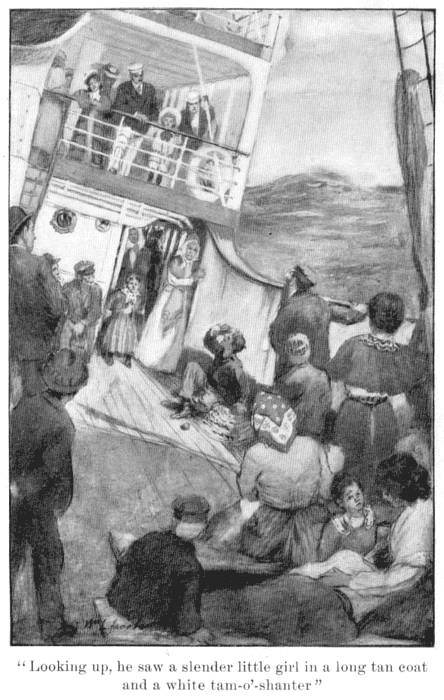
"Looking up, he saw a slender little girl in a long tan coat and a white tam-o-shanter" Frontispiece
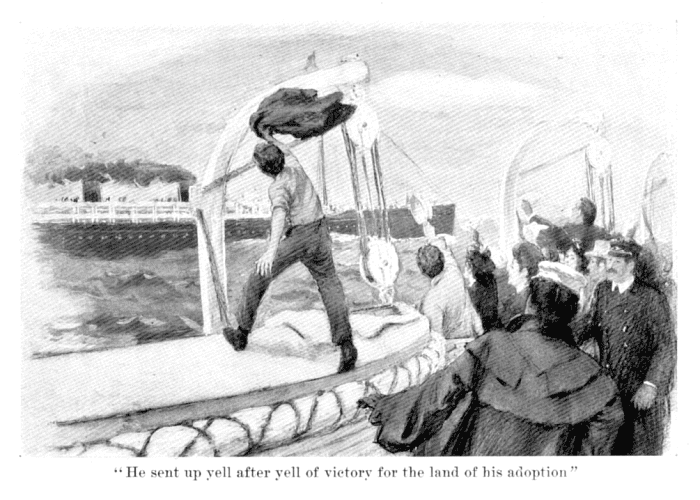
"He sent up yell after yell of victory for the land of his adoption"
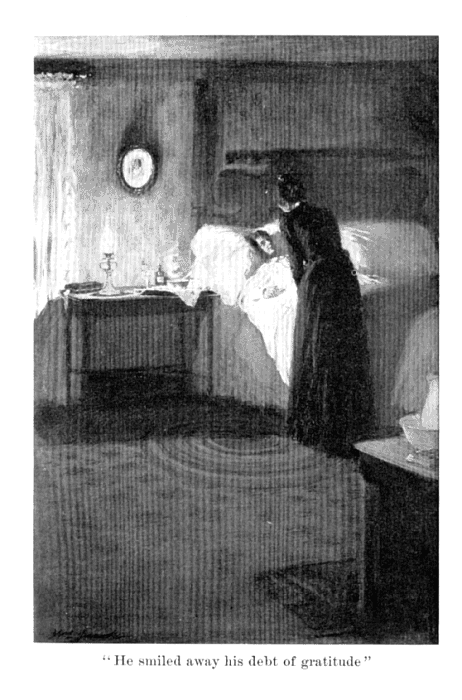
"He smiled away his debt of gratitude"
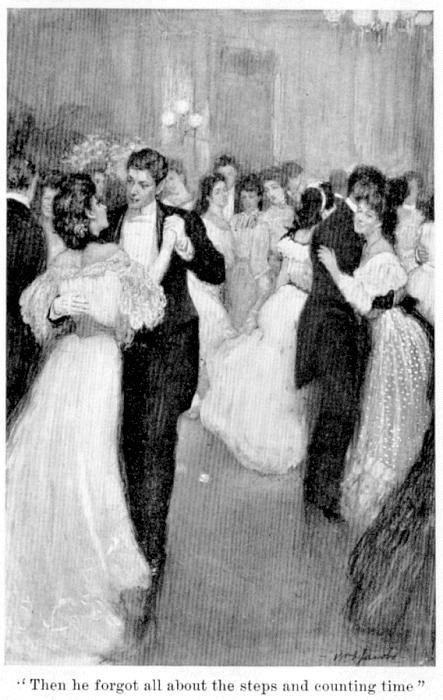
"Then he forgot all about the steps and counting time"
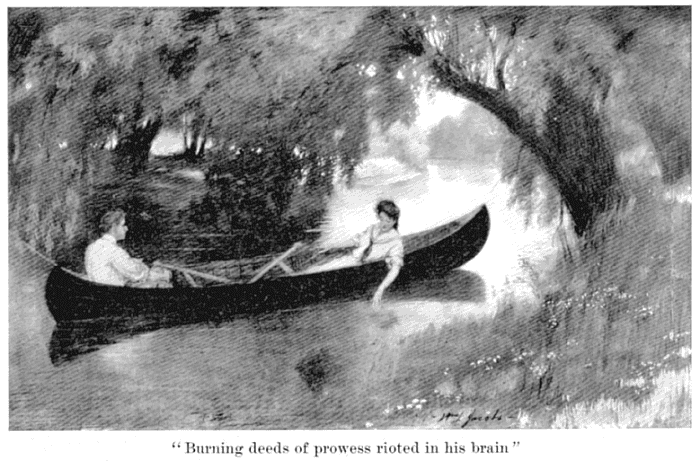
"Burning deeds of prowess rioted in his brain"
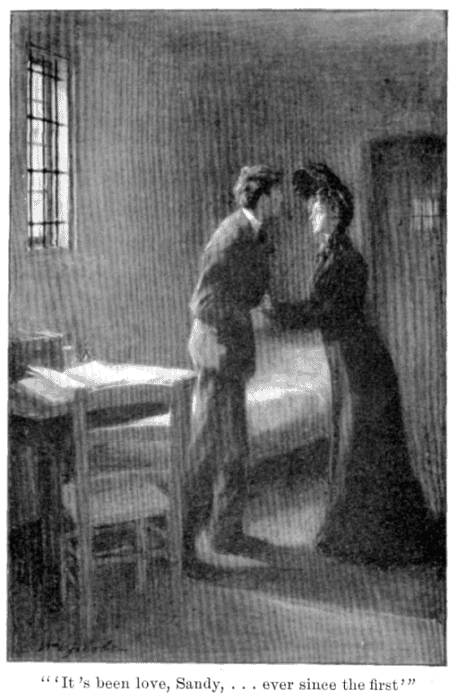
"'It's been love, Sandy, ... ever since the first'"
THE STOWAWAY
An English mist was rolling lazily inland from the sea. It half enveloped the two great ocean liners that lay tugging at their moorings in the bay, and settled over the wharf with a grim determination to check, as far as possible, the traffic of the morning.
But the activity of the wharf, while impeded, was in no wise stopped. The bustle, rattle, and shouting were, in fact, augmented by the temporary interference. Everybody seemed in a hurry, and everybody seemed out of temper, save a boy who lay at full length on the quay and earnestly studied a weather-vane that was lazily trying to make up its mind which way to point.
He was ragged and brawny and picturesque. His hands, bronzed by the tan of sixteen summers, were clasped under his head, and his legs were crossed, one soleless shoe on high vaunting its nakedness in the face of an indifferent world. A sailor's blouse, two sizes too large, was held together at the neck by a bit of red cambric, and his trousers were anchored to their mooring by a heavy piece of yellow twine. The indolence of his position, however, was not indicative of the state of his mind; for under his weather-beaten old cap, perched sidewise on a tousled head, was a commotion of dreams and schemes, ambitions and plans, whose activities would have put to shame the busiest wharf in the world.
"It's your show, Sandy Kilday!" he said, half aloud, with a bit of a brogue that flavored his speech as the salt flavors the sea air. "You don't want to be a bloomin' old weather-vane, a-changin' your mind every time the wind blows. Is it go, or stay?"
The answer, instead of coming, got sidetracked by the train of thought that descended upon him when he was actually face to face with his decision. All sorts of memories came rushing pell-mell through his brain. The cold and hungry ones were the most insistent, but he brushed them aside.
The one he clung to longest was the earliest and most shadowy of the lot. It was of a little white house on an Irish heath, and inside was the biggest fireplace in the world, where crimson flames went roaring up the big, dark chimney, and where witches and fairies held high carnival. There was a big chair on each side the hearth, and between them a tiny red rocker with flowers painted on the arms of it. That was the clearest of all. There were persons in the large chairs, one a silent Scotchman who, instinct told him, must have been his father, and the other—oh, tricky memory that faltered when he wanted it to be so clear!—was the maddest, merriest little mother that ever came back to haunt a lad. By holding tight to the memory he could see that her eyes were blue like his own, but her hair was black. He could hear the ring of her laugh as she told him Irish stories, and the soft drone of her voice as she sang him old Irish songs. It was she who told him about the fairies and witches that lived up behind the peat-flames. He remembered holding her hand and putting his cheek against it when the goblins came too near. Then the picture would go out, like a picture in a magic-lantern show, and sometimes Sandy could make it come back, and sometimes he could not.
After that came a succession of memories, but none of them held the silent father and the merry mother and the little white house on the heath. They were of new faces and new places, of temporary homes with relatives in Ireland and Scotland, of various schools and unceasing work. Then came the day, two years ago, when, goaded by some injustice, real or imagined, he had run away to England and struck out alone and empty-handed to care for himself. It had been a rough experience, and there were days that he was glad to forget; but through it all the taste of freedom had been sweet in his mouth.
For three weeks he had been hanging about the docks, picking up jobs here and there, accommodating any one who wanted to be accommodated, making many friends and little money. He had had no thought of embarking until the big English liner Great Britain arrived in port after breaking all records on her homeward passage. She was to start on her second trip to-day, and an hour later her rival, the steamship America, was to take her departure. The relative merits of the two vessels had been the talk of the wharf for days.
Sandy had made it a rule in life to be on hand when anything was happening. He had viewed cricket-matches from tree-tops, had answered the call of fire at midnight, and tramped ten miles to see the finish of a great regatta. But something was about to take place which seemed entirely beyond his attainment. Two hours passed before he solved the problem.
"Takin' the rest-cure, kid?" asked a passing sailor as he shied a stick at Sandy's shins.
Sandy stretched himself and smiled up at the sailor. It was a smile that waited for an answer and usually got it—a smile so brimming over with good-fellowship and confidence that it made a lover of a friend and a friend of an enemy.
"It's a trip that I'm thinkin' of takin'," he cried blithely as he jumped to his feet. "Here's the shillin' I owe you, partner, and may the best luck ye've had be the worst luck that's comin'."
He tossed a coin to the sailor, and thrusting his hands in his pockets, executed a brief but brilliant pas seul, and then went whistling away down the wharf. He swung along right cheerily, his rags fluttering, his chin in the air, for the wind had settled in one direction, and the weather-vane and Sandy had both made up their minds.
The sailor looked after him fondly. "He's a bloomin' good little chap," he said to a man near by. "Carries a civil tongue in his head for everybody."
The man grunted. "He's too off and on," he said. "He'll never come to naught."
Two days later, the America, cutting her way across the Atlantic, carried one more passenger than she registered. In the big life-boat swung above the hurricane-deck lay Sandy Kilday, snugly concealed by the heavy canvas covering.
He had managed to come aboard under cover of the friendly fog, and had boldly appropriated a life-boat and was doing light housekeeping. The apartment, to be sure, was rather small and dark, for the only light came through a tiny aperture where the canvas was tucked back. At this end Sandy attended to his domestic duties.
Here were stored the fresh water and hardtack which the law requires every life-boat to carry in case of an emergency. Added to these was Sandy's private larder, consisting of several loaves of bread, a bag of apples, and some canned meat. The other end of the boat was utilized as a bedroom, a couple of life-preservers serving as the bed, and his own bundle of personal belongings doing duty as a pillow.
There were some drawbacks, naturally, especially to an energetic, restless youngster who had never been in one place so long before in his life. It was exceedingly inconvenient to have to lie down or crawl; but Sandy had been used to inconveniences all his life, and this was simply a difference in kind, not in degree. Besides, he could steal out at night and, by being very careful and still, manage to avoid the night watch.
The first night out a man and a girl had come up from the cabin deck and sat directly under his hiding-place. At first he was too much afraid of discovery to listen to what they were saying, but later his interest outweighed his fear. For they were evidently lovers, and Sandy was at that inflammable age when to hear mention of love is dangerous and to see a manifestation of it absolute contagion. When the great question came, his heart waited for the answer. Perhaps it was the added weight of his unspoken influence that turned the scale. She said yes. During the silence that followed, Sandy, unable to restrain his joy, threw his arms about a life-preserver and embraced it fervently.
When they were gone he crawled out to stretch his weary body. On the deck he found a book which they had left; it was a green book, and on the cover was a golden castle on a golden hill. All the rest of his life he loved a green book best, for it was through this one that he found his way back again to that enchanted land that lay behind the peat-flames in the shadowy memory. Early in the morning he read it, with his head on the box of hardtack and his feet on the water-can. Twice he reluctantly tore himself from its pages and put it back where he had found it. No one came to claim it, and it lay there, with the golden castle shining in the sun. Sandy decided to take one more peep.
It was all about gallant knights and noble lords, of damsels passing fair, of tourneys and feasts and battles fierce and long. Story after story he devoured, until he came to the best one of all. It told of a beautiful damsel with a mantle richly furred, who was girt with a cumbrous sword which did her great sorrow; for she might not be delivered of it save by a knight who was of passing good name both of his lands and deeds. And after that all the great knights had striven in vain to draw the sword from its sheath, a poor knight, poorly arrayed, felt in his heart that he might essay it, but was abashed. At last, however, when the damsel was departing, he plucked up courage to ask if he might try; and when she hesitated he said: "Fair damsel, worthiness and good deeds are not only in arrayment, but manhood and worship are hid within man's person." Then the poor knight took the sword by the girdle and sheath and drew it out easily.
And it was not until then that Sandy knew that he had had no dinner, and that the sun had climbed over to the other side of the steamer, and that a continual cheering was coming up from the deck below. Cautiously he pulled back the canvas flap and emerged like the head of a turtle from his shell. The bright sunshine dazzled him for a moment, then he saw a sight that sent the dreams flying. There, just ahead, was the Great Britain under full way, valiantly striving to hold her record against the oncoming steamer.
Sandy sat up and breathlessly watched the champion of the sea, her smoke-stacks black against the wide stretch of shining waters. The Union Jack was flying in insolent security from her flagstaff. There were many figures on deck, and her music was growing louder every minute. Inch by inch the America gained upon her, until they were bow and bow. The crowd below grew wilder, cheers went up from both steamers, the decks were white with the flutter of handkerchiefs. Suddenly the band below struck up "The Star-Spangled Banner." Sandy gave one triumphant glance at the Stars and Stripes floating overhead, and in that moment became naturalized. He leaped to his feet in the boat, and tearing the blouse from his back, waved the tattered banner in the face of the vanquished Great Britain, as he sent up yell after yell of victory for the land of his adoption.
Then he was seized by the ankle and jerked roughly down upon the deck. Over him stood the deck steward.
"You`re a rum egg for that old boat to hatch out," he said. "I guess the cap'n will be wantin' to see you."
Sandy, thus peremptorily summoned from the height of patriotic frenzy, collapsed in terror. Had the deck steward not been familiar with stowaways, he doubtless would have been moved by the flood of eloquent persuasion which Sandy brought to bear.
As it was, he led him ruthlessly down the narrow steps, past the long line of curious passengers, then down again to the steerage deck, where he deposited him on a coil of rope and bade him stay there until he was sent for.
Here Sandy sat for the remainder of the afternoon, stared at from above and below, an object of lively curiosity. He bit his nails until the blood came, and struggled manfully to keep back the tears. He was cold, hungry, and disgraced, and his mind was full of sinister thoughts. Inch by inch he moved closer to the railing.
Suddenly something fell at his feet. It was an orange. Looking up, he saw a slender little girl in a long tan coat and a white tam-o'-shanter leaning over the railing. He only knew that her eyes were brown and that she was sorry for him, but it changed his world. He pulled off his cap, and sent her such an ardent smile of gratitude that she melted from the railing like a snowflake under the kiss of the sun.
Sandy ate the orange and took courage. Life had acquired a new interest.
ON SHIPBOARD
The days that followed were not rose-strewn. Disgrace sat heavily upon the delinquent, and he did penance by foregoing the joys of society. Menial labor and the knowledge that he would not be allowed to land, but would be sent back by the first steamer, were made all the more unbearable by his first experience with illness. He had accepted his fate and prepared to die when the ship's surgeon found him.
The ship's surgeon was cruel enough to laugh, but he persuaded Sandy to come back to life. He was a small, white, round little man; and when he came rolling down the deck in his white linen suit, his face beaming from its white frame of close-cropped hair and beard, he was not unlike one of his own round white little pills, except that their sweetness stopped on the outside and his went clear through.
He discovered Sandy lying on his face in the passageway, his right hand still dutifully wielding the scrub-brush, but his spirit broken and his courage low.
"Hello!" he exclaimed briskly; "what's your name?"
"Sandy Kilday."
"Scotch, eh?"
"Me name is. The rest of me's Irish," groaned Sandy.
"Well, Sandy, my boy, that's no way to scrub. Come out and get some air, and then go back and do it right."
He guided Sandy's dying footsteps to the deck and propped him against the railing. That was when he laughed.
"Not much of a sailor, eh?" he quizzed. "You'll be all right soon; we have been getting the tail-end of a big nor'wester."
"A happy storm it must have been, sir, to wag its tail so gay," said Sandy, trying to smile.
The doctor clapped him on the back. "You're better. Want something to eat?"
Sandy declined with violence. He explained his feelings with all the authority of a first experience, adding in conclusion: "It was Jonah I used to be after feelin' sorry for; it ain't now. It's the whale."
The doctor prevailed upon him to drink some hot tea and eat a sandwich. It was a heroic effort, but Sandy would have done even more to prolong the friendly conversation.
"How many more days have we got, sir?"
"Five; but there's the return trip for you."
Sandy's face flushed. "If they send me home, I'll be comin' back!" he cried, clinging to the railing as the ship lurched forward. "I'm goin' to be an American. I am goin'—" Further declarations as to his future policy were cut short.
From that time on the doctor took an interest in him. He even took up a collection of clothes for him among the officers. His professional services were no longer necessary, for Sandy enjoyed a speedy recovery from his maritime troubles.
"You are luckier than the rest," he said, one day, stopping on his rounds. "I never had so many steerage patients before."
The work was so heavy, in fact, that he obtained permission to get a boy to assist him. The happy duty devolved upon Sandy, who promptly embraced not only the opportunity, but the doctor and the profession as well. He entered into his new work with such energy and enthusiasm that by the end of the week he knew every man below the cabin deck. So expeditious did he become that he found many idle moments in which to cultivate acquaintances.
His chosen companion at these times was a boy in the steerage, selected not for congeniality, but for his unlimited knowledge of all things terrestrial, from the easiest way of making a fortune to the best way of spending it. He was a short, heavy-set fellow of some eighteen years. His hair grew straight up from an overhanging forehead, under which two small eyes seemed always to be furtively watching each other over the bridge of his flat snub nose. His lips met with difficulty across large, irregular teeth. Such was Ricks Wilson, the most unprepossessing soul on board the good ship America.
"You see, it's this way," explained Ricks as the boys sat behind the smokestack and Sandy became initiated into the mysteries of a wonderful game called "craps." "I didn't have no more 'n you've got. I lived down South, clean off the track of ever'thing. I puts my foot in my hand and went out and seen the world. I tramps up to New York, works my way over to England, tramps and peddles, and gits enough dough to pay my way back. Say, it's bum slow over there. Why, they ain't even on to street-cars in London! I makes more in a week at home than I do in a month in England. Say, where you goin' at when we land?"
Sandy shook his head ruefully. "I got to go back," he said.
Ricks glanced around cautiously, then moved closer.
"You ain't that big a sucker, are you? Any feller that couldn't hop the twig offen this old boat ain't much, that's all I got to say."
"Oh, it's not the gettin' away," said Sandy, more certain than ever, now that he was sure of an ally.
"Homesick?" asked Ricks, with a sneer.
Sandy gave a short laugh. "Home? Why, I ain't got any home. I've just lived around since I was a young one. It's a chance to get on that I'm after."
"Well, what in thunder is takin' you back?"
"I don't know," said Sandy, "'cep'n' it ain't in me to give 'em the slip now I know 'em. Then there's the doctor "
"That old feather-bed? O Lord! He's so good he gives me a pain. Goes round with his mouth hiked up in a smile, and I bet he's as mean as the "
Before Hicks could finish he found himself inextricably tangled in Sandy's arms and legs, while that irate youth sat upon him and pommeled him soundly.
"So it's the good doctor ye'd be after blasphemin' and abusin' and makin' game of! By the powers, ye'll take it back! Speak one time more, and I'll make you swaller the lyin' words, if I have to break every bone in your skin!"
There was an ugly look in Ricks's face as he threw the smaller boy off, but further trouble was prevented by the appearance of the second mate.
Sandy hurried away to his duties, but not without an anxious glance at the upper deck. He had never lost an opportunity, since that first day, of looking up; but this was the first time that he was glad she was not there. Only once had he caught sight of a white tam and a tan coat, and that was when they were being conducted hastily below by a sympathetic stewardess.
But Sandy needed no further food for his dreams than he already had. On sunny afternoons, when he had the time, he would seek a secluded corner of the deck, and stretching himself on the boards with the green book in his hand, would float in a sea of sentiment. The fact that he had decided to study medicine and become a ship's surgeon in no wise interfered with his fixed purpose of riding forth into the world on a cream-white charger in search of a damsel in distress.
So thrilled did he become with the vision that he fell to making rhymes, and was surprised to find that the same pair of eyes always rhymed with skies and they were brown.
Sometimes, at night, a group would gather on the steerage deck and sing. A black-haired Italian, with shirt open at the throat, would strike a pose and fling out a wild serenade; or a fat, placid German would remove his pipe long enough to troll forth a mighty drinking-song. Whenever the air was a familiar one, the entire circle joined in the chorus. At such times Sandy was always on hand, singing with the loudest and telling his story with the best.
"Make de jolly little Irish one to sing by hisself!" called a woman one night from the edge of the crowd. The invitation was taken up and repeated on every side. Sandy, laughing and protesting, was pushed to the front. Being thus suddenly forced into prominence, he suffered an acute attack of stage fright.
"Chirp up there now and give us a tune!" cried some one behind him.
"Can't ye remember none?" asked another.
"Sure," said Sandy, laughing sheepishly; "but they all come wrong end first."
Some one had thrust an old guitar in his hands, and he stood nervously picking at the strings. He might have been standing there still had not the moon come to his rescue. It climbed slowly out of the sea and sent a shimmer of silver and gold over the water, across the deck, and into his eyes. He forgot himself and the crowd. The stream of mystical romance that flows through the veins of every true Irishman was never lacking in Sandy. His heart responded to the beautiful as surely as the echo answers the call.
He seized the guitar, and picking out the notes with clumsy, faltering fingers, sang:
His boyish voice rang out clear and true, softening on the refrain to an indescribable tenderness that steeped the old song in the very essence of mystery and love.
He could remember his mother singing him to sleep by it, and the bright red of her lips as they framed the words:
As the song trembled to a close, a slight burst of applause came from the cabin deck. Sandy looked up, frowned, and bit his lip. He did not know why, but he was sorry he had sung.
The next morning the America sailed into New York harbor, band playing and flags flying. She was bringing home a record and a jubilant crew. On the upper decks passengers were making merry over what is probably the most joyful parting in the world. In the steerage all was bustle and confusion and anticipation of the disembarking.
Eagerly, wistfully watching it all, stood Sandy, as alert and distressed as a young hound restrained from the hunt. It is something to accept punishment gracefully, but to accept punishment when it can be avoided is nothing short of heroism. Sandy had to shut his eyes and grip the railing to keep from planning an escape. Spread before him in brave array across the water lay the promised land and, like Moses, he was not to reach it.
"That's the greatest city in America," said the ship's surgeon as he came up to where he was standing. "What do you think of it?"
"I never seen one stand on end afore!" exclaimed Sandy, amazed.
"Would you like to go ashore long enough to look about?" asked the doctor, with a smile running around the fat folds of his cheeks.
"And would I?" asked Sandy, his eyes flying open. "It's me word of honor I'd give you that I'd come back."
"The word of a stowaway, eh?" asked the doctor, still smiling.
In a moment Sandy's face was crimson. "Whatever I be, sir, I ain't a liar!"
The doctor pursed up his lips in comical dismay: "Not so hot, my man; not so hot! So you still want to be a doctor?"
Sandy cooled down sufficiently to say that it was the one ambition of his life.
"I know the physician in charge of the City Hospital here in New York. He's a good fellow. He'd put you through give you work and put you in the way of going to the Medical School. You'd like that?"
"But," cried Sandy, bewildered but hopeful, "I have to go back!"
The doctor shook his head. "No, you don't. I've paid your passage."
Sandy waited a moment until the full import of the words was taken in, then he grabbed the stout little doctor and almost lifted him off his feet.
"Oh! But ain't you a brick!" he cried fervently, adding earnestly: "It ain't a present you're makin' me, though! I'll pay it back, so help me bob!"
At the pier the crowd of immigrants pushed and crowded impatiently as they waited for the cabin passengers to go ashore. Among them was Sandy, bareheaded and in motley garb, laughing and shoving with the best of them, hanging over the railing, and keeping up a fire of merriment at the expense of the crowd below. In his hand was a letter of recommendation to the physician in charge at the City Hospital, and in his inside pocket a ten-dollar bill was buttoned over a heart that had not a care in the world. In the great stream of life Sandy was one of the bubbles that are apt to come to the top.
"You better come down to Kentucky with me," urged Ricks Wilson, resuming an old argument. "I'm goin' to peddle my way back home, then git a payin' job at the racetrack."
"Wasn't I tellin' ye that it was a doctor I'm goin' to be?" asked Sandy, impatiently. Already Ricks's friendship was proving irksome.
On the gang-plank above him the passengers were leaving the ship. Some delay had arisen, and for a moment the procession halted. Suddenly Sandy caught his breath. There, just above him, stood "the damsel passing fair." Instead of the tam-o'-shanter she wore a big drooping hat of brown, which just matched the curls that were loosely tied at the back of her neck.
Sandy stood motionless and humbly adored her. He was a born lover, lavishing his affection, without discrimination or calculation, upon whatever touched his heart. It surely was no harm just to stand aside and look. He liked the way she carried her head; he liked the way her eyes went up a little at the outer corners, and the round, soft curve of her chin. She was gazing steadfastly ahead of her down the gang-plank, and he ventured a step nearer and continued his observations. As he did so, he made a discovery. The soft white of her cheek was gradually becoming pinker and pinker; the color which began under her lace collar stole up and up until it reached her eyes, which still gazed determinedly before her.
Sandy admired it as a traveler admires a sunrise, and with as little idea of having caused it.
The line of passengers moved slowly forward, and his heart sank. Suddenly his eyes fell upon the little hand-bag which she carried. On one end, in small white letters, was: "Ruth Nelson, Kentucky, U.S.A." He watched her until she was lost to view, then he turned eagerly back into the crowd. Elbowing his way forward, he seized Ricks by the arm.
"Hi, there!" he cried; "I've changed me mind. I'm goin' with you to Kentucky!"
So this impetuous knight errant enlisted under the will-o'-the-wisp love, and started joyously forth upon his quest.
THE CURSE OF WEALTH
It is an oft-proved adage that for ten who can stand adversity there is but one who can stand prosperity. Sandy, alas! was no exception to any rule which went to prove the frailty of human nature. The sudden acquisition of ten dollars cast him into a whirlpool of temptation from which he made little effort to escape.
"I ain't goin' on to-day," announced Ricks. "I'm goin' to lay in my goods for peddlin'. I reckon you kin come along of me."
Sandy accepted a long and strong cigar, tilted his hat, and unconsciously caught Ricks's slouching gait as they went down the street. After all, it was rather pleasant to associate with sophistication.
"We'll git on the outside of a little dinner," said Ricks; "and I'll mosey round in the stores awhile, then I'll take you to a show or two. It's a mighty good thing for you that you got me along."
Sandy thought so too. He cheerfully stood treat for the rest of the day, and felt that it was small return for Ricks's condescension.
"How much you got left?" asked Ricks, that night, as they stopped under a street light to take stock.
Sandy held out a couple of dollars and a fifty-cent piece.
"Enough to put on the eyes of two and a half dead men," he said as he curiously eyed the strange money.
"One, two, two and a half," counted Ricks.
"Shillings?" asked Sandy, amazed.
Ricks nodded.
"And have I blowed all that to-day?"
"What of it?" asked Ricks. "I seen a bloke onct what lit his cigar with a bill like the one you had!"
"But the doctor said it was two pounds," insisted Sandy, incredulously. He did not realize the expense of a personally conducted tour of the Bowery.
"Well, it's went," said Ricks, resignedly. "You can't count on settin' up biz with what's left."
Sandy's brows clouded, and he shifted his position restlessly. "Now I ax yerself, Ricks, what'u'd you do?" he said.
"Me? I don't give advice to nobody. But effen it was me I'd know mighty quick what to do."
"What?" said Sandy, eagerly.
"Buy a dawg."
"A dog? I ain't goin' blind."
"Lor'! but you're a softhorn," said Ricks, contemptuously. "I s'pose you'd count on leadin' him round by a pink ribbon."
"Oh, you mean a fighter?"
"Sure. My last dawg could do ever'thing in sight. She was so game she went after herself in a lookin'-glass and got kilt. Oh, they's money in dawgs, and I knows how to make 'em win ever' time."
Sandy, tired as he was from the day's excitement, insisted upon going in search of one at once. He already had visions of becoming the proud owner of a canine champion that would put him immediately into the position of lighting his cigar with a two-pound note.
The first three weeks of their experience on the road went far to realize their expectations. The bulldog, which had been bought in partnership, proved a conquering hero. Through the long summer days the boys tramped over the country, peddling their wares, and by night they conducted sundry unlawful encounters wherever an opponent could be found.
Sandy enjoyed the peddling. It was astonishing what friendly sociability and confidential intimacy were established by the sale of blue suspenders and pink soap. He left a line of smiling testimonials in his wake.
But if the days were proving satisfactory, so much could not be said of the nights. Even the phenomenal luck that followed his dog failed to keep up his enthusiasm.
"You ain't a nachrul sport," complained Ricks. "That's your trouble. When the last fight was on, you set on the fence and listened at a' ole idiot scrapin' a fiddle down in the valley."
Sandy made a feeble defense, but he knew in his soul it was so.
Affairs reached a climax one night in an old barn on the outskirts of a town. A fight was about to begin when Sandy discovered Ricks judiciously administering a sedative to the enemy's dog.
Then understanding dawned upon him, and his rage was elemental. With a valor that lacked the better part of discretion, he hurled himself through the crowd and fell upon Ricks.
An hour later, bruised, bloody, and vanquished, he stumbled along through the dreary night. Hot with rage and defeat, utterly ignorant of his whereabouts, his one friend turned foe, he was indeed in sorry plight.
He climbed over the fence and lay face downward in the long, cool grass, stretching his bruised and aching body along the ground. A gentle night wind rustled above him, and by and by a star peeped out, then another and another. Before he knew it, he was listening to the frogs and katydids, and wondering what they were talking about. He ceased to think about Ricks and his woes, and gave himself up to the delicious, drowsy peace that was all about him. For, child of nature that he was, he had turned to the only mother he knew.
SIDE-TRACKED
The next morning, at the nearest railroad station, an irate cattleman was trying to hire some one to take charge of a car of live stock which was on its way to a great exposition in a neighboring city. The man he had counted on had not appeared, and the train was about due.
As he was turning away in desperation he felt a tug at his elbow. Looking around, he saw a queer figure with a countenance that resembled a first attempt at a charcoal sketch from life: one cheek was larger than the other, the mouth was sadly out of drawing, the eyes shone out from among the bruises like the sun from behind the clouds. But if the features were disfigured, the smile was none the less courageous.
Sandy had found a friendly sympathizer at a neighboring farm-house, had been given a good breakfast, had made his toilet, and was ready for the next round in the fight of life.
"I'll be doin' yer job, sir, whatever it is," he said pleasantly.
The man eyed him with misgiving, but his need was urgent.
"All you have to do is to stay in the car and look after the cattle. My man will meet you when you reach the city. Do you think you can do it?"
"Just keep company with the cows?" cried Sandy. "Sure and I can!"
So the bargain was struck, and that night found him in the great city with a dollar in his pocket and a promise of work in the morning.
Tired and sore from the experiences of the night before, he sought a cheap lodging-house near by. A hook-nosed woman, carrying a smoking lamp, conducted him to a room under the eaves. It was small and suffocating. He involuntarily lifted his hands and touched the ceiling.
"It's like a boilin' potato I feel," he said; "and the pot's so little and the lid so tight!"
He went to the window, and taking out the nail that held down the sash, pushed it up. Below him lay the great, bustling city, cabs and cars in constant motion, long lines of blazing lights marking the thoroughfares, the thunder of trains in the big station, and above and below and through it all a dull monotonous roar, like the faraway unceasing cry of a hungry beast.
He sank on his knees by the window, and a restless, nervous look came into his eyes.
"It presses in, too," he thought. "It's all crowdin' over me. I'm just me by myself, all alone." A tear made a white course down his grimy cheek, then another and another. He brushed them impatiently away with the cap he still held in his hand.
Rising abruptly, he turned away from the window, and the hot air of the room again smote him. The smoking lamp had blackened the chimney, and as he bent to turn it down, he caught his reflection in a small mirror over the table. What the bruises and swelling had left undone the cheap mirror completed. He started back. Was that the boy he knew as himself? Was that Sandy Kilday who had come to America to seek his fortune? He stared in a sort of fascinated horror at that other boy in the mirror. Before he had been afraid to be by himself, now he was afraid of himself.
He seized his cap, and blowing out the lamp, plunged down four flights of steep narrow steps and out into the street. A number of people were crowding into a street-car marked "Exposition." Sandy, ever a straw in the current, joined them. Once more down among his fellow-men, he began to feel more comfortable. He cheerfully paid his entrance fee with one of the two silver coins in his pocket.
The first building he entered was the art gallery, and the first picture that caught his eye held him spellbound. He sat before it all the evening with fascinated eyes, devouring every detail and oblivious to the curious interest he was attracting; for the huge canvas represented the Knights of the Round Table, and he had at last found friends.
All the way back he thought about the picture; it was not until he reached his room that the former loneliness returned.
But even then it was not for long. A pair of yellow eyes peered around the window-sill, and a plaintive "meow" begged for admittance. It was plainly Providence that guided that thin and ill-treated kitten to Sandy's window. The welcome it received must have completely restored its shaken faith in human nature. Tired as he was, Sandy went out and bought some milk. He wanted to establish a firm friendship; for if he was to stay in this lonely city, he must have something to love, if only a prodigal kitten of doubtful pedigree.
During the long, hot days that followed Sandy worked faithfully at the depot. The regular hours and confinement seemed doubly irksome after the bohemian life on the road.
The Exposition was his salvation. No sacrifice seemed too great to enable him to get beyond that magic gate. For the "Knights of the Round Table" was but the beginning of miles and miles of wonderful pictures. He even bought a catalogue, and, prompted by a natural curiosity for anything that interested him, learned the names of the artists he liked best, and the bits of biography attached to each. He would recite these to the yellow kitten when he got back to his little hot-box of a room.
One night the art gallery was closed, and he went into another big building where a crowd of people were seated. At one end of it was a great pipe-organ, and after a while some one began to play. With his cap tightly grasped in both hands, he tiptoed down the center aisle and stood breathlessly drinking in the wonderful tones that seemed to be coming from his own heart.
"Get out of the way, boy," said an usher. "You are blocking the aisle."
A queer-appearing lady who looked like a man touched his elbow.
"Here's a seat," she said in a deep voice.
"Thank you, sir," said Sandy, absently. He scarcely knew whether he was sitting or standing. He only wanted to be let alone, so that he could listen to those strange, beautiful sounds that made a shiver of joy go down his back. Art had had her day; it was Music's turn.
When the last number had been played, he turned to the queer lady:
"Do they do it every night?"
She smiled at his enthusiasm: "Wednesdays and Saturdays."
"Say," said Sandy, confidentially, "if you come first do you save me a seat, and I'll do the same by you."
From that time on he decided to be a musician, and he lived on two scanty meals a day in order to attend the concerts.
But this exalted scheme of high thinking and plain living soon became irksome. One day, when his loneliness weighed most heavily upon him, he was sent with a message out to the switch-station. As he tramped back along the track he spied a familiar figure ahead of him. There was no mistaking that short, slouching body with the peddler's pack strapped on its back. With a cry of joy, Sandy bounded after Ricks Wilson. He actually hugged him in his joy to be once more with some one he knew.
Ricks glanced uneasily at the scar above his eye.
Sandy clapped his hand over it and laughed. "It's all right, Ricks; a miss is as good as a mile. I ain't mad any more. It's straight home with me you are goin'; and if we can get the two feet of you into me bit of a room, we'll have a dinner that's fit for a king."
On the way they laid in a supply of provisions, Sandy even going to the expense of a bottle of beer for Ricks.
The yellow kitten arched her back and showed general signs of hostility when the stranger was introduced. But her unfriendly demonstrations were ignored. Ricks was the honored guest, and Sandy extended to him the full hospitality of the establishment.
"Put your pack on the floor and yerself in the chair, and I'll get ye filled up in the blink of an eyelash. Don't be mindin' the cat, Ricks. She's just lettin' on she don't take to you. She give me the wink on the sly."
Ricks, expanding under the influence of food and drink, became eloquent. He recounted courageous adventures of the past, and outlined marvelous schemes for the future, by which he was going to make a short cut to fame and glory.
When it was time for him to go, Sandy heaved a sigh of regret. For two hours he had been beguiled by Ricks's romances, and now he had to go back to the humdrum duties at the depot, and receive a sound rating for his belated appearance.
"Which way might you be goin', Ricks?" he asked wistfully.
"Same place I started fer," said Ricks. "Kentucky."
The will-o'-the-wisp, which had been hiding his light, suddenly swung it full in the eyes of Sandy. Once more he saw the little maid of his dreams, and once more he threw discretion to the winds and followed the vision.
Hastily collecting his few possessions, he rolled them into a bundle, and slipping the surprised kitten into his pocket, he gladly followed Ricks once more out into the broad green meadows, along the white and shining roads that lead over the hills to Kentucky.
SANDY RETIRES FROM BUSINESS
"This here is too blame slow fer me," said Ricks, one chilly night in late September, as he and Sandy huddled against a haystack and settled up their weekly accounts.
"Fifty-five cents! Now ain't that a' o'nery dab? Here's a quarter fer you and thirty cents fer me; that's as even as you kin split it."
"It's the microscopes that'll be sellin'," said Sandy, hopefully, as he pulled his coat collar about his ears and shivered. "The man as sold 'em to me said they was a great bargain entirely. He thought there was money in 'em."
"For him," said Ricks, contemptuously. " It's like the man what gulled us on the penknives. I lay to git even with him, all right."
"But he give us the night's lodgin' and some breakfast," said Sandy.
Ricks took a long drink from a short bottle, then holding it before him, he said impressively: "A feller could do me ninety-nine good turns, and if he done me one bad one it would wipe 'em all out. I got to git even with anybody what does me dirty, if it takes me all my life."
"But don't you forget to remember?"
"Not me. I ain't that kind."
Sandy leaned wearily against the haystack and tried to shelter himself from the wind. A continued diet of bread and water had made him sensitive to the changes in the weather.
"This here grub is kinder hard on yer head-rails," said Ricks, trying to bite through a piece of stale bread. A baker had let them have three loaves for a dime because they were old and hard.
Sandy cast a longing look at Ricks's short bottle. It seemed to remedy so many ills, heat or cold, thirst or hunger. But the strict principles applied during his tender years made him hesitate.
"I wish we hadn't lost the kitten," he said, feeling the need of a more cheerful companion.
"I'm a-goin' to git another dawg," announced Ricks. "I'm sick of this here doin's."
"Ain't we goin' to be turfmen?" asked Sandy, who had listened by the hour to thrilling accounts of life on the track, and had accepted Ricks's ambition as his own.
"Not on twenty cents per week," growled Ricks.
Sandy's heart sank; he knew what a new dog meant. He burrowed in the hay and tried to sleep, but there was a queer pain that seemed to catch hold of his breath whenever he breathed down deep.
It rained the next day, and they tramped disconsolately through village after village.
They had oil-cloth covers for their baskets, but their own backs were soaked to the skin.
Toward evening they came to the top of a hill, from which they could look directly down upon a large town lying comfortably in the crook of a river's elbow. The rain had stopped, and the belated sun, struggling through the clouds, made up for lost time by reflecting itself in every curve of the winding stream, in every puddle along the road, and in every pane of glass that faced the west.
"That's a nobby hoss," said Ricks, pointing down the hill. "What's the matter with the feller?"
A slight, delicate-looking young man was lying in the road, between the horse and the fence. As the boys came up he stirred and tried to rise.
"He's off his nut," said Ricks, starting to pass on; but Sandy stopped.
"Get a fall?" he asked.
The strange boy shook his head. "I guess I fainted. I must have ridden too hard. I'll be all right in a minute." He leaned his head against a tree and closed his eyes.
Sandy eyed him curiously, taking in all the details of his riding-costume down to the short whip with the silver mounting.
"I say, Ricks," he called to his companion, who was inspecting the horse, "can't we do somethin' for him?"
Ricks reluctantly produced the short bottle.
"I'm all right," insisted the boy, "if you'll just give me a lift to the saddle." But his eager eyes followed the bottle, and before Ricks had returned it to his pocket he held out his hand. "I believe I will take a drink if you don't mind." He drained the contents and then handed a coin to Ricks.
"Now, if you'll help me," continued the stranger. "There! Thank you very much."
"Say, what town is this, anyway?" asked Ricks.
"Clayton," said the boy, trying to keep his horse from backing.
"Looks like somethin' was doin'," said Ricks.
"Circus, I believe."
"Then I don't blame your nag for wantin' to go back!" cried Sandy. "Come on, Ricks; let's take in the show!"
Half-way down the hill he turned. "Haven't we seen that fellow before, Ricks?"
"Not as I knows of. He looked kinder pale and shaky, but you bet yer life he knowed how to hit the bottle."
"He was sick," urged Sandy.
"An' thirsty," added Ricks, with a smile of superior wisdom.
The circus seemed such a timely opportunity to do business that they decided to rent a stand that night and sell their wares on the street corner. Ricks went on into town to arrange matters, while Sandy stopped in a grocery to buy their supper. His interest in the show had been of short duration. He felt listless and tired, something seemed to be buzzing continually in his head, and he shivered in his damp clothes. In the grocery he sat on a barrel and leaned his head against the wall.
"What you shivering about?" asked the fat woman behind the counter, as she tied up his small package.
"I feel like me skeleton was doin' a jig inside of me," said Sandy through chattering teeth.
"Looks to me like you got a chill," said the fat woman. "You wait here, and I'll go git you some hot coffee."
She disappeared in the rear of the store, and soon returned with a small coffee-pot and a cup and saucer. Sandy drank two cups and a half, then he asked the price.
"Price?" repeated the woman, indignantly. "I reckon you don't know which side of the Ohio River you're on!"
Sandy made up in gratitude what she declined in cash, and started on his way. At the corner of Main street and the bridge he found Ricks, who had rented a stand and was already arranging his wares. Sandy knelt on the sidewalk and unpacked his basket.
"Only three bars of soap and seventy-five microscopes!" he exclaimed ruefully. "Let's be layin' fine stress on the microscopes, Ricks."
"You do the jawin', Sandy. I ain't much on givin' 'em the talk," said Ricks. "Chuck a jolly at 'em and keep 'em hangin' round."
As dark came on, trade began. The three bars of soap were sold, and a purple necktie. Sandy saw that public taste must be guided in the proper direction. He stepped up on a box and began eloquently to enumerate the diverse uses of microscopes.
At each end of the stand a flaring torch lighted up the scene. The light fell on the careless, laughing faces in front, on Ricks Wilson, black-browed and suspicious, in the rear, and it fell full on Sandy, who stood on high and harangued the crowd. It fell on his broad, straight shoulders and on his shining tumbled hair; but it was not the light of the torch that gave the brightness to his eyes and the flush to his cheek. His head was throbbing, but he felt a curious sense of elation. He felt that he could stand there and talk the rest of his life. He made the crowd listen, he made it laugh, he made it buy. He told stories and sang songs, he coaxed and persuaded, until only a few microscopes were left and the old cigar-box was heavy with silver.
"Step right up and take a look at a fly's leg! Every one ought to have a microscope in his home. When you get hard up it will make a dime look like a dollar, and a dollar like a five-dollar gold piece. Step right up! I ain't kiddin' you. Five cents for two looks, and fifteen for the microscope."
Suddenly he faltered. At the edge of the crowd he had recognized two faces. They were sensitive slender faces, strangely alike in feature and unlike in expression. The young horseman of the afternoon was impatiently pushing his way through the crowd, while close behind him was a dainty girl with brown eyes slightly lifted at the outer corners, who held back in laughing wonder to watch the scene.
"Ricks," said Sandy, lowering his voice unsteadily, "is this Kentucky?"
"Yep; we crossed the line to-day."
"I can't talk no more," said Sandy. "You'll have to be doin' it. I'm sick."
It was not only the fever that was burning in his veins, and making him bury his hot head in his hands and wish he had never been born. It was shame and humiliation, and all because of the look on the face of the girl at the edge of the crowd. He sat in the shadow of the big box and fought his fight. The coffee and the excitement no longer kept him up; he was faint, and his breath came short. Above him he heard Ricks's rasping voice still talking to the few customers who were left. He knew, without glancing up, just how Ricks looked when he said the words; he knew how his teeth pushed his lips back, and how his restless little eyes watched everything at once. A sudden fierce repulsion swept over him for peddling, for Ricks, for himself.
"And to think," he whispered, with a sob in his throat, "that I can't ever speak to a girl like that!"
Ricks, jubilant over the success of the evening, decided to follow the circus, which was to be in the next town on the following day.
"It ain't fur," he said. "We kin push on to-night and be ready to open early in the morning."
Sandy, miserable in body and spirit, mechanically obeyed instructions. His head was getting queerer all the time, and he could not remember whether it was day or night. About a mile from Clayton he sank down by the road.
"Say, Ricks," he said abruptly; "I'm after quittin' peddlin'."
"What you goin' to do?"
"I'm goin' to school."
If Sandy had announced his intention of putting on baby clothes and being wheeled in a perambulator, Ricks could not have been more astonished.
"What?" he asked in genuine doubt.
"'Cause I want to be the right sort," burst out Sandy, passionately. "This ain't the way you get to be the right sort."
Ricks surveyed him contemptuously. "Look-a here, are you comin' along of me or not?"
"I can't," said Sandy, weakly.
Ricks shifted his pack, and with never a parting word or a backward look he left his business partner of three months lying by the roadside, and tramped away in the darkness.
Sandy started up to follow him; he tried to call, but he had no strength. He lay with his face on the road and talked. He knew there was nobody to listen, but still he kept on, softly talking about microscopes and pink soap, crying out again and again that he couldn't ever speak to a girl like that.
After a long while somebody came. At first he thought he must have gone back to the land behind the peat-flames, for it was a great black witch who bent over him, and he instinctively felt about in the grass for the tender, soft hand which he used to press against his cheek. He found instead the hand of the witch herself, and he drew back in terror.
"Fer de Lawd sake, honey, what's de matter wif you?" asked a kindly voice. Sandy opened his eyes. A tall old negro woman bent over him, her head tied up in a turban, and a shawl about her shoulders.
"Did you git runned over?" she asked, peering down at him anxiously.
Sandy tried to explain, but it was all the old mixture of soap and microscopes and never being able to speak to her. He knew he was talking at random, but he could not say the things he thought.
"Where'd you come from, boy?"
"Curragh Chase, Limerick," murmured Sandy.
"'Fore de Lawd, he's done been cunjered!" cried the old woman, aghast. "I'll git it outen of you, chile. You jus' come home wif yer Aunt Melvy; she'll take keer of you. Put yer arm on my shoulder; dat's right. Don't you mind where you gwine at. I got yer bundle. It ain't fur. Hit's dat little house a-hangin' on de side of de hill. Dey calls it 'Who'd 'a' Thought It,' 'ca'se you nebber would 'a' thought of puttin' a house dere. Dat's right; lean on yer mammy. I'll git dem old cunjers outen you."
Thus encouraged and supported, Sandy stumbled on through the dark, up a hillside that seemed never to end, across a bridge, then into a tiny log cabin, where he dropped exhausted.
Off and on during the night he knew that there was a fire in the room, and that strange things were happening to him. But it was all so queer and unnatural that he did not know where the dreams left off and the real began. He was vaguely conscious of his left foot being tied to the right bedpost, of a lock of his hair being cut off and burned on the hearth, and of a low monotonous chant that seemed to rise and fall with the flicker of the flames. And when he cried out with the pain in his sleep, a kindly black face bent over him, and the chant changed into a soothing murmur:
"Nebber you min', sonny; Aunt Melvy gwine git dem cunjers out. She gwine stay by you. You hol' on to her han', an' go to sleep; she'll git dem old cunjers out."
HOLLIS FARM
Clayton was an easy-going, prosperous old town which, in the enthusiasm of youth, had started to climb the long hill to the north, but growing indolent with age, had decided instead to go around.
Main street, broad and shady under an unbroken arch of maple boughs, was flanked on each side by "Back street," the generic term applied to all the parallel streets. The short cross-streets were designated by the most direct method: "the street by the Baptist church," "the street by Dr. Fenton's," "the street going out to Judge Hollis's," or "the street where Mr. Moseley used to live." In the heart of the town was the square, with the gray, weather-beaten court-house, the new and formidable jail, the post-office and church.
For twenty years Dr. Fenton's old high-seated buggy had jogged over the same daily course. It started at nine o'clock and passed with never-varying regularity up one street and down another. When any one was ill a sentinel was placed at the gate to hail the doctor, who was as sure to pass as the passenger-train. It was a familiar joke in Clayton that the buggy had a regular track, and that the wheels always ran in the same rut. Once, when Carter Nelson had taken too much egg-nog and his aunt thought he had spinal meningitis, the usual route had been reversed, and again when the blacksmith's triplets were born. But these were especial occasions. It was a matter for investigation when the doctor's buggy went over the bridge before noon.
"Anybody sick out this way?" asked the miller.
The doctor stopped the buggy to explain.
He was a short, fat man dressed in a suit of Confederate gray. The hand that held the reins was minus two fingers, his willing contribution to the Lost Cause, which was still to him the great catastrophe of all history. His whole personality was a bristling arsenal of prejudices. When he spoke it was in quick, short volleys, in a voice that seemed to come from the depths of a megaphone.
"Strange boy sick at Judge Hollis's. How's trade?"
"Fair to middlin'," answered the miller. "Do you reckon that there boy has got anything ketchin'?"
"Catching?" repeated the doctor savagely. "What if he has?" he demanded. "Two epidemics of typhoid, two of yellow fever, and one of smallpox that's my record, sir!"
"Looks like my children will ketch a fly-bite," said the miller, apologetically.
A little farther on the doctor was stopped again this time by a maiden in a pink-and-white gingham, with a mass of light curls bobbing about her face.
"Dad!" she called as she scrambled over the fence. "Where you g-going, dad?"
The doctor flapped the lines nervously and tried to escape, but she pursued him madly. Catching up with the buggy, she pulled herself up on the springs and thrust an impudent, laughing face through the window at the back.
"Annette," scolded her father, "aren't you ashamed? Fourteen years old, and a tomboy! Get down!"
"Where you g-going, dad?" she stammered, unabashed.
"To Judge Hollis's. Get down this minute!"
"What for?"
"Somebody's sick. Get down, I say!"
Instead of getting down, she got in, coming straight through the small window, and arriving in a tangle of pink and white at his side.
The doctor heaved a prodigious sigh. As a colonel of the Confederacy he had exacted strict discipline and unquestioning obedience, but he now found himself ignominiously reduced to the ranks, and another Fenton in command.
At Hollis Farm the judge met them at the gate. He was large and loose-jointed, with the frame of a Titan and the smile of a child. He wore a long, loose dressing-gown and a pair of slippers elaborately embroidered in green roses. His big, irregular features were softened by an expression of indulgent interest toward the world at large.
"Good morning, doctor. Howdy, Nettie. How are you all this morning?"
"Who's sick?" growled the doctor as he hitched his horse to the fence.
"It's a stray lad, doctor; my old cook, Melvy, played the good Samaritan and picked him up off the road last night. She brought him to me this morning. He's out of his head with a fever."
"Where'd he come from?" asked the doctor.
"Mrs. Hollis says he was peddling goods up at Main street and the bridge last night."
"Which one is he?" demanded Annette, eagerly, as she emerged from the buggy. "Is he g-good-looking, with blue eyes and light hair? Or is he b-black and ugly and sort of cross-eyed?"
The judge peered over his glasses quizzically. "Thinking about the boys, as usual! Now I want to know what business you have noticing the color of a peddler's eyes?"
Annette blushed, but she stood her ground. "All the g-girls noticed him. He wasn't an ordinary peddler. He was just as smart and f-funny as could be."
"Well, he isn't smart and funny now," said the judge, with a grim laugh.
The two men passed up the long avenue and into the house. At the door they were met by Mrs. Hollis, whose small angular person breathed protest. Her black hair was arranged in symmetrical bands which were drawn tightly back from a straight part. When she talked, a gold-capped tooth was disclosed on each side of her mouth, giving rise to the judge's joke that one was capped to keep the other company, since Mrs. Hollis's sense of order and regularity rebelled against one eye-tooth of one color and the other of another.
"Good morning, doctor," she said shortly; "there's the door-mat. No, don't put your hat there; I'll take it. Isn't this a pretty business for Melvy to come bringing a sick tramp up here on general cleaning-day, too?"
"Aren't all days cleaning-days to you, Sue?" asked the judge, playfully.
"When you are in the house," she answered sharply. Then she turned to the doctor, who was starting up the stairs:
"If this boy is in for a long spell, I want him moved somewhere. I can't have my carpets run over and my whole house smelling like a hospital."
"Now, Susan," remonstrated the judge, gently, "we can't turn the lad out. We've got room and to spare. If he's got the fever, he'll have to stay."
"We'll see, we'll see," said the doctor.
But when he tiptoed down from the room above there was no question about it.
"Very sick boy," he said, rubbing his hand over his bald head. "If he gets better, I might take him over to Mrs. Meech's; he can't be moved now."
"Mrs. Meech!" cried Mrs. Hollis, in fine scorn. "Do you think I would let him go to that dirty house and with this fever, too? Why, Mrs. Meech's front curtains haven't been washed since Christmas! She and the preacher and Martha all sit around with their noses in books, and never even know that the water-spout is leaking and the porch needs mopping! You can't tell me anything about the Meeches!"
Neither of the men tried to do so; they stood silent in the doorway, looking very grave.
"For mercy sake! what is that in the front lot?" exclaimed Mrs. Hollis.
The doctor had an uncomfortable premonition, which was promptly verified. One of the judge's friskiest colts was circling madly about the driveway, while astride of it, in triumph, sat Annette, her dress ripped at the belt, her hair flying.
"If she don't need a woman's hand!" exclaimed Mrs. Hollis. "I could manage her all right."
The doctor looked from Mrs. Hollis, with her firm, close-shut mouth, to the flying figure on the lawn.
"Perhaps," he said, lifting his brows; but he put the odds on Annette.
That night, when Aunt Melvy brought the lamp into the sitting-room, she waited nervously near Mrs. Hollis's chair.
"Miss Sue," she ventured presently, "is de cunjers comin' out?"
"The what?"
"De cunjers what dat pore chile's got. I done tried all de spells I knowed, but look lak dey didn't do no good."
"He has the fever," said Mrs. Hollis; " and it means a long spell of nursing and bother for me."
The judge stirred uncomfortably. "Now, Sue," he remonstrated, "you needn't take a bit of bother. Melvy will see to him by day, and I will look after him at night."
Mrs. Hollis bit her lip and heroically refrained from expressing her mind.
"He's a mighty purty chile," said Aunt Melvy, tentatively.
"He's a common tramp," said Mrs. Hollis.
After supper, arranging a tray with a snowy napkin and a steaming bowl of broth, Mrs. Hollis went up to the sick-room. Her first step had been to have the patient bathed and combed and made presentable for the occupancy of the guest-chamber. It had been with rebellion of spirit that she placed him there, but the judge had taken one of those infrequent stands which she knew it was useless to resist. She put the tray on a table near the big four-poster bed, and leaned over to look at the sleeper.
Sandy lay quiet among the pillows, his fair hair tumbled, his lips parted. As the light fell on his flushed face he stirred.
"Here's your supper," said Mrs. Hollis, her voice softening in spite of herself. He was younger than she had thought. She slipped her arm under the pillow and raised his head.
"You must eat," she said kindly.
He looked at her vacantly, then a momentary consciousness flitted over his face, a vague realization that he was being cared for. He put up a hot hand and gently touched her cheek; then, rallying all his strength, he smiled away his debt of gratitude. It was over in a moment, and he sank back unconscious.
Through the dreary hours of the night Mrs. Hollis sat by the bed, nursing him with the aching tenderness that only a childless woman can know. Below, in the depths of a big feather-bed, the judge slept in peaceful unconcern, disturbing the silence by a series of long, loud, and unmelodious snores.
CONVALESCENCE
"Is that the Nelson phaéton going out the road?" asked Mrs. Hollis as she peered out through the dining-room window one morning. "I shouldn't be a bit surprised if it was Mrs. Nelson making her yearly visits, and here my bricks haven't been reddened."
Sandy's heart turned a somersault. He was sitting up for the first time, wrapped in blankets and wearing a cap to cover his close-cropped head. All through his illness he had been tortured by the thought that he had talked of Ruth, though now wild horses could not have dragged forth a question concerning her.
"Melvy," continued Mrs. Hollis, as she briskly rubbed the sideboard with some unsavory furniture-polish, "if Mrs. Nelson does come here, you be sure to put on your white apron before you open the door; and for pity sake don't forget the card-tray! You ought to know better than to stick out your hand for a lady's calling-card. I told you about that last week."
Aunt Melvy paused in her dusting and chuckled: "Lor', honey, dat's right! You orter put on airs all de time, wid all de money de judge is got. He says to me yisterday, says he, 'Can't you 'suade yer Miss Sue not to be cleanin' up so much, an' not to go out in de front yard wid dat ole sunbonnet on?'"
"Well, I'd like to know how things would get done if I didn't do them," exclaimed Mrs. Hollis, hotly. "I suppose he would like me to let things go like the Meeches! The only time I ever saw Mrs. Meech work was when she swept the front pavement, and then she made Martha walk around behind her and read out loud while she was doing it."
"It's Mr. Meech that's in the yard now," announced Sandy from the side window. "He's raking the leaves with one hand and a-reading a book with the other."
"I knew it!" cried Mrs. Hollis. "I never saw such doings. They say she even leaves the dishes overnight. And yet she can sit on her porch and smile at people going by, just like her house was cleaned up. I hate a hypocrite."
Sandy had had ample time to watch the Meeches during his long convalescence. He had been moved from the spare room to a snug little room over the kitchen, which commanded a fine view of the neighbors. When the green book got too heavy to hold, or his eyes grew too tired to look at the many magazines with which the judge supplied him, he would lie still and watch the little drama going on next door.
Mrs. Meech was a large, untidy woman who always gave the impression of needing to be tucked up. The end of her gray braid hung out behind one ear, her waist hung out of her belt, and even the buttons on her shoes hung out of the buttonholes in shameless laziness.
Mr. Meech did not need tucking in; he needed letting out. He seemed to have shrunk in the wash of life. In spite of the fact that he was three sizes too small for his wife, to begin with, he emphasized it by wearing trousers that cleared his shoe-tops and sleeves half-way to his elbows. But this was only on week-days, for on Sunday Sandy would see him emerge, expand, and flutter forth in an ample suit of shiny broadcloth. For Mr. Meech was the pastor of the Hard-Shell Baptist Church in Clayton, and if his domestic economy was a matter of open gossip, there was no question concerning the fact of his learning. It had been the boast of the congregation for years that Judge Hollis was the only man in town who was smart enough to understand his sermons. When Mr. Meech started out in the morning with a book under his arm and one sticking out of each pocket, Sandy would pull up on his elbow to watch proceedings. He loved to see fat Mrs. Meech pat the little man lovingly on the head and kiss him good-by; he loved to see Martha walk with him to the gate and throw kisses after him until he turned the curve in the road.
Martha was a pale, thin girl with two long, straight plaits and a long, straight dress. She went to school in the morning, and when she came home at noon her mother always hurried to meet her and kissed her on both cheeks. Sandy had got quite in the habit of watching for her at the side window where she came to study. He leaned forward now to see if she were there.
"I thought so!" cried Mrs. Hollis, looking over his shoulder. "There comes the Nelson phaéton this minute! Melvy, get on your white apron. I'll wind up the cuckoo-clock and unlock the parlor door."
"Who is it?" ventured Sandy, with internal tremors.
"Hit's Mrs. Nelson an' her niece, Miss Rufe," said Aunt Melvy, nervously trying to reverse her apron after tying the bow in the front. "Dey's big bugs, dey is. Dey is quality, an' no mistake. I b'longed to Miss Rufe's grandpaw; he done lef' her all his money, she an' Mr. Carter. Poor Mr. Carter! Dey say he ain't got no lungs to speak of. Ain't no wonder he's sorter wild like. He takes after his grandpaw, my ole mars'. Lor', honey, de mint-juleps jus' nachelly ooze outen de pores ob his grandpaw's skin! But Miss Rufe she ain't like none ob dem Nelsons; she favors her maw. She's quality inside an' out."
A peal of the bell cut short further interesting revelations. Aunt Melvy hurried through the hall, leaving doors open behind her. At the front door she paused in dismay. Before her stood the Nelsons in calling attire, presenting two immaculate cards for her acceptance. Too late she remembered her instructions.
"'Fore de Lawd!" she cried in consternation, "ef I ain't done fergit dat pan ag'in!"
Sandy, left alone in the dining-room, was listening with every nerve a-quiver for the sound of Ruth's voice. The thought that she was here under the same roof with him sent the blood bounding through his veins. He pulled himself up, and trailing the blanket behind him, made his way somewhat unsteadily across the room and up the back stairs.
Behind the door of his room hung the pride of his soul, a new suit of clothes, whole, patchless, clean, which the judge had bought him two days before. He had sat before it in speechless admiration; he had hung it in every possible light to get the full benefit of its beauty; he had even in the night placed it on a chair beside the bed, so that he could put out his hand in the dark and make sure it was there. For it was the first new suit of clothes that he remembered ever to have possessed. He had not intended to wear it until Sunday, but the psychological moment had arrived.
With trembling fingers and many pauses for rest, he made his toilet. He looked in the mirror, and his heart nearly burst with pride. The suit, to be sure, hung limp on his gaunt frame, and his shaven head gave him the appearance of a shorn lamb, but to Sandy the reflection was eminently satisfying. One thing only seemed to be lacking. He meditated a moment, then, with some misgiving, picked up a small linen doily from the dresser, and carefully folding it, placed it in his breast-pocket, with one corner just visible.
Triumphant in mind, if weak in body, he slipped down the back steps, skirted Aunt Melvy's domain, and turned the corner of the house just as the Nelson phaéton rolled out of the yard. Before he had time to give way to utter despair a glimmer of hope appeared on the horizon, for the phaéton stopped, and there was evidently something the matter. Sandy did not wait for it to be remedied. He ran down the road with all the speed he could muster.
Near the gate where the little branch crossed the turnpike was a slight embankment, and two wheels of the phaéton had slipped over the edge and were buried deep in the soft earth. Beside it, sitting indignantly in the water, was an irate lady who had evidently attempted to get out backward and had taken a sudden and unexpected seat. Her countenance was a pure specimen of Gothic architecture; a massive pompadour reared itself above two Gothic eyebrows which flanked a nose of unquestioned Gothic tendencies. Her mouth, with its drooping corners, completed the series of arches, and the whole expression was one of aspiring melancholy and injured majesty.
Kneeling at her side, reassuring her and wiping the water from her hands, was Ruth Nelson.
"God send you ain't hurt, ma'am!" cried Sandy, arriving breathless.
The girl looked up and shook her head in smiling protest, but the Gothic lady promptly suffered a relapse.
"I am I know I am! Just look at my dress covered with mud, and my glove is split. Get my smelling-salts, Ruth!"
Ruth, upon whom the lady was leaning, turned to Sandy.
"Will you hand it to me? It is in the little bag there on the seat."
Sandy rushed to do her bidding. He was rather hazy as to the object of his search; but when his fingers touched a round, soft ball he drew it forth and hastily presented it to the lady's Roman nose.
She, with closed eyes, was taking deep whiffs when a laugh startled her.
"Oh, Aunt Clara, it's your powder-puff!" cried Ruth, unable to restrain her mirth.
Mrs. Nelson rose with as much dignity as her draggled condition would permit. "You'd better get me home," she said solemnly. "I may be internally injured." She turned to Sandy. "Boy, can't you get that phaéton back on the road?"
Sandy, whose chagrin over his blunder had sent him to the background, came promptly forward. Seizing the wheel, he made several ineffectual efforts to lift it back to the road.
"It is not moving an inch!" announced the mournful voice from above. "Can't you take hold of it nearer the back, and exert a little more strength?"
Sandy bit his lip and shot a swift glance at Ruth. She was still smiling. With savage determination he fell upon the wheel as if it had been a mortal foe; he pushed and shoved and pulled, and finally, with a rally of all his strength, he went on his knees in the mud and lifted the phaéton back on the road.
Then came a collapse, and he leaned against the nearest tree and struggled with the deadly faintness that was stealing over him.
"Why why, you are the boy who was sick!" cried Ruth, in dismay.
Sandy, white and trembling, shook his head protestingly. "It's me bellows that's rocky," he explained between gasps.
Mrs. Nelson rustled back into the phaéton, and taking a piece of money from her purse, held it out to him.
"That will amply repay you," she said.
Sandy flushed to the roots of his close-cropped hair. A tip, heretofore a gift of the gods, had suddenly become an insult. Angry, impetuous words rushed to his lips, and he took a step forward. Then he was aware of a sudden change in the girl, who had just stepped into the phaéton. She shot a quick, indignant look at her aunt, then turned around and smiled a good-by to him.
He lifted his cap and said, "I thank ye." But it was not to Mrs. Nelson, who still held the money as they drove out of the avenue.
Sandy went wearily back to the house. He had made his first trial in behalf of his lady fair, but his soul knew no elation. His beautiful new armor had sustained irreparable injury, and his vanity had received a mortal wound.
AUNT MELVY AS A SOOTHSAYER
It was a crisp afternoon in late October. The road leading west from Clayton ran the gantlet of fiery maples and sumac until it reached the barren hillside below "Who'd 'a' Thought It." The little cabin clung to the side of the steep slope like a bit of fungus to the trunk of a tree.
In the doorway sat three girls, one tall and dark, one plump and fair, and the third straight and thin. They were anxiously awaiting the revelation of the future as disclosed by Aunt Melvy's far-famed tea-leaves. The prophetess kept them company while waiting for the water to boil.
"He sutenly is a peart boy," she was saying. "De jedge done start him in plumb at de foot up at de 'cademy, an' dey tell me he's ketchin' up right along."
"Wasn't it g-grand in Judge Hollis to send him to school?" said Annette. "Of course he's going to work for him b-between times. They say even Mrs. Hollis is glad he is going to stay."
"'Co'se she is," said Aunt Melvy; "dere nebber was nobody come it over Miss Sue lak he done."
"Father says he is very quick," ventured Martha Meech, a faint color coming to her dull cheek at this unusual opportunity of descanting upon such an absorbing subject. "Father told Judge Hollis he would help him with his lessons, and that he thought it would be only a little while before he was up with the other boys."
"Dad says he's a d-dandy," cried Annette. "And isn't it grand he's going to be put on the ball team and the glee club!"
Ruth rose to break a branch laden with crimson maple-leaves. "Was he ever here before?" she asked in puzzled tones. "I have seen him somewhere, and I can't think where."
"Well, I'd never f-forget him," said Annette. "He's got the jolliest face I ever saw. M-Martha says he can jump that high fence b-back of the Hollises' without touching it. I d-drove dad's buggy clear up over the curbstone yesterday, so he would come to the r-rescue, and he swung on to old B-Baldy's neck like he had been a race-horse."
"But you don't know him," protested Ruth. "And, besides, he was he was a peddler."
"I don't care if he was," said Annette. "And if I don't know him, it's no sign I am not g-going to."
Aunt Melvy chuckled as she rose to encourage the fire with a pair of squeaking old bellows.
Martha looked about the room curiously. "Can you really tell what's going to happen?" she asked timidly.
"Indeed she can," said Annette. "She told Jane Lewis that she was g-going to have some g-good luck, and the v-very next week her aunt died and left her a turquoise-ring!"
"Yas, chile," said Aunt Melvy, bending over the fire to light her pipe; "I been habin' divisions for gwine on five year. Dat's what made me think I wuz gwine git religion; but hit ain't come yit not yit. I'm a mourner an' a seeker." Her pipe dropped unheeded, and she gazed with fixed eyes out of the window.
"Tell us about your visions," demanded Annette.
"Well," said Aunt Melvy, "de fust I knowed about it wuz de lizards in my legs. I could feel 'em jus' as plain as day, dese here little green lizards a-runnin' round inside my legs. I tole de doctor 'bout hit, Miss Nettie; but he said 't warn't nothin' but de fidgits. I knowed better 'n he did dat time. Dat night I had a division, an' de dream say, 'Put on yer purple mournin'-dress an' set wid yer feet in a barrel ob b'ilin' water till de smoke comes down de chimbly.' An' so I done, a-settin' up dere on dat chist o' drawers all night, wid my purple mournin'-dress on an' my feet in de b'ilin' water, an' de lizards run away so fur dat dey ain't even stopped yit."
"Aunt Melvy, do you tell fortunes by palmistry?" asked Ruth.
"Yas'm; I reckon dat's what you call hit. I tells by de tea-leaves. Lor', Miss Rufe, you sutenly put me in min' o' yer grandmaw! She kerried her haid up in de air jus' lak you do, an' she wuz jus' as putty as you is, too. We libed in de ole plantation what's done burned down now, an' I lubed my missus I sutenly did. When my ole man fust come here from de country I nebber seen sech a fool. He didn't know no more 'bout courtin' dan nothin'; but I wuz better qualified. I jus' tole ole miss how 't wuz, an' she fixed up de weddin'. I nebber will fergit de day we walk ober de plantation an' say we wuz married. George he had on a brand-new pair pants dat cost two hundred an' sixty-four dollars in Confederate money."
"Isn't the water b-boiling yet?" asked Annette, impatiently.
"So 't is, so 't is," said Aunt Melvy, lifting the kettle from the crane. She dropped a few tea-leaves in three china cups, and then with great solemnity and occasional guttural ejaculations poured the water over them.
Before the last cup was filled, Annette, with a wry face, had drained the contents of hers and held it out to Aunt Melvy.
"There are my leaves. If they don't tell about a lover with b-blue eyes and an Irish accent, I'll never b-believe them."
Aunt Melvy bent over the cup, and her sides shook. "You gwine be a farmer's wife," she said, chuckling at the girl's grimace. "You gwine raise chickens an' chillun."
"Ugh!" said Annette as the other girls laughed; "are his eyes b-blue?"
Aunt Melvy pondered over the leaves. "Well, now, 'pears to me he's sorter dark-complected an' fat, like Mr. Sid Gray," she said.
"Never!" declared Annette. "I loathe Sid."
"Tell my future!" cried Martha, pushing her cup forward eagerly.
"Dey ain't none!" cried Aunt Melvy, aghast, as she saw the few broken leaves in the bottom of the cup. "You done drinked up yer fortune. Dat's de sign ob early death. I gwine fix you a good-luck bag; dey say ef you carry it all de time, hit's a cross-sign ag'in' death."
"But can't you tell me anything?" persisted Martha.
"Dey ain't nothin' to tell," repeated Aunt Melvy, "'cep'n' to warn you to carry dat good-luck bag all de time."
"Now, mine," said Ruth, with an incredulous but curious smile.
For several moments Aunt Melvy bent over the cup in deep consideration, and then she rose and took it to the window, with fearsome, anxious looks at Ruth meanwhile. Once or twice she made a sign with her fingers, and frowned anxiously.
"What is it, Aunt Melvy?" Ruth demanded. "Am I going to be an old maid?"
"'T ain't no time to joke, chile," whispered Aunt Melvy, all the superstition of her race embodied in her trembling figure. "What I see, I see. Hit's de galluses what I see in de bottom ob yer cup!"
"Do you m-mean suspenders?" laughed Annette.
Aunt Melvy did, not hear her; she was looking over the cup into space, swaying and moaning.
"To t'ink ob my ole missus' gran'chile bein' mixed up wif a gallus lak dey hang de niggers on! But hit's dere, jus' as plain as day, de two poles an' de cross-beam."
Ruth laughed as she looked into the cup.
"Is it for me?"
"Don't know, honey; de signs don't p'int to no one person: but hit's in yer life, an' de shadow rests ag'in' you."
By this time Martha was at the door, urging the others to hurry. Her face was pale and her eyes were troubled. Ruth saw her nervousness and slipped her arm about her. "It's all in fun," she whispered.
"Of course," said Annette. "You m-mustn't mind her foolishness. Besides, I g-got the worst of it. I'd rather die young or be hanged, any day, than to m-marry Sid Gray."
Aunt Melvy followed them to the door, shaking her head. "I'se gwine make you chillun some good-luck bags. De fust time de new moon holds water I'se sholy gwine fix 'em. 'T ain't safe not to mind de signs; 't ain't safe."
And with muttered warnings she watched them until they were lost to view behind the hill.
TRANSITION
The change from the road to the school-room was not without many a struggle on Sandy's part. The new life, the new customs, and the strange language, were baffling.
The day after the accident in the road, Mrs. Hollis had sent him to inquire how old Mrs. Nelson was, and he had returned with the astonishing report that she was sixty-one.
"But you didn't ask her age?" cried Mrs. Hollis, horrified.
Sandy looked perplexed. "I said what ye bid me," he declared.
Everything he did, in fact, seemed to be wrong; and everything he said, to bring a smile. He confided many a woe to Aunt Melvy as he sat on the kitchen steps in the evenings.
"Hit's de green rubbin' off," she assured him sympathetically. "De same ones dat laugh at you now will be takin' off dey hats to you some day."
"Oh, it ain't the guyin' I mind," said Sandy; "it's me wooden head. Them little shavers that can't see a hole in a ladder can beat me figurin'."
"You jus' keep on axin' questions," advised Aunt Melvy. "Dat's what I always tole Rachael. Rachael's dat yaller gal up to Mrs. Nelson's. I done raise her, an' she ain't a bit o'count. I use' ter say, 'You fool nigger, how you ebber gwine learn nothin' effen you don't ax questions?' An' she'd stick out her mouth an' say, 'Umph, umph; you don't ketch me lettin' de white folks know how much sense I ain't got.' Den she'd put on a white dress an' a white sunbonnet an' go switchin' up de street, lookin' jus' lak a fly in a glass ob buttermilk."
"It's the mixed-up things that bother me," said Sandy. "Mr. Moseley was telling of us to-day how ye lost a day out of the week when ye went round the world one way, and gained a day when ye went round the other."
Aunt Melvy paused with the tea-towel in her hand. "Lost a day outen de week? Where'd he say you lost it at?"
Sandy shook his head in perplexity.
"Dat's plumb foolishness," said Aunt Melvy, indignantly. "I'se s'prised at Mr. Moseley, I sholy is. Dey sorter gits notions, dem teachers does. When dey tells you stuff lak dat, honey, don't you pay 'em no mind."
But Sandy did "pay 'em mind." He followed Aunt Melvy's advice about asking questions, and wrestled with each new proposition until he mastered it. It did not take him long, moreover, to distinguish the difference between himself and those about him. The words and phrases that had passed current on the street seemed to ring false here. He watched the judge covertly and took notes.
His progress at the academy was a singular succession of triumphs and failures. His natural quickness, together with an enthusiastic ambition to get on, enabled him soon to take his place among the boys of his own age. But a superabundance of high spirits and an inordinate love of fun caused many a dark entry on the debit side of his school ledger. There were many times when he exasperated the judge to the limit of endurance, for he was reckless and impulsive, charged to the exploding-point with vitality, and ever and always the victim of his last caprice; but when it came to the final issue, and the judge put a question fairly before him, the boy was always on the side of right, even though it proved him guilty.
At first Mrs. Hollis had been strongly opposed to his remaining on the farm, but she soon became silent on the subject. It was a heretofore unknown luxury to have the outside work promptly and efficiently attended to. He possessed "the easy grace that makes a joke of toil"; and when he despatched his various chores and did even more than was required of him, Mrs. Hollis capitulated.
It was something more, however, than his ability and service that won her. The affection of the world, which seemed to eddy around her, as a rule, found an exception in Sandy. His big, exuberant nature made no distinction: he swept over her, sharp edges and all; he teased her, coaxed her, petted her, laughed at her, turned her tirades with a bit of blarney, and in the end won her in spite of herself.
"He's ketchin' on," reported Aunt Melvy, confidently. "I heared him puttin' on airs in his talk. When dey stops talkin' nachel, den I knows dey are learnin' somethin'."
WATERLOO
It was not until three years had passed and Sandy had reached his junior year that his real achievement was put to the test.
After that harrowing experience in the Hollis driveway, he had seen Ruth Nelson but twice. She had spent the winters at boarding-school, and in the summers she traveled with her aunt. She was still the divinity for whom he shaped his end, the compass that always brought him back to the straight course. He looked upon her possible recognition and friendship as a man looks upon his reward in heaven. In the meantime he suffered himself to be consoled by less distant joys.
The greatest spur he had to study was Martha Meech. She thought he was a genius; and while he found it a bit irksome to live up to his reputation, he made an honest effort to deserve it.
One spring afternoon the two were under the apple-trees, with their books before them. The years that had lifted Sandy forward toward vigor and strength and manhood had swept over Martha relentlessly, beating out her frail strength, and leaving her weaker to combat each incoming tide. Her straight, straw-colored hair lay smooth about her delicate face, and in her eyes was the strained look of one who seeks but is destined never to attain.
"Let's go over the Latin once more," she was saying patiently, "just to make sure you understand."
"Devil a bit more!" cried Sandy, jumping up from where he lay in the grass and tossing the book lightly from her hand; "it's the sin and the shame to keep you poking in books, now the spring is here. Martha, do you mind the sound of the wind in the tree-tops?"
She nodded, and he went on:
"Does it put strange words in your heart that you can't even think out in your head? If I could be translating the wind and the river, I'd never be minding the Latin again."
Martha looked at him half timidly.
"Sometimes, do you know, I almost think you are a poet, Sandy; you are always thinking the things the poets write about."
"Do you, now, true?" he asked seriously, dropping down on the grass beside her. Then he laughed. "You'll be having me writing rhymes, now, in a minute."
"Why not?" she urged.
"I must stick to my course," he said. "I'd never be a real one. They work for the work's sake, and I work for the praise. If I win the scholarship, it'll be because you want me to, Martha; if I come to be a lawyer, it's because it's the wish of the judge's heart; and if I win out in the end, it will be for the love of some one some one who cares more for that than for anything else in the world."
She dropped her eyes, while he watched the flight of a song-bird as it wheeled about overhead. Presently she opened an old portfolio and took from it a little sketch.
"I have been trying to get up courage to show it to you all week," she said, with a deprecatory laugh.
"It's the river," cried Sandy, "just at sundown, when the shadows are slipping away from the bank! Martha, why didn't ye tell me? Are there more?"
He ransacked the portfolio, drawing out sketch after sketch and exclaiming over each. They were crude little efforts, faulty in drawing and in color; but the spirit was there, and Sandy had a vague instinct for the essence of things.
"I believe you're the real kind, Martha. They're crooked a bit, but they've got the feel of the woods in 'em, all right. I can just hear the water going over those stones."
Martha's eyes glowed at the praise. For a year she had reached forward blindly toward some outlet for her cramped, limited existence, and suddenly a way seemed open toward the light.
"I wanted to learn how before I showed you," she said. "I am never going to show them to any one but you and mother and father."
"But you must go somewhere to study," cried Sandy. "It's a great artist you'll be some day."
She shook her head. "It's not for me, Sandy. I'll always be like a little beggar girl that peeps through the fence into a beautiful garden. I know all the wonderful things are there, but I'll never get to them."
"But ye will," cried Sandy, hot with sympathy. "I'll be making money some day, and I'll send ye to the finest master in the country; and you will be getting well and strong, and we'll go "
Mr. Meech, shuffling up the walk toward them, interrupted. "Studying for the examination, eh? That's right, my boy. The judge tells me that you have a good chance to win the scholarship."
"Did he, now?" said Sandy, with shameless pleasure; "and you, Mr. Meech, do ye think the same?"
"I certainly do," said Mr. Meech. "Anybody that can accomplish the work you do at home, and hold your record at the academy, stands an excellent chance."
Sandy thought so, too, but he tried to be modest. "If it'll be in me, it will come out," he said with suppressed triumph as he swung his books across his shoulder and started home.
Martha's eyes followed him wistfully, and she hoped for a backward look before he turned in at the door. But he was absorbed in sailing a broomstick across Aunt Melvy's pathway, causing her to drop her basket and start after him in hot pursuit.
That evening the judge glanced across the table with great satisfaction at Sandy, who was apparently buried in his Vergil. The boy, after all, was a student; he was justifying the money and time that had been spent upon him; he was proving a credit to his benefactor's judgment and to his knowledge of human nature.
"Would ye mind telling me a word that rhymes with lance?" broke in Sandy after an hour of absorbed concentration.
"Pants," suggested the judge. But he woke up in the night to wonder again what part of Vergil Sandy had been studying.
"How about the scholarship?" he asked the next day of Mr. Moseley, the principal of the academy.
Mr. Moseley pursed his lips and considered the matter ponderously. He regarded it as ill befitting an instructor of youth to dispose of any subject in words of less than three syllables.
"Your proteacute;geacute;, Judge Hollis, is an ambiguous proposition. He possesses invention and originality, but he is sadly lacking in sustained concentration."
"But if he studies," persisted the judge, "you think he may win it?"
Mr. Moseley wrinkled his brows and looked as if he were solving a problem in Euclid. "Probably," he admitted; "but there is a most insidious enemy with which he has to contend."
"An enemy?" repeated the judge, anxiously.
"My dear sir," said Mr. Moseley, sinking his voice to husky solemnity, "the boy is stung by the tarantula of athletics!"
It was all too true. The Ambiguous Proposition had found, soon after reaching Clayton, that base-ball was what he had been waiting for all his life. It was what he had been born for, what he had crossed the ocean for, and what he would gladly have died for.
There could have been no surer proof of his growing power of concentration than that he kept a firm grasp on his academy work during these trying days. It was a hand-to-hand fight with the great mass of knowledge that had been accumulating at such a cruel rate during the years he had spent out of school. He was making gallant progress when a catastrophe occurred.
The great ball game of the season, which was to be played in Lexington between the Clayton team and the Lexington nine, was set for June 2. And June 2 was the day which cruel fate masked as the board of trustees—had set for the academy examinations. Sandy was the only member of the team who attended the academy, and upon him alone rested the full agony of renunciation. His disappointment was so utterly crushing that it affected the whole family.
"Couldn't they postpone the game?" asked the judge.
"It was the second that was the only day the Lexingtons could play," said Sandy, in black despair. "And to think of me sitting in the bloomin' old school-room while Sid Gray loses the game in me place!"
For a week before the great event he lived in retirement. The one topic of conversation in town was the ball game, and he found the strain too great to be borne. The team was to go to Lexington on the noon train with a mighty company of loyal followers. Every boy and girl who could meet the modest expenses was going, save the unfortunate victims of the junior class at the academy. Annette Fenton had even had a dress made in the Clayton colors.
As Sandy went into town on the important day, his heart was like a rock in his breast. There was glorious sunshine everywhere, and a cool little undercurrent of breezes stirred every leaf into a tiny banner of victory. Up in the square, Johnson's colored band was having a final rehearsal, while on the court-house steps the team, glorious in new uniforms, were excitedly discussing the plan of campaign. Little boys shouted, and old boys left their stores to come out and give a bit of advice or encouragement to the waiting warriors. Maidens in crisp lawn dresses and flying ribbons fluttered about in a tremor of anticipation.
Sandy Kilday, with his cap pulled over his eyes, went up Back street. If he could not make the devil get behind him, he at least could get behind the devil. Without a moment's hesitation he would have given ten years of sober middle-age life for that one glorious day of youth on the Lexington diamond, with the victory to be fought for, and the grand stand to be won.
He tried not to keep step with the music—he even tried to think of quadratic equations—as he marched heroically on to the academy. His was the face of a Christian martyr relinquishing life for a good but hopeless cause.
Late that afternoon Judge Hollis left his office and walked around to the academy. He had sympathized fully with Sandy, and wanted, if possible, to find out the result of the examination before going home. The report of the scholarship won would reconcile him to his disappointment.
At the academy gate he met Mr. Moseley, who greeted him with a queer smile. They both asked the same question:
"Where's Sandy?"
As if in answer, there came a mighty shout from the street leading down to the depot. Turning, they saw a cheering, hilarious crowd; bright-flowered hats flashed among college caps, while shrill girlish voices rang out with the manly ones. Carried high in the air on the shoulders of a dozen boys, radiant with praise and success, sat the delinquent Sandy, and the tumult below resolved itself into one mighty cheer:
"THE LIGHT THAT LIES"
During the summer Sandy worked faithfully to make amends for his failure to win the scholarship. He had meekly accepted the torrent of abuse which Mrs. Hollis poured forth, and the open disapproval shown by the Meeches; he had winced under Martha's unspoken reproaches, and groaned over the judge's quiet disappointment.
"You see, my boy," the judge said one day when they were alone, "I had set my heart on taking you into the office after next year. I had counted on the scholarship to put you through your last year at the academy."
"It was the fool I was," cried Sandy, in deep contrition, "but if ye'll trust me the one time more, may I die in me traces if I ever stir out of them!"
So sincere was his desire to make amends that he asked to read law with the judge in the evenings after his work was done. Nothing could have pleased the judge more; he sat with his back to the lamp and his feet on the window-sill, expounding polemics to his heart's desire.
Sandy sat in the shadow and whittled. Sometimes he did not listen at all, but when he did, it was with an intensity of attention, an utter absorption in the subject, that carried him straight to the heart of the matter. Meanwhile he was unconsciously receiving a life-imprint of the old judge's native nobility.
From the first summer Sandy had held a good position at the post-office. His first earnings had gone to a round little surgeon on board the steamship America. But since then his funds had run rather low. What he did not lend he contributed, and the result was a chronic state of bankruptcy.
"You must be careful with your earnings," the judge warned. "It is not easy to live within an income."
"Easier within it than without it, sir," Sandy answered from deep experience.
After the Lexington episode Sandy had shunned Martha somewhat; when he did go to see her, he found she was sick in bed.
"She never was strong," said Mrs. Meech, sitting limp and disconsolate on the porch. "Mr. Meech and I never thought to keep her this long. The doctor says it's the beginning of the end. She's so patient it's enough to break your heart."
Sandy went without his dinner that day, and tramped to town and back, in the glare of the noon sun, to get her a basket of fruit. Then he wrote her a letter so full of affection and sympathy that it brought the tears to his own eyes as he wrote. He took the basket with the note and left them at her door, after which he promptly forgot all about her. For his whole purpose in life these days, aside from assisting the government in the distribution of mail and reading a musty old volume of Blackstone, was learning to dance.
In ten days was the opening of the county fair, and Sandy had received an invitation to be present at the fair hop, which was the social excitement of the season. It was to be his introduction into society, and he was determined to acquit himself with credit.
He assiduously practised the two-step in the back room of the post-office when the other clerk was out for lunch; he tried elaborate and ornate bows upon Aunt Melvy, who considered even the mildest "reel chune" a direct communication from the devil. The moment the post-office closed he hastened to Dr. Fenton's, where Annette was taking him through a course of private lessons.
Dr. Fenton's house was situated immediately upon the street. Opening the door, one passed into a small square hall where the Confederate flag hung above a life-size portrait of General Lee. On every side were old muskets and rusty swords, large pictures of decisive battles, and maps of the siege of Vicksburg and the battle of Bull Run. In the midst of this warlike atmosphere sat the unreconstructed little doctor, wearing his gray uniform and his gray felt hat, which he removed only when he ate and slept.
Here he ostensibly held office hours, but in reality he was doing sentry duty. His real business in life was keeping up with Annette, and his diversion was in the constant perusal of a slim sheet known as "The Confederate Veteran."
It was Sandy's privilege to pass the lines unchallenged. In fact, the doctor's strict surveillance diminished, and he was occasionally guilty of napping at the post when Sandy was with Annette.
"Come in, come in," he said one day. "Just looking over the 'Veteran.' Ever hear of Sam Davis? Greatest hero South ever knew! That's his picture. Wasn't afraid of any damned Yankee that ever pulled a trigger."
"Was he a rebel?" asked the unfortunate Sandy.
The doctor swelled with indignation. "He was a Confederate, sir! I never knew a rebel."
"It was the Confederates that wore the gray?" asked Sandy, trying to cover his blunder.
"They did," said the doctor. "I put it on at nineteen, and I'll be buried in it. Yes, sir; and my hat. Wouldn't wear blue for a farm. Hate the sight of it so, that I might shoot myself by mistake. Ever look over these maps? This was the battle of—"
A door opened and a light head was thrust out.
"Now, d-dad, you hush this minute! You've told him that over and over. Sandy's my company. Come in here, Sandy."
A few moments later there was a moving of chairs, and Annette's voice was counting, "One, two, three; one, two, three," while Sandy went through violent contortions in his efforts to waltz. He had his tongue firmly between his teeth and his eyes fixed on vacancy as he revolved in furniture—destroying circles about the small parlor.
"That isn't right," cried Annette. "You've lost the time. You d-dance with the chair, Sandy, and I'll p-play the p-piano."
"No, you don't!" he cried. "I'll dance with you and put the chair at the piano, but I'll dance with no chair."
Annette sank, laughing and exhausted, upon the sofa and looked up at him hopelessly. Her hair had tumbled down, making her look more like a child than ever.
"You are so b-big," she said; "and you've got so m-many feet!"
"The more of me to love ye."
"I wonder if you d-do?" She put her chin on her palms, looking at him sidewise.
"Don't ye do that again!" he cried. "Haven't I passed ye the warning never to look at me when you fix your mouth like that?"
She tried to call him a goose, though she knew that g's were fatal.
A moment later she sat at one end of the sofa in pretended dudgeon, while Sandy tried to make his peace from the other.
"May the lightning strike me dead if I ever do it again without the asking! I'll be good now—honest to goodness, Nettie. I'll shut me eyes when you take the hurdles, and be blind to temptation. Won't ye be putting me on about the hop now, and what I must do?"
Annette counted her fraternity pins and tried to look severe. She used them in lieu of scalps, and they encircled her neck, fastened her belt, and on state occasions even adorned her shoe-buckles.
"Well," she at last said, "to b-begin with, you must be nice to everyb-body. You mustn't sit out more than one d-dance with one g-girl, and you must b-break in on every dance I'm not sitting out."
"Break in? Sit out?" repeated Sandy, realizing that the intricacies of society are manifold.
"Of course," said his mentor. "Whenever you see the g-girl you like dancing with any one else, you just p-put your hand on the man's shoulder, and then she d-dances with you."
"And will they all stop for me?" cried Sandy, not understanding at all why he should have the preference.
"Surely," said Annette. "And sitting out is when you like a girl so m-much that you would rather take her away to some quiet little corner and talk to her than to d-dance with her."
"That'll never be me," cried Sandy—"not while the band plays."
"Shall we try it again?" she asked; and with much scoffing and scolding on her part, and eloquent apologies and violent exertion on his, they struggled onward toward success.
In the midst of the lesson there was a low whistle at the side window. Annette dropped Sandy's hands and put her finger to her lips.
"It's Carter," she whispered. "D-dad doesn't allow him to come here."
"Little's the wonder," grumbled Sandy.
Annette's eyes were sparkling at the prospect of forbidden fruit. She tiptoed to the window and opened the shutter a few inches.
At the opening Carter's face appeared. It was a pale, delicate face, over-sensitive, over-refined, with the stamp of weakness on every feature. His restless, nervous eyes were slightly bloodshot, and there was a constant twitching about his lips. But as he pushed back the shutter and leaned carelessly against the sill, there was an easy grace in his figure and a devil-may-care light in his eyes that would have stirred the heart of a maiden less susceptible than the one who smiled upon him from between the muslin curtains.
He laughed lightly as he caught at a flying lock of her hair.
"You little coward! Why didn't you meet me?"
She frowned significantly and made warning gestures toward the interior of the room.
At the far window, standing with his back to them, was Mr. Sandy Kilday. He was engaged in a fierce encounter with an unnamed monster whose eyes were green. During his pauses for breath he composed a few comprehensive and scathing remarks which he intended to bestow upon Miss Fenton at his earliest convenience. Fickleness was a thing not to be tolerated. She had confessed her preference for him over all others; she must and should prove it. Just when his indignation had reached the exploding-point, he heard his name called.
"Sandy," cried Annette, "what do you think? Ruth is coming home! Carter is on his way to the d-depot to meet her now. She's been gone nearly a year. I never was so crazy to see anyb-body in all my life."
Sandy wheeled about. "Which depot?" he cried excitedly; and without apologies or farewell he dashed out of the house and down the street.
When the Pullman train came into the Clayton station, he was leaning against a truck in a pose of studied indifference. Out of the tail of his eye he watched the passengers alight.
There were the usual fat women and thin men, tired women with children, and old women with baskets, but no sign of a small girl with curls hanging down her back and dresses to her shoe-tops.
Suddenly he caught his breath. Standing in the car door, like a saint in a niche, was a radiant figure in a blue traveling-suit, with a bit of blue veil floating airily from her hat brim. She was not the little girl he was looking for, but he transferred his devotion at a bound; for long skirts and tucked-up curls rendered her tenfold more worshipful than before.
He watched her descend from her pedestal, bestow an affectionate kiss upon her brother, then look eagerly around for other familiar faces. In one heart-suspending instant her eyes met his, she hesitated in confusion, then blushed and bowed.
Sandy reeled home in utter intoxication of spirit. Even the town pump wore a halo of glorified rosy mist.
At the gate he met Mrs. Hollis returning from a funeral. With a sudden descent from his ethereal mood he pounced upon her and, in spite of violent protestations, danced her madly down the walk and deposited her breathless upon the milk-bench.
"He's getting worse all the time," she complained to Aunt Melvy, who had watched the performance with great glee.
"Yas,'m," said Aunt Melvy, with a fond look at his retreating figure. "He's jus' like a' Irish potato: when he ain't powerful cold, he's powerful hot."
ANTICIPATION
The day before the fair Sandy employed a substitute at the post-office, in order to give the entire day to preparation for the festivities to come.
Early in the morning he went to town, where, after much consultation and many changes of mind, he purchased a suit of clothes. Then he rented the town dress-suit, to the chagrin of three other boys who had each counted upon it for the coming hop.
With the precious burden under his arm, Sandy hastened home. He spread the two coats on the bed, placing a white shirt inside each, and a necktie about each collar. Then he stood back and admired.
"It's meself I can see in them both this minute!" he exclaimed with delight.
His shoes were polished until they were resplendent, but they lost much of their glory during subsequent practising of steps before the mirror. He even brushed and cleaned his old clothes, for he foresaw the pain of laying aside the raiment of Solomon for dingy every-day garments.
Toward noon he went down-stairs to continue his zealous efforts in the kitchen. This met with Aunt Melvy's instant disapproval.
"For mercy sake, git out ob my way!" she cried, as she squeezed past the ironing-board to get to the stove. "I'll press yer pants, ef you'll jus' take yourself outen de kitchen. Be sure don't burn 'em? Look a-heah, chile; I was pressin' pants 'fore yer paw was wearin' 'em!"
Aunt Melvy's temper was a thing not to be trifled with when a "protracted meeting" was in session. For years she had been the black sheep in the spiritual fold. Her earnest desire to get religion and the untiring efforts of the exhorters had alike proved futile. Year after year she sat on the mourners' bench, seeking the light and failing each time to "come th'u'."
This discouraging condition of affairs sorely afflicted her, and produced a kind of equinoctial agitation in the Hollis kitchen.
Sandy went on into the dining-room, but he found no welcome there. Mrs. Hollis was submerged in pastry. The county fair was her one dissipation, and her highest ambition was to take premiums. Every year she sent forth battalions of cakes, pies, sweet pickles, beaten biscuit, crocheted doilies, and crazy-quilts to capture the blue ribbon.
"Don't put the window up!" she warned Sandy. "I know it's stifling, but I can't have the dust coming in. Why don't you go on in the house?"
Mrs. Hollis always spoke of the kitchen and dining-room as if they were not a part of the house.
"Can't ye tell me something that's good for the sunburn?" asked Sandy, anxiously. "It's a dressed-up shooting-cracker I'll be resembling the morrow, in spite of me fine clothes."
"Buttermilk and lemon-juice," recommended Mrs. Hollis, as she placed the last marshmallow on the roof of a four-story cake.
Sandy would have endured any discomfort that day in order to add one charm to his personal appearance. He used so many lemons there were none left for the judge's lemonade when he came home for dinner.
"Just home from the post-office?" he asked when he saw Sandy enter the dining-room with his hat on.
"Jimmy Reed's doing my work to-day," Sandy said apologetically. "And if you please, sir, I'll be keeping my hat on. I have just washed my hair, and I want it to dry straight."
The judge looked at the suspicious turn of the thick locks around the brim of the stiff hat and smiled.
"Vanitas vanitatum, et omnia vanitas," he quoted. "How many pages of Blackstone to-day?"
Sandy made a wry face and winked at Mrs. Hollis, but she betrayed him.
"He has been primping since sun-up," she said. "Anybody would think he was going to get married."
"Sweet good luck if I was!" cried Sandy, gaily.
The judge put down his fork and laid his hand on Sandy's arm. "You mustn't neglect the learning, Sandy. You've made fine progress, and I'm proud of you. You've worked your way this far; I'll help you to the top if you'll keep a steady head."
"That I'll do," cried Sandy, grasping his hand. "It's old Moseley's promise I have for steady work at the academy. If I can't climb the ladder, with you at one end and success at the other, then I'm not much of a chicken—I mean I'm not much."
"Well, you better begin by leaving the girls alone," said Mrs. Hollis as she moved the sugar out of his reach. "Just let one drive by the gate, and we don't have any peace until you know who it is."
"By the way," said the judge, as he helped himself to a corn-dodger and two kinds of preserves, "I'm sorry to see the friendship that's sprung up between Annette Fenton and young Nelson. I don't know what the doctor's thinking about to let it go on. Nelson is hitting a pretty lively pace for a youngster. He'll never live to reap his wild oats, though. He came into the world with consumption, and I don't think he will be long getting out of it. He's always getting into difficulty. I have had to fine him twice in the past month for gambling. Do you see anything of him, Sandy?"
"No," said Sandy, biting his lip. His pride had suffered more than once at Carter's condescension.
"Martha Meech must be worse," said Mrs. Hollis. "The up-stairs blinds have been closed all day."
Sandy pushed back the apple-dumpling which Aunt Melvy had made at his special request.
"Perhaps I can be helping them," he said as he rose from the table.
When he came back he sat for a long time with his head on his hand.
"Is she much worse?" asked Mrs. Hollis.
"Yes," said Sandy; "and it's little that I can do, though she's coughing her life away. It's a shame—and a shame!" he cried in hot rebellion.
All his vanity of the morning was dispelled by the tragedy taking place next door. He paced back and forth between the two houses, begging to be allowed to help, and proposing all sorts of impossible things.
When inaction became intolerable, he plunged into his law books, at first not comprehending a line, but gradually becoming more and more interested, until at last the whole universe seemed to revolve about a case that was decided in a previous century.
When he rose it was almost dusk, and he came back to the present world with a start. His first thought was of Ruth and the rapturous prospect of seeing her on the morrow; a swift doubt followed as to whether a white tie or a black one was proper; then a sudden fear that he had forgotten how to dance. He jumped to his feet, took a couple of steps—when he remembered Martha.
The house seemed suddenly quiet and lonesome. He went from the sitting-room to the kitchen, but neither Mrs. Hollis nor Aunt Melvy was to be found. Returning through the front hall, he opened the door to the parlor.
The sight that met him was somewhat gruesome. Everything was carefully wrapped in newspapers. Pictures enveloped in newspapers hung on the walls, newspaper chairs stood primly around a newspaper table. In the dim twilight it looked like the very ghost of a room.
Sandy threw open the window, and going over to the newspaper piano, untied the wrappings. He softly touched the keys and began to sing in an undertone. Old Irish love-songs, asleep in his heart since they were first dropped there by the merry mother lips, stirred and awoke. The accompaniment limped along lamely enough; but the singer, with hat over his eyes and lemon-juice on his nose, sang on as only a poet and lover can. His rich, full voice lingered on the soft Celtic syllables, dwelt tenderly on the diminutive endearments, while his heart, overcharged with sorrow and joy and romance and dreams, spilled over in an ecstasy of song.
Next door, in an upper bedroom, a tired soul paused in its final flight. Martha Meech, stretching forth her thin arms in the twilight, listened as one might listen to the strains of an angel choir.
"It's Sandy," she said, and the color came to her cheeks, the light to her eyes. For, like Sandy, she had youth and she had love, and life itself could give no more.
THE COUNTY FAIR
The big amphitheater at the fair grounds was filled as completely and evenly as a new paper of pins. Through the air floated that sweetest of all music to the childish ear—the unceasing wail of expiring balloons; and childish souls were held together in one sticky ecstasy of molasses candy and pop-corn balls.
Behind the highest row of seats was a promenade, and in front of the lowest was another. Around these circled a procession which, though constantly varying, held certain recurring figures like the charging steeds on a merry-go-round. There was Dr. Fenton, in his tight Confederate suit; he had been circling in that same procession at every fair for twenty years. There was the judge, lank of limb and loose of joint, who stopped to shake hands with all the strangers and invite them to take dinner in his booth, where Mrs. Hollis reveled in a riot of pastry. A little behind him strutted Mr. Moseley, sending search-lights of scrutiny over the crowd in order to discover the academy boys who might be wasting their time upon unlettered femininity.
At one side of the amphitheater, raised to a place of honor, was the courting-box. Here the aristocratic youth of the country-side met to measure hearts, laugh at the rustics, and enjoy the races.
In previous years Sandy had watched the courting-box from below, but this year he was in the center of it. Jests and greetings from the boys, and cordial glances from maidens both known and unknown, bade him welcome. But, in spite of his reception, and in spite of his irreproachable toilet, he was not having a good time. With hands in pockets and a scowl on his face, he stared gloomily over the crowd. Twice a kernel of pop-corn struck his ear, but he did not turn.
Above him, Annette Fenton was fathoms deep in a flirtation with Carter Nelson; while below him, Ruth, in the daintiest of gowns and the largest of hats, was wasting her sweetness on the desert countenance of Sid Gray.
Sandy refused to seek consolation elsewhere; he sat like a Spartan hero, and calmly watched his heart being consumed in the flames.
This hour, for which he had been living, this longed-for opportunity of being near Ruth and possibly of speaking to her, was slipping away, and she did not even know he was there.
He became fiercely critical of Sid Gray. He rejoiced in his stoutness and took grim pleasure in the fact that his necktie had slipped up at the back. He looked at his hand as it rested on the back of the seat; it was plump and white. Sandy held out his own broad, muscular palm, hardened and roughened by work. Then he put it in his pocket again and sighed.
The afternoon wore gaily on. Louder grew the chorus of balloons and stickier grew the pop-corn balls. The courting-box was humming with laughter and jest. The Spartan hero began to rebel. Why should he allow himself to be tortured thus when there might be a way of escape? He recklessly resolved to put his fate to the test. Rising abruptly, he went down to the promenade and passed slowly along the courting-box, scanning the occupants as if in search of some one. It was on his fourth round that she saw him, and the electric shock almost lost him his opportunity. He looked twice to make sure she had spoken; then, with a bit of his heart in his throat and the rest in his eyes, he went up the steps and awkwardly held out his hand.
The world made several convulsive circuits in its orbit and the bass drum performed a solo inside his head during the moment that followed. When the tumult subsided he found a pair of bright brown eyes smiling up at him and a small hand clasped in his.
This idyllic condition was interrupted by a disturbance on the promenade, which caused them both to look in that direction. Some one was pushing roughly through the crowd.
"Hi, there, Kilday! Sandy Kilday!"
A heavy-set fellow was making his way noisily toward them. His suit of broad checks, his tan shoes, and his large diamond stud were strangers, but his little close-set eyes, protruding teeth, and bushy hair were hatefully familiar.
Sandy started forward, and those nearest laughed when the stranger looked at him and said:
"My guns! Git on to his togs! Ain't he a duke!"
Sandy got Ricks out of the firing-line, around the corner of the courting-box. His face was crimson with mortification, but it never occurred to him to be angry.
"What brought you back?" he asked huskily.
"Hosses."
"Are you going to drive this afternoon?"
"Yep. One of young Nelson's colts in the last ring. Say," he added, "he's game, all right. Me and him have done biz before. Know him?"
"Carter Nelson? Oh, yes; I know him," said Sandy, impatient to be rid of his companion.
"Me and him are a winnin' couple," said Ricks. "We plays the races straight along. He puts up the dough, and I puts up the tips. Say, he's one of these here tony toughs; he won't let on he knows me when he's puttin' on dog. What about you, Sandy? Makin' good these days?"
"I guess so," said Sandy, indifferently.
"You ain't goin' to school yet?"
"That I am," said Sandy; "and next year, too, if the money holds out."
"Golly gosh!" said Ricks, incredulously. "Well, I got to be hikin' back. The next is my entry. I'll look you up after while. So-long!"
He shambled off, and Sandy watched his broad-checked back until it was lost in the crowd.
That Ricks should have turned up at that critical moment seemed a wilful prank on the part of fate. Sandy bit his lip and raged inwardly. He had a wild impulse to rush back to Ruth, seize her hand, and begin where he had left off. He might have done it, too, had not the promenade happened to land Dr. Fenton before him at that moment.
The doctor was behaving in a most extraordinary and unmilitary way. He had stepped out of the ranks, and was performing strange manoeuvers about a knothole that looked into the courting-box. When he saw Sandy he opened fire.
"Look at her! Look at her!" he whispered. "Whenever I pass she talks to Jimmy Reed on this side; but the moment she thinks I'm not looking, sir, she talks to Nelson on the other! Kilday," he went on, shaking his finger impressively, "that little girl is as slick as—a blame Yankee! But she'll not outwit me. I'm going right up there and take her home."
Sandy laughingly held his arm. It was not the first time the doctor had confided in him. "No, no, doctor," he said; "I'll be the watch-dog for ye. Let me go and stay with Annette, and if Carter Nelson gets a word in her ear, it'll be because I've forgotten how to talk."
"Will you?" asked the doctor, anxiously. "Nelson's a drunkard. I'd rather see my little girl dead than married to him. But she's wilful, Kilday; when she was just a baby she'd sit with her little pink toes curled up for an hour to keep me from putting on her shoes when she wanted to go barefoot! She's a fighter," he added, with a gruff chuckle that ended in a sigh, "but she's all I've got."
Sandy gripped him by the hand, then turned the corner into the courting-box. Instantly his eager eyes sought Ruth, but she did not look up as he passed.
He unceremoniously took his seat beside Annette, to the indignation of little Jimmy Reed. It was hard to accept Carter's patronizing tolerance, but a certain curve to his eyebrows and the turn of his head served as perpetual reminders of Ruth.
Annette greeted Sandy effusively. She had found Jimmy entirely too limber a foil to use with any degree of skill, and she knew from past experience that Sandy and Carter were much better matched. If Sid Gray had been there also, she would have been quite happy. In Annette's estimation it was all a mistake about love being a game for two.
"Who was your stylish friend?" she asked Sandy.
"Ricks Wilson," said Sandy, shortly.
Carter smiled condescendingly. "Your old business partner, I believe?"
"Before he was yours," said Sandy.
This was not at all to Annette's taste. They were not even thinking about her.
"How m-many dances do you want for to-night?" she asked Sandy.
"The first four."
She wrote them on the corner of her fan. "Yes?"
"The last four."
"Yes?"
"And the four in between. What's that on your fan?"
"Nothing."
"But it is. Let me see."
"Will you look at it easy and not tell?" she whispered, taking advantage of Carter's sudden interest in the judges' stand.
"Sure and I will. Just a peep. Come!"
She opened the fan half-way, and disclosed a tiny picture of himself sewed on one of the slats.
"And it's meself that you care for, Annette!" he whispered. "I knew it, you rascal, you rogue!"
"Let g-go my hand," she whispered, half laughing, half scolding. "Look, Carter, what I have on my fan!" and, to Sandy's chagrin, she opened the fan on the reverse side and disclosed a picture of Nelson.
But Carter had neither eyes nor ears for her now. His whole attention was centered on the ring, where the most important event of the day was about to take place.
It was a trial of two-year-olds for speed and durability. There were four entries—two bays, a sorrel, and Carter's own little thoroughbred "Nettie." He watched her as she pranced around the ring under Ricks's skilful handling; she had nothing to fear from the bays, but the sorrel was a close competitor.
"Oh, this is your race, isn't it?" cried Annette as the band struck up "Dixie." "Where's my namesake? The pretty one just c-coming, with the ugly driver? Why, he's Sandy's friend, isn't he?"
Sandy winced under her teasing, but he held his peace.
The first heat Nettie won; the second, the sorrel; the third brought the grand stand to its feet. Even the revolving procession halted breathless.
"Now they're off!" cried Annette, excitedly. "Mercy, how they g-go! Nettie is a little ahead; look, Sandy! She's gaining! No; the sorrel's ahead. Carter, your driver is g-going too close! He's g-going to smash in—Oh, look!"
There was a crash of wheels and a great commotion. Several women screamed, and a number of men rushed into the ring. When Sandy got there, the greater crowd was not around the sorrel's driver, who lay in a heap against the railing with a broken leg and a bruised head; it was around Ricks Wilson in angry protest and indignation.
The most vehement of them all was Judge Hollis,—the big, easy-going judge,—whose passion, once roused, was a thing to be reckoned with.
"It was a dastardly piece of cowardice," he cried. "You all saw what he did! Call the sheriff, there! I intend to prosecute him to the full extent of the law."
Ricks, with snapping eyes and snarling mouth, glanced anxiously around at the angry faces. He was looking for Carter Nelson, but Carter had discreetly departed. It was Sandy whom he spied, and instantly called: "Kilday, you'll see me through this mess? You know it wasn't none of my fault."
Sandy pushed his way to the judge's side. He had never hated the sight of Ricks so much as at that moment.
"It's Ricks Wilson," he whispered to the judge—"the boy I used to peddle with. Don't be sending him to jail, sir. I'll—I'll go his bail if you'll be letting him go."
"Indeed you won't!" thundered the judge. "You to take money you've saved for your education to help this scoundrel, this rascal, this half murderer!"
The crowd shouted its approval as it opened for the sheriff. Ricks was not the kind to make it easy for his captors, and a lively skirmish ensued.
As he was led away he turned to the crowd back of him and shook his fist in the judge's face.
"You done this," he cried. "I'll git even with you, if I go to hell fer it!"
The judge laughed contemptuously, but Sandy watched Ricks depart with troubled eyes. He knew that he meant what he said.
A COUNCIL OF WAR
While the frivolous-minded of Clayton were bent upon the festivities of fair week, it must not be imagined that the grave and thoughtful contingent, which acts as ballast in every community, was idle.
Mr. Moseley was a self-constituted leader in a crusade against dancing. At his earnest suggestion, every minister in town agreed to preach upon the subject at prayer-meeting the Wednesday evening of the hop.
They held a preliminary meeting before services in the study of the Hard-Shell Baptist Church. Mr. Moseley occupied the chair, a Jove of righteousness dispensing thunderbolts of indignation to his satellites. A fringe of scant hair retreated respectfully from the unadorned dome which crowned his personal edifice. His manner was most serious and his every utterance freighted with importance.
Beside him sat his rival in municipal authority, the Methodist preacher. He had a short upper lip and a square lower jaw, and a way of glaring out of his convex glasses that gave a comical imitation of a bullfrog in debate. This was the first occasion in the history of the town when he and Mr. Moseley had met in friendly concord. For the last few days the united war upon a common enemy had knitted their souls in a bond of brotherly affection.
When the half-dozen preachers had assembled, Mr. Moseley rose with dignity. "My dear brethren," he began impressively, "the occasion is one which permits of no trifling. The dancing evil is one which has menaced our community for generations—a viper to be seized and throttled with a firm hand. The waltz, the—the Highland fling, the—the—"
"German?" suggested some one faintly.
"Yes, the german—are all invasions of the Evil One. The crowded rooms, the unholy excitement, are degenerating and debasing. I am glad to report one young soul who has turned from temptation and told me only to-day of his intention of refraining from partaking in the unrighteous amusement of this evening. That, brethren, was the nephew of my pastor."
The little Presbyterian preacher, thus thrust into the light cast from the halo of his regenerate nephew, stirred uneasily. He was contemplating the expediency of his youthful kinsman in making the lack of a dress-suit serve as a means of lightening his coming examinations at the academy.
Mr. Moseley, now fully launched upon a flood of eloquence, was just concluding a brilliant argument. "Look at the round dance!" he cried. "Who can behold and not shudder?"
Mr. Meech, who had not beheld and therefore could not shudder, ventured a timid inquiry:
"Mr. Moseley, just what is a round dance?"
Mr. Moseley pushed back his chair and wheeled the table nearer the window. "Will you just step forward, Mr. Meech?"
With difficulty Mr. Meech extricated himself from the corner to which the pressure of so many guests had relegated him. He slipped apologetically to the front and took his stand beneath the shadow of Mr. Moseley's presence. Prayer-meeting being but a semi-official occasion, he wore his second-best coat, and it had followed the shrinking habit established by its predecessors.
"Now," commanded Mr. Moseley, "place your hand upon my shoulder."
Mr. Meech did so with self-conscious gravity and serious apprehensions as to the revelations to follow.
"Now," continued Mr. Moseley, "I place my arm about your waist—thus."
"Surely not," objected Mr. Meech, in embarrassment.
But Mr. Moseley was relentless. "I assure you it is true. And the other hand—" He stopped in grave deliberation. The Methodist brother, who had been growing more and more overcharged with suppressed knowledge, could contain himself no longer.
"That's not right at all!" he burst forth irritably. "You don't hook your arm around like that! You hold the left arm out and saw it up and down—like this."
He snatched the bewildered Mr. Meech from Mr. Moseley's embrace, and humming a waltz, stepped briskly about the limited space, to the consternation of the onlookers, who hastened to tuck their feet under their chairs.
Mr. Meech, looking as if he were being backed into eternity, stumbled on the rug and clutched violently at the table-cover. In his downfall he carried his instructor with him, and a deluge of tracts from the table above followed.
In the midst of the confusion there was a sound from the church next door. Mr. Meech sat up among the debris and listened. It was the opening hymn for prayer-meeting.
HELL AND HEAVEN
The events of the afternoon, stirring as they had been, were soon dismissed from Sandy's mind. The approaching hop possessed right of way over every other thought.
By the combined assistance of Mrs. Hollis and Aunt Melvy, he had been ready at half-past seven. The dance did not begin until nine; but he was to take Annette, and the doctor, whose habits were as fixed as the numbers on a clock, had insisted that she should attend prayer-meeting as usual before the dance.
In the little Hard-Shell Baptist Church the congregation had assembled and services had begun before Mr. Meech arrived. He appeared singularly flushed and breathless, and caused some confusion by giving out the hymn which had just been sung. It was not until he became stirred by the power of his theme that he gained composure.
In the front seat Dr. Fenton drowsed through the discourse. Next to him, her party dress and slipper-bag concealed by a rain-coat, sat Annette, hot and rebellious, and in anything but a prayerful frame of mind. Beside her sat Sandy, rigid with elegance, his eyes riveted on the preacher, but his thoughts on his feet. For, stationary though he was, he was really giving himself the benefit of a final rehearsal, and mentally performing steps of intricate and marvelous variety.
"Stop moving your feet!" whispered Annette. "You'll step on my dress."
"Is it the mazurka that's got the hiccoughs in the middle?" asked Sandy, anxiously.
Mr. Meech paused and looked at them over his spectacles in plaintive reproach.
Then he wandered on into sixthlies and seventhlies of increasing length. Before the final amen had died upon the air, Annette and Sandy had escaped to their reward.
The hop was given in the town hall, a large, dreary-looking room with a raised platform at one end, where Johnson's band introduced instruments and notes that had never met before.
To Sandy it was a hall of Olympus, where filmy-robed goddesses moved to the music of the spheres.
"Isn't the floor g-grand?" cried Annette, with a little run and a slide. "I could just d-die dancing."
"What may the chalk line be for?" asked Sandy.
"That's to keep the stags b-back."
"The stags?" His spirits fell before this new complication.
"Yes; the boys without partners, you know. They have to stay b-back of the chalk line and b-break in from there. You'll catch on right away. There's your d-dressing-room over there. Don't bother about my card; it's been filled a week. Is there anyb-body you want to dance with especially?"
Sandy's eyes answered for him. They were held by a vision in the center of the room, and he was blinded to everything else.
Half surrounded by a little group stood Ruth Nelson, red-lipped, bright-eyed, eager, her slender white-clad figure on tiptoe with buoyant expectancy. The crimson rose caught in her hair kept impatient time to the tap of her restless high-heeled slipper, and she swayed and sang with the music in a way to set the sea-waves dancing.
It was small matter to Sandy that the lace on her dress had belonged to her great-grandmother, or that the pearls about her round white throat had been worn by an ancestor who was lady in waiting to a queen of France. He only knew she meant everything beautiful in the world to him,—music and springtime and dawn,—and that when she smiled it was sunlight in his heart.
"I don't think you can g-get a dance there," said Annette, following his gaze. "She is always engaged ahead. But I'll find out, if you w-want me to."
"Would you, now?" cried Sandy, fervently pressing her hand. Then he stopped short. "Annette," he said wistfully, "do you think she'll be caring to dance with a boy like me?"
"Of course she will, if you k-keep off her toes and don't forget to count the time. Hurry and g-get off your things; I want you to try it before the crowd comes. There are only a few couples for you to bump into now, and there will be a hundred after a while."
O the fine rapture of that first moment when Sandy found he could dance! Annette knocked away his remaining doubts and fears and boldly launched him into the merry whirl. The first rush was breathless, carrying all before it; but after a moment's awful uncertainty he settled into the step and glided away over the shining floor, counting his knots to be sure, but sailing triumphantly forward behind the flutter of Annette's pink ribbons.
He was introduced right and left, and he asked every girl he met to dance. It made little difference who she happened to be, for in imagination she was always the same. Annette had secured for him the last dance with Ruth, and he intended to practise every moment until that magic hour should arrive.
But youth reckons not with circumstance. Just when all sails were set and he was nearing perfection, he met with a disaster which promptly relegated him to the dry-dock. His partner did not dance!
When he looked at her, he found that she was tall and thin and vivacious, and he felt that she must have been going to hops for a very long time.
"I hate dancing, don't you?" she said. "Let's go over there, out of the crowd, and have a nice long talk."
Sandy glanced at the place indicated. It seemed a long way from base.
"Wouldn't you like to stand here and watch them?" he floundered helplessly.
"Oh, dear, no; it's too crowded. Besides," she added playfully, "I have heard so much about you and your awfully romantic life. I just want to know all about it."
As a trout, one moment in mid-stream swimming and frolicking with the best, finds himself suddenly snatched out upon the bank, gasping and helpless, so Sandy found himself high and dry against the wall, with the insistent voice of his captor droning in his ears.
She had evidently been wound and set, and Sandy had unwittingly started the pendulum.
"Have you ever been to Chicago, Mr. Kilday? No? It is such a dear place; I simply adore it. I'm on my way home from there now. All my men friends begged me to stay; they sent me so many flowers I had to keep them in the bath-tub. Wasn't it darling of them? I just love men. How long have you been in Clayton, Mr. Kilday?"
He tried to answer coherently, but his thoughts were in eager pursuit of a red rose that flashed in and out among the dancers.
"And you really came over from England by yourself when you were just a small boy? Weren't you clever! But I know the captain and all of them made a great pet of you. Then you made a walking tour through the States; I heard all about it. It was just too romantic for any use. I love adventure. My two best friends are at the theological seminary. One's going to India,—he's a blond,—and one to Africa. Just between us, I am going with one of them, but I can't for the life of me make up my mind which. I don't know why I am telling you all these things, Mr. Kilday, except that you are so sweet and sympathetic. You understand, don't you?"
He assured her that he did with more vehemence than was necessary, for he did not want her to suspect that he had not heard what she said.
"I knew you did. I knew it the moment I shook hands with you. I felt that we were drawn to each other. I am like you; I am just full of magnetism."
Sandy unconsciously moved slightly away: he had a sudden uncomfortable realization that he was the only one within the sphere of influence.
After two intermissions he suggested that they go out to the drug-store and get some soda-water. On the steps they met Annette.
"You old f-fraud," she whispered to Sandy in passing, "I thought you didn't like to sit out d-dances."
He smiled feebly.
"Don't you mind her teasing," pouted his partner; "if we like to talk better than to dance, it's our own affair."
Sandy wished devoutly that it was somebody else's. When they returned, they went back to their old corner. The chairs, evidently considering them permanent occupants, assumed an air of familiarity which he resented.
"Do you know, you remind me of an old sweetheart of mine," resumed the voice of his captor, coyly. "He was the first real lover I ever had. His eyes were big and pensive, just like yours, and there was always that same look in his face that just made me want to stay with him all the time to keep him from being lonely. He was awfully fond of me, but he had to go out West to make his fortune, and he married before he got back."
Sandy sighed, ostensibly in sympathy, but in reality at his own sad fate. At that moment Prometheus himself would not have envied him his state of mind. The music set his nerves tingling and the dancers beckoned him on, yet he was bound to his chair, with no relief in view. At the tenth intermission he suggested soda-water again, after which they returned to their seats.
"I hope people aren't talking about us," she said, with a pleased laugh. "I oughtn't to have given you all these dances. It's perfectly fatal for a girl to show such preference for one man. But we are so congenial, and you do remind me—"
"If it's embarrassing to you—" began Sandy, grasping the straw with both hands.
"Not one bit," she asserted. "If you would rather have a good confidential time here with me than to meet a lot of silly little girls, then I don't care what people say. But, as I was telling you, I met him the year I came out, and he was interested in me right off—"
On and on and on she went, and Sandy ceased to struggle. He sank in his chair in dogged dejection. He felt that she had been talking ever since he was born, and was going to continue until he died, and that all he could do was to wait in anguish for the end. He watched the flushed, happy faces whirling by. How he envied the boys their wilted collars! After eons and eons of time the band played "Home, Sweet Home."
"It's the last dance," said she. "Aren't you sorry? We've had a perfectly divine time—" She got no further, for her partner, faithful through many numbers, had deserted his post at last.
Sandy pushed eagerly through the crowd and presented himself at Ruth's side. She was sitting with several boys on the stage steps, her cheeks flushed from the dance, and a loosened curl falling across her bare shoulder. He tried to claim his dance, but the words, too long confined, rushed to his lips so madly as to form a blockade.
She looked up and saw him—saw the longing and doubt in his eyes, and came to his rescue.
"Isn't this our dance, Mr. Kilday?" she said, half smiling, half timidly.
In the excitement of the moment he forgot his carefully practised bow, and the omission brought such chagrin that he started out with the wrong foot. There was a gentle, ripping sound, and a quarter of a yard of lace trailed from the hem of his partner's skirt.
"Did I put me foot in it?" cried Sandy, in such burning consternation that Ruth laughed.
"It doesn't matter a bit," she said lightly, as she stooped to pin it up. "It shows I've had a good time. Come! Don't let's miss the music."
He took her hand, and they stepped out on the polished floor. The blissful agony of those first few moments was intolerably sweet.
She was actually dancing with him (one, two, three; one, two, three). Her soft hair was close to his cheek (one, two, three; one, two, three). What if he should miss a step (one, two, three)—or fall?
He stole a glance at her; she smiled reassuringly. Then he forgot all about the steps and counting time. He felt as he had that morning on shipboard when the America passed the Great Britain. All the joy of boyhood resurged through his veins, and he danced in a wild abandonment of bliss; for the band was playing "Home, Sweet Home," and to Sandy it meant that, come what might, within her shining eyes his gipsy soul had found its final home.
When the music stopped, and they stood, breathless and laughing, at the dressing-room door, Ruth said:
"I thought Annette told me you were just learning to dance!"
"So I am," said Sandy; "but me heart never kept time for me before!"
When Annette joined them she looked up at Sandy and smiled.
"Poor f-fellow!" she said sympathetically. "What a perfectly horrid time you've had!"
THE NELSON HOME
Willowvale, the Nelson homestead, lay in the last curve of the river, just before it left the restrictions of town for the freedom of fields and meadows.
It was a quaint old house, all over honeysuckles and bow-windows and verandas, approached by an oleander-bordered walk, and sheltered by a wide circle of poplar-and oak-trees that had nodded both approval and disapproval over many generations of Nelsons.
In the dining-room, on the massive mahogany table, lunch was laid for three. Carter sat at the foot, absorbed in a newspaper, while at the head Mrs. Nelson languidly partook of her second biscuit. It was vulgar, in her estimation, for a lady to indulge in more than two biscuits at a meal.
When old Evan Nelson died six years before, he had left the bulk of his fortune to his two grandchildren, and a handsome allowance to his eldest son's widow, with the understanding that she was to take charge of Ruth until that young lady should become of age.
Mrs. Nelson accepted the trust with becoming resignation. The prospect of guiding a wealthy and obedient young person through the social labyrinth to an eligible marriage wakened certain faculties that had long lain dormant. It was not until the wealthy and obedient young person began to develop tastes of her own that she found the burden irksome.
Nine months of the year Ruth was at boarding-school, and the remaining three she insisted upon spending in the old home at Clayton, where Carter kept his dogs and horses and spent his summers. Hitherto Mrs. Nelson had compromised with her. By adroit management she contrived to keep her, for weeks at a time, at various summer resorts, where she expected her to serve a sort of social apprenticeship which would fit her for her future career.
At nineteen Ruth developed alarming symptoms of obstinacy. Mrs. Nelson confessed tearfully to the rest of the family that it had existed in embryo for years. Instead of making the most of her first summer out of school, the foolish girl announced her intention of going to Willowvale for an indefinite stay.
It was indignation at this state of affairs that caused Mrs. Nelson to lose her appetite. Clayton was to her the limit of civilization; there was too much sunshine, too much fresh air, too much out of doors. She disliked nature in its crude state; she preferred it softened and toned down to drawing-room pitch.
She glanced up in disapproval as Ruth's laugh sounded in the hall.
"Rachel, tell her that lunch is waiting," she said to the colored girl at her side.
Carter looked up as Ruth came breezily into the room. She wore her riding-habit, and her hair was tossed by her brisk morning canter.
"You don't look as if you had danced all night," he said. "Did the mare behave herself?"
"She's a perfect beauty, Carter. I rode her round the old mill-dam, 'cross the ford, and back by the Hollises'. Now I'm perfectly famished. Some hot rolls, Rachel, and another croquette, and—and everything you have."
Mrs. Nelson picked several crumbs from the cloth and laid them carefully on her plate. "When I was a young lady I always slept after being out in the evening. I had a half-cup of coffee and one roll brought to me in bed, and I never rose until noon."
"But I hate to stay in bed," said Ruth; "and, besides, I hate to miss a half-day."
"Is there anything on for this afternoon?" asked Carter.
"Why, yes—" Ruth began, but her aunt finished for her:
"Now, Carter, it's too warm to be proposing anything more. You aren't well, and Ruth ought to stay at home and put cold cream on her face. It is getting so burned that her pink evening-dresses will be worse than useless. Besides, there is absolutely nothing to do in this stupid place. I feel as if I couldn't stand it all summer."
This being a familiar opening to a disagreeable subject, the two young people lapsed into silence, and Mrs. Nelson was constrained to address her communications to the tea-pot. She glanced about the big, old-fashioned room and sighed.
"It's nothing short of criminal to keep all this old mahogany buried here in the country, and the cut-glass and silver. And to think that the house cannot be sold for two more years! Not until Ruth is of age! What do you suppose your dear grandfather could have been thinking of?"
This question, eliciting no reply from the tea-pot, remained suspended in the air until it attracted Ruth's wandering attention.
"I beg your pardon, aunt. What grandfather was thinking of? About the place? Why, I guess he hoped that Carter and I would keep it."
Carter looked over his paper. "Keep this old cemetery? Not I! The day it is sold I start for Europe. If one lung is gone and the other going, I intend to enjoy myself while it goes."
"Carter!" begged Ruth, appealingly.
He laughed. "You ought to be glad to get rid of me, Ruth. You've bothered your head about me ever since you were born."
She slipped her hand into his as it lay on the table, and looked at him wistfully.
"The idea of the old governor thinking we'd want to stay here!" he said, with a curl of the lip.
"Perfectly ridiculous!" echoed Mrs. Nelson.
"I don't know," said Ruth; "it's more like home than any place else. I don't think I could ever bear to sell it."
"Now, my dear Ruth," said Mrs. Nelson, in genuine alarm, "don't be sentimental, I beg of you. When once you make your deacute;but, you'll feel very different about things. Of course the place must be sold: it can't be rented, and I'm sure you will never get me to spend another summer in Clayton. You could not stay here alone."
Ruth sat with her chin in her hands and gazed absently out of the window. She remembered when that yard was to her as the garden of Eden. As a child she had been brought here, a delicate, faded little hot-house plant, and for three wonderful years had been allowed to grow and blossom at will in the freedom of outdoor life. The glamour of those old days still clung to the place, and made her love everything connected with it. The front gate, with its wide white posts, still held the records of her growth, for each year her grandfather had stood her against it and marked her progress. The huge green tub holding the crape myrtle was once a park where she and Annette had played dolls, and once it had served as a burying-ground when Carter's sling brought down a sparrow. The ice house, with its steep roof, recalled a thrilling tobogganing experience when she was six. Grandfather had laughed over the torn gown, and bade her do it again.
It was the trees, though, that she loved best of all; for they were friendly old poplar-trees on which the bark formed itself into all sorts of curious eyes. One was a wicked old stepfather eye with a heavy lid; she remembered how she used to tiptoe past it and pretend to be afraid. Beyond, by the arbor, were two smaller trees, where a coquettish eye on one looked up to an adoring eye on the other. She had often built a romance about them as she watched them peeping at each other through the leaves.
Down behind the house the waving fields of blue-grass rippled away to the little river, where weeping willows hung their heads above the lazy water, and ferns reached up the banks to catch the flowers. And the fields and the river and the house and the trees were hers,—hers and Carter's,—and neither could sell without the consent of the other. She took a deep breath of satisfaction. The prospect of living alone in the old homestead failed to appal her.
"A letter came this morning," said Mrs. Nelson, tracing the crest on the silver creamer. "It's from your Aunt Elizabeth. She wants us to spend ten days with her at the shore. They have taken a handsome cottage next to the Warrentons. You remember young Mr. Warrenton, Ruth? He is a grandson of Commodore Warrenton."
"Warrenton? Oh, yes, I do remember him—the one that didn't have any neck."
Mrs. Nelson closed her eyes for a moment, as if praying for patience; then she went on: "Your Aunt Elizabeth thinks, as I do, that it is absurd for you to bury yourself down here. She wants you to meet people of your own class. Do you think you can be ready to start on Wednesday?"
"Why, we have been here only a week!" cried Ruth. "I am having such a good time, and—" she broke off impulsively. "But I know it's dull for you, Aunt Clara. You go, and leave me here with Carter. I'll do everything you say if you will only let me stay."
Carter laughed. "One would think that Ruth's sole aim in life was to cultivate Clayton—the distinguished, exclusive, aristocratic society of Clayton."
She put her hand on his arm and looked at him pleadingly: "Please don't laugh at me, Carter! I love it here, and I want to stay. You know Aunt Elizabeth; you know what her friends are like. They think I am queer. I can't be happy where they are."
Mrs. Nelson resorted to her smelling-bottle. "Of course my opinions are of no weight. I only wish to remind you that it would be most impolitic to offend your Aunt Elizabeth. She could introduce you into the most desirable set; and even if she is a little—" she searched a moment for a word—"a little liberal in her views, one can overlook that on account of her generosity. She is a very influential woman, Ruth, and a very wealthy one."
Ruth made a quick, impatient gesture. "I don't like her, Aunt Clara; and I don't want you to ask me to go there."
Mrs. Nelson folded her napkin with tragic deliberation. "Very well," she said; "it is not my place to urge it. I can only point out your duty and leave the rest to you. One thing I must speak about, and that is your associating so familiarly with these townspeople. They are impertinent; they take advantages, and forget who we are. Why, the blacksmith had the audacity to refer to the dear major as 'Bob.'"
"Old Uncle Dan?" asked Ruth, laughing. "I saw him yesterday, and he shook hands with me and said: 'Golly, sissy, how you've growed!'"
"Ruth," cried Mrs. Nelson, "how can you! Haven't you any family pride?" The tears came to her eyes, for the invitation to visit the Hunter-Nelsons was one for which she had angled skilfully, and its summary dismissal was a sore trial to her.
In a moment Ruth was at her side, all contrition: "I'm sorry, Aunt Clara; I know I'm a disappointment to you. I'll try—"
Mrs. Nelson withdrew her hand and directed her injured reply to Carter. "I have done my duty by your sister. She has been given every advantage a young lady could desire. If she insists upon throwing away her opportunities, I can't help it. I suppose I am no longer to be consulted—no longer to be considered." She sought the seclusion of her pocket-handkerchief, and her pompadour swayed with emotion.
Ruth stood at the table, miserably pulling a rose to pieces. This discussion was an old one, but it lost none of its sting by repetition. Was she queer and obstinate and unreasonable?
"Ruth's all right," said Carter, seeing her discomfort. "She will have more sense when she is older. She's just got her little head turned by all the attention she has had since coming home. There isn't a boy in the county who wouldn't make love to her at the drop of her eyelash. She was the belle of the hop last night; had the boys about her three deep most of the time."
"The hop!" Mrs. Nelson so far forgot herself as to uncover one eye. "Don't speak of that wretched affair! The idea of her going! What do you suppose your Aunt Elizabeth would say? A country dance in a public hall!"
"I only dropped in for the last few dances," said Carter, pouring himself another glass of wine. "It was beastly hot and stupid."
"I danced every minute the music played," cried Ruth; "and when they played, 'Home, Sweet Home,' I could have begun and gone right through it again."
"By the way," said her brother, "didn't I see you dancing with that Kilday boy?"
"The last dance," said Ruth. "Why?"
"Oh, I was a little surprised, that's all."
Mrs. Nelson, scenting the suggestion in Carter's voice, was instantly alert.
"Who, pray, is Kilday?"
"Oh, Kilday isn't anybody; that's the trouble. If he had been, he would never have stayed with that old crank Judge Hollis. The judge thinks he is appointed by Providence to control this bright particular burg. He is even attempting to regulate me of late. The next time he interferes he'll hear from me."
"But Kilday?" urged Mrs. Nelson, feebly persistent.
"Oh, Kilday is good enough in his place. He's a first-class athlete, and has made a record up at the academy. But he was a peddler, you know—an Irish peddler; came here three or four years ago with a pack on his back."
"And Ruth danced with him!" Mrs. Nelson's words were punctuated with horror.
Ruth looked up with blazing eyes. "Yes, I danced with him; why shouldn't I? You made me dance with Mr. Warrenton, last summer, when I told you he was drinking."
"But, my dear child, you forget who Mr. Warrenton is. And you actually danced with a peddler!" Her voice grew faint. "My dear, this must never occur again. You are young and easily imposed upon. I will accompany you everywhere in the future. Of course you need never recognize him hereafter. The impertinence of his addressing you!"
A step sounded on the gravel outside. Ruth ran to the window and spoke to some one below. "I'll be there as soon as I change my habit," she called.
"Who is it?" asked her aunt, hastily arranging her disturbed locks.
Ruth paused at the door. There was a slight tremor about her lips, but her eyes flashed their first open declaration of independence.
"It's Mr. Kilday," she said; "we are going out on the river."
There was an oppressive silence of ten minutes after she left, during which Carter smiled behind his paper and Mrs. Nelson gazed indignantly at the tea-pot. Then she tapped the bell.
"Rachel," she said impressively, "go to Miss Ruth's room and get her veil and gloves and sun-shade. Have Thomas take them to the boat-house at once."
UNDER THE WILLOWS
Between willow-fringed banks of softest green, and under the bluest of summer skies, the little river took its lazy Southern way. Tall blue lobelias and golden flags played hide-and-seek in the reflections of the gentle stream, and an occasional spray of goldenrod, advance-guard of the autumn, stood apart, a silent warning to the summer idlers.
Somewhere overhead a vireo, dainty poet of bird-land, proclaimed his love to the wide world; while below, another child of nature, no less impassioned, no less aching to give vent to the joy that was bursting his being, sat silent in a canoe that swung softly with the pulsing of the stream.
For Sandy had followed the highroad that led straight into the Land of Enchantment. No more wanderings by intricate byways up golden hills to golden castles; the Love Road had led him at last to the real world of the King Arthur days—the world that was lighted by a strange and wondrous light of romance, wherein he dwelt, a knight, waiting and longing to prove his valor in the eyes of his lady fair.
Burning deeds of prowess rioted in his brain. Oh for dungeons and towers and forbidding battlements! Any danger was welcome from which he might rescue her. Fire, flood, or bandits—he would brave them all. Meanwhile he sat in the prow of the boat, his hands clasped about his knees, utterly powerless to break the spell of awkward silence that seemed to possess him.
They had paddled in under the willows to avoid the heat of the sun, and had tied their boat to an overhanging bough.
Ruth, with her sleeve turned back to the elbow, was trailing her hand in the cool water and watching the little circles that followed her fingers. Her hat was off, and her hair, where the sun fell on it through the leaves, was almost the color of her eyes.
But what was the real color of her eyes? Sandy brought all his intellect to bear upon the momentous question. Sometimes, he thought, they were as dark as the velvet shadows in the heart of the stream; sometimes they were lighted by tiny flames of gold that sparkled in the brown depths as the sunshine sparkled in the shadows. They were deep as his love and bright as his hope.
Suddenly he realized that she had asked him a question.
"It's never a word I've heard of what ye are saying!" he exclaimed contritely. "My mind was on your eyes, and the brown of them. Do they keep changing color like that all the time?"
Ruth, thus earnestly appealed to, blushed furiously.
"I was talking about the river," she said quickly. "It's jolly under here, isn't it? So cool and green! I was awfully cross when I came."
"You cross?"
She nodded her head. "And ungrateful, and perverse, and queer, and totally unlike my father's family." She counted off her shortcomings on her fingers, and raised her brows in comical imitation of her aunt.
"A left-hand blessing on the one that said so!" cried Sandy, with such ardor that she fled to another subject.
"I saw Martha Meech yesterday. She was talking about you. She was very weak, and could speak only in a whisper, but she seemed happy."
"It's like her soul was in Heaven already," said Sandy.
"I took her a little picture," went on Ruth; "she loves them so. It was a copy of one of Turner's."
"Turner?" repeated Sandy. "Joseph Mallord William Turner, born in London, 1775. Member of the Royal Academy. Died in 1851."
She looked so amazed at this burst of information that he laughed.
"It's out of the catalogue. I learned what it said about the ones I liked best years ago."
"Where?"
"At the Olympian Exposition."
"I was there," said Ruth; "it was the summer we came home from Europe. Perhaps that was where I saw you. I know I saw you somewhere before you came here."
"Perhaps," said Sandy, skipping a bit of bark across the water.
A band of yellow butterflies on wide wings circled about them, and one, mistaking Ruth's rosy wet fingers for a flower, settled there for a long rest.
"Look!" she whispered; "see how long it stays!"
"It's not meself would be blaming it for forgetting to go away," said Sandy.
They both laughed, then Ruth leaned over the boat's side and pretended to be absorbed in her reflection in the water. Sandy had not learned that unveiled glances are improper, and if his lips refrained from echoing the vireo's song, his eyes were less discreet.
"You've got a dimple in your elbow!" he cried, with the air of one discovering a continent.
"I haven't," declared she, but the dimple turned State's evidence.
The sun had gone under a cloud as the afternoon shadows began to lengthen, and a light tenderer than sunlight and warmer than moonlight fell across the river. The water slipped over the stones behind them with a pleasant swish and swirl, and the mint that was crushed by the prow of their boat gave forth an aromatic perfume.
Ever afterward the first faint odor of mint made Sandy close his eyes in a quick desire to retain the memory it recalled, to bring back the dawn of love, the first faint flush of consciousness in the girlish cheeks and the soft red lips, and the quick, uncertain breath as her heart tried not to catch beat with his own.
"Can't you sing something?" she asked presently. "Annette Fenton says you know all sorts of quaint old songs."
"They're just the bits I remember of what me mother used to sing me in the old country."
"Sing the one you like best," demanded Ruth.
Softly, with the murmur of the river ac-companying the song, he began:
Ruth took her hand out of the water and looked at him with puzzled eyes. "Where have I heard it? On a boat somewhere, and the moon was shining. I remember the refrain perfectly."
Sandy remembered, too. In a moment he felt himself an impostor and a cheat. He had stumbled into the Enchanted Land, but he had no right to be there. He buried his head in his hands and felt the dream-world tottering about him.
"Are you trying to remember the second verse?" asked Ruth.
"No," said he, his head still bowed; "I'm trying to help you remember the first one. Was it the boat ye came over from Europe in?"
"That was it!" she cried. "It was on shipboard. I was standing by the railing one night and heard some one singing it in the steerage. I was just a little girl, but I've never forgotten that 'Savourneen deelish,' nor the way he sang it."
"Was it a man'?" asked Sandy, huskily.
"No," she said, half frowning in her effort to remember; "it was a boy—a stowaway, I think. They said he had tried to steal his way in a life-boat."
"He had!" cried Sandy, raising his head and leaning toward her. "He stole on board with only a few shillings and a bundle of clothes. He sneaked his way up to a life-boat and hid there like a thief. When they found him and punished him as he deserved, there was a little lady looked down at him and was sorry, and he's traveled over all the years from then to now to thank her for it."
Ruth drew back in amazement, and Sandy's courage failed for a moment. Then his face hardened and he plunged recklessly on:
"I've blacked boots, and sold papers; I've fought dogs, and peddled, and worked on the railroad. Many's the time I've been glad to eat the scraps the workmen left on the track. And just because a kind, good man—God prosper his soul!—saw fit to give me a home and an education, I turned a fool and dared to think I was a gentleman!"
For a moment pride held Ruth's pity back. Every tradition of her family threw up a barrier between herself and this son of the soil.
"Why did you come to Kentucky?" she asked.
"Why?" cried Sandy, too miserable to hold anything back. "Because I saw the name of the place on your bag at the pier. I came here for the chance of seeing you again, of knowing for sure there was something good and beautiful in the world to offset all the bad I'd seen. Every page I've learned has been for you, every wrong thought I've put out of me mind has been to make more room for you. I don't even ask ye to be my friend; I only ask to be yours, to see ye sometime, to talk to you, and to keep ye first in my heart and to serve ye to the end."
The vireo had stopped singing and was swinging on a bough above them.
Ruth sat very still and looked straight before her. She had never seen a soul laid bare before, and the sight thrilled and troubled her. All the petty artifices which the world had taught her seemed useless before this shining candor.
"And—and you've remembered me all this time?" she asked, with a little tremble in her voice. "I did not know people cared like that."
"And you're not sorry?" persisted Sandy. "You'll let me be your friend?"
She held out her hand with an earnestness as deep as his own. In an instant he had caught it to his lips. All the bloom of the summer rushed to her cheeks, and she drew quickly away.
"Oh! but I'll take it back—I never meant it," cried Sandy, wild with remorse. "Me heart crossed the line ahead of me head, that was all. You've given me your friendship, and may the sorrow seize me if I ever ask for more!"
At this the vireo burst into such mocking, derisive laughter of song that they both looked up and smiled.
"He doesn't think you mean it," said Ruth; "but you must mean it, else I can't ever be your friend."
Sandy shook his fist at the bird.
"You spalpeen, you! If I had ye down here I'd throw ye out of the tree! But you mustn't believe him. I'll stick to my word as the wind to the tree-tops. No—I don't mean that. As the stream to the shore. No-"
He stopped and laughed. All figures of speech conspired to make him break his word.
Somewhere from out the forgotten world came six long, lingering strokes of a bell. Sandy and Ruth untied the canoe and paddled out into midstream, leaving the willow bower full of memories and the vireo still hopping about among the branches.
"I'll paddle you up to the bridge," said Ruth; "then you will be near the post-office."
Sandy's voice was breaking to say that she could paddle him up to the moon if she would only stay there between him and the sun, with her hair forming a halo about her face. But they were going down-stream, and all too soon he was stepping out of the canoe to earth again.
"And will I have to be waiting till the morrow to see you?" he asked, with his hand on the boat.
"To-morrow? Not until Sunday."
"But Sunday is a month off! You'll be coming for the mail?"
"We send for the mail," said Ruth, demurely.
"Then ye'll be sending in vain for yours. I'll hold it back till ye come yourself, if I lose my position for it."
Ruth put three feet of water between them, then she looked up with mischief in her eyes. "I don't want you to lose your position," she said.
"Then you'll come?"
"Perhaps."
Sandy watched her paddle away straight into the heart of the sun. He climbed the bank and waved her out of sight. He had to use a maple branch, for his hat and handkerchief, not to mention less material possessions, were floating down-stream in the boat with Ruth.
"Hello, Kilday!" called Dr. Fenton from the road above. "Going up-town? I'll give you a lift."
Sandy turned and looked up at the doctor impatiently. The presence of other people in the world seemed an intrusion.
"I've been out to the Meeches' all afternoon," said the doctor, wearily, mopping his face with a red-bordered handkerchief.
"Is Martha worse?" asked Sandy, in quick alarm.
"No, she's better," said the doctor, gruffly; "she died at four o'clock."
THE VICTIM
Some poet has described love as a little glow and a little shiver; to Sandy it was more like a ravaging fire in his heart, which lighted up a world of such unutterable bliss that he cheerfully added fresh fuel to the flames that were consuming him. The one absorbing necessity of his existence was to see Ruth daily, and the amount of strategy, forethought, and subtilty with which he accomplished it argued well for his future ability at the bar.
In the long hours of the night Wisdom urged prudence; she presented all the facts in the case, and convinced him of his folly. But with the dawn he threw discretion to the winds, and rushed valiantly forward, leading a forlorn hope under cover of a little Platonic flag of truce.
With all the fervor and intensity of his nature he tried to fit himself to Ruth's standards. Every unconscious suggestion that she let fall, through word, or gesture, or expression, he took to heart and profited by. With almost passionate earnestness he sought to be worthy of her. Fighting, climbing, struggling upward, he closed his eyes to the awful depth to which he would fall if his quest were vain.
Meanwhile his cheeks became hollow and he lost his appetite. The judge attributed it to Martha Meech's death; for Sandy's genuine grief and his continued kindness to the bereft neighbors confirmed an old suspicion. Mrs. Hollis thought it was malaria, and dosed him accordingly. It was Aunt Melvy who made note of his symptoms and diagnosed his case correctly.
"He's sparkin' some gal, Miss Sue; dat's what ails him," she said one evening as she knelt on the sitting-room hearth to kindle the first fire of the season. "Dey ain't but two t'ings onder heaben dat'll keep a man f'om eatin'. One's a woman, t' other is lack ob food."
Judge Hollis looked over his glasses and smiled.
"Who do you think the lady is, Melvy?"
Aunt Melvy wagged her head knowingly as she held a paper across the fireplace to start the blaze.
"I ain't gwine tell no tales on Mist' Sandy. But yer can't fool dis heah ole nigger. I mind de signs; I knows mo' 'bout de young folks in dis heah town den dey t'ink I do. Fust t'ing you know, I'm gwine tell on some ob 'em, too. I 'spect de doctor would put' near die ef he knowed dat Miss Annette was a-havin' incandescent meetin's wif Carter Nelson 'most ever' day."
"Is Sandy after Annette, too?"
"No, sonny, no!" said Aunt Melvy, to whom all men were "sonny" until they died of old age. "Mist' Sandy he's aimin' at high game. He's fix' his eyeball on de shore-'nough quality."
"Do you mean Ruth Nelson?" asked Mrs. Hollis, snapping her scissors sharply. "He surely wouldn't be fool enough to think she would look at him. Why, the Nelsons think they are the only aristocratic people that ever lived in Clayton. If they had paid less attention to their ancestors and more to their descendants, they might have had a better showing."
"I nebber said it was Miss Rufe," said Aunt Melvy from the doorway; "but den ag'in I don't say hit ain't."
"Well, I hope it's not," said the judge to his wife as he laid down his paper; "though I must say she is as pretty and friendly a girl as I ever saw. No matter how long she stays away, she is always glad to see everybody when she comes back. Some of old Evan's geniality must have come down to her."
"Geniality!" cried Mrs. Hollis. "It was mint-juleps and brandy and soda. He was just as snobbish as the rest of them when he was sober. If she has any good in her, it's from her mother's side of the house."
"I hope Sandy isn't interested there," went on the judge, thoughtfully. "It would not do him any good, and would spoil his taste for what he could get. How long has it been going on, Sue?"
"He's been acting foolish for a month, but it gets worse all the time. He moons around the house, with his head in the clouds, and sits up half the night hanging out of his window. He has raked out all those silly old poetry-books of yours, and I find them strewn all over the house. Here's one now; look at those pencil-marks all round the margin!"
"Some of the marks were there before," said the judge, as he read the title.
"Then there are more fools than one in the world. Here is where he has turned down a leaf. Now just read that bosh and nonsense!"
The judge took the book from her hand and read with a reminiscent smile:
The judge paused, with his eyes on the fire; then he said: "I think I'll wait up for the boy to-night, Sue. I want to tell him the good news myself. You haven't spoken of it?"
"No, indeed. I haven't seen him since breakfast. Melvy says he spends his spare time on the river. That's what's giving him the malaria, too, you mark my words."
It was after eleven when Sandy's step sounded on the porch. At the judge's call he opened the sitting-room door and stood dazed by the sudden light. The judge noticed that he was pale and dejected, and he suppressed a smile over the imaginary troubles of youth.
"What's the matter? Are you sick?" he asked.
"No, sir."
"Come in to the fire; it's a bit chilly these nights."
Sandy dropped listlessly into a chair, with his back to the light.
"There are several things I want to talk over," continued the judge. "One is about Ricks Wilson. He has behaved very badly ever since that affair in August. Everybody who goes near the jail comes away with reports of his threats against me. He seems to think I am holding his trial over until January, when the fact is I have been trying to get him released on your account. It is of no use, though; he will have to wait his turn."
"I'm sorry, sir," said Sandy, without looking up.
"Then there's Carter Nelson encouraging him in his feeling against me. It seems that Nelson wants the fellow to drive for him at the fall trots, and he has given me no end of trouble about getting him off. What an insolent fellow Nelson is! He talked very ugly in my office yesterday, and made various threats about making me regret any interference. I wouldn't have stood it from any one else; but Carter is hardly responsible. I have watched him from the time he was born. He came into the world with a mortal illness, and I doubt if he ever had a well day in his life. He's a degenerate, Sandy; he's bearing the sins of a long line of dissolute ancestors. We have to be patient with men like that; we have to look on them as we do on the insane."
He waited for some response, but, getting none, pulled his chair in confidential proximity and laid his hand on Sandy's knee. "However, that's neither here nor there," he said. "I have a surprise for you. I couldn't let you go to bed without telling you about it. It's about your future, Sandy. I've been talking it over with Mr. Moseley, and he is confident—"
Suddenly Sandy rose and stood by the table.
"Don't be making any more plans for me," he said desperately; "I've made up me mind to enlist."
"Enlist! In the army?"
"Yes; I've got to get away. I must go so far that I can't come back; and, judge—I want to go to-morrow!"
"Is it money matters?"
A long silence followed—of the kind that ripens confidence. Presently Sandy lifted his haggard eyes: "It's nothing I'm ashamed of, judge; ye must take me word for that. It's like taking the heart out of me body to go, but I've made up me mind. Nothing on earth can change me purpose; I enlist on the morrow."
The judge looked at him long and earnestly over his glasses, then he asked in calm, judicial tones: "Is her answer final?"
Sandy started from his chair. How finite intelligence could have discovered the innermost secret of his soul seemed little short of miraculous. But the relief of being able to pour out his feelings mastered all other considerations.
"Oh, sir, there was never a question. Like the angel she is, she let me be near her so long as I held my peace; but, fool that I am, I break me promise again and again. I can't keep silent when I see her. The truth would burst from me lips if I was dumb."
"And you think you would be better if you were out of her sight?"
"Is a starving man better when he is away from food?" asked Sandy, fiercely. "Heaven knows it's not of meself I'm thinking. It's breaking her tender heart to see me misery staring her in the face, and I'll put it out of her sight."
"Is it Ruth?" asked the judge.
Sandy assented with bowed head.
The judge got up and stood before the fire.
"Didn't you know," he began as kindly as he could put it, "that you were not in her—that is, that she was not of your—"
Sandy lifted blazing eyes, hot with the passion of youth.
"If she'd been in heaven and I'd been in hell, I'd have stretched out my arms to her still!"
Something in his eyes, in his voice, in his intensity, brought the judge to his side.
"How long has this thing been going on?" he asked seriously.
"Four years!"
"Before you came here?"
"Yes."
"You followed her here?"
"Yes."
Whereupon the judge gave vent to the one profane word in his vocabulary.
Then Sandy, having confided so far, made a clean breast of it, breaking down at the end when he tried to describe Ruth's goodness and the sorrow his misery had caused her.
When it was over the judge had hold of his hand and was bestowing large, indiscriminate pats upon his head and shoulders.
"It's hard luck, Sandy; hard luck. But you must brace up, boy. Everybody wants something in the world he can't get. We all go under, sooner or later, with some wish ungratified. Now I've always wanted—" he pressed his fingers on his lips for a moment, then went on—"the one thing I've wanted was a son. It seemed to me there was nothing else in the world would make up to me for that lack. I had money more than enough, and health and friends; but I wanted a boy. When you came I said to Sue: 'Let's keep him a while just to see how it would feel.' It's been worth while, Sandy; you have done me credit. It almost seemed as if the Lord didn't mean me to be disappointed, after all. And to-day, when Mr. Moseley said you ought to have a year or two at the big university, I said: 'Why not? He's just like my own. I'll send him this year and next, and then he can come home and be a comfort to me all the rest of my days.' That's what I was sitting up to tell you, Sandy; but now—"
"And ye sha'n't be disappointed!" cried Sandy. "I'll go anywhere you say, do anything you wish. Only you wouldn't be asking me to stay here?"
"Not now, Sandy; not for a while."
"Never!—so long as she's here. I'll never bring me sorrow between her and the sun again-so help me, Heaven! And if the Lord gives me strength, I'll never see her face again, so long as I live!"
"Go to bed, boy; go to bed. You are tired out. We will ship you off to the university next week."
"Can't I be going to-morrow? Friday, then? I'd never dare trust meself over the week."
"Friday, then. But mind, no more prancing to-night; we must both go to bed."
Neither of them did so, however. Sandy went to his room and sat in his window, watching a tiny light that flickered, far across the valley, in the last bend of the river before it left the town. His muscles were tense, his nerves a-tingle, as he strained his eyes in the darkness to keep watch of the beacon. It was the last glimpse of home to a sailor who expected never to return.
Down in the sitting-room the judge was lost in the pages of a worn old copy of Tom Moore. He fingered the pages with a tenderness of other days, and lingered over the forgotten lines with a half-quizzical, half-sad smile on his lips. For he had been a lover once, and Sandy's romance stirred dead leaves in his heart that sent up a faint perfume of memory.
"Yes," he mused half aloud; "I marked that one too:
THE TRIALS OF AN ASSISTANT POSTMASTER
By all laws of mercy the post-master in a small town should be old and mentally near-sighted. Jimmy Reed was young and curious. He had even yielded to temptation once in removing a stamp on a letter from Annette Fenton to a strange suitor. Not that he wanted to delay the letter. He only wanted to know if she put tender messages under the stamp when she wrote to other people.
During the two years Sandy remained at the university, Jimmy handed his letters out of the post-office window to the judge once a week, following them half-way with his body to pick up the verbal crumbs of interest the judge might let fall while perusing them. The supremacy which Sandy had established in the base-ball days had lent him a permanent halo in the eyes of the younger boys of Clayton. "Letter from Sandy this morning," Jimmy would announce, adding somewhat anxiously, "Ain't he on the team yet?"
The judge was obliging and easy-going, and he frequently gratified Jimmy's curiosity.
"No; he's studying pretty hard these days. He says he is through with athletics."
"Does he like it up there?"
"Oh, yes, yes; I guess he likes it well enough," the judge would answer tentatively; "but I am afraid he's working too hard."
"Looks like a pity to spoil such a good pitcher," said Jimmy, thoughtfully. "I never saw him lose but one game, and that nearly killed him."
"Disappointment goes hard with him," said the judge, and he sighed.
Jimmy's chronic interest developed into acute curiosity the second winter—about the time the Nelsons returned to Clayton after a long absence.
On Thanksgiving morning he found two letters bearing his hero's handwriting. One was to Judge Hollis and one to Miss Ruth Nelson. The next week there were also two, both of which went to Miss Nelson. After that it became a regular occurrence.
Jimmy recognized two letters a week from one person to one person as a danger-signal. His curiosity promptly rose to fever-heat. He even went so far as to weigh the letters, and roughly to calculate the number of pages in each. Once or twice he felt something hard inside, and upon submitting the envelop to his nose, he distinguished the faint fragrance of pressed flowers. It was perhaps a blessing in disguise that the duty of sorting the outgoing mail did not fall to his lot. One added bit of information would have resulted in spontaneous combustion.
By and by letters came daily, their weight increasing until they culminated, about Christmas-time, in a special-delivery letter which bristled under the importance of its extra stamp.
The same morning the telegraph operator stopped in to ask if the Nelsons had been in for their mail. "I have a message for Miss Nelson, but I thought they started for California this morning."
"It's to-morrow morning they go," said Jimmy. "I'll send the message out. I've got a special letter for her, and they can both go out by the same boy."
When the operator had gone, Jimmy promptly unfolded the yellow slip, which was innocent of envelop.
Do not read special-delivery letter. Will explain.
S.K.
For some time he sat with the letter in one hand and the message in the other. Why had Sandy written that huge letter if he did not want her to read it? Why didn't he want her to read it? Questions buzzed about him like bees.
Large ears are said to be indicative of an inquisitive nature. Jimmy's stood out like the handles on a loving-cup. With all this explosive material bottled up in him, he felt like a torpedo-boat deprived of action.
After a while he got up and went into the drug-store next door. When he came back he made sure he was alone in the office. Then he propped up the lid of his desk with the top of his head, in a manner acquired at school, and hiding behind this improvised screen, he carefully took from his pocket a small bottle of gasolene. Pouring a little on his handkerchief, he applied it to the envelop of the special-delivery letter.
As if by magic, the words within showed through; and by frequent applications of the liquid the engrossed Jimmy deciphered the following:
—like the moan of the sea in my heart, and it
will not be still. Heart, body, and soul will call
to you, Ruth, so long as the breath is in my body.
I have not the courage to be your friend. I swear,
with all the strength I have left, never to see you
nor write you again. God bless you, my—
A noise at the window brought Jimmy to the surface. It was Annette Fenton, and she seemed nervous and excited.
"Mercy, Jimmy! What's the m-matter? You looked like you were caught eating doughnuts in study hour. What a funny smell! Say, Jimmy; don't you want to do something for me?"
Jimmy had spent his entire youth in urging her to accept everything that was his, and he hailed this as a good omen.
"I have a l-letter here for dad," she went on, fidgeting about uneasily and watching the door. "I don't want him to g-get it until after the last train goes to-night. Will you see that he d-doesn't get it before nine o'clock?"
Jimmy took the letter and looked blankly from it to Annette.
"Why, it's from you!"
"What if it is, you b-booby?" she cried sharply; then she changed her tactics and looked up appealingly through the little square window.
"Oh, Jimmy, do help me out! That's a d-dear! I'm in no end of a scrape. You'll do as I ask, now w-w-won't you?"
Jimmy surrendered on the spot.
"Now," said Annette, greatly relieved, "find out what time the d-down train starts, and if it's on time."
"It ought to start at three," reported Jimmy after consulting the telegraph operator. "It's an hour late on account of the snow. Expecting somebody?"
She shook her head.
"Going to the city yourself?"
"Of course not. Whatever made you think that?" she cried with unnecessary vehemence. Then, changing the subject abruptly, she added: "G-guess who has come home?"
"Who?" cried Jimmy, with palpitating ears.
"Sandy Kilday. You never saw anybody look so g-grand. He's gotten to be a regular swell, and he walks like this."
Annette held her umbrella horizontally, squared her shoulders, and swung bravely across the room.
"Sandy Kilday?" gasped Jimmy, with a clutch at the letter in his pocket. "Where's he at?"
"He's trying to get up from the d-depot. He has been an hour coming two squares. Everybody has stopped him, from Mr. Moseley on down to the b-blacksmith's twins."
"Is he coming this way?" asked Jimmy, wild-eyed and anxious.
Annette stepped to the window.
"Yes; they are crossing the street now." She opened the sash and, snatching a handful of snow, rolled it into a ball, which she sailed out of the window. It was promptly answered by one from below, which whirled past her and shattered itself against the wall.
"Dare, dare, double dare!" she called as she flung handfuls of loose snow from the window-ledge. A quick volley of balls followed, then the door burst open. Sandy and Ruth Nelson stood laughing on the threshold.
"Hello, partner!" sang out Sandy to Jimmy. "Still at the old work, I see! Do you mind how you taught me to count the change when I first sold stamps?"
Jimmy tried to smile, but his effort was a failure. The interesting tangle of facts and circumstances faded from his mind, and he resorted instinctively to nature's first law. With an agitated countenance, he sought self-preservation by waving Sandy's letter behind him in a frantic effort to banish, if possible, the odor of his guilt.
Sandy stayed at the door with Annette, but Ruth came to the window and asked for her mail. When she smiled at the contrite Jimmy she scattered the few remaining ideas that lingered in his brain. With crimson face and averted eyes, he handed her the letter, forgetting that telegrams existed.
He saw her send a quick, puzzled glance from the letter to Sandy; he saw her turn away from the door and tear open the envelop; then, to his everlasting credit, he saw no more.
When he ventured forth from behind his desk the office was empty. He made a cautious survey of the premises; then, opening a back window, he seized a small bottle by the neck and hurled it savagely against the brick wall opposite.
THE IRONY OF CHANCE
The snow, which had begun as an insignificant flurry in the morning, developed into a storm by afternoon.
Four miles from town, in a dreary stretch of country, a dejected-looking object tramped along the railroad-track. His hat was pulled over his eyes and his hands were thrust in his pockets. Now and again he stopped, listened, and looked at his watch.
It was Sandy Kilday, and he was waiting for the freight-train with the fixed intention of committing suicide.
The complications arising from Jimmy Reed's indiscretion had resulted disastrously. When Sandy found that Ruth had read his letter, his common sense took flight. Instead of a supplicant, he became an invader, and stormed the citadel with such hot-headed passion and fervor that Ruth fled in affright to the innermost chamber of her maidenhood, and there, barred and barricaded, withstood the siege.
His one desire in life now was to quit it. He felt as if he had read his death-warrant, and it was useless ever again to open his eyes on this gray, impossible world.
He did not know how far he had come. Everything about him was strange and unfriendly: the woods had turned to gaunt and gloomy skeletons that shivered and moaned in the wind; the sunny fields of ragweed were covered with a pall; and the river—his dancing, singing river—was a black and sullen stream that closed remorselessly over the dying snowflakes. His woods, his fields, his river,—they knew him not; he stared at them blankly and they stared back at him.
A rabbit, frightened at his approach, jumped out of the bushes and went bounding down the track ahead of him. The sight of the round little cottontail leaping from tie to tie brought a momentary diversion; but he did not want to be diverted.
With an effort he came back to his stern purpose. He forced himself to face the facts and the future. What did it matter if he was only twenty-one, with his life before him? What satisfaction was it to have won first honors at the university? There was but one thing in the world that made life worth living, and that was denied him. Perhaps after he was gone she would love him.
This thought brought remarkable consolation. He pictured to himself her remorse when she heard the tragic news. He attended in spirit his own funeral, and even saw her tears fall upon his still face. Meanwhile he listened impatiently for the train.
Instead of the distant rumble of the cars, he heard on the road below the sound of a horse's hoofs, quickly followed by voices. Slipping behind the embankment, he waited for the vehicle to pass. The horse was evidently walking, and the voices came to him distinctly.
"I'm not a coward—any s-such thing! We oughtn't to have c-come, in the first place. I can't go with you. Please turn round, C-Carter,—please!"
There was no mistaking that high, childlike voice, with its faltering speech.
Sandy's gloomy frown narrowed to a scowl. What business had Annette out there in the storm? Where was she going with Carter Nelson?
He quickened his steps to keep within sight of the slow-moving buggy.
"There's nothing out this road but the Junction," he thought, trying to collect his wits. "Could they be taking the train there? He goes to California in the morning, but where's he taking Nettie to-day? And she didn't want to be going, either; didn't I hear her say it with her own lips?"
He moved cautiously forward, now running a few paces to keep up, now crouching behind the bushes. Every sense was keenly alert; his eyes never left the buggy for a moment.
When the freight thundered up the grade, he stepped mechanically to one side, keeping a vigilant eye on the couple ahead, and begrudging the time he lost while the train went by. It was not until an hour later that he remembered he had forgotten to commit suicide.
Stepping back on the ties, he hurried forward. He was convinced now that they meant to take the down train which would pass the Clayton train at the Junction in half an hour. Something must be done to save Annette. The thought of her in the city, at the mercy of the irresponsible Carter, sent him running down the track. He waited until he was slightly in advance before he descended abruptly upon them.
Annette was sitting very straight, talking excitedly, and Carter was evidently trying to reassure her.
As Sandy plunged down the embankment, they started apart, and Carter reached for the whip. Before he could urge the horse forward, Sandy had swung himself lightly to the step of the buggy, and was leaning back against the dash-board. He looked past Carter to Annette. She was making a heroic effort to look unconcerned and indifferent, but her eyelids were red, and her handkerchief was twisted into a damp little string about her fingers. Sandy wasted no time in diplomacy; he struck straight out from the shoulder.
"If it's doing something you don't want to, you don't have to, Nettie. I'm here."
Carter stopped his horse.
"Will you get down?" he demanded angrily.
"After you," said Sandy.
Carter measured his man, then stepped to the ground. Sandy promptly followed.
"And now," said Carter, "you'll perhaps be good enough to explain what you mean."
Sandy still kept his hand on the buggy and his eyes on Annette; when he spoke it was to her.
"If it's your wish to go on, say the word."
The tearful young person in the buggy looked very limp and miserable, but declined to make any remarks.
"Miss Fenton and I expect to be married this evening," said Carter, striving for dignity, though his breath came short with excitement. "We take the train in twenty minutes. Your interference is not only impudent—it's useless. I know perfectly well who sent you: it was Judge Hollis. He was the only man we met after we left town. Just return to him, with my compliments, and tell him I say he is a meddler and a fool!"
"Annette," said Sandy, softly, coming toward her, "the doctor'll be wanting his coffee by now."
"Let me pass," cried Carter, "you common hound! Take your foot off that step or I'll—" He made a quick motion toward his hip, and Sandy caught his hand as it closed on a pearl-handled revolver.
"None of that, man! I'll be going when I have her word. Is it good-by, Annette? Must I be taking the word to your father that you've left him now and for always? Yes? Then a shake of the hand for old times' sake."
Annette slipped a cold little hand into his free one, and feeling the solid grasp of his broad palm, she clung to it as a drowning man clings to a spar.
"I can't go!" she cried, in a burst of tears. "I can't leave dad this way! Make him take me b-back, Sandy! I want to go home!"
Carter stood very still and white. His thin body was trembling from head to foot, and the veins stood out on his forehead like whip-cord. He clenched his hands in an effort to control himself. At Annette's words he stepped aside with elaborate courtesy.
"You are at perfect liberty to go with Mr. Kilday. All I ask is that he will meet me as soon as we get back to town."
"I can't go b-back on the train!" cried Annette, with a glance at her bags and boxes. "Every one would suspect something if I did. Oh, why d-did I come?"
"My buggy is at your disposal," said Carter; "perhaps your disinterested friend, Mr. Kilday, could be persuaded to drive you back."
"But, Carter," cried Annette, in quick dismay, "you must come, too. I'll bring dad r-round; I always do. Then we can be married at home, and I can have a veil and a r-ring and presents."
She smiled at him coaxingly, but he folded his arms and scowled.
"You go with me to the city, or you go back to Clayton with him. You have just three minutes to make up your mind."
Sandy saw her waver. The first minute she looked at him, the second at Carter. He took no chances on the third. With a quick bound, he was in the buggy and turning the horse homeward.
"But I've decided to go with Carter!" cried Annette, hysterically. "Turn b-back, Sandy! I've changed my mind."
"Change it again," advised Sandy as he laid the whip gently across the horse's back.
Carter Nelson flung furiously off to catch the train for town, while the would-be bride shed bitter tears on the shoulder of the would-be suicide.
The snow fell faster and faster, and the gray day deepened to dusk. For a long time they drove along in silence, both busy with their own thoughts.
Suddenly they were lurched violently forward as the horse shied at something in the bushes. Sandy leaned forward in time to see a figure on all fours plunging back into the shrubbery.
"Annette," he whispered excitedly, "did you see that man's face?"
"Yes," she said, clinging to his arm; "don't leave me, Sandy!"
"What did he look like? Tell me, quick!"
"He had little eyes like shoe-buttons, and his teeth stuck out. Do you suppose he was hiding?"
"It was Ricks Wilson, or I am a blind man!" cried Sandy, standing up in the buggy and straining his eyes in the darkness.
"Why, he's in jail!"
"May I never trust me two eyes to speak the truth again if that wasn't Ricks!"
When they started they found that the harness was broken, and all efforts to fix it were in vain.
"It's half-past five now," cried Annette. "If I don't get home b-before dad, he'll have out the fire department."
"There's a farm-house a good way back," said Sandy; "but it's too far for you to walk. Will you be waiting here in the buggy until I go for help?"
"Well, I guess not!" said Annette, indignantly.
Sandy looked at the round baby face beside him and laughed. "It's not one of meself that blames you," he said; "but how are we ever to get home?"
Annette was not without resources.
"What's the matter with riding the horse b-back to the farm?"
"And you?" asked Sandy.
"I'll ride behind."
They became hilarious over the mounting, for the horse bitterly resented a double burden.
When he found he could not dispose of it he made a dash for freedom, and raced over the frozen road at such a pace that they were soon at their destination.
"He won the handicap," laughed Sandy as he lifted his disheveled companion to the ground.
"It was glorious!" cried Annette, gathering up her flying locks. "I lost every hair-pin but one."
At the farm-house they met with a warm reception.
"Jes step right in the kitchen," said the farmer. "Mommer'll take care of you while I go out to the stable for some rope and another hoss."
The kitchen was a big, cheerful room, full of homely comfort. Bright red window-curtains were drawn against the cold white world outside, and the fire crackled merrily in the stove.
Sandy and Annette stood, holding out their hands to the friendly warmth. She was watching with interest the preparations for supper, but he had grown silent and preoccupied.
The various diversions of the afternoon had acted as a temporary narcotic, through which he struggled again and again to wretched consciousness. A surge of contempt swept over him that he could have forgotten for a moment. He did not want to forget; he did not want to think of anything else.
"They smell awfully g-good," whispered Annette.
"What?"
"The hoe-cakes. I didn't have any dinner."
"Neither did I."
Annette looked up quickly. "What were you d-doing out there on the track, Sandy?"
The farmer's wife fortunately came to the rescue.
"Hitch up yer cheers, you two, and take a little snack afore you go out in the cold ag'in."
Annette promptly accepted, but Sandy declared that he was not hungry. He went to the window and, pulling back the curtain, stared out into the night. Was all the rest of life going to be like this? Was that restless, nervous, intolerable pain going to gnaw at his heart forever?
Meanwhile the savory odor of the hoe-cakes floated over his shoulder and bits of the conversation broke in upon him.
"Aw, take two or three and butter 'em while they are hot. Long sweetening or short?"
"Both," said Annette. "I never tasted anything so g-good. Sandy, what's the matter with you? I never saw you when you weren't hungry b-before. Look! Won't you try this s-sizzly one?"
Sandy looked and was lost. He ate with a coming appetite.
The farmer's wife served them with delighted zeal; she made trip after trip from the stove to the table, pausing frequently to admire her guests.
"I've had six," said Annette; "do you suppose I'll have time for another one?"
"Lemme give you both a clean plate and some pie," suggested the eager housewife.
Sandy looked at her and smiled.
"I'll take the clean plate," he said, "and—and more hoe-cakes."
When the farmer returned, and they rode back to the buggy, Annette developed a sudden fever of impatience. She fidgeted about while the men patched up the harness, and delayed their progress by her fire of questions.
After they started, Sandy leaned back in the buggy, lost in the fog of his unhappiness. Off in the distance he could see the twinkling lights of Clayton. One was apart from the rest; that was Willowvale.
A sob aroused him. Annette, left to herself, had collapsed. He patiently put forth a fatherly hand and patted her shoulder.
"There, there, Nettie! You'll be all right in the morning."
"I won't!" she declared petulantly. "You don't know anything ab-b-bout being in love."
Sandy surveyed her with tolerant sadness. Little her childish heart knew of the depths through which he was passing.
"Do you love him very much?" he asked.
She nodded violently. "Better than any b-boy I was ever engaged to."
"He's not worth it."
"He is!"
A strained silence, then he said:
"Nettie, could you be forgiving me if I told you the Lord's truth?"
"Don't you suppose dad's kept me p-posted about his faults? Why, he would walk a mile to find out something b-bad about Carter Nelson."
"He wouldn't have to. Nelson's a bad lot, Nettie. It isn't all his fault; it's the price he pays for his blue blood. Your father's the wise man to try to keep you from being his wife."
"Everyb-body's down on him," she sobbed, "just because he has to d-drink sometimes on account of his lungs. I didn't know you were so mean."
"Will you pass the word not to see him again before he leaves in the morning?"
"Indeed, I won't!"
Sandy stopped the horse. "Then I'll wait till you do."
She tried to take the lines, but he held her hands. Then she declared she would walk. He helped her out of the buggy and watched her start angrily forth. In a few minutes she came rushing back.
"Sandy, you know I can't g-go by myself; I am afraid. Take me home."
"And you promise?"
She looked appealingly at him, but found no mercy. "You are the very m-meanest boy I ever knew. Get me home before d-dad finds out, and I'll promise anything. But this is the last word I'll ever s-speak to you as long as I live."
At half-past seven they drove into town. The streets were full of people and great excitement prevailed.
"They've found out about me!" wailed Annette, breaking her long silence. "Oh, Sandy, what m-must I do?"
Sandy looked anxiously about him. He knew that an elopement would not cause the present commotion. "Jimmy!" He leaned out of the buggy and called to a boy who was running past. "Jimmy Reed! What's the matter?"
Jimmy, breathless and hatless, his whole figure one huge question-mark, exploded like a bunch of fire-crackers.
"That you, Sandy? Ricks Wilson's broke jail and shot Judge Hollis. It was at half-past five. Dr. Fenton's been out there ever since. They say the judge can't live till midnight. We're getting up a crowd to go after Wilson."
At the first words Sandy had sprung to his feet. "The judge shot! Ricks Wilson! I'll kill him for that. Get out, Annette. I must go to the judge. I'll be out to the farm in no time and back in less. Don't you be letting them start without me, Jimmy."
Whipping the already jaded horse to a run, he dashed through the crowded streets, over the bridge, and out the turnpike.
Ruth stood at one of the windows at Willowvale, peering anxiously out into the darkness. Her figure showed distinctly against the light of the room behind her, but Sandy did not see her.
His soul was in a wild riot of grief and revenge. Two thoughts tore at his brain: one was to see the judge before he died, and the other was to capture Ricks Wilson.
IN THE DARK
An ominous stillness hung over Hollis farm as Sandy ran up the avenue. The night was dark, but the fallen snow gave a half-mysterious light to the quiet scene.
He stepped on the porch with a sinking heart. In the dimly lighted hall Mr. Moseley and Mr. Meech kept silent watch, their faces grave with apprehension. Without stopping to speak to them, Sandy hurried to the door of the judge's room. Before he could turn the knob, Dr. Fenton opened it softly and, putting his finger on his lips, came out, cautiously closing the door behind him.
"You can't go in," he whispered; "the slightest excitement might finish him. He's got one chance in a hundred, boy; we've got to nurse it."
"Does he know?"
"Never has known a thing since the bullet hit him. He was coming into the sitting-room when Wilson fired through the window."
"The black-hearted murderer!" cried Sandy. "I could swear I saw him hiding in the bushes between here and the Junction."
The doctor threw a side glance at Mr. Meech, then said significantly:
"Have they started?"
"Not yet. If there's nothing I can do for the judge, I'm going with them."
"That's right. I'd go, too, if I were not needed here. Wait a minute, Sandy." His face looked old and worn. "Have you happened to see my Nettie since noon?"
"That I have, doctor. She was driving with me, and the harness broke. She's home now."
"Thank God!" cried the doctor. "I thought it was Nelson."
Sandy passed through the dining-room and was starting up the steps when he heard his name spoken.
"Mist' Sandy! 'Fore de Lawd, where you been at? Oh, we been habin' de terriblest times! My pore old mas'r done been shot down wifout bein' notified or nuthin'. Pray de Lawd he won't die! I knowed somepin' was gwine happen. I had a division jes 'fore daybreak; dey ain't no luck worser den to dream 'bout a tooth fallin' out. Oh, Lordy! Lordy! I hope he ain't gwine die!"
"Hush, Aunt Melvy! Where's Mrs. Hollis?"
"She's out in de kitchen, heatin' water an' waitin' on de doctor. She won't let me do nuthin'. Seems lak workin' sorter lets off her feelin's. Pore Miss Sue!" She threw her apron over her head and swayed and sobbed.
As Sandy tried to pass, she stopped him again, and after looking furtively around she fumbled in her pocket for something which she thrust into his hand.
"Hit's de pistol!" she whispered. "I's skeered to give it to nobody else, 'ca'se I's skeered dey'd try me for a witness. He done drap it 'longside de kitchen door. You won't let on I found it, honey? You won't tell nobody?"
He reassured her, and hastened to his room. Lighting his lamp, he hurriedly changed his coat for a heavier, and was starting in hot haste for the door when his eyes fell upon the pistol, which he had laid on the table.
It was a fine, pearl-handled revolver, thirty-eight caliber. He looked at it closer, then stared blankly at the floor. He had seen it before that afternoon.
"Why, Carter must have given Ricks the pistol," he thought. "But Carter was out at the Junction. What time did it happen?"
He sat on the side of the bed and, pressing his hands to his temples, tried to force the events to take their proper sequence.
"I don't know when I left town," he thought, with a shudder; "it must have been nearly four when I met Carter and Annette. He took the train back. Yes, he would have had time to help Ricks. But I saw Ricks out the turnpike. It was half-past five, I remember now. The doctor said the judge was shot at a quarter of six."
A startled look of comprehension flashed over his face. He sprang to his feet and tramped up and down the small room.
"I know I saw Ricks," he thought, his brain seething with excitement. "Annette saw him, too; she described him. He couldn't have even driven back in that time."
He stopped again and stood staring intently before him. Then he took the lamp and slipped down the back stairs and out the side door.
The snow was trampled about the window and for some space beyond it. The tracks had been followed to the river, the eager searchers keeping well away from the tell-tale footsteps in order not to obliterate them. Sandy knelt in the snow and held his lamp close to the single trail. The print was narrow and long and ended in a tapering toe. Ricks's broad foot would have covered half the space again. He jumped to his feet and started for the house, then turned back irresolute.
When he entered his little room again the slender footprints had been effaced. He put the lamp on the bureau, and looked vacantly about him. On the cushion was pinned a note. He recognized Ruth's writing, and opened it mechanically.
There were only three lines:
I must see you again before I leave. Be sure to come to-night.
The words scarcely carried a meaning to him. It was her brother that had shot the judge—the brother whom she had defended and protected all her life. It would kill her when she knew. And he, Sandy Kilday, was the only one who suspected the truth. A momentary temptation seized him to hold his peace; if Ricks were caught, it would be time enough to tell what he knew; if he escaped, one more stain on his name might not matter.
But Carter, the coward, where was he? It was his place to speak. Would he let Ricks bear his guilt and suffer the blame? Such burning rage against him rose in Sandy that he paced the room in fury.
Then he re-read Ruth's note and again he hesitated. What a heaven of promise it opened to him! Ruth was probably waiting for him now. Everything might be different when he saw her again.
All his life he had followed the current; the easy way was his way, and he came back to it again and again. His thoughts shifted and formed and shifted again like the bits of color in a kaleidoscope.
Presently his restless eyes fell on an old chromo hanging over the mantel. It represented the death-bed of Washington. The dying figure on the bed recalled that other figure down-stairs. In an instant all the floating forms in his brain assumed one shape and held it.
The judge must be his first consideration. He had been shot down without cause, and might pay his life for it. There was but one thing to do: to find the real culprit, give him up, and take the consequences.
Slipping the note in one pocket and the revolver in another, he hurried down-stairs.
On the lowest step he found Mrs. Hollis sitting in the dark. Her hands were locked around her knees, and hard, dry sobs shook her body.
In an instant he was down beside her, his arms about her. "He isn't dead?" he whispered fearfully.
Mrs. Hollis shook her head. "He hasn't moved an inch or spoken since we put him on the bed. Are you going with the men?"
"I'm going to town now," said Sandy, evasively.
She rose and caught him by the arm. Her eyes were fierce with vindictiveness.
"Don't let them stop till they've caught him, Sandy. I hope they will hang him to-night!"
A movement in the sick-room called her within, and Sandy hurried out to the buggy, which was still standing at the gate.
He lighted the lantern and, throwing the robe across his knees, started for town. The intense emotional strain under which he had labored since noon, together with fatigue, was beginning to play tricks with his nerves. Twice he pulled in his horse, thinking he heard voices in the wood. The third time he stopped and got out. At infrequent intervals a groan broke the stillness.
He climbed the snake-fence and beat about among the bushes. The groan came again, and he followed the sound.
At the foot of a tall beech-tree a body was lying face downward. He held his lantern above his head and bent over it. It was a man, and, as he tried to turn him over, he saw a slight red stain on the snow beneath his mouth. The figure, thus roused, stirred and tried to sit up. As he did so, the light from Sandy's lantern fell full on the dazed and swollen face of Carter Nelson. The two faced each other for a space, then Sandy asked him sharply what he did there.
"I don't know," said Carter, weakly, sinking back against the tree. "I'm sick. Get me some whisky."
"Wake up!" said Sandy, shaking him roughly. "This is Kilday—Sandy Kilday."
Carter's eyes were still closed, but his lip curled contemptuously. "Mr. Kilday," he said, and smiled scornfully. "The least said about Mr. Kilday the better."
Sandy laid a heavy hand on his shoulder.
"Nelson, listen! Do you remember going out to the Junction with Annette Fenton?"
"That's nobody's business but mine. I'll shoot the—"
"Do you remember coming home on the train?"
Carter's stupid, heavy eyes were on Sandy now, and he was evidently trying to understand what he was saying. "Home on the train? Yes; I came home on train."
"And afterward?" demanded Sandy, kneeling before him and looking intently in his eyes.
"Gus Heyser's saloon, and then—"
"And then?" repeated Sandy.
Carter shook his head and looked about him bewildered.
"Where am I now I What did you bring me here for?"
"Look me straight, Nelson," said Sandy. "Don't you move your eyes. You left Gus Heyser's and came out the pike to the Hollis farm, didn't you?"
"Hollis farm?" Carter repeated vaguely. "No; I didn't go there."
"You went up to the window and waited. Don't you remember the snow on the ground and the light inside the window?"
Carter seemed struggling to remember, but his usually sensitive face was vacant and perplexed.
Sandy moved nearer. "You waited there by the window," he went on with subdued excitement, for the hope was high in his heart that Carter was innocent. "You waited ever so long, until a pistol was fired—"
"Yes," broke in Carter, his lips apart; "a pistol-shot close to my head! It woke me up. I ran before they could shoot me again. Where was it—Gus Heyser's? What am I doing here?"
For answer Sandy pulled Carter's revolver from his pocket. "Did you have that this afternoon?"
"Yes," said Carter, a troubled look coming into his eyes. "Where did you get it, Kilday?"
"It was found outside Judge Hollis's window after he had been shot."
"Judge Hollis shot! Who did it?"
Sandy again looked at the pistol.
"My God, man!" cried Carter; "you don't mean that I—" He cowered back against the tree and shook from head to foot. "Kilday!" he cried presently, seizing Sandy by the wrist with his long, delicate hands, "does any one else know?"
Sandy shook his head.
"Then I must get away; you must help me. I didn't know what I was doing. I don't know now what I have done. Is he—"
"He's not dead yet."
Carter struggled to his feet, but a terrible attack of coughing seized him, and he sank back exhausted. The handkerchief which he held to his mouth was red with blood.
Sandy stretched him out on the snow, where he lay for a while with closed eyes. He was very white, and his lips twitched convulsively.
A vehicle passed out the road, and Sandy started up. He must take some decisive step at once. The men were probably waiting in the square for him now. He must stop them at any cost.
Carter opened his eyes, and the terror returned to them.
"Don't give me up, Kilday!" he cried, trying to rise. "I'll pay you anything you ask. It was the drink. I didn't know what I was doing. For the Lord's sake, don't give me up! I haven't long to live at best. I can't disgrace the family. I—I am the last of the line—last Nelson—" His voice was high and uncontrolled, and his eyes were glassy and fixed.
Sandy stood before him in an agony of indecision. He had fought it out with himself there in his bedroom, and all personal considerations were swept from his mind. All he wanted now was to do right. But what was right? He groped blindly about in the darkness of his soul, and no guiding light showed him the way.
With a groan, he knotted his fingers together and prayed the first real prayer his heart had ever uttered. It was wordless and formless, just an inarticulate cry for help in the hour of need.
The answer came when he looked again at Carter. Something in the frenzied face brought a sudden recollection to his mind.
"We can't judge him by usual standards; he's bearing the sins of his fathers. We have to look on men like that as we do on the insane." They were the judge's own words.
Sandy jumped to his feet, and, helping and half supporting Carter, persuaded him to go out to the buggy, promising that he would not give him up.
At the Willowvale gate he led the horse into the avenue, then turned and ran at full speed into town. As he came into the square he found only a few groups shivering about the court-house steps, discussing the events of the day.
"Where's the crowd?" he cried breathless. "Aren't they going to start from here?"
An old negro pulled off his cap and grinned.
"Dey been gone purty near an hour, Mist' Sandy. I 'spec' dey's got dat low-down rascal hanged by now."
AT WILLOWVALE
There was an early tea at Willowvale that evening, and Ruth sat at the big round table alone. Mrs. Nelson always went to bed when the time came for packing, and Carter was late, as usual.
Ruth was glad to be alone. She had passed through too much to be able to banish all trace of the storm. But though her eyes were red from recent tears, they were bright with anticipation. Sandy was coming back. That fact seemed to make everything right.
She leaned her chin on her palm and tried to still the beating of her heart. She knew he would come. Irresponsible, hot-headed, impulsive as he was, he had never failed her. She glanced impatiently at the clock.
"Miss Rufe, was you ever in love?" It was black Rachel who broke in upon her thoughts. She was standing at the foot of the table, her round, good-humored face comically serious.
"No-yes. Why, Rachel?" stammered Ruth.
"I was just axin'," said Rachel, "'cause if you been in love, you'd know how to read a love-letter, wouldn't you, Miss Rufe?"
Ruth smiled and nodded.
"I got one from my beau," went on Rachel, in great embarrassment; "but dat nigger knows I can't read."
"Where does he live?" asked Ruth.
"Up in Injianapolis. He drives de hearse."
Ruth suppressed a smile. "I'll read the love-letter for you," she said.
Rachel sat down on the floor and began taking down her hair. It was divided into many tight braids, each of which was wrapped with a bit of shoe-string. From under the last one she took a small envelope and handed it to Ruth.
"Dat's it," she said. "I was so skeered I'd lose it I didn't trust it no place 'cept in my head."
Ruth unfolded the note and read:
"DEAR RACHEL: I mean biznis if you mean biznis send me fore dollars to git a devorce.
"George."
Rachel sat on the floor, with her hair standing out wildly and anxiety deepening on her face.
"I ain't got but three dollars," she said.
"I was gwine to buy my weddin' dress wif dat."
"But, Rachel," protested Ruth, in laughing remonstrance, "he has one wife."
"Yes,'m. Pete Lawson ain't got no wife; but he ain't got but one arm, neither. Whicht one would you take, Miss Rufe?"
"Pete," declared Ruth. "He's a good boy, what there is of him."
"Well, I guess I better notify him to-night," sighed Rachel; but she held the love-letter on her knee and regretfully smoothed its crumpled edges.
Ruth pushed back her chair from the table and crossed the wide hall to the library.
It was a large room, with heavy wainscoting, above which simpered or frowned a long row of her ancestors.
She stepped before the one nearest her and looked at it long and earnestly. The face carried no memory with it, though it was her father. It was the portrait of a handsome man in uniform, in the full bloom of a dissipated youth. Her mother had seldom spoken of him, and when she did her eyes filled with tears.
A few feet farther away hung a portrait of her grandfather, brave in a high stock and ruffled shirt, the whole light of a bibulous past radiating from the crimson tip of his incriminating nose.
Next him hung Aunt Elizabeth, supercilious, arrogant, haughty. Ruth recalled a tragic day of her past when she was sent to bed for climbing upon the piano and pasting a stamp on the red-painted lips.
She glanced down the long line: velvets, satins, jewels, and uniforms, and, above them all, the same narrow face, high-arched nose, brilliant dark eyes, and small, weak mouth.
On the table was a photograph of Carter. Ruth sighed as she passed it. It was a composite of all the grace, beauty, and weakness of the surrounding portraits.
She went to the fire and, sitting down on an ottoman, took two pictures from the folds of her dress. One was a miniature in a small old-fashioned locket. It was a grave, sweet, motherly face, singularly pure and childlike in its innocence. Ruth touched it with reverent fingers.
"They say I am like her," she whispered to herself.
Then she turned to the other picture in her lap. It was a cheap photograph with an ornate border. Posed stiffly in a photographer's chair, against a background which represented a frightful storm at sea, sat Sandy Kilday. His feet were sadly out of focus, and his head was held at an impossible angle by the iron rest which stood like a half-concealed skeleton behind him. He wore cheap store-clothes, and a turn-down collar which rested upon a ready-made tie of enormous proportions. It was a picture he had had taken in his first new clothes soon after coming to Clayton. Ruth had found it in an old book of Annette's.
How crude and ludicrous the awkward boy looked beside the elegant figures on the walls about her! She leaned nearer the fire to get the light on the face, then she smiled with a sudden rush of tenderness.
The photographer had done his worst for the figure, but even an unskilled hand and a poor camera had not wholly obliterated the fineness of the face. Spirit, honor, and strength were all there. The eyes that met hers were as fine and fearless as her own, and the honest smile that hovered on his lips seemed to be in frank amusement at his own sorry self.
Ruth turned to see that the door was closed, then she put the picture to her cheek, which was crimson in the firelight, and with hesitating shyness gradually drew it to her lips and held it there.
A noise of wheels in the avenue brought her to her feet with a little start of joy. He had come, and she was possessed of a sudden desire to run away. But she waited, with glad little tremors thrilling her and her heart beating high. She was sure she heard wheels. She went to the window, and, shading her eyes, looked out. A buggy was standing at the gate, but no one got out.
A sudden apprehension seized her, and she hurried into the hail and opened the front door.
"Carter," she called softly out into the night—"Carter, is it you?"
There was no answer, and she came back into the hall and closed the door. On each side of the door was a panel of leaded glass, and she pressed her face to one of the little square panes, and peered anxiously out. The light from the newel-post behind her emphasized the darkness, so that she could distinguish only the dim outline of the buggy.
Twice she touched the knob before she turned it again; then she resolutely gathered her long white dress in her hand, and passed down the broad stone steps. The wind blew sharply against her, and the pavement was cold to her slippered feet.
"Carter," she called again and again—"Carter, is it you?"
At the gate her scant supply of courage failed. Some one was in the buggy, half lying, half sitting, with his face turned from her. She looked back to the light in the cabin, where the servants would hear if she called. Then the thought of any one else seeing Carter as she had seen him before drove the fear back, and she resolutely opened the gate and went forward.
At her first touch Carter started up wildly and pushed her from him. "You said you wouldn't give me up; you promised," he said.
"I know it, Carter. I'll help you, dear. Don't be so afraid! Nobody shall see you. Put your arm on my shoulder—there! Step down a little farther!"
With all her slight strength she supported and helped him, the keen wind blowing her long, thin dress about them both, and the lace falling back from her arms, leaving them bare to the elbow.
Half-way up the walk he broke away from her and cried out: "I'll have to go away. It's dangerous for me to stay here an hour."
"Yes, Carter dear, I know. The doctor says it's the climate. We are going early in the morning. Everything's packed. See how cold I am getting out here! You'll come in with me now, won't you?"
Coaxing and helping him, she at last succeeded in getting him to bed. The blood on his handkerchief told its own story.
She straightened the room, drew a screen between him and the fire, and then went to the bed, where he had already fallen into a deep sleep. Sinking on her knees beside him, she broke into heavy, silent sobs. The one grief of her girlhood had been the waywardness of her only brother. From childhood she had stood between him and blame, shielding him, helping him, loving him. She had fought valiantly against his weakness, but her meager strength had been pitted against the accumulated intemperance of generations.
She chafed his thin wrists, which her fingers could span; she tenderly smoothed his face as it lay gray against the pillows; then she caught up his hand and held it to her breast with a quick, motherly gesture.
"Take him soon, God!" she prayed. "He is too weak to try any more."
At midnight she slipped away to her own room and took off the dainty gown she had put on for Sandy's coming.
For long hours she lay in her great canopied bed with wide-open eyes. The night was a noisy one, for there was a continual passing on the road, and occasional shouts came faintly to her.
With heavy heart she lay listening for some sound from Carter's room. She was glad he was home. It was worse to sit up in bed and listen for the wheels to turn in at the gate, to start at every sound on the road, and to wait and wait through the long night. She could scarcely remember the time when she had not waited for Carter at night.
Once, long ago, she had confided her secret to one of her uncles, and he had laughed and told her that boys would be boys. After that she had kept things to herself.
There was but one other person in the world to whom she had spoken, and that was Sandy Kilday. As she looked back it seemed to her there was nothing she had withheld from Sandy Kilday. Nothing? Sandy's face, as she had last seen it, despairing, reckless, hopeless, rose before her. But she had asked him to come back, she was ready to surrender, she could make him understand if she could only see him.
Why had he not come? The question multiplied itself into numerous forms and hedged her in. Was he too angry to forgive her? Had her seeming indifference at last killed his love? Why had he not sent her a note or a message? He knew that she was to leave on the early train, that there would be no chance to speak with her alone in the morning.
A faint streak of misty light shone through the window. She watched it deepen to rose.
By and by Rachel came in to make the fire. She tiptoed to the bed and peeped through the curtains.
"You 'wake, Miss Rufe? Dey's been terrible goings on in town last night! Didn't you hear de posse goin' by?"
"What was it? What's the matter?" cried Ruth, sitting up in bed.
"Dat jail-bird Wilson done shot Jedge Hollis. 'Mos' ebery man in town went out to ketch him. Dey been gone all night."
"Sandy went with them," thought Ruth, in sudden relief; then she thought of the judge.
"Oh, Rachel, is he dangerously hurt? Will he die?"
"De las' accounts was mighty bad. Dey say de big doctors is a-comin' up from de city to prode fer de bullet."
"What made him shoot him? How could he be so cruel, when the dear old judge is so good and kind to everybody?"
"Jes pore white trash, dat Wilson," said Rachel, contemptuously, as she coaxed the kindling into a blaze.
Ruth got up and dressed. Beneath the deep concern which she felt was the flutter of returning hope. Sandy's first duty was to his benefactor. She knew how he loved the old judge and with what prompt action he would avenge his wrong. She could trust him to follow honor every time.
"Some ob 'em 's comin' back now!" cried Rachel from the window. "I's gwine down to de road an' ax 'em if dey ketched him."
"Rachel, wait! I'm coming, too. Give me my traveling-coat—there on the trunk. What can I put on my head? My hat is in auntie's room."
Rachel, rummaging in the closet, brought forth an old white tam-o'-shanter. "That will do!" cried Ruth. "Now, don't make any noise, but come."
They tiptoed through the house and out into the early morning. It was still half dark, and the big-eyed poplars watched them suspiciously as they hurried down to the road. Every branch and twig was covered with ice, and the snow crackled under their feet.
"I 'spec' it's gwine be summer-time where you gwine at, Miss Rufe," said Rachel.
"I don't care," cried Ruth. "I don't want to be anywhere in the world except right here."
"Dey're comin'," announced Rachel. "I hear de hosses."
Ruth leaned across the top bar of the gate, her figure enveloped in her long coat, and her white tam a bright spot in the half-light.
On came the riders, three abreast.
"Dat's him in de middle," whispered Rachel, excitedly; "next to de sheriff. I's s'prised dey didn't swing him up—I shorely is. He's hangin' down his head lak he's mighty 'shamed."
Ruth bent forward to get a glimpse of the prisoner's face, and as she did so he lifted his head.
It was Sandy Kilday, his clothes disheveled, his brows lowered, and his lips compressed info a straight, determined line.
Ruth's startled gaze swept over the riders, then came back to him. She did not know what was the matter; she only knew that he was in trouble, and that she was siding with him against the rest. In the one moment their eyes met she sent him her full assurance of compassion and sympathy. It was the same message a little girl had sent years ago over a ship's railing to a wretched stowaway on the deck below.
The men rode on, and she stood holding to the gate and looking after them.
"Here comes Mr. Sid Gray," said Rachel. The approaching rider drew rein when he saw Ruth and dismounted.
"Tell me what's happened!" she cried.
He hitched his horse and opened the gate. He, too, showed signs of a hard night.
"May I come in a moment to the fire?" he asked.
She led the way to the dining-room and ordered coffee.
"Now tell me," she demanded breathlessly.
"It's a mixed-up business," said Gray, holding his numb hands to the blaze. "We left here early in the night and worked on a wrong trail till midnight. Then a train-man out at the Junction gave us a clue, and we got a couple of bloodhounds and traced Wilson as far as Ellersberg."
"Go on!" said Ruth, shuddering.
"You see, a rumor got out that the judge had died. We didn't say anything before the sheriff, but it was understood that Ricks wouldn't be brought back to town alive. We located him in an old barn. We surrounded it, and were just about to fire it when Kilday came tearing up on horseback."
"Yes?" cried Ruth.
"Well," he went on, "he hadn't started with us, and he had been riding like mad all night to overtake the crowd. His horse dropped under him before he could dismount. Kilday jumped out in the crowd and began to talk like a crazy man. He said we mustn't harm Ricks Wilson; that Ricks hadn't shot the judge, for he was sure he had seen him out the Junction road about half-past five. We all saw it was a put-up job; he was Ricks Wilson's old pal, you know."
"But Sandy Kilday wouldn't lie!" cried Ruth.
"Well, that's what he did, and worse. When we tried to close in on Wilson, Kilday fought like a tiger. You never saw anything like the mix-up, and in the general skirmish Wilson escaped."
"And—and Sandy?" Ruth was leaning forward, with her hands clasped and her lips apart.
"Well, he showed what he was, all right. He took sides with that good-for-nothing scoundrel who had shot a man that was almost his father. Why, I never saw such a case of ingratitude in my life!"
"Where are they taking him?" she almost whispered.
"To jail for resisting an officer."
"Miss Rufe, de man's come fer de trunks. Is dey ready?" asked Rachel from the hall.
Ruth rose and put her hand on the back of the chair to steady herself.
"Yes; yes, they are ready," she said with an effort. "And, Rachel, tell the man to go as quietly as possible. Mr. Carter must not be disturbed until it is time to start."
"THE SHADOW ON THE HEART"
Just off Main street, under the left wing of the court-house, lay the little county jail. It frowned down from behind its fierce mask of bars and spikes, and boldly tried to make the town forget the number of prisoners that had escaped its walls.
In a small front cell, beside a narrow grated window, Ricks Wilson had sat and successfully planned his way to freedom.
The prisoner who now occupied the cell spent no time on thoughts of escape. He paced restlessly up and down the narrow chamber, or lay on the cot, with his hands under his head, and stared at the grimy ceiling. The one question which he continually put to the jailer was concerning the latest news of Judge Hollis.
Sandy had been given an examining trial on the charge of resisting an officer and assisting a prisoner to escape. Refusing to tell what he knew, and no bail being offered, he was held to answer to the grand jury. For two weeks he had seen the light of day only through the deep, narrow opening of one small window.
At first he had had visitors—indignant, excited visitors who came in hotly to remonstrate, to threaten, to abuse. Dr. Fenton had charged in upon him with a whole battery of reproaches. In stentorian tones he rehearsed the judge's kindness in befriending him, he pointed out his generosity, and laid stress on Sandy's heinous ingratitude. Mr. Moseley had arrived with arguments and reasons and platitudes, all expressed in a polysyllabic monotone. Mr. Meech had come many times with prayers and petitions and gentle rebuke.
To them all Sandy gave patient, silent audience, wincing under the blame, but making no effort to defend himself. All he would say was that Ricks Wilson had not done the shooting, and that he could say no more.
A wave of indignation swept the town. Almost the only friend who was not turned foe was Aunt Melvy. Her large philosophy of life held that all human beings were "chillun," and "chillun was bound to act bad sometimes." She left others to struggle with Sandy's moral welfare and devoted herself to his physical comfort.
With a clear conscience she carried to her home flour, sugar, and lard from the Hollises' store-room, and sat up nights in her little cabin at "Who'd 'a' Thought It" to bake dumplings, rolls, and pies for her "po' white chile."
Sandy felt some misgivings about the delicacies which she brought, and one day asked her where she made them.
"I makes 'em out home," she declared stoutly. "I wouldn't cook nuffin' fer you on Miss Sue's stove while she's talkin' 'bout you lak she is. She 'lows she don't never want to set eyes on you ag'in as long as she lives."
"Has the judge asked for me?" said Sandy.
"Yas, sir; but de doctor he up and lied. He tol' him you'd went back to de umerversity. De doctor 'lowed ef he tole him de trufe it might throw him into a political stroke."
Sandy leaned his head on his hand. "You're the only one that's stood by me, Aunt Melvy; the rest of them think me a bad lot."
"Dat's right," assented Aunt Melvy, cheerfully. "You jes orter hear de way dey slanders you! I don't 'spec' you got a friend in town 'ceptin' me." Then, as if reminded of something, she produced a card covered with black dots. "Honey, I's gittin' up a little collection fer de church. You gib me a nickel and I punch a pin th'u' one ob dem dots to sorter certify it."
"Have you got religion yet?" he asked as he handed her some small change.
Her expression changed, and her eyes fell. "Not yit," she acknowledged reluctantly; "but I's countin' on comin' th'u' before long. I's done j'ined de Juba Choir and de White Doves."
"The White Doves?" repeated Sandy.
"Yas, sir; de White Doves ob Perfection. We wears purple calicoes and sets up wid de sick."
"Have you seen Miss Annette?"
"Lor', honey! ain't I tol' you 'bout dat? De very night de jedge was shot, dat chile wrote her paw de sassiest letter, sayin' she gwine run off and git married wif dat sick boy, Carter Nelson. De doctor headed 'em off some ways, and de very nex' day what you think he done? He put dat gal in a Cafolic nunnery convent! Dey say she cut up scan'lous at fust, den she sorter quiet down, an' 'gin to count her necklace, an' make signs on de waist ob her dress, an' say she lak it so much she gwine be a Cafolic nunnery sister herself. Now de doctor's jes tearin' his shirt to git her out, he's so skeered she'll do what she says."
Sandy laughed in spite of himself, and Aunt Melvy wagged her head knowingly.
"He needn't pester hisseif 'bout dat. Now Mr. Carter's 'bout to die, an' you's shut up in jail, she's done turnin' her 'tention on Mr. Sid Gray. Dey ain't no blinds in de world big enough to keep dat gal from shinin' her eyes at de boys!"
"Is Carter about to die?" Sandy had become suddenly grave.
"Yas, sir; so dey say. He's got somepin' that sounds lak tuberoses. Him and Mrs. Nelson and Miss Rufe never did git to Californy. Dey stopped off in Mobile or Injiany, I can't ricollec' which. He took de fever de day dey lef', an' he ain't knowed nothin' since."
After Aunt Melvy left, Sandy went to the window and leaned against the bars. Below him flowed the life of the little town, the men going home from work, the girls chattering and laughing through the dusk on their way from the post-office. Every figure that passed, black or white, was familiar to him. Jimmy Reed's little Skye terrier dashed down the street, and a whistle sprang to his lips.
How he loved every living creature in the place! For five years he had been one of them, sharing their interests, part and parcel of the life of the community. Now he was an outcast, an alien, as much a stranger to friendly faces as the lad who had knelt long ago at the window of a great tenement and had been afraid to be alone.
"I'll have to go away," he thought wistfully. "They'll not be wanting me here after this."
It grew darker and darker in the gloomy room. The mournful voice of a negro singing in the next cell came to him faintly:
Sandy's arm was against the grating and his head was bowed upon it. Through all the hours of trial one image had sustained him. It was of Ruth, as he had seen her last, leaning toward him out of the half-light, her brown hair blowing from under her white cap and her great eyes full of wondering compassion.
But to-night the darkness obscured even that image. The judge's life still hung in the balance, and the man who had shot him lay in a distant city, unconscious, waiting for death. Sandy felt that by his sacrifice he had put the final barrier between himself and Ruth.
With a childish gesture of despair, he flung out his arms and burst into a passion of tears. The intense emotional impulse of his race swept him along like a feather in a gale. His grief, like his joy, was elemental.
When the lull came at last, he pressed his hot head against the cold iron grating, and his thoughts returned again and again to Ruth. He thought of her tender ministries in the sick room, of her intense love and loyalty for her brother. His whole soul rose up to bless her, and the thought of what she had been spared brought him peace.
Through days of struggle and nights of pain he fought back all thoughts of the future and of self.
These times were ever afterward a twilight-place in his soul, hallowed and sanctified by the great revelation they brought him, blending the blackness of despair with the white light of perfect love. Here his thoughts would often turn even in the stress and strain of the daily life, as a devotee stops on his busy round and steps within the dim cathedral to gain strength and inspiration on his way.
The next time Aunt Melvy came he asked for some of his law-books, and from that on there was no more idling or dreaming.
Among the volumes she brought was the old note-book in which the judge had made him jot down suggestions during those long evening readings in the past. It was full of homely advice, the result of forty years' experience, and Sandy found comfort in following it to the letter.
For the first time in his life he learned the power of concentration. Seven hours' study a day, without diversion or interruption, brought splendid results. He knew the outline of the course at the university, and he forged ahead with feverish energy.
Meanwhile the judge's condition was slowly improving.
One afternoon Sandy sat at his table, deep in his work. He heard the key turn in its lock and the door open, but he did not look up. Suddenly he was aware of the soft rustle of skirts, and, lifting his eyes, he saw Ruth. For a moment he did not move, thinking she must be but the substance of his dream. Then her black dress caught his attention, and he started to his feet.
"Carter?" he cried—"is he—"
Ruth nodded; her face was white and drawn, and purple shadows lay about her eyes.
"He's dead," she whispered, with a catch in her voice; then she went on in breathless explanation: "but he told me first. He said, 'Hurry back, Ruth, and make it right. They can come for me as soon as I can travel. Tell Kilday I wasn't worth it.' Oh, Sandy! I don't know whether it was right or wrong,—what you did,—but it was merciful: if you could have seen him that last week, crying all the time like a little child, afraid of the shadows on the wall, afraid to be alone, afraid to live, afraid to die—"
Her voice broke, and she covered her face with her hands.
Sandy started forward, then he paused and gripped the chair-back until his fingers were white.
"Ruth," he said impatiently, "you'd best be going quick. It'll break the heart of me to see you standing there suffering, unless I can take you in me arms and comfort you. I've sworn never to speak the word; but, by the saints—"
"You may!" sobbed Ruth, and with a quick, timid little gesture she laid her hands in his.
For a moment he held her away from him. "It's not pity," he cried, searching her face, "nor gratitude!"
She lifted her eyes, as honest and clear as her soul.
"It's been love, Sandy," she whispered, "ever since the first."
Two hours later, when the permit came, Sandy walked out of the jail into the court-house square. A crowd had collected, for Ruth had told her story and the news had spread; public favor was rapidly turning in his direction.
He looked about vaguely, as a man who has gazed too long at the sun and is blinded to everything else.
"I've got my buggy," cried Jimmy Reed, touching him on the arm. "Where do you want to go?"
Sandy hesitated, and a dozen invitations were shouted in one breath. He stood irresolute, with his foot on the step of the buggy; then he pulled himself up.
"To Judge Hollis," he said.
THE PRIMROSE WAY
Spring and winter, and spring again, and flying rumors fluttered tantalizing wings over Clayton. Just when it was definitely announced that Willowvale was to be sold, Ruth Nelson returned, after a year's absence, and opened the old home.
Mrs. Nelson did not come with her. That excellent lady had concluded to bestow her talents upon a worthier object. In her place came Miss Merritt, a quiet little sister of Ruth's mother, who proved to be to the curious public a pump without a handle.
About this time Sandy Kilday returned from his last term at the university, and gossip was busy over the burden of honors under which he staggered, and the brilliance of the position he had accepted in the city. In prompt contradiction of this came the shining new sign, "Hollis & Kilday," which appeared over the judge's dingy little office.
Nobody but Ruth knew what that sign had cost Sandy. He had come home, fresh from his triumphs, and burning with ambition to make his way in the world,—to make a name for her to share, and a record for her to be proud of. The opportunity that had been offered him was one in a lifetime. It had taken all his courage and strength and loyalty to refuse it, but Ruth had helped him.
"We must think of the judge first, Sandy," she said. "While he lives we must stay here; there'll be time enough for the big world after a while."
So Sandy gave up his dream for the present and tacked the new sign over the office door with his own hand.
The old judge watched him from the pavement. "That's right," he said, rubbing his hands together with childish satisfaction; " that's just about the best-looking sign I ever saw!"
"If you ever turn me down in court I'll stand it on its head and make my own name come first," threatened Sandy; and the judge repeated the joke to every one he saw that day.
It was not long until the flying rumors settled down into positive facts, and Clayton was thrilled to its willow-fringed circumference. There was to be a wedding! Not a Nelson wedding of the olden times, when a special car brought grand folk down from the city, and the townspeople stayed apart and eyed their fine clothes and gay behavior with ill-concealed disfavor. This was to be a Clayton wedding for high and low, rich and poor.
There was probably not a shutter opened in the town, on the morning of the great day, that some one did not smile with pleasure to find that the sun was shining.
Mrs. Hollis woke Sandy with the dawn, and insisted upon helping him pack his trunk before breakfast. For a week she had been absorbed in his nuptial outfit, jealously guarding his new clothes, to keep him from wearing them all before the wedding.
Aunt Melvy was half an hour late in arriving, for she had tarried at "Who'd 'a' Thought It" to perform the last mystic rites over a rabbit's foot which was to be her gift to the groom.
The whole town was early astir and wore a holiday air. By noon business was virtually abandoned, for Clayton was getting ready to go to the wedding.
Willowvale extended a welcome to the world. The wide front gates stood open, the big-eyed poplars beamed above the oleanders and the myrtle, while the thrushes and the redwings twittered and caroled their greetings from on high. The big white house was open to the sunshine and the spring; flowers filled every nook and corner; even the rose-bush which grew outside the dining-room window sent a few venturesome roses over the sill to lend their fragrance to those within.
And such a flutter of expectancy and romance and joy as pervaded the place! All the youth of Clayton was there, loitering about the grounds in gay little groups, or lingering in couples under the shadow of the big porches.
In the library Judge and Mrs. Hollis did the honors, and presented the guests to little Miss Merritt, whose cordial, homely greetings counteracted the haughty disapproval of the portraits overhead.
Mr. Moseley rambled through the rooms, indulging in a flowing monologue which was as independent of an audience as a summer brook.
Mr. Meech sought a secluded spot under the stairway and nervously practised the wedding service, while Mrs. Meech, tucked up for once in her life, smiled bravely on the company, and thought of a little green mound in the cemetery, which Sandy had helped her keep bright with flowers.
They were all there, Dr. Fenton slapping everybody on the back and roaring at his own jokes; Sid Gray carrying Annette's flowers with a look of plump complacency; Jimmy Reed constituting himself a bureau of information, giving and soliciting news concerning wedding presents, destination of wedding journey, and future plans.
Up-stairs, at a hall window, the groom was living through rapturous throes of anticipation. For the hundredth time he made sure the ring was in the left pocket of his waistcoat.
From down-stairs came the hum of voices mingled with the music. The warm breath of coming summer stole through the window.
Sandy looked joyously out across the fields of waving blue-grass to the shining river. Down by the well was an old windmill, and at its top a weather-vane. When he spied it he smiled. Once again he was a ragged youngster, back on the Liverpool dock; the fog was closing in, and the coarse voices of the sailors rang in his ears. In quick flashes the scenes of his boyhood came before him,—the days on shipboard, on the road with Ricks, at the Exposition, at Hollis Farm, at the university,—and through them all that golden thread of romance that had led him safe and true to the very heart of the enchanted land where he was to dwell forever.
"'Fore de Lawd, Mist' Sandy, ef you ain't fergit yer necktie!"
It was Aunt Melvy who burst in upon his reverie with these ominous words. She had been expected to assist with the wedding breakfast, but the events above-stairs had proved too alluring.
Sandy's hand flew to his neck. "It's at the farm," he cried in great excitement, "wrapped in tissue-paper in the top drawer. Send Jim, or Joe, or Nick—any of the darkies you can find!"
"Send nuthin'," muttered Aunt Melvy, shuffling down the stairs. "I's gwine myself, ef I has to take de bridal kerridge."
Messengers were sent in hot haste, one to the farm and one to town, while Jimmy Reed was detailed to canvass the guests and see if a white four-in-hand might be procured.
"The nearest thing is Mr. Meech's," he reported on his fourth trip up-stairs; "it's a white linen string-tie, but he doesn't want to take it off."
"Faith, and he'll have to!" said Sandy, in great agitation. "Don't he know that nobody will be looking at him?"
Annette appeared at a bedroom door, a whirl of roses and pink.
"What's the m-matter? Ruth will have a f-fit if you wait much longer, and my hair is coming out of curl."
"Take it off him," whispered Sandy, recklessly, to Jimmy Reed; and violence was prevented only by the timely arrival of Aunt Melvy with the original wedding tie.
The bridal march had sounded many times, and the impatient guests were becoming seriously concerned, when a handkerchief fluttered from the landing and Sandy and Ruth came down the wide white steps together.
Mr. Meech cleared his throat and, with one hand nervously fidgeting under his coattail, the other thrust into the bosom of his coat, began:
"We are assembled here to-day to witness the greatest and most time-hallowed institution known to man."
Sandy heard no more. The music, the guests, the flowers, even his necktie, faded from his mind.
A sacred hush filled his soul, through which throbbed the vows he was making before God and man. The little hand upon his arm trembled, and his own closed upon it in instant sympathy and protection.
"In each of the ages gone," Mr. Meech was saying with increasing eloquence, "man has wooed and won the sweet girl of his choice, and then, with the wreath of fairest orange-blossoms encircling her pure brow, while yet the blush of innocent love crimsoned her cheek, led her away in trembling joy to the hymeneal altar, that their names, their interests, their hearts, might all be made one, just as two rays of light, two drops of dew, sometimes meet, to kiss—to part no more forever."
Suddenly a loud shout sounded from the upper hall, followed by sounds like the repeated fall of a heavy body. Mr. Meech paused, and all eyes were turned in consternation toward the door. Then through the stillness rang out a hallelujah from above.
"Praise de Lawd, de light's done come! De darkness, lak de thunder, done roll away. I's saved at last, and my name is done written in de Promised Land! Amen! Praise de Lawd! Amen!"
To part of the company at least the situation was clear. Aunt Melvy, after seeking religion for nearly sixty years, had chosen this inopportune time to "come th'u'."
She was with some difficulty removed to the wash-house, where she continued her thanksgiving in undisturbed exultation.
Amid suppressed merriment, the marriage service was concluded, Mr. Meech heroically foregoing his meteoric finale.
Clayton still holds dear the memory of that wedding: of the beautiful bride and the happy groom, of the great feast that was served indoors and out, and of the good fellowship and good cheer that made it a gala day for the country around.
When it was over, Sandy and Ruth drove away in the old town surrey, followed by such a shower of rice and flowers and blessings as had never been known before. They started, discreetly enough, for the railroad-station, but when they reached the river road Sandy drew rein. Overhead the trees met in a long green arch, and along the wayside white petals strewed the road. Below lay the river, dancing, murmuring, beckoning.
"Let's not be going to the city to-day!" cried Sandy, impulsively. "Let's be following the apple-blossoms wherever they lead."
"It's all the same wherever we are," said Ruth, in joyful freedom.
They turned into the road, and before them, through the trees, lay the long stretch of smiling valley.