The following Journals were written at the close of many a laborious day, when the energies both of mind and body were almost exhausted by long-continued toil. The author trusts that this circumstance will account for, and palliate, some of the defects which may be discovered in his volumes. Conscious as he is of the deficiencies of his work, he nevertheless hopes that the reader will not pronounce it to be wholly devoid of interest. Though Australia calls up no historical recollections, no classical associations of ideas, it has other, and not less valid titles to our attention. It is a new and vast country, over the largest portion of which a veil of mystery still hangs; many of its productions vary in a singular manner, from those in other parts of the world; within the memory of man one British colony has risen there, in spite of adverse circumstances, to a high degree of prosperity; others have been founded, which promise to be equally successful; and it seems impossible to doubt that, at no distant period, the whole territory will be inhabited by a powerful people, speaking the English language, diffusing around them English civilisation and arts, and exercising a predominant influence over eastern Asia, and the numerous and extensive islands in that quarter of the globe.
In his expeditions into the interior of Australia, the author was led cheerfully on, by an eager curiosity to examine a country which is yet in the same state as when it was formed by its Maker. With respect to the narrative of those expeditions, the sole merit which he claims is that of having faithfully described what he attentively observed; neither his pencil nor his pen has been allowed to pass the bounds of truth. There is however one branch of his subject on which justice and gratitude render it necessary for him to say something more. In those departments of natural history, to which he owns himself a stranger, he has received assistance of the utmost value from several distinguished persons. To the few plants which, after his unfortunate fellow traveller had sacrificed his life to the pursuit, the writer was able to collect, a permanent place in the botanic system has been given by Dr. Lindley. Much importance has been added to the work, by the researches and discoveries which Professor Owen has made, with regard to the fossil remains; and the few particulars gleaned relative to existing animals have enabled Mr. Ogilby to introduce several interesting novelties to the attention of zoologists. To these gentlemen, and also to Professor Faraday, Mr. MacLeay, and other scientific friends, the warmest acknowledgments of the writer are due, for whatever naturalists may deem worthy of praise in these pages.
The aid thus liberally afforded, acting in unison with a feeling that, as the surveys were undertaken by order of Government, it is his duty to lay the result of them early before the public, has encouraged the author to persevere steadily in bringing out these volumes; though he must candidly own that, but for these considerations, he would rather have delayed the performance of this task till he had completed another,* of a national character, which, connected as it is with the days of his early service in the cause of his country, may naturally be supposed to have stronger and more attractive claims upon him.
August 18, 1838.
(*Footnote. Plans of the Fields of Battle in the Peninsula.)
TO THE RIGHT HONOURABLE LORD GLENELG, HER MAJESTY'S PRINCIPAL SECRETARY OF STATE FOR THE COLONIES, ETC. ETC. ETC.
THIS WORK IS WITH PERMISSION DEDICATED BY HIS LORDSHIP'S VERY OBEDIENT AND MOST HUMBLE SERVANT,
T.L. MITCHELL.
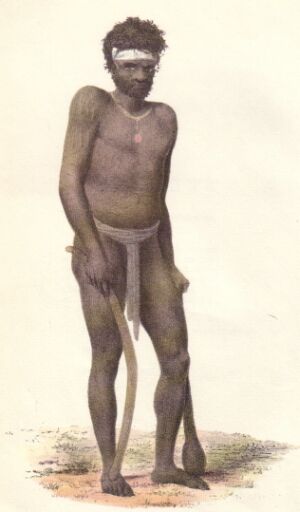
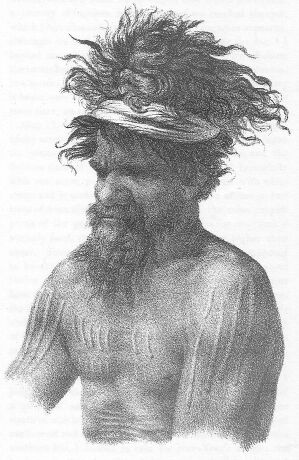
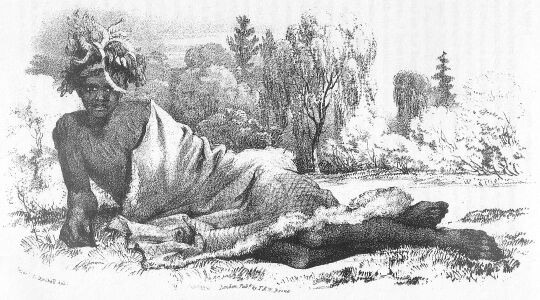
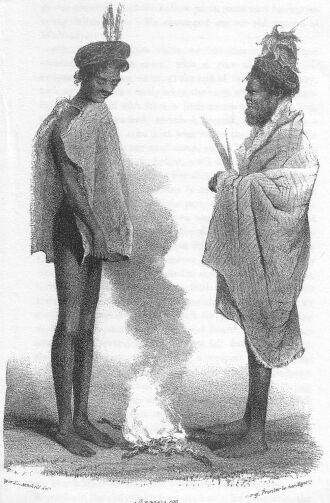
PLATE 1: PORTRAIT OF CAMBO, AN ABORIGINAL NATIVE.
Major T.L. Mitchell del. G. Foggo lithographer. J. Graf Printer to Her Majesty.
A Bushranger's story.
My plan of exploration.
Preparations.
Departure from Sydney.
A garden.
Country between Sydney and the Hawkesbury.
Beyond the Hawkesbury.
Summit of Warrawolong.
Natives of Brisbane Water.
The Wollombi.
Valley of the Hunter.
Fossils of the Hunter.
Men employed on the expedition.
Equipment.
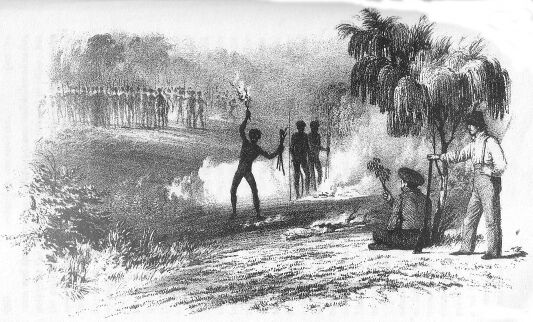
Burning grass.
Aborigines and Colonists.
Cambo, a wild native.
A Colonist of the right sort.
Escape of the Bushranger, The Barber.
Burning Hill of Wingen.
Approach Liverpool Range.
Cross it.
A sick tribe.
Interior waters.
Liverpool Plains.
Proposed route.
Horses astray.
A Squatter.
Native guide and his gin.
Modes of drinking au naturel.
Woods on fire.
Cross the Turi Range.
Arrive on the River Peel.
Fishes.
Another native guide.
Explore the Peel.
Enter an unexplored region.
Situation of Mr. Oxley's camp on the Peel.
Westward course of the river.
Kangaroo shot.
Calcareous rocks.
Acacia pendula first seen.
Other trees near the river.
Junction of the Peel and Muluerindie.
View from Perimbungay.
Ford of Wallanburra.
Plains of Mulluba.
View from Mount Ydire.
Hills seen agree with The Bushranger's account.
The river Namoi.
Stockyard of The Bushranger.
Singular fish.
View from Tangulda.
Cutting through a thick scrub.
Want of water.
Impeded by a lofty range of mountains.
Marks of natives' feet.
Maule's river.
A grilled snake.
View on ascending the range of Nundewar.
Native female.
Proposed excursion with packhorses.
Native guide absconds.
The range impassable.
Return to Tangulda.
Prepare to launch the boats on the Namoi.
Fires in the Bush.
Rocks of Bullabalakit.
Boat launched.
Bees load my rifle with honey.
Embark on the Namoi in canvas boats.
Impediments to the navigation.
Boat staked, and sinks.
The leak patched.
She again runs foul of a log.
Provisions damaged.
Resolve to proceed by land.
Pack up the boats, and continue the journey.
Pass the western extremity of Nundewar Range.
Unknown tree.
Water scarce.
Providential supply.
Crayfish.
Trap-hill on plains.
Cut through a scrub.
Meet a tribe of Natives.
Again obliged to cut our way.
Fortunate discovery of water.
Dry valleys.
Mount Frazer.
The party in distress for want of water.
Water found next day.
Ducks.
Wheel Ponds.
Excessive heat and drought.
Description of the woods.
Meet with natives.
Cross the dry bed of a river.
A friendly native with his family.
No water.
Reach the Gwydir.
Cross it with one man.
Prevented by a native with spears, from shooting a kangaroo.
Re-cross the river.
Change the route to trace the course of the Gwydir.
A native village of bowers.
Effect of sudden moisture on the wheels.
Tortuous course of the Gwydir.
Lines of irrigation across the plains.
Heavy rain.
Crested pigeon.
The party impeded by the soft state of the surface.
Lagoons near the river.
Excursion northward.
Reach a broad sheet of water.
Position of the party.
The common course of the river, and the situation of the range considered.
Nondescript tree and fruit.
Plains of rich soil, beautifully wooded.
Small branches of the Gwydir.
Much frequented by the natives.
Laughable interview of Dawkins with a tribe.
Again reach the Gwydir.
A new cucumber.
Cross the river and proceed northward.
A night without water.
Man lost.
Continue northward.
Water discovered by my horse.
Native weirs for catching fish.
Arrive at a large and rapid river.
Send back for the party on the Gwydir.
Abundance of three kinds of fish.
Preparations for crossing the river.
Natives approach in the night.
View from one tree fastened to another.
Mr. White arrives with the party and lost man.
Detained by natives.
Mr. White crosses the river.
Marks of floods on trees.
Man lost in the woods.
Natives' method of fishing.
Native dog.
Mr. White's account of the river.
Excursion down the Karaula.
Its unexpected course.
Formidable insects.
Junction of the Gwydir.
Owls and Rats.
Natives at the camp during my absence.
Their attempts to steal.
Native dogs.
Tents struck to cross.
Arrival of Mr. Finch.
Murder of his men.
Loss of his horses.
And seizure of his stores by the natives.
Destroy the boat and retire from the Karaula.
Forced march to the Gwydir.
Numerous tribes surround the party.
Good effects of sky-rockets.
Funeral dirge by a native female.
Dog killed by a snake.
Numerous tribes follow.
The party regains the plains.
Proposed movements.
Hot wind.
Heavy rains set in.
Country impassable for several days.
Excursion to the plundered camp of Mr. Finch.
Recover the cart and trunks.
Bury the bodies.
Columns of smoke.
Signals of the natives.
Courage and humanity of one of the men.
Homeward journey continued.
Difficult travelling.
Civility of the tribe first met.
Mosquitoes troublesome.
Regain the Namoi.
Ascend Mount Warroga.
Re-cross the Peel.
Conclusion.
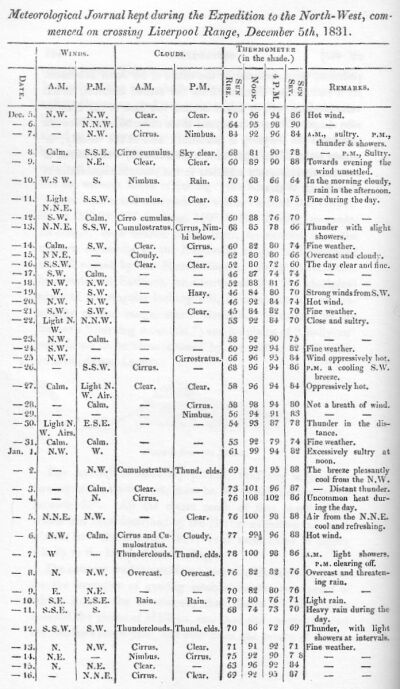
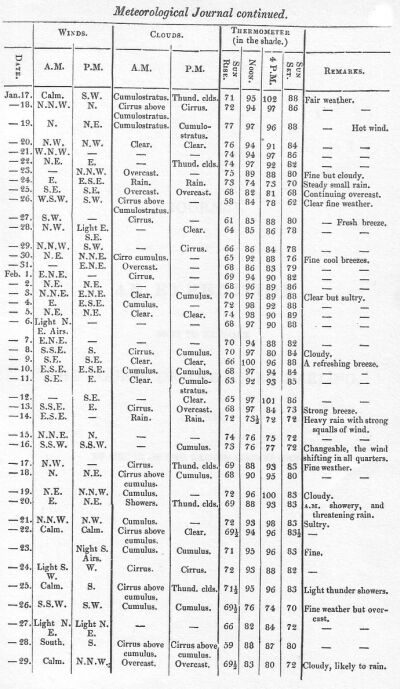
Meteorological Journal kept during the Expedition to the North-west, and commenced on crossing Liverpool Range, December 1, 1831.
Supposed course of the Darling.
Mr. Dixon's survey of the Bogan.
Expedition postponed.
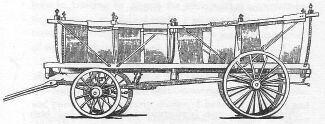
Description of the boat carriage.
Number and description of the party.
Expedition leaves Parramatta.
My departure from Sydney.
Western part of Cumberland.
County of Cook.
The Blue Mountains.
Weatherboard Inn.
Mounts Hay and Tomah.
River Grose.
Early attempts to trace it upwards.
Intended Tunnel.
Pass of Mount Victoria.
Advantages of convict labour.
Country of Mulgoey.
Emu plains.
Township.
General arrangement of towns and villages.
The mountain road.
Vale of Clywd.
Village reserve.
Granite formation.
Farmer's Creek.
River Cox and intended bridge.
Mount Walker.
Solitary Creek.
Honeysuckle Hill.
Stony Range.
Plains of Bathurst.
The town.
Inconvenience of want of arrangement in early colonization.
Smallfarmers.
Intended Bridge.
Departure from Bathurst.
Charley Booth.
Road to Buree.
Canobolas.
Arrival at the camp of the party.
Ascend the Canobolas.
Choose the direction of my route.
Ascend the hill north of Buree.
Encamp on the Mundadgery.
Cross a granitic range.
King's Creek.
Cross Hervey's range.
First view of the interior.
Parched state of the interior country.
The dogs kill a kangaroo.
Steep descent to the westward.
Search for water by moonlight.
Encamp without any.
Follow a valley downwards and find water.
Lifeless appearance of the valleys.
Luxury of possessing water after long privation.
Ascend Mount Juson with Mr. Cunningham.
Enter the valley of the Goobang.
Meet the natives.
Social encampment.
Mount Laidley.
Springs on the surface of the plains under Croker's range.
Cross Goobang Creek.
The dogs kill three large kangaroos.
Wild honey brought by the natives.
Arrive at Tandogo.
Allan's water of Oxley.
Advantage of aboriginal names on maps.
Excursion with Mr. Cunningham.
Effects of a hurricane in the forest.
Encamp without water.
Natives leave the party.
Cattle distressed for want of water.
Mr. Cunningham missing.
Desperate search for water.
At length find water on reaching by night the river Bogan.
Encamp on this river.
Search for Mr. Cunningham.
No traces to be seen.
Supposed to have met with an accident.
Souter and Murray sent back along the track.
My search South-South-West 40 miles.
Interview with two natives.
Range of porphyry.
Mr. Cunningham's track found.
Mr. Larmer and a party sent to trace it.
Mr. Cunningham's track followed for 70 miles, his horse found dead.
His own footsteps traced.
Mr. Larmer meets a tribe.
The footsteps traced into the channel of the Bogan.
Death of the Kangaroo.
Reflections.
Five natives brought to me with a silk handkerchief in their possession.
Their names.
The party halt at Cudduldury.
Interview with the King of the Bogan.
Muirhead and Whiting sent to examine the dry channel of the river.
Search extended to the plains of the Lachlan.
Camp of Natives.
Pass the night in a hollow without water.
View towards Mount Granard.
A second night without water.
Awoke by the forest on fire.
Interview with three natives.
Roots of trees sucked by the natives.
Horses reach the camp with great difficulty.
Part of Mr. Cunningham's coat found.
Continue along the Bogan, guided by the natives.
Their caution in approaching the haunts of others.
Their accurate knowledge of localities.
Introduced to the Bungan tribe.
Superiority of the King how displayed.
Dangerous mistake.
A true savage.
The king of the Bogan takes his leave.
Kangaroos numerous.
Beauty of the shrubs.
Dangerous consequence of surprising a native.
Wounded native led to our camp.
His confidence gained by kind treatment.
Oxley's Tableland.
Mr. Larmer's excursion to it.
Narrow escape from the loss of the cattle.
The party followed by a clamorous tribe.
A parley.
Their various complexions.
Decorous behaviour.
Naked plains.
A native visitor.
Soft earth of the plains.
Ride to the Darling.
The water sweet.
The party encamps on a favourable position on the river.
Rain at last.
Stockade erected.
Named Fort Bourke.
Visited by the natives.
Mortality among them from smallpox.
Results of the journey.
Friendly disposition of a native.
Boats launched.
Presents to natives.
They become importunate.
We leave the depot and embark in the boats.
Slow progress down the river.
Return to the depot.
Natives in canoes.
Excursion with a party on horseback.
A perfumed vegetable.
Interview with natives.
Present them with tomahawks.
Unsuccessful search for Mr. Hume's marked tree.
Ascend D'Urban's group.
Promising view to the southward.
A burnt scrub full or spinous dead boughs.
A night without water.
Return to the camp.
The party proceeds down the Darling.
Surprise a party of natives.
New acacia.
Mr. Hume's tree found.
Fall in the Darling.
Surprised by a party of natives.
Emu killed by the dogs.
Dunlop's range.
Meet the Puppy tribe.
Ascend Dunlop's range.
High land discovered to the westward.
Grass pulled and piled in ricks by the natives.
Hills beyond the Darling.
Convenient refraction.
Native huts.
Interview with the Red tribe.
The Puppy tribe.
How to avoid the sandy hills and soft plains.
Macculloch's range.
Visit a hill beyond the Darling.
View from its summit.
Natives of the Spitting tribe.
Singular behaviour on the discharge of a pistol.
Conjectures.
Second interview with the Spitting tribe.
Strange ceremonial.
Amusing attempts to steal, or diamond cut diamond.
Dry channel of a stream.
Tombs on the sandhills.
White balls on tombs.
Australian shamrock.
Old canoe.
Dry state of the country.
Danger and difficulty of watching the cattle on the riverbanks.
Uniform character of the Darling.
The Grenadier bird.
The Doctor and the natives.
A range discovered by refraction.
Dance of natives.
A lake.
Tombs of a tribe.
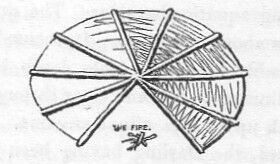
Plan of natives' hut.
Method of making cordage.
The tall native's first visit.
Channel of a small stream.
The carts beset on the journey by very covetous natives.
Mischievous signals.
Cattle worn out.
The tall man again.
Approach of the Fishing tribe.
Covetous old man.
Conduct on witnessing the effect of a shot.
The party obliged to halt from the weak state of the cattle.
The natives very troublesome.
Singular ceremonies.
Ichthyophagi.
Their manner of fishing.
The burning brand.
A tribe from the south-east.
The old man appears again with a tribe from the south-west.
Small streams from the west.
The Darling turns southward.
Resolve to return.
Description of the country on the banks of the river.
The men at the river obliged to fire upon the natives.
Steady conduct of the party.
Origin of the dispute.
Narrow escape of Muirhead.
Treacherous conduct of the aborigines.
Melancholy reflections.
Commencement of the homeward journey.
The cattle begin to fail.
Halt and endeavour to lighten the carts.
Rain comes on.
Native conversations at a distance.
Party separated to watch the cattle.
Illness of some of the men from scurvy.
Mr. Larmer's excursion into the country to the eastward.
The Spitting tribe again.
Return of Mr. Larmer, who had found water and inhabitants.
A day's halt.
Ride to Greenough's group.
View from the summit.
Barter with natives beyond the Darling.
The Red tribe again.
New species of caper eaten by the natives.
Importunity of the Red tribe.
Cross the Darling.
View from the summit of Mount Macpherson.
Rain again threatens.
Absence of kangaroos and emus on the Darling.
The Occa tribe again.
Hints to Australian sportsmen.
Meet the Fort Bourke tribe.
Mr. Hume's tree.
Return to Fort Bourke.
Description of that position.
Saltness of the Darling.
The plains.
The rivers supported by springs.
Traces of floods.
Extent of the basin of this river.
Its breadth.
Surface of the plains.
Geology of the Darling.
Woods.
Gum acacia abundant.
Grasses.
General character of the natives.
Their means of existence.
Nets used by them.
Superstitions.
Condition of the females.
Singular habits of a rat.
Security of a species of ants.
Birds.
Fishes.
Apprehended scarcity of water on leaving the Darling.
Six of the cattle dead from exhaustion.
Rest of two days at Fort Bourke.
Visited by the Fort Bourke tribe.
The party leaves the Darling.
Natives approach the camp during the night.
Scared by a rocket.
Discovery of a Caper-tree.
The kangaroos and emus driven away by the natives.
Difference between the plains of the Darling and Bogan.
Extreme illness of one of the party.
New Year's range.
A thunderstorm.
Three natives remind us of the man wounded.
Another man of the party taken ill.
Acacia pendula.
Beauty of the scenery.
Mr. Larmer traces Duck Creek up to the Macquarie.
A hot wind.
Talambe of the Bogan Tribe.
Tombs of Milmeridien.
Another bullock fails.
Natives troublesome.
Successful chase of four kangaroos.
Natives of the Bogan come up.
Water scarce.
Two red-painted natives.
Uncertainty of Mr. Cunningham's fate.
Mr. Larmer overtakes the party.
Result of his survey.
Send off a courier to Sydney.
Marks of Mr. Dixon.
Tandogo Creek and magnificent pine forest.
Hervey's range in sight.
Improved appearance of the country.
Meet the natives who first accompanied us.
Arrive at a cattle station.
Learn that Mr. Cunningham had been killed by natives.
Cookopie ponds.
Goobang Creek.
Character of the river Bogan.
Native inhabitants on its banks.
Their mode of fishing.
Manners and customs.
Prepare to quit the party.
The boats.
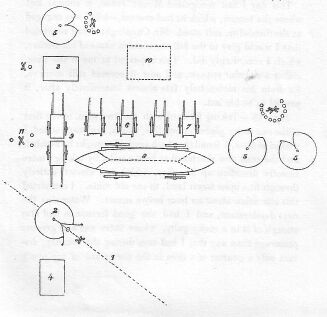
Plan of encampment.
Mount Juson.
Leave the party and mark a new line of ascent to Hervey's range.
Get upon a road.
Arrive at Buree.
(BAROMETRICAL JOURNAL KEPT DURING THE JOURNEY INTO THE INTERIOR OF NEW SOUTH WALES IN WINTER 1835.)
(RANGE OF THE THERMOMETER AND JOURNAL OF THE WEATHER.)
LETTER FROM CAPTAIN FORBES, 39TH FOOT, COMMANDANT OF THE MOUNTED POLICE.
REPORT FROM LIEUTENANT ZOUCH, MOUNTED POLICE, RESPECTING THE DEATH OF MR. CUNNINGHAM.
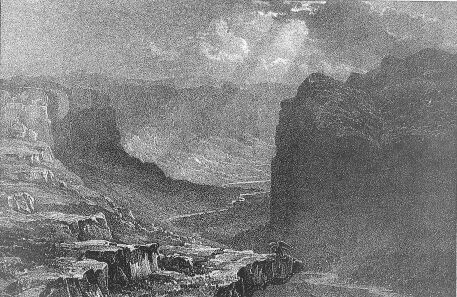
PLATE 1: PORTRAIT OF CAMBO, AN ABORIGINAL NATIVE.
TEMPORARY GUNYA OR HUT, SET UP FOR PASSING A NIGHT IN THE BUSH.
FOSSIL SHELLS OF THE HUNTER.--Plates 2 3, 4
PLATE 2: FIGURES 1 AND 2: Megadesmus globosus.
PLATE 5: BURNING HILL OF WINGEN, AS IN FEBRUARY 1829.
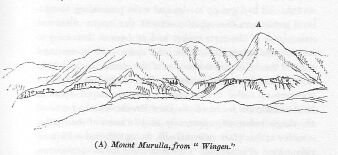
MOUNT MURULLA (A), AND PART OF LIVERPOOL RANGE, FROM WINGEN.
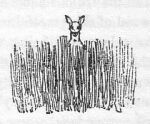
KANGAROO AS SEEN IN THE LONG GLASS.
PLATE 6:
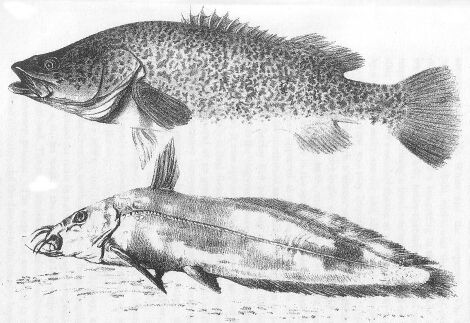
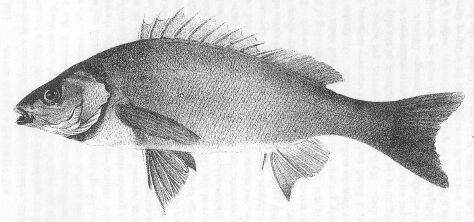
FIGURE 1: Grites peelii, OR COD-PERCH.
FIGURE 2: Plotosus tandanus, OR EEL-FISH.
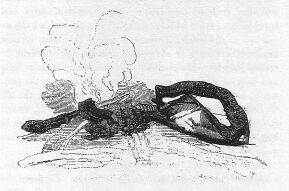
A SNAKE, AS COOKED ON THE FIRE BY THE NATIVES.
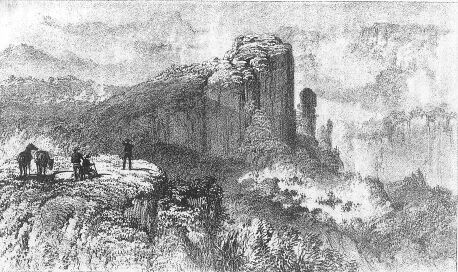
PLATE 7: VIEW OF NUNDEWAR RANGE, WHERE THE PARTY COULD NOT CROSS IT.
PLATE 8: THE PIC OF TANGULDA, FROM THE WEST.
NUNDEWAR RANGE FROM THE WEST, 3RD JANUARY.
A CROW DURING EXTREME DROUGHT.
NUNDEWAR RANGE FROM THE NORTH-WEST, 12TH JANUARY.
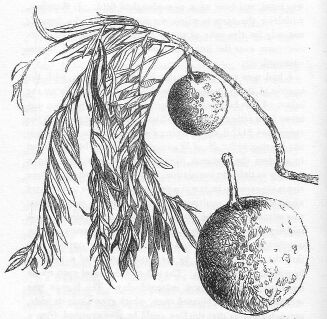
NONDESCRIPT FRUIT FROM SNODGRASS LAGOON.
PLATE 9: Cernua bidyana, OR BIDYAN RUFFE.
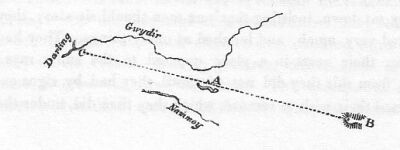
SKETCH EXPLANATORY OF A USEFUL PRINCIPLE IN EXPLORATION.
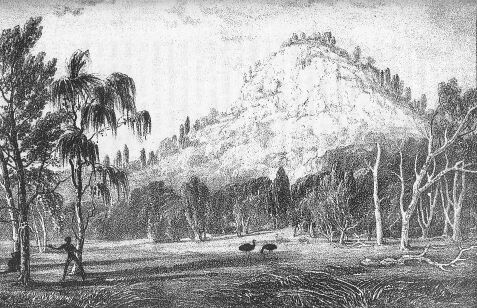
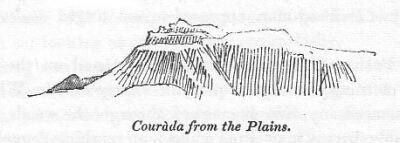
COURADA FROM THE PLAINS. A REMARKABLE HILL, AS IT APPEARS FROM THE NORTH.
BOAT-CARRIAGE USED IN THE TWO LAST EXPEDITIONS.
PLATE 10: INACCESSIBLE VALLEY OF THE RIVER GROSE.
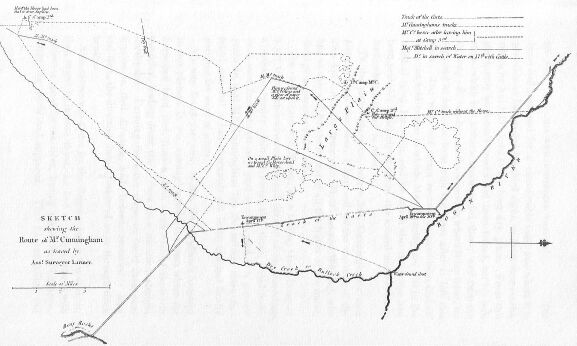
PLATE 11: MAP OF MR. CUNNINGHAM'S TRACK WHEN LOST IN THE WOODS.
PLATE 12: FIRST MEETING WITH THE CHIEF OF THE BOGAN TRIBE.
PLATE 13: PORTRAIT OF A NATIVE OF THE BOGAN.
OXLEY'S TABLE-LAND FROM THE NORTH-WEST.
D'URBAN'S GROUP FROM THE WEST.
PLATE 14: DANCE OF NATIVES ON FIRST HEARING THE REPORT OF A PISTOL.
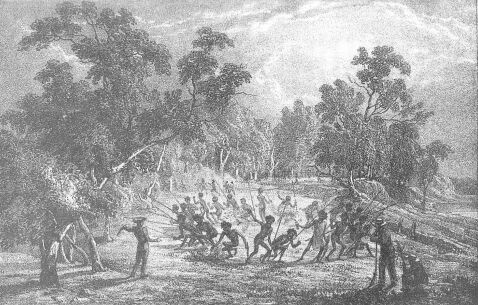
PLATE 15: NATIVES ROBBING THE BLACKSMITH, WHILE THE OLD MEN CHANTED A HYMN OR SONG.
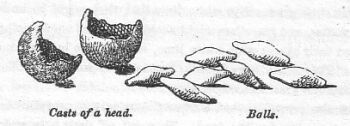
BALLS, AND CASTS OF A HEAD IN LIME, FOUND ON TOMBS.
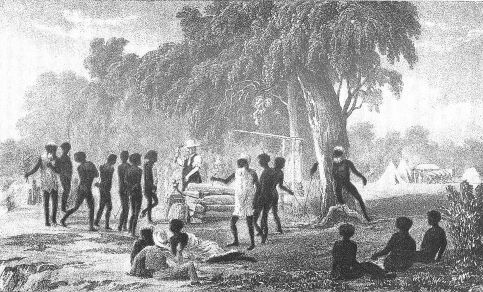
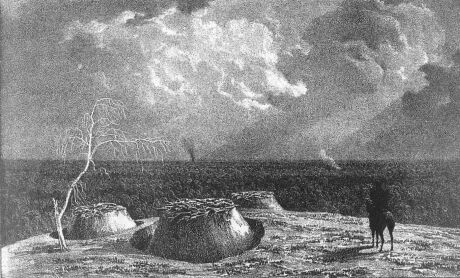
PLATE 16: TOMBS OF A TRIBE, AFTER SOME GREAT MORTALITY, PROBABLY FROM A DISEASE RESEMBLING SMALLPOX.
PLATE 18: VIEW ON THE RIVER DARLING, NEAR CAMP, 9TH AUGUST 1835.
PLATE 20: BURYING-GROUND OF MILMERIDIEN, AND SCENERY OF THE CLOSE SCRUBS.
PLAN OF ENCAMPMENT IN THE INTERIOR.
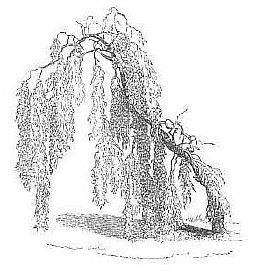
YOUNG WEEPING EUCALYPTUS, FROM NATURE.
(GENERAL MAP OF THE EXPLORATORY ROUTES, WITH SECTIONS OF THE RIVERS, AND A PLAN OF THE MOUTH OF THE RIVER GLENELG; THE WHOLE BEING COMPILED BY THE AUTHOR FROM ACTUAL SURVEYS MADE UNDER HIS OWN DIRECTION, OR BY HIMSELF.)1. Rhinolophus megaphyllus. Gray.
2. Petaurus leucogaster. Mitch. (New Species.) From the banks of the Murray.
3. Phalangista xanthopus. Ogilby. From Rifle range, near the Glenelg.
4. Choeropus ecaudatus. Ogilby. (New Species.) Volume 2 page 131. From forest near the Murray.
5. Myrmecobius ? rufus. Mitch. (New Species.)*
(*Footnote. This was called the red shrew mouse by the men composing the party, but as no species of the Insectivora of Zoologista has hitherto been discovered in Australia, it more probably belongs to the genus Myrmecobius, recently described by Mr. Waterhouse. I venture to name this animal with considerable hesitation, having neglected to take a note of the generic characters, while the specimen was yet within my reach. If it be a true Sorex, its discovery will be as interesting to Zoologists as that of the Dipus, neither genus having been hitherto suspected to exist in Australia.)
6. Dipus mitchellii. Ogilby. (New Species.) Volume 2 page 144. From reedy plains, near the Murray.
7. Conilurus constructor. Ogilby. (New Species.) Volume 1 page 308. From the scrubs near the Darling. The rabbit-rat of the colonists.
8. Mus platurus. Mitch. (New Species.) From the river Darling.
9. Mus hovellii. Mitch. (New Species.) From near the Bayunga, and named in honour of the discoverer of that river.
1. Falcunculus leucogaster ? aut Frontalis? Black-crested shrike, from the banks of the Murray.
2. Falcunculus flavigulus ? Brown-crested shrike, from the Lower Bogan.
3. Cracticus tibicen. Vieill.
4. Fregillus leucopterus. Vig. and Horsf.
5. Merops melanurus. Vig. and Horsf.
6. Pomatorhinus temporalis. Horsf.
7. Malurus leucopterus. Vig. and Horsf.
8. Fringilla castanotis.
9. Musicapa goodenovii. Vig. and Horsf.
10. Anthus rufescens. Vig. and Horsf.
11. Plyctolophus leadbeateri. Vig. Plate 23. Volume 2 page 47.
12. Plyctolophus eos. Temm.
13. Platycercus flaviventur. Vig. and Horsf.
14. Platycercus multicolor. Vig. and Horsf.
15. Platycercus bernardi. Vig. and Horsf.
16. Platycercus haematogaster. Gould. (New Species.) Volume 1 page 238.
17. Nanodes discolor. Vig. and Horsf.
18. Nanodes venustus. Vig. and Horsf.
19. Nanodes bourkii. Mitch. (New Species.) From Bogan river.
20. Nanodes.
21. Nanodes haematonotis. (New Species.)
22. Meliphaga chrysotis. Lewin.
23. Meliphaga leucotis.
24. Meliphaga penicillata. Gould.
25. Columba spilanota. Speckled Dove from Fort Bourke.
26. Columba lophotes ? Temm. (New Species.)
27. Columba marmorata. Mitch. (New Species ?) The Freckled Dove, Fort Bourke.
28. Casuarius novae hollandiae. Latb.
29. Tringa.
30. Vanellus. Large Plover tram near Buree.
31. Cygnus atratus. From the Glenelg.
32. Anas cyanea. Mitch. (New species.) From Lake Stapylton.
33. Aquilla fucosa. From the Murrumbidgee.
1. Acernia (Cernua) bidyana. Mitch. (New Species.) Volume 1 page 95.
2. Acernia (Gristes) Peelii. Mitch. (New Species.) Volume 1 page 95.
3. Plotosus Tandanus. Mitch. (New Species.) Volume 1 page 95.
4. Truncatella filosa. Sowerby. (New Sp. of univalve from Mitre lake.) Volume 2 page 191.
1. Cancriform epeira. Volume 1 page 88.
2. Stilbum. Volume 1 page 97.
3. Bembecidae. Volume 1 page 98.
4. Scutellera corallifera. Volume 1 page 98.
5. Abispa australiana. (New Species ?) Volume 1 page 104.
6. Gryllotalpa australis. Volume 1 page 126.
1. Dasyurus laniarius. Owen. (Extinct Species.)
2. Phalangista. (Undetermined Species.)
3. Hyrsiprymnus. (Undetermined Species.)
4. Macropus atlas. Owen. (Extinct Species.)
5. Macropus titan. Owen. (Extinct Species.)
6. Macropus. (Undetermined Species.)
7. Halmaturus. (Undetermined Species.)
8. Phascolomys mitchellii. Owen. (Extinct Species ?)
9. Diprotodon optatum. Owen. (Extinct Genus.)
1. Turbo filosa. Sowerby. (New Species.) Volume 1 page 15.
2. Trochus oculus. Sowerby. (New Species.) Volume 1 page 15.
3. Isocardia ---- ? Sowerby. (New Species.) Volume 1 page 15.
4. Megadesmus globosus. Sowerby. (New Species.) Volume 1 page 15.
5. Megadesmus antiquatus. Sowerby. (New Species.) Volume 1 page 15.
6. Magadesmus laevis. Sowerby. (New Species.) Volume 1 page 15.
7. Megadesmus cuneatus. Sowerby. (New Species.) Volume 1 page 15.
Pleurandra incana, volume 2 page 156.
Campylanthera ericoides, volume 2 page 277.
Tetratheca ciliata, volume 2 page 206.
Baeckia crassifolia, volume 2 page 115.
Baeckia alpina, volume 2 page 178.
Baeckia calycina, volume 2 page 190.
Eucalyptus alpina, volume 2 page 175.
Genetyllis alpestris, volume 2 page 178.
Loranthus quandang, volume 2 page 69.
Capparis mitchellii, volume 1 page 315.
Pigea floribunda, volume 2 page 165.
Hybiscus tridactylites, volume page 85.
Sida corrugata, volume 2 page 13.
Sida fibulifera, volume 2 page 45.
Gyrostemon pungens, volume 2 page 121.
Cryptandra tomentosa, volume 2 page 178.
Correa leucoclada, volume 2 page 39.
Correa cordifolia, volume 2 page 233.
Correa glabra, volume 2 page 48.
Correa rotundifolia, volume 2 page 219.
Eriostemon pungens, volume 2 page 156.
Phebalium bilobum, volume 2 page 178.
Didymeria aemula, volume 2 page 1 198.
Ropera aurantiaca, volume 2 page 70.
Pelargonium rodneyanum, volume 2 page 144.
Trigonella suavissima, volume 1 page 255.
Psoralea patens, volume 2 page 8.
Psoralea tenax, volume 2 page 10.
Psoralea cinerea, volume 2 page 65.
Indigofera acanthocarpa, volume 2 page 17.
Daviesia pectinata, volume 2 page 151.
Daviesia brevifolia, volume 2 page 201.
Pultenaea montana, volume 2 page 178.
Pultenaea mollis, volume 2 page 260.
Bossiaea rosmarinifolia, volume 2 page 178.
Dillwynia hispida, volume 2 page 251.
Cassia teretifolia, volume 1 page 289.
Cassia heteroloba, volume 2 page 122.
Acacia leucophylla, volume 2 page 13.
Acacia salicina, volume 2 page 20.
Acacia sclerophylla, volume 2 page 139.
Acacia aspera, idem.
Acacia farinosa, volume 2 page 146.
Acacia strigosa, volume 2 page 185.
Acacia exudans, volume 2 page 214.
Acacia furcifera, volume 2 page 267.
Acacia acinacea, volume 2 page 267.
Trichinium alopecuroideum, volume 2 page 13.
Trichinium parviflorum, idem.
Trichinium sessilifolium, idem.
Trichinium nobile, volume 2 page 22.
Trichinium lanatum, volume 2 page 123.
Atriplex halimoides, volume 1 page 285.
Sclerolaena bicornis, volume 2 page 47.
? Eucarya murrayana, volume 2 page 100.
Fusanus acuminatus, volume 2 page 69.
Grevillea aquifolium, volume 2 page 178.
Grevillea variabilis, volume 2 page 179.
Grevillea alpina, idem.
Leucopogon cordifolius, volume 2 page 122.
Leucopogon glacialis, volume 2 page 1.
Leucopogon rufus, volume 2 page 179.
Epacris tomentosa, volume 2 page 177.
Tripetelus australasicus, volume 2 page.
Solanum esuriale, volume 2 page 43.
Solanum ferocissimum, volume 2 page.
Picris barbarorum, volume 2 page 149.
Calostemma candidum, volume 1 page volume 2 page 30.
Calostemma carneum, volume 2 page 3.
Bulbine suavis, volume 2 page 272.
Xerotes typhina, volume 2 page 41.
Xerotes effusa, volume 2 page 101.
Panicum laevinode, volume 1 page 23.
Danthonia lappacea, volume 1 page 3.
Danthonia pectinata, volume 2 page 26.
Danthonia eriantha, volume 2 page 307.
Eleusine marginata, volume 1 page 3.
A Bushranger's story.
My plan of exploration.
Preparations.
Departure from Sydney.
A garden.
Country between Sydney and the Hawkesbury.
Beyond the Hawkesbury.
Summit of Warrawolong.
Natives of Brisbane Water.
The Wollombi.
Valley of the Hunter.
Fossils of the Hunter.
Men employed on the expedition.
Equipment.
Burning grass.
Aborigines and Colonists.
Cambo, a wild native.
A Colonist of the right sort.
Escape of the Bushranger, The Barber.
Burning Hill of Wingen.
Approach Liverpool Range.
Cross it.
A sick tribe.
Interior waters.
Liverpool Plains.
Proposed route.
Horses astray.
A Squatter.
Native guide and his gin.
Modes of drinking au naturel.
Woods on fire.
Cross the Turi Range.
Arrive on the River Peel.
Fishes.
Another native guide.
Explore the Peel.
BUSHRANGER'S STORY.
The journey northward in 1831 originated in one of those fabulous tales which occasionally become current in the colony of New South Wales, respecting the interior country, still unexplored.
A runaway convict named George Clarke, alias The Barber, had, for a length of time escaped the vigilance of the police by disguising himself as an aboriginal native. He had even accustomed himself to the wretched life of that unfortunate race of men; he was deeply scarified like them and naked and painted black, he went about with a tribe, being usually attended by two aboriginal females, and having acquired some knowledge of their language and customs.
But this degenerate white man was not content with the solitary freedom of the savage life and his escape from a state of servitude. He had assumed the cloak and colour of the savage that he might approach the dwellings of the colonists, and steal with less danger of detection. In conjunction with the simple aborigines whom he misled, and with several other runaway convicts he had organised a system of cattle stealing, which was coming into extensive operation on Liverpool plains when, through the aid of some of the natives, who have in general assisted the detection of bushrangers, he was at length discovered and captured by the police.
After this man was taken into custody, he gave a circumstantial detail of his travels to the north-west along the bank of a large river, named, as he said, the Kindur; by following which in a south-west direction he had twice reached the seashore. He described the tribes inhabiting the banks of the Kindur and gave the names of their chiefs. He said that he had first crossed vast plains named Balyran, and, on approaching the sea, he had seen a burning mountain named Courada. He described, with great apparent accuracy, the courses of the known streams of the northern interior which united, as he stated, in the Namoi, a river first mentioned by him; and, according to his testimony, Peel's river entered the Namoi by flowing westward from where Mr. Oxley had crossed it.
Now this was contrary to the course assigned to the Peel in the maps by early travellers, but consistent nevertheless with more recent surveys. Vague accounts of a great river beyond Liverpool plains, flowing north-west, were current about the time General Darling embarked for England. The attention of the acting governor, Colonel Lindesay, was particularly drawn to the question by this report of Clarke, and also by the subsequent proposals of various persons, to conduct any expedition sent in search of the great river.
PLAN OF EXPLORATION.
There are few undertakings more attractive to the votaries of fame or lovers of adventure than the exploration of unknown regions; but Sir Patrick Lindesay, with due regard to the responsibility which my office seemed to impose upon me, as successor to Mr. Oxley, at once accepted my proffered services to conduct a party into the interior.
The principal object of my plan was the exploration of Australia, so that whether the report of the river proved true or false, the results of the expedition would be, at least, useful in affording so much additional information; equally important geographically, whether positive or negative.
After I had surveyed extensive tracts of territory I never could separate the question respecting the course of any river from that of the situation of the higher land necessary to furnish its sources and confine its basin. I could not entertain the idea of a river distinct from these conditions, so necessary to the existence of one; and it appeared to me that if a large river flowed to the north-west of any point north of Liverpool plains its sources could only be sought for in the Coast Range in the opposite direction; or to the eastward of these plains.
Various rivers were known to arise on that side of the Coast Range; the streams from Liverpool plains flowing northward; the Peel, the Gwydir, and the Dumaresq, arising in the Coast Range, and falling, as had been represented, to the north-westward. I proposed therefore to proceed northward, or to pursue such a direction as well as the nature of the country permitted, so that I might arrive, on the most northern of these streams, and then, keeping in view whatever high land might be visible near its northern banks, to trace the river's course downwards, and thus to arrive at the large river, or common channel of all these waters.
The second condition necessary to the existence of a river, namely, the higher land enclosing its basin, might, in this case, have been either Arbuthnot's Range, or that between the Darling and the Lachlan; and this seemed to me to involve a question of at least equal importance to that of the river itself, for, had the fall of all the waters above-mentioned, been to the north-west, it was obvious that such a range must have been the dividing ridge or spine connecting the eastern and western parts of Australia, and which, when once investigated was likely to be the key to the discovery of all the rivers on each side, and to the other subordinate features of this great island.
Thus, the most direct and practical plan for seeking the river, was perfectly consistent with my views of general exploration.
PREPARATION FOR THE SURVEY.
In the selection of men to compose an exploring party, and in collecting the articles of equipment, provisions, and means of transport, my department afforded various facilities. This aid was the more necessary in my case, because the other duties of my office, prevented me from devoting much attention personally, to the preparations for such a journey.
From the known level character of the interior, I considered that the light drays or carts used by the surveyors might easily pass, and I therefore preferred them to packhorses, being also a more convenient means of conveyance; I availed myself likewise of such men, carts, bullocks, and horses, as were disposable in the survey department at the time. The new Governor was expected in the course of a few months, and I was therefore desirous to set out as soon as possible, that I might return before his arrival.
After several weeks of anxious preparation, I had the satisfaction to find that every contingency was, as far as possible, provided for in my department. Each officer, whether employed in the survey of the different parts of the colony, or the measurement of farms, was also fully instructed respecting his duties during my contemplated absence. In the correspondence with the office at Sydney, which amounted annually to about 2000 letters, none remained unanswered; and my last cares were to leave, in the hands of an engraver, a map of the colony, that the past labours of the department might be permanently secured to the public, whatever might be our fate in the interior.
DEPARTURE FROM SYDNEY.
Little time remained for me to look at the sextants, theodolite, and other instruments necessary for the exploratory journey; I collected in haste a few articles of personal equipment, and having as well as I could, under the circumstances, set my house in order, I bade adieu to my family, and left Sydney at noon, on Thursday, the 24th day of November, 1831, being accompanied for some miles by my friend Colonel Snodgrass.
It was not until then, that my mind was sufficiently relieved from considering the details of my department, to enable me to direct my thoughts to the undiscovered country. I had yet to traverse 300 miles, for to that distance from Sydney the flocks of the colonists extended, before I could reach the vast untrodden soil, the exploration of which was the object of my mission. I felt the ardour of my early youth, when I first sought distinction in the crowded camp and battlefield, revive, as I gave loose to my reflections and considered the nature of the enterprise. But, in comparing the feelings I then experienced with those which excited my youthful ambition, it seemed that even war and victory, with all their glory, were far less alluring than the pursuit of researches such as these; the objects of which were to spread the light of civilisation over a portion of the globe yet unknown, though rich, perhaps, in the luxuriance of uncultivated nature, and where science might accomplish new and unthought-of discoveries; while intelligent man would find a region teeming with useful vegetation, abounding with rivers, hills, and valleys, and waiting only for his enterprising spirit and improving hand to turn to account the native bounty of the soil.
A GARDEN.
My first day's journey, terminated near Parramatta, at the residence of Mr. John Macarthur. I was received by that gentleman with his usual hospitality, and although not in the enjoyment of the best health, he insisted on accompanying me over his extensive and beautiful garden, where he pointed out to my attention, the first olive-tree ever planted in Australia. Here I also saw the cork-tree in full luxuriance--the caper plant growing amidst rocks--the English oak--the horse-chestnut--broom--magnificent mulberry trees of thirty-five years' growth, umbrageous and green. Beds of roses, in great variety, were spread around, and filled the air with fragrance, while the climbing species of that beautiful flower was equally pleasing to the eye. I observed convict Greeks (Pirates.)--acti fatis--at work in that garden of the antipodes, training the vines to trellises, made after the fashion of those in the Peloponnesus. The state of the orange-trees, flourishing in the form of cones sixteen feet high, and loaded with fruit, was very remarkable, but they had risen from the roots of former trees, which, having been reduced to bare poles by a drought of three years' duration, had been cut off, and were now succeeded by these vigorous products of more genial seasons. Mr. Macarthur assured me, that by adopting this plan, many fruit-trees, after suffering from the effects of long-continued drought, might be renovated successfully. The want of moisture in the climate of Australia, may occasionally compel the gardener to resort to such extreme measures for the preservation of his trees: but the orange has hitherto yielded a very profitable and constant return to those, who have attended to its cultivation in this colony. The luxuriant growth of the apple and pear, in a climate so dry and warm, is a remarkable fact; and when we consider the exuberance of the vine in the few spots, where it has as yet been planted; we are justified in anticipating from the variety of aspect and unbroken soil in these southern regions, that many a curious or luxurious wine, still unknown, may in time be produced there.
But the garden, to him who seeks a home in distant colonies, must ever be an object of peculiar interest; for there, while cultivating the trees, fruits and flowers of his native land, the recollection of early days, and of the country of his birth is awakened by the vivid colours of the simple flower which his industry has reared, and which he knows to be a native of the soil to which he himself owes his existence.
COUNTRY BETWEEN SYDNEY AND THE HAWKESBURY.
At an early hour on the following morning, I took leave of my kind host, and also of my friend Mr. Dunlop, to whose scientific assistance in preparing for this journey I feel much indebted. Mr. James Macarthur accompanied me a few miles on the road, when we parted with regret; and I set forth on my journey in the direction of the Hawkesbury, along the road leading to the ferry, across that river at Wiseman's. I should here observe, that I had previously arranged that the exploring party which, being slower in its movements, had been despatched two weeks before, should await my arrival on Foy Brook, beyond the river Hunter, where I expected to meet Mr. White also, the assistant surveyor, whom I had selected to accompany me on this expedition.
My ride, on that day, was along a ridge, which extended upwards of fifty miles, through a succession of deep ravines, where no objects met the eye except barren sandstone rocks, and stunted trees. With the banksia and xanthorrhoea always in sight, the idea of hopeless sterility is ever present to the mind, for these productions, in sandy soils at least, grow only where nothing else can vegetate. The horizon is flat, affording no relief to the eye from the dreary and inhospitable scene, which these solitudes present; and which extends over a great portion of the country, uninhabitable even by the aborigines. Yet here the patient labours of the surveyor have opened a road, although the stream of population must be confined to it, since it cannot spread over a region so utterly unprofitable and worthless.
It is not until the traveller has completed a journey of fifty miles, that he enjoys the sight, doubly cheering after crossing such a desert, of green, cultivated fields, and the dwellings of man. The broad waters of the Hawkesbury then come unexpectedly in view, flowing in the deepest, and apparently most inaccessible of these rock-bound valleys. He here soon discovers a practical proof of the advantages of convict labour to the inhabitants of such a country, in the facility with which he descends by a road cut in the rock, to the comfortable inn near the ferry.
COUNTRY BEYOND THE HAWKESBURY.
Early next morning my ride was resumed, after crossing the river in the ferry-boat, where the width is 280 yards. The Hawkesbury is here the boundary between the counties of Cumberland and Northumberland. The scenery is fine on those broad and placid waters, sheltered by overhanging cliffs, 600 feet in height. The river appears smooth as a mirror, and affords access by boats and small vessels, to the little sheltered cots and farms, which now enliven the margin. These patches are of no great extent, and occur alternately on each bank of this noble stream, comprising farms of from thirty to a hundred acres.
The necessity for a permanent land communication, between the seat of government and the northern part of the colony was obvious, and, indeed, a road in that direction had been the subject of petitions from the settlers to Sir Thomas Brisbane, under whose auspices the track across the mountain beyond the Hawkesbury, was first discovered and surveyed by Mr. Finch. This track, with some slight alterations, was found, on a more general survey, to be the most favourable line for a cart-road in that direction, which the country afforded; and it had been opened but a short time, when I thus proceeded along it, accompanied by Mr. Simpson, the assistant-surveyor, who, under my direction, had accomplished the work. Just then however the first steam vessel arrived in Australia, and afforded a regular coast-communication between Sydney and the northern portion of the colony. The land communication became, in consequence, an object of less importance than before, to the small handful of settlers at least, although it was not the less essential to a respectable government, or where an armed force had been organised, as in New South Wales, solely for the suppression of bushrangers, a sub-genus in the order banditti, which, happily, can no longer exist, except in places inaccessible to the mounted police. The ascent northward from this ferry on the Hawkesbury, is a substantial and permanent work, affording a favourable specimen of the value of convict labour, in anticipating the wants of an increasing population.
The country traversed by this new road is equally barren, and more mountainous than the district between Parramatta and the Hawkesbury. Amid those rocky heights and depths, across which I had recently toiled on foot, marking out with no ordinary labour, the intended line, I had now the satisfaction to trot over a new and level road, winding like a thread through the dreary labyrinth before me, and in which various parts had already acquired a local appellation not wholly unsuited to their character, such as Hungry Flat, Devil's Backbone, No-grass Valley,* and Dennis's Dog-kennel. In fact, the whole face of the country is composed of sandstone rock, and but partially covered with vegetation. The horizon is only broken by one or two summits, which are different both in outline and quality from the surrounding country. These isolated heights generally consist of trap-rock, and are covered with rich soil and very heavy timber. The most remarkable is Warrawolong--whose top I first observed from the hill of Jellore in the south, at the distance of 108 miles. This being a most important station for the general survey, which I made previously to opening the northern road, it was desirable to clear the summit, at least partly, of trees, a work which was accomplished after considerable labour--the trees having been very large. On removing the lofty forest, I found the view from that summit extended over a wild waste of rocky precipitous ravines, which debarred all access or passage in any direction, until I could patiently trace out the ridges between them, and for this purpose I ascended that hill on ten successive days, the whole of which time I devoted to the examination of the various outlines and their connections, by means of the theodolite.
(*Footnote. Originally Snodgrass Valley--but Vox populi vox Dei. The present name is shorter, and has the additional merit of being descriptive--for the valley contains but little grass.)
Looking northward, an intermediate and lower range concealed from view the valley of the Hunter, but the summits of the Liverpool range appeared beyond it. On turning to the eastward, my view extended to the unpeopled shores and lonely waters of the vast Pacific.
NATIVES OF BRISBANE WATER.
Not a trace of man, or of his existence, was visible on any side, except a distant solitary column of smoke, that arose from a thicket between the hill on which I stood and the coast, and marked the asylum of a remnant of the aborigines. These unfortunate creatures could no longer enjoy their solitary freedom; for the dominion of the white man surrounded them. His sheep and cattle filled the green pastures where the kangaroo (the principal food of the natives) was accustomed to range, until the stranger came from distant lands and claimed the soil. Thus these first inhabitants, hemmed in by the power of the white population, and deprived of the liberty which they formerly enjoyed of wandering at will through their native wilds, were compelled to seek a precarious shelter amidst the close thickets and rocky fastnesses which afforded them a temporary home, but scarcely a subsistence, for their chief support, the kangaroo, was either destroyed or banished. I knew this unhappy tribe, and had frequently met them in their haunts. In the prosecution of my surveys I was enabled to explore the wildest recesses of these deep mountainous ravines, guided occasionally by one or two of their number. I felt no hesitation in venturing amongst them for, to me, they appeared a harmless unoffending race.* On many a dark night, and even during rainy weather, I have proceeded on horseback amongst these steep and rocky ranges, my path being guided by two young boys belonging to the tribe, who ran cheerfully before my horse, alternately tearing off the stringy bark which served for torches, and setting fire to the grass-trees (xanthorrhoea) to light my way.
(*Footnote. On my return from the interior in 1835 I learnt with much regret that a war had commenced between my old friends and the mounted police.)
This can scarcely be considered a digression from my narrative of this day's journey, for Warrawolong was the only object visible, beyond the woody horizon. We had passed No-Grass Valley, the Devil's Backbone, and were approaching Hungry Flat, when Mr. Simpson produced a grilled fowl, and a feed for our horses and we alighted most willingly for half an hour to partake of this timely refreshment near a spring.
On remounting I bade Mr. Simpson farewell, after expressing my satisfaction with his clever arrangements for opening this mountain road, a work which he had accomplished with small means in nine months.
THE WOLLOMBI.
It was quite dark on the evening of the 26th, before I reached the inn near the head of the little valley of the Wollombi, a tributary to the river Hunter. Here, at length, we again find some soil fit for cultivation, and the whole of it has been taken up in farms. But the pasturage afforded by the numerous valleys on this side of the mountains, here called cattle runs, is more profitable to the owners of the farms, than the farms they actually possess, of which the produce by cultivation is only available to them at present, as the means of supporting grazing establishments. I should here observe, that in a climate so dry as that of Australia, the selection of farmland depends solely on the direction of streams, for it is only in the beds of watercourses, that any ponds can be found during dry seasons. The formation of reservoirs has not yet been resorted to, although the accidental largeness of ponds left in such channels has frequently determined settlers in their choice of a homestead, when by a little labour, a pond equally good might have been made in other parts, which few would select from the want of water. In the rocky gullies, that I had passed in these mountains, there was, probably, a sufficiency, but there was no land fit for the purposes of farming. In other situations, on the contrary, there might be found abundance of good soil, considered unavailable for any purpose except grazing, because it had no frontage (as it is termed) on a river or chain of ponds. Selections have been frequently made of farms, which have thus excluded extensive tracts behind them from the water, and these remaining consequently unoccupied, have continued accessible only to the sheep or cattle of the possessor of the water frontage.
In these valleys of the Upper Wollombi, we find little breadth of alluvial soil, but a never-failing supply of water has already attracted settlers to its banks--and those smallfarmers who live on a field or two of maize and potatoes--and who are the only beginning of an agricultural population, yet apparent, in New South Wales--show a disposition to nestle in any available corner there. But on the lower portion of the Wollombi, where the valley widens, and water becomes less abundant, the soil being sandy, I found it impossible to locate some veterans on small farms, which I had marked out for them, because it was known that in dry seasons, although each farm had frontage on the Wollombi Brook, very few ponds remained in that part of its channel.
JOIN THE PARTY.
November 27.
Early this morning, I had a visit from Mr. Finch, who was very anxious that I should attach him to the exploring party. As I foresaw, that some delay might occur in procuring provisions, without his assistance, in this district, I accepted his services, and gave him his instructions, conditionally. I met Mr. White at the junction of the Ellalong, and we proceeded together, down the valley of the Wollombi.
The sandstone terminates in cliffs on the right bank of this stream near the projected village of Broke (named by me in honour of that meritorious officer, Sir Charles Broke Vere, Bart.) but the left bank is overlooked by other rocky extremities falling from the ranges on the west, until it reaches the main stream. The most conspicuous of these headlands, as they appear from that of Mattawee behind the village of Broke, is called Wambo. This consists of a dark mottled trap with crystals of felspar. But the most remarkable feature in this extensive valley, is the termination thereupon of the sandstone formation which renders barren so large a proportion of the surface of New South Wales. This, in many parts, resembles what was formerly called the iron-sand of England, where it occurs both as a fresh and saltwater formation. The mountains northward of this valley of the Hunter consist chiefly of trap-rock, the lower country being open, and lightly wooded. The river, although occasionally stagnant, contains a permanent supply of water, and consequently the whole of the land on its banks, is favourable for the location of settlers, and accordingly has been all taken up. The country, and especially the hills beyond the left bank, affords excellent pasturage for sheep, as many large and thriving establishments testify. At one of this description, belonging to Mr. Blaxland, and which is situated on the bank of the Lower Wollombi, Mr. White and I arrived towards evening, and passed the night.
November 28.
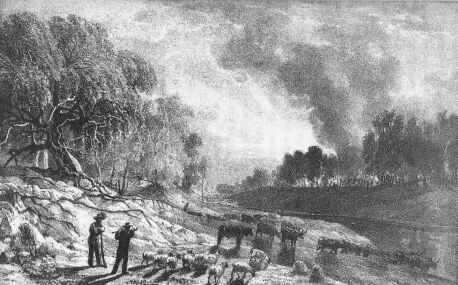
We left the hospitable station of Mr. Blaxland at an early hour, and proceeded on our way to join the party. We found the country across which we rode, very much parched from the want of rain. The grass was everywhere yellow, or burnt up, and in many parts on fire, so that the smoke which arose from it obscured the sun, and added sensibly to the heat of the atmosphere.
We lost ourselves, and, consequently, a good portion of the day, from having rode too carelessly through the forest country, while engaged in conversation respecting the intended journey. We nevertheless reached the place of rendezvous on Foy Brook long before night, and I encamped on a spot where the whole party was to join me in the morning. Mr. White left me here for the purpose of making some arrangements at home, and respecting the supplies which I had calculated on obtaining in this part of the country.
VALLEY OF THE HUNTER.
During the day's route, we traversed the valley of the river Hunter, an extensive tract of country, different from that mountainous region from which I had descended, inasmuch as it consists of low undulating land, thinly wooded, and bearing, in most parts, a good crop of grass.
Portions of the surface near Mr. Blaxland's establishment, bore that peculiar, undulating character which appears in the southern districts, where it closely resembles furrows, and is termed ploughed ground. This appearance usually indicates a good soil, which is either of a red or very dark colour, and in which small portions of trap-rock, but more frequently concretions of indurated marl, are found. Coal appears in the bed and banks of the Wollombi, near Mr. Blaxland's station, and at no great distance from his farm is a salt spring, also in the bed of this brook. The waters in the lesser tributaries, on the north bank of the river Hunter, become brackish when the current ceases. In that part of the bed of this river, which is nearest to the Wollombi (or to Wambo rather) I found an augitic rock, consisting of a mixture of felspar and augite.
FOSSILS OF THE HUNTER.
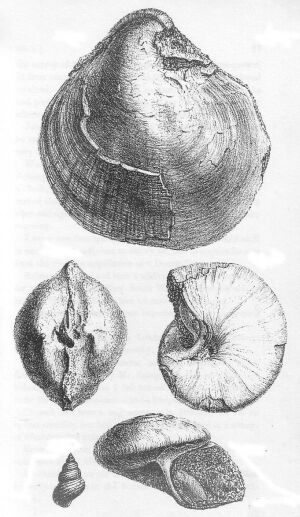
Silicified fossil wood of a coniferous tree, is found abundantly in the plains, and in rounded pebbles in the banks and bed of the river, also chalcedony and compact brown haematite. A hill of some height on the right bank, situate twenty-six miles from the seashore, is composed chiefly of a volcanic grit of greenish grey colour, consisting principally of felspar, and being in some parts slightly, in other parts highly calcareous when the rock assumes a compact aspect. This deposit contains numerous fossil shells, consisting chiefly of four distinct species of a new genus, nearest to hippopodium; also a new species of trochus; Atrypa glabra, and Spirifer, a shell occurring also in older limestones of England.*
(*Footnote. These shells having been submitted to Mr. James De Carl Sowerby, I am indebted to that gentleman for the following description:Class Conchifera. Order, Dimyaria. Genus Megadesmus.
Valves equal, inequilateral, thick, their edges even; umbones nearly central; hinge sunk, with an antiquated area and one ? or two ? large teeth in each valve; ligament external, large; impressions of the abducter muscles strong, nearly equal, united by the impression of the mantle, at the posterior extremity of which is a small shallow sinus; no lunette.
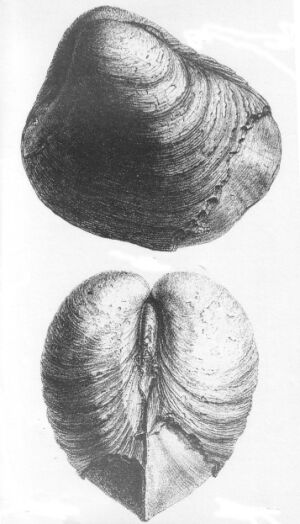
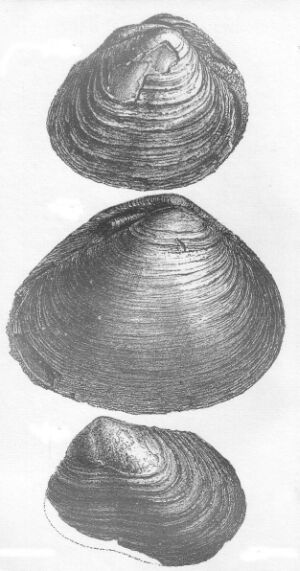
A genus of heavy shells in some respects resembling Astarte, in others especially in having a striated area within the beaks, Hippopodium, from which it is distinguished by the position of the umbones and the presence of a thick tooth in the hinge. There appear to be four species, which may be named Megadesmus globosus (Plate 2) M. laevis (figure 1) M. antiquatus (figure 2) and M. cuneatus (figure 3 Plate 3) the cuneatus differs from antiquatus, only in having the shell a little contracted towards the anterior side.
The large shell (Plate 4 figures 1 and 2) is near to Isocardia, but Mr. Sowerby would not venture to say it belongs to that genus.
The Trochus (Plate 4 figures 3 and 4) may be called T. oculus.)
PLATE 2: FIGURES 1 AND 2: Megadesmus globosus.
J.D. Sowerby del. et lithographer. J. Graf Printer to Her Majesty.
PLATE 3:
FIGURE 1: Megadesmus antiquatus.
FIGURE 2: Megadesmus laevis.
FIGURE 3: Megadesmus cuneatus.
J.D. Sowerby del. et lithographer. J. Graf Printer to Her Majesty.
PLATE 4:
FIGURES 1 AND 2: Isocardia ?
FIGURES 3 AND 4: Trochus oculus.
FIGURE 5: Littorina (or Turbo ?) filosa, FROM PEEL'S RIVER.
Amongst these remains was also found embedded a very perfect specimen of fossil wood. I may add, that in the bed of the Glindon Brook, which flows from the left bank of the Hunter, rocks of argillaceous limestone are found in large round boulders, some of which are more than 15 feet in diameter.*
(*Footnote. The fossil vegetation seems to consist chiefly of the Glossopteris brownii (of Brongniart) a fern which occurs in a stratum of ironstone at Newcastle, and in one of the same mineral on the southern coast, also in sandstone in the valley of the Hunter, and abundantly in the shale near the coal wrought at Newcastle.)
November 29.
The whole equipment came up at half-past nine, whereupon I distributed such articles as were necessary to complete the organisation of the party, and the day was passed in making various arrangements for the better regulation of our proceedings, both on encamping and in travelling. I obtained from Assistant-Surveyor Dixon, then employed in this neighbourhood, some account of Liverpool Plains--this officer having surveyed the ranges which separate these interior regions from the appropriated lands of the colony. The heat of this day was exceedingly oppressive, the thermometer having been as high as 100 degrees in the shade, but after a thundershower it fell to 88 degrees.
MEN EMPLOYED ON THE EXPEDITION.
November 30.
At length I had the satisfaction to see my party move forward in exploring order; it consisted of the following persons, namely:
Alexander Burnett and Robert Whiting, Carpenters.
William Woods, John Palmer, Thomas Jones and William Worthington, Sailors.
James Souter, Medical Assistant.
Robert Muirhead, Daniel Delaney and James Foreham, Bullock-Drivers.
Joseph Jones, Groom.
Stephen Bombelli, Blacksmith.
Timothy Cussack, Surveyor's Man.
Anthony Brown, Servant to me.
Henry Dawkins, Servant to Mr. White.
These were the best men I could find. All were ready to face fire or water, in hopes of regaining by desperate exploits, a portion, at least, of that liberty which had been forfeited to the laws of their country. This was always a favourite service with the best disposed of the convict prisoners, for in the event of their meriting, by their good conduct, a favourable report on my return, the government was likely to grant them some indulgence. I chose these men either from the characters they bore, or according to their trade or particular qualifications: thus:
Burnett was the son of a respectable house-carpenter on the banks of the Tweed, where he had been too fond of shooting game, his only cause of trouble.
Whiting, a Londoner, had been a soldier in the Guards.
Woods had been found useful in the department as a surveyor's man; in which capacity he first came under my notice, after he had been long employed as a boatman in the survey of the coast, and having become, in consequence, ill from scurvy, he made application to me to be employed on shore. The justness of his request, and the services he had performed, prepossessed me in his favour, and I never afterwards had occasion to change my good opinion of him.
John Palmer was a sailmaker as well as a sailor, and both he and Jones had been on board a man-of-war, and were very handy fellows.
Worthington was a strong youth, recently arrived from Nottingham. He was nicknamed by his comrades Five-o'clock, from his having, on the outset of the journey, disturbed them by insisting that the hour was five o'clock soon after midnight, from his eagerness to be ready in time in the morning.
I never saw Souter's diploma, but his experience and skill in surgery were sufficient to satisfy us, and to acquire for him from the men the appellation of The Doctor.
Robert Muirhead had been a soldier in India, and banished, for some mutiny, to New South Wales; where his steady conduct had obtained for him an excellent character.
Delaney and Foreham were experienced men in driving cattle.
Joseph Jones, originally a London groom, I had always found intelligent and trustworthy.
Bombelli could shoe horses, and was afterwards transferred to my service by Mr. Sempill in lieu of a very turbulent character, whom I left behind, and who declared it to be his firm determination to be hanged.
Cussack had been a bog surveyor in Ireland; he was an honest creature, but had got somehow implicated in a charge of administering unlawful oaths.
Brown had been a soldier, and subsequently was assistant coachman to the Marquis of ----.
Dawkins was an old tar, in whom Mr. White, himself formerly an officer in the Indian navy, placed much confidence.
EQUIPMENT.
Thus it had been my study, in organising this party, to combine proved men of both services with some neat-handed mechanics, as engineers, and it now formed a respectable body of men, for the purpose for which it was required.
Our materiel consisted of eight muskets, six pistols; and our small stock of ammunition, including a box containing skyrockets, was carried on one of the covered carts.
Of these tilted carts we had two, so constructed that they could be drawn either by one or two horses. They were also so light, that they could be moved across difficult passes by the men alone. Three stronger carts or drays were loaded with our stock of provisions, consisting of flour, pork (which had been boned in order to diminish the bulk as much as possible) tea, tobacco, sugar and soap. We had, besides, a sufficient number of packsaddles for the draught animals, that, in case of necessity, we might be able to carry forward the loads by such means. Several packhorses were also attached to the party. I had been induced to prefer wheel carriages for an exploratory journey: first, From the level nature of the interior country; second, From the greater facility and certainty they afforded of starting early, and as the necessity for laying all our stores in separate loads on animals' backs could thus be avoided. The latter method being further exposed to interruptions on the way--by the derangement of loads--or galling the animals' backs--one inexperienced man being thus likely to impede the progress of the whole party.
For the navigation or passage of rivers, two portable boats of canvas, had been prepared by Mr. Eager, of the King's dockyard at Sydney. We carried the canvas only, with models of the ribs--and tools, having carpenters who could complete them, as occasions required.
Our hour for encamping, when circumstances permitted, was to be two P.M., as affording time for the cattle to feed and rest, but this depended on our finding water and grass. Daybreak was to be the signal for preparing for the journey, and no time was allowed for breakfast, until after the party had encamped for the day.
As we proceeded along the road leading to the pass in the Liverpool range, Mr. White overtook us, having obtained an additional supply of flour, tobacco, tea and sugar, with which Mr. Finch was to follow the party as soon as he could procure the carts and bullocks necessary for the carriage of these stores.
BURNING GRASS.
After travelling six hours, we encamped beside a small watercourse near Mussel Brook, the thermometer at four P.M. being as high as 95 degrees. In the evening, the burning grass became rather alarming, especially as we had a small stock of ammunition in one of the carts. I had established our camp to the windward of the burning grass, but I soon discovered that the progress of the fire was against the wind, especially where the grass was highest. This may appear strange, but it is easily accounted for. The extremities of the stalks bending from the wind, are the first to catch the flame, but as they become successively ignited, the fire runs directly to the windward, which is toward the lower end of the spikes of grass, and catching the extremities of other stalks still further in the direction of the wind, it travels in a similar manner along them. We managed to extinguish the burning grass before it reached our encampment, but to prevent the invasion of such a dangerous enemy we took the precaution, on other occasions, of burning a sufficient space around our tents in situations where we were exposed to like inconvenience and danger.
ABORIGINES AND COLONISTS.
December 1, 6 A.M.
The thermometer at 82 degrees. As the party proceeded, the sky became overcast, and the absence of the sun made the day much more agreeable. Towards noon we had rain and thunder, and this weather continued until we reached the banks of the Hunter. We forded the river where the stream was considerable at the time, and then encamped on the left bank. The draught animals appeared less fatigued by this journey, than they had been by that of the former day, owing probably to the refreshing moisture and cooler air. After the tents had been pitched, a fine invigorating breeze arose, and the weather cleared up. Segenhoe, the extensive estate of Potter Macqueen, Esquire was not far distant, and Mr. Sempill the agent, called at my tent, and afforded me some aid in completing my arrangements.
I was very anxious to obtain the assistance of an aboriginal guide, but the natives had almost all disappeared from the valley of the Hunter; and those who still linger near their ancient haunts, are sometimes met with, about such large establishments as Segenhoe, where, it may be presumed, they meet with kind treatment. Their reckless gaiety of manner; intelligence respecting the country, expressed in a laughable inversion of slang words; their dexterity, and skill in the use of their weapons; and above all, their few wants, generally ensure them that look of welcome,* without which these rovers of the wild will seldom visit a farm or cattle station. Among those, who have become sufficiently acquainted with us, to be sensible of that happy state of security, enjoyed by all men under the protection of our laws, the conduct is strikingly different from that of the natives who remain in a savage state. The latter are named myalls, by their half-civilised brethren--who, indeed, hold them so much in dread, that it is seldom possible to prevail on anyone to accompany a traveller far into the unexplored parts of the country. At Segenhoe, on a former occasion, I met with a native but recently arrived from the wilds. His terror and suspicion, when required to stand steadily before me, while I drew his portrait, were such, that, notwithstanding the power of disguising fear, so remarkable in the savage race, the stout heart of Cambo was overcome, and beat visibly--the perspiration streamed from his breast, and he was about to sink to the ground, when he at length suddenly darted from my presence; but he speedily returned, bearing in one hand his club, and in the other his boomerang, with which he seemed to acquire just fortitude enough, to be able to stand on his legs, until I finished the sketch (See Plate 1.1.)
(*Footnote. They understand our looks better than our speech.)
A COLONIST.
December 2.
The party moved off at seven, and passing, soon after, near the farm of an old man, whom I had assisted some years before, in the selection of his land, I rode to see him, accompanied by Mr. White. He was busy with his harvest, but left the top of his wheat-stack on seeing me, and running up, cordially welcomed us to his dwelling. A real scotch bonnet covered the brow of a face which reminded me, by its characteristic carving, of the land of the mountain and the flood. The analogy between the respective features, was at least so strong in my mind, and the sight of the one was so associated with the idea of the other, that had I seen this face on a stranger, in a still more distant corner of the earth--it must have called to mind the hills of my native land. The old man was very deaf, but in spite of age and this infirmity his sharp blue eye expressed the enduring vigour of his mind. He had buried his wife in Scotland, and had left there a numerous family, that he might become its pioneer at the antipodes. He had thus far worked his way successfully, and was beginning to reap the fruits of his adventurous industry. Sleek cattle filled his stockyard, his fields waved with ripe grain, and I had the satisfaction of learning from him, that he had written for his family, and that he soon expected their arrival in the colony. He immediately gave grain to our horses, and placed before us new milk; and, what we found a still greater luxury, pure water from the running burnie close by; also a bottle of the mountain dew, which, he said, was from a still which was no far aff. When I was about to mount my horse, he enquired if I could spare five minutes more, when he put into my hands the copy of a long memorial addressed to the government, which he had taken from among the leaves of a very old folio volume of Pitscottie's History of Scotland. This memorial prayed, that whereas Scoone was in the valley of Strathearne, and that the pillow of Jacob which had been kept as the coronation stone of the Kings of Scotland, was fated still to be, where their dominion extended; and as this valley of the Kingdon Ponds, had not received a general name, that it might be called Strathearne, etc. etc. We were finally compelled, although it still wanted two hours of noon, to drink a stirrup-cup at the door--when he most heartily drank success to our expedition, and I went on my way rejoicing that, on leaving the last man of the white race we were likely to see for some time, the ceremony of shaking hands was a vibration of sincere kindness.
We soon overtook the party--and had proceeded with it, some distance, when a soldier of the mounted police came up, and delivered to me a letter, from the military secretary at Sydney, informing me by command of the Acting Governor, that George Clarke--alias The Barber (The Bushranger) had sawed off his irons, and escaped from the prison at Bathurst. This intelligence was meant to put me on my guard respecting the natives, for from the well-known character of the man, it was supposed, that he would assemble them beyond the settled districts, with a view to drive off the cattle of the colonists--and especial caution would be necessary to prevent a surprise from natives so directed, if, as most people supposed, his story of the great river, had only been an invention of his own, by which he had hoped to improve his chance of escape. (See Appendix 1.1.)
BURNING HILL OF WINGEN.
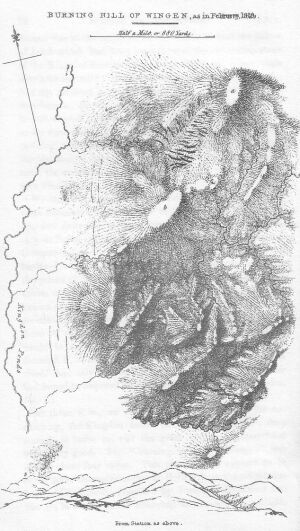
At three P.M. we reached a spot favourable for encamping, the Kingdon brook forming a broad pool, deep enough to bathe in, and the grass in the neighbourhood being very good. The burning hill of Wingen was distant about four miles. This phenomenon appears to be of the same character as that at Holworth, in the neighbourhood of Weymouth, described by Professor Buckland and Mr. De la Beche in the following terms: "It is probable that in each case rainwater acting on iron pyrites has set fire to the bituminous shale; thus ignited it has gone on burning at Holworth unto the present hour, and may still continue smouldering for a long series of years, the bitumen being here so abundant in some strata of the shale, that it is burnt as fuel in the adjoining cottages; the same bituminous shale is used as fuel in the village of Kimmeridge, and is there called Kimmeridge coal."* Wingen, the aboriginal name, is derived from fire. The combustion extends over a space of no great extent (see Plate 5) near the summit of a group of hills, forming part of a low chain which divides the valley of Kingdon Ponds from that of Page's River. Thin blue smoke ascends from rents and cracks, the breadth of the widest measuring about a yard. Red heat appears at the depth of about four fathoms. No marks of any extensive change appear on the surface, near these burning fissures, although the growth of large trees in old cracks on the opposite slope, where ignition has ceased, shows that this fire has continued for a very considerable time, or that the same thing had occurred at a much earlier period. In the form of the adjacent hills I observed nothing peculiar, unless it be a contraction not very common of the lower parts of ravines. The geological structure is, as might be expected, more remarkable. Other summits of the range are porphyritic,** but the hills of Wingen present a variety of rocks, within a small space. In the adjacent gullies to the south of the hill, we find clay of a grey mottled appearance, and shale containing apparently a small quantity of decomposed vegetable matter; and near the fissure then on fire, occurred a coarse sandstone with an argillaceous basis. To the north-west, in a hollow containing water which drains from beneath the part ignited, is a coarse sandstone, in some places highly charged with decomposed felspar, and containing impressions of spirifers. The hill nearest to the part on fire, on the south-west (b) consists of basalt with grains apparently of olivine; and on a still higher hill, on the east (a) I found ironstone. A small hill (c) connecting these two, and nearest to the part actually burning, appears to consist of trap-rock, and is thickly strewed with agates. The hills on the opposite or south side of the valley are composed of compact felspar, with acicular crystals of glassy or common felspar and grains of hornblende, crevices of the stone being coated with films of serpentine or green earth.
(*Footnote. Volume 4 part 1 Second Series Geological Transactions, Professor Buckland and Mr. De la Beche on the Geology of the neighbourhood of Weymouth.)
PLATE 5: BURNING HILL OF WINGEN, AS IN FEBRUARY 1829.
Plan and Distant View from Station.
From Nature and on Zinc by Major T.L. Mitchell. Day and Haghe Lithographers to the Queen.
London, Published by T. and W. Boone.
(**Footnote. The porphyry of a hill three miles south of Wingen, consists of a base of reddish-brown compact felspar, with embedded crystals of common felspar and disseminated carbonate of lime.)
APPROACH LIVERPOOL RANGE.
December 3.
The party in proceeding crossed several deep gullies in the neighbourhood of the burning hill; and the road continued to be well marked. At length we began to ascend the chain of hills, which connects Wingen with Mount Murulla and the Liverpool range. On gaining the summit of this range we overlooked Wingen, whose situation was faintly discernible by the light blue smoke. Three years had elapsed since my first visit to these slumbering fires. The ridge we were crossing was strewed with fallen trees; and broken branches with the leaves still upon them marked the effects of some violent and recent storm. We descended to a beautiful valley of considerable extent, watered by Page's river, which rises in the main range. We reached the banks of this stream at four P.M. and encamped on a fine flat. The extremities from the mountains on the north descend in long and gradual slopes, and are well covered with grass. This was already eaten short by sheep. Two babbling brooks water the flat at the part where we pitched our tents, and which is opposite to Whalan's station; one of these being the river Page, or Macqueen's River; the other known only as The Creek. The space between them is flat, and apparently consists of a soil of excellent quality. The heat of the day was excessive, the thermometer 80 degrees at sunset.
MOUNT MURULLA.
December 4.
Mount Murulla is a remarkable cone of the Liverpool range, and being visible from Warrawolong, is consequently an important point in the general survey of the colony.
MOUNT MURULLA (A), AND PART OF LIVERPOOL RANGE, FROM WINGEN.
From Murulla, the range we had crossed extends eastward, enclosing the valley in which we were encamped, and which gives birth to the river Page. Our way now lay westward, towards the head of this valley, in order to cross by the usual route, the higher and principal range, which still lay to the north. We traversed, this day, six miles of the valley, and encamped beside a remarkable rock, near to which the track turned northward. I rode a little beyond our bivouac, and chanced to fall in with a tribe of natives from Pewen Bewen on Dart Brook, one of whom afterwards visited our camp, but he could tell us little about the interior country. The whole of the valley appears to consist of good land, and the adjacent mountains afford excellent sheep pasture. In the evening, a native of Liverpool plains came to our tents; I gave him a tobacco-pipe, and he promised to show me the best road across them. Thermometer at sunset 84 degrees.
CROSS LIVERPOOL RANGE.
December 5.
This morning we ascended Liverpool range, which divides the colony from the unexplored country. Having heard much of this difficult pass, we proceeded cautiously, by attaching thirteen bullocks to each cart, and ascending with one at a time. The pass is a low neck, named by the natives Hecknaduey, but we left the beaten track (which was so very steep that it was usual to unload carts in order to pass) and took a new route, which afforded an easier ascent. All had got up safely, and were proceeding along a level portion, on the opposite side of the range, when the axle of one of the carts broke, and it became necessary to leave it, and place the load on the spare packhorses, and such of the bullocks, taken out of the shafts, as had been broken in to carry packsaddles.
A SICK TRIBE.
We reached at length, a watercourse called Currungai, and encamped upon its bank, beside the natives from Dart Brook, who had crossed the range before us, apparently to join some of their tribe, who lay at this place extremely ill, being affected with a virulent kind of smallpox. We found the helpless creatures, stretched on their backs, beside the water, under the shade of the wattle or mimosa trees, to avoid the intense heat of the sun. We gave them from our stock some medicine; and the wretched sufferers seemed to place the utmost confidence in its efficacy. I had often indeed occasion to observe, that however obtuse in some things, the aborigines seemed to entertain a sort of superstitious belief, in the virtues of all kinds of physic. I found that this distressed tribe were also strangers in the land, to which they had resorted. Their meekness, as aliens, and their utter ignorance of the country they were in, were very unusual in natives, and excited our sympathy, especially when their demeanour was contrasted with the prouder bearing and intelligence of the native of the plains, who had undertaken to be my guide.
INTERIOR WATERS.
Here I at length drank the water of a stream, which flowed into the unexplored interior; and from a hill near our route I beheld, this day, for the first time, a distant blue horizon, exactly resembling that of the ocean.
December 6.
LIVERPOOL PLAINS.
At an early hour we continued the journey towards the plains, guided by the natives, and along a cart track, which led towards some cattle stations. We crossed a low ridge of rich earth, in which were embedded nodules of limestone, and fragments of trap-rock. After passing several extremities of ridges, of a similar description, all being branches from high ranges on our left, we came upon a portion of the plains. This expanse of open level country, extended in a northerly direction, as far as human vision could reach; and being clear of trees, presented a remarkable contrast to the settled districts of the colony. The soil of these plains looked rich, the grass was good, and herds of cattle browsing at a distance, added pastoral beauty, to that which had been recently a desert.
PROPOSED ROUTE.
We now turned from the track, we had thus far followed in a west-south-west direction, and parting from our friends, the natives, who insisted on our keeping the track, we again entered the woods, by turning a little to the north. My object, in proceeding in this direction, was to reach the bank of Peel's river at Wallawoul; that stream having been laid down as holding a northerly course, and consequently I had reason to believe that it would lead to any greater river flowing to the north-west, as reported by The Barber. But independently of this consideration, it was expedient to travel along its right bank, which commanded access to the high ranges on the east, and would therefore secure the party from any danger of obstruction from floods. I soon came on another path, and a line of marked trees, which a native, whom I met, said was the road from Palmer's to Loder's station. We next arrived at a deep dry bed, which in wet seasons must be filled by a very considerable stream, but in that time of drought, it was not until after riding up and down a considerable distance in search of water, that I at length found some ponds. The native name of this channel is Nuzabella. We crossed its bed, in order to encamp at a shady spot, where the long grass had been burnt a short while before. In other parts the grass reached to the heads of the horses, and at this time was so liable to catch fire, and was so frequently set on fire by the natives, that with our stock of ammunition, the situation of the camp required particular attention. The bullocks were much fatigued with this day's journey, the thermometer having stood at 96 degrees in the shade, and at sunset, and even during part of the night, it was as high as 90 degrees.
HORSES ASTRAY.
At twilight, on enquiring, as usual, if the horses had been tethered and spancelled, I was informed that seven had set off, and that one of the men, Worthington, who went after them, had not returned. The weather had been so oppressive during the whole journey, that I determined on resting the cattle next day. This I did not mention however to the men, but I ordered all the good bush hands to be off in search at daybreak. The care of cattle, and particularly of horses on such journeys, requires great attention; to stand idle on a fine morning, unable to proceed, until by some fortunate chance, stray cattle or horses are discovered in a boundless forest, is like a calm on the line, irksome enough; but there is also the risk of losing the men sent in pursuit who, even after coming on the objects of their search, may be unable afterwards to find the camp, especially when there may be no watercourse to lead them to it.
December 7.
The weather still very sultry. The horses were brought in at a quarter-past eight by Worthington, who had traced them up the valley to two miles above our former encampment. The rich soil in this valley is nearly as deep as the bed of the rivulet, which is twenty feet lower than the surface; a substratum of gravel, similar to that in the bed of the watercourse, appears in the bank; the pebbles, consisting chiefly of trap-rock, seemed to be the water-worn debris of the Liverpool range. The cattle and horses being at rest, we were occupied this day in making various observations with our instruments, trying the rate of the chronometer, etc. A thundercloud and a little rain afforded some relief from the excessive heat of the atmosphere. The night was very calm; but the mosquitoes were numerous and troublesome.
A SQUATTER.
December 8.
A road or track, which we found about half a mile east from the camp, led us very directly, on the bearing of 335 degrees, to Loder's station, distant about six miles from our encampment. Here stood a tolerable house of slabs, with a good garden adjoining it, in charge of an old stockman and his equally aged wife. This man was named by the blacks Longanay (Long Ned).* The station was situated on a fine running stream called the Cuerindie, and the state of the sheep and cattle about it proved the excellence of the pasture. We passed the limits of the territory open to the selection of settlers, in crossing the Liverpool range; and the more remote country is not likely to come into the market soon. Such stations as this of Loder were held therefore only by the right of pre-occupancy, which has been so generally recognised among the colonists themselves, that the houses, etc. of these stations are sometimes disposed of for valuable considerations, although the land is liable to be sold by the government.
(*Footnote. His wife, whom the natives had told me of as a white gin, was perhaps the only white woman then dwelling beyond the mountains. She was enveloped in numerous flannel petticoats, and presented a singular contrast to the undraped slender native females, some of whom with children I saw about the place, and who appeared to be treated by her with great kindness.)
NATIVE GUIDE AND HIS GIN.
A native named Jemmy, whom I met with here, agreed to conduct me by the best way for carts to Wallamoul on the Peel, for which service I undertook to reward him with a tomahawk.* It was necessary, that we should ford the Cuerindie, which flows to the north-west, and notwithstanding the steepness of its banks, we effected a passage without difficulty, guided by Jemmy. One mile beyond this, another creek lay in our way. It was smaller, but much more formidable and difficult to cross, for the bottom and banks consisted of blue-mud or clay, half-hardened on the surface, yet soft and yielding below. It was not without considerable delay, that we effected the passage, for a wheel of one of the carts stuck fast in the mud, and it was necessary to dig away the earth in front of the other wheel before we could release the vehicle. At length everything was got across, and we fortunately met no other impediment for six miles. We then crossed the channels of two rivulets, neither of which contained any water. At half-past four I wished to encamp, and the natives having at length found a green mantling pool in the bed of the united channel of the two watercourses, we pitched our tents, at a place called Burandua. Bad as the water seemed to be, Jemmy soon obtained some which was both clear and cool, by digging a hole in the sand near the pool. This native was a quiet and sensible fellow--he steadily pursued the course he recommended for the wheelbarrows, as he termed our carts; and answered all my queries briefly and decidedly, either by a nod of assent, or the negative monosyllable Bel, with a shake of the head. His walk was extremely light and graceful; his shoulders were neatly knit, and the flowing luxuriance of his locks was restrained by a bit of half-inch cord, the two ends hanging, like a double queue, halfway down his back. He was followed by his gin and a child, which she usually carried on her back, although it seemed old enough and able to walk.
(*Footnote. A small axe used for numerous purposes by the natives of Australia.)
The air of evening was very refreshing, and the sun set with peculiar brilliancy. We had travelled during the whole day on good soil, and the ploughed appearance of the surface was very remarkable in various places, particularly a little to the south of Loder's station, where the hollows seemed to terminate in a common channel. I noticed also that the direction of all the watercourses was towards the north-west, and it was evident that the streams occasionally overflowed their banks.
December 9.
This morning the party was ready to proceed soon after five o'clock, but the barometer got out of order while I was using it in the dry bed of the rivulet, and some time was lost in an unsuccessful attempt to repair it. This derangement of the instrument was very unfortunate at so early a stage of our journey.
After travelling about seven miles and a half we perceived, on our left, an open valley in which a numerous herd of cattle was feeding; and one mile further on, we came upon a fine little stream, which was rather difficult to cross, owing to the steepness of the banks. As the men were at work taking the carts over one by one, the native and I were amused with a large black snake, which was swimming about. On his casting a stone at it the snake glided swiftly towards him, and the poor fellow took to his heels, cautioning me to keep off, saying it would kill my horse. But he soon returned to the charge, and having succeeded in stunning it with stones, it was at length cut in two with my sabre. On measuring this snake I found it to be nine inches in circumference, and eight feet and a half in length.
Beyond that rivulet the country appeared tolerably open and level, so that we could pursue our course in one direction nearly eight miles. The most conspicuous hill on our right, was named by the native Barragundy. It was visible during the whole of our day's journey. We at length entered upon an open and grassy plain, and found in the skirts of the wood beyond it, a channel containing water in abundance, and which was known to the natives as Carrabobbila.* Beyond this channel arose a peaked and picturesque range, whereof the highest summit was named Turi.
(*Footnote. Even before my men had seen this spot, the native name, in their mouths, was corrupted into Terrible Billy!)
MODES OF DRINKING AU NATUREL.
The water, when we encamped, was hot and muddy, but the blacks knew well how to obtain a cool and clean draught, by first scratching a hole in the soft sand beside the pool, thus making a filter, in which the water rose cooled but muddy. They next threw into this some tufts of long grass, through which they sucked the cooler water thus purified also from the sand or gravel. I was very glad to follow the example, and I found the sweet fragrance of the grass an agreeable addition to the luxury of drinking. But during the heat of the forenoon I had observed the female quenching her thirst with still greater satisfaction, by rushing into a pool, and drinking as she sat immersed up to the lip.
From Loder's station, we had travelled thus far on our way to Peel's river, without having any road or track to follow, and I had marked the trees along our line of route, which certainly seemed favourable for a cart-road in that direction. Near Carrabobbila, we came upon the track leading to Wallamoul, which was more circuitous, passing by other cattle stations in the plains.
WOODS ON FIRE.
During the last three days of our journey, the woods were burning before us, but fortunately the fire was one day's march in advance of our party, and thus the flames had cleared everything away before our arrival, so that our camp was not exposed to danger. This evening however, the country seemed on fire all around us. The weather was calm and sultry, particularly when the day closed in, and a very heavy storm, accompanied by thunder, broke over us in the night.
December 10.
The morning was cloudy; and the rain, which we anxiously looked for, at length came down, and soon checked the progress of the flames. On this account, as well as on that of the want of water, it afforded providential relief to us, for the hills we were about to cross had been all in a blaze during the night. Trees lay smoking as we passed; several gullies were difficult for the passage of carts, and detained the party in its ascent.
CROSS THE TURI RANGE.
But at length we reached the top of this pass, and crossed the range, which appeared to be continuous, thus separating the basin of the Peel from that of the waters falling to Liverpool plains. We were agreeably surprised to find that the opposite side of these hills, and the whole face of the country beyond them, presented a very different appearance from that through which we had passed. A gently sloping extremity lay before us for eight miles in the direction of our proposed route, and we were relieved from all the difficulties of crossing gullies, which had impeded our ascent on the other side of the range. We encamped at some waterholes, where this slope terminated in an extensive forest flat; over the whole of which, as my sable guide informed me, there was no other water at that time.
The grass on this side of the hills was good: and almost all the timber consisted of box (eucalyptus). The heights which we had crossed appeared to extend from the Liverpool range to the northward, as far as could be seen; but the native told me, that it soon terminated on the river Callala (or Peel) whose course, he said, turned westward (as he pointed); a fact corroborating so far, the statements of The Bushranger.
ARRIVE ON THE RIVER PEEL.
December 11.
The weather cleared up at about six A.M.: and we travelled across a good soil, throughout the whole of this day's journey. The country appeared but thinly wooded, and without any hill or watercourse. After a journey of thirteen miles, we reached the bank of the Peel at Wallamoul, the lowest cattle station upon this river. It was occupied by Mr. Brown, who had there about 1600 head of cattle. I gave to Jemmy, our excellent guide, the promised tomahawk, also a knife to Monday his brother, whom he met here. The river was so low that Mr. White and I passed over easily on a tree which the flood had laid across it. The current however was strong; and the men having been furnished from our stock with a few hooks and lines, caught three large fishes by sunset. I met, at this place, with some intelligent natives, from whom I learnt, that the spot where Mr. Oxley crossed the Peel on his journey, was about two miles lower down.
FISHES.
December 12.
At an early hour this morning, one of our men caught a fish, which weighed eighteen pounds; but, according to the natives, this was no uncommon size. These fishes are most erroneously called cod by the colonists, although they certainly very much resemble cod in taste. The flakes are firmer than sea cod, and equally white, the fish affording a very light and palatable food. When dried in the same manner as the Newfoundland cod, in which state I have tasted this fish at Bathurst, I could not perceive any difference either in flavour or appearance.
Being at length about to enter the Terra incognita, I deemed it expedient to repack our stores, in order that the load might be made as light and compact as possible, and that we might pass with less difficulty over whatever description of ground we were destined to encounter. With this view, I directed the flour to be started from casks into bags, and made such arrangements as tended materially to lessen the bulk of our provisions and other necessary stores. Having questioned the natives with regard to the course of the Peel, I learnt that, instead of flowing northward, as hitherto supposed, it took a westerly direction, and was soon joined by the Muluerindie, a river coming from the north-east. The natives further assured me that there was a good ford below the junction of these streams at a place called Wallanburra; and I determined to proceed to this ford, as it was not advisable, with the Muluerindie beyond, to cross the river above the junction.
ANOTHER NATIVE GUIDE.
Being anxious to procure another guide, the overseer at Wallamoul brought me a native named Mr. Brown, who agreed to accompany our party on condition that he should receive blankets for himself and his gin, and a tomahawk, the latter being a small hatchet, which is so valuable a substitute for their stone hatchet that almost all natives within reach of the colony have them, even where the white man is known as yet only by name--or as the manufacturer of this most important of all implements to the Australian native.
EXPLORE THE PEEL.
December 13.
Mr. Finch having joined us on the previous evening, without procuring the supply of flour that I had expected, I despatched him back this morning to the Hunter's River district, with directions to procure as much flour, tea, and sugar as he could pack on six bullocks, and to follow along my line of marked trees with all possible speed. I furnished him with an official letter to Mr. Dixon, in which I instructed that surveyor to supply him with any article he could possibly spare from his own equipment, without impeding the service on which he was engaged.
And now our arrangements being as complete as we could hope to make them, under existing circumstances, we broke up our encampment at eight A.M., and proceeded in the interesting pursuit of the course of the Peel River.
Enter an unexplored region.
Situation of Mr. Oxley's camp on the Peel.
Westward course of the river.
Kangaroo shot.
Calcareous rocks.
Acacia pendula first seen.
Other trees near the river.
Junction of the Peel and Muluerindie.
View from Perimbungay.
Ford of Wallanburra.
Plains of Mulluba.
View from Mount Ydire.
Hills seen agree with The Bushranger's account.
The river Namoi.
Stockyard of The Bushranger.
Singular fish.
View from Tangulda.
Cutting through a thick scrub.
Want of water.
Impeded by a lofty range of mountains.
Marks of natives' feet.
Maule's river.
A grilled snake.
View on ascending the range of Nundewar.
Native female.
Proposed excursion with packhorses.
Native guide absconds.
The range impassable.
Return to Tangulda.
Prepare to launch the boats on the Namoi.
ENTER AN UNEXPLORED REGION.
We advanced with feelings of intense interest into the country before us, and impressed with the responsibility of commencing the first chapter of its history. All was still new and nameless, but by this beginning, we were to open a way for the many other beginnings of civilised man, and thus extend his dominion over some of the last holds of barbarism.
SITUATION OF MR. OXLEY'S CAMP ON THE PEEL.
About a mile and a half below Wallamoul, we crossed a small open plain, and I was informed that Mr. Oxley encamped on its southern side, and had afterwards forded the Peel at no great distance from the spot.
WESTWARD COURSE OF THE RIVER.
We crossed a succession of gentle slopes, without any gully or watercourse between them. After travelling about eight miles in a north-west direction, we came upon the Peel, having thus cut off a great bend of the river. From that point our route was west and even to the southward of west, until we again encamped near the river, after a journey of fifteen miles. Some flats crossed by the party this day appeared to be subject to inundations. One gully only had impeded our carts. It was about a mile short of the encampment, and it was called Goora by the natives. It had evidently been long dry, had steep banks, and its bottom consisted of gravel and sand. The banks of the Peel, thus far, are composed chiefly of extensive flats of good land, thinly wooded, and occasionally flooded by the river.
Only a few of the flats however are quite clear of trees, but where the ground is open, the soil appears to be rich, and presents the same characters which I noticed elsewhere. We saw a numerous family of kangaroos this day, but although the dogs were let loose, such was the length of the grass, that they could not see the game. The morning had been clear, but the sky in the afternoon was overcast by a thunderstorm, with a strong gale of wind. At sunset, the weather cleared up, and the sky became again serene.
December 14.
The sun rose clear, and the party were in motion at seven o'clock. This day I discovered that the native had sent back his gin early in the morning, a circumstance which I regretted, for the woman had an intelligent countenance, and having been brought from the country towards which we were travelling, she might have been of service to us.
KANGAROO SHOT.
When we had proceeded a few miles, the quick eye of Mr. Brown distinguished the head of a kangaroo peeping at us over the long grass. On discharging my rifle at it, the animal, as he supposed, bounded off; but as I had taken very steady aim, I ran to the spot, and there found, to the astonishment of our guide, the kangaroo at which I had aimed lying dead, the ball having passed through the throat and neck. The kangaroo which leapt about on the discharge of the piece, was another which had not been previously in sight, and appeared to have been the mate of that which fell. The distance was considerable, and the shot fortunate, as being well calculated to strengthen Mr. Brown's confidence, who had only seen previously the heavy old muskets carried by stockmen. He surveyed with great attention the percussion lock and heavier barrel of the rifle, surprised, no doubt, at its superior make and accuracy.
KANGAROO AS SEEN IN THE LONG GLASS.
Our course was still westward, and thus we occasionally touched upon the bends of the river. Adjacent to one sharp angle, we met with a rather singular formation of little hills formed by projecting strata, the strike extending in the direction of North 30 West, and the dip being to the east, at an angle of about 30 degrees.
CALCAREOUS ROCKS.
The rock appeared to consist in some parts of a buff calcareous sandstone, calcareous tuff; and, more abundantly, of limestone of a peculiar aspect, presenting at first sight the appearance of porphyry, but consisting of a base of compact limestone, with disseminated portions of calcareous spar, principally due to fragments of crinoidea. At a lower part in the same rock, less compact, I found a beautiful chalcedonic cast, apparently of a terebra. The calcareous sandstone consisted of grains of quartz cemented by calcareous spar, and contained fragments of shells of the littorina or turbo.*
(*Footnote. Also a sriated shell (Plate 4 figure 5) near to Buccinum globulare of Phillips, Volume 2nd 16 and 15; but Mr. Sowerby thinks it is different, and more probably a Littorina, and would call it L. filosa.)
Acacia pendula FIRST SEEN.
On crossing another low ridge beyond this we descended to a valley in which I saw, for the first time, that beautiful shrub of the interior, the Acacia pendula. The foliage is of a light green colour and it droops like the weeping willow; the bark is rough, and the trunk seldom exceeds nine inches in diameter. The wood of this graceful tree is sweet-scented, of a rich dark-brown colour, and being very hard, it is in great request with the natives for making their boomerangs and spearheads. It appears to grow chiefly on flats which are occasionally inundated.
OTHER TREES NEAR THE RIVER.
During this day's journey we also met with the Callitris pyramidalis, a tree which in external appearance closely resembles some kinds of pine-tree. The wood is of a rich yellow hue, very compact, and possesses a very agreeable perfume; it grows on the drier parts of the country. We found lofty bluegum-trees (eucalyptus) growing on the flats near the Peel, whose immediate banks were overhung by the dense umbrageous foliage of the casuarina, or river-oak of the colonists.
JUNCTION OF THE PEEL AND MULUERINDIE.
We encamped on the river at the foot of a small hill named Perimbungay. In this very interesting position I could at leisure continue from the hill my observations of the country before us, while the cattle were at rest and feeding. The Muluerindie had joined the Peel about a mile above, and the united streams here flowed along a reach of most promising extent. Mr. Brown said it was so deep that the natives could never dive to the bottom. The ford of Wallanburra, by which we were to cross this river, was only a short way below, and the summit of Perimbungay commanded a view of the country beyond it. The bank here presented a section of at least 50 feet of rich earth; and flats of this character, of more or less width, occur between the river and the hills. In the left bank at the camp I found a conglomerate rock, consisting of water-worn fragments of serpentine and trap, cemented by calcareous spar. The men were very successful in fishing; the cod-perch which they caught weighing upwards of nine pounds each (See figure 1 Plate 6). With such abundance of fish, and also the kangaroo, I hoped to feast Mr. Brown, but he set no value on food so common to him, preferring flour to all things else, while this was precisely the article which I was most unwilling to spare. He ate about two pounds and a half of flour daily, yet I considered his services of so much value, that I felt loth to lessen his allowance; for with all this he seldom seemed satisfied. He came to me however in the afternoon, pointing to his protuberant stomach, and actually declaring that, for once at least, he did not wish any more.
VIEW FROM PERIMBUNGAY.
December 15.
To avoid as much as possible the heat which had proved very distressing to the cattle, I ordered the party to prepare to move off this morning soon after sunrise; and while the people were packing up and loading, I again ascended Perimbungay. The range we had crossed at Turi was near us to the westward, and a conical hill, called Uriary, in the direction of Turi, was the most prominent feature to the south-west. The Peel continued its course westward, passing through this range, which presented a more defined and elevated outline where it continued beyond the river. The highest summits there were Periguaguey, bearing west by south, and Waroga. Turial, a hill still more remote, bore west-north-west; and between it and Waroga appeared an opening, which I judged therefore to be the best direction for our route, after crossing the Peel, for I saw that it was impossible to pass to the westward of that range at any part nearer the river; but by that opening we could pursue the further course of the Peel, as the nature of the country permitted. The land immediately beyond the Peel was inviting enough; one green hill arose from a level country which lay between the river and the base of these hills. The waters of the Peel, and the shady trees overhanging its banks, were visible for several miles; and the varying outlines of wood, tinted with the delicate lights, around which the deep grey shadows of early morning were still slumbering, contrasted finely with the rugged rocks of the hill on which I stood, already sharpened by the first rays of the rising sun. This hill consisted of trap-rock.
FORD OF WALLANBURRA.
The passage between it and the river was not very safe for the carts, so that we made a detour on leaving the camp, and did not again see the Peel until we arrived near the ford of Wallanburra, distant from Perimbungay 4 1/4 miles. The bed of the river was here broad and gravelly; and the banks on each side were low, qualities most essential to a good ford, but by no means common on the Peel. Two emus, the first we had seen on this journey, were drinking on the opposite side, as we approached the ford, but they ran away on seeing the party. The current was strong, though the water did not reach above the axles of the carts, and by half-past seven A.M. everything was safe on the other side of the Peel. On quitting the immediate banks of the river, we passed through a forest of the tree resembling pine (Callitris) with bushes of the Acacia pendula interspersed. There was also a tree new to us, having a small round leaf.
PLAINS OF MULLUBA.
After proceeding six miles, we reached the borders of an extensive open tract, named Mulluba. It could scarcely bear the usual designation of plain (the term applied in New South Wales to almost all land free from trees) for the undulations were as great as those which occur between London and Hampstead, and, indeed, the whole territory bore a remarkable resemblance to an enclosed and cultivated country. The ridges, of the kind already described, I observed in directions, both with the slopes, and across them, exactly resembling furrows in fallow land. Trees grew in rows, as if connected with field enclosures, and parts, where bushes or grass had been recently burnt, looked red or black, thus contributing to the appearance of cultivation. The soil was, indeed, well worthy of being cultivated, for it consisted of a rich black mould, so loose and deep that it yawned in cracks, as if for want of feet to tread it down. It appeared very probable however that in wet weather such parts of the country might be too soft for the passage of carts. I then supposed the ridge on our left might be that called Hardwick's range, by Oxley; its general direction being about 20 degrees westward of north. We at length reached the remarkable opening in that range, which I had observed from Perimbungay, and passing through it, over a narrow flat, we arrived at a low woody country westward of these ranges. Having now travelled sixteen miles, I was anxious to encamp here, but we could not, at first, find any watercourse; and one small, dry channel appeared to be the only line of drainage in wet weather from the extensive open country of Mulluba. It struck me at the time that much might be done to remedy the natural disadvantages, whether of a superfluity of water lodging on the plains in rainy seasons, or of too great a scarcity of moisture in dry weather. Channels might be cut in the lines of natural drainage, which would serve to draw off the water from the plains, and concentrate and preserve a sufficient supply for use in times of drought, when it would not be obtained elsewhere.
VIEW FROM MOUNT YDIRE.
We had followed the dry channel for about a mile and a half in search of water, without much prospect of finding any, when we came to a rocky part, which still contained, in several pools, more indeed than sufficient for all our wants, and here we gladly encamped. The range no longer intercepted our view to the westward, and I lost no time in ascending one of its pointed summits, named Ydire, accompanied by Mr. White, and our guide, Mr. Brown. From this hill, the view extended far and wide over the country to the westward. The most conspicuous feature in that landscape was a lofty flat-topped hill in the middle distance, being somewhat isolated, and on the western border of a plain which extended from our position to its base. The native name of this was Boonalla.
TANGULDA.
A singular-looking pic, someway northward of Boonalla, next drew my attention. This, according to my sable authority, was Tangulda. A meandering line of trees bounded an open part of the intervening plain, and marked the course, as my guide informed me, of the Namoi.
HILLS SEEN AGREE WITH THE BUSHRANGER'S ACCOUNT.
Now the hills I have just mentioned and the course of this river had been exactly described by The Bushranger, and the scene made me half believe his story.
I determined to proceed to the pic of Tangulda, this being the course also recommended by my guide as the best for the continued pursuit of the Namoi.
Liverpool plains, which appear to the colonists as if boundless to the northward, were now so far behind us that their most northern limits were barely visible to the southward, in two faint yellow streaks. The basin in which these plains are situated belongs however to the Namoi, which receives all their waters; and, in the extensive landscape before me, there appeared to be an opening near Tangulda, through which the whole of these waters probably passed to the north-west.
The Bushranger's tale was that he had reached the Kindur, or large river, by proceeding north-east by north from Tangulda. I then perceived only a few low hills to the eastward of that pic: circumstances which rendered the account of his journey beyond it also probable.
I had scarcely time to complete a sketch of these hills before the sun went down. Mr. White took bearings of the principal summits, and at the same time obtained their respective names from the native. The range that we had ascended consisted of porphyry, having a base of fawn-coloured compact felspar, with grains of quartz, and crystals of common felspar. We reached the tents, distant from the hill a mile and a half, as night came on. The moon soon rose in cloudless splendour, and received our particular attention, for we were uncertain how soon we should be compelled to depend on the chronometer alone for the longitude, which thus far we had been enabled to connect with the survey of the colony by means of Barragundy and other hills towards Liverpool range.
December 16.
We proceeded over a perfectly level surface, wooded rather thickly with a broad-leaved eucalyptus, and the Acacia pendula. The air was cool, and a most refreshing breeze met us in the face during the whole of this day's journey; the thermometer at sunrise was only 52 degrees.
THE RIVER NAMOI.
After travelling upwards of ten miles we crossed the corner of an open plain, and five miles further on we reached the bank of the river Namoi, and encamped about noon. This stream, having received the Conadilly from the left bank, had here an important appearance: the breadth of the water was 100 feet, its mean depth 11 3/4 feet; the current half a mile per hour, and the height of the banks above the water 37 feet. The course of the Muluerindie, from the junction of the Peel to that of the Conadilly, is somewhat to the southward of west. Below the junction of the Conadilly, where the well-known native name is the Namoi, it pursues a north-west course. The men threw in their lines, but caught during the day only two fishes, similar to those we obtained at Perimbungay. The alluvial bed of the stream consisted of marl, fragments of red quartz, and other rocks. A very hard yellow calcareous sandstone also occurred in the bank.
PLATE 6:
FIGURE 1: Grites peelii, OR COD-PERCH.
FIGURE 2: Plotosus tandanus, OR EEL-FISH.
T.L.M. del. A. Picken Lith.
London, Published by T. and W. Boone.
December 17.
Leaving the ground at an early hour, the party travelled for about two miles along the riverbank, the stream appearing deeper and broader as we proceeded. Six miles on we came upon a narrow branch from the river, which we avoided by turning a little to the right.
STOCKYARD OF THE BUSHRANGER.
We next reached a very large stockyard which the natives said had belonged to George The Barber, meaning The Bushranger. We saw besides the remains of a house, the gunyas, or huts, of a numerous encampment of natives; and the bones of bullocks were strewed about in great abundance, plainly enough showing the object of the stockyard, and that of The Barber's alliance with the aborigines of these parts. The whole country was on fire; but although our guide frequently drew our attention to recent footmarks, we could not discover a single native.
We encamped near this stockyard, beside a lagoon of still water which was as broad and deep as the main stream. The water was nearly on a level with the surface of the surrounding country, and was obviously supplied from the overflowings of the Namoi, then at some distance to the westward.
SINGULAR FISH.
We caught some small fish, two of them being of a rather singular kind, resembling an eel in the head and shape of the tail, although as short in proportion to their thickness as most other kinds of fish. (Figure 2 Plate 6.)* We found granular felspar in the bank.
(*Footnote. For a description of this fish see note to Chapter 1.5 below.)
VIEW FROM TANGULDA.
The pic of Tangulda lay due north of our camp, distant about two miles; and in the afternoon I set out on foot to ascend it, accompanied by Mr. White and the carpenter. On approaching its base, the bold rocks near the summit were reddened by the rays of a sun setting in smoke; while the whole mass of woody hill below that summit seemed more imposing, as it overhung a level country, which had no visible horizon. We reached the top at a little after four P.M. by a steep and rocky ascent; and although the atmosphere was dim, the view was very important. I saw the Namoi's course through a cluster of hills, between which it passed to a lower country in the north-west. These hills were connected on the right bank with the pic on which we stood, and with a low range in the east and north-east, whose western extremities appeared to terminate on the vale of the Namoi, as far northward as I could then see them in perspective. The Barber had positively stated that the only practicable way to the big river was north-east by north from Tangulda; and it now appeared that the lowest part of this range lay exactly in that direction. Some bold and remarkable hills appeared at no great distance to the right of that line; but the country between Tangulda and the lowest part of that horizon seemed so level or gently undulating that I felt it my duty, before I traced the Namoi further, to explore the country in the direction so particularly described by The Bushranger. On my return to the camp in the evening, I made a drawing of the eel-fish, which we had caught early in the day. (Figure 2 Plate 6.)
December 18.
We now quitted the line of the Namoi, and proceeded in the direction north-east by north from Tangulda. We thus continued our route in a straight line up a long valley, until at ten A.M. we reached the crest of the low range previously mentioned. The rock consisted of a calcareous breccia, with water-worn pebbles. The carts had ascended to the crest without difficulty, and the descent to the country beyond was equally favourable. Halfway down, the dogs killed a female kangaroo, with a nearly full-grown young one, which she retained to the last, within her pouch. The death of no animal can excite more sympathy than that of one of these inoffensive creatures. The country beyond the low range was more open for two miles; the only trees being ironbark.
CUTTING THROUGH A THICK SCRUB.
At 15 miles we met an impenetrable scrub of forest oak (casuarina) through which no passage appearing near, we were compelled, hot as the day was, to cut our way with axes where the trees were smallest and least numerous. We thus cleared our course for a mile and a half, when we had the good fortune to see once more an open forest before us, and after a journey of eighteen miles the party encamped on a dry watercourse, but without much prospect of finding any water. We had carried eleven gallons from our last camp, but the men had already experienced the full benefit of this, in cutting through the scrub, during a hot wind, after having travelled fifteen miles.
When the camp was fixed, I rode forward with Mr. White and the native, and soon entered an extensive valley beyond which I could just perceive, through the general smoke, a majestic chain of mountains extending to the westward. I never felt less love for the picturesque than at that time, for grand as the outline was, I could perceive no opening by which I could hope to cross it.
WANT OF WATER.
Our present urgent want however was water, and fortunately, at a distance of upwards of four miles from the camp, we reached the stream watering that valley, and which we thankfully saluted with our parched lips, its waters being cool and clear.
MARKS OF NATIVES' FEET.
Imprinted on their sandy margin however our native guide discovered, apparently with horror, the fresh traces of human feet. The trees bore numerous marks of the mogo or stone hatchet, the use of which distinguishes the barbarous from the civil blackfellows, who all use iron tomahawks. Although Mr. Brown made the woods echo with his cooeys their inhabitants remained silent and concealed, a circumstance which seemed to distress him very much.
On returning to the party, we received the agreeable intelligence that some very good water had been found in a deep hole within a short distance of the tents. The supply however was not sufficient for the bullocks, which were consequently restless, and seemed so much disposed to ramble during the night that two men placed in charge found it extremely difficult to keep them together. This difficulty suggested the plan which I on subsequent occasions adopted, of confining these animals at night, within a temporary stockyard of ropes tied between trees.
MAULE'S RIVER.
December 19.
We left the ground at six A.M. and in an hour and half arrived at the stream of the valley, which I now named Maule's river. Here, leaving Mr. White with the party to encamp, that the cattle might be watered and refreshed during the day, I proceeded with the native and two men to examine the mountains before us.
A GRILLED SNAKE.
As we advanced along a rising ground, the native discovered a dog, and on following it to a little brook, we came to a fire, with a large snake roasting upon it; and a wooden water-vessel on the ground beside it. The reptile was evidently the intended breakfast of somebody whom our approach had disturbed. Mr. Brown soon discovered that the fugitives were females, and, following their track, he found a bag, apparently thrown down in hasty flight. He called loudly and repeatedly, at the same time tracing the footsteps through the long grass into a rocky glen, but no person appeared.
A SNAKE, AS COOKED ON THE FIRE BY THE NATIVES.
IMPEDED BY A LOFTY RANGE OF MOUNTAINS.
We placed the grilled snake, as it seemed quite cooked, within the wooden bowl, and we left also a head-band (uluguer) which we had found near the fire, and we then continued our journey up the mountains. This range consisted of a different rock from any I had seen in the country, a chocolate-coloured trapean conglomerate. A very dark colour distinguished these rocky masses, which terminated in pointed obelisks, or were broken into bold terraces of dismal aspect. In the little stream were many pebbles of vesicular trap, probably an amygdaloid with the kernels decomposed, but containing particles of olivine; also pebbles of a syenitic compound, consisting of quartz, hornblende, and felspar; and of compact felspar, mottled green and white, the green colour probably being due to chlorite or green earth, and they enclosed also decomposed crystals of mica and hornblende.
VIEW ON ASCENDING THE RANGE OF NUNDEWAR.
After climbing about one mile and a half, we reached a lofty summit, where I hoped to obtain a view beyond the range, or at least to discover how it might be crossed, but I was disappointed. Distant summits, more lofty and difficult of access, obstructed our view towards the east, north, and even west; while the only link connecting the hill we had gained with those still higher was a very bold, naked rock, presenting a perpendicular side, at least 200 feet in height. To proceed further in that direction was therefore quite out of the question. (See Plate 7.)
PLATE 7: VIEW OF NUNDEWAR RANGE, WHERE THE PARTY COULD NOT CROSS IT.
Major T.L. Mitchell del. A. Picken Lith. Day and Haghe Lithographers to the Queen.
London, Published by T. and W. Boone.
NATIVE FEMALE.
As we descended, we came suddenly on an old woman who, as soon as she saw us, ran off in terror. I ordered the two men who accompanied me to keep back, until Mr. Brown could overtake and tell her that we intended no harm; and she was easily persuaded, after a brief conversation with our guide, to allow us to come near. She presented a most humiliating specimen of our race: a figure shortened and shrivelled with age, entirely without clothing, one eye alone saw through the dim decay of nature, several large fleshy excrescences projected from the side of her head like so many ears and the jawbone was visible through a gash or scar on one side of her chin. The withered arms and hands, covered with earth by digging and scraping for the snakes and worms on which she fed, more resembled the limbs and claws of a quadruped. She spoke with a low nasal whine, prolonged at the end of each sentence; and this our guide imitated in speaking to her. The mosquitoes tormented her much, as appeared from her incessantly slapping her limbs and body. Mr. Brown's conversation seemed animated on some subject, but not, as I at last suspected, on that most important to us; for, when I enquired, after he had spoken a long time, what she said of The Barber and the way across the mountains, he was obliged to commence a set of queries, evidently for the first time. She said horses might pass, pointing at the same time further to the eastward--but our guide seemed unwilling to put further questions, saying she had promised to send at sunset to our tents two young boys, who could inform us better. Even in such a wretched state of existence, ornaments had their charms with this female, though the decency of covering was wholly disregarded. Around her brow she had kangaroo teeth fastened to the few remaining hairs, and a knot of brown feathers decorated her right temple. The roasting snake, which we had seen in the morning, belonged, as we now learned, to this witch of the glen.
PROPOSED EXCURSION WITH PACKHORSES.
The boys did not visit us in the evening as Mr. Brown had expected; and he appeared unusually thoughtful, when I found him sitting alone by the waterside, at some distance from the camp. I was then making arrangements for carrying across the range the bulk of our provisions and equipment on packhorses and bullocks, intending to leave the remainder of our stores at this spot, in charge of two men armed; but of this measure Mr. Brown did not approve.
NATIVE GUIDE ABSCONDS.
December 20.
When the packhorses had been loaded and we were about to start, leaving the remainder of our provisions in charge of two men, we discovered that our native guide was missing. I had promised him for his services a tomahawk, a knife, and a blanket, and as I supposed he was already far beyond his own beat, he might have had the promised rewards, by merely asking for them. We had always given him plenty of flour, also his choice of any part of the kangaroos we killed. It had been observed by the men that the intelligence received from the old woman had made him extremely uneasy, and he had also expressed to them on the previous evening his apprehensions about the natives in the country before us. I was very sorry for the loss of Mr. Brown. He was very comical, as indeed these half-civilised aborigines generally are; he liked to be close-shaved, wore a white neckcloth, and declared it to be his intention of becoming, from that time forward a whitefellow. I concluded that he had returned to his own tribe; and that he had been unwilling to acknowledge to me his dread of the myall tribes. We proceeded up the valley, or to the eastward, with the pack animals, and endeavoured to pass to the northward, where we found a valley in that direction, but at length it became impossible to go forward with some of the bullocks, which were not used to carry packsaddles.
THE RANGE IMPASSABLE.
The passage was almost hopeless, indeed it was so bad that I was at length convinced it might be easier to pass to the northward in ANY other direction than this, and that it would not be prudent to struggle with such difficulties, and separate my party for the purpose of crossing a range, which, for all I could see, might be easily turned by passing between its western extremity and the river Namoi.
RETURN TO TANGULDA.
We had now tried the course pointed out by The Bushranger, and, having found that it was wholly impracticable, I determined upon returning to Tangulda, and by pursuing the Namoi to endeavour to turn this range and so enter the region beyond it. With this resolution I moved back to the depot, which we left in the morning, and having reached it, made preparations to retrace our course. Mr. White followed Maule's river for some miles to the westward, so that we could judge of the direction in which it fell into the Namoi. This evening as Burnett, the carpenter, was seated beside a pool with his gun, silently engaged in watching some ducks, two natives approached on the opposite side to fill a small vessel with water, they looked around very cautiously, as if conscious that we were near, but Burnett very prudently did not allow them to see him.
PLATE 8: THE PIC OF TANGULDA, FROM THE WEST. Polygonum juncium.
Major T.L. Mitchell del. G. Barnard Lith. J. Graf Printer to Her Majesty.
Published by T. and W. Boone, London.
December 21.
The whole party having started early, we this day reached the former encampment near Tangulda, a distance of twenty-one miles, in seven hours.
December 22.
I set out before the party moved off, in order to mark the line of route for the carts, and to fix on a spot for the camp. I rode over firm and level ground, on a bearing of 295 degrees, which I knew would bring me to the little hill observed from Tangulda, where the Namoi passes to the lower country beyond. The morning was so foggy that I could see none of the hills. The perfume from the recently burnt bushes of Acacia pendula was most fragrant, and, to me, quite new. At six miles I came upon the river which was flowing rapidly northward. Its deeper bed and sparkling waters looked very different from the stagnant lagoon we had left that morning. The grass along the banks was excellent, and on the little hill beside the river hung pines (Callitris pyramidalis) in abundance. Lofty bluegum-trees grew on the margin of the stream, and the place, upon the whole, seemed favourable for the formation of a depot, where I might leave the cattle to refresh while proceeded down the Namoi in the canvas boats, with the materials for constructing which, we were provided. This river was the channel of the united waters of the Peel, Muluerindie and Conadilly. Some of these streams traversed extensive plains, subject to inundation, but the low rocky hills in this neighbourhood afforded perfect security. The country smoked around us on all sides; and the invisible blacks, The Barber's allies, were not well disposed towards us, but in a position like this our depot would be secure.
PREPARE TO LAUNCH THE BOATS ON THE NAMOI.
I accordingly made preparations for constructing our boats and launching them on the Namoi as soon as possible. With four adjoining trees cut off at equal height, we formed a saw-pit, and a small recess which had been worked in the bank by the floods served as a dock in which to set up and float the boats. We had fixed upon this spot because it appeared more favourable for launching than that higher up the river, where the water was shallower, and drift timber lay across it.
The course of the Namoi, as far as it could be traced from the hill, was northward, and the evening being clear, I could perceive very plainly in the same direction, the western extremity of the range, which we had so needlessly endeavoured to cross.
Fires in the Bush.
Rocks of Bullabalakit.
Boat launched.
Bees load my rifle with honey.
Embark on the Namoi in canvas boats.
Impediments to the navigation.
Boat staked, and sinks.
The leak patched.
She again runs foul of a log.
Provisions damaged.
Resolve to proceed by land.
Pack up the boats, and continue the journey.
Pass the western extremity of Nundewar Range.
Unknown tree.
Water scarce.
Providential supply.
Crayfish.
Trap-hill on plains.
Cut through a scrub.
Meet a tribe of Natives.
Again obliged to cut our way.
Fortunate discovery of water.
Dry valleys.
Mount Frazer.
The party in distress for want of water.
Water found next day.
Ducks.
Wheel Ponds.
Excessive heat and drought.
Description of the woods.
Meet with natives.
Cross the dry bed of a river.
A friendly native with his family.
No water.
Reach the Gwydir.
Cross it with one man.
Prevented by a native with spears, from shooting a kangaroo.
Re-cross the river.
December 23.
This morning all hands were at work. Some good pinetrees were brought to the saw-pit, and one laid upon it. The sailors were set to paint the inside of the canvas for the boats; The Doctor to clear out the dock previous to laying down the keel, etc.; and the bullock-drivers and smith to make a stockyard.
FIRES IN THE BUSH.
At 11 A.M. I discovered the grass near our tents to be on fire, but with the assistance of the people it was fortunately extinguished. All the country beyond the river was in flames, and indeed, from the time of our arrival in these parts, the atmosphere had been so obscured by smoke that I could never obtain a distinct view of the horizon. The smoke darkened the air at night, so as to hide the stars, and thus prevented us from ascertaining our latitude. One spark might have set the whole country on our side in a blaze, and then no food would remain for the cattle, not to mention the danger to our stores and ammunition. Fires prevailed fully as extensively at great distances in the interior, and the sultry air seemed heated by the general conflagration. In the afternoon I took my rifle and explored the course of the river some miles downwards, an interesting walk where probably no white man's foot had ever trod before. I found a flowery desert, the richest part of the adjacent country being quite covered with a fragrant white amaryllis in full bloom.* The river widened into smooth deep reaches, so that I felt sanguine about our progress with the boats. In returning, I examined the hills on the right bank. One, named Einerguendi by Brown, consisted of compact felspar, coloured green by chlorite, with grains of quartz and acicular crystals of felspar.
(Footnote. Calostemma candidum, Lindley manuscripts; foliis...tubo perianthii limbo multo breviore, corona truncata dentibus sterilibus nullis, umbellis densis, pedicellis articulatis exterioribus multo longioribus.)
ROCKS OF BULLABALAKIT.
The hill immediately over our camp was Bullabalakit, and consisted partly of granular felspar, probably tinged greenish with chlorite; and partly of concretionary porphyry, the concretions being mottled red and white, and containing grains of quartz and crystals of common felspar; the white concretions resisting the action of the atmosphere stood in relief on the weather surface; I noticed also a vein of amethystine quartz.
December 24 and 25.
Ribs and thwarts were necessary to distend the canvas boats, and though we had brought only moulds of each sort, yet we had tools and hands to make them when required. We also sawed the pine wood into thin planks to form a floor in each boat, whereon to lay our stores. We made the ribs of bluegum (eucalyptus). The weather was excessively hot, yet the men worked hard at the saw-pit notwithstanding; but all our activity was in danger of being fruitless, for the river each day fell about four inches!
BOAT LAUNCHED.
December 26.
At half-past one P.M. the first boat was launched on the Namoi, and the keel of the second immediately laid down. The delay occasioned by the preparation of these boats was more irksome as the waters of the river continued to subside.
Amongst the objects, which in this country were quite new to me, were the insects continually buzzing about my tent. Of these, a fly as large as a small bee, and of a rich green and gold colour, being a species of stilbum, occasionally surprised me with a hum almost as musical as the tones of an Eolian harp.
BEES LOAD MY RIFLE WITH HONEY.
But the habits of the bees were very remarkable, judging from a singular circumstance which occurred respecting my rifle, for I found that a quantity of wax and honey had been deposited in the barrel, and also in the hollow part of the ramrod. I had previously observed one of these bees occasionally enter the barrel of the piece, and it now appeared that wax and honey had been lodged immediately above the charge, to the depth of about two inches. The honey was first perceived in the hollow part of the ramrod; and although an empty, double-barreled gun lay beside the rifle, neither wax nor honey was found in either of its tubes. The bee, which I frequently observed about my tent, was as large as the English bee, and had a sting.
December 28.
This day I sent off one of the men (Stephen Bombelli) with a despatch for the government at Sydney, giving an account of our journey thus far, and stating my intention of descending the Namoi in the boats. Bombelli was mounted on horseback, armed with a pistol, and provided with food for twelve days, being sufficient to enable him to carry the despatch to Pewen Bewen, and to return to the depot which I had arranged to establish here.
EMBARK ON THE NAMOI IN CANVAS BOATS.
December 29.
We launched the second boat, and having loaded both, I left two men in charge of the carts, bullocks and horses, at Bullabalakit, and embarked, at last, on the waters of the Namoi, on a voyage of discovery.
IMPEDIMENTS TO THE NAVIGATION.
We passed along several reaches without meeting any impediment, but, at length, an accumulation of drift timber and gravel brought us up at a spot where two large trees had fallen across the stream from opposite banks. From the magnitude of these trunks and others which, interwoven with rubbish and buried in gravel, supported them, I anticipated a long delay, but the activity of the whole party was such that a clear passage was opened in less than half an hour. The sailors swam about like frogs, and swimming, divided with a cross-cut saw trees under water. I found I could survey the river as we proceeded by measuring, with a pocket sextant, the angle subtended by the two ends of a twelve feet rod held in the second boat, at the opposite end of each reach, the bearing being observed at the same time. By referring to one of Brewster's tables, the angle formed by the rod of twelve feet, I ascertained thus the length of each reach. This operation occasioned a delay of a few seconds only, just as the last boat arrived in sight of each place of observation.
Several black swans floated before us, and they were apparently not much alarmed even at the unwonted sight of boats on the Namoi. The evenness of the banks and reaches, and the depth and stillness of the waters were such that I might have traced the river downwards, at least so far as such facilities continued, had our boats been of a stronger material than canvas.
BOAT STAKED, AND SINKS.
But dead trees lay almost invisible under water, and at the end of a short reach where I awaited the reappearance of the second boat, we heard suddenly confused shouts, and on making to the shore, and running to the spot, I found that the boat had run foul of a sunken tree and had filled almost immediately. Mr. White had, on the instant, managed to run her ashore, across another sunken trunk, and thus prevented her from going down in deep water opposite to a steep bank. By this disaster our whole stock of tea, sugar, and tobacco, with part of our flour and pork, were immersed in the water, but fortunately all the gunpowder had been stowed in the first boat.
THE LEAK PATCHED.
This catastrophe furnished another instance of the activity of the sailors; the cargo was got out, and the sunken boat being hauled up, a rent was discovered in the canvas of her larboard bow. This the sailmaker patched with a piece of canvas; a fire was made; tar was melted and applied; the boat was set afloat, reloaded, and again underway in an hour and a half.
SHE AGAIN RUNS FOUL OF A LOG.
Once more upon the waters everything seemed to promise a successful voyage down the river, but our hopes were doomed to be of short duration, for as I again awaited the reappearance of the second boat, a shout similar to the first again rose, and on running across the intervening land within the river bend, I found her once more on the point of going down, from similar damage sustained in the STARBOARD bow.
RESOLVE TO PROCEED BY LAND.
It was now near five P.M., and the labours of the day had been sufficient to convince me that the course of the Namoi could be much more conveniently traced at that time by a journey on land than with boats of canvas on the water. We pitched our tents; and on plotting my work I found we were distant, in a direct line, only about two miles from Bullabalakit.
December 30.
The cattle from the depot camp arrived at nine A.M., four men having been sent there early this morning to bring them with the carts and horses to the place where we had disembarked.
PROVISIONS DAMAGED.
The tea, sugar, and biscuit, having got wet in the sunken boat, I was compelled to halt this day in order to dry these articles if possible, in the sun, and the heat being very intense, we were tolerably successful. The sugar, in a liquid state, was laid out in small quantities on tarpaulins; the tea was also spread out thinly before the sun, and thrown about frequently--and thus we were enabled, by the evening, to pack it up quite dry in canisters; the whole having lost in weight two and a half pounds. The sugar had crystallised sufficiently to be put up again, without any danger of fermentation. During many days I had anxiously watched the smoky red hot sky for some appearance of rain: no dew nourished the grass, which had become quite yellow, and the river upon which I set my hopes was rapidly drying up. In my tent the thermometer generally reached 100 degrees of Fahrenheit during the day. At length the welcome sound of thunder was heard, and dark clouds cooled the atmosphere long before sunset. These clouds at length poured a heavy shower on the yawning earth; flakes of ice or hail accompanied it, and we enjoyed a cool draught of iced water, where the air had just before been nearly as warm as the blood.
In emptying the water out of the sunken boat we found a crayfish resembling those which I had seen in the freshwater lagoons about Lake George; the remains of this crustacean were also abundant there, at places where water had been but very temporarily lodged.*
(Footnote. A species of Astacus, which, as far as I am aware, comes very close to the common European crayfish.)
PACK UP THE BOATS, AND CONTINUE THE JOURNEY.
We dismantled our boats, packing up the canvas, and in the hollow of a large tree I buried my collection of geological specimens, that we might be loaded as lightly as possible.
December 31.
Quitting this spot at seven A.M. we continued on a bearing of 20 degrees west of north, and passed through a scrub of Acacia pendula, in which grew some eucalypti. At two and three-quarter miles we entered on a spacious open plain which appeared to extend westward to the river, a distance of about two miles. We crossed the more elevated and eastern part of this plain. We next entered a scrub of Acacia pendula, which at seven miles opened into a forest of apple-trees and other eucalypti. We soon after reached Maule's creek, the passage of which, on account of its steep banks, cost us an hour and a half. This induced me to encamp there, influenced also by the apprehension of a want of water, at any convenient distance beyond it. On first approaching water I had frequently an opportunity of observing that the worst characters have the least control over their appetites, in cases of extreme privation. It was a standing order, which I insisted on being observed, that no man should quit the line of route to drink without my permission. There was one, notwithstanding, who never could, in cases of extremity, resist the temptation of water, and who would rush to it, regardless of consequences. Now this man continued to be an irreclaimable character, and in six years after he had lost all the advantages he gained by his services on this occasion. The morning had been calm and very hot, but at three P.M. the sun was obscured, to our inexpressible relief, and clouds full of thunder at length overcast the whole sky; only a few drops of rain fell about six P.M.; and at ten the heavens became clear, the air however was cool and refreshing.
PASS THE WESTERN EXTREMITY OF NUNDEWAR RANGE.
January 1, 1832.
We proceeded on the same bearing, travelling over a very level surface. As we approached the western extremity of the great range, we touched on an open plain, whereof the soil was very rich. The greater portion of it lay on the left, or westward of our route, or towards the river. After crossing it we again entered a thin scrub of Acacia pendula, which having been recently burnt was open and favourable for passing through. We afterwards crossed a succession of gentle undulations, and through an opening, along the bottom of one valley, I obtained a view over the flat country to the westward. The most remarkable feature was a naked ridge of yellowish rock which rose abruptly from the woody country, as if it overhung the river. I wished much to examine that singular mass, but we were proceeding with little prospect of finding water, and we had impassable scrubs before us, as well as rocky hills on our right. A valley at length appeared in our route, and in which from the nature of the mountains at its head, I hoped to find water. In this I was however disappointed, for the channel, although of considerable depth, was quite dry, and I in vain searched its bed for at least a mile upwards. At ten miles the most western head of the range of Nundewar bore north, its low western extremity being distant only about a quarter of a mile. We were about to cross some offsets from the range, when a thick scrub or brush obstructed our further progress in that direction. I entered it and penetrated about a mile and a half without discovering any indication of water, or any opening through which the carts might pass. The weather was extremely warm, and as we had come a long journey, I determined to encamp once more on the Namoi; and turning westward I followed a line of flats and hollows, which led me to the nearest bend of that river. We calculated we had travelled twenty-one miles, although the distance by latitude and angles taken on the hills is less. Thermometer 97 degrees in the shade. Where we encamped the river was shallow, with many dead trees in the channel; but a little lower down it formed a deep, broad, and extensive reach. The latitude as ascertained by the stars Aldebaran and Rigel was 30 degrees 24 minutes 44 seconds South.
January 2.
We pursued a north-west course after getting clear of the river, my object being to keep within reach of it, if possible, in case of scarcity of water. Yet with such a range on our right this was not much to be apprehended; indeed, our line of exploration was as favourable as could be wished, having a river on one hand, and a lofty range on the other; the country between presenting no impediment to our progress northward. At about two miles we crossed a small watercourse with some pools in it, and half a mile further the broad bed of a river, the course of which was towards the Namoi, but it did not contain much water. It could not be a long river in either direction, though the width, the height of banks, and the large water-worn stones in its bed, gave it the appearance of being at times a considerable stream. Some caution was necessary at both these watercourses in passing the carts over, the banks of both being steep; we crossed them however without much delay. We next ascended, by a gradual slope, a low ridge, which had on its summit a species of the eucalyptus with yellow bark, presenting a striking contrast to other trees, the line between them being also well defined. The rock consisted of red sandstone, the first I had seen to the northward of Liverpool range. On descending, which we did by a gentle slope, the scrub became gradually thin, and at length opened to a clear verdant surface, extending far to the north and west. It was now obvious that nothing could obstruct our progress into the regions beyond the great range. On the contrary, a beautiful open country lay at its base, reaching quite round it to the north-east. A fresh cooling breeze from the north-west fanned our faces as we beheld, for the first time, that fine country. The recollection of the rocks which we had endeavoured to cross further east perhaps heightened its beauty in our eyes, but the great range itself formed a sublime horizon on the east, some of the summits having very remarkably pointed or castellated forms.
UNKNOWN TREE.
One tree of an uncommon genus grew on the borders of the plain, and about a mile to the west one solitary hill stood in this plain, like an island in the sea. It was flat-topped, with a few trees on the summit. The uncommon tree was covered with a yellow blossom, the leaf was dark green and shining, and the wood was white.* The low country, which seemed most to promise water, was still distant, while the course of the Namoi was receding from our route as I had reason to believe from the position of the low ridge which I had crossed. An opening in the distance westward seemed to mark its course.
(*Footnote. See the Journal of my next Journey Chapter 2.8.)
WATER SCARCE.
I was still disposed to pursue a middle direction between the mountains and the river (35 degrees West of North) but I bore in mind the necessity for turning these ranges, so as to pass into that part of the country beyond them at which we should have arrived if we had crossed them where we first attempted, in order to determine the question as to the existence of the large river there, as stated by The Barber.
PROVIDENTIAL SUPPLY.
A rather elevated but grassy plain afforded little prospect of water being near at the time we were about to halt and rest, after a long journey, and I had directed the men to pitch the tents, despairing of reaching water that day, when I suddenly came upon a deep pool. I was truly sensible of the goodness of Providence, considering that this was to all appearance the only water within many miles, and on a plain where I had no reason to expect it. I could not then see how the pond was supplied.
CRAYFISH.
Neither was this all our good fortune, for having directed Jones (one of the men ablest at fishing) to try the pond, to the no small amusement of the others; he nevertheless drew out in a short time a good dish of crayfish (or lobsters, as they termed them). We had also killed a kangaroo that morning, which enabled us to feed our famished dogs, so that our entry on this new region could not have been more auspicious.
TRAP-HILL ON PLAINS.
In the afternoon I walked to the isolated hill of the plain, and found that it consisted of trap-rock, a solid mass projecting from the earth, with little or no soil upon it. Its greater elongation extended due north and south, conformable to the direction of most of the other summits I had ascended. The steepest side was towards the east, and its height was 50 feet above the plain. From this hill I perceived another like it, due south, and distant about half a mile.
NUNDEWAR RANGE FROM THE WEST, 3RD JANUARY.
Left to right: Mount Riddell, Courada, Mount Lindesay, Kapular, Mount Forbes.
The dead silence of the solitary plains around me was broken by the sound of a distant thunderstorm which was then exhausting itself on the Nundewar range, while the sun was setting in perfect tranquillity on the unbroken horizon of the west. Afterwards the night was dark and stormy, and at ten it began to rain, a circumstance rather alarming to us then, considering the nature of the soil of these plains, which a few days' rain must have rendered nearly impassable.
January 3.
A fine serene morning, although the eastern mountains still echoed under clouds of thunder. We left the Lobster Pond at six, and continued our route in the direction of 35 degrees west of north for the first twelve miles.
CUT THROUGH A SCRUB.
Having reached, at length, the northern limits of the plain, we encountered, after passing through some slight woods of Acacia pendula and eucalyptus, a thick brush through which we were obliged to open a way with axes for a mile and a half.
MEET A TRIBE OF NATIVES.
While engaged in this work, one of the men said he heard voices. On gaining once more the opener forest, we saw two newly felled trees which had been cut with an iron axe or tomahawk; and immediately after we perceived the natives at a little distance. They were hurrying off, but being most anxious to conciliate them and gain if possible some information respecting the country, I sent Dawkins, who was an eager volunteer on the occasion, forward to them, and he prevailed on several to stop and speak to him, while their women and children decamped. When they seemed no longer disposed to run, I ventured forward; but those who had got round Dawkins, on seeing me approach, made off, one by one, until none remained when I rode up to Dawkins, except a young man. Not a word was understood on either side, yet our new acquaintance talked fluently, and also repeated what we said to him. He carried no spear or weapon, with the exception of three little sticks, which he held in the left hand; neither did he wear any dress or ornament, nor was his skin much scarified. His features were not bad, and they wore an expression of extreme good nature. We now regretted more than ever the absence of Mr. Brown, as with his assistance we might now have learnt so much respecting the rivers and the country before us. The tribe appeared to consist of about thirty individuals; those who remained, at a distance, carried spears, and were evidently much afraid of us. The string of low slang words which the natives nearer the colony suppose to be our language, while our stockmen believe they speak theirs, was of no use here. In vain did Dawkins address them thus: "What for you jerran budgerry whitefellow?" "Whitefellow brother belong it to blackfellow."* Neither had the piece of tobacco, which he had put in the stranger's mouth, any effect in bringing intelligible words out of it, although the poor fellow complacently chewed the bitter weed. He readily ate some bread which was given him, and on presenting him with a halfpenny he signified by gesture that he should wear it at his breast, a fashion of the natives nearer the colony. I placed in his hand a small tomahawk, the most valuable of gifts to his tribe; and leaving him enriched thus, we quietly continued our journey, that the tribe might see our purpose had no particular reference to them, and that they had no cause for alarm, as our behaviour to the young man must have sufficiently testified.
(*Footnote. Meaning: Why are you afraid of a good white man? The white man is the black man's brother.)
We soon after entered another extensive plain on which the rich soil, when we had got halfway across, changed to a stiff clay, the grass marking the change by a difference of colour, being red on the clay and quite green on the other soil. This clay occupied the highest part of the plain. Passing through another scrub of Acacia pendula we reached a still more extensive plain, and while we were crossing it I was informed, by the carpenter, that the wheels of one of the carts were falling to pieces and required immediate repair. We accordingly halted, and some wedges were driven into them. The thermometer here stood at 97 degrees.
AGAIN OBLIGED TO CUT OUR WAY.
A brush of Acacia pendula also bounded this plain on the north; and beyond it we entered a scrub of forest-oak (casuarina) which was so very thick that we were compelled to halt the carts until a way could be cut through it for upwards of two miles; beyond that distance however the brush opened into patches of clearer ground. We had changed our course to north in the large plain, and had preserved this direction in cutting through these scrubs. It was now four P.M., and during the whole journey from six A.M., we had seen no water; the day also was exceedingly warm, and I was riding in advance of the party, and looking at some elevated ground in an opening of the wood with thoughts of encamping there, but very doubtful whether we should ever see water again.
FORTUNATE DISCOVERY OF WATER.
When almost in despair I observed a small hollow with an unusually large gumtree hanging over it; and my delight under such circumstances may be imagined, when I perceived on going forward, the goodly white trunk of the tree reflected in a large pond. A grassy flat beside the water proved quite a home to us, affording food for our cattle, and rest from the fatigues of that laborious day. We found these ponds in situations which seemed rather elevated above the adjacent plains, at least their immediate banks were higher; hence we usually came upon them where we least expected to see water, before we were acquainted with this peculiarity of the country. The pond where we now encamped was connected with several others that were dry, but it was quite impossible at that time to discover which way the current ran in times of flood. The latitude was 30 degrees 6 minutes 30 seconds South. In the evening the sky was illuminated so much by an extensive fire in the woods near us that the light was clearer in our camp than the brightest moonlight.
DRY VALLEYS.
January 4.
Continuing due north, we just avoided some thick scrubs, which either on the right or left would have been very difficult to penetrate. The woods opened gradually however, into a thick copse of Acacia pendula, and at the end of three miles we reached the eastern skirts of an extensive open plain, the ground gently undulating. At 4 3/4 miles, on ascending a slight eminence, we suddenly overlooked a rather deep channel, containing abundance of water in ponds, the opposite banks being the highest ground visible. The vast plains thus watered consist chiefly of a rich dark-coloured earth, to the depth of 30 or 40 feet. Unabraded fragments of trap are not uncommon in the soil of these plains, and I imagined there was a want of symmetry in the hollows and slopes as compared with features more closely connected with hills elsewhere. At 8 1/2 miles, perceiving boundless plains to the northward, I changed the direction of our route 24 degrees east of north. The plains extended westward to the horizon, and opened to our view an extensive prospect towards the north-east, into the country north of the range of Nundewar, a region apparently champaign, but including a few isolated and picturesque hills. Patches of wood were scattered over the level parts, and we hastened towards a land of such promising aspect. Water however was the great object of our search, but I had no doubt that I should find enough in a long valley before us, which descended from the range on the east. In this I was nevertheless mistaken; for although the valley was well escarped, it did not contain even the trace of a watercourse.
MOUNT FRAZER.
Crossing the ridge beyond it, to a valley still deeper, which extended under a ridge of very remarkable hills, we met with no better success; nor yet when we had followed the valley to its union with another, under a hill which I named Mount Frazer, after the botanist of that name.
THE PARTY IN DISTRESS FOR WANT OF WATER.
No other prospect of relief from this most distressing of all privations remained to us, and the day was one of extraordinary heat, for the thermometer, which had never before been above 101 degrees on this journey, now stood at 108 degrees in the shade. The party had travelled sixteen miles, and the cattle could not be driven further with any better prospect of finding water. We therefore encamped in this valley while I explored it upwards, but found all dry and desolate. Mr. White returned late, after a most laborious but equally fruitless search northward, and we consequently passed a most disagreeable afternoon. Unable to eat, the cattle lay groaning, and the men extended on their backs watched some heavy thunderclouds which at length stretched over the sky; the very crows sat on the trees with their mouths open.
A CROW DURING EXTREME DROUGHT.
A thirsty crow, as seen through a glass.
The thunder roared and the cloud broke darkly over us, but its liquid contents seemed to evaporate in the middle air. At half-past seven a strong hot wind set in from the north-east and continued during the night. Thermometer 90 degrees. I was suddenly awoke from feverish sleep by a violent shaking of my tent, and I distinctly heard the flapping of very large wings, as if some bird, perhaps an owl, had perched upon it.
January 5.
The sun's rays were scorching before his red orb had cleared the horizon, but ere he appeared the party was in motion. No dew had fallen, yet even the distressed bullocks and horses seemed to participate in the hope which led us forward. With one accord men and quadrupeds hastened from the inhospitable valley, common sufferers from the want of an element so essential to the living world. Continuing on the same bearing of 24 degrees east of north we reached the highest part of some clear ground, at about two miles from where we had encamped, and from this spot I obtained an extensive view over the country before us. The ground sloped for several miles towards a line of trees beyond which a steep ridge extended parallel to that line, and upwards to the mountains, evidently enclosing a channel of drainage, so that I ventured at once, on seeing this, to assure the men that I saw where we should meet with water. The way to it was all downhill, open and smooth; while the Nundewar range, now to the southward, presented, on this northern side, a beautiful variety of summits.
WATER FOUND NEXT DAY. DISCOVER A SMALL RIVER.
I galloped impatiently towards the line of wood, and found there a meandering channel full of water, with steep banks of soft earth, apparently a small river, and I hastened back with the welcome intelligence to the men. The extreme heat and the fatigue of travelling could not have been borne much longer. One man (Woods) had been left behind at his own request, being unable even to ride, from violent pains in his stomach; another was also so ill that he could not walk; the bullocks still drew, but with their tongues protruding most piteously. I sent a man on horseback back with a kettleful of water to Woods. The cattle being unyoked rushed to the stream, and in half an hour we were all comfortably encamped, with good grass beside us for the cattle. The bottom of this small river-channel was in no part gravelly, but consisted of soft earth, in which however the cattle did not sink very deep. Fragments of flint, basalt, and quartz, apparently not worn by attrition, abound in the adjacent soil. The general direction of the watercourse appeared to be about 36 degrees north of west.
DUCKS.
At a pond above our camp the carpenter shot two ducks of a kind not previously seen by us, having a purple speck on the head, behind the ear.
We had now arrived in the country beyond the mountains which we had in vain attempted to cross, having found an open and accessible way round them; it remained to be ascertained whether the large river, as described by The Bushranger, was near; according to him it was the first river to be met with after crossing the range north-east by north of Tangulda.
At four P.M. the thermometer stood at 101 degrees. The latitude was ascertained in the evening to be 29 degrees 50 minutes 29 seconds South.
WHEEL PONDS.
January 6.
The morning was rather cool, with clouds and distant thunder. We now proceeded in a northerly direction until we were impeded by scrub, about three miles from the camp. Through this we cut our way, keeping as closely in the northern direction as the openings would allow. At length the wheels of one of the carts, and the axle of another, became unserviceable, and could not be repaired, unless we halted for two days. As they could only be dragged a few miles further, I went forward as soon as we got clear of the scrubs, which extended three miles, in search of water for an encampment. I came upon a slight hollow and followed it down, but it disappeared on a level plain, bounded on each side by rising grounds. One dry pond encouraged my hopes, and I continued my search along a narrow flat, where the grass had been recently on fire. From this point, and while pursuing a kangaroo, I came upon a well marked watercourse with deep holes, but all these were dry. Tracing the line of these holes downwards to where the other flat united with it I found, exactly in the point of junction, as I had reason to expect, a deep pool of water. Once more therefore we could encamp, especially as two very large ponds on a rocky bed were found a little lower than that water first discovered. This element was daily becoming more precious in our estimation, and I had reason to be very anxious about it, on account of Mr. Finch, who was following in our track. The spot on which we encamped was covered with rich grass, and enclosed by shady casuarinae and thick brush. The prospect of two days' repose for the cattle on that verdure, and under these shades, was most refreshing to us all. It was, indeed, a charming spot, enlivened by numbers of pigeons, and the songs of little birds, in strange, but very pleasing notes.
Here I again remarked that among these casuarinae scrubs the eucalyptus, so common in the colony, was only to be seen near water; so that its white shining bark and gnarled branches, while they reminded us of home at Sydney, also marked out the spots for fixing our nightly home in the bush.
EXCESSIVE HEAT AND DROUGHT.
January 7.
The night had been unusually hot, the thermometer having stood at 90 degrees, and there had not been a breath of wind. Few of the men had slept. Thus even night, which had previously afforded us some protection from our great enemy, the heat, no longer relieved us from its effects; and this incessant high temperature which weakened the cattle, dried up the waters, destroyed our wheels, and nourished the fires that covered the country with smoke, made humidity appear to us the very essence of existence, and water almost an object of adoration. No disciple of Zoroaster could have made proselytes of us. The thermometer ranged from 96 to 101 degrees during the day, and during the last five nights had stood as high as 90 degrees between sunset and sunrise. From the time the party left Sydney rain had fallen on only one day. We left each friendly waterhole in the greatest uncertainty whether we should ever drink again, and it may be imagined with what interest, under such circumstances, I watched the progress of a cloudy sky. It was not uncommon for the heavens to be overcast, but the clouds seemed to consist more of smoke than moist vapour. The wind, from the time of our first arrival in the country, had blown from the north or north-west, and the bent of trees, at all exposed, showed that these were the prevailing winds.
DESCRIPTION OF THE WOODS.
The country when seen from an eminence appeared to be very generally wooded, but the lower parts were perfectly clear, or thinly strewed with bushes, and slender trees, chiefly varieties of acacia. The principal wood consisted of casuarinae which grew in thick clumps, or scrubs, and very much impeded, as has already been stated, our progress in any given direction. I found that these scrubs of casuarinae grew generally on rising grounds, and chiefly on their northern or eastern slopes. We saw little of the callitris tribe, after we had crossed the first hill beyond our last camp on the Namoi. On the contrary, these casuarinae scrubs and grassy plains seemed to characterise the country to the westward and northward of the Nundewar range, as far, at least, as we had yet penetrated. The course of this chain of ponds appeared to be parallel to that on which we had previously encamped, 36 degrees North of West. A yellow, highly calcareous sandstone occurred in the bed and banks of this stream, forming a stratum from two or three feet in thickness, and in parts of the upper surface nodules of ironstone were embedded.
On examining our wheels, we found that the heat had damaged them very much, some of the spokes having shrunk more than an inch. The carpenter managed however to repair them this day.
January 8.
The morning was cool and pleasant, with a breeze from the west. We left the ponds (named Wheel Ponds) exactly at six A.M., and, after travelling a mile, entered a scrub through which we were compelled to cut a lane with axes, for three miles; when at length the wood opened, and some trees of that species of eucalyptus called box grew on the flats. At five miles from our camp I shot a kangaroo.
MEET WITH NATIVES.
At seven miles, as we entered a forest,* we heard the sound of the natives' hatchets, and we saw soon after their fires at a distance. We at length came unawares upon a native in a tree, for he was so busy at work cutting out an opossum, that he did not see us, until we were very near him. A gin and child gave the alarm, upon which he stared at the strange assemblage with a look of horror, and immediately calling to the female in an authoritative tone, she disappeared in the woods. He then threw a club, or nulla-nulla, to the foot of the tree, and ascended to the highest branch. I called to him, and made such signs as I thought most likely to give him confidence and remove his apprehensions of harm; but apparently to no purpose, for his reply was "Ogai!" pronounced in a loud imperative tone. I thought it best to proceed quietly on our way; whereupon he descended and ran off, having picked up two spears which lay near the tree. We heard calls in various directions, and witefellow pronounced very loudly and distinctly. Witefellow, or wite ma, appears to be their name (of course derived from us) for our race, and this appellation probably accompanies the first intelligence of such strangers to the most remote, interior regions.
(*Footnote. A forest means in New South Wales, an open wood, with grass. The common bush or scrub consists of trees and saplings, where little grass is to be found.)
CROSS THE DRY BED OF A RIVER.
We soon after came upon the bank of a river-course, in the bed of which, although deep, broad, and gravelly, there was no water; its general direction was westward. At eight miles we entered upon an extensive, open plain, which reached to the horizon in the direction of 10 degrees West of North. We crossed it, continuing our journey northward, until a thick scrub obliged me to turn to the east.
A FRIENDLY NATIVE WITH HIS FAMILY.
At thirteen miles, being again in a wood, we heard the native axe at work, and, naturally eager to communicate with or even see the faces of fellow-creatures in these dismal solitudes, I allowed Dawkins to go towards them unarmed, that he might, at least by signs, ascertain where water was to be found. A considerable time having elapsed without his reappearance, I went after him, and found him in communication (by signs) with a very civil native, who had just carried a quantity of wild honey to his gin and child, having first offered some to Dawkins. This man betrayed no signs of fear, neither had he any offensive weapons, but he refused to accompany Dawkins to the rest of the party, rather inviting the latter, by signs, to accompany him. For water, he pointed both to the north-east and south-west, and all around, as if it had been abundant; numerous pigeons and kangaroos also showed that there was some at no great distance; nevertheless we were doomed to pass another night without any, after a long day's journey.
NO WATER.
On quitting the wood where we met the native we crossed a plain which appeared to slope westward. Night was coming on, and I directed my course towards some tall trees, where we found a hollow, but no water remained in it; yet here we were nevertheless obliged to encamp. Some of the men who had set out in search of water had not returned when it became dark; but on our sending up a rocket they found their way to the camp, although they had not succeeded in their search for water.
From this camp the summits of the Nundewar range were still visible, and very useful in determining our longitude. One cone in particular (Mount Riddell) promised from its height to be a landmark still on these northern plains. (See below, outline of summits as seen on 12th January.)
REACH THE GWYDIR.
Continuing our journey at half-past five A.M. over the clear plain, we came upon several ponds, distant not more than a mile from where we had passed the night. We lost no time in watering the cattle and proceeding. At half a mile beyond I perceived on the right some very green grass by the edge of a hollow, overhung by spreading eucalypti. I found there a fine lagoon of considerable extent, and brim-full of the purest water. There were no reeds, but short grass grew on the brink, and near the shore a few waterlilies. Here we filled our keg and kettles. We next crossed some slightly rising ground, and high in the branches of the trees I perceived, to my astonishment, dry tufts of grass, old logs, and other drift matter! I felt confident that we were at length approaching something new, perhaps the large river, the Kindur of The Bushranger. On descending by a very gentle slope, a dark and dense line of gigantic bluegum-trees (eucalyptus) growing amid long grass and reeds, encouraged our hopes that we had at length found the big river. A narrow tract of rich soil covered with long grass and seared with deep furrows intervened. I galloped over this, and beheld a broad silvery expanse, shaded by steep banks and lofty trees. In this water no current was perceptible, but the breadth and depth of channel far exceeded that of the Namoi. Nevertheless this was not the Kindur as described by The Barber, but evidently the Gwydir of Cunningham, as seen by him at a higher part of its course. We were exactly in the latitude of the Gwydir, the course of which was also westward. It was however a very new feature of the country to us, and after so much privation, heat and exposure the living stream and umbrageous foliage gave us a grateful sense of abundance, coolness, and shade. Trees of great magnitude give a grandness of character to any landscape, but especially to river scenery. The blue gum (eucalyptus) luxuriates on the margin of rivers, and grows in such situations to an enormous size. Such trees overhung the water of the Gwydir, forming dense masses of shade, in which white cockatoos (Plyctolophus galeritus) sported like spirits of light.
CROSS IT WITH ONE MAN.
As soon as I had fixed on the camp I forded the river, accompanied by Woods carrying my rifle. The water where I crossed did not reach above the ankle, but the steepness of the banks on each side was a great obstacle to the passage of my horse. I proceeded due north, in search of rising ground, but the whole country seemed quite level. After crossing an open plain of about two miles in length, I entered a brush of Acacia pendula, and soon after I arrived at an old channel or hollow scooped out by floods.
PREVENTED BY A NATIVE WITH SPEARS FROM SHOOTING A KANGAROO.
As I approached a line of bushes I saw a kangaroo which sat looking at my horse until we were very near it, and I was asking Woods whether he thought we could manage to carry it back if I shot it; when my horse, suddenly pricking his ears, drew my attention to a native, apparently also intent on the kangaroo, and having two spears on his shoulder. On perceiving me he stood and stared for a moment, then taking one step back, and swinging his right arm in the air, he poised one of his spears, and stood stretched out in an attitude to throw. He was a tall man, covered with pipe-clay, and his position of defiance then, as he could never have before seen a horse, was manly enough. It was not prudent to retire at that moment, although I was most anxious to avoid a quarrel. I therefore galloped my horse at the native, which had the desired effect; for he immediately turned, and disappeared at a dog-trot among the bushes.
RE-CROSS THE RIVER.
By going forward I gained a convenient cover, which enabled me to retire upon the river without seeming to turn, as in fact I did, to avoid further collision with the natives at so great a distance from the party. The bed of the river was flat, and consisted of small pebbles, not much worn by attrition, and mixed with sand. Many dead trees lay in parts of the channel. The average breadth of the water was forty-five yards; the breadth from bank to bank seventy-two yards; and the perpendicular height of the banks above the water twenty-seven feet.
In the afternoon the natives appeared on the opposite bank, and were soon after heard calling out "Witefellow, Witefellow." Dawkins advanced quietly to the riverbank to speak to them and encourage them to cross; but they disappeared as soon as they saw him.
The Barber had stated that the large river was the first water to be met with after crossing the range in the direction of north-east by north from Tangulda. We had reached the country beyond that range by going round it; and had at length found, after crossing various dry channels, not the great river described by him, but only the Gwydir of Cunningham. It remained for me to trace this into the interior, as far as might be necessary to ascertain its ultimate course; with the probability, also, of discovering its junction with some river of greater importance.
Change the route to trace the course of the Gwydir.
A native village of bowers.
Effect of sudden moisture on the wheels.
Tortuous course of the Gwydir.
Lines of irrigation across the plains.
Heavy rain.
Crested pigeon.
The party impeded by the soft state of the surface.
Lagoons near the river.
Excursion northward.
Reach a broad sheet of water.
Position of the party.
The common course of the river, and the situation of the range considered.
Nondescript tree and fruit.
Plains of rich soil, beautifully wooded.
Small branches of the Gwydir.
Much frequented by the natives.
Laughable interview of Dawkins with a tribe.
Again reach the Gwydir.
A new cucumber.
Cross the river and proceed northward.
A night without water.
Man lost.
Continue northward.
Water discovered by my horse.
Native weirs for catching fish.
Arrive at a large and rapid river.
Send back for the party on the Gwydir.
Abundance of three kinds of fish.
Preparations for crossing the river.
Natives approach in the night.
View from one tree fastened to another.
Mr. White arrives with the party and lost man.
Detained by natives.
Mr. White crosses the river.
Marks of floods on trees.
Man lost in the woods.
Natives' method of fishing.
Native dog.
Mr. White's account of the river.
CHANGE THE ROUTE TO TRACE THE COURSE OF THE GWYDIR.
The line of our route to this river described no great detour, and the trees being marked, as also the ground, by the cartwheels, Mr. Finch could have no difficulty in following our track THUS far. We were now however to turn from a northern, to a western course, and I accordingly explained this to Mr. Finch in a letter which I deposited in a marked tree, as arranged with him before I set out.
January 10.
This morning it rained heavily, but we left the encampment at six to pursue the course of the Gwydir. The deep and extensive hollows formed by the floods of this river compelled us to travel southward for several miles.
A NATIVE VILLAGE OF BOWERS.
In crossing one hollow we passed among the huts of a native tribe. They were tastefully distributed amongst drooping acacias and casuarinae; some resembled bowers under yellow fragrant mimosae; some were isolated under the deeper shades of casuarinae; while others were placed more socially, three or four together, fronting to one and the same hearth. Each hut was semicircular, or circular; the roof conical, and from one side a flat roof stood forward like a portico, supported by two sticks. Most of them were close to the trunk of a tree, and they were covered, not as in other parts, by sheets of bark, but with a variety of materials, such as reeds, grass, and boughs. The interior of each looked clean and to us, passing in the rain, gave some idea not only of shelter, but even of comfort and happiness. They afforded a favourable specimen of the taste of the gins, whose business it usually is to construct the huts. This village of bowers also occupied more space than the encampments of native tribes in general; choice shady spots seemed to have been an object, and had been selected with care.
EFFECT OF SUDDEN MOISTURE ON THE WHEELS.
We had at length been able to turn westward, keeping the river trees in view when, the rain continuing, we began to experience the effects of moisture on the felloes of the wheels. The heat and contraction had lately obliged us to tighten and wedge them to such a degree that now, when the ground had become wet, the expansion of the whole broke the tirering of the wheel. Having no forge we could only attempt the necessary repairs with a common fire, and for this purpose I left three men with Mr. White; and I resumed the journey with the rest of the party. The rain continuing, the soft ground so clogged the wheels that the draught was very distressing to the bullocks. We pursued a westerly direction for five miles over ground thinly wooded, with patches of open plain. Changing our course to 60 degrees west of north, we traversed a very extensive tract of clear ground until, after crossing four miles and a half of it, we reached a bend of the river, and at three P.M. encamped on an open spot a quarter of a mile from it. At five o'clock the other cart came up, having been substantially repaired, by taking off the ring, shortening the felloes, closing them on the spokes, and then replacing the ring again by drilling two holes through it.
January 11.
Pursuing a westerly course I found the river on my right at five miles. At a mile further it crossed my intended line of route, and obliged me to turn south-south-west, in which direction we intercepted the junction of the dry river, named Kareen, which we crossed on the 8th instant. The bed above the junction was narrow but deep, and the permanent character of its banks gave to this channel the appearance of a considerable tributary, which it probably may be at some seasons, although then dry. In a section of the bank near the junction, I observed a bed of calcareous tuff. The passage of this channel was easiest for the carts at the spot where it joined that of the Gwydir. We travelled, after crossing, along the north-western skirts of extensive open plains, and thus reached, at five miles further, another line of trees, enclosing a chain of ponds, on which we encamped, after a journey of twelve miles.
TORTUOUS COURSE OF THE GWYDIR.
January 12.
I continued the westerly course through woods until at three miles we fell in with the river, and on turning to the left in order to avoid its immediate banks, a large lagoon also obstructed our progress. The tortuous course of the river was such that it was only by pursuing a direction parallel to the general course we could hope to make sufficient progress. But in exploring the general course only of rivers the traveller must still grope his way occasionally; for here, after turning the lagoon, we again encountered the river taking such a bend southward that we were compelled to travel towards the east, and even northward of east, to avoid the furrowed ground on its immediate bank.
LINES OF IRRIGATION ACROSS THE PLAINS.
At length we reached an open tract across which we travelled in a south-west direction about eight miles, when we arrived at one of those watercourses or chains of ponds which always have the appearance of being on the highest parts of the plains. As the general course of this, as far as it could be seen, was nearly east and west, I thought it might be the same as the channel which I had named Wheel Ponds on the 7th instant; but the range of these chains of ponds, not being confined by any hills of note, I could not be certain as to the identity, or whether such channels did not separate into different branches on that level country. The ponds they contained, even during the dry season, and the permanent character of their banks, each lined with a single row of trees throughout a meandering course over naked plains, bespoke a providential arrangement for the support of life in these melancholy wastes, which, indeed, redeemed them from the character of deserts. We encamped on this chain of ponds, having first crossed the channel, that we might have no impediment before us, in the morning; experience having taught us that the cattle could overcome a difficulty of this kind better when warmed to their work than at first starting from their feeding-place.
HEAVY RAIN--UNABLE TO PROCEED.
Some very heavy thundershowers fell, but the sky became clear in the evening so that we ascertained the latitude to be 29 degrees 39 minutes 49 seconds South. We also obtained the bearing of Mount Riddell, and other points of the Nundewar range, making our latitude 146 degrees 37 minutes 30 seconds East.
CRESTED PIGEON.
On these ponds we first saw the beautiful crested pigeon mentioned by Mr. Oxley as frequenting the neighbourhood of the marshes of the Macquarie.
THE PARTY IMPEDED BY THE SOFT STATE OF THE SURFACE.
January 13.
We packed up our tents to proceed on our journey as usual, the weather being beautiful; but after three hours of excessive toil the bullocks had not advanced two miles, because the stiff clay so clogged the wheels that it could not be easily removed. Seeing the cattle so distressed I was compelled to encamp, and await the effect of the sunshine and the breeze on the clammy surface.
LAGOONS NEAR THE RIVER.
In the meantime I rode northward towards the river accompanied by Mr. White and, at about a mile from the tents, we found one of the lagoons which are supplied by its floods. The margin was thickly imprinted with the marks of small naked feet, in all probability those of the gins and children whose most constant food, in these parts, appeared to be a large, freshwater mussel. We next traced the course of the river westward for about five miles, being guided by the line of river trees. When we arrived we found within them a still lagoon of deep water, the banks thereof being steep like a river, and enclosing the water within a very tortuous canal, or channel, which I had no doubt belonged to the river. To the southward the whole country was clear of wood, and presented one general slope towards the line of the river.
From our camp on the plain Mount Riddell bore 123 degrees 30 minutes East.
THE SURFACE AGAIN HARDENED.
January 14.
After an unusually hot night the morning broke amid thunderclouds which threatened, by another shower, to destroy our hopes of advancing this day and the next at least. Nevertheless, we lost no time in yoking the cattle and proceeding: for the heat and drought of the previous day had already formed a crust upon which the animals could travel. Meanwhile the thunder roared, and heavy showers were to be seen falling in two directions. One rain-cloud in the north-east, whence the wind blew strong, nearly overtook us; while another in the south-west exhausted itself on the Nundewar range. But as the wind increased the storm-clouds sank rapidly towards the part of the horizon whence it came, until the beams of the ascending sun at length overwhelmed them with a glorious flood of light, and introduced a day of brilliant sunshine.
EXCURSION NORTHWARD.
We traversed, as rapidly as we could, these precarious plains, keeping the woods which enveloped the Gwydir on our right: and thus, at the end of twelve miles, we arrived on the banks of a lagoon, apparently a continuation of the line of ponds or river, which had proved such a providential relief to us after our severe suffering from want of water under Mount Frazer.
REACH A BROAD SHEET OF WATER.
Here however we found a broad and extensive lagoon nearly level with its banks and covered with ducks. It had the winding character and uniformity of width of a river, but no current. I thought this reach might also contain some surplus water of the Namoi, which could not be far distant for we had now reached those low levels to which we had previously traced the course of that river. We travelled along the bank of this fine piece of water for two miles, and found its breadth to be very uniform. An arm trending northward then lay in our way. The country was full of holes and deep rents or cracks, but the soil was loose, and bare as a new-ploughed field. I therefore withdrew the carts to where we first came on the lagoon; not only for the sake of grass, but that we might continue our route over the firmer ground which appeared to the eastward.
POSITION OF THE PARTY. THE COMMON COURSE OF THE RIVER AND THE SITUATION OF THE RANGE CONSIDERED.
I had now on my map the Nundewar range with the courses of the Namoi on one side, and the Gwydir on the other. I was between these two rivers, and at no great distance from either; Mount Riddell, the nearest point of the range, bore 21 1/2 degrees South of East, being distant 42 miles. The opposite bearing or 20 degrees North of West might therefore be considered to express the common direction of these waters. In a country so liable to inundation as the district between these rivers appeared to be, it was a primary object with us to travel along the highest or driest part, and we could only look for this advantage in the above direction, or parallel to and midway between the rivers. We could in this manner trace out their junction with more certainty, and so terminate thus far the survey of both by the determination of a point so important in geography. The soil of these level open tracts consisted of a rich, dark-coloured clay. The lagoon was marked by a row of stunted trees which grew along its edge on each side, so that the line could be distinguished from a great distance eastward, and appeared to be connected with the ponds of Gorolei.
NUNDEWAR RANGE FROM THE NORTH-WEST, 12TH JANUARY.
Left to right: Mount Albuera, Mount Riddell, Mount Frazer, Courada.
NONDESCRIPT TREE AND FRUIT.
Among the trees growing along the margin of this lagoon were several which were new to me; particularly one which bore clusters of a fruit resembling a small russet apple and about an inch in diameter. The skin was rough, the pulp of a rich crimson colour not unlike that of the prickly-pear, and it had an agreeable acid flavour. This pulp covered a large rough stone containing several seeds, and it was evidently eaten by the natives as great numbers of the bare stones lay about. The foliage of the tree very much resembled the white cedar of the colonists, and milk exuded from the stalk or leaves when broken.
NONDESCRIPT FRUIT FROM SNODGRASS LAGOON.
Natural size of the fruit.
A great variety of ducks and other waterfowl covered this fine piece of water. We made the latitude of the camp 29 degrees 49 minutes South, the longitude 149 degrees 28 minutes East.
January 15.
The country to the northward seemed so low and the course of the Gwydir, amid so many lagoons, so doubtful that I considered it advisable to ride in that direction before we ventured to advance with our carts. I therefore set out this morning accompanied by Mr. White in the direction already mentioned, of 20 degrees west of north--so that, in returning, the cone of Mount Riddell might guide us to the camp without any necessity for continuing the use of the compass, which occasions much delay. In such cases a hill, a star, or the unerring skill of a native, is very convenient as obviating the necessity for repeatedly observing the compass, in returning through pathless woods towards any point which might easily be missed without such precautions.
PLAINS OF RICH SOIL, BEAUTIFULLY WOODED.
We found in the course of a ride of twenty miles from the camp a much better country for travelling over than that in the immediate vicinity of the lagoon. We crossed, at eleven miles, a line of ponds in a deep channel whereof the bank seemed the highest ground; and beyond them was a rich plain with a few clumps of trees; where the grass also was remarkably good. At twenty miles, the length of our ride, we fell in with a second chain of ponds, beyond which we saw another plain. We were delighted with the prospect of so favourable a country for extending our journey, and not less so with the apparent turn of the Gwydir, as indicated by its non-appearance in our ride thus far. It was obvious that the more this river turned northward the greater would be the probability that it might lead to a channel unconnected with that of the Darling--and terminate in some still greater water, or open out a field of useful discovery.
SMALL BRANCHES OF THE GWYDIR.
The direction of the channels we had already crossed however was somewhat to the south of west--and it was difficult to account for their waters otherwise--than by supposing that they came from the Gwydir.
MUCH FREQUENTED BY THE NATIVES.
We could trace their course to a remote distance by the smoke of the fires of the native population. The numerous marks of feet in the banks, with the abundant remains of mussels and bones of aquatic birds proved that human existence was limited to these channels; not only on account of water, but of those animals, birds, and fishes also, which are man's natural prey.
In returning we explored the western termination of the lagoon on which we had encamped, and thus ascertained that it was not part of any channel of flooded waters. Beyond the lagoon was a plain, apparently subject to inundation, and bounded at the distance of some miles by a line of trees which, in all probability, defined the course of the Namoi.
January 16.
The party proceeded along the course I had traced the day before. The country as far as the first chain of ponds was full of holes, which evidently were at certain seasons filled with water; and the height to which the inundations rose was marked on the trunks of the trees by a dark stain which, to a certain height, seemed universal. Considering these proofs of extensive flooding, and the soft nature of the soil we were then crossing, it was obvious that a rainy season would render our return impracticable, at least with the carts. For the first time, and with great reluctance, we left the high ground behind us to traverse a region subject to inundation, without the prospect of a single hill to which we might repair in case of necessity. It was nevertheless indispensable that we should find the river Gwydir and cross it before we could hope to travel under more favourable circumstances.
RICH PLAINS.
Beyond the first channel we traversed an open plain of rich soil similar to that of the plains near Mount Riddell.
We reached the second channel at a higher part than that attained by me previously, so that the distance traversed by the party was only seventeen and a half miles, as determined by the latitude; and this journey, although very distressing to the cattle, was accomplished by half-past two. Thermometer 96 degrees. Here the ponds opened into a large lagoon covered with ducks. It was surrounded with the remains of numerous fires of natives, beside which lay heaps of mussel shells (unio) mixed with bones of the pelican and kangaroo. Latitude 29 degrees 43 minutes 3 seconds South.
January 17.
Leaving our encampment at six A.M. we first crossed a small plain, then some forest land, and beyond that entered on an open plain still more extensive, but bounded by a scrub, at which we arrived after travelling seven miles. The soil of this last plain was very fine, trees grew upon it in beautiful groups--the Acacia pendula again appearing. The grass, of a delicate green colour, resembled a field of young wheat. The scrub beyond was close and consisted of a variety of dark-leaved shrubs, among which the eucalypti were almost the only trees to which I was not a stranger. Here I halted the carts while I penetrated three miles into this scrub, accompanied by Mr. White, in hopes of finding either the Namoi or the Gwydir--but without success. Continuing the journey in the direction of 37 degrees West of North we entered an open alley which had the appearance of being sometimes the bed of a watercourse. It terminated however in higher ground where bulrushes grew, and which seemed very strange, because we then approached a much more open and elevated country. Most of the ground was covered with hibiscus* (with red stalk and small flower) which grew to the height of twenty inches and alternated with patches of luxuriant grass, Acacia pendula, and eucalyptus. At eleven miles we encountered a channel in which were many ponds, its direction being, like that of the others we had crossed, to the southward of west. Here we encamped, the bullocks having been much fatigued, and also cut in the necks by the yokes. The bed of these ponds was soft, and it required some search before a good place could be found for the passage of our carts: when this was accomplished, and the camp selected, I rode forward in a north-west direction, anxious to know more of the country before us.
(*Footnote. Hibiscus (Trionum) tridactylites, Lindley manuscripts; annuus, pilosus, foliis radicalibus subrotundis integerrimis caulinis digitatis; laciniis pinnatifidis lobis distantibus cuneatis apice dentatis, calyce piloso.)
LAUGHABLE INTERVIEW OF DAWKINS WITH A TRIBE.
I perceived the fires of the natives at no great distance from our camp, and Dawkins went forward taking with him a tomahawk and a small loaf. He soon came upon a tribe of about thirty men, women, and children, seated by the ponds, with half a kangaroo and some crayfish cooked before them, and also a large vessel of bark containing water. Now Dawkins must have been, in appearance, so different to all the ideas these poor people had of their fellow-men, that on the first sight of such an apparition it was not surprising that, after a moment's stare, they precipitately took to the pond, floundering through it, some up to the neck, to the opposite bank. He was a tall, spare figure, in a close white dress, surmounted by a broad-brimmed straw hat, the tout-ensemble somewhat resembling a mushroom; and these dwellers by the waters might well have believed, from his silent and unceremonious intrusion, that he had risen from the earth in the same manner. The curiosity of the natives, who had vanished as fast as they could, at length overcame their terrors so far as to induce them to peep from behind the trees at their mysterious visitor. Dawkins, not in the least disconcerted, made himself at home at the fires, and on seeing them on the other side, began his usual speech: "What for you jerran budgery whitefellow?"* etc. He next drew forth his little loaf, endeavouring to explain its meaning and use by eating it; and he then began to chop a tree by way of showing off the tomahawk; but the possession of a peculiar food of his own astounded them still more. His final experiment was attended with no better effect; for when he sat down by their fire, by way of being friendly, and began to taste their kangaroo, they set up a shout which induced him to make his exit with the same celerity which no doubt had rendered his debut outrageously opposed to their ideas of etiquette, which imperatively required that loud cooeys** should have announced his approach before he came within a mile of their fires. Dawkins had been cautioned as to the necessity for using this method of salutation, but he was an old tar, and Jack likes his own way of proceeding on shore; besides, in this case, Dawkins came unawares upon them, according to his own account; and it was only by subsequent experience that we learnt the danger of thus approaching the aboriginal inhabitants. Some of this party carried spears on their shoulders or trailing in their hands, and the natives are never more likely to use such weapons than when under the impulse of sudden terror.
(*Footnote. "Why are you afraid of a good white man?" etc.)
(**Footnote. The natives' mode of hailing each other when at a distance in the woods. It is so much more convenient than our own holla, or halloo, that it is universally adopted by the colonists of New South Wales.)
I continued my ride for six miles in a north-west direction without discovering any indication of either river; on the contrary, the country was chiefly open, being beautifully variegated with clumps of picturesque trees. The weather was very hot until a thunder-shower fell and cooled the air in some degree. During the night the mosquitoes were very troublesome; and the men rolled about in the grass unable to find rest.
January 18.
At half-past six we proceeded in a north-west direction until at seven miles a thick scrub of acacias obliged us to turn a little to the northward. When we had advanced ten miles a burnt forest, with numerous columns of smoke arising from different parts of the country before us, proved almost beyond doubt that we were at length approaching the river. Satisfied that the dense line of wood whence these columns of smoke arose was the river, I turned westward for the purpose, in the first place, of proceeding along the skirts of it in the opener ground; secondly, that the natives, whose voices resounded within the woods, might have time to see us, and, thirdly, that we might make out a day's journey before we approached the riverbank.
AGAIN REACH THE GWYDIR.
From west I at length bent our course north-west, and finally northward, thus arriving on the banks of the Gwydir after a journey of fifteen miles. But here the river was so much altered in its character that we could never have been induced by mere appearance to believe this stream was the same river which we came upon about a degree further to the eastward. The banks were low and water-worn, the southern or left bank being in general the steepest, its height about 14 feet, the breadth was insignificant, not more than 12 or 14 feet; the current slow but constant; and the water of a whitish colour. I at first supposed it might be only a branch of the river we had seen above, until I ascertained, by sending Mr. White to examine it upwards, and a man on horseback downwards, that it preserved the same attenuated character in both directions. The course appeared to be very tortuous, and it flowed through a soft absorbent soil in which no rock of any kind could be seen.
A NEW CUCUMBER.
In the rich soil near the water we found a species of cucumber about the size of a plum, the flower being of a purple colour. In taste it resembled a cucumber, but that it was also very bitter. Mr. White and I peppered it and washed the slices with vinegar and then chewed it, but neither of us had the courage to swallow it. The character of the spiders was very strange; and it seemed as if we had arrived in a new world of entomology. They resembled an enamelled decoration, the body consisting of a hard shelly coat of dark blue colour, symmetrically spotted with white, and it was nearly circular, being armed with six sharp projecting points.* The latitude of this camp was 29 degrees 28 minutes 34 seconds South.
(*Footnote. An undescribed species of Cancriform epeira, belonging to the subgenus Gasteracantha of M. Hahn.)
REDUCED STATE OF THE RIVER.
The general course of the Gwydir appeared to be nearly westward, between the first and last points thus ascertained by us; and this direction being also in continuation of the river seen so much further to the eastward by Mr. Cunningham we could entertain no doubt as to the identity. The channels we had crossed before we came to the running stream at our present encampment could only be accounted for as separate ducts for the swollen waters of the river when no longer confined by any immediate high ground to one great channel; and hence the attenuated state (as we inferred) of the actual bed of the stream. This I resolved to trace through one day's journey, and then to cross, if we found no change, and so proceed northward.
January 19.
We travelled as the dense line of river-wood permitted for eleven miles; the ground outside this belt being in general open and firmer than that nearer the river, which was distinguished by certain inequalities, and was besides rather thickly wooded. We found that on a bearing of 20 degrees south of west we just cleared the southern bends of the stream. We heard the natives in the woods during our journey but none approached the party. In order to encamp we directed our course northward, and making the riverbank after travelling one mile, we encamped upon it. I then sent Mr. White due north in order to ascertain if any other channel existed, but he found, on the contrary, that the ground rose gradually beyond the river, which convinced me that this, in which the water flowed, was the most northerly channel. The latitude was 29 degrees 31 minutes 49 seconds South.
January 20.
I gave the party a day's repose that I might put my map together and duly consider the general course of the waters as they appeared thereon, and also the actual character of the stream on which we were encamped. The banks consisted of soft earth, having a uniform slope, and they were marked with various horizontal lines, probably denoting the height which the water had attained during different floods. The river had a peculiar uniformity of width and would therefore but for the tortuous course, have resembled a canal. The width was small in proportion to the depth, and both were greatest at the sharp bends of the channel. The water was of a white clay colour. The ground to the distance of half a mile from each bank was broken and furrowed into grassy hollows resembling old channels; so that the slightest appearance of such inequality was a sure indication of the river being near while we travelled parallel to its course. The whole of the country beyond was so level that the slightest appearance of a hollow was a most welcome sight as it relieved us from any despair of finding water.
At four o'clock this day the thermometer stood at 97 degrees, the clouds were cumulostratus and cirrus, and there was a good breeze from the north-east.
CROSS THE RIVER AND PROCEED NORTHWARD.
January 21.
The cattle being much fatigued by incessant travelling during great heat I left most of them at this camp with Mr. White and half the men of the party, and I crossed the river with the other portion and some pack-animals carrying a small supply of provisions, some blankets, etc. The river was accessible to the cattle at only one place, the muddy bank by the water's edge being so soft that they were everywhere else in danger of sinking; the men were therefore obliged to carry the packages across and load the animals on the opposite bank. This work was completed by ten A.M. and we proceeded due north from the depot camp. We soon saw a flock of eight emus. The country consisted of open forest which, growing gradually thinner, at length left intervals of open plain. The ground seemed to rise for the first mile, and then to slope northward towards a wooded flat which was likely to contain water, although we found none there. Penetrating next through a narrow strip of casuarinae scrub, we found the remains of native huts; and beyond this scrub we crossed a beautiful plain; covered with shining verdure, and ornamented with trees which, although dropt in nature's careless haste, gave the country the appearance of an extensive park. We next entered a brush of Acacia pendula, which grew higher and more abundant than I had seen it elsewhere.
A NIGHT WITHOUT WATER.
After twelve the day became excessively warm, and although no water could be found we were compelled to encamp about two P.M., one of the party (Burnett) having become seriously ill. As the country appeared to decline towards some wooded hollows I hoped that one of these might be found to contain a pool, especially as the wood appeared to consist of that species of casuarina which, in the colony, is termed swamp-oak, and which usually grows in moist situations. Subsequent experience however proved quite the reverse; for, on exploring the deepest hollows and densest thickets about our camp, not a hollow containing the least moisture could be found. Thus the cattle were compelled to endure this privation once more, after a hard day's work, and during an unusually hot evening.
MAN LOST.
To add to our distress The Doctor, as Souter was termed by his comrades, having, as soon as we halted, set out in search of water, with the tea-kettle in his hand, did not return.
When the sun had nearly set a black swan was observed high in the air, slowly winging its way towards the south-west, and many smaller birds appeared to fly in the same direction. Even the sight of an aquatic bird was refreshing to us, but this one did not promise much for the country to the northward for, at that time of the evening, we might safely conclude that the greater body of water lay to the south-west in the direction of the swan's flight. I found the latitude of this camp to be 29 degrees 23 minutes 54 seconds South, making our distance from the camp on the river about ten miles.
January 22.
The non-appearance of Souter occasioned me much uneasiness; fortunately the trees were marked along our line of route from the river, and it was probable that he would this morning find the line, and either follow us or retrace his steps towards the camp on the river. The men who know him best thought he would prefer the latter alternative, as he had been desirous of remaining at the depot.
CONTINUE NORTHWARD.
This was likely however to occasion some inconvenience to us, as he was a useful hand, and I did not despair, even then, of finding some use for the tea-kettle. Burnett had recovered; the morning was clear, with a pleasant breeze from the north-east, and the irresistible attraction of a perfectly unknown region still led us northward.
The undulations were scarcely perceptible, and the woods were disposed in narrow strips enclosing plains on which grew abundance of grass. They occupied the lowest parts, and umbrageous clumps of casuarinae in such situations often led me on unsuccessful searches for water, until I was almost convinced that these trees only grew where none could possibly ever be.
The prospect of finding any at length seemed almost hopeless, but I had determined to try the result of as long a journey as could be accomplished this day, with the intention of giving, in the event of failure, the little water remaining in our cask to the animals; and then to retrace our steps during the night and the cool part of the following day so as to regain, if possible, the depot camp next evening.
Meanwhile my party, faint with heat and thirst, toiled after me. In some parts of these parched plains numerous prints of human feet appeared, but the soil which had evidently been very soft when these impressions were made was now baked as hard as brick, and although we felt that:
On desert sands twere joy to scan
The rudest steps of fellow man,
these made us only more sensible of the altered state of the surface at that time. Water had evidently once lodged in every hollow, and the prints of the kangaroo when pursued by the natives and impeded by the mud were visible in various places.
At five miles we entered a wood of pinetrees (callitris) the first we had seen since we left the Namoi; but on passing through it we discovered no other change. A thick wood of Acacia pendula fell next in our way, and then several patches of casuarinae. On approaching one of these I observed a very slight hollow and, on following it to the right, or eastward, about a mile (the party having in the meantime halted) I perceived a few dry leaves in a heap, as if gathered by water falling in that direction.
WATER DISCOVERED BY MY HORSE.
Trifling as this circumstance was it was nevertheless unusual on that level surface, and I endeavoured to trace the slope downwards until my horse, who at other times would neigh after his companions, here pulled hard on the rein, as if to cross a slight rise before me. I laid the bridle on his neck while he proceeded eagerly forward over the rise, and through some wood, beyond which my eyes were once more blessed with the sight of several ponds of water, with banks of shining verdure, the whole extended in a line which resembled the bed of a considerable stream. I galloped back with the good news to the party whose desperate thirst seemed to make them incredulous, especially as I continued our line of route northward until it intercepted, at about a mile on, as I foresaw it would, this chain of ponds. It was still early; but we had already accomplished a good day's journey, and we could thus encamp and turn our cattle to browse on the luxuriant verdure which surrounded these ponds. They were wide, deep, full, and close to each other, being separated only by grassy intervals resembling dykes.
NATIVE WEIRS FOR CATCHING FISH.
Drift timber and other fluviatile relics lay high on the banks, and several weirs for catching fish, worked very neatly, stood on ground quite dry and hard. Lower down, as indicated by the flood-marks, the banks were much more broken, and the channel seemed deeper, while enormous bluegum-trees (eucalypti) grew on the banks, and I was therefore of opinion that some larger river was before us at no great distance. I did not explore this channel further, being desirous to refresh my horses and rest the party for continuing our journey next morning. In the soil here the only rock I found was a large, hard boulder, being a conglomerate of pebbles and grains of quartz, cemented by decomposed felspar or clay. Latitude 29 degrees 9 minutes 51 seconds South.
ARRIVE AT A LARGE AND RAPID RIVER.
January 23.
After crossing the line of ponds and a slight elevation beyond them we came upon a channel of considerable breadth, which contained several other very large ponds separated by quicksands, which afforded but a precarious passage for the pack-animals. Both banks were steep, the average width exceeding fifty yards. Beyond this river channel the wood consisted chiefly of casuarinae. We next penetrated through two scrubs of dwarf eucalypti; and some trees of the callitris were also seen. At six miles the woods assumed a grander character; masses of casuarinae enclosed open spaces covered with rich grass; and, being in some directions extensive, afforded park-like vistas, which had a pleasing effect from the rich combination of verdure and shade in a season of excessive heat. In one of these grassy alleys a large kangaroo was seen, the first since we left the upper part of the Gwydir. The absence of this animal from the plains and low grounds was remarkable, and we had reason to conclude that he seldom frequents those parts. At eight miles our course was intercepted by a deep and rapid river, the largest that we had yet seen. I had approached within a few yards of the brink; and I was not aware of its being near until I saw the opposite water-worn shore, and the living waters hurrying along to the westward. They were white and turbid, and the banks, consisting of clay, were nearly perpendicular at this point, and about twenty feet higher than the surface of the stream. On further examination I found that the course was very tortuous and the water deep. My horse was however got across by a man wading up to the neck. The softness of the clay near the stream at some parts, and the steep water-worn face of the banks at others, rendered the passage difficult.
SEND BACK FOR THE PARTY ON THE GWYDIR.
We were all delighted however to meet such an obstruction, and I chose a favourable spot for our camp within a bend of the river; and I made arrangements for bringing forward the party left with Mr. White on the Gwydir, also for the construction of a boat by preparing a saw-pit and looking for wood favourable for that purpose. There was abundance of rich grass along the banks of this river; and here our horses at length enjoyed some days of rest.
January 24.
Early this morning I sent back a party of the men, with the freshest of the bullocks to Mr. White, to whom I also enclosed a letter for Mr. Finch which I requested might be concealed in a tree with certain marks. I hoped however that by that time Mr. Finch might have overtaken Mr. White's party. Four men remained with me, namely two carpenters, a sawyer's man, and my own servant. The morning was cloudy, and a refreshing shower fell at nine A.M.
ABUNDANCE OF THREE KINDS OF FISH.
We soon found that this river contained fish in great abundance, and of three kinds at least: namely first, a firm but coarse-tasted fish, having strong scales; this made a groaning noise when on the hook:* secondly, the fish we had found in the Peel, commonly called by the colonists the cod, although most erroneously, since it has nothing whatever to do with malacopterygious fishes:** and thirdly, the eel-fish, which we had caught at the lagoon near Tangulda.***
PLATE 9: Cernua bidyana, OR BIDYAN RUFFE.
T.L.M. del. A. Picken Lith. Day and Haghe Lithographers to the Queen.
London, Published by T. and W. Boone.
(*Footnote. Family, Percidae; Genus, Acerina; Subgenus, Cernua, Flem. or Ruffe; Species, Cernua bidyana mihi, or Bidyan ruffe. Colour, brownish yellow, with the belly silvery white. The three middle pectoral rays are branched. The dorsals confluent. The first dorsal fin has 11 spines, the ventrals having 1 + 6 rays, and the anals 3 + 6. See Plate 9. Observation: Bidyan is the aboriginal name.)
(**Footnote. Family, Percidae; Genus, Acerina; Subgenus, Gristes, Cuv. or Growler; Species, Gristes peelii mihi, or Cod-perch. Colour, light yellow, covered with small irregular dusky spots, which get more confluent towards the back. Throat pinkish, and belly silvery white. Scales small, and concealed in a thick epidermis. Fins obscure. The dorsals confluent. The first dorsal has 11 spines, and the caudal fin is convex. Plate 6 figure 1. Observation: This fish may be identical with the fish described by MM. Cuvier and Valenciennes Volume 3 page 45 under the name of Gristes macquariensis: but it differs from their description in not having the edge of the second dorsal and anal white; and besides is in many respects very different from the figure given by M. Guerin of the Gristes macquariensis in the Iconographie du Regne Animal.)
(***Footnote. Family, Siluridae, Cuv.; Genus, Plotosus, Lacepede, or Eel-fish; Subgenus, Tandanus mihi; Species, Plotosus tandanus mihi; or Tandan Eel-fish. Colour, silvery. The dorsal fin placed halfway between the pectoral and ventral has six rays, of which the middle two are the longest. Plate 6 figure 2. Observation: This is an Asiatic form of fish; whereas the Gristes is an American form. Tandan is the aboriginal name.)
PREPARATIONS FOR CROSSING THE RIVER.
After maturely considering the prospects this river opened to us then, before exploring its course, it remained questionable whether it did or did not belong to the Darling. We were nearly in the prolongation of the supposed course of that river, and still nearer to its supposed outlet on the southern coast than we were to any part of the northern coast of Australia. No rising ground could be seen to the northward or westward, and whether we proceeded in a boat or along its bank it was desirable to explore the course of this river downwards. The horses required rest, and it was necessary to unite the party before this could be attempted. I expected Mr. Finch to arrive with the stores, and in the meantime the preparation of a strong boat was going forward, to be ready in case our further discoveries might lead to navigable waters. With this view it was made to take into three pieces. The bottom being nearly flat formed one portion, and the two sides the others. They were to be united by small screw-bolts, the carpenter having brought a number of these useful articles for such purposes; and when the sides and bottom were detached they could be carried on the carts. Thus we were to proceed with a portable punt, ready for the passage of any river or water which might be in our way.
January 25.
This day we laid down the keel and principal timbers of a boat to be strongly planked, so as to be proof against the common drift-timber in the river. For this part of the work we used bluegum (eucalyptus) the only callitris we knew of being several miles back along the route.
At night some stars appeared, whereby I ascertained the latitude of this camp to be 29 degrees 2 minutes south. The thermometer at noon was 76 degrees; and at four P.M. 82 degrees.
January 26.
A clear morning with a fine breeze; the thermometer which had ranged from 90 to 108 degrees during the two last months stood now at 64 degrees. To breathe such refreshing air and not move forward was extremely irksome. The river rose this day a quarter of an inch. Thermometer at six 64 degrees. Wind south. At noon 86 degrees.
NATIVES APPROACH IN THE NIGHT.
In the evening the sky became overcast with a cold and stormy wind. At ten P.M. I was called out of my tent to look at a firestick which appeared in motion amongst the trees north-eastward of our camp. We had seen no natives, but their habit of carrying a light whenever they stir at night (which they do but seldom) is well known; and the light we then saw moved in the direction of our horses and saw-pit. Our numbers did not admit of our keeping a watch, and although I had ordered the men to bring dogs on this ride they had brought none; we could only therefore lie down and trust to Providence.
VIEW FROM ONE TREE FASTENED TO ANOTHER.
January 27.
The clear cool weather continuing I endeavoured to obtain a view of the horizon from a tree raised by block and tackle to the top of another; but no point of high land appeared on any side to break a woody horizon as level as the sea. At six A.M. thermometer 70 degrees; wind south.
The natives to the number of ten or twelve appeared on the opposite bank. Our attention was first drawn to them by the snorting and starting of the horses which happened to be grazing by the riverside. On seeing us approach they suddenly disappeared. About a dozen eggs, white, and the size of those of a blackbird, were found by one of the men in the sand near the riverbank. Each contained a perfectly formed lacertine reptile. This morning my attention was drawn by a noise resembling the growl of a dog, when I perceived a black insect nearly as large as a bird carrying something like a grasshopper, alight, and disappear in a hole. On digging, it suddenly arose from amidst the dust and escaped; but we found there several large larvae; this was the most bulky insect I ever saw. A beautiful species of stilbum frequently visited my tent; its buzz, having two distinct notes, had a very pleasing sound. The sandy banks abounded with a species of monedula, and others of the Bembecidae tribe. In dead trees we found the Scutellera corallifera as described in the Appendix to Captain King's voyage.
This day the river fell nearly an inch.
MR. WHITE ARRIVES WITH THE PARTY AND LOST MAN.
January 28.
Mr. White arrived with the carts and the depot party, including Souter, The Doctor, who had wandered from our camp in search of water on the 21st instant.
DETAINED BY NATIVES.
His story was that on going about six miles from the camp he lost his way, and fell in with the blacks, who detained him one day and two nights, but having at length effected his escape while they were asleep early on the second morning, he had made the best of his way towards the Gwydir, and thus reached the depot camp.
MR. WHITE CROSSES THE RIVER.
This day Mr. White crossed the river and examined the country for several miles beyond it, in search of the pine (or callitris) which we required for the completion of our boat, but he found none in that direction.
MARKS OF FLOODS ON TREES.
About three miles to the north of our camp he came upon a chain of large lagoons extending in a westerly direction, and the drift marks on trees showed that at some seasons a considerable current of water flowed there to the westward, rising occasionally to the height of ten or twelve feet above the surface of these lagoons. He also saw a kangaroo, a circumstance which indicated that higher forest land was not far distant. Thermometer at six A.M. 67 degrees. Wind North-East high. Sky clear. At noon thermometer 87, clear sky.
We now looked with some anxiety for Mr. Finch's arrival and, in order to preserve our provisions as long as possible, I determined to make the abundance of fish available, by distributing fishing-hooks to the men, and to reduce their weekly ration of pork from 3 1/2 to 2 pounds.
In fishing we were tolerably successful; but flour was the article of which we stood most in need, and for this the country afforded no substitute, although I reduced the allowance of that also. The only starving members of the party were our unfortunate dogs, which had become almost too weak to kill a kangaroo--had any been seen there; neither did that region contain bandicoots which, in other situations, had been occasionally caught about dead trees, with the assistance of some of the watch-dogs. We were obliged to shoot hawks and crows, and boil them into a mess, which served, at least, to keep these poor animals alive.
January 29.
The cart was sent back about twelve miles for some of the callitris trees required for planking, none having been seen nearer to our camp.
MAN LOST IN THE WOODS.
William Woods, who had gone out in search of the spare cattle early in the morning, did not return by one P.M., and as he was a good bushman, we began to feel apprehensive that the natives had detained or perhaps killed him. I therefore proceeded in search with four men, and scoured the forest within five miles of the camp without discovering any traces either of the natives or of him. On returning however at sunset, we had the satisfaction to find that he had reached the camp about an hour before us, having during the whole day been unable to find his way back to our camp through the trackless forest.
Today the river fell another inch, and this failure of the waters, as upon the Namoi, added much to the irksomeness of the delay necessary for the completion of a boat. In the present case however more than on the Namoi, the expected arrival of Mr. Finch, and the exhausted state of our cattle, disposed me to give the party some days rest at so convenient a point, and towards which I had indeed looked forward with this view, in the efforts we made to attain it. The characters of my men were now better known to me, and I could not help feeling some sympathy for The Doctor, as the men called Souter. He was also what they termed a new chum, or one newly arrived. He left the mess of his fellow prisoners, and cooked and ate by himself. In figure he was the finest specimen of our race in the party, and as he lay by his solitary fire, he formed a striking foreground to the desert landscape. In his novitiate he was most willing to do anything his fellows required, and I felt often disposed to interfere when I overheard such words as "Doctor! go for a kettle of water, while I light a fire," etc. Worthington, in particular, I overheard, telling him he had been "a swell at home;" but a few days afterwards The Doctor came to me, stating that an immediate operation was necessary to save the life of Worthington, and demanding the dissecting instruments. On inquiry I found that this man, alias Five-o'clock, had a slight swelling in the groin, for which The Doctor's intended remedy, as far as I could make out, was an incision in the lower part of the abdomen. I gravely assured Five-o'clock that if The Doctor thought such an operation necessary it must take place, although I should defer lending him the instruments for a day or two. Thus I succeeded in establishing the importance of The Doctor's position, and we heard no more of his having been a swell--or of the swelling of Worthington who, on that pretext, seemed inclined to escape work.
January 30.
The cart returned with some fine timber which was soon placed on the saw-pit; meanwhile a stockyard for the cattle was erected on the higher ground.
NATIVES' METHOD OF FISHING.
No fish could be caught this day, and we supposed that the natives were busy taking them above and below our camp for, in their mode of fishing, few can escape. We had previously seen the osier nettings erected by them across the various currents, and especially in the Gwydir, where some had been noticed of very neat workmanship. The frame of each trellis was as well squared as if it had been the work of a carpenter, and the twigs were inserted at regular intervals, so as to form, by crossing each other, a strong and efficient kind of net or snare. Where these were erected a small opening was left towards the middle of the current, probably that some bag or netting might be applied there to receive the fish while the natives in the river above should drive them towards it. The river continued still to fall during the day.
NATIVE DOG.
January 31.
The sky overcast. A good supply of fish caught in the morning. A small black native dog made its appearance about the camp, and was immediately run down and worried by our dogs. From the miserable mangey appearance of this animal I conjectured that it had belonged to the natives who were probably skulking about us, and who are very much attached to their dogs. I was therefore very sorry that this poor animal had been killed; and that no traces might remain of our apparent want of kindness I ordered the body to be burnt, and gave positive instructions to prevent strange dogs being worried in future. This day we completed the planking of the boat.
MR. WHITE'S ACCOUNT OF THE RIVER.
February 1.
The night had been calm and close; and just before daybreak distant thunder resembling discharges of artillery was heard in the south-west. The sun rose clear, but was soon obscured when the wind sprung up from the north-east. I sent Mr. White with a party of men down the river to clear away any trees likely to obstruct the boat, and to ascertain whether any other impediments appeared in the channel. On his return he reported that at the distance of some miles down the channel was filled with dead trees of considerable size; and that in another place the bottom consisted of flat rocks which occasioned a rapid or shallow of considerable length, over which our boat, being made of very heavy materials, could not be carried without considerable delay. This unpleasant intelligence, and the continued subsidence of the stream, determined me to explore its course with a party on horseback until I could ascertain whether it took the desired direction, namely, north-west; and whether at any lower point the channel improved so much as to enable us to relieve the cattle of part, at least, of their load, by carrying it in the boat. I was most desirous of leaving the cattle there, and some of the party, to await the arrival of Mr. Finch, while I continued our researches with the boat if we could possibly find water sufficient for the purpose. This method of proceeding was contemplated in my original plan on leaving Sydney, when I hoped to reach a navigable stream where the cattle might refresh for the return journey, until the party, thus enabled to extend its operations by water, might fall back on some such depot.
Excursion down the Karaula.
Its unexpected course.
Formidable insects.
Junction of the Gwydir.
Owls and Rats.
Natives at the camp during my absence.
Their attempts to steal.
Native dogs.
Tents struck to cross.
Arrival of Mr. Finch.
Murder of his men.
Loss of his horses.
And seizure of his stores by the natives.
Destroy the boat and retire from the Karaula.
Forced march to the Gwydir.
Numerous tribes surround the party.
Good effects of sky-rockets.
Funeral dirge by a native female.
Dog killed by a snake.
Numerous tribes follow.
The party regains the plains.
EXCURSION DOWN THE KARAULA.
February 2.
I left the camp with six men and four pack-animals, carrying nine days' rations, and proceeded along the left bank of the newly-discovered river.
ITS UNEXPECTED COURSE.
I found the course much more to the southward than I had expected or wished. The stream separated into branches which re-united, and the channel was besides crossed in many places by large trees reaching from bank to bank. After passing close by several southerly bends in following a bearing of 20 degrees south of west, I met the river crossing that line at rightangles. This was at a distance of 7 1/2 miles from the camp, and near the point where the water broke over a rock of ferruginous sandstone, interspersed with veins of soft white clay. The rock appeared to be stratified, and inclined to the north-east. At 4 1/2 miles further we again made the river on a bearing of south 10 degrees west after crossing a small plain and passing through a scrub of tea-tree (or mimosa). Two miles beyond that part of the river we crossed the junction of a chain of ponds with it; and in proceeding on a bearing of 30 degrees east of south we crossed, when about two miles from that junction, another chain of ponds, apparently that on which we had encamped on the 22nd of January.
After riding about four miles beyond these ponds, according to the windings of the river, but chiefly towards the south, we encamped on a high point overlooking the stream, and where the grass was good. We here caught a large cod-perch, this being by far the best of the three kinds hitherto found by us. Latitude observed 29 degrees 12 minutes 3 seconds South.
February 3.
The course of the river compelled me to travel still further southward, which direction I accordingly pursued for seventeen miles, occasionally taking slight turns south-eastward, in order to avoid either the bends of the river, or hollows containing lagoons. One of these, which we arrived at after travelling about thirteen miles, was a very extensive sheet of water, a pleasing sight to us, still remembering how recently and frequently we had sought that life-sustaining element in vain. This latter had firm banks resembling the ancient channel of a river, although the bed was evidently much higher than the water flowing in the channel we were then exploring; and it was further remarkable in being contracted at one part by masses of a very hard rock consisting of grains and small pebbles of quartz cemented in a hard ferruginous matrix, probably felspar.
FORMIDABLE INSECTS.
At seventeen miles we entered a plain where grew trees of the Acacia pendula, and we traversed it in the most elongated direction or to the south-west. On entering the wood beyond a sudden, extreme pain in my thigh made me shout before I was aware of the cause. A large insect had fastened upon me, and on looking back I perceived Souter, The Doctor, defending himself from several insects of the same kind.* He told me that I had passed near a tree from which their nest was suspended; and it appeared that this had been sufficient to provoke the attack of these saucy insects, who were provided with the largest stings I had ever seen. The pain I felt was extreme, and the effect so permanent that when I alighted in the evening from my horse on that leg, not thinking of the circumstance, I fell to the ground, the muscles having been generally affected. The wound was marked by a blue circular spot as large as a sixpence for several months.
(*Footnote. Genus, Vespa; subgenus, Abispa; species, Abispa australiana (mihi). Head, antennae, and feet yellow; eyes black; the scutellum of prothorax yellow; the scutum of mesothorax black, with the scutellum yellow; the scutum of metathorax yellow, with the scutellum black, and the axillae yellow. The wings yellow, with dusky tips. The first segment of abdomen has the petiole black. The second segment is black, and the rest yellow.)
Beyond the wood a magnificent sheet of water lay before us and extended like a noble river in a north and south direction. Keeping its eastern bank I traced it southwards until I reached the termination, or rather an interval, where some rocks occurred in its bed, of the same kind as those last mentioned. The produce of gradual decomposition lay around the rocks and seemed to prove that although these masses had been originally denuded by the current which formed the channel, the current had not flowed there for a very considerable time. We encamped between the two lagoons, separated by this interval and these rocks, in latitude 29 degrees 27 minutes 27 seconds South.
February 4.
We continued along the bank of the second lagoon which, turning towards the east, threatened to stop our progress. At length however we arrived at the termination of the water, and passing over the soft mud we proceeded southward to look for the Gwydir, which I knew could not then be far distant. We rode through groves of casuarinae, and over small plains and burnt flats. In one of the thickets we saw two small kangaroos, the first observed since our arrival on the banks of this large river. Emus appeared to be numerous but very wild; pelicans abounded on the lagoons, and seemed to be remarkably tame, considering the remains of them which we saw at the old fires of the natives. It was obvious on various occasions however that the first appearance of such large quadrupeds as bullocks and horses did not scare the emu or kangaroo, but that, on the contrary, when they would have run at the first appearance of their enemy, man, when advancing singly, they would allow him to approach mounted, and even to dismount, fire from behind a horse, and load again, without attempting to run off.
JUNCTION OF THE GWYDIR.
At length we perceived that the ground sloped towards the south, and at the distance of about four miles from where we had slept we made the Gwydir. The course of this river was as tortuous as at our last camp upon it, which could not be distant more than fourteen or fifteen miles. The volume of water was so much reduced that in shallows, where alone the current could be perceived, I could step across it. This stream could not therefore contribute much to that I was tracing, and in search of which I now turned westward. On this course the windings of the Gwydir often came in my way, so that I turned to north 25 degrees east, in which direction I at length reached the large river, which had been the object of our excursion. Here it was, indeed, a noble sheet of water, and I regretted much that this had not been our first view of it, that we might have realised, at least for a day or two, all that we had imagined of the Kindur. I now overlooked, from a bank seventy feet high, a river as broad as the Thames at Putney; and on which the goodly waves, perfectly free from fallen timber, danced in full liberty. A singular-looking diving-bird, carrying only its head above water, gave a novel appearance to this copious reservoir: and there was a rich alluvial flat on the opposite bank.
I could not however perceive much current in these waters, and I traced the stream downwards, anxious to discover that this breadth and magnitude continued; but I was undeceived on arriving at a slight fall where the river was traversed by another rocky dyke similar to those seen higher up, and over which it fell in a small body like that in the rapid near the camp. Below this fall the river bore no such imposing appearance, but assumed that which it wore at the various places where we had visited its banks much higher up the stream. The meandering Gwydir terminated in this river a little way below the fall; and I could not perceive any difference in the appearance of the larger channel below that junction.*
(*Footnote. The situation of this junction afforded a curious illustration of the principle which guided me in choosing my route from the great Namoi Lagoon on the 14th of January. Having been then between two rivers (at A) I chose the bearing of 20 degrees west of north, as given by the bearing of the high land (B) in the opposite direction, and this junction (C) was now found to be exactly in that line. That high land was a projecting point of a range; the course of rivers is conformable to the angles of such ranges, and therefore the rivers on each side of me (at A) were not so likely to come in my way in the direction of AC, as in any other direction I could have chosen. The chance of finding firm ground in that direction was also better as the rivers were only likely to continue separate by the protrusion of some remote offset of ground between them, from the salient feature B.)
SKETCH EXPLANATORY OF A USEFUL PRINCIPLE IN EXPLORATION.
North of the Namoi River, a line from B through A to C on the junction of the Gwydir and Darling Rivers.
Thus terminated our excursion to explore this last-discovered stream; for there was no necessity for extending it further, as I could not suppose that it was any other than the Darling. Into this river we had traced the Gwydir; the junction of the Namoi, also, could not be far distant; and even that of the Castlereagh was only about 70 miles to the south-west, which was the direction of the supposed general course of the Darling. It was probable that the streams we had now explored formed the chief sources of that river, and that we had connected its channel thus at an intermediate point, with the basin of all those rivers which had been crossed by Mr. Cunningham near the coast range above. It therefore remained for me only to return to the party, which had probably, by that time, finished the punt; and there to cross the river, in order to ascertain, by extending our journey, the nature of the country forming the northern or north-western side of this extensive basin.
RETURN TOWARDS THE CAMP.
Returning towards the camp with these intentions we halted to pass the night by some ponds near the river, having observed the smoke of the natives' fires in the immediate vicinity. At this place many trees bore recent marks of their stone tomahawks, and the soft banks of the river were much imprinted with their feet; nevertheless, to our disappointment, none of the natives appeared; for a sight of our fellow-men, the inhabitants of these deserts idle, had at length become a subject of considerable curiosity.
OWLS AND RATS.
Owls were numerous in these desolate regions and I noticed many varieties. I observed two in particular, of a very small description, not much larger than a thrush. It was not unusual to find them half asleep sitting on branches from which they seldom stirred until nearly caught by the men. Rats and mice occurred in many parts under the surface in small holes, which appeared filled with seeds of grass and plants; and the scarcity of the former in some places seemed partly owing to the provident instinct of these little animals.
February 5.
Proceeding on a bearing of 36 degrees East of North we made the line of marked trees at a distance of about twelve miles from the camp, where Mr. White remained with the party. The weather being excessively hot, and our horses tired, I halted at the ponds which had formerly enabled the party to quench their two days' thirst.
NATIVE DOGS.
Some fires of the natives were burning, and three of their dogs, which were very tame, hung about our camp and would not be driven away.
NATIVES AT THE CAMP DURING MY ABSENCE.
February 6.
We reached the camp by nine A.M. and I learnt that the natives had visited it during my absence. Burnett, having shot a duck, was swimming for it to the middle of the river when a party of them suddenly appeared on the high bank opposite. The white figure in the water, so novel to them, continued nevertheless to swim towards the duck until he seized it, apparently to their great amusement, and they were afterwards prevailed on to cross the river. They sat down, insisting that our men should sit also; they talked very much, and laughed at many things. They had taken their seats in a place exposed to the sun's rays; and from this they did not stir until they had by signs expressed their wish to remove, which they then did, under the shade of a tree. At length they ventured to walk about the tents, and they then insisted on presenting their clubs and woomeras to our men. None of the names which we had written down from Barber's statements seemed at all familiar to their ears; but Mr. White obtained a vocabulary which showed that their language was nearly the same as that of the aborigines at Wallamoul; the only difference being the addition of na to each noun, as namil for mil, the eye, etc.
THEIR ATTEMPTS TO STEAL.
They were much disposed to steal. Mr. White observed one to purloin a teacup from his canteen and conceal it very cleverly in his kangaroo cloak. Another, notwithstanding the vigilance of our men, had nearly got off with the carpenter's axe. They looked rather foolish when Mr. White managed to shake his teacup from the cloak. The number of our party seemed an object of their attention, and they explained, by pointing in the direction in which I had gone, and by holding up seven fingers, our number, that we had not gone down the river unobserved by them. They did not appear to be acquainted with the use of bread; but they well understood the purpose of the boat; and when Callide (the sea) was pronounced to them, they pointed in the direction of Moreton Bay, repeating very frequently the word Wallingall. They immediately recognised Whiting, the top-sawyer at the pit, as was obvious by their imitating, as soon as he appeared, the motion of sawing, and pointing at the same time to him. They seemed rather struck with the thickness of his wrists; indeed, they took some interest in comparing their limbs with those of the party. One man had hair and features very different from those of his companions, the hair being parted on the forehead, long, and not curled. A sailor of our party thought he resembled a Malay. On the discharge of a double barrel they seemed much terrified, and soon after retired, making signs that they should return, and, by gestures, invited some of the men to cross the river with them. Two tomahawks were presented to them, and one of their number was dressed out with old clothes. Their name for the river was understood to be Karaula. This interview took place on the day previous to my return to the camp.
TENTS STRUCK TO CROSS. ARRIVAL OF MR. FINCH.
The boat was already in the water, and everything packed up for the purpose of crossing the river, when Mr. Finch approached the camp, and I hastened to congratulate him on his opportune arrival.
MURDER OF HIS MEN.
But he told a dismal tale--two of his men having been killed, and all the supplies, cattle and equipment, having fallen into the hands of the natives. This catastrophe occurred at the ponds of Gorolei, beyond Mount Frazer, which Mr. Finch had reached after having been distressed, even more than our party had been in the same place, for want of water.
LOSS OF HIS HORSE.
This privation had first occasioned the loss of his horse and several other animals, so that his party had been able to convey the supplies to these ponds, by carrying forward from the dry camp, only a portion at a time, on the two remaining bullocks. Mr. Finch at length succeeded in thus lodging all the stores at the ponds, but being unable to move them further without the assistance of my cattle he left them there, and proceeded forward on foot along our track with one man, in expectation of falling in with my party, at no great distance in advance.
AND SEIZURE OF HIS STORES BY THE NATIVES. MURDER OF HIS MEN.
After ascertaining that we were not so near as he hoped, and having reached the Gwydir and traced our route along its banks until he again recognised Mount Frazer, he returned at the end of the second day, when he found neither his tents nor his men to receive him, but a heap of various articles such as bags, trunks, harness, tea and sugar canisters, etc. piled over the dead bodies of his men, whose legs he, at length, perceived projecting. The tents had been cut in pieces; tobacco and other articles lay about; and most of the flour had been carried off, although some bags still remained on the cart. The two bullocks continued feeding near. This spectacle must have appeared most appalling to Mr. Finch, uncertain, as he must have been, whether the eyes of the natives were not then upon him, while neither he nor his man possessed any means of defence! Taking a piece of pork and some flour in a haversack, he hastened from the dismal scene; and by travelling all day, and passing the nights without fire, he most providentially escaped the natives, and had at length reached our camp.
DESTROY THE BOAT AND RETIRE FROM THE KARAULA.
Thus terminated my hopes of exploring the country beyond the Karaula, and I could not but feel thankful for the providential circumstance of Mr. Finch's arrival, at the very moment I was about to proceed on that undertaking, trusting that I should find, in returning to this depot, the supplies which I expected him to bring. We had now, on the contrary, an additional demand on our much exhausted stock of provisions. The season when rain might be expected was approaching, and we had behind us two hundred miles of country subject to inundation, without a hill to which we could in such a case repair. The soil was likely to become impassable after two days rain, and our cartwheels were represented by the carpenters to be almost unserviceable. These considerations, and the hostile disposition of the natives in our rear, not only deterred me from crossing the Karaula, but seemed to require my particular attention to the journey homewards. We had at least accomplished the main object of the expedition by ascertaining that there was no truth in The Bushranger's report respecting the great river.
February 7.
The wheels of the carts requiring repair before we could commence our retreat, the carpenters were employed on this work until three P.M. Our boat (emblem of our hopes!) was sunk in the deepest part of the Karaula. The natives were heard approaching during the morning; and crows and hawks, hovering in the air, marked their place in the woods. At length, I perceived them peeping at us from behind trees; but our feelings towards the aborigines were very different then from what they had been before we received the news brought by Mr. Finch, however innocent these people might be of the murder of his men. I did not therefore invite their approach, and they were too cautious to be intrusive. The wheels being repaired at three P.M. we turned our faces homewards, and exactly at sunset we reached the ponds where I had twice previously encamped.
FORCED MARCH TO THE GWYDIR.
February 8.
In our line of route back to the Gwydir we knew by experience that no water was to be found. The distance to that river from our present camp was twenty-three miles; but I considered it better to cross this dry tract by a forced march in one day than to pass a night without water. By this arrangement we could halt on the river during the day following to recover and refresh the cattle after so long a journey. We were accordingly in motion at half-past 5 A.M., and the early part of the morning being rather cool we got forward very well. After midday the weather was very hot. At four P.M. the bush of one of the wheels became so loose that the cart fell down, and it was necessary to repair the wheel before it could proceed. Mr. White undertook this with the aid of some of the men, while I continued the journey with the rest; and it may be imagined how cleverly the work was done from the fact that my zealous assistant overtook us with the cart before we reached the end of the day's journey.
We perceived smoke arising before us when we had arrived within six miles of our old encampment on the Gwydir, and soon after we found the grass burning on both sides of our line of route, which, it should be observed, had been marked by us throughout on advancing into this country, not only by the wheel tracks in the soft soil, but also by chipping the trees on both sides with an axe.
NUMEROUS TRIBES SURROUND THE PARTY.
We now found the track of wheels almost obliterated by the prints of naked feet, as if a great number had followed us, or rather Mr. Finch. A long-continued cooey was at length heard at a distance, apparently the signal of our arrival, and from the confused sounds which followed, and smoke ascending in various places, it was evident that a numerous tribe was awaiting us. The wearied cattle reached the river just after the sun had gone down. The crossing place was extremely bad, and the poor cattle had accomplished a wonderful day's work; nevertheless I considered it necessary, whatever efforts it might cost us, to encamp on the other side. That bank afforded an admirable position on which I could with safety halt the next day and guard our cattle within a fine turn of the river; whereas the side on which we were was particularly exposed to annoyance if the natives became troublesome; and it did not command any favourable run for the cattle which might thus have strayed back towards the Karaula. Our lightest cart, which was the first, stuck fast in the bed of the river, the tired bullocks being unable to draw it further. The moon was about five days old, and with the assistance of its light everything was carried across by the men, so that by nine o'clock we had established our camp where I wished, the empty carts alone remaining on the bank which we had left. The party had been travelling and working hard without intermission during 16 hours, some men not having even breakfasted: but the next morning unveiled to them more clearly the advantages gained by these exertions.
February 9.
I was awoke by the shouts of a numerous tribe of natives, and on going out of my tent I found that they covered the opposite bank to the water's edge. They stood on our empty carts in scores like so many sparrows, and on every old tree or stump likely to afford them a better view of my camp. But I overlooked them completely, and as they became more and more vehement in their language and gestures the greater was our satisfaction in being on the right side of the river. What they did say we could not guess; but by their loud clamour and gestures all the leading men seemed to be in a most violent passion. One word only they knew of the language spoken by our stockmen, and that was budgery, or good; and this I concluded they had learnt at some interview with Dawkins, who used it ever and anon in addressing them. They were handling everything attached to our empty carts, but some of our men went over to prevent any serious injury being done. All the clamour seemed directed at me, and being apparently invited by signs to cross to them, I went to the water's edge, curious to know their meaning. They then assumed the attitudes of the corrobory dance, and pointed to the woods behind them. "Come and be merry with us," was thus plainly enough said, but as their dance is warlike and exciting, being practised by them most when tribes are about to fight, they must either have thought me very simple, or, as seems most likely, the invitation might be a kind of challenge, which perhaps even a hostile tribe dared not, in honour, decline, whatever the consequences might be. These natives were the finest looking men of their race which I had seen. The peculiar colour of their bodies, covered with pipe-clay, gave them an appearance of being dressed. They were in number about 100, all men or boys, the strongest carrying spears. None of the words of The Barber seemed at all intelligible to them, but on mentioning the Namoi they pointed to the south-west, which I knew was the direction in which that river was nearest to the camp. I recognised the gigantic pipe-clayed man who had presented his spear at me when we first reached the Gwydir much higher up. That he was the man I then met he clearly explained to me by assuming the same attitude and pointing eastward to the place. A good deal of laughter (partly feigned I believe on both sides) seemed to soften the violence of their speech and action; but when I brought down a tomahawk, and was about to present it to the man whom I had formerly met, and who was the first to venture across, their voices arose with tenfold fury. All directed my attention to a dirty-looking old man who accordingly waded through the water to me, and received my present. Several other stout fellows soon surrounded us, and with the most overbearing kind of noise began to make free with my person and pockets. I was about to draw a pistol and fire it in the air when White, mistaking my intention, observed that their vehemence probably arose from their impatience at our not understanding them, which I thought very likely. They repeated so incessantly the words einer, einer, that I ran up the bank for my book, remembering to have seen the word, and I then found that einer meant a gin, or female, as will appear on referring to the vocabulary I obtained at Wallamoul.* The translation of this word produced a hearty laugh among our men, and Finch drily observed that some would then be very serviceable. I was in doubt whether they meant to inquire, by frequently pointing up to our tents, if we had any, or whether they wished to accommodate us with wives. At length they rather suddenly drew together on the bank, again making signs of the corrobory dance, beckoning to some of the men to go with them, and expressing their intention to depart, but to return again to sleep there, by saying nangary, and pointing to the ground. This I understood clearly, and very soon they all disappeared. Fortunately none ascended the bank to our tents, as it was not desirable they should know our numbers exactly. It did not appear that they understood the nature and effect of firearms. Meanwhile our wheels had been found so frail that we must have halted here under any circumstances in order to strengthen them for the tough work they were to encounter. The carpenters therefore worked hard at them this forenoon. In thus returning, I gathered for my friend, Mr. Brown, a hortus siccus of such plants as appeared new to me; the field of research being obviously, at this time, confined to our line of route.
(*Footnote. See Appendix 2.1 volume 2.)
PASSAGE OF THE RIVER.
As soon as the natives were gone I set all hands except the carpenters to extricate the cart, still in the bed of the river; and it was at length brought up the bank. We next yoked the bullocks to the empty drays and cart on the opposite side, and all were soon brought safely through the river. I preferred doing this work when the natives were absent because I did not wish them to see the difficulties which the passage of a river occasioned to us.
When the sun was near setting the voices of our unwelcome visitors were again heard, and they soon appeared gaily painted white for the corrobory; but foreseeing this return I had forbidden the men from looking towards them, and in order to discourage their approaches still more, I directed The Doctor to pace backward and forward on the bank before our tents, with a firelock on his shoulder and the calm air of a sentinel, but without noticing the natives opposite. They accordingly also kept back, although one of them crossed to the bullock-driver who was alone, watching the cattle on our left, and endeavoured to persuade him to go over the river with him. The whole at length disappeared without further parley. Under any other circumstances I should certainly have been willing to have met their civilities at least halfway, but recent events had weakened our confidence in the natives.
GOOD EFFECTS OF SKYROCKETS.
When night came on we saw their fires behind the trees at a little distance from the river, and we also heard their voices; but to complete the effect of our coolness in the evening, which certainly must have puzzled them, considering our kindness in the morning, I sent up a rocket, after which their very fires disappeared, and we heard their voices no more.
February 10.
From this camp the first day's journey homeward along our old track was parallel to the river; the second left its banks and led in a south-east direction to Rodrigo Ponds, where we had encamped on the 17th of January. On emerging from the wooded margin of the river this morning, I struck into a new direction, leaving the natives to believe that we still followed the beaten track towards our old camp on the Gwydir; where they would no doubt await us that evening, while we pursued the bearing of 64 degrees East of South, in hopes to pass a quiet night at Rodrigo Ponds, thus stealing a march upon them--a manoeuvre which we successfully accomplished.
After proceeding some miles in the new direction we found some very bad swampy ground before us. It was covered with holes brim full of water; and we at length arrived where long reeds grew in extensive patches. The inequalities of the surface owing to these holes required the nicest care in conducting the carts between them, but after frequent halts I was glad to back out of this swamp, and only regained the firm ground by considerable turnings and windings. We were not far probably from the Namoi in that reedy region, but it might have been very extensive. On regaining its eastern skirts I resumed the course pursued in the morning, and passed through a tract where the grass and trees were to a considerable extent on fire. At length however we recognised the park-like scenery which we had formerly crossed; and with no small pleasure again we fell in with our former track, at a distance of about three miles short of our old camp at Rodrigo Ponds.
FUNERAL DIRGE BY A NATIVE FEMALE.
While I stood near this spot, awaiting the arrival of the party which was still at some distance, I overheard a female singing. The notes were pleasing and very different from the monotonous strains of the natives in general. Just then I had been admiring the calm repose of the surrounding landscape, gilded by the beams of a splendid setting sun, and anticipating a quiet night for the party. The soft sounds, so expressive of tranquillity and peace, were in perfect unison with the scene around. Nothing could have been more romantic, nevertheless I could most willingly have dispensed with the accompaniment at that time, so associated were all our ideas of the natives, with murder and pillage. When my men came up I directed them to give a hurra, in hopes that it would put the party, whoever they might be, to flight. Yet after a cheer about as rough as English throats could well utter, the sweet strain, to my surprise, continued,
And bade the lovely scenes at distance hail.
But this was not the song of hope, but of despair, at least so it sounded to me under the circumstances, and so it really proved to be, as I afterwards ascertained.
Men's voices were also heard, as we proceeded quietly to our old ground, and I could not help regretting that after having given the natives on the Gwydir the slip, and seen no others the whole day, we should again find the very spot on which we were to pass the night, pre-occupied by natives. Our party set up their tents, and the song ceased, but I proceeded with Mr. White towards the place whence the voices came. We there saw several persons amid smoke, and apparently regardless of our presence; indeed, their apathy, as compared with the active vigilance of the natives in general, was surprising. A young man continued to beat out a skin against a tree without caring to look at us, and as they made no advance we did not go up to them. Mr. White, on visiting their fires however at ten P.M. found that they had decamped.
All this seemed rather mysterious until the nature of the song I had heard was explained to me afterwards at Sydney by The Bushranger when I visited him in the hulk on my return. He then imitated the notes, and informed me that they were sung by females when mourning for the dead; and he added that on such occasions it was usual for the relatives of the deceased to seem inattentive or insensible to whatever people might be doing around them.*
(*Footnote. This custom is not peculiar to Australia, it prevailed also in the East:"A melancholy choir attend around,
With plaintive sighs, and music's solemn sound:
Alternately they sing, alternate flow
The obedient tears, melodious in their woe." Pope's Iliad, Book 24 verse 900.The note here is: "This was a custom generally received, and which passed from the Hebrews to the Greeks, Romans, and Asiatics. There were weepers by profession, of both sexes, who sung doleful tunes round the dead." Harmer Volume 3 page 31.
It is admitted by all that this last practice obtained, and the following passages are proofs of it. Jeremiah 9:17, 18. "Call for the mourning women that they may come, and let them make haste, and take up a wailing for us, that our eyes may run down with tears, and our eyelids gush out with waters." Idem. pages 33 to 36.)
At the time however this behaviour of the natives only made us more on our guard, and impressed the men with a sense of the necessity for vigilance, especially during the night when a watch was set on the cattle, and two men guarded the camp, while all the rest slept with their arms at hand.
This day two of the dogs fell behind, and as the whole were miserably poor we at first supposed that these had died from exhaustion; but as the weaker of the two came up to us in the evening it appeared then more probable that the dogs had been detained by the natives, who might be following our track, and that this one had escaped from them.
DOG KILLED BY A SNAKE.
February 11.
On the march this morning we lost an excellent little watch-dog, named Captain, by the bite of a snake. While the other dogs with the party grew mere skeletons, Captain continued in good case, having fared very well on the rats, mice, bandicoots, etc. which he, under the direction of The Doctor, who shared the prey, had the sagacity to scrape out of the earth. Captain was also a formidable enemy to lizards, et hoc genus omne; but this morning his owner found him engaged with that venomous reptile known in the colony by the name of deaf-adder, and although compelled instantly to let it go, it was too late, for poor Captain stretched out his legs and expired on the spot, having been already bitten by the poisonous reptile.
BIRDS NESTS.
We repassed this day the place where only I had seen that bush of the interior, the Stenochilus maculatus. It grew to the height of about four or five feet, and we found the fruit and flower on the same twig. Numerous small birds with red bills flew about these bushes, and we found, slightly attached to the tender top-twigs, their tiny nests in great numbers, some containing eggs. No instinctive sagacity, such as we perceive in birds elsewhere, to conceal their nests, was here apparent, nor was it required; but such nests must have fallen an easy prize even to very little boys, had there been any; so that the security these birds enjoyed seemed truly characteristic of the desert and absence of birds of prey.
The party arrived at the old camp by Pelican Ponds early in the day. Here, as the men were growing weak, I found it necessary to restore to them the full allowance of rations, especially as they could no longer derive any support from the hope of making great discoveries, for no travellers could have felt more zealous in the cause than these poor fellows had done throughout the journey.
February 12.
Our way to the next encampment was long, and great part of the ground full of holes, and unfavourable for travelling. Indeed, I considered it the worst portion of country intervening between us and the Liverpool range. This was precisely where the effect of rainy weather on the soil was to be most dreaded, and, after having been so long exposed to be cut off in these low levels from any higher ground by floods; the lowering character of the sky, now that we were about to emerge, only rendered me more impatient to see the hills again. We accordingly set off at a very early hour, and after travelling seven miles we halted for ten minutes to water the cattle at some ponds, where, as the weather was uncommonly warm, the men were also refreshed with some limejuice mixed with the water. The cattle came on very steadily afterwards, notwithstanding the heat.
NUNDEWAR RANGE.
The blue summit of Mount Riddell at length arose above the horizon, and was as welcome as the sight of land after a long voyage.
NUMEROUS TRIBES FOLLOW.
When we had proceeded about halfway to the next camp we discovered that we were followed closely by a numerous tribe of natives. One of our men having dropped behind fell in with them, and was nearly detained by a fellow who flourished a large iron tomahawk over his head. Another of our party who came in contact with a native, and who requested him by signs to come to me, understood him to express by similar means his intention to go northward. The main body however amounting to one hundred or upwards, continued to move parallel to our route, and in lines of twos and threes. Fortunately we were approaching the open plains where I knew we should be comparatively secure from any treacherous assaults, and it was therefore probable that they would not follow us so far. We were advancing however towards those who were feasting on my supplies, not far from the base of the mountain cone, which was then our landmark. The natives there were not unlikely to be formidable enemies, encouraged by their late success; and, with such prospects before us it was by no means agreeable to be thus followed in rear by others. I was accordingly much inclined to question the intentions of these if they continued to accompany our party beyond the woods. As we approached the plains we perceived fire and smoke before us, on the banks of the large lagoon, where we were to encamp, and on an angle of ground where our passage was confined between the lagoon and a narrow muddy channel from the east we saw seven new but deserted huts, which had been erected on our track, as if to watch our approach. On reaching them we found one large hut in the centre, and the others arranged in a semicircle round it, the whole being of a very substantial construction, and neatly thatched with dry grass and reeds.
THE PARTY REGAINS THE PLAINS.
We arrived at our old ground after a journey of nine hours, which was the time exactly in which we had before traversed the same distance.
Our tents now commanded a view of the open plains between us and the woods from which we had at length emerged. The bold outline of the Nundewar range in the opposite direction was a comfortable prospect for us; although we were still to investigate the particulars of the tragedy which had been acted at their base. A very hot wind blew strongly in the afternoon, and I was prepared to advance towards the natives had they followed us into the plain. Mr. White in the meantime kept a sharp lookout; but the natives prudently remained within their woods.
At the lagoon we again found the beautiful crested pigeon which seemed peculiar to these parts, as on both occasions we had seen it here, and only in this vicinity. The remarkable tree on which the fruit had been before abundant bore now, with the exception of a young crop, one solitary specimen; the rest having been pulled and eaten by the natives, as appeared from the stones which lay about. That single specimen could only be preserved in a drawing; and this I made as well as a very high hot-wind and our critical situation with respect to the natives permitted.
Proposed movements.
Hot wind.
Heavy rains set in.
Country impassable for several days.
Excursion to the plundered camp of Mr. Finch.
Recover the cart and trunks.
Bury the bodies.
Columns of smoke.
Signals of the natives.
Courage and humanity of one of the men.
Homeward journey continued.
Difficult travelling.
Civility of the tribe first met.
Mosquitoes troublesome.
Regain the Namoi.
Ascend Mount Warroga.
Re-cross the Peel.
Conclusion.
PROPOSED MOVEMENTS.
We had arrived at the point where I considered it necessary to quit our former route, and cross the open country towards the range that we might thus fall into our old track within a few days' journey of our last camp on the Namoi. This direction would cut off ten days' journey of the route outward, and extended across open plains where the party would be much more secure than in the woods, at a time when the natives had given us so much cause to be vigilant. But these plains, however favourable, afforded only an accidental advantage, for had the situations of wood and plain been reversed, we must still have endeavoured to penetrate by the route which was the most direct.
February 13.
Keeping the lagoon on our right we travelled as its winding shores permitted, towards the hills, and we thus made a good journey of ten miles in the direction of Mount Frazer. In our way we crossed a chain of ponds which entered the lagoon from the east, and was doubtless a branch from some of the channels crossed by us in our outward journey; but it was difficult to say which, from the winding course and number, of those which thus intersect the country.
When we had proceeded a few miles a loud cooey was heard from the banks of the lagoon, and on perceiving smoke ascending also I rode across to ascertain what natives were there; but although I found newly-burnt grass and a tree still on fire, also many trees from which the bark had been newly stripped, I could discover no inhabitants.
These ponds coming from the eastward at length lay in our way so much that it was necessary to cross them; and having effected this at a dry part of the hollow channel we encamped on the banks, as it was unlikely that any water might be found beyond for some distance. It now appeared very probable, from their general direction, that these were a continuation of Bombelli's Ponds, named after my unfortunate courier whose bones still lay there. That point, our present camp and Meadow Ponds, where I intended to strike again into our former track, formed an equilateral triangle, the length of each side being about twenty-two miles. I could therefore, during the next twenty-two miles of our route, make an excursion to the scene of pillage from any point which might be most convenient. I preferred the earliest opportunity, in hopes of surprising the natives; and I accordingly prepared to set out the next morning, accompanied by Mr. Finch and seven men on horseback, leaving Mr. White with eight men, equally well armed, to guard the camp. By this arrangement the bullocks, which had been rather hard wrought, would enjoy a day's rest. I availed myself of every precaution, as far as prudence could suggest, in selecting a position for our camp and arranging the carts for defence. A better one against surprise could not have been found as it overlooked an open country for several miles on all sides.
HOT WIND.
A hot wind, which had been blown during the day from the south, brought a very gloomy sky in the evening, when the wind veered to the south-east. The sun set amid clouds of a very uncommon appearance, too plainly indicating that the rain was at length coming. We had now however left those low levels and dense scrubs where the natives began to hang about us like hungry wolves; and I could not reflect on what might have been the consequence had we been delayed only one week longer there, without feeling grateful for our providential escape. It was obvious that had we got fast in the mud, or been hemmed in by inundations, we might have been harassed on one side by the natives of the Gwydir, and on the other by the plunderers of Mr. Finch's party, until we shared a similar fate. We had now fortunately arrived within sight of the hills, the country around us was open, and with these advantages, the nature of our position was so different that I could OCCUPY the country, divide my party, visit the camp of Mr. Finch, and recover what we could from that scene of plunder.
HEAVY RAINS SET IN.
February 14.
This morning it rained heavily, and the dark sky promised no better weather during the day. I therefore gave up at once my intention of dividing the party here, and moved the whole forward at an early hour, being desirous to push the carts as near the hills as possible before the plains became too soft; and with this view I deferred my intended visit to the plundered camp until after the termination of another day's journey. The soil, as from experience we had reason to expect, had become very soft, and the rain pouring in torrents it became so more and more. The wheels however did go round, and the party followed me over a plain which scarcely supported even a tuft of grass on which I could fix my eye in steering by compass through the heavy rain. At length I distinguished half a dozen trees, towards which we toiled for several hours, and which grew, as we found when we at length got to them, beside a pond of water; the only one to be seen on these plains. There was also some grass beside it, and we encamped on its bank, placing the carts in a line at rightangles to the trees, thus taking possession of all the cover from an attack that could be found. We had travelled eight miles over the open plain in a straight line, and considering the state of the earth I was surprised that the cattle had made any progress through it. When the clouds drew up a little I was not sorry to discover that the plain was clear of wood to a considerable distance on all sides, nor to recognise some of the hills overlooking our old route.
COUNTRY IMPASSABLE FOR SEVERAL DAYS.
According to the bearings of several of these I found that the plundered camp was only seventeen miles distant; and as the ground was so soft that we could not move farther with the carts until fair weather had again rendered it passable, I resolved to halt the party here until after my intended excursion to Bombelli's Ponds.
February 15.
The rain continued but not without some intermission. At one time the wind came from the north, and in the evening the moon made her appearance amid fleecy clouds, which raised our hopes.
February 16.
The rain poured down from a sky that might have alarmed Noah. The ground became a sea of mud; even within our tents we sank to the knees, no one could move about with shoes--the men accordingly waded bare-footed. The water in the pond was also converted into mud. Ground-crickets of an undescribed species--which perhaps may be called Gryllotalpa australis--came out of the earth in great numbers.
At three P.M. the blue sky appeared in the west, and the nimbus clouds subsided. Towards night the wind died away, and the full moon rising in a most serene sky encouraged us once more to indulge in the hope of getting home.
February 17.
A beautiful clear morning, but this was nevertheless a dies non to us, owing to the impassable state of the surface of the earth. An emu came very near our tents, and by carrying a bush a la Birnam we got several shots without however having the good fortune to hit it. We had the satisfaction to find that the ground was drying very fast. In the evening the mountains to the eastward were seen clearly for the first time. They appeared to be very rocky and steep, much resembling the outline of Teneriffe or Madeira; and no trees appeared on the highest pinnacles.
EXCURSION TO THE PLUNDERED CAMP OF MR. FINCH.
February 18.
The weather continuing fine it was now in my power to visit the unfortunate camp of Mr. Finch. Leaving Mr. White therefore in charge of ours, I proceeded this morning towards that spot, accompanied by Mr. Finch and a party mounted on packhorses. We pursued a direct line, traversing every scrub in the way, in expectation of surprising some of the natives. After riding six miles we passed one of their encampments where they appeared to have recently been, as the fire was still burning. In the scrubs we saw several flocks of kangaroos, eight or ten in each; and on the plains we this day saw a greater number of emus than we had before fallen in with during the whole journey.
Reaching at length the open plains beyond Brush Hill, I once more traced the line of that watercourse which may truly be said to have saved our lives when we first providentially fell in with it, just as the men were beginning to sink, overcome by extreme and long-continued thirst. To us it had afforded then the happiest of camps after such a deliverance; and now we were to witness in the same spot a scene of death. Having struck into the old track of the carts as we approached the place we found the pistol of Bombelli within a foot of the track. This was surprising, for although Mr. Finch had informed me that Bombelli lost it in the grass after adjusting some harness (a fatal loss, poor fellow, to him) it is seldom that any article so dropped escapes the quick-sighted natives, to whom the surface of the earth is, in fact, as legible as a newspaper, so accustomed are they to read in any traces left thereon the events of the day. For the lost pistol, Burnett, who had charge of the arms, carefully sought, as he felt a commendable and soldier-like desire to carry back to Sydney, in good order, our full complement of firearms.
RECOVER THE CART AND TRUNKS.
A lonely cart and two dead bodies covered by the remains of Mr. Finch's equipment now marked the spot where we had formerly encamped. The two bullocks were no longer to be seen. The natives had revisited the spot since Mr. Finch last quitted it, and had carried off the remainder of the flour, and great part of the canvas of the tent. The bodies were covered by a pile of various articles such as saddles, bows and yokes, harness, packsaddles, trunks, canisters, etc. The savages appeared to have been ignorant of the use of sugar, tea, and tobacco, articles which the aborigines nearer to our colony prefer to all other things. A large canister of tea had been emptied on the ground, a similar canister, more than half full of sugar, lay on its side, so that its contents were still good, the lids of both canisters having been carried off. The whole stock of tobacco lay scattered about the ground and destroyed by the late rains. A spade, a steel-yard, and a hammer were left; although iron had been so desirable that one of the iron pins of the cart was carried away. The two hair trunks belonging to Mr. Finch and which contained his clothes, papers, etc. remained on the heap, uninjured and unopened, while the truly savage plunderers had carried off, apparently as stuff for clothing, the canvas of the tent. From these circumstances it was obvious that the murderous were quite unacquainted with the colonists or their habits.
BURY THE BODIES.
The bodies were now in the most offensive state of putrefaction, and already so much decayed that we could not even distinguish the persons, except by the smaller frame of Bombelli. The body of the bullock-driver lay under the cart, where he had been accustomed to sleep; that of Bombelli about four feet from it. No dress appeared to have been on either besides the shirts, and one side of each skull was so shattered that fragments lay about on removing the remains into a grave. It seemed most probable that the natives had stolen upon them when asleep.
I ought to state here that Mr. Finch, on first leaving the settled districts, had five men, two of whom, having behaved ill, he had been obliged to send back to the colony.
COLUMNS OF SMOKE.
Having interred the bodies we loaded the cart with such articles as still remained serviceable, and yoking it to three of the horses which the men had brought, we returned towards the camp. By the smoke which arose from various parts we perceived that the aborigines were watching our proceedings, and I considered it desirable, under all circumstances, to return to the camp that night, although the distance was seventeen miles.
On approaching these remains of Mr. Finch's party in the morning, I had proceeded under cover of the scrubs, that the natives might be as little as possible aware of our movement or intentions. We now returned towards our camp along the original track, as being a direction not only more favourable for the cart, but more expeditious; for as the route was already marked, no further care respecting the line was necessary, and I could thus devote my whole attention to the natives, who were about.
SIGNALS OF THE NATIVES.
When we reached the head of the highest slope, near the place whence I first saw these ponds, a dense column of smoke ascended from Mount Frazer, and subsequently other smokes arose,* extending in telegraphic line far to the south, along the base of the mountains; and thus communicating to the natives who might be upon our route homewards the tidings of our return. These signals were distinctly seen by Mr. White at the camp, as well as by us.
(*Footnote. This mode of communicating intelligence of sudden danger, so invariably practised by the natives of Australia, seems quite in conformity with the customs of early ages as mentioned in Scripture. "O ye children of Benjamin, gather yourselves to flee out of the midst of Jerusalem, and set up a sign of fire in Beth-haccerem: for evil appears out of the north, and great destruction." Jeremiah 6:1.)
The sun set soon after we passed Mount Frazer, but fortunately not until the woods no longer intervened between us and the camp. On that naked horizon we might hope at length to see our fires, although they were then nine miles distant, and I knew the bearing sufficiently well to be able to travel by compass nearly in their direction. A few bushes on the outline of the horizon were long useful as precluding the necessity for repeated references to the compass, but a dark cloud arose beyond and obscured the western horizon.
COURAGE AND HUMANITY OF ONE OF THE MEN.
Just then a good old packhorse, named Rattler, knocked up, and I reluctantly gave orders to leave him behind, when Whiting, the old guardsman, volunteered to remain with him, and bring him on after he had rested: this in the face of both hunger and danger I duly appreciated, and long remembered, to his advantage. We soon after came upon some surface water and refreshed the tired animals. Precisely at eight o'clock, as I had arranged with Mr. White, a rocket ascended from the camp, and to us was just perceptible, like a needle in the remote distance. That little column of fire however was enough to assure the fatigued men; and it enabled me to mark two stars in the same direction, which guided me on towards the camp. At length we could distinguish the large fires made there for the same purpose; and by ten o'clock we had terminated the arduous labours of the day, and I had the satisfaction to find that the party under Mr. White had remained undisturbed. Two more rockets were afterwards sent up for the guidance of Whiting, and a huge fire was also kept burning until, at three A.M. the old soldier arrived safe, bringing up the old horse which, after resting a while and drinking at the water (found by Whiting as well as by us) had come on tolerably well.
HOMEWARD JOURNEY CONTINUED.
February 19.
Notwithstanding the fatigues undergone by a portion of the party we were all glad to quit the muddy camp this morning; and we continued to travel towards the old route, on the same bearing by which we had approached it.
DIFFICULT TRAVELLING.
The ground was still soft, rendering the draught heavy, and our homeward progress was accordingly very slow. At length however we reached the ponds, which we recognised as the same we had formerly crossed about a mile and a half more to the eastward, and I now named them Welcome Ponds. To these salutary waters Mr. Finch had fallen back when unable to find any at Mount Frazer. We this day traversed an open plain extending the whole way between the two camps. I observed, as we proceeded, a hill to the southward, the summit of which was equally clear of timber as the plains, above which its height was 80 or 100 feet. The sides were grassy and smooth. I named it Mount Mud, in commemoration of the difficulties with which we had contended in its neighbourhood. Welcome Ponds, on which we now encamped, had been converted by the late rain into a running brook. The slopes of the ground on its banks were so anomalous that but for the actual current of the water to the westward, and the situation of the hills on the eastward, whence alone it could come, I must have remained in doubt as to the direction of the fall of the waters in that channel. The banks of these watercourses on the plains, as I have elsewhere observed, are the highest parts of the ground. This higher ground appeared here to rise towards the west, along the banks of the brook which, flowing also westward, seemed to run up hill.
ROCKS OF NUNDEWAR.
The soil was mixed with pebbles of vesicular trap, probably amygdaloid with the kernels decomposed, and containing particles of olivine. There were also pebbles of a quartzose conglomerate, and others of decomposed porphyry, the base consisting of granular felspar, with crystals of common felspar. It is not improbable that good millstones might be obtained from the range of Nundewar. The grass was fortunately much better here than at the last camp.
February 20.
During the night a heavy thunderstorm broke over us, and was accompanied by so much rain that the ground was too soft in the morning for us to proceed. I accordingly halted till one o'clock. We then succeeded in crossing the brook immediately above our encampment, and continued, first southward to avoid a scrub, and then almost east. On a portion of open ground the progress of the party was slow enough, but in an open kind of scrub, where I hoped to have got on better, the ground proved to be still less favourable, for water lay in hollows which at any season might have been soft and were then impassable. The cattle at length could draw no longer, the carts sinking to the axles; by attaching a double team however and drawing each cart successively forward to our intended camp, we effected the transit of the whole by sunset, and fixed our home for the night on a hard bank of gravel beside Meadow Ponds, and to my no small satisfaction, on the line of our former track. We had travelled five miles only, but to hit this point, which was exactly at an angle of that route, was a desideratum with me, and we had now before us a line of marked trees leading homewards, and relieving me from all further anxiety as to the line to be pursued.
The ponds were now united by a stream of beautifully clear water, and were so far different from those we had left that morning in which the water had a clayey or muddy colour. During this day's journey we killed a snake measuring seven feet in length and eight inches in diameter; and the fat of this reptile was considered a useful addition to a dish at dinner. In the watercourse we found pebbles similar to those at the last camp.
February 21.
Proceeding at an early hour we now traversed, with satisfaction, the scrub through which, during very hot weather, we had formerly been obliged to cut our way. The ground beyond it was soft, and the labour distressing to our jaded cattle. About three P.M. we encamped on a rising ground where some water, which had fallen during the late rains, had lodged in hollows, in sufficient abundance to satisfy our wants. In respect to this essential article, indeed, the late rains had supplied enough to leave me more at liberty in the choice of camps. From the site selected here the view of the mountains to the eastward was rather fine, especially as the ground sloped towards them. Behind us on the west was a dense scrub; not the most pleasant of neighbours when savage natives were about.
CIVILITY OF THE TRIBE FIRST MET.
February 22.
We traversed without much difficulty the plains where we had, on our advance, halted to make certain repairs; and we next entered the scrub where I had presented the tomahawk to the young native as a reward for the confidence with which he had approached us, when the rest of his tribe fell back. We had not advanced far beyond the scene of that interview when I perceived a number of natives running before me along our line of route. I hastened after them, when I perceived several men advancing to meet me. They halted in a rather formal manner at some distance, and I next came upon their spears which, with a stone hatchet, had been laid across our track. There I alighted from my horse, and proceeded slowly towards them on foot, inviting them as well as I could to come forward, and which they accordingly did. Three men met me at halfway. One of these seemed rather old, another was very stout and fat, and the third had an intelligent countenance and thin person, but was so thickly covered with the most raised sort of scarifications that I was half inclined to think that the slightness of his frame might be partly owing to the lacerations which covered it. Other members of the tribe soon joined us, and as the carts by this time had arrived at the spears on the ground I took one up and explained to the natives that the wheels passing over would break them; still these strange people would not remove them, and I concluded that this prostration of their weapons was intended to make us acquainted with their friendly disposition towards us. They began to call loudly to their gins, who stood assembled under a large tree at some distance, and we plainly understood the invitation of the men to visit these females. But our party was much more disposed to fight than make love; and I have little doubt that by throwing a single spear the natives would have pleased them more than by all the civility they were evidently anxious to show us; so desirous were they, at that time, to avenge the late murders--when even the odour of corruption still hung like a pestilence about the articles recovered from the plundered camp. The natives however PERHAPS out of pure cordiality in return for our former disinterested kindness, persisted in their endeavours to introduce us very particularly to their women. They ordered them to come up, divested of their cloaks and bags, and placed them before us. Most of the men appeared to possess two, the pair in general consisting of a fat plump gin, and one much younger. Each man placed himself before his gins and, bowing forward with a shrug, the hands and arms being thrown back pointing to each gin, as if to say: Take which you please. The females on their part evinced no apprehensions, but seemed to regard us beings of a race so different without the slightest indication of either fear, aversion, or surprise. Their looks were rather expressive of a ready acquiescence in the proffered kindness of the men, and when at length they brought a sable nymph vis-a-vis to Mr. White, I could preserve my gravity no longer and, throwing the spears aside, I ordered the bullock-drivers to proceed. I endeavoured to explain by gestures that two of our party had been killed by their countrymen, and pointed to the place so that, as Mr. White thought, they understood me. On seeing the party again in motion most of the natives disappeared, one or two only lingered behind trees, and it then occurred to me to offer them a small iron tomahawk in exchange for that of stone which lay beside the spears. I therefore sent Dawkins to them to make a bargain if he could, but on going back he saw most of the natives running off with spears in their hands, and could not make his object understood by those who remained. The earth in this part of our old track had become very soft and, although the surface undulated, it possessed a peculiar rottenness, so that where the upper crust bore me on horseback the carts would suddenly sink to the axle. The horses at length began also to sink through the surface crust, and we were approaching a hollow which appeared likely to be still worse, when our wheel-carriages at length got quite fast and then, recollecting some gestures of the natives, I understood their meaning. They had pointed forward along the way we were pursuing, holding the hands as high as the breast as if to show how deep; and then to the eastward, as if to say: that direction would be better. We were now forced to retrace our steps, and in following the course indicated by the natives we made a slight detour, and travelled over hard ground into our old track again. This useful information given so kindly by these natives convinced me that no treachery was intended, although among the men, who had so recently buried their comrades, I believe a different opinion prevailed.
No other impediment obstructed our progress through these woods, which consisted of the ironbark species of eucalyptus, and we soon emerged on the plains where the surface, being composed of clay, was found much the best for travelling upon at that season, and altogether free from that rottenness which, in some parts of the forest, had this day so greatly impeded the party. We encamped on the ground which we had formerly occupied at Lobster Pond.
MOSQUITOES TROUBLESOME.
During this and the two preceding days the party was tormented by a very large species of mosquito which had not been previously seen on this journey. They were most troublesome when the morning was growing warm. Their colour was grey, and they had thin black parallel stripes on the back. We met these tormenting insects on first entering the woods from the plains. During the drought a smaller species had been troublesome at night, as I had frequently experienced when obliged to sit, sextant in hand, awaiting the passage of stars near the meridian. I found that the burning a little bullock dung in my tent cleared it of all mosquitoes for the night.
February 23.
This morning we were early en route in hopes to reach the Namoi. I took care to find again the tree which bore the yellow flowers; as it certainly was rare, being the only one of the description seen throughout the journey. Now however the flowers had given place to young fruit which were of the size of an acorn, and grew on a long hooked stalk.*
(*Footnote. See Chapter 2.8 of next Journey for a description of this tree.)
In crossing the low ridge which separates the plains from the Namoi we again toiled through very soft ground. It occurred chiefly on the sides of slopes, and in the midst of forests of eucalypti, where I should have expected the hardest kind of surface. We made the Namoi however in good time; this being the first of our former stages which we had been able to accomplish in one day since the wet weather commenced. The late rains had produced no change in the waters of this river; a circumstance showing perhaps that less had fallen in the south-east than on the plains where we had been.
None of the kind of fish that we most prized (Gristes peelii) could now be caught in this river, though abundance of that which the men commonly called bream (Cernua bidyana) a very coarse but firm fish which makes a groaning noise when taken out of the water; and here it may be observed that the colour of the cod or Peel's perch was lighter, and that of the eel-fish (tandanus) darker in the Karaula than in any other river.
REGAIN THE NAMOI.
February 24.
A fine cool morning. I attempted to cut off a slight detour in our old track by travelling nearer to the course of the Namoi; but a soft and swampy flat soon compelled me to seek the former wheel-marks, and even to proceed still nearer to the base of the hills, for the sake of hard ground. We next travelled westward of our line, thus crossing an excellent tract of country; and without further impediment we arrived on Maule's creek, which we crossed with all our carts and equipment to encamp on the left bank. The limpid stream was not much, if at all, augmented.
From this side of the country, now that smoke no longer obscured the horizon, the outline of the great range was very bold, a lofty and very prominent pyramid crowning the most elevated south-western extremity, and forming as important a point for the survey of the country to the south-west as Mount Riddell presents for that towards the north-west. This point I named Mount Forbes after my friend Captain Forbes, 39th Regiment, then commanding the mounted police in New South Wales. That great range presents three principal heads, of which Mounts Riddell and Forbes are the northern and southern, the central or highest being Mount Lindesay.
February 25.
The party moved to the former encampment at Bullabalakit. In passing near the place where we set up our tents on quitting the canvas boats, I sought my buried specimens of rocks, and found that, for once, I had been able to hide so that the natives could not find. The treasure however consisted only of stones. My notes addressed to Mr. Finch, which I had hidden in trees as we advanced, never escaped their notice, neither had the provisions left for the use of my unfortunate courier Bombelli at the camp we now again occupied been suffered to remain where we had cautiously buried them. All the planks of sawn timber left at our old saw-pit had been collected in a heap and partly burnt.
From the hill over the camp the view of the horizon was at length unobscured by smoke, and I found it possible to connect the distant points of the Nundewar range, with those then between us and the colony. Many hills which I had not before seen to the eastward were also visible. A heavy thundershower fell in the afternoon, and it was accompanied by a violent gale of wind which blew down Mr. White's tent, and very materially injured mine.
TWO STRANGERS ON HORSEBACK.
February 26.
The party continued towards that portion of the Namoi at which we first arrived on advancing into those desolate regions, and we passed our old encampment beside The Barber's stockyard near Tangulda. After travelling about eight miles we met Mr. Brown of Wallamoul and his stockman on horseback. They had followed our track thus far on the information they had received from the native, Mr. Brown, and were proceeding to examine The Barber's stockyard. They informed us that our native guide confessed to them that his dread of the savage natives had induced him to return.
The men caught several large cod (Peel's perch) one of which weighed 13 pounds. The river remained unswollen.
February 27.
As we continued our homeward journey Mr. Brown overtook us. He had found various brands of his cattle on portions of hide about the stock-yard. He assured me I should find no water at my old encampment where I intended again to halt, for that he had passed the previous night there without water. I however had the satisfaction to find as much as ever on the rocky bed of the watercourse where it is not so liable to be absorbed.
ASCEND MOUNT WARROGA.
Having arrived early at this spot I again ascended the range, and proceeded along its crests to one of the highest summits, named Warroga. From this point I could at length recognise Mount Murulla, Oxley's Pic, Moan, and other pinnacles of the Liverpool range, and with which I now connected my last station upon the Namoi. From Ydire, a hill nearer the camp, I also obtained, in returning, some observations, and one angle of great value with Mount Forbes, much required for the purpose of mapping the country we had explored. On the side of Warroga, we saw a very large black wallaroo which sat looking at us with apparent curiosity.
Scurvy now began to affect the party. We endeavoured to counteract the progress of this disease by plentiful issues of limejuice, and some portable vegetable soups, but of the latter we had but a very small supply. Dysentery did not alarm us much for The Doctor generally set the patients to rights in eight and forty hours with something he found in the medicine chest.
February 28.
The morning was fine* when we again saw the plains of Mullaba on passing through the gorge under Mount Ydire. As we travelled across the plains, on which the young verdure, first offspring of the late rain, already began to shoot, four emus were observed quietly feeding at no great distance, apparently heedless of our party. I approached them with my rifle, on a steady old horse, and found that this large quadruped, however strange a sight, did not in the least alarm those gigantic birds, even when I rode close up. I alighted, leveled my rifle over the saddle and fired but missed, as I presumed, for the bird merely performed a sort of pirouette, and then recommenced feeding with the others as before. I had no means of reloading without returning to the party, but I was content with discovering that these birds might be thus approached on horseback for in general the first appearance of men, although miles distant, puts them at once to their speed which, on soft loose earth, perhaps surpasses that of a horse.
(*Footnote. "Felicissimos eran los tiempos" (the weather was fine) said Cervantes, which words Smollett literally translated: "Happy were the times." Both meanings would apply to our case then.)
The ford of Wallanburra was now our only separation from the christian world. That once passed, we might joyfully bid adieu to pestilence and famine, the lurking savage, and every peril of flood and field. Under the sense of perfect security once more, and relieved from the anxiety inseparable from such a charge, every object within the territory of civilised man appeared to me tinged couleur de rose.
RE-CROSS THE PEEL.
The Peel was crossed without difficulty, and on the following morning, leaving the party in charge of Mr. White, I commenced my ride homeward through the woods, followed only by my man Brown; and on reaching Segenhoe I forwarded to the Government my official despatch, announcing the return of the party, and the result of the expedition.
CONCLUSION.
On my arrival at Sydney I learnt that the life of the convict Clarke had been spared, and that my report of the course of the Peel and the Namoi coinciding, as notified in my first despatch, with his description of these rivers, had encouraged the Government to place more confidence in his story. It was now obvious however that the account of his travels beyond Tangulda was little else than pure invention. I examined him in the hulk at Sydney in the presence of the acting Governor, and was quite satisfied that he had never been beyond the Nundewar range. Nevertheless he persisted in his story of the river, and a party of mounted police commanded by Captain Forbes of the 39th regiment repaired to the Namoi, in search of a gang of bushrangers, but not without hopes of finding the Kindur.
That active and enterprising officer reached the Gwydir in latitude 29 degrees 27 minutes 37 seconds South, longitude 150 degrees 5 minutes East. Tracing upwards its course, or a branch of this river, he arrived near the western extremity of the Nundewar range, and ascended the hill named by him Mount Albuera. Being accompanied by a native of Bathurst, he ascertained that the aboriginal name of the singular-looking hill forming the western extremity of that range was Courada (the name of The Barber's burning mountain) and his plains of Ballyran were found to be those crossed by my party in returning from Snodgrass Lagoon.
COURADA FROM THE PLAINS. A REMARKABLE HILL, AS IT APPEARS FROM THE NORTH.
This journey of discovery proved that any large river flowing to the north-west must be far to the northward of latitude 29 degrees. All the rivers south of that parallel, and which had been described by The Barber as falling into such a river as the Kindur, have been ascertained to belong wholly to the basin of the Darling.
The country we traversed was very eligible in many parts for the formation of grazing establishments, as a proof of which it may be mentioned that flocks of sheep soon covered the plains of Mulluba, and that the country around The Barber's stockyard has, ever since the return of the expedition, been occupied by the cattle of Sir John Jamieson. At a still greater distance from the settled districts much valuable land will be found around the base of the Nundewar range. The region beyond these mountains, or between them and the Gwydir, is beautiful; and in the vicinity, or within sight, of the high land, it is sufficiently well watered to become an important addition to the pastoral capabilities of New South Wales.
Supposed course of the Darling.
Mr. Dixon's survey of the Bogan.
Expedition postponed.
Description of the boat carriage.
Number and description of the party.
Expedition leaves Parramatta.
My departure from Sydney.
Western part of Cumberland.
County of Cook.
The Blue Mountains.
Weatherboard Inn.
Mounts Hay and Tomah.
River Grose.
Early attempts to trace it upwards.
Intended Tunnel.
Pass of Mount Victoria.
Advantages of convict labour.
Country of Mulgoey.
Emu plains.
Township.
General arrangement of towns and villages.
The mountain road.
Vale of Clywd.
Village reserve.
Granite formation.
Farmer's Creek.
River Cox and intended bridge.
Mount Walker.
Solitary Creek.
Honeysuckle Hill.
Stony Range.
Plains of Bathurst.
The town.
Inconvenience of want of arrangement in early colonization.
Smallfarmers.
Intended Bridge.
Departure from Bathurst.
Charley Booth.
Road to Buree.
Canobolas.
Arrival at the camp of the party.
SUPPOSED COURSE OF THE DARLING.
On returning to Sydney from the banks of the Karaula my attention was immediately drawn to other duties, and especially to those of the department of roads and bridges, which had also been placed under my direction.
I did however entertain hopes that I should be permitted at a subsequent period to continue my journey towards the north-west.
In May 1833 the local authorities were informed that His Majesty's Government judged it expedient an expedition should be undertaken to explore the course of the River Darling, and that this service should be performed by the survey department.
Until that time I had understood the supposed course of the Darling to have been sufficiently evident, but from the necessity for this survey and circumstances which I had not, until then, fully considered, I began to entertain doubts on that subject. It seemed probable, from the divergent courses of the Macquarie and Lachlan, that these rivers might belong to separate basins, and that the dividing ridge might be the very elevated range which Mr. Oxley had seen extending westward between them. It was obvious that this range, if continuous, must separate the basin of the Darling from that of the river Murray.
MR. DIXON'S SURVEY OF THE BOGAN.
As a preliminary step towards the exploration of the Darling, Mr. Dixon was sent, in October 1833, with instructions to trace the ranges between the rivers Lachlan and Macquarie, by proceeding westward from Wellington Valley. Instead however of doing this, Mr. Dixon first followed the Macquarie downwards from Wellington Valley, and then crossing to the Bogan, which flowed at that time bank-high, he followed the course of this river for 67 miles, and finally returned without having seen any of the high land between the Macquarie and the Lachlan which he had been sent to investigate. A season so favourable for exploring that high land did not occur for four years afterwards, but it was within that period, and during a long-continued drought, that the two succeeding expeditions were sent to ascertain the course of the Darling.
EXPEDITION POSTPONED.
Preparations had been made for the departure of the expedition in the month of March following, but my duties as a commissioner to investigate claims to grants of land having been then urgent, the undertaking was deferred until the next season.*
(*Footnote. A report had also been required of me by his Majesty's government on the business of my department generally, and the duties required under a commission for a survey and division of the Colony, etc.)
DESCRIPTION OF THE BOAT CARRIAGE.
In the meantime two light whale boats were built by Mr. Eager of the dockyard at Sydney; and wood was cut for the felloes of wheels which would be required for a boat-carriage and carts, and it was laid up to season in the lumber yard at Parramatta.
In completing the equipment for the journey, in the following year, at the same place, I was much indebted to the zealous assistance of Mr. Simpson of the department of roads.
BOAT-CARRIAGE USED IN THE TWO LAST EXPEDITIONS.
The boat-carriage was constructed according to a model made by my friend Mr. Dunlop, King's Astronomer at Parramatta, and the plan of it will be easily understood by the accompanying figure. One boat was made to fit within the other, the thwarts of the larger, or outer one, being taken out. The double boat thus formed was suspended on belts of canvas which supported it buoyant and clear of the framework. Those parts of the canvas of the carriage most liable to friction were guarded with sheepskin and greased hide. The smaller boat was suspended within the larger, also on canvas, so as to swing clear of the outer boat's sides; and the whole was covered by a tarpaulin thrown over a ridge pole.
NUMBER AND DESCRIPTION OF THE PARTY.
Besides Mr. Richard Cunningham, who was attached to the expedition as botanist, Mr. Larmer, a very young assistant surveyor, was appointed to accompany me; the services of the other officers of the department being required for duties within the settled districts.
The following men composed the party:
ALEXANDER BURNETT: Overseer.
ROBERT WHITING: Carpenter.
WILLIAM WOODS, JOHN PALMER, THOMAS JONES: Sailors.
JOHN SOUTER: Medical Attendant.
ROBERT MUIRHEAD, Charles Hammond, John Baldwin, Joseph Herbert, William Thomas, Thomas Murray, Edward Gayton, Charles King: Bullock-drivers.
William Baldock: Groom.
JOSEPH JONES: Shepherd.
John Johnston: Blacksmith.
John Bulger: Shoemaker.
ANTHONY BROWN: Servant to Major Mitchell.
George Squires: Servant to Mr. Cunningham.
Thomas Reeves: Servant to Mr. Larmer.
Nine of these men (distinguished by italics) had been under my command on my former expedition, and were consequently well acquainted with the service. Their subsequent steady conduct also satisfied me as to their eligibility for the contemplated journey.
EXPEDITION LEAVES PARRAMATTA.
At noon on the 9th March, 1835 I had, at length, the satisfaction of seeing this party leave Parramatta with an equipment fit for the undertaking. The boats appeared to swim very well in their carriage, which was followed by seven carts, and as many packhorses, affording the means of carrying provisions for five months. Two mountain barometers were borne by two men, the only service required of them while travelling. The whole party in motion towards the unknown interior, and prepared for sea or land, was to me a most gratifying spectacle. The cares of preparation were at an end, and I could still count on three weeks of comparative leisure at Sydney, during which time I could arrange the business of my office. The cattle station at Buree, where I intended to commence operations, was distant 170 miles from Sydney, and as it was necessary that the party should travel slowly in crossing the mountains with the boat-carriage, and equally indispensable that the cattle should rest some days after arriving at Buree; I calculated that the expedition could not be ready to advance from that point in less than three weeks from the time at which it left Parramatta.
MY DEPARTURE FROM SYDNEY.
On the 31st of March I quitted Sydney on the important errand of geographical discovery. My horse, which had been in training by Brown for some weeks, seemed impatient of roads, and full of spirit, a pleasant sensation at all times to the rider, and very congenial to the high excitement of such an enterprise.
We soon arrived at Parramatta, where I obtained the loan of a good chronometer from Mr. Dunlop at the observatory. Having noted various important memoranda and suggestions, and partaken of an early dinner, I bade my scientific and obliging friend farewell, and pursued my journey along the western road.
WESTERN PART OF CUMBERLAND.
I arrived in a few hours at Emu ferry, on the river Hawkesbury, the boundary there of the county of Cumberland. I had traversed the county in its greatest width by this western route; and thus crossed by far the best portion. Unlike the northern sandstone district, where the road towards Wiseman's ferry could be made only by following one continuous ridge, the surface being intersected by deep and precipitous ravines, we were enabled here, the surface rock being trap, to travel along a perfectly straight road over a gently undulating surface. The soil in this district is good, consisting chiefly of decomposed trap. The land is wholly in the hands of individuals, and, in a climate sufficiently moist, would answer well for cultivation. The road passes near Prospect Hill, which is the most conspicuous eminence in the county, and is cultivated to the summit. The rich red soil derived from the subjacent trap-rock produces crops as abundantly now as when it was first tilled, upwards of thirty years ago.
Nearly the whole of the western portion of this county consists of soil equally good; but it remains for the most part occupied by the original wood. It is however very generally enclosed by substantial fencing, and affords good pasturage. There is some rich alluvial land on both banks of the Hawkesbury, and some of it, near this road, is let for as much as 20 shillings per acre.
The mansion of Sir John Jamieson, situated several miles above Emu, commands an extensive view over that noble stream, the rich margins of which are hemmed in, on the west, by the abrupt precipices of the Blue mountains. The intermediate space beyond the ford is called Emu plains. At the inn near this ford I passed the night, being desirous to cross the Blue mountains next day.
April 1.
At daybreak we crossed the river in the punt. The Hawkesbury is 130 yards broad at this ferry, being the broadest freshwater stream known in Australia before the discovery of the Murray.
COUNTY OF COOK.
We now entered the county of Cook, so named by me in considering that its lofty summits must have been the first land that met the eye of the celebrated navigator on his first approach to the eastern coast.
THE BLUE MOUNTAINS.
Here again we meet with that precipitous, inaccessible kind of country which distinguishes the sandstone formation, so extensive in Australia. This arenaceous deposit, for a long time, confined the colonists within the line of the Hawkesbury, and until the want of fresh pastures during dry seasons compelled them to explore these rocky regions. One party succeeded in penetrating the country to the westward by following the continuous line of high land which separates the ravines of the valley of the river Cox on one side from those which belong to the valley of the Grose on the other. In this direction the road to the interior country was accordingly opened by Governor Macquarie; and the ravines on each side are too deep and precipitous to admit of any extensive alteration of the line, although it has recently been much improved, especially in the ascent to these mountains above Emu, and in the descent from them to the interior country. These were the chief difficulties in making the original road across this mountain mass, as the old passes of Lapstone Hill and Mount York still testify. The upper region being once gained, it presents considerable uniformity of feature, at least along the connecting ridge. The rise is gradual from a height of about 1000 feet above Emu plains to 3,400 feet, its maximum, near King's Tableland, 25 miles further westward.
WEATHERBOARD INN.
This mass of sandstone is intersected by ravines, deep in proportion to the height of the surface, until the profound depth of the valleys adjacent to the Weatherboard Inn and Blackheath, enclosed by rocky precipices, imparts a wild grandeur to the scenery, of a very uncommon character.*
(*Footnote. Not less remarkable is the fact that the outlets or mouths of these stupendous and extensive valleys on each side, are extremely NARROW; as is evident on the general map of the colony. What can have become of the matter so scooped out? See Chapter 3.15 Volume 2.)
ROADS AND ROCKS.
The whole mass consists of a coarse, ferruginous sandstone, composed of angular or slightly worn grains of quartz cemented by oxide of iron. There is scarcely a patch of land along the line of road fit for cultivation. One solitary spot, rather better than the rest, has been wisely appropriated for an inn, and at a point very convenient for travellers, being about halfway across these mountains. This inn is about 2,800 feet above the sea, and the clouds and temperature give it the climate of England. Potatoes of an excellent quality grow there, also gooseberries; and a fire is as frequently agreeable as in the latitude of 52 degrees North.
MOUNTS HAY AND TOMAH.
The only summits which meet the traveller's eye above the common horizon are Mounts Hay and Tomah, situated about twelve miles northward of the road--the river Grose passing between them. These heights consist of trap-rock and grey porphyry, and like Warrawolong,* are crowned with lofty trees.
(*Footnote. See above.)
RIVER GROSE.
Some idea may be formed of the intricate character of the mountain ravines in that neighbourhood from the difficulties experienced by the surveyors in endeavouring to obtain access to Mount Hay.
EARLY ATTEMPTS TO TRACE IT UPWARDS.
Mr. Dixon, in an unsuccessful attempt, penetrated to the valley of the Grose, until then unvisited by any European; and when he at length emerged from ravines in which he had been bewildered four days, without reaching Mount Hay, he thanked God (to use his own words in an official letter) that he had found his way out of them. (See the accompanying View of the Grose; also a general view of the sandstone territory, in Volume 2 Plate 38.)
PLATE 10: INACCESSIBLE VALLEY OF THE RIVER GROSE.
Major T.L. Mitchell del. G. Barnard Lith. J. Graf Printer to Her Majesty.
Published by T. and W. Boone, London.
Mr. Govett was afterwards employed by me to make a detailed survey of the various ramifications of these ravines by tracing each in succession from the general line of road; and thus by a patient survey of the whole he ascertained at length the ridge connected with Mount Hay, and was the first to ascend it. Guided by Mr. Govett I was thus enabled to place my theodolite on that summit. I found the scenery immediately around it very wild, consisting of stupendous perpendicular cliffs, 3000 feet deep, at the foot of which the silvery line of the Grose meanders through a green valley into which neither the colonists nor their cattle have yet penetrated. Having looked into this valley from the summit of Tomah also in 1827, I was tempted soon after to endeavour to explore it by ascending the river from its junction with the Hawkesbury near Richmond; but I had not proceeded far in this attempt, accompanied by Major Lockyer and Mr. Dixon, when we were compelled to leave our horses and, soon after, to scramble on our hands and feet until, at length, even our quadrumanous progress was arrested in the bed of the river by round boulders which were as large as houses, and over or between which we found it impossible to proceed.
INTENDED TUNNEL.
The object which I had then in view, with the concurrence of the Governor, was to carry the western road along the valley of the Grose, and by cutting a tunnel of about a mile through a ridge at the head of it, to reach the vale of Clywd, and so avoid the mountains altogether. The ascent to them from Emu, and the descent from them at Mount York, were both then extremely bad; so much so indeed, at the latter pass especially, that a grant of land was publicly offered by the Government to whoever could point out a better. Both these obstacles have since been overcome.
PASS OF MOUNT VICTORIA.
The pass of Mount Victoria, named by me after the youthful Princess and opened by Governor Bourke in 1832, descends at an inclination of 1 in 15 (where steepest) and avoids the abrupt descent by Mount York.
ADVANTAGES OF CONVICT LABOUR.
The new road from Emu plains, which is still less inclined, has been made during the government of Sir Richard Bourke, and relieves the Bathurst teams from the difficulties of Lapstone hill, the ascent of which cost them a whole day. The value of convict labour to a young colony is apparent in these new passes, cut in many places out of the solid rock; and this advantage will be permanently recorded in these works and others now going forward in different parts of this mountain road, which must finally make it one of the best in the colony.
COUNTRY OF MULGOEY.
The difference between the lower country on the Hawkesbury and the region which I have endeavoured to describe is very striking. The rocks are also different, for on the side of Cumberland they consist of trap, and on the other or that of the mountains, of sandstone.
EMU PLAINS.
The course of the Hawkesbury above Emu plains presents a singular feature in forcing its way through a very steep-sided ravine, and thus cutting off a portion of the mountain mass after its channel has previously bordered on the lower country of Cumberland where no such obstruction is opposed to its waters, which might there pursue a more direct course to the sea. The river takes this remarkable turn near the junction of the Nepean, and there we find in the bed of the stream (at Cox's Basin) a dark-coloured trap-rock, apparently containing steatitic matter, and doubtless connected with one of the disturbing operations to which this fractured country has been exposed.
Beyond the ferry the road crosses Emu plains, a level tract, here about a mile in width, and intervening between the river and the base of the mountains. This flat consists chiefly of gravel--composed of large pebbles, for the greater part quartzose; and in sinking a well, a bed of them was found in which many were nearly spherical.
TOWNSHIP.
A township has been marked out at the ascent of the new road, the question as to the most eligible situation for a town on Emu plains having led to the construction of the new pass. The growth of towns depends very much on the direction of great roads, and must be more certain, and the allotments consequently more valuable, when the most eligible line of thoroughfare is ascertained and opened, in the first instance. Such works of public convenience should precede, as much as possible, the progress of colonisation. The plan at least should be well considered before the capital, or the labour, which is the same thing, is applied. Buildings and other improvements can then be commenced with greatest certainty of permanent value.
GENERAL ARRANGEMENT OF TOWNS AND VILLAGES.
"Les depenses utiles sont economie," said Guibert, but in new countries the economy will much depend on the permanent utility of works for which, in most cases, the necessity should be foreseen. With the example of so many old countries for our guidance, obstructions to the spread of population in a new one should be removed, according to plans of general arrangement, keeping in view the best distribution of towns with respect to local advantages, and the best sites for all public buildings requisite for the towns still in embryo. The most advantageous general lines of direction should be ascertained for the roads--that the public means may be applied with certainty to their substantial improvement by removing obstructions and building bridges. On good roads there is greater inducement to individuals to erect inns; and in well arranged streets to build good houses--than where uncertainty as to the permanent direction of the one, or irregularity in the plan or line of the other, discourage all such undertakings.
It has been my duty to keep these objects in view as sole commissioner for the division and appropriation of the territory of New South Wales; and as head also of the department of roads and bridges I have, as far as lay in my power, applied the means at my disposal, only to works of a permanently useful character, guided as I have been in my judgment respecting them by a general survey of the country.
THE MOUNTAIN ROAD.
My ride along the mountain road presented no object worth describing; but I have frequently found that the most dreary road ceases to appear monotonous or long after we have acquired a knowledge of the adjacent country. The ideas of locality are no longer limited like our view by the trees on each side. The least turn reminds us that we are passing some antre vast, or lateral ridge, occupying a place in the map which thus determines our position. In crossing these mountains an extensive knowledge of the localities relieved the monotony of the road to me and, being inseparable from it in my mind, the digressions in this part of my journal will, after this explanation, perhaps appear less objectionable.
Twilight overtook me as I was giving directions to Subinspector Binning for the completion of the pass at Mount Victoria; and I halted for the night at a small inn at its foot.
April 2.
Although some heavy rain had fallen at Sydney and yesterday during my ride across the mountains yet the grass in this valley, which at other times had appeared green and abundant, was now parched and scanty. A swampy hollow across which a long bridge had been erected was quite dry, and the whole surface bore a brown and dusty aspect.
VALE OF CLYWD.
This lower country to which we had descended from Mount Victoria was named by Governor Macquarie the Vale of Clywd from its supposed resemblance to the valley of that name in Wales. It is enclosed by other heights named Mount York and Mount Clarence, and is watered by a small stream called the river Lett.*
(*Footnote. A name derived from rivulet, and a very good one, being short.)
VILLAGE RESERVE.
A wooden bridge has been erected across this stream and the site of a village marked out on the bank opposite it. When such a spot has once been determined on for the establishment of a town or village, and divided into small allotments available to blacksmiths, wheelwrights, coopers, innkeepers, etc. The land is no longer liable to be sold in a section of a square mile, according to the land regulations. Much attention is necessary during the progress of colonisation to prevent the monopoly of the land in thoroughfares where water is to be had. The convenience of the public and the encouragement of the mechanic, who is indeed the pioneer of colonists, cannot be sufficiently studied in affording facilities for the establishment of inns and the growth of population along great roads.
GRANITE FORMATION.
The aspect of this valley is very different from that of the mountain region, and equally so from that of the lower country on the Hawkesbury. This change is obviously owing to the difference in the rock. Granite appears here for the first time on this road; and we accordingly find those bold undulations and that thinly wooded surface which usually distinguish the formation in Australia. It is at this point in general finely grained, but the felspar partly decomposed, with distinct crystals of felspar unchanged.
From the pass of Mount Victoria I travelled to Bathurst by an entirely new road, opened in a direction first recommended by me in 1827.
FARMER'S CREEK.
At fourteen miles from Mount Victoria is Farmer's Creek, so named after a useful horse which fell there and broke his neck when I was surveying and marking out the line of road. The formation of the descent to this mountain stream was a work of considerable labour, and at that time several gangs of prisoners in irons were employed upon it.
RIVER COX AND INTENDED BRIDGE.
Crossing Farmer's Creek near its junction with Cox's river the road is continued for one mile along the right bank, to the site chosen for throwing a bridge over this river. The ascent on the opposite side has been cut, with unnecessary labour, through a point of the hill, and upon this the gangs were then at work. The gangs of prisoners in irons were lodged in a stockade which had been erected here and was guarded by a detachment of the 17th regiment. The river Cox is at this point 2,172 feet above the level of the sea. It pursues its course through a wild inaccessible mountain country, and joins the Warragamba about twenty miles to the southward of Emu plains. This course of the Cox could be traced by the surveyors only by scrambling on foot, or by following out the several extremities of the mountain ranges which abut upon its rocky channel.
MOUNT WALKER.
Mount Walker overlooks that part of the Cox which is crossed by the new line of road. The summit of this hill consists of a dark grey felspar. At its base and in the bed of the river is trap, which appears to be the principal rock of the country to some distance beyond the river.
SOLITARY CREEK.
The road reaches at three miles from the Cox a small brook, named Solitary Creek, which waters a valley where an inn was then building. This is the first rivulet falling towards the interior country, all the other streams previously crossed by this road flowing to the eastern coast; consequently the apparently low ridge between Solitary creek and Cox's river is there part of what is termed the Coast Range, which extends from Cape Howe to Cape York, across 33 degrees of latitude.
HONEYSUCKLE HILL.
The road beyond Solitary creek winds around the side of Honeysuckle Hill, a summit of considerable elevation, consisting of trap-rock. The country beyond that hill is more open and favourable for road-making. An inn has been built on a small flat, distant about twenty-three miles from Mount Victoria, and about halfway between that pass and Bathurst.
STONY RANGE.
The only remarkable feature on the remainder of this line is Stony Range, distant from Bathurst fourteen miles. It is a ridge of high ground which traverses the country from north to south and terminates on the Fish river. The road crosses it at the very lowest part, and where the rock consists of a dark grey felspar with grains of quartz. The soil is red and rich, and bears trees of uncommon magnitude. The timber is found useful by the inhabitants of the Bathurst district, who keep the sawyers constantly at work there.
PLAINS OF BATHURST.
From Stony Range the plains of Bathurst appear in the distance to great advantage; the eye of the traveller from Sydney having long sought, in vain, for some relief from the prospect of so much waste mountainous country.
THE TOWN.
We reached the open plains of Bathurst, six miles from the settlement. I arrived early at Mrs. Dillon's inn, where I took up my quarters, in order that I might complete, with less interruption, a report which I was instructed to make to the Governor from this place, respecting the state of the works along the road.
April 3.
My friend Rankin called and insisted on my accompanying him to his residence at Saltram, which I accordingly did. The houses of the inhabitants here are scattered over the extensive open country, and give a most cheerful appearance to the plains of Bathurst. These fine downs only a few years before must have been as desolate as those of a similar character still are on the banks of the Namoi and Karaula. Peace and plenty now smile on the banks of Wambool,* and British enterprise and industry may produce in time a similar change on the desolate banks of the Namoi, Gwydir, and Karaula, and throughout those extensive regions behind the Coast range, still further northward--all as yet unpeopled, save by the wandering aborigines, who may then, as at Bathurst now, enjoy that security and protection to which they have so just a claim.
(*Footnote. Native name for the river Macquarie.)
INCONVENIENCE OF WANT OF ARRANGEMENT IN EARLY COLONIZATION.
The inconvenience of a want of plan for roads and streets is strikingly obvious at Bathurst. A vast tract had indeed been reserved as a township, but then, no streets having been laid out, allotments for building could neither be obtained by grant nor purchase. The site for the town was therefore only distinguished by a government house, jail, courthouse, postoffice, and barracks; while the population had collected in 60 or 80 houses built in an irregular manner on the Sydney side of the river, and at the distance of a mile from the intended site of the town. The consequence of a want of arrangement became equally apparent in the line of approach to the township, for the only road in use being very indirect, and passing through a muddy hollow, named The Bay of Biscay, could not be altered because the adjacent land had been granted to individuals. Thus when the good people of Bathurst prayed in petitions for delivery from their Bay of Biscay, and a dry and more direct line for the road had been easily found and marked out, the irregular buildings and private property lay in the way of the desired improvement. All these inconveniences might have been obviated by due attention to such arrangements in the first instance, when any plan was practicable; whereas subsequently it has been found possible to remedy them only in a limited degree. The streets having now been laid out a church and many houses are in course of erection and a new road, leading over firm ground to the site of the intended bridge, has been opened with the consent of the owner of the property.
SMALLFARMERS.
Part of the reserved land of the township has been given to smallfarmers--a class very essential to the increase of population, but by no means numerous in New South Wales, and least of all at Bathurst, where the land is laid out chiefly in large sheep farms.
INTENDED BRIDGE.
A bridge across the Macquarie has long been a desideratum. This river, although in common seasons fordable, and in dry seasons scarcely fluent, is liable, after heavy falls of rain in the mountains, to rise suddenly to a great height, and cut off the communication between the public buildings on the one side, and the peopled suburbs and great road from Sydney on the other. The country beyond the Macquarie affords excellent sheep-pasturage, the hills consisting chiefly of granite. A number of respectable colonists are domiciled on the surrounding plains, and the society of their hospitable circle presents a very pleasing picture of pastoral happiness and independence.
DEPARTURE FROM BATHURST.
April 4.
It was not until two o'clock that I could conclude my correspondence with the road-making, land-measuring world, and join a very agreeable party, assembled by my friend Rankin, to partake of an early dinner and witness my departure.
CHARLEY BOOTH.
Mr. Rankin accompanied me in my ride that afternoon, and we reached at a late hour the house of Charley Booth, distant about 25 miles from Bathurst. Some years had elapsed since I first passed a night at Charley's hut or cattle station, then a resting-place for whoever might occasionally pass; and inhabited by grim-looking stockmen of whom Charley, as my friend called him, seemed one. Now the march of improvement had told wonderfully on the place. The hut was converted into a house, in which the curtained neatness and good arrangement were remarkable for such an out-station. Mr. Booth himself looked younger by some years, and we at length discovered the source of the increased comforts of his home in a wife whom he had wisely selected from among the recently arrived emigrants.
ROAD TO BUREE.
April 5.
Here I at length took leave of my friend to pursue a long and dreary ride along the track which led to Buree. The wood consisted chiefly of those kinds of eucalyptus termed box and apple-tree, forming a very open kind of forest, the hollows being in general quite clear of trees. The farther I proceeded westward the more the country exhibited the withering effects of long drought.
CANOBOLAS.
The mountain mass of the Canobolas lay to the southward of my route; and on crossing the lofty range which here divides the counties of Bathurst and Wellington the summit was distant only four miles. The country in the neighbourhood of that mass consists of trap and limestone, and is upon the whole very favourable for sheep-farming. The region to the westward of the Canobolas is still unsurveyed, being beyond the limits of the county divisions.
ARRIVAL AT THE CAMP OF THE PARTY.
Before sunset I joined my men in the merry greene wood, and in my tent, which I found already pitched on the sweet-scented turf, I could at length indulge in exploratory schemes, free from all the cares of office.
Ascend the Canobolas.
Choose the direction of my route.
Ascend the hill north of Buree.
Encamp on the Mundadgery.
Cross a granitic range.
King's Creek.
Cross Hervey's range.
First view of the interior.
Parched state of the interior country.
The dogs kill a kangaroo.
Steep descent to the westward.
Search for water by moonlight.
Encamp without any.
Follow a valley downwards and find water.
Lifeless appearance of the valleys.
Luxury of possessing water after long privation.
Ascend Mount Juson with Mr. Cunningham.
Enter the valley of the Goobang.
Meet the natives.
Social encampment.
Mount Laidley.
Springs on the surface of the plains under Croker's range.
Cross Goobang Creek.
The dogs kill three large kangaroos.
Wild honey brought by the natives.
Arrive at Tandogo.
Allan's water of Oxley.
Advantage of aboriginal names on maps.
Excursion with Mr. Cunningham.
Effects of a hurricane in the forest.
Encamp without water.
Natives leave the party.
Cattle distressed for want of water.
Mr. Cunningham missing.
Desperate search for water.
At length find water on reaching by night the river Bogan.
Encamp on this river.
ASCEND THE CANOBOLAS.
April 6.
Accompanied by two men carrying barometers and my theodolite I ascended the mountain of the Canobolas, distant from Buree about twelve miles. I was desirous of connecting the map of our intended journey with that summit because it is a prominent point in my general survey of the colony. It also commands an extensive view towards the country we were about to explore; indeed the course of streams and direction of ranges within thirty-five miles around this mass seemed only subordinate features. The height of the mountain above the sea is, according to my observations, 4461,6 feet, which is much higher than any of the Blue Mountains. I sought in vain on their azure horizon in the east for the many summits which I had ascended there; but could distinguish none save Mount Lachlan, the position of which, having been well fixed, was however sufficient for my purpose. From this elevated group of the Canobolas a chain of heights of primary rocks extended into the interior; and the base of the chain appeared to increase in width towards the west, as far as the rivers on each side of it had been explored. These were the Lachlan and Murrumbidgee on the south, and the Macquarie, Bogan, and Darling on the north.
CHOOSE THE DIRECTION OF MY ROUTE.
I considered this high ground would afford the safest line of route in the winter season to the low interior country; while the heights would also enable me to extend my survey westward with more accuracy, as far as they could be seen on this journey. From the summit I carefully intersected every prominent point on the western horizon; and I chose for the direction of my future route that part which, while it appeared to be in continuation of the most elevated ground, yet had openings between summits through which I judged the party might pass. To the southward I already beheld Mr. Oxley's various hills, rising like so many islands, from the otherwise level country on the Lachlan; and far in the north-west the level blue horizon exactly resembled an open sea; while to the westward the line of vision was broken by the summits of Croker's and Harvey's ranges. After a careful reconnaissance of these and other still more distant features the country seemed to me most favourable for a passage on the bearing of 60 degrees west of north. In that direction therefore I resolved to proceed; trusting that He, who led Israel like a flock, would guide and direct our little party through the Australian wilderness before us.
ASCEND THE HILL NORTH OF BUREE.
April 7.
Early this morning I ascended the hill to the northward of the old station, and took some angles for the purpose of determining the position of the house at Buree, from which our measurement was to commence. The party moved forward along a road still for the first 5 1/2 miles, when this convenience would serve our purpose no longer, and we struck into the pathless woods.
ENCAMP ON THE MUNDADGERY.
After travelling over some connected hills and marking the trees as we proceeded we, at nine miles, reached the head of a chain of ponds falling southward, which I named Dochendoras Ponds; and encamped beside them in the valley of Mundadgery, where the pasturage was good. The whole country traversed this day consisted of grassy open forest-land. We measured at first with a perambulator from the house at Buree; but this got out of order, upon which Mr. Larmer, with the chain and circumferenter, continued the measurement. We took with us fifteen sheep from Buree, to try whether this kind of livestock was available on such expeditions.
CROSS A GRANITIC RANGE.
April 8.
While the teams were yoking I rode forward some miles to examine the country, and I found a very good line for the party to ascend, precisely in the desired direction. On returning about nine o'clock I put them in motion, and by eleven we reached a granite formation, the whole country previously passed consisting of trap or limestone. The granite formed the crests of a range, and where it occurred I observed a remarkable change in the vegetation, as well as in the scenery, which was much improved by pine trees (Callitris pyramidalis) whose deep green contrasted beautifully with the red and grey tinges of the granite rocks, while their respective outlines were opposed to each other with equally good effect. At twelve I rode to a bold summit of herbless granite whence I observed the Canobolas, bearing north 122 degrees east, and took angles on several hills.
KING'S CREEK.
Following the general bearing of 60 degrees west of north our route extended along beautiful levels and easy slopes, while bold granitic peaks, clothed with pine, rose on both sides. The grass was excellent and, even in this remote region, we passed two flocks of sheep. At three o'clock we arrived at the foot of a small pass, the ascent to which was rather steep; and, while the cattle were toiling upwards, I went forward in search of water, but found none in the valley beyond the pass. Having ascended the next ridge I again obtained a bearing on the Canobolas (121 degrees east of north) and an angle with the Coutombals* (85 degrees 45 minutes). On returning I rode down the valley towards the south-east where I met Mr. Cunningham who had found a good waterhole (apparently at a spring) with a large rock in the centre. I accordingly conducted the party to it, and we encamped about four P.M. Here we were joined by Charles King, a men whose services I had taken some trouble to obtain, and who gave me now a proof of his strength and fitness for such an undertaking by coming from Emu plains, distant 145 miles, in little more than two days. For this man I was indebted to Sir John Jamieson. The above feat I thought deserved to be recorded, and I therefore gave his name to the watercourse on which we had encamped. The party was now complete, and I was glad to find that Dr. Souter, no longer a new chum, was the best of good fellows with the other men. He had brought a flute on which he played tolerably well, either after the acquisition of a kangaroo, or when we had good water, or during any very serene evening.
(*Footnote. For an account of Wellington Valley near the Coutombals see Appendix 2.4 to Volume 2.)
CROSS HERVEY'S RANGE.
April 9.
As usual I proceeded some way in advance, marking the line of trees to be followed by the party, and I was fortunate in finding an easier ascent for our wheel carriages to the range before us than I had expected. On descending the opposite side we entered a fine valley, well watered; and which, had we known the country better, we might have reached on the previous evening. We next travelled over fine forest land, and by keeping some rocky hills, consisting of trap, on our right, we headed the deep ravines and bold ranges which appeared to branch from them to the northward. Thus we journeyed along very good ground, the slopes being easy and unimpeded by timber.
FIRST VIEW OF THE INTERIOR.
At one o'clock I ascended a pic and obtained, for the first time since I approached these ranges, an uninterrupted view of the country to the westward of them. From this point I recognised several other hills observed from the Canobolas, some of which did not appear very distant. A square-topped eminence bearing west-south-west a great way off I supposed might be Mount Granard; and a few other heights more to the westward crowned what had hitherto appeared to be a flat horizon. I began to discover however that, although apparently flat, this horizon consisted of low ridges intersected by valleys, and I hoped to find among the former one or two rocky points which might be available to my survey.
PARCHED STATE OF THE INTERIOR COUNTRY.
It was now evident that no rain had fallen in these interior regions since the summer heat had parched the earth. We had passed today no water except what we saw in the morning, although one green valley which we noticed on our right soon after starting probably contained some.
THE DOGS KILL A KANGAROO.
A fine kangaroo was this day seen before us and immediately killed by the dogs. Our journey was prolonged for the purpose of arriving at a waterhole but we could not find one.
STEEP DESCENT TO THE WESTWARD.
At four o'clock a view of the country beyond the mountain range opened before us; and, being anxious to gain the valley which lay at its foot, I hastily effected a descent, although the ground was steep and rocky, in hopes of finding water before it grew dark. Following the valley downwards I succeeded, but not until sunset, in finding, in a crevice of a rock, enough for the men.
SEARCH FOR WATER BY MOONLIGHT. ENCAMP WITHOUT ANY.
The carts were then three miles behind me, and although we sent by moonlight for water for the party the poor cattle could not be watered, and were consequently kept in their yokes all night to prevent their straying in search of it.
Having examined the bed of the dry creek to some distance below the rock where the water remained I found its course so sinuous, and its banks so steep, the valley itself having no breadth, steep-sided hills closing on the deep dry channel, so that it must have been almost impossible to proceed that way with the party. I therefore determined to explore the country more to the right, early next morning, expecting to find in that direction a line of route by which we might be sooner extricated from these sinuous valleys and hilly extremities. I hoped also that we should thus reach some more united channel deep enough to retain a portion of the waters of more favourable seasons.
FOLLOW A VALLEY DOWNWARDS AND FIND WATER.
April 10.
I went forward (prima luce) and soon gained a low ridge, the rocky points of which had obliged me to keep to the valley in seeking for water the preceding evening. From this ridge I had the satisfaction of following with my eye into the far distant level country a continuous valley, the apparent outlet or channel of all these mountain torrents, and which, I had no doubt, contained water. Having marked out the best passage I could find to this point for the bullock teams I descended to the valley before me and, after following it about four miles, the hollows in the dry bed of the rivulet appeared moist.
LUXURY OF POSSESSING WATER AFTER LONG PRIVATION.
At two miles further I found water in the crevices of a rock, and a little lower still abundance for the cattle in a large pond. After watering my thirsty horse I galloped back with the encouraging tidings to the party, and by eleven o'clock we had encamped beside the water, with the agreeable certainty of obtaining breakfast, and with excellent appetites for it.
LIFELESS APPEARANCE OF THE VALLEYS.
We had passed through valleys, on first descending from the mountains, where the yellow oat-grass (or Anthisteria) resembled a ripe crop of grain. But this resemblance to the emblem of plenty made the desolation of these hopeless solitudes only the more apparent, abandoned as they then were alike by man, beast, and bird. No living thing remained in these valleys, for water, that element so essential to life, was a want too obvious in the dismal silence (for not an insect hummed) and the yellow hues of withering vegetation.
We had at length emerged from these arid valleys, and entered upon an open and more promising country. Our boats and heavily laden carts had crossed all the mountains in our way without any accident, and we had water in abundance.
It is on occasions such as these that the adventurer has intervals of enjoyment which amply reward him for laborious days of hardship and privation. The sense of gratification and repose is intense in such extreme cases, and cannot be known to him whose life is counted out in a monotonous succession of hours of eating and sleeping within a house; whose food is adulterated by spices, and sauces, intolerable to real hunger--and whose drink, instead of the sweet refreshing distillation from the heavens, consists of vile artificial extracts, loathed by the really thirsty man with whom the pure element resumes its true value, and establishes its real superiority over every artificial beverage.
ASCEND MOUNT JUSON WITH MR. CUNNINGHAM.
April 11.
At seven o'clock I proceeded with Mr. Cunningham to the summit of a cone, bare of timber, which I had observed from the Canobolas, and which bore 138 degrees east of north from our camp, distant about six miles. The ascent was easy, and from the summit (on which Mr. Cunningham obligingly erected a pyramid) I obtained many valuable angles with my theodolite on the very distant hills which broke the western horizon. We found the variation of the needle to be 8 degrees 40 minutes East. This hill I named, at Mr. Cunningham's request, Mount Juson.
ENTER THE VALLEY OF THE GOOBANG.
We returned to the camp at half-past two, when we found the party ready to start; and accordingly we proceeded forward. Our journey was through verdant vales, increasing in width as we followed the channel of the stream we had traced from the mountain, and which now contained abundant pools of water.
MEET THE NATIVES.
At length the sound of the native's hatchet was heard, and one came forward to meet me. We learned from him that we were upon Buranbil creek, and that its course was south-west towards the Calare, or Lachlan. The range whence we came they called Warre (Croker's range of Oxley) and that north of it Goobang (Harvey's range of the same) from which, as I was also informed, a creek of similar name issued and flowed into the Buranbil.
The evening was beautiful; the new grass springing in places where it had been burnt presented a shining verdure in the rays of the descending sun; the songs of the birds accorded here with other joyous sounds, the very air seemed alive with the music of animated nature, so different was the scene in this well-watered valley from that of the parched and silent region from which we had just descended.
SOCIAL ENCAMPMENT.
The natives whom we met here were fine-looking men, enjoying contentment and happiness within the precincts of their native woods. Their enjoyment seemed derived so directly from nature that it almost excited a feeling of regret that civilised men, enervated by luxury and all its concomitant diseases, should ever disturb the haunts of these rude but happy beings.
The first native who came up to me was a fine specimen of man in an independent state of nature. He had nothing artificial about him save the badge of mourning for the dead, a white band (his was very white) around his brow. His manner was grave, his eye keen and intelligent, and as our people were encamping he seemed to watch the moment when they wanted fire, and presented a burning stick which one of the natives had brought, in a manner expressive of welcome, and an unaffected wish to contribute to our wants. At a distance their gins sat at fires, and we heard the domestic sound of squalling children. The scene assumed a more romantic character when:
like a queen came forth the lovely moon
From the slow opening curtains of the clouds,
Walking in beauty to her midnight throne,*
and the soft notes of The Doctor's flute fell pleasingly on the ear while the eye was equally gratified by the moonbeams as they shot from the trees, amid the curling smoke of our temporary encampment. The cattle were refreshing in green pastures. It was Saturday night, and next day the party was to rest. We had reached in one month, from Sydney, the plains leading to the Darling, having placed all the mountain ranges behind us, and these reflections heightened our enjoyment of the scene around us, and sweetened our repose.
(*Footnote. Croly's Gems.)
April 12.
Accompanied by Mr. Cunningham and three men carrying my theodolite, sextant, and barometer, I ascended a summit at the southern extremity of Harvey's range, and which I had observed particularly from Mount Juson as being the most eligible point to form, in connection with that range, a base for extending the survey westward. This hill was clear of timber and, as it commanded an uninterrupted view in that direction, I intersected every point observed from Mount Juson. The highest summit of Canobolas was just visible over the intermediate ranges and, what was also of equal importance, that of the Coutombals. These ranges, already mentioned in another place, consist of a group of lofty hills situated about 12 miles to the South-South-West of Wellington valley and, being connected with the general survey, enabled me here to fix this station correctly.
MOUNT LAIDLEY. SPRINGS ON THE SURFACE OF THE PLAINS UNDER CROKER'S RANGE.
As we returned across the lower country towards our camp we observed some places unusually green, and found that this verdure was nourished by springs, the water lying on the surface so that in a season when the beds of almost all streams were dry we watered our horses on an extensive flat of forest land. Such springs must be of very rare occurrence in this country, for in the course of my journeys I had never before seen any. The hill thus connected with the survey I named Mount Laidley.
CROSS GOOBANG CREEK.
April 13.
The party moved off at half-past eight o'clock, and at half-past nine it crossed Goobang creek, or chain of ponds. This channel contained some deep pools, apparently proof against the summer drought. The Goobang has its sources in the ravines between Harvey's and Croker's ranges, the course being towards the Lachlan. In this and other tributaries of the same river I observed that all the permanent pools were surrounded by reeds.
As we proceeded beyond the Goobang, chiefly in a north-west direction, we found the country tolerably level and to consist of what in the colony is termed open forest land. We crossed one or two eminences, but the carts met with no impediment in a journey of fifteen miles.
The principal hill consisted of traprock, and was so naked that only one or two trees of the Sterculia heterophylla grew upon it. The native name for it was Pakormungor, and from its top I recognised Mounts Juson and Laidley, and near me various low features which I had intersected from those stations. The rock, in other places less elevated, consisted of schist or slate in laminae, dipping to the east at an angle of 60 degrees. Some very rich ironstone also occurred on the surface.
THE DOGS KILL THREE LARGE KANGAROOS.
This day three large kangaroos were killed by our dogs, one of them having been speared very adroitly during the chase by a native who accompanied us from our last encampment.
From Pakormungor the country began to decline to the northward and, as we descended into the basin of the Bogan, it improved in grass. The Acacia pendula occurring here reminded me of the banks of the Namoi; and Mr. Cunningham had a busy day in examining many interesting plants which he had not previously seen on this journey.
We at length encamped on a lagoon to which the natives led us, and which they named Cookopie.
WILD HONEY BROUGHT BY THE NATIVES.
We were now in a land flowing with honey, for our friendly guides, with their new tomahawks, extracted it in abundance from the hollow branches of the trees, and it seemed that, in the proper season, they could find it almost everywhere. To such inexpert clowns, as they probably thought us, the honey and the bees were inaccessible, and indeed invisible, save only when the natives cut the former out, and brought it to us in little sheets of bark, thus displaying a degree of ingenuity and skill in supplying wants which we, with all our science, could not hope to attain. Their plan was to catch a bee, and attach to it, with some resin or gum, the light down of a swan or owl; thus laden the bee would make for its nest in the branch of some lofty tree, and so betray its store of sweets to its keen-eyed pursuers, whose bee-chase presented, indeed, a laughable scene.
April 14.
We continued in a west or south-west direction, passing Goonigal,* a large plain on our right, near which there was a fine tract of open forest land. The ground afterwards rose in gentle undulations, and was covered with kangaroo grass;** the soil changing also from clay to a red sandy loam.
(*Footnote. This we found afterwards to be the native term for any plain.)
(**Footnote. Anthisteria australis.)
We next arrived at a creek, or chain of deep ponds, called Coogoorderoy, which appeared to come from the south-south-west. Further on we passed plains on our left of the same name; and at length we crossed a fine one, the native name of which was Turangenoo. On the skirt of it was a hill named Boorr, which we kept close on our left, crossing its lower extremities, which were covered with a forest of ironbark eucalyptus, and forest oaks or casuarinae.
ARRIVE AT TANDOGO.
At four o'clock we reached Tandogo, a fine creek of water descending from the south, and flowing to the Bogan.
A hill to the north-west, I was informed, was named the Bugamel.
ALLAN'S WATER OF OXLEY.
April 15.
I halted to lay down my survey, and connect it with that of Mr. Dixon of the Bogan. At noon I found our latitude to be 32 degrees 45 minutes 30 seconds South and on making allowance for the difference between Mr. Oxley's base (as to longitude) and my own, I supposed we were then upon Allan's Water of Oxley.
ADVANTAGE OF ABORIGINAL NAMES ON MAPS.
In this instance, as in many others, the great convenience of using native names is obvious. For instance, so long as any of the aborigines can be found in the neighbourhood of Tandogo, future travellers may verify my map. Whereas new names are of no use in this respect, especially when given to rivers or watercourses by travellers who have merely crossed them without ascertaining their course, or even their sources, or termination. He alone should be entitled to give a name to a river who explored its course or, at least, as much of it as may be a useful addition to geography; and when a traveller takes the trouble to determine the true place of hills or other features he might perhaps be at liberty to name them also. The covering a map with names of rivers or hills crossed or passed merely in traversing an unknown country, amounts to little more than saying that so many hills and rivers were seen there; and if nothing were ascertained further of the connections of the former, or the courses of the latter, we derive from such maps little more information than we had before; for that hills and rivers are to be seen in any unknown part of a country is generally understood to be the case before a traveller commences his journey. A future explorer determines with much trouble the position of a river in the world's map. "This is my river B---," says the man who crossed it first, or who, by merely stumbling perhaps upon it, claims all the merit of its DISCOVERY, even when circumstances may have forced him to proceed in that direction, rather than that he was looking for what he found under the guidance of any analogy, or series of observations.
In the afternoon I rode back to the hill of Boorr (seven miles) with the theodolite, and I obtained some useful angles to various points of Harvey's range, and on such few eminences as could be distinguished in other directions.
EXCURSION WITH MR. CUNNINGHAM.
April 16.
Mr. Larmer went forward with the carts in a north-west direction while I proceeded westward, accompanied by Mr. Cunningham, towards a hill which I had intersected from Mounts Juson and Laidley, and which I expected to find at about nine miles west by compass from our camp.
EFFECTS OF A HURRICANE IN THE FOREST.
We continued along an undulating ridge for about five miles, crossing also a flat on which all the trees, for a considerable extent, had been laid prostrate by some violent hurricane, making a very uncommon opening in the forest through which we were accustomed to travel. The trunks lay about due east, and all nearly parallel; thus recording a storm from the west before which our tents must have gone like chaff before the wind, and where shelter from the trees, not under them, might have been sought for in vain.
At 7 1/2 miles we crossed a chain of small ponds falling to the north (probably Coysgaime's ponds of Oxley) and about one mile further we ascended the northern shoulder of the hill I was in search of. From the summit I obtained angles on one or two hills to the south, which lay a few miles off, but I could not recognise them as having been previously intersected.
We descended and proceeded northward through the dense woods, in the midst of which, after estimating distances and time, I at length pulled my rein, and observed to Mr. Cunningham that I hoped to fall in with Mr. Larmer, or the track of the carts thereabouts.
ENCAMP WITHOUT WATER.
Just then I heard the crack of a whip, and we soon met Mr. Larmer at the head of the party. I continued the route in the same direction until after sunset, when we were obliged to encamp without reaching water. Bulger however, with the assistance of the natives, found some, after the rising of the moon, but not until he had been nearly three miles to the northward in search of it. The cattle could not be watered there that night as they had already travelled upwards of 15 miles.
I was aware that I might have made the Bogan by proceeding more towards the north; but I preferred the direct line of route, even at the risk of encountering a scarcity of water. In the more northerly course we should have entered a great bight of that river, whereas I was making for its most southern bend, which was not only in the most direct line towards Oxley's Tableland, but was also nearer the hills along which I was desirous of working my survey.
April 17.
ROCKS OF BENY.
We moved off at 8 o'clock, and at the distance of 3 1/4 miles we came upon some curious rocks of red sandstone, forming the tops of a ridge which extended North-North-East.
It is called Beny by the natives, and in a deep crevice there is a well, the water of which, although at times apparently deep, had the previous night been drained nearly to the bottom by a party of some tribe whose fires still were burning.
NATIVES LEAVE THE PARTY.
The natives who accompanied us examined the traces of those who had fled with considerable interest, and then fell behind our party and disappeared.
From the highest of these rocks I obtained some good angles and bearings on the hills I had seen on the day previous, and also on some of the loftiest summits of Harvey's range.
CATTLE DISTRESSED FOR WANT OF WATER.
Our cattle, having had no water during the night, began to be distressed, and I hurried forward, marking out the line, and we thus crossed, at five miles beyond the rocks of Beny, the dry bed of what appeared to be sometimes the channel of a considerable stream of water; its sides and bottom were however then grassy; its depth and breadth very uniform, while the general course appeared to be North-North-East but very tortuous.
At four o'clock I had continued to mark the line. Being then six miles beyond this channel, and anxious about finding water for the cattle, I galloped forward three miles in search of the Bogan but without reaching it.
The sun of this very hot day was near setting by the time I met our party, to whom I had hastened back. They had travelled two miles beyond the dry creek which it was my intention now to trace downwards as fast as possible, followed by all our animals, in hopes that it would lead to water.
MR. CUNNINGHAM MISSING.
While the men were unyoking the teams I was informed that Mr. Cunningham was missing. The occasional absence of this gentleman was not uncommon but, as he had left the party early in the day in order to join me, it was evident, from his not having done so, that he had gone astray.
DESPERATE SEARCH FOR WATER.
At that moment I felt less anxiety on the subject, little doubting that he would gain our camp before I returned from the forlorn search I was about to make for water. Leaving Mr. Larmer with the rest of the party to encamp there, I proceeded eastward towards the dry creek whose course I soon intercepted, and I hurried the bullock-drivers along its bed downwards until, after crossing many a hopeful but dry hole, they begged that the cattle might be allowed to rest.
AT LENGTH FIND WATER ON REACHING BY NIGHT THE RIVER BOGAN.
Leaving them therefore I continued my search with the horses, still following the channel, until I had the happiness of seeing the stars of heaven reflected from a spacious pool. We had in fact reached the junction of the creek with the Bogan. Having filled our kettles and leather bottles we hastened back to where we had left the bullocks. Leaving them to go forward and refresh, I set off at a venture on the bearing of south-west by south, in search of our camp. After an hour's riding the moon rose, and at length our cooey was answered. I had previously observed, by the moon's light, the track left by my horse that morning in the long dry grass, and verified it by some of my marks on the trees. Would that Mr. Cunningham had been as fortunate! At that time I did not doubt that I should find him at the camp; especially as we heard no guns, it being a practice in the bush to fire shots when persons are missing, that they may hear the report and so find the party. I then made sure of a pleasant night's rest, as I was relieved from my anxiety respecting the cattle.
ENCAMP ON THIS RIVER.
I had the pain to learn however on reaching the camp about eleven o'clock, that Mr. Cunningham was still absent; and, what was worse, in all probability suffering from want of water. I had repeatedly cautioned this gentleman about the danger of losing sight of the party in such a country; yet his carelessness in this respect was quite surprising. The line of route, after being traversed by our carts, looked like a road that had been used for years, and it was almost impossible to doubt then that he would fall in with it next morning.
April 18.
We continued to fire shots and sound the bugle till eleven o'clock. Our cattle were then ready to drink again and, as Mr. Cunningham was probably ahead of us, to proceed on our route to the Bogan without further delay was indispensable, in order that we might, in case of need, make such extensive search for him as was only possible from a camp where we could continue stationary.
We accordingly proceeded towards the Bogan, anxiously hoping that Mr. Cunningham would fall in with our line, and rejoin the party in the course of the day. After proceeding due north eight miles we came upon the bed of this river; but, before I could find water in it, I had to trace its course some way up and down. We at length encamped near a pond, and night advanced, but poor Mr. Cunningham came not!
Search for Mr. Cunningham.
No traces to be seen.
Supposed to have met with an accident.
Souter and Murray sent back along the track.
My search South-South-West 40 miles.
Interview with two natives.
Range of porphyry.
Mr. Cunningham's track found.
Mr. Larmer and a party sent to trace it.
Mr. Cunningham's track followed for 70 miles, his horse found dead.
His own footsteps traced.
Mr. Larmer meets a tribe.
The footsteps traced into the channel of the Bogan.
Death of the Kangaroo.
Reflections.
Five natives brought to me with a silk handkerchief in their possession.
Their names.
The party halt at Cudduldury.
Interview with the King of the Bogan.
Muirhead and Whiting sent to examine the dry channel of the river.
Search extended to the plains of the Lachlan.
Camp of Natives.
Pass the night in a hollow without water.
View towards Mount Granard.
A second night without water.
Awoke by the forest on fire.
Interview with three natives.
Roots of trees sucked by the natives.
Horses reach the camp with great difficulty.
Part of Mr. Cunningham's coat found.
SEARCH FOR MR. CUNNINGHAM.
April 19.
After an almost sleepless night I rose early, and could relieve my anxiety only by organising a search, to be made in different directions, and getting into movement as soon as possible. The darkness of a second night of dreary solitude had passed over our fellow-traveller under the accumulated horrors of thirst, hunger, and despair!
It was most mysterious that he had not fallen in with our line of route which was a plain, broad road since the passage of the carts; and had a direction due north and south for ten miles. The last time he had been seen was twelve miles back, or about two miles from the dry bed of the creek (since named Bullock creek) where I changed the direction from north-west by compass to due north, that I might sooner reach the Bogan, for the sake of water. It was probable that in following my marked trees without much attention he had not observed the turn I took there, and that continuing in the same direction beyond the creek he had therefore lost them, and had proceeded too far to the westward. This was the more likely as the dry creek was on the eastward of our line; where, had he gone that way, he must have found our cattle-tracks, or met with the cattle. I therefore determined to examine myself the whole country westward of our line for twelve miles back. I sent The Doctor and Murray west by compass six miles, with orders to return in a south-east direction till they intersected the route, and then return along it; and I sent two other men back along the route in case our missing friend might have been coming on in a weakly state that way. All three parties carried water and provisions. I proceeded myself with two men on horseback, first, seven miles in a south-west direction, which brought me into the line Mr. Cunningham might have followed, supposing he had continued north-west. The country I traversed consisted of small plains and alternate patches of dense casuarina scrubs, and open forest land.
I seldom saw to less distance about me than from one to two miles, or at least as far as that in some one direction. We continued to cooey frequently, and the two men were ordered to look on the ground for a horse's track.
In the centre of a small plain, where I changed my direction to the south-east, I set up a small stick with a piece of paper fixed in it, containing the following words:
Dear Cunningham,
These are my horse's tracks, follow them backwards, they will lead you to our camp, which is north-east of you.
T.L. Mitchell.
Having proceeded in the same manner seven miles to the south-east I came upon our route where it crossed Bullock creek, and there I found the two men who had been sent from the camp.
We then continued our search back along the west side of our route, the party, which now consisted of five, spreading so as to keep abreast at about 200 yards from each other, one being on the road.
NO TRACES TO BE SEEN.
We thus ascertained that no track of Mr. Cunningham's horse or of himself appeared on the soft parts of our road; and although we retraced our steps thus to where Murray, one of the men, said he saw Mr. Cunningham the last time with the party, no traces could be found of him or his horse. A kangaroo dog was also missing, and supposed to be with him.
Returning, we continued the search, and particularly to the westward of Bullock creek, where the direction of our route had been changed; but I was disappointed in all our endeavours to find any traces of him there, although I enjoyed for some time a gleam of hope on seeing the track of a horse near the bed of the creek, but it returned to our line, and was afterwards ascertained to have been made by the horse of Mr. Larmer.
Although scarcely able to walk myself from a sprain (my horse having fallen in a hole that day, and rolled on my foot) I shall never forget with what anxiety I limped along that track, which seemed to promise so well; yet we were so unsuccessful that evening, on the very ground where afterwards Mr. Cunningham's true track was found, that I could no longer imagine that our unfortunate fellow-traveller could be to the westward.
By what fatality we failed to discover the tracks afterwards found there I know not; but as the sun descended we returned once more to the camp in the hope that Mr. Cunningham might have reached it.
SUPPOSED TO HAVE MET WITH AN ACCIDENT.
That hope was soon disappointed, and I became apprehensive that some accident had befallen him. Holes in the soft surface and yawning cracks formed rather a peculiar feature in that part of the country; and as my horse had fallen both on this day and the preceding, when at a canter, and as Mr. Cunningham was often seen at that pace, it was probable that he might have met with some severe fall, and lay helpless, not far, perhaps, from where he had last been seen. The nights were cold, and I was doubtful whether he could be still alive, so difficult was it to account otherwise for his continued absence under all the circumstances.
SOUTER AND MURRAY SENT BACK ALONG THE TRACK.
April 20.
After another night of painful anxiety the dawn of the THIRD day of Mr. Cunningham's absence brought some relief, as daylight renewed the chance of finding him, or of his finding us by our line, as he might have endeavoured to retrace his steps on losing the party, or he might be on our route still farther back than we had looked; but I was desirous that the natives whom we had left at Beny might be sent in search. I despatched the Doctor and Murray back along the line, the latter saying that he knew where Mr. Cunningham had turned off the road. It was not unlikely that the horse, if he had got loose, might have returned to where he had last drunk water (20 miles distant) therefore they were directed, if traces were not found nearer, to go so far back, and to promise the natives, if they could meet with any, tomahawks, etc. if they found the white man or his horse. No other course could be imagined. The line of route, as already stated, was a beaten road, and extended north and south. To the east of it and nearly parallel, at two or three miles distance, was the dry channel (Bullock creek) which led to the Bogan; on the north was our camp and the Bogan, whose general course was west, as well as our intended route, circumstances both known to Mr. Cunningham. Southward was the marked route, and the country whence we had come. Still however I thought it so likely that he must have gone to the north-west when we changed our route to north, that I determined, although my sprained ankle was painful, to examine again, and still more extensively, the country into which such a deviation must have led him.
MY SEARCH SOUTH-SOUTH-WEST 40 MILES.
April 21.
I proceeded in a south-south-west direction (or South 17 degrees West by compass) or on a intermediate line between our route and the north-west line by which I had explored that country on the nineteenth, the men cooeying as before.
We explored every open space; and we looked into many bushes, but in vain.
I continued my journey far to the southward in order to ascertain what water was nearest in that direction, as it was probable, were any found, that Mr. Cunningham, if alive, must have reached it, and I had in vain sought his track on the other side of the country. I soon came to undulating ground or low hills of quartzose gravel without any grass, consisting of unabraded small angular fragments of quartz. I observed a few trees of the ironbark eucalyptus and pines or callitris on the highest grounds. At twenty miles from our camp we crossed a grassy flat, in which we at length found a chain of ponds falling to the south-south-east, and also about them were recent marks of natives.
INTERVIEW WITH TWO NATIVES.
At length I espied two at a distance as I proceeded along the valley. In vain we cooeyed and beckoned to them to approach; it was clear they would not come to us; on seeing which I left the men and horses and walked towards them, carrying a green bough before me. They seemed at once to understand this emblem of peace; for as soon as I was near enough for them to see it they laid down their spears and waddies, and sat down on the ground to receive me. Not a word however could they understand, being evidently quite strangers to the colonists. They were both rather old men, but very athletic, and of commanding air and stature, the body of one was painted with pipe-clay, that of the other with yellow ochre; and through these tints their well-defined muscles, firm as those of some antique torso, stood out in bold relief in the beams of the setting sun. The two made a fine group on which dress would have been quite superfluous, and absolutely a blot on the picture.
No gesture of mine could convey the idea with which I wished so much to impress them, of my search for ANOTHER WHITE MAN, and after using every kind of gesture in vain, I made a bow in despair and departed. They rose at the same time, apparently glad (from fear) to see me going, and motioned as if to say you may depart now, we are friends. One of them who sat behind and who appeared to be the older of the two had a bone-handled table-knife stuck in the band over his forehead; one had also an iron tomahawk. The rest of the tribe were concealed about, as we heard their cooeys, but no others ventured to appear. I thought I could not give them further proof of no harm being intended to them than by quietly going on my way, and I hoped that this friendly demonstration might remove any apprehensions respecting Cunningham if he chanced to meet the tribe. The greatest danger to be apprehended from natives is on a stranger first approaching them when, chiefly from fear, they are apt to act on the offensive.
Continuing on the same line I crossed another small watercourse falling north-east; and beyond it were hills of mica-schist and quartz, which sloped rather boldly to the southward. We then entered one of the finest tracts of forest land I ever saw. It was there three miles in width, and bounded on the south by another low hill of quartzose gravel, the soil of which was indifferent. We at last tied up our horses on a little patch of forest land, and laid down under a few boughs, as it was quite dark and began to rain.
RANGE OF PORPHYRY.
April 22.
After a fruitless ride of twelve more miles still further southward in pursuit of distant columns of smoke, we turned our horses' heads towards the camp on a bearing of North 56 degrees East, in which direction some summits appeared. We crossed much good whinstone land, and arrived at a small ridge where I ascended a hill consisting of a reddish granite or porphyry. From this height I again saw Harvey's and Croker's ranges and various hills to the southward, but I was disappointed in the view of the western horizon, which was confined to a very flat-topped woody range. I took as many angles as I could from a round pinnacle of porphyry which barely afforded standing room.
From this hill we saw smoke near another eminence which bore North 36 degrees East, distant about seven miles; and in that direction we proceeded (as it led homewards) but twilight overtook us as we crossed its side, on which the bushes appeared to have been recently burnt.
This hill consisted of a rock resembling felspar, and was connected with the former, which was of granite, by low hills consisting of schistus and trap. The former had good grass about it, and produced a chain of well-filled ponds, but here we found no water, having arrived so late. The country in general was (in point of grass at least) much better than the rotten ground on the banks of the Bogan. The water also, although scarce, was much better, and I heartily regretted that it was not in my power to proceed, according to my original plan, along this higher ground, in my progress towards the Darling.
April 23.
Early this morning I ascended the hill although much incommoded by my sprained ankle, which obliged me to ride my horse over rocks to the very summit. I could perceive no more smoke. The Canobolas were just visible to the right of Mount Juson. The height on which I stood seemed to be the furthest interior point of this chain whence those hills could be seen. We left the summit at nine o'clock, and proceeded towards our route on a bearing of North 17 degrees East. At ten miles we halted to allow the horses to pick some green grass in a casuarina scrub; and then, after riding two miles further, we reached our marked route, at about three miles back from Bullock creek. We saw no traces on it of the men I had sent back, for which I was at a loss to account; but I readily turned every circumstance, even my own ill success, in favour of the expectation that I should find Mr. Cunningham in the camp on my return: thus hope grew even out of disappointment.
MR. CUNNINGHAM'S TRACK FOUND.
There however I learned that the two men sent back had at length found Mr. Cunningham's track exactly where we had at first so diligently sought for it, and that they had traced it into the country which I had twice traversed in search of him in vain, and, more distressing than all, that they had been compelled to leave the track the preceding evening for want of rations! They had been however sent back to take it up, and we anxiously awaited the result.
April 24.
Late in the evening the two men (The Doctor and Murray) returned, having lost all further trace of Mr. Cunningham in a small oak scrub. They had distinctly seen the track of the dog with him, and that of his own steps beside those of the horse, as if he had been leading it.
MR. LARMER AND A PARTY SENT TO TRACE IT.
April 25.
Early this morning I despatched Mr. Larmer and The Doctor, Muirhead and Whiting, supplied with four days' provisions and water. The party was directed to look well around the scrub, and on discovering the track to follow it, wherever it led, until they found Mr. Cunningham or his remains; for in such a country I began to despair of discovering him alive after so long an absence. They did not return until the evening of the 28th, when all they brought of Mr. Cunningham was his saddle and bridle, whip, one glove, two straps, and a piece of paper folded like a letter inside of which were cut (as with a penknife) the letters N.E.
MR. CUNNINGHAM'S TRACK FOLLOWED FOR 70 MILES, HIS HORSE FOUND DEAD.
Mr. Larmer reported that, having easily found the track of the horse beyond the scrub, they had followed it until they came to where the horse lay dead, having still the saddle on and the bridle in its mouth; the whip and straps had been previously found, and from these circumstances, the tortuous track of the horse, and the absence of Mr. Cunningham's own footsteps for some way from where the horse was found; it was considered that he had either left the animal in despair, or that it had got away from him. At all events it had evidently died for want of water; but the fate of its unfortunate rider was still a mystery.
HIS OWN FOOTSTEPS TRACED.
It appeared from Mr. Larmer's map of Mr. Cunningham's track that he had deviated from our line after crossing Bullock creek, and had proceeded about fourteen miles to the north-west where marks of his having tied up his horse and lain down induced the party to believe that he had there passed the first dreary night of his wandering.
From that point he appeared to have intended to return and, by the zigzag course he took, that he had either been travelling in the dark, or looking for his own track, that he might retrace it. In this manner his steps actually approached within a mile of our route, but in such a manner that he appeared to have been going south while we were travelling north (on the 18th). Thus he had continued to travel southward, or south-south-west, full 14 miles, crossing his own track not far from where he first quitted our route. On his left he had the dry channel (Bullock creek) with the water-gumtrees (eucalypti) full in view, though without ever looking into it for water.* Had he observed this channel and followed it downwards he must have found our route; and had he traced it upwards he must have come upon the waterholes where I had an interview with the two natives, and thus, perhaps, have fallen in with me. From the marks of his horse having been tied to four different trees at the extreme southern point which he reached, it appeared that he had halted there some time, or passed there the second night. That point was not much more than half a mile to the westward of my track out on the 21st. From it he had returned, keeping still more to the westward, so that he actually fell in with my track of the 19th, and appeared to have followed it backwards for upwards of a mile, when he struck off at a rightangle to the north-west.
(*Footnote. These trees being remarkable from their white shining trunks, resembling those of beech trees; a circumstance to which, as connected with the presence of water, I had just before drawn his attention.)
PLATE 11: MAP OF MR. CUNNINGHAM'S TRACK WHEN LOST IN THE WOODS.
Sketch showing the Route of Mr. Cunningham as traced by Assistant Surveyor Larmer.
Published by T. and W. Boone, 29 New Bond Street.
It was impossible to account for this fatal deviation, even had night, as most of the party supposed, overtaken him there. It seemed that he had found my paper directing him to trace my steps backwards, and that he had been doing this where the paper marked N.E. had been found, and which I therefore considered a sort of reply to my note. If we were right as to the nights, this must have taken place on the very day on which I had passed that way, and when my eye eagerly caught at every dark-coloured distant object in hopes of finding him! After the deviation to the north-west it appears that Mr. Cunningham made some detours about a clear plain, at one side of which his horse had been tied for a considerable time, and where it is probable he had passed his third night, as there were marks where he had lain down in the long dry grass. From this point only his horse's tracks had been traced, not his own steps which had hitherto accompanied them; and from the twisting and turning of the course to where it lay dead, we supposed he had not been with the horse after it left this place. The whip and straps seemed to have been trod off from the bridle-reins to which Mr. Cunningham was in the habit of tying his whip, and to which also the straps had been probably attached, to afford the animal more room to feed when fastened to trees.
To the place therefore where Mr. Cunningham's own steps had last been seen I hastened on the morning of the 29th April with the same men, Muirhead and Whiting, who had so ably and humanely traced all the tracks of the horse, through a distance of 70 miles.
The spot seemed well chosen as a halting-place, being at a few trees which advanced beyond the rest of the wood into a rather extensive plain: a horse tied there could have been seen from almost any part around, and it is not improbable that Mr. Cunningham left the animal there fastened, and that it had afterwards got loose, and had finally perished for want of water.
We soon found the print of Mr. Cunningham's footsteps in two places: in one, coming towards the trees where the horse had been tied, from a thick scrub east of them; in the other, leading from these trees in a direction straight northward. Pursuing the latter steps we found them continuous in that direction and, indeed, remarkably long and firm, the direction being preserved even through thick brushes.
This course was direct for the Bogan; and it was evident that, urged by intense thirst, he had at length set off with desperate speed for the river, having parted from his horse, where the party had supposed. That he had killed and eaten the dog in the scrub, whence his footsteps had been seen to emerge was probable, as no trace of the animal was visible beyond it; and as it was difficult otherwise to account for his own vigorous step, after an abstinence of three days and three nights. I then regretted that I had not at the time examined the scrub but, when we were at his last camp (the trees on the plain) we were most interested in Mr. Cunningham's further course.
This we traced more than two miles, during which he had never stopped, even to look behind towards the spot where, had he left his horse, he might still have seen him. Having at length lost the track on some very hard ground we exhausted the day in a vain search for it.
MR. LARMER MEETS A TRIBE.
On returning to the camp I found that Mr. Larmer, whom I had sent with two armed men down the Bogan, had nearly been surrounded, at only three miles from our camp, by a tribe of natives carrying spears. Amongst these were two who had been with us on the previous day, and who called to the others to keep back. They told Mr. Larmer that they had seen Mr. Cunningham's track in several parts of the bed of the Bogan; that he had not been killed but had gone to the westward (pointing down the Bogan) with the Myall (i.e. wild) Blackfellows. Thus we had reason to hope that our friend had at least escaped the fate of his unfortunate horse by reaching the Bogan. This was what we wished; but no one could have supposed that he would have followed the river downwards, into the jaws of the wild natives, rather than upwards. His movements show that he believed he had deviated to the eastward of our route rather than to the westward; and this mistake accounts for his having gone down the Bogan.
Had he not pursued that fatal course, or had he killed the horse rather than the dog, and remained stationary, his life would have been saved. The result of our twelve days' delay and search was only the discovery that, had we pursued our journey down the Bogan, Mr. Cunningham would have fallen in with our track and rejoined us; and that, while we halted for him, he had gone ahead of us, and out of reach.
THE FOOTSTEPS TRACED INTO THE CHANNEL OF THE BOGAN.
April 30.
I put the party in movement along the left bank of the Bogan, its general course being north-west, and about five miles from our camp we crossed the same solitary line of shoe-marks, seen the day before, and still going due north! With sanguine hopes we traced it to a pond in the bed of the river, and the two steps by which Mr. Cunningham first reached water, and in which he must have stood while allaying his burning thirst, were very plain in the mud! The scales of some large fish lay upon them, and I could not but hope that even the most savage natives would have fed a white man circumstanced as Mr. Cunningham must then have been. Overseer Burnett, Whiting and The Doctor proceeded in search of him down the river while the party continued, as well as the dense scrubs of casuarinae permitted, in a direction parallel to its course. Just as we found Mr. Cunningham's footsteps a column of smoke arose from the woods to the southward, and I went in search of the natives, Bulger accompanying me with his musket. After we had advanced in the direction of the smoke two miles it entirely disappeared, and we could neither hear nor see any other traces of human beings in these dismal solitudes. The density of the scrubs had obliged me to make some detours to the left, so that I did not reach the Bogan till long after it was quite dark. Those who had gone in search of Mr. Cunningham did not arrive at our camp that night although we sent up several skyrockets and fired some shots.
May 1.
The party came in from tracing Mr. Cunningham's steps along the dry bed of the Bogan, and we were glad to find that the impressions continued. There appeared to be the print of a small naked foot of someone either accompanying or tracking Mr. Cunningham. At one place were the remains of a small fire, and the shells of a few mussels, as if he had eaten them. It was now most desirable to get ahead of this track, and I lost no time in proceeding, to the extent of another day's journey, parallel to the Bogan or, rather, so as to cut off a great bend of it.
DEATH OF THE KANGAROO.
We crossed some good undulating ground, open and grassy, the scenery being finer, from the picturesque grouping and character of the trees, than any we had hitherto seen. On one of these open tracts I wounded a female kangaroo at a far shot of my rifle, and the wretched animal was finally killed after a desperate fight with the dogs.
REFLECTIONS.
There is something so affecting in the silent and deadly struggle between the harmless kangaroo and its pursuers that I have sometimes found it difficult to reconcile the sympathy such a death excites with our possession of canine teeth, or our necessities, however urgent they might be.
The huntsman's pleasure is no more, indeed, when such an animal dies thus before him, persecuted alike by the civilised and the savage. In this instance a young one, warm from the pouch of its mother, frisked about at a distance, as if unwilling to leave her, although it finally escaped. The nights were cold, and I confess that thoughts of the young kangaroo did obtrude at dinner, and were mingled with my kangaroo-steak.
As we turned to our right in the afternoon in search of the Bogan, we encountered some casuarina scrub, to avoid which we had to wind a little, so that we only made the river at dusk, and at a part of the bed which was dry. Water, as we afterwards found, was near enough upwards, but the two parties sent in the evening having by mistake both sought for it in the other direction, we had none till early in the morning.
FIVE NATIVES BROUGHT TO ME WITH A SILK HANDKERCHIEF IN THEIR POSSESSION.
May 2.
Five natives were brought to me by Whiting and Tom Jones, on suspicion; one of them having a silk pocket-handkerchief which they thought might have belonged to Mr. Cunningham.
The native wore it fastened over his shoulders, and seemed so careless about our scrutiny that I could not think he had obtained the handkerchief by any violence; and still less from Mr. Cunningham, as it was engrained with a smoky tinge, apparently derived from having been long in his possession. No mark was upon it, and the only information we could obtain as to where they got it, was the answer "old fellow," and pointing to the north-east. As these men had been at some out-station of ours and could speak a little English, and as they had a young kangaroo dog called by them olony (Maloney) I did not think at the time that the handkerchief had belonged to Mr. Cunningham; and the men appointed to attend him declared they had never seen that handkerchief in his hands.
THEIR NAMES.
These five natives were overtaken suddenly at a waterhole two miles lower down the Bogan. The name of him with the handkerchief was Werrajouit, those of the other four Yarree Buckenba and Tackijally Buckenba (brothers) Youimooba, and Werrayoy (youths). The most intelligent was Tackijally, and even he understood but little, not enough to comprehend anything I said about the white man lost in the bush.
To secure their goodwill and best services however I immediately gave them three tomahawks; and when Yarree Buckenba took a new handkerchief from my pocket I presented him with it. They accompanied us when we moved forward to encamp nearer water.
THE PARTY HALT AT CUDDULDURY.
We passed a small pond, the name of which was Burdenda, and afterwards came to Cudduldury where we encamped with the intention of making what further search we could for Mr. Cunningham.
INTERVIEW WITH THE KING OF THE BOGAN.
While the men were pitching the tents at this place I rode with the natives, at their request, towards some ponds lower down. There, by their cooeys and their looks, they seemed to be very anxious about somebody in the bush beyond the Bogan. I expected to see their chief; at all events from these silent woods something was to emerge in which my guides were evidently much interested, as they kept me waiting nearly an hour for
The unseen genius of the wood.
PLATE 12: FIRST MEETING WITH THE CHIEF OF THE BOGAN TRIBE. (Mesembryanthemum.)
Major T.L. Mitchell del. G. Barnard Lith. J. Graf Printer to Her Majesty.
Published by T. and W. Boone, London.
At length a man of mild but pensive countenance, athletic form, and apparently about fifty years of age, came forth, leading a very fine boy, so dressed with green boughs that only his head and legs remained uncovered; a few emu-feathers being mixed with the wild locks of his hair. I received him in this appropriate costume, as a personification of the green bough, or emblem of peace.*
(*Footnote. The Grecians used to supplicate with green boughs in their hands, and crowns upon their heads, chiefly of olive or laurel, whence Statius says:Mite nemus circa ----
Vittatae laurus, et supplicis arbor olivae.)
One large feather decked the brow of the chief; which with his nose, was tinged with yellow ochre. Having presented the boy to me, he next advanced with much formality towards the camp, having Tackijally on his right, the boy walking between, and rather in advance of both, each having a hand on his shoulder.
The boy's face had a holiday look of gladness, but the chief remained so silent and serious, without however any symptoms of alarm, that my recollections of him then, and as he appeared next day, when better acquainted, are as of two distinct persons.
To this personage all the others paid the greatest deference, and it is worthy of remark that they always refused to tell his name, or that of several others, while those of some of the tribe were familiar in our mouths as household words. The boy, who was called Talambe Nadoo, was not his son; but he took particular care of him. This tribe gloried in the name of Myall, which the natives nearer to the colony apply in terror and abhorrence to the wild blackfellows, to whom they usually attribute the most savage propensities.
Not a word could this chief of the Myalls speak besides his own language; and his slow and formal approach indicated that it was undoubtedly the first occasion on which he had seen white men. It was evident at once that he was not the man to wander to stock-stations; and that, whatever others of his race might do, he preferred an undisputed sway:
Far from the cheerful haunt of men and herds.
Numbers of the tribe came about us, but they retired at the chief's bidding. Not one however except those first met with in the Bogan, could speak any of the jargon by which the natives usually communicate with the stockmen.
MUIRHEAD AND WHITING SENT TO EXAMINE THE DRY CHANNEL OF THE RIVER.
We could not make them understand that we were in search of one of our party who was lost; neither could Muirhead and Whiting, who were returning to follow up Mr. Cunningham's track, prevail on any of these natives to accompany them.
May 3.
The two men having departed to take up Mr. Cunningham's track, I must here observe that the footsteps had not been discovered in the Bogan, either at our last camp or at this, although Whiting and Tom Jones had been in search of them when they found the man with a handkerchief; it was therefore most important to ascertain, if possible, where and under what circumstances the footsteps disappeared. The skill with which these men had followed the slightest impressions was remarkable; and I fixed my hopes on the result of their further exertions.
SEARCH EXTENDED TO THE PLAINS OF THE LACHLAN.
I cannot say that I then expected they would find Mr. Cunningham, conceiving it was more probable that he had left the Bogan and gone northward towards our stations on the Macquarie, a river distant only a short day's journey from the Bogan. My anxiety about him was embittered with regret at the inauspicious delay of our journey which his disappearance had occasioned; and I was too impatient on both subjects to be able to remain inactive at the camp. I therefore set out, followed by two men on horseback, with the intention of reconnoitring the country to the southward, taking with us provisions for two days. After riding 17 miles, the first eight through thick scrub, we came into a more open and elevated country where we saw pigeons, as sign that water was not distant on some side of us. The hills were covered with a quartzose soil, containing angular fragments. The Callitris pyramidalis and the Sterculia heterophylla were among the trees. At 19 miles we crossed some dry ponds in open forest ground, and we then continued along fine flats for five miles more, when we again intersected the dry bed of the creek.
CAMP OF NATIVES.
Still pursuing the same direction, and having the watercourse near us on the left, we passed (at the distance of 26 miles) some native fires; but I was too anxious to examine the country before me to stop, although I saw some of the natives seated by them.
PASS THE NIGHT IN A HOLLOW WITHOUT WATER.
We soon after ascended a low ridge of mica-slate; beyond which we came again on the dry creek, and after crossing it several times we finally lay down for the night in its bed (which afforded the best grass) 33 miles from the party at Cudduldury. Although this watercourse was perfectly dry throughout yet it was an interesting feature in a valley enclosed on each side by undulating hills of mica-slate; and I thought of continuing in its course next morning, in hopes it might at last lead to some chain of ponds falling westward.
May 4.
Our horses had fared but indifferently as to grass, and they had no water until this morning when we spared to each about half a gallon of what we carried; but this supply seemed only to make them more thirsty. As soon as it was clear daylight we continued in the direction of the creek; but although its bed deepened and at one place (much trodden by the natives) we discovered a hole which had only recently dried up, still we found no water. Further on the recent marks of the natives and their huts also were numerous; but how they existed in this parched country was the question! We saw that around many trees the roots had been taken up, and we found them without the bark and cut into short clubs or billets, but for what purpose we could not then discover. At eleven o'clock I changed my course to 300 degrees from north and, after travelling about three miles in that direction, I descried a goodly hill on my left, and soon after several others, one of which was bare of trees on the summit. After so long a journey over unvarying flats, we had at length come rather unawares, as it seemed, into a hilly country, the heights of which were bold, rocky, and of considerable elevation. I should estimate the summit of that which we ascended was 730 feet above the lower country at its base. The dry creek which had led us towards these hills from such a distance northward, had vanished through them somewhere to our left; and, bold as the range was, still we could see no better promise of water than what this seemed to afford.
VIEW TOWARDS MOUNT GRANARD.
The summit up which we forced our horses over very sharp rocks commanded a most extensive and magnificent view of hills, both eastward and westward. The country in the north, whence we had come, was nevertheless higher, although the horizon there was unbroken. Southward the general line of horizon was a low level on which the hills terminated, as if it had been the sea. There, I had no doubt, flowed the river Lachlan, and, probably, one of the highest of the hills was Mount Granard of Oxley. Towards the east the most elevated hill bore 142 degrees 30 minutes from North, and was at a distance of about 12 miles. It was a remarkable mass of yellow rock, naked and herbless, as if nature there had not yet finished her work. That hill had an isolated appearance; others to the westward were pointed, and smoke arose from almost every summit, even from the highest part of the mass on which we stood. Some sharp-edged rocks prevented us from riding to where the smoke appeared, and I was too lame to go on foot. No natives were visible, and I could not comprehend what they could be all about on the various rugged summits whence smoke arose; as these people rather frequent valleys and the vicinity of ponds of water. The region I now overlooked was beautifully diversified with hill and dale, still I could not discover much promise of water; but as smoke ascended from one flat to the westward I conjectured that we might there find a pool, but it was too far distant to be then of use to us. The general direction of hills appeared to be 318 degrees from north; that of the continuation westward of the flat higher land, North 343 degrees. A broad and extensive smoke was rising from the country where we had slept and towards which I was about to return by a direct course from this hill (North 56 degrees East).
A SECOND NIGHT WITHOUT WATER.
Accordingly we travelled until night overtook us in an extensive casuarina scrub, where we tied our horses, and made our fire, after a ride of at least 40 miles.
AWOKE BY THE FOREST ON FIRE.
During the night we were made aware, by the crackling of falling timber, that a conflagration was approaching, and one of us by turns watched, while the others slept with their arms at hand. The state of our horses, from want of water, was by no means promising for the long journey which was necessary to enable us to reach home next day; a circumstance on which the lives of these animals in all probability depended, especially as the grass here was very indifferent. We had also little more than a pint of water for each horse; and it was difficult to give that scanty allowance to any one of the animals in sight of the others, so furious were they on seeing it.
May 5.
Proceeding in search of our first day's track we entered almost immediately the burning forest. We perceived that much pains had been taken by the natives to spread the fire, from its burning in separate places.
Huge trees fell now and then with a crashing sound, loud as thunder, while others hung just ready to fall, and as the country was chiefly open forest, the smoke, at times, added much sublimity to the scenery.
INTERVIEW WITH THREE NATIVES.
We travelled five miles through this fire and smoke, all the while in expectation of coming unawares upon the natives who had been so busy in annoying us. At length we saw the huts which we had passed the day before, and soon after three natives, who immediately got behind trees as we advanced; but although one ran off, yet the others answered my cooey, and I went towards them on foot, with a green branch. They seemed busy, digging at the root of a large tree; but on seeing me advance they came forward with a fire-stick and sat down; I followed their example, but the cordiality of our meeting could be expressed only by mutual laughing.
They were young men, yet one was nearly blind from ophthalmia or filth. I called up one of my men and gave a tomahawk to the tallest of these youths, making what signs I could to express my thirst and want of water.
ROOTS OF TREES SUCKED BY THE NATIVES.
Looking as if they understood me, they hastened to resume their work, and I discovered that they dug up the roots for the sake of drinking the sap. It appeared that they first cut these roots into billets, and then stripped off the bark or rind, which they sometimes chew, after which, holding up the billet and applying one end to the mouth, they let the juice drop into it. We now understood for what purpose the short clubs which we had seen the day before had been cut. The youths resumed their work the moment they had received the tomahawk without looking more at us or at the tool. I thought this nonchalance rather singular, and attributed their assiduity either to a desire to obtain for us some of the juice, which would have been creditable to their feelings; or to the necessity for serving some more powerful native who had set them to that work. One had gone, apparently to call the tribe, so I continued my journey without further delay. We soon regained our track of the first day, and I followed it with some impatience back to the camp.
HORSES REACH THE CAMP WITH GREAT DIFFICULTY.
My horse had been ill on the second day, and as this was the third on which it, as well as the others, had gone without water, they were so weak that, had we been retarded by any accident another night in the bush, we must have lost them all. They could be driven on only with difficulty, nevertheless we reached the camp before sunset.
PART OF MR. CUNNINGHAM'S COAT FOUND.
The tidings brought by the men sent after Mr. Cunningham's footsteps were still most unsatisfactory. They had followed the river bed back for the first twelve miles from our camp without finding in it a single pond. They had traced the continuation of his track to where it disappeared near some recent fires where many natives had been encamped. Near one of these fires they found a portion of the skirt or selvage of Mr. Cunningham's coat; numerous small fragments of his map of the colony; and, in the hollow of a tree, some yellow printed paper in which he used to carry the map. The men examined the ground for half a mile all around without finding more of his footsteps, or any traces of him besides those mentioned. It was possible and indeed, as I then thought, probable, that having been deprived by the natives of his coat, he might have escaped from them by going northward towards some of the various cattle stations on the Macquarie. I learnt that when the men returned with these vestiges of poor Cunningham, there was great alarm amongst the natives, and movements by night, when the greater part of the tribe decamped, and amongst them the fellow with the handkerchief who never again appeared. The chief, or king (as our people called him) continued with us, and seemed quite unconscious of anything wrong. This tribe seemed too far from the place where the native camp had been to be suspected of any participation in the ill treatment with which we had too much reason to fear Mr. Cunningham had met. As we had no language to explain even that one of our party was missing, I could only hope that, by treating these savages kindly, they might be more disposed, should they ever see or hear of Mr. Cunningham, to assist him to rejoin us. To delay the party longer was obviously unnecessary; and indeed the loss of more time must have defeated the object of the expedition, considering our limited stock of provisions.
I therefore determined on proceeding by short journeys along the Bogan, accompanied by these natives, not altogether without the hope that Mr. Cunningham might still be brought to us by some of them.
Continue along the Bogan, guided by the natives.
Their caution in approaching the haunts of others.
Their accurate knowledge of localities.
Introduced to the Bungan tribe.
Superiority of the King how displayed.
Dangerous mistake.
A true savage.
The king of the Bogan takes his leave.
Kangaroos numerous.
Beauty of the shrubs.
Dangerous consequence of surprising a native.
Wounded native led to our camp.
His confidence gained by kind treatment.
Oxley's Tableland.
Mr. Larmer's excursion to it.
Narrow escape from the loss of the cattle.
The party followed by a clamorous tribe.
A parley.
Their various complexions.
Decorous behaviour.
Naked plains.
A native visitor.
Soft earth of the plains.
Ride to the Darling.
The water sweet.
The party encamps on a favourable position on the river.
CONTINUE ALONG THE BOGAN, GUIDED BY THE NATIVES.
May 6.
Guided by Tackijally we proceeded, crossing the Bogan for the first time and travelling along its right bank to Bugubada, a distance of eight miles.
May 7.
Proceeded, again accompanied by Tackijally, under the orders of the king, who compelled him to go, although he seemed very unwilling or lazy. The advantage of having such guides was that being now uncertain as to the further course of the Bogan, which had taken a great bend northward, we could thus make straight for each proposed waterhole without following the bends of the river. The knowledge of the people was so exact as to localities that I could ascertain in setting out the true bearing of those places by the direction in which they pointed; and in travelling on such a bearing any obstacle in the way was sure to be avoided by following the suggestions of the natives. In this manner we now travelled.
THEIR CAUTION IN APPROACHING THE HAUNTS OF OTHERS.
Another great advantage gained in the company of the natives was our being perfectly safe from the danger of sudden collision with a tribe. Their caution in approaching waterholes was most remarkable; for they always cooeyed from a great distance, and even on coming near a thick scrub they would sometimes request me to halt until they could examine it. This day we passed, in the channel of the Bogan, a long and deep reach or lagoon, called Muda, of which the natives had made much mention; but to have remained at this water would have made the day's journey too short; so we proceeded to a smaller hole named Walwadyer, having crossed and recrossed the dry channel of the Bogan.
May 8.
Tackijally, who had of late steadily conducted us to water, came up when we were ready to start, and showed me the direction in which I was to find water at the end of the day's journey which appeared to be, as he pointed, 343 degrees. He then held up the opossum skins of his cloak, making signs in that manner that he went to seek opossums, but should rejoin us afterwards.
We twice crossed the Bogan in the first half mile, and then traversed an open plain, the surface of which was flat, firm, and nearly bare. As we reached the northern skirts the king, with Talambe Nadoo and Tackijally, rejoined us.
THEIR ACCURATE KNOWLEDGE OF LOCALITIES.
At four miles we passed a good pond called Daumbwan. We encamped further on at a place called Murrebouga where there was a large pond, the direct distance from Walwadyer being 5 1/4 miles; and it was a curious test of the accuracy of the native's local knowledge that, although he recommended this pond of Murrebouga by merely pointing in its direction, I had, by following with compass the course indicated, hit the very pond to which he meant us to go.
INTRODUCED TO THE BUNGAN TRIBE.
May 9.
Again guided by Tackijally we travelled towards Darobal, the distance being 7 1/4 miles. We several times crossed the bed of the Bogan, and in this day's journey we were joined by Dalumbe Tuganda and others of the Bungan tribe to whom the chief was anxious to introduce us.
SUPERIORITY OF THE KING HOW DISPLAYED.
We had this day an opportunity of witnessing his superiority in those qualifications by which he was, no doubt, distinguished among the savage tribes. We had overtaken a strong man with a bad countenance, prowling along through the bush; and being, as it appeared, a friend of the king's, he continued with us. An opossum in a tree had baffled all the endeavours of himself and some young men to get at it, when they cooeyed for the king. Our royal friend came, climbed the tree in an instant, and after a cursory examination, dropped some small sticks down the hollow of the trunk; then listening, he pointed, as by instinct, to a part of the tree much lower down where, by making a small incision, the others immediately got the animal out.
May 10.
We moved (on 345 degrees) for Nyngan, which we reached at half-past twelve. We passed on our left Borribilu, and there I was introduced by the king to a new tribe. On first espying these people seated under a tree at a great distance near the river-bank, he directed my attention that way by using the same gestures which he was accustomed to make in giving me notice of a kangaroo or emu.
DANGEROUS MISTAKE.
I accordingly left my horse, going cautiously forward with my rifle. The chief however kept by me, anxiously calling out with a pathetic voice "Myen, myen," which words, as I afterwards learnt, meant Men! men! But it was not until a thought had passed in my mind of firing among the group, that I had the good fortune to discover my mistake. The figures seated and covered with grey clay had very much the resemblance of a grey species of kangaroo which we had often seen on the Bogan. I then went forward with him, and was received with the most demure inattention; that is to say, by the natives sitting cross-legged, with their eyes fixed on the ground, which it appeared was their formal mode of expressing respect or consideration for strangers when first received.
Nyngan was a long pond of water on which were many ducks, and those birds called in the colony native companions.
A TRUE SAVAGE.
The blacks sat down at a fire nearer to us than usual, and the strong man with a bad countenance particularly attracted my attention.
I prevailed on him to sit until I sketched his face; for which piece of civility I gave him a tomahawk. Late at night, when I was about to go to sleep, he came softly up to my tent, demanding something in a whisper. I showed him my rifle, and gave the man on watch strict orders to look sharp. This savage was twice afterwards caught about the carts during the night, and in the morning he was seen pointing out to other natives the cart on which the flour was placed. I never saw a worse countenance on any native; and I was deprived even of the slight comfort of a doubt as to poor Cunningham's fate on looking at it.
PLATE 13: PORTRAIT OF A NATIVE OF THE BOGAN.
Major T.L. Mitchell del. G. Foggo Lith. J. Graf Printer to Her Majesty.
THE KING OF THE BOGAN TAKES HIS LEAVE.
May 11.
The king, who had most kindly accompanied us on every day's journey from Cudduldury, carefully pointing out the open parts of the country, and the waterholes on which to encamp, this morning took leave of us, having previously been at some pains to introduce us to the Bungan tribe. These last natives did not however so well understand our wants; and I was then rather inclined to be rid of them, and push on at a faster rate than they would allow me. I therefore refused to halt as they wished at Condurgo, and proceeded. Our new acquaintance followed until the dogs started after some kangaroos, and having been long absent, I sent in search of them, when some of the natives were caught carrying off a kangaroo which the dogs had killed, and others were decoying our animals away with them. On the kangaroo being brought to me I gave it to the tribe, in hopes that they would remain to eat it, and thus leave us to pursue our journey.
They followed us however carrying the kangaroo, until they came to a bend of the Bogan where they suddenly disappeared. We finally encamped on an open plain with tolerable pasture, and near a waterhole in the river bed.
The evening was cloudy for the first time since I had been with the party from the commencement of the expedition; and a smart shower fell during the night.
KANGAROOS NUMEROUS.
May 12.
We set off early, travelling over rather open ground so that we were able to pursue the river course without difficulty, and we encamped near it on a plain, after a journey of fourteen miles. Just as we reached the spot which I had chosen for the camp, several kangaroos appeared, although we had seen none previously during the day. I hunted them with the dogs while the people were pitching the tents; and the largest was killed some way from our camp, in a scrub; so that it was necessary to bring two men to carry it home--no bad prize after the party had been living, for some time, on salt provisions.
BEAUTY OF THE SHRUBS.
May 13.
We started early and the morning was beautifully serene and clear. The shrubs which gracefully fringed the plains were very picturesque in their outline, and the delicate tints of their green foliage contrasted beautifully with the more prevailing light grey tinge, and with white stems and branches; while the warmer green of one or two trees of Australian rosewood relieved the sober greyish green of the pendent acacia. At 5 1/2 miles the river took a westerly bend, the ground on its banks being higher than usual. From a tree at this point two small hills (supposed to be the Twins) bore west-north-west distant about twelve miles. At 9 miles 35 chains the south of the Twins bore 258 degrees, distant about four miles; at 10 miles 28 chains, the southern of the Twins bore 249 degrees, the northern 252 degrees; and we encamped on reaching the creek, after a journey of fifteen miles. We had a fine view of the supposed Twins as we proceeded; and I found water on making the river where I wished to encamp.
May 15.
At daylight we set off for the hills (which I judged to be the Twins of Sturt) distant 8 1/4 miles. I found a group of small hills, composed of quartz rock, the strata of which were highly inclined, and the strike extended north-west and south-east. From the highest, which is the southern hill, I looked in vain for New Year's range; the horizon in that direction being quite unbroken; hence I concluded that this could not be the Twins, and I named it Mount Hopeless. Several remarkable hills appeared however to the west and south-west, on all of which I took bearings with the theodolite. Their surface was naked and rocky, only a few trees consisting of pine (or callitris) and some dwarf gumtrees appearing on them; but the country within two miles of their base was more densely wooded than that nearer the Bogan. There were Callitris pyramidalis, Acacia longifolia, and eucalyptus amongst the trees, and the soil contained fragments of quartz mixed with red earth. I heard from the summit the mogo of a native at work on some tree close by, but saw neither himself nor the smoke of his fire. I returned in time to put the party in motion by twelve o'clock; and after a journey of 8 1/4 miles we encamped, as usual, near the left bank of the Bogan. Water seemed more abundant in this part of the river, for, on the three last occasions, we had found some as soon as we approached the bank. The pond near our present encampment was large and deep, and there were others above and below it.
DANGEROUS CONSEQUENCE OF SURPRISING A NATIVE.
As the party were pitching the tents I was, according to my usual custom, in the bed of the Bogan with the barometer, when I heard, as from a pond lower down, some hideous yells, then a shot, and immediately afterward our overseer shouting "hold him!" I hurried up the bank and saw a native running, bleeding, and screaming most piteously. He was between me and our tents, which were beyond some trees, and quite out of sight from the Bogan; but one or two men, on their way for water, soon drew near. The overseer came to me limping, and stated that, on approaching the pond with his gun looking for ducks, this native was there alone, sitting with his dog beside a small fire; that, as soon as he saw Burnett, he yelled hideously, and running at him in a furious manner up the bank, he immediately threw a fire-stick and one of his boomerangs, the latter of which struck Burnett on the leg, the other having passed close over his shoulder. The native still advancing upon him with a boomerang, he discharged his piece in his own defence, alarmed, as any man must have been, under such circumstances. The native kept calling out loudly and pathetically, but he had now ceased running, perhaps from seeing the cattle ahead of him. Notwithstanding the entreaties of the men that I should not go within reach of his missiles, I advanced with a green branch in my hand towards this bleeding and helpless child of nature.
HIS CONFIDENCE GAINED BY KIND TREATMENT.
Upon seeing this he immediately ceased calling out, seemed to ask some question, and then at once threw aside the weapons which he held, and sat down on the ground. On my going up to him, I found he had received the shot on various parts of his body, but chiefly on his left hand and wrist which were covered with blood.
WOUNDED NATIVE LED TO OUR CAMP.
I with difficulty prevailed on him to go with me to the tents, making signs that I wished to dress his wounds. This The Doctor immediately did, applying lint and Friars balsam to them. During the operation he stared wildly around him, at the sheep and bullocks, horses, tents, etc. It was evident he had never seen, perhaps scarcely even ever heard of, such animals as he now saw, and certainly had never before seen a white man. I gave him a piece of bread which he did not taste, saying he should take it to Einer (his gin or wife). He knew not a word of the low jargon usually taught the natives by our people; but he spoke incessantly in his own purer language, scarcely a word of which we understood, beyond you, two gins, fire, doctor (coradje) and to sleep. One circumstance, very trifling certainly, to mention here, may serve however to show the characteristic quickness of these people. He had asked for a bit of fire to be placed beside him (the constant habit of the naked aborigines) and, on seeing a few sparks of burning grass running towards my feet, he called out to me "we, we" (i.e. fire, fire!) that I might avoid having my clothes burnt. This consideration in a savage, amid so many strange objects, and while suffering from so many new and raw wounds received from one of us, was, at least, an instance of that natural attentiveness, if I may so call it, which sometimes distinguishes the aborigines of Australia. This man of the woods at length by gestures asked my permission to depart, and also that he might take a fire-stick; and, in going, he said much which, from his looks and gestures, I understood as expressive of goodwill or thanks, in his way. He further asked me to accompany him till he was clear of the bullocks, and thus he left us. This unfortunate affair arose solely from our too suddenly approaching the waterholes where the tribes usually resort. We had observed the caution with which those natives who guided us always went near such places, by preceding us a good way and calling out; I determined therefore in future to sound my bugle where I meant to encamp, that the natives might not be surprised by our too sudden approach, but have time to retire if they thought proper to do so.
May 15.
We moved off early, and travelled sixteen miles, when we reached some good ponds on the Bogan; having passed a remarkable bend in that river to the westward.
May 16.
After proceeding a few miles on our route this morning we saw from a tree, in the skirt of a plain, a range bearing North 331 degrees. The bends of the creek sent me much to the westward of that direction: and we crossed some rotten or hollow ground which delayed the carts. On proceeding beyond this we came to a fire where we heard natives shouting, and we then saw them running abreast of us, but I did not court a closer acquaintance. Soon after, seeing an extensive tract of soft, broken, or rotten ground before me, I took to the left, in order to gain a plain, where the surface was firm. On reaching this plain, the dogs killed two kangaroos, and a little further the soil changing, became red and firm, with some dry ponds, and though there was little timber yet I had never before seen several of the kinds of trees. A little before sunset we reached a slight eminence consisting of a compound of quartz and felspar, and from it I had a view of New Year's Range of Hume, bearing North 97 degrees, and of a higher range to the west of it. We finally encamped without water on a fine, open, forest flat, about two miles southward of the former range.
TRACES OF CAPTAIN STURT'S VISIT.
May 17.
At two miles from our bivouac we crossed a small rill descending to the south-east from hills which might be New Year's range. At 5 1/4 miles we encamped on the Bogan, the most northern but one of five hills supposed to be the New Year's range, bearing 240 degrees. From this point the northern extremity of the ridge extending from the hills bore 25 degrees. At twelve o'clock I went to these heights, and on the first I ascended I found several stumps of pine (or Callitris pyramidalis) which had been cut down with an axe, the remains of them being still visible amongst the ashes of a fire. I was thus satisfied that this was the hill on which Captain Sturt's party burnt the trees when a man was missing. Still however a better range to the westward was unaccounted for; but, on ascending a hill which was still higher and whose rocky crest was clear of trees, I was able to identify the whole by the bearings of the high land as given in Captain Sturt's book, and by the strip of plain visible in the south, which had appeared to that traveller to resemble the bed of a rapid river. This plain happened to be the one we had crossed the day before, and I had then observed the waterholes, also mentioned, and that they had been long dry. No traces besides those already noticed remained of the visit of the first discoverers of New Year's range.
During my absence three natives had been near the camp, two old men and one very strong and tall young one. They appeared very much afraid, and barely remained to receive the flag of truce (a green branch) sitting with their eyes fixed on the ground and retiring soon after. I do not think any water could be found nearer than the Bogan at this time, although I observed hollows between the hills where it would probably remain some time after rain, and where, I suppose, Captain Sturt's party found it. I made the latitude of the camp to be 30 degrees 26 minutes 24 seconds, and that of the hill 30 degrees 27 minutes 45 seconds.
May 18.
We moved off to the northward, and at seven miles came upon the river where there was a reach for about a mile of deep water; and soon after we attained that part of it where the bed was of granite, but quite dry. The bank was here unusually even, like that of a canal, having also little wood; no polygonum or rhagodia appeared there. Soon after we traversed a soil composed of gravel, about the size of stones broken for roads; the fragments were a good deal rounded, and all of granite. We finally encamped on the river after crossing its usual belt of soft hollow ground, which was rather distressing to the bullocks. The roads of the natives frequenting this part of the Bogan were well beaten, but none of the inhabitants made their appearance.
May 19.
We started at the usual hour, keeping first to the south of west, in order to clear the ground near the Bogan, and then on 300 degrees. I obtained from several parts of the route bearings on the hills west by south of New Year's range, and which were higher and more conspicuous than the latter.
We came upon a bend of the river with good waterholes at 11 3/4 miles, and encamped as usual on the clearest ground near it.
OXLEY'S TABLELAND.
May 20.
We moved forwards on the bearing of west-north-west until, at 5 1/2 miles, we reached the top of the Pink Hills, where, for the first time, I saw Oxley's Tableland, bearing 5 degrees south of west, and distant apparently about thirteen or fourteen miles, also Druid's Mount, bearing 10 1/2 degrees west of north. Seeing the first-mentioned hill so near, I should have made for it, had I felt certain that water remained in the swamp mentioned by Captain Sturt, and that the bullocks could reach the hill before night. But they were now proceeding slowly and half tired; and I considered it, upon due reflection, to be more advisable to go in a north-west direction towards the Bogan. On the western slope of these hills we found some of the pinks in flower, from which probably they have been named. There was also an unusual verdure about the grass, and a fragrance and softness in the western breeze which seemed to welcome us to that interior region, and imparted a mildness to the air, while picturesque clouds in the western sky led active fancy into still finer regions under them.
We finally encamped on a plain about a mile from the Bogan where the highest of Oxley's Tableland bore 250 degrees from north, being distant eighteen miles. We had now reached a better country for grass than we had seen since we left Buree; and there was still a verdure in the blade and stalk, as well as a fulness in the tufts, which looked well for our poor cattle after a continuous journey of sixteen days.
MR. LARMER'S EXCURSION TO IT.
May 21.
The party halted in this plain while Mr. Larmer went to Oxley's Tableland to ascertain if the swamp there contained water. Having to take some observations and bring up an arrear of various other matters, I could not then visit that hill, though I wished much to do so. I found its latitude to be 30 degrees 11 minutes 15 seconds South, and longitude 146 degrees 16 minutes 9 seconds East. The extreme lowness of the country and of the bed of the Bogan, which was now, according to the barometer, near the level of the sea, left little room to doubt that the Darling could be much above that level. Mr. Larmer's report, on returning in the evening after a ride of forty miles, was by no means in favour of Oxley's Tableland as a place even of temporary encampment, there being no longer any swamp containing water; on the contrary, the only water that he could discover about the hill, after much search on and around it, was a small spring in a hollow on the northern side. His account of the surrounding country was equally unfavourable, for he stated that it was very brushy, and without good grass.
NARROW ESCAPE FROM THE LOSS OF THE CATTLE.
Now it was obvious that had we, according to a suggestion sent to the government by Captain Sturt, proceeded on the 20th of May to Oxley's Tableland, trusting to find abundance of water, the loss of our cattle would have been inevitable. To have reached that point we must have made one long day's journey, and the distance thence to the nearest part of the Bogan could not have been accomplished in another. On the third day, the two preceding having been passed without water, the animals would have been unable to go further.
The specimen brought from the hill by Mr. Larmer appeared to be a quartzose conglomerate.
May 22.
I continued my journey along the Bogan, and in crossing and recrossing it once we passed several reaches of water. The country was generally open, and we encamped on another fine grassy plain after travelling about twelve miles. This day, in chasing an emu, I dropped a telescope which had been in my possession twenty-four years, having used it in the survey of many a field of battle.
THE PARTY FOLLOWED BY A CLAMOROUS TRIBE.
May 23.
We proceeded as usual. The calls of the natives, first heard at a distance in the woods, having become more loud and at length incessant, I answered them in a similar tone; and having halted the carts I galloped over a bit of clear rising-ground towards the place whence the voices came, followed by five men.
A PARLEY.
A tribe of eighteen or twenty natives were coming forward, but the sight of my horse galloping made those in the rear turn back, when I immediately alighted and walked towards them with a green tuft. The two foremost and strongest of the party came forward, and when I sat down they advanced with boomerangs in hand. Seeing that they retained these weapons, I arose, upon which they, understanding me immediately, threw the boomerangs aside. I then went up to the two in advance, the tribe following behind. The leader had lost an eye, and the three principal men seemed very strong fellows. I invited them to come forward, but they hesitated until my escort, which was still some way back, sat down. I mounted my horse to show the animal's docility, and thus remove their dread of it; but they immediately turned to run, whereupon I alighted and led their chief a little nearer, but they were very unwilling to approach my party. At length I presented the one-eyed leader with a tomahawk, and they all sat down. This native seemed a manly intelligent fellow. To all which he appeared to comprehend of what I said his answer was "Awoy," accompanied by a nod, as if he had said "O yes." On my mentioning Goindura Gally, and making the signs of paddling a canoe, he pointed immediately to the westward. This term I understood from the Bungan tribe to mean saltwater; water being kally, gally, or gallo. So bungan gallo was the name of the lower Bogan, and Bogan gallo that of the upper Bogan. Goindura I understood to mean salt, in consequence of that word having been used by the chief of the Bogan when I showed him some salt.
THEIR VARIOUS COMPLEXIONS.
Among the tribe we now communicated with there appeared a greater variety of feature and complexion than I had ever seen in aboriginal natives elsewhere; most of them had straight brown hair, but others had Asiatic features, much resembling Hindoos, with a sort of woolly hair.
DECOROUS BEHAVIOUR.
There were two old men with grey beards who sat silent; and one who maintained a very ceremonious face seemed intent on preserving decorum, for he silenced a boy with a slight blow who had eagerly spoken while I was endeavouring to remind them of the former exploring party. After they had sat a very short time and I had pointed out the direction in which I was proceeding, they arose and went away, and we continued our journey. After we had advanced a mile or two a deep reach of the Bogan appeared on our right, or northward; and one of the natives, followed by others who remained at some distance behind, came up to tell us there was water. We accordingly gave the cattle some, and then went on, finally encamping on a bit of plain near the Bogan where Oxley's Tableland bore about south-south-east, and having travelled nearly twelve miles. Observed latitude 33 degrees 3 minutes 29 seconds South.
NAKED PLAINS.
May 24.
The party moved this morning about seven miles towards the west until Oxley's Tableland bore 125 degrees. We travelled chiefly across plains destitute of grass; and from which we had good views of that strangely named hill, never seen by Oxley, and in fact, not a tableland.
OXLEY'S TABLE-LAND FROM THE NORTH-WEST.
A NATIVE VISITOR.
A native came after us, bearing a small piece of canvas which had been thrown away at the former camp. He accompanied us during the rest of the day's journey, and I gave him a tomahawk, and a seventh part of my old sword blade. He continued at the camp, and asked for everything he saw, but we took care not to understand him.
SOFT EARTH OF THE PLAINS.
All over these plains the ground was so soft, being quite clear of roots or sward, that the cartwheels sunk very deep in it. The soil nevertheless appeared to be excellent, although it was naked like fallow land, for the roots of the umbelliferous plants which grew there had so little hold that they were easily set loose by the winds and lay about the surface. At dark five natives advanced along our track, shouting, but remaining at a distance. I sent two men to them (one with a fire-stick) in order to tell them we were going to sleep. Two of the party were old men, one having hoary hair, and all five carried spears, which they stuck in the ground, and sat down as soon as our people went up to them. After that interview they decamped towards the Bogan.
May 25.
Early this morning the same men came to a tree, at some distance from the tents. I went to them and showed them my watch, compass, etc.; when they pointed to the northward, making motions by which I supposed they meant to represent three courses of the sun; and I therefore concluded that they had seen me on the Karaula three years before.
RIDE TO THE DARLING.
I then gave them a piece of my broken sword, and set off with a party on horseback to see the river Darling. By half-past ten I made this river at a distance of eight miles from our camp, by riding first three miles west, and then five in the direction of 20 degrees north of west by compass. The people with me immediately declared it was our old acquaintance the Karaula, unaltered in a single feature. Here we saw the same description of broken earthy banks; the same kind of lofty trees, and the long, deep, and still reaches, so characteristic of a lengthened and slumbering course.
THE WATER SWEET.
But the great question to be determined was the quality of the water, which, appearing to me from the top of the bank, very transparent, and of a greenish tinge, and without any indication of a current, I did not doubt was salt, as when first discovered in nearly the same latitude by Sturt. I was however so agreeably surprised, on descending the steep bank, to find the taste perfectly sweet, that I began to doubt if this river could be The Darling, thinking, from the difference in the longitude especially, that it might still be the lower part of the Bogan, the course of which continued westward, and on my right as I rode from the camp. I proceeded some distance down the river, and found the reaches to extend first west-north-west, next north-north-east (half a mile) then south-west by south (1 1/2 miles); I was at length satisfied that this was indeed the river Darling, and I was no less gratified in perceiving a slight current in it with no obstruction for our boats as far as I had yet examined. The paths of the natives were fresh-trodden, but we saw none of them, and I returned towards the camp, where I arrived by two P.M. The bed of the Darling at the place where we reached it could not be elevated more, according to the state of the barometrical column (as compared at the time with that of my barometer as it had stood at Parramatta bridge) than 250 feet above the level of the sea.
NATIVES AFRAID OF THE SHEEP.
I found that the natives whom I had left at the camp no longer remained there, having quitted it soon after my departure, apparently afraid of the sheep!
May 26.
A party of our friends the natives again made their appearance; and five of them, including the three who had visited us yesterday, took their stations under the same tree, while a number of gins and children remained on the border of the scrub, half a mile off. Just before the camp broke up I went to them and gave a tomahawk to an old grey-haired man. The chief spokesman was a ferocious forward sort of savage, to whom I would rather have given anything than a tomahawk, from the manner in which he handled my pockets. My horse awaited me and I by signs explained to them that I was going. I suspect that Watta is their familiar name for the Darling from their use of this word on any sign being made in reference to the river.
THE PARTY ENCAMPS ON A FAVOURABLE POSITION ON THE DARLING RIVER.
We proceeded on a bearing of 251 degrees until at 15 miles and 45 chains we reached the bank of the Darling. The cattle had been at some places rather distressed from the heaviness of the ground, having had scarcely any food for the last two days except a hard, dry, composite plant which usurped the place of grass. The camp I had left, which was in other respects a fine position, could not possibly have served as a depot for the cattle. We were extremely fortunate however in the place to which the bounteous hand of providence had led us. Abundance of pasture; indeed such excellent grass as we had not seen in the whole journey, covered the fine open forest ground on the bank of the river! There were four kinds but the cattle appeared to relish most a strong species of anthisteria, or kangaroo grass. But the position to which we had come, on so straight a line, reaching it however only at sunset, surpassed anything I had expected to find on this river. It consisted of the highest ground in the neighbourhood, rising gradually from the lower levels by which we had approached the river to an elevated and extensive plateau overlooking a deep and broad reach. This was covered or protected on the north by a green swamp which was again shut in by an extensive bend of the Darling. On the west and north-west there was little timber in the way; and the whole place seemed extremely favourable for the object about which I was then most anxious, namely, the establishment of a secure depot and place of defence.
Rain at last.
Stockade erected.
Named Fort Bourke.
Visited by the natives.
Mortality among them from smallpox.
Results of the journey.
Friendly disposition of a native.
Boats launched.
Presents to natives.
They become importunate.
We leave the depot and embark in the boats.
Slow progress down the river.
Return to the depot.
Natives in canoes.
Excursion with a party on horseback.
A perfumed vegetable.
Interview with natives.
Present them with tomahawks.
Unsuccessful search for Mr. Hume's marked tree.
Ascend D'Urban's group.
Promising view to the southward.
A burnt scrub full or spinous dead boughs.
A night without water.
Return to the camp.
The party proceeds down the Darling.
Surprise a party of natives.
New acacia.
Mr. Hume's tree found.
Fall in the Darling.
Surprised by a party of natives.
Emu killed by the dogs.
Dunlop's range.
Meet the Puppy tribe.
Ascend Dunlop's range.
High land discovered to the westward.
Grass pulled and piled in ricks by the natives.
Hills beyond the Darling.
Convenient refraction.
Native huts.
Interview with the Red tribe.
The Puppy tribe.
How to avoid the sandy hills and soft plains.
Macculloch's range.
Visit a hill beyond the Darling.
View from its summit.
RAIN AT LAST.
May 27.
During the night the wind blew and rain fell for the first time since the party left the colony. As we had been travelling for the last month on ground which must have become impassable after two days of wet weather, it may be imagined what satisfaction our high position gave me when I heard the rain patter. The morning being fair I reconnoitred the course of the river and the environs of our camp, and at once selected the spot on which our tents then stood for a place of defence, and a station in which the party should be left with the cattle. The boats were immediately lowered from the carriage, and although they had been brought 500 miles across mountain ranges and through trackless forests, we found them in as perfect a state as when they left the dockyard at Sydney.
STOCKADE ERECTED.
Our first care was to erect a strong stockade of rough logs, that we might be secure under any circumstances; for we had not asked permission to come there from the inhabitants, who had been reported to be numerous, and who would of course soon make their appearance. All hands were set to fell trees and cut branches, and in a very short time a stockade was in progress, capable of a stout resistance against any number of natives.
NAMED FORT BOURKE.
As the position was in every respect a good one, either for its present purpose or, hereafter perhaps, for a township, and consequently was one important point gained by this expedition, I named it Fort Bourke after His Excellency the present Governor, the better to mark the epoch in the progress of interior discovery.
VISITED BY THE NATIVES.
May 28.
This morning some natives appeared on the opposite bank of the river, shouting and calling, but keeping at a respectful distance from the bullocks, some of which had already crossed. At length they ventured over and, on my going to meet them, they sat down about 200 yards from the tents. The party consisted of four men and a boy, followed by seven women and children who sat at a little distance behind.
MORTALITY AMONG THEM FROM SMALLPOX.
The men carried no spears and looked diminutive and simple; most of them had had the smallpox, but the marks were not larger than pin heads. I found they had either seen or heard of Captain Sturt's party for, pointing to the sun, they showed me that six revolutions of that source of heat had elapsed since the visit of others like us. Other gestures, such as a reference to covering, and expressions of countenance, made their indications of the lapse of time plain enough. It seemed to me that the disease which it was understood had raged among them (probably from the bad water) had almost depopulated the Darling, and that these people were but the remains of a tribe. The females were numerous in proportion to the males, and they were not at all secluded by the men, as in places where the numerical proportions were different. All these natives (with the exception of the boy) had lost the right front tooth. They had a very singular mode of expressing surprise, making a curious short whistle by joining the tongue and lips. The gins were hideous notwithstanding they were rouged with red ochre, by way, no doubt, of setting off their charms. I gave to one man a piece of my sword blade, and to another a tomahawk, which he carefully wrapped in the paper in which I had kept it, and he seemed much pleased with his present. They pointed to the west as the general course of the river.
RESULTS OF THE JOURNEY.
The results of our journey thus far were, first, the survey of the Bogan, nearly from its sources to its junction with the Darling. This I considered no trifling addition to Australian geography; for the knowledge of the actual course of a long river, however diminutive the channel, may often determine to a great extent the character of the country through which it passes. In the present instance it may be remarked that, had Captain Sturt considered the course of this river when he named the lower part of it New Year's Creek, the idea that the plains which he saw to the southward of New Year's range formed the "channel of a broad and rapid river" never could have occurred to him; for the basin of the Bogan being bounded on the west by a succession of low hills, no other river could have been reasonably looked for in such a direction. Again, the connection of that chain of low hills with the higher lands of the colony, being thus indicated by the course of the Bogan, it is not probable that this traveller, had he been aware of the fact, would have described New Year's range, which is about the last of these hills, as "the FIRST elevation in the interior of Eastern Australia, to the westward of Mount Harris." On the contrary, the divergent lines of the Bogan and the Lachlan might rather have been supposed to include a hilly country which, increasing in height in proportion as its breadth thus became greater, would naturally form that high ground so likely to separate the Upper Darling from the valley of the Murray.
Secondly. The continuous course of the Bogan into the Darling being thus at length determined, Duck creek, a deeper chain of ponds in the level country nearer to the Macquarie, could only be considered the final channel for the waters of that river in their course towards the Darling; and it only remained to be ascertained on our return at what point these waters of the Macquarie separated during its floods from the main stream.
Thirdly. The non-existence of any swamp under Oxley's Tableland furnished another proof of the extreme vicissitudes of climate to which that part of Australia is subject. This spot had been specially recommended to government by Captain Sturt as the best place for my depot, on account of the water to be found there, whereas we had found that vicinity so dry that had I relied too implicitly on the suggestion I must, as already observed, in all probability, have lost the cattle.
Fourthly. The water of the Darling, which when discovered had been salt, was now fresh, thus proving that there was on this last occasion a greater abundance of water in the river; while the swamp dried up, proved that less remained upon the surface than when this country had been previously visited.
The geological character of the country was obvious enough, the hills consisting of quartz rock and that fine-grained red sandstone which characterises the most barren regions of New South Wales. Below this rock granite appeared in the bed of the Bogan precisely at the place where this river, after a long course nearly parallel to the Macquarie, at length takes a remarkable turn westward towards the Darling.
FRIENDLY DISPOSITION OF A NATIVE.
May 29.
We this day completed the stockade and had felled most of the timber near it; and I was glad to find that the blacks had already resumed their usual occupations. One of those, whom I saw yesterday, while passing down the river today on a piece of bark, perceived Mr. Larmer fishing, upon which he approached the riverbank, and after throwing to him a fish which he had caught, continued in his frail bark to float down the stream. This was a most prepossessing act of kindness, and I begged Mr. Larmer to endeavour to recognise the man again and show our sense of it by suitable presents.
EMBARK IN THE BOATS.
May 30.
This morning we launched the boats and one of them, which had never floated before, was called by the men The Discovery. I therefore named the other The Resolution, telling them that they had now the names of Captain Cook's two ships for our river-navigating vessels. Most of the loads were also arranged today for embarkation, including three months' rations: three months supplies were also left for the garrison, besides a store of one month for the whole party, to serve for the journey home. This day our Vulcan presented me with a good blade, forged on the Darling and tempered in its waters. We were fortunate in our blacksmith, for he also made some good pikes or spearheads, which he mounted on long poles, to be carried in the boats.
PRESENTS TO NATIVES.
May 31.
The same natives with an old man and a very wild-looking young one, covered with red ochre, total gules, came to their tree, and I went to them. I gave the old man a spike-nail sharpened, but he asked for a tomahawk, and I then gave him one.
THEY BECOME IMPORTUNATE.
This last gift only made our visitors more importunate; but I at length left them to attend to more important matters. Soon after, the man to whom I first gave a tomahawk beckoned me to come to him again, and I went up with my rifle, demanding what more he wanted; whereupon he only laughed, and soon after pulled my handkerchief from my pocket. I restored it to its place in a manner that showed I disliked the freedom taken with it. I then sent a ball into a tree a good way off, which seemed to surprise them; and having made them understand that such a ball would easily pierce through six blackfellows, I snapped my fingers at one of their spears, and hastened to the camp. I considered these hints the more necessary as the natives seemed to think us very simple fools who were ready to part with everything. Thus enlightened as to the effect of our firearms these thankless beggars disappeared; although several gins and some men still sat on the opposite bank, observing our boats.
WE LEAVE THE DEPOT AND EMBARK IN THE BOATS.
June 1.
Everything being ready I embarked with Mr. Larmer and 14 men, leaving the depot in charge of Joseph Jones (assistant overseer) and six other men, armed with four muskets and as many pistols. We proceeded well enough some way down the river, but at length a shallow reach first occasioned much delay, and afterwards rocks so dammed up the channel that it was necessary to unload and draw the boats over them.
SLOW PROGRESS DOWN THE RIVER.
Our progress was thus extremely slow, notwithstanding the activity and exertions of the men, who were almost constantly in the water, although a bitter cold wind blew all day. By sunset we had got over a bad place where there was a considerable fall, when, on looking round the point, we found that the bed of the river was full of rocks, to the extent of nearly a mile. I therefore encamped only a few miles from the depot, the latitude being 30 degrees 9 minutes 59 seconds South.
RETURN TO THE DEPOT.
These unexpected impediments to our progress down the river determined me to return to the depot with the boats, and afterwards to explore its course on horseback until I could discover more of its character and ultimate course.
No time had yet been lost, for the horses and cattle had required some rest; and the depot was still desirable as a place of defence while I proceeded down with the horses. We had however acquired such a knowledge of the bed, banks, and turnings of the river at this part as could not have been otherwise obtained. The water being beautifully transparent the bottom was visible at great depths, showing large fishes in shoals, floating like birds in mid-air. What I have termed rocks are only patches of ferruginous clay which fill the lowest part of the basin of this river. The bed is composed either of that clay or of a ferruginous sandstone exactly similar to that on the coast near Sydney, and which resembles what was formerly called the iron-sand of England, where it occurs, as before stated, both as a fresh and saltwater formation. At the narrows the quantity of running water was very inconsiderable, but perhaps as much as might have turned a mill. It made some noise among the stones however although at the very low level of this river compared to its distance from the known coasts it could not fall much. I was nevertheless unwilling to risk the boats among the rocks or clay banks, and accordingly decided on returning to the camp.
June 2.
We proceeded up the river with the boats, re infecta, and reached the depot about two o'clock, where we found all things going on as I had directed.
NATIVES IN CANOES.
As we pulled up the river two natives appeared at a distance in one of the long reaches, fishing in two small canoes. On observing our boats they dashed the water up, paddling with their spears, and thus scudding with great rapidity to the right bank, where they left their canoes and instantly disappeared. These vessels were of the simplest construction; so slight indeed that it seemed to us singular how a man could float in one, for it was merely a sheet of bark, with a little clay at each end; yet there was a fire besides in each, the weather being very cold. A native, when he wishes to proceed, stands erect and propels the canoe with the short spear he uses in fishing; striking the water with each end alternately, on each side of the canoe, and he thus glides very rapidly along.
EXCURSION WITH A PARTY ON HORSEBACK.
June 3.
I set off with four men on horseback to examine the river downwards, proceeding first two miles on a bearing of 151 degrees, and then south-west. At about 20 miles we made an angle of the river where the left bank was 50 feet high. None of the usual indications of the neighbourhood of the Darling appeared here. No flats of Polygonum junceum, nor falls in the ground. The river was evidently encroaching on this high bank which consisted of red sandy earth to the depth of ten feet. Below this stratum was clay mixed with calcareous concretions. The opposite bank was lower and very grassy; and the water in the river was brackish; but a small spring oozing from the rocks above-mentioned, at about two feet above the water of the river, was perfectly sweet. From this bend the highest point of D'Urban's group bore 151 degrees (from north). About one half of the way which we had come today lay across plains, the last portion we crossed containing several hollows, thickly overgrown with the Polygonum junceum. Between these low parts the ground was rather more elevated than usual, especially where D'Urban's group bore 163 degrees (from north). The undulations were probably connected with that range, and their position afforded some clue to the western bends of the river. We passed in a scrub a young gin and a boy. They did not begin to run until we stood still and had called to them for some time. As there was still light to spare I proceeded onward, travelling west-south-west, and with difficulty regained sight of the river at dusk. Here the water was still more brackish but quite good enough for use; and we passed the night in a hollow by the riverside.
June 4.
At an angle of the river, below the gully in which we had slept, a rocky dyke crossed the stream in a north-north-west direction. It consisted of a very hard ferruginous sandstone resembling that on the eastern coast. This must have been another of the many impediments to our boat navigation had we proceeded by water, and from the general appearance of the river I was satisfied that a passage with boats could not have been attempted in its present state with any prospect of getting soon down. We travelled on, without seeing the river, from seven until twelve, following a south-west course, then due west, and in this direction we crossed the broad dry bed of a watercourse coming from the south-east, having previously observed high ground on the left.
A PERFUMED VEGETABLE.
The bed of this watercourse was covered with a plant resembling clover or trefoil, but it had a yellow flower, and a perfume like that of woodrooffe.* A fragrant breeze played over this richest of clover fields and reminded me of new-mown hay. The verdure and the perfume were new to my delighted senses, and my passion for discovering something rich and strange was fully gratified, while my horse, defying the rein, seemed no less pleased in the midst of so delicious a feast as this verdure must have appeared to him. The ground seemed to rise before me, and I was proceeding with the intention of ascending the nearest elevation to look for the Darling when I suddenly came upon its banks, which were higher, and its bed was broader and deeper than ever!
(*Footnote. See below for Dr. Lindley's description of this plant.)
INTERVIEW WITH NATIVES.
We had also arrived on it at a point occupied by a numerous tribe of blacks, judging by the number of fires which we saw through the trees. Their roads appeared in all directions, and their gins were fishing in the river at a distance. In short, the buzz of population gave to the banks at this place the cheerful character of a village in a populous country. Conscious of the alarm our first appearance was likely to produce, although I could not suppose that all the inhabitants would run off, I hastened to the water edge with our horses (for they had not drunk that morning) in order that we might, after refreshing them, recover a position favourable for a parley with whoever might approach us. I was much pleased, though surprised, to find the water again quite fresh, and its current still sustained.* Our appearance caused less alarm than I had even expected. A sturdy man hailed me from a distance and came boldly up, followed by another very athletic, though old, individual, and six younger men with an old woman. I alighted and met them after sending, at their request, the horses out of sight. With difficulty I persuaded them at length to go near the horses; but I endeavoured in vain to gain any information as to the further course of the river. The Callewatta was still their name for it, as it was higher up. I observed here that the old woman was a loquacious and most influential personage, scarcely allowing the older of the men to say a word.
(*Footnote. See below.)
PRESENT THEM WITH TOMAHAWKS.
The curiosity of these people was too intense to admit of much attention on their part, at that time, either to our words or gestures so, after giving them a tomahawk and two large nails, and refusing to let them have my pocket-handkerchief (no unusual request, for such natives always found it out) I mounted, and we galloped off to the eastward, their very singular mode of expressing surprise being audible until we were at some distance. On reaching that point in my track where I had in the morning changed the direction of my ride, I took off to the north-north-east, in search of the river, and at six miles we reached a branch of it where it formed an island. We did not arrive here until long after sunset and were, consequently, in an unpleasant state of ignorance as to the locality, but we made our fire in a hollow, as on the preceding night, and could only rely on the surrounding silence for security. The result of the excursion thus far was that I ascertained that angle of the river which I first made on this tour to be the part nearest of all to D'Urban's group; that its general course thence to the lowest position at which I had seen it (the direct distance being 21 miles) is nearly two points more to the westward than the course from the depot; and that, even at such a distance from Oxley's Tableland and D'Urban's group, the line of the river is evidently influenced by these heights, thus rendering it probable that it might be found to turn still more towards the west or north-west on its approaching any other hills situated on the left bank.
(*Footnote. See below.)
June 5.
I awoke thankful that we had been again guided to a solitary and secure place of rest. That no tribe was near admitted of little doubt after we had seen the morning dawn and found ourselves awake for, had our fire been discovered by any natives, it was very unlikely that any of us had been permitted to wake again.
UNSUCCESSFUL SEARCH FOR MR. HUME'S MARKED TREE.
Being within a mile and a half of where Captain Sturt and Mr. Hume had turned (as indicated by the bearing given by the former of D'Urban's group, namely 58 degrees East of South) I looked along the riverbank for the tree described by the former as having Mr. Hume's initials cut upon it, but without success, and at ten o'clock I left the river and rode on the same bearing to D'Urban's group. The thick scrub, having been previously burnt, presented spikes like bayonets, which reduced our hurried ride to a walking pace, our horses winding a course through it as the skeleton trees permitted. In an unburnt open place I found one solitary specimen of a tree with light bluish-green leaves, and a taste and smell resembling mustard. It was no less remarkable for its rare occurrence and solitary character than for the flavour of its wood and remarkable foliage. I could obtain no seeds of it.*
(*Footnote. See description of this plant as discovered in a better state on the banks of the Murray, Volume 2 Chapter 3.6. June 5. Gyrostemon.)
ASCEND D'URBAN'S GROUP.
I ascended the highest and most southern summit, anxiously hoping to obtain a view of Dunlop's range. The view was most satisfactory. I beheld a range, the first I had seen since I lost sight of Harvey's. It was extensive and descended towards the river from the south-east, being a different kind of feature from the various detached hills which cannot form basins for rivers on these dead levels, nor even supply springs.
PROMISING VIEW TO THE SOUTHWARD.
Dunlop's range certainly was not high, but its undulating crest, vanishing far in the south-east, showed its connection with the high ground south of the Bogan; and a long line of smoke skirting its northern base afforded fair promise of some river or chain of ponds near which a native population could live. The course of the Darling was clearly marked out by its extensive plains and the darker line of large trees vanishing far in the west. Beyond, or westward of the river, no high ground appeared, no Berkley's range as shown on the map, unless it might be a slight elevation, so very low and near as to be visible above the horizon, only from the foot of the hill on which I then stood. A few detached hills were scattered over the country between me and the Bogan; and of these Oxley's Tableland was the most remarkable, being a finer mass by far than Mount Helvelyn. This ridge, the features of which are rather tame, consists of two hills (a and b) the principal or southern summit (a) being 910 feet, the other 660 feet, above the plain at their base. These heights are 2 1/2 miles from each other, which distance comprises the whole extent of D'Urban's group, in the line of its summits between north-east and south-west.
D'URBAN'S GROUP FROM THE WEST.
The steep and rocky face of the ridge thus formed is towards the river, or westward. Eastward lower features branch off, and are connected by slight undulations with some of the otherwise isolated hills in that quarter. Towards the base is a very fine-grained sandstone, and at the summit I found a quartzose rock, possessing a tendency to break into irregular polygons, some of the faces being curved. There are a few stunted pines on the higher crest, but the other parts are nearly bare. The highest point of Helvelyn (which I take to be the southern summit) is distant from the nearest bend of the Darling 17 2/6 miles, on a line bearing 151 degrees from North, and from the highest part of Oxley's Tableland, which bears 43 degrees from North (variation 6 degrees 30 minutes East) it is distant 39 miles. At this summit the western extremity of Dunlop's range forms with Oxley's Tableland an angle coinciding with the general course of the Darling, which flows through the adjacent plains at an average distance of about 16 miles from each of these points.
A BURNT SCRUB FULL OR SPINOUS DEAD BOUGHS.
It was nearly sunset when I mounted my horse at the foot of Helvelyn, intending to return to the Darling for, there being no other water in the whole country at that time, my intention was to travel back to this river by moonlight. I had found however during my ride to this hill, that the intervening country was covered by a half-burnt scrub, presenting sharp points between which we could scarcely hope to pass in safety by moonlight with our horses, since even in daylight we could not proceed except at a very slow pace. The half-burnt branches were armed with points so sharp as to penetrate, in one instance, the upper part of my horse's hoof, and in another, a horse's fetlock, from which a portion was drawn measuring more than an inch.
A NIGHT WITHOUT WATER.
I therefore determined to pass the night at a short distance from the foot of this hill, on a spot where I found some good grass.
RETURN TO THE CAMP.
June 6.
We proceeded to the Darling where we could, at length, have breakfast and water the horses. Returning from the river along our track to the camp I arrived there at seven in the evening with two of the men, the others having fallen behind on account of their horses. The latter however came in not long after, although it had been found necessary to leave one poor horse tied in the bush near the camp until sent for early next morning. On our way back we discovered that a native having a very large foot had followed our track for fifteen miles from where we had first alarmed the gin; it was therefore probable that he had not been far from where we slept in the hollow on the first evening.
THE PARTY LEAVES FORT BOURKE.
June 8.
We broke up our encampment on the position which I had selected for a depot (and which had served as such during our short absence down the river) and after proceeding two miles on the bearing of 151 degrees, in order to clear the river, we followed my previous track to the south-west.
THE PARTY PROCEEDS DOWN THE DARLING.
The ground crossed by the party this day consisted chiefly of plains with little scrub; and when we had travelled 12 1/2 miles, it appearing open towards a bend in the river, we made for the tall trees (our never-failing guides to water) on a bearing of 248 degrees. We reached the Darling at 14 1/4 miles and encamped near it.
SURPRISE A PARTY OF NATIVES.
As we approached this spot, and while I was reconnoitring the bank for the purpose of marking out the camp, I came suddenly upon a party of natives, one of whom giving a short cooey first made me aware of the circumstance. Burnett went towards them with a branch; but they hastily gathered up their things and fled. The party appeared to consist of two men and five women, and it doubtless belonged to the same tribe as the gins we had previously seen; and the men were probably those who had traced us so far. The river water was brackish; and in the bank was a bed of calcareous concretions which some of the men supposed to be bones.
June 9.
Striking again into the original south-west track by leaving the river on a bearing of 202 degrees we arrived on the eastern bend of it, where we had before breakfasted, and where we now heard natives, as if hastily making their escape. Continuing the journey to the next bend lower down we encamped at the head of the same gully in which I slept on the night between the 4th and 5th of June.
NEW ACACIA.
On passing through the bush this day we fell in with a tree that was new to me. It appeared to be very near Acacia eglandulosa (De C.) but the branches had so graceful a character that I was tempted to draw it while I awaited the arrival of the carts, whose progress through the spinous scrub already mentioned was very slow. The wood of this acacia was hard and of a dark brown colour. We gathered some stones of the fruit: and we brought away its stem also.
June 10.
The knowledge which I had acquired in my ride down the Darling now enabled me to follow the most desirable route in order to avoid the scrub, and travel along the plains near its banks. At five miles and twelve chains we approached a bend of the river, and found there the remains of a large hut, in the construction of which an axe had been used. It therefore occurred to me that we might be near the tree where Captain Sturt had turned from the Darling, and I found that the northern head of D'Urban's group bore nearly 58 degrees East of South, the bearing given by him of this group.
MR. HUME'S TREE FOUND.
I therefore looked along the riverbank for the tree in question, but without success. In crossing a dry watercourse some miles further on it occurred to me that this might be the one at the mouth of which Mr. Hume had cut his name. I therefore sent overseer Burnett and The Doctor to trace the channel down, and to look for a tree so marked. They found at the mouth of the creek a very large and remarkable gumtree, and on the side next the river the letters H.H. appeared, although the cross-line of one H had grown out. The letters seemed to have been cut with a tomahawk, and were about five inches in length. The men cut my initials also on that tree, which to my regret I was prevented from seeing by a desire to attain a certain point with the party which I was consequently obliged to lead. We travelled for this purpose until after sunset, and then encamped at a distance of about a mile and a half to the southward of a bend of the Darling.
CATARACT IN THE DARLING.
Here the river formed a cataract of about two feet, falling over some argillaceous ironstone: and as the waters glittered in the moonlight I listened with awe to the unwonted murmur of this mysterious stream which poured through the heart of a desert, by its single channel, that element so essential to the existence of all animals. One of the men (Robert Whiting) had examined the river a mile and a half above the fall, and found the water there so very salt that he could not drink it, and he therefore proceeded downwards to this fall, where it proved to be good.
SURPRISED BY A PARTY OF NATIVES.
June 11.
In the morning, while examining the river below the fall, some natives hailed me from the opposite side, and soon afterwards, having slyly swum the river, they stole suddenly upon us while I sat drawing the cataract. One of our men heard them creeping along the bank above us, whereupon the whole party stood up and laughed. Among them I recognised the old man whom I had seen a few days previously on my excursion lower down the river. There was another old man who was more intelligent and less covetous than the rest. I gave him a clasp-knife with which he appeared much pleased, making the most expressive gestures of friendship and kindness by clasping me around the neck, and patting my back. The number of this tribe amounted to about twenty. I remarked among them an old woman having under her especial care a very fine-looking young one. They had swum across the river with as little inconvenience as if they had only stepped over it. The teeth and shape of the mouth of the young female were really beautiful, and indeed her person and modest air presented a good specimen of Australian womanhood. On leaving us they loudly pronounced a particular word which I as often repeated in reply; and they pointed to the earth and the water, giving us to understand in every way they could that we were welcome to the water, which they probably considered their own.
EMU KILLED BY THE DOGS.
As we crossed a plain the dogs set off after three emus, the pursued and the pursuers disappearing in the woods. Some time after, while passing through a scrub, we came upon the dogs standing quietly beside a dead emu. If not the first killed by them, it was at least the first that fell into our hands; and if this were the only one they had killed it was singular enough that the capture should have happened exactly in the line of our route. This acquisition we considered a favourable omen on our approaching the hills, for we had begun to despair of obtaining any of these swift though gigantic birds, inhabitants of the plains.
DUNLOP'S RANGE.
At length we reached rising ground, rather a novelty to us; and I continued my course across a ridge which appeared to be connected on the south with Dunlop's range. It consisted of a very hard conglomerate composed of irregular concretions of milk-white quartz, in a ferruginous basis, with apparently compact felspar weathering white. It seemed the same kind of rock which I found nearest to the Karaula, in latitude 29 degrees.* On this hill we encamped for the night, the bend of the river nearest to us bearing north-north-east, and being distant about two miles. It was almost sunset before we took up our ground, and we had still to seek the nearest way to the river, through woods. Such occasions tried the nettle of my men; but he who, at the close of such days, was the first to set out for the river, with his bucket in hand, and musket on shoulder, was the man for me. Such men were Whiting, Muirhead, and The Doctor; and although I insisted on several going together on such an errand, I had some trouble to prevent these from setting out alone. The river made a sharp turn northward, and at the bend the water was deeper and broader than we had seen it elsewhere. The taste was perfectly sweet.
(*Footnote. See above.)
June 12.
We travelled for several miles over stony ground which gradually rose to a hill on our right, and then declined rapidly to the river. Descending at length to the level ground, we passed through much scrub which terminated on a plain, bounded on the side opposite to us by the large gumtrees or eucalypti, the never-failing indicators of the river. The stream there ran in a rather contracted channel, and over a sandy bed. Its course was to the southward, in which direction extensive plains appeared to stretch along its bank.
MEET THE PUPPY TRIBE.
As I approached the river a tribe of natives who were seated very near me at their fires, under a large tree, called out. We communicated in the usual manner, but I could learn nothing from them about the general course of the Darling lower down. I gave them a clasp-knife and two young pups of a good breed for killing kangaroos. They expressed astonishment at everything (no common trait in the aborigines) and I was obliged to sit cross-legged before a very old chief nearly blind while he examined my dress, shirt, pockets, etc. This tribe, like the others, was not at all numerous.
We proceeded until we arrived under the north-western extremity of Dunlop's range, when we encamped on the margin of a small lagoon, evidently the remains of some flood which had been produced by the overflowing of the river, only half a mile distant to the north-west. The lagoon was more convenient to us for watering our cattle than the river, the left bank of which, adjacent to our camp, was broken to a much greater distance back than I had observed it to be anywhere higher up.
ASCEND DUNLOP'S RANGE.
June 13.
The wheels of the two carts requiring some repairs, and it being also necessary to shoe several horses, I thought it advisable to rest the party this day: I wished also to ascend Dunlop's range. On climbing to the top I found that it consisted of a chain of hills composed of a very hard sandstone, or quartz rock, similar to that of D'Urban's group. The summit was bare, not only of trees but even of grass, or any vegetation. This nakedness was however the more favourable for my chief object, which was to obtain a view of the distant country. The weather was not very auspicious, the sky being cloudy, and slight showers fell occasionally. The height of these hills is not considerable, the summit of that which I ascended was about 528 feet above the plains. It was seven miles to the south-east of the camp and at the north-west extremity of the range, or the most western part visible from D'Urban's group. I never ascended a hill with feelings of keener interest in the views it commanded. Eastward I beheld that hilly country which I had always considered to lie in the best line of exploration; and from this point it looked well.
HIGH LAND DISCOVERED TO THE WESTWARD.
I could easily trace the further course of the Darling for about 20 miles westward; but the most remarkable feature discoverable from the hill was the undulating character of the country to the north-west beyond the river. That region no longer presented a dead flat like the ocean, but had upon it various eminences some resembling low portions of tableland, others being only undulations raised a little above the common level; but the whole country was much variegated with wood and plain.
June 14.
We moved forward along the plains, keeping the river in sight on the right; and after travelling 13 1/2 miles we encamped close to it. The banks were so steep at this part that the cattle could not be got down without considerable difficulty. The water was quite sweet.
June 15.
We continued our journey in a south-west direction, and thus crossed various slight eminences connected with a range which lay nearly parallel to our route, on the left, and was named by me Rankin's Range.
THE OCCA TRIBE.
Some natives followed us during a part of this day, shouting, and at length came boldly up to the head of the column. They were very greedy, coveting everything they saw; and holding out their hands, uttering constantly, in an authoritative tone, the word occa! which undoubtedly means give! I had not been in their presence one minute before their chief, a very stout fellow, drew forth my pocket-handkerchief, while a boy took my Kater's compass from the other pocket and was on the point of running off with it. I gave a clasp-knife to the chief, when another of the party most importunately demanded a tomahawk. Observing that he carried a curious stone hatchet I offered to exchange the tomahawk for it, to which he reluctantly agreed. I left them at last disgusted with their greediness; and I determined henceforward to admit no more such specimens of wild men to any familiarity with my clothes, pockets, or accoutrements. They paid no attention to my questions about the river. When the party moved on they followed, and when I halted or rode back they ran off; thus alternately retiring and returning, and calling to the men. At last I galloped my horse at them, whereupon they disappeared altogether in the bush. At 10 1/2 miles we came upon the river, and encamped where it was very deep and broad, the banks and also the flood marks being much lower than further up the Darling.
June 16.
We were compelled to turn east for half a mile to clear a bend in the river to our left, which, impinging upon some rather high ground, left us no very good passage. The course of the river lower down was such that after travelling many miles to the south-west, and two to the west and north-west, I was obliged to encamp without being able to find it. By following a hollow however which descended in a north-east direction from our camp, the river was discovered by our watering party in the evening at the distance of about three miles. The country which we had crossed this day was of a somewhat different character from any yet passed, consisting of low, bare eminences, bounding extensive open plains on which were hollows on a clay bottom surrounded by Polygonum junceum, and evidently the receptacles of water at other times. The hills, if the bare eminences might be so-called, were composed of a red sandy soil producing only salsolae and composite plants, but no grass. This red sand was so loose that the wheels of the carts sank in it at some places to the axles. There were bold undulations where we encamped; all declining towards the hollow connected with the river. There was also a little hill overlooking plains to the north and west. We passed a solitary tree of a remarkable character, related to Banisteria, the wood being white and close-grained, much resembling beech. As it pleased the carpenters I gathered some of the seeds. This evening by observation of the star alpha Crucis I ascertained the variation to be 7 degrees 52 minutes 15 seconds East.
June 17.
We descried, from a tree not far from the camp, hills to the westward, and the interest with which we now daily watched the horizon may easily be imagined, for on the occurrence and direction of ridges of high land depended the course of the Darling and its union with other rivers, or discharge into the sea on the nearest line of coast. A range extending from west to north-west was in sight, also a lower ridge, but apparently on the other side of the river. The cattle having separated on its banks during the night they were not brought up so early as usual; and in the interim I endeavoured to repair the barometer, which was out of order. This accident had occurred in consequence of the man having carried it, contrary to my orders, slung round his body instead of holding it in his hand. Much of the quicksilver had shaken out of the bag and lodged in the lower part of the cylinder; but by filing the brass and letting off this mercury the instrument was rendered once more serviceable. We travelled this day due west, and at the end of 7 1/2 miles we encamped on a bend of the river where the water was deep, and the banks rather low, but very steep. The sky became overcast, almost for the first time since we had advanced into these interior regions, and at sunset it began to rain. The position of the hills and the direction of the river were here particularly interesting, as likely soon to decide the question respecting the ultimate course of this solitary stream on which our lives depended in this dry and naked wilderness!
June 18.
The morning was fine as usual, the rain which fell during the night had only laid the dust. We proceeded south-west until the bends of the river obliged me to move still more to the southward. The hills on the opposite bank at length receded, and we saw before us only a wide desert plain where nothing seemed to move, and the only indication of life throughout this melancholy waste was a distant column of dark smoke ascending in remarkable density to the sky. In the afternoon, the wind blowing keenly from the west-south-west, we encamped amongst some polygonum bushes near the river after travelling 10 1/4 miles.
June 19.
A thick haze came on, with an extremely cold wind from the south-west; and as it was necessary to look well before me in this part of our journey, I gave the men and cattle the benefit of a day's rest. The river was so shallow that it seemed almost possible to step across it; and no deep reaches appeared in its bed. This probably was the reason why no natives were in the vicinity, as in such deep parts only can they find fish. The quantity of water continued the same as when we first came on the river 120 miles higher up.
GRASS PULLED AND PILED IN RICKS BY THE NATIVES.
In the neighbourhood of our camp the grass had been pulled to a very great extent, and piled in hay-ricks so that the aspect of the desert was softened into the agreeable semblance of a hay-field. The grass had evidently been thus laid up by the natives, but for what purpose we could not imagine. At first I thought the heaps were only the remains of encampments, as the aborigines sometimes sleep on a little dry grass; but when we found the ricks, or haycocks, extending for miles we were quite at a loss to understand why they had been made. All the grass was of one kind, a new species of Panicum related to P. effusum R. Br.* and not a spike of it was left in the soil over the whole of the ground. A cucurbitaceous plant had also been pulled up and accumulated in smaller heaps; and from some of the roots the little yam had been taken, but on others it remained. The surface, naturally soft, thus appeared as bare as a fallow field. I found a pole about 20 feet long, with a forked end, set upright by having one end planted in the ground and fixed by many sticks and pieces of old stumps from the river. As the natives erect similar poles on the banks of the Darling to stretch their nets on for taking ducks it is probable that the heaps of grass had been pulled here for some purpose connected with the allurement of birds or animals.
(*Footnote. P. laevinode, Lindley manuscripts; panicula composita contracta capillari, ramis pedicellisque flexuosis, spiculis acutis glabris, gluma exteriore rotundata laxa: interiore 5-nervi, foliis vaginis geniculisque glabris laevibus.)
HILLS BEYOND THE DARLING.
June 20.
The morning was fine but a heavy dew had fallen during the night. We proceeded across ground quite open, herbless, and so very soft that even my horse waded through it with difficulty. At length we gained some gentle rises at the base of which the soil was a clay, so tenacious as to have hollows in its surface which, during wet seasons, had evidently retained water for a considerable time. A fine hill, apparently connected with a range extending northward, at length became visible beyond the right bank of the river and, as I had previously observed in one or two similar cases, the Darling took a westerly turn towards the hill, so that this day's journey was not much to the south of west. On one of the low eminences which we crossed a new species of parrot was shot, having scarlet feathers on the breast, those on the head and wings being tinged a beautiful blue, and on the back, etc. a dark brownish green.* The round knolls consist of a red earth which is different from the soil of the plains; its basis appearing to be ironstone. We encamped on good firm ground, and there was abundance of good grass on the riverbank. We were not very far from the heights on the opposite side; a branch from them extending nearly to the river.
(*Footnote. This bird has since been named by Mr. Gould Platycercus haematogaster.)
June 21.
The ground was much better this day for travelling over. We passed through a scrub of limited extent, and for the first time in these parts we discovered a new species of casuarina. On ascending a small hill to the left of our route I perceived two summits of a distant range, bearing 169 degrees 20 minutes (from North) and I was not sorry to see that the intervening country was better wooded and undulated more than that we had lately traversed, for wherever trees or bushes grew, we generally found the ground to be hardest. We were compelled to travel much farther than I intended in order to reach the river, which took a great sweep to the west, a change in its direction which I had previously observed to take place in the course of this river on approaching a similar feature on the right bank. The river was narrower and its channel more contracted at this part than at any other I had seen; indeed so great was the change in the dimensions that I doubted whether this was more than an arm of it. The current however ran at about the same rate, and the general course for some miles to the southward was marked out, as usual, by large trees. At the camp the head of the range on the right bank bore North 16 degrees West.
CONVENIENT REFRACTION.
June 22.
The distant range which I observed during the journey of yesterday appeared high above the horizon of our camp this morning, and the refracted image was so perfect that with my glass I could distinguish the trees and other objects. Thus I obtained bearings on the range from a spot whence it could be but seldom visible. The small eminences to the eastward, from which I first saw that range, were also refracted, and appeared like cliffs on a sea coast. To the astonishment of the men all the hills however soon disappeared. The Darling took some bends eastward of south; and we were much troubled during this day's journey by the soft ground through which we were obliged to travel in order to keep clear of the river. At length I could proceed south-west, and on reaching, at 12 1/4 miles, a bend in the channel, I saw one of the low ridges extending westward. On ascending it I discovered a range to the south-west, apparently connected with that already seen to the south, and from the many beaten paths of the natives it seemed probable that this angle was the nearest to the hilly country which lay to the south-east.
NATIVE HUTS.
There were also permanent huts on both banks, the first of the kind I had seen, large enough certainly to contain a family of 15 persons; and in one there had recently been a fire. They were semicircular and constructed of branches of trees, well thatched with straw, forming altogether a covering of about a foot in thickness, and they were well able to afford a ready and dry shelter in bad weather. In this respect the inhabitants of that part of the Darling may be considered somewhat before their brethren further eastward as rational beings. These permanent huts seemed also to indicate a race of more peaceful and settled habits, for where the natives are often at war such habitations could neither be permanent nor safe. The river was here itself again, and not contracted as at the last encampment.
INTERVIEW WITH THE RED TRIBE.
June 23.
Early this morning the natives were heard hailing us from the woods, and as soon as I had breakfasted I advanced to them with Burnett. They were seventeen in number, and five or six of the foremost held out green boughs. I also pulled one, but they called to me and beckoned me to lay aside my sword, which I accordingly did, and then they all sat down. They had good, expressive countenances, but they were not strong-looking men. One, whose physiognomy I thought very prepossessing, and much improved by the cheeks and other features being coloured red, appeared to be their chief. He sat in the middle of the front row, and though he said but little yet he was addressed by the more forward and talkative. This rough, manly, rosy-faced fellow was such a figure as Neptune or Jupiter are usually represented; he had also a flowing beard. The group were almost all marked with the smallpox. I could not gain any certain information from them about the course of the river or the bearing of the nearest sea; but they all pointed to the north-north-west when I made signs of rowing in water, or of large waves, etc. On quitting them I presented the king with a greyhound pup and a tomahawk. A total ignorance of the nature of the latter was a proof that we were indeed strangers to them; for, although the tool had a handle, they knew not what use to make of it until I showed them. We left them quite delighted with both gifts, which were doubtless as important to them as the discovery of a sea would then have been to me. The journey of this day opened prospects the most promising for such a discovery, for the river from that bend pursued a more westerly course. Ranges beyond ranges arose also in the south-west, while vast plains, without any indication of the Darling among them, extended before us to the west-south-west. I had some trouble indeed to get as near to the river as was indispensable for encampment; but at length we halted on a firm bit of ground, close to a very sharp bend in its course.
HOW TO AVOID THE SANDY HILLS AND SOFT PLAINS.
June 24.
We possessed nearly west over open ground skirted on the south by gentle eminences of red earth. There plains of soft naked soil were most distressing to the bullocks, and even to horses and men on foot; in the general direction of the river these plains extended to the horizon, but the southern boundary of small hills was a peculiar feature, not observed higher up. Though the base of these eminences consisted of fine blue clay, yet their tops were so sandy and soft that the carts sank deeper than on the plains. It was my study to keep along the side of these hills as much as my route would permit; for in general the best line for travelling through the valley of the Darling is along the edging of stiff clay always to be found near the base of the red sandhills, which form the limits of those softer plains that usually extend for several miles back from the river.
MACCULLOCH'S RANGE.
On ascending the highest of the hills on my left I discovered that the ground to the southward was much more broken, and the appearance of a valley between me and a range which I named after Dr. Macculloch raised my hopes of finding some change in the country. On ascending however another eminence to the right, I perceived the summit of a hill which bore west-north-west, and rather discouraged my hopes respecting the river, for I had assumed that its new direction towards the westward would continue. We crossed the hill and encamped about two miles to the southward of a bend of the river. Here there was a fall of about four feet over masses of ferruginous clay with selenites embedded.* The banks were lower at this point than usual, and the quantity of running water was rather increased, probably from the springs which we had latterly observed in great abundance in the banks, generally about two feet above the surface of the stream. On the plains this day we found much selenite.
(*Footnote. This clay, in the opinion of geologists, has every appearance of a mud deposit.)
June 25.
There was again a considerable mirage or refraction this morning on the rising of the frost; and I hastened to a small hill near our camp that I might behold the transient vision of a distant horizon. The view was most interesting for the high lands on all sides appeared raised as if by magic; and I thus discovered that the hill, previously seen in the west, was connected with a chain which extended round to the north, and that there was higher land to the southward of Macculloch's range; the highest point being to the east, or east-north-east, beyond the hill discovered on the 21 instant. The horizon was lowest towards the west-south-west, for even in the south-west I could perceive a rise sufficient to confine the course of the river to the west-south-west. We proceeded nearly west by south over a soft bed of naked earth, across which, at one place, a well-beaten road of the natives led to the valley on the south and to some watercourse, if not to water itself. After 10 1/4 miles of weary travelling, we encamped on a bend of the Darling, in latitude 31 degrees 31 minutes 20 seconds South.
The soil of the plains being extremely soft, uneven, and full of holes, the cattle were at length almost unable to get through their allotted journeys; I therefore determined to let them rest during the three following days while I proceeded to the hills beyond the Darling, in a west-north-west direction nearly, and distant from our camp 11 2/3 miles.
VISIT A HILL BEYOND THE DARLING.
June 26.
I forded the Darling where the bottom was a hard clay; and I proceeded in a direction bearing 27 degrees north of west to the hill. There was much less of the soft soil on this bank, and at a mile from the ford we travelled on very firm clay, quite clear of vegetation, white, shining, and level as ice. At about seven miles from the river we reached the first rise of firm red earth. The vegetation upon it consisted of the two species of atriplex so very common on that soil, and more of the salsolae than I had before seen. This rise seemed to mark the extent of the bed of clay through which the Darling flows, at least as far as we had hitherto traced it. The country was open to about three miles from the summit where we passed through a scrub of stunted casuarinae, interspersed with a few of the acacia with spotted bark. Here we crossed some beds of conglomerate, consisting of grains and pebbles of quartz, cemented by a hard ferruginous matrix, probably decomposed felspar; and we saw soon after a few blocks of the same hard sandstone which occurs at Dunlop's range and other high points.
VIEW FROM ITS SUMMIT.
The summit, consisting of the same rock, was very broad and strewed with small stones, and partly covered with a dwarf acacia bush which gave a uniform tinge, like heath, to the whole country as far as my view extended to the westward. The horizon to the west and south-west was finely broken by hills resembling Oxley's Tableland and D'Urban's group, but the day was hazy, and I looked in vain for any indication of water. The heights towards the south-west appeared too detached also to promise any; more resembling islands in a sea, or pinnacles, only half-emerged from a deluge, so level was the general surface. Towards the north-west however the heights did seem connected, and had the appearance of being the loftier summits of very distant ranges; especially an eminence bearing 21 degrees north of west which I named Mount Lyell. There was also an isolated and remarkable summit which bore 50 1/2 degrees north of west, to which I gave the name of my friend, Dr. Daubeny. The lower ground seemed to undulate, but no part of it was intersected by open plains or any lines of large river trees indicating the permanent existence of water. On the contrary, as far as I could judge from colour and outline, the same thick dwarf scrub appeared to be the universal covering of the land; neither could I distinguish any smoke or other trace of human inhabitants, nor even the track of a single emu or kangaroo in that trans-Darling region. Still, it was impossible to ascertain from the hill whether any streams did flow through the country beyond, although appearances were by no means in favour of such a conclusion. Neither could I distinguish from that summit, as I hoped to do, the ultimate course of the Darling, as the line of large trees upon its banks continued, as far as I could distinguish, in the same direction. Another low but extensive range, exactly resembling that to the eastward of our camp, was visible on the horizon beyond it, and seemed to be the limit of its bed or basin on the eastern or left bank, and the range certainly did differ most essentially in its outline from the hills on the right bank, being the last and lowest termination of the higher ranges in the east.
MOUNT MURCHISON.
As we descended I named the first hill beyond the Darling ever ascended by any European after my friend Mr. Murchison, a gentleman who has so greatly advanced the science of geology. We recrossed the river at the ford just as the sun was going down, and I had the satisfaction to find that no natives had visited the camp during my absence.
Natives of the Spitting tribe.
Singular behaviour on the discharge of a pistol.
Conjectures.
Second interview with the Spitting tribe.
Strange ceremonial.
Amusing attempts to steal, or diamond cut diamond.
Dry channel of a stream.
Tombs on the sandhills.
White balls on tombs.
Australian shamrock.
Old canoe.
Dry state of the country.
Danger and difficulty of watching the cattle on the riverbanks.
Uniform character of the Darling.
The Grenadier bird.
The Doctor and the natives.
A range discovered by refraction.
Dance of natives.
A lake.
Tombs of a tribe.
Plan of natives' hut.
Method of making cordage.
The tall native's first visit.
Channel of a small stream.
The carts beset on the journey by very covetous natives.
Mischievous signals.
Cattle worn out.
The tall man again.
Approach of the Fishing tribe.
Covetous old man.
Conduct on witnessing the effect of a shot.
The party obliged to halt from the weak state of the cattle.
The natives very troublesome.
Singular ceremonies.
Ichthyophagi.
Their manner of fishing.
The burning brand.
A tribe from the south-east.
The old man appears again with a tribe from the south-west.
Small streams from the west.
The Darling turns southward.
Resolve to return.
Description of the country on the banks of the river.
The men at the river obliged to fire upon the natives.
Steady conduct of the party.
Origin of the dispute.
Narrow escape of Muirhead.
Treacherous conduct of the aborigines.
Melancholy reflections.
NATIVES OF THE SPITTING TRIBE.
June 27.
About nine o'clock this morning Joseph Jones came in to report that a native had pointed a spear at him when he was on the riverbank with the sheep; and that this native, accompanied by a boy, kept his ground in a position which placed the sheep entirely in his power, and prevented Jones from driving them back. He added that on his holding out a green bough the man had also taken a bough, spit upon it, and then thrust it into the fire. On hastening to the spot with three men I found the native still there, no way daunted, and on my advancing towards him with a twig he shook another twig at me, quite in a new style, waving it over his head, and at the same time intimating with it that we must go back. He and the boy then threw up dust at us in a clever way with their toes.* These various expressions of hostility and defiance were too intelligible to be mistaken. The expressive pantomime of the man plainly showed the identity of the human mind, however distinct the races or different the language--but his loud words were, of course, lost upon us. Overseer Burnett very incautiously stole up and sat unarmed and defenceless within five yards of him. All Burnett's endeavours to conciliate and inspire confidence had but little effect upon the savage, who merely lowered his tone a little, and then advancing a few steps, addressed himself no longer to me, but to him. I felt some apprehension for the safety of Burnett but it was too late to call him back. We were seated in the usual form at a distance of at least one hundred yards from him, and the savage held a spear, raised in his hand. At length however he retired slowly along the riverbank, making it evident by his gestures that he was going for his tribe; and singing a war-song as he went. The boy in particular seemed to glory in throwing up the dust at us, and I had not the least doubt, but certainly not the slightest wish, that we should see this man again.
(*Footnote. Strange as this custom appears to us it is quite consistent with some passages in the early history of mankind. King David and his host met with a similar reception at Bahurim: "And as David and his men went by the way, Shimei went along on the hill's side over against him, and cursed as he went, and threw stones at him, and cast dust." 2 Samuel 16:13. So also we read in Acts 22:23: "They cried out and cast off their clothes, and threw dust into the air." Frequent mention is made of this as the practice of the Arabians, in Ockley's History of the Saracens, when they would express their contempt of a person speaking, and their abhorrence of what he publicly pronounces. We find also this directly stated in Light's Travels in Egypt page 64: "One more violent than the rest, threw dust into the air, the signal both of rage and defiance, ran for his shield, and came towards me dancing, howling, and striking the shield with the head of his javelin, to intimidate me.")
PLATE 14: DANCE OF NATIVES ON FIRST HEARING THE REPORT OF A PISTOL.
Major T.L. Mitchell del. G. Foggo and G. Barnard Lith. J. Graf Printer to Her Majesty.
Published by T. and W. Boone, London.
About half-past four in the afternoon a party of the tribe made their appearance in the same quarter; holding out boughs, but according to a very different ceremonial from any hitherto observed towards us by the aborigines. They used the most violent and expressive gestures, apparently to induce us to go back whence we had come; and as I felt that we were rather unceremonious invaders of their country it was certainly my duty to conciliate them by every possible means. Accordingly I again advanced, bearing a green branch on high, but the repulsive gestures then becoming much more violent than before I stopped at some distance from the party. Honest Vulcan, our blacksmith (two or three men being near him) was at work with his bellows and anvil near the riverbank. This man's labour seemed to excite very much their curiosity; and again the overseer and Bulger advanced quietly towards those natives who had approached nearest to the blacksmith. Hearing at length much laughter, I concluded that a truce had been effected as usual, and I too walked forward with my branch. But on going to the spot I found that all the laughter came from our party, the natives having refused to sit down and continuing to wave the branches in our people's faces, having also repeatedly spit at them; the whole of which conduct was good-naturedly borne in hopes of establishing a more amicable intercourse. As a peace-offering I then presented the man who appeared to be the leader with a tomahawk, the use of which he immediately guessed by turning round to a log and chopping at it. Two other stout fellows (our morning visitor being one of them) then rudely demanded my pistols from my belt; whereupon I drew one and, curious to see the effect, I fired it at a tree.
SINGULAR BEHAVIOUR ON THE DISCHARGE OF A PISTOL.
The scene which followed I cannot satisfactorily describe or represent, although I shall never forget it. As if they had previously suspected we were evil demons, and had at length a clear proof of it, they repeated their gesticulations of defiance with tenfold fury, and accompanied the action with demoniac looks, hideous shouts and a war-song, crouching, jumping, spitting, springing with the spear, and throwing dust at us, as they slowly retired. In short, their hideous crouching postures, measured gestures, and low jumps, all to the tune of a wild song, with the fiendish glare of their countenances, at times all black, but now all eyes and teeth, seemed a fitter spectacle for Pandemonium than the light of the bounteous sun. Thus these savages slowly retired along the riverbank, all the while dancing in a circle like the witches in Macbeth, and leaving us in expectation of their return and perhaps an attack in the morning. Any further attempt to appease them was out of the question.
CONJECTURES.
Whether they were by nature implacable or whether their inveterate hostility proceeded from some cause of disquiet or apprehension unimaginable by us it was too probable they might ere long force upon us the painful necessity of making them acquainted with the superiority of our arms.
CHARACTER OF DIFFERENT TRIBES.
The manner and disposition of these people were so unlike those of the aborigines in general that I hoped they might be an exception to the general character of the natives we were to meet with: an evil disposed tribe perhaps, at war with all around them. The difference in disposition between tribes not very remote from each other was often striking. We had left at only three days' journey behind us natives as kind and civil as any I had met with; and I was rather at a loss now to understand how they could exist so near fiends like these. I believe the peculiar character of different tribes is not to be easily changed by circumstances. I could certainly mention more instances of well than evil disposed natives on the Darling; where indeed until now all had met us with the branch of peace. We had not yet accomplished one half of our journey to the Murray from the junction of the Bogan and Darling; and it was no very pleasing prospect to have to travel such a distance through a country which might be occupied by inhabitants like these. In the present case I hoped that our patient forbearance and the gift of the tomahawk would deter our late visitors, if anything human were in their feelings, from annoying us more: and if not that their great dread of the pistol would at least keep them at a distance.
SECOND INTERVIEW WITH THE SPITTING TRIBE.
June 28.
The natives did not appear in the morning as we had expected, but at three in the afternoon their voices were again heard in the woods. I ordered all the men to be on the lookout, and when the natives came near I sent Burnett towards them, once more with a branch, but with orders to retire upon any indication of defiance. It turned out, as I had supposed, that their curiosity and desire to get something more had brought them forward again.
STRANGE CEREMONIAL.
An old man was at length prevailed on to join Burnett and to sit down by him. This was effected however but very slowly, the others standing at a great distance, and some who remained in the rear still making signs of defiance. Others of the tribe at length joined the old man, but they prepared to return on my approach, recognising me perhaps as the owner of the pistol. On seeing this I directed Burnett to give a clasp-knife to the old man who seemed much pleased with the present. They next made a move towards the spot where the blacksmith was at work, commencing at the same time a kind of professional chant, and slowly waving their green boughs. The appearance of one of these men in particular was very odd. There was evidently some superstition in the ceremony, this personage being probably a coradje or priest. He was an old man with a large beard and bushy hair, and the lower part of his nose was wanting, so that the apex of that feature formed more than a rightangle, giving him an extraordinary appearance. None except himself and other ancients wore any kind of dress; and this consisted of a small cloak of skins fastened over the left shoulder. While the man from the woods waved his bough aloft and chanted that monotonous hymn, an idea of the ancient druids arose in my mind. It was obvious the ceremony belonged to some strange superstition. He occasionally turned his back towards each of us like the grisly priest with murmuring prayer; he touched his eyebrows, nose, and breast as if crossing himself, then pointed his arm to the sky; afterwards laid his hand on his breast, chanting with an air of remarkable solemnity and abstracted looks, while at times his branch:
he held on high,
With wasted hand and haggard eye,
And strange and mingled feelings woke,
While his anathema he spoke.* Scott.
(*Footnote. Burder in his Oriental Customs says (Number 187): "An opinion prevailed both in those days and after ages that some men had a power, by the help of their gods, to devote not only particular persons, but whole armies to destruction. This they are said to have done, sometimes by words of imprecation, of which there was a set form among some people, which Aeschines calls diorizomenen aran, the determinate curse. Sometimes they also offered sacrifices, and used certain rites and ceremonies with solemn charms.")
All this contrasted strangely with the useful occupation of honest Vulcan, whom I had positively enjoined not to laugh, or stop working.
AMUSING ATTEMPTS TO STEAL, OR DIAMOND CUT DIAMOND.
At length I prevailed on an old man to sit down by me and gave him a clasp-knife in order to check the search he was disposed to make through my pockets. Meanwhile the others came around the forge and immediately began to pilfer whatever they could lay either hand or foot upon. While one was detected making off with a file another seized something else, until the poor blacksmith could no longer proceed with his work. One set his foot on an axe and thus, all the while staring the overseer (who eyed him) in the face he quickly receded several yards, jumping backwards to another, who stood ready behind him to take the tool. Some jogged their neighbours at the moments most opportune for plundering; and an old man made amusing attempts to fish up a horse-shoe into the hollow of a tree. The best of this part of the scene was that they did not mind being observed by anyone except the blacksmith, supposing that they were robbing him only. Vulcan was at last tempted to give one of them a push, when a scene of chanting, spitting,* and throwing dust commenced on the part of the thief, who was a stout fellow and carried a spear which he seemed inclined to use. Notwithstanding all the vigilance of several men appointed to watch the articles about the forge, an excellent rasp or file was carried off. The natives left our party however in a perfectly civil way, and we were right glad to feel at peace with them on any terms.
PLATE 15: NATIVES ROBBING THE BLACKSMITH, WHILE THE OLD MEN CHANTED A HYMN OR SONG.
Major T.L. Mitchell del. G. Barnard Lith. J. Graf Printer to Her Majesty.
Published by T. and W. Boone, London.
(*Footnote. "The malediction of the Turks, as of other oriental nations, is frequently expressed in no other way than by spitting on the ground." Clarke's Travels volume 3 page 225. Mons. D'Arvieux tells us: "the Arabs are sometimes disposed to think that when a person spits it is done out of contempt; and that they never do it before their superiors. But Sir J. Chardin's manuscript goes much further; he tells us in a note on Numbers 12:14 that spitting before anyone, or spitting upon the ground in speaking of anyone's actions, is throughout the East an expression of extreme detestation." Harmer volume 4 page 429.)
HOSTILE MOVEMENTS.
June 29.
At length we were ready to quit this spot and gladly continued our journey in hopes of leaving our troublesome neighbours also. After proceeding some way however Mr. Larmer's horse pitched him over its head and galloped back to the place which we had so willingly quitted. Just then the natives emerged from their woods in greater numbers than ever, being painted white, many carrying spears, and shouting. This startled the horse and made him again gallop away, and we halted on the edge of a plain until Mr. Larmer recovered the animal; which was the more easily accomplished as the attention of the natives was fortunately fixed chiefly on us. They repeated all their menaces and expressions of defiance, and as we again proceeded the whole of their woods appeared in flames. I never saw such unfavourable specimens of the aborigines as these children of the smoke, they were so barbarously and implacably hostile and shamelessly dishonest, and so little influenced by reason, that the more they saw of our superior weapons and means of defence the more they showed their hatred and tokens of defiance. The day's journey was over a firmer surface than usual, and we encamped on a bend of the river in latitude 31 degrees 36 minutes 48 seconds South.
DRY CHANNEL OF A STREAM.
June 30.
The party moved off early. The ground we travelled over, or rather through, was very soft and exceedingly heavy for the draught animals. At about five miles we approached a line of trees, extending from the hollow, which for some days past had appeared between us and the hills on our left. On examining it I found that it was the dry bed of what had been a considerable stream, preserving a uniform breadth of about 50 yards; and having lines of flood-marks upon the bank, similar to those of the Darling, and rising to the height of eight or nine feet. Trees such as characterised the banks of the Darling but of smaller size grew on its banks, which had also their flats of polygonum and small gullies similar to those on that river, but on a lesser scale. Upon the whole it was evident that this channel at some seasons was filled with a body of water, the sources of which were in the high ground between the Lachlan and the Bogan. We had observed so many paths of the natives leading from the Darling towards the country whence this riverbed ranged that for several days we were of opinion water was still to be found there. The utter dryness of the bed was not surprising at a season when large dead freshwater mussels, weighing 3 1/2 ounces, projected amid the roots of the grass of two summers, and from ground which was the firmest we could find for travelling upon with carts. Crossing to the left bank of this riverbed we continued our course towards an angle of the Darling until we came again on this tributary, as I supposed it to be. I therefore again continued along its left bank because it afforded firmer ground than the cracked plains, and in expectation that it would lead to some near turn of the main river. When we were rapidly approaching the larger trees by which the latter was known the dry channel of the minor stream suddenly turned to the southward, and we finally encamped two miles east of the nearest part of the Darling; in latitude 31 degrees 44 minutes 28 seconds. This newly discovered channel seemed to turn from that river so as to embrace the extremities of the low ranges coming from the east, and which successively terminate on the plains of the Darling. One of these was about a mile to the east of our camp and consisted of hardish sandstone, composed of grains of quartz, without any apparent cement, but containing a small quantity of decomposed felspar. At the base of those hills I found, as elsewhere, pebbles consisting chiefly of a splintery quartz rock, in which the grains of sand or quartz were firmly embedded in a siliceous cement. On the northern side of that ridge I observed at some distance an isolated clump of trees resembling pines or cypresses, growing very thick, and the foliage was of a brighter green than that of the callitris trees which they most resemble; unlike them however they had no dead lower branches but were thick and green to the ground. I regretted much that I had not an opportunity of examining them closely. In the Darling, westward of this camp, was a bed of round concretions, all about an inch in diameter. They were dark-coloured and when first taken out had a foetid smell.
July 1.
Pursuing the left bank of the newly discovered channel we found that it embraced some low rising grounds which, ever since we had made Macculloch's range, had been the limits of the polygonum flats along the left bank also of the Darling.
TOMBS ON THE SANDHILLS.
On the tops of some of those hills I observed what appeared to be the tombs of the natives. They consisted of a circular trench of about 30 feet in diameter, the grave being covered by a low mound in the centre; and they were always dug in the highest parts of hills. On observing this preference of heights as burying places I remembered that it was on the summit of the hill where I fixed our depot on the Darling that we saw the numerous white balls and so many graves.* The balls were shaped as in the accompanying woodcut, and were made of lime.
(*Footnote. M. de la Roque says of the Bedouin Arabs of Mount Carmel: "that the frequent change of the place of their encampment, not admitting their having places set a part for burial, they always choose a place somewhat elevated for that purpose, and at some distance from the camp. They make a grave there, into which they put the corpse, and cover it with earth, and a number of great stones, lest the wild beasts should get at the body." Voyage dans la Palestine chapter 23. See also 2 Kings 23:16, 1 Kings 13:2 and Isaiah 23:15-17.)
WHITE BALLS ON TOMBS.
Beside them were, in some cases, casts also in lime or gypsum, which had evidently been taken from a head, the hair of which had been confined by a net, as the impression of it and some hairs remained inside. A native explained one day to Mr. Larmer, in a very simple manner, the meaning of the white balls, by taking a small piece of wood, laying it in the ground, and covering it with earth; then, laying his head on one side and closing his eyes, he showed that a dead body was laid in that position in the earth where these balls were placed above.*
(*Footnote. A singular coincidence with the ancient customs of Israel: "The Jews used to mark their graves with white lime that they might be known, that so priests, Nazarites, and travellers might avoid them, and not be polluted. They also marked their graves with white lime, and so also in their intermediate feast-days. They made use of chalk because it looked white like bones." Burder's Oriental Customs volume 2 page 232. It may be also remarked that a superstitious custom prevailed amongst the Gentiles in mourning for the dead. They cut off their hair, and that roundabout, and threw it into the sepulchre with the bodies of their relatives and friends; and sometimes laid it upon the face or the breast of the dead as an offering to the infernal gods, whereby they thought to appease them and make them kind to the deceased. See Maimonides de Idol c. 12 1. 2. 5.)
BALLS, AND CASTS OF A HEAD IN LIME, FOUND ON TOMBS.
AUSTRALIAN SHAMROCK.
On crossing the channel of the tributary which we had followed I found its bed broad, extensive, and moist, and in it two small ponds containing the first water besides that of the Darling seen by the party in tracing the course of this river nearly 200 miles. The rich soil in the dry bed was here beautifully verdant with the same fragrant trefoil which I saw on the 4th of June in crossing a lagoon, the bed of which was of the same description of soil. The perfume of this herb, its freshness and flavour, induced me to try it as a vegetable, and we found it to be delicious, tender as spinach, and to preserve a very green colour when boiled. This was certainly the most interesting plant hitherto discovered by us; for, independently of its culinary utility, it is quite a new form of Australian vegetation, resembling, in a striking manner, that of the south of Europe.* I endeavoured to preserve some of its roots by taking them up in the soil as the seed (a very small pea) was not ripe.
(*Footnote. Trigonella suavissima, Lindley manuscripts; caulibus porstratis, foliolis obcordatis cum dente interjecto subdentatis subtus pilosiusculis, stipulis semisagittatis aristato-dentatis trinerviis, umbellis paucifloris sessilibus, leguminibus falcatis reticulatis glabris.)
Finding that the minor river-course which had been at one time within half a mile of the Darling was again receding from that river, so that when I wished to encamp I saw no appearance of it within six miles, and that no more water could be seen in the dry channel, I crossed over and made for the Darling in a west-south-west direction.
OLD CANOE. DRY STATE OF THE COUNTRY.
Exactly where the carts passed the dry channel a native's fishing canoe, complete with the small oar or spear and two little cords, lay in the dry and grassy bed of this quondam river where now we were likely to pass the night without finding water.* The intervening plain became very soft and distressing to the draught animals, and we were compelled to encamp on the edge of a scrub which bounded it, and at a distance of about four miles from the Darling. This was a long way to send our cattle, but the observance of our usual custom seemed preferable upon the whole, even in this extreme case, to passing the night without water. The sun was just setting when oxen and horses were driven towards the west in quest of the Darling, our only and never-failing resource at that time. Magnetic variation 7 degrees 8 minutes 15 seconds East.
(*Footnote. Large shells of the Unio genus projected from the hard and grassy surface, which had evidently been in the state of mud for a sufficient time to admit of their growth.)
DANGER AND DIFFICULTY OF WATCHING THE CATTLE ON THE RIVERBANKS.
July 2.
The men who returned with water for the camp last evening had obtained it at a lagoon short of the river, and where a large tribe of natives were seated by their fires. Another party of our men had driven the cattle to the river itself, for on its banks alone could any tolerable grass be found. I was therefore apprehensive that the natives would molest the cattle, when so far from our camp, and I accordingly sent six men armed to watch them. They returned about eleven o'clock this morning with all the cattle except one bullock; and as the drivers had been closely followed by the natives from daybreak it was then supposed that the animal had been speared. One of our wheels requiring new spokes, I proceeded only four miles this day, towards an angle of the river, in order to encamp in a good position and recover the missing animal alive or dead. The death of a bullock by the hands of the natives would have been a most unfortunate circumstance at that time, not so much because this was one of our best working animals, as because the dread with which these animals inspired the natives was one of our best defences. If they once learned to face and kill them it would be difficult for us, under present circumstances, to prevent the loss of many, and still more serious evils might follow. As soon as we took up our ground therefore I sent six men in search of the lost bullock; and before night they had followed his track to within a mile and a half of our camp near the river. Meanwhile we had found, long before their return, that he had fortunately joined the others early in the morning.
UNIFORM CHARACTER OF THE DARLING.
The river and its vicinity presented much the same appearance here that they did 200 miles higher up. Similar lofty banks (in this neighbourhood 60 feet in altitude) with marks of great floods traced in parallel lines on the clayey sides; calcareous concretions, transparent water, with aquatic plants, a slow current, with an equal volume of water, fine gumtrees, and abundance of luxuriant grass. Slight varieties in the feathered tribe were certainly observed; besides the crested pigeon there was one much smaller and of handsome but sober plumage and excellent flavour when dressed. Cockatoos with scarlet and yellow top-knot, and about six kinds of parrots which were new to us; also some curious small birds.
THE GRENADIER BIRD.
But of all the birds of the air the great object of Burnett's search was one wholly scarlet, of which kind only two had been seen at different places, far apart. Being wholly new, this bird might have been named the Grenadier, as a companion to the Rifle-bird. The junction of even the dry bed of a tributary was certainly a novelty; and the effect of this on the course of the river remained to be seen. From the station beyond the Darling I took the bearing of the furthest visible trees in the line of that river, and on my map it exactly intersected the bend, now the nearest to our camp. Beyond it nothing could be seen from hills or lofty trees, and all I could know then was that the river turned nearly westward, and that a tributary was about to fall into it from the east. We were near the place where it might reasonably be ascertained, from the direction of its further course, whether the Darling finally joined the Murray.
THE DOCTOR AND THE NATIVES.
July 3.
The repair of the wheel could not be effected before one o'clock. Meanwhile The Doctor, having been to the river for two buckets of water, was surprised on ascending the bank by a numerous tribe armed with spears and boomerangs. One of the natives however stepped forward unarmed, between his fellows and The Doctor, and with the aid of two others made the tribe fall back. Souter had fortunately bethought him of holding out a twig as soon as he saw them. These three men accompanied him to the camp, and as they seemed well-disposed, and showed confidence, I gave the foremost a tomahawk. Two of them were deeply marked with smallpox. On mentioning the Calare, they immediately pointed towards the Lachlan, this being the well-known native name of that river; but their curiosity was too strongly excited by the novelties before them to admit of much attention being given to my questions. They remained about half an hour and then departed; and we soon after proceeded. Having passed through some scrub we reached a firm bit of plain on which we encamped; the day's journey being about six miles. Near our camp there was a long lagoon in the bed of a watercourse which seemed to be a channel from the back country. We heard the many voices of our black friends in the woods.
A FRIENDLY TRIBE.
July 4.
The same tribe came up to our tents in the morning with the men who had been in charge of the cattle, and who reported that these natives had assisted in finding them. I was so much pleased with this kindness and the quiet, orderly behaviour of the tribe that I presented two of them with clasp-knives. They approached fearlessly, gins and all, and quite unarmed, to a short distance from our camp; and they were all curiosity to see our party. The difference between the conduct of these harmless people and that of those whom we had last seen was very striking. All the men retained both front teeth, an uncommon circumstance; for these were the first natives whom I had seen in Australia possessing both. Their women were rather good-looking. After travelling six miles we crossed the dry bed of a watercourse which I supposed was the same as that from which we turned a day or two before, but the line of bearing of this was southward, and we were following the river which flowed in the contrary direction. After travelling about eleven miles we encamped a mile east of two bends of the stream, beside a patch of scrub which afforded us fuel. The banks of the Darling near this camp were unusually low, being not more than thirty feet high; the channel also was contracted and, containing many dead trees, had altogether a diminished appearance.
July 5.
Penetrating the scrub in a southerly direction we soon came upon open ground, the surface of which consisted of firm clay. The river was close on our right until, at about six miles forward, it turned off to the westward. We pursued our journey over plains and through scrubs, first south-west, then west, and finally north-west, encamping at last, after a journey of fourteen miles, where the bend of the river was still 1 1/2 miles to the north of us. We had crossed at 12 miles the dry bed of a river which was five chains wide, and whose course was to the north. In it were several natives' canoes, and on its banks grew large rivergum-trees, or eucalypti. The course of this tributary (which probably included that which we had seen previously) and the change in the direction of the main stream, which trended now so much towards the west, made it still possible that a range separated it from the Murray. There was now less of the extensive plains of bare soft earth, and more of the firm clay, with small rough gumtrees. Few bushes of the genus acacia were now to be seen, but the minor vegetation appeared to be much the same as on the upper parts. As great a paucity of grass also prevailed here, except on the riverbank, and as great an abundance of the same atriplex and cucurbitaceous plants as I had noticed elsewhere.
A RANGE DISCOVERED BY REFRACTION.
July 6.
From a tree at our camp a range was observed in the south-west, having become visible from refraction, and this rendered it still more probable that the river would continue its westerly course. I soon found it necessary however to travel south-west in order to avoid it, and having yesterday exceeded our usual distance I halted at the end of 8 1/4 miles; the river being then distant about two miles to the north. From a bare hill beyond this camp I could see nothing southward, except a perfectly level horizon of low bushes, the country being nevertheless full of hollows, in which grew trees of large dimensions. The river line was so sunk among these hollows that I could trace it for only a short distance, and there it bore about west-north-west. The banks of the river opposite to our camp of yesterday were of rather different character from those which we had seen above. The slopes towards the stream commenced some hundred yards from it, and they were grassy and gently inclined on each side, so that our carts might have passed easily. We saw enormous trees by the riverside, and the scenery was altogether fine. The stream glided along at the rate of two miles per hour over a rock of ferruginous sandstone containing nodules of ironstone.
DANCE OF NATIVES.
Nine natives approached the party while on the march this day; and they appeared very well disposed, frank and without fear. They carried no weapons. While we halted I perceived through my glass a party of about seventeen on a small eminence near the riverbank, and nine others, whom I supposed to be those who had been with us, joined them; upon which a large fire was made under some trees. Around this fire I distinctly saw them dance for nearly half an hour, their bodies being hideously painted white so as to resemble skeletons. The weather was very cold and it seemed as if this dance amongst the burning grass was partly for the purpose of warming themselves. I am rather inclined to suppose however, considering the circumstances under which the tribe higher up danced, that it was connected with some dark superstition, resorted to perhaps, in the present instance, either to allay fear or to inspire courage. I saw several gins carrying children in cloaks on their backs, some of whom and several of the children also danced. Our watering party was directed towards another portion of the river to avoid collision, if possible; and these natives at last decamped along its bank in an opposite direction, or downwards.
July 7.
As the people were packing up their tents, the fire of the natives appeared again in the wood, about a mile off and near the edge of the plain. They soon after advanced towards our camp, and came up more frankly than any whom we had yet seen. Gins with children on their backs, and little boys, came also. The party sat down close to our tents and soon began to solicit by signs for a tomahawk. It was evident that they had heard of us, and of our customs in that respect. One man older than the rest, as appeared by his grey beard, was most importunate; and an old woman explained that it was very cold, and asked me for some warm clothing, much in the manner of a beggar. I was very sorry that we could not spare her anything save a sack and a ragged shirt. To the old man I gave a tomahawk, and to two others a spike-nail each; I presented also a tin jug to one, who took a great fancy to it. They seemed by their gestures and looks to inquire how we had got safely PAST ALL THE OTHER TRIBES; and they were very attentive to our men when yoking the bullocks, of which animals they did not appear to be much afraid. These natives retained all their front teeth and had no scarifications on their bodies, two most unfashionable peculiarities among the aborigines, and in which these differed from most others. They sent the gins and boys away, saying they went to drink at the river. We soon moved off, upon which they followed the others. The old man wore a band consisting of cord of about four-tenths of an inch in diameter, wound four or five times round his head. On examination we perceived that it was made of human hair. They had no weapons with them. These natives, as well as most others seen by us on the river, bore strong marks of the smallpox, or some such disease which appeared to have been very destructive among them. The marks appeared chiefly on the nose, and did not exactly resemble those of the smallpox with us, inasmuch as the deep scars and grooves left the original surface and skin in isolated specks on these people, whereas the effects of smallpox with us appear in little isolated hollows, no parts of the higher surface being detached like islands, as they appeared on the noses of these natives. This was what is termed, according to Souter, the confluent smallpox.
A LAKE.
We crossed some soft red sandhills and at 7 1/2 miles passed the bank of a beautiful piece of water on which were various kinds of waterfowl. This lake was brimful, a novel sight to us; the shining waters being spread into a horseshoe shape, and reflecting the images of enormous gumtrees on the banks. It extended also into several bays or sinuosities which gave the scenery a most refreshing aquatic character. The greatest breadth of this lake was about 200 yards. It seemed full of fishes, and it was probably of considerable depth, being free from weeds, and continuing so full and clear throughout summers which had drunk up all the minor streams. After crossing some soft ground, the Darling having been in sight on our right, we encamped on its banks near a small hill overlooking the river, and a little beyond the camp, in the direction of our line of route.
TOMBS OF A TRIBE.
On this hill were three large tombs of the natives, of an oval shape and about twelve feet in the greater axis. Each stood in the centre of an artificial hollow, the mound, or tomb in the middle, being about five feet high; and on each of them were piled numerous withered branches and limbs of trees, no inappropriate emblem of mortality. I could scarcely doubt that these tombs covered the remains of that portion of the tribe swept off by the fell disease which had left such marks on all who survived. There were no trees on this hill save one quite dead, which seemed to point, with its hoary arms, like a spectre to the tombs. A melancholy waste, where a level country and boundless woods extended beyond the reach of vision, was in perfect harmony with the dreary foreground of the scene. (See Plate 16.)
PLATE 16: TOMBS OF A TRIBE, AFTER SOME GREAT MORTALITY, PROBABLY FROM A DISEASE RESEMBLING SMALLPOX.
Major T.L. Mitchell del. G. Barnard Lith. J. Graf Printer to Her Majesty.
Published by T. and W. Boone, London.
NATIVE VILLAGE.
At the base of this hill, on the west, the river took a very sharp turn, forming there a triangular basin, much wider and deeper than any of the reaches. Near it we found a native village in which the huts were of a very strong and permanent construction. One group was in ruins, but the more modern had been recently thatched with dry grass.
PLAN OF NATIVES' HUT.
Each formed a semicircle, the huts facing inwards, or to the centre, and the open side of the curve being towards the east. On the side of the hill of tombs there was one unusually capacious hut, capable of containing twelve or fifteen persons, and of a very substantial construction as well as commodious plan, especially in the situation for the fire which, without any of the smoke being enclosed, was accessible from every part of the hut.
A NATIVE'S HUT--PLAN OF ROOF.
It was evidently some time since this dwelling had been inhabited; and I was uncertain whether such a large solitary hut had not been made during the illness of those who must have died in great numbers, to give occasion for the large tombs on the hill.
METHOD OF MAKING CORDAGE.
In this hut were many small bundles of wild flax, evidently in a state of preparation, for making cord or line nets and other purposes. Each bundle consisted of a handful of stems twisted and doubled once, but their decayed state showed that the place had been long deserted. A great quantity of the flax, in that state, lay about the floor, and on the roof of the hut. The view from the hill of tombs was dreary enough, as already observed. Southward a country as level, and then much bluer than the ocean, extended to the horizon. North-westward some parts of the range beyond the river appeared between the large gumtrees. On all other sides the horizon was unbroken.
THE TALL NATIVE'S FIRST VISIT.
July 8.
The cattle were not brought up so soon as usual this morning; and six or seven of the natives whom we saw yesterday came to us with a stranger, a very strong tall and good-looking native. They were also accompanied by a female who had lost a relative, as appeared by her whitened hair, and who carried on her back a very large net. I soon bade them adieu, and moved forward, crossing some sandy plains which reminded me of descriptions of deserts in Asia or Africa: and then a small range of red sand on which grew three or four cypress trees of a species we had not previously seen. We descended to a very extensive and level plain; the surface of which being clay was firm and good for travelling upon.
CHANNEL OF A SMALL STREAM.
We afterwards entered a small wood of rough gum (eucalyptus) in which, while proceeding westward and looking in vain for the Darling, we came upon a fine lagoon of water resembling a river. It had flood marks on its banks, with white gumtrees, and extended to the north-west and north-east as far as we could see for the woods. There we encamped for the night. On our way I had observed from the hill a column of smoke rising far in the south-east, as from a similar ridge to that on which I stood. The country to the west and south-west declined so much as to be invisible beyond a horizon not more than three or four miles distant.
July 9.
On further examination of the lagoon it appeared to be a creek extending to the north-east, but at three miles from where we crossed it, in travelling on 256 degrees (from North) it had a very diminished appearance. We continued over a firm clay surface on the same bearing until we came on the Darling.
THE CARTS BESET ON THE JOURNEY BY VERY COVETOUS NATIVES.
The same natives whom we had seen, but accompanied by another tribe as it seemed, overtook the carts on the road and now accompanied us. They were so covetous that the progress of the carts was impeded for some time by the care necessary on the part of the drivers to prevent these people from stealing. Everything, no matter what, they were equally disposed to carry off. Although watched sharply they contrived to filch out articles and hand them from one to another. Even the little sticks in the horns which carried grease for the wheels did not escape their hands; and the iron pins of the men who were measuring with the chain were repeatedly seized in their toes and nearly carried off.
MISCHIEVOUS SIGNALS.
When we reached the stream they set fire to an old hut which stood where they saw our carts were likely to pass; this being intended no doubt as a signal to others still before us on the river. Seeing that they were bent on mischief I proceeded three miles further, and selected the position for the camp with more care than usual. It was not good but the best I could find; a slightly rising ground nearly free from trees, surrounded by low soft polygonum flats, and only half a mile from the river.
CATTLE WORN OUT.
It was evident that the draught cattle could not continue this work until after they had had some repose. This day's journey did not much exceed eight miles, and yet some of the best of the bullocks had lain down on the road. On the other hand the natives were likely to become formidable; for the tribes increased in numbers while we were taking up our ground.
THE TALL MAN AGAIN.
They advanced towards us without ceremony, led on by the old man and the tall athletic savage we had seen before, and who had both been noticed as the most persevering thieves of all.
APPROACH OF THE FISHING TRIBE.
These two men had hung about our party several days and their intention of assembling the tribes around us for the worst of purposes was no longer to be doubted. I felt no occasion to be ceremonious with them, for I had frequently given them to understand that we did not wish their company. I immediately took several men forward with muskets to keep the tribes off while our party were encamping, but to no purpose. The natives carried a quantity of large fishes, and introduced me particularly to a very good-humoured-looking black who seemed to be chief of the new tribe, and who took some pains to explain to me that the spears they carried were only for killing fishes or kangaroos (boondari). This chief appeared to have great authority although not old. He wore tightly round his left arm, between the shoulder and the elbow, a bracelet of corded hair. This distinction, if such it was, I also noticed in one of the old men.* The afternoon was a most harassing time, from the repeated attempts to pilfer the carts and tents.
(*Footnote. Of the bracelet as worn among the Orientals Harmer says: "This I take to have been an ensign of royalty; and in that view I suppose we are to understand the account that is given us of the Amalekite's bringing the bracelet that he found on Saul's arm, along with his crown, to David, 2 Samuel 1:10." Volume 2 page 438.)
COVETOUS OLD MAN.
The old man whose cunning and dexterity in this way were wonderful had nearly carried off the leathern socket for the tent-poles; another extracted the iron bow of a bullock-yoke.
CONDUCT ON WITNESSING THE EFFECT OF A SHOT.
The most striking instance however of their propensity for clutching occurred when Burnett, by my order, shot a crow, in hopes that its sudden death might scare them; but instead of any terror being exhibited at the report or effect of the gun the bird had not reached the ground when the chief was at the top of his speed to seize it!
The strong tall man was by far the most covetous, it was almost impossible to keep him from our carts; even after all the others had been rather roughly pushed off and had sat down. About sunset the tribe retired, but with demonstrations of their intention to visit us in the morning. Meanwhile I was thinking to explore the further course of the river with a few men and pack animals only, leaving the bullocks and other men to refresh here for our long homeward journey.
THE PARTY OBLIGED TO HALT FROM THE WEAK STATE OF THE CATTLE.
Rest indeed was most essential to enable them to do this; and as the natives were now gathering around us circumstances were not likely to mend in either respect by our travelling at a slow rate. The necessity for separation however was obvious if the survey was to be continued farther; but I determined to halt for two days preparatory to our setting out, during which time I hoped by patient vigilance and firmness to disappoint the cupidity, and yet gratify the curiosity, of the natives, so as to induce them to draw off and leave us.
THE NATIVES VERY TROUBLESOME.
July 10.
Early this morning the blacks came up in increased numbers, and we were forced to shove the tall fellow by the shoulders from our stores. The old man however managed to cut (with a knife which he had received from us AS A PRESENT) one of the tent ropes; and because it was taken from him when he was making off with it he threw a fire-stick at the tent.
KING PETER.
One strange native arrived, after many cooeys, from a distance; whereupon the chief of the fishing-tribe (whom we styled king Peter) led him to us and introduced him to my particular attention. The tribe also took great interest in this introduction, and I, on our part, met the stranger as favourably as I could, by sitting down opposite to him in the midst of the tribe to which king Peter had led me. While I sat thus, under a dense group of bawling savages, I perceived that the most loquacious and apparently influential of all was the female who came up to us on the morning of the 8th, carrying a net. She was now all animation, and her finely shaped mouth, beautiful teeth, and well-formed person, appeared to great advantage as she hung over us both, addressing me vehemently about something relative to the stranger. He, all the while, sat mute before me while I continued not only silent but quite ignorant of the purport of what was said. My handkerchief was at length taken out, and many hands being at length laid upon me, I retired as ceremoniously as circumstances permitted, but not until I had been so manipulated by fishy paws that the peculiar odour of the savage adhered to my clothes long after.
I next allowed Peter to approach my tent, upon looking into which he set up a loud but feigned laugh, instead of evincing any surprise on seeing many objects to him so very strange. He afterwards came up with the old man and the stranger, proposing that the three should go in and examine it; but I positively refused to let them enter the tent together, for a bull in a china-shop were no hyperbole compared to pilfering savages in a tent among barometers, sextants and books.
At length I found to my regret king Peter's hand in my pocket, pulling at my handkerchief several times, although I had given him a tomahawk and breastplate. They began to see (as I hoped) that they could not easily get more from us. I perceived a messenger despatched across the river, and asked this chief by gestures and looks the object of the mission, when he made signs that others would come to dance. It was clear the man was sent for another tribe as:
The messenger of blood and brand.
Still their numbers did not exceed sixty, though gathered along the riverbank for many miles back; and my men, with twelve muskets, were strong enough when kept together; but this could not be, and it was a time of considerable anxiety with us all. About noon the whole tribe took to the river, with the exception of the two old men, the tall man, and their two gins.
PLATE 17: SCENE NEAR THE DARLING. 11TH JULY 1835.
DISPLAY OF DETERMINED HOSTILITY BY MESSENGERS FROM A TRIBE.
T.L.M. del. A. Picken Lith. Day and Haghe Lithographers to the Queen.
London, Published by T. and W. Boone.
SINGULAR CEREMONIES.
These persons had followed us far, gathering the tribes and leading them forward to pilfer; but the ceremony they went through when the others were gone was most incomprehensible, and seemed to express no good intentions. The two old men moving slowly, in opposite directions, made an extensive circuit of our camp; the one waving a green branch over his head and occasionally shaking it violently at us, and throwing dust towards us, now and then sitting down and rubbing himself over with dust. The other took the band from his head and waved it in gestures equally furious, occasionally throwing dust also. When they met, after each had paced half round our position, they turned their backs on each other, waving their branches as they faced about, then shaking them at us, and afterwards again rubbing themselves with dust. On completing their circumambulation they coolly resumed their seats at a fire some little way from our camp. An hour or two after this ceremony I observed them seated at a fire made close to our tents, and on going out of mine, they called to me, upon which I went and sat down with them as usual, rather curious to know the meaning of the extraordinary ceremony we had witnessed. I could not however discover any change in their demeanour; they merely examined my boots and clothes, as if they thought them already their own. Meanwhile king Peter and his tribe were much more sensibly occupied in the river, catching fishes.
ICHTHYOPHAGI. THEIR MANNER OF FISHING.
These tribes inhabiting the banks of the Darling may be considered Ichthyophagi, in the strictest sense, and their mode of fishing was really an interesting sight. There was an unusually deep and broad reach of the river opposite to our camp, and it appeared that they fished daily in different portions of it, in the following manner. The king stood erect in his bark canoe, while nine young men with short spears went up the river, and as many down, until, at a signal from him, all dived into it, and returned towards him, alternately swimming and diving; transfixing the fish under water, and throwing them on the bank. Others on the river brink speared the fish when thus enclosed as they appeared among the weeds, in which small openings were purposely made that they might see them. In this manner they killed with astonishing despatch some enormous cod-perch; but the largest were struck by the chief from his canoe with a long barbed spear. After a short time the young men in the water were relieved by an equal number; and those which came out, shivering, the weather being very cold, warmed themselves in the centre of a circular fire, kept up by the gins on the bank. The death of the fish in their practised hands was almost instantaneous, and seemed caused by merely holding them by the tail with the gills immersed. The old men at our camp sat watching us until sunset, when they went off quietly towards the river; the afternoon also passed without a second visit from the fishing tribe.
THE BURNING BRAND.
July 11.
Soon after sunrise this morning some natives, I think twelve or thirteen in number, were seen approaching our tents at a kind of run, carrying spears and green boughs. As soon as they arrived within a short distance three came forward, stuck their spears in the ground and seemed to beckon me to approach; but as I was advancing towards them, they violently shook their boughs at me and, having set them on fire, dashed them to the ground, calling out "Nangry" (sit down). I accordingly obeyed the mandate; but seeing that they stood and continued their unfriendly gestures, I arose and called to my party, on which the natives immediately turned, and ran away.*
(*Footnote. Harmer says: "It was usual with the Greeks (Alex. ab Alex. Genial Dier 1 v c3) when armies were about to engage, that before the first ensigns stood a prophet or priest, bearing branches of laurels and garlands, who was called Pyrophorus, or the torch-bearer, because he held a lamp or torch; and it was accounted a most criminal thing to do him any hurt, because he performed the office of an ambassador. This sort of men were priests of Mars, and sacred to him, so that those who were conquerors always spared them. Hence, when a total destruction of an army, place, or people, was hyperbolically expressed, it used to be said: 'not so much as a torch-bearer, or fire-carrier escaped.'" Herod. Urania sive 1 8 c6.)
I took forward some men, huzzaing after them for a short distance, and we fired one shot over their heads as they ran stumbling to the other side of an intervening clear flat, towards the tribe who were assembling as lookers-on. There they made a fire, and seeming disposed to stop, I ordered four men with muskets to advance and make them quit that spot; but the men had scarcely left the camp when the natives withdrew and joined the tribe beyond, amid much laughter and noise.
A TRIBE FROM THE SOUTH-EAST.
These were some natives who had the day before arrived from the south-east, having joined the fishing tribe while they were at our present camp. These men of the south-east had a remarkable peculiarity of countenance, occasioned by high cheek-bones and compressed noses. We imagined we had met their bravado very successfully, for soon after they had been chased from our camp part of them crossed the country to the eastward, as if returning whence they came. They passed us at no great distance, but did not venture to make further demonstrations with burning boughs.
THE OLD MAN APPEARS AGAIN WITH A TRIBE FROM THE SOUTH-WEST.
At one o'clock the tribe for which the messenger had been sent, as I concluded, the day before, appeared on a small clear hill to the south-west of our camp, coming apparently from the very quarter where I wished to go. They soon came up to our tents without ceremony, led on by the same old thief who had followed us down the river, and who seemed to have been the instigator of all this mischief. As he had been already detected by us, and was aware that he was a marked man, it appeared that he had coloured his head and beard black by way of disguise. This was a very remarkable personage, his features decidedly Jewish, having a thin aquiline nose and a very piercing eye, as intent on mischief as if it had belonged to Satan himself. I received the strangers, who appeared to be a stupid harmless-looking set, as civilly as I could, giving to one who appeared to be their chief, a nail. I soon afterwards entered my tent and they went northward towards the river, motioning that they were going for food, but that they would return and sleep near us.
SMALL STREAMS FROM THE WEST. THE DARLING TURNS SOUTHWARD. RESOLVE TO RETURN.
I became now apprehensive that the party could not be safely separated under such circumstances, and when I ascertained, as I did just then, that a small stream joined the Darling from the west, and that a range was visible in the same direction beyond it, I discontinued the preparations I had been making for exploring the river further with pack animals, and determined to return. The identity of this river with that which had been seen to enter the Murray now admitted of little doubt, and the continuation of the survey to that point was scarcely an object worth the peril likely to attend it.
DESCRIPTION OF THE COUNTRY ON THE BANKS OF THE RIVER.
I had traced its course upwards of 300 miles, through a country which did not supply a single stream, all the torrents which might descend from the sharp and naked hills being absorbed by the thirsty earth. Over the whole of this extensive region there grew but little grass, and few trees available for any useful purpose, except varieties of acacia, a tree so peculiar to these desert interior regions, and which there seemed to be nourished only by the dews of night.
AFFRAY WITH THE NATIVES.
Scarce an hour had elapsed after I had communicated my determination to the party when a shot was heard on the river. This was soon followed by several others which were more plainly audible because the wind was fortunately from the north-west; and as five of the bullock-drivers and two men, sent for water, were at that time there, and also the tribe of king Peter, it was evident that a collision had taken place between them. The arrival of the other tribe, who still lingered on our right front, made this appear like a preconcerted attack; and two of the tribe again came forward, just as the shots were echoing along the river, to ask for fire and something to eat. Their apparent indifference to the sound of musketry was curious, and as they had not yet communicated with those to whom they were visitors, I believed they were really ignorant then of what was going on. The river extended along our front from west to north-east, at an average distance of three-quarters of a mile; and this tribe was now about that distance to the eastward of the scene of action: soft and hollow ground, thickly set with polygonum, intervened. I had previously sent a man to amuse and turn back their messenger, when I saw him going towards the fishing tribe; and now this strange tribe having arrived, as I concluded, hungry and expecting the fish, seemed disappointed, and came to ask food from us.
THE MEN AT THE RIVER OBLIGED TO FIRE UPON THE NATIVES.
I was most anxious to know what was going on at the river, where all our horses and cattle were seen running about, but the defence of our camp required all my attention.
STEADY CONDUCT OF THE PARTY.
As soon as the firing was heard several men rushed forward as volunteers to support the party on the river and take them more ammunition. Those whose services I accepted were William Woods, Charles King, and John Johnston (the blacksmith) who all ran through the polygonum bushes with a speed that seemed to astonish even the two natives still sitting before our camp. In the meantime we made every possible preparation for defence. Robert Whiting, who was very ill and weak, crawled to a wheel; and he said that, though unable to stand, he had yet strength enough to load and fire. The shots at the river seemed renewed almost as soon as the reinforcement left us, but we were obliged to remain in ignorance of the nature and result of the attack for at least an hour after the firing had ceased. At length a man was seen emerging from the scrub near the riverbank, whose slow progress almost exhausted our patience, until, as he drew near, we saw that he was wounded and bleeding. This was Joseph Jones who had been sent for water and who, although much hurt, brought a pot and a tea-kettle full, driving the sheep before him, according to custom.
ORIGIN OF THE DISPUTE.
It now turned out that the tea-kettle which Jones carried had been the sole cause of the quarrel. As he was ascending the riverbank with the water, Thomas Jones (the sailor) being stationed on the bank, covering the other with his pistol as was usual and necessary on this journey; king Peter, who had come along the bank with several other natives, met him when halfway up, and smilingly took hold of the pot, as if meaning to assist him in carrying it up; but on reaching the top of the bank he, in the same jocose way, held it fast, until a gin said something to him, upon which he relinquished the pot and seized the kettle with his left hand, and at the same time grasping his waddy or club in his right he immediately struck Joseph Jones senseless to the ground by a violent blow on the forehead. On seeing this the sailor Jones fired and wounded, in the thigh or groin, king Peter, who thereupon dropped his club, reeled over the bank, swam across the river, and scrambled up the opposite side. This delay gave Jones time to reload for defence against the tribe, who were now advancing towards him. One man who stood covered by a tree quivered his spear ready to throw and Jones on firing at him missed him. His next shot was discharged amongst the mob, and most unfortunately wounded the gin already mentioned; who, with a child fastened to her back, slid down the bank, and lay, apparently dying, with her legs in the water. Just at this time the supports arrived, which the fellow behind the tree observing, passed from it to the river, and was swimming across when Charles King shot him in the breast and he immediately went down. These people swim differently from Europeans; generally back foremost and nearly upright as if treading the water. On the arrival of our three men from the camp the rest of the tribe took to the river and were fired at in crossing, but without much or any effect. The party next proceeded along the riverbank towards the bullock-drivers, who were then at work stripped and defenceless, endeavouring to raise a bullock bogged in the muddy bank. The tribe on the other side appeared to know this, as they were seen hastening also in that direction, so that the timely aid afforded by the three men from the camp probably saved the lives of several of the party. When the men returned up the river they perceived that the body of the gin had been taken across and dragged up the opposite bank. The whole party had then to proceed to the higher part of the river in order to collect the cattle, and thus they approached the place where the newly-arrived tribe were crossing to join the others.
NARROW ESCAPE OF MUIRHEAD.
Near this spot the men next endeavoured to raise a bullock which had got fixed in the bank, and while Robert Muirhead accidentally stooped to lift the animal two spears were thrown at him from an adjoining scrub with such force that one was broken in two, and the other entered three inches deep in a tree beside him. He escaped both only by accidentally stooping at the moment. Such were the particulars collected from the men after their return from this affray.
TREACHEROUS CONDUCT OF THE ABORIGINES.
The spears appeared to have been thrown by some members of the fishing tribe who had been seen with those newly arrived natives from my camp, and who had probably by this time heard of what had taken place lower down the river. Thus the covetous disposition of these people drew us at length (notwithstanding all my gifts and endeavours to be on friendly terms) into a state of warfare.
We met frequently with instances of natives receiving from us all they could want on one day, yet approaching us on the next with the most unequivocal demonstrations of enmity and hostility. Indeed it seemed impossible in any manner to conciliate these people, when united in a body. We wanted nothing, asked for nothing; on the contrary we gave them presents of articles the most desirable to them; and yet they beset us as keenly and with as little remorse as wild beasts seek their prey. It was a consolation however under such unpleasant circumstances to have men on whose courage, at least, I could depend, for numbers might now be expected to come against us; and it was necessary that we should be prepared to meet them in whatever force they appeared. On the return of the men in the evening they reported that, notwithstanding all their exertions, the bullock could not be got up from the mud.
Seven men were accordingly sent to the spot that afternoon and, as they did not succeed, it became necessary to send a party to the river in the morning. This was also proper, I considered, in order to cover our retreat, for by first scouring the riverbank, no natives could remain along it to discover that our journey was not, as they would naturally suppose, continued downwards.
MELANCHOLY REFLECTIONS.
A death-like silence now prevailed along the banks of the river, no far-heard voices of natives at their fires broke, as before, the stillness of the night, while a painful sympathy for the child bereft of its parent, and anticipations of the probable consequences to us, cast a melancholy gloom over the scene. The waning moon at length arose, and I was anxiously occupied with the observations which were most important at this point of my journey, when a mournful song, strongly expressive of the wailing of women, came from beyond the Darling, on the fitful breeze which still blew from the north-west. It was then that I regretted most bitterly the inconsiderate conduct of some of the men. I was indeed liable to pay dear for geographical discovery when my honour and character were delivered over to convicts, on whom, although I might confide as to courage, I could not always rely for humanity. The necessity for detaching the men in charge of the cattle had however satisfied me that we could not proceed without repeated conflicts, and it remained now to be ascertained whether greater security would be the result of this first exhibition of our power.
Commencement of the homeward journey.
The cattle begin to fail.
Halt and endeavour to lighten the carts.
Rain comes on.
Native conversations at a distance.
Party separated to watch the cattle.
Illness of some of the men from scurvy.
Mr. Larmer's excursion into the country to the eastward.
The Spitting tribe again.
Return of Mr. Larmer, who had found water and inhabitants.
A day's halt.
Ride to Greenough's group.
View from the summit.
Barter with natives beyond the Darling.
The Red tribe again.
New species of caper eaten by the natives.
Importunity of the Red tribe.
Cross the Darling.
View from the summit of Mount Macpherson.
Rain again threatens.
Absence of kangaroos and emus on the Darling.
The Occa tribe again.
Hints to Australian sportsmen.
Meet the Fort Bourke tribe.
Mr. Hume's tree.
Return to Fort Bourke.
Description of that position.
Saltness of the Darling.
The plains.
The rivers supported by springs.
Traces of floods.
Extent of the basin of this river.
Its breadth.
Surface of the plains.
Geology of the Darling.
Woods.
Gum acacia abundant.
Grasses.
General character of the natives.
Their means of existence.
Nets used by them.
Superstitions.
Condition of the females.
Singular habits of a rat.
Security of a species of ants.
Birds.
Fishes.
Apprehended scarcity of water on leaving the Darling.
Six of the cattle dead from exhaustion.
Rest of two days at Fort Bourke.
Visited by the Fort Bourke tribe.
COMMENCEMENT OF THE HOMEWARD JOURNEY.
July 12.
Early this morning ten men returned to the river with orders to raise the bullock to the bank, but after they had done so it again lay down, unable to move, the legs having become probably cramped or benumbed from remaining so long fast in the mud. They then descended the river about two miles to where the other bullock lay, which they were equally unable to move. No natives appeared or were even heard; and thus we might be considered to occupy the left bank of the river, all along our front. We broke up the camp at ten A.M. and turned our faces homewards. Our old track was a tolerably well beaten road, and therefore much easier for the bullocks, especially those of the leading cart; it was also no longer necessary to face bush or scrub. To me the relief in travelling homewards was considerable, as I was much more at liberty to attend to arrangements necessary for our defence than when the direction of our route required my attention. This day we cut off a corner by which we shortened our way about a mile; and we reached our second encampment back from that which we left in the morning, thus effecting two days' journey in one.
THE CATTLE BEGIN TO FAIL.
We only got to our ground however by eight o'clock at night; and before we arrived one bullock, which had been some time weakly, lay down to rise no more, and we were compelled to shoot it. The camp we reached was near the large native village on the river, and the hill with the natives' tombs (see July 8) and the same spot where the gin and the tall man first came up to us. We approached the place with some caution but found nobody in occupation, and we encamped with a strong guard on our cattle.
HALT AND ENDEAVOUR TO LIGHTEN THE CARTS.
July 13.
As there was good food here and our animals were much exhausted by the last journey I considered it highly advisable to halt this day. We examined the loads and, in order to lighten the carts as much as possible, we burned some heavy articles no longer required.
RAIN COMES ON.
The morning was damp and cloudy and at nine it began to rain heavily. We had still to traverse about 400 miles of level country, subject to floods, and peopled by cunning savages with whom we were now likely to be involved in war.
NATIVE CONVERSATIONS AT A DISTANCE. PARTY SEPARATED TO WATCH THE CATTLE.
About 11 o'clock a long, loud cooey from the hill of tombs announced that the natives had already overtaken us; but we were under arms immediately and prepared for defence. Natives were soon after seen to pass along the riverbank, but as none of them approached us I sent four armed men towards the huts or village with orders to ascertain what number was there and, in case they met a single native, to bring him to me. I was desirous to prevent any messenger whom the tribe might have sent back to the country through which we had to pass from arriving before we could dispel by our peaceful demeanour any fears that might be raised to provoke hostility on the part of the inhabitants there. The men found two natives hiding behind trees, who ran off when observed and swam the river. About two o'clock one of the guard with the cattle came in and reported that twelve or fourteen natives were watching on the other side of the Darling, and asked what he was to do. I instructed him and the other men to motion to all such to go away, but not to fire at any unless it became necessary to do so in their own defence. The afternoon cleared up a little but after dark the sky was overcast. The night passed quietly without further alarm of natives.
The vicinity of the river was an advantage to us here which the ground, for several stages on, would not afford; for in case of need it enabled all our men to be at hand.
THREE FEMALES FOLLOW THE PARTY.
July 14.
The morning was fair but the sky continued to be cloudy when we commenced our journey. After we had proceeded some miles the cooeys of the natives were heard around us, and we once more expected an attack. We were then in a close scrub and the cattle were advancing slowly, for the ground had been softened by the rain. We halted the carts in a small open space and prepared for defence. The men forming our rear guard, having concealed themselves behind bushes, intercepted three gins and a boy who appeared to be following our movements. When discovered they called out loudly "Wainba! Wainba!" and we concluded from this that the male savages were not far off, and that they employed these women on outpost duty. Our men beckoned to them to go back and, no other natives appearing, we resumed our march. The gins however were not to be driven from their object so easily; and indeed from the barking of our dogs towards the scrub during the night, and by the tracks observed in the sand across our route next morning, it appeared that these poor creatures had passed the night, a cold one too, in the scrub near our camp without fire or water, and that they had preceded us in the morning.
NATIVE CONVERSATIONS.
In the calm evening of that day and as the sun was setting I distinctly heard the women, at a distance of nearly two miles, relating something respecting us to a party of their tribe beyond the Darling. It may be difficult for those unused to the habits of Australian natives to understand how this could be; but it must be remembered that these people having no fixed domicile, the gins generally form a separate party, but may thus often carry on a conversation from a great distance with their male companions--consequently when a mile apart only these people may be said to be in company with each other. As the gins are always ordered by their lords and masters to meet them at such places of rendezvous as they may think proper, we may account for the well-known accuracy of these natives in the names which belong to every locality in their woods.
Nearly the whole day's journey led through a bushy scrub and over ground rather soft and heavy. We reached however our former place of encampment which we again occupied; and we sent our cattle to the river for the night with a party of four armed men. The evening was extremely cold and raw, the wind blowing from south-west, with drizzling rain. Between us and the river the country was open, but the above-mentioned scrub and low hills were close behind us; and through this scrub (as appeared by the foot-marks seen this morning) the gins had passed our camp, and preceded us along our line of route, making towards the river as soon as our track approached an open plain, probably because they could not have continued on the track of the party there, without having been seen by us.
July 15.
The men returned from the river in good time with the cattle, having neither seen nor heard the natives. The morning was beautiful, and we proceeded, hoping that the fine weather might last. We passed the place where we had halted on the 5th, and continued the journey for a mile or two further in a new direction, by which we cut off a considerable detour, and gained in direct distance about five miles. We encamped near a bare hill beyond which the river was about a mile distant.
WEAK STATE OF THE CATTLE.
There was scrub all round us and I did not like our position; but it was impossible to drive the wearied cattle further. As we approached this camp I heard the voice of one of the gins answered by that of a male, and "wite ma" was the subject of conversation; they might have been two miles from us, as the voices of the natives in the woods are audible, as just stated, a long way off, in a still evening.
July 16.
After a cold frosty night the morning was fine, and we continued our journey. At about a mile and a half we entered on our former track, and after five miles more we encamped on the ground which we had occupied on the 4th instant. By this short journey I hoped to refresh the cattle a little, and to make out a better one next day by getting through the brush and past the natives' bivouac. This camp of ours was a good mile from the river, and it was very necessary to send a separate party to remain on its bank all night with the cattle.
July 17.
In these times, when I saw the animals brought up by the men all safe from the river in the morning, I was wont to thank God in my heart for their preservation. This morning I set out on a direct line for our former camp, not so much for the sake of cutting off two miles, which we did, as to avoid the very soft and heavy ground through which we had travelled with difficulty in the journey down. In this last and more direct line we found excellent firm plains for nearly the whole of the way; and we fell in with our old route where I wished, exactly at our former camp. Thus we had got over a day's stage by half-past one o'clock. The cattle were tired, but as we would be here in the midst of scrub and brush, and close to a large camp of natives, we continued our route about five miles further, to the spot where we had before repaired the wheels, and we reached it at five o'clock. One poor bullock laid down by the way and we were obliged to leave it. We heard no natives on the river, although it was here that we first fell in with the tribe which followed us down; and from the absence of all natives now it seemed that they had heard of the affair on the river, and kept out of our way perhaps from fear of us; at all events their absence was a great comfort, and we hoped it might continue.
July 18.
Two men went back early this morning and brought on old Pistol, the bullock which had lain down the day before. We started at ten o'clock, passing our encampment of the 1st July and halting on the bank of the river bed where, on coming down, we had found some water. It was now however dried up, but we had taken the precaution to bring on enough for the party, and there was good food for the cattle, and great appearance of rain falling. We had no occasion therefore to send to the river, which was a long way off. Pistol again fell behind this afternoon, and it was really distressing to see the animals in so weak a state with such a long journey still before them.
ILLNESS OF SOME OF THE MEN FROM SCURVY.
Some men now showed symptoms of scurvy and Robert Whiting, being unable to walk, had to be carried on the carts. The clover-leaved plant* growing here was therefore cooked for the men as a vegetable; and such medicines were administered as were likely to check the complaint: near this lagoon we also found the Plantago varia of Mr. Brown. The weather appeared unsettled; the sky again lowering, and at sunset it was overcast with portentous rainy-looking clouds. The air had become mild when the wind, which had blown some days from the south and south-west, suddenly came round to the north, and a few drops of rain fell in the evening.
(*Footnote. Trigonella suavissima, Lindley Manuscripts see above.)
July 19.
The wind blew strongly all night from the north-west, and in the morning huge clouds darkened the sky, but there was no immediate prospect of rain. The air was warm and parching, and we proceeded with our thirsty cattle to the next stage of our journey (the camp of the 30th June) distant about five miles. This we reached by half-past eleven, and I sent the cattle with four armed men to the river, which was about a mile from our position. In the course of the afternoon the wind from north-west increased to a gale, but the air was still warm, and the sun set in a clear sky, while the heavy clouds sank to the eastern horizon where sheet lightning played incessantly until after midnight. The air brought by that wind from the north-west was so dry as to occasion a most unpleasant heat and parched sensation in the skin of the face and hands, and several men complained of headache. That air seemed to contain no moisture, and in all probability blew over extensive deserts.
July 20.
The morning was clear with a cold and gentle breeze from north-west. We this day reached the spot which we had occupied on the 29th June and again encamped there, with the intention of halting two days in order to refresh the cattle. During the afternoon the sky became again overcast and the wind, shifting to the south-west, blew strongly with drizzling rain.
MR. LARMER'S EXCURSION INTO THE COUNTRY TO THE EASTWARD.
July 21.
Very tempestuous weather, unlike any we had hitherto met with in the interior. I sent Mr. Larmer with four men to examine the dry creek which we had now left higher up towards the hills on the east, that he might ascertain if any ponds remained there, as it lay in our best line of route homewards. That creek afforded the only prospect during this dry season of a line of route by which we might avoid the great detour in following the Bogan river, which route would otherwise be unavoidable merely from the general scarcity of water. Two of the men were now invalids, one with scurvy, the other with dysentery.
THE SPITTING TRIBE AGAIN.
July 22.
The wind blew very keenly all night, and in the morning the sky was cloudy, but no rain fell; towards noon the sun appeared, and the air became milder. About two P.M. I was informed that the Spitting tribe was on the riverbank, and in communication with our men in charge of the cattle; also that three had come over and sat down, asking as usual for tomahawks. These were the old man already mentioned (as wanting part of his nose) and two strong men. Our party beckoned to them to keep back, but they came over in three canoes. They had been fishing on the river, and had been roasting and eating the fish on the opposite bank. Overseer Burnett offered them his clasp-knife in exchange for a cod* weighing about 19 pounds but they would only give a small fish weighing not above one pound; and then coolly went over and sat down to eat the fish themselves. Our camp was established about a quarter of a mile from the river, on the edge of a plain and near a scrub, for the sake of fuel. At four P.M. the alarm was given that the natives were close to the camp, and we no sooner saw them than the whole of the scrub proved to be on fire, to the imminent danger of our equipment. I sent five men with muskets to them (au pas de charge); and in five minutes they had retired across the river, two shots having been fired over their heads as they ascended the opposite bank. It appeared that this party consisted of eight men, each carrying a spear and a waddy, besides the same boy who had been seen higher up, and who was observed on this occasion very busy lighting branches in the scrub; the vile old fellow sans nose was one, and also the sullen man, who was the first we had ever seen throw dust. These latter stood on our side, covering the passage of the others, and crossing last, which manly conduct was the best trait I had seen in their character. On reaching the top of the opposite bank they commenced their usual chant and demoniac dance, waving burning branches over their heads, brandishing their spears, and throwing their waddies high in the air, even above the lofty trees, all the time retreating in leaping and singing order. It was evident that our dogs had frightened them; and at the report of the guns the tall fellow fell flat on the earth as he was ascending the opposite bank. Later in the evening some natives were seen driving the bullocks about on the opposite side, but as they desisted when called to, and afterwards cooeyed to the others before they joined them, it was supposed that these had just arrived from a distance.
(*Footnote. Gristes peelii.)
RETURN OF MR. LARMER, WHO HAD FOUND WATER AND INHABITANTS.
Mr. Larmer returned at dusk having seen two more fine ponds of water in the direction of the river bed which we had lately left. He reported however that the watercourse ran eastward, or contrary to that of the Darling, a direction also opposed to the fall of the hills, where it no doubt originated. The party met a tribe of blacks in huts at the largest and most eastern of these ponds. They were perfectly inoffensive, only looking from their huts and asking, as it seemed, which way the party was going. Mr. Larmer reported that he saw from the range which he ascended a higher one about 40 miles to the southward, and smoke in the intermediate valley, the country being covered with a thick scrub.
July 23.
We proceeded at first 5 1/2 miles along our former route, then eight miles in a north-east direction, by which course we avoided the former camp of the Spitting tribe, and a portion of our route which led over a very soft, cracked plain: we also shortened the distance so much as to gain one day upon three of our former stages. In making this new cut we had the good fortune to meet with firm open ground, so that we encamped by three P.M. within sight of the river and our former route, and five miles beyond the camp of June 27 where the Spitting tribe had probably remained, expecting us.
July 24.
Early in the morning we observed a smoke in the woods near the river, at a distance of about two miles. At length I saw through my glass a native with a skin cloak advancing over the naked plains towards us, but he soon disappeared, then I perceived two others coming rapidly forward; at length I heard them calling, and observed that one held high up a green branch in his right hand. The intervening country was an extensive, open, dusty plain, and our camp was partially concealed by trees. The savages came to a stand for a moment at a low bush, a quarter of a mile off, but on my turning for a short time and again looking I perceived them already far away, scampering at amazing speed back towards the river. It seemed as if they had become alarmed at our silence, or on discovering our numbers and the extent of our camp. Of course we expected a visit from their tribe, either during the day's journey or in the evening. By proceeding in a direction 72 degrees 45 minutes East of North we travelled along a fine plain, and hit exactly a sharp angle in our former route (June 24). Thus a distance of a mile and a half was gained upon that line, and some very soft and heavy ground avoided. This day's route was consequently almost a straight line, and we halted opposite to a bend of the river, 2 1/2 miles short of the camp of June 23. As we approached this part of the river a dense column of smoke, such as the natives send up as signals, arose from it. We saw no more of the natives however that night, although the men with the cattle noticed their fires on the other side of the river.
July 25.
As we journeyed along the former tract and over a plain near the Darling we observed smoke to arise from the same place in which it had appeared on the preceding evening; but still no natives came to us. On passing our old camp we perceived that two men and a boy had that morning stood on the ashes of our former fires, and gone all over the ground. We saw nothing however of the natives during the whole of this day; and we finally halted within half a mile of our encampment of June 23. Here we found a species of Atriplex related to A. halimus.*
(*Footnote. Atriplex halimoides; fruticosa erecta squamuloso-incana, foliis rhombeo-ovatis integris, perianthiis fructiferis axillaribus solitariis sessilibus spongiosis, dorsi alis ovatis integris. Lindley manuscripts.)
A DAY'S HALT.
June 26.
The cattle having had a fatiguing journey I thought it best to give them a day's rest, especially as I wished to examine the country and a group of hills to the eastward.
COUNTRY EASTWARD OF THE DARLING.
I therefore set out with three men for the highest summit (bearing 124 degrees from North) and distant thirteen miles. We passed over four miles of firm open ground, with some small rough gumtrees upon it. We then crossed a track on which I saw the angophora for the first time since we traversed Dunlop's range; and near it we passed a hollow about half a mile wide and a mile and a half long; in which, although the surface was of clay, there was no appearance of water ever having lodged, a circumstance for which we could only account by supposing that much rain seldom falls, at any season, in this part of the interior. We next entered a scrub of dwarf casuarinae, and Myoporum montanum (R. Br.) the latter bush prevailing so as to form a thick scrub at the foot of the hills, and even upon them.
RIDE TO GREENOUGH'S GROUP. VIEW FROM THE SUMMIT.
The range, like all those which I had examined near the Darling, was of exactly the same kind of rock as D'Urban's group, Dunlop's range, etc. etc., namely quartz rock breaking naturally into irregular polyhedrons, but at the base I noticed ferruginous sandstone. The summit afforded a very extensive view of the country to the eastward, which rose towards a range extending south-east and north-west, its two extremities bearing 103 and 122 degrees from north. At the foot of which a blue mist might be supposed to promise a river or chain of ponds in an ordinary season; and a rather high and isolated range of yellow rock, in the direction of Oxley's Mount Granard, seemed to overlook some extensive piece of water or spacious plain to the south of it. An intervening valley appeared also to form a basin falling southwards, but immediately beyond the group I was upon a vast extent of country, not low, but without any prominent features, although chequered with plain and bush, stretched far to the eastward. There were no large trees visible on any side, but a thick scrub of bushes covered much of the country. Upon the whole I considered that in a wet season we might have travelled straight home, as there were many dry waterholes in the surface where it consisted of clay, but that, unless rain fell, it would be wiser, considering the exhausted state of our cattle, to keep to the beaten track, for the animals travelled much better upon it, and going back or homewards along that track, was more convenient in various respects than to travel where there was no road at all. As it now became necessary to distinguish the different ranges on my map I attached to this remarkable cluster of hills the name of Mr. Greenough, a gentleman who has done so much in uniting geology with geography, to the great advantage of both.
BARTER WITH NATIVES BEYOND THE DARLING.
On returning to the camp I found that two natives had been in communication with our party on the river during my absence; and that overseer Burnett had made a good brargain, having obtained from one of them a very well made net in exchange for a clasp knife, with which the native seemed much pleased. These visitors were young men, carrying each a net, and seemed to belong to the other side of the river.
THE RED TRIBE AGAIN. THEIR IMPORTUNITY.
Soon after I returned our old friends of the Red tribe came up in a body of about twelve, carrying boughs. It was near sunset, and still they showed no disposition to go back to the river, but on the contrary they seemed about to make up their fires and remain with us for the night. As their calls for tomahawks were incessant it was easy to foresee that it would soon be necessary to frighten them away with our guns if they were allowed to continue near us. I therefore directed Burnett to point to the river, and request them to go thither to sleep, which they at length did. We also took care not to allow them to come close to the carts, to prevent which several men met them at a little distance, where they took their stand.
NEW SPECIES OF CAPER EATEN BY THE NATIVES.
On the bank of the river at this place we found beside the native fires the remains of a fruit,* different from any I had seen before. It seemed to be of a round shape, with a rind like an orange, and the inside, which appeared to have been eaten, resembled a pomegranate. We here lost a bullock, which fell into a deep part of the river and was drowned, having been too weak to swim to the other side.
(*Footnote. Since ascertained to have been Capparis mitchellii, Lindley manuscripts. See below.)
IMPORTUNITY OF THE RED TRIBE.
July 27.
Early this morning the Red tribe come up and again begged for tomahawks. It was evident now how injudicious we had been in giving these savages presents; had we not done so we should not have been so much importuned by them. To avoid their solicitations, which were assuming an insolent tone, evinced by loud laughing to each other at our expense, we loaded and moved off as quickly as possible, and they remained behind to examine the ground which we had quitted. Upon the whole however the conduct of this tribe was much better than that of any we had seen lower down the river. They brought no arms, and had never attempted any warlike demonstrations, or to come forward when told to keep back; neither did they follow us. We got over our journey by two o'clock and encamped near the old ground of June 23. Here the bed of the Darling consisted of ferruginous clay with grains of sand.
July 28.
We proceeded by the beaten route and pitched our tents within about a mile of our former camp. The cattle being very weak I was desirous to avoid some soft ground near that position by taking a shorter cut next morning. The part of the river adjacent to this spot was fordable, the bed consisting of a variety of sandstone composed of small siliceous grains cemented by decomposed felspar.
July 29.
The day being clear and the party within thirteen or fourteen miles of Mount Macpherson, a fine hill beyond the river (bearing 301 1/2 degrees from North) I determined to give the cattle a day's rest, and to ascend that hill in order to take another look at the western interior beyond the Darling. I thought I might thus be enabled to fix many of the points observed from Mount Murchison, or at all events to ascertain the nature of the country to the north-west.
CROSS THE DARLING.
I accordingly crossed the Darling with four men, and proceeded straight for the hill over a very open country and plains which were tolerably firm. On my way however I saw nothing new as to ground. The clay plains were bounded by a ridge of red sand (extending south-west and north-east) at a distance of four miles. On this ridge were divers casuarinae and beyond it was a low polygonum hollow, and a watercourse in which water evidently sometimes ran north-east (!) and a duck-net stake, fixed opposite to a tree, still remained there. It appeared that in all these side channels or tributaries of the Darling the water flowed upwards, or FROM the river, a circumstance not unlikely to happen where the main channel rolls the accumulated waters of distant regions through absorbent plains on which partial rains can have but little effect.
At about eight miles we reached firm gravel consisting of small and very hard stones, precisely similar in character and position to that near Mount Murchison. The pebbles were mixed with red earth which also formed part of the lower features connected with the height before us. We crossed a deep gully, the bed of a creek in rainy seasons, but which had now been long dried up. The very hard sandstone still appeared, weathered to a purple colour; the lower part was most ferruginous, and not so hard as above; in the creek below I observed a red crust of clay and nodules of ironstone.
NEW SPECIES OF CASSIA.
There were several rocky and deep ravines in the side of the principal height, and in these the oat-grass, or anthisteria, appeared (for the first time since we had left the upper Bogan) also several plants which were new to me, and among them a bush of striking beauty, with a rich yellow flower, being a species of cassia.*
(*Footnote. This plant was found by Mr. Cunningham in 1817 on Mount Flinders, when he called it C. teretifolia. Dr. Lindley had described it as follows:C. teretifolia, Cunningham manuscripts; incano-tomentosa, foliis pinnatis 5-6-jugis eglandulosis: foliolis teretibus filiformibus obtusis, paniculis terminalibus, ramulis corymbosis sub-5-floris, bracteolis ovatis obtusis concavis calycibusque tomentosis.)
VIEW FROM THE SUMMIT OF MOUNT MACPHERSON.
The summit of Mount Macpherson was clear but did not afford the view I expected. The height consisted of some ridges which did not appear much higher further to the westward: those in that direction being connected with the summit, and also with each other, and extending to the north and south, prevented me from seeing almost any of the features observed from Mount Murchison, which hill was barely visible. The only striking feature I could perceive east of the Darling was Greenough's group, which rose upon the horizon, level on that side, save where one or two summits of the higher ground to the eastward just appeared to break the sharpness of the bounding line. But the flatness of the north-western line of vision was still more remarkable, and it was difficult to understand how the basin of the Darling, which appeared so narrow below, could find limits there. The country to the northward, if not a dead level, was varied by only some slight undulations, and it was partially covered with stunted bushes, alternating with a few naked plains. As far as I could see with my glass no smoke appeared to rise from the vast extent visible in that direction. After taking the bearings of the different points we returned and recrossed the Darling about sunset. At the base of the hill we met with several kangaroos, and had some shots (with bullets) at a very tame bustard. There was a rocky channel where water can be but seldom scarce. We saw none but, from the presence of kangaroos, we thought that there must have been some very near the hill. This hill I named Mount Macpherson after the collector of internal revenue at Sydney.
July 30.
Proceeded on our journey by our former route and arrived by four P.M. at our old camp of the 18th and 19th June, which we again occupied. We were still at a loss to know for what purpose the heaps of one particular kind of grass* had been pulled and so laid up hereabouts. Whether it was accumulated by the natives to allure birds, or by rats, as their holes were seen beneath, we were puzzled to determine. The soft ground retained no longer the footsteps imprinted on it by the haymakers, whoever they had been. The grass was beautifully green beneath the heaps and full of seeds, and our cattle were very fond of this hay. I found there also two other kinds of grass which were equally new to me, the one being an Andropogon allied to A. bombycinus; the other apparently a species of Myurus.
(*Footnote. Panicum laevinode, Lindley manuscripts; for description see above.)
July 31.
Continued along our route to our former camp of 17th June.
RAIN AGAIN THREATENS.
August 1.
Two smart showers of about two minutes duration each fell during the night, but the wind which had been blowing from the north-west was so parching that the canvas of our tents was quite dry by daybreak. The sky was overcast with heavy clouds in the morning but by noon it became clear. We travelled so as to make a short cut on our two days' journey of the 16th and 17th June, and thus, at about eight miles, we made that part of the river which we had seen formerly when nearly three miles from it, and here we encamped. As we crossed the plain on which the last kangaroo had been killed we saw many fresh tracks of these animals; and the dogs took after one which they killed, as appeared by their mouths when they returned.
ABSENCE OF KANGAROOS AND EMUS ON THE DARLING.
It may be observed that lower down on the Darling we saw neither kangaroos nor emus, a sufficient proof of the barrenness of the adjacent country. This day the ground somewhat resembled forest land, and we saw one or two trees of substantial timber of the description which the colonists term mahogany.
August 2.
We proceeded in a direction by which we reached our former route after four miles travelling; and at a distance of five miles more we came to a spot near the river where we encamped with the intention of avoiding next morning the detour we made on approaching the camp, when we formerly occupied the spot in the bend of the river.
THE OCCA TRIBE AGAIN.
As soon as our people approached the bank we met with a gin and two young girls, upon which they called to an old man, who soon came up. He appeared no way alarmed, and seemed to have seen us before. The fatal tea-kettle again attracted the attention of a gin, and she pointed it out to her grey lord and master who, pronouncing the well-known word "Occa" (give) reminded us of the greedy tribe in whose precincts we had now arrived, and which was in fact distinguished by the name of the Occa boys, from their constant use of the word, and coveting everything they saw. The old man however continued his journey down the river without obtaining the kettle, or yet a knife which he also demanded from one of our men whom he saw cutting tobacco.
August 3.
We continued in a northern direction till we cut upon the route to our last camp, and we thus avoided two bad miles without lengthening the journey to the next of our former encampments, which we reached in good time to allow the cattle to feed.
August 4.
We set off about eight this morning and reached by five P.M. our encampment of the 12th and 13th of June. On the way the ranges on our right, as they rose in view, afforded some relief to our eyes, so long accustomed to a horizon as flat as the ocean; and a gentle cooling breeze from the east felt very different from the parching west winds to which we had been exposed. This day and the one before were warm, and breathed most gratefully of spring. We recrossed a gravel bed of irregular fragments of quartz and flint at the base of some slight hills which reach from the range to the river. Between these undulations were soft plains the surface of which was cracked and full of holes; and it seemed that the torrents which fall from the hills are imbibed by this thirsty earth. As we approached our camp the dogs were sent after two emus, and at dusk one of them returned having killed his bird, though we did not find it until early next morning. The emu came to hand however in good time even then, for the men had been long living on salt provisions. Our former lagoon had become a quagmire of mud and we were forced to send for water from the river. The pigeons and parrots which swarmed about this hole at dusk, the quantity of feathers, and the tracks of emus and kangaroos around it, showed how scarce this essential element had become in the back country. At such small pools water becomes an object of desire and contest and, so long as it lasts, these spots in times of scarcity are invariably haunted by that omnivorous biped man, to whom both birds and quadrupeds fall an easy prey. We however during a sojourn of more than two months in the Australian wilderness had been abundantly supplied with the finest water from that extraordinary river which we had been tracing, and without which those regions would be deserts, inaccessible to and uninhabitable by either man or beast.
RESOLVE TO AVOID THE NATIVES.
August 5.
As the last journey had been a long one and we had some rough ground before us, we rested a day here while the blacksmith repaired one of the cartwheels. The calls of the natives were heard very early in the morning, and two fellows came to our men on the river, impudently demanding tomahawks; but little attention was paid to them, and they did not visit the camp. We had no longer any desire to communicate with the aborigines, for we had too long in vain held out to them the olive branch and made them presents; and as we could not hope to gain their friendship we were resolved to brook no longer the sight of their burning brands and other gestures of hostility; still less were we inclined to give tomahawks on demand, since our presents had not been received with that sense of obligation which might have been shown by any class of human beings, however savage. I therefore now determined to avoid the natives wherever I could and, if they came near the party, to encourage their approach as little as possible.
THEIR HABITS.
August 6.
We continued along our old route, but at about seven miles we cut off a considerable angle in that point of it where we formerly saw the Puppy tribe, and were thus enabled to pass two miles beyond our former ground, and to pitch our tents near the river. At this encampment we perceived smoke arising from the same native bivouac which I visited in my journey on horseback before the party left Fort Bourke. From this smoke and other circumstances it would appear that some of the tribes on the Darling are not migratory, but remain, in part at least, the gins and children possibly, at some particular portion of the river. This seems probable too, considering how much better they must thus become acquainted with the haunts of the fishes which are here their chief food. The ground we now occupied was upon the whole the best piece of country, in point of soil, that I had seen upon the Darling. Dunlop's range was just behind, an extremity of it extending to the river, at three miles west from our camp. Three miles further eastward our old route was crossed by a hollow which appeared to be the outlet of an extensive watercourse coming from the south-east, along the base of Dunlop's range, or the low country between it and D'Urban's group. We had scarcely started this morning when the dogs killed another emu, and in the course of the day we passed and recognised the spot where our first emu was killed. Thus in one day on our outward journey we had traversed the country in which all the emus we had ever killed on the Darling, three in number, had been found.
The hill which we crossed in our route consisted of a different sort of rock from any of those that we had seen further down the Darling, being a splintery quartz in which the grains of sand or quartz are firmly embedded in the siliceous cement.
HINTS TO AUSTRALIAN SPORTSMEN.
August 7.
The morning was calm and sultry but we continued the homeward route along our former track, and over a fine, firm plain. As soon as we had crossed what may be termed Dunlop's creek (the dry hollow above-mentioned) we started four kangaroos; of which the dogs first killed one which we got, and afterwards another, in a scrub into which they had pursued the rest. These two were the only kangaroos that we killed on this river; and the circumstance afforded another proof of the superiority of the grass in the adjacent country compared with that lower down. Neither these animals nor emus can approach the Darling (owing to the steepness of its banks) except by descending in the dry channels of watercourses, or by gullies; hence probably their appearance near Dunlop's creek, which affords an easy means of access; and hence also perhaps the chief motive for the establishment of the native camp in that neighbourhood, from the facility afforded for killing the animals as they approached to drink. Of the kangaroo and emu it may be observed that any noise may be made in hunting the latter without inconvenience; but that the less made in chasing the former the better. The emu is disposed to halt and look, being, according to the natives, quite deaf; but having an eye proportionally keen. Thus it frequents the open plains, being there most secure from whoever may invade the solitude of the desert. The kangaroo on the contrary bounds onward while any noise continues; whereas, if it be pursued silently, it is prone to halt and look behind, and thus to lose distance. Dogs learn sooner to take the kangaroo than the emu, although young ones get sadly torn in conflicts with the former. But it is one thing for a swift dog to overtake an emu, and another thing to kill, or even seize it. Our dogs were only now learning to capture emus, although they had chased and overtaken many. To attempt to lay hold by the side or leg is dangerous, as an emu could break a horse's leg with a kick; but if a dog fastens upon the neck, as good dogs learn to do, the bird is immediately overthrown and easily killed. The flesh resembles a beef-steak, and it has a very agreeable flavour, being far preferable to that of the kangaroo.
MEET THE FORT BOURKE TRIBE.
We passed our old camp of the 10th of June and, taking a new route thence in a north-east direction, we avoided a bad scrub, and encamped in fine open ground on the river. We were soon hailed by some of our old friends of the Fort Bourke tribe, by far the best conducted natives that we had seen on the Darling. They asked our men for tomahawks, and I had instructed them to explain that for three large cod-perch they should have one in exchange. We could catch none of these fishes ourselves, which was rather singular as some of our poor fellows were indefatigable in making the attempt every night, with hook and line and all kinds of bait. The natives seemed to understand our wants and they promised to bring us fish in the morning. At sunset the wind changed to the south-west and the sky became overcast: the air also was cooler, and after such heat as that which we experienced today, at this season, a fall of rain might have been expected; but I felt less apprehensive here, from four months' experience of the climate of the interior.
August 8.
Early this morning a number of natives came near our camp, but without bringing any fish. The man to whom the promise of a tomahawk had been made was not however amongst them. I went up to the party when we were about to continue our journey, and I recognised one of the Fort Bourke tribe, the total gules man, who had formerly appeared very shy and timid. Now however in half a minute his hand was in my pocket; on which I instantly mounted my horse and rode on. We crossed the tracks of our horses' feet on my first excursion, and entered a plain where we struck into the old route. In this plain we saw three emus and killed one after a hard run.
MR. HUME'S TREE.
On coming to the hollow which leads to the tree marked with Mr. Hume's initials (and which may therefore be called Hume's Creek) I measured with the chain its channel to the river so as to connect the tree with the survey. I found that it bore due north from where our route crossed this hollow, the distance being sixty-nine chains. We reached our camp of the 9th of June by half-past two o'clock and took up the same ground.
August 9.
We continued our journey along the old track to our camp of the 8th of June where we once more rested for the night. This was a very convenient station, being nearly on the margin of the river, the bank of which, consisting of concretionary limestone, afforded easy access for the cattle to the water while surrounding hollows supplied them with plenty of grass. I was now enabled to reduce the cattle guard from four to two men, which was a great relief to them. The backward journey allowed me a little time to look about me, and the river scenery here was fine. Indeed the position of our camp was most romantic, being a little eminence in the midst of grassy hollows, and recesses of the deepest shade, covered by trees of wild character and luxuriant growth.
RETURN TO FORT BOURKE.
August 10.
The whole party was ready to start early this morning and we proceeded in good time, in hopes of reaching our old home at Fort Bourke. Our dogs caught two of the largest kind of kangaroo as we crossed the plains. The cattle, although now weak, seemed also eager to get back to their old pasture on which they had fed so long formerly. We accomplished by four P.M. the journey of fourteen miles. From Fort Bourke we had been absent two months and two days, having travelled during that time over 600 miles, even in DIRECT distance.
DESCRIPTION OF THAT POSITION.
On our return from the lower country this place looked better than ever in our eyes. The whole of the territory seen by us down the river did not present such another spot, either for security, extent of good grazing land, or convenient access to water. The fort was uninjured except that the blacks had been at infinite pains to cut out most of the large spike nails fastening the logs of which the block-house was constructed. We all felt comparatively at home here; and indeed we were really about halfway to our true home, for we had retraced about 300 miles and were not more than the same distance from Buree, which is only 170 miles from Sydney. The cattle had done so well that I resolved to give them two days' rest; and more could not be afforded them as the weather, though beautiful, might change, and we had some very soft ground still to go over. It was remarkable that the water of the river, which for the last three days' journey had been brackish, was here again, as formerly, as pure and sweet as any spring water. Fort Bourke consists of an elevated plateau overlooking a reach of the river a mile and a half in length, the hill being situated near a sharp turn at the lower end of the reach. At this turn a small dry watercourse, which surrounds Fort Bourke on all sides save that of the river, joins the Darling, and contains abundance of grass.
THE PLAINS.
The plateau consists of about 160 acres of rich loam, and was thinly wooded before it was entirely cleared by us in making our place of defence. There are upon it various burying-places of the natives, who always choose the highest parts of that low country for the purpose of interment, their object being probably the security of the graves from floods. The tribe frequenting that neighbourhood consists of a very few inoffensive individuals, less mischievous, as already observed, than any we had seen on the banks of the Darling.
SALTNESS OF THE DARLING. THE RIVER SUPPORTED BY SPRINGS.
We were about to leave, at last, this extraordinary stream on which we had sojourned so long, enjoying abundance of excellent water in the heart of a desert country. From the sparkling transparency of this water, its undiminished current, sustained without receiving any tributary throughout a course of 660 miles, and especially from its being salt in some places and fresh at others, it seems probable that the river, when in that reduced state, is chiefly supported by springs. It would appear that the saltness occurs in the greatest body of water where no current was perceptible, and as this was excessive when the river was first discovered, it may be attributed to saline springs, due to beds of rock-salt in the sandstone or clay. The bed of the river is on an average about sixty feet below the common surface of the country. To this depth the soil generally consists of clay in which calcareous concretions and selenite occur abundantly; but at some parts the clay, charged with iron, forms a soft kind of rock in the bed or banks of the river. There are no traces of watercourses on these level plains such as might be expected to fall from the hills behind; though the latter contain hollows and gullies, which must in wet seasons conduct water to the plains. The distance of such heights from the river is seldom less than twelve miles; and it would appear that the intervening country is of such an absorbent nature that any water falling in torrents from the hills is imbibed by the soft earth, or is received in the deep broad cracks which sear the hollow parts, and in wet seasons must take up much water and retain it, until either evaporated or sunk to lower levels. The water may thus be absorbed and retained for a considerable time, or until it is carried by slow drainage into the river, especially where the lower parts of such plains are shut in by hills approaching the channel. Thus, where the extremity of Dunlop's range shot forward into the wide level margin, we found that the water had lost all taste of salt, a circumstance most easily accounted for by supposing that springs, being more abundant there from the near vicinity of the hills, had diluted the water which we had found salt higher up. That some tributary or branch joins the river from the opposite bank, at or near the sweep it describes round the hill, is not unlikely. I could not conveniently examine that part from our side, and hence it remains doubtful whether the problem admits of such easy solution.
PLATE 18: VIEW ON THE RIVER DARLING, NEAR CAMP, 9TH AUGUST 1835.
Major T.L. Mitchell del. G. Barnard Lith. J. Graf Printer to Her Majesty.
Published by T. and W. Boone, London.
TRACES OF FLOODS.
The marks of high floods were apparent on the surface, frequently to the extent of two miles back from the ordinary channel. Within such a space the waters appear to overflow and then to lodge in hollows (covered with Polygonum junceum) and which were at the time of our visit full of yawning cracks. Such parts of the surface would naturally be the first saturated in times of flood, and the last to part with moisture in seasons of drought. I observed that there was less of that kind of low ground where the water was saltest, which was to the westward of D'Urban's group.
EXTENT OF THE BASIN OF THIS RIVER.
The basin of the Darling, which may be considered to extend, in parts, at least, to the coast ranges on the east, appears to be very limited on the opposite or western side; a desert country from which it did not receive, as far as I could discover, a single tributary of any importance. A succession of low ridges seemed there to mark the extent of its basin, nor did I perceive in the country beyond any ranges of a more decidedly fluviatile character.
ITS BREADTH.
The average breadth of the river at the surface of the water, when low, is about fifty yards, but oftener less than this, and seldom more. Judging from the slight fall of the country and the softness and evenness of the banks (commonly inclined to an angle with the horizon of about 40 degrees) I cannot think that the velocity of the floods in the river ever exceeds one mile per hour, but that it is in general much less. At this time the water actually flowing, as seen at one or two shallow places, did not exceed in quantity that which would be necessary to turn a mill. The banks everywhere displayed one peculiar feature, namely the effect of floods in parallel lines, marking on the smooth sloping earth the various heights to which the waters had in different floods arisen.
Some of the hollows behind the immediate banks on both sides contained lagoons; in several of these reeds had taken the place of water; in others the first coating of vegetation which the alluvium receives on exposure to the sun consisted of fragrant herbs, and amongst them we found the scented trefoil (calomba*) which proved an excellent anti-scorbutic vegetable when boiled. It was found however only at three places.
(*Footnote. Trigonella suavissima, for the description of which plant see above.)
SURFACE OF THE PLAINS.
The surface of the plains nearest the river is unlike any part of the earth's face that I have elsewhere seen. It is as clear of vegetation as a fallow field, but it has greater inequality of surface and is full of holes. The soil is just tenacious enough to crack, when the surface becomes so soft and loose that the few weeds which may have sprung up previous to desiccation seldom remain where they grow, being blown out by the slightest wind. Over such ground it was very fatiguing to walk, the foot at each step sinking to the ankle, and care being necessary to avoid holes always ready to receive the whole leg, and sometimes the body. It was not very safe to ride on horseback even at a walk, and to gallop or trot in that country was quite out of the question. The labour which this kind of ground cost the poor bullocks, drawing the heavy carts, reduced them to so great a state of weakness that six never returned from the Darling. The work was so heavy for the two first teams on our advancing into these regions that one team was rendered quite unserviceable by leading; but on returning we found the beaten track much easier for the whole party. Notwithstanding these disadvantages we were much indebted to Providence for the continued dryness of the winter; for although it seemed then as if nothing short of a deluge could have completed the saturation, there were also many proofs that great inundations sometimes occurred; and it was still more obvious that had rainy weather, or any overflowing of the river happened, we could no longer have travelled on the banks of the Darling.
GEOLOGY OF THE DARLING.
The rocks about the surface of this country are few and simple. Besides the clay nothing occurred in the river bed except calcareous concretions, selenite, and in some parts sandstone similar to that seen at the base of almost all the hills. Back from the river the first elevation usually consisted of hillocks of red sand, so soft and loose that the cattle could scarcely draw the carts through. The clay adjacent to the sand was firmer than any clay seen elsewhere on the plains because the sand there acted like a sponge, taking up the water from the adjacent clay which consequently preserved its tenacity at all seasons. This edge of clay along the skirts of plains at the base of the red sand ridges I found the most favourable ground for travelling upon. Still further back gravel, consisting of fragments, not much water-worn, of various hard rocks, appeared, forming low undulations towards the base of more remote hills which consist of a very hard sandstone. I may here mention however that the extremity of Dunlop's range which, by approaching the river, there occupied the place of the hard gravel in other situations, seemed to be composed of the same rock of which much of that gravel consisted.
Of the hills in general it may be observed that those on the left bank are most elevated at the higher parts of the river, whereas those on the right bank rise to greatest height towards the lower parts of the river, as far as explored by us. The plains extend on each side of the channel to a distance of six or seven miles and are in general clear of timber. That deep and extensive bed of clay, so uniformly filling the basin of this river, has every appearance of a mud deposit.
WOODS AND GRASSES.
Behind the plains the country is sparingly wooded except by the stunted bush (Myoporum montanum) which forms a thick scrub, especially on the side of the low hills. On the riverbank trees peculiar to it grow to so large a size that its course may be easily traced at great distances; and they thus facilitated our survey most materially. These gigantic trees consist of that species of eucalyptus called bluegum in the colony; and their searching roots seem to luxuriate in the banks of streams, lakes, or ponds, so that the thirsty traveller soon learns to recognise the shining trunk and white, gnarled arms, as the surest guides to water. The alluvial portion of the margin of the Darling is narrow, and in most places overgrown with the dwarf box, which is another species of eucalyptus. In it are hollow places as already observed, covered with the Polygonum junceum, which is an unsightly leafless bush or bramble. Grass is only to be found on the banks of the river and, strictly speaking, the margin only can be considered alluvial, for this being irrigated and enriched by the floods it is everywhere abundantly productive of grass, though none may appear in the back country.
GUM ACACIA ABUNDANT.
In the ground beyond the plains some casuarinae and eucalypti are occasionally seen in the scrubs which grow on the red sand, and an acacia with a white stem and spotted bark there grows to a considerable size, and produces much gum. Indeed gum acacia abounds in these scrubs, and when the country is more accessible may become an article of commerce.
GRASSES.
The plants were in general different from those nearer the colony, and though they were few in number, yet they were curious. Of grasses I gathered seeds of twenty-five different kinds, six of which grew only on the alluvial bank of the Darling. Among them were a poa, and the Chloris truncata, and Stipa setacea of Mr. Brown. The country was nevertheless almost bare, and the roots, stems, and seeds, the products of a former season, were blown about on the soft face of the parched and naked earth where the last spring seemed indeed to have produced no vegetation excepting a thin crop of an umbelliferous weed.
GENERAL CHARACTER OF THE NATIVES.
The character and disposition of the natives may be gathered from the foregoing journal of our progress along the river. It seldom happened that I was particularly engaged with a map, a drawing, or a calculation, but I was interrupted by them, or respecting them. It was evident that our presents had the worst effect, for although they were given with every demonstration of goodwill on our part, the gifts seemed only to awaken on theirs a desire to destroy us, and to take all we had. While sitting in the dust with them, conformably to their custom, often have they examined my cap, evidently with no other view than to ascertain if it would resist the blow of a waddy. Then they would feel the thickness of my dress and whisper together, their eyes occasionally glancing at their spears and clubs. The expression of their countenances was sometimes so hideous that after such interviews I have found comfort in contemplating the honest faces of the horses and sheep; and even in the scowl of the patient ox I have imagined an expression of dignity when he may have pricked up his ears, and turned his horns towards these wild specimens of the lords of creation. Travellers in Australian deserts will find that such savages cannot remain at rest when near, but are ever ready and anxious to strip them by all means in their power of everything, however useless to the natives. It was not until we proceeded en vainqueur that we knew anything like tranquillity on the Darling; and I am now of opinion that to discourage at once the approach of such natives would tend more to the safety of an exploring party than presenting them with gifts. These rovers of the wilds seem to consider such presents as the offerings of fear and weakness; and I attribute much of their outrageous conduct to such mistaken notions and their incorrigible covetousness, against which the best security, unfortunately for them and us, appeared to be to keep them at a distance.
The further we descended the river the more implacably savage we found the blacks. I have already remarked that the more ferocious had not lost their front teeth, and that those we had seen on the Upper Darling had all lost one tooth. Indeed it was precisely where we first witnessed the inauspicious ceremony of the green branch burnt and waved at us in defiance that we first found natives who retained both front teeth. A considerable portion of the river, quite uninhabited, lay between these fire-throwers and the less offensive natives, and there was a difference in the pronunciation, at least, if not in the words, of the tribes.
The old men on the Darling are by far the most expert at stealing; and notwithstanding my marks of respect to them in particular, they were not the less the instigators and abettors of everything wrong. A mischievous old man is usually accompanied by a stout middle-aged man and a boy; thus the cunning of the old one, the strength of him of middle age, and the agility of the youth are combined with advantage; both in their intercourse with their neighbours and in seeking the means of existence. The old man leads, as fitted by his experience to do so; and he has also at his command, by this combination, the strength and agility of the other two.
THEIR MEANS OF EXISTENCE.
The natives of the Darling live chiefly on the fish of the river, and are expert swimmers and divers. They can swim and turn with great velocity under water, and they can both see and spear the largest fish, sometimes remaining beneath the surface a considerable time for this purpose. In very cold weather however they float on pieces of bark; and thus also they can spear the fish, having a small fire beside them in such a bark canoe.
NETS USED BY THEM.
They also feed on birds, and especially on ducks, which they ensnare with nets, in the possession of every tribe. These nets are very well worked, much resembling our own in structure, and they are made of the wild flax which grows in tufts near the river. These are easily gathered by the gins, who manage the whole process of net-making. They give each tuft (soon after gathering it) a twist, also biting it a little, and in that state it is laid about on the roof of their huts until dry. Fishing nets are made of various similar materials, being often very large; and attached to some of them I have seen half-inch cordage which might have been mistaken for the production of a rope-walk. But the largest of their nets are those set across the Darling for the purpose of catching ducks which fly along the river in considerable flocks. These nets are strong, with wide meshes; and when occasion requires they are stretched across the river from a lofty pole erected for the purpose on one side to some large opposite tree on the other. Such poles are permanently fixed, supported by substantial props, and it was doubtless one of them that Captain Sturt supposed to have been erected to propitiate some deity.
The native knows well the alleys green through which at twilight the thirsty pigeons and parrots rush towards the water; and there, with a smaller net hung up, he sits down and makes a fire ready to roast the birds which may fall into his snare.
These savages have a power of manipulating with their toes so as to do many things surprising to men who wear shoes.* This power they acquire chiefly by ascending trees from infancy, their mode of climbing depending as much on the toes as the fingers. With the toes they gather freshwater mussels (unio) from the muddy bottom of the rivers or lagoons; and the heaps of these shells beside their old fireplaces, which are numerous along the banks, show that this shellfish is the daily food of at least the gins and children. In their attempts to steal from us their feet were much employed. They would tread softly on any article, seize it with the toes, pass it up the back, or between the arm and side, and so conceal it in the armpit, or between the beard and throat.
(*Footnote.
Morruda, yerraba, tundy kin arra,
Morruda, yerraba, min yin guiny wite ma la.
Song of Wollondilly natives; meaning:
On road the white man walks with creaking shoes;
He cannot walk up trees, nor his feet-fingers use.)
SUPERSTITIONS.
The hoary old priest of the Spitting-tribe was intense on tricks of this kind, assisted by his people, and while he was thus plotting or effecting mischief he chanted that extraordinary hymn to some deity, or devil. It was evident that these people were actuated by superstitious ideas of some kind; but which, judging by their acts, had no connection with any good principle. When the two old men paced thrice round our lowest position on the Darling, chanting their song, throwing their arms to the sky, and rubbing themselves with dust, arrangements were no doubt in progress for the destruction of strangers, of whose goodwill towards them they had seen abundant proofs, not only in our conduct, but in the useful presents we had made them. They had no grounds for any suspicion of danger from us; yet, that these ceremonies were observed the better to ensure success in the plans for our destruction admitted of little doubt, for they were connected with all their hostile movements. Yet even in defence of such an implacable disposition towards the civilised intruder, much may be urged. No reflecting man can witness the quickness and intelligence of the aborigines as displayed in their instant comprehension of our numerous appliances without feelings of sympathy. He must perceive that these people cannot be so obtuse as not to anticipate in the advance of such a powerful race the extirpation of their own, in a country which barely affords to them the means of existence. Such must be the conclusion in their minds, although it is to be hoped that the results of our invasion may be different; and that if these savage people do not learn habits of industry, a breed of wild cattle may at least compensate them for the loss of the kangaroo and opossum.
The population of the Darling seemed to have been much reduced by smallpox, or some cutaneous disease which must have been very virulent, considering their dirty mode of living; and its violence was indeed apparent in the marks on those who survived.
CONDITION OF THE FEMALES.
Considering the industry and skill of their gins or wives in making nets, sewing cloaks, mussel fishing, rooting, etc., and their patient submission to labour, always carrying the bags which contain the whole property of the family, the great value of a gin to one of these lazy fellows may be easily imagined. Accordingly the possession of them appears to be associated with all their ideas of fighting; while on the other hand the gins have it in their power on such occasions to evince that universal characteristic of the fair, a partiality for the brave. Thus it is that after a battle they do not always follow their fugitive husbands from the field, but frequently go over, as a matter of course, to the victors, even with young children on their backs; and thus it was, probably, after we had made the lower tribes sensible of our superiority, that the three gins followed our party, beseeching us to take them with us.
Depending chiefly on the river for subsistence, they do not wander so much as those who hunt the kangaroo and opossum in the higher country near our colony. Hence the more permanent nature of the huts on the Darling; and it would appear that different tribes occupy different portions of the river. The Spitting tribe desired our men to pour out the water from the buckets, as if it had belonged to them; digging at the same time a hole in the ground to receive it when poured out; and I have more than once seen a river chief, on receiving a tomahawk, point to the stream and signify that we were then at liberty to take water from it, so strongly were they possessed with the notion that the water was their own.
We saw no kangaroos lower down than Dunlop's range, neither did we see any emus. In the red sandhills were many burrows of the wombat, but these also became scarce as we proceeded downwards.
SINGULAR HABITS OF A RAT.
A species of rat* was remarkable for the ingenious fabric it raised to secure itself from the native dog or birds of prey. The structure consisted of a rick or stack of small branches, commonly worked around and interlaced with some small bush, the whole resembling a pile laid for one of the signal fires so much used by the natives. As these heaps of dead boughs drew the attention of our dogs we at length examined several of them and always found a small nest in the centre occupied by the same kind of rat. This animal had ears exactly resembling those of a small rabbit, soft downy wool and short hind legs; indeed but for the tail it might have passed for a small rabbit.
(*Footnote. Conilurus constructor. Ogilby.)
SECURITY OF A SPECIES OF ANTS.
The work of an ant peculiar to the country also attracted our attention. Instead of a mound these insects made a habitation or excavation under the surface, about six feet in diameter, and it was quite smooth, level and clean, as if constantly swept. It was also nearly as hard as stone; and the only access to it was by one or two small holes. This surface was, to us, on first advancing into the interior, one of its wonders. Thus this variety of ant dwells securely at some depth below, for nothing less than a pickaxe can penetrate to the larvae; but those of another variety of the common kind which construct mounds are eaten by the native females and children, who carry wooden shovels for the purpose of digging them out.
BIRDS.
The bronze-wing pigeon was here as elsewhere the most numerous of that kind of bird. Next in abundance was the crested pigeon which seems more peculiar to these low levels. There were large flocks of a brown pigeon with a white head, and not an uncommon bird elsewhere; also a small species of dove with very handsome plumage. The large black cockatoo was sometimes seen, and about the riverbanks the common white cockatoo with yellow top-knot (Plyctolophus galeritus). The smaller bird of this genus with a scarlet and yellow crest and pink wings (Plyctolophus leadbeateri) was rarely noticed, and it appeared to come from a distance, flying usually very high. The pink-coloured wings and glowing crest of this beautiful bird might have embellished the air of a more voluptuous region; and indeed, from its transient visits, it did not seem quite at home on the banks of the Darling. The plumage of several kinds of parrots was extremely rich, and even the small birds were clothed in pink and blue. But the air, however much adorned by the feathered race, had its thieves, as well as the earth. The crows were amazingly bold, always accompanying us from camp to camp. It was absolutely necessary to watch our meat while in kettles on the fire and, on one occasion, notwithstanding our cook's vigilance, a piece of pork weighing three pounds was taken from a boiling pot and carried off by one of these birds! The hawks were equally voracious. A pigeon had been no sooner shot by Burnett than an audacious hawk carried it away and, as if fearless of a similar fate, he flew but a very short distance from the fowler before he had taken half the feathers off.
FISHES.
The species of fish most abundant in the Darling is the Gristes peelii, or cod-perch, and they are caught of a very large size by the natives. We also saw the thick-scaled mud-tasted fish (Cernua bidyana, see above). We did not on this occasion see that very remarkable fish, the Eel-fish (Plotosus tandanus) so abundant in the higher parts of the river. The water was too clear and the weather too cold for fishing with bait, one of each of the two species first mentioned caught during our first occupation of Fort Bourke, being all we ever procured.
APPREHENDED SCARCITY OF WATER ON LEAVING THE DARLING.
No rain had fallen during the four months which had elapsed since we left the colony, and it was probable that the ponds of the Bogan, many of which our cattle had drunk up during our advance, would not afford a sufficient supply of water, nor even be numerous enough on the route for our daily wants, considering the short stages we were obliged to travel on account of the exhausted cattle.
SIX OF THE CATTLE DEAD FROM EXHAUSTION.
We had already lost six bullocks on our return journey, some having got bogged, and others having lain down from weakness, never to rise. For three hundred miles we were now to depend on the ponds of the Bogan, and again to contend with the scarcity of water, a disadvantage from which we had been quite free while on the banks of the Darling.
REST OF TWO DAYS AT FORT BOURKE.
August 11.
Having at length two days of leisure, I was anxious to complete my surveys of this river. I found that the distance from D'Urban's group to Mr. Hume's tree, the furthest point attained by Captain Sturt, was 17 miles and 22 chains, not 33 miles as stated by that traveller; and that the highest summit of D'Urban's group bore from it 53 degrees East of South not 58 degrees East of South, the latter bearing, as given by Sturt, being probably a clerical or typographical error.
VISITED BY THE FORT BOURKE TRIBE.
August 12.
About ten A.M. the calls of the natives were heard, and four or five came towards the camp asking for tomahawks. I sent two of our people to them, but they were restless and importunate; soon after I saw them running, having set the grass on fire. We then sallied forth in pursuit to make them retire across the Darling, but they had crossed ere we saw them. I believe these were strangers, for the gins of the Fort Bourke tribe continued all the while quietly to fish for mussels in the river without taking notice of them.
The party leaves the Darling.
Natives approach the camp during the night.
Scared by a rocket.
Discovery of a Caper-tree.
The kangaroos and emus driven away by the natives.
Difference between the plains of the Darling and Bogan.
Extreme illness of one of the party.
New Year's range.
A thunderstorm.
Three natives remind us of the man wounded.
Another man of the party taken ill.
Acacia pendula.
Beauty of the scenery.
Mr. Larmer traces Duck Creek up to the Macquarie.
A hot wind.
Talambe of the Bogan Tribe.
Tombs of Milmeridien.
Another bullock fails.
Natives troublesome.
Successful chase of four kangaroos.
Natives of the Bogan come up.
Water scarce.
Two red-painted natives.
Uncertainty of Mr. Cunningham's fate.
Mr. Larmer overtakes the party.
Result of his survey.
Send off a courier to Sydney.
Marks of Mr. Dixon.
Tandogo Creek and magnificent pine forest.
Hervey's range in sight.
Improved appearance of the country.
Meet the natives who first accompanied us.
Arrive at a cattle station.
Learn that Mr. Cunningham had been killed by natives.
Cookopie ponds.
Goobang Creek.
Character of the river Bogan.
Native inhabitants on its banks.
Their mode of fishing.
Manners and customs.
Prepare to quit the party.
The boats.
Plan of encampment.
Mount Juson.
Leave the party and mark a new line of ascent to Hervey's range.
Get upon a road.
Arrive at Buree.
THE PARTY LEAVES THE DARLING.
August 13.
This morning we finally quitted Fort Bourke and the banks of the Darling to return by our former route along the Bogan. We halted within a mile of our previous encampment, and again drank of the waters of that river, but from a very shallow pond, that which we formerly had recourse to being quite dry.
NATIVES APPROACH THE CAMP DURING THE NIGHT.
August 14.
We continued the journey most prosperously, all things considered, and bivouacked beside a large pond two miles beyond our ground of the 23rd May. We saw natives all about, but they did not venture too near us. I supposed they were of the tribe which formerly behaved so well when we passed these ponds. About eight P.M. however we perceived numerous fire-sticks approaching among the bushes; and though I counted nine in motion yet I heard no noise. I directed the men to be silent, curious to know what these people meant to do. At length, when the lights had approached within 150 yards of our camp, everyone suddenly disappeared; the bearers preserving all the while the most perfect silence. I then thought it advisable to scare these natives away, supposing that they were lurking about our camp with the intention to steal.
SCARED BY A ROCKET.
I accordingly placed some men with instructions to rush forward shouting as soon as I should send up a rocket. Its ascent and our sudden accompanying noise had no doubt a tremendous effect on the natives, for even in the morning they remained at a respectful distance.
August 15.
We began to discover some signs of vegetation in the earth. Blades of green grass appeared among the yellow stalks, and on the plains we found a new species of Danthonia;* the whole country indeed already wore a better appearance than on any part of the Darling. We passed our station of 22nd May about a mile and encamped close to a good pond. Several natives' huts were near, at which the fires were still burning; the inhabitants having fled; but I forbade the men to go near these huts, or touch a stone hatchet and some carved boomerangs which had been left behind. A native dog lay as if watching these implements; and it barked on my approaching one of the huts, a circumstance unusual in one of these animals. Soon after four natives came up shouting, and two of them having advanced in front, sat down, but we took no notice of them, thinking that they had followed from the last camp, and belonged to the fire-stick visitors; they called back the fugitives however and encamped together on a pond lower down.
(*Footnote. Danthonia lappacea, Lindley manuscripts; spicis geminatis foliis brevioribus, palea inferiore sericea cornea; laciniis lateralibus foliatis divaricatis arista rigida brevioribus.)
August 16.
As we moved off about eight this morning the blacks hung about in groups but we paid no attention to them. We had now, happily for both parties, arrived where the natives had probably heard of firearms, and of the numerous white men beyond the hills, neither were the blacks of these parts ever known to behave like the savages on the lower Darling. I sought in vain for my lost telescope during this day's journey; the natives having probably found it, as the whole line of our track was much marked with their footsteps. We reached our former camp of May 20 and 21 by two o'clock, and again pitched our tents near that spot.
August 17.
Nineteen of our bullocks had strayed during the night, but were found about seven miles back, in a scrub near the Bogan. We did not therefore start until ten o'clock, but were able nevertheless to cross the Pink hills, and reach our ground of May 19.
DISCOVERY OF THE CAPER-TREE.
Today I fell in with a tree of which I saw but a single specimen during my former journey,* and I had observed only a sickly one before during this expedition. It bore a yellow flower, and fruit resembling a small pomegranate, on a hooked stalk. I had unfortunately omitted to gather specimens of it when seen by me in flower in 1831; and now I could not procure any of the seeds, every rind being hollow, and the interior destroyed apparently by insects. I considered this a very remarkable tree as well from its rare occurrence as on account of its fruit, of which the natives appear to make some use.
(*Footnote. See above.)
The Pink hills, as I have already mentioned, consist of the diluvial gravel, and their position at the point separating the tributary basin of the Macquarie and Bogan from the channel of the Darling is just where such a deposit might be produced.
August 18.
I was more successful in my search this morning for seeds of the fruit above-mentioned; and I was surprised to find many specimens of the tree in the scrub through which we had previously passed without observing them. On one plant we found some fruit apparently full-grown, but not ripe; and on others perfect specimens of the last year's crop, including, of course, the seeds. The fruit resembles a small lemon but has within small nuts or stones enveloped in a soft pulp, and the whole has an agreeable perfume. We also found some specimens of the flower, rather faded.* We reached our old encampment of May 18 by three o'clock.
(*Footnote. My friend Dr. Lindley considers this one of the most interesting plants brought home by me, and has described it as follows:Capparis Mitchellii, Lindley manuscripts; stipulis spinosis, foliis obovatis supra glabris, pedunculis floris solitariis clavatis foliis brevioribus, fructu sphaerico tomentoso. A fine specimen of Capparis related to C. sandwichiana.)
August 19.
When all were ready to start it was discovered that one bullock was missing; the two men who had been in charge of the cattle all night were sent in search of it, while the party proceeded towards our former camp of May 17. As our route between these camps traversed the great bend where the course of the Bogan changes from north to west-north-west I was enabled to cut off four miles by travelling North 145 degrees East a part of the way.
THE KANGAROOS AND EMUS DRIVEN AWAY BY THE NATIVES.
We crossed some undulating ground with an open forest upon it in which we killed two large kangaroos. We supposed, on account of this success, that we had outwitted the blacks by our cross course; for we had reason to suspect that they proceeded ahead of us along our old track and drove off the emu and kangaroo as we seldom saw either. We however surprised two natives cutting away at an opossum's hole in a tree at some distance to our left; and on seeing us they made off with great speed towards the northern bend of the river and our former route.
DIFFERENCE BETWEEN THE PLAINS OF THE DARLING AND BOGAN.
On reaching our old encampment we discovered new beauty in the plains on the Bogan when compared with those on the banks of the Darling. There we dreaded plains, the surface being soft and uneven. Here on the contrary they delighted the eye with their great levelness, while the firmer surface was no less agreeable to the foot. The grass also had been so cleanly burnt off that the surface resembled a floor, and although such a piece of perfect level country, extending for miles, was by no means a common feature, it was perhaps more striking to us, on coming from the soft plains, on account of its firmness, neither hoofs nor wheels leaving any impression upon it. The two men came in with the stray bullock soon after the tents were pitched, and thus our party was again in a state to move forward.
EXTREME ILLNESS OF ONE OF THE PARTY.
One of the men, Robert Whiting, who had been long afflicted with the black scurvy, continued to get weaker daily; and it seemed very doubtful whether his life could be preserved until we should reach a station where vegetables might be procured. In other respects he was as well off as if in a hospital; the proper medicines were given to him, he was kept warm in a tent, and on the journey he was conveyed in a covered van. He was however sinking daily, all his teeth were dropping out, and yet, poor fellow, he had been, when in health, one of the most indefatigable of the party, and had been also with me on my journey to the northward. He did not look the same man on this occasion from the first setting out; and it was evident that he had brought the disease from an ironed gang where it had been prevalent some time before.
NEW YEAR'S RANGE.
August 20.
Following our old route we crossed the extremities of New Year's range, and at the rocky point where it was first seen by us I obtained bearings on it, and several other heights to the westward which I had seen also from that range. The sky was obscured this morning by a kind of smoky haze which brought with it a smell of burning grass. It was evident that either the Macquarie marshes or some other extensive tract to the eastward was on fire, as the wind blew from that quarter. The obscurity continued during the whole of the day, and the smell also. As we crossed the plain, which appeared to Captain Sturt like a "broad and rapid river," the dogs killed an emu, and thus we were now pretty well supplied with fresh meat. We at length encamped where we first came to the creek, after descending from New Year's range, having found a good pond there.
A THUNDERSTORM.
August 21.
Early this morning we were all awakened by the unwonted sound of THUNDER, the first we had heard after having been 4 1/2 months in the interior. The wind had been high during the night, but a dead calm preceded the rumbling peals which were first heard at a great distance. Soon however we had the cloud near enough in all its glory, with lightning playing above and about us, until the atmosphere seemed one continued blaze of light; the rain also fell heavily for a short time. At daylight the sky was cloudy, and it seemed that the drought was about to break up; at least this was the most remarkable change in the weather which we had met with on the journey; and as we were doubtful about the state of the ponds of the Bogan I was well pleased with the prospect of rain. We proceeded to the old camp of May 15, where we again pitched our tents. There was not much rain during the day, but about sunset a heavy cloud accompanied by thunder and a squall broke over us. Soon after the wind lulled, the sky became clear, and in the morning we found ice on the water; the atmosphere having resumed its usual serenity.
THREE NATIVES REMIND US OF THE MAN WOUNDED. FRIENDLY INTERVIEW.
August 22.
Early this morning the cooeys of three natives were heard. On meeting them they went through the usual formalities; an old man fixing his eyes on the ground with due decorum. They could say budgery; and by their repeating this word they appeared, in our eyes, infinitely less savage than the natives on the Darling. They also plainly alluded to the man wounded with small shot at the encounter which took place on our formerly occupying the next camp up the Bogan. We understood them to allude to this event by their tapping rapidly with the finger over the arm and shoulder; and then pointing towards the place where the unfortunate rencontre happened. We had been more than usual on our guard in returning towards the haunts of a tribe where we had, although unwillingly, done such mischief; but these fellows seemed, by their laughing, to advert to it as a good joke, and we therefore concluded that the poor fellow had recovered. They asked for nothing, and on retiring made signs that they were going towards the hills, or westward. We travelled towards our former camp of May 14, but the distance being sixteen miles it was too much for our weak animals. We halted therefore four miles short of it; and though we turned a mile off the route to the eastward in search of the Bogan we did not find it until after we had encamped, and then at nearly a mile further to the eastward still.
PLATE 19: PORTRAIT OF TALAMBE, A YOUNG NATIVE OF THE BOGAN TRIBE, WITH THE Acacia pendula AND SCENERY OF THE PLAINS NEAR THE RIVER BOGAN.
Major T.L. Mitchell del.
London, Published by T. and W. Boone.
ANOTHER MAN OF THE PARTY TAKEN ILL.
Another man of the party, Johnston, who was rather aged, began to show symptoms of the black scurvy, which made him walk lame. This might be partly attributed to the rancidity of the salt pork rather than the saltness, as it had been in a great measure spoiled by having been taken out of the proper barrels and put without brine into the water casks before I joined the party. The two men now afflicted with scurvy were precisely those who ate this pork most voraciously; and consequently its effect soonest became apparent upon them.
Acacia pendula. BEAUTY OF THE SCENERY.
August 23.
The weather again quite serene. We continued our march and, passing our former camp of the 14th, reached that of May 13 by two P.M. The ponds in which we had before found water were now dried up; but we fortunately discovered others a little distance higher. At two miles onward from the camp of May 14 we saw bushes of Acacia pendula for the first time since we had previously passed that place. The locality of that beautiful shrub is very peculiar, being always near but never within, the limits of inundations. Never far from hills yet never upon them. These bushes, blended with a variety of other acacias and crowned here and there with casuarinae, form very picturesque groups, especially when relieved with much open ground. Indeed the beauty of the sylvan scenery on the lower Bogan may be cited as an exception to the general want of pictorial effect in the woods of New South Wales. The poverty of the foliage of the eucalyptus, the prevailing tree, affords little of mass or shadow; and indeed seldom has that tree, either in the trunk or branches, anything ornamental to landscape. On these plains, where all surrounding trees and shrubs seemed different from those of other countries, the Agrostis virginica of Linnaeus, a grass common throughout Asia and America, but new to me in Australia, grew near the scrubs. Here also grows a new species of Eleusine, being a very tall nutritious grass.*
(*Footnote. E. marginata, Lindley manuscripts; culmo tereti glabro, foliis glabris, ligula nulla, spicis digitatis strictis, spiculis subsexfloris, palea inferiore carinata mucronata marginata.)
August 24.
Retracing still our former steps, we reached a pond on the Bogan 3 1/2 miles short of our camp of May 12. There I fixed the camp in open ground and near good grass, with the intention of resting for two days; this repose having become absolutely necessary for the purpose of refreshing our exhausted cattle.
MR. LARMER TRACES DUCK CREEK UP TO THE MACQUARIE.
August 25.
Being near the route of Mr. Hume when he proceeded westward from Mount Harris and crossed two creeks, of which the Bogan was one; I was desirous of ascertaining the source of the other, whose channel he had found intermediate between this river and the Macquarie. Being occupied in completing my plans of the Darling preparatory to my immediate return to the colony, I instructed Mr. Larmer to proceed on a survey of that creek by tracing from our next camp (that of May 12) on a bearing of 102 degrees East of North, until he reached it, and then to follow it up. Mr. Larmer took with him five men and a week's provisions, also a copy of our recent survey of the Bogan, with Mr. Oxley's Macquarie; and I instructed him to rejoin the main party at Cudduldury, the camp where I calculated we should arrive about the probable time of his return.
A HOT WIND.
August 26.
The morning was calm but about noon a hot wind set in, blowing very strongly from the north-north-west, the thermometer stood at 86 degrees, but by sunset at 80 degrees. I had been sensible of a parching and unseasonable dryness and warmth in the winds from that quarter throughout the winter, while farther in the interior; and it may be inferred from these hot winds blowing so early in the season that the drought and the absence of any humidity in the climate prevailed to a very great extent over the interior regions. This is what I should expect to find in the central parts of Australia, from the nature of that portion which I had seen and the state of the weather throughout the winter. An almost perpetual sunshine had prevailed, dry cirro-cumulus clouds had arisen indeed sometimes, but no point of the earth's surface was of sufficient height to attract them or to arrest their progress in the sky. There seemed neither on the earth nor in the air sufficient humidity to feed a cloud. Dew was very uncommon, the moisture from the one or two slight showers, which did reach the ground, was measured out in this shape upon the vegetation on the mornings immediately succeeding their fall. The hot wind of the Bogan met with no antidote as in Sydney, where the heat of a similar wind is usually moderated towards evening by a strong south-west breeze. On the Bogan the wind was oppressively hot during the night, and lulled only towards morning.
August 27.
Our cattle moved on in the morning, apparently much better for the rest and the grass on which they had fed here. We reached in good time a small open plain, distant about two miles from our camp of May 11, and halted close by a pond in the bed of the Bogan.
TALAMBE OF THE BOGAN TRIBE.
At this point there were several fires, but the natives had run off on our approach; at sunset however a young man came frankly up to our camp, when we recognised Talambe, one of those who had accompanied the king of the Bogan. We were all very glad to meet with an old acquaintance, even of this kind and colour; and although he could only say budgery, this was something, after the total want of any common terms with the savages we had lately seen; and really the mild tone of voice and very different manner of this native and others of his tribe, who came up next morning, made us feel comparatively at home, although still not very far from Oxley's Tableland.
TOMBS OF MILMERIDIEN.
August 28.
Several natives came up with Talambe in the morning, and they accompanied us on our route. As we passed a burial-ground called by them Milmeridien I rode to examine it and, on reaching the spot, these natives became silent and held down their heads. Nor did their curiosity restrain them from passing on, although I unfolded my sketch-book which they had not seen before, and remained there half an hour for a purpose of which they could have had no idea. The burying-ground was a fairy-like spot in the midst of a scrub of drooping acacias. It was extensive and laid out in walks which were narrow and smooth, as if intended only for sprites; and they meandered in gracefully curved lines among the heaps of reddish earth which contrasted finely with the acacias and dark casuarinae around. Others gilt with moss shot far into the recesses of the bush, where slight traces of still more ancient graves proved the antiquity of these simple but touching records of humanity. With all our art we could do no more for the dead than these poor savages had done. As we approached Nyngan we crossed a plain on which we killed a kangaroo which afforded a seasonable supply, for our stock of pork was nearly exhausted; and two men were now so ill as to require to be carried in the light covered waggon. We encamped at Nyngan near a large pond of water.
PLATE 20: BURYING-GROUND OF MILMERIDIEN, AND SCENERY OF THE CLOSE SCRUBS.
(IN AN ACACIA SCRUB. YOUNG CASUARINAS.)
Major T.L. Mitchell del. G. Barnard Lith. J. Graf Printer to Her Majesty.
Published by T. and W. Boone, London.
ANOTHER BULLOCK FAILS.
August 29.
One of the bullocks had sunk in the mud while drinking at the pond, and when at length it was drawn out it was so weak as to be unable to stand. I therefore halted this day in hopes he would recover before next morning.
NATIVES TROUBLESOME.
Our friends the blacks had been rather forward during the night, and throughout this day they lay about my tent pointing to their empty stomachs, and behaving in a contemptuous manner, although we had given them most of our kangaroo. At length I determined to send them off, if this could be done without quarrelling with them. I directed Burnett to take some men with fixed bayonets and march in line towards them. This move answered very well, the natives receded to a distance, perfectly understanding our object; but there sat down, and made their fires. Only two came up next morning, again pointing to their stomachs; but I knew from experience that to feed them was to retain them permanently in our camp and now I did not want them, and had no food to spare.
August 30.
The bullock could not be made to rise and we were after all obliged to leave him. When we proceeded the natives remained behind, of course intending to kill and eat the poor animal.
SUCCESSFUL CHASE OF FOUR KANGAROOS.
This day in crossing a plain I saw, with my glass, the head of a kangaroo in the grass at a distance. We ran the dogs towards it, when two got up. One dog, named Nelson, killed the smallest and threw it over his head, all the while keeping his eye on the other, which he immediately pursued and also killed. He then saw and took after a third, a very large forest kangaroo; and this also he seized and fought with, until Burnett got up to his assistance. About three miles further a fourth kangaroo was seen and killed by the same dog, so that we obtained abundance of fresh provisions for several days. We encamped in our old position of the 9th of May.
NATIVES OF THE BOGAN COME UP.
In the evening some natives whom we had formerly seen with the king of the Bogan came up with two very timid old men. We gave them some kangaroo, and they behaved very well, retiring to a fire at some distance in order to cook it and pass the night.
August 31.
We were accompanied in our travels this morning, first by several young natives, and afterwards by a chief who came before us rather ceremoniously, and halted in an open plain, until I went up to him. His costume was rather imposing, consisting of a network which confined his hair into the form of a round cap, having in the front a plume of white, light feathers; a rather short cloak of opossum skins was drawn tightly around his body with one hand, his boomerangs and waddy being grasped fast in the other. (See Plate 21.)
PLATE 21: PORTRAITS OF TWO NATIVES OF THE BOGAN TRIBE--AN OLD AND A YOUNG MAN AT THE SAME FIRE, SHOWING THE SUBMISSIVE MANNER OF THE LATTER.
Major T.L. Mitchell del. G. Barnard Lith. J. Graf Printer to Her Majesty.
Published by T. and W. Boone, London.
As we crossed the large plain within the bend of the Bogan, and where its course changes from west to near north, our eyes were refreshed with the sight of a crop of green grass growing in all the hollow parts, some rain having recently fallen there. We encamped on our old ground at Walwadyer.
WATER SCARCE.
September 1.
The natives whom we last met with and had entertained at our camp, with a view to obtain their assistance in finding water at the end of this day's journey, took to their heels exactly when the carts started this morning; carrying off with them a little native boy, an orphan, whom we had washed, scrubbed, dressed, and carried on a cart, meaning to take him with us to the colony. We proceeded as far as our next camp, called Bugabada, where, finding some water, I halted until I could ascertain the distance to the next pool. For this purpose I sent a party to Cudduldury with directions to meet Mr. Larmer (who had been instructed to rejoin the party at that place this day) and to let him know where we were. They returned at sunset without having either found water or seen Mr. Larmer. As I knew the Bogan was dry for many miles above Cudduldury I made arrangements for carrying on a supply next day, that we might proceed to some ponds on this river, distant about twenty-five miles. Still it was impossible for the party to reach that point in one day, and the water we could carry would not be enough for our cattle. At nine P.M. however distant thunder was heard, the sky became overcast and several smart showers fell during the night, thus affording most providentially a prospect of dew on the following night, which would refresh the horses and bullocks.
TWO RED-PAINTED NATIVES.
September 2.
Two natives came towards our camp, having hideous countenances and being savagely painted with crimson on the abdomen and right shoulder; the nose and cheek-bones were also gules, and some blazing spots were daubed, like drops of gore, on the brow. The most ferocious-looking wore round his brow the usual band newly whitened. He, like all those more savage natives, had neither a word nor even a smile for us.
UNCERTAINTY OF MR. CUNNINGHAM'S FATE.
The other my men recognised to be Werrajouit, the native who formerly had in his possession the handkerchief which was supposed to have belonged to Mr. Cunningham. I thought that if that gentleman had really been sacrificed, some of these fellows had been guilty of his murder; but we were still uncertain of his fate; and perhaps his life had been saved by some of these very natives whom the men were now much inclined to seize as his destroyers. A gin and child were brought to us that we might give some clothes to the latter, a practice we had foolishly encouraged at the first interviews; so that they almost persecuted me with young children, expecting that they should receive something. This gin had an English haversack, and Burnett, by my orders, examined the contents; but he found nothing likely to have belonged to Mr. Cunningham except a piece of cloth. This search was made after they had disappointed us respecting a waterhole and when the man who had promised to be our guide had decamped.
All the ponds in which we had found water before were dry, nor could we obtain it elsewhere, although Burnett had examined the Bogan to Burdenda. I knew by the result of our former search for Mr. Cunningham that no water was to be procured down the bed of the river for many miles; and I therefore cut off four miles of this day's route and continued our journey as far as possible, having provided against a night without water by carrying as much in barrels as supplied the whole party, and afforded half a gallon to each of the horses and bullocks. We encamped on a grassy plain, about five miles on in our journey of the 1st of May.
MR. LARMER OVERTAKES THE PARTY.
September 3.
I sent Burnett and two men forward to examine some ponds beyond our former camp of the 30th of April, while the rest of the party followed. Mr. Larmer overtook us during this day's journey, having last night been encamped with his party only three miles behind us.
RESULT OF HIS SURVEY.
He had found in Duck creek long reaches, like canals, full of excellent water, and covered with wildfowl of every description. On its banks grew large gumtrees like those on the Darling; and he had traced this channel to a large lagoon near the Macquarie, the bed of which was found to be quite dry. Many small watercourses led from the Macquarie into Duck creek, which indeed appeared to be the lowest channel of this river, the general fall of the country being to the westward. The identity of the two channels was further established by the quartzose sand found in both. It appears that a low range of firm ground separates the Bogan from Duck creek, the bed of which and all the land between it and the Macquarie consists of an alluvial soil altogether different, according to Mr. Larmer, from any we had seen on the Darling. This surface was covered with a luxuriant green crop of grass, a sight which we had not enjoyed on this journey, and there were also numerous kangaroos and emus, for whose absence from the plains of the Bogan we could not previously account.
Mr. Larmer's men were still seven miles behind him, and had had no water since they left the Macquarie two days previously, nor much to eat, for they had carried rations for seven days only, and this was the ninth since they quitted the camp. We therefore sent back a man with a loaf and a kettle of water, and he met them four miles behind the party. We continued the journey four miles beyond our old camp, to a pond which the overseer had found, and was then the nearest water to our former position. To this pond the cattle came on tolerably well after having travelled fourteen miles, and having passed the previous night almost without water. The party was at length reunited here; and we had now passed the so much-dreaded long dry part of the bed of the Bogan. An old native and a boy, apparently belonging to the Myall tribes, came in the evening, but we could learn nothing from them. They were covered with pieces of blanket, and the man used a Scotch bonnet as a bag. They said they had been to Buckenba where there were five white men.
TRACES OF MR. CUNNINGHAM.
In the bed of the river where I went this evening to enjoy the sight of the famished cattle drinking, I came accidentally on an old footstep of Mr. Cunningham, in the clay, now baked hard by the sun. Four months had elapsed since we had traced his steps, and up to this time the clay bore these last records of our late fellow-traveller!
September 4.
The old man with a hideous mumping face again came up, and took his place at one of our fires, having sent the boy on some message, probably to bring others of his tribe or tell them of our movements. I asked him about Mr. Cunningham but could only obtain evasive answers, and I thought it best to order him peremptorily to quit our camp. This I did in loud terms, firing a pistol at the same time over his head. He walked off however with a firm step, and with an air which I thought rather dignified under the circumstances. Early this morning I sent overseer Burnett on before us with three of the party to look for water, leaving the cattle and the men who came in yesterday to rest until 10 A.M. Today and yesterday we once more beheld a sky variegated with good swelling clouds, and enjoyed a fresh breeze from the south-west. The sight even of such a sky was now a novelty to us, and seemed as if we had at last got home. We had in fact already ascended five hundred feet above the level of the plains of the interior, and were approaching the mountains. At eleven we proceeded and struck into our old track where it touched on the Bogan, and we crossed its channel half a mile beyond where we had been encamped so long when looking for Mr. Cunningham. On this day's journey we again intersected his footsteps; and I could not avoid following them once more to the pond on the Bogan where he must have first drunk water after a thirst and hunger of four or five days! There was water still there, though it had shrunk two yards from its former margin; but not the impression of a native's foot appeared near it, nor any longer the traces of Mr. Cunningham. I was now about to follow the Bogan further up in order to make sure of water, and thus to leave our track, with the intention of falling into it again at Cogoorduroy or Cookopie Ponds. We had now passed the scene of Mr. Cunningham's distresses, and I judged that a man on horseback might travel safely along our old route with despatches. We had been about five months shut out from all communication with the colony, and I was eager to avail myself of the first safe opportunity of sending to the government a report of our progress.
SEND OFF A COURIER TO SYDNEY.
We were still about 120 miles from Buree, a distance which could be travelled over on horseback in three days, and William Baldock, who was in charge of the horses, was very willing to be the courier. The party was to proceed by a new route in the morning, consequently I had only the night for writing all my letters.
September 5.
I sent off my courier at ten A.M., having ordered him positively not to encamp at waterholes, but only to let his horse drink, fill his own horn, and choose his resting-places at a distance from any water. He was also instructed to ask any natives he might meet with if they had met the other whitefellows, etc. This last being a ruse to prevent the tribes from annoying him, which they were more likely to do when they saw him quite alone.
The Doctor and two men were sent forward at an early hour along the banks of the Bogan in search of waterholes. We followed in the same direction, crossing to the right bank at that very pond at the junction of Bullock creek which saved the lives of the cattle after they had thirsted two days (April 16). We finally encamped on some good pools after a journey of seven miles. The Doctor joined us long after it was dark and reported that he had found plenty of water all along the bed of the river as far as he had proceeded, which was about ten miles higher, in a direct line.
MARKS OF MR. DIXON.
Near where we encamped the marks of Mr. Dixon's cattle and horses were very plainly visible, and by their depth we perceived how very wet and soft the ground had then been.
TANDOGO CREEK AND MAGNIFICENT PINE FOREST.
September 6.
We set forward on a bearing of east-south-east, which I took to be the general direction of the Bogan, considering the position of Croker's range on the east, and that of the hills in the south, which I had traced. We travelled through forests of magnificent pine trees (Callitris pyramidalis) and crossing, at twelve miles further, a dry creek which appeared to be that of Tandogo, we encamped on the Bogan where there was a good pond of water. This abundance was the more acceptable as we had now left behind a part of the bed of this little river which for thirty miles was quite dry; the total want of water there being chiefly owing to the absorbent nature of the subsoil. We were now drawing towards its sources amongst the hills, and the same scarcity no longer prevailed. The height and girt of some of the callitris trees were very considerable. Thus we found that Australia contains some extensive forests of a very good substitute for the cedar of the colony (Cedrela toona, R. Br.) which is to be found only in some rocky gullies of the Coast range and is likely to be exhausted in a short time. The Acacia pendula adorned the immediate banks of the Bogan, but the grass was old and dry, being a crop of two years' growth; the cattle consequently did not feed well on it, and at last grew so weak that they could not be worked more than four hours, and thus our progress was limited to about eight miles a day.
HERVEY'S RANGE IN SIGHT.
September 7.
We followed the bearing of 139 1/2 degrees as the direction in which we were most likely to find the Bogan, considering its general course and the position of the hills to the southward. After travelling eight miles a sight of the highest point of Hervey's range enabled me at once to determine my place on the map.
IMPROVED APPEARANCE OF THE COUNTRY.
We then proceeded on the bearing of 103 degrees, and made the Bogan at a spot where its banks were beautiful, and the grass of better quality than any we had seen for some time. The Acacia pendula grew there in company with the pine (or callitris) the casuarina and eucalyptus, besides many smaller trees in graceful groups, the surface being very smooth and park-like.
September 8.
Proceeding in a south-south-east direction we crossed, at seven miles, a creek, which I took for that of Tandogo, and thereupon turned towards the south-east. After a journey of eleven miles we encamped about three-quarters of a mile from the Bogan on a spot where we found excellent grass. We had now arrived where the pasturage was so much better than any we had seen that we could not doubt that a greater quantity of rain had fallen here than in the regions where we had been. The improvement was obvious, not alone in the quality of the grass, but in the birds, the woods, the clouds, and distant horizon, which all bespoke our approach to a more habitable region than that in which we had so long been wandering. We crossed some fine sloping hills and found on the Bogan a rich flat, somewhat resembling those tracts of black soil which are so much prized on some of the larger rivers of the colony. A hot wind blew from the north and now brought with it smoke and an overcast sky, which in the evening turned to nimbus clouds. A south-west wind (the usual antidote to the hot winds of Sydney) came in the evening, and some genial showers fell during the night.
September 9.
A drizzling rain fell early in the morning but about midday the weather cleared up. We had not proceeded far before I was stopped by the Bogan, the course of which I found at length to come more from the south. I had been fortunate in the line which I had pursued as the supposed direction of this river, above the part previously surveyed. This was on the bearing of 139 1/2 degrees, and chosen after considering the position of hills and other circumstances relative, and I now found that this line nearly cut through our three last camps on the river. We were at length to turn southward, and this still appeared to be the main channel, judging by the breadth of the bed and the long deep ponds of water. Indeed we had no longer any apprehensions about finding water while travelling along the main channel; and this day we crossed over ground well covered with grass.
MEET THE NATIVES WHO FIRST ACCOMPANIED US.
During our progress along this unsurveyed part of the Bogan we had several times heard the natives and called to them, but they could not be induced to come near us. Today however I saw smoke at a distance, and hastened towards it with Burnett who succeeded (although the rest of the tribe fled) in intercepting one individual between him and me who proved to be our old friend Bultje, the very intelligent native who had formerly been our guide. The rest of the tribe soon returned, and gathering around us they all seemed much amused with our relation (and representations) of the conduct of the Myall blackfellows on the Darling. They could not afford any explanation of those ceremonies which appeared to be as strange to them as they had been to us. The only observation of Bultje, on learning that some of them had been shot, was "Stupid whitefellows! why did you not bring away the gins?" We eagerly enquired whether he knew anything of one whitefellow of ours who had been lost, but he appeared surprised to hear it.
ARRIVE AT A CATTLE STATION.
He told us however that we were near a cattle station where two white men had been recently established, having come from the colony along our track over the mountains. I hastened towards the dwelling of these white men, and the symmetrical appearance of their stockyard fence, when it first caught my eye, so long accustomed to the wavy lines of simple nature, looked quite charming as a work of art. Our hearts warmed at the very sight of the smoking chimney; and on riding up to the hut I need not say with what pleasure I recognised two men of our own race. On seeing my pedestrian companions however, armed, feathered, and in rags; these white men were growing whiter, until I briefly told them who we were, and that we really were not bushrangers. They said a bushranger on horseback had been seen in that country only a few days before by the natives, at whom he had fired a pistol when they had nearly caught him at a waterhole. I was glad to ascertain the fact, even in this shape, that my courier Baldock, whom they of course meant, had got safely so far with my despatches.
LEARN THAT MR. CUNNINGHAM HAD BEEN KILLED BY NATIVES.
One of these men having but lately left the settled districts had seen in the newspapers an account of one of my party having been killed by natives; and he stated that the names of four natives and two gins were mentioned, adding that the person murdered was supposed to have been my man in charge of the sheep. My informant also pointed towards where the white man was said to have been killed, as indicated by the blacks; and this was exactly where our distressing loss befell us. I was also informed that the natives thereabouts were now in dread of the arrival of soldiers, and thus, for the first time, I learned that poor Cunningham had really been murdered by these savages. Intelligence of this kind often travels in exaggerated shapes through the medium of the natives; and I had lately been anxious to see some of them, as many of those so near the colony can speak very well. Now we understood why the Bogan was deserted. The non-appearance of the chief who had been so obsequious on our going down was perhaps a suspicious circumstance when connected with the fact that a silk handkerchief had been seen on the first of that tribe whom we met, and the strange movements and bustle which took place among those at our camp at Cudduldury during my absence of four days.
The station which we had reached was occupied by the cattle of Mr. Lee of Bathurst; the two stockmen, for such the white men proved to be, seemed to have enough to do to keep the natives in good humour as the only means of finding the cattle or securing their own safety among the savage tribes. With the latter object probably in view they seemed to have encouraged the expectation of soldiers on the part of the natives about them. Soldiers have been too seriously instrumental in the civilisation of the aborigines, wherever they have become civil, to be soon forgotten; and the warfare by which the Bathurst settlers were first established in security would be remembered, no doubt, with some apprehension of the consequences of this last act of barbarism. The stockmen informed me that I should meet with another cattle station which had been established by Mr. Pike where my route crossed Goobang creek. The fact that the stock of the settlers already extends over all available land within reach of the present limits of location is clearly exhibited by the speedy occupation of these two stations. They are placed on the only two good tracts of land crossed by our party before we reached the arid plains of the interior. Even my boat depot on the Namoi, the terra incognita made known only by my first despatch, was immediately after occupied as a cattle-run by the stock-keepers of Sir John Jamieson.
COOKOPIE PONDS.
The Bogan still coming from the south-east, we continued our journey in that direction for four miles beyond the cattle station and then halted. Near this camp two branches of the Bogan united, and the one which came from the eastward appeared to contain most water. I calculated that we were within eleven miles of Cookopie; a pond in our old track at which we had encamped on the 13th of April, and which bore south-east from this camp. Here we killed our last remaining sheep but one: and it was worthy of remark that, after travelling upwards of 1100 miles, it was found to be fatter and weigh more by two pounds than any of those which had been previously killed as we proceeded, although the best had been always selected for slaughter. It appears thus how well a wandering and migratory life agrees with sheep in this hemisphere, as of old in the other. Ours gave very little trouble, and at length became so tame that they followed the horses or cattle like dogs. The sheep were leanest on the Darling, and on their way back their improved appearance was remarkable.
September 10.
Accompanied by four natives and a boy we continued our journey, and as my reckoning since I deviated from our old route had been by time only, I allowed a black named Old-Fashioned and the boy to guide us to Cookopie. In going south-west we soon crossed the first creek, and for some way could not proceed on the bearing which led to the other as the natives pointed, and which had the best ponds in it. At length its course came more from the northward, and we travelled on good, open, forest-land, until our guides brought us directly to the very pond of water beside which we formerly encamped. We had travelled but nine miles, which was two miles less than I reckoned the distance to be, a pleasant discovery in our present case when even the proposed journey for the day, although short, had appeared too much for the very weak condition of our animals. I had indeed thought of going up the first creek in order to join our route at Coogoorduroy; but we had now been so fortunate as to gain, by a journey of nine miles, the point which, had we gone round by Coogoorduroy, must have been the end of our second day's journey. We had here the satisfaction of recognising the track of my courier's horse tracing our foot-marks homewards at a good fast pace. This pond was nearly dry, the little water remaining being thick and green. It was more however than I expected to find, and it was quite sufficient for our wants.
GOOBANG CREEK.
By resting here it was in my power to reach, by another day's travelling, Goobang creek, where the ponds were deep and clear and the grass good. This pond of Cookopie appeared to be near the head of a small run of water arising in hills behind Pagormungor, a trap hill distant only five or six miles along our route homeward.
September 11.
This morning Fahrenheit's thermometer stood at 23 degrees, and the pond was frozen three-quarters of an inch thick. There was however so little water left that only three of the bullocks could be supplied before starting. The natives who had promised to go on with us nevertheless remained behind; but we proceeded by our old route to Goobang creek, and encamped on its left bank nearly a mile above where we had crossed it formerly. Here the grass was superior to any we had seen lower down; numerous fresh tracks of cattle were visible on the ground, and the water lay deep and clear in ponds, surrounded by reeds. There were no reeds about the waterholes of the Bogan; and we had in fact this day left that river, and reached the sources of the Lachlan, to which stream the Goobang must sometimes be an important tributary. The ground separating these waters, which must travel towards the distant channels of such spacious basins as those of the Lachlan and Darling, consists here only of some low hills of trap-rock, connected with gently sloping ridges of mica schist. The country on the Goobang or Lachlan side appears to be the best; for the grass grows there much more abundantly, and the beds of the streams appear to be much more retentive.
CHARACTER OF THE RIVER BOGAN.
All the water which we had used during five months belonged to the basin of the Darling, but today we again tasted of that from channels which led towards the Lachlan. The chief sources of the Bogan arise in Hervey's range, and also in that much less elevated country situated between the Lachlan and the Macquarie. The uniformity of the little river Bogan from its spring to its junction with the Darling is very remarkable. In a course of 250 miles no change is observable in the character of its banks, or the breadth of its bed, neither are the ponds near its source less numerous or of less magnitude than those near its junction with the principal stream. Mr. Dixon estimated the velocity of the current at four miles per hour where its course is most westerly. There are few or no pebbles in its bed, and no reeds grow upon the banks, which are generally sloping and of naked earth but marked with lines of flood similar to those of the Darling. It has often second banks and, as near that river, a belt of dwarf eucalypti, box, or rough gum encloses the more stately flooded-gumtrees with the shining white bark which grow on the immediate borders of the river. It has also its plains along the banks, some of them being very extensive; but the soil of these is not only much firmer, but is also clothed with grass and fringed with a finer variety of trees and bushes than those of the Darling. Yet in the grasses there is not such wonderful variety as I found in those on the banks of that river. Of twenty-six different kinds gathered by me there I found only four on the Bogan, and not more than four other varieties throughout the whole course. It appeared that where land was best and grass most abundant the latter consisted of one or two kinds only, and on the contrary that where the surface was nearly bare the greatest variety of grasses appeared, as if nature allowed more plants to struggle for existence where fewest were actually thriving.
NATIVE INHABITANTS ON ITS BANKS.
The aboriginal inhabitants of the banks of the Bogan include several distinct tribes.
1. Near the head of the river is the tribe of Bultje, composed of many intelligent natives, who have acquired a tolerable knowledge of our language; the number of this tribe is about 120. One, or in some cases two, of the front teeth of males is extracted on arriving at the age of 14.
2. The next is the Myall tribe, who inhabit the central parts about Cudduldury, at the great bend of the Bogan to the northward. These natives can scarcely speak a word of our language, and they have several curious customs. Some of the young men are gaily dressed with feathers, are all called by one name, Talambe, and great care is taken of them. The chief and many of the tribe say they have no name, and when any others are asked the names of such persons they shake their heads, and return no answer. The tribes in various parts of the colony give the name of Myall to others less civilised than themselves, but these natives seemed to glory in the name, and had it often in their mouths. They were the only natives I ever knew who acknowledged that they were Myalls; and I can say of them, as far as our own intercourse enabled me, that they were the most civil tribe we ever met with. They do not extract the front teeth.
3. The Bungan tribe, with whom the one last mentioned made us acquainted, inhabits the Bogan between Cambelego and Mount Hopeless. They are perhaps less subtle and dissimulating than the Myalls, and if possible more ignorant than they of our language and persons. Yet the Bungans came forth from their native bush to meet us with less hesitation, observing at the same time that downcast formality which is the surest indication of the natives' respect for the stranger, and ignorance of the manners of white men, especially when accompanied, as in this instance, with an openness of countenance and a frankness of manner far beyond the arts of dissimulation.*
(*Footnote. I have since been informed by an officer who had been some time in Canada that he noticed, when on shooting excursions with the Indians, that they observed a somewhat similar silence on meeting with strangers.)
Lower down the Bogan we saw so little of the inhabitants that I cannot characterise the tribes, although there appear to be two more, the haunts of one being eastward of New Year's range, those of the other to the north of the Pink hills. Both these tribes appeared to be of rather an inoffensive and friendly disposition than otherwise, although quite ignorant of our language. They were terrified at the sight of our cattle, and even still more afraid of the sheep.
Unlike the natives on the Darling these inhabitants of the banks of the Bogan subsist more on the opossum, kangaroo, and emu than on the fish of the river.
THEIR MODE OF FISHING.
Here fishing is left entirely to the gins, but it is performed most effectually and in the simplest manner. A movable dam of long, twisted dry grass through which water only can pass is pushed from one end of the pond to the other, and all the fishes are necessarily captured. Thus when, at the holes where a tribe had recently been, if my men began to fish any natives who might be near would laugh most heartily at the hopeless attempt.
MANNERS AND CUSTOMS.
The gins also gather the large freshwater mussel which abounds in the mud of these holes, lifting the shell out of the mud with their toes. There is a small cichoraceous plant with a yellow flower named tao by the natives, which grows in the grassy places near the river, and on its root the children chiefly subsist. As soon almost as they can walk a little wooden shovel is put into their hands, and they learn thus early to pick about the ground for those roots and a few others, or to dig out the larvae of ant-hills. The gins never carry a child in arms as our females do, but always in a skin on the back. The infant is seized by an arm and thrown with little care over the shoulders, when it soon finds its way to its warm berth, holding by the back of the mother's head while it slides down into it. These women usually carry besides their children, thus mounted, bags containing all the things which they and the men possess, consisting of nets for the hair or for catching ducks; whetstones; yellow, white, and red ochre; pins for dressing and drying opossum skins, or for net-making; small boomerangs and shovels for the children's amusement; and often many other things apparently of little use to them.
PREPARE TO QUIT THE PARTY.
On this creek the grass was excellent and today, for the first time, we saw cattle from the colony. As our own required rest and I wished to examine the state of the equipment, arms, ammunition, and stores previous to my leaving the party, as I now intended soon to do, I determined on halting here for three days previous to ascending Hervey's range. I also wished to amend that part of our traced line by returning in advance of the party and marking out a better direction for the ascent of the carts; and to find out also, if possible, some water which should be at a convenient distance for a day's journey from the present camp.
When on first advancing I overlooked this lower country the sun had nearly set, and I was anxious the expedition should reach the valley and find water before darkness set in; the descent from these heights was thus made without selection and at a point which happened to be rather too abrupt. To ascend it was a still more difficult labour now that our cattle were much weaker and would be also exhausted by the fatigue of a long journey.
September 12.
I was occupied nearly the whole of this day in examining the ration accounts and taking an inventory of the equipment, stores, etc. We had made five months' rations serve the party nearly six months by a slight alteration of the weights; this having been thought the best expedient for making our provisions last till the end of the journey, availing myself of the experience of my former travels in the interior when I found that the idea of reduced rations was disheartening to men when undergoing fatigue. The sheep which we took with us as livestock had answered the purpose remarkably well, having, as already stated, rather mended than otherwise during the journey. Their fatness however varied according to the nature of the countries passed through. They became soon very tame, and the last remaining sheep followed the man in charge of it, and bleated after HIM when all his woolly companions had disappeared.
THE BOATS.
The two boats mounted on the carriage were still in a perfect state; and although we had not derived much advantage from them, still in no situation had they appeared a superfluous portion of our equipment. Possessing these we crossed the low soft plains and dry lagoons of the Darling without any apprehension of being entirely cut off by floods, while we were always prepared to take advantage of navigable waters had we found any of that description.
PLAN OF ENCAMPMENT.
The carriage with the boats, mounted on high and covered with tarpaulin, when placed beside the carts according to our plan of encampment, formed a sort of field-work in which we were always ready for defence. We adhered to this which had been arranged not less with a view to general convenience than for defensive purposes. The carts were drawn up in one line with the wheels close to each other (see the woodcut); and parallel to it stood the boat carriage, room being left between them for a line of men. We had thus at all times a secure defence against spears and boomerangs in case of any general attack. The light waggons and tents were so disposed as to cover the flanks of our car-borne citadel, keeping in mind other objects also, as shown on the plan.
PLAN OF ENCAMPMENT IN THE INTERIOR.
The two light carts (9) covered one flank, the men's tents (5, 5) the other. These light carts carried the instruments, canteens, trunks, and articles in daily use. The situations of the different fires were regulated also, and only allowed to be made in the places fixed for each. The door of my tent (2) was usually towards the meridian (1) and in observing stars it was desirable that no such light should shine before the sextant glasses, nor any smoke impede the observations. By the accompanying plan it will be seen that no light was in the way, while, by these positions, other purposes were also answered. The cook's fire (11) was near the light carts. Mr. Larmer's fire and tent-door (3) were placed so as to be in sight of the cook. The men's fire was made opposite to the two tents (5, 5) so as to serve for the men of both. The other fire of the men (5) completed a general arrangement of firelight around the boats and carts, so that nothing could approach by night unseen by the people at their fires. One of the heavy carts (7) was sufficient for the carriage of all articles in daily use: it was called the shifting cart, being the only one in the line which required to be loaded and unloaded at each camp; the rest contained gunpowder (6) and stores which were issued in rations every Saturday. One great convenience in having such a fixed plan of encampment was that I could choose a place free from trees and establish the whole party on the ground by merely pointing out the position for my own tent (2) and how it was to face (1).
No further orders were necessary and I could thus at once mount my horse and proceed to any distant height with the certainty of finding the whole camp established as I intended on my return. In arriving late at night on any spot and the party having to encamp in the dark, still everyone knew where to go, for by constant custom the arrangement was easily preserved. Thus anything we wanted could be found by night or day with equal facility; and we might be said in fact to have lived always in the same camp, although our ground was changed at every halt.
A stockman came to our camp, whose station was about six miles further up the creek, in one of the valleys amongst the ranges. He had heard from the natives that they had killed a "white man, gentleman," as they said, and he added a number of horrible particulars of the alleged murder of Mr. Cunningham by the aborigines which subsequent accounts however proved to have been much exaggerated.
MOUNT JUSON.
This day I recognised Mount Juson, a conical hill where the beacon which he had erected while I was engaged at the theodolite, still stood. Mr. Cunningham had requested that I would give to the hill the maiden name of his mother, which I accordingly did. This appeared to me at the time rather a singular request, and now it seemed still more so for, from his melancholy fate almost immediately after, it proved to be his last.
LEAVE THE PARTY AND MARK A NEW LINE OF ASCENT TO HERVEY'S RANGE.
September 13.
Taking forward with me two men to the first of the two rocky places in our line which, as already stated, I wished to alter, I found that both acclivities might be avoided, and the road also shortened at least a mile, by taking a more easterly direction up a valley which led almost entirely through fine open forest land to our old route. I completed this alteration about an hour before sunset. Water was the next desideratum, and I had the good fortune to find also enough of it in a rocky gully where there was also greener pasturage than any that I had seen during the journey, distant only a quarter of a mile to the northward of my newly marked line. This was the only link wanted to complete the route which the carts were to follow; and it may be imagined with what satisfaction I lay down for the night by that water which relieved me from all further anxiety respecting the party I had succeeded in conducting through such a country during a season of so great drought.
September 14.
Having despatched the two men back to the camp with information and written directions respecting the line to be followed, the plan of encampment and the water; I struck again into our old track by following which I hoped to reach Buree that night, this being the station whence I first led the expedition towards the Interior.
The consciousness of being able, unmolested, to visit even the remotest parts of the landscape around, was now to me a source of high gratification; but this feeling can be understood by those only who may have wandered as long in the low interior country under the necessity of being constantly vigilant, on account of the savage natives, and to travel cautiously with arms forever at hand.
YOUNG WEEPING EUCALYPTUS, FROM NATURE.
GET UPON A ROAD.
At length I came upon a dusty road presenting numerous impressions of the shoes of men and horses; and after having been so long accustomed to view even a solitary, naked footmark with interest, the sight of a road marked with shoes, and the associations these traces revived, were worth all the toil of the journey. The numerous conveniences of social life were again at hand, and my compass was no longer required for this road would lead me on without further care, to the happy abodes of civilised men.
ARRIVE AT BUREE.
On reaching Captain Raine's station at Buree, a native named Sandy informed me of the melancholy end of poor Cunningham; the particulars he described having been gathered by him from other natives who were eye-witnesses of the appalling circumstances. A report from the officer of mounted police, whom these natives afterwards guided to the remains of my unfortunate fellow-traveller will be found in the Appendix 1.2.
I hastened to Bathurst and made arrangements for sending back a cart and fresh horses to bring on the sick men of the party, as quickly as possible to the hospital. Whiting, contrary to my expectation, lived to reach it; and he and the other invalids having received every attention from Mr. Busby, the Government surgeon, were restored to health in about three weeks after their arrival.
(BAROMETRICAL JOURNAL KEPT DURING THE JOURNEY INTO THE INTERIOR OF NEW SOUTH WALES IN WINTER 1835.)
(RANGE OF THE THERMOMETER AND JOURNAL OF THE WEATHER.)
Sydney, Sunday Night, 10 o'clock, 27th November, 1831.
My Dear Major,
Colonel Lindesay desires me to say that although there is no relief on the road he thinks it of sufficient importance to despatch a man all the way through to Pewen Bewen, to acquaint you with what we have just heard by express, that The Barber HAS ESCAPED.
I need not say how exceedingly I regret this on all accounts, but particularly as I think it is likely to add to your difficulties; and certainly does increase the necessity for very great vigilance and caution on your part and that of your men, but PARTICULARLY OF YOUR OWN. The Barber succeeded in filing his irons through and again digging through the wall, there was no military guard over the gaol, and the constable in charge appears to have deserted his post.
The Barber is supposed with what reason I know not to have made for Liverpool Plains, and old Sergeant Wilcox is again despatched after him. It is probable that he would rather avoid than approach so strong a party as yours, but nevertheless it will be well to be very shy in letting any of the blacks come within your camp. They are decidedly a treacherous race. A convict ship came in from England last night, the Surry, sailed 17th July. No particular news, except that the Coronation was positively to take place on the 8th of September.
If you have anything to send to Head Quarters the bearer will bring it for you.
Believe me, my dear Major,
With the most sincere wishes for your success,
very truly yours,
(Signed) J.D. FORBES.
The Barber was retaken, but his gin or native wife who had facilitated his escape then proceeded, as is supposed, to the tribes beyond Liverpool range. He was conveyed to the hulks at Sydney and, having been tried and condemned, his sentence was finally commuted to banishment to Norfolk Island where he remained from 1832 to 1835. He was then sent to Sydney with a party of expirees (or prisoners whose sentences of banishment to that island had expired). The Commandant of Norfolk Island had then reported to the Governor of New South Wales that amongst these expirees was "a man named George Clarke, who, according to private information he had received, intended some injury to Major Mitchell." This was communicated to me, and I at length recollected that this might be George the Barber, whose life I had been in some degree the means of sparing. He wrote me a letter, couched in the most grateful terms, and in which he offered to accompany me, if permitted, on my expedition into the interior (in 1835) and which proposal I was inclined to accept, and indeed made application through Colonel Snodgrass for this man, as one of my party, but Sir Richard Bourke appreciated his offer much more judiciously, as events proved, and sent The Barber to Van Diemen's Land, where he was soon after hanged. He was undoubtedly a man of remarkable character, and far before his fellows in talents and cunning; a man who, in short, under favourable circumstances, might have organised the scattered natives into formidable bands of marauders.
Bathurst, December 7, 1835.
Sir,
I have the honour to state that in conforming with the instructions contained in the Colonial Secretary's letter of the 16th of October, together with your orders directing me to proceed to the interior for the purpose of ascertaining the fate of Mr. Cunningham, I proceeded with the party on the 24th of October for Buree, which place I left on the 29th, accompanied by Sandy (the black native mentioned in my instructions). On the 2nd November I fortunately met with two blacks who knew the particulars of a white man having been murdered on the Bogan, also the names and persons of the perpetrators of the deed; they likewise offered to accompany the police to where the tribe to which the murderers belonged were encamped; I accordingly took them as guides, and on the evening of the 6th they informed me they could see the smoke from fires of the Myall blacks--on the borders of a lake called Budda. On arriving on the banks of the lake we found a tribe encamped, consisting of upwards of 40 men, women and children, all of whom we succeeded in making prisoners, without any resistance on their part. Having questioned them as to the murder of a white man, they acknowledged to one having been killed on the Bogan by four of their tribe, three of whom they delivered up, the fourth they stated was absent on the Big river. On searching the bags of the tribe we found a knife, a glove, and part of a cigar case which the three blacks acknowledged they had taken from the white man, and which Muirhead* said he was sure belonged to Mr. Cunningham.
(*Footnote. Muirhead was one of my men, who, with Baldock, was sent with this officer.)
The three murderers, whose names are Wongadgery, Boreeboomalie and Bureemal, stated that they and another black, about six moons ago, met a white man on the Bogan, who came up to them and made signs that he was hungry, that they gave him food, and that he encamped with them that night. The white man repeatedly getting up during the night excited suspicion, and they determined to destroy him the following morning, which they did by Wongadgery going unperceived behind him, and striking him on the back of the head with a nulla-nulla, the other three then rushing upon him with their weapons, speedily effected their purpose.
I then determined to proceed to the spot where the murder was committed, which I was informed by the blacks was distant three days' journey, but learning from them that there was a great scarcity of water, I deemed it advisable to take only a small party, consisting of three troopers and Muirhead, and one of the prisoners (Bureemal) as a guide across to the Bogan, leaving the remainder of the party, having the other two prisoners in charge, under the command of Corporal Moore, to proceed to a station about 30 miles distant from Wellington, there to await my return.
On Tuesday the 10th I arrived at a place called Currindine, where the black showed me some bones, which he said were those of a white man they had killed, and pointed out a small portion of a coat, and also of a Manilla hat. Being thus convinced of the truth of their statement, and also of the spot where the melancholy event had occurred, I collected all the remains I could discover, and having deposited them in the ground, raised a small mound over them, and barked some of the nearest trees, as the only means in my power of marking the spot.
Having thus accomplished the object of the expedition, I proceeded on my return, and on rejoining the party under Corporal Moore, I learned the escape of the two prisoners, which took place on the night of the 11th November, when trooper Leard was on sentry, against whom I have forwarded a charge for neglect of duty. The fulfilment of my instructions being thus partially defeated, I considered it my duty to proceed in search of the runaways, and continued the pursuit, I regret to say without success, until I was obliged to return, our stock of provisions being consumed.
I arrived here with the party yesterday, and shall forward the prisoner Bureemal to Sydney, together with the articles I was enabled to collect, supposed to have belonged to the late Mr. Cunningham.
I have the honour to be, etc.
(Signed) W. ZOUCH,
Lieutenant Mounted Police.
To Captain Williams,
Commandant of Mounted Police.