Author of "In the Dead of Night," &c.
ILLUSTRATIONS BY
RALPH L. BOYER
PHILADELPHIA
1910
To my Friend
GRANT GIBNEY
Ashton-Kirk, who has solved so many mysteries, is himself something of a problem even to those who know him best. Although young, wealthy, and of high social position, he is nevertheless an indefatigable worker in his chosen field. He smiles when men call him a detective. "No; only an investigator," he says.
He has never courted notoriety; indeed, his life has been more or less secluded. However, let a man do remarkable work in any line and, as Emerson has observed, "the world will make a beaten path to his door."
Those who have found their way to Ashton-Kirk's door have been of many races and interests. Men of science have often been surprised to find him in touch with the latest discoveries, scholars searching among strange tongues and dialects, and others deep in tattered scrolls, ancient tablets and forgotten books have been his frequent visitors. But among them come many who seek his help in solving problems in crime.
"I'm more curious than some other fellows, that's all," is the way he accounts for himself. "If a puzzle is put in front of me I can't rest till I know the answer." At any rate his natural bent has always been to make plain the mysterious; each well hidden step in the perpetration of a crime has always been for him an exciting lure; and to follow a thread, snarled by circumstances or by another intelligence has been, he admits, his chief delight.
There are many strange things to be written of this remarkable man—but this, the case of the numismatist Hume, has been selected as the first because it is one of the simplest, and yet clearly illustrates Ashton-Kirk's peculiar talents. It will also throw some light on the question, often asked, as to how his cases come to him.
A second volume that shows the investigator deep in another mystery, even more intricate and puzzling than this, is entitled "Ashton-Kirk and the Scarlet Scapular."
I. PENDLETON CALLS UPON ASHTON-KIRK
II. MISS EDYTH VALE STATES HER CASE
III. THE PORTRAITS OF GENERAL WAYNE
VII. THE SCHWARTZ-MICHAEL BAYONET
VIII. THE NEWSPAPERS BEGIN TO PLAY THEIR PART
IX. MISS VALE TELLS WHAT SHE KNOWS
XI. PENDLETON IS VASTLY ENLIGHTENED
XIII. A NEW LIGHT ON ALLAN MORRIS
XIV. MISS VALE UNEXPECTEDLY APPEARS
XV. MISS VALE DEPARTS SUDDENLY
XVII. WHAT HAPPENED ON THE ROAD
XXI. ASHTON-KIRK BEGINS TO PLAN
XXIII. THE SECRET OF THE PORTRAIT
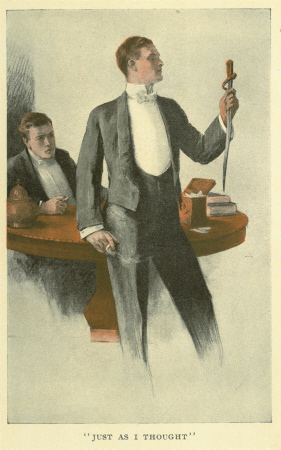
"JUST AS I THOUGHT"...FRONTISPIECE
"YOU DO NOT MEAN TO GO THERE"—
HE RAPPED SMARTLY ON THE WINDOW
WHAT SHE SAW MUST HAVE STARTLED HER
Young Pendleton's car crept carefully around the corner and wound in and out among the push-cart men and dirty children.
About midway in the block was a square-built house with tall, small-paned windows and checkered with black-headed brick. It stood slightly back from the street with ancient dignity; upon the shining door-plate, deeply bitten in angular text, was the name "Ashton-Kirk."
Here the car stopped; Pendleton got out, ascended the white marble steps and tugged at the polished, old-fashioned bell-handle.
A grave-faced German, in dark livery, opened the door.
"Mr. Ashton-Kirk will see you, sir," said he. "I gave him your telephone message as soon as he came down."
"Thank you, Stumph," said Pendleton. And with the manner of one perfectly acquainted with the house, he ascended a massively balustraded staircase. The walls were darkly paneled; from the shadowy recesses pictured faces of men and women looked down at him.
Coming in from the littered street, with its high smells and crowding, gesticulating people, the house impressed one by its quiet, its spaciousness, and the evident means and culture of its owner. Pendleton turned off at the first landing, proceeded along a passage and finally knocked at a door. Without waiting for a reply, he walked in.
At the far end of a long, high-ceilinged apartment a young man was lounging in an easy-chair. At his elbow was a jar of tobacco, a sheaf of brown cigarette papers and a scattering of books. He lifted a keen dark face, lit up by singularly brilliant eyes.
"Hello, Pen," greeted he. "You've come just in time to smoke up some of this Greek tobacco. Throw those books off that chair and make yourself easy."
One by one Pendleton lifted the books and glanced at the titles.
"Your morning's reading, if this is such," commented he, "is strikingly catholic. Plutarch, Snarleyow, the Opium Eater, Martin Chuzzlewit." Then came a host of tattered pamphlets, bound in shrieking paper covers, which the speaker handled gingerly. "'The Crimes of Anton Probst,'" he continued to read, "'The Deeds of the Harper Family,' 'The Murder of ——'" here he paused, tossed the pamphlets aside with contempt, sat down and drew the tobacco jar toward him.
"Some of the results of your forays into the basements of old booksellers, I suppose," he added, rolling a cigarette with delicate ease. "But what value you see in such things is beyond me."
Ashton-Kirk smiled good-humoredly. He took up some of the pamphlets and fluttered their illy-printed pages.
"They are not beautiful," he admitted; "the paper could not be worse and the wood cuts are horrors. But they are records of actual things—striking things, as a matter of fact—for a murder which so lifts itself above the thousands of homicides that are yearly occurring, as to gain a place outside the court records and newspapers, must have been one of exceptional execution."
"There is a public which delights in being horrified," said Pendleton with a grimace. "The things are put out to get their nickels and dimes."
"No doubt," agreed the other. "And the fact that they are willing to pay their nickels and dimes is, to my way of thinking, a proof of the extraordinary nature of the crime chronicled." The speaker dropped the prints upon the floor and lounged back in his big chair. "There is Plutarch," he continued; "the account of the assassination of Caesar is not the least interesting thing in his biography of that statesman. Indeed, I have no doubt but that the chronicler thought Caesar's taking off the most striking incident in his career; that the Roman public thought so is a matter of history.
"Countless writers have dwelt upon the taking of human life; some of them were rather commercial gentlemen who always gave an ear to the demands of their public, and their screeds were written for the money that they would put in their pockets; but others, and by long odds the greatest, were fascinated by their subjects. Both Stevenson and Henley were powerfully drawn by deeds of blood. Did you know they planned a great book which was to contain a complete account of the world's most remarkable homicides? I'm sorry they never carried the thing out; for I cannot conceive of two minds more fitted to the task. They would have dressed every event in the grimmest and most subtle horror; why, the soul would have shuddered at each enormity as shaped and presented by such masters."
Pendleton regarded his friend with candid distaste.
"You are appalling to-day," said he. "If you think it's the Greek tobacco, let me know. For I have to mingle with other human beings, and I'd scarcely care to get into your state of mind."
The strong, white teeth of Ashton-Kirk showed in a quick smile.
"The tobacco was recommended by old Hosko," he said, "and you'll find nothing violent in it, no matter what you find in my conversation."
"What put you into such a frame of mind, anyway? Something happened?"
But Ashton-Kirk shook his head.
"I don't know," said he. "In fact, I have been strangely idle for the last fortnight. The most exciting things that have appeared above my personal horizon have been a queer little edition of Albertus-Magnus, struck off in an obscure printing shop in Florence in the early part of the sixteenth century, and a splendid, large paper Poe, to which I fortunately happened to be a subscriber."
A volume of the Poe and the Albertus-Magnus were lying at hand; Pendleton ignored the dumpy, stained little Latin volume; its strong-smelling leather binding and faded text had no attractions for him. But he took up the Poe and began idly turning its leaves.
"It is a mistake to suppose that some specific thing must be the cause of an action, or a train of thought," resumed the other, from the comfortable depths of his chair. "Sometimes thousands of things go to the making of a single thought, countless others to the doing of a single deed. And yet again, a thing entirely unassociated with a result may be the beginning of the result, so to speak. For example, a volume of Henry James which I was reading last night might be the cause of my turning to the literature of assassination this morning; your friendly visit may result in my coming in contact with a murder that will make any of these," with a nod toward the scattered volumes, "seem tame."
Pendleton threw away his cigarette and proceeded to roll another.
"It is my earnest desire to remain upon friendly terms with you, Kirk," stated he, with a smile. "Therefore, I will make no comment except to say that your last reflection was entirely uncalled for."
Lighting the cigarette, he turned the tall leaves of the beautiful volume upon his knee.
"This edition is quite perfection," he remarked admiringly. "And I'm sorry that I was not asked to subscribe. However," and Pendleton glanced humorously at his friend, "I don't suppose its beauty is what attracts you to-day. It is because certain pages are spread with the records of crime. I notice that this volume holds both 'The Murders in the Rue Morgue' and the 'Mystery of Marie Roget.'"
"Right," smiled Ashton-Kirk. "I admit I was browsing among the details of those two masterpieces when you came in. A great fellow, Poe. His peculiar imagination gave him a marvelous grasp of criminal possibilities."
Ashton-Kirk took up the "Confessions of an English Opium-Eater" and turned the leaves until he came to "Murder Considered as One of the Fine Arts."
"In some things I have detected an odd similarity in the work of De Quincey and Poe. Mind you, I say in some things. As to what entered into the structure of an admirably conceived murder they were as far apart as the poles. The ideals of the 'Society of Connoisseurs in Murder' must have excited in Poe nothing but contempt. A coarse butchery—a wholesale slaughter was received by this association with raptures; a pale-eyed, orange-haired blunderer, with a ship carpenter's mallet hidden under his coat, was hailed as an artist.
"You don't find Poe wasting time on uncouth monsters who roar like tigers, bang doors and smear whole rooms with blood. His assassins had a joy in planning their exploits as well as in the execution of them. They were intelligent, secret, sure. And in every case they accomplished their work and escaped detection."
"You must not forget, however," complained Pendleton, "that De Quincey's assassin, John Williams, was a real person, and his killings actual occurrences. Poe's workmen were creatures of his imagination, their crimes, with the possible exception of 'Marie Roget,' were purely fanciful. The creator of the doer and the deed had a clear field; and in that, perhaps, lies the superiority of Poe."
Ashton-Kirk sighed humorously.
"Perhaps," said he. "At any rate the select crimes are usually the conceptions of men who have no idea of putting them into execution. And that, upon consideration, is a fortunate thing for society. But, at the same time, it is most irritating to a man of a speculative turn of mind. Fiction teems with most splendid murders. Captain Marryat, in Snarleyow, created an almost perfect horror in the attempted slaughter of the boy Smallbones by the hag mother of Vanslyperken; the lad's reversal of the situation and his plunging a bayonet into the wrinkled throat, makes the chapter an accomplishment difficult to displace. Remember it?"
Pendleton arose and opened one of the windows.
"Even the noise and smell of this street of yours are grateful after what I have been listening to," said he. Then, after a moment spent in examining the adjacent outdoors, he added in a tone of wonderment. "I say, Kirk, this is really a hole of a place to live! Why don't you move?"
The other arose and joined him at the window. Old-fashioned streets alter wonderfully after the generations of the elect have passed; but when Eastern Europe takes to dumping its furtive hordes into one, the change is marked indeed. In this one peddler's wagons replaced the shining carriages of a former day—wagons drawn by large-jointed horses and driven by bearded men who cried their wares in strange, throaty voices.
Everything exhaled a thick, semi-oriental smell. Dully painted fire-escapes clung hideously to the fronts of the buildings; stagnant-looking men, wearing their hats, leaned from bedroom windows. The once decent hallways were smutted with grimy hands; the wide marble steps were huddled with alien, unclean people.
A splendidly spired church stood almost shoulder to shoulder with the Ashton-Kirk house. Once it had been a place of dignified Episcopal worship; but years of neglect had made it unwholesome and cavern-like; and finally it was given over to a tribe of stolid Lithuanians who stuck a cheaply gilded Greek cross over the door and thronged the street with their wedding and christening processions.
"Perhaps," said Ashton-Kirk, after a moment's study of the prospect, "yes, perhaps it is a hole of a place in which to live. But you see we've had this house since shortly after the Revolution; four generations have been born here. As I have no fashionable wife and I live alone, I am content to stay. Then, the house suits me; everything is arranged to my taste. The environment may not be the most desirable; but, my visitors are seldom of the sort that object to externals."
"Well, you have one just now who is not what you might call partial to such neighborhoods," said Pendleton. "And," looking at his watch, "you will shortly have another who will be, perhaps, still less favorably impressed."
"Ah!" said Ashton-Kirk.
He curled himself up upon the deep window sill while Pendleton went back to his chair and the tobacco.
"It's a lady," resumed Pendleton, the brown paper crackling between his fingers, "a lady of condition, quality and beauty."
"It sounds pleasant enough," smiled the other. "But why is she coming?"
"To consult you—ah—I suppose we might call it—professionally. No, I don't know what it is about; but judging from her manner, it is something of no little consequence."
"She sent you to prepare the way for her, then?"
"Yes. It is Miss Edyth Vale, daughter of James Vale, the 'Structural Steel King,' you remember they used to call him before he died a few years ago. She was an only child, and except for the four millions which he left to found a technical school, she inherited everything. And when you say everything in a case like this, it means considerable."
Ashton-Kirk nodded.
"She is a distant relative of mine," resumed Pendleton; "her mother was connected in some vague way with my mother; and because of this indefinite link, we've always been"—here he hesitated for an instant—"well, rather friendly. Last night we happened to meet at Upton's, and I took her in to dinner. Edyth is a nice girl, but I've noticed of late that she's not had a great deal to say. Sort of quiet and big-eyed and all that, you know. Seems healthy enough, but does a great deal of thinking and looking away at nothing. I've talked to her for ten minutes straight, only to find that she hadn't heard a word I'd said.
"So, as you will understand, I did not expect a great deal of her at dinner. But directly across from us was young Cartwright—"
"Employed in the Treasury Department?"
"That's the man. Well, he began to talk departmental affairs with some one well down the table—you know how some of these serious kids are—and as there seemed to be nothing else to do, I gave my whole attention to the interesting performance of Mrs. Upton's cook. I must have been falling into a dreamy rapture; but at any rate I suddenly awoke, so to speak. To my surprise Edyth was talking—quite animatedly—with Cartwright, and about you."
"Ah!" said Ashton-Kirk. "That's very pleasant. It is not given to every man that the mention of him should stir a melancholy young lady into animation."
"Have you done anything in your line for the Treasury Department lately?" asked Pendleton.
"Oh, a small matter of some duplicate plates," said Ashton-Kirk. "It had some interest, but there was nothing extraordinary in it."
"Well, Cartwright didn't think that. I did not come to in time to catch the nature of your feat, but he seemed lost in admiration of your cleverness. He was quite delighted, too, at securing Edyth's attention. You see, it was a thing he had scarcely hoped for. So he proceeded to relate all he had ever heard about you. That queer little matter of the Lincoln death-mask, you know, and the case of the Belgian Consul and the spurious Van Dyke. And he had even heard some of the things you did in the university during your senior year. His recital of your recovery of the silver figure of the Greek runner which went as the Marathon prize in 1902 made a great hit, I assure you.
"But when he answered 'No' to Edyth's earnest question as to whether he were acquainted with you, she lost interest; and when I promptly furnished the information that I was, he was forgotten. During the remainder of the dinner I had time for little else but Edyth's questions. When she learned that you had taken up investigation as a sort of profession, she was quite delighted, and before we parted I was asked to arrange a consultation."
"She will be here this morning, then?" asked Ashton-Kirk.
Pendleton once more looked at his watch.
"Within a very few minutes," said he.
It was exactly three minutes later when the continuous tooting of a horn told of the approach of another motor car along the crowded street. Then the door-bell rang.
Ashton-Kirk arose and touched one of a series of buttons in the wall. Almost instantly a buzzer made sharp reply. He lifted a tube.
"If it is Miss Edyth Vale," spoke he, "show her up."
A little later a knock came upon the door. The grave faced German opened it, ushering in an astonishingly lovely girl; tall, most fashionably attired and with a manner of eager anxiety. Both men arose.
"Considering that you are under twenty-five," said Pendleton, "you are remarkably prompt in keeping your engagements, Edyth."
But the girl did not answer his smile. There was a troubled look in her brown eyes; she tugged nervously at her gloves to get them off.
"This is Mr. Ashton-Kirk?" she asked.
"It is," answered Pendleton. "Kirk, this is my cousin, Edyth Vale."
Ashton-Kirk gave the girl a chair; she sat down, regarding him all the time with much interest. The gloves were removed by now; but she continued plucking at the empty fingers and drawing them through her hands.
"I have heard of you quite frequently," said she to Ashton-Kirk, "but did not dream that I would ever be forced to benefit by your talents. Mr. Pendleton has been kind enough to arrange this interview at my request; and I desire to consult you upon a most important matter—a very private matter."
Pendleton caught the hesitating glance which she threw at him and reached for his hat.
"Edyth," said he, "after all I have done for you, this is very distressing. I had not expected to be bundled out in this manner."
She smiled faintly, and nodded.
"Thank you, Jimmie," she said. "You are a nice boy."
After Pendleton had gone, Miss Vale sat for some moments in silence; and all the time her eyes went from one part of the room to another, curiously; she seemed to be trying to estimate the man whom she came to consult by his surroundings.
At one side, rank on rank of books ran from floor to ceiling; others were scattered about in chairs, on stands and on the floor. At one spot the wall was racked with glittering, and to her, strange looking instruments. An open door gave a glimpse of a second apartment with bare, plastered wall, fitted with tables covered with sheet lead and cluttered with tanks, grotesquely swelling retorts, burners, jars and other things that make up a complete laboratory.
But these told her nothing, except that the man was a student; and this she had heard before.
So she gave her attention to Ashton-Kirk himself. He stood by the open window, the morning light beating strongly upon his dark, keen face, apparently watching the uncouth surging in the street below.
"He's very handsome and very wealthy," her friend Connie Bayless had informed her only that morning. "Comes of a very old family; has the entrée into the most exclusive houses, but practically ignores society."
"Oh, yes, I know him," her uncle, an eminent attorney, had told her. "A very unusual young man. I might call him acutely intellectual, and he is an adept in many out of the way branches of knowledge. He would make a wonderful lawyer, but has too much imagination. Thinks more of visionary probabilities than of tangible facts."
"As an amateur actor," Pendleton had confided to her, "Kirk is without an equal. If he adopted the stage, he'd make a sensation. At college he was a most tremendous athlete too—football, cross-country running, wrestling, boxing. And I'm told that he still keeps in training. Clever chap."
"I never saw a more splendid natural equipment for languages," said Professor Hutchinson. "The most sprawling dialect seemed a simple matter to him; Greek and the oriental tongues were no more trouble in his case than the 'first reader' is to an intelligent child."
She had spoken with Mrs. Stokes-Corbin over the telephone. Mrs. Stokes-Corbin was related to Ashton-Kirk, and her information was kindly but emphatic.
"My dear," said the lady, "I do hope you haven't fallen in love with him. No? Well, that's fortunate. He's one of the dearest fellows in the world, but one of the most extraordinary. I can't fancy his marrying at all. His ways and moods and really preposterous habits would drive a wife mad. You can't imagine the extent of them. He spends days and nights in positively uncanny chemical experiments. Without a word to anyone he plunges off on some mysterious errand, to be gone for weeks. They do tell me that he is to all intents and purposes a policeman. But I really can't quite credit that, you know. He loves to do things that others have tried and failed. Even as a boy he was that way. It was quite discouraging to have a child straighten out little happenings that we had all given up in despair. Sometimes it was quite convenient, but I'm not sure that I ever liked it. A charming talker, my dear; he knows so much to talk about. But he's eccentric; and an eccentric young man is a frightful burden to those connected with him."
All these things passed through the mind of Edyth Vale, as she sat regarding the young man at the window. Finally he lifted his eyes and turned them upon her—beautiful eyes—remarkable, full of perception, compelling. As he caught her intent, inquiring look, he smiled; she colored slightly, but met his glance bravely.
"Last night I heard you spoken of," she said, "and it occurred to me that you could aid me."
"I should be glad to," said he. "It sometimes happens that I can be of service to persons extraordinarily circumstanced. If you will let me hear your story—for," with a smile, "all who come to see me as you have done have a story—I shall be able to definitely say whether your case comes within my province."
She hesitated a moment, her hands nervously engaged with the gloves. Then she said, frankly.
"I suppose it is only sensible to speak quite candidly with you, Mr. Ashton-Kirk, as one does with a lawyer or a physician."
He nodded.
"Of course," said he.
For another moment she seemed to be turning her thoughts over and seeking the best means of making a beginning.
"It is very silly of me, I know," she said; "but I feel quite like the working girl who writes to the correspondence editor of an evening paper for advice in smoothing out her love affairs." She bent toward him, the laugh vanishing from her face, a troubled look taking its place, and continued. "I am to be married—some day—and it is about that that I wish to speak to you."
"I realize the difficulties of the subject," spoke Ashton-Kirk quietly.
"What I am going to tell you, I have never mentioned to anyone before. It has been three years ago—four years at Christmas time—since I first met Allan Morris," she said. "Our engagement so quickly followed that my friends said it was a very clear case of love at first sight. Perhaps it was!
"However that might be, we were very happy for a time. But trouble was in store for us. I had always disbelieved in long engagements, had always been very outspoken against them, in fact. This is perhaps what made me so quickly notice an absence of haste on Mr. Morris' part as to the wedding. When the subject came up, as it naturally would, he seemed to avoid it. At first I was surprised; but finally I grew annoyed, and spoke my mind very frankly.
"You see, he is not at all well off, and I am—well I have a great deal. I thought this might have something to do with his apparent reluctance. But no, it was something else. As I just said, I spoke frankly; and he was equally candid, after a fashion. He said it was quite impossible for us to be married for some time. There was a something—he did not say what—which must first be settled. Naturally I grew curious. I desired to know what it was that so stood in the way of our happiness. He replied that it was something that must not be spoken of, and was so very earnest in the matter that I did not mention it again—for a long time.
"You may think, Mr. Ashton-Kirk, that my fiancé was no very ardent lover. But I was assured, and I do not lack perception, that he was passionately fond of me. And I still think so. But as time went by, things did not alter; our wedding was a vague expectation; even more than before Mr. Morris avoided mention of anything definite.
"I am not naturally patient; and my rearing as the only child of an enormously rich man has perhaps added to my impetuousness. In a burst of temper one day, I broke the engagement, gave him back his ring and did a number of other rather silly things. But he was so tragic in his despair—so utterly broken hearted and white—that I immediately relented and we patched the matter up once more. That he loved me was plain; but that he could not marry me—for some mysterious reason—was even plainer.
"After this I began to notice a change in him. He was rather silent and given to reverie; he seldom laughed. Sometimes he was haggard and so wrought up, apparently, that he could scarcely contain himself. He would pace the floor, evidently with little realization as to what he was doing. Once he was really dreadfully agitated. I calmed him as well as I could, and he sat for a long time, thinking deeply. As I watched him, he sprang to his feet and dashing his fist upon a table, cried out, passionately:
"'The black-hearted rascal! He's mocking me!'
"Then like a flash he realized the strangeness of his conduct, and with anxious, alarmed face, asked my pardon. I felt that this was an opportunity to put an end to a situation that was growing intolerable. My persistent questioning gained me something, but, on the whole, not a great deal.
"The thing that was troubling him was a business matter. In some way he was in the hands of some one—these are the indefinite threads that I gathered—a mocking, jeering, smiling someone whom he hated, but from whom he could not free himself.
"I began to tell him that there could be nothing strong enough in itself to prevent our happiness; but he stopped me in such a way that I did not feel inclined to continue. In an outburst, filled with denunciations of his enemy and protestations of devotion to myself, I caught the name of Hume. He had dropped this inadvertently. I knew it instantly because of the swift look that he gave me. But I allowed no hint of what I thought to show in my face. He was more subdued during the remainder of his stay; the mentioning of the name had startled him, and he was doubtless afraid that his state of mind would lead him into further indiscretions.
"As you may suppose, the name—the first tangible thing that I had learned—was of much interest to me. If I could but find out who this person was, I could probably get to the bottom of the matter."
At this point Miss Vale paused; and Ashton-Kirk noted her head lift proudly.
"Perhaps," she continued, "it might be thought that I had no right to make such an effort in a matter which Mr. Morris saw fit to keep from me. Were you thinking that? But I am not a silent sufferer. I usually make an end of annoying things without delay. And I would have done so in this case long before, but I was in love; and I could not bear to see Allan suffer by my insistence.
"However, here was an opportunity to perhaps aid him; and I set to work. In a few hours next day I had located every person of the name of Hume in the city. Mr. Morris is a consulting engineer. Anyone named Hume who, from his occupation, would be likely to have dealings with him especially attracted my attention. There were only a few, and long before the day was over I had satisfied myself by personal visits at their places of business that they did not even know him."
Ashton-Kirk smiled. One of his well-kept hands patted applause upon the arm of his chair.
"You are strong," said he. "I recognized your type when you came in. It is a pleasure to have one's judgment so thoroughly and satisfactorily proven."
Miss Vale looked pleased.
"I am glad that you approve of what I did," she said. "I confess I had some hesitancy, but not enough to prevent my carrying out the design. But when the first effort proved without result, I set about making a study of all the Humes in the directory. I had my secretary make me a typed list of them, with their addresses and occupations, and I pored over this for hours at a time.
"There was one that caught my eye after a while; probably this was because of the unusualness of his business. The directory gave him as a numismatist; but I drove by his shop in my car, and the sign over the window said that he was also a dealer in curiosities of art.
"This gave me an idea. Mr. Morris is an ardent collector; his hobby is engraved gems, and for a man of his means his possessions in this line are quite remarkable. It was easily within the range of possibility that he had had transactions with this particular Hume—at least that he was acquainted with him. The more I thought of this, the more curious I grew; and one afternoon I paid the place a visit. It is on the second floor, the entrance is through a side door and up a narrow, dusty stairway. Then I had to make my way along a dark windowless passage to the office, or shop in the front.
"This shop was well lighted, and literally stuffed with what were well termed 'curiosities of art.' I never before saw such queer carvings, such freakish pottery, such weird and utterly impossible bric-a-brac. At a table sat a flabby looking man with a short sandy beard. One glance told me that he was an habitual drunkard, for he had the sodden look that is unmistakable. But when he arose and bid me good evening his manner struck me like a blow in the face. Allan Morris had spoken of a mocking person who jeered and smiled. And that described this man exactly. There was mockery in every glance of his dull eyes; every twitch of his mouth was a fleer; with each gesture he seemed making game of one; sneering incredulity was stamped all over him."
Ashton-Kirk leaned forward with keen interest.
"My manner must have betrayed me," the girl went on, "for I saw an inquiring crease come into his forehead. When he asked the nature of my business his voice was sharp and insolent.
"I had not thought as to what I should say, what excuse I should give in this case. But almost instantly my mind was made up. About the most conspicuous thing in the room was a squat Japanese idol—a fat, grinning, hideous thing which sat upon a sort of pedestal near the door. So I laid my hand in it.
"'I was told of this,' said I, examining the idol minutely, 'and came in to see it.'
"'Ah, yes,' said he. But it was plain enough that he did not believe me.
"I inquired the price of the figure. He named a high one; and I believe I astonished him by purchasing it without another word. The idol was delivered late that afternoon. I had it unpacked at once and placed where Mr. Morris could not fail to see it when he called."
"A clever plan," commented Ashton-Kirk, admiringly.
"He saw it when he entered the room and greeted me. He was smiling; and the smile froze on his lips, his face went pale, and he turned a look upon me that filled me with fear, it was so wan and startled.
"I had intended telling him the full truth if my ruse succeeded. But after that look I could not. I convinced him by a nonchalant manner and story, that I had come by the idol accidentally. At least I think I convinced him, though I noticed his watching me steadily from under very level brows more than once during the evening. But if he had any suspicions that I was deceiving him, he did not put them into words."
Here Miss Vale paused for a moment. Then she resumed:
"I tried, in various ways, to gain a knowledge of the relationship between my fiancé and this sneering shopkeeper; but they were all ineffectual. Mr. Ashton-Kirk, this occurred fully three months ago, and the situation remains the same as it was upon that night."
Then with a suddenness that startled the young man she lifted two trembling hands to her face and began to sob gaspingly. When she took the hands away there were no signs of tears, but her beautiful face was drawn with pain and her voice shook as she said:
"I don't think I can stand it much longer. I beg of you not to think lightly of my story; for the thing that stands between Allan Morris and myself is deadly. As I watch him I can see that his heart is breaking; his health is failing, there is a look of fear in his eyes." She reached forward and her hand rested upon the sleeve of Ashton-Kirk. "He is at the mercy of this mocking monster that I have described to you. It is killing him, and through him it is killing me. Help me, please."
Ashton-Kirk smiled reassuringly.
"As far as I can see," said he, "the case is a simple one. However, it may turn out the reverse. But in either event I can promise you a swift and energetic attempt to set the matter right."
"Thank you!" She stood up. "And you will begin to-day?"
"At once!"
"You are kind." She held out her hand; he took it. "Thank you, again."
Stumph appeared, in answer to the bell. She turned to go.
"There is nothing more that you can tell me?" he inquired.
"Nothing."
"I had supposed that. Your recital sounded pretty complete."
When the door closed upon her, he stood for a few moments in the middle of the floor, his head bent forward, his hands behind him. Then he turned and touched another of the system of bells.
Immediately a brisk, boyish looking young man presented himself.
"Fuller," spoke Ashton-Kirk, "I want instant and complete information upon one Hume, a local numismatist, and Allan Morris, consulting engineer."
"Very well, sir." And Fuller turned at once, and left the room.
When Ashton-Kirk returned that evening from the theatre, where he had gone to witness a much heralded new drama, he sat with a cigar, in his library; and stretching out his length in great comfort, he smoked and smiled and thought of what he had seen and heard.
"The drama as a medium of expression is necessarily limited," the young man was saying to himself, "and of course, in fitting human action to its narrow bounds, the dramatist is sometimes tempted to ignore certain human elements. In spots, the people of the play acted like puppets; upon seven different occasions, by actual count, the entire matter would have been cleared up if someone had sharply spoken his mind. But he did not, and the thing was allowed to become hopelessly involved because of it."
He knocked the ashes from his cigar; and a smile came to his lips.
"It would not have served the purpose of the dramatist, I suppose; his play would have ended abruptly, and far short of the prescribed time. He tried to tell a human story and chose an unhuman method."
There was another pause; the smile now disappeared and a thoughtful look came into his face.
"And yet," he mused, "is the playwright really so far wrong? Is his stage story very far removed from actuality after all? In Miss Edyth Vale, we have a girl of most unusual character, of splendid education, apparently. And yet in the building of her own drama she has outstripped the inventor of stage plays in the matter of hesitancy. Her natural inclination urged her to make a firm stand; but other feelings proved the stronger, and she held her tongue much after the fashion of the girl in the play."
He was puffing at a second cigar when there came a knock on the door, and Fuller entered.
"Well?" said Ashton-Kirk.
"I thought you'd perhaps like to look over this data before morning," said the young man, as he laid a number of typed sheets and a photograph at Ashton-Kirk's elbow. "As you required instant action I got Burgess on the Hume end of it before noon; after luncheon I took up Morris myself."
"Thank you," said the other.
"Morris," with a nod toward the photograph, "is rather uneventful, personally. And it was no very difficult matter to get the facts concerning him. But Burgess had a much more interesting time. Hume seems to have lots of color as a character. Not that there was a great deal shown—the time was too short. But the indications are promising."
When Fuller had gone, Ashton-Kirk took up the sheets and began to read them carefully. They were brief, pointed and evidently the work of men who were familiar enough with their business to eliminate all non-essentials. The first one ran:
"Allan Barnett Morris, Consulting Engineer. Specialty, Marine Construction. Lives at the Crompton Apartments. Born October 15, 1879. Graduate of Cornell; class of 1900. Special honors. Brilliant student. Was at once engaged by the New England Ship Building Company. Soon became their right hand man. Resigned in 1905; took offices in the Blake Building. Is much employed by the Government. Has the reputation of a growing man in his line and is admitted by competent persons to be an expert.
"He is unmarried and has no relatives. The last of these to die was his father—a trifle more than three years ago. The father had a reputation for great brilliancy and hard drinking. He was an inventor of some note. See the Morris Smoke Consumer—the Morris Propeller—the Morris Automatic Brake. But he never made much out of any of these. The appetite for liquor forced him to surrender, for very little, interests that made fortunes for other men.
"Young Morris is clear of the drink habit, and is a hard and persistent worker. He is a member of the University and the Brookdale Field Clubs; goes into society, and is reported to be the accepted suitor of Miss Edyth Vale, daughter of the late James Vale, manufacturer of structural steel."
"A clean bill of health, as far as it goes," commented Ashton-Kirk. "However, surface inquiries tell very little, sometimes."
He turned to the remaining pages.
"David Purtell Hume, Numismatist, philatelist, dealer in objects of art and curiosities. Resides at his place of business, second floor of 478 Christie Place.
"Hume located in this city in 1899. Where he came from is not definitely known, but there is some slight cause for supposing that he is an American who had been living abroad. However, an examination of the steamship passenger lists for 1898-99 fail to show his name.
"Is well known in his line and is reputed to be wealthy. Is much disliked by his neighbors and others in the same trade. Even those who patronize him have an aversion to him; but as he is an authority, and his stock always contains rarities, they do not take their custom elsewhere.
"Hume has been under suspicion upon several occasions. But the police could gather no positive evidence against him, at any time. The robbery of the Hailesbury gallery at London, when the famous Whistler portrait of the Duchess of Winterton was cut from its frame, was traced almost to his door. But the scent died out before they could clinch the matter, and he escaped. It was believed that the thing was planned by him and executed by a confederate. Several other occurrences of like nature, but of less importance, have been laid against him. But, if he was concerned in them, he was always cunning enough to hide his tracks.
"He is an habitual drinker, of violent temper, and is reputed to have a positive genius for discovering raw spots in an acquaintance and goading him for the sheer joy of seeing him writhe. It is this trait that causes the general dislike for him in the Christie Place section.
"He is a free liver, spends much money and has a passion for music."
Ashton-Kirk laid down the sheets and threw away his cigar.
"As Fuller remarked, Mr. Hume seems to be a colorful character. And apparently one that would be likely to lead Mr. Allan Morris a very lively dance if he had a hold of any sort upon him."
He arose to his feet, a pleased light in his eye, and began walking up and down the floor.
"It is more than likely that it will prove some trifle that Morris' fears have lifted to the plane of a tragedy. But, somehow, the parts of the case seem to fall in a promising manner. I get a sort of pleasure in anticipating a possible grapple with Mr. David Purtell Hume."
For a full hour, Ashton-Kirk moved up and down the library, his eyes half closed, varying expressions appearing and disappearing upon his face. At length there came a smile of satisfaction and he paused in his pacing.
"That is probably it," said he. "At any rate it is a very favorable coincidence. However, I must have more information than the hurried reports of Burgess and Fuller to be certain. Yes, this promises to be interesting."
With that he went to his room and to bed.
The dull gray of a damp spring morning was peering in at his window when he awoke. By the light he knew that it was hours before his usual time. Something had aroused him; but he could not say what. He sat up in bed, and as he did so there came the long continued and smothered ringing of a bell.
"The telephone," said he.
"R-r-r-r-ring-g!" it persisted. And then again: "R-r-r-r-ring-ing-ing! R-r-r-ring!"
Ashton-Kirk heard a door open and close softly on the floor above; then slippered feet came pat-patting down the stairs. The wild rattle of the bell suddenly stopped; a muffled voice could be heard protesting dismally against the din. But suddenly the vague complaint gave way to a higher note.
"Alarm," said Ashton-Kirk. "Something has happened."
He reached up and turned on the electric bulb that hung above his head; then he drew his feet up under him after the fashion of a Turk and waited, calmly.
The padded steps swiftly approached his door; a sharp knock sounded on the panels.
"Well?" demanded the young man.
"There is an urgent call, sir," came the voice of Stumph—"on the telephone. It's the lady who called yesterday—Miss Vale."
Ashton-Kirk slipped from the bed; a step brought him to the door, which he threw open.
"Very well, Stumph," said he, quietly. "You may go back to bed."
The grave-faced German went stolidly down the hall; the young man pulled on a pair of felt slippers; in the library he put the detached receiver to his ear and spoke evenly:
"Well, Miss Vale?"
There was a small, gasping exclamation from the wire, a sort of breath-catching flutter of sound such as a person might utter who had been running hard. Then Edyth Vale, her voice shaking and filled with fear, said:
"Oh! Is that you! I'm glad—glad!"
"Get a firm grip on yourself," advised Ashton-Kirk. "If anything has happened we can no doubt remedy it."
There came a series of moaning sobs across the wire; the girl had evidently broken down and was crying. Ashton-Kirk said nothing; he waited patiently. Finally she spoke once more.
"What has happened can never be remedied." Then her voice sank so low that he could scarcely catch the breathless words. "There has been murder done."
The investigator felt the blood prickle beneath his skin. However, his voice was steady as he replied; his calmly working mind shook off the fear which she so strongly suggested.
"Who has been murdered?" he asked.
"The man whom I told you about yesterday—the numismatist, Hume."
"Ah!" Ashton-Kirk drew in a long breath and his eyes began to glow. There was an instant's pause, then he said: "The hour is rather unconventional; but if you will receive me, I'll have you tell me about this matter privately and at once."
"By all means," she answered, eagerly. "I was about to beg of you to come."
"In a half hour," said he, briefly. "Good-by."
He hung up the receiver and touched one of the buttons. When Stumph came, he said:
"Turn the cold water into my bath. Then order the car in haste."
"Yes, sir."
"Afterwards you can lay out a rough suit, heavy shoes and a soft hat."
"Instantly, sir."
Within twenty minutes Ashton-Kirk ran down the steps and sprang into the powerful looking car that awaited him; and well within the half hour he rang the bell at the marble palace built by the steel magnate during the last years of his life. A heavy-eyed man servant admitted him with astonished resentment. Miss Vale, looking very tall and very pale, met him in the hall. But for all her pallor she seemed quite collected, even smiling.
"Oh, I'm so sorry to have brought you out so early and on such a dismal morning," she said, lightly, leading him into a room at one side. "I'm sure it is very damp."
She sat down and motioned him to a chair; he studied her with some surprise; the transition from wild terror to her present calm was most notable.
"There has been a recovery of poise, evidently," Ashton-Kirk told himself. "She is still frightened, but for some reason is anxious to hide it."
"This morning," said Miss Vale, with a laugh that rang perfectly, "I found that I was only a woman after all. This—this dreadful thing so startled me that for a time I did not know what to do. My first impulse was to call you, and I acted upon it. But," with a pretty gesture of apology, "when I had recovered myself somewhat, I saw that I had disturbed you unnecessarily."
"You don't mean that, after all, Hume is not—"
She held up her hand for him to stop. A strong shudder seemed to run through her; she bent her head so that the light would not fall too strongly upon her face. In a moment, however, she recovered.
"Yes, yes," she said, her voice perfectly under control. "He is dead—shockingly murdered. What I mean is, that while the event is very dreadful—still, it does not really concern me more than any other crime of the same nature which we see staring at us from the columns of the newspapers every day. This man's being in my mind so much of late caused me to become unnerved when I heard the news."
"When did it occur?"
"Sometime since midnight."
There was a silence. Miss Vale arose and began to pace the room. The long white cloak that had draped her fell away; she wore a ball dress and her arms and shoulders shone splendidly under the lights.
"How did you hear of it?" asked Ashton-Kirk.
There was a scarcely perceptible hesitancy; then she answered:
"Through the newspapers. We were returning from Mrs. Barron's about three o'clock. The papers had just come out, and I felt a curiosity to see them wet from the press. When I reached home the first thing that caught my eye was the account of Hume's death."
"Did you call me up at once?"
"Yes. As I have said, it was the first thing that occurred to me. And again I beg your pardon for having disturbed you uselessly."
Ashton-Kirk gestured this aside.
"It may be that the affair will turn out to have some interesting features," said he. "And with that possibility in view, I am rather pleased than not in having an opportunity of getting so early upon the ground."
She paused in her pacing, and turned upon him a startled look.
"You do not mean to go there—to Christie Place," she said.
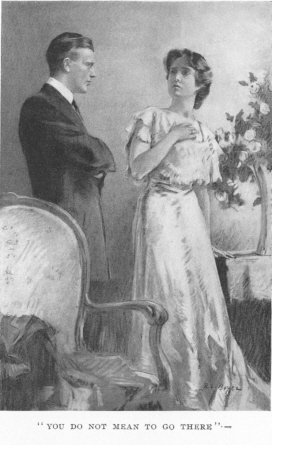
"I may as well. I may be of use." He looked at her for a moment steadily, then asked: "Do you know of any reason why I should not go?"
Instantly the startled look vanished; a smile lit up the pale face, wanly.
"Of course not," she cried. "You are interested in dreadful happenings—I had forgotten that. I suppose you are really quite delighted; and instead of my craving pardon I should be expecting praise, for putting you in the way of this one."
She laughed lightly; a smile flitted across his keen face, as he rose and said:
"What has happened may make a change in the affairs of Allan Morris."
She came to him and laid a hand upon his arm. Her coolness won his admiration.
"I beg of you to forget all that I told you yesterday," she said. "I had been brooding so long that I had begun to fancy all sorts of impossible things. I see very clearly now that this man Hume could have had nothing of any consequence to do with Mr. Morris. It was a romance—a rather foolish fancy, and a very wild one."
There was sweet seriousness in her manner; and the lurking smile still hovered about her lips. It was as though a return to reason had driven away the fears of the day before—the alarmed girl had given place to a sensible woman.
But behind all this, Ashton-Kirk could detect something else. The almost swooning terror of the girl who had spoken to him over the telephone was still there—held rigidly in check to be sure, but unquestionably there. While her lips smiled, the eyes sometimes betrayed her; and there was a tenseness about her that almost screamed. Her good-by was soft and kindly spoken; she held out her hand, frankly, and thanked him for his interest. There was nothing hurried in her manner; it was all smoothly and leisurely done. And yet he felt that if she had followed the impulse that filled her, she would have taken him, by the shoulder and bundled him from the room in order that she might be alone.
"Alone—to think," he said, as he got into his car at the curb. "But to think about what?" Aloud he said to the driver: "Christie Place."
By this time the early workers were beginning to thicken in the street; street cars were more frequent; the dull night hum of the city was growing in volume. The spark had set the car's engine throbbing heavily, and the driver was about to start when a second vehicle drew up and Ashton-Kirk found himself looking into the alarmed face of young Pendleton.
"Heavens, Kirk!" cried the newcomer, as he leaped out, "has anything serious happened?"
"To whom?" asked the investigator, quietly, his eyes fixed upon the young man's face.
"To Edyth, of course. Has any thing been seen of her?"
"I have just left her; she seemed a bit agitated, but perfectly well."
A look of relief crossed Pendleton's face.
"Oh!" said he. "All right. I was beginning to think that something was up. You see," and here he lowered his voice, "I danced with her about midnight at Mrs. Barron's; about two o'clock her aunt, Mrs. Page, came to me in great distress and said she was strangely missing. She had slipped away somewhere without a word."
Ashton-Kirk looked at him keenly.
"Of course it was up to me to find her," said Pendleton; "but my efforts were without result. Her car was gone, and the man said Miss Vale had called it about one o'clock; also that she had driven away in it alone.
"At this news Mrs. Page grew quite ill, and I brought her home here in my car. Then I departed upon a vague sort of search. As the matter was to be kept perfectly quiet and I was to ask no questions of anybody, you can imagine how much chance I had of doing anything. But if she's at home, it's all right. At sight of you I thought it had proved to be something alarming and that they had sent for you."
"I was sent for," said Ashton-Kirk, dryly, "but not to hunt for Miss Vale. Now jump in here and come along; I've got a little matter that may be of interest."
"I haven't had breakfast," said Pendleton; "but there's always something piquant to your little affairs. I'll go you."
He dismissed his own car and climbed into that of his friend. As they whirled up the street, Ashton-Kirk suddenly directed his driver to stop. Then he called to a man with a great bundle of newspapers who stood calling them monotonously upon a corner.
Again the car started with the investigator deep in the sheaf of papers which he had purchased. Page after page failed to reveal anything to his practised glance; at length he swept them to the floor of the car. A smile was upon his lips—the smile of a man who had received a nod of approval from Circumstances.
"The first edition of the morning dailies lacks interest," he said. "A crime of some moment can be committed between midnight and dawn, and not a line appear in type concerning it until the later issues."
Pendleton looked at him with mock disapproval.
"One would suppose," said he, "that you had expected to find some such criminal narrative in those," and he indicated the discarded newspapers.
"There were reasons why I should," answered Ashton-Kirk. "And very good reasons, too. But," and he laughed a little, "for all that, I had an indefinite sort of feeling that I should not find it. This may sound a trifle queer; but nevertheless it is true."
"The account was to have been of a murder," accused Pendleton. "I can see it in your face, so don't take the trouble to deny it. I had hoped that your plunge into what you styled the 'literature of assassination' would not last—that a good night's rest would turn your thoughts into another groove."
"Perhaps it would have been so," said Ashton-Kirk. "But things have happened in the meantime."
"And you don't appear at all put out that they have done so. That is possibly the most distressing feature of the business. If anything, you seem rather pleased. Of course, an odd murder or so is to be expected in the ordinary course of events; but one hardly counts upon one's intimates being concerned in them. It is disconcerting."
He crossed his legs and pursed up his lips.
"If you don't mind," added he, "now that I have expressed myself, I'll listen to the details of whatever you have in view."
"There is not a great deal to tell," said Ashton-Kirk. "A man has been murdered in Christie Place. It happens that I have an interest in the matter; otherwise I would not think of dipping into it."
Pendleton looked at him reproachfully.
"After all, then," exclaimed he, "you are but a dilettante! Assassination in the abstract is well enough, but you have a disposition to shirk practical examples. I have been deceived!"
Christie Place was some distance west and ran off from a much frequented street. It was notable for the wilderness of sign boards that flared from each side. The buildings were apparently let out in floors and each lessee endeavored to outdo his neighbor in proclaiming his business to the passing public. The lower floors were, for the most part, occupied by small grocers, dealers in notions, barbers, confectioners and such like.
"What a crowded, narrow little place," commented Pendleton, as the car turned into the street. The air in the street seemed to him heavy.
About midway in the block a small group stood about a doorway; from a window above swung a sign bearing the name of Hume. The car stopped here; Ashton-Kirk and his friend got out; the group at the doorway parted and a big man stepped forward.
"Why, hello," said he, cordially. "You're the last person I was looking for. How did you hear about this?"
"Good morning, Osborne," said Ashton-Kirk, shaking the big man's hand. "I'm glad to find you in charge. I got it in an unusual sort of way, and came down to have a look."
Osborne, though in plain clothes, was emphatically a policeman. His square face, his big frame, his dogged expression, somehow conveyed the impression as plainly as words.
"It must have been unusual," said he, "because even the reporters haven't got it yet; headquarters is keeping it quiet until the chief gets in."
Ashton-Kirk looked vastly pleased.
"Excellent," said he to Pendleton. "We'll have a look at the place before it has lost the atmosphere of the crime." Then to Osborne: "May we go up?"
"Sure," answered the other readily. "Only don't pull things around any. That young fellow that they've elected coroner is awful touchy about such things. He wants to be first always."
"Nothing of importance shall be disturbed," promised Ashton-Kirk. Then motioning Pendleton to follow, he ascended the flight that led to the second floor.
It was narrow and dusty, as Miss Vale had said. The walls were smutted, the hand rail felt greasy, the air was stale. A passage, dim and windowless, ran the depth of the building; from the front there came a patch of daylight through a ground glass door. Upon this latter could be easily read the words:
DAVID P. HUME
NUMISMATIST
PHILATELIST
ART CURIOSITIES
A policeman stood at the head of the stairs smoking a cigar in an informal way.
"All right," said he, "if Osborne let you come up I've got nothing to say. He's the boss."
"Have you looked over the place?"
"Just a glance. The floor has been fitted up as an apartment. Hume occupied all the rooms. The body," pointing to the front room, "is in there."
"Thanks."
Ashton-Kirk turned the knob of the door nearest, the one with the lettering upon it. The room was without windows; the investigator closed the door and lighted the gas.
"Just a moment," said he.
The door leading to the front room stood wide. He disappeared through this for a moment; when he returned, his face wore a tightened expression; his eyes were swift and eager.
"This is a sort of store room, I should say," spoke Pendleton.
Pictures hung about upon the walls and stood packed in corners; statues of bronze, marble and plaster were on every side; brass bas-reliefs, rugs of Eastern design and great price, antique armor, coin cabinets, ponderous stamp albums, Japanese paintings and carvings and a host of queer and valuable objects fairly crammed every inch of space.
"I had heard that Hume was wealthy," commented Ashton-Kirk. "And this seems to prove it. This room contains value enough to satisfy a fairly reasonable person."
The two young men passed through into what appeared to be a kitchen. There was an ill kept range upon one side cluttered with cooking things. A bare oaken table of the Jacobean period held the remains of a meal. A massive Dutch side-board, covered with beautiful carving, stood facing them; every inch of available space upon it was crowded with bottles, decanters and glasses.
"The gentleman was not averse to an occasional nip, at any rate," said Pendleton. "And his taste was rather educated, too," examining the sideboard's contents carefully. "The best was none too good for him."
Beyond this again was a bedroom. The bed was a huge Flemish affair, and also elaborately carved; over it was a spreading Genoese canopy, which through lack of care had grown dusty and tattered. Rich old rugs were spread upon the neglected floor; a beautiful Louis Quinze table had its top covered with discolored rings made by the bottoms of glasses, and the lighted ends of cigars had burned spots on it.
"The bed of a prince and the floor coverings of a duke," said Pendleton with indignation. "And used much as a coal heaver would use them. Now, this table is really a scandal. If its owner has been murdered, I don't wonder at it. Some outraged lover of such things has probably taken the law into his own hands."
But Ashton-Kirk was paying little attention to the things that appalled Pendleton.
"Look," said he.
He indicated the walls. Here and there the plaster was broken as though some fastened object had been violently torn away. At one place an empty picture frame, its glass smashed, hung askew from a hook. As Pendleton caught sight of other empty frames littered about the room, the glass of each broken, their pictures torn out, he exclaimed in astonishment:
"Hello! Someone has torn them down and smashed them. What an extraordinary thing to do!"
The pictures, mostly engravings, but with here and there a painting, were strewn about. Ashton-Kirk carefully gathered them up and spread them upon the table. They were by various hands, but unquestionably represented the same person—a handsome, resolute looking man in the uniform of an officer in the army of Washington.
"General Anthony Wayne," said Ashton-Kirk, softly.
There was something in the tone that made Pendleton look at him swiftly. The splendid head was bent over the portraits; eagerness blazed in the dark eyes; the keen face was rigid with interest.
"Some drunken freak, do you think?" asked Pendleton, more to hear his friend's view than anything else.
But Ashton-Kirk shook his head.
"On the contrary, the thing seems full of a vague meaning," said he. "There were seventeen pictures upon the walls of this room; fourteen have been torn down and destroyed; the other three are undisturbed."
Pendleton gazed at the pictures that remained upon the walls. Two were of fine looking houses of the colonial type; the third was the portrait of a man—a man of repulsive, sneering face, heavy with evil lines and with unusually small eyes.
"If they had destroyed that one it would have had some meaning to me," commented Pendleton. "But, as it is, I hardly think I follow you."
"The meaning that I find," replied Ashton-Kirk, "lies in the fact that the pictures violently used were those of General Wayne only. Mark that fact. That they were deliberately selected for destruction is beyond question."
"How do you make that out?"
"It is simple. If this were a mere random stripping of the room of its pictures, all would have suffered. Look," indicating a spot in the wall, "here is a place where the plaster is broken. A hook had been driven here to hold one of the portraits; and the breaking of the plaster shows that some determination was required to tear the picture down. Yet—next this—is an engraving of an old mansion which remains untouched. The next four again were portraits of the General, and all have been demolished."
Pendleton nodded.
"That's true," said he. "Whoever did this was after the Revolutionary hero alone. But why?"
Ashton-Kirk smiled.
"We'll look into matters a little further," said he. "Perhaps there are facts to be gathered that will shed some light upon the things that we have already seen."
They repassed through the other rooms; with his hand upon the frame of the door leading to the show room, Ashton-Kirk paused.
"Better brace yourself for rather a shocking sight," said he to his friend.
"Go on," said Pendleton, quietly.
There were four good-sized windows in the show room, all overlooking the street. It was a large, square place, and, as Miss Vale had said, literally stuffed with odd carvings, pottery of a most freakish sort, and weird bric-a-brac. Two large modern safes stood at one side, behind a long show case spread with ancient coins. At the end of this case was a carpeted space, railed in and furnished with a great flat-topped desk. Upon the floor at the foot of the desk, and with three separate streams of blood creeping away from it, lay the huddled, ghastly figure of a man.
Pendleton, though he had been warned, felt his breath catch and his skin grow cold and damp.
"Heavens!" said he, under his breath. "It's the man whose picture we saw inside there on the wall."
Even the shock of death could not, so it seemed, drive the sneer from the thick lips; mockery was frozen in the dead eyes.
"What a beast he must have been," went on Pendleton. "Like a satyr. I don't think I ever saw just that type of face before."
Ashton-Kirk was bending over the body; suddenly he raised himself.
"There is a heavy bruise on the forehead," said he. "He was felled first; then bayoneted."
"Bayoneted!" Pendleton peered at the body.
"There it is, sticking from his chest." Ashton-Kirk drew aside the breast of the dead man's coat and his companion caught sight of a bronze hilt. The broad, sword-like blade had been driven completely home.
"If we attempted to move the body," said the investigator, "I should not be surprised if we found it pinned to the floor. It took brawn to give that stroke; the man who dealt it made sure of the job."
With soft, quick steps he crossed the room. The doors of the safes were locked.
"If the purpose was robbery," said Ashton-Kirk, "the criminal evidently knew where to look for the most portable and valuable articles. There seems to be no indication of anything having been tampered—" He stopped short, his eyes upon a huge vellum covered tome which lay open upon the floor. He whistled softly between his teeth. "General Wayne once more!" he said.
The volume, as far as Pendleton could see, was a sort of scrap book in which had been fastened a great number of prints. Upon the two pages that they could see, six prints had been affixed by the corners. Of these, four had been torn out and lay upon the floor.
"Gambetta and John Bright have been spared," said Ashton-Kirk, pointing at the book, "but," and he gathered up the fragments of the mishandled prints, "upon Mad Anthony they laid violent hands four separate times."
Pendleton wrinkled his brow.
"Now what the deuce can it mean," he asked, vexedly. "Not only what did the fellow mean who did this, but what did he mean," pointing at the dead man, "by having so many portraits of General Wayne?"
"I think something might be found to point the way if we could only look for it," said Ashton-Kirk, his face alight with eagerness. "But we'll have to await the coroner's people."
"When will they come?"
The investigator shrugged his shoulders.
"Probably not for hours," he answered. "However, as the coroner himself appears to be new in the office, he may be more anxious to get his work over with than the usual official. In the mean time we'd better go down and have a talk with Osborne. If I remain here I'll succumb to temptation, go rummaging about and so get myself into trouble."
He turned the knob of the door with the ground glass panel; but it was fast. They passed into the store room, and so out into the hall.
"Any signs of the people from the coroner's office?" asked Ashton-Kirk of the policeman who stood there.
"Someone just drove up a minute ago," answered the man. "I hear him down there talking to Osborne now."
Ashton-Kirk was about to go down when there came a tramping on the stairs. The big figure of the headquarters detective was first; after him came a nervous, important looking young man and a stolid-faced old one.
With a large gesture Osborne laid his hand upon Ashton-Kirk's shoulder.
"Mr. Stillman," said he to the nervous looking young man, "this is Mr. Ashton-Kirk. I guess you've heard of him."
The important manner of the young coroner visibly increased as he held out his hand.
"I have heard of you frequently, sir," he stated, firmly, "and I am quite delighted to meet you. More especially, sir, at a time like this."
"A very nasty looking affair," returned the investigator. "Osborne has been good enough to let me glance about," in explanation.
"I trust," said Stillman, "that you have disturbed nothing."
"Except for gathering up a few scattered pictures in the bedroom, we have done nothing but look," assured Ashton-Kirk.
"I find that the exact conditions must remain if we are to secure even a fairly good idea of the crime's environments," stated Stillman, nervously. "It is a thing that I insist upon from the police in every instance."
"Sure, sure," said Osborne. "Headquarters does its best never to make trouble for you, Mr. Stillman."
The nervous young coroner seemed to be relieved to hear this. He waved his hand in a gesture that might have meant anything and turned to the stolid looking, elderly man who accompanied them. They conversed for a few moments; the stolid man seemed to be explaining something carefully, to which Stillman listened with the utmost attention. Osborne bent his head toward Ashton-Kirk.
"The old party is a left-over in the coroner's office, of many years' standing," said the detective. "He knows the ropes and puts the newly elected ones on to the points of the game."
Stillman finally turned; there was an added importance in his manner, and his nervousness had also increased.
"Mr. Osborne," said he, "please let us have what facts the police have gathered."
"That won't take long," said Osborne. "Just before daylight—three o'clock, I think she said—the woman whom Hume employed to scrub the passage-way and stairs got here. She has almost a dozen such jobs in the neighborhood, and as she must have them all done before business begins, she's compelled to get at it early. She has a key to the street door; so she let herself in, came up these stairs and started for the far end of the hall, where there is a water tap. She didn't notice anything unusual until she returned with her pail filled; then she saw this door," pointing to that of the store room, "standing open."
"I see," said Mr. Stillman; and he gazed very hard at the door.
"Hume, according to the scrub-woman's story," resumed the big man, "was a queer kind of a chap. You didn't always know just how to take him. He's lapped up a good bit of booze first and last and sometimes he's come home pretty well settled. So when the woman sees the door open, this is the first thing that enters her mind. But to make sure, she goes into the room and calls him by name. The room's dark and there's just a touch of daylight coming in through the open door leading into the front room. So as there was no answer, she takes a peep in there and sees him on the floor."
"And is that all she can tell?"
"Yes; except that she bolted down the stairs in a hurry, met Paulson here," with a nod to the policeman, who had now discarded his cigar, "and told him what she had seen."
"What is her name and address?"
Osborne consulted a note book.
"Mrs. Dwyer, 71 Cormant Street," read he.
"Please make a note of that," said Stillman to his clerk. "And send for her later in the day." Then turning once more to Osborne, he continued. "Before doing anything else we will endeavor to find out how the criminal gained an entrance."
"That's the way with these Johnnie Newcomers," grumbled Osborne as Stillman turned once more to his aide. "They want to do it all. Why don't he go in, look at the body and leave the police business to the police."
"Too much earnestness may have its drawbacks," said Ashton-Kirk, "but it is to be preferred to the perfunctory methods of the accustomed official, for all."
"From your angle, maybe so," said Osborne with a frown; "but not from ours."
Stillman began rubbing his palms together with what was intended to be business-like briskness; he stepped up and down the dark hall, peering right and left. But for all his assumption of confidence, his nervousness was very apparent.
"You say," said he to Osborne, "that the scrubwoman unlocked the street door. Very good. That shows that it was fast at all events. Now what other means are there of entering the building?"
"None, except by the fire-escapes and windows. But the windows on this floor are all secured except for those at the front."
"Except for those at the front." The young coroner paused in his hand rubbing. "Would it not have been possible for the person or persons who did this murder to enter by one of those?"
"It would have been possible," returned the big headquarters man, "but no sane person would do it. They'd have to swarm up the face of the building in full view of anyone that might be passing at the time."
"Exactly," said Stillman, stiffening under what he was half inclined to consider a rebuff. "Well, that eliminates that possibility. Now to the next one. Who occupied the building besides the murdered man?"
"A man named Berg keeps a delicatessen store on the first floor. His place in no way communicates with the rest of the building. The third and fourth floors are used for storage purposes by a furrier. Except in the spring and fall, so Mrs. Dwyer tells me, he seldom visits the building."
"Is there any way of getting in from the top of the house—the roof?" asked the coroner.
A look of something like respect came into Osborne's face. Clearly the question was one which he considered worth while.
"There is a scuttle," he replied. "The bolt is rusted and broken; it has probably not been fastened for months, perhaps years."
"Now we are beginning to come at something," cried Stillman, well pleased. "In all probability the assassin entered by way of the scuttle." He turned as though for the approval of the stolid-faced man. "Eh, Curran? What do you think of that?"
"It looks very like it, Mr. Stillman."
"At all events," spoke the coroner, "we will now examine the rooms."
He advanced and tried the door of the show room.
"Ah, locked!" said he. He turned and entered the store room, the others following. The gas was still burning; the coroner stuck a pair of big-lensed eyeglasses upon his rather high nose and gazed about him intently.
"There seems to be nothing of an informing nature here," said he, after a time. "Where is the body?"
Osborne led the way into the front room. After a glance at the ghastly, huddled figure upon the carpet near the desk, the coroner took a careful survey of the apartment.
"Did Mr. Hume employ any person to assist him?" he asked.
"The scrub-woman told me that there was a young man here always when she came during the business day for her wages. A sort of clerk, she thought."
"He will be able to tell us if anything has been disturbed, no doubt," remarked Stillman.
Then he examined the body minutely. In the pockets were found a wallet containing a large sum of money, a massive, old-fashioned gold watch with a chain running from pocket to pocket of the waist-coat. Upon the little finger of Hume's left hand was a magnificent diamond.
"Worth two thousand if it's worth a cent," appraised Osborne.
"If the criminal had meant robbery these things would unquestionably have been taken," commented the young coroner. "Eh, Curran?"
"That is a very safe rule to go by, Mr. Stillman," replied his assistant, with the utmost stolidity.
Through his big lenses the coroner gazed curiously at the bronze haft protruding from the dead man's chest.
"A bayonet," said he. "Not a common weapon in a crime like this. In fact, I should say it was rather in the nature of an innovation."
"It probably belonged in Hume's stock," suggested Osborne. "There seems to be about everything here."
But Stillman shook his head.
"We have already about concluded that the intention of the criminal was not robbery," stated he. "And now, if we make up our minds that the bayonet belonged to Hume—that the assassin, in point of fact, came here without a weapon—it must be that he did not intend murder either."
"Maybe he didn't," ventured Osborne. "There might have been a sudden quarrel. The person who struck that blow may have grabbed up the first competent looking thing that came to his hand."
Stillman turned to Ashton-Kirk.
"That sounds reasonable enough, eh?"
"Very much so," replied Ashton-Kirk.
"A bayonet is a most unusual weapon," said the coroner thoughtfully, readjusting his glasses. "And I think it would be a most awkward thing to carry around with one. Therefore, it would be a most unlikely choice for an intending assassin. I am of the opinion," nervously, "that we may safely say that it was a sudden quarrel which ended in this," and he gestured with both hands toward the body.
The safe doors were tried and found locked; a cash register was opened and found to contain what had been apparently the receipts of the day before. An examination of the cabinets and cases disclosed hundreds of ancient coins and other articles the value of which must have been heavy. But their orderly array had not been disturbed. A long curtain of faded green material hung from the wall at one side, as though to screen something from the sunlight and dust.
"What have we here?" said the coroner.
He stepped across the store and whisked the curtain aside. A large gilt frame was disclosed; and from it hung the slashed remains of a canvas.
"Hello!" exclaimed Osborne, with interest. "This begins to look like one of the old affairs that they say Hume's been mixed up in. Somebody's tried to cut that picture from the frame."
They examined it carefully. A keen knife had been run around the top and both sides, close to the frame. The painting hung down, its gray back displayed forlornly.
Stillman regarded it with great satisfaction.
"Here," said he, "we at least have a possible motive."
Ashton-Kirk took a twisted walking stick from a rack, and with the end of it, raised the slashed canvas so that its subject could be seen. It was a heroic equestrian figure of an officer of the American Revolution. His sword was drawn; his face shone with the light of battle.
Pendleton was just about to cry out "General Wayne," when the stick fell from his friend's hand, the canvas dropping to its former position. While the others were trying to get it into place once more, Ashton-Kirk whispered to Pendleton:
"Say nothing. This is their turn; let them work in their own way. I will begin where they have finished."
After a little time spent in a gratified inspection of the painting, Stillman said:
"But, gentlemen, let us have a look at the other rooms. There may be something more."
They re-passed through the store room and into the living room. Nothing here took the coroner's attention, and they entered the bedroom. Both these last had doors leading into the hall; upon their being tried they were found to be locked.
The smashed pictures upon the bedroom floor at once took the eye of Stillman. He regarded the broken places in the plaster and prodded the slivers of wood and glass with the toe of his shoe with much complacency.
"This completes the story," declared he. "It is now plain from end to end. The criminal entered the building from the roof, made his way down stairs and gained admittance through the door which the scrub woman found unlocked. His purpose was to steal the painting in the front room.
"In a struggle with Hume, who unexpectedly came upon him, the intruder killed him. Not knowing the exact location of the picture he wanted, he first looked for it here. The light probably being bad he tore down every picture he could reach in order to get a better view of it. When, at last, he had found the desired work, he set about cutting it from its frame. But, before he had finished, something alarmed him, and he fled without the prize."
The stolid man listened to this with marked approval. Even Osborne reluctantly whispered to Pendleton:
"He's doped it out. I didn't think it was in him."
After a little more, the coroner said to his clerk:
"I think that is about all. Curran, see to it that the post-mortem is not delayed. Put a couple of our men on the case, have them make extensive inquiries in the neighborhood. Any persons who appear to possess information may be brought to my office at three o'clock. Especially I desire to see this Mrs. Dwyer, Berg, who keeps the store on the ground floor and the young man who was employed by Hume. I'll empanel a jury later." He took off his eye-glasses, placed them in a case and, in turn, carefully slipped this into his pocket. "At three o'clock," he repeated.
"If I should not be intruding," said Ashton-Kirk, "I should like to be present."
Stillman smiled with the air of a man triumphant, but who still desired to show charity.
"I shall be pleased to see you, sir," he said, "then or at any other time."
It wanted a few minutes of three o'clock when Ashton-Kirk, still accompanied by the curious Pendleton, walked into the outer room of the coroner's suite.
"Mr. Stillman will be here at any moment now," said Curran. Then lowering his voice and making a short little gesture from the elbow, he added: "These people are the ones he wanted to see."
As he and Pendleton sat down, Ashton-Kirk looked at the persons referred to. The first was a thin, wiry little woman, unmistakably Irish, cleanly dressed and with sharp, inquisitive eyes. Engaged in a low-pitched conversation with her was a thick-necked German, heavy of paunch and with a fat, red face. The third was a spectacled young Jew, poring over a huge volume which he seemed to have brought with him. He had a tremendous head of curling black hair; his clothing was shabby. There was a rapt expression upon his face; plainly nothing existed for him at that moment outside the pages of his book.
After a brief space, the coroner came in,
"Ah, how do you do, gentlemen," greeted he. He was good-natured and strove to be easy; but his natural nervousness clung to him. "I am glad to see you."
He looked at Curran and nodded at the three inquiringly.
"Yes, sir," replied the clerk; "these are the parties."
"Then we will get down to business." He opened a door and entered an inner room. "Will you come in?" he asked of Ashton-Kirk and Pendleton.
They followed him at once; and Curran, addressing the little Irishwoman, said:
"Now, Mrs. Dwyer, this way, please."
She arose briskly and also entered the inner room. Stillman seated himself at a desk and carefully perched his glasses upon his nose.
"I perhaps take more trouble than is customary in these cases," he said to Ashton-Kirk. "It is usual to hear statements, I believe, only when they are proffered as testimony at the inquest. But it seems to me that the office should be carried on in a more thorough way. Preparation, I think, is necessary to get at the facts."
Then he faced the woman who had taken a chair beside the desk.
"Your full name, please," said he.
"Honora Dwyer. I'm a widow with four children; I live at 71 Cormant Street, an' me husban' has been dead these three years," declared she, in a breath.
Stillman smiled.
"You don't believe in keeping anything back, Mrs. Dwyer, I can see that," said he. "And a very good trait it is." He leaned back in his swivel chair and looked at her through the glasses. "You are the person who discovered the body of Mr. Hume, are you not?"
"Yes, sir, I were," replied Mrs. Dwyer; "and God spare me such another sight."
"Tell us about it," said the coroner.
"I work as scrub woman for a good many in Christie Place an' the immejeat neighborhood," said Mrs. Dwyer, genteelly. "But I always gets to Mr. Hume's first."
"You are quite sure you found the street door locked?"
"Yes, sir."
"And you noticed nothing unusual about the place?"
"Only the open door to the store room, sir. Mr. Hume was always particular about closing up, sir. For a man who was in the habit of taking a sup of drink, sir, I'll say he was very particular."
"When you noticed the door being open you went in at once, I suppose?"
"No, sir; I did not. After I got me water, I set down on the top step to get me breath. When I saw the door stan'nin' open, thinks I to meself, thinks I; 'Mr. Hume is up early this mornin'.' But everything was quiet as the grave," in a hushed dramatic tone. "Sorra the sound did I hear. So I gets up and goes in. And in the front room I sees him lyin'. Mr. Hume was never a handsome man, sir; and he'd gained nothing in looks by the end he'd met with. God save us, how I ever got out into the street, I'll never know."
She rocked to and fro and fanned herself with her apron.
"It must have been a very severe shock, Mrs. Dwyer," agreed the coroner. "Now," after a pause, "do you know anything—however slight, mind you—that would seem to point to who did this thing?"
Mrs. Dwyer shook her head.
"Me acquaintance with Mr. Hume was a business one only, sir," she said. "I never set foot into his place further than the hall except on the days when I went to get me pay—and this morning, save us from harm!"
"You know nothing of his friends then—of his habits?"
"There is the Jew boy, outside there, that worked for him. He's a nice, good mannered little felly, and is the only person I ever see in the office when I went there, barrin' the boss himself. As for Mr. Hume's habits, I can say only what everybody knows. He were drunk when he engaged me, and he were drunk the last time I seen him alive."
"That will be all, Mrs. Dwyer," said Stillman. "Thank you. Curran, I'll see the young man next."
As Curran and Mrs. Dwyer went out the young coroner turned to his two visitors.
"I am still assured that we have the motive for the crime in the attempt to steal the painting," he said. "But it will do no harm to get all the light we can upon every side of the matter. The smallest clue," importantly, "may prove of the utmost value at the inquest."
Ashton-Kirk smilingly nodded his entire assent to this. Then Curran showed in the clerk.
The young man still carried the thick volume and, when he sat down, laid it upon a corner of Stillman's desk. Its back was turned toward Ashton-Kirk and he noted that it was a work on anatomy such as first-year medical students use.
"What is your name, please?" asked the coroner.
"Isidore Brolatsky," replied the young man.
"You are, or were, employed by Mr. Hume?"
"As a clerk, yes, sir. I've been with him for some years." Brolatsky spoke with scarcely a trace of accent. "He didn't pay much, but then there wasn't much to do, and I had plenty of time to study."
"Ah," said Stillman, encouragingly. "To study, eh?"
"Yes. I've taken up medicine. There's a college up town that has night classes. I have been attending the lectures there and reading during the day. There's a big chance for physicians who can speak Yiddish. Not only to make money, but to do good."
"I see." The coroner regarded him reflectively for a moment. "Now, Mr. Brolatsky, having worked for Hume for some years, you must have picked up some details as to his business and himself. Suppose you tell us all you know about both."
The dark face of Brolatsky became thoughtful.
"Mr. Hume was a hard man to get along with," he said. "He seemed ready to quarrel at any time with anybody. I don't recall a customer ever coming into the store that he didn't have some kind of trouble with before they went out. But he had a great knowledge of the things he dealt in. People came from far and near to get his opinion on items in their collections. His fees," with appreciation, "were large.
"But there is one thing that I noticed about him. While he knew all about objects of art, he did not seem to care for them. He had no love for his trade, no sympathy, I may say, for the collectors who came to him. I wouldn't be going far from the truth if I said that he thought them all fools for paying their money for such things. And I know that he mocked them."
"Humph!" Stillman looked at Ashton-Kirk, with surprise upon his face. "That seems odd. Men usually go into Hume's business through love of it." He turned once more to Brolatsky. "And he had no hobby of his own, no collection that he fancied more than another?"
Brolatsky nodded amusedly.
"Yes," he replied. "I was just coming to that. He did have a collection that he called his own. And he never sold an item from it as long as I was with him. Indeed, I think if anybody had offered to buy, he would have come to blows with him."
Ashton-Kirk bent forward. For the first time since entering the room, he spoke.
"And what was the nature of that collection?" he inquired eagerly.
"Portraits," answered Isidore Brolatsky. "Prints, lithographs, mezzo-tints, engravings, paintings, it made no difference. And all of the same person. He had hundreds, I guess, and every one of them was of General Wayne."
Ashton-Kirk leaned back in his chair with a faint breath of triumph.
"When a portrait of General Wayne was offered him," continued Brolatsky, "he never haggled over it. He paid the price asked and seemed quite delighted to get it. It was a standing joke in the trade that if you wanted to get even with Mr. Hume for driving a hard bargain with you, all you had to do was to offer him a portrait of General Wayne. I never saw him refuse one. Even if he had dozens of duplicates, which often happened; still he'd buy."
A look of great acuteness had settled upon the face of the young coroner.
"There is a painting at one side of the show room," said he. "It is under a large green curtain. Is that of General Wayne?"
"It is," replied the clerk. "And I believe that he valued it more than anything else that he owned."
Stillman laughed with pleasure.
"Now," said he to his visitors, "we are getting at it, indeed. Someone probably knew of the value he attached to this painting and planned to steal it, perhaps for a ransom. Hume has been suspected of doing this sort of thing himself before now. He was supposed to have engaged someone to do the actual work, I believe, as in the case of the Whistler portrait of the Duchess of Winterton. Suppose this someone," and Stillman rapped his knuckles upon the edge of the desk excitedly, "took the notion to go into the picture stealing business of his own account. Hume himself with his much prized portrait of General Wayne was ready at hand—and so," with a sweeping gesture, "what has happened, has happened."
Pendleton, much impressed, looked at Ashton-Kirk. But the latter's thoughts seemed far away; his eyes were fixed upon the wall; his expression was of delighted anticipation.
Stillman also noticed this non-attention to his reasoning, and a little wrinkle of discontent appeared between his brows. So he turned his gaze upon Brolatsky and spoke rather sharply.
"Now, as to Mr. Hume's intimates? What do you know of them?"
Isidore Brolatsky shifted in his chair; his long fingers began to drum upon his knees.
"I have known of the matter of the Whistler portrait," said he, "but I never knew anything more about it than what I read in the newspapers. It happened before my time."
"I'm not accusing you," said Stillman. "I'm asking you about Hume's friends."
The clerk considered.
"There was no one that I ever saw or heard of that you could call his friend, exactly," said he at length. "He made game of people too much to have any I guess."
"Had he no associates—no one with whom he spent his time?"
Brolatsky shook his head.
"Perhaps so; but then I was only in Christie Place during business hours. I have heard that he frequently went out at night; but where I do not know."
"Was there no one who came to visit him while you were there during the day. No one whom he spoke of in an intimate way?"
Again the clerk shook his head. Stillman began to appear nonplussed. He looked at the other, pondering and frowning through his glasses.
"Who came most frequently to the store?" he inquired finally.
"Why, I think Antonio Spatola," said Brolatsky.
"Was he a customer?"
The clerk smiled.
"Oh, no. He's a street musician. You may have seen him often about the city. He plays the violin and carries some trained cockatoos upon a perch."
"What was the nature of his business at Hume's?"
"If there was anything that Mr. Hume liked better than strong drink," said the clerk, "it was music. Antonio Spatola would come and play to him for hours at a time."
"A lover of music who could stand the playing of a street musician for hours!" cried Stillman. "That's astonishing."
"But," protested Brolatsky, "Spatola is a splendid musician. He's studied his instrument under the greatest masters in Paris, Rome and other European cities. He has played in the finest orchestras. But he never could keep a position because of his temper. He's told me himself that when aroused he doesn't know what he is doing."
"I understand," said the coroner. "What sort of relations existed between Hume and Spatola outside the music? Were they friendly?"
"No, sir. I might say just the reverse. For hours, sometimes, Mr. Hume would lie back in his chair with his eyes closed listening to the violin. Then, perhaps, he'd get up suddenly, throw Antonio a dollar or so and tell him to get out. Or maybe he'd begin to jeer at him. Antonio had an ambition to become a concert violinist. Ole Bull and Kubelik had made great successes, he said; and so, why not he?
"This was usually the point Mr. Hume would take up in mocking him. He'd call him a curbstone fiddler, and say that he ought to be playing at barn dances and Italian christenings instead of aspiring to the platform. Spatola would get frantic with rage, and fairly scream his resentment at these times.
"Often Mr. Hume would have him bring his trained cockatoos. And while he was making them go through their tricks, Mr. Hume would call him a mountebank, a side show fakir and other things, and tell him that he ought to stick to that as a business, for he could make a living at it, where he would starve as a violinist. I've often seen Antonio go out trembling and white at the lips with rage. Several times he's tried to injure Mr. Hume—once he took out a knife."
"Hah!" said the coroner.
"That was the time Mr. Hume called him 'Mad Anthony.' I also remember that Mr. Hume pulled aside the curtain and showed him the large painting of General Wayne, laughing and telling him that that was another Mad Anthony. He was so successful that day in arousing Spatola, that always after that, when he was drunk, he'd call the Italian 'Mad Anthony' and it never failed to infuriate him.
"Do you know where this man Spatola lives?"
"In Christie Place, sir; just about half a dozen doors from the store. I believe he rents a garret there, or something."
Stillman seemed struck by this.
"In view of the fact that the building was entered by way of the scuttle," said he to Ashton-Kirk, "I consider that a most interesting piece of information."
"It may indeed prove so," was the non-committal reply.
Once more the discontented crease showed itself upon the coroner's forehead; and again as he turned to Brolatsky, his voice rose sharply.
"Next to Antonio Spatola, who came most to Hume's place while you were there?"
"The next most frequent caller," returned the clerk, "was Mr. Allan Morris."
Ashton-Kirk, glancing at Pendleton, saw him start.
"And who," queried the coroner, "is Mr. Allan Morris?"
"At first I took him to be a customer," replied Brolatsky. "And perhaps he was. He talked a great deal at times about engraved gems and would look at lists and works upon the subject. But somehow I got the notion that that was not just what he came for."
"What caused you to think that?" asked the coroner.
"His manner, partly, and then the fact that there seemed something between Mr. Hume and him—something that I never understood. Mr. Morris was another one that the boss used to make game of. Not so much as he would Spatola, but still a good bit. Mr. Morris always took it with a show of good temper; but underneath I could see that he too was sometimes furious."
"About what did Hume deride him?"
"That's what I never could quite make out. It always seemed as though it was something that Mr. Morris wanted. At first I got the notion that it was something that he wanted to buy and which Mr. Hume refused to sell; but later I changed my mind. There seemed to be more to it than appeared on the top. Both were very secretive about it."
"I understand." Stillman's face wore a puzzled expression; it was as though this latter development worried him. But in a few moments he went on: "Do you know where this man Morris is to be found?"
"Oh, yes. He's quite well known. Has an office in the Blake Building, and is employed just now, so I've heard, by the Navy Department."
"You have visited Christie Place to-day?"
"Yes, sir."
"Did the police have you look about?"
"Yes, sir. And so far as I can see, nothing has been taken."
"The weapon that Hume was killed with, now. Do you know anything about it—did it belong to the store?"
"The bayonet? No, sir."
"Are you sure of that?" earnestly.
"Positive. It was my duty to keep a complete list of everything we had in stock. We had other sorts of arms, but no such thing as a bayonet."
There were a few more questions, but as they drew out nothing of interest, Stillman signified to Brolatsky that the interview was at an end.
"Now, you will go with Mr. Curran to police headquarters on the next floor," said he, "and tell them what you have told me about this Antonio Spatola."
Then he opened the door and stepped out.
"Curran," they heard him say, importantly.
"I want you to—" then the door closed, cutting the sentence short.
Pendleton gazed fixedly at Ashton-Kirk.
"I say," said he, "I'm not up in this sort of thing at all. I've been putting two and two together, and it's led me into a deuce of a state."
Ashton-Kirk looked at him inquiringly; there was expectancy in the investigator's eyes, but he said nothing.
"Perhaps you'll think that I'm all kinds of a fool," continued Pendleton, "and maybe I am. But here are the things that I'm trying to marshall in order. I'll take them just as they happened." He held up one hand and with the other began to check off the counts upon his fingers. "Yesterday you have a visit—a visit of a professional nature—from Edyth Vale. Last night she strangely disappears for a time. At a most unconventional hour this morning I find you at her door. Then I learn that you are on your way to look into the details of a murder that you had just heard of—somehow. Now I hear that Allan Morris, Edyth's fiancé, has been, in rather an odd way, upon familiar terms with the murdered man."
He paused as he checked this last count, still regarding his friend fixedly.
"I don't claim," he went on, after a moment, "that these things have anything to do with each other. But, somehow, they've got together in my mind, and I can't—"
Here the door re-opened and Stillman entered, followed by the big German.
"Just take a chair, Mr. Berg," said the coroner, seating himself at the desk and affixing his eyeglasses.
The German lowered his form into the chair indicated and folded his fat hands across his monstrous paunch.
"Your name in full—is what?" asked Stillman with formality.
"Franz Berg. I sell me delicatessen at 478 Christie Place. I haf been there for fifteen years."
"You were acquainted with the murdered man?"
The delicatessen dealer unfolded his hands and waved them significantly.
"I was aguainted with him—yes. But I was not friendly with him—no. He is dead, ain't it? Und it's not right to say someding about the dead. But he was no friend of mine."
"I understand. But tell me, Mr. Berg, how late do you keep your place open?"
"In the summertime—seven o'clock. But after dose theaters open, I stays me on the chob till twelve, or later somedimes. There is one—two—three what you call burlesque places, right by me; and no sooner do they close up, than right away those actor peoples come to buy. I do a goot business, so I keep open."
"Then you were there until midnight last night?"
"More later than that yet."
"Was there any movement of any sort about Hume's place? Did you see or hear anything?"
The great red face of Berg took on a solemn look.
"It is maybe not ride that I should say somedings," complained he. "But if the law will not excuse me, I will say it, if it makes some more trouble or not."
"It is vitally necessary," stated the young coroner, firmly, "that you tell me everything you know about this matter."
"Well," said the delicatessen dealer, reluctantly, "last night as I stood by my window looking oudside on the street, I see me that Italian feller go by und turn in at the side door; a second lader I hear him go up the steps to Hume's place."
"What Italian fellow do you refer to?"
"He lifs close by me, a few doors away. His name is Spatola, und he plays the violin the gurb-stones beside."
"What time was it that you saw him?"
"Maybe elefen o'clock. I am not sure. But it was just a little while before I got me the rush of customers from the theaters."
"Did you notice his manner? Was there anything unusual in his looks?"
"I had me only a glimbs of him. He looked about the same as effer. He was in a hurry, for it rained a liddle; und under his coat yet he carried his fiddle."
"If it was under his coat, how do you know it was his fiddle?"
The German scratched his head in a reflective way.
"I don't know it," said he at last. "But he somedimes takes his instrument inside there, und I just get the notion that it was so. Yes?"
"When did he come out?"
The man shook his head.
"I don'd know," he said.
"Do you mean that you saw no one come out?"
"No; I did see someone come out. But first I see me someone else go in."
"Ah! And who was that?"
"I don't know his name; but I had seen him often before. He is a kind of svell feller. He had a cane und plendy of style."
"And later you saw someone come out. Now, your use of the word 'someone' leads me to think that you do not know whether it was Spatola or the stranger."
"I don'd," said Berg. "I was busy then. I just heard me someone rush down the stairs, making plendy noise, und I heard that drunken Hume lift up a window, stick out his head and call some names after him. My customers laugh und think it's a joke; but I am ashamed such a disgracefulness to have around my business yet."
"If Hume called after the person who left," said Stillman, acutely, to Ashton-Kirk, "that eliminates one of the callers. It proves that Hume was still alive after the man had gone."
"That is undoubtedly a fact," replied the investigator.
Stillman turned upon Berg with dignity.
"Surely you must have noticed the man if all that uproar attended his exit. You must have detected enough to mark a difference between an exceptionally well-dressed man and an Italian street musician."
Berg shook his big head.
"It was aboud twelve o'clock in the night-dime, und my customers besides I had to pay some attention to," stated he.
The coroner was baffled by the man's positiveness.
"Well," said he, resignedly. "What else did you see?"
Berg shook his head once more.
"Nothing else. Putty soon I closed up and went home." Then a flash of recollection came into his dull face. "As I went down the street I saw some lights in Hume's windows. One of them windows was open—maybe the one he sticked his head out of to call the man names—und I could hear him laughing like he used to do when he was trying to make a jackass of some peoples."
The coroner pondered. At length he said:
"This object that Spatola carried under his coat, now. Could it have been a bayonet?"
"No, no," said Berg with conviction. "It vos too big. It vos bigger as a half dozen bayonets already."
This seemed the limit of Berg's knowledge of the night's happenings; a few more questions and then Stillman dismissed him. The door had hardly closed when the telephone rang. After a few words, the coroner hung up the receiver and turned to his visitors.
"I think," said he, with a smile of satisfaction, "that I've made the police department sit up a little. They talked to all three of these people before I had them, and didn't seem to get enough to make a beginning. But just now," and the smile grew wider, "I've heard that Osborne is on his way to arrest Antonio Spatola."
Berg was standing in the corridor waiting for the elevator when Ashton-Kirk and Pendleton came out. The big German mopped his face with a handkerchief, and said apologetically:
"A man can only tell what he knows, ain't it?"
Ashton-Kirk looked at him questioningly, but said nothing.
"To begin dot guess-work business when you are talking to the law already, it is dangerous," stated Berg in an explanatory tone.
"Well," said Ashton-Kirk, "sometimes a good, pointed guess is of great service, Mr. Berg. And," with a laugh, "as I am not the law and not the least dangerous, suppose you make the one that I can see you turning over in your mind."
"Oh," said Berg, "you are not the coroner's office in?"
"No; merely interested in this case, that's all."
The delicatessen dealer looked relieved.
"I don't want to get people in trouble," said he, guardedly. "But this is what I guess. Late every night, about the time I shut up my place, there is a cab comes und by the curbstone stands across the street. I will not say what is der place it stands in front of; that is not my business."
"McCausland's gambling house, perhaps," suggested Ashton-Kirk.
The big German looked more relieved than ever.
"Ach, so you know about dot place, eh? All ride. Now I can speak out and not be afraid to do some harm to nobody." He lowered his voice still further. "Dot cab came last night as I was locking my door up, und stands the curbstone by in front of McCausland's, waiting for a chob. Maybe when I goes away home der driver he sees what happened at Hume's afterwards, eh?"
"Excellent!" said Ashton-Kirk, his eyes alight. "Thanks for the hint, Mr. Berg."
The delicatessen dealer lumbered into the elevator which had stopped; Pendleton was about to follow, but his friend detained him, and the car dropped downward without them.
"That cab," said Ashton-Kirk, "is sure to be a night-hawk; and more than likely it is put up at Partridge's. Pardon me a moment."
There was a telephone booth at one side of the corridor; the speaker went in and closed the door. After a few moments he came out.
"Just as I thought," he said, well pleased. "Partridge knew the cab in a moment. The driver's name is Sams, and he lives at the place they call the Beehive." He looked at his watch. "It wants but a few minutes of four," he added, "and a night-hawk cabby will be just about stirring. The Beehive is only three blocks away; suppose we go around and look him up."
Pendleton agreed instantly; and after a brisk walk and a breathless climb, they found themselves on the fourth floor of a huge brick building where they had been directed by a meek-looking woman in a dust-cap. A long hall with a great many doors upon each side, all looking alike, stretched away before them.
"It's very plain that the only way to find Mr. Sams is to make a noise," said Ashton-Kirk. And with that he stalked down the hall, his heels clattering on the bare boards. "Hello," he cried loudly. "Sams is wanted! Hello, Sams!"
A door opened, and a face covered with thick soap suds and surmounted by a tangle of sandy hair looked out.
"Hello," growled this person, huskily. "Who wants him?"
"Very glad to see you, Mr. Sams," said Ashton-Kirk. "We have a small matter of business with you that will require a few moments of your time. May we come in?"
"Sure," said Sams.
They entered the room, which contained a bed, a trunk, a wash-stand, and a chair.
"One of you can take the chair; the other can sit on the trunk," said the hack driver, nodding toward these articles. Then he proceeded to strop a razor at one of the windows. "Excuse me if I go on with this reaping. I must go out and feed the horse, and then get breakfast."
"You breakfast rather late," commented Ashton-Kirk.
"I'm lucky to get it at any time, in this business," grumbled Sams. "Out all night, sleep all day, and get blamed little for it, at that."
He posed before a small mirror stuck up beside the window and gave the blade an experimental sweep across his face. Then he turned and asked inquiringly:
"Did youse gents want anything particular?"
"We'd like to ask a question or two regarding what happened last night in Christie Place."
The cab driver's forehead corrugated; he closed his razor, laid it down and shoved his soapy face toward the speaker.
"Say," spoke he, roughly. "I drives people wherever they wants to go; but I don't ask no questions."
"It's all right, Mr. Sams," said Ashton-Kirk. "The affair that I'm looking up happened across the street—at Hume's—second floor of 478."
"Oh!" Sams stared for a moment, then he took up his razor, turned his back and went on with his shaving. But there was expectancy in his attitude; and Ashton-Kirk smiled confidently.
"While you were drawn up in Christie Place, waiting for a fare," he asked, "did you hear or see anything at 478?"
"I saw a light on the second floor—something I never saw before at that hour. And I saw the Dutchman that keeps the store underneath shutting up. And I heard somebody laughing upstairs," as a second thought. "I think that's what made me notice the light."
"Nothing else?"
Sams shaved and considered. He wiped his razor at last, poured some water in a bowl and doused his face. Then he took up a towel and began applying it briskly.
The investigator, watching him closely, saw that he was not trying to recall anything. It was plain that the man was merely calculating the possibilities of harm to himself and patrons if he told what he knew.
"There has been a murder," said Ashton-Kirk, quietly, thinking to jog him along.
Sams threw the towel from him and sat down upon the bed.
"A murder!" said he, his eyes and mouth wide open. "Well, what do you know about that." He sat looking from one to the other of them, dazedly, for a space; then he resumed: "Say, I thought there was something queer about that stunt of hers!"
"Tell us about it," suggested Ashton-Kirk, crossing his legs and clasping one knee with his hands.
The cabby considered once more.
"There's lots of things that a guy like me sees that look off color," he said, at length; "but we can't always pass any remarks about them. It would be bad for business, you see. But this murder thing's a different proposition, and here's where I tell it all. Last night while I was waiting in front of McCausland's, I hears an automobile turn into the street. It was some time after I got there. I wouldn't have paid much attention to it, but you see there's a fellow been trying to get my work with a taxicab, and I thought it was him."
"And it wasn't?"
"No, it was a private car—a Maillard, and there was a woman driving it."
The chair upon which Pendleton sat was an infirm one; it creaked sharply as he made a sudden movement.
"She was going at a low speed," proceeded Sams, "and as she passed Hume's I noticed her look up at the windows. After she disappeared there wasn't a sound for a while. You see, nobody hardly ever passes through Christie Place after one o'clock. Then I hears her coming back. This time she stopped the car, got out and went to the door that leads into Hume's place. There she stopped a little, as though she didn't know whether to go in or not. But at last she went in."
Pendleton coughed huskily at this point; and his friend glancing at him saw that his face was white.
"And up to that time," said Ashton-Kirk, "are you sure that there was no movement—no sound—in the front room at Hume's?"
"As far as I noticed, there wasn't. But a few minutes after I heard the woman go in, I did hear some sounds."
The man stroked his shaven jaws in the deliberate manner of a person about to precipitate a crisis. Pendleton leaned toward him, anxiously.
"What sort of sounds?" he asked.
"There were two," replied the cab driver. "The first was a revolver shot; the second came right after, and was a kind of a scream—like that of a parrot."
"And what then?" asked Ashton-Kirk, easily.
"There wasn't anything for a few minutes, anyway. But the revolver shot had kind of got my attention, so I was taking notice of the windows. Then suddenly I caught sight of the woman. You see, the gas-light was near the window and she kind of leaned over and turned it out. It was only for a time as long as that," and the man snapped his fingers. "But I saw her plain. Then I heard her coming down the stairs to the street—almost at a run. She banged the street door shut after her, jumped into her car and went tearing away as if she was crazy. I stayed fifteen minutes before I got a fare; but nothing else happened."
Pendleton's hand closed hard on the edge of the chair he sat in. There was a moment's silence; then Ashton-Kirk asked:
"Just where was your cab standing at this time?"
"Right in front of McCausland's door."
"And you were on the box?"
"Yes."
The investigator put a piece of money in the man's hand as he and Pendleton arose and prepared to go.
"Say," said Sam curiously, "I've been in bed all day and ain't heard a word of anything. Who's been done up?"
"Hume. Stabbed in the chest."
"Shot, you mean."
"No, I mean stabbed. With a bayonet."
The man stared wonderingly.
"G'way," he said.
They bid him good-day and tramped down the three long flights to the street. Pendleton was silent, and walked with his head held down.
"We have more than an hour of good daylight left," said his friend, as they reached the street. "And as I must have a good unrestricted look at Hume's apartments before everything is hopelessly changed about, suppose we go there now. We can get a taxi in the next street."
"Just a moment," said Pendleton. "Before we take another step in the matter, Kirk, I must ask a question."
Ashton-Kirk put his hand upon his friend's shoulder.
"Don't," said he. "I know just what the question would be, and at the present time I can't answer it. At this moment, except for some few theories that I have yet to verify, I am as much puzzled as yourself."
"But," and there was a tremble in the speaker's voice, "you must answer me, old chap—and you must answer now."
The catch in his voice, the expression upon the young man's face caused Ashton-Kirk to grasp an astonishing fact. The hand that he had laid upon Pendleton's shoulder tightened as he answered:
"Yes, Edyth Vale is concerned. As a rule I do not speak of my clients to others, but in view of what you have already heard and seen, it would be a waste of words to deny it. But, see here, there are lots of things we don't know yet about this business. It may look very different in a few hours. Come."
Pendleton gazed with sober eyes into the speaker's face for a moment. Then he said:
"Let us get the cab; if you are to go over Hume's rooms before dark, you haven't any too much time."
At the next corner they signaled a taxicab, and in a short time they were set down in Christie Place. Paulson, the policeman, was standing guard.
"How are you?" he greeted them affably.
"Been here all day?" asked Ashton-Kirk.
"Oh, no. Just come on. I'm the third shift since I saw you last."
"Nobody has been permitted to go upstairs, I presume?"
"Only the coroner's man, who came for the body. And they touched nothing but the body. Our orders were strong on that."
"Has anything been heard as the result of the post-mortem?"
"It showed that Hume was in bad shape from too much drink. Then he had a hard knock on the head, and the wound in his chest."
"But there was no sign of a bullet wound?"
"No," said Paulson, surprised. "Nothing like that."
"Just a moment," said the investigator to Pendleton. He crossed the street, walked along for a few paces, then paused at the curb and looked back toward Hume's doorway. Then he returned with quick steps and an alert look in his eyes.
"Now we'll go upstairs," he said.
But before doing so he stopped and examined the lock of the street door closely; then he mounted the stairs slowly, his glances seeming to take in everything. At the top he paused, his head bent, apparently in deep thought. Then he lifted it suddenly, and laughed exultantly.
"That's it," he said, "I'm quite sure that is it."
"I wouldn't doubt your word for an instant," said Pendleton, in something like his old voice. "Whatever it is, I'm quite sure it is if you say so."
The policeman on guard in the hall examined them carefully.
"All right," said he, after they had explained and he had verified it by calling to his mate at the street door. "Go right to work, gents. I'm here to see that nobody gets in from above by way of the scuttle, and I guess I won't be in the way."
There were three gas branches at intervals along the length of the dim hall, each with a cluster of four jets. Ashton-Kirk lighted all three of these and began making a careful examination of the passage. Along toward the rear was a stairway leading to the floor above. Next this was a small room in which there was a water tap. At the extreme end of the hall was a window with a green shade drawn to the bottom.
Ashton-Kirk regarded this for a moment intently. Then he reached up and turned off the gas at the branch nearest the window. Daylight could now be seen through the blind; the investigator pointed and said:
"This shows us something. About six inches of the bottom of the blind is of a decidedly lighter color than the remainder. This is caused by exposure to the light and indicates that this blind has seldom been drawn in daylight as it is now."
He drew back the blind and looked at the side nearest the window. At the top of the faded space was a heavy dark line.
"I'll modify that last statement," said he, with satisfaction. "I'll go as far as to say, now, that the blind has never been drawn since it was put up. This thick line marks the part that lay across the top of the roller, and the dust seems never to have been disturbed."
The gas was lighted once more.
"Hume did not draw that curtain," said Ashton-Kirk, decidedly. "He was too careless a man, apparently, to think of such a thing. The intruders, whoever they were, did it; they had a light, perhaps, and did not want to be—"
He paused abruptly here, and Pendleton heard him draw his breath sharply between his teeth; his eyes were fixed upon the lowermost step of the flight that led to the floor above.
One of the gas branches hung here; its full glare was thrown downward. Following the fixed gaze of his friend, Pendleton saw two partly burned matches, the stump of a candle, and some traces of tallow which had fallen from the latter upon the step. To Pendleton's amazement, his friend dropped to his knees before these as a heathen would before an idol. With the utmost attention he examined them and the step upon which they lay. Then he arose, enthusiasm upon his face.
"Beautiful!" he cried. "I do not recall ever having seen anything just like it!" He slapped Pendleton upon the back with a heavy, hand. "Pen, that stump of candle sheds more light than the finest arc lamp ever manufactured."
"I'm watching and I'm listening," spoke Pendleton. "Also I'm agitating my small portion of gray matter. But inspiration, it seems, is not for me. So I'll have to ask you what these things tell you."
"Well, they give me a fairly good view of the man who, while he may not actually have murdered Hume, had much to do with his taking off." He bent over the lower step once more, then looked up with a smile upon his face. "What would you say," asked he, "if I told you that I draw from these things that the gentleman was short, well-dressed, near-sighted and knew something of the modern German dramatists."
"I should say," replied Pendleton, firmly, "that you ought to have your brain looked at. It sounds wrong to me."
Ashton-Kirk laughed, and started up the stairs toward the third floor.
"I'll return in a moment," he said. "Don't trouble to come up."
He was gone but a very little while, and when he returned his face wore a satisfied look.
"The bolt of the scuttle is broken, just as Osborne said," he reported. "And anyone who could gain the roof would have little difficulty in effecting an entrance." He led the way down the hall, saying as he went: "Now we'll browse around in the rooms for a while; then we'll be off to dinner."
The storage room was entered first as upon the earlier visit, but Ashton-Kirk wasted but little time upon it. In the front room, however, he examined things with a minuteness that amazed Pendleton. And yet everything was done quickly; like a keen-nosed hound, the investigator went from one object to another; nothing seemed to escape him, nothing was too small for his attention. One of the first things that he did was to get a chair and plant it against the lettered door that led directly into the hall. At the top was a gong with a spring-hammer, one of the sort that rings its warning whenever the door is opened; and this the investigator examined with care.
He then passed into the railed space where the body had lain and where the darkened trail of blood still bore ghastly testimony to what had occurred. The man's singular eyes scanned the floor, the walls, the flat-topped desk. On this last his attention again became riveted; and once more Pendleton heard his breath drawn sharply between his teeth.
"When Hume was struck upon the head," said Ashton-Kirk, after a moment, "he was standing at this desk. He had just sprung up, probably upon hearing a sound of some kind. See where the chair is pushed back against the wall, just as he would have pushed it had he arisen hastily. When he struck he fell across the desk." He pointed to a dark trickle of blood down the back of the piece of furniture in question. "That is the result of the blow upon the head, and probably flowed from the mouth or nostrils. After the first senseless lurch the body settled back and slid to the position in which it was found. Here is a blotting pad, a small pair of shears, a box of clips and a letter scale upon the floor where the sliding body dragged them. The top of the desk is of polished wood; it is perfectly smooth; there are no crevices or anything of the sort to catch hold of anything. When the body slipped from it, it must have swept everything with it, cleanly. And yet," bending forward over the desk and picking up a minute red particle, "here, directly in the center, we find this."
"What is it?" asked Pendleton, eagerly.
Ashton-Kirk placed the red particle on his palm and held it out. It was shaped like a keystone, and had apparently been cut from something that had been printed upon.
"It is that portion of a railroad ticket which a conductor's punch bites out, and which litters the floor and the seats in trains. Have you never had one fall from your clothes after a railroad journey?"
Pendleton looked at the tiny red fragment, and then at the desk.
"If Hume fell across the desk, as you've just said," he remarked, slowly, "and pulled all these other things to the floor with him—why, Kirk, this bit of card, in the very center of the polished top,—it must have dropped there afterwards."
"Exactly," said Ashton-Kirk. "And now, if you don't mind, just step out into the hall and ask Paulson to come up."
Pendleton did so; and while he was gone, Ashton-Kirk placed the red fragment carefully in his card-case. When the other re-entered with Paulson at his heels, he asked:
"Have any of the policemen detailed here been out of town recently?"
"No," replied Paulson. "There have been five besides myself, and they have been on duty every day."
"Thank you," said the investigator. And as the policeman went out, he made his way into the kitchen. Here, however, his examination was brief, as was that of the bedroom also. At length he paused, his hands in his pockets, his head thrown back, satisfaction lighting his dark, keen face.
"That is all, I think," said he. "There have only been a few pages, but the print has been exceedingly good and the matter of much interest." He looked at a clock that ticked solemnly upon a shelf. "We have half an hour to reach my place and dress," he said. "I'm afraid that we'll be late, and that Edouard will be annoyed. His cookery is so exquisitely timed that it is scarcely the better for delay."
"Wait a minute," said Pendleton, grasping his friend's arm. "What part did Edyth—Miss Vale—play in all this? I can see you have formed in your mind some sort of completed action. Where does she come into it?"
"Completed!" Ashton-Kirk smiled into the pale, set face of his friend. "You give me too much credit, old chap. I have some undoubted scenes from the drama; but most of the remainder are merely detached lines and bits of stage business. As to Miss Vale," here the smile vanished, "I have been unable to make up my mind just how far she is concerned, if at all. However, perhaps twenty-four hours will make it all clear enough. In the meantime I will say this to you: Don't jump to harsh conclusions, Pen. You know this young lady well. How far do you suppose she would go to the perpetrating of a downright crime?"
"Not a step!" answered Pendleton, promptly.
"Then," said Ashton-Kirk, "until we know positively that she has done so, stick to that."
As Ashton-Kirk and Pendleton sat in the former's library that evening after dinner, there came a knock upon the door and Fuller entered briskly. In his hand he carried a paper parcel which he laid upon a stand at the investigator's elbow.
"This is the bayonet, sir," said he. "Mr. Stillman, the coroner, objected to letting me have it at first, but changed his mind after I had talked to him for a while."
"Did you take the photograph to Berg in Christie Place?"
"Yes, sir. He recognized it at once as that of the person in question."
"And you made inquiries upon the other point?"
"I did. Neither Mr. Stillman nor any of the men who removed the body of Hume have been out of town within a week. I also questioned Mr. Osborne; his answer was the same. Brolatsky's reply was similar; and he also said that Hume had not ridden on a railroad in years."
"That will be all, Fuller; thank you."
The brisk young man had reached the door when the investigator added:
"One moment."
He scribbled something upon a pad, tore off the leaf and handed it to his aid.
"Look these things up at once."
Fuller took the paper, glanced at it and then replied:
"Very well, sir."
Seated in his big chair with the jar of Greek tobacco and sheaf of brown paper wrappers before him, Ashton-Kirk did not display any haste in removing the covering from the bayonet that had let the life out of the art dealer. Rather he sank deeper into the arms of the chair; the cigarette end became gray and dead between his fingers; the strangely brilliant eyes closed as though he had fallen asleep.
But Pendleton, who understood his friend's ways, knew better; the keen, swift-moving mind was but arranging the developments of the day, weighing them, giving to each its proper value. A little later and the eyes would unclose, more than likely alight with some new idea, some fresh purpose drawn from his reflections.
And as Pendleton waited he, too, fell into a musing state and also began marshaling the facts as he saw them. Ashton-Kirk, during dinner, had told him those regarding the visit of Edyth Vale the day before.
"Pen, you know I don't usually do this," the investigator had informed him. "But as you know so much already, and your feelings in the matter being what they are, I think it best that you should know more."
And now Pendleton, as he rolled and consumed cigarette after cigarette, went over the facts as they had been laid before him.
"And Morris," said he to himself, as he reached the end of his friend's recital; "now what sort of a mess has Allan Morris got himself into? And after he had got into it, why in heaven's name didn't he keep quiet about it? What good could come from Edyth's knowing it?"
Then the fact that Morris had apparently tried to keep his secret from Miss Vale presented itself. But Pendleton dismissed it with contempt.
"Tried!" he said to himself. "Of course; but how? By marching up and down the floor. By a great parade of tragic despair; by sighs and the wringing of his hands. I've always suspected Morris of being a bit theatrical—and now I am sure of it."
He roused himself for a moment, lighted a fresh cigarette and settled back once more.
"I'm not Kirk by any means," he reflected, "and this sort of thing is altogether out of my line. But it seems clear that Edyth—after leaving here yesterday—received some unexpected news. When she was here, consulting Kirk, she was, to all appearances, in a quandary—helpless. She did not know how to proceed; she understood nothing. But her darting off alone that way after midnight proves that some sort of a crisis had come up. She had heard something—more than likely through Morris. He probably," with great contempt, "became hysterical again, couldn't contain himself and blabbed everything—whatever it was."
Then he burst out aloud, angrily.
"She went to Hume's last night because she had reason to think Morris would be there. And if the truth were known, Morris was there."
"My dear fellow," said the voice of Ashton-Kirk, "the truth, upon that particular point, at least, is known. Allan Morris was at Hume's last night. He was the man whom Berg saw enter after the musician."
"How do you know?" asked Pendleton, astonished.
"Fuller, with a report which he recently made upon Morris, handed me a photograph of that gentleman. While we were at dinner, Berg identified the portrait as being that of Hume's secret visitor."
"I was right, then. Edyth did go there expecting to meet him—to protect him, perhaps. If you knew her as well as I do, Kirk, you'd realize that it's just the sort of thing she'd do. But," positively, "she did not find him there."
"What makes you think that? There was still one of Hume's visitors left, when she got there. It may have been Morris."
"It was Spatola," answered Pendleton, with conviction. "The scream of the cockatoo which came from Hume's rooms when the pistol was discharged proves it. When Spatola went in, Berg said he was carrying something under his coat. Brolatsky told the coroner this morning that the Italian sometimes brought his trained birds with him when he called at Hume's. That's what he had last night."
But Ashton-Kirk shook his head.
"At this time," he said, "it will scarcely do to be positive on some things. Indications are plenty, but they must be worked out. I have some theories of my own upon the very point that you have just covered, but I will not venture a decided statement until I have proven them to the limit. It's the only safe way."
Pendleton discontentedly hitched forward in his chair.
"I thought," said he, "that you worked entirely by putting this and that together."
"That is precisely what I do," returned Ashton-Kirk. "But I have found, through experience, that there must be no loose ends left to hang. Such things are treacherous; you never know when they'll trip you up and upset all your calculations." He paused a moment and regarded his friend steadfastly. Then he continued. "But, just now, I think we had better not trouble ourselves about Edyth Vale and Allan Morris. To be sure, the latter's connection with the affair is peculiar; Miss Vale's visit to Hume's last night, the sounds which Sams heard immediately after she had gone in—her turning out of the gas and hurried flight, are also strange and significant enough. But they are perhaps the very end of the story; and it is best never to begin at the end."
"Is there any way by which you can begin at what you think is the beginning?" asked the other.
Ashton-Kirk took up the parcel which Fuller had laid at his elbow.
"Here is one way," he answered. "Let us see where it leads us."
He stripped off the wrapper, and the bayonet which had killed the numismatist was revealed, blood-clotted and ugly. Carefully the investigator examined the broad, powerful blade and heavy bronze hilt.
"A Schwartz-Michael, just as I thought," he said.
"The maker's name is upon it then?" said Pendleton.
But the other shook his head.
"No," said he. "But it happens that I have given some attention to arms, and the bayonet, though a weapon that is passing, came in for its share."
He balanced the murderous-looking thing in his hand and proceeded.
"There are not many types of bayonets. The first was what they called a 'Plug,' because it was made to fit into the muzzle of a flint, or match-lock. Then there was the socket bayonet, the ring bayonet and an improved weapon invented by an English officer named Chillingworth which met with much favor in the armies of Europe. But the latest development is the sword bayonet, of which this is an example. Its form is a great improvement over the older makes; it is an almost perfect side arm as well, having a cutting edge, a point, and a grip exactly like that of a sword. There are a number of makes of this type; the Schwartz-Michael is one of the least known of these. Upon its being placed on the market it was adopted by three governments—Bolivia, Servia, and Turkey—and there it stopped."
He laid the weapon upon the table and settled himself back in his chair.
"It struck me when I first saw the thing," he went on, "that it was a little singular that a Schwartz-Michael should even find its way into the United States. Now, it would not surprise me to find an English revolver in Patagonia, or an American rifle in Thibet, because they are universally known and used. Any one might carry them. But a bayonet is different, of course; it is a strictly military arm, and its utility is limited. That a criminal should select one with which to commit a murder is unusual; and, further; the fact that the make is one never introduced into the United States is rather remarkable."
"It is—a little," agreed Pendleton.
"It is a small thing, but all clews are small things. Now there are many ways in which such a weapon might find its way into the country; but I took the most likely of these as a beginning. Before I dressed for dinner, I ran over a rather complete card-index system which I maintain; and within a few minutes learned that the republic of Bolivia had, within the past year, changed both the rifle and bayonet used by its army."
"Well?" asked Pendleton, with interest.
"When a nation makes such a change, the discarded arms are usually bought up by some large speculator or dealer in such things. And in the course of time they find their way to the military goods dealers who exist all over the world."
Here Fuller entered the room, and Ashton-Kirk turned to him inquiringly.
"Well?"
"In the morning Standard of April 9th," announced the young man, "I find an advertisement of Bernstine Brothers relative to a sale of condemned army equipment."
"Is anything specified?"
"They considered it important that high-power modern rifles were to be sold at a very small price. And they also lay some stress upon the fact that the stuff had been in use by the Bolivian army."
Pendleton saw a look of satisfaction come into his friend's eyes. But there was no other evidence of anything unusual.
"And now," said the investigator, quietly, "with regard to this other matter."
"I find that there are two schools for mutes in this section," answered Fuller. "But both are some distance out of town."
The satisfaction in Ashton-Kirk's singular eyes deepened.
"Excellent," said he.
"One is on the main line—Kittridge Station; the other is on the Hammondsville Branch at a place called Cordova."
"Thank you," said Ashton-Kirk.
And when the door had once more closed behind his aid, the investigator continued to Pendleton:
"I figured upon some of the equipment reaching here. Military goods houses, such as Bernstine's, usually advertise each lot they receive; and I considered it possible that the murderer might have been attracted by this notice and procured the weapon from them. If he did, we may get some trace of him by inquiring at Bernstine's. But," flinging his arms wide and yawning as though weary of the subject, "that is work for to-morrow. To-night we will rest and prepare for what is to come. But in the meantime," arising with enthusiasm, "let me show you a first edition of the 'Knickerbocker's History of New York' which I picked up recently."
He went to his book-shelves and took down two faded volumes. With eager hands Pendleton took them from him.
"Original covers!" cried he. "Binding unbroken; in perfect condition inside; not a spot or a stain anywhere." Then he regarded his friend with undisguised envy. "Kirk," said he, "you're a lucky dog. You can dig up more good things than anybody else that I know."
Next morning Ashton-Kirk lounged in a comfortable window-seat, almost knee-deep in newspapers. The published accounts of the assassination were, in some instances, very sensational. Drawings, by special artists of persons concerned, were much in evidence, also half-tones of the exterior of 478 Christie Place. The names of Osborne and Stillman figured largely in the types; but what interested the investigator most was a portrait of the musician—the violinist, Antonio Spatola, and the story of his arrest.
The pictured face was that of a young man with a great head of curling hair. The features were regular, the expression eager and appealing.
"I would have pronounced him a musician, even if I had not heard that he was one," said Ashton-Kirk. "The head and face formations have all the qualities." Then he ran over the story of Spatola's arrest and the causes that led up to it. At the finish he smiled. "They have tried and convicted him on the first page. If there was any way for them to do it, they'd execute him in the evening editions and print his dying words in the sporting extra. But," and he nodded his head appreciatively, "Osborne has a good case against him, at that."
Both the clerk, Isidore Brolatsky, and Berg seemed to have talked freely to the newspapermen. The character of Hume was treated in a highly colored manner. The visits of the Italian musician to the numismatist, his ambition to shine as another Kubelik, his ungovernable temper, the high words that followed Hume's frequent sneers at his ambition and the fact that he once drew a knife upon his tormentor, were presented in full. But what appealed to the space-writers most was Brolatsky's story of how Hume had once called Spatola "Mad Anthony," and afterward showed him the portrait of General Wayne.
"This apparently drove him frantic," wrote one reporter, "and, noting this, Hume frequently applied the name to him, and more than likely displayed the portrait as well. The last time that Spatola visited Hume was upon the night of the murder. He evidently went to regale the numismatist with music; for the delicatessen dealer, Berg, saw under his coat what was evidently his violin. During the course of the concert, Hume probably resumed his sneers; unable any longer to bear it, the Italian apparently struck him down, and then in blind rage of resentment, smashed and otherwise destroyed every one of the Wayne portraits he could find."
Fuller came in with another newspaper just about this time and Ashton-Kirk showed him the story.
"The Standard, then, seems to ignore the theory held by Osborne and Stillman that the murder was done in an attempt to steal the portrait found partly cut from the frame," said the assistant after studying the account. Then, inquiringly, he added: "What do you think of it, sir?"
"As a piece of sensational writing, I have no fault to find with it," said the investigator. "But the Standard's young man is no deep thinker. The single fact that Hume was a lover of real music should have shown him that his theory was wrong."
Fuller considered a moment.
"I don't think I quite get that," said he.
"It is simple enough. Hume being sensitive to harmony, asked Spatola very frequently to play for him; and, according to Brolatsky, paid him rather well for each performance. To furnish good music, Spatola must have not only talent, but also a violin that was at least fairly good."
"Yes, sir, I see that."
"Having a violin that was at least fairly good, Spatola, being a poor man, would take care of it. He would carry it in a case—he would especially do so in wet or damp weather. And it rained on the night of the murder. If he carried his violin in a case, there was no need of his putting it under his coat. And, another thing, a violin case is of such size as to prevent its being so carried, isn't it?"
Fuller nodded.
"I think that's very good," said he.
"It would have been a very easy thing for the Standard's man to have made a few inquiries as to whether Spatola used a violin case or no. If he had done so, I am inclined to think that the answers would have been in the affirmative. But there is another and more vital point upon which I would base an objection to the reporter's theory. He says that, goaded into a rage, Spatola struck his tormentor down. But he forgets that If the murderer did not visit Hume's with the intention of doing murder, it was rather a freakish thing for him to provide himself with a bayonet. However, that is a point that I discussed with Mr. Stillman yesterday; at first he was inclined to assume a somewhat similar position."
"But the broken and cut portraits?" questioned Fuller.
Ashton-Kirk smiled a little.
"Probably I shall be able to properly account for them when I return from a little trip that I am about to take to-day," said he. "That is," as a sort of afterthought, "if some things turn out as I think they will."
Fuller unfolded the newspaper that he had brought in.
"It is a late edition of the Star," he said. "The paper seems to have scored a beat, for it has some developments that may put a different face upon everything."
Ashton-Kirk took the sheet, and as he glanced at the flaring headlines, he whistled softly. The lines read:
"MYSTERIOUS WOMAN IN A MOTOR CAR!
"She Visits 478 Christie Place on the Night of
Murder!
"DID A BEAUTIFUL WOMAN'S HAND DEAL THE DEADLY BLOW?
"A New Element Added to the Hume Sensation!"
"The Star man seems to have struck up an acquaintance with Sams," said Ashton-Kirk, with interest. He thought for a moment, and then added to Fuller:
"Tell Stumph when Miss Edyth Vale arrives to show her here at once."
"Oh, you have been expecting her then?"
"No: I have not. But I am now."
After Fuller left the room, the investigator turned eagerly to the Star's leaded narrative. This laid great stress upon the evident wealth and dazzling beauty of the mysterious midnight visitor in Christie Place; and second only to her did they feature the well-dressed stranger whom Berg had seen enter at Hume's door before he had closed his own place for the night. The revolver shot that had followed the woman's entrance and the parrot-like scream which had, in turn, followed that, lost nothing in the telling.
"Who was the woman? That is the mystery," the newspaper said in conclusion. "The hack driver caught but a glimpse of her, and in the excitement of the moment failed to take the number of the car. But that the latter was a Maillard he is positive. There are several headquarter's men following up the clew as this goes to press; and startling developments are expected at any moment.
"As to the second man whom the fancy grocer, Berg, saw go into Hume's, there is a well-founded belief that he is very well known in select circles and had called at Hume's frequently upon a matter concerning which both he and Hume were always very secretive. The Star called up both his apartments and his office, but he had not been seen at either place on the day after the murder. The clubs of which he is a member were resorted to, but with no more success. As this gentleman is known to be engaged to the beautiful heiress of a huge fortune, the Star's well-known special writer, Nancy Prindeville, was detailed to get her statement. But a man servant stated that his mistress had given positive orders that she could not be seen."
The investigator threw down the paper.
"Well," said he to himself with a shrug, "that makes it a little annoying for the young lady. The fact that they refer to Morris when they speak of a young man 'well known in select circles' will be plain to everyone, for the facts of Morris' visits have been rather well exploited in all the other papers. And as newspaper men are not without daring in their conjectures, I wonder how long it will be before one of them openly associates the 'beautiful unknown' with Allan Morris' betrothed. I would, I think, offer even money that the thing is hinted at before night."
He sat for some time in the midst of the scattered sheets thinking deeply; then he pressed the bell call, and Fuller presented himself.
"I want you to take up the investigation of Hume and Allan Morris where you left off the other day. Put Burgess, O'Neill and any others that you desire on the matter. I want complete information, and I want it quickly."
"Yes, sir," answered Fuller.
"Follow up anything that promises results concerning Morris' father. Especially find out if he ever knew Hume. Get every fact that can be gathered about the latter. You, or rather Burgess, hinted in the preliminary report that it was thought that he had at one time lived abroad. If it is possible, establish that fact. In any event, go into his history as deeply as you can."
"Very well," said Fuller, with the easy manner of a person accustomed to carrying out difficult orders.
As the young man went out at one door, Stumph knocked upon another; then Miss Edyth Vale, very pale, but entirely composed, was shown into the room.
Ashton-Kirk arose, kicked aside the litter of newspapers, and placed a chair for his visitor.
"Your man told me that I was expected," she said. "How did you know that I would come this morning?"
"I knew that you'd be sure to read the newspapers," said he. "And I was pretty confident as to the effect the Star's account would have."
She sat down quietly and for a few moments did not speak. A slight trembling of the lower lip was the only indication of the strain under which she was laboring. Finally she said:
"I am very sorry that I deceived you yesterday morning."
He waved his hand lightly.
"I was not deceived; so there was no harm done," he explained.
She began tugging nervously at her gloves, much as she had done a few mornings before. Her face was still composed; but deep in her beautiful eyes was an expression of fear.
"I might have known that I could not do it," she said. "But the impulse came to me to deny everything as the easiest and safest way out of it all; and I obeyed it. I was not calm enough to consider the possible harm that it might do. However," and her firm voice broke a little, "I suppose the newspapers would have ferreted out the facts in any event."
"They are very keen in the pursuit of anything that promises a good story," agreed the investigator. "But if you had given me the facts as you intended doing when you called me on the 'phone yesterday morning, I'd have had twenty-four hours start of them, at least."
She leaned toward him earnestly.
"I am going to be frank with you now," she said. "And perhaps it is not yet too late. I did intend telling you everything when I telephoned you, but, as I have said, the impulse came to hide it, instead!"
"It was fear," said Ashton-Kirk, "and was, perhaps, perfectly natural under the circumstances."
"When I left you two mornings ago," said Miss Vale, "I felt easier in my mind than I had in months before. From what I had heard of you, I felt sure that the little problem which I had set you would prove absurdly simple. This feeling clung to me all day; I was light and happy, and astonished my aunt, Mrs. Page, by consenting to go with her to Mrs. Barron's that night, a thing that I had been refusing to do for a long time.
"Late in the afternoon, Allan—Mr. Morris—came. As soon as I saw him I knew that something had happened or was about to happen. There was no color in his face; his eyes had a feverish glitter, his voice was high pitched and excited. But I did not let him see that I noticed this. I talked to him quietly about a score of things; and by a most circuitous route approached the matter that interested me most—our marriage.
"To my surprise he plunged into the subject with the greatest eagerness. Before that, as I have told you, he always did his best to avoid it; the least mention of it seemed to sadden him, to cause him pain. But now he discussed it excitedly; apparently it was no longer a dim, far-off thing, but one which he saw very clearly. As you may imagine, I was both astonished and delighted. But this was only at first. In a little while I noticed something in his tone, in his manner, in his feverish eyes that I did not like."
She paused for a moment; Ashton-Kirk clasped his knee with both hands and regarded her with interest.
"It was a sort of subdued fierceness," continued Miss Vale—"as though he were setting his face against some invisible force and defying it. When he mentioned our happiness that was to be, I could see his hands close tightly, I could read menace in the set of his jaw. As he was going, he said to me:
"'There has been something—a something that you've never been able to understand—keeping us apart. But it is about at an end. Human nature endures a great deal, sometimes, but it's endurance does not last forever. To-night, my dear, puts an end to my endurance. I am going to show what I should have shown long ago—that I'm a man.'
"Then he went away, and I was frightened. All sorts of possibilities presented themselves to me—vague, indefinite, formless terrors. I tried to shake them off, but could not. It became firmly fixed in my mind that something was going to happen—that Allan was about to—to—" here the steady voice faltered once more, "to take a step that would bring danger upon him.
"And that night I went to Mrs. Barron's as I had promised. I talked to people—I laughed—I even danced. But never for a moment did the fear cease gripping at my heart. At last I could stand it no longer. I felt that I must go to where this danger was confronting Allan; and as the house in Christie Place was the first that arose in my mind, I went there.
"I saw the cab upon the opposite side of the street; and the driver of it looked at me so hard that I drove on without stopping, as the newspaper states. But my courage came back in a few moments; I returned and went in."
"You halted on the stairs," said Ashton-Kirk. "Why?"
"Because I saw a light moving about in the hallway above," answered Miss Vale. Then she added: "But how did you know that I stopped upon the stairs?"
"I did not know it," replied Ashton-Kirk. "In his story the cab driver says you entered at Hume's door and went upstairs. I have found that the position which his cab occupied at the time was fully fifteen feet west of Hume's doorway, making it impossible for him to see whether you went up at once, or not. In the face of what immediately followed your entrance, or rather, what is said to have followed it, I thought it reasonable to suppose that you had stopped!"
"Thank you," said Miss Vale.
"You say there was a light moving about; but what else did you see?"
"Nothing."
"But you heard something?"
"Yes; the revolver shot, and then the dreadful cry that followed it."
Ashton-Kirk unclasped his hands from about his knee, placed them upon the arms of his chair and leaned forward.
"But between the two—after the shot, and before the cry, you heard a door close," he said.
She gave a little gasp of surprise.
"I did," she said. "I remember it distinctly now that you mention it. It closed sharply, but not very loudly."
The investigator leaned back and began drumming upon the arm of his chair with his long supple fingers.
"Experience never quite takes away that comfortable feeling of satisfaction that the proving of a theory gives one," said he. "I suppose it is a sort of reward that Nature reserves for effort."
And he smiled at his beautiful visitor's puzzled look, and went on:
"The cab driver says that the cry resembled that of a parrot or cockatoo. What do you think?"
"It was not unlike their scream," said Miss Vale. "But I was too much startled to think of comparing it to anything at the time!"
"What happened after you heard this cry?"
"I waited for some little time, part way up the stairs. Then the light which I had seen glancing over the walls and across the ceiling, seemed to halt and die down. After this there was a pause, a stoppage of everything, and fear took possession of me. Suppose Allan had really intended visiting the place—suppose he had preceded me—suppose something dreadful had just happened—something in which he had had a part!
"Filled with thoughts like these, I ascended the remaining stairs. There was a light shining through the lettered glass of the door at the front; but the hall was deserted; the far end was thick with shadows. I tried the door where the light was, but it was fast; the door nearest the stairs was open; I entered by that, and passed into the front room through a communicating doorway. Then I saw the—the body, turned out the light, ran stumbling through the rooms and down the stairs."
"Why did you turn out the light?" asked the investigator.
"I don't know. Partly, I suppose, to shut the awful thing upon the floor from my sight—and partly—"
She stopped, but Ashton-Kirk completed the sentence for her.
"And partly with the confused idea that you might hide the deed from public gaze and in that way save Allan Morris from the consequences of his crime," said he.
At this she sprang up, her hands outstretched appealingly; the fear now plain in her face.
"No, no!" she cried. "He is not guilty! He did not do it!"
"My dear young lady," said Ashton-Kirk, soothingly, "control yourself. Don't forget that before this thing is ended you will probably need all the self-command you can summon." Then as she resumed her seat, he added: "I did not say that he was guilty. I was merely telling you of the formless thought that you had in mind when you turned out the light."
She sat staring at him, the horror of it all still in her eyes. Then she nodded her head slowly, and said in a husky voice.
"Yes; that is what I thought, and that is why I called you on the telephone. I thought you would pity me and show me some way of covering it all up. But after I had your promise to come, I was seized with the fear that you might—that you might betray him. That is, I suppose, the real reason why I tried to deceive you. In my terror I myself thought Allan guilty. But, of course, now that I have had time to calmly think it over, I know he was not—that he couldn't be! No one who knows him will believe he did it."
"What reason had you for thinking that he might be guilty?"
"His manner during the afternoon before the murder. He seemed so fiercely resolved, so different from his usual self."
"I understand. And what makes you think now that he is innocent?"
"I believe it because I understand his nature," said Miss Vale, earnestly. "He might be finally aroused—under provocation he might even be violent. But he could never do a thing like this—it is too utterly horrible."
"You have judged that it was probably he who was seen to go into Hume's before the murder?"
"Yes."
"Hume was alive when Berg closed up his shop; he was dead when you entered his showroom a half hour or so later. Therefore he must have met his death while the cab driver Sams sat on his box across the street. Now, while Morris was seen to go in, it is not at all positive that he was the man who came out. We are not sure that he was not present when the crime was committed."
Miss Vale reared her head proudly.
"Is it possible," she said, "that you are trying to fix this deed upon Allan Morris?"
"I am trying to find the real truth," answered Ashton-Kirk, gravely.
"The police," said Miss Vale, "according to the newspapers, thought that the criminal gained admission by way of the roof. This may or may not be so; but I think it is pretty evident that he made his way out in that manner. I was on the stairs while he was in the hall. He fled, but as he did not pass me, he must have gone upwards. If Allan Morris had done this murder he would not have thought of this; not knowing the section, he would have been ignorant as to where the roof would lead. But if Spatola were the man who remained, it would have been different. Do the papers not say that he lives in a garret, or loft, in the same block? How easy it would have been for him to pass out upon the roof of 478 after the crime and then over the housetops of the block until he came to a scuttle which perhaps led into his very attic?"
"That," said Ashton-Kirk, "is very well conceived. But it has one weakness. You are not sure that the murderer did ascend to the roof after the crime. He may have been lurking in the shadows which you say were lying so thickly at the end of the hall. He may have been watching you as you discovered the body, while you ran down the hall once more and down the stairs. To be sure, you slammed the door behind you; and so locked it. But like all spring or latch locks, it could be readily opened from the inside. No one else came out while the cab driver waited; but that was only for another fifteen minutes, according to his own statement. The murderer could easily have waited until he had gone and then slipped out, also locking the door after him."
Miss Vale sat staring at the speaker dumbly for a space; then she asked in a dry, expressionless way:
"And do you really think this is what happened?"
Ashton-Kirk shook his head.
"No," said he. "I merely mentioned it to show you that it is difficult to be sure of anything in a matter like this until," with a smile, "you are sure. It is one of the things that may have happened; but it is also open to question. A criminal whose crime has been discovered does not ordinarily linger upon the scene. You had just fled with the terror of the thing fresh upon you. How did he know but that you might scream it out to everyone you met."
Again she looked at him mutely. Then she said:
"What, then, is your theory of the crime?"
"I have a number of possibilities at this moment," he said. "Of course, there is one to which I give the preference; but until a thing is proven beyond question, it is my rule never to outline my theories."
Before Miss Vale left she had implored him to do all he could to clear the matter up, for her sake and for Morris's. "Of course," she said in conclusion, "I now understand that the entire matter will get into the papers. It is too late to prevent that. But it is not too late for you to fix the guilt where it belongs. And I have every confidence that you will do it. If I had not," and her voice quavered pitifully, "I don't know what I should do."
"I will do what I can. Success sometimes comes easily—sometimes one is forced to fight hard for it. But rest assured that I will do what I can."
She was going; he held the library door open for her while the grave-faced Stumph waited in the hall.
"It will, perhaps, be necessary for me to see Mr. Morris sometime during the course of the day," said Ashton-Kirk, as an afterthought. "Would it be convenient for you to let him know that I can be seen at six?"
The fear that his soothing words had driven from her eyes, swept back into them; he saw her tremble and steady herself against the door-frame.
"I cannot let him know," she said. "I have not seen him since—since the time I have mentioned. I have waited, telephoned, sent messages, even gone in person. But I could not find him. No one seems to know anything of his whereabouts."
For some time after Miss Vale had gone, Ashton-Kirk stood at one of the windows and looked down at the sordid, surging, dirty crowd in the street. The worn horses went dispiritedly up and down; the throaty-voiced men clamored strangely through their beards; children played in the black ooze of the gutters; women bundled in immense knitted garments and with their heads wrapped in shawls, haggled over scatterings of faded, weak looking vegetables. The vendors grew frantic and eloquent in their combats with these experienced purchasers; their gestures were high, sharp and loaded with protest.
Then Pendleton came. He was burdened with newspapers and wore an excited look.
"I brought these, thinking that perhaps you had not seen them," he exclaimed, throwing the dailies among the others upon the floor. "But I note that your morning's reading has been very complete. Now tell me, Kirk, what the mischief do you think of all this?"
"I suppose, you refer to the published reports of the Hume case?"
"Of course! As far as I am concerned, there is not, just now, any other thing of consequence on earth." Then he struck the table with his fist. "And it's all the fault of that cur—Allan Morris! Every bit of it! There is not a space writer or amateur detective on a single paper in the city that hasn't his nose to the ground at this minute, hunting the trail. They are all at it. I stopped at the Vale's on my way here, but they told me she was not at home. From the top step to the curb, on my way out, I was stopped four times by stony-faced young men all anxious to make good with their city editors. 'Was I a friend of the family? Did Miss Vale seem at all upset by the matter? Where was Allan Morris? What brought him so frequently, as Brolatsky said, to see Hume?' I believe they'd have come over the back of my car even after I started, if I had given but an encouraging look."
"The evening papers will be a trial to Miss Vale for the next few days."
"Well, don't neglect the morning issues, if you are going to mention any. In to-morrow's Star there will be a portrait of Edyth four columns wide and eight inches high. I'll expect such expressions as 'beautiful society girl,' 'a recent debutante,' 'heiress to the vast fortune of the late structural steel king,' 'charming manner and brilliant mind.' And at those odd times when they are not praising her gowns, her wealth or her good looks, they'll be rather worse than insinuating that she knows all about the crime—if she didn't commit it herself!"
He paced up and down the floor, his huge motoring coat flapping distressfully about his legs. His face was flushed.
"If I had Morris here," he threatened, "I'd show him a few things, the pup!" Then suddenly he stopped his tramping and faced his friend. "But now that it is as it is," he demanded, "what are we going to do about it?"
"There are quite a number of very sensible things for us to do," replied Ashton-Kirk, good-humoredly. "And the first of them is to keep our tempers—the second to keep cool."
"All right," sulked Pendleton. "I know well enough that I need to do both. But what next?"
"Is your car still outside?"
"Yes."
"Good. We'll have a little use for it to-day, if you're not otherwise engaged."
"Kirk," said Pendleton, earnestly, "until this matter is settled, don't hesitate to command me. I know that I'm not generally credited with much serious purpose; but even the lightweight feels things—sometimes."
Within half an hour, Ashton-Kirk, in a perfectly fitting, carefully pressed suit of gray, tan shoes and a light colored knock-about cap, led the way down to the car. As they got in, he said:
"We'd better go to Bernstine's first. It's the nearest and on our way to the station."
A twenty minute's run through a baffling maze of vehicles brought them to the curb before a store with a very conspicuous modern front of plate glass and metal. Inside they inquired for one of the Messrs. Bernstine; and upon one of the gentlemen presenting himself, Ashton-Kirk handed him his card. Mr. Bernstine was stout, bald and affable.
"I have heard of you, sir," said he, "and I am delighted to be of service!"
"Within the last few weeks," said Ashton-Kirk, "you have had a sale of rifles and other things condemned by the military authorities of Bolivia."
Mr. Bernstine wrinkled his smooth forehead in reflection.
"Bolivia?" said he. "Now let me see." He pondered heavily for a few moments and then sighed. "You see," he explained, "we sell so many lots, from so many different places, that we can hardly keep the run of them. But our books will show," proudly; "everything we do is in our books."
He looked down the long, table-crowded store and called loudly:
"Sime!"
Sime instantly put in an appearance. He was small, sandy-haired and freckled; he wore an alert expression and carried a marking pencil behind his ear.
"This is our shipping and receiving clerk," said Mr. Bernstine. "He's up to everything around the place." Then he lowered his voice and jerked his fat thumb toward the newcomer secretly, addressing Pendleton: "Clever! Just full of it."
Sime listened to Ashton-Kirk's question attentively.
"Yes," he said, in answer, "we had some of that stuff lately. Sold well, too, considering the time of the year." He pulled open a drawer and took out a fat, canvas-covered book. "Two gross rifles; one hundred gross cartridges." He closed the book, tossed it into the drawer and then slid the drawer shut. "There were a few bayonets, too. About half a dozen."
With his round, fat countenance shining with admiration, Mr. Bernstine once more caught Pendleton's eye.
"Just full of it," he murmured, sotto voce. "As full as he can be."
"The bayonets," said Ashton-Kirk, "are what we are after. They were all sold, I suppose?"
"Yes," replied Sime. "I remember, when the last one went, saying to one of our men that we were lucky. You see, bayonets don't sell very well except to military companies; and they are not organizing every day."
"Do you know who bought them?"
Sime took the marking pencil from behind his ear and proceeded to scratch his head with its point. Mr. Bernstine watched him anxiously. But when the shipping clerk pulled open the drawer once more, the employer's face lighted up.
"Ah!" said he to Pendleton. "The books! Now we'll have it."
"They were all taken away by the people who bought them," announced Sime, after a great flipping of ink spattered pages, "All except one."
"And that one—"
"It went by our boy. It was sold to Mr. Cartwright the artist, and was sent to his studio up here in Fifth St. But there was another—the last one that we had," suddenly, "and now that I get thinking of it, I remember we had some trouble about it. The man that bought it was a Dago."
Pendleton darted a swift look at Ashton-Kirk, but the investigator's expression never changed. He looked steadily at the clock.
"When he asked for the bayonet," proceeded Sime, "I knew we had one left, but I could not just lay my hands on it. He paid for it and I said we'd send it to him. He started to give me his address, and then changed his mind and said he'd come back again."
"And he did?"
"Yes; the same afternoon. I had found the thing by that time and he took it with him."
"You don't recall the address?"
To his employer's evident mortification, Sime shook his head.
"Look in the books," suggested Mr. Bernstine with confidence. "Look in the books."
"It ain't there," answered Sime. "He said he'd come back, so I didn't put it down."
"Was it Christie Place?"
Sime pointed at Ashton-Kirk with his pencil.
"You've got it," said he. "That was it, sure enough."
"And you think the man was an Italian?"
"Well, he talked and looked like one. Rather well educated too, I think."
Ashton-Kirk thanked the clerk, and the now beaming Mr. Bernstine, and with Pendleton left the place.
"Well," said Pendleton, as they climbed into the car, "this about fixes the thing, doesn't it? The musician, Antonio Spatola, is the guilty man, beyond a doubt."
The investigator settled back after giving the chauffeur his next stop.
"Beyond a doubt," said he, "is rather an extreme expression. The fact that the bayonet was purchased by an Italian who gave his address as Christie Place is not enough to convict Spatola. All sorts of people live in that street, and there are perhaps other Italians among them."
Pendleton called out to the chauffeur to stop.
"We'll settle that at once," said he. "Spatola's picture is in the papers. We'll ask the clerk if it is that of the man to whom he sold the weapon."
But Ashton-Kirk restrained him.
"I thought of the published portraits while Sime was speaking," said he. "And I also thought that it was very fortunate that neither he nor his employer were readers of the newspapers."
"How do you know that they are not?"
"If they had read to-day's issues they would have at once connected the Italian who purchased the bayonet with the one who is said to have used it—wouldn't they; especially as both Italians lived on the same street? Bernstine and Sime said nothing because they suspect nothing. And, as I have said, this is fortunate, because, suspecting nothing, they will continue," with a smile, "to say nothing. If the police or reporters got this, they'd swoop down on the trail and perhaps spoil everything!"
"But Bernstine or his clerk will hear of the matter sooner or later," complained Pendleton. "And the police and reporters will then get in on the thing anyhow."
"But there will be a delay," said his friend. "And that may be what we need just now. Perhaps a few hours will mean success. You can never tell. The best that we could get by explaining matters to Sime would be a positive identification of Spatola, or the reverse. And we can get that from him at any time. So you see, we lose nothing by waiting."
"I guess that's so," Pendleton acknowledged, and again the car started forward. At the huge entrance to a railroad station they drew up once more.
Within, Ashton-Kirk inquired for the General Passenger Agent and was directed to the ninth floor. The agent was a slim little man with huge whiskers of snowy whiteness, and a most dignified manner.
"Oh, yes," he said, after glancing at the investigator's card. "I have heard of you, of course. Who," with a little bow, "has not? Indeed, if I remember aright, this road had the honor to employ you a few years ago in a matter necessitating some little delicacy of handling. Am I not right?"
"And I think it was you," said Ashton-Kirk, smoothly, "who provided me with some very clearly cut facts which were of considerable service."
The little General Passenger Agent looked pleased and smoothed his beautiful whiskers softly.
"I was most happy," said he.
"Just now," said Ashton-Kirk, "I am engaged in a matter of some consequence, and once more you can be of assistance to me."
"Sit down," invited the other, readily. "Sit down, and command me."
Both Pendleton and the investigator sat down. The latter said to the passenger agent:
"I understand that every railroad has a system by which it can tell which conductor has punched a ticket."
"Oh, yes. A very simple one. You see the hole left by each punch is different. One will cut a perfectly round hole, another will be square, still another will be a triangle, and so on, indefinitely."
From his card case, Ashton-Kirk produced the small red particle which he had found upon the desk of the murdered man.
"Here is a fragment cut from a ticket," he said. "It is shaped like a keystone. I should like to know, if you can tell me, what train is taken out by the conductor who uses the keystone punch."
The agent touched a signal and picked up the end of a tube.
"The head ticket counter," said he. "At once." Then he laid down the tube and continued to his visitors. "He is the man who can supply that sort of information instantly."
The ticket counter was a heavy-set young man, in spectacles and with his hair much rumpled. He peered curiously at the strangers.
"Does any conductor on our lines use a punch which cuts out a keystone?" inquired the General Passenger Agent.
"Yes, Purvis," replied the heavy young man. "Runs the Hammondsville local."
"I am obliged to you both," said Ashton-Kirk. "This little hint may be immensely valuable to me. And now," to the agent, "if I could have a moment with Conductor Purvis, I would be more grateful to you than ever."
"His train is out in the shed now," said the ticket counter, looking at his watch. "Leaves in eight minutes."
"I'm sorry that I can't have him up here for you," said the passenger agent. "Just now that is impossible. But," inquiringly, "couldn't you speak to him down on the platform?"
"Of course," replied Ashton-Kirk.
He and Pendleton arose; the little man with the large white whiskers was thanked once more, as was the heavy young man with the rumpled hair.
"You'll find the Hammondsville train at Gate E," the latter informed them.
Then the two shot down to the platform level and made their way toward Gate E.
The Hammondsville local was taking on its passengers. It was a sooty train, made up of three coaches and a combination baggage and smoking car. The gateman pointed out its conductor, inside, and the two approached him.
He was a spare, elderly man with a wrinkled, shrewd face, and a short, pointed manner of speech.
"Oh, the General Passenger Agent sent you?" said he, examining them. "All right. What's wanted?"
"Your train stops at a station called Cordova, does it not?"
"It stops at every station on the run. Cordova's one of them."
"There is an institution at Cordova, I believe?"
"For deaf and dumb kids—yes."
"Of course some of the people from there ride in and out with you at times."
"I don't get many of the youngsters. But the folks that run the place often come to the city."
"You are acquainted with them, of course. I mean in the way that local conductors come to be acquainted with their regular riders."
Purvis grinned.
"Say," said he. "It's hard to get acquainted with some of them asylum people. There's only a couple of them that can talk!"
"I see." Pendleton noted Ashton-Kirk's dark eyes fixed steadfastly upon the man's face as though he desired to read the remainder from his expression. "There is one of them," continued the investigator, "whom perhaps you have noticed. He's rather a small man, and wears thick glasses. He also dresses very carefully, and he wears a silk hat."
"Oh, yes," said the conductor, "I know him. He goes in and out quite often. Very polite too. Always says good day with his fingers; if the train is crowded, he's a great little fellow for getting up and giving his seat to the ladies."
"Have you ever heard his name?"
"Yes. It's Locke. He's some kind of a teacher."
Ashton-Kirk thanked the man, and with Pendleton walked through the gate. As they were descending the stairs to the street, Pendleton said:
"And now he wears a silk hat, does he? But you have not made sure of the man. You forgot to inquire if Mr. Locke favored the German dramatists."
For a moment Ashton-Kirk looked puzzled, then he burst into a laugh.
"Ah," said he, "you remember that."
"Of course I remember it. How can I forget it? You go prancing about so like a conjurer that there's not a moment that I don't expect something. If you finish by dragging the murderer from your sleeve, I'll not be at all astonished. Your methods lead me to expect some such a finale."
"To explain each step as I take it," said the investigator, "would be much more difficult than the work itself. However the time has now arrived for me to enlighten you somewhat upon this point, at least. I am quite convinced that this man Locke played a leading part in the murder of Hume. He is in a manner definitely placed, and I can speak of him without fracturing any of my prejudices."
They got into the car, and Ashton-Kirk continued to the chauffeur:
"Christie Place." Then to Pendleton, he added as the machine started, "I want to make some inquiries at the house where Spatola lived; and in order to make the matter clearer, we'll just drop in at 478."
As they proceeded along at a bounding pace, the investigator related to Pendleton what had passed between Edyth Vale and himself a few hours before. Pendleton drew a great breath of relief.
"Of course I knew that her part in the matter was something like that," he said, "but I'm glad to hear it, just the same." He looked at his friend for a moment and then continued: "But how did you know that Edyth heard a door close immediately after the pistol shot?"
They had just drawn up in front of Hume's, and as Ashton-Kirk got out, he said:
"If you had only used your eyes as we were going over the place," said he, "you'd have no occasion to ask that question."
There was a different policeman at the door; but fortunately he knew the investigator and they were allowed to enter at once. When about half way up the stairs, Ashton-Kirk said:
"This, I think, is about the place where Miss Vale stopped when she saw the light-rays moving across the ceiling and wall of the hall. You get the first glimpse of those from this point. Remain here a moment and I'll try and reproduce what she heard—with the exception of the cry."
Pendleton obediently paused upon the stairs; Ashton-Kirk went on up and disappeared. In a few moments there came a sharp, ringing report, and Pendleton, dashing up the stairs, saw his friend standing holding open the showroom door—the one with Hume's name painted upon it.
"It's the bell," said Ashton-Kirk, pointing to the gong at the top of the door frame. "When I examined it this morning I saw that it was screwed up too tight, and knew that it would make a sound much like a pistol shot to ears not accustomed to it."
Pendleton stared in amazement at the simplicity of the thing.
"I see," said he. "While Edyth stood listening on the stairs someone opened this door!"
"Yes; someone unacquainted with the place. Otherwise he would have known of the bell."
"But how did you know that Edyth heard a door close?"
"Whoever rang the bell closed the door after him. It has a spring lock like the street door; and was locked when Miss Vale tried it a few moments later."
"You say that the ringing of the bell shows the person who rang the bell to have been unacquainted with the place. I think you must be wrong here. Spatola is acquainted with the place; he was here at the time. This is proven by the scream of the frightened cockatoo which followed the ringing of the bell."
"It was not a cockatoo that made the sound," said Ashton-Kirk. "Give me a moment and I think I can convince you of that."
The gas in the hall was lighted; the investigator stopped at the foot of the stairs leading to the fourth floor.
"Persons," he continued, "who secretly enter buildings, as a rule never trust to the lighting apparatus of the buildings. One reason for this is that it is not under their control—another that they cannot carry their light about with them."
He pointed to the lowermost step of the flight; there, as before, were the stump of candle, the burnt matches, the traces of tallow upon the wood.
"There were two or more men concerned in this crime," proceeded Ashton-Kirk, "and that is the method of lighting that they chose—a candle."
"Two men! How do you know that?" asked Pendleton.
"You shall see in a moment," replied the investigator. Then he continued: "And the candle was used not only for illumination—it served another purpose, and so supplied me with the first definite information that my searching had given me up to that time."
Pendleton looked at the discouraged little candle end, with its long black wick, the two charred splinters of pine wood and the eccentric trail of tallow droppings. Then he shook his head.
"How you could get enlightenment from those things is beyond me," he said. "But tell me what they indicated."
"The candle and the match-sticks count for little," said Ashton-Kirk. "It is the tracings of melted tallow that possess the secret. Look closely at them. At first glance they may seem the random drippings of a carelessly held light. But a little study will show you a clearly defined system contained in them."
"Well, you might say there were three lines of it," said Pendleton, after a moment's inspection.
"Right," said Ashton-Kirk. "Three lines there are, and each follows a row of tack heads. These latter were, apparently, once driven in to hold down a step-protector of some sort which has since become worn out and been removed."
The speaker took a pad of paper and a pencil from his pocket. Across the pad he drew three lines one under the other. Then with another glance at the candle droppings upon the step, he made a copy of them that looked like this:
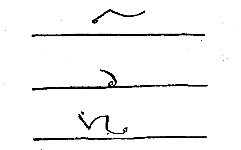
Pendleton bent over the result under the flare of the gas light; and as he looked his eyes widened.
"Why," cried he, "they look like a stenographer's word-signs."
"Good!" said Ashton-Kirk. "And that, my dear fellow, is exactly what they are. There, scrawled erratically in dripping tallow, is a three word sentence in Benn Pitman's phonetic characters. It is roughly done, and may have occupied some minutes; but it is well done, and in excellent German. I'll write it out for you."
Then he wrote on the pad in big, plain Roman letters:
HINTER
WAYNE'S
BILDNISSE
"There it is," said the investigator, "done into the German language, line for line. Brush up your knowledge now; let me see you turn it into English."
Pendleton, whose German was rusty from long disuse, pondered over the three words. Suddenly a light shot across his face; then his eyes were in a blaze.
"Behind Wayne's Portrait!"
He fairly shouted the words. Astonishment filled him; he was trembling with excitement.
"By Heaven," he gasped, "you have it, Kirk. Now I understand the smashing of the portraits of General Wayne. There was something of value hidden behind one of them—between the picture and the back! But what?"
"It was nothing of any great bulk; the hiding place indicated points that out, surely," said Ashton-Kirk, composedly. "A document of some sort, perhaps."
Pendleton stood for a moment, lost in the wonder of the revelation; then his mind began to work once more.
"But I can't understand the writing of the thing upon the step," said he.
"It was the fact that it was written that proved to me that there were at least two men concerned. One knew the hiding place of the coveted object; and this is how he conveyed the information to his companion," pointing to the step.
"But," protested Pendleton, "why did he not put it into words? Surely it would have been much easier?"
"Not for this particular person. As it happens, he was a mute."
Again Pendleton's eyes opened widely; then recollection came to him and he said:
"It was Locke—the man concerning whom you were making inquiries of the railroad conductor!"
Ashton-Kirk nodded, and replied.
"And it was he who shrieked when the door of the showroom opened. The out-cry of a deaf-mute, if you have ever heard one, has the same squawking, senseless sound as that of a psittaceous bird like the parrot or cockatoo."
"But," said Pendleton, "the fact that the man who scrawled these signs upon the step was a deaf-mute, scarcely justifies the eccentricity of the thing. Why did he not use a pencil, as you have done?"
"I can't say exactly, of course. But did it never happen that you were without a pencil at a time when you needed one rather urgently?"
"This thing has sort of knocked me off my balance, I suppose," said Pendleton, rather bewildered. "Don't expect too much of me, Kirk." He stuffed his hands in his pockets dejectedly and continued: "You now tell me that this man was a mute. Yesterday you said he was small, that he was near-sighted, that he was well dressed and knew something of the modern German dramatists. You also told the conductor that he wore thick glasses and a silk hat. Now, I suppose I'm all kinds of an idiot for not understanding how you know these things about a man you never saw. But I confess it candidly; I don't understand."
"It all belongs to my method of work," said Ashton-Kirk. "It's simple enough when you go about it the right way. I have already given you my reasons for thinking the man who did this," pointing to the step, "to be a mute. I judged that he was of small stature because he chose the bottom step upon which to trace his word signs. Even an ordinary sized man would have selected one higher up."
"All right," said Pendleton. "That looks good to me, so far."
"The deductions that he was well dressed and also near-sighted were from the one source. His hat fell off while he was tracing the signs; that showed me that he was forced to stoop very close to his work in order to see what he was about. You see that, don't you?"
"How did you know his hat fell off?" asked Pendleton, incredulously.
"Mrs. Dwyer is evidently paid to clean only the hall and lower stairway," replied Ashton-Kirk, composedly. "And that she sticks closely to that arrangement is shown by the condition of this upper flight. The dust upon the step is rather thick. If you will notice," and he indicated a place on the second step, "here is a spot where a round, flat object rested. That this object was a silk hat is positive. You can see the sharp impress of the nap in the dust; here is the curl in the exact center of the crown as seen in silk hats only. And men who wear silk hats are usually well-dressed men."
"But how can you be at all sure that the hat fell off? Isn't it possible that he took it off and laid it there?"
"Possible—yes—but scarcely probable. A well-dressed man is so from instinct. And his instinctive neatness would hardly permit him to put his well-kept hat down in the dust."
"Go on," said Pendleton.
"The stairs have been used since the hat fell there; but the dust has not been disturbed. There is a hand-rail on the other side of the flight, and consequently, all went up and down on that side."
"I can understand the thick glasses," said Pendleton, "his being near-sighted suggested those. But what made you think he cared for the modern German dramatists?"
"That was a hazard, merely," and the investigator laughed.
"He knew German and was apparently a man of intelligence. No man who combines these two things can fail of admiration of Hauptmann, Sudermann and their brothers of the pen. And then a mute who knew shorthand well enough to have such ready recourse to it, struck me as being unusual. They all know the digital sign language; but German and phonography classed him as one above the ordinary. This knowledge brought the suggestion of an institution. Then came the suggestion that he might be an instructor in such an institution. The fragment from the railroad ticket hinted that the institution might be out of town. Fuller's research placed two such institutions. The ticket counter at the railroad office narrowed it down to one. The conductor of the train all but put his hand on the man."
There was a short silence. Then Pendleton drew a long breath.
"Well, Kirk," said he. "I don't mind admitting that you have me winging. I'll tell you now it's clever; but if I can think of a stronger word later, I'll work it in instead."
"We have a pretty positive line on one of the criminals, and we will now turn to the other," said the investigator, briskly. "It was this other who committed the murder. The infirmities of Locke, the mute, made it impossible for him to venture into the rooms. The risks for a deaf and short-sighted man would be too great. Danger might creep upon him and he neither hear nor see it. For some reason which I have not yet discovered, but it may have been distrust, he had not informed his confederate as to the whereabouts of the object of their entrance. When they got as far as this hall, he concluded to do so; but as neither man had a pencil, he conveyed the information as shown; then the confederate entered Hume's apartments by the door which Mrs. Dwyer found open. This, by an oversight, may have been left unlocked, or the criminals may have had a key. However, that does not affect the case one way or another.
"It is my opinion that Hume was seated at his desk at this time and heard the intruder enter the storage room; then pushing back his chair as we saw it, he arose. The criminal, however, sprang upon and struck him so expertly that he collapsed without a sound. Then the bayonet came into play.
"A search followed for the thing desired—a search, short, sharp and savage. The murderer either found what he sought, or the footsteps of Miss Vale upon the stairs frightened him. At any rate he pulled open the showroom door—the one with the gong; Locke, still in the hall, screamed and both fled up these stairs to the roof and away."
Pendleton had waited patiently until his friend finished. Then he said, with a twinkle in his eye:
"You say the murderer opened the show room door, the gong rang and then Locke screamed. Now, old chap, that's not possible. If Locke is deaf, he couldn't hear the gong; and so there would be no occasion for him to cry out."
"I think if you'll go back over what I've really said," spoke Ashton-Kirk, "you will find that I have made no mention of Locke crying out because of the gong. I said the murderer opened the door that has the gong. Then Locke screamed, not because he heard anything, but because of the sight he saw."
"Ah!"
"He caught a glimpse of Hume upon the floor—as we saw him."
"You think, then, that Locke's intentions were not murder?"
"At the present time I am led to think so. The confederate either was forced to kill to save himself, or he had nursed a private scheme of revenge. And the ferocity of the blow with the bayonet inclines me to prefer the latter as a theory."
"That brings us back to both Morris and Spatola," said Pendleton, gravely. "By all accounts both bore Hume a bitter grudge. But the fact that both criminals escaped by the roof shows familiarity with the neighborhood, as Miss Vale pointed out to you. This seems to point to Spatola."
"So does the purchase of the bayonet, and in the same indefinite fashion," said Ashton-Kirk. "But come, we motored to Christie Place more to inquire about this same Italian than anything else. So let's set about it."
They thanked the policeman in charge and left the building. As they proceeded down the street toward the house in which the newspapers had informed them Spatola lived, the investigator paused suddenly.
"I think," said he, "it would be best for us to first see Spatola himself, and ask a few questions. This might give us the proper point of view for the remainder."
And so they once more got into the car; and away they sped toward the place where the violinist was confined.
Ashton-Kirk and Pendleton were admitted to the cell room at the City Hall without question; but a distinct surprise awaited them there. Through a private door leading from the detectives' quarters they saw the bulky form of Osborne emerge; and at his heels were Bernstine and his sandy-haired clerk.
When Osborne caught sight of Ashton-Kirk he expanded into a wide smile of satisfaction.
"Hello!" greeted he. "Glad to see you. You're just in time to see me turn a new trick. Here's the people that Spatola bought the bayonet from. How does that strike you?"
But Bernstine leaned over and said something in a low tone; and the smile instantly departed.
"Oh," said Osborne, ruefully, "this is the party who called to see you, is it?" Then turning to Ashton-Kirk he asked: "How did you get onto this bayonet business?"
"Just through thinking it over a little, that's all," answered the investigator.
Mr. Bernstine now approached the speaker, a hurt look upon his face.
"Mr. Ashton-Kirk," said he, "why did you not tell us about this piece of business? Why did you not enlighten us? How could you go away and leave us in the dark? We are very much occupied, and have little time to look at the newspapers. It was only by accident that Sime happened to see one." Lowering his voice, he added: "There's a smart fellow for you; he saw the whole thing in an instant. And so we came right here to do what we can to help justice." He squared his shoulders importantly.
"He's seen the bayonet and is prepared to swear to it," stated Osborne, elated.
"What of the picture of Spatola in the paper?" asked the investigator. "Does he recognize that?"
Osborne's face fell once more.
"These half-tones done through coarse screens are never any good," said he. "They'd make Gladstone look like Pontius Pilate. He's going to have a look at the man himself, and that'll settle it."
With that a turnkey was dispatched; and in a few moments he returned, accompanied by a half dozen prisoners; one was a slim, dark young man with a nervous, expressive look, and a great tangle of curling black hair. The face was haggard and drawn; the eyes were frightened; the whole manner of the man had a piteous appeal.
Osborne turned to Sime.
"Look them over carefully," directed he. "Take your time."
"I don't need to," answered the freckled shipping clerk. He pointed to the dark young man. "That's the man of the picture; but I never seen him before, anywhere."
Osborne put his fingers under his collar and pulled as though to breathe more freely; then he motioned another attendant to take the remaining prisoners away.
"I see," said he. "He was too foxy to buy the thing himself. He sent someone else." Then he fixed his eye on the prisoner and continued: "We've got the bayonet on you; so you might as well tell us all about it."
"I don't understand," said Spatola, anxiously.
"The easier you make it for us, the easier it will be for you," Osborne told him. "If you make us sweat, fitting this thing to you, we'll give you the limit. Don't forget that."
"I have done nothing," said Spatola, earnestly. "I have done nothing. And yet you keep me here. Is there not a law?"
"There is," said Osborne, grimly. "That's what I'm trying to tell you about. Now, who bought the bayonet?"
"The bayonet?" Spatola stared.
"The bayonet that Hume was killed with."
With a truly Latin gesture of despair, the Italian put his hands to his forehead.
"Always Hume," he said. "Always Hume! I can not be free of him. He was evil!" in a sort of shrill whisper. "Even when he is dead, I am mocked by him. He was all evil! I believe he was a devil!"
"That was no reason why you should kill him," said Osborne in the positive manner of the third degree.
"I did not kill him," protested Spatola. "There were many times when it was in my heart to do so. But I did not do it!"
"I've heard you say all that before," stated Osborne, wearily. Then to the turnkey: "Take him away, Curtis."
"Just a moment," interposed Ashton-Kirk. "I came here to have a few words with this prisoner, and by your leave, I'll speak to him now."
"All right," replied Osborne. "Help yourself."
He led Bernstine and Sime out of the cell room; the turnkey, with professional courtesy, moved away to a safe distance, and Ashton-Kirk turned to the Italian.
"You were once first violin with Karlson," said he. "I remember you well. I always admired your art."
An eager look came into the prisoner's face.
"I thank you," he said. "It is not many who will remember in me a man who once did worthy things. I am young," with despair, "yet how I have sunken."
"It is something of a drop," admitted Ashton-Kirk. "From a position of first violin with Karlson to that of a street musician. How did it happen?"
Sadly the young Italian tapped his forehead with one long finger.
"The fault," he declared, "is here. I have not the—what do you call it—sense? What happened with Karlson happened a dozen times before—in Italy, in France, in Spain. I have not the good sense!"
But justification came into his eyes, and his hands began to gesticulate eloquently.
"Karlson is a Swede," with contempt. "The Swedes know the science of music; but they are hard; they are seldom artists; they cannot express. And when one of this nation—a man with the ice of his country in his soul—tried to instruct me how to play the warm music of my own Italy, I called him a fool!"
"I see," said the investigator.
"I am to blame," said Spatola, contritely. "But I could not help it. He was a fool, and fools seldom like to hear the truth."
"The Germans, now," said Ashton-Kirk, insinuatingly, "are somewhat different from the Swedes. Were you ever employed under a German conductor?"
"Twice," replied the violinist, with a shrug. "Nobody can deny the art of the Germans. But they have their faults. They say they know the violin. And they do; but the Italian has taught them. The violin belongs to Italy. It was the glory of Cremona, was it not? The tender hands of the Amatis, of Josef Guarnerius, of old Antonio Stradivari, placed a soul within the wooden box; and that soul is the soul of Italy!"
"Haupt, a German, wrote a treatise on the violin," said Ashton-Kirk. "If you would read that—"
"I have read it," cried Spatola. "I have read it! It is like that," and he snapped his fingers impatiently.
"But you've probably read a translation in the English or Italian," insisted the investigator, smoothly. "And all translations lose something of their vitality, you know."
"I have read it in the German," declared the Italian; "in his own language, just as he wrote it. It is nothing."
Pendleton looked at Ashton-Kirk admiringly; the manner in which his friend had established the fact that Spatola knew the German language seemed to him very clever. But Ashton-Kirk made no sign other than that of interest in the subject upon which they talked.
"A race that has given the world such musicians as Wagner, Beethoven and Mozart," said he, "must possess in a tremendous degree the musical sense. The German knowledge of tone and its combinations is extraordinary; and their music in turn is as complex as their psychology and as simple as the improvisation of a child."
Spatola seemed surprised at this apparent warmth; he looked at Ashton-Kirk questioningly.
"And, with all their scholarship, the Germans are so practical," went on the latter. "Only the other day I came upon a booklet published in Leipzig that dealt with the difficulty a composer sometimes encounters in getting the notes on paper when a melody sweeps through his brain. The writer claimed that the world had lost thousands of inspirations because of this, and to prevent further loss, he proffered an invention—a system of—so to speak—musical shorthand."
A sullen look of suspicion came into Spatola's face; he regarded the speaker from under lowered brows.
"Perhaps you don't quite understand the value of such an invention," proceeded Ashton-Kirk. "But if you had a knowledge of stenography, and the short cuts it—"
But the Italian interrupted him brusquely.
"I know nothing of such things," said he, "and what is more I don't want to know anything of them." Then in a sharp, angry tone, he added: "What do you want of me? I am not acquainted with you. Why am I annoyed like this? Is it always to be so—first one and then another?"
At this sudden display of resentment, the turnkey approached.
"I will go back to my cell," Spatola told him, "and please do not bring me out again. My nerves are bad. I have been worried much of late and I can't stand it."
The turnkey looked at Ashton-Kirk, who nodded his head. And, as Spatola was led gesticulating away, Pendleton said in a low tone of conviction:
"I tell you, Kirk, there's your man. Besides the other things against him, he knows German."
"But what of the phonographic signs?"
"He knows them also. His manner proved it. As soon as you mentioned shorthand he became suspicious and showed uneasiness and anger. I tell you again," with an air, of finality, "he's your man."
From the City Hall the car headed for Christie Place once more; it halted some half dozen doors from Hume's and the occupants got out.
The first floor was used by a dealer in second-hand machinery, but at one side was a long, dingy entry with a rickety, twisting flight of stairs at the end. Ashton-Kirk rang the bell here, and while they waited a man who had been seated in the open door of the machine shop got up and approached them.
He wore blue overalls and a jumper liberally discolored by plumbago and other lubricants; a short wooden pipe was held between his teeth, and a cloth cap sat upon the back of his head.
"Looking up the Dago?" asked he with a grin. He jerked a dirty thumb toward the stairs.
Ashton-Kirk nodded; the man took the wooden pipe from his mouth, blew out a jet of strong-smelling smoke and said:
"I knowed he'd put a knife or something into somebody, some day. These people with bad tempers ought to be chained up short."
"Do you know him well?" inquired the investigator.
"Been acquainted with him ever since he's been living here—and that's going on three years."
"Did he have many visitors, do you know?"
The man in the cloth cap pulled at his pipe reflectively.
"I can't just say," he replied. "But I've been thinking—" he paused here and examined both young men questioningly. Then he asked: "You're detectives, ain't you?"
"Something of that sort," replied Ashton-Kirk.
The man grinned at this.
"Oh, all right," said he. "You don't have to come out flat with it if you don't want to. I ain't one of the kind that you've got to hit with a mallet to make them catch on to a thing." Here the wooden pipe seemed to clog; he took a straw from behind his ear and began clearing the stem carefully. At the same time he added: "As I was saying, I've been thinking."
"That," said Ashton-Kirk, giving another tug at the unanswered bell, "is very commendable."
"And queer enough, it's been about visitors—here," and the man pointed with the straw toward the doorway. "Funny kind of people too, for a house like this."
"Take a cigar," said Ashton-Kirk. "That pipe seems out of commission." Then, as the man put the pipe away in the pocket of his jumper and lighted the proffered cigar, he added: "What do you mean by 'funny kind of people?'"
The cigar well lighted, the man in the overalls drew at it with gentle relish.
"There's a good many kinds of funny people," said he. "Some of them you laugh at, and others you don't. These that I mean are the kind you don't. Now, Mrs. Marx, the woman that keeps this place, is all right in her way, but it ain't no swell place at that. Her lodgers are mostly fellows that canvass for different kinds of things; they wear shiny coats and their shoes are mostly run down at the heels. So when I see swell business looking guys coming here I got to wondering who they were. That's only natural, ain't it?"
Ashton-Kirk nodded, but before he could reply in words there came a clatter upon the rickety stairs at the far end of the entry. A thin, slipshod woman with untidy hair and a sharp face paused on the lower step and looked out at them.
"What do you want?" she demanded, shrilly.
Ashton-Kirk, followed by Pendleton, stepped inside and advanced down the entry.
"Are you Mrs. Marx?" he inquired.
"Yes," snapped the woman. "What do you want?"
"A little information."
"You're a reporter!" accused the sharp-faced woman. "And let me tell you that I don't want nothing more to say to no reporters."
But Ashton-Kirk soothingly denied the accusation.
"I dare say you've been bothered to death by newspaper men," spoke he. "But we assure you that—"
"It don't make no difference," stated the woman, rearing her head until her long chin pointed straight at them. "I ain't got nothing to say to nobody. I don't want to get into no trouble."
"The only way you can possibly get into trouble in this matter," said the investigator, "is to conceal what you know. An attempt to hide facts is always considered by the police as a sort of admission of complicity."
The woman at this lifted a corner of a soiled apron and applied it to her eyes.
"Things is come to a nice pass," she said, vainly endeavoring to squeeze a tear from eyes to which such things had long been strangers, "when a respectable woman can't mind her own business in her own house."
At this point, Pendleton, who looked discreetly away, caught the rustle of a crisp bill; and when Mrs. Marx spoke again, her tone had undergone a decided change.
"But of course," she said, "if the law asks me anything, I must do the best I can. I've kept a rooming house for a good many years now, gentlemen, and this is the first time I have had any notoriety. It is, I assure you."
As Ashton-Kirk had seen at a second glance, Mrs. Marx was a lady fully competent to confront any situation that might arise; so he wasted no time in soothing her injured feelings.
"We desire any information that you can give us regarding your lodger, Antonio Spatola," said he. "Tell us all you know about him."
"He wasn't a bad-hearted young man," said the landlady, "but for all that I wish I'd never seen him. If I hadn't then I'd never had this disgrace come on me."
Here she made another effort with the corner of her apron; but it was even more unsuccessful than the first. She gave it up and went on acidly.
"Mr. Spatola came here almost three years ago. He was engaged in one of the vaudeville theaters near here—in the orchestra—and he rented my second story front at six dollars a week. Except for the fact that he would play awfully shivery music at all hours of the night, I was glad to have him. He was quiet and polite; he paid regularly and," smoothing back the untidy hair, "he gave a kind of tone to the house.
"But then he lost his position. Had a fight, I understand, with somebody. For a long time he had no work; he moved from the second story-front at six dollars a week into the attic at two. When he could get no place, he went on the street and played; afterwards he got the trained birds. I didn't like this much. It didn't do the house no good to have a street fiddler living in it; and then the birds were a regular nuisance with their noise. But he paid regular, and after a while he took to keeping the birds in a box in the loft, so I put up with it."
"We'll look at his room, if you please," said the investigator.
Complainingly, the woman led the way up the infirm staircase. At the fourth floor she pushed open a door and showed them into a long loft-like room with high ceiling and mansard windows. There came a squawking and fluttering from somewhere above as they entered.
"Them's the cockatoos," said the landlady. "They miss Mr. Spatola very much. When I go to feed them with the stale bread and seed he has here for them, would you believe it, they'll hardly eat a thing."
The room was without a floor covering. Upon some rough shelves, nailed to the wall, were heaps of music. A violin case also lay there. There were a few chairs, a cot-bed, and a neat pile of books upon a table. Ashton-Kirk ran over these quickly; they were mostly upon musical subjects, and in Italian. But some were Spanish, English, German and French.
"He was the greatest hand for talking and reading languages," said Mrs. Marx, wonderingly. "I don't think there was any kind of a nationality that he couldn't converse with. Mr. Sagon that lives on the floor below says that his French was elegant, and Mr. Hertz, my parlor lodger, used to just love to talk German with him. He said his German was so high."
Ashton-Kirk opened the violin case and looked at the instrument within.
"Spatola always carried his violin in this when he went out, I suppose?" he said, inquiringly.
"Oh, yes; that one he did. But the one on the wall there," pointing to a second instrument hanging from a peg, "he never took much care of that. It's the one he played on the street, you see."
Her visitors followed the gesture with interest.
"That was just to clinch a point I made with Fuller this morning," said the investigator to Pendleton, in explanation. Then to Mrs. Marx he continued: "Mr. Spatola had visitors from time to time, had he not?"
But the woman shook her head.
"Sometimes he had a pupil who came in the evening. But they never came more than once or twice; he generally called them thick-heads after a little, and told them they'd better go back to the grocery or butcher's shop where they belonged."
"Are you quite sure that no one else ever called upon him?"
The woman nodded positively.
"I'm certain sure of it," she said. "I remember saying more than once to my gentlemen on the different floors, that Mr. Spatola must be awfully lonely sometimes. Mr. Crawford would often come up here and smoke with him and play a game or two of Pedro. Mr. Hertz tried it a couple of times; but him and Mr. Spatola couldn't hit it very well."
"How many lodgers have you?"
"I have rooms for nine. Just now there are seven. But only four are steadies—Mr. Hertz, Mr. Crawford, Mr. Sagon and Mr. Spatola. Mr. Hertz is an inspector of the people who canvass for the city directory; he took the parlor after Mr. Spatola gave it up. He drinks a little, but he's a perfect gentleman for all that. Mr. Crawford is a traveling man, and is seldom home; but he pays in advance, so I don't never worry about him. Mr. Sagon is what they call an expert. He can't speak much English yet, but sometimes even the government," in an awed tone, "sends for him to come to the customs house to tell them how much diamonds are worth, that people bring in. He works for Baum Brothers and Wright. The others," bulking them as being of no consequence, "are all gentlemen who are employed on the directory under Mr. Hertz."
"Have you any Italian lodgers other than Mr. Spatola?"
The woman shook her head.
"No," she said, "and I don't want none, if this is the way they carry on."
"Are there any other rooming houses in the street?"
"No, sir. It's only a block long, and I know every house in it. I'm the only one as takes lodgers."
"Are there any Italians in business in the block, or employed in any of the business places?"
Mrs. Marx again shook her head positively.
"Not any."
"You speak of a Mr. Sagon. Of what nationality is he?"
"Oh, he's French, but he's lived a long time in Antwerp. That's where he learned the diamond business. And he must have lived in other places in Europe; Mr. Spatola says he has spoken of them often."
Just then there came from below the sound of a heavy voice, singing. The words were French and the intonation here and there was strange to Ashton-Kirk.
"Who is that?" he asked.
"It's Mr. Sagon," replied the woman. "He's the greatest one for singing them little French songs."
"Ah, I have it," said Ashton-Kirk, after a moment. "He's a Basque, of course. I couldn't place that accent at first."
A narrow, ladder-like flight of stairs was upon one side. Ashton-Kirk mounted these and found himself in a smaller loft; a number of well-kept cockatoos, in cages, set up a harsh screaming at sight of him. Opening a low door he stepped out upon a tin roof. Mrs. Marx and Pendleton had followed him, and the former said:
"The police was up here looking. They said Mr. Spatola came through the trap-door at Hume's place that night and walked along the roofs and so down to his own room."
"That would he very easily done," answered Ashton-Kirk, as his eye took in the level stretch of roofs.
After a little more questioning to make sure that the landlady had missed nothing, they thanked her and left the house. At his door they saw the man in the cloth cap and overalls. A second and very unwieldy man, with a flushed, unhealthy looking face, had just stopped to speak to him.
He supported himself with one hand on the wall.
"Hello!" called the machinist to Ashton-Kirk; and as the two approached him, he said to the unwieldy man: "I stopped you to tell you these gents had gone in. They're detectives."
"Oh," said the man, with interest in his wavering eye. "That so." He regarded the two young men uncertainly for a moment; and then asked: "Did Mrs. Marx tell you anything?"
"She didn't seem to know much," answered the investigator.
The unwieldy man swayed to and fro, an expression of cunning gathering in his face. The machinist winked and whispered to Pendleton:
"I don't know his name, but he's one of the lodgers."
"Marx," declared the unwieldy man, "is a fine lady. But," with an elaborate wink, "she knows more'n she tells sometimes." The wavering eye tried to fix the investigator, but failed signally. "It don't do," he added wisely, "to tell everything you know."
Ashton-Kirk agreed to this.
"Marx could tell you something, maybe," said the man. "And then maybe she couldn't. But, I know I could give you a few hints if I had the mind—and maybe they'd be valuable hints, too." Here he drew himself up with much dignity and attempted to throw out his chest. "I'm a gentleman," he declared. "My name's Hertz. And being a gentleman, I always try and conduct myself like one. But that's more'n some other people in Marx's household does."
"Yes?"
"Yes, sir. When a gentleman tries to be friendly, I meets him half-way. But that fellow," and he shook a remonstrating finger at the door of the lodging-house, "thinks himself better'n other people. And mind you," with a leer, "maybe he's not as good."
"Who do you mean—the Dago?" asked the machinist.
"No; I mean Crawford. A salesman, eh?" The speaker made a gesture as though pushing something from him with contempt. "Fudge! Travels, does he? Rot! He can't fool me. And then," with energy, "what did he used to do so much in Spatola's garret, eh? What did they talk about so much on the quiet? I ain't saying nothing about nobody, mind you. I'm a gentleman. My name's Hertz. I don't want to get nobody into trouble. But if Crawford was such a swell as not to want to speak to a gentleman in public, why did he hold so many pow-wows in private with Spatola? That's what I want to know."
Seeing that the man's befogged intellect would be likely to carry him on in this strain for an indefinite time, Ashton-Kirk and Pendleton were about to move on. But they had not gone more than a few yards when the investigator paused as though struck with an idea. He stepped back once more and drew a photograph from his pocket.
"Do you know who this is?" he asked, abruptly, holding it up.
The unwieldy man swayed gently and waveringly regarded the portrait.
"Sure!" said he surprisedly, "it's Crawford."
Ashton-Kirk rejoined his friend; and as they made their way to the waiting automobile, the latter said;
"That is a step ahead of me, Kirk, I think. Where did you get a portrait of this man Crawford?"
By way of an answer the investigator held up the photograph once more. Pendleton gave a gasp of amazement.
"Allan Morris," said he. "Allan Morris, by George!"
Edouard, Ashton-Kirk's cook, was astonished and somewhat grieved that day to receive orders that dinner was to be served an hour earlier than usual. And Stumph, grave and immobile, was betrayed into an expression of astonishment when his master and guest sat down to the same dinner in their work-a-day attire.
And at best Edouard's delicate art that day received but scant attention. Stumph could hardly conceive of a more important thing than the proper and gentlemanly eating of one's dinner. Nevertheless other things engaged the attention of the two young men; they talked earnestly and in incomprehensible terms; mysterious allusions were sprinkled thickly through it all.
"I do not think," Stumph told the mortified Edouard in the kitchen, "that Mr. Pendleton has tasted the flavor of a single thing he has eaten. He listens to Mr. Ashton-Kirk talk; he is surprised at everything that he is told; there is a trembling in his hands, he is so eager. No, I don't know what it's about. But then, I never know what Mr. Ashton-Kirk is about. He is a very remarkable gentleman."
And no sooner was the dinner completed than Ashton-Kirk's big French car was brought to the door and both young men got into it.
"You've looked up the road to Cordova?" inquired Ashton-Kirk of the chauffeur.
"Yes, sir," answered the man. "Very good road and almost parallel with the railroad. No trouble getting there by dark."
"All right. Get there as soon as you can."
They cut into a broad asphalted avenue, which eventually led them through the north suburbs into the country. The April dusk was settling upon the fields as they raced along; in the isolated houses, lights were beginning to twinkle; there was a swaying among the trees and roadside bush; the hum of the flying car must have been borne long distances; for far away people raised their heads from the finishing tasks of the day to look at it as it flashed by.
Pendleton lay back comfortably digesting his dinner, and ticking off in his mind the case which engrossed him so much.
"It all tapers down to this," he said to himself. "Hume was murdered by Locke and a confederate in order that they might gain possession of something, the nature of which is unknown. Kirk is confident of Locke; I think he'd even go so far as to give him into custody, if he had the tangible proofs that the police require.
"But he lacks enthusiasm in the matter of the confederate. To my mind, it's Spatola or Morris, or both. Both bore Hume no good will. Morris has been spending at least part of his time with Spatola under an assumed name; they are known to have been very much engaged in some secret matter. Both visited Hume's on the night of the murder. An Italian purchased the weapon with which the deed was done. A German sentence was written in shorthand by Locke for his confederate. Spatola admits he knows German; he grows suspicious when shorthand is mentioned. And to wind it up, Morris has not been seen at his apartments, his office, or by his friends, since the murder was committed."
At a little unpainted railroad station, the investigator broke in on Pendleton's thoughts by calling on the chauffeur to stop. There were the usual signboards on each side of the structure, announcing that the place was Cordova; and there was the usual knot of loungers that are always to be found about such places watching with interest the incoming trains.
Ashton-Kirk called to one of these. He was a lanky fellow in a wide-brimmed hat and with a sheep-like look of complacency.
"What's the best way to Dr. Mercer's place?" asked Ashton-Kirk.
The lanky man reflected.
"There's three or four ways of getting there," he stated. "You can go up the pike and turn at Harbison's store; or you can turn down the lane along there a piece and go along until you come to—"
"Which is the nearest?"
"I ain't never passed no judgment on that; but I think the clay road down toward Plattville would get you there the quickest—if you didn't get stuck in the ruts."
"I think we'd better stick to the pike," suggested Pendleton.
"The pike's the best road," said the lanky man. "All the people from Mercer's place use it when they drive here to the station."
Once more the big French car, now with its lamps lighted, sped along the road; about a mile further on they came to the store referred to by the man as Harbison's. Here they received instructions as to how to proceed, by the store-keeper; and after running about four miles along an indifferent wagon road, they caught the twinkle of many lights off in the middle of a wide clearing.
"That must be it," said the investigator. "We'll leave the car here; to flash up to the door in the quiet of the evening would attract more attention than would be good for us, perhaps."
It was now quite dark, but they found a gate a trifle farther on which opened readily; and so they proceeded along a walk toward a building which lay blinking at them with its yellow eyes. A deep-throated dog scented them from off in the distance and gave tongue. As they drew near to the institution they heard a man calling to the brute to be still. A little further on the man himself suddenly appeared from around the corner of a building with a lantern; he flashed this in their faces as he said:
"Well, sirs, this is against the rules. We have no visitors except on Saturdays; and then only within reasonable hours."
"We would like to speak to Dr. Mercer," said Ashton-Kirk.
"Dr. Mercer is at dinner," explained the man with the lantern. "He don't like it much if he's disturbed at such times."
"We will wait until he has finished; we are in no great hurry."
The man seemed puzzled as to how to act. With the light held aloft so that not a feature escaped him, he examined them closely. Apparently he could see nothing with which to find fault; and so he sighed in a perplexed fashion.
"He does not care to have people wait for him," complained the man. "He gets very angry if he is worried by such things while dining."
"You need not announce us until he is through," said Ashton-Kirk, composedly.
The man hesitated; but finally resolved upon a course and led them up a flight of stone steps and into a wide hall. The night was raw and a brisk fire of pine knots burning in an old-fashioned hall fireplace, made the place very comfortable.
"If you will be seated, gentlemen," requested their guide, "I will tell Dr. Mercer of your presence as soon as he has finished."
They seated themselves obligingly in a couple of low, heavy chairs near the fire; and then the man left them. The hall was high and rather bare: the hardwood floor shone brilliantly under the lights; save for the faint murmur of voices from a near-by room, everything was still.
"I should imagine that a place of this sort wouldn't be at all noisy," observed Pendleton, in a heavy attempt at jocularity.
Except for a word now and then, they waited in silence for a half hour; then a door opened and steps were heard in the hall. Both turned and saw a remarkably small man, perhaps well under five feet, dressed with great care and walking with a quick nervous step. His head was very large and partly bald, rearing above his small frame like a great, bare dome; he carried a silk hat in his hand, and peered abstractedly through spectacles of remarkable thickness.
"Locke," breathed Pendleton, as his heart paused for a moment and then went on with a leap.
The little man apparently did not see them until he was almost beside them; then he paused with a start, and his eyes grew owlish behind the magnifying lenses as he strove to make them out. That he did not recognize them seemed to worry him; his thin, gray face seemed to grow grayer and thinner; with a diffident little bow he passed on and out at the front door.
"Not a very formidable looking criminal," commented Ashton-Kirk, quietly. "However, you can seldom judge by appearances. The most astonishing crime that ever came to my notice was perpetrated by the meekest and most conventional man I had ever seen."
They waited for still another space, and then the man who had shown them in presented himself. He was now without the lantern, but wore a melancholy look.
"Dr. Mercer will see you," said he in a low voice. "He is very much vexed at being disturbed. He'll remember it against me for weeks." He appeared very much disturbed.
Ashton-Kirk placed a coin in the speaker's hand; this seemed to have a bracing effect, for he led them into his employer's presence in a brighter frame of mind. Dr. Mercer was seated at the table in his dining-room. A napkin was tucked in his collar, his fat hands were folded across his stomach, and he was breathing heavily.
"Gentlemen," spoke he, rolling his eyes around to them, "I trust you will pardon my not rising. But to exert myself after dining has a most injurious result sometimes. My digestion is painfully impaired; the slightest excitement causes me the utmost suffering."
"I appreciate the fact that we are intruding at a most inconvenient time," said Ashton-Kirk. "And I beg of you to accept our apologies."
The eyes of Dr. Mercer, which had the appearance of swimming in fat, were removed from his visitors, and fixed themselves longingly upon a great dish filled with a steaming, heavy-looking pudding. His breath labored in his chest as he replied:
"The hour is somewhat unusual; but as it happens I have about finished my dinner, and if your errand is not of a stirring nature, I should be pleased to have you state it."
The man placed chairs in such a position that the doctor would not have to stir to fully observe his visitors. This done he was about to withdraw; but his employer stopped him at the door.
"Haines," complained he, "you have not taken my order for breakfast."
The man paused and seemed much abashed at his neglect.
"I really beg your pardon, sir," said he. And with that he produced a pencil and a small book and stood ready.
"I will have one of those trout that I purchased to-day," directed the doctor. "Let it be that large, fine one that I was so pleased with," his swimming eyes ready to float out of his head with anticipation. "Then I would like some new-laid eggs, some hot cakes, and perhaps a small piece of steak, if there is any that is tender and tasty. And mind you," in an nervous afterthought, "tell Mrs. Crane to have it but rarely done. I will not tolerate it dry and without flavor." He pondered awhile, apparently much moved by this painful possibility; then he added: "I may as well have a cereal to begin with, I suppose. And that will be all with the exception of a few slices from the cold roast and some white rolls."
Carefully Haines had taken this down; and after he had read it over at his employer's order and noted a few alterations and additions, he departed. For a few moments the doctor's eyes were closed in expectant rapture; his breathing grew so stertorous that his callers were becoming alarmed; but he spoke at last, reluctantly, resentfully.
"I am now ready to hear you, gentlemen, if you please. And kindly remember that I prohibit anything of an exciting nature at this time."
"We have heard your school highly spoken of," said Ashton-Kirk. "And have come to make some inquiries before making up our minds."
"Ah," breathed Dr. Mercer, solemnly, "you have an afflicted one. Too bad! Tut, tut, tut, too bad!"
"There are many institutions of the sort," proceeded the investigator. "But for the most part they stop at the threshold, so to speak, of knowledge."
Dr. Mercer roused himself so far as to unclasp his hands and point with one finger at the speaker.
"Sir," said he, in a voice full of grave significance, "they seldom reach the threshold. A large majority of them are conducted by dishonest persons. Afflicted youth left in their charge are rarely properly directed—they rarely acquire that digital dexterity so necessary to success in their limited lives. The isolated brain, so to call it, is seldom more than half awakened. Unless it is intelligently approached, the shadows are never thoroughly dispelled."
Here he paused, panting distressedly; his eyes were filled with reproach as he relapsed into his first attitude; and his manner was that of one who mutely begged that no further tasks be thrust upon him.
"The difference in institutions of this type lies mainly in the methods employed, I believe," said Ashton-Kirk.
"In the methods—and in the persons who apply them," replied Dr. Mercer in a smothered tone.
"To be sure. I have heard something of your teaching staff. It is a very excellent one, is it not?"
"The best in the world." The soft, fat, white hands of the doctor again unclasped themselves; and this time both of them were employed in a faintly traced gesture. "We employ scientists. We do not stop at what you have correctly called the threshold. We explore the entire structure of the intellect. Our Professor Locke, himself an afflicted one, is a man of vast erudition—a scholar of an advanced type, a philosopher whose adventures into the field of psychology and natural science is widely known. He has charge of the practical work of the Mercer Institute, and under him its results are positive and unique."
"We have heard of Professor Locke," and, drily, "have seen some of his work."
"If you had stated your business before—ah—coming in to me," spoke the doctor, "you might have had an opportunity of consulting him. He left for his cottage immediately after dining."
"He does not live here, then?"
"Not in this building—no. There is a detached cottage at the far end of the grounds which he occupies. If you'd like to see him," and the heavy jowls of the speaker trembled with eagerness, "Haines will show you there at once."
"If it is no trouble," said Ashton-Kirk, smoothly.
"Not in the least." The doctor rang for his man, and when he entered, said: "These gentlemen would like to speak to Professor Locke. Show them the way to his house. And, gentlemen," to the callers, with anxiety, "the professor can arrange everything with you. It is my habit to nod for a half hour after dinner. My system has grown to expect it, and if I am deprived of it, I suffer considerably in consequence."
"We will not trouble you again, doctor," Ashton-Kirk assured him. "Thank you, and good-night."
Once more outside, the man led them along a foot-path that seemed to cut the institution grounds in two. The rays of his lantern danced along the carefully kept lawn; the shadowy trees seemed to move backward and forward, as the thin beams wavered among them.
"The professor lives a good piece away," the man informed them. "Away over on the county road."
"Prefers to be alone, eh?"
"I suppose so, sir. And then he has his laboratory and work-shop there, well away from interruption. He don't like to be much disturbed while he is engaged in his studies."
"Few of us do," said Pendleton.
"Quite right, sir."
They walked along in silence for a time; then they caught a clear humming noise from some distance ahead.
"A motor car," said Pendleton.
"It's on the county road," said the man with the light. "We always hear them when the wind blows from that direction."
After some fifteen minutes' steady walking they saw a long twinkling shaft of light coming from among the trees.
"That's the house," said Haines. "I hope the professor ain't busy; you wouldn't believe what a blowing up he can give a body with his fingers when he's vexed. I'd almost rather have the doctor himself; though, as a rule, the professor is a very nice gentleman."
The house was a brick structure of two stories and dimly lighted on the lower floor. Near by was a long, shed-like building, the windows of which were brilliantly lighted.
"He's at work," said Haines, in a troubled tone. "And in the shop too! If it was even the laboratory, it wouldn't be so bad. But he does get so interested in the shop. That machine means more to him, whatever it is, than anything else about the place."
There came a harsh burring sound from within both the shop and the house. Haines seemed surprised.
"Visitors," he said. "He seldom has one; and I never knew any to come at night before."
They saw the figure of Locke cross one of the shed windows toward a door. And just then Ashton-Kirk stumbled rather heavily against Haines; the lantern dropped to the ground and was extinguished.
"I beg your pardon," said the investigator in a rueful tone; then he began to rub his shins. "That was rather hard, whatever it was."
The door of the building opened and Locke appeared; his great bald head shone in the light that streamed after him; and it was thrust forward as he strove to penetrate the darkness ahead.
"He feels the vibrations of those buzzers," Haines told them, "and knows right away when anyone wants to get in."
He began fumbling with the lantern as Locke disappeared; but Ashton-Kirk said to him:
"You need not light that. We can see very well. And, on second thought, you need not wait, either. We can introduce ourselves to Professor Locke without troubling you further."
"Thank you, sir," said the man, vastly relieved. "They all have queer dispositions, you see, and I don't like to trouble them."
At once Haines made his way back along the path by which they had approached; some distance away they saw him kindle his lantern, and then watched the yellow spark as it glanced fitfully away across the grounds.
The cottage and work-shop of Professor Locke appeared to be set back some little distance from what Haines had called the county road; a grove of tall trees thickened the shadows all about, and it was into these trees that the professor had gone.
"The buzzer must have the button that sounds it attached to a gate opening upon the road," said Pendleton.
They stood for a short time in silence; then Pendleton nudged his friend with an elbow.
"Look," he whispered. "There at the door of the shed."
Ashton-Kirk did so. And he was just in time to see a large, iron-gray head, a craggy, powerful face, and a pair of thick shoulders; the expression and attitude were those of a man listening intently. Almost instantly, as Ashton-Kirk's gaze fell upon him, the man withdrew.
"Humph," exclaimed Pendleton under his breath. "Who's that, I wonder?"
They waited for some time longer in silence. But the little man did not return, nor did the head appear again at the shop door. Ashton-Kirk appeared puzzled.
"Locke intended returning at once," he said to Pendleton. "Otherwise he would have closed his work-shop door." Then his eyes wandered toward the house, and his grip closed tightly upon his companion's arm. "Look," whispered he, in his turn.
Pendleton's gaze flew toward the house. The lower windows had been dimly lighted when they approached; but now the glow from them was high and brilliant. In one of the rooms they saw Locke; he was striding up and down, his hands clinched and gesturing, his face upturned, writhing hideously. Seated at a table, calmly engaged in examining something traced upon a sheet of paper, and apparently not paying the slightest attention to the gesticulating man, was a young woman. And Pendleton felt himself grow suddenly faint and sick as he recognized Edyth Vale.
For a moment there was a silence between the two men; then Ashton-Kirk said, dryly:
"Miss Vale has, apparently, not been altogether frank with us in this matter."
"You think then—" began Pendleton in a voice of terror. But Ashton-Kirk stopped him.
"I think many things," said he. "But they are neither here nor there. Facts are what count. Put the circumstances together for yourself and see where they lead you. Miss Vale has been from the first mixed up more or less in this crime. She explained. As far as I knew the explanation was made in good faith. Now we find her here in this lonely place, quietly engaged with a man whom I have convinced myself is one of Hume's murderers."
There was another pause; this time it was Pendleton who broke the silence.
"As you say," spoke he, in a strange, throaty sort of tone, "she has not been quite frank. Take all the circumstances together and they seem to point—"
He paused as though quite unable to finish. Ashton-Kirk laid a hand upon his shoulder.
"Imagination is a thing that is vitally necessary in this sort of work," said he. "But it must be held in check by reason. The great trouble with an amateur is that he reasons up to a certain point; then he allows his imagination to take a long leap toward a result. The upshot is that his results have seldom anything to support them. The correct method, I think, is to allow the imagination to scurry ahead in the way that is natural to it; but reason must follow close behind, proving each step of the way. To be sure, you may have theories, hypotheses, ideas without end, but you must never take them for granted. Select each in its turn, place it in a tube as the chemist does, add a few drops of reason, and you may produce a fact. It is the only way to go about it. Once a man becomes fixed in a belief, be there ever so little foundation for it, his mind stops revolving the subject; further procedure is hopeless."
"I understand all that well enough," said Pendleton. "But," and he waved his hand toward the house, "what does this mean?"
"I don't know," said Ashton-Kirk. "And neither do you. So—that being the case—there is but one thing to do—find out."
They gazed toward the window once more, Miss Vale had apparently mastered the contents of the paper, and was now engaged in writing rapidly. As the young men watched, she stopped, read carefully what she had written, and then handed it to Locke. The mute carried the paper to the light, and holding it very near to his eyes read it with much attention; then he tore it into strips, placed it upon the red coals of a stove which stood near him and watched it burn. Facing Miss Vale, his fingers began to fly rapidly in intricate signs. This only lasted a moment, however; for he stopped, gestured passionately, seized a pad of paper and began to write.
While he was thus engaged, Ashton-Kirk said to Pendleton in a low tone:
"Remain here for a moment."
Then slowly, carefully, the investigator made his way toward the window through which Miss Vale and Locke were to be seen.
Heavy beams of light shot across the ground from the windows; but here and there were trails of shadow. He clung to these until he had reached the shelter of the walls; then to Pendleton's amazement he stepped directly in front of the window through which the two were to be seen, rapped smartly upon the glass, and remained standing in full view, of the two in the room.
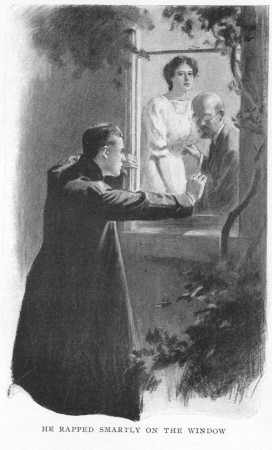
Pendleton saw the pad drop from Locke's hands; he saw the mute wheel as he felt the vibrations and stare at the window, his eyes puckered and straining. He also saw Miss Vale rise, saw her hands thrown out in a gesture much like despair; and also he heard the cry that she uttered, muffled by the confines of the room, but full of fear. Then the room was plunged into darkness; an instant later a door was heard to open; the sound of quick-moving feet came to him; there followed the pulsations of a motor and the racing of a car away into the night.
"She's off," breathed the young man, and there was undoubted relief in the knowledge. "She's off, and I really believe that's what Kirk was after."
He walked toward the house and found his friend standing in the shadows.
"Well," chuckled the investigator, "it did not take her long to make up her mind, eh?"
"You had some motive in doing that," accused Pendleton. "What was it?"
Ashton-Kirk was about to reply; but just then the small figure of Locke made its appearance. He carried a lantern and was approaching with stumbling steps, his eyes peering and blinking in their efforts to pierce the gloom. Not until he was well upon the two did he make them out; then he halted, lifted the light above his head and surveyed them intently.
In the rays of the lantern Ashton-Kirk smiled urbanely, and bowed. The supple fingers of the mute writhed inquiringly.
"Each of them forms itself into a wild note of interrogation," said Pendleton. "They are fairly screaming questions at you."
Ashton-Kirk smiled even more agreeably at Locke and shook his head. Then he went through the pantomime of one writing, and finished by pointing to the house.
Carefully, eagerly, fearfully, the mute examined them; his near-sighted eyes and the wavering light must have made it all but impossible for him to make them out. However, he at length motioned for them to follow him, and started back by the way which he had come. But after a few steps he halted. He indicated that they were to remain where they were; then he went to the shed-like building, closed the door and locked it, placing the key in his pocket.
"It would seem," observed Ashton-Kirk, "that we are not to be trusted implicitly."
"Also," replied Pendleton, "that there is something of value in the shed."
Returning, Locke led the way to a door upon the other side of the house. Showing them into a small room furnished with books and scientific apparatus and evidently a study, he set down the lantern and with a sign bade them be seated. Upon their doing so he produced a small pad of paper and a pencil; handing these to Ashton-Kirk he stood peering at them expectantly. With the swift, accurate touch of an expert, the investigator wrote in the Pitman shorthand:
"We ask pardon if we have startled you."
Then he tore off the sheet and handed it to Professor Locke. The man seemed surprised at the medium selected by his visitor; nevertheless he quickly traced the following in the same characters.
"Who are you? What is your errand?"
"We were sent to you by Dr. Mercer," replied Ashton-Kirk with flying pencil. "Our business is to secure the admission of a new pupil."
Locke read this and regarded them for a moment, doubtfully.
"Why did you not press the button at the door?" he demanded in writing.
"I hardly expected you to have such a thing as a bell," answered Ashton-Kirk, on the pad. "And so, seeing you, I attracted your attention as best I could."
Professor Locke read this and stood with his pencil poised, when the buzzer sounded harshly; he went at once into the hall; they heard him open the door; and in a few moments he returned, followed by Haines.
The fingers of the two flashed their signals back and forth; then a look of relief came into Locke's face; he even smiled, and nodded understandingly at the two young men.
"I beg pardon, gentlemen," said Haines. "But when I got back to the hall, Dr. Mercer made me return and make sure that you had got to see the Professor."
"Thanks," replied the investigator. "We had not the slightest difficulty."
"I'm glad to hear it, sir," said the man. "Good-night to you."
He flashed the same wish to the mute, who answered readily; then he went out and through the window they saw his light again go bobbing away in the darkness. Then the professor began to write once more.
"I beg your pardon," was his message in long-hand. "The man tells me that it was quite as you say. But I must confess I was a trifle startled."
"The lady," wrote Ashton-Kirk, "seemed startled, too."
For the fraction of a moment the mute halted in his reply. Then the pencil with much assurance formed the following:
"It was my niece. She was about to go just as you came; so do not reproach yourself for having driven her away."
For some time the penciled conversation continued between the two; but as it was all based upon the fanciful pupil whom the investigator stated he desired to place in Dr. Mercer's care, Pendleton paid little heed to it. At last, however, they bid the Professor good-by, and left him upon the threshold, his massive head nodding his adieus, his frail little body sharply outlined by the glow from the hall.
The two had reached their own car around on the other road before Pendleton spoke. Then he inquired:
"Well, have you learned anything from him?"
"I think I can say 'yes' to that," answered the other. "But I'm not yet sure. I'll have to put it to the proof first, according to the formula which I gave you a half hour ago. If it succeeds, I'll tell you what it is; if it does not, I'll say nothing, and it will go upon the scrap heap devoted to broken fancies. And now, Dixon," to the chauffeur, "we'll go home."
Shortly before noon next day, Ashton-Kirk, in an immaculate morning suit, was ushered into the presence of Miss Edyth Vale. If he expected confusion, embarrassment or anything of that sort, he was disappointed; for she greeted him eagerly and with outstretched hand.
"This is a surprise," she said.
He held her hand and looked meaningly at her.
"My appearances are sometimes surprising," he said. "But I usually select the night for them; the effect is better then, you see."
She smiled into his eyes.
"I have no doubt but that you are dreadfully mysterious," she said. "But please sit down."
She seated herself near the window; holding a book in her hand, she fluttered the leaves to and fro.
"The composure," thought the investigator, as he sat down, "is somewhat overdone."
"I wonder," said Miss Vale, looking at the book, "if you are an admirer of Ibsen." And as he nodded, she proceeded with a slight smile. "I know that he is scarcely the usual thing for a spring morning. But there are times when I simply can't resist him."
"He's a strong draught at any time," said Ashton-Kirk. "But his tonic quality is undoubted."
"His disciples claim that for him, at any rate," she answered. "But sometimes I question its truth. Where is the tonic effect of 'Rosmersholm?' I think it full of terrors." She shuddered and added: "The White Horses will haunt me for weeks."
"It's the atmosphere of crime," said he. "That quiet home on the western fiords reeks with it."
She made a gesture of repulsion.
"It's ghastly!" she exclaimed. "And, somehow, one feels it from the very first—before a word is spoken. Imagine Rebecca at the window, watching through the plants to see if Rosmer uses the footbridge from which his wife once leaped to her death." She paused a moment, her eyes upon the open pages; then lifting her head, she asked: "What do you think of Rebecca?"
"A tremendous character—of wonderful strength. It was just such proud, dark, purposeful souls that Byron delighted to draw; but the only one in literature to whom I can fully liken her is the wife of Macbeth. There was the same ambition—the same ruthless will—the same disregard of everything that stood in her way. And, like Cawdor's wife, she weakened in the end."
She regarded him fixedly.
"Would you call it weakness?" she asked.
"She fell in love with Johannes, did she not? That was weakness—for her. She herself recognized it as such."
The girl looked at him thoughtfully for a moment.
"That is true," she said.
"Some of the world's most daring and accomplished criminals have been women," he went on. "But Nature never intended woman to be the bearer of burdens; there is a weakness in her soul structure somewhere; she usually sinks under the consciousness of guilt."
"More so than men, do you think?"
"As a rule—yes."
She put down the book and clasped her hands in her lap.
"There is no need to sympathize with Rebecca," she said. "She was brave and strong, even in her love for Johannes. But he," and there was a note in her voice that recalled the night he had listened to it over the telephone, "he was different. There is no more dreadful thing in the play, to me, than the character of Rosmer. To think of him sitting quietly in that charnel house, prospering in soul, growing sleek in thought, becoming stored with high ideas. Perfect peace came to him in spite of the stern-faced portraits which shrieked murder from the walls. He dreamed of freeing and ennobling mankind, and all the time Fate was weaving a net about him that was to drag him from the mill bridge after his dead wife."
"Kroll knew him," said the investigator. "And he said Rosmer was easily influenced. It is usually men of that type who are drawn into the vortex which swirls at every door."
Her face was a little pale; but she now arose with a laugh and began rubbing her finger-tips with a handkerchief.
"I think we'd better remove the dust of the Norwegian," she said; "and I make a vow never to read him again—in the morning." She stood looking down at her caller, good-humoredly and continued: "I suppose it is my fault, but you have a dreadfully gloomy expression. Or maybe," as an afterthought, "you ate an unwholesome dinner last night. Were you at the Perrings, by any chance?"
He shook his head, his keen eyes searching her face.
"No," said he, "I had much more important matters on hand."
She held up her hand.
"It was something about this Hume affair," she said.
"Yes," he replied.
The smile was now gone; she leaned back against a heavy table, her fingers tightly clasping its edge.
"I have been trying to forget that dreadful thing," she said. "I've stopped looking at the papers, because I would be sure to see it mentioned. And," with never a faltering in her eyes, "because I might be reminded of it in some other way, I now remain indoors."
"Last night was an exception, perhaps," suggested he, smoothly.
"Last night?" There was a questioning look in her beautiful eyes; the finely posed head with its crown of bright hair bent toward him inquiringly.
An expression of chagrin crept into his face.
"You were not out last night, then?" said he.
"What makes you think so?" smilingly. "It was dreadfully dull here, too. But then," with a shrug, "anything is better than a constant reminder of that Christie Place affair."
He nodded understandingly.
"I suppose it is very distressing." He frowned gloomily at the tips of his shoes and she could see that he bit his lip with vexation. After a moment or two, he said: "It's very strange; but I was quite sure I saw you last night."
"Yes?" Her tone was one of careless interest.
"However," he went on, "I had but a glimpse of the lady; and could easily have been mistaken." He wore a baffled look, but smiled as he got up. "And," said he, "my visit of this morning was based upon the sight I fancied I had of you last night."
She laughed amusedly.
"It was something interesting," she said. "Please tell me about—but, no, no," hastily. "If it has anything to do with the Hume case, I'd rather not hear it."
She had pressed the bell call for the footman, when he said:
"Mr. Morris still keeps himself well concealed, I note."
Like a tigress leaping to defend her young, she met the accusation.
"Mr. Morris has done no wrong," she declared, spiritedly. "And there is no need of his concealing himself."
"Of course I will not say as to that." His voice was soothing and low. "But he makes a mistake in not coming forward. His name, you have noticed, has already appeared in the papers in direct connection with the murder."
He glanced at her keenly once more.
"It may be that he has gone away upon some urgent business," she said. "And the chances are that he has not heard anything of the matter."
"If he had gone away on business, don't you think he would have mentioned it to someone?"
"Perhaps he did not think it necessary. And again, maybe he did not expect to be gone so long. Such things frequently happen, you know."
"They do," admitted Ashton-Kirk. "But in the case of Allan Morris, they somehow fail to fit. I am convinced that he is in hiding."
She regarded him steadily for a moment; then she said:
"You are convinced, you say?"
"I am."
"May I ask upon what your conviction is based?"
"Not now—no."
There was another pause; the man was at the door, ready to show the investigator out.
"Perhaps," and her tone was very low, "you even fancy that you know his hiding-place."
"Not just yet," said he, "but in a few hours at most, I will."
Her lips formed the good-by as he stood in the doorway; but she made no sound. And Ashton-Kirk as he walked down the hall, smiled quietly to himself.
About half an hour after Ashton-Kirk had left the Vale mansion, a Maillard car drew up before the door. As it did so, an Italian laborer arose from the curb not far away where he had been comfortably seated with his back against a tree; then throwing his arms wide in a luxurious yawn, he started leisurely down the street.
Five minutes later, a veiled, dust-coated female figure descended the step; the driver of the Maillard was dismissed, and Miss Vale composedly took his place at the wheel. As the car started forward, the gauntleted hands guided it firmly; the steady eyes were set straight ahead as the lever was pushed first to one speed and then another.
And as the rapid pulse of the motor was borne along the quiet avenue, the Italian laborer calmly appeared from around a corner, pushing a powerful-looking motor cycle before him. Another moment and the machine was sounding its wild fusillade; the Italian sped away in the same direction as the Maillard, his battered soft hat set jauntily upon the back of his head, his gay-colored neckkerchief streaming in the wind.
The car kept to the avenue for a long time; but finally in the far suburbs it made a sharp turn to the left and a few miles further on shot into a broad highway that ran parallel with the railroad.
Bending forward so as to offer the least resistance to the wind, the Italian's swarthy face relaxed at this; his fine white teeth showed in a smile.
"Cordova, I think," muttered he, in very good English. "If not, then somewhere very near to it."
Once upon the highway, which was hard, level and practically deserted, the Maillard increased its speed. Eddies of dust curled in its wake; its hum resembled that of a gigantic top; its shining brass and smooth gloss made it look like a streak of light. But the motor cycle was of the best; its compact, powerful mechanism answered bravely to each call that was made upon it by the dark-faced man in the saddle; its explosions had merged into one long volley.
At a small and not very firm-looking bridge the Maillard slowed down; apparently for the first time Miss Vale heard the cycle in the rear, for she turned and gave it a quick look. But the dust of her own progress hung thickly in the air and she could not see very clearly. Passing the bridge at a low rate of speed, she turned again. The dark face of the rider, his battered hat and flying 'kerchief seemed to satisfy her; for once more she gave attention to her course, and again the car increased its speed. A mile or two further on there was a rather broken stretch of road and she was forced to slow down. As the sound of her own vehicle diminished, she, as before, caught the volleying of the motor cycle; and as she turned the eyes that looked through the veil were intent and searching.
This time she appeared not so well satisfied, for upon reaching the end of the broken stretch, she drew her car to one side and stopped. As the hammering explosions of the motor cycle grew plainer and plainer she sat rigidly erect upon her seat, her face turned directly ahead. But a close observer would have noted a slow movement of her right hand among the folds of the dust coat; and if he was also an experienced observer he would have immediately understood that Miss Vale did not venture alone and unarmed upon the road.
However, the Italian never even gave her a glance as he came up; his machine flew by with a swirl, amid a crashing crescendo; then it disappeared in the dust of the distance.
But Miss Vale, when she once more resumed her journey, had not gone much more than a mile when she came upon the same swarthy son of the south and his vociferous machine. But the latter was now silent enough; it leaned against a fence, and its rider knelt beside it, a wrench in his hand, testing its parts carefully and intently.
The Maillard was less than a quarter of a mile away when Miss Vale caught the rapid series of explosions once more. With a quick glance ahead, she threw the lever forward and the car tore along at a breathless rate. Fences ran by in a giddy staggering line; trees seemed merged into one tangle of branches; the dust arose in solid towers behind her. However, she held to this but a scant five minutes; her breath was short when she decreased the power; the hands upon the wheel shook a little, but her head was held erect, her face was still purposefully set forward.
Above the decreasing hum of her car, came the swift, brave shocks of the motor cycle. But, if there was a dread that fell to tightening at her heart, she showed it little. The Maillard still bore swiftly on; she did not once turn her head.
A little further on there came into view a post with a series of white, pointing sign-boards, that indicated a cross-roads. When still a hundred yards from this the car stopped once more; again the Italian flew by; again he vanished, this time around a bend beyond the cross-roads. But once hidden by the bend, he stopped and got down; the smile again appeared upon his face, the brilliant teeth shone good-naturedly.
"A simple little ruse," he said to himself. "And one that I've seen used with effect more than once. Evidently Miss Vale has her wits about her."
Leaning against his machine he waited and listened. From around the bend came the low sound of the Maillard; nearer and nearer it came for a time; then it began to recede. At this the Italian remounted; the explosions of his motor were muffled as he went swiftly along upon the way by which he had come. At the cross-roads he slowed up and examined the ground. Deep in the dust was the broad impress of the tires, showing the car to have taken the turn to the left. Then swiftly the cycle turned into the same road and took up the trail once more.
Some three miles further on, the track veered back toward the highway along a badly cut dirt road.
"Slow going for a heavy car," said the pursuer calmly. "It will not be long before I sight it again."
There was a hard, beaten footpath at one side of the road; taking to this, the man on the motor cycle found it easy traveling enough. Shortly after, he caught the laborings of the Maillard as it made its way through the binding ruts; then he slowed down and ran easily along the path, content, apparently, to keep in sound of the chase.
But upon finally reaching the highway, he increased his speed until he sighted the dust of the car; this he hung to like a beagle, but never once allowed the car itself to come into view.
At last the sounds of the Maillard ceased and the pall of dust thinned and dissolved itself in the air. The motor cycle ran swiftly on until the car, now at a standstill, became visible; then the Italian got down, took out a pair of field-glasses and swept the highway before him.
What he saw must have satisfied him that there would be no more use for his machine for a time, at least; for he pushed it to a place where there was a break in a fence and concealed it behind a musty-looking corn shock, left from the fall before. Then placing the glass under his arm he walked guardedly along the road in the direction of Miss Vale's car.
Some distance further on there was a tall swamp maple growing by the roadside; it was an easy task to mount into its branches from the top fence-rail; then resting snugly in a high fork, he leveled his glass and proceeded to scan the scene before him.
Miss Vale had descended from her car; her veil was raised, and she was gingerly picking at the mechanism with hands sheathed in canvas gloves. With apparent intentness she took out tools; small parts were inspected minutely. And yet, for all that, there was something unusual in her manner; every now and then she would lift her head, casually, so it seemed, and glance away across the fields.
"And always to the right," murmured the man in the tree-top, after a little.
At once the big glass swept around in that direction.
"A house," added the watcher, with great satisfaction.
The building was almost buried in a thick growth of trees; its white sides and red roof shone in the sun through branches abud with April.
Suddenly, in the midst of her labor, Miss Vale paused; her manner changed, the tools were dropped, the parts lost interest. Facing the house, she yawned, with arms thrown wide after the manner of one much wearied with a task; then she took off the gloves, unpinned her hat and smoothed her hair. This was gone through with careful elaboration and afterwards there was a pause; the girl then gathered up the things, got into the machine, placed the hat upon the seat beside her, went careening away with never a backward glance.
But the man in the tree seemed in no haste to follow; instead he covered the distant house with his glass and waited patiently. Five, ten, fifteen minutes passed, then half an hour and finally an hour. At the end of that time, however, a figure emerged from the trees about the house and walked hastily toward the road; the eyes of the watcher glistened, his fine teeth shone in an appreciative smile.
Reaching the road where the car had stopped, the newcomer, who was young, well-dressed and rather good-looking, suddenly paused, stooped and lifted something from the ground. He held in his hands the work gloves of Miss Vale, which she had dropped after taking them off. For a moment the young man stood looking at them as though hesitating what to do; then he turned, went to the roadside and placed them carefully upon the top rail of the fence. Then trudging along on his way, he unsuspectingly passed beneath the maple which concealed the man with the glass.
When he was out of sight, the Italian slipped down the tree and ran lightly along the road to the place where the gloves lay. He took up one and looked within; but it was empty. However, in the thumb of the next was a slip of paper which bore a single line of writing:
"Tobin Rangnow."
Studying this for a moment, the Italian made a copy of it. Then he slipped it back into the thumb of the glove and replaced both exactly as they were; after which he made his way back to the motor cycle, and mounting, went flying toward the city.
It was about four in the afternoon, and young Pendleton sat in Ashton-Kirk's big chair, reading the newspapers and waiting. Finally he rang a bell and Stumph gravely appeared.
"Are you sure that he said three?" asked Pendleton.
"About three, sir," replied the man.
"Oh! I suppose he's been detained then. That will be all, Stumph!"
When the man disappeared, Pendleton lighted a cigar and resumed his reading. The Hume case was still holding its place as the news feature of the day. Nothing had occurred to equal it in sensation; and the huge headings flared across the front pages, undiminished and undismayed.
"Why," screamed the Standard, in a perfect frenzy of letter press, "did Miss Edyth Vale visit Hume on the night of the murder?"
The girl's name had crept into the paper on the day before; with each edition it appeared in larger type; and that afternoon the Standard was printing it in red ink. Allan Morris was not neglected; on the contrary, he figured a very close second to his betrothed in the types.
"Where is Allan Morris?"
One paper asked this question perhaps fifty times on each page. It peered at one in square, heavy-faced type from the bottoms of columns and between articles. There were interviews with his clerks; the opinions of his stenographer were given in full, together with her portrait; and what his man servant had to say was treated as being of great consequence.
Another sheet, which made a point of appealing to the tastes of the vast foreign element of the city, grew very indignant as to the arrest of Antonio Spatola.
"Why," it inquired, "is this man detained and no attempt made to take those higher up into custody? If the Police Department is so ready to incarcerate a poor musician, why should it hesitate upon the threshold of the rich man's mansion?—or the rich woman's, for the matter of that?"
This item incensed Pendleton beyond measure; he threw the paper aside and stormed up and down the room.
"Of all the blatant wretched twaddle I ever did read," he exclaimed, "this is positively the worst. Why, the rag would have the police arrest Edyth—arrest her for—"
"Well," demanded a sharp, aggressively pitched voice, "what for you make-a da blame, eh? Da cops pinch-a Spatola, and for why, eh? Because he's da wop, da Ginney, da Dago and got-a no friends."
At the first word Pendleton had whirled about in astonishment, and faced the speaker, who stood in the doorway, pointing with one hand in the attitude of melodrama.
"Well," asked the young man, "who the deuce are you?"
By way of an answer the other burst into a laugh that showed his brilliant teeth; then he threw off his battered soft hat and gayly colored handkerchief, after which he sank into the chair which Pendleton had lately vacated.
"Pen," said he, in an altered voice, "if you appreciate my friendship at all, give me one of the blackest cigars in the case over there."
Pendleton stared for a moment; then a grin crept over his face and he said:
"Oh, it's you, is it?" He went to the cabinet and took out a box. "Here's a brand that looks like black Havana," he said. "And now, what the dickens are you doing in that rig?"
"I've been taking a long ride in the country—on a motor cycle," answered Ashton-Kirk, crossing his shabbily clothed legs and striking a match. "Any time you feel disinclined to face your meals, Pen, I recommend you heartily to do the same. It is a greater bracer. At this moment I really believe I could do complete justice to even the very best culinary thoughts of our friend, Dr. Mercer."
Pendleton sat down and regarded his friend with questioning eyes.
"It wasn't to acquire an appetite that you made up this way. You've been working."
Ashton-Kirk comfortably blew one smoke-ring through another before he answered.
"Will you be surprised to hear that I have been following Miss Edyth Vale on a little voyage to the neighborhood of Cordova?"
"Again!"
"But this time she did not pay a visit to Professor Locke. To-day the favored one was Allan Morris."
"Morris! Then she knows where he is?"
"So it would seem."
"But she told you the other day that she did not."
Ashton-Kirk shrugged his shoulders.
"Things happen swiftly and unexpectedly," said he. "Perhaps she did not know it then."
"And perhaps she did not know Locke or his whereabouts, either," said Pendleton, with bitter irony.
"Who knows?" replied Ashton-Kirk, composedly. "At any rate, it was just a supposition that led to my labors of to-day."
"I don't think I understand," said Pendleton, after a moment.
"Last night," said the investigator, "you asked me if I had learned anything from Professor Locke. And I replied to the effect that I thought I had. Now," after a pause, devoted to the grateful smoke, "when one sees a girl circumstanced as Miss Vale assuredly is in this case, paying a secret visit to a man who is rather more than suspected of the murder, what does one suppose?"
"That she is leagued with him, somehow," replied Pendleton, reluctantly.
"Exactly. But on the other hand, when the same girl, upon sight of us, rushes off and leaves the man to face us without giving him a hint as to who we are, what does one suppose?"
But Pendleton rose gloomily and strode over to the window.
"I don't know," said he.
"One supposes," proceeded Ashton-Kirk, "that she has not much interest in him." Here Pendleton faced about again. "If she had been leagued with him, as you put it, you may be sure that she would have managed to warn him in some way as to our identity. But that she had not done so, the mute's manner told me as plainly as words could have done. Seeing this, I began figuring what it meant. If she was not associated with Locke in the crime, why was she there? Immediately came the answer—through Morris. But, when I saw her last, she denied any knowledge of Morris's whereabouts. Then I reasoned, she had seen him in the interim."
"That's it," cried Pendleton, as he stepped forward and slapped the table with his palm; "that's it, beyond a doubt! He's managed to get word to her; she's seen him; he's told her all or part of the truth; and once more she's trying to help him. Why, Kirk, I'll venture to say," hot with indignation, "that she was led to visit this little scoundrel Locke, last night, much as she was led to visit Hume's place on the night of the murder—completely in the dark, and merely with some sort of a vague notion of protecting Morris."
"Perhaps you are right, but I can't exactly say. But that she has seen Morris I have made quite sure."
"How?"
"Last night when I appeared at Locke's window, I established a reason for calling upon her this morning, also I laid a foundation for what followed. Before the call I made certain preparations for a quick change of front," with a gesture that called attention to his costume; "in our conversation, I managed to tell her that Morris's hiding place was discovered. Then I left. As I expected, she at once called her car and set off to warn him; and I followed close behind upon the motor cycle."
"I see, I see. And did you get sight of him?"
Ashton-Kirk nodded. Then he proceeded to relate the story of the noon-day run to the country house which Morris had selected as a hiding place. When he had finished, Pendleton sat frowning blackly.
"Secret signals," said he. "He fears discovery so much that he has forbidden her approaching the house. A regular code has been arranged, eh? And the gloves were dropped in the road purposely; he slipped his answer into one of them; on her way back she discovers her supposed loss, looks for the gloves, and finds them. It is quite ornate," with a bitter sneer.
Then he took from the investigator's hand the card upon which he had copied the message of Allan Morris.
"Tobin Rangnow," he read. Then looking up he inquired with a wan smile. "More secret writing, eh? Or is it a man's name?"
"There is a decided Irish flavor to Tobin," answered Ashton-Kirk. "But Rangnow is unfamiliar to me; and if it is a name at all, it is of Eastern European origin. In that case," laughing, "it could scarcely be expected to share the honors with Tobin."
He took the card from Pendleton and looked at it thoughtfully. Then he glanced up in a satisfied sort of way:
"As you suggested, Miss Vale no doubt returned, recovered her gloves and read the message," said he. "As she had just warned him that his hiding place was discovered, it is only natural to suppose that his answer would have something to do with his future movements."
"That seems likely enough," said Pendleton.
"Look here; if we put a comma between the two words," went on the investigator, taking out a pencil and doing so, "the thing takes on the appearance of a name and address."
Once more he gave the card to Pendleton; then rising he went to the telephone stand and took up the directory. Skimming rapidly through this he paused at a page and went down its columns carefully. Then with a laugh he slapped it shut.
"We have it," declared he. "When we so desire, we can call at an apartment house known as the 'Rangnow' and inquire for Mr. Tobin. And when we see that gentleman we shall be looking upon one in the confidence of Allan Morris."
There was a long pause on the part of Pendleton. Ashton-Kirk rang for Stumph and directed him to turn the water into his bath, and get him out some fresh linen. It was after the man had gone that Pendleton spoke.
"When you came in, Kirk," he said, "you said something which conveyed the notion that you would not be much astonished if the police took up the Hume matter with Edyth Vale."
"It is only the fact that the newspapers were first in discovering her apparent connection with it, that has kept Osborne and his fellows from visiting her before this. Jealousy, you know, does many strange things."
Pendleton did not reply; he bent his head and covered his face with his hands. Ashton-Kirk went on:
"The reasonable thing for her to do would be to come forward and tell the plain truth."
Pendleton roused himself.
"But don't you see that that is the very thing that her brave nature will not do? She's protecting Morris; and she'll go on protecting him, no matter what the consequence to herself."
"In that event," said the investigator slowly, "we can not be in too great a hurry in removing the cause that keeps Morris in hiding."
"You'll have a task in that," said Pendleton. "As far as I can see, the man is up to his eyes in the crime; and that's why he is lying low."
"I have warned you before now against jumping at conclusions," said the other, quietly. "Allan Morris may be a confederate of Locke's, or he may not. We have yet to establish the fact either way. And now, pardon me while I take a plunge and get into something presentable."
After dinner the two young men settled themselves in the library: Stumph served their coffee and they renewed their acquaintance with the Greek tobacco. After a little time there came a knock upon the door.
"Come," called Ashton-Kirk.
A short man with remarkable breadth of shoulder and depth of chest entered; he was smooth shaven and salient of jaw and wore the air of one who was not easily balked in anything that he undertook.
"How are you, Burgess?" said the investigator.
"Good-evening," returned Burgess. He advanced and laid some neatly folded sheets at the elbow of his employer. "Fuller was busy and I thought I'd bring these in myself. It's my report on Hume."
"Ah, thank you."
Ashton-Kirk took up the sheets and began running his eye through them. "As you get deeper into this record, did Hume keep his promise?"
Burgess smiled.
"As to possibilities, do you mean? Why, yes. Indeed, I rather think he exceeded them." The man lit the cigar which the investigator handed him and drew at it appreciatively. "I went it alone on the first day; but after that I took O'Neill and Purvis on. Between us, we managed to get at something pretty definite."
"Has Fuller finished with Morris?"
"He is typing his report at this moment. It will be ready in a half hour, I should think."
"Please tell him to bring it in as soon as it is finished."
Burgess nodded and went out. Ashton-Kirk continued to dip into the report here and there.
"Among three of them," said Pendleton, "they should have sifted the man's life and adventures pretty well."
As Ashton-Kirk continued to scan the pages, a peculiar expression slowly came into his eyes.
"They seem to have done so, indeed. And rather cleverly, too, I think. Would you care to hear the report?"
"By all means," eagerly.
The sheets were shifted into their proper order once more. Then Ashton-Kirk read:
"'A Further Investigation into the Affairs of David Purtell Hume.
"'No record was to be had of Hume, beyond his settlement in the city in 1899. People in the same line of business were questioned closely; and those who knew anything of him at all clung to the idea that he was an American who had lived for many years abroad.
"'So we had another look at the old passenger lists of the steamships; but this time we went further back. We knew that the simple ruse of a fictitious name would cover Hume completely; but it seemed the only thing to do, and we set at it systematically. In the records of the steamer Baltic of the Netherlands Steamship Company for the year 1897, we came upon the name of "D. Purtell." Without much hope of learning anything definite after such a lapse of time, I inquired after this passenger.
"'Luck was with us in the shape of an old clerk with a long memory. He faintly recalled something of the man, and after some talk got out still another book. And there it was! D. Purtell, so it seemed, had been involved in an attempt to smuggle a quantity of diamonds.
"'Our next step was to visit the customs people. Their records were very complete. They even had a portrait of Purtell, which proved him to have been Hume beyond a doubt. Only a trifle of evidence had been secured against him—not enough to convict—and they were forced to release him. This seems to have been Hume's specialty.
"'However, through the customs services of other countries, they had learned quite a lot about him. The authorities of Holland, Spain and France knew him as one of the leading spirits in a system of smuggling that had been going on for years. Once Hume had been located in Antwerp, once at Hamburg, and for a long time at Bayonne. This system of contraband had been broken up just before he had been arrested by the United States service. A number of the criminals had been convicted; but Hume, with his usual luck, had escaped once more, because of lack of evidence against him.
"'Nothing could be learned of the movements of Hume between his arrest on the Baltic and his location here as a dealer in the curiosities of art. And after his going into business here, he kept to himself a great deal.
"'But the drink habit caused him to frequent certain resorts, and it was at one of these that he first met Richard Morris, father to Allan Morris!'"
"Ah!" said Pendleton. "So Hume knew Morris's father."
"I asked Fuller, in giving him his instructions, to have this fact established, if he could," said Ashton-Kirk. "That both Hume and the elder Morris were heavy drinkers caused me to think it possible."
"Is that all there is to the report?"
"Almost." The investigator turned to the pages once more, and proceeded: "'Hume and the elder Morris became quite intimate and were often seen together. But what it was that formed the bond between them, no one knows, unless it be a deaf mute named Locke, who was frequently seen in their society and who seemed upon close terms with both. But within a year after their first meeting, Hume broke with Morris. This must have been serious, for it caused a marked enmity to spring up between them. A number of people recall that Richard Morris frequently made threats against the other—threats of personal violence and also of the law. But before anything could come of these, if he really meant them, he died.
"'Thinking that Locke might be able to throw some light on this phase of the case, we have endeavored to locate him. Up to this time we have met with no success; but we hope to learn something of him at an early date.'"
Ashton-Kirk laid the sheets down upon the table.
"There follows a list of the names of the people who have supplied this information and their addresses," said he. "Burgess is very thorough in his work."
"Outside the fact that Hume was a scoundrel—which we knew before—and that he was acquainted with Locke and Allan Morris's father, what does this report tell you?"
There was discontent in Pendleton's voice as he asked this question, and the investigator smiled as he made answer:
"That Hume knew the elder Morris supplies us with a theory as to the possible part which the younger Morris has taken in this drama. Whatever passed between Hume and the father has probably been taken up by the son."
"Why, yes," said Pendleton. "I hadn't thought of that."
"Another thing," added Ashton-Kirk: "The report has swung like the needle of a compass, and indicated a fact that my imagination suggested days ago."
"And that is—"
"That Hume once lived in the French town of Bayonne."
Pendleton frowned impatiently.
"I don't know what ever made you imagine that," he said. "But now that you find that it is so, of what service is it?"
"We will speak of that later," answered Ashton-Kirk.
Pendleton was about to say something more, but just then Fuller knocked and entered.
"The report on Allan Morris," said he.
"Ah, thanks." The investigator took the compactly typed sheets, and then he continued: "Tell Burgess that he need not bother about the man Locke whom he mentions. Say that I have already located him."
"Very well," and Fuller left the room.
For a space there was no sound save that which came from the street and the rustle of the pages as Ashton-Kirk went through them.
"Well," asked Pendleton, finally. "What now?"
"Morris," replied his friend, "does not develop like Hume. Fuller suspected that he'd prove colorless, and so it has turned out. However, I'll read what he says. It's headed:
"'A Second Report on Allan Morris
"'A very careful inquiry failed to uncover anything in connection with this young man's personal affairs that was not mentioned in my first report on the same subject. He has led a very even, uneventful life, attending strictly to business and making every movement count in the direction of distinction as a marine engineer.
"'However, there has been something in his manner for the last few years that has attracted the attention of those who knew him best or came in contact with him. This took the various forms of eagerness of manner, irritability, long fits of reveries, a feverish desire for work. At his place of business I learned that he has for some time had a deep interest in the reports of the patent office. His clerks say that he'd read these for hours at a time; one of them told me of how he (the clerk) once forgot to call Morris's attention to the report until the day after its arrival. Morris has always been very tolerant with his employees, but that day he burst out in a fury and threatened to discharge them all.
"'Richard Morris, father to Allan, was a most erratic genius, as my first report indicated. His propeller, his smoke-consumer, and his automatic brake were valuable commercial properties, but had all slipped from his control. Toward the end of his life he engaged in the perfection of an invention of which he talked a great deal and of which he declared that he alone would reap the benefit.
"'As Burgess will already have told you, Richard Morris knew Hume. The latter was a frequent visitor to a shop which the inventor maintained in the outskirts, as was the mute Locke. I have talked with an old mechanic who worked for Morris at the time; he told me that the inventor had made a stubborn fight against the drink habit and seemed likely to conquer it up to the time that he became acquainted with Hume. After this, however, he became as much a slave to it as ever. The invention, or whatever it was, never got beyond the paper stage; for thereafter Richard Morris spent his days in sleep and his nights at the once famous Coffin Club.'"
Ashton-Kirk arose eagerly.
"There is more," said he, "but it is scarcely of interest." Placing the report upon the table, he added: "You have heard of the Coffin Club, Pen?"
"Of course. It met in an underground place somewhere, didn't it? And if I remember right, it was fitted up like the Café Au Mort in Paris."
"Something of the sort." The investigator went to a huge card system and pulled out a drawer labeled "TO." "But I recall it best by the steward whose philosophy and Irish turns of speech were so frequently quoted by the newspapers during the heydey of the establishment. Can you recall his name?"
"I know whom you mean," answered Pendleton, "but the name has slipped me."
Ashton-Kirk paused in the fingering of the cards.
"It was Tobin," said he. "It came to me that it was, but I wanted to be sure." He pushed the drawer into place, looked at his friend inquiringly, and added: "Suppose we go around to the 'Rangnow' and see him?"
Pendleton looked at his friend in bewilderment.
"You don't mean to say that the philosopher of the Coffin Club and this Tobin of young Morris's are the same," cried he.
"I only think they are," said Ashton-Kirk quietly. "But we can make sure by paying a short visit to the apartment house."
"Now?"
"There is no time like the present."
And so the end of a half hour found them stepping out of a cab at the extreme west end of the city. It was only a little after nine o'clock, but the streets were almost deserted; the arc-lamps clicked and hissed lonesomely; rows of darkened windows and shadowy doorways ran away on both sides.
"There is the place we want," said the investigator, pointing at an illuminated sign which hung out over the sidewalk some little distance away.
When they reached the place, they found it was rather a large building of the modern type; pushing open the swinging doors and making their way through a brilliantly lighted passage, they found themselves in an equally brilliant office.
Here they saw a dozen or more men seated in tilted chairs; all wore their hats and for the most part smoked cigars. Behind a polished counter on which rested a nickeled cash register and a huge book, stood a white-haired man with a smooth Irish face and a pair of gold eyeglasses hanging by a black cord. The air was heavy with disputation; long-tailed words boomed sonorously; red-faced and earnest, one of the occupants of the chairs assailed the man behind the counter; with soft, sweeping, eloquent gestures the latter defended himself.
"And what," demanded he, placing his hands upon the shining top of the counter and shoving his head forward inquiringly, "is all this that we do be hearing about your suffragette? Who is she? What is she? The newspapers are filled to the top with her, but sorra the sight of her did I ever see. If she has any existence outside of the comic supplement, gentlemen, I'd like to have ye show me where. Did ye ever hear a whisper of her till she began to send herself by registered mail and chain herself to lamp posts? Niver the one of ye! Is your wife a suffragette? She's not. Is your mother? No. Your sister? Again it's no. Then who is it that composes the great army of female ballot seekers? Is it the cook? The chambermaid? The woman that does the plain sewing? I'll wager 'tis not. They have too much to do already; it's not looking for additional burdens they are. Then where does this advanced woman flourish and have her being?" Here one hand went up and descended with a slap. "In the mansions of the rich," he declaimed positively; "in the lap of luxury. Among the feminine descendants of successful gum shoe men!"
Here the man with the flushed face attempted to speak; but an eloquent sweep of both hands silenced him.
"They have nothing to do," stated the orator, "but to invent ways of pleasing themselves. Monkey dinner parties, diamonds, automobiles and boxes on the grand tier have no more attraction; private yachts and other women's husbands have grown passé. They want a new toy, and faith, nothing will please them but the destinies of the nation. Their reasoning is simple and direct. If a man who wheels scrap iron at a blast furnace is competent to handle the—"
At this point the speaker was interrupted by Ashton-Kirk advancing to the counter.
"Pardon me," said the investigator, "but can you tell me where I can find Mr. Tobin? Is he in?"
A look of great dignity came upon the face of the other; and he drew himself up stiffly.
"You are speaking to him, sir," replied he.
"I thought so," smiled Ashton-Kirk. "My old friend Dan O'Connor has mentioned you so often that I felt sure that I recognized the manner."
The dignity vanished from Mr. Tobin's face, and the stiffness of demeanor fell from him instantly.
"Do you know Dan?" asked he, eagerly. "Ah, there is the lad for you. A credit to his country and to his name. Faith, he is the best judge of whiskey in the city, and has a heart as large and as mellow as a barrel of it."
"If it would not be putting you about in any way, we'd like a few moments in private with you."
At once Mr. Tobin touched a button. A young man presented himself, and to him the conducting of the house was transferred for the time being. Then the two friends were led into a small sitting-room, where chairs were placed for them, and Mr. Tobin seated himself opposite them with some expectation.
"Since I became manager here," explained he, "I seldom hear of any of the old lads. Ye see, it's so far from the center of the city," regretfully, "they seldom get along this way, so they do."
"Yes, I suppose they cling to their old haunts," said Ashton-Kirk. "Dan sticks to his school of boxing these days, pretty closely. I often drop in for a round or two with him. He's as clever as ever, but he's slowing up."
Tobin shook his white head sadly.
"Tut, tut, tut," said he. "And do you tell me that! Faith, he's a young man yet—not much over sixty—and what call have he to be takin' on the ways and manners of age? Even as late as the last year of the Coffin Club he was as swift as the light."
"He frequently spoke of that club to me," observed the other. "A queer place, I understand."
Tobin nodded.
"Queer enough," he answered, "and the members was as queer in some ways. Nothing would do them, but they must spend their time underground, sitting at tables shaped like coffins, and drinking their liquor out of mugs shaped like skulls. I was steward there a long time, and got good pay; but I never approved of the notion. It always seemed like divilment to me, did that."
"Some very well known people frequented it, did they not?"
"Many's the time I've seen the governor of the state himself, sitting there with a mug in his fist. The liquors was of the best, do you see," with a pleased light in his eyes. "I know that, for it were meself that selected them. And a good sup of drink is a great attraction, so it is."
"I don't think that can be successfully denied," admitted the investigator. "Some very brilliant men have proved it to their sorrow."
"True for ye," said Tobin. "Don't I know it? We had actors and writers and editors—the cream of their professions—and every one of them a devotee, so to speak, of Bacchus. Sure, the finer the intellect, the greater the sup of drink appeals to them, if it does at all. One of the greatest frequenters of the club was a man whose inventions," with a grandiloquent gesture, "revolutionized the industries of the world. And when he was mellow with it, boys o' boys, but he could discourse! His name was Morris," added the speaker, "and he was the father of the young man whose name has been mixed up with this Hume affair which is so occupying the public mind just now."
"Indeed."
There was a pause: Tobin's mobile face looked back upon the past; his eyes had an introspective light in them.
"To think," said he, "how the natures of men differ. Some are like the gods of old, and others again are like—well, like anything you choose to call them. And yet," with philosophic speculation, "these two widely diversified types are sometimes friends. To the surprise of everyone they occasionally take up with one another. It's hard to say why, but it is so."
"I've noticed it myself," said Ashton-Kirk.
Tobin nodded.
"Never," said he, "did I see it so exemplified as in the case of Richard Morris and this felly who has just been killed. Never were two men more unlike; but sorra such an intimacy did I ever see afore, as there was between them. Morris when he had the drink in him was a poet. His ideas soared to the starry skies; he flew about upon the wings of the wind; faith I believe he thought the sun was not beyond his reach. But Hume was a divil! God save us, that I should say the like about any human creature; but he had the imp in him, for many's the time I see it grinning and looking out at his two eyes."
"I've heard it said that he was an unpleasant sort of chap," agreed the other.
"Unpleasant," said Tobin, "does not do credit to his capabilities, though 'tis a good word enough. There was never a man came into the Coffin Club, during the five years that I were there, that looked as though the place fitted him, but Hume. The others were like bad little boys who wouldn't take a dare. But Hume was just right. To see him lift one of the stone skulls to his lips and grin over it at you, would make your blood run cold. And bless us and save us, gentlemen, how he would jeer and snarl and laugh all at the one time. Many's the time I've listened to poor Morris rave and paint his pictures of what he was going to do in times to come; and on the other side of the coffin-table, Hume would urge him on, leerin' and grinnin' like Satan himself, and making all manner of game of him. Bedad, me gorge rose at it more than once, and it was all I could do to keep from takin' him by the scruff of the neck and throwin' him intil the street."
"Almost every man has some spark of good in his nature, however faint," said Ashton-Kirk. "And Hume may have had one, too, though no one seems to have discovered it."
Tobin smiled and returned:
"An Irishman always has a good deal of respect for the fighting strain, no matter if it be in a man, or a beast, or a bird. Old Nick himself must be a grand, two-handed man, and as such we must give him credit. And 'twas the same way with this felly Hume. He had real fighting blood, so he had; and sorra the man ever undertook to impose on him the second time."
"And as a true Celt, you held this to be a credit mark," laughed Ashton-Kirk.
"I did. And, indeed, he seemed to consider it so himself, though he was not one to care a snap what others thought of him. But often he'd boast of the stock he came from. Fighters they were to the core, he said, fighters who never knew when they were whipped, and who'd go on fighting while they had a leg to stand on, an eye to see, and an arm to strike a blow."
Tobin here paused and stroked his smooth-shaven chin, reflectively.
"He claimed descent from someone who was rated a real man in his day," he continued. "'Twas an officer, I think, who fought with—faith, yes," smiling in recollection, "at the side of sorra the one less than Washington himself."
Pendleton, listening with dwindling interest, saw Ashton-Kirk's hand clench, and saw a gleam shoot into his eyes. Then he saw him bend toward Tobin, his elbows on his knees, his clenched hands beneath his chin.
"Ah," said the investigator, and his voice was calmer than Pendleton remembered ever hearing it before, "he claimed a pedigree, did he? And from a Revolutionary officer. Such things are always interesting. It's a pity you can't remember the soldier's name."
Tobin pondered.
"I can't," confessed he, at length; "but there is one thing that I remember hearing Hume tell about him; it seemed laughable at the time, and I suppose that's why it's stuck to me. It seems that the supposed ancestor were a great felly for dress, and expected the like of all the men under him; and though he often had niver a crust of bread to put into their mouths, he always managed to have a pinch of white powder for them to dress their hair."
Ashton-Kirk laughed suddenly, and leaned back in his chair. The gleam died out of his eyes, and a twinkle of satisfaction replaced it.
"That," said he, "sounds amusing enough to be true. Mr. Hume's ancestor was at least consistent. But," and his tone changed, "we must not keep you from your duties, Mr. Tobin, and so we'll get to the matter in hand."
"If it is not hurrying you," agreed Tobin.
"A while ago," spoke Ashton-Kirk, "you mentioned young Allan Morris; and during your conversation you have led me to think that you were his father's friend."
"I were," said Tobin. "He were a decent man."
"Then perhaps your friendship extends to the son as well."
"Perhaps it does," and a note of perceptible caution crept into Tobin's voice.
"I am glad to hear it," said the investigator. "He seems badly in need of friends of the right sort just now; and I am confident, Mr. Tobin, that you are of that sort."
"A man who has disappeared as completely as this one has done," stated Tobin, "is out of the reach of even the best of friends."
"Have you not heard from him since the murder?"
"No," replied the other with a readiness that carried conviction.
"Then you will, and before long." Ashton-Kirk arose and stood looking into the old man's face. "Perhaps it will be to-night; but it will be by to-morrow night at latest. And when you do you can best show your friendship for him by telling him not to be a fool."
"You mean," said Tobin, shrewdly, "that I'm to advise him to give over hiding?"
"Exactly."
"I'll do that willingly enough, if I hear of him. An innocent man has no call to hide himself like a rat. But," inquiringly, "after I tell him that, what will I do?"
Ashton-Kirk took out a card; handing it to the other, he said:
"Ask him to come see me."
Tobin gave the card one glance, then his face lit up and his hand went out.
"Let me shake your hand, sir," said he. "And I'll tell the lad what you say with a heart and a half."
As Ashton-Kirk and Pendleton left the "Rangnow," the latter said:
"You surely do not suppose that Morris will call on you?"
"Why not?"
"It does not sound reasonable."
"A day or two ago I would have said the same. But things are taking on a different aspect. And with their change, Morris will change. He had no idea of what was to come, or he would not have done what he has done."
"No criminal would," said Pendleton.
Ashton-Kirk shrugged his shoulders at this, but made no direct reply.
"And now if these newspapers, with all their pointed references to Edyth Vale, do not make the man come forward," he went on, "what is about to happen—say within the next forty-eight hours—will be sure to do so."
Pendleton turned a surprised look upon him.
"You think, then, that something unusual is about to happen?"
"I know there is," was the quiet reply. "To-night, old chap, has been most prolific in results. It has indicated why the murder was done; it has suggested the identity of the actual murderer; it has even pointed out the spot upon which we shall finally take him."
"You really mean all that?" cried Pendleton, incredulously.
"I do."
"Then you must have learned it at some time while I was not—" here Pendleton paused, and then proceeded in another tone. "But you have not been out of my sight since dinner. Everything you have heard, I have heard; all that you have seen, I have seen."
"Just so," said Ashton-Kirk.
There was a pause; they walked along toward the place where they were to get a street car. At length Pendleton spoke once more.
"And from the rather bald reports of your two assistants, and the talk of this man, Tobin, you have gathered these most vital facts?"
"We can hardly call them facts as yet," said the other; "but I have every confidence that we can do so within the time specified."
A gong sounded sharply and a car crossed the street. Pendleton placed his hand upon his friend's shoulder.
"Kirk," said he, "I am not going to ask another question. I'm just going to wait, and if it turns out as you say, I'll never question a statement of yours as long as I live. I'll swallow them all as the Mussulman swallows the Koran."
They boarded the car and Ashton-Kirk settled himself in a corner. His arms were folded across his chest, his head gradually sank forward. To all appearances he was asleep; but Pendleton knew that he was merely turning over some plan of action that would, in a little time, begin to reveal itself.
However, he was not prepared for such quick action as resulted; for suddenly Ashton-Kirk jumped up, glanced out at the car window, then darted to the platform and leaped off. Pendleton followed at once, and came up with him part way down an intersecting street.
"Where to now?" he asked.
"City Hall," replied Ashton-Kirk, briefly.
It was no great distance to the municipal buildings; they shot up in the elevator and entered the police department.
"I'd like to see Superintendent Weagle," said the investigator to the officer who came forward to speak to them.
"He's just getting ready to go home," answered the man, "but I'll see what I can do."
The superintendent of police happened to be in an obliging humor, and they were shown into his office a few moments later. Weagle stood in the middle of the floor, drawing on a light over-coat; the end of a black cigar was clenched between his teeth.
"How are you?" greeted he. "Anything doing in my line?"
"Not just yet," replied Ashton-Kirk, "but I have some hopes."
The official laughed.
"We all have them," said he. "If we didn't we might as well put up the shutters." He threw the cigar end away and wiped his stubby moustache with a large handkerchief. "You've come for something," said he. "What is it? My wife and kiddies are expecting me, and I must get home."
"How long are you going to maintain the police guard at 478 Christie Place?" inquired the investigator.
"I hadn't thought of it," replied the superintendent. "However, we are in the habit of keeping such details up for some little time. Another thing, there is a lot of valuable stuff there which must be looked after."
"Beginning with to-morrow night," said Ashton-Kirk, "I want you to withdraw your men. And further, I want your permission for my friend Mr. Pendleton and myself to watch in their place."
The official opened his eyes at this.
"Well," said he, after a moment's silence, "I don't just understand your reasons; and the thing is most unusual. But," and he nodded his head approvingly, "I've always noticed that you have reasons behind everything you do, and if this thing is expected to throw any further light on the Hume case, why, it shall be as you say."
"Thank you," said Ashton-Kirk. "Unless I am much mistaken it will close the matter finally as far as your department is concerned, and put the whole thing up to the District Attorney."
"You mean," said the superintendent with interest, "that you've got something new on Spatola—and perhaps on Morris and the girl!"
"I mean," answered Ashton-Kirk, "that I hope to place the murderers of the numismatist Hume in your hands in a few days—whoever they may be."
Weagle waved his hand.
"That's all we want," said he with a laugh. "Give us the right ones and we'll make no complaint. And now, if you have nothing more to say, I'll say good-night."
They parted with the superintendent in the corridor; then Ashton-Kirk led the way into a room where some police officials and a number of young men were lounging about.
"Oh, how are you?" greeted a stout sergeant, affably. "And how's the work?"
While the investigator was speaking to the sergeant, one of the alert-looking young men approached.
"Pardon," said he. "But is there anything you'd like to say to the Star?"
"No," replied Ashton-Kirk.
"You are working on the Hume case, are you not?" asked the reporter with professional insistence.
"Oh, I have had a little interest in it as an outsider, that is all," returned the other. "However," as he was passing through with Pendleton, "I can give you a piece of official police news on the case, which I just got from the superintendent. After to-night the guard will be removed from Hume's place. Weagle thinks the regular policeman on the beat is all that is needed from now on."
As they left the building by the main door, Pendleton said:
"A little while ago, I rashly promised to ask no more questions. If you'll release me from that, I'll unburden myself of one or two which will otherwise keep me awake to-night."
"Go ahead," said Ashton-Kirk with a smile.
"Why," asked Pendleton, "do you want the police called off at Hume's? and why should we place ourselves on watch instead?"
"At the very first we made up our minds that the men who murdered Hume were in search of something, didn't we? Up to this time I have been unable to say whether they had succeeded or not. Now, however, I am convinced that they failed."
"Ah!"
"To-morrow the newspapers will announce that Hume's place is to be no longer guarded. It may be that the criminals are desperate enough to venture another visit in order to gain possession of the thing they covet. If they do, we shall be awaiting them."
"But how do you know that they failed of their object on the night of the murder?"
"You and I," said Ashton-Kirk, laughingly, "are perhaps going to spend considerable time in Christie Place, beginning with to-morrow evening. And while there we may find it dull enough, old boy; a little amusement of a practical sort might not be found out of place. So I'll not answer your question now; I'll allow it to stand until to-morrow night; and then I'll give it to you, compact and complete, with practical illustrations as I go along."
On the following day, at about noon, Ashton-Kirk's big French car glided up to the curb before the Vale house. A man with a thick neck and a small head nodded to the investigator; another waved a hand from across the street.
"Plain-clothes men," he murmured, "and at watch upon the house. That means that this matter can be brought to an end none too soon for Miss Vale's comfort."
He was getting out of his car when a brace of eager reporters accosted him.
"The Standard would like to have you say a few words for publication," said one.
"The Herald will give you what space you require for a statement at any time you see fit to make use of it," declared the other.
"I'm very sorry," said Ashton-Kirk, brushing a speck of dust from an immaculate sleeve, "but I have nothing to say that would interest your city editors, or the public. I have no doubt but that the police officials will be glad to acquaint you with anything new that has transpired—if there has been anything new."
The newspaper men pulled wry faces.
"The police hang onto the Italian musician and profess to think he's the guilty party," said one. "If they have taken any steps beyond this, before to-day, we have not known of it."
"Why have the detectives been placed to watch Miss Vale's house?" asked the other. "And what has Osborne gone in to talk about?"
"Ah," said Ashton-Kirk, with interest, "Osborne is within, is he?"
"Yes; and why are you going in? What has been learned regarding Miss Vale's connection with the case that has not already been made public?"
"I would hardly undertake to answer that last," laughed Ashton-Kirk. "So much has been made public in one way and another that I haven't been able to keep track of it all. My own visit is merely a friendly call. Why Mr. Osborne is here I, of course, cannot say."
Leaving the newspaper men disappointed and dissatisfied, the investigator rang the bell and was admitted. In the hall, pulling on his gloves, was Osborne.
"Hello!" exclaimed the latter. "So you thought you'd have a try, too, eh?"
The big man's tone showed that he was none too well pleased with his own visit; he jerked at his gloves viciously, and his brow was creased with vexation. And seeing that the other was disposed to do nothing more than nod, he went on:
"Well, you'll have to have a lot better luck than I've had, to have any at all. Miss Vale, it seems, is a young lady who knows very well how to say nothing. I've been here something like an hour and have put her through a regular third degree; but I've had my labor for my pains, as the saying is. She has told me nothing except her opinion of the newspapers and the police."
"Miss Vale will see you, sir," said the man servant, returning.
"And so you've given it up?" queried the investigator of Osborne.
The big headquarters man shrugged his shoulders.
"Hardly," said he. "I've set a time on the thing. We scarcely like to go to extremes, as you perhaps know; but unless a clean breast of the matter is made, as far as the party knows," modifying his language because of the listening servant, "the same party will know what the inside of a cell is like by this time to-morrow."
"You really mean to make an arrest?"
"If we are forced to—yes."
Ashton-Kirk followed him to the door:
"Extend the time limit," suggested he. "Make it the day after to-morrow, and," elevating his brows, "I don't think that you'll need to do anything unpleasant."
"Ah," said Osborne, "you're onto something!" He regarded the other questioningly for a moment, then broke into a grin. "No use to ask what it is, I suppose? I thought not. Well," reflectively, and in a lowered tone, "it won't do any harm to oblige you, if the front office is willing. The party can't make a move that we won't know about; and the fact is, I've just advised that no going out of any kind be ventured on. So long, and good luck."
The door closed behind Osborne, and then Ashton-Kirk followed the soft-footed servant down the hall, up the stairs and into the presence of Edyth Vale.
The girl received him smilingly.
"I'm getting to be a regular occurrence," said he, as he sat down.
"But a welcome one, nevertheless," she returned. "Indeed, if it were not for certain other depressing circumstances, I'd find your visits dreadfully exciting."
"I suppose Osborne is one of the circumstances referred to. I just met him in the hall, and he seemed to be quite in a state of mind. What have you been saying to him?—or rather," smiling, "what have you not been saying to him?"
"He came on what he calls 'police business,'" smiled Miss Vale. "I considered it quite an alarming expression, and said so; but that made no impression on him, for he proceeded with a string of wonderfully conceived questions that must have covered my life from birth to the present time."
"The police have about the same method for each case—a sort of bullying insistence that breaks down denial by sheer weight."
"I have read of it, frequently, in complaining articles in both magazines and newspapers. I think I have even seen it very earnestly compared to the Inquisition." The smile was still upon the girl's lip, but as she continued, her voice shook a little. "However, I never thought to go through even a part of it myself."
"What the police say may be embarrassing and mortifying," said Ashton-Kirk gravely, "but it is nothing at all, compared with what they might do."
Miss Vale drew in her breath in a little gasp of terror; but she made an effort to conceal it with a laugh.
"I know what you mean," she said, lightly. "You think that they might go so far as to take me into custody as an accessory to the crime, or even as the actual criminal."
"Mr. Osborne told me that such was their intention, if you do not explain clearly your connection with the case. I don't think that the Department is at all anxious to draw you into the matter; but some of the newspapers, as you no doubt have noted, have grown very insistent. They say that a poor musician is jailed instantly, while the woman of fashion, who is perhaps equally guilty, is allowed to go free. Such ways of putting things have a great effect upon public opinion; the politicians who conduct the municipal departments know this, and always move to protect themselves, no matter in what direction the movement takes them."
"Then," said Miss Vale, "you really think they will do as Mr. Osborne said?"
"I have no doubt of it—if the matter is not cleared up before the time arrives for them to act."
The girl arose and went to a window as though to look out; the investigator saw her hand pressed to her heart, and noted the trembling that had seized her. Yet, when she faced him once more, a moment or two later, she made a brave attempt to smile as before.
"I think this is too bad of you," she said. "Your point of view is almost as pessimistic as the detectives', or the newspapers'. I had expected comfort and encouragement."
"And I came to give it—if you'll allow me," said Ashton-Kirk, quietly.
She looked at him for a moment, then both hands went out in a mock despairing gesture, and she laughed. But the laugh was unmistakably forced, and a keen ear for such things would have detected a pathetic little catch in it.
"Now," she said, "you are becoming mysterious. However, I suppose I must not complain, for it is entirely in character with your profession, isn't it?"
He disregarded both the observation and the tone; there was a slight pucker between his keen eyes that spoke of impatience and resentment.
"Mr. Osborne has been very plain with you, Miss Vale," said he, "you have perhaps become accustomed to it in a measure. So I shall not hesitate to follow in his footsteps. I am going to make you face some very plain facts."
"Mercy!" She laughed. "Mercy, Mr. Ashton-Kirk. I had not thought that you could be so deliberately cruel!"
"In the first place, Miss Vale," he began, paying not the slightest attention to her laughter or the mocking light in her eyes, "if you had continued as you began, this matter would have been cleared up before this, the newspapers would never have printed your name in connection with it, and you would have been spared the mortification of a detective at your doorstep."
"Is there one—outside?"
"There are several. If you venture out you will be followed wherever you go."
The girl sank into a chair in a limp, rumpled sort of way; somehow the idea of surveillance affected her more than anything else. Her face became ashen; her hands shook distressfully as she clasped them tightly together.
"When you allowed the fears and desires of Allan Morris to cloud your reason, you made a mistake. You admitted as much when you came to me after the murder; but instantly, upon seeing him again, you were as before. He was struck with fear, and he communicated his terror to you; as before you dreaded to trust anyone—even myself."
"I think you are inclined to take a great deal for granted," said Miss Vale. But in spite of the words, her eyes were wide with alarm.
"He told you of the deaf-mute, Locke," said Ashton-Kirk; "and also other things, which seem to have induced you to visit Locke at the Institute near Cordova on the night before last."
Miss Vale elevated her brows in surprise; her attitude was one of wonderment.
"I don't think I understand."
"And you did not seem to understand yesterday when I called upon you. You fancied that I was not sure that I had seen you, and had come expecting you to admit the visit to Locke. And as I went away, you also fancied that you had thrown me off the scent." He smiled at the recollection, in spite of his evident resentment of her position. "But the fact of the matter was that I knew your fiancé had been the cause of your visit to the mute. You had seen Morris, you knew where he was, and I thought it would be a useful thing for me to be also acquainted with his whereabouts."
"But," protested Miss Vale in a faint voice, but still acting her chosen role to the best of her gifts, "if I had known and desired to conceal his whereabouts, surely you did not expect me to tell you of it."
"Not directly. But, if you remember, I dropped a hint that his hiding-place was about to be discovered. This was true; you were about to disclose it. I had only to wait and follow as you rushed off to warn him."
She leaned back in her chair and regarded him strangely, but he proceeded with evenness:
"Your work upon the road was very clever; I congratulate you upon it. But it was scarcely sufficiently inspired to deceive an old hand."
Here he waited, apparently expecting her to speak. But as she did not take advantage of the pause, he went on:
"I called this morning to acquaint you with these things and to advise you on your future course. I must admit that I rather admire your steadfastness in following out what Allan Morris has desired of you; however, it is a great mistake for a strong nature to submit to the clamorings of a weaker one."
She sat suddenly erect; protest was in her eyes, and one hand went up in denial. But, though her lips opened as though she were about to speak, no words came; once more she sank back in the chair with the air of one compelled to admit a bitter truth.
"I am not so sure as to how deep Morris is in this murder," continued the investigator, "but I have some ideas on the subject. On the other hand I am quite sure that you are promised to aid him, and that you feel duty bound to do so to the end, according to his not very wise instructions."
He arose and stood looking down at her kindly.
"My advice to you," he went on—"and I speak with a fair knowledge of the facts—is that you do nothing more. Be content with what you have attempted; allow me to act for you in anything further which you have in mind. Or, if you cannot give me your confidence, let me carry the thing on in my own way, as you proposed at the first."
There was a pause of some length; then the girl spoke.
"I am just a trifle bewildered at all this," she said; "and I really cannot say, Mr. Ashton-Kirk, that I altogether follow you."
He smiled, but the disapproving wrinkle still showed between his eyes.
"I see that you are still determined to hold to your attitude," he said. "I am sorry, of course, but then one is called upon at times to do as one thinks best, and I suppose that is what you are doing." He turned toward the door, and she arose and touched the bell. "Good-by."
"Good-by," she returned.
He stood for a moment in the doorway regarding her with mingled annoyance and admiration. As he caught the steps of the approaching servant in the hall, he said:
"Possibly I can save you some little trouble. You need not call at the Rangnow Apartments. Up to last night, Allan Morris had not notified Mr. Tobin as to his new hiding-place. However, if you feel that you must see him, you can call at my place at this hour on the day after to-morrow. I am not sure, of course, but it occurs to me that he will be there."
The morning papers had all announced the fact that the detail of police would that day be withdrawn from the scene of the murder in Christie Place. With them it had been a mere matter-of-fact news item, but with the evening sheets it was different. They had had time to digest the matter, and their view of the order was one of surprise. Two or three allowed this feeling to expand itself into headlines of some size; a few also commented on the situation editorially.
Superintendent Weagle had been interviewed. He stated that he could not be expected to maintain a detail at 478 indefinitely; even with the police withdrawn from within, so he maintained, the place would be as effectually guarded as were other buildings. What more was required?
Ashton-Kirk read all this with some satisfaction in the late afternoon.
"They have given the thing even more publicity than I had hoped for," he said, as he helped Pendleton in the details of a rough-looking costume which that worthy was donning. "It must be a bad day for news, and they have plenty of space. At any rate, anyone who is at all interested in the fact, is now aware that after six o'clock this evening, 478 Christie Place will be unguarded, except for the regular patrolman. Of course," with a glance at Pendleton and another in a mirror at himself, "if a brace of rough-looking characters are hidden away within, there will only be a few who know it."
He opened a drawer and took out two black shining objects; the short barrels and blocky shapes told Pendleton that they were automatic revolvers.
"They will throw ten slugs as thick as your little finger while you're winking your eye as many times," said Ashton-Kirk.
They each slipped one of the squat, formidable weapons into a hip pocket; then they made their way out at the rear of the house. With the collars of their sack coats turned up and their long visored cloth caps pulled down, they hurried along among the dull-eyed throngs that bartered and quarreled and sought their own advantage.
And when, in the uncertain dusk, a wagon drew up at 478 and two sack-coated, cloth-capped men began carrying parcels up the stairs, is it any wonder that Berg, watching from the window of his delicatessen store, said to his clerk:
"Dot furrier that rents der rooms by der third floor is putting some more things in storage over the summer, yet."
And when the wagon finally drove away, neglectfully leaving the two men behind, it is not surprising that the fancy grocer did not notice it. And, then, when the two policemen who had been on duty during the afternoon, came out, carelessly left the door unlocked, looked up to make sure that they had left none of the windows open, and then strode away with a satisfied air that follows a duty well done, who so keenly watched as to suspect?
The shadows on the second floor lengthened and grew grayer; they thickened in the corners; pieces of furniture grew vague and monstrous as the darkness began to cling to them and their outlines became lost; suits of armor loomed menacingly out of the gloom, the last rays of light striking palely upon helm or gorget; hideous gods of wood and stone smiled evilly at the two watchers.
"There was food in the bundles which we carried up, then," commented Pendleton, as he lay back on the old claw-footed sofa.
"Yes," answered his friend. "The person or persons whom we expect will hardly come to-night, though we, of course, don't know; if they fail to appear we shall be forced to stick close to these rooms during the whole of to-morrow and also to-morrow night. Perhaps it will even be longer."
"In that case," said Pendleton, a little disconsolately, "the eatables will be very welcome. But I hope we won't have to stay long enough to finish them."
"Perhaps," said Ashton-Kirk, "I've let you in for too hard a task in this, Pen?"
The other rose up instantly.
"You couldn't give me too much to do in this matter," declared he, earnestly. "I would do it alone if you were not here, and I had brains enough, Kirk. The thing must end. If it goes on much longer and I keep seeing those infernal insinuations in the papers, I'll go completely off my chump."
There was a little silence; then Ashton-Kirk said:
"I never knew that you were—ah—this way, old chap, until the other day. How long has it been going on?"
"Why, for years, I think," answered Pendleton. "Being very distantly related, Edyth and I saw quite a deal of each other when she was a slip of a girl. And she was a stunner, Kirk, even then. Kid-like, I fancied I'd get it all over with when the proper time came; but somehow I never got around to it. She turned out to be a dickens of a strong character, you see; and she expected so much of life that I got the notion that perhaps I wasn't just the right sort of fellow to realize her ideals.
"You know, old boy, there are times when a man thinks quite a bit of himself. This is more especially so before he's twenty-five. But then again there are times when he sees his bad points only, and then of all the unutterable dolts in the universe, he gets the notion that he is the worst. When we were at college and I held down that third base position and hit 320 in the first season, I was chesty enough. I suppose you remember it. And when I came into my money and began to make collections of motor cars, yachts and such things, I thought I had taken life by the ears and was making it say 'uncle.'
"Well, we're only grown-up boys, after all. I recall that I thought I'd dazzle Edyth with my magnificence, just as Tom Sawyer did the little girl with the two long braids of yellow hair—do you remember? And it was after I discovered that she was not to be dazzled that I sort of gave up. I wasn't anybody—I never would be anybody; and Edyth would be the sort of woman who would expect her husband to take the front at a jump. And no sensible person could imagine me at the front of anything, unless it was a procession on its way to the bow-wows."
"I think," said Ashton-Kirk, "that you began to prostrate yourself before your idol; and when a man takes to that, he always gets to thinking meanly of himself. The attitude has much to do with the state of mind, I imagine. Miss Vale is a courageous, capable girl; but you can never tell what sort of a man a woman will select for a husband. Girls have fancies upon the subject, and give voice to them sometimes; but it is the man they choose and not the one they picture to whom you must give your attention."
"I suppose that is true enough," said Pendleton.
"Miss Vale's evident strength awed you," went on the other. "And then your timidity began to magnify her qualities. No woman is what she seems to be to the man who loves her. Miss Vale is not so difficult to please as you thought. I fancy that her engagement to young Morris proves that."
"There you have it," cried Pendleton. "That's it, Kirk! I've stood aside, considering myself unworthy, and allowed a fellow to slip by me who is as colorless as water. Allan Morris is no more fit to be her husband than—" at loss for a simile he halted for a moment, and then burst out: "Oh, he's impossible!"
"So far as we have tested him, certainly," agreed Ashton-Kirk, "he has shown no great strength of character."
"He's acted like a frightened child all through this affair. He's mixed up in it, and through his weakness allowed Edyth to also entangle herself. Again and again he's run to her, or called to her, to tell her of some fresh complication that he'd gotten his frightened self into; and to protect him, she has dared and done what would have frightened an ordinary woman into fits."
"I think," observed Ashton-Kirk, "that she has realized his position, to some extent, at least. The fact that he is weak has, I think, dawned upon her already; she may also see his evident selfishness before long. If she does—why, might there not still be some hope for you, Pen?"
Pendleton shook his head in the gloom.
"I'm afraid not," said he, hopelessly. "Somehow a weak man makes a great appeal to the woman who has grown to care for him. He arouses her mother instinct. And Edyth is so strong that her pity—"
"May induce her to do her utmost to see him through this trouble," interrupted Ashton-Kirk. "But it may not carry her much further. When once the thing is over, a reaction may set in. Who knows?"
But Pendleton refused to be comforted. For a long time they talked of Edyth Vale, Morris, and the killing of Hume. Finally Pendleton said:
"I suppose we can't smoke here to-night, can we?"
"No; the lights might be seen; and we can't tell what sharp eyes are watching the place."
Pendleton sighed drearily.
There were many clocks in the rooms; the policemen must have amused themselves by winding and setting them; for at the end of each hour they began to strike, singly and in pairs. The brisk strokes of the nervous little modern clock mingled with the solemn sonorous beat of an old New England timepiece whose wooden works creaked and labored complainingly. Elaborate Swiss chimes pealed from others; through the darkness, a persistent cuckoo could be heard throwing open a small shutter and stridently announcing his version of the time.
It was some time after midnight that Pendleton began to yawn. Then Ashton-Kirk said:
"Open some of those blankets, Pen, and lie down. There is no need of two of us watching to-night; I scarcely expect anything to happen."
Pendleton did not expect anything, either, but he said:
"All right, I will, if you'll wake me in a few hours and let me take a turn at it."
Ashton-Kirk agreed. Pendleton stretched himself upon the sofa, and soon his deep breathing told that he was asleep. As the night drew on, the solitary watcher grew chilled in the unheated rooms and huddled himself into another blanket; but he sat near the door leading to the hall, which was slightly ajar; and though his eyes closed sometimes in weariness, he never lost a sound in the street or a tick of one of the clocks. Through the entire night he watched and waited almost without moving; it was not until the dawn of a gray, dirty day began to somewhat lighten the room that he aroused Pendleton. The latter expostulated sleepily when he noted the time; but with scarcely a word the investigator took his place upon the sofa and dropped off to sleep.
About nine o'clock he awoke and found his friend arranging their breakfast upon a small table.
"I say, Kirk," said Pendleton, admiringly, "you did this thing rather thoroughly. There's quite a tasty little snack here; and the thermos bottles have kept the coffee steaming."
At the water tap in the rear the investigator bathed his hands and face; then he sat down with his friend and did complete justice to the breakfast. Afterwards, with their cigars going nicely and a feeling of comfort stealing over them in spite of the rather uncomfortable night, Pendleton said:
"You promised the other night to tell me what made you think that the murderers had failed to secure the thing they sought. The words that the promise was couched in made me think that you had also something to show me, and as we could not light up last night, I've waited patiently until to-day. Now you must ease my curiosity. Come, tell me a few things."
Ashton-Kirk took his cigar from his mouth.
"I told you," said he, "that the reports of Burgess and Fuller, together with the conversation we had with Tobin, had enlightened me upon these points." As he enumerated them, he checked them off with his fingers:
"Why the murder was done.
"The identity of the confederate of Locke.
"That the man would return to the scene of the crime."
"Yes," said Pendleton, "those, I think, were the points."
"The first two," went on the investigator, "I will allow to stand for a while. But I promised to illustrate for you, and I think I can do so."
Ashton-Kirk here arose and passed through the storeroom and kitchen into the bedroom.
"The writing upon the step in the hall," said he, facing his friend, "directed Locke's confederate to look for something behind Wayne's portrait. As all the pictures of Wayne in the place were broken or otherwise showed traces of rough handling, it seemed that the thing desired must have been found. However, I was not sure about that, as I have told you.
"If you will recall Tobin's remarks of the other night, you will note that the only thing he could admire in the man's character was his fighting spirit. Then it developed that Hume made a boast of having come by this naturally enough. He claimed descent from one of Washington's officers. Tobin could not recall the officer's name; but he related an anecdote of him that was unmistakable. The officer was General Wayne!"
"By George!" cried Pendleton.
"The collection of Wayne portraits was in this way explained. It was also suggested to me that Hume might be an assumed name—that the numismatist might have once been known as Wayne, and that Locke had known him by that name. Of course, it's quite likely that he was not really a descendant of Wayne. But he probably called himself Wayne nevertheless.
"I see," said Pendleton, his hands waving with excitement. "And in the stress of the moment, Locke wrote the name 'Wayne' upon the step in candle grease, forgetting that his confederate only knew their proposed victim as Hume." His eyes rested upon the walls and upon the sneering, unpleasant portrait of the murdered man. "He meant that the thing he desired was there," indicating the portrait with an exultant sweep of the arm. "And by George, it must be there still."
He sprang forward with the evident intention of wrenching the picture from the wall; but Ashton-Kirk restrained him.
"Don't," said he. "We'll leave that for our expected visitor."
"Surely," protested the excited Pendleton, "you don't propose to leave the thing there! Think of the risk! You might lose it in the end; for, you know, one never foresees what is to turn up."
"A fisherman must always risk losing his lure," answered the investigator composedly.
They spent the long hours of the day in smoking and talking; and at intervals they ate the sandwiches and other things which had been smuggled in in the guise of packages of furs. And finally the shadows gathered and thickened once again in Christie Place.
The second night of the vigil in Hume's rooms wore on. Unlike the preceding one, the two young men were almost entirely silent; when they did speak, it was in tones so low as to be scarcely above a whisper.
There was a taut, indefinable something in the air that kept the desire for sleep from both; in the brooding darkness they were alert, watchful, expectant. The tobacco-loving Pendleton afterwards recalled with surprise that not once did he think of the weed. But when the queer, mysterious night sounds began to come—those creakings of loose planks, strainings of unseen timbers and untraceable snappings in the walls, that are common in old houses—he frequently thought of the automatic revolver; and the chill of the polished metal always felt comforting enough.
The clocks announced the ends of the hours according to their temperaments; coming in the midst of the total silence, the din seemed to Pendleton to be terrific; he pictured appalled criminals on their way through the dark halls, crouching in fear at the sounds. Eleven o'clock struck, and then twelve with its continued uproar. It seemed a long time before one and then two sounded. Pendleton's limbs were beginning to feel loggy and numb because of the chill and the continued inaction. He had ventured to stir them a little, and was wrapping the heavy blanket more closely about himself, when he felt Ashton-Kirk's hand upon his shoulder.
"Hush-h-h!" said the investigator in a whisper.
Instantly Pendleton was motionless; he listened intently, but the silence of the place seemed complete.
"What is it?" he finally ventured to breathe.
The hand upon his shoulder tightened warningly; but there came no other reply. Again Pendleton listened. The door of the showroom stood open; Ashton-Kirk had placed it so in order that they might catch any sound that came from the hall. All the other doors leading into the hall from Hume's apartments were securely locked; anyone who ventured into the suite must first pass through the showroom where the two waited and watched.
After a space Pendleton's attention was rewarded; a faint, far-off rustling came to him; somehow it gave him the impression of hesitation, non-assurance, timidity; he was speculating upon the queerness of this impression when there came a faint, momentary glow from the hall—mysterious, phosphorescent, unreal; and then it vanished. Both young men were huddled upon the sofa, which was placed facing the open door. A huge Spanish screen was drawn before them; but the black leather was cracked in places; and through these they had a clear view of the hall.
A moment later the glow appeared once more; but this time it was brighter.
"Someone is on the stairs," reasoned Pendleton, his hand going to his revolver. "It looks as though he were lighting matches to show the way."
Between the sputters of light were spaces of darkness; these were; filled in by the faint guarded rustling. But as the light upon each appearance grew brighter, so did the sound become more distinct; and at length a light resonance, unmistakably a footstep, came from the hall.
Then steadily, softly the sound came on through the darkness; nearer and nearer it drew until at length it became unmistakable. The rustling was that of a woman's skirts! Then, so it seemed, the darkness of the doorway grew denser; the soft, quick breathing of the newcomer became audible; her hands were heard moving over the door frame as she blindly searched for the door.
Then, apparently, she learned that the door was open; a deeper breath showed the relief she felt at this; now she carefully entered the room.
Even before Pendleton's brain realized who it must be, he began to feel a tightening at his heart; and now as he pictured her advancing with outstretched, groping hands into the darkened room—a room horrible with crime and secret dread—it was all that he could do to hold himself in check. He had almost an overmastering desire to spring up, to cry out to her, to tell her not to fear.
He was still struggling with this feeling when he became aware that she had paused; and, also, that Ashton-Kirk was once more gripping his shoulder with a warning hand. Becoming instantly alert, his senses perceived a stoppage of everything; the clocks seemed to tick more faintly, he could no longer hear the woman breathe. There was an instant that roared with silence; then came the soft, steady padding of feet descending the stair.
Then he heard the girl release her breath in a great, trembling exhalation; the rustle of skirts came quick and sharp in the darkness; he heard the door through which she had entered the room squeak upon its hinges and then close with a click that proclaimed it fast.
After this there was a long pause. Pendleton could hear the faint breathing of the girl, and thought it rather odd that she did not catch the sound of his own. He pictured her leaning against the locked door, her heart throbbing with fear as she listened to the descending footsteps; stronger and stronger grew his desire to leap up and assure her that friends were at hand. But at the same time the warning grip of his companion, who seemed to feel what was in his mind, also grew stronger and stronger.
With the closing of the door, the sounds from the stairs had ceased to reach them. There was a long pause; Pendleton, during this, grew sensible of a long, wavering mental antenna which he projected into the shadows; and its delicate sensitiveness told him of the silent approach of a fearful thing. A long, long time, it seemed to him, but in reality it was remarkably brief.
Then the steps were heard, shuffling and secret, in the hall and very near at hand. A soft, uncertain touch fell upon the smooth glass of the door; down its length the inquiring fingers traveled; then the handle was tried, held a moment and quietly released.
The steps then receded lightly down the hall.
For some moments all was quiet, then there came the scratch of a match from the hall, and its accompanying flare, seen through the glass of the door. A little space more, and a rending sound came to their ears, followed by the falling of some metallic objects upon the floor. Pendleton required no explanation of these sounds; it was plain that the second intruder had come prepared and had forced one of the doors.
All the communicating doors of the suite had been left open; through them came the pushing about of furniture and the drawing down of blinds; then another match flared, followed by a stronger and steadier light, which showed that the second visitor had lighted the gas. The light filtered palely through the various rooms into the one in which the two men and the woman were hidden; by means of this the former could make the latter out in a dim, uncertain sort of way. She seemed unusually tall as she moved noiselessly across the floor and peered cautiously through the communicating doorways.
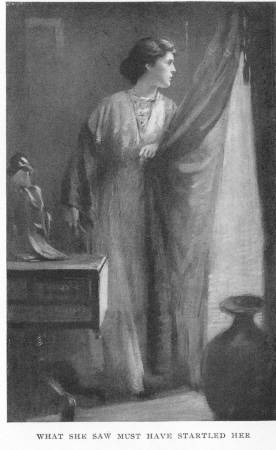
What she saw must have startled her, for she drew quickly back, her hand pressed to her heart. Then softly she retraced her steps; they heard the door-catch slip quietly back and were conscious that the door was swung open; the woman then crept inch by inch, so it seemed, down the hall.
It was the bedroom door that had been forced; the two watchers noted the bar of light that slanted from it across the passage. Nearer and nearer the woman approached to it. Pendleton had at first thought that she was making for the stairs; but this died away as she passed them, unheeding. The automatic revolver was in his hand instantly; leaning toward his friend, he breathed in his ear.
"She's going in there."
The blanket slipped from him as he arose to his feet; his legs were still cramped and stiffened; he felt clumsy and unsure. Ashton-Kirk evidently agreed that the time had come for action, for he whispered in reply:
"Through the rooms! I will take the hall!"
Pendleton stepped from behind the screen like a shadow. Through the door leading to the storeroom he had an uninterrupted view of a part of the bedroom; and across the floor he saw thrown the shadow of a man. Noiselessly he tip-toed into the kitchen, the revolver held ready; just outside the bedroom he paused, and drawing to one side, waited. Then he noted the shadow move slightly, and heard a deep rumbling voice say in French:
"You were a devil! Even now as I look at you, you laugh and jibe!" The shadow upon the floor here swung its arms threateningly. "But laugh away. I have won, and it is my turn to laugh!"
Here the shadow slid along and up the wall; peering around the edge of the door, Pendleton saw a man with massive, stooped shoulders and a great square head, covered with thick, iron-gray hair; and instantly he recognized him as the man whom they had seen that night in the doorway of Locke's workshop. The stranger was standing just under the portrait of Hume; he gazed up at it, and his big shoulders shook with laughter.
"What a mistake to make," he said, still in French. "How was I to know that the old devil once called himself Wayne!"
He reached up and took the picture from its hook; with thick, powerful fingers he tore the backing away, and a flat, compact bundle of papers was disclosed. The picture was thrown upon the bed, and the man stood staring at the papers, a wide smile upon his face.
"So this is the secret, eh? Well, Locke will pay well for it, and it will be worth all the risks I've taken."
He was fumbling with a coat pocket as though to stow them away, when there came a swift, light rush, the packet was torn from his hands, and Edyth Vale was darting toward the hall door and the stairway beyond.
But despite his bulk, the man with the stooped shoulders proved himself singularly swift. In two leaps he had overtaken her; dragging her back to the center of the room, he snatched the packet from her in turn. Regarding her with calm, pitiless eyes, he said in English:
"I am sorry, mees, that you have come, eh? Eet makes eet mooch harder for me. And I am of the kind that would rather be off quietly, is it not? and say no words to no one."
Edyth Vale, pale of face, but with steady eye, returned his look.
"What are you going to do?" she asked.
"I am sorry to do anything," spoke the stranger. "I do not know you, and you will onderstan', will you not, that I can't leave you behind—to talk?"
As he spoke a flashing something appeared from the girl's pocket; he lifted one huge paw to beat her down; but a clenched hand, protected by a corded buckskin glove, thudded against his jaw; his knees weakened, and he sprawled upon the floor.
"Jimmie!" gasped Edyth Vale. "Jimmie Pendleton!"
"Oh, Edyth—Edyth!" was all the man could say. He slipped his arm around her, for she was tottering; and as he helped her to a chair, Ashton-Kirk quietly entered at the hall door.
"Miss Vale," said he, "good-evening."
Without waiting to note if she even gave him a look, he bent over the fallen man and snapped a pair of handcuffs upon his wrists.
"A very pretty blow, Pen," said he, admiringly. "Beautifully timed, and your judgment of distance was excellent."
He slipped the fallen papers into his pocket and continued: "Keep an eye on him, for a moment."
Then he stepped swiftly through the hall; a moment later they heard him throw up one of the windows overlooking the street, and a whistle shrilled through the night.
"Paulson is on duty," said the investigator, returning. "He'll be here in a jiffy."
Sure enough, they soon heard heavy steps upon the stairs; and then Paulson and a fellow patrolman appeared in the doorway. Astonished, the policeman gazed at Ashton-Kirk, who nodded to them smilingly, then they turned their gaze upon Pendleton, who was speaking soothing words to the white-faced girl, who, now that the danger was over, clung to him tremblingly. But when their eyes centered upon the manacled stranger who was then dazedly struggling to a sitting position, Paulson asked:
"Who is this?"
"This," answered Ashton-Kirk, "is M. Sagon, a fellow lodger of Antonio Spatola, formerly a very close friend of the late Mr. Hume, and once a resident of Bayonne, in France."
Pendleton spent the night at Ashton-Kirk's; and after breakfast he wandered into the library, a newspaper in his hand and an inquiring look on his face.
The investigator was seated in his usual big chair, buried to the knees in newspapers, and making vigorous inroads upon the Greek tobacco. Fuller was just leaving the room as Pendleton entered, and nodding toward the disappearing form, Ashton-Kirk said:
"There is some rather interesting news. I have had Locke, as you perhaps know, under observation for some time. Last night he took the train at Cordova, and Burgess followed him. When he reached the city, he went directly to Christie Place and was seen lurking about in the shadows."
"Humph," said Pendleton, "what time was this?"
"Perhaps about eleven o'clock. Burgess, so Fuller tells me, never lost sight of him. He acted in a queerly hesitating sort of way; finally, however, he seemed to form a resolution and went to the door of the Marx house. He was about to pull the bell, then paused and tried the door instead. It was evidently not locked. He seemed both surprised and pleased at this; he lost no time, however, but went in at once."
Pendleton sat down.
"What do you suppose all this meant?" he asked.
"Well, we can't be too sure," replied Ashton Kirk, "but I think it probable that he, also, saw the news of the withdrawal of the police in the papers. Perhaps he came to Christie Place with the intention of informing Sagon of the opportunity that then presented itself. Or it might be that he had hopes of somehow over-reaching his companion in crime."
"His lurking about would seem to point rather in that direction," said Pendleton.
"And his preferring to enter the lodging house without ringing also indicates some such idea. As I see it, he hoped to gain the roof unobserved. He knew the house and the habits of the people quite well. No doubt he had a plan, and a good one. He's a thinker, is Mr. Locke."
"If he was noticed, he could indicate that he had called to see M. Sagon."
"Exactly. But I very much doubt his gaining the roof. Perhaps, after all, he was detected; for a few minutes later Burgess saw him leave the house."
"Humph!" said Pendleton. Then after some few moments spent in the examination of his paper he threw it down. "It's full of all sorts of allusions to monoplanes and such like," grumbled he. "As I had to take Edyth home last night, and you went bravely away with the police and Sagon, I find myself, as usual, trailing some distance in the rear."
Ashton-Kirk regarded the litter of newspapers ruefully:
"I gave them the heads of the case very plainly," said he, "but as it was almost the hour for going to press, I suppose they did not get the finer points of my meaning. Some of them have made a sad mess of it. However, the evening papers will have a coherent account, I suppose."
"If you think I am going to wait until the evening papers are issued to get to the bottom of this thing, you're much mistaken," declared Pendleton. "I demand a full and detailed explanation immediately."
Here a tap came upon the door; Stumph entered and handed Ashton-Kirk a card.
"Let him come up," said the latter; and, as the man went out, he continued to Pendleton. "We will both probably be much enlightened now. It is Allan Morris."
"Just as you said," spoke Pendleton. "It's really almost like second sight."
The investigator laughed.
"A small feat of reasoning, nothing more," said he. "However, an enthusiast might find some of the elements of second sight in our conversation in this room about a week ago."
Pendleton looked at him questioningly.
"It was on the morning that you called to announce the coming of Miss Vale. We were speaking of how it sometimes happened that very innocent things led to most weighty results; and I remarked, if you will remember, that your visit might lead to my connection with a murder that would dwarf some of those which we had spoken of."
"So you did," agreed Pendleton. "That is rather remarkable, Kirk."
"And further," smiled the investigator, "I recall that I expressed great admiration for Marryat's conception of a homicide in the matter of Smallbones and the hag. The weapon used by Smallbones, it turns out, was identical in character to the one used by Sagon."
"A bayonet," cried Pendleton. "By George! So it was."
Just then Stumph announced Allan Morris.
The latter was pale and haggard; his clothes were neglected, and there were some days' beard upon his chin. He seemed astonished at sight of Pendleton; however, he only nodded. Then he said inquiringly to the investigator:
"You are Mr. Ashton-Kirk?"
"I am. Will you sit down, Mr. Morris?"
Morris sat down dejectedly.
"Tobin advised me to come see you," he said. "I refused at first; but in view of what the newspapers contain this morning, I reconsidered it."
Ashton-Kirk nodded.
"If you had come to me in the first place," said he, "you'd probably not have fallen into this mess, and you'd have saved yourself a great deal of suffering." He regarded the young man for a moment, and then went on. "Miss Vale, I suppose, has told you of her dealings with me."
"She has," said Morris. "She's been very candid with me in everything. If I had been the same with her," bitterly, "I should have acted more like a natural human being. You see, we were to be married; she was very rich, while I had comparatively nothing. But this in itself would not have been sufficient to have prevented our wedding for so long. The fact was that I had gotten myself into trouble through speculation; I had a fear that my position might even be considered criminal from some points of view. And I allowed myself to get nervous over it.
"However, there was a way by which it was possible for me to extricate myself. To explain this I'll have to go back some years."
"Take your own time," said Ashton-Kirk.
"Well, my father had worked for years perfecting the plans of a heavier-than-air flying machine," Morris resumed. "At the time of his death he told me that it was all complete but the constructing, and that I had millions within my reach. But Hume had the plans—my father had borrowed money of him—a considerable sum—and had given him the plans as security.
"Hume had always derided the idea of the monoplane. Tobin, who knew them both, tells me that he was forever mocking my father upon the subject. And when the time came when the plans could be redeemed, Hume denied having them. There was no receipt, nothing to show that the transaction had ever occurred. The man declared that the whole thing was a drunken dream. He had never seen any plans; he had never paid out any money; he knew nothing about the matter. Time and again the man reiterated this; and each time, so I've heard, he would go off into gales of laughter. I have no doubt but that the entire performance on his part was to afford himself these opportunities; he seemed to love such things."
"Was it not possible for your father to duplicate the plans?"
"At an earlier time it would have meant but a few weeks' application at most. But at this period the thing was impossible. The last long debauch seemed to have sapped his intellect; it also was the direct cause of his death."
"I see," said Ashton-Kirk.
"I took the matter up with Hume at once," went on the young man. "But I had no more success than my father. In the man's eyes, I had but replaced my father; I was another patient subject for his mockery, derision and abuse.
"There were some scattered drawings of the monoplane in father's office; I began a study of these, thinking to chance upon the principal idea. But I was unsuccessful.
"All this, you understand, was before I had met Miss Vale, and before I was tangled up in the trouble I have just mentioned.
"The fear began to grow on me that Hume meant to use the plans to his own advantage; I knew that he had long been familiar with Locke, who was reputed to be a mechanical genius, and between them, I fancied they'd take action. I began a watch upon the reports of the Patent Office, thinking that that would finally give me something tangible to use against them. However, I never gave up my visits to Hume, or my efforts to make him admit possession of my father's property.
"It was during one of these visits that I first met Spatola; and I was much struck by the performance of his cockatoos. My father had always held to the idea that the problem of flight would be finally solved by a study of the birds; this gave me an idea, and I took to visiting Spatola in his lodgings in Christie Place. He'd have the cockatoos fly slowly round and round the big attic, and I'd watch them and make notes.
"It was about this time that I met Miss Vale and asked her to be my wife; a very little later, in an effort to raise money, I got into the financial trouble which I have referred to. After a little the question of a time for our marriage came up; I was filled with fear and put it off; this occurred several times, and I was at my wits' end. I could not marry with that thing hanging over me. Suppose it should turn out as I feared; imagine the shock to a high spirited girl to discover that she had married a defaulter.
"It was then that I turned to the matter of the plans as my only hope; with a perfected idea I could readily secure a large sum of money in advance. So I redoubled my efforts to have a settlement with Hume; but he only derided me as usual. Continued visits to Spatola to study the flight of the birds, showed me that the Italian was a fine fellow, well educated and with much feeling and appreciation. We became fast friends and so, little by little, I told him my story."
"About the invention?" asked Ashton-Kirk.
"Yes."
The investigator turned to Pendleton.
"I think," said he, "that I now understand why Spatola grew so uncommunicative and suspicious toward the end of our interview at City Hall. We both thought it was because I spoke of shorthand. But it was perhaps because I mentioned an invention in the way of writing music. He feared that I was trying to incriminate Mr. Morris in some way."
Pendleton nodded.
"That," said he, "I think explains it."
"As you no doubt know," went on Morris, after the investigator had once more given him his attention, "Spatola liked Hume none too well. And he had reason for his hatred, poor fellow. Well, he became interested in what I told him; and when he learned that I believed my father's papers were in all probability somewhere in Hume's apartments, he suggested that I come to live in Christie Place under an assumed name. He thought that in time an opportunity would present itself to cross the roofs some night, enter Hume's place by the scuttle and so possess myself of the plans.
"On the day preceding the murder, I had made up my mind to have one more try with Hume; and if that failed I intended to follow Spatola's advice, break in and take the plans by force. I was so full of this resolution that I could not contain myself; I hinted at it to Miss Vale; and the result of that hint, you know."
He leaned his face forward in his hands and seemed to give way to a bitter train of thought. He was evidently despondent.
"It was also some such hint upon your part that induced her to visit Locke at Dr. Mercer's place, wasn't it?"
Morris raised his head and nodded.
"Yes," he said. "After the murder I suspected Locke at once of having something to do with it. I told Miss Vale; she went there without my knowledge—seeing that I had not the courage to go myself," he added bitterly—"and demanded the plans."
"And she learned that they were still at Hume's—behind the portrait?"
"Yes. Locke told her—he was overcome with horror at the murder. He had merely desired to secure the plans,—having somehow learned their hiding place. He had no intention of killing Hume."
"But why did Sagon do it?—he must have had it in mind when he bought the bayonet at Bernstine's," said Pendleton, looking at Ashton-Kirk.
"He had. Do you recall how Burgess' report spoke of a league of smugglers in Europe of which Hume was a leading spirit, and also of how they had been captured and nearly all but Hume were tried and convicted?"
"Yes."
"Sagon was one of those convicted. The diamonds which Hume tried to smuggle into this country were to have been turned into money at the time of the gang's arrest and the proceeds spent in their defense. But instead of doing this, Hume left his comrades to their fate and absconded. When Sagon gained his freedom he began a search for Hume, meaning to have revenge. This search finally led him to Locke as a person who had known Hume, and who would be likely to be able to tell where he could be found."
"Sagon has told you this?" queried Pendleton.
"Yes; he talked freely, after he saw that his case was hopeless; and he, too, insisted that Locke did not intend to commit murder. Locke, even at the time of his meeting Sagon, was looking for someone to aid him in gaining possession of the Morris plans. The work-shop which we saw beside Locke's house contained a monoplane in course of construction; but there was something lacking which he felt Morris's plans could supply; and so he was anxious to get hold of it by hook or crook.
"Sagon, whose purpose from the first was murder, was not at all averse to combining it with something else. He took the room at Mrs. Marx's place, after he had perceived that an entrance could probably be made at Hume's by way of the scuttle. The well dressed 'business guys' that the machinist on the first floor spoke about to us, were no doubt Locke, who frequently called upon Sagon, and Mr. Morris here, whom the man did not suspect of being a lodger.
"To prove a theory that I had formed, and which I have mentioned in a vague sort of way," went on Ashton-Kirk, "I asked Sagon why he had used a bayonet. And it turned out as I had thought. Sagon and Hume had first met at Bayonne; the greater part of their operations had been carried on there; the band had been finally rounded up and convicted there. The bayonet, so legend has it, was first made in Bayonne, and Sagon conceived that it would be a sort of poetic justice if the traitor were to die by a weapon so closely connected with the scene of his treachery."
There was a pause after this, and then young Morris got up slowly and painfully.
"I don't want it to be thought," said he "that I was directly responsible for Miss Vale's adventure of last night—or for any of the others, for the matter of that. If I had known at the time that she proposed visiting Locke's, or Hume's, either upon the night of the murder, or last night, I would have prevented it."
Ashton-Kirk nodded kindly; the young man's position evidently appealed to him. But Pendleton sat rather stiffly in his chair and his expression never changed.
"I will now come into possession of whatever value there is in my father's invention," went on Morris, "and added to that, it turns out that the—the other thing, of which I stood so much in fear, has turned out favorably. But," in a disheartened sort of way, "I don't care much, now that my engagement with Miss Vale is broken."
"Broken!" exclaimed Pendleton.
"I saw her this morning," said Morris. "During the past week," he continued, "it gradually came to me that I was not the sort of man to make her a fitting husband. I hid like a squirrel while she faced the dangers that should have been mine. I knew that she realized the situation as well as I, and I did what I could by making it easy for her."
He paused at the door.
"If there is anything that I can do, or say in the final settlement of this case," he added, to Ashton-Kirk, "I will gladly place myself at your services, sir. Good-bye."
"For the first time," said Pendleton, as the door closed upon Allan Morris, "I can feel sorry for him. To lose a girl like Edyth Vale is indeed a calamity. Think of the courage she's shown—of what she was willing to do. Why, Kirk, she's one in ten thousand."
But Ashton-Kirk only nodded; he had arisen upon the departure of Morris, and was now drawing on a pair of gloves. The splendid qualities of Miss Vale apparently had little appeal for him at that moment.
"Are you ready?" he asked, in a business-like way.
"Ready?" repeated Pendleton, surprised.
"To be sure. We can scarcely call this case complete until something has been done in the matter of Locke."
"That's so. But, somehow, I had the notion that your men had already attended to him."
"I always prefer to finish my work in my own way," said the investigator. "Osborne, as soon as he heard of Locke, through Sagon, wanted to take up the trail. But I convinced him that he'd better leave it to me."
Pendleton clapped on his hat.
"I'm with you," said he, "but where do you expect to find him?"
Ashton-Kirk rang for Stumph and ordered the car; then he replied:
"We'll more than likely find him at home. Burgess followed him back to Cordova, last night."
They went down and climbed into the car, and were soon on the road.
A little distance from the Mercer Institute they came upon a compact looking man seated upon the top rail of a fence, chewing at a straw. He wore heavy, much-splashed boots and a sun-scorched suit of clothes.
"Ah," said Ashton-Kirk, "I see Burgess is still on the job."
"Burgess," echoed Pendleton. He looked at the man upon the fence in surprise; except for the very broad shoulders there was no resemblance.
However, Burgess grinned amiably through a rather neglected growth of beard.
"I expected you along about this time," said he, to the investigator.
"Is everything all right?" asked Ashton-Kirk.
"He's still there," answered Burgess, and he nodded toward a house with a peaked and slated roof which stood some little distance up an intersecting road. It was the same house through the window of which Pendleton had seen Edyth Vale some nights previously, but, somehow, it seemed strange and unfamiliar in daylight.
"I can see three sides of it from here," went on Burgess. "And if he dropped out of one of the windows on the fourth side I could sight him before he'd gone fifty yards. You may be sure he's there, all right."
"You've heard of what took place last night, I suppose?"
Burgess tapped a folded newspaper at his breast pocket.
"So has Locke," said he. "Apparently his orders are to furnish him with the papers as soon as they arrive. A man from the Institute building brought one to him more than an hour ago."
Just then Ashton-Kirk noted far up the road upon which Locke's house stood, a very small buggy, drawn by an equally small horse. In the buggy sat a man whose huge bulk seemed to bulge out beyond its sides. Arriving before Locke's house, the small horse stopped, as though from habit. Then with a mighty effort, the fat man rolled out and waddled to the gate. He pressed and re-pressed the button; but no one answered.
Ashton-Kirk looked at his assistant.
"Are you quite sure that our man is there," asked he.
Burgess chewed his straw calmly.
"I'm positive of it," said he.
The fat man now entered at the gate and going to the front door, tried it. But it was evidently fast, and he turned away. Hesitating for a moment, he laboriously approached the work shop, the roof of which could be seen through the trees. Apparently the result was the same here, for in a very few minutes he was seen to waddle back to his buggy and climb in with much effort. Then the small horse ambled forward while the fat man leaned back in great distress.
"You recognize him, do you not?" smiled Ashton-Kirk.
"I do, now," returned Pendleton. "It's our friend Dr. Mercer."
When the buggy arrived at the spot where the motor-car stood, the doctor regarded its occupants with some surprise.
"Good-morning," greeted Ashton-Kirk.
Painfully, gaspingly the other answered this in kind. The round white face wore an expression of martyrdom.
"I am pleased to see you once more," said he.
"You like driving in the morning, then?" said the investigator.
The principal's flesh quivered with repulsion.
"It is an exercise ordered by my physician," he answered. "I protested against it strongly, but he was obdurate. And I am compelled to do it before I have had my breakfast," hollowly. "It is scarcely short of barbarous."
Here the small horse stretched its neck and shook itself until the harness rattled. Pendleton looking from master to beast thought they might exchange places much to the master's ultimate well-being.
There was a short pause; then Dr. Mercer bent his head toward them.
"When you visited the institute a few nights ago," said he, "you also, at my request, visited Professor Locke."
Ashton-Kirk nodded.
"For some time," proceeded the other, "I have fancied that there was something wrong with him. Not of a physical nature, as is, unfortunately the case with myself, but more in a mental way. But since that night I have been sure that some sort of a derangement had fixed itself upon him, or is in progress. He can scarcely be called the same person. More than once I have been afraid," and here the speaker lowered his voice to a husky whisper, "that he is unbalanced."
"That is very grave," said Ashton-Kirk.
"It has occurred to me," went on the doctor, not without shrewdness, "that something happened that night which unsettled him." The eyes seemingly floating in fat, turned themselves first to Pendleton, then to Ashton-Kirk. "I suppose, though, you know nothing of it?"
"We noticed that he seemed greatly agitated," replied the investigator. "And we are alarmed to hear that he seems disturbed."
"It is our rule that no one leave the institute grounds after nightfall," said Dr. Mercer, in a troubled voice. "Last night I had occasion to send for him, but he was gone. This morning I stopped to reproach him for his absence; but apparently he has not returned."
"You're mistaken there," put in Burgess. "Look!"
He indicated the house as he spoke. The small figure of Locke was seen emerging at the front door; he paused for a moment, peering this way and that in his near-sighted fashion, then hastily made his way toward the work-shop. Evidently he had not seen them.
With great labor and much catching of breath Dr. Mercer had turned sufficiently to see these things. He seemed greatly astonished.
"He was there all the time," said he. "It is not possible that he did not feel the vibrations of the buzzer, for he is very sensitive to such things."
His indignation appeared to swell him to even greater proportions than before.
"It is an affront," he stated in a choked tone. "It is a deliberate affront. He felt the buzzer, and he knew it was I. But he did not consider me of enough importance to trouble himself about."
Panting he sought to turn the small horse, but in a moment Ashton-Kirk was out in the road and had the animal by the head.
"I beg your pardon," said the investigator, "but it would probably be more beneficial to yourself and others, if you continued your drive and left Professor Locke to us."
Amazed beyond ability to stir, the doctor sat and stared. But finally he found his tongue.
"Bless my soul and body," exclaimed he with a great wheezing exhalation. "I scarcely understand this, sir."
"My dear doctor," said Ashton-Kirk soothingly, "it is not at all necessary that you do so. The fact is, to state it briefly, there is a trifling matter for adjustment between Professor Locke and the commonwealth."
"The commonwealth!" cried the doctor, and he shook like a great mass of gelatine.
"Nothing less. So, you see, it will be as well for you to do as I suggest." Then turning to Pendleton, Ashton-Kirk continued: "I think we had better walk the remainder of the way; otherwise we might get Locke's attention before it is advisable."
Pendleton jumped down, and without another word to Dr. Mercer, they set off toward the slate-roofed house by the roadside. However, after they had gone about fifty yards, Pendleton turned and looked back. He saw the small horse jogging away, while behind it, helplessly fat and hopelessly befogged, sat Dr. Mercer, swaying dispiritedly from side to side.
As Ashton-Kirk and Pendleton advanced upon the house, they bore in mind the possibility of Locke being on the watch; so they kept out of sight as much as possible.
"It's rather odd, I think, that he hangs on here, knowing that his part in the murder of Hume must now be known," said Pendleton. "I rather expected an attempt at escape."
"That may come later," said the investigator, grimly. "The finish of a thing of this sort is always a matter for speculation. I have seen desperate criminals who surrendered like lambs; and I've seen the other sort give a platoon of police a good day's work in their taking."
"Do you think it possible that Locke is one of this latter type?"
"There is no knowing. But I am inclined to believe that he is."
Pendleton shook his head. It seemed impossible that this dapper little man with his peering, short-sighted eyes could be capable of any determined effort to escape the police when once driven into a corner. However, Pendleton had ample reason to respect Ashton-Kirk's judgment; and so when the latter deemed it necessary to approach with caution, he acted accordingly.
They paused in front of the house.
It was now past ten o'clock and the sun was shining brightly; a little patch of garden, filled with early flowering plants lay between the house and the wood; all about the work-shop were the tall trees which they had noticed upon their previous visit.
"We had better not use the gate," suggested the investigator. "There might be an attachment of some sort that will give him warning."
So under cover of the trees they scaled the fence; then they carefully made their way toward the shop. The windows and door of this were closed, nothing was stirring. Near the door was scattered some rubbish and loose paper. The place had an utterly deserted look.
"Do you think he is there?" asked Pendleton.
"I will know in a few moments," replied the other. "Wait here."
Pendleton expected Ashton-Kirk to continue his cautious approach. But to his surprise the investigator with cool assurance stepped out from behind a tree and advanced toward the outbuilding; when he reached the door he opened it and calmly stepped inside.
The building was in one great room. It had some windows at the side, but the greater part of its illumination came from a huge skylight. As he closed the door behind him, Ashton-Kirk had a vague impression of something huge, made of steel rods and with far-stretching wing-like projections at the sides. But he had no time to give the mechanism even a glance; of greater interest was the small figure which sat at a wide work-table upon which a litter of drawings was scattered.
It was Locke; and as the slight jar of the closing door reached him he lifted his eyes and saw the intruder. If Ashton-Kirk expected any display of fear or other emotion, he was disappointed; upon each of his previous meetings with Locke the latter had shown great trepidation; but now he simply nodded quietly and seemed not at all surprised.
But as Ashton-Kirk made a step toward him, he rose and raised his hand in a gesture that was peremptory and unmistakable. The investigator paused; then Locke pointed to a chair directly before his bench, but some half dozen yards away; and when Ashton-Kirk smilingly seated himself, Locke did likewise.
Then in heavy characters he scrawled upon the back of one of the blue-prints.
"I was expecting a visitor, and fancied that it might be you."
This he held up so that the investigator might read it. Ashton-Kirk nodded. Again the back of a plan came into service and this time the investigator read.
"What has occurred is most unfortunate. I had no hand in it, though, of course, I do not expect anyone to believe me."
Here Ashton-Kirk drew a note book from his pocket and was about to write, but the other stopped him with a gesture. Then the man once more wrote; carefully, heavily, in order that the other might have no difficulty in reading it from the distance.
"Pardon me! But it is not necessary for you to go to any trouble. Moreover—I beg of you not to think me rude—your opinions in the matter have no interest for me."
Ashton-Kirk acknowledged this with a grave nod. The pencil was instantly at work again.
"As I have said, I expected a visitor; but I will now add that I did not expect to be here to receive him."
Ashton-Kirk looked swiftly into Locke's face as he read this; the expression was unmistakable, and the investigator leaped to his feet. But the mute uttered a strange parrot-like cry—evidently the same that Edyth heard that night in Christie Place—and Ashton-Kirk saw his hand go swiftly to a button at one side of the work-bench. Instantly the investigator paused; once more a gesture bade him be seated.
Slowly he obeyed; and once more Locke began to trace bold characters upon the stiff paper. This message read:
"You are a wise man. I had arranged everything before you came in, and had sat down to make an end of it. This button at my hand once started an electric apparatus; but now it is connected with a quantity of an explosive—my own invention, and a terrible one. Believe me, one touch and everything in this building is in fragments."
Ashton-Kirk, when he had finished reading, nodded quietly. Again the mute began to write.
"I have no ill will toward you," the words ran, "you have two minutes to leave here, and get safely away."
When he saw that this had been read, Locke threw down the paper and took out his watch. Then he pointed toward the door and sat waiting.
It was strange to see the little man sitting there calmly, with only the pressure of a finger between him and eternity. But Ashton-Kirk knew stern resolution too well to mistake the look on the mute's face. There was nothing to do but to obey. He waved his hand in a farewell. Locke returned the gesture. Then Ashton-Kirk walked to the door, opened it and stepped out.
Pendleton, patiently watching among the trees, saw him emerge and at once moved toward him; to his amazement the investigator took him by the arm and broke into a run.
"What the deuce is the matter now?" asked Pendleton, after they had passed the gate and were racing down the road.
"You'll know in a few moments," returned Ashton-Kirk grimly.
He permitted no pause until they reached the car, the engine of which had not been stopped.
"Quick, for your lives!" he ordered, as he leaped in.
Pendleton and Burgess followed instantly. The car had scarcely begun its plunge forward when a horrible rending shock staggered them. And as they sped away the debris of the deaf-mute's work-shop was falling all about them.
The evening papers were glaring with the news from Cordova by the time the two friends were once more alone in Ashton-Kirk's library. Pendleton seemed to be pondering.
"I say," said he, at last, "was it Morris or Spatola who remained at Hume's the night of the murder?"
"I spoke to Spatola about that," answered Ashton-Kirk. "He said it was Morris who left first and whom Hume pursued by jeers through the open window. Morris had, according to his resolve, called at the place to demand the plans; but Hume was mad with liquor and was even worse in his manner than usual. Unable to bear it, Morris had rushed out. Spatola later made his way out by way of the scuttle and across the roof, as he frequently did.
"The thing which Spatola had carried under his coat that night was a diploma which he had received from a musical conservatory in Rome. It was in a frame and so made considerable bulk. Hume had denied that afternoon that Spatola had ever studied in this particular conservatory; frantic with rage, but knowing that he was a fool for doing it, the Italian had brought his diploma as proof.
"Morris, under the name of Crawford, occupied a room on the floor below Spatola; and as soon as the musician entered through the scuttle, he descended the stairs and went immediately to his friend's room to console and encourage him.
"Some time passed, and while they were still talking they heard a step upon the stairs leading to the attic. As no one lived there but himself, Spatola looked and in the semi-darkness saw two men descending. He called and asked who they were, and Sagon's voice replied that it was he and a friend. They had gone up to have a talk and smoke a cigar with him; but seeing that he was not in, they had come down at once. And now, as he was apparently engaged, they would not trouble him, and with that they disappeared within Sagon's room."
"Then," said Pendleton, "they had gone up through the attic, across the roofs, committed the deed, and returned while Spatola was with Morris?"
"It would seem so."
"But suppose that on reaching the attic, upon their return they had found Spatola there?"
"Sagon had calculated it all very nicely. One night a week Spatola went to play with two compatriots at their rooms; with piano, harp and violin, they gave vent to the harmony that was in them. That was the night for the trio, and Sagon knew it. But in his rage and his desire to prove his standing to Hume, Spatola had forgotten it. When he descended to Morris's rooms, the two criminals thought he had gone to make his usual visit to his friends. Sagon says he almost lost his nerve when the Italian confronted them on the stairs."
"But here's a thing I've not been able to puzzle out. According to your notion—and you may have proved it since, for all I know—Locke was not in the showroom during or after the murder. And yet it should have been he who dropped the little particle from the railroad ticket upon the desk."
"It would seem that way," admitted Ashton-Kirk, "but the fact is that Sagon visited Locke at the Institute and rode to the city with him that afternoon. The particle may be accounted for in that way."
"Yes," mused the other, "that's so. But, one thing more. I should have asked this of Morris himself if he had not been in such a confoundedly miserable way. Why did he take to hiding immediately after the murder?"
"He spent the night in his lodgings at Christie Place; next day the papers told him that he was suspected. He knew that if he appeared he'd be arrested; and as he desired to recover the plans before the murderers escaped with them, he felt that this would be fatal to his chances. Of course, I am not sure of this; but I think it more than likely."
"Speaking of taking chances on the plans," said Pendleton, "you were willing enough to take pretty long ones on them last night. Why, Sagon actually had them in his hands."
Ashton-Kirk drew a flat packet from his pocket. Opening it he showed that it contained nothing but blank paper.
"This is what Sagon found behind the portrait," said he, with a smile. "The real papers I was very careful to remove two days ago. One moment—that's the telephone."
Pendleton sat rolling a cigarette and wondering, while Ashton-Kirk took down the receiver.
"Well?" said he. Then in a moment his expression changed. "Oh, is it you? Well, how are you after your exciting experience?"
Here Pendleton dropped the completed cigarette and listened.
"You may consider yourself very fortunate to escape with a slight headache," said Ashton-Kirk. Then there was a pause, and he said, apparently in answer to a question: "Oh, yes, he's with me now. Will you speak with him?"
Pendleton arose and took a step toward the stand. But he halted as if shot when his friend continued in the transmitter:
"No?" Pause. "Oh, very well. Good-by."
Ashton-Kirk hung up the receiver and turned to his friend.
"So," said Pendleton, in a queer sort of voice, "she doesn't wish to speak to me."
"Not over the wire—no. But she wants you to come to her—at once. She desires to hear all about what she calls the wonderful way we have handled this case, and she wants to hear it—from you." Ashton-Kirk looked at his watch. "It is now 10:45. You can get there by eleven if you rush."
"Do you call doing that little distance in fifteen minutes rushing?" The young man's face was radiant and he was making for the door as he spoke. "If I don't do it in half that time, I'm a duffer."
Then the door slapped behind him, and Ashton-Kirk heard him bounding down the stairs.
Another story in this series is "ASHTON-KIRK AND THE SCARLET SCAPULAR" (in press)