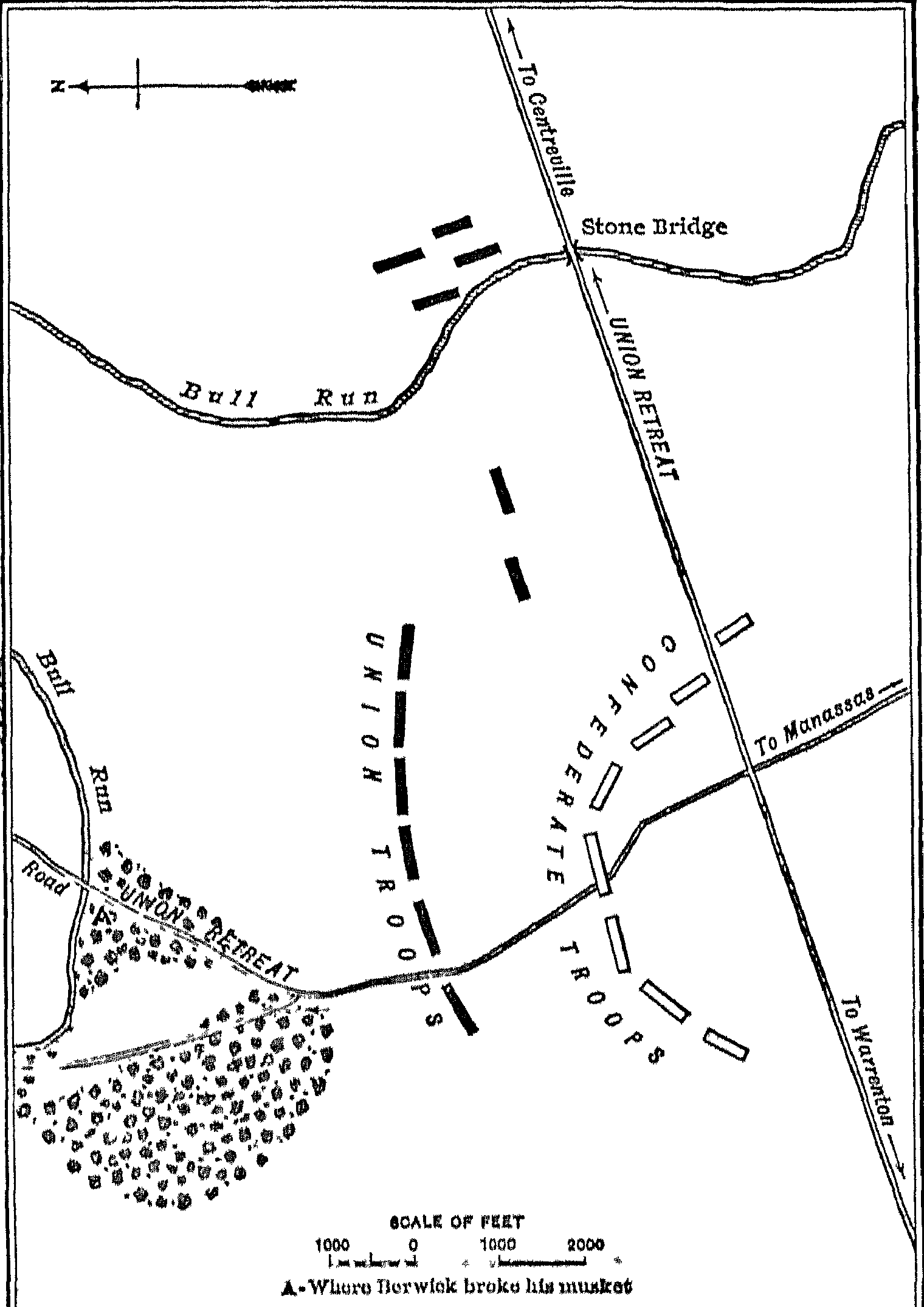
BULL RUN, July 2l, 1861.
The Project Gutenberg EBook of Who Goes There?, by Blackwood Ketcham Benson

This eBook is for the use of anyone anywhere at no cost and with
almost no restrictions whatsoever.  You may copy it, give it away or
re-use it under the terms of the Project Gutenberg License included
with this eBook or online at www.gutenberg.org


Title: Who Goes There?

Author: Blackwood Ketcham Benson

Release Date: May 1, 2004 [EBook #12229]
[Last updated. June 20, 2012]

Language: English

Character set encoding: ISO-8859-1

*** START OF THIS PROJECT GUTENBERG EBOOK WHO GOES THERE? ***


Produced by Charlie Kirschner and the Online Distributed Proofreading
Team from images provided by the Million Book Project.
From early childhood I had been subject to a peculiar malady. I say malady for want of a better and truer word, for my condition had never been one of physical or mental suffering. According to my father's opinion, an attack of brain fever had caused me, when five years old, to lose my memory for a time--not indeed my memory entirely, but my ability to recall the events and the mental impressions of a recent period. The physicians had agreed that the trouble would pass away, but it had been repeated more than once. At the age of ten, when occurred the first attack which I remember, I was at school in my native New England village. One very cold day I was running home after school, when my foot slipped on a frozen pool. My head struck the ice, but I felt no great pain, and was almost at once on my feet. I was bewildered with what I saw around me. Seemingly I had just risen from my seat at the breakfast table to find myself in the open air, in solitude, in clothing too heavy, with hands and feet too large, and with a July world suddenly changed to midwinter. As it happened, my father was near, and took me home. When the physicians came, they asked me many questions which I could not understand.
Next morning my father sat by my bed and questioned mo again. He inquired about my studies, about my classmates, about my teacher, about the school games. Many of his questions seemed strange to me, and I answered them in such words that he soon knew there was an interval of more than six months in my consciousness. He then tried to learn whether there remained in my mind any effect of my studies during the past term. The result was surprising. He found that as to actual knowledge my mind retained the power developed by its exercise,--without, however, holding all details of fact,--but that, in everything not positive, my experience seemed to have been utterly lost. I knew my multiplication table thoroughly; I had acquired it in the interval now forgotten. I could write correctly, and my ability to read was not lessened. But when questions concerning historical events, either general or local, were asked, my answers proved that I had lost everything that I had learned for the six months past. I showed but little knowledge of new games on the playground, and utter forgetfulness of the reasons for and against the Mexican War which was now going on, and in which, on the previous day, I had felt the eager interest of a healthy boy.
Moreover my brain reproduced the most striking events of my last period of normal memory with indistinct and inaccurate images, while the time preceding that period was as nothing to me. My little sister had died when I was six years old; I did not know that she had ever lived; her name, even, was strange to me.
After a few days I was allowed to rise from bed, to which, in my own opinion, there had never been necessity for keeping me. I was not, however, permitted to go out of doors. The result of the doctors' deliberations was a strict injunction upon my father to take me to the South every winter, a decision due, perhaps, to the fact that my father had landed interests in South Carolina. At any rate, my father soon took me to Charleston, where I was again put to school. Doubtless I was thus relieved of much annoyance, as my new schoolmates received me without showing the curiosity which would have irritated me in my own village.
More than five months passed before my memory entirely returned to me. The change was gradual. One day, at the morning recess, a group of boys were talking about the Mexican War. The Palmetto regiment had distinguished itself in battle. I heard a big boy say, "Yes, your Uncle Pierce is all right, and his regiment is the best in the army." I felt a glow of pride at this praise of my people--as I supposed it to be. More talk followed, however, in which it became clear that the boys were not speaking of Franklin Pierce and his New Hampshire men, and I was greatly puzzled.
A few days afterward the city was in mourning; Colonel Pierce M. Butler, the brave commander of the South Carolina regiment, had fallen on the field of Churubusco.
Now, I cannot explain, even to myself, what relation had been disturbed by this event, but I know that from this time I began to collect, vaguely at first, the incidents of my whole former life; so that, when my father sent for me at the summer vacation, I had entirely recovered my lost memory. I even knew everything that had happened in the recent interval, so that my consciousness held an uninterrupted chain of all past events of importance. And now I realized with wonder one of the marvellous compensations of nature. My brain reproduced form, size, colour--any quality of a material thing seen in the hiatus, so vividly that the actual object seemed present to my senses, while I could feel dimly, what I now know more thoroughly, that my memory during the interval had operated weakly, if at all, on matters speculative, so called--questions of doubtful import, questions of a kind upon which there might well be more than one opinion, being as nothing to my mind. Although I have truly said that I cannot explain how it was that my mind began its recovery, yet I cannot reason away the belief that the first step was an act of sensitive pride--the realization that it made some difference to me whether the New Hampshire regiment or the Palmetto regiment acquired the greater glory.
My father continued to send me each winter to Charleston, and my summers were spent at home. By the time I was fifteen he became dissatisfied with my progress, and decided that I should return to the South for the winter of 1853-4. and that if there should be no recurrence of my mental peculiarity he would thereafter put me in the hands of a private tutor who should prepare me for college.
For fully five years I had had no lapse of memory and my health was sound. At the school I took delight in athletic sports, and gained a reputation among the Charleston boys for being an expert especially in climbing. My studies, while not neglected, were, nevertheless, considered by me as secondary matters; I suppose that the anxiety shown by my father for my health influenced me somewhat; moreover, I had a natural bent toward bodily rather than mental exercise.
The feature most attractive to me in school work was the debating class. As a sort of ex-officio president of this club, was one of our tutors, whom none of the boys seemed greatly to like. He was called Professor Khayme--pronounced Ki-me. Sometimes the principal addressed him as Doctor. He certainly was a very learned and intelligent man; for although the boys had him in dislike, there were yet many evidences of the respect he commanded from better judges than schoolboys. He seemed, at various times, of different ages. He might be anywhere between thirty and fifty. He was small of stature, being not more than five feet tall, and was exceedingly quick and energetic in his movements, while his countenance and attitude, no matter what was going on, expressed always complete self-control, if not indifference. He was dark--almost as dark as an Indian. His face was narrow, but the breadth and height of his forehead were almost a deformity. He had no beard, and yet I feel sure that he never used a razor. I rarely saw him off duty without a peculiar black pipe in his mouth, which he smoked in an unusual way, emitting the smoke at very long intervals. It was a standing jest with my irreverent schoolmates that "Old Ky" owed his fine, rich colour to smoking through his skin. Ingram Hall said that the carved Hindoo idol which decorated the professor's pipe was the very image of "Old Ky" himself.
Our debating class sometimes prepared oratorical displays to which were admitted a favoured few of the general public. To my dying day I shall remember one of these occasions. The debate, so celebrated, between the great Carolinian Hayne and our own Webster was the feature of the entertainment. Behind the curtain sat Professor Khayme, prompter and general manager. A boy with mighty lungs and violent gesticulation recited an abridgment of Hayne's speech, beginning:--
"If there be one State in the Union, Mr. President, and I say it not in a boastful spirit, that may challenge comparison with any other for a uniform, zealous, ardent, and uncalculating devotion to the Union, that State is South Carolina."
Great applause followed. These were times of sectional compromise. I also applauded. We were under the falsely quieting influence of Douglas's Kansas-Nebraska Bill. There was effort for harmony between the sections. The majority of thinking people considered true patriotism to concist in patience and charity each to each. Mrs. Beecher Stowe's "Uncle Tom's Cabin" had appeared, but few Southerners had read it or would read it. I also applauded.
Professor Khayme now came forward on the rostrum, and announced that the next part of the programme would be "'Webster's Reply to Hayne,' to be recited"--and here the professor paused--"by Master Jones Berwick."
I was thunderstruck. No intimation of any kind had been given me that I was to be called on. I decided at once to refuse to attempt an impossibility. As I rose to explain and to make excuses, the boys all over the hall cried, "Berwick! Berwick!" and clapped loudly. Then the professor said, in a low and musical voice,--and his voice was by far his greatest apparent attraction,--that Master Berwick had not been originally selected to recite, but that the young orator chosen the duty had been called away unexpectedly, and that it was well known that Master Berwick, being a compatriot of the great Webster, and being not only thoroughly competent to declaim the abridged form of the speech in question, but also in politics thoroughly at one with the famous orator, could serve with facility in the stead of the absentee, and would certainly sustain the reputation of the club.
How I hated that man! Yet I could see, as I caught his eye, I know not what of encouragement. I had often heard the speech recited, but not recently, and I could not see my way through.
I stumbled somehow to the back of the curtain. The Doctor said to me, in a tone I had never heard before. "Be brave, my boy: I pledge you my word as a gentleman that you shall succeed. Come to this light." Then he seemed to be brushing my hair back with a few soft finger-touches, and I remembered no more until I found myself on the rostrum listening to a perfect din of applause that covered the close of my speech. If there were any fire-eaters in the audience, they were Carolina aristocrats an knew how to be polite, even to a fault.
I could not understand my success: I had vague inward inclination that it was not mine alone. My identity seemed to have departed for the time. I felt that some wonderful change had been wrought in me, and, youngster though I was, I was amazed to think what might be the possibilities of the mind.
For some time after this incident I tried to avoid Doctor Khayme, but as he had charge of our rhetoric and French, as well as oratory, it was impossible that we should not meet. In class he was reserved and confined himself strictly to his duties, never by tone or look varying his prescribed relation to the class; yet, though his outward gravity and seeming indifference, I sometimes felt that he influenced me by a power which no other man exerted over me.
One afternoon, returning from school to my quarters, I had just crossed Meeting Street when I felt a light hand on my shoulder, and, turning, I saw Doctor Khayme.
"Allow me to walk with you?" he asked.
He did not wait for an answer, but continued at once: "I have from your father a letter in relation to your health. He says that he is uneasy about you."
"I was never better in my life, sir," said I; "he has no reason to be worried."
"I shall be glad to be able to relieve his mind," said the Doctor.
Now, I had wit enough to observe that the Doctor had not said "I am glad," but "I shall be glad," and I asked, "Do you think I am wrong in health?"
"Not seriously," he replied; "but I think it will be well for you to see the letter, and if you will be so good as to accompany me to my lodging, I will show it to you."
Dr. Khayme's "lodging" proved to be a small cottage on one of the side streets. There was a miniature garden in front: vines clambered over the porch and were trained so that they almost hid the windows. An old woman, who seemed to be housekeeper, cook, and everything that a general servant may be, opened to his knock.
"I never carry a key," said the Doctor, seemingly in response to my thought.
I was led into a bright room in the back of the house. The windows looked on the sunset. The floor was bare, except in front of the grate, where was spread the skin of some strange animal. For the rest, there was nothing remarkable about the apartment. An old bookcase in a corner seemed packed to bursting with dusty volumes in antique covers, A writing-table, littered and piled with papers, was in the middle of the room, and there were a few easy-chairs, into one of which the Doctor motioned me.
Excusing himself a moment, he went to the mantel, took down a pipe with a long stem, and began to stuff the bowl with tobacco which I saw was very black; while he was doing so, I recognized on the pipe the carven image of an idol.
"Yes," he said; "I see no good in changing."
I did not say anything to this speech; I did not know what he meant.
He went to his desk, took my father's letter from a drawer, and handed it to me. I read:--
"MY DEAR SIR: Pardon the liberty I take in writing to you. My son, who is under your charge in part, causes me great uneasiness. I need not say to you that he has a mind above the average--you will have already discovered this; but I wish to say that his mind has passed through strange experiences and that possibly he must--though God forbid--go through more of such. A friend of mine has convinced me that you can help my boy.
Yours very truly, "JONES BERWICK, SR."
When I had read this letter, it came upon me that it was strange, especially in its abrupt ending. I looked at the Doctor and offered the letter to him.
"No," said he; "keep it; put it in your pocket."
I did as he said, and waited. For a short time Dr. Khayme sat with the amber mouthpiece of his pipe between his lips; his eyes were turned from me.
He rose, and put his pipe back on the mantel; then turning toward me, and yet standing, he looked upon me gravely, and said very slowly, "I do not think it advisable to ask you to tell me what the mental experiences are to which your father alludes; it may be best that you should not speak of them; it may be best that you should not think of them. I am sure that I can help you; I am sure that your telling me your history could not cause me to help you more."
I was silent. The voice of the man was grave, and low, and sweet. I could see no expression in his face. His dark eyes seemed fixed on me, but I felt that he was looking through me at something beyond.
Again he spoke. "I think that what you need is to exert your will. I can help you to do that. You are very receptive; you have great will-power also, but you have not cultivated that power. This is a critical time in your life. You are becoming a man. You must use your will. I can help you by making you see that you can use your will, and that the will is very powerful--that your will is very powerful. He who has confidence in his own will-power will exert it. I can help you to have confidence. But I cannot exert your will for you; you must do that. To begin with, I shall give you a very simple task. I think I can understand a little your present attitude toward me. You are in doubt. I wish you to be in doubt, for the moment. I wish your curiosity and desires for and against to be so evenly balanced that you will have no difficulty in choosing for or against. You are just in that condition. You have feared and mistrusted me; now your fear and suspicion are leaving you, and curiosity is balancing against indolence. I do not bid you to make an effort to will; I leave it entirely to you to determine now whether you will struggle against weakness or submit to it; whether you will begin to use your sleeping will-power or else continue to accept what comes."
I rose to my feet at once.
"What is your decision?" asked the Doctor smiling--the first smile I had ever seen on his face.
"I will be a man!" I exclaimed.
I became a frequent visitor at the Doctor's, and gradually learned more and more of this remarkable man. His little daughter told me much, that I could never have guessed. She was a very serious child, perhaps of eleven years, and not very attractive. In fact, she was ugly, but her gravity seemed somehow to suit her so well that I could by no means dislike her. Her father was very fond of her; of an evening the three of us would sit in the west room; the Doctor would smoke and read; I would read some special matter--usually on philosophy--selected by my tutor; Lydia would sit silently by, engaged in sewing or knitting, and absorbed seemingly in her own imaginings. Lydia at one time said some words which I could not exactly catch, and which made me doubt the seeming poverty of her father, but I attributed her speech to the natural pride of a child who thinks its father great in every way. I was not greatly interested, moreover, in the domestic affairs of the household, and never thought of asking for information that seemed withheld. I learned from the child's talk, at odd times when the Doctor would be absent from the room, that they were foreigners,--a fact which. I had already taken for granted,--but I was never made to know the land of their birth. It was certain that Dr. Khayme could speak German and French, and I could frequently see him reading in books printed in characters unknown to me. Several times I have happened to come unexpectedly into the presence of the father and daughter when they were conversing in a tongue which I was sure I had never heard. The Doctor had no companions. He was at home, or at school, or else on the way from the one to the other. No visitor ever showed himself when I was at the cottage. Lydia attended the convent school. I understood from remarks dropped incidentally, as well as from seeing the books she had, that her studies were the languages in the main, and I had strong evidence that, young as she was, her proficiency in French and German far exceeded my own acquirements.
By degrees I learned that the Doctor was deeply interested in what we would call speculative philosophy. I say by degrees, for the experience I am now writing down embraces the winters of five or six years. Most of the books that composed his library were abstruse treatises on metaphysics, philosophy, and religion. I believe that in his collection could have been found the Bible of every religious faith. Sometimes he would read aloud a passage in the Bhagavadgita, of which he had a manuscript copy interleaved with annotations in his own delicate handwriting.
He seldom spoke of the past, but he seemed strangely interested in the political condition of every civilized nation. The future of the human race was a subject to which he undoubtedly gave much thought. I have heard him more than once declare, with emphasis, that the outlook for the advancement of America was not auspicious. In regard to the sectional discord in the United States, he showed a strange unconcern. I knew that he believed it a matter of indifference whether secession, of which we were beginning again to hear some mutterings, was a constitutional right; but on the question of slavery his interest was intense. He believed that slavery could not endure, let secession be attempted or abandoned, let secession fail or succeed.
In my vacations I spoke to my father of the profound man who had interested himself in my mental welfare; my father approved the intimacy. He did not know Dr. Khayme personally, but he had much reason to believe him a worthy man. I had never said anything to my father about the note he had written to the Doctor; for a long time, in fact, the thought of doing so did not come to me, and when it did come I decided that, since my father had not mentioned the matter, it was not for me to do so; it was a peculiar note.
My father gave me to know that his former wish to abridge my life in the South had given way to his fears, and that I was to continue to spend my winters in Charleston. In after years I learned that Dr. Khayme had not thought my condition exempt from danger.
So had passed the winters and vacations until the fall of '57, without recurrence of my trouble. I no longer feared a lapse; my father and the physicians agreed that my migrations should cease, and I entered college. I wrote Dr. Khayme a letter, in which I expressed great regret on account of our separation, but I received no reply.
On Christmas Day of this year, 1857, I was at home. Suddenly, even without the least premonition or obvious cause, I suffered lapse of memory. The period affected embraced, with remarkable exactness, all the time that had elapsed since I had last seen Dr. Khayme.
Early in January my father accompanied me to Charleston. He was induced to take me there because I was conscious of nothing that had happened since the last day I spent there, and he was, moreover, very anxious to meet Dr. Khayme. We learned, on our arrival in Charleston, however, that the Doctor and his daughter had sailed for Liverpool early in September. My father and I travelled in the South until November, 1858, when my memory was completely restored. He then returned to Massachusetts, leaving me in Carolina, and I did not return to the North until August, 1860.
The military enthusiasm of the North, aroused by the firing on Sumter, was contagious; but for a time my father opposed my desire to enter the army. Beyond the fears which every parent has, he doubted the effect of military life upon my mental nature. Our family physician, however, was upon my side, and contended, with what good reason I did not know, that the active life of war would be a benefit rather than a harm to me; so my father ceased to oppose, and I enlisted.
In the afternoon we broke camp and marched toward the west. It was July 16, 1861.
The bands were playing "Carry me back to old Virginia."
I was in the Eleventh. Orders had been read, but little could be understood by men in the ranks. Nothing was clear to me, in these orders, except two things:--
First, to be surprised would be unpardonable.
Second, to fall back would be unpardonable.
It was four o'clock. The road was ankle-deep in dust; the sun burnt our faces as we marched toward the west. Up hill and down hill, up hill and down hill, we marched for an hour, west and southwest.
We halted; from each company men were detailed to fill canteens. The city could no longer he seen.
Willis pointed to the north. Willis was a big, red-haired sergeant--a favourite with the men.
I looked, and saw clouds of dust rising a mile or two away.
"Miles's division," says Willis.
"What is on our left?"
"Nothing," says Willis.
"How do you know?"
"We are the left," says Willis.
The sergeant had studied war a little; he had some infallible views.
The sergeant-major, with his diamond stripes, and his short sword saluting, spoke to a captain, who at once reported to the colonel at the head of the regiment. The captain returned to his post:--
"Comp-a-ny--B ... ATTENTION!" ...
"Shudda ... HOP!" ...
"LOAD!" ...
"Shudda ... HOP!" ...
"R-i-i-i-i-ght ... FACE!" ...
"Fah--w-u-u-u-d ... MOTCH!" ...
"Fi--lef ... MOTCH!"
Company B disappeared in the bushes on our left.
The water-detail returned; the regiment moved forward.
Passing over a rising ground, Willis pointed to the left. I could see some black spots in a stubble-field.
"Company B; skirmishers," says Willis.
"Any rebels out that way?"
"Don't know. Right to be ready for 'em," says Willis.
Marching orders had been welcomed by the men, and the first few miles had been marked by jollity; the jest repeated growing from four to four; great shouts had risen, at seeing the dust made by our columns advancing on parallel roads. The air was stagnant, the sun directly in our faces. This little peaked infantry cap is a damnable outrage. The straps across my shoulders seemed to cut my flesh. Great drops rolled down my face. My canteen was soon dry. The men were no longer erect as on dress parade. Each one bent over--head down. The officers had no heavy muskets--no heavy cartridge-boxes; they marched erect; the second lieutenant was using his sword for a walking-cane. "Close up!" shouted the sergeants. My heels were sore. The dust was stifling.
Another halt; a new detail for water.
The march continued--a stumbling, staggering march, in the darkness. A hundred yards and a halt of a minute; a quarter of a mile and a halt of half an hour; an exasperating march. At two o'clock in the morning we were permitted to break ranks. I was too tired to sleep. Where we were I knew not, and I know not--somewhere in Fairfax County, Virginia. Willis, who was near me, lying on his blanket, his cartridge-box for a pillow, said that we were the left of McDowell's army; that the centre and right extended for miles; that the general headquarters ought to be at Fairfax Court-House at this moment, and that if Beauregard didn't look sharp he would wake up some fine morning and find old Heintz in his rear.
Before the light we were aroused by the reveillé.
The moving and halting process was resumed, and was kept up for many hours. We reached the railroad. Our company was sent forward to relieve the pickets. We were in the woods, and within a hundred yards of a feeble rivulet which, ran from west to east almost parallel with our skirmish-line; nothing could be seen in front but trees. Beyond the stream vedettes were posted on a ridge. The men of the company were in position, but at ease. The division was half a mile in our rear.
I was lying on my back at the root of a scrub-oak very like the blackjacks of Georgia and the Carolinas. The tree caused me to think of my many sojourns in the South. Willis was standing a few yards away; he was in the act of lighting his pipe.
"What's that?" said he, dropping the match.
"What's what?" I asked.
"There! Don't you hear it? two--three--"
At the word "three" I heard distinctly, in the far northwest, a low rumble. All the men were on their feet, silent, serious. Again the distant cannon was heard.
About five o'clock in the afternoon the newspapers from Washington were in our hands. In one of the papers a certain war correspondent had outlined, or rather amplified, the plan of the campaign. Basing his prediction, doubtless, upon the fact that he knew something of the nature of the advance begun on the 16th, the public was informed that Heintzelman's division would swing far to the left until the rear of Beauregard's right flank was reached; at the same time Miles and Hunter would seize Fairfax Court-House, and threaten the enemy's centre and left, and would seriously attack when Heintzelman should give the signal. Thus, rolled up from the right, and engaged everywhere else, the enemy's defeat was inevitable.
The papers were handed from one to another. Willis chuckled a little when he saw his own view seconded, although, he was beginning to be afraid that his plans were endangered.
"I told you that headquarters last night would be Fairfax Court-House," said he; "but the firing we heard awhile ago means that our troops have been delayed. Beauregard is awake."
Just at sunset I was sent forward to relieve a vedette. This was my first experience of the kind. A sergeant accompanied me. We readied a spot from which, through the trees, the sentinel could be seen. He was facing us, instead of his front. The poor fellow--Johnson, of our company--had, been on post for two mortal hours, and was more concerned about the relief in his rear than about the enemy that might not be in his front. The sergeant halted within a few paces of the vedette, while I received instructions. I was to ascertain from the sentinel any peculiarity of his post and the general condition, existing in his front, and then, dismiss him to the care of the sergeant. Johnson, could tell me nothing. He had seen nothing; had heard nothing. He retired and I was alone.
The ground was somewhat elevated, but not sufficiently so to enable one to see far in front. The vedette on either flank was invisible. Night was falling. A few faint stars began to shine. A thousand insects were cheeping; a thousand frogs in disjointed concert welcomed the twilight. A gentle breeze swayed the branches of the tree above me. Far away--to right or left, I know not--a cow-bell tinkled. More stars came out. The wind died away.
I leaned against the tree, and peered into the darkness.
I wanted to be a good soldier. This day I had heard for the first time the sound of hostile arms. I thought it would be but natural to be nervous, and I found myself surprised when I decided that I was not nervous. The cry of the lone screech-owl below me in the swamp sounded but familiar and appropriate.
That we were to attack the enemy I well knew; a battle was certain unless the enemy should retreat. My thoughts were full of wars and battles. My present duty made me think, of Indians. I wondered whether the rebels were well armed; I knew them; I knew they would fight; I had lived among those misguided people.
"Fall in, men! Fall in Company D!"
It was after two o'clock on the morning of July 21.
We had scarcely slept. For two or three days we had been in a constant state of nervous expectancy. On the 18th the armed reconnaissance on Bull Run had brought more than our generals had counted on; we had heard the combat, but had taken no part in it. Now the attack by the left had been abandoned.
The early part of the night of the 20th had been spent in trying to get rations; at twelve o'clock we had two days' cooked rations in our haversacks.
At about three o'clock the regiment turned south, into the road for Centreville.
Willis said that we were to flank Beauregard's left; but nobody took the trouble to assent or deny.
At Centreville there was a long and irksome halt; some lay down--in the road--by the side of the road; some kept their feet and moved about impatiently.
An army seemed to be passing in the road before our column, and we must wait till the way was clear.
Little noise was made by the column marching on the road intersecting ours. There was light laughter occasionally, but in general the men were silent, going forward with rapid strides, or standing stock still when brought to an abrupt halt whenever the head of the column struck an obstacle.
I slept by snatches, awaking every time in a jump. Everybody was nervous; even the officers could not hide their irritation.
Six o'clock came. The road was clear; the sun was nearly two hours high.
Forward we went at a swinging gait down the road through the dust. In ten minutes the sweat was rolling. No halt--no pause--no command, except the everlasting "Close up! close up!"
Seven o'clock ... we turn to the right--northwest--a neighbourhood road; ... fields; ... thickets; ... hills--not so much dust now, but the sun getting hotter and hotter, and hotter and hotter getting our thirst.
And Sunday morning ... Close up! close up!
Hear it? Along the southeast the horizon smokes and booms. Hear it? The cannon roar in the valley below us.
Eight o'clock ... seven miles; nine o'clock ... ten miles; ... a ford--we cross at double-quick; ... a bridge--we cross at double-quick; the sound of cannon and small arms is close in our front.
What is that confusion up on the hill? Smoke and dust and fire.
See them? Four men with another--and that other, how the red blood streams from his head!
What are they doing up on the hill? They are dying up on the hill. Why should they die?
Ah, me! ah, me!
The Eleventh is formed at the foot of the hill; the commander rides to its front:
"Colour--bearer--twelve--paces--to the front--MARCH! Bat-tal-ion--pre-sent--ARMS!"
Then, with drawn sword, the colonel also salutes the flag--and cries, DIES BY IT!
A mortal cold goes to the marrow of my bones; my comrades' faces are white as death.
"Bat-tal-ion--fix--BAYONETS!
"For-ward--guide centre--MARCH!"
Slowly we move up the hill; the line sways in curves; we halt and re-form.
We lie down near the crest; shells burst over us; shells fly with a dreadful hissing beyond us. I raise my head; right-oblique is a battery; ... it is hidden in smoke; again I see the guns and the horses and the men; they load and fire, load and fire.
A round shot strikes the ground in our front ... rises ... falls ... rises--goes over. We fire at the smoke.
Down flat on your face! Do you hear the singing in the air? Thop! Johnson is hit; he runs to the rear, bending over until his height is lost.
And now a roar like that of a waterfall; I look again ... the battery has disappeared ... but the smoke rises and I see a long line of men come out of the far-off woods and burst upon the guns. The men of the battery flee, and the rebels swarm among the captured pieces.
Now there are no more hissing shells or bullets singing. We rise and look,--to our right a regiment is marching forward ... no music, no drum ... marching forward, flag in the centre ... colonel behind the centre, dismounted,--the men march on; quick time, right-shoulder-shift; the fleeing cannoneers find safety behind the regiment always marching on. The rebels at the battery are not in line; some try to drag away the guns; swords flash in the hot sun; ... the rebels re-form; ... they lie down; ... and now the regiment is at double-quick with trailed arms; ... the rebel line rises and delivers its fire.
The smoke swallows everything.
Again I see. The rebel line has melted away. Our own men hold the battery. They try to turn the guns once more on the fleeing rebels; and now a rebel battery far to the left works fast upon the regiment in disorder. A fresh rebel line comes from the woods and rushes for the battery with the sound of many voices. Our men give way ... they run--the officers are frantic; all run, all run ... and the cavalry ride from, the woods, and ride straight through our flying men and strike ... and many of the fugitives fire upon the horsemen, who in turn flee for their lives.
It is long past noon; the sun is a huge red shield; the world is smoke. Another regiment has gone in; the roar of battle grows; crowds of wounded go by; a battery gallops headlong to the rear ... the men madly lash the horses.
"Bat-tal-ion--ATTENTION!"
Our time is upon us; the Eleventh, stands and forms.
"For-ward--MARCH!"
The dust is so dense that I can see nothing in the front, ... but we are moving. Smith drops; Lewis falls to the rear; the ranks are thinning; elbows touch no longer ... our pace quickens ... a horrid impatience seizes me ... through the smoke I see the cannons ... faster, faster ... I see the rebel line--a tempest breaks in my face--"Surrender, you damned Yankee!"
I am running for life--a mass of fugitives around me--disorderly mob ... I look behind--nothing but smoke ... I begin to walk.
The army was lost; it was no longer an army. As soon as the men had run beyond gunshot they began to march, very deliberately, each one for himself, away from the field. Companies, regiments, and brigades were intermingled. If the rebels had been in condition to pursue us, many thousands of our men would have fallen into their hands.
In vain I tried to find some group of Company D. Suddenly I felt exhausted--sick from hunger and fatigue--and was compelled to stop and rest. The line of the enemy did not seem to advance, and firing in our rear had ceased.
A man of our company passed me--Edmonds. I called to him, "Where is the company?"
"All gone," said he; "and you'd better get out of that, too, as quick as you can."
"Tell me who is hurt," said I.
But he was gone, and I felt that it would not do for me to remain where I was. I remembered Dr. Khayme's encouraging words as to my will, and by great effort resolved to rise and run.
At length, as I was going down the slope toward the creek, I heard my name called. I looked round, and saw a man waving his hand, and heard him call me again. I went toward him. It was Willis; he was limping; his hat was gone; everything was gone; in fact, he was hardly able to march.
"Where are you hit?" I asked.
"The knee," he replied.
"Bad?"
"I don't think it is serious; it seems to me that it don't pain me as it did awhile ago."
"Can you hold out till we find an ambulance?" I asked.
"Well, that depends; I guess all the ambulances are needed for men worse off than I am."
Just then an officer rode along, endeavouring to effect some order, but the men gave no attention to him at all. They had taken it into their heads to go. By this time the routed troops before us were packed between the high banks of the roadway which went down toward the creek. I was desperately hungry, having eaten nothing since five o'clock in the morning.
"Let's stay here and eat something," said I to Willis, "and let the crowd scatter before we go on."
"No, not yet," said he; "we need water first. I couldn't swallow a mouthful without water. Whiskey wouldn't hurt either. Got any water in your canteen?"
"Not a drop," said I.
Although Willis was limping badly, the slow progress of the troops at this point allowed him to keep up. At the bottom of the hill, where the road strikes the low ground, the troops had greater space; some of them followed their leaders straight ahead on the road; others went to the right and left, seeking to avoid the crowd.
"Let's go up the creek," said Willis.
"What for?"
"To get water; I'm dying of thirst."
"Do you think you can stand it awhile longer?"
"Yes; at any rate, I'll keep a-goin' as long as God lets me, and I can stand it better if I can get water and something to eat."
"Well, then, come on, and I'll help you as long as I can."
He leaned on me, hobbling along as best he could, and bravely too, although, at every step he groaned with pain.
I had become somewhat attached to Willis. He was egotistic--just a little--but harmlessly so, and his senses were sound and his will was good; I had, too, abundant evidence of his liking for me. He was a strapping fellow, more than six feet tall and as strong as a bullock. So, while I fully understood the danger in tying myself to a wounded comrade, I could not find it in my heart to desert him, especially since he showed such determination to save himself. Besides, I knew that he was quick-witted and country-bred; and I had great hope that he would prove more of a help than a hindrance.
We followed a few stragglers who had passed us and were now running up the creek seeking a crossing. The stream was shallow, but the banks were high, and in most places steep. Men were crossing at almost all points. Slowly following the hurrying groups of twos and threes who had outstripped us, we found at length, a place that seemed fordable for Willis. It was where a small branch emptied into the creek; and by getting into the branch, above its mouth, and following its course, we should be able to cross the creek.
"Lord! I am thirsty," said Willis; "but look how they have muddied the branch; it's as bad as the creek."
"That water wouldn't do us any good," I replied.
"No," said he; "it would make us sick."
"But what else can we do?"
"Let's go up the branch, a little," said he.
All sounds in our rear had long since died away. The sun was yet shining, but in the thick forest it was cool and almost dark. I hoped that water, food, and a little rest would do us more good than harm--that time would be saved, in effect.
A hundred yards above the mouth of the branch, we found the water clear. I still had my canteen, my haversack with a cup in it, and food. Willis lay on the ground near the stream, while I filled my canteen; I handed it to him, and then knelt in the wet sand and drank.
The spot might have been well chosen for secrecy; indeed, we might have remained there for days were it not for fear. A giant poplar had been uprooted by some storm and had crushed in its fall an opening in, the undergrowth. The trunk spanned the little brook, and the boughs, intermingling with the copse, made a complete hiding-place.
I helped Willis to cross the branch; then we lay with the log at our backs and completely screened from view.
Willis drank another great draught of water. I filled the canteen again, and examined his wound. His knee was stiff and much swollen; just under the knee-cap was a mass of clotted blood; this I washed away, using all the gentle care at my command, but giving him, nevertheless, great pain. A small round hole was now sean, and by gently pressing on its walls, I thought I detected the presence of the ball.
"Sergeant," said I, "it's in there; I don't believe it's more than half an inch, deep."
"Then pull it out," said Willis,
That was more easily said than done. Willis was lying flat on his back, eating ravenously. From moment to moment I stuffed my mouth with hardtack and pork.
I sharpened a reed and introduced its point into the wound; an obstacle was met at once--but how to get it out? The hole was so small that I conjectured the wound had been made by a buck-shot, the rebels using, as we ourselves, many smooth-bore muskets, loaded with buck-and-ball cartridges.
"Willis," said I, "I think I'd better not undertake this job; suppose I get the ball out, who knows that that will be better for you? Maybe you'd lose too much blood."
"I want it out," said Willis.
"But suppose I can't got it out; we might lose an hour and do no good. Besides, I must insist that I don't like it. I think my business is to let your leg alone; I'm no surgeon."
"Take your knife," said Willis, "and cut the hole bigger."
The wound was bleeding afresh, but I did not tell him so.
"No," said I; "your leg is too valuable for me to risk anything of that kind."
"You refuse?"
"I positively refuse," said I.
We had eaten enough. The sun was almost down. Far away a low rumbling was heard, a noise like the rolling of cars or of a wagon train.
Willis reluctantly consented to start. I went to the brook and kneaded some clay into the consistency of plaster; I took off my shirt, and tore it into strips. Against the naked limb, stiffened out, I applied a handful of wet clay and smoothed it over; then I wrapped the cloths around the knee, at every fold smearing the bandage with clay. I hardly knew why I did this, unless with the purpose of keeping the knee-joint from bending; when the clay should become dry and hard the joint would be incased in a stiff setting which I hoped would serve for splints. Willis approved the treatment, saying that clay was good for sprains, and might be good for wounds.
I helped the sergeant to his feet. He could stand, but could hardly move.
"Take my gun," said I, "and use it as a crutch."
He did as I said, but the barrel of the gun sank into the soft earth; after two strides he said, "Here! I can get along better without it." Meanwhile I had been sustaining part of his weight.
I saw now that I must abandon my gun--a smooth-bore, on the stock of which, with a soldier's vanity, I had carved the letters J. B. I broke the stock with one blow of the barrel against the poplar log.
I was now free to help Willis. Slowly and painfully we made our way through the bottom. The cool water of the creek rose above our knees and seemed to cheer the wounded man. The ascent of the further bank was achieved, but with great difficulty.
BULL RUN, July 2l, 1861.
We rested a little while. Here, in the swamp, night was falling. We saw no one, neither pursuers nor pursued. At length, after much and painful toil, we got through the wood. The last light of day showed us a small field in front. Willis leaned against a tree, his blanched face showing his agony. I let down a gap in the fence.
It was clearly to be seen that the sergeant could do no more, and I decided to settle matters without consulting him. In the field I had seen some straw stacks. We succeeded in reaching them. At the bottom of the smallest, I hollowed out a sort of cave. The work took but a minute. Willis was looking on dully; he was on the bare ground, utterly done for with pain and weariness. At length, he asked, "What's that for?"
"For you," I replied.
He said no more; evidently he appreciated the situation and at the same time was too far gone to protest. I made him a bed and pulled the overhanging straw thinly around him, so as effectually to conceal him from any chance passer-by; I took off my canteen and haversack and placed them within his reach. Then, with a lump in my throat, I bade him good-by.
"Jones," said he, "God bless you."
"Sergeant," I said, "go to sleep if you can. I shall try to return and get you; I am going to find help; if I can possibly get help, I will come back for you to-night; but if by noon to-morrow you do not see me, you must act for the best. It may become necessary for you to show yourself and surrender, in order to get your wound properly treated; all this country will be ransacked by the rebel cavalry before to-morrow night."
"Yes, I know that," said Willis; "I will do the best I can. God bless you, Jones."
Alone and lightened, I made my way in the darkness to the road which we had left when we began to seek the ford. I struck the road a mile or more to the north of Bull Run. There was no moon; thick clouds gave warning of rain. I knew that to follow this road--the same circuitous road by which we had advanced in the morning--was not to take the nearest way to Centreville. I wanted to find the Warrenton turnpike, but all I knew was that it was somewhere to my right. I determined to make my way as rapidly as I could in that direction through the fields and thickets.
For an hour or more I had blundered on through brush and brake, when suddenly I seemed to hear the noise of a moving wagon. I went cautiously in the direction of the sound, which soon ceased.
By dint of straining my eyes I could see an oblong form outlined against the sky.
I went toward it; I could hear horses stamping and harness rattling; still, I could see no one. The rear of the wagon, if it was a wagon, was toward me.
I reasoned: "This cannot be a rebel ambulance; there would be no need for it here; it must be one of ours, or else it is a private carriage; it certainly is not an army wagon."
I advanced a little nearer, I had made up my mind to halloo, and had opened my lips, when a voice came from the ambulance--a voice which I had heard before, and which, stupefied me with astonishment.
"Is that you, Jones?"
I stood fixed. I seemed to recognize the voice, but surely my supposition must be impossible.
A man got out of the ambulance, and approached; he had a pipe in his mouth; he was a small man, not more than five feet tall. I felt as though in the presence of a miracle.
"I have been seeking you," he said.
For a time I was dumb. I knew not what to say or ask or think. The happenings of this terrible day, which had wrought the defeat of the Union army, had been too much for me. Vanquished, exhausted, despairing, heart-sore from enforced desertion of my wounded friend, still far from safety myself, with no physical desire remaining except the wish to lie down and be at rest forever, and with no moral feeling in my consciousness except that of shame,--which will forever rise uppermost in me when I think of that ignominious day,--to be suddenly accosted by the man whom I held in the most peculiar veneration and who, I had believed, was never again to enter into my life--accosted by him on the verge of the lost battlefield--in the midst of darkness and the débris of the rout, while groping, as it were, on my lone way to security scarcely hoped for--it was too much; I sank down on the road.
How long I lay there I have never known--probably but few moments.
The Doctor took my hand in his. "Be consoled, my friend," said he; "you are in safety; this is my ambulance; we will take you with us."
Then, he called to some one in the ambulance, "Reed, bring me the flask of brandy."
When I had revived, the Doctor urged me to climb in before him.
"No," I cried, "I cannot do it; I cannot leave Willis; we must get Willis."
"I heard that Willis was shot," said he; "but I had supposed, from the direction you two wore taking when last seen, that he had reached the field hospital. Where is Willis now?"
I told him as accurately as I could, and in half an hour we were in the stubble-field. For fear the sergeant should be unnecessarily alarmed on hearing persons approach, I called him softly by name; then, hearing no answering call, I raised my voice--"Willis! It is Jones, with help!" But there was no response.
We found the sergeant fast asleep. It was more difficult to get him awake than to get him into the ambulance. Reed and I picked him up bodily and laid him down on a mattress in the bottom of the vehicle.
And now, with my load of personal duty gone, I also sank back and slumbered through a troubled night, and when I fully awoke it was six in the morning and we were crossing Long Bridge in the midst of a driving rain. There were two seats in the ambulance, besides a double-deck, that is to say, two floors for wounded to lie upon. I scrambled to the rear seat.
We were making but slow progress. The bridge ahead of us was crowded. There were frequent stoppages. Many civilians, on horseback or in carriages, were before and behind us. Soldiers single and in groups swelled the procession, some of them with their arms in slings; how they had achieved the long night march I cannot yet comprehend.
Willis was yet lying on the mattress; his eyes were not open, but he was awake, I thought, for his motions were restless.
Reed appeared to be exhausted; he said nothing and nodded sleepily, although holding the lines. The Doctor, on the contrary, looked fresh and vigorous; indeed, as I closely studied his face, I could almost have believed that he had become younger than he had been when I parted with him in Charleston, more than three years before. He knew that I was observing him, for he said, without turning his face toward me, "You have not slept well, Jones; but you did not know when we stopped at Fairfax; we rested the horses there for an hour."
"Yes," I said, "I feel stupid, and my spirits are wofully down."
"Why so?" he asked, with a smile.
"Oh, the bitter disappointment!" I cried; "what will become of the country?"
"What do you mean by the country?" asked the Doctor.
I did not reply at once.
"Do you mean," he repeated, "the material soil? Do you mean the people of the United States, including those of the seceded States? Do you mean the idea symbolized by everything that constitutes American civilization? However, let us not speak of these difficult matters now. We must get your friend Willis to the hospital and then arrange for your comfort."
"I thank you, Doctor; but first be so good as to relieve my devouring curiosity: tell me by what marvellous chance you were on the battlefield."
"No chance at all, Jones; you know that I have always told you there is no such thing as chance, I went to the field deliberately, as an agent of the United States Sanitary Commission."
"I thought that you were far from this country, and that you felt no interest in us," said I. "My father and I were in Charleston in 'fifty-eight,' and were told that you were in Europe. And then, too, how could you know that I was on such a part of the battlefield, and that Willis was hurt and that I was with him?"
"All that is very simple," said he; "as to being in Europe, and afterward getting to America, that is not more strange than being in America and afterward getting to Europe; however, let us defer all talk of Europe and America. As to knowing that you were with Sergeant Willis, and that he was wounded, that is simple; some men of your regiment gave me that information."
I did not reply to the Doctor, but sat looking at the miscellaneous file of persons, carriages, ambulances, and all else that was now blocked on the bridge,
At length I said: "I cannot understand how you could so easily find the place where I left Sergeant Willis. It was more than a mile from the spot where I met you; the night was dark, and I am certain that I could not have found the place."
"Of course you could not," he replied; "but it was comparatively easy for me; I had passed and repassed the place, for I worked all day to help the disabled--- and Reed was employed for the reason that he knows every nook and corner of that part of the country."
After crossing the bridge, Reed drove quickly to the Columbia College Hospital, where we left Sergeant Willis, but not before learning that his wound was not difficult.
"Now," said the Doctor, "you are my guest for a few days. I will see to it that you are excused from duty for a week. It may take that time to set you right, especially as I can see that you have some traces of nervous fever. I am going to take steps to prevent your becoming ill."
"How can you explain my absence, Doctor?"
"Well," said he, "in the first place there is as yet nobody authorized to receive an explanation. To-day our time is our own; by to-morrow all the routed troops will be in or near Washington; then I shall simply write a note, if you insist upon it, to the commanding officer of your company, explaining Willis's absence and your connection with his case, and take on myself the responsibility for your return to your command."
"Has the Sanitary Commission such credit that your note will be accepted as a guaranty, in good form, for my return?"
"The circumstances in this case are peculiar," said the Doctor; "some of your men will not report to their commands for a week. You will be ready for your company before your company is ready for you."
"That is true enough, Doctor; but I should wish to observe all military requirement."
He left me for a while and returned with a piece of paper in his hand.
"Well, what do you think of this?"
It was a surgeon's commitment of Private Jones Berwick, company and regiment given, into the hands of the Sanitary Commission for ten days. I could say no more, except to speak my gratitude for his kindness.
"I am sorry," said Dr. Khayme, "to be unable to offer you the best of quarters. The Commission has so recently been organized that we have not yet succeeded in getting thorough order into our affairs; in fact, my work yesterday was rather the work of a volunteer than the work of the Commission. Our tents are now beyond Georgetown Heights; in a few days we shall move our camps, and shall increase our comfort."
The ambulance was driven through some of the principal streets. The sidewalks and carriageways were crowded; civilians and soldiers; wagons, guns, caissons, ambulances; companies, spick-and-span, which, had not yet seen service; ones, twos, threes, squads of men who had escaped from the disaster of the 21st, unarmed, many of them, without knapsacks, haggard.
At the corners of the streets were rude improvised tables behind which stood men and women serving food and drink to the famished fugitives. The rain fell steadily, a thick drizzle. Civilians looked their anxiety. A general officer rode by, surrounded by the remnant of his staff, heads bent down, gloomy. Women wept while serving the hungry. The unfinished dome of the Capitol, hardly seen through the rain, loomed ominous. Depression over all: ambulances full of wounded men, tossing and groaning; fagged-out horses, vehicles splashed with mud; policemen dazed, idle; newsboys crying their merchandise; readers eagerly reading--not to know the result to the army, but the fate of some loved one; stores closed; whispers; doom.
I turned to Dr. Khayme; he smiled. Then he made Reed halt; he got out of the ambulance and went to one of the tables. A woman gave him coffee, which he brought to me, and made me drink. He returned to the table and gave back the cup. The woman looked toward the ambulance. She was a tall young woman, serious, dignified. She impressed me.
We drove past Georgetown Heights. There, amongst the trees, were four wall-tents in a row; one of them was of double length. The ambulance stopped; we got out. The Doctor led the way into one of the tents; he pointed to one of two camp-beds. "That is yours," said he; "go to sleep; you shall not be disturbed."
"I don't think I can sleep, Doctor."
"Why not?"
"My mind will not let me."
"Well, try," said he; "I will peep in shortly and see how you are getting on."
I undressed, and bathed my face. Then I lay down on the bed, pulling a sheet over me. I turned my face to the wall.
I shut my eyes, but not my vision. I saw Ricketts's battery--the First Michigan charge;--the Black-Horse cavalry ride from the woods. I saw the rebel cannons through dust and smoke;--a poplar log in a thicket;--a purple wound--wet clay;--a broken rifle;--stacks of straw.
Oh, the gloom and the shame! What does the future hold for me? for the cause? What is to defend Washington?
Then I thought of my father; I had not written to him; he would be anxious. My eyes opened; I turned to rise; Dr. Khayme entered; I rose.
"You do not sleep readily?" he asked.
"I cannot sleep at all," I said; "besides I have been so overwhelmed by this great calamity that I had not thought of telegraphing to my father. Can you get a messenger here?"
"Oh, my boy, I have already provided for your father's knowing that you are safe."
"You?"
"Yes, certainly. He knows already that you are unhurt; go to sleep; by the time you awake I promise you a telegram from your father."
"Doctor, you are an angel; but I don't believe that I can sleep."
"Let me feel your pulse."
Dr. Khayme placed his fingers on my wrist; I was sitting on the side of the bed.
"Lie down," said he. Then, still with his fingers on my pulse, he said softly, "Poor boy! you have endured too much; no wonder that you are wrought up."
He laid his other hand on my head; his fingers strayed through my hair.
When I awoke in Dr. Khayme's tent toward four o'clock of the afternoon of July 22, I felt that my mind was clear; I had slept dreamlessly.
On the cover of my bed an envelope was lying--a telegram. I hastily tore it open, and read: "Dr. Khayme tells me you are safe. Continue to do your duty." My heart swelled,
I rose, and dressed, and went out. The Doctor was standing under a tree, near a fire; a negro was cooking at the fire. Under an awning, or fly, beneath which a small eating table was dressed, a woman was sitting in a chair, reading. I thought I had seen her before, and looking more closely I recognized the woman who had given the Doctor a cup of coffee on Pennsylvania Avenue.
The Doctor stepped forward to meet me, "Ah, I see you have rested well," said he; then, "Lydia, here is Mr. Berwick."
I was becoming accustomed to surprises from the Doctor, so that I was not greatly astonished, although I had received no intimation of the young lady's identity. The feeling that was uppermost was shame that I had not even, once thought of asking the Doctor about her.
"I should, never have recognized you," I said. She replied with, a smile, and the Doctor relieved the situation by cheerfully crying out "Dinner!" and leading the way to the table.
"Now, Jones," said the Doctor, "you are expected to eat; you have had nothing since yesterday afternoon, when you choked yourself while bandaging--"
"What do you know about that?" I asked.
"You talked about it in your sleep last night on the road. As for Lydia and me, we have had our breakfast and our luncheon, and you must not expect us to eat like a starving fantassin. Fall to, my boy. I know that you have eaten nothing to-day."
There were fruit, bread and butter, lettuce, rice, and coffee. I did not wonder at the absence of meat; I remembered some of the talks of my friend. The Doctor and his daughter seemed to eat merely for the purpose of keeping me in countenance.
"Lydia, would you have known Mr. Berwick?"
"Why, of course, Father; I should have known him anywhere; it is not four years since we saw him."
These four years had made a great change in Miss Khayme. I had left her a girl in the awkward period of a girl's life; now she was a woman of fine presence, wholesome, good to look at. She did not resemble her father, except perhaps in a certain intellectual cast of feature. Her dark wavy tresses were in contrast with his straight black hair; her eyes were not his; her stature was greater than his. Yet there were points of resemblance. Her manner was certainly very like the Doctor's, and many times a fleeting expression was identical with, the Doctor's habitually perfect repose.
She must have been clad very simply; at any rate, I cannot remember anything of her dress. I only know that it was unpretentious and charming.
Her eyes were of that shade of gray which is supposed to indicate great intelligence; her complexion was between dark and fair, and betokened health. Her face was oval; her mouth a little large perhaps. She had an air of seriousness--her only striking peculiarity. One might have charged her with masculinity, but in this respect only: she was far above the average woman in dignity of manner and in consciousness of attainment. She could talk seriously of men and things.
I was wishing to say something pleasant to Miss Lydia, but could only manage to tell her that she had changed wonderfully and that she had a great advantage over me in that I was the same ungainly boy she had known in Charleston.
She did not reply to this, covering her silence by making me my third cup of coffee.
"Lydia," said the Doctor, "you must tell Mr. Berwick something about our life in the East. You know how I dislike to speak three sentences."
"With great pleasure, Father; Mr. Berwick will find that I can speak four."
"Not now, my dear. I warn you, Jones, that I shall watch over you very carefully while you are with us. I am responsible to the hospital surgeon for your health, and I cannot be a party to your extinction."
"How many sentences did you speak then, Father?"
"It depends on how you punctuate," he replied.
"Mr. Berwick," said Lydia, "Father pretends that he is not talkative, but don't you believe him. He can easily talk you to sleep."
The Doctor was almost gay, that is, for the Doctor. His eyes shone. He did not cease to look at me, except when he looked at Lydia. For the time, Lydia had a severer countenance than her father's. I ate. I thanked my stars for the conversation that was covering my ignoble performance.
"Doctor," I asked, pausing for breath, "is there any news of Willis?"
"Willis is doing well enough. The ball has been extracted; it was only a buck-shot, as you rightly surmised."
"How do you know what I surmised, Doctor?"
"Willis told the surgeon of your supposition, giving you full credit for the origin of it. By the way, that was a famous bandage you gave him."
"Was it the correct practice?"
"Well, I can hardly go as far as to say it was scientific, but under the circumstances we must pardon you."
"How long will the sergeant be down?"
"From three to six weeks, I think, according to the weather and his state of mind."
"What's the matter with his mind?"
"Impatience," said the Doctor; "the evil of the whole Western world."
I had finished eating. The Doctor got his pipe: the idol's head was the same old idol's head. Lydia disappeared into one of the tents.
"Jones," said Dr. Khayme, "I have been thinking that yesterday will prove to be the crisis of the war."
"You alarm me more than ever; do you mean to say that the South will win?"
"My words do not imply that belief; but what does it matter which side shall win?"
"Doctor, you are a strange man!"
"I have been told so very frequently; but that is not to the point. I ask what difference it would make whether the North or South should succeed."
"Then why go to war? Why not let the South, secede peaceably? What are we doing here?"
"Indeed, Jones, you may well ask such questions. War is always wrong; going to war is necessarily a phase of a shortsighted policy; every wrong act is, of course, an unwise act."
"Even when war is forced upon us?"
"War cannot be forced upon you; it takes two nations to make war; if one refuses, the other cannot make war."
"I have known, for a long time, Doctor, that you are opposed to war on the whole; but what was left for the North to do? Acknowledge the right of secession? Submit to insult? Submit to the loss of all Federal property in the Southern States? Tamely endure without resentment the attack on Sumter?"
"Yes, endure everything rather than commit a worse crime than that you resist."
Here Lydia, reappeared, charming in a simple white dress without ornament. "Good-by, Father," she said; "Mr. Berwick, I must bid you good night."
"Yes, you are on duty to-night," said her father. "Jones, you must know that Lydia is a volunteer also; she attaches herself to the Commission, and insists on serving the sick and wounded. She is on duty to-night at the College Hospital. I think she will have her hands full."
"Why, you will see Willis; will you be in his ward?" I asked, looking my admiration.
"I don't know that I am in his ward," she replied, "but I can easily see him if you wish."
"Then please be so good as to tell him that I shall come to see him--to-morrow, if possible."
Lydia started off down the hill.
"She will find a buggy at our stable-camp," said Dr. Khayme; "it is but a short distance down there."
The Doctor smoked. I thought of many things. His view of war was not new, by any means; of course, in the abstract he was right: war is wrong, and that which is wrong is unwise; but how to prevent war? A nation that will not preserve itself, how can it exist? I could not doubt that secession is destruction. If the Union should now or ever see itself broken up, then farewell to American liberties; farewell to the hopes of peoples against despotism. To refuse war, to tamely allow the South to withdraw and set up a government of her own, would be but the beginning of the end; at the first grievance California, Massachusetts, any State, could and would become independent. No; war must come; the Union must be preserved; the nation was at the forks of the road; for my part, I could not hesitate; we must take one road or the other; war was forced upon us. But why reason thus, as though we still had choice? War already exists; we must make the best of it; we are down to-day, but Bull Run is not the whole of the war; one field is lost, but all is not lost.
"Doctor," I asked, "why do you say that yesterday will prove to be the crisis of the war?"
"Because," he answered, "yesterday's lesson was well taught and will be well learned; it was a rude lesson, but it will prove a wholesome one. Your government now knows the enormous work it has to do. We shall now see preparation commensurate with the greatness of the work. Three months' volunteers are already a thing of the past. This war might have been avoided; all war might be avoided; but this war has not been avoided; America will be at war for years to come."
I was silent.
"We shall have a new general, Jones; General McClellan is ordered to report immediately in person to the war department."
"Why a new general? McClellan is well enough, I suppose; but what has McDowell done to deserve this?"
"He has failed. Failure in war is unpardonable; every general that fails finds it so; McClellan may find it so."
"You are not much of a comforter, Doctor."
"The North does not need false comforters; she needs to look things squarely in the face. Mind you, I did not say that McClellan will fail. I think, however, that there will be many failures, and much injustice done to those who fail. In war injustice is easily tolerated--any injustice that will bring success; success is demanded--not justice. Wholesale murder was committed yesterday and brought failure; wholesale murder that brings success is what is demanded by this superstitious people."
"Why do you say superstitious?"
"A nation at war believes in luck; if it has not good luck, it changes; it is like the gambler who bets high when he thinks he has what he calls a run in his favor. If the cards go against him, he changes his policy, and very frequently changes just as the cards change to suit his former play. You are now changing to McClellan, simply because McDowell has had bad luck and McClellan good luck. I do not know that McClellan's good luck will continue. War and cards are alike, and they are unlike."
"How alike and unlike?"
"Games of chance, so called, lose everything like chance in the long run; they equalize 'chances' and nobody wins. War also destroys chance, and nobody wins; both sides lose, only one side loses less than the other. In games, the result of one play cannot be foretold; in war, the result of one battle cannot be foretold. In games and in war the general result can be foretold; in the one there will be a balance and in the other there will be destruction. Even the winner in war is ruined morally, just as is the gambler."
"And can you foretell the result of this war?"
"Conditionally."
"How conditionally?"
"If the North is in earnest, or becomes in earnest, and her people become determined, there is no mystery in a prediction of her nominal success; still, she will suffer for her crime. She must suffer largely, just as she is suffering to-day in a small way for the crime of yesterday."
"It is terrible to think of yesterday's useless sacrifice."
"Not useless, Jones, regarded in its relation to this war, but certainly useless in relation to civilization. Bull Bun will prove salutary for your cause, or I woefully mistake. Nations that go to war must learn from misfortune."
"But, then, does not the misfortune of yesterday justify a change in generals?"
"Not unless the misfortune was caused by your bad generalship, and that is not shown--at least, so far as McDowell is concerned. The advance should not have been made, but he was ordered to make it. We now know that Beauregard's army was reënforced by Johnston's; it was impossible not to see that it could be so reënforced, as the Confederates had the interior line. The real fault in the campaign is not McDowell's. His plan was scientific; his battle was better planned than was his antagonist's; he outgeneralled Beauregard clearly, and failed only because of a fact that is going to be impressed frequently upon the Northern mind in this war; that fact is that the Southern troops do not know when they are beaten. McDowell defeated Beauregard, so far as those two are concerned; but his army failed, and he must be sacrificed; the North ought, however, to sacrifice the army."
"What do you mean by that, Doctor?"
"I mean that war is wrong; it is always so. It is essentially unjust and narrow. You have given up your power to be just; you cannot do what you know to be just. You act under compulsion, having yielded your freedom. A losing general is sacrificed, regardless of his real merit."
"Was it so in Washington's case?"
"Washington's first efforts were successful; had he been, defeated at Boston, he would have been superseded--unless, indeed, the colonies had given up the struggle."
"And independence would have been lost?"
"No; I do not say that. The world had need of American independence."
For half an hour we sat thus talking, the Doctor doing the most of it, and giving full rein to his philosophically impersonal views of the immediate questions involved in the national struggle. He rose at last, and left me thinking of his strange personality and wondering why, holding such views, be should throw his energies into either side.
He returned presently, bringing me a letter from my father. He waited as I opened it, and when I asked leave to read it, he said for answer, as if still thinking of our conversation:--
"Jones, my boy, there is a future for you. I can imagine circumstances in which your peculiar powers of memory would accomplish more genuine good than could a thousand bayonets; good night."
Before I went to bed I had written my father a long letter. Then, I lay down, oppressed with thought.
The next morning Lydia was missing from the breakfast table. The Doctor said that she had gone to her room--which was at a friend's house in Georgetown--to rest. She had brought from Willis a request that I should come to see him.
"You are getting back to your normal condition," said the Doctor, "and if you do not object I shall drive you down."
On the way, the Doctor told me that alarm as to the safety of the capital had subsided. The army was reorganizing on the Virginia hills and was intrenching rapidly. Reënforcements were being hurried to Washington, and a new call for volunteers would at once be made. General McClellan would arrive in a few days; much was expected of his ability to create and discipline an army.
"You need be in no hurry to report to your company," said Dr. Khayme; "it is true that you are almost fit for duty, but you have practically a leave of absence for a week or more, and I am sure that rest will do you good. By the way, President Lincoln will visit the troops at Arlington to-day; if you like, I shall be glad to take you over."
I declined, saying that I must see Willis, and expressing my desire to return to my post of duty as soon as possible.
We found Willis cheerful. The Doctor asked him a few questions and then passed into the office.
Willis pressed my hand. "Old man," said he, "but for you I should be a prisoner. Count on Jake Willis whenever you need a friend, or when it is in his power to do you a service."
"Sergeant," said I, "I shall go back to duty in a day or two. What shall I say to the boys for you?"
"Tell 'em old Jake is a-comin' too. My leg feels better already. The surgeon promises to put me on my feet in a month, or six weeks at the outside. Have you learned how our company came out?"
"The papers say there were four killed," I said; "but I have not seen their names, and I hope they are only missing. There were a good many wounded. The regiment's headquarters are over the river, and I have not seen a man of the company except you. I am very anxious."
"So am I," said the sergeant; "your friend Dr. Khayme told me it will be some days before we learn the whole truth. He is a queer man, Jones; I believe he knows what I think. Was that his daughter who came in here last night?"
"Yes," I answered; "she left me your message this morning."
"Say, Jones, you remember that poplar log?"
"I don't think I can ever forget it," I replied. The next moment I thought of my bygone mental peculiarity, and wondered if I should ever again be subjected to loss of memory. I decided to speak to Dr. Khayme once more about this matter. Although he had advised me in Charleston never to speak of it or think of it, he had only last night, referred to it himself.
"I must go now, Sergeant," said I; "can I do anything for you?"
"No, I think not."
"You are able to write your own letters?"
"Oh, yes; the nurse gives me a bed-table."
"Well, good-by."
"Say, Jones, you remember them straw stacks? Good-by, Jones. I'll be with the boys again before long."
In the afternoon I returned to the little camp and found the Doctor and Lydia. The Doctor was busy--writing. I reminded Lydia of her promise to tell me something about her life in the East.
"Where shall I begin?" she asked,
"Begin at the beginning," I said; "begin at the time I left Charleston."
"I don't know," she said, "that Father had at that time any thought of going. One morning he surprised me by telling me to get ready for a long journey."
"When was that?" I asked.
"I am not certain, but I know it was one day in the vacation, and a good while after you left."
"It must have been in September, then."
"Yes, I am almost sure it was in September."
"I suppose you were very glad to go."
"Yes, I was; but Father's intention was made known to me so suddenly that I had no time to say good-by to anybody, and that grieved me."
"You wanted to say good-by to somebody?"
"The Sisters, you know--and my schoolmates."
"Yes--of course; did your old servant go too?"
"Yes; she died while we were in India."
"I remember her very well. So you went to India?"
"Not directly; we sailed first to Liverpool; then we went on to Paris--strange, we went right through London, and were there not more than an hour or two."
"How long did you stay in Paris?"
"Father had some business there--I don't know what--that kept us for two or three weeks. Then we went to Havre, and took a ship for Bombay."
"And so you were in India most of the time while you were abroad?"
"Yes; we lived in India nearly three years."
"In Bombay?"
"I was in Bombay, but Father was absent a good deal of the time."
"Did you go to school?"
"Yes," she said, smiling.
Dinner was ready. After dinner the Doctor and I sat under the trees. I told him of my wish to return to my company.
"Perhaps it is just as well," said he.
"I think I am fit for duty," said I.
"Yes, you are strong enough," said he.
"Then why are you reluctant?"
"Because I am not quite sure that your health is safe; you ran a narrower risk than your condition now would show."
"And you think there is danger in my reporting for duty?"
"Ordinary bodily exertion will not injure you; exposure might; the weather is very warm."
"There will be nothing for me to do--at least, nothing very hard on me."
"Danger seems at present averted," said Dr. Khayme. "Your depression has gone; if you are not worse to-morrow, I shall not oppose your going."
I plunged into the subject most interesting to me: "Doctor, do you remember telling me, some ten years ago, that you did not think it advisable for me to tell you of my experiences?"
"Yes," he replied.
"And that it was best, perhaps, that I should not think of them?"
"Yes," he replied,
"Yet you referred last night to what you called my peculiar powers."
"Yes, and said that it is possible to make great use of them."
"Doctor, do you know that after I left you in Charleston I had a recurrence of my trouble?"
"I had at least suspected it."
"Why do you call my infirmity a peculiar power?" I asked.
"Why do you call your peculiar power an infirmity?" he retorted. Then, with the utmost seriousness, he went on to say: "Everything is relative; your memory, taking it generally, is better than that of some, and poorer than that of others; as it is affected by your peculiar periods, it is in some features far stronger than the average memory, and in other features it is weaker; have you not known this?"
"Yes; I can recall any object that I have seen; its image is definite, if it has been formed in a lapse."
"But in respect to other matters than objects?"
"You mean as to thought?"
"Yes--speculation."
"In a lapse I seem to forget any mere opinion, or speculation, that is, anything not an established fact."
"Suppose, for instance, that you should to-day read an article written to show that the moon is inhabited; would you remember it in one of your 'states'?"
"Not at all," said I.
"Suppose you should hear a discussion of the tariff question; would you remember it?"
"No, sir."
"Suppose you should hear a discussion upon the right to coerce a seceded State, and should to-day reach a conclusion as to the truth of the controversy; now, would you to-morrow, in one of your 'states,' remember the discussion?"
"No; certainly not."
"Not even if the discussion had occurred previously to the period affected by your memory?"
"I don't exactly catch, your meaning, Doctor."
"I mean to ask what attitude your mind has, in one of your 'states,' toward unsettled questions."
"No attitude whatever; I know nothing of such, one way or the other."
"How, then, could you ever form an opinion upon a disputed question?"
"I don't know, Doctor; I suppose that if I should ever form an opinion upon anything merely speculative, I should have to do it from new material, or repeated material, of thought."
"But now let us reverse this supposition: suppose that to-morrow you are in one of your 'states,' and you hear a discussion and draw a conclusion; will this conclusion remain with you next week when you have recovered the chain of your memory?"
"Yes."
"And your mind would hold to its former decision?"
"Oh, no; not necessarily. I mean that my memory would retain the fact that I had formerly decided the matter."
"And in your recovered state you might reverse a decision made while in a lapse?"
"Certainly."
"But the undoubted truths, or material facts, as some people call them, would still be undoubted?"
"Yes."
"And objects seen while in a 'state' will be remembered by you when you recover?"
"Vividly; if I could draw, I could draw them as well as if they were present."
"It would not be wrong, then, to say that what you lose in one period you gain in another? that what you lose in things doubtful you gain in intensity of fact?"
"Certainly not wrong, though I cannot say that the loss of one causes the gain of the other."
"That is not important; yet I suspect it is true that your faculty is quickened in one function, by relaxation in another. You know that the hearing of the blind is very acute."
"Yes, but I don't see how all this shows my case to be a good thing."
"You can imagine situations in which, hearing is of greater value than sight?"
"Yes."
"A blind scout might be more valuable on a dark night than one who could see."
"Yes, but I cannot see how this affects me; I am neither blind nor deaf, nor am I a scout."
"But it can be said that a good memory may be of greater value at one time than another."
"Oh, yes; I suppose so."
"Now," said Dr. Khayme, "I do not wish you to believe for a moment that there is at present any occasion for you to turn scout; I have merely instanced a possible case in which hearing is more valuable than sight, and we have agreed that memory is worth, more at times than at other times. I should like to relieve you, moreover, of any fears that you, may have in regard to the continuance of your infirmity--as you insist on thinking it. Cases like yours always recover."
"Dr. Abbott once told me that my case was not entirely unique," said I; "but I thought he said it only to comfort me."
"There is nothing new under the sun," said Dr. Khayme; "we have such cases in the records of more than, one ancient writer. Averroes himself clearly refers to such a case."
"He must have lived a long time ago," said I, "judging from the sound of his name; and I doubt that he would have compared well with, our people."
"But more remarkable things are told by the prophets--even your own prophets. The mental changes undergone by Saul of Tarsus, by John on Patmos, by Nabuchodonosor, and by many others, are not less wonderful than, yours."
"They were miracles," said I.
"What is miracle?" asked the Doctor, but continued without waiting for me to reply; "more wonderful changes have happened and do happen every year to men's minds than this which has happened to yours; men lose their minds utterly for a time, and then recover their faculties entirely; men lose their identity, so to speak; men can be changed in an hour, by the use of a drug, into different creatures, if we are to judge by the record their own consciousness gives them."
"I cannot doubt my own senses," said I; "my changes come upon me without a drug and in a moment."
"If you will read Sir William Hamilton, you will find authentic records which will forever relieve you of the belief that your condition is unparalleled. It may be unique in that phase of it which I hope will prove valuable; but as to its being the one only case of the general--"
"I do not dispute there having been cases as strange as mine," I interrupted; "your word for that is enough; but you ought to tell me why you insist on the possibility of a cure and the usefulness of the condition at the same time. If the condition may prove useful, why change it?"
"There are many things in nature," said the Doctor, seriously, "there are many things in nature which show their greatest worth only at the moment of their extinction. Your seeming imperfection of memory is, I repeat, but a relaxation of one of its functions in order that another function may be strengthened--and all for a purpose."
"What is that purpose?"
"I cannot tell you."
"Why can you not?"
"Because," said he, "the manner in which you will prove the usefulness of your power is yet to be developed. Generally, I might say, in order to encourage you, that it will probably be given to you to serve your country in, a remarkable way; but as to the how and when, you must leave it to the future to show."
"And you think that such a service will be at the end of my trouble?"
"I think so," said he; "the laws of the mental world, in my judgment, require that your recovery should follow the period concerning which your factitious memory is brightest."
"But how can a private soldier serve his country in a remarkable way?" I said, wondering.
"Wait," said he.
The Doctor filled his pipe and became silent. Lydia was not on duty this night. She had listened gravely to what had been said. Now she looked up with a faint smile, which I thought meant that she was willing for me to talk to her and yet reluctant to be the first to speak, not knowing whether I had need of silence. I had begun to have a high opinion of Lydia's character.
"And you went to school in Bombay?"
"Yes, at first."
I was not willing to show a bald curiosity concerning her, and I suppose my hesitation was expressed in my face, for she presently continued.
"I studied and worked in the British hospital; you must know that I am a nurse with some training. Father was very willing for me to become a nurse, for he said that there would be war in America, and that nurses would be needed."
Then, turning to the Doctor, she said, "Father, Mr. Berwick asked me to-day when it was that we sailed from Charleston, and I was unable to tell him."
"The third of September, 1857," said the Doctor.
I remembered that this was my sister's birthday and also the very day on which I had written to Dr. Khayme that I should not return to Charleston. The coincidence and its bearing on my affliction disturbed me so that I could not readily continue my part of the conversation, and Lydia soon retired.
"Doctor," said I, "to-morrow morning I shall be ready to report to my company."
"Very well, Jones," he said, "act according to your conscience; I shall see you frequently. There will be no more battles in this part of the country for a long time, and it will not be difficult for you to get leave of absence when you wish to see us. Besides, I am thinking of moving our camp nearer to you."
The winter brought an almost endless routine of drill, guard, and picket duty and digging.
The division was on duty near Budd's Ferry. Dr. Khayme's quarters were a mile to the rear of our left. I was a frequent visitor at his tents. After Willis's return to duty, which was in November, he and I spent much of our spare time at the Sanitary camp. It was easy to see what attracted Jake. It did not seem to me that Dr. Khayme gave much thought to the sergeant, but Lydia gravely received his adoration silently offered, and so conducted herself in his presence that I was puzzled greatly concerning their relations. I frequently wondered why the sergeant did not confide in me; we had become very intimate, so that in everything, except his feeling for Miss Khayme, I was Willis's bosom friend, so to speak; in that matter, however, he chose to ignore me.
One night--it was the night of February 6-7, 1862--I was at the Doctor's tent. Jake was sergeant of the camp guard and could not be with us. The Doctor smoked and read, engaging in the conversation, however, at his pleasure. Lydia seemed graver than usual. I wondered if it could be because of Willis's absence. It seemed to me impossible that this dignified woman could entertain a passion for the sergeant, who, while of course a very manly fellow, and a thorough soldier in his way, surely was not on a level with Miss Khayme. As for me, ah! well; I knew and felt keenly that until my peculiar mental phases should leave me never to return, love and marriage were impossible--so the very truth was, and always had been, that I had sufficient strength to restrain any incipient desire, and prudence enough to avoid temptation. My condition encouraged introspection. I was almost constantly probing my own mind, and by mere strength of will, which I had long cultivated until--I suppose there is no immodesty in saying it--I could govern myself, I drew back from every obstacle which my judgment pronounced insurmountable. The Doctor had been of the greatest help to me in this development of the will, and especially in that phase or exercise of it called self-control; one of his common sayings was, "He who resists the inevitable increases evil."
Ever since when as a boy I had yielded to his friendly guidance, Dr. Khayme had evidently felt a sense of proprietorship in respect to me, and I cherished such relationship; yet there had been many times in our recent intercourse when I had feared him; so keen was the man's insight. The power that he exercised over me I submitted to gratefully; I felt that he was a man well fitted for counselling youth, and I had so many proofs of his good-will, even of his affection, that I trusted him fully in regard to myself; yet, with all this, I felt that his great knowledge, and especially his wonderful alertness of judgment, which amounted in many cases seemingly to prophetic power almost, were doubtful quantities in relation to the war. I believed that he was admitted to high council; I had frequent glimpses of intimations--seemingly unguarded on his part--that he knew beforehand circumstances and projects not properly to be spoken of; but somehow, from a look, or a word, or a movement now and then, I had almost reached the opinion that Dr. Khayme was absolutely neutral between the contestants in the war of the rebellion. He never showed anxiety. The news of the Ball's Bluff disaster, which touched so keenly the heart of the North, and especially of Massachusetts, gave him no distress, to judge from his impassive face and his manner; yet it is but just to repeat that he showed great interest in every event directly relating to the existence of slavery. He commended the acts of General Butler in Virginia and General Fremont in Missouri, and hoped that the Southern leaders would impress all able-bodied slaves into some sort of service, so that they would become at least morally subject to the act of Congress, approved August 6, which declared all such persons discharged from previous servitude. In comparing my own attitude to the war with the Doctor's, I frequently thought that he cared nothing for the Union, and I cared everything; that he was concerned only in regard to human slavery, while I was willing for the States themselves to settle that matter; for I could see no constitutional power existing in the Congress or in the President to abolish or even mitigate slavery without the consent of the party of the first part. I was in the war not on account of slavery, certainly, but on account of the preservation of the Union; Dr. Khayme was in the war--so far as he was in it at all--not for the Union, but for the abolition of slavery.
On this night of February 6, the Doctor smoked and read and occasionally gave utterance to some thought.
"Jones," said he, "we are going to have news from the West; Grant advances."
"I trust he will have better luck than McDowell had," was my reply.
"He will; I don't know that he is a better general, but he has the help of the navy."
"But the rebels have their river batteries," said I.
"Yes, and these batteries are costly, and will prove insufficient; if the North succeeds in this war, and I see no reason to doubt her success if she will but determine to succeed, it will be through her navy."
I did not say anything to this. The Doctor smoked, Lydia sat looking dreamily at the door of the stove.
After a while I asked: "Why is it that we do not move? February is a spring month in the South."
The Doctor replied, "It is winter here, and the roads are bad."
"Is it not winter in Kentucky and Tennessee?"
"Grant has the help of the navy; McClellan will move when he gets the help of the navy."
"What good can the navy do between Washington and Richmond?"
"The James River flows by Richmond," said the Doctor.
I had already heard some talk of differences between our general and the President in regard to a removal of the Army of the Potomac to Fortress Monroe. I asked the Doctor if McClellan would advance on Richmond by the Peninsular route, as it was called.
"He will if he is allowed to do so," replied the Doctor; "at least," he added, "that is my opinion; in fact, I am so well convinced of it that I shall make preparation at once to remove my camp to some good place near Fort Monroe."
This intention was new to me, and it gave me great distress. What I should do with myself after the Doctor had gone, I did not know; I should get along somehow, of course, but I should miss my friends sadly.
"I am very sorry to hear it, Doctor," said I, speaking to him and looking at Lydia; her face was impervious.
"Oh," said the Doctor, with his rare and peculiar smile, "maybe we can take you with us; you would only be going ahead of your regiment."
Lydia's face was still inflexible, her eyes on the fire. I wished for a chance to bring Willis's name to the front, but saw none.
"I don't see how that could be done, Doctor; I confess that I should like very much, to go with you, but how can I get leave of absence?"
"Where there is a will there is a way."
"Yes, but I have no will; I have only a desire," said I, gloomily.
"Well," said the Doctor, "I have will enough for both of us and to spare."
"You mean to say that you can get me leave of absence?"
"Wait and see. When the time comes, there will be no trouble, unless things change very greatly meanwhile."
I bade my friends good night and went back to my hut. The weather was mild. My way was over hills and hollows, making me walk somewhat carefully; but I did not walk carefully enough--I stumbled and fell, and bruised my back.
The next day I was on camp guard. The weather was intensely cold. A bitter wind from the north swept the Maryland hills; snow and rain and sleet fell, all together. For two hours, alternating with four hours' relief, I paced my beat back and forth; at six o'clock, when I was finally relieved, I was wet to the skin. When I reached my quarters, I went to bed at once and fell into a half sleep.
Some time in the forenoon I found Dr. Khayme bending over me, with his hand on my temples.
"You have had too much of it," said he.
I looked up at him and tried to speak, but said nothing. Great pain followed every breath. My back seemed on fire.
The Doctor wanted to remove me to his own hospital tent, but dreaded that I was too ill. Yet there was no privacy, the hut being occupied by four men. Dr. Khayme found means to get rid of all my messmates except Willis; they were crowded into other quarters. The surgeon of the Eleventh had given the Doctor free course.
For two weeks Willis nursed me faithfully. Dr. Khayme came every day--on some days several times. Lydia never came.
One bright day, near the end of February, I was placed in a litter and borne by four men to the Doctor's hospital tent. My father came. This was the first time he and Dr. Khayme met. They became greatly attached.
My progress toward health, was now rapid. Willis was with me whenever he was not on duty. The Doctor's remedies gave way to simple care, in which Lydia was the chief priest. Lydia would read to me at times--but for short times, as the Doctor forbade my prolonged attention, I was not quite sure that Lydia was doing me good; I liked the sound of her voice, yet when she would cease reading I felt more nervous than before, and I could not remember what she had read. So far as I could see, there was no understanding between Lydia and Willis; yet it was very seldom that I saw them together.
One evening, after the lamps were lighted, my father told us that he would return home on the next day. "Jones is in good hands," said he, "and my business demands my care; I shall always have you in remembrance, Doctor; you have saved my boy."
The Doctor said nothing. I was sitting up in bed, propped with pillows and blankets.
"The Doctor has always been kind to me, Father," said I; "ever since he received the letter you wrote him in Charleston, he has been my best friend."
"The letter I wrote him? I don't remember having written him a letter," said my father.
"You have forgotten, Father," said I; "you wrote him a letter in which you told him that you were sure he could help me. The Doctor gave me the letter; I have it at home, somewhere."
The Doctor was silent, and the subject was not continued.
Conversation began again, this time concerning the movements and battles in the West. The Doctor said; "Jones, the news has been kept from you. On February 6, General Grant captured Fort Henry, which success led ten days later to the surrender of Buckner's army at Fort Donelson."
"The 6th of February, you say?" I almost cried; "that was the last time I saw you before I got sick; on that very day you talked about Grant's coming successes!"
"It did not need any great foresight for that," said the Doctor.
"You said that Grant had the navy to help him, and that he certainly would not fail."
"And it was the navy that took Fort Henry," said my father.
On the day following that on which my father left us, I was sitting in a folding chair, trying to read for the first time since my illness began.
Dr. Khayme entered, with a paper in his hand. "We'll go, my boy," said he; "we'll go at once and avoid the crowd."
"Go where, Doctor?"
"To Fort Monroe," said he.
"Go to Fortress Monroe, and avoid the crowd?"
"Yes, we'll go."
"What are we going there for?"
"Don't you remember that I thought of going there?"
"When was it that you told me, Doctor?"
"On the night before you became ill. I told you that if General McClellan could have his way, he would transfer the army to Fort Monroe, and advance on Richmond by the Peninsular route."
"Yes, I begin to remember."
"Well, President Lincoln has yielded to General McClellan's urgent arguments; the movement will be begun as soon as transportation can be provided for such an operation; it will take weeks yet."
"And you are going to move down there?"
"Yes, before the army moves; this is your written authority to go with me; don't you want to go?"
"Yes; that I do," said I.
"The spring is earlier down there by at least two weeks," said the Doctor; "the change will mean much to you; you will be ready for duty by the time your regiment comes."
Lydia was not in the tent while this conversation was going on, but she came in soon afterward, and I was glad to see that she was certainly pleased with the prospect of moving. Her eyes were brighter. She began at once to get together some loose things, although we had several days in which to make our preparations. I could not keep from laughing at her; at the same time I felt that my amusement was caused by her willingness to get away for a time from the army, rather than by anything else.
"So you are in a hurry to get away," I said.
"I shall be glad to get down there," she replied, "and I have the habit of getting ready gradually when we move. It saves worry and fluster when the time comes." Her face was very bright.
"That is the longest speech you have made to me in a week," said I.
She turned and looked full at me; then her expression changed to severity, and she went out.
That night Willis came; before he saw me he had learned that we were to go; he was very blank.
The 6th of March found us in camp in the Doctor's tents pitched near Newport News. The weather was mild; the voyage had helped me. I sat outside in the sunshine, enjoying the south wind. With the help of the Doctor's arm or of Lydia's--given, I feared, somewhat unwillingly--I walked a little. These were happy days; I had nothing to do but to convalesce. The Southern climate has always helped me. I was recovering fast.
I liked the Doctor more than ever, if possible. Every day we talked of everything, but especially of philosophy, interesting to both of us, though of course I could not pretend to keep pace with, his advanced thought. We talked of the war, its causes, its probable results.
"Jones, it matters not how this war shall end; the Union will be preserved."
I had never before heard him make just this declaration, though I had had intimations that such was his opinion. I was glad to hear this speech. It seemed to place the Doctor in favour of the North, and I felt relieved.
"Continue," I begged.
"You know that I have said many times that the war is unnecessary; that all war is crime."
"Yes."
"Yet you know that I have maintained that slavery also is a crime and must be suppressed."
"Yes, and I confess that you have seemed inconsistent."
"I know you think the two positions contradictory; but both these views are sound and true. War is a crime; slavery is a crime: these are two truths and they cannot clash. I will go farther and say that the North is right and the South is right."
"Doctor, you are astonishing. You will find it hard to convince me that both of these statements can be true."
"Well, are you ready to listen?"
"Ready and willing. But why is it that you say both sections are right? Why do you not prove that they are both wrong? You are speaking of crime, not virtue."
"Of course they are both wrong in the acts of which we are speaking; but in regard to the principles upon which they seem to differ, they are right, and these are what I wish to speak of."
"Well, I listen, Doctor."
"Then first let me say that the world is ruled by a higher power than General McClellan or Mr. Jefferson Davis."
"Agreed."
"The world is ruled by a power that has far-reaching, even eternal, purpose, and the power is as great as the purpose; the power is infinite."
"I follow you."
"This power cannot act contrary to its own purpose, nor can it purpose what it will not execute."
"Please illustrate, Doctor."
"Suppose God should purpose to make a world, and instead of making a world should make a comet."
"He would not be God," said I, "unless the comet should happen to be in a fair way of becoming a world."
"Exactly; to act contrary to His purpose would be caprice or failure."
"Yes; I see, or think I do."
"Not difficult at all; I simply say that war is a crime and slavery a crime. Two truths cannot clash."
"Then you mean to say that God has proposed to bring slavery into existence, and war, also?"
"Not at all. What I mean to say in that His purpose overrules and works beyond both. Man makes slavery, and makes war; God turns them into means for advancing His cause."
"Perhaps I can understand, Doctor, that what you say is true. But I do not see how the South can be right."
"What are all those crowds of people doing down on the battery?" asked Lydia, suddenly.
It was about two o'clock. We had walked slowly toward the beach.
"They are all looking in our direction," said Dr. Khayme; "they see something that interests them."
Across the water in the southeast could be seen smoke, which the wind blew toward us. Some officers upon a low sand-hill near us were looking intently through their field-glasses.
"I'll go and find out," said the Doctor; "stay here till I return."
We saw him reach the hill; one of the officers handed him a glass; he looked, and came back to us rapidly.
"We are promised a spectacle; I shall run to my tent for a glass," said he.
"What is it all about, Father?" asked Lydia.
"A Confederate war-vessel," said he, and was gone.
"I hope she will be captured," said I; "and I have no doubt she will."
"You have not read the papers lately," said Lydia.
"No; what do you mean?"
"I mean that there are many rumours of a new and powerful iron steamer which the Confederates have built at Norfolk," she replied.
"Iron?"
"Yes, they say it is iron, or at least that it is protected with iron, so that it cannot be injured."
"Well, if that is the case, why do we let our wooden ships remain here?"
The Doctor now rejoined us. He handed me a glass. I could see a vessel off toward Norfolk, seemingly headed in our direction. Lydia took the glass, and exclaimed, "That must be the Merrimac! what a strange-looking ship!"
The crowds on the batteries near Newport News and along the shore were fast increasing. The Doctor said not a word; indeed, throughout the prodigious scene that followed he was silent, and, to all seeming, emotionless.
Some ships of-war were at anchor not far from the shore. With the unaided eye great bustle could be seen on these ships; two of them were but a very short distance from us.
The smoke in the south came nearer. I had walked and stood until I needed rest; I sat on the ground.
Now, at our left, toward Fortress Monroe, we could see three ships moving up toward the two which were near us.
The strange vessel come on; we could see a flag flying. The design of the flag was two broad red stripes with a white stripe between.
The big ship was nearer; her form was new and strange; a large roof, with little showing above it. She seemed heading toward Fortress Monroe.
Suddenly she swung round and came slowly on toward our two ships near Newport News.
The two Federal ships opened their guns upon the rebel craft; the batteries on shore turned loose on her.
Lydia put her hands to her ears, but soon took them away. She was used to wounds, but had never before seen battle.
From above--the James River, as I afterward knew--now came down some smaller rebel ships to engage in the fight, but they were too small to count for much.
Suddenly the Merrimac fired one gun, still moving on toward our last ship--the ship at the west; still she moved on, and on, and on, and struck our ship with her prow, and backed.
The Union ships continued to fire; the batteries and gunboats kept up their fire.
The big rebel boat turned and made for our second ship, which was now endeavouring to get away. The Merrimac fired upon her, gun after gun.
Our ship stuck fast, and could not budge, but she continued to fire.
The ship which had been rammed began to lurch and at last she sank, with her guns firing as she went down.
Lydia's face was the picture of desolation. Her lips parted. The Doctor observed her, and drew his arm within her own; she sighed heavily, but did not speak.
The rebel ship stood still and fired many times on our ship aground; and white flags were at last seen on the Union vessel.
Now the small rebel ships approached the prize, but our shore batteries, and even our infantry on shore, kept up a rapid fire to prevent the capture. Soon the small ships steamed away, and the great craft fired again and again into the surrendered vessel, and set her afire.
Then still another Union ship took part in the contest; she also was aground, yet she fought the rebel vessels.
The great ship turned again and steamed toward the south until she was lost in the thickening darkness. Meanwhile, the burning ship was a sheet of flame; we could see men leap from her deck; boats put off from the shore.
"The play is over; let's go to supper," said the Doctor.
"I want no food," said I.
"You must not stay in this air; besides, you will feel better when you have eaten," he replied.
Lydia was silent; her face was wet with tears.
Groups of soldiers stood in our way; some were mad with excitement, gesticulating and cursing; others were mute and white. I heard one say, "My God! what will become of the Minnesota to-morrow?"
The Doctor's face was calm, but tense. My heart seemed to have failed.
The burning Congress threw around us a light brighter than the moon; each of us had two shadows.
We sat down to supper, "Doctor," said I, "how can you be so calm?"
"Why, my boy," he said, "I counted on such, long ago--and worse; besides, you know that I believe everything will come right."
"What is to prevent the Merrimac from destroying our whole fleet and then destroying our coast?"
"God!" said Dr. Khayme.
Lydia, kissed him and burst into weeping.
So far as I can remember, I have passed no more anxious night in my life than the night of the 8th of March, 1862. My health did not permit me to go out of the tent; but from the gloomy rumours of the camps I knew that my anxiety was shared by all. Strange, I thought, that my experience in war should be so peculiarly disastrous. Bull Run had been but the first horror; here was another and possibly a worse one. The East seemed propitious to the rebels; Grant alone, of our side, could gain victories.
The burning ship cast a lurid glare over land and sea; dense smoke crept along the coast; shouts came to my ears--great effort, I knew, was being made to get the Minnesota off; nobody could have slept that night.
The Doctor made short absences from his camp. At ten o'clock he came in finally; a smile was on his face. Lydia had heard him, and now came in also.
"Jones," said he, "what will you give me for good news?"
"Oh, Doctor," said I, "don't tantalize me."
Lydia was watching the Doctor's face.
"Well," said he, "I must make a bargain. If I tell you something to relieve your fears, will you promise me to go to sleep?"
"Yes; I shall be glad to go to sleep; the quicker the better."
"Well, then, the Merrimac will meet her match if she comes out to-morrow."
"What do you mean, Doctor?"
"I mean that a United States war-vessel, fully equal to the Merrimac, has arrived."
Lydia left the tent.
I almost shouted. I could no more go to sleep than I could fly. I started to get out of bed. The Doctor put his hand on my head, and gently pressed me back to my pillow.
About two in the morning I was awaked by a noise that seemed to shake the world. The remainder of the night was full of troubled dreams.
I thought that I saw a battle on a vast plain. Two armies were ranked against each other and fought and intermingled. The dress of the soldiers in the one army was like the dress of the soldiers in the other army, and the flags were alike in colour, so that no soldier could say which flags were his. The men intermingled and fought, and, not able to know enemy from friend, slew friend and enemy, and slew until but two opponents remained; these two shook hands, and laughed, and I saw their faces; and the face of one was the face of Dr. Khayme, but the face of the other I did not know.
Now, dreams have always been of but little interest to me. I had dreamed true dreams at times, but I had dreamed many more that were false. In my ignorance of the powers and weaknesses of the mind, I had judged that it would be strange if among a thousand dreams not one should prove true. So this dream passed for the time from my mind.
We had breakfast early. The Doctor was always calm and grave. Lydia looked anxious, yet more cheerful. There was little talk; we expected a trial to our nerves.
After breakfast the Doctor took two camp-stools; Lydia carried one; we went to a sand-hill near the beach.
To the south of the Minnesota now lay a peculiar vessel. No one had ever seen anything like her. She seemed nothing but a flat raft with a big round cistern--such as are seen in the South and West--amidships, and a very big box or barrel on one end.
The Merrimac was coming; there were crowds of spectators on the batteries and on the dunes.
The Monitor remained near the Minnesota; the Merrimac came on. From each of the iron ships came great spouts of smoke, from each the sound of heavy guns. The wind drove away the smoke rapidly; every manoeuvre could be seen.
The Merrimac looked like a giant by the side of the other, but the other was quicker.
They fought for hours, the Merrimac slowly moving past the Monitor and firing many guns, the Monitor turning quickly and seeming to fire but seldom. Sometimes they were so near each other they seemed to touch.
At last they parted; the Monitor steamed toward the shore, and the great Merrimac headed southward and went away into the distance.
Throughout the whole of this battle there had been silence in our little group, nor did we hear shout or word near us; feeling was too deep; on the issue of the contest depended vast results.
When the ships ended their fighting I felt immense relief; I could not tell whether our side had won, but I know that the Merrimac had hauled off without accomplishing her purpose; I think that was all that any of us knew. At any moment I should not have been astonished to see the Merrimac blow her little antagonist to pieces, or run her down; to my mind the fight had been very unequal.
"And now," said the Doctor, as he led the way back to his camp, "and now McClellan's army can come without fear."
"Do you think," I asked, "that the Merrimac is so badly done up that she will not try it again?"
"Yes," he replied; "we cannot see or tell how badly she is damaged; but of one thing we may feel sure, that is, that if she could have fought longer with hope of victory, she would not have retired; her retreat means that she has renounced her best hope."
The dinner was cheerful. I saw Lydia eat for the first time in nearly two days. She was still very serious, however. She had become accustomed in hospital work to some of the results of battle; now she had witnessed war itself.
After dinner the conversation naturally turned upon the part the navy would perform in the war. The Doctor said that it was our fleet that would give us a final preponderance over the South.
"The blockade," said he, "is as nearly effective as such a stupendous undertaking could well be."
"It seems that the rebels find ways to break it at odd times," said I.
"Yes, to be sure; but it will gradually become more and more restrictive. The Confederates will be forced at length to depend upon their own resources, and will be shut out from the world."
"But suppose England or France recognizes the South," said Lydia.
"Neither will do so," replied her father, "England, especially, thinks clearly and rightly about this war; England cares nothing about states' rights or the reverse; the heart of England, though, beats true on the slavery question; England will never recognize the South."
"You believe the war will result in the destruction of slavery?" I asked,
"Of racial slavery, yes; of all slavery, nominally. If I did not believe that, I should feel no interest in this war."
"But President Lincoln has publicly announced that he has no intention of interfering with slavery."
"He will be forced to interfere. This war ought to have been avoided; but now that it exists, it will not end until the peculiar institution of the South is destroyed. But for the existence of slavery in the South, England would recognize the South. England has no political love for the United States, and would not lament greatly the dissolution of the Union. The North will be compelled to extinguish slavery in order to prevent England from recognizing the South. The Union cannot now be preserved except on condition of freeing the slaves; therefore, Jones, I am willing to compromise with you; I am for saving the Union in order to destroy slavery, and you may be for the destruction of slavery in order to save the Union!
"The Union is destroyed if secession succeeds; secession will succeed unless slavery is abolished; it cannot be abolished by constitutional means, therefore it will be abolished by usurpation; you see how one crime always leads to another."
"But," said I, "you assume that the South is fighting for slavery only, whereas her leaders proclaim loudly that she is fighting for self-government."
"She knows that it would be suicidal to confess that she is fighting for slavery, and she does not confess it even to herself. But when we say 'the South,' let us be sure that we know what we mean. There are two Souths. One is the slaveholding aristocracy and their slaves; the other is the common people. There never was a greater absurdity taught than that which Northern writers and newspapers have spread to the effect that in the South there is no middle class. The middle class is the South. This is the South that is right and wholesome and strong. The North may defeat the aristocracy of the South, and doubtless will defeat it; but never can she defeat the true South, because the principle for which the true South fights is the truth--at least the germ of truth if not the fulness of it.
"The South is right in her grand desire and end; she is wrong in her present and momentary experiment to attain that end. So also the North is right in her desire, and wrong in her efforts.
"The true South will not be conquered; the aristocracy only will go down. Nominally, that is to say in the eyes of unthinking men, the North will conquer the South; but your existing armies will not do it. The Northern idea of social freedom, unconscious and undeveloped, must prevail instead of the Southern idea of individual freedom; but how prevail? By means of bayonets? No; that war in which ideas prevail is not fought with force. Artillery accomplishes naught. I can fancy a battlefield where two great armies are drawn up, and the soldiers on this side and on that side are uniformed alike and their flags are alike, but they kill each other till none remains, and nothing is accomplished except destruction; yet the principle for which each fought remains, though all are dead."
For a time I was speechless.
At length I asked, "But why do you imagine their uniforms and flags alike?"
He replied, "Because flag and uniform are the symbols of their cause, and the real cause, or end, of both, is identical."
"Doctor," I began; but my fear was great and I said no more.
Lydia was kept busy in the hospital; her evenings, however, were spent with her father.
Before the Army of the Potomac began to arrive, I had recovered all my old vigour, and had become restless through inaction. Nobody could say when the Eleventh would come. The troops, as they landed, found roomy locations for their camps, for the rebels were far off at Yorktown, and with only flying parties of cavalry patrolling the country up to our pickets. I had no duty to do; but for the Doctor's company time would have been heavy on my hands.
About the last of March the army had reached Newport News, but no Eleventh. What to do with myself? The Doctor would not move his camp until the eve of battle, and he expressed the opinion that there would be no general engagement until we advanced much nearer to Richmond.
On the 2d of April, at supper, I told Dr. Khayme that I was willing to serve in the ranks of any company until the Eleventh should come.
"General McClellan has come, and your regiment will come in a few days," he replied; "and I doubt if anybody would want you; the troops now here are more than are needed, except for future work. Besides, you might do better. You have good eyes, and a good memory as long as it lasts; you might make a secret examination of the Confederate lines."
"A what? Oh, you mean by myself?"
"Yes."
"Do you think it practicable?" I asked.
"Should I have suggested it if I do not?"
"Pardon me, Doctor; but you were so sudden."
"Well, think of it," said he.
"Doctor, if you'll put me in the way to do it, I'll try it!" I exclaimed, for, somehow, such work had always fascinated me. I did not wish to become a spy, or to act as one for a day even, but I liked the thought of creeping through woods and swamps and learning the positions and movements of the enemy. In Charleston, in my school days, and afterward, I had read Gilmore Simms's scouting stories with, eagerness, and had worshipped his Witherspoon.
"When will you wish to begin?" asked the Doctor.
"Just as soon as possible; this idleness is wearing; to-day, if possible."
"I cannot let you go before to-morrow," said he; "I must try to send you off properly."
When Lydia came in that night, and was told of our purposes by the Doctor, I fancied that she became more serious instantly. But she said little, and I could only infer that she might be creating in her brain false dangers for a friend.
By the next afternoon, which, was the 3d of April, everything was ready for me. The Doctor showed me in his stores-tent a sober suit of gray clothes, not military clothes, but of a cut that might deceive the eye at a distance, yet when closer seen would exonerate the wearer from any suspicion that he was seriously offering himself as a Confederate.
"Now, I had to guess at it," said the Doctor; "but I think it will fit you well enough."
It did fit well enough; it was loose and comfortable, and, purposely, had been soiled somewhat after making. The Doctor gave me also a black felt hat.
"Have you studied the map I gave you?" he asked.
"Yes, I can remember the roads and streams thoroughly," I answered.
"Then do not take it; all you want is a knife and a few trivial things such as keys in your pocket, so that if you should be searched nothing can be proved. Leave all your money in bills behind; coin will not be bad to take; here are a few Confederate notes for you."
"Do I need a pass?"
"Yes; here is a paper that may hang you if you are caught by the Confederates; use it to go through your lines, and then destroy it; I want you to get back again. If you should be captured, a pass would betray you; if your men got you and will not let you go, it will not be difficult to explain at headquarters."
"I suppose you have already explained at headquarters?"
"Don't ask questions. Now you must sit down and eat; you don't know when you will get another meal."
At dusk I started. My purpose was to avoid our own pickets and reach before dawn a point opposite the right of the rebel line, which was believed to rest on James River, near or at Mulberry Island, or Mulberry Point; I would then watch for opportunities, and act accordingly, with the view of following up the rebel line, or as near to it as possible.
I took no gun or anything whatever to burden me. I was soon outside the guard line of the camp. My way at first was almost due north by the Young's Mill road. Darkness quickly came, and I was glad of it. The stars gave me enough light. My road was good, level, sandy--a lane between two rail fences almost hidden with vines and briers. At my left and behind me I could hear the roar of the surf.
When I had gone some two miles, I thought I heard noises ahead, I stopped, and put my ear to the ground. Cavalry. Were they our men, or rebels? I did not want to be seen by either. I slipped into a fence corner. A squad rode by, going toward Hampton, no doubt. I waited until they had passed out of sight, and then rose to continue my tramp, when suddenly, before I had made a step, another horseman rode by, following the others. If he had looked in my direction, he would have seen me; but he passed on with his head straight to the front. I supposed that this last man was on duty as the rear of the squad.
Now I tore up my pass into little bits and tossed them away. The party of cavalry which, had passed me, I believed, were our patrol, and that I should find no more of our men; so I was now extremely cautious in going forward, not knowing how soon I might run against some scouting party of the rebels.
The road soon diverged far from the shore; the ground was sandy and mostly level; and in many places covered with, a thick, small growth. The imperfect light gave me no extended vision, but from studying the map before I had set out I had some idea of the general character of the country at my right, as well as a pretty accurate notion of the distance I must make before I should come near to the first rebel post; though, of course, I could not know that such post had not been abandoned, or advanced even, within the last few hours.
I went on, then, keeping a sharp lookout to right and left and straight ahead, and every now and then stopping to listen. My senses were alert; I thought of nothing but my present purposes; I felt that I was alone and dependent upon myself, but the feeling was not greatly oppressive.
Having gone some four or five miles, I saw before me a fence running at a right angle to the road I was on; this fence was not continued to the left of my road, so I supposed that at this fence was the junction of the road to Little Bethel, and as I had clearly seen before I started that at this junction there was danger of finding a rebel outpost, or of falling upon a rebel scouting party, I now became still more cautious, moving along half bent on the edge of the road, and at last creeping on my hands and knees until I reached the junction.
There was nobody in sight. I looked long up the road toward Little Bethel; I went a hundred yards or so up this road, found nothing, and returned to the junction; then continued up the road toward Young's Mill. The ground here I knew must be visited frequently by the rebels, and my attention became so fixed that I started at the slightest noise. The sand's crunching under my feet sounded like the puffing of a locomotive. The wind made a slight rippling with the ends of the tie on my hat-band, I cut the ends off, to be relieved of the distraction.
I was going at the rate of a mile a day, attending to my rear as well as to my advance, when I heard, seemingly in the road to Bethel, at my rear and right, the sound of stamping hoofs. I slunk into a fence corner, and lay perfectly still, listening with all my ears. The noise increased; it was clear that horsemen from the Bethel road were coming into the junction, a hundred yards in my rear.
The noises ceased. The horsemen had come to a halt.
But had they come to a halt? Perhaps they had ridden down the road toward Newport News.
Five minutes, that seemed an hour, passed; then I heard the hoof-beats of advancing cavalry, and all at once a man darted into my fence corner and lay flat and still.
It is said that at some moments of life, and particularly when life is about to end, as in drowning, a man recalls in an instant all the deeds of his past. This may or may not be true; but I know, at least, that my mind had many thoughts in the situation in which I now found myself.
I felt sure that the party advancing on the road behind me were rebels.
They were now but a few yards off.
An instant more, and they would pass me, or else they would discover me.
If I should spring to my feet and run up the road, the horsemen would ride me down at once.
If I should climb the fence, my form, outlined against the sky, would be a mark for many carbines.
If I should lie still, they might pass without seeing me.
But what could I expect from my companion?
Who was he? ... Why was he there? ... Had he seen me? ... Had the rebels, if indeed they were rebels, seen him? ... If so, were they pursuing him?
But no; they were not pursuing him, for he had come from the direction of Young's Mill. He would have met the horsemen had he not hidden.
If I could but know that he had seen me, my plan surely would be to lie still.
Yes, certainly, to lie still ... if these riders were rebels.
But to lie still if my companion was a friend to the rebels? If he was one of theirs, should I lie still?
No; certainly not, unless I preferred being taken to being shot at.
If the horsemen were Union troops, what then? Why, in that case, my unknown friend must be a rebel; and if I should decide to let the troops pass, I should be left unarmed, with a rebel in two feet of me.
Yet, if the cavalry were our men, and the fugitive a rebel, still the question remained whether he had seen me.
It seemed impossible for him not to see me. Could he think I was a log? Certainly not; there was no reason for a log to be in such a place; there were no trees large enough, and near enough to justify the existence of a log in this place.
All these thoughts, and more also, passed through my mind while the horsemen moved ten paces; and before they had moved ten paces more, I had come to a decision.
I had decided to lie still.
There could be but one hope: if I should run, I could not get away. I would lie still. If the unknown should prove to be a friend, my case might be better than before; if he should prove to be an enemy, I must act prudently and try to befool him. I must discover his intentions before making mine known. He, also, must be in a great quandary.
The horsemen passed. They passed so near that I could have told whether they were from the North or the South by their voices, but they did not speak.
There was not enough light for me to see their uniforms, and, indeed, I did not look at them, but instinctively kept my face to the ground.
The horsemen passed on up the road toward Young's Mill.
Now there was silence. I yet lay motionless. So did my companion. I was right in one thing; he knew of my presence, else he would now rise and go his way. He knew of my presence, yet he did not speak; what was the matter with him?
But why did not I speak? I concluded that he was fearing me, just as I was fearing him.
But why should he fear me, when, he could not doubt that I was hiding from the same persons whom he had shunned to meet?
But I was there first; he had not known that I was there; his hiding in a fence corner was deliberate, in order to escape the observation of the horsemen; his hiding in this particular fence corner was an accident.
Who is he? What is he thinking about, that he doesn't do something? He has no reason to fear me.
But fear has no reason. If he is overcome with fear, he dreads everything. He has not recovered from the fright the horsemen gave him.
But why do I not speak? Am I so overcome with fear that I cannot speak to a man who flees and hides? I will speak to him--
"Mahsa," said he, humbly, right in my ear.
I sat bolt upright; so did he.
"Speak low," said I; "tell me who you are."
"Who, me?"
"Yes, you; what is your name?"
"My name Nick."
"What are you doing here?"
"Who, me?"
"Yes, you; what are you doing here?"
"I'se des' a-restin', mahsa; I'se mighty tired."
"You are hiding from the soldiers."
"What sojers, mahsa?"
Clearly Nick was no simpleton; he was gaining time; he might not yet know which side I belonged to. I must end this matter. The night was cool. I had no blanket or overcoat. While walking I had been warm, but now I was getting chilly.
Yet, after all, suppose Nick was not a friend. However, such, a supposition was heterodox; every slave must desire freedom; a slave who does not wish to be free is an impossibility.
"Who were the soldiers who rode by just now?"
"I dunno, mahsa."
"Then, why did you hide from them?"
"Who, me?"
"Yes; why did you run and hide?"
"De s'caze I dunno who dey is."
This was very simple; but it did not relieve the complication. I must be the first to declare myself.
"Were they not--" I checked myself in time, I was going to say rebels, but thought better of it; the word would declare my sympathies. I was not so ready, after all.
"W'at dat you gwine to say, mahsa?"
Neither was Nick ready to speak first; he was a quick-witted negro.
"I was going to ask if they were Southern soldiers."
"You dunno who dey is, mahsa?"
Yes; Nick was sharp; I must be discreet now, and wary--more so. I knew that many Confederate officers had favourite slaves as camp servants, slaves whom they thought so attached to them as to be trustworthy. Who could know, after all, that there were no exceptions amongst slaves? My doubts became so keen that I should not have believed Nick on his oath. He might tell me a lie with the purpose of leading me into a rebel camp. I must get rid of him somehow.
"Mahsa," said Nick, "is you got any 'bacco?"
"No" said I; then, "yes, I have some smoking tobacco."
"Dat's mighty good hitse'f; won't you please, sa', gimme a little?"
I was not a smoker, but I knew that there was a little loose tobacco in one of my pockets; how it came to be there I did not know.
"Thankee; mahsa; dis 'bacoo makes me bleeve you is a--" Nick hesitated,
"A what?"
"A good man," said Nick.
"Nick," I said, "I want to go up the road."
"W'at fur you gwine up de road, mahsa?"
"I want to see some people up there."
Nick did not reply. Could he fear that I was wanting to take him into the Southern lines? It looked so.
The thought almost took away any fear I yet had that he might betray me. His hesitation was assuring.
I repeated, "I want to see--I mean I want to look at--some people up the road."
"Dem sojers went up the road des' now, mahsa."
"Do you think they will come back soon?"
"I dunno, mahsa; maybe dey will en' maybe dey won't."
"Didn't you come from up the road?"
"Mahsa, how come you ain't got no gun?"
This threatened to be a home-thrust; but I managed to parry it; and to give him as good.
"Do Southern officers carry guns?"
"You Southern officer, mahsa?"
"Southern officers carry swords and pistols," said I; "didn't you know that, Nick?"
"Mahsa," said Nick, very seriously.
"What is it, Nick?"
"Mahsa, fo' God you ain't no Southern officer."
"What makes you think so, Nick?"
"Caze, of you was a Southern officer you wouldn't be a-gwine on lak you is; you 'ud des' say, 'Nick, you dam black rascal, git back to dem breswucks on' to dat pick en' to dat spade dam quick, or I'll have you strung up;' dat's w'at you'd say."
Unless Nick was intentionally fooling me, he was not to be feared. He was willing for me to believe that he had run away from the Confederates.
"But suppose I don't care whether you get back or not; there are enough niggers working on the fortifications without you. I'd like to give you a job of a different sort," said I, temptingly.
"W'at dat job you talkin' 'bout, mahsa?"
"I want you to obey my orders for one day,"
"W'at I hatto do, mahsa?"
"Go up the road with me," said I.
Nick was silent; my demand did not please him; yet if he wanted to betray me to the rebels, now was his chance. I interpreted his silence to mean that he wanted to go down the road, that is to say, that he wanted, to make his way to the Union army and to freedom. I felt so sure of this that I should not have been surprised if he had suddenly set out running down the road; yet I supposed that he was still in doubt of my character and feared a pistol-shot from me. He was silent so long that I fully made up my mind that I could trust him a little.
"Nick," said I, "look at my clothes. I am neither a Southern officer nor a Northern officer. I know what you want: you want to go to Fortress Monroe. You shall not go unless you serve me first; if you serve me well, I will help you in return. Go with me for one day, and I'll make it worth your while."
"W'at you want me to go wid you fer? W'at I hatto do?"
"Guide me," said I; "show me the way to the breastworks; show me how to see the breastworks and not be seen myself."
"Den w'at you gwine do fer me?"
It amused me to see that Nick had dropped his "mahsa." Did he think it out of place, now that he knew I was not a Southern soldier?
"Nick, I will give you a dollar for your day's work; then I will give you a note to a friend of mine, and the note will bring you another dollar and a chance to make more."
Nick considered. The dollar was tempting; as to the note, the sequel showed that he did not regard it of any importance, finally, he said that if I would make it two dollars he would be my man, I felt in my pockets, and found about four dollars, I thought, and at once closed the bargain.
"Now; Nick," said I, "here is a dollar; go with me and be faithful, and I will give you another before dark to-morrow."
"I sho' do it," said Nick, heartily; "now w'at I hatto do?"
"Where is the first Confederate post?"
"You mean dem Southern sojers?"
"Yes."
"You mean dem dat's do fust a-gwine up de road, or dem dat's fust a-comin' down de road?"
"The nearest to us in this direction," said I, pointing.
"Dey is 'bout half a mile up dis road," said Nick.
"Did you see them?"
"I seed 'em fo' true, but dey didn't see me."
"How did you keep them from seeing you?"
"I tuck to do bushes; ef dey see me, dey string me up."
"How long ago was it since you saw them?"
"Sence sundown," said Nick,
"When did you leave the breastworks?"
"Las' night."
"And you have been a whole day and night getting here?"
"In de daytime I laid up," said Nick; "caze I dunno w'en I might strak up wid 'em."
"How far have you come in all?"
"'Bout 'leben or ten mile, I reckon. I laid up in de Jim Riber swamp all day."
"Did you have anything to eat?"
"Yassa; but I ain't got nothin' now no mo'."
"Do you know where we can get anything to eat to-morrow?"
"Dat I don't; how is we a-gwine to hole out widout sum'hm to eat?"
"We must risk it. I hope we shall not suffer."
"Dis country ain't got nothin' in it," said Nick; "de folks is almos' all done gone to Richmon' er summers[1] en' I don't know w'at we's a-gwine to do; I don't. I don't know w'at we's a-gwine to do fer sum'hm to eat. And I don't know w'at I's a-gwine to do fer 'bacco nudda."
[1] Somewhere [Ed.].
"Well, Nick, I can give you a little more tobacco; but I expect you to find something to eat; if you can find it, I will pay for it."
We were wasting time; I wanted to make a start.
"Now, Nick" said I; "I want to go to Young's Mill, or as near it as I can get without being seen."
"Dat all you want to do?" asked Nick.
"No; I want to do that first; then I want to see the breastworks. First, I want to go to Young's Mill."
"W'ich Young's Mill?" asked Nick; "dey is two of 'em."
"Two?"
"Yassa; one Young's Mill is by de chu'ch on de Worrick road; de yudda one is de ole Young's Mill fudda down on de creek."
"I want the one on the Warwick road," said I.
"Den dat's all right," said Nick; "all you got to do is to keep dis straight road."
"But we must not show ourselves," said I.
"Don't you fret about dat; I don't want nobody to see me nudda; des' you follow me."
Nick left the road, I following. We went northeast for half a mile, then northwest for a mile or more, and found ourselves in the road again.
"Now we's done got aroun' 'em," said Nick; "we's done got aroun' de fust ones; we's done got aroun' 'em; dis is twicet I's done got aroun' 'em, 'en w'en I come back I's got to git aroun' 'em agin."
"How far is it to Young's Mill, Nick?"
"I 'spec' hit's 'bout fo' mile," said Nick.
We were now within the rebel lines, and my capture might mean death. We went on, always keeping out of the road. Nick led the way at a rapid and long stride, and I had difficulty in keeping him in sight. The night was getting cold, but the walk heated me. Here and there were dense clumps of small trees; at the little watercourses there was larger growth. The roar of the sea was heard no longer. It must have been about midnight.
We came upon swampy ground; just beyond it a road crossed ours.
"Stop a little, Nick," said I.
Nick came to a halt, and we talked in low tones; we could see a hundred yards in every direction.
"Where does that road go?" I asked.
"Dat road," said Nick, pointing to the left; "hit goes to ole Young's Mill."
"How far is old Young's Mill?"
"I dunno ezackly; I reckon 'bout fo' mile."
"Where does the right-hand lead?"
"Hit goes to Mis Cheeseman's," said Nick; "en' at Mis Cheeseman's dey is calvry, on' at ole Young's Mill dey is calvry, but dey is on de yudda side o' de creek."
"How far is it to Mrs. Cheeseman's?"
"I dunno ezackly; I reckon 'bout fo' mile."
We went on. The ground was again swampy. We came to a road running almost west; a church stood on the other side of the road.
"Dat's Danby Chu'ch," said Nick, "en' dat road hit goes to Worrick."
"And where does the right-hand lead?"
"Hit goes to Mis Cheeseman's," said Nick.
"And where is Young's Mill?" I asked.
"Hit's right on dis same road we's on, en not fur off, nudda."
We had now almost reached my first objective. I knew that Nick was telling me the truth, in the main, for the plan of the map was still before my mind's eye.
"Can we get around Young's Mill without being seen?" I asked.
"Dey's a picket-line dis side," said Nick.
"How far this side?"
"'Bout a quauta' en' a ha'f a quata.'"
"How near can we get to the picket-line?"
"We kin git mos' up to 'em, caze dey's got de trees cut down."
"The trees cut down in their front?"
"Yassa; dey's got mos' all de trees out down, so dey is."
"And we can get to this edge of the felled timber?"
"Yassa; we kin git to de falled timba', but we's got to go roun' de pon'."
"And if we go around the pond first; we shall then find the picket-line?"
"De picket-line at Young's Mill?"
"Yes."
"Ef we gits roun' de pon', we'll be done got roun' de picket-line, en' de trees w'at dey cut down, en' Young's Mill, en' all."
"Well, then, Nick, lead the way around the pond, and keep your eyes wide open."
Nick went forward again, but more slowly for a while; then he turned to the right, through the woods. We went a long distance and crossed a creek on a fallen log. I found that this negro could see in the darkness a great deal better than I could; where I should have groped my way, had I been alone, he went boldly enough, putting his foot down flat as though he could see where he was stepping. Nick said that there were no soldiers in these woods and swamps; they were all on the road and at Young's Mill, now a mile at our left.
At length we reached the road again. By this time I was very tired; but, not wanting to confess it, I said to Nick that we should wait by the side of the road for a while, to see if any soldiers should pass. We sat in the bushes; soon Nick was on his back, asleep, and I was not sorry to see him go to sleep so quickly, for I felt sure that he would not have done so if he had meant to betray me.
I kept awake. Only once did I see anything alarming. A single horseman came down the road at a leisurely trot, and passed on, his sabre rattling by his side. When the sound of the horse's hoofs had died away, I aroused Nick, and we continued west up the road. At last Nick stopped.
"What's the matter now, Nick?" I whispered.
"We's mos' up on dem pickets ag'in," he said.
"Again? Have we gone wrong?"
"We ain't gone wrong--but we's mos' up on dem pickets ag'in," he repeated.
"Where are we?"
"We's gittin' mos' to Worrick; ef we gits up to de place, den w'at you gwine to do?"
"I want to stay there till daylight, so that I can see them and know how many they are."
"Den w'at you gwine to do?"
"Then I want to follow their line as near as I can, going toward Yorktown."
"Den all I got to say is dat hit's mighty cole to be a-layin' out in de woods widout no fiah en' widout no kiver en' widout noth'n' to eat."
"That's true, Nick; do you know of any place where we could get an hour or two of sleep without freezing?"
"Dat's des' w'at I was a-gwine to say; fo' God it was; ef dat's w'at you gwine to do; come on."
He led the way again, going to the left. We passed through woods, then a field, and came to a farmhouse,
"Hold on. Nick," said I; "it won't do to go up to that house."
"Dey ain't nobody dah," said Nick; "all done runned off to Richmon' er summers."
The fences were gone, and a general air of desolation marked the place.
Nick went into an outhouse--a stable with a loft--- and climbed up into the loft. I climbed up after him. There was a little loose hay in the loft; we speedily stretched ourselves. I made Nick promise to be awake before sunrise, for I feared the place would be visited by the rebels.
When I lay down I was warm from walking, and went to sleep quickly. When I awoke I was cold; in fact, the cold woke me.
I crept to the door of the stable and looked out; at my left the sky was reddening. I aroused Nick, who might have slept on for hours had he been alone.
The sun would soon warm us; but what were we to do for food? Useless to search the house or kitchen or garden; everything was bare. I asked Nick if he could manage in any way to get something to eat. He could not; we must starve unless accident should throw food in our way.
A flock of wild geese, going north, passed high. "Dey'll go a long ways to-day," said Nick; "ain't got to stop to take on no wood nor no water."
We bent our way toward the Warwick road. At the point where we reached it, the ground was low and wet, but farther on we could see dryer ground. We crossed the road and went to the low hills. From a tree I could see the village of Warwick about a mile or so to the west, with the road, in places, running east. There seemed to be no movement going on. Nick was lying on the ground, moody and silent. I had no more tobacco.
I came down from the tree and told Nick to lead the way through the woods until we could get near the rebel pickets where their line crossed the road.
About nine o'clock we were lying in the bushes near the edge of felled timber, through an opening in which, ran the road at our left. At long intervals a man would pass across the road where it struck the picket-line.
Both from the map and from Nick's imperfect delivery of his topographical knowledge I was convinced that the main rebel line was behind the Warwick River, and that here was nothing but an outpost; and I was considering whether it would not be best to turn this position on the north, reach the river as rapidly as possible, and make for Lee's Mill, which I understood was the rebel salient, and see what was above that point, when I heard galloping in the road behind us. Nick had heard the noise before it reached my ears.
A rebel horseman dashed by; at the picket-line he stopped, and remained a few moments without dismounting; then went on up the road toward Warwick Court-House.
At once there was great commotion on the picket-line. We crept up as near as we dared; men were hurrying about, getting their knapsacks and falling into ranks. Now came a squadron of cavalry from down the road; they passed through the picket-line, and were soon lost to sight. Then the picket marched off up the road. Ten minutes more and half a dozen cavalrymen came--the rear-guard of all, I was hoping--and passed on.
The picket post now seemed deserted. Partly with the intention of getting nearer the river, but more, I confess, with the hope of appeasing hunger, Nick and I now cautiously approached the abandoned line. We were afraid to show ourselves in the road, so we crawled through the felled timber.
The camp was entirely deserted. Scattered here and there over the ground were the remains of straw beds; some brush arbours--improvised shelters--were standing; we found enough broken pieces of hardtack to relieve our most pressing want.
I followed the line of felled timber to the north; it ended within two hundred yards of the road.
"Nick," said I; "what is between us and the river in this direction?" pointing northwest.
"Noth'n' but woods tell you git down in de bottom," said Nick.
"And the bottom, is it cultivated? Is it a field?"
"Yassa; some of it is, but mos' of it ain't."
"Are there any more soldiers on this side of the river?"
"You mean 'long here?"
"Yes."
"Well, I dunno ezackly; I reckon dey is all gone now; but dey is some mo' up on dis side, up higher, up on de upper head o' de riber, whah Lee's Mill is."
"How far is it to Lee's Mill?"
"Hit's mos' fo' mile."
"How deep is the river above Lee's Mill?"
"Riber is deep down below de mill."
"Is the river deep here?" pointing west.
"Yassa; de tide comes up to Lee's Mill."
"Are there no Southern soldiers below Lee's Mill?"
"Dey goes down dat-away sometimes."
"Are there any breastworks below Lee's Mill?"
"Down at de mill de breswucks straks off to de Jim Riber up at de Pint."
"Up at what Point?"
"Up at de Mulberry Pint."
"And right across the river here, there are no breastworks?"
"No, sa'; dey ain't no use to have 'em dah."
Feeling confident that the movements I had seen indicated the withdrawal of at least some of the rebel outposts to their main line beyond the Warwick, and that I could easily and alone reach the river and follow it up--since the rebel line was on its other bank or beyond--I decided to let Nick go.
"Nick," said I; "I don't believe I shall need you any more now."
"You not a-gwine to gimme dat yudda dolla'?"
"Oh, yes; of course I shall pay you, especially if you will attend closely to what I tell you; you are to serve me till night, are you not?"
"Yassa."
"Well, I want you to go to the Union army at Newport News for me. Will you do it?"
"Yassa."
"Now, Nick, you must look sharp on the road and not let the rebels catch you."
"I sho' look sharp," said Nick.
"And look sharp for the Union army, too; I hope you will meet some Union soldiers; then you will be safe."
"I sho' look sharp," said Nick.
"I want you to carry a note for me to the Union soldiers."
"Yassa."
I wrote one word on a scrap of paper that I had picked up in the rebel camp. I gave the paper to Nick.
"Throw this paper away if you meet any rebels; understand?"
"Yassa."
"When you meet Union soldiers, you must give this paper to the captain."
"Yassa."
"The captain will ask you what this paper means, and you must tell him that the Southern soldiers are leaving Warwick Court-House, and that the paper is to let him know it."
"Yassa; I sho' do it; I won't do noth'n' but look sharp, en' I won't do noth'n' but give dis paper to de cap'n."
"Then here is your other dollar, Nick. Good-by and good luck to you."
Nick started off at once, and I was alone again.
My next objective was Lee's Mill, which I knew was on the Warwick River some three miles above. Without Nick to help my wits, my cautiousness increased, although I expected to find no enemy until I was near the mill. I went first as nearly westward as I could know; my purposes were to reach the river and roughly ascertain its width and depth; if it should be, as Nick had declared, unfordable in these parts, its depth would be sufficient protection to the rebels behind it, and I would waste no time in examining its course here. Through the undergrowth I crept, sometimes on my hands and knees, and whenever I saw an opening in the woods before me, I paused long and looked well before either crossing or flanking it. After a while I reached heavy timber in the low ground, which I supposed lay along the river. At my left was a cleared field, unplanted as yet, and in the middle of the field a dwelling with outhouses. I approached the house, screening myself behind a rail fence. The house was deserted. I passed through the yard. There was no sign of any living thing, except a pig which scampered away with a loud snort of disapproval. The house was open, but I did not enter it; the windows were broken, and a mere glance showed me that the place had been stripped.
Again I plunged into the woods, and went rapidly toward the river, for I began to fear that I had been rash in coming through the open. Soon I struck the river, which here bent in a long curve across the line of my march. The river was wide and deep.
At once I felt confidence in Nick's declarations. There could be little need for Confederate fortifications upon the other side of this unfordable stream.
It must have been about noon; I thought I heard firing far to my rear, and wondered what could be going on back there.
Leaving the river, I directed my steps toward the northeast. So long as I was in the woods I went as rapidly as I could walk, and the country, even away from the river, was much wooded. My knowledge of the map placed Lee's Mill northeast of Warwick, and northeast I went, but for fully three hours I kept on and found no river again. I felt sure that I had leaned too far to the east, and was about to turn square to my left and seek the river, when I saw before me a smaller stream flowing westward. I did not understand. I knew that I had come a much greater distance than three miles; I had crossed two large roads running north; this stream was not down on the map. Suddenly the truth was seen; this stream was the Warwick itself, and above Lee's Mill; here it was small, as Nick had intimated.
I turned westward; I had come too far; there must be a great angle in the river below me, and that angle must be at Lee's Mill.
Not more than a hunched yards down the stream there was a dam, seemingly a new dam made of logs and earth. At the time I could not understand why it was there. On the other side of the water, which seemed to be deep, though narrow; I could hear a drum beating. A road, a narrow country road, ran seemingly straight into the water. Only a few steps to my left there was an elbow of the road, I moved to this elbow, keeping in the bushes, and looked down on the water. There was no sign of a ferry; I could see the road where it left the water on the other side, and I could see men passing back and forth across the road some two or three hundred yards away.
For a long time I racked my brains before I understood the meaning of this road's going into deep water. What could it mean? Certainly there was a reason for it, and a strong reason. The ordinary needs of the country would require a ferry, and there was no ferry. I had looked long and closely, and was sure there was no ferry, and was almost as sure that there never had been one. The road before my eyes was untravelled; the ruts were weeks old, without the sign of a fresh track since the last rains; the road was not now used, that was a certainty.
When was this road used? ... The whole situation became clear; the road had been a good road before the rebels came; when they fortified their lines they rendered the road useless. They destroyed the ford by building the dam below.
I made my way down the stream, little elated at my solution of what at first had seemed a mystery, for I felt that Nick would have told me offhand all about it.
In less than a mile I came to another road running into deep water. Now, thought I, if my solution is correct, we shall shortly see another dam, and it was not five minutes before I came in sight of the second dam.
I climbed a tree near by; I could see portions of a line of earthworks on the other side of the river. The line of works seemed nearly straight, at least much more nearly so than the river was. To attack the Confederate lines here would be absurd, unless our troops could first destroy the dams and find an easy crossing.
By this time the middle of the afternoon had passed, and I was famishing. I believed it impossible that I should be able to get any food, and the thought made me still hungrier; yet I cast about me to see if there was any way to get relief. I blamed myself for not having brought food from camp. I had made up my mind to remain this night near the river, as I could not get back to camp, seeing that my work was not yet done, until the next day; so I must expect many hours of sharp hunger unless I could find food.
I now felt convinced that on the rebel left there was a continuous line of works behind the Warwick, from Lee's Mill up to Yorktown, and all I cared to prove was whether that line had its angle at the former place, as Nick had declared, and as seemed reasonable to me from every consideration. I would, then, make my way carefully down the river to Lee's Mill, and if possible finish my work before sunset; but my hunger was so great that I thought it advisable to first seek food. So, deferring my further progress down the stream, I set out in an easterly direction by the road which had crossed previously above the second dam, in the hope that this road would lead me to some house where help could be found, for I was now getting where risks must be run; food was my first need.
However, I did not expose myself, but kept out of the road, walking through this woods. My road was soon enlarged by another road joining it, coming in from the north and seeming well worn from recent use. I had been walking for nearly a mile when I heard a noise behind me--clearly the noise of horses coming. I lay flat behind a bush which grew by a fallen tree. Three horsemen--rebels--passed, going southward. They passed at a walk, and were talking, but their words could not be distinguished. The middle man was riding a gray horse.
About half a mile, or perhaps less, farther on, the woods became less dense, and soon I came to a clearing; in this clearing was what the Southern people call a settlement, which consisted of a small farmhouse with, a few necessary outbuildings.
Hitched to the straight rail fence that separated, the house yard from the road, were three horses, one of them gray, with saddles on their backs. I was not more than fifty yards distant from the horses, and could plainly see a holster in front of one of the saddles.
No sound came from the house. I lay down and watched and listened. The evening was fast drawing on, and there were clouds in the west, but the sun had not yet gone down, and there would yet be an hour or two of daylight. I feared that my approach to Lee's Mill must be put off till the morrow.
A woman came out of the house and drew a bucket of water at the well in the yard. She then returned into the house, with her pail of water. Now the sound of men's voices could be heard, and the stamping of heavy foot within the house; a moment afterward three men came out and approached the horses.
The woman was standing at the door; one of the men shaded his eyes with his hand and looked toward the west, where a dazzling cloud-edge barely hid the sun from view. He was looking directly over my head; dropping his hand he said, "An hour high, yit." This man was nearer to me than the others were. I could less distinctly hear the words of the others, but when this one got near their horses a conversation was held with the woman standing in the doorway, and the voices on both sides were raised.
"Yes," said one of the men, preparing to mount the gray horse, "yes, I reckin this is the last time we'll trouble you any more."
"Your room's better'n your company," said the woman, whose words, by reason of her shrill voice, as well as because she was talking toward me, were more distinctly heard than the man's.
"Now don't be ungrateful," said the man, who by this time was astride his horse; "you've not lost anything by me. If the Yanks treat you as well as us, you may thank your God."
"Self-praise is half scandal," said the woman; "I'm willin' to risk 'em if God sends 'em."
The man, turning his horse and riding after his two companions, shouted back: "Hit's not God as is a sendin' 'em; hit's somebody else!"
"You seem to be mighty well acquainted!" fired the woman, as a parting shot.
When the man had overtaken his comrades at the turning of the road, I had but little reluctance in going into the house. The woman stared at me. My gray civilian clothes caught her eye; evidently she did not know what to think of me. She said nothing, and stood her ground in the middle of the floor.
I first asked for a drink of water; she pointed to the bucket, in which there was a common gourd for a dipper. I quenched my thirst; then I said; "Madam, I will pay you well if you will let me have what cold food you have in the house."
"Did you see them men a-ridin' away from here jest now?" she asked.
"I heard some voices," said I; "who were they?"
"They was some of our men; three of 'em; they et up most ev'ything I had, so I hain't got much."
"See what there is," said I, "and please be as quick as you can."
She went into another room, and speedily returned with a "pone" of corn-bread.
"This is all they is," she said.
"Have you no potatoes? no bacon?"
"I've got some bacon," she said; "but it ain't cooked."
"Let me have a pound or two, anyway," said I.
She brought out a large piece of bacon. "My ole man's gone down to Worrick to-day," she said, "an' won't be back tell night; an' you soldiers, a-leavin' the country all at oncet, hit makes me feel kinder skittish."
"Yes," said I; "I don't wonder at your alarm, for they say the Yankees are coming. I don't suppose they will be here before to-morrow, though--maybe not till the day after."
"Them other men said they was the last to go," she replied; "but I reckin they didn't know you was a-comin' on behind 'em."
"No," said I; "if they had known I was coming, they wouldn't have run off and left me so; I might have ridden behind one of them. I don't suppose I can overtake them now, unless they stop again."
"That you can't," said she; "they won't have no call to stop tell they git to the camp, an' hit's jest this side of the mill."
"How far is it to Lee's Mill?" I asked,
She looked at me suspiciously, and I feared that I had made a mistake.
"Hit's not fur," she replied; "hain't you never been thar?"
"Not by this road," I answered. "How much shall I pay you?"
"Well, Mister, I don't know; set your own price."
I handed her a silver half-dollar. Her eyes fastened on me. I had made another mistake.
"If that is not enough," said I, "you shall have more," showing her a one-dollar Confederate note.
"Oh, this is a plenty," she replied; "but I was a-wonderin' to see silver agin."
"I have kept a little for hard times," I said.
"You have? Well, the sight of it is cert'n'y good for sore eyes."
"Can I reach Lee's Mill before dark?" I asked.
"Well, I reckin you kin, ef you walk fast enough," she said; "anyhow, you kin git to the camp on this side."
"Well, good day, madam; I wish you well," said I.
"Good-by, Mister," she said.
I had already opened the gate, when I heard her come to the door; she raised her voice a little, and said,--
"When you git to the big road, you'll be in a mile o' the mill."
So long as I was in sight of the house I kept in the road, but as soon as I got through the clearing, I struck off to the right through the woods. I was seeking some hiding place where I could eat and sleep.
When, early in the morning, I had seen the pickets retire from the post near Warwick, I had thought that the rebels were all withdrawing to their main lines; this thought had received some corroboration from the firing heard in my rear later in the day; I had believed the Union troops advancing behind me; but afterward I had seen other rebels at the woman's house, and I now doubted what I had before believed. Besides, it was clear from the woman's words that there was a rebel post this side of Lee's Mill, and I was yet in danger.
The woods wore dense. Soon I saw before me a large road running west, the big road of which the woman had spoken, no doubt. I crept up to it, and, seeing no one in either direction, ran across it, and into the woods beyond. I went for half a mile or more, in a southwest course, and found a spot where I thought I could spend the night in safety. For fear of being detected I dug a hole, with my knife, in the earth, and piled the loose earth around the hole; then I lighted a fire of dry sticks at the bottom. Night had not yet come, but it was very gloomy in this dense thicket surrounded by woods; I had little fear that any reflection or smoke would betray me, for the thicket was impenetrable to the view of any one who should not come within two rods. I broiled my bacon and toasted my bread, and though I fared very well, yet after eating I wanted water and chose to remain thirsty rather than in the darkness to search for a spring or a stream in the woods.
I quenched the fire with the loose earth; I raked up leaves with my hands and made a bed. I had no covering, but the night was not cold, threatening rain, and the thicket sheltered me from the wind.
Some time in the night I awoke to find that I had dreamed of lying in a mountain brook with my mouth up stream and the water running through my whole body. My mouth was parched. I must have water at any risk.
I set out in I know not what direction. I had put the remains of my supper into my coat pocket, for my judgment told me that in all likelihood I could never return to the spot I was leaving.
Before I had been walking ten minutes, I knew that I was completely lost; I went through thickets and briers, over logs and gullies, round and round, I suspect, for hour in and hour out, until just before day I saw the reflection of fire through the woods, and at the same time almost fell into a small pool. It was the reflection of the light by the pool which at once showed me the water and saved me from finding it with a sense other than sight.
I drank and drank again; then I wondered what the fire meant. Although it seemed far off, I was afraid of it; likely enough it was some rebel camp-fire; I had no idea whither I had wandered, I turned my back on the light, and walked until I could see it no more; then I stretched myself under a tree, but could not sleep. Day was coming.
After a while it began to rain, and I had a most uncomfortable time of it. It required considerable effort of will on my part to determine to move, for I did not know which way to start. I set out, however, and had gone a short distance, when I noticed the green moss at the root of a large tree, and I remembered that I had read in stories of Indians and hunters that such moss always grows on the north side of the trees. So I then turned westward, for I knew that I had crossed no road in my wanderings of the night, and I also knew that the main road from Warwick Court-House to Lee's Mill was at the west. A little at my left I saw a great tree with a sloping trunk, and I went to it for shelter; it was raining harder. When I reached the tree I saw a road just beyond. I sat under the tree, the inclined trunk giving me shelter from the rain and hiding me from the road. While eating the remains of my supper, I heard the tramp of horses, and looking out cautiously, saw a company of rebel cavalry going northward at a trot. At the same time I could distinctly hear skirmish firing behind me, not half a mile off, seemingly. The rain still fell and I held my place.
All at once I saw two men in the road; they were Union soldiers--infantry--skirmishers.
Before I could speak to them I was aware of the fact that an advancing line of our skirmishers was on either side of me.
"Hello, here!" cried one of them; "who are you?"
"Keep your place in line, Private Lewis," said an officer, coming up, "I'll attend to that man."
"Privates Jones and George, halt! Skirmishers, fill intervals to the right!"
Two men came to the lieutenant.
"Who are you, sir?" asked the lieutenant.
"Private Berwick, Eleventh Massachusetts," said I.
"Do you know anything of the enemy? Speak quick!"
"They are this side of Lee's Mill, Lieutenant, but I got lost in the night, and I don't even know where I am now. About fifty of their cavalry went by ten minutes ago."
The line went on in the rain.
The lieutenant placed me in charge of the two men, ordering them to take me at once to the rear, and to report to General Davidson. I have never learned the name of that lieutenant; he had some good qualities.
Meanwhile a sharp skirmish was going on in front, and our line did not seem to advance. A section of artillery dashed by. I began to understand that, if I had gone on a few hundred yards, I should have run upon the enemy in force.
I was brought before General Davidson. He was on horse, at the head of his brigade. He asked me my name.
"Jones Berwick, General," said I.
"What is your business?"
"I am a private, sir, in the Eleventh Massachusetts."
He smiled at this; then he asked, still smiling, "Where is your regiment?"
"It is in camp below Washington, General, I suppose; at least, it had not reached Newport News on the evening of the day before yesterday."
"How is it that you are here while your regiment is still near Washington?"
"I had surgeon's leave to precede my regiment on account of my health, General."
"And this is the way you take care of your health, is it, by lying out in the woods in the rain?"
"It was a month ago, General, that the surgeon dismissed me, and I am now fully recovered."
General Davidson looked serious. "You were at Newport News on day before yesterday?"
"I was near Newport News, sir, at the Sanitary camp. General McClellan had just arrived at Fortress Monroe; so I heard before I left."
"And what are you doing here? I think you have the Southern accent."
"I have been told so before, General; but I am not a Southerner; I came out to observe the rebel lines."
"By whose authority?"
Now, I could have told General Davidson that I had had a pass, signed by such an officer; but I feared to do so, lest some complication should arise which would give trouble to such an officer, for Dr. Khayme had not fully informed me about my privileges.
"It was only a private enterprise, General."
"Tell me all about it," he said.
I said briefly that, on the day before, I had passed up the Warwick River; and that the main line of the enemy lay behind it; that the fords had been destroyed by dams, and that there were no rebels on this side of the river now, in my opinion, except pickets, and possibly a force just in front of Lee's Mill.
"But do you not hear the rebel artillery now?" he asked.
"I think, General, that the rebel artillery is firing from the other side of the river, but I admit that I am not sure of it. Night came on me yesterday before I could reach Lee's Mill, and I have nothing but hearsay in regard to that place."
"What have you heard?"
I told him what the woman had said.
"What proof can you give me that you are not deceiving me?" he asked sternly.
"I do not know, General," said I, "that I can give you any proof; I wish I could; perhaps you can so question me as to satisfy you."
The general sent a courier to the front. He then wrote a line on a piece of paper, and handed the note to another courier, who rushed off to the rear. In a few minutes an officer rode up from the rear; he saluted General Davidson, who spoke earnestly to him in a low tone. I could easily guess that he was speaking of me.
Then, the officer approached me, and asked many questions about my service:--where I was from--where was my regiment from--who was its colonel--who was my captain--how I had come to the army ahead of my regiment, etc. To all these questions I gave brief and quick replies. Then the officer asked for a detailed account of my scout, which I gave him in as few words as I knew how to use. When I spoke of Nick, his eye brightened; when I spoke of giving Nick a note, he nodded his head. Then he asked, "What did you write?"
"The word going," I said.
"Have you a pencil?" he asked.
"Yes, sir."
"Here, take this, and write the word going," he said, handing me a small blank-book.
On a leaf of the book I wrote the word, and my signature below.
Then the officer took another book from his pocket, and looked attentively at both books.
Then he said: "General, I think there is something in what he says. Better be careful of your advance."
And to me, "You must need rest and food; come with me, Mr. Berwick."
That night I slept in Dr. Khayme's tent.
After having been well treated at General Keyes's headquarters, I had been given a seat in an ambulance going back to Newport News. The officer who had questioned me proved to be one of the general's aides. The negro Nick had succeeded in avoiding the rebels, and had delivered my message, with which my handwriting showed identity; moreover, General Keyes, when the matter was brought to his attention, immediately declared with a laugh that his friend Khayme's protégé was a "brick."
The physical and mental tension to which I had been continuously subjected for more than two days was followed by a reaction which, though natural enough, surprised me by its degree. I lay on a camp-bed after supper, utterly done. The Doctor and Lydia sat near me, and questioned me on my adventures, as they ware pleased to term my escapade. Lydia was greatly interested in my account of my visit to the woman's house; the Doctor's chief interest was centred on Nick.
"Jones," said he, "you were right from a purely prudential point of view in testing the negro well; but in your place I should have trusted him the instant I learned that he was a slave."
"But, Father," said Lydia; "you surely don't think that all the slaves wish to be free."
"No, I don't; but I believe that every man slave, who has independence of character sufficient to cause him to be alone at night between two hostile armies, wishes to be free."
"You are right, Doctor," said I; "but you must admit, I think, that at the time I could hardly reason so clearly as you can now."
This must have been said very sleepily, for Lydia exclaimed, "Father, Mr. Berwick needs rest."
"Yes, madam; he needs rest, but not such as you are thinking of. Let me fully unburden himself in a mild and gentlemanly way; then he can sleep the sleep of the just."
"Oh, Father, your words sound like a funeral service."
"I am alive, Miss Lydia; and you know the Doctor believes that the just live forever."
"The just? I believe everybody lives forever, and always did live."
"Even, the rebels?" then I thought that I should have said "slaveholders."
"Rebels will live forever, but they will cease to be rebels, that is, after they have accomplished their purposes, and rebellion becomes unnecessary."
"Then, you admit at last that rebellion, and consequently war, are necessary?"
"No, I don't see how you can draw such an inference," said the Doctor; "rebellion cannot make war necessary, and hostility to usurped authority is always right."
"How can there be such without war as a consequence?" I asked languidly.
"Father," said Lydia, "please let Mr. Berwick rest."
"Madam, you are keeping him from going to sleep; I am only making him sleepy."
Lydia retired.
I wondered if the Doctor knew to the full what he was saying. He continued: "Well, Jones, I'll let you off now on that subject; but I warn you that it is the first paper on the programme for to-morrow. By the way, you will have but a few days' rest now; your regiment is expected on the tenth."
"Glad to hear it, Doctor."
"So you think the Confederate lines are very strong?"
"Yes, they are certainly very strong, at least that part of them that I saw. What they are near Yorktown, I cannot say, of course."
"I can see one thing," said the Doctor.
"What is that?"
"The map we have is incorrect."
"How so?"
"It makes the Warwick creek too short and too straight."
"I found it very long," said I; "and it is wide, and it is deep, and it cannot be turned on the James River side except by the fleet."
"The fleet is not going to turn that line; the fleet is doing nothing, and probably will do nothing until the Merrimac is disposed of."
"Doctor, how in the world do you get all your information?"
"By this and that," said the Doctor.
"How we are to get at the rebels I can't see," said I.
"On the Yorktown end of their line," replied the Doctor.
"It seems to me a singular coincidence," said I, "that our troops should have been advancing behind me all day yesterday."
"Do you object?" he asked.
"Not at all; I was about used up when they found me. What I should have done I don't well see."
"You would have been compelled to start back," he said.
"Yes," said I, "and I had no food, and should have been compelled to wait till night to make a start."
Dr. Khayme was exceedingly cheerful; he smoked incessantly and faster than he usually smoked. The last thing I can remember before sleep overcame my senses was the thought that the idol's head looked alive, and that the smoke-clouds which rose above it and half hid the Doctor's face were not mere forms that would dissipate and be no more; they seemed living beings--servants attendant on their master's will.
The next day was cold and damp. I went out but little. I wrote some letters, and rested comfortably. The Doctor gave me the news that Yorktown had been invested, and that there was promise of a siege instead of a battle.
"They have found the Confederate lines too strong to be taken by assault," said he; "and while McClellan waits for reënforcements, there will be nothing to prevent the Confederates from being reënforced; so mote it be."
"What! You are not impatient?"
"Certainly not."
"And you are willing for the enemy to be reënforced?"
"Oh, yes; I know that the more costly the war the sooner it will end."
"I think McClellan ought to have advanced before," said I; "he is likely to lose much time now."
"He has plenty of time; he has all the time there is."
"All the time there is! that means eternity."
"Of course; he has eternity, no more and no less."
"That is a long time," said I, thinking aloud.
"And as broad as it is long," said the Doctor; "everything will happen in that time."
"To McClellan?"
"Why not to McClellan? To all."
"Everything is a big word, Doctor."
"No bigger than eternity."
"And McClellan will win and will lose?"
"Yes."
"I hardly understand, Doctor, what you mean by saying that everything will happen."
"I mean," said he, "that change and eternity are all the conditions necessary to cause everything to come to pass."
"The rebels will win and the North will win?"
"Yes; both of these seemingly contradictory events will happen."
"You surely are a strange puzzle."
"I give myself enough time, do I not?"
"But time can never reconcile a contradiction."
"The contradiction is only seeming."
"Did both Confederates and Union troops win the battle of Bull Run?"
"The Confederates defeated the Federals," said the Doctor; "but the defeat will prove profitable to the defeated. What I mean by saying both North and South will win, you surely know; it is that the divine purpose, working in all the nations, will find its end and accomplishment, and this purpose is not limited, in the present wicked strife, to either of the combatants. What the heart of the people of both sections wants will come; what they want they fight for; but it would have come without war, as I was about to tell you last night, when you interrupted me by going to sleep."
"Yes," said I, laughing, "you were going to tell me how rebellion could exist and not bring war."
"And Mr. Berwick made his escape," said Lydia.
"But you promised to give it to me to-day, Doctor."
"Give it to me! That is an expression which I have heard used in two senses," said the Doctor.
"Well, you were giving it to me last night; now be so good as to give it."
"Better feel Mr. Berwick's pulse first, Father."
"You people are leagued against me," said he; "and I shall proceed to punish you."
"By refusing me?"
"No; by giving it to you. I said, did I not, that rebellion does not necessarily bring war?"
"That is the postulate," I replied.
"Then, first, what is rebellion?"
"Rebellion," said I, "rebellion--rebellion," seeking a definition, "rebellion is armed hostility, within a nation or state, to the legalized government of the nation or state."
"I am willing to accept that," said the Doctor; "now let us see if there have not been cases of rebellion without war. What do you say of Jeroboam and the ten tribes?"
"I say that there was about to be war, and the Almighty put a stop to it."
"That is all I pray for," said the Doctor; "then, what do you say of Monk?"
"What Monk?"
"The general of the commonwealth, who restored Charles the Second."
"Monk simply decided a dilemma," said I. "I don't count that a rebellion; the people were glad to settle matters."
"Well, we won't count Monk; what do you say--"
"No more, Doctor," I interrupted; "I admit that rebellion does not bring war when, the other party won't fight."
"But it is wrong to fight," he said.
"Then every rebellion ought to succeed," said I.
"Certainly it ought, at least for a time. What I am contending is that every revolution should be peaceable. Would not England have been wiser if she had not endeavoured to subdue the colonies? Suppose the principle of peace were cherished: the ideas that would otherwise cause rebellion would be patiently tested; the men of new or opposite ideas would no longer be rebels; they would be statesmen; a rebellion would be accepted, tried, and defeated by a counter rebellion, both peaceable. It is simply leaving things to the will of the majority. Right ideas will win, no matter what the opposition to them. Better change the arena of conflict. A single champion of an idea would once challenge a doubter and prove his hypothesis by the blood of the disputant; you do the same thing on a great scale. The Southern people--very good people as you and I have cause to know--think the constitution gives them the right, or rather cannot take away the right, to withdraw from the Union; you Northern people think they deserve death for so thinking, and you proceed to kill them off; you intend keeping it up until too few of them are left to think fatally; but they will think, and your killing them will not prove your ideas right."
"And so you would settle it by letting them alone? Yes, I know that is what you think should be done. But how about slavery?" I asked, thinking to touch a tender spot.
"The North should have rebelled peaceably against slavery; many a Southern man would have joined this peaceable rebellion; the idea would have won, not at once, neither will this war be won at once; but the idea would have won, and under such conditions, I mean with the South knowing that the peaceable extension of knowledge concerning principle was involved, instead of massacre according to the John Brown idiocy, a great amelioration in the condition of the slave would have begun immediately. The South, would have gradually liberated the slaves."
"Doctor, you are saying only that we are far from perfection."
"No; I am saying more than that; I am saying that we ought to have ideals, and strive to reach them."
On the 12th we learned that Hooker's division had landed at Ship Point, and had formed part of the lines investing Yorktown. On the next day I rejoined my company. Willis gave a yell when he saw me coming. The good fellow was the same old Willis--strong, brave, and generous. We soon went off for a private chat.
"What have you been doing with, yourself all this time?" he asked.
"I've been with. Dr. Khayme--at Newport News, you know. Our camp was never moved once; what have you been doing?"
"Same old thing--camp guard, and drill, and waiting our turn to come. Say, Berwick, do you know the new drill?"
"What new drill?"
"Hardee."
"You don't say!"
"Fact. Whole division."
"Do you like it better?"
"Believe I do."
"We'll have no time to drill here," said I; "we'll have enough to do of another sort."
Yet I was compelled to make the change, which referred to the manual of arms, Hardee's tactics, in which system the piece is carried in the right hand at shoulder arms, having been substituted for Scott's, which provides for the shoulder on the left side. There was no actual drill, however, and my clumsy performance--clumsy compared with that of the other men of the company who had become accustomed to the change--was limited to but little exercise, and was condoned by the sergeants because of my inexperience.
I noticed that Willis did not mention Lydia's name. I did not expect him to mention it, though. I knew he was wanting to hear of her; and I did not feel that I ought to volunteer in giving him information concerning the young lady. He asked me about Dr. Khayme, however, and thus gave me the chance to let him know that the Doctor himself would move his quarters to the rear of our lines, but that his daughter would remain at the hospital at Newport News until the army should advance beyond Yorktown.
And now, for almost a full month, we fronted the rebel lines of Yorktown. Our regiment was in the trenches much of the time, and frequently in the rifle-pits. The weather was bad; rain fell almost every other day, and at night we suffered from cold, especially on the picket-lines, where no fires were allowed. I suppose I stood the hardships as well as most of the men, but I could not have endured much more. Willis's programme of the campaign had been completely upset; he had said that we should take Yorktown in a week and pursue the routed rebels into Richmond, and now we were doing but little--so far as we could see--to bring matters to a conclusion. The artillery of the rebels played on our lines; and our guns replied; the pickets, too, were frequently busy popping away at each other, and occasionally hitting their marks. Ever since the siege of Yorktown, where I saw that great quantities of lead and iron were wasted, and but few men hurt,--though Dr. Khayme maintained that the waste became a crime when men were killed,--I have had a feeling of disgust whenever I have read the words "unerring rifles." More lies have been told about wars and battles, and about the courage of men, and patriotism, and so forth, than could be set down in a column of figures as long as the equator. From April 13 to May 4 the casualties of the Army of the Potomac before Yorktown did not reach half of one per cent. The men learned speedily to dodge shells, and I remember hearing one man say that he dodged a bullet. He saw a black spot seemingly stationary, and knew at once that the thing was coming in a straight line for his eye. The story was swallowed, but I think nobody believed it, except the hero thereof, who was a good soldier, however, and ordinarily truthful. How can you expect a man, who is supremely interested in a small incident, to think it small? For my part, it was a rarity to see even a big shell, unless it was a tired one. I dodged per order, mostly. Of course, when I saw the smoke of a cannon, and knew that the cannon was looking toward me, I got under cover without waiting for the long roll; but it was amusing sometimes to hear fellows cry out, "I see a shell coming this way," at the smoke of a gun, and have everybody seeking shelter, when no sound of a shell would follow, the missile having gone into the woods half a mile to our right or left.
I grew more attached to Willis. If the Army of the Potomac had in its ranks any better soldier than this big red-headed sergeant, I never saw him. He was ready for any duty, no matter what: to lead a picket squad into its pits under fire; to serve all night on the skirmish detail in place of a sick friend; to dig and shoot and laugh, and swear, in everything he was simply superb. That I do not quote his cuss-words must not be taken as an indication, that they were commonplace. Everything he did he did with his might, almost violently. He was a good shot, too, within the range of the smooth-bore. The rebel pickets--most of them--seemed to be better armed than we were; it was said that they had received some cargoes of long Enfields--nine hundred yards' range, according to the marked sights, and no telling how far beyond--by blockade-runners. They could keep us down behind the pits while they would walk about as they chose, unless a shell from one of our batteries was flung at them, in which case they showed that they, too, had been studying the dodging lesson. Willis was greatly disgruntled over the fact that the rebels were the better armed, and frequently his temper got the upper hand of him. A bullet went through his hat one day when he was trying vainly to pick off a man in a rifle-pit; Willis's bullet would cut the dirt a hundred yards too short; the Enfield Minié ball would go a-kiting over our heads and making men far to our rear look out. Sometimes Willis was very gloomy, and I attributed this condition to his passion for Lydia, though, on such a subject he never opened his mouth to me.
One dark rainy night, about the 21st, I believe, Willis and I were both on the picket detail. It came my time for vedette duty, and Willis was the sergeant to do the escort act. There had been skirmishing on this part of the line the preceding day, but at sunset, or the hour for sunset if the weather had been fair, the firing had ceased as we marched up and relieved the old pickets. We were in the woods, the most of us, but just here, on the right of our own detail, there were a few rifle-pits in the open, the opposing skirmish, lines being perhaps four hundred yards apart, and our vedette posts--we maintained them only at night--being about sixty yards in advance of our pits, and always composed of three men for each post. We found our three men numb with, cold, two lying near the edge o£ the woods, in a big hole made by a shell, while the other stood guard. They had seen nothing and heard nothing except the ordinary sounds of the night. The clouds reflected the peculiar glow of many fires in front. It was not long till day. The two men, my companions on post, whispered together, and then proposed that I should take the first watch. Willis had returned to the line with the relieved vedettes. I had no objection to taking the first watch, yet I hesitated, simply because the two men had whispered. I fancied there was some reason for the request, and I asked bluntly why they had decided it was my turn without giving me a voice in the matter. You know it is the custom to decide such affairs by lot, unless some man volunteers for the worst place. They replied that they were old friends, and that as I was a stranger to them, the detail being made up from various companies, they preferred lying together.
This explanation did not seem very satisfactory, for the reason that in two hours we should all be relieved; yet I consented, and they lay down in the hole, which was little more than a mud-puddle, for fear of some sudden volley from the rebels.
The position of the man on watch at this point was just at the left oblique from the other men, say about ten paces, and very near to a tree which stood apart from the rest of the forest, a scraggy pine of second growth, not very tall, but thick and heavy, with its limbs starting from the trunk as low as eight feet from the ground. I stood near this tree, within reach of it by a leap. Our nearest vedette posts, right and left, were a hundred yards from me--the one on the left being in the woods, that on the right in the open. The country called the Peninsula is low and flat and very swampy in many parts, and the great quantity of rain that had now fallen for days and days had rendered the whole land a loblolly, to use a common figure. I saw that just in front of me, about thirty yards, there was a shallow ravine, and I began to think that it was possible for an enterprising squad of rebels to sneak through this ravine and get very near us before we knew it, and perhaps capture us; such things had been done, if the truth was told, not only by the rebels, but by many other people at war.
Beyond the ravine were the Confederates, their skirmish line about three hundred yards beyond it, and their nightly vedette posts nobody knew where, for they used similar economy to ours in withdrawing their vedettes in the day. The Doctor's talks, many of which I can but barely mention, had opened my eyes a little to the possibility of accurate inferences, that is to say, his philosophy of cause and effect, or purpose, as he liked better to call it, had been urged upon me so frequently and so profoundly that I had become more observant; he had made me think of the relations of things. Philosophy, he had said, should be carried into everyday life and into the smallest matters; that was what made a good fisherman, a good farmer, a good merchant, and a good soldier, provided, he had added, there could be such a thing. This ravine, then, had attracted me from the first. I saw that it presented opportunity. A few rebels might creep along it, get into the woods, make prisoners of the vedettes on several posts, and then there would be a gap through which our skirmish line might be surprised.
I went quietly forward in the edge of the woods until I stood near the ravine, and examined it as well as I could for the darkness. It did not extend into the forest, for the roots of the trees there protected the soil from washing away. The undergrowth at my left was not very dense; I judged that in daylight one could see into the forest a hundred yards or more. At my right, the gully began and seemed to widen and deepen as it went, but nothing definite could I make out; all was lost in the night.
My examination of the spot had been made very quickly, for I was really transgressing rule in leaving my post, even for a more forward place but thirty yards away, and I was back at my tree in less than a minute.
The two men were yet lying in the hole; they had not observed my short absence, I was glad to see. I did not know these men, and I would not like them to know that I had left my post. Yet I felt that I had done right in leaving it; I had deserted it, technically speaking, but only to take a proper precaution, in regard to the post itself. Then, what is a man's post? Merely the ground with which the soles of his feet are in touch? If he may move an inch, how far may he move? Yet I was glad that the men had not seen me move and come back, and I was glad, too, that they had made the proposal that I should take the first watch, for I had discovered danger that must be remedied at once. It was almost time now for one of these men to take my place.
My fear increased. The motionless men at my right, unconscious of any new element of danger, added to my nervousness. I must do something.
I walked to the men and spoke in a low tone.
"Who stands watch next?"
"Me. But it's not time yet."
"Not quite," I said; "but it will be soon. I want you to go back to the line and tell Sergeant Willis that I'd like to see him a minute."
"Go yourself," he said; "I'm not under your orders."
"If you will do what I ask, I'll take your watch for you," said I.
The tempting offer was accepted at once; the man rose and said, "What is it you say I'm to tell him?"
The other man also had risen.
"Only that I want to see him."
"Anything wrong?"
"No; tell him I want to see him for a moment out here; that is all."
The man went; his companion remained standing--he had become alarmed, perhaps.
When Willis came I was under the tree.
"What's up, Jones?"
"I want to know what that dark line means there in front."
"It's a gully," says he.
"I wish you would go out there and look about you; I think our post ought to be where we can see into it."
"All right," said he; "I'll go and look at it."
I remained on post. It would not do, I thought, to give any intimation to the men that I had been to the ravine; they were standing near me.
In two minutes Willis returned.
"Jones," says he; "move your post up here. You men stay where you are."
We went out together, Willis and I, to the edge of the ravine.
"You're right, Jones," he says, in a whisper; "the post ought to be here."
"Yes; it would be easy for those fellows over yonder to surprise us. This ravine ought to be watched in the day even."
The sergeant showed no intention of leaving me; he seemed to be thinking. Suddenly he gave his thigh, a resounding slap.
"There!" says he, "now I've done it--but maybe they won't know what that noise means. Say, Jones, I've got an idea."
"Let's have it."
"We can get lots of fun out here."
"I don't understand. What are you driving at?"
"Well," says he, "you just leave it all to me. Don't you say a word to them fellows. I'll fix it up and let you in, too. Just be mum now, old man."
"Tell me what you mean."
But he had already started back.
It ought to be showing signs of day behind me, I was thinking; yet the weather was bad, and, although it had stopped raining, I knew that in all likelihood we should have a thick fog which would prolong the duty of the vedettes and make another relief necessary.
When Willis appeared again, three other men were following--good men of Company D. I could hear him say to my two fellows; "Go on back to the line; your time's not up, but you are relieved."
When he reached me, he put Thompson in my place, and led the way back a short distance and into the edge of the woods.
"Now, men," says he; "we're going to make a fort of that ravine. We want to fill these sand-bags, and we want some straw or something to screen them. Jones, you must go twenty yards or so beyond the gully till I whistle for you, or call you. The rest of us will do the work while you watch."
The sergeant's little scheme for having his fun was now clear enough. One of the party had brought a spade, and I noticed that others seemed to have come up in no light marching order. Willis meant to occupy the ravine and remain for the day, if possible, in this advanced post, so near the rebels that his bullets would not fall short. It was all clear enough.
The party had begun work before I went forward. Passing Thompson, I skirted the edge of the woods, and went some thirty or forty yards to my right oblique in the open, and then lay flat, with my eyes to the front. Soon I heard muffled sounds behind me; the men were filling the sand-bags. My position cramped me, my neck became stiff. No sound reached me from the front; I supposed that the nearest rebel vedette was not nearer than two hundred yards, unless at a point more advanced from his lines there was some natural protection for him. But what prevented my being surprised from the woods on my left? I lay flat and stiffened my neck; light was beginning to show.
At length I heard Willis call me, and I didn't make him call twice. The ravine, as the light became greater, showed itself almost impregnable against an equal force of skirmishers. Just where an angle in the western edge presented a flank of wall toward the north, Willis and his gang had cut away the earth into a shelf some three feet beneath the top. Ten sand-bags filled with earth surmounted the summit, with open spaces between, in order that a musket might be fired through, these handy port-holes, and the sand-bags were covered with sedge from the open field. I congratulated our commander on his engineering feat.
The sun had risen, perhaps, but the fog had not lifted; we could yet see neither enemy nor friend. Willis put me on the right, and reserved the centre for his own piece; the centre happened to be about two feet nearer the enemy. From left to right the line was manned by Freeman, Holt, Willis, Thompson, Berwick.
"Men, attention!" says Willis.
"Take the caps off of your pieces!"
The order was obeyed, the men looking puzzled. Willis condescended to explain that we must fire a volley into a crowd as Act First; that any man who should yield to the temptation to fire without orders, was to be sent back to the line at once.
Slowly the fog began to break; the day would be fair. Suddenly a bullet whistled overhead; then the report came from the rebel side.
"Be quiet, men!" says Willis.
Everybody had rushed to his place.
"Eat your breakfast," says Willis.
We had no coffee; otherwise we fared as usual.
"The rebels have no coffee, neither," says Willis.
The breakfast was being rapidly swallowed.
"Hello, there!" shouts Willis, and springs for the spade.
Another bullet had whistled above us, this one from our own line in the rear.
The spade was wielded vigorously by willing hands, passing from one to another, until a low rampart, but thick, would protect our heads from the fire of our skirmish line. Meantime the fusillade from both sides continued.
Willis was at the parapet.
"Look out!" he cries.
A shell passed just above us, and at once a shower of bullets from the rebels.
"Here, men, quick!" says Willis.
We sprang to the embrasures. The rebels were plainly visible three hundred yards away, their heads distinct above their pits. Our skirmish line behind us seemed gone; the shell had been fired not at us but at our skirmishers, and the volley we had heard had been but the supplement of the artillery fire--all for the purpose of getting full command of our line, on which not a man now dared to show his head, for a dozen Minié balls would go for it at the moment. Unquestionably the rebels had not detected our little squad.
"Prime, men!" says Willis.
The guns were capped.
"Now, hold your fire till the word!"
Very few shots were now coming. The rebels were having it all their own way, nobody replying to them. Their bodies to their waists could be seen; some of them began to walk about a little, for they were not in any sort of danger, that is, from our line. They were firing with a system: pit No. 1 would send a ball, then in ten seconds, pit No. 2, and so on down their line, merely to keep the advantage they had gained. At irregular intervals two or three shots would be sent at some dummy--a hat or coat held up by the bayonets of men behind the pits in our rear.
"Ready!" says Willis.
Three men were in a group between two of the pits. Another joined them.
"Aim! Fire!"
Five triggers were pulled.
"Two down, by the--!" roared Willis, with, a more remarkable oath, than any I ever saw in print.
The wind was from the southeast, and the smoke had rolled my way; I had been unable to see the result. In fact, I could hardly see anything. Put yourself in a hole, and raise your head until your eyes are an inch, or two above the surface of ground almost level--what can you see? But for a slight depression between us and the rebels, the position would have been worthless; yet every evil, according to Dr. Khayme, has its use, or good side--our fortress was hidden from the enemy, who would mistake it, if they saw it at all, for one of the pits in our rear, perspective mingling our small elevation with the greater ones beyond.
We had leaped back into the ravine, which, here was fully eight feet deep and roomy, and were ramming cartridges. All at once a rattle of firearms was heard at the rear. Our skirmish-line had taken advantage of the diversion brought, and had turned the tables; not a shot was coming from the front.
Freeman looked through an embrasure. "Not a dam one in sight," he said.
Time was passing; the fire of our skirmishers continued; we were doing nothing, and were nervously expectant.
Holt wished for a pack of cards.
A council of war was held. Thompson was fearful of our left; a gang of rebels might creep through the woods and take us; we were but sixty yards from the woods. Willis had confidence that our line could protect us from such a dash; "they would kill every man of 'em before they could git to us." To this Thompson replied that if the rebels should again get the upper hand, and make our men afraid to show their heads, the rebels could come on us from the woods without great danger. Willis admitted that Thompson had reason, but did not think the rebels had yet found us out; at any rate, they would be afraid to come so near our strong skirmish-line; so for his part, he wasn't thinkin' of the left; the right was the place of danger--what was down this gully nobody knew; the rebels might sand a force up it, but not yet, for they didn't know we were here.
Again a rebel shell howled above, and again a volley from the front was heard as bullets sang over us, and our men behind us became silent.
We sprang to place, every eye on watch, every musket in its port-hole.
"Don't waste a shot, men," says Willis; "we're not goin' to have another chance like that. Take it in order from right to left. Berwick first. Wait till a man's body shows; don't shoot at a head--"
I had fired--Thompson fired immediately after. He had seen that my shot missed. Again the musketry opened behind us, and both sides pegged away for a while. Thompson claimed that he had hit his man.
Suddenly a loud rap was heard on one of the sand-bags,--one of the bags between Willis and Holt,--a bullet had gone through and into the wall of the ravine behind us. Willis fired.
"Damnation!" says he, "I believe they see us."
Yet it was possible that this was an accident; Holt fired, and then Freeman, and it became my turn again.
That bullet which had become entirely through the sand-bag and buried itself deeply in the ground, gave me trouble. I did not believe that an ordinary musket had such force, and I doubted whether an Enfield had it. The rebels were getting good arms from England. It might be that some man over there had a Whitworth telescope rifle; if so he had detected us perhaps--a telescope would enable him to do it. I said nothing of this speculation, but watched. Rebel bullets continued to fly over. I saw a man as low as his waist and fired; almost at the same moment my sand-bag was struck--the second one on my right, which protected that flank, and which the bullet, coming from the left oblique, struck endwise; the bullet passed through, the length, of the bag and went on into the wall of the gully. I sprang back and caught up the spade.
"What's up, Jones?" asked Willis.
"I'll report directly, Sergeant."
I dug at least two feet before I found the bullet; it was a long, leaden cylinder, with, a rounded point--not bigger than calibre 45 I guessed. This was no Enfield bullet. I handed it to Willis; he understood.
"Can't be helped," says he; "they know we're here, boys."
The danger had become great; perhaps there was but one Whitworth over there, but the marksman would at once tell the skirmishers where we were posted; then we should be a target for their whole line, and at three hundred yards their Enfields could riddle our sand-bags and make us lie low.
Rap, rap, rap! Three sand-bags were hit, and Holt was scratched on the cheek. The bullets struck the wall behind; one penetrated, the others fell into the ravine--they were Enfield bullets.
Holt's face was bleeding. The men looked gloomy; we had had our fun.
Willis called another council. His speech was to the effect that we had done more damage than we had received, and should receive; that all we had to do was to stay in the ravine until the storm should pass; the rebels would think that we were gone and would cease wasting their ammunition; then we could have more fun.
Holt said bravely that he was not willing to give it up yet; so said Thompson, and so said Freeman.
My vote was given to remain and wait for developments. At this moment retreat could not be considered; we could not reach the edge of the woods under sixty yards; somebody would be struck if not killed; it was doubtful that any could escape sound and whole, for the rebels, if they had any sense, were prepared to see us run out, and would throw a hundred shots at us. If our line could ever again get the upper hand of the rebels, then we could get out easily; if not, we must stay here till night. We had done all that could be done--had done well, and we must not risk loss without a purpose; we must protect ourselves; let the rebels waste their powder--the more they wasted, the better. The only real danger was that the rebels might advance; but even if they did, they could not get at us without coming to blows with our line--the ravine protected our line from their charge. It was our business to stay where we were and to keep a sharp lookout.
So it was ordered by Willis that while the storm was raging we should keep one man on watch, and that the others should stay at the bottom of the ravine. Holt boldly claimed first watch.
The four of us were sitting in the sand; Holt's head was below the level of the field; every now and then he raised his eyes to the porthole. Freeman began, taking off his coat.
"Gittin' warm?" asked Willis.
"I'm the man to show you a trick," said Freeman.
He hung the coat on the iron end of the spade, and tied his hat above on a stick; then he went down the ravine about ten yards, faced us, raised his dummy, and marched quickly toward us. This was the first dummy that the rebels had ever seen march, no doubt; at any rate their whole force was at once busy; the fire rolled from left to right far down the line, yet when Freeman examined his garments he found that neither hat nor coat had been struck.
"You see," said Freeman, "we can all run out when we want to."
Noon had come; after eating, I became exceedingly sleepy; I must make some effort to keep awake.
"Sergeant," I said, "if you say so, I'll go down the gully a little, and see what's there."
"All right, Jones; but don't go far."
I soon reached a turn in the ravine--a turn to the right, toward our line. I went on; this stretch was short; the ravine turned toward the left, getting deeper as it went; again it turned to the left, running for the Warwick, I supposed--certainly running straight toward the rebels. I came back and reported.
"Well," says Willis, "if they come on us, we'll have to run. We must keep two sentinels on post now."
Thompson was posted at the bend.
It was difficult to believe that the rebels would venture up the gully; they could not know how small was our force; if they should march a company up the ravine, the company would be exposed to capture by a sudden rush of our skirmishers. It was probable, however, that a few men would try to sneak up in order to see how many we were; yet even this supposition was not necessary, for the rebels were having everything their own way, and need risk nothing. So I decided in my own mind to be as patient as possible until dark.
The firing on both sides had ceased, except that an occasional Whitworth bullet would come at us, fired at such long range that we could not hear the report; the heads of the rebels were no longer seen. What were they planning? I was uneasy; I wished that we could find a means for communicating with our friends in the rear; if they would open fire again, we might rush out. Yet after all it was best to be quiet until dark.
I relieved Freeman at the porthole; Holt relieved Thompson at the bend. Since eleven o'clock Fort Willis had not fired a shot; our game had been blocked. The notion now came to me that if the rebels wanted us, the way to get us would be to send men up the ravine just before dark, and at the same time for a squad of them to steal through the woods to our left, where they would be ready for us when we should steal out.
"Sergeant!"
"What?"
"Think we'd better get back."
"What's the matter now?"
"Just at dark is the time for the rebels to catch us."
"Fact, by--!" says Willis.
"If you want to get out," said Freeman, the inventor, "I'm here to tell you how to do it."
"Le's have it," says Willis.
"Make a big smoke!"
Why had I not thought of that expedient? Between, us and Holt, down at the bend, there was brush growing on the sides of the ravine. Our knives and the spade were put to use; soon we had a big heap of green boughs and sprigs. It would take work to touch her off, for there was no dry wood; but we managed by finding the remains of cartridge papers and using a free supply of gunpowder. When all was ready, Holt was recalled, and the match was struck.
"Now, men, to your portholes!" says Willis. "We must give 'em a partin' salute."
The flame was long in catching. Every eye was alternately peeping to the front and looking anxiously at the brush heap. At last she caught, and a thin column of black smoke began to ascend.
"Be sharp, now! Them rebs will want to know what we're up to."
A few curious heads could be seen, but no shot was fired at us, or by us at them.
The smoke increased, but, alas! the wind was wrong and blew it away from the woods.
"Hell and Tom Walker!" says Willis.
But heaven--which he had not appealed to--had decreed that Fort Willis should be evacuated under her own auspices. Our attention had been so fixed upon two important specks that the rest of the universe had become a trivial matter. A sudden clap of thunder almost overhead startled the defenders of the redoubt. Without our knowledge a storm had rolled up from the Atlantic; the rain was beginning to fall in big icy-cold drops, already obscuring our vision.
"Fire!" shouted Willis.
The tempest burst in fury, and the gang marched bravely back to the skirmish-line, amidst a hail, not of bullets, but of nature's making.
Early on the morning of the 4th of May loud explosions were heard in the direction of Yorktown, and the heavens glowed with the light of great fires. At sunrise our division got orders to be ready to march, but the morning wore away, and it was almost two o'clock before the long roll beat. At length we moved with the column, already unnerved by long-continued expectation, westward upon the Williamsburg road.
Willis was triumphant. "We got 'em now, boys," says he. "I told you so."
Lawler responded that any weather prophet would get rain if he kept on predicting till the rain came.
The mud was deep and heavy. The roads had been horribly cut up by the retreating rebels and by our cavalry advancing ahead of us.
Late in the afternoon we came to a long halt; a division had come into our road from the left and was now advancing, blocking our way. We rested. About dark our head of column was turned back and we countermarched, and halted, and marched again, and halted again, where, I do not know; but I know that I was thoroughly worn out when orders were given that the men should lie on their arms, but that they should otherwise make themselves as comfortable as they could. Rain was falling, the night was black, comfort was impossible. I suppose I got two or three hours' sleep. At daylight the march was again taken up; in an hour or two we halted and formed line with skirmishers in front; it was still raining.
We marched the length of the regiment by the right flank, through the woods, then fronted and moved forward, with skirmishers deployed in advance. The skirmishers soon became engaged. Bullets flew amongst us. We continued to advance until we reached the edge of the woods; the line had not yet fired a shot.
The rebels had cut down the timber in their front; as soon as we became visible they began throwing shells and grape-shot over the timber at our ranks. We lay down and took the fire and the rain. We lay there for something like two hours; then we moved to the rear,--only our regiment, I think,--fronted again, and marched to the right for perhaps a mile through the woods. Willis said that we were seeking any enemy that might be in the woods; but he aroused no interest; nobody either approved or seemed to doubt Willis's interpretation of the movement; we did not know what the generals were doing with us, and we were tired and sleepy and hungry and wet.
By twelve o'clock we had marched back to our former position near the felled timber. Rain continued to fall, and the hostile batteries to fire upon each other. Wounded men were carried to the rear. I noticed that our company seemed small; perhaps a few had been wounded; certainly many had fallen out of ranks, unable longer to endure.
About the middle of the afternoon we were moved again, this time through the woods to the left. As we marched, we could hear the roar of musketry ahead of us, and straggling men could be seen running in every direction except one. We moved on in line, without skirmishers. The straggling men increased in numbers, and many wounded went past us, the ambulance corps working busily here in the dense wet forest. The yells of the rebels were plainly heard, and all eyes were strained to catch sight of what was already but too well known. Every moment was an hour.
Suddenly from our front came a roar and a crash, and our line staggered to a dead halt, every man firing and loading as fast as he could--firing at a line of smoke ahead of us. Great shouts could be heard in the smoke; occasionally, in some momentary diminution in our own strife, there could be faintly heard the noise of battle to our right, far and near to our right.
Men were falling fast. All at once I heard Willis roar, "Fire to the left, men! fire to the left!" A great turmoil ensued; officers cried, "They are our men!" Willis again, shouted: "Fire on that line, men! They are rebels! They are rebels!" and he succeeded in convincing most of us that he was right. Then the cry rose: "We are flanked!" "Look out!" "Flanked!" "Here they come!" and then the whole crowd of us were running with all our legs. I reached a road that ran across the line of my flight; it was full of everything: troops in good order, stragglers breaking through them, wounded lying down, dead flat on their backs, artillery horses in their traces, ambulances.
So far as we were concerned, the fight was over; fresh troops had relieved us, and the rebels came no farther. It was night, and the battle soon ended on the whole line.
With difficulty I found my regiment and company. We lay in the woods; the rain kept on.
I have understood that the battle of Williamsburg is considered a victory for our side. I must confess that I did not know that we had won it until I was so informed, although I was certainly in the battle. The rebels fought this partial engagement only for the purpose, I think, of securing the retreat of their army and trains; we fought for the purpose of preventing the retreat. I have learned that our right wing had better success than we had on the left; but for all that, the enemy got away unbroken, and his purpose was accomplished. In the days of those early battles, even the falling back of the rebel pickets before a line of our skirmishers was telegraphed to Washington as a victory.
We lay on the wet ground; our sufferings were not small. Willis's remark, that the rebels too were wet, didn't seem to bring much comfort; even his assertion, that they would again retreat and that the morning would find them gone, called forth no enthusiasm. The men were dispirited; they knew very well that they had fought hard and had endured with the stoutness of good soldiers, but they were physically exhausted, and, above all, they felt that somebody had blundered in putting them unnecessarily into an awkward place. I have always been proud that none of our men deserted on the night of the Williamsburg battle.
No fires could be made, Willis and I ate a little and lay down. My gum-blanket was laid on the wet ground, with my blanket on top; this was our bed. Our covering was Willis's blanket and gum-blanket. The night was warm enough, and our covering was needed only as some protection against the rain. I was soon asleep, but awake again as soon. About ten o'clock I felt a hand on my shoulder. Rising, I saw our orderly-sergeant; a man was standing by him. I was ordered to report at General Grover's headquarters. The general had sent an orderly, who could not or would not tell why I was wanted.
General Grover was in the centre of a group of officers, surrounding a dim lantern which, was on the ground at the root of a large tree; horses were tied near by to the branches of trees.
The orderly saluted, pointed to me, and retired a few yards.
The general came toward me; I saluted.
"Your name," said he.
"Private Jones Berwick."
"Your regiment."
"Eleventh."
"Dr. Khayme has spoken of you."
I bowed.
"Are you willing to undertake a hazardous duty?"
"I want to do my duty, General; but I don't hanker after danger," said I.
"A prudent answer," said he; "come here."
He led the way toward the lantern, the group of officers scattering.
"The whole matter is this," said the general, "each brigade must send a man to the front to observe the enemy. Will you go for this brigade?"
"Yes, sir," I said; "I ought to, if you so command."
"There is no compulsion," said he; "a man who objects to going should not be allowed to go."
"My objections, General, are not strong enough, to make me decline."
"Then let us understand each other. Do this for me and you shall lose nothing by it. All proper favours shall be shown you if you do your duty well. Extra duty demands extra privilege."
"Can I see Dr. Khayme?" I asked.
"No, not to-night; he attends the right wing. Now, Berwick, let me show you."
He bent down by the lantern and was about to sit, when an officer stepped before and spread a gum-blanket on the ground, and placed the lantern near the blanket.
"Thanks, Hibbert," said General Grover.
The general took a map from one of his aides, and spread it on the blanket. It was a mere sketch--a very few lines.
"Here is our position," said he, making a mark with a pencil; "you see our line here, running north and south."
"Which is north?" I asked.
"Here, this way. We are in these woods; the rebels are over here, or were there at last accounts. Our picket-line is along this branch, in part. I want you to go through our pickets, and get across the branch, and go on through the woods until you come to this road, which you see running north and south. You need not go across this road. All I want you to do is to observe this road until day."
"Is the road in the woods, General?"
"Well, I don't know, but I think it is. You will have no trouble whatever, unless the rebels have their pickets on this side of the road," said he.
"But in case the rebels are on this side of the road, what shall I do?"
"It may be that their skirmishers are in the road, and their vedettes near the branch; in that case get as near as possible to the road. If they are on this side of the road, but so near the road that you can observe it with eye or ear, why, observe it with as little risk to yourself as possible. If bodies of troops move on the road, you must come back to the picket-line and report, and then return to your post of observation."
"Would it not be well to have an intermediate man between me and our picket-line?"
"A good idea, sir. We'll get the captain of the pickets to supply one."
"And now, General, suppose that the rebel pickets are much this side of the road."
"Then use your discretion, but observe that road this night. Take your own way to do it, but the road must be observed."
"How far do the woods stretch beyond the road, General?"
"If this sketch can be relied on, not more than three hundred yards," said he; "but it will not do to rely on this piece of paper."
"May I not run foul of some man of ours sent out by one of the other brigades, General?"
"Not likely; each, brigade sends in its own front, and you will hardly find that any man will be so enterprising as to try to do our duty for us; still, you must avoid any chance of a collision such as you speak of."
"How shall I get through our own pickets, General?"
"My courier will see you through," said he. "No; I will see you through. I want to see our line again, and I will go with you."
"Suppose the brigade moves while I am at the front, and I can't find you when I get back."
"Then make your report to the picket that relieves ours, and get back to us as soon as you can. Our pickets will tell those that relieve them about you."
"Suppose I find a movement in progress and can follow it," said I.
"Follow it as long as you wish, only be sure to report through the other man. Is everything clear to you now?"
"Yes, General; I think so."
"Then return to your company and get ready; be back in ten minutes."
I was back in ten minutes. I had decided to go entirely unarmed, and I was hoping that the men of the other brigades would have as much consideration for me, as I did not think it very unlikely that I should run against one of them in the darkness. I put my gum-blanket over me, committed my knapsack and other things to Willis's keeping; and was back with the general.
We found that our pickets were not on the branch which the general had shown me on the map, or on any branch. A brief conversation took place between the general and Captain Brown of the picket-line. The captain chose a man, and told him to follow me and to obey my orders.
Then the general put his hand on my shoulder. "Take care of yourself, my man," said he; "but get to that road; be sure that you report any movement on that road." I began to assure him that I would do all that I could, but I found that he had already started back to the brigade.
I asked Captain Brown to warn all his men not to fire on me when I should return. The low call went right and left along the line,--"Two of our men going to the front!"
"Where are your vedettes?" I asked of Captain Brown.
"The line itself is on extreme duty," said he; "the vedettes are only thirty yards in front; we posted the relief not half an hour ago."
I had already observed by the light of General Grover's lantern, which his orderly had discreetly held in reserve some ten paces or more, that the picket-line was a double one, that is to say, two men to every five paces, and that every man was standing in his place, gun in hand,--behind trees the most of them,--and with their faces to the front. There were no picket fires.
"How many vedettes are there? How thick are they?"
"One every twenty yards," said he; "I will relieve them with new men in half an hour, or a little more; an hour is long enough for such duty. The new men will be advised that you are still in front. Are you ready?"
"Yes."
"Come."
The three of us--Captain Brown leading, I following him, and the detailed man, Allen, coming after--went forward to a vedette. The captain spoke some words to him in a whisper, and then went back to the picket-line. I now observed that Allen had brought his gun. I say observed, for I did not see the gun; my hand happened to touch it. I asked Allen to go back and leave his piece at the picket-line; while he was gone I spoke in whispers to the vedette. He had heard nothing in his front, except that now and then there seemed to come to him, from far away, an indistinct rumble; he had seen nothing in the black night except trees but little blacker. The rain was a thick drizzle.
I warned the vedette to be very careful in case he heard anything in his front, lest he fire on a friend. He said that the vedettes had orders not to fire, but to retire at once on the picket-line in case of a silent advance of the enemy. This peculiar order, which at a later time I heard given again under somewhat similar circumstances, was no doubt a wise one. A secret advance of the enemy's skirmishers would have been precipitated into a charge by the fire of the vedette, whereas his secret retreat to his line would prepare the pickets to surprise the surprisers.
And now, with Allen just behind me, I went forward. The woods were so dense and the night so dark that it was useless to try to see ahead of me. The only thing to do was to feel my way. I supposed that the branch which I was to cross was but a very short distance in front. I had no fear that I should find enemies this side of the branch; the great probability was that their vedettes were posted on the farther bank of the stream. When I had gone not more than thirty yards, I felt that the ground sloped downward before me, and I judged that the branch was very near. I paused. There was not a sound except that made by the fall of heavy drops of water from the leaves of the trees. I strained my eyes, trying to see in front. Allen was but three paces behind me, yet I could not see his form. I stepped back to where he was, and asked in a low whisper if he could see at all.
"Yes," said he, "I can see a little. I can make out where you stand."
I told him that we ought to be now very near a branch, and that the branch ought to make a slight gap in the woods and a little more light. He whispered back that there was, he thought, more light in our front than there had been before. I now tried to discern this new light, and could not at first, but after a little while it did seem to me that just ahead there was a dim gray streak.
I made one step forward--paused--then another step; another, and I felt my foot in the water. The gray streak had widened. I made a step back, and caught Allen by the hand. Then I went forward, holding Allen's hand. But I wanted to speak to Allen, and feared to do so. We went back again, some three steps, until I was out of the water.
Allen was always a little in my rear, even when we were hand-in-hand. He whispered, "It is ten steps wide."
"Can you see across it?"
"I think so. I think the trees are lower over there."
In all my experience as a soldier I think that I never felt myself in a more critical place. The opposite side of the branch was an ideal position for the rebel vedettes. They ought to be there if anywhere in these woods. Still, they, as well as we, might have neglected their opportunity; besides, their line might be bent back here; their vedettes might be on the branch farther to our right, and here might be anywhere in its rear; we did not know where the rebel right rested. Of one thing I felt sure--the rebels did not intend to advance on this night, for in that case they would have had their vedettes, and their pickets also, if possible, on our side of the branch.
The thing had to be done. I must risk crossing the branch. If vedettes were on it, it was just within the possible that I might pass between two of them.
I whispered to Allen that I wanted a stick; he already had one, which he put into my hand. Then I told him to take hold of my coat, lest my foot should slip; the noise of a splash, might have caused utter failure, if not our capture.
We reached the water again. I felt before me. The end of the stick seemed to sink into soft mud.
I made another step forward. I was up to my ankles in mud, up to my knees in water.
I made another step; the water rose to my thighs.
Again a step; the water was no deeper, and I felt no mud under my feet. I thought I had reached the middle.
I paused and listened. I was afraid to speak to Allen. The same monotonous dropping of water--nothing more.
We went forward, and got to the farther bank, which seemed steep. By feeling right and left, I found a foothold. I loosed Allen's hand from my coat, and stood on the bank. Allen was in the water below me.
I looked around, for I could now see a little. I could easily tell that there were no trees over my head. I seemed to be surrounded by a dense, low thicket. What was in this thicket? Likely the rebel vedettes and pickets.
My hand inadvertently came in contact with a stump. I could feel the smooth surfaces left by an axe. The tree itself was lying there, but not entirely cut from its stump. I could feel the splintered middle of the tree, still holding. I at once knew that I was in the midst of felled timber,--on the edge of a slashing or entanglement.
Were the rebel vedettes in this felled timber? Most unlikely, unless there were alleyways open for their retreat. But perhaps the strip of timber was very narrow, and the rebel vedettes were just in rear of it; perhaps it was cut only along the margin of the branch, and in order to impede and expose to hearing any enemy that might succeed in crossing the branch. But, in that case, would not the timber be a protection rather than a hindrance to the enemy advancing or stealing forward? Yes, unless the vedettes were just in rear of this very narrow strip, or unless the rebel intrenchments were in easy musket range.
These thoughts went through my mind while I was on the bank with Allen below me. I hesitated. Beyond this skirt of felled timber there might be capture, or death, or there might be no danger whatever. I was beginning to hope that there was no vedette or picket-line in these woods.
Whispering to Allen to remain where he was, I crept forward; after having made some ten paces through the entanglement, I paused and listened. There was not a sound. I crept back to Allen, and, giving him my hand, helped him up the bank. Then we both went forward until I supposed we were near the spot to which I had previously advanced. Allen was now signalled to stop, while I crept on again, and again returned to him; then both went forward as before. On this second stage of our approach we passed through to the farther side of the felled timber.
We were now on the edge of woods still standing. I feared every moment lest we should be detected by some vedette. The enemy's works ought to be very near; neither spoke to the other; abatis without intrenchments was not to be thought of. Yet I was hoping to find the intrenchments deserted.
The rain had almost entirely ceased. The night was growing. We had used up at least an hour's time, and had made an advance of less than two hundred yards.
I moved forward again--and back--alternately alone and with Allen forward--until at length I reached a road running across my line of progress.
After listening again intently and hearing nothing, I got down on my hands and knees and crawled across the road. I could tell with my hands that the road was cut up with ruts, and what I supposed were horses' tracks, but it was impossible for me to know which way the tracks headed.
Beyond the road the woods continued; I crawled on for thirty or forty yards, and found nothing.
Then I returned to Allen, and speaking low I asked him, "What do you think that skirt of felled timber means?"
"It means breastworks over there in the woods," said he.
"But I have been at least thirty yards beyond the road and there is nothing. I am beginning to believe that there is not a rebel left in these woods."
"Then," said he, "the timber was cut down with the intention of fortifying, and afterward the intention was abandoned."
"Or else it was cut down, as a blind," said I; "likely enough its purpose was merely to keep troops on this road from being seen."
"Still," said he, "they may be back farther in the woods."
I did not believe it. If this felled timber defended the approach to a rebel line, we were near enough to the line to hear many noises. The only thing I now feared was some scouting party.
It was necessary to run some risk; even if we should be fired upon, I decided that we must learn which way the movement on the road had been. I had Allen take off his cap, and while I lighted a match near the ground, he held his cap over it, and we both looked with all our eyes, moving the match back and forth over the road. The tracks all headed to our right.
Then we both stepped quickly to the farther side of the road.
"Allen," said I, "you must stay here till I return."
"Where are you going?"
"Through the woods."
"How long will you be gone?"
"A very short time. If I am not back in fifteen minutes, you must return to the pickets and report that there has already been a considerable movement on the road, and that no enemy is here. I feel certain that there are no rebels in these woods. They were here, but they have gone. I want to get to the open ground and see what is there; it will not take long."
"I'm afraid that you can't see to make your way back to this spot," said he.
"I may be compelled to whistle for you," said I; "if there is nobody in these woods, there is no danger in my whistling."
"Better take me with you," said Allen; "two pairs of eyes are better than one."
"That is true," I replied, "but some accident might happen to both of us out there, and neither of us be able to report to General Grover. Stay where you are."
I tried to go forward in a straight line so that I should be able to turn square about and make my way back to Allen. The woods became more open as I went. The rain had ceased, and I could see much better. I reached the edge of the woods, and looked out. A few stars were shining between broken clouds near the horizon in front of me--west, I thought. Toward the north, and northwest the clouds reflected some distant light, and had a reddish glow. I could distinctly hear the sounds of great movements, the rumblings of wagon, trains or artillery. The ground seemed open before me for a long distance.
I went rapidly back toward Allen, whistling. He came to meet me.
"Now, Allen," said I, "your part of this business is about over. Go back to Captain Brown and ask him to report at once to General Grover that the road shows clearly that the rebels have already moved along it to their left, our right; and that there is nobody here, all gone; gone to our right, their left, and that I have been entirely through the woods, and have found nothing, but that to the northwest there are the sounds of great movements, and that I am going to see if I cannot find out more."
"Then what am I to do after that?" he asked.
"Nothing; remain with your company. I shall not need you, for I doubt if I get back before day, and there is nothing for me to fear in this place."
Allen started one way and I another. It was now about two o'clock, I thought; the sky was almost clear, and I could see about me. I passed rapidly through the woods again and into the open ground, climbing a rail fence, and went up a very gentle slope that rose before me, an "old field," or abandoned farm, which was scattered over here and there with clumps of stunted growth. Once I paused in terror. A bush had taken, to my fancy, the form of a man. The illusion lasted but for a moment.
When I had reached the highest part of this undulation, I could see many lights--some of them in motion, but most of them stationary. The sounds of a moving army were distinct; I could hear shouts, like those of teamsters, and once I thought I could catch the command to close up.
I went on, down a gentle descent, and into a ravine which was difficult to cross, and up the rise beyond. Between me and the red glare I could distinguish objects, and I knew that if there were rebels in line before me, I should be able to see them before they could see me, so I went on without great fear, and crept to the top of this second swell of the ground.
Here there could be no doubt that the rebels were retreating. The road was full of them not four hundred yards from me. Fires were burning on both sides of the road; men and wagons were hurrying westward. Almost in front of me was a cluster of houses, which I took to be Williamsburg; fires were burning in the streets; a great throng was passing on west between the fires and between the houses. I had little doubt that I could mingle, without great danger, with the rebels, seeing that my gum-blanket would hide my uniform, and was tempted to do so; the thought was rejected, however; time was lacking; it would soon be day; I knew enough already; I could not hope to learn from the rebels much more than I now knew, and every step farther away from our lines would doubly delay my report. So I turned my back upon Williamsburg and hurried toward our pickets.
When I reached the road again, day was breaking. A vedette had been advanced to the branch by Captain Brown. I hurried on and made my report to General Grover. He at once called a courier, who mounted and rode off in haste.
On the morning of the 6th, the happiest man in the line was Willis. Everybody was glad that the enemy had retired; but Willis was bubbling over with the joy of foresight fulfilled. He rode a high horse; the rebels would make no further stand until they reached Richmond; he doubted if they would attempt to defend Richmond, even. His spirits were contagious; he did good although he was ludicrous. What would Dr. Khayme have said of Willis's influence? I supposed that the Doctor would have used the sergeant as an illustration of his doctrine that there is nothing unnecessary or false; certainly Willis encouraged us.
The weather was better and the day's work not hard. We moved but a short distance, and bivouacked.
About noon I was aroused from sleep by an order to report to Colonel Blaisdell. I had no notion, of what was wanted of me. I had never before been individually in his presence. I wondered what it meant, and hastened to his headquarters.
I saluted; the colonel returned the salute.
"You are Private Berwick?" he said.
"Yes, Colonel."
"What have you been doing?"
"In what respect, Colonel?"
"You have been absent from your company." His voice was gruff, but his eye and mouth belied his voice.
"Here," said he; "take this and read it."
I read the following: "Private Jones Berwick, Company D, Eleventh Massachusetts Volunteers, is relieved, until further orders, from duty with his company, and will hold himself ready for special service when ordered."
This order was signed by Colonel Blaisdell, and approved by General Grover.
JONES ON THE BLACK HORSE
At about three o'clock in the afternoon of this 6th of May, I was again aroused from sleep, this time by an order to report to the adjutant of the Eleventh. He informed me that he was aware of General Grover's order relieving me from regular duty--in fact had himself written the order by command of Colonel Blaisdell, who had been asked to issue it by our brigade commander. The adjutant also told me that I should still get rations through Company D, but that I was free to go and come when not on special duty, and that I was expected to keep him advised of my goings, so that I could be found when wanted. "For the rest," said he, "you will do much as you wish, especially when the brigade is in reserve, as it is to-day, and as it is likely to be for a good many days to come. Your services to be required at long intervals will make up, it is hoped, for your exemption from regular duty."
I thanked him and retired. I had learned that Dr. Khayme was on the right, and at once set out to find him, traversing much of the battlefield of the preceding day. When I reached the ground over which Hancock's troops had fought, it became evident that the rebels had here suffered severely; their dead were yet numerous in places, although details of men had long been busy in burying the slain of both armies.
At last I found Dr. Khayme's tent, after having been directed wrong more than once. No one was there except a white servant; he told me that the Doctor, who was now at the field hospital, had been busy the whole of the preceding day and night in relieving the wounded; that he had taken no sleep at all. "I don't see how the Doctor stands what he goes through," said the man. "Yesterday the whole day long he was in the thick of it; he was in as great danger as the troops were; lots more than some of 'em. He said that the rebels wouldn't try to hit him; but for my part I wouldn't trust one of 'em as far as I could fling a bull by the tail; and him a tendin' to 'em just like they was our own men."
This was not the first I had heard of the Doctor's disregard of danger. At Bull Run he was known to follow a charge and assist the wounded as they fell. I supposed that there was no use expostulating with a man who so firmly believed in the peculiar doctrines of his philosophy.
About nightfall he came into the tent, rubbing his hands.
"Good evening, Jones. I expected to see you here. I suppose you think you are going to stay with me several days?"
"Why do you suppose so, Doctor?"
"Oh, by this and that. Your brigade will have nothing to do this side of the Chickahominy."
"I don't know anything about the Chickahominy," I replied.
"You will know."
"The brigade can be easy for some time, then?"
"Any man can be easy for some time if he has been ordered on special duty not to be demanded for some time."
"You know about my case?"
"Yes."
Dr. Khayme looked surprisingly fresh after having undergone such arduous labours; indeed, this little man's physical endurance and his mental power were to me matters for astonishment equally great.
"Doctor," I said, "I hear you have been working very hard. You need rest and sleep."
"Well," said he, "when I need rest I rest; when I need sleep I sleep; just now I want supper."
After we had eaten he filled his pipe, and settled himself on a camp-stool. He got more comfort out of a camp-stool than any other man in the world. As I saw him sitting there, puffing slowly, his eyes filled with intelligent pleasure, his impassive features in perfect repose, I thought he looked the picture of contentment.
I asked about Lydia.
"Lydia will not rejoin me yet," said, he; "she wishes to be with me, but I prefer that she should remain in the hospital at Hampton until the army is concentrated. You will have some marching to do before you have any more fighting, and I don't think I'll send for her yet."
"I suppose she can do as much good where she is," I said.
"Yes, and save herself the worry of frequent marches. She can come to me when things are settled. However, I am not sure that we shall not demand her services here. But now tell me all about your last night's experience."
When I had ended my narration, he said, "You will hereafter be called on to do more of such work."
"I suppose so," said I.
"Do you like it?"
"No, Doctor, I do not, and I am surprised that I do not. Yet, I shall not object if I can accomplish anything."
"You have accomplished something each time that you have been sent out. You have at least furnished strong corroborative evidence, sufficiently strong to induce action on the part of your generals."
"Doctor, I wish you would rest and sleep."
"Are you sleepy?"
"No; I slept all the morning, and had another nap in the afternoon."
"Well, let us talk awhile. The animals can rest; speech is given unto man alone. First, I say that by holding to your programme of last night you will incur little risk."
"Tell me what you mean by holding to my programme, Doctor."
"And you will accomplish more," he added meditatively. "Yes; you will be in less danger, and you will accomplish more."
"I should be glad to be in less danger, as well as to do more," said I.
"You should always do such work unarmed."
"You are right, Doctor; entirely right. Arms are encumbrances only, and a man might easily be tempted to fire when he ought to be silent."
"My reasons are a little different from yours," said the Doctor; "you will be safer if you are unarmed, and other people's lives will be safer from you."
"Why should I not also wear Confederate uniform?"
"And be a spy, Jones?"
"Hardly that, Doctor; merely a scout near the enemy's lines, not in them."
"I cannot vote for that yet," said the Doctor.
The Doctor's servant entered, bringing a written message addressed:--
PRIVATE BERWICK,
On detached service,
At Sanitary Camp,
Rear of General Hancock's division.
"Who gave you this?" I asked.
"A man has just come with it--a horseman--two horsemen; no, a horseman with two horses."
"Is he waiting?"
"Yes, sir."
I tore open the envelope. The Doctor was showing no curiosity; the thought went through my mind that he already knew or suspected.
There were three papers,--a sketch, a sort of passport which contained only the countersigns for the past five days, and an order from General Hooker.
The order itself gave me no information of the reasons which had influenced General Hooker to choose me for the work required; I could merely assume that General Grover had nominated me. I read the order thoroughly three times, learned by heart the countersigns, impressed the map on my mind, and then destroyed the three papers in accordance with an express injunction comprised in the order itself. This mental work took some minutes, during which the Doctor sat impassive.
"Doctor, I must go."
"Well, Jones, we can finish, our talk when you return. I suppose you are on secret service."
"Yes, Doctor,"
"Can I help in any way?"
"Please let me have that gray suit."
He brought it himself, not wishing his servant to see it.
"Anything else, Jones?"
"Yes, sir; I shall need food."
"How will you carry it?"
"In my pockets. Bread will do."
"I think I have a better thing," said he; "I have provided that you shall not starve again, as you did on the Warwick."
He produced a wide leathern belt, made into one long bag, or pocket; this he filled with small hard biscuits; it was just what I wanted.
"Doctor, you are the most extraordinary man in this army."
"I am not in this army," he said.
The belt was put on beneath my waistcoat.
"I'll leave my gun and everything with you, Doctor; I hope to get back in two or three days."
"Very well, Jones. God bless you, boy," he said, and I was gone.
Before the tent I found "the horseman with two horses."
"Does General Hooker expect a written reply?"
"No, sir; I suppose not."
"Then you may report that you have delivered your message and that I begin work at once."
"Yes, sir."
I took the led horse and mounted. The man used his spurs and rode toward the east.
My orders required me to go west and northwest. I was to communicate with General Franklin, whose division on this day ought to have landed on the south bank of the Pamunkey below White House for the purpose of cutting off the Confederates' retreat. The earliest possible delivery of my message was strenuously required, my orders even going so far as to include reasons for despatch. The retreating enemy were almost between us and Franklin, and he must be notified to attack and delay them at every hazard, and must be informed if possible by what road he should advance in order to cut off their retreat; it was added that, upon landing, General Franklin would not know of the situation of the rebel army, and would depend upon information being brought to him by some one of the messengers sent him on this night.
My ride was to be a ride of twenty-five miles or more, judging from the map. Our outposts were perhaps six miles ahead; I made the six miles in less than three-quarters of an hour. With the outposts I had no trouble.
"Give me the countersign for last Sunday," said the officer.
"Another man's ahead of you," he said, when I had responded.
"Who is he?"
"Don't know. Horse black."
"Going fast?"
"Goin' like hell!" said he; then added, "and goin' to hell, too, if he don't mind how he rides."
It was now after nine o'clock, and I had nineteen or twenty miles ahead of me. As I had ten hours, I considered that circumspection was worth more than haste--let the black horse go on.
"Where are the rebels?"
"A mile in front when dark came."
"Infantry?"
"Couldn't say; they are infantry or dismounted cavalry--don't know which."
"Please describe their position."
"Don't know a thing except that they could be seen drawn up across the road--a mile out there," pointing.
"In the woods?"
"Yes."
"Captain--"
"No, only lieutenant."
"Beg pardon, sir; won't you be so good as to send a man with me to the point from which the rebels could be seen at dark?"
"Yes; I'll do that much for you. Here, Johnson!"
As Johnson and I rode forward, I tried to get all he knew--but he knew nothing; he had no idea whether the enemy were cavalry or infantry, whether they had retired or were yet in position, or how many they were. The moon was almost overhead; the sandy road muffled the sounds of the horses' hoofs; no noise came from front or rear. The way was through the woods; in little more than half a mile open ground was seen ahead. Johnson stopped; so did I.
"They are on the other side of the field," said he,
"How wide is the field?"
"A quarter, I guess."
"What was planted in the field last year?"
"Corn."
"Stalks still standing?"
"Yes, but they are very small."
"Does the road run between fences?"
"Yes."
"How far does the field extend to our right?"
"Only a short distance--a few hundred yards."
"And to our left?"
"Farther--about a half a mile, maybe."
"Any houses?"
"Yes, on the other side, where the rebels were."
"A farmhouse?"
"Yes, and other buildings--stables and the like."
"Which side of the road?"
"The left."
Johnson could answer no further questions; I let him go.
How had the black horse passed on? Delay might mean my arrival at Franklin's position later than that of the black horse, or it might mean success. If the rebels had abandoned this position at nightfall, I should be wasting time here by taking precautions; if they were yet yonder in the woods on the other side of the field, they would capture me if I rode on. Which course should I take--the safe course, or the possible speedy course? I took the safe course. Dismounting I tied my horse to a swinging limb, and crept forward on the right of the right-hand fence, until I reached the woods beyond the field. I looked over the fence into the road. There was no enemy visible. The house at the west was without lights, and there was no noise of barking dogs or of anything else; clearly the rebels had moved, and by my prudence the black horse had gained further upon me. I got into the road and ran back to my horse, mounted hurriedly and rode forward at a gallop for half a mile; then I slowed to a walk. How far had the rebels gone? Might I not expect a challenge at any moment? I must not let a first disappointment control my reason. The roads were bad; the retreat of the rebels was necessarily slow, as they had many wagon trains to protect. The road must be forsaken at the first path that would lead me to the right; any bridle-path would lead me somewhere. The night was clear, and the stars would guide me until I should reach some better ground. The sketch furnished me gave me only the main road, with the branch roads marked down for very short distances. I would take one of the branch roads leading to the right; there must be roads leading up the York; all the country is interlaced with roads small and large. I would risk it; better do that than risk falling into the enemy's hands.
I was thus cogitating when a sound reached me. I thought I could distinguish a horse's footfall. I stopped--the sound was louder--coming and coming fast. I dismounted and led my horse into the woods a few yards and covered his mouth with my hands. Still the sounds reached me--the constant cadence of a galloping horse, yet coming from far. Who could be riding fast this night? Who could be riding south this night? The rebels were going north; no rebel horseman would ride south to-night.
The sounds increased now rapidly, and soon a single horse dashed by; I could not see the rider for the boughs of the trees, but I saw a black horse going south.
Was this the messenger who had outstripped me at the start? I could not know, but the horse was black. Why not brown? How could I be sure that in the moonlight I could tell black from brown, or black from bay? I could not answer, yet I felt confidence in my first impression. The lieutenant had said the man's horse was black. How did the lieutenant know? Had he seen the horse by day? Had he brought a light? The horse must be very black. To satisfy my mind I led my horse into the road and slipped the bridle round his foreleg; then retired a few yards and looked at him--he had not the colour of the black horse; he was a deep bay.
Why was the black horse returning? Doubtless the enemy had been found far up the road, and the messenger could not get through them. Who else would be riding fast down this road? If the rider were a rebel, he would ride slow. Our men would ride fast toward our own lines; this rider was one of ours. Who was he? He was the messenger on the black horse. Why should he ride so fast to the rear? He was seeking a new road; perhaps he knew of another road, and was hurrying now because he had already lost time and his new road would be longer and would make him lose more.
Yet I went on up the road. I had heard the galloping of the black horse far off, and I knew that I could go half a mile before I should encounter the enemy. I was ahead of the black horse.
After riding five minutes slowly on, I came to a small field on the right of the road; in the field was a cabin. I paused, and considered. The cabin, no doubt, was deserted; but if it were occupied, what should I fear? I was in citizen's dress. If any one was now in the cabin, I might get information; if it was deserted, I could explore the ground about it, for I hoped that some path connected this place with other fields and perhaps other roads to the north. I dismounted and approached the door and knocked. There was no response. I pushed the door, and it opened; the place had been vacated. I searched the grounds; there was a well in the back yard, and I lost the hope that I should find a path leading to a spring, and perhaps beyond. I diligently and painfully continued my search, and at length was rewarded by seeing a stile in the back fence. I went back and mounted, and rode round the little field to the stile, and took the path leading from it due north. I reached the woods, and was compelled to dismount, for the branches of the trees overhung the path and constantly barred my way. Leading my horse, I continued on and came to a larger field where, at the fence, the path connected with, a narrow plantation road which I knew, from the ruts, wagons had used. I went to the right, no longer dismounted, and going at a fast trot. My road was running in a northeast course, but soon the corner of the field was reached, and then it branched, one branch going to the north, the other continuing northeast Which should I take? I could not hesitate; I rode north, and kept on pursuing this narrow road for nearly a mile, I supposed. Where I was I did not know, but I felt sure that I was flanking the rebels who had stopped the black horse. I considered the plan of trying now to get back into the main road again, but rejected the thought, for no doubt Johnston's army was stretched along this road for many miles; no doubt it was only the rear-guard picket that had turned back my unknown friend who had preceded me. I would keep on, and I did keep on, getting almost lost sometimes, passing farms and woods and streams, forsaking one path for a worse one, if the latter favoured my course, until at last, after great anxiety, and fatigue of body and mind, I reached a wide road running northwest. I had come, I supposed, four or five miles from the stile.
Now I no longer feared the rebel army. That was at my left in the road to Richmond. This road I was on led up the York. The map was worthless now. Of course, I might run foul of scouts and flying parties; those people I must watch for.
I supposed it was one o'clock, and that I yet had fifteen miles to go, for I had made my route much longer than the main road; but I counted that I had gained greatly, for I was in comparative safety, and had five hours yet. The road ahead I knew nothing about, but it was running in the correct course for Eltham's Landing high up on the river.
Soon I came to a fork. Which branch should I take? If I should take the right, it was chance for chance that I should go straight off to the York, and I wanted to go up the York; if I should take the left, it was chance for chance that I should ride straight to the enemy on the Richmond road.
I took the left. To go to the river meant almost the loss of hope thereafter. I would go toward the enemy for a little distance, but would take the first bridle-path to the right, some road or bridle-path branching out of this, and running up the river. But my progress became exceedingly slow, for I feared always to miss seeing some blind road leading to the right, and my carefulness again cost me a little time, perhaps, for I found a path, and took it, going with great caution for a furlong, to find that it entered a larger road. If I had not taken this path, I should have soon reached this good road at its junction, and time would have been saved by increased speed; yet I did not blame myself, and went on with renewed hope and faster, for although the moon was getting far down the sky, my road was good and was running straight toward my end.
But at length, as I was going over a sandy stretch, I heard hoof-beats behind me, and the sound grew, and I knew that some night rider was following fast. What is he? A rebel or a Federal? Loud ring the strokes of the horse's irons and louder behind me; I must run or I must slip aside.
I chose to let him pass. To be pursued would have been to throw up the game; all then would have been lost. I left the road and hid in the shadowy woods. On came the rider, and as the thundering hoofs hit the road within ten paces of my stand, I saw again the black horse belly to the ground in the moonlight.
Almost at once I started in pursuit. I would keep this man before me; if he should run upon rebels, the alarm would reach me; so long as he should be in my front, safety for me was at the front and danger elsewhere. I pursued, keeping within sight where the road stretches were long, going slowly where the ground was hard, lest the noise of my approach should be heard. Yet I had no difficulty; the courier was straining every nerve to reach his destination, and regarded not his rear. He crossed roads in haste, and by this I knew that the road was to him familiar; he paused never, but kept his horse at an even gallop through forest and through field, while I followed by jerks, making my horse run at times, and again, fearing I was too near, bringing him back to slower speed. For miles I followed the black horse.
But now I saw that the night was further spent than I had supposed; light was coming behind me, and the moon was low in the west. How far to the end? The black horse is going more slowly; he has gone many weary miles more than mine has gone; his rider is urging him to the utmost; I can see him dig his spurs again and again into the sides of the noble beast, and see him strike, and I see him turn where the road turns ahead of me, and I ride faster to recover him; and now I see black smoke rising at my right hand, and I hear the whistle of the Union steam vessels, and I almost cry for joy, and at the turning of the road my horse rears and almost throws me to the ground, and I see the black horse lying dead, and I spur my horse to pass, and give a cry of terror as a man springs from the left, with carbine presented, and shouts, "Your horse! your horse! Dismount at once, or I'll blow your brains out!"
For the rider of the black horse was a Confederate!
Shall I ever forget that moment of dismay and anguish? Even as I write the thrill of horror returns, and I see a picture of the past:--the daybreak; a lonely road in the forest; two men and two horses, each pair as unlike as life and death, for one's horse was dead and the other man was about to die. Had I been so utterly foolish! Why had I conceived absolutely that this rider was a Federal? How could a Federal know the road so well that he had gone over it at full speed, never hesitating, never deflecting into a wrong course? The instant before, I had been in heaven, for I had known my safe destination was at hand; now, I felt that my end had come to me, for my terror was for myself and not for a lost mission, and I cannot remember that in that smallest second of time any other hope was in me but that of riding this man down and reaching our troops with a mortal bullet in my body.
In a second the world may be changed--in a second the world was changed. I saw my captor's gun drop from his hands; I saw his hands go up. I looked round; in the road behind me--blessed sight--were two Union soldiers with their muskets levelled at the man in gray.
"Take me at once to General Franklin."
Again I was thunderstruck--two voices had shouted the same words!
The revulsion turned me stomach-sick; the rider of the black horse was a Federal in disguise!
General Franklin advanced, and met the enemy advancing. For no error on my part, my mission was a failure.
"How could you know the road so well for the last ten miles of it?" I asked of Jones, the rider of the black horse.
"That horse was going home!"
"A horse captured from the rebels?"
"No; impressed only yesterday from a farmer near the landing. You see he had already made that road and was not in the best condition to make it again so soon; then I had to turn about more than once. I suppose that horse must have made nearly a hundred miles in twenty-four hours."
Jones was of Porter's escort, and had on this occasion served as General Porter's messenger.
On the next day, the 8th, I returned to the Sanitary Camp.
It would have been quite impossible for me to analyze my feeling for Dr. Khayme. His affection for me was unconcealed, and I was sure that no other man was received as his companion--not that he was distant, but that he was not approached. By nature I am affectionate, but at that time my emotions were severely and almost continually repressed by my will, because of a condition of nervous sensitiveness in regard to the possibility of an exposure of my peculiarity, so that I often wondered whether the Doctor fully understood the love and reverence I bore him.
On the morning following the day last spoken of--that is to say, on the morning of May 9th--Dr. Khayme rode off to the old William and Mary College, now become a hospital, leaving me to my devices, as he said, for some hours. I was sitting on a camp-stool in the open air, busily engaged in cleaning my gun and accoutrements, when I saw a man coming toward me. It was Willis.
"Where is the Doctor?" he asked.
"Gone to the hospital; want to see him?"
"That depends."
"He will be back in an hour or two. Boys all right?" I brought out a camp-stool; Willis remained standing.
"Oh, yes; what's left of 'em. Say, Berwick, what's this I hear about your being detailed for special work?"
"So," said I.
"What in the name o' God will you have to do?"
Willis's tone was not so friendly as I had known it to be; besides, I had observed that he called me Berwick rather than Jones. His attitude chilled me. I did not wish to talk to him about myself. We talk about personal matters to personal friends. I suppose, too, that I am peculiar in such things; at any rate, so great was my distaste to talking now with Willis on the subject in question that I did not succeed in hiding my feeling.
"Oh," says he, "you needn't say it if you don't want to."
"I feel," said I, "as though I should be speaking of personal matters, perhaps too personal."
"Well, I don't want to force myself on anybody," said he; then he asked, "How long are you going to stay with Dr. Khayme?"
It flashed upon me in an instant that Willis was jealous,--not of the little distinction that had been shown me,--but in regard to Lydia, and I felt a great desire to relieve him of any fear of my being or becoming his rival. Yet I did not see how I could introduce a subject so delicate. In order to gain time, I replied: "Well, I don't know exactly; I am subject to orders from brigade headquarters. If no orders come, I shall stay here a day or two; if we march, I suppose I shall march with the company, unless the division is in the rear."
"If the division marches and Dr. Khayme remains here, what will you do?" he asked.
This was increasing, I thought; to encourage him to proceed, I asked, "Why do you wish to know?"
"Because," said he, hesitatingly, "because I think you ought to show your hand."
"Please tell me exactly what you mean by that," said I.
"You know very well what I mean," he replied.
"Let us have no guesswork," said I; "if you want to say anything, this is a good time for saying it."
"Well, then, I will," said he; "you know that I like Miss Lydia."
"Well?"
"And I thought you were my friend."
"I am your friend."
"Then why do you get into my way?"
"If I am in your way, it is more than I know," said I; "what would you have me to do?"
"If you are my friend, you will keep out of my way."
"Do you mean to say that I ought not to visit the Doctor?"
"If you visit the Doctor, you ought to make it plain to him why you visit him."
"Sergeant," said I; "Dr. Khayme knows very well why I visit him. I have no idea that he considers me a bidder for his daughter."
"Well; you may be right, and then again, you may be wrong."
"And you would have me renounce Dr. Khayme's society in order to favour your hopes?"
"I did not say that. You are perfectly welcome to Dr. Khayme's company; but I do think that you ought not to let him believe that you want Miss Lydia."
"Shall I tell him that you say that?"
"I can paddle my own canoe; you are not my mouthpiece," he replied angrily.
"Then would you have me tell him that I do not want Miss Lydia?"
"Tell him what you like, or keep silent if you like; all I've got to say is that if you are my friend you will not stand in my way."
"It seems to me, Sergeant," said I, "that you are forcing me into a very delicate position. For me to go to Dr. Khayme and explain to him that my attachment to him is not a piece of hypocrisy played by me in order to win his daughter, would not be satisfactory to the Doctor or to me, or even to Miss Khayme."
"Why not to her?" he asked abruptly.
"Because my explanation could not be made except upon my assumption that she supposes me a suitor; it would amount to my saying, 'I don't want you,' and more than that, as you can easily see. I decline to put myself into such a position. I prefer to assume that she does not regard me as a suitor, and that the Doctor receives me only as an old pupil. I beg you to stay here until the Doctor comes, and talk to him yourself. I can promise you one thing: I shall not hinder you; I'll give you a clear field."
"Do you mean to say that you will give me a clear field with Miss Lydia?"
"Not exactly that, but very nearly. You have no right to expect me to say to anybody that Miss Lydia does not attract me, and it would be silly, presumptuous, conceited in me to yield what I have not. I can tell you this: I have not spoken a word to Miss Lydia that I would not speak to any woman, or to any man for that matter, and I can say that I have not one degree of claim upon her."
"Then you will keep out of my way?"
"I repeat that I am not in your way. If I should say that I will keep out of your way, I would imply what is not true; the young lady is absolutely free so far as I am concerned."
At this point the Doctor came up. He shook hands with Willis and went into his tent. I urged Willis to follow, but he would not. I offered to lead the conversation into the matter in which he was so greatly interested, but he would not consent.
The Doctor reappeared. "Lydia will be here to-night," he said.
"You surprise me, Doctor."
"Yes; but I am now pretty sure that we shall be here for a week to come, and we shall not move our camp before the rear division moves. Lydia will find enough to do here."
Willis soon took his leave. I accompanied him for a short distance; on parting with him I told him that he might expect to see me again at night.
"What!" said he; "you are going to leave the Doctor?"
"Yes," I replied; "expect me to-night."
Willis looked puzzled; he did not know what to say, and said nothing.
When I entered the Doctor's tent, I found him busily writing. He looked up, then went on with his work. Presently, still continuing to write, he said, "So Willis is angry."
"Why do you say so, Doctor?"
"Anybody could have seen it in his manner," said he.
I tried to evade. "He was out of sorts," said I.
"What does 'out of sorts' mean?" asked the Doctor. Then, before I could reply, he continued: "I have often thought of that expression; it is a good one; it means to say gloomy, depressed, mentally unwell, physically ill perhaps. Yes, Willis is out of sorts. Out of sorts means mixed, unclassified, unassorted, having one's functions disordered. One who cannot separate his functions distinctly is unwell and, necessarily, miserable. Willis showed signs of dementia; his brain is not acting right. I think I can cure him."
I said nothing. In the Doctor's tone there was not a shade of sarcasm.
He continued: "Perfect sanity would be impossible to predicate of any individual; doubtless there are perfectly sane persons, that is, sane at times, but to find them would be like finding the traditional needle. I suppose our good friend Willis would rank higher than the average, after all is said."
"Willis is a good soldier," said I, "and a good sergeant."
"Yes, no doubt he is; he ought to know that he is just the man for a soldier and a sergeant, and be content."
Now, of course, I knew that Dr. Khayme, by his clear knowledge of nature, not to say more, was able to read Willis; but up to this time I had not suspected that Willis's hopes in regard to Lydia had alarmed or offended my learned friend; so I continued to beat round the subject.
"I cannot see," said I, "why Willis might not aspire to a commission. If the war continues, there will be many chances for promotion."
"The war will continue," he said, "and Willis may win a commission. The difference between a lieutenant and a sergeant is greater in pay than in qualification; in fact, a good orderly-sergeant is a rarer man than a good captain. Let Willis have his commission. Let that be his ambition, if he persists in murdering people."
The Doctor was yet writing busily. I wondered whether his words were intended as a hint for me to speak to Willis; of course I could do nothing of the kind. I felt that this whole affair was very delicate. Willis had gone so far as to make me infer that he was very much afraid of me: why? Could it be possible that he saw more than I could see? No, that was a suggestion of mere vanity; he simply dreaded Dr. Khayme's well-known partiality for me; he feared, not me, but the Doctor. I was uneasy. I examined myself; I thought of my past conduct in regard to Lydia, and found nothing to condemn. I had been rather more distant, I thought, than was necessary. I must preserve this distance.
"Doctor," said I, "good-by till to-morrow; I shall stay with the company to-night."
He looked up. "You will see Willis?"
"Yes, sir; I suppose so."
"You might say to him, if you think well, that I thought he left us rather abruptly to-day, and that I don't think he is very well."
"I hope to see you again to-morrow, Doctor."
"Very well, my boy; good-by till to-morrow; you will find me here by ten o'clock."
When I reached the company I did not see Willis; he was off on duty somewhere. On the next morning, however, he came in, and everything passed in the friendliest way possible, at first. Evidently he was pleased with me for absenting myself from Lydia. But he soon learned that I was to return to the Sanitary Camp, and his countenance changed at once.
"What am I to think of you?" he asked.
"I trust you will think well of me," I replied; "I am doing you no wrong. You are not well. The Doctor noticed it."
"He said that I was not well?"
"Yes."
"Well, he is wrong for once; I am as well as I ever was in my life."
"He said you left very suddenly yesterday."
"I suppose I did leave suddenly; but I saw no reason to remain longer."
"Willis," said I, "let us talk seriously. Why do you not speak to Miss Lydia and her father? Why not end this matter one way or the other?"
"I haven't seen Miss Lydia since you left us in February," said he; "how can I speak to her?"
"But you can speak to Dr. Khayme."
"Yes, I could speak to Dr. Khayme, but I don't consider him the one to speak to first, and to tell you the truth I'm afraid of it. It's got to be done, but I feel that I have no chance; that's what's hurting me."
"Then I'd have it over with, as soon as possible," said I.
"That's easier said than done; but I intend to have it over; it's doing me no good. I wish I'd never seen her."
"Why don't you write?"
"I've thought of that, but I concluded I wouldn't. It looked cowardly not to face the music."
"My dear fellow," said I, "there is no cowardice in it at all. You ought to do it, or else bury the whole thing, and I don't suppose you can do that."
"No, I can't do that; if I don't see her shortly, I shall write."
I was very glad to hear this. From what he had just said, coupled with my knowledge of the Doctor and of Lydia, I did not think his chance worth a penny, and I felt certain that the best thing for him to do was to bring matters to a conclusion. He would recover sooner.
At ten o'clock I was with Dr. Khayme. He told me that Lydia had arrived in the night, and that he had just accompanied her to the hospital.
"And how is our friend Willis to-day?" he asked; "is he a little less out of sorts?"
"He is friendly to-day, Doctor."
"Did you tell him that I remarked about his abrupt manner?"
"Yes, sir."
"Very well. I now I want to talk to you about your future work, Jones. I have thought of your suggestion that you wear Confederate uniform, while scouting."
"And you do not oppose it?"
"Decide for yourself. I cannot conscientiously take part in war; all I can do is to endeavour to modify its evil, and try to turn it to good."
The Doctor talked long and deeply upon these matters, and ended by saying that he would get me Confederate clothing from some wounded prisoner. Then he began a discussion of the principles which the respective sections were fighting for.
"Doctor," said I; "awhile ago, when I was urging that a scout would be of greater service to his cause if he disguised himself, as my friend Jones does, you seemed to doubt my assertion that the best thing for the rebels was their quick defeat."
"I remember it."
"Please tell me what you have in mind."
"It is this, Jones: America must be united, or else dis-severed. I believe in the world-idea; although I condemn this war, I believe in the Union. The difference between us is, that I do not believe and you do believe that the way to preserve the Union is going to war. But war has come. Now, since it has come, I think I can see that an easy defeat of the Southern armies will not bring about a wholesome reunion. For the people of the two sections to live in harmony, there must be mutual respect, and there must be self-respect. An easy triumph over the South would cause the North great vainglory and the South great humiliation. Granting war, it should be such as to effect as much good and as little harm as possible. The South, if she ever comes back into the Union respecting herself, must be exhausted by war; she must be able to know that she did all she could, and the North must know that the South proved herself the equal of the North in everything manly and respectable. So I say that I should fear a future Union founded upon an easy submission; there would be scorners and scorned--not friends."
For some days the brigade remained near Williamsburg. We learned that a part of the army had gone up York River by water, and was encamped near White House, and that General McClellan's headquarters were at or near that place.
Then the division moved and camped near Roper's Church. We heard that the rebels had destroyed the Merrimac. Heavy rains fell. Hooker's division was still in reserve, and had little to do except to mount camp guard. I had nothing to do. We had left Dr. Khayme in his camp near Williamsburg.
I had not seen Lydia, Willis's manner changed from nervousness to melancholy. It was a week before he told me that he had written to Miss Lydia, and had been refused. The poor fellow had a hard time of it, but he fought himself hard, and I think I helped him a little by taking him into my confidence in regard to my own troubles. I was moved to do this by the belief that, if I should tell Willis about my peculiarities, which in my opinion would make marriage a crime for me, he would find companionship in sorrow where he had thought to find rivalry, and cease to think entirely of his own unhappiness. I was not wrong; he seemed to appreciate my intention and to be softened. I endeavoured also to stir up his ambition as a soldier, and had the great pleasure of seeing him begin seriously to study tactics and even strategy.
From Roper's Church we moved by short marches in rear of the other divisions of the army, until, on the 21st, we were near the Chickahominy, and still in reserve. Here I received a note from the Doctor, who informed me that his camp was just in our rear. I went at once.
"Well," said he, "how do you like doing nothing?"
"I haven't quite tired of it yet," I said.
"Your regiment has had a good rest."
"I wonder how much longer we shall be held in reserve."
"A good while yet, to judge from what I can hear," he said. "I am authorized to move to the right, and of course that means that I shall be in greater demand there."
"I wish I could go with you," said I.
"Why should you hesitate to do so?" he asked; "what are your orders?"
"There has been no change. I have no orders at all except to keep the adjutant of the Eleventh informed as to my whereabouts."
"How frequently must you report in person?"
"There was nothing said about that. I suppose a note will do," said I.
"Your division was so severely handled at Williamsburg that I cannot think it will be brought into action soon unless there should be a general engagement. If you can report in writing every two or three days, you need not limit your work or your presence to any particular part of the line."
"But the right must be many miles from our division."
"No," said the Doctor; "from Hooker's division to your present right is not more than five miles; the distance will be greater, though, in a few days."
"What is going on, Doctor?"
"McDowell is at Fredericksburg, with a large Confederate force in his front, and--but let me get a map and show you the situation."
He went to a small chest and brought out a map, which he spread on a camp-bed.
"Here you see Fredericksburg; McDowell is just south of it. Here, about this point, called Guiney's, is a Confederate division under General Anderson. McClellan has urged Washington to reënforce his right by ordering McDowell to march, thus," describing almost a semicircle which began by going south, then southeast, then southwest; "that would place McDowell on McClellan's right flank, here. Now, if McDowell reënforces McClellan, this entire army cannot cross the Chickahominy, and if McDowell does not reënforce McClellan, this entire army cannot cross the Chickahominy."
"Then in neither event can this army take Richmond," said I.
"Don't go too fast; I am speaking of movements for the next ten days; afterward, new combinations may be made. In case McDowell comes, it will take ten days for his movement to be completed, and your right wing would move to meet him if need be, rather than move forward and leave him. To move forward would expose McDowell's flank to the Confederates near Guiney's, and it is feared that Jackson is not far from them. Am I clear?"
"Yes; it seems clear that our right will not cross; but suppose McDowell does not come."
"In that case," said the Doctor, "for McClellan's right to cross the Chickahominy would be absurd, for the reason that a Confederate force, supposed to be from Jackson's army, has nearly reached Hanover Court-House--here--in the rear of your right, if you advance; besides, to cross the Chickahominy with the whole army would endanger your supplies. You see, this Chickahominy River is an awkward thing to cross; if it should rise suddenly, the army on the south side might starve before the men could get rations; all that the Confederates would have to do would be to prevent wagon trains from crossing the bridges. And another thing--defeat, with the river behind the army, would mean destruction. McClellan will not cross his army; he will throw only his left across."
"But why should he cross with any at all? It seems to me that with a wing on either side, he would be in very great danger of being beaten in detail."
"You are right in that. But he feels compelled to do something; he makes a show of advancing, in order to keep up appearances; the war department already thinks he has lost too much time and has shown too little aggressiveness. McClellan is right in preferring the James River as a base, for he could there have a river on either flank, and his base would be protected by the fleet; but this theory was overthrown at first by the Merrimac, and now that she is out of the way the clamour of the war department against delay prevents a change of base. So McClellan accepts the York as his base, but prepares, or at least seems to prepare, for a change to the James, by throwing forward his left."
"But the left has not been thrown forward."
"It will be done shortly."
"What would happen if McDowell should not be ordered to reënforce us?"
"McDowell has already been ordered to reënforce McClellan, and the order has been countermanded. The Washington authorities fear to uncover Washington on account of Jackson's presence in the Shenandoah Valley. If McDowell remains near Fredericksburg 'for good,' as we used to say in South Carolina, McClellan will be likely to get everything in readiness, then wait for his opportunity, and throw his right wing also across the Chickahominy, with the purpose of ending the campaign in a general engagement before his supplies are endangered. But this will take time. So I say that no matter what happens, except one thing, there will be nothing done by Hooker for ten days; he will stay in reserve."
"What is that one thing which you except, Doctor?"
"A general attack by the Confederates."
"And you think that is possible?"
"Always possible. The Confederates are quick to attack." "And you think they are ready to attack?"
"No; I think there is no reason to expect an attack soon, at any rate a general attack; but when McClellan throws his left wing over the Chickahominy, the Confederates may attack then."
"Then I ought to be with my regiment," said I.
"Yes," said he; "unless your regiment does not need you, or unless somebody else needs you more. Hooker will not be engaged unless your whole left is engaged; you may depend upon that. There is no possibility of an action for a week to come, and unless the Confederates attack, there will be no action for a month."
"Then we ought by all means to learn whether the Confederates intend to attack," said I.
"That is the conclusion of the argument," said the Doctor; "you can serve your cause better in that way than in any other way. You are free to go and come on any part of your lines. The right is the place for you."
"How do you learn all these things, Doctor?"
"By this and that; it requires no great wisdom to enable any one to see that both armies are in need of delay. McClellan is begging every day for reënforcements; the Confederates are waiting and are being reënforced."
"And you are firm in your opinion that I shall risk nothing by going with you?"
"I am sure that you will risk nothing so far as absence from your regiment is concerned, and I am equally sure that your opportunities for service will be better."
"In case I go with you to the right, I must find a means of reporting to the adjutant almost daily."
"That will be done easily enough; in any emergency I can send a man."
It was arranged, therefore, that I should remain with Dr. Khayme, who, on the 22d, moved his camp far to the right, in rear of General Porter's command, which we found supporting Franklin, whose troops were nearer the Chickahominy and behind New Bridge.
Before leaving the regiment I reported to the adjutant, telling him where I could be found at need, and promising to send in further reports if Dr. Khayme's camp should be moved. At this period of the campaign there was but little activity anywhere along our lines; in fact, the lines had not been fully developed, and, as there was a difficult stream between us and the enemy, there was no room for enterprise. Here and there a reconnaissance would be made in order to learn something of the position of the rebels on the south side of the river, but such reconnaissances consisted mostly in merely moving small bodies of our troops up to the swamp and getting them fired upon by the Confederate artillery posted on the hills beyond the Chickahominy. On this day, the 22d, while Dr. Khayme and I were at dinner, we could hear the sounds of guns in two places, but only a few shots.
"I have your uniform, Jones," said the Doctor.
"From a wounded prisoner?"
"Yes; but you need fear nothing. It has seen hard service, but I have had it thoroughly cleaned. It is not the regulation uniform, perhaps, since it has the South Carolina State button, but in everything else it is the correct thing."
"I hope I shall not need it soon," said I.
"Why? Should you not wish to end this miserable affair as quickly as possible?"
"Oh, of course; but I shall not put on rebel clothing as long as I can do as well with my own,"
"There is going to be some murderous work up the river--or somewhere on your right--in a day or two," said the Doctor. "General Butterfield has given stringent orders for no man to leave camp for an hour."
"Who is General Butterfield?"
"He commands a brigade in Porter's corps. We are just in rear of his camp--Morell's division."
"And you suppose that his order indicates the situation here?"
"Yes; evidently your troops are prepared to move. I am almost sorry that I have sent for Lydia to come."
"And they will move to the right?"
"Unquestionably; there is no longer any doubt that your right flank is threatened."
"Then why not fall back to the left?"
"McClellan cannot afford personally to make any movement that would look like retreat. Your right is threatened, and your right will hold; it may attack."
"Doctor, why is it that you always say your instead of our?"
"Because I am neutral," said the Doctor.
"But your sympathies are with us."
"Only in part; the Southern cause is weak through slavery, but strong in many other points. I think we have discussed this before."
That we had done so did not prevent us from discussing it again. The Doctor seemed never to tire of presenting arguments for the complete abolition of slavery, while his even balance of mind allowed him to sympathize keenly with the political contention of the South.
We had been talking for half an hour or so, when we heard some one approaching.
The Doctor rose and admitted an officer. I saluted; then I was presented to Captain Auchmuty, of General Morell's staff.
"I am afraid that my visit will not prove pleasant, Doctor," he said. "General Morell has learned that Mr. Berwick is here, and proposes to borrow him, if possible."
The captain looked first at Dr. Khayme, and then at me; the Doctor looked at me; I looked at the ground.
The captain continued, "Of course, General Morell understands that he is asking a favour rather than giving an order; but if he knows the circumstances, he believes you are ready to go anywhere you may be needed."
"General Morell is very kind," said I; "may I know what work is required of me?"
"Nothing is required; that is literally true." said Captain Auchmuty. "General Morell asks a favour; if you will be so good as to accompany me to his tent, you shall have the matter explained."
The courtesy with which General Morell was treating me--for he could just as easily have sent for me by his orderly--made me think myself his debtor.
"I will go with you, Captain," said I; "good-by, Doctor."
"No," said the captain; "you will not be taken so suddenly. I promise that you may return in an hour."
In General Morell's tent were two officers, afterward known to me as Generals Morell and Butterfield. It was not yet quite dark.
The officer who had conducted me, presented me to General Morell. In the conversation which followed, General Butterfield seemed greatly interested, but took no part at all.
General Morell spoke kindly to me. "I have sent for you," he said, "because I am told that you are faithful, and that you are prudent as well as accurate. We need information, and I hope you will get it for us."
"I am willing to do my best, General," said I, "provided that my absence is explained to General Grover's satisfaction."
"It is General Grover himself who recommends you," said he; "he is willing to let us profit by your services while his brigade is likely to remain inactive. I will show you his note."
Captain Auchmuty handed me an open note; I read from General Grover the expression used by General Morell.
"This is perfectly satisfactory, General," I said; "I will do my best for you."
"No man can do more. Now, come here. Look at this map, which you will take with you if you wish."
The general moved his seat up to a camp-bed, on which he spread the map. I was standing; he made me take a seat near him.
"First, I will show you generally what I want you to do; how you are to do it, you must decide for yourself. Here," said he, putting the point of his pencil on the map, "here is where we are now. Up here is Hanover Junction, with Hanover Court-House several miles this side--about this spot. You are to get to both places and find out if the enemy is at either, or both, and in what force. If he is not at either place, you are to move along the railroad in the direction of Richmond, until you find the enemy."
"Are there not two railroads at Hanover Junction, General?"
"Yes, the Virginia Central and the Richmond and Fredericksburg; they cross at the Junction."
"Which railroad shall I follow?"
"Ah, I see you are careful. It will be well for you to learn something of the situation on both of them; but take the Central if you are compelled to choose--the one nearest to us."
"Well, sir."
"If no enemy is found within eight or ten miles of the Junction, you need not trouble yourself further; but if he is found in say less than eight miles of the Junction, you are to diligently get all the knowledge you can of his position, his force in all arms, and, if possible, his purposes."
"I suppose that by the enemy you mean some considerable body, not a mere scouting party."
"Yes, of course. Hunt for big game. Don't bother with raiders or foragers."
"The Junction seems to be on the other side of the Pamunkey River," said I.
"Yes; it is between the North Anna and the South Anna, which form the Pamunkey a few miles below the Junction."
"Then, supposing that I find the rebels in force at Hanover Court-House, would there be any need for me to go on to the Junction?"
"None at all," said the general; "you would only be losing time; in case you find the enemy in force anywhere, you must return and inform us just as soon as you can ascertain his strength. But if you find no enemy at Hanover Court-House, or near it, or even if you find a small force, such as a party of cavalry, you should try to get to the Junction."
"Very well, General; how long do you expect me to be gone?"
"I can give you four days at the outside."
"Counting to-night?"
"No; beginning to-morrow. I shall expect you by the morning of the 27th, and shall hope to see you earlier."
"I shall not wish to be delayed," said I.
"You shall have horses; relays if you wish," said he.
"In returning shall I report to any officer I first chance to meet?" I asked.
"No; not unless you know the enemy to be particularly active; in that case, use your judgment; of course you would not let any force of ours run the risk of being surprised, but, all things equal, better reserve your report for me."
"And shall I find you here, sir?"
"If I am not here, you may report to General Butterfield; if this command moves, I will leave orders for you."
"At about what point will my danger begin, General?"
"You will be in danger from scouting parties of the rebel cavalry from the moment when you reach this point," putting his pencil on a spot marked Old Church, "and you will be delayed in getting around them perhaps. You have a full day to Hanover Court-House, and another day to the Junction, if you find that you must go there; that gives you two days more; but if you find the enemy at the Court-House, you may get back in three days."
"Why should I go by Old Church?"
"Well, it seems longer, but it will prove shorter in the end; the country between Old Church and Mechanicsville is neutral ground, and you would be delayed in going through it."

"Am I to report the conditions between Old Church and Hanover Court-House?"
"Take no time for that, but impress the character of the roads and the profile of the country on your mind--I mean in regard to military obstacles; of course if you find rebels in there, a force, I mean--look into them."
"Well, sir, I am ready."
"You may have everything you want; as many men as you want, mounted or afoot; can you start to-morrow morning, Berwick?"
"Yes, General; by daylight I want to be at Old Church. Please have a good man to report to me two hours before day."
"Mounted?"
"Yes, sir; and with a led saddle horse and three days' rations and corn--or oats would be better. Let him come armed."
"Very well, Berwick. Is that all?"
"Yes, sir; I think that will do. I suppose the man will know the road to Old Church."
"If not, I will send a guide along. Now, Berwick, good night, and good luck. You have my thanks, and you shall have more if your success will justify it."
"Good night, General. I will do my best."
Dr. Khayme argued that I should not make this venture in disguise, and I had great doubt what to do; however, I at last compromised matters by deciding to take the Confederate uniform to be used in case I should need it. A thought occurred to me: "Doctor," said I, "these palmetto buttons might prove a bad thing. Suppose I should get into a brigade of Georgians occupying some position where there are no other troops; what would a Carolinian be doing amongst them?"
"I have provided for that," said the Doctor; "you see that these buttons are fastened with rings; here are others that are smooth: all you have to do is to change when you wish--it takes but a few moments. However, nobody would notice your buttons unless you should be within six feet of him and in broad daylight."
"Yet I think it would be better to change now," said I; "there are more Confederates than Carolinians."
The Doctor assented, and we made the change. I put the palmetto buttons into my haversack.
Before I slept everything had been prepared for the journey. I studied the map carefully and left it with the Doctor. The gray clothing was wrapped in a gum-blanket, to be strapped to the saddle. My escort was expected to provide for everything else. I decided to wear a black soft hat of the Doctor's, whose head was as big as mine, although he weighed about half as much as I did. My own shoes were coarse enough, and of no peculiar make. In my pockets I put nothing except a knife, some Confederate money, some silver coin, and a ten-dollar note of the bank of Hamburg, South Carolina--a note which Dr. Khayme possessed and which he insisted on my taking. There would be nothing on me to show that I was a Union soldier, except my uniform. I would go unarmed.
Before daylight I was aroused. My man was waiting for me outside the tent. I intended to slip out without disturbing the Doctor, but he was already awake. He pressed my hand, but said not a word.
The man and I mounted and took the road, he leading.
"Do you know the way to Old Church?" I asked.
"Yes, sir," said he.
"What is your name?"
"Jones, sir; don't you know me?"
"What? My friend of the black horse?"
"Yes, sir."
"But I believe you are in blue this time."
"Yes; I got no orders."
I was glad to have Jones; he was a self-reliant man, I had already had occasion to know.
We marched rapidly, Jones always in the lead. The air was fine. The morning star shone tranquil on our right. Vega glittered overhead, and Capella in the far northeast, while at our front the handle of the Dipper cut the horizon. The atmosphere was so pure that I looked for the Pleiades, to count them; they had not risen.
We passed at first along a road on either side of which troops lay in bivouac, with here and there the tent of some field officer; then parks of artillery showed in the fields; then long lines of wagons, with horses and mules picketed behind. Occasionally we met a horseman, but nothing was said to him or by him.
Now the encampment was behind us, and we rode along a lane where nothing was seen except fields and woods.
"Jones," said I; "are you furnished with credentials?"
"Yes, sir," he replied; "if our pickets or patrols stop us, I can satisfy them."
At daylight we were halted. Jones rode forward alone, then returned and explained that our post would admit us. We passed a mounted vedette, and then went on for a few hundred yards until we came to a crossroad.
"We are at Old Church," said Jones.
"And we have nobody here?" I asked.
"Yes, sir; our men are over there, but I suppose we are to take the left here; we have another picket-post half a mile up the road."
"Then we will stop with them and breakfast," said I. We took to the left--toward the west. At the picket-post the road forked; a blacksmith's shop was at the north of the road. The sun had nearly risen.
The picket consisted of a squad of cavalry under Lieutenant Russell. He gave me all the information he could. The right-hand road, by the blacksmith's shop, went across the Totopotomoy Creek near its mouth, he said, and then went on to the Pamunkey River, and at the place where it crossed the Pamunkey another road came in, running down the river from Hanover Court-House. He was sure that the road which came in was the road from Hanover to the ferry at Hanover Old Town; he believed the ferry had not yet been destroyed. This agreed with the map. I asked him where the left-hand road went. He said he thought it was the main road to Hanover Court-House; that it ran away from the river for a considerable distance, but united higher up with the river road. This also agreed with the map. I had scratched on the lining of my hat the several roads given on the map as the roads from Old Church to Hanover Court-House, so that, in case my memory should flag, I could have some resource, but I found that I could remember without uncovering.
The lieutenant could tell me little concerning distances; what he knew did not disaccord with my small knowledge. I asked him if he knew where the nearest post of the enemy was now. "They are coming and going," said he; "one day they will be moving, and then a day will pass without our hearing of them. If they have a post anywhere, I don't know it."
"And there are none of our men beyond this point?"
"No--nobody at all," said he.
Jones had given the horses a mouthful of oats, and we had swallowed our breakfast, the lieutenant kindly giving us coffee. For several reasons I thought it best to take the road to the left: first, it was away from the river, which the rebels were supposed to be watching closely; second, the distance seemed not so great; and, third, it was said to traverse a less populous region.
I had now to determine the order of our advance, and decided that we should ride forward alternately, at least until we should strike the crossing of the Totopotomoy Creek; so I halted Jones, rode forward for fifty yards or so, then stopped and beckoned to him to come on. As he went by me I told him to continue to advance until he should reach, a turn in the road; then he should halt and let me pass him. At the first stop he made I saw with pleasure that he had the good judgment to halt on the side of the road amongst the bushes. I now rode up to him in turn, and paused before passing.
"You have kept your eyes on the stretch, in front?" I asked.
"Yes, sir."
"And have seen nothing?"
"No, sir; not a thing."
"You understand why we advance in this manner?"
"Yes; I can watch for you, and you can watch for me, and both can watch for both."
"Yes, and not only that. We can hardly both be caught at the same time; one of us might be left to tell the tale."
I went on by. The road here ran through woods, but shortly a field was seen in front, with a house at the left of the road, and I changed tactics. When Jones had reached me, we rode together through the field, went on quickly past the house, and on to another thicket, in the edge of which we found a school-house; but just before reaching the thicket I made Jones follow me at the distance of some forty yards. I had made this change of procedure because I had been able to see that there was nobody in the stretch of road passing the house, and I thought it better for two at once to be exposed to possible view from the house for a minute than one each for a minute.
We had not seen a soul.
We again proceeded according to our first programme, I riding forward for fifty yards or so, and Jones passing me, and alternately thus until we saw, just beyond us, a road coming into ours from the southwest. On the north of our road, and about two hundred and fifty yards from the spot where we had halted, was a farmhouse, which I supposed was the Linney house marked on the map. The road at the left, I knew from the map, went straight to Mechanicsville and thence to Richmond, and I suspected that it was frequently patrolled by the rebel cavalry. We remained in hiding at a short distance from the house, and consulted. I feared to pass openly on the road--two roads, in fact--opposite the house, for discovery and pursuit at this time would mean the abortion of the whole enterprise. Every family in this section could reasonably be supposed to have furnished men to the Confederate army near by and, if we should be seen by any person whomsoever, there was great probability that our presence would be at once divulged to the nearest rebels. The result of our consultation was our turning back. We rode down toward Old Church until we came to a forest stretching north of the road, which we now left, and made through the woods a circuit of the Linney house, and reached the Hanover road again in the low grounds of Totopotomoy Creek. We had seen no one. The creek bottom was covered with forest and dense undergrowth. We crossed the creek some distance below the road, and kept in the woods for a mile without having to venture into the open.
It was about nine o'clock; we had made something like three miles since we had left Old Church.
In order to get beyond the next crossroad, it was evident that we must run some risk of being seen from four directions at once, or else we must flank the crossing.
By diverging to the right, we found woods to conceal us all the way until we were in sight of the crossroad. I dismounted, and bidding Jones remain, crept forward until I could see both ways, up and down, on the road. There were houses at my left--some two hundred yards off, and but indistinctly seen through the trees--on both sides of the road, but no person was visible. Just at my right the road sank between two elevations. I went to the hollow and found that from this position the houses could not be seen. I went back to Jones, and together we led our horses across the road through the hollow. We mounted and rode rapidly away through the woods, and reached the Hanover road at a point two miles or more beyond the Linney house.
We now felt that if there was any post of rebels in these parts it would be found behind Crump's Creek, which was perhaps half a mile at our left, running north into the Pamunkey. We turned to the left and made for Crump's Creek. We found an easy crossing, and we soon reached the Hanover river road, within four miles, I thought, of Hanover Court-House.
And now our danger was really to become immediate, and our fear oppressive. We were in sight of the main road running from Hanover Court-House down the Pamunkey--a road that was no doubt covered by the enemy's plans, and on which bodies of his cavalry frequently operated. If the force at Hanover Court-House, or the Junction, were seeking to get to the rear of McClellan's right wing, this would be the road by which it would march; this road then, beyond all question, was constantly watched, and there was strong probability that rebels were kept posted in good positions upon it. But for the fact that I might find it necessary to reach the Junction, I should now have gone forward afoot.
I decided to use still greater circumspection in going farther forward, and to get near the enemy's post, if there should prove to be one, at the Court-House, only after nightfall. Thus we had from ten o'clock until dark--nine hours or more--in which to make our gradual approach.
The country was so diversified with woods and fields that we found it always possible to keep within shelter. When we lost sight of the road, Jones or I would climb a tree. By making great detours we went around every field, consuming much time, it is true, but we had plenty of time. We avoided every habitation, and chose the thickest of the woods and the deepest of the hollows, and so conducted our advance that, remarkable as it may seem, from the time we left our outposts at Old Church until we came in sight of the enemy near Hanover Court-House, we did not see a human being, though the distance traversed must have been fully twelve miles. Of course, I knew that it was very likely that we ourselves had been seen by more than one frightened inhabitant, but it was my care to keep at such a distance from every dwelling house that no one there could tell whether we were friend or enemy.
At noon we took our ease in a hollow in the midst of a thicket. While we were resting we heard far to our rear a distant sound that resembled the discharge of artillery. We learned afterward that the sound came from Mechanicsville, occupied this day by the advance of McClellan's right.
About two o'clock we again set out. We climbed a hill from which we could see over a considerable stretch of country. The field in front of us was large; it would require a long detour to avoid the open space. Still, we were not pressed for time, and I was determined to be prudent. The only question was whether we should flank the field at the right or at the left. From our point of observation, it seemed to me that the field in front stretched sufficiently far in the north to reach the Hanover road; if this were true our only course was by the left. To be as nearly sure as possible, I sent Jones up a tree. I regretted very much that I had not brought a good field-glass, and wondered why General Morrell had not thought of it. Jones remained in the tree a long time; I had forbidden him speaking, lest the sound of his voice should reach the ear of some unseen enemy. When he came down he said that the road did go through the field and that there were men in the road.
I now climbed the tree in my turn, and saw very distinctly, not more than half a mile away, a small body of men in the road. They seemed to be infantry and to be stationary; but while I was looking they began to move in the direction of Hanover Court-House. There were bushes on the sides of the road where they were; soon they passed beyond the bushes, and I could see that the men were mounted. I watched them until they were lost to sight where the road entered the woods beyond. I had counted eleven; I supposed there were ten men under command of an officer.
It was now clear that we must flank the big field on its left. We acted with great caution. The fence stretched far beyond the corner of the field; we let down the fence, led our horses in, then put up the gap, and rode into the woods on the edge of the field. In some places the undergrowth was low, and we feared that our heads might be seen above our horses; in such places we dismounted. We passed at a distance one or two small houses--not dwellings, we thought, but field barns or cribs. At length we reached the western side of the field; we had gained greatly in position, though we were but little nearer to Hanover.
We supposed that we were almost half a mile from the road, and that we were in no pressing danger. When we had gone north about a quarter of a mile we dismounted, and while Jones remained with the horses, I crept through the woods until I could see the road. It was deserted. I crept nearer and nearer until I was almost on its edge; sheltered by the bushes I could see a long distance either way. At my left was a house, some two hundred yards away and on the far side of the road. I watched the house. The men I had seen in the road might have stopped in the house; there might be--indeed, there ought to be--an outpost near me, and this house would naturally be visited very often. But I saw nothing, and at last crept back into the woods for a short distance, and advanced again parallel with the road, until I came, as I supposed, opposite the house; then I crept up to the road again. I could now see the yard in front of the house, and even through the house from front to back door; it was a small house of but two rooms. It now began to seem as though the house was an abandoned one, in which case the rebels would likely never stop there, unless for water. I saw no well in the yard. There was no sign of life.
I turned again and sought the woods, and again advanced parallel with the road, until, in about three hundred yards, I could see a field in my front. This field ran up to the road, and beyond the road there was another field, the road running between rail fences. I returned to Jones, whom I found somewhat alarmed in consequence of my long absence, and we brought the horses up to the spot to which I had advanced. It was now about four o'clock, and we had yet three hours of daylight. Hanover could not be much more than two miles from us.
The field in front was not wide; it sloped down to a heavily wooded hollow, in which I judged there was a stream. As I was yet quite unsatisfied in regard to the house almost in our rear, I asked Jones to creep back and observe the place thoroughly.
He returned; I could see news in his face. "They are passing now," he said.
No need to ask who "they" meant. We took our horses deeper into the woods. There Jones told me that he had seen some thirty men, in two squads, more than a hundred yards apart, ride fast toward Hanover.
"But why could I not see them in the road yonder, as they went through the field?" I asked.
"Because the road there is washed too deep. Their heads would not show above the fence," he said.
I tried to fathom the meaning of the rapid movement of these small bodies of rebels, but could get nothing out of it, except the supposition that our cavalry had pushed on up the road after we had passed Old Church. There might be, and doubtless were, several attempts made this day to ascertain the position of the rebels.
No crossing of that road now and trying the rebel left! We went to the left of the field. It was about five o'clock. We reached the foot of a hill and saw a small creek ahead of us. I now felt that I must go forward alone.
To make sure that I could find Jones again, I stationed him in the creek swamp near the corner of the field. We agreed upon a signal.
I crept forward through the swamp, converging toward the road. I crossed the stream, and reached a point from which I could see the road; it ran up a hill; on the hill I could see a group of men. Here, I was convinced, was the Confederate picket-line, if there was a line.
A thick-topped tree was growing some thirty yards from the edge of the road; from its boughs I could see mounted men facing east, nearer to me than the group above. The sun had nearly set; it shone on sabres and carbines. I was hoping there was no infantry picket-line. I came down from the tree, returned rapidly to Jones, and got ready. I told him to make himself comfortable for the night, and to wait for me no longer than two o'clock the next day. The package containing the gray clothing I took with me. I would not put it on until I should see that nothing else would do.
And now, feeling that it was for the last time, I again went forward. I had decided to try to penetrate the picket-line if I should find it to be a very long line; if it proved to be a line that I could turn, I would go round it, and when on its flank I would act as opportunity should offer. If the enemy's force were small, I might see it all from the outside; but if it consisted of brigades and divisions, I would put on the disguise and throw away my own uniform.
Twilight had deepened; on the hills in front fires were beginning to show. I reached the foot of the hill on which I had seen the rebel picket-post, and moved on slowly. I was unarmed, carrying nothing but the gray clothes wrapped in the gum-blanket.
The hill was spotted with clumps of low bushes, but there were no trees. At every step I paused and listened. I thought I could hear voices far away. Halfway up the hill I stopped; the voices were nearer--or louder, possibly.
I now ceased advancing directly up the hill; instead, I moved off at a right angle toward the left, trying to keep a line parallel with the supposed picket-line, and listening hard. A rabbit sprang up from almost under my feet. I was glad that it did not run up the hill. Voices continued to come to my ears, but from far away. I supposed that the line was more than three hundred yards from me, and that vedettes were between us; but for the vedettes, I should have gone nearer. I knew that I was in no great danger so long as the pickets would talk. The voices made me sure that these pickets did not feel themselves in the presence of an enemy. They evidently knew that they had bodies of cavalry on all the roads leading to their front. Possibly they were prepared for attack by any body of men, but they were not prepared against observation by one man; they were trusting their cavalry for that. So long, then, as I could hear the voices, I felt comparatively safe. The pickets could not see me, for I was down the hill from them--much below their sky line; if one of them should happen to be in their front for any purpose, he would think of me as I should think of him; he certainly would not suppose me an enemy; if he should be alarmed, I could get away.
So I continued moving along in the same direction, until I struck woods, where the hill ceased in a plateau; here I was on level ground, and I could see in the distance the light of camp-fires, between which and me I could not doubt were the pickets, if not indeed the main line also, of the enemy.
I kept on. The ground changed again, so that I looked down on the fires. I paused and reflected. This picket-line was long; it certainly covered more than a regiment or two. Again I wished that I were on the north side of the road.
The camp-fires now seemed more distant and a little to my right. I was beginning to flatter myself with the belief that I had reached the point where the picket-line bent back. I felt encouraged.
I retired some twenty yards, and then went on more boldly, still pursuing a course parallel, as I thought, with the picket-line fronting east. Soon I reached another road.
Should I cross this road? It ran straight, so far as I could see, into the position of the enemy; it was a wide road, no doubt one of the main roads leading to Hanover Court-House.
I looked up the road toward the enemy. I could see no camp-fires.
I thought that I had reached the enemy's flank.
A troop of cavalry rode by, going to their front.
I felt sure that I was right. I looked and found the north, star through the branches of the trees. I was right. This road ran north and south. The picket-line doubtless reached the road, or very near it, and bent back; but how far back? If the enemy depended upon cavalry for their flank,--and this flank was toward their main army at Richmond,--my work would be easy.
I crossed the road, and crept along it toward Hanover. More cavalry rode by. I kept on, doubting more strongly the existence of any infantry pickets.
An ambulance went by, going north into camp.
I went thirty yards deeper into the woods. I took everything out of my pockets, stripped off my uniform, and covered it with leaves as well as I could in the darkness. Then I put on the gray clothes and twisted the gum-blanket and threw it over my shoulder. I had resolved to accompany any ambulance or wagon that should come into the rebel camp.
Taking my station by the side of the road, I lay down and waited.
Again cavalry rode by, this squad also going to the front. I was now convinced that there was no picket-line here; this flank was protected by cavalry. Now I was glad that I had not tried the left flank of the rebel line.
I heard trains rolling, and they seemed not very far from me. I could hear the engines puffing.
From down the road toward Richmond came the crack of a whip. I saw a team coming--four or six mules, I could not yet tell in the night.
A heavy wagon came lumbering along. I was about to step out and get behind it, when I saw another; it passed, and still another came. As the last one went by I rose and followed it, keeping bent under the feed-box which, was slung behind it.
I marched thus into the rebel camp at Hanover Court-House.
Soon the wagons turned sharply to the left, following, I thought, a new road cut for a purpose; now camp-fires could be seen again, and near by.
The cry of a sentinel was heard in front, and the wagons halted. I supposed that we were now to pass the camp guard, which, for mere form's sake, had challenged the Confederate teamsters; I crept entirely under the body of the wagon.
We moved on; I saw no sentinel; doubtless he had turned his back and was walking toward the other end of his beat.
The wagon, on its new road, was now passing to the right of an encampment; long rows of tents, with streets between, showed clearly upon a hill at the left. In the streets there were many groups of men; some of them were talking noisily; some were singing. It was easy to see that these men were in good spirits; they surely had not had a hard march that day. For my part, I was beginning to feel very tired; still, I knew that excitement would keep me going for this night, and for the next day, if need be.
The wagon passed beyond the tents; then, judging that it was to go on until it should be far in the rear, I stepped aside and was alone again, and with the Confederate forces between Jones and me.
I sat on the ground, and tried to think. It seemed to me that the worst was over. I was safer here than I had been an hour ago, while following up the picket-line--safer, perhaps, than I had been at any time that day. I was a Confederate surrounded by an army who wore the Southern uniform. Nothing less than stupidity on my part could lose me. I must still act cautiously--yet without the appearance of caution; that was a more difficult matter.
What I had to do now seemed very simple; it was merely the work of walking about and estimating the number of the rebels. To get out of these lines would not be any more difficult for me than for any other rebel.
But would not a man walking hither and thither in the night be accosted by some one?
Well, what of that? As soon as he sees me near, he will be satisfied.
But suppose some man asks you what regiment you belong to--what can you say?
Let me think. The troops here may be all Virginians, or all Georgians, and I am a South Carolinian.
The sweat rolled down my face--unwholesome sweat. I had allowed my imagination to carry me too far; I had really put myself in the place of a Carolinian for the moment; the becoming a Union soldier again was sudden, violent. I must guard against such transitions.
Seeing at last that hiding was not acting cautiously and without the appearance of caution, I rose and started for the camp-fires, by a great effort of will dominating my discomposure, and determining to play the Confederate soldier amongst his fellows. I would go to the men; would talk to them when necessary; would count their tents and their stacks of arms if possible; would learn, as soon as I could, the name of some regiment, so that if I were questioned I could answer.
But suppose you are asked your regiment, and give an appropriate answer, and then are asked for your captain's name--what can you say?
I beat off the fearful suggestion. Strong suspicion alone could prompt such, an inquiry. There was no more reason for these men to suspect my being a Union soldier than there was for me to suspect that one of these men was a Union soldier.
I was approaching the encampment from the rear. Two men overtook me, each bending under a load of many canteens. They passed me without speaking. I followed them--lengthening my step to keep near them--and went with them to their company. I stood by in the light of the fires while they distributed the canteens, or, rather, while they put the canteens on the ground, and their respective owners came and got them. The men did not speak to me.
I had hoped to find the Confederates in line of battle; they certainly ought to have been in line, and in every respect ready for action, but, instead, they were here in tents and without any preparation against surprise, so far as I could see, except the cavalry pickets thrown out on the roads. If they had been in line, it would have been easy for me to estimate the number of bayonets in the line of stacked arms; I was greatly disappointed. The tents seemed to me too few for the numbers of men who were at the camp-fires. I saw forms already stretched out on their blankets in the open air. Doubtless many men, in this mild weather, preferred to sleep outside of the crowded tents.
Hoping that something would be said to give me what I wanted to know, I sat down.
One of the men asked me for a chew of tobacco.
"Don't chaw," said I, mentally vowing that henceforth. I should carry some tobacco.
"Why don't you buy your own tobacco?" asked a voice.
The petitioner refused to reply.
A large man stood up; he took from his pocket a knife and a square of tobacco; he gravely approached the first speaker, cut off a very small portion, and handed it to him. The men looked on in silence at this act, which, seemingly, was nothing new to them. One of them winked at me. I inferred that the large man intended a rebuke to his comrade for begging from a stranger. The large man went back and sat down.
"Say, Doc, how long are we goin' to be here?"
"I wish I could tell you," said the large man.
There were seven men in the group around the fire; the eyes of all were upon the large man called Doc. He seemed a man of character and influence, though but a private. He turned to me.
"You are tired," he said.
I merely nodded assent. His remark surprised and disconcerted me, so that I could not find my voice. In a moment my courage had returned. The look of the man was the opposite of suspicious--it was sympathetic. He was not baldly curious. His attitude toward me might shield me from the curiosity of the others, if, indeed, they were feeling interest of any sort in me. I had been fearing that some one would ask me my regiment.
"I want to go home to my mammy!" screamed a voice at the next fire.
Nobody gave this yell the least notice. I supposed it a common saying with homesick soldiers.
I wondered what Doc and the other men were thinking of me. Perhaps I was thought a friend of one of the men who had brought the water; perhaps nobody thought anything, or cared anything, about me. Although I felt helpless, I would remain.
A torn envelope was lying on the ground, within a few inches of my hand. The addressed side was next the ground. My fears fled; accident had helped me--had given me a plan.
I turned the letter over. The address was:--
PRIVATE D.W. ROBERTS,
Co. G, 7th N.C. Reg't,
Branch's Brigade,
Gordonsville, Va.
I rose. "I must be going," said I, and walked off down the street. The act, under the circumstances, did not seem to me entirely natural, but it was the best I could do; these men, I hoped, would merely think me an oddity.
In the next street I stopped at the brightest fire that I saw.
"This is not the Seventh, is it?" I asked.
"No," said one; "the Seventh is over there," pointing.
"What regiment is this?"
"Our'n," said he.
"Oh, don't be giving me any of your tomfoolery," said I.
"This is the Thirty-third," said another.
I went back toward the Seventh, passed beyond it, and approached another group. A man of this group rose and sauntered away toward the left. I followed him. I put my hand on his shoulder and said, "Hello, Jim! where are you going?"
He turned and said, "Hello yourself, if you want anybody to hello; but my name's not Jim."
"I beg your pardon," said I; "afraid I'm in the wrong pew; what regiment is this?"
"The Twenty-eighth," said he, and went on without another word.
The nature of the replies given me by my friends of the Thirty-third and Twenty-eighth made me feel nearly certain that all of Branch's regiments were from one State. I was supposed to belong to the brigade; it was needless to tell me the name of the State from which my regiment--from which all the regiments--came. Had the brigade been a mixed one, the men would have said, "Thirty-third North Carolina;" "Twenty-eighth North Carolina"; that they did not trouble themselves with giving the name of their State was strong reason for believing that all the regiments, as I knew the Seventh to be, were from North Carolina.
I continued my walk, picking up as I went several envelopes, which I thrust into my pocket. It must now have been about ten o'clock. The men had become silent; but few were sitting at the fires. I believed I had sufficient information as to the composition of the brigade, but I had learned little as to its strength. I knew that there were five streets in the encampment, and therefore five regiments in the brigade. But how many men were in the brigade?
Behind the rear regiment was a small cluster of wall-tents, which I took for brigade headquarters. At the head of every street was a wall-tent, which I supposed was the colonel's. At the left of the encampment of tents, and separated from the encampment by a space of a hundred yards, perhaps, was a line of brighter fires than now showed in the streets. The dying out of the fires in the streets was what called my attention, by contrast, to these brighter fires. I walked toward the bright fires; to my surprise I found troops in bivouac. I went boldly up to the nearest fire, and found two men cooking. I asked for a drink of water.
"Sorry, neighbour, but we hain't got nary nother drop," said one.
"An' we don't see no chance to git any," said the other.
"Don't you know where the spring is?" I asked.
"No; do you?"
"I don't know exactly," said I, "but I know the direction; it's down that way," pointing; "I've seen men coming from that way with canteens. You are mighty late getting supper."
"Jest ben relieved; we tuck the places of some men this mornin', an' they jest now got back an' let us loose."
"What duty were you on?"
"On guyard by that battery way over yander; 'twa'n't our time, but we went. Say, neighbour, wish't you'd show me the way to that water o' yourn. Dam'f I knowed the' was any water'n less'n a mile."
"I don't want to go 'way back there," said I; "but I'll tell you how to find it."
"Well, tell me then, an' tell me quick. I reckin if I can git started right, I'll find lots more a-goin'."
"Let me see," said I, studying; "you go over yonder, past General Branch's headquarters, and go down a hill through, the old field, and--let me see; what regiment is this?"
"This'n's the bloody Forty-fifth Georgy," said he; "we ain't no tar-heels; it's a tar-heel brigade exceptin' of us, but we ain't no tar-heels--no insult intended to you, neighbour."
"Oh, I don't mind being called a tar-heel," said I; "in fact, I rather like it."
"Well, wher's your water?"
"You know where the old field is?"
"No, I don't; we've jest got here last night. I don't know anything."
"You know headquarters?"
"Yes."
"Well, just go on down the hill, and you'll find a path in the old field"
The man picked up two canteens, and went off. I remained with his messmate.
"What battery was that you were talking about? I haven't seen a battery with the brigade in a week."
"Wher' have you ben that you hain't seed it?" he asked.
"Off on duty," said I.
"No wonder you hain't seed it, then; an' you mought ha' stayed with your comp'ny an' not ha' seed it then; you hain't seed it becaze it ain't for to be saw. They're put it away back yander."
"How many guns?"
"Some says six an' some says four; I didn't see 'em, myself."
"I don't understand why you didn't see the guns, if you were guarding the battery; and I don't see why the battery couldn't do its own guard duty."
"We wa'n't a-guyardin' no battery; we was a-guyardin' a house down by the battery."
"Oh, I see; protecting some citizen's property."
"That's so; pertectin' property an' gittin' hongry."
"That's Captain Brown's battery, is it not?"
"No, sirree! Hit's Latham's battery, though some does call it Branch's battery; but I don't see why. Jest as well call Hardeman's regiment Branch's, too."
"Which regiment is Hardeman's?"
"Our'n; it's with Branch's brigade now, but it ain't Branch's regiment, by a long shot."
"I hear that more troops are expected here," said I, at a venture.
"Yes, and I know they're a-comin'; some of 'em is at the Junction now--comin' from Fredericksburg. I heerd Cap'n Simmons say so this mornin'."
"We'll have a big crowd then," said I.
"What regiment is your'n?"
"'Eventh," said I, without remorse cancelling the difference between the Eleventh Massachusetts and the Seventh North Carolina.
The man moved about the fire, attending to his cooking. The talk almost ceased. I pulled an envelope from my pocket and began tearing it into little bits, which I threw into the fire one by one, pretending mere abstraction.
The envelope had borne the address:--
CAPTAIN GEORGE B. JOHNSTON,
Co. G, 28th N.C. Reg't,
Branch's Brigade,
Hanover C.H., Va.
I took out another envelope. It was addressed to Lieut. E.G. Morrow, of the same company--Company G of the Twenty-eighth. A third bore the address:--
CAPTAIN S.N. STOWE, Co. B, 7th N.C. Reg't,
Gordonsville, Va.
More envelopes went into the fire. They bore the names of privates, corporals, and sergeants; some were of the Eighteenth, others of the Thirty-seventh North Carolina Volunteers. One envelope had no address. Another gave me the name of Col. James H. Lane, but no regiment.
"Time your friend was getting back," said I.
"Seems to me so, too," said he; "but I reckin he found a crowd ahead of him."
"How many men in your regiment?" I asked.
"Dunno; there was more'n a thousand at first; not more'n seven or eight hundred, I reckin; how many in your'n?"
"About the same," I replied; "how many in your company?"
"Eighty-two," he said.
The other man returned from the spring.
"Know what I heerd?" he asked.
"No; what was it?" inquired his companion.
"I heard down thar at the branch that the Twelf' No'th Ca'lina was here summers."
"Well, maybe it is."
"I got it mighty straight."
"How did you hear it?" I asked.
"A man told me that one of Branch's couriers told him so; he had jest come from 'em; said they is camped not more'n two mile from here"
"Only the Twelfth? No other regiment?" I asked.
"Didn't hear of no other," he replied,
"I wonder what we are here for?" I ventured to say.
"Plain case," said he; "guyard the railroad."
My knowledge of the situation had vastly increased. Here was Branch's command, consisting of my North Carolina regiments and one from Georgia, and Latham's battery; another regiment was supposed to be near by. What more need I know? I must learn the strength of the force; I must get corroboration. The man with whom I had talked might be wrong on some point. I considered my friend's opinion correct concerning Branch's purpose. The Confederate force was put here to protect the railroad. From the envelopes I had learned that Branch's brigade had recently been at Gordonsville; it was clear that it had left Gordonsville in order to place itself between Anderson's force at Fredericksburg and Johnston's army at Richmond, and thus preserve communications. Branch had been reënforced by the Forty-fifth Georgia on the preceding day, and seemingly on this day by the Twelfth North Carolina. I supposed that General Morell could easily get knowledge from army headquarters of the last positions occupied by these two regiments, and I did not trouble myself to ask questions on this point. All I wanted now was corroboration and knowledge of numbers.
The men had eaten their supper. I left them, giving but slight formality to my manner of departure. I had made up my mind to seek the path to the spring. From such a body, thirsty men would be going for water all night long, especially as there seemed little of it near by. By getting near the spring I should also be able, perhaps, to determine the position of the wagons; I had decided to attempt going out of these lines in the manner of my entering them, if I could but find a wagon going before daylight.
It took some little time to find the spring, which was not a spring after all, but merely a pool in a small brook. I hid myself by the side of the path and waited; soon I heard the rattling of empty canteens and the footsteps of a man; I started to meet him.
"Say, Mister, do you know whar that spring is?"
"I know where the water is," said I; "it's a branch."
"Gosh! Branch's brigade ort to have a branch."
"You must have come in a hurry," said I; "you are blowing."
"Blowin'? Yes; blowed if I didn't come in a hurry, and blowed if I did; you've hit it!"
"What regiment do you belong to?"
"Thirty-seventh."
"Is that Colonel Lane's?"
"No; Lane's is the Twenty-eight. Colonel Lee is our colonel."
"Oh, yes; I got Lee and Lane mixed."
"What regiment is your'n?"
"'Eventh,"
"That's Campbell's," said he.
"You know the brigade mighty well. Here's your water," said I, sitting down while the man should fill his canteens.
"Know 'em all except these new ones," said he.
"That's the Forty-fifth Georgia," said I; "but I hear that more are coming. I heard that the Twelfth North Carolina is near by, and is under Branch."
"Yes; an' it's a fact," said he.
"Your regiment is bigger than ours, I believe," said I.
"Well, I dunno about that; how many men in your'n?"
"About seven or eight hundred, I reckon."
"Not much difference, then; but, I tell you what, that old Twenty-eighth is a whopper--a thousand men."
I said nothing; I could hear the gurgling of the water as it ran down the neck of the canteen. The man chuckled, "Branch's brigade ort to have a branch; blowed if it ortn't." He was pleased with himself for discovering something like a pun or two.
For two reasons it was policy for me to go back, or start back, with this man; first, I wanted him to talk more; second, if I should linger at the water, he might think my conduct strange.
Going up the hill, he asked me to take the lead. I did so, venturing the remark that these two new regiments made Branch's brigade a very big one.
"Yes," said he; "but I reckon they won't stay with us forever."
"Wonder where they came from," said I.
"Too hard for me," he replied; "especially the Twelfth; the Forty-fifth was at Goldsborough, but not in our brigade."
We reached the street of the Seventh. I stepped aside. "I stop here," said I.
"Well," said he, "I'm much obleeged to you for showin' me that branch--that branch that belongs to Branch's brigade," and he went his way.
And now I tried to take some rest. I thought it more prudent to stay at one of the camp-fires, fearing that if I concealed myself I should be stumbled upon and suspected, so I went up to one of the fires of the Twenty-eighth, wrapped my gum-blanket around me and lay down. But I found it impossible to sleep. The newness of the experience and the danger of the situation drove sleep as far from me as the east is from the west. I believe that in romances it is the proper thing to say that a man in trying situations sleeps the sleep of the infant; but this is not romance. I could not sleep.
Some time before day a man lying near my fire stretched himself and sat up. I watched him from the corner of my eye. I wanted no conversation with him; I was afraid he might question me too closely, and that my replies would not prove satisfactory to him. I kept quiet; I knew enough--too much to risk losing.
Suddenly he looked toward me. I was afraid that he had become aware of a foreign element thrown into his environment. My fears were confirmed. He opened his mouth and said, "Who--in--the--hell--that--is." The utterance was an assertion rather than an inquiry. I made no response. He continued to look at me--shook his head--nodded it--then fell back and went to sleep.
To make sure that he was fast, I waited awhile; then I rose and made my way back to a spot near the wagon train, far in the rear. It must have been after three o'clock. The teamsters had finished feeding their mules. Soon two of them began to hitch up their teams; then, with much shouting and rattling of harness, they moved off. I stole along beside the second wagon for some distance, and had almost decided to climb into it from behind when I thought that possibly some one was in it. There seemed little danger in going out behind the wagons, especially as there was no light of day as yet, although I expected that the cavalry pickets on the road would be looking straight at me, if I should pass them, and although, too, I fully understood that these wagons would be escorted by cavalry when on any dangerous part of the road to Richmond. But my plan was to abandon the wagon before we should see any cavalry.
When my wagon had reached the thickest of the woods, and about the spot, as nearly as I could judge, where I had joined the other wagons on the preceding night, I quietly slipped into the bushes on the left of the road.
The light was sufficient for me to distinguish large objects at twenty paces, but the woods were dense, and I knew that caution must be more than ever my guide; now that I had information of great value, it would not do to risk capture.
For some time I crept through the woods on my hands and knees, intently listening for the least sound which might convince me whether I was on the right track. A feverish fear possessed me that I was yet in rear of the Confederate pickets. The east was now clearly defined, so that my course was easy to choose--a northeasterly course, which I knew was very nearly the exact direction to the spot where I had left Jones.
At every yard of progress my fear subsided in proportion; every yard was increasing my distance from Branch's encampment, and rendering probability greater in my favour; I surely must be already in front of any possible picket-line.
The light increased, and the woods became less dense After going a hundred yards, I ceased to crawl. From behind one large tree I examined the ground ahead, and darted quickly to another. Soon I saw before me a fallen tree, and wondered if it might not conceal some vedette. Yet, if it did, the sentinel should be on my side of the tree. I stood for a few moments, intently searching it with my eyes. It was not more than fifteen yards from me, and directly in my course. At last, seeing nothing, I sprang quickly and was just about to lie down behind it, when a man rose from its other side. I did not lie down. He looked at me; I looked at him. He was unarmed. We were about eight feet apart. He began to recoil. There was light sufficient to enable me to tell from his dress that he was a rebel. Of course he would think me a Confederate. I stepped over the log.
"What are you doing here, sir?" I demanded, in a stern voice; "why are you not with your regiment?"
He said nothing to this. He was abashed. His eyes sought the ground.
"Why don't you answer me, sir?" I asked.
He replied timidly, "I am not doing any harm."
"What do you mean by being here at all?"
"I got lost in the woods last night," he said, "and went to sleep here, waiting for day."
"Then get back to your company at once," said I; "what is your regiment?"
"The Seventh," he replied.
"And your brigade?"
He looked up wonderingly at this, and I feared that I had made an unnecessary mistake through over-carefulness in trying to secure another corroboration of what I already knew well enough. I thought I could perceive his idea, and I added in an instant: "Don't you know that troops have come up in the night? What brigade is yours?"
"Branch's," he said.
"Then you will find your camp just in this direction," said I, pointing to the rear and left. He slunk away, seemingly well pleased to be quit at so cheap a cost.
Fearing that our voices had been heard by the pickets, I plunged through the bushes directly toward the east, and ran for a minute without pausing. Again the cold sweat was dropping from my face; again I had felt the mysterious mental agony attendant upon a too violent transition of personality. Perhaps it was this peculiar condition which pressed me to prolonged and unguarded energy. I went through thicket and brier patch, over logs and gullies, and when I paused I knew not where I was.
After some reflection I judged that I had pursued an easterly direction so far that Jones was now not to the northeast, but more to the north; I changed my course then, bending toward the north, and before sunrise reached the creek which, on the preceding night, I had crossed after leaving Jones. I did not know whether he was above me or below, so I crossed the stream at the place where I struck it, and went straight away from it through the swamp.
After going a long distance I began to fear that I was missing my course, and I did not know which way to turn. I whistled; there was no response.
No opening could be seen in any direction through the swamp. My present course had led me wrong; it would not do at all to go on; I should get farther and farther away from Jones. If I should assume any direction as the right one, I should be likely to have guessed wrong. I spent an hour working my way laboriously through the swamp, making wide and wider sweeps to reach some opening or some tree on higher ground. At last I saw open ground on my left. I went rapidly to it, and found a field, with a fence separating it from the woods,--the fence running east and west,--and saw, several hundred yards toward the west, the corner of the field at which I had stationed Jones.
At once I began to go rapidly down the hill toward the place. As I came near, I saw both horses prick their ears. Jones was sitting on the ground, with his gun in his lap, alert toward the west; I was in his rear. Suddenly he, too, saw the movement of the horses; he sprang quickly to a tree, from behind which I could now see the muzzle of his gun ten paces off. I whistled. The gun dropped, and Jones advanced, frightened.
"I came in an ace of it," he said, in a loud whisper; "why didn't you signal sooner?"
"To tell you the truth, I did not think of it in time, Jones; I am glad to see you so watchful."
"I should never have recognized you in that plight," said he; "what have you done with your other clothes?"
"Had to throw them away."
"Well! I certainly had no notion of seeing you come back as you are--and from that direction."
This was the first time I had seen myself as a Confederate standing with a Union soldier. In the night, mixed with the rebels, I had felt no visible contrast with them. Since I had left the wagon I had had no time for thought of personal appearance. Now I looked at myself. My hands were scratched with briers; my hat was torn; a great hole was over one knee, which I had used most in crawling. I was muddy to my knees, having been more rapid than cautious in crossing the creek. For more than twenty-four hours my mind had been on too great a strain to think of the body. By the side of me, Jones looked like a glittering general questioning an uncouth rebel prisoner. He smiled, but I did not.
"Now, let us mount and ride," said I; "we can eat as we go. The horses have had an all night's rest, and I can notify you that I need one, but it won't do to stay here. I know all that we need to know."
We decided that we should return to Old Church by the route which we had followed in coming. As we rode, I described to Jones the position and force of the enemy, so that, if I should be taken and he left, he could report to General Morell. We avoided the fields and roads, and stuck to the woods, keeping a sharp lookout ahead, but going rapidly. At the first water which we saw I took time to give my head a good souse.
Near the middle of the forenoon we came out upon the hills above Crump's Creek, and were about to descend when we heard a noise at our left, seemingly the galloping of horses. We dismounted, and I crept toward the road until I could see part of it winding over the hill. About twenty-five or thirty rebel cavalry--to be exact, they numbered just twenty-seven, as I counted--were on the road, going at a gallop up the hill, and apparently excited--running from danger, I thought. They disappeared over the hill. I thought it quite likely that some of our cavalry were advancing on the road, and that it would be well for me to wait where I was; if I should go back and call Jones to come, our men might pass while I was gone.
In a short time I saw in the road, going westward at a slow walk, another body of cavalry. These men, to my astonishment, were armed with lances. My surprise gave way to pleasure, for I remembered much talk in the army concerning a Pennsylvania regiment of lancers.
As I could see, also, that the men were in Federal uniform, I boldly left my place of concealment and walked out into the road. The cavalry halted. The captain, or officer in command, whom I shall here call Captain Lewis, although that was not his name, rode out a little to the front of his men, and said, "So you have given it up?"
"No, sir," said I; "to the contrary, I have made a success of it."
"Well, we shall see about that," he exclaimed; "here! get up behind one of my men. We want you."
For me to go with the cavalry and show them the plain road before their eyes, was ridiculous. As I hesitated, the captain cried out, "Here, Sergeant, take two men and carry this man to the rear!"
"Captain, please don't be so fast," said I; "one of my comrades is near by with our horses--" I was going to say more, but he interrupted me, crying, "We intend to pay our respects to all your comrades. No more from you, sir!"
As I showed no willingness to mount behind a man, the sergeant and detail marched me down the road. I endeavoured to talk to the sergeant, but he refused to hear me.
This affair had puzzled me, and it continued to puzzle me for a short while, but I soon saw what it meant, and saw why I had not understood from the first. My mind had been so fixed upon my direct duty that I had not once thought of my pretended character. For his part, the captain had supposed that I was a Confederate deserter coming into the Union lines. This was now simple enough, but why, under such circumstances, he had not questioned me in regard to what was in his front, I could not at all understand. I tried again to speak, but was commanded to be silent.
This was a ludicrous experience, though unpleasant. My only serious consideration was in regard to Jones. I feared that he would wait for me indefinitely, and would be captured. Although such a result could bring no blame to me, yet I was very anxious about him. Concerning myself, I knew that I could suffer restraint but a very short time; just so soon as I could get speech with any officer willing to listen, I should be set right.
The sergeant and his two men marched me back nearly to Hawes's shop, some two miles beyond Crump's Creek, where I was brought before Colonel Tyler, who was in command of two or three infantry regiments which had advanced from Old Church on that morning.
Colonel Tyler was the centre of a group of officers; the regiments were under arms. The sergeant in charge of me reported that I was a Confederate deserter, whom the Pennsylvania cavalry had found in the woods beyond Crump's Creek. Colonel Tyler nodded, and began to question me.
"When did you leave your regiment?"
"On the 22d, Colonel," I replied.
"That is a long time to lie out in the woods," said he; "now be sure that your memory is right. What day of the month is this?"
"The 24th, I think, sir."
"And it has taken you two days to come a few miles?"
"From what place, Colonel?"
"Why, from Hanover."
"No, sir; it has taken me but a few hours."
"What is your regiment?"
"The Eleventh Massachusetts, Colonel."
The colonel smiled. Then he looked angry. Then he composed his countenance.
"Have you any idea what is the matter with this man, Sergeant?"
The sergeant shook his head. "I don't know anything about it, Colonel. I only know that we took the man as I have said. He tried to talk to Captain Lewis, but the captain thought it best to send him back at once."
"You insist on belonging to the--what regiment did you say?"
"The Eleventh Massachusetts, sir," said I, unable to restrain a smile.
"Then what are you doing here?"
"I was brought here much against my will, Colonel."
"But what were you doing when you were captured?"
"I have not been captured, Colonel; when I came to meet the lancers, I was returning from a scout."
"What brigade do you belong to?"
"General Grover's."
"What division?"
"General Hooker's."
"Where is your regiment now?"
"Near Bottom's Bridge, Colonel," I said; then added, "it was there on the 21st; where it is now I cannot say."
The colonel saw that I was a very remarkable Confederate deserter; he was beginning to believe my story; his tone altered.
"But why are you in Confederate uniform?"
"Colonel," said I, "I have been sent out by order, and I was just returning when our cavalry met me. I tried to explain, but they would not listen to me. The officer threatened me and would not let me speak."
The colonel looked puzzled. "Have you anything to prove that you are a Union soldier?"
"No, sir," said I, "not a thing. It would be dangerous for me to carry anything of that kind, sir. All I ask is to be sent to General Morell."
"Where is General Morell?"
"On the reserve line near New Bridge."
"Why send you to General Morell?"
"Because I must make my report to him."
"Did he send you out?"
"Yes, sir."
"How is it that you are attached to General Grover and also to General Morell?"
"Well, Colonel, that is something I do not like to talk about, but it is perfectly straight. If you will send me under guard to General Morell, the whole matter will be cleared up to your satisfaction. I beg you to do so at once. I know that General Morell will consider my report important, and will be disappointed if it should be delayed, sir."
"Not yet," said he; "but I will send him a description of your person. I shall want you here in case General Morell does not claim you and justify your claims."
"But if General Morell does not justify me, I am a rebel, and what would you do with me?"
"If you are a rebel, you are a deserter or a spy, and you say you are not a deserter; if you are either, General Morell does not need you."
"Colonel," said I, "would not a rebel spy be an idiot to come voluntarily into the Union lines dressed as I am dressed?"
"One cannot be too careful," said he. "You claim to be a Union man, but you cannot prove it."
"Then, Colonel, since you refuse to send me back to General Morell, I beg that you at once send back for my companion."
"What companion?"
"His name is Jones. He was chosen by General Morell to accompany me. He is near the spot where I met the lancers. He has both of our horses, and I fear he will wait too long for me, and be captured."
"By the lancers?"
"No, sir, by the rebels. He has on his own Federal uniform."
"But why did you not tell me this before?"
"Because I wanted you first to consent to send me to General Morell; you refuse, and I now tell you about Jones. He can justify me to you; but time is lost in getting to General Morell, sir."
Colonel Tyler wrote something and handed it to the sergeant, who at once went off, accompanied by his two men.
"What force of the enemy is in our front?" asked the colonel.
"My report is to be made to General Morell, Colonel."
"But if I order you to report to me?"
"Do you recognize me as a Union soldier, Colonel?"
"What has that got to do with it?"
"You would hardly have the right to command a rebel spy to betray his cause," said I.
"But you may be a rebel deserter," said he, smiling.
"If I were a rebel deserter, why should I not claim to be one, after having reached safety?"
"But you may have intended to go home, or you may have been lost, and if so you are properly a prisoner of war."
"How should a lost rebel know what I know about the composition of the Union army?"
"I know your case seems pretty strong; but why not give me the benefit of your knowledge? Some of my men are now almost in the presence of the enemy."
"General Morell advised me to report only to him, unless our advanced troops should be in any danger."
"Then I tell you that we are in danger. We contemplate attacking a small force, but we don't want to run our heads into a hornet's nest."
"Well, Colonel, since you put it so, I will answer you."
"What force is in our front?"
"There are six or seven regiments of infantry and a battery. There are cavalry, also; several hundred, I presume."
"And where are they?"
"The cavalry?"
"The whole force of which you speak."
"They were at Hanover Court-House all last night, and until day this morning, I cannot say that they have not moved since."
"Do you know who commands them?"
"Yes, sir."
"Who is it?"
"General Branch."
"Did you see him?"
"No, sir."
"How then do you know that he is in command?"
"I see that I misunderstood your question, Colonel. I do not know that General Branch is present with his brigade, but I do know that the troops at Hanover compose Branch's brigade."
"How did you learn it? A man told you?"
"Three different men, of different regiments, told me."
"Well, that ought to be accepted," said he.
I was allowed to remain at my ease near the circle of officers. It was easy to see that Colonel Tyler was almost convinced that I was telling the truth.
In about an hour the sergeant returned without the two men, and accompanied by Jones, who was leading my horse, and who at once handed the colonel a paper. I was immediately released, and in little more than two hours reached the camp of General Morell, and made my report.
General Morell expressed gratification at my quick return with valuable results. He told me that General Hooker's command had not moved, and that he would gladly send a statement of my work to General Grover, and would say that I would be found with Dr. Khayme until actually ordered back to the left. He then told me to go back to my quarters and rest; that I must get all the rest I could, and as quickly as possible.
Although the day was quite warm, I put my gum-blanket over me, to shield my gray clothes from the gaze of the curious. I was soon at Dr. Khayme's tent. Without thinking, I entered at once, throwing off the hot blanket. Lydia sprang up from a camp-stool, and raised her hands; in an instant she sat again, trembling. She was very white.
"I did not know you," she said; "yet I ought to have known you: Father prepared me; but we did not expect you before to-morrow, at the earliest." She was still all a-tremble.
"I am sorry that I startled you so; but I was so eager to hide from all eyes that I did not think of anything else. Where is the Doctor?"
"He had a case to attend to somewhere--I don't know where it is; he said he should be back to supper."
Lydia was getting ready to leave the tent. "I suppose you have had hard work," said she, "and I shall leave you, yet I so wish to know what success you have had."
"Then stay, and I will tell you about it," said I.
"Only tell me whether you succeeded," she said.
"Yes, I succeeded. I went into the rebel camp and remained all night with a brigade of them. I know all that I was sent to learn."
"Oh, Father will be so glad!" she said; "now I will let you rest till he comes, although I should like to hear all about it."
"But you will not hinder me by remaining," I exclaimed; "to be plain with you, I had to throw away my uniform, and you see me with all the clothes I've got."
She laughed; then, hanging her head a little, she said, "You need rest, though, and I'll see if I cannot help you while you get some sleep."
When she had gone I lay down and closed my eyes, but sleep would not come. After a time I heard voices, and then I saw a black hand open the tent door and lay a package on the ground. I got up, and saw my name on the package, which proved to contain a new uniform. I dressed and went out. The Doctor's negro servant was cooking supper. I asked him who gave him the package he had put into the tent. He said, "Miss Liddy she done sont me wid a note to de ginnle en' de ginnle he gimme anudda' note en' dat man he gimme de bunnle."
The Doctor came while the table was being spread. I gave a detailed account of my work, his little eyes twinkling with interest as I talked, and Lydia saying not a word.
When I had ended, I said, "And I have to thank Miss Lydia for her interest in a ragged rebel; she had the forethought, while I was trying to sleep, to make a requisition in my behalf; see my new uniform, Doctor?"
"I'll give her a kiss for showing her good sense," said her father.
Lydia smiled. "You looked so forlorn--or so tattered and torn--that I pitied you; I wrote a note to General Morell, not knowing what else to do."
"Did he reply?" I asked, thinking wildly, at the time, of the conclusion of the celebrated romance called "The House that Jack Built."
"Yes," said she; "you may keep the uniform, and I'll keep the note. I am thinking that I'll become a collector of autographs."
"Why didn't you let that Confederate, whom you found behind the log, come with you?" asked the Doctor; "do you not think that he was trying to desert?"
"I thought so, Doctor," said I; "but I feared to be encumbered with him. Speed was what I wanted just then."
"I suppose you were right," said he; "if he wants to come, he can come."
"I don't think such a man should have been trusted at all," said Lydia; "if he would betray his own people, why should he not betray us?"
"Let us not condemn him unjustly; possibly he was telling the simple truth," said the Doctor.
"In that case," said I, "I should have caught a Tartar if I had accepted his company."
"One more thing," said the Doctor; "in talking to Captain Lewis,"--the Doctor did not say Lewis, but called the officer by his name,--"in talking to Captain Blank, why did you not raise your voice loud enough for Jones to hear you? That would have relieved you at once."
"That is true, Doctor; but I did not understand the situation at all. Yes, if I had known what he was driving at, a call to Jones would have settled matters."
"I doubt it," said Lydia; "the captain might have thought you were Roderick Dhu."
"That man must be somewhat idiotic," said the Doctor; "in fact, all those lancers are what we mildly term unfortunates. I suspect that the captain had begun to realize the impotency of his command in front of Enfield rifles. I fancy that he was frightened, and that he blustered to hide his scare."
It was getting late. Lydia retired to her own apartment. The Doctor had smoked and smoked; his pipe had gone out, and he did not fill it again. He rose. "You can get sleep now, my boy; you have done a good day's work, or rather a good night's work sandwiched between two days. General Morell ought to reward you."
"I do not want any reward," said I.
"You would not like a commission?" he asked.
"I don't know what good it would do me," said I.
"It would do you no harm," he said; "it would be an advantage to you in many ways. You would fare better; your service might not be really lighter, but you would command more respect from others. That captain of the lancers will not think of apologizing to you; but if he knew you as Lieutenant Berwick, he would be quick to write you a note. If promotion is offered you,--and it ought to be offered,--you ought not to refuse it."
"Doctor," said I, "I am not ambitious--at least, in that way."
On the night of the 25th I was again sent for by General Morell.
"Berwick," said he, "I trust you are able to do some more hard work. Have you had a good rest?"
I was unwilling to say that I had not; yet the fact was that I had suffered greatly, and had not regained condition.
"One good turn deserves another," said he, laughing; "so you must help me out again; but don't doubt for a moment that your turn will come, too, some day."
"Well, General," said I, "what's in the wind this time?"
"Sit here," said he, "while I get the map. Your report has been fully corroborated. General Branch's brigade or division, of some six to ten regiments and a battery, is at Hanover Court-House, or was there last night, and is supposed to be there now. A division of this army will march against Branch. Now I will show you what you must do for us. Here," pointing on the map to a road running south, along the railroad from Hanover Court-House, "here you see the road you were on with the wagons. At this point--a mile and a half or two miles southeast of Hanover--is the road running down the river--the road you followed after crossing Crump's Creek. The force which will march against Branch will be sufficient to crush him, and we must prevent him from escaping in the direction of Richmond. Therefore, our attack is arranged to fall on his right. Now don't make a mistake and be thinking of our right--his right--here. If we can get around his right, we can drive him into the Pamunkey River. If we should attack on his left, we should simply drive him toward Richmond."
"Yes, sir; I see," said I.
"Now, it is quite possible that he has taken a new position and nearer Richmond. It is even possible that he has advanced a considerable distance nearer Richmond; but it is not likely, as he has been put where he is for the purpose of observing our right and rear until he is reënforced. On the 23d, we occupied Mechanicsville, and our possession of that place may have so interfered with or so threatened Branch's plans that he will make some movement. The truth is, to be frank with you, he is in a false position, and ought to return to Hanover Junction at once and unite there with Anderson's force, which has begun its march from Fredericksburg to Richmond, or else he ought to join Johnston's army without delay. I am telling you these things because I want you to understand the situation thoroughly, in order to help you, and because I think I can trust you."
"Well, General?"
"Knowing our plans, you will be better able to decide what to do in a critical moment."
"Yes, sir."
"Now, what we want to know is the true point upon which our attack should be directed. If we march straight on Hanover Court-House, and find that the rebels have left that place and have moved further south, we shall be attacking their left instead of their right, and they can retreat toward Richmond. In case they have moved south, we must not march on the Court-House; we must attack their right, wherever that may be. Now, that is what you must do for us: find out where Branch's right flank rests before we make the attack."
"Then I must precede your march by no great distance."
"Exactly."
"When do you march, General?"
"We march on the 27th, day after to-morrow, at daylight. You will have to-night and to-morrow and until the middle of the next day."
"I can see one thing, General."
"What is that?"
"When I find the enemy's right, I must hang to it for fear of its moving after I report."
"Very well; hang to it."
"And I must have help, so that I can send reports to you while I do hang to it."
"As much help as you want."
"Have you another man as good as Jones?"
"There is no better man than Jones; you want only two?"
"I think Jones and another will do, if the other man can be thoroughly depended upon."
"You can have as many men as you want, as many horses as you want, and anything else that you want--speak out."
"Why don't you have a company of cavalry to do this work for you, General?"
"A company of cavalry! They wouldn't get within a mile of Branch!"
"Simply because they would be too many," said I; "all I want is Jones and another man as good as Jones; if no such man can be found, I want only Jones."
"What would be your plans?"
"I should report by the third man the first information of importance; then report by Jones when we find Branch's right; hang to it myself, and report if it moves. You will need to know where Branch's right is at the moment when you are ready to strike--not where it was an hour before."
"Right," said he; "you shall have Jones the second if he can be found."
"We must not risk a common man, General; better do without such a man. He might get himself caught and endanger your whole plan."
"I think we can find a good man. Now, before we leave this, I must tell you that Colonel Warren's brigade will join in the movement. Warren is now at Old Church; he will march by the road that you were on yesterday, while we march upon roads at his left. You understand?"
"Yes, General."
"Then that is all."
"May I say a word, General?"
"Yes; certainly."
"I trust Colonel Warren's movement will be delayed. He has a shorter distance to make. If the rebels get wind of his movement before they know of yours, they will almost be sure to change position."
"That has been thought of," said he; "and Warren is instructed not to attack until everything is ready. However, I shall speak to General Porter again about this."
"Can I see Jones, General?"
"Yes; I can send him to you. When do you start?"
"To-morrow morning, sir."
"At what hour?"
"After breakfast."
"Can you think of nothing else you need?"
"I should like to have a good field-glass, General."
"Nothing else?"
"Some tobacco--chewing tobacco; I should not trouble you about that, but I know that Dr. Khayme has none."
"What do you want with the tobacco?" he asked, laughing.
"A man asked me for some, night before last," said I, "and I could not help him."
"And you want to find him and give it to him?" he asked, yet laughing.
"Oh, no, sir; but I thought I might find another occasion for it."
"Well, I'll send it through Jones."
"Let it be common plug tobacco, if you please."
"Just as you wish. Now, here is your glass. It is one of my own, or rather it was mine; it is yours hereafter."
"Thank you, General; I think it will be of great use. Is there anything about it to betray me?"
"No; it is English, and has no private mark. You are sure you have thought of everything?"
"I think so, General; if anything important occurs to my mind before we start, I'll let you know."
"Be sure to do it."
Jones came about eight o'clock. He told me that he and a man named Frank were ordered to go with me. Frank, as well as Jones, I learned, was chosen from the escort of General Porter. I told Jones what we should need, and he promised to be ready.
In Dr. Khayme's tent there was not much talk that night. Lydia sat silent and seemingly depressed. The Doctor said that our left wing had crossed the Chickahominy. Nobody responded. Then he tried to start an argument about the loss of spiritual power caused by war, but meeting no encouragement from me, gave it up. The truth is that I needed rest and sleep. When the Doctor had had his first smoke, Lydia rose and took his pipe from him. "We must tell Mr. Berwick good night, Father. He has work to do to-morrow."
The Doctor laughed; but he rose at once, protesting that Lydia was right. Lydia did not laugh.
Sleep came to me soon, and the next morning I felt greatly refreshed. While at breakfast, which the Doctor alone joined in with me, Jones and Frank rode up. I hastened to end the meal, and we soon were off.
I had made up my mind that if possible we should strike across the Virginia Central, some miles south of Hanover Court-House, and work our way toward the Confederate right and rear.
We crossed the Totopotomoy Creek near Pole Green Church, far above the place where Jones and I had crossed it on the 23rd, and then took to the woods up the creek swamp, the head of which, I had ascertained from the map, was at the west of the railroad. We were now on neutral ground. The usual order of our advance was Jones in the lead, I following him at not more than forty yards, and Frank coming behind me at more than twice that distance. Jones was directed to halt and ride back every time that he should see anything suspicious. Only once, however, did he have occasion to observe this order. It was when we were approaching the Totopotomoy; we were in a considerable thicket and had closed up in order to keep each his leader in sight; Jones was ahead of me about fifteen steps. I saw him suddenly pull up his horse sharp; then he waved his hand at me and came riding back. At his first motion I had pulled up. When Jones had reached me, he said, "There is smoke in front."
I beckoned to Frank to come on. We conferred. Jones had heard no noise, but had seen a thin line of smoke rising through the trees, which, he said, were larger and less dense just ahead. Jones was directed to dismount and to approach the smoke until he could learn what caused it. He returned very soon, and said there was a house in a small field just before us, and that a wide road ran in front of the house. We made a detour and passed on.
About six in the afternoon we reached a road running north, the road, as I supposed, from Richmond to Hanover. We were now about halfway between Hanover Court-House and the railroad bridge across the Chickahominy, and still in the Totopotomoy swamp, or that of one of its branches. We crossed the road, selecting a place where there were two sudden bends, and looking well both ways before venturing. After crossing, I directed Jones to take his stand near the lower bend, and Frank to watch the road from the upper bend, while I threw sand on the tracks our horses had made in crossing the road. We were now within less than a mile of the Virginia Central railroad.
I directed Frank to keep watch on the Hanover road, and went with Jones toward the railroad, and stationed him near it, or rather as far from it as he could be and yet see it. Then I returned to Frank and took his place, directing him to find Jones and then occupy a position as nearly as possible halfway between Jones and me. Frank's duties were to connect me with Jones and to care for the three horses, which were brought together in the centre lest they should be heard. We were now in position to observe any movement by rail or by road between Richmond and Hanover Court-House, and I decided to remain here for the most of the night.
From my position I could hear trains moving, in my rear, but for half the night Jones reported nothing. He could understand, of course, that I could hear the trains. Rain had set in at nightfall.
About an hour after midnight I heard troops marching north up the road. I crept up nearer, and, although it was dark and raining, I could make out that they were cavalry--perhaps as many as a company. I concluded that the rebels were to the north of us, that is to say, that if they had moved at all, they were yet between us and Hanover Court-House.
After the cavalry had passed, I thought the situation very much more definite. I went to Frank, and directed him to call in Jones. The three of us then made north, through the woods, leading our horses. We had a hard time. The woods were wet, the branches of the trees struck our faces. There was hardly enough light to see the trunks of the trees. At last we reached an opening through which I feared to advance.
We could see no light from camp-fires in any direction. The rebels were yet far to the north, but their cavalry patrols might be anywhere--might be upon us at any moment.
Giving Frank my bridle, I crept up to the road, and was glad to find that the woods on the east side of it extended on toward the north. I returned to my comrades and together we crossed the road and continued north in the woods on the east side for perhaps half a mile. It was now nearly day, and still raining. In the wet woods on this dark night there was little fear of encountering any enemy; their cavalry pickets would be in the roads.
I believed that Hanover Court-House was less than five miles from us, and that if Branch's camp had been moved southward, we ought soon to see the light of his camp-fires.
Again there was an open field, with a descending slope ahead of us. I directed Jones to mount and follow me, while Frank should halt, with his horse and mine to guard, at the top of the hill. I went forward on foot, Jones riding some ten paces in my rear. At the bottom of the hill I found a small stream. Bidding Jones return to Frank and bring him and all the horses up to the branch, I went up the next hill, still in the open. At the top of the hill I found a straggling thicket of small pines, not more than a hundred feet in width; from the far side of this thicket I saw more open ground before me. I went back, hoping to find my comrades at the branch. As I went down the hill I heard them coming down the opposite slope. They seemed to be making a great noise. One of the horses struck fire with his shoe against a stone. I was greatly alarmed, and decided at once to occupy the thicket of pines until daylight.
The horses were tied, and Frank was left to guard them and keep them from making a noise. Jones was directed to scout to the left as far as the road, and to return and examine the ground to our right for a few hundred yards; while he was engaged in this work I went forward nearly half a mile, going first over open ground, then through a thick but narrow skirt of woods, and coming out upon a hill from which I could see through the rain a dim light which I supposed was caused by camp-fires. A train of cars rumbled at my left, at a considerable distance--perhaps more than a mile away.
Returning to the horses I found Jones, who reported that the road was only some two hundred and fifty yards at our left, with woods on the other side of it, and that on our right there was nothing but a wood which extended to a swamp.
Frank and Jones were told to snatch what sleep they could; they rolled themselves in their gum-blankets and lay under a thick pine bush. The rain was pouring down.
At the first sign of day I woke the men. We silently made our way across the road, leading the horses; I knew that the rain would soon, wash out all our tracks. I now believed that Branch had moved southward some miles, increasing his distance from the Pamunkey.
We took a hasty and disagreeable meal; then we divided our forces again. Jones was near the railroad, I near the road, and Frank in the centre. We moved northward, stopping every hundred yards or so, to be certain that our communications were intact. Jones was so near the railroad that I began to think the train of cars I had heard running had not been on the Central, but farther away on the Fredericksburg railroad, which in this place runs almost parallel with the Central and some miles to the westward. In the close wet atmosphere the sounds must have come from a greater distance than I had first thought. This reflection made me suspect that there were no trains running on the Central railroad,--for we should have heard them, and Jones would have seen them,--and I decided to get on the west side of it and endeavour to make my way toward the rear of the enemy's camp.
It was not yet the hour of sunrise when we got across the railroad. We still hugged the woods, going north, with the railroad at our right at distances varying from one hundred to three hundred yards. We ascended a low hill, from which there might have been a good lookout but for the rain. I used General Morell's glass, but could not make out anything in front.
Suddenly we heard the beating of drums, seemingly not more than half a mile to the north of us. I thought that the enemy's pickets must be very near to us.
Again I dismounted and crept forward alone, bidding both men keep a close watch in all directions, and be in constant readiness to bring me my horse at a moment's warning, for I knew the possibility of detection and pursuit. Descending a low hill, I found at the bottom of it a small brook flowing northeastward, and changed my course at once to suit the stream. I went slowly and cautiously on through weeds and bushes, sometimes wading down the stream itself, the water being already very muddy from the rains, and at last, while bending to right and left and up and down seeking vision ahead through the thicket, I saw before me an infantry vedette a very short distance in front. He was facing south, and I knew from his position, seeing that he was on the west side of the railroad, that Branch's division or brigade had moved from Hanover Court-House, or else that here was another body of men who had taken position on his right.
Retracing my steps as rapidly as possible, I returned to the hill, and directed Frank to ride with all consistent speed to General Morell or General Porter, who would no doubt be met advancing on the road, and report that the enemy had taken such a position that in order to reach his right flank it would be necessary for the Union troops to cross to the west side of the Central railroad some miles south of Hanover Court-House. I directed him to report also my doubt as to whether Branch had really moved or had been reënforced, and to say that I should endeavour at once to resolve this doubt, and to report again through Jones.
Frank rode away on his mission. It was about seven o'clock.
I put on the gray uniform. A lump came into my throat when I saw that all the rents had been mended, but I had no time to give to sentiment.
My glass was slung over my shoulder beneath the gum-blanket, with which I had been covered all night as a protection from the rain. I took nothing else with me except my canteen. I directed Jones to remain where he was, and if I should not return in one hour, to conclude that I was entangled with the enemy, and that I could not get away in time; that he must assume from my absence that the rebel right extended far, because if it did not I should return to him; in one hour, therefore, he must start to meet our advancing troops; in that case he was not to encumber himself with my horse; I might be able to get back to the spot later in the day. I added that I seriously doubted my ability to get back before the advance of the Union troops should reach the ground, and impressed upon Jones the necessity of communicating with General Morell before dispositions for attack had gone too far. He comprehended the situation, and promised to follow my instructions.
Again I crept up to the spot from which I had seen the vedette; he was yet there, still facing south. His line, therefore, stretched across the branch. I retired a hundred yards or more to a gully which favoured me, and crept to my left up the hill. At the top of the hill I entered thicker woods. I stood behind a tree, and looked and listened. Drums could be heard toward the north, and seemingly nearer than before; I thought I could hear the long roll, and feared that the Union advance was already known by the Confederates.
Now I got on my hands and knees, and began to crawl forward very slowly. My gum-blanket hindered me; I took it off, put my glass in it, folded and strapped it, and put it over my shoulder. I was already wet. Again I went forward slowly. Soon I saw another vedette, facing south. I retired, and made progress rapidly through the woods to my left; then I crawled up a long distance. I had hoped to be able to determine the right of the enemy's pickets and then return to Jones and send him with my report, while I should remain at the rendezvous to guide the troops when Jones should have succeeded in guiding them to me. But I had found the pickets posted in a very advantageous position for themselves, and a very difficult one for me; more than an hour had passed since I left Jones; he was already on his way. It took long for me to make a prudent approach. As soon as I could see one of the vedettes, I would retreat through the woods until I was out of danger; then I would go fifty or a hundred yards to my left, and approach, again on my hands and knees until I discovered a man, when I would retreat again, and so on alternately. At one place I saw the picket-line itself stretching across the top of an open hill, with the vedettes concealed, no doubt, in the hollow in front. I was compelled to go almost entirely around a field, taking a back track for a quarter of a mile, and then going forward again on the west side of the field.
About ten o'clock the rain ceased, and while I was thus helped in one respect, I was hindered also. The pickets would be more alert, and I felt compelled to keep at a greater distance from the line. I made another advance, and this time continued advancing, for to my gratification I found no extension of the picket-line in front of me. I thought at first that it had been thrown back here, and that I was now going along the western front.
To make sure, I turned to the right--to the east--and went perhaps three hundred yards without finding anything, and felt convinced that there was no western front to the rebel line. I continued to advance eastward, going straight toward the railroad. At length I had gone a quarter of a mile, and had found nothing.
Now I began to believe that the rebel picket-line had been withdrawn while I was going around the field, and I conjectured that the Confederates had become aware of the approach of our column, and had retreated, or else were concentrating to meet our advancing troops.
Suddenly I heard a cannon fire, seemingly a mile away, in a southeasterly direction.
For a clear understanding of the situation it would perhaps be well to state here that both Frank and Jones had reached the cavalry under General Emory, at the head of our column, and had reported to him as well as to General Morell; and that our column had advanced by the road we had left, had thrown out a skirmish-line which extended beyond the railroad, but not far enough, and had continued to advance until the enemy were felt.
The cannon which I had heard, and which continued to fire, were of Benson's battery of U.S. artillery, and this was the beginning of the battle of Hanover Court-House, so called.
At this time one of Branch's regiments--the Twenty-eighth North Carolina under Colonel Lane--was at Taliaferro's Mill at the head of Crump's Creek, on a road to the right of our advancing column, which had thus interposed, without knowing it, between the two bodies of Confederates. At the first warning of the Union advance, General Branch had formed his troops facing the east and southeast, and covering the Ashcake road, which runs in a sort of semicircle from the Hanover road to Ashland on the west, so that the attack of the Union forces against the main body of rebels merely forced them to give ground in the direction of Ashland. Lane, at Taliaferro's Mill, was left to work his way out, which he did later in the afternoon with considerable loss.
Now, when the fight opened, the most of Branch's brigade--having moved somewhat forward--had placed itself between me and our troops. I soon became aware of this fact by seeing straggling Confederate soldiers in the woods in several directions; some of them seemed to be wounded.
Half a mile or so to the eastward the battle was loud. By this time it was a little after noon; the sun was hot. The sounds of battle were advancing toward the north. Straggling men went by me, giving me no attention whatever. I kept my position--not remaining still, however, but walking about in the woods in order to prevent the possibility of being suspected of trying to hide--and awaited the issue.
Soon the straggling had ceased, and the battle died away, and I began to fear that the Confederates had had the best of it.
An hour or so passed; then a new battle broke out in a southeasterly direction. This was caused by Branch's endeavouring to throw a force in the rear of the Union troops, who had pushed on nearly to Hanover Court-House in pursuit of Lane's regiment, leaving Branch on their left flank and in position to do great damage[2]. Branch attacked vigorously, but was eventually forced back. Again men began to rush by me, and this time some of them were in actual flight. There were many wounded; gradually the woods were scattered over with a regiment or two, the troops showing various degrees of disorganization, some of the companies holding together and retiring slowly, while men, single and in groups, were making their way, as rapidly as they could run, from the field, yet all in the same direction, as though they had some knowledge of a rallying-place.
[2] On this day Lane's regiment saved the remainder of Branch's brigade. The main body of Porter's column pursued Lane toward the Pamunkey, no doubt thinking that all the rebel force was retreating northward. Lane was entirely routed, and was cut off from Branch for some days; the story of his retreat and return to Branch is very interesting. [ED.]
Seeing this confusion of many men, my fear increased, and I decided quickly--whether right or wrong--that it would not do for me to remain an idle and unarmed spectator of the retreat; and I thought, too, that it would be very hazardous to attempt to get out of this mass of men by going in a northerly or southerly direction, either of which would be taking them in line, if they could be said to have a line. I saw, of course, that if I should simply stop--it would have been easy to play the wounded Confederate--the Union troops would soon pick me up; but I wanted to see where the defeated rebels would rally. A man, slightly wounded, I suppose, threw down his gun near me, and kept on. I picked up the gun--an Enfield rifle--and joined the fugitives. Unaccountably to me, the disorder of the troops became greater, and a good many of the stragglers disburdened themselves of whatever they could throw away. I soon secured a cartridge-box, and a haversack, and with my own canteen--the like of which there were many in the hands of the rebels--I became, for the time, a complete Confederate soldier.
No immediate cause for the disorder of the rebels could be seen. The Union troops were not in sight. I expected the brigade to soon make a stand, but the retreat continued; sometimes I caught the contagion and ran along with running men, although I was sure that organised bodies were now covering our rear. I had no distinct purpose except to determine the new line.
After some little time I began to wish that I was well out of the scramble, but I saw no way out of it. Officers were riding about and trying to make the men get into some sort of formation. Evening was near, but I saw that before darkness should cover me the brigade would be formed again and would make a new stand, or else retreat in better order in the night.
I now gave up all hope of ever returning to find my horse, but felt confident that Jones would recover him.
As I had anticipated, the retreat became less disorderly, and at last ceased altogether. The officers succeeded in forming a line across a road running to the westward, which I believed, from my knowledge of the map, to be the Ashcake road. When I reached this forming line I hesitated. I thought at first that I ought to make no pretence of joining it; that prudence commanded me to keep far from it. Then the thought came to me that these disorganized battalions ware forming in any shape they could now take--men belonging to different companies, and even to different regiments, being side by side; so I got into line with them.
I smiled when I remembered that Dr. Khayme had once said that a spy might find it his duty to desert to the enemy.
The men seemed to have lost none of the proper pride of the soldier, but they were very bitter against some general or other unknown to me, and equally so to them, as it appeared; he had allowed them to be defeated when they could easily have been reënforced. From the talk which I heard I drew the inference that there was a large force of Confederates within supporting distance, and this new knowledge or suspicion interested me so greatly that I determined to remain longer with these troops--perhaps even until the next day.
It was now dark. There had never been any pursuit, so far as I could see. Soon the troops were put in motion westward, on the road to Ashland. If we had a skirmish-line on either flank, I did not see it; but we had for rear-guard the Seventh North Carolina, still unbroken, under the command, as I learned, of Colonel Campbell. It would have been very easy for me to step out of ranks at any time, either to the right or to the left, into the woods--or into open ground for that matter--and get away, but such was not now my intention.
The retreat continued slowly, the mixed men endeavouring while on the march to find their respective regiments and companies. Mounted men--officers probably--rode up and down the column crying out: "Flag of Thirty-seventh is forward," "Flag of Forty-fifth is behind you," and so on, thus telling the men where to find their commands. It was really good work, I thought. A little before midnight--or it may have been much earlier, for I was well-nigh worn out--a halt was made at the crossroads which I afterward knew to be the crossing of the Ashcake and Richmond roads about a mile and a half southeast of Ashland. Here all the men could easily find their commands, and I knew that perfect organization would be effected in a very few minutes. Before the line was completely formed, I walked off and was at once alone in the darkness.
By the stars I was able to strike a course; I went nearly east for perhaps a quarter of a mile, and lay down under a tree, first spreading my gum-blanket on the wet ground. My weariness amounted almost to exhaustion. I was hungry, too, and began to explore my predecessor's haversack, but fell asleep while thinking of food, and slept soundly the remainder of the night.
At daylight I was awake. I ate some bacon and hoecake which I found in the haversack; while doing this, I took a good look at my gun and accoutrements. The rifle was a long Enfield with three bands; the cartridge-box and cap-box were slung to a single waist-belt, the scabbard for the bayonet also, but there was no bayonet. The brass plate on the lid of the cartridge-box was a U.S. plate; the belt-buckle also was Federal; both plate and buckle had been turned upside down, so that each bore the inverted letters S U. There were a few cartridges in the box--such cartridges as I had not seen before. I found that the rifle was not loaded, and I allowed it to remain empty.
After I had eaten, I crept nearer the crossroads. The rebels had gone. I examined the road and found that all the tracks in the mud were pointing toward Ashland. I followed on, keeping for a time openly in the road, for I was as good a Confederate as need be unless I should be overtaken by any of our own men. I considered now that this force of the enemy was likely to establish connection at once with the main Confederate lines near Richmond, if indeed it had not already done so, and that if I should turn southward I should be in danger of being forced into the ranks and questioned, so I decided to go north of Ashland, and determine if possible the left of the line, which would be, I judged, the extreme left of the whole Confederate army.
In approaching Ashland I had no trouble; when I came in sight of the village I began to make a detour to the north, and about an hour after sunrise placed myself in observation between the Fredericksburg railroad and the Richmond road, which here run parallel due north and about half a mile apart. I was facing south.
About nine o'clock in the morning I was surprised to see to the rear of my left the Richmond road full of troops marching southward. I crawled up as near to the road as I dared, and watched them. There seemed to be but one regiment, which was a large one. Three or four officers rode at the head of the regiment; one, who I supposed was the colonel, was a large, heavy-built man who sat his horse proudly[3]. The men marched at the route step; the regiment was in fine order. In the centre were two flags: one an ordinary Confederate battle-flag; the other an immense blue banner, emblazoned with the silver palmetto tree. I could not tell the number of the regiment, although by this time I had my glass fixed on the flag. The Carolinians passed on south and, I supposed, entered Ashland.
[3] Doubtless Colonel Hamilton, who on this day marched south from Hanover Junction with his regiment, the First South Carolina. [Ed.]
I still kept my place, observing the roads narrowly. I remained in this position the rest of the 28th, but saw no other movement. At nightfall I crept up nearer to the village and found a comfortable resting-place in an old haystack, east of the place.
The next morning I was slowly advancing toward the railroad, with the purpose of ascertaining whether Ashland was still occupied by the rebels, when I heard noises behind me, and, turning, I saw three Union soldiers on horseback coming toward me. They saw me at the same time. One of them shouted to me to surrender, and I threw up my hands. They belonged to Company D of the Fifth U.S. cavalry. I easily succeeded in proving to the lieutenant in command, who soon rode up at the head of the company, and whose name I learned was Watkins, that I was a Union scout. The sight of General Morell's glass had its effect.
I told the lieutenant that in my opinion there was no strong force in Ashland. We were at this time almost in sight of the town. The lieutenant mounted me behind a trooper; the company made a dash into the place; the rebels fled, leaving two of their pickets in our hands. In the village were some stragglers who also were made prisoners. We remained in Ashland for several hours, the cavalry securing much property. There were a good many horses taken, one of which the lieutenant willingly allowed me to use.
The enemy's infantry had retreated nearer Richmond, and, as all the country to the east of us was now in our hands, there was nothing to hinder my reaching General Morell's camp that night. The general told me that they had given me up for lost, and asked what had become of me after sending Jones back. I gave an account of my work, and he was pleased to say that he approved of what I had done. He told me that Jones had recovered the horse that I had abandoned.
As I approached Dr. Khayme's tent, the Doctor was just entering it; the tent was dark. I stood outside until he lighted a candle; then I called him by name. He rushed out and embraced me. In a few words I told him of my work, and why I had been away so long.
"I will write at once to General Grover," said he, "and to Lydia, too, who is at Porter's field hospital; we have many wounded from your battle."
The night of my return was the 29th of May, 1862. I was very tired, although I had had a good rest the night before, and alternations of walking and riding in the day. Our supper was soon despatched, and the Doctor got his pipe.
"Now, Jones, pull off that distinguished disguise and put on your own dress; there it is in the corner, just as your namesake brought it."
"No, Doctor," said I; "let's save labour by not doing it; I can content myself till bedtime as I am."
"How long have you had it on?"
"Almost two days."
"Don't you begin to feel like a Confederate?"
"Not just at this moment, Doctor."
"So you have been with North Carolinians and with Georgians again?"
"Yes, and very nearly with South Carolinians."
"You mean the regiment with the blue flag?"
"Yes; I wish I could have learned its number."
"It was the First, very likely," said he.
This seemed a most astonishing statement, although I had many times before had evidences of peculiar knowledge possessed by Dr. Khayme. I thought it was the time to ask him, directly, how it was that he obtained information unobtainable by ordinary mortals.
"Why should you think so, Doctor?"
"Because of more than one circumstance. Before communications with our Southern friends became so infrequent I kept up with Charleston. I know that the First South Carolina regiment was on Sullivan's Island early in 1861, some months before the bombardment of Fort Sumter, and I remember reading in the Mercury that the ladies of Charleston had presented the First with a very heavy blue silk banner--a State flag with the silver palmetto and crescent."
"Then it may be the First regiment, Doctor; I saw the palmetto and the crescent."
"More than that," he continued; "the First South Carolina is one of the regiments which were lately under Anderson near Fredericksburg, and we know that Anderson's force has fallen back on Richmond. It must have passed through Ashland very recently."
"I wonder if there are any men in that regiment whom we used to know," said I, musingly.
"Very likely; there are companies in it from Charleston."
"Wouldn't it have been strange if I had gone with them, and somebody had recognized me?"
"Stranger things than that might happen to you; somebody might have recognized you--some old schoolmate, for example--and yet might have sworn that you are a Carolinian. Was it known to everybody at school that you were from the North?"
"I think it was, at first; but not in my last years there; of course, some of the boys knew it."
"Besides," said the Doctor, "there is more than one Northern man in the Confederate army--men who moved South before the war."
"Yes, I suppose so; but I cannot understand them."
"They have acquired homes, and think they must defend their homes; that is all, at least so far as concerns those of them who reason, and the others don't count."
"They might at least be neutral," I said.
"How could they think that being neutral would defend their homes?"
"And you think that the Southern people really believe their homes in danger?"
"No doubt of it--and they are right. Have you not already seen more than one Southern home destroyed?"
"Yes, here where the war is; but the average home in the South, far away from the armies."
"There will have been very few homes in the South far away from armies; to conquer the South you must overrun her territory."
"Doctor, you are gloomy to-night, and I confess that I am also. I wonder what's the matter with us."
"I don't admit being unusually gloomy," said the Doctor; "true, I have been seeing pain and wretchedness recently, and so have you. Our trades, however, ought to have accustomed us to such by this time, if ever."
"I don't think I should ever become accustomed to blood; I don't wish to," said I.
"You need never fight another battle," said he.
"How can I avoid battle?" I asked.
"Your services as a scout are worth more than forty cents a day; you ought not to fight at all."
"You think fighting more dangerous than scouting?"
"Fighting and scouting are more dangerous than scouting."
"But what can I do? If I am recalled by General Grover, I shall likely be required to do both."
"I think not. They want you to remain alive. Unless you join the Confederates again, as you did in the battle the other day, it is not very likely that you will serve any more in the ranks; of course, you can do so if you insist upon it."
"Insist on what? Joining the Confederates?"
"No; insist on fighting in the ranks."
"I should feel it my duty to go into battle with the Eleventh unless I had other work at the time."
"Do you think it your duty to give your best powers to your cause, or your poorest?"
"Can I not do both?"
"No--not at all; you should study your important calling, and make an art of it."
"I dread it; to believe that I must become a regular spy is a terrible thought to me."
"Why so?"
"Well, Doctor, you know that I am peculiar."
"You allude to your memory?"
"Yes."
"What effect does spying have upon you?"
"It seems to weaken me, body and mind. I was never so exhausted in my life as when I came back on the 24th."
"You had had a hard time, no doubt."
"But it was not merely a hard time; it was a peculiar time. I believe that for a short while I lost sight of the fact that I was a Union soldier."
"That only shows that you acted your part."
"The sudden changes are what I find so hard. To imagine myself a Confederate, and then in a moment to become a Federal, and in the next moment by effort become a rebel again, is revolutionary."
"Very likely."
"I'd prefer being in the ranks."
"Do you believe that your peculiar condition is what makes your sufferings?"
"I know it. The vivid result of my imagination is suddenly contrasted with as vivid a memory; before I quit being one man I become another, and I can see two of me at once."
"And that proves painful?"
"It is torture. If I am to imagine myself a Confederate in order to succeed, why, I prefer the ranks."
"You have struck upon a truth not generally appreciated, Jones; the relation of the imagination and the memory is almost unity. But for your recollecting your life in the South, and your consequent real and practical sympathy with the people of the South, you could not become, in imagination, a Confederate. Imagination depends largely on memory. The extraordinary vividness of your memory produces a corresponding vividness in imagining. You see how valuable are your peculiar powers. I have no doubt that with a little data concerning some narrow section of the South, such as knowledge of family names and family history, you could join the Confederate army and play a most important role, giving to your generals information of contemplated movements as well as of movements, in actual progress."
"Doctor Khayme," said I, "never could I consent to such a life."
"I do not advise it," said he, without appearing to regard my emotion; "I doubt if it would be best for you. It would be more likely to confirm your intermittent states. What you need is to get rid entirely of any necessity for the exercise of either memory or imagination for a time. To cherish either is to cherish both. On the contrary, any great and long-continued interest, which would dissociate you from your past, would, in my judgment, prove the end of your peculiar states."
I did not reply. The Doctor remained silent for a long time. When he spoke again, he rose to retire. "Goodnight, my boy; and hope for the best. Whatever comes is right, as it fits into the total. Keep up your spirits. War has many startling opportunities as well as disasters."
In the afternoon of the 31st, sounds of a heavy battle were heard miles away to the southeast, and soon the rumour ran that the whole of McClellan's left wing was engaged. Fearing that my company was actually in battle, I begged Dr. Khayme to send a man to report for me to our adjutant; General Morell kindly added, at the Doctor's solicitation, a few words to General Grover.
This battle of Fair Oaks, or Seven Pines as the rebels call it, raged during all the afternoon of the 31st of May and part of June 1st, and did at one time threaten to call for the whole strength of McClellan's left; Grover's brigade, however, was still held in reserve, and did not become engaged. While the battle was in progress, intense but subdued excitement was shown by the men in General Morell's command, and by the other troops on the right. On the part of all, there was constant expectation of orders to march to the help of the Union forces on the further side of the Chickahominy, and when news of the final struggle came, in which our men had more than held their own, disappointment at not being chosen was as great, perhaps, as joy over success. All seemed to feel that they had been robbed of an opportunity.
On the evening of June 2d, the Doctor and I were sitting in his tent, he busily engaged in writing I know not what, when an order came from General Morell for me to report to him at once.
Being ushered into the general's tent, I found there two officers unknown to me. The one who most attracted my attention--though I was careful not to show any curiosity--was a man of nearly forty years, of medium height and muscular frame. His hair was dark; his mustache very slightly tinged with gray. His manner indicated an extremely nervous sense of responsibility, and the attitude of deference, which the others observed in his regard, was very noticeable. His face reminded me vaguely of some portrait--I knew not whose.
The other officer was a larger man, of about the same age, and of a more cheerful temper, if one could judge in a single opportunity. He seemed to be on a very familiar footing with the officer whom I have first mentioned.
General Morell did not present me to either of the two officers. In the middle of the tent was a camp-table, upon which a map was spread, and around which the three officers were sitting. General Morell allowed me to stand, cap in hand, while I listened to some words of a conversation which I supposed had been practically finished before I entered.
"I believe that you clearly understand what is needed," said the smaller officer.
"Perfectly," said General Morell.
The larger man contented himself with merely nodding.
"Then," said the first speaker, "it only remains to know certainly whether we have the means in hand."
The larger man now spoke: "The work can be done; if not in one way, then in another. A reconnaissance would effect with certainty our present purpose. Why risk possible failure with a single man?"
"We cannot be too prudent," replied the other; "we must not divulge our intentions. Lee would know at once the meaning of a reconnaissance."
"We might make more than one, and let him guess which is serious."
"No; the way to go about it is not by force. If General Morell has confidence in his means, let General Morell proceed in his own way."
"I have confidence," said General Morell; "but, of course, any plan might fail. The only thing in life that is certain is death. I should say that we have nine chances out of ten."
"Then do it your own way," said the small officer, rising; the others rose also. "I must tell you good night, gentlemen."
The three now left the tent, while I remained.
I had not been unobservant. No names had been spoken, nor any title given to the officers, and I suspected that very high titles had been suppressed. Exactly who these officers were, I could not know, but that they were in great authority was not to be doubted; I made a wild guess that one was General Porter and the smaller man some trusted staff-officer from army headquarters[4].
[4] Doubtless this officer was General McClellan himself. Mr. Berwick describes very well McClellan's person, which--from the poor cuts in the newspapers--had made an impression, yet a vague impression. It is not a matter for wonder that Mr. Berwick had never before been in the presence of the great general. [ED.]
General Morell returned alone. He motioned me to a seat at the table, then sat opposite me. For a time he seemed preoccupied. At length he looked me full in the face, and said gravely, "Berwick, it is absolutely necessary for us here on this flank to get accurate information of the enemy's strength, and as soon as possible."
"The whole line of the enemy?" I asked.
"No; the strength of his left--the position and forces of his left wing."
"A difficult undertaking, General," said I.
"Yes, but not too difficult, I think; and whether difficult or not, it must be done. Here is our map. It shows us nothing but the country, with the positions of a few batteries and pickets that can be plainly seen from our lines. We do not know how well fortified, or how many, are the troops opposed to us. We have information, but we fear that it is not reliable; in fact, it is contradictory in some of the most essential points. We do not know the length of the enemy's line; we suppose it rests on the James River above Richmond as well as below Richmond. That makes too long a line to be very strong in all its parts. Their left may be a mere skirmish-line; their extreme right may be only cavalry. Some parts of their line must be very thin, and it is suspected that their left is the thinnest part."
To this I said nothing, and the general continued: "The force under Anderson from Fredericksburg has reënforced the army now under Lee, and we are not sure what position it holds. The force under Jackson causes great apprehension. From several quarters we get rumours of an intention or supposed intention of Lee to march Jackson against our right. If there is such a purpose, we ought, by all means, to anticipate the movement. If we are ever to attack, it ought not to be after Jackson reënforces Lee."
While the general had been speaking, my mind was more fixed upon myself than upon what he was saying. The ideas he expressed were readily understood: their implications in regard to myself were equally clear; he wanted me to serve again as a getter of information. My stomach rose against my trade; I had become nauseated--I don't know a better word --with this spying business. The strain upon me had been too great; the 23d and 24th of May had brought to my mental nature transitions too sudden and entire to be wholesome; I felt that only a positive command to enter the rebel lines would justify me in doing myself such violence again; I had begun to fear for myself; I certainly should not volunteer.
"Now, Berwick," said the general; "I believe that you are the man for our business. Do you feel free to undertake it for us?"
"Please tell me what you have in mind, General," I said, more with the view of softening a predetermined refusal than with any intention of heeding his wishes.
"We want accurate information of the enemy's strength on his left," said he; "look at this map--here is our position, nearly on our extreme right; we want you to find out what is opposite our right and what force extends beyond our front. The enemy's line curves or else has a salient somewhere beyond this point; his line turns somewhere and extends in some form to the James River. Find that salient or curve; ascertain its strength and the strength of their left, or western face."
"And I need not go into their lines to do that?" I asked, somewhat hopefully, but only a moment hopefully, for I saw how impossible would be my suggestion.
"I am afraid you will find it necessary to go into the enemy's lines," said the general.
It was now on my lips to ask General Morell whether I had choice in the matter, that is, whether I might decline the honour offered me; but I was checked by the thought that it would be impossible to explain my reluctance; and without an explanation of my peculiarity I should suffer the loss of his respect--something I did not wish to forfeit.
"No," he repeated, "you must get within their lines at night; remain a day with them, two if necessary, and come out at night. The distance is not great. A few miles to go and come, and a few miles within their lines."
Oh, yes! to him it was easy for me to do this. And I have no doubt that he honestly believed the reputed charm of such adventures fascinated me as well as others. But if that man on that accursed night of June had seen what was going on in me, he would have been far from choosing Jones Berwick as the man to send upon an enterprise that demanded a fixed purpose and an undisturbed mind; rather would he have ordered Dr. Khayme to see to it that I had perfect repose and gentle care lest worst should follow worse.
But how could I tell him? If I should desire to tell him, how could I presume upon his good-nature?--the good-nature of a general of a division, whose office was high and whose time was invaluable, and who, as I knew well, tolerated my presence for a few moments only, in order that he might accomplish a purpose.
I must decline or accept without explaining.
"You seem to hesitate, Berwick," said the general; "what is wrong?"
Brought thus face to face with decision, I could hesitate no longer; "I should like to confer with Dr. Khayme, General," I said.
He looked surprised. "What has Dr. Khayme to do with this?" he asked; then, in a milder tone, he said, "I have no objection, however; Dr. Khayme will help rather than hinder."
"The Doctor is my best friend," I said; "and he is much wiser than I am; if I should undertake the duty you outline, he would, as you say, General, help rather than hinder; he can be a very great help."
"We have little time to spare, Berwick. How long do you want with Dr. Khayme?"
"Did you expect me to begin work to-night, General?"
"Yes; you ought to be within their lines by daylight."
"And what is the time now?"
"Ten o'clock."
"Can you wait my answer an hour?"
"What do you mean by your answer?" he said.
The question and the tone were not to my taste. If I was being treated as a party to a possible agreement, well and good; if not--if the general was merely commanding me to obey him, well and good--I would obey without further delay or hesitation.
I rose and saluted. "General," I said, "if you order me to go into the enemy's lines, I shall go. If you are asking me to go into the enemy's lines, I inquire, in my turn, whether you can wait my answer an hour."
"Sit down, Berwick," said the general.
I obeyed. It was not strange that he should wish no unpleasantness. Though scouts are under orders just as other men are, it is not hard to understand that generals feel it necessary to be somewhat delicate in their treatment of such peculiar servants. I suppose that, in the mind of a general, there always exists some fear that his spies will not prove as diligent and self-sacrificing as they could be. I had not, in my treatment of General Morell, intentionally played upon this fear: such a course would have been contemptible; yet I could see at once the effect of my speech, and I endeavoured to set myself right in his mind.
"Perhaps, General," said I; "perhaps I have presumed too much upon the apparent nature of our former relations; if so, I beg to apologize. Give me a plain, direct order and I will try to obey it, and without mental reservation."
"But, Berwick, my good fellow, you know as well as I do that any order to a scout can only be of the most general nature; and you know, too, that an unwilling scout is no scout at all."
"Then, to be plain with you, General, I should greatly prefer that you send some other man on this expedition."
"Berwick," said he, "you are the best man available for this present work."
"Then order me to go, General."
"No," said he; "I'll humour you. Go to Dr. Khayme and return in one hour if possible--and no hard feelings," he added, giving me his hand.
As I went toward the Doctor's tent, my intense distaste for the work offered me seemed to lessen. Perhaps the night air had some effect on me; perhaps the general's parting words had soothed me; perhaps the mystery attaching to the council of war, so to speak, had exaggerated my fears at first, and now calmness had set in; at any rate, before I had reached the Doctor I was beginning to sympathize with General Morell, whose responsibility was so great, and whose evident desire to conciliate had touched me, and was wishing that I could have served him. Then, too, the question came to me what would General Morell do in case my refusal was final? And I had little doubt that the correct reply was: He will command me. And, in that case, our relationship would be weakened unnecessarily; better go willingly than seem to go sullenly. Yet, with all this, I had resolved that if any escape from this frightful duty should be presented, if any possible substitute could occur to the general's mind, or if, by any means, the bitter extreme of mental suffering, and even--I admitted it to myself--of mental danger, could be avoided, I should not consent to serve.
To speak of this subject to Dr. Khayme would give me no embarrassment; I was sure of his full sympathy; but I was hampered by a doubt as to how much I should tell him of the necessity which prompted the demand for my work. The three generals had spoken of important matters before me, or at least hinted at them, and General Morell had been still more communicative. I made up my mind to say nothing of these matters to the Doctor.
When I reached the tent I found my old master yet busy at his writing. As I entered he looked up at me, and immediately rose from his seat.
"You have been tried," said he; "lie down and rest."
He sat by me and felt my pulse. Then he said, "You will do; it is only a momentary unsteadiness."
Yet, if ever I saw alarm in any one's eyes, that feeling was then in Dr. Khayme's.
I had said nothing; I now started to speak, but the Doctor placed a finger on my lips, saying, "Not yet; I'll do the talking for both of us."
He rose and brought me water, and I drank.
Then he sat by me again, and said, "The fight which one must make with his will against impulse is not easy, especially with some natures; and a single defeat makes the fight harder. To yield once is to become weaker, and to make it easy to yield,"
I understood. He could read me. He knew my weakness. How he knew I could not know; nor did I care. He was a profound soul; he knew the mind if ever yet mere man knew mind; he could read what was going on in the mind by the language of the features and the body. Especially did he know me. But possibly his knowledge was only general; he might infer, from apparent symptoms, that some mental trouble was now pressing hard upon me, and, without knowing the special nature of the trouble, might be prescribing the exercise of the will as a general remedy. Yet it mattered nothing to me, at the moment, I thought, how he knew.
"You will not yield," said he.
I closed my eyes, and thought of Lydia, and of my father, and of Willis, and of Jones, and of nothing connectedly.
"Do you remember," he asked, "the first time you came with me to the little cottage in Charleston?"
I nodded.
"At that time you were passing a crisis. I would not tell you to will. Do you remember it?"
Again I nodded assent.
"To will at another's dictation is impossible. The will is free. If I should tell you to will any certain thing, it would do no good. All that I can do is to say that the will is free."
His finger was yet on my lips. My mind had taken in all that he said, although my thought was giddy. He was clearly right. If I should surrender once, it would be hard to recover my former ground. Yet I doubted my power to will. The doubt brought terror. I wished that he would speak again.
"The power of habit is not lost in a moment. It may be unobserved, or dormant even, but it is not destroyed. No man accustomed to keep himself in subjection can fail to distinguish temptation from surrender."
How well he could read me!
"The desire to will may momentarily fail through bodily weakness, or through fear--- which is the same thing. But he who can will when he desires to will not, conquers himself doubly."
I put his hand away and rose.
"What time is it, Doctor?" I asked.
"Half-past ten," said he, without looking at his watch.
"I must report to General Morell at eleven," I said.
"We must not waste time, then," he said; "who accompanies you?"
"I go alone."
He looked at me searchingly, then grasped my hand. He understood.
"You have strengthened your will; good. Now I will strengthen your body."
He went to a small chest, from which he took a flask. He poured a spoonful of liquid into a glass. I drank.
"It will be slow and last long," said he.
He brought me the gray clothing and helped me to dress; he turned the pockets of my blue clothes and selected such things as I needed.
"Do you go armed?" he asked.
"Yes; apparently. I shall take the Enfield--unloaded."
He brought the cartridge-box and the canteen; he brought the haversack, and put food in it.
Said he, "I wish you would humour one of my whims."
"Anything you wish, Doctor."
"Put the palmetto buttons on your coat."
It was soon done. I was passive; he was doing the work.
"Now," he said, "one other thing. Take this pencil, and this book. Turn to May 23d. I will dictate."
It was a small blank-book, a little soiled, with the pages divided into sections, which were headed with dates for the year 1862.
"Turn to May 23d," he had said.
"I have it," said I.
"Read the date," said he.
"FRIDAY, May 23, 1862."
"Now write."
The Doctor dictated; I wrote:--
"Arrived after furlough. Drilled A.M. and P.M. Weather clear."
"SATURDAY, May 24, 1862. "On camp guard. Letters from home. Showers. Marched at night."
"SUNDAY, May 25, 1862. "Marched all day. Bivouacked in woods at night."
"MONDAY, May 26, 1862. "Marched but a few miles. Day very hot. Weather bad. Heavy rain at night."
"TUESDAY, May 27, 1862. "Rain. Heard a battle ahead. Marched past--"
"What brigade was that you saw at Hanover Court-House?" the Doctor asked.
"Branch's."
"Yes, Branch's; write, 'Marched past Branch's brigade, that had been fighting.'"
Then the Doctor said: "Now turn to the fly-leaf of the book and write"--he paused a moment--"simply write Jones. Here--turn the book lengthwise, and write Jones."
I wrote Jones--lengthwise the book.
"Wait," said he; "put a capital B."
I put a capital B after Jones.
"Let me see," said he.
I showed him the book.
"No," said he; "erase that B and put another one before Jones."
"Have you an eraser?"
"I'll get one."
The B after Jones was erased, leaving a dark splotch. I wrote B. before Jones.
"We must get that dark spot out," said he.
He took the book and very carefully tore out part of the leaf, so that there remained only B. Jones and the part of the fly-leaf above the writing.
"Now," said he, "put that in your pocket."
"What is all this for, Doctor?"
"For a purpose. Keep it in your pocket; it may serve to protect you."
"What time is it, Doctor?"
"Ten minutes to eleven."
"I must go."
He said no word; but he put up his hands to my face, and made me bend to him, and kissed me.
Before midnight one of General Morell's orderlies had passed me through our cavalry pickets beyond Mechanicsville.
The Doctor's stimulant, or something else, gave me strength, My mind was clear and my will firm. True, I felt indifferent to life; but the lesson which the Doctor had given me I had clearly understood, and I had voluntarily turned the die for duty after it had been cast for ease. All my hesitation had gone, leaving in its place disgust kept down by effort, but kept down. I wanted nothing in life. Nothing? Yes, nothing; I had desire, but knew it unattainable, and renounced its object. I would not hope for a happiness that might bring ruin on another.
To die in the work begun this night seemed to me appropriate; life at the present rate was worse than worthless. Yet I had not yielded to this feeling even; I would be prudent and would accomplish what was hoped for, if my strength should serve.
In General Morell's tent I had been offered a lieutenant's commission,--a blank fully signed and ready to fill, but had rejected it, through vanity perhaps--the vanity that told me to first perform a duty for which the honour had been soothingly offered.
My plans--I had no plans. I had started.
What was the weather when I started that night? I do not know. I was making for the swamp; I would go to the swamp; I would look for an opportunity--that was all.
The swamp was soon around me. I filed right. I found mire and bush, and many obstacles. The obstacles stirred my reason. To follow every crook of this winding stream was absurd. I came out of the swamp and began to skirt its edge. I looked toward my right--the northeast; the sky reflected a dim glow from many dying camp-fires. I could see how the low swamp's edge bent in and out, and how I could make a straighter course than the river. In some places a path was found. Our pickets were supposed to be on the edge of the hills behind me.
My course was northwestward. I crossed two roads which ran at right angles to my course and probably entered Richmond. On each of them successively I advanced until I could see a bridge, upon which I knew it would not be safe to venture, for it was no doubt held by the Confederates. I continued up the stream, approaching it at times to see if it had narrowed.
About two miles, I supposed, from our cavalry vedettes, I crossed a railroad. On the other side I turned southward. The ground was covered with dense undergrowth and immense trees, and was soft and slippery from recent high water. My progress was soon interrupted by a stream, flowing sluggishly to my left. I sought a crossing. The stream was not deep, but the slippery banks gave me great difficulty in the darkness. The water came to my waist; on the further side were hollows filled with standing water left by the freshet. I had crossed the main branch of the Chickahominy.
Within a mile I expected to find Brook Run, behind which it was supposed the Confederate left extended, and where I must exercise the greatest care lest I run foul of some vedette. How to avoid stumbling on one of them in the darkness, was a problem. Very likely they were placed from a hundred to two hundred yards apart, and near the bank of the stream, if practicable, especially at night, for the stream itself would not only be their protection, but also, by its difficulty and its splashing, would betray any force which should attempt to cross to the south side.
But I found the creek very crooked, and I considered that a line of vedettes, two hundred yards apart by the course of the stream, would require probably a man to every fifty yards in a direct line, and such a line of vedettes could not well be maintained constantly--never is maintained, I think, unless an enemy's approach is momentarily feared, in which case you frequently have no vedettes at all. Following up this thought I concluded that the vedettes were, most likely, watching their front from the inner bends of the stream, and that, at a bend which had its convex side toward the north, was my opportunity.
I was not long in finding such a bend. And now my caution became very great, and my advance very slow. The bank sloped, but was almost completely hidden in the darkness. I could not see the edge of the water.
Lying flat, I thrust the butt of my gun ahead of me, and moved it up and down and right and left, trying the inequalities of the ground. To make no sound required the very greatest care; a slip of an inch might have caused a loud splash.
Slowly I gained ground until I reached the water, and stood in it to my knees. I listened--not a sound. I slowly moved forward, raising my foot not an inch from the muddy bottom, straining eye and ear to note the slightest sign of danger. The water deepened to my middle.
I crawled up the further bank. Again I lent ear. Nothing. I crawled forward for fifty yards or more, hoping, rather than believing, that I was keeping halfway between the sides of the bend.
I rested a while, for such work is very hard. Before a minute had passed I heard a noise--and another: one at my right, the other at my left. The sounds were repeated. I knew what they meant--the vedette on either side of me was being relieved. My course had been right--I was midway between two sentinels.
How to get through the picket-line ahead of me? I reasoned that the pickets were not in the swamp, but on the edge of the hills. Lying there between the two vedettes I imagined a plan. I knew that a picket-line is relieved early in the day when troops are in position, as the armies were now. If I could see the relief coming, I would show myself just at the time it arrived, hoping that each party would take me to belong to the other.
But suppose I should not see the relieving company, or suppose any one of a thousand things should at the last moment make my plan impracticable, what then?
I saw that I must have some other plan to fall back on; I would make some other plan as I crawled forward.
At what moment should I strike the line of Confederate pickets? That the country outside was in their cavalry lines I well knew, and I hoped that for this reason their infantry would be less watchful; but this thought did not make me any the less prudent and slow in my advance. I had easily succeeded in passing the vedettes; to avoid the vedette reliefs might not be easy.
When I reached the edge of the swamp, daylight was just beginning to show. Could I hope to remain long between vedettes and pickets? Impossible. But impossible is a strong word, I thought. Why not climb? Trees were all around me; I might easily hide in the thick boughs of a cedar near by. But that would do me no good; at least, it could do no good unless in case of sudden necessity. I must get through the picket-line; outside I could do nothing. Once in rear of the Confederate pickets, I should have little or no trouble in remaining for days in the camps and in the main lines; getting through was the difficulty. Daylight was increasing.
Had it taken me two hours to crawl from the line of vedettes to this edge of the swamp? The question rose in my mind from seeing a relief come down the hill at my right; two men, supposably a non-commissioned officer and a private, were going to pass in fifty yards of me. I let them pass. They went into the swamp. Five minutes later two men returned by the same route, or almost so, but came a little nearer to me; I saw them coming and felt for my glass, but did not find it. I supposed that Dr. Khayme had forgotten to put it in my haversack. Yet the men--no doubt the same non-commissioned officer, with the private he had just relieved from duty as a vedette--passed so near me that I could distinctly see their dress, and could note its worn and bedraggled appearance. These men had seen hard service, evidently.
Five minutes more passed. The east was aglow with day. Two men at my left were now coming down the hill. They passed into the swamp. These men wore uniforms fresh and clean.
The thought came upon me at once that I had passed between two vedettes belonging to different regiments. I cast about for some way to take advantage of this circumstance, but racked my brains to no purpose. Finally, however, an odd idea was born. Could I not go back to the vedettes, and talk to either the right or the left man of the connecting line? He would probably think that I belonged to the command joining his. No doubt I could do this; but what should I gain? I should merely be losing time.
Then another idea came. Could I not post myself as a Confederate vedette between the connecting men? But for what? Even if I could do so there was no profit in this romantic idea. I gave it up.
Yet I must do something. I considered the chances of going forward boldly, walking straight between two pits, and on up the hill. The pickets would see that I was a Confederate. If I could strike between the connecting pits of the two commands, the thing might be done. Yet I wanted a better way.
Before the second relief had returned I was hidden in the boughs of a tree. The corporal and a man passed back as they had come. They were talking, but I could not hear what they said.
I watched them from the tree. A gully was in front of me, a large gully, only in parts visible from my position; it seemed to be on their route. The two men became hidden by this gully. I saw them no more. My interest was excited. Why had the men gone into this gully? There was smoother ground outside. They had a purpose; I must find it out.
Until the next relief should come I was comparatively safe. I was on neutral ground, or unobserved ground, for an hour at least. I could not know whether the reliefs came as ordinarily--once every two hours. There would probably be nobody passing between vedettes and pickets--unless, indeed, some officer should go the rounds of the sentinels; that was something I must risk.
I came down from the tree and cautiously approached the mouth of the gully. I climbed another tree, from which I had a better view. I could now see that the gully extended far up the hill, and I suspected that the picket-line stretched across it; but there was no indication of the purpose which had caused the men to go into the gully. My position was a good one, and I waited. I could see a part of the picket-line--that is, not the men, but the rifle-pits.
Ten minutes went by. Coming down the hill from the right in an oblique direction toward the gully, I saw an unarmed rebel. He disappeared. He had gone down into this gully, which, I was now confident, separated by its width the pickets of different commands. What could this unarmed man be doing in the gully? Nothing for me to do but to wait; I was hoping that an opportunity had been found.
Soon I saw another man coming down toward the gully; he was coming from the other side--the left; he was armed. At nearly the same instant the unarmed man reappeared; his back was toward me, he held his canteen in his hand. The situation was clear; there was water in the gully; my opportunity had come.
I came down from the tree. Almost an hour would be mine before the vedettes were relieved. Cautiously I made my way to the mouth of the gully. I lay flat and watched. A man was climbing the side of the gully; he was going to the left; he was armed--doubtless the man I had seen a moment before. I went into the gully. I must get to that spring or pool, or whatever it was, before another man should come.
Before the man had reached the picket-line, I was at the spring--and it was a good one, at least for that swamp. A little hollow had been made by digging with bayonets, perhaps, or with the hands, on one side of the gully, just where a huge bulk of unfallen earth would protect the hole from the midday sun, the only sun which could reach the bottom of this ravine, defended by its wall on either hand. The hole was so small that only one canteen could be filled at a time; but the water was good compared with that of the Chickahominy. Doubtless it was the difficulty of getting pure water that justified the relaxation of discipline which permitted the men to have recourse to this spring in rear of their vedette lines.
Canteen in hand, I sat down by the spring. Fully three minutes I sat and waited. Seeing how muddy I was, I took out my knife and began scraping the mud from my shoes and clothing.
I heard a step. I put my canteen into the water and held it down with one hand, continuing, to scrape mud with the other.
"Fill mine, too," said a voice.
I did not look up.
"Ain't this a swamp to read about? Did you ever see the likes o' mosquitoes?"
"I couldn't see 'em," said I; "supposing you mean whilst I was on vydette."
He laughed. "Bet you had to fight 'em, though. Say--you won't git that mud off that-away; let it dry."
I did not reply. He was standing almost over me, upon a sort of shelf in the side of the gully, as there was not room at the water for more than one man.
"Gimme your canteen," said I.
He handed it to me. It was a bright new tin canteen of the cheap Confederate make--uncovered. I knew at once that this man belonged to the fresh regiment. The old Confederates had supplied themselves, from battlefields and prisoners, and the greater capture of stores, with good Union canteens. Even while I was thinking this, he said, "What'll you take to boot 'twixt your canteen and mine?"
"Don't want to swap," said I.
I filled his canteen.
"Now, gimme your hand," said I.
He held out his hand, which I grasped, and he pulled hard; it took two pulls to bring me to his side. I did not look at him, but knew that he was a small man.
He turned away. I followed him. I could see that his uniform was new. We reached the edge of the gully, and stood still.
Now I could see the pits. The gully was deeper up the hill. There was a pit on either edge of the gully, which was about forty feet wide. Had I known of the existence of that gully, I could have stolen through the picket-line in the night--but perhaps they had it guarded at night.
"Say," said my companion, "why didn't you go back on your own side?"
"Ask me no questions, and I'll tell you no lies," said I.
He was two steps ahead of me--a man of small stature. His shoes and his clothing up to his knees were almost as muddy as mine. He walked slowly up the hill. In a very few minutes we should be within the picket-line; it took all my will to preserve composure; I was glad the man was in front of me. We stepped slowly up the hill.
I could see nobody at the pits. The pickets were lying down, probably, half of them asleep, the other half awake but at ease, I was wishing my leader would speak again. The nervous tension was hard. What should I do when we reached the line? I had no plan, except to walk on. I wished my leader would continue to march, and go past the pits--then I could follow him; the trivial suggestion aroused self-contempt; I was thinking of straws to catch at. I must strengthen my will.
He had made four steps; he said, "Sun's up."
This was not much of an opening. I managed to respond, "Don't see it, myself."
"Look at that big pine up yonder," said he.
"Be another hot day," said I; "wish I was up there."
"What for?"
"So I could get some sleep."
"You won't git any down here in this old field; that's shore."
"That's what's a-troublin' me," said I; "and I've got to take care of myself."
"Ben sick?"
"No, not down sick; but the hot sun don't do me any good."
"Bilious, I reckon," said he.
"No," said I, "not bilious; it's my head."
"Bet I'd go to the surgeon, then, ef it was me," he said.
"Wish I could see the Doctor," I replied, spelling the word, mentally, with a capital.
"Well, why don't you tell your captain to let you go back?"
"You don't know my captain," said I.
"Hard on you, is he?"
"Well, hard ain't the word; but I wouldn't risk asking him out here."
"Bet I'd go, anyhow, ef it was me," said he.
"If he should see me going, know what he'd do?"
"What?"
"Send a man after me."
"Well, you jest come along with, me. Bet our men won't stop you; you don't belong to them."
This was just what I wanted; but I was afraid to show any eagerness. We were almost at the picket-line, and I had no doubt that my friend was marching straight toward his own rifle-pit; he was surely on the left of his company--he was such a small man.
"Stop," said I.
He halted, and turned to me. He was a good-looking young fellow. He had the palmetto button on his coat. Our eyes met.
"You won't give me away?" I said.
"What do you take me for?" he asked.
"Oh, you're all right; but if you should happen to say anything to anybody, it might get out. If you won't tell any of your men, I'll go."
"Oh, come along; you needn't be afeared of my tellin' on you. I don't know your name, and--not to cause hard feelin's--I don't want to know it; come on."
He stopped at the pit on the edge of the gully. I passed on. I saw men lying, sitting, and a very few standing down the line at some of the other pits. I heard no talk. The men at the pit where my friend had halted did not speak to me. There was nothing to cause them to speak. He handed his canteen to one of the men; even this man did not speak; he drank.
I walked up the hill, going straight toward the big pine. The sun itself could now be seen. What I have narrated had not taken five minutes, for the pits were not more than a hundred yards from the edge of the swamp.
Now, once out of sight of the picket-line, I should feel safe. How far in the rear the Confederate fortifications were, I could not yet tell--but that mattered little; I should have no fears when I reached them.
As long as I thought it possible that I could be seen from the pits I went toward the big pine; soon I knew that I was hidden by bushes, and I went as rapidly as I could walk in a southeast direction for nearly an hour. I passed in full sight of the picket-line in many places, and fortifications far to my right could be seen upon the hills. My purpose was to enter the main Confederate entrenchments as nearly as possible opposite New Bridge--opposite the position from which, I had started on the night before.
The sun was an hour high. I had come three miles, I thought; I sat in a shady place and endeavoured to think what course was best. I believed I had come far enough. I had nothing to do but go forward. I could see parts of fortifications. No one would think of hindering my entrance. I would go into the lines; then I would turn to the right and follow out my instructions.
Again I started, and reached the brow of the hill; it was entirely bare of trees. Three or four hundred yards in front were lines of earthworks. I did not pause; I went straight ahead.
A body of men marched out of the breastworks--about a company, I thought. They were marching forward; their line of march would bring them near me. I held my course. I judged that the company was some regiment's picket for the next twenty-four hours; they were going to relieve the last night's pickets.
The last man of the company had hardly appeared: suddenly I heard a cannon roar, apparently from a Federal battery almost directly in my rear, and at the instant a shell had shrieked far above my head.
At once the Confederates replied. I did not think that I was in any danger, as the shells went high in the air in order to attain their object on the other side of the Chickahominy.
The company of infantry had countermarched, and was again behind the line of earthworks.
I looked around for shelter from the Federal cannon; although the shells went high, it would be folly for me to go forward into the place of danger. The hill was bare. There was no depression, no tree, no fence, nothing but the open wind-swept hill--desolate and bare. I was on this bare hill.
A man passed me from the rear. He was armed. He, too, like myself, had no doubt come from the picket-line.
"Better leg it!" he cried--and I legged it with him, making for the breastworks.
The shells from the rear seemed to fly over at a less height.
One of the shells burst over my head.
Suddenly I saw my companion throw up one hand--his left hand--with great violence, and fall flat; hardly was I conscious that I saw him fall; at the instant there was a deafening noise, and I was conscious of nothing.
"Who is it?"
"Don't know."
My head pained me. I opened my eyes. The blue sky was over me now. A gently swaying motion lifted and lowered me.
"Hurt bad?"
"Head mashed."
"Anybody else?"
"One more, and he's gone!"
I could not see the speakers ... I tried to turn my head, but could not.
I turned my eyes to the right, then to my left; the motion of my eyes threatened to break something in my head.
I saw nothing but the trees, which seemed to move back slowly, and to become larger and smaller.
Great thirst consumed me. I tried to speak, but could not.
The swaying motion continued. The trees rose and fell and went by. The blue sky was over me. I did not stir.
How long this lasted I did not know. I was hardly conscious that I was conscious.
I heard a word now and then: "Look out there!" "Hold on!" "Wait a second!"
A moment before, I had walked out of the hotel among the pines ... these are not pines; they are oaks. A moment before, the night sky had been overcast with rain-clouds ... now the sky is blue over my head, and the sun is hot. My head whirs with pain and fear--fear of insanity. I have been hurt; I have been unconscious ... I cannot recollect what hurt me....
But no; there was no mental danger, for my senses were returning. I could feel that I was being borne, in a way unknown to me, by some unknown men. I could not see the men, but I could hear them step,--sometimes very clumsily, causing me renewed pain,--and I could hear them speak, and breathe heavily.
Now I thought I could see tents, and great fear came on me.
We passed between objects like tents, and went on; we were in a field, or some open space; I could see no trees. Then I heard, or thought I heard, a voice cry out strange syllables, "Hep! Hep! Hep!"--and again, "Hep! Hep! Hep!"
Well, well ... this is a dream; I'll soon wake up; but it is vivid while it lasts.
Yet the strange dream continued. How long had I been dreaming? I dreamed that the men came to a stop. They lowered me to the ground.
I looked at them. They were looking at me. Their faces were strange. They were dirty. They were clothed alike. I closed my eyes. I tried to think.
"There he goes again," said a voice.
I felt a hand on my wrist. I opened my eyes. I saw a face bending over me. The face rose. It was a good face. This man's head was bare. He had spectacles. He was not dirty.
"Bring him in," said the man with the good face.
I was lifted again. I was taken into a tent ... certainly a tent. There were low beds in the tent--pallets on the ground. There were forms on the beds.
The men laid me on a bed. They straightened my limbs. Then one of them raised me from behind, and another took off my coat, or I supposed so, though I did not clearly see. Then they went away.
I was thirsty. I tried to speak, but could not speak. The man with the spectacles came to me. He said: "I am going to dress your head. You are not hurt badly."
My head was paining me, then, because I had been hurt? Yes, that must be true. If this was a dream, this part of it was not unreasonable. The man went away.
But did I ever have such a nightmare before? I had supposed that people awoke before they were hurt.
The man came again. He brought a bowl of water and a spoon. He raised my head, and put a spoonful of water to my lips. I tried to open my mouth, but could not.
He called, "William!" A negro man came. The negro took my head in his hands. The man with the spectacles opened my mouth, and put water into it. I swallowed. Then he put the bowl to my lips and I drank. Both went away.
The man with the spectacles came again. I could see scissors in his hand. He turned me so that I lay on my side. He began to hurt me; I groaned.
"I won't be long about it," he said; "I am only cutting your hair a little, so that I can get at you."
Then I felt my head getting cold--wet, I thought; then I felt my head get warm; soon I was turned again, and lay on my back.
"Now," said the man, "I'll give you some more water if you'll promise to go to sleep."
I could not promise, though I wanted the water, and wanted to go to sleep so that this strange dream might be ended. Then I laughed inwardly at the thought of banishing dreams by sleeping.
The man brought a glass, and held it to my lips, and I drank. The water did not taste so good as the first draught did.
I closed my eyes; again the thought came that the dream would soon be over.
When I opened my eyes, I knew it was night. A lighted candle was near me. I was lying on my side. I had turned, or had been turned, while asleep. Near me was a man on a bed; beyond him was another man on another bed ... a great fear seized me; drops of cold sweat rolled down my face.... Where was I? What was I?
My head began to throb. I heard heavy breathing. I tried to remember how I had been brought to this place. It seemed like the place of ... had I dreamed? Yes, I had dreamed that I had drunk much water; my throat was parched.
A face bent over me. It was a man's face. I had seen it in my dream ... then I was not yet awake? I was still dreaming? Or, if I was awake, maybe I had not dreamed? Can this man and these men and this tent and this pain all be real? No; certainly not. When I awake I shall laugh at this dream; I shall write it out, because it is so complex and strange.
The man, said, "You feel better now, don't you?"
I tried to reply. I could not speak, though my lips moved. The man brought water, and I drank. He sat by me, and put his fingers on my wrist.
"You'll be all right in a day or two," he said. I hoped that his words would come true; then I wondered how, in, a dream, I could hope for a dream to end. He went away.
I tried hard to think, but the effort increased the pain in my head. I felt cramped, as though I had lain long in one posture. I tried to turn, but was able only to stretch my legs and arms.
The man came again. He looked at me; then, he knelt down and raised my head. I felt better. He pulled something behind me, and then went away, leaving me propped up.
Daylight was coming. The light of the candle contrasted but feebly against the new light. I could see the pallets. On each was a man. There were five. I counted,--one, two, three, four, five; five sick men. I wondered if they were dreaming also, and if they were all sick in the head ... no; no; such fantasy shows but more strongly that all this horrible thing is unreal.
I counted again,--one, two, three, four, five, six; how is that?
Oh, I see; I have counted myself, this time.
Myself? What part or lot have I with these others? Who are they? Who am I? I know nothing--nothing.
The man stood over me. I knew that he was a doctor. He said, "Are you easier?"
I could not reply. He went away.
I closed my eyes, and again tried to think; again the effort brought increased pain. I could hear a whirring noise in my ears. I tried to sleep. I tried to quit thinking.
When I opened my eyes, the sun was shining. One side of the tent was very bright.
A negro man came. I remembered that his name was William. He brought a basin of water and a towel and sponge. He sponged my face and hands, and dried them with the towel. Then he said, "Can you eat some breakfast?" I could not reply.
The men on the pallets--five--were awake. They said nothing. The doctor was kneeling by one of the pallets--the one next to me. The man on the pallet groaned. The doctor said something to him. I could not tell what the doctor said. The man groaned.
Another man, propped up on his pallet, was eating. I began to feel hungry.
William brought a cup of tea, with a piece of biscuit floating in it. He raised my head and put the cup to my lips. I drank. William went away.
The sun was making the tent very warm. Many sounds came from outside. What caused the sounds I did not know. I was near enough to the railroad to hear the cars, but I knew the sounds were not from cars. I could hear shouting, as if of wagoners.
All at once, I heard thunder--no; it could not be thunder; the sun was shining. Yet, it might be thunder; a storm might be coming.
I wished that I was back in the hotel. I was sick, and it would not do for me to get wet; this wagoner's tent was not the place for a sick man in a storm.
But ... was there a hotel? The hotel was a dream--this was the reality. I know nothing.
The doctor came. He looked at me, and smiled. I tried to smile in return, for I liked him. "That's right," he said.
The doctor knelt by the pallet next to mine--that of the man who had groaned. The man was not groaning now.
The doctor rose. I could see the sick man's face--white. The doctor drew the sheet over the man's white face. The doctor went out of the tent. A cold sweat was on me.
Some men came in--four men. Each man took the pallet by a corner. They took the pallet out of the tent. They did not come back.
Again I heard thunder. The sun was still shining. The heat was great--great enough, I thought, to bring a storm even in October. I had never before known it so warm.
Why should so many wagoners be sick at once? And why should I be with them? I began to fear that I had been sick for a great many days; I thought that I had been unconscious.
The doctor came in. A man was with him. The man had a book in his hand--a book and a pencil.
Now I could see some gilt badges on the doctor's collar. On his arms were some gilt stripes--and gilt stripes on the arms of the other man also. These men must be officers, I thought, perhaps officers of the Citadel battalion[5]. I wondered what I should be doing in their world. Then again came the thought that I had been unconscious, and for how long I did not know.
[5] "The Citadel" is the Military Academy of South Carolina in Charleston. [ED.]
But, no; it can be nothing else than a dream!
The man with the book wrote something in it. Then he showed the book to the doctor, and gave him the pencil. The doctor wrote in the book, and gave the pencil and the book back to the man. The man with the book went out of the tent.
The doctor came to me. He raised his right hand as high as his shoulder. The first finger and the middle finger were stretched out; the other fingers were closed. He was smiling. I looked at his hand and at his face, and wondered.
He said, "Look! How many?"
I said, "Two."
He laughed aloud. "I thought so; we're getting on--we're doing famously."
He sat down by me, on some sort of a stool--one of those folding stools. He began to dress my head.
"Your name is Jones?" he asked.
"Yes," I replied, wondering, yet pleased with the sign of good-will shown by his calling me by my first name.
"What edge are you?"
I was silent. I did not understand the question.
"What edge are you?" he repeated.
I was not so sure this time that I had heard aright. Possibly he had used other words, but his speech sounded to me as if he said, "What edge are you?"
I thought he was meaning to ask my age.
I replied, "Twenty-one." My voice was strange to me.
"You mean the twenty-first?" he asked.
"I am in my twenty-second," I said.
"The twenty-second what?" said he.
"Year," said I, greatly astonished.
He smiled, then suddenly became serious, and went away.
After a while he came back. "Do you know what I asked you?" he inquired.
"No," said I.
"Then why did you say twenty-one and twenty-second?"
"That is my age," said I.
"Oh!" said he; "but I did not ask your age. You did not hear?"
"No," said I.
"What is your reg-i-ment?" he asked very distinctly.
Now it was clear enough that all this thing was a dream. For a man in real life to ask such a question, it was impossible. I felt relieved of many fears.
"What are you smiling at?" he asked.
"I've been dreaming," I said.
"And your dream was pleasant?"
"No," said I.
"You smile then at unpleasant things?"
"No," said I.
"I don't understand you," said he.
"Neither do I," said I.
"What is your regiment?" he asked.
"Why do you ask such a question?"
"It is my duty. I have to make a report of your case. Give me an answer," said he.
"I have no regiment," I said.
"Try to remember. Do you know that you have been unconscious?"
"Yes."
"Well, you are better now; and you will soon be well, and I shall have to send you back to your regiment."
"What do you mean by a regiment?" I asked.
At this he looked serious, and went away, but soon returned and gave me a bitter draught.
I went into a doze. My mind wandered over many trifles. I was neither asleep nor awake. My nose and face itched. But the pain in my head was less violent.
After a while I was fully awake. The pain had returned. The doctor was standing by me.
"Where do you live when you are at home?" he asked.
The question came with something like a shock. I did not know how to reply. And it seemed no less strange to know that thus far I had not thought of home, than to find that I did not know a home,
"Where is your home?" he repeated.
"I do not remember," I said.
"Where were you yesterday?"
"I was at the hotel on the hill," I said.
He laughed in a peculiar way. Then he said, "You think you are in South Carolina?"
"Yes," I replied.
"Are you not one of Gregg's men?"
"No," said I.
"You don't belong to Gregg's regiment?"
"No," said I.
"Nor to Gregg's brigade?"
"Soldiers, you mean?"
"Yes," he replied.
"Are there soldiers camped here?" I asked.
"Yes," he replied.
"I am not one of them," I said.
"Try to remember," he said, and went away.
The more I tried to remember, the more confused I was, and the more did I suffer pain. I could see now that what I had taken for a wagoners' camp was a soldiers' camp. But why there should be soldiers here was too hard for me. This doctor with gilt stripes must be a surgeon.
The doctor came again.
"How are you now, Jones?" he asked.
"Better, I trust," said I.
"You will be fit for duty in less than a week," he said.
"Fit for duty?"
"Yes."
"What duty?"
"Do you mean to insist that you are not a soldier?"
"I am not a soldier," I said.
"Then why do you wear a uniform?"
"I have never been a soldier; I have never worn uniform; you are taking me for another man."
"You have on the uniform now," said he.
He brought a coat and showed me the brass buttons on it.
"Your buttons are like mine--palmetto buttons."
"Palmetto buttons?" I repeated, wondering.
"Yes; you say you are in South Carolina?"
"Yes," I assented. "Is that my coat?"
"Yes. What district?"
"I don't know--yes, Barnwell."
"Who is your captain?"
"I have never had a captain." Then, by a great effort, I said, "I don't understand at all this talk about soldiers and captains. Do you belong to the Citadel battalion?"
"No," he said; "you mean the Charleston Citadel?
"Yes."
"Did you go to the Citadel?"
"No; I think not," said I.
"Why do you refer to the Citadel battalion?"
"They are soldiers," I replied.
"Did you ever hear of President Davis--Jeff Davis?"
"No," said I.
"You know something of Charleston?"
"I've been there, I think."
"When?"
"Well; not very long ago."
"How long? Try to think."
"I am greatly confused," I said. "I don't know whether I am awake or dreaming."
"Ask me questions," said the doctor.
"Where am I?"
"In the field hospital."
"What am I here for? What is the field hospital? I did not know there was a hospital here."
"Where do you think you are?"
"In Aiken," I said.
"Do you live in Aiken?"
"I don't know, Doctor. I suppose you are a doctor?"
"Yes, when I'm at home; here I am a surgeon. Ask me more questions."
"Give me some water," said I.
He brought the water, and I drank.
"Am I not in Aiken?"
"You are not now in Aiken," said the doctor. "Try to remember whether your home is in Aiken."
"No, I am staying here for a time," said I.
"Where is your home?"
"I do not know anything," said I, gloomily.
"Ask me more questions," said the doctor; "we must try to get you out of this."
"Out of this what?"
"This condition. You have been hurt, and you cannot put things together yet. It will come right after a little, if you don't get irritable."
"I hope so," said I.
"Ask more questions," said he.
"How did I get here?"
"You were brought here unconscious, or almost so, by my infirmary men."
"What men?"
"Infirmary men."
"What are they?"
"Well," said he, "they are my helpers."
"I knew something strange had happened. How did I get hurt?"
"Do you know how long you were in Aiken?"
"I came here yesterday, and expected to stay two or three days; but from what you tell me I suppose I am not here now."
"Where were you before you went to Aiken?"
"I don't know."
"Were you not in Charleston?"
"I was in Charleston, but it might have been after I was in Aiken."
His look became very serious at this--in truth, what I had said was puzzling to myself.
"I think you belong to Gregg's brigade, very likely to Gregg's regiment. I shall be obliged to leave you now, but you need something first."
He gave me another bitter draught of I know not what, and went out of the tent.
To say what I thought would be impossible. I thought everything and nothing.
Again that thunder.
The best I had in this bewilderment was trust in the doctor. I believed he would clear up this fog in my brain; for that my brain was confused I could no longer doubt. The doctor was hopeful--that was my comfort. He had given me medicine every time I felt worse; he was certainly a good doctor. I felt soothed: perhaps the medicine was helping me.
When I awoke, the sun was low. The doctor was by me.
"You have been talking in your sleep," he said.
"What did I say?" My brain now seemed a little clearer.
"Nothing of consequence. You mentioned the names of several persons--you said something about Butler, and something also about Brooks and Sumner."
"Was Brooks from Aiken?"
"What Brooks?"
"I don't remember," I said.
"I was sure that you belong to a South Carolina regiment," he said.
"No, Doctor; I don't belong to any regiment, and I don't understand your talk about regiments. Why should there be regiments?"
"Do you see these men?" asked the doctor, pointing to the pallets; "they have been wounded in battle."
I looked at him closely. He seemed sober and sane, although his words were wild.
"We are at war," he continued. "Tell me," he added suddenly, "tell me what day of the month this is."
"The nineteenth," said I.
"How do you know?"
"Because I read yesterday the Augusta Constitutionalist of the eighteenth," said I.
"Now that's the kind of answer I like," said he; "your head is getting well. Eighteenth of what?"
"October; I think this is very warm weather for October," said I.
"It is indeed," said he.
"I suppose there was a storm somewhere," said I; "I heard thunder."
"I did not hear any thunder," said he.
"Then maybe it was part of my dream," I said.
"What else did you dream?"
"I dreamed that I saw a dead man carried out of the tent."
"Can you trust me?" asked the doctor.
"Yes."
"How old did you say you are?"
"Twenty-one."
"Do you know in what year you were born?"
"Yes; to be sure--thirty-eight."
"Thirty-eight and twenty-one make how much?"
"Fifty-nine," said I.
"I think I'd better give you some medicine," said he.
I took the draught. In a very short time I began to feel strangely calm--in fact, almost stupid. The doctor sat by my side.
"You can trust me?"
"Yes."
"You belong to a South Carolina regiment," he said.
I looked at him, and said nothing.
"I know just what you are thinking," said he, smiling; "you are thinking that one of us two is crazy."
"Yes," said I.
"But you are wrong, at least in regard to yourself. You are suffering a little in the head, but there is no longer any danger to your brain at all."
"I think I am dreaming," said I.
"Well," said he, "continue to think so; that will do no harm."
He went away, but soon returned--I say soon, but I may be wrong in that.
"How do you get on with that dream of yours?" he asked; "what have you dreamed while I wan gone?"
"Confusion," said I; "nothing but confusion."
"If a man is dreaming, will a sharp pain awake him?"
"I suppose so."
"Well, let me try it," and he opened his lancet.
I shrank, and he laughed.
"You are beginning to understand that many things have happened since you were in Aiken?"
I made a motion of my head--moaning half assent.
"You will end by remembering your broken experience," he said, "but it may take some time. Your case is more stubborn than I thought."
"How did I get hurt?" I asked.
"You were knocked down," said he.
"Who did it?" I asked.
"Don't precisely know," said he; "but it makes no difference which one did it; we all know that you were in the right."
"There was a quarrel?" I asked.
"A big one," said he; "I think it best to relieve your curiosity at once by telling you what has happened in the world. If I did not, you would make yourself worse by fancying too much, and you would become more and more bewildered. I can put you right. But can you make up your mind to accept the situation as it is, and bear up in the hope that you will come right in the end?"
I did not reply. I do not know what feeling was uppermost in my mind. It was not anxiety, for my interest in others was pure blank. It was not fear, for he had assured me that my physical condition was more favourable.
"Yes," he continued; "it is best to tell you the truth, and the whole truth, lest your fancy conjure up things that do not exist. After all, there is nothing in it but what you might have reasonably expected when you were in Aiken in eighteen fifty-nine."
"How long have I been in this condition?" I asked.
"This condition? Only since yesterday morning."
"Then why do you say eighteen fifty-nine?"
"Your present condition began yesterday; but it is also true--or at least seems to be true--that you do not remember your experience from October eighteen fifty-nine until yesterday."
"You mean for me to believe that eighteen fifty-nine has all gone?"
"Yes--all gone--in fact, this is summer weather."
I remembered the heat of the past day, and the thunder. Yet it was hard for me to believe that I had been unconscious for six months--but, no; he was not saying I had been unconscious for six months--nobody could live through such a state--he was telling me that I could not remember what I had known six months ago.
"What month is this?" I asked.
"June," said he; "June 4th."
"From October to June is a long time," I said.
"Yes, and many things have happened since October eighteen fifty-nine," said he.
"Doctor, are you serious?" I asked.
"On my honour," said he.
"And I have lost eight months of my life?"
"Oh, no; only the memory of the past, and that loss is but temporary. You will get right after a while."
"And what have I been doing for the past eight months?"
"That is what I've been trying to find out," said he; "I am trying now to find your regiment."
"There you go again about my regiment. Do you expect me to accept that?"
"You said you could trust me," he replied; "why should I deceive you? Tell me why you think I may be deceiving you."
"Because--" said I.
"Because what?"
"I fear that you are hiding a worse thing in order to do me good."
"But I gave you my word of honour, and I give it again. These hills around you are covered by an army."
"Where are we?" I asked, in wonder.
"We are near Richmond; within five miles of it."
"What Richmond?"
"In Virginia."
"And what brought me here? Why should I be here?"
"You came here voluntarily, while you were in good health, no doubt, and while your mind acted perfectly."
"But why should I have come?"
"Because your regiment was ordered to come."
"And why should there be an army?"
"Because your country was invaded. You volunteered to defend your country, and your regiment was ordered here."
"Country invaded? Volunteered?"
"Yes."
"Then we are at war?"
"Yes."
"With England?"
"No; not with England, with the United States."
I laughed gayly, perhaps hysterically.
"Now I know that this is a dream," said I.
"Why?"
"The idea of the United States being at war with itself!" I laughed again.
"Take this," said he, and he gave me another potion. He waited a few minutes for the medicine to affect me. Then he said, "Can you remember how many states compose the United States?"
"Thirty-three, I believe," said I.
"There were thirty-three, I suppose, in eighteen fifty-nine," said he; "but now there are not so many. Eleven of the states--the most of the Southern states--have seceded and have set up a government of their own. We call ourselves the Confederate States of America. Our capital is Richmond. The Northern states are at war with us, trying to force us back into the Union, as they call it. War has been going on for more than a year."
"What!"
"Yes," said he; "all these great events required more than eight months."
"More than a year!" I exclaimed; "what year is this?"
"Here is my record," said he; "here is yesterday's record."
He opened it at a page opposite which was a blank page. The written page was headed June 3,1862. Below the heading were written some eight or ten names,--Private Such-a-one, of Company A or B, such a regiment; Corporal Somebody of another regiment, and so on. Upon one line there was nothing written except B. Jones.
Then the doctor brought me a newspaper, and showed me the date. The paper was the Richmond Examiner; the date, Wednesday, June 4, 1862.
"This is to-day's paper," said the doctor.
I laughed.
He continued: "Yes, war has been going on for more than a year. The great effort of the United States army is to take Richmond, and the Confederates have an army here to defend Richmond. Here," he added, "I will show you."
He went to the door of the tent and held back the canvas on both sides.
"Look!"
I looked with all my eyes. My vision was limited to a narrow latitude. I could see tents, their numbers increasing as perspective broadened the view. I could see many men passing to and fro.
"You see a little of it," said he; "the lines extend for miles."
I did not laugh. My hands for the first time went up to my face; I wanted to hide my eyes from a mental flash too dazzling and too false; at once my hands fell back.
I had found a beard on my face, where there had been none before.
I awoke from an uneasy sleep, superinduced, I thought, by the surgeon's repeated potions. My head was light and giddy, but the pain had almost gone. My stomach was craving food.
It was night. Candles were burning on a low table in the middle of the tent. The pallets, other than mine, had disappeared; my dream had changed; the tent seemed larger.
The doctor and two strange men were sitting by the table. I had heard them talking before I opened my eyes.
"I should like to have him, Frank."
Then the doctor's voice said: "I have made inquiry of every adjutant in the brigade, and no such man seems to be missing. But he knows that he is from South Carolina--in fact, his buttons are sufficient proof of that. Then the diary found in his pocket shows the movements of no other brigade than Gregg's. Take him into your company, Captain."
"Can I do that without some authority?"
"You can receive him temporarily; when he is known, he will be called for, and you can return him to his company."
"What do you think of it, Aleck?"
"I think it would be irregular, or perhaps I should say exceptional," said another voice; "the regulations cannot provide for miraculous contingencies."
"The whole thing's irregular," said the doctor; "it's impossible to make it regular until his company is found. What else can you suggest?"
"I don't know. Can't we wait?"
"Wait for what?"
"Wait till we find his people."
"He'll be fit for duty in two days. What'll we do with, him then?--turn him loose? He wouldn't know what to do with himself. I tell you we can't find his regiment, or, at least, we haven't found it, and that he is fit for duty, or will be in a few days; he is not a fit subject for the general hospital, and I wouldn't risk sending him there; Powell would wonder at me."
"Can't you keep him a while longer?"
"I can keep him a few days only; I tell you there is nothing the matter with him. If I discharge him, what will he do? He ought to be attached--he must be attached, else he cannot even get food. It will all necessarily end in his being forced into the ranks of some company, and I want to see him placed right."
"I will not object to taking him if I can get him properly."
"Somebody'll get him. Besides, we can't let him leave us before he has a place to go to. I think I have the right, in this miraculous contingency, as Aleck calls it, to hand him over to you, at least temporarily. Of course you can't keep him always. Sooner or later we'll hear of some regiment that is seeking such a man. His memory will return to him, so that he'll know where he belongs."
"Yes--I suppose so. I am willing to receive him. When his company is found, of course I shall be compelled to let him go."
"If provision is not made for him, he must suffer. I shall fear for him unless we can settle him in some way such as I propose. Am I not right, Aleck?"
"Can't you keep him with you as some sort of help?"
"I would not propose such a thing to him. There could be nothing here for him except a servant's place. He is my man, and I'm going to treat him better than that. By the way, I believe he is awake."
My eyes were wide open. The doctor turned to me and said, "How do you feel now, Jones?"
"Am I here yet?" I muttered.
"Yes. Did you expect to be in two places at once?"
"Where are the others?"
"What others?"
"The five men."
"What five men?"
"The five men on the pallets."
"Oh!--been sent to the general hospital."
"Yes," said I, mournfully; "everything that comes goes again."
"Sound philosophy," said he; "you are getting strong and well. Don't bother your head about what happened last century or last year."
He went to the door and called William.
The negro man came. "Some soup," said the doctor.
The soup was good. I felt better--almost strong. The doctor's friends sat by, saying nothing. The doctor smiled to see me take the soup somewhat greedily.
"Talk to him, Captain," said the doctor.
"My friend," said one of the men, "allow me to ask if you know where you are."
"I know what I've been told," said I.
"You must be good enough to believe it," said he; "you believe it or you doubt it. Do you still doubt it?"
"Yes," I said boldly.
"I can't blame you," said he. His voice was low and firm--a gentleman's voice; a voice to inspire confidence; a voice which I thought, vaguely, I had heard before.
"Yet," he continued, "to doubt it you must be making some theory of your own; what is it, please?"
He spoke with a slight lisp. I noticed it, and felt pleased that I had got to a stage in which, such a trifle was of any interest.
"The only possible theories are that I am dreaming and--"
"Be good enough to tell me another."
He had not interrupted me; I had hesitated.
"I know!" exclaimed the doctor; "he thinks I am concealing worse by inventing a war with all its et ceteras. His supposition does me credit in one way, but in another it does me great injury. Although I have given him my word of honour that I am concealing nothing, he still hangs to his notion that I am lying to him in order to keep from him a truth that might be dangerous to his health. I shall be compelled to call him out when he gets well. Will you act for me, Aleck?"
"With great pleasure," said the man addressed; "but perhaps your friend will make the amende when he knows the injustice of his suspicions."
"Have I told either of you what I have said to Jones about the war?" asked the doctor.
"Certainly not; so far as I have the right to speak," said the Captain. The other man shook his head.
"Then tell Jones the conditions here."
"Oh, Doctor, don't be so hard on me! I accept all you say, although it is accepting impossibilities."
"Then, about your dream theory," said the Captain; "would you object to my asking if you have ever had such a dream--so vivid and so long?"
"Not that I know of," said I.
"You think that Dr. Frost and my brother and I are mere creatures of your fancy?"
The candles did not give a great light. I could not clearly see his features. He came nearer, moving his stool to my side. My head was below him, so that I was looking up at his face. He was a young man. His face was almost a triangle, with its long jaw.
"I believe that dreams are not very well understood, even by the wisest," he said. "Do me the kindness to confess that your present experience, if a dream, is more wonderful than any other dream you have had."
Though my head was dizzy, I thought I could detect a slight tinge of irony in this excessively polite speech.
"I think it must be," I replied; "although I cannot remember any other dream."
"Then, might not one say that the only dream you are conscious of is not a dream?"
"That contradicts itself," said I.
"And you find yourself unable to accept the word of three men that you are not dreaming?"
"Not if they are men of my dream," said I.
"A good retort, sir," he said. "Do me the kindness to tell me your notion of a dream. Do you think it should be consistent throughout, or should there be strong intrinsic proof of its own unrealness?"
"Captain," I said, "I cannot tell. I know nothing. I doubt my own existence."
"Pardon me," said he; "you know the test--you think, therefore you exist. Are you not sure that you think?"
"I think, or I dream that I think."
"Well said, sir; an excellent reasoner while dreaming. But suppose you dream on; what will be the result?"
"Dream and sleep till I awake," said I.
"May I ask where you will awake?"
"In Aiken."
"I know a little of Aiken," said the Captain; "I was there not a year ago."
Naturally the remark was of interest to me.
"When was it?" I asked.
"It was in August, of last year. You remember, Frank, I was recruiting for the reorganized First."
"August of what year?" I asked.
"August eighteen sixty-one, very naturally."
"Gentlemen," said I, "bear with me, I beg you. I am not myself. I am going through deep waters, I know nothing."
"We know," said the doctor; "and we are going to see you through." Then he added: "Captain Haskell came from Abbeville. He has men in his company from several of the districts; possibly some of them would know you, and you might know them."
I did not want to know them. I said nothing. The doctor's suggestion was not to my liking. Why should I join these men? What, to me, was this captain? What was I to him? So far as I know, I had no interest in this war. So far as I could know myself, my tastes did not seem to set strongly in the direction of soldiering. Those men could get along without my help. Why could I not find a different occupation? Anything would be better than getting killed in a cause I did not understand. Then, too, I was threatened with the wretched condition of an object of common curiosity. If I was going to be gazed at by this officer and his men,--if I was to be regarded as a freak,--my way certainly did not lie with theirs.
"Frank," said the Captain's brother, "would it hurt Jones to go out of the tent for a moment?"
"Not at all," said the doctor; "a good suggestion."
"Why should I go out?" I asked.
"Only to look about you," he replied.
The doctor helped me to my feet. I was surprised to find myself so strong. Dr. Frost took my arm; all of us went out.
I looked around. Near us but little could be seen--only a few fires on the ground. But far off--a mile or so, I don't know--the whole world was shining with fires; long lines of them to the right and the left.
We returned into the tent. Not a word had been spoken.
Captain Haskell now said to me: "Pardon me for now leaving you. Command me, if I can be of any help; I trust you will not think me too bold in advising you to make no hasty decision which you might regret afterward; good-by."
"Good-by, Captain," I replied; "I must trust the doctor."
The Captain's brother lingered. Dr. Frost was busy with him for a while, over some writing; I inferred that the surgeon was making a report. When this matter was ended the doctor said to me, "This officer also is a Captain Haskell; he is assistant adjutant-general of Gregg's brigade, and is a brother of Captain William Haskell."
The adjutant now came nearer and sat by me. "Yes," said he; "but I was in my brother's company at first. We all shall be glad to help you if we can."
"Captain," said I, "your goodness touches me keenly. I admire it the more because I know that I am nothing to you gentlemen."
"Why," said he, "your case is a very interesting one, especially to Dr. Frost, and we are all good friends; the doctor was in Company H himself--was its first orderly sergeant. Frank called our attention to your case in order that we might try to help you, and we should be glad to help."
"Jones," said Dr. Frost, "it is this way: The army may move any day or any hour. You cannot be sent to the general hospital, because you are almost well. Something must be done with you. What would you have us do?"
"I have no plans," said I; "it would be impossible for me to have any plan. But I think it would be wrong for me to commit myself to something I do not understand. You seem to suggest that I enlist as a soldier. I feel no desire to go to war, or to serve as a soldier in any way. Possibly I should think differently if I knew anything about the war and its causes."
"You are already a Confederate soldier," said Dr. Frost. "I think, Frank," said Adjutant Haskell, "that if the causes of the war were explained to your friend, he would be better prepared to agree to your wishes. Suppose you take time to-morrow and give him light; I know he must be full of curiosity."
"Right!" said the doctor; "I'll do it. Let him know what is going on. Then he'll see that we are right. He'd have it to do, though, in the end."
"Yes; but let him understand fully; then he'll be more cheerful; at any rate, it can do no harm."
"But why should I be compelled to serve?" I asked.
"Jones, my dear fellow, you seem determined not to believe that you are already a soldier," said the doctor.
"If I am a soldier, I belong somewhere," said I.
"Of course you do," said Adjutant Haskell; "and all that we propose is to give you a home until you find where you belong; and the place we propose for you is undoubtedly the best place we know of. Company H is a fine body of men; since I am no longer in it I may say that they are picked men; the most of them are gentlemen. Let me mention some good old Carolina names--you will remember them, I think. Did you never hear the name of Barnwell?"
"Yes, of course," I said; "I've been to Barnwell Court-House. I believe this place--I mean Aiken--is in Barnwell district."
"Well, John G. Barnwell is the first lieutenant in Company H. Do you know of the Rhetts?"
"Yes, the name is familiar as that of a prominent family."
"Grimké Rhett is a lieutenant in Company H. Then there are the Seabrooks and the Hutsons, and Mackay, and the Bellots[6], and Stewart, and Bee, and Fraser Miller, and many more who represent good old families. You would speedily feel at home."
[6] The Bellots were of a French Huguenot family, which settled in Abbeville, S.C. (in 1765?). The name gradually came to be pronounced Bellotte. [ED.]
"Gentlemen," said I, "how I ever became a soldier I do not know. I am a soldier in a cause that I do not understand."
"And you have done many other things that you could not now understand if you were told of them," said the doctor.
"But, Jones," said the adjutant, "a man who has already been wounded in the service of his country ought to be proud of it!"
"What do you mean, Captain?" I asked.
"Hold on!" said Dr. Frost. "Well, I suppose there is no harm done. Tell him how he was hurt, Aleck."
"How did you suppose you received your hurt?" asked the adjutant.
"I was told by Dr. Frost that somebody knocked me down," said I, with nervous curiosity.
"Yes, that's so; somebody did knock you down," said the doctor.
"You were struck senseless by a bursting shell thrown by the enemy's cannon," said the adjutant, "and yet you refuse to admit that you are a soldier!"
To say that I was speechless would be weak. I stared back at the two men.
"You have on the uniform; you are armed; you are in the ranks; you are under fire from the enemy's batteries, where death may come, and does come; you are wounded; you are brought to your hospital for treatment. And yet you doubt that you are a soldier! You must be merely dreaming that you doubt!"
While speaking Adjutant Haskell had risen, a sign that he was getting angry, I feared; but no, he was going to leave. "Jones, good-by," he said; "hold on to that strong will of yours, but don't let it fall into obstinacy."
The doctor came nearer. "You are stronger than you thought," said he.
"Yes, I am. I was surprised."
"You remind me of horses I have seen fall between the shafts; they lie there and seem to fancy that they have no strength at all. I suppose they think that they are dreaming."
At this speech. I laughed aloud--why, I hardly know, unless it was that my own mind recalled one such ludicrous incident; then, too, it was pleasant to hear the doctor say that I was strong.
"Yes, Jones; all you need is a little more time. Two or three days will set you up."
"Doctor, I cannot understand it at all; this talk about armies, and war, and wounds, and adjutants--what does it all mean?"
"You must not try to know everything at once. I think you are now convinced that there is a war?"
"Yes."
"You will learn all about it very soon, perhaps to-morrow; it ought to be enough for you to know that your country is in danger. Are you a patriot?"
"I trust so."
"Well, of course you are. Now you must go to sleep. You have talked long enough. Good night. I will send William to give you a night-cap."
The next morning Dr. Frost expressed great satisfaction with my progress, and began, almost as soon as I had eaten, to gratify my curiosity.
"I believe that you confess to the charge of being a patriot," said he.
"I trust I am," said I.
"We are invaded. Our homes are destroyed. Our women are insulted. Our men are slain. The enemy is before our capital and hopes to conquer. Can you hesitate?"
"I should not hesitate if I understood as you understand. But how can you expect me to kill men when I know nothing of the merits of the cause for which I am told to fight?"
"Jones, so far as I am concerned, and so far as the government is concerned, your question is hardly pertinent. You are already a Confederate soldier by your own free act. Your only chance to keep from serving is to get yourself killed, or at least disabled; I will not suggest desertion. For your sake, however, I am ready to answer any question you may ask about the causes of the war. You ought to have your mind satisfied, if it be possible."
"What are they fighting about?"
"Do you recall the manner in which the United States came into existence?"
"Yes, I think so," said I.
"Tell me."
"The colonies rebelled against Great Britain and won their independence in war," said I.
"Well; what then?"
"The colonies sent delegates to a convention, and the delegates framed a constitution."
"Well; what then?"
"The colonies agreed to abide by the constitution."
"That is to say, the Colonies, or States, ratified the action of the constitutional convention?" he asked.
"Yes; that is what I mean," said I.
"Then do you think the States created the general government? Think a little before you answer."
"Why should I think? It seems plain enough."
"Yet I will present an alternative. Did the States create the Federal government, or did the people of the whole United States, acting as a body-politic, create it?"
"Your alternative seems contradictory," said I.
"In what respect?"
"It makes the United States exist before the United States came into existence," said I.
"Then what would your answer be?"
"The people of each colony, or each State rather, sent delegates. The delegates, representing the respective States, framed the constitution. The people, if I mistake not, ratified the constitution, each State voting separately. Therefore I think that the United States government is a creature of the States and not of the people as a body-politic; for there could have been no such body-politic."
"Jones, my dear fellow, you are a constitutional lawyer; you ought never to have entered military service."
"Besides," said I, "Rhode Island and North Carolina refused for a time to enter into the agreement."
"And suppose they had refused finally. Would, the other States have compelled them to come in?" he asked.
"I cannot say as to that," said I.
"Do you think they would have had the moral right to coerce them?"
"The question is too hard for me to answer, Doctor; I cannot very well see what ought to have been done."
"The two States would have had some rights?"
"Certainly."
"What rights would the United States have had over the two States?"
"I do not think the Federal government would have had any; but the people would have had some claim--what, I cannot say. I do not think that Rhode Island had the moral right to endanger the new republic by refusing to enter it. But there may have been something peculiar in Rhode Island's situation; I do not remember. I should say that the question should have been settled by compromise. Rhode Island's objections should have been considered and removed. A forced agreement would be no agreement."
"When the States formed the government, did they surrender all their rights?"
"I think not."
"What rights did they retain?"
"They retained everything they did not surrender."
"Well, then, what did they surrender? Did they become provinces? Did they surrender the right of resistance to usurpation?"
"I think not."
"Would you think that the States had formed a partnership for the general good of all?"
"Of course, Doctor; but I am not quite sure that the word 'partnership' is the correct term."
"Shall we call it a league? A compact? A federation? A confederacy?"
"I should prefer the word 'union' to any of those," I said. "The title of the republic means a union."
"What is the difference between a union and a confederacy?"
"I don't know that there is any great difference; but the word 'union' seems to me to imply greater permanence."
"You think, then, that the United States must exist always?"
"I think that our fathers believed that they were acting for all time--so far as they could," said I; "but, of course, there were differences, even among the framers of the constitution."
"Suppose that at some time a State or several States should believe that their interests were being destroyed and that injustice was being done."
"The several branches of government should prevent that," said I.
"But suppose they knew that all the branches of the government were united in perpetrating this injustice."
"Then I do not know what such States ought to do," said I.
"Suppose Congress was against them; that the majority in Congress had been elected by their opponents; that the President and the judges were all against them."
"The will of the majority should rule," said I.
"Even in cases where not only life and liberty but honour itself must be given up or defended?"
"Then I don't know what they ought to do," I repeated.
"Ought they to endure tamely?"
"No; but what their recourse would be I cannot justly see; it seems that the constitution should have provided some remedy."
"You believe in the right to revolt against tyranny?"
"Yes."
"Well, suppose your State and other States, her neighbours, should conclude that there was no remedy against injustice except in withdrawing from the partnership, or union."
"I should say that would be a very serious step to take, perhaps a dangerous step, perhaps a wrong step," said I. "But I am no judge of such things. It seems to me that my mind is almost blank concerning politics."
"Yes? Well, suppose, however, that your State should take that step, in the hope that she would be allowed to withdraw in peace; would her citizens be bound by her action?"
"Of course. South Carolina, you say, has withdrawn; that being the case, every citizen of the State is bound by her act, as long as he remains a citizen."
"South Carolina has withdrawn, but her hope for a peaceable withdrawal is met by United States armies trying to force her back into the Union. Under these circumstances, what is the duty of a citizen of South Carolina?"
"I should say that so long as he remains a citizen of the State, he must obey the State. He must obey the State, or get out of it."
"And if he gets out of it, must he join the armies that are invading his State and killing his neighbours and kinsmen?"
"I think no man would do that."
"But every one who leaves his State goes over to the enemies of his State, at least in a measure, for he deprives his State of his help, and influences others to do as he has done. Do you think that South Carolina should allow any of her citizens to leave her in this crisis?"
"No; that would be suicidal. Every one unwilling to bear arms would thus be allowed to go."
"And a premium would be put upon desertion?"
"In a certain sense--yes."
"Can a State's duty conflict with the duty of her citizens?"
"That is a hard question, Doctor; if I should be compelled to reply, I should say no."
"Then if it is South Carolina's duty to call you into military service, is it not your duty to serve?"
"Yes; but have you shown that it is her duty to make me serve?"
"That brings up the question whether it is a citizen's duty to serve his country in a wrong cause, and you have already said that a man should obey her laws or else renounce his citizenship."
"Yes, Doctor, that seems the only alternative."
"Then you are going to serve again, or get out of the country?"
"You are putting it very strongly, Doctor; can there be no exception to rules?"
"The only exception to the rule is that the alternative does not exist in time of war. The Confederate States have called into military service all males between eighteen and forty-five. You could not leave the country--excuse me for saying it; I speak in an impersonal sense--even if you should wish to leave it. Every man is held subject to military service; as you have already said, the State would commit suicide if she renounced the population from which she gets her soldiers. But, in any case, what would you do if you were not forced into service?"
"I am helpless," I said gloomily.
"No; I don't want you to look at it in that way; you are not helpless. What I have already suggested will relieve you. We can attach, you to any company that you may choose, with the condition that as soon as your friends are found you are to be handed over to them--I mean, of course, handed over to your original company. It seems to me that such a course is not merely the best thing to do, but the only thing to do."
"Doctor," said I, "you and your friends are placing me under very heavy obligations. You have done much yourself, and your friends show me kindness. Perhaps I could do no better than to ask you to act for me. I know the delicacy of your offer. Another man might have refused to discuss or explain; he had the power to simply order me back into the ranks."
"No," said he; "I am not so sure that any such power could have been exercised. To order you back into the ranks is not a surgeon's duty to his patient. There seems to be nothing whatever in the army regulations applying to such a case as yours. You have been kept here without authority, except the general authority which empowers the surgeon to help the wounded. But I have no control over you whatever. If you choose, nobody would prevent you from leaving this hospital. I cannot make a report of your case on any form furnished me. It was this difficulty, in your case, that made me beg the brigade adjutant to visit you; while the matter is irregular, it is, however, known at brigade headquarters, so that it is in as good a shape as we know how to put it. I cannot order you back into the ranks; you would not know what to do with yourself; what I suggest will relieve you from any danger hereafter of being supposed a deserter; we keep trace of you and can prove that you are still in the service and are obeying authority."
"That settles it!" I exclaimed; "I had not thought of the possibility of being charged with desertion."
"To tell you the truth, no more had I until this moment. We must get authority from General Hill in this matter, in order to protect you fully. At this very minute no doubt your orderly-sergeant and the adjutant of your regiment are reporting you absent without leave. I must quit you for a while."
What had seemed strangest to me was the lack of desire, on my part, to find my company. I had tried, from the first moment of the proposition to join Company H, to analyze this reluctance in regard to my original company, and had at last confessed to myself that it was due to exaggerated sensitiveness. Who were the men of my company? should I recognize them? No; they would know me, but I should not know them. This thought had been strong in holding me back from yielding to the doctor's views; I had an almost morbid dread of being considered a curiosity. So, I did not want to go back to my company; and as for going into Captain Haskell's company, I considered that project but a temporary expedient--my people would soon be found and I should be forced back where I belonged and be pointed out forever as a freak. So I wanted to keep out of Company H and out of every other company; I wanted to go away--to do something--anything--no matter what, if it would only keep me from being advertised and gazed upon.
Such had been my thoughts; but now, when Dr. Frost had brought before me the probability of my being already reported absent without leave, and the consequent possibility of being charged with desertion, I decided at once that I should go with Captain Haskell. Whatever I might once have been, and whatever I might yet become, I was not and never should be a deserter.
When I next saw Dr. Frost I asked him when I should be strong enough for duty.
"You are fit for duty now," said he; "that is, you are strong enough to march in case the army should move. I do not intend, however, to let you go at once, unless there should be a movement; in that case I could not well keep you any longer."
I replied that if I was strong enough to do duty, I did not wish to delay. To this he responded that he would ask Captain Haskell to enroll me in his company at once, but to consider me on the sick list for a few days, in order that I might accustom myself gradually to new conditions.
In the afternoon of the day in which occurred the conversation recounted above, I was advised by the doctor to take a short walk.
From a hill just in rear of the hospital tents I could see northward and toward the east long lines of earthworks with tents and cannon, and rows of stacked muskets and all the appliances of war. The sight was new and strange. I had never before seen at one time more than a battalion of soldiers; now here was an army into which I had been suddenly thrust as a part of it, without experience of any sort and without knowledge of anybody in it except two or three persons whom, three days before, I had never heard of. The worthiness of the cause for which this great army had been created to fight, was not entirely clear to me; it is true that I appreciated the fact that in former days, before my misfortune had deprived me of data upon which to reason, I had decided my duty as to that cause; yet it now appealed to me so little, that I was conscious of struggling to rise above indifference. I reproached myself for lack of patriotism. I had read the morning's Dispatch and had been shocked at the relation of some harrowing details of pillage and barbarity on the part of the Yankees; yet I felt nothing of individual anger against the wretches when I condemned such conduct, and my judgment told me that my passionless indignation ought to be hot. But this peculiarity seemed so unimportant in comparison with the greater one which marked me, that it gave me no concern.
In an open space near by, many soldiers were drilling. The drum and the fife could be heard in all directions. Wagons were coming and going. A line of unarmed men, a thousand, I guessed, marched by, going somewhere. They had no uniform; I supposed they were recruits. A group of mounted men attracted me; I had little doubt that here was some general with his staff. Flags were everywhere--red flags, with diagonal crosses marked by stars.
A man came toward me. His clothing was somewhat like my own. I started to go away, but he spoke up, "Hold on, my friend!"
He was of low stature,--a thick-set man, brown bearded.
When he was nearer, he asked, "Do you know where Gregg's brigade is?"
"No; I do not," said I; "but you can find out down there at the hospital tents, I suppose."
"I was told that the brigade is on the line somewhere about here," said he.
"I will go with you to the tent," said I.
"I belong to the First," he said, "I've been absent for some days on duty, and am just getting back to my company. Who is in charge of the hospital?"
"Dr. Frost," said I.
"Oh, Frank?" said he; "I'll call on him, then. He was our orderly-sergeant."
By this speech I knew that he was one of Captain Haskell's men, and I looked at him more closely; he had a very pleasant face. I wanted to ask him about Company H, but feared to say anything, lest he should afterward, when I joined the company, recognize me and be curious. However, I knew that my face, bound up as my head was, would hardly become familiar to him in a short time, and I risked saying that I understood that Dr. Frost had been orderly-sergeant in some company or other.
"Yes; Company H," said he.
"That must be a good company, as it turns out surgeons."
"Yes, and it turns out adjutants and adjutant-generals," said he.
"You like your company?"
"Yes, and I like its captain. I suppose every man likes his own company; I should hate to be in any other. Have you been sick?"
"Yes," said I; "my head received an injury, but I am better now."
"You couldn't be under better care," said he.
When we had reached the tent, Dr. Frost was not to be seen.
"I'll wait and see him," said the man; "he is not far off, I reckon, and I know that the brigade must be close by. What regiment do you belong to?"
The question was torture. What I should have said I do not know; to my intense relief, and before the man had seen my hesitation, he cried, "There he is now," and went up to the doctor; they shook hands. I besought the doctor, with a look, not to betray me; he understood, and nodded.
The man, whom Dr. Frost had called Bellot, asked, "Where is the regiment?"
"Three-quarters of a mile northwest," said the doctor, and Bellot soon went off.
"I'm a little sorry that he saw you," said the doctor; "for you and he are going to be good friends. If he remembers meeting you here to-day, he may be curious when he sees you in Company H; but we'll hope for the best."
"I hope to be very greatly changed in appearance before he sees me again," said I, looking down on my garments, which were very ragged, and seemed to have been soaked in muddy water, and thinking of my strange unshaven face and bandaged head; "I must become indebted to you for something besides your professional skill, Doctor."
"With great pleasure, Jones; you shall have everything you want, if I can get it for you. I've seen Captain Haskell; he says that he will not come again, but he bids you be easy; he will make your first service as light as possible and will ... wait! I wonder if you have forgotten your drill!"
"I know nothing about military drill," I said, "and never did know anything about it."
"You will be convinced, shortly, that you did," said he; "you may have lost it mentally, but your muscles haven't forgotten. In three days under old John Wilson, I'll bet you are ready for every manoeuvre. Just get you started on 'Load in nine times load,' and you'll do eight of 'em without reflection."
"If I do, I shall be willing to confess to anything," said I.
"Here, now; stand there--so! Now--Right--FACE!"
I did not budge, but stood stiff.
"When I say 'Right--Face,' you do so," said he.
"Right--FACE!"
I imitated the surgeon.
"FRONT!--that's right--Left--FACE! That's good--FRONT!--all right; now again--Right--FACE!--FRONT!--Left--FACE!--FRONT!--About--put your right heel so--FACE! Ah! you've lost that; well, never mind; it will all come back. I tell you what, I've drilled old Company H many a day."
I really began to believe that Surgeon Frost had an affection for me, though, of course, his affection was based on a sense of proprietorship acquired through discovery, so to speak.
After supper he said: "You are strong enough to go with me to Company H. W'ell drive over in an ambulance."
From points on the road we saw long lines of camp-fires. On the crest of a hill, the doctor pointed to the east, where the clouds were aglow with light. "McClellan's army," said he.
"Whose army?" I asked.
"McClellan's; the Yankee army under McClellan."
"Oh, yes! I read the name in the paper to-day," said I.
"He has a hundred and fifty thousand men," said he.
"And their camp-fires make all that light?"
"Yes--and I suppose ours look that way to them."
Captain Haskell's company was without shelter, except such, as the men had improvised, as the doctor said; here and there could be seen a blanket or piece of canvas stretched on a pole, and, underneath, a bed of straw large enough for a man. Brush arbours abounded. The Captain himself had no tent; we found him sitting with his back to a tree near which was his little fly stretched over his sleeping-place. Several officers were around him. He shook the doctor's hand, but said nothing to me. The officers left us.
"I have brought Jones over, Captain," said the surgeon, "that you may tell him personally of your good intentions in regard to his first service with you. He wishes to be enrolled."
"If Private Jones--" began the Captain.
"My name is Berwick--Jones Berwick," I said.
"There's another strange notion," said the doctor; "you've got the cart before the horse."
"No, Doctor," I insisted earnestly; "my name is Jones Berwick."
"We have it 'B. Jones,'" said the doctor; "and I am certain it is written that way in your diary. If you are Private Berwick instead of Private Jones, no wonder that nobody claims you."
"I know that my surname is Berwick, but I know nothing of Private Berwick," said I.
"Well," said Captain Haskell, "if you have got your name reversed, that is a small matter which will straighten itself out when you recover your memory. What I was going to say is, that you may be received into my company as a recruit, as it were, but to be returned to your original company whenever we learn what company that is. We will continue, through brigade headquarters, to try to find out what regiment you are from--and under both of your names. While you are with me I shall cheerfully do for you all that I can to favour your condition. You will be expected, however, to do a man's full duty; I can stand no shirking."
The Captain's tone was far different from that he had used toward me in the tent; his voice was stern and his manner frigid.
"We will take the best care of you that we can," he continued, "and will keep to ourselves the peculiar circumstances of your case; for I can well understand, although you have said nothing about it, sir, that you do not wish confidences."
His tone and manner were again those of our first interview.
"Captain," I said, "I know nothing of military life."
"So we take you as a new man," said he, adopting anew his official voice, "and we shall not expect more of you than of an ordinary recruit; we shall teach you. If you enroll with me, I shall at once make a requisition for your arms and accoutrements, your knapsack, uniform, and everything else necessary for you. You may remain in the hospital until your equipment is ready for you. Report to me day after to-morrow at noon, and I will receive you into my company. Now, Frank, excuse me; it is time for prayers."
The men gathered around us. Captain Haskell held a prayer-book in his hand. A most distinguished-looking officer, whose name the doctor told me was Lieutenant Barnwell, stood near with a torch. Some of the men heard the prayer kneeling; others stood with bowed heads.
The Captain began to read:--
"O God, from whom all holy desires, all good counsels, and all just works do proceed, give unto Thy servants that peace which the world cannot give; that our hearts may be set to do Thy commandments, and also that by Thee, we, being defended from the fear of our enemies, may pass our time in rest and quietness, through the merits of Jesus Christ our Saviour.
"O Lord, our heavenly Father, by whose almighty power we have been preserved this day; by Thy great mercy defend us from all perils and dangers of this night, for the love of Thy only Son, our Saviour, Jesus Christ.
"O Lord, our heavenly father, the high and mighty Ruler of the Universe, who dost from Thy throne behold all the dwellers upon earth, most heartily we beseech Thee with Thy favour to behold and bless Thy servant the President of the Confederate States, and all others in authority; and so replenish them with the grace of Thy Holy Spirit that they may always incline to Thy will, and walk in Thy way. Endue them plenteously with heavenly gifts, grant them in health, and prosperity long to live; and finally, after this life, to attain everlasting joy and felicity, through Jesus Christ our Lord.
"O God, the Creator and Preserver of all mankind, we humbly beseech Thee for all sorts and conditions of men; that Thou wouldst be pleased to make Thy ways known unto them, Thy saving health to all nations. More especially we pray for Thy holy church universal, that it may be so guided and governed by Thy good Spirit, that all who profess and call themselves Christians may be led into the way of truth, and hold the faith in unity of spirit, in the bond of peace, and in righteousness of life. Finally, we commend to Thy fatherly goodness all who are in any ways afflicted or distressed in mind, body, or estate, that it may please Thee to comfort and relieve them, according to their several necessities, giving them patience under their sufferings, and a happy issue out of all their afflictions. And this we beg for Christ's sake. Amen."
While this impressive scene had lasted I stood in the darkness outside of the group of men, fearing to be closely observed.
Here was a man whom one could surely trust; he was strong and he was good. I began to feel glad that I was to be under him instead of another. I was lucky. But for Dr. Frost and Captain Haskell, I should be without a friend in the world. Another surgeon might have sent me to the general hospital, whence I should have been remanded to duty; and failing to know my regiment, I should have been apprehended as a deserter. At the best, even if other people had recognized the nature of my trouble, I should have been subjected then and always to the vulgar curiosity which I so greatly dreaded. Here in Company H nobody would know me except as an ordinary recruit.
The men of Company H scattered. I walked up to the Captain and said, "Captain Haskell, I shall be proud to serve under you."
"Jones," said he, "we will not conclude this matter until Dr. Frost sends you to me. It is possible that you will find your own company at any day, or you may decide to serve elsewhere, even if you do not find it. You are not under my orders until you come to me."
As we were returning to the hospital, the doctor asked me seriously, "You insist that your name is Jones Berwick?"
"Yes, Doctor; my surname is Berwick, and my first name is Jones. How did you get my name reversed?"
"On the diary taken from your pocket your name is written 'B. Jones,'" he said.
"Will you let me see the diary?"
"I will give it to you as soon as we get to our camp. I ought to have done so before."
The diary that the doctor gave me--I have it yet--is a small blank book for the pocket, with date headings for the year 1862. Only a very few dates in this book are filled with writing. On the fly-leaf is "B. Jones," and nothing more, the leaf below the name having been all torn away. The writing begins on May 23d, and ends with May 27th. The writing has been done with a pencil. I copy below all that the book contains:--
"FRIDAY, May 23, 1862.
"Arrived after furlough. Drilled A.M. and P.M. Weather clear."
"SATURDAY, May 24, 1862.
"On camp guard. Letters from home. Showers. Marched at night."
"SUNDAY, May 25, 1862.
"Marched all day. Bivouacked in woods at night."
"MONDAY, May 26, 1862.
"Marched but a few miles. Weather bad. Day very hot. Heavy rain at night."
"TUESDAY, May 27, 1862.
"Rain. Heard a battle ahead. Marched past Branch's brigade, that had been fighting."
Each page in the book is divided into three sections.
After reading and rereading the writing again and again, I said to the surgeon, "Doctor, I find it almost impossible to believe that I ever wrote this. It looks like my writing, but I am certain that I could not have written B. Jones as my name."
The Doctor smiled and handed me a pencil. "Now," said he, "take this paper and write at my dictation."
He then read slowly the note under May 27th: "Rain. Heard a battle ahead. Marched past Branch's brigade, that had been fighting."
"Now let us compare them," said he.
The handwriting in the book was similar to that on the paper.
"Well," said Dr. Frost, "do you still think your name is Jones Berwick?"
"I know it," I said; "that is one of the things that I do know."
"And if your handwriting had not resembled that of the book, what would you have said?"
"That the book was never mine, of course."
"Yet that would have been no proof at all," said the doctor. "Many cases have been known of patients whose handwriting had changed completely. The truth is, that I did not expect to see you write as you did just now."
"My name is Jones Berwick," was my reply.
"Strange!" said he; "I would bet a golden guinea that your name is Berwick Jones. Some people cannot remember their names at all--any part of their names. Others see blue for red. Others do this and do that; there seems to be no limit to the vagaries of the mind. I'd rather risk that signature which you made before you were hurt."
"My name is Jones Berwick, Doctor. This signature cannot be trusted. It is full of suspicion. Don't you see that all the lower part of the leaf has been torn off? What was it torn off for? Why, of course, to destroy the name of the regiment to which the owner belonged! B. Jones is common enough; Jones Berwick is not so common. I found it, or else it got into my pocket by mistake. No wonder that a man named Jones is not called for."
"But, Jones, how can you account for the writing, which is identical? Even if we say that the signature is wrong, still we cannot account for the rest unless you wrote it. It is very romantic, and all that, to say that somebody imitated your handwriting in the body of the book, but it is very far-fetched. Find some other theory."
"But see how few dates are filled!" I exclaimed.
"Yet the writing itself accounts for that. On May twenty-third you began. You tell us that you had just returned from home, where you had been on furlough. You left your former diary, if you had kept one, at home. You end on May twenty-seventh, just a few days ago."
"My name is Jones Berwick," I said.
"By the by, let me see that book a moment."
I handed it to him.
"No; no imprint, or else it has been torn out," he said; "I wanted to see who printed it."
"What would that have shown?"
"Well, I expected to find that it was printed in Richmond, or perhaps Charleston; it would have proved nothing, however."
"My name is Jones Berwick, Doctor."
"Well, so be it! We must please the children. I shall make inquiries for the regiment and company from which Jones Berwick is missing. Now do you go to bed and go to sleep."
The next morning I borrowed the doctor's shaving appliances.
The last feeble vestige of doubt now vanished forever. The face I saw in the glass was not my face. It was the face of a man at least ten years older. Needless to describe it, if I could.
After I had completed the labour,--a perilous and painful duty,--I made a different appearance, and felt better, not only on account of the physical change, but also, I suppose, because my mind was now settled upon myself as a volunteer soldier.
Dr. Frost had told me that the two Bellots were coming to see me; Captain Haskell had asked them to make the acquaintance of a man who would probably join their company. I begged the doctor to give them no hint of the truth. He replied that it would be difficult to keep them in the dark, for they wouldn't see why a man, already wearing uniform, should offer himself as a member of Company H.
"I think we'd better take them into our conspiracy," said he.
To this I made strong objection. I would take no such risk, "If I had any money," I said, "I should certainly buy other clothing."
"Well, does the wind sit there?" said he; "you have money; lots of it."
"Where?"
"There was money in your pocket when you were brought to me; besides, the government gives a bounty of fifty dollars to every volunteer. Your bounty will purchase clothing, if you are determined to squander your estate. Captain Haskell would be able to secure you what you want; your bounty is good for it."
"But I have no right to the bounty," said I.
"Fact!" said he; "you see how I fell into the trap? I was thinking, for the moment, from your standpoint, and you turned the tables on me. Yes; you have already received the bounty; maybe you haven't yet spent it, though. I'll look up the contents of your pockets; I hope nothing's been lost."
He rummaged in a chest and brought out a knife and a pencil, as well as a leather purse, which proved to contain thirty dollars in Confederate notes, a ten-dollar note of the bank of Hamburg, South Carolina, and more than four dollars in silver.
"I did not know you were so rich," said Dr. Frost; "now what do you want to do with all that?"
"I want a suit of old clothes," I said.
"Why old?"
"Because I shall soon be compelled to throw it away."
"Not at all," said he; "you can pack it up and leave it; if we march, it will be taken care of. Get some cheap, cool, summer stuff; I know what to do. How you held on to that silver so long is a mystery."
The doctor wrote a note to somebody in Richmond, and before the Bellots came in the late afternoon I was prepared for them. The elder Bellot had already seen me, but in my civilian's garb he did not seem to recognize me. The younger Bellot was a handsome man, fully six feet, with a slight stoop; I never saw more kindly eyes or a better face; he, too, wore a full beard. His name was Louis, yet his brother called him Joe. I took a liking to both Dave and Joe.
The talk was almost entirely about the war. I learned that the regiment was the first ever formed in the South. It had been a State regiment before the Confederate States had existed--that is to say, it had been organized by South Carolina alone, before any other State had seceded; it had seen service on the islands near Charleston.
A great deal of the talk was worse than Greek to me. Dave Bellot, especially, gave me credit for knowing a thousand things of which I was utterly ignorant, and I was on thorns all the time.
"Yes," says he; "you know all about Charleston, I reckon."
"No," I said; "I know very little about it. I've been there, but I am not familiar with the city."
"Well, you know Sullivan's Island and Fort Moultrie."
Now, by some odd chance, I did remember the name of Moultrie, and I nodded assent.
"Well," said he, "the First, or part of it, went under the guns of Sumter on the morning of January ninth, just an hour after the Cadets had fired on the Star of the West; we thought Sumter would sink us, but she didn't say a word."
I was silent, through fear of self-betrayal. Why it was that these men had not asked me about my home, was puzzling me. Momentarily I expected either of them to blurt out, "Where are you from?" and I had no answer ready. Afterward I learned that I was already known as an Aiken man, in default of better,--the doctor having considerately relieved me from anticipated danger.
"After the bombardment, the First was transferred to the Confederate service. It had enlisted for six months, and its time expired in June. It was in Virginia then. It was paid up and discharged, and at once reorganized under the same field-officers."
I did not very well know what a field-officer is.
"Who is the colonel?" I asked.
"Colonel Hamilton," said he; "or Old Headquarters, as I called him once in his own hearing. We were at Suffolk in winter quarters, and it was the day for general inspection of the camp. We had scoured our tin plates and had made up our bunks and washed up generally, and every man was ready; but we got tired of waiting. I had my back to the door, and I said to Josey, 'Sergeant, I wonder when Old Headquarters will be here.' You never were so scared in your life as I was when I heard a loud voice at the door say, 'Headquarters are here now, sir!' and the colonel walked in."
I attempted appropriate laughter, and asked, "Where is Suffolk?"
"Down near Norfolk. General Gregg was our first colonel. He was in the Mexican war, and is a fine officer; deaf as a door-post, though. He commands our brigade now."
"Where did you go from Suffolk?"
"To Goldsborough."
"Where is that?" I asked.
"North Carolina. You remember, when Burnside took Roanoke Island it was thought that he would advance to take the Weldon and Wilmington railroad; we were sent to Goldsborough, and were brigaded with some tar-heel regiments under Anderson. Then Anderson and the lot of us were sent to Fredericksburg. We were not put under Gregg again until we reached Richmond."
"How many regiments are in the brigade?"
"Five,--the First, Twelfth, Thirteenth, Fourteenth, and Orr's Rifles."
"All from South Carolina?"
"Yes."
"From Fredericksburg we marched down here," observed Joe.
"Yes," said Dave; "and not more than a week ago. We came very near getting into it at Hanover, where Branch got torn up so."
"Where is Hanover?" I asked.
"About twenty miles north," he replied, "I thought we were sure to get into that fight, but we were too late for it."
The Bellots were very willing to give me all information. They especially sounded the praises of their young Captain, and declared that I was fortunate in joining their company instead of some others which they could name.
Not a word was spoken concerning my prior experience. I flattered myself with the belief that they thought me a raw recruit influenced by some acquaintanceship with Dr. Frost.
Before they left, Joe Bellot said a word privately to his brother, and then turned to me. "By the way," said he, "do you know anybody in the company?"
"Not a soul except Captain Haskell," I replied. "I am simply relying on Dr. Frost; I am going to join some company, and I rely on his judgment more than on my own."
"Well, we'll see you through," said he. "Join our mess until you can do better."
I replied, with true thankfulness, that I should be glad to accept his offer.
"Did you see the morning papers?" asked the elder Bellot. I was walking a short way with the brothers as they returned to their camp. "No," said I.
"It contains a terrible account of the Yankees' method of warfare."
"What are they doing?" I asked.
"Inciting the slaves to insurrection and organizing them into regiments of Federal soldiers. Butler, in command at New Orleans, has several regiments of negroes; and Colonel Adams, in command of one of our brigades in Tennessee, has reported that the Yankees in that State are enticing the negroes away from their owners and putting arms into their hands."
"That is very barbarous," said I. My ignorance kept me from saying more. The language he had used puzzled me; I did not know at the time that New Orleans was in the hands of the Federals, and his saying that Butler had regiments of negroes seemed queer.
"The people who sold us their slaves helped John Brown's insurrection," said Bellot.
A sudden recollection came, and I was about to speak, but Bellot continued. The last thing I could remember clearly was the reading of Brown's deeds at Harper's Ferry!
"They claim that they are fighting against the principle of secession, and they have split Virginia into two States. In my opinion, they are fighting for pure selfishness--or, rather, impure selfishness: they know that they live on the trade of the South, and that they cannot make as much money if they let us go to ourselves."
"Yes," said Louis; "the war is all in the interest of trade. Of course there are a few men in the North, whose motives may be good mistakenly, but the mass of the people are blindly following the counsels of those who counsel for self-interest. If the moneyed men, the manufacturers, and the great merchants of the North thought for one moment that they would lose some of their dollars by the war, the war would end. What care they for us? They care only for themselves. They plunge the whole country into mourning simply in order to keep control of the trade of the South."
Up to this time I had known nothing of the creation of West Virginia by the enemy, and I thought it discreet to be silent, mentally vowing that I should at once read the history of events since 1859. So I sought Dr. Frost, and begged him to help me get books or papers which would give me the information I needed; for otherwise, I told him, I should be unable to talk with any consistency or method.
"Let me see," he said; "there is, of course, no one book in print that would give you just what you want. We might get files of newspapers--but that would be too voluminous reading and too redundant. You ought to have something concise--some outline; and where to get it I can't tell you." Then, as the thought struck him, he cried, "I'll tell you; we'll make it! You write while I dictate."
The doctor brought me a small pocket memorandum-book, thinking that I would require many notes.
"Now," said he, "where shall we begin? You remember October fifty-nine?"
"Yes."
"What date?"
"Eighteenth; the papers contained an account of John Brown's seizure of Harper's Ferry."
"And you know nothing of the termination of the Brown episode?"
"Nothing."
I took brief notes as he unfolded the history of the war.
In the course of his story he spoke of the National Democratic Convention which was held in Charleston. I remembered the building of which he spoke--the South Carolina Institute Hall--and interrupted him to tell him so."
"Maybe your home is in Charleston."
"I don't think so, Doctor; I remember being in Charleston, but I don't remember my home."
He brought out a map and told me the dates of all the important actions and the names of the officers who had commanded or fought in them in '61 and '62, both in Virginia and the West.
"So we have come down to date, Doctor?" I said.
"Yes; but I think that now I ought to go back and tell you something about your own command."
"Well, sir."
"There was more fighting while these Richmond movements were in progress. Where is Fredericksburg? Here," looking at the map.
"Well."
"A Yankee army was there under McDowell, the man who commanded at the battle of Manassas. We had a small army facing McDowell. You were in that army; it was under General Anderson--Tredegar Anderson we call him, to distinguish him from other Andersons; he is president of the Tredegar Iron Works, here in Richmond. Well, you were facing McDowell. Now, look here at the map. McClellan stretched his right wing as far as Mechanicsville--here, almost north of Richmond; and you were between McClellan and McDowell. So Anderson had to get out. Don't you remember the hot march?"
"Not at all; I don't think I was there."
"I thought I'd catch you napping. I think that when you recover your memory it will be from some little thing that strikes you in an unguarded moment. Your mind, when consciously active, fortifies itself against your forgotten past, and it may be in a moment of weakness that things will return to you; I shouldn't wonder if a dream proves to be the beginning. However, some men have such great strength of will that they can do almost anything. If ever you get the smallest clew, you ought then and there to determine that you will never let it go. Your friends may find you any day, but it is strange they have not yet done it They surely must be classing you among the killed."
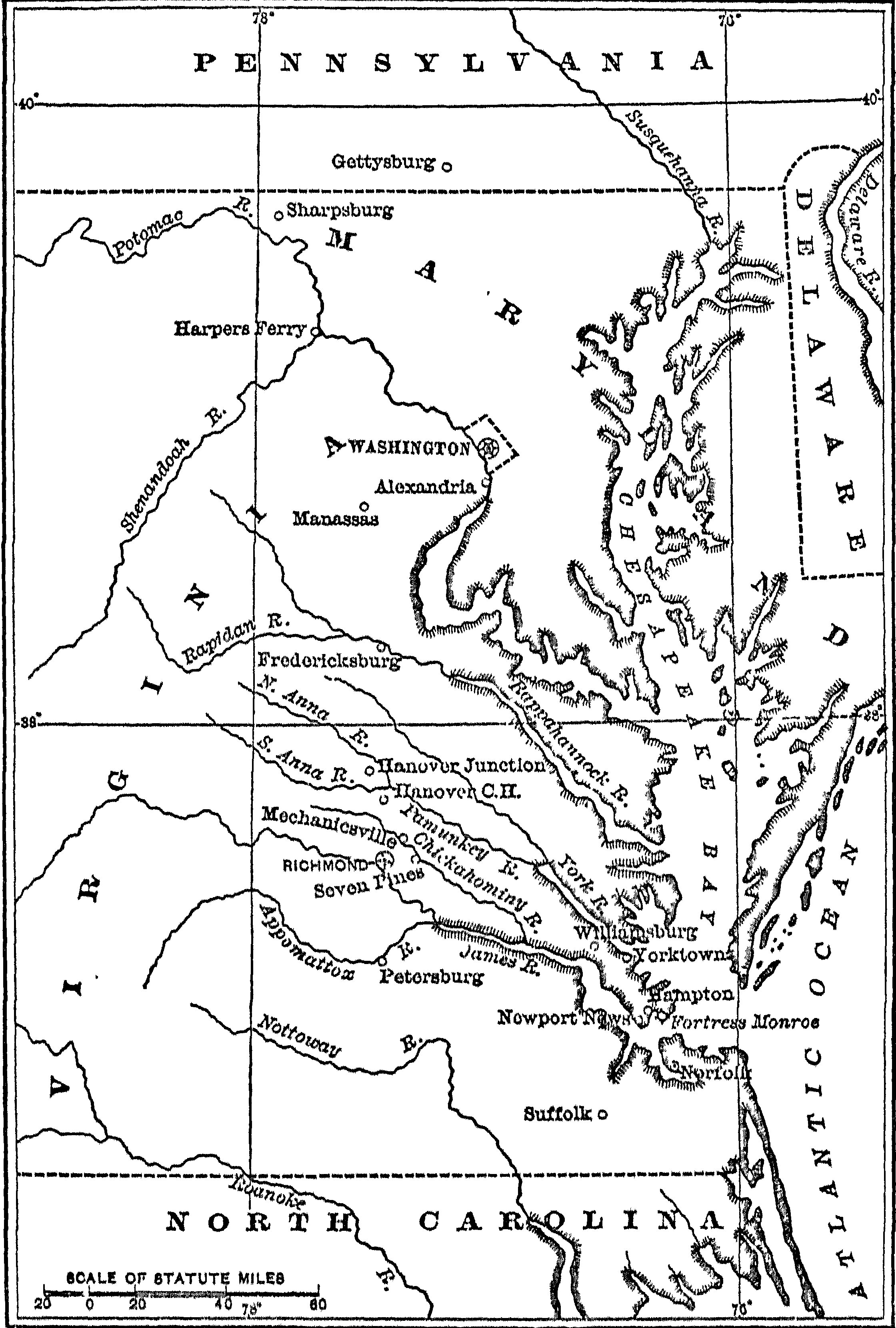
A Lesson In History
Map of Chesapeake Bay and Environs
"Do you think that my friends could help me by telling me the past? Would my memory return if I should find them?"
"No; they could give you no help whatever until you should first find one thing as a starting-point. Find but one little thing, and then they can show you how everything else is to be associated with that. Without their help you would have a hard time in collecting things--putting them together; they would be separate and distinct in your mind; if you remember but one isolated circumstance, it would be next to impossible to reconstruct. Well, let's go on and finish; we are nearly at the end, or at the beginning, for you. Where was I?
"Anderson retreated from Fredericksburg. When was that?"
"The twenty-fourth of May or twenty-fifth--say the night of the twenty-fourth."
"Well, sir."
"We had a brigade here, at Hanover Court-House--Branch's brigade. While you were retreating, and when you were very near Hanover, McClellan threw a column on Branch, and used him very severely. You were not in the fight exactly, but were in hearing of it, and saw some of Branch's men after the fight. That is how we know what brigade you belong to, although it will not claim you. You know that you are from South Carolina, and your buttons prove it; and your diary shows that you were near Branch's brigade while it was in the fight; and the only South Carolina brigade in the whole of Lee's army that had any connection with Branch, is Gregg's. Do you see?"
"I see," said I, "what is the date of that battle?"
"May 27th; your diary tells you that."
"Yes, sir."
"You continued to retreat to Richmond. So did Branch. The division you are in is A.P. Hill's. It is called the Light division. Branch's brigade is in it."
"Yes, sir; now let me see if I can call the organization of the army down to the company."
"Go ahead."
"Lee's army--"
"Yes; Army of Northern Virginia."
"What is General Lee's full name?"
"Robert E.--Robert Edward Lee, of Virginia; son of Light-Horse Harry Lee of Revolution times."
"Thank you, sir; Lee's army--A.P. Hill's division--Gregg's brigade--what is General Gregg's name?"
"Maxcy."
"Gregg's brigade--First South Carolina, Colonel Hamilton--"
"How did you know that?"
"Bellot told me; what is Colonel Hamilton's name?"
"D.H.--Daniel, I believe."
"Company H, Captain Haskell--"
"William Thompson Haskell."
"Thank you, sir; any use to write the lieutenants?"
"No."
"Well, Doctor, that brings us to date."
"Now read what you have written," he said.
I read my notes aloud, expanding the abbreviations I had made. My interest and absorption had been so intense that I could easily have called over in chronological order the principal events he had just narrated.
"Now," asked Dr. Frost, "do you believe that you can fill in the details from what you can remember of what I said?"
"Yes, sir," said I; "try me."
He asked some questions, and I replied to them.
My memory astonished him. "I must say, Jones, that you have a phenomenally good and a miraculously bad memory. You'll do," he said.
His account of the fight of the ironclads had interested me.
"What has become of the Merrimac?" I asked him.
"We had to destroy her. When Yorktown was evacuated, Norfolk had to follow suit. The Federal fleet is now in James River, some halfway down below Richmond. A blockade has been declared by Lincoln against all the ports of the South. We are exceedingly weak on the water."
On June 7,1862, I reported for duty to Captain Haskell. Dr. Frost had offered to send me over, but I preferred to go alone, and, as my strength seemed good, I made my way afoot, and with all my possessions in my pockets.
The Captain was ready for me. My name was recorded on the roll of Company H, Orderly-sergeant George Mackay writing Jones, B., in its alphabetical position.
A soldier's outfit was given to me at once, a requisition having been made before my coming. I joined the mess of the Bellots. Besides the brothers Bellot, the mess had other men with whom I formed gradually some of the ties of friendship; they were Sergeant Josey, Corporal Veitch, Privates Bail, Bee, Bell, Benton, and Box, in this alphabetical succession of names my own name being no real exception, although Captain Haskell had insisted upon the name written in the diary.
And now my duties at once began. I must relearn a soldier's drill in the manual and in everything. The company drilled four hours a day, and the regiment had one hour's battalion drill, besides dress-parade; there was roll-call in the company morning and night.
Nominally a raw recruit, I was handed over to Sergeant John Wilson, who put me singly through the exercises without arms for about four hours on my first day's duty, which was the third day of my enlistment, or perhaps I should say re-enlistment. The sergeant seemed greatly pleased with my progress, and told me that he should at once promote me to be the right guide of his awkward squad.
On the next day, therefore, I found myself drilling with three other recruits who had been members of the company for a week or more. That night Orderly-sergeant Mackay, who seemed to have received me into his good graces, told me that Wilson had said that that new man Jones beat everything that he had seen before; that learning to drill was to Jones "as easy as fallin' off a log." I remembered Dr. Frost's prediction.
The third day I drilled with the awkward squad again; but in the afternoon my gun was put into my hands, and for an extra half-hour I was exercised in the manual of arms. But my first attempts proved very unfortunate. Sergeant Wilson scolded, stormed, and almost swore at me. He placed my gun at the carry, and called repeated attention to the exact description of the position, contained in the language of Hardee: "The piece in the right hand, the barrel nearly vertical, and resting in the hollow of the shoulder; the guard to the front, the arm hanging nearly at its full length near the body; the thumb and forefinger embracing the guard, the remaining fingers closed together, and grasping the swell of the stock just under the cock, which rests on the little finger." I simply could not execute the shoulder, or carry, with any precision, although the positions of support, right-shoulder-shift, present, and all the rest, gave me no trouble after they were reached; reaching them, from the shoulder was the great trouble.
Wilson ended by ordering me off and reporting me to the Captain.
Captain Haskell sent for me. He said kindly, "Jones, Sergeant Wilson gives a bad report of you."
"I do the best I can, Captain."
"The sergeant seems to think that you are obstinate on some peculiar point that he did not make me fully understand. He gives you great praise for learning the facings and the steps, but says you will not learn the manual."
"I don't understand my awkwardness, Captain. There is something wrong about it."
"You find the manual difficult?"
"Not only difficult, but absurd," said I; "it makes me nervous."
"And the facings and steps were not difficult?"
"Not at all; they seemed easy and natural."
"Take your gun and come with me," said the Captain; "I think I have a clew to the situation."
Behind the Captain's simple quarters was an open space. He made me take position. He also took position, with a rifle at his side.
"Now, look," said he; "see this position, which I assume to be the shoulder natural to you."
His gun was at his left side, the barrel to the front, the palm of his left hand under the butt.
"Now," said he, "this is the shoulder of the heavy infantry manual. I think you were drilled once in a company which had this shoulder. It may not have been in your recent regiment that you were so drilled, for this shoulder obtained in all the militia companies of Carolina before the war. Many regiments still hold to it. Follow my motions now--Support--ARMS!"
The Captain's right hand grasped the piece at the small of the stock; his left arm was thrown across his breast, the cock resting on the forearm; his right hand fell quickly to his side.
I imitated him. I felt no nervousness, and told him so.
"I thought so," said he; "now, just remember that all the other positions in the manual are unchanged. It is only the shoulder, or carry, as we sometimes call it, that has been changed. You will like the new drill."
He began to put me through the exercises, and although I had difficulty, yet I had some success.
"Now report to Sergeant Wilson again," said the Captain.
I told the sergeant that I thought I could now do better; that I had been confused by the light infantry carry, never having seen drill except from the heavy infantry shoulder. Wilson kept me at work for almost an hour, and expressed satisfaction with my progress. Under his training I was soon able to drill with the company.
Louis Bellot asked me, one night, if I should not like to see Richmond. He had got permission to go into town on the next day. The Captain readily granted me leave of absence for twenty-four hours, and Bellot and I spent the day in rambling over the town. We saw the State House, and the Confederate Congress in session, and wandered down to the river and took a long look at the Libby Prison.
The First had been in bivouac behind the main lines of Lee's left, but now the regiment took position in the front, the lines having been extended still farther to the left. A battery at our right--some distance away--would throw a few shells over at the Yankees, and their guns would reply; beyond this almost daily artillery practice, nothing unusual occurred.
One morning, about ten o'clock, Captain Haskell ordered me to get my arms and follow him. He at once set out toward the front, Corporal Veitch being with him. The Captain was unarmed, except for his sword. He led us through our pickets and straight on toward the river. The slope of the hill was covered with sedge, and there were clumps of pine bushes which hid us from any casual view from either flank; and as for the river swamp in our front, unless a man had been on its hither edge, we were perfectly screened. I observed that, as we approached the swamp, the Captain advanced more stealthily, keeping in the thickest and tallest of the bushes. Veitch and I followed in his footsteps, bending over and slipping along from bush to bush in imitation of our leader. The river bottom, which we reached very shortly, was covered with a dense forest of large trees and undergrowth. Soon we came to water, into which the Captain waded at once, Veitch behind him and I following Veitch. Captain Haskell had not said a word to me concerning the purpose of our movements, nor do I now know what he intended, if it was not merely to learn the position of the Yankee pickets.
We went on, the water at last reaching to my waist. Now the Captain signalled us to stop. He went forward some ten yards and stood behind a tree. He looked long in his front, bending his body this way and that; then he beckoned to us to come. The undergrowth here was less thick, the trees larger. I could see nothing, in any direction, except trees and muddy water. The Captain went on again for a few paces, and stopped with a jerk. After a little he beckoned to us again. Veitch and I waded slowly on. Before we reached Captain Haskell, he motioned to us to get behind trees.
From my tree I looked out, first in one direction and then in another. There was nothing--nothing except water and woods. But the Captain was still peering from behind his tree, and I could now see that his whole attention was fixed on something. Veitch, also, at my right, was silent and alert and rigid, so that I felt, rather than saw, that there was something in front of us, and I kept my eyes intent upon a narrow aisle just beyond me. All at once a man in dark-blue dress passed across the opening; I knew instantly that he was a Yankee, although I had never seen one in my life, and instinctively felt the hammer of my rifle, but he was gone. Now, looking more closely, I could see glimpses of other blue men behind trees or in the bushes; I saw three of them. They were about sixty yards from us; I supposed they were part of their picket-line. I had a peculiar itching to take aim at one of them, and consulted the Captain with my eyes, but he frowned.
Doubtless, they had not seen us. They were on the farther side of the Chickahominy, with a flowing stream and a wide pool stretching in their front, and were not very watchful. We remained stiff in our places for four or five minutes; then the Captain moved slowly backward and gave us a sign to follow.
This little adventure gave me great pleasure, inasmuch as it made me feel that the Captain was favourable to me.
On the evening of the 25th of June we were ordered to cook three days' rations. The pronunciation of this word puzzled me no little. Everybody said rash-ons, while I, though I had never before had occasion to use the word, had thought of it as rãtions. I think I called it rãtions once or twice before I got straight. I remembered Dr. Frost's advice to hold fast any slightest clew, and felt that possibly this word might, in the future, prove a beginning.
The troops knew that the order meant a march, perhaps a battle. For a day or two past an indefinite rumour of some movement on the part of Jackson's command had circulated among the men. Nobody seemed to know where Jackson was; this, in itself, probably gave occasion for the talk. From what I could hear, it seemed to be thought generally that Jackson was marching on Washington, but some of the most serious of the men believed exactly the contrary; they believed that Jackson was very near to Lee's army.
The night of the 25th was exceedingly warm. After all was ready for the march, I lay on my blanket and tried vainly to sleep. Joe Bellot was lying not more than three feet from me, and I knew that he, too, was awake, though he did not speak or move. Busy, and sometimes confused, thoughts went through my mind. I doubted not that I should soon see actual war, and I was far from certain that I could stand it. I had never fired a shot at a man; no man had ever fired at me. I fully appreciated the fact of the difference between other men and me; perhaps I exaggerated my peculiarity. I had heard and had read that most men in battle are able from motives of pride to do their duty; but I was certainly not like most men. I was greatly troubled. The other men had homes to fight for, and that they would fight well I did not doubt at all; but I was called on to fight for an idea alone--for the abstraction called State rights. Yet I, too, surely had a home in an unknown somewhere, and these men were fighting for my home as well as theirs; if I could not fight for a home of my own, I could fight for the homes of my friends. My home, too, was a Southern home, vague, it is true, but as real as theirs, and Southern homes were in danger from the invaders. I must fight for Southern homes--for my home; but could I stand up with my comrades in the peril of battle? Few men are cowards, but was I not one of a few? perhaps unique even?
Of pride I had enough--I knew that. I knew that if I could but retain my presence of mind I could support a timid physical nature by the resources of reason in favour of my dignity; but, then, what is courage if it is not presence of mind in the midst of danger? If my mind fail, I shall have no courage: this is to think in a circle. I felt that I should prefer death to cowardice--the thought gave me momentary comfort.
But do not all cowards feel just that way before the trial comes? A coward must be the most wretched of men--not a man, an outcast from men.
And then, to kill men--was that preferable to being killed? I doubted it and--perhaps it is strange to say it--the doubt comforted me. To be killed was no worse than to kill.
Then I thought of General Lee; what force could it be that sustained him at this moment? If not now, at least shortly, he would give orders which must result in the death of thousands; it was enough to craze a general. How could he, reputed so good, give such orders? Could any success atone for so much disaster? What could be in the mind of General Lee to make him consent to such sacrifice? It must be that he feels forced; he cannot do it willingly. Would it not be preferable to give up the contest--to yield everything, rather than plunge the people of two nations into despair and horror over so many wasted lives? For so many stricken homes? For widows, orphans, poverty, ruin? What is it that sustains General Lee? It is, it must be, that he is a mere soldier and simply obeys orders. Orders from whom? President Davis. Then President Davis is responsible for all this? On him falls the burden? No. What then? The country.
And what is this thing that we call the country? Land? People? What is land? I have no land. I have no people, so far as I know. But, supposing that I have people and land--what is the country for which we fight? Will the enemy take our people, and take our land, if we do not beat them back? Yes, they will reduce our people to subjection. I shall become a dependant upon them. I shall be constrained in my liberties; part of my labour will go to them against my will. My property, if I have any, will be taken from me in some way--perhaps confiscated, if not wholly, at least in a measure, by laws of the conquerors. I shall not be free.
But am I now free? If we drive back the enemy, shall I be free? Yes, I shall be free, rightly free, free to aid the country, and to got aid from the country, I shall be part of the country and can enjoy my will, because I will to be part of my country and to help build up her greatness and sustain and improve her institutions.
Institutions? What is an institution? We say government is an institution. What is a government? Is it a body of men? No. What is it, then? Something formed by the people for their supposed good, a growth, a development--a development of what? Is it material? No, it is moral; it is soul--then I thought I could see what is meant by the country and by her institutions. The country is the spirit of the nation--and it is deathless. It is not doomed to subjection; take the land--enslave the people--and yet will that spirit live and act and have a body. Let our enemies prevail over our armies; let them destroy; yet shall all that is good in our institution be preserved even by our enemies; for a true idea is imperishable and nothing can decay but the false.
Then why fight? Because the true must always war against the false. The false and the true are enemies. But why kill the body in order to spread, or even to maintain, the truth? Will the truth be better or stronger by that?
Perhaps--yet no. War is evil and not good, and it is only by good that evil can be overcome. But if our enemies come upon us, must we not fight? The country wishes peace. Our enemies bring war. Must we submit? We cannot submit. Submission to disgrace is repugnant to the spirit of the nation; death is better than submission. But killing, is it not crime? Is crime better than submission? No; submission is better than crime But is not submission also a crime? At least it is an infringement of the law of the nation's spirit. Then crime must be opposed by crime? To avoid the crime of submission we must commit the crime of killing? It seems so--but why? But why? Ah! yes; I think I see; it is because the spirit of the nation is not equal to the spirit of the world. The world-idea forbids killing and forbids submission, and demands life and freedom for all; the spirit of the nation is not so unselfish; the spirit of the nation exalts so-called patriotism; the world-spirit raises high the principle of philanthropy universal. The country has not developed the world-idea, and will not, except feebly; but she will at last, and will be loyal to the spirit of the world. Then, unless I am sustained by a greater power, I cannot go contrary to the spirit of the South. I must kill and must be killed.
But can I stand the day of battle? Have I not argued myself into a less readiness to kill? Will these thoughts or fancies--coming to me I know not whence, and bringing to me a mental disturbance incomprehensible and unique--comfort me in the hour of danger? Will not my conscience force me to be a coward? Yet cowardice is worse than death.
I could not sleep; I was farther from sleep than ever. I rose, and walked through long lines of sleeping men--men who on the morrow might be still more soundly sleeping.
Captain Haskell was standing alone, leaning against the parapet. I approached. He spoke kindly, "Jones, you should be asleep."
"Captain," I said; "I have tried for hours to sleep, but cannot."
"Let us sit down," said he; "and we will talk it over by ourselves."
His tone was unofficial. The Captain, reserved in his conduct toward the men, seldom spoke to one of them except concerning duties, yet he was very sympathetic in personal matters, and in private talk was more courteous and kind toward a private than toward an equal. I understood well enough that it was through sympathy that he had invited me to unburden.
"Captain," I said, "I fear."
"May I ask what it is that you fear?"
"I fear that I am a coward."
"Pardon me for doubting. Why should you suppose so?"
"I have never been tried, and I dread the test."
"But," said he; "you must have forgotten. You were in a close place when you were hurt. No coward would have been where you were, if the truth has been told."
"That was not I; I am now another man."
"Allow me again to ask what it is that you seem to dread."
"Proving a coward," I replied.
"You fear that you will fear?" said he.
"That is exactly it."
"Then, my friend, what you fear is not danger, but fear."
"I fear that danger will make me fear."
"I imagine, sir, that danger makes anybody fear--at least anybody who has something more than the mere fearlessness of the brute that cannot realize danger."
"Do you fear, too, Captain?"
The Captain hesitated, and I was abashed at my boldness. I knew that his silence was rebuke.
"I will tell you how I feel, Jones, since you permit me to speak of myself," he said at last; "I feel that life is valuable, and not to be thrown away lightly. I want to live and not die; neither do I like the thought of being maimed for life. Death and wounds are very distasteful to me. I feel that my body is averse to exposing itself to pain; I fear pain; I fear death, but I do not fear fear. I do not think the fear of death is unmanly, for it is human. Those who do not fear death do not love life. Please tell me if you love life."
"I do not know, Captain; I suppose I do."
"Do you fear death?"
"What I fear now is cowardice. I suppose that if I were indifferent to death I should have no fear of being afraid."
"I am sure that you kept your presence of mind the other day, in the swamp," said he.
"I don't think I had great fear."
"Yet you were in danger there."
"Very little, I think, Captain."
"No, sir; you were in danger. At any moment a bullet might have ended your life."
"I did not realize the situation, then."
"Well, I must confess that you had the advantage of me, then," said he.
"What? You, Captain? You felt that you were in danger?"
"Yes, Jones; every moment I knew our danger."
"But you did not fear."
"May I ask if you do not regard fear as the feeling caused by a knowledge of danger?"
"I know, Captain,--I don't know how I know it,--but I know that a man may fear and yet do his duty; but there are other men, and I am afraid that I am one of them, who fear and who fail in duty."
"I congratulate you, sir; I wish all our men would fear to fail in duty," said he; "we should have an invincible army in such case. An army consisting, without exception, of such men, could not be broken. It is those who flee, those who fail in duty, that cause disorganization. The touch of the elbow is good for the weak, I think, sir; but for the man who will do his duty such dependence should not be taught. Good men, instructed to depend on comrades will be demoralized when comrades forsake them. Our method of battle ought to be changed. Our ranks should be more open. Many reasons might be urged for that change, but the one we are now considering is enough. The close line makes good men depend on weak men; when the weak fail, the strong feel a loss which is not really a loss but rather an advantage, if they could but see it so. Every man in the army ought to be taught to do his whole duty regardless of what others do. Those who cannot be so taught ought not to fight, sir; there are other duties more suited to them."
"And I fear that my case is just such a one," I said.
"There is fear and fear," said he; "how would you like for me to test you now?"
"To test me?"
"Yes; I can make you a proposition that will test your courage." His voice had become stern.
I hesitated. What was he going to do? I could not imagine. But I felt that to reject his offer would be to accept fully the position into which my fears were working to thrust me.
"Do it, Captain," said I; "make it. I want to be relieved of this suspense."
"No matter what danger you run? Is danger better than suspense concerning danger?"
I reflected again. At last I brought up all my nerve and replied, "Yes, Captain, danger is better than fear."
"Why did you hesitate? Was it through fear?"
"Yes," said I; "but not entirely through fear; I doubted that I had the right to incur danger uselessly."
"And how did you settle that?"
"I settle that by trusting to you, Captain."
He laughed; then he said: "The test that I shall give you may depress you, but I am sure that you are going to be as good a soldier as Company H can boast of having. Lieutenant Rhett, only yesterday, remarked that you were the best-drilled man in the company, and showed astonishment that a raw recruit, in less than two weeks, should gain such a standing. I thought it advisable to say to him that your education had included some military training, and he was satisfied." The Captain had dropped his official manner. "It is clear to me, Jones, that you are more nearly a veteran than any of us. I know that you have been in danger and have been wounded, and your uniform, which you were wearing then, showed signs of the very hardest service. I have little doubt, sir, that you have already seen battle more than once."
"But, Captain, all that may be true and yet do me no good at all. I am a different man."
"Since you allow me to enter into your confidence,--which I appreciate,--I beg to say that your fears are not unnatural; I think every man in the company has them. And I dare say, as a friend, that you feel fear more sensitively because you live in the subjective; you feel thrown back on yourself. Confess that you are exclusive."
"I am forced to be so, Captain."
"The men would welcome your companionship, sir."
"Yes, sir; but it is as you say: I feel thrown back on myself."
"And I think--though, of course I would not pretend to say it positively--that is why your fears are not unnatural, though peculiar; I fancy that you heighten them by your self-concentration. The world and objects in it divert other men, while your attention is upon your own feelings. Pardon me for saying that you think of little except yourself. This new old experience of battle and peril you apply without dilution to your soul, and you wonder what the effect will be. The other men think of other men, and of home, and of a thousand things. You will be all right in battle. I predict that the excitement of battle will be good for you, sir; it will force you out of yourself."
"I have tried lately to take more interest in the world of other men and other things," I said.
"Yes; I was glad to see you playing marbles to-day. Shall I give you that test?"
"Yes, sir; if you please."
"I think, however, that you have already given proof that you do not need it," said he.
"How so, Captain?"
"Why, we've been talking here for ten minutes since I proposed to test you, and you have shown no suspense whatever in regard to it. Have you lost interest in it?"
"Not at all, Captain; I have only been waiting your good time."
"And therein you have shown fortitude, which may differ from courage, but I do not think it does. I am confident you will at once reject my proposition. I don't know that I ought to make it; but, having begun, I'll finish. What I propose is this: I will assign you some special duty that will keep you out of battle--such as guarding the baggage, or other duty in the rear."
I was silent. An instant more, and I felt hurt.
"Why do you hesitate?"
"Because I did not think--" I stopped in time.
"I know, I know," said he, hastily; "and you must pardon me; but did you not urge me on?"
"I confess it, Captain; and you have done me good."
"Of course, Jones, you know that I did not expect you to accept my offer, which, after all, was merely imaginary. Now, can you not see that what you fear is men's opinions rather than danger? You are not intimidated at the prospect of battle."
"I fear that I shall be," said I.
"And yet, when I propose to keep you out of battle, your indignation seems no less natural to yourself than it does to me."
"Is not that in keeping with what I have said about my fears?"
"Oblige me by explaining."
"I fear to show you my fear. Do I not refuse your offer for the purpose of concealing my fear?"
"And to conceal your imaginary fears, you accept the possibility--the strong possibility--of death," said he, gravely.
"Yes," I replied; "I do now, while death seems far, but what I shall do when it is near is not sure."
"You are very stubborn," said the Captain, in a stern voice, assuming again the relation of an officer.
"I do not mean it that way, Captain."
"You have determined to consider yourself a coward, or at least to cherish fear; and no suggestion I can make seems to touch you."
"I wish I could banish fear," said I.
"Well, sir, determine to do it. Instead of exerting your will to make yourself miserable, use it for a better purpose."
"How can a man will? How can he know that his resolution will not weaken in the time of trial?"
"It is by willing to do what comes next that a man can again will and will more. Can you not determine that you will do what you are ordered to do? Doubtless we shall march, to-morrow; have you not decided that you will march with us?"
"I had not thought of so simple a thing. Of course, Captain, I expect to march."
"And if the march brings us upon the battlefield, do you not know that you will march to the battlefield?"
"I expect to go into battle, of course, Captain. If I did not, I should have no fear of myself."
"Have as great fear of yourself as you wish. Do you intend to run away when we get into battle?"
"I have no such intention; but when the time comes, I may not be able to have any intention at all."
"At what point in the action do you expect to weaken?"
"How can I have any expectation at all? I am simply untried, and fear the test."
"You can determine that you will act the man," said he. Then, kindly: "I have no fears that you will do otherwise, but"--and here his voice again became stern--"the determination will rid you of your present fears. Exert your will, and this nightmare will go."
"Can a man will to do an unknown thing in the future?"
"You can. You can drive away your present fear of yourself, at the very least."
"How can I do it, Captain?"
"I shall give you one more test."
"Do anything you wish, Captain; only don't propose anything that would confirm my fear."
"Look at me--now. I am going to count three--understand?"
"Yes, sir."
"When I say 'three,' you will determine to continue in your present state of mind--"
"No, no, Captain; I can't do that!"
"Why, you've been doing nothing else for the last hour, man! But allow me to finish. You are going to determine to remain as you are, or you will determine to conquer your fears. Now, reflect before I begin."
There was a pause.
"Ready!" said the Captain; "hold your teeth together. When I say three, you act--and act for life or death--ONE--TWO--"
If he ever said three, I did not hear it; at the word "two" all my fears were gone.
"Well, my friend, how is it now?" he asked gently, even hesitatingly.
"Captain," said; "I am your grateful servant. I shall do my duty."
"I knew, sir, that your will was only sleeping; you must excuse me for employing a disagreeable device in order to arouse it. If I may make a suggestion, I would now beg, while you are in the vein, that you will encourage henceforth, the companionship of the men."
"It will be a pleasure to do so, hereafter, Captain."
"And I am delighted with this little episode, sir," said he; "I am sincerely glad that the thought of confiding in me presented itself to your mind, since the result seems so wholesome."
"Good night, Captain," said I.
But he did not let me leave without thus having reasserted his character as my commander.
"Go back and get all the sleep you can; you will have need for all your physical strength to-morrow--and after."
I was almost happy.
It is said that a word may change a life. Actually? No, not of itself; the life which is changed must be ready for the word, else we were creatures dominated by our surroundings.
I had been a fragment,--a sort of moral flotsam cast up by an unknown sea,--and I had found a rude harbour in Company H. If I touched a larger world, it was only through the medium of the company in its relations to that world. I had formed some attachments,--ties which have lasted through life thus far, and will always last,--but these attachments were immediate only, and, so far as I felt, were almost baseless; for not directly could I see and feel what was felt by the men I loved. Outside the narrow bounds of the company my world was all abstract. I fought for that world, for it appealed to my reason; but it was with effort that I called before my mind that world, which was a very present help to every other man. The one great fact was war; the world was an ideal world rather than a reality. And I frequently felt that, although the ideal after all is the only reality, yet that reality to me must be lacking in the varying quality of light, and the delicate degrees of sweetness and truth which home and friends and all the material good of earth were said to assume for charming their possessors. The day brought me into contact with men; the night left me alone with myself. In my presence men spoke of homes far away, of mothers, of sisters, of wives and children. I could see how deep was the interest which moved them to speak, and, in a measure, they had my sympathy; yet such interest was mystery rather than fact, theoretical rather than practical. I could fill these pages with pathetic and humorous sayings heard in the camps, for my memory peculiarly exerted itself to retain--or rather, I should say, spontaneously retained--what I saw and heard; saw and heard with the least emotion, perhaps, ever experienced by a soldier. Absorbed in reflections on what I heard, and in fancies of a world of which I knew so little, it is not to be doubted that I constructed ideals far beyond the humdrum reality of home life, impracticable ideals that tended only to separate me more from other men. Their world was not my world; this I knew full well, and I sometimes thought they knew it; for while no rude treatment marked their intercourse with me, yet few sought me as a friend. My weak attempts to become companionable had failed and had left me more morose. But for the Captain and for Joe Bellot, I should have been hopeless.
Such had been my feelings before I had willed; now, in a degree, everything was changed; indifference, at least, was gone, and although I was yet subject to the strange experience which ruled my mind and hindered it, yet I knew that I had large power over myself, and I hoped that I should always determine to live the life of a healthy human being, that I should be able to accept the relationships which, through Company H, bound me to all men and all things, and that my interest henceforth would be diversified--touching the world and what is in it rather than myself alone. But this was mere hope; the only certain change was in the banishment of my former indifference.
The morning of Thursday, the 26th of June, passed away, and we yet held our place in the line. At two o'clock the long roll was heard in every regiment. Our knapsacks had been piled, to be stored in Richmond.
"Fall in, Company H! Fall in, men! Fall in promptly!" shouted Orderly-sergeant Mackay.
By fours we went to rear and left, then northward at a rapid stride. Some of the men tried to jest, and failed.
At three o'clock we were crossing Meadow Bridge; we could see before us and behind us long lines of infantry--Lee's left wing in motion.
Beyond the bridge the column filed right; A.P. Hill came riding back along the line of the Light Division.
Suddenly, from over the hills a mile and more away, comes the roar of cannon. We leave the road and march through fields and meadows; the passing of the troops ahead has cleared the way; we go through gaps in rail fences.
And now we hear the crash of small arms, and smoke is rising from our left oblique. We are yet under the hill. We halt and wait. The noise of battle grows. Sunset comes--we move. The next company on our right is passing through a gap in a fence. A shell strikes the topmost rail at the left and hurls it clear over their heads. Then I see men pale, and I know that my own face is white.
Shells fly over us. We lie down on the slope of a hill which rises to our left, and darkness grows, and the noises cease. No breaking of ranks for rest or for water; the long night through we lie on our arms.
Morning comes; we have no water; the men eat their rations dry. At sunrise the march is again begun, through fields and woods and down country roads; we go southeast.
The Yankees have gone. At nine o'clock we halt; a field. Company C, the right of the regiment; is thrown forward as skirmishers.
Again we march; again we halt, the brigade in line of battle. An orderly comes to Captain Haskell.
"Company H! ATTENTION!"
Every man is in his place--alert.
"Forward--MARCH!"
"By the right flank--MARCH!"
"HALT!--FRONT!"
"Company--as skirmishers--on the right file--take intervals--double-quick--MARCH!"
I did not have very far to go. The company was deployed on the left of Company C. Then we went forward in line for half a mile or more, through woods and fields, the brigade following in line of battle.
About eleven o'clock we had before us an extensive piece of open land--uncultivated, level, and dry. In the edge of the woods we had halted, so that we might not get too far ahead of the brigade. From this position we saw--some six hundred yards at our left oblique--a group of horsemen ride out into the field, seemingly upon a road, or line, that would intersect our line of advance. Our men were at once in place. The distance was too great to tell the uniforms of the party of horsemen; but, of course, they could be only Yankees.
Captain Haskell ordered Dave Bellot to step out of the line. The horsemen had halted; they were a small party, not more than fifteen or twenty. Captain Haskell ordered Bellot to take good aim at the most eligible one of the group, and fire.
Bellot knelt on one knee, raised his sight, put his rifle to his shoulder, and lowered it again. "Captain," said he, "I am afraid to fire; they may be our men."
The Captain made no reply; he seemed to hesitate; then he put his handkerchief on the point of his sword and walked forward. A horseman advanced to meet him. Captain Haskell returned to Company H, and said, "They are General Jackson and his staff."
Again we went forward. Prom the brow of a hill we could see tents--a camp, a Yankee camp--on the next hill, and we could see a few men running away from it. We reached the camp. It had been abandoned hurriedly. Our men did not keep their lines perfectly; they were curious to see what was in the tents. Suddenly the cracking of rifles was heard, and the singing of bullets, and the voice of Captain Haskell commanding, "Lie down!"
Each man found what shelter was nearest. I was behind a tent. The Yankee skirmishers were just beyond a little valley, behind trees on the opposite hill, about two hundred yards from us. I could see them looking out from behind the trees and firing. I took good aim at one and pulled the trigger; his bullet came back at me; I loaded and fired; I saw him no more, but I could see the smoke shoot out from the side of the tree and hear his bullet sing. I thought that I ought to have hit him; I saw him again, and fired, and missed. Then I carefully considered the distance, and concluded that it was greater than I had first thought. I raised the sliding sight to three hundred yards, and fired again at the man, whom I could now see distinctly. A man dropped or leaped from the tree, and I saw him no more; neither did I see again the man behind the tree.
We had had losses. Veitch and Crawford had been shot fatally; other men slightly. The sun was shining hot upon us. The brigade was behind us, waiting for us to dislodge the skirmishers. Suddenly I heard Captain Haskell's voice ordering us forward at double-quick. We ran down the hill into the valley below; there we found a shallow creek with steep banks covered with briers. We beat down the briers with our guns, and scrambled through to the other side of the creek in time to see the Yankees run scattering through the woods and away. We reached their position and rested while the brigade found a crossing and formed again in our rear. I searched for a wounded man at the foot of a tree, but found none; yet I felt sure that I had fired over my man and had knocked another out from the tree above him.
We advanced again, and had a running fight for an hour or more. At length no Yankees were to be seen; doubtless they had completed the withdrawing of their outposts, and we were not to find them again until we should strike their main lines.
Now we advanced for a long distance; troops--no doubt Jackson's--could be seen at intervals marching rapidly on our left, marching forward and yet at a distance from our own line. We reached an elevated clearing, and halted. The brigade came up, and we returned to our position in the line of battle--on the left of the First. It was about three o'clock; to the right, far away, we could hear the pounding of artillery, while to the southeast, somewhere near the centre of Lee's lines, on the other side of the Chickahominy perhaps, the noise of battle rose and fell. Shells from our front came among us. A battery--Crenshaw's--galloped headlong into position on the right of the brigade, and began firing. The line of infantry hugged the ground.
Three hundred yards in front the surface sloped downward to a hollow; the slope and the hollow were covered with forest; what was on the hill beyond we could not see, but the Yankee batteries were there and at work. A caisson of Crenshaw's exploded. Troops were coming into line far to our right.
General Gregg ordered his brigade forward. We marched down the wooded slope, Crenshaw firing over our heads. We marched across the wooded hollow and began to ascend the slope of the opposite hill, still in the woods.
The advance through the trees had scattered the line; we halted and re-formed. The pattering of bullets amongst the leaves was distinct; shells shrieked over us; we lay down in line. Between the trunks of the trees we could see open ground in front; it was thick with men firing into us in the woods. Those in our front were Zouaves, with big, baggy, red breeches. We began to fire kneeling. Leaves fell from branches above us, and branches fell, cut down by artillery. Butler, of our company, lying at my right hand, gave a howl of pain; his head was bathed in blood. Lieutenant Rhett was dead. Rice, at my left, had found whiskey in the Yankee camp. He had drunk the whiskey. He raised himself, took long aim, and fired; lowered his gun, but not his body, gazing to see the effect, and yelled, "By God, I missed him!" McKenzie was shot. Lieutenant Barnwell was shot. The red-legged men were there and thicker. Our colour went down, and rose. We had gone into battle with two colours,--the blue regimental State flag, and the battle-flag of the Confederate infantry. Lieutenant-colonel Smith had fallen.
A lull came. I heard the shrill voice of Gregg:--
"Bri-ga-a-a-de--ATTENTION!"
"Fi-i-i-x--BAYONETS!"
"For-w-a-r-d--" and the next I knew men were dropping down all around me, and we were advancing. But only for a minute did we go forward. From front and left came a tempest of lead; again the colours--both--fell, and all the colour-guard. The colonel raised the colours. We staggered and fell back; the retreat through the woods became disorder.
On top of our hill I could see but few men whom I knew,--only six, but one of the six was Haskell. The enemy had not advanced, but shell and shot yet raked the hill. Crenshaw's battery was again in full action. We hunted our regiment and failed to find it. Some regiment--the Thirtieth North Carolina--was advancing on our right. Captain Haskell and his six men joined this regiment, placing themselves on its left. The Thirtieth went forward through the woods--reached the open--and charged.
The regiment charged boldly; forward straight it went, no man seeing whither, every man with his mouth stretched wide and his voice at its worst.
Suddenly, down to the ground fell every man; the line had found a sunken road, and the temptation was too great--down into the friendly road we fell, and lay with bodies flat and faces in the dust.
The officers waved their swords; they threatened the men; the men calmly looked at their officers.
A man on a great horse rode up and down the line urging, gesticulating. He got near to Haskell--
"Who are you?" shouted our Captain.
"Captain Blount--quartermaster fourth North Carolina."
"We will follow you!" shouted Haskell.
Blount rode on his great horse--he rode to the centre of the Thirtieth--he stooped; he seized the colour--he lifted the battle-flag high in the air--he turned his great horse--he rode up the hill.
Then those men lying in the sunken road sprang to their feet, and followed their flag fluttering in front, and made the world hideous with yells.
And the red flag went down--and Blount was dead--and the great horse was lying on his side and kicking the air--and the hill was gained.
The Thirtieth was disorganized by its advance. Another North Carolina regiment came from the right rear. Haskell and his six were yet unbroken; they joined the advancing regiment, keeping on its left, and charged with it for another position. Believe it or not, the same thing recurred; the regiment charged well; from the smoke in front death came out upon it fast; a sunken road was to be crossed, and was not crossed; down the men all went to save their lives.
And the officers waved their swords, and the men remained in the road.
Now the Captain called the six, and ran to the centre of the regiment; he snatched the flag and rushed forward up the slope--he looked not back, but forward.
The six were on the slope--the Captain was farthest forward--one of the six fell--in falling his face was turned back--he saw that the regiment was yet in the sunken road, and he shouted to his Captain and told him that the regiment did not follow.
The Captain came back, and said tenderly, "Ah! Jones? What did I tell you? Are you hurt badly? I will send for you."
Then the Captain and five turned away to the right, for the flag would not be taken back to the regiment lying down.
On an open hill between the two battling hosts I was lying. The bullets and shells came from front and rear. The blue men came on--and the others went back awhile. I fired at the blue men, and tried to load, but could not. I felt a great pain strike under my belt and was afraid to look, for I knew the part was mortal. But at length I exerted my will, and controlled my fear, and saw my trousers torn. My first wound had deadened my leg, but I felt no great pain--the leg was numb. The new blow was torture. I managed to take down my clothing, and saw a great blue-black spot on my groin. I was confused, and wondered where the bullet went, and perhaps became unconscious.
Darkness was coming, and Jones or Berwick, or whoever I was, yet lay on the hill. Now there were dead men and wounded men around me. Had a tide of war flowed over me while I slept? A voice feebly called for help, and I crawled to the voice, but could give no help except to cut a shoe from a crushed foot. The flashes of rifles could be seen,--the enemy's rifles,--they came nearer and nearer, and I felt doomed to capture.
Then from the rear a roar of voices, and in the gathering gloom a host of men swept over me, disorderly, but charging hard--- the last charge of Gaines's Mill.
"What troops are you?" I had strength to ask, and two replied:--
"Hood's brigade."
"The Hampton Legion."
Night had come. The great battle was won. Lights flashed and moved and disappeared over the hills and hollows of the field,--men with torches and lanterns; and names of regiments were shouted into the darkness by the searchers for wounded friends who replied, and for others who could not. At last I heard: "First South Carolina! First South Carolina!" and I gathered up my strength and cried, "Here!" Louis Bellot and two others came to me. They carried me tenderly away, but not far; still in the field of blood they laid me down on the hillside--and a night of horror passed slowly away.
The next morning, June 28th, they bore me on a stretcher back to the field hospital near Dr. Gaines's, just in rear of the battlefield. Our way was through scattered corpses. We passed by many Zouaves, lying stiff and stark; one I shall always call to mind: he was lying flat on his back, the soles of his feet firm on the ground, his knees drawn up to right angles above, and with his elbows planted on the grass, his fingers clinched the air. His open mouth grinned ghastly on us as we went by.
At the field hospital the dangerously wounded were so numerous that I was barely noticed; a brief examination; "flesh wound"--that was all. I had already found out that the bullet had passed entirely through the fleshy part of my thigh, and I had no fears; but the limb now gave me great pain, and I should have been glad to have it dressed. I was laid upon the ground under a tree and remained there until night, when I was put with others into an ambulance and taken to some station on some railroad--I have never known what station or what road. The journey was painful. I was in the upper story of the ambulance. We jolted over rough roads, halting frequently because the long train filled the road ahead. The men in the lower story were badly wounded, groaning, and begging for this or that. I did not know their voices; they were not of our company. But some time in the night I learned somehow--I suppose by his companion calling his name--that one of the men below me was named Virgil Harley. Harley? I thought--Virgil Harley? Why, I knew that name once! Surely I knew that name in South Carolina! And I would have spoken, but was made aware that Virgil Harley was wounded unto death. When we reached the railroad, I was taken out and lifted into a car, I asked about Virgil Harley. "He is dead," was the answer.
Then I felt more than ever alone because of this slightest opportunity, now lost forever. Virgil Harley might have been able to tell me of myself. He was dead. I had not even seen him. I had but heard his voice in groans that ended in the death-rattle.
When the train of wounded arrived in Richmond, it was early morning. Many men and women had forsaken their beds to minister unto the needs of the suffering; delicacies were served bountifully, and hearts as well as stomachs were cheered; there were evidences of sympathy and honour on every hand.
Late in the forenoon I was taken to Byrd Island Hospital--an old tobacco factory now turned into something far different. My clothing was cut from me and taken away. Then my wound--full of dirt and even worms--was carefully dressed. The next morning the nurse brought me the contents of my pockets. She gave me, among the rest, a marble and a flattened musket-ball, which, she had found in the watch-pocket of my trousers. Now I recalled that I had put my "taw" in that pocket; the bullet had struck the marble, which had saved me from a serious if not fatal wound.
The ward in which I found myself contained perhaps a hundred wounded men, not one of whom I knew, though there were a few belonging to my regiment--other companies than mine. Acquaintance was quickly made, however, by men on adjoining cots; but no man, I think, was ever called by his name. He was Georgia, or Alabama,--his State, whatever that was. My neighbours called me, of course, South Carolina.
Many had fatal wounds; almost every morning showed a vacant cot. I remember that the man on the next cot at my left, whose name in ward vernacular was Alabama, had a story to tell. One morning I noticed that he was wearing a clean white homespun shirt on which were amazingly big blue buttons. I allowed myself to ask him why such buttons had been used. He replied that, a month before he had been on furlough at his home in Alabama, and that his mother had made him two new shirts, and had made use of the extraordinary objects which I now saw because they were all she had. He had told her jestingly that she was putting that big blue button on the middle of his breast to be a target for some Yankee; and, sure enough, the wound which had sent him to the hospital was a rifle shot that struck the middle button. I laughed, and Alabama laughed, too, but not long. He died.
For nearly two months I remained in this woful hospital. Life there was totally void of incident. After the first week, in which we learned of the further successes of the Confederate arms and of our final check at Malvern Hill, anxiety was no longer felt concerning Lee's army, now doing nothing more than watching McClellan, who had intrenched on the river below Richmond, under the protection of the Federal fleet. We learned with some degree of interest that another Federal army was organizing under General Pope somewhere near Warrenton; but Southern hopes were so high in consequence of the ruin of McClellan's campaign, and the manifest safety of Richmond, that the new army gave us no concern; of course I am speaking of the common soldiers amongst whom I found myself.
At the end of a fortnight my wound was beginning to heal a little, and in ten days more I began to hobble about the room on crutches. On the first day of August I was surprised to see Joe Bellot enter the ward. The brigade had marched into Richmond, and was about to take the cars for Gordonsville in order to join Jackson, who was making head against Pope. It was only a few minutes that Bellot could stay with me; he had to hurry back to the command.
Then I became restless. The surgeons told me that I could get a furlough; but what did I want with a furlough? To go home? My home was Company H.
I was limping about without crutches, and getting strong rapidly, when the papers told us of Jackson's encounter with Banks at Cedar Run. Then my feverish anxiety to see the one or two persons in the world whom I loved became intense. I walked into the surgeon's office, keeping myself straight, and asked an order remanding me to my company. He flatly refused to give it. Said he, "You would never reach your company; where is it, by the way?"
"Near Gordonsville, somewhere," said I.
"I will find out to-day; come to me to-morrow morning."
On the next day he said, "Your regiment is on the Rapidan. You would have to walk at least twenty miles from Gordonsville; it would be insane."
"Doctor," said I, "I am confident that I can march."
"Yes," said he; "so am I; you can march just about a mile and a half by getting somebody to tote your gun and knapsack. Come to me again in about a week."
I came to him four days afterward, and worried him into giving me my papers, by means of which I got transportation to Gordonsville, where I arrived, in company with many soldiers returning to their commands, on August 22d. From Gordonsville I took the road north afoot. There was no difficulty in knowing the way, for there was no lack of men and wagons going and returning. I had filled a haversack with food before I left Richmond--enough for two days. My haversack, canteen, and a blanket were all my possessions.
At about two o'clock the next day, as I was plodding over a hot dusty road somewhere in Culpeper County, I met a wagon, which stopped as I approached. The teamster beckoned to me to come to him. He said: "Don't go up that hill yonder. There is a crazy man in the road and he's a-tryin' to shoot everybody he sees. Better go round him." I thanked the teamster, who drove on. At the foot of the ascending hill I looked ahead to see whether there was a way to get round it, but the road seemed better than any other way. Heavy clouds were rolling up from the south, with wind and thunder. A farmhouse was on the hill at the left of the road; I wanted to get there if possible before the rain. In the road I saw nobody. I walked up the hill, thinking that, after all, my friend the wagoner was playing a practical joke upon me. All at once, from the side of the road, a Confederate soldier showed himself. He sprang into the middle of the road some six paces in front of me, presented his gun at me with deliberate aim, and pulled the trigger without saying a word. Altogether it was a very odd performance on his part and an unpleasant experience for me. When his gun failed to fire, he changed his attitude at once, and began the second part of his programme. He dropped his piece to the position of ordered arms, kept himself erect as on dress-parade, raised his right hand high, and shouted, "The cannons! the cannons!"
I stood and looked at him ten seconds; then I tried to slip round him, keeping my eyes on him, however, for fear that his gun might, after all, be loaded; he faced me again, and repeated his cry, "The cannons! the cannons!"
The rain was beginning to fall in big drops. I rushed past him, and seeing--nearer to me than the house--some immense haystacks with overhanging projections resulting from continued invasion by cattle, I was soon under their sheltering eaves. As I ran, I could hear behind me the warning voice of the soldier, who evidently had lost his reason in battle.
As night fell on the 24th I was standing behind a tree, waiting to surprise Company H. I had reached the lines while they were moving; Hill's Light Division was passing me. Soon came General Gregg, riding at the head of his brigade; then one regiment after another till the last--the First--appeared in sight, with Company C leading. I remained behind the tree; at last I could see Captain Haskell marching by the side of Orderly-sergeant Mackay; then I stepped out and marched by the side of the Captain. At first, in the twilight, he did not know me; then, with a touch of gladness in his voice, he said: "I did not expect you back so soon. Are you fully recovered?"
"I report for duty, Captain," I replied.
He made me keep by his side until we halted for the night, and had me tell him my experiences in the hospital and on the road. He informed me briefly of the movements which had taken place recently. The regiment had been under fire in the battle with Banks, but had not suffered any loss. On this day--the 24th--the regiment had been under fire of the Federal artillery on the Rappahannock. We were now near the river at a place called Jeffersonton, and were apparently entering upon the first movements of an active campaign.
The company was much smaller than I had known it. We had lost in the battles of the Chickahominy many men and officers. Disease and hardship had further decreased our ranks. Captain Haskell was almost the only officer in the company. My mess had broken up. There were but four remaining of the original nine, and these four had found it more convenient for two men, or even one, to form a mess. I found a companion in Joe Bellot, whose brother had been wounded severely at Gaines's Mill. Bellot had a big quart cup in which we boiled soup, and coffee when we had any, or burnt-bread for coffee when the real stuff was lacking. Flour and bacon were issued to the men. We kneaded dough on an oilcloth, or gum-blanket as the Yankee prisoners called it, and baked the dough by spreading it on barrel-heads and propping them before the fire. When these boards were not to be had, we made the dough into long slender rolls, which, we twined about an iron ramrod and put before the fire on wooden forks stuck in the ground. My haversack of food brought from Richmond was exhausted; this night but one day's ration was issued.
On the next morning Jackson began his movement around Pope's right. I had no rifle, or cartridge-box, or knapsack, and managed so as to keep up. Being unarmed, I was allowed to march at will--in the ranks or not, as I chose. The company numbered thirty-one men. The day's march was something terrible. We went west, and northwest, and north, fording streams, taking short cuts across fields, hurrying on and on. No train of wagons delayed our march; our next rations must be won from the enemy. Jackson's rule in marching was two miles in fifty minutes, then ten minutes rest,--but this day there was no rule; we simply marched, and rested only when obstacles compelled a halt,--which loss must at once be made up by extra exertion. At night we went into bivouac near a village called Salem. We were now some ten or fifteen miles to the west of Pope's right flank.
There were no rations, and the men were broken and hungry. A detail from each company was ordered to gather the green ears from some fields of corn purchased for the use of the government. That night I committed the crime of eating eighteen of the ears half roasted.
At daylight on the 26th we again took up the march. I soon straggled. I was deathly sick. Captain Haskell tried to find a place for me in some ambulance, but failed. I went aside into thick woods and lay down; I slept, and when I awoke the sun was in mid-heaven, and Jackson's corps was ten miles ahead, but I was no longer ill. The troops had all passed me; there were no men on the road except a few stragglers like myself. I hurried forward through White Plains--then along a railroad through a gap in some mountains--then through Gainesville at dark--and at last, about ten o'clock at night, after questioning until I was almost in despair, I found Company H asleep in a clover field. Still no rations.
Before dawn of the 27th we were waked by the sound of musketry toward the east--seemingly more than two miles away. We moved at sunrise, and soon reached Manassas Junction, already held by our troops. Up to this time I had been unarmed, and all the men destitute of food; here now was an embarrassment of riches. I got a short Enfield rifle, marked for eleven hundred yards. Everything was in abundance except good water. The troops of Jackson and Ewell and Hill crammed their haversacks, and loaded themselves with whatever their fancies chose--ludicrous fancies in too many cases. Hams could be seen on bayonets. Comstock got a lot of smoking tobacco and held to it tenaciously, refusing to divide. Cans of vegetables, and sardines, and preserved fruits; coffee, sugar, tea, medicines--everything, even to women's wearing apparel, was taken or burnt. Our regiment lay by a muddy pool whose water we were forced to drink, though filth--even horses' bones--lay on its margin, and I know not what horrors beneath its green, slimy surface. Before daylight of the 28th we marched northward in the glare of the burning cars and camps. We crossed Bull Run on a bridge, some of the men fording; here we got better water, but not good water.
In the forenoon we readied Centreville and halted. Nobody seemed to know the purpose of this movement toward the north. Were we making for Washington? I had the chance of speaking to the Captain. He told me that he thought Jackson's corps was in a close place, but that he had no doubt we should be able to hold our own until Longstreet could force his way to our help. We were between Pope's army and Washington, and it was certain that Pope would make every effort to crush Jackson.
About two o'clock the troops were put in motion, heading west, down the Warrenton pike. It now appeared that only A. P. Hill's division had marched to Centreville; the other divisions of Jackson's corps were at the west, and beyond Bull Run. After matching a mile or two we could see to the eastward and south, great clouds of dust rolling up above the woods, evidently made by a column in march upon the road by which, we had that morning advanced from Manassas to Centreville. We knew that Pope's army--or a great part of it--was making that dust, and that Pope was hot after Jackson. We crossed Bull Run on the stone bridge and halted in the road. It was about five o'clock; the men were weary--most of us had loaded ourselves too heavily with the spoils of Manassas and were repenting, but few had as yet begun to throw away their booty. My increased burden bore upon me, but I had as yet held out; in fact, the greater part of my load--beyond weapon, and accoutrements--consisted in food which diminished at short intervals. We could not yet expect rations.
We had rested perhaps half an hour. Again we were ordered to march, and moved to the right through woods and fields, and formed line facing south. How long our line was I did not know; I supposed the whole of Hill's division was there, though I could see only our regiment. Soon firing began at our right and right front; it increased in volume, and artillery and musketry roared and subsided until dark and after. At dark, the brigade again moved to the right, seemingly to support the troops that had been engaged, and which we found to be Ewell's division.
We lay on our arms in columns of regiments. We were ordered to preserve the strictest silence. We were told that a heavy column of the enemy was passing just beyond the hills in front of us. Suddenly the sound of many voices broke out beyond the hills. The Federal column was cheering. Near and far the cry rose and fell as one command after another took it from the next. What the noise was made for I never knew; probably Pope's sanguine order, in which he expressed the certainty of having "the whole crowd bagged," had been made known to his troops for the purpose of encouraging them. Our men were silent, even gloomy, not knowing what good fortune had made our enemies sound such high, triumphant notes; yet I believe that every man, as he lay in his unknown position that night, had confidence that in the battle of the morrow, now looked for as a certainty, the genius of Lee and of Jackson would guide us to one more victory.
Early on the morning of Friday, the 29th, we moved, but where I do not know--only that we moved in a circuitous way, and not very far, and that when we again formed line, we seemed to be facing northeast. Already the sound of musketry and cannon had been heard close in our front. Our regiment, left in front, was in the woods. We brought our right in front, and then the brigade moved forward down a slope to an unfinished railroad.
Comstock had given away all of his smoking tobacco, saying that he would not need it.
Company H had been thrown out to left and front as skirmishers. The regiment moved across the railroad and through the woods into the fields beyond, far to the right of the position held by Company H. The regiment met the enemy in heavy force; additional regiments from the brigade were hurried to the support of the First, which, by this time, was falling back before a full division of the enemy. The brigade retired in good order to the railroad, and Company H was ordered back into the battle line on the left of the First.
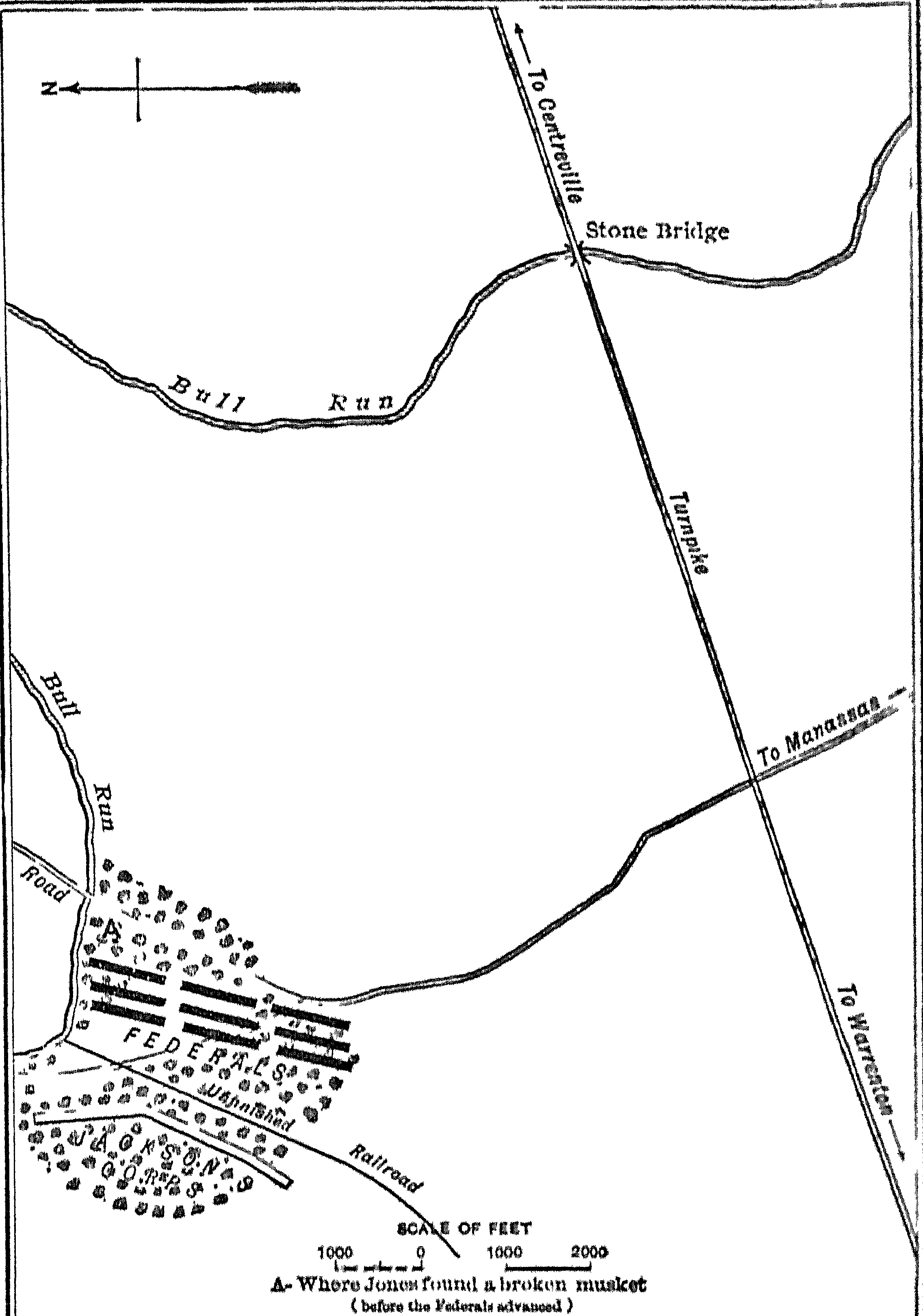
Map entitled "SECOND MANASSAS, Aug. 29, 1882"
It was almost ten o'clock. Four companies of the First regiment, under Captain Shooter, were now ordered forward through the woods as skirmishers; on the left of this force was Haskell's company. We came up with the enemy's skirmishers posted behind trees, and began firing. We advanced, driving the Yankee skirmish-line slowly through the woods. After some fluctuations in the fight, seeing that our small force was much too far from support, order was given to the skirmishers to retire; a heavy line of the enemy had been developed. This order did not reach my ears. I suppose that I was in the very act of firing when the order was given. While reloading, I became aware that the company had retired, as I could see no man to my right or left. Looking round, I saw the line some thirty yards in my rear, moving back toward the brigade. Now I feared that in retreating, my body would be a target for many rifles. The Yankees were not advancing. I sprang back quickly from my tree to another. Rifles cracked. Again I made a similar movement--and again--at each tree, as I got behind it, pausing and considering in front. At last I was out of sight of the enemy, and also out of sight of Company H.
The toils of the last week had been hard upon me. My wounded leg had not regained its full strength. I was hot and thirsty as well as weak. I crossed a wet place in the low woods and looked for water. Still no enemy was pursuing. I searched for a spring or pool, following the wet place down a gentle slope, which inclined to my right oblique as I retreated. Soon I found a branch and drank my fill; then I filled my canteen and rose to my feet refreshed.
Just below me, uprooted by some storm, lay a giant poplar spanning the little brook. I stepped upon the log and stood there for a second. Here was a natural retreat. If I had wanted to hide, this spot was what I should have chosen. The boughs of the fallen tree, mingling with the copse, made a complete hiding-place.
The more I looked, the more the spot seemed to bind me. I began to wonder. Surely this was not my first sight of this spot. Had I crossed here in the morning? No; we had moved forward much to the right. What was the secret of the influence which the spot held over me? I had seen it before or I had dreamed of it. I was greatly puzzled.
On the ground lay the broken parts of a rust-eaten musket. I picked up the barrel; it was bent; I threw it down and picked up the stock. Why should I be interested in this broken gun? I knew not, but I knew that I was drawn in some way by it. On the stock were carved the letters J. B. Who had owned this gun? John Brown? James Butler? Then the thought came suddenly--why not Jones Berwick? No! That was absurd! But why absurd? Did I know who I was, or where I had been, or where I had not been?
A shot and then another rang out in the woods at my left; I dropped the gun and ran.
I soon overtook Company H retiring slowly through the woods. And now we made a stand, as the brigade was in supporting distance. Our position was perhaps three hundred yards in front of the brigade, which was posted behind the old railroad. Thick woods were all around us. Soon the blue skirmishers came in sight, and we began firing. The Federals sprang at once to trees and began popping away at us. The range was close. Grant was mortally hit. My group of four on that day was reduced to one man. Goettee fell, and Godley. We kept up the fight. But now a blue line of battle could be seen advancing behind the skirmishers. They kept coming, reserving their fire until they should pass beyond their skirmish-line. We should have withdrawn at once, but waited until the line of battle had reached the skirmishers before we were ordered to fall back. When we began to retire, the line of battle opened upon us, and we lost some men.
Company H formed in its place on the left of the First, which was now the left regiment of the brigade, of the division, and of the corps. Company H was in the air at the left of Jackson's line.
General Lee had planned to place Jackson's corps in rear of Pope's army, without severing communication with Longstreet; but the developments of the campaign had thrown Jackson between Pope and Washington while yet the corps of Longstreet was two days' march behind, and beyond the Bull Run mountains. Pope had made dispositions to crush Jackson; to delay Longstreet he occupied with a division Thoroughfare Gap,--through which Jackson had marched and I had straggled on the 26th,--and with his other divisions had marched on Manassas. Jackson had thus been forced to retreat toward the north in order to gain time. When Hill's division reached Centreville, it turned west, as already related, and while Pope was marching on Centreville Jackson was marching to get nearer Longstreet. This placed Ricketts's division of Pope's army, which had occupied Thoroughfare Gap for the purpose of preventing the passage of Longstreet, between Longstreet and Jackson. Ricketts was thus forced to yield the gap after having delayed Longstreet during the night of the 28th. Pope could now have retired to Washington without a battle, but he decided to overwhelm Jackson before Longstreet could reach the field, and attacked hotly on the Confederate left.
The battle of Friday, the 29th of August, was fought then in consequence of the double motive already hinted at, namely, that of Pope to overwhelm Jackson, and of Jackson to resist and hold Pope until Longstreet came. Jackson's manoeuvres had brought him within six hours' march of Longstreet, and while Jackson's men were dying in the woods, Longstreet's iron men, covered with dust and sweat, were marching with rapid and long strides to the sound of battle in their front, where, upon their comrades at bay, Pope was throwing division after division into the fight.
Upon the left of Company H was a small open field, enclosed by a rail fence; the part of the field nearest us was unplanted; the far side of the field--that nearest the enemy--was in corn. The left of our line did not extend quite to the fence, but at some times in the battle we were forced to gather at the fence and fire upon the Federals advancing through the field to turn our left.
Company H had hardly formed in its position upon the extreme left before the shouts of the Federal line of battle told of their coming straight through the woods upon us. They reached the undergrowth which bordered the farther side of the railroad way. The orders of their officers could be heard. We lay in the open woods, each man behind a tree as far as was possible; but the trees were too few. The dense bushes, which had grown up in the edge of the railroad way, effectually concealed the enemy. We were hoping for them to come on and get into view, but they remained in the bushes and poured volley after volley into our ranks. We returned their fire as well as we could, but knew that many of our shots would be wasted, as we could rarely have definite aim, except at the line of smoke in the thick bushes.
Now the firing ceased, and we thought that the enemy had retired; but if they had done so, it was only to give place to a fresh body of troops, which opened upon us a new and terrific fire. We had nothing to do but to endure and fire into the bushes. If our line had attempted to cross the railroad, not one of us would have reached it; the Federals also were afraid to advance.
Again there came a lull in the fight, but, as before, it was only premonitory of another tempest of balls. How many attacks we stood that day nobody on our side clearly knew. Again the Federal lines gave way, or were relieved. Our line still held. The woods were thick with dead. Comstock was dead. Bail was dead. Bee and Box were dead. Joe Bellot was fearfully wounded. Many had been carried to the rear, and many yet lay bleeding in our ranks, waiting to be taken out when the fight ceased. Each man lay behind the best tree he could get; the trees had become more plentiful. We fired lying, kneeling, standing, sometimes running; but the line held. If we had had but the smallest breastwork!--but we had none.
In the afternoon the Federals tried more than once to throw a force around our left--through the open field; but each time they were driven back by our oblique fire, helped by a battery which we could not see, somewhere in our rear. I now suppose that before this time Longstreet had formed on Jackson's right; the sounds of great fighting came from the east and southeast.
We had resisted long enough. Our cartridges were gone, although our boxes had more than once been replenished, and we had used up the cartridges of our wounded and dead.
Just before the sun went down, the woods suddenly became alive with Yankees. A deafening volley was poured upon our weakened ranks,--no longer ranks, but mere clusters of men,--but the shots went high; before the smoke lifted, the blue men were upon us; they had not waited to reload.
Many of our men had not a cartridge, but the enemy were so near that every shot told.
Their line is thinned; they come still, but in disconnected groups; they are almost in our midst; straight toward me comes a towering man--his sleeves show the stripes of a sergeant. His great form and his long red hair are not more conspicuous than the vigour of his bearing. He makes no pause. He strikes right and left. Men fall away from him. Our group is scattering, some to gain time to load, others in flight. The great sergeant rushes toward me; his gun rises again in his mighty hands, and the blow descends. I slip aside; the force of the blow almost carries him to the ground, but he recovers; he comes again; again he swings his gun back over his shoulder, his eyes fixed upon my head where he will strike. I raise my gun above my head--at the parry. Suddenly his expression yields--a look as if of astonishment succeeds to fixed determination--and at the same instant his countenance passes through an indescribable change as the blood spouts from his forehead and he falls lifeless at my feet, slain by a shot from my rear[7].
[7] The attack at sunset described by Mr. Berwick was made by Grover's brigade, of Hooker's division, and succeeded in driving back Gregg's worn-out men, who were at once relieved by Early's brigade of Ewell's division. [ED.]
Confusion is everywhere. Ones, twos, groups, are beginning to flee from either side. Here and there a small body of men yet hold fast and fight. The shouting is more than the firing. At my right I see our flag, and near it a flag of the Federals.
In a moment comes a new line of the enemy; our ranks--what is left of them--must yield. We begin to run. I hear Dominic Spellman--colour-bearer of the First--cry out, "Jones, for God's sake, stop!" I turn. A few have rallied and are bringing out the flag. Our line is gone--broken--and Jackson's left is crumbling away. Defeat is here--in a handbreadth of us--and Pope's star will shine the brightest over America; but now from our rear a Confederate yell rises high and shrill through the bullet-scarred forest, and a fresh brigade advances at the charge, relieves the vanquished troops of Gregg, and rolls far back the Federal tide of war. It was none too soon.
On the morning of the 29th of August thirty-one men had answered roll-call in Company H. On the morning of the 30th but thirteen responded; we had lost none as prisoners.
The 30th was Saturday. The division was to have remained in reserve. We were yet lying in the woods, some hundreds of yards in the rear of our position of the 29th, and details were burying our dead, when we were ordered to form. We marched some distance to the left. A low grass-covered meadow was in our front, with a rail fence at the woods about three hundred yards from us. Bullets came amongst us from the fence at the woods, toward which we were marching in column of fours, right in front. I heard the order from Major McCrady--"Battalion--by companies!" and Haskell repeated--"Company H!"--then McCrady--"On the right--by file--into line--MARCH!" This manoeuvre brought the regiment into column of companies still marching in its former direction, Company H being the rear of all.
Again I heard McCrady--"Battalion--by companies!" and Haskell again--"Company H!"--then McCrady--"Left--half wheel!" and Haskell--"Left wheel!"--then McCrady--"Forward into line," and both voices--"Double-quick--MARCH!"
It was a beautiful manoeuvre, performed as it was under a close fire and by men battle-sick and void of vanity. The respective companies executed simultaneously their work, and as their graduated distances demanded, rushed forward, with a speed constantly increasing toward the left company, Company H, which wheeled and ran to place, forming at the fence from which the enemy fled. We lost Major McCrady, who fell severely wounded.
For the remainder of that bloody day the First was not engaged. We heard the great battle between Lee and Pope, but took no further part.
On the first of September, as night was falling, we were lying under fire, in a storm of rain, in the battle of Ox Hill, or Chantilly as the Yankees call it. The regiment did not become engaged.
The campaign of eight days was over.
I believe I have already said that in the battle of Manassas Joe Bellot was severely wounded. My companion gone, I messed and slept alone.
For a day or two we rested, or moved but short distances. On one of these days, the company being on picket, the Captain ordered me to accompany him in a round of the vedettes. While this duty was being done, he spoke not a word except to the sentinels whom he ordered in clear-cut speech to maintain strict vigilance. When the duty had ended, he turned to me and said, "Let us go to that tree yonder."
The point he thus designated was just in rear of our left--- that is, the left of Company H's vedettes--and overlooked both vedettes and pickets, so far as they could be seen for the irregularities of ground. Arriving at the tree, the Captain threw off all official reserve.
"Friday was hard on Company H," he said; "and the whole company did its full duty, if I may say so without immodesty."
"Captain," I replied, "I thought it was all over with us when the Yankees made that last charge."
"As you rightly suggest, sir, we should have been relieved earlier," said he; "I am informed that in the railroad cut, a little to the right of our position, the men fought the enemy with stones for lack of cartridges."
"Yes, sir; I have heard that. Can you predict our next movement?"
"I know too little of strategy to do that," he said; "but I am convinced that we cannot remain where we are."
"Why?" I asked.
"I venture the opinion that we are too far from our supplies. I am told that we cannot maintain the railroad back to Gordonsville. The bridges are burnt; I doubt that any steps will be taken to rebuild them, as they would be constantly in danger from the enemy's cavalry. I am informed that McClellan's whole army, as well as Burnside's corps from North Carolina, has joined Pope; General McClellan is said to be in command. If Pope's army, which we have just fought, was larger than ours, then McClellan's combined forces must be more than twice as great as General Lee's."
"Yet some of the men think we shall advance on Washington," said I.
"The men discuss everything, naturally," he replied; "I speculate also. It seems to me that every mile of a further advance would but take from our strength and add to that of our enemy's. If we could seize Washington by a sudden advance--but we cannot do that, I think, and as for a siege, I suppose nobody thinks of it. Even to sit down here could do us no good, I imagine; our communications would be always interrupted."
"Then we shall retreat after having gained a great victory?" I asked.
"It would give me great pleasure to be able to tell you. I am puzzled," he replied. "The victory may be regarded as an opportunity to gain time for the South to recuperate, if we make prudent demonstrations; but an actual advance does not appear possible. General Lee may make a show of advancing; I dare say we could gain time by a pretence of strength. Does not such manoeuvre meet your view? But we are fearfully weak, and our enemies know it or should know it."
I understood well enough that the Captain's question was but an instance of his unfailing habit of courtesy.
"Then what is there for us to do? If we ought not to stay here, and ought not to advance on Washington, and ought not to retreat, what other course is possible?"
"There seems but one, sir. I hear that the best opinion leans to the belief that General Lee will cross the Potomac in order to take Harper's Ferry and to test the sentiment of the Maryland people."
"What is at Harper's Ferry, Captain?"
"I am informed that there is a great quantity of supplies and a considerable garrison."
"But could such an effort succeed in the face of an army like McClellan's?"
"If the Federals abandon the place, as they ought to do at once, I should think that there would then be no good reason for this army's crossing the river. But military success is said to be obtained, in the majority of cases, from the mistakes of the losers. It might be that we could take Harper's Ferry at very little cost; and even if we should fail, we should be prolonging the campaign upon ground that we cannot hope to occupy permanently, and living, in a sense, upon the enemy. What I fear, however, is that the movement would bring on another general engagement; and I think you will agree with me in believing that we are not prepared for that."
"Harper's Ferry is the place John Brown took," said I.
"You are right, sir; do you remember that?"
"That is the last thing that I remember reading about--the last experience I can remember at all; but in the light last Friday there happened something which gives me a turn whenever I think of it."
"May I ask what it was?"
"I saw a spot which I am sure--almost sure--I had seen before."
"Some resemblance, I dare say. I often pass scenes that are typical. Near my father's home I know one spot which I have seen in twenty other places."
"Yes, sir; I know," said I. "But it was not merely the physical features of the place that awoke recognition."
"Oblige me by telling me all about it," he said kindly.
"You remember the position to which the four companies advanced as skirmishers?"
"Distinctly. We did very well to get away from it," said the Captain.
"And you remember the order to fall back?"
"Certainly, since I took the initiative."
"Well, I did not hear the order. I suppose that I fired at the very moment, and that the noise of my gun prevented my hearing it. At any rate, a few moments afterward I saw that I was alone, and retreated as skilfully as I knew how. The company was out of sight. I saw some signs of water, and soon found a branch, at a place which impressed me so strongly that for a moment I forgot even that the battle was going on. I am almost certain that I had quenched my thirst at that spot once before. Besides, there was an extraordinary--"
"Jones," interrupted the Captain, "you may have been in the first battle of Manassas. Why not? But if you saw the place in last year's battle, you came upon it from the east or the south. The positions of the armies the other day were almost opposite their positions last year. In sixty-one the Federals had almost our position of last Friday. It will be well to find out what South Carolina troops were in the first battle. By the way, General Bee, who was killed there, was from South Carolina; I will ask Aleck to tell us what regiments were in Bee's brigade."
"Captain," said I, "when I saw that spot I felt as though I had been there in some former life."
"Yes? I have had such feelings. More than once I have had a thought or have seen a face or a landscape that impressed me with such an idea."
"Do you believe in a succession of lives?"
"I cannot say that I do," he replied; "but your question surprises me, sir. May I ask if you remember reading of such subjects?"
"No, I do not, Captain; but I know that the thought must have once been familiar to me."
"I dare say you have read some romance," said he "or, there is no telling, you may have known some one who believed, the doctrine; you may have believed it yourself. And I doubt that mere reading would have influenced your mind to attach itself so strongly to thoughtful subjects. I find you greatly interested philosophy. I think it quite probable, sir, without flattery, that at college your professor had an apt student."
"But you do not believe the doctrine?"
"I believe in Christ and His holy apostles, sir; I believe that we live after death."
"And that I shall be I again and again?"
"Pardon me for not following you entirely. I believe that you will be you again; but my opinion is not fixed as to more than one death."
"Do you believe that when you live again you will remember your former experiences?"
"I lean to that belief, sir, yet I consider it unimportant; I might go so far as to say that it makes no difference."
"But how can I be I if I do not remember? What will connect the past me with the present me? I have a strange, elusive thought there, Captain. It sometimes seems to me that I am two,--one before, and another now,--and that really I have lived this present time, or these present times, in two bodies and with two minds."
"Allow me to ask if it is not possible that your strange thought as to your imagined doubleness is caused by your believing that memory is necessary to identity?"
"And that is error?" I asked.
"You say truly, sir; it is error. Your own experience disproves it. If memory is necessary, you have lost your personality; but you have a personality,--permit me to say a strong one,--and whose have you taken?"
"I do remember some things," said I.
"Then do you not agree with me that your very memory is proof that you are not double? But, if you please, take the case of any one. Every one has been an infant, yet he cannot remember what happened when he was in swaddling clothes, though he is the same person now that he was then, which proves that although a person loses his memory, he does not on that account, sir, lose his identity."
"Then what is the test of identity, Captain?"
"It needs none, sir; consciousness of self is involuntary."
"I have consciousness of self; yet I do not know who I am, except that I am I."
"Every man might say the same words, sir," said he, smiling.
"And I am distinct? independent?"
"Jones, my dear fellow, there are many intelligent people in the world who, I dare say, would think us demented if they should know that we are seriously considering such a question."
This did not seem very much of an answer to my mind, which in some inscrutable way seemed to be at this moment groping among fragments of thoughts that had come unbidden from the forgotten past. I felt helpless in the presence of the Captain; I could not presume to press his good-nature. Perhaps he saw my thought, for he added: "A man is distinct from other men, but not from himself. He constantly changes, and constantly remains the same."
"That is hard to understand, Captain."
"Everything, sir, is hard to understand, because everything means every other thing. If we could fully comprehend one thing, even the least,--if there be a least,--we should necessarily comprehend all things," said the Captain.
Then he talked at large of the relations that bind everything--and of matter, force, spirit, which he called a trinity.
"Then matter is of the same nature with God?" I asked; "and God has the properties of matter?"
"By no means, sir. God has none of the properties of matter. Even our minds, sir, which are more nearly like unto God than is anything else we conceive, have no properties like matter. Yet are we bound to matter, and our thoughts are limited."
"How can the mind contemplate God at all?"
"By pure reason only, sir. The imagination betrays. We try to image force, because we think that we succeed in imaging matter. We try to image spirit. I suppose that most people have a notion as to how God looks. Anything that has not extension is as nothing to our imagination. Yet we know that our minds are real, though we cannot attribute extension to mind. Divisibility is of matter; if the infinite mind has parts, then infinity is divisible--which is a contradiction."
"Then God has no properties?"
"Not in the sense that matter has, sir. If God has one of them, He has all of them. If we attribute extension to Him, we must attribute elasticity also, and all of them. But try to think of an elastic universal."
"Captain, you said a while ago that everything is matter, force, and spirit. Do you place force as something intermediate between God and matter?"
"Certainly, sir; force is above matter, and mind is above force."
"I have heard that force is similar to matter in that nothing of it can be lost," said I.
"When and where did you hear that?" asked the Captain, looking at me fixedly, almost sternly.
The question almost brought me to my feet. When and where had I heard it? My attention had been so fastened on the Captain's philosophy that it now seemed to me that I had become unguarded, and that from outside of me a thought had been sent into my mind by some unknown power; I could not know whence the thought had come. I had suddenly felt that I had heard the theory in question. I knew that, the moment before, I could not have said what I did. But I had spoken naturally, and without feeling that I was undergoing an experience. I stared back at Captain Haskell. Then I became aware of the fact that at the moment when I had spoken I had known consciously when it was and where it was that I had heard the theory, and I felt almost sure that if I had spoken differently, if I had only said, "From Mr. Such-a-one, or at such a place or time, I had heard the theory," I should now have a clew to something. But the flash had vanished.
"It is lost," I said.
"I am sorry," said he.
"It is like the J.B. on the broken gun," said I.
"I beg your pardon?"
"I did not finish, telling you of my experience at that spot where I got water last Friday. Right in that spot was a broken gun with J.B. on the stock."
"Are you sure, Jones?"
"I picked up both pieces of the gun and looked at them closely."
"Perhaps your seeing J.B. on the gun gave rise to your other reflections."
"Not at all; the gun came last, not first."
"What you are telling me is very remarkable," said the Captain; "you almost make me believe that you are right in saying that your name is Jones Berwick. However, J.B. is no uncommon combination of initials. Suppose Lieutenant Barnwell had found the gun."
"If he had found J.G.B. on it, he would have wondered," said I.
"True; but do you know that J.G.B. is many times more difficult than J.B.?"
"No, Captain; I hardly think so; these are the days of three initials."
"Yes, you are right in that," he said.
"And I know I am right about my name." said I.
"Still, the whole affair may be a compound of coincidences. We have three--or did have three--other men in the company whose initials are J.B.,--Bail, Box, and Butler. Of course you could not recognize your own work in the lettering?"
"No, sir; anybody might have cut those letters; just as anybody might imitate print. And I think, Captain, that there is not another J.B. in Lee's army who would have supposed for an instant that he had any connection with that gun."
"Suppose, then, that I call you Berwick hereafter?"
"No, I thank you, Captain. I'd rather be to you Jones than Berwick. Beside, if you should change now, it would cause remark."
"I think I shall ask my brother Aleck to find out what South Carolina regiments were in the first battle of Manassas," said he. "You may go with me to see him to-night if you will."
That night Captain A.C. Haskell, the assistant adjutant-general, was able to inform me that Bee's brigade had not been composed of troops from South Carolina, although General Bee himself was from that state. After hearing my description of the place which I thought I had revisited, he expressed the opinion that no Confederate troops at all had reached the spot in the battle of sixty-one. The place, he said, was more than a mile from the position of the Confederate army in the battle; still, he admitted, many scattered Federals retreated over the ground which interested me so greatly, and it was possible that some Confederates had been over it to seek plunder or for other purposes; but as for pursuit, there had been none. I asked if it could have been possible for me to be a prisoner on that day and to be led away to the rear of the Federals. "If so," he replied, "you would not have been allowed to keep or to break your gun. Moreover, the whole army lost in missing too few men to base such a theory on; the loss was just a baker's dozen in both Beauregard's and Johnston's forces. For my part, I think it more likely that, if you were there at all, you were there as a scout, or as a vedette. General Evans--Old Shanks, the boys call him--began the battle with the Fourth South Carolina. He was at Stone Bridge, and found out before nine o'clock that McDowell had turned our left and was marching down from Sudley. You might have been sent out to watch the enemy; yet I am confident that Evans would have used his cavalry for that purpose, for he had a company of cavalry in his command. A more plausible guess might be that you were out foraging that morning and got cut off. I will look up the Fourth South Carolina for you, and try to learn something. Yet the whole thing is very vague, and I should not advise you to hope for anything from it. I am now convinced that you did not originally belong to this brigade. You would have been recognized long ago. By the way, I have had a thought in connection with your case. You ought to write to the hotel in Aiken and find out who you are."
"I wonder why I never thought of that!" I exclaimed. "I suppose that a letter addressed to the manager would answer."
"Certainly."
"But--" I began.
"But what?"
"If I write, what can I say? Can I sign a letter asking an unknown man to tell me who I am?"
"Write it and sign it Berwick Jones," said Captain Haskell, who by this speech seemed to give full belief that my name was reversed on the roll of his company.
As we walked back to our bivouac that night I asked the Captain whether, in the improbable event of our finding that I had belonged to the Fourth, I could not still serve with Company H. He was pleased, evidently, by this question, and said that he should certainly try to hold me if I wished to remain with him, and should hope to be able to do so, as transfers were frequently granted, and as an application from me would come with peculiar force when the circumstances should be made known at headquarters. Of course, there would be no difficulty unless the application should be disapproved by my company commander, that is, the commander of my original company.
I wrote a letter, addressed "Manager of Hotel, Aiken, S.C." inquiring if a man named Jones Berwick had been a guest at his house about October 17, 1859, and if so, whether it was possible to learn from the hotel register, or from any other known source, the home of said Berwick.
To anticipate; it may be said here that no answer ever came.
We left the position near Fairfax Court-House early in September, and marched northward, crossing the Potomac on the 5th at White's Ford near Edwards's Ferry. We reached Fredericktown in Maryland about midday of the 6th, after a fatiguing tramp which, for the time, was too hard for me. My wound had again given me trouble; while wading the Potomac I noticed fresh blood on the scar.
We rested at Fredericktown for three or four days. One morning Owens of Company H, while quietly cooking at his fire, suddenly fell back and began kicking and foaming at the mouth. We ran to him, but could do nothing to help him. He struggled for a few moments and became rigid. Some man ran for the surgeon; I thought there was no sense in going for help when all was over. The surgeon came and soon got Owens upon his feet. This incident made a deep impression on me. It seemed a forcible illustration of the trite sayings: "Never give up," "While there's life there's hope," and it became to me a source of frequent encouragement.
On the 10th we marched westward from Fredericktown. In the gap of the Catoctin Mountains we came in sight of the most beautiful valley, dotted with farms and villages. Where the enemy was, nobody seamed to know.
We passed through Middletown and Boonsboro, and recrossed the Potomac at Williamsport, where we learned definitely that Longstreet's wing of the army had been held in Maryland. We marched southward to Martinsburg. The inhabitants were greatly rejoiced, and were surprised to find Confederate troops coming amongst them from the north. At Martinsburg were many evidences that we were near the enemy. Captain Haskell said that it was now clear that Lee intended to take Harper's Ferry, and that Longstreet's retention on the north side of the Potomac was part of the plan. We destroyed the railroad near Martinsburg, moving along it toward the east. Late in the forenoon of the 13th we came in sight of Harper's Ferry. The short siege of the place had already been begun; cannon from our front and from a mountain side on our right were throwing shells into the enemy's lines, and the enemy's batteries were replying.
On the night of the 14th Gregg's brigade marched to the right. We found a narrow road running down the river,--the Shenandoah,--and moved on cautiously. There were strict orders to preserve silence. The guns were uncapped, to prevent an accidental discharge. In the middle of the night we moved out of the road and began to climb the hill on our left; it was very steep and rough; we pulled ourselves up by the bushes. Pioneers cut a way for the artillery, and lines of men drew the guns with ropes.
When morning came our guns commanded the intrenchments of the enemy. Our batteries were in full action, the brigade in line of battle. The enemy replies with all his guns, but they were soon silenced. A brigade at our left seemed ready to advance; the enemy's artillery opened afresh. Then from our left a battery stormed forward to a new position much nearer to the enemy. We were ordered to fix bayonets and the line began to advance, but was at once halted. Harper's Ferry had been surrendered, with eleven thousand prisoners and seventy pieces of artillery, and munitions in great quantity.
We had been hearing at intervals, for the last day or two, far-off sounds of artillery toward the north. On the night after the surrender, A.P. Hill's men knew that theirs was the only division at Harper's Ferry, the two other divisions of Jackson's corps having marched away, some said to the help of Longstreet on the north side of the Potomac; then we felt that some great event was near, and we wondered whether it should befall us to remain distant from the army during a great engagement.
The 16th passed tranquilly. Sounds of artillery could be heard in the north and northwest, but we had nothing to do but to rest in position while our details worked in organizing the captured property. The prisoners were not greatly downcast. We learned that they were to be released on parole. Crowds of them had gathered along the roads on the 15th to see Stonewall Jackson whenever he rode by, and they seemed to admire him no less than his own men did. Late in the afternoon the regiment marched out of the lines of Harper's Ferry and bivouacked for the night some two miles to the west of the town.
On the 17th the division was put in motion on a road running up the Potomac. The march began, at sunrise. Soon the sounds of battle were heard far in front, and the step was lengthened. The day was hot, and the road was dusty. Frequently we went at double-quick. About one o'clock we waded the Potomac below Shepherdstown. Beyond the river the march turned northeast--a rapid march; many men had fallen out before we reached the river; now many more began to straggle. All the while the roar of a great battle extended across our front, mostly in our left front. We passed through a village called Sharpsburg. Its streets were encumbered with wagons, ambulances, stragglers, wounded men, and all the horrid results of war that choke the roads in rear of an army engaged in a great battle.
Beyond the village we turned to the right. We marched up one side of a hill and down the other side. On the slope of the opposite hill we halted, some of the troops being protected by a stone fence. The noise of battle was everywhere, and increasing at our right, almost on our right flank. Wounded men were streaming by; the litter-bearers were busy. Nothing is so hard to bear as waiting while in expectation of being called on to restore a lost battle from which the wounded and dead are being carried. Our time was near.
Thick corn was growing on the hillside above us. General Gregg dismounted. His orders reached our ears and were repeated by the colonels and the captains. We were to advance.
While Jackson had marched south from Maryland in order to effect the capture of Harper's Ferry, Longstreet had retired before McClellan, who had collected an immense army and had advanced. The North had risen at the first news that Lee had crossed the Potomac and McClellan's army, vast as it was, yet continued to receive reinforcements almost daily; his army was perhaps stronger than it had been before his disastrous campaign of the Chickahominy, his troops on James River had marched down the Peninsula and had been taken in transports to Fredericksburg and Alexandria. Porter's and Heintzelman's corps of McClellan's army had fought under Pope in the second battle of Manassas. Now McClellan had his own army, Pope's army, Burnside's corps, and all other troops that could be got to his help. To delay this army until Jackson could seize Harper's Ferry had been the duty intrusted to Longstreet and his lieutenants. But Longstreet with his twenty thousand were now in danger of being overwhelmed. On the 15th, in the afternoon of the surrender at Harper's Ferry, two of Jackson's divisions had marched to reënforce Longstreet. Had not time been so pressing, Hill's division would not have been ordered to assault the works at Harper's Ferry--an assault which was begun and which was made unnecessary by the surrender.
McClellan knew the danger to Harper's Ferry and knew of the separation of the Confederate forces. A copy of General Lee's special order outlining his movements had fallen into General McClellan's hands. This order was dated September 9th; it gave instructions to Jackson to seize Harper's Ferry, and it directed the movements of Longstreet. With this information, General McClellan pressed on after Longstreet; he ordered General Franklin to carry Crampton's Gap and advance to the relief of Harper's Perry.
On Sunday, the 14th, McClellan's advanced divisions attacked D.H. Hill's division in a gap of South Mountain, near Boonsboro, and Franklin carried Crampton's Gap, farther to the south. Though both of these attacks were successful, the resistance of the Confederates had in each case been sufficient to gain time for Jackson. On the 15th Harper's Ferry surrendered, and McClellan continued to advance; Longstreet prepared for battle.
The next day, at nightfall, the Federals were facing Lee's army, the Antietam creek flowing between the hostile ranks.
At 3 P.M. of the 17th, A.P. Hill's division, after a forced march of seventeen miles, and after fording the Potomac, found itself in front of the left wing of the Federal army,--consisting of Burnside's corps,--which had already brushed away the opposition in its front, and was now advancing to seize the ford at Shepherdstown and cut off Lee from the Potomac.
A.P. Hill rode into battle at the head of his division. The few brigades which, had been opposed to Burnside had offered a stout resistance, but, too weak to resist long, had fallen back to our right. Into the gap we were ordered. In the edge of the corn a rabbit jumped up and ran along in front of the line; a few shots were fired at it by some excited men on our left. These shots seemed the signal for the Federals to show themselves; they were in the corn, advancing upon us while we were moving upon them. There were three lines of them. Our charge broke their first line; it fell back on the second and both ran; the third line stood. We advanced through the corn, firing and shouting. The third line fired, then broke; now we stood where it had stood, on the top of the hill. A descending slope was before us, then a hollow--- also in thick corn--and an open ascent beyond. Behind the brow of this next hill a Federal battery made its presence felt by its fire only, as the guns and men were almost entirely covered. This battery was perhaps four hundred yards from us, and almost directly in front of the left wing of the First. The corn on our slope and in the hollow was full of Federals running in disorder. We loaded and fired, and loaded and fired. Soon the naked slope opposite was dotted with fleeing men. We loaded and fired, and loaded and fired.
In a thick row of corn at the bottom of the hill I saw a bayonet glitter. The bayonet was erect, at the height of the large blades of corn. The owner of the bayonet had squatted in the corn; he was afraid to run out upon the naked hillside behind him, and he had not thought too well. He had kept his gun in his hand, with the butt on the ground, and the sun's rays betrayed him. Nothing could be seen but the bayonet. I fired at the ground below the bayonet. The bayonet fell.
An officer was riding back and forth on the open hillside, a gallant officer rallying his men. None would stop; it was death to stop. He threatened, and almost struck the men, but they would run on as soon as his back was turned. They were right to run at this moment, and he was wrong in trying to form on the naked slope. Beyond the hilltop was the place to rally, and the men knew it, and the gallant officer did not. He rode from group to group of fleeing men as they streamed up the hill. He was a most conspicuous target. Many shots were fired at him, but he continued to ride and to storm at the men and to wave his sword. Suddenly his head went down, his body doubled up, and he lay stretched on the ground. The riderless horse galloped off a few yards, then returned to his master, bent his head to the prostrate man, and fell almost upon him.
The Federal infantry could now be seen nowhere in our front. On our left they began to develop and to advance, and on the right the sound of heavy fighting was yet heard. The enemy continued to develop from our left until they were uncovered in our front. They advanced, right and left; just upon our own position the pressure was not yet great, but we felt that the Twelfth regiment, which joined us on our left, must soon yield to greatly superior numbers, and would carry our flank with it when it went. The fight now raged hotter than before. I saw Captain Parker, of Company K, near to us. His face was a mass of blood--his jaw broken. The regiment was so small that, although Company H was on its left, I saw Sam Wigg, a corporal of the colour-guard, fall--death in his face. Then the Twelfth South Carolina charged, and for a while the pressure upon us was relieved; but the Twelfth charged too far, and, while driving the enemy in its front, was soon overlapped, and flanked. Upon its exposed flank the bullets fell and it crumbled; in retiring, it caught the left of the First, and Company H fell back. Now the enemy moved on the First from the front and the regiment retired hastily through the corn, and formed easily again at the stone fence from which it had advanced at the beginning of the contest. The battle was over. The enemy came no farther, and the fords of the Potomac remained to Lee.
All the night of the 17th and the day of the 18th we lay in position. A few shells flew over us at irregular intervals, and we were in hourly expectation of a renewal of the battle, but the Federals did not advance. By daylight on the morning of the 19th we were once more in Virginia.
While A.P. Hill's division had suffered but small loss in the battle of Sharpsburg, and while our part in the battle had been fortunate, it was clear that Lee's army as a whole had barely escaped a great disaster. I have always thought that McClellan had it in his power on the 18th of September to bring the war to an end. Lee had fought the battle with a force not exceeding forty thousand men, and had lost nearly a third. McClellan, on the 18th, was fully three times as strong as Lee; but he waited a full day, and gave the Confederates opportunity to cross, almost leisurely, the difficult river in their rear.
A.P. Hill's division went into bivouac some five miles south of Shepherdstown.
On the morning of the 20th the warning rumble of the long roll called us once again to action. We were marched rapidly back to the Potomac. Firing could be heard in front, and wounded men could be seen here and there. Men said that in the night McClellan had thrown a force to the south side of the river, and had surprised and taken some of our artillery. As we drew near the river, we could see the smoke of cannon in action spouting from the farther side, and from our side came the crackling of musketry fire.
The division was formed for battle; we were to advance in two lines of three brigades each, General Gregg in command of the first line. Orr's Rifle regiment was thrown forward as skirmishers and advanced to the river bank. The division moved behind the skirmishers. The ground was open. We marched down a slope covered with corn in part, and reached a bare and undulating field that stretched to the trees bordering the river. As soon as the division had passed the corn, the Federal batteries north of the Potomac began to work upon our ranks. The first shots flew a little above us. We were marching at a quick time, keeping well the alignment. The next shots struck the ground in front of us and exploded--with what effect I could not see. And now the enemy had our range and made use of the time. Before us, about three hundred yards, was a depression of the ground, with a low ascending hill beyond. Shells burst over us, beyond us, in front of us, amongst us, as we marched on at quick time. We reached the hollow and were ordered to lie down. The sun was oppressive. The troops had scant room in the hollow; they hugged the earth thick. Shells would burst at the crown of the low hill ten steps in front and throw iron everywhere. The aim of the Federal gunners was horribly true.
We were cramped with lying long in one position; no water. Behind us came a brigade down the slope--flags flying, shells bursting in the ranks. Down the hill that we had come they now were coming in their turn, losing men at every step. The shells flew far above us to strike this new and exposed line. Behind us came the brigade; right against Company H came the centre of a regiment. The red flag was marching straight. The regiment reached our hollow; there was no room; it flanked to the left by fours; a shell struck the colour-group; the flag leaped in the air and fell amongst four dead men. A little pause, and the flag was again alive, and the regiment had passed to the left, seeking room.
For hours we lay under the hot sun and the hotter fire. The fight had long since ended, but we were held fast by the Federal batteries. To rise and march out would be to lose many men uselessly.
A shell burst at the top of the rise. Another came, and I felt my hat fly off; it was torn on the edge of the brim. Again, and a great pain seized my shoulder and a more dreadful one my hip. I was hit, but how badly I did not know. The pain in my hip was such agony that I feared to look. Since our great loss at Manassas, I was the tallest man in Company H, and the Captain was lying very near to me. I said to him that I was done for. "What!" said he, "again? You must break that habit, Jones." I wanted to be taken out, but could not ask it. What with the danger and the heat and the thirst and pain, I was unnerved and afraid to look. Perhaps I lost consciousness for a time; the pain had decreased. At last I looked, and I saw--nothing! I examined, and found a great contusion, and that was all. I was happy--the only happy man in the regiment, for the cannon on the hills beyond the river had not lessened their fire, and the sun was hot, and the men were suffering.
As the darkness gathered, the regiment filed out and marched back to bivouac. I limped along and kept up. We got water and food and, at length, rest; and sleep banished the fearful memory of a fearful day.
In the fight at Shepherdstown the Confederate infantry drove the Federals to the river bank, where many surrendered. Some succeeded in getting across to the northern bank, but most of those who attempted the crossing were lost. It was said in Lee's army--- but with what truth I do not know--that blue corpses floated past Washington.
After this fight Lee was not molested. Jackson camped his corps near Martinsburg, and a week later moved to Bunker Hill, where water was plentiful.
From the 25th of June to the 20th of September--eighty-seven days--the Army of Northern Virginia had made three great campaigns: first, that of the week in front of Richmond; second, that of Manassas; third, that of Harper's Ferry and Sharpsburg. The Confederates had been clearly victorious in the first two, and had succeeded in the last in withdrawing with the fruits of Harper's Ferry, and with the honours of a drawn battle against McClellan's mighty army.
All of the month of October, 1862, Jackson's corps remained near Bunker Hill, in the valley of the Shenandoah. It was here that we learned of Lincoln's proclamation freeing the slaves. A few copies of it were seen in our camp--introduced, doubtless, by some device of the enemy. Most of the officers and men of Company H were not greatly impressed by this action on the part of the Northern President. I have reason to know, however, that Captain Haskell regarded the proclamation a serious matter. One day I had heard two men of our company--Davis and Stokes--talking.
"I wonder why Jones never gets any letters," said Stokes.
"Have you noticed that?" asked Davis.
"Yes; haven't you?"
"Yes; but I thought it was none of my business."
"Have you ever seen him write any letters?"
"No; I haven't, except for somebody else; he writes letters for Limus and Peagler."
Limus was a negro, Lieutenant Barnwell's servant. Peagler was one of Company H, and a valuable member of the infirmary corps, but he could not write.
The talk of the men had made me gloomy. I sought Captain Haskell, and unburdened to him. The Captain's manner toward me had undergone a modification that was very welcome to me; his previous reserve, indicated by formal politeness, had given place to a friendly interest, yet he was always courteous.
"I would do anything to relieve you," said he, "but of course you do not wish me to speak to the men about you."
"Certainly not, sir" said I; "that would only make matters worse."
"Have you ever yet heard from the hotel at Aiken?"
"Not a word, sir."
"I suppose the hotel has changed hands; or perhaps it has ceased to exist."
"Possibly so, Captain. Has anything been learned as to the Fourth South Carolina?"
"Only that it is yet in this army--in Jenkins's brigade. I think nothing further has resulted. Aleck will ask very prudently if such a man as Jones Berwick, or Berwick Jones, is missing from that regiment. We shall know in a few days."
"I suppose we shall know before we march again," said I.
"Probably. We shall hardly move before the Federals do. McClellan is giving us another display of caution, sir."
"I think he ought to have advanced on the 18th of last month," said I.
"True," said Captain Haskell; "he missed his chance."
"Why does he not advance now?" I asked.
"He takes time to get ready, I judge. There is one thing to be said for McClellan: he will do nothing rashly; and he has considerable nerve, as is shown by his resistance to popular clamour, and even to the urgency of the Washington authorities. The last papers that we have got hold of show that Lincoln is displeased with his general's inactivity. By the way, the war now assumes a new aspect."
"In what respect, Captain?"
"Lincoln's emancipation order will make it impossible for the North to compromise. He is a stronger man than I thought him, sir. He burns his bridges."
"But will not the proclamation cause the South to put forth greater effort?"
"Pardon me," said he. "It will cause the slaveholders to feel more strongly; but it will cause also many non-slaveholding men, such as are in our mountain districts and elsewhere, to believe, after a while, that the South is at war principally to maintain slavery, and in slavery they feel no interest at stake. In such conditions the South can do no more than she is now doing. She may continue to hold her present strength for a year or two more, but to increase it greatly seems to me beyond our ability. The proclamation will effectually prevent any European power from recognizing us. We must look for no help, and must prepare to endure a long war."
"Can we not defend ourselves as long as the North, can continue a war of invasion?"
"A good question, sir. Of course aggression is more costly than defence. But one trouble with us is that we rarely fight a defensive battle. Lee's strategy is defensive, but his tactics are just the reverse. The way to win this war, allow me to say, is to fight behind trees and rocks and hedges and earthworks: never to risk a man in the open except where absolutely necessary, and when absolute victory is sure. To husband her resources in men and means is the South's first duty, sir. I hope General Lee will never fight another offensive battle."
"But are not the armies of the enemy strong enough to outflank any line of intrenchments that we might make?"
"True; but in doing so they would present opportunities which skilful generalship would know how to seize. If no such opportunities came, I would have the army to fall back and dig again."
"Then it would be but a matter of time before we should come to the last ditch," said I.
"Pardon me; the farther they advanced, the more men would they need. Of course there would come a limit, at least a theoretical limit. It might be said that we could not fall back and leave our territory, which supplies our armies, in the hands of the enemy. But to counteract this theory we have others. Disease would tell on the enemy more than on ourselves. Our interior lines would be shortened, and we could reënforce easily. The enemy, in living on our country, would be exposed to our enterprises. His lines of communication would always be in danger. And he would attack. The public opinion of the North would compel attack, and we should defeat attacks and lose but few men."
Captain Haskell had no hope that there would be any such change in the conduct of the war. He seemed depressed by Mr. Lincoln's Emancipation Proclamation, which, he saw, would effectually put an end to hope of aid or intervention from Europe. His hope in the success of the South was high, however. The North might be strong, but the South had the righteous cause. He was saddened by the thought that the war would be a long one, and that many men must perish.
I had read much from books borrowed from other men in my spare time, from newspapers, and from magazines; and my questions had led Captain Haskell to talk for half an hour, perhaps more freely than he thought.
He told me to say nothing to the men concerning the prospect for a long war. He seemed serious rather than gloomy. For my part, it mattered little that the war should be long. I had almost ceased to expect any discovery of my former home and friends, and the army seemed a refuge. What would become of me if the war should end suddenly? I did not feel prepared for any work; I know no business or trade. Even if I had one, it would be tame after Lee's campaigns.
Longstreet's corps had marched out by the Valley, and now occupied a line east of the Blue Ridge; Jackson remained yet at Bunker Hill. We heard that Burnside had superseded McClellan; speculation was rife as to the character of the new commander. It was easy to believe that the Federal army would soon give us work to do; its change of leaders clearly showed aggressive purpose, McClellan being distinguished more for caution than for disposition to attack.
On November 22d we moved southward, up the Shenandoah Valley. The march lasted many days. We passed through Winchester, Strasburg, Woodstock, and turned eastward through Massanutten Gap, and marched to Madison Court-House. From Madison we marched to Orange, and finally to Fredericksburg, where the army was again united by our arrival on December 3d. The march had been painful. For part of the time I had been barefoot. Many of the men were yet without shoes.
The weather was now cold. Snow fell. I was thinly clad. On the morning of December 4th, after a first night in bivouac in the lines, I awoke with a great pain in my chest and a "gone" feeling generally. The surgeon told me that I had typhoid pneumonia, and ordered me to the camp hospital, which consisted of two or three Sibley tents in the woods. I was laid on a bed of straw and covered with blankets.
I lay in the camp hospital until the morning of the 14th. How far off the regiment was I do not know; however, one or two men of Company H came to see me every day and attended to my wants. On the 11th two of them came and told me good-by; they were ordered to march; the enemy was crossing the river and was expected to attack. These men told me afterward that when they said good-by they felt they were saying the long farewell; I was not expected to recover.
On the 13th, flat on my back, I heard the battle of Fredericksburg roaring at the front, some two or three miles away, I was too ill to feel great interest. On the 14th, early in the morning, I was lifted into an open wagon and covered with a single blanket. In this condition I was jolted to a place called Hamilton's Crossing. There I was lifted out of the wagon and laid upon the ground. There were others near me, all lying on the ground. In many places the ground was white with snow; the wind cut like a blade of ice; I was freezing. At about two o'clock some men put me into a car--a common box freight-car, which had no heat and the doors of which were kept open. After a while the car started. At twelve o'clock that night the train reached Richmond. Some men put me into an ambulance. I was taken to Camp Winder Hospital, several miles out, which place was reached about two o'clock in the morning of the 15th. That I survived that day--the 14th,--has always been a wonder,
I was put to bed. There were many beds in the ward. In the middle of the ward, which was about sixty feet long by thirty wide, was a big stove, red-hot, and around the stove was a circle of people--women-nurses and stewards, and perhaps some convalescing patients--singing religious songs. There was a great open space between the red-hot stove and the people around it. I wanted to lie in that open space.
I succeeded in getting out of bed; then I crawled on the floor until I was within a few feet of the stove. The singing stopped. "You'll burn to death," said a woman. I closed my eyes and soon fell asleep.
For three or four weeks I lay in bed in Camp Winder. Not an incident occurred. I received no letters. I had hoped that some man in the company would write to me. I heard of nothing but general affairs. The army had gained a victory over Burnside. I had known that fact on the night of the 14th. I knew, also, that General Gregg had been killed. The papers that I saw gave me some of the details of the battle, but told me nothing of the position of the army, except that it was yet near Fredericksburg. I did not know where Company H was, and I learned afterward that nobody in Company H knew what had become of me.
The monotony of hospital life became intolerable. My recovery was slow and my impatience great. When I felt my strength begin to return, I wrote to Captain Haskell. No answer came. Before the end of February I had demanded my papers and had started for the army yet near Fredericksburg. Transportation by rail was given me to a station called Guiney's, from which place I had to walk some nine or ten miles. I found Company H below Fredericksburg and back from the river. Captain Haskell was not with the company. He had been ordered on some special duty to South Carolina, and returned to us a week later than my arrival. Many of the men--though all of twenty-six men could hardly be said to be many--had thought that I was dead, as nothing had been heard of me since the battle of Fredericksburg.
When Captain Haskell returned, he showed wonderful cheerfulness for so serious a man. He was greatly encouraged because General Lee had fought at Fredericksburg a purely defensive battle--behind breastworks--and had lost but few men. The worst loss in the whole army had been caused by a mistake of our own officers, who refused to allow their men to fire upon a line of Yankees until almost too late, believing them to be Confederates. It was through this error that General Gregg, for whom the camp of the army was named, had lost his life.
Company H was in small huts made of poles and roofed variously--some with cloth or canvas, others with slabs or boards rudely riven from the forest trees. We had camp guard to mount and picket duty occasionally.
The remainder of the winter passed without events of great importance. Adjutant Haskell had learned that no man missing from the Fourth South Carolina, which had suffered such losses that it had been reorganized as a battalion, fitted with my description or with either of my names. I spent much time in reading the books which passed from man to man in the company.
At this period of my service I was in good health and somewhat more cheerful than I had been previously. The woods had begun to show signs of Spring. The snow had disappeared, and early in April the weather became mild. To say that I was content would be to say what is untrue, but I felt that my condition had much of solace. I knew that I had a friend in Captain Haskell--a man whom I admired without reservation, and whose favours were extended to me freely--I mean to say personal, not official, favours. The more I learned of this high-minded man, the more did the whole world seem to me brighter and less deserving of disregard. He was a patriot. An heir to an estate of many slaves, he was at war for a principle of liberty; he was ready at any time to sacrifice personal interest to the furtherance of the common cause of the South. In battle he was strong, calm, unutterably dignified. Battle, it seemed to me, was considered by him as a high, religious service, which he performed ceremonially. Nothing could equal the vigorous gravity of his demeanour when leading his men in fight. His words were few at such times; he was the only officer I ever knew void absolutely of rant in action. Others would shout and scream and shriek their orders redundant and unwholesome; Haskell's eye spoke better battle English than all their distended throats. He was merciful and he was wise.
On the 28th of April, 1863, we were ordered to have three days' cooked rations in our haversacks, and to be prepared to move at a moment's notice.
The next day at ten o'clock the men left their huts and fell into ranks. We marched to Hamilton's Crossing--some six miles--and formed in line of battle, and began to throw up breastworks. The enemy was in our front, on our side of the Rappahannock, and we learned that he had crossed in strong force up the river also. We faced the Yankees here for two days, but did not fire a shot.
Before dawn on Friday, May 1st, we were in motion westward--up the river. At noon we could hear skirmishing and cannon in our front. The sounds at first went from us, but at two o'clock they increased in volume. We were pressed forward; again the noise of the fight began to die away. The enemy were retiring before our advanced troops. Night came on, and we lay on our arms, expecting the day to bring battle.
The morning brought Jackson's famous flank march to the left of Hooker's army. At first we moved southward under a sharp fire of artillery from which we seemed to retreat; the men thought the movement was retreat, and it is no wonder that Hooker thought so; but suddenly our march broke off toward the west, and the men could not conceal their joy over what they were now beginning to understand. Frequently, on that day, Jackson was seen riding past the marching lines to the head of his column, or halted with his staff to see his troops hastening on.
Late in the afternoon our column was halted on the turnpike. Our backs were toward the sunset. Two other divisions were in line of battle in our front. We moved along the road at supporting distance.
Shots rang out in the woods in front, and in another instant the roar of the charging yell mingled with the crash of continuous musketry. There was no pause in the advance. Both lines ahead of us had swept on. We followed, still in column of fours upon the road, which was almost blocked by a battery of artillery.
Soon we found the road full of the signs of battle. On our right was open ground--to the south; facing this open space was a breastwork from which the enemy had just been driven, leaving wounded and dead, their muskets, accoutrements, cooking utensils yet upon the fires, blankets, knapsacks--everything.
We continued to advance. Our first and second lines having become intermingled, needed time to restore their ranks. Hill's division now formed the first line of battle.
It was now dark, and no enemy could be seen. Their guns in the distance told us, however, that they had made a stand. We again went forward. Near the enemy's second line of intrenchments we were halted in the thick woods.
The battle seemed to have ended for the night. In our front rose a moon, the like of which was never seen. Almost completely full and in a cloudless sky, she shown calmly down on the men of two armies yet lingering in the last struggles of life and death. Here and there a gun broke the silence, as if to warn us that all was not peace; now and then a film of cannon smoke drifted across the moon, which seemed to become piteous then. There was silence in the ranks.
The line was lying down, ready, however, and alert. At about nine o'clock a sharp rattle of rifles was heard at our left--about where Lane's brigade was posted, as we thought--and soon a mournful group of men passed by us, bearing the outstretched form of one whom we knew to be some high officer. Jackson had been shot dangerously by one of Lane's regiments--the Eighteenth North Carolina.
General A.P. Hill now commanded the corps. Again all was silent, and the line lay down, as it hoped, for the night. All at once there came the noise of a gun, and another, and of a whole battery, and many batteries, and fields and woods were alive with shells and canister. More than forty pieces of cannon had been massed in our front. We lay and endured the fire. General Hill was wounded, and at midnight General Stuart of the cavalry took command of the corps. At last the cannon hushed. The terrible night passed away without sleep.
At eight o'clock on Sunday morning the Light Division, under command of General Pender, assaulted the intrenchments of the enemy. Our brigade succeeded in getting into the works; but on our right the enemy's line still held, and as it curved far to the west it had us in flank and rear. A new attack at this moment by the troops on our right would have carried the line; the attack was not made. We were compelled to abandon the breastworks and run for the woods, where we formed again at once.
And now another brigade charged, and was driven back by an enfilade fire.
At ten o'clock a third and final charge was made along the whole line; the intrenchments were ours, and Chancellorsville was won.
Company H had lost many men; Pinckney Seabrook, a most gallant officer, had fallen dead, shot by some excited man far in our rear.
We moved no farther in advance. The scattered lines re-formed, and were ready to go forward and push the Federals to the Rappahannock, but no orders came. General Lee had just received intelligence of the second battle of Fredericksburg. The enemy, under Sedgwick, had taken the heights above the town, and were now advancing against our right flank. Our division, and perhaps others, held the field of Chancellorsville, while troops were hurried east to face Sedgwick. Before the close of the 4th the Federals near Fredericksburg had been forced to retire to the north bank of the Rappahannock. By the morning of the 6th all of Hooker's army had recrossed the river.
Chancellorsville is considered Lee's greatest victory, because of the enormous odds he fought. Longstreet, with two of his divisions, was not at Chancellorsville, but was at Suffolk opposing the Federals under Peck. Hooker's army had numbered a hundred and thirty thousand, while Lee had less than sixty thousand men.
We marched back to our huts below Fredericksburg. A few days later we learned that the most illustrious man in the South was dead. No longer should we follow Stonewall Jackson.
The two corps of the army were formed into three--Longstreet's the first, Ewell's the second, and A.P. Hill's the third. Our General Gregg had been killed at Fredericksburg, and we were now McGowan's brigade. Our General Jackson had fallen at Chancellorsville, and we were now in the corps of A.P. Hill, whose promotion placed four brigades of our division under General Pender. Letters received by Company H a few weeks before had been addressed to Gregg's brigade, A.P. Hill's division, Jackson's corps; letters received now were addressed to McGowan's brigade, Pender's division, A.P. Hill's corps. But why do I talk of letters?
Shortly after our return to the old camp, by order of General Pender, a battalion of sharp-shooters was formed in each brigade of his division. Two or three men were taken from each, company--from the large companies three, from the small ones two. Our brigade had five regiments of ten companies each, so that McGowan's battalion of sharp-shooters was to be composed of about a hundred and twenty men. General McGowan chose Captain Haskell as the commander of the battalion. When I heard of this appointment, I went to the Captain and begged to go with him. He said, "I had already chosen you, Jones," and I felt happy and proud. When the battalion was drawn up for the first time, orders were read showing the organization of the command. There were to be three companies, each under a lieutenant. I was in Company A, with the other men from the First. Gus Rhodes, a sergeant in Company H, was named orderly-sergeant of Company A of the battalion, and Private B. Jones was named second sergeant. For a moment I wondered who this B. Jones was, and then it came upon me that no one could be meant except myself.
After the ranks broke I went to the Captain. He smiled at my approach. "You deserved it, Jones; at least I think so. I don't know the other men, and I do know you."
I stammered some reply, thanking him for his goodness toward me, and started to go away.
"Wait," said he, "I want to talk to you. Do you know the men of the company?"
"No, sir; only a few of them; but the few I know know the others and say they are good men."
"No doubt they have been well proved in the line," said he; "but you know that Company C and Company H have thus far had to do almost all the skirmishing for the regiment, and we have only four or five men in the battalion out of those companies. It is one thing, to be a good soldier in the line and another thing to be a good skirmisher."
"I suppose so, Captain," said I; "but it seems to me that anybody would prefer being in the battalion."
"No, not anybody," said the Captain; "it shows some independence of mind to prefer it. A man willing to lean on others will not like the battalion. Our duties will be somewhat different for the future. The men get their rations and their pay through their original companies, but are no longer attached to them otherwise. On the march and in battle they will serve as a distinct command, and will be exposed to many dangers that the line of battle will escape, though the danger, on the whole, will be lessened, I dare say, especially for alert men who know how to seize every advantage. But the most of the men have not been trained for such service. As a body, we have had no training at all. We must begin at once, and I expect you to hold up your end of Company A."
"I will do my best, Captain," said I.
"Come to my quarters to-night," said he; "I want you to do some writing for me."
That night a programme of drill exercises for the battalion was prepared, and day after day thereafter it was put into practice. We drilled and drilled; company drill as skirmishers; battalion drill as skirmishers; estimating distances; target firing, and all of it.
Early in June Hill's corps alone was holding the line at Fredericksburg. Ewell and Longstreet had marched away toward the Shenandoah Valley, and onward upon the road that ends at Cemetery Hill. The Federals again crossed the Rappahannock, but in small bodies. Their army was on the Falmouth Hills beyond the river.
On the 6th the battalion was ordered to the front. We took our places--five steps apart--in a road running down the river. On either side of the road was a dry ditch with a bank of earth thrown up, and with trees growing upon the bank, so that the road was a fine shaded avenue. In front, and on our side of the river, was a Federal skirmish-line--five hundred yards from us.
Firing began. The Yankees were screened from view by bushes in the low ground between us and the river. Much tall grass, woods, and broom-sedge covered the unwooded space between the opposing lines; rarely could a man be seen. Our men stood in the dry ditch and fired above the bank, which formed a natural breastwork. At my place, on the left of Company A, a large tree was growing upon the bank. I was standing behind this tree; a bullet struck it. The firing was very slow--men trying to pick a target. When the bullet struck the tree, I saw the smoke of a gun rise from behind a bush. I aimed at the bush and fired. Soon a bullet sizzed by me, and I saw the smoke at the same bush; I fired again. Again the tree was struck, and again I fired. The tree was a good protection,--possibly not so good as the bank of earth, though it gave me a much better view,--and I suppose I was a little careless; at any rate, while loading the next time I felt a sharp little pain on my arm. I jumped back into the ditch. My sleeve was torn between my arm and body. I took off my coat--there was hardly more than a scratch; the ball had grazed the inside of my arm about an inch below the armpit and had drawn some blood.
We skirmished all day, neither side advancing. The battalion had no losses. At night the Federals withdrew to their side of the river. While going back to camp our men kept up a perfect babel of talk concerning their first day's experience in the battalion of sharp-shooters. They were to undergo other experiences--experiences which would cause them to hold their tongues.
The time came for A.P. Hill to follow on after Longstreet We broke camp on the 15th, and marched day after day through Culpeper; Chester Gap, Front Royal and Berryville. On the 25th of June we forded the Potomac for the last time, crossing below Shepherdstown at the ford by which we had advanced nine months before in our hurried march from Harper's Ferry to Sharpsburg. We passed once more through Sharpsburg, and advanced to a village called Funkstown, in the edge of Pennsylvania, where our division rested for three days.
On the 29th, Sergeant Rhodes and I went foraging. At some small farmhouses far off in the hills we found provisions to sell at cheap prices. Our Confederate money was received with less unwillingness than we might have expected. We got onions, cheese, and bread--rye-bread. Rhodes was carrying a tin bucket; he wanted milk. Coming back toward camp at sunset, we met in a lane two fine cows--a boy driving them home from pasture. We halted. Rhodes ordered the boy to milk the cows; the boy replied that he could not milk. "Well, I can," said Rhodes. I held the sergeant's gun, and he soon drew his bucket full. Meantime, I was talking with the boy.
"When did you see your brother last?" I asked.
"About two months ago," said he.
"Is he the only brother you have?"
"Yes, sir."
"How does he like the army?"
"He liked it at first; Father tried to keep him from going, but he couldn't."
"And he doesn't like it now?"
"No, sir; that he don't. He hated to go back, but he had to."
"Say, young man," said Rhodes; "have you got a brother in the Yankee army?"
"Yes, sir."
"Then I don't pay you a cent for this milk."
I thought that the boy was greatly surprised to know that Rhodes had intended to pay.
On the last day of the month we moved again; the morning of July 1st found us marching eastward on the Cashtown road. The heat was great, although the sun was not high. The march was rapid and unobstructed, as though A.P. Hill was soon to have work to do. Heth's division led the corps. We descended from a range of high hills, having in our front an extensive region dotted over with farmhouses and with fertile fields interspersed with groves. The march continued; steadily eastward went the corps.
At nine o'clock the spasmodic patter of rifles was heard in front. We were halted. Haskell's battalion filed to the right, deployed, and the column marched on, with the sharp-shooters moving as skirmishers parallel with the brigade.
The firing in front increased. The battalion flanked to the right and went forward in line to the top of a hill overlooking a large low plain to the south. We halted in position, occupying a most formidable defensive line. In our rear, half a mile, the division, and perhaps other divisions, went by into battle, and left us on the hill, protecting their flank and rear.
Cavalry were visible in our front. They moved over the plain in many small groups, but throughout the day did not venture within range of our rifles. A great engagement seemed in progress at our rear and left. We could see the smoke of burning houses and see shells burst in the air, and could hear the shouts of our men as they advanced from one position to another, driving the enemy.
A little before sunset Captain Haskell came to me and handed me a folded paper. "Find General Pender," he said, "and give him this note. I fear the battalion has been forgotten here, and I am asking for orders. Be back as quickly as you can."
My way was over the battlefield. I passed between houses yet burning. Dead and wounded lay intermingled, Federals and Confederates. In one place behind a stone fence there were many blue corpses. The ambulances and infirmary men were busy. In a road I saw side by side a Confederate and a Federal. The Confederate was on his back; his jacket was open; his shirt showed a great red splotch right on his breast. Death must have been instantaneous.
At the Seminary I found at last our line. It had been much farther forward, but had been withdrawn to the hill. General Pender was yet on his horse. I handed him the note. He read it, and said, without looking at me, "Tell the Captain to bring his men in."
I ran down the line to find Company H. In a few minutes I saw Lieutenant Barnwell and the men. Larkin of Company H, colour-bearer of the regiment, had fallen; Corporal Jones was dead; many men were wounded. The brigade had fought well; it had charged the enemy behind a stone fence and routed them, and had pursued them through the streets of the town and taken many prisoners. Butler and Williams had gone into a house foraging, and in the cellar had taken a whole company commanded by a lieutenant. Other tales there were to tell. Albert Youmans had gone entirely through the town, followed by straggling men, and had reached the top of Cemetery Hill, and had seen a confused mass of men in utter disorganization, and had waved his hat and shouted to the men behind him to come on; but Major Alston had already ordered the pursuit stopped. The flag of the First had waved in the streets of the town before that of any other regiment. The commander of the Federals, General Reynolds, had been killed. Archer's brigade of Heth's division had in the early hours of the battle advanced too far, and many of the brigade had been captured.
All this and more I heard in the few minutes which I dared to give. I hurried back to the battalion, running to make up lost time. It was not yet thoroughly dark as I made my way for the second time over the bloody field. I passed again between the Confederate and the Federal whom I had seen lying side by side. Our man was sitting in the road, and eating hardtack.
When I reached the battalion all ears were open for news. When I told about seeing the supposed dead man alive again and eating hardtack, Charley Wilson shouted, "And he got it out of that Yankee's haversack!"
For a while that night the battalion lay behind the brigade. At ten o'clock Captain Haskell called me. He was sitting alone. He made me sit by him.
"Jones," said he, "Company A will not move to-night, but the other companies will relieve the skirmishers at daybreak."
"I wish Company A could go, too," said I.
"Company A has done a little extra duty to-day; it will be held in reserve."
"But what extra duty has Company A done, Captain?"
"It has sent one man on special service," said he; "you may say that it was not a great duty; but it was something, and rules must be observed. Of course, if your company happened to be of average number and either of the others was very small, I should take Company A instead. But it does not so happen; so the work you have done to-day gives Company A a rest--if rest it can be called."
"But why not take the whole battalion?"
"Only two companies are needed. The losses of the brigade to-day have been so great that two companies can cover our front. Lee attacks again," he continued sadly; "he has fought but one defensive battle."
"But you must allow, Captain," said I, "that Chancellorsville was a great victory--and to-day's battle also."
"Chancellorsville was indeed a great victory," said he; "but the enemy is as strong as ever. I cannot suggest anything against Chancellorsville, except that I think that we should not have stopped on Sunday morning after taking the second line of intrenchments. General Lee heard of Sedgwick's movement just at the wrong time I dare say. Should he not have pressed Hooker into the river before giving attention to Sedgwick[8]?"
[8] Captain Haskell is wrong here. Hooker's new position was impregnable to any attack the Confederates were then able to make. Hooker himself, as well as his army, wished for the Confederates to attack. Lee's march against Sedgwick, at this juncture, was the right movement. See the Comte de Paris, in loc. [ED.]
"Then you believe in attacking," said I.
"True; I do under such circumstances. The trouble with us has been that we attack resisting troops, and when we defeat them we refuse to trouble them any more: we let them get away. Yet, as you say, Chancellorsville was a great victory; anything that would have sent Hooker's army back over the river, even without a battle, would have been success. But speaking from a military view, I dare say it was a false movement to divide our forces as we did there. We succeeded because our opponents allowed us to succeed. It was in Hooker's power on Saturday to crush either Jackson or McLaws. Yet, as you suggest, General Lee was compelled to take great risks; no matter what he should do, his position seemed well-nigh desperate, and he succeeded by the narrowest margin. Even on Sunday morning, before the action began, if General Lee had only known the exact condition below us at Fredericksburg, I dare say Hooker would in the end have claimed a victory, for General Lee would not have assaulted Hooker's works."
"But would he not have overcome Sedgwick?" I asked.
"Pardon me. After Hooker's defeat Lee could afford to march against Sedgwick, but not before. I think he would have retreated. We had enormous good fortune. It was as great as at the first Manassas, when Beauregard, finding himself flanked by McDowell, won the battle by the steady conduct of a few regiments who held the enemy until Johnston's men came up. Of course I am not making any comparison between Generals Lee and Beauregard. But Manassas and Chancellorsville are past, and observe, sir, what a loss we have had to-day. I dare say the enemy's loss is heavier, but he can stand losses here, and we cannot; another day or two like to-day, and we are ruined. To beat back a corps of the enemy for a mile or so until it occupies a stronger position than before, is not--you will agree with, me--the defensive warfare which, the Confederacy began. What can General Lee do to-morrow but attack? He will attack, and I trust we shall defeat Meade's army; but we cannot destroy it, and it will be filled up again long before we can get any reënforcement. Indeed, Jones, I do not see how we can be reënforced at all--so far from our base, and the enemy so powerful to prevent it."
"Cannot General Lee await an attack?"
"I fear that he cannot, Jones; the enemy would grow stronger every day, while we should become weaker. The enemy would not attack until we should begin to retreat; then they would embarrass our retreat and endeavour to bring us to battle."
"Then you would advise immediate retreat?"
"My friend, we must risk a battle. But even if we gain it, we shall be losers. The campaign was false from the start. Is it not absurd for a small army of a weak nation to invade a great nation in the face of more powerful armies? If we had arms which the Federals could not match, we should find it easy to conquer a peace on this field. But their equipment is superior to ours. The campaign is wrong. If inactivity could not have been tolerated, we should have reënforced General Bragg and regained our own country instead of running our heads against this wall up here. But, do you not agree with, me that inactivity would have been best? Hooker's army would not have stirred this summer until too late for any important campaign. The year would have closed with Virginia secure and with great recuperation to all our eastern states. Our army would have been swelled by the return of our wounded and sick, without any losses to offset our increase. As it is, our losses are going to be difficult if not impossible to make up. I fear that Lee's army will never be as strong hereafter as it is to-night."
"But would not a great victory here give us peace?"
"I fear not; we cannot gain such a victory as would do that. Look at the victories of this war. They have been claimed by both aides--many of them. The defeated recover very quickly. Except Fort Donelson, where has there been a great victory?"
"The Chickahominy," said I.
"Gaines's Mill was a victory; but we lost more men than the Federals, and McClellan escaped us."
"Second Manassas."
"Pope claimed a victory for the first day, and his army escaped on the second day. True, it was beaten, but it is over yonder now on that hill."
"Fredericksburg."
"Yes; that was a victory, and Burnside should not have been allowed to get away. Do you remember a story in the camp to the effect that Jackson was strongly in favour of a night attack upon the Federals huddled up on our side of the river?"
"Yes, Captain. I heard of it after I returned from the hospital. You know I was not in the battle."
"I remember. Well, the rumour was true. General Jackson wished to throw his corps upon the enemy the night after the battle; the men were to wear strips of white cloth, around their arms so that they might recognize each other."
"And you believe the attack would have succeeded?"
"Beyond all question, Jones. We should have driven the Federals into the river. We lost there our greatest opportunity."
"And you think we could have done the same thing to Hooker's army?"
"True--or nearly so; but we allowed Hooker as well as Burnside to get away. I have sometimes thought that General Lee is too merciful, and that he is restrained because we are killing our own people. If Burnside's men had been of a foreign nation, I think Lee might have listened more willingly to Jackson. The feeling may have been balanced in our favour at Sharpsburg. If McClellan had been killing Frenchmen, I dare say he would have had more fight in him on the 18th of September. After all that we read in the newspapers, Jones, about the vandalism practised in this war, yet this war is, I dare say, the least inhumane that ever was waged. I don't think our men hate the men on the other side."
"I don't," said I.
"Be that as it may; whether we are too merciful or too unfortunate as to opportunity, the fact remains that armies are not destroyed; they get away; when we gain a field, it is only the moral effect that remains with us. War is different from the old wars. The only thorough defeats are surrenders. It would take days for Lee's army to shoot down Meade's at long range, even if Meade should stand and do nothing. We may defeat Meade,--I don't see why we should not,--but in less than a week we should be compelled to fight him again, and we should be weaker and he would be stronger than before."
"I have often-wondered," said I, "how the ancients destroyed whole armies."
"Conditions allowed them to do it." said the captain. "In Caesar's wars, for instance, men fought hand to hand, physical strength and endurance were the qualities that prevailed. The men became exhausted backing away or slinging away at each other. In such a condition a regiment of cavalry is turned loose on a broad plain against a division unable to flee, and one horseman puts a company to death; all he has to do is to cut and thrust."
"A victory should at least enable us to hold our ground until we could get reënforcements," I said.
"True; but we should get one man and the enemy would get twenty."
"We could retire after victory," I said.
"Can you believe that General Lee would do that? I do not know that he is responsible for this offensive campaign, but we all know that he is quicker to fight than to retreat. It is astonishing to me that his reputation is that of a defensive general. I dare say his wonderful ability as an engineer accounts for it."
"If we should gain a victory here, would not England or France recognize us?"
"Would it not require a succession of great victories for that? Ever since Lincoln's proclamation there has been no sound hope of European recognition. There was one hope, but that was soon gone."
"What was it, Captain?"
"The hope that the Confederacy would meet Lincoln's order by emancipating the slaves gradually."
"Was that seriously thought of?"
"Yes; there was much discussion of it, but privately in the main. We do not know what took place in Congress, but it has leaked out that there was a strong party there in favour of it. Whether any vote was ever had I do not know; I dare say those in favour of the measure found they were not strong enough, and thought best not to press it."
"What effect would such a course have had?"
"I can say only what I think. I believe that England would have recognized us. The North, too, would have been disarmed, in a measure. In fact, the great bugaboo that brought on the war would have been laid at rest. The North would have been eager to conciliate the South, and it would have become possible to reconstruct the Union with clear definitions of the sovereignty of the States."
"I remember your telling me long ago that you would favour a gradual emancipation."
"Yes; our form of slavery is not bad, it is true, Jones; in fact, there is great justification for it. It is too universal, however. It does not give enough opportunity for a slave to develop, and to make a future for himself. Still, we have some grand men among the slaves. Many of them would suffer death for the interest of their masters' families. Then, too, we have in the South a type unknown in the rest of the world since feudalism: we have in Virginia, in South Carolina, in Louisiana, reproductions of the old nobility. The world is richer for such men. The general condition of the slaves is good. We know that the negro is an inferior race. We have done him no injustice by giving him a small share in a civilization which his kings could never know. He was a slave at home; he is less a slave here. He has been contented. Witness his docility, his kindness even, to our wives and children while his masters are at war, seemingly to perpetuate his bonds. Such conduct deserves recognition. I would say that a system of rewards should be planned by which a worthy negro, ambitious to become free, could by meritorious conduct achieve his freedom. But this act of Lincoln's is monstrous. It is good for nobody. A race of slaves, suddenly become free, is a race of infants with the physical force of men. What would become of them? Suppose the North should succeed. Suppose the Confederate armies disbanded, and the States back in the Union or held as territories. Has anybody the least idea that the whites of the South would tolerate the new dignity of their former slaves? The condition would be but the beginning of race hatred that would grow into active hostility, and would never end. The whites would band together and punish negro offences more severely than ever. The negroes could not combine. The result would be cruelty to the black man; his condition would be far worse than before. Even supposing that Northern armies should indefinitely occupy all our territory; even supposing that our own people should be driven out and our lands given to the slaves--what would become of them? We know their character. They look not one day ahead. There would be famine, riot, pestilence, anarchy. And the worst men of the race would hold the rest in terror. Immorality would be at a premium, sir. The race would lose what it had gained. But, on the other hand, put into practice a plan for gradual freedom based on good conduct; you would see whites and blacks living in peace. The negro would begin to improve, and the white people would help him. It would not be long before the ideal of the negro would be individual freedom, not race freedom, as it is the white man's ideal now. There would be great striving throughout the negro race, which would be affected thereby from first to last of them. Yes, I believe that if we had so done we should have been recognized. England does not believe in sudden emancipation. She provides for the freeing of the slaves throughout her dominions, but gradually carries her plans into effect, and she pays the owners. I sometimes think that American Revolution was a mistake for the Southern colonies, for South Carolina especially."
"A mistake, Captain? That is a new idea to me."
"We certainly had not the reason to rebel that Massachusetts had. Our best people--and we had many of them--were closely allied to the best of the English, more closely than to Massachusetts. Our trade with the mother country was profitable, and our products were favoured by bounties. We had no connection, with the French and Indian wars which had given rise to so much trouble between Great Britain and New England. But our people thought it would be base to desert the cause of Massachusetts. I dare say this thought was the main reason that caused South Carolina to throw in her lot with that of our Northern colonies. See what we get for it. We renounce our profitable commerce with England, and we help our sister colonies; just so soon as their profitable commerce with us is threatened by our withdrawal, they maintain it by putting us to death. It is their nature, sir. They live by trade. If they continue to increase in power, they will hold the West in commercial subjection--and the isles of the sea, if they can ever reach to them. Death has no such terrors to them as loss of trade."
"But could the Revolution have succeeded without the South?"
"Certainly not. The South really bore the brunt of the war. New England suffered very little. New York suffered; so did Pennsylvania and New Jersey, but nothing in comparison with South Carolina, which was in reality no more than a conquered province for years, and yet held faithful to the cause of the colonies. And it was the eventual success of the Southern arms that caused the surrender of Cornwallis. The North is very ungrateful to us."
"With Great Britain and America under one government, we should have been a very powerful nation," said I, musingly.
"And this war never would have been possible. Our slaves would have been freed wisely, and we should have been paid for them. England and America could have controlled the world in peace; but here we are, diligently engaged in killing one another."
"Captain, I think our men are in better spirits than ever before."
"That is very true, Jones. They are full of hope and courage. I have hope also, but I see no quick ending to this war."
"I don't believe this army can be defeated," said I.
"It cannot. It may suffer great losses, and be forced to retreat,--indeed, I think that consequence a natural inference from the situation,--but it cannot be badly defeated; it cannot be disorganized. It would take months to overcome it."
"Then you really believe that we shall retreat?"
"Yes; I believe we shall fight, and we shall fight hard, and have losses, but the enemy will be very cautious of attack, and those of us who are able to march shall see Virginia again."
"Those who are able to march? Could we leave our wounded here?"
"I was thinking only of the fallen. If ever the history of this war is truly written, the greatest honours of all will be paid to the common soldiers, men who, without a particle of interest in slaves, give their lives for independence--the independence of their States. Yet it is useless to grieve in anticipation."
"A soldier's death should not be a thing to grieve over," said I; "at least, so it seems to me. I think I should prefer death in battle to death by disease."
"True; and death must come, sooner or later, to all of us.
"'On two days it steads not to run from the grave,
The appointed and the unappointed day;
On the first, neither balm nor physician can save,
Nor thee, on the second, the Universe slay.'"
"Who is that, Captain?"
"The Persian Omar Khayyam, followed by Emerson."
"How do you spell that Persian's name, Captain?"
"K-h-a-y-y-a-m."
"And you pronounce it Ki-yam?"
"That is the way I pronounced it; is it not correct?"
"I don't know. I never heard of him before, but the name seems not unfamiliar. Is he living?"
"Oh, no; dead centuries since. Were you hoping to find one of your old personal friends?"
"Don't laugh, Captain. Somehow the name seems to carry me back somewhere."
"Maybe you knew him in a previous existence."
"Don't laugh, Captain. It is not the words, but merely the name that strikes me. You don't believe the words yourself."
"I do and I do not. I believe them in a sense."
"In what sense, Captain?"
"In the sense in which the poet taught. The religion of the East is fatalism. A fatalist who endeavours to shun death is inconsistent."
"But you are not a fatalist."
"No, and yes. Another poet has said that divinity shapes the ends that we rough-hew; I should reverse this and say that life is blocked out in the large for us by powers over which we can have no control, but that within certain limits we do the shaping of our own lives."
"A new and better version," said I; "to-morrow some shaping will be done. What effect on the general result to nations and the world does one battle, more or fewer, have?"
"Some events are counterbalanced by others, seemingly, and the result is nothing; but every event is important to some life."
"Captain, Youmans says he got to the top of the hill over yonder, and that we could have occupied it but that our men were recalled."
"It would have made little difference," said he. "The enemy would only have intrenched farther off. I dare say they are digging at this moment."
Then he said, "Go back to your place, Jones, and never fail to do your full duty. I am serious, because war is serious. The more we have to do, the more must we nerve ourselves to do it. We must collect all our energies, and each man must do the work of two. Impress the men strongly with the necessity for courage and endurance."
The full moon was shining in high heaven. I bade the Captain good night.
On the morning of July 2d, Company A still lay behind the brigade, which was in line a little to the south of the Seminary. The sun shone hot. The skirmishers were busy in front. Artillery roared at our left and far to our right. At times shells came over us. A caisson near by exploded. In the afternoon a great battle was raging some two miles to our right. Longstreet's corps had gone in.
At four o'clock I saw some litter-bearers moving to the rear. On the litter was a body. The litter-bearers halted. A few men gathered around. Then the men of Company H began to stir. Some of them approached the litter. Who was it? I became anxious. The men came slowly back--one at a time--grim.
I asked who it was that had been killed.
"Captain Haskell," they said.
My tongue failed me, as my pen does now. What! Captain Haskell? Our Captain dead? Who had ever thought that he might be killed? I now knew that I had considered him like Washington--invulnerable. He had passed through so many dangers unhurt, had been exposed to so many deaths that had refused to demand him, had so freely offered his life, had been so calm and yet so valiant in battle, had been so worshipped by all the left wing of the regiment and by the battalion, had been so wise in council and so forceful in the field, had, in fine, been one of those we instinctively feel are heroes immortal! And now he was dead? It could not be! There must be some mistake!
But I looked, and I saw Lieutenant Barnwell in tears, and I saw Sergeant Mackay in tears, and I saw Rhodes in tears--and I broke down utterly.
As the sun was setting on that doleful day, Company A was ordered forward to the skirmish-line. We deployed and marched down the hill in front of the Seminary. Cemetery Height was crowned with cannon and intrenched infantry. The wheat field on its slope was alive with skirmishers whose shots dropped amongst us as we advanced. Down our hill and into the hollow; there the fire increased and we lay flat on the ground. Our skirmish-line was some two or three hundred yards in front of us, in the wheat on the slope of the ascent. Twilight had come.
Just on my left a brigade advanced up the hill through the wheat; what for, nobody knew and nobody will ever know[9]. It was Ramseur's brigade of Rodes's division.
[9] Ramseur's was the extreme right brigade of Ewell's corps, which at the moment was making an attack upon Culp's Hill. [ED.]
Company A advanced and united to Company C's left. I was now the left guide of the battalion. I saw no pickets at my left. I thought it likely that the brigade advancing had taken the skirmishers into its ranks.
Ramseur's men continued to go forward up the hill through the wheat. We could yet see them, but indistinctly. They began firing and shouting; they charged the Federal army. What was expected of them? It seemed absurd; perhaps it was a feint. The flashes of many rifles could be seen. Suddenly the brigade came running back down the hill, helter-skelter, every man for himself. They passed us, and went back toward the main lines on Seminary Ridge.
It was my duty to connect our left with the right of the pickets of the next brigade. But I saw nobody. Ramseur had left no picket in these parts. His men had gone, all of them, except those who had remained and must remain in the wheat farther up the hill.
Where was the picket-line to which ours must connect? I made a circuit to my left, a hundred yards or more; no pickets. I returned and passed word down the line to the lieutenant in command of Company A that I wanted to see him on the left. He came, and I explained the trouble. The lieutenant did not know what to do. This gentleman was a valuable officer in the line, but was out of place in the battalion. He asked me what ought to be done. I replied that we must not fail to connect, else there would be a gap in the line, and how wide a gap nobody could tell. If I had known then what I know now, I should have told him to report the condition to Colonel Perrin, who was in command of the brigade, but I did otherwise; I told him that if he would remain on the left, I would hunt for the picket-line. He consented.
I first went to the left very far, and then to the rear and searched a long time, but found nobody. I returned to the left of Company A and proposed to go forward through the wheat and hunt for our pickets. The lieutenant approved.
The word was passed down the line that I was going to the front. I moved slowly up the hill through the wheat. There was a moon, over which bunches of cloud passed rapidly. While the moon would be hidden I went forward. When the cloud had passed, I stooped and looked. Here and there in the wheat lay dead skirmishers, and guns, and many signs of battle. The wheat had been trodden down.
Cautiously I moved on until I was a hundred yards in advance of the battalion. I saw no picket. Here the wheat was standing, in most places untrodden. I looked back down the hill; I could not see our own men. I went forward again for forty yards. Now at my right I saw a fence, or rather a line of bushes and briers which had grown up where a fence had been in years past. This fence-row stretched straight up the hill toward the cemetery. I went to it. It would serve my purpose thoroughly. In the shelter of this friendly row of bushes I crept slowly up the hill. I was now in front of Company A's right.
The moon shone out and then was hidden. I was two hundred yards in advance of the battalion. I laid my gun on the ground and crawled along the fence-row for fifty yards, at every instant pausing and looking. I reached a denser and taller clump of bushes, and raised myself to my full height. In front were black spots in the wheat--five paces apart--- a picket-line--whose?
The spots looked very black. Gray would look black in this wheat with the moonlight on it. I turned my belt-buckle behind my back, lest the metal should shine. The line of spots was directly in front of me, and on both sides of the fence-row. The line seemed to stretch across the front of the whole battalion. If that was our picket, why should there be another in rear of it? They must be Yankees.
I looked at them for two minutes. They were still as death. The line was perfect. If it was a Confederate line, there might be men nearer to me,--officers, or men going and returning in its rear,--but the line seemed straight and perfect. The spots did not seem tall enough for standing men. No doubt they were sitting in the wheat with their guns in their laps. I heard no word--not a sound except the noises coming from the crest of the hill beyond them, where was the Federal line of battle. I looked back. Seminary Ridge seemed very far. I crawled back to my gun, picked it up, rose, and looked again toward the cemetery. I could no longer see the spots. I walked back down the hill, moving off to my right in order to strike the left of Company A. The battalion had not budged.
I reported. The lieutenant was chagrined. I told him that I felt almost sure that the men I had seen were Yankees. What to do? We ought to have sent a man back to the brigade, but we did not. Why we did not, I do not know, unless it was that we felt it our duty to solve the difficulty ourselves. The left of the battalion was unprotected; this would not do. Something must be done.
I suggested that the left platoon of Company A extend intervals to ten paces and cover more ground. The lieutenant approved. The left platoon extended intervals to ten paces, moving silently from centre to left. This filled perhaps sixty yards of the unknown gap. Still no pickets could be seen. I made a semicircle far to my left and returned.
Captain Haskell was not there. He would have sent ten men to the left until something was found. He would have filled the interval, even had it required the whole battalion to stretch to twenty steps apart, at least until he could report to Colonel Perrin, or General Pender. Lieutenant Sharpe, in command of the battalion, was far to the right--perhaps four hundred yards from us. We should have sent word to him down the line, but we did not do it. The night was growing. How wide was the gap? Why did not the pickets on the other side of this gap search for us? If the enemy knew our condition, a brigade or more might creep through the gap; still the lieutenant did not propose anything.
At last I said that although the picket-line in front looked like a Yankee line, it was yet possible that it was ours, and that I thought I could get nearer to it than I had been before, and speak to the men without great danger. Truth is, that I had begun to fear sarcasm. What if, to-morrow morning, we should see a line of gray pickets in our front? Should I ever hear the last of it?
Again the lieutenant approved. He would have approved of anything. He was a brave officer. I verily believe that if I had proposed an advance of Company A up the hill, he would have approved, and would have led the advance.
The company stood still, and I started again. I reached the place where I had been before, and crawled on a few yards farther. Again the thought came that there would have been some communicating between that line and ours if that were Confederate. If they were our men, we had been in their rear for three hours. Impossible to suppose that nobody in that time should have come back to the rear. Clearly it was a Federal line, and I was in its front. Then it occurred to me that it was possible they had a man or two in the fence-row between me and their line. There could be no need for that, yet the idea made me shiver. At every yard of my progress I raised my head, and the black spots were larger--and not less black. They were very silent and very motionless--the sombre night-picture of skirmishers on extreme duty; whoever they were, they felt strongly the presence of the enemy.
Ten yards in front, and ten feet to the right, I saw a post--a gate-post, I supposed. There was no gate. This fence-row, along which I was crawling, indicated a fence rotted down or removed. There had once been a gate hanging to that post and closing against another post now concealed by the bushes of the fence-row. I would crawl to that post out there, and speak to the men in front. They would suppose that I was in the fence-row, and, if they fired, would shoot into the bushes, while I should be safe behind the post--such was my thought.
I reached the post. It was a hewn post of large size--post-oak, I thought. I lay down behind it; I raised my head and looked. The black spots were very near--perhaps thirty or forty yards in front. The line stretched on to my right. I could not now see toward the left--through the fence-row.
It was not necessary to speak very loud.
I asked, "Whose picket is that?"
My voice sounded strangely tremulous.
There was no answer.
If they were Confederates, I was in their rear, and there would be no sense in their refusal to reply; some one would have said, "Come up and see!" or something. There was no movement. I could see that the black spots had become large objects; the moon was shining.
I must ask again.
I remember that at that moment I thought of our Captain--dead that day.
I spoke again, "Gentlemen, is that the picket of Ramseur's brigade?"
No answer.
Again I spoke, "Gentlemen, is that Ramseur's North Carolina brigade?"
Not a word.
It now seemed folly for me to remain. Who were these men? Certainly Federals. I was in imminent danger of being captured. Two or three men might rush forward and seize me before I could get to my feet. Yet, would not a line of our men out here be silent? They would be very near the enemy and would be very silent. But they would send a man back to make me stop talking. They were Yankees; but why did they not say something? or do something? Perhaps they were in doubt about me. I was so near their lines they could hardly believe me a Confederate. I half decided to slip away at once.
But I wished some conclusion to the matter. I wanted to satisfy the lieutenant and myself also.
Again I spoke, "Will you please tell me what brigade that is?"
A voice replied, "Our brigade!"
This reply, in my opinion, was distinctly Confederate. I had heard it frequently. It was an old thing. Often, when waiting for troops to pass, you would ask, "What regiment is that?" and some-would-be wag would say, "Our regiment."
I rose to my feet behind the post, but dropped again as quickly. Before I had stood erect the thought came that possibly the Yankees also had this old by-word. Then another thought--had the Yankees selected one man to reply to me? Had all but one been ordered to preserve silence, and was this one an expert chosen to entrap me? A man perhaps who knew something of the sayings in the Southern army?
Now, in an effort to bring things to a pass, I shouted loud, "What army do you belong to?"
Another voice shouted loud, "What army do you belong to?"
I had emphasized the word "army." He had emphasized the word "you."
Perhaps they thought I might be one of their own men, sent out in front and trying to return; but if that were the case, why did they not bid me come in? If they thought me a Confederate, very likely they thought I was trying to desert, and feeling my way through fear of falling into the hands of the wrong people.
I replied at once, "I am a rebel."
What it was that influenced me to use the word I do not know, unless it was that I thought that if they were our men I was safe, being in their rear, and that if they were Yankees they would at once accept the challenge. I wanted to end the matter.
They accepted.
A dozen voices shouted, "We are for the Union!" and half a dozen rifles cracked.
They must have fired into the fence-row. I heard no bullet--but then, no bullet can be heard at such a nearness.
I kept my post--flat on my face. It would not be best for me to rise and run. Perhaps I could get off by doing so, but I could manage better. I would remain quiet until they should think I had gone. Then I would crawl away.
Two or three minutes passed. I was making up my mind to start. Suddenly a gruff voice spoke. It was near me. It was in the fence-row. A Yankee had crept toward me. He said, at an ordinary pitch, but very gruffly, "Who are you, anyhow?"
If he is yet alive, these lines may inform him that I was Jones. It was my time to be silent. I feared that he would continue to come, but the next instant I knew that he was in doubt as to how many I was, and I stuck fast.
I heard nothing more. No doubt he had given it up--had gone back and reported that the enemy had disappeared from the immediate front.
Five minutes more, and I had picked up my gun and was walking back to our line. I struck it in front of Company C, whose men had been warned that I was out, but who now had to be restrained from firing on me. They had heard the voices up the hill, and bullets had whistled over them, and they had thought me a prisoner, so when they saw a man coming toward them they were itching to shoot.
We remained all night as we were, with a gap in the skirmish-line at the left of Pender's division.
The morning came--the morning of Friday, the 3d of July. Just as the sun was rising in our faces the Federal skirmishers advanced. Down the hill they came at the run. Lieutenant Sharpe ordered a countercharge, and the battalion rushed to meet the enemy. We were almost intermixed with them before they ran. And now our lieutenant of Company A showed his mettle. He sprang before his company, sword in his left hand and revolver in the other, and led the fight, rushing right up the hill, and, when near enough, firing every barrel of his pistol. We took a few prisoners. Both lines settled back to their first positions.
We had lost some men. A detail of infirmary people came from the rear to carry off the wounded. Hutto had been shot badly. As four men lifted the stretcher, one of them was killed, and Hutto rolled heavily to the ground. Another of the litter bearers was shot, leaving but two; they raised their stretcher in the air and moved it about violently. The Yankees ceased firing.
The day had begun well, but we knew there was long and deadly work ahead. We began to make protection. Low piles of rails, covered with wheat-straw and earth dug up by bare hands, soon appeared along the line. The protection was slight, yet by lying flat our bodies could not be seen. On their side the Yankee skirmishers also had worked, and were now behind low heaps of rails and earth. Practice-shooting began, and was kept up without intermission for hour after hour.
We lay in the broiling sun. Orders came down the line for the men to be sparing with water.
From my pit I could look back and see the cupola of the Seminary--could see through the cupola from one window to the other. The Seminary was General Lee's headquarters.
To our right and front was a large brick barn--the Bliss barn. Captain Haskell had been killed by a bullet fired from this barn. It was five hundred yards from the pits of Company A.
The Bliss barn was held by the Yankees. The skirmishers beyond the right of the battalion charged and took it. A regiment advanced from the Federal side, drove our men off, and occupied the barn. They began to enfilade the pits of Company A. All the while, we were engaged in front.
A shot from the barn killed Sergeant Rhodes. Orders came down the line for me to take his place at the right of the company.
Since the day before, I had thought that I had one friend in Company A--Rhodes. Now Rhodes was dead.
We fired at the men who showed themselves at the barn--right oblique five hundred yards.
We fired at the skirmishers behind the rail piles in front--two hundred yards.
A man in a pit opposite mine hit my cartridge-box. I could see him loading. His hand was in the air. I saw him as low as his shoulder. I took good aim. A question arose in my mind--and again I thought of the Captain: Am I angry with that man? Do I feel any hatred of him? And the answer came: No; I am fighting for life and liberty; I hate nobody. I fired, and saw the man no more.
Our men far to the right retook the barn. Again the enemy recovered it.
Cartridges were running low. Some brave men ran back to the line of battle for more cartridges. The skirmishing was incessant. Our losses were serious. We had fought constantly from sunrise until past midday, and there was no sign of an ending.
At one o'clock a shell from our rear flew far above us, and then the devil broke loose. More than a hundred guns joined in, and the air was full of sounds. The Bliss barn was in flames. The Federal batteries answering doubled the din and made the valley and its slopes a hell of hideous noises. All of the enemy's missiles went far over our heads; we were much nearer to the Federal artillery than to our own. Some of our shells, perhaps from defective powder, fell amongst us; some would burst in mid air, and the fragments would hurtle down. The skirmishing ceased--in an ocean one drop more is naught.
I walked down the line of Company A. Peacock was lying dead with his hat over his face. The wounded--those disabled--were unrelieved. The men were prostrate in their pits, powder-stained, haggard, battle-worn, and stern. Still shrieked the shells overhead, and yet roared the guns to front and rear--a pandemonium of sight and sound reserved from the foundation of the world for the valley of Gettysburg. The bleeding sun went out in smoke. The smell of burning powder filled the land. Before us and behind us bursting caissons added to the hellish magnificence of this awful picture,--in its background a school of theology, and in its foreground the peaceful city of the dead.
For more than an hour the hundreds of hostile guns shook earth and sky; then there was silence and stillness. But the stillness was but brief. Out from our rear and right now marched the Confederate infantry on to destruction.
We of the skirmishers felt that our line was doomed. I saw men stand, regardless of exposure, and curse the day. For more than eighteen hours we had been near the Federal lines. We had no hope. We knew that our line, marching out for attack, could not even reach the enemy. Before it could come within charging distance it would be beaten to pieces by artillery. The men looked at the advancing line and said one to another, "Lee has made a mistake."
The line came on. It was descending the slope of Seminary Ridge.
The Federal batteries began to work upon the line. Into the valley and up the hill it came, with all the cannon in our front and right,--and far to the right,--pumping death into its ranks.
I gave it up. I thought of Captain Haskell, and of his words concerning General Lee's inclination to attack. I was no military man; I knew nothing of scientific war, but I was sure that time had knelled the doom of our poor line--condemned to attack behind stone fences the flower of the Army of the Potomac protected by two hundred guns. It was simply insane. It was not war, neither was it magnificent; it was too absurd to be grand.
Great gaps were made in the line. It came on and passed over the skirmishers. The left of the line passed over us just beyond the spot where Rhodes lay dead. I could see down our line. It was already in tatters. Writers of the South and of the North have all described Pickett's charge as gallant, and have said that his line came on like troops on dress-parade. It was gallant enough--too gallant; but there was no dress-parade. Our officers and men on Seminary Ridge were looking at Pickett's division from its rear; the blue men were looking upon it from its front; from neither position could the alignment be seen; to them it looked straight and fine; but that line passed by me so that I looked along it, and I know that it was swayed and bent long before it fired a shot. As it passed over us, it was scattered--many men thirty, forty, even fifty yards in front of other men. No shame to Pickett's men for this. The charge should not be distinguished for mere gallantry, but for something far superior--endurance. From right and front and left, a semicircle of fire converged upon their ranks and strewed the ground with their dead. For half a mile they advanced under an iron tempest such as Confederate troops never saw elsewhere than at Gettysburg--- a tempest in which no army on earth could live.
I was hoping that the line would break and run before it came under the fire of infantry; but it did not break. It was ragged, because the gaps could not be filled as fast as they were made; but the fragments kept on up the hill, uniting as they went.
And the line disappears in smoke, which tells us, as well as the sound, that the Federal infantry and ours have at last joined their battle. Here and there we see a real battle-flag violently shaking; the thunder of the cannon no more is heard; the smoke recedes, and our men--those that are left, but not the line--still go forward.
Pickett has reached the hostile infantry. On his left and right swarm out against his flanks the army of the enemy, while in his front still stand the stone bulwarks over which but few of his men live to pass.
Yet the fight still rages. The Federal skirmishers everywhere have long ago withdrawn, so that we can stand and move and watch the struggle for the graves. In a narrow circle on the hill, where a few trees stand, smoke builds up and eddies. Up there death and fate are working as they never worked. Lines of infantry from either flank move toward the whirlpool. They close upon the smoke.
Now we see a few men dropping back out of the smoke and running half-bent down the hill. Their numbers increase. All who have the hardihood to run try to escape, but many remain and become prisoners.
A brigade or two of the enemy advance from their works on their right and endeavour to intercept the fugitives. A brigade of Confederates advances on our left, but stops in the wheat. The battle of Gettysburg is over.
On the night of the 4th the retreat began, Pender's division leading. Rain fell in torrents. Rations were not to be had. The slow retreat continued on the next day and the next. At Hagerstown we formed line of battle.
The sharp-shooters were in front. The Federal skirmishers advanced against us. We held our own, but lost some men.
The rain kept on. We were in a field of wheat, behind rifle-pits made of fence-rails. We rubbed the ears of wheat in our hands, and ate the grain uncooked. The regiment sent out foraging parties, but with little success. There was great suffering from hunger.
For three days and nights we were on the line at Hagerstown, skirmishing every day. Captain Shooter of the First now commanded the battalion. We were told that the Potomac was at a high stage, and that we must wait until a pontoon bridge could be laid.
At ten o'clock on the night of the 13th the sharp-shooters received orders to hold their line at all hazards until dawn; then to retire. The division was withdrawing and depended upon us to prevent the advance of the enemy. Rain fell all night. We were wet to the skin and almost exhausted through hunger, fatigue, and watching.
At daylight we were back at the breastworks. Everybody had gone. We followed after the troops. The rain ceased, but the mud was deep; the army had passed over it before us. We marched some ten miles. After sunrise we could hear a few shots, now and then, behind us. We supposed that the enemy's advance was firing on our stragglers as they would try to get away. The march was very difficult, because of the mud and mainly because of our exhaustion.
We reached the top of a high hill overlooking the Potomac a mile away. It must have been after ten o'clock. On the Virginia hills we could see a great host of men, and long lines of artillery and wagons--some filing slowly away to the south, others standing in well-ordered ranks. On some prominent hills batteries had been planted. It was a great sight. The sun was shining on this display. Lee's army had effected a crossing.
On the Maryland side the road descending was full of troops. At the river was a dense mass of wagons, and brigade upon brigade with stacked arms, the division resting and waiting for its turn to cross; for there was but one bridge, over which a stream of men was yet passing, and it would take hours for all to cross.
We were halted on the hill. A moment was sufficient for the men to decide that the halt would be a long one. Down everybody dropped on the ground, to rest and sleep.
The next thing I knew I was wide awake, with rifles cracking all around me. I sprang to my feet. Somebody, just in my rear, fired, with his gun at my left ear; for weeks I was deaf in that ear. Men on horses were amongst us--blue men with drawn sabres and with pistols which they were firing. Our men were scattering, not in flight, but to deploy.
A horseman was coming at me straight--twenty yards from me. He was standing in his stirrups and had his sword uplifted. I aimed and fired. He still came on, but for a moment only. He doubled up and went headforemost to the ground.
The battalion had deployed. But few, if any, of the horsemen who had ridden into us had got away; but they were only the advance squadron. More were coming. Our line was some two hundred and fifty yards long, covering the road. We advanced. It would not do to allow the enemy to see, over the crest of the hill, our compacted troops at the head of the bridge. The numbers of the Federals constantly increased. They outflanked us on our right. They dismounted and deployed as skirmishers. They advanced, and the fighting began.
Company A was in an open ground covered with, dewberry vines, and the berries were ripe. We ate dewberries and loaded and fired. I never saw so many dewberries or any so good. Bullets whizzed over us and amongst us, but the men ate berries. I had on a white straw hat that I had swapped for with one of the men; where he had got it, I don't know. My hat was a target. I took it off.
The enemy continued to extend his line beyond our right. From the division below, the first regiment was sent back to help us. The regiment deployed on our right and began firing. The enemy still increased, and other regiments were sent back to us, until we had a skirmish-line more than a mile long, and had a reserve force ready to strengthen any weak part of the line.
The Federals broke through our line at the left, but the line was reëstablished. They got around our right and a few of them got into our rear. One of them rode up to Peagler of Company H, an unarmed infirmary man; he brandished his sword and ordered Peagler to surrender. Peagler picked up a fence-rail and struck the rider from his horse.
Company H of the First, only about fifteen men, were in a house, firing from the windows. Suddenly they saw the enemy on both their flanks and rapidly gaining their rear. A rush was made from the house, and the company barely escaped, losing a few men wounded, who, however, got away.
General Pettigrew was killed. The fight kept growing. It had already lasted three hours and threatened to continue.
At length, we were forced back by the constantly increasing numbers of the Federals. As we readied the top of the hill again, we could see that the bridge was clear. All the wagons and troops were on the south side of the river. On the bridge were only a few straggling men running across.
And now came our turn. We retreated down the hill. At once its crest was occupied by the Federal skirmishers, and at once they began busily to pop away at us. I ran along, holding my white hat in my hand.
We reached lower ground, and our batteries in Virginia began to throw shells over our heads to keep back the enemy. The battalion flanked to the right, struck the bridge, and rushed headlong across, with Yankee bullets splashing the water to the right and left; meanwhile our batteries continued to throw shells over our heads, and Federal guns, now unlimbered on the Maryland side, were answering with spirit.
With the passage of the sharp-shooters into Virginia at Falling Waters, the campaign was at an end. The pontoon bridge was cut. We marched a mile from the river and halted; it was five o'clock. At night we received two days' rations; I ate mine at one meal.
On the 15th the division moved to Bunker Hill. I gave out. Starvation and a full meal had been too much for me. I suffered greatly, not from fatigue, but from illness. I stepped out of ranks, went fifty yards into the thicket, and lay down under a tree.
That the enemy was following was likely enough; I hardly cared. I shrank from captivity, but I thought of death without fearing it.
My mind was in a peculiar attitude toward the war. We had heard of the surrender of Vicksburg. Not even the shadow of demoralization had touched Lee's army in consequence of Gettysburg; but now men talked despairingly--with Vicksburg gone the war seemed hopeless.
Under the tree was peace. Company H had gone on. Company A had gone on. What interest had they in me or I in them? I had fever.
The sounds of the troops marching on the road reached me in the thicket. A few moments ago I was marching on the road. I was one of fifty thousand; they have gone on.
Here, under this tree, I am one. But what one? I came I know not whence; I go I know not whither. Let me go. What matter where? My Captain has gone.
Perhaps I wander in mind. I have fever.
At one time I think I am going to die, and I long for death. The life I live is too difficult.
And the South is hopeless. Better death than subjection. The Captain has not died too soon.
What a strong, noble, far-seeing man! I shall never forget him. I shall never see his like, I envy him. He has resolved all doubt; I am still enchained to a fate that drags me on and on into ... into what? What does the Captain think now? Does he see me lying here? Can he put thoughts into my mind? Can he tell me who I am? What does he think now of slavery? of State rights? of war?
He is at peace; he knows that peace is better. Yes, peace is better. He is at peace. Would I also were at peace.
I slept, and when I awoke my strength had returned. I crept to the road, fearing to see Federal troops. Neither Confederate nor Federal was in sight. I tramped steadily southward and caught up at Bunker Hill.
By the 24th of July we had crossed the Blue Ridge and were approaching Culpeper.
During the months of August and September we were in camp near Orange Court-House.
My distaste for the service became excessive, unaccountably, I should have thought, but for the fact that my interest in life had so greatly suffered because of the Captain's death.
My friend was gone. I wished for nothing definite. I had no purpose. To fight for the South was my duty, and I felt it, but I had no relish for fighting. Fighting was absurd.
The Captain had said, on the last night of his life, that he imagined General Lee and perhaps General McClellan felt great reluctance in giving orders that would result in the death of Americans at the hands of Americans. I remembered that at Gettysburg, in the act of pulling the trigger, I had found no hatred in me toward the man I was trying to kill. I wondered if the men generally were without hate. I believed they were; there might be exceptions.
We had lost General Pender at Gettysburg. We were now Wilcox's division. We had camp guard and picket duty.
Since the Captain's death the battalion of sharp-shooters had been dissolved, and I was back in Company H. The life was monotonous. Some conscripts were received into each company. Many of the old men would never return to us. Some were lying with two inches of earth above their breasts; some were in the distant South on crutches they must always use.
The spirit of the regiment was unbroken. The men were serious. Captain Barnwell read prayers at night in the company.
I thought much but disconnectedly, and was given to solitude. I made an object of myself. My condition appealed to my sympathy. Where had there ever been such an experience? I thought of myself as Berwick, and pitied him. I talked to him, mentally, calling him you.
Dr. Frost was beyond my reach. I wanted to talk to him. He had been promoted, and was elsewhere.
At night I had dreams, and they were strange dreams. For many successive nights I could see myself, and always I thought of the "me" that I saw as a different person from the "me" that saw.
My health suffered greatly, but I did not report to the surgeon.
Somehow I began to feel for my unknown friends. They had long ago given me up for dead.
Perhaps, however, some were still hoping against certainty. My mind was filling with fancies concerning them--concerning her. How I ever began to think of such, a possibility I could not know.
My fancies embraced everything. My family might be rich and powerful and intelligent; it, might be humble, even being the strong likelihood was that it was neither, but was of medium worth.
My fancy--it began in a dream--pictured the face of a woman, young and sweet weeping for me. I wept for her and for myself. Who was she? Was she all fancy?
Since I had been in Company H, I had never spoken to a woman except the nurses in the hospitals. I had seen many women in Richmond and elsewhere. No face of my recollection fitted with the face of my dream. None seemed it's equal in sweetness and dignity.
I had written love letters at the dictation of one or two of the men. I had read love stories. I felt as the men had seemed to feel, and as the lovers in the stories had seemed to feel.
No one knew, since the Captain's death, even the short history of myself that I knew. I grew morose. The men avoided me, all but one--Jerry Butler. Somehow I found myself messing with him. He was a great forager, and kept us both in food. The rations were almost regular, but the fat bacon and mouldy meal turned my stomach. The other men were in good health, and ate heartily of the coarse food given them. Butler had bacon and meal to sell.
The men wondered what was the matter with me. Their wonder did not exceed my own. Butler invited my confidence, but I could not decide to say a word; one word would have made it necessary to tell him all I knew. He would have thought me insane.
I did my duty mechanically, serving on camp guard and on picket regularly, but feeling interest in nothing beyond my own inner self.
At times the battle of Manassas and the spot in the forest would recur to me with great vividness and power. Where and what was my original regiment? I pondered over the puzzle, and I had much time in which to ponder. I remembered that Dr. Frost had told me that if ever I got the smallest clew to my past, I must determine then and there to never let it go.
Sometimes instants of seeming recollection would flash by and be gone before I could define them. They left no result but doubt--sometimes fear. Doubts of the righteousness of war beset me--not of this war, but war. I had a vague notion that in some hazy past I had listened to strong reasons against war. Were they from the Captain? No; he had been against war, but he had fought for the South with relish--they did not come from him. None the less--perhaps I ought to say therefore--did they more strongly impress me, for I indistinctly knew that they came from some one who not only gave precept but also lived example.
Who was he? I might not hope to know.
Added to these doubts concerning war, there were in my mind at times strong desires for a better life--a life more mental. The men were good men--serious, religious men. Nothing could be said against them; but I felt that I was not entirely of them, that they had little thought beyond their personal duties, which they were willing always to do provided their officers clearly prescribed them, and their personal attachments, in which I could have no part. Of course there were exceptions.
I felt in some way that though the men avoided me, they yet had a certain respect for me--for my evident suffering, I supposed. Yet an incident occurred which showed me that their respect was not mere pity. The death of our Captain had left a vacancy in Company H. A lieutenant was to be elected by the men. The natural candidate was our highest non-commissioned officer, who was favoured by the company's commander. The officer in command did not, however, use influence upon the men to secure votes. My preference for the position was Louis Bellot, who had been dangerously wounded at Manassas, and who, we heard, would soon return to the company. I took up his cause, and, without his knowledge, secured enough votes to elect him.
On the 8th of October we advanced to the river. For me it was a miserable march. My mind was in torture, and my strength was failing. Doubts of the righteousness of war had changed to doubts of this war. It was not reason that caused these doubts. Reason told me that the invaders should be driven back. The South had not been guilty of plunging the two countries into war; the South had tried to avert war. The only serious question which my mind could raise upon the conduct of the South was: Had we sufficiently tried to avert war? Had we done all that we could? I did not know, and I doubted.
As we advanced, I looked upon long lines of infantry and cannon marching on to battle, and I thought of all this immense preparation for wholesale slaughter of our own countrymen with horror in my heart. Why could not this war have been avoided? I did not know, but I felt that an overwhelming responsibility attached somewhere, for it was not likely that all possibilities of peace had been exhausted by our people.
As to the Yankees, I did not then think of them. Their crimes and their responsibilities were their own. I had nothing to do with them; but I was part of the South, and the Southern cause was mine, and upon me also weighed the crime of unjust war if it were unjust upon our side.
The thought of the Captain gave me great relief. He had shown me the cause of the South; he had died for it; it could not be wrong. I looked in the faces of the officers and men around me and read patient endurance for the right. I was comforted. I laughed at myself and said, Berwick, you are getting morbid; you are bilious; go to the doctor and get well of your fancies.
Then the thought of the Northern cause came to me. Do not the Federal soldiers also think their cause just? If not, what sort of men are they? They must believe they are right. And one side or the other must be wrong. Which is it? They are millions, and we are millions. Millions of men are joined together to perpetrate wrong while believing that they are right? Can such a condition be?
Even supposing that most men are led in their beliefs by other men in whose judgment they have confidence, are the leaders of either side impure?
No; if they are wrong, they are not wrong intentionally. Men may differ conscientiously upon state policy, even upon ethics.
Then must I conclude that the North, believing itself right, is wrong in warring upon the South? What is the North fighting for? For union and for abolition of slavery; but primarily for union.
And is union wrong? Not necessarily wrong.
What is the South, fighting for? For State rights and for slavery; but principally for State rights.
And is the doctrine of State rights wrong? Not necessarily wrong.
Then, may both North, and South be right?
The question startled me. I had heard that idea before. Where? Not in the army, I was certain. I tried hard to remember, but had to confess failure. The result of my thought was only the suggestion that both of two seemingly opposite thoughts might possibly be true.
On that night I dreamed of my childhood. My dream took me to a city, where I was at school under a teacher who was my friend, and at whose house I now saw him. The man's face was so impressed upon my mind that when I awoke I retained his features. All day of the 9th, while we were crossing the Rapidan and continuing our march through Madison Court-House and on through Culpeper, I thought of the face of my dream. I thought of little else. Food was repugnant. I had fever, and was full of fancies. I was surprised by the thought that I had twice already been ill in the army. Once was at the time of the battle of Fredericksburg; but when and where was the other? I did not know, yet I was sure that I had been sick in the army before I joined Captain Haskell's company, and before I ever saw Dr. Frost.
Long did I wonder over this, and not entirely without result. Suddenly I connected the face of my dream with my forgotten illness. But that was all. My old tutor was a doctor and had attended me. I felt sure of so much.
Then I wondered if I could by any means find the Doctor's name. Some name must be connected with the title. That he was Dr. Some-one I had no doubt. I tried to make Dr. Frost's face fit the face of my dream, but it would not fit. Besides, I knew that Dr. Frost had never been my teacher.
We had gone into bivouac about one o'clock, some two miles north of Madison Court-House. This advance was over ground that was not unfamiliar to me. The mountains in the distance and the hills near by, the rivers and the roads, the villages and the general aspect of this farming country, had been impressed upon my mind first when alone I hurried forward to join Jackson's command on its famous march around Pope; and, later, when we had returned from the Shenandoah Valley after Sharpsburg, and more recently still, on our retreat from Pennsylvania.
What General Lee's purposes were now, caused much speculation in the camp. It was evident that, if the bulk of the army had not as yet uncovered Richmond, our part of it was very far to the left. We might be advancing to the Valley, or we might be trying to get to Meade's rear, just as Jackson had moved around Pope in sixty-two; another day might show. The most of the men believed that we were on a flank march similar to Jackson's, and some of them went so far as to say that both Ewell's and Hills corps were now near Madison Court-House.
I felt but little interest in the talk of the men. My mind was upon myself. I gave my comrades no encouragement to speak with me, but lay apart, moody and feverish. Occasionally my thought, it is true, reverted to the situation of the army, but only for a moment. Something was about to be done; but if I could have controlled events, I would not have known what to choose. One thing, however, began to loom clear through the dim future: if we were working to get to Meade's rear, that general was in far greater danger than he had been at Gettysburg. With Lee at Manassas Junction, between Meade and Washington, the Army of the Potomac would yield from starvation, or fight at utter disadvantage; and there was no army to help near by, as McClellan's at Alexandria in sixty-two.
The night brought no movement.
On the next day, the 10th, we marched through Culpeper. I recognized the place; I had straggled through it on the road to Gettysburg. Again we went into bivouac early.
That afternoon I again thought of Dr. Frost's advice to hold to any clew I should ever get and work it out; I had a clew: I wondered how I could make a step toward an end.
To recover a lost name seemed difficult. The doctor had said will was required. My will was good. I began with the purpose of thinking all names that I could recall. My list was limited. Naturally my mind went over the roll of Company H, which, from having heard so often, I knew by heart. Adams, Bell, Bellot, and so on; the work brought an idea. I remembered hearing some one say that a forgotten name might be recovered with the systematic use of the alphabet. I wondered why I had not thought at once of this. I felt a great sense of relief. I now had a purpose and a plan.
At once I began to go through the A-b's. The first name I could get was Abbey; the next, Abbott, and so on, through all names built upon the letter A. I knew nobody by such names. My lost name might be one of these, but it did not seem to be, and I had nothing to rely upon except the hope that the real name, when found, would kindle at its touch a spark in my memory. Finally all the A's were exhausted--nothing.
Then I took up regularly and patiently the B's. They resulted in nothing. I tried C, both hard and soft, thinking intently whether the sound awoke any response in my brain.
I abandoned the soft C, but hard C did not sound impossible; I stored it up for future examination.
Then I went through D and E, and so on down to G, which I separated into two sounds, as I had already done with C, soft and hard. This examination resulted in my putting hard G alongside of hard C.
H, I, and J were examined with like result--nothing.
The K was at once given a place with the preferred letters.
L, M, N, O were speedily rejected.
At P I halted long, and at last decided to hold it in reserve, but not to give it equal rank with the others.
Q gave me little trouble. I ran down all possible names in Q-u, and rejected all.
The remainder of the letters were examined and discarded.
In order of seniority I now had the following initial letters: C hard, G hard, and K, with P a possibility.
It was now very late, but I could not sleep. My mind was active, though I found to my surprise that it was more nearly calm than it had been for days. I knew that I ought to sleep, but I seemed on track of discovery. It had taken me hours of unremitting labour to get where I was,--monotonous but interesting labour--and it would likely take me hours more to advance a single step farther.
A sudden idea presented itself. What if the name was a very unusual name, one, in fact, that I had never heard, or seen written, except as the name of this Doctor? This thought included other thoughts--one was the idea of a written name. I had been following but one line of approach, while there were two,--sound and form. I had not considered the written approach, but now I saw the importance of that process. Another thought was, whether it would help me for the name to be not merely unusual, but entirely unknown. I could not decide this question. I saw reasons for and against. If it was an utterly unknown name, except as applied to the Doctor, I might never recover it; I might continue to roll names and names through my brain for years without result, if my brain could bear such thought for so long. I pictured in fancy an old man who had forgotten in time his own name, and had accepted another, wasting, and having wasted, the years of his life in hunting a word impossible and valueless. But I fought this fear and put it to sleep. The uncommon name would cause me to reject all common names, perhaps at first presentation; my attention would be concentrated on peculiar sounds and forms. If my mind were now in condition to respond to the name, I might get it very soon.
In debating this point, I suppose that I lost sight of my objective, for I sank to sleep.
At daylight I was awake. My mind held fast the results of the night's work. I wrote as follows:--
C G K.... P
Before we marched I had arranged in groups the names that impressed me. I had C without any following.
For G, I had Gayle, or Gail.
For K, Kame, Kames, Kean, Key, Kinney, Knight.
For P, only Payne.
We marched. My head was full of my list of names. I knew them without looking at what I had written.
All at once I dropped the C. I had failed to add to the bare initial--nothing in my thought could follow that C.
Why had I held the C so long? There must be some reason. What was its peculiarity? The question was to be solved before I would leave it. It did not take long. I decided that I had been attracted to it simply because its sound was identical with K. Then K loomed up large in my mind and took enormous precedence.
The name Payne was given up.
But another, or rather similar, question arose in regard to Payne. If K was so prominent, why had Payne influenced me? It took me an hour to find the reason, but I found it, for I had determined to find it. It was simple, after all--the attraction lay in the letters a-y-n-e. At once I added to my K's the name Kayne, although the name evoked no interest. Thinking of this name, I saw that Kane was much easier and added it to my list, wondering why I had not thought of it before.
The process of exclusion continued. Why Kinney? And why Knight? The peculiarity in Kinney seemed to be the two syllables; I did not drop the name, but tried to sound each of my others as two syllables.
"What's that you say, Jones?"
It was Butler, marching by my side, that asked the question.
I stammered some reply. I had been saying aloud, "Gay-le, Ka-me, Ka-mes, Kay-me."
The march continued. I knew not whether we were passing through woods or fields. My head was bent; my eyes looked on the ground, but saw it not. My mouth was shut, but words rolled their sounds through my ears--monotonous sounds with but one or two consonants and one or two vowels.
Suddenly association asserted itself. I thought of Captain Haskell's quotation from some Persian poet; what was the poet's name? I soon had it--Khayyam--pronounced Ki-yam, I added Khayyam and Kiyam to my list. We marched on.
Why Knight? I did not know. My work seemed to revolve about K-h. I felt greatly encouraged with Khayyam,--pronounced Ki-yam,--which had the K sound, and in form had the h. But was there nothing more in Knight? Nothing except the ultimate t and the long vowel, and the vowel I had also in Ki-yam; the lines converged every way toward Ki, or toward K-h-a-y, pronounced Ki.
Again I tried repeatedly, using the long sound of i: "Gi-le, Ki-me, Ki-me, Ki-me, Ki-me," and kept on repeating Ki-me, involuntarily holding to the unfamiliar sound.
For a long time I worked without any result, and I became greatly puzzled. Then a help came. The name was that of a doctor. I repeated over and over, "Doctor Gay-le, Doctor Ka-me, Doctor Ka-mes, Doctor Kay-ne, Doctor Gi-le, Doctor Ki-me, Doctor Ki-mes, Doctor Ki-yam." The last name sounded nearly right.
The face of my dream was yet easily called up--a swarthy face with bright black eyes and a great brow. I repeated all the words again, and at each name I brought my will to bear and tried to fit the face to the name: "Doctor Gay-le, they do not fit; Doctor Ka-me, they do not fit; Doctor Kay-ne; no; Doctor Gi-le; still less Doctor Ki-me, Doctor Ki-me, Doctor Ki-me."
The words riveted me. They did not satisfy me, yet they dominated all other words. The strangeness of the name did not affect me; in fact, the name was neither strange nor familiar; and just because the name did not sound strange, I took courage and hope. I reasoned that such a name ought to sound strange, and that it did not was cheering. I was on the brink of something, I knew not what.
We stacked arms by the side of the road, and Ewell's corps marched by on a road crossing ours; it took so long to go by that we were ordered to bivouac.
My brain was in a stir. I asked myself why I should attach so great importance to the recovery of one man's name, and I answered that this one name was the clew to my past life, and was the beginning of my future life; the recovery of one name would mean all recovery; I had resolved to never abandon the pursuit of this name, and I felt convinced that I should find it, and soon. What was to result I would risk; months before, I had not had the courage to wish to know my past, but now I would welcome change. I was wretched, alone in the world, tired of life; I would hazard the venture. Then, too, I knew that if my former condition should prove unfortunate or shameful, I still had the chance to escape it--by being silent, if not in any other way. Nothing could be much worse than my present state.
That afternoon and night we were on picket, having been thrown forward a mile from the bivouac of the division. There was now but one opinion among the men, who were almost hilarious,--Lee's army was flanking Meade, that is, Ewell and Hill, for Longstreet had been sent to Georgia with his corps. But why were we making such short marches? Several reasons were advanced for this. Wilson said we were getting as near as possible first, "taking a running start," to use his words. Youmans thought that General Lee wanted to save the army from straggling before the day of battle. Mackay thought Ewell would make the long march, and that we must wait on his movement. Wilson said that could not be so, as Ewell had marched to our right.
Nobody had any other belief than that we were getting around Meade. We were now almost at the very spot, within a few miles of it, from which Jackson's rapid march to Pope's rear had begun, while Meade now occupied Pope's former position. Could General Lee hope that Meade, with Pope's example staring him in the face, would allow himself to be entrapped? This question was discussed by the men.
Mackay thought that the movement of our army through the Valley last June, when we went into Pennsylvania, would be the first thing Meade would recall.
Wilson answered this by saying that the season was too far advanced for Meade to fear so great a movement; still, Wilson thought that General Meade would hardly suppose that Lee would try to effect the very thing he had once succeeded in; besides, he said, every general must provide against every contingency, but it is clearly impossible to do so, and in neglecting some things for others, he runs his risks and takes his chances. Meade would not retreat until he knew that the flank movement was in progress; to retreat in fear of having to retreat would be nonsense; and if Meade waited only a few hours too long, it would be all up with him; and that if he started too early, Lee might change his tactics and follow the retreat.
On the picket-line my search was kept up. We were near the North Fork of the Rappahannock. No enemy was on our side of the river, at least in our front. Before nightfall we had no vedettes, for we overlooked the river, and every man was a vedette, as it were. I lay in the line, trying to take the first step leading to the reconstruction of my life.
"Doctor Ki-me, Doctor Ki-me, Doctor Ki-me."
The words clung to me obstinately. Every other name had been abandoned, I asked not why; involuntarily all words with weaker power to hold me had been dropped. Yet Ki-me, strong as it was, was imperfect. It did not seem wrong, but deficient rather; something was needed to complete it--what was that something?
Evening was drawing on. Again I thought of Khayyam, and I wondered why. I vexed my brain to know why. Was it because Khayyam was a poet? No; that could be no reason. Was it because he was a Persian? I could see no connection there. Was it because of the peculiar spelling of the name? It might be. What was the peculiarity? One of form, not sound. I must think again of the written or printed name, not the sound only of the word.
Then I tried "Doctor Khay-me," but failed.
I knew that I had said "Ki-me," and had not thought "Khay-me."
By an effort that made my head ache, I said "Doctor Ki-me," and simultaneously reproduced "Doctor Khay-me" with letters before my brain. It would not do.
Yet, though this double process had failed, I was not discouraged. I thought of no other name. Everything else had been definitely abandoned. Without reasoning upon it I knew that the name was right, and I knew, as if by intuition, how to proceed to a conclusion. I tried again, and knew beforehand that I should succeed.
This last time--for, as I say, I knew it would be the last--I did three things.
There was yet light. I was lying in my place in the line, on top of the hill, a man five paces from me on either side. I wrote "Doctor Khayme." I held the words before my eyes; I called the face of my dream before me; I said to the face, "Doctor Ki-me."
The Doctor was before me. I saw a woman by his side. She was his daughter. I know her name--Lydia.
Where were they now? Where were they ever? Her face was full of sweetness and dignity--yes, and care. It would have been the face of my fancy, but for the look of care.
Unutterable yearning came upon me. I could not see the trees on the bank of the river.
For an instant I had remained without motion, without breath. Now I felt that I must move or die.
I rose and began to stamp my feet, which seemed asleep. Peculiar physical sensations shot through my limbs. I felt drunk, and leaned on my rifle. My hands were one upon the other upon the muzzle, my chin resting on my hands, my eyes to the north star, seeing nothing.
Nothing? Yes; beyond that nothing I saw a vision--a vision of paradise.
The vision changed. I saw two men in gray running across a bare hill; a shell burst over their heads; one threw up his hands violently, and fell. The picture vanished.
Another picture was before me. The man--not the one who had fallen--was making his painful way alone in the night; he went on and on until he was swallowed by the darkness.
Again he appeared to me. He was sitting in a tent; an officer in blue uniform was showing him a map. I could see the face of neither officer nor man; both were in blue.
Farther back into the past, seemingly, this man was pushed. I saw him standing on a shore, with Dr. Khayme and Lydia. I saw him sick in a tent, and Dr. Khayme by him--yes, and Lydia.
Still further the scene shifts back. I see the man in blue helping another man to walk. They go down into a wood and hide themselves in a secret place. I can see the spot; I know it; it is the place I saw at Manassas. The man helps his companion. The man breaks his gun. The two go away.
So, after all, that gun at Manassas had never been mine; it had belonged to this man.
Who was this man?
A soldier, evidently.
What was his name?
I did not know.
Why did he sometimes wear a blue uniform?
He must be a Confederate spy; of course he is a Confederate spy.
My memory refused to abandon this man. I had known that I should recover the Doctor, and I had supposed that the Doctor's name would be the key to unlock all the past, so that my memory would be suddenly complete and continuous, but now I found the Doctor supplanted by a strange man whose name even I did not know, and who acted mysteriously, sometimes seeming to be a Confederate and at other times a Federal. I must exert my will and get rid of this man: he disturbs me; he is not real, perhaps. I have eaten nothing; I have fever; perhaps this man is a creation of my fever. I will get rid of him.
I forced the Doctor to appear. This time he was sitting in an ambulance, but not alone. The man was with him. I banished the picture, and tried again.
Another scene. The Doctor, and the man, and Willis lying hidden in a straw stack. Ah! Willis! That name has come back.
Who is Willis?
I do not know; only Willis.
It is a mistake to be following up the man. Can I not recall the Doctor without this disturbing shape? I try hard, and the Doctor's face flits by and vanishes before I can even tell its outline.
I forced the Doctor to appear and reappear; but he would remain an instant only and be gone; instead of him, this strange man persisted, and contrary to my will.
My heart misgave me. Had I been following a delusion? Was there no Dr. Khayme, after all, and worse than that, no Lydia? Her face was again before me. That look of care--or worse than care, anxiety--could it be mere fancy? No; the face was the face of my fancy, but the look was its own. I recognized the face, but the expression was not due to my thought or to my error; it was independent of me.
I saw the Doctor and Lydia and Willis and the Man! Always the Man! Lydia, even, could not lay the ghost of the strange Man who sometimes wore blue and sometimes gray.
Night fell. I was posted as a vedette near the river. There was nothing in my front. The stars came out and the moon. I thought of the moon at Chancellorsville, and of the moon at Gettysburg, and of my Captain, lying in a soldier's grave in the far-off land of the enemy. My brain was not clear. I had a buzzing in my ears. I doubted all reality. My fancy bounded from this to that. My nerves were all unstrung. I felt upon the boundary edge of heaven and hell. I knew enough to craze me should I learn no more. I watched the moon; it took the form of Lydia's face; a tree became the strange Man who would not forsake me.
Who was the Man? He gave no clew to his identity. He was mysterious. His acts were irregular. He must be imaginary only. The others are real. I know the Doctor and his name. I know Lydia and her name. I know Willis and his name. The Man's face and name are unknown; yet does he come unbidden and uppermost and always.
I made an effort to begin at the end of my memory and go back. I retraced our present march--then back to the Valley--then Falling Waters--Hagerstown--Gettysburg--the march into Pennsylvania--Chancellorsville--illness--the march to Fredericksburg--Shepherdstown--Sharpsburg--Harper's Ferry--Manassas--the SPOT, with a broken gun and with Willis--Ah! a new thought, at which I stagger for an instant--then my wound at Gaines's Mill--then Dr. Frost, and that is all.
But I have a new discovery: Willis was the injured man at second Manassas.
But no; that could not be second Manassas--it was first Manassas.
Distinctly Willis was shot at first Manassas; the Man helped Willis. Why should he help Willis?
Another and puzzling thought: How should I know Willis--a Yankee soldier?
I know his face and I know his name.
I must hunt this thought down.
Is it that I have heard this story? Not in my present time of experience. Is it that Willis was made prisoner that day--he and his companion, there in the woods? It might have been so.
But did I not see the strange man break his gun and go away from the spot? He was not captured.
Yet I may have been hidden in the woods near by, watching these two men. I must try to remember whether I saw what became of them.
Then I imagine myself hidden behind a log. I watch the strange man; he binds up Willis's leg. I see him help the sergeant--there! again a thought--Willis was a sergeant. Why could I not see that before--with the stripes on his arm? Of course hidden near by I could see that Willis was a sergeant; but how could I know that his name was Willis? Possibly I heard the strange man call him Jake--So! again it comes. I have the full name.
But I must follow them if I can. The strange man helps Willis to rise, and puts his gun under the sergeant's shoulder for a crutch, and helps him on the other side. They begin to move, but Willis drops the gun, for it sinks into the soft ground, and is useless. Then the strange man breaks his gun and the two go away. I see them moving slowly through the woods--but strange! they are no farther from me than before. I must have really followed them that day. They go on and get into the creek, and climb with difficulty the farther bank, and rest. Again they start--they reach a stubble field; I see some straw stacks; the strange man kneels by one of the stacks and works a hollow; he tells Willis to lie down; then he speaks to Willis again, and I can hear every word he says: he tells Willis to go to sleep; that he will try to get help; that if he does not return by noon to-morrow, Willis must look out for himself--maybe he'd better surrender. And Willis says, "God bless you, Jones."
And now I have the man's name, Jones--a name common enough.
I must hunt this Jones down--where have I known a Jones? But I must not now be diverted by him; I must stick to Willis.
Then I watch Willis, but only for an instant; I feel entrained by Jones, and I go with Jones even though I want to see what becomes of Willis.
It gets dark, yet I can see Jones. He goes rapidly, though I feel that he is weary. He stands on a narrow road, and I hear sounds of rattling harness, and he sees a wagon moving. He stops and looks at the wagon; I see a man get out of the wagon--a very small man; the man says, "Is that you, Jones?" Then I wonder who this man is, and though I wonder I yet know that he is Dr. Khayme. Jones sinks to the ground; the Doctor calls for brandy. Then the Doctor and Jones and the wagon turn, round in my head and all vanish, and I find myself a vedette on the North Fork of the Rappahannock, and pull myself together with a jerk.
It had been vivid, intense, real. I did not understand it, but I could not doubt it.
The relief came, and I went back to the picket-line and took my place near the right of Company H.
What next? I had come to a stop. Jones had fallen to the ground, and that was as far as I could get. What had happened to him after that?
My interest in Jones had deepened. I had tried to get rid of him and failed; now, when he disappeared of himself, I tried to see him, and failed. I wish to say that my memory served me no longer in regard to Jones. There was a blank--a blank in regard to Jones and in regard to myself also. I had got to the end of that experience, for I had no doubt that it was an experience of my own in some incomprehensible connection with Jones.
Then I return to Willis again--and, wonder of wonders, I see Jones and Dr. Khayme with Willis at the straw. There is another man also. Who is he? I do not know. He and Jones lift Willis into an ambulance, and all go away into darkness.
My mind was now in a tangle. Jones had abandoned Willis, yet had not abandoned him. Which of the two incidents was true? Neither? Both? If both, which followed the other? I did not know.
I try to follow Willis; I cannot. I try to follow Dr. Khayme; I fail. I had tried to follow Jones, and had succeeded in a measure; I try again, and fail.
Now I see this fact, which seems to me remarkable: I cannot remember Willis or the Doctor alone--Jones is always present.
Jones--Jones--where have I known a man named Jones? Jones, the corporal in Company H, was killed at Gettysburg; he is the only Jones I can recall. Yet I must have had relations with a different Jones; who was he? I must try to get him.
The Doctor's face again; Jones, too, is there. Jones is with the Doctor in a tent at night, and they are getting ready--getting ready for what? A package has been made. They are talking. The lights are put out and I lose the Doctor, but I can yet see Jones. In the dim light of the stars he comes out of the tent; a man on a horse is near; he holds another horse, ready saddled. Jones mounts, and the two ride away. And I hear Jones ask, "What is your name?" and I hear the man reply, "Jones."
What folly!
But the other Jones asks also, "Don't you know me?" and then another picture comes before me, but dimly, for it seems almost in the night: Jones--this new Jones--is standing near a prostrate horse as black as jet and is prisoner in the hands of Union men, and the other Jones is there, too, and I see that he is joyful that Jones is caught. What utter folly! Is everybody to be named Jones? I have followed one Jones and have found two--possibly three. Who is the true Jones? Is there any true Jones? Has my fevered brain but conjured up a picture, or series of pictures, of events that never had existence? Why should one Jones be glad that another Jones was caught? I give up this new Jones.
Now I was thinking without method--in a daze. Every line had resulted in an end beyond which was a blank, or else confusion. I gave myself up to mere revery.
Somehow, I had trust; I felt that I was at a beginning which was also an end. I had come far. I had recovered the name of Dr. Khayme, and of Lydia, of Sergeant Jake Willis, of Jones, with possibly another Jones; with these names I ought to work out the whole enigma. I knew that Jones was the man who had broken his gun; the man who had helped Willis; the man who had been under the bursting shell on the hill. Yes, and another thought,--the man who had been wounded there.
I knew that Lydia was the Doctor's daughter. A few more relations found would untangle everything. But how to find more? I must think. Yet thinking seemed weak. I believed that if I could quit thinking, the thing would come of itself. Yet how to quit thinking? I remembered that I had received lessons upon the power of the will from Captain Haskell and ... from ... somebody ... who?--Why, Doctor Khayme, of course.
And now another new thought, or fancy. What relation, if any, could there be between the Captain and the Doctor? In a confused way I groped in the tangle of this question until I became completely lost again, having gained, however, the knowledge that Dr. Khayme had taught me concerning the will.
I lay back and closed my eyes, to try to banish thought; the effort was vain. I opened my eyes, and dreamed. I could recall the Doctor's dark face, his large brow, his bright eyes, and a pipe--yes, a pipe, with its carven bowl showing a strange head; and I could recall more easily the Captain's long jaw, and triangle of a face, and even the slight lisp with which he spoke. What relationship had these two men? If Captain Haskell had ever known Dr. Khayme, should I not have heard him speak of the Doctor? I had known the Captain since I had known the Doctor; where had I known the Doctor? Where had I known him first? He had been my teacher. Where? I remembered--in Charleston! But why does the Doctor associate with Willis, who is distinctly a Federal soldier, and with Jones, who is sometimes a Federal? I can see the Doctor in an ambulance--and in a tent; he must be a surgeon.
Ah! yes; Willis is a prisoner, after all, and in the Confederate hospital.
The thought of a possible relationship between the Doctor and the Captain continued to come. Why should I think of such a possibility? My brain became clearer. My people must be in Charleston. The Captain may have known the Doctor in Charleston. They may have been friends. They talked of similar subjects--at least, they had views which affected me similarly. Yet that might mean nothing. I tried to give up the thought.
Again the Doctor's face, and the Captain. For one short instant these two men seemed to me to be at once identical and separate--even opposite. How preposterous! Yet at the same moment I remembered that the Captain once had said he was not sure that there was such a condition as absolute individuality. Preposterous or not, the thought, gone at once, had brought another in its train: I had never seen these two men together, and I had never seen the Doctor without Jones. Wherever the Doctor was, there was Jones also. Here came again the former glimmering notion of double and even opposite identity. Was Jones two? He was seemingly a Federal and a Confederate. I had supposed, weakly, that he was a Confederate spy in a Federal uniform; but his conduct at Manassas had not borne out the supposition. He had even broken his gun rather than have it fall into the hands of Confederates, and had helped a wounded Federal. Yet, again, that conduct might have been part of a very deep plan. What plan? To deceive the enemy so fully that he would be received everywhere as one of them? Yes; or rather to act in entire conformity with his supposed character. He must always act the complete Federal when with federals, so that no suspicion should attach to him. No doubt he had remained in the Federal camp until he had got the information needed, and had returned to the Confederates before he had been wounded by the shell.
So, all these fancies had resulted in worse than nothing; every effort I had made, on these lines, had but entangled me more. That Jones was a Confederate spy, was highly probable; this absurd notion of a double had drawn me away from the right track; he was a double, it is true, but only on the surface; he was a Confederate acting the Federal.
Jones interests me intensely. There is something extraordinary about him. No man that I ever saw or heard of seems to possess his capacity to interest me. Yet his only peculiarity is that he changes clothing. No, not his only one; he has another: he is absolutely ubiquitous.
That he has some close relationship with me is clear. Why clear? Just because I cannot get rid of him? Is that a reason? Nothing is clear. My head is not clear. All this mysterious Jones matter may be delusion. Dr. Khayme is fact, and Lydia is fact, and Willis; but as to this Jones, or these Joneses, I doubt. Doubt is not relief. Jones remains. Wherever I turn I find him. He will not down. If he is a fact, he must be the most important person related to my life. More so than Lydia?
What is Jones to me? My mind confesses defeat and struggles none the less. Could he be a brother? Can it be possible, after all, that my name is B. Jones? Anything seems possible. Yet a thought shows me that this supposition is untenable. If I am Berwick Jones, and the spy was my brother, I should have heard of him long ago.
Why? why should I hear of him, when I could not hear of myself? The Confederate army may have had a score of spies named Jones, and I had never heard of one of them.
But if he had been my brother, he would have hunted me, and would have found me! That was it.
This thought was more reasonable--but ... he might have been killed!
He must have been killed by the shell on the hill ... yes ... that is why I can trace him no farther. I have never seen him since. Why had I at first assumed that he had been wounded only? I see that I assumed too much--or too little. I had seen him under the fire, and had seen him no more; that was all.
Yet I knew absolutely and strangely that Jones had not been killed.
It is certain that the memory, in retracing a succession of events, does not voluntarily take the back track; it goes over the ground again, just as the events succeeded, from antecedent to consequent, rather than backward. It is more difficult--leaving memory aside--to take present conditions and discover the unknown which evolved these conditions, than to take present conditions and show what will be evolved from them. Of course, if we already know what preceded these conditions, there is no discovery to be claimed--and that is what I am saying: that with our knowledge of the present, the future is not a discovery; it is a mere development naturally augured from the present. An incapable general means defeat, but defeat does not imply an incapable general.
Now, I had been trying to begin with Jones on the bare hill where I had seen him latest, and to go back, but my efforts had only proved the truth of the foregoing. I had only jumped back a considerable distance, and from the past had followed Jones forward as well as my imperfect powers permitted; again I had jumped back and had followed him until he met the Doctor in the night. The episode of lifting Willis into the ambulance seemed a separate event of very short duration. My mind had unconsciously appreciated the difficulty of working backward, and had in reality endeavoured to avoid that almost impossible process by dividing Jones into several periods and following the events of each period in order of time and succession. I now, without having willed to think it, became conscious of this difficulty, and I yielded at once to suggestion. I would begin anew, and would help the natural process.
First I tried to sum up results. I found these: first, Jones, in blue, helps another man in blue and I follow him until I lose him when he reaches the Doctor. Second, Jones, in blue, and the Doctor come to Willis again--and then I lose Jones and all of them. Third, Jones--alone and in gray--is in the act of falling, with a shell bursting over him, and I lose him.
I had no doubt of the order in which these events had occurred, and none, whatever of the fact that all of Jones's life had been lost to me, if not indeed to himself, when I saw him fall. Now I wanted to find connecting events; I wanted to know how to join the Jones at the secret place in the woods with the Jones that I had seen fall, and I set my memory to work, but obtained nothing. The scene on the hill seemed unrelated to that of Willis.
There was remembrance, it is true, of Jones walking through a forest at night, but the scene was so indistinct that I could make nothing out of it; I could not decide even whether it had occurred before the time of Manassas. Then, too, there was recollection of Jonas in a tent, and of an officer in blue showing him a map, and I could also remember that I had seen or heard that Jones had been on a shore with the Doctor and Lydia. These events had no connection. Between Jones in blue and Jones in gray there were gaps which I could not cross.
Yet I set myself diligently to the task of joining these events with the more important ones; taxing my memory, diving into the past, hunting for the slightest clews.
And there was another event, farther back seemingly in the dim past, that I could faintly recall--Jones, sick in a tent with the Doctor attending him ... yes, and some one else in the tent. I strained my head to recall this scene more clearly. In this case Jones had no uniform; neither did the others wear uniform. And now a new doubt--why in a tent and without uniform?
For a moment I tried to settle this question by answering that the Confederate troops had not been provided with uniforms at so early a period; but the answer proved unsatisfactory. I knew or felt that Doctor Khayme's relationship with me was so near that, had he been a Confederate surgeon, he would have found me long since.
Yet the Doctor might be dead, as well as Jones, was the thought which followed.
But I knew again that Jones was still alive. How I knew it, I could not have told, but I knew it.
Then, too, there was a strange feeling of something like intuition in my knowing that Jones was sick--why should Jones not be wounded rather than sick? How could I know that this scene in the tent was not the sequence of the scene of the bursting shell? But I say that I knew Jones was sick, and not wounded. How could I know this?
And there was yet a third instance of unreasoning knowledge--I knew that Jones was in gray in the night and in a dense forest.
I examined myself to see whether I believed in intuition, and I reached the conclusion that only one of these events was an instance of knowledge without a foundation in reason. I knew that Jones was in gray in the dark night. Had I been told so? Had he told me so? I knew that he had been sick. Had he told me so? In any case, I knew these things and knew that my knowledge was simple. But how could I know that Jones was now alive?
Why should Jones be alive? The only answer I could then make was, that I felt sure of the fact. I had no reason to advance to myself for this knowledge, or feeling. I felt that it was more than intuition. I felt that it was experience, not the experience of sight or hearing or any of the senses, but experience nevertheless--subconscious, if you wish to call it so in these days. Though the experience was inexplicable, it was none the less valid. I wondered at myself for thinking this, yet I did not doubt. There are many avenues to the soul. To know that a man is alive, seeing him walk is not essential, nor hearing him speak, nor touching his beating pulse; he may be motionless and dumb, yet will he have the life of expression and intelligence in his face. Communication between mind and mind does not depend on nearness or direction. But I saw no face. Intelligence resides not in feature; the change of feature is but one of its myriad effects. The mind of the world affects every individual mind ... where did I hear such an idea advanced? From whom? Dr. Khayme, beyond a doubt.
I was sure of it. And then opened before me a page, and many pages, of the past, in which I read the Doctor's philosophy.
I remembered his opinions ... he was a disbeliever in war ... why, then, was he in the army?
Perhaps he was not in the army. Yet was he not doing service as a surgeon? Was he not attending to Jones, sick in a tent? But the tent itself did not prove the existence of an army. The Doctor wore no uniform.
But a tent is strong presumption of an army. Was the Doctor a surgeon? And the ambulance ... the tent coupled with the ambulance made the army almost certain. And Jones and Willis, both soldiers, assisted by the Doctor ... yes, the Doctor must be an army surgeon, although he wears no uniform. Perhaps he wears uniform only on occasions; when at work at his calling he puts it off.
I have gained a position, from which I must examine everything anew--in a new light.
I consider the Doctor a surgeon in the army. Why has he not found me? Again comes that thought of double personality, and this time it will not down so easily. I can remember the Doctor's utterances upon the universal mind, and upon the power of the will. I can remember that I had almost feared him ... and suddenly I remember that Willis had said that the Doctor could read the mind ... WHAT! WHO? I? JONES?
My brain reeled. I was faint and dizzy. If the order to march had come, I could not have moved.
What was this new and strange knowledge? How had it come? I had simply remembered that Willis had told Jones that the Doctor could tell what another man was thinking, and I had known that Willis had spoken the words to ME!
Then I was Jones. No wonder I could not get rid of him, for he had my mind in his body. One mind in two bodies? How could that be? But I remember that the Captain warned me against attributing to mind extension or divisibility or any property of matter. I am a double--perhaps more. Who knows but that the relation of mind with mind is the relation of unity? It must be so. I can see that I am Jones. No wonder that I felt tired when he was weary; no wonder that I knew he wore gray in the night; no wonder that I knew he was not dead.
Yes, the broken gun was mine; I have been a Confederate spy. I am Jones Berwick and I am Berwick Jones.
I had been in the battle of Manassas, fighting in the ranks of blue soldiers--yes, I remember the charge and the defeat and the rout. How vividly I now remember the words--strange I thought them then--of Dr. Khayme. He had said that it might be a spy's duty to desert even, in order to accomplish his designs.
Had this suggestion been made before the fact? I am again in a mist. But what matter? I had not deserted in reality; I had only pretended to desert. Yet I think it strange that I cannot remember what Jones Berwick felt when deciding to act the deserter. Had he found pretended desertion necessary?
Yes, undoubtedly; unless he had passed himself off as a deserter he could not have been received into the Yankee army, and I now knew that I was once in that army.
But why could I not have joined it as a recruit?
Simply because Jones Berwick was in the Confederate army; I could not have easily gone North to enlist.
But could I not have clothed myself at once as a Union soldier, so that there would have been no need of desertion?
No; I could not have answered questions; I should have been asked my regiment; I should have been ordered back to my regiment. I remember the difficulty I had met with when I joined, or when Berwick Jones joined, Company H. I had been compelled to lay aside the Confederate uniform, and join as a recruit dressed in civilian's clothing, merely because I could not bear to have questions asked. So, when I had played the Federal, if I had presented myself in a blue uniform, I could not have answered questions, and the requirement to report to my company would have destroyed my whole plan.
Yet it was just possible that I had succeeded in obtaining civilian's clothing, and had joined the Federals as a pretended recruit, just as I had joined Company H later. This was less unlikely when coupled with the thought that possibly my first experience in this course had had some hidden influence on my second.
But why is it that I cannot recall my first service as a Confederate? The question disturbs me. My peculiar way of forgetting must be the reason. When, as Jones Berwick the Confederate, I became Berwick Jones the Federal, there must have come upon my mind a phase of oblivion similar to that which clouded it when I became a Confederate again.
Yet this explanation is weak. No such thing could occur twice just at the critical time ... unless ... some power, mysterious and profound.... What was Dr. Khayme in all this?
And another thought, winch bewilders me no less. On my musket I had carved J.B. I was Jones Berwick as a Federal. Then I must always have been Berwick Jones when a Confederate. How did I ever get to be Berwick Jones? How did I ever become Jones Berwick? Which was I at first? Had I ever deserted? Had I ever been a spy? I doubt everything.
My mind became clearer. I could connect events: the first Manassas, or Bull Bun; the helping of Willis; the meeting with the Doctor; the return to Willis; the shore and the battle of the ships; the Merrimac; the line of the Warwick; the lines at Hanover; the night tramp in the swamp; crossing the hill; a blank, which my double memory knew how to fill, and the subsequent events of my second service in our army. Nothing important seemed lacking since the battle of Bull Run. Before that battle everything was confusion. My home was still unknown. The friends of my former life, so far as I could remember, had been Federals, if Dr. Khayme and Lydia could be called Federals.
Yet I supposed my home was Charleston. My memory now began with that city. There were but two great gaps remaining to be filled: first, my life before I was at school under the Doctor; second, my life at home and in the Confederate army before I pretended to desert to the Federals.
I am Jones Berwick and I am Berwick Jones? What an absurdity! Let reason work; the idea is preposterous! What does it mean? Can it mean any more than that you were known at one time as Jones Berwick and at another time as Berwick Jones? It is insanity to think that you are two persons at once. Have you imagined that now, while you are a Confederate again, there is also a you in the Yankee army? When your connection with the Confederates was interrupted you were received by the Federals as Jones Berwick; the J.B. on the gunstock shows that well enough; but when you became a Confederate again, your name was reversed because of that diary!
I took out the diary. It was too dark to read, but I knew every word of the few lines in it,--B. Jones, on the fly-leaf.
And now I recall that the Doctor had told me to write in the little book.... What was his purpose? To deceive the enemy in case I should be taken? Yes.
But--I was going to become a Confederate again!
Did the Doctor know that?
Yes; he knew it. At least he provided for such a change; the words he dictated were for a Confederate's diary. He knew it? Yes; he helped me on with the Confederate uniform!
Then why should he think that additional effort--the diary--was required to make Confederates believe a Confederate a Confederate?
Could I not at once have named my original company and its officers? Why this child's play of the diary?
I studied hard this phase of the tangle.
Perhaps the Doctor wanted me to be able to prove myself to the first party of Confederates I should meet. Yes; that is reasonable. I might have been subjected to much embarrassing questioning--and to detention--but for something on my person to give substance to my statement. The Doctor was far-sighted. He had protected me.
But how could I make a statement? How could I know what to say to a party of Confederates? I laughed at the question, and especially at the thought which had caused it. I had actually forgotten, for the moment, that I was a real Confederate, and had begun to imagine that I had been a Federal trying to get into the Confederate lines, and whom the Doctor was helping to do so.
But, was the Doctor a Confederate? He must have been a Confederate. If so, what was he, too, doing in the Federal camp? He, too, a spy? He and I were allies? Possibly.
But is it not more likely that he was deceived in me? Did he not think me a Union soldier? If so, he thought that he was helping me to play the spy in the interest of the Federals.
What, then? Why, then the Doctor was, after all, a surgeon in the Union army.
But I knew that the Doctor was thoroughly opposed to war; he would not fight; he took no side; he even argued with me ... God! what was it that he argued? And what in me was he arguing against? He had contended--I remember it--that the war would destroy slavery, and that was what he wanted to be done; and I had contended that the Union was pledged by the Constitution to protect slavery, and all I wanted was the preservation of the Union.
A cold shudder came through me.
In an instant I could see better. Such talk had been part of my plan. I had even succeeded in blinding the Doctor. Yet this thought gave little pleasure. To have deceived the Doctor! I had thought him too wise to allow himself to be deceived.
Yet any man may be cheated at times. But, had I lent myself to a course which had cheated Dr. Khayme? This was hard to believe. I became bewildered again. No matter which way I looked, there was a tangle. I have not got to the bottom of this thing.
Of two things one must be true: first, Dr. Khayme is a Confederate and my ally; second, I have been such a skilful spy that I have deceived him with all his wisdom and all my reluctance to deceive him. Which of these two things is true?
Let me look again at the first. I am sure that the Doctor was in some way attached to the army. What army? I know. I know not only that it was the Union army, but I know even that it was McClellan's army. I remember now the Doctor's telling me about movements that McClellan would make. These things happened in McClellan's army while I was a spy. To suppose that the Doctor was my ally comports with his giving me information of McClellan's movements. He was a surgeon, and, of course, a Confederate; he certainly was from Charleston, and must have been a Confederate. But, on the other hand, I remember clearly his great hostility to slavery, and his hostility, no less great, to war. From this it seems that he could not have been a Confederate.
Let me look at the second. I am sure that I was a spy and that I was in McClellan's army. I am equally sure that the Doctor knew that I was a spy. He had even argued in favour of my work as a spy. How, then, could I deceive him? There is but one answer: he thought me a Union spy, and that I was to go into the Confederate lines to get information, when the opposite was true.
Now the first proposition seems clearly contradictory. The Doctor was not a Confederate, and I feel sure that he did not know that I was a Confederate spy. I give up the first proposition.
Since one of the two is true, and the first is not, then the second must be the truth. I must have played the spy so well that even Dr. Khayme had been deceived.
Yet I can remember no deceit in my mind. I was a spy, and my business was deceit; yet in regard to the Doctor I feel sure that I was open and frank. The second proposition, while possible, I reject, at least for a time.
Can I decide that neither of two opposite things can be true? How absurd! Yet I recall an utterance of the Doctor, "There is nothing false absolutely;" and I recall another, "To examine a question thoroughly, be not content with looking at two sides of it; look at three."
Let me try again, then, and see if by any possibility there be a third alternative. The first, namely, that the Doctor is a Confederate, is untrue; the second, namely, that I deceived him, is untrue: what is a possible third?
I fail to see what else is possible ... wait ... let me put myself in the Doctor's place. Let me consider his antislavery notions and his invulnerability to deceit. He sends me, as he thinks, into the Confederate lines as a Union spy. Why?
Because he believes I am a Union spy. Well, what does that show but that he is deceived? The reasoning turns on itself. It will not do. Where is the trouble? There is a way out, if I could but find it.
What is that third alternative? Can it be that the Doctor knew I was a Confederate and wished to help me return to my people? He was opposed to war, and would take no part in it; was he indifferent in regard to the success of the Federals? No; he wished for the extinction of slavery. Yet Captain Haskell was a Confederate, but he argued for a modification of slavery, and for gradual emancipation.
Could Dr. Khayme have had such, affection for me that he would do violence to his own sentiments for my sake? Was he willing for me to go back to the Confederate army? Perhaps one man more or fewer does not count. Possibly he helped me for the purpose of doing me good, knowing that he was doing the Union cause no harm.
But would he not know that the information I should take to the Confederates would be worth many men? He would be seriously injuring his cause.
Perhaps he made me promise not to use my information. No; that could not be true. He was above such conduct, and his affection for me was too sincere to admit the purpose of degrading me; neither would I have yielded.
And now I see other inconsistencies in all of these suppositions. For the Doctor to know that I was a Confederate, and at the same time help me to act the Union spy, would be deceit on his part. I am forced to admit that he knew my true character and that I knew he knew me.
But, MY GOD! Willis did not know me!
An instant has shown me Willis's face, his form, his red hair, as he attacked me at the close of the day at second Manassas! That look of relenting, when his powerful arm refused to strike me; that look of astonishment,--all now show that, in the supreme moment preceding death, he knew my face and was thunderstruck to find me a Confederate!
Willis had never known me as a Confederate; then why should the Doctor have known me as such?
Yet I am sure that Dr. Khayme has been to me much nearer than Willis ever was, and much more important to my life. And, besides, I feel that Willis could have been more easily deceived. I know that Willis did not know me, but the Doctor knew me, for he helped me return to the Confederates.
... Poor Willis! ... he refused to strike! ...
But why did Willis relent? Even after he knew that I was a rebel, he had refused to strike! Refused to strike a traitor? Why? Why?
I fear for my reason....
I must cease to follow these horrible thoughts. I must try another line. So far as I know, I have never given the Confederates the information gained from the Yankees: why? Because I could not. My wound had caused me to forget. Now, had the Doctor been able to read the future? If he had such power, his course in regard to me could be understood. He knew that I should become unable to reveal anything to injure his cause, therefore he was willing to help me return to the Confederate army. There, at last, was a third alternative, but a bare possibility only. Was it even that?
To assume that the Doctor, even with all his wonderful insight, knew what would become of me, was nonsense. To suppose he could read the future was hardly less violent than to suppose he could control the future. Mind is powerful, but there are limits. What are the limits? Had not the Doctor spoken to me of this very subject? He had reasoned against there being limits to the power of the mind ... notwithstanding my resistance to the thought I still think it; I am still thinking of the possibility that the Doctor controlled me, and caused me to lose the past in order that thus he might not be accessory to a betrayal of his own cause.
This view explains--but how can I grant the impossible? Yet how can I place a limit to the power of mind? God is mind ... and if there is a man on earth who can do such miracles, that man is Dr. Khayme.
But, another thought--why should the Doctor have been willing for me to suffer so? If he knew that I should be hurt--and that I should endure mortification--and be without friends--and long hopeless of all good--why should he do me such injury? Would it not have been better for me to remain in the Union army? I could not see any reason for his subjecting me to so bitter an experience--but wait--did he not contend that every human being must go through an infinity of experience? That being true--or true to his thought--he might be just in causing me to endure what I have endured.
Now the whole course of events, at least all since Bull Run, seems clear if I can but know--or even believe--that any man has such superhuman power. Can I believe it?
Again it is my time for vedette duty. I relieve Butler. Not long till dawn, I think. Far to my left I hear sounds, as if an army is stirring. My time will be short on post. Where was I? Yes; the supernatural power of the Doctor.
What would the possession of such power imply? To see future events and control them! Divine power? Yes, in degree, at least. But the mind, is it not divine? I have seen the Doctor do marvellous things. That letter of my father's was a mystery.... What! My father!
The sounds increase; the army is moving; the day is near.
I have a father? Who is my father?
The thought brings me to my feet.
I had been sitting on the trunk of a fallen tree. Far in front stretches the dark valley of the Hedgeman River. Confused noises come from rear and left. The vedettes will be withdrawn at once, no doubt, for the march begins. Where is my father? Where he is there should I be also. Suddenly light comes; I know that the letter was signed Jones Berwick, Sr. From what place was it written? I do not know. But I know that my father is the man in the tent where the Doctor attends me sick.
I make a step forward.
Owens, on my left a hundred yards, shouts, "Jones, come on; the line is moving back; we are ordered back!"
I open my mouth to reply to him, but think better of it.
I understand.
I am going to my father.
A flood of recollection has poured upon me.
I am the happiest--no, the most wretched--man on earth.
My past life had rushed tumultuously upon me. Oh! the misery of it would have slain me there, a rebel picket, but that balance was made by its all coming.
I must turn my back upon my comrades, but I should go to my father. The Southern cause must be forsaken, but I should recover my country.
At roll-call in Company H, no voice would henceforth respond to my name distorted. My comrades would curse my memory. It must be my duty to battle against friends by whose sides I had faced danger and death. The glory of the Confederate victories would now bring me pain and not joy. Oh! the deepness of the woe!
But, on the other hand, I should recover my life and make it complete. I must atone for the unconscious guilt of a past gorgeous yet criminal--a past which I had striven to sow with the seeds of a barbarous future. I should be with the Doctor; I should be myself, and always myself, for I knew that my mind should nevermore suffer a repetition of the mysterious affliction which had changed me. My malady had departed forever; and with this knowledge there had come upon the glimmering emotions of repressed passion the almost overpowering consciousness that there was a woman in the world.
I sought the low ground bordering the river. My companions had gone; I would go. There was none to stop me; none to know my going. I wept and laughed. I had no fear. Nothing was present--all was past and future. I was strong and well. With my healing had come a revolution of another kind--a physical change which I felt would make of me a different creature from the poor moody rebel in rags, or even the groping Yankee spy of the day and of the year before.
How I loved and pitied the men of Company H! They were devoted and true. No matter what should befall them, they would continue to be true and loyal to their instincts of duty. Misfortune, even the blackest disaster, seems before them; but I know them for courage and for fortitude to be the equals, at least, of any who may conquer them. Their soldierly honour will be maintained even when they go down in defeat, as they must; never will shame lay its touch upon their ways, no matter what their destiny. I honour them, more now since I know the might of their enemies; I love them; I am proud of their high deeds, but I am done with them. In my heart alone can I do them reverence. My hand must be against them, as it has been for them.
Rätions? Rãtions! The Federals say rãtions! Why did I not follow that clew?
Poor old Willis! ... he refused to strike! ...
I went up the sloping edge of the river's brink, seeking a place to cross. My mind was wondrously alert. At my right the dawn was lighting the sky. Behind me and at my left, I could hear the well-known sounds of a moving army--an army which had been my pride and now must be my enemy. How often had I followed the red flag! How I had raised my voice in the tumult of the charge--mingling no dissentient note in the mighty concert of the fierce old rebel yell!
What will they think of me? I know full well what they will think, and the knowledge makes my heart ache and almost cease to beat. They will say--some of them--that Jones has gone to the Yankees; not at once will they say that, but in a week or two when hope of my return has been abandoned--and a few will say that Jones has lost his mind and has wandered off. The first--the unkind--will be right, and they will be wrong. The others--the generous--will be utterly wrong. I have not lost my mind; I have found it, and found it "for good." The report of my desertion will come to Adjutant Haskell and to Dr. Frost, perhaps. Will they tell? I hope not. Will they suspect the truth? I wish it, but I cannot hope it.
Let Berwick Jones be dead and buried and forgotten; let Jones Berwick live from this night as he never lived. The Doctor says men live forever. I believe it. If man can live through the worse than death which I have passed through alive, he is eternal. I shall never die. On through the ages! That bright star--almost the only one left in the graying sky--has but the age of an infant. I saw it born!
I found a shallow place in the river and crossed. The sun was up; I kept it on my right. What should I do and say when I should reach our men? Our men! how odd the thought sounded! I must get to them quickly. The rebels were moving. The whole of two corps of infantry were seeking to fall upon our rear. I must hasten, or there would be a third Bull Run.
But what can I say? How can I make them believe? How can I avoid being captured, and brought before the officers as a rebel? I will call for Dr. Khayme to bear out my words. I will appeal to General Morell and to General Grover. But all this will take time. The loss of a day, half a day, an hour, means defeat. Meade's army ought to be falling back now. To retreat at once may save it--to delay means terrible disaster.
I hasten on, thinking always what I shall say, what I shall do, to make the generals believe. Oh! if I can but cause a speedy retreat of the army, a safe retreat from the toils laid for its destruction, I shall be happy. I will even say that my service as a Confederate was a small price to pay ... what had the Doctor said? He had said that my infirmity was a power! He had said that he could imagine cases in which my peculiar affliction would give great opportunity for serving the country. What a mind that man has! He is to be feared. I wonder if he has had active part in what has befallen me.
I keep a straight north course over hill and hollow, through wood and field, crossing narrow roads that lead nowhere. Farmhouses and fields and groves and streams and roads I pass in haste, knowing or feeling that I shall find no help here. Here I shun nothing; here I seek nothing--beyond this region are the people I want. What can I say? what can I prove? This is the question that troubles me. If I say that I am a Union soldier, I must tell the whole truth, and that I cannot do; besides, it would not be believed. If I say I am a deserter, my declarations as to Lee's movement will not be taken without suspicion. What shall I do? If I could but get a horse; if I could but get Federal clothing; I might hope to find a horse, but to get a blue uniform seems impossible. I must go as I am, and as I can. If I could but find Dr. Khayme! But I know not how to find him. If he is yet with the army, he is somewhere in its rear. Is he yet with the army? Is he yet alive? And Lydia? My God, what might have happened to her in so many long months! Yet, I have trust. I shall find the Doctor, and I shall find Lydia, but I cannot go at once to them; I must lose no time; to seek the Doctor might be ruin. I must go as fast as possible to the general headquarters.
To the southeast I hear the boom of a distant gun--and another. I hurry on. What do they mean by fighting down there?
I keep looking out for a horse, but I see none--none in the fields or roads or pastures or lots. This war-stricken land is bare. No smoke rises from the farmhouses. The fields are untilled; the roads are untravelled. There are no horses in such a land.
I reach a wide public road running east and west, Hoof-prints cover the road--hoof-prints going west; our cavalry; I almost shout and weep for joy. The cavalry will certainly detect Lee's movement. That is, if they go far enough west.
Again the dull booming of cannon in the far southeast. What does it mean? It means, I know it, I feel certain of it, it means that Lee is preventing Meade's retreat by deceiving him. Those guns are only to deceive.
On the wide public road I turn eastward--straight down the road. Other cavalry may be coming or going.
The road turns sharply toward the northeast. I cease to follow it. I go straight eastward, hoping to shorten the way and find the road beyond the hill. What is that I see through the trees? It looks like a man. It is a man, and in blue uniform. From mere habit I cock my rifle and hold it at the ready. I cannot see that he is armed. I go straight to him. He is lying on the ground, with his back toward me. He hears me. He rises to his feet. He is unarmed. He is greatly astonished, but is silent.
"What are you doing here?"
"I surrender," he says.
"Very well, then," I say; "guide me at once to the nearest body of your men."
He opens wide eyes. He says, "All right, if that's your game."
He leads me in a southerly direction, takes a road toward the west, and goes on. Suddenly he says, "You are coming over to us?"
"Yes."
"Then let me have the gun," he says.
I do not reply at once. Why does he want the gun? Is it in order to claim that he has captured me? If so, my information will not be believed; it may be thought intended to mislead. Then again, it is not impossible that this man is a deserter; if that be the case, he wants to march me back to the rebels, just as I am marching him back to the Union army. He may be a Confederate spy. I shall not give him the gun. But I will make him talk.
"What do you want with the gun?"
"Oh, never mind. Keep your gun; it don't make any difference," he says.
He keeps on, going more rapidly than before. We go up hill and down hill, hardly changing direction.
Suddenly he says, without looking back at me, "Say, Johnny, what made you quit?"
"My mind changed," I say.
He looks back at me; I can see contempt in his face. He says, "I wouldn't say that, if I was you."
"Why not, since it is true?"
"It will do you no good."
"But why?"
"True men don't change their minds. But it's all one to me. Do as you please."
He is right, I think. Nobody will believe me if I speak the whole truth.
I say no more. Soon we see cavalry. We walk straight to them. Their leader speaks to my companion. "Thomas, you seem to have done a good job. How did you happen to get him?"
"I didn't get him. He got me. He says he has come over."
"Captain," I say, "send me at once to General Meade. I have information of extreme importance to give him."
"Well, now, my good fellow," he says, "just give it to me, if you please."
"I am ready to give you the information," I say, "but I must make a condition." "What is your condition?" he asks, frowning slightly.
"That you will not seek to know who I am, and that you will send me to General Meade at once."
"It seems to me that you are making two conditions."
"Well, sir," I reply, "the first is personal, and ought not to count. If you object to it, however, I withdraw it."
"Then, who are you?"
"I decline to say."
"Well, it makes no difference to me who you are, but I should like to know how I am to rely on what you tell."
"Captain," I say, "we are losing valuable time. Put me on a horse, and send me under guard to General Meade; you ride with me until I tell what I have to tell."
"That sounds like good sense. Here, Thomas, get your horse, and another for this man."
Two minutes pass and we are on the road. The captain says: "You see, I am giving you an escort rather than a guard. You served Thomas; now let him serve you. What is it you want to tell?"
"Ewell and Hill are at this moment marching around our--I mean your flank."
"The devil you say! Infantry?"
"The whole of Ewell's corps and the whole of Hill's--six divisions."
"How do you know that? How am I to know that you are telling me the truth?"
"I am in your hands. Question me and see if I lie in word or countenance."
"When did Ewell begin his march?"
"I do not know."
"When did Hill march?"
"He began to move on the 8th."
"Where was he before that date?"
"In camp near Orange Court-House."
"Who commands the divisions of Hill's corps?"
"Heth, Anderson, and Wilcox."
"Which division is yours?"
"Please withdraw that question."
"With great pleasure. Where did Hill's corps camp on the night of the 8th?"
"Near the Rapidan, on the south side."
"Where did Hill camp on the night of the 9th?"
"About two miles this side of Madison Court-House."
"Where on the 10th?"
"The night of the 10th near Culpeper."
"And where on the 11th?"
"Last night Hill's corps was just south, of North Fork; only a few miles from Jeffersonton."
"And where was Ewell's corps?"
"I know nothing of Ewell's corps, except one thing: it passed Hill's yesterday afternoon."
"Going up?"
"No, sir; it went toward our right."
"Do you know how many divisions are under Ewell?"
"Three."
"Who commands them?"
"Early, Johnson, and Rodes."
"Where is Hill's corps to-day?"
"It began to move up the river at daybreak."
"Is that all you have of importance?"
"Yes, sir; and I know what I say. General Meade is in danger. General Lee's movement corresponds exactly, thus far, with Jackson's march last year around General Pope." I say this very earnestly, and continue: "You ought to know that I am telling you the truth. A man coming into your lines and ordering an unarmed man to take him to you, ought to be believed."
"There is something in that," he says; "yet it would not be an impossible method of deceiving; especially if the man were tired of life," and he looks at me searchingly. I return his look, but say nothing. I know that my appearance is the opposite of prepossessing. The homeliest rebel in the South is not uglier than I am. The strain to which I have been subjected for days and weeks, and especially for the last forty-eight hours, must be telling fearfully upon me. Uncouth, dirty, ragged, starved, weak through fever and strong through unnatural excitement, there can be no wonder that the captain thinks me wild. He may suspect that such a creature is seeking the presence of General Meade in order to assassinate him.
"Captain," said I, "you have my arms. Search me for other weapons. Bind my hands behind my back, and tie my feet under this horse's belly. All I ask is to have speech with General Meade. If I am not wretchedly mistaken, I can find men near him who will vouch for me."
"Halt!" said he. "Now, Thomas, you will continue to escort this gentleman to headquarters. Wait there for orders, and then ride for your life to General Gregg. Bring back the extra horse."
He wrote a note or something, and handed it to Thomas.
"Now," said he to me, "I cannot say that I trust you are telling the truth, for the matter is too dangerous. I hope you are deceived in some way. Good luck to you."
He put spurs to his horse and galloped west.
I had yielded my gun to Thomas. At his saddle hung a carbine, and his holsters were not empty.
"Six paces in front of me, sir!" says Thomas.
We go on at a trot. It is now fully twelve o'clock. We are nearing the river again. We cart hear the rumbling of railroad trains, directly in front but far away.
The speed we are making is too slow. I dig my heels into my horse's sides; he breaks into a gallop. "Stop!" roars Thomas. I do not stop. I say nothing. I know he will not shoot. He threatens and storms, but keeps his distance. At length, he makes his horse bound to my side, and I feel his hand on my collar.
"Are you crazy?" he shouts.
I fear that he means what he says. I pull in my horse. Such, a suspicion may ruin my plan.
After a time we began to see camps ahead. We passed through the camps. We passed troops of all arms and wagon trains.
At last we reached headquarters. Thomas reported to an aide, giving him the note. I was admitted, still under Thomas's guard, before the general. He was surrounded by many officers and couriers and orderlies. The aide approached the general, who turned and looked at me. The general held the note in his hand.
"What is your name?" he asked."
"Jones Berwick, Jr., sir," said I.
"What brigade?"
"McGowan's."
"What state is McGowan's brigade from?"
"South Carolina."
"What division?"
"Wilcox's."
"How many brigades are in that division?"
"Four, General."
"Name them."
"Lane's, Scales's, Thomas's, and McGowan's."
"From what states?"
"Lane's and Scales's are from North Carolina. Thomas's brigade is from Georgia."
"When, did you leave the reb--when did you leave the enemy?"
"This morning, sir, before daylight"
"You say that a movement was in progress?"
"Yes, sir."
"What?"
"General Lee's army was moving up the river, sir."
"Up what river?"
"The Hedgeman. The North Fork."
"You say the army? General Lee's army?"
"Yes, sir; all but Longstreet's corps, which has gone to Georgia."
"Did you see the other troops?"
"Yes, sir; all of the Second and the Third corps."
"Did you see both corps?"
"I was in Hill's corps, General, and Ewell's passed Hill's in the afternoon of yesterday; Ewell's corps was many hours passing."
The officers standing about were attentive, even serious. General Meade's face showed interest, but not grave concern.
"How can I know that you are not deceiving me?"
"I have nothing on me to prove my character, General, but there are some officers and men in your army who would vouch, for me if they were here."
"Who are they?"
"General Morell is one, sir."
All the officers, as well as the general, now stared at me. I saw one of them tap his forehead.
"What are you to General Morell?" asked the commander.
"General Grover also would vouch for me, sir."
"You do not answer my question. Answer promptly, and without evasion. What are you to General Morell?"
"Nothing now, sir. Our relations have ceased, yet I am sure that he would know me and believe me."
"What are you to General Grover?"
"He knew me, General"
"Well, sir, neither General Morell nor General Grover is now with this army. You have a peculiar way of calling for absent witnesses."
"I believe, General, that General Fitz-John Porter would bear me out."
"General Porter is no longer in this army."
"Then General Butterfield."
"General Butterfield is no longer in this army."
I was staggered. What I was trying to do was to avoid calling for Dr. Khayme, who, I feared, would betray me through surprise. What had become of all these generals? Even General McClellan, who by bare possibility might have heard of me through General Morell, was, as I knew very well, far from this army. Certainly the war had been hard on the general officers of this Army of the Potomac. I would risk one more name.
"Then, General, I should be glad to see Colonel Blaisdell."
"What Colonel Blaisdell? What regiment?"
"Eleventh Massachusetts, sir."
General Meade looked at an officer. The officer shook his head slightly.
"Nor is Colonel Blaisdell here, my good fellow. Now I am going to ask you some questions, and I think it well to advise you to answer quickly and without many words. How do you happen to know that the colonel of the Eleventh Massachusetts is named Blaisdell?"
I did not know what to say. If I had been with General Meade alone, I should have confided in him at this moment--yet the idea again came that he would have considered me a lunatic. I had to answer quickly, so I said, "I had friends in that regiment, General."
The officers had gathered around their commander as close as etiquette allowed. They were looking on, and listening--some of them very serious--others with sneers."
"Name one of your friends."
"John Lawler, sir."
"What company?"
"Company D."
An officer wrote something, and an orderly went off.
"Now," said the general, "how is it that you seem to know General Grover and General Butterfield--stop! What brigade did General Grover command? Where was it that you knew him?"
"General, I beg of you that you will not force me to answer. The information I bring you is true. What I might say of General Grover would not prove me to be true. I beg to ask if Dr. Khayme, of the Sanitary Commission, is with the army?"
"Yes," said the general, after again questioning his aide with a look.
"He will vouch for me, sir," said I.
A second orderly was sent off.
All the officers now looked grave. The general continued to question me. I had two things to think of at once,--replies to the general, and a plan to prevent a scene when the Doctor appeared.
"How far up the river was Lee's infantry this morning?"
"Near Jeffersonton, sir, moving on up." How could I keep the Doctor quiet? I knew not. I could only hope that his wonderful self-control would not even now desert him.
"How do you know they were still moving?"
"Hill's corps began to move just before day. I could hear the movement, sir." Doctor Khayme might save me or might undo me; on his conduct depended my peace for the future. If he should betray me, I should henceforth be a living curiosity.
"Why did you not start yesterday, sir?" asked the general.
The question was hard. It did not seem relevant. I knew not how to answer. I was silent.
"I asked why you did not start yesterday?"
"Start where, General?"
"For this army. Did you not know on yesterday that Lee was moving? If you intended to be of service to us, why did you delay?"
Here was an opening.
"Circumstances were such that I could not leave yesterday, General; besides, it was only last night that I became convinced of the nature of General Lee's movement." I was hoping that I could give the Doctor some signal before he should speak--before he should recognize me. I was determined to prevent his exposing me, no matter at what personal risk.
"And how did you become convinced?" asked the general.
"It was the universal opinion of the men that convinced me, General. But that was only additional to the circumstances of position and direction of march."
"The men? What do the men know of such things?"
"The men I speak of, General, were all familiar with the country, from having marched over it many times. They were in the August campaign of last year; they said that the present movement could mean nothing except a repetition of General Jackson's flank march of last year."
The general looked exceedingly grave. His eyes were always upon me. The officers were very silent--motionless, except for glances one at another.
"Were you in Lee's campaigns last year?"
"Yes, sir."
"Were you under Jackson or Longstreet?"
"I was in Jackson's corps, General."
"Did you make the march under him?"
"Yes, sir."
"And this march of Ewell and Hill seems similar to your march of last year?"
"General, last year, on August 24th, I rejoined General Jackson's corps at the very place where I left Hill's corps this morning. On August 25th last year General Jackson crossed the Hedgeman River on his flank march. Hill's corps this morning began to move toward the crossing of the river."
"Have you seen General Lee in the last few days?"
"No, sir; but I have seen men who said they saw him."
"Do you know him when you see him?"
"Yes, sir."
"Have you seen General Hill in the last few days?"
"Yes, sir--many times."
"Have you seen General Ewell?"
"I would not know General Ewell, sir."
"How, then, do you know that his corps is up the river?"
"His entire corps passed ours, sir, marching to our right."
"When?"
"Yesterday, General."
"You are sure it was Ewell's whole corps?"
"It was a great column of infantry and nineteen batteries; it took many hours to march by us. Many of the men in the different brigades told us they were of Ewell's corps. None of us doubted it, General."
The questions of the general continued. I thought that they were for the purpose of testing me; their forms were various, without change of substance.
The first orderly returned, followed closely by the second. They reported to an aide, who then spoke in a low voice to General Meade. Soon I saw Dr. Khayme approaching.
The Doctor looked as ever. I said hurriedly to General Meade, "General, I beg that you let me see Dr. Khayme alone; let me go to meet him, if but a few yards."
The general looked at his aide, then shook his head.
I cried out: "Doctor, hold your peace! Say nothing but yes or no!"
General Meade and all his staff looked at me with anger.
The Doctor had come up. He said not a word.
Intense gravity was all over him.
General Meade said, "Doctor, do you know this man?"
"Yes, sir."
"Who is he?"
The Doctor smiled very faintly, then became serious again, and shook his head; "I obey orders, General," he said.
"Then reply," said the general.
"I am commanded to say yes or no," said the Doctor. "I suppose, however, there is no objection?" looking at me. I inclined my head. Etiquette could no longer restrain the staff. We were all in a huddle.
"He is Jones Berwick," said Dr. Khayme.
"Do you vouch for him?"
"Yes, General."
"He brings information of great import, if true; there is immense danger in accepting it, if false."
"I will answer for him with my life, General."
"But may he not be deceived? May you not be deceived in him? And he will tell nothing except what he wishes to tell!"
"General, let me say a few words to him and to you."
"All right." He made a movement, and his staff dispersed--very reluctantly, no doubt, but quickly enough.
"Now, Jones, my dear boy," said the Doctor, "I think you may confide in the general. You see, General, there is a private matter in which my friend here is greatly interested, and which he does not want everybody to hear."
"He may rely on my confidence in matters personal--and if he is bringing me the truth, he may rely on my protection," said the general; "now speak up and convince me, and be quick."
"General," I said, "I went into the rebel army as a Union spy. I am a regularly enlisted man in the Eleventh Massachusetts."
Dr. Khayme said, "That is true, General."
"Then," roared the general, "then why the hell did you take so long to tell it?"
He dashed off from us. He called his aides. He began sending despatches like the woods afire.
The Doctor held my hand.
Couriers and aides had gone flying in every direction. A hubbub rose; clouds of dust were in the west and north and east and south--everywhere. The Army of the Potomac was retreating.
But not the whole army as yet. Beyond the Rappahannock were three corps,--the Sixth, the Fifth, and the Second, under Sedgwick, Sykes, and Warren,--which General Meade had thrown forward on the morning of this day, in the belief that Lee was retiring. Until these troops should succeed in recrossing to the north side of the river, a strong force must hold the bridges.
Thomas had left my gun. The Doctor shouldered it. I think this was the first gun he had ever touched. He took me with him.
Long lines of wagons and cannon were driving northward and eastward on every road. The Doctor said little. Tears were in his eyes and sobs in his voice. I had never seen him thus.
We reached the Sanitary Camp. The tents were already struck, and the wagons ready to move.
"Stay here one moment, my boy," the Doctor said.
He left me and approached an ambulance, into which I could not see; all its curtains were down. He raised the corner of a curtain, remained there while one might count a hundred--or a million--and came back to me.
"Now get in, Jones," he said, preparing to mount his horse.
I got in.
By my side was a woman ... weeping.
Lee's guns are grumbling in all the southwest quadrant of the horizon. In the west Gregg's cavalry impedes the advance of A.P. Hill; in the south Fitzhugh Lee is pressing hard upon Buford.
The retreat continues; I hold a woman's hand in mine.
Past the middle of an autumn night, where thick forests added to the darkness fitfully relieved by the fires of hasty bivouacs, there sat, apart from cannon and bayonets and sleeping battalions, a group of three.
One was a man of years and of thought and of many virtues--at least a sage, at least a hero.
One was a woman, young and sweet and pure and devoted.
One was a common soldier.
End of Project Gutenberg's Who Goes There?, by Blackwood Ketcham Benson

*** END OF THIS PROJECT GUTENBERG EBOOK WHO GOES THERE? ***

***** This file should be named 12229-h.htm or 12229-h.zip *****
This and all associated files of various formats will be found in:
        https://www.gutenberg.org/1/2/2/2/12229/

Produced by Charlie Kirschner and the Online Distributed Proofreading
Team from images provided by the Million Book Project.


Updated editions will replace the previous one--the old editions
will be renamed.

Creating the works from public domain print editions means that no
one owns a United States copyright in these works, so the Foundation
(and you!) can copy and distribute it in the United States without
permission and without paying copyright royalties.  Special rules,
set forth in the General Terms of Use part of this license, apply to
copying and distributing Project Gutenberg-tm electronic works to
protect the PROJECT GUTENBERG-tm concept and trademark.  Project
Gutenberg is a registered trademark, and may not be used if you
charge for the eBooks, unless you receive specific permission.  If you
do not charge anything for copies of this eBook, complying with the
rules is very easy.  You may use this eBook for nearly any purpose
such as creation of derivative works, reports, performances and
research.  They may be modified and printed and given away--you may do
practically ANYTHING with public domain eBooks.  Redistribution is
subject to the trademark license, especially commercial
redistribution.


*** START: FULL LICENSE ***

THE FULL PROJECT GUTENBERG LICENSE
PLEASE READ THIS BEFORE YOU DISTRIBUTE OR USE THIS WORK

To protect the Project Gutenberg-tm mission of promoting the free
distribution of electronic works, by using or distributing this work
(or any other work associated in any way with the phrase "Project
Gutenberg"), you agree to comply with all the terms of the Full Project
Gutenberg-tm License (available with this file or online at
https://gutenberg.org/license).


Section 1.  General Terms of Use and Redistributing Project Gutenberg-tm
electronic works

1.A.  By reading or using any part of this Project Gutenberg-tm
electronic work, you indicate that you have read, understand, agree to
and accept all the terms of this license and intellectual property
(trademark/copyright) agreement.  If you do not agree to abide by all
the terms of this agreement, you must cease using and return or destroy
all copies of Project Gutenberg-tm electronic works in your possession.
If you paid a fee for obtaining a copy of or access to a Project
Gutenberg-tm electronic work and you do not agree to be bound by the
terms of this agreement, you may obtain a refund from the person or
entity to whom you paid the fee as set forth in paragraph 1.E.8.

1.B.  "Project Gutenberg" is a registered trademark.  It may only be
used on or associated in any way with an electronic work by people who
agree to be bound by the terms of this agreement.  There are a few
things that you can do with most Project Gutenberg-tm electronic works
even without complying with the full terms of this agreement.  See
paragraph 1.C below.  There are a lot of things you can do with Project
Gutenberg-tm electronic works if you follow the terms of this agreement
and help preserve free future access to Project Gutenberg-tm electronic
works.  See paragraph 1.E below.

1.C.  The Project Gutenberg Literary Archive Foundation ("the Foundation"
or PGLAF), owns a compilation copyright in the collection of Project
Gutenberg-tm electronic works.  Nearly all the individual works in the
collection are in the public domain in the United States.  If an
individual work is in the public domain in the United States and you are
located in the United States, we do not claim a right to prevent you from
copying, distributing, performing, displaying or creating derivative
works based on the work as long as all references to Project Gutenberg
are removed.  Of course, we hope that you will support the Project
Gutenberg-tm mission of promoting free access to electronic works by
freely sharing Project Gutenberg-tm works in compliance with the terms of
this agreement for keeping the Project Gutenberg-tm name associated with
the work.  You can easily comply with the terms of this agreement by
keeping this work in the same format with its attached full Project
Gutenberg-tm License when you share it without charge with others.

1.D.  The copyright laws of the place where you are located also govern
what you can do with this work.  Copyright laws in most countries are in
a constant state of change.  If you are outside the United States, check
the laws of your country in addition to the terms of this agreement
before downloading, copying, displaying, performing, distributing or
creating derivative works based on this work or any other Project
Gutenberg-tm work.  The Foundation makes no representations concerning
the copyright status of any work in any country outside the United
States.

1.E.  Unless you have removed all references to Project Gutenberg:

1.E.1.  The following sentence, with active links to, or other immediate
access to, the full Project Gutenberg-tm License must appear prominently
whenever any copy of a Project Gutenberg-tm work (any work on which the
phrase "Project Gutenberg" appears, or with which the phrase "Project
Gutenberg" is associated) is accessed, displayed, performed, viewed,
copied or distributed:

This eBook is for the use of anyone anywhere at no cost and with
almost no restrictions whatsoever.  You may copy it, give it away or
re-use it under the terms of the Project Gutenberg License included
with this eBook or online at www.gutenberg.org

1.E.2.  If an individual Project Gutenberg-tm electronic work is derived
from the public domain (does not contain a notice indicating that it is
posted with permission of the copyright holder), the work can be copied
and distributed to anyone in the United States without paying any fees
or charges.  If you are redistributing or providing access to a work
with the phrase "Project Gutenberg" associated with or appearing on the
work, you must comply either with the requirements of paragraphs 1.E.1
through 1.E.7 or obtain permission for the use of the work and the
Project Gutenberg-tm trademark as set forth in paragraphs 1.E.8 or
1.E.9.

1.E.3.  If an individual Project Gutenberg-tm electronic work is posted
with the permission of the copyright holder, your use and distribution
must comply with both paragraphs 1.E.1 through 1.E.7 and any additional
terms imposed by the copyright holder.  Additional terms will be linked
to the Project Gutenberg-tm License for all works posted with the
permission of the copyright holder found at the beginning of this work.

1.E.4.  Do not unlink or detach or remove the full Project Gutenberg-tm
License terms from this work, or any files containing a part of this
work or any other work associated with Project Gutenberg-tm.

1.E.5.  Do not copy, display, perform, distribute or redistribute this
electronic work, or any part of this electronic work, without
prominently displaying the sentence set forth in paragraph 1.E.1 with
active links or immediate access to the full terms of the Project
Gutenberg-tm License.

1.E.6.  You may convert to and distribute this work in any binary,
compressed, marked up, nonproprietary or proprietary form, including any
word processing or hypertext form.  However, if you provide access to or
distribute copies of a Project Gutenberg-tm work in a format other than
"Plain Vanilla ASCII" or other format used in the official version
posted on the official Project Gutenberg-tm web site (www.gutenberg.org),
you must, at no additional cost, fee or expense to the user, provide a
copy, a means of exporting a copy, or a means of obtaining a copy upon
request, of the work in its original "Plain Vanilla ASCII" or other
form.  Any alternate format must include the full Project Gutenberg-tm
License as specified in paragraph 1.E.1.

1.E.7.  Do not charge a fee for access to, viewing, displaying,
performing, copying or distributing any Project Gutenberg-tm works
unless you comply with paragraph 1.E.8 or 1.E.9.

1.E.8.  You may charge a reasonable fee for copies of or providing
access to or distributing Project Gutenberg-tm electronic works provided
that

- You pay a royalty fee of 20% of the gross profits you derive from
     the use of Project Gutenberg-tm works calculated using the method
     you already use to calculate your applicable taxes.  The fee is
     owed to the owner of the Project Gutenberg-tm trademark, but he
     has agreed to donate royalties under this paragraph to the
     Project Gutenberg Literary Archive Foundation.  Royalty payments
     must be paid within 60 days following each date on which you
     prepare (or are legally required to prepare) your periodic tax
     returns.  Royalty payments should be clearly marked as such and
     sent to the Project Gutenberg Literary Archive Foundation at the
     address specified in Section 4, "Information about donations to
     the Project Gutenberg Literary Archive Foundation."

- You provide a full refund of any money paid by a user who notifies
     you in writing (or by e-mail) within 30 days of receipt that s/he
     does not agree to the terms of the full Project Gutenberg-tm
     License.  You must require such a user to return or
     destroy all copies of the works possessed in a physical medium
     and discontinue all use of and all access to other copies of
     Project Gutenberg-tm works.

- You provide, in accordance with paragraph 1.F.3, a full refund of any
     money paid for a work or a replacement copy, if a defect in the
     electronic work is discovered and reported to you within 90 days
     of receipt of the work.

- You comply with all other terms of this agreement for free
     distribution of Project Gutenberg-tm works.

1.E.9.  If you wish to charge a fee or distribute a Project Gutenberg-tm
electronic work or group of works on different terms than are set
forth in this agreement, you must obtain permission in writing from
both the Project Gutenberg Literary Archive Foundation and Michael
Hart, the owner of the Project Gutenberg-tm trademark.  Contact the
Foundation as set forth in Section 3 below.

1.F.

1.F.1.  Project Gutenberg volunteers and employees expend considerable
effort to identify, do copyright research on, transcribe and proofread
public domain works in creating the Project Gutenberg-tm
collection.  Despite these efforts, Project Gutenberg-tm electronic
works, and the medium on which they may be stored, may contain
"Defects," such as, but not limited to, incomplete, inaccurate or
corrupt data, transcription errors, a copyright or other intellectual
property infringement, a defective or damaged disk or other medium, a
computer virus, or computer codes that damage or cannot be read by
your equipment.

1.F.2.  LIMITED WARRANTY, DISCLAIMER OF DAMAGES - Except for the "Right
of Replacement or Refund" described in paragraph 1.F.3, the Project
Gutenberg Literary Archive Foundation, the owner of the Project
Gutenberg-tm trademark, and any other party distributing a Project
Gutenberg-tm electronic work under this agreement, disclaim all
liability to you for damages, costs and expenses, including legal
fees.  YOU AGREE THAT YOU HAVE NO REMEDIES FOR NEGLIGENCE, STRICT
LIABILITY, BREACH OF WARRANTY OR BREACH OF CONTRACT EXCEPT THOSE
PROVIDED IN PARAGRAPH F3.  YOU AGREE THAT THE FOUNDATION, THE
TRADEMARK OWNER, AND ANY DISTRIBUTOR UNDER THIS AGREEMENT WILL NOT BE
LIABLE TO YOU FOR ACTUAL, DIRECT, INDIRECT, CONSEQUENTIAL, PUNITIVE OR
INCIDENTAL DAMAGES EVEN IF YOU GIVE NOTICE OF THE POSSIBILITY OF SUCH
DAMAGE.

1.F.3.  LIMITED RIGHT OF REPLACEMENT OR REFUND - If you discover a
defect in this electronic work within 90 days of receiving it, you can
receive a refund of the money (if any) you paid for it by sending a
written explanation to the person you received the work from.  If you
received the work on a physical medium, you must return the medium with
your written explanation.  The person or entity that provided you with
the defective work may elect to provide a replacement copy in lieu of a
refund.  If you received the work electronically, the person or entity
providing it to you may choose to give you a second opportunity to
receive the work electronically in lieu of a refund.  If the second copy
is also defective, you may demand a refund in writing without further
opportunities to fix the problem.

1.F.4.  Except for the limited right of replacement or refund set forth
in paragraph 1.F.3, this work is provided to you 'AS-IS', WITH NO OTHER
WARRANTIES OF ANY KIND, EXPRESS OR IMPLIED, INCLUDING BUT NOT LIMITED TO
WARRANTIES OF MERCHANTIBILITY OR FITNESS FOR ANY PURPOSE.

1.F.5.  Some states do not allow disclaimers of certain implied
warranties or the exclusion or limitation of certain types of damages.
If any disclaimer or limitation set forth in this agreement violates the
law of the state applicable to this agreement, the agreement shall be
interpreted to make the maximum disclaimer or limitation permitted by
the applicable state law.  The invalidity or unenforceability of any
provision of this agreement shall not void the remaining provisions.

1.F.6.  INDEMNITY - You agree to indemnify and hold the Foundation, the
trademark owner, any agent or employee of the Foundation, anyone
providing copies of Project Gutenberg-tm electronic works in accordance
with this agreement, and any volunteers associated with the production,
promotion and distribution of Project Gutenberg-tm electronic works,
harmless from all liability, costs and expenses, including legal fees,
that arise directly or indirectly from any of the following which you do
or cause to occur: (a) distribution of this or any Project Gutenberg-tm
work, (b) alteration, modification, or additions or deletions to any
Project Gutenberg-tm work, and (c) any Defect you cause.


Section  2.  Information about the Mission of Project Gutenberg-tm

Project Gutenberg-tm is synonymous with the free distribution of
electronic works in formats readable by the widest variety of computers
including obsolete, old, middle-aged and new computers.  It exists
because of the efforts of hundreds of volunteers and donations from
people in all walks of life.

Volunteers and financial support to provide volunteers with the
assistance they need, is critical to reaching Project Gutenberg-tm's
goals and ensuring that the Project Gutenberg-tm collection will
remain freely available for generations to come.  In 2001, the Project
Gutenberg Literary Archive Foundation was created to provide a secure
and permanent future for Project Gutenberg-tm and future generations.
To learn more about the Project Gutenberg Literary Archive Foundation
and how your efforts and donations can help, see Sections 3 and 4
and the Foundation web page at https://www.pglaf.org.


Section 3.  Information about the Project Gutenberg Literary Archive
Foundation

The Project Gutenberg Literary Archive Foundation is a non profit
501(c)(3) educational corporation organized under the laws of the
state of Mississippi and granted tax exempt status by the Internal
Revenue Service.  The Foundation's EIN or federal tax identification
number is 64-6221541.  Its 501(c)(3) letter is posted at
https://pglaf.org/fundraising.  Contributions to the Project Gutenberg
Literary Archive Foundation are tax deductible to the full extent
permitted by U.S. federal laws and your state's laws.

The Foundation's principal office is located at 4557 Melan Dr. S.
Fairbanks, AK, 99712., but its volunteers and employees are scattered
throughout numerous locations.  Its business office is located at
809 North 1500 West, Salt Lake City, UT 84116, (801) 596-1887, email
business@pglaf.org.  Email contact links and up to date contact
information can be found at the Foundation's web site and official
page at https://pglaf.org

For additional contact information:
     Dr. Gregory B. Newby
     Chief Executive and Director
     gbnewby@pglaf.org

Section 4.  Information about Donations to the Project Gutenberg
Literary Archive Foundation

Project Gutenberg-tm depends upon and cannot survive without wide
spread public support and donations to carry out its mission of
increasing the number of public domain and licensed works that can be
freely distributed in machine readable form accessible by the widest
array of equipment including outdated equipment.  Many small donations
($1 to $5,000) are particularly important to maintaining tax exempt
status with the IRS.

The Foundation is committed to complying with the laws regulating
charities and charitable donations in all 50 states of the United
States.  Compliance requirements are not uniform and it takes a
considerable effort, much paperwork and many fees to meet and keep up
with these requirements.  We do not solicit donations in locations
where we have not received written confirmation of compliance.  To
SEND DONATIONS or determine the status of compliance for any
particular state visit https://pglaf.org

While we cannot and do not solicit contributions from states where we
have not met the solicitation requirements, we know of no prohibition
against accepting unsolicited donations from donors in such states who
approach us with offers to donate.

International donations are gratefully accepted, but we cannot make
any statements concerning tax treatment of donations received from
outside the United States.  U.S. laws alone swamp our small staff.

Please check the Project Gutenberg Web pages for current donation
methods and addresses.  Donations are accepted in a number of other
ways including including checks, online payments and credit card
donations.  To donate, please visit: https://pglaf.org/donate


Section 5.  General Information About Project Gutenberg-tm electronic
works.

Professor Michael S. Hart was the originator of the Project Gutenberg-tm
concept of a library of electronic works that could be freely shared
with anyone.  For thirty years, he produced and distributed Project
Gutenberg-tm eBooks with only a loose network of volunteer support.

Project Gutenberg-tm eBooks are often created from several printed
editions, all of which are confirmed as Public Domain in the U.S.
unless a copyright notice is included.  Thus, we do not necessarily
keep eBooks in compliance with any particular paper edition.

Each eBook is in a subdirectory of the same number as the eBook's
eBook number, often in several formats including plain vanilla ASCII,
compressed (zipped), HTML and others.

Corrected EDITIONS of our eBooks replace the old file and take over
the old filename and etext number.  The replaced older file is renamed.
VERSIONS based on separate sources are treated as new eBooks receiving
new filenames and etext numbers.

Most people start at our Web site which has the main PG search facility:

     https://www.gutenberg.org

This Web site includes information about Project Gutenberg-tm,
including how to make donations to the Project Gutenberg Literary
Archive Foundation, how to help produce our new eBooks, and how to
subscribe to our email newsletter to hear about new eBooks.

EBooks posted prior to November 2003, with eBook numbers BELOW #10000,
are filed in directories based on their release date.  If you want to
download any of these eBooks directly, rather than using the regular
search system you may utilize the following addresses and just
download by the etext year. For example:

     https://www.gutenberg.org/etext06

    (Or /etext 05, 04, 03, 02, 01, 00, 99,
     98, 97, 96, 95, 94, 93, 92, 92, 91 or 90)

EBooks posted since November 2003, with etext numbers OVER #10000, are
filed in a different way.  The year of a release date is no longer part
of the directory path.  The path is based on the etext number (which is
identical to the filename).  The path to the file is made up of single
digits corresponding to all but the last digit in the filename.  For
example an eBook of filename 10234 would be found at:

     https://www.gutenberg.org/1/0/2/3/10234

or filename 24689 would be found at:
     https://www.gutenberg.org/2/4/6/8/24689

An alternative method of locating eBooks:
     https://www.gutenberg.org/GUTINDEX.ALL