Project Gutenberg's The Illustrated London Reading Book, by Various

This eBook is for the use of anyone anywhere at no cost and with
almost no restrictions whatsoever.  You may copy it, give it away or
re-use it under the terms of the Project Gutenberg License included
with this eBook or online at www.gutenberg.org


Title: The Illustrated London Reading Book

Author: Various

Release Date: April 6, 2004 [EBook #11921]

Language: English

Character set encoding: ISO-8859-1

*** START OF THIS PROJECT GUTENBERG EBOOK LONDON READING BOOK ***


Produced by PG Distributed Proofreaders. Produced from images provided
by the Internet Archive Children's Library and University of Florida.
THE ILLUSTRATED LONDON READING BOOK
LONDON:
PRINTED AND PUBLISHED AT THE OFFICE
OF
THE ILLUSTRATED LONDON NEWS,
198, STRAND.
1851.
THIRD EDITION, WITH ADDITIONS AND CORRECTIONS
INTRODUCTION.
To read and speak with elegance and ease,
Are arts polite that never fail to please;
Yet in those arts how very few excel!
Ten thousand men may read—not one read well.
Though all mankind are speakers in a sense,
How few can soar to heights of eloquence!
The sweet melodious singer trills her lays,
And listening crowds go frantic in her praise;
But he who reads or speaks with feeling true,
Charms and delights, instructs, and moves us too.
Browne.
|
To deprive Instruction of the terrors with which the young but too
often regard it, and strew flowers upon the pathways that lead to
Knowledge, is to confer a benefit upon all who are interested in the
cause of Education, either as Teachers or Pupils. The design of the
following pages is not merely to present to the youthful reader some
of the masterpieces of English literature in prose and verse,
arranged and selected in such a manner as to please as well as
instruct, but to render them more agreeable to the eye and the
imagination by Pictorial Representations, in illustration of the
subjects. It is hoped that this design has not been altogether
unsuccessful, and that the ILLUSTRATED LONDON READING BOOK will
recommend itself both to old and young by the appropriateness of the
selections, their progressive arrangement, the fidelity of their
Illustrations, and the very moderate price at which it is offered to
the public.
It has not been thought necessary to prefix to the present Volume
any instructions in the art of Elocution, or to direct the accent or
intonation of the student by the abundant use of italics or of large
capitals. The principal, if not the only secrets of good reading are,
to speak slowly, to articulate distinctly, to pause judiciously, and
to feel the subject so as, if possible, "to make all that passed
in the mind of the Author to be felt by the Auditor," Good oral
example upon these points is far better for the young Student than
the most elaborate written system.
A series of Educational Works, in other departments of study,
similarly illustrated, and at a price equally small, is in
preparation. Among the earliest to be issued, may be enumerated a
Sequel and Companion to the ILLUSTRATED LONDON READING BOOK, designed
for a more advanced class of Students, and consisting of extracts
from English Classical Authors, from the earliest periods of English
Literature to the present day, with a copious Introductory Chapter
upon the arts of Elocution and Composition. The latter will include
examples of Style chosen from the beauties of the best Authors, and
will also point out by similar examples the Faults to be avoided by
all who desire to become, not simply good Readers and Speakers, but
elegant Writers of their native language.
Amongst the other works of which the series will be composed, may
be mentioned, profusely Illustrated Volumes upon Geographical,
Astronomical, Mathematical, and General Science, as well as works
essential to the proper training of the youthful mind.
January, 1850.
CONTENTS.
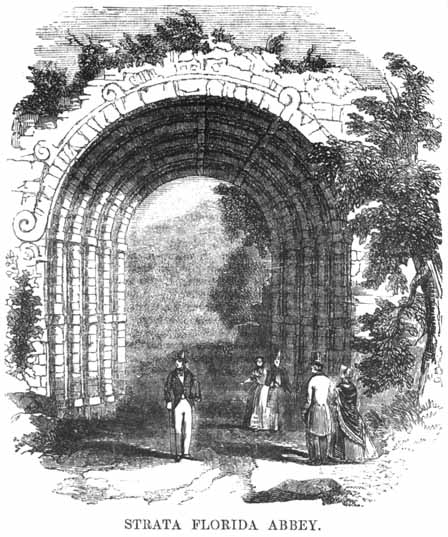
Abbey, Account of Strata
Florida
Adam and Eve in Paradise
(Milton)
Alfred, Anecdote of King (Beauties Of History)
Alfred, Character
of King (Hume)
Angling, Lines on (Doubleday)
Antioch, The Siege of
(Popular Delusions)
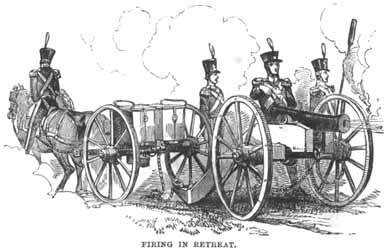
Artillery Tactics
Athens, Present Appearance of
Attock, Description of the Fort
of
Bacon, Remarks on Lord (D'Israeli)
Balloons, Account of
Baltic, Battle of the
(Campbell)
Beetle, The
Bell, The Founding of the
(Mackay)
Bible, Value of the (Buck)
Birds,
Appropriateness of the Songs of (Dr.
Jenner)
Bower-Birds, Description of
the
Bridges, Account of Tubular
Railway
Bunyan's Wife, Anecdote
of (Lord Campbell)
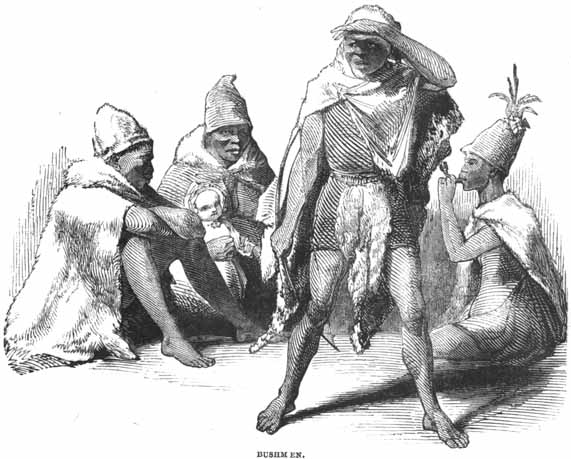
Bushmen, Account of the
Caesar, Character of
Julius (Middleton)
Canada, Intense Cold of
(Sir F. Head)
Canary, Account of the
Charity (Prior)
Chatterton, Lines by
Cheerfulness, Description of
(Addison)
China, Account of the Great
Wall of
Christian Freedom (Pollock)
Clarendon, Account of Lord
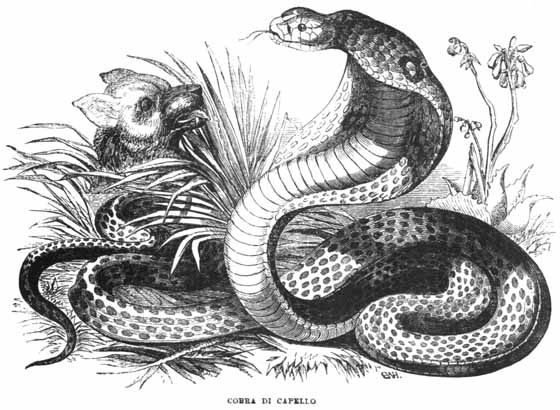
Cobra di Capello, Description of
the
Condors, Account of
Cruelty to Animals,
Wickedness of (Jenyns)
Culloden Battle-field, Description of
(Highland Note-Book)
Cyprus, Description of
Danish Encampment, Account of
a
Deity,
Omniscience of the (Addison)
Dogs, A Chapter on
Dove, Return of the
(Mackay)
Edward VI., Character of
(Burnet)
Elegy in a
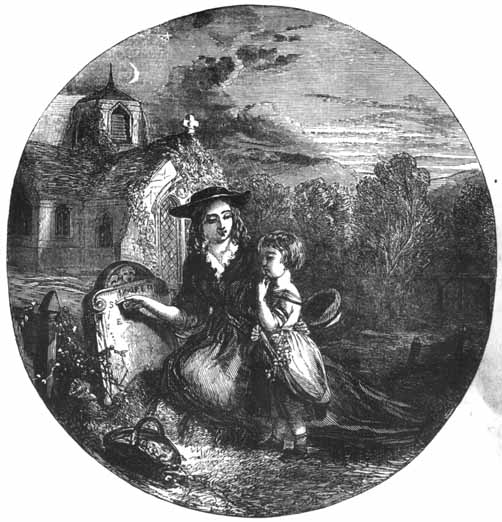
Country Churchyard (Gray)
Elizabeth
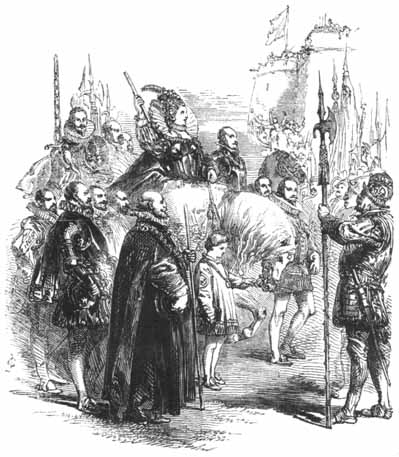
(Queen), at Tilbury Fort (English
History)
Envy, Wickedness of (Dr.
Johnson)
Faith's Guiding Star
(Eliza Cook)
Farewell (Barton)
Filial Love (Dr.
Dodd)
Fortitude (Blair)
Fox, Description of the
Long-eared
Frederick of Prussia and his Page
(Beauties Of History)
Gambier Islanders, Account
of
Gelert (W.
Spencer)
Gentleness, Character of (Blair)
Goldsmith, Remarks on the Style of
(Campbell)
Goliah Aratoo, Description of
the
Greece, Isles of (Byron)
Greece, The Shores of
(Byron)
Gresham, Account of Sir
Thomas
Grief, The First (Mrs. Hemans)
Grouse, Description of the
Hagar and Ishmael, Story of
Hampden, Account of John
Hercules, The Choice of
(Tatler)
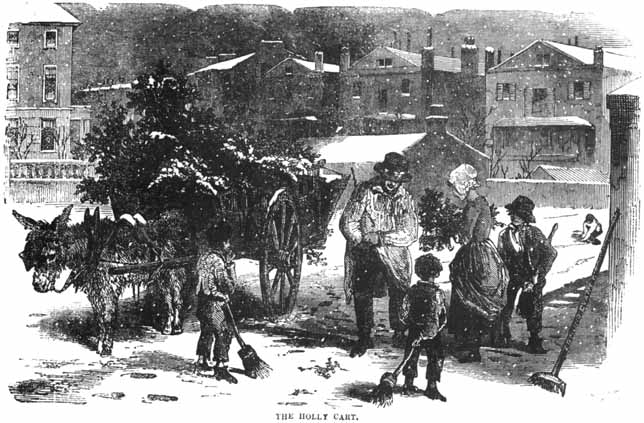
Holly Bough (Mackay)
Hope (Campbell)
Iguana, Description of the
Industry, Value of
(Blair)
Integrity (Dr.
Dodd)
Ivy in the Dungeon
(Mackay)
"Jack The Giant
Killer," Origin of (Carlyle)
Jalapa, Description of
Jewels, Description of the
Crown
Joppa, Account of
Jordan, Description of the
River
Jordan's Banks (Byron)
Juggernaut, Account of the Car
of
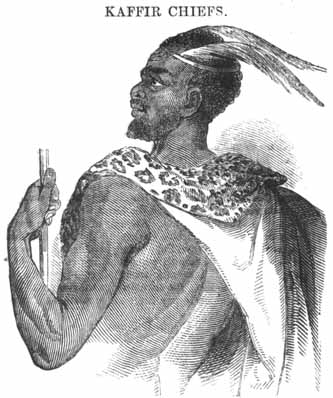
Kaffir Chiefs, Account of
Kaffir Letter-carrier, Account
of
Kangaroo,
Description of the
Knowledge, on the
Attainment of (Dr. Watts)
Leopard,
Description of the Black
Lighthouse, Description of
Hartlepool
Lilies (Mrs. Hemans)
Mangouste, Description of the
Mariana (Tennyson)
Mariners of England
(Campbell)
Martello Towers, Account of
Mary's (Queen)
Bower, at Chatsworth
Microscope,
Revelations of the (Dr.
Mantell)
Midnight Thoughts (Young)
Mill-stream, Lines on a (Mary Howitt)
Music, Remarks on (Usher)
Napoleon, Character of (General Foy)
Nature and its Lord
Nature, The Order of
(Pope)
Naval Tactics
Nests of Birds, Construction of
(Sturm)
Niagara, Account of the Falls of
(Sir James Alexander)
Nightingale and Glowworm
(Cowper)
Olive, Description of the
Othello's History (Shakspeare)
Owls, Account of
Owls, (Two) and the
Sparrow (Gay)
Palm-Tree, Account of the
Palm-Tree, Lines on a (Mrs. Hemans)
Parrot, Lines on a (Campbell)
Patmos, Description of the Isle of
Paul and Virginia,
Supposed Tombs of
Pekin, Description of
Peter the
Hermit Preaching the First Crusade (Popular Delusions)
Poetry, Rise of,
among the Romans (Spence)
Polar Regions, Description of
the
Pompeii, Account of
Poor, The Afflicted (Crabbe)
Pyramid Lake, Account of
the
Railway Tunnels, Difficulties
of
Rainbow, Account of a Lunar
Rattlesnake, Account of the
(F. T. Buckland)
Rome, Lines on (Rogers)
Rookery, Dialogue about a (Evenings At Home)
Sardis, Description of
Schoolboy's Pilgrimage
(Jane Taylor)
Seasons (Thomson)
Shakspeare, Remarks on
Sheep, Description of Thibetan
Sierra
Nevada, Description of the (Fremont's Travel)
Siloam, Account of the Pool
of
Sleep, Henry IV.'s
Soliloquy on (Shakspeare)
Sloth, Description of the
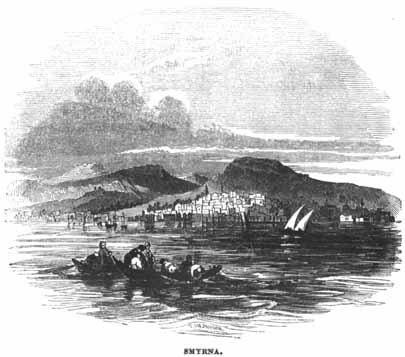
Smyrna, Description of
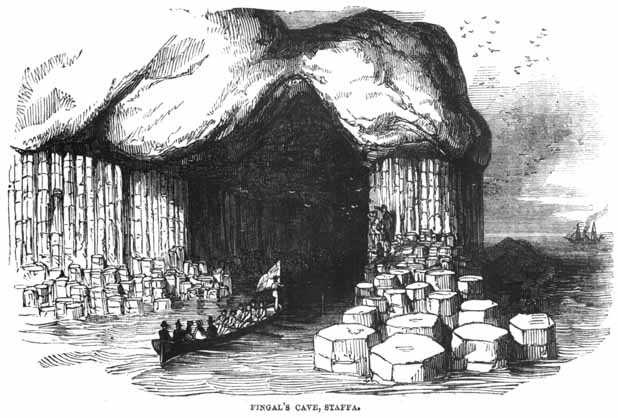
Staffa, Description of (Highland Note-Book)
Stag, The hunted (Sir W. Scott)
Starling, Story of a (Sterne)
St. Bernard,
Account of the Dogs of (The
Menageries)
St. Cecilia, Ode to (Dryden)
Stepping-stones, The
(Wordsworth)
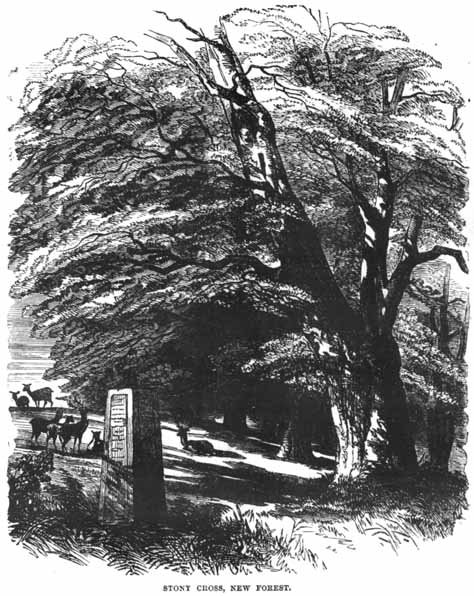
Stony Cross, Description of
Stream, the Nameless
(Mackay)
Study, Remarks on (Lord
Bacon)
Sun Fish, Capture of a (Captain Bedford, R. N.)
Sydney, Generosity of Sir Philip
(Beauties Of History)
Tabor, Description of Mount
Tapir, Description of the
Telegraph, Account of the
Electric (Sir F. Head)
Time, What is it? (Rev. J. Marsden)
Turkish Customs
Tyre, the Siege of (Langhorne's Plutarch)
Una and the Lion (Spenser)
Universe, Grandeur of the (Addison)
Vocabulary
Waterloo, Description of the
Field of
Winter Thoughts (Thomson)
Writing, On Simplicity in
(Hume)
THE ILLUSTRATED LONDON READING BOOK
THE SCHOOLBOY'S PILGRIMAGE.
Nothing could be more easy and agreeable than my condition when I
was first summoned to set out on the road to learning, and it was not
without letting fall a few ominous tears that I took the first step.
Several companions of my own age accompanied me in the outset, and we
travelled pleasantly together a good part of the way.
We had no sooner entered upon our path, than we were accosted by
three diminutive strangers. These we presently discovered to be the
advance-guard of a Lilliputian army, which was seen advancing towards
us in battle array. Their forms were singularly grotesque: some were
striding across the path, others standing with their arms a-kimbo;
some hanging down their heads, others quite erect; some standing on
one leg, others on two; and one, strange to say, on three; another
had his arms crossed, and one was remarkably crooked; some were very
slender, and others as broad as they were long. But, notwithstanding
this diversity of figure, when they were all marshalled in line of
battle, they had a very orderly and regular appearance. Feeling
disconcerted by their numbers, we were presently for sounding a
retreat; but, being urged forward by our guide, we soon mastered the
three who led the van, and this gave us spirit to encounter the main
army, who were conquered to a man before we left the field. We had
scarcely taken breath after this victory, when, to our no small
dismay, we descried a strong reinforcement of the enemy, stationed on
the opposite side. These were exactly equal in number to the former
army, but vastly superior in size and stature; they were, in fact, a
race of giants, though of the same species with the others, and were
capitally accoutred for the onset. Their appearance discouraged us
greatly at first, but we found their strength was not proportioned to
their size; and, having acquired much skill and courage by the late
engagement, we soon succeeded in subduing them, and passed off the
field in triumph. After this we were perpetually engaged with small
bands of the enemy, no longer extended in line of battle, but in
small detachments of two, three, and four in company. We had some
tough work here, and now and then they were too many for us. Having
annoyed us thus for a time, they began to form themselves into close
columns, six or eight abreast; but we had now attained so much
address, that we no longer found them formidable.
After continuing this route for a considerable way, the face of
the country suddenly changed, and we began to enter upon a vast
succession of snowy plains, where we were each furnished with a
certain light weapon, peculiar to the country, which we flourished
continually, and with which we made many light strokes, and some
desperate ones. The waters hereabouts were dark and brackish, and the
snowy surface of the plain was often defaced by them. Probably, we
were now on the borders of the Black Sea. These plains we travelled
across and across for many a day.
Upon quitting this district, the country became far more dreary:
it appeared nothing but a dry and sterile region, the soil being
remarkably hard and slatey. Here we saw many curious figures, and we
soon found that the inhabitants of this desert were mere ciphers.
Sometimes they appeared in vast numbers, but only to be again
suddenly diminished.
Our road, after this, wound through a rugged and hilly country,
which was divided into nine principal parts or districts, each under
a different governor; and these again were reduced into endless
subdivisions. Some of them we were obliged to decline. It was not a
little puzzling to perceive the intricate ramifications of the paths
in these parts. Here the natives spoke several dialects, which
rendered our intercourse with them very perplexing. However, it must
be confessed that every step we set in this country was less
fatiguing and more interesting. Our course at first lay all up hill;
but when we had proceeded to a certain height, the distant country,
which is most richly variegated, opened freely to our view.
I do not mean at present to describe that country, or the
different stages by which we advance through its scenery. Suffice it
to say, that the journey, though always arduous, has become more and
more pleasant every stage; and though, after years of travel and
labour, we are still very far from the Temple of Learning, yet we
have found on the way more than enough to make us thankful to the
kindness of the friends who first set us on the path, and to induce
us to go forward courageously and rejoicingly to the end of the
journey.
JANE TAYLOR.
PEKIN.
Pekin, or Peking, a word which in Chinese means "Northern
Capital," has been the chief city of China ever since the
Tartars were expelled, and is the residence of the Emperor. The tract
of country on which it stands is sandy and barren; but the Grand
Canal is well adapted for the purpose of feeding its vast population
with the produce of more fertile provinces and districts. A very
large portion of the centre of the part of Pekin called the Northern
City is occupied by the Emperor with his palaces and gardens, which
are of the most beautiful description, and, surrounded by their own
wall, form what is called the "Prohibited City."
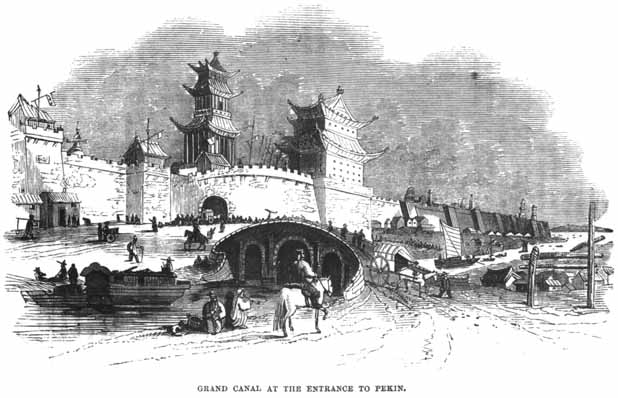
The Grand Canal, which runs about five hundred miles, without
allowing for windings, across the kingdom of China, is not only the
means by which subsistence is brought to the inhabitants of the
imperial city, but is of great value in conveying the tribute, a
large portion of the revenue being paid in kind. Dr. Davis mentions
having observed on it a large junk decorated with a yellow umbrella,
and found on enquiry that it had the honour of bearing the
"Dragon robes," as the Emperor's garments are called.
These are forwarded annually, and are the peculiar tribute of the
silk districts. The banks of the Grand Canal are, in many parts
through which it flows, strongly faced with stone, a precaution very
necessary to prevent the danger of inundations, from which some parts
of this country are constantly suffering. The Yellow River so very
frequently overflows its banks, and brings so much peril and calamity
to the people, that it has been called "China's
Sorrow;" and the European trade at Canton has been very heavily
taxed for the damage occasioned by it.
The Grand Canal and the Yellow River, in one part of the country,
run within four or five miles of each other, for about fifty miles;
and at length they join or cross each other, and then run in a
contrary direction. A great deal of ceremony is used by the crews of
the vessels when they reach this point, and, amongst other customs,
they stock themselves abundantly with live cocks, destined to be
sacrificed on crossing the river. These birds annoy and trouble the
passengers so much by their incessant crowing on the top of the
boats, that they are not much pitied when the time for their death
arrives. The boatmen collect money for their purchase from the
passengers, by sending red paper petitions called pin, begging
for aid to provide them with these and other needful supplies. The
difficulties which the Chinese must have struggled against, with
their defective science, in this junction of the canal and the river,
are incalculable; and it is impossible to deny them the praise they
deserve for so great an exercise of perseverance and industry.
THE GOLIAH ARATOO.
The splendid family of parrots includes about one hundred and
sixty species, and, though peculiar to the warmer regions of the
world, they are better known in England than any other foreign bird.
From the beauty of their plumage, the great docility of their
manners, and the singular faculty they possess of imitating the human
voice, they are general favourites, both in the drawingroom of the
wealthy and the cottage of humble life.
The various species differ in size, as well as in appearance and
colour. Some (as the macaws) are larger than the domestic fowl, and
some of the parakeets are not larger than a blackbird or even a
sparrow.
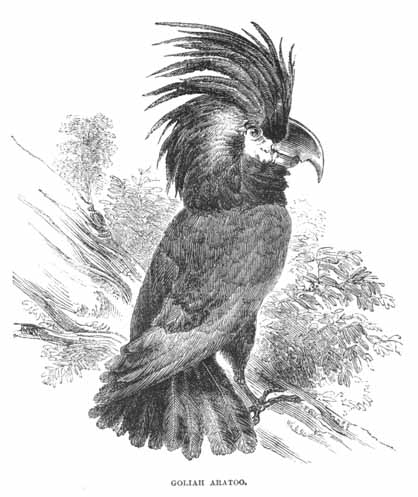
The interesting bird of which our Engraving gives a representation
was recently brought alive to this country by the captain of a
South-seaman (the Alert), who obtained it from a Chinese
vessel from the Island of Papua, to whom the captain of the
Alert rendered valuable assistance when in a state of
distress. In size this bird is one of the largest of the parrot
tribe, being superior to the great red Mexican Macaw. The whole
plumage is black, glossed with a greenish grey; the head is
ornamented with a large crest of long pendulous feathers, which it
erects at pleasure, when the bird has a most noble appearance; the
orbits of the eyes and cheeks are of a deep rose-colour; the bill is
of great size, and will crack the hardest fruit stones; but when the
kernel is detached, the bird does not crush and swallow it in large
fragments, but scrapes it with the lower mandible to the finest pulp,
thus differing from other parrots in the mode of taking food. In the
form of its tongue it differs also from other birds of the kind. A
French naturalist read a memoir on this organ before the Academy of
Sciences at Paris, in which he aptly compared it, in its uses, to the
trunk of an elephant. In its manners it is gentle and familiar, and
when approached raises a cry which may be compared to a hoarse
croaking. In its gait it resembles the rook, and walks much better
than most of the climbing family.
From the general conformation of the parrots, as well as the
arrangement and strength of their toes, they climb very easily,
assisting themselves greatly with their hooked bill, but walk rather
awkwardly on the ground, from the shortness and wide separation of
their legs. The bill of the parrot is moveable in both mandibles, the
upper being joined to the skull by a membrane which acts like a
hinge; while in other birds the upper beak forms part of the skull.
By this curious contrivance they can open their bills widely, which
the hooked form of the beak would not otherwise allow them to do. The
structure of the wings varies greatly in the different species: in
general they are short, and as their bodies are bulky, they cannot
consequently rise to any great height without difficulty; but when
once they gain a certain distance they fly easily, and some of them
with rapidity. The number of feathers in the tail is always twelve,
and these, both in length and form, are very varied in the different
species, some being arrow or spear-shaped, others straight and
square.
In eating, parrots make great use of the feet, which they employ
like hands, holding the food firmly with the claws of one, while they
support themselves on the other. From the hooked shape of their
bills, they find it more convenient to turn their food in an outward
direction, instead of, like monkeys and other animals, turning it
towards their mouths.
The whole tribe are fond of water, washing and bathing themselves
many times during the day in streams and marshy places; and having
shaken the water from their plumage, seem greatly to enjoy spreading
their beautiful wings to dry in the sun.
THE PARROT.
A DOMESTIC ANECDOTE.
|
|
The deep affections of the breast,
That Heaven to living things imparts,
Are not exclusively possess'd
By human hearts.
A parrot, from the Spanish Main,
Full young, and early-caged, came
o'er,
With bright wings, to the bleak domain
Of Mulla's shore.
To spicy groves, where he had won
His plumage of resplendent hue—
His native fruits, and skies, and sun—
He bade adieu.
For these he changed the smoke of turf,
A heathery land and misty sky;
And turn'd on rocks and raging surf
His golden eye.
But, petted, in our climate cold,
He lived and chatter'd many a
day;
Until, with age, from green and gold
His wings grew grey.
At last, when blind and seeming dumb,
He scolded, laugh'd, and spoke no
more,
A Spanish stranger chanced to come
To Mulla's shore.
He hail'd the bird in Spanish speech,
The bird in Spanish speech replied:
Flapt round his cage with joyous screech—
Dropt down and died.
CAMPBELL.
|
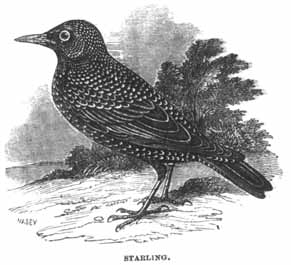
THE STARLING.
'Tis true, said I, correcting the proposition—the
Bastile is not an evil to be despised; but strip it of its towers,
fill the fosse, unbarricade the doors, call it simply a confinement,
and suppose it is some tyrant of a distemper, and not a man which
holds you in it, the evil vanishes, and you bear the other half
without complaint. I was interrupted in the heyday of this soliloquy,
with a voice which I took to be of a child, which complained "It
could not get out." I looked up and down the passage, and seeing
neither man, woman, or child, I went out without further attention.
In my return back through the passage, I heard the same words
repeated twice over; and looking up, I saw it was a starling, hung in
a little cage; "I can't get out, I can't get out,"
said the starling. I stood looking at the bird; and to every person
who came through the passage, it ran fluttering to the side towards
which they approached it with the same lamentation of its captivity.
"I can't get out," said the starling. "Then I will
let you out," said I, "cost what it will;" so I turned
about the cage to get at the door—it was twisted and double
twisted so fast with wire there was no getting it open without
pulling the cage to pieces; I took both hands to it. The bird flew to
the place where I was attempting his deliverance, and thrusting his
head through the trellis, pressed his breast against it, as if
impatient. "I fear, poor creature," said I, "I cannot
set thee at liberty." "No," said the starling; "I
can't get out, I can't get out," said the starling.
I vow, I never had my affections more tenderly awakened; nor do I
remember an incident in my life, where the dissipated spirits to
which my reason had been a bubble were so suddenly called home.
Mechanical as the notes were, yet so true in tune to nature were they
chaunted, that in one moment they overthrew all my systematic
reasonings upon the Bastile, and I heavily walked up-stairs unsaying
every word I had said in going down them.
Sterne.
THE CAR OF JUGGERNAUT.
Juggernaut is the principal idol worshipped by the Hindoos, and to
his temple, which is at Pooree, are attached no less than four
thousand priests and servants; of these one set are called Pundahs.
In the autumn of the year they start on a journey through India,
preaching in every town and village the advantages of a pilgrimage to
Juggernaut, after which they conduct to Pooree large bodies of
pilgrims for the Rath Justra, or Car Festival, which takes place in
May or June. This is the principal festival, and the number of
devotees varies from about 80,000 to 150,000. No European, Mussulman,
or low cast Hindoo is admitted into the temple; we can therefore only
speak from report of what goes on inside. Mr. Acland, in his manners
and customs of India, gives us the following amusing account of this
celebrated idol:—
"Juggernaut represents the ninth incarnation of Vishnoo, a
Hindoo deity, and consists of a mere block of sacred wood, in the
centre of which is said to be concealed a fragment of the original
idol, which was fashioned by Vishnoo himself. The features and all
the external parts are formed of a mixture of mud and cow-dung,
painted. Every morning the idol undergoes his ablutions; but, as the
paint would not stand the washing, the priests adopt a very ingenious
plan—they hold a mirror in front of the image and wash his
reflection. Every evening he is put to bed; but, as the idol is very
unwieldy, they place the bedstead in front of him, and on that they
lay a small image. Offerings are made to him by pilgrims and others,
of rice, money, jewels, elephants, &c., the Rajah of Knoudah and
the priests being his joint treasurers. On the day of the festival,
three cars, between fifty and sixty feet in height, are brought to
the gate of the temple; the idols are then taken out by the priests,
Juggernaut having golden arms and diamond eyes for that one day, and
by means of pulleys are hauled up and placed in their respective
carriages: to these enormous ropes are attached, and the assembled
thousands with loud shouts proceed to drag the idols to
Juggernaut's country-house, a small temple about a mile distant.
This occupies several days, and the idols are then brought back to
their regular stations. The Hindoos believe that every person who
aids in dragging the cars receives pardon for all his past sins; but
the fact that people throw themselves under the wheels of the cars,
appears to have been an European conjecture, arising from the
numerous deaths that occur from accidents at the time the immense
cars are in progress."
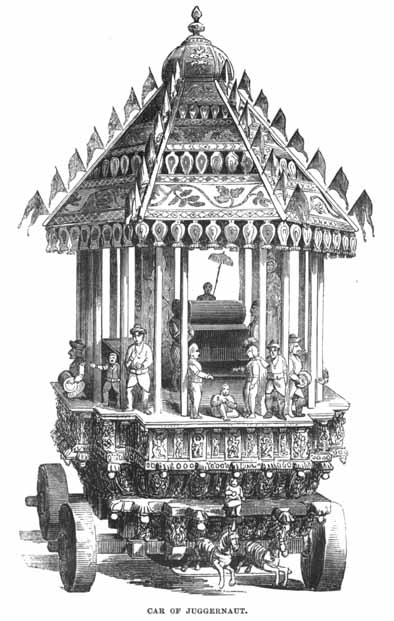
These cars have an imposing air, from their great size and
loftiness: the wheels are six feet in diameter; but every part of the
ornament is of the meanest and most paltry description, save only the
covering of striped and spangled broad-cloth, the splendid and
gorgeous effect of which makes up in a great measure for other
deficiencies.
During the period the pilgrims remain at Pooree they are not
allowed to eat anything but what has been offered to the idol, and
that they have to buy at a high price from the priests.
CYPRUS.
Cyprus, an island in the Levant, is said to have taken its name
from the number of shrubs of that name with which it once abounded.
From this tall shrub, the cypress, its ancient inhabitants made an
oil of a very delicious flavour, which was an article of great
importance in their commerce, and is still in great repute among
Eastern nations. It once, too, abounded with forests of olive trees;
and immense cisterns are still to be seen, which have been erected
for the purpose of preserving the oil which the olive yielded.
Near the centre of the island stands Nicotia, the capital, and the
residence of the governor, who now occupies one of the palaces of its
ancient sovereigns. The palaces are remarkable for the beauty of
their architecture, but are abandoned by their Turkish masters to the
destructive hand of time. The church of St. Sophia, in this place, is
built in the Gothic style, and is said to have been erected by the
Emperor Justinian. Here the Christian Kings of Cyprus were formerly
crowned; but it is now converted into a mosque.
The island was formerly divided into nine kingdoms, and was famous
for its superb edifices, its elegant temples, and its riches, but can
now boast of nothing but its ruins, which will tell to distant times
the greatness from which it has fallen.
The southern coast of this island is exposed to the hot winds from
all directions. During a squall from the north-east, the temperature
has been described as so scorching, that the skin instantly peeled
from the lips, a tendency to sneeze was excited, accompanied with
great pain in the eyes, and chapping of the hands and face. The heats
are sometimes so excessive, that persons going out without an
umbrella are liable to suffer from coup de soleil, or
sun-stroke; and the inhabitants, especially of the lower class, in
order to guard against it, wrap up their heads in a large turban,
over which in their journeys they plait a thick shawl many times
folded. They seldom, however, venture out of their houses during
mid-day, and all journeys, even those of caravans, are performed in
the night. Rains are also rare in the summer season, and long
droughts banish vegetation, and attract numberless columns of
locusts, which destroy the plants and fruits.
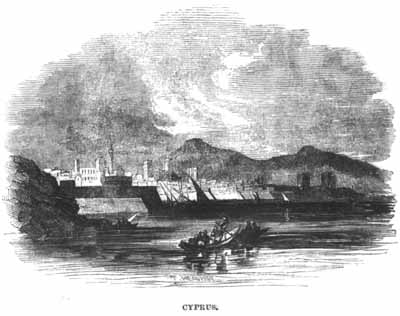
The soil, though very fertile, is rarely cultivated, the Greeks
being so oppressed by their Turkish masters that they dare not
cultivate the rich plains which surround them, as the produce would
be taken from them; and their whole object is to collect together
during the year as much grain as is barely sufficient to pay their
tax to the Governor, the omission of which is often punished by
torture or even by death.
The carob, or St. John's bread-tree, is plentiful; and the
long thick pods which it produces are exported in considerable
quantities to Syria and Egypt. The succulent pulp which the pod
contains is sometimes employed in those countries instead of sugar
and honey, and is often used in preserving other fruits. The vine
grows here perhaps in greater perfection than in any other part of
the world, and the wine of the island is celebrated all over the
Levant.
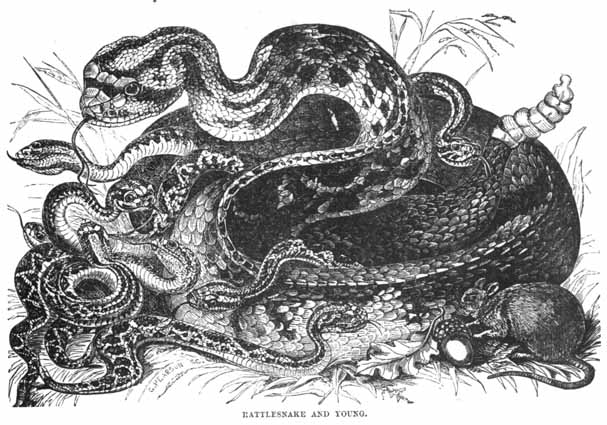
THE RATTLESNAKE.
This terrible reptile is found in great abundance on the continent
of America; and if its instinct induced it to make use of the
dreadful means of destruction and self-defence which it possesses, it
would become so great a scourge as to render the parts in which it is
found almost uninhabitable: but, except when violently irritated, or
for the purpose of self-preservation, it seldom employs the fatal
power bestowed upon it. The rattlesnake inserts its poison in the
body of its victim by means of two long sharp-pointed teeth or fangs,
which grow one on each side of the forepart of the upper jaw. The
construction of these teeth is very singular; they are hollow for a
portion of their length, and in each tooth is found a narrow slit
communicating with the central hollow; the root of the fang rests on
a kind of bag, containing a certain quantity of a liquid poison, and
when the animal buries his teeth in his prey, a portion of this fluid
is forced through these openings and lodged at the bottom of the
wound. Another peculiarity of these poison teeth is, that when not in
use they turn back, as it were, upon a hinge, and lie flat in the
roof of the animal's mouth.
The name of rattlesnake is given to it on account of the singular
apparatus with which the extremity of its tail is furnished. This
consists of a series of hollow horn-like substances, placed loosely
one behind the other in such a manner as to produce a kind of
rattling noise when the tail is shaken; and as the animal, whenever
it is enraged, always carries its tail raised up, and produces at the
same time a tremulous motion in it, this provision of nature gives
timely notice of its dangerous approach. The number of pieces of
which this rattle is formed points out the age of the snake, which
acquires a fresh piece every year. Some specimens have been found
with as many as from forty to fifty, thus indicating a great age.
The poison of the Viper consists of a yellowish liquid, secreted
in a glandular structure (situated immediately below the skin on
either side of the head), which is believed to represent the parotid
gland of the higher animals. If a viper be made to bite something
solid, so as to avoid its poison, the following are the appearances
under the microscope:—At first nothing is seen but a parcel of
salts nimbly floating in the liquor, but in a very short time these
saline particles shoot out into crystals of incredible tenuity and
sharpness, with something like knots here and there, from which these
crystals seem to proceed, so that the whole texture in a manner
represents a spider's web, though infinitely finer and more
minute. These spiculae, or darts, will remain unaltered on the glass
for some months. Five or six grains of this viperine poison, mixed
with half an ounce of human blood, received in a warm glass, produce
no visible effects, either in colour or consistence, nor do portions
of this poisoned blood, mixed with acids or alkalies, exhibit any
alterations. When placed on the tongue, the taste is sharp and acrid,
as if the tongue had been struck with something scalding or burning;
but this sensation goes off in two or three hours. There are only
five cases on record of death following the bite of the viper; and it
has been observed that the effects are most virulent when the poison
has been received on the extremities, particularly the fingers and
toes, at which parts the animal, when irritated (as it were, by an
innate instinct), always takes its aim.
F. T. BUCKLAND
ORIGIN OF "JACK THE GIANT-KILLER."
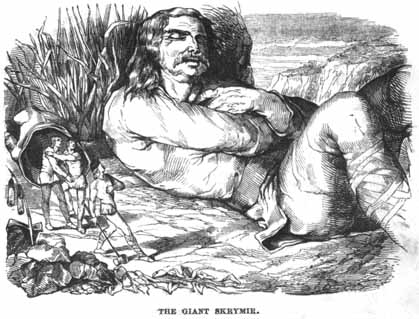
After various adventures, Thor, accompanied by Thialfi and Loke,
his servants, entered upon Giantland, and wandered over
plains—wild uncultivated places—among stones and trees.
At nightfall they noticed a house; and as the door, which indeed
formed one whole side of the house, was open, they entered. It was a
simple habitation—one large hall, altogether empty. They stayed
there. Suddenly, in the dead of the night, loud voices alarmed them.
Thor grasped his hammer, and stood in the doorway, prepared for
fight. His companions within ran hither and thither, in their terror,
seeking some outlet in that rude hall: they found a little closet at
last, and took refuge there. Neither had Thor any battle; for lo! in
the morning it turned out that the noise had been only the snoring of
a certain enormous, but peaceable, giant—the giant Skrymir, who
lay peaceably sleeping near by; and this, that they took for a house,
was merely his glove thrown aside there: the door was the
glove-wrist; the little closet they had fled into was the thumb! Such
a glove! I remark, too, that it had not fingers, as ours have, but
only a thumb, and the rest undivided—a most ancient rustic
glove!
Skrymir now carried their portmanteau all day; Thor, however, who
had his suspicions, did not like the ways of Skrymir, and determined
at night to put an end to him as he slept. Raising his hammer, he
struck down into the giant's face a right thunderbolt blow, of
force to rend rocks. The giant merely awoke, rubbed his cheek, and
said, "Did a leaf fall?" Again Thor struck, as soon as
Skrymir again slept, a better blow than before; but the giant only
murmured, "Was that a grain of sand!" Thor's third
stroke was with both his hands (the "knuckles white," I
suppose), and it seemed to cut deep into Skrymir's visage; but he
merely checked his snore, and remarked, "There must be sparrows
roosting in this tree, I think."
At the gate of Utgard—a place so high, that you had to
strain your neck bending back to see the top of it—Skrymir went
his way. Thor and his companions were admitted, and invited to take a
share in the games going on. To Thor, for his part, they handed a
drinking-horn; it was a common feat, they told him, to drink this dry
at one draught. Long and fiercely, three times over, Thor drank, but
made hardly any impression. He was a weak child, they told him; could
he lift that cat he saw there? Small as the feat seemed, Thor, with
his whole godlike strength, could not: he bent up the creature's
back, could not raise its feet off the ground—could at the
utmost raise one foot. "Why, you are no man," said the
Utgard people; "there is an old woman that will wrestle
you." Thor, heartily ashamed, seized this haggard old woman, but
could not throw her.
And now, on their quitting Utgard—the chief Jotun, escorting
them politely a little way, said to Thor—"You are beaten,
then; yet, be not so much ashamed: there was deception of appearance
in it. That horn you tried to drink was the sea; you did make it ebb:
but who could drink that, the bottomless? The cat you would have
lifted—why, that is the Midgard Snake, the Great World
Serpent—which, tail in mouth, girds and keeps up the whole
created world. Had you torn that up, the world must have rushed to
ruin. As for the old woman, she was Time, Old Age, Duration: with her
what can wrestle? No man, nor no god, with her. Gods or men, she
prevails over all! And then, those three strokes you
struck—look at these valleys—your three strokes made
these." Thor looked at his attendant Jotun—it was Skrymir.
It was, say old critics, the old chaotic rocky earth in person, and
that glove house was some earth cavern! But Skrymir had vanished.
Utgard, with its sky-high gates, when Thor raised his hammer to smite
them, had gone to air—only the giant's voice was heard
mocking; "Better come no more to Jotunheim!"
Carlyle.
VALUE OF THE BIBLE.
What an invaluable blessing it is to have the Bible in our own
tongue. It is not only the oldest, but the best book in the world.
Our forefathers rejoiced when they were first favoured with the
opportunity of reading it for themselves. Infidels may reject, and
the licentious may sneer; but no one who ever wished to take away
this foundation-stone, could produce any other equal to it, on which
the structure of a pious mind, a solid hope, a comfortable state, or
wise conduct, could be raised. We are told, that when Archbishop
Crammer's edition of the Bible was printed in 1538, and fixed to
a desk in all parochial churches, the ardour with which men flocked
to read it was incredible. They who could, procured it; and they who
could not, crowded to read it, or to hear it read in churches. It was
common to see little assemblies of mechanics meeting together for
that purpose after the labour of the day. Many even learned to read
in their old age, that they might have the pleasure of instructing
themselves from the Scriptures.
It is recorded of Edward VI., that upon a certain occasion, a
paper which was called for in the council-chamber happened to be out
of reach; the person concerned to produce it took a Bible that lay
near, and, standing upon it, reached down the paper. The King,
observing what was done, ran to the place, and taking the Bible in
his hands kissed it, and laid it up again. This circumstance, though
trifling in itself, showed his Majesty's great reverence for that
best of all books; and his example is a striking reproof to
those who suffer their Bibles to lie covered with dust for months
together, or who throw them about as if they were only a piece of
useless lumber.
Buck's
Anecdotes.
NATURE AND ITS LORD.
 |
There's not a leaf within the bower,
There's not a bird upon the tree,
There's not a dew-drop on the flower,
But bears the impress, Lord, of Thee!
Thy hand the varied leaf design'd,
And gave the bird its thrilling tone;
Thy power the dew-drops' tints combined,
Till like a diamond's blaze they
shone!
Yes, dew-drops, leaves, and buds, and all—
The smallest, like the greatest
things—
The sea's vast space, the earth's wide
ball,
Alike proclaim thee King of Kings.
But man alone to bounteous heaven
Thanksgiving's conscious strains can
raise;
To favour'd man alone 'tis given,
To join the angelic choir in praise!
|
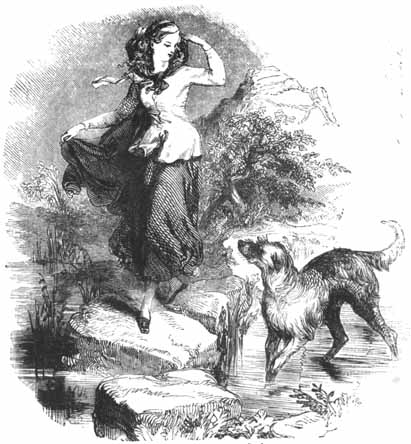
THE STEPPING-STONES.
The struggling rill insensibly is grown
Into a brook of loud and stately march,
Cross'd ever and anon by plank or
arch;
And for like use, lo! what might seem a zone
Chosen for ornament—stone match'd with
stone
In studied symmetry, with interspace
|
For the clear waters to pursue their
race
Without restraint. How swiftly have they
flown—
Succeeding, still succeeding! Here the child
Puts, when the high-swoll'n flood runs fierce and
wild,
His budding courage to the proof; and
here
Declining manhood learns to note the sly
And sure encroachments of infirmity—
Thinking how fast time
runs—life's end how near.
Wordsworth.
|
HUMANITY.
During the retreat of the famous King Alfred at Athelney, in
Somersetshire, after the defeat of his forces by the Danes, the
following circumstance happened, which shows the extremities to which
that great man was reduced, and gives a striking proof of his pious
and benevolent disposition:—A beggar came to his little castle,
and requested alms. His Queen informed him that they had only one
small loaf remaining, which was insufficient for themselves and their
friends, who were gone abroad in quest of food, though with little
hopes of success. But the King replied, "Give the poor Christian
the one half of the loaf. He that could feed live thousand with five
loaves and two fishes, can certainly make that half of the loaf
suffice for more than our necessities." Accordingly the poor man
was relieved; and this noble act of charity was soon recompensed by a
providential store of fresh provisions, with which his people
returned.
Sir Philip Sydney, at the battle near Zutphen, displayed the most
undaunted courage. He had two horses killed under him; and, whilst
mounting a third, was wounded by a musket-shot out of the trenches,
which broke the bone of his thigh. He returned about mile and a half
on horseback to the camp; and being faint with the loss of blood, and
parched with thirst from the heat of the weather, he called for
drink. It was presently brought him; but, as he was putting the
vessel to his mouth, a poor wounded soldier, who happened to be
carried along at that instant, looked up to it with wistful eyes. The
gallant and generous Sydney took the flagon from his lips, just when
he was going to drink, and delivered it to the soldier, saying,
"Thy necessity is greater than mine."
Frederick, King of Prussia, one day rang his bell and nobody
answered; on which he opened the door and found his page fast asleep
in an elbow-chair. He advanced toward him, and was going to awaken,
him, when he perceived a letter hanging out of his pocket. His
curiosity prompting him to know what it was, he took it out and read
it. It was a letter from the young man's mother, in which she
thanked him for having sent her part of his wages to relieve her in
her misery, and finished with telling; him that God would reward him
for his dutiful affection. The King, after having read it, went back
softly into his chamber, took a bag full of ducats, and slipped it
with the letter into the page's pocket. Returning to his chamber,
he rang the bell so violently that he awakened the page, who
instantly made his appearance. "You have had a sound
sleep," said the King. The page was at a loss how to excuse
himself and, putting his hand into his pocket by chance, to his utter
astonishment he there found a purse of ducats. He took it out, turned
pale, and looking at the bag, burst into tears without being able to
utter a single word. "What is that?" said the King;
"what is the matter?" "Ah, sire!" said the young
man, throwing himself on his knees, "somebody seeks my ruin! I
know nothing of this money which I have just found in my
pocket!" "My young friend," replied Frederick,
"God often does great things for us even in our sleep. Send that
to your mother, salute her on my part, and assure her that I will
take care of both her and you."
Beauties of History.
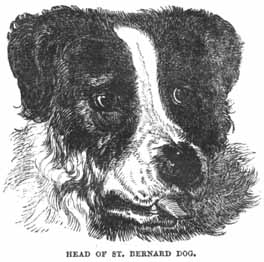
THE SPANIELS OF THE MONKS OF ST. BERNARD.
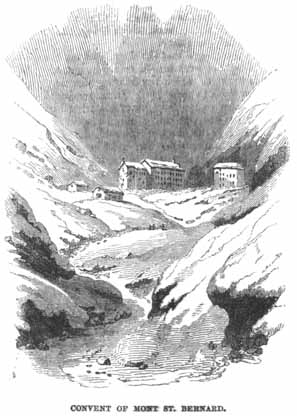
The convent of the Great St. Bernard is situated near the top of
the mountain known by that name, near one of the most dangerous
passes of the Alps, between Switzerland and Savoy. In these regions
the traveller is often overtaken by the most severe weather, even
after days of cloudless beauty, when the glaciers glitter in the
sunshine, and the pink flowers of the rhododendron appear as if they
were never to be sullied by the tempest. But a storm suddenly comes
on; the roads are rendered impassable by drifts of snow; the
avalanches, which are huge loosened masses of snow or ice, are swept
into the valleys, carrying trees and crags of rock before them.
The hospitable monks, though their revenue is scanty, open their
doors to every stranger that presents himself. To be cold, to be
weary, to be benighted, constitutes the title to their comfortable
shelter, their cheering meal, and their agreeable converse. But their
attention to the dis tressed does not end here. They devote
themselves to the dangerous task of searching for those unhappy
persons who may have been overtaken by the sudden storm, and would
perish but for their charitable succour. Most remarkably are they
assisted in these truly Christian offices. They have a breed of noble
dogs in their establishment, whose extraordinary sagacity often
enables them to rescue the traveller from destruction. Benumbed with
cold, weary in the search of a lost track, his senses yielding to the
stupefying influence of frost, the unhappy man sinks upon the ground,
and the snow-drift covers him from human sight. It is then that the
keen scent and the exquisite docility of these admirable dogs are
called into action. Though the perishing man lie ten or even twenty
feet beneath the snow, the delicacy of smell with which they can
trace him offers a chance of escape. They scratch away the snow with
their feet; they set up a continued hoarse and solemn bark, which
brings the monks and labourers of the convent to their
assistance.
To provide for the chance that the dogs, without human help, may
succeed in discovering the unfortunate traveller, one of them has a
flask of spirits round his neck, to which the fainting man may apply
for support; and another has a cloak to cover him. Their wonderful
exertions are often successful; and even where they fail of restoring
him who has perished, the dogs discover the body, so that it may be
secured for the recognition of friends; and such is the effect of the
cold, that the dead features generally preserve their firmness for
the space of two years. One of these noble creatures was decorated
with a medal, in commemoration of his having saved the lives of
twenty-two persons, who, but for his sagacity, must have perished.
Many travellers, who have crossed the pass of St. Bernard, have seen
this dog, and have heard, around the blazing fire of the monks, the
story of his extraordinary career. He perished about the year 1816,
in an attempt to convey a poor traveller to his anxious family.
The Menageries.
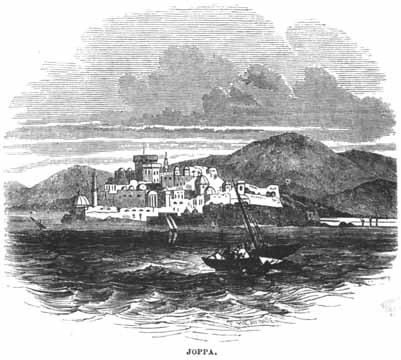
JOPPA.
Joppa is the principal sea-port town of Palestine and it is very
often mentioned in Scripture.
Hiram, King of Tyre, is said to have sent cedars of Lebanon by sea
to Joppa, for the building of Solomon's Temple; and from Joppa
the disobedient Jonah embarked, when ordered by God to go and preach
to the people of Nineveh.
It was at Joppa that the apostle Peter lived, for some time, with
one Simon, a tanner, whose house was by the sea-shore; and it was on
the flat roof of this dwelling that he saw the wonderful vision,
which taught him not to call any man common or unclean.
Tabitha or Dorcas, the pious woman who spent all her life in
working for the poor, and in giving alms to those who needed relief,
lived in Joppa; and here it pleased God that she should be taken ill
and die, and her body was laid out in the usual manner before burial,
in an upper chamber of the house where she lived. The apostle Peter,
to whom this pious woman had been well known, was then at Lydda, not
far from Joppa, and the disciples sent to tell him of the heavy loss
the Church had met with in the death of Dorcas, and begged that he
would come and comfort them. The apostle directly left Lydda and went
over to Joppa. He was, by his own desire, taken to the room where the
corpse lay, and was much moved when he saw the tears of the poor
women who had been fed and clothed by the charity of Dorcas, and who
were telling each other how much good she had been the means of doing
them.
Peter desired to be left alone with the body, and then he knelt
down and prayed, and, receiving strength from God, he turned to the
body and cried, "Tabitha, arise!" She then, like one
awaking from sleep, opened her eyes, and when she saw Peter she sat
up. He then took her by the hand, and she arose and was presented
alive to those who, thinking she was dead, had so lately been
mourning for her loss. This was the first miracle performed by the
apostles, and it greatly surprised the people of Joppa, who began one
and all to believe that Peter was really a preacher sent by God.
The name of Joppa signified beautiful. It was built upon the side
of a rocky mountain, which rises from the sea-shore, and all around
it were lovely gardens, full of vines, figs, and other fruits.
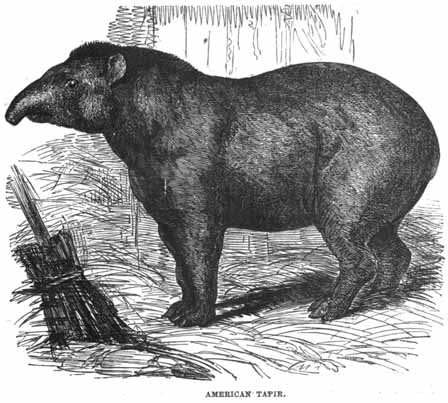
THE AMERICAN TAPIR.
There are but three known species of the Tapir, two of
which—the Peccary and the Tapir—are natives of South
America, the other of Sumatra and Malacca. Its anatomy is much like
that of the rhinoceros, while in general form the tapir reminds us of
the hog. It is a massive and powerful animal, and its fondness for
the water is almost as strong as that displayed by the hippopotamus.
It swims and dives admirably, and will remain submerged for many
minutes, rising to the surface for breath, and then again plunging
in. When hunted or wounded, it always, if possible, makes for the
water; and in its nightly wanderings will traverse rivers and lakes
in search of food, or for pleasure. The female is very attentive to
her young one, leading it about on the land, and accustoming it at an
early period to enter the water, where it plunges and plays before
its parent, who seems to act as its instructress, the male taking no
share in the work.
The tapir is very common in the warm regions of South America,
where it inhabits the forests, leading a solitary life, and seldom
stirring from its retreat during the day, which it passes in a state
of tranquil slumber. During the night, its season of activity, it
wanders forth in search of food, which consists of water-melons,
gourds, young shoots of brushwood, &c.; but, like the hog, it is
not very particular in its diet. Its senses of smell and hearing are
extremely acute, and serve to give timely notice of the approach of
enemies. Defended by its tough thick hide, it is capable of forcing
its way through the thick underwood in any direction it pleases: when
thus driving onwards, it carries its head low, and, as it were,
ploughs its course.
The most formidable enemy of this animal, if we except man, is the
jaguar; and it is asserted that when that tiger of the American
forest throws itself upon the tapir, the latter rushes through the
most dense and tangled underwood, bruising its enemy, and generally
succeeds in dislodging him.
The snout of the tapir greatly reminds one of the trunk of the
elephant; for although it is not so long, it is very flexible, and
the animal makes excellent use of it as a crook to draw down twigs to
the mouth, or grasp fruit or bunches of herbage: it has nostrils at
the extremity, but there is no finger-like appendage.
In its disposition the tapir is peaceful and quiet, and, unless
hard pressed, never attempts to attack either man or beast; when,
however, the hunter's dogs surround it, it defends itself very
vigorously with its teeth, inflicting terrible wounds, and uttering a
cry like a shrill kind of whistle, which is in strange contrast with
the massive bulk of the animal.
The Indian tapir greatly resembles its American relative; it feeds
on vegetables, and is very partial to the sugar-cane. It is larger
than the American, and the snout is longer and more like the trunk of
the elephant. The most striking difference, however, between the
eastern and western animal is in colour. Instead of being the uniform
dusky-bay tint of the American, the Indian is strangely
particoloured. The head, neck, fore-limbs, and fore-quarters are
quite black; the body then becomes suddenly white or greyish-white,
and so continues to about half-way over the hind-quarters, when the
black again commences abruptly, spreading over the legs. The animal,
in fact, looks just as if it were covered round the body with a white
horse-cloth.
Though the flesh of both the Indian and American tapir is dry and
disagreeable as an article of food, still the animal might be
domesticated with advantage, and employed as a beast of burthen, its
docility and great strength being strong recommendations.
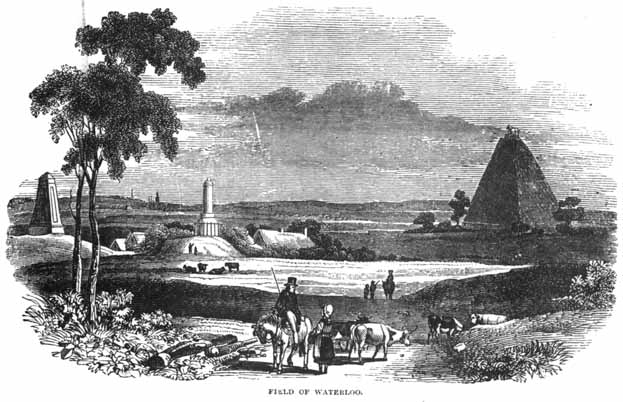
THE FIELD OF WATERLOO.
Waterloo is a considerable village of Belgium, containing about
1600 inhabitants; and the Field of Waterloo, so celebrated as the
scene of the battle between two of the greatest generals who ever
lived, is about two miles from it. It was very far from a strong
position to be chosen for this purpose, but, no doubt, was the best
the country afforded. A gently rising ground, not steep enough in any
part to prevent a rush of infantry at double-quick time, except in
the dell on the left of the road, near the farm of La Haye Sainte;
and along the crest of the hill a scrubby hedge and low bank fencing
a narrow country road. This was all, except La Haye Sainte and
Hougoumont. This chateau, or country-seat, one of those
continental residences which unite in them something of the nature of
a castle and a farm-house, was the residence of a Belgic gentleman.
It stands on a little eminence near the main road leading from
Brussels to Nivelles. The buildings consisted of an old tower and a
chapel, and a number of offices, partly surrounded by a farm-yard.
The garden was enclosed by a high and strong wall; round the garden
was a wood or orchard, which was enclosed by a thick hedge,
concealing the wall. The position of the place was deemed so
important by the Duke of Wellington, that he took possession of the
Château of Goumont, as it was called, on the 17th of June, and
the troops were soon busily preparing for the approaching contest, by
perforating the walls, making loop-holes for the fire of the
musketry, and erecting scaffolding for the purpose of firing from the
top.
The importance of this place was also so well appreciated by
Bonaparte, that the battle of the 18th began by his attacking
Hougoumont. This name, which was bestowed upon it by the mistake of
our great commander, has quite superseded the real one of
Château Goumont. The ruins are among the most interesting of
all the points connected with this memorable place, for the struggle
there was perhaps the fiercest. The battered walls, the dismantled
and fire-stained chapel, which remained standing through all the
attack, still may be seen among the wreck of its once beautiful
garden; while huge blackened beams, which have fallen upon the
crumbling heaps of stone and plaster, are lying in all
directions.
On the field of battle are two interesting monuments: one, to the
memory of the Hon. Sir Alexander Gordon, brother to the Earl of
Aberdeen, who there terminated a short but glorious career, at the
age of twenty-nine, and "fell in the blaze of his fame;"
the other, to some brave officers of the German Legion, who likewise
died under circumstances of peculiar distinction. There is also, on
an enormous mound, a colossal lion of bronze, erected by the Belgians
to the honour of the Prince of Orange, who was wounded at, or near,
to the spot.
Against the walls of the church of the village of Waterloo are
many beautiful marble tablets, with the most affecting inscriptions,
records of men of various countries, who expired on that solemn and
memorable occasion in supporting a common cause. Many of these brave
men were buried in a cemetery at a short distance from the
village.
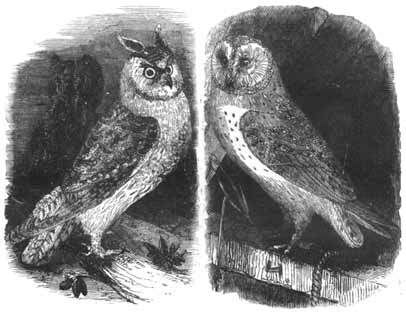
THE TWO OWLS AND THE SPARROW.
 |
Two formal Owls together sat,
Conferring thus in solemn chat:
"How is the modern taste
decay'd!
Where's the respect to wisdom paid?
Our worth the Grecian sages knew;
They gave our sires the honour due:
They weigh'd the dignity of fowls,
And pry'd into the depth of Owls.
Athens, the seat of earned fame,
With gen'ral voice revered our name;
On merit title was conferr'd,
And all adored th' Athenian bird."
"Brother, you reason well," replies
The solemn mate, with half-shut eyes:
"Right: Athens was the seat of learning,
And truly wisdom is discerning.
Besides, on Pallas' helm we sit,
The type and ornament of wit:
But now, alas! we're quite neglected,
And a pert Sparrow's more respected."
A Sparrow, who was lodged beside,
O'erhears them sooth each other's pride.
|
|
|
|
And thus he nimbly vents his heat:
"Who meets a fool must find conceit.
I grant you were at Athens graced,
And on Minerva's helm were placed;
But ev'ry bird that wings the sky,
Except an Owl, can tell you why.
From hence they taught their schools to know
How false we judge by outward show;
That we should never looks esteem,
Since fools as wise as you might seem.
Would you contempt and scorn avoid,
Let your vain-glory be destroy'd:
Humble your arrogance of thought,
Pursue the ways by Nature taught:
So shall you find delicious fare,
And grateful farmers praise your care;
So shall sleek mice your chase reward,
And no keen cat find more regard."
Gay.
|
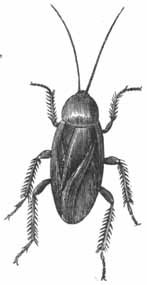
THE BEETLE.
|
|
See the beetle that crawls in your way,
And runs to escape from your feet;
His house is a hole in the clay,
And the bright morning dew is his
meat.
But if you more closely behold
This insect you think is so mean,
You will find him all spangled with gold,
And shining with crimson and green.
Tho' the peacock's bright plumage we
prize,
As he spreads out his tail to the
sun,
The beetle we should not despise,
Nor over him carelessly run.
They both the same Maker declare—
They both the same wisdom display,
The same beauties in common they share—
Both are equally happy and gay.
And remember that while you would fear
The beautiful peacock to kill,
You would tread on the poor beetle here,
And think you were doing no ill.
But though 'tis so humble, be sure,
As mangled and bleeding it lies,
A pain as severe 'twill endure,
As if 'twere a giant that dies.
|
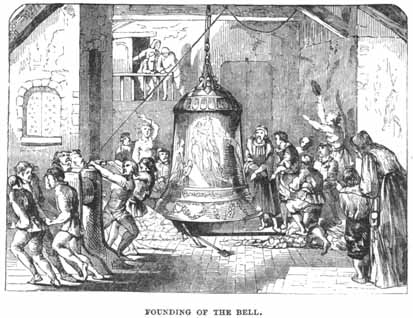
THE FOUNDING OF THE BELL.
 |
Hark! how the furnace pants and roars,
Hark! how the molten metal pours,
As, bursting from its iron doors,
It glitters in the sun.
Now through the ready mould it flows,
Seething and hissing as it goes,
And filling every crevice up,
As the red vintage fills the cup—
Hurra! the work is done!
Unswathe him now. Take off each stay
That binds him to his couch of clay,
And let him struggle into day!
Let chain and pulley run,
With yielding crank and steady rope,
Until he rise from rim to cope,
In rounded beauty, ribb'd in strength,
Without a flaw in all his length—
Hurra! the work is done!
The clapper on his giant side
Shall ring no peal for blushing bride,
For birth, or death, or new-year tide,
Or festival begun!
A nation's joy alone shall be
The signal for his revelry;
And for a nation's woes alone
His melancholy tongue shall moan—
Hurra! the work is done!
Borne on the gale, deep-toned and clear,
His long, loud summons shall we hear,
When statesmen to their country dear
Their mortal race have run;
When mighty Monarchs yield their breath,
And patriots sleep the sleep of death,
Then shall he raise his voice of gloom,
And peal a requiem o'er their tomb—
Hurra! the work is done!
Should foemen lift their haughty hand,
And dare invade us where we stand,
Fast by the altars of our land
We'll gather every one;
And he shall ring the loud alarm,
To call the multitudes to arm,
From distant field and forest brown,
And teeming alleys of the town—
Hurra! the work is done!
And as the solemn boom they hear,
Old men shall grasp the idle spear,
Laid by to rust for many a year,
And to the struggle run:
Young men shall leave their toils or books,
Or turn to swords their pruning-hooks;
And maids have sweetest smiles for those
Who battle with their country's foes—
Hurra! the work is done!
And when the cannon's iron throat
Shall bear the news to dells remote,
And trumpet blast resound the note—
That victory is won;
When down the wind the banner drops,
And bonfires blaze on mountain tops,
His sides shall glow with fierce delight,
And ring glad peals from morn to night—
Hurra! the work is done!
But of such themes forbear to tell—
May never War awake this bell
To sound the tocsin or the knell—
Hush'd be the alarum gun.
Sheath'd be the sword! and may his voice
But call the nations to rejoice
That War his tatter'd flag has furl'd,
And vanish'd from a wiser world—
Hurra! the work is done!
Still may he ring when struggles cease—
Still may he ring for joy's increase,
For progress in the arts of peace,
And friendly trophies won;
When rival nations join their hands,
When plenty crowns the happy lands,
When Knowledge gives new blessings birth,
And Freedom reigns o'er all the earth—
Hurra! the work is done!
Mackay.
|
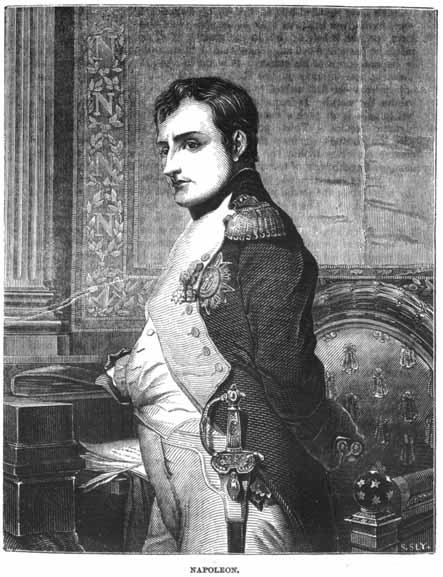
NAPOLEON.
With his passions, and in spite of his errors, Napoleon was,
taking him all in all, the greatest warrior of modern times. He
carried into battle a stoical courage, a profoundly calculated
tenacity, a mind fertile in sudden inspirations, which, by
unlooked-for resources, disconcerted the plans of his enemy. Let us
beware of attributing a long series of success to the organic power
of the masses which he set in motion. The most experienced eye could
scarcely discover in them any thing but elements of disorder. Still
less, let it be said, that he was a successful captain because he was
a mighty Monarch. Of all his campaigns, the most memorable are the
campaign of the Adige, where the general of yesterday, commanding an
army by no means numerous, and at first badly appointed, placed
himself at once above Turenne, and on a level with Frederick; and the
campaign in France in 1814, when, reduced to a handful of harrassed
troops, he combated a force of ten times their number. The last
flashes of Imperial lightning still dazzled the eyes of our enemies;
and it was a fine sight to see the bounds of the old lion, tracked,
hunted down, beset—presenting a lively picture of the days of
his youth, when his powers developed themselves in the fields of
carnage.
Napoleon possessed, in an eminent degree, the faculties requisite
for the profession of arms; temperate and robust; watching and
sleeping at pleasure; appearing unawares where he was least expected:
he did not disregard details, to which important results are
sometimes attached. The hand which had just traced rules for the
government of many millions of men, would frequently rectify an
incorrect statement of the situation of a regiment, or write down
whence two hundred conscripts were to be obtained, and from what
magazine their shoes were to be taken. A patient, and an easy
interlocutor, he was a home questioner, and he could listen—a
rare talent in the grandees of the earth. He carried with him into
battle a cool and impassable courage. Never was mind so deeply
meditative, more fertile in rapid and sudden illuminations. On
becoming Emperor he ceased not to be the soldier. If his activity
decreased with the progress of age, that was owing to the decrease of
his physical powers. In games of mingled calculation and hazard the
greater the advantages which a man seeks to obtain the greater risks
he must run. It is precisely this that renders the deceitful science
of conquerors so calamitous to nations.
Napoleon, though naturally adventurous, was not deficient in
consistency or method; and he wasted neither his soldiers nor his
treasures where the authority of his name sufficed. What he could
obtain by negotiations or by artifice, he required not by force of
arms. The sword, although drawn from the scabbard, was not stained
with blood unless it was impossible to attain the end in view by a
manoeuvre. Always ready to fight, he chose habitually the occasion
and the ground: out of fifty battles which he fought, he was the
assailant in at least forty. Other generals have equalled him in the
art of disposing troops on the ground; some have given battle as well
as he did—we could mention several who have received it better;
but in the manner of directing an offensive campaign he has surpassed
all. The wars in Spain and Russia prove nothing in disparagement of
his genius. It is not by the rules of Montecuculi and Turenne,
manoeuvring on the Renchen, that we ought to judge of such
enterprises: the first warred to such or such winter quarters; the
other to subdue the world. It frequently behoved him not merely to
gain a battle, but to gain it in such a manner as to astound Europe
and to produce gigantic results. Thus political views were
incessantly interfering with the strategic genius; and to appreciate
him properly, we must not confine ourselves within the limits of the
art of war. This art is not composed exclusively of technical
details; it has also its philosophy.
To find in this elevated region a rival of Napoleon, we must go
back to the times when the feudal institutions had not yet broken the
unity of the ancient nations. The founders of religion alone have
exercised over their disciples an authority comparable with that
which made him the absolute master of his army. This moral power
became fatal to him, because he strove to avail himself of it even
against the ascendancy of material force, and because it led him to
despise positive rules, the long violation of which will not remain
unpunished. When pride was bringing Napoleon towards his fall, he
happened to say, "France has more need of me than I have of
France." He spoke the truth: but why had he become necessary?
Because he had committed the destiny of France to the chances of an
interminable war: because, in spite of the resources of his genius,
that war, rendered daily more hazardous by his staking the whole of
his force and by the boldness of his movements, risked, in every
campaign, in every battle, the fruits of twenty years of triumph:
because his government was so modelled that with him every thing must
be swept away, and that a reaction, proportioned to the violence of
the action, must burst forth at once both within and without. But
Napoleon saw, without illusion, to the bottom of things. The nation,
wholly occupied in prosecuting the designs of its chief, had
previously not had time to form any plans for itself. The day on
which it should have ceased to be stunned by the din of arms, it
would have called itself to account for its servile obedience. It is
better, thought he, for an absolute prince to fight foreign armies
than to have to struggle against the energy of the citizens.
Despotism had been organized for making war; war was continued to
uphold despotism. The die was cast—France must either conquer
Europe, or Europe subdue France. Napoleon fell—he fell, because
with the men of the nineteenth century he attempted the work of an
Attila and a Genghis Khan; because he gave the reins to an
imagination directly contrary to the spirit of his age; with which,
nevertheless, his reason was perfectly acquainted; because he would
not pause on the day when he felt conscious of his inability to
succeed. Nature has fixed a boundary, beyond which extravagant
enterprises cannot be carried with prudence. This boundary the
Emperor reached in Spain, and overleaped in Russia. Had he then
escaped destruction, his inflexible presumption would have caused him
to find elsewhere a Bayleu and a Moscow.
General Foy.
ROME.
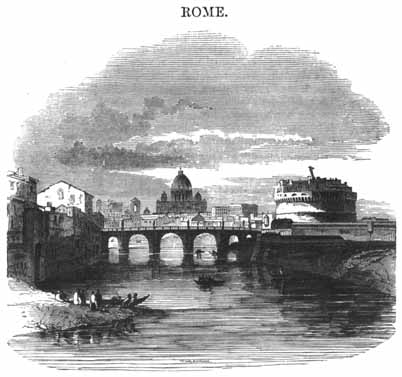
I am in Rome! Oft as the morning ray
Visits these eyes, waking at once, I cry,
Whence this excess of joy? What has befallen me?
And from within a thrilling voice replies—
Thou art in Rome! A thousand busy thoughts
Rush on my mind—a thousand images;
And I spring up as girt to run a race!
Thou art in Rome! the city that so long
Reign'd absolute—the mistress of the
world!
The mighty vision that the Prophet saw
And trembled; that from nothing, from the least,
The lowliest village (what, but here and there
A reed-roof'd cabin by a river side?)
Grew into everything; and, year by year,
Patiently, fearlessly working her way
O'er brook and field, o'er continent and
sea;
Not like the merchant with his merchandise,
Or traveller with staff and scrip exploring;
But hand to hand and foot to foot, through
hosts,
Through nations numberless in battle array,
Each behind each; each, when the other fell,
Up, and in arms—at length subdued them
all.
Thou art in Rome! the city where the
Gauls,
Entering at sun-rise through her open gates,
And through her streets silent and desolate
Marching to slay, thought they saw gods, not
men;
The city, that by temperance, fortitude,
And love of glory tower'd above the clouds,
Then fell—but, falling, kept the highest
seat,
And in her loveliness, her pomp of woe,
Where now she dwells, withdrawn into the wild,
Still o'er the mind maintains, from age to
age,
Its empire undiminish'd. There, as though
Grandeur attracted grandeur, are beheld
All things that strike, ennoble; from the depths
Of Egypt, from the classic fields of
Greece—
Her groves, her temples—all things that
inspire
Wonder, delight! Who would not say the forms.
Most perfect most divine, had by consent
Flock'd thither to abide eternally
Within those silent chambers where they dwell
In happy intercourse?
Rogers.
|
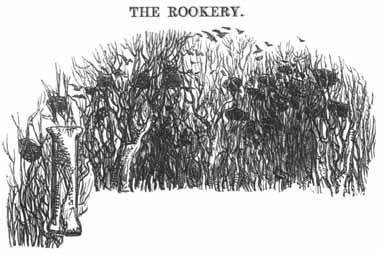
THE ROOKERY
Is that a rookery, papa?
Mr. S. It is. Do you hear what a
cawing the birds make?
F. Yes; and I see them hopping about
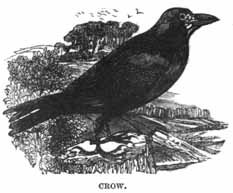
among the boughs. Pray, are not rooks the same with crows?
Mr. S. They are a species of crow.
But they differ from the carrion crow and raven, in not feeding upon
dead flesh, but upon corn and other seeds and grass, though, indeed,
they pick up beetles and other insects and worms. See what a number
of them have alighted on yonder ploughed field, almost blackening it
over. They are searching for grubs and worms. The men in the field do
not molest them, for they do a great deal of service by destroying
grubs, which, if suffered to grow to winged insects, would injure the
trees and plants.
F. Do all rooks live in
rookeries?
Mr. S. It is their nature to
associate together, and they build in numbers of the same, or
adjoining trees. They have no objection to the neighbourhood of man,
but readily take to a plantation of tall trees, though it be close to
a house; and this is commonly called a rookery. They will even fix
their habitations on trees in the midst of towns.
F. I think a rookery is a sort of
town itself.
Mr. S. It is—a village in the
air, peopled with numerous inhabitants; and nothing can be more
amusing than to view them all in motion, flying to and fro, and
busied in their several occupations. The spring is their busiest
time. Early in the year they begin to repair their nests, or build
new ones.
F. Do they all work together, or
every one for itself?
Mr. S. Each pair, after they have
coupled, builds its own nest; and, instead of helping, they are very
apt to steal the materials from one another. If both birds go out at
once in search of sticks, they often find at their return the work
all destroyed, and the materials carried off. However, I have met
with a story which shows that they are not without some sense of the
criminality of thieving. There was in a rookery a lazy pair of rooks,
who never went out to get sticks for themselves, but made a practice
of watching when their neighbours were abroad, and helping themselves
from their nests. They had served most of the community in this
manner, and by these means had just finished their own nest; when all
the other rooks, in a rage, fell upon them at once, pulled their nest
in pieces, beat them soundly, and drove them from their society.
F. But why do they live together, if
they do not help one another?
Mr. S. They probably receive pleasure
from the company of their own kind, as men and various other
creatures do. Then, though they do not assist one another in
building, they are mutually serviceable in many ways. If a large bird
of prey hovers about a rookery for the purpose of carrying away the
young ones, they all unite to drive him away. And when they are
feeding in a flock, several are placed as sentinels upon the trees
all round, to give the alarm if any danger approaches.
F. Do rooks always keep to the same
trees?
Mr. S. Yes; they are much attached to
them, and when the trees happen to be cut down, they seem greatly
distressed, and keep hovering about them as they are falling, and
will scarcely desert them when they lie on the ground.
F. I suppose they feel as we should
if our town was burned down, or overthrown by an earthquake.
Mr. S. No doubt. The societies of
animals greatly resemble those of men; and that of rooks is like
those of men in the savage state, such as the communities of the
North American Indians. It is a sort of league for mutual aid and
defence, but in which every one is left to do as he pleases, without
any obligation to employ himself for the whole body. Others unite in
a manner resembling more civilised societies of men. This is the case
with the heavers. They perform great public works by the united
efforts of the whole community—such as damming up streams and
constructing mounds for their habitations. As these are works of
great art and labour, some of them probably act under the direction
of others, and are compelled to work, whether they will or not. Many
curious stories are told to this purpose by those who have observed
them in their remotest haunts, where they exercise their full
sagacity.
F. But are they all true?
Mr. S. That is more than I can answer
for; yet what we certainly know of the economy of bees may justify us
in believing extraordinary things of the sagacity of animals. The
society of bees goes further than that of beavers, and in some
respects beyond most among men themselves. They not only inhabit a
common dwelling, and perform great works in common, but they lay up a
store of provision, which is the property of the whole community, and
is not used except at certain seasons and under certain regulations.
A bee-hive is a true image of a commonwealth, where no member acts
for himself alone, but for the whole body.
Evenings at Home.
PALMS.
These beautiful trees may be ranked among the noblest specimens of
vegetation; and their tall, slender, unbranched stems, crowned by
elegant feathery foliage, composed of a cluster of gigantic leaves,
render them, although of several varieties, different in appearance
from all other trees. In some kinds of palm the stem is irregularly
thick; in others, slender as a reed. It is scaly in one species, and
prickly in another. In the Palma real, in Cuba, the stem
swells out like a spindle in the middle. At the summit of these
stems, which in some cases attain an altitude of upwards of 180 feet,
a crown of leaves, either feathery or fan-shaped (for there is not a
great variety in their general form), spreads out on all sides, the
leaves being frequently from twelve to fifteen feet in length. In
some species the foliage is of a dark green and shining surface, like
that of a laurel or holly; in others, silvery on the under-side, as
in the willow; and there is one species of palm with a fan-shaped
leaf, adorned with concentric blue and yellow rings, like the
"eyes" of a peacock's tail.
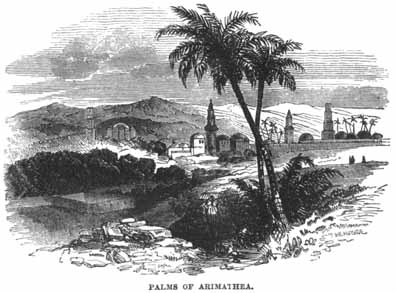
The flowers of most of the palms are as beautiful as the trees.
Those of the Palma real are of a brilliant white, rendering
them visible from a great distance; but, generally, the blossoms are
of a pale yellow. To these succeed very different forms of fruit: in
one species it consists of a cluster of egg-shaped berries, sometimes
seventy or eighty in number, of a brilliant purple and gold colour,
which form a wholesome food.
South America contains the finest specimens, as well as the most
numerous varieties of palm: in Asia the tree is not very common; and
of the African palms but little is yet known, with the exception of
the date palm, the most important to man of the whole tribe, though
far less beautiful than the other species.
THE PALM-TREE.
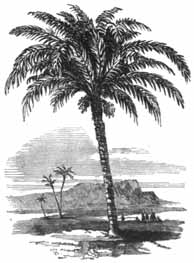 |
It waved not through an Eastern sky,
Beside a fount of Araby;
It was not fann'd by Southern breeze
In some green isle of Indian seas;
Nor did its graceful shadow sleep
O'er stream of Afric, lone and deep.
But fair the exiled Palm-tree grew,
'Midst foliage of no kindred hue:
Through the laburnum's dropping gold
Rose the light shaft of Orient mould;
And Europe's violets, faintly sweet,
Purpled the moss-beds at its feet.
Strange look'd it there!--the willow
stream'd
Where silv'ry waters near it gleam'd;
The lime-bough lured the honey-bee
To murmur by the Desert's tree,
And showers of snowy roses made
A lustre in its fan-like shade.
There came an eve of festal hours—
Rich music fill'd that garden's bowers;
Lamps, that from flow'ring branches hung,
On sparks of dew soft colours flung;
And bright forms glanced—a fairy show,
Under the blossoms to and fro.
But one, a lone one, 'midst the throng,
Seem'd reckless all of dance or song:
He was a youth of dusky mien,
Whereon the Indian sun had been;
Of crested brow, and long black hair—
A stranger, like the Palm-tree, there.
And slowly, sadly, moved his plumes,
Glittering athwart the leafy glooms:
He pass'd the pale green olives by,
Nor won the chesnut flowers his eye;
But when to that sole Palm he came,
Then shot a rapture through his frame.
To him, to him its rustling spoke;
The silence of his soul it broke.
It whisper'd of his own bright isle,
That lit the ocean with a smile.
Aye to his ear that native tone
Had something of the sea-wave's moan.
His mother's cabin-home, that lay
Where feathery cocoos fringe the bay;
The dashing of his brethren's oar,
The conch-note heard along the shore—
All through his wak'ning bosom swept:
He clasp'd his country's tree, and wept.
Oh! scorn him not. The strength whereby
The patriot girds himself to die;
The unconquerable power which fills
The foeman battling on his hills:
These have one fountain deep and clear,
The same whence gush'd that child-like
tear!—
Mrs. Hemans.
|
A CHAPTER ON DOGS.
Newfoundland Dogs are employed in drawing sledges laden with fish,
wood, and other articles, and from their strength and docility are of
considerable importance. The courage, devotion, and skill of this
noble animal in the rescue of persons from drowning is well known;
and on the banks of the Seine, at Paris, these qualities have been
applied to a singular purpose. Ten Newfoundland dogs are there
trained to act as servants to the Humane Society; and the rapidity
with which they cross and re-cross the river, and come and go, at the
voice of their trainer, is described as being most interesting to
witness. Handsome kennels have been erected for their dwellings on
the bridges.
DALMATIAN DOG.
There is a breed of very handsome dogs called by this name, of a
white colour, thickly spotted with black: it is classed among the
hounds. This species is said to have been brought from India, and is
not remarkable for either fine scent or intelligence. The Dalmatian
Dog is generally kept in our country as an appendage to the carriage,
and is bred up in the stable with the horses; it consequently seldom
receives that kind of training which is calculated to call forth any
good qualities it may possess.
TERRIER.
The Terrier is a valuable dog in the house and farm, keeping both
domains free from intruders, either in the shape of thieves or
vermin. The mischief effected by rats is almost incredible; it has
been said that, in some cases, in the article of corn, these little
animals consume a quantity in food equal in value to the rent of the
farm. Here the terrier is a most valuable assistant, in helping the
farmer to rid himself of his enemies. The Scotch Terrier is very
common in the greater part of the Western Islands of Scotland, and
some of the species are greatly admired. Her Majesty Queen Victoria
possesses one from Islay—a faithful, affectionate creature, yet
with all the spirit and determination that belong to his breed.
THE GREYHOUND.
The modern smooth-haired Greyhound of England is a very elegant
dog, not surpassed in speed and endurance by that of any other
country. Hunting the deer with a kind of greyhound of a larger size
was formerly a favourite diversion; and Queen Elizabeth was gratified
by seeing, on one occasion, from a turret, sixteen deer pulled down
by greyhounds upon the lawn at Cowdry Park, in Sussex.
OLD ENGLISH HOUND.
The dog we now call the Staghound appears to answer better than
any other to the description given to us of the old English Hound,
which was so much valued when the country was less enclosed, and the
numerous and extensive forests were the harbours of the wild deer.
This hound, with the harrier, were for many centuries the only
hunting dogs.
SHEPHERD'S DOG.
Instinct and education combine to fit this dog for our service:
the pointer will act without any great degree of instruction, and the
setter will crouch; but the Sheep Dog, especially if he has the
example of an older one, will, almost without the teaching of his
master, become everything he could wish, and be obedient to every
order, even to the slightest motion of the hand. If the 's dog be
but with his master, he appears to be perfectly content, rarely
mingling with his kind, and generally shunning the advances of
strangers; but the moment duty calls, his eye brightens, he springs
up with eagerness, and exhibits a sagacity, fidelity, and devotion
rarely equalled even by man himself.
BULL-DOG.
Of all dogs, none surpass in obstinacy and ferocity the Bull-dog.
The head is broad and thick, the lower jaw generally projects so that
the under teeth advance beyond the upper, the eyes are scowling, and
the whole expression calculated to inspire terror. It is remarkable
for the pertinacity with which it maintains its hold of any animal it
may have seized, and is, therefore, much used in the barbarous
practice of bull-baiting, so common in some countries, and but lately
abolished in England.
LORD BACON.
In those prescient views by which the genius of Lord Bacon has
often anticipated the institutions and the discoveries of succeeding
times, there was one important object which even his foresight does
not appear to have contemplated. Lord Bacon did not foresee that the
English language would one day be capable of embalming all that
philosophy can discover, or poetry can invent; that his country would
at length possess a national literature of its own, and that it would
exult in classical compositions, which might be appreciated with the
finest models of antiquity. His taste was far unequal to his
invention. So little did he esteem the language of his country, that
his favourite works were composed in Latin; and he was anxious to
have what he had written in English preserved in that "universal
language which may last as long as books last."
It would have surprised Bacon to have been told that the most
learned men in Europe have studied English authors to learn to think
and to write. Our philosopher was surely somewhat mortified, when, in
his dedication of the Essays, he observed, that, "Of all my
other works, my Essays have been most current; for that, as it seems,
they come home to men's business and bosoms." It is too much
to hope to find in a vast and profound inventor, a writer also who
bestows immortality on his language. The English language is the only
object, in his great survey of art and of nature, which owes nothing
of its excellence to the genius of Bacon.
He had reason, indeed, to be mortified at the reception of his
philosophical works; and Dr. Rowley, even, some years after the death
of his illustrious master, had occasion to observe, "His fame is
greater, and sounds louder in foreign parts abroad than at home in
his own nation; thereby verifying that Divine sentence, 'A
Prophet is not without honour, save in his own country and in his own
house,'" Even the men of genius, who ought to have
comprehended this new source of knowledge thus opened to them,
reluctantly entered into it: so repugnant are we to give up ancient
errors, which time and habit have made a part of ourselves.
D'Israeli.
THE LILIES OF THE FIELD.
|
|
Flowers! when the Saviour's calm, benignant
eye
Fell on your gentle beauty; when from you
That heavenly lesson for all hearts he
drew.
Eternal, universal as the sky;
Then in the bosom of your purity
A voice He set, as in a temple shrine,
That Life's quick travellers ne'er might pass
you by
Unwarn'd of that sweet oracle
divine.
And though too oft its low, celestial sound
By the harsh notes of work-day care is
drown'd,
And the loud steps of vain, unlist'ning
haste,
Yet the great lesson hath no tone of power,
Mightier to reach the soul in thought's hush'd
hour,
Than yours, meek lilies, chosen thus, and graced.
Mrs. Hemans.
|
POMPEII.
The earliest and one of the most fatal eruptions of Mount Vesuvius
that is mentioned in history took place in the year 79, during the
reign of the Emperor Titus. All Campagna was filled with
consternation, and the country was overwhelmed with devastation in
every direction; towns, villages, palaces, and their inhabitants were
consumed by molten lava, and hidden from the sight by showers of
volcanic stones, cinders, and ashes.
Pompeii had suffered severely from an earthquake sixteen years
before, but had been rebuilt and adorned with many a stately
building, particularly a magnificent theatre, where thousands were
assembled to see the gladiators when this tremendous visitation burst
upon the devoted city, and buried it to a considerable depth with the
fiery materials thrown from the crater. "Day was turned to
night," says a classic author, "and night into darkness; an
inexpressible quantity of dust and ashes was poured out, deluging
land, sea, and air, and burying two entire cities, Pompeii and
Herculaneum, whilst the people were sitting in the theatre."
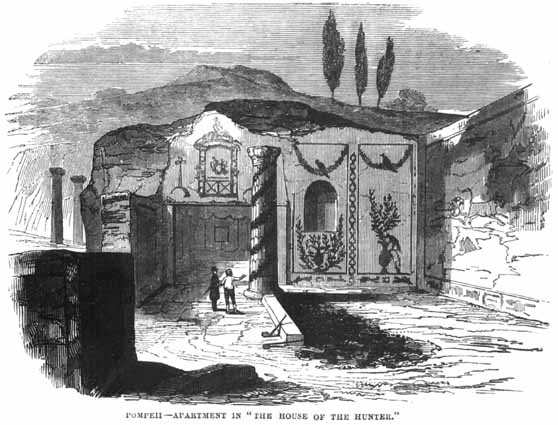
Many parts of Pompeii have, at various times, been excavated, so
as to allow visitors to examine the houses and streets; and in
February, 1846, the house of the Hunter was finally cleared, as it
appears in the Engraving. This is an interesting dwelling, and was
very likely the residence of a man of wealth, fond of the chase. A
painting on the right occupies one side of the large room, and here
are represented wild animals, the lion chasing a bull, &c. The
upper part of the house is raised, where stands a gaily-painted
column—red and yellow in festoons; behind which, and over a
doorway, is a fresco painting of a summer-house perhaps a
representation of some country-seat of the proprietor, on either side
are hunting-horns. The most beautiful painting in this room
represents a Vulcan at his forge, assisted by three dusky, aged
figures. In the niche of the outward room a small statue was found,
in terra cotta (baked clay). The architecture of this house is
singularly rich in decoration, and the paintings, particularly those
of the birds and vases, very bright vivid.
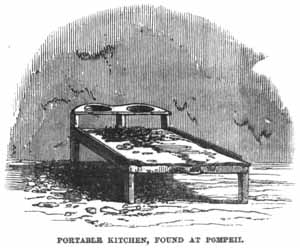
At this time, too, some very perfect skeletons were discovered in
a house near the theatre, and near the hand of one of them were found
thirty-seven pieces of silver and two gold coins; some of the former
were attached to the handle of a key. The unhappy beings who were
perished may have been the inmates of the dwelling. We know, from the
account written by Pliny, that the young and active had plenty of
time for escape, and this is the reason why so few skeletons have
been found in Pompeii.
In a place excavated at the expense of the Empress of Russia was
found a portable kitchen (represented above), made of iron, with two
round holes for boiling pots. The tabular top received the fire for
placing other utensils upon, and by a handle in the front it could be
moved when necessary.
THE NIGHTINGALE AND GLOWWORM.
A Nightingale that all day long
Had cheer'd the village with his song,
Nor yet at eve his note suspended,
Nor yet when even-tide was ended—
Began to feel, as well he might,
The keen demands of appetite:
When, looking eagerly around,
He spied, far off upon the ground,
A something shining in the dark,
And knew the glowworm by his spark:
So stooping down from hawthorn top,
He thought to put him in his crop.
The worm, aware of his intent,
Harangued him thus, right eloquent:—
"Did you admire my lamp," quoth he,
"As much as I your minstrelsy,
You would abhor to do me wrong,
As much as I to spoil your song;
For 'twas the self-same power Divine
Taught you to sing and me to shine,
That you with music, I with light,
Might beautify and cheer the night."
The songster heard his short oration,
And, warbling out his approbation,
Released him, as my story tells,
And found a supper somewhere else.
Cowper.
|
THE INVISIBLE WORLD REVEALED BY THE MICROSCOPE.
A fact not less startling than would be the realisation of the
imaginings of Shakespeare and of Milton, or of the speculations of
Locke and of Bacon, admits of easy demonstration, namely, that the
air, the earth, and the waters teem with numberless myriads of
creatures, which are as unknown and as unapproachable to the great
mass of mankind, as are the inhabitants of another planet. It may,
indeed, be questioned, whether, if the telescope could bring within
the reach of our observation the living things that dwell in the
worlds around us, life would be there displayed in forms more
diversified, in organisms more marvellous, under conditions more
unlike those in which animal existence appears to our unassisted
senses, than may be discovered in the leaves of every forest, in the
flowers of every garden, and in the waters of every rivulet, by that
noblest instrument of natural philosophy, the Microscope.
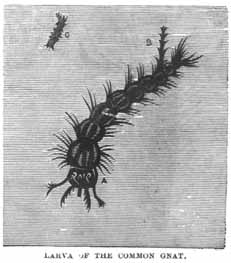
Larva of the Common Gnat.
- The body and head of the larva (magnified).
- The respiratory apparatus, situated in the tail.
- Natural size.
|
To an intelligent person, who has previously obtained a general
idea of the nature of the Objects about to be submitted to his
inspection, a group of living animalcules, seen under a powerful
microscope for the first time, presents a scene of extraordinary
interest, and never fails to call forth an expression of amazement
and admiration. This statement admits of an easy illustration: for
example, from some water containing aquatic plants, collected from a
pond on Clapham Common, I select a small twig, to which are attached
a few delicate flakes, apparently of slime or jelly; some minute
fibres, standing erect here and there on the twig, are also dimly
visible to the naked eye. This twig, with a drop or two of the water,
we will put between two thin plates of glass, and place under the
field of view of a microscope, having lenses that magnify the image
of an object 200 times in linear dimensions.
Upon looking through the instrument, we find the fluid swarming
with animals of various shapes and magnitudes. Some are darting
through the water with great rapidity, while others are pursuing and
devouring creatures more infinitesimal than themselves. Many are
attached to the twig by long delicate threads, several have their
bodies inclosed in a transparent tube, from one end of which the
animal partly protrudes and then recedes, while others are covered by
an elegant shell or case. The minutest kinds, many of which are so
small that millions might be contained in a single drop of water,
appear like mere animated globules, free, single, and of various
colours, sporting about in every direction. Numerous species resemble
pearly or opaline cups or vases, fringed round the margin with
delicate fibres, that are in constant oscillation. Some of these are
attached by spiral tendrils; others are united by a slender stem to
one common trunk, appearing like a bunch of hare-bells; others are of
a globular form, and grouped together in a definite pattern, on a
tabular or spherical membranous case, for a certain period of their
existence, and ultimately become detached and locomotive, while many
are permanently clustered together, and die if separated from the
parent mass. They have no organs of progressive motion, similar to
those of beasts, birds, or fishes; and though many species are
destitute of eyes, yet possess an accurate perception of the presence
of other bodies, and pursue and capture their prey with unerring
purpose.
Mantell's
Thoughts on Animalcules.
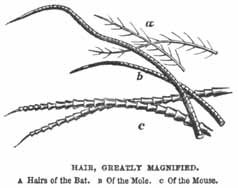
Hair, Greatly Magnified.
- Hairs of the Bat.
- Of the Mole.
- Of the Mouse.
|
THE CANARY.
This bird, which is now kept and reared throughout the whole of
Europe, and even in Russia and Siberia, on account of its pretty
form, docility, and sweet song, is a native of the Canary Isles. On
the banks of small streams, in the pleasant valleys of those lovely
islands, it builds its nest in the branches of the orange-trees, of
which it is so fond, that even in this country the bird has been
known to find its way into the greenhouse, and select the fork of one
of the branches of an orange-tree on which to build its nest, seeming
to be pleased with the sweet perfume of the blossoms.
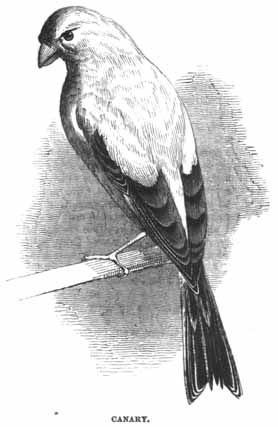
The bird has been known in Europe since the beginning of the
sixteenth century, when a ship, having a large number of canaries on
board destined for Leghorn, was wrecked on the coast of Italy. The
birds having regained their liberty, flew to the nearest land, which
happened to be the island of Elba, where they found so mild a climate
that they built their nests there and became very numerous. But the
desire to possess such beautiful songsters led to their being hunted
after, until the whole wild race was quite destroyed. In Italy,
therefore, we find the first tame canaries, and here they are still
reared in great numbers. Their natural colour is grey, which merges
into green beneath, almost resembling the colours of the linnet; but
by means of domestication, climate, and being bred with other birds,
canaries may now be met with of a great variety of colours. But
perhaps there is none more beautiful than the golden-yellow, with
blackish-grey head and tail. The hen canary lays her eggs four or
five times a year, and thus a great number of young are produced.
As they are naturally inhabitants of warm climates, and made still
more delicate by constant residence in rooms, great care should be
taken in winter that this favourite bird be not exposed to cold air,
which, however refreshing to it in the heat of summer, is so
injurious in this season that it causes sickness and even death. To
keep canaries in a healthy and happy state, it is desirable that the
cage should be frequently hung in brilliant daylight, and, if
possible, placed in the warm sunshine, which, especially when
bathing, is very agreeable to them. The more simple and true
to-nature the food is, the better does it agree with them; and a
little summer rapeseed mixed with their usual allowance of the seed
to which they have given their name, will be found to be the best
kind of diet. As a treat, a little crushed hempseed or summer
cabbage-seed may be mixed with the canary-seed. The beautiful grass
from which the latter is obtained is a pretty ornament for the
garden; it now grows very abundantly in Kent.
The song of the canary is not in this country at all like that of
the bird in a state of nature, for it is a kind of compound of notes
learned from other birds. It may be taught to imitate the notes of
the nightingale, by being placed while young with that bird. Care
must be taken that the male parent of the young canary be removed
from the nest before the young ones are hatched, or it will be sure
to acquire the note of its parent. The male birds of all the
feathered creation are the only ones who sing; the females merely
utter a sweet chirrup or chirp, so that from the hen canary the bird
will run no risk of learning its natural note.
INDUSTRY AND APPLICATION.
Diligence, industry, and proper improvement of time are material
duties of the young. To no purpose are they endowed with the best
abilities, if they want activity for exerting them. Unavailing, in
this case, will be every direction that can be given them, either for
their temporal or spiritual welfare. In youth the habits of industry
are most easily acquired; in youth the incentives to it are strong,
from ambition and from duty, from emulation and hope, from all the
prospects which the beginning of life affords. If, dead to these
calls, you already languish in slothful inaction, what will be able
to quicken the more sluggish current of advancing years? Industry is
not only the instrument of improvement, but the foundation of
pleasure. Nothing is so opposite to the true enjoyment of life as the
relaxed and feeble state of an indolent mind. He who is a stranger to
industry, may possess, but he cannot enjoy. For it is labour only
which gives the relish to pleasure. It is the appointed vehicle of
every good man. It is the indispensable condition of our possessing a
sound mind in a sound body. Sloth is so inconsistent with both, that
it is hard to determine whether it be a greater foe to virtue or to
health and happiness. Inactive as it is in itself, its effects are
fatally powerful. Though it appear a slowly-flowing stream, yet it
undermines all that is stable and flourishing. It not only saps the
foundation of every virtue, but pours upon you a deluge of crimes and
evils.
It is like water which first putrefies by stagnation, and then
sends up noxious vapours and fills the atmosphere with death. Fly,
therefore, from idleness, as the certain parent both of guilt and of
ruin. And under idleness I include, not mere inaction only, but all
that circle of trifling occupations in which too many saunter away
their youth; perpetually engaged in frivolous society or public
amusements, in the labours of dress or the ostentation of their
persons. Is this the foundation which you lay for future usefulness
and esteem? By such accomplishments do you hope to recommend
yourselves to the thinking part of the world, and to answer the
expectations of your friends and your country? Amusements youth
requires: it were vain, it were cruel, to prohibit them. But, though
allowable as the relaxation, they are most culpable as the business,
of the young, for they then become the gulf of time and the poison of
the mind; they weaken the manly powers; they sink the native vigour
of youth into contemptible effeminacy.
Blair.
THE RIVER JORDAN.
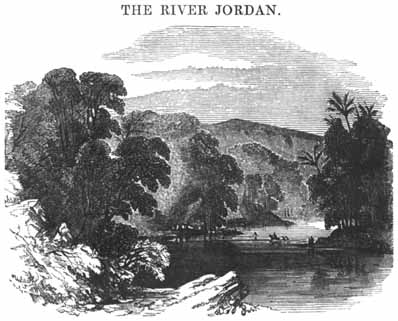
The river Jordan rises in the mountains of Lebanon, and falls into
the little Lake Merom, on the banks of which Joshua describes the
hostile Kings as pitching to fight against Israel. After passing
through this lake, it runs down a rocky valley with great noise and
rapidity to the Lake of Tiberias. In this part of its course the
stream is almost hidden by shady trees, which grow on each side. As
the river approaches the Lake of Tiberias it widens, and passes
through it with a current that may be clearly seen during a great
part of its course. It then reaches a valley, which is the lowest
ground in the whole of Syria, many hundred feet below the level of
the Mediterranean Sea. It is so well sheltered by the high land on
both sides, that the heat thus produced and the moisture of the river
make the spot very rich and fertile. This lovely plain is five or six
miles across in parts, but widens as it nears the Dead Sea, whose
waters cover the cities of Sodom and Gomorrah, destroyed for the
wickedness of their inhabitants.
ON JORDAN'S BANKS.
 |
On Jordan's banks the Arab camels stray,
On Sion's hill the False One's votaries
pray—
The Baal-adorer bows on Sinai's steep;
Yet there—even there—O God! thy thunders
sleep:
There, where thy finger scorch'd the tablet
stone;
There, where thy shadow to thy people
shone—
Thy glory shrouded in its garb of fire
(Thyself none living see and not expire).
Oh! in the lightning let thy glance
appear—
Sweep from his shiver'd hand the oppressor's
spear!
How long by tyrants shall thy land be trod?
How long thy temple worshipless, O God!
Byron.
|
FORTITUDE.
Without some degree of fortitude there can be no happiness,
because, amidst the thousand uncertainties of life, there can be no
enjoyment of tranquillity. The man of feeble and timorous spirit
lives under perpetual alarms. He sees every distant danger and
tremble; he explores the regions of possibility to discover the
dangers that may arise: often he creates imaginary ones; always
magnifies those that are real. Hence, like a person haunted by
spectres, he loses the free enjoyment even of a safe and prosperous
state, and on the first shock of adversity he desponds. Instead of
exerting himself to lay hold on the resources that remain, he gives
up all for lost, and resigns himself to abject and broken spirits. On
the other hand, firmness of mind is the parent of tranquillity. It
enables one to enjoy the present without disturbance, and to look
calmly on dangers that approach or evils that threaten in future.
Look into the heart of this man, and you will find composure,
cheerfulness, and magnanimity; look into the heart of the other, and
you will see nothing but confusion, anxiety, and trepidation. The one
is a castle built on a rock, which defies the attacks of surrounding
waters; the other is a hut placed on the shore, which every wind
shakes and every wave overflows.
Blair.
THE IVY IN THE DUNGEON.
|
|
The Ivy in a dungeon grew
Unfed by rain, uncheer'd by dew;
Its pallid leaflets only drank
Cave-moistures foul, and odours dank.
But through the dungeon-grating high
There fell a sunbeam from the sky:
It slept upon the grateful floor
In silent gladness evermore.
The ivy felt a tremor shoot
Through all its fibres to the root;
It felt the light, it saw the ray,
It strove to issue into day.
It grew, it crept, it push'd, it
clomb—
Long had the darkness been its home;
But well it knew, though veil'd in night,
The goodness and the joy of light.
Its clinging roots grew deep and strong;
Its stem expanded firm and long;
And in the currents of the air
Its tender branches flourish'd fair.
It reach'd the beam—it thrill'd, it
curl'd,
It bless'd the warmth that cheers the world;
It rose towards the dungeon bars—
It look'd upon the sun and stars.
It felt the life of bursting spring,
It heard the happy sky-lark sing.
It caught the breath of morns and eves,
And woo'd the swallow to its leaves.
By rains, and dews, and sunshine fed,
Over the outer wall it spread;
And in the daybeam waving free,
It grew into a steadfast tree.
Upon that solitary place
Its verdure threw adorning grace.
The mating birds became its guests,
And sang its praises from their nests.
Wouldst know the moral of the rhyme?
Behold the heavenly light, and climb!
Look up, O tenant of the cell,
Where man, the prisoner, must dwell.
To every dungeon comes a ray
Of God's interminable day.
On every heart a sunbeam falls
To cheer its lonely prison walls.
The ray is TRUTH. Oh, soul, aspire
To bask in its celestial fire;
So shalt thou quit the glooms of clay,
So shaft thou flourish into day.
So shalt thou reach the dungeon grate,
No longer dark and desolate;
And look around thee, and above,
Upon a world of light and love.
Mackay.
|
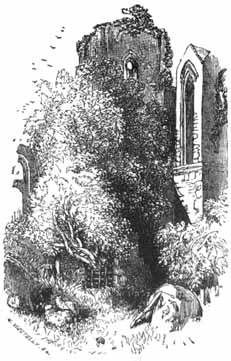
THE NESTS OF BIRDS.
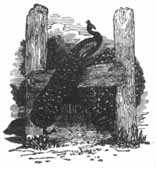
How curious is the structure of the nest of the goldfinch or
chaffinch! The inside of it is lined with cotton and fine silken
threads; and the outside cannot be sufficiently admired, though it is
composed only of various species of fine moss. The colour of these
mosses, resembling that of the bark of the tree on which the nest is
built, proves that the bird intended it should not be easily
discovered. In some nests, hair, wool, and rushes are dexterously
interwoven. In some, all the parts are firmly fastened by a thread,
which the bird makes of hemp, wool, hair, or more commonly of
spiders' webs. Other birds, as for instance the blackbird and the
lapwing, after they have constructed their nest, plaster the inside
with mortar, which cements and binds the whole together; they then
stick upon it, while quite wet, some wool or moss, to give it the
necessary degree of warmth. The nests of swallows are of a very
different construction from those of other birds. They require
neither wood, nor hay, nor cords; they make a kind of mortar, with
which they form a neat, secure, and comfortable habitation for
themselves and their family. To moisten the dust, of which they build
their nest, they dip their breasts in water and shake the drops from
their wet feathers upon it. But the nests most worthy of admiration
are those of certain Indian birds, which suspend them with great art
from the branches of trees, to secure them from the depredations of
various animals and insects. In general, every species of bird has a
peculiar mode of building; but it may be remarked of all alike, that
they always construct their nests in the way that is best adapted to
their security, and to the preservation and welfare of their
species.
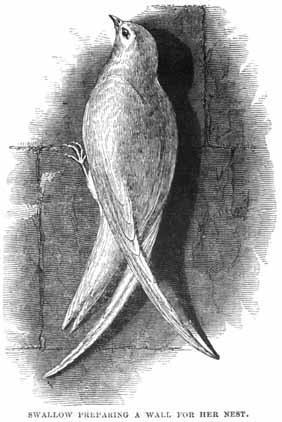
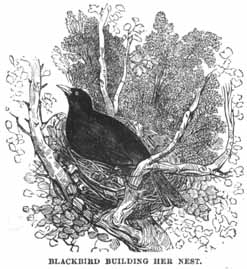
Such is the wonderful instinct of birds with respect to the
structure of their nests. What skill and sagacity! what industry and
patience do they display! And is it not apparent that all their
labours tend towards certain ends? They construct their nests hollow
and nearly round, that they may retain the heat so much the better.
They line them with the most delicate substances, that the young may
lie soft and warm. What is it that teaches the bird to place her nest
in a situation sheltered from the rain, and secure against the
attacks of other animals? How did she learn that she should lay
eggs—that eggs would require a nest to prevent them from
falling to the ground and to keep them warm? Whence does she know
that the heat would not be maintained around the eggs if the nest
were too large; and that, on the other hand, the young would not have
sufficient room if it were smaller? By what rules does she determine
the due proportions between the nest and the young which are not yet
in existence? Who has taught her to calculate the time with such
accuracy that she never commits a mistake, in producing her eggs
before the nest is ready to receive them? Admire in all these things
the power, the wisdom, and the goodness of the Creator!
Sturm.
THE BUSHMEN.
The Bosjesmans, or Bushmen, appear to be the remains of Hottentot
hordes, who have been driven, by the gradual encroachments of the
European colonists, to seek for refuge among the inaccessible rocks
and sterile desert of the interior of Africa. Most of the hordes
known in the colony by the name of Bushmen are now entirely destitute
of flocks or herds, and subsist partly by the chase, partly on the
wild roots of the wilderness, and in times of scarcity on reptiles,
grasshoppers, and the larvae of ants, or by plundering their
hereditary foes and oppressors, the frontier Boers. In seasons when
every green herb is devoured by swarms of locusts, and when the wild
game in consequence desert the pastures of the wilderness, the
Bushman finds a resource in the very calamity which would overwhelm
an agricultural or civilized community. He lives by devouring the
devourers; he subsists for weeks and months on locusts alone, and
also preserves a stock of this food dried, as we do herrings or
pilchards, for future consumption.
The Bushman retains the ancient arms of the Hottentot race,
namely, a javelin or assagai, similar to that of the Caffres, and a
bow and arrows. The latter, which are his principal weapons both for
war and the chase, are small in size and formed of slight materials;
but, owing to the deadly poison with which the arrows are imbued, and
the dexterity with which they are launched, they are missiles truly
formidable. One of these arrows, formed merely of a piece of slender
reed tipped with bone or iron, is sufficient to destroy the most
powerful animal. But, although the colonists very much dread the
effects of the Bushman's arrow, they know how to elude its range;
and it is after all but a very unequal match for the fire-lock, as
the persecuted natives by sad experience have found. The arrows are
usually kept in a quiver, formed of the hollow stalk of a species of
aloe, and slung over the shoulder; but a few, for immediate use, are
often stuck in a band round the head.
A group of Bosjesmans, comprising two men, two women, and a child,
were recently brought to this country and exhibited at the Egyptian
Hall, in Piccadilly. The women wore mantles and conical caps of hide,
and gold ornaments in their ears. The men also wore a sort of skin
cloak, which hung down to their knees, over a close tunic: the legs
and feet were bare in both. Their sheep-skin mantles, sewed together
with threads of sinew, and rendered soft and pliable by friction,
sufficed for a garment by day and a blanket by night. These
Bosjesmans exhibited a variety of the customs of their native
country. Their whoops were sometimes so loud as to be startling, and
they occasionally seemed to consider the attention of the spectators
as an affront.
CHARACTER OF ALFRED, KING OF ENGLAND.
The merit of this Prince, both in private and public life, may
with advantage be set in opposition to that of any Monarch or citizen
which the annals of any age or any nation can present to us. He
seems, indeed, to be the realisation of that perfect character,
which, under the denomination of a sage or wise man, the philosophers
have been fond of delineating, rather as a fiction of their
imagination than in hopes of ever seeing it reduced to practice; so
happily were all his virtues tempered together, so justly were they
blended, and so powerfully did each prevent the other from exceeding
its proper bounds. He knew how to conciliate the most enterprising
spirit with the coolest moderation; the most obstinate perseverance
with the easiest flexibility; the most severe justice with the
greatest lenity; the greatest rigour in command with the greatest
affability of deportment; the highest capacity and inclination for
science, with the most shining: talents for action. His civil and his
military virtues are almost equally the objects of our admiration,
excepting only, that the former, being more rare among princes, as
well as more useful, seem chiefly to challenge our applause. Nature
also, as if desirous that so bright a production of her skill should
be set in the fairest light, had bestowed on him all bodily
accomplishments, vigour of limbs, dignity of shape and air, and a
pleasant, engaging, and open countenance. Fortune alone, by throwing
him into that barbarous age, deprived him of historians worthy to
transmit his fame to posterity; and we wish to see him delineated in
more lively colours, and with more particular strokes, that we may at
least perceive some of those small specks and blemishes, from which,
as a man, it is impossible he could be entirely exempted.
Hume.
THE FIRST GRIEF.
|
|
Oh! call my brother back to me,
I cannot play alone;
The summer comes with flower and bee—
Where is my brother gone?
The butterfly is glancing bright
Across the sunbeam's track;
I care not now to chase its flight—
Oh! call my brother back.
The flowers run wild—the flowers we
sow'd
Around our garden-tree;
Our vine is drooping with its load—
Oh! call him back to me.
"He would not hear my voice, fair
child—
He may not come to thee;
The face that once like spring-time smiled,
On earth no more thou'lt see
|
|
|
|
"A rose's brief bright life of joy,
Such unto him was given;
Go, thou must play alone, my boy—
Thy brother is in heaven!"
And has he left the birds and flowers,
And must I call in vain,
And through the long, long summer hours,
Will he not come again?
And by the brook, and in the glade,
Are all our wand'rings o'er?
Oh! while my brother with me play'd,
Would I had loved him more!—
Mrs. Hemans.
|
ON CRUELTY TO INFERIOR ANIMALS

Man is that link of the chain of universal existence by which
spiritual and corporeal beings are united: as the numbers and variety
of the latter his inferiors are almost infinite, so probably are
those of the former his superiors; and as we see that the lives and
happiness of those below us are dependant on our wills, we may
reasonably conclude that our lives and happiness are equally
dependant on the wills of those above us; accountable, like
ourselves, for the use of this power to the supreme Creator and
governor of all things. Should this analogy be well founded, how
criminal will our account appear when laid before that just and
impartial judge! How will man, that sanguinary tyrant, be able to
excuse himself from the charge of those innumerable cruelties
inflicted on his unoffending subjects committed to his care, formed
for his benefit, and placed under his authority by their common
Father? whose mercy is over all his works, and who expects that his
authority should be exercised, not only with tenderness and mercy,
but in conformity to the laws of justice and gratitude.
But to what horrid deviations from these benevolent intentions are
we daily witnesses! no small part of mankind derive their chief
amusements from the deaths and sufferings of inferior animals; a much
greater, consider them only as engines of wood or iron, useful in
their several occupations. The carman drives his horse, and the
carpenter his nail, by repeated blows; and so long as these produce
the desired effect, and they both go, they neither reflect or care
whether either of them have any sense of feeling. The butcher knocks
down the stately ox, with no more compassion than the blacksmith
hammers a horseshoe; and plunges his knife into the throat of the
innocent lamb, with as little reluctance as the tailor sticks his
needle into the collar of a coat.
If there are some few who, formed in a softer mould, view with
pity the sufferings of these defenceless creatures, there is scarce
one who entertains the least idea that justice or gratitude can be
due to their merits or their services. The social and friendly dog is
hanged without remorse, if, by barking in defence of his master's
person and property, he happens unknowingly to disturb his rest; the
generous horse, who has carried his ungrateful master for many years
with ease and safety, worn out with age and infirmities, contracted
in his service, is by him condemned to end his miserable days in a
dust-cart, where the more he exerts his little remains of spirit, the
more he is whipped to save his stupid driver the trouble of whipping
some other less obedient to the lash. Sometimes, having been taught
the practice of many unnatural and useless feats in a riding-house,
he is at last turned out and consigned to the dominion of a
hackney-coachman, by whom he is every day corrected for performing
those tricks, which he has learned under so long and severe a
discipline. The sluggish bear, in contradiction to his nature, is
taught to dance for the diversion of a malignant mob, by placing
red-hot irons under his feet; and the majestic bull is tortured by
every mode which malice can invent, for no offence but that he is
gentle and unwilling to assail his diabolical tormentors. These, with
innumerable other acts of cruelty, injustice, and ingratitude, are
every day committed, not only with impunity, but without censure and
even without observation; but we may be assured that they cannot
finally pass away unnoticed and unretaliated.
The laws of self-defence undoubtedly justify us in destroying
those animals who would destroy us, who injure our properties, or
annoy our persons; but not even these, whenever their situation
incapacitates them from hurting us. I know of no right which we have
to shoot a bear on an inaccessible island of ice, or an eagle on the
mountain's top; whose lives cannot injure us, nor deaths procure
us any benefit. We are unable to give life, and therefore ought not
wantonly to take it away from the meanest insect, without sufficient
reason; they all receive it from the same benevolent hand as
ourselves, and have therefore an equal right to enjoy it.
God has been pleased to create numberless animals intended for our
sustenance; and that they are so intended, the agreeable flavour of
their flesh to our palates, and the wholesome nutriment which it
administers to our stomachs, are sufficient proofs: these, as they
are formed for our use, propagated by our culture, and fed by our
care, we have certainly a right to deprive of life, because it is
given and preserved to them on that condition; but this should always
be performed with all the tenderness and compassion which so
disagreeable an office will permit; and no circumstances ought to be
omitted, which can render their executions as quick and easy as
possible. For this Providence has wisely and benevolently provided,
by forming them in such a manner that their flesh becomes rancid and
unpalateable by a painful and lingering death; and has thus compelled
us to be merciful without compassion, and cautious of their
sufferings, for the sake of ourselves: but, if there are any whose
tastes are so vitiated, and whose hearts are so hardened, as to
delight in such inhuman sacrifices, and to partake of them without
remorse, they should be looked upon as demons in human shape, and
expect a retaliation of those tortures which they have inflicted on
the innocent, for the gratification of their own depraved and
unnatural appetites.
So violent are the passions of anger and revenge in the human
breast, that it is not wonderful that men should persecute their real
or imaginary enemies with cruelty and malevolence; but that there
should exist in nature a being who can receive pleasure from giving
pain, would be totally incredible, if we were not convinced, by
melancholy experience, that there are not only many, but that this
unaccountable disposition is in some manner inherent in the nature of
man; for, as he cannot be taught by example, nor led to it by
temptation, or prompted to it by interest, it must be derived from
his native constitution; and it is a remarkable confirmation of what
revelation so frequently inculcates—that he brings into the
world with him an original depravity, the effects of a fallen and
degenerate state; in proof of which we need only to observe, that the
nearer he approaches to a state of nature, the more predominant this
disposition appears, and the more violently it operates. We see
children laughing at the miseries which they inflict on every
unfortunate animal which comes within their power; all savages are
ingenious in contriving, and happy in executing, the most exquisite
tortures; and the common people of all countries are delighted with
nothing so much as bull-baitings, prize-fightings, executions, and
all spectacles of cruelty and horror. Though civilization may in some
degree abate this native ferocity, it can never quite extirpate it;
the most polished are not ashamed to be pleased with scenes of little
less barbarity, and, to the disgrace of human nature, to dignify them
with the name of sports. They arm cocks with artificial weapons,
which nature had kindly denied to their malevolence, and with shouts
of applause and triumph see them plunge them into each other's
hearts; they view with delight the trembling deer and defenceless
hare, flying for hours in the utmost agonies of terror and despair,
and, at last, sinking under fatigue, devoured by their merciless
pursuers; they see with joy the beautiful pheasant and harmless
partridge drop from their flight, weltering in their blood, or,
perhaps, perishing with wounds and hunger, under the cover of some
friendly thicket to which they have in vain retreated for safety;
they triumph over the unsuspecting fish whom they have decoyed by an
insidious pretence of feeding, and drag him from his native element
by a hook fixed to and tearing out his entrails; and, to add to all
this, they spare neither labour nor expense to preserve and propagate
these innocent animals, for no other end but to multiply the objects
of their persecution.
What name would we bestow on a superior being, whose whole
endeavours were employed, and whose whole pleasure consisted in
terrifying, ensnaring, tormenting, and destroying mankind? whose
superior faculties were exerted in fomenting animosities amongst
them, in contriving engines of destruction, and inciting them to use
them in maiming and murdering each other? whose power over them was
employed in assisting the rapacious, deceiving the simple, and
oppressing the innocent? who, without provocation or advantage,
should continue from day to day, void of all pity and remorse, thus
to torment mankind for diversion, and at the same time endeavour with
his utmost care to preserve their lives and to propagate their
species, in order to increase the number of victims devoted to his
malevolence, and be delighted in proportion to the miseries he
occasioned. I say, what name detestable enough could we find for such
a being? yet, if we impartially consider the case, and our
intermediate situation, we must acknowledge that, with regard to
inferior animals, just such a being is a sportsman.
Jenyns.
PETER THE HERMIT, AND THE FIRST CRUSADE.
It was in Palestine itself that Peter the Hermit first conceived
the grand idea of rousing the powers of Christendom to rescue the
Christians of the East from the thraldom of the Mussulman, and the
Sepulchre of Jesus from the rude hands of the Infidel. The subject
engrossed his whole mind. Even in the visions of the night he was
full of it. One dream made such an impression upon him, that he
devoutly believed the Saviour of the world Himself appeared before
him, and promised him aid and protection in his holy undertaking. If
his zeal had ever wavered before, this was sufficient to fix it for
ever.
Peter, after he had performed all the penances and duties of his
pilgrimage, demanded an interview with Simeon, the Patriarch of the
Greek Church at Jerusalem. Though the latter was a heretic in
Peter's eyes, yet he was still a Christian, and felt as acutely
as himself for the persecu tions heaped by the Turks upon the
followers of Jesus. The good prelate entered fully into his views,
and, at his suggestion, wrote letters to the Pope, and to the most
influential Monarchs of Christendom, detailing the sorrows of the
faithful, and urging them to take up arms in their defence. Peter was
not a laggard in the work. Taking an affectionate farewell of the
Patriarch, he returned in all haste to Italy. Pope Urban II. occupied
the apostolic chair. It was at that time far from being an easy seat.
His predecessor, Gregory, had bequeathed him a host of disputes with
the Emperor Henry IV., of Germany; and he had made Philip I., of
France, his enemy. So many dangers encompassed him about that the
Vatican was no secure abode, and he had taken refuge in Apulia, under
the protection of the renowned Robert Guiscard. Thither Peter appears
to have followed him, though the spot in which their meeting took
place is not stated with any precision by ancient chroniclers or
modern historians. Urban received him most kindly, read with tears in
his eyes the epistle from the Patriarch Simeon, and listened to the
eloquent story of the Hermit with an attention which showed how
deeply he sympathised with the woes of the Christian Church.
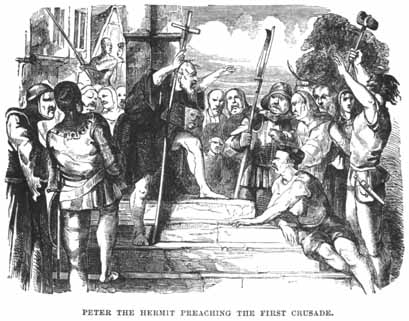
Enthusiasm is contagious, and the Pope appears to have caught it
instantly from one whose zeal was so unbounded. Giving the Hermit
full powers, he sent him abroad to preach the Holy War to all the
nations and potentates of Christendom. The Hermit preached, and
countless thousands answered to his call. France, Germany, and Italy
started at his voice, and prepared for the deliverance of Zion. One
of the early historians of the Crusade, who was himself an
eye-witness of the rapture of Europe, describes the personal
appearance of the Hermit at this time. He says that there appeared to
be something of divine in everything which he said or did. The people
so highly reverenced him, that they plucked hairs from the mane of
his mule, that they might keep them as relics. While preaching, he
wore, in general, a woollen tunic, with a dark-coloured mantle which
fell down to his heels. His arms and feet were bare, and he ate
neither flesh nor bread, supporting himself chiefly upon fish and
wine. "He set out," said the chronicler, "from whence
I know not; but we saw him passing through towns and villages,
preaching everywhere, and the people surrounding him in crowds,
loading him with offerings, and celebrating his sanctity with such
great praises, that I never remember to have seen such honours
bestowed upon any one." Thus he went on, untired, inflexible,
and full of devotion, communicating his own madness to his hearers,
until Europe was stirred from its very depths.
Popular Delusions.
FAITH'S GUIDING STAR.
 |
We find a glory in the flowers
When snowdrops peep and hawthorn
blooms;
We see fresh light in spring-time hours,
And bless the radiance that illumes.
The song of promise cheers with hope,
That sin or sorrow cannot mar;
God's beauty fills the daisyed slope,
And keeps undimm'd Faith's
guiding star.
We find a glory in the smile
That lives in childhood's happy
face,
Ere fearful doubt or worldly guile
Has swept away the angel trace.
The ray of promise shineth there,
To tell of better lands afar;
God sends his image, pure and fair,
To keep undimm'd Faith's guiding
star.
We find a glory in the zeal
Of doating breast and toiling brain;
Affection's martyrs still will kneel,
And song, though famish'd, pour its
strain.
They lure us by a quenchless light,
And point where joy is holier far;
They shed God's spirit, warm and bright,
And keep undimm'd Faith's guiding
star.
We muse beside the rolling waves;
We ponder on the grassy hill;
We linger by the new-piled graves,
And find that star is shining still.
God in his great design hath spread,
Unnumber'd rays to lead afar;
They beam the brightest o'er the dead,
And keep undimm'd Faith's guiding
star.
Eliza Cook.
|
QUEEN ELIZABETH'S ADDRESS TO HER ARMY AT TILBURY FORT, IN
1588.
My loving people! we have been persuaded by some that are careful
of our safety, to take heed how we commit ourself to armed
multitudes, for fear of treachery; but, I assure you, I do not desire
to live to distrust my faithful and loving people. Let tyrants fear:
I have always so behaved myself, that, under God, I have placed my
chief strength and safeguard in the loyal hearts and good-will of my
subjects. And, therefore, I am come among you at this time, not for
my recreation or sport, but being resolved, in the midst and heat of
the battle, to live or die among you all, and to lay down for my God,
and for my kingdom, and for my people, my honour and my
blood—even in the dust. I know I have the body of a weak and
feeble woman; but I have the heart of a King, and the heart of a King
of England, too! and think foul scorn, that Parma, or Spain, or any
Prince of Europe, should dare to invade the borders of my realms; to
which, rather than dishonour should grow by me, I myself will take up
arms—I myself will be your general, your judge, and the
rewarder of every one of your virtues in the field. I know already,
by your forwardness, that you have deserved rewards and crowns; and
we do assure you, on the word of a Prince, they shall be duly paid
you. In the meantime, my Lieutenant-General shall be in my stead,
than whom never Prince commanded more noble and worthy subject; nor
do I doubt, by your obedience to my General, by your concord in the
camp, and your valour in the field, we shall shortly have a famous
victory over the enemies of my God, my kingdom, and my people.
English History.
JALAPA.
The city of Jalapa, in Mexico, is very beautifully situated at the
foot of Macultepec, at an elevation of 4335 feet above the level of
the sea; but as this is about the height which the strata of clouds
reach, when suspended over the ocean, they come in contact with the
ridge of the Cordillera Mountains; this renders the atmosphere
exceedingly humid and disagreeable, particularly in north-easterly
winds. In summer, however, the mists disappear; the climate is
perfectly delightful, as the extremes of heat and cold are never
experienced.
On a bright sunny day, the scenery round Jalapa is not to be
surpassed. Mountains bound the horizon, except on one side, where a
distant view of the sea adds to the beauty of the scene. Orizaba,
with its snow-capped peak, appears so close, that one imagines that
it is within a few hours' reach, and rich evergreen forests
clothe the surrounding hills. In the foreground are beautiful
gardens, with fruits of every clime—the banana and fig, the
orange, cherry, and apple. The town is irregularly built, but very
picturesque; the houses are in the style of the old houses of Spain,
with windows down to the ground, and barred, in which sit the
Jalapenas ladies, with their fair complexions and black eyes.
Near Jalapa are two or three cotton factories, under the
management of English and Americans: the girls employed are all
Indians, healthy and good-looking; they are very apt in learning
their work, and soon comprehend the various uses of the machinery. In
the town there is but little to interest the stranger, but the church
is said to have been founded by Cortez, and there is also a
Franciscan convent. The vicinity of Jalapa, although poorly
cultivated, produces maize, wheat, grapes, and jalap, from which
plant the well-known medicine is prepared, and the town takes its
name. A little lower down the Cordillera grows the vanilla, the bean
of which is so highly esteemed for its aromatic flavour.
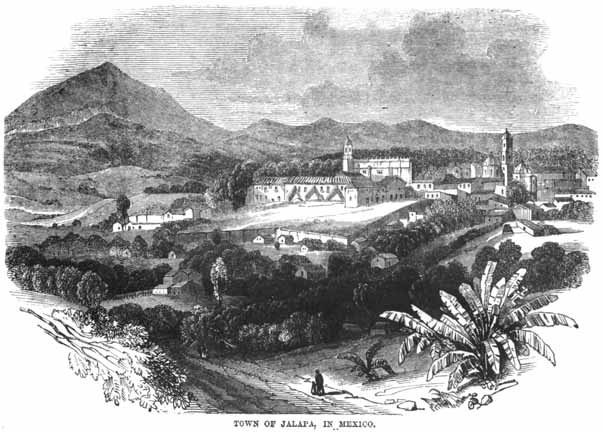
The road from Jalapa to the city of Mexico constantly ascends, and
the scenery is mountainous and grand; the villages are but few, and
fifteen or twenty miles apart, with a very scanty population. No
signs of cultivation are to be seen, except little patches of maize
and chilé, in the midst of which is sometimes to be seen an
Indian hut formed of reeds and flags. The mode of travelling in this
country is by diligences, but these are continually attacked and
robbed; and so much is this a matter of course, that the Mexicans
invariably calculate a certain sum for the expenses of the road,
including the usual fee for the banditti. Baggage is sent by the
muleteers, by which means it is ensured from all danger, although a
long time on the road. The Mexicans never think of resisting these
robbers, and a coach-load of eight or nine is often stopped and
plundered by one man. The foreigners do not take matters so quietly,
and there is scarcely an English or American traveller in the country
who has not come to blows in a personal encounter with the banditti
at some period or other of his adventures.
CONDORS.
Condors are found throughout the whole range of the Cordilleras,
along the south-west coast of South America, from the Straits of
Magellan to the Rio Negro. Their habitations are almost invariably on
overhanging ledges of high and perpendicular cliffs, where they both
sleep and breed, sometimes in pairs, but frequently in colonies of
twenty or thirty together. They make no nest, but lay two large white
eggs on the bare rock. The young ones cannot use their wings for
flight until many months after they are hatched, being covered,
during that time, with only a blackish down, like that of a gosling.
They remain on the cliff where they were hatched long after having
acquired the full power of flight, roosting and hunting in company
with the parent birds. Their food consists of the carcases of
guanacoes, deer, cattle, and other animals.
The condors may oftentimes be seen at a great height, soaring over
a certain spot in the most graceful spires and circles. Besides
feeding on carrion, the condors will frequently attack young goats
and lambs. Hence, the shepherd dogs are trained, the moment the enemy
passes over, to run out, and, looking upwards, to bark violently. The
people of Chili destroy and catch great numbers. Two methods are
used: one is to place a carcase within an inclosure of sticks on a
level piece of ground; and when the condors are gorged, to gallop up
on horseback to the entrance, and thus inclose them; for when this
bird has not space to run, it cannot give its body sufficient
momentum to rise from the ground. The second method is to mark the
trees in which, frequently to the number of five or six together,
they roost, and then at night to climb up and noose them. They are
such heavy sleepers that this is by no means a difficult task.
The condor, like all the vulture tribe, discovers his food from a
great distance; the body of an animal is frequently surrounded by a
dozen or more of them, almost as soon as it has dropped dead,
although five minutes before there was not a single bird in view.
Whether this power is to be attributed to the keenness of his
olfactory or his visual organs, is a matter still in dispute;
although it is believed, from a minute observation of its habits in
confinement, to be rather owing to its quickness of sight.
OMNISCIENCE AND OMNIPRESENCE OF THE DEITY.
I was yesterday, about sun-set, walking in the open fields, till
the night insensibly fell upon me. I at first amused myself with all
the richness and variety of colours which appeared in the western
parts of heaven; in proportion as they faded away and went out,
several stars and planets appeared one after another, till the whole
firmament was in a glow. The blueness of the ether was exceedingly
heightened and enlivened by the season of the year, and the rays of
all those luminaries that passed through it. The Galaxy appeared in
its most beautiful white. To complete the scene, the full moon rose
at length in that clouded majesty which Milton takes notice of, and
opened to the eye a new picture of nature, which was more finely
shaded, and disposed among softer lights, than that which the sun had
before discovered to us.
As I was surveying the moon walking in her brightness, and taking
her progress among the constellations, a thought arose in me, which I
believe very often perplexes and disturbs men of serious and
contemplative natures. David himself fell into it in that reflection,
"When I consider the heavens the work of thy fingers, the moon
and the stars which thou hast ordained, what is man that though art
mindful of him, and the son of man that thou regardest him!" In
the same manner, when I consider that infinite host of stars, or, to
speak more philosophically, of suns, which were then shining upon me,
with those innumerable sets of planets or worlds, which were moving
round their respective suns; when I still enlarged the idea, and
supposed another heaven of suns and worlds rising still above this
which we discovered, and these still enlightened by a superior
firmament of luminaries, which are planted at so great a distance,
that they may appear to the inhabitants of the former as the stars do
to us; in short, while I pursued this thought, I could not but
reflect on that little insignificant figure which I myself bore
amidst the immensity of God's works.
Were the sun, which enlightens this part of the creation, with all
the host of planetary worlds that move about him, utterly
extinguished and annihilated, they would not be missed more than a
grain of sand upon the sea-shore. The space they possess is so
exceedingly little in comparison of the whole, it would scarce make a
blank in creation. The chasm would be imperceptible to an eye that
could take in the whole compass of nature, and pass from one end of
creation to the other; as it is possible there may be such a sense in
ourselves hereafter, or in creatures which are at present more
exalted than ourselves. We see many stars by the help of glasses,
which we do not discover with our naked eyes; and the finer our
telescopes are, the more still are our discoveries. Huygenius carries
this thought so far, that he does not think it impossible there may
be stars whose light is not yet travelled down to us since their
first creation. There is no question but the universe has certain
bounds set to it; but when we consider that it is the work of
infinite power, prompted by infinite goodness, with an infinite space
to exert itself in, how can our imagination set any bounds to it?
To return, therefore, to my first thought, I could not but look
upon myself with secret horror, as a being that was not worth the
smallest regard of one who had so great a work under his care and
superintendency. I was afraid of being overlooked amidst the
immensity of nature, and lost among that infinite variety of
creatures, which in all probability swarm through all these
immeasurable regions of matter.
In order to recover myself from this mortifying thought, I
considered that it took its rise from those narrow conceptions which
we are apt to entertain of the Divine nature. We ourselves cannot
attend to many different objects at the same time. If we are careful
to inspect some things, we must of course neglect others. This
imperfection which we observe in ourselves is an imperfection that
cleaves in some degree to creatures of the highest capacities, as
they are creatures, that is, beings of finite and limited natures.
The presence of every created being is confined to a certain measure
of space, and consequently his observation is stinted to a certain
number of objects. The sphere in which we move, and act, and
understand, is of a wider circumference to one creature than another,
according as we rise one above another in the scale of existence. But
the widest of these our spheres has its circumference. When therefore
we reflect on the Divine nature, we are so used and accustomed to
this imperfection in ourselves, that we cannot forbear in some
measure ascribing it to Him in whom there is no shadow of
imperfection. Our reason indeed assures us that his attributes are
infinite; but the poorness of our conceptions is such, that it cannot
forbear setting bounds to every thing it contemplates, till our
reason comes again to our succour and throws down all those little
prejudices which rise in us unawares, and are natural to the mind of
man.
We shall, therefore, utterly extinguish this melancholy thought of
our being overlooked by our Maker in the multiplicity of his works,
and the infinity of those objects among which He seems to be
incessantly employed, if we consider, in the first place, that He is
omnipresent; and in the second, that He is omniscient.
If we consider Him in his omnipresence; his being passes through,
actuates, and supports the whole frame of nature. His creation, and
every part of it, is full of Him. There is nothing He has made that
is either so distant, so little, or so inconsiderable, which He does
not essentially inhabit. His substance is within the substance of
every being, whether material or immaterial, and as intimately
present to it as that being is to itself. It would be an imperfection
in Him, were He able to move out of one place into another, or to
draw himself from any thing He has created, or from any part of that
space which He diffused and spread abroad to infinity. In short, to
speak of Him in the language of the old philosophers, He is a being
whose centre is everywhere and his circumference nowhere.
In the second place, He is omniscient as well as omnipresent. His
omniscience indeed necessarily and naturally flows from his
omnipresence. He cannot but be conscious of every motion that arises
in the whole material world which He thus essentially pervades; and
of every thought that is stirring in the intellectual world, to every
part of which He is thus intimately united. Several moralists have
considered the creation as the temple of God, which He has built,
with his own hands, and which is filled with his presence. Others
have considered infinite space as the receptacle, or rather the
habitation of the Almighty; but the noblest and most exalted way of
considering this infinite space, is that of Sir Isaac Newton, who
calls it the se sorium of the Godhead. Brutes and men have
their sensoriola, or little sensoriums, by which they
apprehend the presence and perceive the actions of a few objects that
lie contiguous to them. Their knowledge and observation turn within a
very narrow circle. But, as God Almighty cannot but perceive and know
everything in which He resides, infinite space gives room to infinite
knowledge, and is, as it were, an organ to omniscience.
Were the soul separate from the body, and with one glance of
thought should start beyond the bounds of the creation, should it
millions of years continue its progress through infinite space with
the same activity, it would still find itself within the embrace of
its Creator, and encompassed round with the immensity of the Godhead.
While we are in the body, He is not less present with us, because He
is concealed from us. "Oh, that I knew where I might find
Him!" says Job. "Behold I go forward, but He is not there;
and backward, but I cannot perceive Him; on the left hand, where He
does work, but I cannot behold Him; He hideth himself on the right
hand, that I cannot see Him." In short, reason as well as
revelation assures us that He cannot be absent from us,
notwithstanding He is undiscovered by us.
In this consideration of God Almighty's omnipresence and
omniscience, every uncomfortable thought vanishes. He cannot but
regard everything that has being, especially such of his creatures
who fear they are not regarded by Him. He is privy to all their
thoughts, and to that anxiety of heart in particular, which is apt to
trouble them on this occasion; for, as it is impossible He should
overlook any of his creatures, so we may be confident that He
regards, with an eye of mercy, those who endeavour to recommend
themselves to his notice, and in unfeigned humility of heart think
themselves unworthy that He should be mindful of them.
Spectator.
THE MILL STREAM.
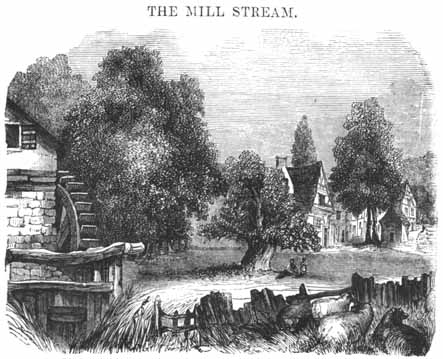
Long trails of cistus flowers
Creep on the rocky hill,
And beds of strong spearmint
Grow round about the mill;
And from a mountain tarn above,
As peaceful as a dream,
Like to a child unruly,
Though school'd and counsell'd truly,
Roams down the wild mill stream!
The wild mill stream it dasheth
In merriment away,
And keeps the miller and his son
So busy all the day.
Into the mad mill stream
The mountain roses fall;
And fern and adder's-tongue
Grow on the old mill wall.
The tarn is on the upland moor,
Where not a leaf doth grow;
And through the mountain gashes,
The merry mill stream dashes
Down to the sea below.
But in the quiet hollows
The red trout groweth prime,
For the miller and the miller's son
To angle when they've time.
Then fair befall the stream
That turns the mountain mill;
And fair befall the narrow road
That windeth up the hill!
And good luck to the countryman,
And to his old grey mare,
That upward toileth steadily,
With meal sacks laden heavily,
In storm as well as fair!
And good luck to the miller,
And to the miller's son;
And ever may the mill-wheel turn
While mountain waters run!
Mary Howitt.
|
ENVY.
Envy is almost the only vice which is practicable at all times,
and in every place—the only passion which can never lie quiet
for want of irritation; its effects, therefore, are everywhere
discoverable, and its attempts always to be dreaded.
It is impossible to mention a name, which any advantageous
distinction has made eminent, but some latent animosity will burst
out. The wealthy trader, however he may abstract himself from public
affairs, will never want those who hint with Shylock, that ships are
but boards, and that no man can properly be termed rich whose fortune
is at the mercy of the winds. The beauty adorned only with the
unambitious graces of innocence and modesty, provokes, whenever she
appears, a thousand murmurs of detraction and whispers of suspicion.
The genius, even when he endeavours only to entertain with pleasing;
images of nature, or instruct by uncontested principles of science,
yet suffers persecution from innumerable critics, whose acrimony is
excited merely by the pain of seeing others pleased—of hearing
applauses which another enjoys.
The frequency of envy makes it so familiar that it escapes our
notice; nor do we often reflect upon its turpitude or malignity, till
we happen to feel its influence. When he that has given no
provocation to malice, but by attempting to excel in some useful art,
finds himself pursued by multitudes whom he never saw with
implacability of personal resentment; when he perceives clamour and
malice let loose upon him as a public enemy, and incited by every
stratagem of defamation; when he hears the misfortunes of his family
or the follies of his youth exposed to the world; and every failure
of conduct, or defect of nature, aggravated and ridiculed; he then
learns to abhor those artifices at which he only laughed before, and
discovers how much the happiness of life would be advanced by the
eradication of envy from the human heart.
Envy is, indeed, a stubborn weed of the mind, and seldom yields to
the culture of philosophy. There are, however, considerations which,
if carefully implanted, and diligently propagated, might in time
overpower and repress it, since no one can nurse it for the sake of
pleasure, as its effects are only shame, anguish, and perturbation.
It is, above all other vices, inconsistent with the character of a
social being, because it sacrifices truth and kindness to very weak
temptations. He that plunders a wealthy neighbour, gains as much as
he takes away, and improves his own condition in the same proportion
as he impairs another's; but he that blasts a flourishing
reputation, must be content with a small dividend of additional fame,
so small as can afford very little consolation to balance the guilt
by which it is obtained.
I have hitherto avoided mentioning that dangerous and empirical
morality, which cures one vice by means of another. But envy is so
base and detestable, so vile in its original, and so pernicious in
its effects, that the predominance of almost any other quality is to
be desired. It is one of those lawless enemies of society, against
which poisoned arrows may honestly be used. Let it therefore be
constantly remembered, that whoever envies another, confesses his
superiority; and let those be reformed by their pride, who have lost
their virtue.
Almost every other crime is practised by the help of some quality
which might have produced esteem or love, if it had been well
employed; but envy is a more unmixed and genuine evil; it pursues a
hateful end by despicable means, and desires not so much its own
happiness as another's misery. To avoid depravity like this, it
is not necessary that any one should aspire to heroism or sanctity;
but only that he should resolve not to quit the rank which nature
assigns, and wish to maintain the dignity of a human being.
Dr. Johnson.
THE OLIVE.
No tree is more frequently mentioned by ancient authors, nor was
any more highly honoured by ancient nations, than the olive. By the
Greeks it was dedicated to the goddess of wisdom, and formed the
crown of honour given to their Emperors and great men, as with the
Romans. It is a tree of slow growth, but remarkable for the great age
it attains; never, however, becoming a very large tree, though
sometimes two or three stems rise from the same root, and reach the
height of from twenty to thirty feet. The leaves grow in pairs,
lanceolate in shape, of a dull green on the upper, and hoary on the
under side. Hence, in countries where the olive is extensively
cultivated, the scenery is of a dull character, from this colour of
the foliage. The fruit is oval in shape, with a hard strong kernel,
and remarkable from the outer fleshy part being that in which much
oil is lodged, and not, as is usual, in the seed. It ripens from
August to September.
Of the olive-tree two varieties are particularly distinguished:
the long-leafed, which is cultivated in the south of France and in
Italy; and the broad-leafed in Spain, which has its fruit much longer
than that of the former kind.
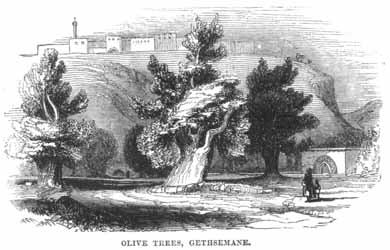
That the olive grows to a great age, has long been known. Pliny
mentions one which the Athenians of his time considered to be
coëval with their city, and therefore 1600 years old; and near
Terni, in the vale of the cascade of Marmora, there is a plantation
of very old trees, supposed to consist of the same plants that were
growing there in the time of Pliny. Lady Calcott states that on the
mountain road between Tivoli and Palestrina, there is an ancient
olive-tree of large dimensions, which, unless the documents are
purposely falsified, stood as a boundary between two possessions even
before the Christian era. Those in the garden of Olivet or Gethsemane
are at least of the time of the Eastern Empire, as is proved by the
following circumstance:—In Turkey every olive-tree found
standing by the Mussulmans, when they conquered Asia, pays one medina
to the treasury, while each of those planted since the conquest is
taxed half its produce. The eight olives of which we are speaking are
charged only eight medinas. By some it is supposed that these
olive-trees may have been in existence even in the time of our
Saviour; the largest is about thirty feet in girth above the roots,
and twenty-seven feet high.
ACCORDANCE BETWEEN THE SONGS OF BIRDS AND THE DIFFERENT ASPECTS
OF THE DAY.
There is a beautiful propriety in the order in which Nature seems
to have directed the singing-birds to fill up the day with their
pleasing harmony. The accordance between their songs and the external
aspect of nature, at the successive periods of the day at which they
sing, is quite remarkable. And it is impossible to visit the forest
or the sequestered dell, where the notes of the feathered tribes are
heard to the greatest advantage, without being impressed with the
conviction that there is design in the arrangement of this sylvan
minstrelsy.—
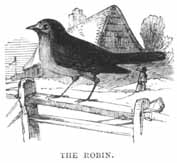
First the robin (and not the lark, as has been generally
imagined), as soon as twilight has drawn its imperceptible line
between night and day, begins his lovely song. How sweetly does this
harmonise with the soft dawning of the day! He goes on till the
twinkling sun-beams begin to tell him that his notes no longer accord
with the rising scene. Up starts the lark, and with him a variety of
sprightly songsters, whose lively notes are in perfect correspondence
with the gaiety of the morning. The general warbling continues, with
now and then an interruption by the transient croak of the raven, the
scream of the jay, or the pert chattering of the daw. The
nightingale, unwearied by the vocal exertions of the night, joins his
inferiors in sound in the general harmony. The thrush is wisely
placed on the summit of some lofty tree, that its loud and piercing
notes may be softened by distance before they reach the ear; while
the mellow blackbird seeks the inferior branches.
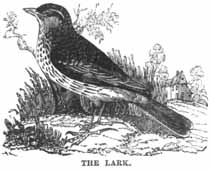
Should the sun, having been eclipsed by a cloud, shine forth with
fresh effulgence, how frequently we see the goldfinch perch on some
blossomed bough, and hear its song poured forth in a strain
peculiarly energetic; while the sun, full shining on his beautiful
plumes, displays his golden wings and crimson crest to charming
advantage. The notes of the cuckoo blend with this cheering concert
in a pleasing manner, and for a short time are highly grateful to the
ear. But sweet as this singular song is, it would tire by its
uniformity, were it not given in so transient a manner.
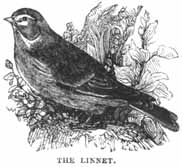
At length evening advances, the performers gradually retire, and
the concert softly dies away. The sun is seen no more. The robin
again sends up his twilight song, till the more serene hour of night
sets him to the bower to rest. And now to close the scene in full and
perfect harmony; no sooner is the voice of the robin hushed, and
night again spreads in gloom over the horizon, than the owl sends
forth his slow and solemn tones. They are more than plaintive and
less than melancholy, and tend to inspire the imagination with a
train of contemplations well adapted to the serious hour.
Thus we see that birds bear no inconsiderable share in harmonizing
some of the most beautiful and interesting scenes in nature.
Dr. Jenner.
CHARACTER OF EDWARD VI.
Thus died Edward VI., in the sixteenth year of his age. He was
counted the wonder of his time; he was not only learned in the
tongues and the liberal sciences, but he knew well the state of his
kingdom. He kept a table-book, in which he had written the characters
of all the eminent men of the nation: he studied fortification, and
understood the mint well. He knew the harbours in all his dominions,
with the depth of the water, and way of coming into them. He
understood foreign affairs so well, that the ambassadors who were
sent into England, published very extraordinary things of him in all
the courts of Europe. He had great quickness of apprehension, but
being distrustful of his memory, he took notes of everything he heard
that was considerable, in Greek characters, that those about him
might not understand what he writ, which he afterwards copied out
fair in the journal that he kept. His virtues were wonderful; when he
was made to believe that his uncle was guilty of conspiring the death
of the other councillors, he upon that abandoned him.
Barnaby Fitzpatrick was his favourite; and when he sent him to
travel, he writ oft to him to keep good company, to avoid excess and
luxury, and to improve himself in those things that might render him
capable of employment at his return. He was afterwards made Lord of
Upper Ossory, in Ireland, by Queen Elizabeth, and did answer the
hopes this excellent King had of him. He was very merciful in his
nature, which appeared in his unwillingness to sign the warrant for
burning the Maid of Kent. He took great care to have his debts well
paid, reckoning that a Prince who breaks his faith and loses his
credit, has thrown up that which he can never recover, and made
himself liable to perpetual distrust and extreme contempt. He took
special care of the petitions that were given him by poor and opprest
people. But his great zeal for religion crowned all the rest—it
was a true tenderness of conscience, founded on the love of God and
his neighbour. These extraordinary qualities, set off with great
sweetness and affability, made him universally beloved by his
people.
Burnet.
THE HUNTED STAG.
 |
What sounds are on the mountain blast,
Like bullet from the arbalast?
Was it the hunted quarry past
Right up Ben-ledi's side?
So near, so rapidly, he dash'd,
Yon lichen'd bough has scarcely plash'd
Into the torrent's tide.
Ay! the good hound may bay beneath,
The hunter wind his horn;
He dared ye through the flooded Teith,
As a warrior in his scorn!
Dash the red rowel in the steed!
Spur, laggards, while ye may!
St. Hubert's staff to a stripling reed,
He dies no death to-day!
"Forward!" nay, waste not idle breath,
Gallants, ye win no greenwood wreath;
His antlers dance above the heath,
Like chieftain's plumed helm;
Right onward for the western peak,
Where breaks the sky in one white streak,
See, Isabel, in bold relief,
To Fancy's eye, Glenartney's chief,
Guarding his ancient realm.
So motionless, so noiseless there,
His foot on rock, his head in air,
Like sculptor's breathing stone:
Then, snorting from the rapid race,
Snuffs the free air a moment's space,
Glares grimly on the baffled chase,
And seeks the covert lone.
|
Hunting has been a favourite sport in Britain for many centuries.
Dyonisius (B.C. 50) tells us that the North Britons lived, in great
part, upon the food they procured by hunting. Strabo states that the
dogs bred in Britain were highly esteemed on the Continent, on
account of their excellent qualities for hunting; and Caesar tells us
that venison constituted a great portion of the food of the Britons,
who did not eat hares. Hunting was also in ancient times a Royal and
noble sport: Alfred the Great hunted at twelve years of age;
Athelstan, Edward the Confessor, Harold, William the Conqueror,
William Rufus, and John were all good huntsmen; Edward II. reduced
hunting to a science, and established rules for its practice; Henry
IV. appointed a master of the game; Edward III. hunted with sixty
couples of stag-hounds; Elizabeth was a famous huntswoman; and James
I. preferred hunting to hawking or shooting. The Bishops and Abbots
of the middle ages hunted with great state. Ladies also joined in the
chase from the earliest times; and a lady's hunting-dress in the
fifteenth century scarcely differed from the riding-habit of the
present day.
Sir Walter Scott.
JOHN BUNYAN AND HIS WIFE.
Elizabeth his wife, actuated by his undaunted spirit, applied to
the House of Lords for his release; and, according to her relation,
she was told, "they could do nothing; but that his releasement
was committed to the Judges at the next assizes." The Judges
were Sir Matthew Hale and Mr. Justice Twisden; and a remarkable
contrast appeared between the well-known meekness of the one, and
fury of the other. Elizabeth came before them, and, stating her
husband's case, prayed for justice: "Judge Twisden,"
says John Bunyan, "snapt her up, and angrily told her that I was
a convicted person, and could not be released unless I would promise
to preach no more. Elizabeth: 'The Lords told me that
releasement was committed to you, and you give me neither releasement
nor relief. My husband is unlawfully in prison, and you are bound to
discharge him.' Twisden: 'He has been lawfully
convicted.' Elizabeth: 'It is false, for when they
said "Do you confess the indictment?" he answered, "At
the meetings where he preached, they had God's presence among
them."' Twisden: 'Will your husband leave
preaching? if he will do so, then send for him.'
Elizabeth: 'My Lord, he dares not leave off preaching as
long as he can speak. But, good my Lords, consider that we have four
small children, one of them blind, and that they have nothing to live
upon while their father is in prison, but the charity of Christian
people.' Sir Matthew Hale: 'Alas! poor woman.'
Twisden: 'Poverty is your cloak, for I hear your husband
is better maintained by running up and down a-preaching than by
following his calling?' Sir Matthew Hale: 'What is his
calling?' Elizabeth: 'A tinker, please you my Lord;
and because he is a tinker, and a poor man, therefore he is despised
and cannot have justice.' Sir Matthew Hale: 'I am
truly sorry we can do you no good. Sitting here we can only act as
the law gives us warrant; and we have no power to reverse the
sentence, although it may be erroneous. What your husband said was
taken for a confession, and he stands convicted. There is, therefore,
no course for you but to apply to the King for a pardon, or to sue
out a writ of error; and, the indictment, or subsequent proceedings,
being shown to be contrary to law, the sentence shall be reversed,
and your husband shall be set at liberty. I am truly sorry for your
pitiable case. I wish I could serve you, but I fear I can do you no
good.'"
Little do we know what is for our permanent good. Had Bunyan then
been discharged and allowed to enjoy liberty, he no doubt would have
returned to his trade, filling up his intervals of leisure with
field-preaching; his name would not have survived his own generation,
and he could have done little for the religious improvement of
mankind. The prison doors were shut upon him for twelve years. Being
cut off from the external world, he communed with his own soul; and,
inspired by Him who touched Isaiah's hallowed lips with fire, he
composed the noblest of allegories, the merit of which was first
discovered by the lowly, but which is now lauded by the most refined
critics, and which has done more to awaken piety, and to enforce the
precepts of Christian morality, than all the sermons that have been
published by all the prelates of the Anglican Church.
Lord Campbell's
Lives of the Judges.
THE LONG-EARED AFRICAN FOX.
This singular variety of the Fox was first made known to
naturalists in 1820, after the return of De Laland from South Africa.
It is an inhabitant of the mountains in the neighbourhood of the Cape
of Good Hope, but it is so rare that little is known of its habits in
a state of nature. The Engraving was taken from a specimen which has
been lately placed in the Zoological Society's gardens in the
Regent's Park. It is extremely quick of hearing, and there is
something in the general expression of the head which suggests a
resemblance to the long-eared bat. Its fur is very thick, and the
brush is larger than that of our common European fox. The skin of the
fox is in many species very valuable; that of another kind of fox at
the Cape of Good Hope is so much in request among the natives as a
covering for the cold season, that many of the Bechuanas are solely
employed in hunting the animal down with dogs, or laying snares in
the places to which it is known to resort.
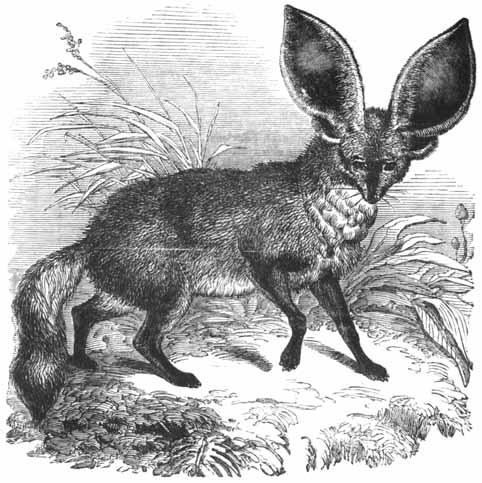
In common with all other foxes, those of Africa are great enemies
to birds which lay their eggs upon the ground; and their movements
are, in particular, closely watched by the ostrich during the laying
season. When the fox has surmounted all obstacles in procuring eggs,
he has to encounter the difficulty of getting at their contents; but
even for this task his cunning finds an expedient, and it is that of
pushing them forcibly along the ground until they come in contact
with some substance hard enough to break them, when the contents are
speedily disposed of.
The natives, from having observed the anxiety of the ostrich to
keep this animal from robbing her nest, avail themselves of this
solicitude to lure the bird to its destruction; for, seeing that it
runs to the nest the instant a fox appears, they fasten a dog near
it, and conceal themselves close by, and the ostrich, on approaching
to drive away the supposed fox, is frequently shot by the real
hunter.
The fur of the red fox of America is much valued as an article of
trade, and about 8000 are annually imported into England from the fur
countries, where the animal is very abundant, especially in the
wooded parts.
Foxes of various colours are also common in the fur countries of
North America, and a rare and valuable variety is the black or silver
fox. Dr. Richardson states that seldom more than four or five of this
variety are taken in a season at one post, though the hunters no
sooner find out the haunts of one, than they use every art to catch
it, because its fur fetches six times the price of any other fur
produced in North America. This fox is sometimes found of a rich deep
glossy black, the tip of the brush alone being white; in general,
however, it is silvered over the end of each of the long hairs of the
fur, producing a beautiful appearance.
The Arctic fox resembles greatly the European species, but is
considerably smaller; and, owing to the great quantity of white
woolly fur with which it is covered, is somewhat like a little shock
dog. The brush is very large and full, affording an admirable
covering for the nose and feet, to which it acts as a muff when the
animal sleeps. The fur is in the greatest perfection during the
months of winter, when the colour gradually becomes from an ashy grey
to a full and pure white, and is extremely thick, covering even the
soles of the feet. Captain Lyon has given very interesting accounts
of the habits of this animal, and describes it as being cleanly and
free from any unpleasant smell: it inhabits the most northern lands
hitherto discovered.
MOUNT TABOR.
The Plain of Esdraelon, in Palestine, is often mentioned in sacred
history, as the great battle-field of the Jewish and other nations,
under the names of the Valley of Mejiddo and the Valley of Jizreel,
and by Josephus as the Great Plain. The convenience of its extent and
situation for military action and display has, from the earliest
periods of history down to our own day, caused its surface at certain
intervals to be moistened with the blood, and covered with the bodies
of conflicting warriors of almost every nation under heaven. This
extensive plain, exclusive of three great arms which stretch eastward
towards the Valley of the Jordan, may be said to be in the form of an
acute triangle, having the measure of 13 or 14 miles on the north,
about 18 on the east, and above 20 on the south-west. Before the
verdure of spring and early summer has been parched up by the heat
and drought of the late summer and autumn, the view of the Great
Plain is, from its fertility and beauty, very delightful. In June,
yellow fields of grain, with green patches of millet and cotton,
chequer the landscape like a carpet. The plain itself is almost
without villages, but there are several on the slopes of the
inclosing hills, especially on the side of Mount Carmel. On the
borders of this plain Mount Tabor stands out alone in magnificent
grandeur. Seen from the south-west its fine proportions present a
semi-globular appearance; but from the north-west it more resembles a
truncated cone. By an ancient path, which winds considerably, one may
ride to the summit, where is a small oblong plain with the
foundations of ancient buildings. The view from the summit is
declared by Lord Nugent to be the most splendid he could recollect
having ever seen from any natural height. The sides of the mountain
are mostly covered with bushes and woods of oak trees, with
occasionally pistachio trees, presenting a beautiful appearance, and
affording a welcome and agreeable shade. There are various tracks up
its sides, often crossing each other, and the ascent generally
occupies about an hour. The crest of the mountain is table-land, 600
or 700 yards in height from north to south, and about half as much
across, and a flat field of about an acre occurs at a level of some
20 or 25 feet lower than the eastern brow. There are remains of
several small ruined tanks on the crest, which still catch the rain
water dripping through the crevices of the rock, and preserve it cool
and clear, it is said, throughout the year.
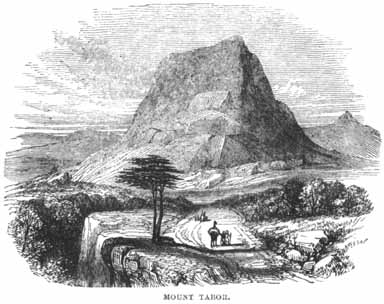
The tops of this range of mountains are barren, but the slopes and
valleys afford pasturage, and are capable of cultivation, from the
numerous springs which are met with in all directions. Cultivation
is, however, chiefly found on the seaward slopes; there many
flourishing villages exist, and every inch of ground is turned to
account by the industrious natives.
Here, amidst the crags of the rocks, are to be seen the remains of
the renowned cedars with which Lebanon once abounded; but a much
larger proportion of firs, sycamores, mulberry trees, fig trees, and
vines now exist.
UNA AND THE LION.
 |
She, that most faithful lady, all this
while,
Forsaken, woful, solitary maid,
Far from the people's throng, as in
exile,
In wilderness and wasteful deserts
stray'd
To seek her knight; who, subtlely
betray'd
By that false vision which th'
enchanter wrought,
Had her abandon'd. She, of nought
afraid,
Him through the woods and wide wastes
daily sought,
Yet wish'd for tidings of him—none unto
her brought.
One day, nigh weary of the irksome
way,
From her unhasty beast she did
alight;
And on the grass her dainty limbs did
lay
In secret shadow, far from all men's
sight:
From her fair head her fillet she
undight,
And laid her stole aside; her angel
face,
As the great eye that lights the earth,
shone bright,
And made a sunshine in that shady
place,
That never mortal eye beheld such heavenly
grace.
It fortun'd that, from out the
thicket wood
A ramping lion rushed suddenly,
And hunting greedy after savage
blood,
The royal virgin helpless did espy;
At whom, with gaping mouth full
greedily
To seize and to devour her tender
corse,
When he did run, he stopp'd ere he
drew nigh,
And loosing all his rage in quick
remorse,
As with the sight amazed, forgot his furious
force.
Then coming near, he kiss'd her weary
feet,
And lick'd her lily hand with fawning
tongue,
As he her wronged innocence did meet:
Oh! how can beauty master the most
strong,
And simple truth subdue intent of
wrong!
His proud submission, and his yielded
pride,
Though dreading death, when she had
marked long,
She felt compassion in her heart to
slide,
And drizzling tears to gush that might not be
denied.
And with her tears she pour'd a sad
complaint,
That softly echoed from the neighbouring
wood;
While sad to see her sorrowful
constraint,
The kingly beast upon her gazing
stood:
With pity calm'd he lost all angry
mood.
At length, in close breast shutting up
her pain,
Arose the virgin born of heavenly
brood,
And on her snowy palfrey rode again
To seek and find her knight, if him she might
attain.
The lion would not leave her
desolate,
But with her went along, as a strong
guard
Of her chaste person, and a faithful
mate
Of her sad troubles and misfortunes
hard:
Still when she slept, he kept both watch
and ward,
And when she waked, he waited
diligent
With humble service to her will
prepared.
From her fair eyes he took
commandment,
And ever by her looks conceived her intent.
Spenser.
|
DANISH ENCAMPMENT.
Seven miles from the sea-port of Boston, in Lincolnshire, lies the
rural town of Swineshead, once itself a port, the sea having flowed
up to the market-place, where there was a harbour. The name of
Swineshead is familiar to every reader of English history, from its
having been the resting-place of King John, after he lost the whole
of his baggage, and narrowly escaped with his life, when crossing the
marshes from Lynn to Sleaford, the castle of which latter place was
then in his possession. The King halted at the Abbey, close to the
town of Swineshead, which place he left on horseback; but being taken
ill, was moved in a litter to Sleaford, and thence to his castle at
Newark, where he died on the following day, in the year 1216.
Apart from this traditional interest, Swineshead has other
antiquarian and historical associations. The circular Danish
encampment, sixty yards in diameter, surrounded by a double fosse,
was, doubtless, a post of importance, when the Danes, or Northmen,
carried their ravages through England in the time of Ethelred I., and
the whole country passed permanently into the Danish hands about A.D.
877. The incessant inroads of the Danes, who made constant descents
on various parts of the coast, burning the towns and villages, and
laying waste the country in all directions, led to that stain upon
the English character, the Danish massacre. The troops collected to
oppose these marauders always lost courage and fled, and their
leaders, not seldom, set them the example. In 1002, peace was
purchased for a sum of £24,000 and a large supply of
provisions. Meantime, the King and his councillors resolved to have
recourse to a most atrocious expedient for their future security. It
had been the practice of the English Kings, from the time of
Athelstane, to have great numbers of Danes in their pay, as guards,
or household troops; and these, it is said, they quartered on their
subjects, one on each house. The household troops, like soldiers in
general, paid great attention to their dress and appearance, and thus
became very popular with the generality of people; but they also
occasionally behaved with great insolence, and were also strongly
suspected of holding secret intelligence with their piratical
countrymen. It was therefore resolved to massacre the Hus-carles, as
they were called, and their families, throughout England. Secret
orders to this effect were sent to all parts, and on St. Brice's
day, November 13th, 1002, the Danes were everywhere fallen on and
slain. The ties of affinity (for many of them had married and settled
in the country) were disregarded; even Gunhilda, sister to Sweyn,
King of Denmark, though a Christian, was not spared, and with her
last breath she declared that her death would bring the greatest
evils upon England. The words of Gunhilda proved prophetic. Sweyn,
burning for revenge and glad of a pretext for war, soon made his
appearance on the south coast, and during four years he spread
devastation through all parts of the country, until the King Ethelred
agreed to give him £30,000 and provisions as before for peace,
and the realm thus had rest for two years. But this short peace was
but a prelude to further disturbances; and indeed for two centuries,
dating from the reign of Egbert, England was destined to become a
prey to these fierce and fearless invaders.
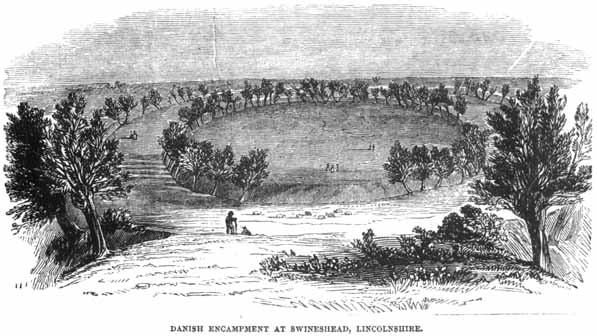
The old Abbey of Swineshead was demolished in 1610, and the
present structure, known as Swineshead Abbey, was built from the
materials.
THE NAMELESS STREAM
 |
Beautiful stream! By rock and dell
There's not an inch in all thy
course
I have not track'd. I know thee well:
I know where blossoms the yellow gorse;
I know where waves the pale bluebell,
And where the orchis and violets dwell.
I know where the foxglove rears its head,
And where the heather tufts are spread;
I know where the meadow-sweets exhale,
And the white valerians load the gale.
I know the spot the bees love best,
And where the linnet has built her nest.
I know the bushes the grouse frequent,
And the nooks where the shy deer browse the bent.
I know each tree to thy fountain head—
The lady birches, slim and fair;
|
|
|
|
The feathery larch, the rowans red,
The brambles trailing their tangled
hair;
And each is link'd to my waking thought
By some remembrance fancy-fraught.
|
|
|
|
Yet, lovely stream, unknown to fame,
Thou hast oozed, and flow'd, and
leap'd, and run,
Ever since Time its course begun,
Without a record, without a name.
I ask'd the shepherd on the hill—
He knew thee but as a common rill;
I ask'd the farmer's blue-eyed
daughter—
She knew thee but as a running water;
I ask'd the boatman on the shore
(He was never ask'd to tell before)—
Thou wert a brook, and nothing more.
Yet, stream, so dear to me alone,
I prize and cherish thee none the
less
That thou flowest unseen, unpraised, unknown,
In the unfrequented wilderness.
Though none admire and lay to heart
How good and beautiful thou art,
Thy flow'rets bloom, thy waters run,
And the free birds chaunt thy benison.
Beauty is beauty, though unseen;
And those who love it all their days,
Find meet reward in their soul serene,
And the inner voice of prayer and
praise.
Mackay
|
STAFFA.
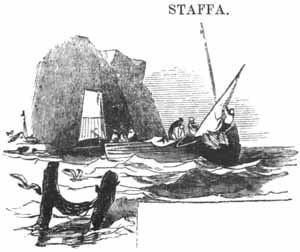
Having surveyed the various objects in Iona, we sailed for a spot
no less interesting. Thousands have described it. Few, however, have
seen it by torch or candle light, and in this respect we differ from
most tourists. All description, however, of this far-famed wonder
must be vain and fruitless. The shades of night were fast descending,
and had settled on the still waves and the little group of islets,
called the Treshnish Isles, when our vessel approached the celebrated
Temple of the Sea. We had light enough to discern its symmetry and
proportions; but the colour of the rock—a dark grey—and
the minuter graces of the columns, were undistinguishable in the
evening gloom. The great face of the rock is the most wonderful
production of nature we ever beheld. It reminded us of the west front
of York or Lincoln cathedral—a resemblance, perhaps, fanciful
in all but the feelings they both excite—especially when the
English minster is seen by moonlight. The highest point of Staffa at
this view is about one hundred feet; in its centre is the great cave,
called Fingal's Cave, stretching up into the interior of the rock
a distance of more than 200 feet. After admiring in mute astonishment
the columnar proportions of the rock, regular as if chiselled by the
hand of art, the passengers entered a small boat, and sailed under
the arch. The boatmen had been brought from Iona, and they instantly
set themselves to light some lanterns, and form torches of old ropes
and tar, with which they completely illuminated the ocean hall, into
which we were ushered.
The complete stillness of the scene, except the low plashing of
the waves; the fitful gleams of light thrown first on the walls and
ceiling, as the men moved to and fro along the side of the stupendous
cave; the appearance of the varied roof, where different stalactites
or petrifactions are visible; the vastness and perfect art or
semblance of art of the whole, altogether formed a scene the most
sublime, grand, and impressive ever witnessed.
The Cathedral of Iona sank into insignificance before this great
temple of nature, reared, as if in mockery of the temples of man, by
the Almighty Power who laid the beams of his chambers on the waters,
and who walketh upon the wings of the wind. Macculloch says that it
is with the morning sun only that the great face of Staffa can be
seen in perfection; as the general surface is undulating and uneven,
large masses of light or shadow are thus produced. We can believe,
also, that the interior of the cave, with its broken pillars and
variety of tints, and with the green sea rolling over a dark red or
violet-coloured rock, must be seen to more advantage in the full
light of day. Yet we question whether we could have been more deeply
sensible of the beauty and grandeur of the scene than we were under
the unusual circumstances we have described. The boatmen sang a
Gaelic joram or boat-song in the cave, striking their oars
very violently in time with the music, which resounded finely through
the vault, and was echoed back by roof and pillar. One of them, also,
fired a gun, with the view of producing a still stronger effect of
the same kind. When we had fairly satisfied ourselves with
contemplating the cave, we all entered the boat and sailed round by
the Clamshell Cave (where the basaltic columns are bent like the ribs
of a ship), and the Rock of the Bouchaille, or the herdsman, formed
of small columns, as regular and as interesting as the larger
productions. We all clambered to the top of the rock, which affords
grazing for sheep and cattle, and is said to yield a rent of
£20 per annum to the proprietor. Nothing but the wide surface
of the ocean was visible from our mountain eminence, and after a few
minutes' survey we descended, returned to the boat, and after
regaining the steam-vessel, took our farewell look of Staffa, and
steered on for Tobermory.
Highland Note-Book.
ON CHEERFULNESS.
I have always preferred cheerfulness to mirth. The latter I
consider as an act, the former as a habit of the mind. Mirth is short
and transient, cheerfulness fixed and permanent. Those are often
raised into the greatest transports of mirth, who are subject to the
greatest depressions of melancholy: on the contrary, cheerfulness,
though it does not give the mind such an exquisite gladness, prevents
us from falling into any depths of sorrow. Mirth is like a flash of
lightning, that breaks through a gloom of clouds, and glitters for a
moment; cheerfulness keeps up a kind of daylight in the mind, and
fills it with a steady and perpetual serenity.
Men of austere principles look upon mirth as too wanton and
dissolute for a state of probation, and as filled with a certain
triumph and insolence of heart that is inconsistent with a life which
is every moment obnoxious to the greatest dangers. Writers of this
complexion have observed, that the sacred Person who was the great
pattern of perfection, was never seen to laugh.
Cheerfulness of mind is not liable to any of these exceptions; it
is of a serious and composed nature; it does not throw the mind into
a condition improper for the present state of humanity, and is very
conspicuous in the characters of those who are looked upon as the
greatest philosophers among the heathen, as well as among those who
have been deservedly esteemed as saints and holy men among
Christians.
If we consider cheerfulness in three lights, with regard to
ourselves, to those we converse with, and the great Author of our
being, it will not a little recommend itself on each of these
accounts. The man who is possessed of this excellent frame of mind,
is not only easy in his thoughts, but a perfect master of all the
powers and faculties of the soul; his imagination is always clear,
and his judgment undisturbed; his temper is even and unruffled,
whether in action or solitude. He comes with a relish to all those
goods which nature has provided for him, tastes all the pleasures of
the creation which are poured about him, and does not feel the full
weight of those accidental evils which may befall him.
If we consider him in relation to the persons whom he converses
with, it naturally produces love and good-will towards him. A
cheerful mind is not only disposed to be affable and obliging, but
raises the same good-humour in those who come within its influence. A
man finds himself pleased, he does not know why, with the
cheerfulness of his companion: it is like a sudden sunshine, that
awakens a secret delight in the mind, without her attending to it.
The heart rejoices of its own accord, and naturally flows out into
friendship and benevolence towards the person who has so kindly an
effect upon it.
When I consider this cheerful state of mind in its third relation,
I cannot but look upon it as a constant, habitual gratitude to the
great Author of nature.
There are but two things which, in my opinion, can reasonably
deprive us of this cheerfulness of heart. The first of these is the
sense of guilt. A man who lives in a state of vice and impenitence,
can have no title to that evenness and tranquillity of mind which is
the health of the soul, and the natural effect of virtue and
innocence. Cheerfulness in an ill man deserves a harder name than
language can furnish us with, and is many degrees beyond what we
commonly call folly or madness.
Atheism, by which I mean a disbelief of a Supreme Being, and
consequently of a future state, under whatsoever title it shelters
itself, may likewise very reasonably deprive a man of this
cheerfulness of temper. There is something so particularly gloomy and
offensive to human nature in the prospect of non-existence, that I
cannot but wonder, with many excellent writers, how it is possible
for a man to outlive the expectation of it. For my own part, I think
the being of a God is so little to be doubted, that it is almost the
only truth we are sure of, and such a truth as we meet with in every
object, in every occurrence, and in every thought. If we look into
the characters of this tribe of infidels, we generally find they are
made up of pride, spleen, and cavil: it is indeed no wonder that men
who are uneasy to themselves, should be so to the rest of the world;
and how is it possible for a man to be otherwise than uneasy in
himself, who is in danger every moment of losing his entire existence
and dropping into nothing?
The vicious man and Atheist have therefore no pretence to
cheerfulness, and would act very unreasonably should they endeavour
after it. It is impossible for any one to live in good-humour and
enjoy his present existence, who is apprehensive either of torment or
of annihilation—of being miserable or of not being at all.
After having mentioned these two great principles, which are
destructive of cheerfulness in their own nature, as well as in right
reason, I cannot think of any other that ought to banish this happy
temper from a virtuous mind. Pain and sickness, shame and reproach,
poverty and old age; nay, death itself, considering the shortness of
their duration and the advantage we may reap from them, do not
deserve the name of evils. A good mind may bear up under them with
fortitude, with indolence, and with cheerfulness of heart. The
tossing of a tempest does not discompose him, which he is sure will
bring him to a joyful harbour.
A man who uses his best endeavours to live according to the
dictates of virtue and right reason, has two perpetual sources of
cheerfulness, in the consideration of his own nature and of that
Being on whom he has a dependence. If he looks into himself, he
cannot but rejoice in that existence which is so lately bestowed upon
him, and which, after millions of ages, will be still new and still
in its beginning. How many self-congratulations naturally arise in
the mind when it reflects on this its entrance into eternity, when it
takes a view of those improvable faculties which in a few years, and
even at its first setting out, have made so considerable a progress,
and which will be still receiving an increase of perfection, and
consequently an increase of happiness! The consciousness of such a
being spreads a perpetual diffusion of joy through the soul of a
virtuous man, and makes him look upon himself every moment as more
happy than he knows how to conceive.
The second source of cheerfulness to a good mind is its
consideration of that Being on whom we have our dependence, and in
whom, though we behold Him as yet but in the first faint discoveries
of his perfections, we see every thing that we can imagine as great,
glorious, and amiable. We find ourselves every where upheld by his
goodness and surrounded with an immensity of love and mercy. In
short, we depend upon a Being whose power qualifies Him to make us
happy by an infinity of means, whose goodness and truth engage Him to
make those happy who desire it of Him, and whose unchangeableness
will secure us in this happiness to all eternity.
Such considerations, which every one should perpetually cherish in
his thoughts, will banish from us all that secret heaviness of heart
which unthinking men are subject to when they lie under no real
affliction, all that anguish which we may feel from any evil that
actually oppresses us, to which I may likewise add those little
cracklings of mirth and folly, that are apter to betray virtue than
support it; and establish in us such an even and cheerful temper, as
makes us pleasing to ourselves, to those with whom we converse, and
to Him whom we are made to please.
Addison.
STONY CROSS.
This is the place where King William Rufus was accidentally shot
by Sir Walter Tyrrel. There has been much controversy on the details
of this catastrophe; but the following conclusions, given in the
"Pictorial History of England," appear to be
just:—"That the King was shot by an arrow in the New
Forest; that his body was abandoned and then hastily interred, are
facts perfectly well authenticated; but some doubts may be
entertained as to the precise circumstances attending his death,
notwithstanding their being minutely related by writers who were
living at the time, or who flourished in the course of the following
century. Sir Walter Tyrrel afterwards swore, in France, that he did
not shoot the arrow; but he was, probably, anxious to relieve himself
from the odium of killing a King, even by accident. It is quite
possible, indeed, that the event did not arise from chance, and that
Tyrrel had no part in it. The remorseless ambition of Henry might
have had recourse to murder, or the avenging shaft might have been
sped by the desperate hand of some Englishman, tempted by a
favourable opportunity and the traditions of the place. But the most
charitable construction is, that the party were intoxicated with the
wine they had drunk at Malwood-Keep, and that, in the confusion
consequent on drunkenness, the King was hit by a random
arrow."
In that part of the Forest near Stony Cross, at a short distance
from Castle Malwood, formerly stood an oak, which tradition affirmed
was the tree against which the arrow glanced that caused the death of
Rufus. Charles II. directed the tree to be encircled by a paling: it
has disappeared; but the spot whereon the tree grew is marked by a
triangular stone, about five feet high, erected by Lord Delaware,
upwards of a century ago. The stone has since been faced with an iron
casting of the following inscription upon the three sides:—
"Here stood the oak-tree on which an arrow, shot by Sir
Walter Tyrrel at a stag, glanced and struck King William II.,
surnamed Rufus, on the breast; of which stroke he instantly died, on
the 2nd of August, 1100.
"King William II., surnamed Rufus, being slain, as before
related, was laid in a cart belonging to one Purkess, and drawn from
hence to Winchester, and buried in the cathedral church of that
city.
" That where an event so memorable had happened might not
hereafter be unknown, this stone was set up by John Lord Delaware,
who had seen the tree growing in this place, anno 1745."
Stony Cross is a favourite spot for pic-nic parties in the summer.
It lies seven miles from Ringwood, on a wide slope among the woods.
From the road above, splendid views over the country present
themselves.
GELERT.
|
|
The spearman heard the bugle sound,
And cheerily smiled the morn;
And many a brach, and many a hound,
Attend Llewellyn's horn.
And still he blew a louder blast,
And gave a louder cheer:
"Come, Gelert! why art thou the last
Llewellyn's horn to hear?
"Oh, where does faithful Gelert roam—
The flower of all his race!
So true, so brave—a lamb at home,
A lion in the chase?"
That day Llewellyn little loved
The chase of hart or hare;
And scant and small the booty proved,
For Gelert was not there.
Unpleased Llewellyn homeward hied,
When, near the portal-seat,
His truant Gelert he espied,
Bounding his lord to greet.
But when he gained the castle-door,
Aghast the chieftain stood;
The hound was smear'd with gouts of
gore—
His lips and fangs ran blood!
Llewellyn gazed with wild surprise,
Unused such looks to meet;
His favourite check'd his joyful guise,
And crouch'd and lick'd his
feet.
Onward in haste Llewellyn pass'd
(And on went Gelert too),
And still where'er his eyes were cast,
Fresh blood-gouts shock'd his
view!
O'erturn'd his infant's bed he
found,
The blood-stain'd cover rent,
And all around the walls and ground
With recent blood besprent.
He call'd his child—no voice replied;
He search'd—with terror
wild;
Blood! blood! he found on every side,
But nowhere found the child!
"Hell-hound! by thee my child's
devour'd!"
The frantic father cried,
And to the hilt his vengeful sword
He plunged in Gelert's side!
His suppliant, as to earth he fell,
No pity could impart;
But still his Gelert's dying yell
Pass'd heavy o'er his heart.
Aroused by Gelert's dying yell,
Some slumberer waken'd nigh:
What words the parent's joy can tell,
To hear his infant cry!
Conceal'd beneath a mangled heap,
His hurried search had miss'd:
All glowing from his rosy sleep,
His cherub boy he kiss'd!
Nor scratch had he, nor harm, nor dread;
But the same couch beneath
Lay a great wolf, all torn and dead—
Tremendous still in death!
|
|
|
|
Ah! what was then Llewellyn's pain,
For now the truth was clear;
The gallant hound the wolf had slain
To save Llewellyn's heir.
Vain, vain was all Llewellyn's woe—
"Best of thy kind, adieu!
The frantic deed which laid thee low,
This heart shall ever rue!"
And now a gallant tomb they raise,
With costly sculpture deck'd;
And marbles, storied with his praise,
Poor Gelert's bones protect.
Here never could the spearman pass,
Or forester, unmoved;
Here oft the tear-besprinkled grass
Llewellyn's sorrow proved.
And here he hung his horn and spear;
And oft, as evening fell,
In fancy's piercing sounds would hear
Poor Gelert's dying yell.
W. Spencer.
|
THE GREAT WALL OF CHINA.

The important feature which the Great Wall makes in the map of
China, entitles this vast barrier to be considered in a geographical
point of view, as it bounds the whole north of China along the
frontiers of three provinces. It was built by the first universal
Monarch of China, and finished about 205 years before Christ: the
period of its completion is an historical fact, as authentic as any
of those which the annals of ancient kingdoms have transmitted to
posterity. It was built to defend the Chinese Empire from the
incursions of the Tartars, and is calculated to be 1500 miles in
length. The rapidity with which this work was completed is as
astonishing as the wall itself, for it is said to have been done in
five years, by many millions of labourers, the Emperor pressing three
men out of every ten, in his dominions, for its execution. For about
the distance of 200 leagues, it is generally built of stone and
brick, with strong square towers, sufficiently near for mutual
defence, and having besides, at every important pass, a formidable
and well-built fortress. In many places, in this line and extent, the
wall is double, and even triple; but from the province of Can-sih to
its eastern extremity, it is nothing but a terrace of earth, of which
the towers on it are also constructed. The Great Wall, which has now,
even in its best parts, numerous breaches, is made of two walls of
brick and masonry, not above a foot and a half in thickness, and
generally many feet apart; the interval between them is filled up
with earth, making the whole appear like solid masonry and brickwork.
For six or seven feet from the earth, these are built of large square
stones; the rest is of blue brick, the mortar used in which is of
excellent quality. The wall itself averages about 20 feet in height,
25 feet in thickness at the base, which diminishes to 15 feet at the
platform, where there is a parapet wall; the top is gained by stairs
and inclined planes. The towers are generally about 40 feet square at
the base, diminishing to 30 feet a the top, and are, including
battlements, 37 feet in height. At some spots the towers consist of
two stories, and are thus much higher. The wall is in many places
carried over the tops of the highest and most rugged rocks; and one
of these elevated regions is 5000 feet above the level of the
sea.
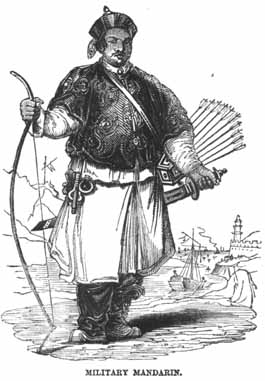
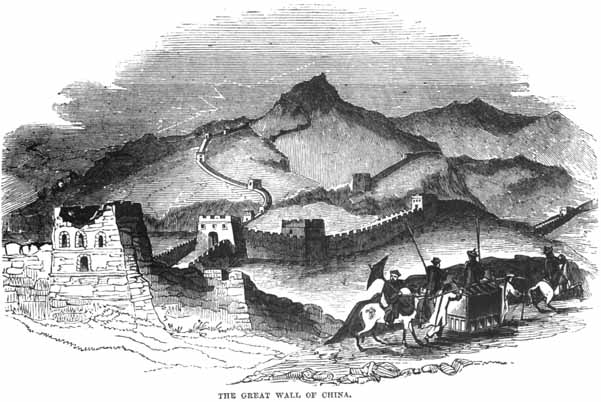
Near each of the gates is a village or town; and at one of the
principal gates, which opens on the road towards India, is situated
Sinning-fu, a city of large extent and population. Here the wall is
said to be sufficiently broad at the top to admit six horsemen
abreast, who might without inconvenience ride a race. The esplanade
on its top is much frequented by the inhabitants, and the stairs
which give ascent are very broad and convenient.
THE TOMBS OF PAUL AND VIRGINIA.
This delicious retreat in the island of Mauritius has no claims to
the celebrity it has attained. It is not the burial-place of Paul and
Virginia; and the author of "Recollections of the
Mauritius" thus endeavours to dispel the illusion connected with
the spot:—
"After having allowed his imagination to depict the shades of
Paul and Virginia hovering about the spot where their remains
repose—after having pleased himself with the idea that he had
seen those celebrated tombs, and given a sigh to the memory of those
faithful lovers, separated in life, but in death united—after
all this waste of sympathy, he learns at last that he has been under
a delusion the whole time—that no Virginia was there
interred—and that it is a matter of doubt whether there ever
existed such a person as Paul! What a pleasing illusion is then
dispelled! How many romantic dreams, inspired by the perusal of St.
Pierre's tale, are doomed to vanish when the truth is
ascertained! The fact is, that these tombs have been built to gratify
the eager desire which the English have always evinced to behold such
interesting mementoes. Formerly only one was erected; but the
proprietor of the place, finding that all the English visitors, on
being conducted to this, as the tomb of Virginia, always asked to see
that of Paul also, determined on building a similar one, to which he
gave that appellation. Many have been the visitors who have been
gratified, consequently, by the conviction that they had looked on
the actual burial-place of that unfortunate pair. These
'tombs' are scribbled over with the names of the various
persons who have visited them, together with verses and pathetic
ejaculations and sentimental remarks. St. Pierre's story of the
lovers is very prettily written, and his description of the scenic
beauties of the island are correct, although not even his pen can do
full justice to them; but there is little truth in the tale. It is
said that there was indeed a young lady sent from the Mauritius to
France for education, during the time that Monsieur de la Bourdonnais
was governor of the colony—that her name was Virginia, and that
she was shipwrecked in the St. Geran. I heard something of a
young man being attached to her, and dying of grief for her loss; but
that part of the story is very doubtful. The 'Bay of the
Tomb,' the 'Point of Endeavour,' the 'Isle of
Amber,' and the 'Cape of Misfortune,' still bear the same
names, and are pointed out as the memorable spots mentioned by St.
Pierre."
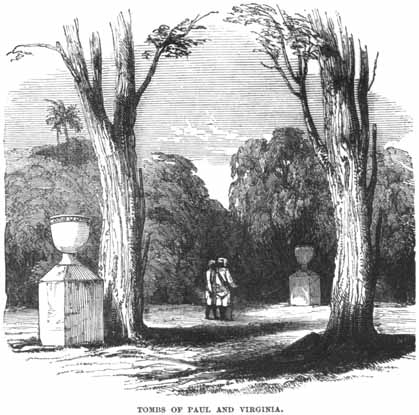
 |
Oh! gentle story of the Indian Isle!
I loved thee in my lonely childhood
well,
On the sea-shore, when day's last purple smile
Slept on the waters, and their hollow
swell
And dying cadence lent a deeper spell
Unto thine ocean pictures. 'Midst thy palms
And strange bright birds my fancy joy'd
to dwell,
And watch the southern Cross through midnight
calms,
And track the spicy woods. Yet more I bless'd
Thy vision of sweet love—kind,
trustful, true—
Lighting the citron-groves—a heavenly
guest—
With such pure smiles as Paradise once
knew.
Even then my young heart wept o'er this
world's power,
To reach and blight that holiest Eden flower.
Mrs. Hemans.
|
THE MANGOUSTE.
The Mangoustes, or Ichneumons, are natives of the hotter parts of
the Old World, the species being respectively African and Indian. In
their general form and habits they bear a great resemblance to the
ferrets, being bold, active, and sanguinary, and unrelenting
destroyers of birds, reptiles, and small animals, which they take by
surprise, darting rapidly upon them. Beautiful, cleanly, and easily
domesticated, they are often kept tame in the countries they
naturally inhabit, for the purpose of clearing the houses of vermin,
though the poultry-yard is not safe from their incursions.
The Egyptian mangouste is a native of North Africa, and was
deified for its services by the ancient Egyptians. Snakes, lizards,
birds, crocodiles newly hatched, and especially the eggs of
crocodiles, constitute its food. It is a fierce and daring animal,
and glides with sparkling eyes towards its prey, which it follows
with snake-like progression; often it watches patiently for hours
together, in one spot, waiting the appearance of a mouse, rat, or
snake, from its lurking-place. In a state of domestication it is
gentle and affectionate, and never wanders from the house or returns
to an independent existence; but it makes itself familiar with every
part of the premises, exploring every hole and corner, inquisitively
peeping into boxes and vessels of all kinds, and watching every
movement or operation.
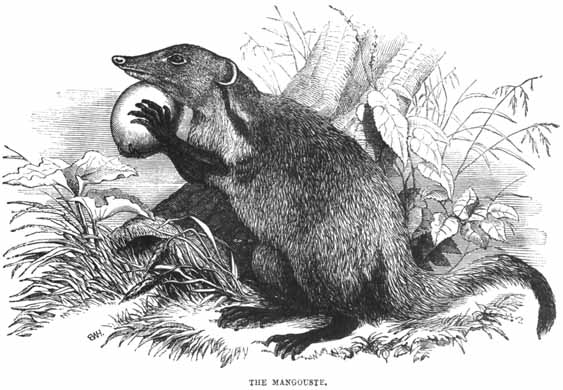
The Indian mangouste is much less than the Egyptian, and of a
beautiful freckled gray. It is not more remarkable for its graceful
form and action, than for the display of its singular instinct for
hunting for and stealing eggs, from which it takes the name of
egg-breaker. Mr. Bennett, in his account of one of the mangoustes
kept in the Tower, says, that on one occasion it killed no fewer than
a dozen full-grown rats, which were loosened to it in a room sixteen
feet square, in less than a minute and a half.
Another species of the mangouste, found in the island of Java,
inhabiting the large teak forests, is greatly admired by the natives
for its agility. It attacks and kills serpents with excessive
boldness. It is very expert in burrowing in the ground, which process
it employs ingeniously in the pursuit of rats. It possesses great
natural sagacity, and, from the peculiarities of its character, it
willingly seeks the protection of man. It is easily tamed, and in its
domestic state is very docile and attached to its master, whom it
follows like a dog; it is fond of caresses, and frequently places
itself erect on its hind legs, regarding every thing that passes with
great attention. It is of a very restless disposition, and always
carries its food to the most retired place to consume it, and is very
cleanly in its habits; but it is exclusively carnivorous and
destructive to poultry, employing great artifice in surprising
chickens.
CULLODEN.
Culloden Moor—the battle-field—lies eastward about a
mile from Culloden House. After an hour's climbing up the heathy
brae, through a scattered plantation of young trees, clambering over
stone dykes, and jumping over moorland rills and springs, oozing from
the black turf and streaking its sombre surface with stripes of
green, we found ourselves on the table-land of the moor—a
broad, bare level, garnished with a few black huts, and patches of
scanty oats, won by patient industry from the waste. We should
premise, however, that there are some fine glimpses of rude mountain
scenery in the course of the ascent. The immediate vicinage of
Culloden House is well wooded; the Frith spreads finely in front; the
Ross-shire hills assume a more varied and commanding aspect; and Ben
Wyvis towers proudly over his compeers, with a bold pronounced
character. Ships were passing and re-passing before us in the Frith,
the birds were singing blithely overhead, and the sky was without a
cloud. Under the cheering influence of the sun, stretched on the
warm, blooming, and fragrant heather, we gazed with no common
interest and pleasure on this scene.
On the moor all is bleak and dreary—long, flat, wide,
unvarying. The folly and madness of Charles and his followers, in
risking a battle on such ground, with jaded, unequal forces,
half-starved, and deprived of rest the preceding night, has often
been remarked, and is at one glance perceived by the spectator. The
Royalist artillery and cavalry had full room to play, for not a knoll
or bush was there to mar their murderous aim. Mountains and
fastnesses were on the right, within a couple of hours' journey,
but a fatality had struck the infatuated bands of Charles; dissension
and discord were in his councils; and a power greater than that of
Cumberland had marked them for destruction. But a truce to politics;
the grave has closed over victors and vanquished:
"Culloden's dread echoes are hush'd on the
moors;"
and who would awaken them with the voice of reproach, uttered over
the dust of the slain? The most interesting memorials of the contest
are the green grassy mounds which mark the graves of the slain
Highlanders, and which are at once distinguished from the black heath
around by the freshness and richness of their verdure. One large pit
received the Frasers, and another was dug for the Macintoshes.
Highland Note-Book.
ATHENS.
The most striking object in Athens is the Acropolis, or
Citadel—a rock which rises abruptly from the plain, and is
crowned with the Parthenon. This was a temple dedicated to the
goddess Minerva, and was built of the hard white marble of
Pentelicus. It suffered from the ravages of war between the Turks and
Venetians, and also more recently in our own time. The remnant of the
sculptures which decorated the pediments, with a large part of the
frieze, and other interesting remains, are now in what is called the
Elgin collection of the British Museum. During the embassy of Lord
Elgin at Constantinople, he obtained permission from the Turkish
government to proceed to Athens for the purpose of procuring casts
from the most celebrated remains of sculpture and architecture which
still existed at Athens. Besides models and drawings which he made,
his Lordship collected numerous pieces of Athenian sculpture in
statues, capitals, cornices, &c., and these he very generously
presented to the English Government, thus forming a school of Grecian
art in London, to which there does not at present exist a parallel.
In making this collection he was stimulated by seeing the destruction
into which these remains were sinking, through the influence of
Turkish barbarism. Some fine statues in the Parthenon had been
pounded down for mortar, on account of their affording the whitest
marble within reach, and this mortar was employed in the construction
of miserable huts. At one period the Parthenon was converted into a
powder magazine by the Turks, and in consequence suffered severely
from an explosion in 1656, which carried away the roof of the right
wing.
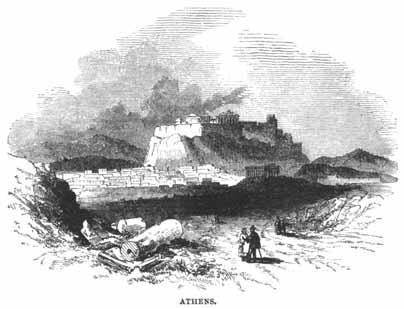
At the close of the late Greek war Athens was in a dreadful state,
being little more than a heap of ruins. It was declared by a Royal
ordinance of 1834 to be the capital of the new kingdom of Greece, and
in the March of that year the King laid the foundation-stone of his
palace there. In the hill of Areopagus, where sat that famous
tribunal, we may still discover the steps cut in the rock by which it
was ascended, the seats of the judges, and opposite to them those of
the accuser and accused. This hill was converted into a burial-place
for the Turks, and is covered with their tombs.
Ancient of days! august Athena! where,
Where are thy men of might—thy
grand in soul?
Gone, glimmering through the dream of things that
were—
First in the race that led to Glory's
goal;
They won, and passed away. Is this the
whole?
A schoolboy's tale, the wonder of an hour!
The warrior's weapon and the
sophist's stole
Are sought in vain, and o'er each mouldering
tower,
Dim with the mist of years, gray flits the shade of
power.
Here let me sit, upon this massy stone,
The marble column's yet unshaken
base;
Here, son of Saturn, was thy fav'rite
throne—
Mightiest of many such! Hence let me
trace
The latent grandeur of thy
dwelling-place.
It may not be—nor ev'n can Fancy's
eye
Restore what time hath labour'd to
deface:
Yet these proud pillars, claiming sigh,
Unmoved the Moslem sits—the light Greek carols
by.
Byron.
|
THE ISLES OF GREECE.
 |
The Isles of Greece! the Isles of Greece!
Where burning Sappho loved and
sung—
Where grew the arts of war and peace,
Where Delos rose and Phoebus sprung!
Eternal summer gilds them yet,
But all except their sun is set.
The Scian and the Teian muse,
The hero's harp, the lover's
lute,
Have found the fame your shores refuse;
Their place of birth alone is mute,
To sounds which echo further west
Than your sires' "Islands of the
Blest."
The mountains look on Marathon—
And Marathon looks on the sea;
And musing there an hour alone,
I dream'd that Greece might still be
free;
For standing on the Persian's grave,
I could not deem myself a slave.
A King sat on the rocky brow,
Which looks o'er sea-born
Salamis;
And ships by thousands lay below,
And men in nations—all were
his!
He counted them at break of day—
And when the sun set, where were they?
And where were they? and where art thou,
My country? On thy voiceless shore
The heroic lay is tuneless now—
The heroic bosom beats no more!
And must thy lyre, so long divine,
Degenerate into hands like mine?
'Tis something, in the dearth of fame,
Though link'd among a fetter'd
race,
To feel at least a patriot's shame,
Even as I sing, suffuse my face;
For what is left the poet here?
For Greeks a blush—for Greece a tear.
Must we but weep o'er days more
blest?
Must we but blush?—Our
fathers bled
Earth! render back from out thy breast
A remnant of our Spartan dead!
Of the three hundred grant but three,
To make a new Thermopylae!
What! silent still? and silent all?
Ah! no!--the voices of the dead
Sound like a distant torrent's fall,
And answer, "Let one living
head—
But one—arise! we come, we come!"
'Tis but the living who are dumb.
In vain—in vain: strike other chords;
Fill high the cup with Samian wine!
Leave battles to the Turkish hordes,
And shed the blood of Scio's
vine!
Hark! rising to the ignoble call—
How answers each bold Bacchanal?
|
|
|
|
You have the Pyrrhic dance as yet;
Where is the Pyrrhic phalanx gone?
Of two such lessons, why forget
The nobler and the manlier one?
You have the letters Cadmus gave—
Think ye he meant them for a slave?
Fill high the bowl with Samian wine!
We will not think of themes like
these!
It made Anacreon's song divine;
He served—but served
Polycrates—
A tyrant: but our masters then
Were still at least our countrymen.
The tyrant of the Chersonese
Was freedom's best and bravest
friend—
That tyrant was Miltiades!
Oh! that the present hour would lend
Another despot of the kind!
Such chains as his were sure to bind.
Fill high the bowl with Samian wine!
On Suli's rock and Perga's
shore
Exists the remnant of a line
Such as the Doric mothers bore;
And there, perhaps, some seed is sown,
The Heracleidian blood might own.
Trust not for freedom to the Franks—
They have a King who buys and sells;
In native swords and native ranks,
The only hope of courage dwells:
But Turkish force and Latin fraud
Would break your shield, however broad.
Fill high the bowl with Samian wine!
Our virgins dance beneath the
shade—
I see their glorious black eyes shine;
But gazing on each glowing maid,
My own the burning tear drop laves,
To think such breasts must suckle slaves!
Place me on Sunium's marble steep,
Where nothing, save the waves and I,
May hear our mutual murmurs sweep;
There swan-like let me sing and die:
A land of slaves shall ne'er be mine—
Dash down yon cup of Samian wine!
Byron.
|
THE SIEGE OF ANTIOCH.

Baghasihan, the Turkish Prince, or Emir of Antioch, had under his
command an Armenian of the name of Phirouz, whom he had entrusted
with the defence of a tower on that part of the city wall which
overlooked the passes of the mountains. Bohemund, by means of a spy,
who had embraced the Christian religion, and to whom he had given his
own name at baptism, kept up a daily communication with this captain,
and made him the most magnificent promises of reward if he would
deliver up his post to the Crusaders. Whether the proposal was first
made by Bohemund or by the Armenian, is uncertain, but that a good
understanding soon existed between them is undoubted; and a night was
fixed for the execution of the project. Bohemund communicated the
scheme to Godfrey and the Count of Toulouse, with the stipulation
that, if the city were won, he, as the soul of the enterprise, should
enjoy the dignity of Prince of Antioch. The other leaders hesitated:
ambition and jealousy prompted them to refuse their aid in furthering
the views of the intriguer. More mature consideration decided them to
acquiesce, and seven hundred of the bravest knights were chosen for
the expedition, the real object of which, for fear of spies, was kept
a profound secret from the rest of the army.
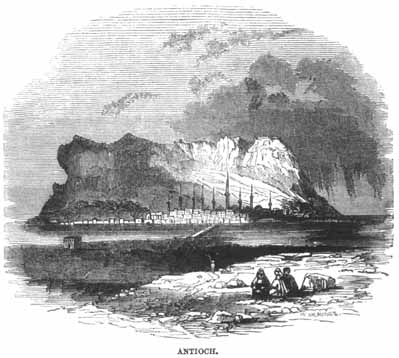
Everything favoured the treacherous project of the Armenian
captain, who, on his solitary watch-tower, received due intimation of
the approach of the Crusaders. The night was dark and stormy: not a
star was visible above; and the wind howled so furiously as to
overpower all other sounds. The rain fell in torrents, and the
watchers on the towers adjoining to that of Phirouz could not hear
the tramp of the armed knights for the wind, nor see them for the
obscurity of the night and the dismalness of the weather. When within
bow-shot of the walls, Bohemund sent forward an interpreter to confer
with the Armenian. The latter urged them to make haste and seize the
favourable interval, as armed men, with lighted torches, patrolled
the battlements every half-hour, and at that instant they had just
passed. The chiefs were instantly at the foot of the wall. Phirouz
let down a rope; Bohemund attached to it a ladder of hides, which was
then raised by the Armenian, and held while the knights mounted. A
momentary fear came over the spirits of the adventurers, and every
one hesitated; at last Bohemund, encouraged by Phirouz from above,
ascended a few steps on the ladder, and was followed by Godfrey,
Count Robert of Flanders, and a number of other knights. As they
advanced, others pressed forward, until their weight became too great
for the ladder, which, breaking, precipitated about a dozen of them
to the ground, where they fell one upon the other, making a great
clatter with their heavy coats of mail. For a moment they thought all
was lost; but the wind made so loud a howling, as it swept in fierce
gusts through the mountain gorges, and the Orontes, swollen by the
rain, rushed so noisily along, that the guards heard nothing. The
ladder was easily repaired, and the knights ascended, two at a time,
and reached the platform in safety. When sixty of them had thus
ascended, the torch of the coming patrol was seen to gleam at the
angle of the wall. Hiding themselves behind a buttress, they awaited
his coming in breathless silence. As soon as he arrived at arm's
length, he was suddenly seized; and before he could open his lips to
raise an alarm, the silence of death closed them up for ever. They
next descended rapidly the spiral staircase of the tower, and,
opening the portal, admitted the whole of their companions. Raymond
of Toulouse, who, cognizant of the whole plan, had been left behind
with the main body of the army, heard at this instant the signal
horn, which announced that an entry had been effected, and advancing
with his legions, the town was attacked from within and from
without.
Imagination cannot conceive a scene more dreadful than that
presented by the devoted city of Antioch on that night of horror. The
Crusaders fought with a blind fury, which fanaticism and suffering
alike incited. Men, women, and children were indiscriminately
slaughtered, till the streets ran in gore. Darkness increased the
destruction; for, when the morning dawned the Crusaders found
themselves with their swords at the breasts of their fellow-soldiers,
whom they had mistaken to be foes. The Turkish commander fled, first
to the citadel, and, that becoming insecure, to the mountains,
whither he was pursued and slain, and his gory head brought back to
Antioch as a trophy. At daylight the massacre ceased, and the
Crusaders gave themselves up to plunder.
Popular Delusions.
ANGLING.
 |
Go, take thine angle, and with practised line,
Light as the gossamer, the current
sweep;
And if thou failest in the calm, still
deep,
In the rough eddy may a prize be thine.
Say thou'rt unlucky where the sunbeams shine;
Beneath the shadow where the waters
creep
Perchance the monarch of the brook shall
leap—
For Fate is ever better than Design.
Still persevere; the giddiest breeze that blows
For thee may blow with fame and fortune
rife.
Be prosperous; and what reck if it arose
Out of some pebble with the stream at
strife,
Or that the light wind dallied with the boughs:
Thou art successful—such is human
life.
Doubleday.
|
MARIANA.
Mariana in the moated grange.—Measure for Measure.
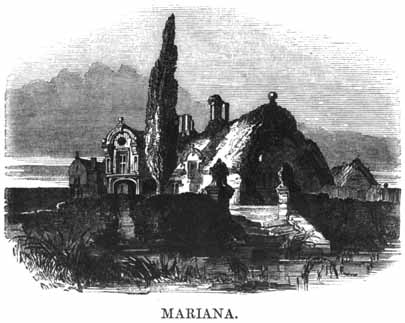
With blackest moss the flower-plots
Were thickly crusted, one and all;
The rusted nails fell from the knots
That held the peach to the garden
wall.
The broken sheds look'd sad and
strange—
Uplifted was the clinking latch,
Weeded and worn the ancient thatch,
Upon the lonely moated grange.
She only said, "My life is
dreary—
He cometh not," she said;
She said, "I am aweary, weary,
I would that I were dead!"
Her tears fell with the dews at even—
Her tears fell ere the dews were
dried;
She could not look on the sweet heaven,
Either at morn or eventide.
After the flitting of the bats,
When thickest dark did trance the
sky,
She drew her casement-curtain by,
And glanced athwart the glooming flats.
She only said, "The night is
dreary—
He cometh not," she said;
She said, "I am aweary, weary,
I would that I were dead!"
Upon the middle of the night,
Waking, she heard the night-fowl
crow:
The cock sung out an hour ere light;
From the dark fen the oxen's low
Came to her. Without hope of change,
In sleep she seem'd to walk
forlorn,
Till cold winds woke the gray-eyed
morn
About the lonely moated grange.
She only said, "The day is
dreary
He cometh not," she said;
She said, "I am aweary, weary,
I would that I were dead!"
About a stone-cast from the wall
A sluice with blacken'd waters
slept;
And o'er it many, round and small,
The cluster'd marish-mosses
crept.
Hard by, a poplar shook alway,
All silver-green with gnarled bark;
For leagues, no other tree did dark
The level waste, the rounding gray.
She only said, "My life is
dreary—
He cometh not," she said;
She said, "I am aweary, weary,
I would that I were dead!"
And ever, when the moon was low,
And the shrill winds were up and away
In the white curtain, to and fro
She saw the gusty shadow sway.
But when the moon was very low,
And wild winds bound within their
cell,
The shadow of the poplar fell
Upon her bed, across her brow.
She only said, "The night is
dreary—
He cometh not," she said;
She said, "I am aweary, weary,
I would that I were dead!"
All day, within the dreary house,
The doors upon their hinges
creak'd;
The blue-fly sang i' the pane; the mouse
Behind the mould'ring wainscot
shriek'd,
Or from the crevice peer'd about.
Old faces glimmer'd through the
doors;
Old footsteps trod the upper floors;
Old voices called her from without:
She only said, "My life is
dreary—
He cometh not," she said;
She said, "I am aweary, weary,
I would that I were dead!"
The sparrow's chirrup on the roof,
The slow clock ticking, and the sound
Which to the wooing wind aloof
The poplar made, did all confound
Her sense; but most she loathed the hour
When the thick-moated sunbeam lay
Athwart the chambers, and the day
Was sloping towards his western bower.
Then said she, "I am very
dreary—
He will not come," she said;
She wept, "I am aweary, weary,
I would that I were dead!"
Tennyson.
|
RISE OF POETRY AMONG THE ROMANS.
The Romans, in the infancy of their state, were entirely rude and
unpolished. They came from shepherds; they were increased from the
refuse of the nations around them; and their manners agreed with
their original. As they lived wholly on tilling their ground at home,
or on plunder from their neighbours, war was their business, and
agriculture the chief art they followed. Long after this, when they
had spread their conquests over a great part of Italy, and began to
make a considerable figure in the world—even their great men
retained a roughness, which they raised into a virtue, by calling it
Roman spirit; and which might often much better have been called
Roman barbarity. It seems to me, that there was more of austerity
than justice, and more of insolence than courage, in some of their
most celebrated actions. However that be, this is certain, that they
were at first a nation of soldiers and husbandmen: roughness was long
an applauded character among them; and a sort of rusticity reigned,
even in their senate-house.
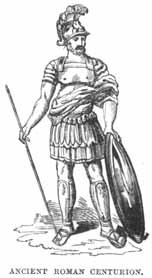
In a nation originally of such a temper as this, taken up almost
always in extending their territories, very often in settling the
balance of power among themselves, and not unfrequently in both these
at the same time, it was long before the politer arts made any
appearance; and very long before they took root or flourished to any
degree. Poetry was the first that did so; but such a poetry as one
might expect among a warlike, busied, unpolished people.
Not to enquire about the songs of triumph mentioned even in
Romulus's time, there was certainly something of poetry among
them in the next reign, under Numa; a Prince who pretended to
converse with the Muses as well as with Egeria, and who might
possibly himself have made the verses which the Salian priests sang
in his time. Pythagoras, either in the same reign, or if you please
some time after, gave the Romans a tincture of poetry as well as of
philosophy; for Cicero assures us that the Pythagoreans made great
use of poetry and music; and probably they, like our old Druids,
delivered most of their precepts in verse. Indeed, the chief
employment of poetry in that and the following ages, among the
Romans, was of a religious kind. Their very prayers, and perhaps
their whole liturgy, was poetical. They had also a sort of prophetic
or sacred writers, who seem to have written generally in verse; and
were so numerous that there were above two thousand of their volumes
remaining even to Augustus's time. They had a kind of plays too,
in these early times, derived from what they had seen of the Tuscan
actors when sent for to Rome to expiate a plague that raged in the
city. These seem to have been either like our dumb-shows, or else a
kind of extempore farces—a thing to this day a good deal in use
all over Italy and in Tuscany. In a more particular manner, add to
these that extempore kind of jesting dialogues begun at their harvest
and vintage feasts, and carried on so rudely and abusively afterwards
as to occasion a very severe law to restrain their licentiousness;
and those lovers of poetry and good eating, who seem to have attended
the tables of the richer sort, much like the old provincial poets, or
our own British bards, and sang there to some instrument of music the
achievements of their ancestors, and the noble deeds of those who had
gone before them, to inflame others to follow their great
examples.
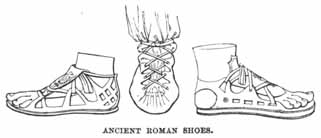
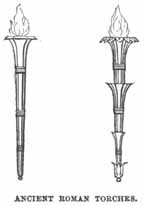
The names of almost all these poets sleep in peace with all their
works; and, if we may take the word of the other Roman writers of a
better age, it is no great loss to us. One of their best poets
represents them as very obscure and very contemptible; one of their
best historians avoids quoting them as too barbarous for politer
ears; and one of their most judicious emperors ordered the greatest
part of their writings to be burnt, that the world might be troubled
with them no longer.
All these poets, therefore, may very well be dropped in the
account, there being nothing remaining of their works, and probably
no merit to be found in them if they had remained. And so we may date
the beginning of the Roman poetry from Livius Andronicus, the first
of their poets of whom anything does remain to us; and from whom the
Romans themselves seem to have dated the beginning of their poetry,
even in the Augustan age.
The first kind of poetry that was followed with any success among
the Romans, was that for the stage. They were a very religious
people; and stage plays in those times made no inconsiderable part in
their public devotions; it is hence, perhaps, that the greatest
number of their oldest poets, of whom we have any remains, and,
indeed, almost all of them, are dramatic poets.
Spence.
CHARACTER OF JULIUS CAESAR.
Caesar was endowed with every great and noble quality that could
exalt human nature, and give a man the ascendant in society. Formed
to excel in peace as well as war; provident in council; fearless in
action, and executing what he had resolved with an amazing celerity;
generous beyond measure to his friends; placable to his enemies; and
for parts, learning, and eloquence, scarce inferior to any man. His
orations were admired for two qualities, which are seldom found
together, strength and elegance: Cicero ranks him among the greatest
orators that Rome ever bred; and Quintilian says, that he spoke with
the same force with which he fought; and if he had devoted himself to
the bar, would have been the only man capable of rivalling Cicero.
Nor was he a master only of the politer arts; but conversant also
with the most abstruse and critical parts of learning; and, among
other works which he published, addressed two books to Cicero on the
analogy of language, or the art of speaking and writing correctly. He
was a most liberal patron of wit and learning, wheresoever they were
found; and out of his love of those talents, would readily pardon
those who had employed them against himself; rightly judging, that by
making such men his friends, he should draw praises from the same
fountain from which he had been aspersed. His capital passions were
ambition and love of pleasure, which he indulged in their turns to
the greatest excess; yet the first was always predominant—to
which he could easily sacrifice all the charms of the second, and
draw pleasure even from toils and dangers, when they ministered to
his glory. For he thought Tyranny, as Cicero says, the greatest of
goddesses; and had frequently in his mouth a verse of Euripides,
which expressed the image of his soul, that if right and justice were
ever to be violated, they were to be violated for the sake of
reigning. This was the chief end and purpose of his life—the
scheme that he had formed from his early youth; so that, as Cato
truly declared of him, he came with sobriety and meditation to the
subversion of the republic. He used to say, that there were two
things necessary to acquire and to support power—soldiers and
money; which yet depended mutually upon each other: with money,
therefore, he provided soldiers, and with soldiers extorted money,
and was, of all men, the most rapacious in plundering both friends
and foes; sparing neither prince, nor state, nor temple, nor even
private persons who were known to possess any share of treasure. His
great abilities would necessarily have made him one of the first
citizens of Rome; but, disdaining the condition of a subject, he
could never rest till he made himself a Monarch. In acting this last
part, his usual prudence seemed to fail him; as if the height to
which he was mounted had turned his head and made him giddy; for, by
a vain ostentation of his power, he destroyed the stability of it;
and, as men shorten life by living too fast, so by an intemperance of
reigning he brought his reign to a violent end.
Middleton.
SIEGE OF TYRE.
It appeared to Alexander a matter of great importance, before he
went further, to gain the maritime powers. Upon application, the
Kings of Cyprus and Phoenicea made their submission; only Tyre held
out. He besieged that city seven months, during which time he erected
vast mounds of earth, plied it with his engines, and invested it on
the side next the sea with two hundred gallies. He had a dream in
which he saw Hercules offering him his hand from the wall, and
inviting him to enter; and many of the Tyrians dreamt "that
Apollo declared he would go over to Alexander, because he was
displeased with their behaviour in the town," Hereupon, the
Tyrians, as if the God had been a deserter taken in the fact, loaded
his statue with chains, and nailed the feet to the pedestal, not
scrupling to call him an Alexandrist. In another dream,
Alexander thought he saw a satyr playing before him at some distance,
and when he advanced to take him, the savage eluded his grasp.
However, at last, after much coaxing and taking many circuits round
him, be prevailed with him to surrender himself. The interpreters,
plausibly enough, divided the Greek name for satyr into two,
Sa Tyros, which signifies Tyre is thine. They still
show us a fountain near which Alexander is said to have seen that
vision.
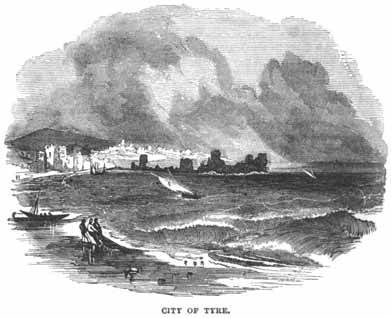
About the middle of the siege, he made an excursion against the
Arabians who dwelt about Anti-Libanus. Here he ran a great risk of
his life, on account of his preceptor Lysimachus, who insisted on
attending him—being, as he alleged, neither older nor less
valiant than Phoenix; but when they came to the hills and quitted
their horses to march up on foot, the rest of the party got far
before Alexander and Lysimachus. Night came on, and, as the enemy was
at no great distance, the King would not leave his preceptor, borne
down with fatigue and with the weight of years. Therefore, while he
was encouraging and helping him forward, he was insensibly separated
from the troop, and had a cold and dark night to pass in an exposed
and dismal situation. In this perplexity, he observed at a distance a
number of scattered fires which the enemy had lighted; and depending
upon his swiftness and activity as well as being accustomed to
extricate the Macedonians out of every difficulty, by taking a share
in the labour and danger, he ran to the next fire. After having
killed two of the barbarians who watched it, he seized a lighted
brand and hastened with it to his party, who soon kindled a great
fire. The sight of this so intimidated the enemy, that many of them
fled, and those who ventured to attack him were repulsed with
considerable slaughter. By this means he passed the night in safety,
according to the account we have from Charis.
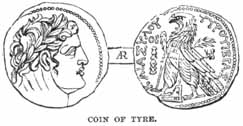
As for the siege, it was brought to a termination in this manner:
Alexander had permitted his main body to repose themselves after the
long and severe fatigues they had undergone, and ordered only some
small parties to keep the Tyrians in play. In the meantime,
Aristander, his principal soothsayer, offered sacrifices; and one
day, upon inspecting the entrails of the victim, he boldly asserted
among those around him that the city would certainly be taken that
month. As it happened to be the last day of that month, his assertion
was received with ridicule and scorn. The King perceiving he was
disconcerted, and making it a point to bring the prophecies of his
minister to completion, gave orders that the day should not be called
the 30th, but the 28th of the month; at the same time he called out
his forces by sound of trumpet, and made a much more vigorous assault
than he at first intended. The attack was violent, and those who were
left behind in the camp quitted it, to have a share in it and to
support their fellow-soldiers, insomuch that the Tyrians were forced
to give out, and the city was taken that very day.
Langhorne's
Plutarch.
THE FALLS OF NIAGARA.
The river Niagara takes its rise in the western extremity of Lake
Erie, and, after flowing about thirty-four miles, empties itself into
Lake Ontario. It is from half a mile to three miles broad; its course
is very smooth, and its depth considerable. The sides above the
cataract are nearly level; but below the falls, the stream rushes
between very lofty rocks, crowned by gigantic trees. The great body
of water does not fall in one complete sheet, but is separated by
islands, and forms three distinct falls. One of these, called the
Great Fall, or, from its shape, the Horse-shoe Fall, is on the
Canadian side. Its beauty is considered to surpass that of the
others, although its height is considerably less. It is said to have
a fall of 165 feet; and in the inn, which is about 300 yards from the
fall, the concussion of air caused by this immense cataract is so
great, that the window-frames, and, indeed, the whole house, are
continually in a tremulous motion, and in winter, when the wind
drives the spray in the direction of the buildings, the whole scene
is coated with sheets of ice.
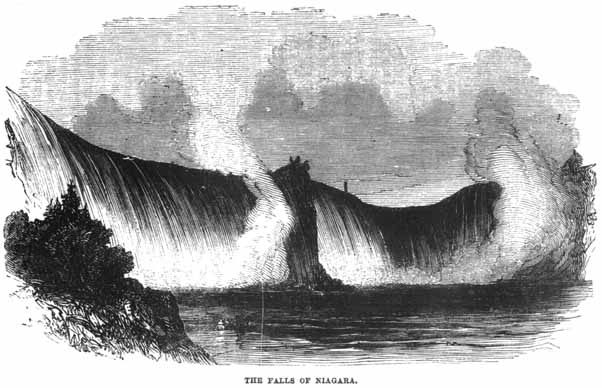
The great cataract is seen by few travellers in its winter garb. I
had seen it several years before in all the glories of autumn, its
encircling woods, happily spared by the remorseless hatchet, and
tinted with the brilliant hues peculiar to the American
"Fall." Now the glory had departed; the woods were still
there, but were generally black, with occasional green pines; beneath
the grey trunks was spread a thick mantle of snow, and from the brown
rocks inclosing the deep channel of the Niagara River hung huge
clusters of icicles, twenty feet in length, like silver pipes of
giant organs. The tumultuous rapids appeared to descend more
regularly than formerly over the steps which distinctly extended
across the wide river. The portions of the British, or Horse-shoe
Fall, where the waters descend in masses of snowy whiteness, were
unchanged by the season, except that vast sheets of ice and icicles
hung on their margin; but where the deep waves of sea-green water
roll majestically over the steep, large pieces of descending ice were
frequently descried on its surface. No rainbows were now observed on
the great vapour-cloud which shrouds for ever the bottom of the Fall;
but we were extremely fortunate to see now plainly what I had looked
for in vain at my last visit, the water-rockets, first
described by Captain Hall, which shot up with a train of vapour
singly, and in flights of a dozen, from the abyss near Table Rock,
curved towards the east, and burst and fell in front of the cataract.
Vast masses of descending fluid produce this singular effect, by
means of condensed air acting on portions of the vapour into which
the water is comminuted below. Altogether the appearance was most
startling. It was observed at 1 P.M. from the gallery of Mr.
Barnett's museum. The broad sheet of the American Fall presented
the appearance of light-green water and feathery spray, also margined
by huge icicles. As in summer, the water rushing from under the
vapour-cloud of the two Falls was of a milky whiteness as far as the
ferry, when it became dark and interspersed with floating masses of
ice. Here, the year before, from the pieces of ice being heaped and
crushed together in great quantities, was formed a thick and high
bridge of ice, completely across the river, safe for passengers for
some time; and in the middle of it a Yankee speculator had erected a
shanty for refreshments. Lately, at a dinner party, I heard a
staff-officer of talent, but who was fond of exciting wonder by his
narratives, propose to the company a singular wager,—a bet of
one hundred pounds that he would go over the Falls of Niagara and
come out alive at the bottom! No one being inclined to take him up,
after a good deal of discussion as to how this perilous feat was to
be accomplished, the plan was disclosed. To place on Table Rock a
crane, with a long arm reaching over the water of the Horse-shoe
Fall; from this arm would hang, by a stout rope, a large bucket or
cask; this would be taken up some distance above the Fall, where the
mill-race slowly glides towards the cataract; here the adventurer
would get into the cask, men stationed on the Table Rock would haul
in the slack of the rope as he descended, and the crane would swing
him clear from the cataract as he passed over. Here is a chance for
any gentleman sportsman to immortalize himself!
Sir James Alexander.
THE SLOTH.
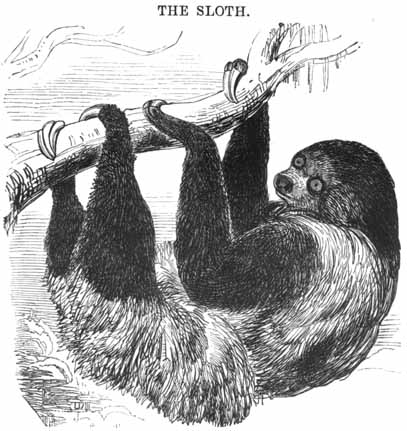
The Sloth, in its wild condition, spends its whole life on the
trees, and never leaves them but through force or accident; and, what
is more extraordinary, it lives not upon the branches, like
the squirrel and the monkey, but under them. Suspended from
the branches, it moves, and rests, and sleeps. So much of its
anatomical structure as illustrates this peculiarity it is necessary
to state. The arm and fore-arm of the sloth, taken together, are
nearly twice the length of the hind legs; and they are, both by their
form and the manner in which they are joined to the body, quite
incapacitated from acting in a perpendicular direction, or in
supporting it upon the earth, as the bodies of other quadrupeds are
supported by their legs. Hence, if the animal be placed on the floor,
its belly touches the ground. The wrist and ankle are joined to the
fore-arm and leg in an oblique direction; so that the palm or sole,
instead of being directed downwards towards the surface of the
ground, as in other animals, is turned inward towards the body, in
such a manner that it is impossible for the sloth to place the sole
of its foot flat down upon a level surface. It is compelled, under
such circumstances, to rest upon the external edge of the foot. This,
joined to other peculiarities in the formation, render it impossible
for sloths to walk after the manner of ordinary quadrupeds; and it is
indeed only on broken ground, when he can lay hold of stones, roots
of grass, &c., that he can get along at all. He then extends his
arms in all directions in search of something to lay hold of; and
when he has succeeded, he pulls himself forward, and is then enabled
to trail himself along in the exceedingly awkward and tardy manner
which has procured for him his name.
Mr. Waterton informs us that he kept a sloth for several months in
his room, in order to have an opportunity of observing his motions.
If the ground were rough he would pull himself forward in the manner
described, at a pretty good pace; and he invariably directed his
course towards the nearest tree. But if he was placed upon a smooth
and well-trodden part of the road, he appeared to be in much
distress. Within doors, the favourite position of this sloth was on
the back of a chair; and after getting all his legs in a line on the
topmost part of it, he would hang there for hours together, and often
with a low and plaintive cry would seem to invite the notice of his
master. The sloth does not suspend himself head downward, like the
vampire bat, but when asleep he supports himself from a branch
parallel to the earth. He first seizes the branch with one arm, and
then with the other; after which he brings up both his legs, one by
one, to the same branch; so that, as in the Engraving, all the four
limbs are in a line. In this attitude the sloth has the power of
using the fore paw as a hand in conveying food to his mouth, which he
does with great address, retaining meanwhile a firm hold of the
branch with the other three paws. In all his operations the enormous
claws with which the sloth is provided are of indispensable service.
They are so sharp and crooked that they readily seize upon the
smallest inequalities in the bark of the trees and branches, among
which the animal usually resides, and also form very powerful weapons
of defence.
The sloth has been said to confine himself to one tree until he
has completely stripped it of its leaves; but Mr. Waterton says,
"During the many years I have ranged the forests, I have never
seen a tree in such a state of nudity; indeed, I would hazard a
conjecture, that, by the time the animal had finished the last of the
old leaves, there would be a new crop on the part of the tree it had
stripped first, ready for him to begin again—so quick is the
process of vegetation in these countries. There is a saying among the
Indians, that when the wind blows the sloth begins to travel. In calm
weather he remains tranquil, probably not liking to cling to the
brittle extremities of the branches, lest they should break with him
in passing from one tree to another; but as soon as the wind arises,
and the branches of the neighbouring trees become interwoven, the
sloth then seizes hold of them and travels at such a good round pace,
that any one seeing him, as I have done, pass from tree to tree,
would never think of calling him a sloth."
SIERRA NEVADA, OR SNOWY RANGE OF CALIFORNIA.
"The dividing ridge of the Sierra Nevada is in sight from
this encampment. Accompanied by Mr. Preuss, I ascended to-day the
highest peak to the right, from which we had a beautiful view of a
mountain lake at our feet, about 15 miles in length, and so entirely
surrounded by mountains that we could not discover an outlet. We had
taken with us a glass, but though we enjoyed an extended view, the
valley was half hidden in mist, as when we had seen it before. Snow
could be distinguished on the higher parts of the coast mountains;
eastward, as far as the eye could extend, it ranged over a terrible
mass of broken snowy mountains, fading off blue in the distance. The
rock composing the summit consists of a very coarse, dark, volcanic
conglomerate: the lower parts appeared to be of a very slatey
structure. The highest trees were a few scattered cedars and aspens.
From the immediate foot of the peak we were two hours in reaching the
summit, and one hour and a quarter in descending. The day had been
very bright, still, and clear, and spring seems to be advancing
rapidly. While the sun is in the sky the snow melts rapidly, and
gushing springs cover the face of the mountain in all the exposed
places, but their surface freezes instantly with the disappearance of
the sun.
"The Indians of the Sierra make frequent descents upon the
settlements west of the Coast Range, which they keep constantly swept
of horses; among them are many who are called Christian Indians,
being refugees from Spanish missions. Several of these incursions
occurred while we were at Helvetia. Occasionally parties of soldiers
follow them across the Coast Range, but never enter the
Sierra."
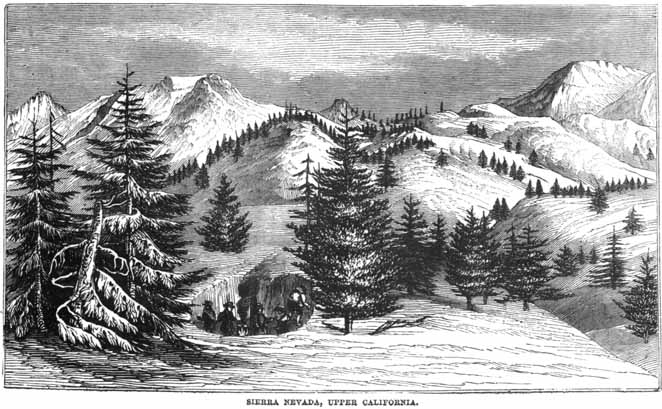
The party had not long before passed through a beautiful country.
The narrative says:—"During the earlier part of the day
our ride had been over a very level prairie, or rather a succession
of long stretches of prairie, separated by lines and groves of oak
timber, growing along dry gullies, which are tilled with water in
seasons of rain; and perhaps, also, by the melting snows. Over much
of this extent the vegetation was spare; the surface showing plainly
the action of water, which, in the season of flood, the Joaquin
spreads over the valley. About one o'clock, we came again among
innumerable flowers; and, a few miles further, fields of beautiful
blue-flowering lupine, which seems to love the neighbourhood
of water, indicated that we were approaching a stream. We here found
this beautiful shrub in thickets, some of them being twelve feet in
height. Occasionally, three or four plants were clustered together,
forming a grand bouquet, about ninety feet in circumference, and ten
feet high; the whole summit covered with spikes of flowers, the
perfume of which is very sweet and grateful. A lover of natural
beauty can imagine with what pleasure we rode among these flowering
groves, which filled the air with a light and delicate fragrance. We
continued our road for about half a mile, interspersed through an
open grove of live oaks, which, in form, were the most symmetrical
and beautiful we had yet seen in this country. The ends of their
branches rested on the ground, forming somewhat more than a half
sphere of very full and regular figure, with leaves apparently
smaller than usual. The Californian poppy, of a rich orange colour,
was numerous to-day. Elk and several bands of antelope made their
appearance. Our road now was one continued enjoyment; and it was
pleasant riding among this assemblage of green pastures, with varied
flowers and scattered groves, and, out of the warm, green spring, to
look at the rocky and snowy peaks where lately we had suffered so
much."
Again, in the Sierra Nevada:—"Our journey to-day was in
the midst of an advanced spring, whose green and floral beauty
offered a delightful contrast to the sandy valley we had just left.
All the day snow was in sight on the butt of the mountain, which
frowned down upon us on the right; but we beheld it now with feelings
of pleasant security, as we rode along between green trees and on
flowers, with humming-birds and other feathered friends of the
traveller enlivening the serene spring air. As we reached the summit
of this beautiful pass, and obtained a view into the eastern country,
we saw at once that here was the place to take leave of all such
pleasant scenes as those around us. The distant mountains were now
bald rocks again; and, below, the land had any colour but green.
Taking into consideration the nature of the Sierra Nevada, we found
this pass an excellent one for horses; and, with a little labour, or,
perhaps, with a more perfect examination of the localities, it might
be made sufficiently practicable for waggons."
Fremont's
Travels.
THE GROUSE.
We have but few European birds presenting more points of interest
in their history than the Grouse, a species peculiar to the northern
and temperate latitudes of the globe. Dense pine forests are the
abode of some; others frequent the wild tracts of heath-clad
moorland, while the patches of vegetation scattered among the rocky
peaks of the mountains, afford a congenial residence to others.
Patient of cold, and protected during the intense severities of
winter by their thick plumage, they give animation to the frozen
solitude long after all other birds have retired from the desolate
scenery. Their food consists of the tender shoots of pines, the seeds
of plants, the berries of the arbutus and bilberry, the buds of the
birch and alder, the buds of the heather, leaves, and grain. The nest
is very simply constructed, consisting of dried grasses placed upon
the ground and sheltered among the herbage.
Two species of this bird, called forest grouse, are indigenous in
England: one is the black grouse, common in the pine woods of
Scotland and of the northern part of England, and elsewhere; the
other is the capercailzie or cock of the woods. Formerly, in Ireland,
and still more recently in Scotland, this noble bird, the most
magnificent of the whole of the grouse tribe, was abundant in the
larger woods; but it gradually disappeared, from the indiscriminate
slaughter to which it was subject. Selby informs us that the last
individual of this species in Scotland was killed about forty years
ago, near Inverness. It still abounds in the pine forests of Sweden
and Norway, and an attempt has been made by the Marquis of
Breadalbane to re-introduce it into Scotland.
The red grouse, or moor grouse, is found in Scotland; and it is
somewhat singular that this beautiful bird should not be known on the
Continent, abundant as it is on the moorlands of Scotland, England,
and Ireland. The breeding season of the red grouse is very early in
spring, and the female deposits her eggs, eight or ten in number, in
a high tuft of heather. The eggs are peculiarly beautiful, of a rich
brown colour, spotted with black, and both herself and her mate
attend the young with great assiduity. The brood continue in company
during the winter, and often unite with other broods, forming large
packs, which range the high moorlands, being usually shy and
difficult of approach. Various berries, such as the cranberry, the
bilberry, together with the tender shoots of heath, constitute the
food of this species. The plumage is a rich colouring of chestnut,
barred with black. The cock grouse in October is a very handsome
bird, with his bright red comb erected above his eyes, and his fine
brown plumage shining in the sun.
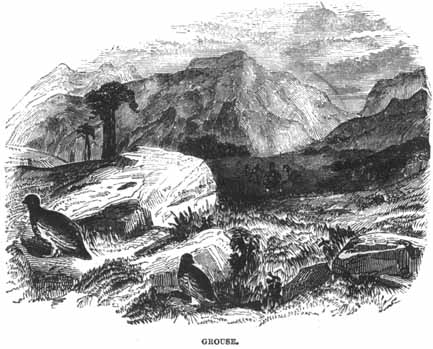
The ptarmigan grouse is not only a native of Scotland but of the
higher latitudes of continental Europe, and, perhaps, the changes of
plumage in none of the feathered races are more remarkable than those
which the ptarmigans undergo. Their full summer plumage is yellow,
more or less inclining to brown, beautifully barred with zig-zag
lines of black. Their winter dress is pure white, except that the
outer tail-feathers, the shafts of the quills, and a streak from the
eye to the beak are black. This singular change of plumage enables
it, when the mountains are covered with snow, to escape the
observation of the eagle, Iceland falcon, and the snowy owl: the
feathers become much fuller, thicker, and more downy; the bill is
almost hidden, and the legs become so thickly covered with hair-like
feathers, as to resemble the legs of some well-furred quadruped.
PATMOS.
Patmos affords one of the few exceptions which are to be found to
the general beauty and fertility of the islands of the Aegean Sea.
Its natural advantages, indeed, are very few, for the whole of the
island is little else than one continued rock, rising frequently into
hills and mountains. Its valleys are seldom susceptible of
cultivation, and scarcely ever reward it. Almost the only spot,
indeed, in which it has been attempted, is a small valley in the
west, where the richer inhabitants have a few gardens. On account of
its stern and desolate character, the island was used, under the
Roman Empire, as a place of banishment; and here the Apostle St.
John, during the persecution of Domitian, was banished, and wrote the
book of the Revela tions. The island now bears the name of Patino and
Palmosa, but a natural grotto in the rock is still shown as the place
where St. John resided. "In and around it," says Mr.
Turner, "the Greeks have dressed up one of their tawdry
churches; and on the same site is a school attached to the church, in
which a few children are taught reading and writing."
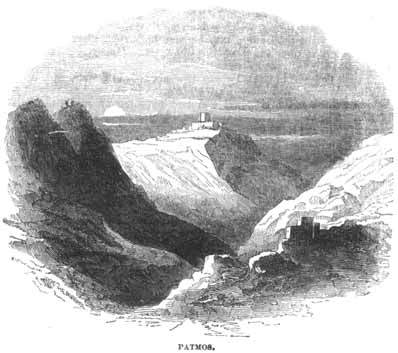
Patmos used to be a famous resort of pirates. Dr. Clarke, after
describing with enthusiasm the splendid scene which he witnessed in
passing by Patmos, with feelings naturally excited by all the
circumstances of local solemnity, and "the evening sun behind
the towering cliffs of Patmos, gilding the battlements of the
Monastery of the Apocalypse with its parting rays; the consecrated
island, surrounded by inexpressible brightness, seeming to float upon
an abyss of fire, while the moon, in milder splendour, was rising
full over the opposite expanse," proceeds to remark, "How
very different were the reflections caused upon leaving the deck, by
observing a sailor with a lighted match in his hand, and our captain
busied in appointing an extraordinary watch for the night, as a
precaution against the pirates who swarm in these seas." These
wretches, as dastardly as they were cruel, the instant they boarded a
vessel, put every individual of the crew to death. They lurked about
the isle of Fouri, to the north of Patmos, in great numbers, taking
possession of bays and creeks the least frequented by other mariners.
After they had plundered a ship, they bored a hole through her
bottom, and took to their boats again. The knights of Malta were said
to be amongst the worst of these robbers. In the library of the
Monastery, which is built on the top of a mountain, and in the middle
of the chief town, may be seen bulls from two of the Popes, and a
protection from the Emperor Charles the Sixth, issued to protect the
island from their incursions.
Though deficient in trees, Patmos now abounds in flowering plants
and shrubs. Walnuts and other fruit trees grow in the orchards; and
the wine of Patmos is the strongest and best flavoured of any in the
Greek islands. The view of Patmos from the highest point is said to
be very curious. The eye looks down on nothing but mountains below
it; and the excessive narrowness of the island, with the curious form
of its coast, have an extraordinary appearance.
SHAKSPEARE.
Memorable in the history of genius is the 23rd of April, as being
at once the day of the birth and death of Shakspeare; and these
events took place on the same spot, for at Stratford-upon-Avon this
illustrious dramatist was born, in the year 1564, and here he also
died, in 1616. It has been conjectured, that his first dramatic
composition was produced when he was but twenty-five years old. He
continued to write for the stage for a great number of years;
occasionally, also, appearing as a performer: and at length, having,
by his exertions, secured a fortune of two or three hundred a year,
retired to his native town, where he purchased a small estate, and
spent the remainder of his days in ease and honour.
When Washington Irving visited Stratford-upon-Avon, he was led to
make the following elegant reflections on the return of the poet to
his early home:—"He who has sought renown about the world,
and has reaped a full harvest of worldly favours, will find, after
all, that there is no love, no admiration, no applause, so sweet to
the soul as that which springs up in his native place. It is there
that he seeks to be gathered in peace and honour among his kindred
and his early friends. And when the weary heart and failing head
begin to warn him that the evening of life is drawing on, he turns as
fondly as does the infant to the mother's arms, to sink in sleep
in the bosom of the scene of his childhood. How would it have cheered
the spirit of the youthful bard, when, wandering forth in disgrace
upon a doubtful world, he cast a heavy look upon his pastoral home,
could he have foreseen that, before many years, he should return to
it covered with renown; that his name should become the boast and
glory of his native place; that his ashes should be religiously
guarded as its most precious treasure; and that its lessening spire,
on which his eyes were fixed in tearful contemplation, should one day
become the beacon, towering amidst the gentle landscape, to guide the
literary pilgrim of every nation to his tomb!"
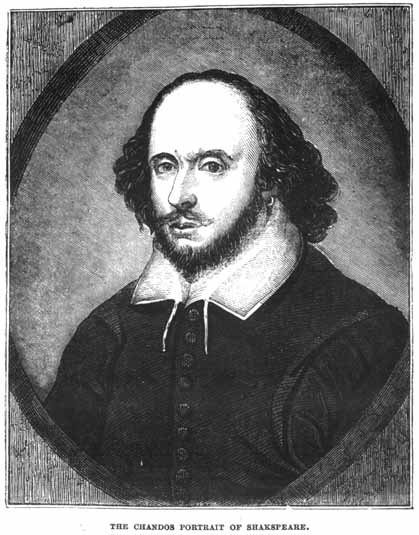
The accredited birth-place of Shakspeare has always been regarded
with great interest: it is situate in a street in Stratford,
retaining its ancient name of Henley, being the road to
Henley-in-Arden. In 1574, here stood two houses, with a garden and
orchard attached to each; and these houses were then purchased by
John Shakspeare, whose son William was born in one of them, which
still remains, though altered according to modern fashion. Its gable
roofs are destroyed. Divided and subdivided into smaller tenements,
part was converted into a little inn; part, the residence of a female
who formerly showed the room where Shakspeare first saw the light,
and the low-roofed kitchen where his mother taught him to read. The
walls of the room in which he was born are literally covered with
thousands of names, inscribed in homage by pilgrims from every region
where the glory of Shakspeare is known. At the time when
Shakspeare's father bought this house, it was, no doubt, quite a
mansion, as compared with the majority of the houses in Stratford;
but he little guessed the fame that would attach itself to this
birth-place of his gifted son; long, we trust, to be preserved for
the gratification of future generations of visitors to the hallowed
spot. Besides his plays, Shakspeare was the author of several other
poetical productions, and especially of a collection of sonnets.
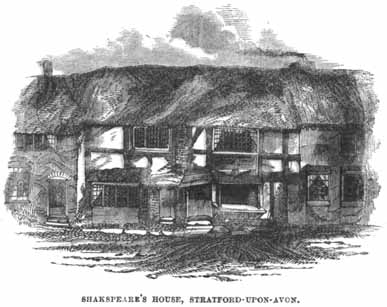
THE RETURN OF THE DOVE.
|
|
There hope in the Ark at the dawning of day,
When o'er the wide waters the Dove flew
away;
But when ere the night she came wearily back
With the leaf she had pluck'd on her desolate
track,
The children of Noah knelt down and adored,
And utter'd in anthems their praise to the
Lord.
Oh bird of glad tidings! oh joy in our pain!
Beautiful Dove! thou art welcome again.
When peace has departed the care-stricken
breast,
And the feet of the weary one languish for rest;
When the world is a wide-spreading ocean of
grief,
How blest the return of the Bird and the Leaf!
Reliance on God is the Dove to our Ark,
And Peace is the olive she plucks in the dark.
The deluge abates, there is sun after
rain—
Beautiful Dove! thou art welcome again!
Mackay.
|
COBRA DI CAPELLO—HOODED SNAKE.
There are several varieties of this venomous serpent, differing in
point of colour; and the aspic of Egypt, with which Cleopatra
destroyed herself, is said to be a very near ally to this species;
but the true cobra is entirely confined to India.
The danger which accompanies the bite of this reptile, its
activity when excited, the singularity of its form, and the
gracefulness of its action, combine to render it one of the most
remarkable animals of the class to which it belongs. When in its
ordinary state of repose the neck is of the same diameter as the
head; but when surprised or irritated, the skin expands laterally in
a hood-like form, which is well known to the inhabitants of India as
the symptom of approaching danger. Notwithstanding the fatal effects
of the bite of these serpents, the Indian jugglers are not deterred
from capturing and taming them for exhibition, which they do with
singular adroitness, and with fearful interest to the unpractised
observer. They carry the reptiles from house to house in a small
round basket, from which they issue at the sound of a sort of flute,
and execute certain movements in cadence with the music.
The animal from which our Engraving was taken is now in the
menagerie of the Zoological Society in the Regent's Park, and is
probably one of the finest which has ever reached England alive.
The Indian mangouste is described to be the most deadly enemy of
the cobra di capello, and the battles between them have been
frequently described. The serpent, when aware of the approach of the
mangouste, rises on its tail, and with neck dilated, its head
advanced, and eyes staring, awaits with every look of rage and fear
the attack of its foe. The mangouste steals nearer and nearer, and
creeping round, endeavours to get an opportunity of springing on the
serpent's back; and whenever it misses its purpose and receives a
bite, it runs perhaps some distance, to eat the mangouste-grass,
which is an antidote against the poison: it then returns to the
attack, in which it is commonly victorious.
The bite of the cobra di capello is not so immediately fatal as is
commonly supposed; fowls have been known to live two days after being
bitten, though they frequently die within half an hour. The snake
never bites while its hood is closed, and as long as this is not
erected the animal may be approached, and even handled with impunity;
even when the hood is spread, while the creature continues silent,
there is no danger. The fearful hiss is at once the signal of
aggression and of peril. Though the cobra is so deadly when under
excitement, it is, nevertheless, astonish ing to see how readily it
is appeased, even in the highest state of exasperation, and this
merely by the droning music with which its exhibitors seem to charm
it.
The natives of India have a superstitious feeling with regard to
this snake; they conceive that it belongs to another world, and when
it appears in this, it is only as a visitor. In consequence of this
notion they always avoid killing it, if possible.
THE PYRAMID LAKE.
Perhaps of all the localities of the Oregon territory so vividly
described in Captain Fremont's adventurous narrative, the Pyramid
Lake, visited on the homeward journey from the Dallas to the Missouri
river, is the most beautiful. The exploring party having reached a
defile between mountains descending rapidly about 2000 feet, saw,
filling up all the lower space, a sheet of green water some twenty
miles broad. "It broke upon our eyes," says the narrator,
"like the ocean: the neighbouring peaks rose high above us, and
we ascended one of them to obtain a better view. The waves were
curling to the breeze, and their dark green colour showed it to be a
body of deep water. For a long time we sat enjoying the view, for we
had become fatigued with mountains, and the free expanse of moving
waves was very grateful. It was like a gem in the mountains, which,
from our position, seemed to enclose it almost entirely. At the
eastern end it communicated with the line of basins we had left a few
days since; and on the opposite side it swept a ridge of snowy
mountains, the foot of the great Sierra. We followed a broad Indian
trail or tract along the shore of the lake to the southward. For a
short space we had room enough in the bottom, but, after travelling a
short distance, the water swept the foot of the precipitous
mountains, the peaks of which are about 3000 feet above the lake. We
afterwards encamped on the shore, opposite a very remarkable rock in
the lake, which had attracted our attention for many miles. It rose
according to our estimation 600 feet above the level of the water,
and, from the point we viewed it, presented a pretty exact outline of
the great pyramid of Cheops. Like other rocks along the shore, it
seemed to be encrusted with calcareous cement. This striking feature
suggested a name for the lake, and I called it Pyramid Lake. Its
elevation above the sea is 4890 feet, being nearly 700 feet higher
than the Great Salt Lake, from which it lies nearly west." The
position and elevation of Pyramid Lake make it an object of
geographical interest. It is the nearest lake to the western river,
as the Great Salt Lake is to the eastern river, of the great basin
which lies between the base of the Rocky Mountains and the Sierra
Nevada, and the extent and character of which it is so desirable to
know.
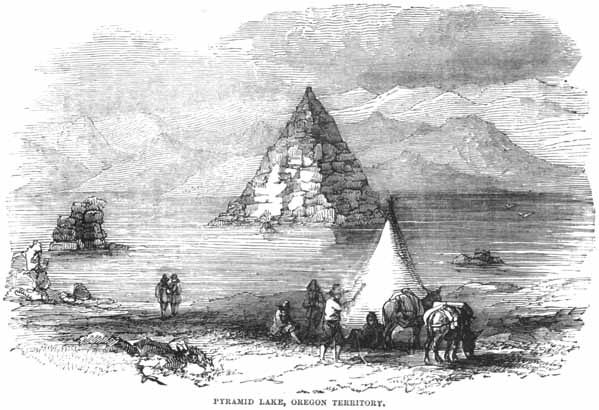
Many parts of the borders of this lake appear to be a favourite
place of encampment for the Indians, whose number in this country is
estimated at 140,000. They retain, still unaltered, most of the
features of the savage character. They procure food almost solely by
hunting; and to surprise a hostile tribe, to massacre them with every
exercise of savage cruelty, and to carry off their scalps as
trophies, is their highest ambition. Their domestic behaviour,
however, is orderly and peaceable; and they seldom kill or rob a
white man. Considerable attempts have been made to civilize them, and
with some success; but the moment that any impulse has been given to
war and hunting, they have instantly reverted to their original
habits.
ADAM AND EVE IN PARADISE.
|
Now came still evening on, and twilight grey
Had in her sober livery all things clad.
Silence accompanied: for beast and bird,
They to their grassy couch, these to their nests,
Were slunk—all but the wakeful nightingale:
She, all night long, her am'rous descant sung.
Silence was pleased. Now glow'd the firmament
With living sapphires: Hesperus, that led
The starry host, rode brightest; till the moon,
Rising in clouded majesty, at length,
Apparent queen, unveil'd her peerless light,
And o'er the dark her silver mantle
threw—
When Adam thus to Eve: "Fair consort, the
hour
Of night, and all things now retired to rest,
'Mind us of like repose: since God hath set
Labour and rest, as day and night, to men
Successive; and the timely dew of sleep,
Now falling with soft slumberous weight,
Inclines our eyelids."—
|
|
|
|
To whom thus Eve, with perfect beauty
adorn'd:
"My author and disposer, what thou bidst
Unargued I obey. So God ordains.
With thee conversing I forget all time,
All seasons and their change: all please alike.
Sweet is the breath of morn—her rising
sweet,
With charm of earliest birds; pleasant the sun,
When first on this delightful land he spreads
His orient beams on herb, tree, fruit, and
flower,
Glistering with dew; fragrant the fertile earth
After short show'rs; and sweet the coming on
Of grateful evening mild—then silent
night,
With this her solemn bird, and this fair moon,
And these the gems of heav'n, her starry
train:
But neither breath of morn, when she ascends
With charm of earliest birds; nor rising sun
On this delightful land; nor herb, fruit, flower
Glistering with dew, nor fragrance after
showers,
Nor grateful evening mild; nor silent night,
With this her solemn bird; nor walk by moon
Or glitt'ring starlight, without thee is
sweet."—
Thus talking, hand in hand alone they pass'd
On to their blissful bower.
Thus at their shady lodge arrived, both stood,
Both turn'd, and under open sky adored
The God that made both sky, air, earth, and
heaven,
Which they beheld, the moon's resplendent
globe,
And starry pole. "Thou also madest the
night,
Maker Omnipotent! and Thou the day,
Which we, in our appointed work employ'd,
Have finish'd; happy in our mutual help
And mutual love, the crown of all our bliss
Ordain'd by thee, and this delicious place,
For us too large, where thy abundance wants
Partakers, and uncropt, falls to the ground.
But Thou hast promised from us two a race
To fill the earth, who shall with us extol
Thy goodness infinite, both when we wake,
And when we seek, as now, thy gift of
sleep."
Milton.
|
OLIVER GOLDSMITH.

Goldsmith's poetry enjoys a calm and steady popularity. It
inspires us, indeed, with no admiration of daring design or of
fertile invention; but it presents within its narrow limits a
distinct and unbroken view of poetical delightfulness. His
descriptions and sentiments have the pure zest of nature. He is
refined without false delicacy, and correct without insipidity.
Perhaps there is an intellectual composure in his manner, which may,
in some passages, be said to approach to the reserved and prosaic;
but he unbends from this graver strain of reflection to tenderness,
and even to playfulness, with an ease and grace almost exclusively
his own; and connects extensive views of the happiness and interests
of society with pictures of life that touch the heart by their
familiarity. He is no disciple of the gaunt and famished school of
simplicity. He uses the ornaments which must always distinguish true
poetry from prose; and when he adopts col loquial plainness, it is
with the utmost skill to avoid a vulgar humility. There is more of
this sustained simplicity, of this chaste economy and choice of
words, in Goldsmith than in any other modern poet, or, perhaps, than
would be attainable or desirable as a standard for every writer of
rhyme. In extensive narrative poems, such a style would be too
difficult. There is a noble propriety even in the careless strength
of great poems, as in the roughness of castle walls; and, generally
speaking, where there is a long course of story, or observation of
life to be pursued, such excursite touches as those of Goldsmith
would be too costly materials for sustaining it. His whole manner has
a still depth of feeling and reflection, which gives back the image
of nature unruffled and minutely. His chaste pathos makes him an
insulating moralist, and throws a charm of Claude-like softness over
his descriptions of homely objects, that would seem only fit to be
the subjects of Dutch painting; but his quiet enthusiasm leads the
affections to humble things without a vulgar association, and he
inspires us with a fondness to trace the simplest recollections of
Auburn, till we count the furniture of its ale-house, and listen to
the varnished clock that clicked behind the door.
Campbell.
HAGAR AND ISHMAEL.
Hagar and Ishmael departed early on the day fixed for their
removal, Abraham furnishing them with the necessary supply of
travelling provisions. "And Abraham arose up early in the
morning, and took bread and a bottle of water, and gave it unto
Hagar, putting it on her shoulder, and she went away." The
bottle here mentioned was probably made of the skin of a goat, sewn
up, leaving an opening in one of the legs to serve as a mouth. Such
skin bottles are still commonly used in Western Asia for water, and
are borne slung across the shoulders, just as that of Hagar was
placed.
It seems to have been the intention of Hagar to return to her
native country, Egypt; but, in spite of the directions she received,
the two travellers lost their way in the southern wilderness, and
wandered to and fro till the water, which was to have served them on
the road, was altogether spent. The lad, unused to hardship, was soon
worn out. Overcome by heat and thirst, he seemed at the point of
death, when the afflicted mother laid him down under one of the
stunted shrubs of this dry and desert region, in the hope of his
getting some relief from the slight damp which the shade afforded.
The burning fever, however, continued unabated; and the poor mother,
forgetting her own sorrow, destitute and alone in the midst of a
wilderness, went to a little distance, unable to witness his
lingering sufferings, and then "she lifted up her voice and
wept." But God had not forgotten her: a voice was heard in the
solitude, and an Angel of the Lord appeared, uttering words of
comfort and promises of peace. He directed her to a well of water,
which, concealed by the brushwood, had not been seen by her. Thus
encouraged, Hagar drew a refreshing draught, and hastening to her
son, "raised him by the hand," and gave him the welcome
drink, which soon restored him. This well, according to the tradition
of the Arabs, who pay great honour to the memory of Hagar, is Zemzem,
near Mecca.
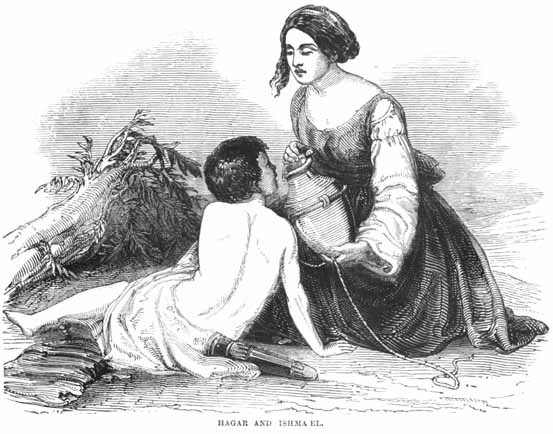
After this, we have no account of the history of Ishmael, except
that he established himself in the wilderness of Paran, near Mount
Sinai, and belonged to one of the tribes by which the desert was
frequented. He was married, by his mother, to a countrywoman of her
own, and maintained himself and his family by the produce of his bow.
Many of the Arabian tribes have been proud to trace their origin to
this son of the Patriarch Abraham.
THE HOLLY BOUGH.
 |
Ye who have scorn'd each other,
Or injured friend or brother,
In this fast fading year;
Ye who, by word or deed,
Have made a kind heart bleed,
Come gather here.
Let sinn'd against, and sinning,
Forget their strife's beginning,
And join in friendship now;
Be links no longer broken,
Be sweet forgiveness spoken
Under the Holly-bough.
Ye who have loved each other,
Sister and friend and brother,
In this fast fading year;
Mother and sire and child,
Young man and maiden mild,
Come gather here;
And let your hearts grow fonder,
As Memory shall ponder
Each past unbroken vow:
Old loves and younger wooing
Are sweet in the renewing
Under the Holly-bough.
Ye who have nourish'd sadness.
Estranged from hope and gladness,
In this fast fading year;
Ye with o'erburden'd mind,
Made aliens from your kind,
Come gather here.
Let not the useless sorrow
Pursue you night and morrow,
If e'er you hoped, hope
now—
Take heart, uncloud your faces,
And join in our embraces
Under the Holly-bough.
Mackay
|
THE UNIVERSE.
To us who dwell on its surface, the earth is by far the most
extensive orb that our eyes can any where behold; but, to a spectator
placed on one of the planets, it looks no larger than a spot. To
beings who dwell at still greater distances, it entirely disappears.
That which we call alternately the morning and the evening star, as
in the one part of the orbit she rides foremost in the procession of
night, in the other ushers in and anticipates the dawn, is a
planetary world, which, with the five others that so wonderfully vary
their mystic dance, are in themselves dark bodies, and shine only by
reflection; have fields, and seas, and skies of their own; are
furnished with all accommodations for animal subsistence, and are
supposed to be the abodes of intellectual life. All these, together
with our earthly habitation, are dependent on the sun, receive their
light from his rays, and derive their comfort from his benign agency.
The sun, which seems to us to perform its daily stages through the
sky, is, in this respect, fixed and immovable; it is the great axle
about which the globe we inhabit, and other more spacious orbs, wheel
their stated courses. The sun, though apparently smaller than the
dial it illuminates, is immensely larger than this whole earth, on
which so many lofty mountains rise, and such vast oceans roll. A line
extending from side to side through the centre of that resplendent
orb, would measure more than 800,000 miles: a girdle formed to go
round its circumference, would require a length of millions. Are we
startled at these reports of philosophers? Are we ready to cry out in
a transport of surprise, "How mighty is the Being who kindled
such a prodigious fire, and keeps alive from age to age such an
enormous mass of flame!" Let us attend our philosophic guides,
and we shall be brought acquainted with speculations more enlarged
and more inflaming. The sun, with all its attendant planets, is but a
very little part of the grand machine of the universe; every star,
though in appearance no bigger than the diamond that glitters upon a
lady's ring, is really a vast globe like the sun in size and in
glory; no less spacious, no less luminous, than the radiant source of
the day: so that every star is not barely a world, but the centre of
a magnificent system; has a retinue of worlds irradiated by its
beams, and revolving round its attractive influence—all which
are lost to our sight. That the stars appear like so many diminutive
points, is owing to their immense and inconceivable distance. Immense
and inconceivable indeed it is, since a ball shot from a loaded
cannon, and flying with unabated rapidity, must travel at this
impetuous rate almost 700,000 years, before it could reach the
nearest of these twinkling luminaries.
While beholding this vast expanse I learn my own extreme meanness,
I would also discover the abject littleness of all terrestrial
things. What is the earth, with all her ostentatious scenes, compared
with this astonishingly grand furniture of the skies? What, but a dim
speck hardly perceptible in the map of the universe? It is observed
by a very judicious writer, that if the sun himself, which enlightens
this part of the creation, were extinguished, and all the host of
planetary worlds which move about him were annihilated, they would
not be missed by an eye that can take in the whole compass of nature
any more than a grain of sand upon the sea-shore. The bulk of which
they consist, and the space which they occupy, are so exceedingly
little in comparison of the whole, that their loss would leave scarce
a blank in the immensity of God's works. If, then, not our globe
only, but this whole system, be so very dimunitive, what is a kingdom
or a country? What are a few lordships, or the so-much-admired
patrimonies of those who are styled wealthy? When I measure them with
my own little pittance, they swell into proud and bloated dimensions;
but when I take the universe for my standard, how scanty is their
size, how contemptible their figure; they shrink into pompous
nothings!
Addison.
ODE TO ST. CECILIA.
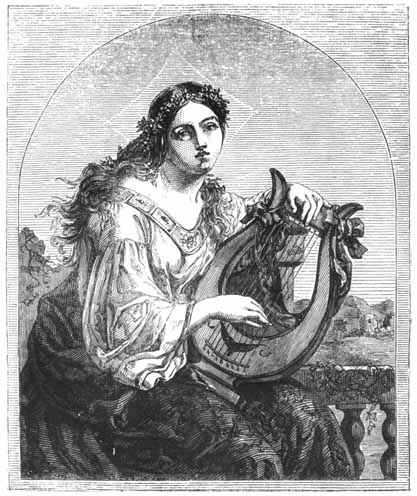
Now strike the golden lyre again:
A louder yet, and yet a louder strain.
Break his bands of sleep asunder,
And rouse him, like a rattling peal of thunder.
Hark, hark, the horrid sound
Has raised up his head,
As awaked from the dead,
And amazed, he stares around.
Revenge, revenge, Timotheus cries,
See the Furies arise:
See the snakes that they rear,
How they hiss in their hair,
And the sparkles that flash from their eyes!
Behold a ghastly band,
Each a torch in his hand!
Those are Grecian ghosts, that in battle were
slain,
And unburied remain
Inglorious on the plain.
Give the vengeance due
To the valiant crew.
Behold how they toss their torches on high,
How they point to the Persian abodes,
And glitt'ring temples of their hostile
gods!
The Princes applaud, with a furious joy;
And the King seized a flambeau, with zeal to
destroy;
Thais led the way,
To light him to his prey,
And, like another Helen, fired another Troy.
Thus, long ago,
Ere heaving bellows learn'd to
blow,
While organs yet were mute;
Timotheus, to his breathing flute
And sounding lyre,
Could swell the soul to rage, or kindle soft
desire.
At last divine Cecilia came,
Inventress of the vocal frame;
The sweet enthusiast, from the sacred store,
Enlarged the former narrow bounds,
And added length to solemn sounds,
With nature's mother-wit, and arts unknown
before.
Let old Timotheus yield the prize,
Or both divide the crown:
He raised a mortal to the skies;
She drew an angel down.
Dryden.
|
SATIN BOWER-BIRDS.
The Satin Bower-Bird was one of the earliest known species in the
Australian fauna, and probably received the name of Satin
Grakle, by which it was described in Latham's "General
History of Birds," from the intensely black glossy plumage of
the adult male. But, although the existence of this bird was noticed
by most of the writers on the natural history of Australia subsequent
to Latham, it appears that no suspicion of its singular economy had
extended beyond the remotest settlers, until Mr. Gould, whose great
work on the "Birds of Australia" is known to every one,
unravelled the history of the bowers, which had been
discovered in many parts of the bush, and which had been attributed
to almost every possible origin but the right one.
The bower, as will be seen by the Illustration, is composed of
twigs woven together in the most compact manner, and ornamented with
shells and feathers, the disposition of which the birds are
continually altering. They have no connexion with the nest, and are
simply playing-places, in which the birds divert themselves during
the months which precede nidification.
The birds themselves are nearly as large as a jackdaw. The female
is green in colour, the centre of the breast feathers yellowish; the
unmoulted plumage of the male is similar: the eyes of both are
brilliant blue.
THE POOL OF SILOAM.
The fountain and pool of Siloam, whose surplus waters flow in a
little streamlet falling into the lake Kedron, is situate near the
ancient walls of the city of Jerusalem. Mr. Wild tells us "that
the fountain of Siloam is a mineral spring of a brackish taste, and
somewhat of the smell of the Harrowgate water, but in a very slight
degree." It is said to possess considerable medicinal
properties, and is much frequented by pilgrims. "Continuing our
course," says he, "around the probable line of the ancient
walls, along the gentle slope of Zion, we pass by the King's
gardens, and arrive at the lower pool of Siloam, placed in another
indentation in the wall. It is a deep square cistern lined with
masonry, adorned with columns at the sides, and having a flight of
steps leading to the bottom, in which there was about two feet of
water. It communicates by a subterraneous passage with the fountain,
from which it is distant about 600 yards. The water enters the pool
by a low arched passage, into which the pilgrims, numbers of whom are
generally to be found around it, put their heads, as part of the
ceremony, and wash their clothes in the purifying stream that rises
from it." During a rebellion in Jerusalem, in which the Arabs
inhabiting the Tillage of Siloam were the ringleaders, they gained
access to the city by means of the conduit of this pool, which again
rises within the mosque of Omar. This passage is evidently the work
of art, the water in it is generally about two feet deep, and a man
may go through it in a stooping position. When the stream leaves the
pool, it is divided into numbers of little aqueducts, for the purpose
of irrigating the gardens and pleasure-grounds which lie immediately
beneath it in the valley, and are the chief source of their
fertility, for, as they are mostly formed of earth which has been
carried from other places, they possess no original or natural soil
capable of supporting vegetation. As there is but little water in the
pool during the dry season, the Arabs dam up the several streams in
order to collect a sufficient quantity in small ponds adjoining each
garden, and this they all do at the same time, or there would be an
unfair division of the fertilizing fluid. These dams are generally
made in the evening and drawn off in the morning, or sometimes two or
three times a day; and thus the reflux of the water that they hold
gives the appearance of an ebb and flow, which by some travellers has
caused a report that the pool of Siloam is subject to daily
tides.
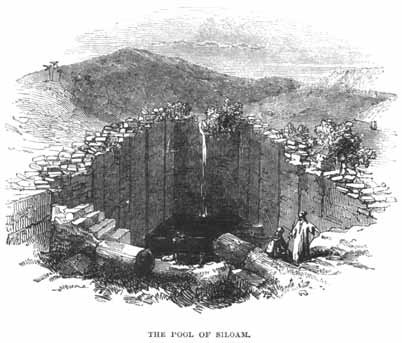
There are few towns, and scarcely any metropolitan town, in which
the natural supply of water is so inadequate as at Jerusalem; hence
the many and elaborate contrivances to preserve the precious fluid,
or to bring it to the town by aqueducts.
WINTER THOUGHTS.
|
|
Ah! little think the gay licentious proud,
Whom pleasure, pow'r, and affluence
surround—
They who their thoughtless hours in giddy mirth,
And wanton, often cruel, riot waste;
Ah! little think they, while they dance along
How many feel this very moment death,
And all the sad variety of pain:
How many sink in the devouring flood,
Or more devouring flame! how many bleed
By shameful variance betwixt man and man!
How many pine in want and dungeon glooms,
Shut from the common air, and common use
Of their own limbs! how many drink the cup
Of baleful grief, or eat the bitter bread
Of misery! Sore pierced by wintry winds,
How many shrink into the sordid hut
Of cheerless poverty! How many shake
With all the fiercer tortures of the mind,
Unbounded passion, madness, guilt, remorse,
Whence tumbled headlong from the height of life,
They furnish matter for the Tragic Muse!
Even in the vale where Wisdom loves to dwell,
With Friendship, Peace, and Contemplation
join'd,
How many, rack'd with honest passions, droop
In deep retired distress. How many stand
Around the death-bed of their dearest friends,
And point the parting anguish! Thought fond man
Of these, and all the thousand nameless ills,
That one incessant struggle render life—
One scene of toil, of suffering, and of fate,
Vice in its high career would stand appall'd,
And heedless, rambling impulse learn to think;
The conscious heart of Charity would warm,
And her wide wish Benevolence dilate;
The social tear would rise, the social sigh,
And into clear perfection gradual bliss,
Refining still, the social passions work.
Thomson.
|
BRITISH TROOPS IN CANADA.
Really winter in Canada must be felt to be imagined; and when felt
can no more be described by words, than colours to a blind man or
music to a deaf one. Even under bright sun-shine, and in a most
exhilirating air, the biting effect of the cold upon the portion of
our face that is exposed to it resembles the application of a strong
acid; and the healthy grin which the countenance assumes,
requires—as I often observed on those who for many minutes had
been in a warm room waiting to see me—a considerable time to
relax.
In a calm, almost any degree of cold is bearable, but the
application of successive doses of it to the face by wind, becomes,
occasionally, almost unbearable; indeed, I remember seeing the left
cheek of nearly twenty of our soldiers simultaneously frost-bitten in
marching about a hundred yards across a bleak open space, completely
exposed to a strong and bitterly cold north-west wind that was
blowing upon us all.
The remedy for this intense cold, to which many Canadians and
others have occasionally recourse, is—at least to my feelings
it always appeared—infinitely worse than the disease. On
entering, for instance, the small parlour of a little inn, a number
of strong, able-bodied fellows are discovered holding their hands a
few inches before their faces, and sitting in silence immediately in
front of a stove of such excruciating power, that it really feels as
if it would roast the very eyes in their sockets; and yet, as one
endures this agony, the back part is as cold as if it belonged to
what is called at home "Old Father Christmas."
As a further instance of the climate, I may add, that several
times, while my mind was very warmly occupied in writing my
despatches, I found my pen full of a lump of stuff that appeared to
be honey, but which proved to be frozen ink; again, after washing in
the morning, when I took up some money that had lain all night on my
table, I at first fancied it had become sticky, until I discovered
that the sensation was caused by its freezing to my fingers, which,
in consequence of my ablutions, were not perfectly dry.
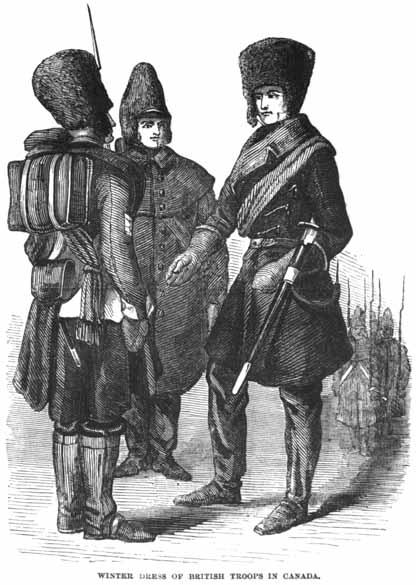
Notwithstanding, however, this intensity of cold, the powerful
circulation of the blood of large quadrupeds keeps the red fluid,
like the movement of the waters in the great lakes, from freezing;
but the human frame not being gifted with this power, many people
lose their limbs, and occasionally their lives, from cold. I one day
inquired of a fine, ruddy, honest-looking man, who called upon me,
and whose toes and instep of each foot had been truncated, how the
accident happened? He told me that the first winter he came from
England he lost his way in the forest, and that after walking for
some hours, feeling pain in his feet, he took off his boots, and from
the flesh immediately swelling, he was unable to put them on again.
His stockings, which were very old ones, soon wore into holes; and as
rising on his insteps he was hurriedly proceeding he knew not where,
he saw with alarm, but without feeling the slightest pain, first one
toe and then another break off, as if they had been pieces of brittle
stick, and in this mutilated state he continued to advance till he
reached a path which led him to an inhabited log house, where he
remained suffering great pain till his cure was effected.
Although the sun, from the latitude, has considerable power, it
appears only to illuminate the sparkling snow, which, like the sugar
on a bridal cake, conceals the whole surface. The instant, however,
the fire of heaven sinks below the horizon, the cold descends from
the upper regions of the atmosphere with a feeling as if it were
poured down upon the head and shoulders from a jug.
Sir Francis Head.
BALLOONS.
The idea of constructing a machine which should enable us to rise
into and sail through the air, seems often to have occupied the
attention of mankind, even from remote times, but it was never
realised until within the last sixty or seventy years. The first
public ascent of a fire-balloon in France, in 1783, led to an
experiment on the part of Joseph Mongolfier. He constructed a balloon
of linen, lined with paper, which, when inflated by means of burning
chopped straw and coal, was found to be capable of raising 500 pounds
weight. It was inflated in front of the Palace at Versailles, in the
presence of the Royal family, and a basket, containing a sheep, a
duck, and a cock, was attached to it. It was then liberated, and
ascended to the height of 1500 feet. It fell about two miles from
Versailles; the animals were uninjured, and the sheep was found
quietly feeding near the place of its descent.
Monsieur Mongolfier then constructed one of superior strength, and
a M. de Rozier ventured to take his seat in the car and ascend three
hundred feet, the height allowed by the ropes, which were not cut.
This same person afterwards undertook an aerial voyage, descending in
safety about five miles from Paris, where the balloon ascended. But
this enterprising voyager in the air afterwards attempted to travel
in a balloon with sails. This was formed by a singular combination of
balloons—one inflated with hydrogen gas, and the other a
fire-balloon. The latter, however, catching fire, the whole apparatus
fell from the height of about three-quarters of a mile, with the
mangled bodies of the voyagers attached to the complicated
machinery.
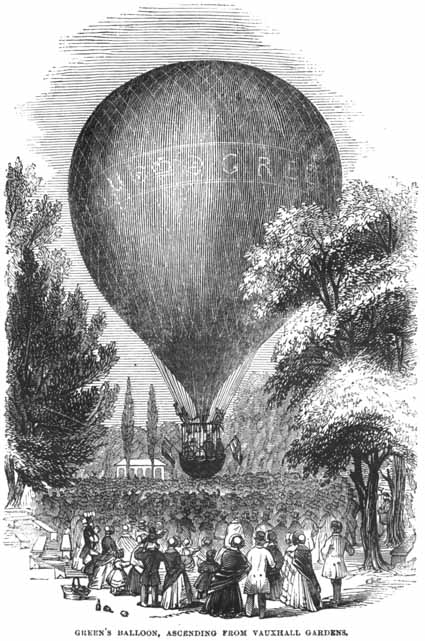
A Frenchman named Tester, in 1786, also made an excursion in a bal
loon with sails; these sails or wings aided in carrying his balloon
so high, that when he had reached an elevation of 3000 feet, fearing
his balloon might burst, he descended into a corn-field in the plain
of Montmorency. An immense crowd ran eagerly to the spot; and the
owner of the field, angry at the injury his crop had sustained,
demanded instant indemnification. Tester offered no resistance, but
persuaded the peasants that, having lost his wings, he could not
possibly escape. The ropes were seized by a number of persons, who
attempted to drag the balloon towards the village; but as, during the
procession, it had acquired considerable buoyancy, Tester suddenly
cut the cords, and, rising in the air, left the disappointed peasants
overwhelmed in astonishment. After being out in a terrible
thunder-storm, he descended uninjured, about twelve hours from the
time of his first ascent.
SIR THOMAS GRESHAM.
Among the worthies of this country who, after a successful and
honourable employment of their talent in life, have generously
consulted the advantage of generations to come after them, few names
appear more conspicuous than that of Sir Thomas Gresham, the founder
of Gresham College, and of the Royal Exchange, London. He was born in
that city about the year 1518, the second son of Sir Richard Gresham,
who served the office of sheriff in 1531, and that of Lord Mayor in
1537. He received a liberal education at the University, and is
mentioned in high terms as having distinguished himself at Cambridge,
being styled "that noble and most learned merchant." His
father at this time held the responsible position of King's
merchant, and had the management of the Royal monies at Antwerp, then
the most important seat of commerce in Europe; and when his son Sir
Thomas succeeded him in this responsible appointment, he not only
established his fame as a merchant, but secured universal respect and
esteem. After the accession of Queen Elizabeth, his good qualities
attracted the peculiar notice of her Majesty, who was pleased to
bestow on him the honour of knighthood; and at this time he built the
noble house in Bishopsgate-street, which after his death was
converted to the purposes of a College of his own foundation.
In the year 1564, Sir Thomas made an offer to the Corporation of
London, that, if the City would give him a piece of ground, he would
erect an Exchange at his own expense; and thus relieve the merchants
from their present uncomfortable mode of transacting business in the
open air. The liberal offer being accepted, the building, which was
afterwards destroyed in the Great Fire of London, was speedily
constructed, at a very great expense, and ornamented with a number of
statues. Nor did Gresham's persevering benevolence stop here:
though he had so much to engross his time and attention, he still
found leisure to consider the claims of the destitute and aged, and
in his endowment of eight alms-houses with a comfortable allowance
for as many decayed citizens of London, displayed that excellent
grace of charity which was his truest ornament.
In person Sir Thomas was above the middle height, and handsome
when a young man, but he was rendered lame by a fall from his horse
during one of his journeys in Flanders. Sir Thomas Gresham's
exemplary life terminated suddenly on the 21st of November, 1579,
after he had just paid a visit to the noble building which he had so
generously founded.
ON THE ATTAINMENT OF KNOWLEDGE.
Let the enlargement of your knowledge be one constant view and
design in life; since there is no time or place, no transactions,
occurrences, or engagements in life, which exclude us from this
method of improving the mind. When we are alone, even in darkness and
silence, we may converse with our own hearts, observe the working of
our own spirits, and reflect upon the inward motions of our own
passions in some of the latest occurrences in life; we may acquaint
ourselves with the powers and properties, the tendencies and
inclinations both of body and spirit, and gain a more intimate
knowledge of ourselves. When we are in company, we may discover
something more of human nature, of human passions and follies, and of
human affairs, vices and virtues, by conversing with mankind, and
observing their conduct. Nor is there any thing more valuable than
the knowledge of ourselves and the knowledge of men, except it be the
knowledge of God who made us, and our relation to Him as our
Governor.
When we are in the house or the city, wheresoever we turn our
eyes, we see the works of men; when we are abroad in the country, we
behold more of the works of God. The skies and the ground above and
beneath us, and the animal and vegetable world round about us, may
entertain our observation with ten thousand varieties.
Fetch down some knowledge from the clouds, the stars, the sun, the
moon, and the revolutions of all the planets. Dig and draw up some
valuable meditations from the depths of the earth, and search them
through the vast oceans of water. Extract some intellectual
improvement from the minerals and metals; from the wonders of nature
among the vegetables and herbs, trees and flowers. Learn some lessons
from the birds and the beasts, and the meanest insect. Read the
wisdom of God, and his admirable contrivance in them all: read his
almighty power, his rich and various goodness, in all the works of
his hands.
From the day and the night, the hours and the flying minutes,
learn a wise improvement of time, and be watchful to seize every
opportunity to increase in knowledge.
From the vices and follies of others, observe what is hateful in
them; consider how such a practice looks in another person, and
remember that it looks as ill or worse in yourself. From the virtue
of others, learn something worthy of your imitation.
From the deformity, the distress, or calamity of others, derive
lessons of thankfulness to God, and hymns of grateful praise to your
Creator, Governor, and Benefactor, who has formed you in a better
mould, and guarded you from those evils. Learn also the sacred lesson
of contentment in your own estate, and compassion to your neighbour
under his miseries.
From your natural powers, sensations, judgment, memory, hands,
feet, &c., make this inference, that they were not given you for
nothing, but for some useful employment to the honour of your Maker,
and for the good of your fellow-creatures, as well as for your own
best interest and final happiness.
Dr. Watts.
THIBETAN SHEEP.
The enterprising traveller, Moorcroft, during his journey across
the vast chain of the Himalaya Mountains, in India, undertaken with
the hope of finding a passage across those mountains into Tartary,
noticed, in the district of Ladak, the peculiar race of sheep of
which we give an Engraving. Subsequent observations having confirmed
his opinion as to the quality of their flesh and wool, the Honourable
East India Company imported a flock, which were sent for a short time
to the Gardens of the Zoological Society, Regent's Park. They
were then distributed among those landed proprietors whose
possessions are best adapted, by soil and climate, for naturalising
in the British Islands this beautiful variety of the mountain sheep.
The wool, the flesh, and the milk of the sheep appear to have been
very early appreciated as valuable products of the animal: with us,
indeed, the milk of the flock has given place to that of the herd;
but the two former still retain their importance. Soon after the
subjugation of Britain by the Romans, a woollen manufactory was
established at Winchester, situated in the midst of a district then,
as now, peculiarly suited to the short-woolled breed of sheep. So
successful was this manufacture, that British cloths were soon
preferred at Rome to those of any other part of the Empire, and were
worn by the most opulent on festive and ceremonial occasions. From
that time forward, the production of wool in this island, and the
various manufactures connected with it, have gone on increasing in
importance, until it has become one of the chief branches of our
commerce.
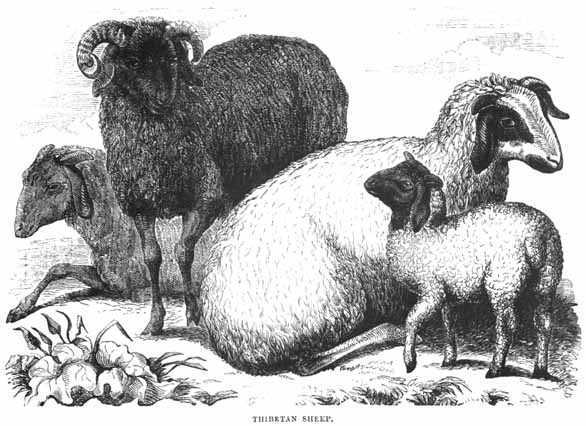
NAVAL TACTICS.

On being told the number and size of the sails which a vessel can
carry (that is to say, can sail with, without danger of being upset),
the uninitiated seldom fail to express much surprise. This is not so
striking in a three-decker, as in smaller vessels, because the hull
of the former stands very high out of the water, for the sake of its
triple rank of guns, and therefore bears a greater proportion to its
canvas than that of a frigate or a smaller vessel. The apparent
inequality is most obvious in the smallest vessels, as cutters: and
of those kept for pleasure, and therefore built for the purpose of
sailing as fast as possible, without reference to freight or load,
there are many the hull of which might be entirely wrapt up in the
mainsail. It is of course very rarely, if ever, that a vessel carries
at one time all the sail she is capable of; the different sails being
usually employed according to the circumstances of direction of wind
and course. The sails of a ship, when complete, are as
follows:—
The lowermost sail of the mast, called thence the mainsail,
or foresail; the topsail, carried by the
topsail-yard; the top-gallant-sail; and above this
there is also set a royal sail, and again above this, but only
on emergencies, a sail significantly called a sky-sail.
Besides all this, the three lowermost of these are capable of having
their surface to be exposed to the wind increased by means of
studding sails, which are narrow sails set on each side beyond
the regular one, by means of small booms or yards, which can
be slid out so as to extend the lower yards and topsail-yards: the
upper parts of these additional sails hang from small yards suspended
from the principal ones, and the boom of the lower studding-sails is
hooked on to the chains. Thus each of the two principal masts, the
fore and main, are capable of bearing no less than thirteen distinct
sails. If a ship could be imagined as cut through by a plane, at
right angles to the keel, close to the mainmast, the area, or
surface, of all the sails on this would be five or six times as great
as that of the section or profile of the hull!
The starboard studding-sails are on the fore-mast, and on both
sides of the main-top-gallant and main-royal; but, in going nearly
before a wind, there is no advantage derived from the stay-sails,
which, accordingly, are not set. The flying-jib is to be set to
assist in steadying the motion.
The mizen-mast, instead of a lower square-sail like the two
others, has a sail like that of a cutter, lying in the plane of the
keel, its bottom stretched on a boom, which extends far over the
taffarel, and the upper edge carried by a gaff or yard sloping
upwards, supported by ropes from the top of the mizen-mast.
All these sails, the sky-sails excepted, have four sides, as have
also the sprit-sails on the bowsprit, jib-boom, &c.; and all,
except the sail last mentioned on the mizen, usually lie across the
ship, or in planes forming considerable angles with the axis or
central line of the ship. There are a number of sails which lie in
the same plane with the keel, being attached to the various
stays of the masts; these are triangular sails, and those are
called stay-sails which are between the masts: those before
the fore-mast, and connected with the bowsprit, are the fore
stay-sail, the fore-topmast-stay-sail, the jib,
sometimes a flying jib, and another called a middle
jib, and there are two or three others used occasionally. Thus it
appears that there are no less than fifty-three different sails,
which are used at times, though, we believe, seldom more than twenty
are set at one time, for it is obviously useless to extend or
set a sail, if the wind is prevented from filling it by another which
intercepts the current of air.
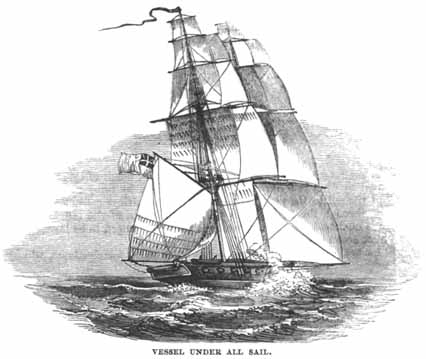
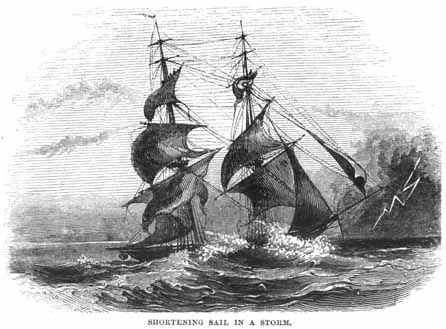
The higher the wind, the fewer the sails which a ship can carry;
but as a certain number, or rather quantity, of canvas is necessary
in different parts of the ship to allow of the vessel being steered,
the principal sails, that is, the courses or lower sails, and
the top-sails, admit of being reduced in extent by what is termed
reefing: this is done by tying up the upper part of the sail
to the yard by means of rows of strings called reef-points
passing through the canvas; this reduces the depth of the sail, while
its width is unaltered on the yard, which is therefore obliged to be
lowered on the mast accordingly.
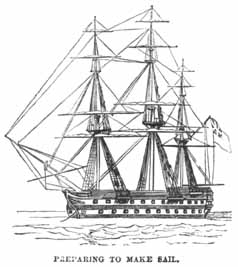
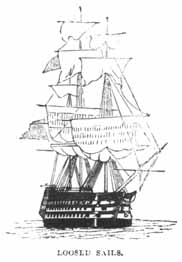
Ships are principally distinguished as those called merchantmen,
which belong to individuals or companies, and are engaged in
commerce; and men-of-war, or the national ships, built for the
purposes of war. The latter receive their designation from the number
of their decks, or of the guns which they carry. The largest are
termed ships of the line, from their forming the line of battle when
acting together in fleets; and are divided into first-rates,
second-rates, third-rates, &c. First-rates include all those
carrying 100 guns and upwards, with a company of 850 men and upwards;
second-rates mount 90 to 100 guns, and so on, down to the
sixth-rates; but some ships of less than 44 guns are termed
frigates.
There are three principal masts in a complete ship: the first is
the main-mast, which stands in the centre of the ship; at a
considerable distance forward is the fore-mast; and at a less
distance behind, the mizen-mast. These masts, passing through the
decks, are fixed firmly in the keel. There are added to them other
masts, which can be taken down or raised—hoisted, as it is
termed at sea—at pleasure: these are called top-masts, and,
according to the mast to which each is attached—main, fore, or
mizen-topmast. When the topmast is carried still higher by the
addition of a third, it receives the name of top-gallant-mast. The
yards are long poles of wood slung across the masts, or attached to
them by one end, and having fixed to them the upper edge of the
principal sails. They are named upon the same plan as the masts; for
example, the main-yard, the fore-top-sail-yard, and so on. The
bowsprit is a strong conical piece of timber, projecting from the
stem of a ship, and serving to support the fore-mast, and as a yard
or boom on which certain sails are moveable.
According as the wind blows from different points, in regard to
the course the ship is sailing, it is necessary that the direction of
the yards should be changed, so as to form different angles with the
central line or with the keel; this is effected by ropes brought from
the ends of the yards to the mast behind that to which these belong,
and then, passing through blocks, they come down to the deck: by
pulling one of these, the other being slackened, the yard is brought
round to the proper degree of inclination; this is termed bracing the
yards, the ropes being termed braces.
THE CHOICE OF HERCULES.
When Hercules was in that part of his youth in which it was
natural for him to consider what course of life he ought to pursue,
he one day retired into a desert, where the silence and solitude of
the place very much favoured his meditations. As he was musing on his
present condition, and very much perplexed in himself on the state of
life he should choose, he saw two women, of a larger stature than
ordinary, approaching towards him. One of them had a very noble air,
and graceful deportment; her beauty was natural and easy, her person
clean and unspotted, her eyes cast towards the ground with an
agreeable reserve, her motion and behaviour full of modesty, and her
raiment as white as snow. The other had a great deal of health and
floridness in her countenance, which she had helped with an
artificial white and red; and she endeavoured to appear more graceful
than ordinary in her mien, by a mixture of affectation in all her
gestures. She had a wonderful confidence and assurance in her looks,
and all the variety of colours in her dress, that she thought were
the most proper to shew her complexion to advantage. She cast her
eyes upon herself, then turned them on those that were present, to
see how they liked her, and often looked on the figure she made in
her own shadow. Upon her nearer approach to Hercules, she stepped
before the other lady, who came forward with a regular, composed
carriage, and running up to him, accosted him after the following
manner:—
"My dear Hercules!" says she, "I find you are very
much divided in your thoughts upon the way of life that you ought to
choose; be my friend, and follow me; I will lead you into the
possession of pleasure, and out of the reach of pain, and remove you
from all the noise and disquie tude of business. The affairs of
either war or peace shall have no power to disturb you. Your whole
employment shall be to make your life easy, and to entertain every
sense with its proper gratifications. Sumptuous tables, beds of
roses, clouds of perfume, concerts of music, crowds of beauties, are
all in readiness to receive you. Come along with me into this region
of delights, this world of pleasure, and bid farewell for ever to
care, to pain, to business." Hercules, hearing the lady talk
after this manner, desired to know her name, to which she
answered—"My friends, and those who are well acquainted
with me, call me Happiness; but my enemies, and those who would
injure my reputation, have given me the name of Pleasure."
By this time the other lady was come up, who addressed herself to
the young hero in a very different
manner:—"Hercules," says she, "I offer myself to
you because I know you are descended from the gods, and give proofs
of that descent by your love of virtue and application to the studies
proper for your age. This makes me hope you will gain, both for
yourself and me, an immortal reputation. But before I invite you into
my society and friendship, I will be open and sincere with you, and
must lay this down as an established truth, that there is nothing
truly valuable which can be purchased without pains and labour. The
gods have set a price upon every real and noble pleasure. If you
would gain the favour of the Deity, you must be at the pains of
worshipping Him; if the friendship of good men, you must study to
oblige them; if you would be honoured by your country, you must take
care to serve it; in short, if you would be eminent in war or peace,
you must become master of all the qualifications that can make you
so. These are the only terms and conditions upon which I can propose
happiness."
The Goddess of Pleasure here broke in upon her
discourse:—"You see," said she, "Hercules, by
her own confession, the way to her pleasures is long and difficult;
whereas that which I propose is short and easy."
"Alas!" said the other lady, whose visage glowed with
passion, made up of scorn and pity, "what are the pleasures you
propose? To eat before you are hungry; drink before you are athirst;
sleep before you are tired; to gratify appetites before they are
raised, and raise such appetites as Nature never planted. You never
heard the most delicious music, which is the praise of
one's-self; nor saw the most beautiful object, which is the work
of one's own hands. Your votaries pass away their youth in a
dream of mistaken pleasures, while they are hoarding up anguish,
torment, and remorse for old age. As for me, I am the friend of gods
and of good men; an agreeable companion to the artizan; an household
guardian to the fathers of families; a patron and protector of
servants; an associate in all true and generous friendships. The
banquets of my votaries are never costly, but always delicious; for
none eat or drink of them who are not invited by hunger or thirst.
Their slumbers are sound, and their wakings cheerful. My young men
have the pleasure of hearing themselves praised by those who are in
years; and those who are in years, of being honoured by those who are
young. In a word, my followers are favoured by the gods, beloved by
their acquaintance, esteemed by their country, and after the close of
their labours honoured by posterity."
We know, by the life of this memorable hero, to which of these two
ladies he gave up his heart; and I believe every one who reads this
will do him the justice to approve his choice.
Tatler.
STRATA FLORIDA ABBEY.
The remains of Strata Florida Abbey, in South Wales, are most
interesting in many points of view, more especially as the relics of
a stately seminary for learning, founded as early as the year 1164.
The community of the Abbey were Cistercian monks, who soon attained
great celebrity, and acquired extensive possessions. A large library
was founded by them, which included the national records from the
earliest periods, the works of the bards and the genealogies of the
Princes and great families in Wales. The monks also compiled a
valuable history of the Principality, down to the death of Llewellyn
the Great. When Edward I. invaded Wales, he burned the Abbey, but it
was rebuilt A.D. 1294.
Extensive woods once flourished in the vicinity of Strata Florida,
and its burial-place covered no less than 120 acres. A long list of
eminent persons from all parts of Wales were here buried, and amongst
them David ap Gwillim, the famous bard. The churchyard is now reduced
to small dimensions; but leaden coffins, doubtless belonging to once
celebrated personages, are still found, both there and at a distance
from the cemetery. A few aged box and yew-trees now only remain to
tell of the luxuriant verdure which once grew around the Abbey; and
of the venerable pile itself little is left, except an arch, and the
fragment of a fine old wall, about forty feet high. A small church
now stands within the enclosure, more than commonly interesting from
having been built with the materials of the once celebrated Abbey of
Strata Florida.
KAFFIR CHIEFS.
In the warm summer months a thin kind of petticoat constitutes the
sole bodily attire of the Kaffir Chiefs; but in winter a cloak is
used, made of the skins of wild beasts, admirably curried. The head,
even in the hottest weather, is never protected by any covering, a
fillet, into which a feather of the ostrich is stuck, being generally
worn; and they seldom wear shoes, except on undertaking a long
journey, when they condescend to use a rude substitute for them. The
bodies of both sexes are tattooed; and the young men, like the fops
of more civilized nations, paint their skins and curl their hair.
Their arms are the javelin, a large shield of buffalo-hide, and a
short club.
The women exhibit taste in the arrangement of their dress,
particularly for that of the head, which consists of a turban made of
skin, and profusely ornamented with beads, of which adornment both
men and women are very fond. A mantle of skin, variously bedecked
with these and other showy trinkets, is worn; and the only
distinction between the dress of the chieftains' wives and those
of a lower rank consists in a greater profusion of ornaments
possessed by the former, but of which all are alike vain. There is no
change of dress, the whole wardrobe of the female being that which
she carries about with her and sleeps in, for bed-clothes they have
none.
The grain which they chiefly cultivate is a kind of millet: a
small quantity of Indian corn and some pumpkins are likewise grown;
but a species of sugar-cane is produced in great abundance, and of
this they are extremely fond. Their diet, however, is chiefly milk in
a sour curdled state. They dislike swine's flesh, keep no
poultry, are averse to fish, but indulge in eating the flesh of their
cattle, which they do in a very disgusting way. Although naturally
brave and warlike, they prefer an indolent pastoral life, hunting
being an occasional pastime.
Much light was thrown on the condition and future prospects of
this people in 1835, by some papers relative to the Cape of Good
Hope, which were laid before the English Government. From these it
appeared that a system of oppression and unjustifiable appropriation
on the part of the whites, have from time to time roused the savage
energies of the Kaffirs, and impelled them to make severe reprisals
upon their European spoilers. The longing of the Cape colonists for
the well-watered valleys of the Kaffirs, and of the latter for the
colonial cattle, which are much superior to their own, still are, as
they have always been, the sources of irritation. Constant skirmishes
took place, until, at length, in 1834, the savages poured into the
colony in vast numbers, wasted the farms, drove off the cattle, and
murdered not a few of the inhabitants. An army of 4000 men was
marched against the invaders, who were driven far beyond the
boundary-line which formerly separated Kaffirland from Cape Colony,
and not only forced to confine themselves within the new limits
prescribed, but to pay a heavy fine. Treaties have been entered into,
and tracts of country assigned to the Kaffir chiefs of several
families, who acknowledge themselves to be subjects of Great Britain,
and who are to pay a fat ox annually as a quit-rent for the lands
which they occupy.
Macomo, one of the Kaffir Chiefs, is a man of most remarkable
character and talent, and succeeded his father, Gaika, who had been
possessed of much greater power and wider territories than the son,
but had found himself compelled to yield up a large portion of his
lands to the colonists. Macomo received no education; all the culture
which his mind ever obtained being derived from occasional
intercourse with missionaries, after he had grown to manhood. From
1819, the period of Gaika's concessions, up to the year 1829, he
with his tribe dwelt upon the Kat river, following their pastoral
life in peace, and cultivating their corn-fields. Suddenly they were
ejected from their lands by the Kat river, on the plea that Gaika had
ceded these lands to the colony. Macomo retired, almost without a
murmur, to a district farther inland, leaving the very grain growing
upon his fields. He took up a new position on the banks of the river
Chunice, and here he and his tribe dwelt until 1833, when they were
again driven out to seek a new home, almost without pretence. On this
occasion Macomo did make a remonstrance, in a document addressed to
an influential person of the colony. "In the whole of this
savage Kaffir's letter, there is," says Dr. Philip, "a
beautiful simplicity, a touching pathos, a confiding magnanimity, a
dignified remonstrance, which shows its author to be no common man.
It was dictated to an interpreter."
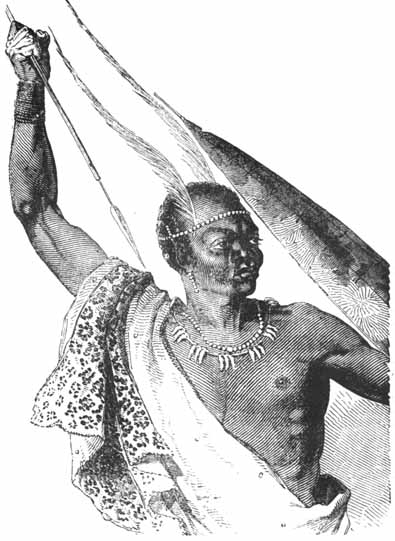
"As I and my people," writes Macomo, "have been
driven back over the Chunice, without being informed why, I should be
glad to know from the Government what evil we have done. I was only
told that we must retire over the Chunice, but for what reason
I was not informed. It was agreed that I and my people should live
west of the Chunice, as well as east of it. When shall I and my
people be able to get rest?"
RAILWAY TUNNELS.
Of the difficulties which occasionally baffle the man of science,
in his endeavours to contend with the hidden secrets of the crust of
the earth which we inhabit, the Kilsby Tunnel of the London and
North-western Railway presents a striking example. The proposed
tunnel was to be driven about 160 feet below the surface. It was to
be, as indeed it is, 2399 yards in length, with two shafts of the
extraordinary size of sixty feet in diameter, not only to give air
and ventilation, but to admit light enough to enable the
engine-driver, in passing through it with a train, to see the rails
from end to end. In order correctly to ascertain, and honestly to
make known to the contractors the nature of the ground through which
this great work was to pass, the engineer-in-chief sank the usual
number of what are called "trial shafts;" and, from the
result, the usual advertisements for tenders were issued, and the
shafts, &c. having been minutely examined by the competing
contractors, the work was let to one of them for the sum of
£99,000. In order to drive the tunnel, it was deemed necessary
to construct eighteen working shafts, by which, like the heavings of
a mole, the contents of the subterranean gallery were to be brought
to the surface. This interesting work was in busy progress, when, all
of a sudden, it was ascertained, that, at about 200 yards from the
south end of the tunnel, there existed, overlaid by a bed of clay,
forty feet thick, a hidden quicksand, which extended 400 yards into
the proposed tunnel, and which the trial shafts on each side of it
had almost miraculously just passed without touching. Overwhelmed at
the discovery, the contractor instantly took to his bed; and though
he was justly relieved by the company from his engagement, the
reprieve came too late, for he actually died.
The general opinion of the several eminent engineers who were
consulted was against proceeding; but Mr. R. Stephenson offered to
undertake the responsibility of the work. His first operation was to
lower the water with which he had to contend, and it was soon
ascertained that the quicksand in question covered several square
miles. The tunnel, thirty feet high by thirty feet broad, was formed
of bricks, laid in cement, and the bricklayers were progressing in
lengths averaging twelve feet, when those who were nearest the
quicksand, on driving into the roof, were suddenly almost overwhelmed
by a deluge of water, which burst in upon them. As it was evident
that no time was to be lost, a gang of workmen, protected by the
extreme power of the engines, were, with their materials, placed on a
raft; and while, with the utmost celerity, they were completing the
walls of that short length, the water, in spite of every effort to
keep it down, rose with such rapidity, that, at the conclusion of the
work, the men were so near being jammed against the roof, that the
assistant-engineer jumped overboard, and then swimming, with a rope
in his mouth, he towed the raft to the nearest working shaft, through
which he and his men were safely lifted to daylight, or, as it is
termed by miners, "to grass."
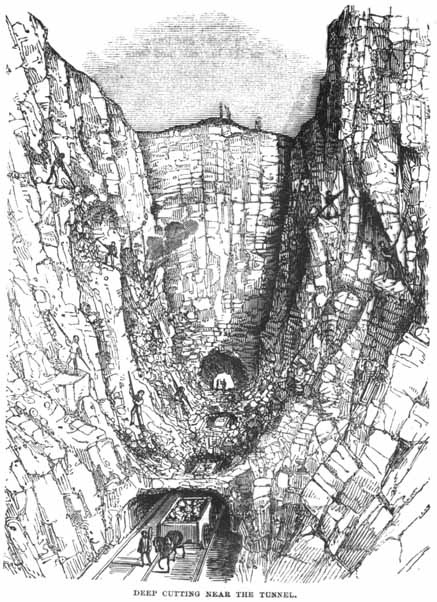
The water now rose in the shaft, and, as it is called,
"drowned the works" but, by the main strength of 1250 men,
200 horses, and thirteen steam-engines, not only was the work
gradually completed, but, during day and night for eight months, the
almost incredible quantity of 1800 gallons of water per minute was
raised, and conducted away. The time occupied from the laying of the
first brick to the completion was thirty months.
SUN FISH.
While lying in Little Killery Bay, on the coast of Connemara, in
her Majesty's surveying ketch Sylvia, we were attracted by
a large fin above the surface, moving with an oscillatory motion,
somewhat resembling the action of a man sculling at the stern of a
boat; and knowing it to be an unusual visitor, we immediately got up
the harpoon and went in chase. In the meantime, a country boat came
up with the poor animal, and its crew inflicted upon it sundry blows
with whatever they could lay their hands on—oars, grappling,
stones, &c.—but were unsuccessful in taking it; and it
disappeared for some few minutes, when it again exhibited its fin on
the other side of the Bay. The dull and stupid animal permitted us to
place our boat immediately over it, and made no effort to escape. The
harpoon never having been sharpened, glanced off without effect; but
another sailor succeeded in securing it by the tail with a boat-hook,
and passing the bight of a rope behind its fins, we hauled it on
shore, under Salrock House, the residence of General Thompson, who,
with his family, came down to inspect this strange-looking inhabitant
of the sea. We were well soused by the splashing of its fins, ere a
dozen hands succeeded in transporting this heavy creature from its
native abode to the shore, where it passively died, giving only an
occasional movement with its fins, or uttering a kind of grunt.
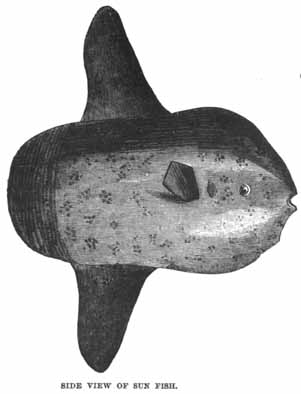
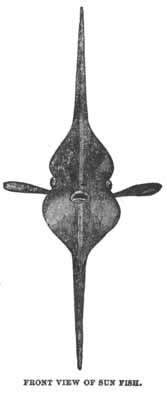
This animal, I believe, is a specimen of the Sun-fish
(Orthagoriscus). It has no bony skeleton; nor did we, in our
rather hasty dissection, discover any osseous structure whatever,
except (as we were informed by one who afterwards inspected it) that
there was one which stretched between the large fins. Its jaws also
had bony terminations, unbroken into teeth, and parrot-like, which,
when not in use, are hidden by the envelopement of the gums. The form
of the animal is preserved by an entire cartilaginous case, of about
three inches in thickness, covered by a kind of shagreen skin, so
amalgamated with the cartilage as not to be separated from it. This
case is easily penetrable with a knife, and is of pearly whiteness,
more resembling cocoa-nut in appearance and texture than anything
else I can compare it with. The interior cavity, containing the vital
parts, terminates a little behind the large fins, where the cartilage
was solid, to its tapered extremity, which is without a caudal fin.
Within, and around the back part, lay the flesh, of a coarse fibrous
texture, slightly salmon-coloured. The liver was such as to fill a
common pail, and there was a large quantity of red blood. The
nostril, top of the eye, and top of the gill-orifice are in line, as
represented in the Engraving. The dimensions are as under:—
Eye round, and like that of an ox, 2-1/4 inches diameter.
Gill-orifice, 4 inches by 2-1/4 inches. Dorsal and anal fins equal, 2
ft. 2 in. long, by 1 ft. 3 in. wide. Pectoral fins, 10 in. high by 8
broad. Length of fish, 6 ft. Depth, from the extremities of the large
fins, 7 ft. 4 in. Extreme breadth at the swelling under the eye, only
20 in. Weight, 6 cwt. 42 lb.
Captain Bedford, R. N.
BATTLE OF THE BALTIC.
 |
Of Nelson and the North
Sing the glorious day's renown,
When to battle fierce came forth
All the might of Denmark's crown,
And her arms along the deep proudly shone;
By each gun the lighted brand,
In a bold determined hand—
And the Prince of all the land
Led them on.
Like Leviathans afloat
Lay their bulwarks on the brine;
While the sign of battle flew
On the lofty British line;
It was ten of April morn, by the chime,
As they drifted on their path:
There was silence deep as death,
And the boldest held his breath
For a time.
But the might of England flush'd
To anticipate the scene;
And her van the fleeter rush'd
O'er the deadly space between.
"Hearts of Oak!" our Captains cried; when
each gun
From its adamantine lips
Spread a death-shade round the ships,
Like the hurricane eclipse
Of the sun.
Again! again! again!
And the havoc did not slack,
Till a feeble cheer the Dane
To our cheering sent us back—
Their shots along the deep slowly boom:
Then ceased, and all is wail
As they strike the shatter'd sail,
Or, in conflagration pale,
Light the gloom.
Out spoke the victor then,
As he hail'd them o'er the wave,
"Ye are brothers! ye are men!
And we conquer but to save;
So peace instead of death let us bring.
But yield, proud foe, thy fleet,
With their crews, at England's feet,
And make submission meet
To our King."
Then Denmark bless'd our chief,
That he gave her wounds repose;
And the sounds of joy and grief
From her people wildly rose,
As Death withdrew his shades from the day,
While the sun look'd smiling bright
O'er a wide and woeful sight,
Where the fires of funeral light
Died away.
Now joy, old England, raise!
For the tidings of thy might,
By the festal cities' blaze,
Whilst the wine-cup shines in light;
And yet, amidst that joy and uproar,
Let us think of them that sleep,
Full many a fathom deep,
By thy wild and stormy steep—
Ellsinore!
Brave hearts! to Britain's pride,
Once so faithful and so true,
On the deck of fame that died
With the gallant, good Riou—
Soft sigh the winds of Heaven o'er their
grave:
While the billow mournful rolls,
And the mermaid's song condoles,
Singing glory to the souls
Of the brave.
Campbell.
|
ARTILLERY TACTICS.
Cannon took their name from the French word Canne, a reed.
Before their invention, machines were used for throwing enormous
stones. These were imitated from the Arabs, and called
ingenia, whence engineer. The first cannon were made of wood,
wrapped up in numerous folds of linen, and well secured by iron
hoops. The true epoch of the use of metallic cannon cannot be
ascertained; it is certain, however, that they were in use about the
middle of the 14th century. The Engraving beneath represents a
field-battery gun taking up its position in a canter. The piece of
ordnance is attached, or "limbered up" to an ammunition
carriage, capable of carrying two gunners, or privates, whilst the
drivers are also drilled so as to be able to serve at the gun in
action, in case of casualties.
Having reached its destination, and been detached or
"unlimbered" from the front carriage, we next see the
action of loading; the ramrod having at its other extremity a
sheep-skin mop, larger than the bore of the piece, and called "a
sponge." This instrument, before loading, is invariably used,
whilst the touch-hole or "vent" is covered by the thumb of
the gunner especially numbered off for this important duty; and the
air being thus excluded, the fire, which often remains within the
bore, attached to either portions of cartridge-case or wadding, is
extinguished. Serious accidents have been known to occur from a
neglect of this important preliminary to loading; as a melancholy
instance, a poor fellow may be seen about the Woolwich barracks,
both of whose arms were blown off above the elbow joint,
whilst ramming home a cartridge before the sponge had been properly
applied.
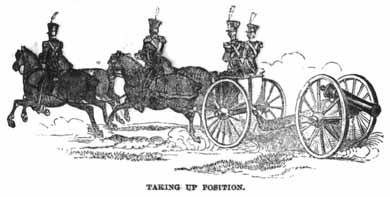
If it is deemed essential to keep up a fire upon the enemy during
a temporary retreat, or in order to avoid an overwhelming body of
cavalry directed against guns unsupported by infantry, in that case
the limber remains as close as possible to the field-piece, as shown
in the Engraving above.
Skilful provisions are made against the various contingencies
likely to occur in action. A wheel may he shattered by the
enemy's shot, and the gun thereby disabled for the moment: this
accident is met by supporting the piece upon a handspike, firmly
grasped by one or two men on each side, according to the weight of
the gun, whilst a spare wheel, usually suspended at the back of
"the tumbril," or ammunition waggon, is obtained, and in a
few moments made to remedy the loss, as represented above.
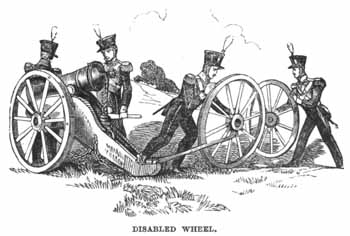
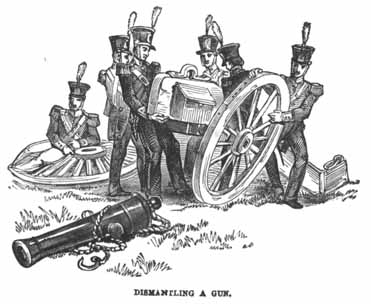
The extraordinary rapidity with which a gun can be dislodged from
its carriage, and every portion of its complicated machinery
scattered upon the ground, is hardly to be believed unless witnessed;
but the wonder is increased tenfold, on seeing with what magical
celerity the death-dealing weapon can be put together again. These
operations will be readily understood by an examination of the
Illustrations. In that at the foot of page 175 the cannon is lying
useless upon the earth; one wheel already forms the rude
resting-place of a gunner, whilst the other is in the act of being
displaced. By the application of a rope round the termination of the
breech, and the lifting of the trail of the carriage, care being
previously taken that the trunnions are in their respective sockets,
a very slight exertion of manual labour is required to put the gun
into fighting trim. That we may be understood, we will add that the
trunnions are the short round pieces of iron, or brass, projecting
from the sides of the cannon, and their relative position can be
easily ascertained by a glance at the gun occupying the foreground of
the Illustration where the dismantling is depicted. To perform the
labour thus required in managing cannon, is called to serve the
guns.
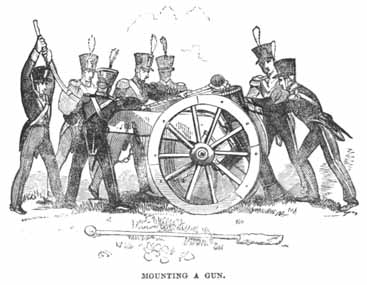
Cannon are cast in a solid mass of metal, either of iron or brass;
they are then bored by being placed upon a machine which causes the
whole mass to turn round very rapidly. The boring tool being pressed
against the cannon thus revolving, a deep hole is made in it, called
the bore.
THE TREE KANGAROO AND BLACK LEOPARD.
The ordinary mode in which the Kangaroos make their way on the
ground, as well as by flight from enemies, is by a series of bounds,
often of prodigious extent. They spring from their hind limbs alone,
using neither the tail nor the fore limbs. In feeding, they assume a
crouching, hare-like position, resting on the fore paws as well as on
the hinder extremities, while they browse on the herbage. In this
attitude they hop gently along, the tail being pressed to the ground.
On the least alarm they rise on the hind limbs, and bound to a
distance with great rapidity. Sometimes, when excited, the old male
of the great kangaroo stands on tiptoe and on his tail, and is then
of prodigious height. It readily takes to the water, and swims well,
often resorting to this mode of escape from its enemies, among which
is the dingo, or wild dog of Australia.
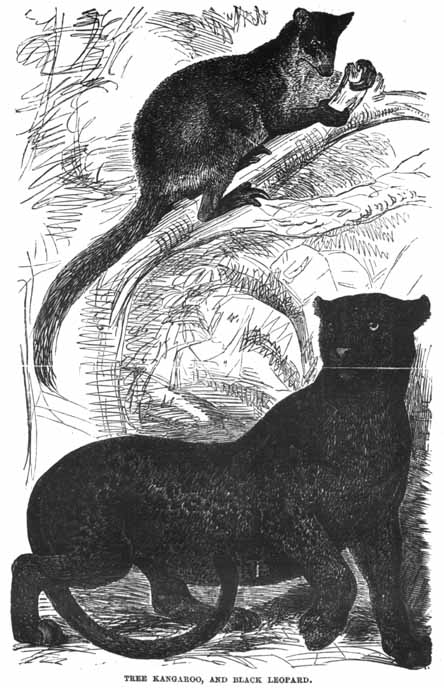
Man is, however, the most unrelenting foe of this inoffensive
animal. It is a native of New Holland and Van Diemen's Land, and
was first discovered by the celebrated navigator Captain Cook, in
1770, while stationed on the coast of New South Wales. In Van
Diemen's Land the great kangaroo is regularly hunted with
fox-hounds, as the deer or fox in England.
The Tree Kangaroo, in general appearance, much resembles the
common kangaroo, having many of that animal's peculiarities. It
seems to have the power of moving very quickly on a tree; sometimes
holding tight with its fore feet, and bringing its hind feet up
together with a jump; at other times climbing ordinarily.
In the island of Java a black variety of the Leopard is not
uncommon, and such are occasionally seen in our menageries; they are
deeper than the general tint, and the spots show in certain lights
only. Nothing can exceed the grace and agility of the leopards; they
bound with astonishing ease, climb trees, and swim, and the
flexibility of the body enables them to creep along the ground with
the cautious silence of a snake on their unsuspecting prey.
In India the leopard is called by the natives the
"tree-tiger," from its generally taking refuge in a tree
when pursued, and also from being often seen among the branches: so
quick and active is the animal in this situation, that it is not easy
to take a fair aim at him. Antelopes, deer, small quadrupeds, and
monkeys are its prey. It seldom attacks a man voluntarily, but, if
provoked, becomes a formidable assailant. It is sometimes taken in
pitfalls and traps. In some old writers there are accounts of the
leopard being taken in trap, by means of a mirror, which, when the
animal jump against it, brings a door down upon him.
CHARITY.
 |
Did sweeter sounds adorn my flowing tongue,
Than ever man pronounced or angel sung;
Had I all knowledge, human and divine
That thought can reach, or science can define;
And had I power to give that knowledge birth,
In all the speeches of the babbling earth,
Did Shadrach's zeal my glowing breast inspire,
To weary tortures, and rejoice in fire;
Or had I faith like that which Israel saw,
When Moses gave them miracles and law:
Yet, gracious Charity, indulgent guest,
Were not thy power exerted in my breast,
Those speeches would send up unheeded pray'r;
That scorn of life would be but wild despair;
A cymbal's sound were better than my voice;
My faith were form, my eloquence were noise.
|
|
|
|
Charity, decent, modest, easy, kind,
Softens the high, and rears the abject mind;
Knows with just reins, and gentle hand, to guide
Betwixt vile shame and arbitrary pride.
Not soon provoked, she easily forgives;
And much she suffers, as she much believes.
Soft peace she brings wherever she arrives;
She builds our quiet, as she forms our lives;
Lays the rough paths of peevish nature even,
And opens in each heart a little heaven.
Each other gift, which God on man bestows,
Its proper bounds, and due restriction knows;
To one fix'd purpose dedicates its power;
And finishing its act, exists no more.
Thus, in obedience to what Heaven decrees,
Knowledge shall fail, and prophecy shall cease;
But lasting Charity's more ample sway,
Nor bound by time, nor subject to decay,
In happy triumph shall for ever live,
And endless good diffuse, and endless praise
receive.
As through the artist's intervening glass,
Our eye observes the distant planets pass,
A little we discover, but allow
That more remains unseen than art can show;
So whilst our mind its knowledge would improve,
Its feeble eye intent on things above,
High as we may we lift our reason up,
By faith directed, and confirm'd by hope;
Yet are we able only to survey
Dawnings of beams and promises of day;
Heav'n's fuller effluence mocks our dazzled
sight—
Too great its swiftness, and too strong its
light.
But soon the mediate clouds shall be
dispell'd;
The Son shall soon be face to face beheld,
In all his robes, with all his glory on,
Seated sublime on his meridian throne.
Then constant Faith, and holy Hope shall vie,
One lost in certainty, and one in joy:
Whilst thou, more happy pow'r, fair Charity,
Triumphant sister, greatest of the three,
Thy office, and thy nature still the same,
Lasting thy lamp, and unconsumed thy flame,
Shall still survive—
Shall stand before the host of heav'n
confest,
For ever blessing, and for ever blest.
Prior.
|
SARDIS.
Sardis, the ancient capital of the kingdom of Lydia, is situated
on the river Pactolus, in the fertile plain below Mount Tmolus.
Wealth, pomp, and luxury characterised this city from very ancient
times. The story of Croesus, its last King, is frequently alluded to
by historians, as affording a remarkable example of the instability
of human greatness. This Monarch considered himself the happiest of
human beings, but being checked by the philosopher Solon for his
arrogance, he was offended, and dismissed the sage from his Court
with disgrace. Not long afterwards, led away by the ambiguous answers
of the oracles, he conducted a large army into the field against
Cyrus, the future conqueror of Babylon, but was defeated, and obliged
to return to his capital, where he shut himself up. Hither he was
soon followed and besieged by Cyrus, with a far inferior force; but,
at the expiration of fourteen days, the citadel, which had been
deemed impregnable, was taken by a stratagem, and Croseus was
condemned to the flames. When the sentence was about to be executed,
he was heard to invoke the name of Solon, and the curiosity of Cyrus
being excited, he asked the cause; and, having heard his narrative,
ordered him to be set free, and subsequently received him into his
confidence.
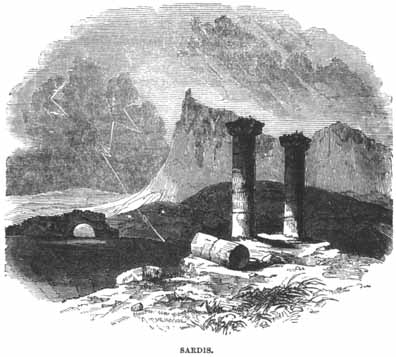
Under the Romans, Sardis declined in importance, and, being
destroyed by an earthquake, for some time lay desolate, until it was
rebuilt by the Roman Emperor Tiberius.
The situation of Sardis is very beautiful, but the country over
which it looks is almost deserted, and the valley is become a swamp.
The hill of the citadel, when seen from the opposite bank of the
Hermus, appears of a triangular form; and at the back of it rise
ridge after ridge of mountains, the highest covered with snow, and
many of them bearing evident marks of having been jagged and
distorted by earthquakes. The citadel is exceedingly difficult of
ascent; but the magnificent view which it commands of the plain of
the Hermus, and other objects of interest, amply repays the risk and
fatigue. The village, small as it is, boasts of containing one of the
most remarkable remains of antiquity in Asia; namely, the vast Ionic
temple of the heathen goddess Cybele, or the earth, on the banks of
the Pactolus. In 1750, six columns of this temple were standing, but
four of them have since been thrown down by the Turks, for the sake
of the gold which they expected to find in the joints.
Two or three mills and a few mud huts, inhabited by Turkish
herdsmen, contain all the present population of Sardis.
MARTELLO TOWERS.
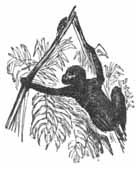
At a time when there appeared to be good reason for believing that
the invasion of England was contemplated, the Government turned their
attention to the defence of such portions of the coast as seemed to
present the greatest facility for the landing of a hostile force. As
the Kentish coast, from East Were Bay to Dymchurch, seemed more
especially exposed, a line of Martello Towers was erected between
these two points, at a distance from each other of from one-quarter
to three-quarters of a mile. Other towers of the same kind were
erected on various parts of the coast where the shore was low, in
other parts of England, but more particularly in the counties of
Sussex and Suffolk. Towers of this construction appear to have been
adopted, owing to the resistance that was made by the Tower of
Martella, in the Island of Corsica, to the British forces under Lord
Hood and General Dundas, in 1794. This tower which was built in the
form of an obtruncated cone—like the body of a
windmill—was situated in Martella, or Martle Bay. As it
rendered the landing of the troops difficult, Commodore Linzee
anchored in the bay to the westward, and there landed the troops on
the evening of the 7th of February, taking possession of a height
that commanded the tower. As the tower impeded the advance of the
troops, it was the next day attacked from the bay by the vessels
Fortitude and Juno; but after a cannonade of two hours
and a half, the ships were obliged to haul off, the Fortitude
having sustained considerable damage from red-hot shot discharged
from the tower. The tower, after having been cannonaded from the
height for two days, surrendered; rather, it would appear, from the
alarm of the garrison, than from any great injury that the tower had
sustained. The English, on taking possession of the fort, found that
the garrison had originally consisted of thirty-three men, of whom
two only were wounded, though mortally. The walls were of great
thickness, and bomb-proof; and the parapet consisted of an interior
lining of rush matting, filled up to the exterior of the parapet with
sand. The only guns they had were two 18-pounders.
The towers erected between East Were Bay and Dymchurch (upwards of
twenty) were built of brick, and were from about 35 feet to 40 feet
high: the entrance to them was by a low door-way, about seven feet
and a half from the ground; and admission was gained by means of a
ladder, which was afterwards withdrawn into the interior. A high step
of two feet led to the first floor of the tower, a room of about
thirteen feet diameter, and with the walls about five feet thick.
Round this room were loopholes in the walls, at such an elevation,
that the men would be obliged to stand on benches in the event of
their being required to oppose an attack of musketry. Those benches
were also used as the sleeping-places of the garrison. On this floor
there was a fire-place, and from the centre was a trap-door leading
downwards to the ammunition and provision rooms. The second floor was
ascended by similar means.
TURKISH CUSTOMS.
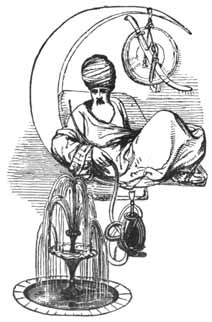
Characteristically indolent, the fondness for a sedentary life is
stronger, perhaps, with the Turks, than with any other people of whom
we read. It is difficult to describe the gravity and apathy which
constitute the distinguishing features of their character: everything
in their manners tends to foster in them, especially in the higher
classes, an almost invincible love of ease and luxurious leisure. The
general rule which they seem to lay down for their guidance, is that
taking the trouble to do anything themselves which they can possibly
get others to do for them; and the precision with which they observe
it in some of the minutest trifles of domestic life is almost
amusing. A Turkish gentleman, who has once composed his body upon the
corner of a sofa, appears to attach a certain notion of grandeur to
the keeping of it there, and it is only something of the gravest
importance that induces him to disturb his position. If he wishes to
procure anything that is within a few steps of him, he summons his
slaves by clapping his hands (the Eastern mode of "ringing the
bell"), and bids them bring it to him: his feelings of dignity
would be hurt by getting up to reach it himself. Of course, this
habit of inac tion prevails equally with the female sex: a Turkish
lady would not think of picking up a fallen handkerchief, so long as
she had an attendant to do it for her. As may be supposed, the number
of slaves in a Turkish household of any importance is very great.
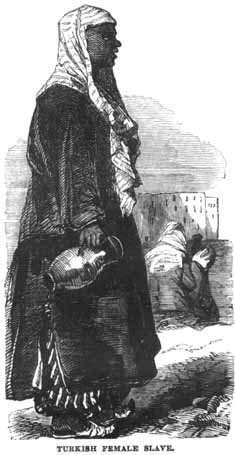
The position of women in Eastern countries is so totally unlike
that which they hold in our own happy land, that we must refer
expressly to it, in order that the picture of domestic life presented
to us in the writings of all travellers in the East may be
understood. Amongst all ranks, the wife is not the friend and
companion, but the slave of her husband; and even when treated with
kindness and affection, her state is still far below that of her
sisters in Christian lands. Even in the humblest rank of life, the
meal which the wife prepares with her own hands for her husband, she
must not partake of with him. The hard-working Eastern peasant, and
the fine lady who spends most of her time in eating sweet-meats, or
in embroidery, are both alike dark and ignorant; for it would be
accounted a folly, if not a sin, to teach them even to read.
Numerous carriers, or sellers of water, obtain their living in the
East by supplying the inhabitants with it. They are permitted to fill
their water-bags, made of goat-skins, at the public fountains. This
goat-skin of the carrier has a long brass spout, and from this the
water is poured into a brass cup, for any one who wishes to drink.
Many of these are employed by the charitable, to distribute water in
the streets; and they pray the thirsty to partake of the bounty
offered to them in the name of God, praying that Paradise and pardon
may be the lot of him who affords the refreshing gift.
The Dancing Dervises are a religious order of Mohamedans, who
affect a great deal of patience, humility, and charity. Part of their
religious observance consists in dancing or whirling their bodies
round with the greatest rapidity imaginable, to the sound of a flute;
and long practice has enabled them to do this without suffering the
least inconvenience from the strange movement.
In Eastern countries, the bread is generally made in the form of a
large thin cake, which is torn and folded up, almost like a sheet of
paper; it can then be used (as knives and forks are not employed by
the Orientals) for the purpose of rolling together a mouthful of
meat, or supping up gravy and vegetables, at the meals.
ON STUDY.
Studies serve for delight, for ornament, and for ability. The
chief use for delight is in privateness and retiring; for ornament,
is in discourse; and for ability, is in the judgment and disposition
of business. For expert men can execute, and perhaps judge of
particulars one by one; but the general counsels, and the plots, and
marshalling of affairs, come best from those that are learned. To
spend too much time in studies, is sloth; to use them too much for
ornament, is affectation; to make judgment wholly by their rules, is
the humour of a scholar. They perfect nature, and are perfected by
experience; for natural abilities are like natural plants, that need
pruning by duty; and studies themselves do give forth directions too
much at large, except they be bounded in by experience. Crafty men
contemn studies, simple men admire them, and wise men use them: for
they teach not their own use, but that is a wisdom without them, and
above them, won by observation. Read not to contradict and confute,
nor to believe and take for granted; not to find talk and discourse,
but to weigh and consider. Some books are to be tasted, others to be
swallowed, and some few to be chewed and digested: that is, some
books are to be read only in parts; others to be read, but not
curiously; and some few to be read wholly, and with diligence and
attention. Some books also may be read by deputy, and extracts made
of them by others; but that should be only in the less important
arguments, and the meaner sorts of books; else distilled books are
like common distilled waters, flashy things. Reading maketh a full
man; conference a ready man; and writing an exact man. And,
therefore, if a man write little, he had need have a great memory; if
he confer little, he had need have a present wit; and if he read
little, he had need have much cunning, to seem to know that he doth
not.
Bacon.
THE SHORES OF GREECE.
He who hath bent him o'er the dead
Ere the first day of death is fled;
The first dark day of nothingness.
The last of danger and distress:
Before Decay's effacing fingers,
Have swept the lines where beauty lingers,
And mark'd the mild, angelic air,
The rapture of repose that's there;
The fix'd, yet tender traits that streak
The languor of the placid cheek.
|
|
|
And, but for that sad shrouded eye,
That fires not—wins not—weeps
not—now;
And, but for that chill, changeless
brow,
Whose touch thrills with mortality,
And curdles to the gazer's heart,
As if to him it could impart
The doom he dreads, yet dwells upon:
Yes, but for these, and these alone
Some moments—ay, one treacherous
hour—
He still might doubt the tyrant's power;
So fair, so calm, so softly seal'd,
The first, last look by death reveal'd.
Such is the aspect of this shore;
'Tis Greece, but living Greece no more!
So coldly sweet—so deadly
fair—
We start, for soul is wanting there:
Hers is the loveliness in death
That parts not quite with parting
breath;
But beauty, with that fearful bloom,
That hue which haunts it to the tomb:
Expression's last receding ray,
A gilded halo hovering round decay,
The farewell beam of feeling past
away!
Spark of that flame—perchance of Heavenly
birth,
Which gleams, but warms no more its cherish'd
earth!
Byron.
|
THE FORT OF ATTOCK.
Attock is a fort and small town in the Punjaub, on the left or
east bank of the Indus, 942 miles from the sea, and close below the
place where it receives the water of the Khabool river, and first
becomes navigable. The name, signifying obstacle, is supposed
to have been given to it under the presumption that no scrupulous
Hindoo would proceed westward of it; but this strict principle, like
many others of similar nature, is little acted on. Some state that
the name was given by the Emperor Akbar, because he here found much
difficulty in crossing the river. The river itself is at this place
frequently by the natives called Attock. Here is a bridge, formed
usually of from twenty to thirty boats, across the stream, at a spot
where it is 537 feet wide. In summer, when the melting of the snows
in the lofty mountains to the north raises the stream so that the
bridge becomes endangered, it is withdrawn, and the communication is
then effected by means of a ferry.
The banks of the river are very high, so that the enormous
accession which the volume of water receives during inundation
scarcely affects the breadth, but merely increases the depth. The
rock forming the banks is of a dark-coloured slate, polished by the
force of the stream, so as to shine like black marble. Between these,
"one clear blue stream shot past." The depth of the Indus
here is thirty feet in the lowest state, and between sixty and
seventy in the highest, and runs at the rate of six miles an hour.
There is a ford at some distance above the confluence of the river of
Khabool; but the extreme coldness and rapidity of the water render it
at all times very dangerous, and on the slightest inundation quite
impracticable. The bridge is supported by an association of boatmen,
who receive the revenue of a village allotted for this purpose by the
Emperor Akbar, and a small daily pay as long as the bridge stands,
and also levy a toll on all passengers.
On the right bank, opposite Attock, is Khyrabad—a fort
built, according to some, by the Emperor Akbar, according to others
by Nadir Shah. This locality is, in a military and commercial point
of view, of much importance, as the Indus is here crossed by the
great route which, proceeding from Khabool eastward through the
Khyber Pass into the Punjaub, forms the main line of communication
between Affghanistan and Northern India. The river was here
repeatedly crossed by the British armies, during the late military
operations in Affghanistan; and here, according to the general
opinion, Alexander, subsequently Timur, the Tartar conqueror, and,
still later, Nadir Shah, crossed; but there is much uncertainty on
these points.
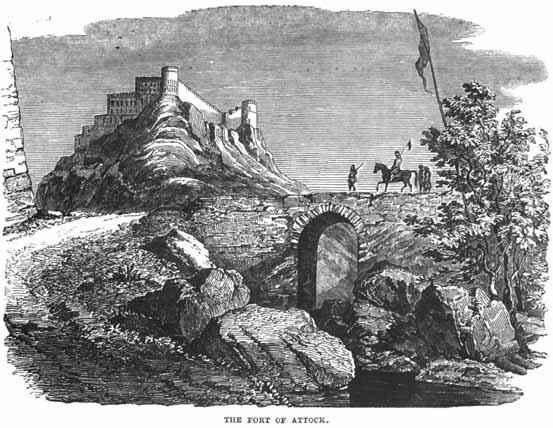
The fortress was erected by the Emperor Akbar, in 1581 to command
the passage; but, though strongly built of stone on the high and
steep bank of the river, it could offer no effectual resistance to a
regular attack, being commanded by the neighbouring heights. Its form
is that of a parallelogram: it is 800 yards long and 400 wide. The
population of the town, which is inclosed within the walls of the
fort, is estimated at 2000.
THE ORDER OF NATURE.
 |
See through this air, this ocean, and this
earth,
All matter quick, and bursting into birth.
Above, how high progressive life may go!
Around, how wide! how deep extend below!
Vast chain of Being! which from God began,
Natures ethereal, human, angel, man,
Beast, bird, fish, insect, what no eye can see
No glass can reach; from Infinity to thee
From thee to Nothing.—On superior
pow'rs
Were we to press, inferior might on ours;
Or in the full creation leave a void,
Where one step broken the great scale's
destroyed
From Nature's chain whatever link you
strike,
Tenth or ten-thousandth, breaks the chain alike.
And, if each system in gradation roll
Alike essential to th' amazing whole,
The least confusion but in one, not all
That system only, but the whole must fall.
Let earth unbalanc'd from her orbit fly,
Planets and suns run lawless through the sky;
Let ruling angels from their spheres be
hurl'd,
Being on being wreck'd, and world on world,
Heav'n's whole foundations to the centre
nod,
And Nature trembles to the throne of God:
All this dread Order break—for whom? for
thee?
Vile worm!--Oh, madness! pride! impiety!
What if the foot, ordain'd the dust to
tread,
Or hand to toil, aspired to be the head?
What if the head, the eye, or ear, repined
To serve—mere engines to the ruling Mind?
Just as absurd for any part to claim
To be another, in this general frame:
Just as absurd to mourn the tasks or pains,
The great directing Mind of All ordains.
All are but parts of one stupendous whole
Whose body Nature is, and God the Soul:
That changed through all, and yet in all the
same,
Great is in earth as in th' ethereal frame,
Warms in the sun, refreshes in the breeze,
Glows in the stars, and blossoms in the trees,
Lives through all life, extends through all
extent,
Spreads undivided, operates unspent;
Breathes in our soul, informs our mortal part,
As full, as perfect, in a hair as heart;
As full, as perfect, in vile man that mourns,
As the rapt seraph that adores and burns:
To him no high, no low, no great, no small;
He fills, he bounds, connects, and equals all.
Cease then, nor Order Imperfection name:
Our proper bliss depends on what we blame.
Know thy own point: This kind, this due degree
Of blindness, weakness, Heav'n bestows on
thee.
Submit—in this, or any other sphere,
Secure to be as blest as thou canst bear:
Safe in the hand of one disposing Pow'r
Or in the natal, or the mortal hour.
All Nature is but Art, unknown to thee;
All Chance, Direction which thou canst not see;
All Discord, Harmony not understood;
All partial Evil, universal Good:
And, spite of Pride, in erring Reason's
spite,
One truth is clear, WHATEVER is, is RIGHT.
Pope.
|
LORD CLARENDON.

This celebrated statesman, who flourished in the reigns of Charles
I. and II., took a prominent part in the eventful times in which he
lived. He was not of noble birth, but the descendant of a family
called Hyde, which resided from a remote period at Norbury, in
Cheshire. He was originally intended for the church, but eventually
became a lawyer, applying himself to the study of his profession with
a diligence far surpassing that of the associates with whom he lived.
In 1635, he attracted the notice of Archbishop Laud, which may be
regarded as the most fortunate circumstance of his life, as it led to
his introduction to Charles I. In consequence of the ability
displayed by him in the responsible duties he was called to perform,
that Monarch offered him the office of Solicitor-General. But this
Hyde declined, preferring, as he said, to serve the King in an
unofficial capacity. After the battle of Naseby, Hyde was appointed
one of the council formed to attend, watch over, and direct the
Prince of Wales. After hopelessly witnessing for many months a course
of disastrous and ill-conducted warfare in the West, the council fled
with the Prince, first to the Scilly Islands, near Cornwall, and
thence to Jersey. From this place, against the wishes of Hyde, the
Prince, in 1640, repaired to his mother, Henrietta, at Paris, leaving
Hyde at Jersey, where he remained for two years, engaged in the
composition of his celebrated "History of the Rebellion."
In May, 1648, Hyde was summoned to attend the Prince at the Hague;
and here they received the news of the death of Charles I., which is
said to have greatly appalled them. After faithfully following the
new King in all his vicissitudes of fortune, suffering at times
extreme poverty, he attained at the Restoration the period of his
greatest power. In 1660, his daughter Anne was secretly married to
the Duke of York; but when, after a year, it was openly acknowledged,
the new Lord Chancellor received the news with violent demonstrations
of indignation and grief. Hyde, in fact, never showed any avidity for
emoluments or distinction; but when this marriage was declared, it
became desirable that some mark of the King's favour should be
shown, and he was created Earl of Clarendon. He subsequently, from
political broils, was compelled to exile himself from the Court, and
took up his residence at Montpellier, where, resuming his literary
labours, he completed his celebrated History, and the memoir of his
life. After fruitlessly petitioning King Charles II. for permission
to end his days in England, the illustrious exile died at Rouen, in
1674, in the sixty-fifth year of his age.
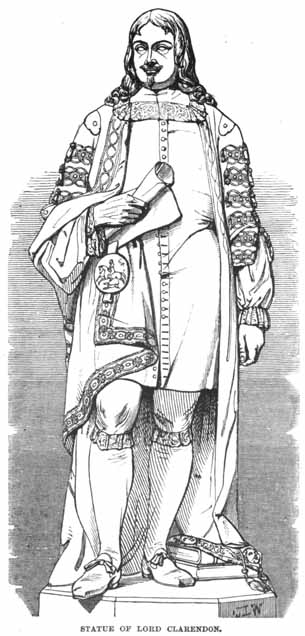
OWLS.
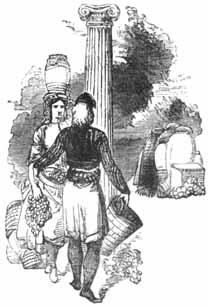
It is now generally known that the Owl renders the farmer
important service, by ridding him of vermin, which might otherwise
consume the produce of his field; but in almost every age and country
it has been regarded as a bird of ill omen, and sometimes even as the
herald of death. In France, the cry or hoot is considered as a
certain forerunner of misfortune to the hearer. In Tartary, the owl
is looked upon in another light, though not valued as it ought to be
for its useful destruction of moles, rats, and mice. The natives pay
it great respect, because they attribute to this bird the
preservation of the founder of their empire, Genghis Khan. That
Prince, with his army, happened to be surprised and put to flight by
his enemies, and was forced to conceal himself in a little coppice.
An owl settled on the bush under which he was hid, and his pursuers
did not search there, as they thought it impossible the bird would
perch on a place where any man was concealed. Thenceforth his
countrymen held the owl to be a sacred bird, and every one wore a
plume of its feathers on his head.
One of the smallest of the owl tribe utters but one melancholy
note now and then. The Indians in North America whistle whenever they
chance to hear the solitary note; and if the bird does not very soon
repeat his harmless cry, the speedy death of the superstitious hearer
is foreboded. It is hence called the death bird. The voices of all
carnivorous birds and beasts are harsh, and at times hideous; and
probably, like that of the owl, which, from the width and capacity of
its throat, is in some varieties very powerful, may be intended as an
alarm and warning to the birds and animals on which they prey, to
secure themselves from the approach of their stealthy foe.
Owls are divided into two groups or families—one having two
tufts of feathers on the head, which have been called ears or horns,
and are moveable at pleasure, the others having smooth round heads
without tufts. The bills are hooked in both. There are upwards of
sixty species of owls widely spread over almost every part of the
known world; of these we may count not fewer than eight as more or
less frequenting this country. One of the largest of the tribe is the
eagle hawk, or great horned owl, the great thickness of whose plumage
makes it appear nearly as large as the eagle. Some fine preserved
specimens of this noble-looking bird may be seen in the British
Museum. It is a most powerful bird; and a specimen was captured, with
great difficulty, in 1837, when it alighted upon the mast-head of a
vessel off Flamborough-head.
The amiable naturalist, Mr. Waterton, who took especial interest
in the habits of the owl, writes thus on the barn
owl:—"This pretty aerial wanderer of the night often comes
into my room, and, after flitting to and fro, on wing so soft and
silent that he is scarcely heard, takes his departure from the same
window at which he had entered. I own I have a great liking for the
bird; and I have offered it hospitality and protection on account of
its persecutions, and for its many services to me; I wish that any
little thing I could write or say might cause it to stand better with
the world than it has hitherto done."
CHATTERTON.
This gifted young poet was the son of a schoolmaster at Bristol,
where he was born, in 1752. On the 24th of August, 1770, he was found
dead, near a table covered with the scraps of writings he had
destroyed, in a miserable room in Brook-street, Holborn. In Redcliffe
churchyard, Bristol, a beautiful monument has been erected to the
memory of the unfortunate poet.
O God! whose thunders shake the sky,
Whose eye this atom globe surveys,
To Thee, my only rock, I fly—
Thy mercy in thy justice praise.
Oh, teach me in the trying hour,
When anguish swells the dewy tear,
To still my sorrows, own Thy power,
Thy goodness love, Thy justice fear.
Ah! why, my soul, dost thou complain,
Why, drooping, seek the dark recess?
Shake off the melancholy chain,
For God created all to bless.
But, ah! my breast is human still:
The rising sigh, the falling tear,
My languid vitals' feeble rill,
The sickness of my soul declare.
Chatterton.
|
SMYRNA.
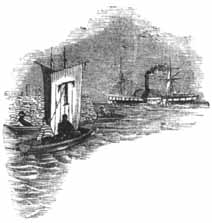
This city and sea-port of Natolia, in Asia, is situate towards the
northern part of a peninsula, upon a long and winding gulf of the
same name, which is capable of containing the largest navy in the
world. The city is about four miles round, presenting a front of a
mile long to the water; and when approached by sea, it resembles a
capacious amphitheatre with the ruins of an ancient castle crowning
its summit. The interior of the city, however, disappoints the
expectations thus raised, for the streets are narrow, dirty, and
ill-paved, and there is now scarcely a trace of those once splendid
edifices which rendered Smyrna one of the finest cities in Asia
Minor. The shops are arched over, and have a handsome appearance: in
spite of the gloom which the houses wear, those along the shore have
beautiful gardens attached to them, at the foot of which are
summer-houses overhanging the sea. The city is subject to earthquakes
and the plague, which latter, in 1814, carried off above 50,000 of
the inhabitants.
About midnight, in July, 1841, a fire broke out at Smyrna, which,
from the crowded state of the wooden houses, the want of water, and
the violence of the wind, was terribly destructive. About 12,000
houses were destroyed, including two-thirds of the Turkish quarter,
most of the French and the whole of the Jewish quarters, with many
bazaars and several mosques, synagogues, and other public buildings.
It was calculated that 20,000 persons were deprived of shelter and
food, and the damage was estimated at two millions sterling.
The fine port of Smyrna is frequented by ships from all nations,
freighted with valuable cargoes, both outward and inward. The greater
part of the trading transactions is managed by Jews, who act as
brokers, the principals meeting afterwards to conclude the
bargains.
In 1402 Smyrna was taken by Tamerlane, and suffered very severely.
The conqueror erected within its walls a tower constructed of stones
and the heads of his enemies. Soon after, it came under the dominion
of the Turks, and has been subsequently the most flourishing city in
the Levant, exporting and importing valuable commodities to and from
all parts of the world.
GENTLENESS.
I begin with distinguishing true gentleness from passive tameness
of spirit, and from unlimited compliance with the manners of others.
That passive tameness which submits, without opposition, to every
encroachment of the violent and assuming, forms no part of Christian
duty; but, on the contrary, is destructive of general happiness and
order. That unlimited complaisance, which on every occasion falls in
with the opinions and manners of others, is so far from being a
virtue, that it is itself a vice, and the parent of many vices. It
overthrows all steadiness of principle; and produces that sinful
conformity with the world which taints the whole character. In the
present corrupted state of human manners, always to assent and to
comply is the very worst maxim we can adopt. It is impossible to
support the purity and dignity of Christian morals without opposing
the world on various occasions, even though we should stand alone.
That gentleness, therefore, which belongs to virtue, is to be
carefully distinguished from the mean spirit of cowards, and the
fawning assent of sycophants. It renounces no just right from fear.
It gives up no important truth from flattery. It is indeed not only
consistent with a firm mind, but it necessarily requires a manly
spirit, and a fixed principle, in order to give it any real value.
Upon this solid ground only, the polish of gentleness can with
advantage be superinduced.
It stands opposed, not to the most determined regard for virtue
and truth, but to harshness and severity, to pride and arrogance, to
violence and oppression. It is properly that part of the great virtue
of charity, which makes us unwilling to give pain to any of our
brethren. Compassion prompts us to relieve their wants. Forbearance
prevents us from retaliating their injuries. Meekness restrains our
angry passions; candour, our severe judgments. Gentleness corrects
whatever is offensive in our manners, and, by a constant train of
humane attentions, studies to alleviate the burden of common misery.
Its office, therefore, is extensive. It is not, like some other
virtues, called forth only on peculiar emergencies; but it is
continually in action, when we are engaged in intercourse with men.
It ought to form our address, to regulate our speech, and to diffuse
itself over our whole behaviour.
We must not, however, confound this gentle "wisdom which is
from above" with that artificial courtesy, that studied
smoothness of manners, which is learned in the school of the world.
Such accomplishments the most frivolous and empty may possess. Too
often they are employed by the artful as a snare; too often affected
by the hard and unfeeling as a cover to the baseness of their minds.
We cannot, at the same time, avoid observing the homage, which, even
in such instances, the world is constrained to pay to virtue. In
order to render society agreeable, it is found necessary to assume
somewhat that may at least carry its appearance. Virtue is the
universal charm. Even its shadow is courted, when the substance is
wanting. The imitation of its form has been reduced into an art; and
in the commerce of life, the first study of all who would either gain
the esteem or win the hearts of others, is to learn the speech and to
adopt the manners of candour, gentleness, and humanity. But that
gentleness which is the characteristic of a good man has, like every
other virtue, its seat in the heart; and let me add, nothing except
what flows from the heart can render even external manners truly
pleasing. For no assumed behaviour can at all times hide the real
character. In that unaffected civility which springs from a gentle
mind there is a charm infinitely more powerful than in all the
studied manners of the most finished courtier.
True gentleness is founded on a sense of what we owe to HIM who
made us, and to the common nature of which we all share. It arises
from reflections on our own failings and wants, and from just views
of the condition and the duty of man. It is native feeling heightened
and improved by principle. It is the heart which easily relents;
which feels for every thing that is human, and is backward and slow
to inflict the least wound. It is affable in its address, and mild in
its demeanour; ever ready to oblige, and willing to be obliged by
others; breathing habitual kindness towards friends, courtesy to
strangers, long-suffering to enemies. It exercises authority with
moderation; administers reproof with tenderness; confers favours with
ease and modesty. It is unassuming in opinion, and temperate in zeal.
It contends not eagerly about trifles; slow to contradict, and still
slower to blame; but prompt to allay dissension and to restore peace.
It neither intermeddles unnecessarily with the affairs, nor pries
inquisitively into the secrets of others. It delights above all
things to alleviate distress; and if it cannot dry up the falling
tear, to sooth at least, the grieving heart. Where it has not the
power of being useful, it is never burdensome. It seeks to please
rather than to shine and dazzle, and conceals with care that
superiority, either of talent or of rank, which is oppressive to
those who are beneath it. In a word, it is that spirit and that
tenour of manners which the Gospel of Christ enjoins, when it
commands us "to bear one another's burdens; to rejoice with
those who rejoice, and to weep with those who weep; to please every
one his neighbour for his good; to be kind and tender-hearted; to be
pitiful and courteous; to support the weak, and to be patient towards
all men."
Blair.
THE IGUANA.
The Iguana (Cyclura colei) is not only of singular aspect,
but it may be regarded as the type of a large and important group in
the Saurian family, which formed so conspicuous a feature in the
ancient fauna of this country. The iguana attains a large size in
Jamaica, whence the present specimen was obtained, not unfrequently
approaching four feet in length. In colour it is a greenish grey. It
is entirely herbivorous, as are all its congeners. Its principal
haunt in Jamaica is the low limestone chain of hills, along the shore
from Kingston Harbour and Goat Island, on to its continuation in
Vere.
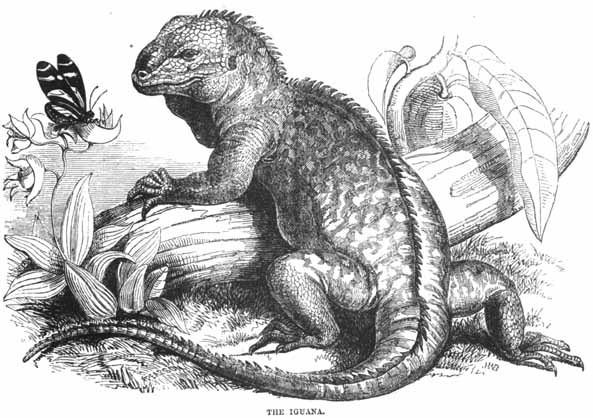
The iguanas which are occasionally taken in the savannahs adjacent
to this district are considered by Mr. Hill (an energetic
correspondent of the Zoological Society who resides in Spanish Town,
and who has paid great attention to the natural history of the
island) to be only stray visitants which have wandered from the
hills. The allied species of Cyclura, which are found on the
American continent, occur in situations of a very different
character, for they affect forests on the bank of rivers, and woods
around springs, where they pass their time in trees and in the water,
living on fruits and leaves. This habit is preserved by the specimen
in the Zoological Society's Gardens, which we have seen lying
lazily along an elevated branch. Its serrated tail is a formidable
weapon of defence, with which, when alarmed or attacked, it deals
rapid blows from side to side. When unmolested it is harmless and
inoffensive, and appears to live in perfect harmony with the smaller
species of lizards which inhabit the same division of the house.
HENRY IV.'S SOLILOQUY ON SLEEP.
How many thousands of my poorest subjects
Are at this hour asleep! O gentle Sleep,
Nature's soft nurse, how have I frighted thee,
That thou no more wilt weigh my eyelids down,
And steep my senses in forgetfulness;
Why rather, Sleep, liest thou in smoky cribs,
Upon uneasy pallets stretching thee,
And hush'd with buzzing night-flies to thy
slumber,
Than in the perfumed chambers of the great,
Under the canopies of costly state,
And lull'd with sounds of sweetest melody?
O thou dull God! why liest thou with the vile
In loathsome beds, and leav'st the kingly
couch,
A watch-case to a common larum-bell?
Wilt thou, upon the high and giddy mast,
Seal up the shipboy's eyes, and rock his
brains
In cradle of the rude imperious surge;
And in the visitation of the winds,
Who take the ruffian billows by the top,
Curling their monstrous heads, and hanging them
With deaf'ning clamours in the slipp'ry
shrouds,
That with the hurly Death itself awakes:
Can'st thou, O partial Sleep! give thy repose
To the wet seaboy in an hour so rude,
And in the calmest and the stillest night,
With all appliances and means to boot,
Deny it to a King? Then, happy lowly clown!
Uneasy lies the head that wears a crown.
Shakspeare
|
ELEGY, WRITTEN IN A COUNTRY CHURCHYARD.
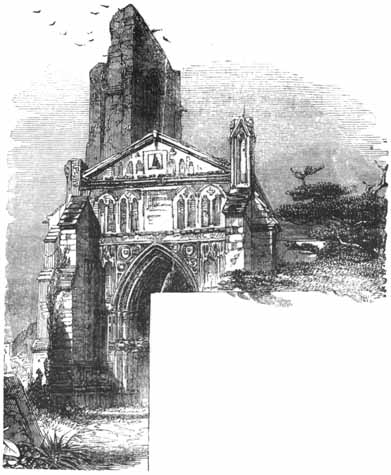
The curfew tolls the knell of parting day,
The lowing herds Mind slowly o'er the lea,
The ploughman homeward plods his weary way
And leaves the world to darkness and to me.
Now fades the glimmering landscape on the sight,
And all the air a solemn stillness holds,
Save where the beetle wheels his drony flight,
And drowsy tinklings lull the distant folds;
Save that from yonder ivy-mantled tower,
The moping owl does to the moon complain
Of such as, wand'ring near her secret bower,
Molest her ancient solitary reign.
Beneath those rugged elms, that yew-tree's
shade,
Where heaves the turf in many a mould'ring
heap,
Each in his narrow cell for ever laid,
The rude forefathers of the hamlet sleep.
The breezy call of incense-breathing morn,
The swallow twitt'ring from the straw-built
shed,
The cock's shrill clarion, or the echoing
horn,
No more shall rouse them from their lowly bed.
For them no more the blazing hearth shall burn,
Or busy housewife ply her evening care;
No children run to lisp their sire's return,
Or climb his knees the envied kiss to share.
Oft did the harvest to their sickle yield,
Their furrow oft the stubborn glebe has broke:
How jocund did they drive their team afield!
How bow'd the woods beneath their sturdy
stroke!
|
|
|
Let not Ambition mock their useful toil,
Their homely joys, and destiny obscure;
Nor Grandeur hear with a disdainful smile
The short and simple annals of the poor.
The boast of Heraldry, the pomp of Pow'r,
And all that Beauty, all that Wealth e'er
gave,
Await alike th' inevitable hour—
The paths of glory lead but to the grave.
Nor you, ye proud, impute to these the fault,
If Mem'ry o'er their tombs no trophies
raise,
Where through the long-drawn aisle, and fretted
vault,
The pealing anthem swells the note of praise.
Can storied urn or animated bust
Back to its mansion call the fleeting breath?
Can Honour's voice provoke the silent dust,
Or Flatt'ry sooth the dull, cold ear of
Death?
Perhaps in this neglected spot is laid
Some heart once pregnant with celestial fire;
Hands that the rod of empire might have
sway'd,
Or waked to ecstasy the living lyre.
But Knowledge to their eyes her ample page,
Rich with the spoils of time, did ne'er
unroll;
Chill Penury repress'd their noble rage,
And froze the genial current of the soul.
Full many a gem of purest ray serene
The dark unfathom'd caves of ocean bear:
Full many a flower is born to blush unseen,
And waste its sweetness on the desert air.
Some village Hampden, that with dauntless breast
The little tyrant of his fields withstood;
Some mute inglorious Milton, here may rest,
Some Cromwell guiltless of his country's
blood.
Th' applause of list'ning senates to
command,
The threats of pain and ruin to despise,
To scatter plenty o'er a smiling land,
And read their hist'ry in a nation's
eyes,
Their lot forbade: nor circumscribed alone
Their growing virtues, but their crimes
confined;
Forbade to wade through slaughter to a throne,
And shut the gates of mercy on mankind;
The struggling pangs of conscious truth to hide,
To quench the blushes of ingenuous shame,
Or heap the shrine of Luxury and Pride
With incense kindled at the Muse's flame.
Far from the madding crowd's ignoble strife
Their sober wishes never learn'd to stray;
Along the cool sequester'd vale of life
They kept the noiseless tenour of their way.
Yet ev'n these bones from insult to protect,
Some frail memorial still erected nigh,
With uncouth rhymes and shapeless sculpture
deck'd,
Implores the passing tribute of a sigh.
Their names, their years, spelt by th'
unletter'd Muse,
The place of fame and elegy supply;
And many a holy text around she strews,
That teach the rustic moralist to die.
For who, to dumb forgetfulness a prey,
This pleasing anxious being e'er
resign'd,
Left the warm precincts of the cheerful day,
Nor cast one longing, ling'ring look behind?
On some fond breast the parting soul relies,
Some pious drops the closing eye requires;
Ev'n from the tomb the voice of Nature
cries,
Ev'n in our ashes live their wonted fires.
For thee, who, mindful of th' unhonour'd
dead,
Dost in these lines their artless tale relate;
If chance, by lonely Contemplation led,
Some kindred spirit shall inquire thy fate,
|
|
|
Haply some hoary-headed swain may say,
"Oft have we seen him at the peep of dawn,
Brushing with hasty steps the dew away,
To meet the sun upon the upland lawn.
"There, at the foot of yonder nodding
beech,
That wreathes its old fantastic roots so high,
His listless length at noontide would he
stretch,
And pore upon the brook that bubbles by.
"Hard by yon wood, now smiling as in scorn,
Mutt' ring his wayward fancies he would
rove;
Now drooping, woful, wan, like one forlorn,
Or crazed with care, or cross'd in hopeless
lore.
"One morn, I miss'd him on th'
accustom'd hill,
Along the heath, and near his fav'rite tree;
Another came, nor yet beside the rill,
Nor up the lawn, nor at the wood was he;
"The next, with dirges due, in sad array,
Slow through the churchway path we saw him
borne.
Approach and read (for thou can'st read) the
lay,
Graved on the stone beneath yon aged
thorn."
|
|
|
Here rests his head upon the lap of Earth—
Youth to Fortune and to Fame unknown:
Fair Science frown'd not on his humble
birth,
And Melancholy mark'd him for her own.
Large was his bounty, and his soul sincere,
Heav'n did a recompense as largely send:
He gave to Mis'ry all he had—a tear;
He gain'd from Heav'n, 'twas all he
wish'd—a friend.
No farther seek his merits to disclose,
Or draw his frailties from their dread abode;
(There they alike in trembling hope repose)
The bosom of his Father and his God.
Gray.
|
THE ELECTRIC TELEGRAPH.
Marvellous indeed have been the productions of modern scientific
investigations, but none surpass the wonder-working Electro-magnetic
Telegraphic Machine; and when Shakspeare, in the exercise of his
unbounded imagination, made Puck, in obedience to
Oberon's order to him—
"Be here again
Ere the leviathan can swim a league."
|
reply—
"I'll put a girdle round the earth
In forty minutes"——
|
how little did our immortal Bard think that this light fanciful
offer of a "fairy" to "the King of the Fairies"
would, in the nineteenth century, not only be substantially realised,
but surpassed as follows:—
The electric telegraph would convey intelligence more than
twenty-eight thousand times round the earth, while Puck, at his
vaunted speed, was crawling round it only ONCE!
On every instrument there is a dial, on which are inscribed the
names of the six or eight stations with which it usually
communicates. When much business is to be transacted, a boy is
necessary for each of these instruments; generally, however, one lad
can, without practical difficulty, manage about three; but, as the
whole of them are ready for work by night as well as by day, they are
incessantly attended, in watches of eight hours each, by these
satellite boys by day and by men at night.
As fast as the various messages for delivery, flying one after
another from the ground-floor up the chimney, reach the level of the
instruments, they are brought by the superintendent to the particular
one by which they are to be communicated; and its boy, with the
quickness characteristic of his age, then instantly sets to work.
His first process is by means of the electric current to sound a
little bell, which simultaneously alarms all the stations on his
line; and although the attention of the sentinel at each is thus
attracted, yet it almost instantly evaporates from all excepting from
that to the name of which he causes the electric needle to point, by
which signal the clerk at that station instantly knows that the
forthcoming question is addressed to him; and accordingly, by
a corresponding signal, he announces to the London boy that he is
ready to receive it. By means of a brass handle fixed to the dial,
which the boy grasps in each hand, he now begins rapidly to spell off
his information by certain twists of his wrists, each of which
imparts to the needles on his dial, as well as to those on the dial
of his distant correspondent, a convulsive movement designating the
particular letter of the telegraphic alphabet required. By this
arrangement he is enabled to transmit an ordinary-sized word in three
seconds, or about twenty per minute. In the case of any accident to
the wire of one of his needles, he can, by a different alphabet,
transmit his message by a series of movements of the single needle,
at the reduced rate of about eight or nine words per minute.
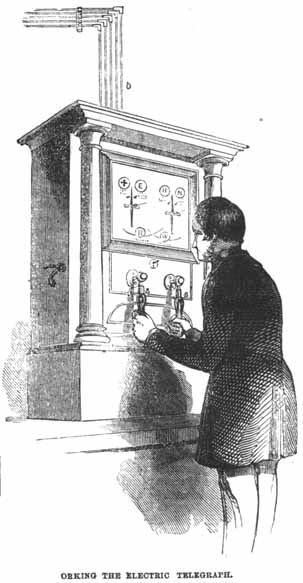
While a boy at one instrument is thus occupied in transmitting
to—say Liverpool, a message, written by its London author in
ink which is scarcely dry, another boy at the adjoining instrument
is, by the reverse of the process, attentively reading the quivering
movements of the needles of his dial, which, by a sort of St.
Vitus's dance, are rapidly spelling to him a message,
viâ the wires of the South Western Railway, say from
Gosport, which word by word he repeats aloud to an assistant, who,
seated by his side, writes it down (he receives it about as fast as
his attendant can conveniently write it); on a sheet of; paper,
which, as soon as the message is concluded, descends to the
"booking-office." When inscribed in due form, it is without
delay despatched to its destination, by messenger, cab, or express,
according to order.
Sir F. B. Head.
THE RAINBOW.
How glorious is thy girdle cast
O'er mountain, tower, and town,
Or mirror'd in the ocean vast—
A thousand fathoms down!
As fresh in yon horizon dark,
As young thy beauties seem,
As when the eagle from the ark
First sported in thy beam.
For faithful to its sacred page,
Heaven still rebuilds thy span,
Nor let the type grow pale with age,
That first spoke peace to man.
Campbell.
|
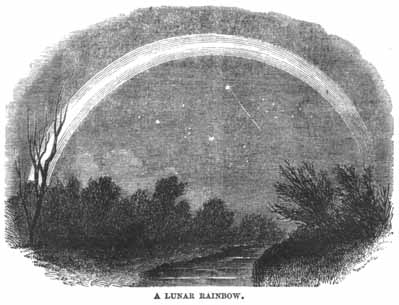
The moon sometimes exhibits the extraordinary phenomenon of an
iris or rainbow, by the refraction of her rays in drops of rain
during the night-time. This appearance is said to occur only at the
time of full moon, and to be indicative of stormy and rainy weather.
One is described in the Philosophical Transactions as having
been seen in 1810, during a thick rain; but, subsequent to that time,
the same person gives an account of one which perhaps was the most
extraordinary of which we have any record. It became visible about
nine o'clock, and continued, though with very different degrees
of brilliancy, until past two. At first, though a strongly marked
bow, it was without colour, but afterwards became extremely vivid,
the red, green, and purple being the most strongly marked. About
twelve it was the most splendid in appearance. The wind was very high
at the time, and a drizzling rain falling occasionally.
HOPE
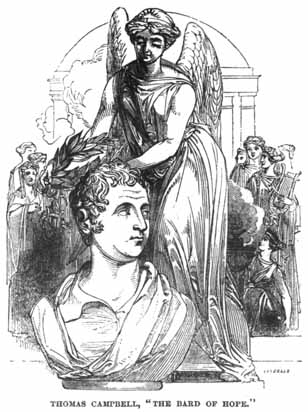
At summer eve, when Heaven's ethereal bow
Spans with bright arch the glittering hills below,
Why to yon mountain turns the musing eye,
Whose sunbright summit mingles with the sky?
Why do those cliffs of shadowy tint appear
More sweet than all the landscape smiling near?
'Tis distance lends enchantment to the view,
And robes the mountain in its azure hue.
Thus, with delight, we linger to survey,
The promised joys of life's unmeasured way;
Thus from afar each dim-discovered scene
More pleasing seems than all the past hath been;
And every form that fancy can repair
From dark oblivion, glows divinely there.
Auspicious Hope! in thy sweet garden, grow
Wreaths for each toil, a charm for every woe.
Won by their sweets, in nature's languid hour,
The way-worn pilgrim seeks thy summer bower;
Then, as the wild bee murmurs on the wing,
What peaceful dreams thy handmaid spirits bring!
What viewless forms th' Eolian organ play,
And sweep the furrow'd lines of anxious care
away!
Angel of life! thy glittering wings explore
Earth's loneliest bounds and ocean's wildest
shore.
Lo! to the wintry winds the pilot yields
His bark, careering o'er unfathom'd
fields;
Now on Atlantic waves he rides afar
Where Andes, giant of the western star,
With meteor-standard to the winds unfurl'd,
Looks from his throne of clouds o'er half the
world.
Poor child of danger, nursling of the storm,
Sad are the woes that wreck thy manly form!
Rocks, waves, and winds the shatter'd bark
delay—
Thy heart is sad, thy home is far away.
But Hope can here her moonlight vigils keep,
And sing to charm the spirit of the deep.
Swift as yon streamer lights the starry pole,
Her visions warm the watchman's pensive soul.
His native hills that rise in happier climes;
The grot that heard his song of other times;
His cottage home, his bark of slender sail,
His glassy lake, and broomwood-blossom'd vale,
Rush in his thought; he sweeps before the wind,
And treads the shore he sigh'd to leave
behind!
Pleasures of Hope.
|
LIGHTHOUSES.
Hartlepool Lighthouse is a handsome structure of white
freestone—the building itself being fifty feet in height; but,
owing to the additional height of the cliff, the light is exhibited
at an elevation of nearly eighty-five feet above high-water mark. On
the eastern side of the building is placed a balcony, supporting a
lantern, from which a small red light is exhibited, to indicate that
state of the tide which will admit of the entrance of ships into the
harbour; the corresponding signal in the daytime being a red ball
hoisted to the top of the flag-staff. The lighthouse is furnished
with an anemometer and tidal gauge; and its appointments are
altogether of the most complete description. It is chiefly, however,
with regard to the system adopted in the lighting arrangements that
novelty presents itself.
The main object, in the instance of a light placed as a beacon to
warn mariners of their proximity to a dangerous coast, is to obtain
the greatest possible intensity and amount of penetrating power. A
naked or simple light is therefore seldom, if ever employed; but
whether it proceed from the combustion of oil or gas, it is equally
necessary that it should be combined with some arrangement of optical
apparatus, in order that the rays emitted may be collected, and
projected in such a direction as to render them available to the
object in view; and in all cases a highly-polished metal surface is
employed as a reflector.
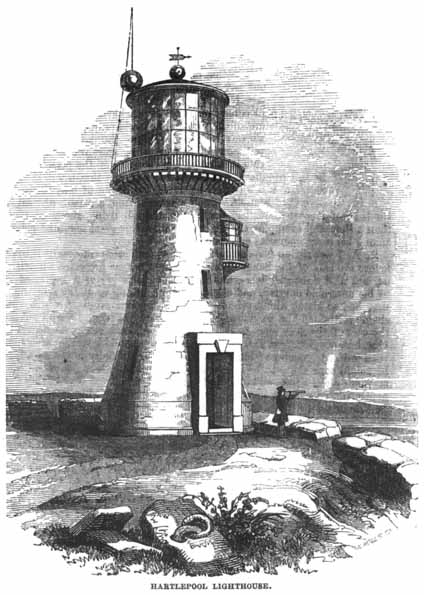
In the Hartlepool Lighthouse the illuminative medium is
gas. The optical apparatus embraces three-fourths of the
circumference of the circle which encloses the light, and the whole
of the rays emanating from that part of the light opposed to the
optical arrangement are reflected or refracted (as the case may be),
so that they are projected from the lighthouse in such a direction as
to be visible from the surface of the ocean.
INTEGRITY.
Can anything (says Plato) be more delightful than the hearing or
the speaking of truth? For this reason it is that there is no
conversation so agreeable that of a man of integrity, who hears
without any intention to betray, and speaks without any intention to
deceive. As an advocate was pleading the cause of his client in Rome,
before one of the praetors, he could only produce a single witness in
a point where the law required the testimony of two persons; upon
which the advocate insisted on the integrity of the person whom he
had produced, but the praetor told him that where the law required
two witnesses he would not accept of one, though it were Cato
himself. Such a speech, from a person who sat at the head of a court
of justice, while Cato was still living, shows us, more than a
thousand examples, the high reputation this great man had gained
among his contemporaries on account of his sincerity.
2. As I was sitting (says an ancient writer) with some senators of
Bruges, before the gate of the Senate-House, a certain beggar
presented himself to us, and with sighs and tears, and many
lamentable gestures, expressed to us his miserable poverty, and asked
our alms, telling us at the same time, that he had about him a
private maim and a secret mischief, which very shame restrained him
from discovering to the eyes of men. We all pitying the case of the
poor man, gave him each of us something, and departed. One, however,
amongst us took an opportunity to send his servant after him, with
orders to inquire of him what that private infirmity might be which
he found such cause to be ashamed of, and was so loth to discover.
The servant overtook him, and delivered his commission: and after
having diligently viewed his face, breast, arms, legs, and finding
all his limbs in apparent soundness, "Why, friend," said
he, "I see nothing whereof you have any such reason to
complain." "Alas! sir," said the beggar, "the
disease which afflicts me is far different from what you conceive,
and is such as you cannot discern; yet it is an evil which hath crept
over my whole body: it has passed through my very veins and marrow in
such a manner that there is no member of my body that is able to work
for my daily bread. This disease is by some called idleness, and by
others sloth." The servant, hearing this singular apology, left
him in great anger, and returned to his master with the above
account; but before the company could send again to make further
inquiry after him, the beggar had very prudently withdrawn
himself.
3. Action, we are assured, keeps the soul in constant health; but
idleness corrupts and rusts the mind; for a man of great abilities
may by negligence and idleness become so mean and despicable as to be
an incumbrance to society and a burthen to himself. When the Roman
historians described an extraordinary man, it generally entered into
his character, as an essential, that he was incredibili
industriâ, diligentiâ singulari—of incredible
industry, of singular diligence and application. And Cato, in
Sallust, informs the Senate, that it was not so much the arms as the
industry of their ancestors, which advanced the grandeur of Rome, and
made her mistress of the world.
Dr. Dodd.
RAFT OF GAMBIER ISLANDERS
The group in the Pacific Ocean called the Gambier Islands are but
thinly inhabited, but possess a good harbour. Captain Beechey, in his
"Narrative of a Voyage to the Pacific and Behring's
Straits," tells us that several of the islands, especially the
largest, have a fertile appearance. The Captain gives an interesting
account of his interview with some of the natives, who approached the
ship in rafts, carrying from sixteen to twenty men each, as
represented in the Engraving.
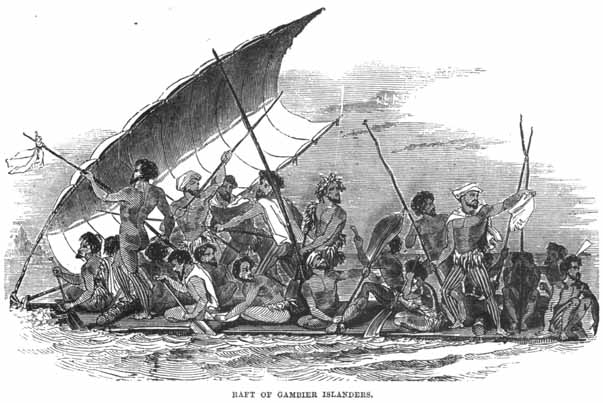
"We were much pleased," says the Captain, "with the
manner of lowering their matting sail, diverging on different
courses, and working their paddles, in the use of which they had
great power, and were well skilled, plying them together, or, to use
a nautical phrase, 'keeping stroke.' They had no other
weapons but long poles, and were quite naked, with the exception of a
banana leaf cut into strips, and tied about their loins; and one or
two persons wore white turbans." They timidly approached both
the ship and the barge, but would upset any small boats within their
reach; not, however, from any malicious intention, but from
thoughtlessness and inquisitiveness. Captain Beechey approached them
in the gig, and gave them several presents, for which they, in
return, threw him some bundles of paste, tied up in large leaves,
which was the common food of the natives. They tempted the Captain
and his crew with cocoa-nuts and roots, and invited their approach by
performing ludicrous dances; but, as soon as the visitors were within
reach, all was confusion. A scuffle ensued, and on a gun being fired
over their heads, all but four instantly plunged into the sea. The
inhabitants of these islands are stated to be well-made, with upright
and graceful figures. Tattooing seems to be very commonly practised,
and some of the patterns are described as being very elegant.
CHRISTIAN FREEDOM.
"He is the freeman whom the truth makes
free,"
Who first of all the bands of Satan breaks;
Who breaks the bands of sin, and for his soul,
In spite of fools, consulteth seriously;
In spite of fashion, perseveres in good;
In spite of wealth or poverty, upright;
Who does as reason, not as fancy bids;
Who hears Temptation sing, and yet turns not
Aside; sees Sin bedeck her flowery bed,
And yet will not go up; feels at his heart
The sword unsheathed, yet will not sell the truth;
Who, having power, has not the will to hurt;
Who feels ashamed to be, or have a slave,
Whom nought makes blush but sin, fears nought but
God;
Who, finally, in strong integrity
Of soul, 'midst want, or riches, or disgrace
Uplifted, calmly sat, and heard the waves
Of stormy Folly breaking at his feet,
Nor shrill with praise, nor hoarse with foal
reproach,
And both despised sincerely; seeking this
Alone, the approbation of his God,
Which still with conscience witness'd to his
peace.
This, this is freedom, such as Angels use,
And kindred to the liberty of God!
Pollock.
|
THE POLAR REGIONS.
The adventurous spirit of Englishmen has caused them to fit out no
less than sixty expeditions within the last three centuries and a
half, with the sole object of discovering a north-west passage to
India. Without attempting even to enumerate these baffled essays, we
will at once carry our young readers to these dreary
regions—dreary, merely because their capabilities are unsuited
to the necessities which are obvious to all, yet performing their
allotted office in the economy of the world, and manifesting the
majesty and the glory of our great Creator.
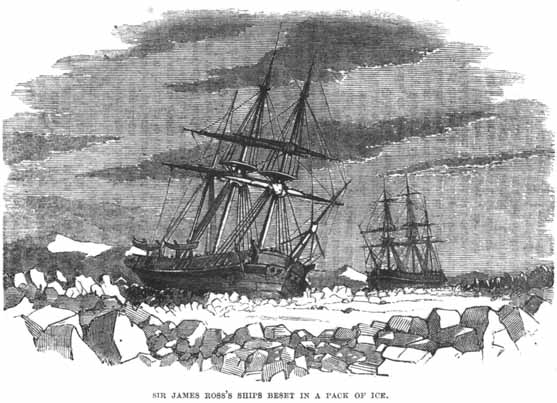
Winter in the Arctic Circle is winter indeed: there is no sun to
gladden with his beams the hearts of the voyagers; but all is wrapt
in darkness, day and night, save when the moon chances to obtrude her
faint rays, only to make visible the desolation of the scene. The
approach of winter is strongly marked. Snow begins to fall in August,
and the ground is covered to the depth of two or three feet before
October. As the cold augments, the air bears its moisture in the form
of a frozen fog, the icicles of which are so sharp as to be painful
to the skin. The surface of the sea steams like a lime-kiln, caused
by the water being still warmer than the superincumbent atmosphere.
The mist at last clears, the water having become frozen, and darkness
settles on the land. All is silence, broken only by the bark of the
Arctic fox, or by the loud explosion of bursting rocks, as the frost
penetrates their bosoms.
The crews of exploring vessels, which are frozen firmly in the ice
in winter, spend almost the whole of their time in their ships, which
in Sir James Ross's expedition (in 1848-49) were well warmed and
ventilated. Where there has not been sufficient warmth, their
provisions—even brandy—became so frozen as to require to
be cut by a hatchet. The mercury in a barometer has frozen so that it
might be beaten on an anvil.
As Sir James Ross went in search of Sir John Franklin, he adopted
various methods of letting him know (if alive) of assistance being at
hand. Provisions were deposited in several marked places; and on the
excursions to make these deposits, they underwent terrible fatigue,
as well as suffered severely from what is termed "snow
blindness." But the greatest display of ingenuity was in
capturing a number of white foxes, and fastening copper collars round
their necks, on which was engraved a notice of the position of the
ships and provisions. It was possible that these animals, which are
known to travel very far in search of food, might be captured by the
missing voyagers, who would thus be enabled to avail themselves of
the assistance intended for them by their noble countrymen. The
little foxes, in their desire to escape, sometimes tried to gnaw the
bars of their traps; but the cold was so intense, that their tongues
froze to the iron, and so their captors had to kill them, to release
them from their misery, for they were never wantonly destroyed.
The great Painter of the Universe has not forgotten the
embellishment of the Pole. One of the most beautiful phenomena in
nature is the Aurora Borealis, or northern lights. It generally
assumes the form of an arch, darting flashes of lilac, yellow, or
white light towards the heights of heaven. Some travellers state that
the aurora are accompanied by a crackling or hissing noise; but
Captain Lyon, who listened for hours, says that this is not the case,
and that it is merely that the imagination cannot picture these
sudden bursts of light as unaccompanied by noise.
We will now bid farewell to winter, for with returning summer
comes the open sea, and the vessels leave their wintry bed. This,
however, is attended with much difficulty and danger. Canals have to
be cut in the ice, through which to lead the ships to a less
obstructed ocean; and, after this had been done in Sir James
Ross's case, the ships were hemmed in by a pack of ice, fifty
miles in circumference, and were carried along, utterly helpless, at
the rate of eight or ten miles daily, for upwards of 250
miles—the navigators fearing the adverse winds might drive them
on the rocky coast of Baffin's Bay. At length the wind changed,
and carried them clear of ice and icebergs (detached masses of ice,
sometimes several hundred feet in height) to the open sea, and back
to their native land.
With all its dreariness, we owe much to the ice-bound Pole; to it
we are indebted for the cooling breeze and the howling
tempest—the beneficent tempest, in spite of all its desolation
and woe. Evil and good in nature are comparative: the same thing does
what is called harm in one sense, but incalculable good in another.
So the tempest, that causes the wreck, and makes widows of happy
wives and orphans of joyous children, sets in motion air that would
else be stagnant, and become the breath of pestilence and the
grave.
THE CROWN JEWELS.
All the Crown Jewels, or Regalia, used by the Sovereign on great
state occasions, are kept in the Tower of London, where they have
been for nearly two centuries. The first express mention made of the
Regalia being kept in this palatial fortress, occurs in the reign of
Henry III., previously to which they were deposited either in the
Treasury of the Temple, or in some religious house dependent upon the
Crown. Seldom, however, did the jewels remain in the Tower for any
length of time, for they were repeatedly pledged to meet the
exigences of the Sovereign. An inventory of the jewels in the Tower,
made by order of James I., is of great length; although Henry III.,
during the Lincolnshire rebellion, in 1536, greatly reduced the value
and number of the Royal store. In the reign of Charles II., a
desperate attempt was made by Colonel Blood and his accomplices to
possess themselves of the Royal Jewels.
The Regalia were originally kept in a small building on the south
side of the White Tower; but, in the reign of Charles I., they were
transferred to a strong chamber in the Martin Tower, afterwards
called the Jewel Tower. Here they remained until the fire in 1840;
when being threatened with destruction from the flames which were
raging near them, they were carried away by the warders, and placed
for safety in the house of the Governor. In 1841 they were removed to
the new Jewel-House, which is much more commodious than the old
vaulted chamber in which they were previously shown.
The QUEEN'S, or IMPERIAL CROWN was made for the coronation of
her present Majesty. It is composed of a cap of purple velvet,
enclosed by hoops of silver, richly dight with gems, in the form
shown in our Illustration. The arches rise almost to a point instead
of being depressed, are covered with pearls, and are surmounted by an
orb of brilliants. Upon this is placed a Maltese or cross pattee of
brilliants. Four crosses and four fleurs-de-lis surmount the
circlet, all composed of diamonds, the front cross containing the
"inestimable sapphire," of the purest and deepest azure,
more than two inches long, and an inch broad; and, in the circlet
beneath it, is a rock ruby, of enormous size and exquisite colour,
said to have been worn by the Black Prince at the battle of
Cressy, and by Henry V. at the battle of Agincourt. The circlet is
enriched with diamonds, emeralds, sapphires, and rubies. This crown
was altered from the one constructed expressly for the coronation of
King George IV.: the superb diadem then weighed 5-1/2 lb., and was
worn by the King on his return in procession from the Abbey to the
Hall at Westminster.
The OLD IMPERIAL CROWN (St. Edward's) is the one whose form is
so familiar to us from its frequent representation on the coin of the
realm, the Royal arms, &c. It was made for the coronation of
Charles II., to replace the one broken up and sold during the Civil
Wars, which was said to have been worn by Edward the Confessor. It is
of gold, and consists of two arches crossing at the top, and rising
from a rim or circlet of gold, over a cap of crimson velvet, lined
with white taffeta, and turned up with ermine. The base of the arches
on each side is covered by a cross pattee; between the crosses are
four fleurs-de-lis of gold, which rise out of the circle: the
whole of these are splendidly enriched with pearls and precious
stones. On the top, at the intersection of the arches, which are
somewhat depressed, are a mound and cross of gold the latter richly
jewelled, and adorned with three pearls, one on the top, and one
pendent at each limb.
The PRINCE OF WALES'S CROWN is of pure gold, unadorned with
jewels. On occasions of state, it is placed before the seat occupied
by the Heir-Apparent to the throne in the House of Lords.
The QUEEN'S DIADEM was made for the coronation of Marie
d'Este, consort of James II., it is adorned with large diamonds,
and the upper edge of the circlet is bordered with pearls.
The TEMPORAL SCEPTRE of Queen Victoria is of gold, 2 feet 9 inch
in length; the staff is very plain, but the pommel is ornamented with
rubies, emeralds, and diamonds. The fleurs-de-lis with which
this sceptre was originally adorned have been replaced by golden
leaves, bearing the rose, shamrock, and thistle. The cross is
variously jewelled, and has in the centre a large table diamond.
Her Majesty's SPIRITUAL SCEPTRE, Rod of Equity, or Sceptre
with the Dove, is also of gold, 3 feet 7 inches long, set with
diamonds and other precious stones. It is surmounted by an orb,
banded with rose diamonds, bearing a cross, on which is the figure of
a dove with expanded wings.
The QUEEN'S IVORY SCEPTRE was made for Maria d'Este,
consort of James II. It is mounted in gold, and terminated by a
golden cross, bearing a dove of white onyx.
The ampulla is an antique vessel of pure gold, used for containing
the holy oil at coronations. It resembles an eagle with expanded
wings, and is finely chased: the head screws off at the middle of the
neck for pouring in the oil; and the neck being hollow to the beak
the latter serves as a spout, through which the consecrated oil is
poured into
The ANOINTING SPOON, which is also of pure gold: it has four
pearls in the broadest part of the handle, and the bowl of the spoon
is finely chased within and without; by its extreme thinness, it
appears to be ancient.
The ARMILLAE, or BRACELETS, are of solid fine gold, chased, 1-1/2
inch in breadth, edged with rows of pearls. They open by a hinge, and
are enamelled with the rose, fleur-de-lis, and harp.
The IMPERIAL ORB, or MOUND, is an emblem of sovereignty, said to
have been derived from Imperial Rome, and to have been first adorned
with the cross by Constantine, on his conversion to Christianity. It
first appears among the Royal insignia of England on the coins of
Edward the Confessor. This orb is a ball of gold, 6 inches in
diameter, encompassed with a band of gold, set with emeralds, rubies,
and pearls. On the top is a remarkably fine amethyst, nearly 1-1/2
inch high, which serves as the foot or pedestal of a rich cross of
gold, 32 inches high, encrusted with diamonds; having in the centre,
on one side, a sapphire, and an emerald on the other; four large
pearls at the angles of the cross, a large pearl at the end of each
limb, and three at the base; the height of the orb and cross being 11
inches.
The QUEEN'S ORB is of smaller dimensions than the preceding,
but of similar materials and fashion.
The SALT-CELLARS are of singular form and rich workmanship. The
most noticeable is—the Golden Salt-cellar of State,
which is of pure gold, richly adorned with jewels, and grotesque
figures in chased work. Its form is castellated: and the receptacles
for the salt are formed by the removal of the tops of the
turrets.
In the same chamber with the Crowns, Sceptres, and other Regalia
used in the ceremonial of the Coronation, is a very interesting
collection ofAMPULLA plate, formerly used at Coronation festivals;
together with fonts, &c. Amongst these are
The QUEEN'S BAPTISMAL FONT, which is of silver, gilt,
tastefully chased, and surmounted by two figures emblematical of the
baptismal rite: this font was formerly used at the christening of the
Royal family; but a new font of more picturesque design, has lately
be n manufactured for her Majesty.
There are, besides, in the collection, a large Silver Wine
Fountain, presented by the corporation of Plymouth to Charles II.;
two massive Coronation Tankards, of gold; a Banqueting Dish, and
other dishes and spoons of gold, used at Coronation festivals;
besides a beautifully-wrought service of Sacramental Plate, employed
at the Coronation, and used also in the Chapel of St. Peter in the
Tower.
WHAT IS TIME?
 |
I ask'd an aged man, a man of cares,
Wrinkled and curved, and white with hoary hairs:
"Time is the warp of life," he said;
"Oh tell
The young, the fair, the gay, to weave 't
well!"
I ask'd the ancient, venerable dead—
Sages who wrote, and warriors who bled:
From the cold grave a hollow murmur
flow'd—
"Time sow'd the seed we reap in this
abode!"
I ask'd a dying sinner, ere the tide
Of life had left his veins: "Time?" he
replied,
"I've lost it! Ah, the treasure!" and he
died.
I ask'd the golden sun and silver spheres,
Those bright chronometers of days and years:
They answer'd: "Time is but a meteor's
glare,"
And bade me for Eternity prepare.
I ask'd the Seasons, in their annual round,
Which beautify or desolate the ground;
And they replied (no oracle more wise):
"'Tis Folly's blank, and Wisdom's
highest prize!"
I ask'd a spirit lost, but oh! the shriek
That pierced my soul! I shudder while I speak.
It cried, "A particle! a speck! a mite
Of endless years—duration infinite!"
Of things inanimate, my dial I
Consulted, and it made me this reply:
"Time is the season fair of living
well—
The path of glory, or the path of hell."
I ask'd my Bible, and methinks it said:
"Time is the present hour—the past is
fled:
Live! live to-day; to-morrow never yet
On any human being rose or set."
I ask'd old Father Time himself at last,
But in a moment he flew swiftly past—
His chariot was a cloud, the viewless wind
His noiseless steeds, which left no trace behind.
I ask'd the mighty Angel who shall stand
One foot on sea, and one on solid land;
"By Heaven!" he cried, "I swear the
mystery's o'er;
Time was," he cried, "but time shall be no
more!"
Rev. J. Marsden.
|
SIMPLICITY IN WRITING.
Fine writing, according to Mr. Addison, consists of sentiments
which are natural without being obvious. There cannot be a juster and
more concise definition of fine writing.
Sentiments which are merely natural affect not the mind with any
pleasure, and seem not worthy to engage our attention. The
pleasantries of a waterman, the observations of a peasant, the
ribaldry of a porter or hackney-coachman; all these are natural and
disagreeable. What an insipid comedy should we make of the chit-chit
of the tea-table, copied faithfully and at full length! Nothing can
please persons of taste but nature drawn with all her graces and
ornament—la belle nature; or, if we copy low life, the
strokes must be strong and remarkable, and must convey a lively image
to the mind. The absurd naïveté of Sancho Panza is
represented in such inimitable colours by Cervantes, that it
entertains as much as the picture of the most magnanimous hero or
softest lover.
The case is the same with orators, philosophers, critics, or any
author who speaks in his own person without introducing other
speakers or actors. If his language be not elegant, his observations
uncommon, his sense strong and masculine, he will in vain boast his
nature and simplicity. He may be correct, but he never will be
agreeable. 'Tis the unhappiness of such authors that they are
never blamed nor censured. The good fortune of a book and that of a
man are not the same. The secret deceiving path of life, which Horace
talks of—fallentis semita vitae—may be the
happiest, lot of the one, but is the greatest misfortune that the
other can possibly fall into.
On the other hand, productions which are merely surprising,
without being natural, can never give any lasting entertainment to
the mind. To draw chimaeras is not, properly speaking, to copy or
imitate. The justness of the representation is lost, and the mind is
displeased to find a picture which bears no resemblance to any
original. Nor are such excessive refinements more agreeable in the
epistolary or philosophic style, than in the epic or tragic. Too much
ornament is a fault in every kind of production. Uncommon
expressions, strong flashes of wit, pointed similes, and epigrammatic
turns, especially when laid too thick, are a disfigurement rather
than any embellishment of discourse. As the eye, in surveying a
Gothic building, is distracted by the multiplicity of ornaments, and
loses the whole by its minute attention to the parts; so the mind, in
perusing a work overstocked with wit, is fatigued and disgusted with
the constant endeavour to shine and surprise. This is the case where
a writer over-abounds in wit, even though that wit should be just and
agreeable. But it commonly happens to such writers, that they seek
for their favourite ornaments even where the subject affords them
not; and by that means have twenty insipid conceits for one thought
that is really beautiful.
There is no subject in critical learning more copious than this of
the just mixture of simplicity and refinement in writing; and,
therefore, not to wander in too large a field, I shall confine myself
to a few general observations on that head.
First, I observe, "That though excesses of both kinds are to
be avoided, and though a proper medium ought to be studied in all
productions; yet this medium lies not in a point, but admits of a
very considerable latitude." Consider the wide distance, in this
respect, between Mr. Pope and Lucretius. These seem to lie in the two
greatest extremes of refinement and simplicity which a poet can
indulge himself in, without being guilty of any blameable excess. All
this interval may be filled with poets, who may differ from each
other, but may be equally admirable, each in his peculiar style and
manner. Corneille and Congreve, who carry their wit and refinement
somewhat farther than Mr. Pope (if poets of so different a kind can
be compared together), and Sophocles and Terence, who are more simple
than Lucretius, seem to have gone out of that medium wherein the most
perfect productions are to be found, and are guilty of some excess in
these opposite characters. Of all the great poets, Virgil and Racine,
in my opinion, lie nearest the centre, and are the farthest removed
from both the extremities.
My second observation on this head is, "That it is very
difficult, if not impossible, to explain by words wherein the just
medium betwixt the excesses of simplicity and refinement consists, or
to give any rule by which we can know precisely the bounds betwixt
the fault and the beauty." A critic may not only discourse very
judiciously on this head without instructing his readers, but even
without understanding the matter perfectly himself. There is not in
the world a finer piece of criticism than Fontenelle's
"Dissertation on Pastorals;" wherein, by a number of
reflections and philosophical reasonings, he endeavours to fix the
just medium which is suitable to that species of writing. But let any
one read the pastorals of that author, and he will be convinced, that
this judicious critic, notwithstanding his fine reasonings, had a
false taste, and fixed the point of perfection much nearer the
extreme of refinement than pastoral poetry will admit of. The
sentiments of his shepherds are better suited to the toilets of Paris
than to the forests of Arcadia. But this it is impossible to discover
from his critical reasonings. He blames all excessive painting and
ornament, as much as Virgil could have done had he written a
dissertation on this species of poetry. However different the tastes
of men may be, their general discourses on these subjects are
commonly the same. No criticism can be very instructive which
descends not to particulars, and is not full of examples and
illustrations. 'Tis allowed on all hands, that beauty, as well as
virtue, lies always in a medium; but where this medium is placed is
the great question, and can never be sufficiently explained by
general reasonings.
I shall deliver it as a third observation on this subject,
"That we ought to be more on our guard against the excess of
refinement than that of simplicity; and that because the former
excess is both less beautiful and more dangerous than the
latter."
It is a certain rule that wit and passion are entirely
inconsistent. When the affections are moved, there is no place for
the imagination. The mind of man being naturally limited, it is
impossible all his faculties can operate at once; and the more any
one predominates, the less room is there for the others to exert
their vigour. For this reason a greater degree of simplicity is
required in all compositions, where men and actions and passions are
painted, than in such as consist of reflections and observations. And
as the former species of writing is the more engaging and beautiful,
one may safely, upon this account, give the preference to the extreme
of simplicity above that of refinement.
We may also observe, that those compositions which we read the
oftenest, and which every man of taste has got by heart, have the
recommendation of simplicity, and have nothing surprising in the
thought when divested of that elegance of expression and harmony of
numbers with which it is cloathed. If the merit of the composition
lies in a point of wit, it may strike at first; but the mind
anticipates the thought in the second perusal, and is no longer
affected by it. When I read an epigram of Martial, the first line
recalls the whole; and I have no pleasure in repeating to myself what
I know already. But each line, each word in Catullus has its merit;
and I am never tired with the perusal of him. It is sufficient to rim
over Cowley once; but Parnel, after the fiftieth reading, is fresh as
at the first. Besides, it is with books as with women, where a
certain plainness of manner and of dress is more engaging than that
glare of paint and airs and apparel which may dazzle the eye but
reaches not the affections. Terence is a modest and bashful beauty,
to whom we grant every thing, because he assumes nothing, and whose
purity and nature make a durable though not a violent impression upon
us.
But refinement, as it is the less beautiful, so it is the more
dangerous extreme, and what we are the aptest to fall into.
Simplicity passes for dulness when it is not accompanied with great
elegance and propriety. On the contrary, there is something
surprising in a blaze of wit and conceit. Ordinary readers are
mightily struck with it, and falsely imagine it to be the most
difficult, as well as most excellent way of writing. Seneca abounds
with agreeable faults, says Quinctilian—abundat dulcibus
vitiis; and for that reason is the more dangerous and the more
apt to pervert the taste of the young and inconsiderate.
I shall add, that the excess of refinement is now more to be
guarded against than ever; because it is the extreme which men are
the most apt to fall into, after learning has made great progress,
and after eminent writers have appeared in every species of
composition. The endeavour to please by novelty leads men wide of
simplicity and nature, and fills their writings with affectation and
conceit. It was thus that the age of Claudius and Nero became so much
inferior to that of Augustus in taste and genius; and perhaps there
are at present some symptoms of a like degeneracy of taste, in France
as well as in England.
Hume.
JOHN HAMPDEN.
The celebrated patriot, John Hampden, was descended from an
ancient family in Buckinghamshire, where he was born in 1594. On
leaving the University, he entered the inns of court, where he made
considerable progress in the study of the law. He was chosen to serve
in the Parliament which assembled at Westminster, February, 1626, and
served in all the succeeding Parliaments in the reign of Charles I.
That Monarch having quarrelled with his Parliament, was obliged to
have recourse to the open exercise of his prerogative in order to
supply himself with money. From the nobility he desired assistance;
from the City of London he required a loan of £100,000. The
former contributed but slowly; the latter at length gave a flat
denial. To equip a fleet, an apportionment was made, by order of the
Council, amongst all the maritime towns, each of which was required,
with the assistance of the adjoining counties, to furnish a certain
number of vessels or amount of shipping. The City of London was rated
at twenty ships. And this was the first appearance in the present
reign of ship-money—a taxation which had once been imposed by
Elizabeth, on a great emergency, but which, revived and carried
further by Charles, produced the most violent discontent.
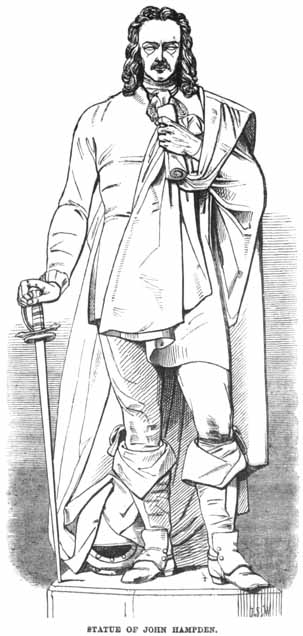
In 1636, John Hampden became universally known by his intrepid
opposition to the ship-money, as an illegal tax. Upon this he was
prosecuted, and his conduct throughout the transaction gained him
great credit and reputation. When the Long Parliament began, the eyes
of all were fixed upon him as the father of his country. On the 3rd
of January, 1642, the King ordered articles of high treason, and
other misdemeanours, to be prepared against Lord Kimbolton, Mr.
Hampden, and four other members of the House of Commons, and went to
the House to seize them, but they had retired. Mr. Hampden afterwards
made a celebrated speech in the House to clear himself from the
charge brought against him.
In the beginning of the civil war Hampden commanded a regiment of
foot, and did good service at the battle of Edgehill; but he received
a mortal wound in an engagement with Prince Rupert, in
Chalgrave-field, in Oxfordshire, and died in 1648. Hampden is said to
have possessed in a high degree talents for gaining and preserving
popular influence, and great courage, industry, and strength of mind,
which procured him great ascendancy over other men.
OTHELLO'S HISTORY.
 |
Her father loved me; oft invited me;
Still question'd me the story of my life,
From year to year: the battles, sieges, fortunes,
That I have past.
I ran it through, even from my boyish days
To the very moment that he bade me tell it.
Wherein I spake of most disastrous chances,
Of moving incidents by flood and field,
Of hair-breadth 'scapes in the imminent deadly
breach,
Of being taken by the insolent foe,
And sold to slavery; of my redemption thence,
And 'portance in my travels' history;
Wherein of antres vast, and deserts idle,
Rough quarries, rocks, and hills whose heads touch
heaven,
It was my hint to speak—such was the
process;
And of the cannibals that each other eat—
The Anthropophagi—and men whose heads
Do grow beneath their shoulders. These things to
bear
Would Desdemona seriously incline:
still the house affairs would draw her thence;
Which ever as she could with haste dispatch,
She'd come again, and with a greedy ear
Devour up my discourse; which I observing,
Took once a pliant hour, and found good means
To draw from her a prayer of earnest heart,
That I would all my pilgrimage relate,
Whereof by parcels she had something heard
But not intentively: I did consent;
And often did beguile her of her tears,
When I did speak of some distressful stroke
That my youth suffer'd. My story being done,
She gave me for my pains a world of sighs;
She swore—in faith 'twas strange, 'twas
passing strange;
'Twas pitiful, 'twas wondrous pitiful;
She wish'd she had not heard it; yet she
wish'd
That Heaven had made her such a man: she thank'd
me;
And bade me if I had a friend that loved her,
I should but teach him how to tell my story,
And that would woo her. Upon this hint I spake;
She loved me for the dangers I had pass'd,
And I loved her that she did pity them.
This only is the witchcraft I have used:
Here comes the lady; let her witness it.
Shakspeare.
|
FILIAL LOVE.
Verily duty to parents is of the first consequence; and would you,
my young friends, recommend yourselves to the favour of your God and
Father, would you imitate the example of your adorable Redeemer, and
be made an inheritor of his precious promises; would you enjoy the
peace and comforts of this life, and the good esteem of your
fellow-creatures—Reverence your parents; and be it your
constant endeavour, as it will be your greatest satisfaction, to
witness your high sense of, and to make some returns for the
obligations you owe to them, by every act of filial obedience and
love.
Let their commands be ever sacred in your ears, and implicitly
obeyed, where they do not contradict the commands of God: pretend not
to be wiser than they, who have had so much more experience than
yourselves; and despise them not, if haply you should be so blest as
to have gained a degree of knowledge or of fortune superior to them.
Let your carriage towards them be always respectful, reverent, and
submissive; let your words be always affectionate and humble, and
especially beware of pert and ill-seeming replies; of angry,
discontented, and peevish looks. Never imagine, if they thwart your
wills, or oppose your inclinations, that this ariseth from any thing
but love to you: solicitous as they have ever been for your welfare,
always consider the same tender solicitude as exerting itself, even
in cases most opposite to your desires; and let the remembrance of
what they have done and suffered for you, ever preserve you from acts
of disobedience, and from paining those good hearts which have
already felt so much for you, their children.
The Emperor of China, on certain days of the year, pays a visit to
his mother, who is seated on a throne to receive him; and four times
on his feet, and as often on his knees, he makes her a profound
obeisance, bowing his head even to the ground.
Sir Thomas More seems to have emulated this beautiful example;
for, being Lord Chancellor of England at the same time that his
father was a Judge of the King's Bench, he would always, on his
entering Westminster Hall, go first to the King's Bench, and ask
his father's blessing before he went to sit in the Court of
Chancery, as if to secure success in the great decisions of his high
and important office.
Dr. Dodd.
QUEEN MARY'S BOWER, CHATSWORTH.
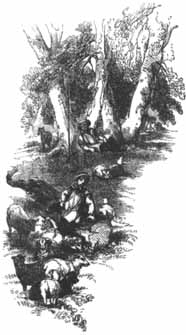
When the widowed Mary, Queen of Scots, left France, where she had
dwelt since her fifth year—where she had shared in the
education of the French King's own daughters, in one of the
convents of the kingdom, and been the idol of the French Court and
people, it is said that, as the coast of the happy land faded from
her view, she continued to exclaim, "Farewell, France! farewell,
dear France—I shall never see thee more!" And her first
view of Scotland only increased the poignancy of these touching
regrets. So little pains had been taken to "cover over the
nakedness and poverty of the land," that tears sprang into her
eyes, when, fresh from the elegant luxurious Court of Paris, she saw
the wretched ponies, with bare, wooden saddles, or dirty and ragged
trappings, which had been provided to carry her and her ladies from
the water-side to Holyrood. And then the palace itself; how different
from the palaces in which she had lived in France! Dismal and small,
it consisted only of what is now the north wing. The state-room and
the bed-chamber which were used by her yet remain, with the old
furniture, and much of the needle-work there is said to have been the
work of her hands. During her long and melancholy imprisonment in
England, the art of needle-work and reading were almost her only mode
of relieving the dreary hours.
From the moment Mary of Scotland took the fatal resolution of
throwing herself upon the supposed kindness and generosity of
Elizabeth, her fate was sealed, and it was that of captivity, only to
be ended by death. She was immediately cut off from all communication
with her subjects, except such as it was deemed proper to allow; and
was moved about from place to place, the better to ensure her safety.
The hapless victim again and again implored Elizabeth to deal
generously and justly with her. "I came," said she, in one
of her letters, "of mine own accord; let me depart again with
yours: and if God permit my cause to succeed, I shall be bound to you
for it." But her rival was unrelenting, and, in fact, increased
the rigours of her confinement. Whilst a prisoner at Chatsworth, she
had been permitted the indulgence of air and exercise; and the bower
of Queen Mary is still shown in the noble grounds of that place, as a
favourite resort of the unfortunate captive. But even this absolutely
necessary indulgence was afterwards denied; she was wholly confined
to the Castle of Fotheringay, and a standing order was issued that
"she should be shot if she attempted to escape, or if others
attempted to rescue her."
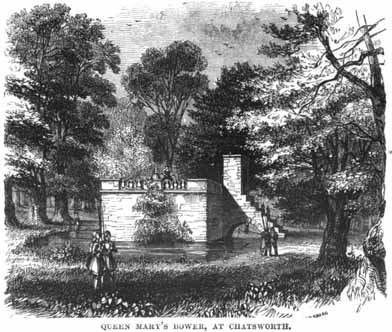
Burns, in his "Lament of Mary, Queen of Scots,"
touchingly expresses the weary feelings that must have existed in the
breast of the Royal captive:—
"Oh, soon to me may summer suns
Nae mair light up the morn!
Nae mair to me the autumn winds
Wave o'er the yellow corn!
And in the narrow house of death,
Let winter round me rave;
And the next flowers that deck the spring,
Bloom on my peaceful grave."
|
TUBULAR RAILWAY BRIDGES.
In the year 1850, a vast line of railway was completed from
Chester to Holyhead, for the conveyance of the Royal mails, of goods
and passengers, and of her Majesty's troops and artillery,
between London and Dublin—Holyhead being the most desirable
point at which to effect this communication with Ireland. Upon this
railway are two stupendous bridges, which are the most perfect
examples of engineering skill ever executed in England, or in any
other country.
The first of these bridges carries the railway across the river
Conway, close to the ancient castle built by Edward I. in order to
bridle his new subjects, the Welsh.
The Conway bridge consists of a tube, or long, huge chest, the
ends of which rest upon stone piers, built to correspond with the
architecture of the old castle. The tube is made of wrought-iron
plates, varying in thickness from a quarter of an inch to one inch,
riveted together, and strengthened by irons in the form of the letter
T; and, to give additional strength to the whole, a series of cells
is formed at the bottom and top of the tube, between an inner ceiling
and floor and the exterior plates; the iron plates which form the
cells being riveted and held in their places by angle irons. The
space between the sides of the tube is 14 feet; and the height of the
whole, inclusive of the cells, is 22 feet 3-1/2 inches at the ends,
and 25 feet 6 inches at the centre. The total length of the tube is
412 feet. One end of the tube is fixed to the masonry of the pier;
but the other is so arranged as to allow for the expansion of the
metal by changes of the temperature of the atmosphere, and it
therefore, rests upon eleven rollers of iron, running upon a
bed-plate; and, that the whole weight of the tube may not be carried
by these rollers, six girders are carried over the tube, and riveted
to the upper parts of its sides, which rest upon twelve balls of
gun-metal running in grooves, which are fixed to iron beams let into
the masonry.
The second of these vast railway bridges crosses the Menai
Straits, which separate Caernarvon from the island of Anglesey. It is
constructed a good hundred feet above high-water level, to enable
large vessels to sail beneath it; and in building it, neither
scaffolding nor centering was used.
The abutments on either side of the Straits are huge piles of
masonry. That on the Anglesey side is 143 feet high, and 173 feet
long. The wing walls of both terminate in splendid pedestals, and on
each are two colossal lions, of Egyptian design; each being 25 feet
long, 12 feet high though crouched, 9 feet abaft the body, and each
paw 2 feet 1 inches. Each weighs 30 tons. The towers for supporting
the tube are of a like magnitude with the entire work. The great
Britannia Tower, in the centre of the Straits, is 62 feet by 52 feet
at its base; its total height from the bottom, 230 feet; it contains
148,625 cubic feet of limestone, and 144,625 of sandstone; it weighs
20,000 tons; and there are 387 tons of cast iron built into it in the
shape of beams and girders. It sustains the four ends of the four
long iron tubes which span the Straits from shore to shore. The total
quantity of stone contained in the bridge is 1,500,000 cubic feet.
The side towers stand at a clear distance of 460 feet from the great
central tower; and, again, the abutments stand at a distance from the
side towers of 230 feet, giving the entire bridge a total length of
1849 feet, correspond ing with the date of the year of its
construction. The side or land towers are each 62 feet by 52 feet at
the base, and 190 feet high; they contain 210 tons of cast iron.
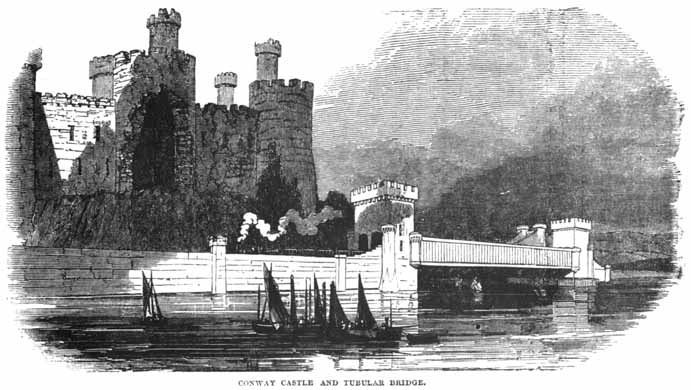
The length of the great tube is exactly 470 feet, being 12 feet
longer than the clear space between the towers, and the greatest span
ever yet attempted. The greatest height of the tube is in the
centre—30 feet, and diminishing towards the end to 22 feet.
Each tube consists of sides, top and bottom, all formed of long,
narrow wrought-iron plates, varying in length from 12 feet downward.
These plates are of the same manufacture as those for making boilers,
varying in thickness from three-eighths to three-fourths of an inch.
Some of them weigh nearly 7 cwt., and are amongst the largest it is
possible to roll with any existing machinery. The connexion between
top, bottom, and sides is made much more substantial by triangular
pieces of thick plate, riveted in across the corners, to enable the
tube to resist the cross or twisting strain to which it will be
exposed from the heavy and long-continued gales of wind that,
sweeping up the Channel, will assail it in its lofty and unprotected
position. The rivets, of which there are 2,000,000—each tube
containing 327,000—are more than an inch in diameter. They are
placed in rows, and were put in the holes red hot, and beaten with
heavy hammers. In cooling, they contracted strongly, and drew the
plates together so powerfully that it required a force of from 1 to 6
tons to each rivet, to cause the plates to slide over each other. The
weight of wrought iron in the great tube is 1600 tons.
Each of these vast bridge tubes was constructed on the shore, then
floated to the base of the piers, or bridge towers, and raised to its
proper elevation by hydraulic machinery, the largest in the world,
and the most powerful ever constructed. For the Britannia Bridge,
this consisted of two vast presses, one of which has power equal to
that of 30,000 men, and it lifted the largest tube six feet in half
an hour.
The Britannia tubes being in two lines, are passages for the up
and down trains across the Straits. Each of the tubes has been
compared to the Burlington Arcade, in Piccadilly; and the labour of
placing this tube upon the piers has been assimilated to that of
raising the Arcade upon the summit of the spire of St. James's
Church, if surrounded with water.
Each line of tube is 1513 feet in length; far surpassing in size
any piece of wrought-iron work ever before put together; and its
weight is 5000 tons, being nearly equal to that of two 120-gun ships,
having on board, ready for sea, guns, provisions, and crew. The
plate-iron covering of the tubes is not thicker than the hide of an
elephant, and scarcely thicker than the bark of an oak-tree; whilst
one of the large tubes, if placed on its end in St. Paul's
churchyard, would reach 107 feet higher than the cross of the
cathedral.
THE MARINERS OF ENGLAND.
Ye mariners of England!
Who guard our native seas,
Whose flag has braved a thousand years
The battle and the breeze,
Your glorious standard launch again,
To match another foe,
And sweep through the deep
While the stormy tempests blow;
While the battle rages long and loud,
And the stormy tempests blow.
The spirits of your fathers
Shall start from every wave!
For the deck it was their field of fame,
And Ocean was their grave;
Where Blake and mighty Nelson fell,
Your manly hearts shall glow,
As ye sweep through the deep,
While the stormy tempests blow;
While the battle rages long and loud,
And the stormy tempests blow.
Britannia needs no bulwarks,
No towers along the steep;
Her march is o'er the mountain waves,
Her home is on the deep:
With thunders from her native oak,
She quells the floods below,
As they roar on the shore,
When the stormy tempests blow;
When the battle rages long and loud,
And the stormy tempests blow.
The meteor-flag of England
Shall yet terrific burn,
Till danger's troubled night depart,
And the star of peace return.
Then, then, ye ocean-warriors!
Our song and feast shall flow
To the fame of your name,
When the storm has ceased to blow;
When the fiery fight is heard no more,
And the storm has ceased to blow.
Campbell.
|
KAFFIR LETTER-CARRIER.
"I knew" (says the pleasing writer of "Letters from
Sierra Leone") "that the long-looked-for vessel had at
length furled her sails and dropped anchor in the bay. She was from
England, and I waited, expecting every minute to feast my eyes upon
at least one letter; but I remembered how unreasonable it was to
suppose that any person would come up with letters to this lonely
place at so late an hour, and that it behoved me to exercise the
grace of patience until next day. However, between ten and eleven
o'clock, a loud shouting and knocking aroused the household, and
the door was opened to a trusty Kroo messenger, who, although one of
a tribe who would visit any of its members in their own country with
death, who could 'savey white man's book,' seemed to
comprehend something of our feelings at receiving letters, as I
overheard him exclaim, with evident glee, 'Ah! massa! here de
right book come at last.' Every thing, whether a brown-paper
parcel, a newspaper, an official despatch, a private letter or note
is here denominated a 'book,' and this man understood well
that newspapers are never received so gladly amongst 'books'
from England as letters." The Kaffir, in the Engraving, was
sketched from one employed to convey letters in the South African
settlements; he carries his document in a split at the end of a
cane.
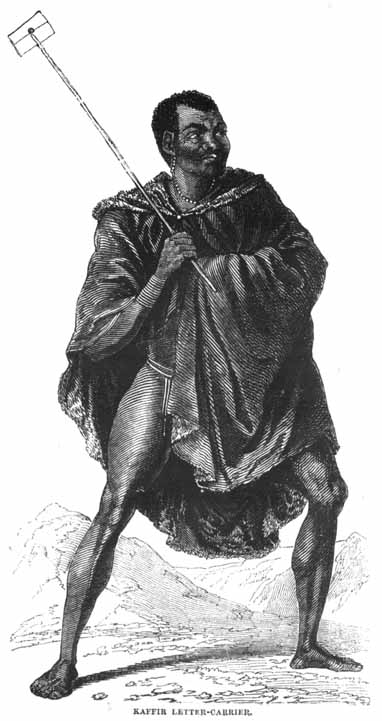
It is a singular sight in India to see the catamarans which put
off from some parts of the coast, as soon as ships come in sight,
either to bear on board or to convey from thence letters or messages.
These frail vessels are composed of thin cocoa-tree logs, lashed
together, and big enough to carry one, or, at most, two persons. In
one of these a small sail is fixed, and the navigator steers with a
little paddle; the float itself is almost entirely sunk in the water,
so that the effect is very singular—a sail sweeping along the
surface with a man behind it, and apparently nothing to support them.
Those which have no sails are consequently invisible and the men have
the appearance of treading the water and performing evolutions with a
racket. In very rough weather the men lash themselves to their little
rafts but in ordinary seas they seem, though frequently washed off,
to regard such accidents as mere trifles, being naked all but a wax
cloth cap in which they keep any letters they may have to convey to
ships in the roads, and swimming like fish. Their only danger is from
sharks, which are said to abound. These cannot hurt them while on
their floats; but woe be to them if they catch them while separated
from that defence. Yet, even then, the case is not quite hopeless,
since the shark can only attack them from below; and a rapid dive, if
not in very deep water, will sometimes save them.
THE SEASONS.
SPRING.
|
|
|
Come, gentle Spring, ethereal mildness, come,
And from the bosom of yon dropping cloud,
While music wakes around, veil'd in a shower
Of shadowing roses, on our plains descend.
Hail! Source of Being! Universal Soul
Of heaven and earth! Essential Presence, hail;
To Thee I bend the knee; to Thee my thought
Continual climb; who, with a master hand.
Hast the great whole into perfection
touch'd.
By Thee the various vegetative tribes,
Wrapt in a filmy net, and clad with leaves,
Draw the live ether, and imbibe the dew:
By Thee disposed into congenial soils,
Stands each attractive plant, and sucks and
swells
The juicy tide—a twining mass of tubes.
At thy command the vernal sun awakes
The torpid sap, detruded to the root
By wintry winds, that now in fluent dance,
And lively fermentation, mounting, spreads
All this innumerous-colour'd scene of
things.
As rising from the vegetable world
My theme ascends, with equal wing ascend
My panting Muse! And hark! how loud the woods
Invite you forth in all your gayest trim.
Lend me your song, ye nightingales! oh, pour
The mazy running soul of melody
Into my varied verse! while I deduce
From the first note the hollow cuckoo sings,
The symphony of spring, and touch a theme
Unknown to fame, the passion of the groves.
|
SUMMER.
|
|
|
From bright'ning fields of ether fair
disclosed,
Child of the Sun, refulgent Summer comes,
In pride of youth, and felt through nature's
depth:
He comes attended by the sultry hours,
And ever-fanning breezes on his way;
While from his ardent look the turning Spring
Averts his blushing face, and earth and skies,
All-smiling, to his hot dominion leaves.
Cheer'd by the milder beam, the sprightly
youth
Speeds to the well-known pool, whose crystal
depth
A sandy bottom shows. Awhile he stands
Gazing the inverted landscape, half afraid
To meditate the blue profound below;
Then plunges headlong down the circling flood.
His ebon tresses, and his rosy cheek,
Instant emerge: and through the obedient wave,
At each short breathing by his lip repell'd,
With arms and legs according well, he makes,
As humour leads, an easy-winding path;
While from his polish'd sides a dewy light
Effuses on the pleased spectators round.
This is the purest exercise of health.
The kind refresher of the Summer heats:
Nor, when cold Winter keens the brightening
flood,
Would I, weak-shivering, linger on the brink.
Thus life redoubles, and is oft preserved
By the bold swimmer, in the swift elapse
Of accident disastrous.
|
AUTUMN.
|
|
|
Crown'd with the sickle and the wheaten
sheaf,
While Autumn nodding o'er the yellow plain
Comes jovial on, the Doric reed once more,
Well pleased, I tune. Whatever the wintry frost
Nitrous prepared, the various-blossom'd
Spring
Put in white promised forth, and Summer suns
Concocted strong, rush boundless now to view,
Full, perfect all, and swell my glorious theme.
Hence from the busy, joy-resounding fields
In cheerful error let us tread the maze
Of Autumn, unconfined; and taste, revived,
The breath of orchard big with bending fruit.
Obedient to the breeze and beating ray,
From the deep-loaded bough a mellow shower
Incessant melts away. The juicy pear
Lies in a soft profusion scatter'd round.
A various sweetness swells the gentle race,
By Nature's all-refining hand prepared;
Of tempered sun, and water, earth, and air,
In ever-changing composition mix'd.
Such, falling frequent through the chiller
night,
The fragrant stores, the wide projected heaps
Of apples, which the lusty-handed year,
Innumerous, o'er the blushing orchard
shakes.
|
WINTER.
|
|
|
See, Winter comes to rule the varied year,
Sullen and sad, with all his rising train—
Vapours, and clouds, and storms. Be these my
theme,
These—that exalt the soul to solemn
thought
And heavenly musing. Welcome, kindred glooms;
Congenial horrors, hail: with frequent foot,
Pleased have I, in my cheerful morn of life,
When nursed by careless solitude I lived,
And sung of nature with unceasing joy;
Pleased have I wander'd through your rough
domain,
Trod the pure virgin snows, myself as pure;
Heard the winds roar, and the big torrent burst,
Or seen the deep-fermenting tempest brew'd
In the grim evening sky.
Nature! great parent! whose unceasing hand
Rolls round the seasons of the changeful year,
How mighty, how majestic are thy works!
With what a pleasing dread they swell the soul,
That sees astonish'd, and astonish'd
sings!
Ye, too, ye winds! that now begin to blow
With boisterous sweep, I raise my voice to you.
Where are your stores, ye powerful beings, say,
Where your aerial magazines reserved
To swell the brooding terrors of the storm?
In what far distant region of the sky,
Hush'd in deep silence, sleep ye when 'tis
calm?
'Tis done; dread Winter spreads his latest
glooms,
And reigns tremendous o'er the conquer'd
year.
How dead the vegetable kingdom lies!
How dumb the tuneful! Horror wide extends
His desolate domain. Behold, fond man!
See here thy pictured life! Pass some few years
Thy flowering spring, thy summer's ardent
strength,
And sober autumn fading into age,
The pale concluding winter comes at last
The shuts the scene. Ah! whither now are fled
Those dreams of greatness? those unsolid hopes
Of happiness? those longings after fame?
Those restless cares? those busy bustling days?
Those gay-spent festive nights? those veering
thoughts,
Lost between good and ill, that shared thy life?
All now are vanish'd; virtue sole survives,
Immortal, never-failing friend of man—
His guide to happiness on high.
Thomson.
|
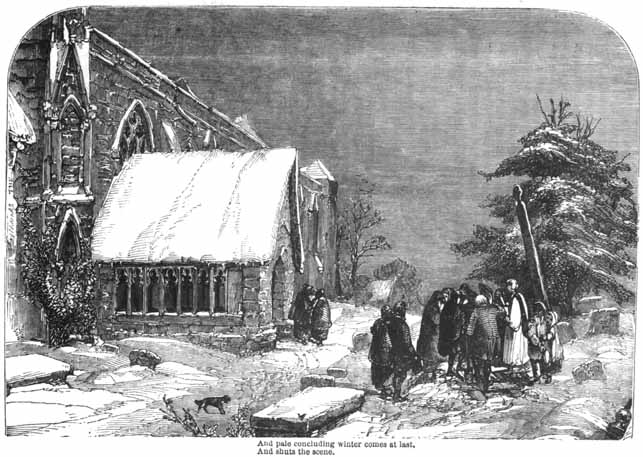
ON MUSIC.
There are few who have not felt the charms of music, and
acknowledged its expressions to he intelligible to the heart. It is a
language of delightful sensations, that is far more eloquent than
words: it breathes to the ear the clearest intimations; but how it
was learned, to what origin we owe it, or what is the meaning of some
of its most affecting strains, we know not.
We feel plainly that music touches and gently agitates the
agreeable and sublime passions; that it wraps us in melancholy, and
elevates us to joy; that it dissolves and inflames; that it melts us
into tenderness, and rouses into rage: but its strokes are so fine
and delicate, that, like a tragedy, even the passions that are
wounded please; its sorrows are charming, and its rage heroic and
delightful. As people feel the particular passions with different
degrees of force, their taste of harmony must proportionably vary.
Music, then, is a language directed to the passions; but the rudest
passions put on a new nature, and become pleasing in harmony: let me
add, also, that it awakens some passions which we perceive not in
ordinary life. Particularly the most elevated sensation of music
arises from a confused perception of ideal or visionary beauty and
rapture, which is sufficiently perceivable to fire the imagination,
but not clear enough to become an object of knowledge. This shadowy
beauty the mind attempts, with a languishing curiosity, to collect
into a distinct object of view and comprehension; but it sinks and
escapes, like the dissolving ideas of a delightful dream, that are
neither within the reach of the memory, nor yet totally fled. The
noblest charm of music, then, though real and affecting, seems too
confused and fluid to be collected into a distinct idea.
Harmony is always understood by the crowd, and almost always
mistaken by musicians. The present Italian taste for music is exactly
correspondent to the taste for tragi-comedy, that about a century ago
gained ground upon the stage. The musicians of the present day are
charmed at the union they form between the grave and the fantastic,
and at the surprising transitions they make between extremes, while
every hearer who has the least remainder of the taste of nature left,
is shocked at the strange jargon. If the same taste should prevail in
painting, we must soon expect to see the woman's head, a
horse's body, and a fish's tail, united by soft gradations,
greatly admired at our public exhibitions. Musical gentlemen should
take particular care to preserve in its full vigour and sensibility
their original natural taste, which alone feels and discovers the
true beauty of music.
If Milton, Shakspeare, or Dryden had been born with the same
genius and inspiration for music as for poetry, and had passed
through the practical part without corrupting the natural taste, or
blending with it any prepossession in favour of sleights and
dexterities of hand, then would their notes be tuned to passions and
to sentiments as natural and expressive as the tones and modulations
of the voice in discourse. The music and the thought would not make
different expressions; the hearers would only think impetuously; and
the effect of the music would be to give the ideas a tumultuous
violence and divine impulse upon the mind. Any person conversant with
the classic poets, sees instantly that the passionate power of music
I speak of, was perfectly understood and practised by the
ancients—that the Muses of the Greeks always sung, and their
song was the echo of the subject, which swelled their poetry into
enthusiasm and rapture. An inquiry into the nature and merits of the
ancient music, and a comparison thereof with modern composition, by a
person of poetic genius and an admirer of harmony, who is free from
the shackles of practice, and the prejudices of the mode, aided by
the countenance of a few men of rank, of elevated and true taste,
would probably lay the present half-Gothic mode of music in ruins,
like those towers of whose little laboured ornaments it is an exact
picture, and restore the Grecian taste of passionate harmony once
more to the delight and wonder of mankind. But as from the
disposition of things, and the force of fashion, we cannot hope in
our time to rescue the sacred lyre, and see it put into the hands of
men of genius, I can only recall you to your own natural feeling of
harmony and observe to you, that its emotions are not found in the
laboured, fantastic, and surprising compositions that form the modern
style of music: but you meet them in some few pieces that are the
growth of wild unvitiated taste; you discover them in the swelling
sounds that wrap us in imaginary grandeur; in those plaintive notes
that make us in love with woe; in the tones that utter the
lover's sighs, and fluctuate the breast with gentle pain; in the
noble strokes that coil up the courage and fury of the soul, or that
lull it in confused visions of joy; in short, in those affecting
strains that find their way to the inmost recesses of the heart,
Untwisting all the chains that tie
The hidden soul of harmony.
Milton.
|
Usher.
THE AFFLICTED POOR.
Say ye—oppress'd by some fantastic
woes,
Some jarring nerve that baffles your repose,
Who press the downy couch while slaves advance
With timid eye to read the distant glance;
Who with sad pray'rs the weary doctor tease,
To name the nameless, ever new disease;
Who with mock patience dire complaint endure,
Which real pain, and that alone, can cure:
How would ye bear in real pain to lie,
Despised, neglected, left alone to die?
How would ye bear to draw your latest breath,
Where all that's wretched paves the way for
death?
Such is that room which one rude beam divides,
And naked rafters form the sloping sides;
Where the vile bands that bind the thatch are
seen,
And lath and mud are all that lie between,
Save one dull pane that coarsely patch'd gives
way
To the rude tempest, yet excludes the day:
There, on a matted flock with dust
o'erspread,
The drooping wretch reclines his languid head!
For him no hand the cordial cup supplies,
Nor wipes the tear which stagnates in his eyes;
No friends, with soft discourse, his pangs
beguile.
Nor promise hope till sickness wears a smile.
Crabbe.
|
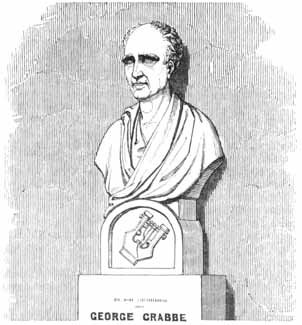
MIDNIGHT THOUGHTS.
 |
Thou, who didst put to flight
Primeval silence, when the morning stars,
Exulting, shouted o'er the rising ball:
O Thou! whose word from solid darkness struck
That spark, the sun, strike wisdom from my soul;
My soul which flies to thee, her trust her
treasure,
As misers to their gold, while others rest:
Through this opaque of nature and of soul,
This double night, transmit one pitying ray,
To lighten and to cheer. Oh, lead my mind,
(A mind that fain would wander from its woe,)
Lead it through various scenes of life and
death,
And from each scene the noblest truths inspire.
Nor less inspire my conduct, than my song;
Teach my best reason, reason; my best will
Teach rectitude; and fix my firm resolve
Wisdom to wed, and pay her long arrear;
Nor let the phial of thy vengeance, pour'd
On this devoted head, be pour'd in vain.
The bell strikes One. We take no note of time
But from its loss; to give it then a tongue
Is wise in man. As if an angel spoke,
I feel the solemn sound. If heard aright,
It is the knell of my departed hours.
Where are they? with the years beyond the flood!
It is the signal that demands dispatch:
How much is to be done! My hopes and fears
Start up alarm'd, and o'er life's narrow
verge
Look down—on what? A fathomless abyss!
A dread eternity! How surely mine!
And can eternity belong to me,
Poor pensioner on the bounties of an hour?
How poor, how rich, how abject, how august,
How complicate, how wonderful is man!
How passing wonder He who made him such!
Who center'd in our make such strange
extremes—
From different natures, marvellously mix'd:
Connexion exquisite! of distant worlds
Distinguish'd link in being's endless
chain!
Midway from nothing to the Deity;
A beam ethereal—sullied and absorpt!
Though sullied and dishonour'd, still
divine!
Dim miniature of greatness absolute!
An heir of glory! a frail child of dust!
Helpless immortal! insect infinite!
A worm! a god! I tremble at myself,
And in myself am lost. At home a stranger.
Thought wanders up and down, surprised, aghast,
And wondering at her own. How reason reels!
Oh, what a miracle to man is man!
Triumphantly distress'd! what joy! what
dread
Alternately transported and alarm'd!
What can preserve my life, or what destroy?
An angel's arm can't snatch me from the
grave;
Legions of angels can't confine me there.
'Tis past conjecture; all things rise in
proof.
While o'er my limbs sleep's soft dominion
spread,
What though my soul fantastic measures trod
O'er fairy fields, or mourn'd along the
gloom
Of pathless woods, or down the craggy steep
Hurl'd headlong, swam with pain the mantled
pool,
Or scaled the cliff, or danced on hollow winds
With antic shapes, wild natives of the brain!
Her ceaseless flight, though devious, speaks her
nature
Of subtler essence than the trodden clod:
Active, aerial, towering, unconfined,
Unfetter'd with her gross companion's
fall.
Even silent night proclaims my soul immortal:
Even silent night proclaims eternal day!
For human weal Heaven husbands all events;
Dull sleep instructs, nor sport vain dreams in
vain.
Young.
|
FAREWELL.
 |
Nay, shrink not from that word
"Farewell!"
As if 'twere friendship's final
knell—
Such fears may prove but vain:
So changeful is life's fleeting day,
Whene'er we sever, Hope may say,
We part to meet again!
E'en the last parting earth can know,
Brings not unutterable woe
To souls that heav'nward soar:
For humble Faith, with steadfast eye,
Points to a brighter world on high,
Where hearts, that here at parting sigh,
May meet—to part no more!
Barton.
|
VOCABULARY OF WORDS USED IN THE ILLUSTRATED LONDON READING
BOOK.
[We have considered that it would be useful to the young reader to
have a ready means of reference, in the READING BOOK itself, to all
unusual words of one syllable, and all the words of two syllables and
above, that occur in the various lessons. In the following pages will
be found, properly accentuated, all the more difficult polysyllables,
with their meanings, derived from Johnson, Walker, and other
competent authorities.]
- ABA'NDON, v.a.
- give up; resign, or quit; forsake; leave
- ABI'LITY, s.
- capacity; qualification; power
- A'BJECT, a.
- mean; being of no hope or regard; destitute
- ABLU'TION, s.
- the act of cleansing or washing clean; water used in
washing
- ABO'LISH, v.a.
- make void; put an end to; destroy
- ABO'UND, v.n.
- have in great plenty; be in great plenty
- ABRE'AST, ad.
- side by side
- ABRU'PTLY, ad.
- hastily; suddenly; without the due forms of preparation
- A'BSOLUTE, a.
- positive; certain; unlimited
- A'BSTRACT, s.
- the smaller quantity containing the virtue or power of the
greater
- ABSTRU'SE, a.
- hidden; difficult
- ABU'NDANT, a.
- plentiful
- ABU'TMENT, s.
- that which borders upon another
- ACA'DEMY, s.
- (from Academus, an Athenian, who founded a public school
at Athens, which after him was called Academia, Latin),
place of education; an assembly or society of men, uniting for the
promotion of some art
- A'CCENT, s.
- the sound of a syllable; a modification of the voice expressive
of the passions or sentiments; the marks made upon syllables to
regulate their pronunciation
- A'CCIDENT, s.
- that which happens unforeseen; chance
- ACCO'MPANY, v.n.
- associate with; become a companion to
- ACCO'MPLICE, s.
- an associate; partner
- ACCO'MPLISHMENT, s.
- ornament of mind or body; acquirement
- ACCO'ST, v.a.
- speak to; address; salute
- ACCO'UNT, s.
- the state or result of a computation—as, the
account stands thus between us; narrative; value
- ACCO'UTRE, v.a.
- dress; equip
- A'CCURACY, s.
- exactness; nicety
- ACCU'STOM, v.
- to habituate; to inure
- ACQUI'RE, v.a.
- gain; obtain; attain
- A'CRID, a.
- having a hot biting taste; bitter
- A'CRIMONY, s.
- sharpness; severity; bitterness of thought or language
- ACRO'POLIS, s.
- a citadel; the highest part of a city
- ACTI'VITY, s.
- quickness; nimbleness
- ACU'TE, a.
- sharp, not blunt; sharp, not dull; not stupid; vigorous;
powerful in operation
- ADAMA'NTINE, a.
- made of adamant; having the qualities of adamant, viz.
hardness, indissolubility
- ADA'PT, v.a.
- admit, justify; yield; permit
- ADIEU', ad.
- used elliptically for à Dieu je vous commende, at
the parting of friends; farewell
- A'DMIRABLE, a.
- to be admired; of power to excite wonder
- ADMIRA'TION, s.
- wonder
- ADMI'T, v.a.
- suffer to enter; allow
- ADO'PT, v.a.
- take a son by choice; make him a son who is not so by birth;
place any person or thing in a nearer relation than they have by
nature or something else
- ADRO'ITNESS, s.
- dexterity; readiness
- ADU'LT, s.
- a person above the age of boyhood or girlhood
- ADVA'NCE, v.a.
- improve; forward; propose
- ADVA'NTAGE, s.
- superiority; opportunity
- ADVE'NTURE, s.
- chance; hazard; an enterprise in which something must be left
to hazard
- ADVE'NTURER, s.
- he that puts himself into the hands of chance
- ADVE'NTUROUS, a.
- bold; daring; courageous; inclined to adventures
- ADVE'RSITY, s.
- affliction; calamity; misfortune; the public misery
- ADVE'RTISEMENT, s.
- something advertised; the public notice of a thing
- A'DVOCATE, s.
- he that pleads a cause
- AE'OLIAN, a.
- an epithet applied to lyric poetry, because Sappho and Alcaeus
were natives of Lesbos in Aeolia, and wrote in the Aeolic
dialect
- AE'RIAL, a.
- belonging to the air; lofty
- AFFABI'LITY, s.
- civility; condescension; easiness of manners
- AFFE'CT, v.a.
- act upon; produce effect in any other thing; move the passions;
aim at; aspire to
- AFFECTA'TION, s.
- an elaborate appearance; false pretence
- AFFE'CTION, s.
- state of being affected by any cause or agent; love; kindness;
good-will to some person; passionate regard
- AFFE'CTIONATE, a.
- full of affection; fond; tender; warm; benevolent
- AFFI'NITY, s.
- connection with
- AGGRE'SSION, s.
- first act of injury
- A'GONY, s.
- the pangs of death; any violent pain in body or mind
- AGRE'EABLE, a.
- suitable to; pleasing
- A'GRICULTURE, s.
- the science of making land productive
- A'LABASTER, s.
- a kind of soft marble, easier to cut and less durable than the
other kinds
- ALA'RUM, s.
- notice of any approaching danger; any tumult or
disturbance
- A'LIEN, s.
- foreigner; stranger
- A'LKALI, s.
- any substance which, when mingled with acid, produces
effervescence and fermentation
- ALLEGO'RY, s.
- a figurative discourse, in which something is contained other
than is literally understood
- ALLE'VIATE, v.a.
- make light; ease; soften
- ALLO'W, v.a.
- permit; give leave
- A'LPHABET, s.
- the order of the letters, or elements of speech
- ALTERA'TION, s.
- the act of changing; the change made
- A'LTITUDE, s.
- height of place; space measured upward
- AL'TOGETHER, ad.
- completely; without exception
- AMA'LGAMATE, v.a.
- to unite metals with silver
- AMA'ZEMENT, s.
- height of admiration; astonishment
- AMBI'GUOUS, a.
- using doubtful expressions; doubtful; having two meanings
- AMBI'TION, s.
- the desire of preferment or honour; the desire of anything
great or excellent
- AMBI'TIOUS, a.
- fond of power; desirous of power
- AME'RICAN, s.
- native of America
- A'METHYST, s.
- a precious stone of a violet colour
- A'MIABLE, a.
- kind; gentle; good natured; loving; not selfish
- AMMUNI'TION, s.
- military stores, applied to artillery
- AMPHITHE'ATRE, s.
- a building in a circular or oval form, having its area
encompassed with rows of seats one above another
- AMPU'LLA, s.
- (pronounced am-poo-la) a vessel of pure gold, used for
containing the holy oil at coronations
- AMU'SE, v.a.
- entertain with tranquillity; draw on from time to time
- ANA'LOGY, s.
- resemblance between things with regard to some circumstances or
effects
- ANATO'MICAL, a.
- relating or belonging to anatomy
- ANA'TOMY, s.
- the art of dissecting the body; the doctrine of the structure
of the body
- A'NCESTOR, s.
- one from whom a person descends
- A'NCIENT, a.
- old; past; former
- A'NECDOTE, s.
- something yet unpublished; biographical history; personal
history
- ANEMO'METER, s.
- an instrument to measure the force of the wind
- ANGE'LIC, a.
- resembling angels; belonging to angels
- A'NIMAL, s.
- a living creature
- ANIMA'LCULE, s.
- a small animal, generally applied to those which cannot be seen
without a microscope
- ANIMO'SITY, s.
- vehemence of hatred; passionate malignity
- ANNIHILATE, v.a.
- reduce to nothing; destroy
- ANNO'Y, v.a.
- incommode; vex; tease; molest
- A'NNUAL, a.
- that comes yearly
- A'NTELOPE, s.
- a goat with curled or wreathed horns
- ANTHROPO'PHAGI, s.
- man-eaters; cannibals
- ANTI'CIPATE, v.a.
- take an impression of something which is not yet as if it
really was
- A'NTIQUARY, s.
- a man studious of antiquity
- ANTI'QUE, a.
- ancient; old; odd; of old fashion
- ANTI'QUITY, s.
- old times; remains of old times
- A'NTRE, s.
- a cavern
- ANXI'ETY, s.
- perplexity; lowness of spirits
- ANXIOUS, a.
- disturbed about some uncertain event
- A'PATHY, s.
- exemption from feeling or passion
- APO'CALYPSE, s.
- the Book of Revelations
- APO'LOGY, s.
- defence; excuse
- APO'STLE, s.
- a person sent with commands, particularly applied to those whom
our Saviour deputed to preach the Gospel
- APOSTO'LIC, a.
- delivered or taught by the Apostles
- APPARA'TUS, s.
- tools; furniture; show; instruments
- APPE'AR, v.n.
- be visible; in sight
- APPEARANCE, s.
- the act of coming into sight; phenomenon; apparition;
presence
- APPE'NDAGE, s.
- something added to another thing without being necessary to its
essence
- A'PPETITE, s.
- hunger; violent longing
- APPLA'USE, s.
- approbation loudly expressed; praise
- APPLICATION, s.
- close study; intenseness of thought; attention; the act of
applying; the act of applying anything to another.
- APPORTIONMENT, s.
- dividing into portions
- APPRECIATE, v.a.
- set a price on anything; esteem
- APPRO'ACH, v n.
- draw near; somewhat resemble
- APPROBATION, s.
- the act of approving, or expressing himself pleased, or
satisfied; support
- APPRO'PRIATENESS, s.
- a fitness to be appropriated
- APPROPRIATION, s.
- the application of something to a certain purpose
- AQUA'TIC, a.
- that inhabits the water; that grows in the water
- A'QUEDUCT, s.
- a conveyance, tunnel, or way made for carrying water
- ARA'TOO, s.
- a bird of the parrot kind
- AR'BALIST, s.
- a naturalist who make trees his study
- A'RBITRABY, o.
- despotic; absolute; depending on no rule
- ARBU'TUS, s.
- a strawberry tree
- ARCA'DE, s.
- a continued arch; a walk arched over
- ARCHBI'SHOP, s.
- a bishop of the first class, who superintends the conduct of
other bishops
- ARCHITE'CTURE, s.
- the art or science of building
- A'RCTIC, a.
- northern; lying under the Arctos or Bear
- A'RDUOUS, a.
- lofty; difficult
- ARI'SE, v.n.
- mount upward; get up; proceed
- ARMI'LLA, s.
- a bracelet, or jewel worn on the arm
- A'RMY, s.
- collection of armed men; a great number
- AROMA'TIC, a.
- spicy; fragrant; strong-scented
- ARRI'VE, v.n.
- reach any place; happen
- ARRA'NGE, v.a.
- put in the proper order for any purpose
- ARRA'NGEMENT, s.
- the act of putting In proper order, the state of being put in
order
- ARRA'Y, s.
- order, chiefly of war; dress
- A'RROGANCE, s.
- the act or quality of taking much upon one's self
- A'RROW, s.
- the pointed weapon which is shot from a bow
- A'RTICLE, s.
- a part of speech; a single clause of an account; term
- ARTI'CULATE, v.a.
- form words; speak as a man; draw up in articles; make
terms
- A'RTIFICE, s.
- trick; fraud; stratagem; art; trade
- ARTIFI'CIAL, a.
- made by art; not natural
- ARTI'LLERY, s.
- weapons of war; cannon; great ordinance
- A'RTISAN, s.
- professor of any art
- ASCE'NDANCY, s.
- influence; power
- ASPE'RSE, v.a.
- bespatter with censure or calumny
- A'SPIC, s.
- the name of a small serpent
- ASSA'ILANT, s.
- one that assails
- ASSE'MBLY, s.
- a company met together
- ASSE'RT, v.a.
- to declare positively; maintain; to defend either by words or
actions; claim
- ASSIDU'ITY, s.
- diligence
- ASSI'MILATE, v.a.
- bring to a likeness; turn to its own nature by digestion
- ASSISTANCE, s.
- help
- ASSISTANT, s.
- a helper
- ASSI'ZE, s.
- a jury; any court of justice; the ordinance or statute
- ASSO'CIATE, s.
- a partner; a confederate; a companion
- ASSU'RE, v.a.
- give confidence by a firm promise
- ASTO'NISHMENT, s.
- amazement
- ASTRO'NOMY, s.
- the science of the motions, distances, &c. of the
stars
- A'THEISM, s.
- the disbelief of a god
- ATHE'NIAN, s.
- a native of Athens
- A'TMOSPHERE, s.
- the air that encompasses the solid earth on all sides
- ATRO'CIOUS, a.
- wicked in a high degree; enormous
- ATTA'CH, v.a.
- arrest; fix one's interest; win; lay hold on
- ATTA'CK, v.a.
- to make an assault
- ATTA'IN, v.a.
- gain; procure; reach
- ATTAINMENT, s.
- an acquisition; an accomplishment
- ATTE'MPT, v.a.
- venture upon; try; endeavour
- ATTE'NDANT, s.
- one that attends; one that is present at anything
- ATTENTION, s.
- the act of attending; the act of bending the mind upon it
- ATTE'NTIVE, a.
- regardful; full of attention
- ATTI'RE, s.
- clothing; dress; equipment
- A'TTITUDE, s.
- position; expression
- ATTRA'CT, v.a.
- draw to something; allure; invite
- ATTRA'CTIVE, a.
- having the power to draw anything; inviting
- ATTRIBUTE, v.a.
- to ascribe; to yield as due; to impute as a cause
- AU'DITOR, s.
- a hearer
- AURO'RA-BOREA'LIS, a.
- electrical light streaming in the night from the north; the
northern lights or streamers
- AUSTE'RITY, s.
- severity; cruelty
- AUTHENTIC, a.
- genuine
- AU'THOR, s.
- the first beginner or mover of anything; a writer in
general
- AUTHO'RITY, s.
- power; rule; influence; support; legal power
- AU'TUMN, s.
- the season of the year between summer and winter
- AVAILABLE, a.
- profitable; powerful; advantageous
- AVALA'NCHE, s.
- immense mass of snow or ice
- A'VERAGE, s.
- a middle proportion
- AVI'DITY, s.
- eagerness; voracity; greediness
- AVO'ID, v.a.
- shun; shift off; quit
- AWA'KE, v.a.
- rouse out of sleep; put into new action
- AW'KWARD, a.
- clumsy; inelegant; unready
- A'ZURE, s.
- blue; faint blue
- BA'CCHANALS, s.
- the drunken feasts of Bacchus; fabulous personages who assisted
at the festivals of Bacchus
- BALCO'NY, s.
- a frame before the window of a room
- BALLO'ON, s.
- a large hollow ball of silk, filled with gas, which makes it
rise in the air
- BA'NDIT, s.
- a man outlawed
- BA'NISH, v.a.
- condemn to leave one's country; drive away
- BA'NISHMENT, s.
- the act of banishing another; the state of being banished
- BARBA'RIAN, s.
- a savage; a man uncivilized
- BA'RBAROUS, a.
- savage; ignorant; cruel
- BA'RREN, a.
- unfruitful; sterile; scanty
- BARRIC'ADE, v.a.
- stop up a passage; hinder by stoppage
- BASA'LT, s.
- a variety of trap rock
- BASA'LTIC, a.
- relating to basalt
- BASTI'LE, s.
- (pronounced basteel) a jail; formerly the state prison
of France
- BA'TTER, v.a.
- beat; shatter; beat down
- BA'TTLE, s.
- a fight; an encounter between opposite enemies
- BEA'CON, s.
- something raised on an eminence to direct
- BEA'RABLE, a.
- that which is capable of being borne
- BEAU'TY, s.
- a particular grace or feature; a beautiful person
- BECO'ME, v.a.
- befit; be suitable to the person
- BEDE'CK, v.a.
- to deck; to adorn; to grace
- BE'DSTEAD, s.
- the frame on which the bed is placed
- BEHI'ND, ad.
- out of sight; not yet in view; remaining
- BEHO'VE, v.n.
- to be fit
- BELI'EVE, v.n.
- to have a firm persuasion of anything
- BENEFA'CTOR, s.
- one that does good
- BE'NEFIT, s.
- a kindness; a favour conferred; an advantage
- BENE'VOLENT, a.
- kind; having good-will
- BENI'GHT, v.a.
- involve in darkness; surprise with the coming on of night
- BENI'GNANT, a.
- kind; generous; liberal
- BE'NISON, s.
- a blessing
- BENU'MB, v.a.
- make torpid; stupify
- BESIE'GE, v.a.
- to beleaguer; to lay siege to
- BESPRE'NT, v. def.
- besprinkled
- BESTO'W, v.a.
- give; confer upon; lay up
- BETWE'EN, prep.
- in the middle space; from one to another; noting difference of
one from another
- BI'LBERRY, s.
- the fruit of a plant so called
- BO'ATMAN, s.
- he that manages a boat
- BO'DY, s.
- material substance of an animal; matter; person; collective
mass; main part; main army
- BO'RDER, s.
- edge; edge of a country; a bank raised round a garden and set
with flowers
- BO'UNTEOUS, a.
- liberal; kind; generous
- BOUQUE'T, s.
- (pronounced boo-kay) a nosegay
- BOWSPRI'T, s.
- (a sea term) the mast that runs out at the bow of a ship
- BRA'CELET, s.
- an ornament for the arms
- BRA'CH, s.
- a she hound
- BRA'CKISH, a.
- salt; somewhat salt
- BRI'LLIANCY, s.
- brightness; lustre
- BRI'LLIANT, s.
- a diamond of the finest cut
- BRI'LLIANT, a.
- shining; sparkling; full of lustre
- BU'BBLE, s.
- a small bladder of water; anything which wants solidity and
firmness
- BU'LKY, a.
- of great size or stature
- BU'LWARK, s.
- a fortification; a security
- BUO'YANCY, s.
- the quality of floating
- BU'RDENSOME, a.
- grievous
- BU'RIAL, s.
- interment; the act of putting anything under earth or
water
- BU'RY, v.a.
- inter; put in the grave; conceal
- BU'TTRESS, s.
- a prop; a wall built to support another
- CA'DENCE, s.
- the fall of the voice; state of sinking, decline
- CALA'MITY, s.
- misfortune; cause of misery; distress
- CA'LCULATE, v.a.
- reckon; adjust
- CAL'CULA'TION, s.
- a practice or manner of reckoning; a reckoning
- CA'LEDO'NIANS, s.
- the ancient inhabitants of Scotland
- CAMPA'IGN, s.
- a large, open, level tract of land; the time for which any army
keeps the field
- CA'NADA, s.
- a province of the British possessions in America
- CANA'L, s.
- any course of water made by art; a passage through which any of
the juices of the body flow
- CANA'RY, s.
- an excellent singing-bird—so called from its native
place, the Canary Islands
- CA'NNIBAL, s.
- a savage that eats his fellow-men taken in war
- CA'PABLE, a.
- susceptible; intelligent; qualified for; able to receive;
capacious; able to understand
- CAPA'CIOUS, a.
- wide; large
- CAPA'CITY, s.
- power; ability; state; condition; character
- CAPERCA'ILZIE, s.
- (pronounced cap-per-kail-zeh) cock of the wood
- CA'PITAL, s.
- the upper part of a pillar; the chief city of a nation or
kingdom
- CA'PITAL, a.
- applied to letters—large, such as are written at the
beginning or heads of books
- CA'PTAIN, s.
- a chief commander
- CA'PTIVE, s.
- a prisoner
- CAPTI'VITY, s.
- imprisonment; subjection by the fate of war; bondage; slavery;
servitude
- CA'PTURE, v.a.
- take prisoner; bring into a condition of servitude
- CA'RAVAN, s.
- a conveyance; a troop or body of merchants or pilgrims, as they
travel in the East
- CARE'ER, s.
- a course; full speed; course of action
- CA'RGO, s.
- the lading of a ship
- CARNI'VOROUS, a.
- flesh-eating
- CA'ROB, s.
- a plant bearing a nutritious fruit so called
- CA'RRIAGE, s.
- the act of carrying or transporting; vehicle; conduct
- CA'RRION, s.
- the carcase of something not proper for food
- CA'RRONA'DE, s.
- a short iron cannon
- CA'RRY, v.a.
- convey from a place; transport; bring forward; bear
- CAR'TILAGE, s.
- a smooth and solid body, softer than a bone, but harder than a
ligament
- CARTILA'GINOUS, a.
- consisting of cartilages
- CA'RTRIDGE, s.
- a case of paper or parchment filled with gunpowder, used for
greater expedition in loading
- CASCA'DE, s.
- a cataract; a waterfall
- CA'STELLATED, a.
- that which is turretted or built in the form of a castle
- CATAMARA'N, s.
- a rude species of boat
- CA'TARACT, s.
- a waterfall
- CATA'STROPHE, s.
- a final event
- CATHE'DRAL, s.
- the head church of a diocese
- CA'VALRY, s.
- horse soldiery
- CA'VERN, s.
- a hollow place in the ground
- CA'VIL, s.
- a false or frivolous objection
- CA'VITY, s.
- a hole; a hollow place
- CE'DAR, s.
- a kind of tree; it is evergreen, and produces flowers
- CE'LEBRATE, v.a.
- praise; commend; mention in a set or solemn manner
- CELE'BRITY, s.
- transaction publicly splendid
- CELE'RITY, s.
- quickness
- CELE'STIAL, a.
- heavenly
- CE'METERY, s.
- a place where the dead are deposited
- CE'NTRE, s.
- the middle
- CE'NTURY, s.
- a hundred years
- CEREMO'NIOUS, a.
- full of ceremony
- CE'REMONY, s.
- form in religion; form of civility
- CE'RTAIN, a.
- sure; unquestionable; regular; particular kind
- CHAO'TIC, a.
- confused
- CHA'PTER, s.
- a division of a book; the place in which assemblies of the
clergy are held
- CHARACTERI'SE, v.a.
- to give a character of the particular quality of any man
- CHARACTERI'STIC, s.
- that which constitutes the character
- CHARACTERI'STICALLY, ad.
- constituting the character
- CHA'RITY, s.
- kindness; love; good-will; relief given to the poor
- CHA'TEAU, s.
- (pronounced shat-oh) a castle
- CHA'TTER, v.a.
- make a noise by collision of the teeth; talk idly or
carelessly
- CHE'RUB, s.
- a celestial spirit, next in order to the seraphim
- CHRI'STENDOM, s.
- the collective body of Christianity
- CHRI'STIAN, s.
- a professor of the religion of Christ
- CHRO'NICLE, s.
- a register of events in order of time; a history
- CHRO'NICLER, s.
- a writer of chronicles; a historian
- CHRONO'METER, s.
- an instrument for the exact measuring of time
- CI'PHER, s.
- a figure, as 1, 2
- CI'RCUIT, s.
- a circular band
- CI'RCUIT, s.
- ring; round; stated journey repeated at intervals
- CIRCU'MFERENCE, s.
- the space enclosed in a circle
- CIRCUMSCRI'BE, v.a.
- enclose in certain lines or boundaries; bound; Limit
- CI'RCUMSTANCE, s.
- something relative to a fact; incident; event
- CI'STERN, s.
- a receptacle of water for domestic uses; reservoir
- CI'STUS, s.
- rock-rose
- CI'TADEL, s.
- a fortress; a place of defence
- CI'TIZEN, s.
- a freeman of a city; townsman
- CI'TY, s.
- a corporate town that hath a bishop
- CI'VIL, a.
- political; not foreign; gentle; well bred; polite
- CIVI'LITY, s.
- politeness; complaisance
- CI'VILIZA'TION, s.
- civilising manners
- CI'VILIZE, v.a.
- reclaim from savageness and brutality
- CLA'MOUR, s.
- noise; tumult; disturbance
- CLA'RION, s.
- a trumpet
- CLI'MATE, s.
- a region, or tract of land, differing from another by the
temperature of the air
- CLU'STER, s.
- a bunch
- CO'GNIZANCE, s.
- trial; a badge by which one is known
- COLLE'CT, v.a.
- gather together; bring into one place; gain from
observation
- COLLO'QUIAL, a.
- that relates to common conversation
- COLO'NIAL, a.
- that which relates to a colony
- CO'LONIST, s.
- one that colonises; one that dwells in a colony
- COLO'SSAL, a.
- of enormous magnitude; large
- CO'LOUR, s.
- the appearance of bodies to the eye only; hue; appearance
- CO'LUMN, s.
- a round pillar; a long file or row of troops; half a page, when
divided into two equal parts by a line passing down the middle
- COLU'MNAR, a.
- formed in columns
- COMBINA'TION, s.
- a union; a joining together
- CO'MFORTABLE, a.
- admitting comfort; dispensing comfort
- COMMA'NDER, s.
- a general; chief; leader
- COMMEMORA'TION, s.
- an act of public celebration
- COMME'NCE, v.a.
- to begin
- CO'MMERCE, s.
- intercourse; exchange of one thing for another; trade
- COMME'RCIAL, a.
- that which relates to commerce
- CO'MMINUTE, v.a.
- to grind; to pulverise
- COMMO'DITY, s.
- wares; merchandise
- COMMONWE'ALTH, s.
- a polity; an established form of civilized life; public;
republic
- COMMU'NICATE, v.a.
- impart knowledge; reveal
- COMMU'NITY, s.
- the commonwealth; the body politic; common possession
- COMPA'NION, s.
- a partner; an associate
- CO'MPANY, s.
- persons assembled together; a band; a subdivision of a regiment
of foot
- CO'MPARABLE, a.
- capable of being compared; of equal regard
- COMPA'RE, v.n.
- make one thing the measure of another; find a likeness of one
thing with another
- COMPA'RISON, s.
- the act of comparing; state of being compared; comparative
estimate
- COMPE'TE, v.a.
- to vie; to contend; to strive; to endeavour to outstrip
- COMPLA'INT, s.
- representation of pains or injuries; malady; remonstrance
against
- COMPLAI'SANCE, s.
- civility; desire of pleasing
- COMPLE'TION, s.
- accomplishment; act of fulfilling
- COMPLI'ANCE, s.
- the act of yielding to any design or demand
- CO'MPLICATE, v.a.
- to render difficult and incomprehendable; to join one with
another
- COMPOSI'TION, s.
- a mass formed by mingling different ingredients; written
work
- COMPREHE'ND, v.a.
- comprise; include; conceive; understand
- CONCE'AL, v.a.
- hide; keep secret; cover
- CONCE'IT, s.
- vain pride
- CONCE'NTRIC, a.
- having one common centre
- CONCE'PTION, s.
- the act of conceiving; state of being conceived; notion;
sentiment
- CONCE'SSION, s.
- the act of granting or yielding
- CONCI'LIATE, v.a.
- to gain; to win; to reconcile
- CONCI'SE, a.
- short; brief; not longer than is really needful
- CONCO'CT, v.a.
- to devise
- CO'NCORD, s.
- agreement between persons or things; peace; union; a
compact
- CONCU'SSION, s.
- the state of being shaken
- CONDE'NSE, v.n.
- to grow close and weighty
- CONDI'TION, s.
- rank; property; state
- CO'NDOR, s.
- a monstrous bird in America
- CONDU'CT, v.a.
- lend; accompany; manage
- CONE, s.
- a solid body, of which the base is circular, but which ends in
a point
- CONFE'R, v.a.
- compare; give; bestow; contribute; conduce
- CO'NFERENCE, s.
- formal discourse; an appointed meeting for discussing some
point by personal debate
- CONFE'SS, v.a.
- acknowledge a crime; own; avow; grant
- CONFI'NEMENT, s.
- imprisonment; restraint of liberty
- CO'NFLUENCE, s.
- the joining together of rivers; a concourse; the act of joining
together
- CONFORMA'TION, s.
- the form of things as relating to each other; the act of
producing suitableness or conformity to anything
- CONFO'RMITY, s.
- similitude; consistency
- CONGE'NER, s.
- a thing of the same kind or nature
- CONGE'NIAL, a.
- partaking of the same genius
- CONGLO'MERATE, v.a.
- to gather into a ball, like a ball of thread
- CO'NICAL, a.
- in the shape of a cone
- CONJE'CTURE, s.
- guess; imperfect knowledge; idea
- CONNEC'TION, s.
- union
- CO'NQUER, v.a.
- gain by conquest; win; subdue
- CO'NQUEROR, s.
- a victor; one that conquers
- CO'NQUEST, s.
- a victory
- CO'NSCIENCE, s.
- the faculty by which we judge of the goodness or wickedness of
ourselves
- CO'NSCIOUS, a.
- endowed with the power of knowing one's own thoughts and
actions; bearing witness by the dictates of conscience to
anything
- CONSCRI'PTION, s.
- an enrolling or registering
- CO'NSECRATE, v.a.
- to make sacred; to canonize
- CO'NSEQUENCE, s.
- that which follows from any cause or principle; effect of a
cause
- CO'NSEQUENT, a.
- following by rational deduction; following as the effect of a
cause
- CONSI'DERABLE, a.
- worthy of consideration; important; valuable
- CONSI'ST, v.n.
- subsist; be composed; be comprised
- CONSI'STENCE, s.
- state with respect to material existence; degree of denseness
or rarity
- CONSI'STENCY, s.
- adhesion; agreement with itself or with any other thing
- CONSPI'CUOUS, a.
- obvious to the sight
- CO'NSTANT, a.
- firm; fixed; certain; unvaried
- CONSTELLA'TION, s.
- a cluster of fixed stars; an assemblage of splendours
- CONSTERNA'TION, s.
- astonishment; amazement; wonder
- CO'NSTITUTE, v.a.
- give formal existence; produce; erect; appoint another in an
office
- CONSTRU'CT, v.a.
- build; form; compile
- CONSTRU'CTION, s.
- the act of building; structure; form of building
- CONSTR'UCTIVE, a.
- by construction
- CONSU'MPTION, s.
- the act of consuming; waste; a disease; a waste of muscular
flesh
- CO'NTACT, s.
- touch; close union
- CONTA'GIOUS, a.
- infectious; caught by approach
- CONTA'IN, v.a.
- hold; comprehend; restrain
- CONTE'MPLATE, v.a.
- study; meditate; muse; think studiously with long
attention
- CONTEMPLA'TION, s.
- meditation; studious thought
- CONTE'MPLATIVE, a.
- given to thought or study
- CONTE'MPORARY, s.
- one who lives at the same time with another
- CONTE'MPTIBLE, a.
- worthy of contempt, of scorn; neglected; despicable
- CO'NTEST, s.
- dispute; difference; debate
- CONTE'ST, v.a.
- to strive; to vie; to contend
- CONTI'GUOUS, a.
- meeting so as to touch
- CO'NTINENT, s.
- land not disjoined by the sea from other lands; that which
contains anything; one of the quarters of the globe
- CONTI'NGENCY, s.
- accidental possibility
- CONTI'NUE, v.n.
- remain in the same state; last; persevere
- CONTRA'CT, v.a.
- to shrink up; to grow short; to bargain
- CO'NTRARY, a.
- opposite; contradictory; adverse
- CONTRI'VANCE, s.
- the act of contriving; scheme; plan; plot
- CONVE'NIENCE, s.
- fitness; ease; cause of ease
- CONVE'NIENT, a.
- fit; suitable; proper; well adapted
- CO'NVENT, s.
- an assembly of religious persons; a monastery; a nunnery
- CO'NVERSE, s.
- conversation; acquaintance; familiarity
- CONVE'RSION, s.
- change from one state to another
- CONVE'RT, v.a.
- change into another substance; change from one religion to
another; turn from a bad to a good life; apply to any use
- CONVE'Y, v.a.
- carry; transport from one place to another; bring;
transfer
- CONVU'LSIVE, a.
- that gives twitches or spasms
- CO'PIOUS, a.
- plentiful; abundant
- CO'PPICE, s.
- a low wood; a place overrun with brushwood
- CO'RDIAL, a.
- reviving; hearty; sincere
- CORONA'TION, s.
- the act of crowning a King
- CORPORA'TION, s.
- a body politic, constituted by Royal charter
- CORPO'REAL, a.
- having a body; material; not spiritual
- CORRE'CT, v.a.
- punish; discipline; remark faults; take away fault
- CORRESPONDENCE, s.
- intercourse; relation; friendship
- CO'UNCILLOR, s.
- one that gives counsel
- COU'NTENANCE, s.
- the form of the face; air; look; calmness of look;
patronage
- CO'UNTRY, s.
- a tract of land; a region; rural parts
- CO'URAGE, s.
- bravery; boldness
- CO'VERING, s.
- dress; anything spread over another
- CRA'FTY, a.
- cunning; knowing; scheming; politic
- CRA'TER, s.
- the bowl, opening, or funnel of a volcano
- CREA'TION, s.
- the act of creating; universe
- CREA'TOR, s.
- the Divine Being that created all things
- CRE'ATURE, s.
- a being created; a general term for man
- CRE'VICE, s.
- a crack; a cleft; a narrow opening
- CRI'MINAL, s.
- a man accused; a man guilty of a crime
- CRI'MINA'LITY, s.
- the act of being guilty of a crime
- CRI'TIC, s.
- a judge; otherwise a censurer
- CRI'TICAL, a.
- relating to criticism
- CRO'CODILE, s
- an amphibious voracious animal, in shape like a lizard
- CROO'KED, a.
- bent; winding; perverse
- CRU'ELTY, s.
- inhumanity; savageness; act of intentional affliction
- CRU'SADE, s.
- an expedition against the infidels; a holy war
- CRY'STAL, s.
- crystals are hard, pellucid, and naturally colourless bodies,
of regular angular figures
- CU'LPABLE, a.
- criminal; guilty; blamable
- CU'LTIVATE, v.a.
- forward or improve the product of the earth by manual industry;
improve
- CULTIVA'TION, s.
- improvement in general
- CU'POLA, s.
- a dome
- CU'RFEW, s.
- an evening peal, by which the Conqueror willed that every man
should rake up his fire and put out his light
- CURIO'SITY, s.
- inquisitiveness; nice experiment; an object of curiosity;
rarity
- CU'RIOUS, a.
- inquisitive; desirous of information; difficult to please;
diligent about; elegant; neat; artful
- CU'RRENT, a.
- passing from hand to hand; authoritative; common; what is now
passing
- CU'STOM, s.
- habit; fashion; practice of buying of certain persons
- CY'MBAL, s.
- a kind of musical instrument
- CY'PRESS, s.
- a tall straight tree. It is the emblem of mourning
- DALMA'TIA, s.
- a province of Austria
- DALMA'TIAN, a.
- belonging to Dalmatia
- DA'MAGE, s.
- mischief; hurt; loss
- DA'NGER, s.
- risk; hazard; peril
- DA'NGEROUS, a.
- hazardous; perilous
- DA'STARDLY, ad.
- cowardly; mean; timorous
- DA'UNTED, a.
- discouraged
- DECE'PTION, s.
- the act or means of deceiving; cheat; fraud; the state of being
deceived
- DECLI'NE, v.a.
- shun; avoid; refuse; bring down
- DE'CORATE, v.a.
- adorn; embellish; beautify
- DECORA'TION, s.
- ornament; added beauty
- DE'DICATE, v.a.
- to inscribe
- DEFA'CE, v. a
- destroy; raze; ruin; disfigure
- DEFE'CTIVE, a.
- wanting the just quantity; full of defects; imperfect;
faulty
- DEFE'NCE, s.
- guard; protection; resistance
- DEFI'CIENCY, s.
- want; something less than is necessary; imperfection
- DEGE'NERACY, s.
- departure from the virtue of our ancestors
- DEGE'NERATE, a.
- unworthy; base
- DE'ITY, s.
- divinity; the nature and essence of God; fabulous Rod; the
supposed divinity of a heathen god
- DE'LICACY, s.
- daintiness; softness; feminine beauty; nicety; gentle
treatment; smallness
- DE'LICATE, s
- fine; soft; pure; clear; unable to bear hardships;
effeminate
- DELI'CIOUS, a.
- sweet; delicate; agreeable
- DELI'GHT, v.a.
- please; content; satisfy
- DELI'NEATE, v.a.
- to paint; to represent; to describe
- DELI'VER, v.a.
- set free; release; give; save; surrender
- DE'LUGE, v.a.
- flood
- DE'LUGE, v.a.
- drown; lay totally under water; overwhelm; cause to sink
- DEME'ANOUR, s.
- carriage; behaviour
- DEMO'LISH, v.a.
- raze; destroy; swallow up
- DEMONSTRA'TION, s.
- the highest degree of argumental evidence
- DENO'MINATE, v.a.
- to name anything
- DEPA'RTMENT, s.
- separate allotment; province or business assigned to a
particular person
- DEPO'RTMENT, s
- carriage; bearing
- DEPO'SIT, s.
- a pledge; anything given as a security
- DEPO'SIT, v.a.
- lay up; lay aside
- DEPRA'VITY, s.
- corruption
- DE'PREDA'TION, s.
- a robbing; a spoiling; waste
- DEPRI'VE, v.a.
- bereave one of a thing; hinder; debar from
- DE'RVISE, s.
- a Turkish priest
- DESCE'NDANT, s.
- the offspring of an ancestor
- DESCRI'BE, v.a.
- mark out; define
- DESCRI'PTION, s.
- the sentence or passage in which anything is described
- DESCRY', v.a.
- give notice of anything suddenly discovered; detect;
discover
- DE'SERT, s.
- a wilderness; solitude; waste country
- DESE'RVE, v.a.
- be entitled to reward or punishment
- DESI'GN, s.
- an intention; a purpose; a scheme
- DESIGNA'TION, s.
- appointment; direction; intention to design
- DESI'RE, v.a.
- wish; long for; intreat
- DE'SOLATE, a.
- without inhabitants; solitary; laid waste
- DESPA'TCH, s.
- to send away hastily; to do business quickly; to put to
death
- DE'SPERATE, a.
- without hope; rash; mad; furious
- DE'SPICABLE, a.
- worthy of scorn; contemptible
- DESPI'SE, v.a.
- scorn; condemn; slight; abhor
- DE'SPOTISM, s.
- absolute power
- DESTINA'TION, s.
- the place where it was our destiny to go; fate; doom
- DE'STINE, v.a.
- doom; devote
- DE'STINY, s.
- doom; fate
- DE'STITUTE, a.
- forsaken; abject; in want of
- DESTRO'Y, v.a.
- lay waste; make desolate; put an end to
- DESTRU'CTION, s.
- the act of destroying; the state of being destroyed; ruin
- DETA'CH, v.a.
- separate; disengage
- DETA'CHMENT, s.
- a body of troops sent out from the main army
- DETE'R, v.a.
- fright from anything
- DETERMINA'TION, s.
- absolute direction to a certain end; the result of
deliberation; judicial decision
- DETE'RMINE, v.a.
- fix; settle; resolve; decide
- DETE'STABLE, a.
- hateful; abominable; odious
- DETRA'CTION, s.
- the withdrawing or taking off from a thing
- DETRU'DE, v.a.
- thrust down; force into a lower place
- DEVASTA'TION, s.
- waste; havoc; desolation; destruction
- DEVE'LOP, v.a.
- to disentangle; to disengage from something that enfolds and
conceals
- DEVIA'TION, s.
- the act of quitting the right way; wandering
- DEVO'TE, v.a.
- dedicate; consecrate
- DE'VOTEE, s.
- one erroneously or superstitiously religious; a bigot
- DEVO'TION, s.
- piety; prayer; strong affection; power
- DE'XTEROUS, a.
- subtle; full of expedients; expert; active; ready
- DIABO'LICAL, a.
- devilish
- DI'ADEM, s.
- the mark of Royalty worn on the head
- DI'AL, s.
- a plate marked with lines, where a hand or shadow shows the
hour
- DI'ALECT, s.
- subdivision of a language; style; manner of expression
- DI'ALOGUE, s.
- a discussion between two persons
- DIA'METER, s.
- the straight line which, passing through the centre of a
circle, divides it into two equal parts
- DI'AMOND, s.
- the most valuable and hardest of all the gems; a brilliant
- DI'FFER, v.n.
- be distinguished from; contend; be of a contrary opinion
- DI'FFERENT, a.
- distinct; unlike; dissimilar
- DIFFICULTY, s.
- hardness; something hard to accomplish; distress; perplexity in
affairs
- DI'GNITY, s.
- rank of elevation; grandeur of mien; high place
- DILA'TE, v n.
- widen; grow wide; speak largely
- DI'LIGENCE, s.
- industry; assiduity
- DIMI'NISH, v.a.
- to make less
- DIMI'NUTIVE, a.
- small; narrow; contracted
- DIRE'CT, v.a.
- aim at a straight line; regulate; order; command; adjust; mark
out a certain course
- DIRE'CTION, s.
- tendency of motion impressed by a certain impulse; order;
command; prescription
- DIRE'CTLY, ad.
- immediately; apparently; in a straight line
- DISAGRE'EABLE, a.
- unpleasing; offensive
- DISA'STROUS, a.
- calamitous
- DISCI'PLE, s.
- a scholar; one that professes to receive instruction from
another
- DISCIPLINE, s.
- education; the art of cultivating the mind; a state of
subjection
- DISCONCE'RT, v.a.
- unsettle the mind; discompose
- DISCOU'RAGE, v.a.
- depress; deprive of confidence
- DISCO'VER, v.a.
- disclose; bring to light; find out
- DISCO'VERY, s.
- the act of finding anything hidden
- DISCRI'MINATION, s.
- the state of being distinguished from other persons or things;
the mark of distinction
- DISHO'NOUR, s.
- reproach; disgrace; ignominy
- DISLO'DGE, v.a.
- to go to another place; to drive or remove from a place
- DISMA'NTLE, v.a.
- strip; deprive of a dress; strip a town of its outworks;
loose
- DISMA'Y, s.
- fall of courage; desertion of mind
- DISOBE'DIENCE, s.
- the act of disobeying; inattention to the words of those who
have right to command
- DISO'RDER, s.
- irregularity; tumult; sickness
- DISPA'RAGEMENT, s.
- reproach; disgrace; indignity
- DISPLA'Y, v.a.
- exhibit; talk without restraint
- DISPOSI'TION, s.
- order; method; temper of mind
- DISQUI'ETUDE, s.
- uneasiness
- DI'SREGARD, v.a.
- to slight; to neglect
- DI'SSIPATE, v.a.
- scatter every way; disperse; scatter the attention
- DISSO'LVE, v.n.
- be melted; fall to nothing
- DISTANCE, s.
- remoteness in place; retraction of kindness; reserve
- DISTE'MPER, s.
- disease; malady; bad constitution of the mind
- DISTI'NCTION, s.
- the act of discerning one as preferable to the other; note of
difference; honourable note of superiority; discernment
- DISTINCTLY, ad.
- not confusedly; plainly; clearly
- DISTRE'SS, s.
- calamity; misery; misfortune
- DISTRI'BUTE, v.a.
- to deal out; to dispensate
- DI'STRICT, s.
- region; country; territory
- DIVE'RGE, v.n.
- send various ways from one point
- DIVE'RSIFY, v.a.
- make different from another
- DIVE'RSION, s.
- the act of turning anything off from its course
- DIVE'RSITY, s.
- difference; dissimilitude; unlikeness; variety
- DIVI'DE, v.a.
- part one whole in different pieces; separate; deal out
- DI'VIDEND, s.
- a share
- DO'CILE, a.
- teachable; easily instructed; tractable
- DOMA'IN, s.
- dominion; possession; estate; empire
- DOME'STIC, a.
- belonging to the house; private
- DOME'STICATE, v.a.
- make domestic; withdraw from the public
- DOMI'NION, s.
- sovereign authority; power; territory
- DO'RSAL, a.
- pertaining to the back
- DO'UBLE, a.
- two of a sort; in pairs; twice as much
- DRAMA'TIC, a.
- representable by action
- DRA'MATIST, s.
- author of dramatic compositions
- DRAW'INGROOM, s.
- a room to which company withdraw—originally
withdrawing-room
- DRE'ADFUL, a.
- terrible; frightful
- DRE'ARINESS, s.
- gloominess; sorrowfulness
- DRE'ARY, a.
- sorrowful; gloomy; dismal; horrid
- DU'CAT, s.
- a coin struck by Dukes; in silver valued at about four
shillings and sixpence, in gold at nine shillings and sixpence
- DURA'TION, s.
- power of continuance; length of continuance
- DU'RING, prep.
- for the time of the continuance
- EA'RLY, ad.
- soon; betimes
- EA'RTHQUAKE, s.
- tremour or convulsion of the earth
- EA'STERN, a.
- belonging to the east; lying to the east; oriental
- EA'SY, a.
- not difficult; ready; contented; at rest
- ECLI'PSE, s.
- an obscuration of the heavenly luminaries; darkness;
obscuration
- ECO'NOMY, s.
- frugality; discretion of expense; system of matter
- E'DIFICE, s.
- a fabric; a building
- EDI'TION, s.
- publication of anything, particularly of a book
- EDUCA'TION, s.
- formation of manners in youth
- EFFE'CT, s.
- that which is produced by an operating cause; success; purpose;
meaning; consequence
- EFFE'CTUAL, a.
- productive of effects; expressive of facts
- EFFE'MINACY, s.
- softness; unmanly delicacy
- E'FFLUENCE, s.
- what issues from some other principle
- E'FFULGENCE, s.
- lustre; brightness; splendour
- EFFU'SE, v.a.
- to pour out; to spill, to shed
- EJA'CULATION, s.
- an exclamation
- ELA'BORATE, a.
- finished with care
- ELE'CTRIC, a.
- relating to electricity
- ELE'CTRO-MA'GNETISM, s.
- a branch of electrical science
- E'LEGANCE, s.
- beauty, rather soothing than striking; beauty without
grandeur
- E'LEGY, s.
- a mournful song; short poem without points or turns
- E'LEPHANT, s.
- a large quadruped
- E'LEVA'TED, a.
- exalted; raised up; progressed in rank
- ELEVA'TION, s.
- the act of raising up aloft; exaltation
- ELOCU'TION, s.
- the power of fluent speech; the power of expression; eloquence;
flow of language
- E'LOQUENCE, s.
- the power or speaking with fluency and elegance
- ELU'DE, v.a.
- to mock by unexpected escape
- E'MANATE, v.a.
- to issue; to flow from something else
- EMBA'LM, v.a.
- impregnate a body with aromatics, that it may resist
putrefaction
- EMBA'RK, v.n.
- to go on board a ship; to engage in any affair
- EMBROI'DERY, s.
- variegated work; figures raised upon a ground
- E'MERALD, s.
- a precious stone of a green colour
- EME'RGE, v.n.
- to issue; to proceed; to rise
- EME'RGENCY, s.
- the act of rising into view; any sudden occasion; pressing
necessity
- E'MINENCE, s.
- loftiness; height; summit; distinction
- E'MINENT, a.
- celebrated; renowned
- EMI'T, v.a.
- to send forth; to let fly; to dart
- EMO'LUMENT, s.
- profit; advantage
- E'MPEROR, s.
- a monarch of title and dignity superior to a king
- EMPLO'Y, v.a.
- busy; keep at work; use as materials; trust with the management
of any affairs; use as means
- E'MULATE, v.a.
- to vie
- EMULA'TION, s.
- rivalry; desire of superiority
- ENA'BLE, v.a.
- make able; confer power
- ENCA'MPMENT, s.
- the act of encamping or pitching tents; a camp
- ENCHA'NTMENT, s.
- magical charms; spells; irresistible influence
- ENCI'RCLING, a.
- environing; surrounding
- ENCLO'SE, v.a.
- part from things or grounds common by a fence; surround;
encompass
- ENCOU'NTER, v.a.
- meet face to face; attack
- ENCRO'ACHMENT, s.
- an unlawful gathering in upon another man; advance into the
territories or rights of another
- ENDA'NGER, v.a.
- put in hazard; incur the danger of
- ENDU'RANCE, s.
- continuance; lastingness; delay
- E'NEMY, s.
- foe; antagonist; any one who regards another with
malevolence
- ENERGE'TIC, a.
- operative; active; vigorous
- E'NERGY, s.
- activity; quickness; vigour
- ENGA'GE, v.a.
- employ; stake; unite; enlist; induce; fight
- ENGINE'ER, s.
- one who manages engines; one who directs the artillery of an
army
- ENGRA'VER, s.
- a cutter in wood or other matter
- ENGRA'VING, s.
- the work of an engraver
- ENGRO'SS, v.a
- thicken; increase in bulk; fatten; to copy in a large hand
- ENJO'Y, v.a.
- feel or perceive with pleasure; please; delight
- ENLA'RGEMENT, s.
- increase; copious discourse
- ENNO'BLE, v.a.
- to dignify; to exalt; to make famous
- ENO'RMOUS, a.
- wicked beyond the common measure; exceeding in bulk the common
measure
- ENQUI'RY, s.
- interrogation; examination; search
- ENRA'GE, v.a.
- irritate; make furious
- ENSNA'RE, v.a.
- entrap; entangle in difficulties or perplexities
- E'NTERPRISE, s.
- an undertaking of hazard; an arduous attempt
- E'NTERPRISING, a.
- fond of enterprise
- ENTHU'SIASM, s.
- a vain belief of private revelation; beat of imagination;
elevation of fancy
- E'NTRAILS, s.
- the intestines; internal parts
- ENU'MERATE, v.a.
- reckon up singly; number
- ENVE'LOPEMENT, s.
- covering; inwrapment
- E'PIC, a.
- narrative
- EPI'STLE, s.
- a letter
- EPI'STOLARY, a.
- transacted by letters; relating to letters
- E'QUAL, a.
- even; uniform; in just proportion
- EQUITY, s.
- justice; impartiality
- ERE'CT, a.
- upright; bold; confident
- ERE'CT, v.a.
- raise; build; elevate; settle
- E'RMINE, s.
- an animal found in cold countries, of which the fur is
valuable, and used for the adornment of the person. A fur worn by
judges in England
- ERRO'NEOUS, a.
- wrong; unfounded; false; misled by error
- ERU'PTION, s.
- the act of bursting out; sudden excursion of a hostile
kind
- ESCO'RT, v.a.
- convoy; guard from place to place
- ESPE'CIAL, a.
- principal; chief
- ESPE'CIALLY, ad.
- principally; chiefly; in an uncommon degree
- ESPLANA'DE, s.
- the empty space between a citadel and the outskirts of a
town
- ESSE'NTIAL, a.
- necessary to the constitution or existence of anything;
important in the highest degree
- ESTA'BLISHMENT, s.
- settlement; fixed state
- ESTRA'NGE, v.a.
- keep at a distance; withdraw
- ETE'RNAL, a.
- without beginning or end; perpetual; unchanging
- ETE'RNALLY, ad.
- incessantly; for evermore
- ETE'RNITY, s.
- duration without beginning or end
- ETHE'REAL, a.
- belonging to the higher regions
- EVA'PORATE, v.a.
- to drive away in fumes
- E'VENING, s.
- the close of the day; beginning of night
- EVE'NTUALLY, ad.
- in the event; in the last result
- E'VIDENT, a.
- plain; notorious
- EXA'CT, a.
- nice; not deviating from rule; careful
- EXA'MINE, v.a.
- search into; make inquiry into
- EXA'MPLE, s.
- copy or pattern
- E'XCAVATE, v.a.
- hollow; cut into hollows
- EXCE'L, v.a.
- to outgo in good qualities; to surpass
- E'XCELLENCE, s.
- the state of abounding in any good quality; dignity;
goodness
- E'XCELLENT, a.
- eminent in any good quality; of great value
- EXCE'PT, prep
- , exclusively of; unless
- EXCE'SSIVE, a.
- beyond the common proportion
- EXCI'TE, v.a.
- rouse; animate
- EXCLU'DE, v.a.
- shut out; debar
- EXCLU'SIVE, a.
- having the power of excluding or denying admission
- EXCRU'CIATE, v.a.
- torture; torment
- EXCU'RSION, s.
- an expedition into some distant part
- EXCU'RSIVE, a.
- rambling; deviating
- EXECU'TION, s.
- performance; practice; slaughter
- EXE'MPLARY, a.
- such as may give warning to others; such as may attract notice
and imitation
- E'XERCISE, s.
- labour of the mind or body
- EXE'RTION, s.
- the act of exerting; effort
- EXHI'BIT, v.a.
- to offer to view; show; display
- EXHIBI'TION, s.
- the act of exhibiting; display
- EXHI'LARATE, v.a.
- make cheerful; cheer; enliven
- EXI'STENCE, s.
- state of being
- EXPA'ND, v.a.
- to spread; to extend on all sides
- EXPA'NSE, s.
- a body widely extended without inequalities
- EXPE'DIENT, s.
- that which helps forward as means to an end
- EXPEDI'TION, s.
- an excursion
- EXPE'L, v.a.
- drive away; banish; eject
- EXPE'RIENCE, s.
- knowledge gained by practice
- EXPE'RIENCED, a.
- wise by long practice
- EXPE'RIMENT, s.
- a trial of anything
- EXPI'RE, v.a.
- breathe out; close; bring to an end
- EXPLO'SION, s.
- an outburst; a sudden crash
- EXPO'RT, v.a.
- carry out of a country
- EXPO'SE, v.a.
- lay open; make bare; put in danger
- EXPRE'SSION, s.
- the form of language in which any thoughts are uttered; the act
of squeezing out anything
- E'XQUISITE, a.
- excellent; consummate; complete
- EXTE'MPORE, ad.
- without premeditation; suddenly
- EXTE'ND, v.a.
- stretch out; diffuse; impart
- EXTE'NSIVE, a.
- large; wide; comprehensive
- EXTE'RIOR, a.
- outward; external
- EXTE'RNAL, a.
- outward
- EXTI'NGUISH, v.a.
- put out; destroy; obscure
- EXTI'RPATE, v.a.
- root out; eradicate
- E'XTRACT, s.
- the chief parts drawn from anything
- EXTRAO'RDINARY, a.
- different from common order and method; eminent;
remarkable
- EXTRA'VAGANT, a.
- wasteful; not saving; otherwise, improbable, false
- EXTRE'MELY, ad.
- greatly; very much; in the utmost degree
- EXTRE'MITY, s.
- the utmost point; highest degree; parts at the greatest
distance
- FACI'LITY, s.
- ease; dexterity; affability
- FA'CTORY, s.
- a house or district inhabited by traders in a distant country;
traders embodied in one place
- FA'CULTY, s.
- the power of doing anything; ability
- FAMI'LIAR, a.
- domestic; free; well known; common; unceremonious
- FAMI'LIARITY, s.
- easiness of conversation; acquaintance
- FA'MILY, s.
- those who live in the same house; household; race; clans
- FA'MOUS, a.
- renowned; celebrated
- FANA'TICISM, s.
- madness; frenzy; insanity
- FANTA'STIC, a.
- whimsical; fanciful; imaginary
- FA'RTHER, ad.
- at a greater distance; beyond this
- FA'SHION, v.a.
- form; mould; figure; make according to the rule prescribed by
custom
- FA'TAL, a.
- deadly; mortal; appointed by destiny
- FATI'GUE, s.
- weariness
- FATI'GUE, v.a.
- tire; weary
- FAUN, s.
- a kind of rural deity
- FA'VOURITE, s.
- a person or thing beloved; one regarded with favour
- FE'ATHER, s.
- plume of birds
- FE'ATURE, s.
- the cast or make of the face; any lineament or single part of
the face
- FE'ELING, s.
- the sense of touch; sensibility; tenderness; perception
- FERMENTA'TION, s.
- a slow motion of the particles of a mixed body, arising usually
from the operation of some active acid matter; as when leaven or
yeast ferments bread or wort
- FERO'CITY, s.
- savageness; wildness; fierceness
- FE'RTILE, a.
- fruitful; abundant; plenteous
- FERTI'LITY, s.
- abundance; fruitfulness
- FE'STAL, a.
- festive; joyous; gay
- FE'STIVAL, a.
- time of feast; anniversary-day of civil or religious joy
- FESTO'ON, s.
- In architecture, an ornament of carved work in the form of a
wreath or garland of flowers or leaves twisted together
- FEU'DAL, a.
- dependant; held by tenure
- FI'BRE, s.
- a small thread or string
- FI'CTION, s.
- a fanciful invention; a probable or improbable invention; a
falsehood; a lie
- FIDE'LITY, s.
- honesty; faithful adherence
- FI'GURE, s.
- shape; person; stature; the form of anything as terminated by
the outline
- FI'LIAL, a.
- pertaining to a son; befitting a son; becoming the relation of
a son
- FI'RMAMENT, s.
- sky; heavens
- FLA'GON, s.
- a vessel with a narrow mouth
- FLA'MBEAU, s.
- (pronounced flam-bo) a lighted torch
- FLA'VOUR, s.
- power of pleasing the taste; odour
- FLEUR-DE-LIS, s.
- (French for a lily, pronounced flúr-de-lee) a
term applied in architecture and heraldry
- FLE'XIBLE, a.
- capable of being bent; pliant; not brittle; complying:
obsequious; ductile; manageable
- FLOAT, v.n.
- to swim on the surface of water; to move without labour in a
fluid; to pass with a light irregular course; v.a. to cover
with water
- FLO'RIDNESS, s.
- freshness of colour
- FLO'URISH, v.a.
- and v.n. yield; prosper; wield; adorn
- FLU'CTUATE, v.n.
- roll to and again, as water in agitation; be in an uncertain
state
- FLU'ID, a.
- anything not solid
- FLU'TTER, v.n.
- move irregularly; take short flights with great agitation of
the wines
- FO'LIAGE, s.
- leaves; tuft of leaves
- FO'LLOWING, a.
- coming after another
- FOME'NT, v.a.
- cherish with heat; encourage
- FO'REFATHER, s.
- ancestor
- FO'REIGN, a.
- not in this country; not domestic; remote; not belonging
to
- FO'REPART, s.
- anterior part
- FO'REST, s.
- a wild uncultivated tract of ground, with wood
- FO'RMER, a.
- before another in time; the first of two
- FO'RMIDABLE, a.
- terrible; dreadful; tremendous
- FORTIFICA'TION, s.
- the science of military architecture; a place built for
strength
- FO'RTITUDE, s.
- courage; bravery; strength
- FO'RWARD, v.a.
- hasten; quicken; advance
- FO'RWARD, a.
- warm; earnest; quick; ready
- FO'RWARD, ad.
- onward; straight before
- FO'RWARDNESS, s.
- eagerness; ardour; quickness; confidence
- FOSSE, s.
- a ditch; a moat
- FOUNDA'TION, s.
- the basis or lower parts of an edifice; the act of fixing the
basis; original; rise
- FRA'GMENT, s.
- a part broken from the whole; an imperfect piece
- FRA'NTIC, a.
- mad; deprived of understanding
- FREE'STONE, s.
- stone commonly used in building, so called because it can be
cut freely in all directions
- FREIGHT, s.
- anything with which a ship is loaded; the money due for
transportation of goods
- FRE'QUENT, a.
- often done; often seen; often occurring
- FRE'SCO, s.
- coolness; shade; duskiness; a picture not drawn in glaring
light, but in dusk
- FRI'CTION, s.
- the act of rubbing two bodies together
- FRI'VOLOUS, a.
- trifling; wasteful; dawdling
- FRO'NTIER, s.
- the limit; the utmost verge of any territory
- FU'RNACE, s.
- a large fire
- FU'RNISH, v.a.
- supply with what is necessary; fit up; equip; decorate
- GA'BLE, s.
- the sloping roof of a building
- GA'LAXY, s.
- the Milky Way
- GA'LLANT, a.
- brave; daring; noble
- G'ALLEY, a.
- a vessel used in the Mediterranean
- GA'RDEN, s.
- piece of ground enclosed and cultivated
- GA'RMENT, s.
- anything by which the body is covered
- GA'RRISON, s.
- fortified place, stored with soldiers
- GAUGE, s.
- a measure; a standard
- GENEA'LOGY, s.
- history of the succession of families
- GE'NERAL, a.
- common; usual; extensive, though not universal; public
- GENERA'TION, s.
- a family; a race; an age
- GE'NEROUS, a.
- noble of mind; magnanimous; open of heart
- GE'NIAL, a.
- that gives cheerfulness, or supports life; natural; native
- GE'NTLE, a.
- soft; mild; tame; meek; peaceable
- GEOGRA'PHICAL, a.
- that which relates to geography
- GEO'GRAPHY, s.
- knowledge of the earth
- GE'STURE, s.
- action or posture expressive of sentiment
- GI'ANT, s.
- a man of size above the ordinary rate of men; a man unnaturally
large
- GIGA'NTIC, a.
- suitable to a giant; enormous
- GLA'CIER, s.
- a mountain of ice
- GLA'NDULAR, a.
- having glands
- GLI'STER, v.n.
- shine; to be bright
- GLO'BULE, s.
- a small particle of matter of a round figure, as the red
particles of the blood
- GLO'RIOUS, a.
- noble; excellent; illustrious
- GLO'SSY, a.
- shiny; smoothly polished
- GO'RGEOUS, a.
- fine; magnificent; gaudy; showy
- GO'SLING, s.
- a young goose; a catkin on nut-trees and pines
- GO'SSAMER, s.
- the web of a male spider
- GOUT, s
- , a disease attended with great pain
- GO'VERNOR, s.
- one who has the supreme direction; a tutor
- GRADA'TION, s.
- regular progress from one degree to another; order;
arrangement
- GRA'DUALLY, ad.
- by degrees; step by step
- GRA'NDEUR, s.
- splendour of appearance; magnificence
- GRANGE, s.
- a farm
- GRATIFICA'TION, s.
- pleasure; something gratifying
- GRA'TITUDE, s.
- duty to benefactors; desire to return benefits
- GRA'VITY, s.
- weight; tendency to the centre; seriousness; solemnity
- GROTE'SQUE, a.
- distorted of figure; unnatural
- GUARD, s.
- part of the hilt of a sword; a man or body of men whose
business is to watch
- GUIDE, s.
- director; regulator
- HABITATION, s.
- place of abode; dwelling
- HABI'TUALLY, ad.
- customarily; by habit
- HA'GGARD, a.
- deformed; ugly
- HARA'NGUE, v.n.
- make a speech
- HA'RMONIZE, v.a.
- to adjust in fit proportion
- HARPO'ON, s.
- a bearded dart, with a line fastened to the handle, with which
whales are struck and caught
- HA'ZARDOUS, a.
- perilous, dangerous
- HE'AVY, a.
- weighty; burdened; depressed
- HE'RALDRY, s.
- the art or office of a herald; registers of genealogies
- HE'RBAGE, s.
- grass; pasture; herbs collectively
- HERBI'VOROUS, a.
- that eats herbs
- HERE'DITARY, a.
- possessed or claimed by right of inheritance; descending by
inheritance
- HE'RETIC, s.
- one who propagates his private opinions in opposition to the
Catholic Church
- HE'YDAY, s.
- frolic; wildness
- HI'DEOUS, a.
- frightful; ugly
- HIPPOPO'TAMUS, s.
- a large animal—the river horse
- HISTO'RIAN, s.
- a writer of facts and events
- HISTO'RICAL, a.
- that which relates to history
- HI'STORY, s.
- narration; the knowledge of facts and events
- HO'LLOW, a.
- excavated; not solid; not sound
- HO'NEY, s.
- a sweet substance produced by bees
- HO'NOUR, s.
- dignity; fame; reputation; glory
- HO'RIZON, s.
- the line that terminates the view
- HO'SPITABLE, a.
- giving entertainment to strangers; kind to strangers
- HO'TTENTO'T, s.
- a native of the south of Africa
- HOWE'VER, ad.
- in whatsoever manner; at all events; happen what will; yet
- HOWI'TZER, s.
- a kind of bomb
- HU'MAN, a.
- having the qualities of a man; belonging to man
- HUMA'NITY, s.
- the nature of man; benevolence
- HU'MBLE, a.
- not proud; modest; low
- HU'MID, a.
- wet; moist; watery
- HUMI'LITY, s.
- freedom from pride; modesty
- HU'NDRED, s.
- a company or body consisting of a hundred.
- HU'RRICANE, s.
- a blast; a tempest
- HYDRAU'LIC, a.
- relating to the conveyance of water through pipes
- HY'DROGEN, s.
- a gas, one of the component parts of the atmosphere
- I'CEBERG, s.
- a hill of ice; a moving island of ice
- I'CICLE, s.
- a pendent shoot of ice
- I'DOL, s.
- an image worshipped as God; one loved or honoured to
adoration
- IGNO'BLE, a.
- mean of birth; worthless
- IGUA'NA, s.
- a reptile of the lizard species
- ILLE'GAL, a.
- unlawful
- ILLUMINA'TION, s.
- brightness; splendour
- ILLU'MINATIVE, a.
- having the power to give light
- ILLU'SION, s.
- mockery; false show
- ILLU'STRATE, v.a.
- brighten with light; brighten with honour; explain; clear
- ILLUSTRA'TION, s.
- explanation; example; exposition
- ILLU'STRIOUS, a.
- conspicuous; noble; eminent
- I'MAGE, s.
- a statue; a picture; an idol; a copy
- IMA'GINARY, a.
- fanciful; poetical
- IMAGINATION, s.
- fancy; conception; contrivance; scheme
- I'MITATE, v.a.
- copy; counterfeit; resemble
- IMMATE'RIAL, a.
- incorporeal; unimportant
- IMMEA'SURABLE, a.
- immense; not to be measured
- IMME'DIATELY, ad.
- without the intervention of any other cause or event
- IMME'NSE, a.
- unlimited; unbounded; infinite
- I'MMINENT, a.
- unavoidable; perilous
- IMMO'RTALISE, v.a.
- to render immortal
- IMMORTA'LITY, s.
- exemption from death; life never to end
- IMPA'RT, v.a.
- grant; give; communicate
- IMPA'RTIAL, a.
- indifferent; disinterested; just
- IMPA'SSABLE, a.
- not to be passed; not admitting passage
- IMPA'SSIBLE, a.
- incapable of suffering
- IMPA'TIENT, a.
- not able to endure; hasty; eager
- IMPERCE'PTIBLE, a.
- not to be discovered; not to be perceived; small
- IMPERFE'CTION, s.
- defect; failure; fault
- IMPE'RIAL, a.
- belonging to an emperor, king, or queen; regal;
monarchical
- IMPE'RIOUS, a.
- commanding; powerful
- IMPE'TUOUS, a.
- violent; forcible; vehement
- IMPLA'CABILITY, s.
- irreconcileable enmity
- IMPLI'CITLY, ad.
- with unreserved confidence
- IMPO'RT, v.a.
- carry into any country from abroad
- IMPO'RTANCE, s.
- thing imported, or implied; consequence; matter
- IMPO'RTANT, a.
- momentous; weighty; of great consequence; forcible
- IMPO'SE, v.a.
- lay on as a burden or penalty; deceive; fix on
- IMPO'SSIBLE, a.
- that which cannot be; that which cannot be done
- IMPRE'GNABLE, a.
- invincible; unsubdueable
- IMPRE'SSION, s.
- the act of pressing one body upon another; mark made by
pressure; image fixed in the mind
- IMPULSE, s.
- communicated love; the effect of one body upon another
- IMPU'NITY, s.
- freedom from punishment; exemption from punishment
- INABI'LITY, s.
- want of power; impotence
- INACCE'SSIBLE, a.
- not to be reached or approached
- INA'CTIVE, a.
- sluggish; slothful; not quick
- INCA'LCULABLE, a.
- that which cannot be counted
- INCAPA'CITATE, v.a.
- disable; weaken; disqualify
- INCARNA'TION, s.
- the act of assuming body
- INCE'NTIVE, s.
- that which kindles; that which provokes; that which encourages;
spur
- INCE'SSANT, a.
- unceasing; continual
- I'NCIDENT, s.
- something happening beside the main design; casualty
- INCLO'SURE, s.
- a place surrounded or fenced in
- INCLU'DE, v.a.
- comprise; shut
- INCONCE'IVABLE, a.
- incomprehensible
- INCONSI'DERABLE, a.
- unworthy of notice; unimportant
- INCONSI'STENT, a.
- contrary; absurd; incompatible
- INCRE'DIBLE, a.
- surpassing belief; not to be credited
- INCU'LCATE, v.a.
- impress by frequent admonitions
- INCU'RSION, s.
- an expedition
- INDENTA'TION, s.
- an indenture; having a wavy figure
- I'NDICATE, v.a.
- show; point out
- INDI'CTMENT, s.
- an accusation presented in a court of justice
- INDIGNA'TION, s.
- wrath; anger
- INDISCRI'MINATE, a.
- without choice; impartially
- INDISPE'NSABLE, a.
- not to be spared; necessary
- INDIVI'DUAL, a.
- single; numerically one; undivided; separate from others of the
same species
- INDU'CE, v.a.
- persuade; enforce; bring into view
- INDU'LGENCE, s.
- fond kindness; tenderness; favour granted
- INDU'STRIOUS, a.
- diligent; laborious
- I'NDUSTRY, s.
- diligence; cheerful labour
- INEQUA'LITY, s.
- difference of comparative quantity
- INE'VITABLE, a.
- unavoidable
- INEXHA'USTIBLE, a.
- not to be spent or consumed; incapable of being spent
- INEXPRE'SSIBLE, a.
- not to be told; unutterable
- I'NFANTRTY, s.
- a body of foot soldiers; foot soldiery
- INFA'TUATE, v.a.
- to strike with folly; to deprive of understanding
- INFE'RIOR, a.
- lower in place, station, or value
- I'NFIDEL, s.
- an unbeliever; a Pagan; one who rejects Christianity
- I'NFINITE, a.
- unbounded; unlimited; immense
- INFINITE'SSIMAL, a.
- infinitely divided
- INFI'NITY, s.
- immensity; endless number
- INFI'RMITY, s.
- weakness of age or temper; weakness; malady
- INFLA'TE, v.a.
- to swell; to make larger
- INFLE'XIBLE, a.
- not to be bent; immoveable; not to be changed
- INFLI'CT, v.a.
- to impose as a punishment
- I'NFLUENCE, s.
- power of directing or modifying
- INFLUE'NTIAL, a.
- exerting influence or power
- INGE'NIOUS, a.
- witty; inventive
- INGENU'ITY, s.
- wit; invention; genius; subtlety
- INGLO'RIOUS, a.
- void of honour; mean; without glory
- INGRA'TITUDE, s.
- unthankfulness
- INHA'BITANT, s.
- dweller; one that lives in a place
- INHE'RENT, a.
- existing in something else, so as to be inseparable from it;
innate
- INI'MITABLE, a.
- not able to be imitated; that which is incapable of
imitation
- INJU'RIOUS, a.
- hurtful; baneful; capable of injuring; that which injures;
destructive
- INJU'STICE, s.
- iniquity; wrong
- INNU'MEROUS, a.
- innumerable; too many to be counted
- INQUI'SITIVE, a.
- curious; busy in search; active to pry into everything
- INSCRI'PTION, s.
- something written or engraved; title
- I'NSECT, s.
- a small animal. Insects are so called from a separation in the
middle of their bodies, whereby they are cut into two parts, which
are joined together by a small ligature, as we see in wasps and
common flies
- INSE'NSIBLY, ad.
- imperceptibly; in such a manner as is not discovered by the
senses
- INSE'RT, v.a.
- place in or among other things
- INSI'DIOUS, a.
- sly; diligent to entrap; treacherous
- INSI'GNIA, s.
- ensigns; arms
- INSIGNI'FICANT, a.
- unimportant
- INSI'PID, a.
- tasteless; void of taste
- INSIPI'DITY, s.
- want of taste; want of life or spirit
- I'NSOLENCE, s.
- petulant contempt
- INSPE'CT, v.a.
- to examine; to look over
- INSPE'CTION, s.
- prying examination; superintendence
- INSPIRA'TION, s.
- infusion of ideas into the mind by divine power; the act of
drawing breath
- INSTABI'LITY, s.
- inconstancy; fickleness
- I'NSTANT, a.
- instant is such a part of duration wherein we perceive
no succession; present or current month
- I'NSTANTLY, ad.
- immediately
- I'NSTINCT, s.
- natural desire or aversion; natural tendency
- INSTITU'TION, s.
- establishment; settlement; positive law
- INSTRU'CT, v.a.
- teach; form by precept; form authoritatively; educate; model;
form
- INSTRU'CTION, s.
- the act of teaching; information
- INSUFFI'CIENT, a.
- inadequate to any need, use, or purpose; unfit
- INTE'GRITY, s.
- honesty; straightforwardness; uprightness
- INTELLE'CTUAL, a.
- relating to the understanding; mental; transacted by the
understanding
- INTE'LLIGENCE, s.
- commerce of information; spirit; understanding
- INTE'LLIGIBLE, a.
- possible to be understood
- INTE'MPERANCE, s.
- the act of overdoing something
- INTE'NSE, a.
- excessive; very great
- INTE'R, v.a.
- cover under ground; to bury
- INTERCE'PT, v.a.
- to hinder; to stop
- I'NTERCOURSE, s.
- commerce; communication
- I'NTEREST, s.
- concern; advantage; good; influence over others
- INTERE'ST, v.n.
- affect; move; touch with passion
- INTERLO'CUTOR, s.
- a dialogist; one that talks with another
- INTERME'DIATE, a.
- intervening; interposed
- INTE'RMINABLE, a.
- immense; without limits
- INTE'RPRETER, s.
- one that interprets
- INTERRU'PT, v.a.
- hinder the process of anything by breaking in upon it
- INTERSE'CTION, s.
- point where lines cross each other
- I'NTERSPACE, s.
- space between
- INTERSPE'RSE, v.a.
- to scatter here and there among other things
- INTERVE'NE, v.n.
- to come between
- I'NTERVIEW, s.
- mutual sight; sight of each other
- INTERWE'AVE, v.a.
- to intermingle; to mix one with another in a regular
texture
- I'NTIMATE, a.
- inmost; inward; near; familiar
- INTONA'TION, s.
- the act of thundering
- INTO'XICATE, v.a.
- to inebriate; to make drunk
- I'NTRICATE, a.
- entangled; perplexed; obscure
- INTRI'GUER, s.
- one that intrigues
- INTRI'NSIC, a.
- inward; real; true
- INTRODU'CTION, s.
- the act of bringing anything into notice or practice; the
preface or part of a book containing previous matter
- INTRU'DER, s.
- one who forces himself into company or affairs without right or
welcome
- INUNDA'TION, s.
- the overflow of waters; the flood; a confluence of any
kind
- INVA'LUABLE, a.
- precious above estimation
- INVA'RIABLE, a.
- unchangeable; constant
- INVESTIGATION, s.
- the act of investigating; the state of being investigated
- INVI'NCIBLE, a.
- not capable of being conquered
- INVI'SIBLE, a.
- not to be seen
- I'RIS, s.
- the rainbow; the circle round the pupil of the eye
- IRRA'DIATE, v.a.
- brighten; animate by heat or light; illuminate
- IRRE'GULAR, a.
- deviating from rule, custom, or nature
- I'RRIGATE, v.a.
- wet; moisten; water
- I'RRITATE, v.a.
- provoke; tease; agitate
- IRRITA'TION, s.
- provocation; stimulation
- I'SLAND, s.
- a tract of land surrounded by water
- I'SSUE, v.a.
- send forth
- ITA'LIC, s.
- a letter in the Italian character
- JA'VELIN, s.
- a spear; a dart; an implement of war
- JE'ALOUSY, s.
- suspicion in love; suspicious fear; suspicious caution
- JE'WEL, s.
- a precious stone; a teem
- JO'CUND, a.
- merry; gay; lively
- JO'URNEY, s.
- the travel of a day; passage from place to place
- JO'YOUS, a.
- glad; gay; merry; giving joy
- JUDI'CIOUS, a.
- prudent; wise; skilful
- JU'GGLER, s.
- one who practises sleight of hand
- JU'NCTION, s.
- union; coalition
- JU'STIFY, v.a.
- clear from imputed guilt; maintain
- KANGARO'O, s.
- an animal found in Australia
- KE'RNEL, s.
- anything included in a husk; the seeds of pulpy fruits
- KI'NGDOM, s.
- the territories subject to a monarch; a different class or
order of beings, as the mineral kingdom; a region
- KNI'GHTHOOD, s.
- the character or dignity of a knight
- KNO'WLEDGE, s.
- information
- KNU'CKLE, s.
- joints of the fingers, protuberant when the fingers close
- LABU'RNUM, s.
- a kind of tree
- LA'MENTABLE, a.
- deplorable
- LAMENTA'TION, s.
- expression of sorrow; audible grief
- LA'NCEOLATE, a.
- in a lance-like form
- LA'NDSCAPE, s.
- the prospect of a country; a picture of the prospect of a
country
- LA'NGUAGE, s.
- human speech; style; manner of expression
- LA'NGUOR, s.
- faintness; softness; inattention
- LA'RVA, s.
- an insect in the caterpillar state
- LA'TENT, a.
- concealed; invisible
- LA'TERALLY, ad.
- by the side
- LA'TITUDE, s.
- latent diffusion; a certain degree reckoned from the
Equator
- LA'TTER, a.
- lately done or past; mentioned last of two
- LA'VA, s.
- molten substance projected from volcanoes
- LE'AFLET, s.
- a small leaf
- LE'GION, s.
- a body of Roman soldiers, consisting of about five thousand;
military force; a great number
- LE'NITY, s.
- mildness; gentleness
- LENS, s.
- a glass spherically convex on both sides
- LEVA'NT, s.
- east, particularly those coasts of the Mediterranean east of
Italy
- LEVI'ATHAN, s.
- a water-animal mentioned in the Book of Job
- LI'ABLE, a.
- subject; not exempt
- LI'BERAL, a.
- not mean; generous; bountiful
- LI'BERATE, v.a.
- free from confinement
- LI'BERTY, s.
- freedom, as opposed to slavery; privilege; permission
- LICE'NTIOUSNESS, s.
- boundless liberty; contempt of just restraint
- LI'CHEN, s.
- moss
- LIEUTE'NANT, s.
- a deputy; in war, one who holds the next rank to a superior of
any denomination
- LI'GHTHOUSE, s.
- a house built either upon a rock or some other place of danger,
with a light, in order to warn ships of danger
- LI'NEAR, a.
- composed of lines; having the form of lines
- LI'QUID, a.
- not solid; fluid; soft; clear
- LI'QUOR, s.
- anything liquid; strong drink, in familiar language
- LI'STEN, v.a.
- hear; attend
- LI'TERALLY, ad.
- with close adherence to words
- LI'TERARY, a.
- respecting letters; regarding learning
- LI'TERATURE, s.
- learning; skill in letters
- LI'TURGY, s.
- form of prayer
- LOCA'LITY, s.
- existence in place
- LOCOMO'TIVE, a.
- changing place; having the power of removing or changing
place
- LO'CUST, s.
- a devouring insect
- LU'DICROUS, a.
- fantastic; laughable; whimsical
- LU'MINARY, a.
- any body which gives light
- LU'MINOUS, a.
- shining; enlightened
- LU'NAR, a.
- that which relates to the moon
- LU'PINE, s.
- a kind of pulse
- LUXU'RIANT, a.
- superfluously plentiful
- MACHINE, s.
- an engine; any complicated work in which one part contributes
to the motion of another
- MACHI'NERY, s.
- enginery; complicated workmanship
- MAGAZI'NE, s.
- a storehouse
- MA'GICAL, a.
- acted or performed by secret and invisible powers
- MAGNANI'MITY, s.
- greatness of mind
- MAGNA'NIMOUS, a.
- of great mind; of open heart
- MAGNI'FICENT, a.
- grand in appearance; splendid; otherwise, pompous
- MAJE'STIC, a.
- august; having dignity; grand
- MAJO'RITY, s.
- the state of being greater; the greater number; the office of a
major
- MALE'VOLENCE, s.
- ill-will; inclination to hurt others
- MA'LICE, s.
- hatred; enmity; desire of hurting
- MALI'CIOUS, a.
- desirous of hurting; with wicked design
- MALI'GNANT, a.
- envious; malicious; mischievous
- MALI'GNITY, s.
- ill-will; enmity
- MA'NDIBLE, s.
- a jaw
- MA'NKIND, s.
- the race or species of human beings
- MA'NNER, s.
- form; method; way; mode; sort
- MANUFA'CTORY, s.
- a place where a manufacture is carried on
- MANOEUVRE, s.
- a stratagem; a trick
- MARA'UDER, s.
- a soldier that roves in quest of plunder
- MA'RGIN, s.
- the brink; the edge
- MA'RINER, s.
- a seaman
- MA'RITIME, a.
- that which relates to the sea
- MA'RSHAL, v.a.
- arrange; rank in order
- MA'RTYR, s.
- one who by his death bears witness to the truth
- MA'RVELLOUS, a.
- wonderful; strange; astonishing
- MA'SONRY, s.
- the craft or performance of a mason
- MA'SSACRE, s.
- butchery; murder
- MA'SSIVE, a.
- heavy; weighty; ponderous; bulky; continuous
- MA'STERPIECE, s.
- chief excellence
- MATE'RIAL, a.
- consisting of matter; not spiritual; important
- MATHEMA'TICS, s.
- that science which contemplates whatever is capable of being
numbered or measured
- MA'XIM, s.
- general principle; leading truth
- ME'ASURE, s.
- that by which anything is measured; proportion; quantity; time;
degree
- MECHA'NIC, s.
- a workman
- MECHA'NICAL, a.
- constructed by the laws of mechanics
- ME'DAL, s.
- a piece of metal stamped in honour of some remarkable
performance
- MEDI'CINAL, a.
- having the power of healing; belonging to physic
- MEDITA'TION, s.
- deep thought; contemplation
- ME'DIUM, s.
- the centre point between two extremes
- ME'LANCHOLY, a.
- gloomy; dismal; sorrowful
- ME'LLOW, a.
- soft with ripeness; soft; unctuous
- MELO'DIOUS, a.
- musical; harmonious
- ME'MBRANE, s.
- a web of several sorts of fibres, interwoven for the wrapping
up some parts; the fibres give them an elasticity, whereby they can
contract and closely grasp the parts they contain
- MEMBRA'NOUS, a.
- consisting of membranes
- ME'MOIR, s.
- an account of anything
- ME'MORABLE, a.
- worthy of memory; not to be forgotten
- ME'MORY, s.
- the power of retaining or recollecting things past;
recollection
- MENA'GERIE, s.
- a place for keeping foreign birds and other curious
animals
- ME'NTION, v.a.
- to express in words or in writing
- ME'RCHANDISE, s.
- commerce; traffic; wares; anything to be bought or sold
- ME'RCHANTMAN, s.
- a ship of trade
- META'LLIC, a.
- partaking of metal; consisting of metal
- ME'TEOR, s.
- any body in the air or sky that is of a transitory nature
- ME'TRICAL, a.
- pertaining to metre or numbers; consisting of verses
- METROPO'LITAN, a.
- belonging to a metropolis
- MI'CROSCOPE, s.
- an optical instrument, contrived to give to the eye a large
appearance of many objects which could not otherwise be seen
- MI'LITARY, a.
- engaged in the life of a soldier; soldierlike warlike;
pertaining to war; affected by soldiers
- MIND, s.
- intellectual capacity; memory; opinion
- MI'NERAL, s.
- fossil body; something dug out of mines
- MI'NSTER, s.
- a monastery; a cathedral church
- MI'NSTRELSY, s.
- music; instrumental harmony
- MINU'TE, a.
- small; little; slender
- MI'RACLE, s.
- a wonder; something above human power
- MIRA'CULOUS, a.
- done by miracle
- MI'RROR, s.
- a looking-glass
- MI'SERY, s.
- wretchedness; calamity; misfortune
- MISFO'RTUNE, s.
- calamity; ill-luck
- MI'SSILE, s.
- something thrown by the hand
- MI'SSIONARY, s.
- one sent to propagate religion
- MI'XTURE, s.
- the act of mixing; that which is added and mixed
- MO'ATED, a.
- surrounded with canals by way of defence
- MO'DERATE, a.
- temperate; not excessive
- MODERA'TION, s.
- state of keeping a due mean between extremities
- MO'DESTY, s.
- decency; purity of manners
- MODULA'TION, s.
- the act of forming anything to certain proportion; harmony
- MO'LTEN, part. pass.
- the state of being melted
- MO'MENT, s.
- an individual particle of time; force; importance
- MOME'NTUM, s.
- the quantity of motion in a moving body
- MO'NARCH, s.
- a sovereign; a ruler; a king or queen
- MO'NASTERY, s.
- a residence of monks
- MO'NEY, s.
- metal coined for the purposes of commerce
- MO'NKEY, s.
- an animal bearing some resemblance to man; a word of contempt,
or slight kindness
- MO'NUMENT, s.
- anything by which the memory of persons or things is preserved;
a memorial; a tomb
- MO'RALIST, s.
- one who teaches the duties of life
- MORA'LITY, s.
- the doctrine of the duties of life
- MO'RNING, s.
- the first part of the day
- MO'RTAR, s.
- a cement for fixing bricks together; otherwise, a kind of
cannon for firing bomb-shells; a kind of vessel in which anything
is broken by a pestle
- MO'RTIFY, v.a.
- destroy vital properties, or active powers; vex; humble;
depict; corrupt; die away
- MO'SLEM, s.
- a Mussulman; relating to the Mahometan form of religion
- MOSQUE, s.
- a Mahometan temple
- MO'TION, s.
- the act of changing place; action; agitation; proposal
made
- MO'ULDED, v.n.
- be turned to dust; perish in dust
- MO'UNTAINOUS, a.
- hilly; full of mountains; huge
- MO'VEABLE, a.
- capable of being moved; portable
- MULETE'ER, s.
- mule-driver; horse-boy
- MULTIPLI'CITY, s.
- more than one of the same kind; state of being many
- MU'LTITUDE, s.
- a large crowd of people; a vast assembly
- MU'RMUR, v.n.
- grumble; utter secret and sullen discontent
- MU'SSULMAN, s.
- a Mahometan believer
- MU'TILATE, v.a.
- deprive of some essential part
- MU'TUALLY, ad.
- reciprocally; in return
- MY'RIAD, s.
- the number of ten thousand; proverbially any great number
- NA'RROW, a.
- not broad or wide; small; close; covetous; near
- NA'TION, s.
- a people distinguished from another people
- NA'TIVE, a.
- original; natural
- NA'TIVE, s.
- one born in any place
- NA'TURAL, a.
- produced or effected by nature; not forced; tender
- NA'TURALIST, s.
- one who studies nature, more especially as regards inferior
animals, plants, &c.
- NA'TURE, s.
- constitution of an animated body; regular course of things;
disposition of mind; native state or properties of anything; sort;
species
- NAU'TICAL, a.
- that which relates to a sailor
- NA'VIGABLE, a.
- capable of being passed by ships or boats
- NAVIGA'TOR, s.
- a sailor; seaman
- NE'CESSARY, a.
- needful
- NECE'SSITY, s.
- compulsion; want; need; poverty
- NEGO'TIATION, s.
- treaty of business
- NEI'GHBOURHOOD, s.
- vicinity; place adjoining
- NE'ITHER, pron.
- not either; nor one nor other
- NICHE, s.
- a hollow hi which a statue may be placed
- NIDIFICA'TION, s.
- the act of building nests
- NI'MBLY, ad.
- quickly; speedily; actively
- NI'TROUS, a.
- impregnated with nitre
- NOBI'LITY, s.
- high-mindedness; the highest class of people in civilized
life
- NO'BLE, a.
- magnificent; great; illustrious
- NO'TICE, s.
- remark; heed; regard; information
- NOTWITHSTA'NDING, conj.
- although; nevertheless
- NO'XIOUS, a.
- hurtful; harmful; baneful; guilty
- NU'MBER, s.
- many; more than one.
- NU'MBERLESS, a.
- more than can be reckoned
- NU'MEROUS, a.
- containing many; consisting of many
- NU'TRIMENT, s.
- food
- OBE'DIENCE, s.
- submission to authority
- OBE'ISANCE, s.
- courtesy
- O'BJECT, s.
- that about which any power or faculty is employed
- OBJE'CTION, s.
- adverse argument; criminal charge; fault found; the act of
opposing anything
- OBLI'QUE, a.
- not direct; not parallel; not perpendicular
- OBLI'VION, s.
- forgetfulness
- OBNO'XIOUS, a.
- hateful; hurtful; injurious
- OBSERVA'TION, s.
- the act of observing, noticing, or remarking; note; remark
- OBSE'RVE, v.a.
- watch; regard attentively note; obey; follow
- O'BSTINACY, s.
- stubbornness
- OBSTRU'CT, v.a.
- block up; oppose; hinder
- OCCA'SION, s.
- occurrence; casualty; incident; opportunity; convenience
- OCCA'SION, v.a.
- cause; produce; influence
- O'CCUPY, v.a.
- possess; keep; take up; employ; use
- OFFE'NSIVE, a.
- displeasing; disgusting; injurious
- O'FFER, v.a.
- present itself; be at hand; be present
- O'FFER, v.a.
- propose; present; sacrifice
- O'FFICE, s.
- a public charge or employment; agency; business
- OLFA'CTORY, a.
- having the sense of smelling
- O'LIVE, s.
- a plant producing oil; the fruit of the tree; the emblem of
peace
- O'MINOUS, a.
- exhibiting bad tokens of futurity
- OMI'SSION, s.
- neglect of duty; neglect to do something
- OMNI'POTENT, s.
- the Almighty
- OMNIPRE'SENCE, s.
- unbounded presence
- OMNI'SCIENCE, s.
- boundless knowledge; infinite wisdom
- O'NSET, s.
- attack; storm; assault
- O'PAL, s.
- a precious stone
- O'PALINE, a.
- resembling opal
- OPPORTU'NITY, s.
- convenience; suitableness of circumstances to any end
- OPPRE'SS, v.a.
- crush by hardship or unreasonable severity; overpower;
subdue
- OPPRE'SSOR, s.
- one who harasses others with unreasonable or unjust
severity
- O'PTICAL, a.
- relating to the science of optics
- O'PTICS, s.
- the science of the nature and laws of vision
- O'PULENT, a.
- rich
- O'RACLE, s.
- something delivered by supernatural wisdom; the place where, or
persons of whom, the determinations of heaven are inquired
- O'RAL, a.
- delivered by mouth; not written
- O'RATOR, s.
- a public speaker; a man of eloquence
- O'RBIT, s.
- a circle; path of a heavenly body
- O'RCHARD, s.
- a garden of fruit trees
- O'RCHIS, s.
- a kind of flowering plant
- O'RDER, s.
- method; regularity; command; a rank or class; rule
- O'RDINANCE, s.
- law; rule; appointment
- O'RDINARY, a.
- established; regular; common; of low rank
- O'RDNANCE, s.
- cannon; great guns
- O'RGAN, s.
- natural instrument: as the tongue is the organ of speech. A
musical instrument
- ORGA'NIC, a.
- consisting of various parts co-operating with each other
- O'RGANISM, s.
- organic structure
- O'RIENT, a.
- eastern; oriental; bright; gaudy
- ORI'GINAL, a.
- primitive; first
- O'RNAMENT, v.a.
- embellish; decorate
- OSCILLA'TION, a.
- the act of moving backward or forward like a pendulum
- O'SSEOUS, a.
- bony; resembling bone
- OSTENTA'TION, s.
- outward show; pride of riches or power
- OSTRICH, s.
- a large bird
- OTHERWISE, ad.
- in a different manner; by other causes; in other respects
- OU'TLET, s.
- passage outward
- OU'TSET, s.
- setting out; departure
- OU'TWARD, a.
- external; opposed to inward.
- OVERFLO'W, v.a.
- deluge; drown; overrun; fill beyond the brim
- OVERTA'KE, v.a.
- catch anything by pursuit; come up to something going
before
- OVERTHRO'W, v.a.
- turn upside down; throw down; ruin; defeat; destroy
- OVERWHE'LM, v.a.
- crush underneath something violent and weighty; overlook
gloomily
- PACI'FIC, a.
- mild; gentle; appeasing
- PA'LACE, a.
- a royal house
- PA'LTRY, a.
- worthless; contemptible; mean
- PA'RADISE, s.
- the blissful region in which the first pair were placed; any
place of felicity
- PA'RALLEL, a.
- extending in the same direction; having the same tendency
- PARALLE'LOGRAM, s.
- in geometry, a right-lined four-sided figure, whose opposite
sides are parallel and equal
- PA'RAPET, s.
- a wall breast high
- PA'RCEL, s.
- a small bundle; a part of a whole
- PA'RDON, s.
- forgiveness
- PARO'CHIAL, a.
- belonging to a parish
- PARO'TIDA-SA'LIVART, a.
- glands so named because near the ear
- PA'RTICLE, s.
- any small quantity of a greater substance; a word unvaried by
inflection
- PARTICULAR, s.
- a single instance; a minute detail of things singly enumerated.
IN PARTICULAR, peculiarly; distinctly
- PARTICULARLY, ad.
- in an extraordinary degree; distinctly
- PA'SSAGE, s.
- act of passing; road; way; entrance or exit; part of a
book
- PA'SSENGER, s.
- traveller; a wayfarer; one who hires in any vehicle the liberty
of travelling
- PA'SSIONATE, a.
- moved by passion; easily moved to anger
- PA'SSIVE, a.
- unresisting; suffering; not acting
- PA'STORAL, a.
- rural; rustic; imitating shepherds
- PATHE'TIC, a.
- affecting the passions; moving
- PA'THOS, s.
- passion; warmth; affection of the mind
- PA'THWAY, s.
- a road; a narrow way to be passed on foot.
- PA'TIENCE, s.
- the power of suffering; perseverance
- PA'TIENTLY, ad.
- with steadfast resignation; with hopeful confidence
- PA'TRIARCH, a.
- one who governs by paternal right; the father and ruler of a
family
- PA'THIMONY, s.
- an estate possessed by inheritance
- PA'TRIOT, s.
- one who loves his country
- PA'TRON, s.
- one who countenances, supports, or protects; defender
- PEA'CEABLE, a.
- not quarrelsome; not turbulent
- PE'CTORAL, a.
- belonging to the breast
- PECU'LIAR, a.
- appropriate; not common to other things; particular
- PECULIARITY, s.
- particularity; something found only in one
- PE'DESTAL, a.
- the lower member of a pillar; the basis of a statue
- PE'DIMENT, s.
- an ornament that finishes the fronts of buildings, and serves
as a decoration over gates
- PE'NANCE, s.
- infliction, either public or private,suffered as an expression
of repentance for sin
- PE'NDULOUS, a
- hanging
- PE'NETRATE, v.a.
- enter beyond the surface; make way into a body; affect the
mind
- PENINSULA, s.
- laud almost surrounded by water
- PE'NURY, s.
- poverty; indigence
- PE'OPLE, s.
- a nation; the vulgar
- PERCEI'VE, v.a.
- discover by some sensible effects; know; observe
- PERCE'PTIBLE, a.
- such as may be known or observed
- PERFECTION, s.
- the state of being perfect
- PERFO'RM, v.a.
- execute; do; accomplish
- PE'RFORATE, v.a.
- pierce with a tool; bore
- PERHA'PS, ad.
- peradventure; may be
- PE'RIL, s.
- danger; hazard; jeopardy
- PE'RIOD, s.
- length of duration; a complete sentence from one full stop to
another; the end or conclusion
- PE'RISII, v.n.
- die; be destroyed; be lost; come to nothing
- PE'RMANENT, a.
- durable; unchanged; of long continuance
- PERNI'CIOUS, a.
- destructive; baneful
- PERPENDICULAR, a.
- a straight line up and down
- PERPE'TUAL, a.
- never-ceasing; continual
- PERPLE'X, v.a.
- disturb; distract; tease; plague
- PERPLE'XITY, s.
- anxiety; entanglement
- PE'RSECUTE, v.a.
- to harass or pursue with malignity
- PERSEVE'RANCE, s.
- persistence in any design or attempt; constancy in
progress
- PERTINA'CITY, s.
- obstinacy; stubbornness; constancy
- PERTURBA'TION, s.
- restlessness; disturbance
- PERU'S AL, s.
- the act of reading
- PETI'TION, s.
- request; entreaty; single branch or article of prayer
- PHA'LANX, s.
- a troop of men closely embodied
- PHENO'MENON, s.
- appearance
- PHILOSOPHER, s.
- a man deep in knowledge
- PHILOSOPHICAL, a.
- belonging to philosophy
- PHILO'SOPHY, s.
- moral or natural knowledge
- PHY'SICAL, a.
- relating to nature or to natural philosophy; medicinal;
relating to health
- PICTO'RIAL, a.
- produced by a painter
- PIC'TURESQUE, a.
- beautiful; magnificent
- PI'LCHARD, s.
- a kind of fish
- PI'LGRIMAGE, s.
- a long journey
- PI'OUS, a.
- careful of the duties owed by created beings to God; godly;
religious
- PI'RATE, s.
- a sea robber
- PISTA'CHIO, s.
- a dry fruit of an oblong figure
- PI'TIABLE, a.
- that which deserves pity
- PLA'CABLE, a.
- willing or able to be appeased
- PLA'INTIVE, a.
- complaining; lamenting; expressive of sorrow
- PLA'NETARY, a.
- pertaining to the planets; produced by the planets
- PLANTATION, s.
- a place planted; a colony
- PLAU'SIBLY, ad.
- with fair show
- PLEA'SANT, a.
- delightful; cheerful; merry
- PLEA'SANTRY, s.
- merriment; lively talk
- PLEA'SURE, s.
- delight
- PLE'NTIFUL, a.
- copious; fruitful; abundant
- PLI'ABLE, a.
- flexible; easy to be bent; easy to be persuaded; capable of
being plied
- PLI'ANT, a.
- bending; flexible; easy to take a form
- PLU'MAGE, s.
- feathers; suit of feathers
- PNY'X, s.
- a place where assemblies of the people were held
- PO'ETRY, s.
- sublime thought expressed in sublime language
- POI'GNANCY, s.
- power of irritation; sharpness
- POI'SON, s.
- that which taken into the body destroys or injures life;
anything infectious or malignant
- POLI'TE, a.
- glossy; smooth; elegant of manners
- POLITICAL, a.
- that which relates to politics; that which relates to public
affairs; also cunning, skilful
- PO'PULAR, a.
- vulgar; familiar; well known
- POPULARITY, a.
- state of being favoured by the people; representation suited to
vulgar conception
- POPULA'TION, s.
- the state of a country with respect to numbers of people
- PO'RTABLE, a.
- manageable by the hand; supportable
- PO'RTION, s.
- a part; an allotment
- PORTMA'NTEAU, s.
- a chest, or bag, in which clothes are carried
- POSI'TION, s.
- state of being placed; situation
- PO'SITIVE, o.
- absolute; particular; real; certain
- POSSE'SS, v.a.
- have as an owner; be master of; seize; obtain
- POSSESSION, s.
- property; the thing possessed
- POSSIBLE, a.
- having the power to be or to be done; not contrary to the
nature of things
- POSTE'RITY, s.
- succeeding generations
- PO'TENTATE, s.
- monarch; prince; sovereign
- PO'WER, s.
- command; authority; ability; strength; faculty of the mind
- PRACTICABLE, a.
- capable of being practised
- PRA'CTICAL, o.
- relating to action; not merely speculative.
- PRAE'TOR, s.
- a functionary among the ancient Romans
- PRAI'RIE, s.
- a meadow
- PRECAUTION, s.
- preservative caution; preventive measures
- PRECE'PTOR, s.
- a teacher; an Instructor
- PRE'CINCT, s.
- outward limit; boundary
- PRECI'PITOUS, a.
- headlong; steep
- PREDECE'SSOR, s.
- one who was in any state or place before another; ancestor
- PREDOMINANCE, s.
- prevalence; ascendancy
- PREDOMINANT, a.
- prevalent; ascendant; supreme influence
- PREDOMINATE, v.n.
- prevail; be supreme in influence
- PREFI'X, v.a.
- appoint beforehand; settle; establish; put before another
thing
- PRELI'MINARY, a.
- previous; introductory
- PREJUDICE, s.
- prepossession; judgment formed beforehand; mischief;
injury
- PREPARATION, s.
- anything made by process of operation; previous measures
- PREROGATIVE, s.
- an exclusive or peculiar privilege
- PRE'SCIENT, a.
- foreknowing; prophetic
- PRESENT, a.
- not past; not future; ready at hand; not absent; being face to
face; being now in view
- PRESE'NT, v.a.
- offer; exhibit
- PRESE'RVE, v.a.
- save; keep; defend from destruction or any evil
- PRESU'MPTION, s.
- arrogance; blind confidence
- PREVE'NT, v.a.
- hinder; obviate; obstruct
- PRINCIPAL, a.
- chief; capital; essential; important; considerable
- PRINCIPLE, s.
- constituent part; original cause
- PRO'BABLE, a.
- likely
- PRO'BABLY, a.
- very likely
- PROBA'TION, s.
- proof; trial; noviciate
- PROCEE'D, v.n.
- pass from one thing or place to another; go forward; issue;
arise; carry on; act; transact
- PRO'CESS, s.
- course of law; course
- PROCE'SSION, s.
- a train marching in ceremonious solemnity
- PRODI'GIOUS, a.
- enormous; amazing; monstrous
- PRO'DUCE, s.
- amount; profit; that which anything yields or brings
- PRODU'CE, v.a.
- offer to the view or notice; bear; cause; effect
- PRODU'CTION, s.
- the act of producing; fruit; product; composition
- PROFESSION, s.
- vocation; known employment
- PROFU'SE, a.
- lavish; too liberal
- PROFUSION, s.
- extravagance; abundance
- PRO'GRESS, s.
- course; advancement; motion forward
- PROHI'BIT, v.a.
- forbid; debar; hinder
- PROJE'CT, v.a.
- throw out; scheme; contrive; form in the mind
- PRO'PAGATE, v.a.
- extend; widen; promote
- PRO'PER, a.
- fit; exact; peculiar
- PRO'PHECY, s.
- a declaration of something to come
- PROPHE'TIC, a.
- foreseeing or foretelling future events
- PROPORTION, s.
- symmetry; form; size; ratio
- PROPOSITION, s.
- one of the three parts of a regular argument, in which anything
is affirmed or denied; proposal
- PROPRIETOR, s.
- possessor in his own right
- PROPRI'ETY, s.
- accuracy; justness
- PROSA'IC, a.
- belonging to or resembling prose
- PROTE'CTOR, s.
- defender; supporter; guardian
- PROTRU'DE, v.a.
- thrust forward
- PROVI'DE, v.a.
- procure; furnish; supply; stipulate
- PROVIDE'NTIAL, a.
- effected by Providence; referrible to Providence
- PRO'VINCE, s.
- a conquered country; a region
- PROVINCIAL, a.
- that which relates to provinces
- PROVISION, s.
- the act of providing beforehand; measures taken beforehand;
stock collected; victuals
- PROVOCATION, s.
- an act or cause by which anger is raised; an appeal to a
judge
- PROXI'MITY, s.
- nearness
- PTA'RMIGAN, s.
- (pronounced tár-mi-gan) a bird of the grouse
species
- PU'BLIC, s.
- the people; general view; open view
- PU'LLEY, s.
- a small wheel turning on a pivot, with a furrow on its outside,
in which a rope runs
- PU'NISH, v.a.
- to chastise; to afflict with penalties or death for some
crime
- PU'NISHED, adj
- chastised
- PU'PIL, s.
- a scholar; one under the care of a tutor
- PU'RCHASE, v.a.
- acquire; buy for a price
- PU'RITY, s.
- clearness; freedom from foulness or dirt; freedom from guilt;
innocence
- PU'RPOSE, v.t.
- intention; design; instance
- PU'TRIFY, v.i.
- to rot
- PU'ZZLE, v.a.
- perplex; confound; tease; entangle
- PY'RAMID, s.
- a solid figure, whose base is a polygon and whose sides are
plain triangles, their several points meeting in one
- PYTHA'GORAS, s.
- the originator of the present system universe
- PYTHAGORE'ANS, s.
- followers of Pythagoras
- QUALIFICATION, s.
- accomplishment; that which makes any person or thing fit for
anything
- QUA'NTITY, s.
- any indeterminate weight or measure; bulk or weight; a portion;
a part
- QUA'RRY, s.
- game flown at by a hawk; a stone mine
- RA'DIANT, a.
- shining; emitting rays
- RAMIFICA'TION, s.
- division or separation into branches; small branches; branching
out
- RA'NCID, a.
- strong scented
- RAPA'CIOUS, a.
- given to plunder; seizing by violence
- RAPI'DITY, s.
- celerity; velocity; swiftness
- RA'PTURE, s.
- transport; haste
- RA'TTLE, s.
- a quick noise nimbly repeated; empty and loud talk; a
plant
- RA'TTLESNAKE, s.
- a kind of serpent, which has a rattle at the end of its
tail
- REA'CTION, s.
- the reciprocation of any impulse or force impressed, made by
the body on which such an impression is made
- RE'ALISE, v.a.
- bring into being or act; convert money into land.
- REA'SON, s.
- the power by which man deduces one proposition from another;
cause; ground or principle; motive; moderation
- REASONABLENESS, s.
- the faculty of reason
- REASONING, s.
- an argument
- REBE'LLION, s.
- insurrection against lawful authority
- RECE'DE, v.n.
- fall back; retreat; desist
- RECEI'VE, v.a.
- obtain; admit; entertain as a guest
- RE'CENT, a.
- new; late; fresh
- RECE'PTACLE, s.
- a vessel or place into which anything is received
- RECOGNITION, s.
- review; renovation of knowledge; acknowledgment; memorial
- RECOLLE'CTION, s.
- recovery of notion; revival in the memory
- RECOMME'ND, v.a.
- make acceptable; praise another; commit with prayers
- RECOMMENDA'TION, s.
- the act of recommending; that which secures to one a kind
reception from another
- RE'COMPENSE, s.
- reward; compensation
- RECOMPENSE, v.a.
- repay; reward; redeem
- RE'CORD, s.
- register; authentic memorial
- RECREA'TION, s.
- relief after toil or pain; amusement; diversion
- RE'CTIFY, v.a.
- to make right
- RE'CTITUDE, s.
- straightness;rightness; uprightness
- REDE'MPTION, s.
- ransom; relief; purchase of God's favour by the death of
Christ
- REDU'CE, v.a.
- bring back; subdue; degrade
- REFLECTION, s.
- that which is reflected; thought thrown back upon the past;
attentive consideration
- REFLE'CTOR, s.
- considerer
- REFRA'CT, v.n.
- break the natural course of rays
- REFU'LGENT, a.
- bright; splendid
- REGA'LIA, s.
- ensigns of Royalty
- REGA'RD, v.a.
- observe; remark; pay attention to
- RE'GIMENT, s.
- a body of soldiers under one colonel
- RE'GION, s.
- tract of land; country
- RE'GULAR, a.
- methodical; orderly
- REINFO'RCE, v.a.
- strengthen again
- REJE'CT, v.a.
- cast off; refuse; throw aside
- RE'LATIVE, s.
- a near friend; a relation; a kinsman
- RE'LATIVE, a.
- having relation
- RELAXATION, s.
- the act of loosening
- RELA'XED, a.
- slackened; loosened; let loose; diverted; eased; refreshed
- RELEA'SE, v.a.
- quit; let go; slacken; free from
- RELE'NT, v.n.
- slacken; remit; soften; melt
- RE'LIC, s.
- that which remains
- RELIE'VE, v.a.
- ease pain or sorrow; succour by assistance; support;
assist
- RELI'GION, s.
- a system of divine faith and worship
- RELU'CTANT, a.
- unwilling; acting with repugnance
- REMAI'N, v.n.
- continue; endure; be left
- REMAINDER, s.
- the part left
- REMA'RKABLE, a.
- observable; worthy of note
- RE'MEDY, s.
- a medicine by which any illness is cured; that which
counteracts any evil; reparation
- REME'MBER, v.a.
- bear in mind; not to
- REMO'NSTRANCE, s.
- strong representation
- REMO'RSELESS, a.
- without remorse
- RE'NDER, v.a.
- restore; give back; represent; exhibit; give
- REPEA'T, v.a.
- use again; do again; speak again
- REPO'RT, s.
- rumour; popular fame; sound; loud noise
- RE'PRESENT, v.a.
- exhibit; describe; personate; exhibit to show
- REPRESENTA'TION, s.
- image; likeness; public exhibition
- REPRIE'VE, s.
- respite after sentence of death
- REPRI'SAL, s.
- something seized by way of retaliation for robbery or
injury
- RE'PTILE, s.
- an animal that creeps on many feet
- REPU'BLIC, s.
- commonwealth; a government without a King or other hereditary
head
- REPU'GNANT, a.
- disobedient; contrary; opposite
- REPU'LSE, v.a.
- beat back; drive off
- REPUTA'TION, s.
- character of good or bad; credit
- REPU'TE, s.
- character; reputation
- REQUE'ST, s.
- petition; entreaty; demand
- RE'QUIEM, s.
- a hymn, in which they ask for the dead, requiem or rest
- REQUISITE, a.
- necessary
- RE'SCUE, v.a.
- set free from any violence, confinement, or danger
- RESE'MBLE, v. a
- to be like; to compare; to represent as like something
else
- RESE'NTMENT, s.
- anger; deep sense of injury
- RE'SERVOIR, s.
- a receiver; a large basin which receives water
- RESIDENCE, s.
- dwelling; place of abode
- RESOU'RCE, s.
- resort; expedient
- RESPECTIVE, a.
- particular; relating to particular persons or things
- RESPIRA'TION, s.
- the act of breathing; relief from toil
- RESPLENDENT, a.
- bright; shining; having a beautiful lustre
- RESPONSIBLE, a.
- answerable; accountable
- RESTRAINT, s.
- abridgment of liberty; prohibition; restriction
- RETALIATION, s.
- requital; return of like for like
- RETA'RD, v.a.
- hinder; delay
- RE'TINUE, s.
- a number attending upon a principal person; train
- RETROSPECTION, s.
- act or faculty of looking backward
- RETU'RN, s.
- the act cf coming back to the same place; act of restoring or
giving back
- REVELA'TION, s.
- discovery; communication; apocalypse; the prophecy of St. John,
revealing future things
- REVE'NUE, s.
- income; annual profits received from lands or other funds
- RE'VERENCE, s.
- veneration; respect; title of the clergy
- REVE'RSE, v.a.
- turn upside down; overturn
- RHINO'CERUS, s.
- a large animal with a horn on its nose
- RHODODE'NDRON, s.
- the rose-bay
- RI'BALDRY, s.
- mean, lewd, brutal language
- RI'DICULE, s.
- contemptive mockery
- RI'VET, v.a.
- fasten strongly
- RI'VULET, s
- a small river; streamlet; brook
- ROMA'NTIC, a.
- wild; fanciful
- ROO'KERY, s.
- a nursery of rooks
- ROYA'LIST, s.
- adherent to a King
- RU'BY, s.
- a precious stone of a red colour
- RU'DIMEMT, s.
- the first principle
- RU'GGED, a.
- rough; uneven; rude
- RU'STIC, a.
- rough; rude; pertaining to the country
- RUSTI'CITY, g
- rural appearance; simplicity
- SA'CRAMENT, s.
- an oath; an outward and visible sign of an inward and spiritual
grace
- SA'CRED, a.
- immediately relating to God; holy
- SA'CRIFICE, v.a.
- offer to heaven; destroy or give up for the sake of something
else; destroy; kill
- SAGA'CITY, a.
- quickness of scent; acuteness of discovery
- SA'LINE, a.
- consisting of salt; constituting bait
- SA'NCTITY, s.
- holiness; goodness; purity
- SA'NGUINARY, a.
- cruel; bloody; murderous
- SA'PPHIRE, s.
- a precious stone, of a blue colour
- SAU'RIAN, s.
- a reptile belonging to the order of Sauris or lizards
- SAVA'NNAH, s.
- an open meadow without wood
- SCABBARD, s.
- the sheath of a sword or dagger
- SCE'NERY, s.
- the appearances of places or things; the background of the
scenes of a play
- SCE'PTRE, s.
- the ensign of royalty borne in the hand
- SCI'ENCE, s.
- knowledge; certainty grounded, on demonstration
- SCIENTIFIC, a.
- producing demonstrative knowledge
- SCREECH, s.
- cry of horror and anguish; harsh cry
- SCRI'PTURE, s.
- sacred writing; the Bible
- SCU'RRY, a.
- mean; vile; dirty; worthless
- SCU'LPTURE, s.
- carved work
- SE'AMAN, s.
- a sailor
- SE'ASON, s.
- one of the four parts of the year; a fit time
- SE'CRET, s.
- something studiously hidden; privacy; solitude; a thing
unknown
- SECRE'TE, v.a.
- put aside; hide
- SECU'RITY, s.
- protection; safety; certainty
- SEE'MING, s.
- appearance; show; opinion
- SELE'CT, v.a.
- choose in preference to others rejected
- SELE'CTION, s.
- the act of choosing; choice
- SE'MI-GLO'BULAR, a.
- half circular
- SE'MINARY, s.
- place of education
- SE'NATOR, s.
- a public counsellor
- SENSA'TION, s.
- perception by means of the senses
- SENSIBI'LITY, s.
- quickness of sensation; delicacy
- SENSORIO'LA, s. plur.
- little sensoriums
- SENSO'RIUM, s.
- the seat of sense; organ of sensation
- SE'NTINEL, s.
- one who watches or keeps guard, to prevent surprise
- SEPARATION, s.
- the act of separating; disunion
- SE'QUEL, s.
- conclusion; consequence; event
- SEQUE'STER, v.a.
- separate from others for the sake of privacy; remove;
withdraw
- SERE'NITY, s.
- calmness; mild temperature; peace; coolness of mind
- SE'RIES, s.
- sequence; order; succession; course
- SERRA'TED, a.
- formed with jags or indentures, like the edge of a saw
- SE'RVANT, s.
- one who attends another, and acts at his command
- SERVICEABLE, a.
- active; diligent; officious; useful; beneficial
- SE'VERAL, a.
- different; divers; many
- SHA'NTY, s.
- a temporary wooden building
- SHE'LTER, s.
- cover; protection
- SI'GNAL, s.
- a notice given by a sign; a sign that gives notice
- SI'GNIFY, v.a.
- to declare; to make known; to declare by some token or sign; to
express; to mean
- SILT, s.
- mud; slime; consisting of mud
- SI'MILAR, a.
- like; having resemblance
- SIMPLICITY, s.
- plainness; not cunning; silliness
- SIMULTANEOUS, a.
- acting together; existing at the same time
- SINCE'RITY, s.
- honesty of intention
- SI'NGER, s.
- one that tings; one whose profession or business is to
sing
- SI'NGULAR, a.
- single; particular
- SI'TUATE, part. a.
- placed with respect to anything else; consisting
- SKE'LETON, a.
- the bones of the body preserved together, as much as can be, in
their natural situation
- SKI'RMISH, s.
- slight fight; contest
- SLA'TY, a.
- having the nature of slate
- SLEIGHT, s.
- artful trick; dexterous practice
- SLU'GGISH, a.
- slow; slothful; lazy, inactive
- SOBRI'ETY, s.
- soberness; calmness; gravity
- SOCI'ETY, s.
- company; community
- SO'CKET, s.
- a hollow pipe; the receptacle of the eye
- SO'LDIER, s.
- a fighting man; a warrior
- SO'LEMN, a.
- religiously grave; awful; grave
- SOLE'MNITY, s.
- gravity; religious ceremony
- SOLI'CITOUS, a.
- anxious; careful; concerned
- SOLI'CITUDE, s.
- anxiety; carefulness
- SO'LID, a.
- not liquid; not fluid; not hollow; compact; strong; firm;
sound; true; profound; grave
- SOLI'LOQUY, s.
- a discourse made by one in solitude to himself
- SO'LITARY, a.
- living alone; not having company
- SO'LITUDE, s.
- loneliness; a lonely place
- SO'RROW, s.
- grief; pain for something past; sadness
- SOU'THERN, a.
- belonging to the south
- SO'VEREIGN, s.
- supreme lord.
- SPA'NGLE, s.
- any little thing sparkling and shining
- SPA'NIEL, s.
- a dog used for sport in the field, remarkable for tenacity and
obedience
- SPEA'KER, s.
- one that speaks; the prolocutor of the Commons
- SPE'CIES, s.
- a sort; class of nature; show
- SPECIMEN, s.
- sample; a part of any thing exhibited, that the rest may be
known
- SPE'CTACLE, s.
- a show; sight
- SPECTA'TOR, s.
- a looker-on; a beholder
- SPECULA'TION, s.
- examination by the eye; view; spy
- SPHE'RICAL, a.
- round; globular
- SPI'CULA, s. plur.
- little spikes
- SPI'CY, a.
- producing spice; aromatic
- SPI'DER, s.
- the animal that spins a web for flies
- SPI'RAL, a.
- curved; winding; circularly involved
- SPI'RIT, s.
- breath; soul of man; apparition; temper
- SPI'RITUAL, a.
- that which regards divinity; that which regards the soul; not
temporal
- SPLE'NDID, a.
- showy; magnificent; pompous
- STABI'LITY, s.
- steadiness; strength to stand
- STA'GNANT, a.
- motionless; still
- STA'GNATE, v.a.
- lie motionless; have no stream
- STA'NDARD, s.
- an ensign in war; a settled rate
- STA'RLING, s.
- a bird that may be taught to whistle, and articulate words
- STA'TESMAN, s.
- a politician; one employed in public affairs
- STA'TION, v.a.
- place in a certain post or place
- STA'TUE, s.
- an image; solid representation of any living being
- STA'TURE, s.
- the height of any animal
- STE'RIL, a.
- barren; unfruitful
- STO'IC, s.
- an ancient philosopher of a particular sect, that met under the
Stoa or portico of the temple
- STO'ICAL, a.
- pertaining to the Stoics
- STRA'TAGEM, s.
- an artifice in war; a trick by which some advantage is
gained
- STRU'CTURE, s.
- building; form
- STRU'GGLE, v.n.
- labour; strive; contend
- STU'DENT, s.
- a bookish man; a scholar
- STUPE'NDOUS, a.
- wonderful; amazing; astonishing
- STU'PIFY, v.a.
- make stupid; deprive of sensibility
- SUB-DIVI'DE, v.a.
- to divide a part into more parts
- SUBDIVI'SION, s.
- the act of subdividing; the parts distinguished by a second
division
- SUBDU'E, v.a.
- crush; oppress; conquer; tame
- SUB'JECT, s.
- one who lives under the dominion of another; that on which any
operation is performed
- SUBME'RGE, v.a.
- to put under water; to drown
- SUBMI'SSIVE, a.
- humble
- SU'BSEQUENT, a.
- following in train
- SUBSI'STENCE, s.
- competence; means of supporting life; inherence in something
else
- SU'BSTANCE, s.
- something real, not imaginary; wealth; means of life
- S'UBSTITUTE, s.
- one placed by another to act with delegated power
- SUBTERRA'NEOUS, a.
- living under the earth
- SUBVE'RSION, s.
- overthrow; ruin
- SU'CCEED, v.a.
- follow; prosper
- SUCCE'SSFUL, a.
- prosperous; happy; fortunate
- SUCCE'SSION, s.
- a series of persons or things following one another; a
lineage
- SU'CCOUR, s.
- aid; assistance; help in distress
- SU'CCULENT, a.
- juicy; moist
- SU'DDEN, a.
- coming unexpectedly; hasty; violent
- SU'FFER, v.a.
- bear; undergo; endure; permit
- SUFFI'CE, v.n.
- be enough; be sufficient; be equal to the end, or purpose
- SUFFI'CE, v.a.
- afford; supply; satisfy
- SUFFI'CIENT, a.
- equal to any end or purpose
- SU'LLY, v.a.
- spoil; tarnish; dirty; spot
- SU'LTRY, a.
- hot and close
- SU'MMON, v.a.
- call up; raise; admonish to appear
- SU'MPTUOUS, a.
- costly; expensive; splendid
- SUPE'RB, a.
- grand; pompous; lofty; magnificent
- SUPERINCU'MBENT, a.
- lying on the top of something else
- SUPERINDU'CE, v.a.
- bring in as an addition to something else
- SUPERINTE'NDENCE, s.
- superior care; the act of overseeing with authority
- SUPERINTEN'DENT, s.
- one who overlooks others authoritatively
- SUPE'RIOR, a.
- higher; greater in dignity or excellence; preferable;
upper
- SUPERIO'RITY, s.
- pre-eminence; the quality of being greater or higher than
another
- SUPERSE'DE, v.a.
- make void by superior power
- SUPERSTI'TIOUS, a.
- full of idle fancies or scruples with regard to religion
- SUPPLY', v.n.
- fill up a deficiency; yield; afford; accommodate; furnish
- SUPPLY', s.
- relief of want; cure of deficiencies
- SUPPO'RT, s.
- act or power of sustaining; prop
- SUPPO'RT, v.a.
- sustain; prop; endure
- SUPPO'SE, v.a.
- admit without proof; imagine
- SU'RFACE, s.
- superficies; outside
- S'URPLUS, s.
- overplus; what remains when use is satisfied
- SURROU'ND, v.a.
- environ; encompass; enclose on all sides
- SURVE'Y, v.a.
- view as examining; measure and estimate land; overlook
- SUSCE'PTIBLE, a.
- capable of anything
- SUSPI'CION, s.
- the act of suspecting; imagination of something ill without
proof
- SWA'LLOW, v.n.
- take down the throat; take in
- SY'CAMORE, s.
- a tree
- SY'COPHANT, s.
- tale-bearer
- SY'MMETRY, s.
- adaptation of parts to each other; proportion; harmony
- SY'MPHONY, s.
- harmony of mingled sounds
- SY'NAGOGUE, s.
- a Jewish place of worship
- SY'STEM, s.
- any combination of many things acting together
- SYSTEMA'TIC, a.
- methodical; written or formed with regular subordination of one
part to another
- TA'BLET, s.
- a small level surface; a surface written on or painted
- TA'BULAR, a.
- set in the form of tables or synopses
- TA'CTICS, s.
- the art of ranging men on the field of battle
- TA'FFETA, s.
- a thin silk
- TA'NKARD, s.
- a large vessel with a cover for strong drink
- TA'PER, v.n.
- grow gradually smaller
- TA'TTOO, v.a.
- mark by staining on the skin
- TA'WDRY, a.
- meanly showy; showy without elegance
- TA'XATION, s.
- the act of loading with taxes; accusation
- TE'CHNICAL, a.
- belonging to the arts; not in common or popular use
- TE'LESCOPE, s.
- a long glass by which distant objects are viewed
- TEA'CHER, s.
- one who teaches; an instructor
- TE'MPERANCE, s.
- moderation in meat and drink; free from ardent passion
- TE'MPERATE, a.
- moderate in meat and drink; free from ardent passion; not
excessive
- TE'MPERATURE, s.
- constitution of nature; degree of any qualities;
moderation
- TE'MPLE, s.
- a place appropriated to acts of religion; the upper part of the
sides of the head
- TE'MPORAL, a.
- measured by time secular; not spiritual
- TEMPTA'TION, s.
- the act of tempting
- TENA'CITY, s.
- adhesion of one part to another
- TE'NDENCY, s.
- direction or course toward any place, object, inference, or
result
- TE'NDER, a.
- soft; sensible; delicate; gentle; mild; young; weak, as
tender age
- TE'NDRIL, s.
- the clasp of a vine or other climbing plant
- TE'NEMENT, s.
- anything held by a tenant
- TENU'ITY, s.
- thinness; smallness; poverty
- TE'RMINATE, v.n.
- have an end; be limited; end
- TERMINA'TION, s.
- the end
- TERRE'STRIAL, a.
- earthly
- TE'RRIBLE, a.
- dreadful; formidable; causing fear
- TE'RRIER, s.
- a kind of dog
- TE'RRITORY, s.
- land; country
- TE'RROR, s.
- fear communicated; fear received; the cause of fear
- TE'XTURE, s.
- the act of weaving; a web; a thing woven; combination of
parts
- THE'REFORE, ad.
- for this reason; consequently
- THOU'SAND, a.
- or s. the number of ten hundred
- TIDE, s.
- time; alternate ebb and flow of the sea
- TI'MID, a.
- fearful; wanting courage
- TI'MOROUS, a.
- fearful; terrified; susceptible of fear; capable of being
frightened
- TI'TLE, s.
- a general head comprising particulars; an appellation of
honour; claim of right; the first page of a book, telling its name,
and generally its subject
- TO'CSIN, s.
- an alarm-bell
- TO'RPID, a.
- motionless; sluggish
- TO'RTURE, s.
- torments judicially inflicted; pain by which guilt is punished,
or confession extorted
- TO'RTURE, v.a.
- punish with tortures; torment
- TOUR, s.
- (pronounced toor) a journey for pleasure
- TOU'RIST, s.
- one who travels for pleasure
- TO'WARD, prep.
- in a direction to; near to
- TOW'ER, s.
- high building; fortress; an elevation
- TRADI'TIONAL, a.
- delivered by tradition
- TRA'GEDY, s.
- any mournful or dreadful event
- TRA'GIC, a.
- mournful, calamitous
- TRA'GI-CO'MEDY, s.
- a drama compounded of merry and serious things
- TRAIN, v.a.
- draw along; entice; educate
- TRA'NQUIL, a.
- quiet; peaceful
- TRANQUI'LLITY, a.
- quietness; peace; freedom from trouble or annoyance
- TRANSA'CT, v.a.
- manage; negotiate; perform
- TRANSA'CTION, s.
- negotiation; management
- TRA'NSIENT, a.
- short; momentary
- TRANSI'TION, s.
- removal; passage from one to another; change
- TRANSMI'T, v.a.
- send from one place to another
- TRANSPA'RENT, a.
- clear; translucent
- TRA'VEL, s.
- journey; labour; toil
- TRA'VEL, v.n.
- make travels; move; go
- TRA'VERSE, v.a.
- to cross; to lay athwart; to cross by way of opposition; to
wander over
- TREA'CHEROUS, a.
- faithless; guilty of deserting or betraying
- TREA'CHERY, s.
- perfidy; breach of faith
- TREA'SURER, s.
- one who has the care of money; one who has the charge of
treasure
- TRE'LLIS, s.
- a structure of iron, wood, or osier, the parts crossing each
other like a lattice
- TREME'NDOUS, a.
- dreadful; horrible
- TRE'MOUR, s.
- the state of trembling or quivering
- TRE'MULOUS, a.
- trembling; fearful; quivering
- TREPIDA'TION, s.
- fear; terror; hurry; confused haste; terrified flight
- TRI'ANGLE, s.
- a figure of three angles
- TRIBU'NAL, s.
- the seat of a judge; a court of justice
- TRI'BUTE, s.
- payment in acknowledgment; subjection
- TRI'PLE, a.
- threefold; treble
- TRI'UMPH, s.
- victory; conquest
- TRIU'MPHANT, a.
- victorious; celebrating a victory
- TRO'PHY, s.
- something shown or treasured up in proof of victory
- TRO'UBLE, v.n.
- disturb; afflict; tease; disorder
- TRU'NCATE, v.a.
- maim; cut short
- TRU'NNIONS, s.
- the knobs or bunchings of a gun, that bear it on the checks of
a carriage
- TUBE, s.
- a pipe; a long hollow body
- TU'BULAR, a.
- resembling a pipe or trunk
- TUMU'LTUOUS, a.
- uproarious; noisy
- TU'NIC, s.
- part of the Roman dress, natural covering; tunicle
- TU'NNEL, s.
- funnel; shaft of a chimney; passage underground
- TU'RBAN, s.
- the covering worn by the Turks on their heads
- TU'RPITUDE, s.
- shamefulness; baseness
- TY'RANNY, s.
- severity; rigour
- TY'RANT, s.
- an absolute monarch governing imperiously; a cruel and severe
master; an oppressor
- U'LTIMATE, a.
- intended as the last resort
- UNABA'TED, part.
- not lessened in force or intensity
- UNACCOU'NTABLE, a.
- not explicable; not to be solved by reason; not subject
- UNA'LTERABLE, a.
- unchangeable; immutable
- UNAPRROA'CHED, a.
- inaccessible
- UNAWA'RE, ad.
- unexpectedly; without thought
- UNCE'RTAINTY, s.
- want of certainty; inaccuracy
- UNCHA'NGEABLE, a.
- not subject to variation
- UNCO'MFORTABLE, a.
- affording no comfort; gloomy
- UNCU'LTIVATED, a.
- not instructed; uncivilised
- UNDAU'NTED, a.
- unsubdued by fear; not depressed
- UNDERGO', v.a.
- suffer; sustain; support
- UNDERMI'NE, v.a.
- to excavate under
- UNDIMI'NISHED, a.
- not to be lessened; incapable of being lessened
- UNDISCO'VERED, a.
- not seen; not found out
- UNDISTI'NGUISHABLE, a.
- not to be distinguished
- UNFO'RTUNATE, a.
- unsuccessful; unprosperous
- U'NIFORM, a.
- conforming to one rule; similar to itself
- UNIFO'RMITY, s.
- conforming to one pattern
- UNINHA'BITABLE, a.
- unfit to be inhabited
- UNINI'TIATED, part.
- ignorant of; not conversant with
- UNIVE'RSAL, s.
- the whole
- U'NIVERSE, s.
- the general system of things
- UNJU'STIFIABLE, a.
- not to be defended
- UNMO'ULTED, part.
- unchanged in feather
- UNPA'LATEABLE, a.
- nauseous, disgusting
- UNRETA'LIATED, part.
- unreturned, applied to injuries
- UNSA'Y, v.a.
- retract; deny what has been said
- UNSUCCE'SSFUL, a.
- not having the wished event
- UNSWA'THE, v.a.
- unbandage
- UNVI'TIATED, part.
- pure; not defiled
- UNWIE'LDY, a.
- unmanageable; not easily moving, or moved
- URGE, v.a.
- press; incite; provoke; solicit
- U'SHER, s.
- an under-teacher; one whose business it is to introduce
strangers, or walk before a person of high rank
- UTE'NSIL, s.
- an instrument for any use, such as the vessels of the kitchen,
or tools of a trade
- VALE'RIAN, s.
- a plant
- VA'LLEY, s.
- low ground; a hollow between two hills
- VA'LUABLE, a.
- precious; worthy
- VA'LUE, s.
- price; worth; rate
- VAN, s.
- the front of an army; the first line
- VANI'LLA, s.
- a plant, the fruit of which is used to scent chocolate
- VA'NISH, v.n.
- lose perceptible existence; disappear; be lost; pass away
- VA'RIANCE, s.
- discord; disagreement
- VA'RIEGATE, v.a.
- diversify; stain with different colours
- VA'RIOUS, a.
- different; several; diversified
- VA'RY, v.a.
- change; change to something else
- VA'TICAN, s.
- the palace of the Pope at Rome
- VEGETA'TION, s.
- the power of producing the growth of plants
- VEGETA'TIVE, a.
- having the power to produce growth in plants
- VE'HICLE, s.
- a conveyance
- VE'NERABLE, a.
- old; to be treated with reverence
- VE'NISON, s.
- game; the flesh of deer
- VENTILA'TION, s.
- the act of fanning
- VENTILA'TOR, s.
- an instrument contrived to supply close places with fresh
air
- VE'NTURE, v.n.
- dare; run hazard; engage in
- VE'RIFY, v.n.
- justify against the charge of falsehood; confirm; to prove
true
- VE'RILY, ad.
- in truth; certainly
- VE'SSEL, s.
- any capacity; anything containing; the containing parts of an
animal body
- VESU'VIUS, s.
- a burning mountain near Naples
- VICI'NITY, s.
- nearness; state of being near
- VICI'SSITUDE, s.
- regular change; revolution
- VI'CTIM, s.
- sacrifice; something destroyed
- VI'CTORY, s.
- conquest; triumph
- VI'GIL, s.
- watch; a fast kept before a holiday
- VI'GOROUS, a.
- full of strength and life
- VI'GOROUSLY, ad.
- energetically; forcibly; with force; without weakness
- VI'LLAGE, s.
- a small collection of houses
- VI'NDICATE, v.a.
- justify; clear; assert; revenge
- VI'NTAGE, s.
- the produce of the vine for the year; the time in which grapes
are gathered
- VI'OLATION, s.
- infringement of a law
- VI'OLENT, a.
- forcible; unseasonably vehement
- VI'PER, s.
- a serpent; anything mischievous
- VI'PERINE, a.
- belonging to a viper
- VI'RULENT, a.
- poisonous; venomous; poisoned in the mind; malignant
- VI'SIBLE, a.
- perceptible by the eye; apparent
- VI'SION, s.
- sight; the faculty of seeing; the act of seeing; a supernatural
appearance; a spectre; a phantom; a dream; something shown in a
dream
- VI'SUAL, a.
- using the power of sight
- VI'TIATE, v.a.
- deprave; spoil; make less pure
- VOLCA'NO, s.
- a burning mountain
- VO'TARY, s.
- one devoted, as by a vow, to any particular service, worship,
study, or state of life
- VU'LTURE, s.
- a large bird of prey
- WA'NTONLY, ad.
- sportively; carelessly
- WEA'PON, s.
- an instrument of offence; something with which one is armed to
hurt another
- WI'LDERNESS, s.
- a desert
- WI'STFUL, a.
- attentive; earnest; full of thought
- WO'NDERFUL, a.
- admirable; strange; astonishing
- WO'RSHIP, v.a.
- adore; honour; venerate
- ZEST, s.
- relish
- ZOOLO'GICAL, a.
- that which relates to animals
THE END.
End of Project Gutenberg's The Illustrated London Reading Book, by Various

*** END OF THIS PROJECT GUTENBERG EBOOK LONDON READING BOOK ***

***** This file should be named 11921-h.htm or 11921-h.zip *****
This and all associated files of various formats will be found in:
        https://www.gutenberg.org/1/1/9/2/11921/

Produced by PG Distributed Proofreaders. Produced from images provided
by the Internet Archive Children's Library and University of Florida.


Updated editions will replace the previous one--the old editions
will be renamed.

Creating the works from public domain print editions means that no
one owns a United States copyright in these works, so the Foundation
(and you!) can copy and distribute it in the United States without
permission and without paying copyright royalties.  Special rules,
set forth in the General Terms of Use part of this license, apply to
copying and distributing Project Gutenberg-tm electronic works to
protect the PROJECT GUTENBERG-tm concept and trademark.  Project
Gutenberg is a registered trademark, and may not be used if you
charge for the eBooks, unless you receive specific permission.  If you
do not charge anything for copies of this eBook, complying with the
rules is very easy.  You may use this eBook for nearly any purpose
such as creation of derivative works, reports, performances and
research.  They may be modified and printed and given away--you may do
practically ANYTHING with public domain eBooks.  Redistribution is
subject to the trademark license, especially commercial
redistribution.


*** START: FULL LICENSE ***

THE FULL PROJECT GUTENBERG LICENSE
PLEASE READ THIS BEFORE YOU DISTRIBUTE OR USE THIS WORK

To protect the Project Gutenberg-tm mission of promoting the free
distribution of electronic works, by using or distributing this work
(or any other work associated in any way with the phrase "Project
Gutenberg"), you agree to comply with all the terms of the Full Project
Gutenberg-tm License (available with this file or online at
https://gutenberg.org/license).


Section 1.  General Terms of Use and Redistributing Project Gutenberg-tm
electronic works

1.A.  By reading or using any part of this Project Gutenberg-tm
electronic work, you indicate that you have read, understand, agree to
and accept all the terms of this license and intellectual property
(trademark/copyright) agreement.  If you do not agree to abide by all
the terms of this agreement, you must cease using and return or destroy
all copies of Project Gutenberg-tm electronic works in your possession.
If you paid a fee for obtaining a copy of or access to a Project
Gutenberg-tm electronic work and you do not agree to be bound by the
terms of this agreement, you may obtain a refund from the person or
entity to whom you paid the fee as set forth in paragraph 1.E.8.

1.B.  "Project Gutenberg" is a registered trademark.  It may only be
used on or associated in any way with an electronic work by people who
agree to be bound by the terms of this agreement.  There are a few
things that you can do with most Project Gutenberg-tm electronic works
even without complying with the full terms of this agreement.  See
paragraph 1.C below.  There are a lot of things you can do with Project
Gutenberg-tm electronic works if you follow the terms of this agreement
and help preserve free future access to Project Gutenberg-tm electronic
works.  See paragraph 1.E below.

1.C.  The Project Gutenberg Literary Archive Foundation ("the Foundation"
or PGLAF), owns a compilation copyright in the collection of Project
Gutenberg-tm electronic works.  Nearly all the individual works in the
collection are in the public domain in the United States.  If an
individual work is in the public domain in the United States and you are
located in the United States, we do not claim a right to prevent you from
copying, distributing, performing, displaying or creating derivative
works based on the work as long as all references to Project Gutenberg
are removed.  Of course, we hope that you will support the Project
Gutenberg-tm mission of promoting free access to electronic works by
freely sharing Project Gutenberg-tm works in compliance with the terms of
this agreement for keeping the Project Gutenberg-tm name associated with
the work.  You can easily comply with the terms of this agreement by
keeping this work in the same format with its attached full Project
Gutenberg-tm License when you share it without charge with others.

1.D.  The copyright laws of the place where you are located also govern
what you can do with this work.  Copyright laws in most countries are in
a constant state of change.  If you are outside the United States, check
the laws of your country in addition to the terms of this agreement
before downloading, copying, displaying, performing, distributing or
creating derivative works based on this work or any other Project
Gutenberg-tm work.  The Foundation makes no representations concerning
the copyright status of any work in any country outside the United
States.

1.E.  Unless you have removed all references to Project Gutenberg:

1.E.1.  The following sentence, with active links to, or other immediate
access to, the full Project Gutenberg-tm License must appear prominently
whenever any copy of a Project Gutenberg-tm work (any work on which the
phrase "Project Gutenberg" appears, or with which the phrase "Project
Gutenberg" is associated) is accessed, displayed, performed, viewed,
copied or distributed:

This eBook is for the use of anyone anywhere at no cost and with
almost no restrictions whatsoever.  You may copy it, give it away or
re-use it under the terms of the Project Gutenberg License included
with this eBook or online at www.gutenberg.org

1.E.2.  If an individual Project Gutenberg-tm electronic work is derived
from the public domain (does not contain a notice indicating that it is
posted with permission of the copyright holder), the work can be copied
and distributed to anyone in the United States without paying any fees
or charges.  If you are redistributing or providing access to a work
with the phrase "Project Gutenberg" associated with or appearing on the
work, you must comply either with the requirements of paragraphs 1.E.1
through 1.E.7 or obtain permission for the use of the work and the
Project Gutenberg-tm trademark as set forth in paragraphs 1.E.8 or
1.E.9.

1.E.3.  If an individual Project Gutenberg-tm electronic work is posted
with the permission of the copyright holder, your use and distribution
must comply with both paragraphs 1.E.1 through 1.E.7 and any additional
terms imposed by the copyright holder.  Additional terms will be linked
to the Project Gutenberg-tm License for all works posted with the
permission of the copyright holder found at the beginning of this work.

1.E.4.  Do not unlink or detach or remove the full Project Gutenberg-tm
License terms from this work, or any files containing a part of this
work or any other work associated with Project Gutenberg-tm.

1.E.5.  Do not copy, display, perform, distribute or redistribute this
electronic work, or any part of this electronic work, without
prominently displaying the sentence set forth in paragraph 1.E.1 with
active links or immediate access to the full terms of the Project
Gutenberg-tm License.

1.E.6.  You may convert to and distribute this work in any binary,
compressed, marked up, nonproprietary or proprietary form, including any
word processing or hypertext form.  However, if you provide access to or
distribute copies of a Project Gutenberg-tm work in a format other than
"Plain Vanilla ASCII" or other format used in the official version
posted on the official Project Gutenberg-tm web site (www.gutenberg.org),
you must, at no additional cost, fee or expense to the user, provide a
copy, a means of exporting a copy, or a means of obtaining a copy upon
request, of the work in its original "Plain Vanilla ASCII" or other
form.  Any alternate format must include the full Project Gutenberg-tm
License as specified in paragraph 1.E.1.

1.E.7.  Do not charge a fee for access to, viewing, displaying,
performing, copying or distributing any Project Gutenberg-tm works
unless you comply with paragraph 1.E.8 or 1.E.9.

1.E.8.  You may charge a reasonable fee for copies of or providing
access to or distributing Project Gutenberg-tm electronic works provided
that

- You pay a royalty fee of 20% of the gross profits you derive from
     the use of Project Gutenberg-tm works calculated using the method
     you already use to calculate your applicable taxes.  The fee is
     owed to the owner of the Project Gutenberg-tm trademark, but he
     has agreed to donate royalties under this paragraph to the
     Project Gutenberg Literary Archive Foundation.  Royalty payments
     must be paid within 60 days following each date on which you
     prepare (or are legally required to prepare) your periodic tax
     returns.  Royalty payments should be clearly marked as such and
     sent to the Project Gutenberg Literary Archive Foundation at the
     address specified in Section 4, "Information about donations to
     the Project Gutenberg Literary Archive Foundation."

- You provide a full refund of any money paid by a user who notifies
     you in writing (or by e-mail) within 30 days of receipt that s/he
     does not agree to the terms of the full Project Gutenberg-tm
     License.  You must require such a user to return or
     destroy all copies of the works possessed in a physical medium
     and discontinue all use of and all access to other copies of
     Project Gutenberg-tm works.

- You provide, in accordance with paragraph 1.F.3, a full refund of any
     money paid for a work or a replacement copy, if a defect in the
     electronic work is discovered and reported to you within 90 days
     of receipt of the work.

- You comply with all other terms of this agreement for free
     distribution of Project Gutenberg-tm works.

1.E.9.  If you wish to charge a fee or distribute a Project Gutenberg-tm
electronic work or group of works on different terms than are set
forth in this agreement, you must obtain permission in writing from
both the Project Gutenberg Literary Archive Foundation and Michael
Hart, the owner of the Project Gutenberg-tm trademark.  Contact the
Foundation as set forth in Section 3 below.

1.F.

1.F.1.  Project Gutenberg volunteers and employees expend considerable
effort to identify, do copyright research on, transcribe and proofread
public domain works in creating the Project Gutenberg-tm
collection.  Despite these efforts, Project Gutenberg-tm electronic
works, and the medium on which they may be stored, may contain
"Defects," such as, but not limited to, incomplete, inaccurate or
corrupt data, transcription errors, a copyright or other intellectual
property infringement, a defective or damaged disk or other medium, a
computer virus, or computer codes that damage or cannot be read by
your equipment.

1.F.2.  LIMITED WARRANTY, DISCLAIMER OF DAMAGES - Except for the "Right
of Replacement or Refund" described in paragraph 1.F.3, the Project
Gutenberg Literary Archive Foundation, the owner of the Project
Gutenberg-tm trademark, and any other party distributing a Project
Gutenberg-tm electronic work under this agreement, disclaim all
liability to you for damages, costs and expenses, including legal
fees.  YOU AGREE THAT YOU HAVE NO REMEDIES FOR NEGLIGENCE, STRICT
LIABILITY, BREACH OF WARRANTY OR BREACH OF CONTRACT EXCEPT THOSE
PROVIDED IN PARAGRAPH F3.  YOU AGREE THAT THE FOUNDATION, THE
TRADEMARK OWNER, AND ANY DISTRIBUTOR UNDER THIS AGREEMENT WILL NOT BE
LIABLE TO YOU FOR ACTUAL, DIRECT, INDIRECT, CONSEQUENTIAL, PUNITIVE OR
INCIDENTAL DAMAGES EVEN IF YOU GIVE NOTICE OF THE POSSIBILITY OF SUCH
DAMAGE.

1.F.3.  LIMITED RIGHT OF REPLACEMENT OR REFUND - If you discover a
defect in this electronic work within 90 days of receiving it, you can
receive a refund of the money (if any) you paid for it by sending a
written explanation to the person you received the work from.  If you
received the work on a physical medium, you must return the medium with
your written explanation.  The person or entity that provided you with
the defective work may elect to provide a replacement copy in lieu of a
refund.  If you received the work electronically, the person or entity
providing it to you may choose to give you a second opportunity to
receive the work electronically in lieu of a refund.  If the second copy
is also defective, you may demand a refund in writing without further
opportunities to fix the problem.

1.F.4.  Except for the limited right of replacement or refund set forth
in paragraph 1.F.3, this work is provided to you 'AS-IS' WITH NO OTHER
WARRANTIES OF ANY KIND, EXPRESS OR IMPLIED, INCLUDING BUT NOT LIMITED TO
WARRANTIES OF MERCHANTIBILITY OR FITNESS FOR ANY PURPOSE.

1.F.5.  Some states do not allow disclaimers of certain implied
warranties or the exclusion or limitation of certain types of damages.
If any disclaimer or limitation set forth in this agreement violates the
law of the state applicable to this agreement, the agreement shall be
interpreted to make the maximum disclaimer or limitation permitted by
the applicable state law.  The invalidity or unenforceability of any
provision of this agreement shall not void the remaining provisions.

1.F.6.  INDEMNITY - You agree to indemnify and hold the Foundation, the
trademark owner, any agent or employee of the Foundation, anyone
providing copies of Project Gutenberg-tm electronic works in accordance
with this agreement, and any volunteers associated with the production,
promotion and distribution of Project Gutenberg-tm electronic works,
harmless from all liability, costs and expenses, including legal fees,
that arise directly or indirectly from any of the following which you do
or cause to occur: (a) distribution of this or any Project Gutenberg-tm
work, (b) alteration, modification, or additions or deletions to any
Project Gutenberg-tm work, and (c) any Defect you cause.


Section  2.  Information about the Mission of Project Gutenberg-tm

Project Gutenberg-tm is synonymous with the free distribution of
electronic works in formats readable by the widest variety of computers
including obsolete, old, middle-aged and new computers.  It exists
because of the efforts of hundreds of volunteers and donations from
people in all walks of life.

Volunteers and financial support to provide volunteers with the
assistance they need, is critical to reaching Project Gutenberg-tm's
goals and ensuring that the Project Gutenberg-tm collection will
remain freely available for generations to come.  In 2001, the Project
Gutenberg Literary Archive Foundation was created to provide a secure
and permanent future for Project Gutenberg-tm and future generations.
To learn more about the Project Gutenberg Literary Archive Foundation
and how your efforts and donations can help, see Sections 3 and 4
and the Foundation web page at https://www.pglaf.org.


Section 3.  Information about the Project Gutenberg Literary Archive
Foundation

The Project Gutenberg Literary Archive Foundation is a non profit
501(c)(3) educational corporation organized under the laws of the
state of Mississippi and granted tax exempt status by the Internal
Revenue Service.  The Foundation's EIN or federal tax identification
number is 64-6221541.  Its 501(c)(3) letter is posted at
https://pglaf.org/fundraising.  Contributions to the Project Gutenberg
Literary Archive Foundation are tax deductible to the full extent
permitted by U.S. federal laws and your state's laws.

The Foundation's principal office is located at 4557 Melan Dr. S.
Fairbanks, AK, 99712., but its volunteers and employees are scattered
throughout numerous locations.  Its business office is located at
809 North 1500 West, Salt Lake City, UT 84116, (801) 596-1887, email
business@pglaf.org.  Email contact links and up to date contact
information can be found at the Foundation's web site and official
page at https://pglaf.org

For additional contact information:
     Dr. Gregory B. Newby
     Chief Executive and Director
     gbnewby@pglaf.org

Section 4.  Information about Donations to the Project Gutenberg
Literary Archive Foundation

Project Gutenberg-tm depends upon and cannot survive without wide
spread public support and donations to carry out its mission of
increasing the number of public domain and licensed works that can be
freely distributed in machine readable form accessible by the widest
array of equipment including outdated equipment.  Many small donations
($1 to $5,000) are particularly important to maintaining tax exempt
status with the IRS.

The Foundation is committed to complying with the laws regulating
charities and charitable donations in all 50 states of the United
States.  Compliance requirements are not uniform and it takes a
considerable effort, much paperwork and many fees to meet and keep up
with these requirements.  We do not solicit donations in locations
where we have not received written confirmation of compliance.  To
SEND DONATIONS or determine the status of compliance for any
particular state visit https://pglaf.org

While we cannot and do not solicit contributions from states where we
have not met the solicitation requirements, we know of no prohibition
against accepting unsolicited donations from donors in such states who
approach us with offers to donate.

International donations are gratefully accepted, but we cannot make
any statements concerning tax treatment of donations received from
outside the United States.  U.S. laws alone swamp our small staff.

Please check the Project Gutenberg Web pages for current donation
methods and addresses.  Donations are accepted in a number of other
ways including including checks, online payments and credit card
donations.  To donate, please visit: https://pglaf.org/donate


Section 5.  General Information About Project Gutenberg-tm electronic
works.

Professor Michael S. Hart was the originator of the Project Gutenberg-tm
concept of a library of electronic works that could be freely shared
with anyone.  For thirty years, he produced and distributed Project
Gutenberg-tm eBooks with only a loose network of volunteer support.

Project Gutenberg-tm eBooks are often created from several printed
editions, all of which are confirmed as Public Domain in the U.S.
unless a copyright notice is included.  Thus, we do not necessarily
keep eBooks in compliance with any particular paper edition.

Each eBook is in a subdirectory of the same number as the eBook's
eBook number, often in several formats including plain vanilla ASCII,
compressed (zipped), HTML and others.

Corrected EDITIONS of our eBooks replace the old file and take over
the old filename and etext number.  The replaced older file is renamed.
VERSIONS based on separate sources are treated as new eBooks receiving
new filenames and etext numbers.

Most people start at our Web site which has the main PG search facility:

     https://www.gutenberg.org

This Web site includes information about Project Gutenberg-tm,
including how to make donations to the Project Gutenberg Literary
Archive Foundation, how to help produce our new eBooks, and how to
subscribe to our email newsletter to hear about new eBooks.

EBooks posted prior to November 2003, with eBook numbers BELOW #10000,
are filed in directories based on their release date.  If you want to
download any of these eBooks directly, rather than using the regular
search system you may utilize the following addresses and just
download by the etext year.

     https://www.gutenberg.org/etext06

    (Or /etext 05, 04, 03, 02, 01, 00, 99,
     98, 97, 96, 95, 94, 93, 92, 92, 91 or 90)

EBooks posted since November 2003, with etext numbers OVER #10000, are
filed in a different way.  The year of a release date is no longer part
of the directory path.  The path is based on the etext number (which is
identical to the filename).  The path to the file is made up of single
digits corresponding to all but the last digit in the filename.  For
example an eBook of filename 10234 would be found at:

     https://www.gutenberg.org/1/0/2/3/10234

or filename 24689 would be found at:
     https://www.gutenberg.org/2/4/6/8/24689

An alternative method of locating eBooks:
     https://www.gutenberg.org/GUTINDEX.ALL