The Project Gutenberg EBook of The Eagle's Shadow, by James Branch Cabell

This eBook is for the use of anyone anywhere at no cost and with
almost no restrictions whatsoever.  You may copy it, give it away or
re-use it under the terms of the Project Gutenberg License included
with this eBook or online at www.gutenberg.org


Title: The Eagle's Shadow

Author: James Branch Cabell

Release Date: January 31, 2004 [EBook #10882]

Language: English

Character set encoding: ISO-8859-1

*** START OF THIS PROJECT GUTENBERG EBOOK THE EAGLE'S SHADOW ***


Produced by Suzanne Shell, Bradley Norton and PG Distributed Proofreaders
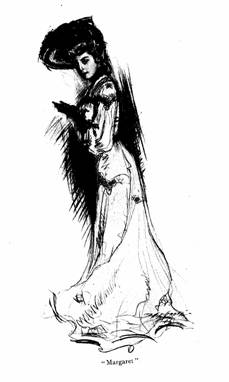
[Illustration: "Margaret"]
THE
EAGLE'S SHADOW
By
JAMES BRANCH CABELL
Illustrated by Will Grafé
Decorated by Bianthe Ostortag
1904
Published, October, 1904
To
Martha Louise Branch
In trust that the enterprise may be judged
less by the merits of its
factor than
by those of its patron
 CONTENTS
CHAPTER
I.
II.
III.
IV.
V.
VI.
VII.
VIII.
IX.
X.
XI.
XII.
XIII.
XIV.
XV.
XVI.
XVII.
XVIII.
XIX.
XX.
XXI.
XXII.
XXIII.
XXIV.
XXV.
XXVI.
XXVII.
XXVIII.
XXIX.
XXX.
XXXI.
XXXII.
XXXIII.
THE CHARACTERS
Colonel Thomas Hugonin, formerly in the service of Her Majesty the
Empress of India, Margaret Hugonin's father.
Frederick R. Woods, the founder of Selwoode, Margaret's uncle by
marriage.
Billy Woods, his nephew, Margaret's quondam fiancé.
Hugh Van Orden, a rather young young man, Margaret's adorer.
Martin Jeal, M.D., of Fairhaven, Margaret's family physician.
Cock-Eye Flinks, a gentleman of leisure, Margaret's chance
acquaintance.
Petheridge Jukesbury, president of the Society for the Suppression of
Nicotine and the Nude, Margaret's almoner in furthering the cause of
education and temperance.
Felix Kennaston, a minor poet, Margaret's almoner in furthering the
cause of literature and art.
Sarah Ellen Haggage, Madame President of the Ladies' League for the
Edification of the Impecunious, Margaret's almoner in furthering the
cause of charity and philanthropy. Kathleen Eppes Saumarez, a lecturer
before women's clubs, Margaret's almoner in furthering the cause of
theosophy, nature study, and rational dress.
Adèle Haggage, Mrs. Haggage's daughter, Margaret's rival with Hugh Van
Orden.
And Margaret Hugonin.
The other participants in the story are Wilkins, Célestine, The Spring
Moon and The Eagle.
LIST OF ILLUSTRATIONS
"Margaret"
"'Altogether,' says Colonel Hugonin, 'they strike me as being the
most ungodly menagerie ever gotten together under one roof since Noah
landed on Ararat'"
"Then, for no apparent reason, Margaret flushed, and Billy ... thought
it vastly becoming"
"Billy Woods"
"Billy unfolded it slowly, with a puzzled look growing in his
countenance"
"'My lady,' he asked, very softly, 'haven't you any good news for me
on this wonderful morning?'"
"Miss Hugonin pouted. 'You needn't, be such a grandfather,' she
suggested helpfully."
"Regarded them with alert eyes"
THE EAGLE'S SHADOW
I
This is the story of Margaret Hugonin and of the Eagle. And with your
permission, we will for the present defer all consideration of the
bird, and devote our unqualified attention to Margaret.
I have always esteemed Margaret the obvious, sensible, most
appropriate name that can be bestowed upon a girl-child, for it is a
name that fits a woman--any woman--as neatly as her proper size in
gloves.
Yes, the first point I wish to make is that a woman-child, once
baptised Margaret, is thereby insured of a suitable name. Be she grave
or gay in after-life, wanton or pious or sullen, comely or otherwise,
there will be no possible chance of incongruity; whether she develop a
taste for winter-gardens or the higher mathematics, whether she take
to golf or clinging organdies, the event is provided for. One has only
to consider for a moment, and if among a choice of Madge, Marjorie,
Meta, Maggie, Margherita, Peggy, and Gretchen, and countless
others--if among all these he cannot find a name that suits her to a
T--why, then, the case is indeed desperate and he may permissibly
fall back upon Madam or--if the cat jump propitiously, and at his own
peril--on Darling or Sweetheart.
The second proof that this name must be the best of all possible names
is that Margaret Hugonin bore it. And so the murder is out. You may
suspect what you choose. I warn you in advance that I have no part
whatever in her story; and if my admiration for her given name appear
somewhat excessive, I can only protest that in this dissentient world
every one has a right to his own taste. I knew Margaret. I admired
her. And if in some unguarded moment I may have carried my admiration
to the point of indiscretion, her husband most assuredly knows all
about it, by this, and he and I are still the best of friends. So you
perceive that if I ever did so far forget myself it could scarcely
have amounted to a hanging matter.
I am doubly sure that Margaret Hugonin was beautiful, for the reason
that I have never found a woman under forty-five who shared my
opinion. If you clap a Testament into my hand, I cannot affirm that
women are eager to recognise beauty in one another; at the utmost they
concede that this or that particular feature is well enough. But when
a woman is clean-eyed and straight-limbed, and has a cheery heart,
she really cannot help being beautiful; and when Nature accords her
a sufficiency of dimples and an infectious laugh, I protest she is
well-nigh irresistible. And all these Margaret Hugonin had.
And surely that is enough.
I shall not endeavour, then, to picture her features to you in any
nicely picked words. Her chief charm was that she was Margaret.
And besides that, mere carnal vanities are trivial things; a gray
eye or so is not in the least to the purpose. Yet since it is the
immemorial custom of writer-folk to inventory such possessions of
their heroines, here you have a catalogue of her personal attractions.
Launce's method will serve our turn.
Imprimis, there was not very much of her--five feet three, at the
most; and hers was the well-groomed modern type that implies a
grandfather or two and is in every respect the antithesis of that
hulking Venus of the Louvre whom people pretend to admire. Item, she
had blue eyes; and when she talked with you, her head drooped forward
a little. The frank, intent gaze of these eyes was very flattering
and, in its ultimate effect, perilous, since it led you fatuously to
believe that she had forgotten there were any other trousered beings
extant. Later on you found this a decided error. Item, she had a quite
incredible amount of yellow hair, that was not in the least like gold
or copper or bronze--I scorn the hackneyed similes of metallurgical
poets--but a straightforward yellow, darkening at the roots; and she
wore it low down on her neck in great coils that were held in place
by a multitude of little golden hair-pins and divers corpulent
tortoise-shell ones. Item, her nose was a tiny miracle of perfection;
and this was noteworthy, for you will observe that Nature, who is an
adept at eyes and hair and mouths, very rarely achieves a creditable
nose. Item, she had a mouth; and if you are a Gradgrindian with a
taste for hairsplitting, I cannot swear that it was a particularly
small mouth. The lips were rather full than otherwise; one saw in them
potentialities of heroic passion, and tenderness, and generosity, and,
if you will, temper. No, her mouth was not in the least like the pink
shoe-button of romance and sugared portraiture; it was manifestly
designed less for simpering out of a gilt frame or the dribbling of
stock phrases over three hundred pages than for gibes and laughter
and cheery gossip and honest, unromantic eating, as well as another
purpose, which, as a highly dangerous topic, I decline even to
mention.
There you have the best description of Margaret Hugonin that I am
capable of giving you. No one realises its glaring inadequacy more
acutely than I.
Furthermore, I stipulate that if in the progress of our comedy she
appear to act with an utter lack of reason or even common-sense--as
every woman worth the winning must do once or twice in a
lifetime--that I be permitted to record the fact, to set it down in
all its ugliness, nay, even to exaggerate it a little--all to the end
that I may eventually exasperate you and goad you into crying out,
"Come, come, you are not treating the girl with common justice!"
For, if such a thing were possible, I should desire you to rival even
me in a liking for Margaret Hugonin. And speaking for myself, I can
assure you that I have come long ago to regard her faults with the
same leniency that I accord my own.
II
We begin on a fine May morning in Colonel Hugonin's rooms at Selwoode,
which is, as you may or may not know, the Hugonins' country-place.
And there we discover the Colonel dawdling over his breakfast, in an
intermediate stage of that careful toilet which enables him later in
the day to pass casual inspection as turning forty-nine.
At present the old gentleman is discussing the members of his
daughter's house-party. We will omit, by your leave, a number of
picturesque descriptive passages--for the Colonel is, on occasion, a
man of unfettered speech--and come hastily to the conclusion, to the
summing-up of the whole matter.
"Altogether," says Colonel Hugonin, "they strike me as being the most
ungodly menagerie ever gotten together under one roof since Noah
landed on Ararat."
Now, I am sorry that veracity compels me to present the Colonel
in this particular state of mind, for ordinarily he was as
pleasant-spoken a gentleman as you will be apt to meet on the
longest summer day.
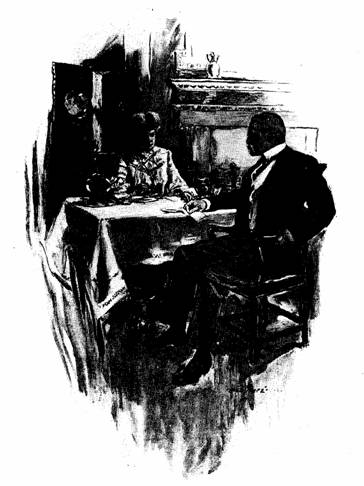
[Illustration: "'Altogether,' says Colonel Hugonin, 'they strike me as
being the most ungodly menagerie ever gotten together under one roof
since Noah landed on Ararat.'"]
You must make allowances for the fact that, on this especial morning,
he was still suffering from a recent twinge of the gout, and that his
toast was somewhat dryer than he liked it; and, most potent of all,
that the foreign mail, just in, had caused him to rebel anew against
the proprieties and his daughter's inclinations, which chained him to
Selwoode, in the height of the full London season, to preside over a
house-party every member of which he cordially disliked. Therefore,
the Colonel having glanced through the well-known names of those at
Lady Pevensey's last cotillion, groaned and glared at his daughter,
who sat opposite him, and reviled his daughter's friends with point
and fluency, and characterised them as above, for the reason that he
was hungered at heart for the shady side of Pall Mall, and that their
presence at Selwoode prevented his attaining this Elysium. For, I am
sorry to say that the Colonel loathed all things American, saving his
daughter, whom he worshipped.
And, I think, no one who could have seen her preparing his second cup
of tea would have disputed that in making this exception he acted with
a show of reason. For Margaret Hugonin--but, as you know, she is
our heroine, and, as I fear you have already learned, words are very
paltry makeshifts when it comes to describing her. Let us simply say,
then, that Margaret, his daughter, began to make him a cup of tea, and
add that she laughed.
Not unkindly; no, for at bottom she adored her father--a comely
Englishman of some sixty-odd, who had run through his wife's fortune
and his own, in the most gallant fashion--and she accorded his
opinions a conscientious, but at times, a sorely taxed, tolerance.
That very month she had reached twenty-three, the age of omniscience,
when the fallacies and general obtuseness of older people become
dishearteningly apparent.
"It's nonsense," pursued the old gentleman, "utter, bedlamite
nonsense, filling Selwoode up with writing people! Never heard of such
a thing. Gad, I do remember, as a young man, meeting Thackeray at a
garden-party at Orleans House--gentlemanly fellow with a broken nose--
and Browning went about a bit, too, now I think of it. People had 'em
one at a time to lend flavour to a dinner--like an olive; we didn't
dine on olives, though. You have 'em for breakfast, luncheon, dinner,
and everything! I'm sick of olives, I tell you, Margaret!" Margaret
pouted.
"They ain't even good olives. I looked into one of that fellow
Charteris's books the other day--that chap you had here last week.
It was bally rot--proverbs standing on their heads and grinning
like dwarfs in a condemned street-fair! Who wants to be told that
impropriety is the spice of life and that a roving eye gathers
remorse? You may call that sort of thing cleverness, if you like; I
call it damn' foolishness." And the emphasis with which he said this
left no doubt that the Colonel spoke his honest opinion.
"Attractive," said his daughter patiently, "Mr. Charteris is very,
very clever. Mr. Kennaston says literature suffered a considerable
loss when he began to write for the magazines."
And now that Margaret has spoken, permit me to call your attention to
her voice. Mellow and suave and of astonishing volume was Margaret's
voice; it came not from the back of her throat, as most of our women's
voices do, but from her chest; and I protest it had the timbre of a
violin. Men, hearing her voice for the first time, were wont to stare
at her a little and afterward to close their hands slowly, for always
its modulations had the tonic sadness of distant music, and it
thrilled you to much the same magnanimity and yearning, cloudily
conceived; and yet you could not but smile in spite of yourself at the
quaint emphasis fluttering through her speech and pouncing for the
most part on the unlikeliest word in the whole sentence.
But I fancy the Colonel must have been tone-deaf. "Don't you make
phrases for me!" he snorted; "you keep 'em for your menagerie Think!
By gad, the world never thinks. I believe the world deliberately
reads the six bestselling books in order to incapacitate itself for
thinking." Then, his wrath gathering emphasis as he went on: "The
longer I live the plainer I see Shakespeare was right--what
fools these mortals be, and all that. There's that Haggage
woman--speech-making through the country like a hiatused politician.
It may be philanthropic, but it ain't ladylike--no, begad! What has
she got to do with Juvenile Courts and child-labour in the South, I'd
like to know? Why ain't she at home attending to that crippled boy
of hers--poor little beggar!--instead of flaunting through America
meddling with other folk's children?"
Miss Hugonin put another lump of sugar into his cup and deigned no
reply.
"By gad," cried the Colonel fervently, "if you're so anxious to spend
that money of yours in charity, why don't you found a Day Nursery for
the Children of Philanthropists--a place where advanced men and women
can leave their offspring in capable hands when they're busied with
Mothers' Meetings and Educational Conferences? It would do a thousand
times more good, I can tell you, than that fresh kindergarten scheme
of yours for teaching the children of the labouring classes to make a
new sort of mud-pie."
"You don't understand these things, attractive," Margaret gently
pointed out. "You aren't in harmony with the trend of modern thought."
"No, thank God!" said the Colonel, heartily.
Ensued a silence during which he chipped at his egg-shell in an
absent-minded fashion.
"That fellow Kennaston said anything to you yet?" he presently
queried.
"I--I don't understand," she protested--oh, perfectly unconvincingly.
The tea-making, too, engrossed her at this point to an utterly
improbable extent.
Thus it shortly befell that the Colonel, still regarding her under
intent brows, cleared his throat and made bold to question her
generosity in the matter of sugar; five lumps being, as he suggested,
a rather unusual allowance for one cup.
Then, "Mr. Kennaston and I are very good friends," said she, with
dignity. And having spoiled the first cup in the making, she began on
another.
"Glad to hear it," growled the old gentleman. "I hope you value his
friendship sufficiently not to marry him. The man's a fraud--a flimsy,
sickening fraud, like his poetry, begad, and that's made up of botany
and wide margins and indecency in about equal proportions. It ain't
fit for a woman to read--in fact, a woman ought not to read anything;
a comprehension of the Decalogue and the cookery-book is enough
learning for the best of 'em. Your mother never--never--"
Colonel Hugonin paused and stared at the open window for a little. He
seemed to be interested in something a great way off.
"We used to read Ouida's books together," he said, somewhat wistfully.
"Lord, Lord, how she revelled in Chandos and Bertie Cecil and those
dashing Life Guardsmen! And she used to toss that little head of hers
and say I was a finer figure of a man than any of 'em--thirty
years ago, good Lord! And I was then, but I ain't now. I'm only a
broken-down, cantankerous old fool," declared the Colonel, blowing
his nose violently, "and that's why I'm quarrelling with the dearest,
foolishest daughter man ever had. Ah, my dear, don't mind me--run your
menagerie as you like, and I'll stand it."
Margaret adopted her usual tactics; she perched herself on the arm
of his chair and began to stroke his cheek very gently. She
often wondered as to what dear sort of a woman that tender-eyed,
pink-cheeked mother of the old miniature had been--the mother who had
died when she was two years old. She loved the idea of her, vague as
it was. And, just now, somehow, the notion of two grown people reading
Ouida did not strike her as being especially ridiculous.
"Was she very beautiful?" she asked, softly.
"My dear," said her father, "you are the picture of her."
"You dangerous old man!" said she, laughing and rubbing her cheek
against his in a manner that must have been highly agreeable. "Dear,
do you know that is the nicest little compliment I've had for a long
time?"
Thereupon the Colonel chuckled. "Pay me for it, then," said he, "by
driving the dog-cart over to meet Billy's train to-day. Eh?"
"I--I can't," said Miss Hugonin, promptly.
"Why?" demanded her father.
"Because----" said Miss Hugonin; and after giving this really
excellent reason, reflected for a moment and strengthened it by
adding, "Because----"
"See here," her father questioned, "what did you two quarrel about,
anyway?"
"I--I really don't remember," said she, reflectively; then continued,
with hauteur and some inconsistency, "I am not aware that Mr. Woods
and I have ever quarrelled."
"By gad, then," said the Colonel, "you may as well prepare to, for
I intend to marry you to Billy some day. Dear, dear, child," he
interpolated, with malice aforethought, "have you a fever?--your
cheek's like a coal. Billy's a man, I tell you--worth a dozen of your
Kennastons and Charterises. I like Billy. And besides, it's only right
he should have Selwoode--wasn't he brought up to expect it? It
ain't right he should lose it simply because he had a quarrel with
Frederick, for, by gad--not to speak unkindly of the dead, my
dear--Frederick quarrelled with every one he ever knew, from the woman
who nursed him to the doctor who gave him his last pill. He may have
gotten his genius for money-making from Heaven, but he certainly
got his temper from the devil. I really believe," said the Colonel,
reflectively, "it was worse than mine. Yes, not a doubt of it--I'm a
lamb in comparison. But he had his way, after all; and even now poor
Billy can't get Selwoode without taking you with it," and he caught
his daughter's face between his hands and turned it toward his for a
moment. "I wonder now," said he, in meditative wise, "if Billy will
consider that a drawback?"
It seemed very improbable. Any number of marriageable males would have
sworn it was unthinkable.
However, "Of course," Margaret began, in a crisp voice, "if you advise
Mr. Woods to marry me as a good speculation--"
But her father caught her up, with a whistle. "Eh?" said he. "Love in
a cottage?--is it thus the poet turns his lay? That's damn' nonsense!
I tell you, even in a cottage the plumber's bill has to be paid, and
the grocer's little account settled every month. Yes, by gad, and
even if you elect to live on bread and cheese and kisses, you'll find
Camembert a bit more to your taste than Sweitzer."
"But I don't want to marry anybody, you ridiculous old dear," said
Margaret.
"Oh, very well," said the old gentleman; "don't. Be an old maid, and
lecture before the Mothers' Club, if you like. I don't care. Anyhow,
you meet Billy to-day at twelve-forty-five. You will?--that's a good
child. Now run along and tell the menagerie I'll be down-stairs as
soon as I've finished dressing."
And the Colonel rang for his man and proceeded to finish his toilet.
He seemed a thought absent-minded this morning.
"I say, Wilkins," he questioned, after a little. "Ever read any of
Ouida's books?"
"Ho, yes, sir," said Wilkins; "Miss 'Enderson--Mrs. 'Aggage's maid,
that his, sir--was reading haloud hout hof 'Hunder Two Flags' honly
last hevening, sir."
"H'm--Wilkins--if you can run across one of them in the servants'
quarters--you might leave it--by my bed--to-night."
"Yes, sir."
"And--h'm, Wilkins--you can put it under that book of Herbert
Spencer's my daughter gave me yesterday. Under it, Wilkins--and,
h'm, Wilkins--you needn't mention it to anybody. Ouida ain't cultured,
Wilkins, but she's damn' good reading. I suppose that's why she ain't
cultured, Wilkins."
III
And now let us go back a little. In a word, let us utilise the next
twenty minutes--during which Miss Hugonin drives to the neighbouring
railway station, in, if you press me, not the most pleasant state of
mind conceivable--by explaining a thought more fully the posture of
affairs at Selwoode on the May morning that starts our story.
And to do this I must commence with the nature of the man who founded
Selwoode.
It was when the nineteenth century was still a hearty octogenarian
that Frederick R. Woods caused Selwoode to be builded. I give you the
name by which he was known on "the Street." A mythology has grown
about the name since, and strange legends of its owner are still
narrated where brokers congregate. But with the lambs he sheared, and
the bulls he dragged to earth, and the bears he gored to financial
death, we have nothing to do; suffice it, that he performed these
operations with almost uniform success and in an unimpeachably
respectable manner.
And if, in his time, he added materially to the lists of inmates in
various asylums and almshouses, it must be acknowledged that he bore
his victims no malice, and that on every Sunday morning he confessed
himself to be a miserable sinner, in a voice that was perfectly
audible three pews off. At bottom, I think he considered his relations
with Heaven on a purely business basis; he kept a species of running
account with Providence; and if on occasions he overdrew it somewhat,
he saw no incongruity in evening matters with a cheque for the church
fund.
So that at his death it was said of him that he had, in his day, sent
more men into bankruptcy and more missionaries into Africa than any
other man in the country.
In his sixty-fifth year, he caught Alfred Van Orden short in Lard,
erected a memorial window to his wife and became a country gentleman.
He never set foot in Wall Street again. He builded Selwoode--a
handsome Tudor manor which stands some seven miles from the village of
Fairhaven--where he dwelt in state, by turns affable and domineering
to the neighbouring farmers, and evincing a grave interest in the
condition of their crops. He no longer turned to the financial reports
in the papers; and the pedigree of the Woodses hung in the living-hall
for all men to see, beginning gloriously with Woden, the Scandinavian
god, and attaining a respectable culmination in the names of Frederick
R. Woods and of William, his brother.
It is not to be supposed that he omitted to supply himself with a
coat-of-arms. Frederick R. Woods evinced an almost childlike pride in
his heraldic blazonings.
"The Woods arms," he would inform you, with a relishing gusto, "are
vert, an eagle displayed, barry argent and gules. And the crest is
out of a ducal coronet, or, a demi-eagle proper. We have no motto,
sir--none of your ancient coats have mottoes."
The Woods Eagle he gloried in. The bird was perched in every available
nook at Selwoode; it was carved in the woodwork, was set in the
mosaics, was chased in the tableware, was woven in the napery, was
glazed in the very china. Turn where you would, an eagle or two
confronted you; and Hunston Wyke, who is accounted something of a
wit, swore that Frederick R. Woods at Selwoode reminded him of "a
sore-headed bear who had taken up permanent quarters in an aviary."
There was one, however, who found the bear no very untractable
monster. This was the son of his brother, dead now, who dwelt at
Selwoode as heir presumptive. Frederick R. Woods's wife had died long
ago, leaving him childless. His brother's boy was an orphan; and so,
for a time, he and the grim old man lived together peaceably enough.
Indeed, Billy Woods was in those days as fine a lad as you would wish
to see, with the eyes of an inquisitive cherub and a big tow-head,
which Frederick R. Woods fell into the habit of cuffing heartily, in
order to conceal the fact that he would have burned Selwoode to the
ground rather than allow any one else to injure a hair of it.
In the consummation of time, Billy, having attained the ripe age of
eighteen, announced to his uncle that he intended to become a famous
painter. Frederick R. Woods exhorted him not to be a fool, and packed
him off to college.
Billy Woods returned on his first vacation with a fragmentary mustache
and any quantity of paint-tubes, canvases, palettes, mahl-sticks, and
such-like paraphernalia. Frederick R. Woods passed over the mustache,
and had the painters' trappings burned by the second footman. Billy
promptly purchased another lot. His uncle came upon them one morning,
rubbed his chin meditatively for a moment, and laughed for the first
time, so far as known, in his lifetime; then he tiptoed to his own
apartments, lest Billy--the lazy young rascal was still abed in the
next room--should awaken and discover his knowledge of this act of
flat rebellion.
I dare say the old gentleman was so completely accustomed to having
his own way that this unlooked-for opposition tickled him by its
novelty; or perhaps he recognised in Billy an obstinacy akin to his
own; or perhaps it was merely that he loved the boy. In any event, he
never again alluded to the subject; and it is a fact that when
Billy sent for carpenters to convert an upper room into an atelier,
Frederick R. Woods spent two long and dreary weeks in Boston in order
to remain in ignorance of the entire affair.
Billy scrambled through college, somehow, in the allotted four years.
At the end of that time, he returned to find new inmates installed at
Selwoode.
For the wife of Frederick R. Woods had been before her marriage one of
the beautiful Anstruther sisters, who, as certain New Yorkers still
remember--those grizzled, portly, rosy-gilled fellows who prattle
on provocation of Jenny Lind and Castle Garden, and remember
everything--created a pronounced furor at their début in the days of
crinoline and the Grecian bend; and Margaret Anstruther, as they
will tell you, was married to Thomas Hugonin, then a gallant cavalry
officer in the service of Her Majesty, the Empress of India.
And she must have been the nicer of the two, because everybody who
knew her says that Margaret Hugonin is exactly like her.
So it came about naturally enough, that Billy Woods, now an Artium
Baccalaureus_, if you please, and not a little proud of it, found the
Colonel and his daughter, then on a visit to this country, installed
at Selwoode as guests and quasi-relatives. And Billy was twenty-two,
and Margaret was nineteen.
* * * * *
Precisely what happened I am unable to tell you. Billy Woods claims
it is none of my business; and Margaret says that it was a long, long
time ago and she really can't remember.
But I fancy we can all form a very fair notion of what is most likely
to occur when two sensible, normal, healthy young people are thrown
together in this intimate fashion at a country-house where the
remaining company consists of two elderly gentlemen. Billy was forced
to be polite to his uncle's guest; and Margaret couldn't well be
discourteous to her host's nephew, could she? Of course not: so
it befell in the course of time that Frederick R. Woods and the
Colonel--who had quickly become a great favourite, by virtue of his
implicit faith in the Eagle and in Woden and Sir Percival de Wode of
Hastings, and such-like flights of heraldic fancy, and had augmented
his popularity by his really brilliant suggestion of Wynkyn de Worde,
the famous sixteenth-century printer, as a probable collateral
relation of the family--it came to pass, I say, that the two gentlemen
nodded over their port and chuckled, and winked at one another and
agreed that the thing would do.
This was all very well; but they failed to make allowances for the
inevitable quarrel and the subsequent spectacle of the gentleman
contemplating suicide and the lady looking wistfully toward a nunnery.
In this case it arose, I believe, over Teddy Anstruther, who for a
cousin was undeniably very attentive to Margaret; and in the natural
course of events they would have made it up before the week was out
had not Frederick R. Woods selected this very moment to interfere in
the matter.
Ah, si vieillesse savait!
The blundering old man summoned Billy into his study and ordered him
to marry Margaret Hugonin, precisely as the Colonel might have ordered
a private to go on sentry-duty. Ten days earlier Billy would have
jumped at the chance; ten days later he would probably have suggested
it himself; but at that exact moment he would have as willingly
contemplated matrimony with Alecto or Medusa or any of the Furies.
Accordingly, he declined. Frederick R. Woods flew into a pyrotechnical
display of temper, and gave him his choice between obeying his
commands and leaving his house forever--the choice, in fact, which he
had been according Billy at very brief intervals ever since the boy
had had the measles, fifteen years before, and had refused to take the
proper medicines.
It was merely his usual manner of expressing a request or a
suggestion. But this time, to his utter horror and amaze, the boy took
him at his word and left Selwoode within the hour.
Billy's life, you see, was irrevocably blighted. It mattered very
little what became of him; personally, he didn't care in the least.
But as for that fair, false, fickle woman--perish the thought! Sooner
a thousand deaths! No, he would go to Paris and become a painter of
worldwide reputation; the money his father had left him would easily
suffice for his simple wants. And some day, the observed of all
observers in some bright hall of gaiety, he would pass her coldly by,
with a cynical smile upon his lips, and she would grow pale and totter
and fall into the arms of the bloated Silenus, for whose title she had
bartered her purely superficial charms.
Yes, upon mature deliberation, that was precisely what Billy decided
to do.
Followed dark days at Selwoode. Frederick R. Woods told Margaret of
what had occurred; and he added the information that, as his wife's
nearest relative, he intended to make her his heir.
Then Margaret did what I would scarcely have expected of Margaret.
She turned upon him like a virago and informed Frederick R. Woods
precisely what she thought of him; she acquainted him with the fact
that he was a sordid, low-minded, grasping beast, and a miser, and
a tyrant, and (I think) a parricide; she notified him that he was
thoroughly unworthy to wipe the dust off his nephew's shoes--an
office toward which, to do him justice, he had never shown any marked
aspirations--and that Billy had acted throughout in a most noble and
sensible manner; and that, personally, she wouldn't marry Billy Woods
if he were the last man on earth, for she had always despised him; and
she added the information that she expected to die shortly, and she
hoped they would both be sorry then; and subsequently she clapped
the climax by throwing her arms about his neck and bursting into tears
and telling him he was the dearest old man in the world and that she
was thoroughly ashamed of herself.
So they kissed and made it up. And after a little the Colonel and
Margaret went away from Selwoode, and Frederick R. Woods was left
alone to nourish his anger and indignation, if he could, and to hunger
for his boy, whether he would or not. He was too proud to seek him
out; indeed, he never thought of that; and so he waited alone in his
fine house, sick at heart, impotent, hoping against hope that the boy
would come back. The boy never came.
No, the boy never came, because he was what the old man had made
him--headstrong, and wilful, and obstinate. Billy had been thoroughly
spoiled. The old man had nurtured his pride, had applauded it as a
mark of proper spirit; and now it was this same pride that had robbed
him of the one thing he loved in all the world.
So, at last, the weak point in the armour of this sturdy old Pharisee
was found, and Fate had pierced it gaily. It was retribution, if you
will; and I think that none of his victims in "the Street," none of
the countless widows and orphans that he had made, suffered more
bitterly than he in those last days.
It was almost two years after Billy's departure from Selwoode that his
body-servant, coming to rouse Frederick R. Woods one June morning,
found him dead in his rooms. He had been ailing for some time. It
was his heart, the doctors said; and I think that it was, though not
precisely in the sense which they meant.
The man found him seated before his great carved desk, on which his
head and shoulders had fallen forward; they rested on a sheet of
legal-cap paper half-covered with a calculation in his crabbed old
hand as to the value of certain properties--the calculation which he
never finished; and underneath was a mass of miscellaneous papers,
among them his will, dated the day after Billy left Selwoode, in which
Frederick R. Woods bequeathed his millions unconditionally to Margaret
Hugonin when she should come of age.
Her twenty-first birthday had fallen in the preceding month. So
Margaret was one of the richest women in America; and you may depend
upon it, that if many men had loved her before, they worshipped her
now--or, at least, said they did, and, after all, their protestations
were the only means she had of judging. She might have been a
countess--and it must be owned that the old Colonel, who had an honest
Anglo-Saxon reverence for a title, saw this chance lost wistfully--and
she might have married any number of grammarless gentlemen, personally
unknown to her, whose fervent proposals almost every mail brought in;
and besides these, there were many others, more orthodox in their
wooing, some of whom were genuinely in love with Margaret Hugonin, and
some--I grieve to admit it--who were genuinely in love with her money;
and she would have none of them.
She refused them all with the utmost civility, as I happen to know.
How I learned it is no affair of yours.
For Miss Hugonin had remarkably keen eyes, which she used to
advantage. In the world about her they discovered very little that she
could admire. She was none the happier for her wealth; the piled-up
millions overshadowed her personality; and it was not long before she
knew that most people regarded her simply as the heiress of the Woods
fortune--an unavoidable encumbrance attached to the property, which
divers thrifty-minded gentlemen were willing to put up with. To put up
with!--at the thought, her pride rose in a hot blush, and, it must be
confessed, she sought consolation in the looking-glass.
She was an humble-minded young woman, as the sex goes, and she saw no
great reason there why a man should go mad over Margaret Hugonin. This
decision, I grant you, was preposterous, for there were any number of
reasons. Her final conclusion, however, was for the future to regard
all men as fortune-hunters and to do her hair differently.
She carried out both resolutions. When a gentleman grew pressing in
his attentions, she more than suspected his motives; and when she
eventually declined him it was done with perfect, courtesy, but the
glow of her eyes was at such times accentuated to a marked degree.
Meanwhile, the Eagle brooded undisturbed at Selwoode. Miss Hugonin
would allow nothing to be altered.
"The place doesn't belong to me, attractive," she would tell her
father. "I belong to the place. Yes, I do--I'm exactly like a little
cow thrown in with a little farm when they sell it, and all my
little suitors think so, and they are very willing to take me on those
terms, too. But they shan't, attractive. I hate every single solitary
man in the whole wide world but you, beautiful, and I particularly
hate that horrid old Eagle; but we'll keep him because he's a constant
reminder to me that Solomon or Moses, or whoever it was that said all
men were liars, was a person of very great intelligence."
So that I think we may fairly say the money did her no good.
If it benefited no one else, it was not Margaret's fault. She had a
high sense of her responsibilities, and therefore, at various times,
endeavoured to further the spread of philanthropy and literature and
theosophy and art and temperance and education and other laudable
causes. Mr. Kennaston, in his laughing manner, was wont to jest at
her varied enterprises and term her Lady Bountiful; but, then, Mr.
Kennaston had no real conception of the proper uses of money. In
fact, he never thought of money. He admitted this to Margaret with a
whimsical sigh.
Margaret grew very fond of Mr. Kennaston because he was not mercenary.
Mr. Kennaston was much at Selwoode. Many people came there
now--masculine women and muscleless men, for the most part. They had,
every one of them, some scheme for bettering the universe; and if
among them Margaret seemed somewhat out of place--a butterfly among
earnest-minded ants--her heart was in every plan they advocated, and
they found her purse-strings infinitely elastic. The girl was pitiably
anxious to be of some use in the world.
So at Selwoode they gossiped of great causes and furthered the
millenium. And above them the Eagle brooded in silence.
And Billy? All this time Billy was junketing abroad, where every
year he painted masterpieces for the Salon, which--on account of a
nefarious conspiracy among certain artists, jealous of his superior
merits--were invariably refused.
Now Billy is back again in America, and the Colonel has insisted that
he come to Selwoode, and Margaret is waiting for him in the dog-cart.
The glow of her eyes is very, very bright. Her father's careless words
this morning, coupled with certain speeches of Mr. Kennaston's last
night, have given her food for reflection.
"He wouldn't dare," says Margaret, to no one in particular. "Oh, no,
he wouldn't dare after what happened four years ago."
And, Margaret-like, she has quite forgotten that what happened four
years ago was all caused by her having flirted outrageously with Teddy
Anstruther, in order to see what Billy would do.
IV
The twelve forty-five, for a wonder, was on time; and there descended
from it a big, blond young man, who did not look in the least like a
fortune-hunter.
Miss Hugonin resented this. Manifestly, he looked clean and honest for
the deliberate purpose of deceiving her. Very well! She'd show him!
He was quite unembarrassed. He shook hands cordially; then he shook
hands with the groom, who, you may believe it, was grinning in a most
unprofessional manner because Master Billy was back again at Selwoode.
Subsequently, in his old decisive way, he announced they would walk to
the house, as his legs needed stretching.
The insolence of it!--quite as if he had something to say to Margaret
in private and couldn't wait a minute. Beyond doubt, this was a young
man who must be taken down a peg or two, and that at once. Of course,
she wasn't going to walk back with him!--a pretty figure they'd cut
strolling through the fields, like a house-girl and the milkman on a
Sunday afternoon! She would simply say she was too tired to walk, and
that would end the matter.
So she said she thought the exercise would do them both good.
They came presently with desultory chat to a meadow bravely decked in
all the gauds of Spring. About them the day was clear, the air bland.
Spring had revamped her ageless fripperies of tender leaves and
bird-cries and sweet, warm odours for the adornment of this meadow;
above it she had set a turkis sky splashed here and there with little
clouds that were like whipped cream; and upon it she had scattered
largesse, a Danaë's shower of buttercups. Altogether, she had made of
it a particularly dangerous meadow for a man and a maid to frequent.
Yet there Mr. Woods paused under a burgeoning maple--paused
resolutely, with the lures of Spring thick about him, compassed with
every snare of scent and sound and colour that the witch is mistress
of.
Margaret hoped he had a pleasant passage over. Her father, thank you,
was in the pink of condition. Oh, yes, she was quite well. She hoped
Mr. Woods would not find America--
"Well, Peggy," said Mr. Woods, "then, we'll have it out right here."
His insolence was so surprising that--in order to recover
herself--Margaret actually sat down under the maple-tree. Peggy,
indeed! Why, she hadn't been called Peggy for--no, not for four whole
years!
"Because I intend to be friends, you know," said Mr. Woods.
And about them the maple-leaves made a little island of sombre green,
around which more vivid grasses rippled and dimpled under the fitful
spring breezes. And everywhere leaves lisped to one another, and birds
shrilled insistently. It was a perilous locality.
I fancy Billy Woods was out of his head when he suggested being
friends in such a place. Friends, indeed!--you would have thought from
the airy confidence with which he spoke that Margaret had come safely
to forty year and wore steel-rimmed spectacles!
But Miss Hugonin merely cast down her eyes and was aware of no reason
why they shouldn't be. She was sure he must be hungry, and she thought
luncheon must be ready by now.
In his soul, Mr. Woods observed that her lashes were long--long beyond
all reason. Lacking the numbers that Petrarch flowed in, he did not
venture, even to himself, to characterise them further. But oh, how
queer it was they should be pure gold at the roots!--she must have
dipped them in the ink-pot. And oh, the strong, sudden, bewildering
curve of 'em! He could not recall at the present moment ever noticing
quite such lashes anywhere else. No, it was highly improbable that
there were such lashes anywhere else. Perhaps a few of the superior
angels might have such lashes. He resolved for the future to attend
church more regularly.
Aloud, Mr. Woods observed that in that case they had better shake
hands.
It would have been ridiculous to contest the point. The dignified
course was to shake hands, since he insisted on it, and then to return
at once to Selwoode.
Margaret Hugonin had a pretty hand, and Mr. Woods, as an artist, could
not well fail to admire it. Still, he needn't have looked at it as
though he had never before seen anything quite like it; he needn't
have neglected to return it; and when Miss Hugonin reclaimed it, after
a decent interval, he needn't have laughed in a manner that compelled
her to laugh, too. These things were unnecessary and annoying, as they
caused Margaret to forget that she despised him.
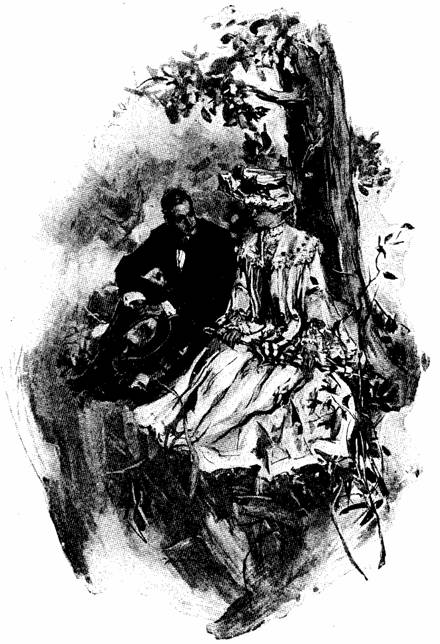
[Illustration: "Then, for no apparent reason, Margaret flushed, and
Billy ... thought it vastly becoming"]
For the time being--will you believe it?--she actually thought he was
rather nice.
"I acted like an ass," said Mr. Woods, tragically. "Oh, yes, I did,
you know. But if you'll forgive me for having been an ass I'll forgive
you for throwing me over for Teddy Anstruther, and at the wedding I'll
dance through any number of pairs of patent-leathers you choose to
mention."
So that was the way he looked at it. Teddy Anstruther, indeed! Why,
Teddy was a dark little man with brown eyes--just the sort of man she
most objected to. How could any one ever possibly fancy a brown-eyed
man? Then, for no apparent reason, Margaret flushed, and Billy, who
had stretched his great length of limb on the grass beside her, noted
it with a pair of the bluest eyes in the world and thought it vastly
becoming.
"Billy," said she, impulsively--and the name having slipped out once
by accident, it would have been absurd to call him anything else
afterward--"it was horrid of you to refuse to take any of that money."
"But I didn't want it," he protested. "Good Lord, I'd only have done
something foolish with it. It was awfully square of you, Peggy, to
offer to divide, but I didn't want it, you see. I don't want to be a
millionaire, and give up the rest of my life to founding libraries and
explaining to people that if they never spend any money on amusements
they'll have a great deal by the time they're too old to enjoy it. I'd
rather paint pictures."
So that I think Margaret must have endeavoured at some time to make
him accept part of Frederick R. Woods's money.
"You make me feel--and look--like a thief," she reproved him.
Then Billy laughed a little. "You don't look in the least like one,"
he reassured her. "You look like an uncommonly honest, straightforward
young woman," Mr. Woods added, handsomely, "and I don't believe you'd
purloin under the severest temptation."
She thanked him for his testimonial, with all three dimples in
evidence.
This was unsettling. He hedged.
"Except, perhaps--" said he.
"Yes?" queried Margaret, after a pause.
However, she questioned him with her head drooped forward, her brows
raised; and as this gave him the full effect of her eyes, Mr. Woods
became quite certain that there was, at least, one thing she might be
expected to rob him of, and wisely declined to mention it.
Margaret did not insist on knowing what it was. Perhaps she heard it
thumping under his waistcoat, where it was behaving very queerly.
So they sat in silence for a while. Then Margaret fell a-humming to
herself; and the air--will you believe it?--chanced by the purest
accident to be that foolish, senseless old song they used to sing
together four years ago.
Billy chuckled. "Let's!" he obscurely pleaded.
Spring prompted her.
"Oh, where have you been, Billy boy?"
queried Margaret's wonderful contralto,
"Oh, where have you been, Billy boy, Billy boy?
Oh, where have you been, charming Billy?"
She sang it in a low, hushed voice, just over her breath. Not looking
at him, however. And oh, what a voice! thought Billy Woods. A voice
that was honey and gold and velvet and all that is most sweet and rich
and soft in the world! Find me another voice like that, you prime
donne! Find me a simile for it, you uninventive poets! Indeed, I'd
like to see you do it.
But he chimed in, nevertheless, with his pleasant throaty baritone,
and lilted his own part quite creditably.
"I've been to seek a wife,
She's the joy of my life;
She's a young thing, and cannot leave her mother"--
Only Billy sang it "father," just as they used to do.
And then they sang it through, did Margaret and Billy--sang of the
dimple in her chin and the ringlets in her hair, and of the cherry
pies she achieved with such celerity--sang as they sat in the
spring-decked meadow every word of that inane old song that is so
utterly senseless and so utterly unforgettable.
It was a quite idiotic performance. I set it down to the snares of
Spring--to her insidious, delightful snares of scent and sound and
colour that--for the moment, at least--had trapped these young people
into loving life infinitely.
But I wonder who is responsible for that tatter of rhyme and melody
that had come to them from nowhere in particular? Mr. Woods, as he sat
up at the conclusion of the singing vigorously to applaud, would have
shared his last possession, his ultimate crust, with that unknown
benefactor of mankind. Indeed, though, the heart of Mr. Woods just now
was full of loving kindness and capable of any freakish magnanimity.
For--will it be believed?--Mr. Woods, who four years ago had thrown
over a fortune and exiled himself from his native land, rather than
propose marriage to Margaret Hugonin, had no sooner come again into
her presence and looked once into her perfectly fathomless eyes than
he could no more have left her of his own accord than a moth can turn
his back to a lighted candle. He had fancied himself entirely cured
of that boy-and-girl nonsense; his broken heart, after the first few
months, had not interfered in the least with a naturally healthy
appetite; and, behold, here was the old malady raging again in his
veins and with renewed fervour.
And all because the girl had a pretty face! I think you will agree
with me that in the conversation I have recorded Margaret had not
displayed any great wisdom or learning or tenderness or wit, nor,
in fine, any of the qualities a man might naturally look for in a
helpmate. Yet at the precise moment he handed his baggage-check to the
groom, Mr. Woods had made up his mind to marry her. In an instant he
had fallen head over ears in love; or to whittle accuracy to a point,
he had discovered that he had never fallen out of love; and if you had
offered him an empress or fetched Helen of Troy from the grave for his
delectation he would have laughed you to scorn.
In his defense, I can only plead that Margaret was an unusually
beautiful woman. It is all very well to flourish a death's-head at the
feast, and bid my lady go paint herself an inch thick, for to this
favour she must come; and it is quite true that the reddest lips in
the universe may give vent to slander and lies, and the brightest eyes
be set in the dullest head, and the most roseate of complexions be
purchased at the corner drug-store; but, say what you will, a pretty
woman is a pretty woman, and while she continue so no amount of
common-sense or experience will prevent a man, on provocation, from
alluring, coaxing, even entreating her to make a fool of him. We like
it. And I think they like it, too.
So Mr. Woods lost his heart on a fine spring morning and was
unreasonably elated over the fact.
And Margaret? Margaret was content.
V
They talked for a matter of a half-hour in the fashion aforetime
recorded--not very wise nor witty talk, if you will, but very pleasant
to make. There were many pauses. There was much laughter over nothing
in particular. There were any number of sentences ambitiously begun
that ended nowhere. Altogether, it was just the sort of talk for a man
and a maid.
Yet some twenty minutes later, Mr. Woods, preparing for luncheon in
the privacy of his chamber, gave a sudden exclamation. Then he sat
down and rumpled his hair thoroughly.
"Good Lord!" he groaned; "I'd forgotten all about that damned money!
Oh, you ass!--you abject ass! Why, she's one of the richest women in
America, and you're only a fifth-rate painter with a paltry thousand
or so a year! You marry her!--why, I dare say she's refused a
hundred better men than you! She'd think you were mad! Why, she'd
think you were after her money! She--oh, she'd only think you a
precious cheeky ass, she would, and she'd be quite right. You are an
ass, Billy Woods! You ought to be locked up in some nice quiet stable,
where your heehawing wouldn't disturb people. You need a keeper, you
do!"
He sat for some ten minutes, aghast. Afterward he rose and threw back
his shoulders and drew a deep breath.
"No, we aren't an ass," he addressed his reflection in the mirror, as
he carefully knotted his tie. "We're only a poor chuckle-headed moth
who's been looking at a star too long. It's a bright star, Billy, but
it isn't for you. So we're going to be sensible now. We're going to
get a telegram to-morrow that will call us away from Selwoode. We
aren't coming back any more, either. We're simply going to continue
painting fifth-rate pictures, and hoping that some day she'll find the
right man and be very, very happy."
Nevertheless, he decided that a blue tie would look better, and was
very particular in arranging it.
At the same moment Margaret stood before her mirror and tidied her
hair for luncheon and assured her image in the glass that she was a
weak-minded fool. She pointed out to herself the undeniable fact that
Billy, having formerly refused to marry her--oh, ignominy!--seemed
pleasant-spoken enough, now that she had become an heiress. His
refusal to accept part of her fortune was a very flimsy device; it
simply meant he hoped to get all of it. Oh, he did, did he!
Margaret powdered her nose viciously.
She saw through him! His honest bearing she very plainly perceived
to be the result of consummate hypocrisy. In his laughter her keen ear
detected a hollow ring; and his courteous manner she found, at bottom,
mere servility. And finally she demonstrated--to her own satisfaction,
at least--that his charm of manner was of exactly the, same sort that
had been possessed by many other eminently distinguished criminals.
How did she do this? My dear sir, you had best inquire of your mother
or your sister or your wife, or any other lady that your fancy
dictates. They know. I am sure I don't.
And after it all--
"Oh, dear, dear!" said Margaret; "I do wish he didn't have such nice
eyes!"
VI
On the way to luncheon Mr. Woods came upon Adèle Haggage and Hugh Van
Orden, both of whom he knew, very much engrossed in one another, in a
nook under the stairway. To Billy it seemed just now quite proper that
every one should be in love; wasn't it--after all--the most pleasant
condition in the world? So he greeted them with a semi-paternal smile
that caused Adèle to flush a little.
For she was--let us say, interested--in Mr. Van Orden. That was
tolerably well known. In fact, Margaret--prompted by Mrs. Haggage,
it must be confessed--had invited him to Selwoode for the especial
purpose of entertaining Miss Adèle Haggage; for he was a good match,
and Mrs. Haggage, as an experienced chaperon, knew the value of
country houses. Very unexpectedly, however, the boy had developed a
disconcerting tendency to fall in love with Margaret, who snubbed him
promptly and unmercifully. He had accordingly fallen back on Adèle,
and Mrs. Haggage had regained both her trust in Providence and her
temper.
In the breakfast-room, where luncheon was laid out, the Colonel
greeted Mr. Woods with the enthusiasm a sailor shipwrecked on a desert
island might conceivably display toward the boat-crew come to rescue
him. The Colonel liked Billy; and furthermore, the poor Colonel's
position at Selwoode just now was not utterly unlike that of the
suppositious mariner; were I minded to venture into metaphor, I should
picture him as clinging desperately to the rock of an old fogeyism
and surrounded by weltering seas of advanced thought. Colonel Hugonin
himself was not advanced in his ideas. Also, he had forceful opinions
as to the ultimate destination of those who were.
Then Billy was presented to the men of the party--Mr. Felix Kennaston
and Mr. Petheridge Jukesbury. Mrs. Haggage he knew slightly; and
Kathleen Saumarez he had known very well indeed, some six years
previously, before she had ever heard of Miguel Saumarez, and when
Billy was still an undergraduate. She was a widow now, and not
well-to-do; and Mr. Woods's first thought on seeing her was that a man
was a fool to write verses, and that she looked like just the sort of
woman to preserve them.
His second was that he had verged on imbecility when he fancied he
admired that slender, dark-haired type. A woman's hair ought to be an
enormous coronal of sunlight; a woman ought to have very large, candid
eyes of a colour between that of sapphires and that of the spring
heavens, only infinitely more beautiful than either; and all
petticoated persons differing from this description were manifestly
quite unworthy of any serious consideration.
So his eyes turned to Margaret, who had no eyes for him. She had
forgotten his existence, with an utterness that verged on ostentation;
and if it had been any one else Billy would have surmised she was in a
temper. But that angel in a temper!--nonsense! And, oh, what eyes she
had! and what lashes! and what hair!--and altogether, how adorable she
was, and what a wonder the admiring gods hadn't snatched her up to
Olympus long ago!
Thus far Mr. Woods.
But if Miss Hugonin was somewhat taciturn, her counsellors in divers
schemes for benefiting the universe were in opulent vein. Billy heard
them silently.
"I have spent the entire morning by the lake," Mr. Kennaston informed
the party at large, "in company with a mocking-bird who was practising
a new aria. It was a wonderful place; the trees were lisping verses to
themselves, and the sky overhead was like a robin's egg in colour,
and a faint wind was making tucks and ruches and pleats all over
the water, quite as if the breezes had set up in business as
mantua-makers. I fancy they thought they were working on a great sheet
of blue silk, for it was very like that. And every once in a while a
fish would leap and leave a splurge of bubble and foam behind that you
would have sworn was an inserted lace medallion."
Mr. Kennaston, as you are doubtless aware, is the author of "The
King's Quest" and other volumes of verse. He is a full-bodied young
man, with hair of no particular shade; and if his green eyes are a
little aged, his manner is very youthful. His voice in speaking is
wonderfully pleasing, and he has a habit of cocking his head on one
side, in a bird-like fashion.
"Indeed," Mr. Petheridge Jukesbury observed, "it is very true that God
made the country and man made the town. A little more wine, please."
Mr. Jukesbury is a prominent worker in the cause of philanthropy
and temperance. He is ponderous and bland; and for the rest, he is
president of the Society for the Suppression of Nicotine and the
Nude, vice-president of the Anti-Inebriation League, secretary of the
Incorporated Brotherhood of Benevolence, and the bearer of divers
similar honours.
"I am never really happy in the country," Mrs. Saumarez dissented; "it
reminds me so constantly of our rural drama. I am always afraid the
quartette may come on and sing something."
Kathleen Eppes Saumarez, as I hope you do not need to be told, is
the well-known lecturer before women's clubs, and the author of many
sympathetic stories of Nature and animal life of the kind that have
had such a vogue of late. There was always an indefinable air of
pathos about her; as Hunston Wyke put it, one felt, somehow, that her
mother had been of a domineering disposition, and that she took after
her father.
"Ah, dear lady," Mr. Kennaston cried, playfully, "you, like many of
us, have become an alien to Nature in your quest of a mere Earthly
Paradox. Epigrams are all very well, but I fancy there is more
happiness to be derived from a single impulse from a vernal wood than
from a whole problem-play of smart sayings. So few of us are
natural," Mr. Kennaston complained, with a dulcet sigh; "we are too
sophisticated. Our very speech lacks the tang of outdoor life.
Why should we not love Nature--the great mother, who is, I grant you,
the necessity of various useful inventions, in her angry moods, but
who, in her kindly moments--" He paused, with a wry face. "I beg your
pardon," said he, "but I believe I've caught rheumatism lying by that
confounded pond."
Mrs. Saumarez rallied the poet, with a pale smile. "That comes of
communing with Nature," she reminded him; "and it serves you rightly,
for natural communications corrupt good epigrams. I prefer Nature
with wide margins and uncut leaves," she spoke, in her best platform
manner. "Art should be an expurgated edition of Nature, with all
the unpleasant parts left out. And I am sure," Mrs. Saumarez added,
handsomely, and clinching her argument, "that Mr. Kennaston gives us
much better sunsets in his poems than I have ever seen in the west."
He acknowledged this with a bow.
"Not sherry--claret, if you please," said Mr. Jukesbury. "Art should
be an expurgated edition of Nature," he repeated, with a suave
chuckle. "Do you know, I consider that admirably put, Mrs.
Saumarez--admirably, upon my word. Ah, if our latter-day writers would
only take that saying to heart! We do not need to be told of the vice
and corruption prevalent, I am sorry to say, among the very best
people; what we really need is continually to be reminded of the fact
that pure hearts and homes and happy faces are to be found to-day
alike in the palatial residences of the wealthy and in the humbler
homes of those less abundantly favoured by Fortune, and yet dwelling
together in harmony and Christian resignation and--er--comparatively
moderate circumstances."
"Surely," Mrs. Saumarez protested, "art has nothing to do with
morality. Art is a process. You see a thing in a certain way; you make
your reader see it in the same way--or try to. If you succeed, the
result is art. If you fail, it may be the book of the year."
"Enduring immortality and--ah--the patronage of the reading public,"
Mr. Jukesbury placidly insisted, "will be awarded, in the end, only
to those who dwell upon the true, the beautiful, and the--er
--respectable. Art must cheer; it must be optimistic and
edifying and--ah--suitable for young persons; it must have an uplift,
a leaven of righteousness, a--er--a sort of moral baking-powder. It
must utterly eschew the--ah--unpleasant and repugnant details of life.
It is, if I may so express myself, not at home in the ménage à trois
or--er--the representation of the nude. Yes, another glass of claret,
if you please."
"I quite agree with you," said Mrs. Haggage, in her deep voice. Sarah
Ellen Haggage is, of course, the well-known author of "Child-Labour in
the South," and "The Down-Trodden Afro-American," and other notable
contributions to literature. She is, also, the "Madame President" both
of the Society for the Betterment of Civic Government and Sewerage,
and of the Ladies' League for the Edification of the Impecunious.
"And I am glad to see," Mrs. Haggage presently went on, "that the
literature of the day is so largely beginning to chronicle the sayings
and doings of the labouring classes. The virtues of the humble must be
admitted in spite of their dissolute and unhygienic tendencies. Yes,"
Mrs. Haggage added, meditatively, "our literature is undoubtedly
acquiring a more elevated tone; at last we are shaking off the
scintillant and unwholesome influence of the French."
"Ah, the French!" sighed Mr. Kennaston; "a people who think depravity
the soul of wit! Their art is mere artfulness. They care nothing for
Nature."
"No," Mrs. Haggage assented; "they prefer nastiness. All French
books are immoral. I ran across one the other day that was simply
hideously indecent--unfit for a modest woman to read. And I can assure
you that none of its author's other books are any better. I purchased
the entire set at once and read them carefully, in order to make sure
that I was perfectly justified in warning my working-girls' classes
against them. I wish to misjudge no man--not even a member of a nation
notoriously devoted to absinthe and illicit relations."
She breathed heavily, and looked at Mr. Woods as if, somehow, he
was responsible. Then she gave the name of the book to Petheridge
Jukesbury. He wished to have it placed on the Index Expurgatorius of
the Brotherhood of Benevolence, he said.
"Dear, dear," Felix Kennaston sighed, as Mr. Jukesbury made a note of
it; "you are all so practical. You perceive an evil and proceed at
once, in your common-sense way, to crush it, to stamp it out. Now,
I can merely lament certain unfortunate tendencies of the age; I am
quite unable to contend against them. Do you know," Mr. Kenneston
continued gaily, as he trifled with a bunch of grapes, "I feel
horribly out-of-place among you? Here is Mrs. Saumarez creating an
epidemic of useful and improving knowledge throughout the country, by
means of her charming lectures. Here is Mrs. Haggage, the mainspring,
if I may say so, of any number of educational and philanthropic
alarm clocks which will some day rouse the sleeping public from its
lethargy. And here is my friend Jukesbury, whose eloquent pleas for a
higher life have turned so many workmen from gin and improvidence, and
which in a printed form are disseminated even in such remote regions
as Africa, where I am told they have produced the most satisfactory
results upon the unsophisticated but polygamous monarchs of that
continent. And here, above all, is Miss Hugonin, utilising the vast
power of money--which I am credibly informed is a very good thing to
have, though I cannot pretend to speak from experience--and casting
whole bakeryfuls of bread upon the waters of charity. And here am
I, the idle singer of an empty day--a mere drone in this hive of
philanthropic bees! Dear, dear," said Mr. Kennaston, enviously, "what
a thing it is to be practical!" And he laughed toward Margaret, in his
whimsical way.
Miss Hugonin had been strangely silent; but she returned Mr.
Kennaston's smile, and began to take part in the conversation.
"You're only an ignorant child," she rebuked him, "and a very naughty
child, too, to make fun of us in this fashion."
"Yes," Mr. Kennaston assented, "I am wilfully ignorant. The world
adores ignorance; and where ignorance is kissed it is folly to be
wise. To-morrow I shall read you a chapter from my 'Defense of
Ignorance,' which my confiding publisher is going to bring out in the
autumn."
So the table-talk went on, and now Margaret bore a part therein.
* * * * *
However, I do not think we need record it further.
Mr. Woods listened in a sort of a daze. Adèle Haggage and Hugh Van
Orden were conversing in low tones at one end of the table; the
Colonel was eating his luncheon, silently and with a certain air of
resignation; and so Billy Woods was left alone to attend and marvel.
The ideas they advanced seemed to him, for the most part, sensible.
What puzzled him was the uniform gravity which they accorded
equally--as it appeared to him--to the discussion of the most pompous
platitudes and of the most arrant nonsense. They were always serious;
and the general tone of infallibility, Billy thought, could be
warranted only by a vast fund of inexperience.
But, in the main, they advocated theories he had always
held--excellent theories, he considered. And he was seized with an
unreasonable desire to repudiate every one of them.
For it seemed to him that every one of them was aimed at Margaret's
approval. It did not matter to whom a remark was ostensibly
addressed--always at its conclusion the speaker glanced more or
less openly toward Miss Hugonin. She was the audience to which they
zealously played, thought Billy; and he wondered.
I think I have said that, owing to the smallness of the house-party,
luncheon was served in the breakfast-room. The dining-room at Selwoode
is very rarely used, because Margaret declares its size makes a meal
there equivalent to eating out-of-doors.
And I must confess that the breakfast-room is far cosier. The room, in
the first place, is of reasonable dimensions; it is hung with Flemish
tapestries from designs by Van Eyck representing the Four Seasons, but
the walls and ceiling are panelled in oak, and over the mantel carved
in bas-relief the inevitable Eagle is displayed.
The mantel stood behind Margaret's chair; and over her golden head,
half-protectingly, half-threateningly, with his wings outstretched to
the uttermost, the Eagle brooded as he had once brooded over Frederick
R. Woods. The old man sat contentedly beneath that symbol of what
he had achieved in life. He had started (as the phrase runs) from
nothing; he had made himself a power. To him, the Eagle meant that
crude, incalculable power of wealth he gloried in. And to Billy Woods,
the Eagle meant identically the same thing, and--I am sorry to say--he
began to suspect that the Eagle was really the audience to whom Miss
Hugonin's friends so zealously played.
Perhaps the misanthropy of Mr. Woods was not wholly unconnected with
the fact that Margaret never looked at him. She'd show him!--the
fortune-hunter!
So her eyes never strayed toward him; and her attention never left
him. At the end of luncheon she could have enumerated for you every
morsel he had eaten, every glare he had directed toward Kennaston,
every beseeching look he had turned to her. Of course, he had taken
sherry--dry sherry. Hadn't he told her four years ago--it was the
first day she had ever worn the white organdie dotted with purple
sprigs, and they sat by the lake so late that afternoon that Frederick
R. Woods finally sent for them to come to dinner--hadn't he told her
then that only women and children cared for sweet wines? Of course he
had--the villain!
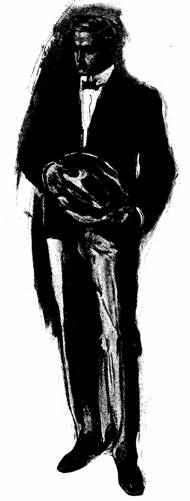
[Illustration: "Billy Woods"]
Billy, too, had his emotions. To hear that paragon, that queen among
women, descant of work done in the slums and of the mysteries of
sweat-shops; to hear her state off-hand that there were seventeen
hundred and fifty thousand children between the ages of ten and
fifteen years employed in the mines and factories of the United
States; to hear her discourse of foreign missions as glibly as though
she had been born and nurtured in Zambesi Land: all these things
filled him with an odd sense of alienation. He wasn't worthy of her,
and that was a fact. He was only a dumb idiot, and half the words that
were falling thick and fast from philanthropic lips about him might as
well have been hailstones, for all the benefit he was deriving from
them. He couldn't understand half she said.
In consequence, he very cordially detested the people who
could--especially that grimacing ass, Kennaston.
Altogether, neither Mr. Woods nor Miss Hugonin got much comfort from
their luncheon.
VII
After luncheon Billy had a quiet half-hour with the Colonel in the
smoking-room.
Said Billy, between puffs of a cigar:
"Peggy's changed a bit."
The Colonel grunted. Perhaps he dared not trust to words.
"Seems to have made some new friends."
A more vigorous grunt.
"Cultured lot, they seem?" said Mr. Woods. "Anxious to do good in the
world, too--philanthropic set, eh?"
A snort this time.
"Eh?" said Mr. Woods. There was dawning suspicion in his tone.
The Colonel looked about him. "My boy," said he, "you thank your stars
you didn't get that money; and, depend upon it, there never was a
gold-ship yet that wasn't followed."
"Pirates?" Billy Woods suggested, helpfully.
"Pirates are human beings," said Colonel Hugonin, with dignity.
"Sharks, my boy; sharks!"
VIII
That evening, after proper deliberation, "Célestine," Miss Hugonin
commanded, "get out that little yellow dress with the little red
bandanna handkerchiefs on it; and for heaven's sake, stop pulling
my hair out by the roots, unless you want a raving maniac on your
hands, Célestine!"
Whereby she had landed me in a quandary. For how, pray, is it possible
for me, a simple-minded male, fittingly to depict for you the clothes
of Margaret?--the innumerable vanities, the quaint devices, the
pleasing conceits with which she delighted to enhance her comeliness?
The thing is beyond me. Let us keep discreetly out of her wardrobe,
you and I.
Otherwise, I should have to prattle of an infinity of mysteries--of
her scarfs, feathers, laces, gloves, girdles, knots, hats, shoes,
fans, and slippers--of her embroideries, rings, pins, pendants,
ribbons, spangles, bracelets, and chains--in fine, there would be no
end to the list of gewgaws that went to make Margaret Hugonin even
more adorable than Nature had fashioned her. For when you come to
think of it, it takes the craft and skill and life-work of a thousand
men to dress one girl properly; and in Margaret's case, I protest that
every one of them, could he have beheld the result of their united
labours, would have so gloried in his own part therein that there
would have been no putting up with any of the lot.
Yet when I think of the tiny shoes she affected--patent-leather ones
mostly, with a seam running straight up the middle (and you may guess
the exact date of our comedy by knowing in what year these shoes were
modish); the string of fat pearls she so often wore about her round,
full throat; the white frock, say, with arabesques of blue all over
it, that Felix Kennaston said reminded him of Ruskin's tombstone; or
that other white-and-blue one--décolleté, that was--which I swear
seraphic mantua-makers had woven out of mists and the skies of June:
when I remember these things, I repeat, almost am I tempted to become
a boot-maker and a lapidary and a milliner and, in fine, an adept
in all the other arts and trades and sciences that go to make a
well-groomed American girl what she is--the incredible fruit
of grafted centuries, the period after the list of Time's
achievements--just that I might describe Margaret to you properly.
But the thing is beyond me. I leave such considerations, then, to
Célestine, and resolve for the future rigorously to eschew all such
gauds. Meanwhile, if an untutored masculine description will content
you--
Margaret, I have on reliable feminine authority, was one of the very
few blondes whose complexions can carry off reds and yellows.
This particular gown--I remember it perfectly--was of a dim, dull
yellow--flounciful (if I may coin a word), diaphanous, expansive. I
have not the least notion what fabric composed it; but scattered about
it, in unexpected places, were diamond-shaped red things that I am
credibly informed are called medallions. The general effect of it may
be briefly characterised as grateful to the eye and dangerous to the
heart, and to a rational train of thought quite fatal.
For it was cut low in the neck; and Margaret's neck and shoulders
would have drawn madrigals from a bench of bishops.
And in consequence, Billy Woods ate absolutely no dinner that evening.
IX
It was an hour or two later when the moon, drifting tardily up from
the south, found Miss Hugonin and Mr. Kennaston chatting amicably
together in the court at Selwoode. They were discussing the deplorable
tendencies of the modern drama.
The court at Selwoode lies in the angle of the building, the ground
plan of which is L-shaped. Its two outer sides are formed by covered
cloisters leading to the palm-garden, and by moonlight--the night
bland and sweet with the odour of growing things, vocal with plashing
fountains, spangled with fire-flies that flicker indolently among a
glimmering concourse of nymphs and fauns eternally postured in flight
or in pursuit--by moonlight, I say, the court at Selwoode is perhaps
as satisfactory a spot for a tête-à-tête as this transitory world
affords.
Mr. Kennaston was in vein to-night; he scintillated; he was also a
little nervous. This was probably owing to the fact that Margaret,
leaning against the back of the stone bench on which they both sat,
her chin propped by her hand, was gazing at him in that peculiar,
intent fashion of hers which--as I think I have mentioned--caused you
fatuously to believe she had forgotten there were any other trousered
beings extant.
Mr. Kennaston, however, stuck to apt phrases and nice distinctions.
The moon found it edifying, but rather dull.
After a little Mr. Kennaston paused in his boyish, ebullient speech,
and they sat in silence. The lisping of the fountains was very
audible. In the heavens, the moon climbed a little further and
registered a manifestly impossible hour on the sun-dial. It also
brightened.
It was a companionable sort of a moon. It invited talk of a
confidential nature.
"Bless my soul," it was signalling to any number of gentlemen at that
moment, "there's only you and I and the girl here. Speak out, man!
She'll have you now, if she ever will. You'll never have a chance like
this again, I can tell you. Come, now, my dear boy, I'm shining full
in your face, and you've no idea how becoming it is. I'm not like that
garish, blundering sun, who doesn't know any better than to let her
see how red and fidgetty you get when you're excited; I'm an old hand
at such matters. I've presided over these little affairs since Babylon
was a paltry village. I'll never tell. And--and if anything should
happen, I'm always ready to go behind a cloud, you know. So, speak
out!--speak out, man, if you've the heart of a mouse!"
Thus far the conscienceless spring moon.
Mr. Kennaston sighed. The moon took this as a promising sign and
brightened over it perceptibly, and thereby afforded him an excellent
gambit.
"Yes?" said Margaret. "What is it, beautiful?"
That, in privacy, was her fantastic name for him.
The poet laughed a little. "Beautiful child," said he--and that, under
similar circumstances, was his perfectly reasonable name for
her--"I have been discourteous. To be frank, I have been sulking as
irrationally as a baby who clamours for the moon yonder."
"You aren't really anything but a baby, you know." Indeed, Margaret
almost thought of him as such. He was so delightfully naïf.
He bent toward her. A faint tremor woke in his speech. "And so," said
he, softly, "I cry for the moon--the unattainable, exquisite moon. It
is very ridiculous, is it not?"
But he did not look at the moon. He looked toward Margaret--past
Margaret, toward the gleaming windows of Selwoode, where the Eagle
brooded:
"Oh, I really can't say," Margaret cried, in haste. "She was kind to
Endymion, you know. We will hope for the best. I think we'd better go
into the house now."
"You bid me hope?" said he.
"Beautiful, if you really want the moon, I don't see the least
objection to your continuing to hope. They make so many little
airships and things nowadays, you know, and you'll probably find it
only green cheese, after all. What is green cheese, I wonder?--it
sounds horribly indigestible and unattractive, doesn't it?" Miss
Hugonin babbled, in a tumult of fear and disappointment. He was about
to spoil their friendship now; men were so utterly inconsiderate. "I'm
a little cold," said she, mendaciously, "I really must go in."
He detained her. "Surely," he breathed, "you must know what I have so
long wanted to tell you--"
"I haven't the least idea," she protested, promptly. "You can tell
me all about it in the morning. I have some accounts to cast up
to-night. Besides, I'm not a good person to tell secrets to.
You--you'd much better not tell me. Oh, really, Mr. Kennaston," she
cried, earnestly, "you'd much better not tell me!"
"Ah, Margaret, Margaret," he pleaded, "I am not adamant. I am only a
man, with a man's heart that hungers for you, cries for you, clamours
for you day by day! I love you, beautiful child--love you with a
poet's love that is alien to these sordid days, with a love that is
half worship. I love you as Leander loved his Hero, as Pyramus loved
Thisbe. Ah, child, child, how beautiful you are! You are fairest of
created women, child--fair as those long-dead queens for whose smiles
old cities burned and kingdoms were lightly lost. I am mad for love of
you! Ah, have pity upon me, Margaret, for I love you very tenderly!"
He delivered these observations with appropriate fervour.
"Mr. Kennaston," said she, "I am sorry. We got along so nicely before,
and I was so proud of your friendship. We've had such good times
together, you and I, and I've liked your verses so, and I've liked
you--Oh, please, please, let's keep on being just friends!" Margaret
wailed, piteously.
"Friends!" he cried, and gave a bitter laugh. "I was never friends
with you, Margaret. Why, even as I read my verses to you--those
pallid, ineffectual verses that praised you timorously under varied
names--even then there pulsed in my veins the riotous pæan of love,
the great mad song of love that shamed my paltry rhymes. I cannot be
friends with you, child! I must have all or nothing. Bid me hope or
go!"
Miss Hugonin meditated for a moment and did neither.
"Beautiful," she presently queried, "would you be very, very much
shocked if I descended to slang?"
"I think," said he, with an uncertain smile, "that I could endure it."
"Why, then--cut it out, beautiful! Cut it out! I don't believe a word
you've said, in the first place; and, anyhow, it annoys me to have you
talk to me like that. I don't like it, and it simply makes me awfully,
awfully tired."
With which characteristic speech, Miss Hugonin leaned back and sat up
very rigidly and smiled at him like a cherub.
Kennaston groaned.
"It shall be as you will," he assured her, with a little quaver in his
speech that was decidedly effective. "And in any event, I am not sorry
that I have loved you, beautiful child. You have always been a power
for good in my life. You have gladdened me with the vision of a beauty
that is more than human, you have heartened me for this petty business
of living, you have praised my verses, you have even accorded me
certain pecuniary assistance as to their publication--though I must
admit that to accept it of you was very distasteful to me. Ah!" Felix
Kennaston cried, with a quick lift of speech, "impractical child that
I am, I had not thought of that! My love had caused me to forget the
great barrier that stands between us."
He gasped and took a short turn about the court.
"Pardon me, Miss Hugonin," he entreated, when his emotions were under
a little better control, "for having spoken as I did. I had forgotten.
Think of me, if you will, as no better than the others--think of me as
a mere fortune-hunter. My presumption will be justly punished."
"Oh, no, no, it isn't that," she cried; "it isn't that, is it?
You--you would care just as much about me if I were poor, wouldn't
you, beautiful? I don't want you to care for me, of course," Margaret
added, with haste. "I want to go on being friends. Oh, that money,
that nasty money!" she cried, in a sudden gust of petulance. "It
makes me so distrustful, and I can't help it!"
He smiled at her wistfully. "My dear," said he, "are there no mirrors
at Selwoode to remove your doubts?"
"I--yes, I do believe in you," she said, at length. "But I don't want
to marry you. You see, I'm not a bit in love with you," Margaret
explained, candidly.
Ensued a silence. Mr. Kennaston bowed his head.
"You bid me go?" said he.
"No--not exactly," said she.
He indicated a movement toward her.
"Now, you needn't attempt to take any liberties with me," Miss Hugonin
announced, decisively, "because if you do I'll never speak to you
again. You must let me go now. You--you must let me think."
Then Felix Kennaston acted very wisely. He rose and stood aside, with
a little bow.
"I can wait, child," he said, sadly. "I have already waited a long
time."
Miss Hugonin escaped into the house without further delay. It was very
flattering, of course; he had spoken beautifully, she thought, and
nobly and poetically and considerately, and altogether there was
absolutely no excuse for her being in a temper. Still, she was.
The moon, however, considered the affair as arranged.
For she had been no whit more resolute in her refusal, you see, than
becomes any self-respecting maid. In fact, she had not refused him;
and the experienced moon had seen the hopes of many a wooer thrive,
chameleon-like, on answers far less encouraging than that which
Margaret had given Felix Kennaston.
Margaret was very fond of him. All women like a man who can do a
picturesque thing without bothering to consider whether or not he be
making himself ridiculous; and more than once in thinking of him she
had wondered if--perhaps--possibly--some day--? And always these vague
flights of fancy had ended at this precise point--incinerated, if you
will grant me the simile, by the sudden flaming of her cheeks.
The thing is common enough. You may remember that Romeo was not the
only gentleman that Juliet noticed at her début: there was the young
Petruchio; and the son and heir of old Tiberio; and I do not question
that she had a kind glance or so for County Paris. Beyond doubt, there
were many with whom my lady had danced; with whom she had laughed a
little; with whom she had exchanged a few perfectly affable words and
looks--when of a sudden her heart speaks: "Who's he that would not
dance? If he be married, my grave is like to prove my marriage-bed."
In any event, Paris and Petruchio and Tiberio's young hopeful can go
hang; Romeo has come.
Romeo is seldom the first. Pray you, what was there to prevent Juliet
from admiring So-and-so's dancing? or from observing that Signor
Such-an-one had remarkably expressive eyes? or from thinking of Tybalt
as a dear, reckless fellow whom it was the duty of some good woman to
rescue from perdition? If no one blames the young Montague for sending
Rosaline to the right-about--Rosaline for whom he was weeping and
rhyming an hour before--why, pray, should not Signorina Capulet have
had a few previous affaires du coeur? Depend upon it, she had; for
was she not already past thirteen?
In like manner, I dare say that a deal passed between Desdemona and
Cassio that the honest Moor never knew of; and that Lucrece was
probably very pleasant and agreeable to Tarquin, as a well-bred
hostess should be; and that Helen had that little affair with Theseus
before she ever thought of Paris; and that if Cleopatra died for love
of Antony it was not until she had previously lived a great while with
Cæsar.
So Felix Kennaston had his hour. Now Margaret has gone into Selwoode,
flame-faced and quite unconscious that she is humming under her breath
the words of a certain inane old song:
"Oh, she sat for me a chair;
She has ringlets in her hair;
She's a young thing and cannot leave her mother"--
Only she sang it "father." And afterward, she suddenly frowned and
stamped her foot, did Margaret.
"I hate him!" said she; but she looked very guilty.
X
In the living-hall of Selwoode Miss Hugonin paused. Undeniably there
were the accounts of the Ladies' League for the Edification of the
Impecunious to be put in order; her monthly report as treasurer
was due in a few days, and Margaret was in such matters a careful,
painstaking body, and not wholly dependent upon her secretary; but she
was entirely too much out of temper to attend to that now.
It was really all Mr. Kennaston's fault, she assured a pricking
conscience, as she went out on the terrace before Selwoode. He had
bothered her dreadfully.
There she found Petheridge Jukesbury smoking placidly in the
effulgence of the moonlight; and the rotund, pasty countenance he
turned toward her was ludicrously like the moon's counterfeit in muddy
water. I am sorry to admit it, but Mr. Jukesbury had dined somewhat
injudiciously. You are not to stretch the phrase; he was merely
prepared to accord the universe his approval, to pat Destiny upon
the head, and his thoughts ran clear enough, but with Aprilian
counter-changes of the jovial and the lachrymose.
"Ah, Miss Hugonin," he greeted her, with a genial smile, "I am indeed
fortunate. You find me deep in meditation, and also, I am sorry to
say, in the practise of a most pernicious habit. You do not object?
Ah, that is so like you. You are always kind, Miss Hugonin. Your
kindness, which falls, if I may so express myself, as the gentle rain
from Heaven upon all deserving charitable institutions, and daily
comforts the destitute with good advice and consoles the sorrowing
with blankets, would now induce you to tolerate an odour which I am
sure is personally distasteful to you."
"But really I don't mind," was Margaret's protest.
"I cannot permit it," Mr. Jukesbury insisted, and waved a pudgy hand
in the moonlight. "No, really, I cannot permit it. We will throw
it away, if you please, and say no more about it," and his glance
followed the glowing flight of his cigar-end somewhat wistfully. "Your
father's cigars are such as it is seldom my privilege to encounter;
but, then, my personal habits are not luxurious, nor my private
income precisely what my childish imaginings had pictured it at this
comparatively advanced period of life. Ah, youth, youth!--as the poet
admirably says, Miss Hugonin, the thoughts of youth are long, long
thoughts, but its visions of existence are rose-tinged and free from
care, and its conception of the responsibilities of manhood--such
as taxes and the water-rate--I may safely characterise as extremely
sketchy. But pray be seated, Miss Hugonin," Petheridge Jukesbury
blandly urged.
Common courtesy forced her to comply. So Margaret seated herself on
a little red rustic bench. In the moonlight--but I think I have
mentioned how Margaret looked in the moonlight; and above her golden
head the Eagle, sculptured over the door-way, stretched his wings to
the uttermost, half-protectingly, half-threateningly, and seemed to
view Mr. Jukesbury with a certain air of expectation.
"A beautiful evening," Petheridge Jukesbury suggested, after a little
cogitation.
She conceded that this was undeniable.
"Where Nature smiles, and only the conduct of man is vile and
altogether what it ought not to be," he continued, with unction--"ah,
how true that is and how consoling! It is a good thing to meditate
upon our own vileness, Miss Hugonin--to reflect that we are but worms
with naturally the most vicious inclinations. It is most salutary.
Even I am but a worm, Miss Hugonin, though the press has been pleased
to speak most kindly of me. Even you--ah, no!" cried Mr. Jukesbury,
kissing his finger-tips, with gallantry; "let us say a worm who has
burst its cocoon and become a butterfly--a butterfly with a charming
face and a most charitable disposition and considerable property!"
Margaret thanked him with a smile, and began to think wistfully of the
Ladies' League accounts. Still, he was a good man; and she endeavoured
to persuade herself that she considered his goodness to atone for his
flabbiness and his fleshiness and his interminable verbosity--which
she didn't.
Mr. Jukesbury sighed.
"A naughty world," said he, with pathos--"a very naughty world, which
really does not deserve the honour of including you in its census
reports. Yet I dare say it has the effrontery to put you down in the
tax-lists; it even puts me down--me, an humble worker in the vineyard,
with both hands set to the plough. And if I don't pay up it sells
me out. A very naughty world, indeed! I dare say," Mr. Jukesbury
observed, raising his eyes--not toward heaven, but toward the Eagle,
"that its conduct, as the poet says, creates considerable distress
among the angels. I don't know. I am not acquainted with many angels.
My wife was an angel, but she is now a lifeless form. She has been for
five years. I erected a tomb to her at considerable personal expense,
but I don't begrudge it--no, I don't begrudge it, Miss Hugonin. She
was very hard to live with. But she was an angel, and angels are rare.
Miss Hugonin," said Petheridge Jukesbury, with emphasis, "you are an
angel."
"Oh, dear, dear!" said Margaret, to herself; "I do wish I'd gone to
bed directly after dinner!"
Above them the Eagle brooded.
"Surely," he breathed, "you must know what I have so long wanted to
tell you--"
"No," said Margaret, "and I don't want to know, please. You make me
awfully tired, and I don't care for you in the least. Now, you let
go my hand--let go at once!"
He detained her. "You are an angel," he insisted--"an angel with a
large property. I love you, Margaret! Be mine!--be my blushing bride,
I entreat you! Your property is far too large for an angel to look
after. You need a man of affairs. I am a man of affairs. I am
forty-five, and have no bad habits. My press-notices are, as a rule,
favourable, my eloquence is accounted considerable, and my dearest
aspiration is that you will comfort my declining years. I might add
that I adore you, but I think I mentioned that before. Margaret, will
you be my blushing bride?"
"No!" said Miss Hugonin emphatically. "No, you tipsy old beast--no!"
There was a rustle of skirts. The door slammed, and the philanthropist
was left alone on the terrace.
XI
In the living-hall Margaret came upon Hugh Van Orden, who was
searching in one of the alcoves for a piece of music that Adèle
Haggage wanted and had misplaced.
The boy greeted her miserably.
"Miss Hugonin," he lamented, "you're awfully hard on me."
"I am sorry," said Margaret, "that you consider me discourteous to a
guest in my own house." Oh, I grant you Margaret was in a temper now.
"It isn't that," he protested; "but I never see you alone. And I've
had something to tell you."
"Yes?" said she, coldly.
He drew near to her. "Surely," he breathed, "you must know what I have
long wanted to tell you--"
"Yes, I should think I did!" said Margaret, "and if you dare tell
me a word of it I'll never speak to you again. It's getting a little
monotonous. Good-night, Mr. Van Orden."
Half way up the stairs she paused and ran lightly back.
"Oh, Hugh, Hugh!" she said, contritely, "I was unpardonably rude. I'm
sorry, dear, but it's quite impossible. You are a dear, cute little
boy, and I love you--but not that way. So let's shake hands, Hugh, and
be friends! And then you can go and play with Adèle." He raised her
hand to his lips. He really was a nice boy.
"But, oh, dear!" said Margaret, when he had gone; "what horrid
creatures men are, and what a temper I'm in, and what a vexatious
place the world is! I wish I were a pauper! I wish I had never been
born! And I wish--and I wish I had those League papers fixed! I'll
do it to-night! I'm sure I need something tranquillising, like
assessments and decimal places and unpaid dues, to keep me from
screaming. I hate them all--all three of them--as badly as I do
him!"
Thereupon she blushed, for no apparent reason, and went to her own
rooms in a frame of mind that was inexcusable, but very becoming. Her
cheeks burned, her eyes flashed with a brighter glow that was gem-like
and a little cruel, and her chin tilted up defiantly. Margaret had a
resolute chin, a masculine chin. I fancy that it was only at the last
moment that Nature found it a thought too boyish and modified it with
a dimple--a very creditable dimple, by the way, that she must have
been really proud of. That ridiculous little dint saved it, feminised
it.
Altogether, then, she swept down upon the papers of the Ladies' League
for the Edification of the Impecunious with very much the look of a
diminutive Valkyrie--a Valkyrie of unusual personal attractions, you
understand--en route for the battle-field and a little, a very
little eager and expectant of the strife.
Subsequently, "Oh, dear, dear!" said she, amid a feverish rustling
of papers; "the whole world is out of sorts to-night! I never did
know how much seven times eight is, and I hate everybody, and I've
left that list of unpaid dues in Uncle Fred's room, and I've got to go
after it, and I don't want to! Bother those little suitors of mine!"
Miss Hugonin rose, and went out from her own rooms, carrying a bunch
of keys, across the hallway to the room in which Frederick R. Woods
had died. It was his study, you may remember. It had been little
used since his death, but Margaret kept her less important papers
there--the overflow, the flotsam of her vast philanthropic and
educational correspondence.
And there she found Billy Woods.
XII
His back was turned to the door as she entered. He was staring at a
picture beside the mantel--a portrait of Frederick R. Woods--and his
eyes when he wheeled about were wistful.
Then, on a sudden, they lighted up as if they had caught fire from
hers, and his adoration flaunted crimson banners in his cheeks, and
his heart, I dare say, was a great blaze of happiness. He loved her,
you see; when she entered a room it really made a difference to this
absurd young man. He saw a great many lights, for instance, and heard
music. And accordingly, he laughed now in a very contented fashion.
"I wasn't burglarising," said he--"that is, not exactly. I ought to
have asked your permission, I suppose, before coming here, but I
couldn't find you, and--and it was rather important. You see," Mr.
Woods continued, pointing to the great carved desk. "I happened to
speak of this desk to the Colonel to-night. We--we were talking of
Uncle Fred's death, and I found out, quite by accident, that it hadn't
been searched since then--that is, not thoroughly. There are secret
drawers, you see; one here," and he touched the spring that threw
it open, "and the other on this side. There is--there is nothing of
importance in them; only receipted bills and such. The other drawer is
inside that centre compartment, which is locked. The Colonel wouldn't
come. He said it was all foolishness, and that he had a book he wanted
to read. So he sent me after what he called my mare's nest. It isn't,
you see--no, not quite, not quite," Mr. Woods murmured, with an odd
smile, and then laughed and added, lamely: "I--I suppose I'm the only
person who knew about it."
Mr. Woods's manner was a thought strange. He stammered a little in
speaking; he laughed unnecessarily; and Margaret could see that his
hands trembled. Taking him all in all, you would have sworn he was
repressing some vital emotion. But he did not seem unhappy--no, not
exactly unhappy. He was with Margaret, you see.
"Oh, you beauty!" his meditations ran.
He had some excuse. In the soft, rosy twilight of the room--the study
at Selwoode is panelled in very dark oak, and the doors and windows
are screened with crimson hangings--her parti-coloured red-and-yellow
gown might have been a scrap of afterglow left over from an unusually
fine sunset. In a word, Miss Hugonin was a very quaint and colourful
and delectable figure as she came a little further into the room. Her
eyes shone like blue stars, and her hair shone--there must be pounds
of it, Billy thought--and her very shoulders, plump, flawless,
ineffable, shone with the glow of an errant cloud-tatter that is just
past the track of dawn, and is therefore neither pink nor white, but
manages somehow to combine the best points of both colours.
"Ah, indeed?" said Miss Hugonin. Her tone imparted a surprising degree
of chilliness to this simple remark.
"No," she went on, very formally, "this is not a private room; you owe
me no apology for being here. Indeed, I am rather obliged to you, Mr.
Woods, for none of us knew of these secret drawers. Here is the key to
the central compartment, if you will be kind enough to point out the
other one. Dear, dear!" Margaret concluded, languidly, "all this is
quite like a third-rate melodrama. I haven't the least doubt you will
discover a will in there in your favour, and be reinstated as the
long-lost heir and all that sort of thing. How tiresome that will be
for me, though."
She was in a mood to be cruel to-night. She held out the keys to
him, in a disinterested fashion, and dropped them daintily into his
outstretched palm, just as she might have given a coin to an unusually
grimy mendicant. But the tips of her fingers grazed his hand.
That did the mischief. Her least touch was enough to set every nerve
in his body a-tingle. "Peggy!" he said hoarsely, as the keys jangled
to the floor. Then Mr. Woods drew a little nearer to her and said
"Peggy, Peggy!" in a voice that trembled curiously, and appeared to
have no intention of saying anything further.
Indeed, words would have seemed mere tautology to any one who could
have seen his eyes. Margaret looked into them for a minute, and her
own eyes fell before their blaze, and her heart--very foolishly--stood
still for a breathing-space. Subsequently she recalled the fact
that he was a fortune-hunter, and that she despised him, and also
observed--to her surprise and indignation--that he was holding her
hand and had apparently been doing so for some time. You may believe
it, that she withdrew that pink-and-white trifle angrily enough.
"Pray don't be absurd, Mr. Woods," said she.
Billy caught up the word. "Absurd!" he echoed--"yes, that describes
what I've been pretty well, doesn't it, Peggy? I was absurd when I
let you send me to the right-about four years ago. I realised that
to-day the moment I saw you. I should have held on like the very
grimmest death; I should have bullied you into marrying me, if
necessary, and in spite of fifty Anstruthers. Oh, yes, I know that
now. But I was only a boy then, Peggy, and so I let a boy's pride come
between us. I know now there isn't any question of pride where you
are concerned--not any question of pride nor of any silly
misunderstandings, nor of any uncle's wishes, nor of anything but just
you, Peggy. It's just you that I care for now--just you."
"Ah!" Margaret cried, with a swift intake of the breath that was
almost a sob. He had dared, after all; oh, it was shameless, sordid!
And yet (she thought dimly), how dear that little quiver in his voice
had been were it unplanned!--and how she could have loved this big,
eager boy were he not the hypocrite she knew him!
She'd show him! But somehow--though it was manifestly what he
deserved--she found she couldn't look him in the face while she did
it.
So she dropped her eyes to the floor and waited for a moment of tense
silence. Then, "Am I to consider this a proposal, Mr. Woods?" she
asked, in muffled tones.
Billy stared. "Yes," said he, very gravely, after an interval.
"You see," she explained, still in the same dull voice, "you phrased
it so vaguely I couldn't well be certain. You don't propose very well,
Mr. Woods. I--I've had opportunities to become an authority on such
matters, you see, since I've been rich. That makes a difference,
doesn't it? A great many men are willing to marry me now who wouldn't
have thought of such a thing, say--say, four years ago. So I've had
some experience. Oh, yes, three--three persons have offered to marry
me for my money earlier in this very evening--before you did, Mr.
Woods. And, really, I can't compliment you on your methods, Mr. Woods;
they are a little vague, a little abrupt, a little transparent, don't
you think?"
"Peggy!" he cried, in a frightened whisper. He could not believe, you
see, that it was the woman he loved who was speaking.
And for my part, I admit frankly that at this very point, if ever in
her life, Margaret deserved a thorough shaking.
"Dear me," she airily observed, "I'm sure I've said nothing out of the
way. I think it speaks very well for you that you're so fond of your
old home--so anxious to regain it at any cost. It's quite touching,
Mr. Woods."
She raised her eyes toward his. I dare say she was suffering as much
as he. But women consider it a point of honour to smile when they
stab; Margaret smiled with an innocence that would have seemed
overdone in an angel.
Then, in an instant, she had the grace to be abjectly ashamed of
herself. Billy's face had gone white. His mouth was set, mask-like,
and his breathing was a little perfunctory. It stung her, though, that
he was not angry. He was sorry.
"I--I see," he said, very carefully. "You think I--want the money.
Yes--I see."
"And why not?" she queried, pleasantly. "Dear me, money's a very
sensible thing to want, I'm sure. It makes a great difference, you
know."
He looked down into her face for a moment. One might have sworn this
detected fortune-hunter pitied her.
"Yes," he assented, slowly, "it makes a difference--not a difference
for the better, I'm afraid, Peggy."
Ensued a silence.
Then Margaret tossed her head. She was fast losing her composure.
She would have given the world to retract what she had said, and
accordingly she resolved to brazen it out.
"You needn't look at me as if I were a convicted criminal," she said,
sharply. "I won't marry you, and there's an end of it."
"It isn't that I'm thinking of," said Mr. Woods, with a grave smile.
"You see, it takes me a little time to realise your honest opinion
of me. I believe I understand now. You think me a very hopeless
cad--that's about your real opinion, isn't it, Peggy? I didn't know
that, you see. I thought you knew me better than that. You did once,
Peggy--once, a long time ago, and--and I hoped you hadn't quite
forgotten that time."
The allusion was ill chosen.
"Oh, oh, oh!" she cried, gasping. "You to remind me of that
time!--you of all men. Haven't you a vestige of shame? Haven't you
a rag of honour left? Oh, I didn't know there were such men in the
world! And to think--to think--" Margaret's glorious voice broke, and
she wrung her hands helplessly.
Then, after a little, she raised her eyes to his, and spoke without
a trace of emotion. "To think," she said, and her voice was toneless
now, "to think that I loved you! It's that that hurts, you know. For I
loved you very dearly, Billy Woods--yes, I think I loved you quite as
much as any woman can ever love a man. You were the first, you see,
and girls--girls are very foolish about such things. I thought you
were brave, and strong, and clean, and honest, and beautiful, and
dear--oh, quite the best and dearest man in the world, I thought you,
Billy Woods! That--that was queer, wasn't it?" she asked, with a
listless little shiver. "Yes, it was very queer. You didn't think of
me in quite that way, did you? No, you--you thought I was well enough
to amuse you for a while. I was well enough for a summer flirtation,
wasn't I, Billy? But marriage--ah, no, you never thought of marriage
then. You ran away when Uncle Fred suggested that. You refused
point-blank--refused in this very room--didn't you, Billy? Ah,
that--that hurt," Margaret ended, with a faint smile. "Yes, it--hurt."
Billy Woods raised a protesting hand, as though to speak, but
afterward he drew a deep, tremulous breath and bit his lip and was
silent.
She had spoken very quietly, very simply, very like a tired child;
now her voice lifted. "But you've hurt me more to-night," she said,
equably--"to-night, when you've come cringing back to me--to me, whom
you'd have none of when I was poor. I'm rich now, though. That makes
a difference, doesn't it, Billy? You're willing to whistle back the
girl's love you flung away once--yes, quite willing. But can't you
understand how much it must hurt me to think I ever loved you?"
Margaret asked, very gently.
She wanted him to understand. She wanted him to be ashamed. She prayed
God that he might be just a little, little bit ashamed, so that she
might be able to forgive him.
But he stood silent, bending puzzled brows toward her.
"Can't you understand, Billy?" she pleaded, softly. "I can't help
seeing what a cur you are. I must hate you, Billy--of course, I must,"
she insisted, very gently, as though arguing the matter with herself;
then suddenly she sobbed and wrung her hands in anguish. "Oh, I can't,
I can't!" she wailed. "God help me, I can't hate you, even though I
know you for what you are!"
His arms lifted a little; and in a flash Margaret knew that what she
most wanted in all the world was to have them close about her, and
then to lay her head upon his shoulder and cry contentedly.
Oh, she did want to forgive him! If he had lost all sense of shame,
why could he not lie to her? Surely, he could at least lie? And,
oh, how gladly she would believe!--only the tiniest, the flimsiest
fiction, her eyes craved of him.
But he merely said "I see--I see," very slowly, and then smiled.
"We'll put the money aside just now," he said. "Perhaps, after a
little, we--we'll came back to that. I think you've forgotten, though,
that when--when Uncle Fred and I had our difference you had just
thrown me over--had just ordered me never to speak to you again?
I couldn't very well ask you to marry me, could I, under those
circumstances?"
"I spoke in a moment of irritation," a very dignified Margaret pointed
out; "you would have paid no attention whatever to it if you had
really--cared."
Billy laughed, rather sadly. "Oh, I cared right enough," he said. "I
still care. The question is--do you?"
"No," said Margaret, with decision, "I don't--not in the least."
"Peggy," Mr. Woods commanded, "look at me!"
"You have had your answer, I think," Miss Hugonin indifferently
observed.
Billy caught her chin in his hand and turned her face to his. "Peggy,
do you--care?" he asked, softly.
And Margaret looked into his honest-seeming eyes and, in a panic, knew
that her traitor lips were forming "yes."
"That would be rather unfortunate, wouldn't it?" she asked, with a
smile. "You see, it was only an hour ago I promised to marry Mr.
Kennaston."
"Kennaston!" Billy gasped. "You--you don't mean that you care for
him, Peggy?"
"I really can't see why it should concern you," said Margaret,
sweetly, "but since you ask--I do. You couldn't expect me to remain
inconsolable forever, you know."
Then the room blurred before her eyes. She stood rigid, defiant.
She was dimly aware that Billy was speaking, speaking from a great
distance, it seemed, and then after a century or two his face came
back to her out of the whirl of things. And, though she did not know
it, they were smiling bravely at one another.
"--and so," Mr. Woods was stating, "I've been an even greater ass than
usual, and I hope you'll be very, very happy."
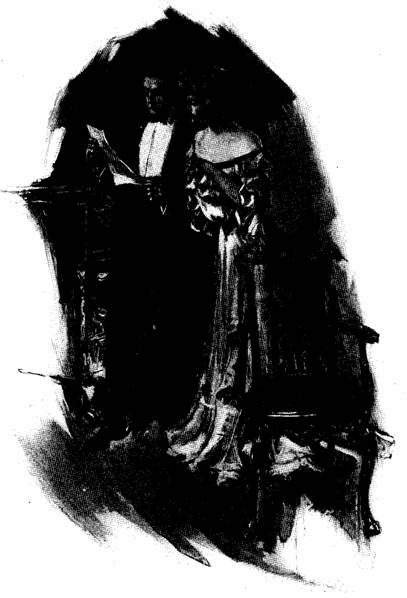
[Illustration: "Billy unfolded it slowly, with a puzzled look growing
in his countenance."]
"Thank you," she returned, mechanically, "I--I hope so."
After an interval, "Good-night, Peggy," said Mr. Woods.
"Oh--? Good-night," said she, with a start.
He turned to go. Then, "By Jove!" said he, grimly, "I've been so busy
making an ass of myself I'd forgotten all about more--more important
things."
Mr. Woods picked up the keys and, going to the desk, unlocked the
centre compartment with a jerk. Afterward he gave a sharp exclamation.
He had found a paper in the secret drawer at the back which appeared
to startle him.
Billy unfolded it slowly, with a puzzled look growing in his
countenance. Then for a moment Margaret's golden head drew close to
his yellow curls and they read it through together. And in the most
melodramatic and improbable fashion in the world they found it to be
the last will and testament of Frederick R. Woods.
"But--but I don't understand," was Miss Hugonin's awed comment. "It's
exactly like the other will, only--why, it's dated the seventeenth
of June, the day before he died! And it's witnessed by Hodges and
Burton--the butler and the first footman, you know--and they've never
said anything about such a paper. And, then, why should he have made
another will just like the first?"
Billy pondered.
By and bye, "I think I can explain that," he said, in a rather
peculiar voice. "You see, Hodges and Burton witnessed all his papers,
half the time without knowing what they were about. They would hardly
have thought of this particular one after his death. And it isn't
quite the same will as the other; it leaves you practically
everything, but it doesn't appoint any trustees, as the other did,
because this will was drawn up after you were of age. Moreover, it
contains these four bequests to colleges, to establish a Woods chair
of ethnology, which the other will didn't provide for. Of course, it
would have been simpler merely to add a codicil to the first will,
but Uncle Fred was always very methodical. I--I think he was probably
going through the desk the night he died, destroying various papers.
He must have taken the other will out to destroy it just--just before
he died. Perhaps--perhaps--" Billy paused for a little and then
laughed, unmirthfully. "It scarcely matters," said he. "Here is the
will. It is undoubtedly genuine and undoubtedly the last he made.
You'll have to have it probated, Peggy, and settle with the colleges.
It--it won't make much of a hole in the Woods millions."
There was a half-humorous bitterness in his voice that Margaret noted
silently. So (she thought) he had hoped for a moment that at the last
Frederick R. Woods had relented toward him. It grieved her, in a dull
fashion, to see him so mercenary. It grieved her--though she would
have denied it emphatically--to see him so disappointed. Since he
wanted the money so much, she would have liked for him to have had it,
worthless as he was, for the sake of the boy he had been.
"Thank you," she said, coldly, as she took the paper; "I will give it
to my father. He will do what is necessary. Good-night, Mr. Woods."
Then she locked up the desk in a businesslike fashion and turned to
him, and held out her hand.
"Good-night, Billy," said this perfectly inconsistent young woman.
"For a moment I thought Uncle Fred had altered his will in your
favour. I almost wish he had."
Billy smiled a little.
"That would never have done," he said, gravely, as he shook
hands; "you forget what a sordid, and heartless, and generally
good-for-nothing chap I am, Peggy. It's much better as it is."
Only the tiniest, the flimsiest fiction, her eyes craved of him. Even
now, at the eleventh hour, lie to me, Billy Woods, and, oh, how gladly
I will believe!
But he merely said "Good-night, Peggy," and went out of the room. His
broad shoulders had a pathetic droop, a listlessness.
Margaret was glad. Of course, she was glad. At last, she had told him
exactly what she thought of him. Why shouldn't she be glad? She was
delighted.
So, by way of expressing this delight, she sat down at the desk and
began to cry very softly.
XIII
Having duly considered the emptiness of existence, the unworthiness of
men, the dreary future that awaited her--though this did not trouble
her greatly, as she confidently expected to die soon--and many other
such dolorous topics, Miss Hugonin decided to retire for the night.
She rose, filled with speculations as to the paltriness of life and
the probability of her eyes being red in the morning.
"It will be all his fault if they are," she consoled herself.
"Doubtless he'll be very much pleased. After robbing me of all faith
in humanity, I dare say the one thing needed to complete his happiness
is to make me look like a fright. I hate him! After making me
miserable, now, I suppose he'll go off and make some other woman
miserable. Oh, of course, he'll make love to the first woman he meets
who has any money. I'm sure she's welcome to him. I only pity any
woman who has to put up with him. No, I don't," Margaret decided,
after reflection; "I hate her, too!"
Miss Hugonin went to the door leading to the hallway and paused.
Then--I grieve to relate it--she shook a little pink-tipped fist in
the air.
"I detest you!" she commented, between her teeth; "oh, how dare you
make me feel so ashamed of the way I've treated you!"
The query--as possibly you may have divined--was addressed to Mr.
Woods. He was standing by the fireplace in the hallway, and his tall
figure was outlined sharply against the flame of the gas-logs that
burned there. His shoulders had a pathetic droop, a listlessness.
Billy was reading a paper of some kind by the firelight, and the black
outline of his face smiled grimly over it. Then he laughed and threw
it into the fire.
"Billy!" a voice observed--a voice that was honey and gold and velvet
and all that is most sweet and rich and soft in the world.
Mr. Woods was aware of a light step, a swishing, sibilant, delightful
rustling--the caress of sound is the rustling of a well-groomed
woman's skirts--and of an afterthought of violets, of a mere
reminiscence of orris, all of which came toward him through the
dimness of the hall. He started, noticeably.
"Billy," Miss Hugonin stated, "I'm sorry for what I said to you. I'm
not sure it isn't true, you know, but I'm sorry I said it."
"Bless your heart!" said Billy; "don't you worry over that, Peggy.
That's all right. Incidentally, the things you've said to me and about
me aren't true, of course, but we won't discuss that just now. I--I
fancy we're both feeling a bit fagged. Go to bed, Peggy! We'll both
go to bed, and the night will bring counsel, and we'll sleep off all
unkindliness. Go to bed, little sister!--get all the beauty-sleep you
aren't in the least in need of, and dream of how happy you're going to
be with the man you love. And--and in the morning I may have something
to say to you. Good-night, dear."
And this time he really went. And when he had come to the bend in the
stairs his eyes turned back to hers, slowly and irresistibly, drawn
toward them, as it seemed, just as the sunflower is drawn toward the
sun, or the needle toward the pole, or, in fine, as the eyes of young
gentlemen ordinarily are drawn toward the eyes of the one woman in the
world. Then he disappeared.
The mummery of it vexed Margaret. There was no excuse for his looking
at her in that way. It irritated her. She was almost as angry with him
for doing it as she would have been for not doing it.
Therefore, she bent an angry face toward the fire, her mouth pouting
in a rather inviting fashion. Then it rounded slowly into a sanguine
O, which of itself suggested osculation, but in reality stood for
"observe!" For the paper Billy had thrown into the fire had fallen
under the gas-logs, and she remembered his guilty start.
"After all," said Margaret, "it's none of my business."
So she eyed it wistfully.
"It may be important," she considerately remembered. "It ought not to
be left there."
So she fished it out with a big paper-cutter.
"But it can't be very important," she dissented afterward, "or he
wouldn't have thrown it away."
So she looked at the superscripture on the back of it.
Then she gave a little gasp and tore it open and read it by the
firelight.
Miss Hugonin subsequently took credit to herself for not going into
hysterics. And I think she had some reason to; for she found the paper
a duplicate of the one Billy had taken out of the secret drawer, with
his name set in the place of hers. At the last Frederick R. Woods had
relented toward his nephew.
Margaret laughed a little; then she cried a little; then she did both
together. Afterward she sat in the firelight, very puzzled and very
excited and very penitent and very beautiful, and was happier than she
had ever been in her life.
"He had it in his pocket," her dear voice quavered; "he had it in his
pocket, my brave, strong, beautiful Billy did, when he asked me to
marry him. It was King Cophetua wooing the beggar-maid--and the beggar
was an impudent, ungrateful, idiotic little piece!" Margaret hissed,
in her most shrewish manner. "She ought to be spanked. She ought to go
down on her knees to him in sackcloth, and tears, and ashes, and all
sorts of penitential things. She will, too. Oh, it's such a beautiful
world--such a beautiful world! Billy loves me--really! Billy's a
millionaire, and I'm a pauper. Oh, I'm glad, glad, glad!"
She caressed the paper that had rendered the world such a goodly place
to live in--caressed it tenderly and rubbed her check against it. That
was Margaret's way of showing affection, you know; and I protest it
must have been very pleasant for the paper. The only wonder was that
the ink it was written in didn't turn red with delight.
Then she read it through again, for sheer enjoyment of those
beautiful, incomprehensible words that disinherited her. How lovely
of Uncle Fred! she thought. Of course, he'd forgiven Billy; who
wouldn't? What beautiful language Uncle Fred used! quite prayer-booky,
she termed it. Then she gasped.
The will in Billy's favour was dated a week earlier than the one they
had found in the secret drawer. It was worthless, mere waste paper. At
the last Frederick R. Woods's pride had conquered his love.
"Oh, the horrid old man!" Margaret wailed; "he's left me everything he
had! How dare he disinherit Billy! I call it rank impertinence in
him. Oh, boy dear, dear, dear boy!" Miss Hugonin crooned, in an
ecstacy of tenderness and woe. "He found this first will in one of the
other drawers, and thought he was the rich one, and came in a great
whirl of joy to ask me to marry him, and I was horrid to him! Oh, what
a mess I've made of it! I've called him a fortune-hunter, and I've
told him I love another man, and he'll never, never ask me to marry
him now. And I love him, I worship him, I adore him! And if only
I were poor--"
Ensued a silence. Margaret lifted the two wills, scrutinised them
closely, and then looked at the fire, interrogatively.
"It's penal servitude for quite a number of years," she said. "But,
then, he really couldn't tell any one, you know. No gentleman would
allow a lady to be locked up in jail. And if he knew--if he knew I
didn't and couldn't consider him a fortune-hunter, I really believe he
would--"
Whatever she believed he would do, the probability of his doing it
seemed highly agreeable to Miss Hugonin. She smiled at the fire in the
most friendly fashion, and held out one of the folded papers to it.
"Yes," said Margaret, "I'm quite sure he will."
There I think we may leave her. For I have dredged the dictionary,
and I confess I have found no fitting words wherewith to picture this
inconsistent, impulsive, adorable young woman, dreaming brave dreams
in the firelight of her lover and of their united future. I should
only bungle it. You must imagine it for yourself.
It is a pretty picture, is it not?--with its laughable side, perhaps;
under the circumstances, whimsical, if you will; but very, very
sacred. For she loved him with a clean heart, loved him infinitely.
Let us smile at it--tenderly--and pass on.
But upon my word, when I think of how unreasonably, how outrageously
Margaret had behaved during the entire evening, I am tempted to
depose her as our heroine. I begin to regret I had not selected Adèle
Haggage.
She would have done admirably. For, depend upon it, she, too, had
her trepidations, her white nights, her occult battles over Hugh Van
Orden. Also, she was a pretty girl--if you care for brunettes--and
accomplished. She was versed in I forget how many foreign languages,
both Continental and dead, and could discourse sensibly in any one of
them. She was perfectly reasonable, perfectly consistent, perfectly
unimpulsive, and never expressed an opinion that was not countenanced
by at least two competent authorities. I don't know a man living,
prepared to dispute that Miss Haggage excelled Miss Hugonin in all
these desirable qualities.
Yet with pleasing unanimity they went mad for Margaret and had the
greatest possible respect for Adèle.
And, my dear Mrs. Grundy, I grant you cheerfully that this was all
wrong. A sensible man, as you very justly observe, will seek in a
woman something more enduring than mere personal attractions; he will
value her for some sensible reason--say, for her wit, or her learning,
or her skill in cookery, or her proficiency in Greek. A sensible man
will look for a sensible woman; he will not concern his sensible head
over such trumperies as a pair of bright eyes, or a red lip or so, or
a satisfactory suit of hair. These are fleeting vanities.
However--
You have doubtless heard ere this, my dear madam, that had Cleopatra's
nose been an inch shorter the destiny of the world would have been
changed; had she been the woman you describe--perfectly reasonable,
perfectly consistent, perfectly sensible in all she said and
did--confess, dear lady, wouldn't Antony have taken to his heels and
have fled from such a monster?
XIV
I regret to admit that Mr. Woods did not toss feverishly about his bed
all through the silent watches of the night. He was very miserable,
but he was also twenty-six. That is an age when the blind bow-god
deals no fatal wounds. It is an age to suffer poignantly, if you will;
an age wherein to aspire to the dearest woman on earth, to write her
halting verses, to lose her, to affect the clichés of cynicism, to
hear the chimes at midnight--and after it all, to sleep like a top.
So Billy slept. And kind Hypnos loosed a dream through the gates of
ivory that lifted him to a delectable land where Peggy was nineteen,
and had never heard of Kennaston, and was unbelievably sweet and dear
and beautiful. But presently they and the Colonel put forth to sea--on
a great carved writing-desk--fishing for sharks, which the Colonel
said were very plentiful in those waters; and Frederick R. Woods
climbed up out of the sea, and said Billy was a fool and must go to
college; and Peggy said that was impossible, as seventeen hundred and
fifty thousand children had to be given an education apiece, and they
couldn't spare one for Billy; and a missionary from Zambesi Land came
out of one of the secret drawers and said Billy must give him both
of his feet as he needed them for his working-girls' classes; and
thereupon the sharks poked their heads out of the water and began, in
a deafening chorus, to cry, "Feet, feet, feet!" And Billy then woke
with a start, and found it was only the birds chattering in the dawn
outside.
Then he was miserable.
He tossed, and groaned, and dozed, and smoked cigarettes until he
could stand it no longer. He got up and dressed, in sheer desperation,
and went for a walk in the gardens.
The day was clear as a new-minted coin. It was not yet wholly aired,
not wholly free from the damp savour of night, but low in the east the
sun was taking heart. A mile-long shadow footed it with Billy Woods
in his pacings through the amber-chequered gardens. Actaeon-like, he
surprised the world at its toilet, and its fleeting grace somewhat
fortified his spirits.
But his thoughts pestered him like gnats. The things he said to the
roses it is not necessary to set down.
XV
After a vituperative half-hour or so Mr. Woods was hungry. He came
back toward Selwoode; and upon the terrace in front of the house he
found Kathleen Saumarez.
During the warm weather, one corner of the terrace had been converted,
by means of gay red-and-white awnings, into a sort of living-room.
There were chairs, tables, sofa-cushions, bowls of roses, and any
number of bright-coloured rugs. Altogether, it was a cosy place,
and the glowing hues of its furnishings were very becoming to Mrs.
Saumarez, who sat there writing industriously.
It was a thought embarrassing. They had avoided one another
yesterday--rather obviously--both striving to put off a necessarily
awkward meeting. Now it had come. And now, somehow, their eyes met for
a moment, and they laughed frankly, and the awkwardness was gone.
"Kathleen," said Mr. Woods, with conviction, "you're a dear."
"You broke my heart," said she, demurely, "but I'm going to forgive
you."
Mrs. Saumarez was not striving to be clever now. And, heavens (thought
Billy), how much nicer she was like this! It wasn't the same woman:
her thin cheeks flushed arbutus-like, and her rather metallic voice
was grown low and gentle. Billy brought memories with him, you see;
and for the moment, she was Kathleen Eppes again--Kathleen Eppes in
the first flush of youth, eager, trustful, and joyous-hearted, as he
had known her long ago. Since then, the poor woman had eaten of the
bread of dependence and had found it salt enough; she had paid for it
daily, enduring a thousand petty slights, a thousand petty insults,
and smiling under them as only women can. But she had forgotten now
that shrewd Kathleen Saumarez who must earn her livelihood as best she
might. She smiled frankly--a purely unprofessional smile.
"I was sorry when I heard you were coming," she said, irrelevantly,
"but I'm glad now."
Mr. Woods--I grieve to relate--was still holding her hand in his.
There stirred in his pulses the thrill Kathleen Eppes had always
wakened--a thrill of memory now, a mere wraith of emotion. He was
thinking of a certain pink-cheeked girl with crinkly black-brown
hair and eyes that he had likened to chrysoberyls--and he wondered
whimsically what had become of her. This was not she. This was
assuredly not Kathleen, for this woman had a large mouth--a humorous
and kindly mouth it was true, but undeniably a large one--whereas,
Kathleen's mouth had been quite perfect and rather diminutive than
otherwise. Hadn't he rhymed of it often enough to know?
They stood gazing at one another for a long time; and in the back of
Billy's brain lines of his old verses sang themselves to a sad little
tune--the verses that reproved the idiocy of all other poets, who had
very foolishly written their sonnets to other women: and yet, as the
jingle pointed out,
Had these poets ever strayed
In thy path, they had not made
Random rhymes of Arabella,
Songs of Dolly, hymns of Stella,
Lays of Lalage or Chloris--
Not of Daphne nor of Doris,
Florimel nor Amaryllis,
Nor of Phyllida nor Phyllis,
Were their wanton melodies:
But all of these--
All their melodies had been
Of thee, Kathleen.
Would they have been? Billy thought it improbable. The verses were
very silly; and, recalling the big, blundering boy who had written
them, Billy began to wonder--somewhat forlornly--whither he, too,
had vanished. He and the girl he had gone mad for both seemed rather
mythical--legendary as King Pepin.
"Yes," said Mrs. Saumarez--and oh, she startled him; "I fancy they're
both quite dead by now. Billy," she cried, earnestly, "don't laugh
at them!--don't laugh at those dear, foolish children! I--somehow, I
couldn't bear that, Billy."
"Kathleen," said Mr. Woods, in admiration, "you're a witch. I wasn't
laughing, though, my dear. I was developing quite a twilight mood over
them--a plaintive, old-lettery sort of mood, you know."
She sighed a little. "Yes--I know." Then her eyelids flickered in a
parody of Kathleen's glance that Billy noted with a queer tenderness.
"Come and talk to me, Billy," she commanded. "I'm an early bird this
morning, and entitled to the very biggest and best-looking worm I can
find. You're only a worm, you know--we're all worms. Mr. Jukesbury
told me so last night, making an exception in my favour, for it
appears I'm an angel. He was amorously inclined last night, the tipsy
old fraud! It's shameless, Billy, the amount of money he gets out of
Miss Hugonin--for the deserving poor. Do you know, I rather fancy he
classes himself under that head? And I grant you he's poor enough--but
deserving!" Mrs. Saumarez snapped her fingers eloquently.
"Eh? Shark, eh?" queried Mr. Woods, in some discomfort.
She nodded. "He is as bad as Sarah Haggage," she informed him, "and
everybody knows what a bloodsucker she is. The Haggage is a disease,
Billy, that all rich women are exposed to--'more easily caught than
the pestilence, and the taker runs presently mad.' Depend upon it,
Billy, those two will have every penny they can get out of your
uncle's money."
"Peggy's so generous," he pleaded. "She wants to make everybody
happy--bring about a general millenium, you know."
"She pays dearly enough for her fancies," said Mrs. Saumarez, in a
hard voice. Then, after a little, she cried, suddenly: "Oh, Billy,
Billy, it shames me to think of how we lie to her, and toady to her,
and lead her on from one mad scheme to another!--all for the sake of
the money we can pilfer incidentally! We're all arrant hypocrites, you
know; I'm no better than the others, Billy--not a bit better. But
my husband left me so poor, and I had always been accustomed to the
pretty things of life, and I couldn't--I couldn't give them up, Billy.
I love them too dearly. So I lie, and toady, and write drivelling
talks about things I don't understand, for drivelling women to
listen to, and I still have the creature comforts of life. I pawn my
self-respect for them--that's all. Such a little price to pay, isn't
it, Billy?"
She spoke in a sort of frenzy. I dare say that at the outset she
wanted Mr. Woods to know the worst of her, knowing he could not fail
to discover it in time. Billy brought memories with him, you see; and
this shrewd, hard woman wanted, somehow, more than anything else in
the world, that he should think well of her. So she babbled out the
whole pitiful story, waiting in a kind of terror to see contempt and
disgust awaken in his eyes.
But he merely said "I see--I see," very slowly, and his eyes were
kindly. He couldn't be angry with her, somehow; that pink-cheeked,
crinkly haired girl stood between them and shielded her. He was only
very, very sorry.
"And Kennaston?" he asked, after a little.
Mrs. Saumarez flushed. "Mr. Kennaston is a man of great genius," she
said, quickly. "Of course, Miss Hugonin is glad to assist him in
publishing his books--it's an honour to her that he permits it. They
have to be published privately, you know, as the general public isn't
capable of appreciating such dainty little masterpieces. Oh, don't
make any mistake, Billy--Mr. Kennaston is a very wonderful and very
admirable man."
"H'm, yes; he struck me as being an unusually nice chap," said Mr.
Woods, untruthfully. "I dare say they'll be very happy."
"Who?" Mrs. Saumarez demanded.
"Why--er--I don't suppose they'll make any secret of it," Billy
stammered, in tardy repentance of his hasty speaking. "Peggy told me
last night she had accepted him."
Mrs. Saumarez turned to rearrange a bowl of roses. She seemed to have
some difficulty over it.
"Billy," she spoke, inconsequently, and with averted head, "an honest
man is the noblest work of God--and the rarest."
Billy groaned.
"Do you know," said he, "I've just been telling the roses in the
gardens yonder the same thing about women? I'm a misogynist this
morning. I've decided no woman is worthy of being loved."
"That is quite true," she assented, "but, on the other hand, no man is
worthy of loving."
Billy smiled.
"I've likewise come to the conclusion," said he, "that a man's love is
like his hat, in that any peg will do to hang it on; also, in that the
proper and best place for it is on his own head. Oh, I assure you,
I vented any number of cheap cynicisms on the helpless roses! And
yet--will you believe it, Kathleen?--it doesn't seem to make me feel a
bit better--no, not a bit."
"It's very like his hat," she declared, "in that he has a new one
every year." Then she rested her hand on his, in a half-maternal
fashion. "What's the matter, boy?" she asked, softly. "You're always
so fresh and wholesome. I don't like to see you like this. Better
leave phrase-making to us phrase-mongers."
Her voice rang true--true, and compassionate, and tender, and all that
a woman's voice should be. Billy could not but trust her.
"I've been an ass," said he, rather tragically. "Oh, not an unusual
ass, Kathleen--just the sort men are always making of themselves. You
see, before I went to France, there was a girl I--cared for. And I let
a quarrel come between us--a foolish, trifling, idle little quarrel,
Kathleen, that we might have made up in a half-hour. But I was too
proud, you see. No, I wasn't proud, either," Mr. Woods amended,
bitterly; "I was simply pig-headed and mulish. So I went away. And
yesterday I saw her again and realised that I--still cared. That's
all, Kathleen. It isn't an unusual story." And Mr. Woods laughed,
mirthlessly, and took a turn on the terrace.
Mrs. Saumarez was regarding him intently. Her cheeks were of a deeper,
more attractive pink, and her breath came and went quickly.
"I--I don't understand," she said, in a rather queer voice.
"Oh, it's simple enough," Billy assured her. "You see, she--well, I
think she would have married me once. Yes, she cared for me once. And
I quarreled with her--I, conceited young ass that I was, actually
presumed to dictate to the dearest, sweetest, most lovable woman on
earth, and tell her what she must do and what she mustn't. I!--good
Lord, I, who wasn't worthy to sweep a crossing clean for her!--who
wasn't worthy to breathe the same air with her!--who wasn't worthy to
exist in the same world she honoured by living in! Oh, I was an ass!
But I've paid for it!--oh, yes, Kathleen, I've paid dearly for it,
and I'll pay more dearly yet before I've done. I tried to avoid her
yesterday--you must have seen that. And I couldn't--I give you my
word, I could no more have kept away from her than I could have spread
a pair of wings and flown away. She doesn't care a bit for me now; but
I can no more give up loving her than I can give up eating my dinner.
That isn't a pretty simile, Kathleen, but it expresses the way I feel
toward her. It isn't merely that I want her; it's more than that--oh,
far more than that. I simply can't do without her. Don't you
understand, Kathleen?" he asked, desperately.
"Yes--I think I understand," she said, when he had ended. "I--oh,
Billy, I am almost sorry. It's dear of you--dear of you, Billy, to
care for me still, but--but I'm almost sorry you care so much. I'm not
worth it, boy dear. And I--I really don't know what to say. You must
let me think."
Mr. Woods gave an inarticulate sound. The face she turned to him
was perplexed, half-sad, fond, a little pleased, and strangely
compassionate. It was Kathleen Eppes who sat beside him; the six years
were as utterly forgotten as the name of Magdalen's first lover. She
was a girl again, listening--with a heart that fluttered, I dare
say--to the wild talk, the mad dithyrambics of a big, blundering boy.
The ludicrous horror of it stunned Mr. Woods.
He could no more have told her of her mistake than he could have
struck her in the face.
"Kathleen--!" said he, vaguely.
"Let me think!--ah, let me think, Billy!" she pleaded, in a flutter of
joy and amazement. "Go away, boy dear!--Go away for a little and
let me think! I'm not an emotional woman, but I'm on the verge of
hysterics now, for--for several reasons. Go in to breakfast, Billy!
I--I want to be alone. You've made me very proud and--and sorry, I
think, and glad, and--and--oh, I don't know, boy dear. But please go
now--please!"
Billy went.
In the living-hall he paused to inspect a picture with peculiar
interest. Since Kathleen cared for him (he thought, rather forlornly),
he must perjure himself in as plausible a manner as might be possible;
please God, having done what he had done, he would lie to her like a
gentleman and try to make her happy.
A vision in incredible violet ruffles, coming down to breakfast, saw
him, and paused on the stairway, and flushed and laughed deliciously.
Poor Billy stared at her; and his heart gave a great bound and then
appeared to stop for an indefinite time.
"Good Lord!" said Mr. Woods, in his soul. "And I thought I was an ass
last night! Why, last night, in comparison, I displayed intelligence
that was almost human! Oh, Peggy, Peggy! if I only dared tell you what
I think of you, I believe I would gladly die afterward--yes, I'm sure
I would. You really haven't any right to be so beautiful!--it isn't
fair to us, Peggy!"
But the vision was peeping over the bannisters at him, and the
vision's eyes were sparkling with a lucent mischief and a wonderful,
half-hushed contralto was demanding of him:
"Oh, where have you been, Billy boy, Billy boy?
Oh, where have you been, charming Billy?"
And Billy's baritone answered her:
"I've been to seek a wife--"
and broke off in a groan.
"Good Lord!" said Mr. Woods.
It was a ludicrous business, if you will. Indeed, it was vastly
humorous--was it not?--this woman's thinking a man's love might by any
chance endure through six whole years. But their love endures, you
see; and the silly creatures have a superstition among them that love
is a sacred thing, stronger than time, victorious over death itself.
Let us laugh, then, at Kathleen Saumarez--those of us who have learned
that love is only a tinkling cymbal and faith a sounding brass and
fidelity an obsolete affectation: but for my part, I honour and
think better of the woman who through all her struggles with the
world--through all those sordid, grim, merciless, secret battles where
the vanquished may not even cry for succour--I honour her, I say, for
that she had yet cherished the memory of that first love which is the
best and purest and most unselfish and most excellent thing in life.
XVI
Breakfast Margaret enjoyed hugely. I regret to confess that the fact
that every one of her guests was more or less miserable moved this
hard-hearted young woman to untimely and excessive mirth. Only Mrs.
Saumarez puzzled her, for she could think of no reason for that lady's
manifest agitation when Kathleen eventually joined the others.
But for the rest, the hopeless glances that Hugh Van Orden cast toward
her caused Adèle to flush, and Mrs. Haggage to become despondent and
speechless and astonishingly rigid; and Petheridge Jukesbury's vaguely
apologetic attitude toward the world struck Miss Hugonin as infinitely
diverting. Kennaston she pitied a little; but his bearing toward
her ranged ludicrously from that of proprietorship to that of
supplication, and, moreover, she was furious with him for having
hinted at various times that Billy was a fortune-hunter.
Margaret was quite confident by this that she had never believed
him--"not really, you know"--having argued the point out at some
length the night before, and reaching her conclusion by a course of
reasoning peculiar to herself.
Mr. Woods, as you may readily conceive, was sunk in the Slough of
Despond deeper than ever plummet sounded. Margaret thought this very
nice of him; it was a delicate tribute to her that he ate nothing;
and the fact that Hugh Van Orden and Petheridge Jukesbury--as she
believed--acted in precisely the same way for precisely the same
reason, merely demonstrated, of course, their overwhelming conceit and
presumption.
So sitting in the great Eagle's shadow, she ate a quantity of
marmalade--she was wont to begin the day in this ungodly English
fashion--and gossiped like a brook trotting over sunlit pebbles. She
had planned a pulverising surprise for the house-party; and in due
time, she intended to explode it, and subsequently Billy was to
apologise for his conduct, and then they were to live happily ever
afterward.
She had not yet decided what he was to apologise for; that was his
affair. His conscience ought to have told him, by this, wherein he had
offended; and if his conscience hadn't, why then, of course, he would
have to apologise for his lack of proper sensibility.
After breakfast she went, according to her usual custom, to her
father's rooms, for, as I think I have told you, the old gentleman was
never visible until noon. She had astonishing news for him.
What time she divulged it, the others sat on the terrace, and Mr.
Kennaston read to them, as he had promised, from his "Defense of
Ignorance." It proved a welcome diversion to more than one of the
party. Mr. Woods, especially, esteemed it a godsend; it staved off
misfortune for at least a little; so he sat at Kathleen's side in
silence, trying desperately to be happy, trying desperately not to see
the tiny wrinkles, the faint crow's feet Time had sketched in her face
as a memorandum of the work he meant to do shortly.
Billy consoled himself with the reflection that he was very fond of
her; but, oh (he thought), what worship, what adoration he could
accord this woman if she would only decline--positively--to have
anything whatever to do with him!
I think we ought not to miss hearing Mr. Kennaston's discourse. It is
generally conceded that his style is wonderfully clever; and I have
no doubt that his detractors--who complain that his style is mere
word-twisting, a mere inversion of the most ancient truisms--are
actuated by the very basest jealousy. Let us listen, then, and be duly
edified as he reads in a low, sweet voice, and the birds twitter about
him in the clear morning.
"It has been for many years," Mr. Kennaston began, "the custom of
patriotic gentlemen in quest of office to point with pride to the fact
that the schoolmaster is abroad in the land, in whose defense they
stand pledged to draw their salaries and fight to the last gasp
for reelection. These lofty platitudes, while trying to the lungs,
doubtless appeal to a certain class of minds. But, indeed, the
schoolmaster is not abroad; he is domesticated in every village in
America, where each hamlet has its would-be Shakespeare, and each
would-be Shakespeare has his 'Hamlet' by heart. Learning is rampant in
the land, and valuable information is pasted up in the streetcars so
that he who rides may read.
"And Ignorance--beautiful, divine Ignorance--is forsaken by a
generation that clamours for the truth. And what value, pray, has this
Truth that we should lust after it?"
He glanced up, in an inquiring fashion. Mr. Jukesbury, meeting his
eye, smiled and shook his head and said "Fie, fie!" very placidly.
To do him justice, he had not the least idea what Kennaston was
talking about.
"I am aware," the poet continued, with an air of generosity, "that
many pleasant things have been said of it. In fact, our decade has
turned its back relentlessly upon the decayed, and we no longer read
the lament over the lost art of lying issued many magazines ago by
a once prominent British author. Still, without advancing any Wilde
theories, one may fairly claim that truth is a jewel--a jewel with
many facets, differing in appearance from each point of view.
"And while 'Tell the truth and shame the Devil' is a very pretty
sentiment, it need not necessarily mean anything. The Devil, if there
be a personal devil--and it has been pointed out, with some show of
reason, that an impersonal one could scarcely carry out such enormous
contracts--would, in all probability, rather approve than otherwise of
indiscriminate truth-telling. Irritation is the root of all evil; and
there is nothing more irritating than to hear the truth about one's
self. It is bad enough, in all conscience, to be insulted, but the
truth of an insult is the barb that prevents its retraction. 'Truth
hurts' has all the pathos of understatement. It not only hurts, but
infuriates. It has no more right to go naked in public than any one
else. Indeed, it has less right; for truth-telling is natural to
mankind--as is shown by its prevalence among the younger sort, such as
children and cynics--and, as Shakespeare long ago forgot to tell us, a
touch of nature makes the whole world embarrassed."
At this point Mrs. Haggage sniffed. She considered he was growing
improper. She distrusted Nature.
"Truth-telling, then, may safely be regarded as an unamiable
indiscretion. In art, the bare truth must, in common gallantry, be
awarded a print petticoat or one of canvas, as the case may be, to
hide her nakedness; and in life, it is a disastrous virtue that we
have united to commend and avoid. Nor is the decision an unwise one;
for man is a gregarious animal, knowing that friendship is, at best,
but a feeble passion and therefore to be treated with the care due an
invalid. It is impossible to be quite candid in conversation with a
man; and with a woman it is absolutely necessary that your speech
should be candied.
"Truth, then, is the least desirable of acquaintances.
"But even if one wished to know the truth, the desire could scarcely
be fulfilled. Francis Bacon, Lord Verulam, a prominent lawyer of
Elizabeth's time, who would have written Shakespeare's plays had his
other occupations not prevented it, quotes Pilate as inquiring, 'What
is Truth?'--and then not staying for an answer. Pilate deserves all
the praise he has never received. Nothing is quite true. Even Truth
lies at the bottom of a well and not infrequently in other places. No
assertion is one whit truer than its opposite."
A mild buzz of protest rose about him. Kennaston smiled and cocked his
head on one side.
"We have, for example," he pointed out, "a large number of proverbs,
the small coin of conversation, received everywhere, whose value no
one disputes. They are rapped forth, like an oath, with an air of
settling the question once and forever. Well! there is safety in
quotations. But even the Devil can cite Shakespeare for his purpose.
'Never put off till to-morrow what you can do to-day' agrees ill with
'Sufficient unto the day is the evil thereof'; and it is somewhat
difficult to reconcile 'Take care of the pence, and the pounds will
take care of themselves' with the equally familiar 'Penny-wise,
pound-foolish.' Yet the sayings are equally untrue; any maxim is,
perforce, a general statement, and therefore fallacious, and therefore
universally accepted. Art is long, and life is short, but the
platitudes concerning them are both insufferable and eternal. We must
remember that a general statement is merely a snap-shot at flying
truth, an instantaneous photograph of a moving body. It may be the way
that a thing is; but it is never the way in which any one ever saw
that thing, or ever will. This is, of course, a general statement.
"As to present events, then, it may be assumed that no one is either
capable or desirous of speaking the truth; why, then, make such
a pother about it as to the past? There we have carried the
investigation of truth to such an extreme that nowadays very few of us
dare believe anything. Opinions are difficult to secure when a quarter
of an hour in the library will prove either side of any question.
Formerly, people had a few opinions, which, if erroneous, were at
least universal. Nero was not considered an immaculate man. The Flood
was currently believed to have caused the death of quite a number of
persons. And George Washington, it was widely stated, once cut down
a cherry-tree. But now all these comfortable illusions have been
destroyed by 'the least little men who spend their time and lose their
wits in chasing nimble and retiring truth, to the extreme perturbation
and drying up of the moistures.'"
Kennaston looked up for a moment, and Billy Woods, who had counted
seven wrinkles and was dropping into a forlorn doze, started
violently. His interest then became abnormal.
"There are," Mr. Kennaston complained, rather reproachfully, "too many
inquiries, doubts, investigations, discoveries, and apologies. There
are palliations of Tiberius, eulogies of Henry VIII., rehabilitations
of Aaron Burr. Lucretia Borgia, it appears, was a grievously
misunderstood woman, and Heliogabalus a most exemplary monarch; even
the dog in the manger may have been a nervous animal in search of
rest and quiet. As for Shakespeare, he was an atheist, a syndicate, a
lawyer's clerk, an inferior writer, a Puritan, a scholar, a nom de
plume, a doctor of medicine, a fool, a poacher, and another man of
the same name. Information of this sort crops up on every side. Even
the newspapers are infected; truth lurks in the patent-medicine
advertisements, and sometimes creeps stealthily into the very
editorials. We must all learn the true facts of history, whether we
will or no; eventually, the writers of historical romance will not
escape.
"So the sad tale goes. Ignorance--beautiful, divine Ignorance--is
forsaken by a generation that clamours for the truth. The
earnest-minded person has plucked Zeus out of Heaven, and driven the
Maenad from the wood, and dragged Poseidon out of his deep-sea palace.
The conclaves of Olympus, it appears, are merely nature-myths;
the stately legends clustering about them turn out to be a rather
elaborate method of expressing the fact that it occasionally rains.
The heroes who endured their angers and jests and tragic loves are
delicately veiled allusions to the sun--surely, a very harmless topic
of conversation, even in Greece; and the monsters, 'Gorgons and Hydras
and Chimæras dire,' their grisly offspring, their futile opponents,
are but personified frosts. Mythology--the poet's necessity, the
fertile mother of his inventions--has become a series of atmospheric
phenomena, and the labours of Hercules prove to be a dozen weather
bulletins.
"Is it any cause for wonder, that under this cheerless influence our
poetry is either silent or unsold? The true poet must be ignorant, for
information is the thief of rhyme. And it is only in dealing with--"
Kennaston paused. Margaret had appeared in the vestibule, and behind
her stood her father, looking very grave.
"We have made a most interesting discovery," Miss Hugonin airily
announced to the world at large. "It appears that Uncle Fred left all
his property to Mr. Woods here. We found the will only last night. I'm
sure you'll all be interested to learn I'm a pauper now, and intend to
support myself by plain sewing. Any work of this nature you may
choose to favour me with, ladies and gentlemen, will receive my most
earnest attention."
She dropped a courtesy. The scene appealed to her taste for the
dramatic.
Billy came toward her quickly.
"Peggy," he demanded of her, in the semi-privacy of the vestibule,
"will you kindly elucidate the meaning of this da--this idiotic
foolishness?"
"Why, this," she explained, easily, and exhibited a folded paper. "I
found it in the grate last night."
He inspected it with large eyes. "That's absurd," he said, at length.
"You know perfectly well this will isn't worth the paper it's written
on."
"My dear sir," she informed him, coldly, "you are vastly mistaken. You
see, I've burned the other one." She pushed by him. "Mr. Kennaston,
are you ready for our walk? We'll finish the paper some other time.
Wasn't it the strangest thing in the world--?" Her dear, deep, mellow
voice died away as she and Kennaston disappeared in the gardens.
Billy gasped.
But meanwhile, Colonel Hugonin had given the members of his daughter's
house-party some inkling as to the present posture of affairs. They
were gazing at Billy Woods rather curiously. He stood in the vestibule
of Selwoode, staring after Margaret Hugonin; but they stared at him,
and over his curly head, sculptured above the door-way, they saw the
Eagle--the symbol of the crude, incalculable power of wealth.
Mr. Woods stood in the vestibule of his own house.
XVII
"By gad!" said Colonel Hugonin, very grimly, "anybody would think
you'd just lost a fortune instead of inheriting one! Wish you joy of
it, Billy. I ain't saying, you know, we shan't miss it, my daughter
and I--no, begad, for it's a nice pot of money, and we'll miss it
damnably. But since somebody had to have it, I'd much rather it was
you, my boy, than a set of infernal, hypocritical, philanthropic
sharks, and I'm damn' glad Frederick has done the square thing by
you--yes, begad!"
The old gentleman was standing beside Mr. Woods in the vestibule of
Selwoode, some distance from the other members of the house-party,
and was speaking in confidence. He was sincere; I don't say that
the thought of facing the world at sixty-five with practically
no resources save his half-pay--I think I have told you that the
Colonel's diversions had drunk up his wife's fortune and his own like
a glass of water--I don't say that this thought moved him to hilarity.
Over it, indeed, he pulled a frankly grave face.
But he cared a deal for Billy; and even now there was balm--soothing,
priceless balm--to be had of the reflection that this change in
his prospects affected materially the prospects of those cultured,
broad-minded, philanthropic persons who had aforetime set his daughter
to requiring of him a perusal of Herbert Spencer.
Billy was pretty well aware how monetary matters stood with the old
wastrel; and the sincerity of the man affected him far more than the
most disinterested sentiments would have done. Mr. Woods accordingly
shook hands, with entirely unnecessary violence.
"You're a trump, that's what you are!" he declared; "oh, yes, you are,
Colonel! You're an incorrigible, incurable old ace of trumps--the
very best there is in the pack--and it's entirely useless for you to
attempt to conceal it."
"Gad----!" said the Colonel.
"And don't you worry about that will," Mr. Woods advised. "I--I can't
explain things just now, but it's all right. You just wait--just wait
till I've seen Peggy," Billy urged, in desperation, "and I'll explain
everything."
"By gad----!" said the Colonel. But Mr. Woods was half-way out of the
vestibule.
Mr. Woods was in an unenviable state of perturbation.
He could not quite believe that Peggy had destroyed the will; the
thing out-Heroded Herod, out-Margareted Margaret. But if she had,
it struck him as a high-handed proceeding, entailing certain
vague penalties made and provided by the law to cover just such
cases--penalties of whose nature he was entirely ignorant and didn't
care to think. Heavens! for all he knew, that angel might have let
herself in for a jail sentence.
Billy pictured that queen among women! that paragon! with her glorious
hair cropped and her pink-tipped little hands set to beating hemp--he
had a shadowy notion that the lives of all female convicts were
devoted to this pursuit--and groaned in horror.
"In the name of Heaven!" Mr. Woods demanded of his soul, "what
possible reason could she have had for this new insanity? And in the
name of Heaven, why couldn't she have put off her tête-à-tête with
Kennaston long enough to explain? And in the name of Heaven, what does
she see to admire in that putty-faced, grimacing ass, any way! And in
the name of Heaven, what am I to say to this poor, old man here? I
can't explain that his daughter isn't in any danger of being poor, but
merely of being locked up in jail! And in the name of Heaven, how
long does that outrageous angel expect me to remain in this state of
suspense!"
Billy groaned again and paced the vestibule. Then he retraced his
steps, shook hands with Colonel Hugonin once more, and, Kennaston or
no Kennaston, set out to find her.
XVIII
But when he came out upon the terrace, Sarah Ellen Haggage stopped
him--stopped him with a queer blending of diffidence and resolve in
her manner.
The others, by this, had disappeared in various directions, puzzled
and exceedingly uncertain what to do. Indeed, to congratulate Billy
in the Colonel's presence would have been tactless; and, on the other
hand, to condole with the Colonel without seeming to affront the
wealthy Mr. Woods was almost impossible. So they temporised and
fled--all save Mrs. Haggage.
She, alone, remained to view Mr. Woods with newly opened eyes; for
as he paused impatiently--the sculptured Eagle above his head--she
perceived that he was a remarkably handsome and intelligent young man.
Her motherly heart opened toward this lonely, wealthy orphan.
"My dear Billy," she cooed, with asthmatic gentleness, "as an old,
old friend of your mother's, aren't you going to let me tell you how
rejoiced Adèle and I are over your good fortune? It isn't polite, you
naughty boy, for you to run away from your friends as soon as they've
heard this wonderful news. Ah, such news it was--such a manifest
intervention of Providence! My heart has been fluttering, fluttering
like a little bird, Billy, ever since I heard it."
In testimony to this fact, Mrs. Haggage clasped a stodgy hand to an
exceedingly capacious bosom, and exhibited the whites of her eyes
freely. Her smile, however, remained unchanged and ample.
"Er--ah--oh, yes! Very kind of you, I'm sure!" said Mr. Woods.
"I never in my life saw Adèle so deeply affected by anything," Mrs.
Haggage continued, with a certain large archness. "The sweet child
was always so fond of you, you know, Billy. Ah, I remember distinctly
hearing her speak of you many and many a time when you were in that
dear, delightful, wicked Paris, and wonder when you would come back
to your friends--not very grand and influential friends, Billy, but
sincere, I trust, for all that."
Mr. Woods said he had no doubt of it.
"So many people," she informed him, confidentially, "will pursue you
with adulation now that you are wealthy. Oh, yes, you will find that
wealth makes a great difference, Billy. But not with Adèle and
me--no, dear boy, despise us if you will, but my child and I are not
mercenary. Money makes no difference with us; we shall be the same to
you that we always were--sincerely interested in your true welfare,
overjoyed at your present good fortune, prayerful as to your brilliant
future, and delighted to have you drop in any evening to dinner. We do
not consider money the chief blessing of life; no, don't tell me that
most people are different, Billy, for I know it very well, and many is
the tear that thought has cost me. We live in a very mercenary world,
my dear boy; but our thoughts, at least, are set on higher things,
and I trust we can afford to despise the merely temporal blessings of
life, and I entreat you to remember that our humble dwelling is always
open to the son of my old, old friend, and that there is always a jug
of good whiskey in the cupboard."
Thus in the shadow of the Eagle babbled the woman whom--for all her
absurdities--Margaret had loved as a mother.
Billy thanked her with an angry heart.
"And this"--I give you the gist of his meditations--"this is Peggy's
dearest friend! Oh, Philanthropy, are thy protestations, then, all
void and empty, and are thy noblest sentiments--every one of 'em--so
full of sound and rhetoric, so specious, so delectable--are these,
then, but dicers' oaths!"
Aloud, "I'm rather surprised, you know," he said, slowly, "that you
take it just this way, Mrs. Haggage. I should have thought you'd have
been sorry on--on Miss Hugonin's account. It's awfully jolly of you,
of course--oh, awfully jolly, and I appreciate it at its true worth, I
assure you. But it's a bit awkward, isn't it, that the poor girl will
be practically penniless? I really don't know whom she'll turn to
now."
Then Billy, the diplomatist, received a surprise.
"She'll come with me, of course," said Mrs. Haggage.
Mr. Woods made an--unfortunately--inaudible observation.
"I beg your pardon?" she queried. Then, obtaining no response, she
continued, with perfect simplicity: "Margaret's quite like a daughter
to me, you know. Of course, she and the Colonel will come with us--at
least, until affairs are a bit more settled. Even afterward--well, we
have a large house, Billy, and I don't see that they'd be any better
off anywhere else."
Billy's emotions were complex.
"You big-hearted old parasite," his own heart was singing. "If you
could only keep that ring of truth that's in your voice for your
platform utterances--why, in less than no time you could afford to
feed your Afro-Americans on nightingales' tongues and clothe every
working-girl in the land in cloth of gold! You've been pilfering from
Peggy for years--pilfering right and left with both hands! But you've
loved her all the time, God bless you; and now the moment she's in
trouble you're ready to take both her and the Colonel--whom, by the
way, you must very cordially detest--and share your pitiful, pilfered
little crusts with 'em and--having two more mouths to feed--probably
pilfer a little more outrageously in the future! You're a
sanctimonious old hypocrite, you are, and a pious fraud, and a
delusion, and a snare, and you and Adèle have nefarious designs on me
at this very moment, but I think I'd like to kiss you!"
Indeed, I believe Mr. Woods came very near doing so. She loved Peggy,
you see; and he loved every one who loved her.
But he compromised by shaking hands energetically, for a matter of
five minutes, and entreating to be allowed to subscribe to some of her
deserving charitable enterprises--any one she might mention--and so
left the old lady a little bewildered, but very much pleased.
She decided that for the future Adèle must not see so much of Mr.
Van Orden. She began to fear that gentleman's views of life were not
sufficiently serious.
XIX
Billy went into the gardens in pursuit of Margaret. He was almost
happy now and felt vaguely ashamed of himself. Then he came upon
Kathleen Saumarez, who, indeed, was waiting for him there; and his
heart went down into his boots.
He realised on a sudden that he was one of the richest men in America.
It was a staggering thought. Also, Mr. Woods's views, at this moment,
as to the advantages of wealth, might have been interesting.
Kathleen stood silent for an instant, eyes downcast, face flushed. She
was trembling.
Then, "Billy," she asked, almost inaudibly, "do--do you still
want--your answer?"
The birds sang about them. Spring triumphed in the gardens. She looked
very womanly and very pretty.
To all appearances, it might easily have been a lover and his lass met
in the springtide, shamefaced after last night's kissing. But Billy,
somehow, lacked much of the elation and the perfect content and the
disposition to burst into melody that is currently supposed to seize
upon rustic swains at such moments. He merely wanted to know if at
any time in the remote future his heart would be likely to resume the
discharge of its proper functions. It was standing still now.
However, "Can you ask--dear?" His words, at least, lied gallantly.
The poor woman looked up into Billy's face. After years of battling
with the world, here for the asking was peace and luxury and wealth
incalculable, and--as Kathleen thought--a love that had endured since
they were boy and girl together. Yet she shrunk from him a little and
clinched her hands before she spoke.
"Yes," Kathleen faltered, and afterward she shuddered.
And here, if for the moment I may prefigure the Eagle as a sentient
being, I can imagine his chuckle.
"Please God," thought poor Billy, "I will make her happy. Yes, please
God, I can at least do that, since she cares for me."
Then he kissed her.
"My dear," said he, aloud, "I'll try to make you happy. And--and you
don't mind, do you, if I leave you now?" queried this ardent lover.
"You see, it's absolutely necessary I should see--see Miss Hugonin
about this will business. You don't mind very much, do you--darling?"
Mr. Woods inquired of her, the last word being rather obviously an
afterthought.
"No," said she. "Not if you must--dear."
Billy went away, lugging a heart of lead in his breast.
Kathleen stared after him and gave a hard, wringing motion of her
hands. She had done what many women do daily; the thing is common and
sensible and universally commended; but in her own eyes, the draggled
trollop of the pavements was neither better nor worse than she.
At the entrance of the next walkway Billy encountered Felix
Kennaston--alone and in the most ebulliently mirthful of humours.
XX
But we had left Mr. Kennaston, I think, in company with Miss Hugonin,
at the precise moment she inquired of him whether it were not the
strangest thing in the world--referring thereby to the sudden manner
in which she had been disinherited.
The poet laughed and assented. Afterward, turning north from the front
court, they descended past the shield-bearing griffins--and you may
depend upon it that each shield is adorned with a bas-relief of the
Eagle--that guard the broad stairway leading to the formal gardens
of Selwoode. The gardens stretch northward to the confines of Peter
Blagden's estate of Gridlington; and for my part--unless it were that
primitive garden that Adam lost--I can imagine no goodlier place.
On this particular forenoon, however, neither Miss Hugonin nor Felix
Kennaston had eyes for its comeliness; silently they braved the
griffins, and in silence they skirted the fish-pond--silver-crinkling
in the May morning--and passed through cloistral ilex-shadowed walks,
and amphitheatres of green velvet, and terraces ample and mellow
in the sunlight, silently. The trees pelted them with blossoms;
pedestaled in leafy recesses, Satyrs grinned at them apishly, and the
arrows of divers pot-bellied Cupids threatened them, and Fauns piped
for them ditties of no tone; the birds were about shrill avocations
overhead, and everywhere the heatless, odourful air was a caress; but
for all this, Miss Hugonin and Mr. Kennaston were silent and very
fidgetty.
Margaret was hatless--and the glory of the eminently sensible spring
sun appeared to centre in her hair--and violet-clad; and the gown,
like most of her gowns, was all tiny tucks and frills and flounces,
diapered with semi-transparencies--unsubstantial, foam-like, mere
violet froth. As she came starry-eyed through the gardens, the
impudent wind trifling with her hair, I protest she might have been
some lady of Oberon's court stolen out of Elfland to bedevil us poor
mortals, with only a moonbeam for the changeable heart of her, and
for raiment a violet shadow spirited from the under side of some big,
fleecy cloud.
They came presently through a trim, yew-hedged walkway to a
summer-house covered with vines, into which Margaret peeped and
declined to enter, on the ground that it was entirely too chilly
and gloomy and exactly like a mausoleum; but nearby they found a
semi-circular marble bench about which a group of elm-trees made a
pleasant shadow splashed at just the proper intervals with sunlight.
On this Margaret seated herself; and then pensively moved to the other
end of the bench, because a slanting sunbeam fell there. Since it
was absolutely necessary to blast Mr. Kennaston's dearest hopes,
she thoughtfully endeavoured to distract his attention from his own
miseries--as far as might be possible--by showing him how exactly like
an aureole her hair was in the sunlight. Margaret always had a kind
heart.
Kennaston stood before her, smiling a little. He was the sort of man
to appreciate the manoeuver.
"My lady," he asked, very softly, "haven't you any good news for me on
this wonderful morning?"
"Excellent news," Margaret assented, with a cheerfulness that was
not utterly free from trepidation. "I've decided not to marry you,
beautiful, and I trust you're properly grateful. You see, you're very
nice, of course, but I'm going to marry somebody else, and bigamy is
a crime, you know; and, anyhow, I'm only a pauper, and you'd never be
able to put up with my temper--now, beautiful, I'm quite sure you
couldn't, so there's not a bit of use in arguing it. Some day you'd
end by strangling me, which would be horribly disagreeable for me, and
then they'd hang you for it, you know, and that would be equally
disagreeable for you. Fancy, though, what a good advertisement it would
be for your poems!"
[Illustration: "'My lady,' he asked, very softly, 'haven't you any
good news for me on this wonderful morning?'"]
She was not looking at him now--oh, no, Margaret was far too busily
employed getting the will (which she had carried all this time) into
an absurd little silver chain-bag hanging at her waist. She had no
time to look at Felix Kennaston. There was such scant room in the bag;
her purse took up so much space there was scarcely any left for the
folded paper; the affair really required her closest, undivided
attention. Besides, she had not the least desire to look at Kennaston
just now.
"Beautiful child," he pleaded, "look at me!"
But she didn't.
She felt that at that moment she could have looked at a gorgon, say,
or a cockatrice, or any other trifle of that nature with infinitely
greater composure. The pause that followed Margaret accordingly
devoted to a scrutiny of his shoes and sincere regret that their owner
was not a mercenary man who would be glad to be rid of her.
"Beautiful child," spoke the poet's voice, sadly, "you aren't--surely,
you aren't saying this in mistaken kindness to me? Surely, you aren't
saying this because of what has happened in regard to your money
affairs? Believe me, my dear, that makes no difference to me. It
is you I love--you, the woman of my heart--and not a certain, and
doubtless desirable, amount of metal disks and dirty paper."
"Now I suppose you're going to be very noble and very nasty about it,"
observed Miss Hugonin, resentfully. "That's my main objection to
you, you know, that you haven't any faults I can recognise and feel
familiar and friendly with."
"My dear," he protested, "I assure you I am not intentionally
disagreeable."
At that, she raised velvet eyes to his--with a visible effort,
though--and smiled.
"I know you far too well to think that," she said, wistfully. "I
know I'm not worthy of you. I'm tremendously fond of you, beautiful,
but--but, you see, I love somebody else," Margaret concluded, with
admirable candour.
"Ah!" said he, in a rather curious voice. "The painter chap, eh?"
Then Margaret's face flamed in a wonderful glow of shame and happiness
and pride that must have made the surrounding roses very hopelessly
jealous. A quaint mothering look, sacred, divine, Madonna-like,
woke in her great eyes as she thought--remorsefully--of
how unhappy Billy must be at that very moment and of how big he was
and of his general niceness; and she desired, very heartily, that this
fleshy young man would make his scene and have done with it. Who was
he, forsooth, to keep her from Billy? She wished she had never heard
of Felix Kennaston.
Souvent femme varie, my brothers.
However, "Yes," said Margaret..
"You are a dear," said Mr. Kennaston, with conviction in his voice.
I dare say Margaret was surprised.
But the poet had taken her hand and had kissed it reverently, and then
sat down beside her, twisting one foot under him in a fashion he had.
He was frankly grateful to her for refusing him; and, the mask of
affectation slipped, she saw in him another man.
"I am an out-and-out fraud," he confessed, with the gayest of smiles.
"I am not in love with you, and I am inexpressibly glad that you are
not in love with me. Oh, Margaret, Margaret--you don't mind if I call
you that, do you? I shall have to, in any event, because I like you so
tremendously now that we are not going to be married--you have no idea
what a night I spent."
"I consider it most peculiar and unsympathetic of my hair not to have
turned gray. I thought you were going to have me, you see."
Margaret was far to much astonished to be angry.
"But last night!" she presently echoed, in candid surprise. "Why, last
night you didn't know I was poor!"
He wagged a protesting forefinger. "That made no earthly difference,"
he assured her. "Of course, it was the money--and in some degree the
moon--that induced me to make love to you. I acted on the impulse of
the moment; just for an instant, the novelty of doing a perfectly
sensible thing--and marrying money is universally conceded to come
under that head--appealed to me. So I did it. But all the time I was
in love with Kathleen Saumarez. Why, the moment I left you, I began to
realise that not even you--and you are quite the most fascinating and
generally adorable woman I ever knew, Margaret--I began to realise, I
say, that not even you could ever make me forget that fact. And I
was very properly miserable. It is extremely queer," Mr. Kennaston
continued, after an interval of meditation, "but falling in love
appears to be the one utterly inexplicable, utterly reasonless thing
one ever does in one's life. You can usually think of some more or
less plausible palliation for embezzlement, say, or for robbing a
cathedral or even for committing suicide--but no man can ever explain
how he happened to fall in love. He simply did it."
Margaret nodded sagely. She knew.
"Now you," Mr. Kennaston was pleased to say, "are infinitely more
beautiful, younger, more clever, and in every way more attractive than
Kathleen. I recognise these things clearly, but it does not appear,
somehow, to alter the fact that I am in love with her. I think I have
been in love with her all my life. We were boy and girl together,
Margaret, and--and I give you my word," Kennaston cried, with his
boyish flush, "I worship her! I simply cannot explain the perfectly
unreasonable way in which I worship her!"
He was sincere. He loved Kathleen Saumarez as much as he was capable
of loving any one--almost as much as he loved to dilate on his own
peculiarities and emotions.
Margaret's gaze was intent upon him. "Yet," she marvelled, "you made
love to me very tropically."
With unconcealed pride, Mr. Kennaston assented. "Didn't I?" he said.
"I was in rather good form last night, I thought."
"And you were actually prepared to marry me?" she asked--"even after
you knew I was poor?"
"I couldn't very well back out," he submitted, and then cocked
his head on one side. "You see," he added, whimsically, "I was
sufficiently a conceited ass to fancy you cared a little for me. So,
of course, I was going to marry you and try to make you happy. But how
dear--oh, how unutterably dear it was of you, Margaret, to decline
to be made happy in any such fashion!" And Mr. Kennaston paused to
chuckle and to regard her with genuine esteem and affection.
But still her candid eyes weighed him, and transparently found him
wanting.
"You are thinking, perhaps, what an unutterable cad I have been?" he
suggested.
"Yes--you are rather by way of being a cad, beautiful. But I can't
help liking you, somehow. I dare say it's because you're honest
with me. Nobody--nobody," Miss Hugonin lamented, a forlorn little
quiver in her voice, "ever seemed to be honest with me except you,
and now I know you weren't. Oh, beautiful, aren't I ever to have any
real friends?" she pleaded, wistfully.
Kennaston had meant a deal to her, you see; he had been the one
man she trusted. She had gloried in his fustian rhetoric, his glib
artlessness, his airy scorn of money; and now all this proved mere
pinchbeck. On a sudden, too, there woke in some bycorner of her heart
a queasy realisation of how near she had come to loving Kennaston. The
thought nauseated her.
"My dear," he answered, kindly, "you will have any number of friends
now that you are poor. It was merely your money that kept you from
having any. You see," Mr. Kennaston went on, with somewhat the air of
one climbing upon his favourite hobby, "money is the only thing
that counts nowadays. In America, the rich are necessarily our only
aristocracy. It is quite natural. One cannot hope for an aristocracy
of intellect, if only for the reason that not one person in a thousand
has any; and birth does not count for much. Of course, it is quite
true that all of our remote ancestors came over with William the
Conqueror--I have sometimes thought that the number of steerage
passengers his ships would accommodate must have been little short of
marvellous--but it is equally true that the grandfathers of most of
our leisure class were either deserving or dishonest persons--who
either started life on a farm, and studied Euclid by the firelight and
did all the other priggish things they thought would look well in a
biography, or else met with marked success in embezzlement. So money,
after all, is our only standard; and when a woman is as rich as you
were yesterday she cannot hope for friends any more than the Queen
of England can. You could have plenty of flatterers, toadies,
sycophants--anything, in fine, but friends."
"I don't believe it," said Margaret, half angrily--"not a word of it.
There must be some honest people in the world who don't consider
that money is everything. You know there must be, beautiful!"
The poet laughed. "That," said he, affably, "is poppycock. You are
repeating the sort of thing I said to you yesterday. I am honest now.
The best of us, Margaret, cannot help being impressed by the power of
money. It is the greatest power in the world, and we cannot--cannot
possibly--look upon rich people as being quite like us. We must
toady to them a bit, Margaret, whether we want to or not. The Eagle
intimidates us all."
"I hate him!" Miss Hugonin announced, with vehemence.
Kennaston searched his pockets. After a moment he produced a dollar
bill and showed her the Eagle on it.
"There," he said, gravely, "is the original of the Woods Eagle--the
Eagle that intimidates us all. Do you remember what Shakespeare--one
always harks back to Shakespeare to clinch an argument, because not
even our foremost actors have been able to conceal the fact that he
was, as somebody in Dickens acutely points out, 'a dayvilish clever
fellow'--do you remember. I say, what Shakespeare observes as to this
very Eagle?"
Miss Hugonin shook her little head till it glittered in the sunlight
like a topaz. She cared no more for Shakespeare than the average woman
does, and she was never quite comfortable when he was alluded to.
"He says," Mr. Kennaston quoted, solemnly:
"The Eagle suffers little birds to sing,
And is not careful what they mean thereby,
Knowing that with the shadow of his wing
He can at pleasure still their melody."
"That's nonsense," said Margaret, calmly. "I haven't the least idea
what you're talking about, and I don't believe you have either."
He waved the dollar bill with a heroical gesture. "Here," he asserted,
"is the Eagle. And by the little birds, I have not a doubt he meant
charity and independence and kindliness and truth and the rest of the
standard virtues. That is quite as plausible as the interpretation of
the average commentator. The presence of money chills these little
birds--ah, it is lamentable, no doubt, but it is true."
"I don't believe it," said Margaret--quite as if that settled the
question.
But now his hobby, rowelled by opposition, was spurred to loftier
flights.
"Ah, the power of these great fortunes America has bred is monstrous,"
he suddenly cried. "And always they work for evil. If I were ever to
write a melodrama, Margaret, I could wish for no more thorough-paced
villain than a large fortune." Kennaston paused and laughed grimly.
"We cringe to the Eagle!" said he. "Eh, well, why not? The Eagle is
very powerful and very cruel. In the South yonder, the Eagle has
penned over a million children in his factories, where day by day he
drains the youth and health and very life out of their tired bodies;
in sweat-shops, men and women are toiling for the Eagle, giving their
lives for the pittance that he grudges them; in countless mines and
mills, the Eagle is trading human lives for coal and flour; in
Wall Street yonder, the Eagle is juggling as he will with life's
necessities--thieving from the farmer, thieving from the consumer,
thieving from the poor fools who try to play the Eagle's game, and
driving them at will to despair and ruin and death: look whither you
may, men die that the Eagle may grow fat. So the Eagle thrives, and
daily the rich grow richer and the poor grow poorer, and the end----"
Kennaston paused, staring into vacancy. "Eh, well," said he, with a
smile and a snap of his fingers, "the end rests upon the knees of
the gods. But there must need be an end some day. And meanwhile, you
cannot blame us if we cringe to the Eagle that is master of the world.
It is human nature to cringe to its master; and while human nature
is not always an admirable thing, it is, I believe, rather widely
distributed."
Margaret did not return the smile. Like any sensible woman, she never
tolerated opinions that differed from her own.
So she waved his preachment aside. "You're trying to be eloquent," was
her observation, "and you've only succeeded in being very silly and
tiresome. Go away, beautiful. You make me awfully tired, and I don't
care for you in the least. Go and talk to Kathleen. I shall be
here--on this very spot," Margaret added, with commendable precision
and an unaccountable increase of colour, "if--if any one should happen
to ask."
Then Kennaston rose and laughed merrily.
"You are quite delicious," he commented. "It will always be a
grief and a puzzle to me that I am not mad for love of you. It is
unreasonable of me," he complained, sadly, and shook his head, "but I
prefer Kathleen. And I am quite certain that somebody will ask where
you are. I shall describe to him the exact spot--"
Mr. Kennaston paused, with a slight air of apology.
"If I were you," he suggested, pleasantly, "I would move a
little--just a little--to the left. That will enable you to obtain to
a fuller extent the benefit of the sunbeam which is falling--quite
by accident, of course--upon your hair. You are perfectly right,
Margaret, in selecting that hedge as a background. Its sombre green
sets you off to perfection."
He went away chuckling. He felt that Margaret must think him a devil
of a fellow.
She didn't, though.
"The idea of his suspecting me of such unconscionable vanity!" she
said, properly offended. Then, "Anyhow, a man has no business to know
about such things," she continued, with rising indignation. "I believe
Felix Kennaston is as good a judge of chiffons as any woman. That's
effeminate, I think, and catty and absurd. I don't believe I ever
liked him--not really, that is. Now, what would Billy care about
sunbeams and backgrounds, I'd like to know! He'd never even notice
them. Billy is a man. Why, that's just what father said yesterday!"
Margaret cried, and afterward laughed happily. "I suppose old people
are right sometimes--but, dear, dear, they're terribly unreasonable at
others!"
Having thus uttered the ancient, undying plaint of youth, Miss Hugonin
moved a matter of two inches to the left, and smiled, and waited
contentedly. It was barely possible some one might come that way; and
it is always a comfort to know that one is not exactly repulsive in
appearance.
Also, there was the spring about her; and, chief of all, there was a
queer fluttering in her heart that was yet not unpleasant. In fine,
she was unreasonably happy for no reason at all.
I believe the foolish poets call this feeling love and swear it
is divine; however, they will say anything for the sake of an
ear-tickling jingle. And while it is true that scientists have any
number of plausible and interesting explanations for this same
feeling, I am sorry to say I have forgotten them.
I am compelled, then, to fall back upon those same unreliable,
irresponsible rhymesters, and to insist with them that a maid waiting
in the springtide for the man she loves is necessarily happy and very
rarely puzzles her head over the scientific reason for it.
XXI
But ten minutes later she saw Mr. Woods in the distance striding
across the sunlit terraces, and was seized with a conviction that
their interview was likely to prove a stormy one. There was an ominous
stiffness in his gait.
"Oh, dear, dear!" Miss Hugonin wailed; "he's in a temper now, and
he'll probably be just as disagreeable as it's possible for any one
to be. I do wish men weren't so unreasonable! He looks exactly like a
big, blue-eyed thunder-cloud just now--just now, when I'm sure he has
every cause in the world to be very much pleased--after all
I've done for him. He makes me awfully tired. I think he's very
ungrateful. I--I think I'm rather afraid."
In fact, she was. Now that the meeting she had anticipated these
twelve hours past was actually at hand, there woke in her breast an
unreasoning panic. Miss Hugonin considered, and caught up her skirts,
and whisked into the summer-house, and there sat down in the darkest
corner and devoutly wished Mr. Woods in Crim Tartary, or Jericho, or,
in a word, any region other than the gardens of Selwoode.
Billy came presently to the opening in the hedge and stared at the
deserted bench. He was undeniably in a temper. But, then, how becoming
it was! thought someone.
"Miss Hugonin!" he said, coldly.
Evidently (thought someone) he intends to be just as nasty as
possible.
"Peggy!" said Mr. Woods, after a little.
Perhaps (thought someone) he won't be very nasty.
"Dear Peggy!" said Mr. Woods, in his most conciliatory tone.
Someone rearranged her hair complacently.
But there was no answer, save the irresponsible chattering of the
birds, and with a sigh Billy turned upon his heel.
Then, by the oddest chance in the world, Margaret coughed.
I dare say it was damp in the summer-house; or perhaps it was caused
by some passing bronchial irritation; or perhaps, incredible as it may
seem, she coughed to show him where she was. But I scarcely think so,
because Margaret insisted afterward--very positively, too--that she
didn't cough at all.
XXII
"Well!" Mr. Woods observed, lengthening the word somewhat.
In the intimate half-light of the summer-house, he loomed prodigiously
big. He was gazing downward in careful consideration of three fat
tortoise-shell pins and a surprising quantity of gold hair, which was
practically all that he could see of Miss Hugonin's person; for that
young lady had suddenly become a limp mass of abashed violet ruffles,
and had discovered new and irresistible attractions in the mosaics
about her feet.
Billy's arms were crossed on his breast and his right hand caressed
his chin meditatively. By and bye, "I wonder, now," he reflected,
aloud, "if you can give any reason--any possible reason--why you
shouldn't be locked up in the nearest sanatorium?"
"You needn't be rude, you know," a voice observed from the
neighbourhood of the ruffles, "because there isn't anything you can do
about it."
Mr. Woods ventured a series of inarticulate observations. "But why?"
he concluded, desperately. "But why, Peggy?--in Heaven's name, what's
the meaning of all this?"
She looked up. Billy was aware of two large blue stars; his heart
leapt; and then he recalled a pair of gray-green eyes that had
regarded him in much the same fashion not long ago, and he groaned.
"I was unfair to you last night," she said, and the ring of her odd,
deep voice, and the richness and sweetness of it, moved him to faint
longing, to a sick heart-hunger. It was tremulous, too, and very
tender. "Yes, I was unutterably unfair, Billy. You asked me to marry
you when you thought I was a beggar, and--and Uncle Fred ought to
have left you the money. It was on account of me that he didn't, you
know. I really owed it to you. And after the way I talked to you--so
long as I had the money--I--and, anyhow, its very disagreeable and
eccentric and horrid of you to object to being rich!" Margaret
concluded, somewhat incoherently.
She had not thought it would be like this. He seemed so stern.
But, "Isn't that exactly like her?" Mr. Woods was demanding of his
soul. "She thinks she has been unfair to me--to me, whom she doesn't
care a button for, mind you. So she hands over a fortune to make up
for it, simply because that's the first means that comes to hand! Now,
isn't that perfectly unreasonable, and fantastic, and magnificent, and
incredible?--in short, isn't that Peggy all over? Why, God bless her,
her heart's bigger than a barn-door! Oh, it's no wonder that fellow
Kennaston was grinning just now when he sent me to her! He can afford
to grin."
Aloud, he stated, "You're an angel, Peggy that's what you are. I've
always suspected it, and I'm glad to know it now for a fact. But in
this prosaic world not even angels are allowed to burn up wills for
recreation. Why, bless my soul, child, you--why, there's no telling
what trouble you might have gotten into!"
Miss Hugonin pouted. "You needn't be such a grandfather," she
suggested, helpfully.
"But it's a serious business," he insisted. At this point Billy began
to object to her pouting as distracting one's mind from the subject
under discussion. "It--why, it's----"
"It's what?" she pouted, even more rebelliously.
"Crimson," said Mr. Woods, considering--"oh, the very deepest,
duskiest crimson such as you can't get in tubes. It's a colour was
never mixed on any palette. It's--eh? Oh, I beg your pardon."
"I think you ought to," said Margaret, primly. Nevertheless, she had
brightened considerably.
"Of course," Mr. Woods continued with a fine colour, "I can't take the
money. That's absurd."
"Is it?" she queried, idly. "Now, I wonder how you're going to help
yourself?"
"Simplest thing in the world," he assured her. "You see this match,
don't you, Peggy? Well, now you're going to give me that paper I see
in that bag-thing at your waist, and I'm going to burn it till it's
all nice, soft, feathery ashes that can't ever be probated. And then
the first will, which is practically the same as the last, will be
allowed to stand, and I'll tell your father all about the affair,
because he ought to know, and you'll have to settle with those
colleges. And in that way," Mr. Woods submitted, "Uncle Fred's last
wishes will be carried out just as he expressed them, and there
needn't be any trouble--none at all. So give me the will, Peggy?"
It is curious what a trivial matter love makes of felony.
Margaret's heart sank.
However, "Yes?" said she, encouragingly; "and what do you intend doing
afterward?--"
"I--I shall probably live abroad," said Billy. "Cheaper, you know."
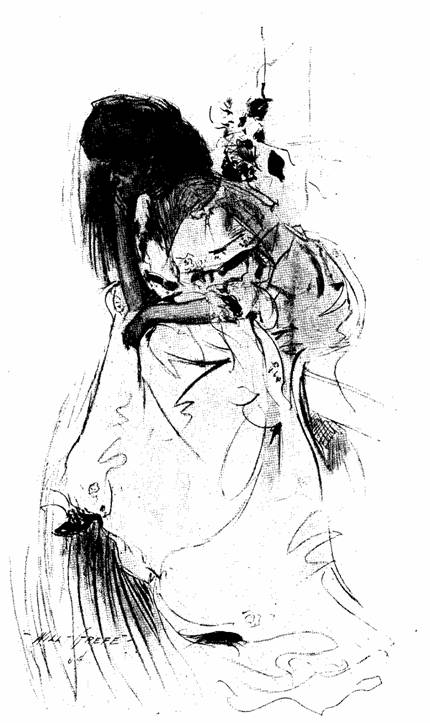
[Illustration: "Miss Hugonin pouted. 'You needn't be such a
grandfather,' she suggested, helpfully"]
And here (he thought) was an excellent, an undreamed-of opportunity to
inform her of his engagement. He had much better tell her now and have
done. Mr. Woods opened his mouth and looked at Margaret, and closed
it. Again she was pouting in a fashion that distracted one's mind.
"That would be most unattractive," said Miss Hugonin, calmly. "You're
very stupid, Billy, to think of living abroad. Billy, I think you're
almost as stupid as I am. I've been very stupid, Billy. I thought I
liked Mr. Kennaston. I don't, Billy--not that way. I've just told him
so. I'm not--I'm not engaged to anybody now, Billy. But wasn't it
stupid of me to make such a mistake, Billy?"
That was a very interesting mosaic there in the summer-house.
"I don't understand," said Mr. Woods. His voice shook, and his hands
lifted a little toward her and trembled.
Poor Billy dared not understand. Her eyes downcast, her foot tapping
the floor gently, Margaret was all one blush. She, too, was trembling
a little, and she was a little afraid and quite unutterably happy; and
outwardly she was very much the tiny lady of Oberon's court, very much
the coquette quintessentialised.
It is pitiable that our proud Margaret should come to such a pass. Ah,
the men that you have flouted and scorned and bedeviled and mocked at,
Margaret--could they see you now, I think the basest of them could
not but pity and worship you. This man is bound in honour to another
woman; yet a little, and his lips will open--very dry, parched lips
they are now--and he will tell you, and your pride will drive you mad,
and your heart come near to breaking.
"Don't you understand--oh, you silly Billy!" She was peeping at him
meltingly from under her lashes.
"I--I'm imagining vain things," said Mr. Woods. "I--oh, Peggy, Peggy,
I think I must be going mad!"
He stared hungrily at the pink, startled face that lifted toward his.
Ah, no, no, it could not be possible, this thing he had imagined for a
moment. He had misunderstood.
And now just for a little (thought poor Billy) let my eyes drink in
those dear felicities of colour and curve, and meet just for a little
the splendour of those eyes that have the April in them, and rest just
for a little upon that sanguine, close-grained, petulant mouth; and
then I will tell her, and then I think that I must die.
"Peggy----" he began, in a flattish voice.
"They have evidently gone," said the voice of Mr. Kennaston; "yes,
those beautiful, happy young people have foolishly deserted the very
prettiest spot in the gardens. Let us sit here, Kathleen."
"But I'm not an eavesdropper," Mr. Woods protested, half angrily.
I fear Margaret was not properly impressed.
"Please, Billy," she pleaded, in a shrill whisper, "please let's
listen. He's going to propose to her now, and you've no idea how
funny he is when he proposes. Oh, don't be so pokey, Billy--do let's
listen!"
But Mr. Woods had risen with a strange celerity and was about to leave
the summer-house.
Margaret pouted. Mrs. Saumarez and Mr. Kennaston were seated not
twenty feet from the summer-house, on the bench which Miss Hugonin had
just left. And when that unprincipled young woman finally rose to her
feet, it must be confessed that it was with a toss of the head and
with the reflection that while to listen wasn't honourable, it would
at least be very amusing. I grieve to admit it, but with Billy's
scruples she hadn't the slightest sympathy.
Then Kennaston cried, suddenly: "Why, you're mad, Kathleen! Woods
wants to marry you! Why, he's heels over head in love with Miss
Hugonin!"
Miss Hugonin turned to Mr. Woods with a little intake of the breath.
No, I shall not attempt to tell you what Billy saw in her countenance.
Timanthes-like, I drape before it the vines of the summer-house. For
a brief space I think we had best betake ourselves outside,
leaving Margaret in a very pitiable state of anger, and shame, and
humiliation, and heartbreak--leaving poor Billy with a heart that
ached, seeing the horror of him in her face.
XXIII
Mrs. Saumarez laughed bitterly.
"No," she said, "Billy cared for me, you know, a long time ago. And
this morning he told me he still cared. Billy doesn't pretend to be
a clever man, you see, and so he can afford to practice some of the
brute virtues, such as constancy and fidelity."
There was a challenging flame in her eyes, but Kennaston let the stab
pass unnoticed. To do him justice, he was thinking less of himself,
just now, than of how this news would affect Margaret; and his face
was very grave and strangely tender, for in his own fashion he loved
Margaret.
"It's nasty, very nasty," he said, at length, in a voice that was
puzzled. "Yet I could have sworn yesterday----" Kennaston paused and
laughed lightly. "She was an heiress yesterday, and to-day she is
nobody. And Mr. Woods, being wealthy, can afford to gratify the
virtues you commend so highly and, with a fidelity that is most
edifying, return again to his old love. And she welcomes him--and the
Woods millions--with open arms. It is quite affecting, is it not,
Kathleen?"
"You needn't be disagreeable," she observed.
"My dear Kathleen, I assure you I am not angry. I am merely a little
sorry for human nature. I could have sworn Woods was honest. But
rogues all, rogues all, Kathleen! Money rules us in the end; and now
the parable is fulfilled, and Love the prodigal returns to make merry
over the calf of gold. Confess," Mr. Kennaston queried, with a smile,
"is it not strange an all-wise Creator should have been at pains to
fashion this brave world about us for little men and women such as
we to lie and pilfer in? Was it worth while, think you, to arch the
firmament above our rogueries, and light the ageless stars as candles
to display our antics? Let us be frank, Kathleen, and confess that
life is but a trivial farce ignobly played in a very stately temple."
And Mr. Kennaston laughed again.
"Let us be frank!" Kathleen cried, with a little catch in her voice.
"Why, it isn't in you to be frank, Felix Kennaston! Your life is
nothing but a succession of poses--shallow, foolish poses meant
to hoodwink the world and at times yourself. For you do hoodwink
yourself, don't you, Felix?" she asked, eagerly, and gave him no time
to answer. She feared, you see, lest his answer might dilapidate the
one fortress she had been able to build about his honour.
"And now," she went on, quickly, "you're trying to make me think you a
devil of a fellow, aren't you? And you're hinting that I've accepted
Billy because of his money, aren't you? Well, it is true that I
wouldn't marry him if he were poor. But he's very far from being poor.
And he cares for me. And I am fond of him. And so I shall marry him
and make him as good a wife as I can. So there!"
Mrs. Saumarez faced him with an uneasy defiance. He was smiling oddly.
"I have heard it rumoured in many foolish tales and jingling verses,"
said Kennaston, after a little, "that a thing called love exists in
the world. And I have also heard, Kathleen, that it sometimes enters
into the question of marriage. It appears that I was misinformed."
"No," she answered, slowly, "there is a thing called love. I think
women are none the better for knowing it. To a woman, it means to take
some man--some utterly commonplace man, perhaps--perhaps, only an idle
poseur such as you are, Felix--and to set him up on a pedestal, and
to bow down and worship him; and to protest loudly, both to the world
and to herself, that in spite of all appearances her idol really
hasn't feet of clay, or that, at any rate, it is the very nicest clay
in the world. For a time she deceives herself, Felix. Then the idol
topples from the pedestal and is broken, and she sees that it is all
clay, Felix--clay through and through--and her heart breaks with it."
Kennaston bowed his head. "It is true," said he; "that is the love of
women."
"To a man," she went on, dully, "it means to take some woman--the
nearest woman who isn't actually deformed--and to make pretty speeches
to her and to make her love him. And after a while--" Kathleen
shrugged her shoulders drearily. "Why, after a while," said she, "he
grows tired and looks for some other woman."
"It is true," said Kennaston--"yes, very true that some men love in
that fashion."
There ensued a silence. It was a long silence, and under the tension
of it Kathleen's composure snapped like a cord that has been stretched
to the breaking point.
"Yes, yes, yes!" she cried, suddenly; "that is how I have loved you
and that is how you've loved me, Felix Kennaston! Ah, Billy told me
what happened last night! And that--that was why I--" Mrs. Saumarez
paused and regarded him curiously. "You don't make a very noble
figure, just now, do you?" she asked, with careful deliberation. "You
were ready to sell yourself for Miss Hugonin's money, weren't you? And
now you must take her without the money. Poor Felix! Ah, you poor,
petty liar, who've over-reached yourself so utterly!" And again
Kathleen began to laugh, but somewhat shrilly, somewhat hysterically.
"You are wrong," he said, with a flush. "It is true that I asked Miss
Hugonin to marry me. But she--very wisely, I dare say--declined."
"Ah!" Kathleen said, slowly. Then--and it will not do to inquire too
closely into her logic--she spoke with considerable sharpness: "She's
a conceited little cat! I never in all my life knew a girl to be quite
so conceited as she is. Positively, I don't believe she thinks there's
a man breathing who's good enough for her!"
Kennaston grinned. "Oh, Kathleen, Kathleen!" he said; "you are simply
delicious."
And Mrs. Saumarez coloured prettily and tried to look severe and
could not, for the simple reason that, while she knew Kennaston to be
flippant and weak and unstable as water and generally worthless, yet
for some occult cause she loved him as tenderly as though he had been
a paragon of all the manly virtues. And I dare say that for many of us
it is by a very kindly provision of Nature that all women are created
capable of doing this illogical thing and that most of them do it
daily.
"It is true," the poet said, at length, "that I have played no heroic
part. And I don't question, Kathleen, that I am all you think me. Yet,
such as I am, I love you. And such as I am, you love me, and it is I
that you are going to marry, and not that Woods person."
"He's worth ten of you!" she cried, scornfully.
"Twenty of me, perhaps," Mr. Kennaston assented, "but that isn't the
question. You don't love him, Kathleen. You are about to marry him for
his money. You are about to do what I thought to do yesterday. But you
won't, Kathleen. You know that I need you, my dear, and--unreasonably
enough, God knows--you love me."
Mrs. Saumarez regarded him intently for a considerable space, and
during that space the Eagle warred in her heart with the one foe
he can never conquer. Love had a worthless ally; but Love fought
staunchly.
By and bye, "Yes," she said, and her voice was almost sullen; "I love
you. I ought to love Billy, but I don't. I shall ask him to release me
from my engagement. And yes, I will marry you if you like."
He raised her hand to his lips. "You are an angel," Mr. Kennaston was
pleased to say.
"No," Mrs. Saumarez dissented, rather forlornly; "I'm simply a fool.
Otherwise, I wouldn't be about to marry you, knowing you as I do for
what you are--knowing that I haven't one chance in a hundred of any
happiness."
"My dear," he said, and his voice was earnest, "you know at least that
what there is of good in me is at its best with you."
"Yes, yes!" Kathleen cried, quickly. "That is so, isn't it, Felix?
And you do care for me, don't you? Felix, are you sure you care for
me--quite sure? And are you quite certain, Felix, that you never cared
so much for any one else?"
Mr. Kennaston was quite certain. He proceeded to explain his feelings
toward her at some length.
Kathleen listened with downcast eyes and almost cheated herself into
the belief that the man she loved was all that he should be. But at
the bottom of her heart she knew he wasn't.
I think we may fairly pity her.
Kennaston and Mrs. Saumarez chatted very amicably for some ten
minutes. At the end of that period, the twelve forty-five express
bellowing faintly in the distance recalled the fact that the morning
mail was in, and thereupon, in the very best of humours, they set
out for the house. I grieve to admit it, but Kathleen had utterly
forgotten Billy by this, and was no more thinking of him than she was
of the Man in the Iron Mask.
She was with Kennaston, you see; and her thoughts, and glances, and
lips, and adoration were all given to his pleasuring, just as her life
would have been if its loss could have saved him from a toothache. He
strutted a little, and was a little grateful to her, and--to do
him justice--received the tribute she accorded him with perfect
satisfaction and equanimity.
XXIV
Margaret came out of the summer-house, Billy Woods followed her, in a
very moist state of perturbation.
"Peggy----" said Mr. Woods.
But Miss Hugonin was laughing. Clear as a bird-call, she poured forth
her rippling mimicry of mirth. They train women well in these matters.
To Margaret, just now, her heart seemed dead within her. Her lover was
proved unworthy. Her pride was shattered. She had loved this clumsy
liar yonder, had given up a fortune for him, dared all for him, had
(as the phrase runs) flung herself at his head. The shame of it was a
physical sickness, a nausea. But now, in this jumble of miseries, in
this breaking-up of the earth and the void heavens that surged about
her and would not be mastered, the girl laughed; and her laughter was
care-free and half-languid like that of a child who is thinking of
something else. Ah, yes, they train women well in these matters.
At length Margaret said, in high, crisp accents: "Pardon me, but I
can't help being amused, Mr. Woods, by the way in which hard luck
dogs your footsteps. I think Fate must have some grudge against you,
Mr. Woods."
"Peggy----" said Mr. Woods.
"Pardon me," she interrupted him, her masculine little chin high in
the air, "but I wish you wouldn't call me that. It was well enough
when we were boy and girl together, Mr. Woods. But you've developed
since--ah, yes, you've developed into such a splendid actor, such a
consummate liar, such a clever scoundrel, Mr. Woods, that I scarcely
recognise you now."
And there was not a spark of anger in the very darkest corner of
Billy's big, brave heart, but only pity--pity all through and through,
that sent little icy ticklings up and down his spine and turned his
breathing to great sobs. For she had turned full face to him and he
could see the look in her eyes.
I think he has never forgotten it. Years after the memory of it would
come upon him suddenly and set hot drenching waves of shame and
remorse surging about his body--remorse unutterable that he ever hurt
his Peggy so deeply. For they were tragic eyes. Beneath them her
twitching mouth smiled bravely, but the mirth of her eyes was
monstrous. It was the mirth of a beaten woman, of a woman who has
known the last extreme of shame and misery and has learned to laugh at
it. Even now Billy Woods cannot quite forget.
"Peggy," said he, brokenly, "ah, dear, dear Peggy, listen to me!"
"Why, have you thought of a plausible lie so soon?" she queried,
sweetly. "Dear me, Mr. Woods, what is the use of explaining things? It
is very simple. You wanted to marry me last night because I was rich.
And when I declined the honour, you went back to your old love. Oh,
it's very simple, Mr. Woods! It's a pity, though--isn't it?--that all
your promptness went for nothing. Why, dear me, you actually managed
to propose before breakfast, didn't you? I should have thought that
such eagerness would have made an impression on Kathleen--oh, a most
favourable impression. Too bad it hasn't!"
"Listen!" said Billy. "Ah, you're forcing me to talk like a cad,
Peggy, but I can't see you suffer--I can't! Kathleen misunderstood
what I said to her. I--I didn't mean to propose to her, Peggy. It was
a mistake, I tell you. It's you I love--just you. And when I asked you
to marry me last night--why, I thought the money was mine, Peggy.
I'd never have asked you if I hadn't thought that. I--ah, you don't
believe me, you don't believe me, Peggy, and before God, I'm telling
you the simple truth! Why, I hadn't ever seen that last will, Peggy!
It was locked up in that centre place in the desk, you remember.
Why--why, you yourself had the keys to it, Peggy. Surely, you
remember, dear?" And Billy's voice shook and skipped whole octaves as
he pleaded with her, for he knew she did not believe him and he could
not endure the horror of her eyes.
But Margaret shook her head; and as aforetime the twitching lips
continued to laugh beneath those tragic eyes. Ah, poor little lady of
Elfland! poor little Undine, with a soul wakened to suffering!
"Clumsy, very clumsy!" she rebuked him. "I see that you are accustomed
to prepare your lies in advance, Mr. Woods. As an extemporaneous liar
you are very clumsy. Men don't propose by mistake except in farces.
And while we are speaking of farces, don't you think it time to drop
that one of your not knowing about that last will?"
"The farce!" Billy stammered. "You--why, you saw me when I found it!"
"Ah, yes, I saw you when you pretended to find it. I saw you when you
pretended to unlock that centre place. But now, of course, I know it
never was locked. I'm very careless about locking things, Mr. Woods.
Ah, yes, that gave you a beautiful opportunity, didn't it? So, when
you were rummaging through my desk--without my permission, by the way,
but that's a detail--you found both wills and concocted your little
comedy? That was very clever. Oh, you think you're awfully smooth,
don't you, Billy Woods? But if you had been a bit more daring, don't
you see, you could have suppressed the last one and taken the money
without being encumbered by me? That was rather clumsy of you, wasn't
it?" Suave, gentle, sweet as honey was the speech of Margaret as she
lifted her face to his, but her eyes were tragedies.
"Ah!" said Billy. "Ah--yes--you think--that." He was very careful in
articulating his words, was Billy, and afterward he nodded his head
gravely. The universe had somehow suffered an airy dissolution like
that of Prospero's masque--Selwoode and its gardens, the great globe
itself, "the cloud-capped towers, the gorgeous palaces, the solemn
temples" were all as vanished wraiths. There was only Peggy left--
Peggy with that unimaginable misery in her eyes that he must drive
away somehow. If that was what she thought, there was no way for him
to prove it wasn't so.
"Why, dear me, Mr. Woods," she retorted, carelessly, "what else could
I think?"
Here Mr. Woods blundered.
"Ah, think what you will, Peggy!" he cried, his big voice cracking and
sobbing and resonant with pain. "Ah, my dear, think what you will, but
don't grieve for it, Peggy! Why, if I'm all you say I am, that's no
reason you should suffer for it! Ah, don't, Peggy! In God's name,
don't! I can't bear it, dear," he pleaded with her, helplessly.
Billy was suffering, too. But her sorrow was the chief of his, and
what stung him now to impotent anger was that she must suffer and he
be unable to help her--for, ah, how willingly, how gladly, he would
have borne all poor Peggy's woes upon his own broad shoulders.
But none the less, he had lost an invaluable opportunity to hold his
tongue.
"Suffer! I suffer!" she mocked him, languidly; and then, like a
banjo-string, the tension snapped, and she gave a long, angry gasp,
and her wrath flamed.
"Upon my word, you're the most conceited man I ever knew in my life!
You think I'm in love with you! With you! Billy Woods, I wouldn't wipe
my feet on you if you were the last man left on earth! I hate you, I
loathe you, I detest you, I despise you! Do you hear me?--I hate you.
What do I care if you are a snob, and a cad, and a fortune-hunter,
and a forger, and--well, I don't care! Perhaps you haven't ever
forged anything yet, but I'm quite sure you would if you ever got an
opportunity. You'd be delighted to do it. Yes, you would--you're just
the sort of man who revels in crime. I love you! Why, that's the
best joke I've heard for a long time. I'm only sorry for you, Billy
Woods--sorry because Kathleen has thrown you over--sorry, do you
understand? Yes, since you're so fond of skinny women, I think it's a
great pity she wouldn't have you. Don't talk to me!--she is skinny.
I guess I know. She's as skinny as a beanpole. She's skinnier than I
ever imagined it possible for anybody--anybody--to be. And she
pads and rouges till I think it's disgusting, and not half--not
one-half--of her hair belongs to her, and that half is dyed. But,
of course, if you like that sort of thing, there's no accounting for
tastes, and I'm sure I'm very sorry for you, even though personally I
don't care for skinny women. I hate 'em! And I hate you, too, Billy
Woods!"
She stamped her foot, did Margaret. You must bear with her, for her
heart is breaking now, and if she has become a termagant it is because
her shamed pride has driven her mad. Bear with her, then, a little
longer.
Billy tried to bear with her, for in part he understood.
"Peggy," said he, very gently, "you're wrong."
"Yes, I dare say!" she snapped at him.
"We won't discuss Kathleen, if you please. But you're wrong about the
will. I've told you the whole truth about that, but I don't blame you
for not believing me, Peggy--ah, no, not I. There seems to be a curse
upon Uncle Fred's money. It brings out the worst of all of us. It has
changed even you, Peggy--and not for the better, Peggy. You've become
distrustful. You--ah, well, we won't discuss that now. Give me the
will, my dear, and I'll burn it before your eyes. That ought to show
you, Peggy, that you're wrong." Billy was very white-lipped as he
ended, for the Woods temper is a short one.
But she had an arrow left for him. "Give it to you! And do you think
I'd trust you with it, Billy Woods?"
"Peggy!--ah, Peggy, I hadn't deserved that. Be just, at least, to me,"
poor Billy begged of her.
Which was an absurd thing to ask of an angry woman.
"Yes, I do know what you'd do with it! You'd take it right off and
have it probated or executed or whatever it is they do to wills, and
turn me straight out in the gutter. That's just what you're longing
to do this very moment. Oh, I know, Billy Woods--I know what a temper
you've got, and I know you're keeping quiet now simply because you
know that's the most exasperating thing you can possibly do. I
wouldn't have such a disposition as you've got for the world. You've
absolutely no control over your temper--not a bit of it. You're
vile, Billy Woods! Oh, I hate you! Yes, you've made me cry, and I
suppose you're very proud of yourself. Aren't you proud? Don't stand
staring at me like a stuck pig, but answer me when I talk to you!
Aren't you proud of making me cry? Aren't you? Ah, don't talk to
me--don't talk to me, I tell you! I don't wish to hear a word you've
got to say. I hate you. And you shan't have the money, that's flat."
"I don't want it," said Billy. "I've been trying to tell you for the
last, half-hour I don't want it. In God's name, why can't you talk
like a sensible woman, Peggy?" I am afraid that Mr. Woods, too, was
beginning to lose his temper.
"That's right--swear at me! It only needed that. You do want the
money, and when you say you don't you're lying--lying--lying, do you
understand? You all want my money. Oh, dear, dear!" Margaret wailed,
and her great voice was shaken to its depths and its sobbing was the
long, hopeless sobbing of a violin, as she flung back her tear-stained
face, and clenched her little hands tight at her sides; "why can't
you let me alone? You're all after my money--you, and Mr. Kennaston,
and Mr. Jukesbury, and all of you! Why can't you let me alone? Ever
since I've had it you've hunted me as if I'd been a wild beast. God
help me, I haven't had a moment's peace, a moment's rest, a, moment's
quiet, since Uncle Fred died. They all want my money--everybody wants
my money! Oh, Billy, Billy, why can't they let me alone?"
"Peggy----" said he.
But she interrupted him. "Don't talk to me, Billy Woods! Don't you
dare talk to me. I told you I didn't wish to hear a word you had to
say, didn't I? Yes, you all want my money. And you shan't have it.
It's mine. Uncle Fred left it to me. It's mine, I tell you. I've got
the greatest thing in the world--money! And I'll keep it. Ah, I hate
you all--every one of you--but I'll make you cringe to me. I'll make
you all cringe, do you hear, because I've got the money you're ready
to sell your paltry souls for! Oh, I'll make you cringe most of all,
Billy Woods! I'm rich, do you hear?--rich--rich! Wouldn't you be
glad to marry the rich Margaret Hugonin, Billy? Ah, haven't you
schemed hard for that? You'd be glad to do it, wouldn't you? You'd
give your dirty little soul for that, wouldn't you, Billy? Ah, what a
cur you are! Well, some day perhaps I'll buy you just as I would any
other cur. Wouldn't you be glad if I did, Billy? Beg for it, Billy!
Beg, sir! Beg!" And Margaret flung back her head again, and laughed
shrilly, and held up her hand before him as one holds a lump of sugar
before a pug-dog.
In Selwoode I can fancy how the Eagle screamed his triumph.
But Billy's face was ashen.
"Before God!" he said, between his teeth, "loving you as I do, I
wouldn't marry you now for all the wealth in the world! The money has
ruined you--ruined you, Peggy."
For a little she stared at him. By and bye, "I dare say it has," she
said, in a strangely sober tone. "I've been scolding like a fishwife.
I beg your pardon, Mr. Woods--not for what I've said, because I meant
every word of it, but I beg your pardon for saying it. Don't come
with me, please."
Blindly she turned from him. Her shoulders had the droop of an old
woman's. Margaret was wearied now, weary with the weariness of death.
For a while Mr. Woods stared after the tired little figure that
trudged straight onward in the sunlight, stumbling as she went. Then a
pleached walk swallowed her, and Mr. Woods groaned.
"Oh, Peggy, Peggy!" he said, in bottomless compassion; "oh, my poor
little Peggy! How changed you are!"
Afterward Mr. Woods sank down upon the bench and buried his face in
his hands. He sat there for a long time. I don't believe he thought
of anything very clearly. His mind was a turgid chaos of misery; and
about him the birds shrilled and quavered and carolled till the air
was vibrant with their trilling. One might have thought they choired
in honour of the Eagle's triumph, in mockery of poor Billy.
Then Mr. Woods raised his head with a queer, alert look. Surely he had
heard a voice--the dearest of all voices.
"Billy!" it wailed; "oh, Billy, Billy!"
XXV
For at the height of this particularly mischancy posture of affairs
the meddlesome Fates had elected to dispatch Cock-eye Flinks to serve
as our deus ex machina. And just as in the comedy the police turn
up in the nick of time to fetch Tartuffe to prison, or in the tragedy
Friar John manages to be detained on his journey to Mantua and thus
bring about that lamentable business in the tomb of the Capulets, so
Mr. Flinks now happens inopportunely to arrive upon our lesser stage.
Faithfully to narrate how Cock-eye Flinks chanced to be at Selwoode
were a task of magnitude. That gentleman travelled very quietly; and
for the most part, he journeyed incognito under a variety of aliases
suggested partly by a fertile imagination and in part by prudential
motives. For his notions of proprietary rights were deplorably vague,
and his acquaintance with the police, in consequence, extensive. And
finally, that he was now at Selwoode was not in the least his fault,
but all the doing of an N. and O. brakesman, who had in uncultured
argument, reinforced by a coupling-pin, persuaded Mr. Flinks to
disembark from the northern freight on the night previous.
Mr. Flinks, then, sat leaning against a tree in the gardens of
Selwoode, some thirty feet from the wall that stands between Selwoode
and Gridlington, and nursed his pride and foot, both injured in that
high debate of last evening, and with a jackknife rounded off the top
of a substantial staff designed to alleviate his present lameness.
Meanwhile, he tempered his solitude with music, whistling melodiously
the air of a song that pertained to the sacredness of home and of a
white-haired mother.
Subsequently to Cock-eye Flinks (as the playbill has it), enter a
vision in violet ruffles.
Wide-eyed, she came upon him in her misery, steadily trudging toward
an unknown goal. I think he startled her a bit. Indeed, it must be
admitted that Mr. Flinks, while a man of undoubted talent in his
particular line of business, was, like many of your great geniuses, in
outward aspect unprepossessing and misleading; for whereas he looked
like a very shiftless and very dirty tramp, he was as a matter of fact
as vile a rascal as ever pawned a swinish soul for whiskey.
"What are you doing here?" said Margaret, sharply. "Don't you know
this is private property?"
To his feet rose Cock-eye Flinks. "Lady," said he, with humbleness,
"you wouldn't be hard on a poor workingman, would you? It ain't my
fault I'm here, lady--at least, it ain't rightly my fault. I just
climbed over the wall to rest a minute--just a minute, lady, in the
shade of these beautiful trees. I ain't a-hurting nobody by that,
lady, I hope."
"Well, you had no business to do it," Miss Hugonin pointed out, "and
you can just climb right back." Then she regarded him more intently,
and her face softened somewhat. "What's the matter with your foot?"
she demanded.
"Brakesman," said Mr. Flinks, briefly. "Threw me off a train. He
struck me cruel hard, he did, and me a poor workingman trying to make
my way to New York, lady, where my poor old mother's dying, lady, and
me out of a job. Ah, it's a hard, hard world, lady--and me her only
son--and he struck me cruel, cruel hard, he did, but I forgive him for
it, lady. Ah, lady, you're so beautiful I know you're got a kind, good
heart, lady. Can't you do something for a poor workingman, lady, with
a poor dying mother--and a poor, sick wife," Mr. Flinks added as a
dolorous afterthought; and drew nearer to her and held out one hand
appealingly.
Petheridge Jukesbury had at divers times pointed out to her the evils
of promiscuous charity, and these dicta Margaret parroted glibly
enough, to do her justice, so long as there was no immediate question
of dispensing alms. But for all that the next whining beggar would
move her tender heart, his glib inventions playing upon it like a
fiddle, and she would give as recklessly as though there were no
such things in the whole wide world as soup-kitchens and organised
charities and common-sense. "Because, you know," she would afterward
salve her conscience, "I couldn't be sure he didn't need it, whereas
I was quite sure I didn't."
Now she wavered for a moment. "You didn't say you had a wife before,"
she suggested.
"An invalid," sighed Mr. Flinks--"a helpless invalid, lady. And six
small children probably crying for bread at this very moment. Ah,
lady, think what my feelings must be to hear 'em cry in vain--think
what I must suffer to know that I summoned them cherubs out of Heaven
into this here hard, hard world, lady, and now can't do by 'em
properly!" And Cock-eye Flinks brushed away a tear which I, for one,
am inclined to regard as a particularly ambitious flight of his
imagination.
Promptly Margaret opened the bag at her waist and took out her purse.
"Don't!" she pleaded. "Please don't! I--I'm upset already. Take this,
and please--oh, please, don't spend it in getting drunk or gambling
or anything horrid," Miss Hugonin implored him. "You all do, and it's
so selfish of you and so discouraging."
Mr. Flinks eyed the purse hungrily. Such a fat purse! thought Cock-eye
Plinks. And there ain't nobody within a mile of here, neither. You are
not to imagine that Mr. Flinks was totally abandoned; his vices were
parochial, restrained for the most part by a lively apprehension of
the law. But now the spell of the Eagle was strong upon him.
"Lady," said Mr. Flinks, twisting in his grimy hand the bill she had
given him--and there, too, the Eagle flaunted in his vigour and
heartened him, "lady, that ain't much for you to give. Can't you do a
little better than that by a poor workingman, lady?"
A very unpleasant-looking person, Mr. Cock-eye Flinks. Oh, a
peculiarly unpleasant-looking person to be a model son and a loving
husband and a tender father. Margaret was filled with a vague alarm.
But she was brave, was Margaret. "No," said she, very decidedly, "I
shan't give you another cent. So you climb right over that wall and go
straight back where you belong."
The methods of Mr. Flinks, I regret to say, were somewhat more crude
than those of Mesdames Haggage and Saumarez and Messieurs Kennaston
and Jukesbury.
"Cheese it!" said Mr. Flinks, and flung away his staff and drew very
near to her. "Gimme that money, do you hear!"
"Don't you dare touch me!" she panted; "ah, don't you dare!"
"Aw, hell!" said Mr. Flinks, disgustedly, and his dirty hands were
upon her, and his foul breath reeked in her face.
In her hour of need Margaret's heart spoke.
"Billy!" she wailed; "oh, Billy, Billy!"
* * * * *
He came to her--just as he would have scaled Heaven to come to her,
just as he would have come to her in the nethermost pit of Hell if she
had called. Ah, yes, Billy Woods came to her now in her peril, and
I don't think that Mr. Flinks particularly relished the look upon
Billy's face as he ran through the gardens, for Billy was furiously
moved.
Cock-eye Flinks glanced back at the wall behind him. Ten feet high,
and the fellow ain't far off. Cock-eye Flinks caught up his staff, and
as Billy closed upon him, struck him full on the head. Again and again
he struck him. It was a sickening business.
Billy had stopped short. For an instant he stood swaying on his feet,
a puzzled face showing under the trickling blood. Then he flung out
his hands a little, and they flapped loosely at the wrists, like
wet clothes hung in the wind to dry, and Billy seemed to crumple up
suddenly, and slid down upon the grass in an untidy heap.
"Ah-h-h!" said Mr. Flinks. He drew back and stared stupidly at that
sprawling flesh which just now had been a man, and was seized with
uncontrollable shuddering. "Ah-h-h!" said Mr. Flinks, very quietly.
And Margaret went mad. The earth and the sky dissolved in many
floating specks and then went red--red like that heap yonder. The
veneer of civilisation peeled, fell from her like snow from a shaken
garment. The primal beast woke and flicked aside the centuries' work.
She was the Cave-woman who had seen the death of her mate--the brute
who had been robbed of her mate.
"Damn you! Damn you!" she screamed, her voice high, flat, quite
unhuman; "ah, God in Heaven damn you!" With inarticulate bestial cries
she fell upon the man who had killed Billy, and her violet fripperies
fluttered, her impotent little hands beat at him, tore at him. She was
fearless, shameless, insane. She only knew that Billy was dead.
With an oath the man flung her from him and turned on his heel. She
fell to coaxing the heap in the grass to tell her that he forgave
her--to open his eyes--to stop bloodying her dress--to come to
luncheon...
A fly settled on Billy's face and came in his zig-zag course to the
red stream trickling from his nostrils, and stopped short. She brushed
the carrion thing away, but it crawled back drunkenly. She touched it
with her finger, and the fly would not move. On a sudden, every nerve
in her body began to shake and jerk like a flag snapping in the wind.
XXVI
Some ten minutes afterward, as the members of the house-party sat
chatting on the terrace before Selwoode, there came among them a mad
woman in violet trappings that were splotched with blood.
"Did you know that Billy was dead?" she queried, smilingly. "Oh, yes,
a man killed Billy just now. Wasn't it too bad? Billy was such a nice
boy, you know. I--I think it's very sad. I think it's the saddest
thing I ever knew of in my life."
Kathleen Saumarez was the first to reach her. But she drew back
quickly.
"No, ah, no!" she said, with a little shudder. "You didn't love Billy.
He loved you, and you didn't love him. Oh, Kathleen, Kathleen, how
could you help loving Billy? He was such a nice boy. I--I'm rather
sorry he's dead."
Then she stood silent, picking at her dress thoughtfully and still
smiling. Afterward, for the first and only time in history, Miss
Hugonin fainted--fainted with an anxious smile.
Petheridge Jukesbury caught her as she fell, and began to blubber like
a whipped schoolboy as he stood there holding her in his arms.
XXVII
But Billy was not dead. There was still a feeble, jerky fluttering in
his big chest when Colonel Hugonin found him. His heart still moved,
but under the Colonel's hand its stirrings were vague and aimless as
those of a captive butterfly.
The Colonel had seen dead men and dying men before this; and as he
bent over the boy he loved he gave a convulsive sob, and afterward
buried his face in his hands.
Then--of all unlikely persons in the world--it was Petheridge
Jukesbury who rose to meet the occasion.
His suavity and blandness forgotten in the presence of death, he
mounted with confident alacrity to heights of greatness. Masterfully,
he overrode them all. He poured brandy between Billy's teeth. Then he
ordered the ladies off to bed, and recommended to Mr. Kennaston--when
that gentleman spoke of a clergyman--a far more startling destination.
For, "It is far from my intention," said Mr.
Jukesbury, "to appear lacking in respect to the cloth, but--er--just
at present I am inclined to think we are in somewhat greater need of a
mattress and a doctor and--ah--the exercise of a little common-sense.
The gentleman is--er--let us hope, in no immediate danger."
"How dare you suggest such a thing, sir?" thundered Petheridge
Jukesbury. "Didn't you see that poor girl's face? I tell you I'll be
damned if he dies, sir!"
And I fancy the recording angel heard him, and against a list of wordy
cheats registered that oath to his credit.
It was Petheridge Jukesbury, then, who stalked into Mrs. Haggage's
apartments and appropriated her mattress as the first at hand, and
afterward waddled through the gardens bearing it on his fat shoulders,
and still later lifted Billy upon it as gently as a woman could have.
But it was the hatless Colonel on his favourite Black Bess ("Damn your
motor-cars!" the Colonel was wont to say; "I consider my appearance
sufficiently unprepossessing already, sir, without my arriving in
Heaven in fragments and stinking of gasoline!") who in Fairhaven town,
some quarter of an hour afterward, leaped Dr. Jeal's garden fence, and
subsequently bundled the doctor into his gig; and again yet later it
was the Colonel who stood fuming upon the terrace with Dr. Jeal on his
way to Selwoode indeed, but still some four miles from the mansion
toward which he was urging his staid horse at its liveliest gait.
Kennaston tried to soothe him. But the Colonel clamoured to the
heavens. Kennaston he qualified in various ways. And as for Dr. Jeal,
he would hold him responsible--"personally, sir"--for the consequences
of his dawdling in this fashion--"Damme, sir, like a damn' snail with
a wooden leg!"
"I am afraid," said Kennaston, gravely, "that the doctor will be of
very little use when he does arrive."
There was that in his face which made the Colonel pause in his
objurgations.
"Sir," said the Colonel, "what--do--you--mean?" He found articulation
somewhat difficult.
"In your absence," Kennaston answered, "Mr. Jukesbury, who it
appears knows something of medicine, has subjected Mr. Woods to an
examination. It--it would be unkind to deceive you----"
"Come to the point, sir," the Colonel interrupted him. "What--do
you--mean?"
"I mean," said Felix Kennaston, sadly, "that--he is afraid--Mr. Woods
will never recover consciousness."
Colonel Hugonin stared at him. The skin of his flabby, wrinkled old
throat was working convulsively.
Then, "You're wrong, sir," the Colonel said. "Billy shan't die. Damn
Jukesbury! Damn all doctors, too, sir! I put my trust in my God, sir,
and not in a box of damn' sugar-pills, sir. And I tell you, sir, that
boy is not going to die."
Afterward he turned and went into Selwoode defiantly.
XXVIII
In the living-hall the Colonel found Margaret, white as paper, with
purple lips that timidly smiled at him.
"Why ain't you in bed?" the old gentleman demanded, with as great an
affectation of sternness as he could muster. To say the truth, it was
not much; for Colonel Hugonin, for all his blustering optimism, was
sadly shaken now.
"Attractive," said Margaret, "I was, but I couldn't stay there. My--my
brain won't stop working, you see," she complained, wearily. "There's
a thin little whisper in the back of it that keeps telling me about
Billy, and what a liar he is, and what nice eyes he has, and how
poor Billy is dead. It keeps telling me that, over and over again,
attractive. It's such a tiresome, silly little whisper. But he is
dead, isn't he? Didn't Mr. Kennaston tell me just now that he was
dead?--or was it the whisper, attractive?"
The Colonel coughed. "Kennaston--er--Kennaston's a fool," he declared,
helplessly. "Always said he was a fool. We'll have Jeal in presently."
"No--I remember now--Mr. Kennaston said Billy would die very soon. You
don't like people to disagree with you, do you, attractive? Of course,
he will die, for the man hit him very, very hard. I'm sorry Billy is
going to die, though, even if he is such a liar!"
"Don't!" said the Colonel, hoarsely; "don't, daughter! I don't know
what there is between you and Billy, but you're wrong. Oh, you're very
hopelessly wrong! Billy's the finest boy I know."
Margaret shook her head in dissent.
"No, he's a very contemptible liar," she said, disinterestedly, "and
that is what makes it so queer that I should care for him more than I
do for anything else in the world. Yes, it's very queer."
Then Margaret went into the room opening into the living-hall, where
Billy Woods lay unconscious, pallid, breathing stertorously. And the
Colonel stared after her.
"Oh, my God, my God!" groaned the poor Colonel; "why couldn't it have
been I? Why couldn't it have been I that ain't wanted any longer?
She'd never have grieved like that for me!"
And indeed, I don't think she would have.
For to Margaret there had come, as, God willing, there comes to every
clean-souled woman, the time to put away all childish things, and all
childish memories, and all childish ties, if need be, to follow one
man only, and cleave to him, and know his life and hers to be knit up
together, past severance, in a love that death itself may not affright
nor slay.
XXIX
She sat silent in one corner of the darkened room. It was the bedroom
that Frederick R. Woods formerly occupied--on the ground floor of
Selwoode, opening into the living-hall--to which they had carried
Billy.
Jukesbury had done what he could. In the bed lay Billy Woods, swathed
in hot blankets, with bottles of hot water set to his feet. Jukesbury
had washed his face clean of that awful red, and had wrapped bandages
of cracked ice about his head and propped it high with pillows. It
was little short of marvellous to see the pursy old hypocrite going
cat-footed about the room on his stealthy ministrations, replenishing
the bandages, forcing spirits of ammonia between Billy's teeth,
fighting deftly and confidently with death.
Billy still breathed.
The Colonel came and went uneasily. The clock on the mantel ticked.
Margaret brooded in a silence that was only accentuated by that
horrible wheezing, gurgling, tremulous breathing in the bed yonder.
Would the doctor never come!
She was curiously conscious of her absolute lack of emotion.
But always the interminable thin whispering in the back of her head
went on and on. "Oh, if he had only died four years ago! Oh, if he had
only died the dear, clean-minded, honest boy I used to know! When that
noise stops he will be dead. And then, perhaps, I shall be able to
cry. Oh, if he had only died four years ago!"
And then da capo. On and on ran the interminable thin whispering as
Margaret waited for death to come to Billy. Billy looked so old now,
under his many bandages. Surely he must be very, very near death.
Suddenly, as Jukesbury wrapped new bandages about his forehead, Billy
opened his eyes and, without further movement, smiled placidly up at
him.
"Hello, Jukesbury," said Billy Woods, "where's my armour?"
Jukesbury, too, smiled. "The man is bringing it downstairs now," he
answered, quietly.
"Because," Billy went on, fretfully, "I don't propose to miss the
Trojan war. The princes orgulous with high blood chafed, you know, are
all going to be there, and I don't propose to miss it."
Behind his fat back, Petheridge Jukesbury waved a cautioning hand at
Margaret, who had risen from her chair.
"But it is very absurd," Billy murmured, in the mere ghost of a voice,
"because men don't propose by mistake except in farces. Somebody told
me that, but I can't remember who, because I am a misogynist. That is
a Greek word, and I would explain it to Peggy, if she would only give
me a chance, but she can't because she has those seventeen hundred
and fifty thousand children to look after. There must be some way to
explain to her, though, because where there's a will there is always
a way, and there were three wills. Uncle Fred should not have left so
many wills--who would have thought the old man had so much ink in him?
But I will be a very great painter, Uncle Fred, and make her sorry for
the way she has treated me, and then Kathleen will understand I was
talking about Peggy."
His voice died away, and Margaret sat with wide eyes listening for it
again. Would the doctor never come!
Billy was smiling and picking at the sheets.
"But Peggy is so rich," the faint voice presently complained--"so
beastly rich! There is gold in her hair, and if you will look very
closely you will see that her lashes were pure gold until she dipped
them in the ink-pot. Besides, she expects me to sit up and beg for
lumps of sugar, and I never take sugar in my coffee. And Peggy
doesn't drink coffee at all, so I think it is very unfair, especially
as Teddy Anstruther drinks like a fish and she is going to marry him.
Peggy, why won't you marry me? You know I've always loved you, Peggy,
and now I can tell you so because Uncle Fred has left me all his
money. You think a great deal about money, Peggy. You said it was the
greatest thing in the world. And it must be, because it is the only
thing--the only thing, Peggy--that has been strong enough to keep
us apart. A part is never greater than the whole, Peggy, but I will
explain about that when you open that desk. There are sharks in it.
Aren't there, Peggy?--aren't there?"
His voice had risen to a querulous tone. Gently the fat old man
restrained him.
"Yes," said Petheridge Jukesbury; "dear me, yes. Why, dear me, of
course."
But his warning hand held Margaret back--Margaret, who stood with big
tears trickling down her cheeks.
"Dearer than life itself," Billy assented, wearily, "but before God,
loving you as I do, I wouldn't marry you now for all the wealth in the
world. I forget why, but all the world is a stage, you know, and they
don't use stages now, but only railroads. Is that why you rail at me
so, Peggy? That is a joke. You ought to laugh at my jokes, because I
love you, but I can't ever, ever tell you so because you are rich. A
rich man cannot pass through a needle's eye. Oh, Peggy, Peggy, I love
your eyes, but they're so big, Peggy!"
So Billy Woods lay still and babbled ceaselessly. But through all his
irrelevant talk, as you may see a tributary stream pulse unsullied
in a muddied river, ran the thought of Peggy--of Peggy, and of her
cruelty, and of her beauty, and of the money that stood between them.
And Margaret, who could never have believed him in his senses,
listened and knew that in his delirium, the rudder of his thoughts
snapped, he could not but speak truth. As she crouched in the corner
of the room, her face buried in an arm-chair, her gold hair half
loosened, her shoulders monotonously heaving, she wept gently,
inaudibly, almost happily.
Almost happily. Billy was dying, but she knew now, past any doubting,
that he loved her. The dear, clean-minded, honest boy had come
back to her, and she could love him now without shame, and there was
only herself to be loathed.
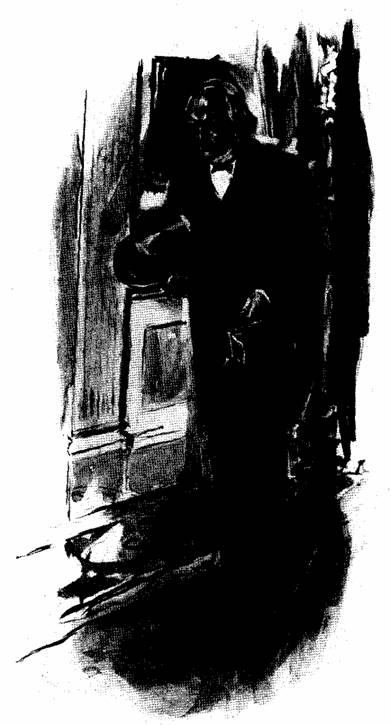
[Illustration: "Regarded them with alert eyes."]
Then the door opened. Then, with Colonel Hugonin, came Martin Jeal--a
wisp of a man like a November leaf--and regarded them from under his
shaggy white hair with alert eyes.
"Hey, what's this?" said Dr. Jeal. "Eh, yes! Eh--yes!" he meditated,
slowly. "Most irregular. You must let us have the room, Miss Hugonin."
In the hall she waited. Hope! ah, of course, there was no hope! the
thin little whisper told her.
By and bye, though--after centuries of waiting--the three men came
into the hall.
"Miss Hugonin," said Dr. Jeal, with a strange kindness in his voice,
"I don't think we shall need you again. I am happy to tell you,
though, that the patient is doing nicely--very nicely indeed."
Margaret clutched his arm. "You--you mean----"
"I mean," said Dr. Jeal, "that there is no fracture. A slight
concussion of the brain, madam, and--so far as I can see--no signs of
inflammation. Barring accidents, I think we'll have that young man out
of bed in a week. Thanks," he added, "to Mr.--er--Jukesbury here whose
prompt action was, under Heaven, undoubtedly the means of staving off
meningitis and probably--indeed, more than probably--the means
of saving Mr. Woods's life. It was splendid, sir, splendid! No
doctor--why, God bless my soul!"
For Miss Hugonin had thrown her arms about Petheridge Jukesbury's neck
and had kissed him vigorously.
"You beautiful child!" said Miss Hugonin.
"Er--Jukesbury," said the Colonel, mysteriously, "there's a little
cognac in the cellar that--er--" The Colonel jerked his thumb across
the hallway with the air of a conspirator. "Eh?" said the Colonel.
"Why--er--yes," said Mr. Jukesbury. "Why--ah--yes, I think I might."
They went across the hall together. The Colonel's hand rested
fraternally on Petheridge Jukesbury's shoulder.
XXX
The next day there was a general exodus from Selwoode, and Margaret's
satellites dispersed upon their divers ways. Selwoode, as they
understood it, was no longer hers; and they knew Billy Woods well
enough to recognise that from Selwoode's new master there were no
desirable pickings to be had such as the philanthropic crew had
fattened on these four years past. So there came to them, one and all,
urgent telegrams or insistent letters or some equally unanswerable
demand for their presence elsewhere, such as are usually prevalent
among our guests in very dull or very troublous times.
Miss Hugonin smiled a little bitterly. She considered that the scales
had fallen from her eyes, and flattered herself that she was by way of
becoming a bit of a misanthrope; also, I believe, there was a note
concerning the hollowness of life and the worthlessness of society in
general. In a word, Margaret fell back upon the extreme cynicism and
world-weariness of twenty-three, and assured herself that she despised
everybody, whereas, as a matter of fact, she never in her life
succeeded in disliking anything except mice and piano-practice, and,
for a very little while, Billy Woods; and this for the very excellent
reason that the gods had fashioned her solely to the end that she
might love all mankind, and in return be loved by humanity in general
and adored by that portion of it which inhabits trousers.
But, "The rats always desert a sinking ship," said Miss Hugonin, with
the air of one delivering a particularly original sentiment. "They
make me awfully tired, and I don't care for them in the least. But
Petheridge Jukesbury is a dear, and I may be poor now, but I did
try to do good with the money when I had it, and anyhow, Billy is
going to get well."
And, after all, that was the one thing that really mattered, though of
course Billy would always despise her. He would be quite right, too,
the girl thought humbly.
But the conventionalities of life are more powerful than even youthful
cynicism and youthful heart-break. Prior to devoting herself to a
loveless life and the commonplaces of the stoic's tub, Miss Hugonin
was compelled by the barest decency to bid her guests Godspeed.
And Adèle Haggage kissed her for the first time in her life. She had
been a little awed by Miss Hugonin, the famous heiress--a little
jealous of her, I dare say, on account of Hugh Van Orden--but now she
kissed her very heartily in farewell, and said, "Don't forget you are
to come to us as soon as possible," and was beyond any question
perfectly sincere in saying it.
And Hugh Van Orden almost dragged Margaret under the main stairway,
and, far from showing any marked abhorrence to her in her present
state of destitution, implored her with tears in his eyes to marry him
at once, and to bring the Colonel to live with them for the rest of
his natural existence.
For, "It's damned impertinent of me, of course," Mr. Van Orden readily
conceded, "and I suppose I ought to beg your pardon for mentioning it,
but I do love you to a perfectly unlimited extent. It's playing the
very deuce with my polo, Miss Hugonin, and as for my appetite--why,
if you won't have me," cried Hugh, in desperation, "I--I really, you
know, I don't believe I'll ever be able to eat anything!"
When Margaret refused him--for the sixth time, I think--I won't swear
that she didn't kiss him under the dark stairway. And if she did, he
was a nice boy, and he deserved it.
And as for Sarah Ellen Haggage, that unreverend old parasite brought
her a blank cheque signed with her name, and mentioned quite a goodly
sum as the extent to which Margaret might go for necessary expenses.
"For you'll need it," she said, and rubbed her nose reflectively.
"Moving is the very deuce for wasting money, because so many little
things keep cropping up. Now, remember, a quarter is quite enough to
give any man for moving a trunk. And there's no earthly sense in
your taking a cab, Margaret--the street-car will bring you within a
block of our door. These little trifles count, dear. And don't let
Célestine pack your things, because she's abominably careless. Let
Marie do it--and don't tip her. Give her an old hat. And if I were
you, I would certainly consult a lawyer about the legality of that
idiotic will. I remember distinctly hearing that Mr. Woods was very
eccentric in his last days, and I haven't a doubt he was raving mad
when, he left all his money to a great, strapping, long-legged young
fellow, who is perfectly capable of taking care of himself. Getting
better, is he? Well, I suppose I'm glad to hear it, but he'd much
better have stayed in Paris--where, I remember distinctly hearing, he
led the most dissipated and immoral life, my dear--instead of coming
over here and upsetting everything." And again Mrs. Haggage rubbed her
nose--indignantly.
"He didn't!" said Margaret. "And I can't take your money,
beautiful! And I don't see how we can possibly come to stay with you."
"Don't you argue with me!" Mrs. Haggage exhorted her. "I'm not in any
temper to be argued with. I've spent the morning sewing bias
stripes in a bias skirt--something which from a moral-ruining and
resolution-overthrowing standpoint simply knocks the spots off Job.
You'll take that money, and you'll come to me as soon as you can,
and--God bless you, my dear!"
And again Margaret was kissed. Altogether, it was a very osculatory
morning for Miss Hugonin.
Mr. Jukesbury's adieus, however, were more formal; and--I am sorry to
say it--the old fellow went away wondering if the rich Mr. Woods might
not conceivably be very grateful to the man who had saved his life and
evince his gratitude in some agreeable and substantial form.
Mrs. Saumarez and Mr. Kennaston, also, were somewhat unenthusiastic in
their parting. Kennaston could not feel quite at ease with Margaret,
brazen it as he might with devil-may-carish flippancy; and Kathleen
had by this an inkling as to how matters stood between Margaret and
Billy, and was somewhat puzzled thereat, and loved the former in
consequence no more than any Christian female is compelled to love the
woman who, either unconsciously or with deliberation, purloins her
ancient lover. A woman rarely forgives the man who has ceased to care
for her; and rarelier still can she pardon the woman who has dared
succeed her in his affections.
And besides, they were utterly engrossed with one another, and utterly
happy, and utterly selfish with the immemorial selfishness of lovers,
who cannot for a moment conceive that the whole world is not somehow
benefited by their happiness and does not await with breathless
interest the outcome of their bickerings with the blind bow-god, and
from this providential delusion derive a meritorious and comfortable
glow. So Mrs. Saumarez and Mr. Kennaston parted from Margaret with
kindness, it is true, but not without awkwardness.
And that was the man that almost she had loved! thought Margaret, as
she gazed on the whirl of dust left by their carriage-wheels. Gone
with a few perfunctory words of sympathy!
And for my part, I think that the base Indian who threw a pearl away
worth more than all his tribe was, in comparison with Felix Kennaston,
a shrewd and long-headed man. If you had given me his chances,
Margaret ... but this, however, is highly digressive.
The Colonel, standing beside her, used language that was unrefined.
His aspirations as to the future of Mr. Kennaston and Mr. Jukesbury,
it appeared, were both lurid and unfriendly.
"But why, attractive?" queried his daughter.
"May they be qualified with such and such adjectives!" desired the
Colonel, fervently. "They tried to lend me money--wouldn't hear of
my not taking it! In case of necessity.' Bah!" said the Colonel, and
shook his fist after the retreating carriages. "May they be qualified
with such and such adjectives!"
How happily she laughed! "And you're swearing at them!" she pouted.
"Oh, my dear, my dear, how hard you are on all my little friends!"
"Of course I am," said the Colonel, stoutly. "They've deprived me of
the pleasure of despising 'em. It was worth double the money, I tell
you! I never objected to any men quite so much. And now they've gone
and behaved decently with the deliberate purpose of annoying me! Oh!"
cried the Colonel, and shook an immaculate, withered old hand toward
the spring sky, "may they be qualified with such and such adjectives!"
And that, so far as we are concerned, was the end of Margaret's
satellites.
My dear Mrs. Grundy, may one point the somewhat obvious moral? I thank
you, madam, for your long-suffering kindness. Permit me, then, to
vault toward my moral over the shoulders of a greater man.
Among the papers left by one Charles Dickens--a novelist who is
obsolete now because he "wallows naked in the pathetic" and was
frequently guilty of a very vulgar sort of humour that actually made
people laugh, which, as we now know, is not the purpose of humour--a
novelist who incessantly "caricatured Nature" and by these inartistic
and underhand methods created characters that are more real to us than
the folk we jostle in the street and (God knows!) far more vital and
worthy of attention than the folk who "cannot read Dickens"--you will
find, I say, a note of an idea which he never afterward developed,
running to this effect: "Full length portrait of his lordship,
surrounded by worshippers. Sensible men enough, agreeable men enough,
independent men enough in a certain way; but the moment they begin
to circle round my lord, and to shine with a borrowed light from
his lordship, heaven and earth, how mean and subservient! What a
competition and outbidding of each other in servility!"
And this, with "my lord" and "his lordship" erased to make way for the
word "money," is my moral. The folk who have just left Selwoode were
honest enough as honesty goes nowadays; kindly as any of us dare
be who have our own way to make among very stalwart and determined
rivals; generous as any man may venture to be in a world where
the first of every month finds the butcher and the baker and the
candlestick-maker rapping at the door with their little bills: but
they cringed to money. It was very wrong of them, my dear lady, and in
extenuation I can only plead that they could no more help cringing to
money than you or I can help it.
This is very crude and very cynical, but unfortunately it is true.
We always cringe to money; which is humiliating. And the sun always
rises at an hour when sensible people are abed and have not the least
need for its services; which is foolish. And what you and I, my dear
madam, are to do about rectifying either one of these vexatious
circumstances, I am sure I don't know.
We can, at least, be honest. Let us, then, console ourselves at will
with moral observations concerning the number of pockets in a shroud
and the difficulty of a rich man's entering into the kingdom of
Heaven; but with an humble and reverent heart, let us admit that, in
the world we know, money rules. Its presence awes us. And if we are
quite candid we must concede that we very unfeignedly envy and admire
the rich; we must grant that money confers a certain distinction on a
man, be he the veriest ass that ever heehawed a platitude, and that we
cannot but treat him accordingly, you and I.
You are friendly, of course, with your poor cousins; you are delighted
to have them drop in to dinner, and liberal enough with the claret
when they do; but when the magnate comes, there is a magnum of
champagne, and an extra lamp in the drawing-room, and--I blush to
write it--a far more agreeable hostess at the head of the table. Dives
is such good company, you see. And speaking for my own sex, I defy any
honest fellow to lay his hand upon his waistcoat and swear that it
doesn't give him a distinct thrill of pleasure to be seen in public
with a millionaire. Daily we truckle in the Eagle's shadow--the shadow
that lay so heavily across Selwoode. With the Eagle himself and with
the Eagle's work in the world--the grim, implacable, ruthless work
that hourly he goes about--our little comedy has naught to do;
Schlemihl-like, we deal but in shadows. Even the shadow of the Eagle
is a terrible thing--a shadow that, as Felix Kennaston has told you,
chills faith, and charity, and independence, and kindliness, and
truth, and--alas--even common honesty.
But this is both cynical and digressive.
XXXI
Dr. Jeal, better than his word, had Billy Woods out of bed in five
days. To Billy they were very long and very dreary days, and to
Margaret very long and penitential ones. But Colonel Hugonin enjoyed
them thoroughly; for, as he feelingly and frequently observed, it is
an immense consolation to any man to reflect that his home no longer
contains "more damn' foolishness to the square inch than any other
house in the United States."
On all sides they sought for Cock-eye Flinks. But they never found
him, and to this day they have never found him. The Fates having
played their pawn, swept it from the board, and Cock-eye Flinks
disappeared in Clotho's capacious pocket.
All this time the young people saw nothing of one another. On this
point Jeal was adamantean.
"In a sick-room," he vehemently declared, "a woman is well enough, but
the woman is the devil and all. I've told that young man plainly,
sir, that he doesn't see your daughter till he gets well--and, by
George, sir, he'll get well now just in order to see her. Nature is
the only doctor who ever cures anybody, Colonel; we humans, for
all our pill-boxes and lancets, can only prompt her--and devilish
demoralising advice we generally give her, too," he added, with a
chuckle.
"Peggy!"
This was the first observation of Mr. Woods when he came to his
senses. He swore feebly when Peggy was denied to him. He pleaded. He
scolded. He even threatened, as a last resort, to get out of bed and
go in immediate search of her; and in return, Jeal told him very
affably that it was far less difficult to manage a patient in a
straight-jacket than one out of it, and that personally nothing would
please him so much as a plausible pretext for clapping Mr. Woods into
one of 'em. Jeal had his own methods in dealing with the fractious.
Then Billy clamoured for Colonel Hugonin, and subsequently the Colonel
came in some bewilderment to his daughter's rooms.
"Billy says that will ain't to be probated," he informed her, testily.
"I'm to make sure it ain't probated till he gets well. You're to give
me your word you'll do nothing further in the matter till Billy gets
well. That's his message, and I'd like to know what the devil this
infernal nonsense means. I ain't a Fenian nor yet a Guy Fawkes,
daughter, and in consequence I'm free to confess I don't care for all
this damn mystery and shilly-shallying. But that's the message."
Miss Hugonin debated with herself. "That I will do nothing further in
the matter till Billy gets well," she repeated, reflectively. "Yes, I
suppose I'll have to promise it, but you can tell him for me that I
consider he is horrid, and just as obstinate and selfish as he can
possibly be. Can you remember that, attractive?"
"Yes, thank you," said the Colonel. "I can remember it, but I ain't
going to. Nice sort of message to send a sick man, ain't it? I don't
know what's gotten into you, Margaret--no, begad, I don't! I think
you're possessed of seventeen devils. And now," the old gentleman
demanded, after an awkward pause, "are you or are you not going to
tell me what all this mystery is about?"
"I can't," Miss Hugonin protested. "It--it's a secret, attractive."
"It ain't," said the Colonel, flatly--"it's some more damn
foolishness." And he went away in a fret and using language.
XXXII
Left to herself, Miss Hugonin meditated.
Miss Hugonin was in her kimono.
And oh, Madame Chrysastheme! oh, Madame Butterfly! Oh, Mimosa San, and
Pitti Sing, and Yum Yum, and all ye vaunted beauties of Japan! if you
could have seen her in that garb! Poor little ladies of the Orient,
how hopelessly you would have wrung your henna-stained fingers! Poor
little Ichabods of the East, whose glory departed irretrievably when
she adopted this garment, I tremble to think of the heart-burnings and
palpitations and hari-karis that would have ensued.
It was pink--the pink of her cheeks to a shade. And scattered about it
were birds, and butterflies, and snaky, emaciated dragons, with backs
like saw-teeth, and prodigious fangs, and claws, and very curly tails,
such as they breed in Nankeen plates and used to breed on packages of
fire-crackers--all done in gold, the gold of her hair. Moreover, one
might catch a glimpse of her neck--which was a manifest favour of the
gods--and about it mysterious, lacy white things intermingling with
divers tiny blue ribbons. I saw her in it once--by accident.
And now I fancy, as she stood rigid with indignation, her cheeks
flushed, it must have been a heady spectacle to note how their
shell-pink repeated the pink of her fantastic garment like a chromatic
echo; and how her sunny hair, a thought loosened, a shade dishevelled,
clung heavily about her face, a golden snare for eye and heart; and
how her own eyes, enormous, cerulean--twin sapphires such as in the
old days might have ransomed a brace of emperors--grew wistful like a
child's who has been punished and does not know exactly why; and how
her petulant mouth quivered and the long black lashes, golden at the
roots, quivered, too--ah, yes, it must have been a heady spectacle.
"Now," she announced, "I see plainly what he intends doing. He is
going to destroy that will, and burden me once more with a large and
influential fortune. I don't want it, and I won't take it, and he
might just as well understand that in the very beginning. I don't care
if Uncle Fred did leave it to me--I didn't ask him to, did I? Besides,
he was a very foolish old man--if he had left the money to Billy
everything would have been all right. That's always the way--my
dolls are invariably stuffed with sawdust, and I never have a dear
gazelle to glad me with his dappled hide, but when he comes to know me
well he falls upon the buttered side--or something to that effect. I
hate poetry, anyhow--it's so mushy!"
And this from the Miss Hugonin who a week ago was interested in the
French decadents and partial to folk-songs from the Romaic! I think
we may fairly deduce that the reign of Felix Kennaston is over. The
king is dead; and Margaret's thoughts and affections and her very
dreams have fallen loyally to crying, Long live the king--his Majesty
Billy the First.
"Oh!" said Margaret, with an indignant gasp, what time her eyebrows
gesticulated, "I think Billy Woods is a meddlesome piece!--that's
what I think! Does he suppose that after waiting all this time for the
only man in the world who can keep me interested for four hours on
a stretch and send my pulse up to a hundred and make me feel those
thrilly thrills I've always longed for--does he suppose that now
I'm going to pay any attention to his silly notions about wills and
things? He's abominably selfish! I shan't!"
Margaret moved across the room, shimmering, rustling, glittering like
a fairy in a pantomime. Then, to consider matters at greater ease, she
curled up on a divan in much the attitude of a tiny Cleopatra riding
at anchor on a carpeted Cydnus.
"Billy thinks I want the money--bless his boots! He thinks I'm a
stuck-up, grasping, purse-proud little pig, and he has every right
to think so after the way I talked to him, though he ought to have
realised I was in a temper about Kathleen Saumarez and have paid no
attention to what I said. And he actually attempted to reason with
me! If he'd had any consideration for my feelings, he'd have simply
smacked me and made me behave--however, he's a man, and all men are
selfish, and she's a skinny old thing, and I never had any use for
her. Bother her lectures! I never understood a word of them, and I
don't believe she does, either. Women's clubs are all silly, and I
think the women who belong to them are all bold-faced jigs! If
they had any sense, they'd stay at home and take care of the babies,
instead of messing with philanthropy, and education, and theosophy,
and anything else that they can't make head or tail of. And they call
that being cultured! Culture!--I hate the word! I don't want to be
cultured--I want to be happy."
This, you will observe, was, in effect, a sweeping recantation of
every ideal Margaret had ever boasted. But Love is a canny pedagogue,
and of late he had instructed Miss Hugonin in a variety of matters.
"Before God, loving you as I do, I wouldn't marry you for all the
wealth in the world," she repeated, with a little shiver. "Even in his
delirium he said that. But I know now that he loves me. And I know
that I adore him. And if this were a sensible world, I'd walk right in
there and explain things and ask him to marry me, and then it wouldn't
matter in the least who had the money. But I can't, because it
wouldn't be proper. Bother propriety!--but bothering it doesn't do
any good. As long as I have the money, Billy will never come near me,
because of the idiotic way I talked to him. And he's bent on my taking
the money simply because it happens to belong to me. I consider that
a very silly reason. I'll make Billy Woods take the money, and
I'll make him see that I'm not a little pig, and that I trust him
implicitly. And I think I'm quite justified in using a little--we'll
call it diplomacy--because otherwise he'd go back to France or some
other objectionable place, and we'd both be very unhappy."
Margaret began to laugh softly. "I've given him my word that I'll
do nothing further in the matter till he gets well. And I won't.
But----"
Miss Hugonin rose from the divan with a gesture of sweeping back her
hair. And then--oh, treachery of tortoise-shell! oh, the villainy of
those little gold hair-pins!--the fat twisted coils tumbled loose
and slowly unravelled themselves, and her pink-and-white face,
half-eclipsed, showed a delectable wedge between big, odourful,
crinkly, ponderous masses of hair. It clung about her, a heavy cloak,
all shimmering gold like the path of sunset over the June sea. And
Margaret, looking at herself in the mirror, laughed, and appeared
perfectly content with what she saw there.
"But," said she, "if the Fates are kind to me--and I sometimes think
I have a pull with the gods--I'll make you happy, Billy Woods, in
spite of yourself."
The mirror flashed back a smile. Margaret was strangely interested in
the mirror.
"She has ringlets in her hair," sang Margaret happily--a low,
half-hushed little song. She held up a strand of it to demonstrate
this fact.
"There's a dimple in her chin"--and, indeed, there was. And a dimple
in either cheek, too.
For a long time afterward she continued to smile at the mirror. I am
afraid Kathleen Saumarez was right. She was a vain little cat, was
Margaret.
But, barring a rearrangement of the cosmic scheme, I dare say maids
will continue to delight in their own comeliness so long as mirrors
speak truth. Let us, then, leave Miss Hugonin to this innocent
diversion. The staidest of us are conscious of a brisk elation at
sight of a pretty face; and surely no considerate person will deny its
owner a portion of the pleasure that daily she accords the beggar at
the street-corner.
XXXIII
We are credibly informed that Time travels in divers paces with divers
persons--the statement being made by a lady who may be considered to
speak with some authority, having triumphantly withstood the ravages
of Chronos for a matter of three centuries. But I doubt if even the
insolent sweet wit of Rosalind could have devised a fitting simile for
Time's gait at Selwoode those five days that Billy lay abed. Margaret
could not but marvel at the flourishing proportion attained by the
hours in those sunlit spring days; and at dinner, say, her thoughts
harking back to luncheon, recalled it by a vigorous effort as an
affair of the dim yester-years--a mere blurred memory, faint and vague
as a Druidical tenet or a Merovingian squabble.
But the time passed for all that; and eventually--it was just before
dusk--she came, with Martin Jeal's permission, into the room where
Billy was. And beside the big open fireplace, where a wood fire
chattered companionably, sat a very pallid Billy, a rather thin Billy,
with a great many bandages about his head.
You may depend upon it, Margaret was not looking her worst that
afternoon. By actual count, Célestine had done her hair six times
before reaching an acceptable result.
And, "Yes, Célestine, you may get out that pale yellow dress. No,
beautiful, the one with the black satin stripes on the bodice--because
I don't want my hair cast completely in the shade, do I? Now, let me
see--black feather, gloves, large pompadour, and a sweet smile. No,
I don't want a fan--that's a Lydia Languish trade-mark. And two silk
skirts rustling like the deadest leaves imaginable. Yes, I think that
will do. And if you can't hook up my dress without pecking and pecking
at me like that, I'll probably go stark, staring crazy, Célestine,
and then you'll be sorry. No, it isn't a bit tight--are you perfectly
certain there's no powder behind my ears, Célestine? Now, please try
to fasten the collar without pulling all my hair down. Ye-es, I think
that will do, Célestine. Well, it's very nice of you to say so, but I
don't believe I much fancy myself in yellow, after all."
Equipped and armed for conquest, then, she came into the room with a
very tolerable affectation of unconcern. Altogether, it was a quite
effective entrance.
"I've been for a little drive, Billy," she mendaciously informed him.
"That's how you happen to have the opportunity of seeing me in all my
nice new store-clothes. Aren't you pleased, Billy? No, don't you dare
get up!" Margaret stood across the room, peeling off her gloves and
regarding him on the whole with disapproval. "They've been starving
you," she pensively reflected. "As soon as that Jeal person goes away,
I shall have six little beefsteaks cooked and see to it personally
that you eat every one of them. And I'll cook a cherry pie--quick as
a cat can wink her eye--won't I, Billy? That Jeal person is a decided
nuisance," said Miss Hugonin, as she stabbed her hat rather viciously
with two hat-pins and then laid it aside on a table.
Billy Woods was looking up at her forlornly. It hurt her to see the
love and sorrow in his face. But oh, how avidly his soul drank in the
modulations of that longed-for voice--a voice that was honey and gold
and velvet and all that is most sweet and rich and soft in the world.
"Peggy," said he, plunging at the heart of things, "where's that
will?"
Miss Hugonin kicked forward a little foot-stool to the other side of
the fire, and sat down and complacently smoothed out her skirts.
"I knew it!" said she. "I never saw such a one-idea'd person in my
life. I knew that would be the very first thing you would ask for,
Billy Woods, because you're such an obstinate, stiffnecked donkey.
Very well!"--and Margaret tossed her head--"here's Uncle Fred's will,
then, and you can do exactly as you like with it, and now I hope
you're satisfied!" And Margaret handed him the long envelope which lay
in her lap.
Mr. Woods promptly opened it.
"That," Miss Hugonin commented, "is what I term very unladylike
behaviour on your part."
"You evidently don't trust me, Billy Woods. Very well! I don't care!
Read it carefully--very carefully, and make quite sure I haven't been
dabbling in forgery of late--besides, it's so good for your eyes, you
know, after being hit over the head," Margaret suggested, cheerfully.
Billy chuckled. "That's true," said he, "but I know Uncle Fred's fist
well enough without having to read it all. Candidly, Peggy, I had to
look at it, because I--well, I didn't quite trust you, Peggy. And
now we're going to burn this interesting paper, you and I." "Wait!"
Margaret cried. "Ah, wait, just a moment, Billy!"
He glanced up at her in surprise, the paper still poised in his hand.
She sat with head drooped forward, her masculine little chin thrust
out eagerly, her candid eyes transparently appraising him.
"Why are you going to burn it, Billy?"
"Why?" Mr. Woods, repeated, thoughtfully. "Well, for a variety of
reasons. First is, that Uncle Fred really did leave his money to you,
and burning this is the only way of making sure you get it. Why, I
thought you wanted me to burn it! Last time I saw you--"
"I was in a temper," said Margaret, haughtily. "You ought to have seen
that."
"Yes, I--er--noticed it," Mr. Woods admitted, with some dryness; "but
it wasn't only temper. You've grown accustomed to the money. You'd
miss it now--miss the pleasure it gives you, miss the power it gives
you. You'd never be content to go back to the old life now. Why,
Peggy, you yourself told me you thought money the greatest thing in
the world! It has changed you, Peggy, this--ah, well!" said Billy, "we
won't talk about that. I'm going to burn it because that's the only
honourable thing to do. Ready, Peggy?"
"It may be honourable, but it's extremely silly," Margaret
temporised, "and for my part, I'm very, very glad God had run out of a
sense of honour when He created the woman."
"Phrases don't alter matters. Ready, Peggy?"
"Ah, no, phrases don't alter matters!" she assented, with a quick lift
of speech. "You're going to destroy that will, Billy Woods, simply
because you think I'm a horrid, mercenary, selfish pig. You think I
couldn't give up the money--you think I couldn't be happy without it.
Well, you have every right to think so, after the way I've behaved.
But why not tell me that is the real reason?"
Billy raised his hand in protest. "I--I think you might miss it," he
conceded. "Yes, I think you would miss it."
"Listen!" said Margaret, quickly. "The money is yours now--by my act.
You say you--care for me. If I am the sort of woman you think me--I
don't say I am, and I don't say I'm not--but thinking me that sort of
woman, don't you think I'd--I'd marry you for the asking if you kept
the money? Don't you think you're losing every chance of me by burning
that will? Oh, I'm not standing on conventionalities now! Don't you
think that, Billy?"
She was tempting him to the uttermost; and her heart was sick with
fear lest he might yield. This was the Eagle's last battle; and
recreant Love fought with the Eagle against poor Billy, who had only
his honour to help him.
Margaret's face was pale as she bent toward him, her lips parted a
little, her eyes glinting eerily in the firelight. The room was dark
now save in the small radius of its amber glow; beyond that was
darkness where panels and brasses blinked.
"Yes," said Billy, gravely--"forgive me if I'm wrong, dear, but--I
do think that. But you see you don't care for me, Peggy. In the
summer-house I thought for a moment--ah, well, you've shown in a
hundred ways that you don't care--and I wouldn't have you come to me,
not caring. So I'm going to burn the paper, dear."
Margaret bowed her head. Had she ever known happiness before?
"It is not very flattering to me," she said, "but it shows that
you--care--a great deal. You care enough to--let me go. Ah--yes. You
may burn it now, Billy."
And promptly he tossed it into the flames. For a moment it lay
unharmed; then the edges caught and crackled and blazed, and their
heads drew near together as they watched it burn.
There (thought Billy) is the end! Ah, ropes, daggers, and poisons!
there is the end! Oh, Peggy. Peggy, if you could only have loved me!
if only this accursed money hadn't spoiled you so utterly! Billy was
quite properly miserable over it.
But he raised his head with a smile. "And now," said he--and not
without a little, little bitterness; "if I have any right to advise
you, Peggy, I--I think I'd be more careful in the future as to how I
used the money. You've tried to do good with it, I know. But every
good cause has its parasites. Don't trust entirely to the Haggages and
Jukesburys, Peggy, and--and don't desert the good ship Philanthropy
because there are a few barnacles on it, dear."
"You make me awfully tired," Miss Hugonin observed, as she rose to her
feet. "How do you suppose I'm going to do anything for Philanthropy or
any other cause when I haven't a penny in the world? You see, you've
just burned the last will Uncle Fred ever made--the one that left
everything to me. The one in your favour was probated or proved or
whatever they call it a week ago." I think Billy was surprised.
She stood over him, sharply outlined against the darkness, clasping
her hands tightly just under her chin, ludicrously suggestive of a
pre-Raphaelitish saint. In the firelight her hair was an aureole; and
her gown, yellow with multitudinous tiny arabesques of black velvet,
echoed the glow of her hair to a shade. The dancing flames made of her
a flickering little yellow wraith. And oh, the quaint tenderness of
her eyes!--oh, the hint of faint, nameless perfume she diffused! thus
ran the meditations of Billy's dizzied brain.
"Listen! I told you I burned the other will. I started to burn it. But
I was afraid to, because I didn't know what they could do to me if I
did. So I put it away in my little handkerchief-box--and if you'd had
a grain of sense you'd have noticed the orris on it. And you made me
promise not to take any steps in the matter till you got well. I knew
you would. So I had already sent that second will--sent it before I
promised you--to Hunston Wyke--he's my lawyer now, you know--and I've
heard from him, and he has probated it."
Billy was making various irrelevant sounds.
"And I brought that other will to you, and if you didn't choose to
examine it more carefully I'm sure it wasn't my fault. I kept my word
like a perfect gentleman and took no step whatever in the matter.
I didn't say a word when before my eyes you stripped me of my entire
worldly possessions--you know I didn't. You burned it up yourself,
Billy Woods--of your own free will and accord--and now Selwoode and
all that detestable money belongs to you, and I'm sure I'd like to
know what you are going to do about it. So there!"
Margaret faced him defiantly. Billy was in a state of considerable
perturbation.
"Why have you done this?" he asked, slowly. But a lucent
something--half fear, half gladness--was wakening in Billy's eyes.
And her eyes answered him. But her tongue was far less veracious.
"Because you thought I was a pig! Because you couldn't make
allowances for a girl who for four years has seen nothing but money
and money-worshippers and the power of money! Because I wanted
your--your respect, Billy. And you thought I couldn't give it up! Very
well!" Miss Hugonin waved her hand airily toward the hearth. "Now I
hope you know better. Don't you dare get up, Billy Woods!"
But I think nothing short of brute force could have kept Mr. Woods
from her.
"Peggy," he babbled--"ah, forgive me if I'm a presumptuous ass--but
was it because you knew I couldn't ask you to marry me so long as you
had the money?"
She dallied with her bliss. Margaret was on the other side of the
table.
"Why--why, of course it wasn't!" she panted. "What nonsense!"
"Look at me, Peggy!"
"I don't want to! You look like a fright with your head all tied up."
"Peggy ... this exercise is bad for an invalid."
"I--oh, please sit down! Please, Billy! It is bad for you."
"Not until you tell me----"
"But I don't!... Oh, you make me awfully tired."
"Peggy, don't you dare stamp your foot at me!... Peggy!"
"Please sit down! Now ... well, there's my hand, stupid, if you
will be silly. Now sit down here--so, with your head leaned back on
this nice little cushion because it's good for your poor head--and
I'll sit on this nice little footstool and be quite, quite honest. No,
you must lean back--I don't care if you can't see me, I'd much rather
you couldn't. Well, the truth is--no, you must lean back--the truth
is--I've loved you all my life, Billy Woods, and--no, not yet,
Billy--and if you hadn't been the stupidest beautiful in the universe
you'd have seen it long ago. You--you needn't--lean back--any longer,
Billy ... Oh, Billy, why didn't you shave?"
"She is skinny, isn't she, Billy?"
"Now, Peggy, you mustn't abuse Kathleen. She's a friend of mine."
"Well, I know she's a friend of yours, but that doesn't prevent her
being skinny, does it?"
"Now, Peggy--"
"Please, Billy! Please say she's skinny!"
"Er--well, she's a bit thin, perhaps."
"You angel!"
"And you're quite sure you've forgiven me for doubting you?"
"And you've forgiven me?"
"Bless you, Peggy, I never doubted you! I've been too busy loving
you."
"It seems to me as if it had been--always."
"Why, didn't we love one another in Carthage, Peggy?"
"I think it was in Babylon, Billy."
"And will love one another----?"
"Forever and ever, dear. You've been to seek a wife, Billy boy."
"And oh, the dimple in her chin..."
* * * * *
Ah, well! There was a deal of foolish prattle there in the
firelight--delectable prattle, irresponsible as the chattering of
birds after a storm. And I fancy that the Eagle's shadow is lifted
from Selwoode, now that Love has taken up his abode there.
THE END
End of Project Gutenberg's The Eagle's Shadow, by James Branch Cabell

*** END OF THIS PROJECT GUTENBERG EBOOK THE EAGLE'S SHADOW ***

***** This file should be named 10882-h.htm or 10882-h.zip *****
This and all associated files of various formats will be found in:
        https://www.gutenberg.org/1/0/8/8/10882/

Produced by Suzanne Shell, Bradley Norton and PG Distributed Proofreaders

Updated editions will replace the previous one--the old editions
will be renamed.

Creating the works from public domain print editions means that no
one owns a United States copyright in these works, so the Foundation
(and you!) can copy and distribute it in the United States without
permission and without paying copyright royalties.  Special rules,
set forth in the General Terms of Use part of this license, apply to
copying and distributing Project Gutenberg-tm electronic works to
protect the PROJECT GUTENBERG-tm concept and trademark.  Project
Gutenberg is a registered trademark, and may not be used if you
charge for the eBooks, unless you receive specific permission.  If you
do not charge anything for copies of this eBook, complying with the
rules is very easy.  You may use this eBook for nearly any purpose
such as creation of derivative works, reports, performances and
research.  They may be modified and printed and given away--you may do
practically ANYTHING with public domain eBooks.  Redistribution is
subject to the trademark license, especially commercial
redistribution.


*** START: FULL LICENSE ***

THE FULL PROJECT GUTENBERG LICENSE
PLEASE READ THIS BEFORE YOU DISTRIBUTE OR USE THIS WORK

To protect the Project Gutenberg-tm mission of promoting the free
distribution of electronic works, by using or distributing this work
(or any other work associated in any way with the phrase "Project
Gutenberg"), you agree to comply with all the terms of the Full Project
Gutenberg-tm License (available with this file or online at
https://gutenberg.org/license).


Section 1.  General Terms of Use and Redistributing Project Gutenberg-tm
electronic works

1.A.  By reading or using any part of this Project Gutenberg-tm
electronic work, you indicate that you have read, understand, agree to
and accept all the terms of this license and intellectual property
(trademark/copyright) agreement.  If you do not agree to abide by all
the terms of this agreement, you must cease using and return or destroy
all copies of Project Gutenberg-tm electronic works in your possession.
If you paid a fee for obtaining a copy of or access to a Project
Gutenberg-tm electronic work and you do not agree to be bound by the
terms of this agreement, you may obtain a refund from the person or
entity to whom you paid the fee as set forth in paragraph 1.E.8.

1.B.  "Project Gutenberg" is a registered trademark.  It may only be
used on or associated in any way with an electronic work by people who
agree to be bound by the terms of this agreement.  There are a few
things that you can do with most Project Gutenberg-tm electronic works
even without complying with the full terms of this agreement.  See
paragraph 1.C below.  There are a lot of things you can do with Project
Gutenberg-tm electronic works if you follow the terms of this agreement
and help preserve free future access to Project Gutenberg-tm electronic
works.  See paragraph 1.E below.

1.C.  The Project Gutenberg Literary Archive Foundation ("the Foundation"
or PGLAF), owns a compilation copyright in the collection of Project
Gutenberg-tm electronic works.  Nearly all the individual works in the
collection are in the public domain in the United States.  If an
individual work is in the public domain in the United States and you are
located in the United States, we do not claim a right to prevent you from
copying, distributing, performing, displaying or creating derivative
works based on the work as long as all references to Project Gutenberg
are removed.  Of course, we hope that you will support the Project
Gutenberg-tm mission of promoting free access to electronic works by
freely sharing Project Gutenberg-tm works in compliance with the terms of
this agreement for keeping the Project Gutenberg-tm name associated with
the work.  You can easily comply with the terms of this agreement by
keeping this work in the same format with its attached full Project
Gutenberg-tm License when you share it without charge with others.

1.D.  The copyright laws of the place where you are located also govern
what you can do with this work.  Copyright laws in most countries are in
a constant state of change.  If you are outside the United States, check
the laws of your country in addition to the terms of this agreement
before downloading, copying, displaying, performing, distributing or
creating derivative works based on this work or any other Project
Gutenberg-tm work.  The Foundation makes no representations concerning
the copyright status of any work in any country outside the United
States.

1.E.  Unless you have removed all references to Project Gutenberg:

1.E.1.  The following sentence, with active links to, or other immediate
access to, the full Project Gutenberg-tm License must appear prominently
whenever any copy of a Project Gutenberg-tm work (any work on which the
phrase "Project Gutenberg" appears, or with which the phrase "Project
Gutenberg" is associated) is accessed, displayed, performed, viewed,
copied or distributed:

This eBook is for the use of anyone anywhere at no cost and with
almost no restrictions whatsoever.  You may copy it, give it away or
re-use it under the terms of the Project Gutenberg License included
with this eBook or online at www.gutenberg.org

1.E.2.  If an individual Project Gutenberg-tm electronic work is derived
from the public domain (does not contain a notice indicating that it is
posted with permission of the copyright holder), the work can be copied
and distributed to anyone in the United States without paying any fees
or charges.  If you are redistributing or providing access to a work
with the phrase "Project Gutenberg" associated with or appearing on the
work, you must comply either with the requirements of paragraphs 1.E.1
through 1.E.7 or obtain permission for the use of the work and the
Project Gutenberg-tm trademark as set forth in paragraphs 1.E.8 or
1.E.9.

1.E.3.  If an individual Project Gutenberg-tm electronic work is posted
with the permission of the copyright holder, your use and distribution
must comply with both paragraphs 1.E.1 through 1.E.7 and any additional
terms imposed by the copyright holder.  Additional terms will be linked
to the Project Gutenberg-tm License for all works posted with the
permission of the copyright holder found at the beginning of this work.

1.E.4.  Do not unlink or detach or remove the full Project Gutenberg-tm
License terms from this work, or any files containing a part of this
work or any other work associated with Project Gutenberg-tm.

1.E.5.  Do not copy, display, perform, distribute or redistribute this
electronic work, or any part of this electronic work, without
prominently displaying the sentence set forth in paragraph 1.E.1 with
active links or immediate access to the full terms of the Project
Gutenberg-tm License.

1.E.6.  You may convert to and distribute this work in any binary,
compressed, marked up, nonproprietary or proprietary form, including any
word processing or hypertext form.  However, if you provide access to or
distribute copies of a Project Gutenberg-tm work in a format other than
"Plain Vanilla ASCII" or other format used in the official version
posted on the official Project Gutenberg-tm web site (www.gutenberg.org),
you must, at no additional cost, fee or expense to the user, provide a
copy, a means of exporting a copy, or a means of obtaining a copy upon
request, of the work in its original "Plain Vanilla ASCII" or other
form.  Any alternate format must include the full Project Gutenberg-tm
License as specified in paragraph 1.E.1.

1.E.7.  Do not charge a fee for access to, viewing, displaying,
performing, copying or distributing any Project Gutenberg-tm works
unless you comply with paragraph 1.E.8 or 1.E.9.

1.E.8.  You may charge a reasonable fee for copies of or providing
access to or distributing Project Gutenberg-tm electronic works provided
that

- You pay a royalty fee of 20% of the gross profits you derive from
     the use of Project Gutenberg-tm works calculated using the method
     you already use to calculate your applicable taxes.  The fee is
     owed to the owner of the Project Gutenberg-tm trademark, but he
     has agreed to donate royalties under this paragraph to the
     Project Gutenberg Literary Archive Foundation.  Royalty payments
     must be paid within 60 days following each date on which you
     prepare (or are legally required to prepare) your periodic tax
     returns.  Royalty payments should be clearly marked as such and
     sent to the Project Gutenberg Literary Archive Foundation at the
     address specified in Section 4, "Information about donations to
     the Project Gutenberg Literary Archive Foundation."

- You provide a full refund of any money paid by a user who notifies
     you in writing (or by e-mail) within 30 days of receipt that s/he
     does not agree to the terms of the full Project Gutenberg-tm
     License.  You must require such a user to return or
     destroy all copies of the works possessed in a physical medium
     and discontinue all use of and all access to other copies of
     Project Gutenberg-tm works.

- You provide, in accordance with paragraph 1.F.3, a full refund of any
     money paid for a work or a replacement copy, if a defect in the
     electronic work is discovered and reported to you within 90 days
     of receipt of the work.

- You comply with all other terms of this agreement for free
     distribution of Project Gutenberg-tm works.

1.E.9.  If you wish to charge a fee or distribute a Project Gutenberg-tm
electronic work or group of works on different terms than are set
forth in this agreement, you must obtain permission in writing from
both the Project Gutenberg Literary Archive Foundation and Michael
Hart, the owner of the Project Gutenberg-tm trademark.  Contact the
Foundation as set forth in Section 3 below.

1.F.

1.F.1.  Project Gutenberg volunteers and employees expend considerable
effort to identify, do copyright research on, transcribe and proofread
public domain works in creating the Project Gutenberg-tm
collection.  Despite these efforts, Project Gutenberg-tm electronic
works, and the medium on which they may be stored, may contain
"Defects," such as, but not limited to, incomplete, inaccurate or
corrupt data, transcription errors, a copyright or other intellectual
property infringement, a defective or damaged disk or other medium, a
computer virus, or computer codes that damage or cannot be read by
your equipment.

1.F.2.  LIMITED WARRANTY, DISCLAIMER OF DAMAGES - Except for the "Right
of Replacement or Refund" described in paragraph 1.F.3, the Project
Gutenberg Literary Archive Foundation, the owner of the Project
Gutenberg-tm trademark, and any other party distributing a Project
Gutenberg-tm electronic work under this agreement, disclaim all
liability to you for damages, costs and expenses, including legal
fees.  YOU AGREE THAT YOU HAVE NO REMEDIES FOR NEGLIGENCE, STRICT
LIABILITY, BREACH OF WARRANTY OR BREACH OF CONTRACT EXCEPT THOSE
PROVIDED IN PARAGRAPH F3.  YOU AGREE THAT THE FOUNDATION, THE
TRADEMARK OWNER, AND ANY DISTRIBUTOR UNDER THIS AGREEMENT WILL NOT BE
LIABLE TO YOU FOR ACTUAL, DIRECT, INDIRECT, CONSEQUENTIAL, PUNITIVE OR
INCIDENTAL DAMAGES EVEN IF YOU GIVE NOTICE OF THE POSSIBILITY OF SUCH
DAMAGE.

1.F.3.  LIMITED RIGHT OF REPLACEMENT OR REFUND - If you discover a
defect in this electronic work within 90 days of receiving it, you can
receive a refund of the money (if any) you paid for it by sending a
written explanation to the person you received the work from.  If you
received the work on a physical medium, you must return the medium with
your written explanation.  The person or entity that provided you with
the defective work may elect to provide a replacement copy in lieu of a
refund.  If you received the work electronically, the person or entity
providing it to you may choose to give you a second opportunity to
receive the work electronically in lieu of a refund.  If the second copy
is also defective, you may demand a refund in writing without further
opportunities to fix the problem.

1.F.4.  Except for the limited right of replacement or refund set forth
in paragraph 1.F.3, this work is provided to you 'AS-IS' WITH NO OTHER
WARRANTIES OF ANY KIND, EXPRESS OR IMPLIED, INCLUDING BUT NOT LIMITED TO
WARRANTIES OF MERCHANTIBILITY OR FITNESS FOR ANY PURPOSE.

1.F.5.  Some states do not allow disclaimers of certain implied
warranties or the exclusion or limitation of certain types of damages.
If any disclaimer or limitation set forth in this agreement violates the
law of the state applicable to this agreement, the agreement shall be
interpreted to make the maximum disclaimer or limitation permitted by
the applicable state law.  The invalidity or unenforceability of any
provision of this agreement shall not void the remaining provisions.

1.F.6.  INDEMNITY - You agree to indemnify and hold the Foundation, the
trademark owner, any agent or employee of the Foundation, anyone
providing copies of Project Gutenberg-tm electronic works in accordance
with this agreement, and any volunteers associated with the production,
promotion and distribution of Project Gutenberg-tm electronic works,
harmless from all liability, costs and expenses, including legal fees,
that arise directly or indirectly from any of the following which you do
or cause to occur: (a) distribution of this or any Project Gutenberg-tm
work, (b) alteration, modification, or additions or deletions to any
Project Gutenberg-tm work, and (c) any Defect you cause.


Section  2.  Information about the Mission of Project Gutenberg-tm

Project Gutenberg-tm is synonymous with the free distribution of
electronic works in formats readable by the widest variety of computers
including obsolete, old, middle-aged and new computers.  It exists
because of the efforts of hundreds of volunteers and donations from
people in all walks of life.

Volunteers and financial support to provide volunteers with the
assistance they need, is critical to reaching Project Gutenberg-tm's
goals and ensuring that the Project Gutenberg-tm collection will
remain freely available for generations to come.  In 2001, the Project
Gutenberg Literary Archive Foundation was created to provide a secure
and permanent future for Project Gutenberg-tm and future generations.
To learn more about the Project Gutenberg Literary Archive Foundation
and how your efforts and donations can help, see Sections 3 and 4
and the Foundation web page at https://www.pglaf.org.


Section 3.  Information about the Project Gutenberg Literary Archive
Foundation

The Project Gutenberg Literary Archive Foundation is a non profit
501(c)(3) educational corporation organized under the laws of the
state of Mississippi and granted tax exempt status by the Internal
Revenue Service.  The Foundation's EIN or federal tax identification
number is 64-6221541.  Its 501(c)(3) letter is posted at
https://pglaf.org/fundraising.  Contributions to the Project Gutenberg
Literary Archive Foundation are tax deductible to the full extent
permitted by U.S. federal laws and your state's laws.

The Foundation's principal office is located at 4557 Melan Dr. S.
Fairbanks, AK, 99712., but its volunteers and employees are scattered
throughout numerous locations.  Its business office is located at
809 North 1500 West, Salt Lake City, UT 84116, (801) 596-1887, email
business@pglaf.org.  Email contact links and up to date contact
information can be found at the Foundation's web site and official
page at https://pglaf.org

For additional contact information:
     Dr. Gregory B. Newby
     Chief Executive and Director
     gbnewby@pglaf.org

Section 4.  Information about Donations to the Project Gutenberg
Literary Archive Foundation

Project Gutenberg-tm depends upon and cannot survive without wide
spread public support and donations to carry out its mission of
increasing the number of public domain and licensed works that can be
freely distributed in machine readable form accessible by the widest
array of equipment including outdated equipment.  Many small donations
($1 to $5,000) are particularly important to maintaining tax exempt
status with the IRS.

The Foundation is committed to complying with the laws regulating
charities and charitable donations in all 50 states of the United
States.  Compliance requirements are not uniform and it takes a
considerable effort, much paperwork and many fees to meet and keep up
with these requirements.  We do not solicit donations in locations
where we have not received written confirmation of compliance.  To
SEND DONATIONS or determine the status of compliance for any
particular state visit https://pglaf.org

While we cannot and do not solicit contributions from states where we
have not met the solicitation requirements, we know of no prohibition
against accepting unsolicited donations from donors in such states who
approach us with offers to donate.

International donations are gratefully accepted, but we cannot make
any statements concerning tax treatment of donations received from
outside the United States.  U.S. laws alone swamp our small staff.

Please check the Project Gutenberg Web pages for current donation
methods and addresses.  Donations are accepted in a number of other
ways including including checks, online payments and credit card
donations.  To donate, please visit: https://pglaf.org/donate


Section 5.  General Information About Project Gutenberg-tm electronic
works.

Professor Michael S. Hart was the originator of the Project Gutenberg-tm
concept of a library of electronic works that could be freely shared
with anyone.  For thirty years, he produced and distributed Project
Gutenberg-tm eBooks with only a loose network of volunteer support.

Project Gutenberg-tm eBooks are often created from several printed
editions, all of which are confirmed as Public Domain in the U.S.
unless a copyright notice is included.  Thus, we do not necessarily
keep eBooks in compliance with any particular paper edition.

Each eBook is in a subdirectory of the same number as the eBook's
eBook number, often in several formats including plain vanilla ASCII,
compressed (zipped), HTML and others.

Corrected EDITIONS of our eBooks replace the old file and take over
the old filename and etext number.  The replaced older file is renamed.
VERSIONS based on separate sources are treated as new eBooks receiving
new filenames and etext numbers.

Most people start at our Web site which has the main PG search facility:

     https://www.gutenberg.org

This Web site includes information about Project Gutenberg-tm,
including how to make donations to the Project Gutenberg Literary
Archive Foundation, how to help produce our new eBooks, and how to
subscribe to our email newsletter to hear about new eBooks.

EBooks posted prior to November 2003, with eBook numbers BELOW #10000,
are filed in directories based on their release date.  If you want to
download any of these eBooks directly, rather than using the regular
search system you may utilize the following addresses and just
download by the etext year.

     https://www.gutenberg.org/etext06

    (Or /etext 05, 04, 03, 02, 01, 00, 99,
     98, 97, 96, 95, 94, 93, 92, 92, 91 or 90)

EBooks posted since November 2003, with etext numbers OVER #10000, are
filed in a different way.  The year of a release date is no longer part
of the directory path.  The path is based on the etext number (which is
identical to the filename).  The path to the file is made up of single
digits corresponding to all but the last digit in the filename.  For
example an eBook of filename 10234 would be found at:

     https://www.gutenberg.org/1/0/2/3/10234

or filename 24689 would be found at:
     https://www.gutenberg.org/2/4/6/8/24689

An alternative method of locating eBooks:
     https://www.gutenberg.org/GUTINDEX.ALL