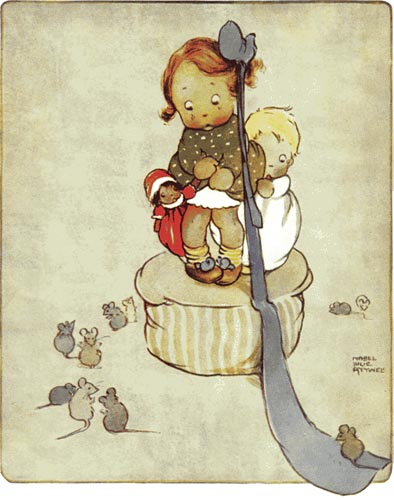
MAROONED
from a drawing by mabel lucie attwell
This eBook is for the use of anyone anywhere at no cost and with
almost no restrictions whatsoever.  You may copy it, give it away or
re-use it under the terms of the Project Gutenberg License included
with this eBook or online at www.gutenberg.org
Title: Boys and Girls Bookshelf; a Practical Plan of Character Building, Volume I (of 17)
Fun and Thought for Little Folk
Author: Various
Editor: William Byron Forbush, Herbert Treadwell Wade, Winton James Baltzell, Rossiter Johnson, and Daniel Edwin Wheeler
Release Date: May 6, 2008 [eBook #25359]
Language: English
Character set encoding: ISO-8859-1
***START OF THE PROJECT GUTENBERG EBOOK BOYS AND GIRLS BOOKSHELF; A PRACTICAL PLAN OF CHARACTER BUILDING, VOLUME I (OF 17)***
Transcriber’s Note:
Inconsistencies in spelling and hyphenation have been retained.
A Practical Plan of Character Building
COMPLETE IN SEVENTEEN VOLUMES
| I | Fun and Thought for Little Folk |
| II | Folk-Lore, Fables, and Fairy Tales |
| III | Famous Tales and Nature Stories |
| IV | Things to Make and Things to Do |
| V | True Stories from Every Land |
| VI | Famous Songs and Picture Stories |
| VII | Nature and Outdoor Life, Part I |
| VIII | Nature and Outdoor Life, Part II |
| IX | Earth, Sea, and Sky |
| X | Games and Handicraft |
| XI | Wonders of Invention |
| XII | Marvels of Industry |
| XIII | Every Land and its Story |
| XIV | Famous Men and Women |
| XV | Bookland—Story and Verse, Part I |
| XVI | Bookland—Story and Verse, Part II |
| XVII | Graded and Classified Index |
THE UNIVERSITY SOCIETY
INCORPORATED
New York
MAROONED
from a drawing by mabel lucie attwell
A Practical Plan of Character Building
Little Folks’ Section
Prepared Under the Supervision of
THE EDITORIAL BOARD of the UNIVERSITY SOCIETY
Volume I
FUN AND THOUGHT FOR LITTLE FOLK
THE UNIVERSITY SOCIETY
INCORPORATED
New York
Copyright, 1920, By
THE UNIVERSITY SOCIETY INC.
Copyright, 1912, 1915, By
THE UNIVERSITY SOCIETY INC.
Manufactured in the U. S. A.
General Editor: William Byron Forbush, Ph.D., Litt.D.
Author of “The Boy Problem”
| Technical Editor: | Music Editor: | |
| Herbert Treadwell Wade | Winton James Baltzell, A.B., Mus. Bac. | |
| Technical Editor of The New International | Secretary of The National Academy of | |
| Encyclopedia | Music | |
| Literature Editor: | Associate Editor: | |
| Rossiter Johnson, Ph.D., LL.D. | Daniel Edwin Wheeler | |
| Editor of “Little Classics” | Editorial Director of the Edison Industries |
Office Editor: Jennie Ellis Burdick
Editor of “The Children’s Own Library”
| JOSEPH H. ADAMS, | HUGO FROELICH AND BONNIE E. SNOW, | |
| Editor of | Authors of | |
| “Harper’s Practical Books for Boys” | “Industrial Art” textbooks | |
| T. GEORGE ALLEN, | JULIA A. GLEASON, | |
| Curator of the Oriental Museum, | Teacher of Sewing, | |
| University of Chicago | Cornell University | |
| MARY W. ARTOIS, | WILLIAM ELLIOT GRIFFIS, D.D., L.H.D., | |
| Traveler and Writer | Lecturer and Author | |
| ROGER W. BABSON, | ISABEL F. HAPGOOD, | |
| Author of “Central America” | Author of “Russian Rambles” | |
| GRACE GERTRUDE BARDEN, | HILDEGARDE HAWTHORNE, | |
| Teacher of Domestic Science | Author and Critic | |
| HARRY K. BEASLEY, | ROSE HENDERSON, | |
| Electrical Engineer and Author | Biographer and Travel Writer | |
| C. S. BRAININ, Ph.D., | HENRY WALTON JONES, | |
| Professor of Astronomy, | Fact Articles | |
| Columbia University | ||
| M. ALSTON BUCKLEY, | GRACE LEE KNELL, | |
| Retold Tales and Fact Articles | Teacher of Manual Training, | |
| Ridgewood, N.J., Schools | ||
| FRANK H. CHELEY, | O. IVAN LEE, | |
| Editor of the “Father and Son Library” | Analytical Chemist | |
| LAURA CLARKE, | CHARLES HENRY LERRIGO, M.D., | |
| Author of Fact Articles | Former President of the | |
| Kansas State Board of Health | ||
| CARL HARRY CLAUDY, | HARRIS W. MOORE, | |
| Author of “First Book of Photography” | Author of “Manual Training Toys” | |
| JOHN H. CLIFFORD, | JOHN T. NICHOLS, | |
| Associate-Editor of “The Young Folks’ | Curator of Fish at the | |
| Treasury,” “The Mother’s Book,” etc. | American Museum of Natural History | |
| CLAYTON S. COOPER | T. GILBERT PEARSON, | |
| Author of | Executive Secretary of the National | |
| “Understanding South America” | Association of Audubon Societies | |
| LEE S. CRANDALL, | E. L. D. SEYMOUR, | |
| Curator, New York Zoological Park | Farm Editor of Country Life | |
| WALTER ALDEN DYER, | MORGAN SHEPARD (JOHN MARTIN), | |
| Author and former Managing Editor of | Writer of | |
| Country Life in America | Illustrated Letters to Children | |
| WILLIAM H. EASTON, Ph.D., | ROBERT W. SHUFELDT, M.D., U.S.M.C., | |
| Publicity Department of the | Head of the Science Bureau, | |
| Westinghouse Electric | Washington, D. C. | |
| and Manufacturing Co. | ||
| ARTHUR ELSON, | ELVA S. SMITH, | |
| Musical Critic and Author of | Children’s Librarian of the | |
| “The Book of Musical Knowledge” | Carnegie Library, Pittsburgh | |
| PHILIP D. FAGANS, | MABELL SHIPPIE CLARKE SMITH, | |
| Executive Secretary of the | Author and Lecturer | |
| Woodcraft League | ||
| JOHN CLARKE FARBER, A.M., | MARY V. WORSTELL, | |
| Lieutenant, United States National Army | Author, Editor, and Lecturer | |
| LOUISE MAUNSELL FIELD, | KATHARINE S. WORTHINGTON, | |
| Fiction Reviewer of The New York Times | Teacher of English in the | |
| Finch School | ||
| EHRMA G. FILER, | ||
| Fact Articles |
in the boys and girls bookshelf by selections from their writings
| FREDERICK UPHAM ADAMS, | WASHINGTON IRVING, | |
| Mechanical Engineer and Author | Historian, Essayist, and Novelist | |
| ROALD AMUNDSEN, | TUDOR JENKS, | |
| Leader of the Norwegian Polar | Author of “Boys’ Book of Explorations,” | |
| Expedition which reached the South Pole | “Electricity for Young People,” etc. | |
| HANS CHRISTIAN ANDERSEN, | CHARLES KINGSLEY, | |
| Danish Poet and Fabulist | Clergyman and Author | |
| CAROLYN SHERWIN BAILEY, | GUSTAVE KOBBE, | |
| Writer of Stories and Books for | Author of | |
| Children and Young Folks | “Wagner’s Music Dramas Analyzed” | |
| RALPH HENRY BARBOUR, | CHARLES LAMB, | |
| Author of “The Crimson Sweater” | Critic, Humorist, and Author | |
| and other books for boys | ||
| L. FRANK BAUM, | SIDNEY LANIER, | |
| Author of “The Wizard of Oz,” “Queen Zixie | Poet and Critic | |
| of Ix” and other children’s books | ||
| ALEXANDER GRAHAM BELL, Ph.D., M.D., Sc.D., | EDMUND LEAMY, | |
| Scientist and Inventor | Author of “The Golden Spears” | |
| JOHN STUART BLACKIE, | MAUD McKNIGHT LINDSAY, | |
| Scottish Scholar and Man-of-letters | Author of “Mother Stories” | |
| RICHARD DODDRIDGE BLACKMORE, | HENRY W. LONGFELLOW, | |
| English Novelist | Poet | |
| JOHN HENRY BONER, | SILAS ALPHA LOTTRIDGE, | |
| Editor and Poet | Author of | |
| “Animal Snapshots and How Made” | ||
| ELBRIDGE STREETER BROOKS, | FREDERIC A. LUCAS, | |
| Author of “Historic Boys” | Director of the American | |
| and “Historic Girls” | Museum of Natural History | |
| WINIFRED BUCK, | INEZ N. McFEE, | |
| Author of “The American Girl” | Author of “Tales of Common Things” | |
| GELETT BURGESS, | PETER MacQUEEN, | |
| Draughtsman and Author | Lecturer and Author of | |
| “Around the World With the Flag” | ||
| THORNTON WALDO BURGESS, | JOHN MILTON, | |
| Author of “Old Mother West Wind” | Poet | |
| ELIZABETH BARRETT BROWNING, | ALFRED NOYES, | |
| Poet | Poet | |
| ROBERT BROWNING, | ALBERT BIGELOW PAINE, | |
| Poet | Author of “The Van Dwellers,” | |
| “Mark Twain” and other works | ||
| ROBERT BURNS, | GIFFORD PINCHOT, | |
| Poet | Systematic Forester | |
| CHARLES H. CAFFIN, | EMILIE POULSSON, | |
| Author of “A Guide to Pictures” | Author of “Finger Plays” | |
| CHARLES DICKENS, | LAURA ELIZABETH RICHARDS, | |
| Novelist | Author of the “Hildegarde” Books | |
| and “The Golden Windows” | ||
| MARY MAPES DODGE, | JAMES WHITCOMB RILEY, | |
| Author and Editor | Poet | |
| NATHAN HASKELL DOLE, | JOHN RUSKIN, | |
| Author of | Art Critic and Writer | |
| “Young Folks’ History of Russia,” etc. | ||
| ALEXANDRE DUMAS, | SIR WALTER SCOTT, | |
| Novelist | Novelist and Poet | |
| M. S. EMERY, | ANNA SEWELL | |
| Author of “How to Enjoy Pictures” | Novelist | |
| EUGENE FIELD, | ROBERT W. SERVICE, | |
| Poet | Author of “The Spell of the Yukon” | |
| WILLIAM LOVELL FINLEY, | ERNEST THOMPSON SETON, | |
| State Biologist of Oregon | Artist, Author, and Lecturer | |
| EDWARD HOWE FORBUSH, | WILLIAM SHAKESPEARE, | |
| State Ornithologist of Massachusetts | Poet and Dramatist | |
| MARY E. WILKINS FREEMAN, | PERCY BYSSHE SHELLEY, | |
| Novelist | Poet | |
| MATTHEW PAGE GAFFNEY, | VILHJALMUR STEFANSSON, | |
| Headmaster of the Roger Ascham School | Arctic Explorer | |
| REV. WASHINGTON GLADDEN, | ROBERT LOUIS STEVENSON, | |
| Author of “Santa Claus on a Lark,” | Poet, Essayist, and Novelist | |
| “Social Salvation,” etc. | ||
| JOEL CHANDLER HARRIS, | ALFRED, LORD TENNYSON, | |
| Author of “Uncle Remus Stories” | Poet | |
| ELIZABETH HARRISON, | MRS. GUDRUN THORNE-THOMSEN, | |
| President of the National | Author of “East o’ the Sun and West o’ the | |
| Kindergarten College | Moon,” and other Norwegian Folk Tales | |
| NATHANIEL HAWTHORNE, | EVERETT TITSWORTH TOMLINSON | |
| Novelist | Ph.D., L.H.D., | |
| Author of “Three Young Continentals” | ||
| CHARLES FREDERICK HOLDER, | CAROLYN WELLS, | |
| Author of | Author of “A Nonsense Anthology” | |
| “Big Game Fish of the United States” | and the “Marjorie” Books | |
| VICTOR HUGO, | JOHN GREENLEAF WHITTIER, | |
| Poet and Novelist | Poet and Author | |
| FREDERICK WINTHROP HUTCHINSON, | LEONARD WOOD, | |
| Author of “The Men Who Found America” | Major-General, United States Army | |
| JEAN INGELOW, | ORVILLE WRIGHT, | |
| Poet and Novelist | Aviator and Inventor | |
Examples of whose work appear in the Boys and Girls Bookshelf
| John W. Alexander | F. S. Church | Lucy Fitch Perkins | ||
| Annie Anderson | Clyde O. Deland | Howard Pyle | ||
| Florence Anderson | Edmund Dulac | Arthur Rackham | ||
| Culmer Barnes | Ruth Hallock | Frederick Remington | ||
| Frank L. Baum | Florence Harrison | F. Reuterdahl | ||
| J. Carter Beard | R. Bruce Horsfall | Harry Rountree | ||
| W. T. Benda | George W. Joy | Carl Rungius | ||
| John Bennett | E. W. Kemble | Edmund J. Sawyer | ||
| Anna Whelan Betts | Emilie Benson Knipe | Ernest Thompson Seton | ||
| R. B. Birch | Charles F. Lester | R. Shrador | ||
| E. H. Blashfield | J. C. Leyendecker | Harold Sichel | ||
| R. I. Brasher | H. Moore | Hugh Spencer | ||
| Pamela Vinton Brown | H. A. Ogden | Alice Barber Stephens | ||
| Harrison Cady | Monro S. Orr | Frank Stick | ||
| Bess Bruce Cleveland | Maxfield Parrish | Sara S. Stillwell | ||
| F. Y. Cory | Malcolm Patterson | C. R. Swan | ||
| Lilian A. Covey | E. C. Peixotto | Albertine Randall Wheelan |
Books are as essentially a part of the home where boys and girls are growing into manhood and womanhood as any other part of the furnishings. Parents have no more right to starve a child’s mind than they have his body. If a child is to take his place among the men and women of his time he needs to know the past out of which the present grew, and he needs to know what is going on in the world in which he lives. He needs tools for his brain as much as for his hands. All these things are found, and found only, in books.
The child is helpless to provide himself with these necessaries for life. The majority of parents are eager that their children shall start early and right on that road which leads to honorable success. But it is impossible for any parent, by no matter how liberal an expenditure, to collect books that shall adequately cover all a child’s needs and interests. This is the task of experts.
Recent studies of childhood have emphasized the conviction that a child develops his talents even more in his playtime than in his school; his spontaneous activities build up his fourfold—physical, mental, social, and moral—nature. Probably no collection of books has been more strongly affected by this modern discovery than the Boys and Girls Bookshelf. The whole effort has been to utilize the child’s play-interests so that they shall express themselves in joyous ways that lead into the world of invention and industry, of imagination and achievement, of science and art and music, of character and worth-while deeds.
Children’s collections have had various literary styles. The encyclopedia is comprehensive, but stately and often dull; it will answer the question of the child, but it does not lead the child toward more knowledge. The scrapbook is interesting, but it has no plan or order. The “inspirational” book is full of fine sentiments, but without facts or much information.
The Bookshelf is so built that it creates a desire for knowledge, and then satisfies that desire. At the same time the Bookshelf does not pretend to tell all that is known on any one subject. The Editors have selected the subjects concerning which no one should be ignorant, and have seen to it that the information is given in an attractive form with plenty of illustrative material, and that when the reader is finished he will have a working knowledge of the subject. To awaken minds and to make them alert and receptive has been the aim in making the Bookshelf.
The Bookshelf begins with the dawn of intelligence in the child, and goes with him through the morning of childhood, and into the noonday of youth. It contains a complete stock of finger-plays, action-plays, lullabies, and other entertaining and educational material enjoyable to babies and little children; it reaches into and through the high-school age. In fact, the Bookshelf, with its valuable scientific and natural-history material, its information about inventions and industries, and its literary treasures, is an asset to the library even of an adult.
The Bookshelf is classified. In some libraries material upon an unrelated variety of subjects may be found within the covers of a single volume. This feature has been tried and found wanting. It means that when the reader is on the trail of a given subject he never knows where to look for it, and he is likely to have to hunt through several volumes before he learns what he wants to know. The argument for an unclassified library is that the child who is reading a story may happen at the end of that story upon an article containing valuable information, and thus be lured on to read it. Children are not so easily beguiled. The mental distinction of being, as it were, forced to spring from one theme to another certainly counterbalances any supposed advantage in the scrapbook arrangement. “A place for everything, and everything in its place,” is as true an adage and as necessary to remember and to practise to-day as it ever was.
In addition to classifying the contents of the Bookshelf, the Editors have graded the material. Any collection that is purchased for a home and leaves out the needs of the children of any given age is disappointing to that home. There is also a Graded Index, which is an enlargement upon the general plan.
On the very day of its birth a baby enters the child’s garden of life. In this beautiful place there are weeds as well as flowers, and father and mother must guide the little adventurer so that only the good flowers are developed, while the weeds are held in check and the poisonous plants torn up and destroyed. Earnest parents feel this responsibility very keenly. In “Fun and Thought for Little Folk” there is a well-selected collection of jingles, stories, and play exercises for babies up to about three or four years of age. It covers the earliest informal education of a child, from finger-play days to the alphabet period. It helps parents who wish to enjoy their little children and who do not wish such enjoyment to be a mere matter of chance. Trained kindergartners with the modern viewpoint had much to do with this collection. Not only does it delight the little folk, but it is also the first material for child-training.
Educators are making much nowadays of fairy stories and wonder-tales. The imaginative man, they say, is the effective man, because he has the mental vision which sees farther than the physical eye; and they urge that all children should be the possessors of these nursery tales that have made children happy for so many centuries. “Folk-lore, Fables, and Fairy Tales” is the result of careful comparative study of all the leading anthologies, with added research into sources that have not otherwise been thoroughly explored.
The folk-lore of many races and times has been sifted, and wherever necessary it has been retold so as to be suitable to modern tastes and needs of modern children. Whatever was gruesome or morally undesirable has been omitted, but the flavor and the language of the past have been retained. Here are “Cinderella,” “Tom Thumb,” and all the other favorites of our childhood days, together with the stories that are told to the children in the four corners of the world. While these will be read to our boys and girls before they are able to read for themselves, they will turn back again and again to this department as they grow older. There is perpetual youth in the tales evolved by a race in its infancy.
From the fairy-tale and the folk-lore period, when beasts and trees and all that is about them speak to them in words they can understand, children develop into a stage where they want stories, or, as we say when we are older, fiction. Both they and we mean tales that while untrue yet would be possible of happening. At this age, also, children desire to learn the habits of the animals they see on the farm, in the zoo, and in the circus. The importance of giving children an early acquaintance with good literature is unquestioned, but even the most earnest parent has difficulty in making the selection, finding the source in available form, and keeping out what is unworthy.
“Famous Tales and Nature Stories” has been made with care. Many of the world’s famous stories are collected here, and wherever possible they are in the original language. The nature stories, about flowers and trees, birds and insects, are not formal, but are planned to give the child direct contact with nature and to assist the good habit of direct and interested observation.
This division also includes a Primer and a First Reader, made according to modern principles. Enough reading material is furnished in graded form to enable the home teacher to help her little pupil master the elements of reading, or the child will use it himself to supplement the work of the teacher in school, if the mother is too busy with her other tasks to permit her the enjoyment of teaching her child to read.
All modern kindergarten teaching to-day centers about the development of the child’s own impulses and interests. Of these the two most noticeable are the tendency to play and the tendency to construct. Even if a mother had no higher motive than to keep her little child out of mischief she would welcome a treasury of devices that will always be at hand to answer the question, “Mother, what shall I do now?” But most mothers appreciate the value and importance of well directed play and work. In “Things to Make and Things to Do” are given the directions for elementary cooking, sewing, woodworking and other handicraft. Successful teachers who are close to young children, and who kept home conditions in mind in all their writing, prepared these sections. Educationally they are sound, but, better than that, they are simple and explicit, and within the reach of the resources of each home. Here, too, are the suggestions for the directed and undirected play of the wee tots. The material in this department, while complete in itself, will prepare the way for and supplement all teaching in schools of these important subjects. It is of the first importance that boys and girls recognize the true nature of work and play. This department will help them in the right direction.
As a child grows older he craves true stories. “Mother, did it really happen?” “Father, was that make-believe or real?” These questions are but the sign of mental and spiritual growing pains. If the child is wisely aided, that poise which is so envied by the self-conscious person will be his. The chief factor in poise is knowledge.
To be at home in many lands and times is the mark of a really educated man or woman. Not all of us can actually travel, not all of us can have the privilege of the acquaintance of the world’s great men and women, but it is within the reach of every one to-day to discover, through picture and description, the world’s most far-away lands, and in the pages of books to have an intimate and inspiring acquaintance with the heroes of the nations. If we wish our children to be fine types of men and women, we must form their tastes in these large directions before they are overwhelmed by what is so ephemeral and worthless in literature and drama of the day.
“True Stories from Every Land” is prepared to catch the attention and to hold the interest of young children. Foreign lands are studied not by their boundaries and political affairs, but through the home life, the customs, the sports, and the work of their children, their men, and their women. The approach to history is made by biographies of some of the most interesting heroes, and especially by accounts of the adventurous pioneer days of America. The illustrations in this department are multitudinous, graphic, up-to-date, and many of them unusual. These stories will assist in home and school studies, because they illustrate the history, customs, manners, and peoples of different countries. They will help little children to learn how to read, and incidentally teach them much that will help them to appreciate the privilege and responsibility of being good Americans.
A good book of songs, familiar, tuneful, suitable to all occasions, and graded to suit the differing tastes of separate members of the family, is always welcome. The collection of “Famous Songs,” edited by Winton James Baltzell, is skillfully assembled from the best song-books available, and it also contains many pieces of unusual charm not so generally known. The songs for little children, for instance, are based upon a list approved by our leading kindergartners. A novel feature is that not only are the songs within range of children’s voices, but many of them have been arranged for instrumental use, and some for folk-dancing.
In “Picture Stories” we have a delightful series of reproductions of masterpieces of painting and sculpture of the world’s great art eras. Old masters and modern are well represented. The descriptions were written for children, remembering their interest in the story-element in pictures, and including inspiring details of the artists’ lives. In the other volumes are many more reproductions of masterpieces.
There are two volumes entitled “Nature and Outdoor Life”; the first one, “Trees, Flowers, Amphibians, and Reptiles,” begins with talks about earth, air, and sky, the clouds and weather, the seasons, the ways of bees and bugs and birds, illustrated with portraits of real children busy in observing the things of nature. Then follow sections on Familiar Flowers, Plant Life, Common Trees, and Reptiles and Amphibians, each written by an expert on the subject, and all profusely illustrated with photographs and drawings, many of the illustrations being in color. All this material is written in an easy and familiar style and in a manner to stimulate the right kind of curiosity. Children are encouraged to ask questions, and are unconsciously led to observe and read for themselves. Both this volume and its companion, “Birds, Animals, and Insects,” help boys and girls to find out many secrets of nature. In the second nature series we begin with pets and domestic animals, and then study the wild animals and birds of America. Next we learn of the ways of the birds and animals in other lands, which we meet in the zoölogical gardens of our own country. The volume closes with descriptions of the invertebrates.
The natural sciences are cared for in “Earth, Sea, and Sky.” Each division is more fascinating than the last, as it unfolds the world to us. We all want to know, and ought to know, more about the sphere upon which we live, its place in the universe, how it came to be peopled, and what are some of the laws that govern its magnificent forces and changes. This department is as interesting to old as to young, though it will find a warm place in the hearts of the youths who are just getting interested in physics, physiography, chemistry, and electricity.
An earlier volume covered the play and hand-work of little children. Our young people are now ready for games more skillful and coöperative, and handicraft more elaborate and involving a finer finish. “Games and Handicraft” supplies this need. If we are going to have a more interesting home life, if we are going to keep our boys and girls off the streets and away (sometimes) from the movies, if we are going to supplement the textbook work of the schools by the education of the hands, we need adequate handbooks to guide us. Sometimes such books are too vague to be practical. Here are working-drawings that are detailed and exact. That these projects can be executed is evidenced by the photographs of the finished work.
“Where can I get up-to-date, interesting and trustworthy descriptions of modern inventions for my young folks?” How many times this question is asked of book-store clerks by fathers! How often is a satisfactory answer given? Often such books are not up to date; usually they are too technical to be interesting; if they are interesting they are often untrustworthy; and none of them covers more than a portion of the ground. “Wonders of Invention” represents an earnest endeavor to meet this wide need within the covers of a single volume. The Editors were fortunate in obtaining for this department the coöperation of steamship companies, great electrical concerns, concrete firms, inventors and others “who know.” The illustrations were selected individually, and add to the value and interest of the text.
As a child develops toward maturity his talents begin to focus and his interests to direct themselves toward some special life occupation. The matter of Vocational Guidance is the most vital thing in education to-day, but wisdom in this field is far to seek. Changes in the industrial world are so rapid that books giving mere statistics of salaries and requirements are soon out of date, and they have no appeal to the young. Motive, rather than immediate gain, is what affects young people; and the Editors of The Bookshelf have felt that the one wise way to approach this great question is to describe the important activities of the world and some of the men who have been occupied in them, that young readers may be able to make an intelligent choice, and at the same time discover their own special talents. This section of The Bookshelf is known as “Marvels of Industry.” Aside from its value as a vocational guide, this volume will add much to the enjoyment of the family circle because of the facts that are gleaned from a perusal of its pages.
In “True Stories from Every Land” the little folks made the acquaintance of the world’s children. It is now time for the older young folk to travel. In “Every Land and Its Story” we take a journey around the world, beginning in North America, covering the rest of the New World, and then going to Europe, Asia, Africa, Australia, and the islands of the sea. The greatest emphasis is laid upon the lands that we love the most. In the United States the eight great natural divisions are described, then the Indians, the National Parks, Alaska, and Porto Rico. The greatest cities are visited in turn, the characteristics of each being picturesquely described. Canada is visited in the same way. In each case the country is described by a competent, interesting traveler, in many instances by one who has lived there a long time, and in some cases by a famous writer. Carefully chosen photographs illustrate this department.
Carlyle was right, at least as far as young people are concerned, when he insisted that history is only biography. The character-making influence of great lives has never been denied, and ought never to be neglected. “Famous Men and Women” begins with the men who made the United States and Canada. It tells about some of the living Men Who Count to-day. A simple graphic history of the greatest event in history, the World War of 1914-1918, is given. Then comes a glorious pageant of Scientists and Inventors, Writers and Rulers, National Heroes, and Servants of the Common Good. This material will not only form an excellent supplemental reading book, but a valued treasury for everyday inspiration.
Crowning the collection, and of surpassing importance, is “Bookland—Story and Verse.” This is an introduction to the best literature in poetry and prose for young people from twelve to twenty; in fact, for young people from twelve to eighty. The prose stories are presented in the language of the masters themselves. There is no diluting of their fine literary style. Careful abridgments have been made by well-known literary critics, but the essence of these masterpieces has been retained. This is important: our young people should know the great, not only about them. The poems are usually given entire.
In making the General Index and the Graded Index the Editors have remembered that these are for use, not to fill space. The General Index is practical and will help the user to find just what he is looking for, and to find it quickly. The Graded Index is intended primarily for the use of the parent. It sorts out and selects the best material for each age. First is given a brief, clear account of the tastes and needs of Infancy, Early Childhood, Middle Childhood, Late Childhood, and Adolescence. Then all the material in The Bookshelf is assorted under its score of important subjects, and put in the grade where it belongs. By this plan the child may be directed to what he wants and needs now, and each year he will grow more and more into the riches of his Bookshelf.
Many questions are listed in the Indexes. This is a very instructive feature, for it often sets the mind alert in some new direction and starts fresh lines of interest and research. These questions may be made the means of making many a family evening one of pleasure and profit, as one member asks the questions and the others take turns in answering them.
The Bookshelf is American in viewpoint, but worldwide in outlook. While it has been produced within the United States, it is larger than the United States or even than North America. Unusual space is given to Canadian affairs and interests, and the rest of the world has not been neglected. Throughout the entire set, and in the Child Welfare Manual, available to parents in connection with The Bookshelf, there is an emphasis on character, uprightness, honor, service, which is distinctly aimed to build up that type of manhood and womanhood for which the good American is famed at home and abroad.
The Publishers and the Editors wish to thank each and every one of the individuals who have coöperated with them to make The Bookshelf what it is. The courtesy, the heartiness with which assistance has been given, the belief of these friends in the success of the ideals of The Bookshelf, have made the task of compiling, editing, and manufacturing a pleasure.
Special acknowledgment must be given at this time to the photographers, Brown Brothers, Underwood & Underwood, and the Publishers Photo Service, for the use of many copyrighted pictures from their files. In a number of instances, when they did not have a particular picture desired, it was made by one of them specially for The Bookshelf.
The Editors, in preparing the manuscript for these volumes, have endeavored in all cases where material has been used which has previously appeared in print to give credit to author, publisher, and book, and to any other to whom such acknowledgment was due. If they have failed to do so in any particular case, it has been an oversight, for which the Publishers are not responsible, as their instructions on this point were definite, and for which the Editors express their regrets. Future editions will offer an opportunity for the correction, which will be gladly made.
Most mothers and fathers realize that long before children are old enough to read there is a rich treasury of rhythm and song and story that may be given them. To make this treasury available is the purpose of this volume.
Finger-plays and action-plays, in which Froebel found so rich a meaning, do much to help the baby to know and control his fingers and hands, to enable him to discover the other parts of his body, to awaken his intelligence and to bring him into affectionate companionship with his father and mother. Here we have gathered not only the traditional ones, which the mother and father may remember from their own early childhood; but also many that will be fresh and new.
Mother Goose long ago established her throne as Queen of the Nursery. There is something about her short ditties, always full of rhythm, sometimes of sense, and frequently of the most elemental humor, that appeals to the baby mind as nothing else does. A proof of the worth of her songs and stories would be found if any of us should try to write better. We have brought together many familiar ones and some unfamiliar (for Mother Goose lived in many times and many lands), and have illustrated them with some new and charming drawings and color-plates.
Children as young as three are ready for the simplest sort of stories, but it is so hard for us grown-ups to become children again that many of us have found difficulty in suiting our language and thought to their eager but unfurnished minds. These bedtime stories and little tales of babies and animals and girls and boys are therefore a real godsend.
Soon comes the time when the little folk are ready to learn about the letters and the numbers and the days of the week. Rhymes to help this first memorizing will be welcome.
Most of the stories in this book are illustrated by pictures, some are told entirely by them. The choice of these illustrations was made from our best modern knowledge about little children. It is now recognized that they like simple incidents, about themselves or the familiar things around them, drawn in clear outline or with strong color. There are certain artists, too, who seem to have retained their own childlikeness better than others, and such were called upon to illustrate this volume.
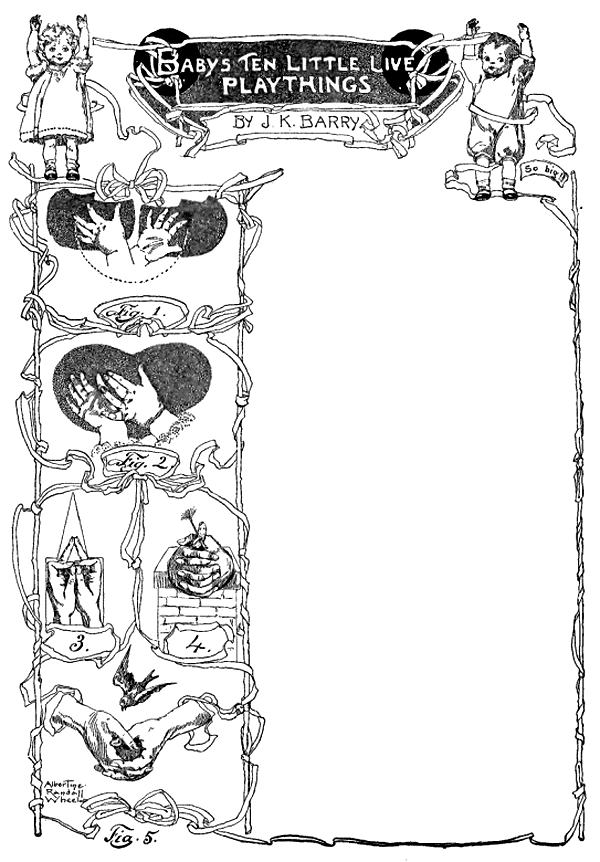
These ten little live playthings can be held in every baby’s hand, five in one and five in the other and be the baby ever so poor yet he always has these ten playthings because, you know, he brings them with him.
But all babies do not know how to play with them. They find out for themselves a good many ways of playing with them but here are some of the ways that a baby I used to know got amusement out of his.
The very first was the play called “Ta-ra-chese” (Ta-rar-cheese). It is a Dutch word and there was a little song about it all in Dutch. This is the way the baby I knew would play it when he was a tiny little fellow.
His Mamma would hold her hand up and move it gently around this way (Fig. 1) singing “Ta-ra-chese, ta-ra-chese!” Baby would look and watch awhile, and presently his little hand would begin to move and five little playthings would begin the play—dear, sweet little chubby pink fingers—for I think you have guessed these are every baby’s playthings.
How glad Mamma is to find that her baby has learned his first lesson!
Then he must learn, “Pat-a-cake, pat-a-cake Baker’s man,” (Fig. 2) and “How big is baby?” “So Big!”
And here are some other ways by which a little sister’s fingers may amuse the baby.
“This the church and this is the steeple, Open the gates—there are all the good people.” (Fig. 3)
“Chimney sweep—Oho! oho! Chimney sweep!” (Fig. 4)
“Put your finger in the bird’s nest. The bird isn’t home.” (Fig. 5)
And then when the little finger is poked in, a sly pinch is given by a hidden thumb and baby is told, “The birdie has just come home!” But you mustn’t pinch hard, of course, just enough to make baby laugh at being caught.
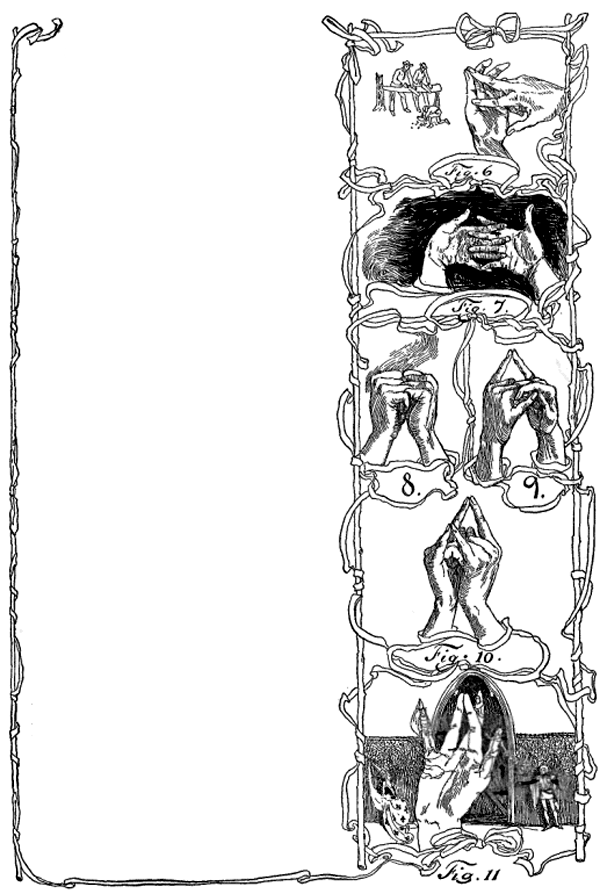
And then there is the play of “Two men sawing wood—one little boy picking up chips.” (Fig. 6) The two finger men are moved up and down and the little boy finger works busily.
Everybody knows the rhyming finger-play:
“Here’s my Father’s knives and forks, (Fig. 7)
“Here’s my Mother’s table, (Fig. 8)
“Here’s my Sister’s looking-glass, (Fig. 9)
“And here’s the baby’s cradle.” (Fig. 10)
Another play is a little act in which three persons are supposed to take part, and it has come down from the old times of long ago.
The middle finger is the Friar. Those on each side of him touch each other and make the door, the little finger is the Lady and the thumb is the Page. (Fig. 11)
The Friar knocks at the door.
Friar. “Knock, Knock, Knock!”
Page. “Somebody knocks at the door! Somebody knocks at the door!”
Lady. “Who is it? Who is it?”
Page. (Going to door) “Who is it? Who is it?”
Friar. “A Friar, a Friar.”
Page. “A Friar, Ma’am, a Friar, Ma’am.”
Lady. “What does he want? What does he want?”
Page. “What do you want, Sir? What do you want, Sir?”
Friar. “I want to come in. I want to come in.”
Page. “He wants to come in, Ma’am. He wants to come in.”
Lady. “Let him walk in. Let him walk in.”
Page. “Will you walk in, Sir? Will you walk in?”
So in he pops and takes a seat.
When each player is supposed to speak he or she must move gently, bending forward and back and when the Friar is invited to enter, the door must open only just far enough to let him “pop in.”
These are only some of the plays with which the baby I knew used to be amused; but they will suggest others to parents and older brothers and sisters. The baby cannot make all of these things himself but he will be quite as much interested when they are made by older hands.
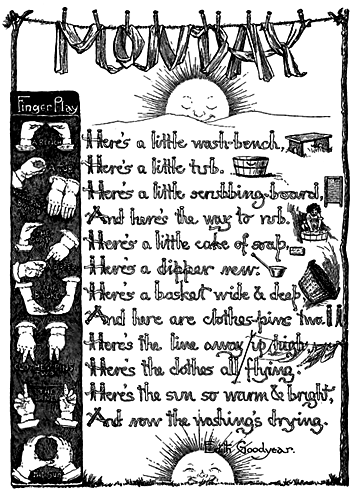
This is the thumb, you see;
This finger shakes the tree;
And then this finger comes up;
And this one eats the plums up;
This little one, says he,
“I’ll tell of you, you’ll see!”
That one is the thumb;
And this one wants a plum;
This one says, “Where do they grow?”
This one says, “Come with me—I know.”
But this little one, he says,
“I will not go near the place!
I don’t like such naughty ways.”
Now, I think that through and through
Little Finger’s right—don’t you?
This one fell in the water,
And this one helped him ashore,
And this one put him into bed,
And this one covered him o’er;
And then, in walks this noisy little chap,
And wakes him up once more.
This one walked out into the wood,
And caught a little hare;
And this one took and carried it home,
For he thought it dainty fare;
And this one came and cooked it up
With sauces rich and rare;
And this one laid the table out,
And did the plates prepare;
And this little fellow the keeper told
What the others were doing there.
Thicken man, build the barn,
Thinner man, spool the yarn,
Longen man, stir the brew,
Gowden man, make a shoe,
Littlen man, all for you!
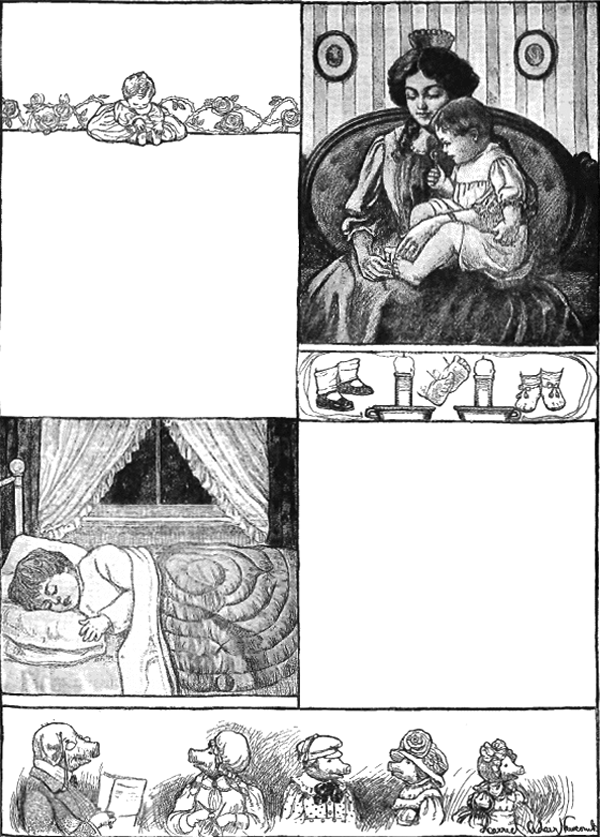
Dear little bare feet,
Dimpled and white,
In your long nightgown
Wrapped for the night.
Come, let me count all
Your queer little toes,
Pink as the heart
Of a shell or a rose.
One is a lady
That sits in the sun;
Two is a baby,
And three is a nun.
Four is a lily
With innocent breast;
And five is a birdie
Asleep on her nest.
“BABY’S TOES”
BY EDITH A. BENTLEY
Five little piggie wiggies
Standing in a row,
We always have to toddle
Where the baby wants to go;
Up-stairs and down-stairs,
Indoors and out,
We’re always close together
And we never fall out.
Chorus:
Father-Pig and Mother-Pig,
And Big-Brother Pig,
And Sister-Pig, and darling little
Baby Piggie-Wig!
Oh, sometimes we are all tied up
In a bag so tight.
This is when the baby goes
“To sleepy-bye” at night.
Then there’s nothing else to do
But cuddle down and rest—
Just as little birdies cuddle
In their little nest.
Chorus:
Father-Pig and Mother-Pig
And Big-Brother Pig,
And Sister-Pig, and darling little
Baby Piggie-Wig!
To the tune of “Here We Go Round the Mulberry Bush.”
This is the way my fingers stand,
Fingers stand, fingers stand,
This is the way my fingers stand,
So early in the morning.
This is the way I fold my hand,
Fold my hand, fold my hand,
This is the way I fold my hand,
So early in the morning.
This is the way they dance about,
Dance about, dance about,
This is the way they dance about,
So early in the morning.
This is the way they go to rest,
Go to rest, go to rest,
This is the way they go to rest,
So early in the morning.
Thumbkin, Pointer, Middleman big,
Sillyman, Weeman, rig-a-jig-jig.
BY LAURA E. RICHARDS
This is little Tommy Thumb,
Round and smooth as any plum.
This is busy Peter Pointer:
Surely he’s a double-jointer.
This is mighty Toby Tall,
He’s the biggest one of all.
This is dainty Reuben Ring:
He’s too fine for anything.
And this little wee one, maybe,
Is the pretty Finger-baby.
All the five we’ve counted now,
Busy fingers in a row.
Every finger knows the way
How to work and how to play;
Yet together work they best,
Each one helping all the rest.
[A] From “Songs and Music of Froebel’s Mother Play”; used by permission of the publishers, D. Appleton & Company.
Robert Barns, fellow fine,
Can you shoe this horse of mine,
So that I may cut a shine?
Yes, good sir, and that I can,
As well as any other man;
There a nail, and here a prod,
And now, good sir, your horse is shod.
A little boy and a little girl
Lived in an alley;
Said the little boy to the little girl,
“Shall I, oh! shall I?”
Said the little girl to the little boy,
“What will you do?”
Said the little boy to the little girl,
“I will kiss you.”
(As the last words are sung, the mother kisses
the little one in the folds of the neck.)
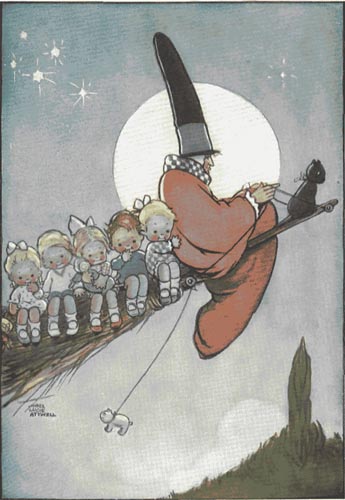
OFF WITH MOTHER GOOSE
from a drawing by mabel lucie attwell
Jack, be nimble,
Jack, be quick;
(Jack is one hand walking along on its
fore- and middle-fingers.)
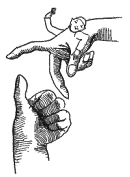
Jack, jump over
The candlestick.
(Fist closed; uplifted thumb for candle.
Jack jumps over it.)
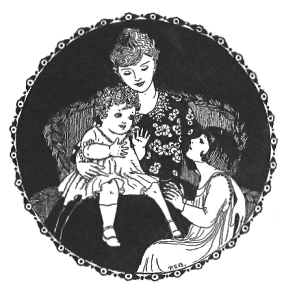
Two little hands so soft and white,
This is the left—this is the right.
Five little fingers stand on each,
So I can hold a plum or a peach.
But if I should grow as old as you
Lots of little things these hands can do.
————
Pat a cake, pat a cake, baker’s man.
So I do, master, as fast as I can.
Pat it, and prick it, and mark it with T,
And then it will serve for Tommy and me.
A Froebel Finger Play
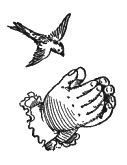
Here upon the leaves at rest
A little bird has built her nest.
Two tiny eggs within she’s laid,
And many days beside them stayed.
Now she’s happy; listen well!
Two baby birds break through the shell.
Don’t you hear them? “Peep! peep! peep!
We love you, mother. Cheep! cheep! cheep!”
There were two blackbirds sitting on a hill,
(Little pieces of paper perched on forefingers.)
One named Jack, the other named Jill.
Fly away, Jack; fly away, Jill.
(Fingers soar gently in the air.)
Come again, Jack; come again, Jill.
(Fingers fly back.)
Is Master Smith within? Yes, that he is.
Can he set a shoe? Ay, marry, two.
Here a nail, and there a nail,
Tick—tack—too.
Little Robin Redbreast
Sat upon a rail,
(Right hand extended in shape of a bird is poised
on extended forefinger of left hand.)
Niddle noddle went his head,
And waggle went his tail.
(Little finger of right hand waggles from side to side.)
Good little Mother,
How do you do?
Dear strong “Daddy,”
Glad to see you!
Big tall Brother,
Pleased you are here.
Kind little Sister,
You need not fear,
Glad welcome we’ll give you,
And Babykins, too.
Yes, Babykins,
How do you do?
Pump, pump, pump,
Water, water, come;
Here a rush, there a gush,
Done, done, done.
A Froebel Finger Play
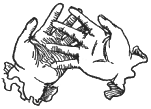
Look, my dear, at this window clear.
See how the light shines through in here.
If you would always see the light,
Keep your heart’s window clean and bright.
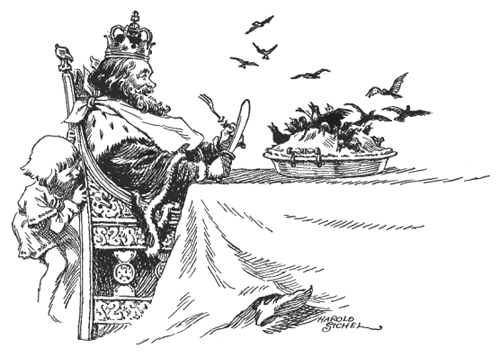
Sing a song of sixpence,
A pocket full of rye;
Four-and-twenty blackbirds
Baked in a pie;
When the pie was opened
The birds began to sing;
Was not that a dainty dish
To set before the King?
The King was in his counting-house,
Counting out his money;
The Queen was in the parlor,
Eating bread and honey;
The maid was in the garden
Hanging out the clothes;
When up came a blackbird
And nipped off her nose.
(At this line somebody’s nose gets nipped.)
A Froebel Finger Play
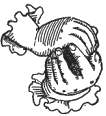
Now I’m going to open my pigeon-house door.
The pigeons fly out to the light,
Straight to the meadows so pleasant they soar,
And flutter about with delight.
But at evening they’ll all come home at last,
And the door of the house I’ll then shut fast.
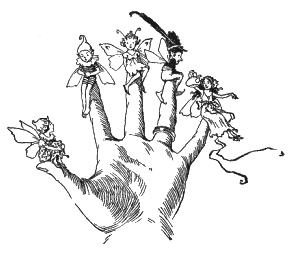
Said this little fairy, “I’m as thirsty as can be.”
Said this little fairy, “I’m hungry, too, dear me!”
Said this little fairy, “Who’ll tell us where to go?”
Said this little fairy, “I’m sure that I don’t know.”
Said this little fairy, “Let’s brew some dewdrop tea.”
So they sipped it and ate honey beneath the maple tree.
See the little mousie, creeping up the stair,
Looking for a warm nest—there, oh, there!
(Mother’s fingers creep up the body, and finally fumble in baby’s neck.)
A Froebel Finger Play
Baby, would you like to make
For yourself a little cake?
Pat it gently, smooth it down.
Baker says: “Now, in to brown;
Bring it here, baby dear,
While the oven fire burns clear.”
“Baker, see, here is my cake;
Bake it well for baby’s sake.”
“In the oven, right deep down,
Here the cake will soon get brown.”
What do I see? Baby’s knee.
Tickily, tickily, tic, tac, tee.
One for a penny, two for a pound;
Tickily, tickily, round and round.
Up, down—up, down.
One foot up and one foot down,
All the way to London town.
Tra la la la la la.
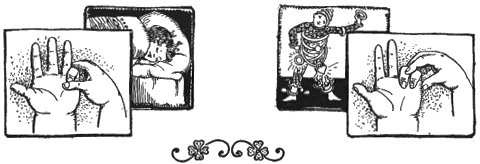
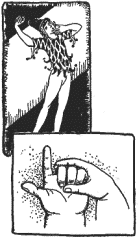
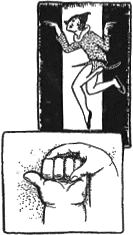
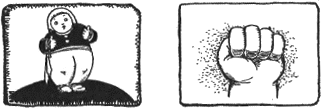
My fingers are so sleepy
It’s time they went to bed,
So first, you Baby Finger
Tuck in your Little Head.
Ringman, come now its your turn,
And then come, Tallman Great;
Now, Pointer Finger, hurry
Because its getting late.
Let’s see if all are snuggled.
No, here’s one more to come,
So come, lie close, little brothers,
Make room for Master Thumb.
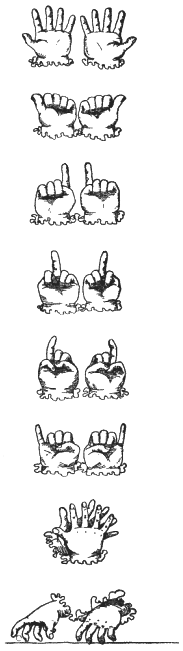
Ten little squirrels up in a tree—
(Ten fingers outspread.)
The first two said: “What do I see?”
(Thumbs only.)
The next two said: “A man with a gun.”
(Forefingers only.)
The next two said: “Let’s run, let’s run.”
(Middle fingers only.)
The next two said: “Let’s hide in the shade.”
(Ring fingers only.)
The last two said: “We’re not afraid.”
(Little fingers only.)
Bang! went a gun.
(Clap hands.)
Away they all run.
(All fingers scamper off.)
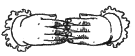
See my little garden,
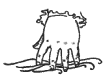
How I rake it over,
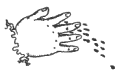
Then I sow the little brown seeds,
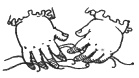
And with soft earth cover.
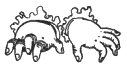
Now the raindrops patter
On the earth so gayly;
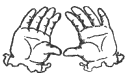
See the big round sun smile
On my garden daily.

The little plant is waking;
Down the roots grow creeping;

Up now come the leaflets
Through the brown earth peeping.
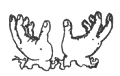
Soon the buds will laugh up
Toward the springtime showers;
Soon my buds will open
Into happy flowers.
BY EMILIE POULSSON
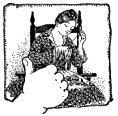
This is the mother, so busy at home,
Who loves her dear children, whatever may come.
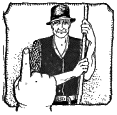
This is the father, so brave and so strong,
Who works for his family all the day long.
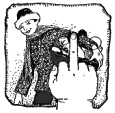
This is the brother, who’ll soon be a man,
He helps his good mother as much as he can.
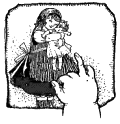
This is the sister, so gentle and mild,
Who plays that the dolly is her little child.
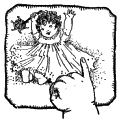
This is the baby, all dimpled and sweet,
How soft his wee hands and his chubby pink feet!
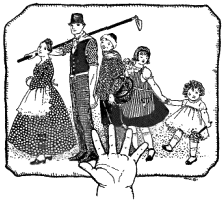
Father, and mother,
and children so dear,
Together you see them,
one family here.
[B]
From “Songs and Music of Froebel’s Mother Play”;
used by permission of the publishers, D. Appleton & Co.
[Pg 17]
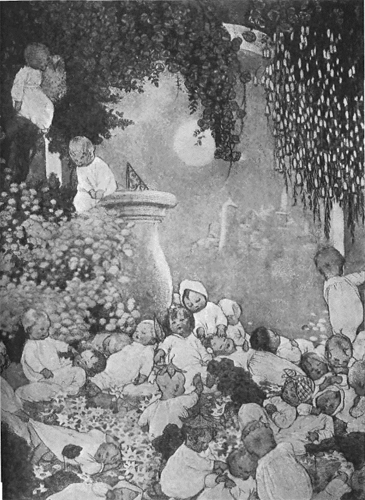
IN DREAMLAND
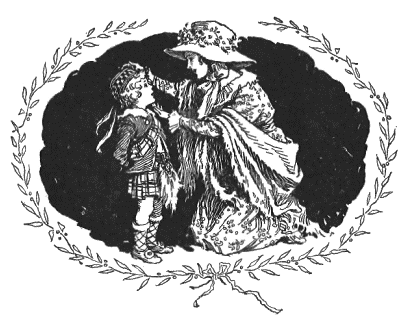
Johnny shall have a new bonnet,
And Johnny shall go to the fair,
And Johnny shall have a new ribbon
To tie up his bonny brown hair.
And why may not I love Johnny?
And why may not Johnny love me?
And why may not I love Johnny?
As well as another body?
And here’s a leg for a stocking,
And here is a foot for a shoe,
And he has a kiss for his daddy,
And two for his mammy, I trow.
And why may not I love Johnny?
And why may not Johnny love me?
And why may not I love Johnny
As well as another body?
To market ride the gentlemen,
So do we, so do we;
Then comes the country clown,
Hobbledy gee, Hobbledy gee;
First go the ladies, nim, nim, nim,
Next come the gentlemen, trim, trim, trim;
Then come the country clowns, gallop-a-trot.
Here goes my lord—
A trot! a trot! a trot! a trot!
Here goes my lady—
A canter! a canter! a canter! a canter!
Here goes my young master—
Jockey-hitch! jockey-hitch! jockey-hitch! jockey-hitch!
Here goes my young miss—
An amble! an amble! an amble! an amble!
The footman lags behind,
And goes gallop, a gallop, a gallop, to make up his time.
A farmer went trotting upon his gray mare;
Bumpety, bumpety, bump!
With his daughter behind him, so rosy and fair;
Lumpety, lumpety, lump!
A raven cried croak! and they all tumbled down;
Bumpety, bumpety, bump!
The mare broke her knees, and the farmer his crown;
Lumpety, lumpety, lump!
The mischievous raven flew laughing away;
Bumpety, bumpety, bump!
And vowed he would serve them the same the next day;
Lumpety, lumpety, lump!
Up to the ceiling, down to the ground,
Backward and forward, round and round;
Dance, little baby, and mother will sing,
With the merry chorus, ding, ding, ding!
Here in the morning we’re starting so soon,
Give us a message, we’ll ride to the moon,
Straight through the meadows and hop o’er the stile,
And we will but charge you a farthing a mile.
A farthing a mile! a farthing a mile!
We will but charge you a farthing a mile.
Catch him, crow! Carry him, kite!
Take him away till the apples are ripe;
When they are ripe and ready to fall,
Home comes [Johnny], apples and all.
This is the way the ladies ride,
Nin! Nin! Nin!
This is the way the gentlemen ride,
Trot! Trot! Trot!
This is the way the farmers ride,
Jogglety! Jogglety! Jogglety! Jog!
Ride away, ride away,
Johnny shall ride,
And he shall have pussy-cat
Tied to one side;
And he shall have little dog
Tied to the other,
And Johnny shall ride
To see his grandmother.
To market, to market,
To buy a plum bun;
Home again, home again,
My journey is done.
BY MARY F. BUTTS
Every evening Baby goes
Trot, trot, to town—
Across the river, through the fields,
Up hill and down.
Trot, trot, the Baby goes,
Up hill and down,
To buy a feather for her hat,
To buy a woolen gown.
Trot, trot, the Baby goes;
The birds fly down, alack!
“You cannot have our feathers, dear,”
They say; “so please trot back.”
Trot, trot, the Baby goes;
The lambs come bleating near.
“You cannot have our wool,” they say;
“But we are sorry, dear.”
Trot, trot, the Baby goes,
Trot, trot, to town.
She buys a red rose for her hat,
She buys a cotton gown.
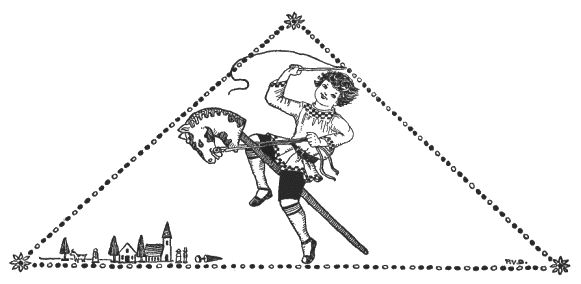
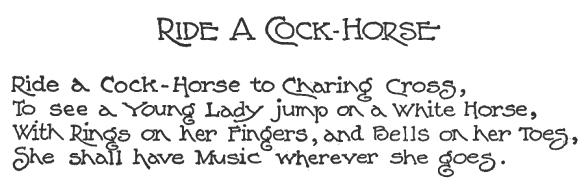
Ride a cock-horse to Banbury-cross,
To see what Tommy can buy;
A penny white loaf, a penny white cake,
And a two-penny apple pie.
Ride a cock-horse to Shrewsbury-cross,
To buy little Johnny a galloping horse;
It trots behind and it ambles before,
And Johnny shall ride till he can ride no more.
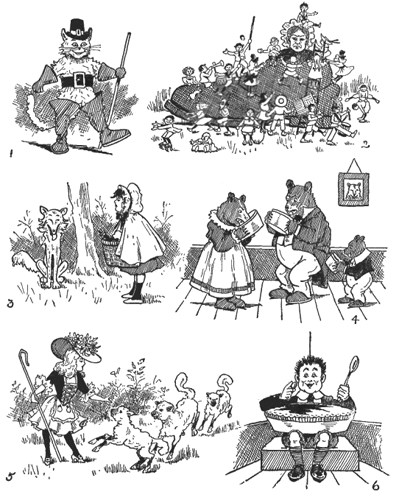
here are one, two, three, four, five, six story-book pictures. all little girls
and boys know the six stories that these six pictures belong
to. tell your mama and papa what the stories are.
THERE WAS AN OLD WOMAN
from a drawing by anne anderson
I saw a ship a-sailing,
A-sailing on the sea;
And, oh! it was all laden
With pretty things for thee!
There were candies in the cabin,
And apples in the hold;
The sails were made of silk,
And the masts were made of gold.
The four-and-twenty sailors
That stood between the decks,
Were four-and-twenty white mice,
With chains about their necks.
The captain was a duck,
With a packet on his back;
And when the ship began to move,
The captain cried, “Quack, quack!”
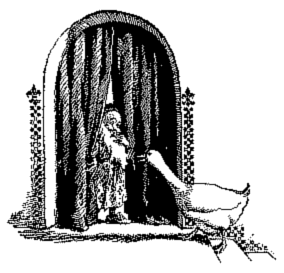
Goosey, goosey, gander, where dost thou wander?
Up stairs and down stairs, and in my lady’s chamber;
There I met an old man that would not say his prayers,
I took him by his hind legs and threw him down stairs.
Arthur O’Bower has broken his band,
He comes roaring up the land—
A King of Scots, with all his power,
Cannot turn Arthur of the Bower.
Once I saw a little bird
Come hop, hop, hop,
So I said, “Little bird,
Will you stop, stop, stop?”
I was going to the window
To say, “How do you do?”
But he shook his little tail
And far away he flew.
Ring-a-ring-a-roses,
A pocket full of posies;
Hush! hush! hush! hush!
We’re all tumbled down.
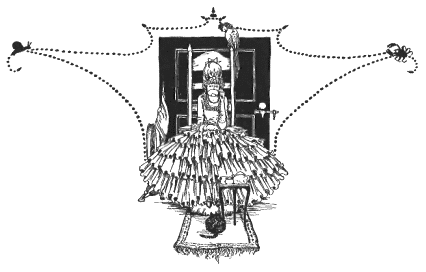
Cross patch,
Draw the latch,
Sit by the fire and spin;
Take a cup,
And drink it up,
And call your neighbors in.
Merry are the bells, and merry would they ring;
Merry was myself, and merry could I sing;
With a merry ding-dong, happy, gay, and free,
And a merry sing-song, happy let us be!
Merry have we met, and merry have we been;
Merry let us part, and merry meet again;
With our merry sing-song, happy, gay, and free,
And a merry ding-dong, happy let us be!
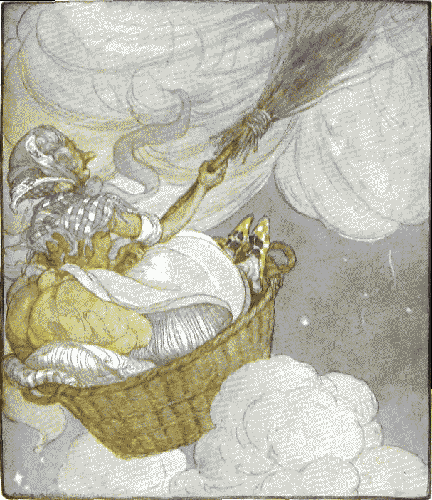
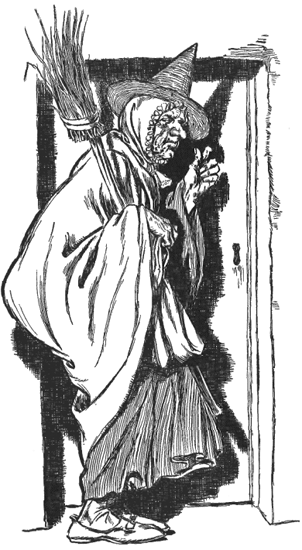
There was an old woman tossed up in a basket,
Nineteen times as high as the moon;
Where she was going I couldn’t but ask it
For in her hand she carried a broom.
“Old woman, old woman, old woman, quoth I,
O whither, O whither, O whither so high?”
“To brush the cobwebs off the sky!”
“Shall I go with thee?” “Aye, by-and-by.”
From a Drawing by Arthur Rackham
“Where she was going I couldn’t but ask it,
For in her hand she carried a broom.”
The fox and his wife they had a great strife,
They never ate mustard in all their whole life;
They ate their meat without fork or knife,
And loved to be picking a bone, e-ho!
The fox jumped up on a moonlight night,
The stars they were shining, and all things bright.
Oh, ho! said the fox, it’s a very fine night
For me to go through the town, e-ho!
The fox when he came to yonder stile,
He lifted his lugs and he listened awhile;
Oh, ho, said the fox, it’s but a short mile
From this unto yonder wee town, e-ho!
The fox when he came to the farmer’s gate,
Who should he see but the farmer’s drake;
I love you well for your master’s sake,
And long to be picking your bone, e-ho!
The gray goose she ran round the hay-stack.
Oh, ho! said the fox, you are very fat;
You’ll grease my beard and ride on my back
From this unto yonder wee town e-ho!
Old Gammer Hipple-hopple hopped out of bed,
She opened the casement, and popped out her head.
Oh! husband, oh! husband, the gray goose is dead,
And the fox is gone through the town, oh!
Then the old man got up in his red cap,
And swore he would catch the fox in a trap;
But the fox was too cunning, and gave him the slip,
And ran through the town, the town, e-oh!
When he got to the top of the hill,
He blew his trumpet both loud and shrill,
For joy that he was safe
Through the town, e-oh!
When the fox came back to his den,
He had young ones, both nine and ten.
“You’re welcome home, daddy; you may go again,
If you bring us such nice meat from the town, e-oh!”
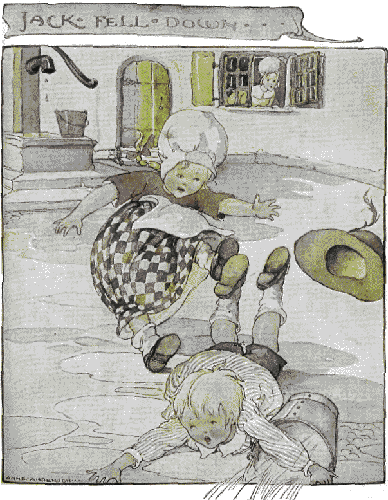
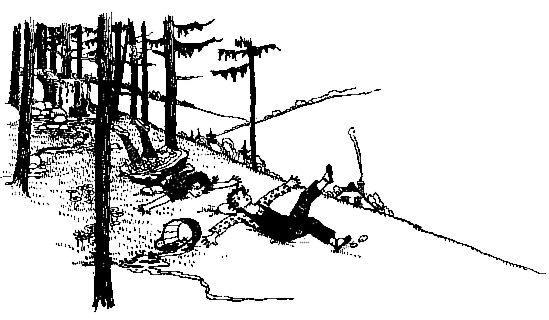
Jack and Jill went up the hill,
To draw a pail of water;
Jack fell down and broke his crown,
And Jill came tumbling after.
Up Jack got, and home did trot
As fast as he could caper;
Went to bed to mend his head,
With vinegar and brown paper.
Jill came in, and she did grin
To see his paper plaster;
Mother, vexed, did whip her next
For causing Jack’s disaster.
Willy boy, Willy boy, where are you going?
I will go with you if I may
“I’m going to the meadow to see them a-mowing,
I’m going to help them make the hay.”
Bonny lass, bonny lass, wilt thou be mine?
Thou shalt not wash dishes, nor yet serve the swine:
Thou shalt sit on a cushion, and sew a fine seam,
And thou shalt eat strawberries, sugar, and cream!
Oh, where are you going,
My pretty maiden fair,
With your red rosy cheeks,
And your coal-black hair?
I’m going a-milking,
Kind sir, says she,
And it’s dabbling in the dew
Where you’ll find me.
Bobby Shaftoe’s gone to sea,
Silver buckles on his knee;
He’ll come back and marry me,
Pretty Bobby Shaftoe.
Bobby Shaftoe’s fat and fair,
Combing down his yellow hair,
He’s my love for evermair,
Pretty Bobby Shaftoe.
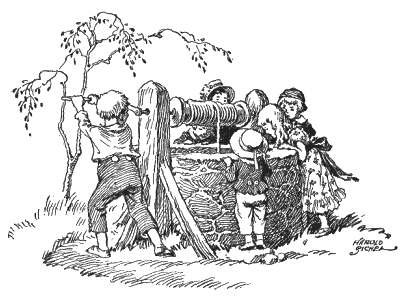
Ding—
Dong—
Bell!
Pussy’s in the well.
Who put her in? Little Johnny Green.
Who pulled her out? Big Johnny Stout.
What a naughty boy was that,
To drown poor pussy cat,
Who never did him any harm,
And killed the mice in his father’s barn.
London bridge is broken down,
Dance over my Lady Lee,
London bridge is broken down,
With a gay ladye.
How shall we build it up again?
Dance over my Lady Lee,
How shall we build it up again?
With a gay ladye.
We’ll build it up with gravel and stone,
Dance over my Lady Lee,
We’ll build it up with gravel and stone,
With a gay ladye.
Gravel and stone will be washed away,
Dance over my Lady Lee,
Gravel and stone will be washed away,
With a gay ladye.
We’ll build it up with iron and steel,
Dance over my Lady Lee,
We’ll build it up with iron and steel,
With a gay ladye.
Iron and steel will bend and break,
Dance over my Lady Lee,
Iron and steel will bend and break,
With a gay ladye.
We’ll build it up with silver and gold,
Dance over my Lady Lee,
We’ll build it up with silver and gold,
With a gay ladye.
Silver and gold will be stolen away,
Dance over my Lady Lee,
Silver and gold will be stolen away,
With a gay ladye.
We’ll set a man to watch it then,
Dance over my Lady Lee,
We’ll set a man to watch it then,
With a gay ladye.
We’ll put a pipe within his mouth,
Dance over my Lady Lee,
We’ll put a pipe within his mouth,
With a gay ladye.
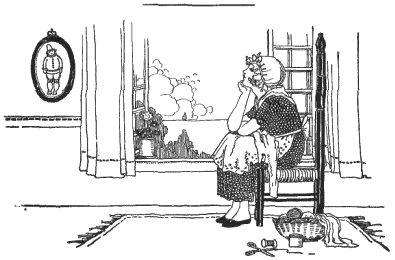
“Bobby Shaftoe’s gone to sea.”
All round the green gravel the grass grows so green,
And all the pretty maids are fit to be seen,
Wash them in milk, dress them in silk,
And the first to go down shall be married in green.
Old Mother Hubbard
Went to the cupboard
To get her poor dog a bone;
But when she came there
The cupboard was bare,
And so the poor dog had none.
She went to the baker’s
To buy him some bread,
But when she came back
The poor dog was dead.
She went to the joiner’s
To buy him a coffin,
But when she came back
The poor dog was laughing.
She went to the butcher’s
To get him some tripe,
But when she came back
He was smoking his pipe.
She went to the hatter’s
To buy him a hat,
But when she came back
He was feeding the cat.
She went to the barber’s
To buy him a wig,
But when she came back
He was dancing a jig.
She went to the tailor’s
To buy him a coat,
But when she came back
He was riding a goat.
She went to the cobbler’s
To buy him some shoes,
But when she came back
He was reading the news.
She went to the seamstress
To buy him some linen,
But when she came back
The dog was a-spinning.
She went to the hosier’s
To buy him some hose,
But when she came back
He was dressed in his clothes.
The dame made a curtsey,
The dog made a bow;
The dame said, “Your servant.”
The dog said, “Bow, wow.”
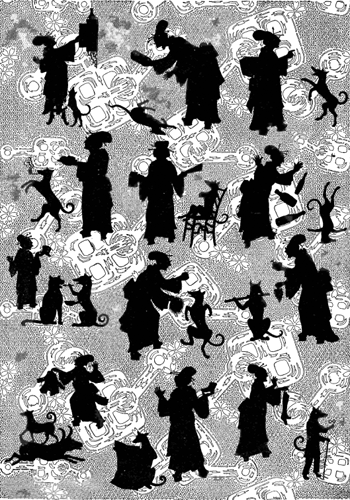
THE STORY OF MOTHER HUBBARD, TOLD IN JAPANESE PICTURES.
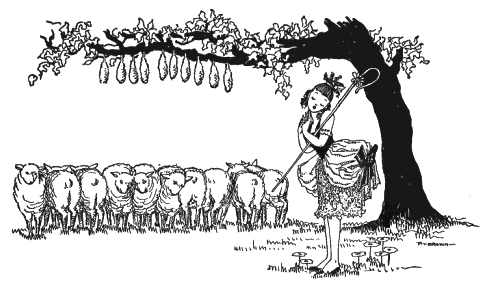
Little Bo-Peep, she lost her sheep,
And can’t tell where to find them;
Leave them alone, and they’ll come home,
And bring their tails behind them.
Little Bo-peep fell fast asleep,
And dreamed she heard them bleating;
When she awoke she found it a joke,
For they still were all fleeting.
Then up she took her little crook,
Determined for to find them,
She found them indeed, but it made her heart bleed,
For they’d left their tails behind them!
It happened one day, as Bo-peep did stray
Unto a meadow hard by—
There she espied their tails side by side,
All hung on a tree to dry.
She heaved a sigh and wiped her eye,
Then went over hill and dale,
And tried what she could, as a shepherdess should,
To tack to each sheep its tail.
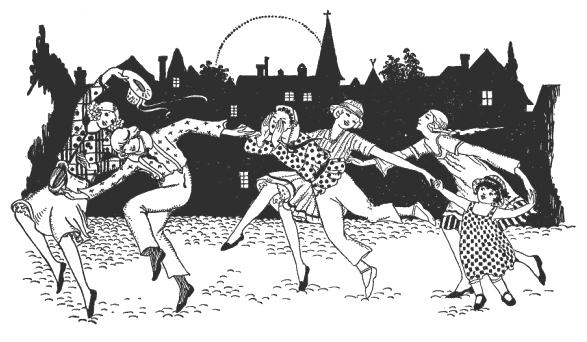
Boys and girls, come out to play,
The moon does shine as bright as day;
Leave your supper, and leave your sleep,
And meet your playfellows in the street,
Come with a whoop and come with a call,
Come with a good will or not at all.
Up the ladder and down the wall,
A halfpenny roll will serve us all.
You find milk and I’ll find flour,
And we’ll have pudding in half an hour.
Little Robin Redbreast sat upon a tree,
Up went the Pussy-Cat, and down went he!
Down came Pussy-Cat, away Robin ran,
Says little Robin Redbreast—catch me if you can.
Little Robin Redbreast jumped upon a spade,
Pussy-Cat jumped after him, and then he was afraid.
Little Robin chirped and sung, and what did Pussy say?
Pussy-Cat said Mew, mew, mew—and Robin flew away.
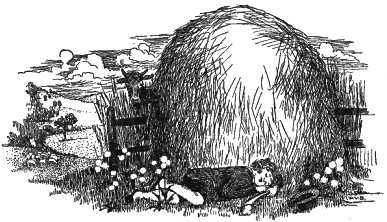
Little Boy Blue, come blow your horn,
The sheep’s in the meadow, the cow’s in the corn.
What! Is this the way you mind your sheep,
Under the haycock, fast asleep?
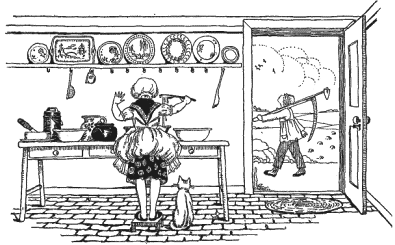
My maid Mary
She minds her dairy,
While I go a-hoeing and mowing each morn.
Merrily runs the reel
And the little spinning-wheel
While I am singing and mowing my corn.
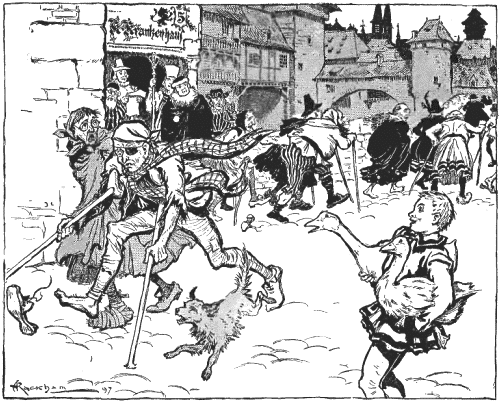
Hark! Hark!
The dogs do bark!
The beggars are come to town;
Some in rags,
Some in jags,
And some in velvet gowns.
Blow, wind, blow! and go, mill, go!
That the miller may grind his corn;
That the baker may take it,
And into rolls make it,
And send us some hot in the morn.
Bye, Baby bunting,
Father’s gone a-hunting,
Mother’s gone a-milking,
Sister’s gone a-silking,
And Brother’s gone to buy a skin,
To wrap the Baby bunting in.
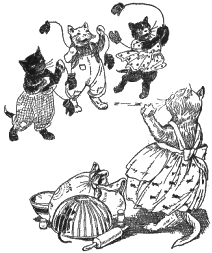
Three little kittens, they lost their mittens,
And they began to cry:
“O mother dear,
We very much fear,
That we have lost our mittens.”
Lost your mittens!
You naughty kittens!
Then you shall have no pie.
“Mee-ow, mee-ow, mee-ow,”
No, you shall have no pie.
“Mee-ow, mee-ow, mee-ow.”
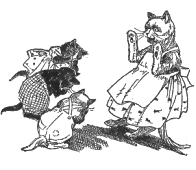
The three little kittens, they found their mittens,
And they began to cry:
“O mother dear,
See here, see here!
See! we have found our mittens.”
Put on your mittens
You silly kittens,
And you may have some pie.
“Purr-r, purr-r, purr-r,
O let us have the pie.
Purr-r, purr-r, purr-r.”
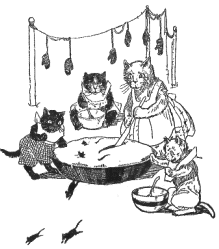
The three little kittens put on their mittens,
And soon ate up the pie;
“O mother dear,
We greatly fear,
That we have soiled our mittens.”
Soiled your mittens!
You naughty kittens!
Then they began to sigh,
“Mee-ow, mee-ow, mee-ow.”
Then they began to sigh,
“Mee-ow, mee-ow, mee-ow.”
The three little kittens, they washed their mittens.
And hung them out to dry;
“O mother dear,
Do you not hear,
That we have washed our mittens?”
Washed your mittens!
Oh, you’re good kittens.
But I smell a rat close by;
Hush! Hush! “Mee-ow, mee-ow.
We smell a rat close by,
Mee-ow, mee-ow, mee-ow.”
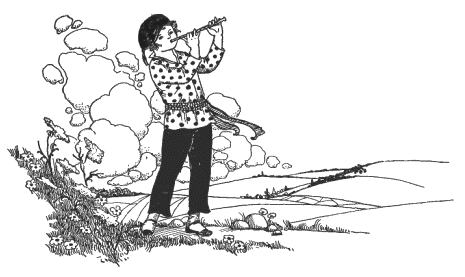
Tom, Tom was a piper’s son,
He learned to play when he was young,
And all the tune that he could play
Was “Over the hills and far away.”
Over the hills, and a great way off,
The wind will blow my top-knot off.
Now, Tom with his pipe made such a noise
That he well pleased both the girls and boys,
And they always stopped to hear him play
“Over the hills and far away.”
Daffy-down-dilly is new come to town,
With a petticoat green, and a bright yellow gown,
And her white blossoms are peeping around.
Oh, where have you been, Billy Boy, Billy Boy,
Oh, where have you been, charming Billy?
“I have been to seek a wife,
She’s the joy of my life,
She’s a young thing and cannot leave her mother.”
What work can she do, Billy Boy, Billy Boy,
What work can she do, charming Billy?
“She can brew and she can bake,
She can make a wedding cake—
She’s a young thing and cannot leave her mother.”
Can she make a cherry pie, Billy Boy, Billy Boy,
Can she make a cherry pie, charming Billy?
“She can make a cherry pie
Quick’s cat can wink her eye—
She’s a young thing and cannot leave her mother.”
How old is she, Billy Boy, Billy Boy,
How old is she, charming Billy?
“She is three times six, four times seven,
Twenty-eight and eleven—
She’s a young thing and cannot leave her mother.”
Three wise men of Gotham
Went to sea in a bowl,
And if the bowl had been stronger
My song had been longer.
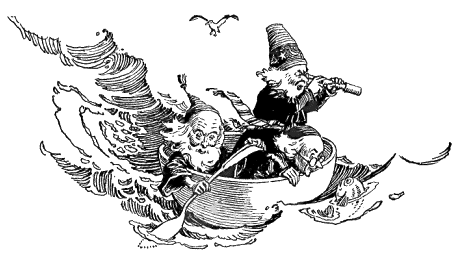
“Little Tommy Tucker,
Sing for your supper.”
“What shall I sing?”
“White bread and butter.”
“How shall I cut it
Without any knife?
How shall I marry
Without any wife?”
Nine little mice sat down to spin;
Pussy passed by, and she peeped in.
“What are you at, my little men?”
“Making coats for gentlemen.”
“Shall I come in and bite off your threads?”
“No, no, Miss Pussy, you’ll snip off our heads.”
When I was a little boy, I lived by myself,
And all the bread and cheese I got I put upon a shelf;
The rats and the mice, they made such a strife,
I was forced to go to London to buy me a wife.
The streets were so broad, and the lanes were so narrow,
I was forced to bring my wife home in a wheelbarrow;
The wheelbarrow broke, and my wife had a fall,
And down came the wheelbarrow, wife, and all.
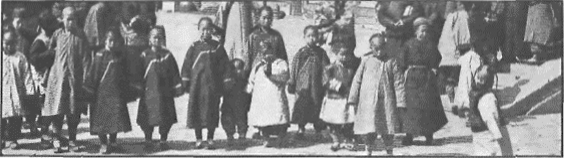
BY PROF ISAAC TAYLOR HEADLAND
What a bonny little fellow is this fat boy of mine!
He makes people die of joy!
What a fine little fellow is this fat boy of mine!
Now whose is this loving little boy?
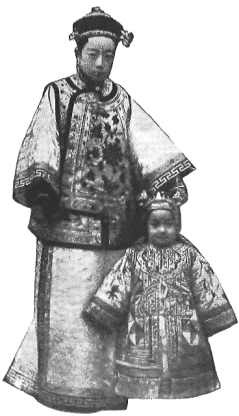
the little fat boy.
Do you want to buy a beauty?
Do you want to buy a beauty?
If you buy him he will watch your house,
And do it as his duty.
And no matter as to servants,
You may have them or may not,
But you’ll never need to lock your door,
Or give your house a thought.
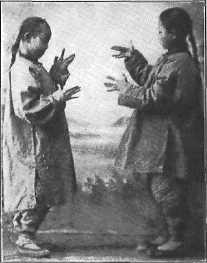
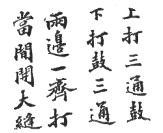
“A Finger Test,” in chinese characters.
You strike three times on the top, you see,
And strike three times on the bottom for me,
Then top and bottom you strike very fast,
And open a door in the middle at last.
[Pg 43]
Mrs. Chang, Mrs. Lee,
Mama has a small babee;
Stands up firm,
Sits up straight,
Won’t eat milk,
But lives on cake.
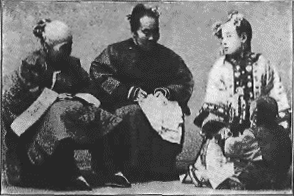
our baby.
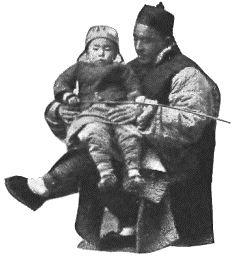
the little golden sister.
My little golden sister
Rides a golden horse slow,
And we’ll use a golden whip
If the horse doesn’t go.
A little gold fish
In a gold bowl we see,
And a gold-colored bird
On a gold-blossomed tree.
A gold-plated god
In a gold temple stands,
With a gold-plated baby
In his gold-plated hands.
(A Chinese finger-play)
Three horses are drinking,
Three horses are feeding,
The two men are fighting,
The old woman pleading,
The baby is crying,
But no one is heeding.
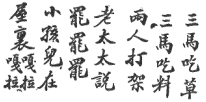 “ten fingers,”
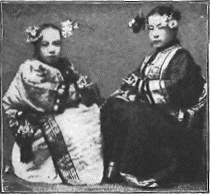 ten fingers.
A plum blossom foot,
And a pudding face sweet;
He’s taller when he’s sitting
Than when standing on his feet.
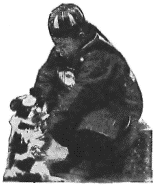 a riddle.
(Another finger-play)
A great big brother,
And a little brother so,
A big bell-tower,
And a temple and a show,
And little baby wee, wee,
Always wants to go.
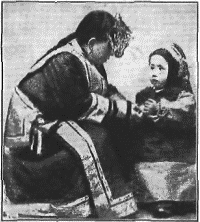 the five fingers.
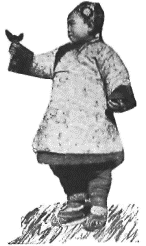 ladybug.
LADYBUG
Ladybug, ladybug,
Fly away, do;
Fly to the mountain,
And feed upon dew.
Feed upon dew,
And sleep on a rug,
And then run away
Like a good little bug.
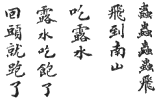 “ladybug,” in chinese characters.
Oh, my dear brother spider,
With your body big and red,
From the eaves you are hanging
On a single little thread.
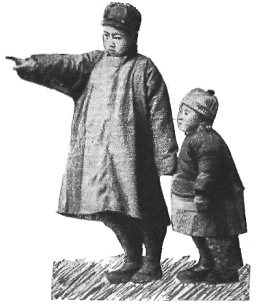 the spider.
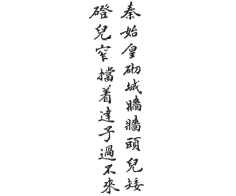 “the great wall,”
The wily Emperor Tsin Chi-hwang
He built a wall both great and strong.
The steps were narrow, but the wall was stout,
So it kept the troublesome Tartars out.
BY ANNA MARION SMITH
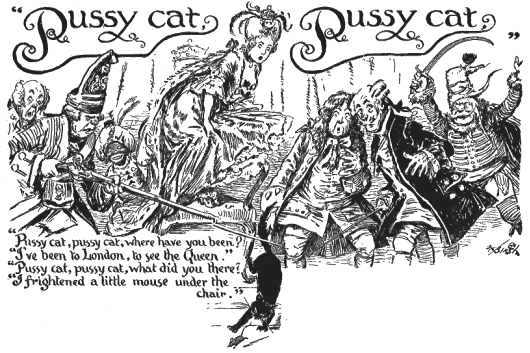
“What did you say when you’d made your best bow?”
“I opened my mouth and remarked ‘miaow.’”
“What did the Queen say in answer to that?”
“She screamed a little, and then she said, ‘SCAT!’”
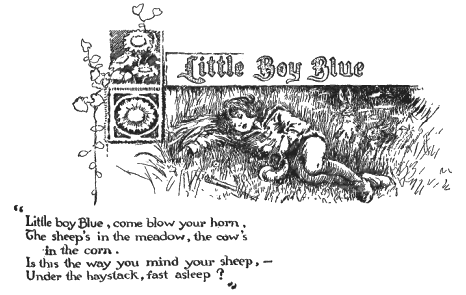
Little boy Blue, awake, awake,
And see how merry your charges make!
Through field and garden their course they steer,
And the mischief they’re doing,—oh dear, oh dear!
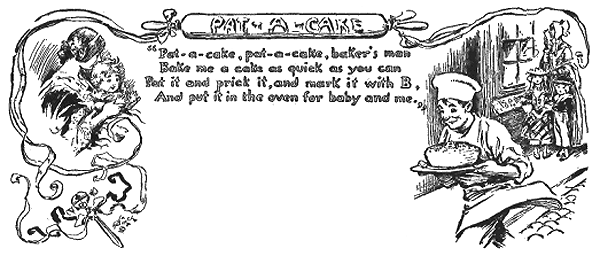
Hurry it, hurry it, baker’s man;
Bring it to us as quick as you can.
I hope it has raisins by way of surprise,
And little black currants that look just like eyes.
Here it comes, here it comes, baby mine.
Never was cake that was half so fine;
Brown as a berry, and hot from the pan,—
Thank you, oh thank you, you good baker’s man!
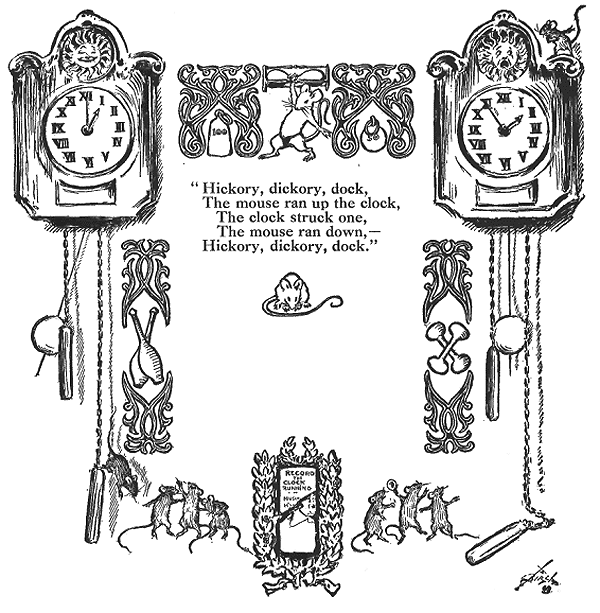
Hickory, dickory, dock,
Again he tried the clock,
This time,—don’t frown,—
The clock ran down!
Hickory, dickory, dock.
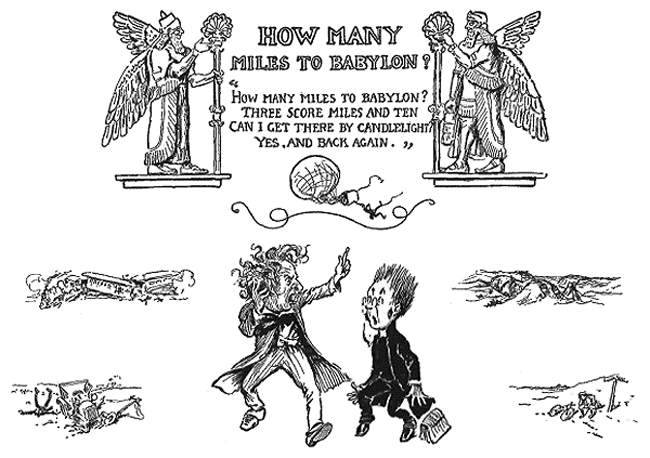
How shall I go to Babylon?
Who will tell me true?
Oh, there are trains, and there are boats,
And automobiles too.
And one may ride a bicycle,
Or go in a balloon;
Or one may travel on his feet
And get there ’most as soon.
For trains go off the track, you see,
And boats go down below;
And automobiles go to smash
In ways that none may know.
And tires of bicycles go pop,
Balloons will go and balk,
So taking all in all, I think
If I were you, I’d walk.
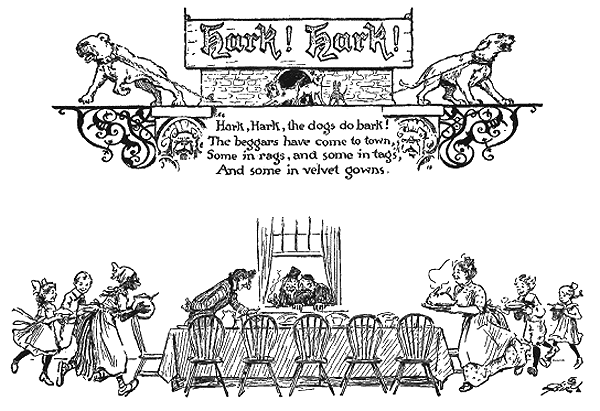
Hear, hear, they’re drawing near!
Just hark to the tramp of feet!
So haste about, set tables out,
And get them food to eat.
Run, run, the turkey’s done!
I hope it is nicely dressed,
For those who shirk and will not work
Are sure to want the best.
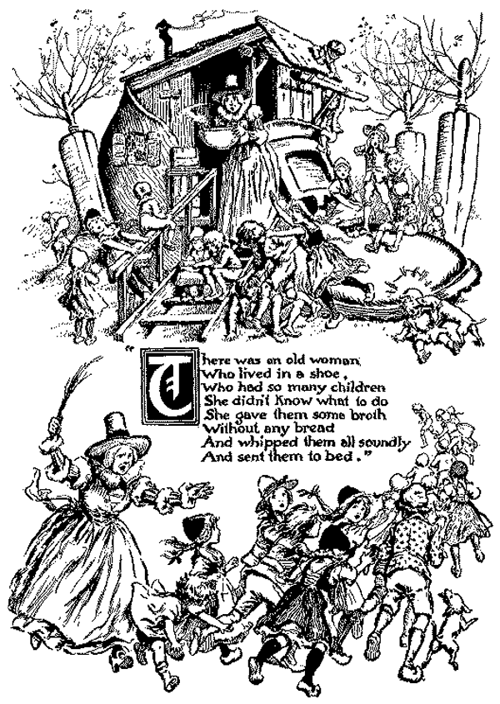
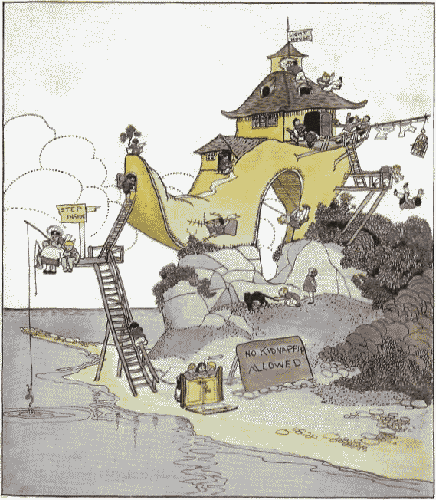
There was an old woman who lived in a shoe.
She had so many children she didn’t know what to do;
She gave them some broth without any bread;
She whipped them all soundly, and put them to bed.
from a drawing by p. vinton brown
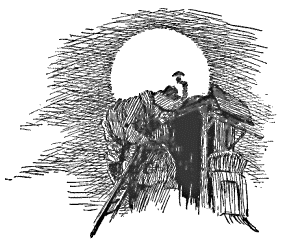
Now it happened that Santa Claus,
Passing that way,
Peeped into the shoe top
And saw how they lay—
With their round, rosy faces
All shining with tears,
And resolved to do something
To comfort the dears.
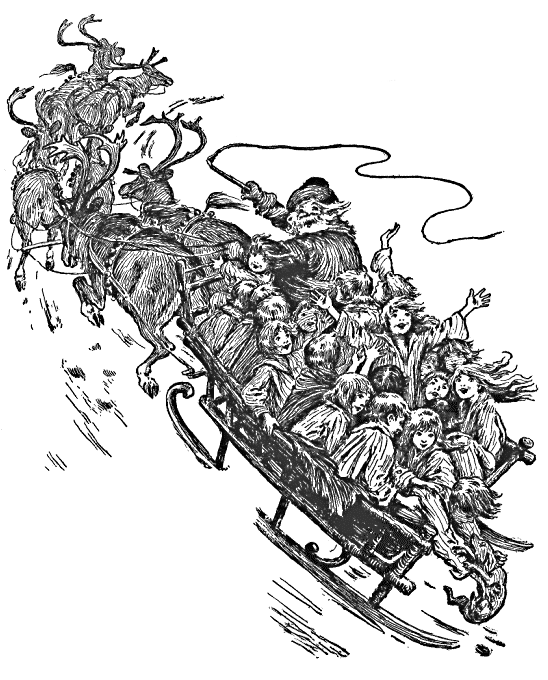
So while they were sleeping
In woful array,
He bundled those children
Right into his sleigh;
And cracking his whip
As his reindeers sped forth,
Away they all flew
To his home in the North.
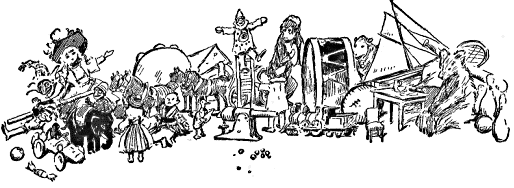
| What wonders he showed them, Such beautiful toys! Such dolls for the girls, And such drums for the boys! Such farms and such stables, Such monkeys and bears, Such dishes and tables And tiny dolls’ chairs! |
And when they had seen All the wonderful things Which each winter, at Christmas, Dear Santa Claus brings, He gave them, to make Their enchantment complete, Just all of the candy And cake they could eat. |
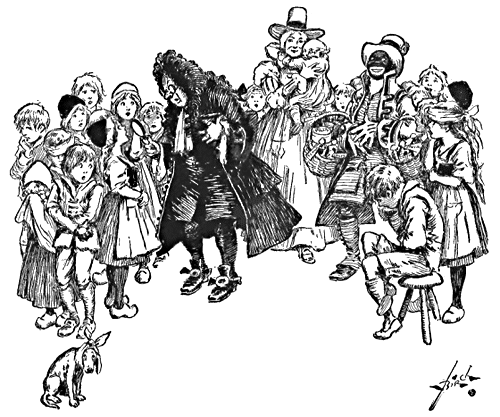
When they told of their travels,
Their mother, it seems,
Only laughed, and declared
They were nothing but dreams.
I am sure, though, things must
Have occurred as they say,
Else why were they, all of them,
Ill the next day?
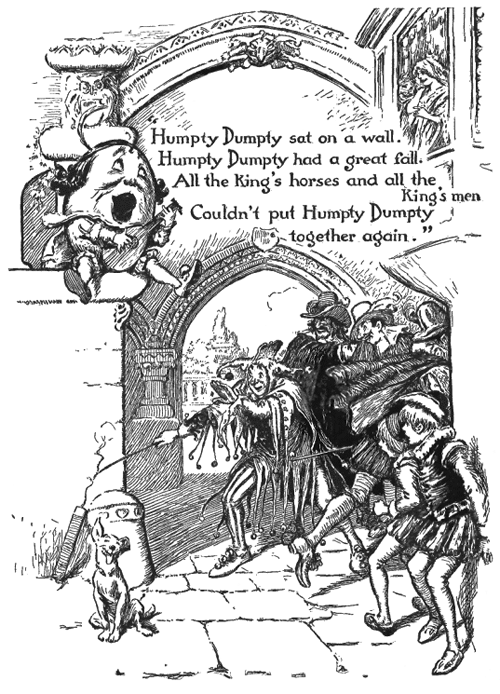
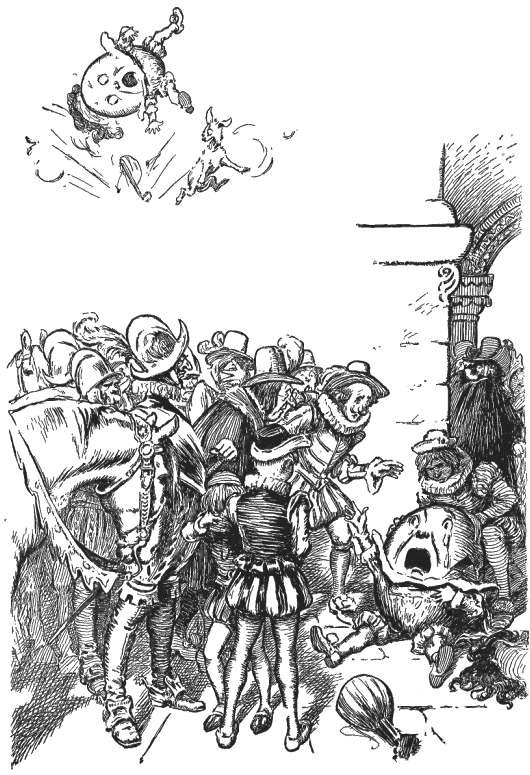
I
There he lay, stretched out on the ground,
While all the company gathered around;
When, valiantly stifling his tears and his groans,
He sadly addressed them in quavering tones.
II
“Friends,” said Humpty, wiping his eyes,
“This sudden descent was an awful surprise.
It inclines me to think,—you may laugh at my views,—
That a seat that is humble is safest to choose.
III
“All are not fitted to sit on a wall,
Some have no balance, and some are too small;
Many have tried it and found, as I guess,
They’ve ended, like me, in a terrible mess.
IV
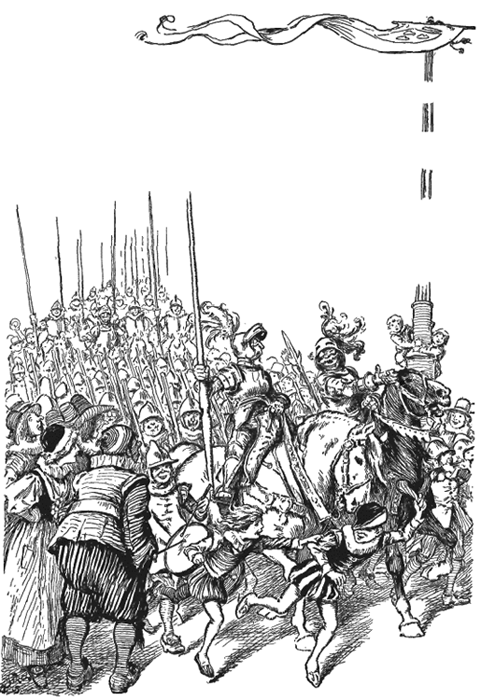
“Hark, you horses, and all you king’s men!
Hear it, and never forget it again!
’Tis those who are patient in seats that are low,
Who some day get up in high places and crow.”
V
Then they took him and put him to bed.
I hope you’ll remember the things that he said;
For all the king’s horses and all the king’s men
Never once thought of his sermon again.
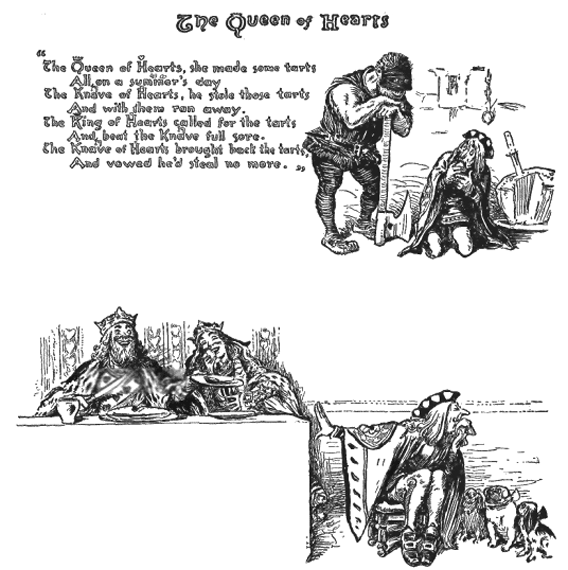
This noble queen, with mind serene,
Then made a mammoth cake.
The naughty knave for cake did crave,
And off with it did make.
The haughty king, for punishing,
Would have him eat it all,
Which made the knave—unhappy slave—
Too sick to speak or crawl.
Since then, at ease, their majesties
Eat pastries every day.
The knave affirms his stomach squirms,
And looks the other way.
Alas, alas, to such a pass
Doth gluttony invite!
’Tis very sad to be so bad,
And lose one’s appetite.
Next day the queen, with lofty mien,
Prepared some lovely pies.
The feeble knave side-glances gave
At them with longing eyes.
The cruel king, with mocking fling,
Said: “Do, now, have some pie!”
The qualmish knave, no longer brave,
Could only groan, “Not I.”
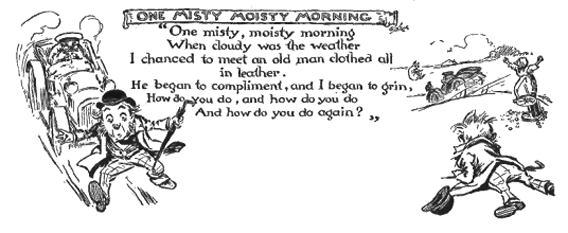
This morning as I wandered
To enjoy the charming weather,
I met a man in goggles and a modern suit of leather.
He began to toot a horn and I began to run,
He knocked me flat nor cared for that;
And down the road he spun.
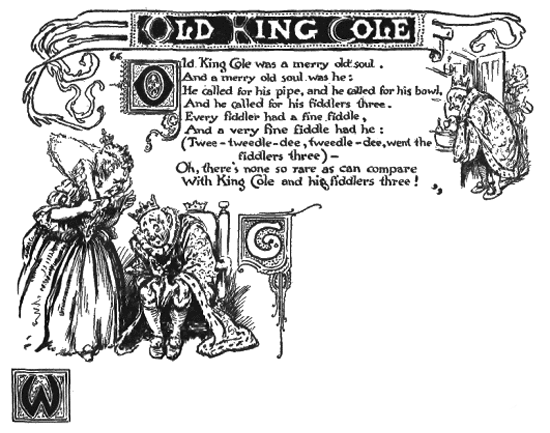
I
OOD Queen Kate was his royal mate,
And a right royal mate was she:
She would frequently state that carousing till late
Was something that never should be.
But every fiddler had such a fine fiddle,—
Oh, such a fine fiddle had he,—
That old King Cole, in his inmost soul,
Was as restive as he could be.
II
HEN thus spoke she to his majesty,
He planted his crown on tight.
“We will wait,” whispered he to the fiddlers three,
“Till the Queen has retired for the night.”
Every fiddler then tuned up his fiddle,
And tuned it as true as could be:
While old King Cole got his pipe and bowl
And replenished them secretly.
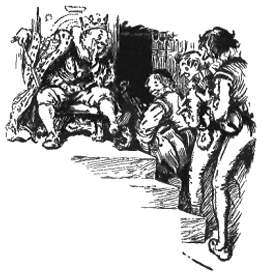
III
O gay they grew as the night hours flew,
He forgot how the time sped away;
Till swift overhead he heard the Queen’s tread
As she sprang out of bed, when he hurriedly said
They might finish the tune the next day.
Every fiddler he had a fine fiddle,
And a very fine fiddle had he:
Oh, ’t was not fair such a concert rare
Should be ended so suddenly!
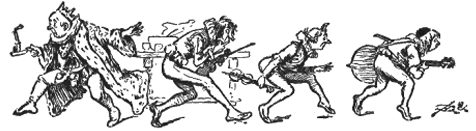
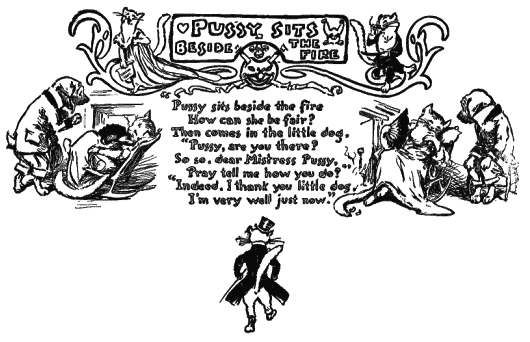
“Fy, pussy, what a lazy cat,
On such a pleasant day
To sit and drowse beside the fire
And sleep the hours away!
A self-respecting dog would think
Himself a sorry cur,
If he did nothing all day long
But fold his arms and purr!”
“Now, sir, you needn’t criticize
Because I sit and blink,
For while my eyes are shut, like this,
I think, and think, and think.
And when I purr, please understand
I work with all my might,
A-humming over songs I sing
When I go out at night.
“Excuse me. Now I’ll close my eyes,
And think a little more.
On busy days like this, I show
My visitors the door.
’T is only little dogs who judge
That one must idle be,
Unless one’s chasing round and round
Or barking up a tree.”
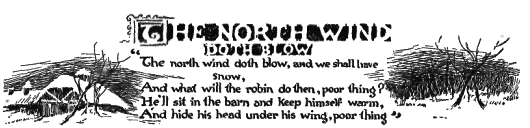
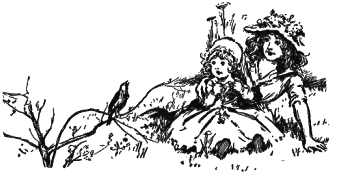
But never a word of plaint will be heard
From robin, no matter how tired and cold;
For well will he know that the winter
will go,
And the blossoms and greenness of
spring unfold.
And when the warm sun says winter
is done,
He’ll gladden us all with his cheery
song;
And never will fret if the season is wet,
Or wail that the winter was hard and long.
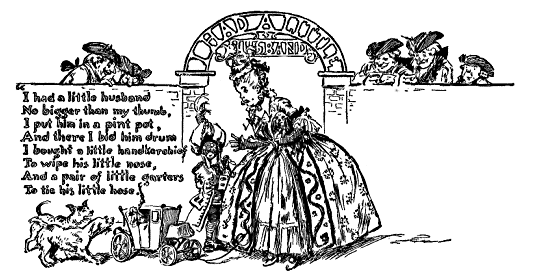
I bought a little carriage
And took him out to ride,
And yet with all my efforts
He wasn’t satisfied.
I never would have married,
Now this I do declare,—
If I’d supposed a husband
Was such an awful care.
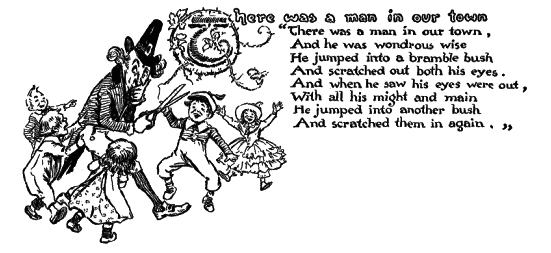
This clever man then hastened on
And bought a pair of shears,
But when he tried to cut with them,
He snipped off both his ears.
And when he heard his ears were off,
(’T was told him o’er and o’er),
He seized the shears and snipped them back
As they had been before.
“Because,” said he, “wise men like me,
Who travel round about,
And keep their eyes, and use them well,
May find some people out.
And if they also use their ears,
And hark what hearsay brings,
They’re likewise pretty sure to hear
Some very funny things.”
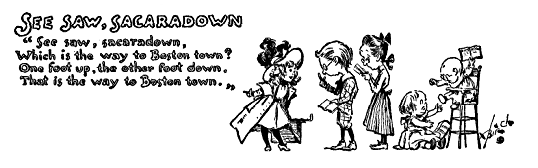
See saw, steady and slow!
Other places there are, I know,
But they are not worth the trouble to go,
For Boston people have told me so.
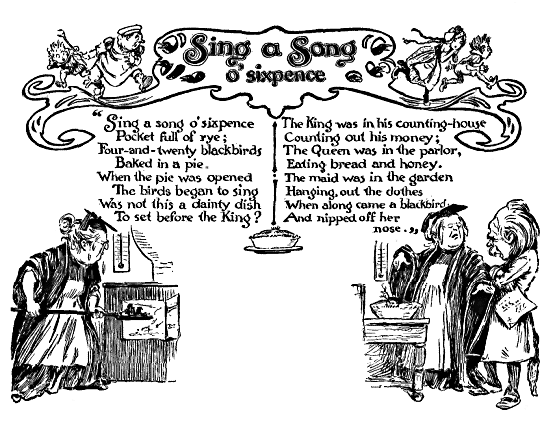
Sing a song o’ sixpence
A pocket full of rye;
I know another blackbird
Baked in a pie.
The maid it was who baked it
With all her might and main,
Resolved there’d be one blackbird
That shouldn’t nip again.
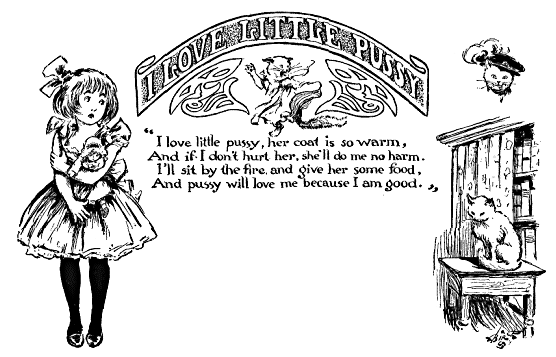
I never will dress her again, that is sure.
Her scratches, you see, are not easy to cure.
And I find that it takes much more time than you’d guess,
To sew up the rents in my dolly’s best dress.
I’d give a good deal, if it wasn’t for that,
To see how she’d look in my dolly’s new hat.
But no, I’ll not try it, you never can tell;
And politeness is best till one’s scratches get well.
Jack Horner had three brothers,
Their names were Horner, too—
One was James, and one was George,
And the little one was Hugh.
And they always did exactly
What they saw Jackie do—
James and George and the littlest one,
The one whose name was Hugh.
So when Jack’s Christmas pie was made,
They made three others, too—
One for James, and one for George,
And a little one for Hugh.
And they sat up in corners,
As they’d seen Jackie do—
James and George and the littlest one,
The one whose name was Hugh.
I’m sure ’t was very lucky
(Does it not seem so to you?)
That the room had just four corners
For
For if Jackie had a corner,
There must be corners, too,
For James and George and the littlest one,
The one whose name was Hugh.
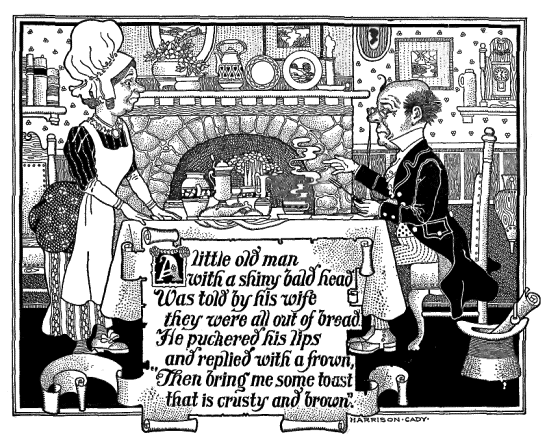
THERE WAS A MAN IN OUR TOWN
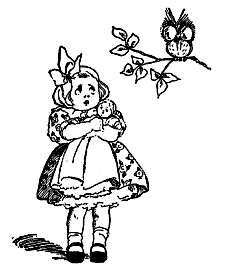
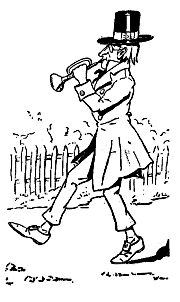
There was a man in our town,
And all he did each day
Was to skip and hop along the streets
And on a trumpet play.
————
A MOST WONDERFUL SIGHT
The most wonderful sight I ever did see
Was an owl on the branch of our old oak-tree;
His eyes were so large and his head was so small
That he seemed all eyes and no head at all.
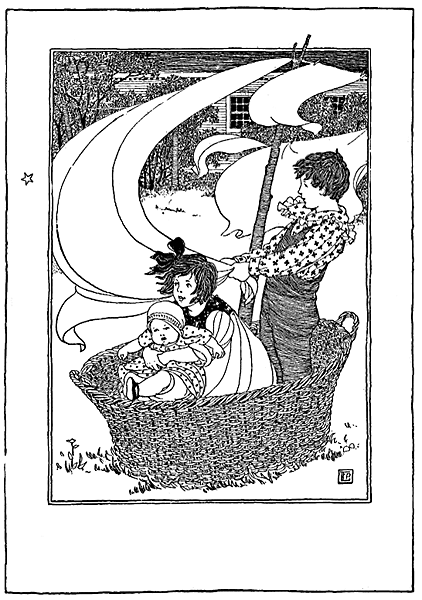
SAILING
Afloat, afloat, in a golden boat!
Hoist the sail to the breeze!
Steer by a star to lands afar
That sleep in the southern seas,
And then come home to our teas!
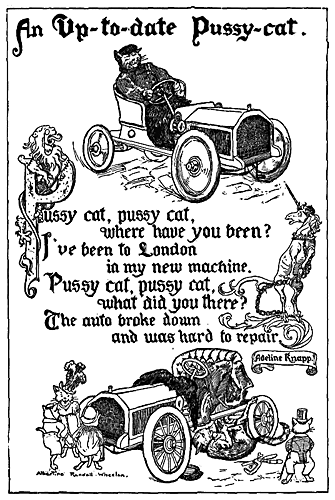
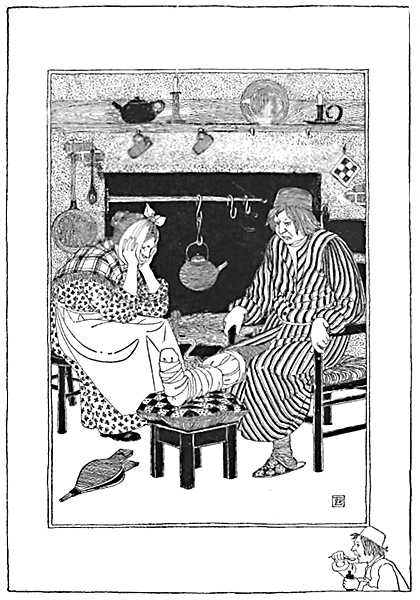
MISERY IN COMPANY
The rain is falling,
The fire is out!
Jane has the toothache,
John has the gout!
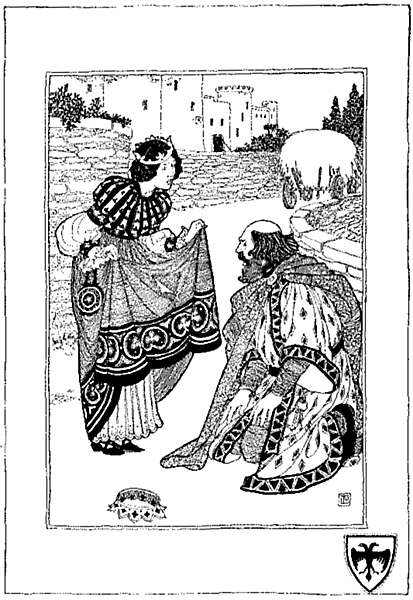
COURT NEWS
By Lucy Fitch Perkins
The king and queen went out to-day,
A-riding on a load of hay.
The king fell off and lost his crown,
The queen fell, too, and tore her gown.
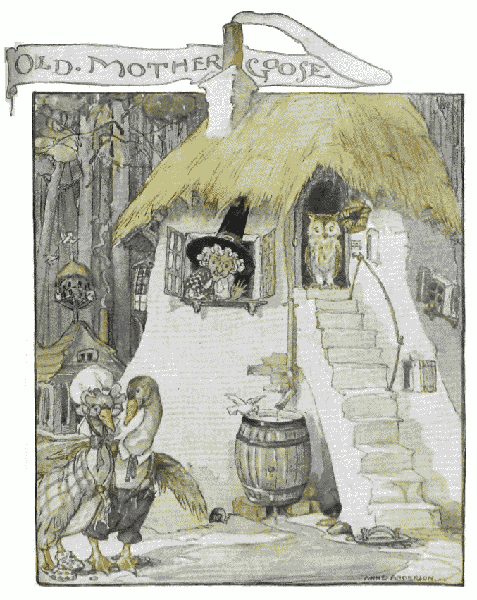
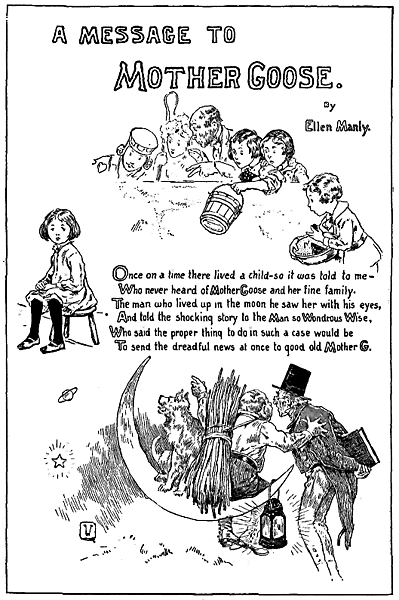
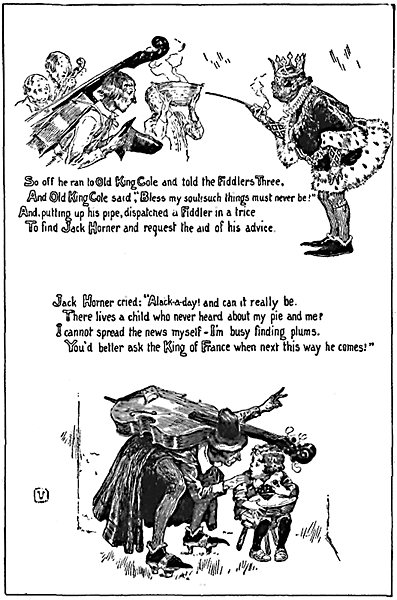
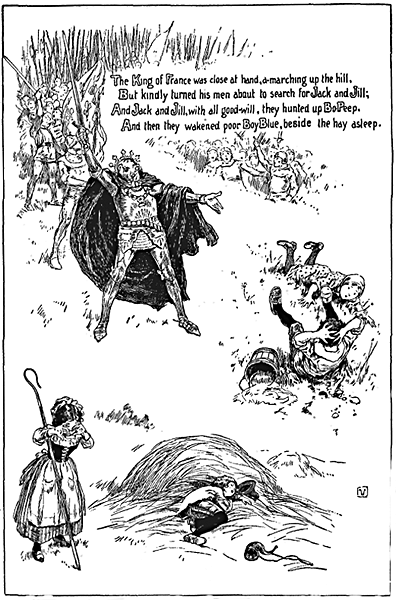
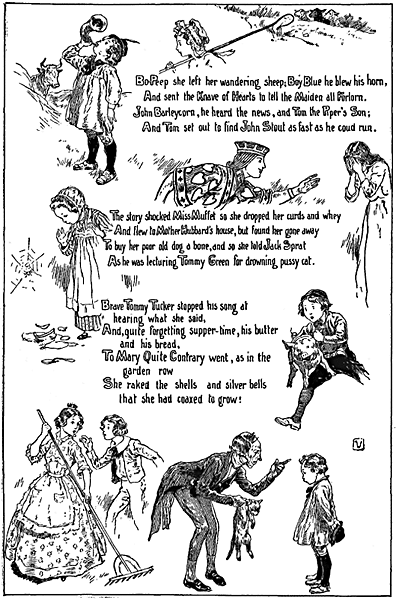
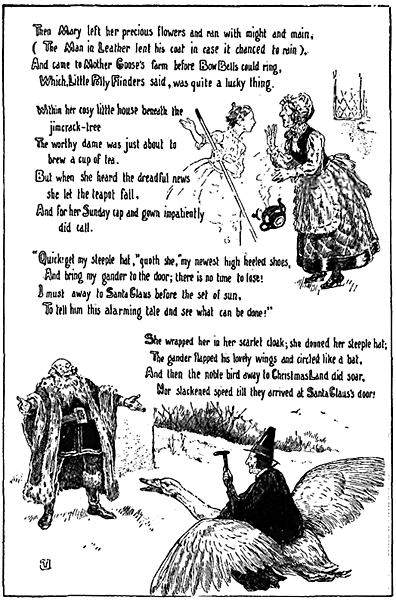
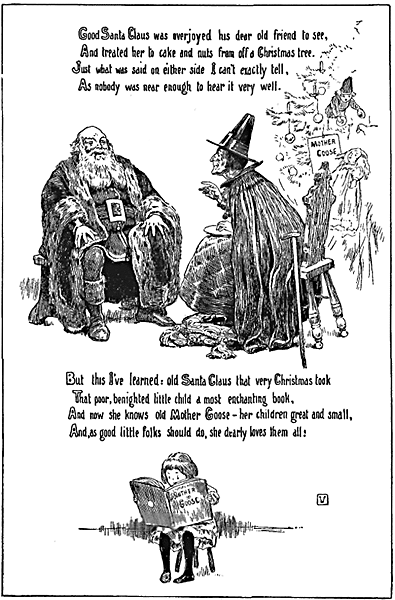
BY GERTRUDE SMITH
One night Arabella and Araminta’s mamma was sewing, and their papa was reading his newspaper. And there was a fire in the grate—a warm, bright fire in the grate.
And Arabella sat on the rug before the fire, and Araminta sat on the rug before the fire.
And Arabella was playing with her little white kitty, and Araminta was playing with her little black kitty.
And Arabella’s little white kitty’s name was Annabel, and Araminta’s little black kitty’s name was Lillabel.
Arabella had a little red ball fastened to a long string, and Araminta had a little blue ball fastened to a long string. Arabella would roll her ball, and her little white kitty would run and jump for it. And Araminta would roll her ball, and her little black kitty would run and jump for it.
The kittens were so cunning and funny, and they were having such a splendid time.
Sometimes when Arabella’s kitty would run very fast, or jump very high, Arabella would laugh until she tumbled right over on the floor.
And sometimes when Araminta’s kitty would run very fast, or jump very high, Araminta would laugh until she would tumble right over on the floor.
Oh, they were having a splendid time.
But all at once their mamma looked up from her sewing, and said, “Good-night, Arabella. Good-night, Araminta. The clock is on the stroke of eight.”
And their papa looked up from his paper, and said, “Yes, good-night, Arabella. Good-night, Araminta. The clock is on the stroke of eight.”
And Arabella said, “Oh, must we go to bed right now?”
And Araminta said, “Oh, must we go to bed right now?”
And their papa said, “Yes, indeed; yes, indeed. Good-night, Arabella. Good-night, Araminta. The clock is on the stroke of eight.”
Always, when it was bedtime, their papa and mamma would say, “Good-night, Arabella. Good-night, Araminta.”
And sometimes they were good, and sometimes they were bad; but they always ran away to bed.
And their dear mamma always went with them and tucked them in and kissed them, and then came away downstairs and left them. And sometimes they were good, and sometimes they were bad; but they always went to sleep.
But to-night their mamma said,
“Run and get your nighties, dears,
And get each a flannel gown,
And we’ll sit and rock you here,
Till you go to sleepy-town.”
And Arabella ran upstairs and got her nighty and her little flannel gown. And Araminta ran upstairs and got her nighty and her little flannel gown. And their mamma undressed Arabella, and their papa undressed Araminta.
Arabella’s little flannel gown was red, and Araminta’s little flannel gown was pink. When they had put them on over their nighties they were just as warm as toast.
Arabella’s kitty was playing with Araminta’s kitty on the rug before the fire. They were rolling and tumbling and chasing each other, and they looked so cunning and sweet.
And Arabella’s mamma took Arabella on her lap, and Araminta’s papa took Araminta on his lap.
Arabella said, “Oh, I want my kitty in my lap, mamma!”
And Araminta said, “Oh, I want my kitty in my lap, papa!”
So they jumped down and caught the kitties.
Their mamma rocked Arabella, and their papa rocked Araminta; and they sang to them,
“Now a nice little rock,
And never mind the clock,
Now a nice little rock,
And never mind the clock!”
And they sang it over, and over, and over.
“Now a nice little rock,
And never mind the clock,
Now a nice little rock,
And never mind the clock!”
And Arabella cuddled in her mamma’s arms, and hugged her little kitty close; and Araminta cuddled in her papa’s arms, and hugged her little kitty close.
And their mamma sang, and their papa sang;
“Now she goes to sleepy-town, sleepy-town, sleepy-town;
Cuddled in her little gown, here she goes to sleepy-town.”
And they sang it over, and over, and over.
“Now she goes to sleepy-town, sleepy-town, sleepy-town;
Cuddled in her little gown, here she goes to sleepy-town.”
And very soon Arabella could only just hear her mamma singing, and very soon Araminta could only just hear her papa singing, “Sleepy-town, sleepy-town.” And soon they couldn’t hear them at all. They were sound asleep!
And their mamma looked at their papa, and said, “Our precious little dears are both sound asleep.”
And their papa said, “Yes, our little pets have both reached sleepy-town.”
And Arabella’s mamma carried her upstairs and put her in her little bed, and Araminta’s papa carried her upstairs and put her in her little bed. And Arabella was hugging her white kitty up close in her arms and Araminta was hugging her black kitty up close in her arms. And the kitties were both sound asleep, too.
But Arabella’s kitty and Araminta’s kitty did not sleep with them all night—oh, no indeed! They had a nice little, warm little, soft little bed down in the basement, close to the furnace.
And their papa took the kitties out of their arms, and carried them down to their bed.
And Arabella slept, and slept, and slept, and slept, and slept. And Araminta slept, and slept, and slept, and slept, and slept.
And the little kitties in their soft little bed slept, and slept, too. All through the long, dark, beautiful night they slept.
And the sun came, and the morning came, and it was another day!
[C] From “Arabella and Araminta Stories.” Used by permission of publishers, Small, Maynard & Co., Boston.
BY EUDORA S. BUMSTEAD
“How can I go to bed,” said Penny, the flossy dog, “till I say good-night to Baby Ray? He gives me part of his bread and milk, and pats me with his little, soft hand. It is bedtime now for dogs and babies. I wonder if he is asleep?”
So he trotted along in his silky, white nightgown till he found Baby Ray on the porch in mamma’s arms.
And she was telling him the same little story that I am telling you:
The doggie that was given him to keep, keep, keep,
Went to see if Baby Ray was asleep, sleep, sleep.
“How can we go to bed,” said Snowdrop and Thistledown, the youngest children of Tabby, the cat, “till we have once more looked at Baby Ray? He lets us play with his blocks and ball, and laughs when we climb on the table. It is bedtime now for kitties and dogs and babies. Perhaps we shall find him asleep.” And this is what the kitties heard:
One doggie that was given him to keep, keep, keep,
Two cunning little kitty-cats, creep, creep, creep,
Went to see if Baby Ray was asleep, sleep, sleep.
“How can we go to bed,” said the three little Bunnies, “till we have seen Baby Ray?” Then away they went in their white, velvet nightgowns as softly as three flakes of snow. And they, too, when they got as far as the porch, heard Ray’s mamma telling the same little story:
One doggie that was given him to keep, keep, keep,
Two cunning little kitty-cats, creep, creep, creep,
Three pretty little bunnies, with a leap, leap, leap,
Went to see if Baby Ray was asleep, sleep, sleep.
“How can we go to bed,” said the four white Geese, “till we know that Baby Ray is all right? He loves to watch us sail on the duck-pond, and he brings us corn in his little blue apron. It is bedtime now for geese and rabbits and kitties and dogs and babies, and he really ought to be asleep.”
So they waddled away in their white, feather nightgowns, around by the porch, where they saw Baby Ray, and heard mamma tell the “Go-Sleep” story:
One doggie that was given him to keep, keep, keep,
Two cunning little kitty-cats, creep, creep, creep,
Three pretty little bunnies, with a leap, leap, leap,
Four geese from the duck-pond, deep, deep, deep,
Went to see if Baby Ray was asleep, sleep, sleep.
“How can we go to bed,” said the five white Chicks, “till we have seen Baby Ray once more? He scatters crumbs for us and calls us. Now it is bedtime for chicks and geese and rabbits and kittens and dogs and babies, so little Ray must be asleep.”
Then they ran and fluttered in their downy, white nightgowns till they came to the porch, where little Ray was just closing his eyes, while mamma told the “Go-Sleep” story:
One doggie that was given him to keep, keep, keep,
Two cunning little kitty-cats, creep, creep, creep,
Three pretty little bunnies, with a leap, leap, leap,
Four geese from the duck-pond, deep, deep, deep,
Five downy little chicks, crying peep, peep, peep,
All saw that Baby Ray was asleep, sleep, sleep.
[D] Used by permission of The Youth’s Companion.
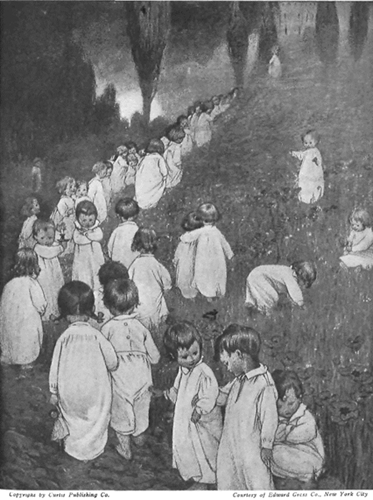 the land of nod
BY W. GRAHAME ROBERTSON
So it is over, the long bright Day,
And little Maid Twilight, quiet and meek,
Comes stealing along in her creep-mouse way
Whispering low—for she may not speak—
“The Gentle Dark is coming to play
At a game of Hide and Seek.”
Some babies are cross when she whispers them this,
And some are afraid and begin to cry.
I never can think what they find amiss.
Afraid of the Dark! I wonder why.
The Gentle Dark that falls like a kiss
Down from the sleepy sky.
O Gentle Dark, we know you are kind
By the lingering touch of your cool soft hand;
As over our eyes the veil you bind
We shut them tight at word of command,
You are only playing at Hoodman-Blind,
A game that we understand.
The voice is tender (O little one, hark!),
The eyes are kindly under the hood,
Blow out the candle, leave not a spark,
Trusting your friend as a playmate should.
Hold up your arms to the Gentle Dark,
The Dark that is kind and good.
[E] From “A Year of Song,” by W. Grahame Robertson; used by permission of the publishers, John Lane Company.
Sway to and fro in the twilight gray;
This is the ferry for Shadowtown;
It always sails at the end of the day,
Just as the darkness closes down.
Rest little head, on my shoulder, so;
A sleepy kiss is the only fare,
Drifting away from the world, we go,
Baby and I in the rocking-chair.
See where the fire-logs glow and spark,
Glitter the lights of the shadowland,
The raining drops on the window, hark!
Are ripples lapping upon its strand.
There, where the mirror is glancing dim,
A lake lies shimmering, cool and still.
Blossoms are waving above its brim,
Those over there on the window-sill.
Rock slow, more slow in the dusky light,
Silently lower the anchor down;
Dear little passenger, say “Good-night.”
We’ve reached the harbor of Shadowtown.
Hush-a-bye, baby, in the tree top:
When the wind blows, the cradle will rock;
When the bough breaks, the cradle will fall,
Down will come baby, cradle, and all.
BY WILLIAM WORDSWORTH
See the kitten on the wall,
Sporting with the leaves that fall,
Withered leaves—one—two—and three—
From the lofty elder tree!
Through the calm and frosty air
Of this morning bright and fair,
Eddying round and round they sink
Softly, slowly: one might think
From the motions that are made,
Every little leaf conveyed
Sylph or fairy hither tending,
To this lower world descending,
Each invisible and mute,
In his wavering parachute.
But the kitten, how she starts,
Crouches, stretches, paws and darts!
First at one and then its fellow,
Just as light and just as yellow;
There are many now—now one—
Now they stop and there are none:
What intenseness of desire
In her upward eye of fire!
With a tiger-leap, halfway,
Now she meets the coming prey;
Lets it go as fast and then
Has it in her power again.
Now she works with three or four,
Like an Indian conjuror;
Quick as he in feats of art,
Far beyond in joy of heart.
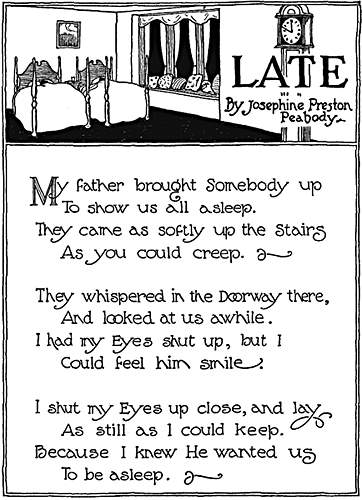
From “The Book of the Little Past,” by Josephine Preston Peabody;
used by permission of the publishers, Houghton Mifflin Co.
BY LAURENCE ALMA-TADEMA
When the sun has left the hilltop,
And the daisy-fringe is furled,
When the birds from wood and meadow
In their hidden nests are curled,
Then I think of all the babies
That are sleeping in the world.
There are babies in the high lands
And babies in the low,
There are pale ones wrapped in furry skins
On the margin of the snow,
And brown ones naked in the isles
Where all the spices grow.
And some are in the palace,
On a white and downy bed;
And some are in the garret,
With a clout beneath their head;
And some are on the cold, hard earth,
Whose mothers have no bread.
O little men and women,
Dear flowers yet unblown—
O little kings and beggars
Of the pageant yet unshown—
Sleep soft and dream pale dreams now,
To-morrow is your own.
Hush, Dolly, bye, Dolly, sleep, Dolly, dear,
See what a bed, Dolly, I’ve for you here;
Therefore, to sleep, Dolly! don’t fret and cry;
Lay down your head, Dolly, shut up your eye.
When the bright morn, Dolly, once more has come,
Up gets the sun, and goes forth to roam;
Then shall my dear Dolly soon get up, too;
Then shall be playtime for me and for you.
Now go to sleep, Dolly, good night to you;
You must to bed, Dolly—I’m going too;
Just go to sleep without trouble or pain,
And in the morning I’ll come back again.
I see a nest in a green elm-tree
With little brown sparrows—one, two, three!
The elm-tree stretches its branches wide,
And the nest is soft and warm inside.
At morn the sun, so golden bright,
Climbs up to fill the world with light;
It opens the flowers, it wakens me,
And wakens the birdies—one, two, three.
And leaning out of my window high,
I look far up at the blue, blue sky,
And then far out at the earth so green,
And think it the loveliest ever seen—
The loveliest world that ever was seen!
BY C. FRANCES ALEXANDER
Little birds sleep sweetly
In their soft round nests,
Crouching in the cover
Of their mother’s breasts.
Little lambs lie quiet,
All the summer night,
With their old ewe mothers,
Warm, and soft, and white.
But more sweet and quiet
Lie our little heads,
With our own dear mothers
Sitting by our beds;
And their soft sweet voices
Sing our hush-a-byes,
While the room grows darker,
As we shut our eyes.
And we play at evening
Round our father’s knees;
Birds are not so merry,
Singing on the trees,
Lambs are not so happy,
’Mid the meadow flowers;
They have play and pleasure,
But not love like ours.
Rock-a-bye, baby, your cradle is green,
Father’s a nobleman, mother’s a queen,
And Betty’s a lady, and wears a gold ring,
And Johnny’s a drummer, and drums for the King.
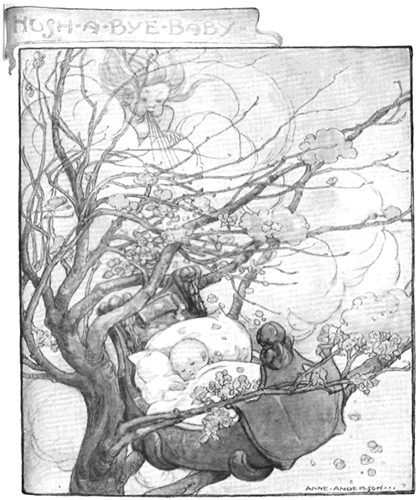
BY MARGARET VANDERGRIFT
The rosy clouds float overhead
The sun is going down,
And now the Sandman’s gentle tread
Comes stealing through the town.
“White sand, white sand,” he softly cries,
And as he shakes his hand,
Straightway there lies on babies’ eyes
His gift of shining sand.
Blue eyes, black eyes, gray eyes and brown,
As shuts the rose, they softly close,
when he goes through the town.
From sunny beaches far away—
Yes, in another land—
He gathers up at break of day
His store of shining sand.
No tempests beat that shore remote,
No ships may sail that way,
His little boat alone may float
Within that lovely bay.
Blue eyes, gray eyes, black eyes and brown,
As shuts the rose, they softly close,
when he goes through the town.
He smiles to see the eyelids close
Above the happy eyes;
And every child right well he knows—
Oh, he is very wise!
But if, as he goes through the land,
A naughty baby cries,
His other hand takes dull gray sand
To close the wakeful eyes.
Blue eyes, gray eyes, black eyes and brown,
As shuts the rose, they softly close,
when he goes through the town.
So when you hear the Sandman’s song
Sound through the twilight sweet,
Be sure you do not keep him long
A-waiting on the street.
Lie softly down, dear little head,
Rest quiet, busy hands,
Till, by your bed his good-night said,
He strews the shining sands.
Blue eyes, gray eyes, black eyes and brown,
As shuts the rose, they softly close,
when he goes through the town.
BY ROBERT BIRD
Come cuddle close in daddy’s coat
Beside the fire so bright,
And hear about the fairy folk
That wander in the night.
For when the stars are shining clear
And all the world is still,
They float across the silver moon
From hill to cloudy hill.
Their caps of red, their cloaks of green,
Are hung with silver bells,
And when they’re shaken with the wind
Their merry ringing swells,
And riding on the crimson moth,
With black spots on his wings,
They guide them down the purple sky
With golden bridle rings.
They love to visit girls and boys,
To see how sweet they sleep,
To stand beside their cozy cots
And at their faces peep.
For in the whole of fairy-land
They have no finer sight
Than little children sleeping sound
With faces rosy bright.
On tiptoe crowding round their heads,
When bright the moonlight beams,
They whisper little tender words
That fill their minds with dreams;
And when they see a sunny smile,
With lightest finger tips
They lay a hundred kisses sweet
Upon the ruddy lips.
And then the little spotted moths
Spread out their crimson wings,
And bear away the fairy crowd
With shaking bridle rings.
Come bairnies, hide in daddy’s coat,
Beside the fire so bright—
Perhaps the little fairy folk
Will visit you to-night.
BY THOMAS HOOD
A little fairy comes at night;
Her eyes are blue, her hair is brown,
With silver spots upon her wings,
And from the moon she flutters down.
She has a little silver wand,
And when a good child goes to bed,
She waves her wand from right to left,
And makes a circle round its head.
And then it dreams of pleasant things—
Of fountains filled with fairy fish,
And trees that bear delicious fruit.
And bow their branches at a wish.
Of arbors filled with dainty scents
From lovely flowers that never fade,
Bright flies that glitter in the sun,
And glow-worms shining in the shade.
And talking birds with gifted tongues
For singing songs and telling tales,
And pretty dwarfs to show the way
Through fairy hills and fairy dales.
But when a bad child goes to bed,
From left to right she weaves her rings,
And then it dreams all through the night
Of only ugly, horrid things!
Then lions come with glaring eyes,
And tigers growl, a dreadful noise,
And ogres draw their cruel knives,
To shed the blood of girls and boys.
Then stormy waves rush on to drown,
Or raging flames come scorching round,
Fierce dragons hover in the air,
And serpents crawl along the ground.
Then wicked children wake and weep,
And wish the long black gloom away;
But good ones love the dark, and find
The night as pleasant as the day.
BY GERTRUDE THOMPSON MILLER
Come lay your head on my breast, my dear,
That I may feel your sweet form near;
Then we’ll rock, rock, in the rocking chair,
And play we’re sailing up through the air.
Your body so warm, so close, and so round,
A more precious bundle ne’er was found;
Just nestle your head right here on my arm,
And Mother will keep you safe from all harm.
Now, we rock, rock, and away we go,
Over the houses and trees, just so,
Like the birds, we’ll fly to a sunny land,
And there we’ll join the fairies’ band.
We’ll take them to ride; we’ll sail for home,
For Father is there, and he’s all alone;
Then we’ll alight on the nursery bed,
Fairies for company in Mother’s stead.
BY RICHARD HENRY BUCK
Skeeters am a hummin’ on de honeysuckle vine,
Sleep, Kentucky Babe!
San’man am a comin’ to dis little coon of mine,—
Sleep, Kentucky Babe!
Silv’ry moon am shinin’ in de heabens up above,
Bobolink am pinin’ fo’ his little lady love:
Yo’ is mighty lucky, babe of old Kentucky,—
Close yo’ eyes in sleep.
Fly away, Kentucky Babe, fly away to rest,
Lay yo’ kinky, woolly head on yo’ mammy’s breast,—
Um-um-um-um,—
Close yo’ eyes in sleep.
Daddy’s in de canebrake wid his little dog and gun,—
Sleep, Kentucky Babe!
Possum fo’ yo’ breakfast when yo’ sleepin’ time is done,—
Sleep, Kentucky Babe!
Bogie man’ll catch yo’ sure unless yo’ close yo’ eyes,
Waitin’ jes outside de doo’ to take yo’ by surprise!
Close yo’ eyes in sleep.
[F] Copyright, 1896, by the White-Smith Music Publishing Co. These words are published by the Company in the form of a musical composition by Adam Geibel, the well-known composer.
I’m a rich man,
If ever there was one:
I’ve a horse and an apple,
And both are my own.
But some others might wish
Such fine presents to keep;
So I’ll take them to bed,
To hold while asleep.
And when in the morning
I wake up once more,
I’ve my toy and my apple,
To me a rich store.
BY EUDORA S. BUMSTEAD
The sun was up and the breeze was blowing, and the five chicks, and four geese, and three rabbits, and two kitties, and one little dog were just as noisy and lively as they knew how to be.
They were all watching for Baby Ray to appear at the window, but he was still fast asleep in his little white bed, while mamma was making ready the things he would need when he would wake up.
First, she went along the orchard path as far as the old wooden pump, and said: “Good pump, will you give me some nice, clear water for the baby’s bath?”
And the pump was willing.
The good old pump by the orchard path
Gave nice, clear water for the baby’s bath.
Then she went a little further on the path, and stopped at the woodpile, and said: “Good chips, the pump has given me nice, clear water for dear Baby Ray; will you come and warm the water and cook his food?”
And the chips were willing.
The good old pump by the orchard path
Gave nice clear water for the baby’s bath.
And the clean white chips from the pile of wood
Were glad to warm it and cook his food.
So mamma went on till she came to the barn, and then said: “Good cow, the pump has given me nice, clear water, and the woodpile has given me clean, white chips for dear little Ray; will you give me warm, rich milk?”
And the cow was willing.
Then she said to the top-knot hen that was scratching in the straw: “Good Biddy, the pump has given me nice, clear water, and the woodpile has given me clean, white chips, and the cow has given me warm, rich milk for dear little Ray; will you give me a new-laid egg?”
And the hen was willing.
The good old pump by the orchard path
Gave nice, clear water for the baby’s bath.
The clean, white chips from the pile of wood
Were glad to warm it and cook his food.
The cow gave milk in the milk-pail bright,
And the top-knot Biddy an egg new and white.
Then mamma went on till she came to the orchard, and said to a Red June apple tree: “Good tree, the pump has given me nice, clear water, and the woodpile has given me clean, white chips, and the cow has given me warm, rich milk, and the hen has given me a new-laid egg for dear little Ray; will you give me a pretty, red apple?”
And the tree was willing.
So mamma took the apple and the egg and the milk and the chips and the water to the house, and there was Baby Ray in his nightgown looking out of the window.
And she kissed him and bathed him and dressed him, and while she brushed and curled his soft, brown hair, she told him the Wake-Up Story that I am telling you.
The good old pump by the orchard path
Gave nice, clear water for the baby’s bath.
The clean, white chips from the pile of wood
Were glad to warm it and cook his food.
The cow gave milk in the milk-pail bright;
The top-knot Biddy an egg new and white;
And the tree gave an apple so round and so red,
For dear little Ray who was just out of bed.
[G] Used by permission of The Youth’s Companion.
BY S. L. ELLIOTT
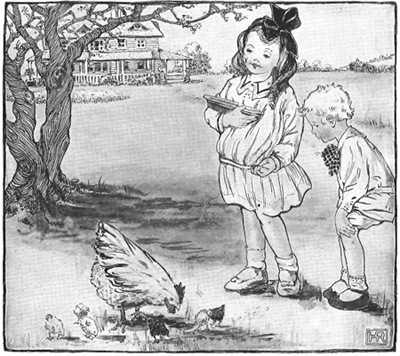 “a little girl came out with some corn-meal in a dish.”
A Mother Biddy sat on her nest, with what do you think in the nest? Six smooth white eggs! After she had sat there quite a long time till she was very tired, what do you suppose happened to one of those eggs? There was a noise that went “snick, snick,” and out of the shell stepped something like a little fuzzy ball, but with two bright eyes, and two bits of feet to walk on. What do you think it was? A little chicken? Yes, and Mother Biddy was so glad to see it, and she called it “Fluffy.” And Fluffy said “Peep, peep! I have some brothers and sisters in the shells; if you call them, I think they will come.” So Mother Biddy said “Cluck, cluck!” and something said: “Peep, peep!” and out came another chicken, as black as it could be, so Mother Biddy called it “Topsy.” [Pg 87] “Are there any more?” said Mother Biddy. “Yes. Peep, peep! We’re coming; wait for us,” and there came four more little chickens as fast as they could run. One was as white as snow, and Mother Biddy called it “Snowball.” The next was yellow and white, and she named it “Daisy.” Then there was a yellow one with a brown ring around its neck, and that was called “Brownie.” And what do you think! one was all black, only it had a little white spot on the top of its head that looked like a cap, so Mother Biddy called it “Spottie.” Now they were all out of their shells, and they said: “Peep, peep! We’re hungry.” So Mother Biddy said: “Cluck, cluck! Come see my babies,” and out of the house, close by, came a little girl with some corn-meal in a dish, and my! wasn’t she glad to see the chickens?
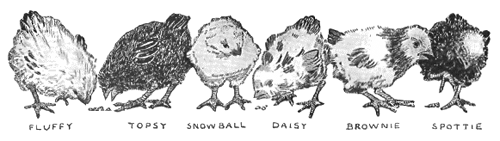
After they had eaten all they wanted, they thought they would take a walk and see this queer world they had come to live in.
Pretty soon they came to a brook, and they all stood in a row and looked in. “Let us have a drink,” they said, so they put their heads down, when—
“Peep, peep!” said Spottie. “I see a little chicken with a spot on its head.”
“No, no,” said Brownie; “it has a ring around its neck, and looks like me.”
“Peep, peep!” said Daisy. “I think it’s like me, for it is yellow and white.” And I don’t know but they would all have tumbled in to see if they hadn’t felt something drop right on the ends of their noses. “What’s that?” said Fluffy.
“Cluck, cluck!” said Mother Biddy. “Every chicken of you come in, for it is going to rain, and you’ll get your feathers wet.”
So they ran as fast as they could, and in a few minutes the six little chickens were all cuddled under Mother Biddy’s wing, fast asleep.
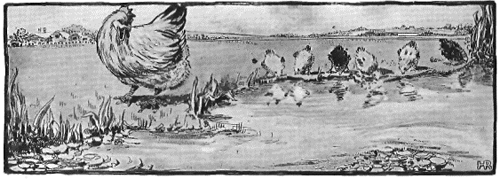
“TRADE-LAST”
By Lucy Fitch Perkins
“My frock is green.”
“My frock is blue.”
“You look pretty.”
“So do you.”
 philip in his
Little Philip was very fond of horses, and as he was too old to sit on a chair or box or trunk and make believe a rocking-horse was pulling it along his bedroom floor, his father bought him a horse all spotted brown and white, with a beautiful white mane; and Philip loved to get up on his back.
In winter he would go out in his sleigh, even when the snow was deep. It was jolly fun to be in the sleigh all wrapped up cozy and warm in furry robes. He would crack his long whip and make it sound almost as loud as a fire-cracker. He used to carry a make-believe pistol when he dressed up in his “Rough-Rider” suit and went horseback-riding. But all the neighbors thought it was funny that Philip would always leave the saddle on his horse when he went out in his sleigh. But you won’t think it is funny when I tell you a secret—maybe you have guessed it already—Philip couldn’t get the saddle off, because, don’t you see, his horse was only a make-believe, hobby-horse.
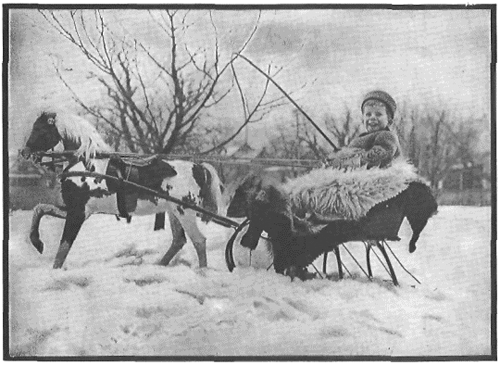 philip in his sleigh.
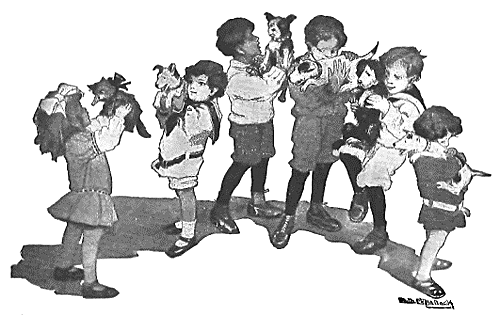
By Stella George Stern
All little girls, and little boys too, like to read stories about kittens. Here is a story about a dear little kitten that belonged to a dear little girl named Peggy.
Peggy had two brothers, and three cousins—all boys—and every boy had a little dog. At first the dogs would tease the kitten, but they soon learned better. The dogs and the kitten played together. All day long, out in the yard, you could hear them going, “Bow-wow!” and “Mew!”
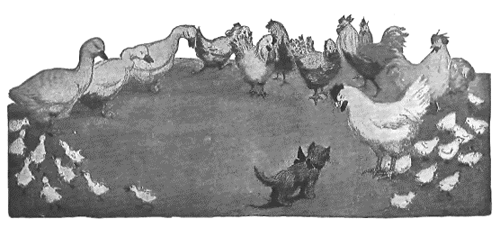
But, you see, there was only one little “Mew” and ever so many “Bow-wows,” and after a while the kitten hardly ever spoke at all.
But one day the kitten wanted to mew, and—what do you suppose?—she had forgotten how to do it! She tried and tried, and all she could say was “M-m-m-bow!”—just as much like a dog as a kitten. She was so sad. She ran out into the yard and cried.
The Big White Hen passed by and asked what was the matter.
“Oh, Big White Hen,” sobbed the kitten, “I have forgotten how to talk kitten-talk. I try and I try, and all I can say is, M-m-m-bow!”
“Never mind, Kitty Cat,” said the Hen; “I will teach you to talk. Listen to this: M-m-m-cut, cut, cut, cut, cut-ca-da-cut!”
“No,” said the kitten; “that’s not the way to talk kitten-talk.” And she cried again.
Then along came the Sheep and asked, “What is the matter?”
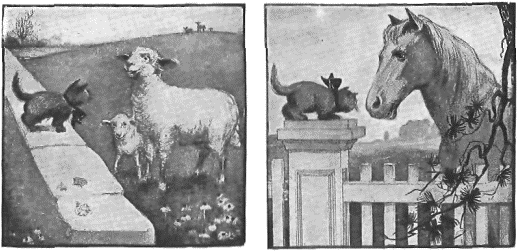
“Oh, Sheep,” sobbed the kitten, “I have forgotten how to talk kitten-talk. I try and I try, and all I can say is, M-m-m-bow!”
“Never mind, Kitty Cat,” said the Sheep; “I will teach you to talk. Listen: M-m-m-baa!”
“No,” said the kitten, “that’s not the way to talk kitten-talk.” And she cried again.
Then along came the Horse and asked what was the matter.
“Oh, Horse,” sobbed the kitten, “I have forgotten how to talk kitten-talk. I try and I try, and all I can say is, M-m-m-bow!”
“Never mind, Kitty Cat,” said the Horse; “I will teach you to talk. Listen to this: M-m-m-neigh!”
“No,” said the kitten; “that’s not the way to talk kitten-talk.” And she cried again.
Then along came the Cow and asked what was the matter.
“Oh, Cow,” sobbed the kitten, “I have forgotten how to talk kitten-talk. I try and I try, as hard as I ever can, and all I can say is, M-m-m-bow!”
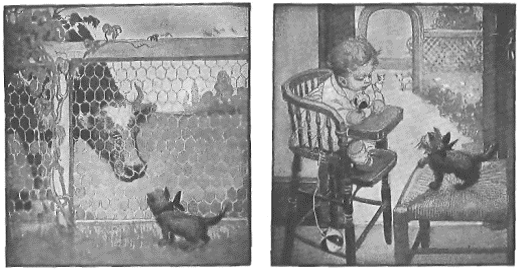
“Never mind, Kitty Cat,” said the Cow; “I will teach you to talk. Listen to this: M-m-m-moo!”
“No,” said the kitten; “that is more like it, but that’s not the way to talk kitten-talk.” And she cried again.
The New Baby was sitting in her high chair at the kitchen door.
“Baby dear,” sighed the kitten, “I am in trouble. I have forgotten how to talk kitten-talk. I try and I try, and all I can say is, M-m-m-bow! Can’t you teach me?”
The Baby nodded her head and began, “M-m-m-google-google-goo!”
“No,” said the kitten; “that’s not the way to talk kitten-talk.” And she sat on the kitchen step and cried again.
“What is the matter?” asked a soft voice behind her.
“Oh!” sobbed the kitten, without looking up, “I have forgotten how to talk kitten-talk. I try and I try, and nothing can help me. All I can say is, M-m-m-bow!”
“Look at me,” said the soft voice.
The little kitten looked. And there stood a beautiful big gray cat!
“I can teach you to talk,” said the Cat. And she did. She taught her so well that the little kitten never again forgot how to mew, though she played out on the soft, green grass with the dogs every day.
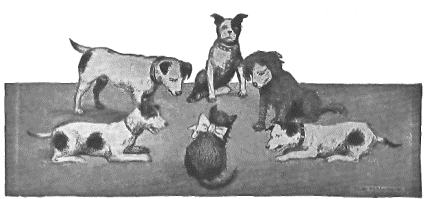
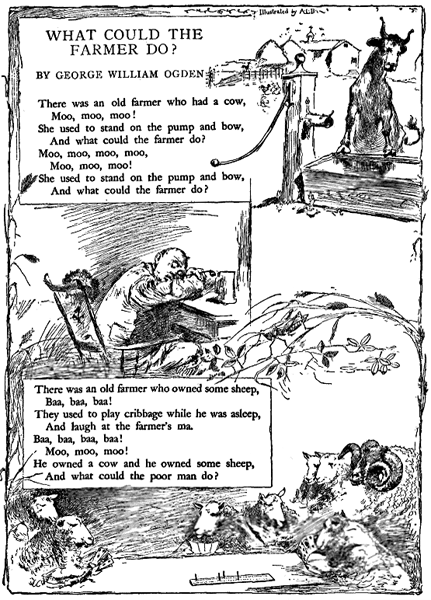
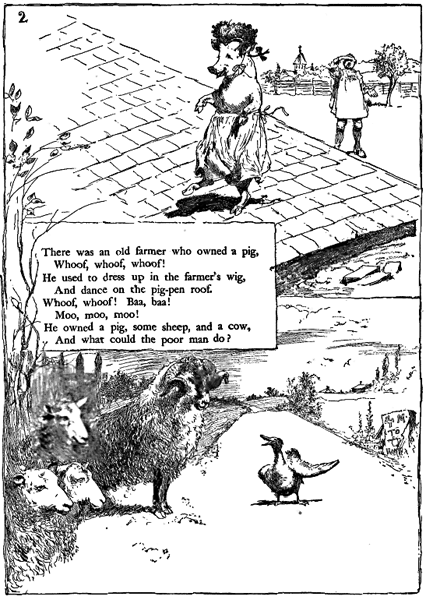
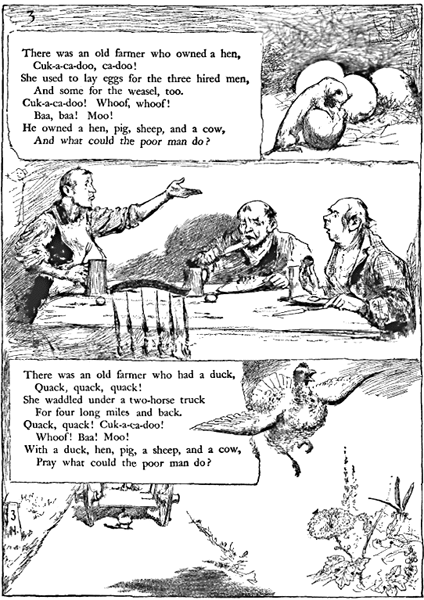
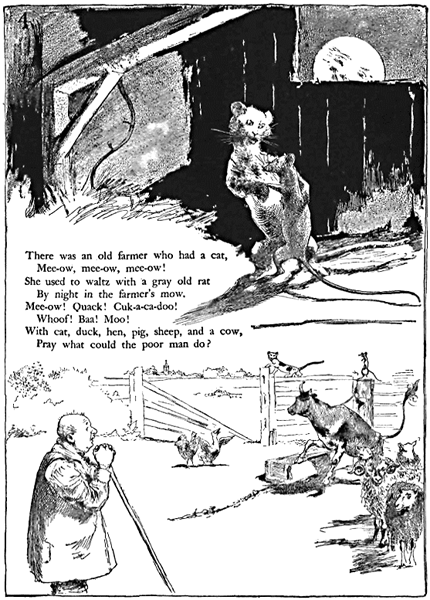
FLEDGLINGS
By Lucy Fitch Perkins
I saw a stork on a chimney high,
And called to him as I passed by,
“O stork! what’ll you bring,
Tucked away carefully under your wing?
A baby sister and a brother,
One for me, and one for mother.”
BY ELLEN FOSTER
Little Elinor Gray lived in a big city, but her grandmother lived in a big house in the country. Elinor and her Nurse Norah were going to visit her, and had to take a long ride in the railway-train, and another ride in a carriage that Grandmother sent to meet them, so it was almost dark when they drove up to the door.
Elinor’s grandmother had two beautiful dogs—“Bruno,” a big collie, and “Bounder,” a little fox-terrier. And when they saw the little girl jump out of the carriage, they barked and barked because they were so glad to see her. And they said to themselves (I think they said to themselves): “We will let her have a good sleep to-night, for she must be very tired and it is nearly dark. But to-morrow, bright and early, we will ask her to come for a romp with us in the garden, and show her how much nicer it is to live in the country than in the city, where little girls have to walk so quietly along the streets, and dogs have to be led along the sidewalk, and cannot frolic on the soft green grass.”
Elinor was very sleepy after her long ride in the train, and so, after she had had her supper, her grandmother told her she might go to bed early and get a good sleep, and that Nurse Norah would call her at seven o’clock in the morning.
But what do you think happened? Why, Bruno and Bounder somehow got into the house before seven o’clock that morning, and came leaping up the stairs, and went straight to Elinor’s door. Elinor was a very sound sleeper, and did not hear them at first, and did not wake up. But soon Bounder began to scratch at the door with his little, sharp claws and to make queer little whine-y sounds; and Bruno’s bushy tail went “Rap! rap! rap!” on the door, too. Then Elinor woke up, and listened a moment, and then she said: “Oh, I know what it is! It’s those darling dogs!” And she jumped out of bed and opened the door, and there, sure enough, was Bounder, dashing right into the room, barking, “Good morning! good morning!” and big Bruno, looking at Elinor as if saying, “Good morning! didn’t you hear us? It’s time to get up!”
Elinor said: “Oh, you beauties! Yes, I know! And I’ll get dressed right away!”
But what do you think happened then! Why, Bruno and Bounder didn’t give her time even to call Nurse Norah and get dressed. You see, Bruno and Bounder did not often have so nice a little visitor, and they were ready to begin play that very minute. Bounder was jumping up and down and all over the room, and at last he spied Elinor’s slippers on the floor and caught up one of them between his sharp little teeth and ran round and round the room with it. But Bruno chased Bounder all round the room trying to make him drop the slipper, while Elinor stood still and laughed and laughed and laughed!
But just then Nurse Norah came rushing in from the next room, asking what was the matter and in a minute, the naughty Bounder was made to give up Elinor’s slipper, and Bruno chased him all the way out of the house.
And just as soon as Elinor had had her breakfast, she ran out and had a fine romp with Bruno and Bounder in Grandmother’s garden.
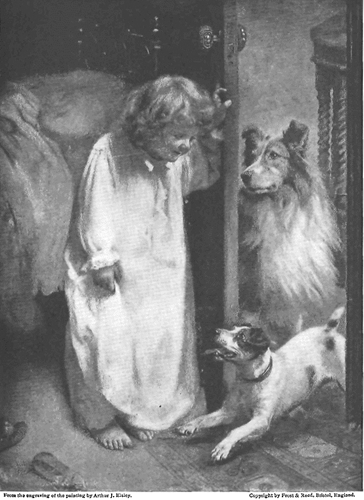 “time to get up!”
(For Very Little Folk)
and Mrs. Squeaky were two little, gray mice. They lived away back in the corner of a great, big, empty box in the cellar.
One morning Mr. Squeaky went up the cellar stairs on tiptoes, to hunt for some bread and cheese in the kitchen.
All at once he heard some one talking, and he hid behind the broom and was as still as he could be.
It was the little boy Johnnie, who lived up-stairs. He had a big hammer and a saw in his hand, and he was talking to his little sister.
“I think that big, empty box down cellar would make a fine dolls’ house, Maggie. I can fix a little porch on it, and make an up-stairs and a down-stairs,” the little boy said.
“Oh, Johnnie, that will be lovely,” his little sister said. “I’ll do something for you sometime. Maybe—maybe—I’ll draw a whole slate full of el’phants, for you to look at!”
Then they started down the cellar steps.
Mr. Squeaky was so frightened that he almost tumbled down the stairs.
“Oh, my dear,” he whispered, “they are going to break up our house with a big hammer and a saw, and make a dolls’ house out of it! Let’s run as fast as we can!”
Poor little Mrs. Squeaky began to cry.
“Where shall we go?” she whispered. “Oh, I am so afraid, and there are always those dreadful traps around to catch us!”
But they ran as fast as they could to the darkest corner. Mrs. Squeaky’s sharp little eyes saw a hole, and she ran into it, and Mr. Squeaky squeezed in after her.
Now where do you think they found themselves? Right inside of an old shoe! The hole that they came through was just a hole in the shoe and made a nice little door. And there was another hole a little higher up that made a nice little window to peep out of.
“Why, this is the dearest little house, so cozy and warm,” Mrs. Squeaky said. “Nobody will ever find us in here, I know.”
After they lived there a while, a whole family of little pink baby mice came to live with them. The papa mouse and the mama mouse were so proud and so glad, they got little bits of cotton and soft paper and rags, and made the nicest little beds you ever saw.
The little pink baby mice could only say, “Squeak! Squeak!” and cuddle up under the warm covers, but Mr. and Mrs. Squeaky laughed, and thought they were the smartest babies in the whole world.
“Why, I feel like ‘The Old Woman Who Lived in the Shoe and had so many children she didn’t know what to do,’” Mrs. Squeaky said one day. She was sitting by the little window rocking the baby mouse and taking a little rest.
Mr. Squeaky had gone out to hunt for some supper, and the four other little mice were peeping out of the little hole in the toe of their shoe house, for Papa to come home.
All at once, Maggie, the little girl who lived up-stairs, ran into the dark corner to hide from Johnnie, just for fun. And what do you think she saw?
The four little mice peeping out of the door, and the poor, frightened mama mouse and the little baby at the window.
Maggie stopped just a minute to whisper gently to little, gray Mrs. Squeaky, “Don’t be frightened, ‘Little Old Woman Who Lives in the Shoe.’ I’ll never, never tell anybody where you live. No, I won’t even tell Johnnie or my kitty. They might try to catch you. It shall be my very own secret—and yours!”
So nobody but little Maggie ever knew about Mr. and Mrs. Squeaky, and their little pink babies in the old shoe—until long afterward, when she told me the story, as I have told it to you.
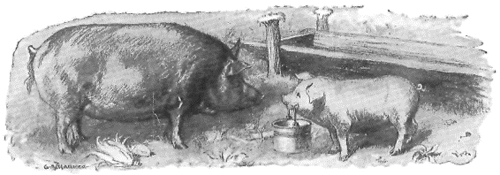 “‘trot as fast as you can to market and get me a pail of
milk.’”
“‘trot as fast as you can to market and get me a pail of
milk.’”
BY L. WALDO LOCKLING
Once there was a little piggie, a very good little piggie, who obeyed his mother so well that often she let him out of the pen to play with his friends on the farm. One afternoon this little piggie was playing with them, when suddenly he heard his mother calling “Piggie, wiggie, wiggie, wiggie, wiggie!”
“Piggie, dear,” she said, as he ran to her, “take this and trot as fast as you can to market and get me a pail of milk for Father’s supper to-night.”
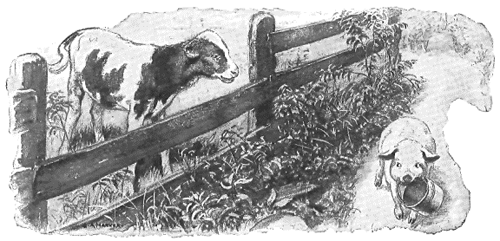 “‘where are you off to, piggie?’ said bossie calf.”
So Piggie took the pail between his teeth, and off he went to do what his mother told him. Now, you must remember that this little piggie was such a dear, good little piggie, that he had a great many friends among the other animals. [Pg 103]So he had not gone far when who should spy him but his friend Bossie Calf. “Hello, there!” said the calf. “Where are you off to, Piggie?”
“I’m going to market to bring my mother a pail of milk for Father’s supper to-night,” squealed Piggie.
“Are you? I believe I’ll go, too. I am so fond of milk.” And the calf leaped over his master’s fence, and away he went scampering after Piggie.
By and by, who should come along but Piggie’s friend Billie Goat. “Mercy on us!” baa-ed Billie. “Where are you going in such a hurry, Bossie?”
“Going with Piggie,” said the calf.
“Where are you going, Piggie?”
“Going to market to bring my mother a pail of milk for Father’s supper to-night,” squealed Piggie, in a great hurry.
“Are you? I believe I’ll go, too. I am so fond of milk.” So Billie Goat ran out of the barn-yard and hurried after the calf.
Just as they were passing the house, who should spy them but Rover the dog.
“Where are you going, Billie,” barked Rover, running out to the gate as he saw them rushing along. “Going with Bossie,” said the goat.
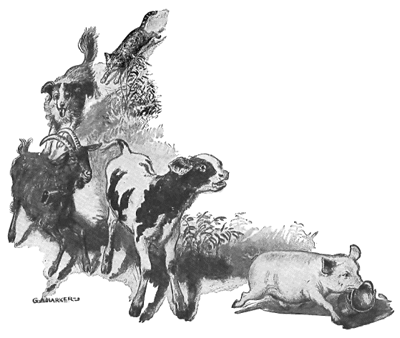
“Where are you going, Bossie?” “Going with Piggie.”
“Where are you going, Piggie?”
“I am going to market to bring Mother a pail of milk for Father’s supper to-night,” squealed Piggie, in a great hurry.
“Are you? I believe I’ll go, too. I am so fond of milk.” So Rover hurried along up the road after the goat.
Just as they turned into the road, who should come jumping along but Tabby the cat.
“Well, well!” he meowed. “When did the circus come to town, Rover?”
“This is not a circus parade,” said the dog, the goat, the calf, and Piggie all at once, as they ran on.
“Then, where are you going, Rover?” again meowed Tabby.
“Going with Billie,” barked Rover.
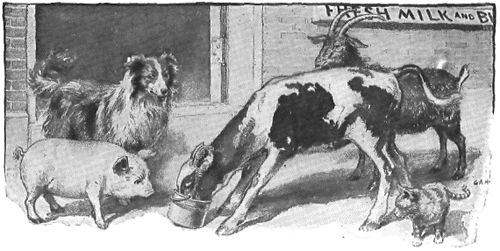 “‘my, that’s good!’”
“Where are you going, Billie?” “Going with Bossie.”
“Where are you going, Bossie?” “Going with Piggie.”
“Where are you going, Piggie?”
“I am going to market to get my mother a pail of milk for Father’s supper to-night,” squealed Piggie in a great hurry.
“Are you? I believe I’ll go along. I am so fond of milk.” So Tabby raced along after Rover.
When they got to the market, Piggie told his friends to wait outside while he hurried in and got the milk for his father’s supper. It did not take him long, and he soon came trotting out because he was to hurry back home.
“Give me a sup for politeness’ sake,” meowed Tabby the cat, as she stuck her head in the pail. “My, that’s good!”
“Pass it to me, Tabby,” barked Rover the dog, “for politeness’ sake. My, that’s good!”
“Give me a sup for politeness’ sake,” said Billie Goat. “My, that’s good.”
“Do not forget me, Billie, for politeness’ sake,” said Bossie the calf. “My, that’s good!”
 “away he trotted with an empty pail.”
“Oh, dear, oh, dear!” squealed Piggie, when he saw what had happened. “What shall I do?” And away he trotted all by himself with an empty pail, to tell his mother that he did really and truly get the milk, but that his friends had “supped” it all up!
But just then the farmer came with a great, big pail of milk and gave it all to them, so that the good little piggie and his father and mother had a fine supper, and much more milk than Piggie could have brought.
BABY’S PARADISE
By Lucy Fitch Perkins
Over the hills and far away,
There’s a beautiful, wonderful place,
Where happy babies in gardens play,
With mothers dressed all in lace,—
Dressed all in lace and in silken gown,
With flowers in their hair,—
Where trees with blossoms are laden down,
And perfumes fill the air.
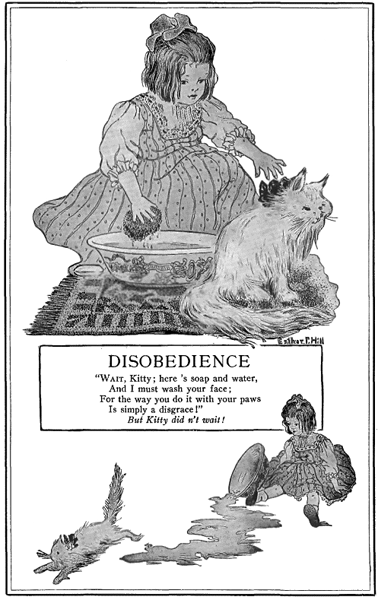
 “who speaks first?”
Moo, moo!
What can I do
For my little girl of three?
I will eat the sweet grass,
I will give her a glass
Of my milk for her tea;
Moo, moo! that ’s what I’ll do
For my dear little maiden of three.
Mew, mew!
What can I do
For my little girl of three?
I will catch all the mice,
And they shall not come twice
To the cake, you’ll see;
Mew, mew! that’s what I’ll do
For my sweet little maiden of three.
Bow-wow!
I will go now
With my little girl of three;
I will make a great noise;
I will frighten the boys,
For they all fear me;
Bow-wow! that is just how
I’ll guard my sweet maiden of three.
Neigh, neigh!
Out of the way
For my little girl of three!
I will give her a ride,
We will canter and glide
O’er the meadowy lea;
Neigh, neigh! that’s just the way
I’ll help my sweet maiden of three.
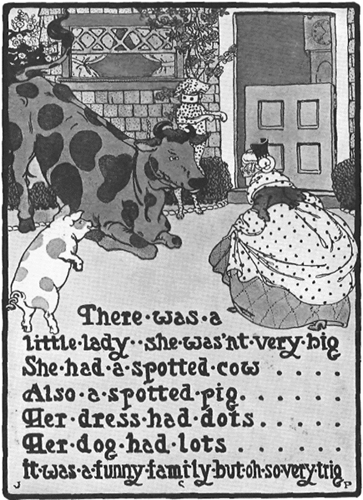
When Charley awoke one morning, he looked from the window, and saw the ground deeply covered with snow.
On the side of the house nearest the kitchen, the snow was piled higher than Charley’s head.
“We must have a path through this snow,” said his father. “I would make one if I had time. But I must be at the office early this morning.
“Do you think you could make the path, my son?” he asked little Charley.
“I? Why, the snow is higher than my head! How could I ever cut a path through that snow?”
“How? Why, by doing it little by little. Suppose you try,” said the father, as he left for his office.
So Charley got the snowshovel and set to work. He threw up first one shovelful, and then another; but it was slow work.
“I don’t think I can do it, mother,” he said. “A shovelful is so little, and there is such a heap of snow.”
“Little by little, Charley,” said his mother. “That snow fell in tiny bits, flake by flake, but you see what a great pile it has made.”
“Yes, mother, I see,” said Charley. “If I throw it away little by little, it will soon be gone.”
So he worked on.
When his father came home to dinner, he was pleased to see the fine path. The next day he gave little Charley a fine blue sled, and on it was painted in yellow letters, “Little by Little.”
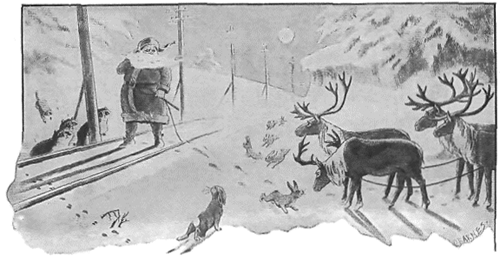 “safety first”
To Mother:
This is the kind of stories that the kindergartners call “cumulative,” or “repetitive.” They keep repeating and then adding to themselves until they are quite long. The repetition helps the children memorize them, and adding to them holds the children’s attention and interest.
You will find these very useful to read and teach to the little ones.
The Editors.
This is the house that Jack built.
This is the malt
That lay in the house that Jack built.
This is the rat,
That ate the malt,
That lay in the house that Jack built.
This is the cat,
That killed the rat,
That ate the malt,
That lay in the house that Jack built.
This is the dog,
That worried the cat,
That killed the rat,
That ate the malt,
That lay in the house that Jack built.
This is the cow with crumpled horn,
That tossed the dog,
That worried the cat,
That killed the rat,
That ate the malt,
That lay in the house that Jack built.
This is the maiden all forlorn,
That milked the cow with crumpled horn,
That tossed the dog,
That worried the cat,
That killed the rat,
That ate the malt,
That lay in the house that Jack built.
This is the man all tattered and torn,
That kissed the maiden all forlorn,
That milked the cow with crumpled horn,
That tossed the dog,
That worried the cat,
That killed the rat,
That ate the malt,
That lay in the house that Jack built.
This is the priest all shaven and shorn,
That married the man all tattered and torn,
That kissed the maiden all forlorn,
That milked the cow with crumpled horn,
That tossed the dog,
That worried the cat,
That killed the rat,
That ate the malt,
That lay in the house that Jack built.
This is the cock that crowed in the morn,
That waked the priest all shaven and shorn,
That married the man all tattered and torn,
That kissed the maiden all forlorn,
That milked the cow with crumpled horn,
That tossed the dog,
That worried the cat,
That killed the rat,
That ate the malt,
That lay in the house that Jack built.
This is the farmer sowing his corn,
That kept the cock that crowed in the morn,
That waked the priest all shaven and shorn,
That married the man all tattered and torn,
That kissed the maiden all forlorn,
That milked the cow with crumpled horn,
That tossed the dog,
That worried the cat,
That killed the rat,
That ate the malt,
That lay in the house that Jack built.
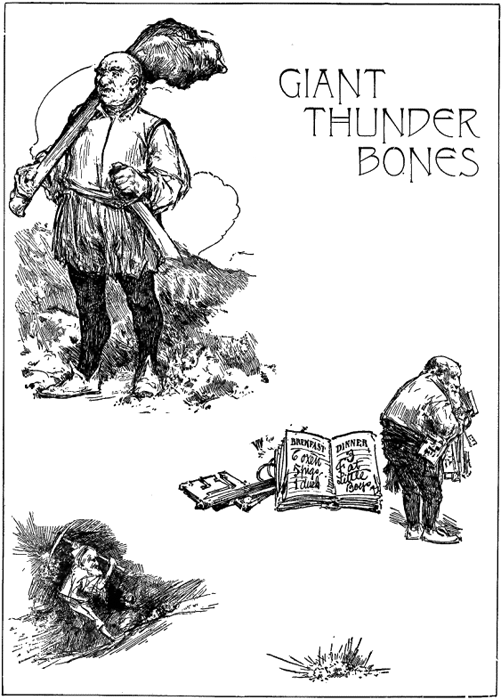
I
This is Giant
Thunder Bones.
II
This is the Dwarf with anxious looks
Who guarded the castle and kept the books
For Giant Thunder Bones.
III
This is the Gnome with beard so gray
Who digged for gems all night and day
To please the Dwarf with anxious looks
Who guarded the castle and kept the books
For Giant Thunder Bones.
IV
is the Princess of Wandeltreg
Who, while playing a game of Mumblepeg,
Was caught by the Gnome with beard so gray
Who digged for gems all night and day
To please the Dwarf with anxious looks
Who guarded the castle and kept the books
For Giant Thunder Bones.
V
HIS is the Prince so brave and
so grand
Who sailed over sea and
rode over land
Till he found the Princess of Wandeltreg
Who, while playing a game of Mumblepeg,
Was caught by the Gnome with beard so gray
Who digged for gems all night and day
To please the Dwarf with anxious looks
Who guarded the castle and kept the books
For Giant Thunder Bones.
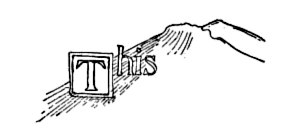
VI
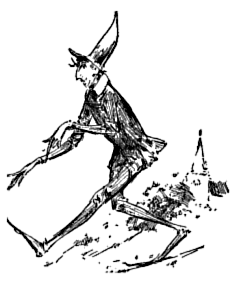
is the Goblin
with fingers so frail
Who hopped with ease
over mountain and dale
As he chased the Prince so brave and so grand
Who sailed over sea and rode over land
Till he found the Princess of Wandeltreg
Who, while playing a game of Mumblepeg,
Was caught by the Gnome with beard so gray
Who digged for gems all night and day
To please the Dwarf with anxious looks
Who guarded the castle and kept the books
For Giant Thunder Bones.
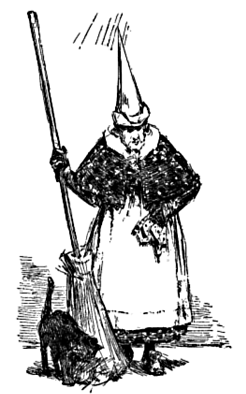
VII

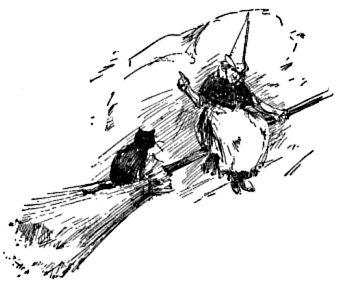
is the Witch with Broomstick and Cat
Who sputtered and snarled and
shook her tall hat
When she missed the Goblin with fingers so frail
Who hopped with ease over mountain and dale
As he chased the Prince so brave and so grand
Who sailed over sea and rode over land
Till he found the Princess of Wandeltreg
Who, while playing a game of Mumblepeg,
Was caught by the Gnome with beard so gray
Who digged for gems all night and day
To please the Dwarf with anxious looks
Who guarded the castle and kept the books
For Giant Thunder Bones.
VIII
last comes the Kobold who slept while ’twas light
And did all the housework in the dead of the night
To worry the Witch with Broomstick and Cat
Who sputtered and snarled and shook her tall hat
When she missed the Goblin with fingers so frail
Who hopped with ease over mountain and dale
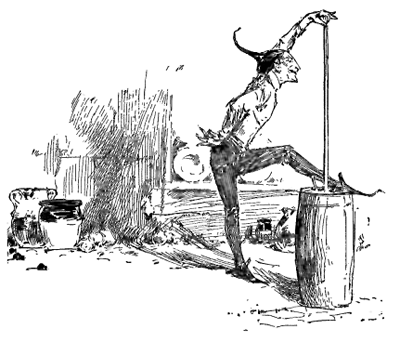
As he chased the Prince so brave and so grand
Who sailed over sea and rode over land
Till he found the Princess of Wandeltreg
Who, while playing a game of Mumblepeg,
Was caught by the Gnome with beard so gray
Who digged for gems all night and day
To please the Dwarf with anxious looks
Who guarded the castle and kept the books
For Giant Thunder Bones.
Stella Doughty.
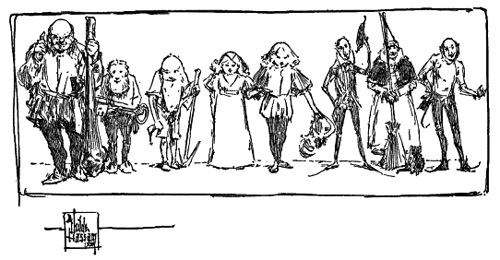
BY CAROLYN WELLS
This is the House that Jill built.
This is the Doll that lived in the House that Jill built.
This is the Cake that fed the Doll that lived in the House that Jill built.
This is the Oven that baked the Cake that fed the Doll that lived in the House that Jill built.
This is the Wood that heated the Oven that baked the Cake that fed the Doll that lived in the House that Jill built.
This is the Tree of a dusky shade that gave the Wood that heated the Oven that baked the Cake that fed the Doll that lived in the House that Jill built.
This is the Ax with a shining blade that chopped the Tree of a dusky shade that gave the Wood that heated the Oven that baked the Cake that fed the Doll that lived in the House that Jill built.
This is the Woodman sober and staid who slung the Ax with a shining blade that chopped the Tree of a dusky shade that gave the Wood that heated the Oven that baked the Cake that fed the Doll that lived in the House that Jill built.
This is the Horse that pranced and neighed when he saw the Woodman sober and staid who slung the Ax with a shining blade that chopped the Tree of a dusky shade that gave the Wood that heated the Oven that baked the Cake that fed the Doll that lived in the House that Jill built.
This is the Knight with the red cockade who rode on the Horse that pranced and neighed when he saw the Woodman sober and staid who slung the Ax with a shining blade that chopped the Tree of a dusky shade that gave the Wood that heated the Oven that baked the Cake that fed the Doll that lived in the House that Jill built.
This is the Lady in gay brocade who followed the Knight with the red cockade who rode on the Horse that pranced and neighed when he saw the Woodman sober and staid who slung the Ax with a shining blade that chopped the Tree of a dusky shade that gave the Wood that heated the Oven that baked the Cake that fed the Doll that lived in the House that Jill built.
This is the Glittering Cavalcade that rode after the Lady in gay brocade who followed the Knight with the red cockade who rode on the Horse that pranced and neighed when he saw the Woodman sober and staid who slung the ax with a shining blade that chopped the Tree of a dusky shade that gave the Wood that heated the Oven that baked the Cake that fed the Doll that lived in the House that Jill built.
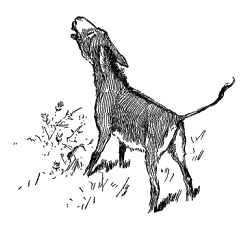
This is the Donkey who loudly brayed at sight of the Glittering Cavalcade that rode after the Lady in gay brocade who followed the Knight with the red cockade who rode on the Horse that pranced and neighed when he saw the Woodman sober and staid who slung the Ax with a shining blade that chopped the Tree of a dusky shade that gave the Wood that heated the Oven that baked the Cake that fed the Doll that lived in the House that Jill built.
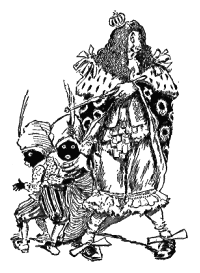
This is the King who was much dismayed to hear the Donkey who loudly brayed at sight of the Glittering Cavalcade that rode after the Lady in gay brocade who followed the Knight with the red cockade who rode on the Horse that pranced and neighed when he saw the Woodman sober and staid who slung the Ax with a shining blade that chopped the Tree of a dusky shade that gave the Wood that heated the Oven that baked the Cake that fed the Doll that lived in the House that Jill built.
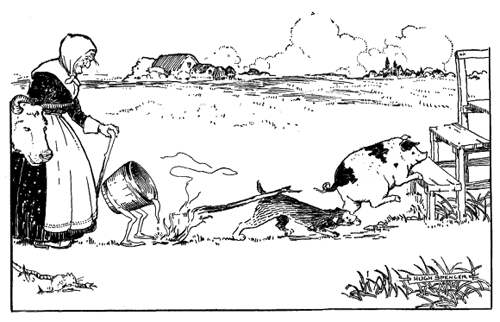
An old woman was sweeping her house, and she found a little crooked sixpence. “What,” said she, “shall I do with this little sixpence? I will go to market, and buy a little pig.”
As she was coming home, she came to a stile, but the piggy wouldn’t go over the stile.
She went a little further, and she met a dog. So she said to him: “Dog! dog! bite pig, piggy won’t go over the stile; and I shan’t get home to-night.” But the dog wouldn’t.
She went a little further, and she met a stick. So she said: “Stick! stick! beat dog! dog won’t bite pig; piggy won’t get over the stile; and I shan’t get home to-night.” But the stick wouldn’t.
She went a little further, and she met a fire. So she said: “Fire! fire! burn stick, stick won’t beat dog; dog won’t bite pig; piggy won’t get over the stile; and I shan’t get home to-night.” But the fire wouldn’t.
She went a little further, and she met some water. So she said: “Water! water! quench fire; fire won’t burn stick; stick won’t beat dog; dog won’t bite pig; piggy won’t get over the stile, and I shan’t get home to-night.” But the water wouldn’t.
She went a little further, and she met an ox. So she said: “Ox! ox! drink water; water won’t quench fire; fire won’t burn stick; stick won’t beat dog; dog won’t bite pig; piggy won’t get over the stile; and I shan’t get home to-night.” But the ox wouldn’t.
So she went a little further, and she met a butcher. So she said: “Butcher! butcher! kill ox; ox won’t drink water; water won’t quench fire; fire won’t burn stick, stick won’t beat dog, dog won’t bite pig; piggy won’t get over the stile; and I shan’t get home to-night.” But the butcher wouldn’t.
She went a little further, and she met a rope. So she said: “Rope! rope! hang butcher; butcher won’t kill ox; ox won’t drink water; water won’t quench fire; fire won’t burn stick; stick won’t beat dog; dog won’t bite pig; piggy won’t get over the stile, and I shan’t get home to-night!” But the rope wouldn’t.
She went a little further, and she met a rat. So she said: “Rat! rat! gnaw rope; rope won’t hang butcher; butcher won’t kill ox; ox won’t drink water; water won’t quench fire; fire won’t burn stick; stick won’t beat dog; dog won’t bite pig; piggy won’t get over the stile; and I shan’t get home to-night.” But the rat wouldn’t.
She went a little further, and she met a cat. So she said: “Cat! cat! kill rat; rat won’t gnaw rope; rope won’t hang butcher; butcher won’t kill ox; ox won’t drink water; water won’t quench fire; fire won’t burn stick, stick won’t beat dog; dog won’t bite pig; piggy won’t get over the stile; and I shan’t get home to-night.” But the cat said to her: “If you will go to yonder cow, and fetch me a saucer of milk, I will kill the rat.” So away went the old woman to the cow.
But the cow said to her: “If you will go to yonder hay-stack, and fetch me a handful of hay, I’ll give you the milk.” So away went the old woman to the hay-stack; and she brought the hay to the cow.
As soon as the cow had eaten the hay she gave the old woman the milk; and away she went with it in a saucer to the cat.
As soon as the cat had lapped up the milk, the cat began to kill the rat; the rat began to gnaw the rope; the rope began to hang the butcher; the butcher began to kill the ox; the ox began to drink the water; the water began to quench the fire; the fire began to burn the stick; the stick began to beat the dog; the dog began to bite the pig, the little pig in a fright jumped over the stile; and so the old woman got home that night.
[H] From “English Fairy Tales,” collected by Joseph Jacobs; used by permission of the publishers, G. P. Putnam’s Sons.
Once upon a time there was a wee, wee Lambikin, who frolicked about on his little tottery legs, and enjoyed himself amazingly. Now one day he set off to visit his Granny, and was jumping with joy to think of all the good things he should get from her, when whom should he meet but a Jackal, who looked at the tender young morsel and said: “Lambikin! Lambikin! I’LL eat YOU!”
But Lambikin only gave a little frisk, and said:
“To Granny’s house I go,
Where I shall fatter grow,
Then you can eat me so.”
The Jackal thought this reasonable, and let Lambikin pass.
By and by he met a Vulture, and the Vulture, looking hungrily at the tender morsel before him, said: “Lambikin! Lambikin! I’LL eat YOU!”
But the Lambikin only gave a little frisk, and said:
“To Granny’s house I go,
Where I shall fatter grow,
Then you can eat me so.”
The Vulture thought this reasonable, and let Lambikin pass.
And by and by he met a Tiger, and then a Wolf, and a Dog, and an Eagle; and all these, when they saw the tender little morsel, said: “Lambikin! Lambikin! I’LL eat YOU!”
But to all of them Lambikin replied, with a little frisk:
“To Granny’s house I go,
Where I shall fatter grow,
Then you can eat me so.”
At last he reached his Granny’s house, and said, all in a great hurry, “Granny dear, I’ve promised to get very fat, so, as people ought to keep their promises, please put me into the corn-bin at once.”
So his Granny said he was a good boy, and put him into the corn-bin, and there the greedy little Lambikin stayed for seven days, and ate, and ate, and ate, until he could scarcely waddle, and his Granny said he was fat enough for anything, and must go home. But cunning little Lambikin said that would never do, for some animal would be sure to eat him on the way back, he was so plump and tender.
“I’ll tell you what you must do,” said Master Lambikin; “you must make a little drumikin out of the skin of my little brother who died, and then I can sit inside and trundle along nicely, for I’m as tight as a drum myself.”
So his Granny made a nice little drumikin out of his brother’s skin, with the wool inside, and Lambikin curled himself up snug and warm in the middle, and trundled away gayly. Soon he met with the Eagle, who called out:
“Drumikin! Drumikin!
Have you seen Lambikin?”
And Mr. Lambikin, curled up in his soft, warm nest, replied:
“Fallen into the fire, and so will you,
On little Drumikin! Tum-pa, tum-too!”
“How very annoying!” sighed the Eagle, thinking regretfully of the tender morsel he had let slip.
Meanwhile Lambikin trundled along, laughing to himself, and singing.
“Tum-pa, tum-too;
Tum-pa, tum-too!”
Every animal and bird he met asked him the same question:
“Drumikin! Drumikin!
Have you seen Lambikin?”
And to each of them the little slyboots replied:
“Fallen into the fire, and so will you,
On little Drumikin! Tum-pa, tum-too;
Tum-pa, tum-too; Tum-pa, tum-too!”
Then they all sighed to think of the tender little morsel they had let slip.
At last the Jackal came limping along, for all his sorry looks as sharp as a needle, and he, too, called out:
“Drumikin! Drumikin!
Have you seen Lambikin?”
And Lambikin, curled up in his snug little nest, replied gayly:
“Fallen into the fire, and so will you,
On little Drumikin! Tum-pa——”
But he never got any farther, for the Jackal recognized his voice at once, and cried “Hullo! you’ve turned yourself inside out, have you? Just you come out of that!”
Whereupon he tore open Drumikin and gobbled up Lambikin.
[I] From “Indian Fairy Tales,” edited by Joseph Jacobs; used by permission of the publishers, G. P. Putnam’s Sons.
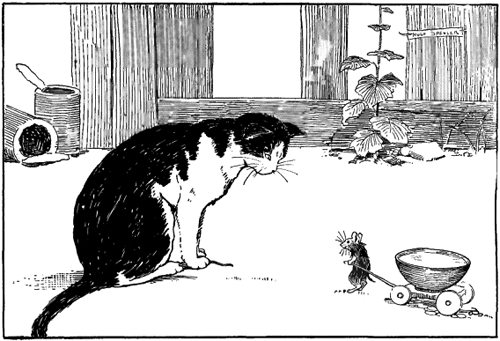
The cat and the mouse
Played in the malt-house:
The cat bit the mouse’s tail off. “Pray, puss, give me my tail.” “No,” says the cat, “I’ll not give you your tail, till you go to the cow, and fetch me some milk.”
First she leaped, and then she ran,
Till she came to the cow, and thus began:
“Pray, Cow, give me milk, that I may give cat milk, that cat may give me my own tail again.” “No,” said the cow, “I will give you no milk, till you go to the farmer, and get me some hay.”
First she leaped, and then she ran,
Till she came to the farmer, and thus began:
“Pray, Farmer, give me hay, that I may give cow hay, that cow may give me milk, that I may give cat milk, that cat may give me my own tail again.”[Pg 124] “No,” said the farmer, “I’ll give you no hay, till you go to the butcher and fetch me some meat.”
First she leaped, and then she ran,
Till she came to the butcher, and thus began:
“Pray, Butcher, give me meat, that I may give farmer meat, that farmer may give me hay, that I may give cow hay, that cow may give me milk, that I may give cat milk, that cat may give me my own tail again.” “No,” says the butcher, “I’ll give you no meat, till you go to the baker and fetch me some bread.”
First she leaped, and then she ran,
Till she came to the baker, and thus began:
“Pray, Baker, give me bread, that I may give butcher bread, that butcher may give me meat, that I may give farmer meat, that farmer may give me hay, that I may give cow hay, that cow may give me milk, that I may give cat milk, that cat may give me my own tail again.”
“Yes,” says the baker, “I’ll give you some bread,
But if you eat my meal, I’ll cut off your head.”
Then the baker gave mouse bread, and mouse gave butcher bread, and butcher gave mouse meat, and mouse gave farmer meat, and farmer gave mouse hay, and mouse gave cow hay, and cow gave mouse milk, and mouse gave cat milk, and cat gave mouse her own tail again.
[J] From “English Fairy Tales,” collected by Joseph Jacobs; used by permission of the publishers, G. P. Putnam’s Sons.
One day Henny-penny was picking up corn in the cornyard when—whack!—something hit her upon the head. “Goodness gracious me!” says Henny-penny; “the sky’s a-going to fall; I must go and tell the king.”
So she went along, and she went along, and she went along till she met Cocky-locky. “Where are you going, Henny-penny?” says Cocky-locky. “Oh! I’m going to tell the king the sky’s a-falling,” says Henny-penny. “May I come with you?” says Cocky-locky. “Certainly,” says Henny-penny. So Henny-penny and Cocky-locky went to tell the king the sky was falling.
They went along, and they went along, and they went along till they met Ducky-daddles. “Where are you going to, Henny-penny and Cocky-locky?” says Ducky-daddles. “Oh! we’re going to tell the king the sky’s a-falling,” says Henny-penny and Cocky-locky. “May I come with you?” says Ducky-daddles. “Certainly,” says Henny-penny and Cocky-locky. So Henny-penny, Cocky-locky, and Ducky-daddles went to tell the king the sky was a-falling.
So they went along, and they went along, and they went along till they met Goosey-poosey. “Where are you going to, Henny-penny, Cocky-locky, and Ducky-daddles?” says Goosey-poosey. “Oh! we’re going to tell the king the sky’s a-falling,” says Henny-penny, and Cocky-locky and Ducky-daddles. “May I come with you?” says Goosey-poosey. “Certainly,” says Henny-penny, Cocky-locky, and Ducky-daddles. So Henny-penny, Cocky-locky, Ducky-daddles, and Goosey-poosey went to tell the king the sky was a-falling.
So they went along, and they went along, and they went along till they met Turkey-lurkey. “Where are you going, Henny-penny, Cocky-locky, Ducky-daddles, and Goosey-poosey?” says Turkey-lurkey. “Oh! we’re going to tell the king the sky’s a-falling,” says Henny-penny, Cocky-locky, Ducky-daddles, and Goosey-poosey. “May I come with you, Henny-penny, Cocky-locky, Ducky-daddles, and Goosey-poosey?” says Turkey-lurkey. “Oh, certainly, Turkey-lurkey,” says Henny-penny, Cocky-locky, Ducky-daddies, and Goosey-poosey. So Henny-penny, Cocky-locky, Ducky-daddies, Goosey-poosey, and Turkey-lurkey all went to tell the king the sky was a-falling.
So they went along, and they went along, and they went along till they met Foxy-woxy, and Foxy-woxy says to Henny-penny, Cocky-locky, Ducky-daddles, Goosey-poosey, and Turkey-lurkey: “Where are you going, Henny-penny, Cocky-locky, Ducky-daddles, Goosey-poosey, and Turkey-lurkey?” And Henny-penny, Cocky-locky, Ducky-daddles, Goosey-Poosey, and Turkey-lurkey says to Foxy-woxy: “We’re going to tell the king the sky’s a-falling.” “Oh! but this is not the way to the king, Henny-penny, Cocky-locky, Ducky-daddles, Goosey-poosey, and Turkey-lurkey,” says Foxy-woxy; “I know the proper way; shall I show it you?” “Oh, certainly, Foxy-woxy,” says Henny-penny, Cocky-locky, Ducky-daddles, Goosey-poosey, and Turkey-lurkey. So Henny-penny, Cocky-locky, Ducky-daddles, Goosey-poosey, Turkey-lurkey, and Foxy-woxy all went to tell the king the sky was a-falling.
So they went along, and they went along, and they went along till they came to a narrow and dark hole. Now this was the door of Foxy-woxy’s cave. But Foxy-woxy says to Henny-penny, Cocky-locky, Ducky-daddies, Goosey-poosey, and Turkey-lurkey: “This is the short way to the king’s palace; you’ll soon get there if you follow me. I will go first and you come after, Henny-penny, Cocky-locky, Ducky-daddles, Goosey-poosey, and Turkey-lurkey,” “Why, of course, certainly, without doubt, why not?” says Henny-penny, Cocky-locky, Ducky-daddles, Goosey-poosey, and Turkey-lurkey.
So Foxy-woxy went into his cave, and he didn’t go very far, but turned round to wait for Henny-penny, Cocky-locky, Ducky-daddles, Goosey-poosey, and Turkey-lurkey. So at last Turkey-lurkey went through the dark hole into the cave. He hadn’t got far when “Hrumph!” Foxy-woxy snapped off [Pg 126] Turkey-lurkey’s head and threw his body over his left shoulder. Then Goosey-poosey went in, and “Hrumph!” off went her head and Goosey-poosey was thrown beside Turkey-lurkey. Then Ducky-daddles waddled down, and “Hrumph!” snapped Foxy-woxy, and Ducky-daddles’s head was off, and Ducky-daddles was thrown alongside Turkey-lurkey and Goosey-poosey. Then Cocky-locky strutted down into the cave, and he hadn’t gone far when “Snap, Hrumph!” went Foxy-woxy, and Cocky-locky was thrown alongside of Turkey-lurkey, Goosey-poosey, and Ducky-daddles.
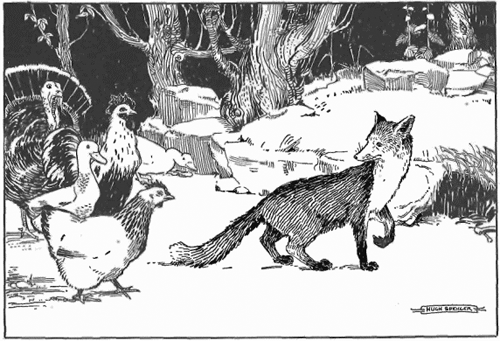 “this is the short way”
But Foxy-woxy had made two bites at Cocky-locky, and when the first snap only hurt Cocky-locky, but didn’t kill him, he called out to Henny-penny. But she turned tail and off she ran home, so she never told the king the sky was a-falling.
[K] From “English Fairy Tales,” collected by Joseph Jacobs; used by permission of the publishers, G. P. Putnam’s Sons.
ADAPTED BY CECILIA FARWELL
Once upon a time there was a little boy whose task it was to drive the goats to and from the hills. One morning, as they went along the road, the first goat saw a hole in the fence which shut off a field of rye.
“Oh,” said the first goat, “here is a chance to get into that field. I do not think that we want to eat rye—there is plenty of grass on the hill. But we can go in and see what it is like, just the same.”
With that he turned aside from the road and went through the hole into the ryefield, and the others followed after him.
“Here,” cried the boy, “come out of that!”
But the goats did not come out, so the boy climbed over the fence and started after them to chase them out. But the goats just ran round and round in the field, until at last the little boy was so tired that he sat down by the fence and cried.
By-and-by a dog came down the road. “Why, little boy,” he said, “what are you crying for?”
“I am crying because the goats will not come out of the ryefield. I was driving them along the road to the hills and they went through the fence, and I have chased them and chased them, and they will not come out.”
“Well,” said the dog, “that is nothing to cry about. Just you wait here and I will go into the field and chase them out for you.”
So the dog ran through the hole and started after the goats, barking loudly. When the goats saw him coming they started to run, and ran round and round in the field until at last the dog was so tired that he sat down by the fence and cried.
By-and-by a fox came trotting down the road. “Why, dog,” he said, “what are you crying for?”
“I am crying because little boy is crying,” said the dog.
“And what are you crying for, little boy?” asked the fox.
“I am crying because the goats will not come out of the ryefield. I was driving them along the road to the hills and they went through the fence, and I have chased them and chased them and they will not come out.”
“Well,” said the fox, “that is nothing to cry about. Just you wait here and I will go into the field and chase them out for you.”
So the fox ran through the hole and started after the goats, barking shrilly. And when they saw him coming they started to run, and ran round [Pg 128] and round in the field until at last the fox was so tired that he sat down by the fence and cried.
By-and-by a bee came flying lightly overhead.
“Why, fox,” he said, “why are you crying?”
“I am crying because dog is crying,” said the fox.
“And why are you crying, dog?” asked the bee.
“I am crying because little boy is crying,” said the dog.
“And why are you crying, little boy?” asked the bee.
“I am crying because the goats will not come out of the ryefield. I was driving them along the road to the hills, and they went through the fence, and I have chased them and chased them and they will not come out!”
“Oh,” said the bee, “that is nothing to cry about. Just you wait here and I will go into the field and chase them out for you.”
So he flew over the fence and flew straight to the first goat and began to buzz in his ear. The first goat lifted up his head and said: “Ho! What is this?” and he looked all around him, but could see nothing from which to run.
“Buzz, buzz, buzz!” said the bee, and he lighted on the ear of the goat.
“Now here is someone that means business,” said the goat, and he shook his head to shake off the bee, but the bee only clung the tighter.
“Buzz, buzz, buzz!” he said. Then he stung the first goat in the ear. “Now,” said the first goat, “this is a serious matter. Ouch!” he added, as the bee stung him again. “Come on, you,” he called to the others, “it is time to get out of here!” With that he led them straight to the hole in the fence, and they ran through it, all three of them, and out into the road where the little boy sat with the dog and the fox.
“Oh,” said the dog, “the bee can do something that I cannot, even if he is so small.”
“Yes,” said the fox, “the bee didn’t make much noise, but the noise that he did make counted more than all of our barking.”
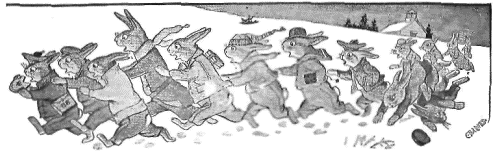 little bunnie brown is at the head of his class
There was once upon a time a teeny-tiny woman who lived in a teeny-tiny house in a teeny-tiny village. Now, one day this teeny-tiny woman put on her teeny-tiny bonnet and went out of her teeny-tiny house to take a teeny-tiny walk. And when this teeny-tiny woman had gone a teeny-tiny way, she came to a teeny-tiny gate; so the teeny-tiny woman opened the teeny-tiny gate, and went into a teeny-tiny meadow. And when this teeny-tiny woman had got into the teeny-tiny meadow, she saw a teeny-tiny bone on a teeny-tiny stone, and the teeny-tiny woman said to her teeny-tiny self: “This teeny-tiny bone will make me some teeny-tiny soup for my teeny-tiny supper.” So the teeny-tiny woman put the teeny-tiny bone into her teeny-tiny pocket, and went home to her teeny-tiny house.
Now, when the teeny-tiny woman got home to her teeny-tiny house, she was a teeny-tiny bit tired; so she went up her teeny-tiny stairs to her teeny-tiny bed, and put the teeny-tiny bone into a teeny-tiny cupboard. And when this teeny-tiny woman had been to sleep a teeny-tiny time, she was awakened by a teeny-tiny voice from the teeny-tiny cupboard, which said:
“give me my bone!”
And this teeny-tiny woman was a teeny-tiny bit frightened, so she hid her teeny-tiny head under the teeny-tiny clothes, and went to sleep again. And when she had been asleep again a teeny-tiny time, the teeny-tiny voice again cried out from the teeny-tiny cupboard a teeny-tiny louder:
“Give Me My Bone!”
This made the teeny-tiny woman a teeny-tiny more frightened, so she hid her teeny-tiny head a teeny-tiny further under the teeny-tiny clothes. And when the teeny-tiny woman had been asleep again a teeny-tiny time, the teeny-tiny voice from the teeny-tiny cupboard said again a teeny-tiny louder:
“GIVE ME MY BONE!”
At this the teeny-tiny woman was a teeny-tiny bit more frightened; but she put her teeny-tiny head out of the teeny-tiny clothes, and said in her loudest teeny-tiny voice:
“TAKE IT!”
[L] From “English Fairy Tales,” collected by Joseph Jacobs; used by permission of the publishers, G. P. Putnam’s Sons.
Out in the green, green orchard
Standeth a fine pear tree;
The fine pear tree has leaves, too.
What on the tree may be?
Why, there’s a beautiful branch,
Branch on the tree,
Tree in the ground.
Out in the green, green orchard
Standeth a fine pear tree,
The fine pear tree has leaves, too,
And what on its branch may be?
A beautiful twig.
Twig on the branch,
Branch on the tree,
Tree in the ground.
Out in the green, green orchard
Standeth a fine pear tree,
The fine pear tree has leaves, too.
Now what on the twig may be?
A beautiful nest.
Nest on the twig,
Twig on the branch,
Branch on the tree,
Tree in the ground.
Out in the green, green orchard
Standeth a fine pear tree;
The fine pear tree has leaves, too.
Now, what in the nest may be?
A beautiful egg.
Egg in the nest,
Nest on the twig,
Twig on the branch,
Branch on the tree,
Tree in the ground.
Out in the green, green orchard
Standeth a fine pear tree,
The fine pear tree has leaves, too.
Now, what from the egg shall we see?
A beautiful bird.
Bird from the egg,
Egg in the nest,
Nest on the twig,
Twig on the branch,
Branch on the tree,
Tree in the ground.
Out in the green, green orchard
Standeth a fine pear tree;
The fine pear tree has leaves, too.
Now, what on the bird may be?
A beautiful feather.
Feather on the bird,
Bird from the egg,
Egg in the nest,
Nest on the twig,
Twig on the branch,
Branch on the tree,
Tree in the ground.
Out in the green, green meadow
Standeth a fine pear tree;
The fine pear tree hath leaves, too.
Now, what from the feather will be?
A beautiful bed.
Bed from the feather,
Feather from the bird,
Bird from the egg,
Egg in the nest,
Nest on the twig,
Twig on the branch,
Branch on the tree,
Tree in the ground.
Out in the green, green meadow
Standeth a fine pear tree;
The fine pear tree hath leaves, too.
Now, what in that bed may be?
A beautiful child.
Child in the bed,
Bed from the feather,
Feather from the bird,
Bird from the egg,
Egg from the nest,
Nest on the twig,
Twig on the branch,
Branch on the tree,
Tree in the ground.
Out in the green, green meadow
Standeth a fine pear tree,
The fine pear tree hath leaves, too,
And on it these things all be.
BY MARY HOWITT
In this tale is shown to you
How large the boast of Cock-alu;
But, when he comes to act, you’ll see
Small hope indeed for Hen-alie;
And thus you clearly will perceive
That who has great things to achieve
Must not stand talking but must do,
Else he will fail like Cock-alu.
For he who would perform the most
Will utter no vainglorious boast;
But still press onward, staunch and true,
With but the honest end in view.
Cock-alu and Hen-alie sat on the perch above the bean-straw. It was four o’clock in the morning, and Cock-alu clapped his wings and crowed; then, turning to Hen-alie, he said: “Hen-alie, my little wife, I love you better than all the world, you know I do. I always told you so! I will do anything for you; I’ll go round the world for you, I’ll travel as far as the sun for you! You know I would! Tell me, what shall I do for you?”
“Crow!” said Hen-alie.
“Oh, that is such a little thing!” said Cock-alu, and crowed with all his might. He crowed so loud that he woke the farmer’s wife, and the dog and the cat, and all the pigeons and horses in the stable, and the cow in the stall. He crowed so loud that all the neighbors’ cocks heard him and answered him, and they woke all their people; and thus Cock-alu woke the whole parish.
“I’ve done it rarely this morning!” said Cock-alu; “I told you I would do anything to please you!”
The next morning, at breakfast, as Hen-alie was picking beans out of the bean-straw, one stuck in her throat; and she was soon so ill that she was just ready to die.
“Oh, Cock-alu,” said she, calling to him in the yard, where he stood [Pg 132]clapping his wings in the sunshine, “run and fetch me a drop of water from the silver-spring in the Beech-wood! Fetch me a drop quickly, while the dew is in it; for that is the true remedy.”
But Cock-alu was so busy crowing against a neighbor that he took no notice.
“Oh, Cock-alu, do run and fetch me the water from the silver-spring, or I shall die; for the bean sticks in my throat, and nothing but water with dew in it can cure me! Oh, Cock-alu, dear, run quickly!”
Cock-alu heard her this time, and set off, crowing as he went. He had not gone far before he met the snail.
“Where are you going, snails?” says he.
“I’m going to the cow-cabbage,” says the snail; “and what urgent business may it be that takes you out thus early, Cock-alu?” says the snail.
“I’m going to the silver-spring in the Beech-wood, to fetch a drop of water for my wife, Hen-alie, who has got a bean in her throat,” says Cock-alu.
“Oh,” says the snail, “run along quickly, and get the water while the dew is in it; for nothing else will get a bean out of the throat. Don’t stop by the way, for the bull is coming down to the silver-spring to drink, and he’ll trouble the water. Gather up my silver-trail, however, and give it to Hen-alie with my love, and I hope she’ll soon be better!”
Cock-alu hastily gathered up the silver-trail which the snail left. “This will make Hen-alie a pair of stockings!” said he, and went on his way.
He had not gone far before he met the wood-pigeon. “Good morning, pigeon,” says he; “and which way are you going?”
“I am going to the pea-field,” says the pigeon, “to get peas for my young ones; and what may your business be this morning, Cock-alu!”
“I’m going to the silver-spring in the Beech-wood, to fetch a drop of water for my wife, Hen-alie, who has got a bean in her throat.”
“I’m sorry to hear that,” says the pigeon; “but don’t let me detain you, for water with the dew in it is the best thing to get a bean out of the throat; and let me advise you to make haste, for the bloodhound is going to lap at the spring, and he’ll trouble the water. So run along, and here, take with you my blue velvet neck-ribbon, and give it to Hen-alie with my love, and I hope she’ll soon be better.”
“Oh, what a nice pair of garters this will make for Hen-alie!” exclaimed Cock-alu, and went on his way.
He had not gone far before he met the wild-cat. “Good morning, friend,” says Cock-alu, “and where may you be going this morning?”
“I’m going to get a young wood-pigeon for my breakfast, while the mother is gone to the pea-field,” says the wild-cat; “and where may you be traveling to this morning, Cock-alu?”
“I’m going to the silver-spring in the Beech-wood,” replied Cock-alu, “to get a drop of water for my little wife Hen-alie, who has got a bean in her throat.”
“That’s a bad business,” says the wild-cat, “but a drop of water with the dew in it is the right remedy; so don’t let me keep you; and you had better make haste, for the woodman is on his way to fell a tree by the spring, and if a branch falls into it, the water will be troubled; so off with you! But carry with you a flash of green fire from my right eye, and give it to Hen-alie with my love, and I hope she’ll soon be better.”
“Oh, what a beautiful green light, like the green on my best tail-feathers! I’ll keep it for myself; it’s fitter for me than for Hen-alie!” said Cock-alu.
So he hung the green light on his tail-feathers, which made them very handsome, and he went on his way.
He had not gone far before he met with the sheep-dog. “Good morning, sheep-dog,” says Cock-alu; “where are you going?”
“I’m going to hunt up a stray lamb for my master,” says the sheep-dog, “and what brings you abroad?”
“I’m going to the silver-spring in the Beech-wood, to get a drop of water for my little wife Hen-alie, who has got a bean in her throat,” says Cock-alu.
“Then why do you stop talking to me?” says the sheep-dog, in his short way; “your wife’s bad enough, I’ll warrant me; and a drop of water with the dew in it is the thing to do her good. Be off with you! The farmer is coming to lay the spring dry this morning. I left him sharpening his mattock when I set out. You’ll be too late, if you don’t mind!” and with that the sheep-dog went his way.
“An unmannerly fellow,” says Cock-alu, and stood looking after him; “I’ll not go at his bidding, not I!” So he clapped his wings and crowed in the wood, just to show that he set light by his advice. “And never to give me anything for poor Hen-alie, that lies sick at home with a bean in her throat! The ill-natured churl!” cried Cock-alu to himself, and then he stood and crowed again with all his might.
After that he marched on, and before long reached the Beech-wood, but as the silver-spring lay yet a good way off, he had not gone far in the wood before he met the squirrel.
“Good morning, squirrel,” says he; “what brings you abroad so early?”
“Early do you call it, Cock-alu?” says the squirrel; “why, I’ve been up these four hours; I just stopped to give the young ones their breakfasts, and then set off to silver-spring for a drop of water while the dew was in it; I’ve got it here in a cherry-leaf. And pray you, what business may take you abroad, Cock-alu?”
“The same as yours,” replied Cock-alu; “I’m going for water, too, for my wife Hen-alie, who has got a bean in her throat.”
“Ah, well-a-day!” says the squirrel, “that’s a bad thing! But run along with you; for the old sow is coming down with her nine little pigs, and if they trouble the water it will be all too late for poor little Hen-alie!”
And with that the squirrel leaped up into the oak-tree above where Cock-alu stood, for that was her way home, and left him without further ceremony.
“Humph!” said Cock-alu; “she might have given me some of the water out of her cherry-leaf for my poor little Hen-alie!” And so saying, he walked on through the Beech-wood, and as he met no more creatures he soon reached the silver-spring.
But it was now noon-day, and there was not a drop of dew in the water, and the bull had been down and drunk, and the bloodhound had lapped, and the old sow and her nine little pigs had wallowed in it, so the water was troubled, and besides that the woodman had felled the tree which now lay across the spring, and the farmer was digging the new watercourse, so the spring was getting lower every minute. Cock-alu had come quite too late; there was not a drop left for poor little Hen-alie.
When Cock-alu saw this he was very much disconcerted; he did not know what to do, he stood a little while considering, and then he set off as hard as he could go to the squirrel’s house to beg a drop of water from her. But the squirrel lived a long way off in the wood, and thus it was a considerable time before he got there.
When he reached the squirrel’s house, however, nobody was at home. He knocked and knocked for a long time, and at last he walked in, but they were all gone out; he peeped therefore into the pantry to see if he could find the water; there was plenty of hazel-nuts and beech-nuts, heaps and heaps of them all laid up in store for winter, but no water; at length he saw the curled-up cherry-leaf, like a water-jug, standing at the squirrel’s bed-side, but it was empty; there was not a single drop in it.
“This is bad business!” said Cock-alu to himself, and turned to leave the house. At the squirrel’s door he met a woodpecker.
“Woodpecker,” says he, “where is the squirrel gone to? I want to beg a drop of water from the silver-spring for my wife Hen-alie, who has got a bean in her throat!”
“Lack-a-day!” said the woodpecker, “the old squirrel drank every drop, and drained the jug into the bargain; he lay sick in bed this morning, but there was such virtue in the water that he got well as soon as he drank it; and now he has taken his wife and the little ones out for an airing; they will not be back till night, I know. But if you will leave any message with me I will be sure and deliver it, for the squirrel and I are very neighborly.”
“Oh!” groaned Cock-alu; “but what would be the use of leaving a message if they have no water to give me!”
With that he came down from the old pine tree where the squirrel lived, set out on his way home again, and came at length out of the Beech-wood, but it was then getting toward evening.
He came to his own yard. There was the perch on which he and Hen-alie had so often sat, and there was the bean-straw, and there lay poor Hen-alie just as he had left her.
“Hen-alie, my little wife,” said he, crowing loudly as he came up, that he might put a cheerful face on the matter, “I have been very unlucky; I could not get you any water, but I have got something so nice for you! I have brought you a pair of silver-gauze stockings which the snail has sent you, and a pair of blue velvet garters to wear with them, which the ring-tail dove gave me!”
“Thank you,” said poor little Hen-alie, in a very weak voice, “but I wish you could have brought me some water, these things will do me no good!”
“I could not bring you water, for the silver-spring is dry,” said Cock-alu, feeling very unhappy, and yet wishing to excuse himself; “there’s not a drop of water left in it!”
“Then it’s all over with me!” sighed poor little Hen-alie.
“Don’t be down-hearted, my little wife,” said Cock-alu, trying to seem cheerful, “I will give you something better than all, I will give you the green-fire flash from the wild-cat’s eye, which he gave me to wear on my tail-feathers. Look up, my poor little Hen-alie, and I’ll give it all to you!”
“Alas!” sighed poor little Hen-alie, “what good will they do me! Oh, that somebody only loved me well enough to have brought me one drop of silver-spring water!”
All this while something very nice was happening, which I must tell you.
There was in the poultry-yard a shabby little drab-colored hen, very small and very much despised; Cock-alu would not look at her, nor Hen-alie either; she had no tail-feathers at all, and long black legs which looked as if she had borrowed them from a hen twice her size; she was, in short, the meanest, most ill-conditioned hen in the yard.
All the time, however, that Cock-alu was out on his fruitless errand, she had been comforting Hen-alie in the best way she could, and assuring her that Cock-alu would soon be back again with the water from the silver-spring. But when he came back without a single drop, and only offered the fine silk stockings and blue velvet garters instead, she set off, without saying a word, as fast as her long legs would carry her out of the wood and down to the silver-spring, which she reached in a wonderfully short time.
Fortunately the silver-spring had flowed into its new channel as clearly as ever, and the evening dew had dropped its virtues into it. The owls were shouting “Kla-vit!” from one end of the wood to the other, The dark leathern-winged bats and the dusky white and buff-colored moths were flitting about the broad shadows of the trees, but the little hen took no notice of any of them. On she went, thinking of nothing but that which she had to do; and reaching the silver-spring, she gathered up twelve drops of water, and, hurrying back again, came into the yard just as poor Hen-alie was saying: “Oh, that somebody had loved me well enough to fetch me only one drop of silver-spring water!”
“That I do!” said the shabby little hen, and dropped one drop after another into her beak.
The first drop loosened the bean, the second softened it, and the third sent it down her throat.
Hen-alie was well again; Cock-alu was ready to clap his wings and crow for joy; and the little hen turned quietly away to her solitary perch.
“Nay,” said Hen-alie, “but you shall not go unrewarded; see, here is a pair of silk stockings for you, and here is green fire which will make the most beautiful feathers in the world grow all over your body! Take them all, you good little thing, and to-morrow morning you will come out the handsomest hen in the yard!”
So it was. There must have been magic in those silk stockings and that green fire, for the shabby little thing was now transformed into a regular queen-hen. The farmer’s wife thought she must have strayed away from some beautiful foreign country, and gave her a famous breakfast to keep her. Cock-alu was very attentive to her; and as to Hen-alie, she never ceased singing her praises as long as she lived.
There is the key of the Kingdom.
In that Kingdom there is a city;
In that city there is a town;
In that town there is a street;
In that street there is a lane;
In that lane there is a yard;
In that yard there is a house;
In that house there is a room;
In that room there is a bed;
On that bed there is a basket;
In that basket there are some flowers.
Flowers in the basket,
Basket on the bed,
Bed in the room,
Room in the house,
House in the yard,
Yard in the lane,
Lane in the street,
Street in the town,
Town in the city,
City in the Kingdom,
And this is the key of the Kingdom.
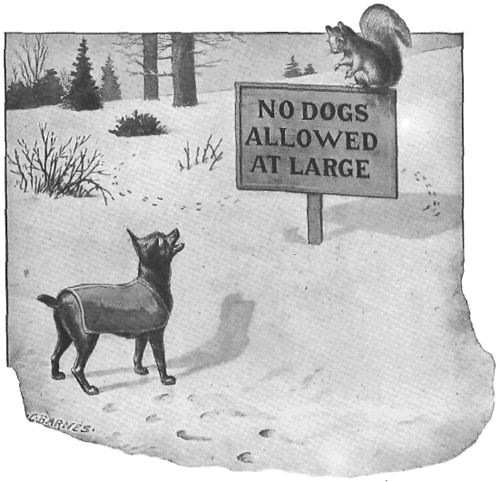 bunnie: “you see what it says on this sign? now stop your
barking and go right away or i’ll call a policeman!”
bunnie: “you see what it says on this sign? now stop your
barking and go right away or i’ll call a policeman!”
BY DEWITT CLINTON FALLS
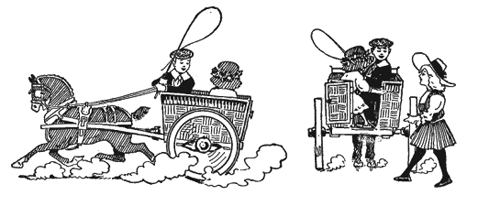
Tommy took his sister out in their new pony-cart for a ride.
They met a little friend very soon, and asked her to ride, too.
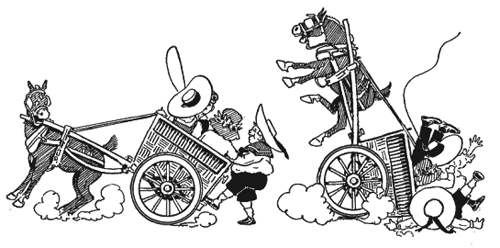
Then Billie came along and of course they had to invite him.
But they had forgotten how fat Billie was, so their ride ended very suddenly!
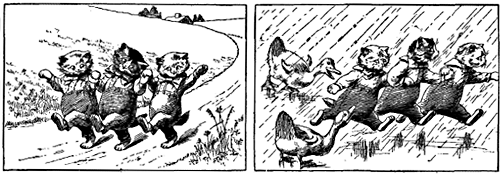
“hurrah! we are going to see the world!”
“oh dear, this is dreadful!”
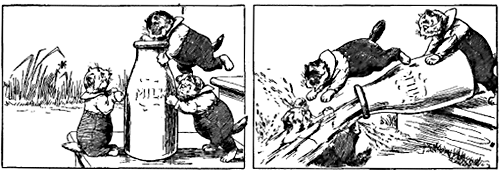
“yes, it is sweet milk; it’s your turn next.”
but they made such a noise that—
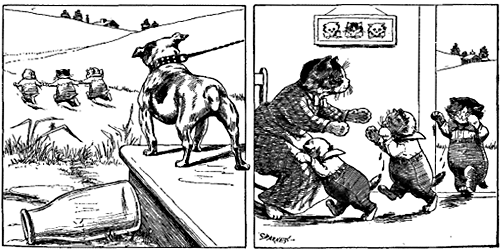
jack came out and so frightened them that—
they ran home as fast as they could go.
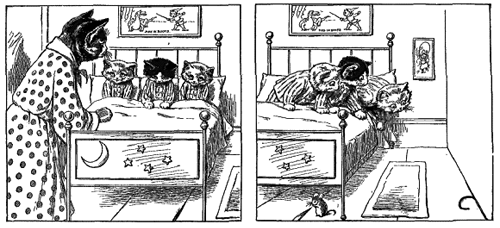
i. “now kitties, lie down and go to sleep.”
ii. “what’s that noise? see! a mouse tail!”
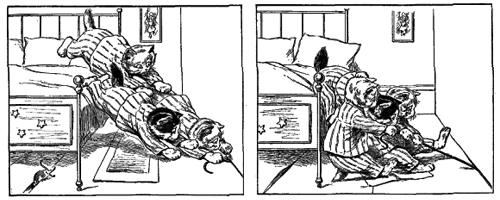
iii. they make a dash for the door, and—
begin to pull.
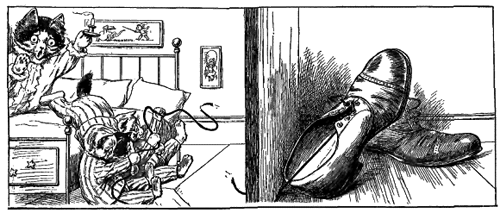
now, “all together!”—
but this is what it was.
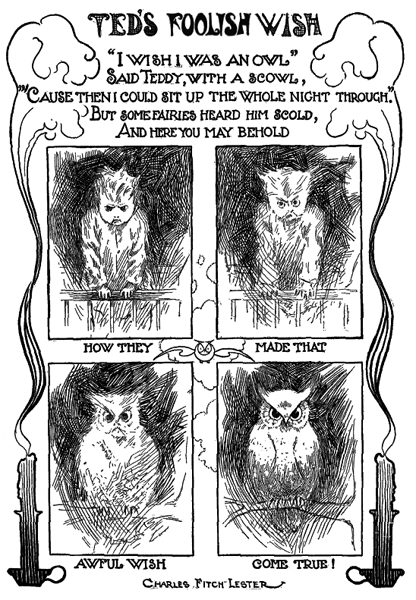
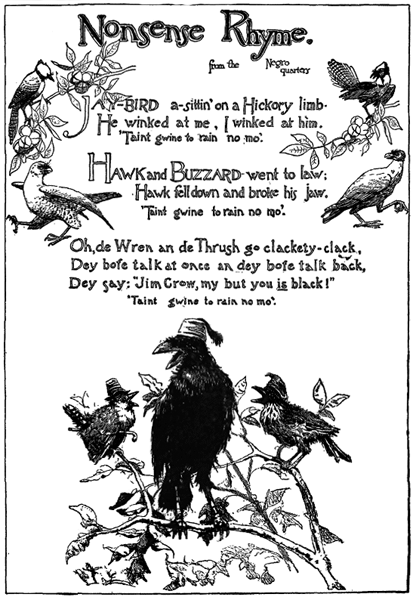
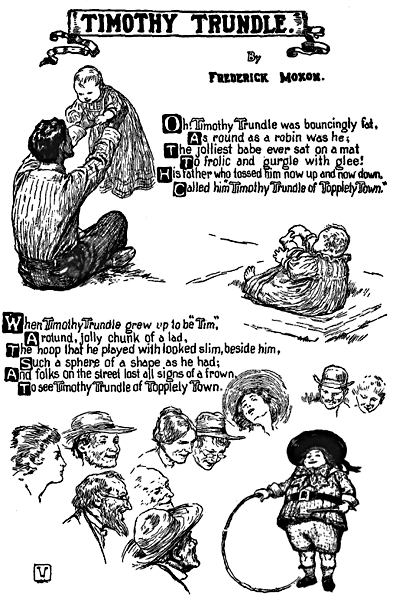
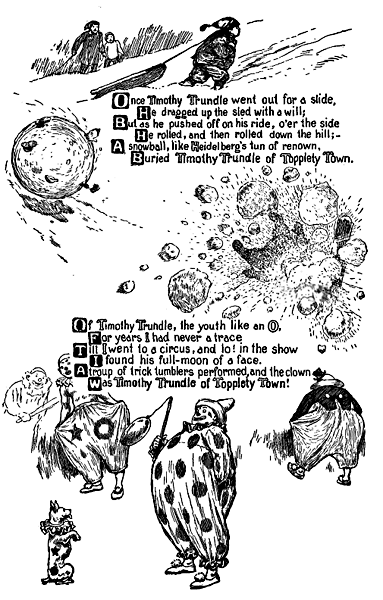
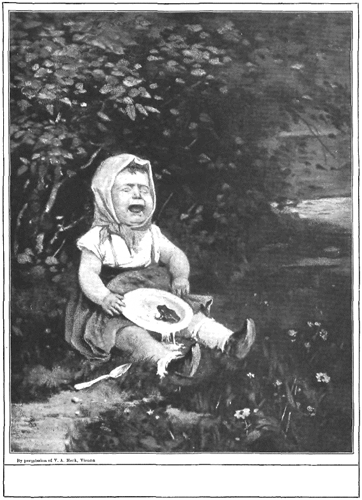
an unwelcome guest
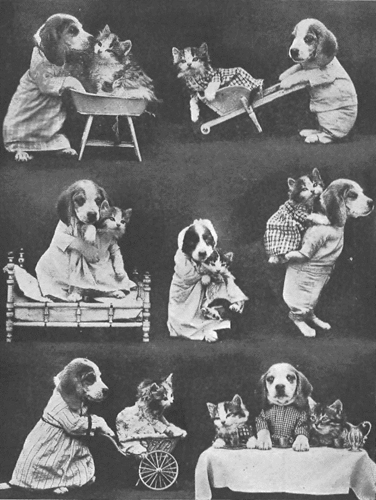
playmates
from photographs by harry w. frees
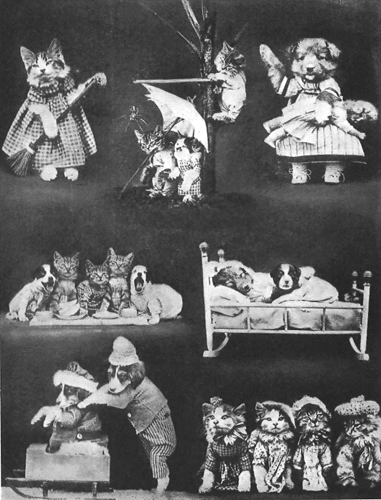
more playmates
from photographs by harry w. frees
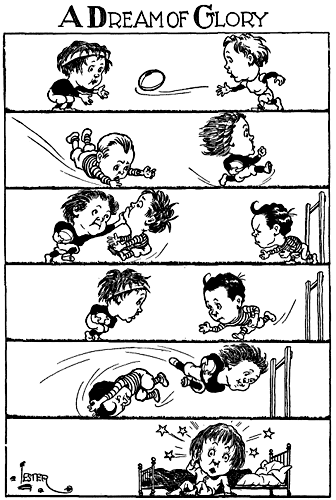
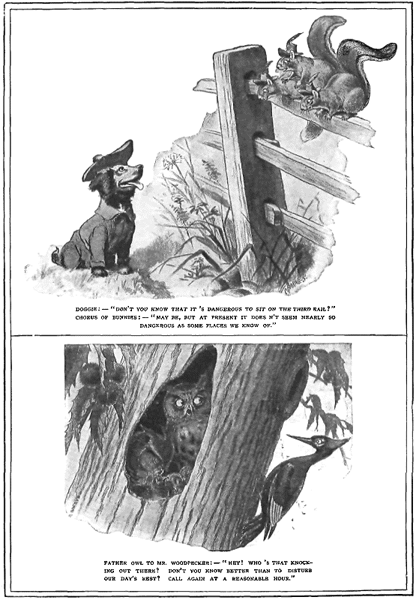
Top:
doggie:——“don’t you know that it’s dangerous to sit on the third rail?”
chorus of bunnies:——“may be, but at present it doesn’t seem nearly so
dangerous as some places we know of.”
Bottom: father owl to mr. woodpecker:——“hey! who’s that knocking out there? don’t you know better than to disturb our day’s rest? call again at a reasonable hour.”
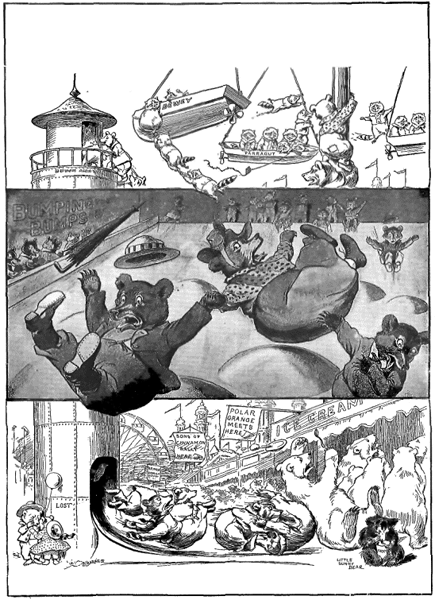
THE REUNION OF THE BRUIN FAMILY
AT THE SEA SHORE.
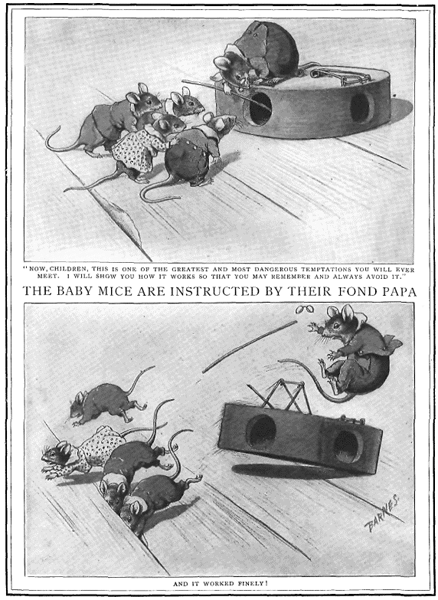
Top: “now, children, this is one of the greatest and most dangerous temptations you will ever meet. i will show you how it works so that you may remember and always avoid it.”
THE BABY MICE ARE INSTRUCTED BY THEIR FOND PAPA
Bottom: and it worked finely!
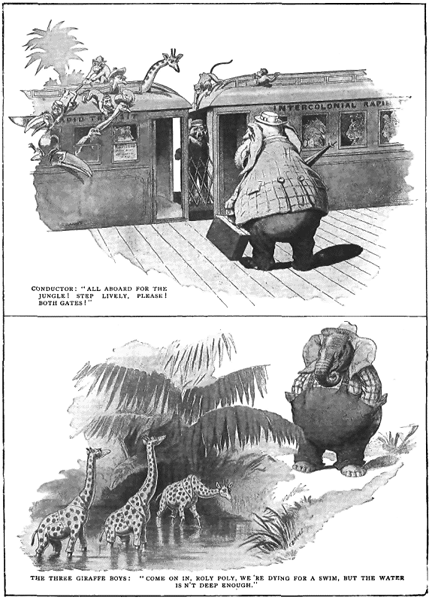
ROLY POLY ON VACATION
drawn by culmer barnes
Top: conductor: “all aboard for the jungle! step lively, please! both gates!”
Bottom: the three giraffe boys: “come on in, roly poly, we’re dying for a swim, but the water isn’t deep enough.”
 on a runaway car: “here, you, conductor. i want a transfer and i want it
NOW!”
on a runaway car: “here, you, conductor. i want a transfer and i want it
NOW!”
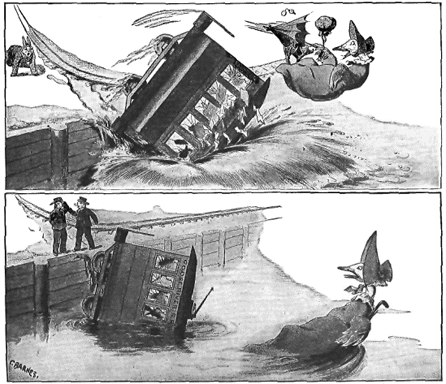 mother goose: “lucky for you i fell in the water. i’ll never trust
myself on land again as long as i live.”
mother goose: “lucky for you i fell in the water. i’ll never trust
myself on land again as long as i live.”
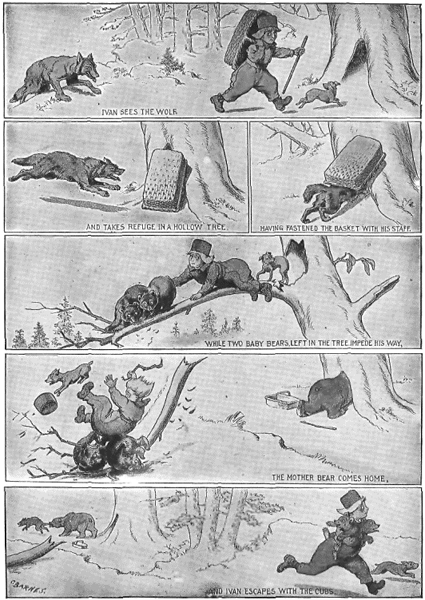
From top:
- ivan sees the wolf
- and takes refuge in a hollow tree
- having fastened the basket with his staff.
- while two baby bears left in the tree impede his way,
- the mother bear comes home,
- and ivan escapes with the cubs.
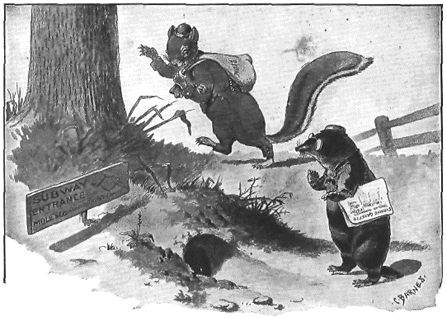 mr. bunnie: “come, mr. moley, try the elevated road, once.”
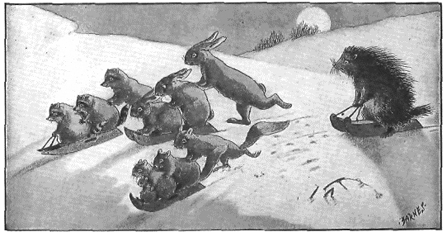 the fretful porcupine: “huh! nobody ever gives me a boost!”
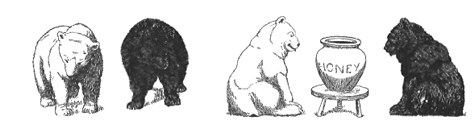
1. two bears on mischief bound
2. a big jar of honey found.
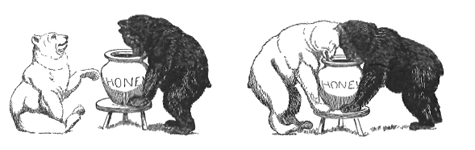
3. before they made a better plan
4. both to eat at once began.
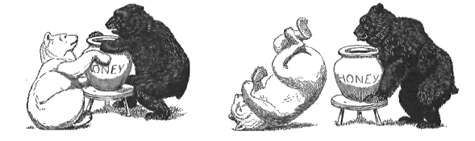
5. whitey bumped on bruin’s crown;
6. bruin then pushed whitey down.
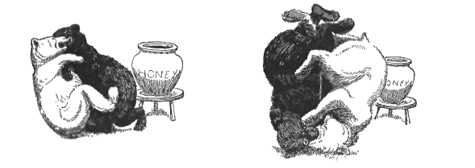
7. this to rough and tumble led,
8. till they were heels over head.
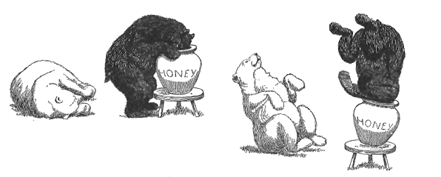
9. bruin thought he was in clover;
10. whitey came and turned him over.
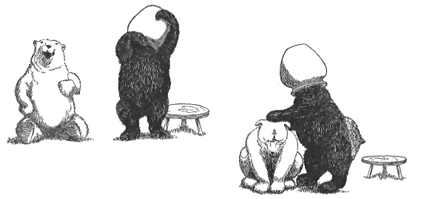
11. then did whitey roar with laughter,
12. not aware what’s coming after—
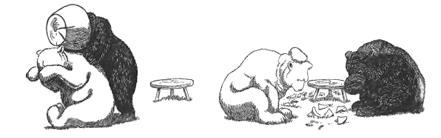
13. the jar is broken on his head;
14. jar and honey both are fled!

15. sad and sorry,
very slow,
see the comrades
homeward go.
An Arctic Story in Four Chapters
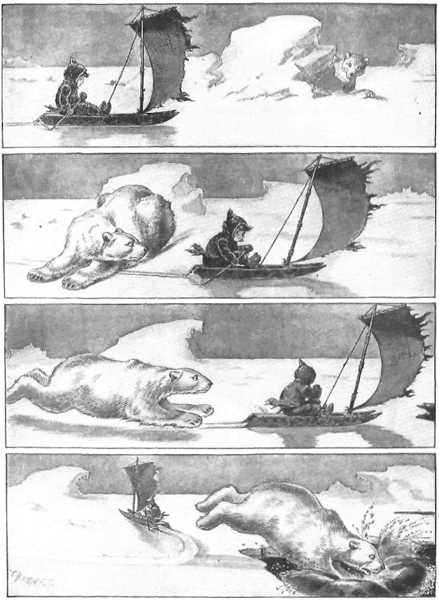
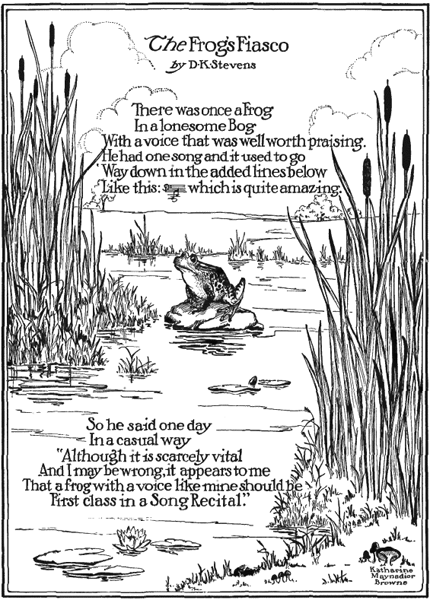
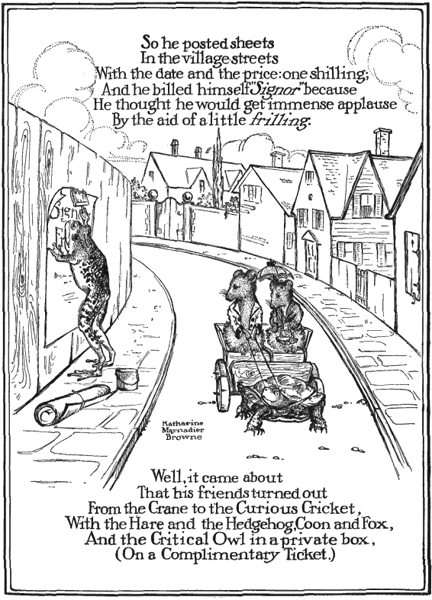
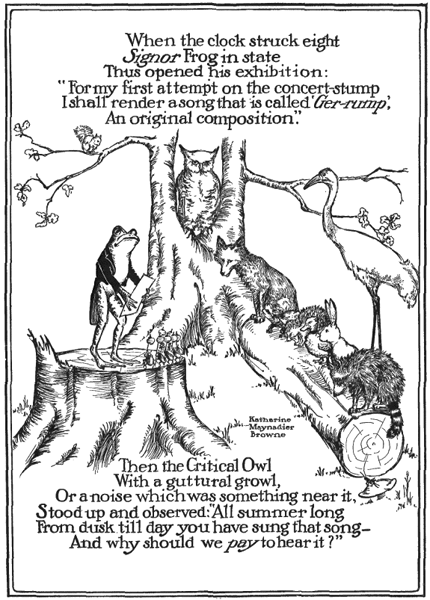
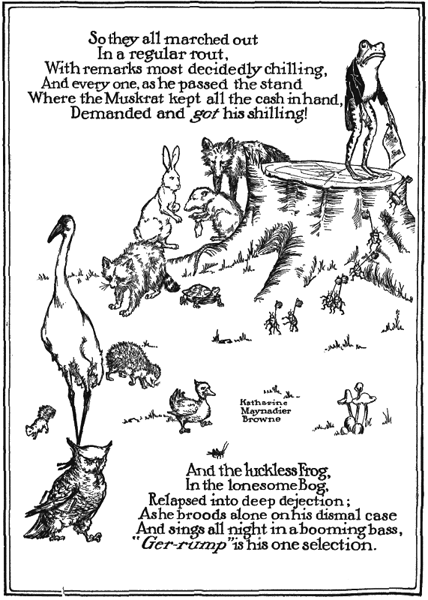
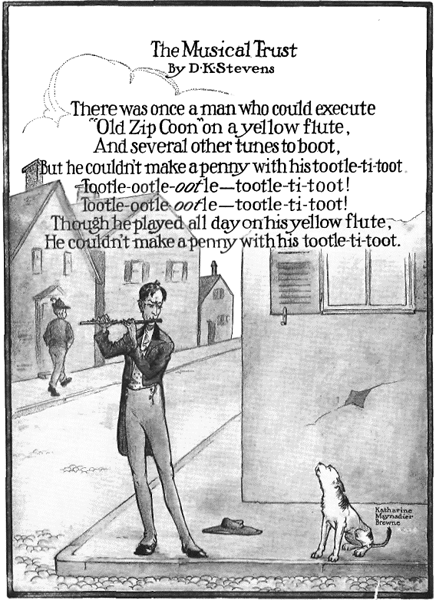
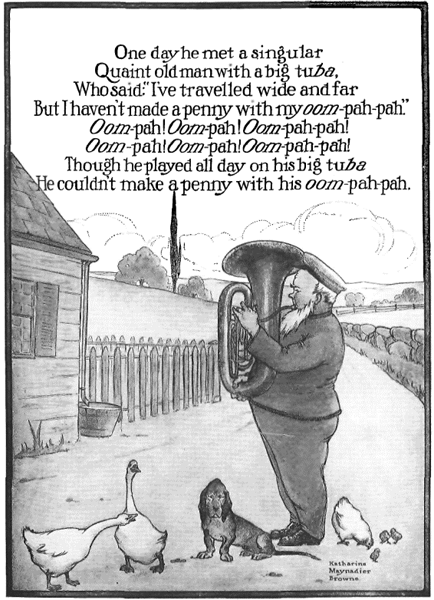
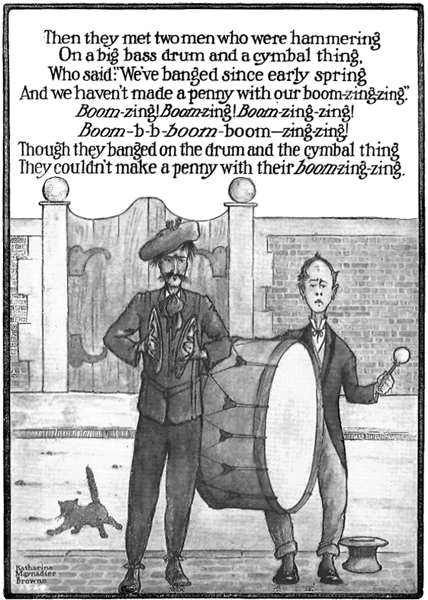
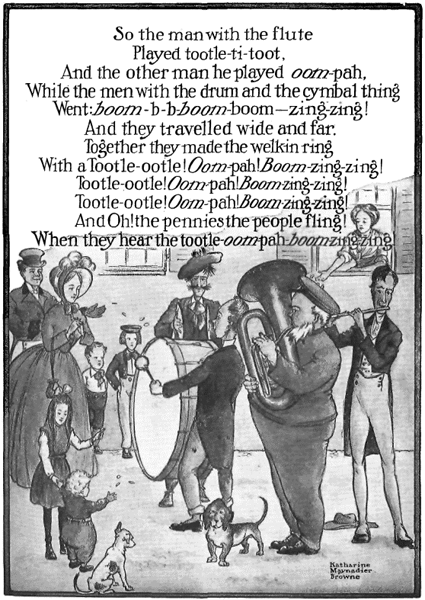
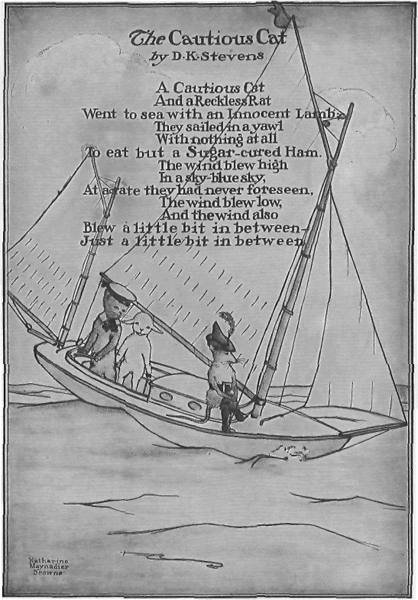
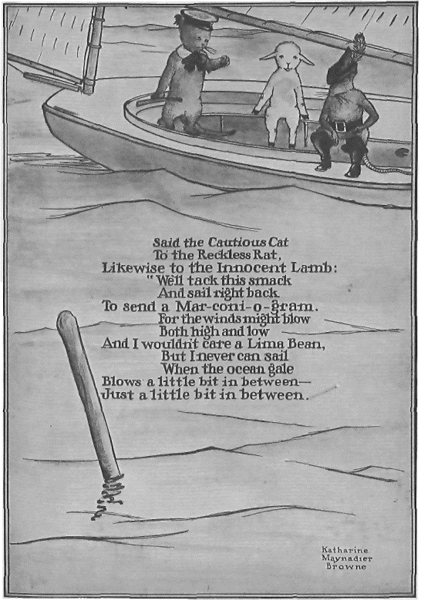
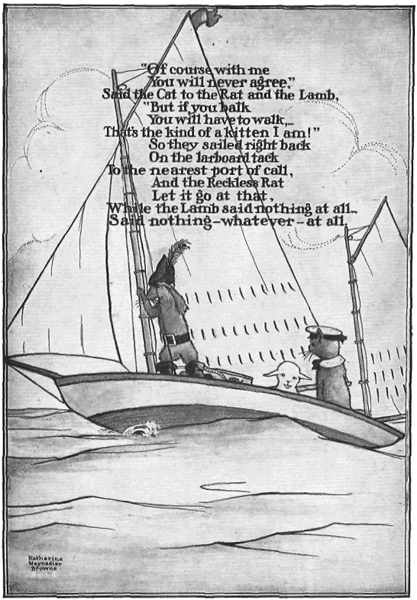
BY M. C. McNEILL
Three little bears came into the town.
“How do you do?” said everybody.
Their faces were smiling, with never a frown.
“How sweet!” said everybody.
The three little bears made three little bows.
“How very polite!” said everybody.
They bowed as boys bow in dancing-school.
“What airs and what grace!” said everybody.
One little bear had a little red coat.
“How smart!” said everybody.
One had a tippet all made of soft down.
“How cozy and warm!” said everybody.
And one was a fiddler of great renown.
“What charming music!” said everybody.
The three little bears began then to dance.
“How cute!” said everybody.
“What do you want, you little black bears
With manners so nice?” said everybody.
“I don’t like to be a fool, so I want to go to school,”
Said the red-coated bear to everybody.
Then Tommy Perkins, making a bow,
Right in front of everybody,
Took down his book and his slate as well,
And began to explain to everybody
Just what the little black bears should do
To read and to cipher like everybody.
“Sit up quite straight, and mind your stops;
Say, ‘A, B, C,’ for everybody.”
“A, B, C,” said the three little bears,
All in one voice, to everybody.
“A, B, C! What fiddle-dee-dee!”
Was whispered aloud by everybody.
“I want to count,” said one little bear.
“One! Two! Three! Four!” shouted everybody.
“We’re not at all deaf!” said the three little bears.
“Oh! I beg your pardon!” said everybody.
“We’d like to learn manners,” said the three little bears;
“And we’d like to learn from everybody,
But every one hasn’t fine manners,” they said.
“Some have very bad manners,” said everybody.
“What manners you have may be better than ours,”
Said the three little bears to everybody,
“For we live in the wood—which no manners requires.”
“Then how did you learn?” said everybody.
“For when you came in you were quite as polite
As Tommy Perkins,” said everybody.
“You bowed and you danced, while we all sat entranced,
So sweet were the notes,” said everybody.
“You wanted to learn to say, ‘A, B, C,’
Like good little bears,” said everybody.
“And when we exclaimed, ‘Such fiddle-dee-dee!’
No notice you took,” said everybody.
“And when we all shouted out, ‘One! Two! Three! Four!’
Instead of roaring,” said everybody,
“You gently reminded us all that in school
We must not be noisy,” said everybody.
“If you won’t teach us manners,
We’re going back home,”
Said the three little bears to everybody.
“For after the night falls it won’t do to roam;
So we’ll say our farewells to everybody.”
Then they stood up and bowed, and held out their paws,
And shook hands all round with everybody.
“We’ll dance all the way, for we know how to play,”
Said the three little bears to everybody.
“And with our best compliments we wish you good day.”
“Good day and good luck!” said everybody.
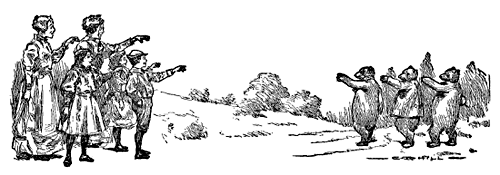
BY W. W. ELLSWORTH
One day we built a snowman.
We made him out of snow;
You’d ought to see how fine he was—
All white from top to toe!
We poured some water on him,
And froze him, legs and ears;
And when we went indoors to bed
I said he’d last two years.
But in the night a warmer kind
Of wind began to blow,
And winter cried and ran away,
And with it ran the snow.
And in the morning when we went
To bid our friend good day,
There wasn’t any snowman there—
Everything’d runned away!
a story for very little folk to read. no word in it has more than four letters
BY A. L. SYKES
“I want to do just as I like,” said Tiny Hare to his Mama one day, as he ran to the door of his home.
“What do you want to do, my dear?” she said.
“I do not know, but I want to do just as I like,” said Tiny Hare.
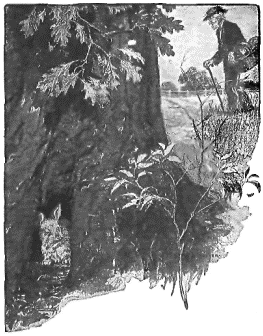 “soon MAN came by.”
“You may run out a wee bit of a way, and run and jump and play in the sun,” said his Mama.
“I do not want to run and jump and play. I want to do just as I like,” said Tiny Hare.
“You may eat the good food that you can find near our home,” said his Mama, “but if you go far MAN may get you, or DOG may eat you, or HAWK may fly away with you.”
“I do not want to eat the good food that I can see here. I want to do just as I like.”
Papa Hare then said very low and deep, “What do you want to do, my son?”
“I do not know,” said Tiny Hare, “but I want to do just as I like.”
Then said Papa Hare, “Do not wake me from my nap any more now, and when the big moon is high in the sky, and it is just like day. I will take you far out in the wood, and you may run and jump and play and eat, and be very safe, for MAN will be in his home, and DOG in his, and HAWK in hers.”
“I do not want to go out in the wood, and run and jump and play when the moon is high in the sky. I want to do just as I like.”
“Do not wake me,” said Papa Hare, and he shut his eyes and put his ears down.
“Come here,” said Mama Hare, “and I will tell you a tale of the cold time of the year when snow is over bush and tree and our good food, and what came to the hare who did just as his Mama told him not to. Step, step, step in the snow he went till he came to the Red Fire, and—”
“I do not want to hear the tale,” said Tiny Hare. “I want to do just as I like.”
 “he saw HAWK far up in the sky.”
“Do not wake me from my nap, then,” said his Mama, and she shut her eyes and put her ears down.
Just then Tiny Hare saw a Wind Ball roll by. A Wind Ball is the part of one kind of a weed that is left when the weed does not grow any more, and it is dry and like wool, and it can roll like a ball, and fly as fast as a bird.
“I can run as fast as you,” said Tiny Hare. “I can do just as I like, and I want to get you.”
On went the Wind Ball, roll, roll, roll, and on went Tiny Hare, leap, leap, leap. Just as he was near it, the Wind Ball rose into the air, and flew like a bird, and on went Tiny Hare, jump, jump, jump. Roll and fly, roll and fly went the Wind Ball, and leap and jump, leap and jump went Tiny Hare till he was not able to run any more, and his feet were sore. He lay down to rest, but soon MAN came by, and Tiny Hare ran into a hole in a tree, and now how he did wish that he was at home!
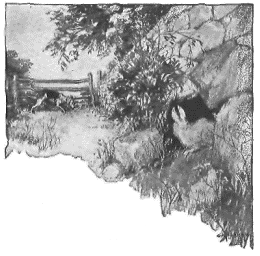 “DOG came by, and tiny hare ran into a hole.”
By and by he came out to try to hunt for his home, and DOG came by, and Tiny Hare ran into a hole in a wall, and how he did wish he was at home! By and by he came out to try to hunt for his home, and he ran, and he ran, and he ran! And, by and by, he saw HAWK far up in the sky, and Tiny Hare ran into a bush, and how he did wish he was at home.
By and by he came out to try to hunt for his home, and Wind Ball went by once more.
“I can’t get you, and I don’t want to,” said Tiny Hare, but the wind was low, and Wind Ball went roll, roll, roll, slow, slow, slow, and Tiny Hare went with it, limp, limp, limp, and by and by he saw his home. Tiny Hare ran as fast as a hare with lame feet can run, and soon he went in and lay down in the home by his Mama.
“I have not been good, Mama,” he said very low in her ear in a way that a tiny hare has.
“Be good now, then,” she said.
“I want to,” said Tiny Hare, and then he said, “Do not wake me,” and he shut his eyes, and put his ears down, and they all took a nap.
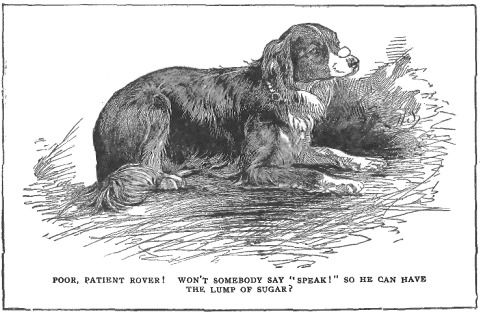
[in words of not more than four letters]
BY A. L. SYKES
Once, just as the long, dark time that is at the end of each day came, Mama Hare said to Tiny Hare, who was at play,
“Come in, now, it is time for bed. You know you must hide from Man, and Dog, and Hawk; but I must tell you that you are to hide from Cat, also.”
“Who is CAT?” said Tiny Hare.
“CAT is not so big as DOG. She has soft fur and two big wild eyes.”
“She is just like me,” said Tiny Hare. “I have soft fur and big eyes; then CAT is just a Hare.”
“The very idea!” said Mama Hare. “You have not big wild eyes, and your tail is not long like CAT’S. CAT is not good for a Hare to meet. She can run very fast, and she has a claw for each toe,” and she gave Tiny Hare a wee bite.
“Does CAT live in our wood?” said Tiny Hare.
 tiny hare sees cat by the fire.
“No, she is with MAN and DOG, but she goes out in the day time or at dark, and she can get a Tiny Hare who runs away from home when he is too tiny.”
“Am I too tiny?” said Tiny Hare. “Yes, yes, yes; far too tiny,” said his Mama; and how she did wash him from his head to his feet!
“I wish to see CAT,” said Tiny Hare.
“No, no, no,” said his Mama; and how she did wash his soft fur!
He did not wish to see CAT for many, many days, but one day the rain came, and it was cold, and his Mama told him to stay at home in the dry hay.
“I want to go with you,” said Tiny Hare to his Mama and Papa when they were to go out for food.
“It is too wet,” said his Mama. “If your fur gets too wet you can’t run far and fast, and it is not safe for you to go.”
“I like rain. I like the wet. I want to go out. I want to do just as I like,” said Tiny Hare, and he laid his ears back, and half shut his eyes, and put his pink lip out, and did not look kind.
“Hush!” said Papa Hare, in a low, deep tone. And Mama Hare and Papa Hare went away, and left Tiny Hare at home.
Do you know what Tiny Hare did then? Oh, it was not good!
 “when he saw tiny hare he gave a loud bark,
‘bow-wow-wow-wow!’”
“when he saw tiny hare he gave a loud bark,
‘bow-wow-wow-wow!’”
“I will go to see CAT,” he said, very loud. He ran out, over the damp moss in the wet, wet wood, and, oh, dear me! up the path to the door of MAN and CAT. The door was open. CAT sat by the fire in a box. She was most sad, for once she had two baby cats in that box, and now they were gone. She did not purr. She did not eat. She did not wash her soft fur. She just sat by the fire and was sad. By and by she was so sad with no baby cat to love that she said very low and deep: “Mew! Mew!” Tiny Hare was so wet and so weak he just had to lie down on the step. Then CAT saw him.
How fast she did jump out of the box, and run to the door! Tiny Hare saw her long tail, and her big wild eyes. He shut his eyes; and how he did wish he was at home! But CAT did not eat him. She took him in her soft lips, and laid him in the box by the fire.
“Now she will eat me,” said Tiny Hare; and how he did wish he was at home!
Then MAN and DOG came in. MAN was wet, and had much mud on him. He took the box away from the fire to put fresh hay in it, and then he saw Tiny Hare. Then MAN went near the fire to get warm and dry, and DOG ran to CAT to look at her baby cat. When he saw Tiny Hare he gave a loud bark, “Bow-wow-wow-wow!” and his tail did not wag any more. But just as he was to JUMP on Tiny Hare, CAT put a claw on his nose.
“Wow!” said DOG, and MAN made DOG lie down, and he came once more to look at CAT in her box. “Well, well,” said he, “a hare for a baby cat! Do you mean to eat it, Puss?”
“Purr, purr, purr,” said CAT, and Tiny Hare did not like to hear her purr, and he said: “She will eat me now”; and how he did wish he was at home!
CAT did not want to eat Tiny Hare, but she did want to wash him, and play that he was her own baby cat. And she did wash him, oh, so hard, and so much, from head to feet, and from feet to head, over and over and over. She gave him a wee bite now and then when she felt a knot in his wet fur.
“Wee! Wee! Wee!” said Tiny Hare, very loud and high, when she hurt him too much, but CAT did not care, and did not stop.
By and by when Tiny Hare was warm and dry, and his fur was like silk, MAN and DOG went out to tea; and CAT saw that the eyes of Tiny Hare were shut, so she went out to tea. When CAT was gone, oh, how fast did Tiny Hare jump out of the box, and run out of the door, and skip up the long road, and leap past the wet wood, home to his Mama. The rain was over, and the sun was warm, so he was now dry, and his fur was like silk.
“I will be good now, Mama.” “Oh, dear,” said his Mama. “This is a CAT.”
“Oh, no, no, no, no, NO!” said Tiny Hare. “I am your Tiny Hare.”
“Is it our Tiny Hare?” said Mama Hare to wise Papa Hare.
“Yes,” said Papa Hare, “it is, but he is too much like CAT.”
Tiny Hare was not glad, and he did not want to play, so he sat near his home till the dark came. Then his Mama grew too sad for his sake, and she came out to him. How she did rub him with moss and hay, and how she did wash him, from his head to his feet. Tiny Hare did not like it, but he did not say one word.
“Now, you are like my dear Tiny Hare,” she said at last, and she took him home. When it grew dark, Tiny Hare said: “I am your Tiny Hare, and I will be good now,” and Papa Hare said, “Yes, I am sure you will,” and gave the ear of Tiny Hare a wee bite for love.
Then Mama Hare put her ears down, and Papa Hare put his ears down, and Tiny Hare put his ears down, and they all took a long, long nap till the dawn.
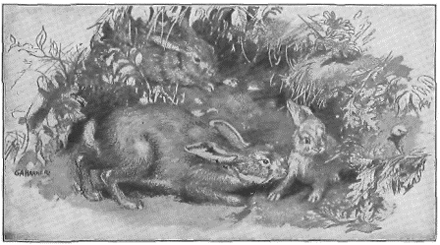 tiny hare at home.
[in words of not more than four letters]
BY A. L. SYKES
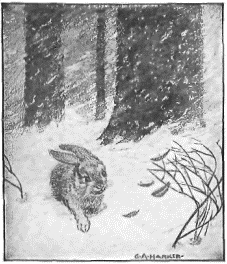
One day in the cold time when he lay snug and warm by his Mama, Tiny Hare said, “Tell me of the hare who went step, step, step in the snow till he came to the RED FIRE.”
So his Mama gave him a hug and said:
Once upon a time was a wise Wee Hare who knew how to run fast when MAN came by. He knew how to hide when DOG was near, and when he saw the dark spot in the sky that HAWK made, how fast he did jump to his Mama! But Wee Hare did not like to go out and run and jump and play in the sun.
“I do not want to run and jump and play in the sun. I want to run far, far in the wood, and find the red bush. I have seen it away off in the dark. It is good for me to eat, I know.”
“It is FIRE,” said his Mama. “Only MAN can make it, and it is not good for you. It can burn and hurt. You may eat the good food that you can find near our home,” and she bit his ear for a kiss.
“I do not want to eat the good food that I can see here. I want to do just as I like. I want to pick the red food from the red bush. I know it is like buds in the warm time.”
“Hush,” said Papa Hare, very low and deep. “You are not good. When you are good, and the moon is high in the sky, and it is just like day, I will take you far out in the wood, and you may run and jump and play and eat the food that is best for you.”
“I do not want to go out in the wood, and run and jump and play when the moon is high in the sky. I want to do just as I like. I want to eat the red buds from the red bush,” said the Wee Hare.
“Shut your eyes, and put your ears down, and take your nap,” said his Mama. “You are too tiny to go away from me. Now, hush, do not say one more word. The red bush is the RED FIRE. It can hurt and burn. MAN has it, and DOG is with man. They can hurt you, and if you run too far in the wood, WIND may blow too hard for a wee hare, and SNOW may come and bury you. Shut your eyes, and put your ears down, and take your nap.”
It was noon; the sun was high in the sky.
Good Papa Hare took his nap, and Mama Hare took her nap. The Wee Hare shut his eyes, and put his ears down, but he took no nap. By and by he[Pg 180] went out of the door, and ran and ran till he came to the wood. Then he ran and ran in the wood, but he did not come to the RED FIRE, and he ran and ran and ran till his feet were sore, but he did not come to the RED FIRE, and he ran and ran and ran and ran till he was not able to run any more, and no RED FIRE did he see. He lay down to rest in a bush, and very soon his eyes were shut, and he did not see or hear, for it was long past the hour for his nap. When he woke SNOW lay on all the open ways of the wood. The Wee Hare gave a leap from his bush, for he knew that SNOW can grow deep and deep, and a wee hare cannot walk in it. How he did wish he was at home!
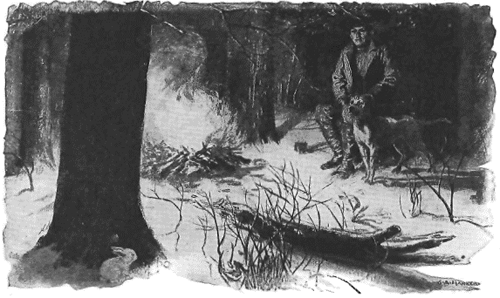 “then dog said: ‘wow!’ and put his ears up.”
The sun was far down in the west, and its last rays lay red on the SNOW. Step, step, step went the lame Wee Hare in the cold SNOW. He went back into the wood to try to find his way home. It grew gray, and it grew dark, and SNOW grew so deep that the Wee Hare had hard work to walk. Then WIND came. It was so cold, and blew him out of the path, and how he did wish he was at home! Step, step, step in the SNOW he went. The WIND blew more and more.
“I can not walk; my feet are too lame,” said the Wee Hare, and just then he saw the RED FIRE! It grew in the path in the wood, and by it sat MAN and DOG. Oh, how the Wee Hare felt! His nose grew hot, and his ears grew cold, and he was not able to move. Then DOG said “WOW!” and put his ears up, but MAN said: “Lie down,” and DOG lay down by the RED FIRE. The Wee Hare went into a tiny, tiny hole in a tree, and sat on his feet to warm them. He saw the RED FIRE. He did not like to see it. MAN and DOG did not let it come too near them, and he saw them keep away from the RED FIRE.
“They fear it, too,” said the Wee Hare. “It is not good for me. I must take care or it will come and hurt me.” He sat on his cold feet, and did not dare to take a nap.
By and by MAN put SNOW over the RED FIRE, and he and DOG went away, and the Wee Hare went step, step, step in the snow, soft, soft, soft, for fear.
“I wish I had been good,” said the Wee Hare, and WIND and SNOW were able to hear, and they felt sad for a wee hare.
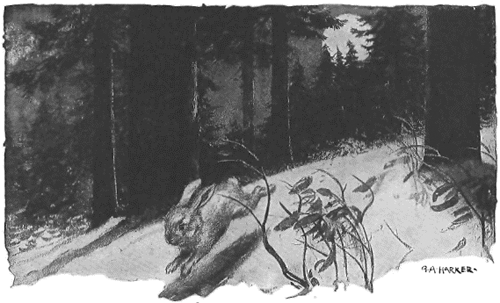 “how fast he went—hop, skip, and jump!”
“We will help him,” they said, but low and soft so he did not hear. The moon came up high in the sky till it was just like day, and it grew very cold. SNOW grew hard as ice in the cold, and the Wee Hare did not sink in it any more. WIND did not blow so hard. It came back of Wee Hare now, push, push, push, to help the Wee Hare over the SNOW. How fast he went—hop, skip, and jump! Soon he came to his home. How glad he was! He went in and lay down by his Mama.
“I have not been good, Mama,” he said, very low in her ear.
“Be good now, then,” his Mama said, and he did not know how glad she was to have him back.
“I want to be good,” said the Wee Hare; and he shut his eyes, and put his ears down, and they all took a nap till the dawn came.
“Just like us,” said Tiny Hare, and he was glad that he lay snug and warm by his Mama, and he was glad she had told him the tale of the Wee Hare and the RED FIRE.
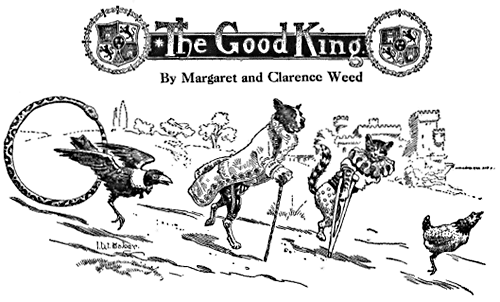
Once upon a time there was a King in Spain who had only one leg. He was a Good King and he had a big Animal Farm where he kept all the animals who had lost one or more of their legs.
In another part of Spain there was a Little Half Chick with only one eye, one wing and one leg. The other chickens with two eyes and two legs gobbled up the corn so fast that Little Half Chick was nearly starved.
One day a Donkey told Little Half Chick about the Good King and his Animal Farm. Little Half Chick at once started hoppity-hop for Mother Hen and said,
“Mother Hen, I am going to Madrid to see the Good King.”
“All right,” said Mother Hen, “good luck to you.”
So Little Half Chick started off, hoppity-hop, hoppity-hop along the road to Madrid to see the Good King.
Soon she met a Two-legged Cat going along hippity-hip, hippity-hip on her leg and crutch. The Cat said,
“Hello, Little Half Chick, where are you going so fast?”
Little Half Chick said, “I am going to Madrid to see the Good King.”
“May I go too?” said the Two-legged Cat.
“Yes,” said Little Half Chick, “fall in behind.”
So the Cat fell in behind. Hoppity-hop, hoppity-hop went Little Half Chick. Hippity-hip, hippity-hip went the Two-legged Cat.
Soon they met a Three-legged Dog going along humpity-hump, humpity-hump. The Dog said:
“Hello, Little Half Chick, where are you going so fast?”
Little Half Chick said “I am going to Madrid to see the Good King.”
“May I go too?” said the Three-legged Dog.
“Yes,” said Little Half Chick, “fall in behind.”
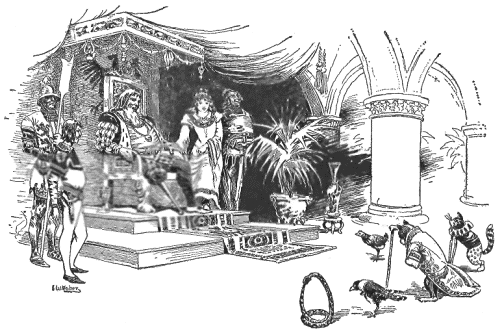 “They Both Laughed as All These Funny Animals Came Up.”
So the Dog fell in behind. Hoppity-hop, hoppity-hop went Little Half Chick. Hippity-hip, hippity-hip went the Two-legged Cat. Humpity-hump, humpity-hump went the Three-legged Dog.
Soon they met a One-legged Crow going along jumpity-jump, jumpity-jump. The Crow said:
“Hello, Little Half Chick, where are you going so fast?”
Little Half Chick said: “I am going to Madrid to see the Good King.”
“May I go too?” said the One-legged Crow.
“Yes,” said Little Half Chick, “fall in behind.”
So the Crow fell in behind. Hoppity-hop, hoppity-hop went Little Half Chick. Hippity-hip, hippity-hip went the Two-legged Cat. Humpity-hump, humpity-hump went the Three-legged Dog. Jumpity-jump, jumpity-jump went the One-legged Crow.
Soon they met a Snake with no legs at all. He had caught his tail in his teeth and was rolling along loopity-loop, loopity-loop. The Snake said:
“Hello, Little Half Chick, where are you going so fast?”
“I am going to Madrid to see the Good King,” said Little Half Chick.
“May I go, too?” said the Snake.
“Yes,” said Little Half Chick, “fall in behind.”
So the Snake fell in behind. Hoppity-hop, hoppity-hop went Little Half Chick. Hippity-hip, hippity-hip went the Two-legged Cat. Humpity-hump, humpity-hump went the Three-legged Dog. Jumpity-jump, jumpity-jump went the One-legged Crow. Loopity-loop, loopity-loop went the Snake with no legs at all.
Soon they came to Madrid and saw the Good King. With the King was his little daughter Margaret. They both laughed as all these funny animals came up. The King said to Little Margaret:
“Do you want to see us all go out to the Animal Farm?”
“Yes,” said Little Margaret, “I will lead the way.”
So she led the way along the street to the Animal Farm. Behind Margaret came the One-legged King. Next came the Little Half Chick, next the Two-legged Cat, next the Three-legged Dog, next the One-legged Crow, and last of all the Snake with no legs at all. So they all went out to the Animal Farm. And there they lived happily ever after.
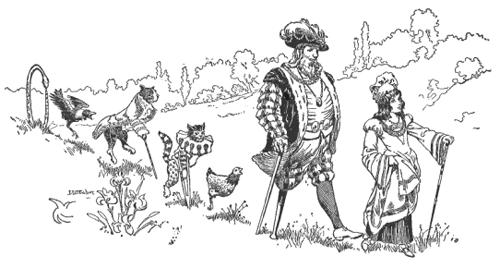
By W. S. Reed
Go to bed early—wake up with joy;
Go to bed late—cross girl or boy.
Go to bed early—ready for play;
Go to bed late—moping all day.
Go to bed early—no pains or ills;
Go to bed late—doctors and pills.
Go to bed early—grow very tall;
Go to bed late—stay very small.
BY JASMINE STONE VAN DRESSER
Once there was a little pink pig with five little spotted brothers and sisters. They had a nice home in the wood lot with their mama, and a nice yard with a little white fence around it. The little pigs were very happy playing in the yard. They made mud pies and baked them in the sun.
One day the little pink pig asked his mama to let him go out of the gate into the big road.
“You are too little and do not know enough yet,” said his mama. “When you grow bigger I shall teach you about the big road, and then you may go. Now, be a good little pig, and run and play with your brothers and sisters.”
But the little pink pig would not play with his brothers and sisters. He ran off in a corner by himself and would not make mud pies.
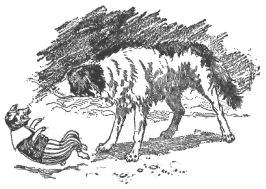 “the black and white thing rolled him over in the dust.”
Pretty soon the milkman came in his wagon to bring the milk for dinner. He carried it in and knocked at the back door, and poured it in a pail for mama. Then he ran out as fast as he could and hopped up in his wagon and drove away.
But he forgot to close the gate.
The little pink pig saw the gate was open, and he ran right out into the big road.
“I will show my mama how much I know,” he said. And he trotted down the big road as fast as his little pink legs would carry him.
He had not gone very far when he saw a big black and white thing. The black and white thing ran after the little pig, and rolled him over in the dust.
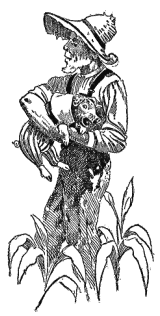 “and he took the little pink pig home.”
The little pig squealed and squealed, and the black and white thing rolled him and rolled him over, and kept saying “Bow wow!” But by and by he turned and went away.
The little pig got up and tried to shake off the dust, but he couldn’t shake it all off. He wanted to go home, but he had rolled over and over so much, that he couldn’t tell where home was. So he ran into a cornfield to hide, till he was sure the black and white thing was gone.
Pretty soon a man came along and found him in the cornfield and said:
“Hello, pink pig, are you eating my corn?”
“Oh, no!” said the little pig. “I would not eat your corn.”
“Then you should keep out of my cornfield,” said the man. “I will take you home and shut you in a pen.”
And he took the little pink pig home and shut him up in a pen.
“I do not want to be shut up. Please let me out,” said the little pink pig.
But the man did not let him out. It was not a nice pen, and the little pig got all muddy and dirty in it. He wished he was at home in his own little house with his mama, and his spotted brothers and sisters.
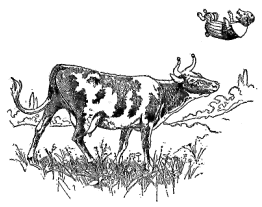 “the big red thing tossed the little pink pig in the
air.”
“the big red thing tossed the little pink pig in the
air.”
He ran round and round till he found a little hole in the fence. He was such a tiny pig that he squeezed through the hole and got out, though he had a hard time, for the buttons on his jacket got caught, and he could hardly get loose. He did not know which way to go to find his home, but he ran as fast as he could to get away from the pen.
He ran through a fence into a big place where there was plenty of grass. There were some very big red things in there, and one saw the little pig and ran after him.
“Oh, dear!” said the little pink pig (only he was not pink any more because he was all covered with mud), “are you a big pig?”
The big red thing shook its head and said “Moo!” and tossed the little pig up in the air. The little pig fell on the ground with a hard bump. He lay still till the red thing went away. Then he got up and ran as fast as he could.
He ran out in the road, and right into a black and white speckled thing with two legs. The speckled thing puffed up and said “Squawk!”
The little pig ran as fast as he could because he thought the speckled thing was chasing him. But it wasn’t.
The little pig did not know where he was running, and he did not have time to find out. The first thing he knew he almost ran into a lot of two-legged things. They had big yellow mouths.
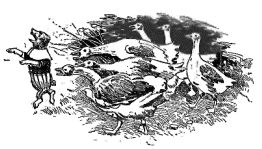 “‘hiss!’ it said, and it nipped the little pig’s leg.”
One of them said “Hiss-ss!” and ran out and nipped the little pig’s hind leg. The little pig squealed and ran the other way.
“Oh, dear!” he thought, “if I ever get back to my mama, I will never try to go down the big road again, till she teaches me what these queer things are.”
Just then he found himself in front of his own little house with the white fence around it. He ran into the house and told his mama everything that had happened to him. “Oh, mama,” he said, “what was the black and white thing?”
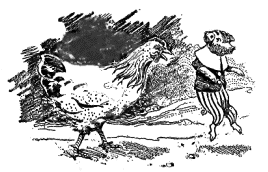 “the speckled thing puffed up and said ‘squawk!’”
“It was a dog,” she said. “Dogs sometimes chase little pigs.”
“Oh, mama,” he said, “a man found me in his cornfield and put me in a pen.”
“You must keep out of cornfields,” said mama. “People do not like pigs in their cornfields.”
“Oh, mama, what was the big red thing with sharp things on top of its head?”
“It was a cow,” said mama. “You should not go where cows are till you are big enough to keep out of their way.”
“Oh, mama, what was the speckled thing that puffed up and said ‘Squawk?’”
“It was a hen,” said mama. “She was not chasing you, she was only going to the other side of the road.”
“Oh, mama, what was the white thing that nipped me?” “It was a goose. You should always keep away from them.”
 the little pink pig runs home to his mother.
“Oh, mama, this is a big world, and there are lots of funny things in it.”
“Yes,” said mama. “That is why it is best for little pigs not to go out on the big road till they know more. You need not be afraid of anything if you know what it is. You have learned a great deal today for such a little pig, but if you are patient and wait till I teach you, you will not have such a hard time. We shall walk out every day, and I will teach you how a little pig can take care of himself all the time.” Then she put the little pig in the wash-tub, for he was all covered with mud, and washed him nicely—and before long he was the little pink pig again.
“Oh, Mama!” cried Fuzzy Wuz, running into the burrow where her mother lay dozing, “may I go walking with Chatter Chuk?”
Mrs. Wuz opened one eye sleepily and looked at Fuzzy.
“If you are careful,” she said; “and don’t go near Juggerjook’s den; and watch the sun so as to get home before the shadows fall.”
“Yes, yes; of course,” returned Fuzzy, eagerly.
“And don’t let Chatter Chuk lead you into mischief,” continued Mrs. Wuz, rubbing one long ear with her paw lazily. “Those red squirrels are reckless things and haven’t much sense.”
“Chatter’s all right,” protested Fuzzy Wuz. “He’s the best friend I have in the forest. Good-by, Mother.”
“Is your face clean, Fuzzy?”
“I’ve just washed it, Mother.”
“With both paws, right and left?”
“Yes, Mother.”
“Then run along and be careful.”
“Yes, Mother.”
Fuzzy turned and darted from the burrow, and in the bright sunshine outside sat Chatter Chuk on his hind legs, cracking an acorn.
“What’d she say, Fuz?” asked the red squirrel.
“All right, I can go, Chat. But I’ve got to be careful.”
As the white rabbit hopped away through the bushes and he glided along beside her, Chatter Chuk laughed.
“Your people are always careful, Fuz,” said he. “That’s why you see so little of the world, and lose all the fun in life.”
“I know,” replied Fuzzy, a little ashamed. “Father is always singing this song to me:
“Little Bunny,
Don’t get funny;
Run along and mind your eye;
It’s the habit
Of a rabbit
To be diffident and shy.”
“We squirrels are different,” said Chatter Chuk, proudly. “We are always taught this song:
“Squirrel red,
Go ahead!
See the world, so bright and gay.
For a rover
May discover
All that happens day by day.”
“Oh, if I could run up a tree, I shouldn’t be afraid, either,” remarked Fuzzy Wuz. “Even Juggerjook couldn’t frighten me then.”
“Kernels and shucks! Juggerjook!” cried Chatter Chuk, scornfully. “Who cares for him?”
“Don’t you fear him?” asked Fuzzy Wuz, curiously.
“Of course not,” said the squirrel. “My people often go to his den and leave nuts there.”
“Why, if you make presents to Juggerjook, of course he won’t hurt you,” returned the rabbit. “All the beasts carry presents to his den, so he will protect them from their enemies. The bears kill wolves and carry them to Juggerjook to eat; and the wolves kill foxes and carry them to Juggerjook, and the foxes kill rabbits for him. But we rabbits do not kill animals, so we cannot take Juggerjook anything to eat except roots and clover; and he doesn’t care much for those. So we are careful to keep away from his den.”
“Have you ever seen him or the place where he lives?” asked the squirrel.
“No,” replied Fuzzy Wuz.
“Suppose we go there now?”
“Oh, no! Mother said—”
“There’s nothing to be afraid of. I’ve looked at the den often from the trees near by,” said Chatter Chuk. “I can lead you to the edge of the bushes close to his den, and he’ll never know we are near.”
“Mother says Juggerjook knows everything that goes on in the forest,” declared the rabbit, gravely.
“Your mother’s a ’fraid-cat and trembles when a twig cracks,” said Chatter, with a careless laugh. “Why don’t you have a little spirit of your own, Fuzzy, and be independent?”
Fuzzy Wuz was quite young, and ashamed of being thought shy, so she said:
“All right, Chat. Let’s go take a peep at Juggerjook’s den.”
“We’re near it, now,” announced the squirrel. “Come this way; and go softly, Fuzzy Wuz, because Juggerjook has sharp ears.”
They crept along through the bushes some distance after that, but did not speak except in whispers. Fuzzy knew it was a bold thing to do. They had nothing to carry to the terrible Juggerjook, and it was known that he always punished those who came to his den without making him presents. But the rabbit relied upon Chatter Chuk’s promise that the tyrant of the forest would never know they had been near him. Juggerjook was considered a great magician, to be sure, yet Chatter Chuk was not afraid of him. So why should Fuzzy Wuz fear anything?
The red squirrel ran ahead, so cautiously that he made not a sound in the underbrush; and he skilfully picked the way so that the fat white rabbit could follow him. Presently he stopped short and whispered to his companion:
“Put your head through those leaves, and you will see Juggerjook’s den.”
Fuzzy Wuz obeyed. There was a wide clearing beyond the bushes, and at the farther side was a great rock with a deep cave in it. All around the clearing were scattered the bones and skulls of animals, bleached white by the sun. Just in front of the cave was quite a big heap of bones, and the rabbit shuddered as she thought of all the many creatures Juggerjook must have eaten in his time. What a fierce appetite the great magician must have!
The sight made the timid rabbit sick and faint. She drew back and hopped away through the bushes without heeding the crackling twigs or the whispered cautions of Chatter Chuk, who was now badly frightened himself.
When they had withdrawn to a safe distance the squirrel said peevishly:
“Oh, you foolish thing! Why did you make such a noise and racket?”
“Did I?” asked Fuzzy Wuz, simply.
“Indeed you did. And I warned you to be silent.”
“But it’s all right now. We’re safe from Juggerjook here,” she said.
“I’m not sure of that,” remarked the squirrel, uneasily. “One is never safe from punishment if he is discovered breaking the law. I hope the magician was asleep and did not hear us.”
“I hope so, too,” added the rabbit; and then they ran along at more ease, rambling through the forest paths and enjoying the fragrance of the woods and the lights and shadows cast by the sun as it peeped through the trees.
Once in a while they would pause while Fuzzy Wuz nibbled a green leaf or Chatter Chuk cracked a fallen nut in his strong teeth, to see if it was sound and sweet.
“It seems funny for me to be on the ground so long,” he said. “But I invited you to walk with me, and of course a rabbit can’t run up a tree and leap from limb to limb, as my people do.”
“That is true,” admitted Fuzzy; “nor can squirrels burrow in the ground, as rabbits do.”
“They have no need to,” declared the squirrel. “We find a hollow tree, and with our sharp teeth gnaw a hole through the shell and find a warm, dry home inside.”
“I’m glad you do,” remarked Fuzzy. “If all the animals burrowed in the ground there would not be room for us to hide from each other.”
Chatter laughed at this.
“The shadows are getting long,” he said. “If you wish to be home before sunset, we must start back.”
“Wait a minute!” cried the rabbit, sitting up and sniffing the air. “I smell carrots!”
“Never mind,” said the squirrel.
“Never mind carrots? Oh, Chatter Chuk! You don’t know how good they are.”
“Well, we haven’t any time to find them,” he replied. “For my part, I could run home in five minutes, but you are so clumsy it will take you an hour. Where are you going now?”
“Just over here,” said Fuzzy Wuz. “Those carrots can’t be far off.”
The squirrel followed, scolding a little because to him carrots meant nothing especially good to eat. And there, just beside the path, was an old coverless box raised on a peg, and underneath it a bunch of juicy, fat, yellow carrots.
There was room under the box for Fuzzy Wuz to creep in and get the carrots, and this she promptly did, while Chatter Chuk stood on his hind legs a short distance away and impatiently waited. But when the white rabbit nibbled the carrots, the motion pulled a string which jerked out the peg that held up the box, and behold, Fuzzy Wuz was a prisoner!
She squealed with fear and scratched at the sides of the box in a vain endeavor to find a way to escape; but escape was impossible unless some one lifted the box. The red squirrel had seen the whole mishap, and chattered angrily from outside at the plight of his captured friend. The white rabbit thought he must be far away, because the box shut out so much the sound of his voice.
“Juggerjook must have heard us, and this is part of his revenge,” said the squirrel. “Oh, dear! Oh, dear! I wonder what the great magician will do to me.”
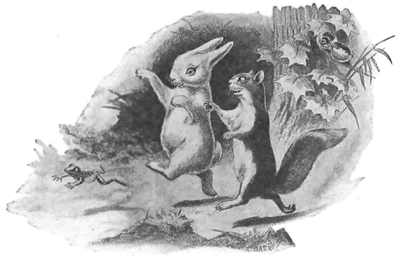 “they hopped through the bushes.”
He was so terrified by this thought that Chatter Chuk took flight and darted home at his best speed. He lived in a tree very near to the burrow where Mrs. Wuz resided, but the squirrel did not go near the rabbit-burrow. The sun was already sinking in the west, so he ran into his nest and pretended to sleep when his mother asked him where he had been so late.
All night Mrs. Wuz waited for Fuzzy, and it was an anxious and sleepless night for the poor mother, as you may well believe. Fuzzy was her one darling, several other children having been taken from her in various ways soon after their birth. Mr. Wuz had gone to attend a meeting of the Rabbits’ Protective Association and might be absent for several days; so he was not there to help or counsel her.
When daybreak came, the mother rabbit ran to the foot of the squirrels’ tree and called:
“Chatter Chuk! Chatter Chuk! Where is my Fuzzy Wuz? Where is my darling child?”
Chatter Chuk was too frightened to answer until his mother made him. Then he ran down to the lowest limb of the tree and sat there while he talked.
“We went walking,” he said, “and Fuzzy found some carrots under a box that was propped up with a peg. I told her not to eat them; but she did, and the peg fell out and made her a prisoner.”
You see, he did not mention Juggerjook at all, yet he knew the magician was at the bottom of all the trouble.
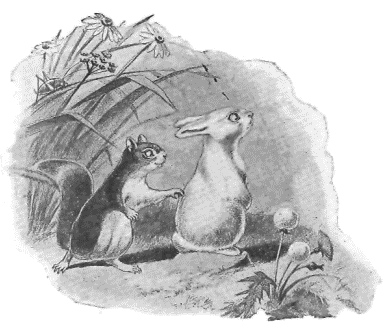 “‘i smell carrots!’”
But Mrs. Wuz knew rabbit-traps quite well, being old and experienced; so she begged the red squirrel to come at once and show her the place where Fuzzy had been caught.
“There isn’t a moment to lose,” she said, “for the trappers will be out early this morning to see what they have captured in their trap.”
Chatter Chuk was afraid to go, having a guilty conscience; but his mother made him. He led the way timidly, but swiftly, and Mrs. Wuz fairly flew over the ground, so anxious was she to rescue her darling.
The box was in the same place yet, and poor Fuzzy Wuz could be heard moaning feebly inside it.
“Courage, my darling!” cried the mother, “I have come to save you.”
First she tried to move the box, but it was too heavy for her to stir. Then she began scratching away the earth at its edge, only to find that it had been placed upon a big, flat stone, to prevent a rabbit from burrowing out.
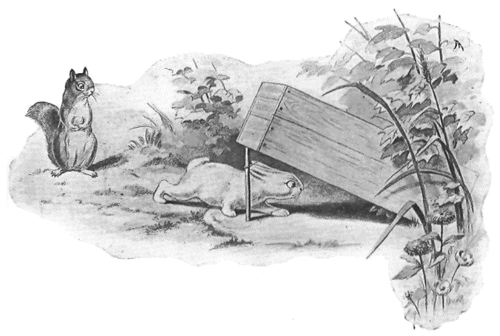 “fuzzy crept under the box.”
This discovery almost drove her frantic, until she noticed Chatter Chuk, who stood trembling near by.
“Here!” she called; “it was you who led my child into trouble. Now you must get her out.”
“How?” asked the red squirrel.
“Gnaw a hole in that box—quick! Gnaw faster than you ever did before in your life. See! the box is thinnest at this side. Set to work at once, Chatter Chuk!”
The red squirrel obeyed. The idea of saving his friend was as welcome to him as it was to the distracted mother. He was young, and his teeth were as sharp as needles. So he started at the lower edge and chewed the wood with all his strength and skill, and at every bite the splinters came away.
It was a good idea. Mrs. Wuz watched him anxiously. If only the men would keep away for a time, the squirrel could make a hole big enough for Fuzzy Wuz to escape. She crept around the other side of the box and called to the prisoner: “Courage, dear one! We are trying to save you. But if the men come before Chatter Chuk can make a hole big enough, then, as soon as they raise the box, you must make a dash for the bushes. Run before they can put in their hands to seize you. Do you understand?”
“Yes, Mother,” replied Fuzzy, but her voice wasn’t heard very plainly, because the squirrel was making so much noise chewing the wood.
Presently Chatter Chuk stopped.
“It makes my teeth ache,” he complained.
“Never mind, let them ache,” replied Mrs. Wuz. “If you stop now, Fuzzy will die; and if she dies, I will go to Juggerjook and tell him how you led my child into trouble.”
The thought of Juggerjook made the frightened squirrel redouble his efforts. He forgot the pain in his teeth and gnawed as no other squirrel[Pg 192] had ever gnawed before. The ground was covered with tiny splinters from the box, and now the hole was big enough for the prisoner to put the end of her nose through and beg him to hurry.
Chatter Chuk was intent on his task, and the mother was intent upon watching him, so neither noticed any one approaching, until a net fell over their heads, and a big voice cried, with a boisterous laugh:
“Caught! and neat as a pin, too!”
Chatter Chuk and Mrs. Wuz struggled in the net with all their might, but it was fast around them, and they were helpless to escape. Fuzzy stuck her nose out of the hole in the box to find out what was the matter, and a sweet, childish voice exclaimed: “There’s another in the trap, Daddy!”
Neither the rabbits nor the squirrel understood this strange language; but all realized they were in the power of dreadful Man and gave themselves up for lost.
Fuzzy made a dash the moment the box was raised; but the trapper knew the tricks of rabbits, so the prisoner only dashed into the same net where her mother and Chatter Chuk were confined.
“Three of them! Two rabbits and a squirrel. That’s quite a haul, Charlie,” said the man.
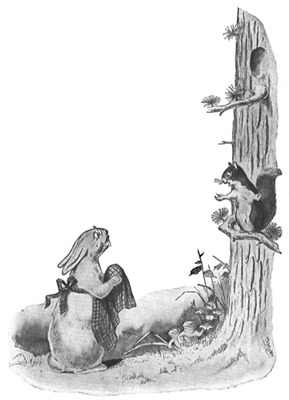 “‘where is my child?’”
The little boy was examining the box.
“Do rabbits gnaw through wood, Father?” he asked.
“No, my son,” was the reply.
“But there is a hole here. And see! There are the splinters upon the ground.”
The man examined the box in turn, somewhat curiously.
“How strange!” he said. “These are marks of the squirrel’s teeth. Now, I wonder if the squirrel was trying to liberate the rabbit.”
“Looks like it, Daddy; doesn’t it?” replied the boy.
“I never heard of such a thing in my life,” declared the man. “These little creatures often display more wisdom than we give them credit for. But how can we explain this curious freak, Charlie?”
The boy sat down upon the box and looked thoughtfully at the three prisoners in the net. They had ceased to struggle, having given way to despair; but the boy could see their little hearts beating fast through their furry skins.
“This is the way it looks to me, Daddy,” he finally said. “We caught the small rabbit in the box, and the big one must be its mother. When she found her baby was caught, she tried to save it, and she began to burrow under the box, for here is the mark of her paws. But she soon saw the flat stone, and gave up.”
“Yes; that seems reasonable,” said the man.
“But she loved her baby,” continued the boy, gazing at the little [Pg 193]creatures pitifully, “and thought of another way. The red squirrel was a friend of hers, so she ran and found him, and asked him to help her. He did, and tried to gnaw through the box; but we came too soon and captured them with the net because they were so busy they didn’t notice us.”
“Exactly!” cried the man, with a laugh. “That tells the story very plainly, my son, and I see you are fast learning the ways of animals. But how intelligent these little things are!”
“That’s what my mother would do,” returned the boy. “She’d try to save me; and that’s just what the mother rabbit did.”
“Well, we must be going,” said the man; and as he started away he picked up the net and swung it over his shoulder. The prisoners struggled madly again, and the boy, who walked along the forest path a few steps behind his father, watched them.
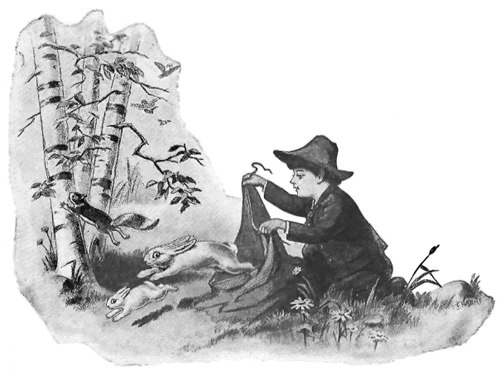 “the prisoners scampered away.”
“Daddy,” he said softly, coming to the man’s side, “I don’t want to keep those rabbits.”
“Oh, they’ll make us a good dinner,” was the reply.
“I—I couldn’t eat ’em for dinner, Daddy. Not the mama rabbit and the little one she tried to save. Nor the dear little squirrel that wanted to help them. Let’s—let’s—let ’em go!”
The man stopped short and turned to look with a smile into the boy’s upturned, eager face.
“What will Mama say when we go back without any dinner?” he asked.
“You know, Daddy. She’ll say a good deed is better than a good dinner.”
The man laid a caressing hand on the curly head and handed his son the net. Charlie’s face beamed with joy. He opened wide the net and watched the prisoners gasp with surprise, bound out of the meshes, and scamper away into the bushes.
Then the boy put his small hand in his father’s big one, and together they walked silently along the path.
“All the same,” said Chatter Chuk to himself, as, snug at home, he trembled at the thought of his late peril, “I shall keep away from old Juggerjook after this. I am very sure of that!”
“Mama,” said Fuzzy Wuz, nestling beside her mother in the burrow, “why do you suppose the fierce Men let us go?”
“I cannot tell, my dear,” was the reply. “Men are curious creatures, and often act with more wisdom than we give them credit for.”
“What you burying, a bone?”
“Nop, interning a muzzle.”
BY MARY LAWRENCE TURNBULL
Once upon a time there was a little gray kitten, who had wandered far away from home. At first she liked all the strange sights she saw, but by and by she began to feel very homesick, and wished she was once more cuddled up with her brothers and sisters.
Now the only word this little gray kitten knew was “Mew, mew!” So when she was lonely she would say “Mew;” when she was hungry, “Mew;” when she was cold or tired, glad or sad, it was always “Mew.” At home they knew what she meant when she said “Mew,” but out in the wide, wide world, nobody seemed to know.
Wandering along the street, she came upon a little squirming earthworm. “Mew,” said she, meaning, “Where is my home?”
The earthworm, however, did not notice little gray kitten, but crawled away across the street.
Next, the little gray kitten met a butterfly on the top of a dandelion. “Mew,” said the little gray kitten, meaning, “Can you tell me where my home is?” But the butterfly did not say anything, and flew away.
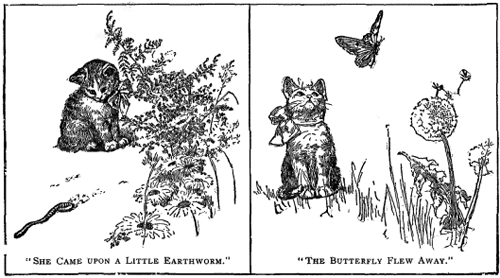
 mischief
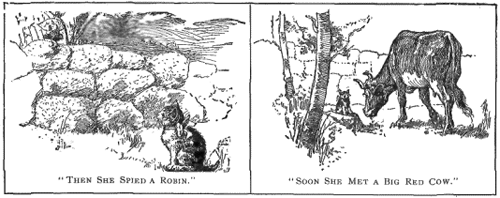
The little gray kitten walked on, and then she spied a robin on a stone wall near-by. “Mew,” said the little gray kitten, “Where is my home?”
But the robin, cocking his head on one side, answered, “Chirp, chirp,” and then spreading his wings, flew away.
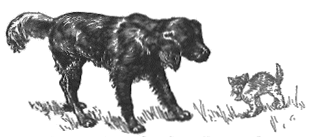 “Running Along She Came Up
She felt very sad indeed, but running along she came up to a big black dog. “Mew, mew!” said the little gray kitten, “Oh, can you not tell me where my home is?”
But the big black dog shook his tail, and barked “Bow-wow, bow-wow-wow-wow!” so loudly that the little gray kitten ran away from him as fast as she could go.
The little gray kitten was very tired, but she still ran on, and soon met a big red cow. “Mew, mew-ew,” said the little gray kitten, “Can you not tell me where my home is?”
 “‘Oh, You Dear Fluffy Gray Ball,’ Said the Little Girl.”
The big red cow, however, hardly looking at the little kitten, stretched out her big head, and shouted, “Moo, moo-oo!” which so frightened the little gray kitten that she jumped over a fence and landed right in the middle of a flower-bed.
There she caught sight of a little girl running up to her, and with such a sweet smile on her face that the little gray kitten ran toward her and said once more, “Mew, do you know where my home is?”
“Oh, you dear fluffy gray ball!” said the smiling little girl, catching the kitten up in her arms. “I’m going to take you right home to live with me.”
The little girl was the only one who had understood, and the little gray kitten purred softly. She was happy for she had found a home.

BY ANNIE W. McCULLOUGH
I wonder what you’re thinking of, my darling little cat.
It may be meat, it may be cream, that makes you nice and fat;
It may be all the fun you have in barn-loft warm and dry;
It may be mice you try to catch as by their hole you lie.
Perhaps you think of trees to climb, with birds that sing up there,
They always get away from you, although you creep with care.
Perhaps you think of warm, green grass, and basking in the sun,
Or of your ball, that slides so fast as after it you run.
I hope you think of me, sometimes, because I love you well;
I hope you love me back again, although you cannot tell;
And how I know you’re thinking (it’s a secret that I’ve found),
Is ’cause I hear, close to my ear, your thought-wheels going round.
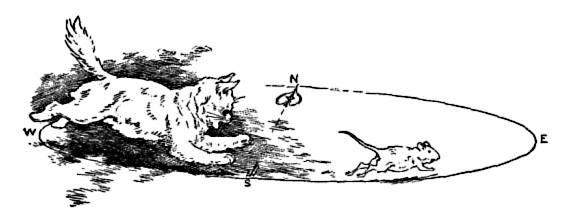
THE SMALL GRAY MOUSE
BY NATHAN HASKELL DOLE
The small gray Mouse ran East
And the small gray Mouse ran West
And could not tell in the least
Which way was best.
The small gray Mouse ran North
And the small gray Mouse ran South
And scurried back and forth
To escape the Kitten’s dreadful teeth-lined mouth!
But Kitty thought it precious fun
To see the panting Mousie run,
And when it almost got away
Her furry paw upon its back would lay.
But Kitty grew too vain and sure;
She thought she had the Mouse secure;
She turned her head, she shut her eyes.
That was not wise,
And ere she knew
The gray Mouse up the chimney flew,
Where dainty cats could not pursue.
So she had nothing else to do
But miew—oo—oo—!
 “you make so much noise i can’t sleep!”
The little girl and the little boy stood in the corn-field near the hollow tree where the Owl lived. The corn was in shocks like wigwams, and the yellow pumpkins lay on the ground. The Turtle came up from the brook below the corn-field, and stuck his head out of his shell to watch. The Rabbit sat on the edge of the slope, with his ears sticking straight up, to listen.
The sleepy Owl stirred behind his knot-hole.
“Don’t you think,” said the little boy, “that the Rabbit—”
“And the Turtle—” said the little girl.
“And the Owl,” went on the little boy, “should have a Thanksgiving dinner?”
“Yes, a good dinner,” replied the little girl, “right here in the corn-field.”
“We could have a pumpkin table,” said the little boy.
“And pumpkin chairs,” said the little girl.
So, as Thanksgiving was that very day, and there was no time to lose, they began to work. They found a fine, big, flat-topped pumpkin, and placed it for a table at the foot of the Owl’s tree. Then they found three little pumpkins for stools.
“They won’t want to eat until night,” said the little boy.
“No,” said the little girl; “the Owl and the Turtle and the Rabbit, too,—they like dinner at night.”
“We will lay everything out for them before we go to Grandmother’s,” said the little boy, “and when we come home, we can see all eating their good Thanksgiving dinner.”
The little boy ran and brought parsley and cabbage leaves for the Rabbit; and when the Rabbit saw that, he trotted home in a hurry, for fear he might be tempted to eat before it was time.
The little girl brought a fine big mushroom for the Turtle, for she had once seen a turtle nibble all around the edge of a mushroom.
“The Owl will have to bring his own dinner,” said the little boy, “but I will get him a piece of bread to eat with it.” So he did.
That night the little girl and boy drove home by moonlight from their grandmother’s farm. When they were in their own room they looked out of the window toward the corn-field. They saw the corn-shocks, like wigwams, with black shadows. They saw the tree dark against the sky. They saw the big round yellow moon rising above the ridge of the field. They saw the pumpkin table and pumpkin chairs. They saw, sitting on one chair, the Rabbit, with his ears sticking straight up as he ate his parsley and cabbage. They saw the Turtle, stretching his head out of his shell as he nibbled his mushroom. They saw the Owl on his chair, eating the dinner he had brought. “Oh, isn’t it beautiful!” said the little girl. “Beautiful!” said the little boy.
My bunnies like their cozy house, although they scamper out to play;
My chickens like the slatted coop where all the mother hens must stay.
My kitten likes her basket bed out in the woodshed near our door,
My puppy loves his cellar box; he sleeps and plays, then sleeps some more.
But I have got the nicest home. My house is better far than theirs;
Its windows let the sunshine in; it has a porch, it has some stairs.
But I like best the kitchen warm, with table, stove, and pantry neat;
The place where Dinah works, and makes good things for us to eat!
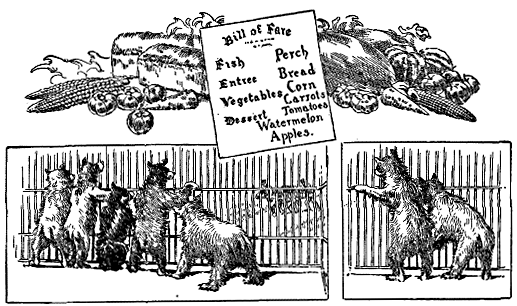
Here comes our dinner!
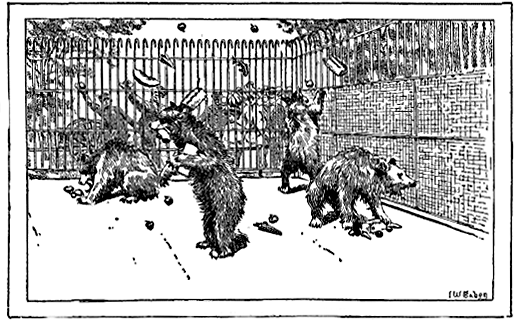
A Shower of good things.
MEAL-TIME IN THE BEAR-PITS AT THE ZOO.
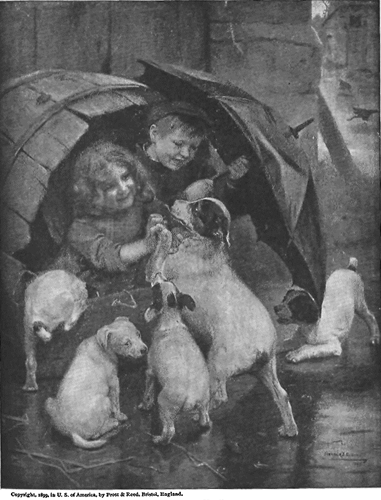 “full inside.”
BY JESSIE WRIGHT WHITCOMB
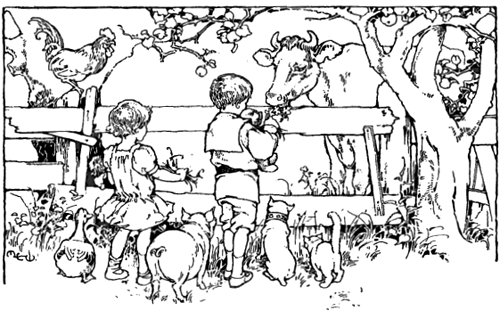 “‘good morning, cow, come and take a walk with us.’”
A little girl and a little boy started down the road together to take a walk. They met a dog.
“Good morning, Dog,” said the little girl. “Bow-wow!” answered the dog.
“Come and take a walk with us, Dog,” said the little boy.
So they all went down the road together.
Pretty soon they met a cat.
“Good morning, Cat,” said the little boy. “Miaouw!” answered the cat.
“Come and take a walk with us, Cat,” said the little girl. So they all went down the road together.
Pretty soon they met a rooster.
“Good morning, Rooster,” said the little girl. “Cock-a-doodle-doo!” answered the rooster.
“Come and take a walk with us, Rooster,” said the little boy.
So they all went down the road together.
Pretty soon they met a duck.
“Good morning, Duck,” said the little boy. “Quack, quack!” answered the duck.
“Come and take a walk with us, Duck,” said the little girl.
So they all went down the road talking merrily with one another.
Pretty soon they saw a little pinky-white pig with a funny little curly tail.
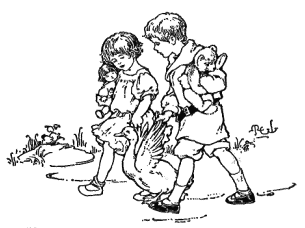 “‘good morning, duck, come and take a walk with us.’”
“Good morning, Pig,” said the little girl. “Grunt, grunt!” answered the pig.
“Come and take a walk with us, Pig,” said the little boy.
So they all went down the road together.
Pretty soon they came to a pasture.
In the pasture was a nice, old, red cow.
“Good morning, Cow,” said the little boy. “Moo, moo!” answered the cow.
“Come and take a walk with us,” said the little girl.
But the cow shook her head; she couldn’t open the pasture bars.
“We will let down the bars for you, Cow,” said the little boy and the little girl.
So they let down the bars, and the dog, and the cat, and the rooster, and the duck, and the little white pig with the curly tail, and the little boy, and the little girl, all went in to see the cow.
The little girl climbed on the cow’s back, and the little boy climbed on the cow’s back, and the dog jumped on the cow’s back, and the cat jumped on the cow’s neck, and the rooster flew up on the cow’s head, and the little white pig with the curly tail, and the duck, walked behind the cow, and they all went down the road together just as happy as they could be.
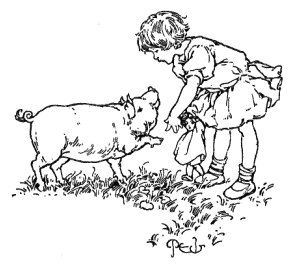 “‘good morning, pig, come and take a walk with us.’”
Pretty soon they met a carriage with two women in it.
“Mercy on me!” said the two women. “What’s this!”
“This is a fine, good show,” answered the little girl.
“Well, I should think it was!” said the two women. “It is a beautiful show.”
“Thank you,” said the little boy.
“Good-by,” said the two women.
“Good-by,” said the little girl.
So the cow, carrying the little boy, and the little girl, and the dog, and the cat, and the rooster, with the little white pig with the curly tail, and the duck, walking along behind, all went down the road together.
Pretty soon they met a wagon with three men in it.
“Well! Well! Well!” said the three men. “Just look! What’s all this?”
“This is a fine, good show,” said the little boy, bowing very politely.
“Indeed it is!” said the three men. “It’s great!”
“Thank you,” said the little boy, “I am pleased that you like it.”
“Good-by,” said the little girl.
So the cow, carrying the little girl, and the little boy, and the dog, and the cat, and the rooster, with the little white pig with the curly tail, and the duck, walking behind, all went down the road together.
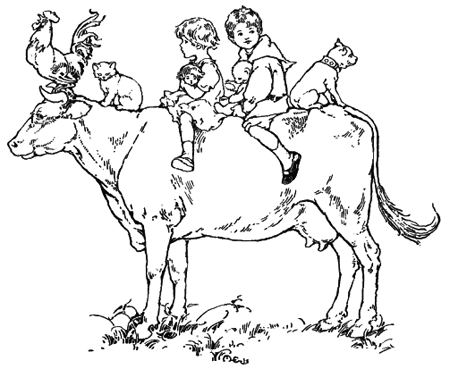 the fine, good show.
Pretty soon they came to a store. The Store Man stood out in front of his store.
“Good morning, Mr. Store Man,” said the little boy, “I have a little silver piece in my pocket.”
“Good morning!” said the Store Man. “What can I do for you?”
“We want to buy some things for our Show,” said the little boy.
“I’m glad of that!” said the Store Man.
So the little boy jumped down, and the little girl jumped down, and the dog jumped down, and the cat jumped down, and the rooster flew down.
“We want to buy a little corn for our cow and our pig,” said the little boy.
“And we want to buy a little wheat for our rooster and our duck,” said the little girl.
“And we want to buy a little meat for our dog,” said the little boy.
“And we want to buy a little milk for our cat,” said the little girl.
“And we want to buy some great, long sticks of candy for us!” said the little boy and the little girl together. “I hope you have some.”
The Store Man took the money and brought out all the things.
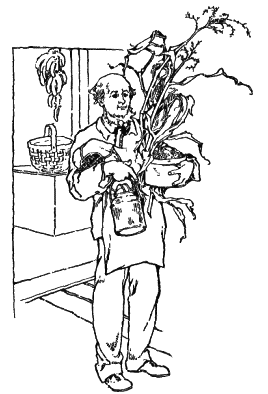 “the store man brought out
The cow and the little white pig with the curly tail ate the corn; the rooster and the duck ate the wheat; the dog ate the meat, and the cat drank the milk, and the little girl and the little boy ate the great, long sticks of candy.
“Good-by, Mr. Store Man,” said the little girl.
“Good-by, Mr. Store Man,” said the little boy.
“Good-by, all of you,” answered the Store Man.
So the little girl, and the little boy, and the dog, and the cat, and the rooster, and the duck, and the little pig with the curly tail, all went back up the road again.
Pretty soon they came to the pasture. The cow walked in.
“Good-by, Cow and Dog and Cat and Rooster and Duck and Pig!” shouted the little boy.
“Good-by, Pig and Duck and Rooster and Cat and Dog and Cow!” called the little girl.
“Moo-moo!” answered the cow.
“Grunt-grunt!” answered the pig.
“Miaouw, miaouw!” answered the cat.
“Quack, quack!” answered the duck.
“Cock-a-doodle-doo!” answered the rooster. “Bow-wow!” answered the dog.
And the little boy and the little girl put up the bars and ran back home as fast as they could go.
Jessie Wright Whitcomb.
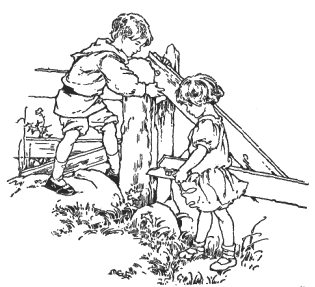 “the little boy and the little girl
(A Rhyming Story for Little Folk)
One beautiful day in the month of May,
A little girl whose name was Gay
(They called her that, because, you see,
She was always cheerful as she could be)
Went for a walk in the woods near by,
And her dog went with her (his name was Spy).
As they strolled along a fine woodland path
She saw a little bird taking a bath.
She kept very still and watched him splash,
When all at once, with a sudden dash,
Into the brook jumped little dog Spy.
My, how he made the water fly!
“What a bad, bad dog you are!” said Gay.
“Birdie won’t bathe any more to-day.
You frightened him so, but, never mind,
He’s only frightened, not hurt, he’ll find.
We’ll walk on further and you must try
To be good and quiet.”
“Bow-wow!” said Spy.
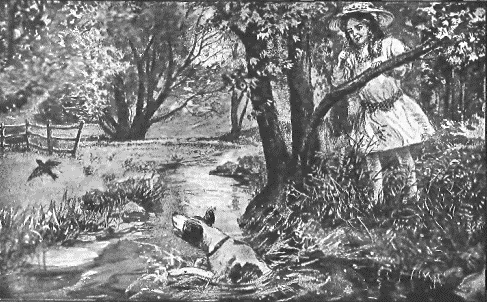 “into the brook jumped little dog spy.”
They had only walked on a little way,
When something rustled: “What’s that?” said Gay.
Out from the leaves sprang a squirrel red
And sped like a flash down the path ahead.
Close behind him was little dog Spy.
He paid no heed to the little girl’s cry.
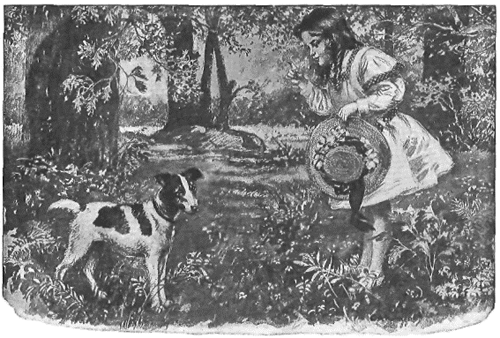 “‘you’re young,’ said gay, ‘and is that why you act so
silly?’”
“‘you’re young,’ said gay, ‘and is that why you act so
silly?’”
She whistled and called; they were out of sight.
She waited a moment, then laughed outright.
For who was this coming? Why, little dog Spy!
But he didn’t look happy—with head held high—
Indeed, he looked rather ashamed instead
For he hadn’t caught the squirrel red.
Spy couldn’t climb trees, and so, you see,
Master Squirrel escaped quite easily.
“You’re young,” said Gay, “and is that why
You act so silly?”
“Bow-wow!” said Spy.
“I’m tired of walking,” the little girl said,
“I think I will pick some flowers instead.
I will take them home to my Grandma, dear;
She loves them but she can’t walk out here.”
There were plenty of flowers all around.
Sweet white violets covered the ground.
There were lovely long-stemmed blue ones, too,
And all around the May-flowers grew.
But when she had all her hands would hold,
It was time to leave, it was growing cold.
The sun was sinking. But where was Spy?
She whistled and called,—but no reply!
“Where can he be?” she said, when hark!
Off in the distance she heard him bark.
“He must have a rabbit,” said she, “that’s all.”
And sure enough, by an old stone-wall,
Spy was barking away as hard as he could—
As if scaring the rabbit would do any good.
“The rabbit is safe in that wall,” said Gay,
“He wouldn’t come out if you barked all day.
So you better come home for it’s growing late.
And Mother will wonder why I wait.
Supper’ll be ready, too. Oh, my!
Are you hungry as I am?”
“Bow-wow!” said Spy.
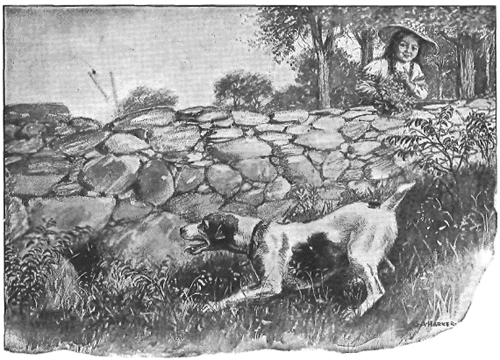
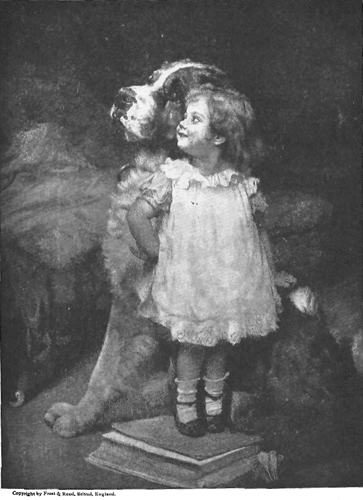 “i’se biggest!”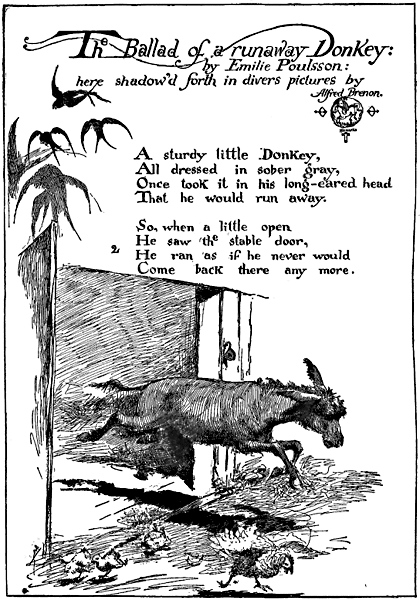
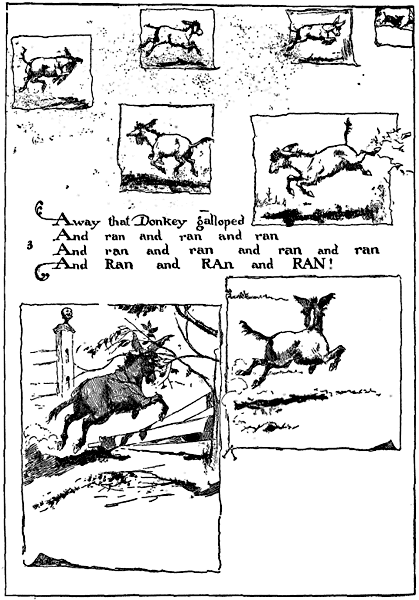
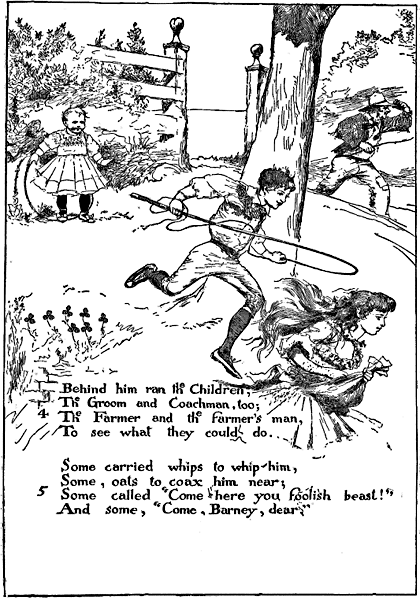
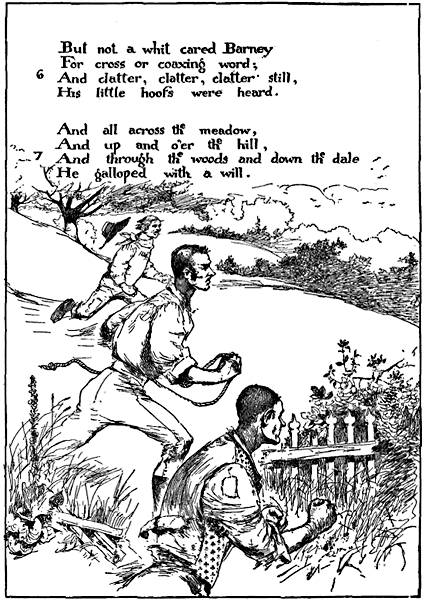
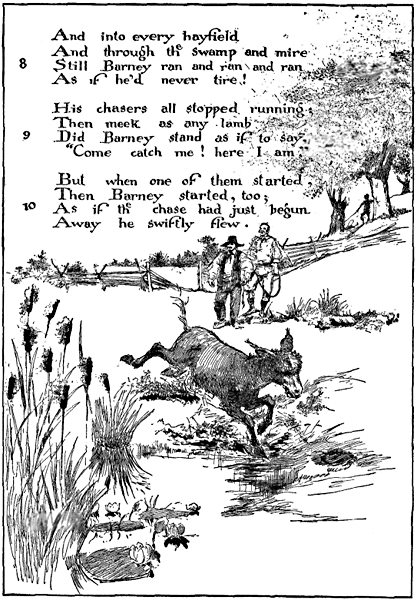
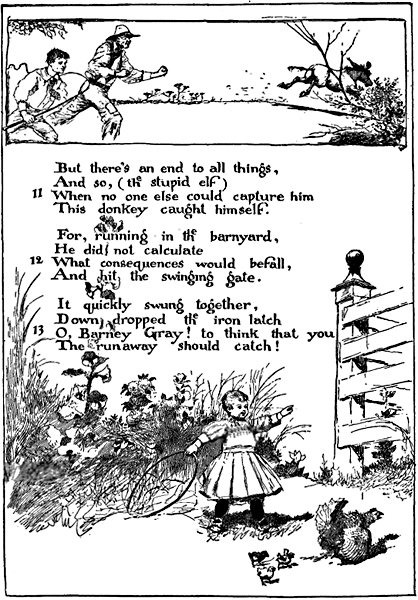
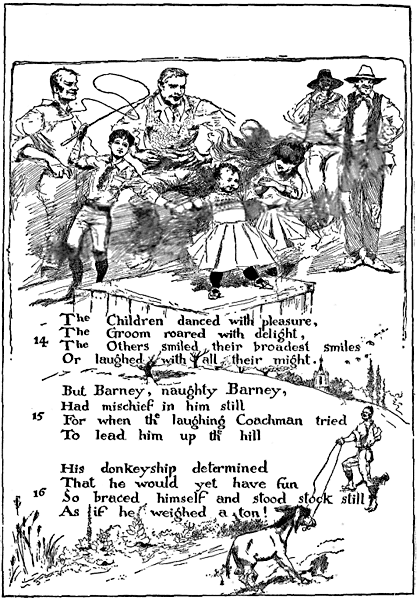
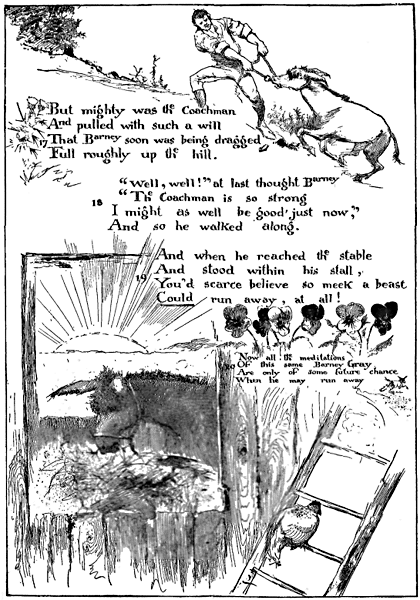
Once upon a time there were three bears who lived in a castle in a great wood. One of them was a great big bear, and one was a middling bear, and one was a little bear. And in the same wood there was a fox who lived all alone; his name was Scrapefoot. Scrapefoot was very much afraid of the bears, but for all that he wanted very much to know all about them. And one day as he went through the wood he found himself near the Bears’ Castle, and he wondered whether he could get into the castle. He looked all about him everywhere, and he could not see any one. So he came up very quietly, till at last he came up to the door of the castle, and he tried whether he could open it. Yes! the door was not locked, and he opened it just a little way, and put his nose in and looked, and he could not see any one. So then he opened it a little way farther, and put one paw in, and then another paw, and another and another, and then he was all in the Bears’ Castle. He found he was in a great hall with three chairs in it—one big, one middling, and one little chair; and he thought he would like to sit down and rest and look about him; so he sat down on the big chair. But he found it so hard and uncomfortable that it made his bones ache, and he jumped down at once and got into the middling chair, and he turned round and round in it, but he couldn’t make himself comfortable. So then he went to the little chair and sat down in it, and it was so soft and warm and comfortable that Scrapefoot was quite happy; but all at once it broke to pieces under him and he couldn’t put it together again! So he got up and began to look about him again, and on one table he saw three saucers, of which one was very big, one was middling, one was quite a little saucer. Scrapefoot was very thirsty, and he began to drink out of the big saucer. But he only just tasted the milk in the big saucer, which was so sour and so nasty that he would not taste another drop of it. Then he tried the middling saucer, and he drank a little of that. He tried two or three mouthfuls, but it was not nice, and then he left it and went to the little saucer, and the milk in the little saucer was so sweet and so nice that he went on drinking it till it was all gone.
Then Scrapefoot thought he would like to go upstairs; and he listened and he could not hear any one. So upstairs he went, and he found a great room with three beds in it; one was a big bed, and one was a middling bed, and one was a little white bed; and he climbed up into the big bed, but it was so hard and lumpy and uncomfortable that he jumped down again at once, and tried the middling bed. That was rather better, but he could not get comfortable in it, so after turning about a little while he got up and went to the little bed; and that was so soft and so warm and so nice that he fell fast asleep at once.
And after a time the Bears came home, and when they got into the hall the big Bear went to his chair and said, “Who’s been sitting in my chair?” and the middling Bear said, “Who’s been sitting in my chair?” and the little Bear said, “Who’s been sitting in my chair and has broken it all to pieces?” And then they went to have their milk, and the big bear said, “Who’s been drinking my milk?” and the middling Bear said, “Who’s been drinking my milk?” And the little Bear said, “Who’s been drinking my milk and has drunk it all up?” Then they went upstairs and into the bedroom, and the big Bear said, “Who’s been sleeping in my bed?” and the middling Bear said, “Who’s been sleeping in my bed?” and the little Bear said, “Who’s been sleeping in my bed?—and see here he is!” So then the Bears came and wondered what they should do with him; and the big Bear said, “Let’s hang him!” and then the middling Bear said, “Let’s drown him!” and then the little Bear said, “Let’s throw him out of the window.” And then the Bears took him to the window, and the big Bear took two legs on one side and the middling Bear took two legs on the other side, and they swung him backwards and forwards, backwards and forwards, and out of the window. Poor Scrapefoot was so frightened, and he thought every bone in his body must be broken. But he got up and first shook one leg—no, that was not broken; and then another, and that was not broken; and another and another, and then he wagged his tail and found there were no bones broken. So then he galloped off home as fast as he could go, and never went near the Bears’ Castle again.
[M] From “More English Fairy Tales,” edited by Joseph Jacobs. Used by permission of the publishers, G. P. Putnam’s Sons.
BY C. F. HOLDER
“Yes,” the little bear cub would say, “that is my picture. I am a native of the State of California. I don’t remember distinctly where I was born, but it was up in the Sierras, where the snow lies in great banks, and the giant trees stand like sentinels, and where you might travel for days and weeks and meet no one but bears.
“The first thing I recollect was finding myself in a big burrow covered with snow, then my mother broke the way out and led us (I had a brother) down the mountain. We soon left the snow; and I remember one day, at sunset, we stood on an overhanging rock, and my mother showed us the green valleys and nice dark forests where we could hide, and far off was the gleaming sea. Mother did not care very much for the water, I think.
“My mother was hungry, after the long winter fast, and every day took us lower and lower, until one night she led us into a sheep ranch. Then our troubles began, for she left us to catch a lamb, and never came back. We heard all about it afterward. Some ranchers had seen her, and rode out on horseback [Pg 222] to enjoy the cruel sport of ‘roping a bear’. As they rode around her, one threw his lariat about her neck; another caught her forefoot as she stood up, another her hind leg; and then they dragged her away to the ranch-house—and so we became orphans.
“It was not long before the dogs found us, and a man carried me home in a basket to his wife, who treated me very kindly. I did not like it, but pretended I did, and ate all I could, always watching and hoping for a chance to run away to my mountain home. My mistress, however, soon thought I was too knowing, and put a chain about my neck. Finally, when I was about four months old, they sent me to a friend in San Francisco. I shall never forget how people looked at me and laughed when I stood on my hind legs, as if there was anything laughable in that! But they gave me sugar and other good things, and I fared well.
“My new master was a butcher, and most of the time I stayed in his shop. But some days, when I was very homesick, and longed for my mother, and the little cub who had been carried off, I did not know where, the butcher’s wife would take me into her room back of the shop, and then I would go to sleep, cuddled up close upon a rug, with my paws on her hand, and dream that I was back in my mountain home.
“One day I heard my master say I was to be pho-to-graphed, and I thought my time had come. You see, I had never heard the word before. There was no escape, as I was kept tied, and the next morning my master took me under his big coat in the cable-cars. I could just peep through one of the button-holes, and all at once I uttered a loud whine. You should have seen how the passengers stared at my master, who I know looked embarrassed, as he gave me a tremendous squeeze. We soon got out, and I was carried up a flight of stairs, and placed on a table in a room, the walls of which were covered with pictures of people’s faces, all of which seemed to keep their eyes fixed on me.
“My master petted me and gave me some sugar, and I began to think that being photographed was possibly not so bad, after all. Presently a man came in. He looked very much astonished, and said, ‘Why, I thought you engaged a sitting for “a descendant of one of the early settlers”?’
“‘So I did,’ replied my master; ‘there it is,’ pointing to where I stood up, blinking with all my might.
“‘Why, it’s a cub bear!’ exclaimed the man.
“‘Well, it is a relative of some early settlers, all the same,’ my master answered.
“At this the man smiled good-humoredly, then he went into another room, while my master petted me and gave me so much sugar that I had the toothache from it. After a while the man came back and said he was ready, and I was [Pg 223] taken into a room where there was a big thing like a gun on three legs, with a cloth over it. My master sat down in a chair and held me in his lap while the man pointed the gun at us.
“I thought I was to be shot, and tried to get away, and this made the man so cross that he came out from under the cloth and said he couldn’t do it. Then my master put me up in a child’s chair and propped something tight against my head, at which they both laughed so loud you could have heard them in the street, and I jumped down.
“Finally, the man tapped his forehead and said, ‘I have it.’ He put a screen before the gun and my master set me on top of it, holding my chain while the man crept under the cloth. I did not dare move, as I was astride of the screen, my hind feet hanging in the air. I prepared for the worst. Then the man came out again, looked at me sharply, and turned my head a little, telling me to smile, at which my master laughed. The man next shook a tambourine at me, and as I turned to see what the noise meant, I heard a click! and just then my master took me down and carried me home, much to my relief.
“I wondered what it was all about until one day my master took me on his knee, and, holding up a card, said, ‘Well, here you are!’—and what do you suppose it was? Nothing more or less than my picture; just as I was perched astride the screen the day when I thought I was going to be killed. Here it is”:
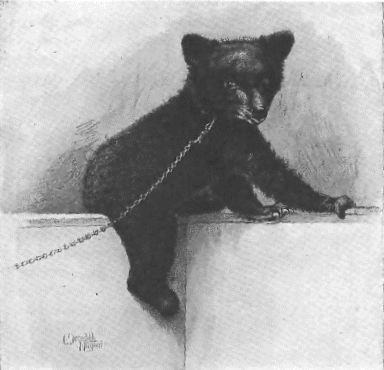
BY THE BROTHERS GRIMM
This tale, my young readers, will seem to you to be quite false; but still it must be true, for my Grandfather, who used to tell it to me, would wind up by saying, “All this is true, my son, else it would never have been told to me.” The tale runs thus:—
It was a fine summer’s morning, just before harvest-time; the buckwheat was in flower, and the sun was shining brightly in the heaven above, a breeze was blowing over the fields, where the larks were singing; and along the paths the people were going to church dressed in their best. Every creature seemed contented, even the Hedgehog, who stood before his door singing as he best could a joyful song in praise of the fine morning. Indoors, meanwhile, his Wife was washing and drying the kitchen, before going into the fields for a walk to see how the crops were getting on. She was such a long while, however, about her work that Mr. Hedgehog would wait no longer, and trotted off by himself. He had not walked any very long distance before he came to a small thicket, near a field of cabbages, and there he espied a Hare, who he guessed had come on a similar errand to himself; namely, to devour a few fine heads. As soon as Mr. Hedgehog saw the Hare, he wished him a good morning; but the latter, who was in his way a high-minded creature, turned a fierce and haughty look upon the Hedgehog, and made no reply to his greeting. He asked, instead, in a very majestic tone, how he came to be walking abroad at such an early hour. “I am taking a walk,” replied the Hedgehog.
“A walk!” repeated the Hare, in an ironical tone, “methinks you might employ your legs about something better!”
This answer vexed the Hedgehog most dreadfully, for he could have borne anything better than to be quizzed about his legs, because they were naturally short, and from no fault of his own. However, he said to the Hare, “Well, you need not be so proud, pray, what can you do with those legs of yours?” “That is my affair,” replied the Hare. “I expect, if you would venture a trial, that I should beat you in a race,” said the Hedgehog.
“You are laughing! you, with your short legs!” said the Hare contemptuously. “But still, since you have such a particular wish, I have no objection to try. What shall the wager be?”
“A louis d’or,” replied the Hedgehog.
“Done!” said the Hare, “and it may as well come off at once.”
“No! not in such great haste, if you please,” said the Hedgehog; “I am not quite ready yet; I must first go home and freshen up a bit. Within half-an-hour I will return to this place.”
Thereupon the Hedgehog hurried off, leaving the Hare very merry. On his way home the former thought to himself, “Mr. Hare is very haughty and high-minded, but withal he is very stupid, and although he thinks to beat me with his long legs, I will find a way to defeat him.” So, as soon as the Hedgehog reached home, he told his Wife to dress herself at once to go into the field with him.
“What is the matter?” asked his Wife.
“I have made a wager with the Hare, for a louis d’or, to run a race with him, and you must be witness.”
“My goodness, man! are you in your senses!” said the Wife, “do you know what you are about? How can you expect to run so fast as the Hare?”
“Hold your tongue, Wife; that is my affair. Don’t you reason about men’s business. March, and get ready to come with me.”
As soon, then, as the Hedgehog’s Wife was ready they set out together; and on the way he said, “Now attend to what I say. On the long field yonder we shall decide our bet. The Hare is to run on the one side of the hedge and I on the other, and so all you have to do is to stop at one end of the hedge, and then when the Hare arrives on the other side at the same point, you must call out, ‘I am here already.’”
They soon came to the field, and the Hedgehog stationed himself at one end of the hedge, and his Wife at the other end; and as soon as they had taken their places the Hare arrived. “Are you ready to start?” asked the Hare. “Yes,” answered the Hedgehog, and each took his place. “Off once, off twice, three times and off!” cried the Hare, and ran up the field like a whirlwind; while the Hedgehog took three steps and then returned to his place.
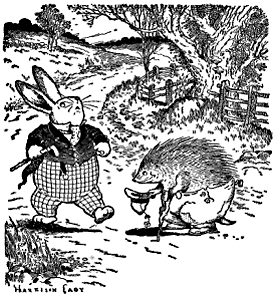
The Hare soon arrived at his goal, as he ran all the way at top speed, but before he could reach it, the Hedgehog’s Wife on the other side called out, “I am here already!” The Hare was thunderstruck to hear this said, for he thought it really was his opponent, since there was no difference in the voices of the Hedgehog and his Wife. “This will not do!” thought the Hare to himself; but presently he called out, “Once, twice, and off again;” and away he went as fast as possible, leaving the Hedgehog quietly sitting in her place. “I am here [Pg 226] before you,” cried Mr. Hedgehog, as soon as the Hare approached. “What! again?” exclaimed the Hare in a rage; and added, “Will you dare another trial!” “Oh! as many as you like; do not be afraid on my account,” said Mr. Hedgehog, courteously.
So the Hare then ran backwards and forwards three-and-seventy times, but each time the Hedgehogs had the advantage of him, for either Mr. or Mrs. shouted before he could reach the goal, “Here I am already!”
The four-and-seventieth time the Hare was unable to run any more. In the middle of the course he stopped and dropped down quite exhausted, and there he lay motionless for some time. But the Hedgehog took the louis d’or which he had won, and went composedly home with his Wife.
a scotch story, attributed to robert burns
adapted by jennie ellis burdick
There was an old gray Pussy Cat, and she went away down by a brookside. There she saw a wee Robin Redbreast hopping on a brier bush.
Says the gray Pussy Cat: “Where are you going, wee Robin?”
And the wee Robin makes answer: “I’m going away to the King to sing him a song this glad Christmas morning.”
And the gray Pussy Cat says, “Come here, wee Robin, and I’ll let you see a pretty white ring I have around my neck.”
But the wee Robin says: “No, no! gray Pussy Cat, no, no! You worried the wee mousie, but you cannot worry me!”
So the wee Robin flew away until he came to a wall of earth and grass, and there he saw a gray greedy Hawk sitting.
And the gray greedy Hawk says: “Where are you going, wee Robin?”
And the wee Robin makes answer: “I’m going away to the King to sing him a song this glad Christmas morning.”
And the gray greedy Hawk says: “Come here, wee Robin, and I’ll let you see the bright feather in my wing.”
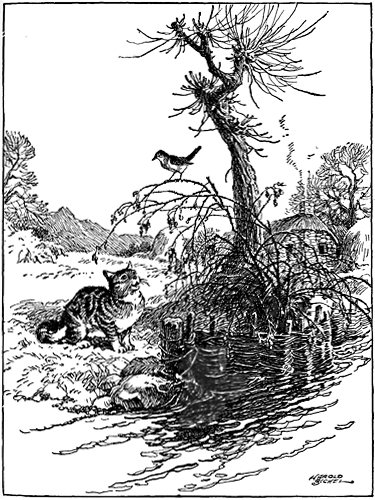 wee robin and the old gray pussy cat
But wee Robin says: “No, no! gray greedy Hawk, no, no! You pecked the little Meadowlark, but you cannot peck me!”
So the wee Robin flew away until he came to a steep, rocky hillside, and there he saw a sly Fox sitting. And the sly Fox says, “Where are you going, wee Robin?”
And the wee Robin makes answer: “I’m going away to the King to sing him a song this glad Christmas morning.”
And the sly Fox says: “Come here, wee Robin, and I’ll let you see the pretty spot on the tip of my tail.”
But the wee Robin says: “No, no! sly Fox, no, no! You worried the little Lamb, but you cannot worry me!”
So the wee Robin flew away until he came to a grassy meadow, and there he saw a little shepherd boy.
And the little shepherd says: “Where are you going, wee Robin?”
And wee Robin makes answer: “I’m going away to the King to sing him a song this glad Christmas morning.”
And the little shepherd boy says: “Come here, wee Robin, and I’ll give you some crumbs from my lunch.”
But the wee Robin says: “No, no! little shepherd boy, no, no! You caught the Goldfinch, but you cannot catch me!”
So the wee Robin flew away till he came to the King; and there he sat on a plowshare, and sang the King a cheery song. And the King says to the Queen: “What will we give to the wee Robin for singing us this cheery song?”
And the Queen makes answer to the King: “I think we’ll give him the wee Wren to be his wife.”
So the wee Robin and the wee Wren were married, and the King and the Queen, and all the court danced at the wedding. Then the wee Robin and the wee Wren flew away home to the wee Robin’s own brookside, and hopped on the brier bush.
The Fox set out in a hungry plight,
And begged the moon to give him light,
For he’d many a mile to travel that night
Before he could reach his den O!
First he came to a farmer’s yard,
Where the ducks and geese declared it was hard
That their nerves should be shaken, and their rest be marred
By a visit from Mr. Fox O!
He seized the gray goose by the sleeve,
Says he, “Madam Gray Goose, by your leave,
I’ll carry you off without reprieve,
And take you away to my den O!”
He seized the gray duck by the neck,
And flung her over across his back,
While the old duck cried out, “Quack, quack, quack,”
With her legs dangling down behind O!
Then old Mrs. Flipper Flapper jumped out of bed,
And out of the window she popped her head,
Crying, “John, John, John, the gray goose is gone,
And the Fox is off to his den O!”
Then John went up to the top of the hill,
And he blew a blast both loud and shrill.
Says the Fox, “That is fine music, still
I’d rather be off to my den O!”
So the Fox he hurried home to his den,
To his dear little foxes eight, nine, ten.
Says he, “We’re in luck, here’s a big fat duck
With her legs dangling down behind O!”
Then the Fox sat down with his hungry wife,
And they made a good meal without fork or knife.
They never had a better time in all their life,
And the little ones picked the bones O!
BY DINAH MARIA MULOCK-CRAIK
We go on our walk together—
Baby and dog and I—
Three little merry companions,
’Neath any sort of sky
Blue as our baby’s eyes are,
Gray like our old dog’s tail;
Be it windy or cloudy or stormy,
Our courage will never fail.
Baby’s a little lady;
Dog is a gentleman brave;
If he had two legs as you have,
He’d kneel to her like a slave;
As it is, he loves and protects her,
As dog and gentleman can.
I’d rather be a kind doggie,
I think, than a cruel man.
BY FRANK MUNRO
To Pussy-town, the other day,
The movies came.
And you must know,
The only chance mice have to play
Is when the cats
Go to the show!
(Yes, mice have certain little “rights”—
Though I confess
’Em hard to see!
And one is to stay up o’ nights
And steal our cheese—
If cheese there be!)
Well, in the playhouse, on the screen,
The pussies saw
(And so may you)
True love run smoothly, I ween:
But “also ran,”
A dog in blue!
The foolish cats, in great alarm,
Dashed out, nor
Asked for money back!—
A dog policeman has no charm
When he is close
Upon one’s track!
They did not use their heads. I fear;
(Some boys and girls
Are just like that)
And so the pussies now must hear
The grown folks say
“’Fraid cat! ’Fraid cat!”
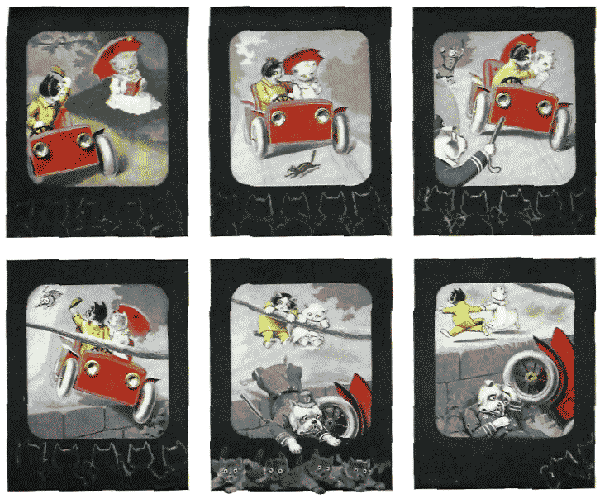 the cats at the movies
BY MARY HOWITT
“Will you walk into my parlor?” said the Spider to the Fly,
“’Tis the prettiest little parlor that ever you did spy;
The way into my parlor is up a winding stair,
And I have many curious things to show when you are there.”
“Oh, no, no,” said the little Fly, “to ask me is in vain;
For who goes up your winding stair can ne’er come down again.”
“I’m sure you must be weary, dear, with soaring up so high;
Will you rest upon my little bed?” said the Spider to the Fly.
“There are pretty curtains drawn around, the sheets are fine and thin;
And if you like to rest a while, I’ll snugly tuck you in!”
“Oh, no, no,” said the little Fly, “for I’ve often heard it said,
They never, never wake again, who sleep upon your bed!”
Said the cunning Spider to the Fly, “Dear friend, what can I do
To prove the warm affection I’ve always felt for you?
I have, within my pantry, good store of all that’s nice;
I’m sure you’re very welcome—will you please to take a slice?”
“Oh, no, no,” said the little Fly, “kind sir, that cannot be,
I’ve heard what’s in your pantry, and I do not wish to see!”
“Sweet creature,” said the Spider, “you’re witty and you’re wise;
How handsome are your gauzy wings, how brilliant are your eyes!
I have a little looking-glass upon my parlor shelf;
If you’ll step in one moment, dear, you shall behold yourself.”
“I thank you, gentle sir,” she said, “for what you’re pleased to say,
And bidding you good morning now, I’ll call another day.”
The Spider turned him round about, and went into his den,
For well he knew the silly Fly would soon be back again;
So he wove a subtle web in a little corner sly,
And set his table ready to dine upon the Fly.
Then he came out to his door again, and merrily did sing:
“Come hither, hither, pretty Fly, with the pearl and silver wing;
Your robes are green and purple, there’s a crest upon your head;
Your eyes are like the diamond bright, but mine are dull as lead.”
Alas, alas! how very soon this silly little Fly,
Hearing his wily, flattering words, came slowly flitting by:
With buzzing wings she hung aloft, then near and nearer drew—
Thinking only of her brilliant eyes, and green and purple hue;
Thinking only of her crested head—poor foolish thing! At last,
Up jumped the cunning Spider, and fiercely held her fast.
He dragged her up his winding stair, into his dismal den
Within his little parlor—but she ne’er came out again!
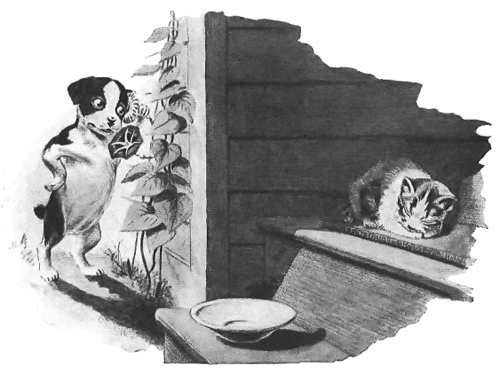 “hello! is this the clover nook dairy?
When Mother drops things on the floor,
My father asks me: “Who
Should always pick them up for her?”
And so I always do.
He says I haven’t far to reach
And that a gentleman
Must do things for his Mother
And be helpful as he can.
But Mother bends down just the same,—
She has to, don’t you see?
For after she’s said “Thank you, dear,”
She stoops and kisses me.
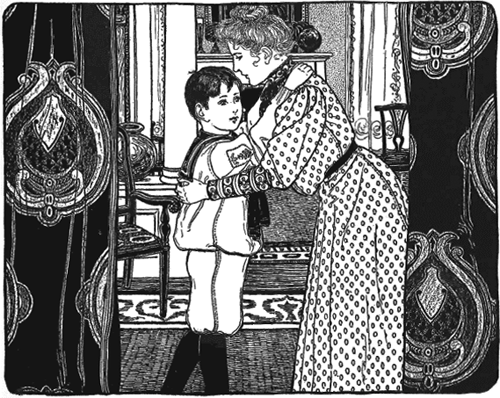
There’s a time to run and a time to walk;
There’s a time for silence, a time for talk;
There’s a time for work and a time for play;
There’s a time for sleep at the close of day.
There’s a time for everything you do,
For children and for grown-ups, too.
A time to stand up and a time to sit,—
But see that the time and actions fit.
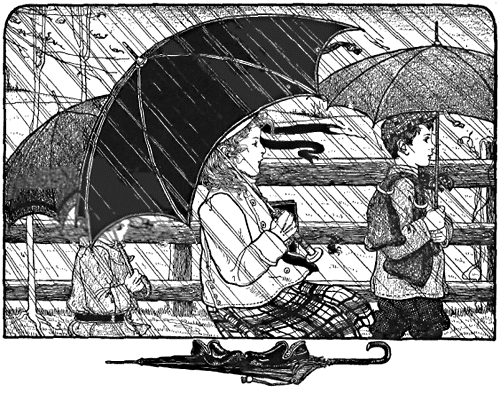
Umbrellas and rubbers
You never forget,
Whenever it’s raining
Or snowy or wet;
But if it should clear up,
While you are away,
Please bring them back home
For the next rainy day.
“Do not whisper” is a rule
You will find in every school,
And the reason here is given
In a rhyme:
For children all will chatter
About any little matter—
And there’d be a dreadful clatter,
All the time!
RECESS
The romping boys
Make lots of noise,
And run and jump and laugh and shout,
While here and there,
With quiet air,
The girls in couples walk about.
A game begins,
But no one wins,
Although they play with might and main,
For long before
The game is o’er
The bell rings out for school again.
AFTER SCHOOL
Although we like to go to school,
We’re rather glad to put away
Our books and slates and other things,
When it is over for the day.
And off we go to play and romp,
While teacher, who is good and kind,
Is left behind all by herself—
But then, perhaps, she doesn’t mind.
MONDAY’S LESSONS
Study them well on Friday,
For it’s much the better way,
Because when once they’re finished
You’ve all Saturday for play.
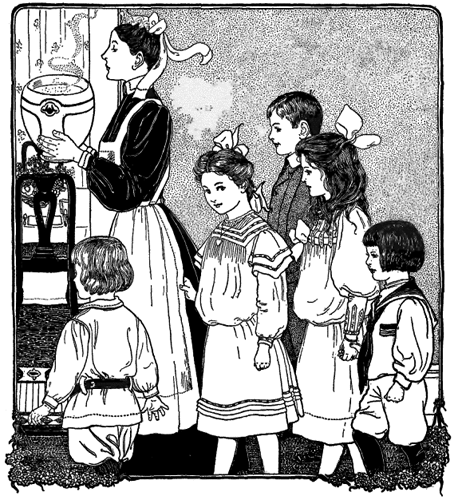
No matter where we children are
We run in answer to the bell,
And dinner comes in piping hot;
It makes us hungry just to smell.
Poor Father sharpens up his knife,
And carves with all his might and main;
But long before he’s had a bite
Our Willie’s plate comes back again.
We eat our vegetables and meat,
For Mother, who is always right,
Says those who wish to have dessert,
Must show they have an appetite.
And when a Sunday comes around,
So very, very good we seem,
You’d think ’most any one could tell
That for dessert we’d have ice-cream.
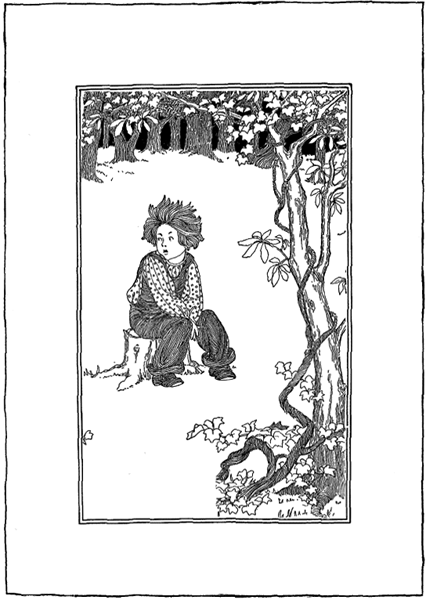
VALOR.
By Lucy Fitch Perkins.
There isn’t any giant
Within this forest grim,
And if there were, I wouldn’t be
A bit afraid of him!
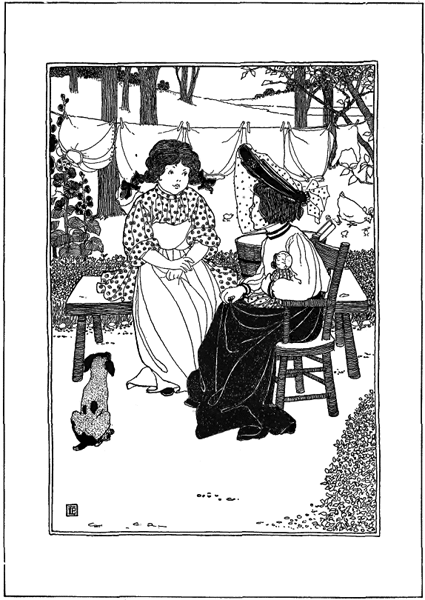
A DOMESTIC TRAGEDY
By Lucy Fitch Perkins.
My doll, my doll, my Annabel,
She’s really feeling far from well!
Her wig is gone, her eyes are out,
Her legs are left somewhere about,
Her arms were stolen by the pup,
The hens ate all her sawdust up,
So all that’s really left of her
Is just her clothes and character.
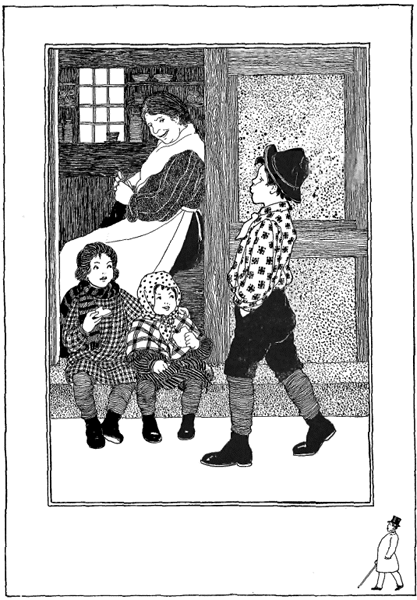
THE CAPITALIST.
I always buy at the lollipop-shop,
On the very first day of spring,
A bag of marbles, a spinning-top,
And a pocketful of string.
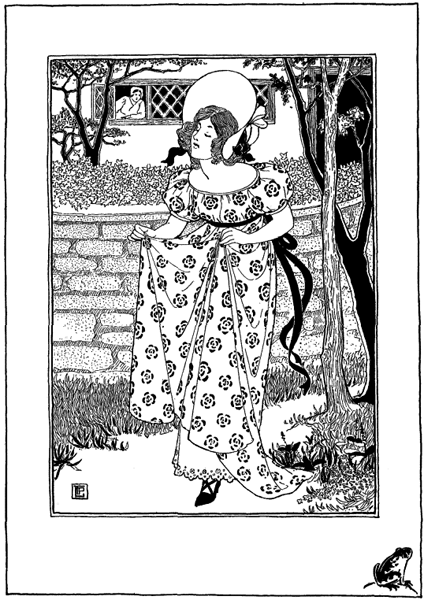
IN MERRY ENGLAND.
By Lucy Fitch Perkins.
In merry, merry England,
In the merry month of May,
Miss Mary Ella Montague
Went out in best array.
Her wise mama called out to her,
“My darling Mary Ella,
It looks like rain to-day, my dear;
You’d best take your umbrella!”
That silly girl she paid no heed
To her dear mother’s call.
She walked at least six miles that day,
And it never rained at all!
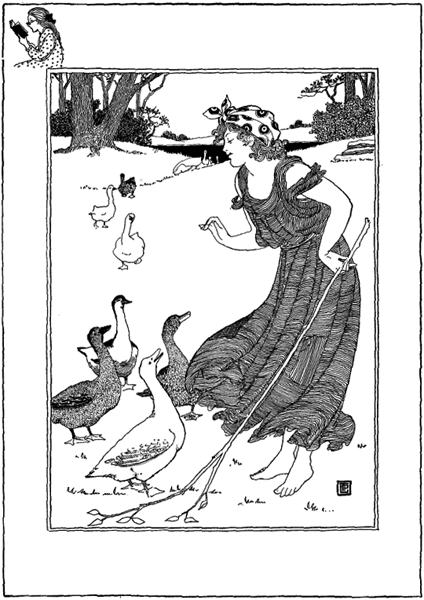
THE GOOSE GIRL.
By Lucy Fitch Perkins.
Oh, I’m a goose, and you’re a goose, and we’re all geese together.
We wander over hill and dale, all in the sweet June weather,
While wise folk stay indoors and pore
O’er dusty books for learning lore.
How glad I am—how glad you are—that we’re birds of a feather:
That you’re a goose, and I’m a goose, and we’re all geese together!
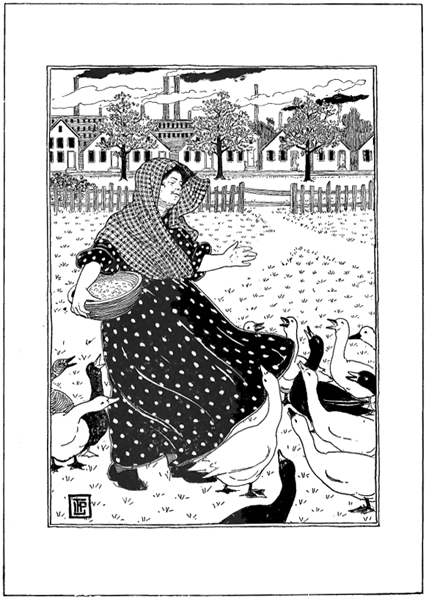
THE PHILOSOPHER
By Lucy Fitch Perkins.
Let me make you acquainted with Mrs. O’Toole,
Though she’s had little learning, she’s nobody’s fool,
She loves her fine geese, but when they are dead
She’ll comfort herself with a new feather bed.
EVERY-DAY VERSES
BY ALDEN ARTHUR KNIPE
PICTURES BY EMILIE BENSON KNIPE
THIRSTY FLOWERS
I have a little wat’ring-pot,
It holds two quarts I think,
And when the days are very hot
I give the plants a drink.
They lift their heads as flowers should,
And look so green and gay;
I’m sure that if they only could,
“We thank you, Sir,” they’d say.
SHARING WITH OTHERS
Sometimes Mother gives to me
Such a lot of money—See!
But it’s very hard to buy
All the things you’d like to try,
And you always share your penny
With a child who hasn’t any.
POCKETS
Pockets are fine
For marbles and twine,
For knives and rubber bands;
So, stuff them tight
From morning till night
With anything else but hands!
WAITING FOR DINNER
When one is very hungry,
It’s hard to wait, I know,
For minutes seem like hours
And the clock is always slow.
There isn’t time to play a game,
You just sit down and wait,
While Mother says, “Be patient,
Our cook is never late.”
It’s best when one is hungry,
To think of other things,
For then, before you know it,
The bell for dinner rings.
THE CRITIC
If only more people would write fewer books
How well pleased I would be!
If all the authors would change into cooks
’T would suit me perfectly.
DIPLOMACY
By Lucy Fitch Perkins
The Widow Hill has a fine plum-tree!
The Widow Hill is fond o’ me.
I’ll call on her to-day!
The plum-tree grows by her front door.
I’ve been meaning to call for a week or more
To pass the time o’ day!
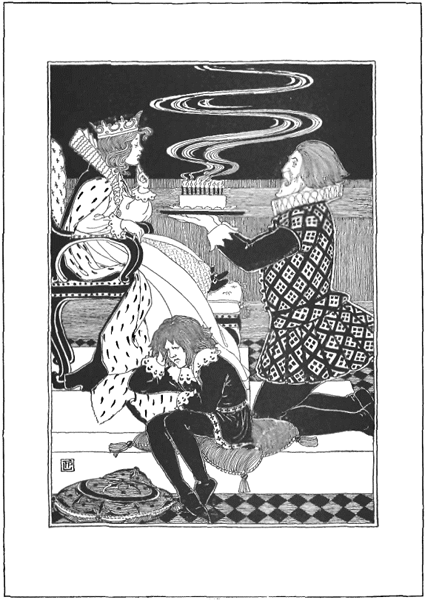
IF I WERE QUEEN.
By Lucy Fitch Perkins
If I were Queen of Anywhere,
I’d have a golden crown,
And sit upon a velvet chair,
And wear a satin gown.
A Knight of noble pedigree
Should wait beside my seat,
To serve me upon bended knee
With things I like to eat.
I’d have bonbons and cherry pie,
Ice-cream and birthday cake,
And a page should always stay near by
To have my stomach-ache!
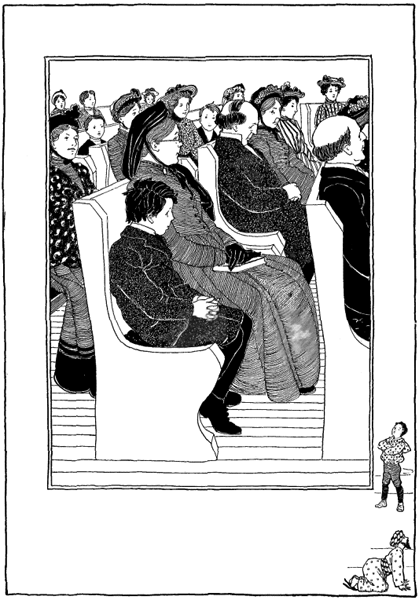
THOUGHTS IN CHURCH
By Lucy Fitch Perkins
Oh, to be a sailor
And sail to foreign lands—
To Greenland’s icy mountains
And India’s coral strands!
To sail upon the Ganges
And see the crocodile,
Where every prospect pleases,
And only man is vile.
I’d love to see the heathen
Bow down to wood and stone,
But his wicked graven image
I’d knock from off its throne!
The heathen-in-his-blindness
Should see a thing or two!
He’d know before I left him
What a Yankee boy can do!
This is the way we wash our clothes,
Wash our clothes,
Wash our clothes;
This is the way we wash our clothes,
So early Monday morning.
This is the way we iron our clothes,
Iron our clothes,
Iron our clothes;
This is the way we iron our clothes,
So early Tuesday morning.
This is the way we mend our shoes,
Mend our shoes,
Mend our shoes;
This is the way we mend our shoes,
So early Wednesday morning.
This is the way we visit our friends,
Visit our friends,
Visit our friends;
This is the way we visit our friends,
So early Thursday morning.
This is the way we sweep the house,
Sweep the house,
Sweep the house;
This is the way we sweep the house,
So early Friday morning.
This is the way we bake our cake,
Bake our cake,
Bake our cake;
This is the way we bake our cake,
So early Saturday morning.
This is the way we go to church,
Go to church,
Go to church;
This is the way we go to church,
So early Sunday morning.
Monday’s child is fair of face,
Tuesday’s child is full of grace,
Wednesday’s child is brave and glad,
Thursday’s child is never bad,
Friday’s child is loving and kind,
Saturday’s child is clear in mind,
The child that is born on the Sabbath day
Is fair and wise and good and gay.
They that wash on Monday
Have all the week to dry;
They that wash on Tuesday
Are not so much awry;
They that wash on Wednesday
Are not so much to blame;
They that wash on Thursday
Wash for very shame;
They that wash on Friday
Wash because of need,
And they that wash on Saturday,
Oh, they are lazy indeed!
Solomon Grundy,
Born on a Monday,
Christened on Tuesday,
Married on Wednesday,
Took ill on Thursday,
Worse on Friday,
Died on Saturday,
Buried on Sunday:
This is the end
Of Solomon Grundy—
Born on a Monday,
Christened on Tuesday,
Married, etc.
How many days has my baby to play?
Saturday, Sunday, Monday,
Tuesday, Wednesday, Thursday, Friday,
Saturday, Sunday, Monday.
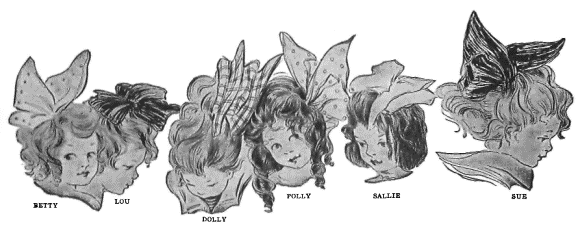
“Oh, ho! little maidens, all in a row,
And each one wearing a butterfly bow.
Which is the prettiest, Betty, or Lou,
Dolly, or Polly, or Sallie, or Sue?
I do not know, so I’ll have to ask you.”
BY STELLA GEORGE STERN
Little-Mouse-Sunday found a great, big bun;
Little-Mouse-Monday wished that he had one;
Little-Mouse-Tuesday was fat enough without;
Little-Mouse-Wednesday sat down to sulk and pout,
Said Little-Mouse-Thursday, “I’ll get one for myself!”
Said Little-Mouse-Friday, “There’s another on the shelf”;
Little-Mouse-Saturday began to beg and squeak;
“Come on!” said all the seven, “we’ve enough to last a week!”
“Good morning, Monday!
Tell me how is Tuesday?”
“Very well, Dame Wednesday.
Please to tell Miss Thursday,
Also little Saturday,
To call on Mister Sunday.”
(In a meter neither new nor difficult)
BY TUDOR JENKS
All was well on Sunday morning,
All was quiet Sunday evening;
But, behold, quite early Monday
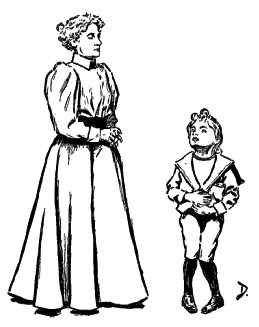
Came a queer, surprising Weakness—
Weakness seizing little Tommy!
It came shortly after breakfast—
Breakfast with wheat-cakes and honey
Eagerly devoured by Tommy,
Who till then was well as could be.
Then, without a moment’s warning,
Like a sneeze, that awful Aw-choo!
Came this Weakness on poor Tommy.
“Mother, dear,” he whined, “dear mother,
I am feeling rather strangely—
Don’t know what’s the matter with me—
My right leg is out of kilter,
While my ear—my left ear—itches.
Don’t you know that queerish feeling?”
“Not exactly,” said his mother.
“Does your head ache, Tommy dearest?”
Little Thomas, always truthful,
Would not say his head was aching,
For, you know, it really wasn’t.
“No, it doesn’t ache,” he answered
(Thinking of that noble story
Of the Cherry-tree and Hatchet);
“But I’m tired, and I’m sleepy,
And my shoulder’s rather achy.
Don’t you think perhaps I’d better
Stay at home with you, dear mother?”
Thoughtfully his mother questioned,
“How about your school, dear Tommy?
Do you wish to miss your lessons?”
“Well, you know,” was Tommy’s answer,
“Saturday we played at football;
I was tired in the evening,
So I didn’t learn my lessons—
Left them all for Monday morning,
Monday morning bright and early—”
“And this morning you slept over?”
So his mother interrupted.
“Yes, mama,” admitted Tommy.
“So I have not learned my lessons:
And I’d better wait till Tuesday.
Tuesday I can start in earnest—
Tuesday when I’m feeling brighter!”
Smilingly his mother eyed him,
Then she said, “Go ask your father—
You will find him in his study,
Adding up the week’s expenses.
See what father says about it.”
Toward the door went Tommy slowly,
Seized the knob as if to turn it.
Did not turn it; but, returning,
Back he came unto his mother.
“Mother,” said he, very slowly,
“Mother, I don’t feel so badly;
Maybe I’ll get through my lessons.
Anyway, I think I’ll risk it.
Have you seen my books, dear mother—
My Geography and Speller,
History and Definitions,—
Since I brought them home on Friday?”
No. His mother had not seen them.
Then began a search by Tommy.
Long he searched, almost despairing,
While the clock was striking loudly.
And at length when Tommy found them—
Found his books beneath the sofa—
He’d forgotten all his Weakness,
Pains and aches were quite forgotten.
At full speed he hastened schoolward.
But in vain, for he was tardy,
All because of that strange Weakness
He had felt on Monday morning.
Would you know the name that’s given,
How they call that curious feeling?
’Tis the dreaded “Idon’twantto”—
Never fatal, but quite common
To the tribe of Very-lazy.
Would you know the charm that cures it—
Cures the Weakness “Idon’twantto”?
It is known as “Butyou’vegotto,”
And no boy should be without it.
Now you know the curious legend
Of the paleface little Tommy,
Of his Weakness and its curing
By the great charm “Butyou’vegotto.”
Think of it on Monday mornings—
It will save you lots of trouble.
BY HENRY JOHNSTONE
Oh, Friday night’s the queen of nights, because it ushers in
The Feast of good St. Saturday, when studying is a sin,
When studying is a sin, boys, and we may go to play
Not only in the afternoon, but all the livelong day.
St. Saturday—so legends say—lived in the ages when
The use of leisure still was known and current among men;
Full seldom and full slow he toiled, and even as he wrought
He’d sit him down and rest awhile, immersed in pious thought.
He loved to fold his good old arms, to cross his good old knees,
And in a famous elbow-chair for hours he’d take his ease;
He had a word for old and young, and when the village boys
Came out to play, he’d smile on them and never mind the noise.
So when his time came, honest man, the neighbors all declared
That one of keener intellect could better have been spared,
By young and old his loss was mourned in cottage and in hall,
For if he’d done them little good, he’d done no harm at all.
In time they made a saint of him, and issued a decree—
Since he had loved his ease so well, and been so glad to see
The children frolic round him and to smile upon their play—
That school boys for his sake should have a weekly holiday.
They gave his name unto the day, that as the years roll by
His memory might still be green; and that’s the reason why
We speak his name with gratitude, and oftener by far
Than that of any other saint in all the calendar.
Then, lads and lassies, great and small, give ear to what I say—
Refrain from work on Saturdays as strictly as you may;
So shall the saint your patron be and prosper all you do—
And when examinations come he’ll see you safely through.
One
Two
Three
Four
Five
I caught a hare alive.
Six
Seven
Eight
Nine
Ten
I let it go again.
BY OLIVE A. WADSWORTH
Over in the meadow,
In the sand, in the sun,
Lived an old mother toad
And her little toadie one.
“Wink!” said the mother;
“I wink,” said the one:
So she winked and she blinked
In the sand, in the sun.
Over in the meadow,
Where the stream runs blue,
Lived an old mother fish
And her little fishes two.
“Swim!” said the mother;
“We swim,” said the two:
So they swam and they leaped
Where the stream runs blue.
Over in the meadow,
In a hole in a tree,
Lived a mother bluebird
And her little birdies three.
“Sing!” said the mother;
“We sing,” said the three:
So they sang and were glad
In the hole in the tree.
Over in the meadow,
In the reeds on the shore,
Lived a mother muskrat
And her little ratties four.
“Dive!” said the mother;
“We dive,” said the four:
So they dived and they burrowed
In the reeds on the shore.
Over in the meadow,
In a snug beehive,
Lived a mother honeybee
And her little honeys five.
“Buzz!” said the mother;
“We buzz,” said the five:
So they buzzed and they hummed
In the snug beehive.
Over in the meadow,
In a nest built of sticks,
Lived a black mother crow
And her little crows six.
“Caw!” said the mother;
“We caw,” said the six:
So they cawed and they cawed
In their nest built of sticks.
Over in the meadow,
Where the grass is so even,
Lived a gray mother cricket
And her little crickets seven.
“Chirp!” said the mother;
“We chirp,” said the seven:
So they chirped cheery notes
In the grass soft and even.
Over in the meadow,
By the old mossy gate,
Lived a brown mother lizard
And her little lizards eight.
“Bask!” said the mother;
“We bask!” said the eight:
So they basked in the sun
By the old mossy gate.
Over in the meadow,
Where the clear pools shine,
Lived a green mother frog
And her little froggies nine.
“Croak!” said the mother;
“We croak,” said the nine:
So they croaked and they splashed
Where the clear pools shine.
Over in the meadow,
In a sly little den,
Lived a gray mother spider
And her little spiders ten.
“Spin!” said the mother;
“We spin,” said the ten:
So they spun lace webs
In their sly little den.
Over in the meadow,
In the soft summer even,
Lived a mother firefly
And her little flies eleven.
“Shine!” said the mother;
“We shine,” said the eleven:
So they shone like stars
In the soft summer even.
Over in the meadow,
Where the men dig and delve,
Lived a wise mother ant
And her little anties twelve.
“Toil!” said the mother;
“We toil,” said the twelve:
So they toiled and were wise
Where the men dig and delve.
One, I love,
Two, I love,
Three, I love, I say,
Four, I love with all my heart,
And five, I cast away;
Six, he loves,
Seven, she loves,
Eight, they both love;
Nine, he comes,
Ten, he tarries,
Eleven, he courts,
Twelve, he marries;
Thirteen, wishes,
Fourteen, kisses,
All the rest little witches.
TWINS
By Lucy Fitch Perkins
Here’s a baby! Here’s another!
A sister and her infant brother.
Which is which ’tis hard to tell,
But “mother” knows them very well.
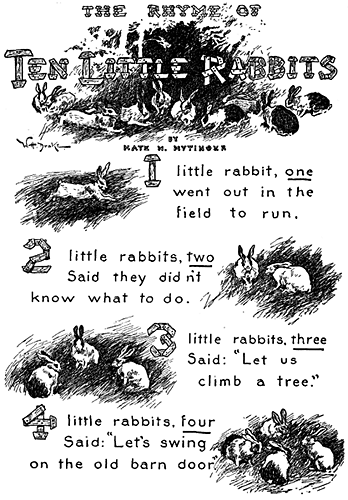
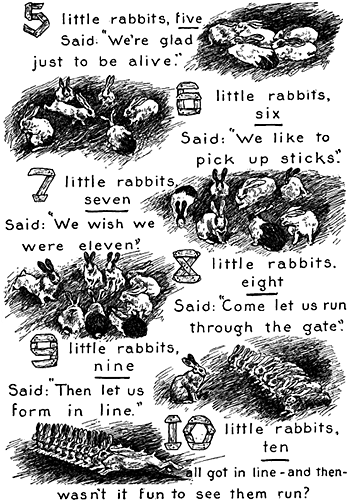
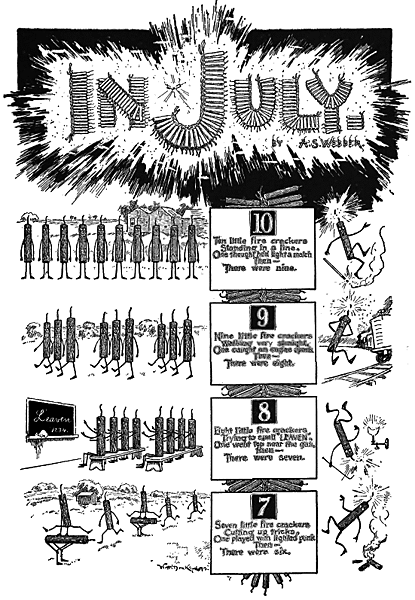
IN JULY.
BY A. S. WEBBER.
10
Ten little fire crackers
Standing in a line,
One thought he’d light a match
Then——
There were nine.
9
Nine little fire crackers
Walking very straight,
One caught an engine spark
Then——
There were eight.
8
Eight little fire crackers
Trying to spell “LEAVEN,”
One went too near the gas,
Then——
There were seven.
7
Seven little fire crackers
Cutting up tricks,
One played with lighted punk
Then——
There were six.
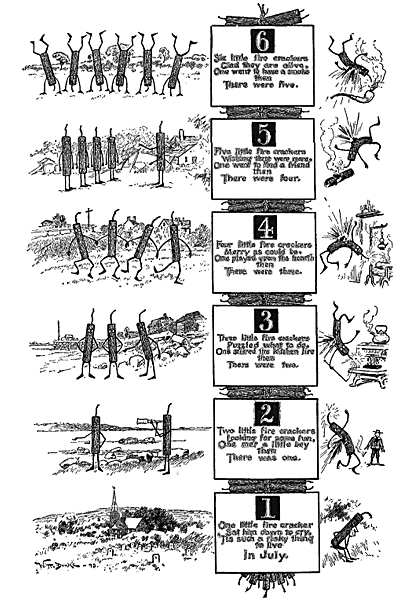
6
Six little fire crackers
Glad they are alive,
One went to have a smoke
Then
There were five.
5
Five little fire crackers
Wishing there were more,
One went to find a friend
Then
There were four.
4
Four little fire crackers
Merry as could be,
One played upon the hearth
Then
There were three.
3
Three little fire crackers
Puzzled what to do,
One started the kitchen fire
Then
There were two.
2
Two little fire crackers
Looking for some fun,
One met a little boy
Then
There was one.
1
One little fire cracker
Sat him down to cry,
’Tis such a risky thing
To live
In July.
Priscilla Penelope Powers one day
Took tea at a neighbor’s just over the way.
Two pieces of pie they urged her to take,
And seven whole slices of chocolate cake!
“Oh, dear,” sighed Priscilla Penelope Powers,
“I wish I was your little girl ’stead of ours!”
Mrs. John T Van Sant.
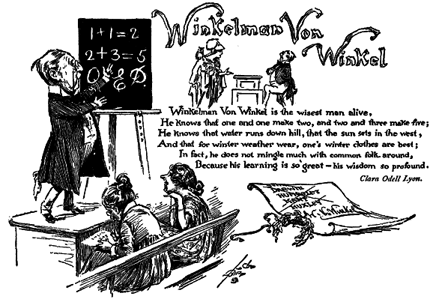
Winkelman Von Winkel is the wisest man alive,
He Knows that one and one make two, and two and three make five;
He knows that water runs down hill, that the sun sets in the west,
And that for winter weather wear, one’s winter clothes are best;
In fact, he does not mingle much with common folk around,
Because his learning is so great—his wisdom so profound.
Clara Odell Lyon.
Ten little cookies, brown and crisp and fine—
Grandma gave Baby one; then there were nine.
Nine little cookies on a china plate—
Betty took a small one; then there were eight.
Eight little cookies, nice and round and even—
The butcher boy ate one; then there were seven.
Seven little cookies, much liked by chicks—
The old hen ate one, then there were six.
Six little cookies, when grandma went to drive—
Betty had another one; then there were five.
Five little cookies, placed too near the door—
The little doggie ate one; then there were four.
Four little cookies, brown as brown could be—
Grandma took one for herself, then there were three.
Three little cookies—when grandpa said, “I too,
Would like a very little one”, then there were two.
Two little cookies—fast did Betty run
To give one to her mamma; then there was one.
One little cooky—and now our story is done,
Baby Jane ate the last, then there was none.
One head with curly hair,
Two arms so fat and bare,
Two hands and one wee nose,
Two feet with ten pink toes,
Skin soft and smooth as silk,
When clean, ’tis white as milk.
BY ELIZABETH PRENTISS
Once there was a little Kitty,
White as the snow;
In a barn she used to frolic,
Long time ago.
In the barn a little mousie
Ran to and fro,
For she heard the little Kitty,
Long time ago.
Two black eyes had little Kitty,
Black as a sloe;
And they spied the little mousie,
Long time ago.
Four soft paws had little Kitty,
Paws soft as snow;
And they caught the little mousie,
Long time ago.
Nine pearl teeth had little Kitty,
All in a row;
And they bit the little mousie,
Long time ago.
When the teeth bit little mousie,
Mousie cried out, “Oh!”
But she slipped away from Kitty,
Long time ago.
One, Two—buckle my shoe;
Three, Four—open the door;
Five, Six—pick up sticks;
Seven, Eight—lay them straight;
Nine, Ten—a good fat hen;
Eleven, Twelve—I hope you’re well;
Thirteen, Fourteen—draw the curtain;
Fifteen, Sixteen—the maid’s in the kitchen;
Seventeen, Eighteen—she’s in waiting;
Nineteen, Twenty—my stomach’s empty.
 “ah, ah! so that’s where he buries his old bones!”
BY H. G. DURYÉE
The little girls who lived on Amity Street all wore mittens when they went to school in winter. Nobody’s mother ever thought of anything else to keep small hands warm. Some mothers or grandmothers crocheted them, and some knit them with fancy stitches down the back, or put other mark of distinction upon them; but they were always mittens, and were always fastened to a long ribbon or piece of braid or knitted rein, so that they might not get lost, one from the other.
This connecting-link frequently gave rise to confusion, for when two little girls put their arms around each other’s necks as they walked to school, they sometimes got tangled up in the mitten string and had to duck and turn and bump heads before the right string was again resting on the right shoulder. But as it was possible to laugh a great deal and lose one’s breath while this was going on, it was rather an advantage than otherwise, and little girls who were special chums were pretty sure to manage a tangle every other day at least.
Clarabel Bradley did her tangling and untangling with Josephine Brown, who lived at the end of Amity Street. They both went to the same school and were in the same class. They waited for each other in the morning, and came home together, and shared each other’s candy and ginger cookies whenever there were any, and took firm sides together whenever the school-yard was the scene of dispute.
But into this intimacy came a pair of gloves, almost wrecking it.
The gloves were sent by Clarabel’s aunt, who was young and pretty and taught school in a large city; and they came done up in white tissue-paper inside a box with gilt trimming around the edges and a picture on the center of the cover. Taken out of the paper, they revealed all their alluring qualities. They were of a beautiful glossy brown kid with soft woolly linings and real fur around the wrists, and they fastened with bright gilded clasps.
With them was a note which said:
For Clarabel, with love from her Aunt Bessie. Not to be kept for Sundays, but worn every day.
And the last sentence was underscored.
Clarabel’s mother looked doubtful as she read the message. Such gloves were an extravagance even for best—and mittens were warmer. But when she encountered Clarabel’s shining eyes she smiled and gave in.
So Clarabel took the gloves to her room that night, and slept with them on the foot-board of her bed, where she could see them the first thing when she waked; and in the morning she put them on and started for school.
One hand was held rigidly by her side, but the other was permitted to spread its fingers widely over the book she carried. Both were well in view if she looked down just a little. Passers-by might see; all Amity Street might see; best of all, Josephine might see!
But Josephine, waiting at the corner, beheld and was impressed to the point of speechlessness. Whereupon Clarabel dropped her book, and had to pick it up with both hands. The furry wrists revealed themselves fully.
Josephine found her voice.
“You’ve got some new gloves,” she said.
“Yes; my Aunt Bessie sent them.”
“Aren’t they pretty!”
“I think so, and they’re lots nicer than mittens. I’m not going to wear my mittens again.”
Josephine looked down at her own chubby hands. Her mittens were red this winter, with a red-and-green fringe around the wrists. Only that [Pg 266]morning she had admired them. Now they looked fat and clumsy and altogether unattractive; but she wasn’t going to admit that to any one else.
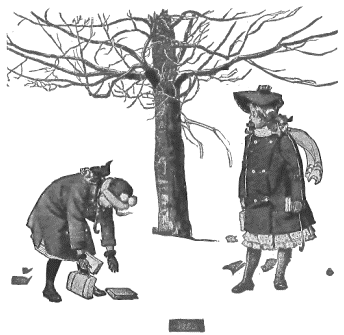 “clarabel dropped her book, and had to pick it up with
both hands.”
“clarabel dropped her book, and had to pick it up with
both hands.”
“I like mittens best,” she said stoutly,—“for school, anyway,” she added, and gave Clarabel more of the sidewalk.
“My Aunt Bessie said specially that these were to wear to school.” And Clarabel walked nearer the fence.
Josephine was hard put to it—Clarabel’s manner had become so superior.
“I don’t think your Aunt Bessie knows everything, even if she does teach school in a big city. My mother says she’s too young to—”
What she was too young to do was not allowed to be explained; for Clarabel, with a color in her face that rivaled Josephine’s mittens, had faced her.
“My Aunt Bessie’s lovely, and I won’t listen to another word against her, not another one—so there!”
Then she turned, with a queer feeling in her throat, and ran down the street to catch up with another little girl who was on ahead.
Josephine swung her books and walked as if she didn’t care.
Clarabel overtook the little girl, who was all smiling appreciation of the new gloves, and was overtaken by other little girls who added themselves to the admiring group. But somehow her triumphal progress was strangely unsatisfactory; the glory was dimmed.
At recess, Josephine paired off with Milly Smith, who stood first in geography and wore two curly feathers in her hat. Clarabel shared her cookies with Minnie Cater, because it didn’t matter who helped eat them if it wasn’t Josephine. Neither spoke to the other, and at noontime they walked home on different sides of the street.
Perhaps that was why in the afternoon Clarabel lost her place in the reader and failed on so many examples in arithmetic that she was told she must stay after school.
Usually there would have been several to keep her company, but on this day there was no one else,—even Angelina Maybelle Remington had got through without disaster,—and Clarabel, wistful-eyed, saw the other girls file out.
At another time Josephine would have stayed; she always did when Clarabel had to, as Clarabel did when she was in like need. But to-night she filed out with the rest, and Clarabel, with a sense of desertion, bent over her problems of men and hay to mow, men and potatoes to dig, men and miles of railroad to build.
The noise of scurrying feet grew fainter, the sound of children’s voices died away. The room settled into stillness, except for the solemn tick of the clock and the scratching of Clarabel’s pencil on the slate. There were fractions in the problems, and fractions were always hard for Clarabel. Her pencil stopped often while she frowned at the curly-tailed figures. In one of these pauses the door squeaked open a little way. It squeaked again, and some one sidled into the room; it was Josephine.
“Please may I go to my seat?” she asked.
“Certainly,” said the teacher, and watched her curiously.
She tiptoed to the back seat, fumbled for a few minutes in her desk, then slipped to a seat a few rows farther in front; then to another and another, till she had reached the row in which Clarabel sat.
Clarabel, though she was bending over her slate, had heard every hesitating move, and when the last halt was made she shook her curls back from her eyes, looked around, and dimpled into smiles.
The teacher, watching, waited to see what would happen next. Nothing [Pg 267]did, except that the two little girls sat and smiled and smiled and smiled as if they never would stop.
Presently the teacher herself smiled and spoke. She had a very sweet voice sometimes—one that seemed to hint at happy secrets. That was the way it sounded now.
“Would you like to help Clarabel, Josephine?” she asked. “You may if you wish to.”
“If she’ll let me,” answered Josephine, her eyes fixed on Clarabel’s face.
“I would love to have her,” said Clarabel, her eyes on Josephine. And instantly the one narrow seat became large enough for two.
For ten minutes more there was great scratching of slate-pencils and much whispering and some giggling. Then with cheerful clatter the slate was borne to the platform. The teacher looked at the little girls more than at the examples. “I’m sure they’re right,” she said. “Now, off to your homes—both of you!”
“Good night,” said Clarabel.
“Good night,” said Josephine.
“Good night, dear little girls,” said the teacher.
There was a soft swish of dresses and the children had reached the dressing-room. Within its familiar narrowness, Josephine hesitated and fingered her cloak-buttons.
“I think your Aunt Bessie”—it was very slow speech for Josephine—“is ever so nice and knows a lot.”
“Oh!” bubbled Clarabel, joyously, “I do love the color of your mittens! Don’t you—don’t you”—she finished with a rush—“want to let me wear them home and you wear my gloves?”
Josephine put aside the dazzling offer.
“Your gloves are prettier and you ought to wear them.”
Clarabel thought a minute, a shadow in her eyes.
“I know what,” she declared, the shadow vanishing. “You wear one glove and mitten and I’ll wear the other glove and mitten!”
“Oh!” said Josephine, with a rapturous hug, “that will be splendid!”
And thus they scampered home, the two mittened hands holding each other tight, while the two gloved hands were gaily waved high in the air with each fresh outburst of laughter from the little schoolmates.
BY ALICE E. ALLEN
Molly was such a little girl that she didn’t seem big enough to have a party all her own with truly ice-cream in it. But she had asked for one so many times that at last Mother decided to give her one. And the party was to be a surprise to Molly herself.
Early that afternoon Molly wanted to go for a little visit to Miss Eleanor. Miss Eleanor lived up Molly’s street, in a white house with apple-green blinds. Molly often went all alone.
Miss Eleanor was always so sunny and full of songs and stories and games that Molly loved her next best to Father and Mother and Baby.
“You may go, dear,” said Mother, “if you will come home exactly at three o’clock.”
“You always say exactly three o’clock, Mother,” said Molly.
“Well, five minutes after three, then,” laughed Mother. “And, Molly, so that you won’t forget this time, all the way to Miss Eleanor’s, say over and over, ‘Five minutes after three.’ Then, just as soon as you get there, say the words quickly to Miss Eleanor, ‘Five minutes after three.’”
“Five minutes after three,” said Molly; “I can remember that.”
“That will give me plenty of time to get ready for the party,” thought Mother.
Up the street with her white parasol flew Molly. “Five minutes after three,” she said over and over in a whisper until she began to sing it. “Five minutes after three,” she sang until she stopped a moment on the bridge to see some boys fishing. Just about there, a big dog who was a friend of Molly’s ran out to say, “Good afternoon.”
“Oh, Fritzie,” cried Molly, “I’m going to Miss Eleanor’s to make her a visit. Want to come?”
But Fritz had the house to look after. So Molly gave him a hug and ran along.
“Three minutes after five,” sang Molly; “three minutes after five,” over and over until she ran into Miss Eleanor’s sunny little sitting-room.
“Three minutes after five,” cried Molly; “that’s how long I can stay. Won’t that be nice?”
“Why, it’s little Molly!” cried Miss Eleanor, “I’m all alone and so glad to have company! We’ll hear the clock strike five. Then, if you put on your wraps, you’ll be all ready to start home at three minutes past.”
It seemed a very very short time to Molly before the little clock struck five.
“There, deary,” said Miss Eleanor. “Put on your things and hurry right along!”
Molly put on her hat and coat. Then she kissed Miss Eleanor and hurried down the street.
When she reached the corner, she saw that the parlor at home was all lighted. And out of it came such a hubbub of little voices all laughing and talking that Molly ran faster than ever.
At the door she met Mother.
 “she stopped for a moment on the bridge.”
“Oh, Molly, where have you been?” cried Mother. “I couldn’t go after you because I couldn’t leave Baby. And I couldn’t take him.”
Molly scarcely heard. “Oh, Mother, Mother,” she cried, “it looks like a party. And it sounds like one. Is it a party, Mother?”
“Yes,” said Mother, “your own little party, Molly. And you’re the only one who is late. How could you forget?”
“But I didn’t forget, Mother,” cried Molly, hurrying out of her coat, “truly I didn’t. Every step of the way I said it, and I said it to Miss Eleanor the very first thing.”
“What did you say?” asked Mother.
“Three minutes after five,” said Molly.
Mother laughed. “Why, Molly dear, you got the hour and minutes turned around. I said five minutes after three. Well, never mind. Run along just as you are. It’s a lovely party, dear, with truly ice-cream in it.”
BY LOIS WALTERS
Edith was a little girl who was just learning to write. Her mother told her one day that she could have a tea-party on the next Tuesday, if the weather was fine, and that she could invite her little friend Helen, who lived on the same street, though not very far away; but she must write the letter to ask Helen to come. So, Edith got up at her mother’s writing-desk and took some of her own writing paper, and began to write. She could make the letters but she could not spell very well. She asked her mother how to spell the words and then she wrote them down. And this is the letter she wrote:
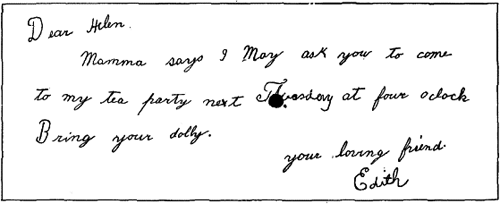
Then she sealed the letter in the envelop, and put a stamp on it, and stood on the front piazza so as to give it to the postman herself.
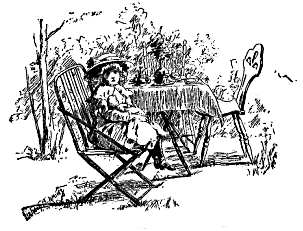 edith waiting for helen.
When Tuesday came, Edith’s nurse dressed her in a fresh, white frock, and Edith dressed her dolly in her best dress, and went out under the trees where her nurse had set the table for two. And then she sat in a chair at the table and waited. But the big town clock struck four and no Helen came; and then she waited for half an hour longer. Then Edith put her dolly down on the chair and went in the house to find her mother.
“Mama,” she said, “I think Helen is very rude, she doesn’t come to my party and I invited her!”
[Pg 270] “Just wait a little longer, dear,” said her mother, “and she will come. Maybe her nurse was busy dressing Helen’s little sister and brother and couldn’t get her ready in time.”
“But I invited her,” was all Edith could say; “but I invited her, and she doesn’t come.”
Then her mother went to the telephone and called up Helen’s mother. In a moment she came back.
 helen and her dolly.
“Edith, dear,” she said, “what day did you write Helen to come? Her mother says she thought it was to be Thursday, and so did Helen, and this is only Tuesday.”
“But I did say Tuesday, mama,” said Edith, who was almost ready to cry. “I remember because that was the hardest word to spell, and I think I made a blot when I wrote it.”
“Well, never mind, dear; Helen is getting ready now and will be over in a few minutes,” said her mama.
And Edith was very happy, and ran out to the tea-table under the trees with her doll to wait.
But she did not have to wait very long this time, for in a little while Helen came running across the lawn carrying her doll; and so happy were both little girls that Edith forgot all about the long time she had been waiting for Helen to come.
Helen wanted Edith to know that she had not been rude in staying away, so she brought with her the letter Edith had sent to her, so she could show it to Edith. And there, sure enough, the word “Tuesday” was written so badly that it looked more like “Thursday,” and that was why Helen did not think she was expected on this day.
Well, the very first thing they did was to undress their dolls and put them to sleep under one of the bushes on the lawn—in the shade, so that the sun would not hurt their eyes, and so that the wax would not be melted from their cheeks. Edith put her napkin over both dolls for a comforter, for you never know when it will blow up cold, and little girls have to be as careful of their dolls as their own mothers are!
Very soon the maid came out with cookies and lady-fingers and make-believe tea, and another napkin to take the place of the one Edith had put over the dolls, and they had tea. Then the two little girls and Edith’s nurse had a nice game of croquet, and they had a lovely tea-party after all, and Edith forgot all about waiting so long for Helen to come.
But Edith never again made a mistake when she spelled “Tuesday.”
BY ELEANOR PIATT
 “oh, doctor! come quick! rebecca has a chill!”
I have a doll, Rebecca,
She’s quite a little care,
I have to press her ribbons
And comb her fluffy hair.
I keep her clothes all mended,
And wash her hands and face,
And make her frocks and aprons,
All trimmed in frills and lace.
I have to cook her breakfast,
And pet her when she’s ill;
And telephone the doctor
When Rebecca has a chill.
Rebecca doesn’t like that,
And says she’s well and strong;
And says she’ll try—oh! very hard,
To be good all day long.
But when night comes, she’s nodding;
So into bed we creep
And snuggle up together,
And soon are fast asleep.
I have no other dolly,
For you can plainly see,
In caring for Rebecca,
I’m busy as can be!
BY EUNICE WARD
“It seems very queer,” said Dorothea thoughtfully, “people who are going to do something nice always have presents given them, but people who are going to do something horrid never get a thing, and they need it twice as much.”
“As for instance?” said her father, laying down his paper and drawing her onto his knee, while the rest of the family prepared to give the customary amused attention to their youngest’s remarks.
 “‘you know school begins next week,’ said dorothea.”
“Well, when Cousin Edith went to Europe we all gave her presents to take with her, and when she came home lots of people sent her flowers. Anita’s been getting cups and things ever since she was engaged, and last spring, when Florence graduated, almost all the family gave her something; and when Mary Bowman was confirmed she got a lovely white prayer-book and a gold cross and chain. But when people are going to do what they hate to do, they’re left out in the cold.”
“What are you going to do that you don’t like, Baby?” asked Florence.
“Why, you know, school begins again next week,” said Dorothea. “It makes me feel quite mournful, and I don’t see anything to cheer me up and make it interesting for me.” A little smile was hidden in the corners of her mouth although her tone was as doleful as possible.
“If you were going to boarding-school—” began Anita, who was apt to take everything seriously.
“Then I’d have lots of things,” interrupted Dorothea. “New clothes and a trunk and a bag, and you’d all come to see me off, and it would be interesting. But I’m going to work just as hard here at day-school, and yet I’ve got to bear it, all by myself.”
Her father pinched her ear, and her big brother Jim offered to have a bunch of roses placed on her desk at school if that would make her feel better, while her two sisters looked at each other as though the same idea had occurred to them both.
On the morning of the first day of school, Dorothea was suddenly awakened by a loud ting-a-ling-a-ling. She sat up in bed and rubbed her eyes. The room was flooded with morning light and the brass knobs on her bed gleamed cheerfully at her and seemed to say: “Get up, get up!” Now Dorothea was a “sleepyhead” and had seldom been known to get up when first awakened. It usually took at least three calls from her mother or the girls, and sometimes Jim stole in and administered a “cold pig,” that is, a few drops of chilly water squeezed upon her neck from a sponge, before she was ready to leave her comfortable bed.
“It’s an alarm clock,” thought Dorothea. “But where is it?” Her eyes traveled sleepily around the room but saw nothing that had not been there the night before. The ting-a-ling-a-ling sounded once more. “It’s in this room somewhere!” she exclaimed, bouncing out of bed. [Pg 273] She looked on bureau, washstand, bookcase, and window-seat, and then jumped, for the loud ting-a-ling came almost from underneath her feet. She hastily lifted the drooping cover of a little table that stood near the window, and there on the edge of the lower shelf stood an alarm-clock of the ordinary pattern but of rather extraordinary appearance, owing to a large yellow paper ruff which encircled its face.
“How did it get there?” exclaimed Dorothea in astonishment; and as she gazed the clock burst forth with another loud ting-a-ling.
“Isn’t it ever going to stop doing that?” she said, lifting it as she spoke. The yellow ruff seemed to have something written on it, so she took it off and, smoothing it out, read:
Dear Dolly: Happy school-day! After much earnest consideration I
have selected this as a suitable reminder of this joyful (?)
anniversary. It will continue to remind you five mornings in the
week, thereby saving your family much wear and tear, for it will be
properly wound and set every night by
Your affectionate brother,
Jim.
p.s. When you are sufficiently aroused, press the lever and the alarm will stop.
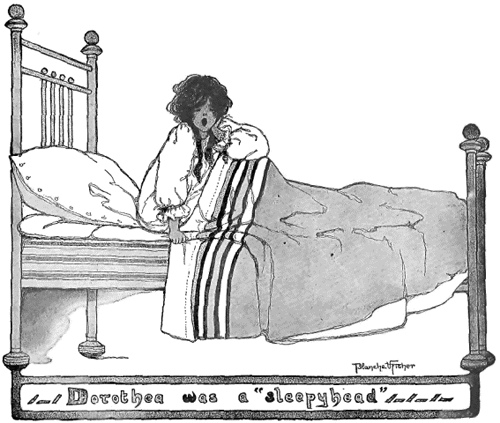
“It’s one of those awful clocks that go off every minute!” said Dorothea, carefully examining it to find the lever. She almost dropped it when it began another of its loud and long rings, but she soon found and pressed the lever and thereafter the clock was silent except for its customary tick.
“I don’t believe I shall ask anybody to give me presents any more,” she said, eying Jim’s “reminder” with disfavor. But she changed her mind a little later when, on looking for a clean handkerchief, she discovered a flat square box tied with blue ribbon, and, opening it, saw half a dozen handkerchiefs with narrow blue borders and a little blue D in the corner. On the top was Cousin Edith’s visiting-card, on the back of which was printed in fantastic letters:
Dear Dolly: Use a handkerchief
Whenever you’re inclined to sniff.
But with this band of blue I think
They don’t need polka-dots of ink.
It was a constant wonder to the household what Dorothea did with her handkerchiefs when she was at school. In vain she protested that she didn’t wipe her pen on them, and she didn’t use them as blotters or to wash out her ink-well; [Pg 274] but, nevertheless, black stains almost always appeared upon them, and Florence insisted that the family had to buy an extra pint of milk a day to take out all these ink-stains. Cousin Edith was too frequent a visitor not to know all the family plans and jokes, and Dolly, as she laughed and shook out one of the blue-bordered squares, resolved that “polka-dots” should be conspicuous by their absence, for Edith would be sure to know.
She entered the breakfast room just as the family were sitting down to the table.
“Behold the effects of my generosity and fore-thought!” exclaimed Jim waving his hand toward her. “Our Youngest is in time for breakfast!”
“Many happy returns of the day, small sister,” said Anita, just as if it was her birthday, kissing her good morning and slipping a little hard package into her hand. “Bob sends you this with his love.”
“I don’t mind returns of the day when it’s like this,” said Dorothea, opening the package and at the same time spying a couple of tissue-paper parcels lying beside her plate. Inside was a small chamois-skin case out of which slid a little pearl-handled penknife. The accompanying card bore the name of her future brother-in-law, and also these words:
I hesitate to offer you
This knife, for I shall be
Afraid that if you cut yourself
You straightway will cut me.
“How long did it take Bob to execute that masterpiece?” inquired Jim as Dorothea read it aloud.
“You’re jealous,” she said. “Yours wasn’t half so lovely as Cousin Edith’s and Bob’s. It wasn’t poetry at all.”
“I left all the eloquence to my gift itself,” answered Jim, helping himself to an orange.
Dorothea paid no attention to him, for she was opening a small package fastened by a rubber band. It was a silver-mounted eraser with a tiny brush at one end. The inclosed note read:
This advice I must repeat;
Spare the rub and spoil the sheet.
If you can’t restrain your speed,
This will prove a friend in need.
Dolly joined rather shamefacedly in the general smile, as she thanked Florence, whose writing she had recognized. She was very apt to postpone her work until the last minute, and then rush through it as fast as possible; her compositions suffered from the many careless mistakes that she was always in too much of a hurry to correct, while her drawings belonged to what Jim called the “slap-dash school.”
“We shall know by the amount of rubber left at the end of the term whether you have taken my valuable advice,” said Florence. “What’s in that other package, Baby? I know it is Anita’s by the extreme elegance of its appearance.”
 “‘many happy returns of the day, small sister,’ said
anita.”
“‘many happy returns of the day, small sister,’ said
anita.”
Dorothea opened an oblong package tied with green ribbon and found a set of blotters fastened to a dark green suède cover ornamented with an openwork design of four-leaf clovers, and a pen-wiper to match. On top lay a slip of paper on which was written in Anita’s pretty hand:
Wishing “Our Youngest” good luck and a happy school year.
“I’m not good at verses, so you’ll have to be content with plain prose,” said Anita, and Dorothea assured her that she was quite satisfied.
“Half past eight, Dolly,” said her mother when breakfast was over. “It is time you started.”
“Oh, not yet, mother,” said Dorothea the Dawdler. “It only takes me fifteen minutes.”
“Now, see here,” said Jim; “what do you suppose stirring young business-men like your father and brother are lingering until the nine o’clock [Pg 275] train for, unless it is to see you off for school? We want to give you as good a send-off as possible, for you’re going to be absent four whole hours, but we can’t,—unless you do your part and begin to go pretty soon. I don’t believe you’ve got all your books together, as it is.”
 “‘lend me your pencils, won’t you, jim?’ said dorothea.”
“Yes, I have,” answered Dorothea triumphantly. “They are all on the hall table, for I put them there last night. Oh, gracious!” she exclaimed blankly: “I forgot to see whether I had any pencils! I don’t believe I have one! Jim, lend me yours, won’t you? Just for to-day.”
“Lend you my most cherished possession? Never!” said Jim, placing his hand dramatically over his breast pocket.
“Then, Daddy, won’t you please lend me yours?”
“Trot along, trot along!” said her father; and Dorothea, not knowing quite what to make of having her demands thus ignored, put on her big sailor hat and started to gather up her books. On top of the pile was a slender inlaid box under a card bearing the words, “For Dolly, from Father.” Pushing back the sliding cover, Dorothea saw that the box contained a row of pencils, all beautifully sharpened, a dozen pens, and a slim gunmetal penholder.
“Oh!” she squealed with delight. “So that’s why you wouldn’t lend me any pencils!” and gave her father a hug.
“Hurry up, now,” said Jim. “Don’t forget we’ve got to see ourselves off after we’ve seen you.”
“Why don’t you take your bag?” asked Anita.
“It’s too small for my new Geography,” answered Dorothea, placing this huge outward and visible sign of her progress in learning so that it would form a foundation for the rest of her books. “Besides, it’s too shabby”.
“You had better take it to-day, anyhow, as you have so much to carry,” suggested her mother. “I brought it downstairs and it’s on the hat-rack.”
“I just hate it!” pouted Dorothea, turning; and then stopped in surprise, for instead of her little old satchel, a large new one made of soft dark brown leather was hanging on the rack. It was ornamented on one side with her monogram in raised tan-colored letters, and it was large enough for the largest Geography that she was ever likely to have.
 “at the gate she turned to wave her hand.”
“Who gave me that?” she cried. “Oh, I know—Mother! It’s just exactly what I wanted. I think going to school this way is perfectly lovely!” she added as she slipped her other possessions into the bag.
“Twenty minutes to nine!” called Jim warningly.
“All right, I’m going now,” answered Dorothea gaily as she kissed them all around.
“And the first day of school isn’t so dismal after all, is it?” said her father.
“Oh, it’s splendid, just splendid!” she replied enthusiastically. At the gate she turned to wave her hand at the assembled family, who waved back at her vigorously; and then, swinging her bag, she ran off down the street toward school.

oris’s papa gave her a five-dollar bill, such a lot of money! Doris went to a big bank and asked if they could give her smaller money for it. The banker said he thought they could. So he gave her two two-dollar bills and a big silver dollar. How much did that make? Doris wanted the dollar changed again; so the banker asked if she would have two fifty-cent pieces, or one fifty-cent piece and two quarters—or perhaps four quarters or ten dimes—or twenty five-cent pieces—or a hundred pennies.
Doris thought a hundred pennies would be a good many to count and to carry, so she said she would take two quarters, three dimes and four five-cent pieces.
She laid away four dollars in the bank, those were the two bills, and put the change in her purse. When she went to the shop, she had such a lot of money that she thought she never could spend it. So she bought a paint-box with two little saucers in it for 10 cents; that left her 90 cents; and then a big rubber balloon for 25 cents; that left 65 cents; and a little one for 10 cents; and then Doris bought a whole pound of candy for thirty cents. Out of the 25 cents she had left, it cost 10 cents to go in the car.
When Doris got home she opened her paint-box. What do you think? Of course it was only a cheap paint-box and the paints were so hard that they would not paint at all. Doris cut out the dolls, but they were no better than those in any newspaper’s colored supplement. Doris’s mama said that the candy was too bad to eat at all, and the rubber balloons got wrinkled and soft in the night, because the gas went out of them. Doris cried when she saw them. “Now,” she said, “I have nothing left of my beautiful dollar but 15 cents.”
“I’m sorry, Dearie,” Doris’s mama said, “but it’s bad enough to have wasted one dollar without crying about it, too. When you and I go out, we’ll try to get such good things for the next dollar, that it will make up for our mistake about this one.” The next bright day they went to the bank and got another dollar.
Now Doris’s mama was a very wise person (mamas often are). So they went to a store where there were some books that had been wet a little by the firemen when the store caught fire. There they found a large, fine book of animal stories with pictures in it that had been 50 cents, but the book-store man sold it for 10 cents, because the back cover and a little bit of the edge was stained with water and smoke.
That left—how much? Ninety cents. Doris’s brother had told her he would teach her to play marbles, so she bought six glass marbles for 5 cents and a hoop with a stick for 5 more. That left 80 cents.
Then Doris asked if her mama thought she could buy a pair of roller skates. Her mama said they could ask how much roller skates cost, but the shopman said they were a dollar a pair! So Doris said she would save up the 80 cents that was left of her dollar and wait until she had enough for the skates.
However, a little boy was looking in at the window of the toy-shop and he looked so sad, and so longingly at the toys, that Doris spoke to him, and when he said he wanted one of the red balls, she bought it for 5 cents, and gave it to him. That left 75 cents.
When they got home, they told papa about the skates and he said he could get them down-town for 75 cents, and he did.
So Doris learned by losing her first dollar, to get a lot of good things that would be more useful and would last longer, with her second dollar.
BY AMY B. JOHNSON
“I’ve been crying again, father.”
“Have you, sweetheart? I’m sorry.”
“Father.”
“Yes, darling.”
“I don’t like Holland at all. I wish we had stayed in New York. And I would much rather stay in Amsterdam with you to-day than to go and see those horrid little Dutch children. I’m sure I shall hate them all.”
“But how about Marie? You want to see her, don’t you?”
“No. I’m very much annoyed with Marie. I don’t see why she could not have been contented in New York. After taking care of me ever since I was a baby, she must like me better than those nieces and nephews she never saw till yesterday.”
“I am sure Marie loves you very dearly, Katharine, but you are getting to be such a big girl now that you no longer need a nurse, and Marie was homesick. She wished to come back to Holland years ago, but I persuaded her to stay till you were old enough to do without her, and until Aunt Katharine was ready to come to New York and live with us, promising her that when that time came you and I would come over with her, just as we have done, on our way to Paris. We must not be selfish and grudge Marie to her sisters, who have not seen her for twelve years.”
“I am homesick now, too, father. I was so happy in New York with my dolls—and you—and Marie—and—”
“So you shall be again, darling; in a few months we will go back, taking dear Aunt Katharine with us from Paris, and you will soon love her better than you do Marie.”
Katharine and her father, Colonel Easton, were floating along a canal just out of Amsterdam, in a trekschuit, or small passenger-boat, on their way to the home of one of Marie’s sisters, two of whom were married and settled near one of the dikes of Holland. Katharine was to spend the day there with her nurse, and make the acquaintance of all the nieces and nephews about whom Marie had told her so much, while her father was to return to Amsterdam, where he had business to transact with a friend. They had arrived in Holland only the day before, when Marie had immediately left them, being anxious to get home as soon as possible, after exacting a promise from the colonel that Katharine should visit her the next day.
Katharine felt very sure she would never like Holland as she gazed rather scornfully at the curious objects they passed: the queer gay-colored boats, the windmills which met the eye at every turn, with their great arms waving in the air, the busy-looking people, men and women, some of the latter knitting as they walked, carrying heavy baskets on their backs, and all looking so contented and placid.
“Try and think of the nice day you are going to have with Marie and the children,” said the colonel; “then this evening I will come for you, and we will go together to Paris, and when you see Aunt Katharine you will be perfectly happy. See, we are nearly at the landing, and look at that row of little girls and boys. I do believe they are looking for you.”
“Yes; they must be Marie’s sister’s children, I know them from the description Marie has read me from her letters. Aren’t they horrid little things, father? Just look at their great clumps of shoes—”
“Yes—klompen; that is what they are called, Katharine.”
“And their baggy clothes and short waists! One of them knitting, too! Well, I would never make such a fright of myself, even if I did live in Holland, which I’m glad I don’t.”
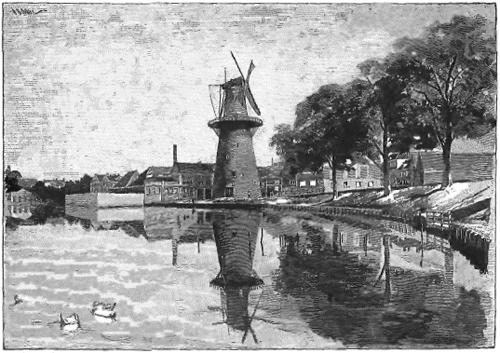 “the windmills which met the eye at every turn,
By this time they had made the landing. Then Katharine and Marie fell into each other’s arms and cried, gazed at in half-frightened curiosity by seven small, shy Hollanders, and in pitying patience by a very large colonel.
“Au revoir. I will call for Katharine this afternoon,” called Colonel Easton, when the time came for him to go on board again.
Katharine waved her handkerchief to her father as long as his boat was in sight.
“See, Miss Katharine,” said Marie—in Dutch now, for Katharine understood that language very well, Marie having spoken it to her from her infancy—“here is Gretel, and this is her little sister Katrine and her brother Jan. The others are their cousins. Come here, Lotten; don’t be shy. Ludolf, Mayken, Freitje, shake hands with my little American girl; they were all eager to come and meet you, dear, so I had to bring them.”
Katharine shook hands very soberly with the little group, and then walked off beside Marie, hearing nothing but the clatter-clatter of fourteen wooden shoes behind her.
Soon they arrived at the cottage, and in a moment seven pairs of klompen were ranged in a neat row outside a small cottage, while their owners all talked at once to two sweet-faced women standing in the doorway. These were Marie’s sisters, whose husbands were out on the sea fishing, and who lived close beside each other in two tiny cottages exactly alike.
“Oh,” exclaimed Katharine, as, panting and breathless, she joined the group, “do you always take off your shoes before you go into the house?”
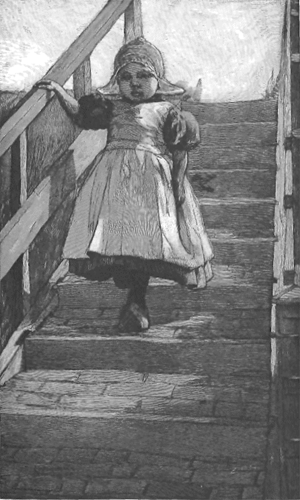 little mayken
“Why, of course,” said the children.
“How funny!” said Katharine.
Then Marie, who had been left far behind, came up and introduced the little stranger to Juffrouw Van Dyne and Juffrouw Boekman, who took her into the house, followed by the three children who belonged there and the four cousins who belonged next door. They took off her coat and hat and gave her an arm-chair to sit in as she nibbled a tiny piece of gingerbread, while large pieces from the same loaf disappeared as if by magic among the other children. Then Gretel showed to her her doll; Jan shyly put into her hand a very pretty small model of the boat she had come in on that morning; Lotten offered her a piece of Edam cheese, which she took, while politely declining Mayken’s offer to teach her to knit, little Katrine deposited a beautiful white kitten on her lap; Ludolf showed her a fine pair of klompen on which his father was teaching him to carve some very pretty figures; Freitje brought all his new fishing-tackle and invited her to go fishing with him at the back of the house. It was not long before Katharine forgot that she was homesick, and grew really interested in her surroundings; and later the dinner, consisting chiefly of fish and rye bread, tasted very good to the now hungry Katharine.
It was after dinner that the tragedy happened. The children had all started out for a walk. Before they had gone more than a mile from the house the fog settled all around them—so dense, so thick, blotting out everything, that they could not see more than a step ahead. They were not frightened, however, as all they had to do was to turn round and go straight ahead toward home. The children took one another’s hands at Gretel’s direction, stretching themselves across the road, Katharine, who held Gretel’s hand, being at one end of the line. They walked on slowly along the dike for a short time, talking busily, though not able to see where they were going, when suddenly Katharine felt her feet slipping. In trying to steady herself she let go of Gretel, gave a wild clutch at the air, and then rolled, rolled, right down a steep bank, and, splash! into a pool of water at the bottom. For a moment she lay half stunned, not knowing what had happened to her; then, as her sense came, “Oh,” thought she, “I must be killed, or drowned, or something!” She tried to call “Gretel,” but her voice sounded weak and far off, and she could see nothing. Slowly she crawled out of the pool, only to plunge, splash! into another. She felt, oh, so cold, wet, and bruised! “I must have rolled right down the dike,” she thought. “If I could find it, I might climb up again.” She got up and tried to walk, but sank to her ankles in water at every step.
She was a little lame from her fall, and soaked from head to foot. Her clothes hung around her most uncomfortably when she tried to walk. But, if she had to crawl on hands and knees, she must find the house; so, plunging, tumbling, rising again, she crawled in and out of ditches, every minute getting more cold and miserable.
But on she went, shivering and sore, every moment wandering farther from her friends, who were out searching all along the bottom of the dike.
After what seemed to her a long time, she came bump up against something hard. She did not know what it was, but she could have jumped for joy, if her clothes had not been so heavy to hear a voice suddenly call out in Dutch “What’s that? Who has hit against my door? Ach! where in the world have you come from?” Then in a considerably milder tone: “Ach! the little one! and she is English. How did you get here, dear heart?”
“I—I—fell down the dike. I have—lost—everybody. Oh, how shall I ever get back to father?” answered Katharine in her very poor Dutch.
“But tell me, little one, where you came from—ach! so cold and wet!”
“I was spending the day with Marie and Gretel—and—Jan—and we were walking on the dike when the fog came on; then I fell, and could not find my way—”
“Gretel and Jan—could they be Juffrouw Van Dyne’s children?”
“Yes, yes,” eagerly; “that is where I was. Oh, can you take me back, dear, dear juffrouw?”
“Yes, when the fog clears away, my child. I could not find the house now; it is more than two miles from here. Besides, you must put off these wet clothes; you will get your death of cold—poor lambkin.”
At this Katharine’s sobs broke forth afresh. It must be late in the evening now, she thought; her father would come to Marie’s and would not be able to find her—
“No, dear child, it is only four o’clock in the afternoon. The fog may clear away very soon, and then I will take you back.”
Quickly the wet garments were taken off and hung about the stove. Katharine presently found herself wrapped up in blankets in a great arm-chair in front of the fire, a cushion at her back and another under her feet, drinking some nice hot broth, and feeling so warm and comfortable that she fell fast asleep, and awoke two hours later to find the room quite light, the fog almost gone, the juffrouw sitting beside her knitting, and a comfortable-looking cat purring noisily at her feet.
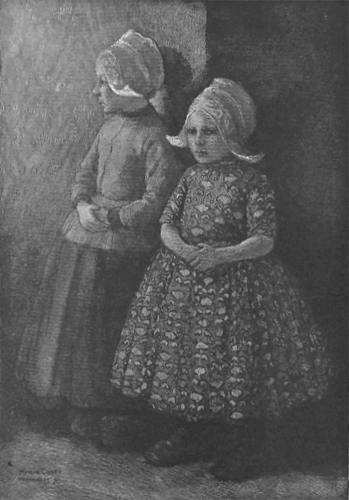 gretel and katrine.
“I think I have been asleep,” she said.
“I think you have,” said Dame Donk.
Just then a loud knock was heard at the door, a head was poked in, then another, and still another. The cottage was fast filling up. There stood, first of all, poor, pale, frightened Marie, holding a large bundle in her arms, Jan with another smaller one, Gretel carrying a pair of shoes, and one of the sisters, completely filling up the doorway with her ample proportions, last of all.
It appears that as soon as the fog had begun to clear, the good Dame Donk had despatched a boy from a neighboring cottage to let them know where Katharine was, and that her wardrobe would need replenishing.
The excitement on finding the child safe and sound may be better imagined than described. How she was kissed, cried, and laughed over, what questions were asked and not answered, as she was taken into an adjoining room and arrayed in a complete suit of Gretel’s clothes, even to the klompen, for, alas! her French shoes were now in no condition to be worn, the pretty blue frock torn and stained and hopelessly wet, the hat with its dainty plume crushed and useless; indeed, every article she had worn looked only fit for the rag-bag.
Gretel was so much smaller than Katharine that the clothes were a very tight fit, the skirt which hung round Gretel’s ankles reaching just below Katharine’s knees, and it was a funny little figure that stepped back into the room—no longer a fashionably dressed New York maiden, but a golden-haired child of Holland, even to the blue eyes, sparkling now with fun and merriment.
“But didn’t you bring a cap for me, Marie?” she asked in a grieved tone.
“Ah, no, deary; I never thought of a cap.”
“Well, you must put one on me the minute we get back.”
“Oh, what will father say?” she cried delightedly, as she surveyed herself in the little mirror.
This sobered Marie at once. What would “father” say, indeed? Would he not have a right to be very angry with her, that she had allowed the child to get into such danger?
“Where is Katharine?” asked the colonel, as he stood, tall and commanding, on the threshold, later that evening, surveying eight small Hollanders, looking so much alike, except for the difference in their sizes, that they might have passed for eight Dutch dolls propped up in a row against the wall.
A sudden shriek of laughter, and one of the dolls was in his arms, smothering him with kisses. Then every one began to talk at once, as usual, and it was not until late the next evening, when he and Katharine were steaming out of Amsterdam, that the colonel was told the whole story and for the first time fully understood all that had happened to his little girl on that eventful day.
Meanwhile the new light in his daughter’s eyes and the laughter on her lips kept him from any desire to inquire too deeply into the reason for a certain embarrassed frightened look on the faces of the women.
Before leaving Amsterdam the colonel was obliged to purchase a complete suit of Dutch garments for Katharine as a memento of this visit, and “because they are so pretty, father,” she said, and “oh, father, I just love Holland! As for those Dutch children, I think they are simply the dearest, sweetest things I ever saw, and I have promised to write to Gretel as soon as ever I get to Paris.”
There lives in a town that is called Chu-Bo
A little Jap girl named Nami-Ko.
She learns to spell and she learns to write,
But her A B C’s are the oddest sight!
For this is the way that the letters look
In her neat little, queer little copy-book:
This little Jap girl has shoes most neat
To put on her tiny Japanese feet,
But O! They are queer—such heels, such toes!
You’d think she would fall on her little Jap nose!
And these are the shoes—beware of mishap
If you wear what belongs to a queer little Jap!
When this little Jap girl goes out to call
She wears no hat—but a parasol!
And her little Jap mother wears one too—
In fact it’s the way that the Japs all do.
And this is the curious parasol
Which the little Jap girl wears out to call:
This little Jap girl, when she goes to bed,
Has no soft pillow beneath her head,
For little Jap girls have to take great care
Of their smooth little, black little Japanese hair!
And this is the pillow! Imagine, chicks,
A pillow like this—and as hard as bricks!
BY EMMA C. DOWD
The Little Cousin from Constantinople was to have been given a party on her seventh birthday; but, just before the invitations were written, Mumps came uninvited, and, of course, there could be no other guests while Mumps stayed.
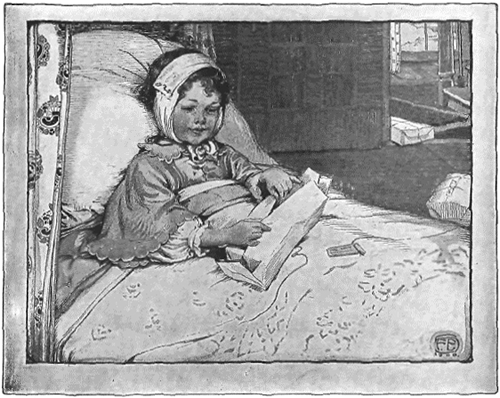 “eagerly she tore off the wrappings.”
The Little Cousin could not help feeling just a little tearful on her birthday morning, for Mumps, as nearly everybody knows, is a painful, disagreeable visitor. She did not cry when anybody was near—oh, no, indeed! She even tried to smile; but she found smiling very difficult with a poultice on each side of her face, and she had to give it up. The Merry Mother understood, however, and told her she was a dear, brave little girl, and strove to comfort her just as the dear absent Mother in Constantinople would have comforted her if she had been there.
Before the Merry Mother left her the Little Cousin felt almost happy, sitting up among her soft pillows, and wearing her new, pink, birthday sacque, with its pretty ribbons.
“I am sorry I must be away all the morning,” the Merry Mother said; “but I hope your pleasant company will keep you from missing me. I am going to shut your door for a minute, and when it opens you can pull in your visitors as fast as you please.” She laughed to see the Little Cousin’s astonished face, for the doctor had said that the children must not come in to see her as long as Mumps stayed. Then the door closed.
There was a slight commotion outside. The Little Cousin listened eagerly. What could it mean? Hushed voices, bits of laughter, the sliding of something over the polished floor, scurrying footsteps here and there—the Little Cousin heard it all, and waited breathlessly.
At last the feet retreated, the door opened, and the Merry Mother’s face appeared. Something attached to a string came flying toward the bed.
“Catch it!” she called.
The Little Cousin grabbed it—only a small block of wood, on which was printed, “PULL.”
Eagerly the little hands obeyed, when in through the doorway slid an oblong package. Across the rug and up on the bed the Little Cousin drew it, till her excited fingers clasped the package tight—what could it be?
Fastened to the further end of the bundle was another block of wood, and attached to it was another string which led outside the door. On this block was printed. “When you are ready, PULL again!”
“I’ll open this first,” said the Little Cousin to herself, untying the block, and laying it aside with its dangling cord. Eagerly she tore off the wrappings—it was, it was a doll, such a darling of a doll! It had brown eyes and fluffy yellow curls, and—this seemed very strange—the only thing in the way of clothing that it possessed was a little blanket that was wrapped around it.
Never mind! she was learning to sew, and she would make it a dress as soon as she was well again. She cuddled Dolly down against the pillows. She would not be lonely any more, even if Mumps should stay for a longer visit than was expected. Her dolls had all been left for the Little Sister in Constantinople, and it was so nice to have a dolly of her own again!
Then her eyes fell on the block of wood, with its inscription, and she began to pull in the string.
A square package appeared in the doorway, and she drew it toward her. Attached to it was a third block. This she untied as before, and removed the paper from her gift. It was a small trunk. She lifted the cover, and there were Dolly’s missing garments! A blue dress, a pink dress, a white dress, dainty underwear, sash ribbons, a coat and hat, and even a tiny comb and brush, were found in that wonderful trunk. Of course, Dolly had to come out from her nook in the pillows, and be dressed. It took some time, because Little Cousin must stop to admire every separate garment. At last, however, the third present was pulled in, and it was a chair for Dolly to sit in.
The fourth package was big and rather heavier than the others. The Little Cousin wondered what it could be, and she found out just as soon as she could get it open. It was a dining-table for Dolly, with a real little table-cloth, and napkins, and a set of pretty china dishes.
“Oh, oh!” gasped the Little Cousin, in sheer delight. It is a pity there was no one there to see the shining of her eyes. She rested awhile among her pillows; but not long, for Dolly must have her table set for luncheon—she might be hungry.
Ready for the make-believe repast, string number five was pulled, and when the box was opened the Little Cousin fairly squealed, for there was a real luncheon for Dolly and herself, all in twos! There were two tiny buttered biscuits, two very small apple turnovers, and two little frosted cakes. There were, also, two small bottles containing a brownish liquid. It was chocolate! Oh, how glad the Little Cousin was that she had passed the stage where she could not eat! It would have been hard, indeed, to have left all those goodies for Dolly. As it was she had to take food in very small bits, but that only made it last the longer; and if it did hurt a little once in a while she did not mind, it tasted so good. So on the whole, the luncheon was a very happy affair.
When the sixth present was pulled upon the bed the Little Cousin said, “Oh!” to the accompaniment of very bright eyes, for the shape of it told her that must be a carriage—a carriage for Dolly, and it proved to be one of the very prettiest that ever a small doll rode in. She was put on the seat in a twinkling, and had only one tumble—which did not even muss her dress, and the next time she was strapped in so that she could not fall.
The seventh gift was a little white bedstead, with mattress and sheets, a dear little puffy comfortable, and a dainty coverlet and two pillows. Of course, Dolly was tired enough after her ride to be undressed and go to bed, and very sweet she looked as she was tucked snugly in.
“Now shut your eyes and go right to sleep!” Dolly was bidden, and she obeyed at once.
“What a perfectly lovely birthday!” murmured Little Cousin, drawing her darling—bed and all—close to her pillow. Then she shut her own eyes, to keep Dolly company.
When the Merry Mother peeped in, the Little Cousin from Constantinople lay quite still among her treasures—fast asleep.
RETOLD FROM GRIMM
There was once a sweet little girl, who had gained the love of every one, even those who had only seen her once. She had an old grandmother, who knew not how to do enough for her, she loved her so much. Once she sent her a little cloak with a red velvet hood, which became her so well that she obtained the name of Little Red Riding-Hood.
One day her mother said to her: “Come, Red Riding-Hood, I want you to go and see your grandmother, and take her a piece of cake and a bottle of wine; for she is ill and weak, and this will do her good. Make haste and get ready before the weather gets too hot, and go straight on your road while you are out, and behave prettily and modestly; and do not run, for fear you should fall and break the bottle, and then grandmother would have no wine. And when you pass through the village, do not forget to courtesy and say ‘Good-morning’ to every one who knows you.”
“I will do everything you tell me, mother,” said the child as she wished her good-by and started for her long walk.
It was quite half an hour’s walk through the wood from the village to the grandmother’s house, and no sooner had Red Riding-Hood entered the wood than she met a wolf.
Red Riding-Hood did not know what a wicked animal he was, and felt not the least afraid of him.
“Good-day, Red Riding-Hood,” he said.
“Good-morning, sir,” replied the little girl, with a courtesy.
“Where are you going so early, Red Riding-Hood?” he asked.
“To my grandmother, sir,” she replied. “Mother baked yesterday, and she has sent me with a piece of cake and a bottle of wine to her because she is sick, and it will make her stronger and do her good.”
“Where does your grandmother live, Red Riding-Hood?”
“About half a mile from here through the wood; her house stands under three large oak trees, near to the nut hedges; you would easily know it,” said Red Riding-Hood.
The wolf, when he heard this, thought to himself, “This little, delicate thing would be a sweet morsel for me at last, and taste nicer than her old grandmother, but she would not satisfy my hunger; I must make a meal of them both.”
Then he walked quietly on by the side of Red Riding-Hood till they came to a part of the wood where a number of flowers grew.
“See, Red Riding-Hood,” he said, “what pretty flowers are growing here; would you not like to rest and gather some? And don’t you hear how sweetly the birds are singing? You are walking on as steadily as if you were going to school, and it is much more pleasant here in the wood.”
Then Red Riding-Hood looked up and saw the dancing sunbeams shining between the trees and lighting up the beautiful flowers that grew all around her, and she thought, “If I were to take my grandmother a fresh nosegay, it would make her so pleased; it is early yet, and I have plenty of time.”
So she went out of her way into the wood to gather flowers. And when she had picked a few, she saw some more beautiful still at a little distance so she walked on further and further, till she was quite deep in the wood.
Meanwhile the wolf went straight on to the grandmother’s house, and knocked at the door. There was no answer.
So the wolf lifted the latch and the door flew open; then he rushed in, hoping to seize upon the poor old grandmother, and eat her up. But she had gone out for a little walk, so he shut the door, dressed himself in the old woman’s nightgown and nightcap, and lay down in the bed to wait for Red Riding-Hood.
After Red Riding-Hood had gathered as many flowers as she could carry, she found her way back quickly to the right path, and walked on very fast till she came to her grandmother’s house, and knocked at the door.
“Who is there?” said the wolf, trying to imitate the grandmother. His voice was so gruff, however, that Little Red Riding-Hood would have been frightened, only she thought her grandmother had a cold.
So she replied: “It’s Little Red Riding-Hood. Mother sent you a piece of cake and a bottle of wine.”
“Lift up the latch and come in,” said the wolf.
So Red Riding-Hood lifted the latch and went in.
When she saw her grandmother, as she thought, lying in bed, she went up to her and drew back the curtains; but she could only see the head, for the wolf had pulled the nightcap as far over his face as he could.
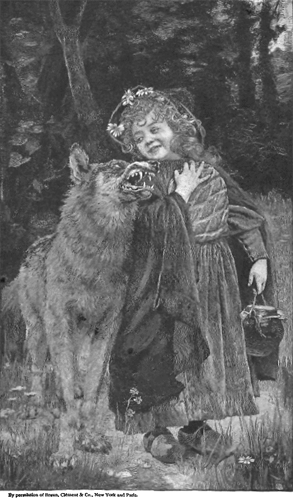 little red riding-hood.
“Good-morning,” she said; but there was no answer. Then she got on the bed, and cried out: “Grandmother, what great ears you have!”
“The better to hear with, my dear,” he said.
“Grandmother, what great eyes you have!”
“The better to see you, my dear, the better to see you.”
“Grandmother, what great teeth you have!”
“The better to eat you up!”
The old wolf jumped out of bed, and Little Red Riding Hood, in the greatest terror, screamed as loud as she could.
Just then the door opened, and in came the grandmother and some woodmen who were passing. They were just in time to save Little Red-Riding-Hood from the old wolf.
Mary
Come and see my baby dear;
Doctor, she is ill, I fear.
Yesterday, do what I would,
She would touch no kind of food;
And she tosses, moans, and cries.
Doctor, what do you advise?
Doctor John
Hum! ha! good madam, tell me, pray,
What have you offered her to-day?
Ah, yes! I see! a piece of cake—
The worst thing you could make her take.
Just let me taste. Yes, yes; I fear
Too many plums and currants here.
But, stop; I must just taste again,
For that will make the matter plain.
Mary
But, Doctor, pray excuse me, now—
You’ve eaten all the cake, I vow!
I thank you kindly for your care;
But surely that was hardly fair.
Doctor John
Ah, dear me! did I eat the cake?
Well, it was for dear baby’s sake.
But keep him in his bed, well warm,
And, you will see, he’ll take no harm.
At night and morning use once more
His draught and powder, as before;
And he must not be over-fed,
But he may have a piece of bread.
To-morrow, then, I dare to say,
He’ll be quite right. Good day! good day!
BY HANS CHRISTIAN ANDERSEN
She had a little house of her own, a little garden, too, this woman of whom I am going to tell you, but for all that she was not quite happy.
“If only I had a little child of my own,” she said, “how the walls would ring with her laughter, and how the flowers would brighten at her coming. Then, indeed, I should be quite happy.”
And an old witch heard what the woman wished, and said, “Oh, but that is easily managed. Here is a barley-corn. Plant it in a flower-pot and tend it carefully, and then you will see what will happen.”
The woman was in a great hurry to go home and plant the barley-corn, but she did not forget to say “Thank you” to the old witch. She not only thanked her, she even stayed to give her six silver pennies.
Then she hurried away to her home, took a flower-pot and planted her precious barley-corn.
And what do you think happened? Almost before the corn was planted, up shot a large and beautiful flower. It was still unopened. The petals were folded closely together, but it looked like a tulip. It really was a tulip, a red and yellow one, too.
The woman loved flowers. She stooped and kissed the beautiful bud. As her lips touched the petals, they burst open, and oh! wonder of wonders; there, in the very middle of the flower, sat a little child. Such a tiny, pretty little maiden she was.
They called her Thumbelina. That was because she was no bigger than the woman’s thumb.
And where do you think she slept? A little walnut shell, lined with blue, that was her cradle.
When she slept little Thumbelina lay in her cradle on a tiny heap of violets, with the petal of a pale pink rose to cover her.
And where do you think she played? A table was her playground. On the table the woman placed a plate of water. Little Thumbelina called that her lake.
Round the plate were scented flowers; the blossoms lying on the edge, while the pale green stalks reached thirstily down to the water.
In the lake floated a large tulip leaf. This was Thumbelina’s little boat. Seated there she sailed from side to side of her little lake, rowing cleverly with two white horse hairs. As she rowed backward and forward she sang softly to herself. The woman listening heard, and thought she had never known so sweet a song.
And now such a sad thing happened.
In through a broken window-pane hopped a big toad—oh, such an ugly big toad! She hopped right on to the table, where Thumbelina lay dreaming in her tiny cradle, under the pale pink rose leaf.
“How beautiful the little maiden is,” she croaked. “She will make a lovely bride for my handsome son.” And she lifted the little cradle, with Thumbelina in it, and hopped out through the broken window-pane, and down into the little garden.
At the foot of the garden was a broad stream. Here, under the muddy banks, lived the old toad with her son.
How handsome she thought him! But he was really very ugly. Indeed, he was exactly like his mother.
When he saw little Thumbelina in her tiny cradle, he croaked with delight.
“Do not make so much noise,” said his mother, “or you will wake the tiny creature. We may lose her if we are not careful. The slightest breeze would waft her away. She is as light as gossamer.”
Then the old toad carried Thumbelina out into the middle of the stream. “She will be safe here,” she said, as she laid her gently on one of the leaves of a large water lily, and paddled back to her son.
“We will make ready the best rooms under the mud,” she told him, “and then you and the little maiden will be married.”
Poor little Thumbelina! She had not seen the ugly big toad yet, nor her ugly son.
When she woke up early in the morning, how she wept! Water all around her! How could she reach the shore? Poor little Thumbelina!
Down under the mud the old toad was very busy, decking the best room with buttercups and buds of water-lilies to make it gay for her little daughter-in-law, Thumbelina.
“Now we will go to bring her little bed and place it ready,” said the old toad, and together she and her son swam out to the leaf where little Thumbelina sat.
“Here is my handsome son,” she said, “he is to be your husband,” and she bowed low in the water, for she wished to be very polite to the little maiden.
“Croak, croak,” was all the young toad could say, as he looked at his pretty little bride.
Then they took away the tiny little bed, and Thumbelina was left all alone.
How the tears stained her pretty little face! How fast they fell into the stream! Even the fish as they swam hither and thither thought, “How it rains today,” as the tiny drops fell thick and fast.
They popped up their heads and saw the forlorn little maiden.
“She shall not marry the ugly toad,” they said, as they looked with eager eyes at the pretty child. “No, she shall not marry the ugly toad.”
But what could the little fish do to help Thumbelina?
They found the green stem which held the leaf on which Thumbelina sat. They bit it with their little sharp teeth, and they never stopped biting, till at last they bit the green stem through; and away, down the stream, floated the leaf, carrying with it little Thumbelina.
“Free, free!” she sang, and her voice tinkled as a chime of fairy bells. “Free, free!” she sang merrily as she floated down the stream, away, far away out of reach of the ugly old toad and her ugly son.
And as she floated on, the little wild birds sang round her, and on the banks the little wild hare-bells bowed to her.
Butterflies were flitting here and there in the sunshine. A pretty little white one fluttered onto the leaf on which sat Thumbelina. He loved the tiny maiden so well that he settled down beside her.
Now she was quite happy! Birds around her, flowers near her, and the water gleaming like gold in the summer sunshine. What besides could little Thumbelina wish?
She took off her sash and threw one end of it round the butterfly. The other end she fastened firmly to the leaf. On and on floated the leaf, the little maiden and the butterfly.
Suddenly a great cockchafer buzzed along. Alas! he caught sight of little Thumbelina. He flew to her, put his claw round her tiny little waist and carried her off, up onto a tree.
Poor little Thumbelina! How frightened she was! How grieved she was, too, for had she not lost her little friend the butterfly?
Would he fly away, she wondered, or would her sash hold him fast?
The cockchafer was charmed with the little maiden. He placed her tenderly on the largest leaf he could find. He gathered honey for her from the flowers, and as she sipped it, he sat near and told her how beautiful she looked.
But there were other chafers living in the tree, and when they came to see little Thumbelina, they said, “She is not pretty at all.”
“She has only two legs,” said one.
“She has no feelers,” said another.
Some said she was too thin, others that she was too fat, and then they all buzzed and hummed together, “How ugly she is, how ugly she is!” But all the time little Thumbelina was the prettiest little maiden that ever lived.
And now the cockchafer who had flown off with little Thumbelina thought he had been rather foolish to admire her.
He looked at her again. “Pretty? No, after all she was not very pretty.” He would have nothing to do with her, and away he and all the other chafers flew. Only first they carried little Thumbelina down from the tree and placed her on a daisy. She wept because she was so ugly—so ugly that the chafers could not live with her. But all the time, you know, she was the prettiest little maiden in the world.
She was living all alone in the wood now, but it was summer and she could not feel sad or lonely while the warm golden sunshine touched her so gently, while the birds sang to her, and the flowers bowed to her.
Yes, little Thumbelina was happy. She ate honey from the flowers, and drank dew out of the golden buttercups and danced and sang the livelong day.
But summer passed away and autumn came. The birds began to whisper of flying to warmer countries, and the flowers began to fade and hang their heads, and as autumn passed away, winter came, cold, dreary winter.
Thumbelina shivered with cold. Her little frock was thin and old. She would certainly be frozen to death, she thought, as she wrapped herself up in a withered leaf.
Then the snow began to fall, and each snow-flake seemed to smother her. She was so very tiny.
Close to the wood lay a corn-field. The beautiful golden grain had been carried away long ago, now there was only dry short stubble. But to little Thumbelina the stubble was like a great forest.
She walked through the hard field. She was shaking with cold. All at once she saw a little door just before her.
The field-mouse had made a little house under the stubble, and lived so cozily there. She had a big room full of corn, and she had a kitchen and pantry as well.
“Perhaps I shall get some food here,” thought the cold and hungry little maiden, as she stood knocking at the door, just like a tiny beggar child. She had had nothing to eat for two long days. Oh, she was very hungry!
“What a tiny thing you are!” said the field-mouse, as she opened the door and saw Thumbelina. “Come in and dine with me.”
How glad Thumbelina was, and how she enjoyed dining with the field-mouse.
She behaved so prettily that the old field-mouse told her she might live with her while the cold weather lasted. “And you shall keep my room clean and neat, and you shall tell me stories,” she added.
That is how Thumbelina came to live with the field-mouse and to meet Mr. Mole.
“We shall have a visitor soon,” said the field-mouse. “My neighbor, Mr. Mole, comes to see me every week-day. His house is very large, and he wears a beautiful coat of black velvet. Unfortunately, he is blind. If you tell him your prettiest stories he may marry you.”
Now the mole was very wise and very clever, but how could little Thumbelina ever care for him. Why, he did not love the sun, nor the flowers, and he lived in a house underground. No, Thumbelina did not wish to marry the mole.
However she must sing to him when he came to visit his neighbor, the field-mouse. When she had sung, “Ladybird, Ladybird, fly away home,” and “Boys and girls, come out to play,” the mole was charmed, and thought he would like to marry the little maiden with the beautiful voice.
Then he tried to be very agreeable. He invited the field-mouse and Thumbelina to walk along the underground passage he had dug between their houses. Mr. Mole was very fond of digging underground.
As it was dark the mole took a piece of tinder-wood in his mouth and led the way. The tinder-wood shone like a torch in the dark passage.
A little bird lay in the passage, a little bird who had not flown away when the flowers faded and the cold winds blew.
It was dead, the mole said.
When he reached the bird, the mole stopped and pushed his nose right up through the ceiling to make a hole, through which the daylight might shine.
 “in the very heart of the flower
There lay a swallow, his wings pressed close to his side, his little head and legs drawn in under his feathers. He had died of cold.
“Poor little swallow!” thought Thumbelina. All wild birds were her friends. Had they not sung to her and fluttered round her all the long glad summer days?
But the mole kicked the swallow with his short legs. “That one will sing no more,” he said roughly. “It must be sad to be born a bird and to be able only to sing and fly. I am thankful none of my children will be birds,” and he proudly smoothed down his velvet coat.
“Yes,” said the field-mouse, “what can a bird do but sing? When the cold weather comes it is useless.”
Thumbelina said nothing. Only when the others moved on, she stooped down and stroked the bird gently with her tiny hand, and kissed its closed eyes.
That night the little maiden could not sleep. “I will go to see the poor swallow again,” she thought.
She got up out of her tiny bed. She wove a little carpet out of hay. Down the long underground passage little Thumbelina walked, carrying the carpet. She reached the bird at last, and spread the carpet gently round him. She fetched warm cotton and laid it over the bird.
“Even down on the cold earth he will be warm now,” thought the gentle little maiden.
“Farewell,” she said sadly, “farewell, little bird! Did you sing to me through the long summer days, when the leaves were green and the sky was blue? Farewell, little swallow!” and she stooped to press her tiny cheeks against the soft feathers.
As she did so, she heard—what could it be? pit, pat, pit, pat! Could the bird be alive? Little Thumbelina listened still. Yes, it was the beating of the little bird’s heart that she heard. He had not been dead after all, only frozen with cold. The little carpet and the covering the little maid had brought warmed the bird. He would get well now.
What a big bird he seemed to Thumbelina! She was almost afraid now, for she was so tiny. She was tiny, but she was brave. Drawing the covering more closely round the poor swallow, she brought her own little pillow, that the bird’s head might rest softly.
Thumbelina stole out again the next night. “Would the swallow look at her,” she wondered.
Yes, he opened his eyes and looked at little Thumbelina, who stood there with a tiny torch of tinder-wood.
“Thanks, thanks, little Thumbelina,” he twittered feebly. “Soon I shall grow strong and fly out in the bright sunshine once more; thanks, thanks, little maiden.”
“Oh! but it is too cold, it snows and freezes, for now it is winter,” said Thumbelina. “Stay here and be warm, and I will take care of you,” and she brought the swallow water in a leaf.
And the little bird told her all his story—how he had tried to fly to the warm countries, and how he had torn his wing on a blackthorn bush and fallen to the ground. But he could not tell her how he had come to the underground passage.
All winter the swallow stayed there, and Thumbelina was often in the long passage, with her little torch of tinder-wood. But the mole and the field-mouse did not know how Thumbelina tended and cared for the swallow.
At last spring came, and the sun sent its warmth down where the swallow lay in the underground passage.
Little Thumbelina opened the hole which the mole had made in the ceiling, and the sunshine streamed down on the swallow and the little girl.
How the swallow longed to soar away, up and up, to be lost to sight in the blue, blue sky!
“Come with me, little Thumbelina,” said the swallow, “come with me to the blue skies and the green woods.”
But Thumbelina remembered how kind the field-mouse had been to her when she was cold and hungry, and she would not leave her.
“Farewell! farewell! then, little maiden,” twittered the swallow as he flew out and up, up into the sunshine.
Thumbelina loved the swallow dearly. Her eyes were full of tears as she watched the bird disappearing till he was only a tiny speck of black.
And now sad days came to little Thumbelina.
The golden corn was once more waving in the sunshine above the house of the field-mouse, but Thumbelina must not go out lest she lose herself among the corn.
Not go out in the bright sunshine! Oh, poor little Thumbelina!
“You must get your wedding clothes ready this summer,” said the field-mouse. “You must be well provided with linen and worsted. My neighbor the mole will wish a well-dressed bride.”
The mole had said he wished to marry little Thumbelina before the cold winter came again.
So Thumbelina sat at the spinning-wheel through the long summer days, spinning and weaving with four little spiders to help her.
In the evening the mole came to visit her. “Summer will soon be over,” he said, “and we shall be married.”
But oh! little Thumbelina did not wish the summer to end.
Live with the dull old mole, who hated the sunshine, who would not listen to the song of the birds—live underground with him! Little Thumbelina wished the summer would never end.
The spinning and weaving were over now. All the wedding clothes were ready. Autumn was come.
“Only four weeks and the wedding-day will have come,” said the field-mouse.
And little Thumbelina wept.
“I will not marry the tiresome old mole,” she said.
“I shall bite you with my white tooth if you talk such nonsense,” said the field-mouse. “Among all my friends not one of them has such a fine velvet coat as the mole. His cellars are full and his rooms are large. You ought to be glad to marry so well,” she ended.
“Was there no escape from the underground home?” little Thumbelina wondered.
The wedding-day came. The mole arrived to fetch his little bride.
How could she say good-by forever to the beautiful sunshine?
“Farewell, farewell!” she cried, and waved her little hands toward the glorious sun.
“Farewell, farewell!” she cried, and threw her tiny arms round a little red flower growing at her feet.
“Tell the dear swallow, when he comes again,” she whispered to the flower, “tell him I will never forget him.”
“Tweet, tweet!” What was that Thumbelina heard? “Tweet, tweet!” Could it be the swallow?
The flutter of wings was round her. Little Thumbelina looked. How glad she was, for there, indeed, was the little bird she had tended and cared for so long. She told him, weeping, she must not stay. She must marry the mole and live underground, and never see the sun, the glorious sun.
“Come with me, come with me, little Thumbelina,” twittered the swallow. “You can sit on my back, and I will fly with you to warmer countries, far from the tiresome old mole. Over mountains and seas we will fly to the country where the summer never ends, and the sunlight always shines.”
Then little Thumbelina seated herself on her dear swallow’s back, and put her tiny feet on his outstretched wing. She tied herself firmly with her little sash to the strongest feather of the bird.
And the swallow soared high into the air. High above forests and lakes, high above the big mountains that were crested with snow, he soared.
They had reached the warm countries now.
On and on flew the swallow, till he came to a white marble palace. Half-ruined it was, and vine leaves trailed up the long slender pillars. And among the broad, green leaves many a swallow had built his nest, and one of these nests belonged to Thumbelina’s little swallow.
“This is my home,” said the bird, “but you shall live in one of these brilliant flowers, in the loveliest of them all.”
And little Thumbelina clapped her hands with joy.
The swallow flew with her to a stately sun-flower, and set her carefully on one of the broad yellow petals.
But think, what was her surprise! In the very heart of the flower stood a little Prince, fair and transparent as crystal. On his shoulders were a pair of delicate wings, and he was small, every bit as small as Thumbelina. He was the spirit of the flower.
For you know in each flower there is a spirit—a tiny little boy or girl, but this little Prince was King of all the flower spirits.
The little King thought Thumbelina the loveliest maiden he had ever seen. He took off his golden crown and placed it on the tiny head of the little maid, and in a silvery voice he asked, “Will you be my bride, little Thumbelina, and reign with me over the flower spirits?”
How glad Thumbelina was!
The little King wished to marry her. Yes, she would be his little Queen.
Then out of each blossom stepped tiny little children. They came to pay their homage to little Thumbelina.
Each one brought her a present, and the most beautiful of all the presents was a pair of wings, delicate as gossamer. And when they were fastened on the shoulders of the little Queen, she could fly from flower to flower.
And the swallow sat on his nest above, and sang his sweetest bridal song for the wedding of little Thumbelina.
Once upon a time there was a little red hen. She lived in a little white house and she had a little green garden. Every day she worked in the house and garden.
Near her home lived a family of foxes. One day Mamma Fox said to Papa Fox, “I want a fat hen to eat.” There was nothing in the pantry for the baby foxes, so Papa Fox started out to find something for them all.
He ran down the road until he came to the woods. “Surely I will find something here,” he said, but he found nothing to eat in the woods. As he came near the little green garden he said, “Oh, I smell fresh cake! Oh, I smell a little red hen!”
Sure enough, there was the Little Red Hen eating her cake.
Papa Fox stole up softly behind her and grabbed her and put her into the bag on his back; then he ran quickly off down the hill toward his home.
The Little Red Hen was so frightened that she could only whisper, “Oh, dear! Oh, dear! Oh, dear!”
Just then she had to sneeze, and when she put her claw into her pocket for her handkerchief, she felt her little scissors. Quick as a flash she took them out and cut a little hole in the bag. Peeping out she saw a great hill just ahead, all covered with stones. As Papa Fox stopped to rest on his way up the hill, with his back turned toward her, she cut a big hole in the bag, jumped out and quickly put a big stone in the bag in her place.
As Papa Fox kept on up the hill, he thought the bag was pretty heavy, but he said, “Never mind, she is a fat little red hen.”
Mamma Fox met him at the front door with all the baby foxes.
“The water is boiling,” said she. “What have you in your bag?” asked the Baby Foxes.
“A fat little red hen,” said Papa Fox.
As he held the bag over the pot, he said to Mamma Fox, “When I drop her in, you clap on the lid.” So he opened the bag. Splash! went the boiling water. It spilled all over Papa Fox and Mamma Fox and the Baby Foxes. Never again did they try to catch the Little Red Hen.
BY THE BROTHERS GRIMM
There was once a shoemaker, who, from no fault of his own, had become so poor that at last he had nothing left, but just sufficient leather for one pair of shoes. In the evening he cut out the leather, intending to make it up in the morning; and, as he had a good conscience, he lay quietly down to sleep, first commending himself to God. In the morning he said his prayers, and then sat down to work; but, behold, the pair of shoes were already made, and there they stood upon his board. The poor man was amazed, and knew not what to think; but he took the shoes into his hand to look at them more closely, and they were so neatly worked, that not a stitch was wrong; just as if they had been made for a prize. Presently a customer came in; and as the shoes pleased him very much, he paid down more than was usual; and so much that the shoemaker was able to buy with it leather for two pairs. By the evening he had got his leather shaped out; and when he arose the next morning, he prepared to work with fresh spirit; but there was no need—for the shoes stood all perfect on his board. He did not want either for customers; for two came who paid him so liberally for the shoes, that he bought with the money material for four pairs more. These also—when he awoke—he found all ready-made, and so it continued; what he cut out overnight was, in the morning, turned into the neatest shoes possible. This went on until he had regained his former appearance, and was becoming prosperous.
One evening—not long before Christmas—as he had cut out the usual quantity, he said to his wife before going to bed, “What say you to stopping up this night, to see who it is that helps us so kindly?” His wife was satisfied, and fastened up a light; and then they hid themselves in the corner of the room, where hung some clothes which concealed them. As soon as it was midnight in came two little manikins, who squatted down on the board; and, taking up the prepared work, set to with their little fingers, stitching and sewing, and hammering so swiftly and lightly, that the shoemaker could not take his eyes off them for astonishment. They did not cease until all was brought to an end, and the shoes stood ready on the table; and then they sprang quickly away.
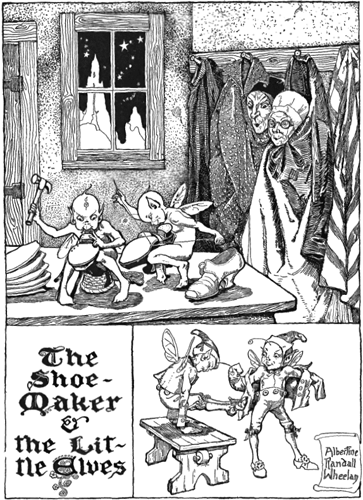
The following morning the wife said, “The little men have made us rich, and we must show our gratitude to them; for although they run about they must be cold, for they have nothing on their bodies. I will make a little shirt, coat, waistcoat, trousers, and stockings for each, and do you make a pair of shoes for each.”
The husband assented; and one evening, when all was ready, they laid presents, instead of the usual work, on the board, and hid themselves to see the result.
At midnight in came the Elves, jumping about, and soon prepared to work, but when they saw no leather, but the natty little clothes, they at first were astonished, but soon showed their rapturous glee. They drew on their coats, and smoothing them down, sang—
“Smart and natty boys are we;
Cobblers we’ll no longer be.”
And so they went on hopping and jumping over the stools and chairs, and at last out at the door. After that evening they did not come again, but the shoemaker prospered in all he undertook, and lived happily to the end of his days.
Now you shall hear a story that somebody’s great, great-grandmother told a little girl ever so many years ago:
There was once a little old man and a little old woman, who lived in a little old house in the edge of a wood. They would have been a very happy old couple but for one thing—they had no little child, and they wished for one very much. One day, when the little old woman was baking gingerbread, she cut a cake in the shape of a little boy, and put it into the oven.
Presently, she went to the oven to see if it was baked. As soon as the oven door was opened, the little gingerbread boy jumped out, and began to run away as fast as he could go.
The little old woman called her husband, and they both ran after him. But they could not catch him. And soon the gingerbread boy came to a barn full of threshers. He called out to them as he went by, saying:
“I’ve run away from a little old woman,
A little old man,
And I can run away from you, I can!”
Then the barn full of threshers set out to run after him. But though they ran fast, they could not catch him. And he ran on till he came to a field full of mowers. He called out to them:
“I’ve run away from a little old woman,
A little old man,
A barn full of threshers,
And I can run away from you, I can!”
Then the mowers began to run after him, but they couldn’t catch him. And he ran on till he came to a cow. He called out to her:
“I’ve run away from a little old woman,
A little old man,
A barn full of threshers,
A field full of mowers,
And I can run away from you, I can!”
But though the cow started at once, she couldn’t catch him. And soon he came to a pig. He called out to the pig:
“I’ve run away from a little old woman,
A little old man,
A barn full of threshers,
A field full of mowers,
A cow,
And I can run away from you, I can!”
But the pig ran, and couldn’t catch him. And he ran till he came across a fox, and to him he called out:
“I’ve run away from a little old woman,
A little old man,
A barn full of threshers,
A field full of mowers,
A cow and a pig,
And I can run away from you, I can!”
Then the fox set out to run. Now, foxes can run very fast, and so the fox soon caught the gingerbread boy and began to eat him up.
Presently the gingerbread boy said: “O dear! I’m quarter gone!” And then: “Oh, I’m half gone!” And soon: “I’m three-quarters gone!” And at last: “I’m all gone!” and never spoke again.
[N] First published in St. Nicholas. Used by permission of the publishers, The Century Company.
BY ROSAMOND UPHAM
ISCHIEF was a cunning little fellow from the very first day that I saw him. Such a round, plump little body, such short, clumsy legs, and such a roguish face; just the one of all his nine brothers and sisters about whom to write a story, and so you shall hear of his preparations for the long journey upon which he went when he was two months old.
His playmates were sent away, one by one, until at last he was left all alone, with only the mastiff Rex for a companion, and a most forlorn little pup he was, running about all day long, trying to keep up with his new protector.
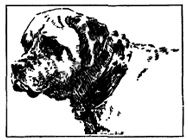
One morning in January, the weather being very severe, Mischief was taken into the kitchen to live, and a happier dog than he could not be imagined, trotting about after the cook and housemaid from morning until night, chasing the cats, stealing towels and brushes—in fact, attending to all the mischief that came in his way.
One day, about two weeks after he came into the house to live, a letter came from Milwaukee saying that he, too, must be sent off. And of course, Mischief knew about it. How could he help it, when the whole household were so sorry to have him go? And accordingly he began to make ready for the long journey he was so soon to take.
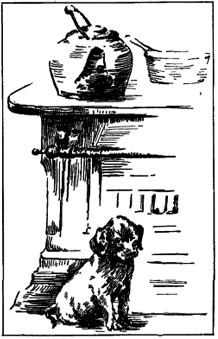
As he sat by the range, evidently trying to make up his mind what to take with him, his first thought was of the old coat he had had as a bed; so he crossed the room, took the coat[Pg 298] in his mouth, and with his paws scratched it up into a bundle.
Then he thought of his milk-dish. Of course he must take that, for how could he drink from any other dish than the shiny one given him by the cook two weeks before? So he took that between his teeth and put it beside the coat. And the stove-hook, why not take that? No one seemed to be using it just at the moment. And a gelatin-box that had just been emptied, would it not be nice to pack his new collar in?
So he ran tumbling across the floor for the box, and back again for the string, when just then a pair of mittens caught his eye, and in this cold weather the mittens would be a comfort on so long a journey, so they were added to the collection under the table. And Mischief was just thinking he was about ready to start, when the very thing he most dreaded to leave behind him ran across the floor—the little yellow kitten; why could she not go with him, and then the journey would not seem so long? Accordingly, he ran after her, caught her by the neck, and tried to put her down with his other baggage; but the kitten could not understand what Mischief meant, and scratched and spit in a way that plainly said she would not accompany him.
Poor Mischief lay down in despair, and, after his hard morning’s work, took a long nap, only waking in time for his dinner. The next day he was put into a warm box, carried to the station, and after a three days’ journey arrived in Milwaukee, happy, well, and delighted with his new master, apparently quite forgetting his little mistress whom he left in her New Hampshire home.
BY H. N. POWERS
Willie was a very little child and lived near a mill. One day he saw a big cruel boy come along and throw a little puppy into the mill-pond, and then run away. Willie cried out: “O Papa, Papa, do come here!”
“What is the matter?” said his papa.
“Oh, Papa! I want the little doggie! Please get him for me. He will be drowned!”
His papa took a long pole and put it under the puppy’s neck and pulled it out of the water and gave it to Willie. He was very happy with his dog, which, by next year, grew to be a big, strong, shaggy fellow, and was named Diver. He used to go with Willie everywhere the boy went, and he loved Willie very much. Everybody said: “What a beautiful dog!” and Willie was proud of him.
One day when the nuts were ripe, Willie took his basket and went to pick hazelnuts. One big bush full of nuts hung over a deep place in the mill-pond, and, as Willie reached for the top branch, he slipped and fell in the water out of sight. But when he came up, Diver jumped in, took him by his collar, and brought him safe to land. So if it was good for Willie to save the dog’s life when he was a little puppy, it was good for the dog to save Willie’s life when he was a little boy.
And that was Diver’s way of thanking Willie for saving his life. It was a very good way, too! And Willie and Diver were always the best of friends.
BY EVERETT WILSON
Last Christmas little Gordon Bruce had a fine, large Christmas tree and lots of toys, just as a great many other nice boys and girls had. The tree was up in his playroom, a great, big, sunny room that used to be called the “nursery” when he was a baby.
A few days after Christmas, Gordon’s mother said: “Now, Gordon, I think we will have to take down your Christmas tree, for it is getting all dried up, and the little pine needles are dropping all over the floor, and the maid has to sweep them up every day.”
Gordon was sorry to have the tree taken down, for it looked so bright and Christmas-y, and he knew it would be a whole year before he would have another Christmas tree, so he asked his mother if she wouldn’t wait just one day more. I think that is the way almost all the girls and boys feel. And his mother said she would wait until to-morrow.
It was a rainy day, and as none of his little friends were with him, he began to play with all his toys one after the other; there were many of them, and some of the little ones were still hanging on the tree.
Gordon’s father came from Scotland, and he had read to Gordon many stories of the old days in Scotland, when the great generals and the noble lords lived in strong castles set high up on the mountains, so that the soldiers could not get near them. Now among Gordon’s Christmas presents was a tiny castle just like the ones he had seen in the books his father read the stories from; and with this castle came a lot of soldiers.
So this day Gordon got out his castle and soldiers and began to play with them. First he got a chair and put a big, thick rug over it to make it look like a steep hill; then he set the castle on top of the hill and stood the soldiers on the ground at the bottom of the hill—all in a row. He was making believe that the soldiers were trying to get up to the castle. Then he dropped some beautiful colored glass marbles, that his Uncle George had given him, down on the floor of the castle. The marbles rolled out of the front door of the castle and down the rug to the bottom of the hill, and bang! they would bump right against the tall soldiers and tumble them down. One after another Gordon would roll the marbles down until by and by every one of the soldiers would be knocked over, and as they were only wooden soldiers, of course they couldn’t get up by themselves. Then Gordon would stand them all up in a row again and roll the marbles down the hill until not a single soldier was standing. It was lots of fun for Gordon, for you know it really didn’t hurt the soldiers a bit, for they were only made of wood and their uniforms were just red and blue paint.
The next day Gordon’s mother took down the tree, and packed up the beautiful things that were on it, and put them away until next Christmas.
 gordon’s make-believe castle on the hill.
WRITTEN AND ILLUSTRATED BY M. I. WOOD
Once upon a time there was a woman called Mrs. Stockchen and she had a son named Hans. They lived together in a little cottage and they had a hen and a cow.
One morning Mrs. Stockchen said to her son: “Hans, my dear, will you take Cowslip, the cow, to pasture, and remember not to be late for supper.” “Very well,” said Hans, and he took up his stick and started for the field.
The sun was very hot when he got there, and seeing a row of five shady trees, he lay down underneath them and fell asleep in two seconds. He snored with his mouth open. Cowslip had been watching him and when she saw his eyes close, she said, “Now! here’s my chance!” and, jumping over the fence, she ran away.
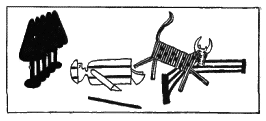
Hans stopped snoring and awoke at supper-time. He looked for Cowslip, but she had disappeared; he ran about calling for her, but she did not come; and at last he went home to his mother with a very sad face and said: “Oh, mother, Cowslip ran away while I was asleep. I have looked for her and cannot find her anywhere.”
“You lazy, careless, naughty, careless, naughty, lazy Boy!” cried Mrs. Stockchen. “You have left my poor cow wandering all alone. She will lose her way in the dark. Just you go and find her this instant. You will get no supper till you bring her back, or my name is not Matilda Maria!”
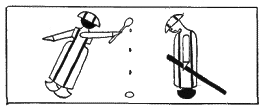
Mrs. Stockchen had grown quite scarlet with rage and she shook the soup-ladle at her son to make him go faster. It was getting quite dark by the time Hans reached the field again and nowhere did he see any trace of the cow. He did not know in what direction she had gone, so he walked round and round the field, feeling very miserable.
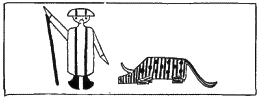
Just as 10 o’clock was striking, Cowslip stepped out from behind a tree, and kneeling at Hans’s feet, said in a choking voice, “I am really very sorry, Hans.” “Well,” said Hans, “I am sorry too, but let us get home now.” So they set out, tired and rather cross.
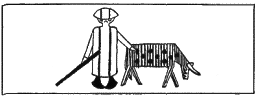
But when they came within sight of the light in their own cottage window, they met two soldiers who stopped them, and asked what they were doing out so late. “We’re just going home,” said Hans. “Why,” said the soldiers “you ought to have been there two hours ago.”
“Well, I couldn’t help it,” said Hans, “this cow ran away and I had to fetch her before going home to supper.”
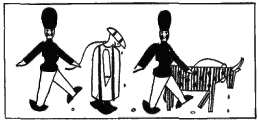
“Boy!” said the soldiers, “you are not speaking the truth, you have stolen the cow, and you are very impertinent as well. We will take you to prison.”
They tied a rope round Hans’s neck and another round the cow’s, and took them to prison. They put Hans into a dungeon full of horrid creatures, but they let poor Cowslip wander about in the fields outside.
One morning when Hans was crying because the door was locked and because the window bars looked so strong, Cowslip heard him. She came up beside the window, and standing on her hind-legs she peeped in and said, “Hans, my dear master, do you think that if I tried to knock down the wall with my horns, you could get out?” “I will try,” said Hans. It was rather hard work for Cowslip, but at last she made a big enough hole and Hans leaped out.
He knocked off his hat in doing so, but then Hans didn’t care about a little thing like that.
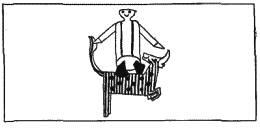
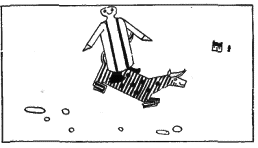
He jumped on her back, and away they went, over fallen trees, stones, ditches, hedges, everything. They came in sight of the cottage at last, and the sound of their approach caused Mrs. Stockchen to look out of the window. When she saw who it was she fairly jumped for joy and she rushed out at once to meet them.
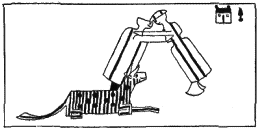
Hans fell into his mother’s arms. And they all lived happily ever afterward.
BY CAROLINE S. ALLEN
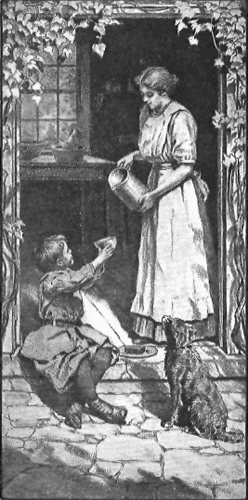 “‘yes, please,’ said little boy blue.”
Once there were four little brothers. The oldest had black eyes. He was called Little Boy Black. But I haven’t time to tell about him just now. The second little brother had brown eyes. He was called Little Boy Brown. But I cannot tell you about him either. The third little brother had gray eyes, and was called Little Boy Gray. There is a very nice story I could tell you about him, but I am sure you would rather hear about the fourth little brother.
For the youngest little brother had blue eyes; and his father and mother, his grandfather and grandmother, and every one else, called him Little Boy Blue. His eyes were very blue—as blue as the flowers you find down by the brook. You love the blue flowers, I know. And so I will tell you about Little Boy Blue.
His jacket was blue, his trousers were blue, his stockings were blue, and even his little shoes were blue.
One day Little Boy Blue’s mother said to him: “Do you want to go and visit Aunt Polly?” “Who is Aunt Polly?” asked Little Boy Blue. “Aunt Polly lives on a farm, on a high hill. She has horses, and cows, and pigs, and hens, and ducks, and geese—” “And elephants?” asked Little Boy Blue. “No, not any elephants. But she has a woolly white lamb.” “Oh, then I will go,” cried Little Boy Blue. So his mother went up-stairs and found a little blue traveling-bag. And in the little blue bag she packed some of Little Boy Blue’s clothes. Then Little Boy Blue and his mother went to visit Aunt Polly, who lived on a farm on a high hill.
Little Boy Blue’s mother stayed two days, and Little Boy Blue stayed ten days. When his mother was going home, she said to Aunt Polly: “Little Boy Blue likes to play, but he likes to work, too. So be sure to give him some work to do every day.”
“Very well,” said Aunt Polly. And so by-and-by Aunt Polly went to find Little Boy Blue. And she said to him: “Dear Little Boy Blue, what can you do to help?” He thought a minute, and then he said: “I can eat apples to see if they are ripe. And I can pull the roses in the garden, if you have too many.”
“The apples are not ripe, and I have just enough roses in the garden,” said Aunt Polly. “Can you drive the cows out of the corn?”
“Oh, yes, I can,” said Little Boy Blue, “if Towzer can come too.” Towzer was the dog.
“And perhaps you can look after the sheep?”
“Yes, Aunt Polly, I can do that,” said Little Boy Blue.
On the shelf in Little Boy Blue’s room stood a little blue clock. And every morning at five o’clock the door of the clock flew open, and a cuckoo came out. The cuckoo said, “Cuck-oo,” five times, and then went into the little blue clock again, and the little door closed after him. Then Little Boy Blue knew it was time to get up.
When he was dressed, he came down-stairs, and Aunt Polly gave him his breakfast. He had new milk in a blue bowl, and johnny-cake on a little blue plate. These he always carried out onto the door-step because he liked, while he was eating and drinking, to see the green grass bending in the breeze, and the yellow butterflies dancing here and there in the sunshine.
“This is the creamiest milk I ever saw,” said Little Boy Blue.
“That’s nice,” said Aunt Polly. “Do you want some more?”
“Yes, please,” said Little Boy Blue. So Aunt Polly brought the blue pitcher, and poured more creamy milk into his little blue bowl, and Little Boy Blue said: “Thank you, Aunt Polly.”
When Little Boy Blue could eat no more golden johnny-cake, and drink no more creamy milk, he jumped up from the door-step.
First he put his arms around Aunt Polly’s neck, and gave her a hug and a kiss. Then he went into the house to get his horn. The horn was a little blue one, and it hung on a peg near the kitchen door.
What do you suppose the horn was for? Why, Little Boy Blue watched the cows and the sheep. Then if they got into the wrong places, and trampled on the crops, Little Boy Blue blew the horn. One of the men always heard the horn, and came to help drive the cows or the sheep back where they belonged.
All this was very pleasant. But one day—what do you think? The sheep ran away, and jumped over a stone wall into the meadow, and the cows got into the corn. Nobody knew how it happened. Little Boy Blue had gone out that morning, just as he always did, to look after them; and no one had heard any horn. At last Towzer ran up to the barn, barking loudly. That was to give the alarm—about the sheep and the cows.
“How queer!” said Aunt Polly, who was in the barn-yard feeding the chickens.
“How strange!” said Uncle Ben.
“Where’s Little Boy Blue?” asked the men.
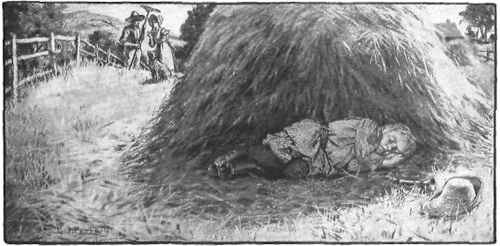 “‘he’s under the haycock, fast asleep!’”
“I’ll call him,” said Aunt Polly. So she walked, and she walked, all around the farm. As Aunt Polly walked she looked here, and she looked there. And she called:
“Little Boy Blue! Come blow your horn.
The sheep’s in the meadow, the cow’s in the corn.”
Where do you think Aunt Polly found him? When the head-farmer asked her, “Where’s the little boy that looks after the sheep?” Aunt Polly said: “He’s under the haycock, fast asleep.”
“Shall we go wake him?” said the head-farmer.
“No, no; let him lie,” said Aunt Polly. “For if we should wake him, ‘he’d cry, cry, cry.’”
You see Little Boy Blue got up so early, he grew sleepy. And the sun was hot. And the haymow made a soft pillow. So he fell sound asleep, and dreamed about the woolly white lamb.
But on the day after that, Little Boy Blue took a nap, first, so that when he looked after the cows and the sheep he could keep awake. He never again had to be told to blow his horn.
When Little Boy Blue’s visit was over, Aunt Polly said: “You’ve been a dear little helper. I’m going to give you something to take home.” And, oh, joy! it was the woolly white lamb!
ADAPTED BY CECILIA FARWELL
The Fox was digging under an old tree and found a bumblebee. He gathered it up and put it into his bag and tied the string. Then he went to the first cottage at the end of the village street and said:
“Good morning, Good Mother. The way is long, and I am weary. May I leave my bag here while I go to the grocery store?”
“That will be all right,” said the old woman, “put it behind the door.”
So the Fox put the bag behind the door, saying, as he did so: “Be sure that you do not untie the string, Good Mother.” Then he went out of the cottage and on up the road.
The old woman looked at the bag and said to herself: “Now, I wonder what that sly fellow carries so carefully? It will do no harm to see.”
So she untied the string and started to look into the bag, and when the bag was opened the bumblebee flew out, and the rooster which was stalking about in the kitchen promptly ate him up.
When the Fox came back he saw that his bag had been opened and he said to the old woman: “Where is my bumblebee?”
“I opened the bag for but an instant,” said the old woman, “and the bumblebee flew out and the rooster ate him up.”
“Then I must take the rooster,” said the Fox. So he gathered up the rooster, put him into the bag and tied the string, and threw the bag over his shoulder and went on down the road.
When he came to the next cottage he knocked at the door and said: “Good morning, Good Mother. The way is long and I am weary. May I leave my bag here while I go on to the grocery store?”
“That will be all right,” said the old woman, “put it behind the door.”
So the Fox put the bag behind the door, saying as he did so: “Be sure that you do not untie the string, Good Mother,” and he went on down the road.
The old woman looked at the bag and said to herself, “Now I wonder what it is that that sly old fellow carries so carefully. It will do no harm to see.”
So she untied the string and started to look into the bag, and when the bag was opened the rooster flew out, and the pig which was in the kitchen promptly ate him up.
When the Fox came back he saw that the bag had been opened, and he said: “Where is my rooster, Good Mother?”
“I opened the bag for but an instant, and the rooster flew out and the pig ate him up,” said the woman.
“Then I must have the pig,” said the Fox. So he gathered up the pig and put him into the bag and tied the string and threw the bag over his shoulder and went on down the road.
When he came to the next cottage he knocked at the door and said: “Good morning, Good Mother. The way is long and I am weary. May I leave my bag here while I go to the grocery store?”
“That will be all right,” said the old woman, “put it behind the door.”
So the Fox put the bag behind the door, saying as he did so, “Be sure that you do not untie the string, Good Mother,” and went on down the road.
The old woman looked at the bag and said to herself: “Now I wonder what it is that that sly old fellow carries so carefully. It will do no harm to see.”
So she untied the string and opened the bag the least little bit, and the pig jumped out of the bag and ran into the house where the ox stood and the ox promptly gored him to death.
When the Fox came back and saw that the bag had been opened he said: “Where is my pig, Good Mother?”
“I opened the bag the least little bit, and the pig jumped out and the ox gored him to death,” said the woman.
“Then I must have the ox,” said the Fox. So he went out into the yard and gathered up the ox and put him into the bag and tied the string and threw the bag on his back and went on down the road.
When he came to the next cottage he knocked at the door and said: “Good morning, Good Mother. The way is long and I am weary. May I leave my bag here while I go to the grocery store?”
“That will be all right,” said the old woman, “put it behind the door.”
So the Fox put the bag behind the door, saying as he did so: “Be sure that you do not untie the string, Good Mother,” and went on down the road.
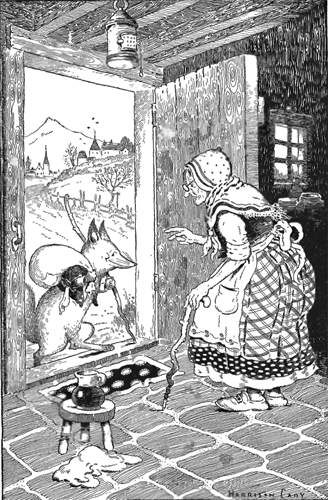 “may i leave my bag here?” said the fox
The woman looked at the bag and said to herself: “Now I wonder what it is that that sly old fellow carries so carefully? It will do no harm to see.”
So she untied the string and opened the bag and the ox jumped out and ran out into the yard, and the little boy who was playing there chased him off over the hill and into the wood.
When the Fox came back he saw that the string had been untied, and he said to the old woman: “Where is my ox?”
“I opened the bag the least little bit, and the ox jumped out and the little boy chased him over the hill and into the wood,” said the old woman.
“Then I must take the little boy,” said the Fox.
So he gathered up the little boy and put him into the bag and tied the string and threw the bag over his shoulder and started off down the road.
When he came to the next house he knocked at the door and said: “Good morning, Good Mother. The way is long and I am weary. May I leave my bag while I go to the store?”
“That will be all right,” said the woman, “put it behind the door.”
So the Fox put the bag behind the door, saying as he did so: “Be sure that you do not untie the string, Good Mother,” and went off.
This woman was very busy that morning, making cake, and she had no time to think of the bag, and it lay there for a long time. By-and-by when the cake was done her little boys gathered around the table, crying: “Let me taste the cake, Mother. Give me a piece of cake!” And she gave each one of them a piece of cake.
The cake smelled so good that the little boy in the bag cried out: “Oh, I want a piece of cake, too.”
When the woman heard the little boy cry out she went to the bag, and looking down at it, she said: “Now I wonder what that sly Fox has been about?” And the little boy cried out again, and the woman untied the string and let him out, and took the house dog and put him into the bag instead, and the little boy joined the others around the table, and she gave him a piece of the cake.
When the Fox came back he saw that the bag was all tied up, and looked just as it had when he left it, so he took it from behind the door and threw it over his shoulder, saying to himself: “I have had a long journey to-day, and I am hungry. And I have not done so badly, either. I will now go into the woods and see how the little boy tastes.”
So he went into the woods and untied the string to take the little boy out of the bag. But the little boy, as we know, was standing around the table with the other little boys eating cake. And no sooner was the string untied than the house dog jumped out of the bag and sprang right on the Fox, and they had a fight right then and there in the woods. Pretty soon the dog went trotting down the road. But the Fox did not go home. In fact he did not go anywhere at all.
Oeyvind was his name. A low barren cliff overhung the house in which he was born, fir and birch looked down on the roof, and wild-cherry strewed flowers over it. Upon this roof there walked about a little goat, which belonged to Oeyvind. He was kept there that he might not go astray, and Oeyvind carried leaves and grass up to him. One fine day the goat leaped down, and—away to the cliff; he went straight up, and came where he never had been before. Oeyvind did not see him when he came out after dinner, and thought immediately of the fox. He grew hot all over, looked around about, and called, “Killy-killy-killy-goat.”
“Bay-ay-ay,” said the goat, from the brow of the hill, as he cocked his head on one side and looked down.
But at the side of the goat there kneeled a little girl.
“Is it yours, this goat?” she asked.
Oeyvind stood with eyes and mouth wide open, thrust both hands into the breeches he had on, and asked, “Who are you?”
“I am Marit, mother’s little one, father’s fiddle, the elf in the house, grand-daughter of Ole Nordistuen of the Heide farms, four years old in the autumn, two days after the frost nights, I!”
“Are you really?” he said, and drew a long breath, which he had not dared to do so long as she was speaking.
“Is it yours, this goat?” asked the girl again.
“Ye-es,” he said, and looked up.
“I have taken such a fancy to the goat. You will give it to me?”
“No, that I won’t.”
She lay kicking her legs, and looking down at him, and then she said, “But if I give you a butter-cake for the goat, can I have him then?”
Oeyvind came of poor people, and had eaten butter-cake only once in his life, that was when grandpapa came there, and anything like it he had never eaten before nor since. He looked up at the girl. “Let me see the butter-cake first,” said he.
She was not long about it, took out a large cake, which she held in her hand. “Here it is,” she said, and threw it down.
“Ow, it went to pieces,” said the boy. He gathered up every bit with the utmost care; he could not help tasting the very smallest, and that was so good, he had to taste another, and, before he knew it himself, he had eaten up the whole cake.
“Now the goat is mine,” said the girl. The boy stopped with the last bit in his mouth, the girl lay and laughed, and the goat stood by her side, with white breast and dark brown hair, looking down.
“Could you not wait a little while?” begged the boy; his heart began to beat. Then the girl laughed still more, and got up quickly on her knees.
“No, the goat is mine,” she said, and threw her arms around its neck, loosened one of her garters, and fastened it around. Oeyvind looked up. She got up, and began pulling at the goat; it would not follow, and twisted its neck downward to where Oeyvind stood. “Bay-ay-ay,” it said. But she took hold of its hair with one hand, pulled the string with the other, and said gently, “Come, goat, and you shall go into the room and eat out of mother’s dish and my apron.” And then she sung,—
“Come, boy’s goat,
Come, mother’s calf,
Come, mewing cat
In snow-white shoes.
Come, yellow ducks,
Come out of your hiding-place;
Come, little chickens,
Who can hardly go;
Come, my doves
With soft feathers,
See, the grass is wet,
But the sun does you good;
And early, early is it in summer,
But call for the autumn, and it will come.”
There stood the boy.
He had taken care of the goat since the winter before, when it was born, and he had never imagined he could lose it; but now it was done in a moment, and he would never see it again.
His mother came up humming from the beach, with wooden pans which she had scoured: she saw the boy sitting with his legs crossed under him on the grass, crying, and she went up to him.
“What are you crying about?”
“Oh, the goat, the goat!”
“Yes; where is the goat?” asked his mother, looking up at the roof.
“It will never come back again,” said the boy.
“Dear me! how could that happen?”
He would not confess immediately.
“Has the fox taken it?”
“Ah, if it only were the fox!”
“Are you crazy?” said his mother; “what has become of the goat?”
“Oh-h-h—I happened to—to—to sell it for a cake!”
As soon as he had uttered the word, he understood what it was to sell the goat for a cake; he had not thought of it before. His mother said,—
“What do you suppose the little goat thinks of you, when you could sell him for a cake?”
And the boy thought about it, and felt sure that he could never again be happy. He felt so sorry, that he promised himself never again to do anything wrong, never to cut the thread on the spinning-wheel, nor let the goats out, nor go down to the sea alone. He fell asleep where he lay, and dreamed about the goat.
Suddenly there came something wet close up to his ear, and he started up. “Bay-ay-ay!” it said; and it was the goat, who had come back again.
“What! have you got back?” He jumped up, took it by the two fore-legs, and danced with it as if it were a brother; he pulled its beard, and he was just going in to his mother with it, when he heard some one behind him, and, looking, saw the girl sitting on the greensward by his side. Now he understood it all, and let go the goat.
“Is it you, who have come with it?”
She sat, tearing the grass up with her hands, and said,—
“They would not let me keep it; grandfather is sitting up there, waiting.”
While the boy stood looking at her, he heard a sharp voice from the road above call out, “Now!”
Then she remembered what she was to do; she rose, went over to Oeyvind, put one of her muddy hands into his, and, turning her face away, said,—
“I beg your pardon!”
But then her courage was all gone; she threw herself over the goat, and wept.
“I think you had better keep the goat,” said Oeyvind, looking the other way.
“Come, make haste!” said grandpapa, up on the hill; and Marit rose, and walked with reluctant feet upward.
“You are forgetting your garter,” Oeyvind called after her. She turned round, and looked first at the garter and then at him. At last she came to a great resolution, and said, in a choked voice,—
“You may keep that.”
He went over to her, and, taking her hand, said,—
“Thank you!”
“O, nothing to thank for!” she answered, but drew a long sigh, and walked on.
He sat down on the grass again. The goat walked about near him, but he was no longer so pleased with it as before.
The goat was fastened to the wall; but Oeyvind walked about, looking up at the cliff. His mother came out, and sat down by his side, he wanted to hear stories about what was far away, for now the goat no longer satisfied him. So she told him how once everything could talk: the mountain talked to the stream, and the stream to the river, the river to the sea, and the sea to the sky; but then he asked if the sky did not talk to any one; and the sky talked to the clouds, the clouds to the trees, the trees to the grass, the grass to the flies, the flies to the animals, the animals to the children, the children to the grown-up people; and so it went on, until it had gone round, and no one could tell where it had begun. Oeyvind looked at the mountain, the trees, the sky, and had never really seen them before. The cat came out at that moment, and lay down on the stone before the door in the sunshine.
“What does the cat say?” asked Oeyvind, pointing. His mother sang,—
“At evening softly shines the sun,
The cat lies lazy on the stone.
Two small mice,
Cream thick and nice,
Four bits of fish,
I stole behind a dish,
And am so lazy and tired,
Because so well I have fared,”
says the cat.
But then came the cock, with all the hens.
“What does the cock say?” asked Oeyvind, clapping his hands together. His mother sang,—
“The mother-hen her wings doth sink,
The cock stands on one leg to think:
That gray goose
Steers high her course;
But sure am I that never she
As clever as a cock can be.
Run in, you hens, keep under the roof to-day,
For the sun has got leave to stay away,”
says the cock.
But the little birds were sitting on the ridge-pole, singing. “What do the birds say?” asked Oeyvind, laughing.
“Dear Lord, how pleasant is life,
For those who have neither toil nor strife,”
say the birds.
And she told him what they all said, down to the ant, who crawled in the moss, and the worm who worked in the bark.
That same summer, his mother began to teach him to read. He had owned books a long time, and often wondered how it would seem when they also began to talk. Now the letters turned into animals, birds, and everything else; but soon they began to walk together, two and two; a stood and rested under a tree, which was called b, then came c, and did the same; but when three or four came together, it seemed as if they were angry with each other, for it would not go right. And the farther along he came, the more he forgot what they were: he remembered longest a, which he liked best; it was a little black lamb, and was friends with everybody; but soon he forgot a also: the book had no more stories, nothing but lessons.
One day his mother came in, and said to him,—
“To-morrow school begins, and then you are going up to the farm with me.”
Oeyvind had heard that school was a place where many boys played together; and he had no objection. Indeed, he was much pleased. He had often been at the farm, but never when there was school there; and now he was so anxious to get there, he walked faster than his mother up over the hills. As they came up to the neighboring house, a tremendous buzzing, like that from the water-mill at home, met their ears; and he asked his mother what it was.
“That is the children reading,” she answered, and he was much pleased, for that was the way he used to read, before he knew the letters. When he came in, there sat as many children round a table as he had ever seen at church; others were sitting on their luncheon boxes which were ranged round the walls; some stood in small groups round a large printed card; the schoolmaster, an old gray-haired man, was sitting on a stool by the chimney-corner, filling his pipe. They all looked up as Oeyvind and his mother entered, and the mill-hum ceased as if the water had suddenly been turned off. All looked at the new-comers; the mother bowed to the schoolmaster, who returned her greeting.
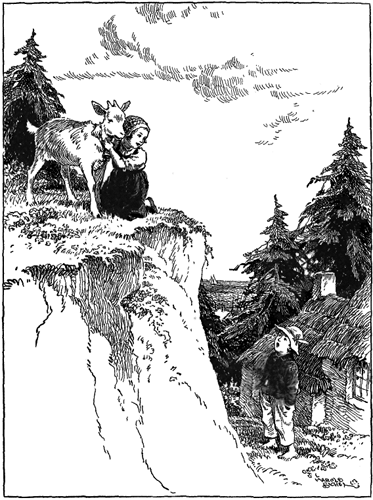 “the goat is mine,” she said,
“Here I bring a little boy who wants to learn to read,” said his mother.
“What is the fellow’s name?” said the schoolmaster, diving down into his pouch after tobacco.
“Oeyvind,” said his mother, “he knows his letters, and can put them together.”
“Is it possible!” said the schoolmaster, “come here, you Whitehead!”
Oeyvind went over to him: the schoolmaster took him on his lap, and raised his cap.
“What a nice little boy!” said he, and stroked his hair. Oeyvind looked up into his eyes, and laughed.
“Is it at me you are laughing?” asked he, with a frown.
“Yes, it is,” answered Oeyvind, and roared with laughter. At that the schoolmaster laughed, Oeyvind’s mother laughed; the children understood that they also were allowed to laugh, and so they all laughed together.
So Oeyvind became one of the scholars.
As he was going to find his seat, they all wanted to make room for him.
“Now, what are you going to do?” asked the schoolmaster, who was busy with his pipe again. Just as the boy is going to turn round to the schoolmaster, he sees close beside him, sitting down by the hearthstone on a little red painted tub, Marit, of the many names; she had covered her face with both hands, and sat peeping at him through her fingers.
“I shall sit here,” said Oeyvind, quickly, taking a tub and seating himself at her side. Then she raised a little the arm nearest him, and looked at him from under her elbow; immediately he also hid his face with both hands, and looked at her from under his elbow. So they sat, keeping up the sport, until she laughed, then he laughed too; the children had seen it, and laughed with them; at that, there rung out in a fearfully strong voice, which, however, grew milder at every pause,—
“Silence! you young scoundrels, you rascals, you little good-for-nothings! Keep still, and be good to me, you sugar-pigs.”
That was the schoolmaster, whose custom it was to boil up, but calm down again before he had finished. It grew quiet immediately in the school, until the water-wheels again began to go: every one read aloud from his book, the sharpest louder and louder to get the preponderance, here trebles piped up, the rougher voices drummed and there one shouted in above the others, and Oeyvind had never had such fun in all his life.
“Is it always like this here?” whispered he to Marit.
“Yes, just like this,” she said.
Afterwards, they had to go up to the schoolmaster, and read; and then a little boy was called to read, so that they were allowed to go and sit down quietly again.
“I have got a goat now, too,” said she.
“Have you?”
“Yes; but it is not so pretty as yours.”
“Why don’t you come oftener up on the cliff?”
“Grandpapa is afraid I shall fall over.”
“Mother knows so many songs,” said he.
“Grandpapa does, too, you can believe.”
“Yes; but he does not know what mother does.”
“Grandpapa knows one about a dance. Would you like to hear it?”
“Yes, very much.”
“Well, then, you must come farther over here, so that the schoolmaster may not hear.”
He changed his place, and then she recited a little piece of a song three or four times over, so that the boy learned it.
“Up with you, youngsters!” called out the schoolmaster. “This is the first day, so you shall be dismissed early; but first we must say a prayer, and sing.”
Instantly, all was life in the school; they jumped down from the benches, sprung over the floor, and talked into each other’s mouths.
“Silence! you young torments, you little beggars, you noisy boys! be quiet, and walk softly across the floor, little children,” said the schoolmaster; and now they walked quietly, and took their places, after which the schoolmaster went in front of them, and made a short prayer. Then they sung. The schoolmaster began in a deep bass, all the children stood with folded hands, and joined in. Oeyvind stood farthest down by the door with Marit, and looked on; they also folded their hands, but they could not sing.
That was the first day at school.
 “they were so busy making mud-pies
Four little children were playing in their garden one day. There were Mollie and Jamie and Betty and Teddy.
They were so busy making mud-pies that they did not see “Mrs. Tomkins,” the old cat, when she came and mewed, and mewed, and put up her paw, and touched Mollie and Jamie and Betty and Teddy—first one and then the other, as much as to say, “Do come, some of you, and help me! Do come, please!”
By and by the children’s mama came out of the house and saw how queerly the cat was acting, and said: “Children, Mrs. Tomkins is trying to get you to go with her and see if her babies are all right.”
So the children left their play, and said: “Come, Mrs. Tomkins, we will go with you now.”
The old cat gave a thankful “m-i-e-o-u,” and started down the walk leading to the barn. Every now and then she looked back to see if the children were really coming. When she got to the stable, she ran and jumped up on the manger, and looked down into it, and gave a quick, sharp “m-i-e-o-u,” as if to say, “What do you think of that?” And the children looked in and saw a hen sitting upon the old cat’s kittens and trying to keep them all covered up! When the cat tried to go near them, the hen would peck at her and drive her away. How the children laughed! Mollie said: “Did you ever see anything so funny! I am going to ask Mama to write a funny story about it,—how our old hen ’dopted the kittens.”
The hen had been sitting upon some eggs in a nest near where the cat had set up housekeeping, and when the cat went out, the hen came over and took the cat’s little family under her wings, just as if they had been so many chick-a-biddies. And when the cat went home again, the hen wouldn’t let her come near the kittens. Mollie took the hen off, and Mrs. Tomkins was happy.
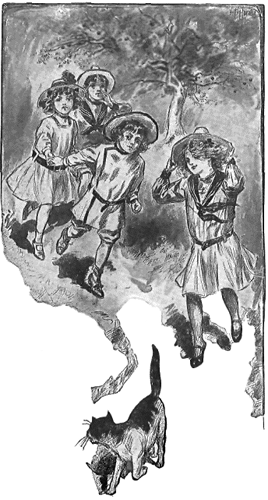 “every now and then she looked back to see if the
children were really coming.”
“every now and then she looked back to see if the
children were really coming.”
The next day she came again, looking as though she said, “I am very sorry to trouble you, but I must.” Then she said, “M-i-e-o-u! m-i-e-o-u!” So the children left their play and went to the stable with her, and found the hen playing mother to Mrs. Tomkins’s kittens again and trying to make them keep still and stay under her wings. If one of them poked its head out, she would give it a sharp peck to make it go back.
The children laughed again, and Mollie said: “Poor Mrs. Tomkins, I would look for a new house if I were you—you do have such meddlesome neighbors! Then she took the hen off, and Mrs. Tomkins picked up one of the kittens.
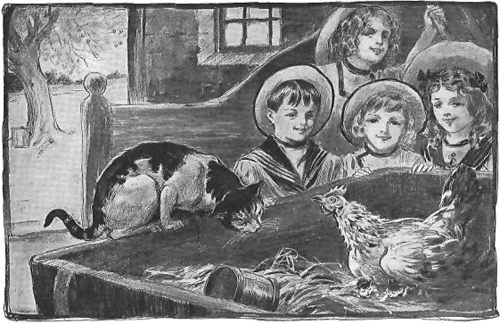 “mrs. tomkins gave a sharp ‘m-i-e-o-u,’
The children’s mama was sitting in the library reading when the old cat came in, with a kitten in her mouth. She put it softly down, went out, and soon returned with another. She kept on doing this until she had moved all her family of five kittens. Then she settled herself in a cozy corner, and looked at the lady, and purred in this way: “If you only knew how much trouble I have had with that bad old hen, you would let me and my children stay here.”
The lady laughed and said: “I will see what I can do for you.”
Just then the children came in and begged to have the kittens stay. So a new home was made for them in a box in the woodhouse.

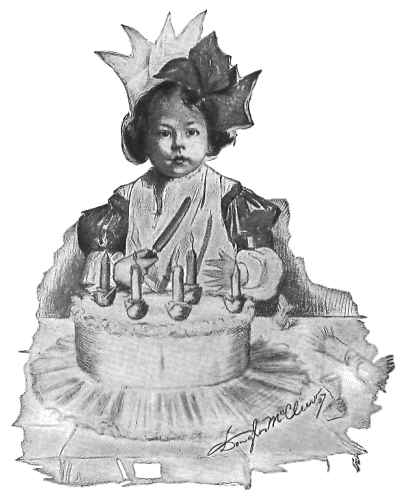
Once there was a little girl called Dot. And she was just five years old. And she had a fine birthday cake. It was big and round, and it had five beautiful little pink candles set in pink rosebuds on top.
Dot sat at the big table at dinner that day, and by and by they put a pretty pink paper cap on her head and then brought in the birthday cake. And the little candles were all burning bright. And when she saw it she said, “Oh! oh! how lovely! It is just too pretty to cut!”
But her mama said, “I will cut it for you, dear.” So she cut one piece for Dot, and then she asked Dot, “Will Marie have a piece?” Marie was Dot’s big doll. And Dot looked at her and said, “Marie says, ‘No, thank you.’” And mama said, “Will Fuzzy have a piece?” Fuzzy was Dot’s Teddy Bear. [Pg 317] And Dot looked at him and said: “He says, ‘No, thank you.’” And mama said, “Will papa have a piece?” And Dot said, “Oh, yes. Won’t you, papa?” And papa said, “Yes, please.” And Dot said, “Mama, you will. You must have a piece of my birthday cake.” And mama said, “Yes, thank you.”
And mama cut the cake and gave Dot a piece and papa a piece and herself a piece. But she left the parts of the cake where the candles were burning,—one, two, three, four, five. And Dot’s birthday cake lasted one, two, three, four, five whole days before it was all gone.
A boy named Ned had a little puppy-dog named Rover. One day, Ned’s papa gave him a nice new toy wagon. Ned was pulling it around the yard when he saw Rover. “Come, Rover!” he said, “I will give you a fine ride.” So he took Rover and put him in the wagon and gave him a ride.
But just then Ned saw a boy he knew, named Tom. Tom was running down the street. Ned called to him but he did not hear. Ned wanted to show Tom his new wagon. So he ran after Tom as fast as he could go, calling, “Tom! Tom!” and never thinking of poor little Rover. He was barking with all his might, “Bow! wow! Bow-wow! bow-wow-wow-wow!” which means “Oh, stop! stop! I’m going to fall out!” And the next minute Rover went “bumpity-bump!” out into the road, and ran off home, crying, “Ow-wow-wow!” He was not hurt much, but he was badly frightened. But he soon forgot his ride, and he grew and he grew and he grew, till, by and by, he was a big dog. And then, Ned’s little brother, Jack, had a little wagon. But now Rover was too big to ride in it. So Jack said he would make Rover pull it and he would ride.
Ned helped him to harness Rover in it like a horse, and Jack climbed in and took the reins. “Get up!” said Jack, and away they went out into the yard and on into a big field. But just then a little rabbit started up in front of them, and the minute Rover saw it, he began to race after the rabbit. Poor Jack couldn’t hold him at all. Round and round they went, and they ran, and they ran, and they ran! Jack called out, “Whoa, Rover! Stop, Rover!” But Rover didn’t stop. He wanted to catch the rabbit and he forgot about Jack.
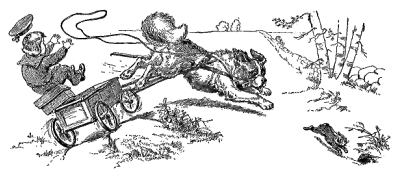
At last the rabbit ran toward a hole under the wall, where Rover could not get him. But Rover dashed after him as fast as he could go. “Bumpity-bump” went the little wagon, and just as Rover missed the rabbit, the wheel struck a big stone and poor Jack tumbled out on the ground. But he didn’t cry. He was not hurt much, and he wasn’t frightened at all. He ran and caught Rover, and said, “Oho! Who cares for a little bump like that? You’re a funny horse, Rover. But you didn’t catch your rabbit, you old runaway—did you?”
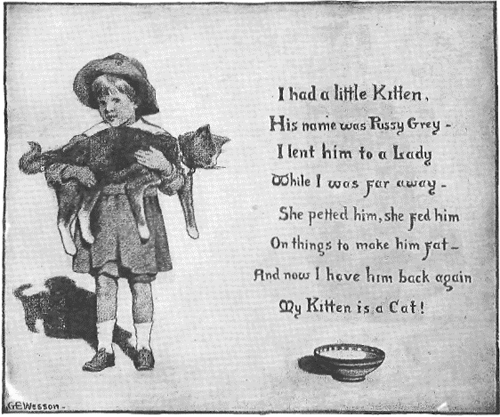

BY EVERETT WILSON
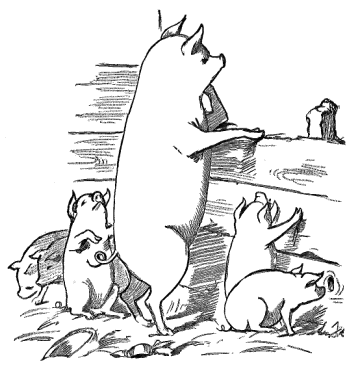
It was a bright spring morning, and all the animals on the Meadowbrook Farm had been given their breakfast, and the Piggy-wig family had settled down to a cozy nap. Suddenly there was heard a great noise and rushing out in the apple orchard. Old Mother Piggy-wig jumped up on her hind legs and looked over the fence of her sty to see what it was all about. The little pig that went to market, and the little pig that stayed at home, also jumped up, quite as excited as their mother. Then the little pig that had roast beef, and the little pig that had none, woke up, and they, too, scampered about, wishing to know what was going on down under the apple-trees. But before old Mother Piggy-wig could tell them, the little pig, who, one day, could not find his way home, found a big hole in the lower board of the sty, and at once shouted:
“Oh, I see what it is! It is little Polly going to have her picture taken.”
And, sure enough, there was Polly’s brother Ned with his camera; and after him came Polly, and after Polly came—guess what!
Well, first there came Blackie, the cat, then came Banty, the hen; and then came Gyp, the dog. And such a mew-mewing, and cluck-clucking, and bow-wowing you never heard!
Polly had often had her picture taken, but it was always with her papa or her mamma, and she had never had her picture taken with her pets. So brother Ned had promised that on her birthday he would take her picture with all of her pets—if they would only keep still. This day was Polly’s birthday, and, as the weather was fine, her brother had told her to follow him out to the orchard.
Ned fastened his camera on its three sprawling legs, while Polly tried to gather[Pg 320] her pets around her. But by this time Blackie, the cat, was chasing a squirrel (though he did not catch him), and Banty, the hen, was away off scratching for worms; and Gyp, the dog, was barking at a bossy calf down by the brook, for, of course, Polly’s pets did not know it was her birthday and that they were to have their pictures taken with her.
Polly called, as loud as she could, “Here, Blackie, Blackie; here, Banty, Banty; here, Gyp, Gyp,” and as quick as a wink the animals came running up to her.
At first she sat down, but all three of her pets got in her lap until you could scarcely see Polly behind them. That would not do, of course, because it was Polly’s picture that was the most important.
Finally, she stood up and made her pets stand up, too. Then she had more trouble, for Gyp wanted to stand next to her, and so did Banty, and so did Blackie, but she told them if they were not good and did not stand just where she put them, they could not have their pictures taken at all. She even said she would get the little pig that could not find his way home, and would have her picture taken with him. They did not like that, so they promised to be good. She stood Banty on one side of her, and Gyp on the other side, and then she put Blackie on one end next to Banty. But Gyp and Blackie jumped around so lively that Brother Ned ran into the house and brought out Polly’s toy cow, and stood her next to Blackie, and that kept him quiet, because he was afraid the cow would hook him with her horns—he did not know it was not a real cow. Then Ned brought out Polly’s toy lion and put him next to Gyp, and that kept him quiet, because he thought the lion would eat him up,—he did not know it was not a real lion.
So, after they were all nice and quiet, Ned called out:
“Ready! Look pleasant! One, two, three—all over!”
And here is the way they looked in the picture that Ned took that morning:
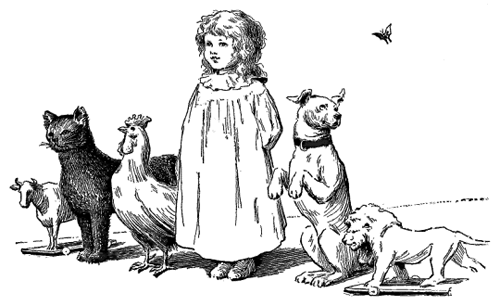
Idle Ben was a naughty boy
(If you please, this story’s true),
He caused his teachers great annoy,
And his worthy parents, too.
Idle Ben, in a boastful way
To his anxious parents told
That while he was young he thought he’d play,
And he’d learn when he grew old.
“Ah, Ben,” said his mother, and dropped a tear,
“You’ll be sorry for this, by-and-by”
Says Ben, “To me that’s not very clear,
But at any rate I’ll try.”
So idle Ben, he refused to learn,
Thinking that he could wait;
But when he had his living to earn,
He found it was just too late.
Little girls, little boys, don’t delay your work,
Some day you’ll be women and men.
Whenever your task you’re inclined to shirk,
Take warning by idle Ben.
BY ISABEL GORDON CURTIS
One evening in May, Chuckie Wuckie’s papa finished setting out the plants in the front yard. Into one large bed he put a dozen fine cannas. They looked like fresh young shoots of corn. He told Chuckie Wuckie that when summer came they would grow tall, with great spreading leaves and beautiful red-and-yellow blossoms.
“Taller than me, papa?” asked the little girl, trying to imagine what they would look like.
“Much taller; as tall as I am.”
Chuckie Wuckie listened gravely while papa told her she must be very careful about the canna-bed. She must not throw her ball into it, or dig there, or set a foot in the black, smooth earth. She nodded her head solemnly, and made a faithful promise. Then she gathered up her tiny rake and hoe and spade, and carried them to the vine-covered shed to put beside her father’s tools.
Next morning, when papa went to look at the canna-bed, he discovered close beside one of the largest plants a snug, round hole. It looked like a little nest. He found Chuckie Wuckie [Pg 322] digging with an iron spoon in the ground beside the fence.
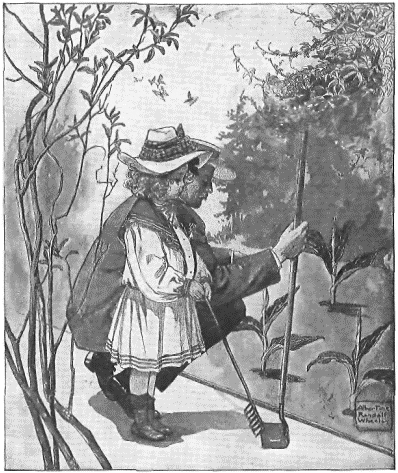 “papa told her she must be very
“Dearie,” he said, “do you remember I told you, last night, that you must not dig in the canna-bed?”
“Yes,” said the little girl.
“Come and see the hole I found there.”
So Chuckie Wuckie trotted along at her father’s heels. She stood watching him as he filled in the hole and smoothed down the earth.
“I did not dig it,” said Chuckie Wuckie. “I just came and looked to see if the canna had grown any through the night, but I did not dig it.”
“Really?” asked her papa, very gravely.
“Really and truly, I did not put my foot on there,” said Chuckie Wuckie.
Papa did not say another word. But he could not help thinking that the hole looked as if the iron spoon had neatly scooped it out.
Next morning he found the hole dug there again, and Chuckie Wuckie was still busy in her corner by the fence. He did not speak of it, however. There were prints of small feet on the edge. He only smoothed down the earth and raked the bed. He did this for three mornings, then he led Chuckie Wuckie again to the canna-bed.
“Papa,” she said earnestly, “I did not dig there. Truly, I didn’t. The hole is there every morning. I found it to-day before you came out, but I did not dig it.” There were tears in her brown eyes.
“I believe you, Chuckie Wuckie dear,” said her father, earnestly.
That night the little girl stood at the gate, watching for her father to jump off the car. She could hardly wait for him to kiss her. She took his hand and led him to the canna-bed.
“Look!” she cried eagerly.
She was pointing excitedly to a hole beside the roots of a fresh, green canna plant.
“That hole again,” said her father. “There’s a stone in it now, isn’t there?”
“No, that’s what I thought; stoop down and look close, papa!” cried Chuckie Wuckie.
It was the head of a fat hop-toad, but all that could be seen was its mouth and bright eyes. [Pg 323] It was staring at them. Papa poked it with the point of his umbrella. It scrambled deeper into the hole, until there was nothing to be seen but the dirt. It was slowly changing to the color of the black earth.
“I watched him,” cried Chuckie Wuckie, excitedly—“oh, for an hour! When I found him he was just hopping on the canna-bed. He was looking for his house. He acted as if the door had been shut in his face. Then he began to open it. He crawled and scrambled round and round, and threw up the dirt, and poked and pushed. At last he had the hole made, just as it is every morning, and he crawled in. Then he lay and blinked at me.”
“Clever fellow,” said papa. “Well, we won’t grudge him a home, and we won’t shut the door again in his face, will we, Chuckie Wuckie?”
The cannas have grown very tall now—almost as tall as Chuckie Wuckie’s papa—and so thick that you cannot see where the roots are; but a fat, brown hop-toad has a snug, cool, safe little nest there, and he gratefully crawls into it when the sun grows very hot.
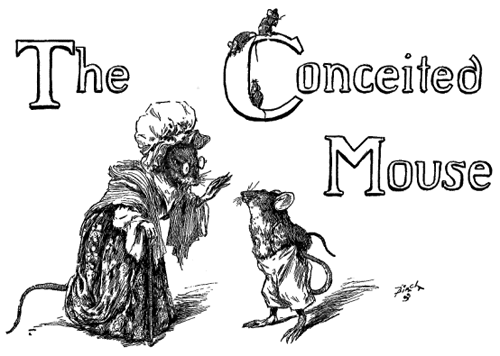
BY ELLA FOSTER CASE
Once upon a time there was a very small mouse with a very, very large opinion of himself. What he didn’t know his own grandmother couldn’t tell him.
“You’d better keep a bright eye in your head, these days,” said she, one chilly afternoon. “Your gran’ther has smelled a trap.”
“Scat!” answered the small mouse—“’s if I don’t know a trap when I see it!” And that was all the thanks she got for her good advice.
“Go your own way, for you will go no other,” the wise old mouse said to herself; and she scratched her nose slowly and sadly as she watched her grandson scamper up the cellar stairs.
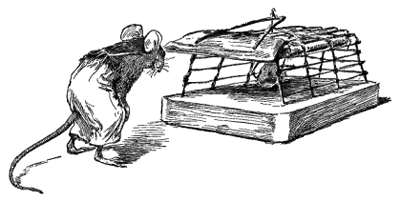
“Ah!” sniffed he, poking his whiskers into a crack of the dining-room cupboard, “cheese—as I’m alive!” Scuttle—scuttle. “I’ll be squizzled, if it isn’t in that cunning little house; I know what that is—a cheese-house, of course. What a [Pg 324] very snug hall! That’s the way with cheese-houses. I know, ’cause I’ve heard the dairymaid talk about ’em. It must be rather inconvenient, though, to carry milk up that step and through an iron door. I know why it’s so open—to let in fresh air. I tell you, that cheese is good! Kind of a reception-room in there—guess I know a reception-room from a hole in the wall. No trouble at all about getting in, either. Wouldn’t grandmother open her eyes to see me here! Guess I’ll take another nibble at that cheese, and go out. What’s that noise? What in squeaks is the matter with the door? This is a cheese-house, I know it is—but what if it should turn out to be a—O-o-o-eeee!” And that’s just what it did turn out to be.
BY JAMES WHITCOMB RILEY
My mother she’s so good to me,
Ef I was good as I could be,
I couldn’t be as good—no, sir!—
Can’t any boy be good as her.
She loves me when I’m glad er sad;
She loves me when I’m good er bad;
An’, what’s a funniest thing, she says
She loves me when she punishes.
I don’t like her to punish me—
That don’t hurt—but it hurts to see
Her cryin’.—Nen I cry; an’ nen
We both cry an’ be good again.
She loves me when she cuts an’ sews
My little cloak an’ Sund’y clothes;
An’ when my Pa comes home to tea,
She loves him ’most as much as me.
She laughs an’ tells him all I said,
An’ grabs me up an’ pats my head;
An’ I hug her, an’ hug my Pa,
An’ love him purt’ nigh much as Ma.
[O] From “Rhymes of Childhood,” by James Whitcomb Riley. Copyright, 1890. Used by special permission of the publishers. The Bobbs-Merrill Company.
BY ROSE FYLEMAN
When mother comes each morning
She wears her oldest things,
She doesn’t make a rustle,
She hasn’t any rings;
She says, “Good-morning, chickies,
It’s such a lovely day,
Let’s go into the garden
And have a game of play!”
When mother comes at tea-time
Her dress goes shoo-shoo-shoo,
She always has a little bag,
Sometimes a sunshade too;
She says, “I am so hoping
There’s something left for me;
Please hurry up, dear Nanna,
I’m dying for my tea.”
When mother comes at bed-time
Her evening dress she wears,
She tells us each a story
When we have said our prayers;
And if there is a party
She looks so shiny bright
It’s like a lovely fairy
Dropped in to say good-night.
Evening was falling, cold and dark,
And people hurried along the way
As if they were longing soon to mark
Their own home candle’s cheering ray.
Before me toiled in the whirling wind
A woman with bundles great and small,
And after her tugged, a step behind,
The Bundle she loved the best of all.
A dear little roly-poly boy
With rosy cheeks, and a jacket blue,
Laughing and chattering full of joy,
And here’s what he said—I tell you true:
“You’re the goodest mother that ever was.”
A voice as clear as a forest bird’s;
And I’m sure the glad young heart had cause
To utter the sweet of the lovely words.
Perhaps the woman had worked all day
Washing or scrubbing; perhaps she sewed;
I knew, by her weary footfall’s way
That life for her was an uphill road.
But here was a comfort. Children dear,
Think what a comfort you might give
To the very best friend you can have here,
The lady fair in whose house you live,
If once in a while you’d stop and say,—
In task or play for a moment pause,
And tell her in sweet and winning way,
“You’re the GOODEST mother that ever was.”
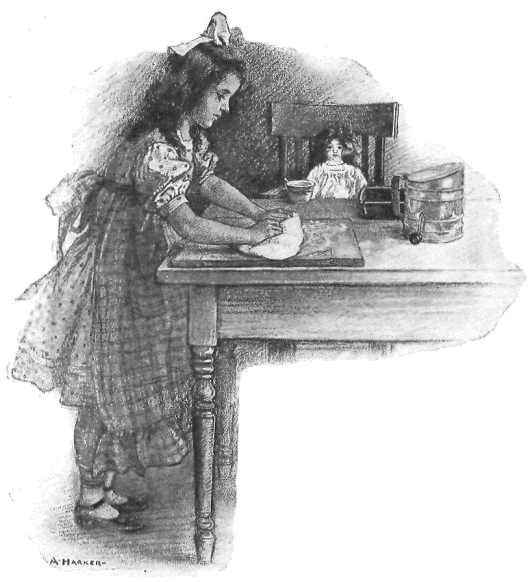
MOTHER’S WAY
BY CARRIE WILLIAMS
Nowadays girls go to cooking-school
And learn to cook just so by rule;
But all I know, I’m glad to say,
My mother taught me day by day.
She did not need a great cook-book;
She knew how much and what it took
To make things good and sweet and light.
What Mother does is always right.
BY ETHEL M. KELLEY
Whose hair is all curly, an’ eyes “baby-blue”?
Who wakes up too early ’fore night-time is fru?
Who dresses her pillow all up in the clo’es,
An’ counts all her piggies when nobody knows?
An’ who’s des’ as quiet as quiet can be?
Muvver says—me.
Who w’ites wif a pencil all over a book?
An’ who gets the ink when nobody does look?
An’ who gets her fingies all blacker than black?
An’ who gets ’em spatted when Muvver comes back?
An’ who’s des’ as sorry as sorry can be?
Muvver says—me.
Who goes down to dinner on Sundays at two,
All dressed in w’ite frillies, an’ tied up in blue?
An’ who waits for Father to cut up her meat,
When she is so hungry an’ nuffin’ to eat?
An’ who’s des’ as “patient” as “patient” can be?
Muvver says—me.
Who gets on her nightie an’ says all her prayers?
An’ then comes a-stealin’ an’ creepin’ down-stairs?
Who cuddles up comfy an’ teases to stay?
An’ who is so spoiled ’at she won’t go away,
Even when she’s as sleepy as sleepy can be?
Muvver says—me.
BY MIRIAM S. CLARK
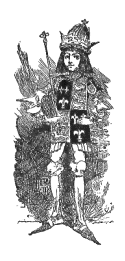
My dearest is a lady, she wears a gown of blue,
She sits beside the window where the yellow sun comes through;
The light is shining on her hair, and all the time she sews,
She sings a song about a knight, a dear, brave knight she knows.
My dearest is a lady—and oh, I love her well!
Full five and twenty times a day this very tale I tell;
For I’m the knight in armor, a shield and sword I wear,
And Mother is my lady, with the light upon her hair.
How many lumps of sugar
Ought a little girl to use
To sweeten a cup of chocolate?
I can take just what I choose.
Five make it just like candy,
And four are most as good—
There’s no one to say I mustn’t,
Now I wonder if I should.
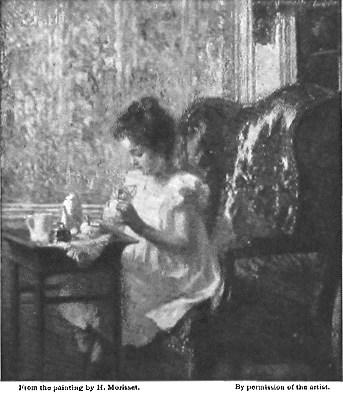
Three is what Nurse allows me,
So that would be surely right.
Uncle Jack takes two lumps always
And says it is “out of sight.”
Five, four, three, two—I wonder—
Or none, just like Papa?
Well, after all, I’ll take but one
And copy my dear Mama.
BY CLARA ODELL LYON
Says Bobby to Mother:
“I’ll be good as I can.”
“I know you will, Bobby;
You’re Mother’s little man.”
BUT—
His mother then takes every match from the box;
The door of the pantry securely she locks;
Puts the hammer and tacks, and the scissors and ink
In the best hiding places of which she can think
And wonders at last, as her hat she pins on,
What mischief her Bobby will do while she’s gone!
When people ask me where I live,
I hate to have to go and give
A name like Smithville, plain.
I’d rather say:—“Sir, if you please,
My home is in the Hebrides,”
Or, “High up in the Pyrenees,”
Or, “At Gibraltar, Spain.”
“Constantinople,” too, sounds fine,
And “Drachenfels-upon-the-Rhine,”
And “Madagascar,” too;
And “Yokohama” sounds so great,
And “Hindustan” is just first-rate;
I rather like even “Bering Strait,”
And “Cuzco” in Peru.
And yet, I would not be at night,
Alone upon the “Isle of Wight,”
Or on the “Zuyder Zee.”
At “Nova Zembla,” in a gale,
I know that I should just turn pale;
For fear of earthquakes, I should quail
In “sunny Italy.”
A place that sounds nice on the map,
May have a little too much snap
To keep within its wall,
And so, though many names I see,
That sound as stylish as can be,
There’s no place quite so good for me,
As Smithville, after all!
Blanche Elizabeth Wade.
BY HELEN A. BYROM
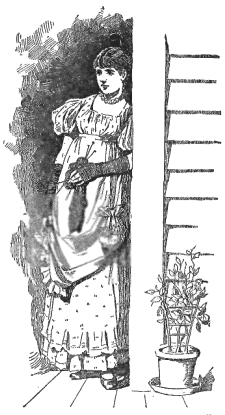 “stands watching the
Grandmother sits in her easy-chair,
In the ruddy sunlight’s glow;
Her thoughts are wandering far away
In the land of Long Ago.
Again she dwells in her father’s home,
And before her loving eyes
In the light of a glorious summer day
The gray old farm-house lies.
She hears the hum of the spinning-wheel
And the spinner’s happy song;
She sees the bundles of flax that hang
From the rafters, dark and long;
She sees the sunbeams glide and dance
Across the sanded floor;
And feels on her cheek the wandering breeze
That steals through the open door.
Beyond, the flowers nod sleepily
At the well-sweep, gaunt and tall;
And up from the glen comes the musical roar
Of the distant waterfall.
The cows roam lazily to and fro
Along the shady lane;
The shouts of the reapers sound faint and far
From the fields of golden grain.
And grandma herself, a happy girl,
Stands watching the setting sun,
While the spinner rests, and the reapers cease,
And the long day’s work is done;
Then something wakes her—the room is dark,
And vanished the sunset glow,
And grandmother wakes, with a sad surprise,
From the dreams of long ago.
ometimes when I am tired of play
My mother says to me,
“Come, daughter, we will call to-day
On Great-aunt Lucy Lee.”
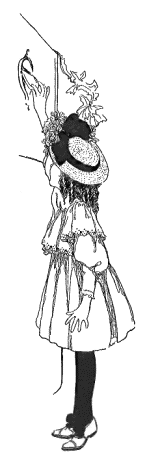
And soon, by mother’s side, I skip
Along the quiet street,
Where tall old trees, on either side,
Throw shadows at my feet.
The houses stand in solemn rows,
And not a child is seen;
The blinds are drawn, the doors are shut,
The walks are span and clean.
Then when we come to number three,
I stretch my hand up—so!
And find the old brass knocker’s ring;
I rap, and in we go.
There Great-aunt Lucy, small and prim,
Sits by the chimney-piece;
Her knitting-needles clicking go,
And never seem to cease.
Aunt Lucy’s eyes are blue and kind,
Her wrinkled face is fair;
She hides with cap or snowy lace
Her pretty silver hair.
Aunt Lucy’s voice is sweet and low,
Her smile is quick and bright;
She wears a gown of lavender,
And kerchief soft and white.
I fold my hands in front of me
And sit quite still and staid,
Till Great-aunt Lucy, smiling, says,
“Come hither, little maid!”
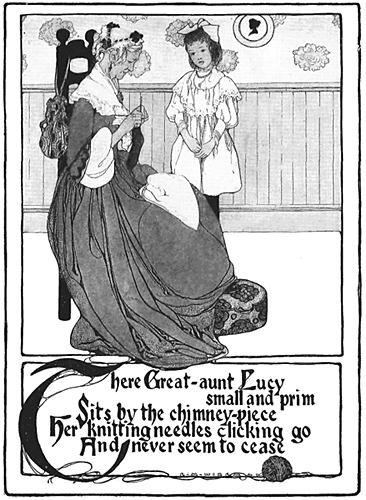
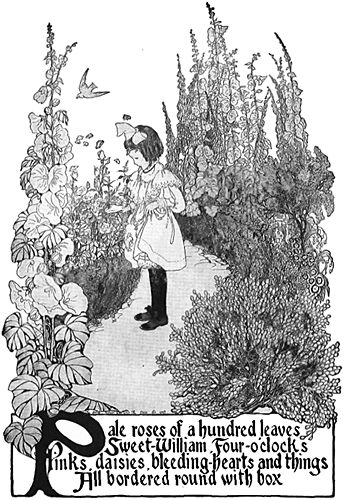
And from her silken bag she takes
A peppermint or two,
And questions me about my play,
My school, my dolls, the Zoo.
And then she rings for Hannah, who
Comes hobbling stiffly in,
With sugared cakes and jelly-tarts
Upon a shining tin.
When I have eaten all I can,
Aunt Lucy bids me go
Into the garden, where all kinds
Of lovely flowers grow.
Pale roses of a hundred leaves,
Sweet-william, four-o’clocks,
Pinks, daisies, bleeding-hearts and things
All bordered ’round with box.
And there’s an arbor, where the grapes
Hang low enough to reach;
A plum-tree just across the path,
And by the wall a peach.
And oh! I think it very nice
To come and visit here;
The house, the garden and the folks
All seem so very queer!
And though I am well satisfied
A while to romp and play,—
A wee old lady, kind and dear,
I want to be some day;
And so I hope that when I, too,
Have grown to eighty-three,
I’ll be a lovely lady like
My Great-aunt Lucy Lee.
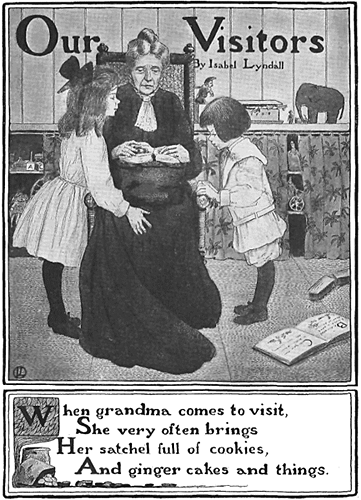
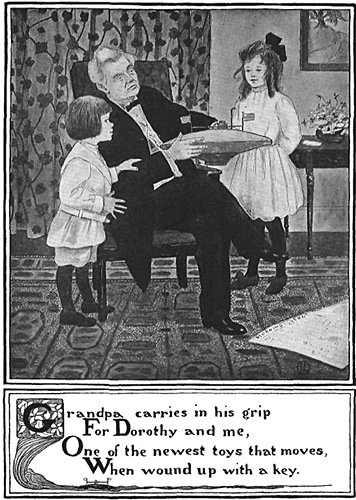
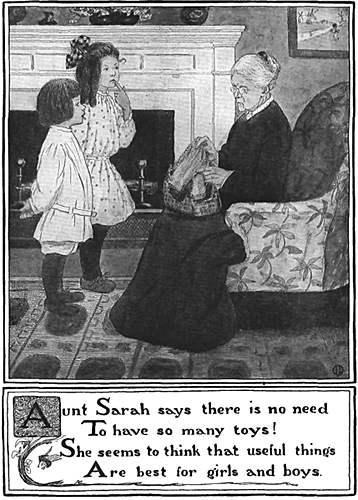
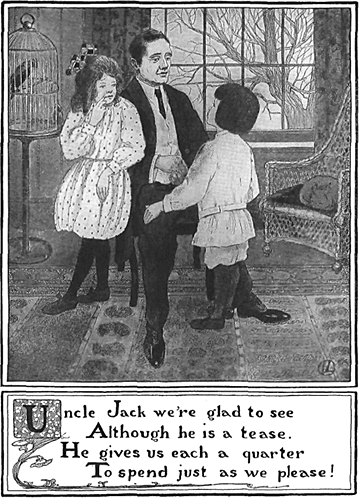
Grandmamma sits in her quaint arm-chair—
Never was lady more sweet and fair!
Her gray locks ripple like silver shells,
And her brow its own calm story tells
Of a gentle life and a peaceful even,
A trust in God and a hope in heaven!
Little girl Mary sits rocking away
In her own low seat, like some winsome fay;
Two dolly babies her kisses share,
And another one lies by the side of her chair.
Mary is fair as the morning dew—
Cheeks of roses and ribbons of blue!
“Say, grandmamma,” says the pretty elf,
“Tell me a story about yourself.
When you were little, what did you play?
Was you good or naughty, the whole long day?
Was it hundreds and hundreds of years ago?
And what makes your soft hair as white as snow?
“Did you have a mamma to hug and kiss?
And a dolly like this, and this, and this?
Did you have a pussy like my little Kate?
Did you go to bed when the clock struck eight?
Did you have long curls and beads like mine?
And a new silk apron, with ribbons fine?”
Grandmamma smiled at the little maid,
And laying aside her knitting, she said:
“Go to my desk and a red box you’ll see;
Carefully lift it and bring it to me.”
So Mary put her dollies away and ran,
Saying, “I’ll be as careful as ever I can.”
Then grandmamma opened the box: and lo!
A beautiful child with a throat like snow,
Lips just tinted like pink shells rare,
Eyes of hazel and golden hair,
Hands all dimpled, and teeth like pearls—
Fairest and sweetest of little girls!
“Oh, who is it?” cried winsome May;
“How I wish she was here to-day!
Wouldn’t I love her like everything,
And give her my new carnelian ring!
Say, dear grandmamma, who can she be?”
“Darling,” said grandmamma, “that child was me!”
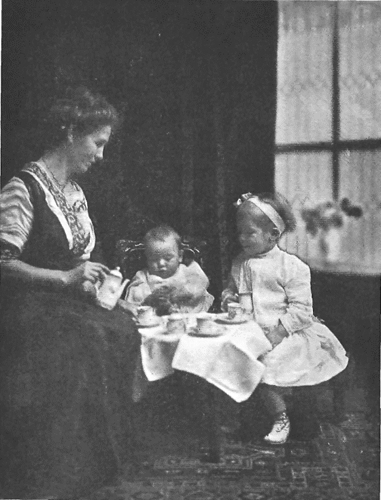 an afternoon call on grandmother
May looked along at the dimpled grace,
And then at the saint-like, fair old face,
“How funny!” she cried, with a smile and a kiss,
“To have such a dear little grandma as this!
Still,” she added, with a smiling zest,
“I think, dear grandma, I like you best!”
So May climbed on the silken knee,
And grandma told her her history—
What plays she played, what toys she had,
How at times she was naughty, or good, or sad.
“But the best thing you did,” said May, “don’t you see?
Was to grow a beautiful grandma for me!”
BY LYDIA MARIA CHILD
Over the river and through the wood,
To grandfather’s house we go;
The horse knows the way
To carry the sleigh
Through the white and drifted snow.
Over the river and through the wood—
Oh, how the wind does blow!
It stings the toes
And bites the nose,
As over the ground we go.
Over the river and through the wood,
To have a first-rate play;
Hear the bells ring,
“Ting-a-ling-ding!”
Hurrah for Thanksgiving Day!
Over the river and through the wood,
Trot fast, my dapple-gray!
Spring over the ground,
Like a hunting hound!
For this is Thanksgiving Day.
Over the river and through the wood,
And straight through the barn-yard gate.
We seem to go
Extremely slow—
It is so hard to wait!
Over the river and through the wood—
Now grandmother’s cap I spy!
Hurrah for the fun!
Is the pudding done?
Hurrah for the pumpkin pie!
Grandma told me all about it;
Told me so I couldn’t doubt it;
How she danced—my grandma danced,
Long ago.
How she held her pretty head,
How her dainty skirt she spread,
How she turned her little toes,
Smiling little human rose!
Long ago.
Grandma’s hair was bright and sunny,
Dimpled cheeks, too—ah, how funny!
Really, quite a pretty girl,
Long ago.
Bless her! Why, she wears a cap,
Grandma, does, and takes a nap,
Every single day, and yet,
Grandma danced a minuet,
Long ago.
No—they moved with stately grace,
Everything in proper place;
Gliding slowly forward, then
Slowly courtesying back again,
Long ago.
Modern ways are quite alarming,
Grandma says; but boys were charming—
Girls and boys, I mean, of course—
Long ago.
Bravely modest, grandly shy—
Now she sits there rocking, rocking,
Always knitting grandpa’s stocking,
Every girl was taught to knit,
Long ago.
Yet her figure is so neat,
And her smile so staid and sweet,
I can almost see her now
Bending to her partner’s bow,
Long ago.
Grandma says our modern jumping,
Hopping, rushing, whirling, bumping
Would have shocked the gentlefolk,
Long ago.
What if all of us should try
Just to feel like those who met
In the graceful minuet,
Long ago?
With the minuet in fashion,
Who could fly into a passion?
All would wear the calm they wore,
Long ago.
In time to come, if I perchance
Should tell my grandchild of our dance
I should really like to say:
“We did, dear, in some such way,
Long ago.”
BY NORMAN GALE
When Aunt Jan’s coming there’s such romping in the house,
She’s sweeter than a daffodil and softer than a mouse!
She sings about the passages, and never wants to rest,
And father says it’s all because a bird is in her breast.
When Aunt Jan’s kissing there’s such a crowding round her knees,
Such clambers to her bosom, and such battles for a squeeze!
We dirty both her snowy cuffs, we trample on her gown,
And sometimes all her yellow hair comes tumbling, tumbling down.
When Aunt Jan’s dancing we all watch her as she goes,
With in-and-out and round-about upon her shiny toes;
And when her merry breath is tired she stops the fun and stands
To curtsy saucily to us, or kiss her pretty hands.
When Aunt Jan’s playing, the piano seems alive,
With all the notes as busy as the bees are in a hive;
And when it’s time for Bedfordshire, as sweetly as a lark
She sings that God is waiting to protect us in the dark.
When Aunt Jan’s leaving we are not ashamed to cry,
A-kissing at the station and a-waving her good-by;
But springtime brings the crocus after winter, rain and frost
So dear Aunt Jan will come again. She isn’t really lost.
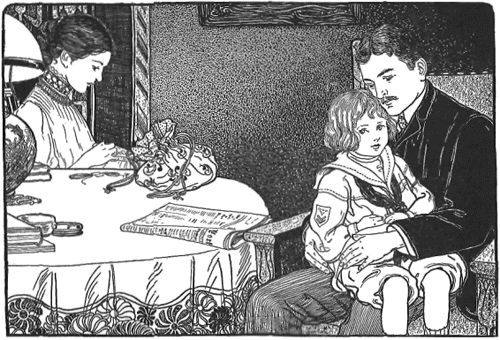
Very often in the evening,
Shortly after tea,
Father, when he’s read the paper,
Takes me on his knee.
There I fix myself “quite comfy,”
In his arms so strong,
While he makes up lovely stories
As he goes along.
Mother near us with her sewing,
Rocking to and fro,
Smiles and listens to the stories,
Likes them too, I know.
And I’m sure that she is thinking,
What perhaps you’ve guessed,
That the stories Father tells us
Are the very best.
“Come hither, little puppy-dog,
I’ll give you a new collar,
If you will learn to read your book,
And be a clever scholar.”
“No! no!” replied the puppy-dog,
“I’ve other fish to fry;
For I must learn to guard your house,
And bark when thieves come nigh.”
With a tingle, tangle titmouse,
Robin knows great A,
And B, and C, and D, and E,
F, G, H, I, J, K.
“Come hither, pretty cockatoo,
Come and learn your letters;
And you shall have a knife and fork
To eat with, like your betters.”
“No! no!” the cockatoo replied,
“My beak will do as well;
I’d rather eat my victuals thus
Than go and learn to spell.”
With a tingle, tangle titmouse,
Robin knows great A,
And B, and C, and D, and E,
F, G, H, I, J, K.
“Come hither, little pussy-cat,
If you’ll your grammar study,
I’ll give you silver clogs to wear,
Whene’er the gutter’s muddy.”
“No! whilst I grammar learn,” says puss,
“Your house will in a trice
Be overrun from top to toe
With flocks of rats and mice.”
With a tingle, tangle titmouse,
Robin knows great A,
And B, and C, and D, and E,
F, G, H, I, J, K.
“Come hither, then, good little boy,
And learn your alphabet,
And you a pair of boots and spurs,
Like your papa’s, shall get.”
“Oh, yes! I’ll learn my alphabet,
And when I’ve learned to read,
Perhaps papa will give me, too,
A pretty, long-tailed steed.”
With a tingle, tangle titmouse,
Robin knows great A,
And B, and C, and D, and E,
F, G, H, I, J, K.

is for
Ale,
Apple,
Artichoke,
and Ann;
is for
Brown Bear,
Black Bear,
and Bran;
is for
Chestnut,
Clay,
Coke, and
Coal,
is for
Dear,
Dray,
Dick,
Duck, and
Droll,
is for
Eve,
Eagle,
Eel,
East, and
Ear;
is for
Fan,
Feather,
Furrow,
Fox, and
Fear;

is for
Goose,
Gander,
Green,
Grub, and
Gray;
is for
Horse,
Hound,
Hip,
Haw, and
Hay;
is for
Ice,
Idler,
Ink,
If, and
Ill;
is for
James,
Jane, for
Jack, and
Jill;
is for
Kiss,
Kitten,
King,
Kitchen,
and Kite;
is for
Lamb,
Lady,
Lace,
Luck, and
Light;

is for
Moon,
Mitten,
Mist,
Moth, and
Mote;
is for
Ned,
Nurse, for
Nose,
Nut, and
Note;
is for
Oil,
Order,
Oat,
Orange,
Oak;
is for
Pin,
Pan, and
Pig in a
Poke;
is for
Queen,
Question,
Quarter, and
Quack;
is for
Reel,
Radish,
Ruff,
Reeve, and
Rack;

is for
Skate,
Salmon,
Sprat,
Saw, and
School;
is for
Tin,
Teapot,
Tar,
Torch, and
Tool;
is for
Urn,
Usher,
Umpire, and
Use;
is for
Vegetables,
Varnish,
and Views;
is for
Want,
War,
Water, and
Wing;
is for
Xenophon,
and
Xerxes,
the King;
is for
Yam,
Yacht,
Yellow, and
Yawl;
is for
Zeal,
Zebra,
Zany—
That’s all!
BY EDWARD LEAR
A was an ant
Who seldom stood still,
And who made a nice house
In the side of a hill.
a
Nice little ant!
B was a book
With a binding of blue,
And pictures and stories
For me and for you.
b
Nice little book!
C was a camel;
You rode on his hump;
And if you fell off,
You came down such a bump!
c
What a high camel!
D was a duck
With spots on his back,
Who lived in the water,
And always said “Quack!”
d
Dear little duck!
E was an elephant,
Stately and wise:
He had tusks and a trunk,
And two queer little eyes.
e
Oh, what funny small eyes!
F was a fish
Who was caught in a net;
But he got out again,
And is quite alive yet.
f
Lively young fish!
G was a goat
Who was spotted with brown;
When he did not lie still
He walked up and down.
g
Good little goat!
H was a hat
Which was all on one side;
Its crown was too high,
And its brim was too wide.
h
Oh, what a hat!
I was some ice
So white and so nice,
But which nobody tasted;
And so it was wasted.
i
All that good ice!
J was a jackdaw
Who hopped up and down
In the principal street
Of a neighboring town.
j
All through the town!
K was a kite
Which flew out of sight,
Above houses so high,
Quite into the sky.
k
Fly away, kite!
L was a light
Which burned all the night,
And lighted the gloom
Of a very dark room.
l
Useful nice light!
M was a man,
Who walked round and round;
And he wore a long coat
That came down to the ground.
m
Funny old man!
N was a net
Which was thrown in the sea
To catch fish for dinner
For you and for me.
n
Nice little net!
O was an orange
So yellow and round;
When it fell off the tree,
It fell down to the ground.
o
Down to the ground!
P was a pig,
Who was not very big,
But his tail was too curly,
And that made him surly.
p
Cross little pig!
Q was a quail
With a very short tail;
And he fed upon corn
In the evening and morn.
q
Quaint little quail!
R was a rabbit,
Who had a bad habit
Of eating the flowers
In gardens and bowers.
r
Naughty fat rabbit!
S was the sugar-tongs,
Nippity-nee,
To take up the sugar
To put in our tea.
s
Nippity-nee!
T was a tortoise,
All yellow and black:
He walked slowly away,
And he never came back.
t
Torty never came back!
U was an urn
All polished and bright,
And full of hot water
At noon and at night.
u
Useful old urn!
V was a veil
With a border upon it,
And a ribbon to tie it
All round a pink bonnet.
v
Pretty green veil!
W was a whale
With a very long tail,
Whose movements were frantic
Across the Atlantic.
w
Monstrous old whale!
X was King Xerxes,
Who, more than all Turks, is
Renowned for his fashion
Of fury and passion.
x
Angry old Xerxes.
Y was a yew,
Which flourished and grew
By a quiet abode
Near the side of a road.
y
Dark little yew!
Z was a zebra,
All striped white and black;
And if he were tame,
You might ride on his back.
z
Pretty striped zebra!
BY EDWARD LEAR
a
A was once an apple-pie,
Pidy,
Widy,
Tidy,
Pidy,
Nice insidy,
Apple-pie!
b
B was once a little bear,
Beary,
Wary,
Hairy,
Beary,
Take cary,
Little bear!
c
C was once a little cake,
Caky,
Baky,
Maky,
Caky,
Taky caky,
Little cake!
d
D was once a little doll,
Dolly,
Molly,
Polly,
Nolly,
Nursy dolly,
Little doll!
e
E was once a little eel,
Eely,
Weely,
Peely,
Eely,
Twirly, tweely,
Little eel!
f
F was once a little fish,
Fishy,
Wishy,
Squishy,
Fishy,
In a dishy,
Little fish!
g
G was once a little goose,
Goosey,
Moosy,
Boosey,
Goosey,
Waddly-woosy,
Little goose!
h
H was once a little hen,
Henny,
Chenny,
Tenny,
Henny,
Eggsy-any,
Little hen?
i
I was once a bottle of ink,
Inky,
Dinky,
Thinky,
Inky,
Black minky,
Bottle of ink!
j
J was once a jar of jam,
Jammy,
Mammy,
Clammy,
Jammy,
Sweety, swammy,
Jar of jam!
k
K was once a little kite,
Kity,
Whity,
Flighty,
Kity,
Out of sighty,
Little kite!
l
L was once a little lark,
Larky,
Marky,
Harky,
Larky,
In the parky,
Little lark!
m
M was once a little mouse,
Mousy,
Bousy,
Sousy,
Mousy,
In the housy,
Little mouse!
n
N was once a little needle,
Needly,
Tweedly,
Threedly,
Needly,
Wisky, wheedly,
Little needle!
o
O was once a little owl,
Owly,
Prowly,
Howly,
Owly,
Browny fowly,
Little owl!
p
P was once a little pump,
Pumpy,
Slumpy,
Flumpy,
Pumpy,
Dumpy, thumpy,
Little pump!
q
Q was once a little quail,
Quaily,
Faily,
Daily,
Quaily,
Stumpy-taily,
Little quail!
r
R was once a little rose,
Rosy,
Posy,
Nosy,
Rosy,
Blows-y, grows-y,
Little rose!
s
S was once a little shrimp,
Shrimpy,
Nimpy,
Flimpy,
Shrimpy,
Jumpy, jimpy,
Little shrimp!
t
T was once a little thrush,
Thrushy,
Hushy,
Bushy,
Thrushy,
Flitty, flushy,
Little thrush!
u
U was once a little urn,
Urny,
Burny,
Turny,
Urny,
Bubbly, burny,
Little urn!
v
V was once a little vine,
Viny,
Winy,
Twiny,
Viny,
Twisty-twiny,
Little vine!
w
W was once a whale,
Whaly,
Scaly,
Shaly,
Whaly,
Tumbly-taily,
Mighty whale!
x
X was once a great king Xerxes,
Xerxy,
Perxy,
Turxy,
Xerxy,
Linxy, lurxy,
Great King Xerxes!
y
Y was once a little yew
Yewdy,
Fewdy,
Crudy,
Yewdy,
Growdy, grewdy,
Little yew!
z
Z was once a piece of zinc,
Tinky,
Winky,
Blinky,
Tinky,
Tinkly minky,
Piece of zinc!
A was an apple pie,
B bit it;
C cut it;
D dealt it;
E ate it;
F fought for it;
G got it;
H had it;
I inquired about it;
J joined it;
K kept it;
L longed for it;
M mourned for it;
N nodded at it;
O opened it;
P peeped in it;
Q quartered it;
R ran for it;
S stole it;
T took it;
U upset it;
V viewed it;
W wanted it;
X, Y, Z, and amper-sand,
All hoped for a piece in hand.
By Carolyn Wells.
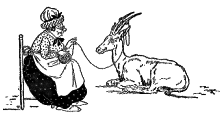
A is for the Antelope,
A beast that I have never met;
They say he jumps the skipping-rope
And makes a charming household pet.
Well, as to that I cannot say;
But A is for him, anyway.
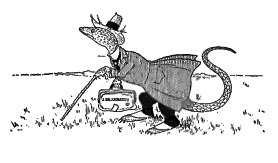
B stands for Bajjerkeit; maybe
You’ve never chanced this beast to see;
So I’ll describe him to you. Well,
There isn’t very much to tell.
One day I idly chanced to look
Within a Natural History book,
And there I saw his funny name,
And thought I’d hand him down to fame.
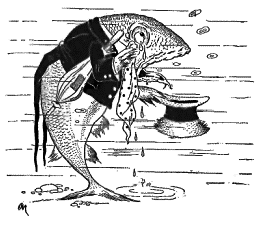
C is for Codfish. He must be
The saltest fish that swims the sea.
And, oh!
He has a secret woe!
You see, he thinks it’s all his fault
The ocean is so very salt!
And so,
In hopeless grief and woe,
The Codfish has, for many years,
Shed quarts of salty, briny tears!
And, oh!
His tears still flow—
So great his grief and woe!
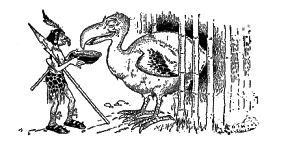
D stands for Dodo. He’s a bird
That isn’t known to many;
And this the reason, I have heard—
Because there aren’t any!
The Dodo, who once blithely blinked,
Is now exceedingly extinct,
And doesn’t it seem rather nice
To think that D stands for him twice?
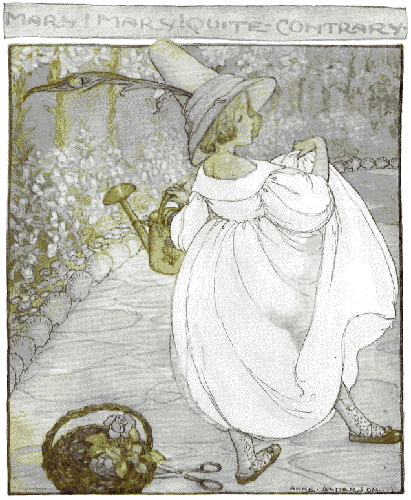
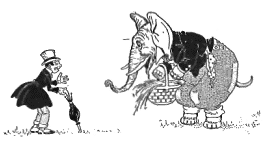
E is for Elephant. I know
He isn’t natty, trim, or trig;
His eyes are rather small, and, oh,
I fear his ears are far too big!
But there’s a well-attested rumor
That he has quite a sense of humor;
So crack a joke whene’er you meet
An Elephant upon the street.
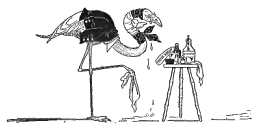
F is Flamingo. All please note
His wondrous height and girth;
He has the longest legs and throat
Of anything on earth.
Such throats are trying, are they not?
In case one catches cold;
Ah, yes! but just think what a lot
His Christmas stockings hold!
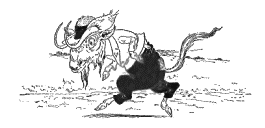
G stands for Gnu. Of course that’s right, but then,
It seems as if it should begin with N.
I could select some other beast as well—
Say, Goose or Grampus, Gadfly or Gazelle;
But seems to me the Gnu is more attractive,
He is so merry, frivolous, and active.
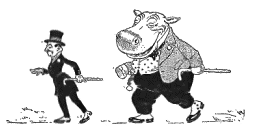
H is for Hippopotamus.
If you desire a pet,
He is, it really seems to us,
The best that you can get.
Train him to follow at your heels
Whene’er you walk abroad,
And note with what delighted squeals
The lookers-on applaud!
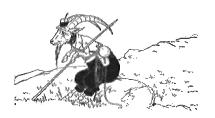
I is for Ibex. This fine creature
Is favored well in form and feature.
And I is for Ichneumon, too—
But what is that to me or you?
But Ibex answers just as well,
And isn’t near so hard to spell.
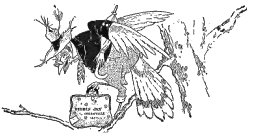
J stands for Jay. This little fellow
Is blue. Sometimes I think
I’d like him better were he yellow,
Or even reddish pink.
I know, of course, it is absurd
To mind the color of a bird;
And, now I think of it, I’ve seen
Some Jays that were exceeding green.
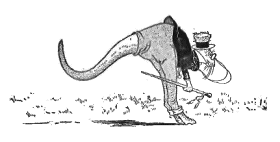
K stands for Kangaroo. I’ve looked all round:
A better beast for K cannot be found.
The Kangaroo can hop and hop and hop;
Somehow he never seems to want to stop.
What more could one desire of him, I pray,
Than just to hop around and stand for K?
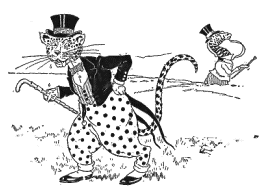
L is for Leopard. Do you know
He’s very, very vain?
And sometimes quite dejectedly
He mopes along the plain.
At these sad times the Leopard’s heart
Is filled with angry passion,
Because his spots are out of date,
And Zebra stripes in fashion!
But other years, when fashion-books
Say spots are all the style,
The Leopard proudly stalks abroad
With most complacent smile.
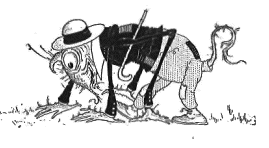
M is for Microbe. This bad beast
Is very, very small;
Some people say—or think, at least—
He isn’t there at all!
He’s smaller than the mitiest mite;
The only way he comes in sight
Is when he’s pictured in a book,
Or through a microbescope you look.
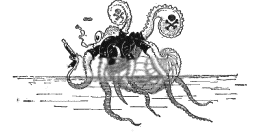
N is for Nautilus, and he’s
A pirate, bold and gay;
He dashes madly through the seas,
A-searching of his prey.
He’s just a sort of silvery mass,
All spotted blue and pink;
And with his eye, which looks like glass,
He winks a wicked wink.
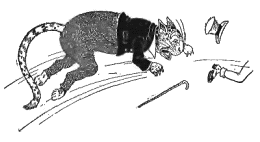
O stands for the obsequious Ounce,
Who weighs full many a pound;
At you he playfully would bounce,
If you were walking round.
Approach him and the Ounce you’ll see
Spring like a catapult;
Just try it once, and you will be
Surprised at the result.
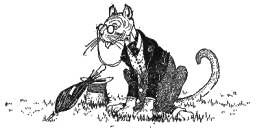
P stands for Puma. His sleek paws
Go softly pit-a-pat;
His teeth are sharp, and sharp his claws;
He’s just a great big cat.
There were some Pumas in the ark;
There are some also in the park:
But, strange to say, in Montezuma
They do not raise a single Puma!
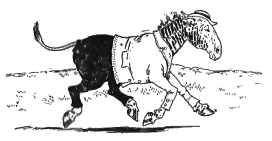
Q stands for Quagga. We’ve been taught
Nothing was ever made in vain;
But even after serious thought
The Quagga’s use is not quite plain.
Though, stay!—ah, yes! at last I see
Why the queer Quagga has to be:
Were there no Quaggas, how would you
Find any beast to stand for Q?
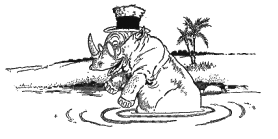
R’s for Rhinoceros. You see
His clothing does not fit;
Yet so indifferent is he,
He doesn’t care a bit.
Although it does not seem to us
The unconcerned Rhinoceros
Has any claim to wit or grace,
We must admire his earnest face.
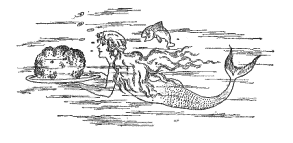
S stands for Sponge. You’d scarce suppose
This could be called a creature;
It hasn’t any eyes or nose—
Indeed, it has no feature.
And, though this may cause some surprise,
The mermaids, I dare say,
Will set a Sponge at night to rise,
And make sponge-cake next day.
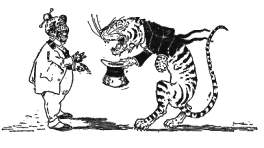
T stands for Tiger. In the south
He roams his native heath.
He has a wide, capacious mouth,
And long and glistening teeth.
’Tis not worth while your time to spend
To cultivate him as a friend;
But to your house, so warm and snug,
Invite the Tiger as a rug.
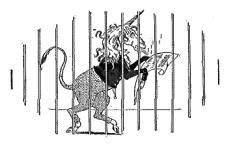
U is for the Unicorn,
The dearest little thing;
Though he has but a single horn,
And not a single wing.
A Unicorn of any age
Is nicer, so I’ve heard,
To keep within a gilded cage
Than a canary-bird.
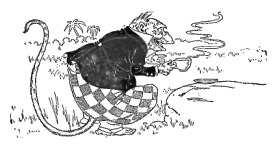
V is for Vervet. From his name
You’d be inclined to think
This creature rather mild and tame,
In color somewhat pink.
But not at all; the Vervet’s green,
And very cross and spunky;
In fact, it’s plainly to be seen
The Vervet’s just a monkey!
W is for Whale. He’s in
The oceans, north and south.
He doesn’t have a dimpled chin,
Nor yet a rosebud mouth.
Yet he is very fond of fun,
And has wide smiles for every one.
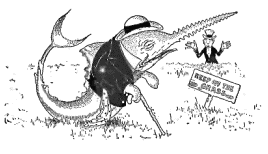
X stands for Xiphias; he’s a fish.
If you a Xiphias should wish,
Don’t let him roam around the grass,
But keep him in a globe of glass.
His name, as everybody knows,
Is Xiphias Gladius. I suppose
That means the Xiphias is glad
Because he wasn’t born a Shad.
Y is for Yak,
Who is not very tidy;
And he’s lazy, alack!
He sleeps all day Friday.
About a yard wide
The Yak is, precisely;
With fringe on each side
He’s trimmed very nicely.
Z stands for Zibet. I’ve been told
This beast was much esteemed of old;
But, latterly, most people think
They’d rather have a moose or mink.
In a museum that’s in Tibet
They have one stuffed—he’s an Ex-Zibet!
A was an Archer, who shot at a frog;
B was a Butcher, and had a great dog.
C was a Captain, all covered with lace;
D was a drunkard, and had a red face.
E was an Esquire, with pride on his brow;
F was a Farmer, and followed the plough.
G was a gamester, who had but ill-luck;
H was a Hunter, who hunted a buck.
I was an Innkeeper, who loved to carouse;
J was a Joiner, and built up a house.
K is the King, who governs England;
L was a Lady, who had a white hand.
M was a Miser, and hoarded up gold;
N was a Nobleman, gallant and bold.
O was an Oyster-Girl, who went about town;
P was a Parson, and wore a black gown.
Q was a Queen, who wore a silk slip;
R was a Robber, and wanted a whip.
S was a Sailor, and spent all he got;
T was a Tinker, and mended a pot.
U was an Usurer, a miserable elf;
V was a Vintner, who drank all himself.
W was a Watchman, and guarded the door;
X was expensive, and so became poor.
Y was a Youth, that did not love school;
Z was a Zany, a poor harmless fool.
BY CAROLYN WELLS
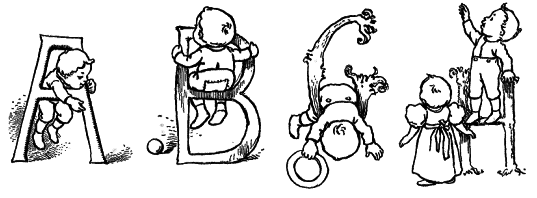
Affable Andy
Ate sugar candy.
Boisterous Ben
Shot at a hen.
Gay little Guy
Thought he could fly.
Helen and Hugh
Called the sky blue.
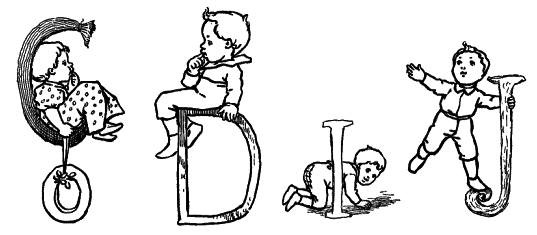
Careless Corinne
Lost her gold pin.
Dear little Davy
Liked chicken gravy.
Ignorant Ike
Fell off his bike.
Jaunty young Jack
Stepped on a tack.
Elegant Ed
Had a new sled.
Fair little Fanny
Wrote to her Granny.
Kind little Kay
Gave things away.
Lovable Lenny
Lost his new penny.
Merry young Mac
Rode in a hack.
Nice little Nettie
Never was fretty.
Unsocial Una
Gazed up at Luna.
Vigorous Vinton
Always was “sprintin’.”
Opulent Ollie
Rode on the trolley.
Popular Polly
Made pies so jolly.
Whimsical Winnie
Started for Guinea.
Xenophon Bump
Tried a high jump.
Queer little Queen
Always wore green.
Rollicking Rory
Read a long story.
Yellow-haired Yorick
Made leaps historic.
Zealous young Zed
Stood on his head.
Sturdy St. Clair
Marched everywhere.
Tommy and Teddy
Climbed straight and steady.
Ampersand held a book in his hand.
BY MRS. FREDERICK PETERSON

is for Apples
and also for Air;
Children need both
and we have them to spare.
is for Butter spread
thick on Brown Bread,
Also for Baths
before Breakfast or Bed.
is for Cereals
and Cocoa too;
Consider the Calories
coming to You.
is for Dates,
the kind that You eat,
Deliciously sweet
and far cheaper than Meat.
is the Excellent
Edible Egg,
One daily at least,
dear Children, we beg.
is for Fruits, whether
fresh, dried or stewed;
Dried, at the Grocer’s,
you’ll buy them, if shrewd.
is for Gaining,
as every Child could,
A half pound a Month
is the least that he should.

is for Height,
be as tall as you can,
Weight up to Height
makes a healthy strong Man.
is for Iron
in Spinach and Eggs,
Builds Red Blood and Sinews
for strong Arms and Legs.
is for Jam
and also for Joy,
Which spread on his Bread
it brings to a Boy.
is for Kitchen
so spick and so span,
We all like our Food
from a shining clean Pan.
is for Luncheon
served hot in the School;
We wish all the Teachers
could follow this Rule.
is for Milk which
makes Muscle and Bone;
One pint a day
would be best till you’re grown.
is for News
of habits you need,
To grow up so healthy
you’re bound to succeed.

is for Oatmeal,
the finest of Food;
With Milk for your Breakfast
there’s nothing so good.
is for Prunes,
Potatoes and Peas,
And Patriots who will
be glad to eat these.
is for Quiet,
we frequently need;
After Meals don’t run
at the top of your speed.
is for Rest
and Round Rosy Faces;
Rest is a thing
which nothing replaces.
is important
and therefore I hope
You’ll pardon my specially
mentioning Soap.
is a Topic
which Trouble begins;
Both Tea and Coffee
for Children are Sins.
Understanding
the best way to live,
United for Service
our Country to give.
is for Vegetables;
if you’re too slim,
These Victuals are full
of Vigor and Vim.
is for Water,
the best thing to drink
Between Meals
as often as ever we think.
is for Xtras
of Soup or of Milk
For a thin little Girl
till she’s finer than Silk.
is for You,
and I tell you the Truth,
Learn to be Healthy
and Strong in your Youth.
Now march for it, Children,
with Drum and with Fife.
Z is the Zest
which Health gives to Life.
[P] Used by permission of the author and of the publishers, The Child Health Organization.
Here’s A, B, C, D,
E, F and G,
H, I, J, K,
L, M, N, O, P,
Q, R, S, T,
U, V, W,
X, Y, and Z,
And oh, dear me,
When shall I learn
My A, B, C.
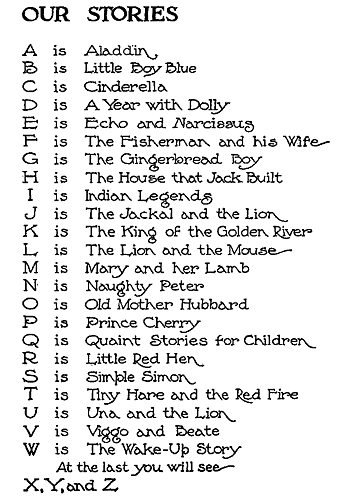
***END OF THE PROJECT GUTENBERG EBOOK BOYS AND GIRLS BOOKSHELF; A PRACTICAL PLAN OF CHARACTER BUILDING, VOLUME I (OF 17)***
******* This file should be named 25359-h.txt or 25359-h.zip *******
This and all associated files of various formats will be found in:
http://www.gutenberg.org/2/5/3/5/25359
Updated editions will replace the previous one--the old editions will be renamed.
Creating the works from public domain print editions means that no one owns a United States copyright in these works, so the Foundation (and you!) can copy and distribute it in the United States without permission and without paying copyright royalties. Special rules, set forth in the General Terms of Use part of this license, apply to copying and distributing Project Gutenberg-tm electronic works to protect the PROJECT GUTENBERG-tm concept and trademark. Project Gutenberg is a registered trademark, and may not be used if you charge for the eBooks, unless you receive specific permission. If you do not charge anything for copies of this eBook, complying with the rules is very easy. You may use this eBook for nearly any purpose such as creation of derivative works, reports, performances and research. They may be modified and printed and given away--you may do practically ANYTHING with public domain eBooks. Redistribution is subject to the trademark license, especially commercial redistribution.
*** START: FULL LICENSE ***

THE FULL PROJECT GUTENBERG LICENSE
PLEASE READ THIS BEFORE YOU DISTRIBUTE OR USE THIS WORK

To protect the Project Gutenberg-tm mission of promoting the free
distribution of electronic works, by using or distributing this work
(or any other work associated in any way with the phrase "Project
Gutenberg"), you agree to comply with all the terms of the Full Project
Gutenberg-tm License (available with this file or online at
http://www.gutenberg.org/license).


Section 1.  General Terms of Use and Redistributing Project Gutenberg-tm
electronic works

1.A.  By reading or using any part of this Project Gutenberg-tm
electronic work, you indicate that you have read, understand, agree to
and accept all the terms of this license and intellectual property
(trademark/copyright) agreement.  If you do not agree to abide by all
the terms of this agreement, you must cease using and return or destroy
all copies of Project Gutenberg-tm electronic works in your possession.
If you paid a fee for obtaining a copy of or access to a Project
Gutenberg-tm electronic work and you do not agree to be bound by the
terms of this agreement, you may obtain a refund from the person or
entity to whom you paid the fee as set forth in paragraph 1.E.8.

1.B.  "Project Gutenberg" is a registered trademark.  It may only be
used on or associated in any way with an electronic work by people who
agree to be bound by the terms of this agreement.  There are a few
things that you can do with most Project Gutenberg-tm electronic works
even without complying with the full terms of this agreement.  See
paragraph 1.C below.  There are a lot of things you can do with Project
Gutenberg-tm electronic works if you follow the terms of this agreement
and help preserve free future access to Project Gutenberg-tm electronic
works.  See paragraph 1.E below.

1.C.  The Project Gutenberg Literary Archive Foundation ("the Foundation"
or PGLAF), owns a compilation copyright in the collection of Project
Gutenberg-tm electronic works.  Nearly all the individual works in the
collection are in the public domain in the United States.  If an
individual work is in the public domain in the United States and you are
located in the United States, we do not claim a right to prevent you from
copying, distributing, performing, displaying or creating derivative
works based on the work as long as all references to Project Gutenberg
are removed.  Of course, we hope that you will support the Project
Gutenberg-tm mission of promoting free access to electronic works by
freely sharing Project Gutenberg-tm works in compliance with the terms of
this agreement for keeping the Project Gutenberg-tm name associated with
the work.  You can easily comply with the terms of this agreement by
keeping this work in the same format with its attached full Project
Gutenberg-tm License when you share it without charge with others.

1.D.  The copyright laws of the place where you are located also govern
what you can do with this work.  Copyright laws in most countries are in
a constant state of change.  If you are outside the United States, check
the laws of your country in addition to the terms of this agreement
before downloading, copying, displaying, performing, distributing or
creating derivative works based on this work or any other Project
Gutenberg-tm work.  The Foundation makes no representations concerning
the copyright status of any work in any country outside the United
States.

1.E.  Unless you have removed all references to Project Gutenberg:

1.E.1.  The following sentence, with active links to, or other immediate
access to, the full Project Gutenberg-tm License must appear prominently
whenever any copy of a Project Gutenberg-tm work (any work on which the
phrase "Project Gutenberg" appears, or with which the phrase "Project
Gutenberg" is associated) is accessed, displayed, performed, viewed,
copied or distributed:

This eBook is for the use of anyone anywhere at no cost and with
almost no restrictions whatsoever.  You may copy it, give it away or
re-use it under the terms of the Project Gutenberg License included
with this eBook or online at www.gutenberg.org

1.E.2.  If an individual Project Gutenberg-tm electronic work is derived
from the public domain (does not contain a notice indicating that it is
posted with permission of the copyright holder), the work can be copied
and distributed to anyone in the United States without paying any fees
or charges.  If you are redistributing or providing access to a work
with the phrase "Project Gutenberg" associated with or appearing on the
work, you must comply either with the requirements of paragraphs 1.E.1
through 1.E.7 or obtain permission for the use of the work and the
Project Gutenberg-tm trademark as set forth in paragraphs 1.E.8 or
1.E.9.

1.E.3.  If an individual Project Gutenberg-tm electronic work is posted
with the permission of the copyright holder, your use and distribution
must comply with both paragraphs 1.E.1 through 1.E.7 and any additional
terms imposed by the copyright holder.  Additional terms will be linked
to the Project Gutenberg-tm License for all works posted with the
permission of the copyright holder found at the beginning of this work.

1.E.4.  Do not unlink or detach or remove the full Project Gutenberg-tm
License terms from this work, or any files containing a part of this
work or any other work associated with Project Gutenberg-tm.

1.E.5.  Do not copy, display, perform, distribute or redistribute this
electronic work, or any part of this electronic work, without
prominently displaying the sentence set forth in paragraph 1.E.1 with
active links or immediate access to the full terms of the Project
Gutenberg-tm License.

1.E.6.  You may convert to and distribute this work in any binary,
compressed, marked up, nonproprietary or proprietary form, including any
word processing or hypertext form.  However, if you provide access to or
distribute copies of a Project Gutenberg-tm work in a format other than
"Plain Vanilla ASCII" or other format used in the official version
posted on the official Project Gutenberg-tm web site (www.gutenberg.org),
you must, at no additional cost, fee or expense to the user, provide a
copy, a means of exporting a copy, or a means of obtaining a copy upon
request, of the work in its original "Plain Vanilla ASCII" or other
form.  Any alternate format must include the full Project Gutenberg-tm
License as specified in paragraph 1.E.1.

1.E.7.  Do not charge a fee for access to, viewing, displaying,
performing, copying or distributing any Project Gutenberg-tm works
unless you comply with paragraph 1.E.8 or 1.E.9.

1.E.8.  You may charge a reasonable fee for copies of or providing
access to or distributing Project Gutenberg-tm electronic works provided
that

- You pay a royalty fee of 20% of the gross profits you derive from
     the use of Project Gutenberg-tm works calculated using the method
     you already use to calculate your applicable taxes.  The fee is
     owed to the owner of the Project Gutenberg-tm trademark, but he
     has agreed to donate royalties under this paragraph to the
     Project Gutenberg Literary Archive Foundation.  Royalty payments
     must be paid within 60 days following each date on which you
     prepare (or are legally required to prepare) your periodic tax
     returns.  Royalty payments should be clearly marked as such and
     sent to the Project Gutenberg Literary Archive Foundation at the
     address specified in Section 4, "Information about donations to
     the Project Gutenberg Literary Archive Foundation."

- You provide a full refund of any money paid by a user who notifies
     you in writing (or by e-mail) within 30 days of receipt that s/he
     does not agree to the terms of the full Project Gutenberg-tm
     License.  You must require such a user to return or
     destroy all copies of the works possessed in a physical medium
     and discontinue all use of and all access to other copies of
     Project Gutenberg-tm works.

- You provide, in accordance with paragraph 1.F.3, a full refund of any
     money paid for a work or a replacement copy, if a defect in the
     electronic work is discovered and reported to you within 90 days
     of receipt of the work.

- You comply with all other terms of this agreement for free
     distribution of Project Gutenberg-tm works.

1.E.9.  If you wish to charge a fee or distribute a Project Gutenberg-tm
electronic work or group of works on different terms than are set
forth in this agreement, you must obtain permission in writing from
both the Project Gutenberg Literary Archive Foundation and Michael
Hart, the owner of the Project Gutenberg-tm trademark.  Contact the
Foundation as set forth in Section 3 below.

1.F.

1.F.1.  Project Gutenberg volunteers and employees expend considerable
effort to identify, do copyright research on, transcribe and proofread
public domain works in creating the Project Gutenberg-tm
collection.  Despite these efforts, Project Gutenberg-tm electronic
works, and the medium on which they may be stored, may contain
"Defects," such as, but not limited to, incomplete, inaccurate or
corrupt data, transcription errors, a copyright or other intellectual
property infringement, a defective or damaged disk or other medium, a
computer virus, or computer codes that damage or cannot be read by
your equipment.

1.F.2.  LIMITED WARRANTY, DISCLAIMER OF DAMAGES - Except for the "Right
of Replacement or Refund" described in paragraph 1.F.3, the Project
Gutenberg Literary Archive Foundation, the owner of the Project
Gutenberg-tm trademark, and any other party distributing a Project
Gutenberg-tm electronic work under this agreement, disclaim all
liability to you for damages, costs and expenses, including legal
fees.  YOU AGREE THAT YOU HAVE NO REMEDIES FOR NEGLIGENCE, STRICT
LIABILITY, BREACH OF WARRANTY OR BREACH OF CONTRACT EXCEPT THOSE
PROVIDED IN PARAGRAPH F3.  YOU AGREE THAT THE FOUNDATION, THE
TRADEMARK OWNER, AND ANY DISTRIBUTOR UNDER THIS AGREEMENT WILL NOT BE
LIABLE TO YOU FOR ACTUAL, DIRECT, INDIRECT, CONSEQUENTIAL, PUNITIVE OR
INCIDENTAL DAMAGES EVEN IF YOU GIVE NOTICE OF THE POSSIBILITY OF SUCH
DAMAGE.

1.F.3.  LIMITED RIGHT OF REPLACEMENT OR REFUND - If you discover a
defect in this electronic work within 90 days of receiving it, you can
receive a refund of the money (if any) you paid for it by sending a
written explanation to the person you received the work from.  If you
received the work on a physical medium, you must return the medium with
your written explanation.  The person or entity that provided you with
the defective work may elect to provide a replacement copy in lieu of a
refund.  If you received the work electronically, the person or entity
providing it to you may choose to give you a second opportunity to
receive the work electronically in lieu of a refund.  If the second copy
is also defective, you may demand a refund in writing without further
opportunities to fix the problem.

1.F.4.  Except for the limited right of replacement or refund set forth
in paragraph 1.F.3, this work is provided to you 'AS-IS,' WITH NO OTHER
WARRANTIES OF ANY KIND, EXPRESS OR IMPLIED, INCLUDING BUT NOT LIMITED TO
WARRANTIES OF MERCHANTIBILITY OR FITNESS FOR ANY PURPOSE.

1.F.5.  Some states do not allow disclaimers of certain implied
warranties or the exclusion or limitation of certain types of damages.
If any disclaimer or limitation set forth in this agreement violates the
law of the state applicable to this agreement, the agreement shall be
interpreted to make the maximum disclaimer or limitation permitted by
the applicable state law.  The invalidity or unenforceability of any
provision of this agreement shall not void the remaining provisions.

1.F.6.  INDEMNITY - You agree to indemnify and hold the Foundation, the
trademark owner, any agent or employee of the Foundation, anyone
providing copies of Project Gutenberg-tm electronic works in accordance
with this agreement, and any volunteers associated with the production,
promotion and distribution of Project Gutenberg-tm electronic works,
harmless from all liability, costs and expenses, including legal fees,
that arise directly or indirectly from any of the following which you do
or cause to occur: (a) distribution of this or any Project Gutenberg-tm
work, (b) alteration, modification, or additions or deletions to any
Project Gutenberg-tm work, and (c) any Defect you cause.


Section  2.  Information about the Mission of Project Gutenberg-tm

Project Gutenberg-tm is synonymous with the free distribution of
electronic works in formats readable by the widest variety of computers
including obsolete, old, middle-aged and new computers.  It exists
because of the efforts of hundreds of volunteers and donations from
people in all walks of life.

Volunteers and financial support to provide volunteers with the
assistance they need, is critical to reaching Project Gutenberg-tm's
goals and ensuring that the Project Gutenberg-tm collection will
remain freely available for generations to come.  In 2001, the Project
Gutenberg Literary Archive Foundation was created to provide a secure
and permanent future for Project Gutenberg-tm and future generations.
To learn more about the Project Gutenberg Literary Archive Foundation
and how your efforts and donations can help, see Sections 3 and 4
and the Foundation web page at http://www.gutenberg.org/fundraising/pglaf.


Section 3.  Information about the Project Gutenberg Literary Archive
Foundation

The Project Gutenberg Literary Archive Foundation is a non profit
501(c)(3) educational corporation organized under the laws of the
state of Mississippi and granted tax exempt status by the Internal
Revenue Service.  The Foundation's EIN or federal tax identification
number is 64-6221541.  Contributions to the Project Gutenberg
Literary Archive Foundation are tax deductible to the full extent
permitted by U.S. federal laws and your state's laws.

The Foundation's principal office is located at 4557 Melan Dr. S.
Fairbanks, AK, 99712., but its volunteers and employees are scattered
throughout numerous locations.  Its business office is located at
809 North 1500 West, Salt Lake City, UT 84116, (801) 596-1887, email
business@pglaf.org.  Email contact links and up to date contact
information can be found at the Foundation's web site and official
page at http://www.gutenberg.org/about/contact

For additional contact information:
     Dr. Gregory B. Newby
     Chief Executive and Director
     gbnewby@pglaf.org

Section 4.  Information about Donations to the Project Gutenberg
Literary Archive Foundation

Project Gutenberg-tm depends upon and cannot survive without wide
spread public support and donations to carry out its mission of
increasing the number of public domain and licensed works that can be
freely distributed in machine readable form accessible by the widest
array of equipment including outdated equipment.  Many small donations
($1 to $5,000) are particularly important to maintaining tax exempt
status with the IRS.

The Foundation is committed to complying with the laws regulating
charities and charitable donations in all 50 states of the United
States.  Compliance requirements are not uniform and it takes a
considerable effort, much paperwork and many fees to meet and keep up
with these requirements.  We do not solicit donations in locations
where we have not received written confirmation of compliance.  To
SEND DONATIONS or determine the status of compliance for any
particular state visit http://www.gutenberg.org/fundraising/pglaf

While we cannot and do not solicit contributions from states where we
have not met the solicitation requirements, we know of no prohibition
against accepting unsolicited donations from donors in such states who
approach us with offers to donate.

International donations are gratefully accepted, but we cannot make
any statements concerning tax treatment of donations received from
outside the United States.  U.S. laws alone swamp our small staff.

Please check the Project Gutenberg Web pages for current donation
methods and addresses.  Donations are accepted in a number of other
ways including checks, online payments and credit card donations.
To donate, please visit: http://www.gutenberg.org/fundraising/donate


Section 5.  General Information About Project Gutenberg-tm electronic
works.

Professor Michael S. Hart is the originator of the Project Gutenberg-tm
concept of a library of electronic works that could be freely shared
with anyone.  For thirty years, he produced and distributed Project
Gutenberg-tm eBooks with only a loose network of volunteer support.

Project Gutenberg-tm eBooks are often created from several printed
editions, all of which are confirmed as Public Domain in the U.S.
unless a copyright notice is included.  Thus, we do not necessarily
keep eBooks in compliance with any particular paper edition.

Each eBook is in a subdirectory of the same number as the eBook's
eBook number, often in several formats including plain vanilla ASCII,
compressed (zipped), HTML and others.

Corrected EDITIONS of our eBooks replace the old file and take over
the old filename and etext number.  The replaced older file is renamed.
VERSIONS based on separate sources are treated as new eBooks receiving
new filenames and etext numbers.

Most people start at our Web site which has the main PG search facility:

http://www.gutenberg.org

This Web site includes information about Project Gutenberg-tm,
including how to make donations to the Project Gutenberg Literary
Archive Foundation, how to help produce our new eBooks, and how to
subscribe to our email newsletter to hear about new eBooks.

EBooks posted prior to November 2003, with eBook numbers BELOW #10000,
are filed in directories based on their release date.  If you want to
download any of these eBooks directly, rather than using the regular
search system you may utilize the following addresses and just
download by the etext year.

http://www.gutenberg.org/dirs/etext06/

    (Or /etext 05, 04, 03, 02, 01, 00, 99,
     98, 97, 96, 95, 94, 93, 92, 92, 91 or 90)

EBooks posted since November 2003, with etext numbers OVER #10000, are
filed in a different way.  The year of a release date is no longer part
of the directory path.  The path is based on the etext number (which is
identical to the filename).  The path to the file is made up of single
digits corresponding to all but the last digit in the filename.  For
example an eBook of filename 10234 would be found at:

http://www.gutenberg.org/dirs/1/0/2/3/10234

or filename 24689 would be found at:
http://www.gutenberg.org/dirs/2/4/6/8/24689

An alternative method of locating eBooks:
http://www.gutenberg.org/dirs/GUTINDEX.ALL

*** END: FULL LICENSE ***