This eBook is for the use of anyone anywhere at no cost and with
almost no restrictions whatsoever.  You may copy it, give it away or
re-use it under the terms of the Project Gutenberg License included
with this eBook or online at www.gutenberg.org
Title: New York Times Current History; The European War, Vol 2, No. 5, August, 1915
Author: Various
Release Date: August 30, 2007 [eBook #22460]
Language: English
Character set encoding: ISO-8859-1
***START OF THE PROJECT GUTENBERG EBOOK NEW YORK TIMES CURRENT HISTORY; THE EUROPEAN WAR, VOL 2, NO. 5, AUGUST, 1915***
Transcriber's Notes
Archaic spellings of place names have been retained as they appear in the original.
Portrait illustrations have been moved to relevant places in the text.
Because this issue is part of a bound, sequentially paginated volume containing several other issues (available separately on Project Gutenberg), page numbers have been omitted from this e-text.
A table of contents has been provided for the reader's convenience.
THE LUSITANIA CASE
The American Rejoinder
German and American Press Opinion
Austria-Hungary's Protest
Armenian, Orduna, and Others
Results of Submarine Warfare
In Memoriam: REGINALD WARNEFORD
American Preparedness
First Year of the War
Inferences from Eleven Months of the European Conflict
"Revenge for Elisabeth!"
A Year of the War in Africa and Asia
An "Insult" to War
The Drive at Warsaw
Naval Losses During the War
Battles in the West
France's "Eyewitness" Reports
The Crown Prince in the Argonne
Gallipoli's Shambles
Italy's War on Austria
The Task of Italy
Two Devoted Nations
Rumania, Serbia, Bulgaria, Greece
Dr. Conybeare's Recantation
The Case of Muenter
Devotion to the Kaiser
Scientists and the Military
Hudson Maxim on Explosives
Thor!
"I am the Gravest Danger"
THE EUROPEAN WAR AS SEEN BY CARTOONISTS
The Belligerents' Munitions
The Power of the Purse
Cases Reserved
New Recruiting in Britain
American War Supplies
Magazinists of the World on the War
Germany's Long-Nourished Powers
"To Avenge"
The Pope, the Vatican, and Italy
Are the Allies Winning?
Selling Arms to the Allies
War and Non-Resistance
"Good Natured Germany"
Italy's Defection
Apologies for English Words
Germanic Peace Terms
France's Bill of Damages
A French Rejoinder
Dr. Von Bode's Polemic
"Carnegie and German Peace"
Russia's Supply of Warriors
Austria and the Balkans
Italy's Publications in War-Time
Sweden and the Lusitania
A Threatened Despotism of Spirit
"Gott Mit Uns"
On the Psychology of Neutrals
Chlorine Warfare
Rheims Cathedral
The English Falsehood
Calais or Suez?
Note on the Principle of Nationality
Singer of "La Marseillaise"
Depression—Common-Sense and the Situation
The War and Racial Progress
The English Word, Thought, and Life
Evviva L'Italia
Who Died Content!
"The Germans, Destroyers of Cathedrals"
Chronology of the War
THE German Admiralty on Feb. 4 proclaimed a war zone around Great Britain announcing that every enemy merchant ship found therein would be destroyed "without its being always possible to avert the dangers threatening the crews and passengers on that account."
The text of this proclamation was made known by Ambassador Gerard on Feb. 6. Four days later the United States Government sent to Germany a note of protest which has come to be known as the "strict accountability note." After pointing out that a serious infringement of American rights on the high seas was likely to occur, should Germany carry out her war-zone decree in the manner she had proclaimed, it declared:
"If such a deplorable situation should arise, the Imperial German Government can readily appreciate that the Government of the United States would be constrained to hold the Imperial German Government to a strict accountability for such acts of their naval authorities and to take any steps it might be necessary to take to safeguard American lives and property and to secure to American citizens the full enjoyment of their acknowledged rights on the high seas."
The war-zone decree went into effect on Feb. 18. Two days later dispatches were cabled to Ambassador Page at London and to Ambassador Gerard at Berlin suggesting that a modus vivendi be entered into by England and Germany by which submarine warfare and sowing of mines at sea might be abandoned if foodstuffs were allowed to reach the German civil population under American consular inspection.
Germany replied to this on March 1, expressing her willingness to act favorably on the proposal. The same day the British Government stated that because of the war-zone decree of the German Government the British Government must take measures to prevent commodities of all kinds from reaching or leaving Germany. On March 15 the British Government flatly refused the modus vivendi suggestion.
On April 4 Count von Bernstorff, the German Ambassador at Washington, submitted a memorandum to the United States Government regarding German-American trade and the exportation of arms. Mr. Bryan replied to the memorandum on April 21, insisting that the United States was preserving her strict status of neutrality according to the accepted laws of nations.
On May 7 the Cunard steamship Lusitania was sunk by a German submarine in the war zone as decreed by Germany, and more than 100 American citizens perished, with 1,000 other persons on board.
Thereupon, on May 13, the United States transmitted to the German Government a note on the subject of this loss. It said:
"American citizens act within their indisputable rights in taking their ships and in traveling wherever their legitimate business calls them upon the high seas, and exercise those rights in what should be the well justified confidence that their lives will not be endangered by acts done in clear violation of universally acknowledged international obligations, and certainly in the confidence that their own Government will sustain them in the exercise of their rights."
This note concluded:
"The Imperial Government will not expect the Government of the United States to omit any word or any act necessary to the performance of its sacred duty of maintaining the rights of the United States and its citizens and of safeguarding their free exercise and enjoyment."
Germany replied to this note on May 29. It stated that it had heard that the Lusitania was an armed naval ship which had attempted to use American passengers as a protection, and that, anyway, such passengers should not have been present. It added:
"The German commanders are consequently no longer in a position to observe the rules of capture otherwise usual and with which they invariably complied before this."
To the foregoing the United States maintained in a note sent to the German Government on June 9 that the Lusitania was not an armed vessel and that she had sailed in accordance with the laws of the United States, and that "only her actual resistance to capture or refusal to stop when ordered to do so ... could have afforded the commander of the submarine any justification for so much as putting the lives of those on board the ship in jeopardy."
In support of this view the note cited international law and added:
"It is upon this principle of humanity, as well as upon the law founded upon this principle, that the United States must stand."
Exactly one month later, on July 9, came Germany's reply. Its preamble praised the United States for its humane attitude and said that Germany was fully in accord therewith. Something, it asserted, should be done, for "the case of the Lusitania shows with horrible clearness to what jeopardizing of human lives the manner of conducting war employed by our adversaries leads," and that under certain conditions which it set forth, American ships might have safe passage through the war zone, or even some enemy ships flying the American flag. It continued:
"The Imperial Government, however, confidently hopes the American Government will assume to guarantee that these vessels have no contraband on board, details of arrangements for the unhampered passage of these vessels to be agreed upon by the naval authorities of both sides."
It is to this reply that the note of the United States Government made public on July 24 is an answer.
Germany's reply of July 8 and President Wilson's final rejoinder of July 21—which was given to the American press of July 24—are presented below, together with accounts of the recent German submarine attacks on the ships Armenian, Anglo-Californian, Normandy, and Orduna, involving American lives, and an appraisal of the German operations in the submarine "war zone" since February 18, 1915, when it was proclaimed. Also Austro-Hungary's note of June 29, protesting against American exports of arms, and an account of American and German press opinion on the Lusitania case are treated hereunder.
BERLIN, July 8, 1915.
The undersigned has the honor to make the following reply to his Excellency Ambassador Gerard to the note of the 10th ultimo re the impairment of American interests by the German submarine war:
The Imperial Government learned with satisfaction from the note how earnestly the Government of the United States is concerned in seeing the principles of humanity realized in the present war. Also this appeal finds ready echo in Germany, and the Imperial Government is quite willing to permit its statements and decisions in the present case to be governed by the principles of humanity just as it has done always.
The Imperial Government welcomed with gratitude when the American Government, in the note of May 15, itself recalled that Germany had always permitted itself to be governed by the principles of progress and humanity in dealing with the law of maritime war.
Since the time when Frederick the Great negotiated with John Adams, Benjamin Franklin, and Thomas Jefferson the Treaty of Friendship and Commerce of September 9, 1785, between Prussia and the Republic of the West, German and American statesmen have, in fact, always stood together in the struggle for the freedom of the seas and for the protection of peaceable trade.
In the international proceedings which since have been conducted for the regulation of the laws of maritime war, Germany and America have jointly advocated progressive principles, especially the abolishment of the right of capture at sea and the protection of the interests of neutrals.
Even at the beginning of the present war the German Government immediately declared its willingness, in response to proposals of the American Government, to ratify the Declaration of London and thereby subject itself in the use of its naval forces to all the restrictions provided therein in favor of neutrals.
Germany likewise has been always tenacious of the principle that war should be conducted against the armed and organized forces of an enemy country, but that the enemy civilian population must be spared as far as possible from the measures of war. The Imperial Government cherishes the definite hope that some way will be found when peace is concluded, or perhaps earlier, to regulate the law of maritime war in a manner guaranteeing the freedom of the seas, and will welcome it with gratitude and satisfaction if it can work hand in hand with the American Government on that occasion.
If in the present war the principles which should be the ideal of the future have been traversed more and more, the longer its duration, the German Government has no guilt therein. It is known to the American Government how Germany's adversaries, by completely paralyzing peaceful traffic between Germany and neutral countries, have aimed from the very beginning and with increasing lack of consideration at the destruction not so much of the armed forces as the life of the German nation, repudiating in doing so all the rules of international law and disregarding all rights of neutrals.
On November 3, 1914, England declared the North Sea a war area, and by planting poorly anchored mines and by the stoppage and capture of vessels, made passage extremely dangerous and difficult for neutral shipping, thereby actually blockading neutral coasts and ports contrary to all international law. Long before the beginning of submarine war England practically completely intercepted legitimate neutral navigation to Germany also. Thus Germany was driven to a submarine war on trade.
On November 14, 1914, the English Premier declared in the House of Commons that it was one of England's principal tasks to prevent food for the German population from reaching Germany via neutral ports. Since March 1 England has been taking from neutral ships without further formality all merchandise proceeding to Germany, as well as all merchandise coming from Germany, even when neutral property. Just as it was also with the Boers, the German people is now to be given the choice of perishing from starvation with its women and children or of relinquishing its independence.
While our enemies thus loudly and openly proclaimed war without mercy until our utter destruction, we were conducting a war in self-defense for our national existence and for the sake of peace of an assured permanency. We have been obliged to adopt a submarine warfare to meet the declared intentions of our enemies and the method of warfare adopted by them in contravention of international law.
With all its efforts in principle to protect neutral life and property from damage as much as possible, the German Government recognized unreservedly in its memorandum of February 4 that the interests of neutrals might suffer from the submarine warfare. However, the American Government will also understand and appreciate that in the fight for existence, which has been forced upon Germany by its adversaries and announced by them, it is the sacred duty of the Imperial Government to do all within its power to protect and save the lives of German subjects. If the Imperial Government were derelict in these, its duties, it would be guilty before God and history of the violation of those principles of highest humanity which are the foundation of every national existence.
The case of the Lusitania shows with horrible clearness to what jeopardizing of human lives the manner of conducting war employed by our adversaries leads. In the most direct contradiction of international law all distinctions between merchantmen and war vessels have been obliterated by the order to British merchantmen to arm themselves and to ram submarines, and the promise of rewards therefor, and neutrals who use merchantmen as travelers thereby have been exposed in an increasing degree to all the dangers of war.
If the commander of the German submarine which destroyed the Lusitania had caused the crew and passengers to take to the boats before firing a torpedo this would have meant the sure destruction of his own vessel. After the experiences in sinking much smaller and less seaworthy vessels it was to be expected that a mighty ship like the Lusitania would remain above water long enough, even after the torpedoing, to permit passengers to enter the ship's boats. Circumstances of a very peculiar kind, especially the presence on board of large quantities of highly explosive materials, defeated this expectation.
In addition it may be pointed out that if the Lusitania had been spared, thousands of cases of munitions would have been sent to Germany's enemies and thereby thousands of German mothers and children robbed of breadwinners.
In the spirit of friendship wherewith the German nation has been imbued toward the Union (United States) and its inhabitants since the earliest days of its existence, the Imperial Government will always be ready to do all it can during the present war also to prevent the jeopardizing of lives of American citizens.
The Imperial Government, therefore, repeats the assurances that American ships will not be hindered in the prosecution of legitimate shipping and the lives of American citizens in neutral vessels shall not be placed in jeopardy.
In order to exclude any unforeseen dangers to American passenger steamers, made possible in view of the conduct of maritime war by Germany's adversaries, German submarines will be instructed to permit the free and safe passage of such passenger steamers when made recognizable by special markings and notified a reasonable time in advance. The Imperial Government, however, confidently hopes that the American Government will assume to guarantee that these vessels have no contraband on board, details of arrangements for the unhampered passage of these vessels to be agreed upon by the naval authorities of both sides.
In order to furnish adequate facilities for travel across the Atlantic for American citizens, the German Government submits for consideration a proposal to increase the number of available steamers by installing in passenger service a reasonable number of neutral steamers under the American flag, the exact number to be agreed upon under the same condition as the above-mentioned American steamers.
The Imperial Government believes it can assume that in this manner adequate facilities for travel across the Atlantic Ocean can be afforded American citizens. There would, therefore, appear to be no compelling necessity for American citizens to travel to Europe in time of war on ships carrying an enemy flag. In particular the Imperial Government is unable to admit that American citizens can protect an enemy ship through the mere fact of their presence on board.
Germany merely followed England's example when she declared part of the high seas an area of war. Consequently, accidents suffered by neutrals on enemy ships in this area of war cannot well be judged differently from accidents to which neutrals are at all times exposed at the seat of war on land, when they betake themselves into dangerous localities in spite of previous warnings. If, however, it should not be possible for the American Government to acquire an adequate number of neutral passenger steamers, the Imperial Government is prepared to interpose no objections to the placing under the American flag by the American Government of four enemy passenger steamers for passenger traffic between North America and England. Assurances of "free and safe" passage for American passenger steamers would then extend to apply under the identical pro-conditions to these formerly hostile passenger steamers.
The President of the United States has declared his readiness, in a way deserving of thanks, to communicate and suggest proposals to the Government of Great Britain with particular reference to the alteration of maritime war. The Imperial Government will always be glad to make use of the good offices of the President, and hopes that his efforts in the present case as well as in the direction of the lofty ideal of the freedom of the seas, will lead to an understanding.
The undersigned requests the Ambassador to bring the above to the knowledge of the American Government, and avails himself of the opportunity to renew to his Excellency the assurance of his most distinguished consideration.
VON JAGOW.
DEPARTMENT OF STATE,
Washington, July 21, 1915.
The Secretary of State to Ambassador Gerard:
You are instructed to deliver textually the following note to the Minister for Foreign Affairs:
The note of the Imperial German Government, dated the 8th day of July, 1915, has received the careful consideration of the Government of the United States, and it regrets to be obliged to say that it has found it very unsatisfactory, because it fails to meet the real differences between the two Governments, and indicates no way in which the accepted principles of law and humanity may be applied in the grave matter in controversy, but proposes, on the contrary, arrangements for a partial suspension of those principles which virtually set them aside.
The Government of the United States notes with satisfaction that the Imperial German Government recognizes without reservation the validity of the principles insisted on in the several communications which this Government has addressed to the Imperial German Government with regard to its announcement of a war zone and the use of submarines against merchantmen on the high seas—the principle that the high seas are free, that the character and cargo of a merchantman must first be ascertained before she can lawfully be seized or destroyed, and that the lives of noncombatants may in no case be put in jeopardy unless the vessel resists or seeks to escape after being summoned to submit to examination, for a belligerent act of retaliation is per se an act beyond the law, and the defense of an act as retaliatory is an admission that it is illegal.
The Government of the United States is, however, keenly disappointed to find that the Imperial German Government regards itself as in large degree exempt from the obligation to observe these principles, even when neutral vessels are concerned, by what it believes the policy and practice of the Government of Great Britain to be in the present war with regard to neutral commerce. The Imperial German Government will readily understand that the Government of the United States cannot discuss the policy of the Government of Great Britain with regard to neutral trade except with that Government itself, and that it must regard the conduct of other belligerent governments as irrelevant to any discussion with the Imperial German Government of what this Government regards as grave and unjustifiable violations of the rights of American citizens by German naval commanders.
Illegal and inhuman acts, however justifiable they may be thought to be, against an enemy who is believed to have acted in contravention of law and humanity, are manifestly indefensible when they deprive neutrals of their acknowledged rights, particularly when they violate the right to life itself. If a belligerent cannot retaliate against an enemy without injuring the lives of neutrals, as well as their property, humanity, as well as justice and a due regard for the dignity of neutral powers, should dictate that the practice be discontinued. If persisted in it would in such circumstances constitute an unpardonable offense against the sovereignty of the neutral nation affected.
The Government of the United States is not unmindful of the extraordinary conditions created by this war or of the radical alterations of circumstance and method of attack produced by the use of instrumentalities of naval warfare which the nations of the world cannot have had in view when the existing rules of international law were formulated, and it is ready to make every reasonable allowance for these novel and unexpected aspects of war at sea; but it cannot consent to abate any essential or fundamental right of its people because of a mere alteration of circumstance. The rights of neutrals in time of war are based upon principle, not upon expediency, and the principles are immutable. It is the duty and obligation of belligerents to find a way to adapt the new circumstances to them.
The events of the past two months have clearly indicated that it is possible and practicable to conduct such submarine operations as have characterized the activity of the Imperial German Navy within the so-called war zone in substantial accord with the accepted practices of regulated warfare. The whole world has looked with interest and increasing satisfaction at the demonstration of that possibility by German naval commanders. It is manifestly possible, therefore, to lift the whole practice of submarine attack above the criticism which it has aroused and remove the chief causes of offense.
In view of the admission of illegality made by the Imperial Government when it pleaded the right of retaliation in defense of its acts, and in view of the manifest possibility of conforming to the established rules of naval warfare, the Government of the United States cannot believe that the Imperial Government will longer refrain from disavowing the wanton act of its naval commander in sinking the Lusitania or from offering reparation for the American lives lost, so far as reparation can be made for a needless destruction of human life by an illegal act.
The Government of the United States, while not indifferent to the friendly spirit in which it is made, cannot accept the suggestion of the Imperial German Government that certain vessels be designated and agreed upon which shall be free on the seas now illegally proscribed. The very agreement would, by implication, subject other vessels to illegal attack, and would be a curtailment and therefore an abandonment of the principles for which this Government contends, and which in times of calmer counsels every nation would concede as of course.
The Government of the United States and the Imperial German Government are contending for the same great object, have long stood together in urging the very principles upon which the Government of the United States now so solemnly insists. They are both contending for the freedom of the seas. The Government of the United States will continue to contend for that freedom, from whatever quarter violated, without compromise and at any cost. It invites the practical co-operation of the Imperial German Government at this time, when co-operation may accomplish most and this great common object be most strikingly and effectively achieved.
The Imperial German Government expresses the hope that this object may be in some measure accomplished even before the present war ends. It can be. The Government of the United States not only feels obliged to insist upon it, by whomsoever violated or ignored, in the protection of its own citizens, but is also deeply interested in seeing it made practicable between the belligerents themselves, and holds itself ready at any time to act as the common friend who may be privileged to suggest a way.
In the meantime the very value which this Government sets upon the long and unbroken friendship between the people and Government of the United States and the people and Government of the German nation impels it to press very solemnly upon the Imperial German Government the necessity for a scrupulous observance of neutral rights in this critical matter. Friendship itself prompts it to say to the Imperial Government that repetition by the commanders of German naval vessels of acts in contravention of those rights must be regarded by the Government of the United States, when they affect American citizens, as deliberately unfriendly.
LANSING.
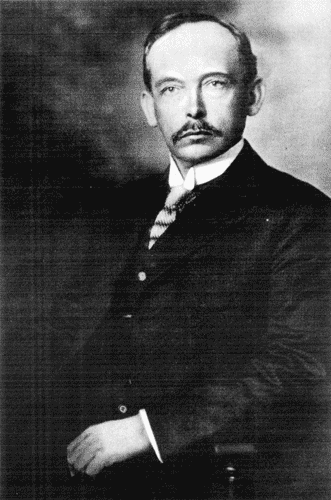
DR. ANTON MEYER-GERHARD
Sent by Count Bernstorff to inform the Kaiser upon
the state of American Opinion
(Photo from American Press Association.)
THE German answer to the United States with regard to submarine warfare was reported from Berlin on July 10 as having caused the most intense satisfaction among the Germans and brought relief to them, for the mere thought that the submarine war would be abandoned would cause widespread resentment.
The Berlin newspapers printed long editorials approving the Government's stand and "conciliatory" tone. Captain Perseus, in the Tageblatt, said that the "new note makes clearer that the present course will be continued with the greatest possible consideration for American interests." The note "stands under the motto, 'On the way to an understanding,' without, however, failing to emphasize the firm determination that our interests must hold first place," in other words, that Germany "cannot surrender the advantages that the use of the submarine weapon gives to the German people."
The Lokal Anzeiger of Berlin commented:
"Feeling has undoubtedly cooled down somewhat on the other side of the water, and Americans will undoubtedly admit that it is not Germany that tries to monopolize the freedom of the seas for itself alone.
"In any event, we have now done our utmost and can quietly await what answer President Wilson and his advisers will think suitable."
George Bernhard in the Vossische Zeitung remarked that the publication of the note means "liberation from many of the doubts that have excited a large part of the German people in recent weeks. The note ... means unconditional refusal to let any outsider prescribe to us how far and with what weapons we may defend ourselves against England's hunger war."
What they considered the moderation of the note impressed most Berlin newspapers. Thus the Morgen Post said: "Those who had advised that we ought to humble ourselves before America will be just as disappointed as those who thought we ought to bring the fist down on the table and answer America's representations with a war threat."
Count von Reventlow, radical editor of the Tageszeitung, said: "The substance of the proposals is to create a situation making it unnecessary for Americans to travel to Europe on ships under an enemy flag," and the Tägliche Rundschau said that the "answer with gratifying decisiveness, guards the conscience of the nation in the question of continuing the submarine war," but it criticises the note for possibly going too far in making concessions, which "may prove impracticable and result in weakening the submarine war."
The unfavorable reception of Germany's note in the United States, as reported through English and French agencies, was read in Berlin with incredulity.
The Kreuz-Zeitung, the Tageszeitung, and the Boersen Zeitung expressed the belief that British and French news agencies had purposely selected unfavorable editorial expressions from the American newspapers for the sake of the effect they would have in Great Britain and France.
"Regarding the reception of the German note in America," the Kreuz-Zeitung said, "several additional reports from British sources are now at hand. Reuter's Telegram Company presents about a dozen short sentences from as many American papers. Were these really approximately a faithful picture of the thought of the American press as a unit, we should have to discard every hope of a possibility of an understanding. The conception of a great majority of the German people is that we showed in our note an earnest desire to meet, as far as possibly justified, American interests."
Like the Berlin press, German-American newspapers were unanimous in praise of the German note; to the New Yorker Staats-Zeitung it appeared a "sincere effort to meet the questions involved" and as "eminently satisfactory." The New Yorker Herold thought that any one with "even a spark of impartiality" would have to admit the "quiet, conciliatory tone of the German note" as "born of the consciousness in the heart of every German that Germany did not want the war"; that after it was forced on her she "waged it with honorable means." The Illinois Staats-Zeitung of Chicago declared it to be the "just demand of Germany" that Americans should not "by their presence on hostile boats try to protect war materials to be delivered by a friendly nation at a hostile shore." From the Cincinnati Freie Presse came the comment that Washington "has no business to procure safety on the ocean for British ships carrying ammunition."
The American newspapers were nearly unanimous in adverse criticism of the note. The New York Times said that Germany's request was "to suspend the law of nations, the laws of war and of humanity for her benefit." The Chicago Herald declared that the German answer "is disappointing to all who had hoped that it would clearly open the way to a continuance of friendly relations." While the San Francisco Chronicle discerned in the note "an entire absence of the belligerent spirit," it found that "Germany is asking us to abridge certain of our rights on the high seas." To the Denver Post the reply was the "extreme of arrogance, selfishness, and obstinacy," while The Atlanta (Ga.) Constitution remarks that German words and German deeds are separate matters: "The all-important fact remains that since President Wilson's first note was transmitted to that country, Germany has given us no single reasonable cause of complaint." The Louisville (Ky.) Courier-Journal believes the German reply would carry more weight and persuasion "if it could be considered wholly and apart as an ex parte statement." "Without equivocation and with a politeness of offensively insinuating," the Boston Transcript concludes, "Germany rejects each and all of our demands and attempts to bargain with respect to the future."
Publication of the American note in Berlin was delayed until July 25, owing to difficulty in translating its shades of meaning. While German statesmen and editors expressed keen appreciation of its literary style, the press was unanimous in considering the note disappointing, expressing pained surprise at the American stand. Captain Perseus, naval critic of the Berlin Tageblatt, said that the note "expresses a determination to rob us of the weapon to which we pin the greatest hopes in the war on England," and indicates that the "pro-British troublemakers have finally won over the President." Count von Reventlow in the Tageszeitung complains of the note's "far too threatening and peremptory tone." The Kreuz-Zeitung says: "We are trying hard to resist the thought that the United States with its standpoint as expressed in the note, aims at supporting England," and Georg Bernhard of the Vossische Zeitung believes that yielding to President Wilson's argument means "the weakening of Germany to the enemy's advantage," adding that any one who has this in mind "is not neutral, but takes sides against Germany and for her enemies." The Boersen Zeitung says it is compelled to say, with regret, that the note is very unsatisfactory and "one cannot escape feeling that the shadow of England stands behind it." The New Yorker Staats-Zeitung says that the note is distinguished for its "clear language," and quotes the phrase "deliberately unfriendly" while noting the demand for disavowal and reparation. "Of quite unusual weight," the Staats-Zeitung says, "is the hint on the fact that the United States and Germany, so far as the freedom of the seas is concerned, have the same object in view." "Sharp and clear is it also explained" that after the end of the war the United States is "ready to play the rôle of an intermediary, in order to find a practicable way out." In fact, the note handed to the Government in Berlin "is at the same time meant for London," since it expresses itself as determined to protect neutrals "against every one of the warring nations." The New Yorker Herold is "certain that the complications will be settled amicably," while the Illinois Staats-Zeitung feels that "apparently our Government has a secret agreement with England intentionally to provoke Germany."
In praise of this note American press opinion is again nearly unanimous. The New York World says that "what the President exacts of Germany is the minimum that a self-respecting nation can demand." The New York Tribune calls the note an admirable American document. The Rochester Democrat and Chronicle says it is strongly put, but not too strongly, and the Boston Herald thinks there is no escape from its logic. The Philadelphia Public Ledger says "the final word of diplomacy has obviously been said," and the Administration cannot "engage in further debate or yield on any point." The Chicago Herald believes the note is couched in terms that "no intelligent man would resent from a neighbor whose friendship he values." The St. Louis Republic says: "One hundred and twenty-eight years of American history and tradition speak in President Wilson's vindication." The St. Paul Pioneer Press calls the note "a great American charter of rights," and the Charleston News and Courier declares that "we have drawn a line across which Germany must not step." The Portland Oregonian says: "If there was any expectation that the President's note to Germany would yield any measure of American rights or descend from the noble and impressive determination of the original warning to and demand upon Germany, it has not been fulfilled."
An Associated Press dispatch dated London, July 16, says:
According to an Amsterdam dispatch to Reuter's Telegram Company it is stated from Vienna that the Austro-Hungarian Minister of Foreign Affairs sent a note to the American Ambassador at Vienna on June 29, drawing attention to the fact that commercial business in war material on a great scale is proceeding between the United States and Great Britain and her Allies, while Austria-Hungary and Germany are completely cut off from the American market.
It is set forth in the note that this subject has occupied the Government of the Dual Monarchy from the very beginning, and, although the Government is convinced that the American attitude arises from no other intention than to observe the strictest neutrality and international agreements, yet "the question arises whether conditions as they have developed during the course of the war, certainly independently of the wish of the American Government, are not of such a kind as in their effect to turn the intentions of the Washington Cabinet in a contrary direction.
"If this question is answered in the affirmative, and its affirmation cannot be doubted," according to the opinion of the Austro-Hungarian Government, "then the question follows whether it does not seem possible, or even necessary, that appropriate measures should be taken to make fully respected the wish of the American Government to remain a strictly impartial vis-à-vis of both belligerent parties."
The note continues:
"A neutral government cannot be allowed to trade in contraband unhindered, if the trade take the form and dimensions whereby the neutrality of the country will be endangered. The export of war material from the United States as a proceeding of the present war is not in consonance with the definition of neutrality. The American Government, therefore, is undoubtedly entitled to prohibit the export of war material.
"Regarding the possible objections that American industry is willing to supply Austria-Hungary and Germany, which, however, is impossible owing to the war situation, it may be pointed out that the American Government is in a position to redress this state of things. It would be quite sufficient to advise the enemies of Austria-Hungary and Germany that the supply of foodstuffs and war material would be suspended if legitimate trade in these articles between Americans and neutral countries was not permitted."
In conclusion, the Austro-Hungarian Government appeals to the United States, calling attention to the uninterrupted good relations and friendship between that country and the dual monarchy, to take the present note under careful consideration.
A dispatch from Vienna, via London, dated July 16, gives the following information from The Associated Press:
From a highly authoritative source at the Foreign Office a representative of The Associated Press has received an explanation of the motives that are said to have inspired the dispatch of the Austro-Hungarian note to the United States regarding the American traffic in war munitions.
The Austro-Hungarian statesman who spoke said that, although the facts upon which the note was based had been in existence for a long time, the communication was sent only now, when, after great victories in Galicia, it could not be interpreted as a cry for help from a land in distress. He disavowed in advance any idea that the note was sent at the request or inspiration of Germany, asserting that the step was taken spontaneously in the hope that, owing to the undisturbed friendly relations between Austria-Hungary and the United States, the note would be assured a sympathetic reception in the latter country.
"The note," said this statesman, "is inspired by friendly feelings of the monarchy toward the Union, where so many of our subjects have found a second home. It is the speech of a friend to a friend—an attitude which we are the more justified in taking because the relations of the two states have never been clouded.
"It might, perhaps, easily be a source of wonder that, since the basic grounds of the note have been in existence for months, the note was not sent long ago; but there is a reason for its appearance at this particular time. In view of the incredible rumors and reports about the condition of the monarchy which have been circulating throughout the United States, this note would surely have been interpreted at an earlier stage of events as a confession of weakness, as an appeal for help in distress. Today, when a rich harvest is being garnered throughout the monarchy, when talk of starving out Austria-Hungary therefore is rendered idle, when complaints of shortage of ammunition are heard everywhere else except in the allied central monarchies, there cannot be the slightest question of this.
"On the other hand, it might be asked why the note, under these conditions, was issued at all. With nothing to check the victorious progress of the central powers in sight, with their ability to meet pressure in the economic field demonstrated, it might well be thought that it is a matter of indifference to them whether America continues her policy or not. That, however, is not the case. The problems of international law which this war has brought up are of far-reaching importance. The solutions reached will be standards of action for decades to come.
"For eminently practical as well as theoretical reasons, therefore, the monarchy is forced now not only to concern itself with the questions of the day, but also to feel its responsibility toward the future interests of mankind; and for this reason the Government thought it necessary to approach the subject under discussion—the more so because it felt that the previous debate pro and con had not, as it wished, led to the desired result, and because it believed that numbers of arguments specially laid down in The Hague Convention hitherto had escaped consideration.
"It may, of course, be assumed that the note is a product of mature consideration, and was drafted after consultation with international law experts of the first rank. The absence of the slightest hostile intent in it against the Union is shown not only by the opening phrases, but by the fact that it was published only after it leaked out in the United States that there was no objection to its publication.
"The question of whether Austria-Hungary feels that she is being cut off by America may be answered unreservedly in the affirmative. The military monarchy can and will continue the war as long as necessary. The population will, as hitherto, suffer neither starvation nor material want. But there are other interests than those connected primarily with war which every Government is bound to consider, and unhampered trade relations with the United States are of the greatest importance to us.
"Finally, not only material, also I might say sentimental, interests play a certain rôle not to be underestimated among the people. Many warm friends of America among us are painfully affected by the fact that actual conditions give the impression that America, even though unintentionally, differentiates between the belligerents.
"Austro-Hungarian statesmen, conscious of the great rôle that America will be called upon to play in the future, would forget their duty if they neglected to do everything in their power to clear away the circumstances that shake the confidence of the bravely fighting armies and the whole population in the justice of America. It is clear that the war would have been ended long ago if America had not supplied our enemies with the means of continuing it.
"The assumption that the Austro-Hungarian note was sent at the wish of the German Government is incorrect. On the contrary, it is a completely spontaneous demonstration, inspired wholly by the Austro-Hungarian considerations. We hope it will be received and judged in America in the same spirit in which it was sent."
Theodore S. Woolsey, formerly Professor of International Law at Yale University, in Leslie's Weekly, for July 29, has an article entitled "The Case for the Munitions Trade." In part Professor Woolsey says:
In the midst of widespread industrial depression came a great war. This war intensified the depression. It cut off markets, raised freights, retarded payments, upset the whole commercial world and we suffered with the rest. Then shortly came a demand for certain products and certain manufactures caused by the war itself, varied, considerable, even unexpected. This demand grew until it became an appreciable factor in our industrial life, a welcome source of profit when so many other sources of profit were cut off. It was a good thing; at the same time it was a temporary, unnatural thing, and directly or indirectly it was based upon the desire of some of our friends to kill others of our friends. Accordingly people began to give this trade bad names. They called it unneutral, wrong, inhuman.
For the sake of our pockets we were adding to the sum of human suffering and slaughter, and they urged that, even if legally justified, ethically this trade was a blot upon our character as a humane and civilized people and must be stopped. Where does the truth lie? What can the munitions trade say for itself?
Naturally, it turns for justification first to the usage of other wars, to the recognized rules of international law. As expressed in Article 7, Convention XIII, of the 1907 Conference at The Hague, the law is as follows:
"A neutral power is not bound to prevent the export or transit, for the use of either belligerent, of arms, ammunitions or, in general, of anything which could be of use to an army or fleet."
The next previous article had prohibited a Government from engaging in this trade, so that the distinction between what the State and the individual may do is made perfectly clear, provided both belligerents are treated alike. To permit trade in arms with one belligerent and forbid it with another would be unneutral and illegal.
We permit the munitions trade with both belligerents, it is true, and yet, owing to the chances of war, the right to buy inures to the advantage of one only. Does this stamp our conduct as unneutral? Quite the contrary. To embargo munitions bought by one because the other side does not choose to buy would be the unneutral act. Germany doesn't buy because she cannot transport.
She cannot transport, because she does not care to contest the control of the sea with her enemies. Have we aught to do with that? To supplement her naval inferiority by denying to the Allies the fruits of their superiority would be equivalent to sharing in the war on the German side. Moreover, to assume and base action upon German naval inferiority in advance of any general trial of strength would be not only illegal, but even an insult to Germany. Notice that no complaints of our export of munitions have come from the German Government. To make such complaint would be to plead the baby act. Rather than risk her fleet by contesting the control of the sea, thus gaining her share of munitions imports, Germany has chosen to withdraw it behind fortifications, thus losing the munitions trade. Probably the decision is a sound one, but she must accept the results.
The opposition to the trade seems to come from two classes:
(1) German sympathizers who seek to minimize the advantage which sea power gives the Allies.
(2) Those who are governed by their emotions rather than by reason and respect for law. I would call the attention of both these classes to the usage, especially to the German usage, in other wars.
Professor Gregory, in an interesting article, gives statistics of the large German exports of arms to the British forces in the Boer war after the Boer trade had been cut off. In the Russo-Japanese war Krupp notoriously supplied both sides. In the Balkan war there was said to be competition between Krupp and Creusot in furnishing cannon. No state in the nature of things can satisfy its needs in war completely from its own resources. Every belligerent has bought, every neutral has allowed its citizens to sell, munitions since modern war began. England sympathized with the South in our civil war, yet sold to the North. She did the same in 1870 to France.
If the trade in munitions is to be forbidden, then every state must accumulate its own supply or greatly enlarge its arms manufacturing capacity, both wasteful processes. To say that a moderate trade is lawful which a big trade is not is like the excuse of the lady who thought her baby born out of wedlock did not matter because it was such a little one.
The critics of the munitions trade must note furthermore that in our own country that trade cannot be forbidden without explicit legislation.
At the outset of the Spanish war such legislation was passed, as a war measure, forbidding the export of coal or other war material at the discretion of the President. But by resolution of Congress of March 14, 1912, the 1898 resolution was so amended as to apply to American countries only. The reason for this distinction was, of course, to limit the danger of such exports of arms to our neighbor states, particularly to Mexico, as might endanger our own peace and safety. The general right to trade was left undisturbed.
But let us argue the question on ethical grounds alone. I can see no difference between a peace trade and a war trade from the humanitarian standpoint; between arming a neighbor by our exports in preparation for war and rearming him during war. In both cases we help him to kill. Now, if one regards all war as wrong, aid in waging war by trade in munitions, whether in peace time or war time, should be abhorrent to one's conscience. A Quaker gun is not only a paradox, but a sinful one.
Most of us, however, believe that a defensive war, against aggression threatening the life and liberties of a nation, is just and right. In the present war both parties claim to be fighting in self-defense. We are not their judge; we must take both at their word; what we owe both, ethically, is simply equality of treatment.
We help both alike in waging a just war. To do otherwise is to take part in their war. With the flux and flow of the contest which makes our trade valuable or worthless now to one side, now to the other, both ethically and legally we have nothing to do.
The diplomatic significance of the sinking of the Leyland liner Armenian on June 28 off the northwest coast of Cornwall is thus dwelt upon in a Washington dispatch to The New York Times, dated July 2, 1915:
The lessons to be derived from the destruction of the Leyland liner Armenian off the English coast are expected to have a most important bearing upon the diplomatic controversy between Germany and the United States over the safety of human life in the submarine warfare.
It is believed here that the Armenian affair demonstrates that it is possible for German submarines of the latest types, when equipped with outside rapid-fire guns, to comply with the demand of President Wilson that the belligerent right of visit and search must be complied with before merchantmen and passenger ships are torpedoed.
Whatever the facts as to minor detail, the outstanding lesson of the affair is that a merchantman tried to escape capture and was finally forced to halt and surrender by a pursuing submarine, and the destruction of the liner by torpedo was not attempted until after those on board who survived the chase had an opportunity to take to the boats. It is evident that if the Armenian's Captain had heeded the warning shots of the submarine and halted the steamer he could have submitted to visit and search and in all probability the destruction of the Armenian could have been effected without loss of life. All international law experts agree that a vessel that refuses to halt when challenged by warning shots from a properly commissioned belligerent war vessel proceeds at her own peril.
In its broader aspects, the Armenian incident presents the most important lesson that has come out of the German undersea campaign for consideration by those engaged in the diplomatic controversy over the various acts of the German submarines—and the lesson is considered extremely vital in its bearing on the pending negotiations, because, if it is at all possible for submarines to exercise the right of visit and search and they actually proceed in accordance with that rule, the Germans may proceed with their warfare against merchantmen carrying contraband without running counter to the expectations of the United States Government. Occasional merchantmen may try to escape capture or destruction by disregarding warning shots, but that will be their affair and the responsibility for loss of life due to efforts to elude submarines, and caused during the period of continued efforts to escape, would not then rest upon the submarines.
The effective use of rapid-fire guns mounted on submarines in bona fide efforts to halt merchant steamers for purpose of visit and search is the important factor in the situation. A submarine not so equipped would find it difficult, if not impossible, to apply the rule of visit and search. Without the outside guns such a submarine would possess no other effective weapon than the torpedo. The submarine that carried no exterior armament could not compel obedience to its mandate for the merchant Captain to stop without firing a torpedo and thus risking the destruction of life with the sinking of the steamer, and a submarine with no outside armament might run the risk, as frequently contended by the German Admiralty, of bomb attack from the rails of the merchant steamer when going alongside of such a vessel.
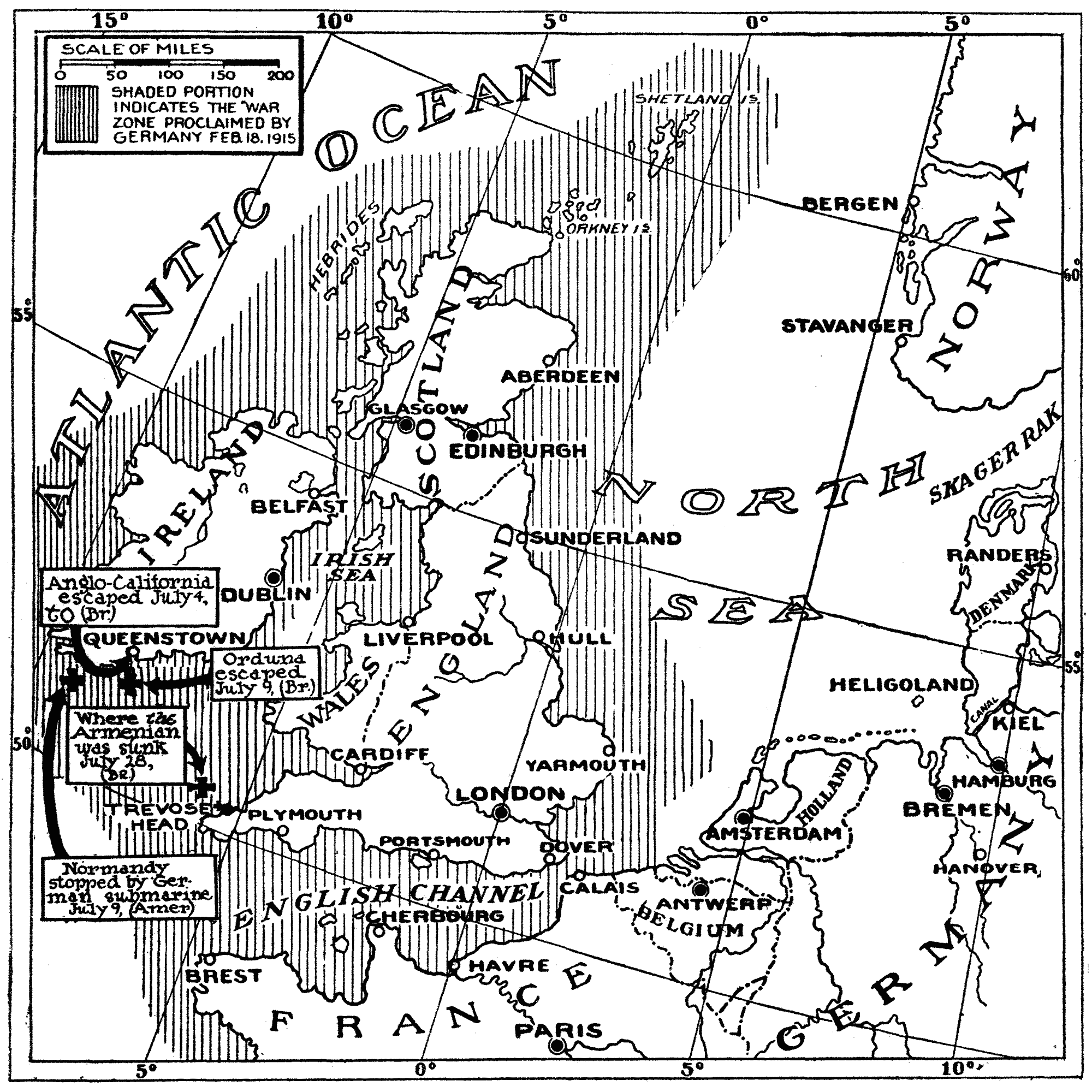
A submarine like the U-38, which sank the Armenian, carrying one or more outside guns, capable of discharging various kinds of shell, from blank shots to shrapnel, represents an important evolution in the development of marine warfare. Such a craft has the equipment to enable her to visit and search a passing merchantman, and to provide for the safe removal of officers, crew or passengers from a challenged steamer, before the destruction of the vessel. It is only necessary for such a submarine to fire her torpedoes as a last resort for the destruction of the steamer. With her exterior guns a submarine like the U-38, upon meeting a merchant vessel, may fire one or more warning shots, as Captain Trickey of the Armenian says the U-38 did.[1] The raider, he said, fired two warning shots, and when he turned away from her and put on speed, the submarine's guns opened fire on him with shrapnel.
Like the Armenian, the British merchantman Anglo-Californian refused to lie-to when signaled by a German submarine on July 2. Her crew of ninety-five included fifty Americans and Canadians. A Queenstown dispatch of July 5 gave the following account of the action:
The Anglo-Californian left Montreal for the British Isles on June 24. The submarine was sighted at 8 o'clock last Sunday morning. Captain Parslow ordered full steam ahead and wireless calls for aid were sent out. The submarine on the surface proved to be a far speedier craft than the steamer and rapidly overhauled her, meanwhile deluging her with shells. One shot put the wireless apparatus on the Anglo-Californian out of action. Finding that he could not escape by running for it Captain Parslow devoted his attention to manœuvring his ship so as to prevent the submarine from using torpedoes effectively.
"Our Captain was a brave man," said one of the narrators. "He kept at his post on the bridge, coolly giving orders as the submarine circled around us vainly seeking to get a position from which it could give us a death blow with a torpedo. All the while the under-water boat continued to rain, shot and shell upon us, and at times was so close that she was able to employ rifle fire effectively.
"At last one shell blew the Captain off the bridge, killing him outright and terribly mutilating him. Just before that he had given orders to launch the boats, but this was very difficult under the shell fire. Several men were struck down while working at the davits. Ultimately four boats were got overboard and were rowed away until picked up."
The son of Captain Parslow, serving as second mate, was standing by his father's side when the Captain was killed. The son was knocked down by the violence of the explosion. Springing to his feet, he seized the wheel, and, as ably as his father had done, continued dodging the submarine. Another shell burst alongside him, shattering one of the spokes of the wheel, but young Parslow retained his post.
The wireless SOS calls that had been sent out at the first alarm had reached those able to give more than passive assistance, however, and British destroyers appeared. On their approach the submarine abandoned the attack and submerged. Young Parslow was still at the wheel when the destroyers came up.
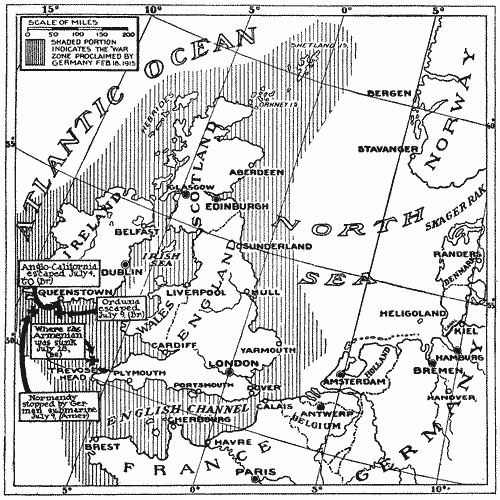
War zone area showing where the Armenian, (British); Normandy, (American); Anglo-Californian, (British), and Orduna, (British) ships were attacked during the month of July.
[Enlarge]
An Associated Press dispatch from Liverpool, dated July 13, 1915, reported:
How an American ship is alleged to have been used as a shield by a German submarine for the sinking of another vessel is related by members of the crew of the American bark Normandy, which has arrived here from Gulfport, Miss.
The story is that the Normandy was stopped by a German submarine sixty miles southwest of Tuskar Rock, off the southeast coast of Ireland, Friday night. The captain was called aboard the submarine, whence his papers were examined and found to show that the ship was chartered by an American firm January 5.
The captain of the bark, it was asserted, was allowed to return to the Normandy, but under the threat that his ship would be destroyed unless he stood by and obeyed orders. These orders, it was stated, were that he was to act as a shield for the submarine, which lay around the side of the bark, hiding itself from an approaching vessel.
This vessel proved to be the Russian steamer Leo. Presently the submarine submerged and proceeded around the bow of the Normandy, so the story went, and ten minutes later the crew of the Normandy saw the Leo blown up.
Twenty-five persons were on board, of whom eleven were drowned, including three stewardesses. Those saved included three Americans, Walter Emery of North Carolina, Harry Clark of Sierra, and Harry Whitney of Camden, N.J. All these three men when interviewed corroborated the above story. They declared that no opportunity was given those on board the Leo for saving lives.
The Leo was bound from Philadelphia for Manchester with a general cargo.
The Captain of the Normandy told the survivors that he would have liked to signal their danger to them, but that he dared not do so, because his uninsured ship would then have been instantly sunk.
In a Washington dispatch to The New York Times, sent July 13, appeared the following:
The State Department received a short dispatch late this afternoon from Consul General Washington at Liverpool, confirming the report that three Americans were among those rescued by the American bark Normandy at the time of the sinking of the Russian merchant steamer Leo by a German submarine off the Irish coast Friday night. This is the case in which press dispatches asserted that the submarine commander forced the Captain of the Normandy to use his bark as a shield behind which the submarine hid before firing the torpedo which sank the Leo.
The cablegram from Consul General Washington makes no mention of this phase of the affair, and does not show whether the German submarine gave any warning to the commander of the Russian merchant ship before firing the shot which destroyed the latter vessel. The official message says that the Normandy was stopped by the submarine, that the Normandy's papers were examined, and that she was allowed to proceed. The message added that the Normandy rescued three American citizens who were members of the crew of the Leo, and names them as Walter Emery, seaman, of Swan Quarter, N.C.; Harry Whitney, steward, of Camden, N.J., and Harry Clark, fireman, of 113 East Fifty-second Street, Seattle, Wash.
This is the official statement of Captain Thomas M. Taylor of the Cunard liner Orduna, concerning the attack made on his vessel by a German submarine off Queenstown, westbound, on the morning of July 9:
At 6.05 A.M., July 9, the lookout man on the after bridge rang the telegraph, at the same time pointing his hand downward and out on the port beam. The third officer was immediately sent aft to inquire what was seen. He returned quickly and reported both men had seen a torpedo pass across the stern from port to starboard, only ten feet clear of the rudder. In the meantime both the chief officer and myself distinctly saw the trail of the torpedo, extending from the stern to about 200 yards out on the port beam. About eight minutes afterwards the chief officer and I saw the submarine come to the surface about two points on the starboard quarter, a distance of about three-quarters of a mile, with five or six men on her deck, getting her guns ready.
I immediately ordered all possible steam, altered the course, and brought her right astern, when they began shelling us. The first shot struck the water abreast of the forecastle on the starboard side, about thirty feet off. The second dropped just under the bridge; third, abreast of No. 5 hatch, quite close alongside; fourth, under the stern, sending up a volume of water forty feet high; fifth and sixth and last shells all fell short. The firing then ceased, and the submarine was soon left far astern.
Marconi distress signals were sent out at once. We were thirty-seven miles south of Queenstown. I got a reply that assistance would be with us in an hour, but it was four hours before the small armored yacht Jennette appeared. I account for the torpedo missing the ship to their misjudging the speed, allowing fourteen knots instead of sixteen, which we were doing at the time. The torpedo passed only ten feet clear.
It was an ideal day for torpedo attack—light wind, slight ripple, clear weather. The periscope could only have been a few inches above water, for a very strict lookout was being kept at the time by chief and third officers and myself and four lookout men. However, we failed to see her before she fired the torpedo.
Not the least warning was given, and most or nearly all the passengers were asleep at the time. It was almost another case of brutal murder.
We had twenty-one American passengers on board.
A Washington dispatch of July 20 to The New York Times announced:
The President and the Cabinet decided today to have an investigation made in the case of the British steamer Orduna, which was attacked by a German submarine on July 9 while on her way from Liverpool to New York. This action was taken following the receipt of a statement from W.O. Thompson, counsel of the Federal Industrial Commission, who was a passenger on the ship.
Mr. Thompson did not see any torpedo fired at the Orduna by the German submarine, and was unable to give first-hand testimony that the Orduna had been fired on without notice. It was determined, however, that the report of Mr. Thompson justified the Government in making an investigation.
Accordingly, Secretary Lansing wrote a letter to Secretary McAdoo, requesting that his department undertake the investigation, which will probably be intrusted to the Collector of Customs at New York.
At the State Department it was said that the attention of the German Government had not been called to the charge that the Orduna was fired on by a German submarine without warning. Any action of that sort, if taken, will follow the investigation which is now ordered.
Ambassador Gerard on July 15 formally transmitted to Washington Germany's admission of liability and expression of regret for the attack by a German submarine on the American steamer Nebraskan.
Secretary Lansing's announcement of the German memorandum follows:
Ambassador Gerard has telegraphed to the Department of State the following memorandum from the German Foreign Office relative to the damaging of the American steamer Nebraskan by a German submarine:
"The German Government received from newspaper reports the intelligence that the American steamer Nebraskan had been damaged by a mine or torpedo on the southwest coast of Ireland. It therefore started a thorough investigation of the case without delay, and from the result of the investigation it has become convinced that the damage to the Nebraskan was caused by an attack by a submarine.
"On the evening of May 25 last the submarine met a steamer bound westward without a flag and no neutral markings on her freeboard, about 65 nautical miles west of Fastnet Rock. No appliance of any kind for the illumination of the flag or markings was to be seen. In the twilight, which had already set in, the name of the steamer was not visible from the submarine. Since the commander of the submarine was obliged to assume from his wide experience in the area of maritime war that only English steamers, and no neutral steamers, traversed the war area without flag and markings, he attacked the vessel with a torpedo, in the conviction that he had an enemy vessel before him. Some time after the shot the commander saw that the vessel had in the meantime hoisted the American flag. As a consequence, he, of course, refrained from any further attack. Since the vessel remained afloat, he had no occasion to concern himself further with the boats which had been launched.
"It results from this that without a doubt that attack on the steamer Nebraskan was not meant for the American flag, nor is it traceable to any fault on the part of the commander of the German submarine, but is to be considered an unfortunate accident. The German Government expresses its regret at the occurrence to the Government of the United States of America and declares its readiness to make compensation for the damage thereby sustained by American citizens."
A London cable dispatch to The New York Times, dated London, July 8, said:
Nearly 20,000 vessels have entered or left the port of Liverpool since the German submarine blockade began. This, said Sir A. Norman Hill, Secretary of the Liverpool Steamship Owners' Association, speaking at Liverpool yesterday, showed that the Germans had failed in their attempt to blockade British ports.
On these 20,000 voyages the Germans had captured or destroyed only twenty-nine ships, he continued. What did that represent? Ships which had sailed in and out of Liverpool had completed in safety 998 out of every 1,000 voyages upon which they started. That was a magnificent record, he held, of perils faced and overcome.
An Associated Press dispatch of July 22 from London remarked:
So far as British vessels were concerned, the German submarines drew a blank during the week ended yesterday. Not a single British merchant ship or fishing craft was sunk.
It was the first week since the war began that some loss to British shipping had not been occasioned by German cruisers, mines, or submarines.
During the week 1,326 vessels of more than 300 tons each arrived at or departed from ports of the United Kingdom.
The German war-zone decree went into effect on February 18. Since then the weekly losses of ships and lives from torpedoes have been as follows:
| Week Ending | Vessels. | Lives. |
| February 25 | 11 | 9 |
| March 4 | 1 | 0 |
| March 11 | 7 | 38 |
| March 18 | 6 | 13 |
| March 25 | 7 | 2 |
| April 1 | 13 | 165 |
| April 8 | 8 | 13 |
| April 15 | 4 | 0 |
| April 22 | 3 | 10 |
| April 29 | 3 | 0 |
| May 6 | 24 | 5 |
| May 13 | 2 | 1,260 |
| May 20 | 7 | 13 |
| May 27 | 7 | 7 |
| June 3 | 19 | 32 |
| June 10 | 36 | 21 |
| June 17 | 19 | 19 |
| June 24 | 3 | 1 |
| July 1 | 9 | 29 |
| July 8 | 15 | 2 |
| July 15 | 12 | 13 |
| July 22 | 2 | 0 |
| —— | —— | |
| Total | 218 | 1,652 |
Of the two vessels torpedoed in the week of July 22, the Russian steamer Balwa was attacked on July 16. On the following day another Russian steamer, the General Radetzky, was torpedoed. Both hailed from Riga, and the crews of both were saved.
A record reported to have been compiled chiefly from British Admiralty sources since the sinking of the Lusitania was published by The New York American on July 13, showing that out of 122 ships sunk by German submarines in the war zone, every passenger or sailor was saved on all but 14. Following is The American's summary:
| Total number of ships definitely reported sunk by German submarines in sixty-four days, since the Lusitania was torpedoed | 122 |
| Number of ships on which any loss of life occurred | 14 |
| [Note: Some of these fatalities occurred, according to British Admiralty reports, either from explosion of torpedoes or from upsetting of lifeboats, or from gunfire of submarines while the enemy ship was trying to escape.] | |
| Total loss of life on 122 ships, from all causes | 131 |
In a Berlin dispatch of July 14, by wireless to Sayville, Long Island, the following was given out by the Overseas News Agency:
During the month of June twenty-nine British, three French, one Belgian, and nine Russian merchantmen were sunk by German submarines.
The total loss of the Entente Allies by submarines, including fishing steamers, which mostly were armed patrol boats, aggregated 125,000 tons.
The loss of human life was remarkably small, the submarines using every precaution and giving ample warning and time for crews to leave their ships if no resistance was attempted.
The total of losses in ships of the Allies' merchant marine around the English coast in the period between February 18 (the beginning of the German submarine war zone) and May 18, as compiled from German data, was published in the Frankfurter Zeitung of June 6. This publication, the first issue from German quarters, contains also a list of the various allied ships sunk, totaling 111, together with the nationality and tonnage of each, and a charted map of the British Isles showing where each ship was sunk.
In describing the achievements of the German submarine against their foes—the neutral ships sunk are not included—the Frankfurter Zeitung's article says:
In the period of three months since the 18th of February, a day memorable for history, our submarines have inflicted on the enemy merchant shipping, in the first place the English merchant marine, a total loss of 111 ships with a displacement of 234,239 tons. The figures may, perhaps, not seem especially large in comparison with the gigantic number of merchant ships flying the flag of the enemy. But in this method of warfare the percentage loss of ships of our opponent as compared with his total does not count, but rather the fact that through the regularity and inevitableness of the marine catastrophes the enemy shipping shall be disturbed as poignantly as possible, and that there should as a result of this disturbance appear in the economic life of England phenomena similar to those which the English plan of the isolation of Germany aims at without, however, having succeeded in getting any nearer to its goal, owing to the inherent strength and power of adaptation of German business.
The rise of prices now prevalent in England, and the paralyzing of great branches of trade which could not occur in an England that really ruled the sea, may be attributed in chief part to this war of the submarines. The advantage of the insular position of England has been greatly lessened, thanks to this excellent German weapon, even if it cannot be completely eliminated. But if one compares with the total voyages of the English merchant shipping the losses of the English merchant marine, amounting to more than 100 ships in a period of exactly ninety days, and a tonnage of 216,000 tons, (from the totals mentioned above there must be deducted the shares of France and Russia,) then we must consider only that part of the British merchant marine that entered ports of the island kingdom in this period or left them; and one must bear in mind further that a large number of those ships is contained several times in the English statistics, since they do coast service.
But as valuable booty for our submarines particularly those ships are to be regarded that import any kinds of commodities to England. And statistics will later be able to show on the basis of these figures the great success of the German submarine warfare, as indicated by figures.
A glance at the map that accompanies the list of losses suffices to show that mine fields as little as great distances are factors of decisive importance in the activities of our submarines. The closing of the English Channel and of the North Channel (between Ireland and Scotland) has not prevented our boats from penetrating wherever there was booty. Even on the northwest coast of Scotland and out in the west of Ireland the German submarines have carried on a successful hunt. The numbers in the little circles on the map represent the successive ships on the list.
The Frankfurter Zeitung adds figures given by the British Admiralty on the same subject. These, it says, total 130 merchant ships with a registered tonnage of 457,000 tons, from the beginning of the war to May 26. Added to these, it says, are 83 fishing vessels with a tonnage of 13,585 tons, making a total of 213 ships with 470,585 tons. It says:
These figures, however, are certainly incomplete, inasmuch as up to March 16 there had already been announced 145 ships with a total tonnage of 500,000 as lost, and the figures published by us above, based upon authentic material, concerning the victims of our submarines in three months, contradict beyond any power of dispute the euphemistic presentation of the British Admiralty. Even so, however, the English list still shows that since the beginning of the submarine warfare, although in that period there was little to speak of in the way of activities of the German cruisers abroad, the damage done to the English fleet has risen according to the confession of the Admiralty itself. Since Feb. 18, that is to say, since scarcely more than a quarter of a year, according to the English figures, no less than 56 British merchant ships with a tonnage of 187,000 tons (that is to say, more than 40 per cent. of the total number of merchant ships designated as lost) have been sunk. But if instead of these English figures the German compilation, which is indubitably correct, be accepted, then the entire picture changes considerably in our favor.
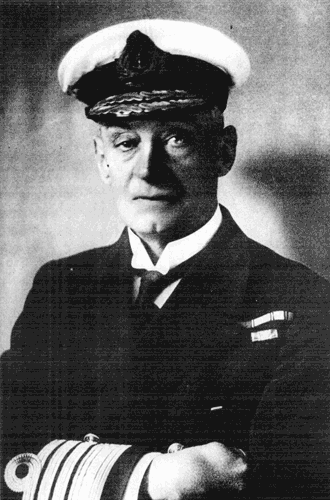
ADMIRAL SIR HENRY B. JACKSON
Who Succeeded Lord Fisher as First Sea Lord of the British Admiralty
(Photo by Elliott & Fry.)
[From Truth of London]
Young gallant soul, unversed in fear,
Who swiftly flew aloft to fame,
And made yourself a world-wide name,
Ere scarce had dawned your brief career.
To glory some but slowly climb
By painful inches of ascent,
And some, hereon though sternly bent,
Ne'er reach it all their life's long time.
But you—you soared as eagles soar;
At one strong flight you flashed on high;
The sudden chance came sudden nigh;
You seized it; off its spoils you bore.
And now, while still the welkin rings
With your unmatched heroic deed,
To pæan elegies succeed,
The mournful Muse your requiem sings.
A requiem, yet with triumph rife!
How not, while men their souls would give
To die your death, so they might live
Your "crowded hour of glorious life"?
Great hour, that knows not time nor tide,
Wild hour, that drinks an age's sweets,
Brave hour, that throbs with breathless feats,
Short hour, whose splendours long abide.
In an address at the Panama-Pacific Exposition in San Francisco, delivered on July 21, Colonel Theodore Roosevelt said:
I HAVE a very strong feeling about the Panama Exposition. It was my good fortune to take the action in 1903, failure to take which, in exactly the shape I took it, would have meant that no Panama Canal would have been built for half a century, and, therefore, that there would have been no exposition to celebrate the building of the canal. In everything we did in connection with the acquiring of the Panama Zone we acted in a way to do absolute justice to all other nations, to benefit all other nations, including especially the adjacent States, and to render the utmost service, from the standpoint alike of honor and of material interest, to the United States. I am glad that this is the case, for if there were the slightest taint upon our title or our conduct it would have been an improper and shameful thing to hold this exposition.
The building of the canal nearly doubles the potential efficiency of the United States Navy, as long as it is fortified and is in our hands; but if left unfortified it would at once become a menace to us.
What is true as to our proper attitude in regard to the canal is no less true as regards our proper attitude concerning the interests of the United States taken as a whole. The canal is to be a great agency for peace; it can be such only, and exactly in proportion as it increased our potential efficiency in war.
Those men who like myself believe that the highest duty of this nation is to prepare itself against war so that it may safely trust its honor and interest to its own strength are advocating merely that we do as a nation regarding our general interests what we have already done in Panama. If, instead of acting as this nation did in the Fall of 1903, we had confined ourselves to debates in Congress and diplomatic notes; if, in other words, we had treated elocution as a substitute for action, we would have done nobody any good, and for ourselves we would have earned the hearty derision of all other nations—the canal would not even have been begun at the present day, and there would have been a general consensus of international opinion to the effect that we were totally unfit to perform any of the duties of international life, especially in connection with the Western hemisphere.
Unfortunately in the last few years we have as regards pretty much everything not connected with the Isthmus of Panama so failed in our duty of national preparedness that I fear there actually is a general consensus of opinion to precisely this effect among the nations of the world as regards the United States at the present day. This is primarily due to our unpreparedness.
We have been culpably, well-nigh criminally, remiss as a nation in not preparing ourselves, and if, with the lessons taught the world by the dreadful tragedies of the last twelve months, we continue with soft complacency to stand helpless and naked before the world, we shall excite only contempt and derision if and when disaster ultimately overwhelms us.
Preparedness against war does not invariably avert war any more than a fire department in a city will invariably avert a fire; and there are well-meaning foolish people who point out this fact as offering an excuse for unpreparedness. It would be just as sensible if after the Chicago fire Chicago had announced that it would abolish its fire department as for our people to take the same view as regards military preparedness. Some years ago I was looking over some very old newspapers contemporaneous with the early establishment of paid fire departments in this country, and to my amusement I came across a letter which argued against a paid fire department upon the ground that the knowledge of its existence would tend to make householders careless, and therefore would encourage fires.
Greece was not prepared for war when she went to war with Turkey a score of years ago. But this fact did not stop the war. It merely made the war unsuccessful for Greece. China was not prepared for war with Japan twenty-odd years ago, nor for war with the Allies who marched to Peking fifteen years ago.
Colonel Roosevelt then discussed in detail the cases of China and Belgium, comparing Belgium with Switzerland, and asserting that Switzerland would have met Belgium's fate if she had not been prepared to oppose invasion. Then taking up the case of China, he said:
She has acted on the theory that the worst peace was better than the best war, and therefore she has suffered all the evils of the worst war and the worst peace. The average Chinaman took the view that China was too proud to fight and in practice made evident his hearty approval of the sentiments of that abject pacifist song: "I Didn't Raise My Boy to be a Soldier," a song which should have as a companion piece one entitled: "I Didn't Raise my Girl to be a Mother," approval of which of course deprives any men or women of all right of kinship with the soldiers and with the mothers and wives of the soldiers, whose valor and services we commemorate on the Fourth of July and on Decoration Day; a song, the singing of which seems incredible to every man and woman capable of being stirred to lofty and generous enthusiasm by the tremendous surge of Julia Ward Howe's "Battle Hymn of the Republic." China has steadily refused to prepare for war. Accordingly China has had province after province lopped off her, until one-half of her territory is now under Japanese, Russian, English and French control.
The professional pacifists, the peace-at-any-price, non-resistance, universal arbitration people are now seeking to Chinafy this country.
During the past year or so this nation has negotiated some thirty all-inclusive peace treaties by which it is agreed that if any issue arises, no matter of what kind, between itself and any other nation, it would take no final steps about it until a commission of investigation had discussed the matter for a year. This was an explicit promise in each case that if American women were raped and American men murdered, as has actually occurred in Mexico; or American men, women, and children drowned on the high seas, as in the case of the Gulflight and Lusitania; or if a foreign power secured and fortified Magdalena Bay or the Island of St. Thomas, we would appoint a commission and listen to a year's conversation on the subject before taking action.
England and France entered into these treaties with us, and we begged Germany to enter into one, and, although Germany refused, yet if we were right in entering into them with England and France, we deprived ourselves of moral justification in refusing to fulfill their spirit as regards Germany. Personally I believe that it was absolutely necessary when the concrete case arose to repudiate the principle to which we had thus committed ourselves. But it was a shameful thing to have put ourselves in such a position that it had to be repudiated, and it was inexcusable of us to decline to follow the principle in the case of the Lusitania without at the same time making frank confession of our error and misconduct by notifying all the powers with whom we had already made the treaties that they were withdrawn, because in practice we had found it impossible and improper to follow out the principle to which they committed us.
Formerly of the Royal Prussian Thirteenth Dragoons
and
By An American Military Expert
THE first year of the European war has drawn to a close. A résumé covering the military events it has produced brings to view two distinct phases of the campaign. The first phase comprises the period from Aug. 3 to Oct. 27, and consists of a tenacious effort to carry through the original plan of war of the German General Staff: to strike a crushing blow at France, and after putting her "hors de combat," to turn on the enemy in the East. The second phase comprises the time from Oct. 27 to the present, and consists in the pursuance of military aims forming the direct reversal of the original ones.
The campaign against France, in consequence of the German plan of strategy the first one to come into prominence, can, in its first phase, be divided into four periods.
The first period comprises the operations in Belgium, German Lorraine and Alsace, from Aug. 3 to Aug. 23, the day before the Battle for the Invasion of France, commonly, but incorrectly known as the battle of Mons.
The main blow at France was to come through Belgium. Five German armies out of eight were hurled against this gateway to Northern France. In Lorraine and Alsace the Germans were temporarily to remain on the defensive. The protection of Lorraine was intrusted to the Bavarian (Sixth) Army, that of Alsace to the remaining two armies.
The French plan of operation was to check the invasion of Belgium on the line Tongres-Liége-Longwy, where the Belgian Army, from a strictly military point of view, forming the advance guards of the French Army of the North, was holding strong positions, and with superior forces to strike at the German Army of Lorraine. The aim was, avoiding Metz, to reach the Moselle near Trier through the valley of the Saar, and to roll up the German Army of the North from its left wing. An invasion of Alsace was merely to satisfy political aspirations.
The German advance in Belgium, however, remained unchecked, and in Lorraine the battles of Dieuze and Saarbourg on Aug. 20 decided the issue in favor of the Bavarians. In Alsace the French were victorious over the Eighth Army and took Muelhausen, while further north, between Muenster and Shirmeck, the Seventh Army checked the French invasion.
Meanwhile the German avalanche in Belgium had reached the second line of defense, Brussels-Namur-Longwy, before the French Army of the North. The capture of Namur prompted the French staff to recall advance guards, which had reached the fortress just as it surrendered, and to accept battle in the line Mons-Charleroi-Givet-Longwy. The battle for the invasion of France and the retirement of the French armies in all the theatres of action which it caused opens the second period of the campaign against France.
The English contingent from Havre had joined the French Army just before the German onslaught began. The battle was lost by the Allies tactically and strategically through the defeat of their right wing at Longwy and Neufchateau, and through the encircling of their left wing at Mons. The direct result of the outcome was the German invasion of France; the indirect consequence (resulting from the necessity of drawing troops from the other fields of action to stem the German invasion) was the retirement of the French armies in Lorraine and Alsace to the line Verdun-Nancy-St. Die, and further south to the passes of the Vosges, which they have been holding ever since.
Sweeping on through Northern France, the German Army of the North was breaking up all resistance in its path, such as was attempted by the British at St. Quentin on Aug. 28, and was tearing with it all fortresses, such as Longwy, La Fère, Maubeuge, and others; but it was failing in its principal aim: to embrace the skillfully retreating enemy before he could reach the line Paris-Verdun, which he had selected and prepared for the next stand.
On Aug. 30 the German plan of strategy was changed, and it was resolved to break the centre of the enemy, throwing his left wing into Paris and on the Seine and his right wing into Verdun, Toul, and Epinal. The armies of the centre were pushed forward, while either wing held back. The Allies were established in the general line Paris-Verdun.
The battle ensuing on Sept. 5 and the retreat of the Germans to the Aisne are the events of the third period of this campaign, lasting from Sept. 5 to Sept. 28. On Sept. 8, while the German attacks had all but pierced the French centre, having already bent it back beyond the line Sezanne-Vitry, the German right wing found itself outflanked by a new allied army from Paris, which was rapidly moving northward and threatened to roll up the entire German battle front from the direction of Compiègne. The critical question, who would succeed first, the Allies in outflanking the German right or the Germans in piercing the French centre, was decided in favor of the Allies. Anglo-French strategy triumphed.
The tactical aspect of the situation, though, is best illustrated by the message sent to his commander-in-chief by General Foch, commanding the French Army of the Centre when he received the order to counter-attack: "My left has been forced back, my right is routed. I shall attack with the centre." When the counter-attack came it found but rear guards opposing it. The retreat of the Germans, their right flank constantly in danger of being rolled up, was a fine military achievement. On Sept. 12 it halted on the Aisne. In the regions northeast of Verdun the German left wing joined hands with the Sixth German Army, which had followed up the retirement of the French Army of Lorraine to the line Verdun-St. Die.
Thus resting on Metz with its left wing the German battle-front was strongly established on a line passing Verdun, to the east and northeast, extending from there in a general westerly direction to the valley of the Aisne as far as the region north of Compiègne, and from that point northward to the region west of Peronne and Cambrai.
The stability of this line, enabling a constant shifting of forces toward the right wing, and the arrival there of the army released from Maubeuge, made possible the extension of the battle-front to the region of Arras, and frustrated all flanking movements on the part of the Allies.
The situation was again safe, but the plan to put the French army hors de combat was far from having been realized. The German General Staff therefore decided on a new plan. Its purpose was to gain control of the northeast coast of France. A wedge should be driven between the two allied countries, and Pas-de-Calais made the base of further operations against both. The following out of this plan constitutes the fourth and last period of the first phase of the western campaign. It starts with the beginning of the siege of Antwerp on Sept. 28 and ends with the first battle of Ypres on Oct. 27.
The first step toward the accomplishment of the new aims was the capture of Antwerp. Antwerp in the hands of the Allies meant a constant menace to the German line of communication; in possession of the Germans it signified the key to Northern France. The fortress was taken on Oct. 9. The next point of strategic importance for the pursuance of the German plan was Lille, which was taken on Oct. 12.
But the change in the German plan of strategy had been recognized by the Allies, and a new English army from Havre was hurried to the line Bethune-Dunkirk to extend the allied left wing to the coast and block the road to Calais. It reached West Flanders on Oct. 13, and on Oct. 16 it came in contact with the German Army that approached from Antwerp. The latter joined the German right wing north of Lille and extended it to Westende. On the 18th, after having brought up all their reserves, the Germans began their onslaught to break through in the region of Dixmude and Ypres.
While, by Oct. 27, no appreciable impression had been made on the allied battleline, the situation in the eastern seat of war had begun to assume an alarming aspect, and necessitated the complete change in the German plan of strategy, which marks the beginning of the second phase of the war.
On the western front this second phase meant for the Germans the going into the defensive along the entire battleline, which the allied armies have been relentlessly attempting to break. In spite of their continuous heroic efforts only minor successes, such as that of the British at Neuve Chapelle and that of the French to the north of Arras, have been achieved. Counter attacks, forming the most essential element of the modern defensive, have been launched by the Germans incessantly, and have on several occasions resulted in successes similar to those of the Allies, as, for instance, at Soissons and at Ypres. On the whole, no changes of strategic importance have taken place, and the German wall in France stands firm to this day.
While, in the early days of August, the bulk of the German Army was moving westward, not more than ten army corps were available for the campaign against Russia. To them and to the Austrian armies fell the task of laying the basis for the offensive contemplated for a later date. The plan of campaign was to draw the Russians into the Polish bag and tie it up. It was based on the knowledge that Russia's principal strategic aim must, under all circumstances, be Cracow, the gateway to Vienna and Berlin.
The enemy was to be allowed to reach it through Poland, while the Germans should hold on to East Prussia and the Austrians to Galicia, to flank the Russian advance from the north and south in preparation for a campaign against the Russian lines of communication. This scheme of bagging the enemy has governed all strategic moves of the campaign against Russia to this day.
But the Muscovites were on their guard. They paid little attention to the few German divisions that were thrown into Poland in August, in order to attract a Russian offensive, and began hammering at the Teutonic flanking positions along the East Prussian frontier in the north and the line Lublin-Tarnopol in the south.
While the Russian offensive in East Prussia came to grief at Tannenberg, it was most successful against Galicia, and the eighth week of the war already found the Russian invasion west of the San, Przemysl besieged, and the Austrian right wing flanked by vast bodies of cavalry, which had penetrated the Carpathian passes and reached the region of Munkacs.
To relieve the pressure exerted on their Allies and give them a chance once more to establish themselves in north-eastern Galicia, four German army corps invaded Poland and advanced toward Radom and Ivangorod. This counter move was successful. Menaced in their right flank, the Russians quickly took back their army beyond the San. The Austrians followed, raised the siege of Przemysl, and drove the invaders from Hungary and straightened out their line from Sandomir to Czernowitz.
Meanwhile heavy Russian reinforcements had been brought up from Ivangorod and were gradually put in action against the Germans east of Radom. On Oct. 24, as soon as the Russian superiority became alarming, the four German army corps, having, temporarily at least, accomplished their purpose of re-establishing the Austrian campaign, beat a hasty retreat toward Silesia, during which the second purpose of their invasion, to draw into the Polish bag great masses of Russian troops, was successfully achieved, the Russians having been led to believe that they were pursuing a great German army.
Simultaneously, though, with their advance in the path of the German retreat in Poland, the Russians once more concentrated vast forces against the menacing projection of the Austrian battleline in Galicia, and the early days of November witnessed the second invasion of the Austrian province. At the same time a new drive was made on East Prussia, and the Germans were forced back into the region of the Masurian Lakes.
The retirement of the entire Teutonic battleline before the Russians, who toward the end of October had reached the maximum of their strength, marks the end of the first phase of the eastern campaign. It had not accomplished all that had been expected of it. The enemy had been drawn far into South Poland, but the base of operations for the general offensive against his communications in the north had not been established just where it should have been, and the Russian frontier fortifications had been found better prepared for resistance than those of Belgium, while in the south the Austrian base of operations was entirely in the hands of the enemy.
The second phase of the eastern campaign was therefore opened from a new base—Thorn, where the main army had been gathered ever since Oct. 27, when the Russian danger had become alarming, and the offensive in the west had been abandoned. It was suddenly launched with irresistible force on Nov. 12, and rolled back numerically inferior Russian armies, whose task it had been to protect the right flank of the Russian advance on Silesia.
Recognizing the danger to their operations in South Poland and Galicia, where they had meanwhile approached the line of the Warta, Cracow, and Neu Sandec, the Russians threw troops into North Poland from all sides and succeeded in temporarily detaining the German advance there, while they were continuing their supreme efforts to break the Austro-German line south of Cracow. But the line held. At the same time the German drive in North Poland was making steady headway.
On Dec. 6 the Germans took Lodz, and further north advanced on Lowitz, and the Russian offensive in the Cracow district was given up. While all troops that could be spared were sent northeast to support the prepared lines of the Bzura and Rawka Rivers, the Russians in the south fell back behind the Nida and Dunajec, joining with their right wing their northern army in the region of Tomaschew, and extending their left through the region of Gorlitz and Torka toward the Pruth. In this line the Teutonic advance was checked. A new German drive on the road from Soldau to Warsaw could likewise make no headway beyond Mlawa, while on the other hand in East Prussia the Russian offensive had been brought to a standstill.
A siege warfare, like that in France, seemed imminent, except in the Bukowina, where Russian forces during January were driving Austrian troops before them. The Russian invasion of that province, however, so distant from all strategically important points, was but a political manœuvre.
The first movement of any consequence to occur was a desperate attempt of the Austrians early in February to push forward with their right wing in the direction of Stanislau, chiefly to bring relief to the garrison of Przemysl. Simultaneously they began sweeping the Russians out of Bukovina. The latter undertaking was successful, but the advance on Stanislau was thrown back toward Nadworna.
While the Austrian offensive was under way, General von Hindenburg unexpectedly launched a vigorous attack in East Prussia, which resulted in the destruction of the Russian East Prussian Army in the region of the Masurian Lakes. Once more a successful drive at the Russian "bread line" from the north seemed at hand. Already the armies pursuing the Russians were hammering at the Russian fortifications along the Niemen, Bobr, and Narew when the surrender of Przemysl, the siege of which had uninterruptedly gone on behind the Russian lines since November, on March 22 again presented to the Russians an opportunity to break the Austrian battleline.
To check the onslaught of the reinforced Russian armies against the Carpathian passes early in April, troops must be drawn from General von Hindenberg's armies, and the consequence was another deadlock in the north. Meanwhile the reinforced Teutonic troops were hurriedly concentrated for the counter-attack against the Russian offensive in the Carpathians, and a great drive began against the Russian positions on the Dunajec line, east of Cracow, early in May. Breaking all resistance, it swept on toward Jaroslau and Przemysl on a sixty-mile front.
Threatened in their right and left flanks, respectively, the Russian lines on the Nida and in the Carpathians fell back rapidly, while reinforcements were sent to stem the Teutonic advance along the San. But the Russian efforts were in vain. The momentum the Teutonic offensive had gained carried it across the river, while further south the Austrian right wing cleared the entire Carpathian front of the enemy, hotly pushing his retreat.
Przemysl was recaptured, the third Russian line of defense from Rawa-Ruska to Grodeck and the Dniester was broken, and the end of June saw Lemberg once more in the hands of the Teutons, and the Russian line on the defensive and sorely pressed along a front extending from the Bessarabian frontier along the Dniester to the mouth of the Zlota-Lipa, and from there along the Zlota-Lipa and the Bug, well into Russian territory, leaving the river southeast of Grubeschow, and continuing from there in a northwesterly direction to the region of Krasnik.
Here it joined hands with the left wing of the Russian Army of the Nida, which had retired before the Austro-German advance in a northeasterly direction, intrenching along a line from Krasnik across the Vistula and through Sjenno and Jastrshob (about fifteen miles southwest of Radom) to the region of Tomaschew on the Pilitza.
While this great Spring offensive from the Dunajec line was well under way, small German forces invaded the Russian province of Courland. Finding at first little resistance in the path of their unexpected advance, they took Libau and established themselves on the Dubissa-Windau line. During July the operations in Courland steadily assumed greater proportions.
Two bases for the campaign against the Russian lines of communication have thus been firmly established in the flanks of the Russian Armies west of the Vistula, both protruding far into their rear. Drives against the Dunaburg-Warsaw line from the north and the Minsk-Ivangorod line from the south will open the second year of the eastern campaign. The first year of the incessant struggle has brought the aims of the German strategy, the bagging of the Russian Armies, within sight of its realization.
While the struggle in the two principal seats of war has been going on, the passing year has witnessed fighting also of secondary importance, though not less heroic, in three other fields of action: Serbia, Turkey, and the Austro-Italian frontier. Whereas Turkey joined the Teutons but three months after the beginning of hostilities, and Italy was involved only at the end of May, Serbia was one of the first nations to take the field.
Austria's campaign against the little kingdom could under no circumstances influence the events of the war, and was therefore void of any strategic importance. For this reason, but three Austrian Army corps were engaged in it.
The purpose was merely to keep the Serbians busy, and prevent them from invading Austrian soil. For the sake of the moral effect on the other Balkan States the capture of Belgrade should be attempted. In view of the strength of the Danube fortifications the operations were launched from Bosnia and resulted in the forcing of the Drina line and the capture of Valjevo on Nov. 17. The Serbian positions on the Danube having thus been flanked, the abandonment of Belgrade on Dec. 2 was a natural consequence of the Battle of Valjevo.
Misled by their successes into the belief that the Serbian army had been placed hors de combat, the Austrians advanced beyond the lines destined to constitute the object of their offensive. In the difficult mountain districts southeast of Valjevo the Serbians turned on the invaders with superior forces and defeated them. The Austrian retreat to the Drina which followed, necessitated the evacuation of Belgrade on Dec. 15. Since then, the situation on the Serbian frontier has been a deadlock, only desultory and insignificant fighting occurring for the rest of the year.
In contrast to the operations in Serbia, Turkey's campaign has direct bearing on the European war. Its chief feature, the closing of the Dardanelles, has been a serious blow to Russia. The frantic efforts of the Allies to open them are the plainest evidence of its importance.
The attempt in March to force the straits by naval power having resulted in failure, an army was landed on the west coast of Gallipoli, and after heavy fighting established itself on a line running from Eski-Hissarlik on the south coast of the peninsula to the region of Sari-Bair, on the north coast, constituting a front of approximately twenty miles, within five miles of the west coast. No progress further than this have the Allies been able to make up to the present, and the watch at the Dardanelles stands firm as yet.
The attacks of the Anglo-French armies, however, exerted influence on Turkey's operations in other fields of action. They caused the complete abandonment of a contemplated invasion of Egypt and compelled the Turkish troops to go on the defensive in the Caucasian seat of war. This enabled Russia to call back to Poland troops sorely needed there, with which they had had to check the Turkish advance on Kars in January. Since February both battlelines along the Caucasian front have been weakened and no fighting of any consequence has occurred in this campaign of merely secondary importance.
The operations in the latest field of action, along the Austro-Italian frontier, have been going on for but eight weeks, and do not, therefore, allow any conclusions as to their importance to be made as yet. So far the Italians have been unable to make any effective impression on either Austria's Tyrolese frontier or on the front of the Isonzo. All attempts to break through the Austrian lines have thus far failed. The aim of Austria's strategy is to maintain a deadlock until the issue has been decided in Poland.
In determining the results of the first year of the world war the question as to which side is holding the advantage at the close of this important period depends entirely upon what were the political aims of the adversaries. The Teutonic allies' contention has ever been, rightly or wrongly, that they are not waging a war for territorial aggrandizement, but purely one in self-defense. From this point of view they can be well satisfied with the results they have so far attained.
By Aug. 4, 1914, war had been declared by all the nations now engaged except Turkey and Italy. Subsequent events have proved that of them all the Teutonic allies were the only nations actually prepared and that as between Austria and Germany the preparation of the latter was much more complete. It was the Germans, therefore, who, with the entire campaign carefully mapped out in advance, took the initiative. Germany, too, at the very outset saw the one clear path to victory.
One or the other of her Continental enemies must not only be defeated, but crushed and eliminated from the conflict before the other could mobilize against her. One of them, Russia, would probably take the longer time to effect her mobilization. Russia had started, it is true, before war was declared. But interior railroads in Russia are few. Russia, too, is proverbially slow, if for no other reason than by virtue of her ponderous numbers. France, on the other hand, is checked and counter-checked by good strategic railroads, and, having no such vast territory over which her troops would have to be moved, would be able to mobilize in a much shorter time than her ally. England, for a few weeks at least, could be disregarded. Deceived as to the extent of Russian unpreparedness and believing that Russia's slowness would prevent an active offense for some weeks, Germany selected France as her first objective, and took immediate steps to hurl twenty-four army corps across the French border at various points, aiming at Paris.
These twenty-four corps were divided into three armies—the Army of the Meuse, based on Cologne; the Army of the Moselle, based on Metz and Coblenz, and the Army of the Rhine, based on Strassburg. All of these three armies were naturally to converge on Paris. The route of the Army of the Meuse would pass through Liége, Namur, and Maubeuge, and would therefore have to cross a part of Belgium; the Army of the Moselle would take a route through Sedan and Soissons, passing north of the Verdun fortress, but of necessity crossing the Duchy of Luxemburg; the Army of the Rhine, after crossing the screen of the Vosges Mountains, would pass through Nancy and Toul, between the fortresses of Epinal and Belfort.
It is obvious that the march to Paris would be most quickly achieved through the flat country of Belgium, where the French frontier is practically unguarded and only the weakly manned barrier fortresses of Belgium barred the way. The remainder of the French frontier from Luxemburg to Switzerland was well fortified, and Germany had no time to spend in reducing fortified places.
The main advance was therefore to take place through Belgium, the Army of the Moselle co-operating, while to the Army of the Rhine was assigned the offensive-defensive rôle of advancing to the barrier fortresses of Epinal and Belfort to check any French advance that might be directed against the communications of the Armies of the Moselle and the Meuse to the north. The railroad communications through the Belgian plain were splendidly adapted to this plan, backed as they were by the military railroads which Germany had constructed several years before, running through the industrial districts in the north of the German Empire up to the Belgian border.
Germany's first move was the invasion of Luxemburg, violating the neutrality of a State which, under the treaty making her independent and guaranteeing neutrality, (to which treaty Germany was a party,) was not permitted to maintain an army. Two days later Germany asked passage for her troops through Belgium, for the purpose of attacking France. Belgium promptly refused, and on Aug. 4 Germany began the forcing of this passage by an attack on Liége.
Thus, at the outset the German plan went awry. Although the contemplated line of advance was through Liége and Namur, it was not sufficient, with Belgium openly in arms to defend her country, to reduce only these two towns. The Belgian Army could, and later did, fall back to the north on Louvain, Brussels, and Antwerp, and so be directly on the German flank and in a position to strike at the line of communications. It was therefore necessary to subjugate all of Belgium either by destroying the Belgian Army or driving it before them in their advance.
Thus, the German advance was not only doomed to delay, but at least 100,000 troops were needed to garrison a hostile country and to protect the life lines running to the rear.
Three days after the attack on Liége opened the Germans penetrated between the outer forts, their infantry advancing in close formation and sustaining enormous losses. But Liége was worth the price paid. Some of the forts held out for days, but were finally reduced by the fire of the 42-centimeter guns—the first of the German surprises. The Belgian garrison, however, had done its work. The German advance was delayed for ten precious days, during which the first consignment of the British expeditionary force had reached the Continent and France and Russia had largely completed their mobilization.
As soon as it was realized that the unexpected Belgian resistance had retarded the German advance and in all probability had disarranged the German plan of campaign, the French, even before the guns of Liége had cooled, struck at Alsace, through the Belford Gap and over the Vosges Mountains. At first this French offensive was successful. Points on the Metz-Strassburg Railroad were taken and the town of Mülhausen captured. But almost before the news of success reached Paris the French had been defeated, not only in Alsace but also in Lorraine, whence French troops had been sent to engage the German Army of the Moselle. The result was the retirement of the French to the line of their first defense—a line that had been prepared for just such an emergency during the years since 1871.
While the German armies of the Moselle and of the Rhine were thus occupied in repelling the French advance the Army of the Meuse was forcing its way through Belgium. Throwing out a strong cavalry screen in its front, this army advanced through Tongres, St. Frond, Laugen, Haelen, and Terlemont, and finally confronted the Belgians on the line from Louvain to Namur. Fighting on this front filled almost a week, when the destruction of the fortifications of Namur forced the Belgians to fall back, pivoting on Louvain to the line from Louvain to Wavre, the last line in front of Brussels. On Aug. 20 the Belgians were defeated at Louvain and the Germans entered Brussels, the Belgian Government having previously retired to Antwerp. The first phase of the German advance was thus completed and the way to France was open.
Immediately following the fall of Namur, which forced the Belgians to take up the Louvain-Wavre line, the main German Army of the Meuse started for France, leaving possibly two army corps to drive the Belgians from Brussels and to protect their flank and their lines of communication. The German advance first came in contact with the French and British along a line from Mons to Charleroi, southwest of Brussels. The British were supposed to have been between two French armies, but for some reason the army which had been assigned to position on the British left did not appear. Being outflanked, a retreat followed, the French being defeated at the same time at Charleroi. The German Army of the Moselle then attacked along the Meuse, and, being also successful, was on the flank and rear of the British and French retreating from Mons and Charleroi.
Thus a great enveloping movement was disclosed which for some days gave every evidence of being successful. It was defeated, however, entirely by the British, who, though outflanked and outnumbered three to one, fought steadily night and day for six days, their small force holding in complete check all of von Kluck's army corps. Retreat was of course inevitable, but the retreat was made in good order and with the morale of the troops unshaken.
In the meantime the German General Staff, which had confidently expected to crush France before Russia could become a factor to be reckoned with, saw with alarm Russia pouring her troops into East Prussia in a drive against Königsberg, while in South Poland another Russian army was preparing a drive against Galicia, operating from the Ivangorod-Rowno railroad. Germany saw the Austrians being defeated everywhere; Lemberg, the capital of Galicia, captured; Przemysl masked, and the Russians fighting their way westward through Galicia between the Carpathians and the Vistula. But Austria's troubles at this stage were her own. Germany had all she could do to turn back the Russian invasion of East Prussia.
To face the peril on her eastern borders Germany detached several army corps—probably five—from the western front, with them reinforced her eastern army, and in a few days after their arrival inflicted a disastrous defeat on the Russians at Tannenburg, driving them back practically to their own borders. But the damage had been done. The armies of the west had been weakened at a critical point, and General Joffre was given the opportunity he had been seeking since the beginning of the war.
The French and British, whose retreat had carried them to the Marne, now outnumbered the Germans, and, what is more important, were able to concentrate their forces by calling in those troops who had been engaged in the counter-offensive in Alsace. Taking advantage of their superiority in numbers, the Allies took the offensive. Holding the Germans fast in the centre, the Paris garrison struck hurriedly northeast toward Soisson with the idea of getting around von Kluck's flank. For several days it seemed that von Kluck and his army must be captured. But, moving north with great rapidity, abandoning much of his artillery and supplies, he escaped the net Joffre had spread for him, and anchored himself securely behind the Aisne. The great German movement was thus brought to an abrupt halt, and they were now on the defensive. Paris was saved. For ten days the Allies fought desperately to cross the Aisne and force von Kluck to continue his retreat. But finally the effort was given up, and the two armies faced each other across the Aisne deadlocked.
The Russians meanwhile had not been idle. Although their operations against the reinforced German Army had a negative result, against the Austrians in Galicia their success continued. Przemysl had not been taken, but, hemming it in securely, the Russians passed on and took the fortified town of Jaroslau, near the lower San. The menace of the Russian invasion of Galicia then became apparent. Galicia, with her wealth of oil and minerals, the fertile plains of Hungary just the other side of the Carpathians, Cracow, opening the gate to Breslau and Berlin—these were the things the Teutons stood in danger of losing, and it is not surprising that they viewed the Russian advance with alarm.
There is but one more incident to record before closing what might well be considered the second phase of the war. That is the fall of Antwerp. It was Belgium's final sacrifice on the altar of her national honor. And no matter what our ancestry may be, nor how our sympathies may lie, we cannot but reverence a people whose sense of national duty and honor is so high that they are willing to sacrifice and do sacrifice their all to maintain it.
When it became apparent to General French that the line of the Aisne, to which the Germans had retreated after the battle of the Marne, was too strong to be forced, he withdrew his troops, about 100,000 men, from the line, his place being filled by the French reserves. The object of the withdrawal was another flanking movement against the German right. The idea seems to have been that by withdrawing and entraining at night the movement would be entirely concealed from the Germans until the British were actually in Belgium, and that an advance along the left bank of the Scheldt would turn the flank of the whole German army in France, compelling a general retreat. The movement was discovered by German air scouts, however, and the troops that had been before Antwerp met and checked the British, who took up finally the line along the Yser Canal, through Ypres to La Bassée, opposed by three German army corps.
But one thing saved the British from another defeat and prevented a more disastrous retreat than that from Mons and Charleroi. When the Germans took Antwerp the Belgian garrison of about 50,000 men escaped and by a brilliant retreat retired to a line from Nieuport to Dixmude. They thus guarded the left flank of the British line and by a stubborn resistance prevented this flank from being turned and the British driven south toward Paris. Nothing else prevented Dunkirk, Calais, and Boulogne from falling into German hands at this time.
As it afterward turned out, the German plan, after the fall of Antwerp, was a sudden drive to Calais. The plan was conceived and the movement begun at the same time General French put into execution his attempt to outflank the German position. These forces met on the Ypres-La Bassée line, and both were halted. It was a fortuitous chance, then, that the Germans were held back from the coast, as well as deprived of an opportunity to strike at Paris from the north. For three weeks the Germans battled fiercely, with almost total disregard for the loss of life involved. Finally the attack died out, and with its death the whole line from the North Sea to the Swiss frontier settled down to trench warfare.
While the armies in the west were checking each other until the status of a "stalemate" had been reached, affairs in the eastern theatre had been moving rapidly. Persuaded by German money, a temptation the Turk has ever been powerless to resist, Turkey late in October joined hands with the Teutons and declared war on the Allies. The Japanese, who had at the outset joined hands with England, had, after a wonderful defense by the Germans, taken the German Chinese city of Kiao-Chau. But of more importance still was the activity of the opposing armies in Russia and in Galicia.
After the battle of Fannenburg, in which Russia was defeated and driven back to her own borders, the Germans invaded Suwalki Province in Northern Poland. The Russians again took the offensive, defeated the Germans in the battle of Augustovo, and, pressing westward, again entered East Prussia in the region of the Mazurian Lakes. In this territory a deadlock followed, both Russians and Germans remaining with horns locked and unable to move until early Spring.
In Galicia, however, events moved with greater rapidity, and the results were vastly more important. After the fall of Lemberg and Jaroslau the Russians pressed forward across the San to Tarnow, masking Przemysl on the way, and took up a line along the Dunajec to the Carpathians and east through Galicia along the Dniester and the Pruth to the Rumanian frontier, thus threatening not only the plains of Hungary, which lay just across the Carpathian summits, but also Bukowina, the Crownland of Austria.
Austria's plight was desperate, and German assistance was necessary. Von Hindenburg's first attack on Warsaw, the battle being called the battle of the Vistula, was the answer. The Germans advanced against the Russian centre, the Austrians against the left in Galicia. At first both were successful, but heavy Russian reinforcements succeeded in turning the German left, almost at the very gates of Warsaw. The Germans were forced to retreat, and fell back to their own borders. The Austrians were at the same time compelled to retreat, due to the uncovering of their flank, and again Russia was in supreme control of Galicia as far west as Cracow. As the Germans retreated the Russians followed, and another invasion of Germany was threatened, and it was von Hindenburg again who was to throw it back.
This he did, driving forward in three columns, two of which were intended to move against the Russian flanks. The Russian centre fell back to Lodz, but the right was still threatened. Again Russia assembled her reserves, and before von Hindenburg realized the situation a Russian army was not only on his flank but in his rear. A retreat was necessary. The Germans, assisted by corps drawn from the west, cut their way out and escaped from the Russian trap through the failure of one of the Russian armies to co-operate in the movement in time. But the German offense had failed and the effort had been terribly expensive.
Another offense was immediately planned—this time to move along the Vistula and strike at Warsaw from the southwest. This also was a failure, and the two armies finally became deadlocked along the line of the Bzura and the Rawka Rivers.
No further fighting of importance in this theatre until February, when the battle of the Mazurian Lakes was fought. It will be recalled that after the German defeat at Augustovo the Russians pursued the Germans into the lake district, where the two armies became practically deadlocked. This situation was broken by the Germans, who suddenly attacked both flanks of the Russian army and inflicted upon it a disastrous defeat, in which one army corps surrendered and the remainder escaped only after enormous losses.
But the victory, like other German victories, while decisive as far as the particular Russian army involved was concerned, did nothing toward hastening peace. The beginning of Spring found the armies in both theatres completely at a standstill, except in Galicia.
In the west since the failure of the German drive on Calais there has been no movement that has affected the general situation. The anniversary of the declaration of war finds the lines of the Germans and the French practically where they were six months ago. A number of battles have been fought for the possession of certain points of vantage—in the Champagne, the Argonne, at Neuve Chapelle, Ypres, Les Eparges, Hartmannsweilerkopf, Metzeral, Souchez—but they have resulted in only a local effect, although they have been accompanied in almost every case by losses that have been staggering.
The principal event of the Spring in the west has been the advent of Italy into the maelstrom. But this has not affected the situation up to the present time. Italy has a hard problem on her hands which must be solved before she can make herself felt. She has but one line of advance—the line of the Isonzo. But she dare not advance and leave the passes through the Tyrolean and the Carnic Alps open for Germany and Austria to pour troops in against her flank and rear. Her task therefore is first to stop every pass by which this can be done; and then, and then only, is she ready to move. This is being done, but the task is a difficult one, the country impossible from a military viewpoint, and progress necessarily slow.
In the east, however, the coming of Spring brought a series of the most tremendous movements of the war. The Allies began an operation against the Dardanelles, with the object of forcing the strait, taking Constantinople, and thus at once releasing the great store of grain in Southern Russia and providing a means of getting ammunition to Russia from the west. The operations at first were entirely naval. But after serious loss, with no corresponding advantage, it was realized that the naval forces alone were not sufficient, and troops were landed on the western end of the Gallipoli Peninsula. This force has been for three months hammering at the positions of the Turks along the Achibaba line, but, except for the possible influence on the Balkan States of the presence of these expeditionary forces on Gallipoli, little headway has been made. Certain it is that there is no indication that the near future will bring the Allies into Constantinople.
In Galicia the Spring began with the capitulation of Przemysl and the surrender to the Russians of about 125,000 Austrians. This was the greatest victory in the eastern theatre thus far, and immediately opened the way wide to the passes in the Carpathians that led to the Hungarian plains and to Cracow. Russia evidently felt that if she confined her operations to Austria she could, by pushing the attack into Hungary, crush Austria completely and eliminate her from the war. Accordingly, the opportunity of laying siege to Cracow was passed by and Russian efforts concentrated in forcing the Carpathian passes.
For weeks the battle of the Carpathians was in progress. The Austrians, reinforced by strong German contingents, fought desperately, and, although several of the passes were finally captured, Uzok Pass, the centre of the line and the key to the whole Carpathian situation, held out. While the battle for its possession was in progress the Germans were quietly concentrating along the Dunajec. Suddenly their attack was launched, the line of the Dunajec forced, and the Russian flank and their lines of communication were seriously involved. To prevent being cut off, the forces in the Carpathians were compelled to fall back to their lateral lines. Preponderance of artillery forced the retreat through Galicia, and in an incredibly short time Jaroslaw, Przemysl, and Lemberg were again in the hands of the Teutons and Galicia practically cleared of the Russian invaders.
Earlier in the Spring the Germans under von Bülow had landed in Northern Russia and the Gulf of Riga, and, gradually working south, had effected a junction with von Hindenburg's army in front of Warsaw. Coming north through Galicia, Mackensen had driven the Russians back to the line of the Ivangorod-Lublin railroad and had established connections with von Hindenburg's right. Von Linsengen and the Austrian Archduke Francis Joseph completed the line facing the Russians along the upper Viprez, the Bug, the Flota Lipa, and the Dniester. Simultaneously, with all flanks guarded, the Teutons began to close in on Warsaw in the most stupendous military movement of history. As this article is written it seems that nothing can save the Polish capital; before it goes to press, even Warsaw may be in German hands. One thing is evident—the Kaiser has returned to his plan of a year ago—Napoleon's plan—the only plan that can succeed—completely to crush one opponent first and then turn against the other; only now it is Russia and not France upon which the blows are falling.
Note: A military review of the European warfare during August will appear in the next number of Current History, in connection with the Chronology.—[Editor, Current History.]
Asticou, Maine, July 16, 1915.
To the Editor of the New York Times:
THE inferences of the first importance are military and naval. In the conduct of war on land it has been demonstrated during the past eleven months that success in battle depends primarily on the possession and skillful use of artillery and machine guns. The nation which can command the largest quantity of artillery in great variety of calibre and range, has developed the amplest and quickest means of transporting artillery and supplies of all sorts, and whose troops can use mortars, howitzers, and cannon at the highest speed and with the greatest accuracy will have important advantages over an enemy less well provided, or less skillful. Before every assault by infantry artillery must sweep and plow the position to be captured, and so soon as the enemy has lost a trench or a redoubt the enemy's artillery will try to destroy the successful troops with shell and shrapnel, before the enemy's infantry makes a counter-attack. Whenever troops have open ground to cross before they reach the intrenchments of the enemy, they encounter a withering fire from machine guns, which is so effective that assaults over open ground have, for the most part, to be undertaken at night or in fog, or by some sort of surprise.
In general the defense has great advantage over the attack, as regards expenditure of both men and munitions. So decided is the advantage of the defense, that Germany can dismiss all those apprehensions about invasion by the Russian hordes with which she set out on this war. Success in military movements on a large scale depends on the means of transportation at hand; and these means of transportation must include railroads, automobiles, and horse wagons, the function of the automobile being of high importance wherever the roads are tolerably good. There is little use for cavalry in the new fighting; for aeroplanes can do better scouting and more distant raiding than cavalry ever could, and large bodies of infantry with their indispensable supplies can be moved faster and further by automobiles than cavalry could ever be.
The aeroplane also defeats the former use of cavalry to screen from the enemy's view the movements of troops and their trains behind the actual fronts. Moreover, cavalry cannot stand at all against the new artillery and the machine gun. An old-fashioned cavalry charge in the open is useless, and indeed impossible. Aerial warfare is still undeveloped, but the war has proved that the aeroplane, even in its present imperfect condition, is a useful instrument. The Zeppelin, on the other hand, seems to be too fragile and too unmanageable for effective use in war. Rifle fire is of far less importance than artillery and machine gun fire; and, indeed, the abandonment of the rifle as the principal arm for infantry is clearly suggested.
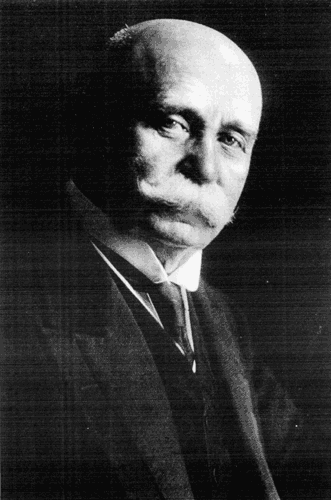
COUNT ZEPPELIN
Inventor of the Air-ship that has Still to Demonstrate
its Efficiency as an Engine of War
Elaborate forts made of iron and concrete are of little use against a
competent invader, and fortifications round about cities are of no use
for protection against an enemy that possesses adequate artillery. For
the defense of a frontier, or of the approaches to a railroad junction
or a city, a system of trenches is immeasurably superior to forts,
particularly if behind the trenches a network of railways or of smooth
highways exists. Wounds are often inflicted by jagged pieces of metal
which carry bits of dirty clothing and skin into the wounds, and the
wounded often lie on the ground for hours or even days before aid can
reach them. Hence the surgery of this war is largely the surgery of
infected wounds, and not of smooth aseptic cuts and holes. A
considerable percentage of deaths and permanent disabilities among the
wounded is the inevitable result. Surgeons and dressers are more
exposed to death and wounds than in former wars, because of the large
use of artillery of long range, the field hospitals being often under
fire.
From these changes in the methods of war on land it may be safely inferred that a nation which would be strong in war on land must be strong in all sorts of manufacturing, and particularly in the metallurgical industries. A nation chiefly devoted to agriculture and the ancient trades cannot succeed in modern war, unless it can beg, borrow, or buy from sympathizers or allies the necessary artillery and munitions. No amount of courage and devotion in troops can make up for an inadequate supply of artillery, machine guns, shells, and shrapnel, or for the lack of ample means of rapid transportation. Only in a rough country without good roads, like the United States in 1861-65, or Serbia or Russia now, can the rifle, light artillery, and horse or ox wagons win any considerable success; and in such a country the trench method can bring about a stalemate, if the combatants are well matched in strength, diligence, and courage.
The changes in naval warfare are almost equally remarkable. Mines and submarines can make the offensive operation of dreadnoughts and cruisers near ports practically impossible, and can inflict great damage on an enemy's commerce. Hence important modifications in the rules concerning effective blockade. In squadron actions victory will probably go to the side which has the gun of longest range well-manned. Defeated war vessels sink as a rule with almost all on board. Commercial vessels can seldom be taken into port as prizes, and must therefore be sunk to make their capture effective. There have been no actions between large fleets; but the indications are that a defeated fleet would be sunk for the most part, the only vessels to escape being some of the speedier sort. Crews would go down with their vessels. Shore batteries of long-range guns can keep at a distance a considerable fleet, and can sink vessels that come too near. Mines and shore batteries together can prevent the passage of war vessels through straits ten to fifteen miles wide, no matter how powerful the vessel's batteries may be. Every war vessel is now filled with machinery of various sorts, much of which is delicate or easily disabled. Hence a single shell exploding violently in a sensitive spot may render a large ship unmanageable, and therefore an easy victim. A crippled ship will probably be sunk, unless a port is near.
To build and keep in perfect condition a modern fleet requires dockyards and machine shops of large capacity, and great metallurgical industries always in operation within the country which maintains the fleet. No small nation can create a powerful fleet; and no nation which lives chiefly by agriculture can maintain one. A great naval power must be a mining, manufacturing, and commercial power, with a sound banking system available all over the world.
The war has proved that it is possible for a combination of strong naval powers to sweep off the ocean in a few months all the warships of any single great power, except submarines, and all its commerce. Germany has already suffered that fate, and incidentally the loss of all her colonies, except portions of German East Africa and Kamerun, both of which remnants are vigorously assailed and will soon be lost. Nevertheless, she still exports and imports through neutral countries, though to a small amount in comparison with the volume of her normal trade. Here is another illustration of the general truth that colonies are never so good to trade with as independent and prosperous nations.
Again the war has proved that it is not possible in a normal year to reduce by blockade or non-intercourse the food supply of a large nation to the point of starvation, or even of great distress, although the nation has been in the habit of importing a considerable fraction of its food supply. An intelligent population will make many economies in its food, abstain from superfluities, raise more food from its soil, use grains for food instead of drinks, and buy food from neutral countries so long as its hard money holds out. Any large country which has a long seaboard or neutral neighbors can probably prevent its noncombatant population from suffering severely from want of food or clothing while at war. This would not be true of the districts in which actual fighting takes place or over which armies pass; for in the regions of actual battle modern warfare is terribly destructive—as Belgium, Northern France, Poland, and Serbia know.
A manufacturing people whose commercial vessels are driven off the seas will, of course, suffer the loss of such raw materials of its industries as habitually came to it over seas in its own bottoms—a loss mitigated, however, by the receipt of some raw materials from or through neutral countries. This abridgment of its productive industries will, in the long run, greatly diminish its powers of resistance in war; but much time may be needed for the full development of this serious disability.
Because of the great costliness of the artillery, munitions of war, and means of transportation used in the present war, the borrowings of all the combatant nations are heavy beyond any precedent; so that already all the nations involved have been compelled to raise the rates of interest on the immense loans they have put upon the market. The burdens thus being prepared for the coming generations in the belligerent nations will involve very high rates of taxation in all the countries now at war. If these burdens continue to accumulate for two or three years more, no financier, however experienced and far-seeing, can imagine today how the resulting loans are to be paid or how the burden of taxation necessary to pay the interest on them can be borne or how the indemnities probably to be exacted can be paid within any reasonable period by the defeated nation or nations.
It follows from these established facts that a small nation—a nation of not more than fifteen millions, for example—can have no independent existence in Europe except as a member of a federation of States having similar habits, tendencies, and hopes, and united in an offensive and defensive alliance, or under guarantees given by a group of strong and trustworthy nations. The firm establishment of several such federations, or the giving of such guarantees by a group of powerful and faith-keeping nations ought to be one of the outcomes of the war of 1914-15. Unless some such arrangement is reached, no small State will be safe from conquest and absorption by any strong, aggressive military power which covets it—not even if its people live chiefly by mining and manufacturing as the Belgians did.
The small States, being very determined to exist and to obtain their natural or historical racial boundaries, the problem of permanent or any durable peace in Europe resolves itself into this: How can the small or smaller nations be protected from attack by some larger nation which believes that might makes right and is mighty in industries, commerce, finance, and the military and naval arts? The experience gained during the past year proves that there is but one effective protection against such a power, namely, a firm league of other powers—not necessarily numerous—which together are stronger in industries, commerce, finance, and the military and naval arts than the aggressive and ambitious nation which heartily believes in its own invincibility and cherishes the ambition to conquer and possess.
Such a league is the present combination of Great Britain, France, Russia, Italy, and Japan against the aggressive Central Monarchies and Turkey; but this combination was not formed deliberately and with conscious purpose to protect small States, to satisfy natural national aspirations, and to make durable peace possible by removing both fear of invasion and fear of the cutting off of overseas food and raw materials. In spite of the lack of an explicit and comprehensive purpose to attain these wise and precious ends, the solidity of the alliance during a year of stupendous efforts to resist military aggression on the part of Germany and Austria-Hungary certainly affords good promise of success for a somewhat larger league in which all the European nations—some, like the Scandinavian and the Balkans, by representation in groups—and the United States should be included. Such a league would have to act through a distinct and permanent council or commission which would not serve arbitrary power, or any peculiar national interest, and would not in the least resemble the "Concert of Europe," or any of the disastrous special conferences of diplomatists and Ministers for Foreign Affairs, called after wars since that of 1870-71 to "settle" the questions the wars raised.
The experience of the past twelve months proves that such a league could prevent any nation which disobeyed its orders from making use of the oceans and from occupying the territory of any other nation. Reduction of armaments, diminution of taxation, and durable peace would ensue as soon as general confidence was established that the league would fairly administer international justice, and that its military and naval forces were ready and effective. Its function would be limited to the prevention and punishment of violation of international agreements, or, in other words, to the enforcement of treaty obligations, until new treaties were made.
The present alliance is of good promise in three important respects—its members refuse to make any separate peace, they co-operate cordially and efficiently in military measures, and the richer members help the poorer financially. These policies have been hastily devised and adopted in the midst of strenuous fighting on an immense scale. If deliberately planned and perfected in times of peace, they could be made in the highest degree effective toward durable peace.
The war has demonstrated that the international agreements for the mitigation of the horrors of war, made by treaties, conferences, and conventions in times of peace, may go for nothing in time of war; because they have no sanction, or, in other words, lack penalties capable of systematic enforcement. To provide the lacking sanction and the physical force capable of compelling the payment of penalties for violating international agreements would be one of the best functions of the international council which the present alliance foreshadows. Some years would probably be required to satisfy the nations concerned that the sanction was real and the force trustworthy and sufficient. The absolute necessity of inventing and applying a sanction for international law, if Europe is to have international peace and any national liberty, will be obvious to any one who has once perceived that the present war became inevitable when Austria-Hungary, in violation of an international agreement to which she was herself a party, seized and absorbed Bosnia and Herzegovina, and became general and fierce when Germany, under Prussian lead, in violation of an international agreement to which she was herself a party, entered and plundered neutralized Belgium.
A strong, trustworthy international alliance to preserve the freedom of the seas under all circumstances would secure for Great Britain and her federated commonwealths everything secured by the burdensome two-navies policy which now secures the freedom of the seas for British purposes. The same international alliance would secure for Germany the same complete freedom of the seas which in times of peace between Germany and Great Britain she has long enjoyed by favor of Great Britain, but has lost in time of war with the Triple Entente. This security, with the general acceptance of the policy of the "open door," would fully meet Germany's need of indefinite expansion for her manufacturing industries and her commerce, and of room "in the sun" for her surplus population.
It is a safe inference from the events of the past six months that the longer the war lasts the more significant will be the political and social changes which result from it. It is not to be expected, and perhaps not to be desired, that the ruling class in the countries autocratically governed should themselves draw this inference at present, but all lovers of freedom and justice will find consolation for the prolongation of the war in this hopeful reflection.
To devise the wise constitution of an international council or commission with properly limited powers, and to determine the most promising composition of an international army and an international navy are serious tasks, but not beyond the available international wisdom and goodwill, provided that the tasks be intrusted to international publicists, business men of large experience, and successful administrators, rather than to professional diplomatists and soldiers. To dismiss such a noble enterprise with the remark that it is "academic," or beyond the reach of "practical" politics, is unworthy of courageous and humane men; for it seems now to be the only way out of the horrible abyss into which civilization has fallen. At any rate, some such machinery must be put into successful operation before any limitation of national armaments can be effected. The war has shown to what a catastrophe competitive national arming has led, and would probably again lead the most civilized nations of Europe. Shall the white race despair of escaping from this hell? The only way of escape in sight is the establishment of a rational international community. Should the enterprise fail after fair trial, the world will be no worse off than it was in July, 1914, or is today.
Whoever studies the events of the past year with some knowledge of political philosophy and history, and with the love of his neighbor in his heart, will discover, amid the horrors of the time and its moral chaos, three hopeful leadings for humanitarian effort, each involving a great constructive invention. He will see that humanity needs supremely a sanction for international law, rescue from alcoholism, and a sound basis for just and unselfish human relations in the great industries, and particularly in the machinery industries. The war has brought out all three of these needs with terrible force and vividness. Somehow they must be met, if the white race is to succeed in "the pursuit of happiness," or even to hold the gains already made.
CHARLES W. ELIOT.
The Vienna "Arbeiter Zeitung" of June 22, 1915, prints the appeal of Dr. Wolfgang Madjera, a well-known authority on municipal affairs, which he has issued to Austrian soldiers departing for the Italian front. He says:
"The day has arrived," says Herr Madjera, "when you will have to revenge your murdered Empress [the late Empress Elisabeth who was murdered in Geneva by an Italian named Luccheni]. It was a son of that land which has now committed a scandalous act of treason on Austria who made your old Emperor a lonely man on his throne of thorns. Take a thousandfold revenge on the brethren of that miserable wretch. Austria's warriors feel the strength within them to defeat and smash with iron hand the raised hand of the murderer. It is Luccheni's spirit which leads the army of our enemy. May Elisabeth's spirit lead our spirit!"
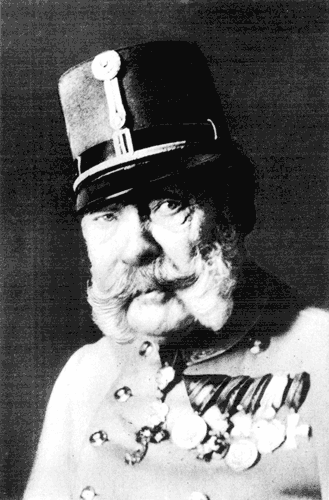
H.I.M. FRANCIS JOSEPH I.
Latest Portrait of the Venerable Sovereign of the
Austro-Hungarian
Empire
(Photo from Bain.)
SPEAKING on July 14, A. Bonar Law, British Colonial Secretary, announced that the Entente Allies have already occupied 450,000 square miles of German colonial possessions. Add Turkish possessions in Asia in the hands of the Entente powers, and the total reaches 500,000 square miles.
Two outstanding facts are that this transfer, if permanent, will change the destiny of all Africa and Asia, and that, for the first time in history, the oversea dominions of Britain have initiated and carried on wars of conquest, Australia and New Zealand, in union, having already taken 100,000 square miles of German colonies in the Pacific; while the Union of South Africa has conquered German Southwest Africa.
In other parts of Africa, France and Belgium are co-operating with English imperial forces, while in East Africa and on the Persian Gulf the brunt of the fighting is being borne by British Indian troops and troops provided by the Princes of India. The movement now in progress will, if completed, give the Entente powers the whole of Africa; will give Britain all Southern Asia, from the Mount Sinai peninsula to Siam; and will, in all probability, make the Entente powers heirs of the whole Eastern Hemisphere.
These immense territories are the ultimate stakes of the battles in France, in Poland, on the Dardanelles. We lose sight of them, perhaps, in the details of local fighting. In reality, nothing less is being effected than the re-mapping of the whole eastern hemisphere.
On Aug. 1, a year ago, German colonial possessions in Africa totaled over a million square miles, in four regions—Togo, Kamerun, Southwest Africa, and East Africa. Togo, running from the north shore of the Gulf of Guinea, is wedged between French and English colonies. In August, France and England joined in attacking it, and on Aug. 26 their occupation was complete, a rich area of 33,000 square miles thus passing from Germany to the Entente powers.
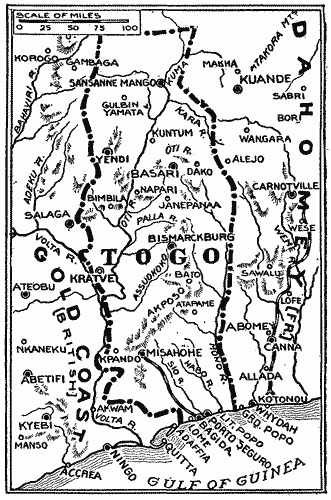
Togo, the German Colony which was surrendered to a Franco-English expeditionary force.
[Enlarge]
German East Africa
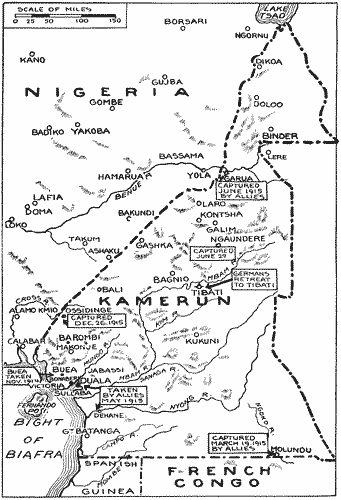
Scene of Operation of Anglo-French forces against the German Colony of Kamerun
[Enlarge]
Kamerun, in the elbow of the Gulf of Guinea, is about ten times as
large, one-third of this having been conceded by France to Germany in
1911, through the agency of M. Caillaux. Recent letters to The
London Times describe the fighting there:
On the 7th (May) we had a trying experience. Our company commander went out with myself and another subaltern and about forty men. We crossed the Mungo River in canoes, and then did a long and very difficult march all through the night in absolute dense forest. However the guides managed it passes comprehension.
About 5 in the morning, when it was just getting light, our advance party were just on the point of stumbling on to the German outpost, when what should happen but an elephant suddenly walked in between and scattered our opposing parties in all directions. I was in the rear of our little column, and was left in bewilderment, all our carriers dropping their loads and every one disappearing into the bush. After a few minutes we got our men together and our scouts went forward again, and found the Germans had bolted from their outpost, but soon returned and opened fire on our scouts.
A British officer writes:
I hope you have heard ere this of our capture of Duala and Bonaberi, and our further advance along the Duala Railway to Tusa, and along the Wari River to Jabassi. The heat and climate are very trying. It's awfully hot, far hotter than the last coast place I was in; a drier heat and sun infinitely more powerful, and yet the rains are full on and we get terrific tornadoes. The nights, however, are cooler.
We are surrounded by mangrove swamps, and they breed mosquitos, and consequently malaria and black-water fever.
This is quite a pretty little place (Duala) with some jolly houses, typical German of the Schloss villa type; nice inside and out. The country is pretty, the soil good. A good deal of timber and rubber. I found some beautiful tusks the other day, worth a good bit. Elephants abound. The native villages around are totally different from other West African ones—here their houses are mostly one long mud or palm erection, with thatched roof, and are divided into compartments instead of the smaller separate huts one is accustomed to see in these parts.
The notices all over the place are strangely reminiscent of, say, the Black Forest—"Bäkerei," "Conditorei," &c., and yet it is the heart of tropical Africa. None of the natives, strange to say, talk German; all pigeon English. The Hausa boys are splendid chaps, as different from the Duala boys or Sierra Leone boys as chalk from cheese. Smile and make an idiotic but beautiful remark, they rush with a roar of laughter for the biggest load.
We get some beautiful sunset effects here. At sundown night before last, on the sea near mouth of river, it was absolutely gorgeous with the purple mountains standing clear out against the orange and emerald sky and the dark gray shapes of our ships lying sombrely in the background, talking to each other in flashing Morse. The great mountain, Fernando Po, standing up out of the water to starboard and the Peak of Cameroon (13,760 feet) wreathed in mist to port; Victoria invisible, as also Buea—both hidden behind the clouds as we passed disdainfully by and entered the estuary of the Cameroon River.
As an added detail for West Africa, it should be recorded that, on March 19, a combined French and Belgian force occupied Molundu in the German Congo territory, and Ngaundere on June 29.
On July 13 a resolution, moved by Premier Asquith, was passed by acclamation in the House of Commons thanking General Louis Botha, General Smuts and the forces of the Union of South Africa for their work in "the remarkable campaign which has just been brought to a remarkable and glorious conclusion." Premier Asquith concluded:
The German dominion of Southwest Africa has ceased to exist. I ask the House to testify to the admiration of the whole empire for its gratitude to the illustrious General who has rendered such an inestimable service to the empire, which he entered by adoption and of which he has become one of the most honored and cherished sons, and to his dauntless and much enduring troops, whether of Burgher or British birth, who fought like brethren, side by side, in the cause which is equally dear to them as to us—the broadening of the bounds of human liberty.
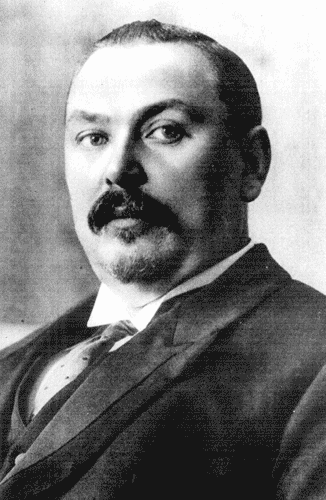
GENERAL LOUIS BOTHA
The Boer Commander Who Added German Southwest Africa
to the British Crown
(Photo from Medem Photo Service.)
The event which the British Premier thus read into the minutes of
history marks the end of a campaign begun by General Botha on Sept.
27, when troops of the Union of South Africa first entered German
territory. On Christmas Day Walfisch (Whale) Bay was occupied, and on
Jan. 14 Swakopmund, a military railroad joining them being finished a
month later.
The German Colonial Possessions
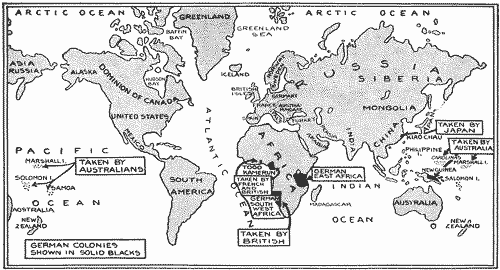
[Enlarge]
The progress of General Botha's campaign from the south and west is
thus summarized by The Sphere (July 3):
The occupation of Windhoek was effected by General Botha's North Damaraland forces working along the railway from Swakopmund. At the former place General Vanderventer joined up with General Botha's forces. The force from Swakopmund met with considerable opposition, first at Tretskopje, a small township in the great Namib Desert fifty miles to the northeast of Swakopmund, and secondly at Otjimbingwe, on the Swakop River, sixty miles northwest of Windhoek.
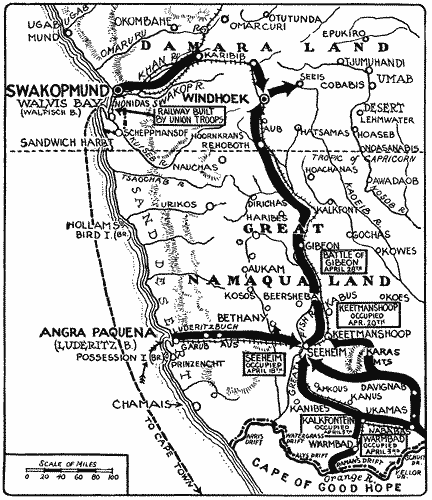
The theatre of operations in German South West Africa.
[Enlarge]
Apart from these two determined stands, however, little
other opposition was encountered, and Karibib was occupied
on May 5 and Okahandja and Windhoek on May 12. With the fall
of the latter place 3,000 Europeans and 12,000 natives
became prisoners.
The wireless station—one of Germany's most valuable high-power stations, which was able to communicate with one relay only with Berlin—was captured almost intact, and much rolling stock also fell into the hands of the Union forces.
The advance from the south along the Lüderitzbucht-Seeheim-Keetmanshoop Railway, approximately 500 miles in length, was made by two forces which joined hands at Keetmanshoop. The advance from Aus (captured on April 1) was made by General Smuts's forces. Colonel (afterward General) Vanderventer, moving up from the direction of Warmbad and Kalkfontein, around the flanks of Karas Mountain, pushed on after reaching Keetmanshoop in the direction of Gibeon. Bethany had previously been occupied during the advance to Seeheim. At Kabus, twenty miles to the north of Keetmanshoop, and at Gibeon pitched battles were fought between General Vanderventer's forces and the enemy. No other opposition of importance was encountered, and the operations were brought to a successful conclusion at Windhoek.
A part of the German forces had retreated to the northward, intending to carry on guerrilla warfare in the hills. General Botha went in pursuit. A Reuter's telegram, dated June 26, announced that Otjivarongo, approximately 120 miles north of Karibib, on the Otavi Railway, was occupied on that day by General Botha, the enemy having retired northward during the previous night. General Botha's movements have again been characterized by rapid and extraordinary marching through dense bush country, which is almost waterless. The retirement of the enemy was more suggestive of a flight than a strategic retreat.
A telegram from Lord Buxton, the Governor General of the Union of South Africa, to the Secretary of State for the Colonies, concludes the story:
This morning, July 9, General Botha accepted from Governor Seitz the surrender of all the German forces in Southwest Africa. Hostilities have ceased and the campaign has thus been brought to a successful conclusion.
The newly conquered territory, which is half as large again as the German Empire, is destined to become a part of the South African Union. As a great part of it is 5,000 feet above sea level, it is well adapted for white settlers. Its chief resources are diamond mines and grazing.
General Botha's force is likely to be divided between the European seat of war, to which the South African Union has up to the present sent no troops, and German East Africa, much of which still remains in the hands of the Germans.
The early stage of the struggle for German East Africa is lucidly summarized in The Sphere for May 8:
The fighting in British East Africa (immediately north of the German colony) may be said to have really begun toward the end of September, 1914, when the Germans made a determined attempt to capture Mombasa, the commercial capital of British East Africa and the terminus of the Uganda Railway.
Previous to this, somewhat half-hearted attempts had been made by them to wreck the railway line at various points, destroy the telegraph, and occupy Voi and Mombasa. The Germans, who were in strong force, were, however, for various reasons, unable to cut the railway or even to destroy the bridge across the Tsava River, and they were beaten back both at Voi and the post at Taveta.
The attack on Mombasa itself was repulsed at Gazi, some twenty-five miles to the southwest. The German plan of action was to move up the road from Vanga to Mombasa, arriving at the latter place somewhere about the time the Königsburg was expected to arrive and bombard it from the sea. The Königsburg was, of course, prevented from doing this by the proximity of British warships, and the land attack was also frustrated.
The Germans were held at Nargerimi by a mere handful of Arabs and King's African Rifles—about 300 men all told—until the arrival of the Indian troops strengthened our position and the enemy was beaten back to his original lines.
The next big actions were the British attack on Tanga and Jassin very early in November; this was the direct outcome of the German attack on Mombasa. Tanga is a post of considerable importance in German East Africa, and lies midway between Zanzibar and Mombasa. It is the seaport of an important railway line which connects it with Moshi, lying among the foothills of Kilimanjaro (18,700 feet) and which taps most of the intervening country.
The force dispatched for the attack on Tanga consisted of 4,000 Indian Imperial Service troops, 1,000 Indian regulars, together with 1,000 white regulars. The force took no kit of any kind except rations. It was disembarked from the troopship near Tanga, and then moved against the position.
The day the British attacked, however, 1,000 Germans had been rushed up from Moshi and then took up a position to the right of the town. With them were great numbers of quick-firing guns of various sorts. This unexpected reinforcement made the capture of Tanga almost impossible by the forces present. During the fight many casualties were incurred on both sides.
As regards the advance against Tanga and Jassin, the German forces which had previously advanced on Mombasa were, up to as recently as January, maintaining themselves in the valley of the Umba River. To drive them from their positions a column of 1,800 men, composed of Indians and King's African Rifles, with artillery, was dispatched.
After gaining Jassin and leaving a garrison of 300 men, the post was attacked and subsequently surrendered to a force of 2,000 Germans. The minor operations along the Anglo-German frontier include the attack on Shirati—a German post on the southeast shore of Lake Victoria Nyanza—on Jan. 9.
Fighting also took place near Karunga in March, and on this occasion the German force was driven back in disorder and with heavy loss into their own territory, while Kisu—which had been captured by the Germans—was reoccupied after the defeat of Karunga. On Jan. 10 the large Island of Mafia, off the coast of the German colony, was taken by the British and is being administered by them.
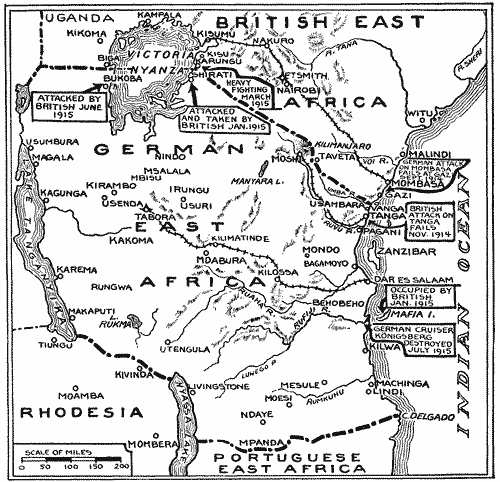
German East Africa and the fighting which has taken place.
[Enlarge]
The history of the war in this region is brought up to date by a
British Press Bureau statement issued on June 30:
Further details are now to hand of the operations which have been taking place west of Lake Victoria Nyanza. It will be remembered that the general scheme for the attack on Bukoba was to be a simultaneous advance on the part of two forces, one starting from the line of the Kagera River, south of Uganda, the other starting on steamers from Kisumu.
The junction of the two forces was successfully accomplished, and the attack took place on June 22. During the action the enemy received reinforcements which brought his force up to 400 rifles, and he made a most determined resistance, the Arabs especially fighting most bravely. They were, however, heavily outnumbered, and eventually the whole force broke and fled, utterly demoralized.... Our troops distinguished themselves greatly, both in the arduous march from the Kagera and in the subsequent fighting. A telegram was sent on June 28 from Lord Kitchener to Major Gen. Tighe, commanding the troops in British East Africa, congratulating him on the success of the operations.
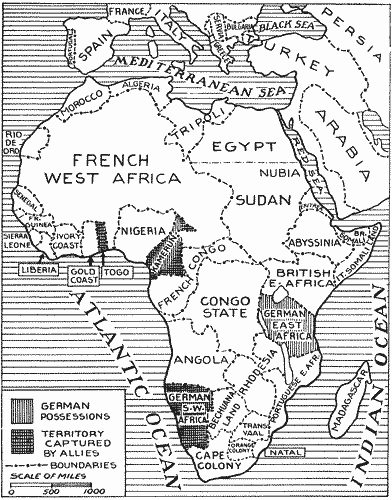
Conquered German African Territory.
[Enlarge]
Turkey's entry into the war has had four results: 1, The annexation of Cyprus (previously a protectorate) by Britain on Nov. 5; 2, the British expedition against Turkish territory on the Persian Gulf two weeks later; 3, the loss of Turkey's suzerainty over Egypt, which became a British protectorate under a Sultan on Dec. 17, and, 4, the attack on the Gallipoli Peninsula, still in progress.
An excellent summary of the Persian Gulf expedition is given in The Sphere, May 15:
The Shatt-el-Arab, (the united Euphrates and Tigris,) for the greater part of its course, forms the boundary between Persia and Turkey. Some twenty miles below Basra (or Bussorah) it is joined by the Kasun, near whose course, about a hundred miles from its mouth, are the Anglo-Persian Company's oil fields.
The effective protection of these is necessarily an object of vital importance. It was also of considerable importance to create a diversion which should cause the Osmanli Generals to feel uneasiness as to a possible advance up the Euphrates. Whether more than the occupation of Basra and the protection of the oil fields was or is intended cannot, of course, be at present definitely stated.
The expeditionary force, under Lieut. Gen. Sir Arthur Barrett, consisted—apparently—of three Indo-British infantry brigades, a brigade of Indian cavalry, and artillery and auxiliary services in proportion—in all probability some 15,000 to 18,000 men. It included at least three British battalions—the Second Dorsets, the Second Norfolks, and the Oxford and Bucks Light Infantry.
The advanced brigade reached the Shatt-el-Arab on Nov. 7, and after a brief fight occupied Fao, a few miles up the river. On the 9th a night attack was made upon it by a force from Basra, which was easily beaten off. Shortly afterwards the main body of the expeditionary force began to arrive, and by the 16th it had entirely disembarked at Saniyeh, a place above Fao.
The weather was wretched. Rain converted the alluvial flats into a wilderness of mud. The men were drenched and caked with the riverine clay, the very rifles were often choked.
Meanwhile the advance guard carried out a reconnoissance up the river and located the enemy in position at Sahilo, about nine miles distant. They numbered about 5,000 men, with twelve guns, under General Subr Bey, the Vali (Governor) of Basra. The reconnoissance carried an advanced position with a loss of sixty killed and wounded, and withdrew unmolested to report.
On the 17th General Barrett paraded for the attack the bulk of his force. After a trying march through a veritable quagmire, the troops sometimes up to their waists in slush, the division at about 9 A.M. came within range of the Turkish position, and the leading brigade, the Belgaum, (Major Gen. Fry,) deployed for attack.
The ground was absolutely open, and the Turks had a perfect field of fire. On our side the men had the greatest difficulty in getting forward through the clayey mud-beds and the worn-out horses could not bring up the field artillery. Nevertheless, the Belgaum brigade steadily advanced, and the attack being presently supported by other troops and assisted by the first of the two gunboats on the river, at last closed upon the Turkish intrenchments and carried them, capturing two guns and one hundred prisoners, besides inflicting a very heavy loss in killed and wounded.
The retreat of the enemy was assisted by a mirage which disconcerted our gunners. Subr Bey retreated on Basra, but he had no hope of being able to hold the big spreading place with his small force, and evacuated it. He retreated to Kurna, where the Tigris joins the Euphrates. There he intrenched himself. His main body was in Kurna, a large village encircled by palm groves, in the marshy angle formed by the two rivers, with a strong detachment in the straggling village of Mazera, on the left bank of the Tigris.
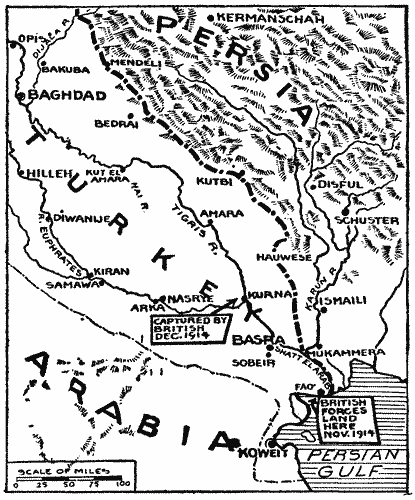
The scene of the Persian Gulf Campaign.
[Enlarge]
On Dec. 7 General Fry advanced upon the Kurna position. The
defenders of Mazera made a hard fight of it, assisted by the
strength of their position among a maze of pottery works
backed up by the ubiquitous palms, but in the afternoon the
village was carried.
Kurna was now isolated, but its capture presented great difficulties. All through the 8th General Fry bombarded it from Mazera, while his infantry were slowly ferried over higher up. This was prepared by some daring sappers, who swam the broad river and fixed a wire rope by which the boats were worked backward and forward, and an advance was made against Kurna from the rear.
Subr Bey had lost very heavily at Mazera, so he accepted the inevitable and surrendered. So a brilliant little episode came to a victorious conclusion. Subr Bey was returned his sword and complimented on his stubborn defense.
The capture of Kurna secured the possession of the Basra region. Since then operations have been directed to securing it against Turkish attempts at recovery.
German Colonial Possessions in the Pacific
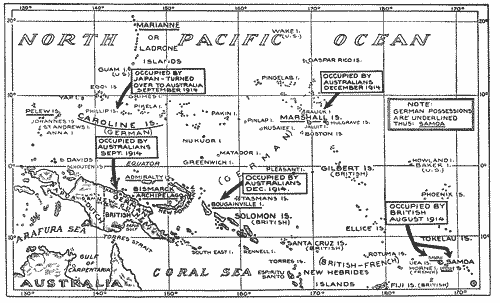
[Enlarge]
A recent stage of this campaign is thus described in The Pioneer Mail
(Allahabad) June 4, 1915:
It is announced from Simla that on the morning of May 31 a further advance up the Tigris River was made by the British expeditionary force in close co-operation with the navy. Notwithstanding the excessive heat the troops advanced with great dash and determination, and successively captured four positions held by the enemy. As far as reported we suffered only a few casualties. Valuable work was performed by our aeroplanes. The operations are proceeding.
The British force at the end of June had reached Shaiba.
The splendid work done by Indian regulars and Indian imperial forces (the forces supplied by native Princes) in Europe, in Africa, in Egypt, in Mesopotamia is a sufficient answer to the suggestion that British influence in India has been weakened by the war. The enthusiastic formation of volunteer corps, both of Europeans and of natives, is a further proof that the peoples of India, now more than ever, realize the benefits of liberty and security which they enjoy. In India the torpedoing of the Lusitania made a profound impression, as the native press proves.
A notable trial, the Lahore conspiracy case, disclosed the curious fact that almost the only case of "unrest" in India was "made in America" by returned emigrants from Canada and California, who, on their way back, were interviewed by the German Consuls at Chinese ports and advised to stir up an insurrection. This they tried to do, using bombs made of brass inkpots, and bombarding the houses of well-to-do natives, seeking in this way to raise money to finance the rising.
The Pioneer Mail (Allahabad) gives an interesting account of the trial of these peculiar patriots, half of whom seem to have informed on the other half. It appears that they, or others like them, were instrumental in causing the recent riot at Singapore, in which some twenty European men and women were killed.
A curious result of the world war has been the expeditions initiated by the great oversea dominions of Britain and by India. The work of two of these, in Africa and Mesopotamia, has been already described. There remain the joint Australian and New Zealand expeditions against the island colonies of Germany and the great semi-continental area of New Guinea.
A lively account of the expedition against the Samoa Islands is printed in The Sydney Bulletin for Sept. 24:
The recent expedition to Samoa furnished many surprises, chief among which was the adaptability of the Maorilanders to military discipline. When the men came on board the transports (Moeraki and Monowai) discipline simply wasn't in their dictionaries. They acknowledged orders with a "Right O, Sport," or with an argument. Companies were referred to as mobs, the commanding officer as the boss or the admiral....
The night before we reached Samoa an English military officer on board told me it was remarkable, and highly creditable, the rapidity with which the men had adapted themselves to the changed circumstances....
The expedition called at Noumea to pick up the French warship Montcalm, also the Australia and Melbourne of ours. Noumea had been very worried since the war began, lest the German fleet from Samoa would come along and bombard the place. Had notices up to the effect that five shots would signify the arrival of the Germans, and that every inhabitant was then to grab rations and make for the horizon. The welcome the French handed to us would have stirred the blood of a jellyfish.
Samoa proved a walk-over. Not a gun, not a ship, not a mine. A bunch of schoolboys with Shanghais and a hatful of rocks could have taken it. The German fleet that was supposed to be waiting to welcome us hadn't been around for eleven months. Seemingly the German fleet has gone into the business of not being around.
The Australasian (Melbourne) for Sept. 19 prints the following, describing the conquest of German New Guinea, which, with the Bismarck Archipelago, off the coast, has an area of 90,000 square miles—something less than half the size of the German Empire:
The Minister for Defense (Mr. Millen) has received the following further information by wireless regarding the operations at Herbertshohe and Rabaul, from Admiral Patey: The Australian naval reserve captured the wireless station at Herbertshohe at 1 P.M. on Sept. 12, after eighteen hours' bush fighting over about six miles. Herbertshohe and Rabaul, the seat of Government, have been garrisoned and a base has been established at Simpsonshafen.
Have prisoners: German officers, 2, including commandant; German non-commissioned officers, 15; and native police, 56. German casualties about 20 to 30 killed. Simpsonshafen swept and ready to be entered Sept. 12.
Naval force landed under Commander Beresford of the Australian Navy met with vigorous opposition. Advanced party at dawn established landing before enemy aware of intention. From within a few hundred yards of landing bush fight for almost four miles. Roads and fronts also mined in places, and stations intrenched. Officer commanding German forces in trench 500 yards seaward side of station has surrendered unconditionally.
Our force have reconnoitred enemy strength holding station. Have landed 12-pounder guns, and if station does not surrender intend shelling. Regret to report following casualties: 4 killed, 3 wounded.
Later a wireless message from Rear-Admiral Sir George Patey informed the Minister for Defense (Mr. E.D. Millen) on Monday, Sept. 14, that, as a result of the operations of the Australian Expeditionary Force, Rabaul, the seat of government in German New Guinea, had been occupied. The British flag was hoisted over the town at 3:30 on Sunday afternoon (Sept. 13, 1914) and it was saluted. A proclamation was then read by Rear-Admiral Patey, formerly setting out the occupation.
Apia (Samoa) had been occupied by British forces on Aug. 29. The Caroline Islands, first occupied by Japan, were turned over to New Zealand. The Marshall and Solomon Islands were likewise occupied on Dec. 9, thus completing the tale of Germany's colonial possessions in the Pacific.
There remain large areas in Kamerun and East Africa, but in both cases the coast line is in the possession of the Entente powers.
The first considerable battle in the Caucasus, after Turkey entered the war, was decided in favor of Russia, on Jan. 3. On Jan. 16 the Eleventh Corps of the Turkish Army was cut up at Kara Urgaun. On Jan. 30 the Russians occupied Tabriz. On Feb. 8 Trebizond was bombarded by Russian destroyers. On May 4 the Turks were again defeated, leaving 3,500 dead.
The most recent considerable action was the taking of the ancient and important City of Van, which is graphically described in Novoe Vremya, June 19:
"When our armies scattered the forces of Halil Bey and gained marked successes in the western part of Azerbijan, the question of taking Van and the more important towns on Lake Van arose. At the same time we received news of the desperate situation of the Christians (Armenians) of the Van vilayet, who had been compelled to take up arms against the Kurds.
"Our division was directed to go to Van through the Sanjak of Bajazet, crossing the Tatar Pass under fire of Turkish regulars and Kurds. In spite of the Spring season, the whole pass was covered with a thick carpet of snow, in places up to our men's belts. At the highest point of the pass, 10,000 feet, we were forced to halt. After a brief rest we reached Taparitz and were immediately in contact with the enemy, who attacked with shell and rifle fire, but we soon silenced them with our rifles and machine guns. Scattering, the Turks and Kurds hid among the rocks and sniped at us.
"From Taparitz we advanced much more rapidly along the Abaga Valley, then turned to the west along the River Bendimach-Su, the best route to Van. We were informed that Begri-Kala was strongly occupied by Turks who were determined to defend it to the last.
"They began an irregular fire, which soon developed into a hotly contested battle. We were compelled to reply with bullet and bayonet. We took several mountain guns, many rifles and cartridges and much ammunition. Many of the enemy threw up their hands and surrendered. We liberated several dozen Christian girls who had been captured by the Kurds at the time of the Turk and Kurd raid on the Armenian villages.
"We then resumed our march on Van, after driving the Turks from the Village of Sor. The enemy gathered in the Town of Janik, one march from Van, on the northeast shore of Lake Van. To take Janik cost us several days' fighting. The Turks fought desperately, undaunted by enormous losses, their dead falling in heaps on all sides. The Turkish infantry fought a brave and honorable fight, but the Kurds are foul fighters, murdering and looting.
"Attacking directly with only a part of our forces, we sent the rest by a long detour around the enemy's position, taking the Turks in flank; then our men charged with the bayonet, and the fight was over.
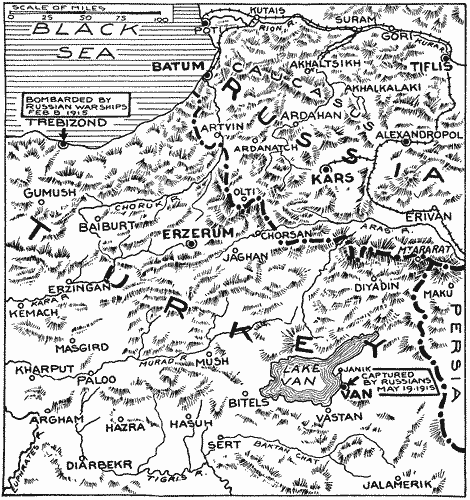
Scene of operation of Russians against the Turks in the Caucasus.
[Enlarge]
"The fall of Janik decided the fate of Van. On the night of
May 5 (18) the Turks evacuated Van, leaving twenty-six guns,
3,000 poods (a pood equals 36 pounds) of powder, their
treasure and documents; they went so silently that the
inhabitants did not know of it until the next morning.
"On May 6 (19) the birthday of Czar Nicholas II., we entered antique Van, the centre of the large and once wealthy vilayet of the same name, amid extraordinary rejoicings, the entire Christian population coming forth to meet us, strewing flowers and green branches in the streets and decking our soldiers with garlands.
"The capture of Van is as important politically as it is strategically. The advance on Mush and Bitlis is a necessary consequence."
Mount Kisco, N.Y., July 11, 1915.
To the Editor of The New York Times:
On Friday night at Carnegie Hall Miss Jane Addams stated that in the present war, in order to get soldiers to charge with the bayonet, all nations are forced first to make them drunk. I quote from The Times report:
In Germany they have a regular formula for it [she said]. In England they use rum and the French resort to absinthe. In other words, therefore, in the terrible bayonet charges they speak of with dread, the men must be doped before they start.
In this war the French or English soldier who has been killed in a bayonet charge gave his life to protect his home and country. For his supreme exit he had prepared himself by months of discipline. Through the Winter in the trenches he has endured shells, disease, snow and ice. For months he had been separated from his wife, children, friends—all those he most loved. When the order to charge came it was for them he gave his life, that against those who destroyed Belgium they might preserve their home, might live to enjoy peace.
Miss Addams denies him the credit of his sacrifice. She strips him of honor and courage. She tells his children, "Your father did not die for France, or for England, or for you; he died because he was drunk."
In my opinion, since the war began, no statement had been so unworthy or so untrue and ridiculous. The contempt it shows for the memory of the dead is appalling; the credulity and ignorance it displays are inconceivable.
Miss Addams does not know that even from France they have banished absinthe. If she doubts that in this France had succeeded let her ask for it. I asked for it, and each maître d'hôtel treated me as though I had proposed we should assassinate General Joffre.
If Miss Addams does know that the French Government has banished absinthe, then she is accusing it of openly receiving the congratulations of the world for destroying the drug while secretly using it to make fiends of the army. If what Miss Addams states is true, then the French Government is rotten, French officers deserve only court-martial, and French soldiers are cowards.
If we are to believe her, the Canadians at Ypres, the Australians in the Dardanelles, the English and the French on the Aisne made no supreme sacrifice, but were killed in a drunken brawl.
Miss Addams desires peace. So does every one else. But she will not attain peace by misrepresentation. I have seen more of this war and other wars than Miss Addams, and I know all war to be wicked, wasteful, and unintelligent, and where Miss Addams can furnish one argument in favor of peace I will furnish a hundred. But against this insult, flung by a complacent and self-satisfied woman at men who gave their lives for men, I protest. And I believe that with me are all those women and men who respect courage and honor.
RICHARD HARDING DAVIS.
The grand sweep of the victorious German armies through Galicia and into Poland, on a more tremendous scale than has hitherto been witnessed in the warfare of history, is recorded in the semi-official German accounts of the Wolff Telegraphic Bureau, published by the Frankfurter Zeitung from June 3 to June 29, and translated below. The official German reports of the campaign concentrated upon the Polish capital of Warsaw follow. On July 19 a Petrograd dispatch to the London Morning Post reported that Emperor William had telegraphed his sister, the Queen of Greece, to the effect that he had "paralyzed Russia for at least six months to come" and was on the eve of "delivering a coup on the western front that will make all Europe tremble."

H.M. QUEEN SOPHIA OF GREECE
Sister of Kaiser Wilhelm, and an Ardent Germanophile
(Photo from Bain.)
The semi-official report dispatched by the Wolff Telegraphic Bureau from Berlin on June 3, 1915, reads as follows:
FROM the Great Headquarters we learn the following concerning the battles at Radymno:
The corps of General von Mackensen, on the evening of the 23d of May, stood on both sides of the San in a great bow directed toward the east. On the right wing Bavarian troops stood on the watch facing the northwest front of the fortress of Przemysl. In touch with the Bavarian troops German and Austro-Hungarian forces stood south of the San before the strongly fortified bridgehead of Radymno. Farther north still other troops linked up with the army.
The bridgehead of Radymno consisted of a threefold line of field works. There was in the first place the main position well provided with wire entanglements. This ran along the heights that lie westward of the village of Ostroro and through the low lands of the San up to this river. Then there was a well-constructed intermediate position which was laid through the long straggling village of Ostroro. Finally there was the so-called bridgehead of Zagrody which was constructed for the protection of the street and railroad bridges crossing the river to the east of Radymno. Air-men had photographed all these positions and had reduced the views by the photogrammeter and transferred them to the map.
The first task was to render the enemy's main positions ripe for attack. With this object the artillery on the afternoon of May 23 began its fire, which was continued on the next day. From the heights near Jaroslau could be seen the valley of the San lying in the mists, out of which jutted the cupola towers of Radymno and the hamlets of Ostroro, Wietlin, Wysocko, etc. The artillery fire was raised to the utmost pitch of intensity. The heavy projectiles howling, furrowed the air, lit great fires as they struck and excavated vast pits in the earth. The Russian artillery replied.
At six o'clock in the morning the long infantry lines rose in their storming positions and advanced to the attack. The flyers reported that behind the enemy's positions they observed grazing cattle and baggage carts. The enemy seemed not to expect a serious attack. Anyhow, the Petersburg bulletin had announced that the battles in Galicia had decreased in intensity, that the Teutonic allies had practically throughout gone over to the defensive.
At six-thirty in the morning the enemy's main position in its whole extent was in the hands of the German troops. Shaken by the heavy artillery fire the enemy had made only brief resistance; he was in hasty retreat toward the east.
But just in that direction and into Radymno, whence the enemy's reinforcements were to be expected, the artillery had in the meantime turned its fire. Great clouds of smoke covered these villages set afire by the bombardment. The Russians thus did not have the chance to take permanent footing in Ostroro. The troops holding the town surrendered, leaving hundreds of guns and great quantities of ammunition in the hands of the victors.
Along the whole line the German infantry was now advancing upon Radymno and the villages connecting with this place, Skolowszo and Zamojsce. With every step forward the number of prisoners was increased. Soon one division reported to headquarters that it did not have enough men to attend to the removal of the great masses of prisoners without prejudice to the conduct of the action. Cavalry was therefore assigned to this task.
At Radymno the enemy's troops had become jammed in crowds. A wooden wagon bridge over the San had been burned down too soon. From the position of the staff directing the battle one could see the leaping flames and the clouds of heavy black smoke caused by the pouring on of naphtha. One could also see long columns fleeing eastward covering the street toward Dunkowice with their disordered crowds. As the Russian recruits which had been gathered in Radymno made only a brief resistance, this place together with all the artillery which was attempting to escape through the town to the San, was also lost. Only at the bridgehead of Zagrody did the Russian leaders, by hastily bringing up fresh reserves, finally check the attack of the Germans. On this day 70 officers, 9,000 men, 42 machine guns, 52 cannon of which 10 were heavy, 14 ammunition wagons, and extensive other booty was reported. But also on the north bank of the San a great battle had developed.
A semi-official dispatch by the Wolff Telegraphic Bureau dated Berlin, June 6, said:
From the Great Headquarters we have received the following telegram concerning the fall of the fortress Przemysl:
When on the 2d of May the offensive of the allies in West Galicia began, few probably could have imagined that four weeks later the heavy guns of the Central Powers would open their fire on Przemysl. The Russian staff was not likely to have been prepared for this possibility. Its decision swayed this way and that, whether, as originally planned, to hold the fortress, for "political reasons" or "voluntarily to withdraw" from it. Constantly our airmen reported the marching of troops in and out of the fortress. On the 21st of May the decision seemed to have been reached to abandon it. In spite of this, eight days later the place was stubbornly defended.
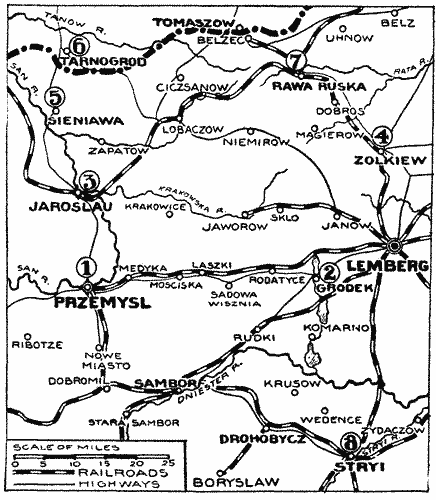
Eight German military positions about Przemysl and Lemberg.
[Enlarge]
General von Kneussl pushed the line of his Bavarian regiments from the
north closer to the fortress to shut in the foe. About eleven o'clock
in the forenoon the heavy batteries began to engage the forts on the
north front. In the night from the 30th to the 31st of May the
infantry pushed forward closer to the wire entanglements. It awaited
the effect of the heavy artillery. This confined the defenders to
their bomb-proof shelters, so that our infantry could step out of its
trenches and from the top of the breastworks watch the tremendous
drama of destruction. The lighter guns of the assailants found ideal
positions in the battery emplacements formerly built by the Russians
as part of their siege works when operating against the Austrians in
Przemysl. So, too, General von Kneussl with his staff found shelter
near, and the chief of artillery in the observation station
constructed by the Russians near Batycze. From this point, distant
from the line of forts only a little more than two kilometers, one
could observe the whole front of Forts 10 and 11. On the 31st of May,
at four in the afternoon, the heavy guns ceased firing. Simultaneously
the infantry, Bavarian regiments, a Prussian regiment and a detachment
of Austrian sharp-shooters, moved to the attack. The destruction of
the works and advanced points of support of the fortress by the heavy
artillery had such a shattering and depressing effect on its garrison
that it was not capable of offering any effective resistance to the
attacking infantry.
The troops manning Forts 10a, 11a, and 11, such of them as did not lie buried in the shattered casemates, fled, leaving behind their entire war material, including a great number of the newest light and heavy Russian guns. The enemy replied to the assailants who pushed forward to the circular connecting road, only with artillery fire, and in the night made no counter attack of any kind. On the 1st of June the enemy threw several single battalions into a counter attack. These attacks were repulsed without difficulty.
The heavy artillery now fought down Forts 10 and 11. The Prussian infantry regiment No. 45, jointly with Bavarian troops, stormed two earthworks lying to the east of Fort 11 which the enemy had stubbornly defended. On the 2d of June, at noon, the 22d regiment of Bavarian infantry stormed Fort 10, in which all "bombproofs" except one had been made heaps of débris by the action of the heavy artillery. A battalion of fusiliers of the Queen Augusta Guard regiment of grenadiers in the evening took Fort 12. Works 10b, 9a and 9b capitulated.
In the evening the troops of General von Kneussl began the attack in the direction of the city. The village Zurawica and the fortified positions of the enemy situated there were captured. The enemy now desisted from all further resistance. Thus the German troops, followed later by the 4th Austro-Hungarian cavalry division were able to occupy the strongly built inner line of forts, and at 3 o'clock in the morning after making numerous prisoners, to march into the relieved city of Przemysl.
Here, where a battalion of the third infantry regiment of the Guard was the first troop to enter, there was still a last halt before the burned bridges over the San. But these were soon replaced with military bridges. After a siege of only four days the fortress of Przemysl was again in the hands of the allies. The Russians had in vain attacked this fortress for months. Although they brought hecatombs of bloody sacrifices they had not succeeded in taking the fortress by storm. Only by starvation did they bring it to fall, and they were enabled to enjoy their possession only nine weeks. Energetic and daring leadership, supported by heroically fighting troops and excellent heavy artillery, had in the briefest possible space of time reduced the great fortress.
A semi-official dispatch by the Wolff Telegraphic Bureau, dated Berlin, June 27, reported as follows:
From the Great Headquarters we have received the following telegram about the battle for Grodek and the Wereszyca position:
In the night from the 15th to the 16th of June the enemy began his retreat in front of the allied troops in an easterly and northeasterly direction. He was now unquestionably withdrawing to his defenses on the Wereszyca and the so-called Grodek position. The Wereszyca is a little stream that rises in the hilly lands of Magierow and flows in a southerly course to the Dniester. Insignificant as the streamlet is in itself, it yet forms, because of the width of its valley and the ten rather large lakes in it, a locality peculiarly well fitted for defense.
Whatever was lacking to the situation in natural strength had been supplied by art. This the Russians displayed above all in the Grodek position which, joining the Wereszyca on the north at Janow, stretches for a distance of more than 70 kilometres in a northwestern direction as far as the region of Narol Miasto. Thousands of laborers had here worked for months to construct a fortified position which does honor to the Russian engineers. Here extensive clearings have been made in the forests. Dozens of works for infantry defense, hundreds of kilometres of rifle trenches, covering and connecting trenches, had been dug, the hilly forest land quite transformed, and finally vast wire entanglements stretched along the entire Wereszyca and Grodek front. Taken as a whole this position formed the last great bulwark with which the Russians hoped to check their victorious opponents and to bring their advance upon Lemberg to a permanent halt.
The Russian army found itself incapable of acting up to these expectations of its leaders. A cavalry regiment of the Guard, with the cannon and machine guns assigned to it, succeeded on the 16th of June, on the road Jaworow-Niemirow, in making a surprise attack on a Russian infantry brigade marching northward to the Grodek position and in scattering it in the forests. In the evening the city of Niemirow was stormed. On the 18th of June the armies of General von Mackensen deployed into line of battle before the Russian positions. On the following day they moved to the attack. Early in the morning the decisive onslaught was made on the Grodek position and in the evening on the Wereszyca line. Very soon the hostile positions on both sides of the Sosnina forest were taken. Four of the enemy's guns were captured, and the Russian positions on Mt. Horoszyko, which had been built up into a veritable fortress, were stormed.
The main attack was made by regiments of the Prussian Guard. Before them lay, to the west of Magierow, Hill 350. Even from a distance it can be seen that this elevation, rising to a height of fifty metres above the slope, is the key to the whole position. The defenses consisted of two rows of trenches, lying one over the other, with strong cover, and with wire entanglements and abattis in front of them. At daybreak began the artillery battle. This already at six o'clock in the morning resulted in the complete subduing of the Russian artillery, which, as always in the recently preceding days, held back and only very cautiously and with sparing use of ammunition took part in the battle. At seven the hostile position was considered ripe for storming and the infantry attack ordered. Although the forces manning the heights still took up the fire against the attackers, it was without, however, inflicting on them losses worth mentioning. The German heavy artillery had done its duty. The enemy was so demoralized that, although in the beginning he kept up his fire, he preferred to absent himself before the entry of the Germans into his trenches.
More than 700 prisoners and about a dozen machine guns fell into the hands of the attackers. In the ditches that were taken alone there lay 200 dead Russians. In the meantime the attack was directed against the neighboring sections. Soon the Russians found themselves compelled also to vacate without giving battle the very strong position running north of the street that leads to Magierow, with its front toward the south. Since the German troops were able to penetrate with the fleeing enemy into Magierow and to advance north of the city toward the east, the position at Bialo-Piaskowa also became untenable. The Russians flowed backward and only at Lawryko again tried to get a firm footing. Late in the evening a Guard regiment took the railroad station of Dabrocin, where but a short time before the Russians had been trans-shipping troops, and thus won the Lemberg-Rawa-Ruska road. The adjoining corps in the evening stood about on a level with the regiments of the Guard. Again penetration of the Russian front had succeeded to a width of 25 kilometres, and the fate of Lemberg had been decided here and on the Wereszyca. This line was stormed late in the evening and partly in the early morning hours of the 20th of June. The German corps, which on this day had been joined by the German Emperor, stormed the hostile positions of Stawki as far as the Bulawa outwork. Since the morning hours of the 20th of June the enemy, who in places had already withdrawn in the night, was in full retreat toward the east along the whole front. The pursuit was at once undertaken. On the evening of the same day Royal and Imperial troops stood close before the fortifications of Lemberg.
A semi-official report dispatch by the Wolff Telegraphic Bureau from Berlin, June 28, reads:
From the Great Headquarters we have received the following telegram about the taking of Lemberg:
The Russians entered Lemberg, the capital of Galicia, a city of 250,000 inhabitants, in the beginning of September, 1914. They at once restored to the city its Polish name, Lwow, and during their reign in the beautiful town made themselves exceedingly well at home. They began promptly to develop Lemberg into a great fortress and for the further protection of their new possession to construct the fortified lines of Grodek and Wereszyca. The protective works of Lemberg built by the Austrians were strengthened and extended by the Russians, especially along the south and southwest fronts. The existing depot facilities were enlarged and a number of railways, both field and permanent, extended throughout the domain of the fortress. To guarantee the maintenance of the fortress of Lemberg, even in case the Grodek position should be penetrated and have to be given up, a strongly fortified supporting work had been built. This ran along the heights to the west of the Lemberg-Rawa-Ruska railway to the vicinity of Dobrocin.
After the armies of General von Mackensen had broken through the Grodek and Wereszyca position, German divisions and allied troops struck these supporting works. The centre of the Army Boehm-Ermolli simultaneously approached the west from Lemberg. The main body of this army attacked sections of the hostile army which had prepared for renewed resistance behind the Szczerzek and Stavczonka streams and in contact with the fortress on the south. This position on the evening of the 21st of June was successfully penetrated at several points and the attacking troops were pushed closer to the defenses on the west front of Lemberg. German connecting troops under the leadership of General von der Marwitz on the same day stormed the most important points of the stubbornly defended supporting position. They thus compelled the enemy to evacuate this position in the whole of its extent and opened for the adjacent Austrian troops the road to the defenses on the northwest front of the fortress. In consequence the Austro-Hungarian troops were able on the 22d of June to take the works on the northwest and west fronts.
At five o'clock in the morning fell the fortification Rzesna, soon thereafter Sknilow, and toward eleven Lysa Gora. This work was conquered by infantry regiment No. 34, "William I., German Emperor and King of Prussia." In the Rzesna fortification alone, besides gun limbers and machine guns, 400 prisoners were taken who belonged to no less than eighteen different Russian divisions. In the work there was found, besides masses of weapons and ammunition, a large number of unopened wooden boxes containing steel blinders (Stahlblenden).
At noon of that day the victorious troops set foot in the Galician capital in which the Russians had ruled for nearly ten months. About four o'clock in the afternoon the Austrian commander made his entry into the city, which was quite undamaged and decked with flags. In the streets, in the windows and on balconies stood thousands and thousands of the inhabitants, who enthusiastically greeted their deliverers and showered the automobiles with a rain of flowers. The next day the commander-in-chief, General von Mackensen, congratulated in Lemberg the conqueror of the fortress, the Austrian General of Cavalry von Boehm-Ermolli. The German Emperor, on receiving the announcement of the fall of Lemberg, sent the following telegram to General von Mackensen:
"Accept on the crowning event of your brilliantly led Galician campaign, the fall of Lemberg, my warmest congratulations. It completes an operation which, systematically prepared and executed with energy and skill, has led in only six weeks to successes in battles and amount of booty, and that, too, in the open field, seldom recorded in the history of wars. To God's gracious support we, in the first instance, owe this shining victory, and then to your battle-tried leadership and the bravery of the allied troops under you, both fighting in true comradeship. As an expression of my thankful recognition I appoint you field marshal.
(Signed) "Wilhelm I.R."
At the same time the commander of the Austrian army, Grand Duke Frederick, was appointed a Prussian general field marshal. The faithful working together of the allied armies had borne rich fruits.
The following Imperial Rescript addressed to the Premier, M. Goremykin, was announced at Petrograd on June 30:
From all parts of the country I have received appeals testifying to the firm determination of the Russian peoples to devote their strength to the work of equipping the Army. I derive from this national unanimity the unshakable assurance of a brilliant future. A prolonged war calls for ever-fresh efforts. But, surmounting growing difficulties and parrying the vicissitudes which are inevitable in war, let us strengthen in our hearts the resolution to carry on the struggle, with the help of God, to the complete triumph of the Russian arms. The enemy must be crushed, for without that peace is impossible.
With firm faith in the inexhaustible strength of Russia, I anticipate that the governmental and public institutions of Russian industry and all faithful sons of the Fatherland, without distinction of ideas and classes, will work together in harmony to satisfy the needs of our valiant Army. This is the only and, henceforth, the national problem to which must be directed all the thoughts of united Russia, invincible in her unity.
Having formed, for the discussion of questions of supplying the Army, a special commission, in which members of the Legislative Chambers and representatives of industry participate, I recognize the necessity, in consequence, of advancing the date of the reopening of these Legislative bodies in order to hear the voice of the country.
Having decided that the sessions of the Duma and the Council of the Empire shall be resumed in the month of August at the latest, I rely on the Council of Ministers to draw up, according to my indications, the Bills necessitated by a time of war.—Reuter.
A dispatch to the London Daily Chronicle from Petrograd on July 6 said:
The Russian defense is now a two-fold and rather complex process. Along the frontiers the army is parrying blows of the enemy and wearing him down, avoiding big battles, losing territory indeed, little by little, but gaining time and husbanding resources.
The other side of the process is the rally of the nation to the support of the army. It would be wholly wrong to regard the gradual advance of the Germans and Austrians in Russian territory as evidence that Russian resistance is breaking down. On the contrary the nation has never been so thoroughly aroused as now.
The broad back of the Russian soldier has done marvels in sustaining the heavy burden of war, but when retreat in Galicia began it suddenly flashed on the nation that this was not enough—valor must be reinforced by technique. The attitude of the nation to the war immediately changed. Formerly it was a spectator watching with eager hope mingled with anxiety the deeds of the army that was part of its very self. Now it has become an active reserve of the army and in securing liberty to act it has gained in moral force.
The Cabinet is being strengthened, more effective contact is being established between the Government and the nation, and the War Office is now the centre of popular interest.
Russia has not yet followed the example of her allies in appointing a Minister of Munitions, but the course of events is tending in this direction and the new War Minister, General Polivanoff, commands the confidence of the Duma and nation generally. The War Office has become the focus of the new national organizing movement of which all existing public bodies are being made the nucleus.
The statement issued by the German Army Headquarters Staff in Berlin on June 30 reported:
Between the Bug and the Vistula Rivers the German and Austro-Hungarian troops have reached the districts of Belz, Komanow and Zamosc and the northern border of the forest-plantations in the Tanew section. Also on a line formed by the banks of the Vistula and in the district of Zawichost, to the east of Zarow, the enemy has commenced a retreat.
An enemy aeroplane was forced to descend behind our lines. The occupants of the machine were made prisoners.
On July 1 the situation on the Russian front was thus officially reported from Berlin:
Eastern theatre of war: Our positions here are unchanged. The booty taken during June amounts to two flags and 25,695 prisoners, of whom 120 were officers; seven cannon, six mine throwers, fifty-two machine guns, and one aeroplane, besides much material of war.
Southeastern theatre of war: After bitter fighting the troops under General von Linsingen yesterday stormed the Russian positions east of the Gnila Lipa River near Kunioze and Luozynoe and to the north of Rohatyn. Three officers and 2,328 men were made prisoners and five machine guns were captured.
East of Lemberg the Austro-Hungarian troops have pressed forward into the enemy positions. The army under Field Marshal von Mackensen is continuing to press forward between the Bug and Vistula Rivers. West of the Vistula, after stubborn fighting by the Russians, the Teutonic allies are advancing on both sides of the Kamenna in pursuit.
The total amount of captures during June made by the Teutonic allied troops under General von Linsingen, Field Marshal von Mackensen, and General von Woyrich amounts to 409 officers and 140,650 men and 80 cannon and 268 machine guns.
From Vienna—The following official communication was issued on July 1 by the War Office:
Battles in Eastern Galicia continued on July 1 on the Gnila Lipa and in the region east of Lemberg. Our troops advanced in several places on the heights east of the Gnila Lipa and broke through hostile positions. The allied troops also succeeded, after stubborn fighting, in reaching the eastern bank of the Rohatyn.
On the Dniester complete calm prevails. In the region of the source of the Wieprz we occupied Zamoso, north of the Tanew all lower lands are occupied. West of the Vistula our troops pursued the flying enemy up to Tarlow.
The total booty taken during June by the allied troops during the fighting in the northeast comprises 521 officers and 194,000 men, 93 guns, 164 machine guns, 78 caisson, and 100 military railroad carriages.
The statement issued by German Army Headquarters on July 2 says:
In the Eastern Theatre: Southwest of Kalwarya, after stubborn fighting we took a mine position from the enemy and made 600 Russians prisoners.
In the Southeastern Theatre: After storming the heights southeast of Bu-Kaszowice, north of Halicz, the Russians along the whole front from the district of Maryampol to just north of Firjilow have been obliged to retreat. Troops under General von Linsingen are pursuing the defeated enemy.
Up to yesterday we had taken 7,765 prisoners, of whom 11 are officers. We also captured eighteen machine guns.
The German official report of July 3 reads:
In the Southeastern Theatre: North of the Dniester River our troops are advancing under continuous fighting in pursuit of the enemy and penetrating by way of the line of Mariampol, Narajoa and Miasto toward the Zlota Lipa section. They have reached the Bug at several places between Kamionka and Strzumilowa and below Krylow and are quickly advancing in a northerly direction between the Bug and the Vistula.
The lowlands of the Labunka now are in our possession, after our opponents had offered stubborn resistance at certain places.
German troops also obtained a firm foothold on the northern bank of the river in the Wysnica section, between Krasnik and the mouth of the Labunka.
Between the left bank of the Vistula and the Pilica River the situation remains generally unchanged.
A Russian counter-attack southeast of Radom was repulsed.
The following Austrian official war statement was given out in Vienna on July 3:
In East Galicia the Teutonic allied troops are advancing, pursuing the enemy east of Halicz and across the Narajowska, and to the north attacking successfully on the heights east of Janozyn. On the Bug River the situation is unchanged.
Between the Vistula and the Bug Rivers the Teutonic allied troops are steadily advancing, with fierce fighting. Zamosc has been stormed. West of there the Russians everywhere have been repulsed beyond the Por Plain, which is in our possession. At several places we forced a passage of the brook.
East of Krasnik, for which fighting is still proceeding, Studzianki has been captured. The village of Wysnica, west of Krasnik, also was stormed. Here and elsewhere in this sector the enemy was repulsed.
Friday on the Por and near Krasnik, 4,800 prisoners were captured, and three machine guns were taken.
West of the Vistula there were artillery duels.
Following is the official report of the operations on the front in Galicia and Southern Poland, wirelessed July 4 from Berlin to Sayville, N.Y.:
General von Linsingen's army, in full pursuit of the enemy, is advancing toward the Zlota Lipa. Three thousand Russians were taken prisoners yesterday. Under pressure of the Germans the enemy is evacuating his positions from Narajow to Miasto, and to the north of Przemyslany from Kamionka to Krylow.
Following is the Austrian official war statement given out from Vienna on July 6:
In Eastern Galicia the Teutonic allied troops under General von Linsingen, after two weeks of successful battles, have reached the Zlota Lipa River, the western bank of which has been cleared of the enemy. In the sectors of Kamionka Strumilowa and Krasno battles against the Russian rearguards are continuing.
Near Krylow (on the Bug River), in Southern Russian Poland, near the Galician border, the enemy has evacuated the western bank of the Bug and burned the village of Krylow.
Fighting is proceeding on both banks of the Upper Wieprz.
The Teutonic allied troops drove the enemy from positions north of the small River Por and advanced to Faras and Plonka.
The western army, commanded by Archduke Joseph Ferdinand, after several days' battle, broke through the Russian front on both sides of Krasnik and drove the Russians back with heavy losses in a northerly direction. We captured twenty-nine officers and 8,000 men and took six caissons and six machine guns.
West of the Vistula River the situation is unchanged.
The Petrograd correspondent of The London Times telegraphed on July 6:
No apprehension is entertained as to the fate of Warsaw, for the city bids fair to be protected. Even if the Germans should reach Ivangorod, this would not necessarily involve the surrender of Warsaw.
The Russian waiting game in fact has been justified. The critic of the Novoe Vremya correctly explains the withdrawal as a manœuvre deliberately undertaken with the object of accepting battle under the best conditions for the Russians. He adds that on the Vistula front the ground which offers the Russians the greatest advantage is that with Brest Litovsk as a base, Ivangorod on the right flank and a strong army occupying the flank and rear positions in relation to the right flank of General von Boehm-Ermolli's Army.
The War Department at Vienna on July 6 gave out the following official statement:
The Russians, who, in the second battle of Krasnik, were defeated by the army of Archduke Joseph Ferdinand, are retreating in a northern and north-eastern direction, pursued by the Austrians who are pressing to attack.
The Austrians on Monday captured the district of Cieszanow and the heights north of Wysnica. Under pressure of our advance the enemy is retreating on the Wieprz beyond Tarnogora. Our booty in this fighting has increased to 41 officers and 11,500 men and 17 machine guns.
On the Bug River and in East Galicia the situation is unchanged.
On the Zlota Lipa and Dniester Rivers quiet prevails.
German Army Headquarters wirelessed the following report from Berlin to Sayville, N.Y., on July 7:
During pursuit of the Russians to the Zlota Lipa River from July 3 to July 5 the Germans captured 3,850 men. The number of prisoners made south of Biale River has been increased to seven officers and about 800 men.
In Poland, south of the Vistula, the Germans stormed Height 95, to the east of Dolowatka and south of Borzymow. The Russian losses were very considerable. Ten machine guns, one revolver gun and a quantity of rifles were taken.
More to the northward, near the Vistula, a Russian charge was repulsed.
The Czernowitz, Bukowina, correspondent of the Zeitung am Mittag, says:
"The scarcity of rifles with the Russians is growing greater daily. The reserves are unarmed until they begin the attack, and then they take rifles from their fallen comrades. The Russian artillery fire, however, has grown more active."
From Austrian Army Headquarters in Galicia, July 11, came the following:
The relative subsidence of activity on the part of the Teutonic allies during the last week may be explained by the fact that the goal set for the Lemberg campaign already has been attained. This was the recapture of the city and the securing of strong defensive positions to the eastward and northward. These positions have now been secured along the line of the Zlota Lipa and Bug Rivers and the ridge to the northward of Krasnik.
The Russians attempted a counter-offensive from Lubin against the Austro-German positions north of Krasnik, bringing up heavy reinforcements for this purpose. Owing to this movement the Austrian troops, which had rushed beyond the positions originally selected, withdrew to the ridge, where they have been successfully resisting all Russian attacks. They feel secure in their present positions, and it is believed here that they can be easily held against whatever forces Russia can throw against them.
Indications now point to a period of quiet along the Russo-Galician front, while the Teutonic allies are preparing for operations in other quarters.
This statement from Russian General Headquarters was published in Petrograd on July 14:
In the direction of Lomza (Russian Poland) on the evening of July 12 and also on the 13th, the enemy developed an intensive artillery fire. On the right bank of the Pissa, on July 13, the Germans succeeded in capturing Russian trenches on a front of two versts (about one and one-third miles). They, however, were driven back by a counter-attack and the trenches were recaptured.
On both banks of the Shikva stubborn fighting has taken place. Considerable enemy forces between the Orjetz (Orzyc?) and the Lydymia adopted the offensive and the Russians, declining a decisive engagement, retreated during the night of the 13th to their second line of positions. On the left bank of the Vistula the situation is unchanged.
In the battle near Wilkolaz, south of Lublin, during the week ending July 11 the Russians captured 97 officers and 22,464 men.
In the Cholm region engagements have taken place along the Volitza River, and on the night of July 13 we captured over 150 prisoners.
On the rest of the front there have been the usual artillery engagements. On the evening of July 12 the enemy assumed the offensive on the Narew front.
In the eastern theater: In the course of minor fights on the Windau below Koltany 425 Russians were taken prisoners.
South of the Niemen River, in the neighborhood of Kalwarya, our troops captured several outer positions at Franziskowa and Osowa and maintained them against fierce counter-attacks.
To the northeast of Suwalki the Heights of Olszauka were taken by storm.
South of Kolno we captured the village of Konsya, and the enemy positions east of this village and south of the Tartak line. Two thousand four hundred prisoners and eight machine guns fell into our hands.
Battles in the neighborhood of Przasnysz are being continued. Several enemy lines were captured by our troops, and the City of Przasnysz, for which we were fighting hotly in the last days of February, and which was strongly fortified by the Russians, we have occupied by our troops.
In the southeastern theater the situation generally is the same.
A Petrograd dispatch to the London Morning Post said on July 15:
The Germans have opened a new campaign for the conquest of Russia. Their plan is to catch the Russian armies like a nut between nutcrackers.
The German line of advance from the northwest lies between the Mlawa-Warsaw Railway line and the River Pissa and from the south from the Galician line. On paper the German scheme is that these two fronts shall move to meet one another and everything between them must be ground to powder. But the nut to be cracked is rather a formidable area of space and well fortified, the kernel sound and healthy, being formed of the Russian armies inspired not merely with the righteousness of their cause, but the fullest confidence in themselves and absolute devotion to the proved genius of their Commander in Chief. The area referred to cannot be less than eighty miles in extent, north to south, by 120 miles west to east. That is the mere nucleus and minimum area, as contained between the Novo Georgievsk fortress in the north to the Ivangorod fortress in the south and the Russian lines on the Bzura in the west to Brest-Litovsk on the east.
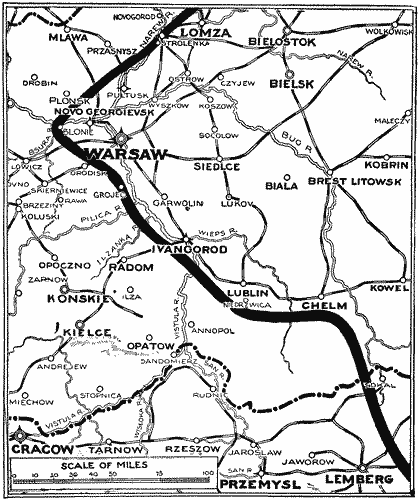
The German battle line on July 24, in Russian Poland.
[Enlarge]
The Germans have an incalculable amount of fighting to face before
they win to that area, the nut to be cracked, and then the cracking is
still to be done. It is all sheer frontal fighting. The Germans have
been twelve months trying frontal attacks against Warsaw on a
comparatively narrow front, and in vain. What chance have they of
success by dividing their forces against the united strength of
Russia?
An official German bulletin dated Berlin, July 17, reported:
The offensive movement begun a few days ago in the eastern theatre of war, under command of Field Marshal von Hindenburg, has led to great results. The army of General von Bülow, which on July 14 crossed the Windau River near and north of Kurshany, continued its victorious advance. Eleven officers and 2,450 men were taken prisoners, and three cannon and five machine guns were captured.
The army of General von Gallwitz proceeded against the Russian positions in the district south and southeast of Olawa. After a brilliant attack three Russian lines, situated behind each other northwest and northeast of Przasnysz, were pierced. Dzielin was captured and Lipa was reached and attacked by pressure exerted from both these directions. The Russians retreated, after the evacuation of Przasnysz on the 14th, to their line of defense from Ciechanow to Krasnosielo, lying behind them. On the 15th German troops also took these enemy positions by storm, and pierced the position south of Zielona, over a front of seven kilometers, forcing their opponents to retreat. They were supported by troops under General von Scholtz, which are occupied with a pursuit from the direction of Kolno. Since yesterday the Russians have been retreating on the center front, between the Pissa and Vistula Rivers, in the direction of Narew.
Southeastern Theatre of War.—After the Teutonic allies had taken during the last few days a series of Russian positions on the River Bug and between the Bug and the Vistula, important battles developed yesterday on this entire front under the leadership of Field Marshal von Mackensen. West of the Vierpz, in the district southwest of Krasnostav, German troops broke through the enemy's line. So far 28 officers and 6,380 men have fallen into our hands, and 9 machine guns have been captured.
West of the Upper Vistula the offensive has again been begun by the army of General von Woyrich.
An official statement issued by general headquarters in Vienna on July 18 says:
On the Bug River, in the region of Sokol, our troops drove the enemy from a series of stubbornly defended places. To the northeast of Sienvno we broke through the Russian front.
The enemy is evacuating his positions between the Vistula and the Kielce-Radom Railway.
An earlier bulletin, dated July 17, read as follows:
Between the Vistula and the Bug Rivers important battles have developed favorably for the allied troops. Some Austro-Hungarians, operating closely with the Germans west of Grabovetz, took an important enemy point of support after storming it several times, and pressed forward into the enemy's main position.
Southwest of Krasnostav the Germans broke through the enemy's lines.
On the Upper Bystrcz and north of Krasnik our troops took advanced positions of the enemy. The offensive also was resumed successfully west of the Vistula.
An Associated Press dispatch from Berlin via London on July 18 said:
The news of Field Marshal von Hindenburg's newest surprise for the Russians, which the War Office announces has resulted in important victories, was made known late yesterday, causing general rejoicing and the appearance of flags all over the city.
Military critics attach great significance to the breaking of the Russian lines and the consequent Russian retreat toward the Narew River, particularly as the German advance between the Pissa and Vistula rivers threatens to crumple the right flank positions of the Russians.
With Field Marshal von Mackensen proceeding against the other flank, the maintenance of communications offers a serious problem for the Russians. The breaking of the Russian line near Krasnostav, thirty-four miles south of Lublin, brings the Germans dangerously near Cholm and Lublin, both of which points are of the highest importance for the Russians in maintaining their position in the Vistula region.
The following official bulletin concerning the operations was issued tonight by the War Office:
Portions of the army of General von Buelow have defeated the Russian forces near Autz, where 3,620 men and six guns and three machine guns were captured. They are pursuing the enemy in an easterly direction.
Other portions of this army are fighting to the northeast of Kurshany. East of that town an enemy advance position has been stormed.
On the southeastern front the offensive was taken by the army under General von Woyrich, which made successful progress under the heavy fire of the enemy.
Our troops on Saturday morning took a narrow point in the wire entanglements of a strongly fortified enemy main position, and through this opening stormed an enemy trench on a front of 2,000 meters (about a mile and a third). In the course of the day the wedge was widened and pushed forward, with tenacious hand-to-hand fighting, far into the enemy's position.
In the evening the enemy's Moscow Grenadier Corps was defeated by our landwehr and reserve troops. The enemy retreated during the night behind the Iljanka River to the district south of Zwolen, suffering heavy losses in their retirement.
Between the Pissa and Vistula Rivers the Russian troops are retreating and the troops of General von Schaltz and von Gallwitz are close behind them.
The enemy is attacked and driven back where he offers resistance in prepared positions.
Reserve troops and a levy of troops of General von Schaltz have stormed the towns of Poremky and Wykplock, and regiments of General von Gallwitz have broken through the extended positions of Mlodzi, Nome and Kaniewo. The number of prisoners was considerably increased and four guns were captured.
From the north of the Vistula to the Pilica the Russians also have begun to retreat. Our troops in a short engagement during the pursuit made 620 prisoners.
Between the Upper Vistula and the Bug fighting continues under the command of Field Marshal von Mackensen. The Russians have been driven by the German troops from the hills of Biclaczkowice, south of Piaski, as far as Krosnoskow, and both these places have been taken by storm. The fire of the Siberian army corps could not ward off defeat. We made more than 1000 prisoners.
An Associated Press dispatch from London dated July 20 recorded the doubt in the English capital of Warsaw's holding out, as follows:
The Morning Post's Budapest correspondent reports that the gradual evacuation of Warsaw has been ordered by the Russians.
Continued successes of the great Teutonic movement against the Polish capital were indicated in the German official bulletin received from Berlin this morning. This stated that the Russians were retreating along the whole front between the Vistula and the Bug. The bulletin reads:
The Germans have occupied Tukum and Windau (Province of Courland).
Between the Vistula and the Bug the battle continues with unabated violence.
The Austro-Hungarians have forced a crossing of the Wolicza River in the neighborhood of Grabovetz and advanced across the Bug to the north of Sokal, the Russians having during the night retreated along the whole front between the Vistula and the Bug.
The Germans captured from July 16 to July 18 16,000 prisoners and twenty-three machine guns.
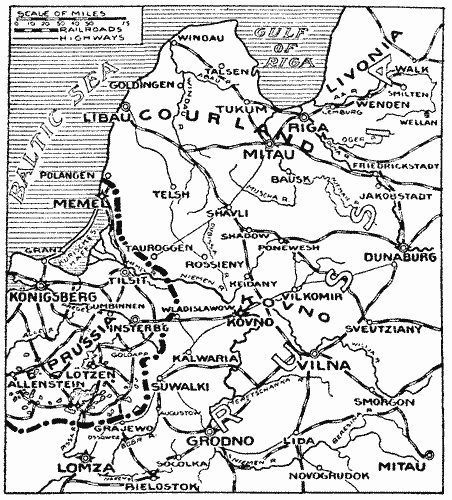
Scene of German operations in Courland
[Enlarge]
That German columns have occupied Tukum, thirty-eight miles west of
Riga, and Doblen eighteen miles west of Mitau, is admitted by an
official statement issued at the headquarters of the Russian general
staff. The same report admits that the Austrians have gained the right
bank of the Volitza and have crossed the Bug River on a front reaching
to Sokal. The bulletin says:
On the Narew front the night of the 18th the enemy took the offensive, capturing the village of Poredy, on the right bank of the Pissa River. On the left bank of the Skwa enemy attacks against the villages of Vyk and Pchetchniak were repulsed with success. West of the Omulew our troops, retiring progressively toward a bridgehead on the Narew, delivered on the evening of the 17th a rearguard action of a stubborn character near the town of Mahoff. Near the village of Karnevo we made a brilliant counter-attack.
In the direction of Lublin enemy attacks during the 18th on the front Wilkolaz-Vychawa (east and north of Krasnik) were successfully repulsed.
At dawn of the 18th the enemy captured Krasnostav, thirty-four miles south of Lublin on the Vieprz, and crossed upstream. During the course of the 19th enemy attacks between the stream flowing from Rybtchevbitze toward the village of Piaski and the Vieprz remained without result. On the right bank of the Vieprz we repulsed near Krasnostav and the River Volitza many extremely stubborn enemy attacks.
Nevertheless, near the mouth of the Volitza and the village of Gaevniki the enemy succeeded in establishing himself on the right bank of this river, after which we judged it advisable to retire to our second-line positions.
In the region of the village of Grabovetz on the 18th we repulsed four furious enemy attacks on a wide front, supported by a curtain of fire from his artillery.
Between Geneichva and the Bug on the evening of the 17th, after a desperate fight we drove the enemy from all the trenches previously occupied by him.
On the Bug energetic fighting continued against the enemy, who crossed on the 18th on the front Skomorskhy-Sokal.
"Can Warsaw be held?" is the question now being asked here.
With the German Field Marshals, von Hindenburg on the north and von Mackensen on the south, whipping forward the two ends of a great arc around the city, it is realized in England that Grand Duke Nicholas, Commander in Chief of the Russian armies, has the most severe task imposed on him since the outbreak of the European war, and the military writers of some of the London papers seem to think that the task is well-nigh impossible.
There was sustained confidence that Germany's previous violent attacks along the Bzura-Rawka front would never pierce the Russian line, but the present colossal co-ordinate movement was developed with such suddenness, and has been carried so far without meeting serious Russian resistance, that more and more the British press is discounting the fall of the Polish capital, and, while not giving up all hope of its retention, is pointing out the enormous difficulty the Russian armies have labored under from the start by the existence of such a salient.
An Associated Press dispatch from London on July 21 said:
From the shores of the Gulf of Riga in the north to that part of Southern Poland into which they drove the Russians back from Galicia, the Austro-German armies are still surging forward, and if Warsaw can be denied them it will be almost a miracle.
This seems to be the opinion even among those in England who heretofore have been hopeful that the Russians would turn and deliver a counter-blow, and news of the evacuation of the Polish capital, followed by the triumphant entry of the Germans amid such scenes as were enacted at Przemysl and Lemberg, would come as no surprise.
The German official statement, beginning at the northern tip of the eastern battle line, records the progress of the German troops to within about fifty miles of Riga. Then, following the great battle arc southward, chronicles further successes in the sector northeast of Warsaw, culminating in the capture of Ostrolenka, one of the fortresses designed to shield the capital.
The acute peril to Warsaw is accentuated by the Russian official communication which says that German columns are within artillery range of the fortress of Novo Georgievsk, the key to the capital from the northwest, and only about twenty miles from it.
Immediately southwest of the city, seventeen miles from it, Blonie has fallen, and further south Grojec, twenty-six miles distant, while German cavalry have captured Radom, capital of the province of that name, on the railroad to the great fortress of Ivangorod. The Lublin-Chelm Railway is still in the hands of the Russians, so far as is known, but the Russian Commander-in-Chief has issued, through the Civil Governor, an order that in case of a retreat from the town of Lublin, the male population is to attach itself to the retiring troops.
The belief is expressed in Danish military circles, according to a Copenhagen dispatch to the Exchange Telegraph Company, that the Germans intend to use Windau and Tukum as bases for operations designed to result in the capture of Riga, which would be used as a new naval base after the Gulf of Riga had been cleared of mines.
From Berlin on July 20 came this report from the German War Office:
Eastern theatre of war: In Courland the Russians were repulsed near Grosschmarden, east of Tukum, and near Gruendorf and Usingen. East of Kurshany the enemy also is retreating before our attack.
North of Novgorod, on the Narew, German troops captured enemy positions north of the confluence of the Skroda and Pissa rivers. Fresh Landsturm troops who were under fire for the first time especially distinguished themselves. North of the mouth of the Skwa we reached the Narew. The permanent fortifications of Ostrolenka, on the northwest bank of the river, were captured.
South of the Vistula our troops advanced into hostile positions to Blonie and Grojec. (Blonie is seventeen miles west of Warsaw, and Grojec twenty-six miles south of the city.) In rearguard fighting the Russians lost 560 prisoners and two machine guns.
Southeastern theatre of war: German Landwehr and reserve troops of the army of General von Woyrich repulsed superior forces of the enemy from their position at Ilzanka. All counter attacks made by Russian reserves, which were brought up quickly, were repulsed. We captured more than 5,000 prisoners. Our troops are closely pursuing the enemy. Our cavalry already has reached the railway line from Radom to Ivangorod.
Between the upper Vistula and the Bug we are following the retreating enemy.
A bulletin, issued early on July 20, had announced the capture of the Baltic port of Windau, thus bringing the Germans within a few miles of Riga, seat of the Governor General of the Baltic Provinces. It read:
German troops occupied Tukum and captured Windau. (Windau is a seaport in Courland on the Baltic Sea at the mouth of the Windau River, 100 miles northwest of Mitau.) Pursuing the enemy, who was defeated on the Aa River at Alt Autz, our troops yesterday undiminished energy, and at some points report that progress has been made.
They are operating, however, through country which the retiring troops have laid waste and in which what roads there are, are little suited for the movement of the heavy artillery which is necessary for the bombardment of the great fortresses that bar their way.
It is not expected, therefore, that decisive actions on any of the fronts will be fought for a few days yet, although the battle between the Vistula and the Bug Rivers, where the German Field Marshal von Mackensen's army is advancing toward the Lublin-Chelm Railroad, has about reached a climax. Here, according to the German official communication issued this afternoon, the Germans have succeeded in breaking the obstinate resistance of the Russians at several points and forced them to retreat.
The following diagram, compiled mainly from information given in a June number of the Naval and Military Record and appearing in the London Morning Post of July 8, 1915, shows the different causes of loss to each side in tonnage of capital ships, gunboats, destroyers, submarines, torpedo-boats, and armed merchantmen to the end of May. The diagram being drawn to scale the true proportion of each loss from each cause can be accurately gauged at a glance. It will be seen that the Triple Entente and Japan have had no loss from capture or internment, that the Entente's characteristic of fighting has been "above board," i.e., by gunfire, while that of the enemy has been by submarines and mines.
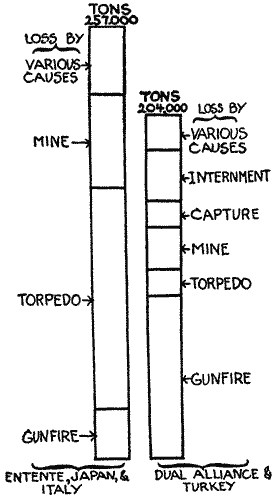
Since June 15, 1915, the British army, reinforced by divisions of the "new" army now in France, has held practically the same position on the front to the north and south of Ypres. The subjoined report by Sir John French, Commanding-in-Chief the British forces in France, published July 12, covers the operations from April 5 down to June 15, and deals particularly with the great poison-gas attacks by the enemy, the capture and loss of Hill 60, the second battle of Ypres, and the battle of Festubert. It embodies the story by Sir Herbert Plumer of the terrible fighting that began May 5. France's official reports, following, tell of the battle of Hilgenfirst in the Vosges, the week's battle in the Fecht valley, the 120 days' struggle between Betlaine and Arras, and the battle of Fontenelle. The Crown Prince's "drive" in the Argonne resulting in German advantages is also dealt with.
To the Secretary of State for War, War Office, London, S.W.
GENERAL HEADQUARTERS,
June 15, 1915.
My Lord,
I HAVE the honor to report that since the date of my last dispatch (April 5, 1915) the Army in France under my command has been heavily engaged opposite both flanks of the line held by the British Forces.
1. In the North the town and district of Ypres has once more in this campaign been successfully defended against vigorous and sustained attacks made by large forces of the enemy and supported by a mass of heavy and field artillery, which, not only in number, but also in weight and caliber, is superior to any concentration of guns which has previously assailed that part of the line.
In the South a vigorous offensive has again been taken by troops of the First Army, in the course of which a large area of entrenched and fortified ground has been captured from the enemy, whilst valuable support has been afforded to the attack which our Allies have carried on with such marked success against the enemy's positions to the east of Arras and Lens.
2. I much regret that during the period under report the fighting has been characterized on the enemy's side by a cynical and barbarous disregard of the well-known usages of civilized war and a flagrant defiance of The Hague Convention.[2]
All the scientific resources of Germany have apparently been brought into play to produce a gas of so virulent and poisonous a nature that any human being brought into contact with it is first paralyzed and then meets with a lingering and agonizing death.
The enemy has invariably preceded, prepared and supported his attacks by a discharge in stupendous volume of these poisonous gas fumes whenever the wind was favorable.
Such weather conditions have only prevailed to any extent in the neighborhood of Ypres, and there can be no doubt that the effect of these poisonous fumes materially influenced the operations in that theater, until experience suggested effective counter-measures, which have since been so perfected as to render them innocuous.
The brain power and thought which has evidently been at work before this unworthy method of making war reached the pitch of efficiency which has been demonstrated in its practice shows that the Germans must have harbored these designs for a long time.
As a soldier I cannot help expressing the deepest regret and some surprise that an Army which hitherto has claimed to be the chief exponent of the chivalry of war should have stooped to employ such devices against brave and gallant foes.
3. On the night of Saturday, April 17, a commanding hill which afforded the enemy excellent artillery observation toward the west and northwest was successfully mined and captured.
This hill, known as Hill 60, lies opposite the northern extremity of the line held by the 2d Corps.
The operation was planned and the mining commenced by Major-General Bulfin before the ground was handed over to the troops under Lieutenant-General Sir Charles Fergusson, under whose supervision the operation was carried out.
The mines were successfully fired at 7 P.M. on the 17th inst., and immediately afterwards the hill was attacked and gained, without difficulty, by the 1st Battalion Royal West Kent Regiment and the 2d Battalion King's Own Scottish Borderers. The attack was well supported by the Divisional Artillery, assisted by French and Belgian batteries.
During the night several of the enemy's counter-attacks were repulsed with heavy loss, and fierce hand-to-hand fighting took place; but on the early morning of the 18th the enemy succeeded in forcing back the troops holding the right of the hill to the reverse slope, where, however, they hung on throughout the day.
On the evening of the 18th these two battalions were relieved by the 2d Battalion West Riding Regiment and the 2d Battalion King's Own Yorkshire Light Infantry, who again stormed the hill under cover of heavy artillery fire, and the enemy was driven off at the point of the bayonet.
In this operation fifty-three prisoners were captured, including four officers.
On the 20th and following days many unsuccessful attacks by the enemy were made on Hill 60, which was continually shelled by heavy artillery.
On May 1 another attempt to recapture Hill 60 was supported by great volumes of asphyxiating gas, which caused nearly all the men along a front of about 400 yards to be immediately struck down by its fumes.
The splendid courage with which the leaders rallied their men and subdued the natural tendency to panic (which is inevitable on such occasions), combined with the prompt intervention of supports, once more drove the enemy back.
A second and more severe "gas" attack, under much more favorable weather conditions, enabled the enemy to recapture this position on May 5.
The enemy owes his success in this last attack entirely to the use of asphyxiating gas. It was only a few days later that the means, which have since proved so effective, of counteracting this method of making war were put into practice. Had it been otherwise, the enemy's attack on May 5 would most certainly have shared the fate of all the many previous attempts he had made.
4. It was at the commencement of the second battle of Ypres on the evening of April 22, referred to in paragraph 1 of his report, that the enemy first made use of asphyxiating gas.
Some days previously I had complied with General Joffre's request to take over the trenches occupied by the French, and on the evening of the 22d the troops holding the lines east of Ypres were posted as follows:
From Steenstraate to the east of Langemarck, as far as the Poelcappelle Road, a French Division.
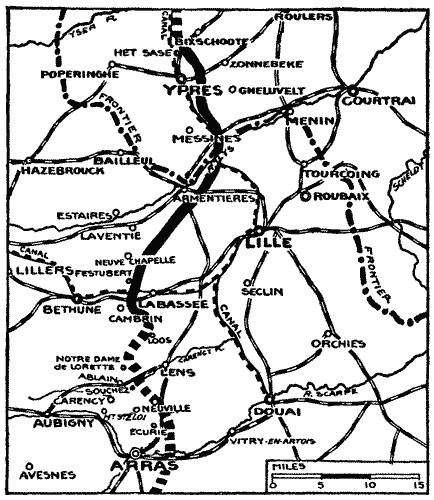
The British battle line in Flanders, Belgium.
[Enlarge]
Thence, in a south-easterly direction toward the
Passchendaele-Becelaere Road, the Canadian Division.
Thence a Division took up the line in a southerly direction east of Zonnebeke to a point west of Becelaere, whence another Division continued the line southeast to the northern limit of the Corps on its right.
Of the 5th Corps there were four battalions in Divisional Reserve about Ypres; the Canadian Division had one battalion of Divisional Reserve and the 1st Canadian Brigade in Army Reserve. An Infantry Brigade, which had just been withdrawn after suffering heavy losses on Hill 60, was resting about Vlamernighe.
Following a heavy bombardment, the enemy attacked the French Division at about 5 P.M., using asphyxiating gases for the first time. Aircraft reported that at about 5 P.M. thick yellow smoke had been seen issuing from the German trenches between Langemarck and Bixschoote. The French reported that two simultaneous attacks had been made east of the Ypres-Staden Railway, in which these asphyxiating gases had been employed.
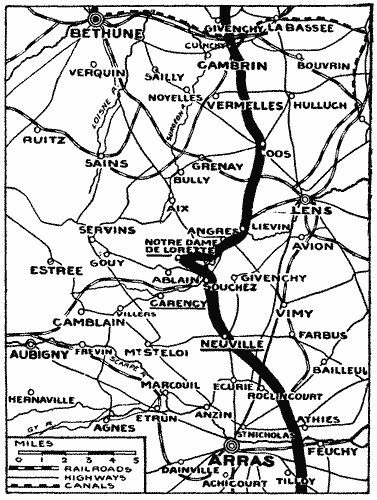
The Arras region, showing battle line and scene of fiercest battle in recent months.
[Enlarge]
What follows almost defies description. The effect of these poisonous
gases was so virulent as to render the whole of the line held by the
French Division mentioned above practically incapable of any action at
all. It was at first impossible for any one to realize what had
actually happened. The smoke and fumes hid everything from sight, and
hundreds of men were thrown into a comatose or dying condition, and
within an hour the whole position had to be abandoned, together with
about fifty guns.
I wish particularly to repudiate any idea of attaching the least blame to the French Division for this unfortunate incident.
After all the examples our gallant Allies have shown of dogged and tenacious courage in the many trying situations in which they have been placed throughout the course of this campaign it is quite superfluous for me to dwell on this aspect of the incident, and I would only express my firm conviction that, if any troops in the world had been able to hold their trenches in the face of such a treacherous and altogether unexpected onslaught, the French Division would have stood firm.
The left flank of the Canadian Division was thus left dangerously exposed to serious attack in flank, and there appeared to be a prospect of their being overwhelmed and of a successful attempt by the Germans to cut off the British troops occupying the salient to the East.
In spite of the danger to which they were exposed the Canadians held their ground with a magnificent display of tenacity and courage; and it is not too much to say that the bearing and conduct of these splendid troops averted a disaster which might have been attended with the most serious consequences.
They were supported with great promptitude by the reserves of the divisions holding the salient and by a brigade which had been resting in billets.
Throughout the night the enemy's attacks were repulsed, effective counter-attacks were delivered, and at length touch was gained with the French right, and a new line was formed.
The 2d London Heavy Battery, which had been attached to the Canadian Division, was posted behind the right of the French Division, and, being involved in their retreat, fell into the enemy's hands. It was recaptured by the Canadians in their counter-attack, but the guns could not be withdrawn before the Canadians were again driven back.
During the night I directed the Cavalry Corps and the Northumbrian Division, which was then in general reserve, to move to the west of Ypres, and placed these troops at the disposal of the General Officer Commanding the Second Army. I also directed other reserve troops from the 3d Corps and the First Army to be held in readiness to meet eventualities.
In the confusion of the gas and smoke the Germans succeeded in capturing the bridge at Steenstraate and some works south of Lizerne, all of which were in occupation by the French.
The enemy having thus established himself to the west of the Ypres Canal, I was somewhat apprehensive of his succeeding in driving a wedge between the French and Belgian troops at this point. I directed, therefore, that some of the reinforcements sent north should be used to support and assist General Putz, should he find difficulty in preventing any further advance of the Germans west of the canal.
At about ten o'clock on the morning of the 23d connection was finally ensured between the left of the Canadian Division and the French right, about 800 yards east of the canal; but as this entailed the maintenance by the British troops of a much longer line than that which they had held before the attack commenced on the previous night, there were no reserves available for counter-attack until reinforcements, which were ordered up from the Second Army, were able to deploy to the east of Ypres.
Early on the morning of the 23d I went to see General Foch, and from him I received a detailed account of what had happened, as reported by General Putz. General Foch informed me that it was his intention to make good the original line and regain the trenches which the French Division had lost. He expressed the desire that I should maintain my present line, assuring me that the original position would be re-established in a few days. General Foch further informed me that he had ordered up large French reinforcements, which were now on their way, and that troops from the North had already arrived to reinforce General Putz.
I fully concurred in the wisdom of the General's wish to re-establish our old line, and agreed to co-operate in the way he desired, stipulating, however, that if the position was not re-established within a limited time I could not allow the British troops to remain in so exposed a situation as that which the action of the previous twenty-four hours had compelled them to occupy.
During the whole of the 23d the enemy's artillery was very active, and his attacks all along the front were supported by some heavy guns which had been brought down from the coast in the neighborhood of Ostend.
The loss of the guns on the night of the 22d prevented this fire from being kept down, and much aggravated the situation. Our positions, however, were well maintained by the vigorous counter-attacks made by the 5th Corps.
During the day I directed two brigades of the 3d Corps, and the Lahore Division of the Indian Corps, to be moved up to the Ypres area and placed at the disposal of the Second Army.
In the course of these two or three days many circumstances combined to render the situation east of the Ypres Canal very critical and most difficult to deal with.
The confusion caused by the sudden retirement of the French Division, and the necessity for closing up the gap and checking the enemy's advance at all costs, led to a mixing up of units and a sudden shifting of the areas of command, which was quite unavoidable. Fresh units, as they came up from the South, had to be pushed into the firing line in an area swept by artillery fire, which, owing to the capture of the French guns, we were unable to keep down.
All this led to very heavy casualties, and I wish to place on record the deep admiration which I feel for the resource and presence of mind evinced by the leaders actually on the spot.
The parts taken by Major-General Snow and Brigadier-General Hull were reported to me as being particularly marked in this respect.
An instance of this occurred on the afternoon of the 24th, when the enemy succeeded in breaking through the line at St. Julien.
Brigadier-General Hull, acting under the orders of Lieutenant-General Alderson, organized a powerful counter-attack with his own brigade and some of the nearest available units. He was called upon to control, with only his brigade staff, parts of battalions from six separate divisions which were quite new to the ground. Although the attack did not succeed in retaking St. Julien, it effectually checked the enemy's further advance.
It was only on the morning of the 25th that the enemy were able to force back the left of the Canadian Division from the point where it had originally joined the French line.
During the night, and the early morning of the 25th, the enemy directed a heavy attack against the Division at Broodseinde cross-roads, which was supported by a powerful shell fire, but he failed to make any progress.
During the whole of this time the town of Ypres and all the roads to the East and West were uninterruptedly subjected to a violent artillery fire, but in spite of this the supply of both food and ammunition was maintained throughout with order and efficiency.
During the afternoon of the 25th many German prisoners were taken, including some officers. The hand-to-hand fighting was very severe, and the enemy suffered heavy loss.
During the 26th the Lahore Division and a Cavalry Division were pushed up into the fighting line, the former on the right of the French, the latter in support of the 5th Corps.
In the afternoon the Lahore Division, in conjunction with the French right, succeeded in pushing the enemy back some little distance toward the north, but their further advance was stopped owing to the continual employment by the enemy of asphyxiating gas.
On the right of the Lahore Division the Northumberland Infantry Brigade advanced against St. Julien and actually succeeded in entering, and for a time occupying, the southern portion of that village. They were, however, eventually driven back, largely owing to gas, and finally occupied a line a short way to the south. This attack was most successfully and gallantly led by Brigadier-General Riddell, who, I regret to say, was killed during the progress of the operation.
Although no attack was made on the southeastern side of the salient, the troops operating to the east of Ypres were subjected to heavy artillery fire from this direction, which took some of the battalions, which were advancing north to the attack, in reverse.
Some gallant attempts made by the Lahore Division on the 27th, in conjunction with the French, pushed the enemy further north; but they were partially frustrated by the constant fumes of gas to which they were exposed. In spite of this, however, a certain amount of ground was gained.
The French had succeeded in retaking Lizerne, and had made some progress at Steenstraate and Het Sas; but up to the evening of the 28th no further progress had been made toward the recapture of the original line.
I sent instructions, therefore, to Sir Herbert Plumer, who was now in charge of the operation, to take preliminary measures for the retirement to the new line which had been fixed upon.
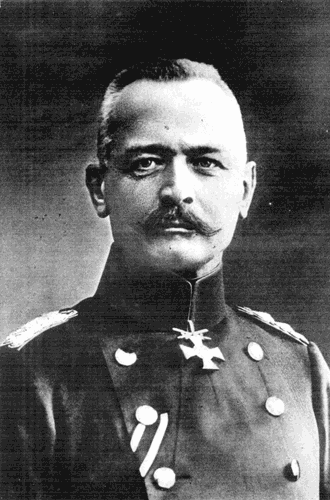
GENERAL ERICH VON FALKENHAYN
Chief of the General Staff of the German Army
(Photo from Ruschin.)
On the morning of the 29th I had another interview with General Foch, who informed me that strong reinforcements were hourly arriving to support General Putz, and urged me to postpone issuing orders for any retirement until the result of his attack, which was timed to commence at daybreak on the 30th, should be known. To this I agreed, and instructed Sir Herbert Plumer accordingly.
No substantial advance having been made by the French, I issued orders to Sir Herbert Plumer at one o'clock on May 1 to commence his withdrawal to the new line.
The retirement was commenced the following night, and the new line was occupied on the morning of May 4.
I am of opinion that this retirement, carried out deliberately with scarcely any loss, and in the face of an enemy in position, reflects the greatest possible credit on Sir Herbert Plumer and those who so efficiently carried out his orders.
The successful conduct of this operation was the more remarkable from the fact that on the evening of May 2, when it was only half completed, the enemy made a heavy attack, with the usual gas accompaniment, on St. Julien and the line to the west of it.
An attack on a line to the east of Fortuin was made at the same time under similar conditions.
In both cases our troops were at first driven from their trenches by gas fumes, but on the arrival of the supporting battalions and two brigades of a cavalry division, which were sent up in support from about Potijze, all the lost trenches were regained at night.
On May 3, while the retirement was still going on, another violent attack was directed on the northern face of the salient. This was also driven back with heavy loss to the enemy.
Further attempts of the enemy during the night of the 3d to advance from the woods west of St. Julien were frustrated entirely by the fire of our artillery.
During the whole of the 4th the enemy heavily shelled the trenches we had evacuated, quite unaware that they were no longer occupied. So soon as the retirement was discovered the Germans commenced to entrench opposite our new line and to advance their guns to new positions. Our artillery, assisted by aeroplanes, caused him considerable loss in carrying out these operations.
Up to the morning of the 8th the enemy made attacks at short intervals, covered by gas, on all parts of the line to the east of Ypres, but was everywhere driven back with heavy loss.
Throughout the whole period since the first break of the line on the night of April 22 all the troops in this area had been constantly subjected to violent artillery bombardment from a large mass of guns with an unlimited supply of ammunition. It proved impossible whilst under so vastly superior fire of artillery to dig efficient trenches, or to properly reorganize the line, after the confusion and demoralization called by the first great gas surprise and the subsequent almost daily gas attacks. Nor was it until after this date (May 8) that effective preventatives had been devised and provided. In these circumstances a violent bombardment of nearly the whole of the 5th Corps front broke out at 7 A.M. on the morning of the 8th, which gradually concentrated on the front of the Division between north and south of Frezenberg. This fire completely obliterated the trenches and caused enormous losses.
The artillery bombardment was shortly followed by a heavy infantry attack, before which our line had to give way.
I relate what happened in Sir Herbert Plumer's own words:
"The right of one brigade was broken about 10.15 A.M.; then its centre, and then part of the left of the brigade in the next section to the south. The Princess Patricia's Canadian Light Infantry, however, although suffering very heavily, stuck to their fire or support trenches throughout the day. At this time two battalions were moved to General Headquarters second line astride the Menin road to support and cover the left of their division.
"At 12.25 P.M. the center of a brigade further to the left also broke; its right battalion, however, the 1st Suffolks, which had been refused to cover a gap, still held on, and were apparently surrounded and overwhelmed. Meanwhile, three more battalions had been moved up to reinforce, two other battalions were moved up in support to General Headquarters line and an infantry brigade came up to the grounds of Vlamertinghe Chateau in corps reserve.
"At 11.30 A.M. a small party of Germans attempted to advance against the left of the British line, but were destroyed by the 2d Essex Regiment.
"A counter-attack was launched at 3.30 P.M. by the 1st York and Lancaster Regiment, 3d Middlesex Regiment, 2d East Surrey Regiment, 2d Royal Dublin Fusiliers, and the 1st Royal Warwickshire Regiment. The counter-attack reached Frezenberg, but was eventually driven back and held up on a line running about north and south through Verlorenhoek, despite repeated efforts to advance. The 12th London Regiment on the left succeeded at great cost in reaching the original trench line, and did considerable execution with their machine gun.
"The 7th Argyll and Sutherland Highlanders and the 1st East Lancashire Regiment attacked in a northeasterly direction toward Wieltje, and connected the old trench line with the ground gained by the counter-attack, the line being consolidated during the night.
"During the night orders were received that two Cavalry Divisions would be moved up and placed at the disposal of the 5th Corps, and a Territorial Division would be moved up to be used if required.
"On the 9th the Germans again repeated their bombardment. Very heavy shell fire was concentrated for two hours on the trenches of the 2d Gloucestershire Regiment and 2d Cameron Highlanders, followed by an infantry attack which was successfully repulsed. The Germans again bombarded the salient, and a further attack in the afternoon succeeded in occupying 150 yards of trench. The Gloucesters counter-attacked, but suffered heavily, and the attack failed. The salient being very exposed to shell fire from both flanks, as well as in front, it was deemed advisable not to attempt to retake the trench at night, and a retrenchment was therefore dug across it.
"At 3 P.M. the enemy started to shell the whole front of the center Division, and it was reported that the right Brigade of this Division was being heavily punished, but continued to maintain its line.
"The trenches of the Brigades on the left center were also heavily shelled during the day and attacked by infantry. Both attacks were repulsed.
"On the 10th instant the trenches on either side of the Menin-Ypres road were shelled very severely all the morning. The 2d Cameron Highlanders, 9th Royal Scots, and the 3d and 4th King's Royal Rifles, however, repulsed an attack made, under cover of gas, with heavy loss. Finally, when the trenches had been practically destroyed and a large number of the garrison buried, the 3d King's Royal Rifles and 4th Rifle Brigade fell back to the trenches immediately west of Bellewaarde Wood. So heavy had been the shell fire that the proposal to join up the line with a switch through the wood had to be abandoned, the trees broken by the shells forming an impassable entanglement.
"After a comparatively quiet night and morning (10th-11th) the hostile artillery fire was concentrated on the trenches of the 2d Cameron Highlanders and 1st Argyll and Sutherland Highlanders at a slightly more northern point than on the previous day. The Germans attacked in force and gained a footing in part of the trenches, but were promptly ejected by a supporting company of the 9th Royal Scots. After a second short artillery bombardment the Germans again attacked about 5.15 P.M., but were again repulsed by rifle and machine-gun fire. A third bombardment followed, and this time the Germans succeeded in gaining a trench—or rather what was left of it—a local counter-attack failing. However, during the night the enemy were again driven out. The trench by this time being practically non-existent, the garrison found it untenable under the very heavy shell fire the enemy brought to bear upon it, and the trench was evacuated. Twice more did the German snipers creep back into it, and twice more they were ejected. Finally, a retrenchment was made, cutting off the salient which had been contested throughout the day. It was won owing solely to the superior weight and number of the enemy's guns, but both our infantry and our artillery took a very heavy toll of the enemy, and the ground lost has proved of little use to the enemy.
"On the remainder of the front the day passed comparatively quietly, though most parts of the line underwent intermittent shelling by guns of various calibers.
"With the assistance of the Royal Flying Corps the 31st Heavy Battery scored a direct hit on a German gun, and the North Midland Heavy Battery got on to some German howitzers with great success.
"With the exception of another very heavy burst of shell fire against the right Division early in the morning the 12th passed uneventfully.
"On the night of the 12th-13th the line was reorganized, the center Division retiring into Army Reserve to rest, and their places being taken in the trenches by the two Cavalry Divisions; the Artillery and Engineers of the center Division forming with them what was known as the 'Cavalry Force,' under the command of General De Lisle.
"On the 13th, the various reliefs having been completed without incident, the heaviest bombardment yet experienced broke out at 4.30 A.M., and continued with little intermission throughout the day. At about 7.45 A.M. the Cavalry Brigade astride the railway, having suffered very severely, and their trenches having been obliterated, fell back about 800 yards. The North Somerset Yeomanry, on the right of the Brigade, although also suffering severely, hung on to their trenches throughout the day, and actually advanced and attacked the enemy with the bayonet. The Brigade on its right also maintained its position; as did also the Cavalry Division, except the left squadron, which, when reduced to sixteen men, fell back. The 2d Essex Regiment, realizing the situation, promptly charged and retook the trench, holding it till relieved by the cavalry. Meanwhile a counter-attack by two cavalry brigades was launched at 2.30 P.M., and succeeded, in spite of very heavy shrapnel and rifle fire, in regaining the original line of trenches, turning out the Germans who had entered it, and in some cases pursuing them for some distance. But a very heavy shell fire was again opened on them, and they were again compelled to retire to an irregular line in rear, principally the craters of shell holes. The enemy in their counter-attack suffered very severe losses.
"The fighting in other parts of the line was little less severe. The 1st East Lancashire Regiment were shelled out of their trenches, but their support company and the 2d Essex Regiment, again acting on their own initiative, won them back. The enemy penetrated into the farm at the northeast corner of the line, but the 1st Rifle Brigade, after a severe struggle, expelled them. The 1st Hampshire Regiment also repelled an attack, and killed every German who got within fifty yards of their trenches. The 5th London Regiment, despite very heavy casualties, maintained their position unfalteringly. At the southern end of the line the left brigade was once again heavily shelled, as indeed was the whole front. At the end of a very hard day's fighting, our line remained in its former position, with the exception of the short distance lost by one cavalry division. Later, the line was pushed forward, and a new line was dug in a less exposed position, slightly in rear of that originally held. The night passed quietly.
"Working parties of from 1,200 to 1,800 men have been found every night by a Territorial Division and other units for work on rear lines of defence, in addition to the work performed by the garrisons in reconstructing the front line trenches which were daily destroyed by shell fire.
"The work performed by the Royal Flying Corps has been invaluable. Apart from the hostile aeroplanes actually destroyed, our airmen have prevented a great deal of aerial reconnaissance by the enemy, and have registered a large number of targets with our artillery.
"There have been many cases of individual gallantry. As instances, may be given the following:
"During one of the heavy attacks made against our infantry gas was seen rolling forward from the enemy's trenches. Private Lynn, of the 2d Lancashire Fusiliers, at once rushed to the machine-gun without waiting to adjust his respirator. Single-handed he kept his gun in action the whole time the gas was rolling over, actually hoisting it on the parapet to get a better field of fire. Although nearly suffocated by the gas, he poured a stream of lead into the advancing enemy and checked their attack. He was carried to his dug-out, but, hearing another attack was imminent, he tried to get back to his gun. Twenty-four hours later he died in great agony from the effects of the gas.
"A young subaltern in a cavalry regiment went forward alone one afternoon to reconnoiter. He got into a wood 1,200 yards in front of our lines, which he found occupied by Germans, and came back with the information that the enemy had evacuated a trench and were digging another—information which proved most valuable to the artillery as well as to his own unit.
"A patrol of two officers and a non-commissioned officer of the 1st Cambridgeshires went out one night to reconnoiter a German trench 350 yards away. Creeping along the parapet of the trench they heard sounds indicating the presence of six or seven of the enemy. Further on they heard deep snores apparently proceeding from a dug-out immediately beneath them. Although they knew that the garrison of the trench outnumbered them they decided to procure an identification. Unfortunately in pulling out a clasp knife with which to cut off the sleeper's identity disc, one of the officer's revolvers went off. A conversation in agitated whispers broke out in the German trench, but the patrol crept safely away, the garrison being too startled to fire.
"Despite the very severe shelling to which the troops had been subjected, which obliterated trenches and caused very many casualties, the spirit of all ranks remains excellent. The enemy's losses, particularly on May 10 and 13, have unquestionably been serious. On the latter day they evacuated trenches (in face of the cavalry counter-attack) in which were afterwards found quantities of equipment and some of their own wounded. The enemy have been seen stripping our dead, and on three occasions men in khaki have been seen advancing."
The fight went on by the exchange of desultory shell and rifle fire, but without any remarkable incident until the morning of May 24. During this period, however, the French on our left had attained considerable success. On May 15 they captured Steenstraate and the trenches in Het Sas, and on May 16 they drove the enemy headlong over the canal, finding 2,000 German dead. On May 17 they made a substantial advance on the east side of the canal, and on May 20 they repelled a German counter-attack, making a further advance in the same direction, and taking 100 prisoners.
On the early morning of May 24 a violent outburst of gas against nearly the whole front was followed by heavy shell fire, and the most determined attack was delivered against our position east of Ypres.
The hour the attack commenced was 2.45 A.M. A large proportion of the men were asleep, and the attack was too sudden to give them time to put on their respirators.
The 2d Royal Irish and the 9th Argyll and Sutherland Highlanders, overcome by gas fumes, were driven out of a farm held in front of the left Division, and this the enemy proceeded to hold and fortify.
All attempts to retake this farm during the day failed, and during the night of May 24-25 the General Officer Commanding the left Division decided to take up a new line which, although slightly in rear of the old one, he considered to be a much better position. This operation was successfully carried out.
Throughout the day the whole line was subjected to one of the most violent artillery attacks which it had ever undergone; and the 5th Corps and the Cavalry Divisions engaged had to fight hard to maintain their positions. On the following day, however, the line was consolidated, joining the right of the French at the same place as before, and passing through Wieltje (which was strongly fortified) in a southerly direction on to Hooge, where the cavalry have since strongly occupied the chateau, and pushed our line further east.
In pursuance of a promise which I made to the French Commander-in-Chief to support an attack which his troops were making on May 9 between the right of my line and Arras, I directed Sir Douglas Haig to carry out on that date an attack on the German trenches in the neighborhood of Rougebanc (northwest of Fromelles) by the 4th Corps, and between Neuve Chapelle and Givenchy by the 1st and Indian Corps.
The bombardment of the enemy's positions commenced at 5 A.M.
Half an hour later the 8th Division of the 4th Corps captured the first line of German trenches about Rougebanc, and some detachments seized a few localities beyond this line. It was soon found, however, that the position was much stronger than had been anticipated and that a more extensive artillery preparation was necessary to crush the resistance offered by his numerous fortified posts.
Throughout May 9 and 10 repeated efforts were made to make further progress. Not only was this found to be impossible, but the violence of the enemy's machine-gun fire from his posts on the flanks rendered the captured trenches so difficult to hold that all the units of the 4th Corps had to retire to their original position by the morning of May 10.
The 1st and Indian Divisions south of Neuve Chapelle met with no greater success, and on the evening of May 10 I sanctioned Sir Douglas Haig's proposal to concentrate all our available resources on the southern point of attack.
The 7th Division was moved round from the 4th Corps area to support this attack, and I directed the General Officer Commanding the First Army to delay it long enough to insure a powerful and deliberate artillery preparation.
The operations of May 9 and 10 formed part of a general plan of attack which the Allies were conjointly conducting on a line extending from the north of Arras to the south of Armentieres; and, although immediate progress was not made during this time by the British forces, their attack assisted in securing the brilliant successes attained by the French forces on their right, not only by holding the enemy in their front, but by drawing off a part of the German reinforcements which were coming up to support their forces east of Arras.
On May 15 I moved the Canadian Division into the 1st Corps area and placed them at the disposal of Sir Douglas Haig.
The infantry of the Indian Corps and the 2d Division of the 1st Corps advanced to the attack of the enemy's trenches which extended from Richebourg L'Avoué in a south-westerly direction.
Before daybreak the 2d Division had succeeded in capturing two lines of the enemy's trenches, but the Indian Corps were unable to make any progress owing to the strength of the enemy's defenses in the neighborhood of Richebourg L'Avoué.
At daybreak the 7th Division, on the night of the 2d, advanced to the attack, and by 7 A.M. had entrenched themselves on a line running nearly north and south, halfway between their original trenches and La Quinque Rue, having cleared and captured several lines of the enemy's trenches, including a number of fortified posts.
As it was found impossible for the Indian Corps to make any progress in face of the enemy's defenses, Sir Douglas Haig directed the attack to be suspended at this point and ordered the Indian Corps to form a defensive flank.
The remainder of the day was spent in securing and consolidating positions which had been won, and endeavoring to unite the inner flanks of the 7th and 2d Divisions, which were separated by trenches and posts strongly held by the enemy.
Various attempts which were made throughout the day to secure this object had not succeeded at nightfall in driving the enemy back.
The German communications leading to the rear of their positions were systematically shelled throughout the night.
About 200 prisoners were captured on May 16.
Fighting was resumed at daybreak; and by eleven o'clock the 7th Division had made a considerable advance, capturing several more of the enemy's trenches. The task allotted to this Division was to push on in the direction of Rue D'Ouvert, Chateau St. Roch and Canteleux.
The 2d Division was directed to push on when the situation permitted toward the Rue de Marais and Violaines.
The Indian Division was ordered to extend its front far enough to enable it to keep touch with the left of the 2d Division when they advanced.
On this day I gave orders for the 51st (Highland) Division to move into the neighborhood of Estaires to be ready to support the operations of the First Army.
At about noon the enemy was driven out of the trenches and posts which he occupied between the two Divisions, the inner flanks of which were thus enabled to join hands.
By nightfall the 2d and 7th Divisions had made good progress, the area of captured ground being considerably extended to the right by the successful operations of the latter.
The state of the weather on the morning of May 18 much hindered an effective artillery bombardment, and further attacks had, consequently, to be postponed.
Infantry attacks were made throughout the line in the course of the afternoon and evening, but, although not very much progress was made, the line was advanced to the La Quinque Rue-Bethune Road before nightfall.
On May 19 the 7th and 2d Divisions were drawn out of the line to rest. The 7th Division was relieved by the Canadian Division and the 2d Division by the 51st (Highland) Division.
Sir Douglas Haig placed the Canadian and 51st Divisions, together with the artillery of the 2d and 7th Divisions, under the command of Lieutenant-General Alderson, whom he directed to conduct the operations which had hitherto been carried on by the General Officer Commanding First Corps; and he directed the 7th Division to remain in Army Reserve.
During the night of May 19-20 a small post of the enemy in front of La Quinque Rue was captured.
During the night of May 20-21 the Canadian Division brilliantly carried on the excellent progress made by the 7th Division by seizing several of the enemy's trenches and pushing forward their whole line several hundred yards. A number of prisoners and some machine guns were captured.
On May 22 the 51st (Highland) Division was attached to the Indian Corps, and the General Officer Commanding the Indian Corps took charge of the operations at La Quinque Rue, Lieutenant-General Alderson with the Canadians conducting the operations to the north of that place.
On this day the Canadian Division extended their line slightly to the right and repulsed three very severe hostile counter-attacks.
On May 24 and 25 the 47th Division (2d London Territorial) succeeded in taking some more of the enemy's trenches and making good the ground gained to the east and north.
I had now reason to consider that the battle, which was commenced by the First Army on May 9 and renewed on May 16, having attained for the moment the immediate object I had in view, should not be further actively proceeded with; and I gave orders to Sir Douglas Haig to curtail his artillery attack and to strengthen and consolidate the ground he had won.
In the battle of Festubert above described the enemy was driven from a position which was strongly entrenched and fortified, and ground was won on a front of four miles to an average depth of 600 yards.
The enemy is known to have suffered very heavy losses, and in the course of the battle 785 prisoners and ten machine guns were captured. A number of machine guns were also destroyed by our fire.
During the period under report the Army under my command has taken over trenches occupied by some other French divisions.
I am much indebted to General D'Urbal, commanding the 10th French Army, for the valuable and efficient support received throughout the battle of Festubert from three groups of French 75 centimetre guns.
In spite of very unfavorable weather conditions, rendering observation most difficult, our own artillery did excellent work throughout the battle.
As an instance of the successful attempts to deceive the enemy in this respect it may be mentioned that on the afternoon of May 24 a bombardment of about an hour was carried out by the 6th Division with the object of distracting attention from the Ypres salient.
Considerable damage was done to the enemy's parapets and wire; and that the desired impression was produced on the enemy is evident from the German wireless news on that day, which stated, "West of Lille the English attempts to attack were nipped in the bud."
I have much pleasure in again expressing my warm appreciation of the admirable manner in which all branches of the Medical Services now in the field, under the direction of Surgeon-General Sir Arthur Sloggett, have met and dealt with the many difficult situations resulting from the operations during the last two months.
The medical units at the front were frequently exposed to the enemy's fire, and many casualties occurred amongst the officers of the regimental Medical Service. At all times the officers, non-commissioned officers and men, and nurses carried out their duties with fearless bravery and great devotion to the welfare of the sick and wounded.
The whole organization of the Medical Services reflects the highest credit on all concerned.
I have once more to call your Lordship's attention to the part taken by the Royal Flying Corps in the general progress of the campaign, and I wish particularly to mention the invaluable assistance they rendered in the operations described in this report, under the able direction of Major-General Sir David Henderson.
The Royal Flying Corps is becoming more and more an indispensable factor in combined operations. In co-operation with the artillery, in particular, there has been continuous improvement both in the methods and in the technical material employed. The ingenuity and technical skill displayed by the officers of the Royal Flying Corps in effecting this improvement have been most marked.
Since my last dispatch there has been a considerable increase both in the number and in the activity of German aeroplanes in our front. During this period there have been more than sixty combats in the air, in which not one British aeroplane has been lost. As these flights take place almost invariably over or behind the German lines, only one hostile aeroplane has been brought down in our territory. Five more, however, have been definitely wrecked behind their own lines, and many have been chased down and forced to land in most unsuitable ground.
In spite of the opposition of hostile aircraft, and the great number of anti-aircraft guns employed by the enemy, air reconnaissance has been carried out with regularity and accuracy.
I desire to bring to your Lordship's notice the assistance given by the French military authorities, and in particular by General Hirschauer, Director of the French Aviation Service, and his assistants, Colonel Bottieaux and Colonel Stammler, in the supply of aeronautical material, without which the efficiency of the Royal Flying Corps would have been seriously impaired.
In this dispatch I wish again to remark upon the exceptionally good work done throughout this campaign by the Army Service Corps and by the Army Ordnance Department, not only in the field, but also on the lines of communication and at the base ports.
To foresee and meet the requirements in the matter of ammunition, stores, equipment, supplies, and transport has entailed on the part of the officers, non-commissioned officers and men of these services a sustained effort which has never been relaxed since the beginning of the war, and which has been rewarded by the most conspicuous success.
The close co-operation of the Railway Transport Department, whose excellent work, in combination with the French Railway Staff, has ensured the regularity of the maintenance services, has greatly contributed to this success.
The degree of efficiency to which these services have been brought was well demonstrated in the course of the second battle of Ypres.
The roads between Poperinghe and Ypres, over which transport, supply and ammunition columns had to pass, were continually searched by hostile heavy artillery during the day and night; whilst the passage of the canal through the town of Ypres, and along the roads east of that town, could only be effected under most difficult and dangerous conditions as regards hostile shell fire. Yet, throughout the whole five or six weeks during which these conditions prevailed the work was carried on with perfect order and efficiency.
Since the date of my last report some divisions of the "New" Army have arrived in this country.
I made a close inspection of one division, formed up on parade, and have at various times seen several units belonging to others.
These divisions have as yet had very little experience in actual fighting; but, judging from all I have seen, I am of opinion that they ought to prove a valuable addition to any fighting force.
As regards the infantry, their physique is excellent, whilst their bearing and appearance on parade reflects great credit on the officers and staffs responsible for their training. The units appear to be thoroughly well officered and commanded. The equipment is in good order and efficient.
Several units of artillery have been tested in the firing line behind the trenches, and I hear very good reports of them. Their shooting has been extremely good, and they are quite fit to take their places in the line.
The Pioneer Battalions have created a very favorable impression, the officers being keen and ingenious, and the men of good physique and good diggers. The equipment is suitable. The training in field works has been good, but, generally speaking, they require the assistance of Regular Royal Engineers as regards laying out of important works. Man for man in digging the battalions should do practically the same amount of work as an equivalent number of sappers, and in riveting, entanglements, etc., a great deal more than the ordinary infantry battalions.
During the months of April and May several divisions of the Territorial Force joined the Army under my command.
Experience has shown that these troops have now reached a standard of efficiency which enables them to be usefully employed in complete divisional units.
Several divisions have been so employed; some in the trenches, others in the various offensive and defensive operations reported in this dispatch.
In whatever kind of work these units have been engaged, they have all borne an active and distinguished part, and have proved themselves thoroughly reliable and efficient.
The opinion I have expressed in former dispatches as to the use and value of the Territorial Force has been fully justified by recent events.
The Prime Minister was kind enough to accept an invitation from me to visit the Army in France, and arrived at my Headquarters on May 30.
Mr. Asquith made an exhaustive tour of the front, the hospitals and all the administrative arrangements made by Corps Commanders for the health and comfort of men behind the trenches.
It was a great encouragement to all ranks to see the Prime Minister amongst them; and the eloquent words which on several occasions he addressed to the troops had a most powerful and beneficial effect.
As I was desirous that the French Commander-in-Chief should see something of the British troops, I asked General Joffre to be kind enough to inspect a division on parade.
The General accepted my invitation, and on May 27 he inspected the 7th Division, under the command of Major-General H. de la P. Gough, C.B., which was resting behind the trenches.
General Joffre subsequently expressed to me in a letter the pleasure it gave him to see the British troops, and his appreciation of their appearance on parade. He requested me to make this known to all ranks.
The Moderator of the Church of Scotland, the Right Rev. Dr. Wallace Williamson, Dean of the Order of the Thistle, visited the Army in France between May 7 and 17, and made a tour of the Scottish regiments with excellent results.
In spite of the constant strain put upon them by the arduous nature of the fighting which they are called upon to carry out daily and almost hourly, the spirit which animates all ranks of the Army in France remains high and confident.
They meet every demand made upon them with the utmost cheerfulness.
This splendid spirit is particularly manifested by the men in hospital, even amongst those who are mortally wounded.
The invariable question which comes from lips hardly able to utter a sound is, "How are things going on at the front?"
In conclusion, I desire to bring to your Lordship's special notice the valuable services rendered by General Sir Douglas Haig in his successful handling of the troops of the First Army throughout the Battle of Festubert, and Lieutenant-General Sir Herbert Plumer for his fine defence of Ypres throughout the arduous and difficult operations during the latter part of April and the month of May.
I have the honor to be your Lordship's most obedient servant,
J.D.P. FRENCH,
Field-Marshal, Commanding-in-Chief,
the British Army in France.
The following details published in Paris on July 11 by an official "Eyewitness" with the French army of the desperate fighting which resulted in the capture of the summit of Hilgenfirst, more than 3,000 feet high, in the Langenfeldkopf region, in the Vosges Mountains, are given in an account of the struggle written by an official eyewitness with the French army.
In the fight for the capture of the eminence of Hilgenfirst, one company of our advance guard which forced a breach in the German lines was cut off from its battalion as the result of a German counter-attack. This company, nevertheless, succeeded in maintaining the conquered position four days until finally relieved.
On June 14 the Sixth Company of the Seventh Battalion crawled from its trenches and deployed toward a clearing in the woods opposite. It then charged, taking the German trenches. The Germans fled to the woods, leaving a quick-firer. Our men immediately began fortifying the position, but our sentries reported that German patrols had been seen encircling the French. Other companies were ordered forward immediately to support the one in the trench.
Meanwhile large German reinforcements had been brought up, making it impossible to reach our men. The captain in the trench, realizing that he was surrounded, ordered some of his men to form a hollow square and defend the position while others dug trenches on four sides. The Germans attacked in great force with quick firers and rifles, but withdrew at nightfall after a battle lasting two hours. Our men defending the position numbered 137, including five officers. One officer and twenty-seven men were wounded.
The following day, despite a well-directed fire from our main positions, the Germans again attacked in large numbers, advancing in columns of four. The situation now began to look critical, but at the crucial moment a hail of shrapnel from our 75.8 completely decimated one advancing column. The edge of the wood out of which the column advanced was piled high with German bodies and the remainder of the force scattered in flight.
In the afternoon the Germans again prepared for an attack, but the attempt was frustrated by our infantry fire. During the night the captain told off men to rest in squads, the others being constantly on the alert. At dawn a second lieutenant and a few men surprised a small German scouting detachment of twenty men commanded by a non-commissioned officer. Our men threw themselves upon the Germans, killing the officer and two men, the others taking to their heels at top speed.
At 10 o'clock the main body of our troops succeeded in establishing communications with the isolated company which called for help in the provincial dialect. We answered that we would attack at nightfall, but that the attack would be preceded by a heavy bombardment.
Accordingly, they constructed heavy bomb-proof shelters on the four sides of the square and anxiously waited. At 9 o'clock the attack was begun with artillery, quick firers and rifles, but it was insufficient to drive out the Germans, who had in the meanwhile established well-protected trenches and, with an excellent telephone system, made any surprise movement impossible.
The company's rations were now becoming very low. Delirious cries of the wounded added to the discomfiture of the men. The following morning a German patrol tried to take the position by storm, and some of the men succeeded even in mounting the parapet. These were driven off by a quick firer which had been captured from the Germans. On other advancing troops of the enemy huge boulders, dug from the hillside, were rolled down and we succeeded in dispersing the attack.
Another attack was prepared by us for that night, but the danger was great on account of the narrowness of the position occupied by the company. The captain of the company was ordered to light fires at the opposite ends of his position, so that our artillery could better regulate its fire, as there was great danger of killing our own men.
The artillery opened a crushing fire, and the Germans began to retreat. As they passed the company's position their men were mowed down by the exactness of the fire of our troops, and finally the brave company was delivered.
The general in command of the army in the Vosges said, in complimenting the men for their bravery, the company henceforth should be called "Company Sid Ibrahim."

Battle line in the Vosges, July 20
[Enlarge]
The official French "Eyewitness" at the front reported on July 18 giving details of the French success in the battle of Fontenelle, in the Vosges. The scene of the conflict is in the neighborhood of the village of Senones and the forest of Ormont, and the ground is described as undulating and cut by deep ravines.
It was in this region, says the observer, that the Germans, after the battle of the Marne, look up a position on a summit commanding the surrounding countryside. This hill was Height 627, which is known as Fontenelle.
On June 22, after severe losses, the enemy succeeded in occupying Fontenelle, says the observer. Although we counter-attacked vigorously, taking 142 prisoners, the enemy held the summit. General Van Kuderzen, in a report dated July 3, said that after a careful inspection of the German works and trenches he finally believed that the hill had been transformed into an impregnable fortress, and that its capture would necessitate tremendous losses.
On July 8 all necessary preparations for the attack had been completed. The same day, at nightfall, three columns, aided by a remarkably accurate artillery fire, took a portion of the enemy's trenches. In the center we also attacked, forcing the enemy to the west of Launois in ten minutes. The attack on the left proceeded more slowly, but, aided by gathering darkness, we took possession of the northwestern portion of the hill.
At daybreak not only the whole of the summit had been retaken, but a majority of the German defenses as far as the road from Launois to Moyen-Moutier. Thanks to our artillery, all preparations for counter-attacks were immediately stopped.
During the battles of July 8 and 9 we took 881 prisoners, including 21 officers. When questioned the prisoners gave great praise to our excellent artillery marksmanship, saying: "We did not believe there could be such a hell of fire."
An Associated Press dispatch dated on the heights of Notre Dame de Lorette, near Arras, July 10, gave the following account of the 120 days' fight ended successfully by the use of high explosives:
After fighting 120 days for the hill country between Bethune and Arras, the French forces are in possession of all the eminences looking out upon the plain of Flanders. Lille, Douai, and Chambrai all are visible from here.
Every position along the broad national road between Arras and Bethune has been won except Souchez, and last night another quarter mile of trenches in the Souchez web was torn away. The attack was made under parachute rocket lights, the French burning bluish white and the Germans greenish white, covering the scene of the desperate conflict with a ghastly glow.
The most desperate fighting has been along the short ten-mile front from Arras to Aix-Noulette, which began March 9 with the taking of a few hundred yards of trenches on the watershed of Notre Dame de Lorette, where there are the ruins of an old Merovingian military road. Every day since then some section of the German trenches has been taken, lost, or retaken.
Each side has been employing formidable artillery both of small and heavy calibre, the French guns being somewhat more numerous and served with unlimited quantities of high explosive shells.
A correspondent of The Associated Press today went through five or six miles of the trenches formerly held by the Germans and reconstructed by the French, who now have abandoned them to move forward. Upward of 100,000 Germans have fallen or been captured in these trenches, according to the French official count, since the second week of March. The French losses, the correspondent was confidentially informed, while serious, have been much smaller than those of the Germans. There are thickets of little crosses made of twigs tied together, marking the graves between the trenches. Some of these graves have been torn up by the shell fire.
Almost every square yard of this region is marked by miniature craters caused by exploding shells. Spots where shells penetrated the earth without exploding are indicated by signs bearing the words "Live Shell."
One line of the German works was just below the summit of a steep slope which, from the nature of the ground, could not be shelled without danger to the French position a little higher up. The Germans were sheltered in dugouts under the hillside, and their French assailants, sliding or jumping down into the trenches, were shot or bayoneted from caves. The line was finally taken by tossing grenades by the basketful into the trenches until most of the defenders in the concaved shelters were killed or wounded. Every curve or angle in the miles of labyrinthine cuttings has its story of tragedy and heroism.
In the party which went over this ground and into the firing trenches within calling distance of the German lines with The Associated Press correspondent were Owen Johnson, Arnold Bennett, Walter Hale and George H. Mair, the last representing the British Foreign Office. As they approached the lines one shell from a four-inch gun burst within twenty-five yards of them, while others exploded only thirty or forty yards away. This incident seemed greatly to amuse the soldiers in the trenches, who laughed heartily at the embarrassment of the civilians.
The visitors were invited by the soldiers into their shelters, which are dry caves with narrow entrances and with clay floors covered with matting or sacking and faintly illuminated by the light which filters in from the entrance or by bits of candle on the inside. Men who had been on duty throughout the night were sleeping in these caves.
The men on the firing line express the utmost confidence that what was done yesterday and this morning they can keep on doing until the war has been won. They never hear the vague, unverified reports circulated in Paris, sometimes of tremendous and impossible victories, sometimes sinister hints of disaster. They know what they have done since March 9, when they were ordered to act on this part of the Aisne. They talk as a matter of course of another winter campaign, because, they say, it will take another year to break the German power.
An Associated Press dispatch of July 9 from Arras via Paris reads:
Shells have been dropping into Arras at intervals today, as they have been for 250 days. Each twenty-four hours a few more buildings crumple or burn, although the Fire Department still is efficient in extinguishing flames.
One thousand civilians out of a former population of 35,000 are still here. There were 4,000 in December when The Associated Press correspondent first visited the town. A few scores of the inhabitants have been killed or wounded, while the others have been persuaded by the military authorities to go away. None of those remaining thinks of sleeping anywhere except in a cellar. The rest of their time they spend out of doors, when no shells are falling.
The streets, which formerly were filled with traffic, are now grass-grown. Two postmen deliver the mail, which comes regularly once a day by military post. Several shops located underground are open for business. Displayed on cellar doors are baskets of fresh vegetables, which can be bought at about the same prices as in Paris. Inside the principal grocery are many standard brands of American, French, and British canned goods.
About half the outer walls of the beautiful City Hall are still standing, but there remains only one jagged corner of the imposing belfry which once adorned the great square of Arras. A citizen occupying a cellar on the other side of the square counted the shells which struck the belfry, and says it took 360 to shatter the beautiful bit of architecture.
An Associated Press dispatch from Paris dated July 13 reports:
Since June 27 the Germans have systematically bombarded various parts of Arras with projectiles of all calibres, says an official communication given out today by the French War Department.
On June 27 the bombardment was extremely violent and was executed by six-inch, eight-inch and seventeen-inch guns, between the hours of 8 A.M. and 2 P.M., and between 6 P.M. and 7:30 P.M. The fire was directed particularly at the citadel and neighboring streets.
On July 3, toward 6:30 o'clock in the evening, a further bombardment took place in which incendiary shells were used, and they started a most violent fire.
On July 5 at 4:30 P.M., the statement continues, the enemy recommenced its bombardment of the city, concentrating its fire upon the environs of the cathedral, more especially upon St. Vaast, the ancient Bishop's palace, which had been transformed into a museum. Incendiary shells set the building on fire, and the use of fuse shells from three-inch and four-inch guns prevented our organizing to combat the fire, which soon assumed great proportions and completely destroyed the palace. During the night there was an intermittent bombardment.
On July 6, about 7 A.M., shells fell on the Cathedral, the roof of which took fire, and, despite the efforts of our troops, was entirely consumed, as were the Cathedral organs.
The departmental archives, which had been deposited in the Palace of St. Vaast, had been placed in the cellar of the palace before the bombardment and were saved. The sacred ornaments and part of the furnishings in the Cathedral were removed.
The French official "Eyewitness" reported on July 15 the French victory in the battle of Metzeral in upper Alsace, as follows:
The operations by which our troops captured the towns of Metzeral and Sondernach, which are situated in the Fecht Valley, have been remarkable because of the means employed and the results obtained, and as the Alpine troops have been forced to surmount all possible difficulties.
Metzeral, the eyewitness explains, is situated in a valley surrounded by high hills, the sides of which dropped precipitously down to the Fecht region. On these hills was stationed artillery, to the rear of which, within easy access, large reinforcements could be massed and brought to the front when needed. He continued:
From prisoners we learned that the Germans considered their position impregnable. It was surrounded by several lines of trenches and barbed wire entanglements. We made long preparations for the attack, concentrating troops and bringing supplies up the Vosges through winding, narrow, and hastily constructed roads, twenty miles in length. New trenches were dug, mines laid, and various other details attended to.
On June 15, after prolonged and heavy artillery fire on both sides of the valley, the attack was begun against Hill 830, on which we captured trenches situated on the slopes, taking two companies prisoners. A portion of the trenches on Braunkopf also fell into our hands.
At Eichwald we gained less, as here the German fortifications were strongest. At Anlass, also, although many grenades were thrown, the fortifications were of such a character as to make it impossible to break through.
On the day following the attack was resumed, with the purpose of gaining us all the positions on Braunkopf and Hill 830. We began at this point to encircle Eichwald, as the road to Metzeral now lay open. The Germans remained at Anlass, where our attack always stopped, and with their fire across the valley on Braunkopf made it impossible for us to proceed.
All our efforts were now concentrated on Anlass. We attacked on June 18 and 19, and on the 20th the German positions fell into our hands. Our troops continued on down the valley, capturing 6 officers, 11 non-commissioned officers, and 140 men.
An attack directed at the same time against Winterhagel, situated to the south of Anlass, was marked by a sad incident. A small group of chasseurs who succeeded in breaking through the barbed-wire entanglements found themselves under a crossfire of quick-firers. The men tried to construct a shelter with the tools they carried. The Germans cried "Surrender!" Not one man answered. The quick-firers accomplished their work, and the men were found lying with faces to the ground, as if they had dropped when drawn up in line for parade.
Our attacks were now centred on Metzeral. The factory at Steinbruck was taken on the night of June 17, and a battalion entered Altenkof the day following. On June 21 our men came down from Braunkopf, surrounded the village on the north, and took the railway station. The Germans in Metzeral, threatened with capture, placed quick-firers in several houses to protect their retreat and prepared to set the place on fire. Our artillery quickly demolished the houses in which German artillery had been placed, and our troops entered the flaming streets from the north and west. The village was burned.
On the two following nights, while our troops harassed the retreating enemy, Winterhagel and Sondernach fell into our hands and our line was established along the length of the valley of the Fecht as far as Sondernach.
The action resulted in the capture of 20 officers, 53 non-commissioned officers, and 638 men.
An Associated Press dispatch from Paris stated on June 30 that the German attempt to divert the attention of the French from the latter's offensive in the region north of Arras has been productive of gains in the Argonne, where a three-days' bombardment of the French trenches was followed by the capture of French positions near Bagatelle. Elsewhere, particularly on the Yser, to the north of Arras, north of Verdun and near Metzeral in Alsace, there have been artillery exchanges without notable results.
The dispatch recorded the following French official communication, issued June 30:
In the Argonne, after a bombardment lasting three days, the Germans attacked our positions on the road between Binarville and Le Four de Paris, but were twice repulsed. They succeeded only in their third attack in gaining a foothold in some parts of our lines near Bagatelle, and they were everywhere else thrown back after a violent engagement.
There has been a bombardment on the front north of Verdun, in the Bois d'Ailly, as well as in the region of Metzeral.
On July 4 Berlin's official report said:
In the Argonne the Germans continue their offensive. Our booty has increased considerably, and amounted on July 1 and 2 to 2,556 prisoners—among them 37 officers—25 machine guns, 72 mine throwers, and one revolver gun.
It was reported from London on July 14 that the attack of the German Crown Prince's army in the Argonne, having for its objective the investment of the French forts of the Verdun area, had resulted in an advance of two-thirds of a mile and the capture of 2,581 prisoners and several pieces of artillery, according to German official reports. A communique issued in Paris, while admitting the German success, asserts that nowhere did the assailants gain more than a quarter of a mile and announces that the Crown Prince's offensive had been definitely checked.
Following is the text of the German official statement of July 14:
In the Argonne a German attack resulted in complete success northeast of Vienne-le-Château. Our troops took by storm the enemy positions in the hills extending over a width of three kilometers (about a mile and three-quarters) and a depth of one kilometer. Hill No. 285, La Fille Morte, is in our possession. Two thousand five hundred and eighty-one uninjured prisoners, including fifty-one officers, fell into our hands. In addition, 300 wounded were taken under our care. Two field cannon, two revolver cannon, six machine guns, and a large quantity of tools were captured. Our troops advanced as far as the positions of the French artillery and rendered eight cannon useless. These are now standing between the French and German lines.
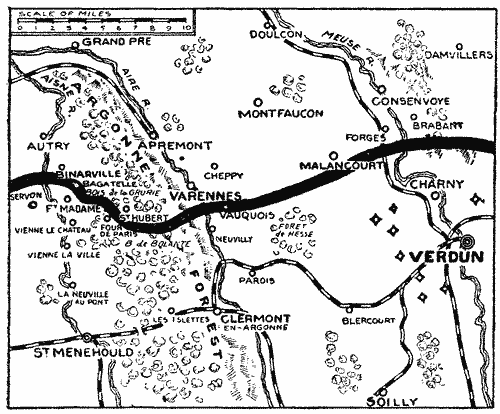
Scene of the German Crown Prince's drive in the Argonne.
[Enlarge]
The official statement issued at Berlin on July 15 says:
The French made repeated attempts yesterday, which lasted into the night, to recapture the positions we took from them in the Forest of Argonne. Notwithstanding the employment of large quantities of ammunition and of strong forces recently brought up, all their attacks broke down. In many places there was bitter fighting with hand grenades and encounters at close quarters.
The enemy paid for his unsuccessful efforts with extraordinarily heavy losses. The number of French prisoners has been increased to 68 officers and 3,688 men.
The success of our troops was all the more remarkable as, according to corresponding statements made by prisoners, the French had prepared for a great attack against our positions on the Argonne front on July 14, their national festival day.
The text of the German official statement published July 16 is as follows:
French attacks delivered yesterday and the day before to the west of the Argonne Forest failed in the face of the North German Landwehr, who inflicted large and sanguinary losses on the enemy in bitter hand-to-hand fighting. We captured 462 prisoners.
Since June 20 our troops have fought continually in the Argonne and to the west of that forest, with the exception of short interruptions. In addition to the gain in territory and booty in materials a total of 116 officers and 7,009 French prisoners has been reached up to the present.
On our front which joins the Argonne to the east, lively artillery battles are in progress. Attacks made by the enemy in this region were repulsed without difficulty.
In a dispatch from Berlin, dated July 16, by Wireless to Sayville, N.Y., it is reported that in the news items given out by the Overseas News Agency was the following:
German military tacticians point out that the German victory in the Forest of Argonne, in France, is of special importance, as it shows that the connections toward Western France are gradually being cut.
The large amount of war materials captured by the Germans in the last battle illustrates the importance attributed to the positions by the French commanders. The French, however, were unable to resist the terrific offensive of the Crown Prince's army.

The subjoined narratives, official and semi-official, show clearly the formidable nature of the Allies' land undertaking in the attempt to force the passage of the Dardanelles. It will be noted that Compton Mackenzie, the novelist, has temporarily replaced E. Ashmead-Bartlett as the British press "eyewitness" on the peninsula, and that General Sir Ian Hamilton's reports have for the first time begun to appear. A notable sketch of his career appears in the Atlantic Monthly for July by the pen of Alfred G. Gardiner. A poet and a man of romantic ancestry and taste, experienced in commands in India, in Egypt, and in South Africa, General Hamilton was called by the late Lord Roberts the ablest commander in the field. For his qualities of daring and inspiration, as well as for his coolness in directing the complex movements of the battlefield, he was chosen for this most dangerous and bloody of enterprises against the German-officered Turks.[4]
Mr. Mackenzie estimates the losses of the Turks up to June 30 at not less than 70,000. Prime Minister Asquith in the House of Commons, on July 1, announced that the British naval and military losses up to May 31 aggregated 38,635 officers and men. Yet the great fortress of Achi Baba, by that time one of the most powerful in the world, was untaken up to July 20, and the French and British Allies held but a small corner of the area to be conquered.
Authorized Press Representative at the Dardanelles.
Dardanelles, via Alexandria,
June 30, 1915.
THE battle of the Fourth of June ended with substantial progress on our centre, although on our left and on our right, notwithstanding the most violent charges and counter-charges, we were unable to consolidate some of our initial gains. The reason of this may be found in the natural strongholds of the Turkish flanks, natural strongholds that are helped by the most elaborate fortifications.
The British and French line from the Aegean to the Dardanelles is confronted by rising ground that culminates in the centre with the flat summit of Achi Baba, 800 ft. high. On either side the ground falls away to the sea in ravines and dry watercourses (deres), which the Turks have had time to make impregnable to any except those superb troops that are now fighting to pass over them.
There is no room upon the Gallipoli Peninsula to find weak points, and we are now in the position of having to storm an immensely strong fortress, the advanced works of which, by an amazing feat of arms, we already hold, and the glacis of which has to be crossed before we move forward to the assault upon the bastion of Achi Baba and beyond to the final assault upon the very walls of that fortress, the Kilid Bahr Plateau.
Farther up the coast the Australians and New Zealanders have made a lodgment upon one of the strongest advanced works of the Kilid Bahr Plateau. As seen from the northwest here they threaten the communications of the "fortress" and are drawing against them a large part of the garrison. This is composed of the flower of the Turkish Army, and, notwithstanding casualties that must already amount to 70,000, the troops are fighting with gallantry—with desperation, indeed, because they realize that when the bastion of Achi Baba falls the occupation of the Kilid Bahr Plateau becomes a mere question of time, and that when Kilid Bahr falls the doom of Constantinople is at hand. In view of the difficulties—were it not for the landing one would be tempted to say the impossibilities—which confront our men, the gain of a score of yards in the Gallipoli Peninsula may fairly represent for the purposes of comparison a gain of 500 yards in the Western theatre of war. Therefore, to find its importance the gain of 500 yards on June 4 must be measured with affairs like Neuve Chapelle; and the few quiet days that succeeded may be accepted as repose.
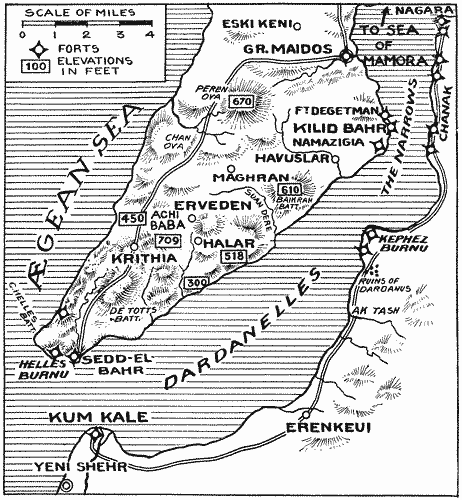
Map of Gallipoli Peninsula, showing the mountainous
nature of the terrain, and Achi Baba.
[Enlarge]
After a violent effort on the night of June 11 to 12 there was a
brilliant little action by the Border Regiment and the South Wales
Borderers which resulted in the gain of two trenches. On the 16th the
enemy, led by a Turkish and a German officer, made an assault on the
trenches of the 88th Brigade, but were driven off with loss. However,
that night the trenches gained by the two regiments on the 11th were
heavily bombed, so heavily that our men were forced to retire about 30
yards and dig themselves in. At dawn we were able to enfilade with
machine-guns the vacated trenches.
Then the Dublin Fusiliers charged with the bayonet, and once more gave us possession of our gains at heavy cost to the Turks, whose dead filled one trench.
On the evening of the 18th the enemy bombarded very heavily another portion of our trenches on this side of the line. They were evidently attempting in miniature our own methods of Neuve Chapelle and June 4, as immediately after the bombardment they were seen to be massing for an attack. However, the imitation ended rather abruptly at this point, and the affair petered out.
On the evening of the 19th the Turks by a fierce attack, managed to get into an awkward salient which had remained in our hands after June 4. For some time there was great difficulty in recovering this, but the 5th Royal Scots and a company of the Worcesters, led by Lieut.-Colonel Wilson of the former regiment, made a glorious attack, and drove out the Turks.
Of the Royal Scots, one can add nothing but that they are Edinburgh Territorials brought in by the fortune of war to make the twelfth regiment of the immortal 29th Division whose deeds since April 25 might have stirred the ghost of Homer to sing their valour.
Mention has been made already of the difficulties that oppose our advance upon the two flanks. On June 21 it was determined to straighten the line upon the extreme right, and at 1.30 A.M. the preliminary bombardment began. The dawn had been clear, but soon a curtain of silver, through which gleamed the ghost of the rising sun, hung over the Kereves Dere. This was the smoke of bursting shells. Slowly as the sun climbed up the curtain became more substantial. Then it seemed to droop and sweep along the hollows like a vanishing mist of dawn, and during a respite the thin blue smoke of the bivouac fires came tranquilly up into the still air. The respite was very brief, and the bombardment began again with greater fierceness than before. The 75's drummed unceasingly. The reverberation of the 125's and of the howitzers shook the observation post. Over the Kereves Dere, and beyond, upon the sloping shoulders of Achi Baba, the curtain became a pall. The sun climbed higher and higher. All that first mirage of beauty had disappeared, and there was nothing but the monstrous shapes of bursting shells, giants of smoke that appeared one after another along the Turkish lines. All through the morning the cannonade went on.
By noon the Second Division of the French had on the left stormed and captured all the Turkish trenches of the first two lines. Even the Haricot Redoubt, with its damnable entanglements and its maze of communicating trenches, was in French hands. On the right, however, the First Division, after reaching their objective, had been counter-attacked so effectively that they had fallen back. Again they advanced; again they took the trenches; again they were driven out. It began to look as if the victory upon the left would be fruitless, that the position would become an untenable salient and the Haricot Redoubt revert to the enemy.
At this moment a message was sent to say that the trenches must be recaptured, and, when recaptured, held. There were still five hours of daylight for this battle of the longest day. British guns and howitzers were asked for and were lent at once. The bombardment was resumed throughout that afternoon, and at half-past five it seemed as if every gun on earth were pouring shells on the Turkish lines.
At six o'clock the third assault was delivered. In one trench there was a temporary shortage of ammunition, but the enemy fought even with stones and sticks and fists. A battalion came hurrying up from the Turkish right to reinforce it, was caught on open ground by the drumming 75's, and it melted away. Six hundred yards of Turkish trenches were taken, and still the bombardment was continued in order to ward off the counter-attack that was anticipated.
The smoke of the shells, which at dawn had been ethereal, almost translucent, was now, in the sunset, turbid and sinister, yet the sunset was very splendid, flaming in crimson streamers over Imbros, tinting the east with rosy reflections and turning the peaks of Asia to sapphires. It had a peculiar significance on this longest day of the year, crowning as it did those precious five hours of daylight that, for the French, had been fraught with such achievement. Slowly the colour faded out, and now, minute by minute, the flashes of the guns became more distinct; the smoke was merged in the gathering dusk, and away over the more distant Turkish lines the bursts of shrapnel came out like stars against the brief twilight. One knew the anxiety there would be in the darkness that now was falling upon this 21st of June, but in the morning we heard gladly that the enemy's counter-attacks had failed, and that our Allies were indeed firmly established.
The Turkish casualties were at least 7,000. One trench, 200 yards long and 10 feet deep, was brimming over with the dead. They were valiant those dead men. French officers who have fought in the West say that, as a fighting unit, one Turk is worth two Germans; in fact, with his back to the wall, the Turk is magnificent. The French casualties were marvellously few considering what a day it had been, what an enemy was being attacked, and how much had been gained.
The right of the line now commands Kereves Dere, and the profile of Achi Baba seems to write itself less solidly against the sky.
The British Press Bureau on June 30, 1915, issued the following:
General Sir Ian Hamilton reports that the plan of operations on the 28th was to throw forward the left of his line southeast of Krithia, pivoting on a point about one mile from the sea, and after advancing on the extreme left for about half a mile to establish a new line facing east on ground thus gained. This plan entailed the capture in succession of two lines of the Turkish trenches east of the Saghir Dere, and five lines of trenches west of it. The Australian Corps was ordered to co-operate by making a vigorous demonstration.
The action opened at nine o'clock with a bombardment by heavy artillery. The assistance rendered by the French in this bombardment was most valuable.
At 10.20 the Field Artillery opened fire to cut wire in front of Turkish trenches, and this was effectively done. The effect on the enemy's trench near the sea was great. The very accurate fire of his Majesty's ships Talbot, Scorpion and Wolverine succeeded in keeping down his artillery fire from that quarter.
At 10.45 a small Turkish advanced work in the Saghir Dere known as the Boomerang Redoubt was assaulted. This little fort, which was very strongly sited and protected by extra strong wire entanglements, has long been a source of trouble. After special bombardment by trench mortar, and while bombardment of surrounding trenches was at its height, part of the Border Regiment at the exact moment prescribed leapt from their trenches as one man like a pack of hounds, and pouring out of cover raced across, and took the work most brilliantly.
The artillery bombardment increased in intensity till 11 A.M., when the range was lengthened, and infantry advanced. The infantry attack was carried out with great dash along the whole line.
West of Saghir Dere three lines of trenches were captured with little opposition. The trenches were full of dead Turks, many buried by the bombardment, and one hundred prisoners were taken in them.
East of the Ravine the Royal Scots made a fine attack, capturing the two lines of trenches assigned to their objective, but the remainder of the Brigade on their right met with severe opposition and were unable to get forward.
At 11.30 the Royal Fusiliers led its Brigade in the second phase of the attack west of the Ravine. The Brigade advanced with great steadiness and resolution through the trenches already captured, and on across the open, and taking two more lines of trenches reached the objective allotted to them, the Lancashire Fusiliers inclining half-right and forming line to connect with our new position east of the Ravine.
The northernmost objective had now been attained, but the Gurkhas pressing on under the cliffs captured an important knoll still further forward, actually due west of Krithia. This they fortified and held during the night, making our total gain on the left precisely one thousand yards.
During the afternoon the trenches, a small portion of which remained uncaptured on the right, were attacked, but the enemy held on stubbornly supported by machine-guns and artillery, and the attacks did not succeed.
During the night the enemy counter-attacked the furthest trenches gained, but was repulsed with heavy loss. A party of Turks, who penetrated from the flank between two lines of captured trenches, was subjected to machine-gun fire at daybreak, suffered very heavily, and the survivors surrendered.
Except for a small portion of trench already mentioned, which is still held by the enemy, all and more than was hoped for from operations has been gained. On the extreme left the line has been pushed forward to a specially strong point well beyond the limit of the advance originally contemplated.
All engaged did well, but certainly the chief factor in the success was the splendid attack carried out by the 29th Division, whose conduct on this, as on previous occasions, was beyond praise.
The British Press Bureau states on July 1 that, in continuation of his last message respecting the British advance in the Gallipoli Peninsula, Sir Ian Hamilton had reported as follows:
Further details have now been received with regard to the part played by the Australian and New Zealand Army Corps in the operations of the 29th. As previously stated, the General Officer Commanding the Australian and New Zealand Army Corps was instructed to undertake operations with a view to preventing the enemy in his front from detaching troops to the southern area.
Between 11.30 A.M. and 12 noon the action was opened, His Majesty's ships Humber, Pincher, and Chelmer engaging enemy's heavy guns. At 1 P.M. part of the Second Light Horse Brigade and the Third Infantry Brigade moved out on the right of the position, advancing some 700 yards, when the enemy was encountered in strength. Meanwhile the artillery engaged the enemy's reserves, which were collecting in the ravine opposite right centre, by shelling them effectively with guns and howitzers.
About 2.30 P.M. the enemy appeared to be preparing a counter-attack against the left of our advanced troops, but on howitzer and machine-gun fire being turned on the enemy's attacks were easily repulsed. The retirement of the advanced troops was begun at 3 P.M., well covered by rifle, machine-gun, and artillery fire, and the troops were all back in the trenches between 4.30 and 5.30 P.M.
Our machine-guns and artillery did considerable execution. Naval gun fire also gave valuable assistance. Demonstrations made after dark at 8.45 and 11.30 P.M. with flares, star shell, and destroyer bombardment were successfully carried out.
The Eighth Corps report 180 prisoners taken since the morning of the 28th, namely, 38 of the Sixteenth Regiment, 139 of the Thirty-third Regiment, and three of the Thirteenth Regiment. A Circassian prisoner carried a wounded private of Royal Scots into our lines under fire.
Sir Ian Hamilton reported, as published by the British Press Bureau on July 6, the following details of the attack made by the Turks on the night of 29th-30th June:
About 2 A.M. searchlights of His Majesty's ship Scorpion discovered half a Turkish battalion advancing near the sea northwest of Krithia. Scorpion opened fire, and few of the enemy got away. Simultaneously the enemy attacked the knoll we captured due west of Krithia, advancing from a nullah in close formation in several lines. The attack came under artillery and enfilade rifle fire, and the enemy lost heavily. The foremost Turks got within forty yards of the parapet, but only a few returned.
The Turks made several heavy bomb attacks during the night, our troops being twice driven back a short distance. Early in the morning we regained these trenches by bayonet attack, and they have since been strengthened.
At 5.30 A.M. 2,000 Turks, moving from Krithia into the ravine, were scattered by machine-gun fire. The operations reflect great credit on the vigilance and accurate shooting of His Majesty's ship Scorpion. The Turkish losses in the nullah and ravine are estimated at 1,500 to 2,000 dead.
About 10 P.M. on the 30th of June the Turks again attacked with bombs a portion of the most northerly trench captured by us on 28th. An officer of the Gurkhas being wounded, not dangerously as it turned out, the men became infuriated, flung all their bombs at the enemy, and then charging down out of the trench used their kukris for the first time and with excellent effect. About dawn the Turks once more attempted an attack over the open, but nearly the whole of these attacking forces, about half a battalion, were shot down, and a final bomb attack, though commenced, failed utterly.
Further reports from Australia and New Zealand Corps, as to the enemy's attack on 29th-30th on our right flank, state that the action commenced by very heavy fire from midnight till 1.30 A.M., to which our men only replied by a series of cheers. The Turks then launched their attack, and came right on with bayonet and bombs. Those who succeeded in getting into our saps were instantly killed; the remainder were dealt with by bomb and rifle fire from the 7th and 8th Light Horse. By 2 A.M. the enemy broke, and many were killed while withdrawing. The enemy's attack was strongest on his right. They were completely taken aback by a concealed sap constructed well ahead of our main line, and the dead are lying thickly in front of this. Some got into the sap and several across it; all these were wiped out by fire from the main parapet farther back.
Following the defeat of this attack, the enemy attacked at 3 A.M. on our left, and 30 men came over the parapets in front of the right of Quinn's Post. These were duly polished off. Prisoners brought in state that three fresh battalions were employed in the main attack, which was made by the personal order of Enver Pasha, who, as they definitely assert, was present in the trenches on June 29. This is confirmed by the statement of an intelligent Armenian prisoner captured on that date. According to him, stringent orders were recently issued that no further attacks were to be made, because if the Turks remained on the defensive the British would be forced to attack, and would suffer as severely as the Turks had hitherto suffered. But Enver Pasha, when he arrived in the northern section, overrode this instruction, and orders were received by the prisoner's regiment that the Australians were to be driven into the sea.
On July 2, after a heavy bombardment of our advanced positions by high explosives and shrapnel, lasting half an hour, the enemy infantry advanced, but were driven back to the main nullah about a mile to our front by the accurate shooting of His Majesty's ship Scorpion and by our rifle and machine-gun fire. About 7 P.M. the Turkish artillery recommenced their bombardment, under cover of which two battalions emerged from the nullah to the northeast of our most advanced trench and commenced an attack across the open, advancing in two regular lines. At the outset very effective shrapnel fire from the 10th Battery Royal Field Artillery caused great execution among the attackers. Gurkha supports then advanced, and there being insufficient room in trenches took up a position on some excavated earth in rear, whence deadly rifle fire was poured into the advancing lines. Turkish officers could be seen endeavouring to get their men forward, but they would not face the fire and retreated in disorder after suffering heavy casualties.
The ground in front of our trenches in every direction can be seen covered with Turkish dead, and patrols sent out at night report that the valleys and ravine are also full of them. There can be no possible doubt that the enemy's losses have been very heavy. After checking and counter-checking reports from all sources, I put down their total casualties between June 28 and July 2 at 5,150 killed and 15,000 wounded. The number of killed is, therefore, approximately correct, while the wounded is an estimate based partly on the knowledge of the number already reported arrived at Constantinople, and on experience of proportion of wounded to killed in previous engagements. Since June 29 the total amount of Turkish arms and ammunition collected is 516 rifles, 51 bayonets, 200 sets of equipment, 126,400 rounds of ammunition, 100 bombs.
The following is an extract from captured divisional orders: "There is nothing that causes us more sorrow, increases the courage of the enemy, and encourages him to attack more freely, causing us great losses, than the losing of these trenches. Henceforth commanders who surrender these trenches, from whatever side the attack may come, before the last man is killed will be punished in the same way as if they had run away. Especially will the commanders of units told off to guard a certain front be punished if, instead of thinking about their work, supporting their units and giving information to the higher command, they only take action after a regrettable incident has taken place.
"I hope that this will not occur again. I give notice that if it does I shall carry out the punishment. I do not desire to see a blot made on the courage of our men by those who escape from the trenches to avoid the rifle and machine-gun fire of the enemy. Henceforth I shall hold responsible all officers who do not shoot with their revolvers all the privates who try to escape from the trenches on any pretext. Commander of the 11th Div., Colonel Rifaat."
To the copy from which this extract was taken the following note is appended: "To Commander of the 1st Battalion. The contents will be communicated to the officers, and I promise to carry out the orders till the last drop of our blood has been shed. Sign and return. Signed. Hassan, Commander, 127th Regiment. Then follow signatures company commanders."
The British Press Bureau on July 7 issued this report by General Ian Hamilton:
The night of July 3-4 was quiet in the northern section, but at 4 A.M. the enemy started a heavy bombardment of the trenches. All the guns previously used against us, and some new ones, were in action, but the bombardment died away about 6 A.M. without doing much damage. During the bombardment about twenty 11.2-inch shells were dropped from a Turkish battleship in the strait.
In the southern section the Turks kept up a heavy musketry fire along the whole line during the night and did not leave their trenches. At 4 A.M. their batteries started the most violent bombardment that has yet been experienced. At least 5,000 rounds of artillery ammunition were expended by them.
Meanwhile this shelling of our lines on the peninsula proved the preliminary to a general attack on our front with special efforts at certain points. The principal effort was made at the junction of the Royal Naval Division section with that of the French.
Here, at 7.30 A.M., the Turks drove back our advanced troops and assaulted a portion of the line held by the Royal Naval Division. Some fifty Turks gained a footing in our trench, where, nevertheless, some men of the Royal Naval Division held on to our supports, and the men who had retired counter-attacked immediately and hurled the Turks out of the trench again.
Another attack on the right of the Twenty-ninth Division section, was practically wiped out by rifle and machine-gun fire. On our left the Turks massed in a nullah, to the northeast of our newly-captured trenches, and attempted several attacks. None of these was able to get home owing to the steadiness of our troops and our effective artillery support. The bombardment died down toward 11 A.M., though it was resumed at intervals.
Not only was the result a complete failure, but while our losses were negligible and no impression was made on our line, the enemy added a large number to his recent very heavy casualties. It seems plain from the disjointed nature of his attack that he is finding it difficult to drive his infantry forward to face our fire.
In a dispatch by George Renwick to The London Daily Chronicle, dated at Lemnos, July 11, the following description of fighting, followed by heavy Turco-German casualties, appeared:
The heaviest fighting which has taken place on Gallipoli Peninsula since the allied forces landed there began late on Tuesday and lasted well into Wednesday. It resulted in a swing forward of the southern line of the allied armies for five furlongs and in the infliction of staggering losses on the enemy. Those who were in the battle place the Turco-German casualties at 7,000 killed and from 14,000 to 15,000 wounded. Many prisoners were taken.
The whole army in the southern part of the peninsula was engaged, and the Australians and New Zealanders further north also played a part. The victory marks a definite stage in the initial work of throwing forces around Achi Baba, which may now be described as one of the strongest fortresses in the world.
The Allies had been resting in comparative tranquillity and the Turks had evidently become persuaded the enemy was experiencing a shortage of ammunition. This belief convinced them of the excellent opportunity of driving the invaders into the sea. Late Tuesday night the first signs of the enemy's movement were detected. No time was lost in flashing a warning message to headquarters. The French were soon alert and the artillery at that portion of the line against which the attack was being prepared was quickly and strongly reinforced.
French and British machine guns were rushed to the front until a perfect wall of heavy and light guns was in position. Then there came a short interval of silence and waiting, almost oppressive. Suddenly the stillness was broken by a tremendous burst of shells from the Turkish guns, and for a time shrapnel poured down on the French front. But the men were safely positioned in dugouts and little loss resulted. From the strait loud booming began. The battered Goeben was at work again, and during the bombardment she pounded our right with some forty 11-inch shells. Many did not burst—they were apparently of Turkish manufacture.
This hail of shells lasted just an hour and a half and was the severest bombardment to which our lines have been subjected during the weeks of struggle on the peninsula. No sooner had the heavy fire ceased than great solid masses of Turks leaped forward to the attack. On they came, the silence unbroken save for their shouts, until they reached a point within sixty or seventy yards of the French position. Then from 200 well placed machine guns a devastating answering fire burst from our Allies' trenches, and the rifles joined in, 20,000 of them. The big guns flared and cast a lurid light over the scene.
On July 23, after two months of her war against Austria, an appraisement may be taken of Italy's extensive and business-like preparation for the conflict. Rapidly the passes leading to the Trentino, Carinthia, Friuli, and the valley of the Isonzo were secured, almost over night; and then, with the regularity of a railway time-table, the Italians began their hard, patient work, in hitherto impassable regions, of neutralizing the Trentino, so as to make impossible an invasion from that territory, and of linking up their columns along the Isonzo, so that now, at the beginning of August, a battle-front of seventy-five miles extending from Tarvis to the Adriatic, is ready to move eastward in the direction of Klagenfurt, beyond which there are no Austrian fortifications until Vienna is reached, 170 miles away—about as far as Cape Cod is from New York City. The right flank of this battle-front has been developed along the Carso plateau so as to neutralize, as the Trentino was neutralized, the Peninsula of Istria with the great commercial port of Trieste, the naval base of Pola, and the Hungarian Free City of Fiume.
THE Italian field of activity saw during the week ended July 24 the blazing out of the Italian offensive. Italy apparently was then satisfied that all the passages by means of which Austria could pour troops to attack her rear are effectively stopped and has therefore begun a determined advance along the Isonzo front from Tarvis to the Adriatic, with the object of breaking down completely Austria's first defensive screen. The battle is, as is natural, centring around Gorizia.
GENERAL CARLO CANEVA
One of the Most Conspicuous of Italian Military Commanders
(Photo from Central News.)
Once Gorizia falls, the Italian problem in so far as Trieste is
concerned, will be near solution. The Italians have made notable
advances in Cadore and along the Isonzo, on the plateau of Carso. But
Gorizia must be taken before a decided local victory can be recorded.
The fighting has not progressed as yet to the point where definite
information is available, but in late July it seemed to have reached
the culminating stage. The surroundings of Gorizia, which is the key
to the Isonzo district and the junction of five main roads and four
main railway lines, are protected with all manner of fortifications.
The official report from Rome on June 25 recorded the Italian
occupation of Globna, north of Plava, and of the edge of the plateau
between Sagrado and Monfalcone. From that date reports from Vienna
recorded continuous and heavy Italian attacks from the bridgehead at
Goritz to the sea. The correspondent of the Berliner Tageblatt at the
Isonzo front reported on July 7 that the second great Italian
offensive had forced its way into the Austrian line at Podzora—a
height covering the bridgehead at Goritz—and at Vermegliano, between
Doberdo and Monfalcone. A Geneva dispatch, dated July 14, reported the
capture by the Italians of two miles of trenches in the Carnic Alps,
the Alpine troops dragging their artillery to an altitude of 6,600
feet near Roskopel, and capturing to the south of Gorizia two
important forts. On July 16 a dispatch from Rome told of a war council
at the front held by King Victor Emmanuel and Premier Salandra, with
Count Cadorna, Chief of the General Staff, and General Porro, his
chief assistant. A Vienna official dispatch of that date reported
increased artillery activity in the coast district and in Carinthia.
Two passes at a height of over 10,000 feet were taken by the Italians
at Venerodolol and Brizio, as reported July 17, and on July 18 they
began an advance in Cadore, attacking a ring of powerful forts at a
great height at Paneveggio, San Pelegrino, Monet, Livinallongo, and
Tresassi, while Goritz was shelled from land and air.
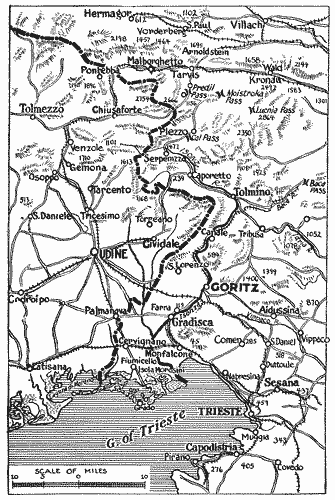
The Austro-Italian frontier, the scene of the fighting.
[Enlarge]
Then began, on July 20, a great general Italian assault on a 75-mile
line from Tarvis to the Adriatic shore. A dispatch from Turin from the
correspondent of The London Daily Chronicle announced a victorious
advance by the Italians on the Carso plateau, east of Sagrado, with
the capture of 2,000 Austrian prisoners. The War Office in Rome
reported on July 21 that while the Italian defense continued to
develop energetically in Cadore, and the artillery was effectively
working in Carnia, the struggle in the Isonzo zone continued with
increasing intensity. Toward Goritz the Italians gained part of the
line of the heights which form the right bank of the river commanding
the town and the Isonzo bridges. On the Carso Plateau the Austrians
were reported driven from some trenches, and 3,500 prisoners and much
material captured. On July 22 the fall of Goritz and Tolmino was
reported to be near, the War Office in Rome announcing a development
of the offensive "along the whole front from Monte Nero to the Carso
Plateau. Vienna reported that the heavy attacks were being repulsed.
But on July 23 the official report from Rome for the first time
declared that the Italian armies in the battle along the whole Isonzo
front were achieving success," which was "constantly becoming more
clearly apparent." On July 24 a dispatch from Udine said that General
Cadorna was personally directing the battle in the presence of King
Victor Emmanuel and the Duke of Aosta. A Milan dispatch to The London
Daily News on July 25 reported the evacuation of Goritz by the
Austrian General Staff in view of the imminence of its fall. Below
appears a prospective account of Italy's formidable task, written on
July 1 by an Italian correspondent of The London Morning Post.
[By a Special Correspondent of The London Morning Post]
Cormons, July 1.
The Italian battle for the conquest of the fortified lines on the Isonzo and the entrenched camps of Gorizia is one of the most important in the European conflict. The battle of the Isonzo is not to be regarded as a mere episode, but a prolonged siege over a front of more than a hundred miles of a natural fortress, consisting of a chain of precipitous mountains. Perhaps never before in a European war has the value of individual qualities been shown so conclusively as by the Italian troops in this war. The very steep cliffs, which are almost perpendicular, along the course of the river are almost impossible to scale. The mountain passes which open along the river are very few and also narrow. In addition the geological nature of that district, composed of strong walls of granite towers, which dominate the River Isonzo, is favorable to its defence.
To this natural defense have been added strong fortifications built by the Austrians during past years in anticipation of being used for the subjugation of Italians at some time or other. Finally, during the last nine months of Italy's neutrality the Austrians have employed the latest technical improvements in defensive warfare, and I have never seen their equal during my excursions to the front in France and Belgium, not even at Antwerp. This remark applies especially to Carso and Gorizia.
The artillery officers of the Italian Military Staff whom I met at the front have explained to me the nature of the Austrian defensive works. Upon the Carso and around Gorizia the Austrians have placed innumerable batteries of powerful guns mounted on rails and protected by armor plates. Numerous other artillery advantages are possessed by the Austrians in the form of medium and smaller guns, though the efficiency of their action is modified by the long distances separating the armies.
In view of these advantages possessed by the Austrians, the Italians have accomplished marvels and are worthy of great admiration. The infantry is much exposed while crossing large and deep rivers. With the exception of the two positions of Podgora and Sabotino, all the Austrian line on the Isonzo has been taken by the Italians.
To the conquest of Gorizia are directed the efforts of the Eastern Italian Army. The Italian infantry which crossed the Isonzo ran against a net of trenches which the Austrians had excavated and constructed in cement all along the edge of the hills which dominate the course of the river. These trenches, already occupying a position nearly impregnable because so mountainous, are defended by every modern protective device. They are armed with numerous machine-guns surrounded by wire entanglements, through which runs a strong electric current. These lines of trenches follow without interruption from the banks of the Isonzo to the summit of the mountains which dominate it. They form a kind of formidable staircase, which must be conquered step by step with enormous sacrifice. The Italian troops have accomplished this marvel.
The crossing of the Isonzo and the conquest of the first mountainous positions were accomplished by the Italians in four strategic places: At Caporetto, at Tolurino, at Plava, and at Sagrado. These four places, situated in the strong line of Austrian defense, are about twenty miles distant from one another. The chain of fortifications of which Gorizia is a center was broken in these four essential points. The immediate effect has been the disorganization of the defensive plans of the enemy. The crossing of the river was accomplished generally at night, and was conducted with a rapidity which took the enemy by surprise. Complete regiments crossed in the night upon light bridges constructed in a short time by the engineers, whose technical skill was equal to their audacity. These "bridge-heads," which were constructed with incredible courage, made possible an attack by the reinforcements which followed them. When these came in contact with the lower lines of the Austrian trenches they attacked the defenders in such a way that the latter were unable to impede seriously the more important work of the construction of strong bridges.
The subjoined letter, dedicated by the Belgian writer to stricken Poland, was received on July 12, 1915, by the Polish Relief Committee of New York, of which Mme. Marcella Sembrich is President.
In the Name of Belgium I Bring the Homage of a Martyred Nation to the Nation Crucified:
Of all the people engaged in this frightful war, Poland and Belgium will have suffered most, and we must add (though all the horrors of war are most revolting) they will have suffered most innocently. They are two victims of their innocence and grandeur of soul.
In misfortune and in glory their fates are the same. One, in sacrificing herself wholly to a cult, to an unparalleled passion for honor, has by breaking the first blow of barbarous invasion probably saved Europe, just as the other, the older sister, in grief and heroism several centuries ago saved Europe many times.
They are now joined forever in the memory of men. Across the combats and the sorrows which they are now enduring their hands meet in the same sacrifice, in the same invincible hope. Today these countries are but ruins. Nothing remains of them. They appear to be dead. But we, who are their sons and who know them as we know our mother, we know, we feel in our hearts, that they were never more alive, never purer, never more beautiful.
After having offered to the world a great example of pride, of abnegation, of heroism, they are again giving to it a deeper lesson, a more valuable, a more efficacious one. They are proving that no misfortune counts, that nothing is lost while the soul does not abdicate. The powers of darkness will never prevail against the forces of light and love that are leading humanity towards the heights which victory is already making clear to us on the horizon.
AN elaborate argument that Italy is about to co-operate with the Allies at the Dardanelles in order to influence Greece and the Balkan States generally to intervene against the Germanic Powers appeared in The Frankfurter Zeitung near the close of June. A dispatch from Bucharest on July 12 announced that Austria had made concessions to Rumania in the hope of averting intervention by that Power, accompanying the offer with an ultimatum setting a month for Rumania's reply. The German Social-Democratic paper Vorwaerts published on July 17 a statement that Rumania had definitely refused to permit German arms and ammunition to traverse her territory to Turkey. This shows a distinct turning away from the German propaganda in that kingdom, which on May 26 spoke through the editorial columns of Moldova, a daily of Bucharest, as follows:
We must tread in the path opened to us by the late King Carol and the great Rumanian statesmen. We must always be attached to the Central European Powers, from which we shall secure the fulfillment of our aspirations, on that day when we shall move against Russia.
TAKE JONESCO
A Former Cabinet Minister, and Leader of Pro-Ally Party in Rumania
(Photo from Central News.)
From Lupte, a Nationalist daily of Bucharest, a definite declaration
of the kingdom's policy was demanded on June 4:
The smaller a nation is the more dangerous to her existence are diplomatic intrigues. Mr. Bratiano's Government has for the past eight months been coquetting with Petrograd as well as with Berlin and Vienna. With which side are we in this war? The two belligerent groups are asking this and the same question is asked of Bulgaria and Greece. We must have a sound national policy, for in this most modern war there is no profit in the old Machiavellian tactics.
That a crisis is approaching in Balkan affairs is clearly indicated in an editorial warning headed "Beware, ye Balkan Peoples!" appearing on May 29 in Dnevnik, an independent Bulgarian daily of Sofia. It says:
The lust of Europe for territorial aggrandizement becomes every day more pronounced. From a struggle for self-defense this has become a war of conquest. Germany has appropriated Belgium, Russia fights for the Bosporus and Constantinople, Italy has almost taken Albania—with the approval of Austria, as we have discovered. The westernmost edge of the Balkan Peninsula has fallen; tomorrow the easternmost extremity will fall, together with Constantinople. Will the European Powers then spare us?... What the United States of America did for the preservation of their independence against foreign conquest we Balkan peoples must do unless we would see our doom sealed.
"The Dangers of a Neutral Policy" is the theme of Mir, the organ of the Bulgarian Nationalist Party of Sofia, which on May 29 said: "If Bulgaria remains neutral to the end of the war, she runs the risk of being condemned to live forever within the narrow limits she has today, hemmed in on every side. The duty of the Balkan States is to act in a war which will solve all pending political and national problems."
Serbia's jealousy of Italy, despite that nation's late adhesion to the Allies, was voiced on May 25 by Politika, a Nationalist daily of Belgrade, which accuses Italy of trying to profit at Serbia's expense. The Entente Powers must pay for Italian aid, this paper says; and Italy may be "satisfied with Savoy, Corsica, Malta, Tunis, Algiers, Asia Minor, or Egypt."
Balkan Newspapers

In the left upper corner, the Bulgarian daily Narodai Prava (National Rights) of Sofia, semi-official organ of the Bulgarian Government of Dr. B. Radoslavoff; upper right, the Athenian daily Athinæ (Athens), representing the extreme anti-Venizelists; at lower right, the daily Politika (Politics), an independent paper of Belgrade, Serbia; lower left, the Bucharest (Rumania) daily Dimineata (Morning), an Interventionist paper, and, at center, the Constantinople Khavar (Star), a Pro-Islamist daily.
The Ottoman Empire being under martial law, comment by the Turkish
papers regarding military and political events is restricted by the
Government. But Enver Pasha, the all-powerful young Turk leader, and
his colleague for the Interior, Talaat Bey, early in May gave an
interview printed in the Vienna Neue Freie Presse. Enver Pasha
predicts the collapse of the Allied campaign on the Gallipoli
Peninsula, where the French and British hold a small corner against
overwhelming odds. "The bringing thither of provisions is extremely
difficult," he says, and "even the drinking water for the troops must
be brought from the ships." Both he and Talaat Bey report the morale
of the Turkish troops to be excellent, "as many of the older officers
have been replaced by energetic young men."

H.R.H. PRINCE GEORGE
Duke of Sparta and Crown Prince of Greece
(Photo from P.S. Rogers.)
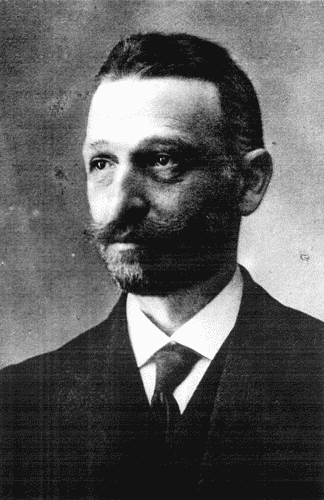
DEMETRIOS GOUNARIS
Leader of the Neutralist Party, who Succeeded
Venizelos as Premier of Greece
Greece is in suspense. The Kairoi, an independent daily of Athens,
said on June 22 that, while Greece does not forget her debt to the
three protective powers, France, England, and Russia, she must
nevertheless weigh the promise of Germany to give full protection to
Greek interests in the event of her continued neutrality. "Just how
Germany keeps her promises," this paper says, is "shown by Cavalla,
the Macedonian city allotted to Greece after the second Balkan war at
the express instance of the Kaiser;" and it notes that the Entente
Powers are now eager to cede this territory to Bulgaria. The Embros,
an independent daily of Athens, prophesied on June 22:
We can afford to follow events with growing solicitude and remain neutral as long as we may. Whether or not we maintain this neutrality to the end our action can change neither the fortunes of Greece nor the position of other Powers. It is to be presumed that the power driving this giant conflict to the conclusion has more remote motives and that to all appearance, the war will end without any of the participants suffering a crushing defeat.
While Russian aspirations are generally considered to be in harmony with those of the Balkan kingdoms, the following extracts from Russian papers representing varying shades of Muscovite opinion show now an unfavorable or critical attitude. Thus the foremost organ of the Panslavist Party, the Russian weekly Slavianski Izvestija, April No. 8, disapproved the Bulgarian plea to give Thrace and Adrianople through Russian influence. Of the Macedonian question this paper said:
Bulgarians expect that Russia will get for them Macedonia Thrace, and Dobrudja, to reward their honest labors. Alas, they must learn that not every day, but every hour, Macedonia is receding from their grasp. For Russia the Macedonian question hardly exists. If Macedonia finds it hard to be under heroic and benevolent Serbia, what would become of her on the day when she should fall into the hands of Bulgaria? And should we Russians, in order to assure Macedonia such a future, grieve now our dear ally Serbia?
The semi-official Novoye Vremya of Petrograd commented on May 27, on the statement of the Bulgarian Premier Radoslavoff published in Vienna, that Bulgaria cannot engage to intervene without a formal treaty, a policy, it believes, that says but one thing, namely: "You Russians tricked us Bulgarians once; you shall not trick us again." This attitude of Bulgaria shows, the Novoye Vremya thinks, "how thick-headed and insensate its people are." The Birjevaja Viedomosti, a standpat Russian daily of Petrograd, on May 23 warned Serbia that, whereas the war began in her behalf and on her account rivers of blood are flowing, her complaints of the allotment of Dalmatia to Italy should not "assert principles which have nothing to do with actualities." The same newspaper says of the whole Balkan situation:
The German policy of von Buelow, having failed in Rome, is courting failure in Bucharest. In fact, all the German promises to Rumania seem to go no further than sharpening the Rumanian appetite for Russian Bessarabia, while holding out as a last bait the cession of a small parcel of Bukowina—supposing the Hungarians never consent to yielding Transylvania to Rumania.
On the other hand, Germany promises Bulgaria the Turkish province of Thrace and Serbian and Greek Macedonia; but these compensations have as much value as the cessions of Corsica and Nice and Tunis in the early days of the war.
But Germany cannot give to Bulgaria Serbian Macedonia so long as the Austrian armies are not masters of the whole of Serbia; she cannot give her Thrace because Turkey objects to such cession, and Turkey is her ally; and, finally, she cannot urge Greece too closely to cede Cavalla to Bulgaria, because such a pressure may bring a contrary result, i.e. make Greece to declare herself openly an ally of the Entente. Therefore both Bulgaria and Rumania must perforce side with the great European Alliance. Had Italy remained neutral matters would be different, but as it is now Bulgars and Rumanians, and the Balkan peoples in general, have to fight with us, unless they want the diplomacy of the Entente to disappoint utterly the ever-growing appetite of these small nationalities....
It will be noted that all the opinions quoted concerning the Balkans relate to the division of territory as the price of neutrality or intervention.
To the Editor of the [London] Times:
Sir,—During a recent visit to America I saw Dr. Conybeare's letter in a paper called the Vital Issue. All who know Dr. Conybeare know him to be honest and frank, and to be very deeply distressed by the sufferings and cruelties of the war. After my return, I wrote to him, pointing out that his letter is being widely circulated in America, and that the material points in his accusation of Sir Edward Grey and Mr. Asquith have been answered. I enclose Dr. Conybeare's reply, for which he desires the fullest publicity.
Yours faithfully,
WALTER RALEIGH.
The Hangings, Ferry Hinksey, near Oxford, July 1, 1915.
Banbury-road, Oxford, June 30.
Dear Sir Walter Raleigh,—During the past week I have been studying afresh the published records of the diplomatic transactions of last July, and on my return to Oxford I find your kind letter, and therefore take the liberty of addressing this to yourself. My new study has forced upon me the conviction that in my letter to a friend residing in America, which, against my wishes and injunctions, was published there, apart from the deplorable tone of my allusions to Sir E. Grey and Mr. Asquith, I was quite wrong in imputing the motives which I did, especially to the former. It does appear to me, as I read these dispatches over again, that Sir Edward throughout had in view the peace of Europe, and that I ought to have set down to the awful contingencies with which he was faced many passages which I was guilty of grossly misinterpreting. I was too ready to forget that in the years of the Balkan wars it was after all he alone who, by his patient and conciliatory treatment of the situation, held in check the antagonistic forces which last July he was ultimately unable to control. I was too ready to ascribe to want of good will on his part results which harsh necessity entailed on him; and I deeply regret that I mistook his aims and, in my endeavour to be fair to the enemy, was grossly unjust to him. I am only anxious to undo, if it be still possible, some of the harm which my hasty judgment and intemperate language has caused.
If you think it would do any good to print this, I beg you to send it to The Times and Morning Post, whose remarks led me to go back once more to the documentary sources. Second thoughts are best, and if I had only kept my American letter till the morning for revision, I should first have struck out all the vituperation and all the imputation of motives, and have ended by never sending it at all.
I remain yours very sincerely,
FRED. C. CONYBEARE.
THAT a group of bankers in New York City, headed by J.P. Morgan & Company, was negotiating with the British Treasury authorities for the flotation in the United States of $100,000,000 of the new British war loan was announced in the newspapers on July 3, 1915. Mr. Morgan's firm had handled contracts to furnish war munitions to the Allies, amounting to $500,000,000, and this had been widely published. On the morning of July 3 J.P. Morgan was attacked and wounded with a revolver at his country estate on East Island, near Glen Cove, Long Island, by Erich Muenter, alias Frank Holt. Holt was an Instructor in German at Cornell University; Muenter was a Harvard instructor for whom the police had been seeking since the spring of 1906 on a charge of murdering his wife. After his suicide in jail on July 6, Professor C.N. Gould, of the University of Chicago, and Professor Hugo Muensterberg, of Harvard, among others, identified Holt and Muenter as the same person.
J.P. MORGAN
Whose Life was Recently Attempted, because of his relations with the
Allied Governments in the Supply of War Munitions.
The lower picture is of Erich Muenter, Alias Frank Holt, His
Assailant.
Photograph taken Immediately after his Arrest.
Muenter's insane attack on Mr. Morgan, because he had failed to "use
his influence to prevent the exportation of arms and ammunition,"
followed the wrecking of the United States Senate reception room in
the Capitol at Washington on July 2 by the explosion of an infernal
machine set by Muenter. On July 6 a trunk owned by Muenter containing
twenty pounds of explosives was found in New York. During his stay in
jail Muenter wrote to his wife that two ships were to sink at sea on
July 7, if his calculations went right, naming the Philadelphia and
the Saxonia. The ships were duly warned by wireless, but no bombs were
found aboard them, nor were any confederates of Muenter discovered. On
July 7 the steamship Minnehaha reported by wireless a "fire caused by
explosion" under control.
Incendiary bombs had been discovered aboard four freight steamships sailing from New York for Havre in April and May. On July 12 Secretary of the Navy Daniels, acting on advices received from The New Orleans Picayune, directed the naval radio station at Arlington, Virginia, to flash a warning to all ships at sea to be on the lookout for bombs supposed to have been placed on board certain vessels, and warning particularly the steamers Howth Head and Baron Napier that information had come to the Navy Department that explosive bombs might have been placed on those two vessels. All ships were requested to try to communicate with the Howth Head and the Baron Napier. On July 11 a written threat to assassinate J.P. Morgan, Sir Cecil Spring-Rice, the British Ambassador, and destroy by bombs British ships clearing from American ports, thus carrying out some of the plans of Erich Muenter, was reported in a letter signed "Pearce," who styled himself a partner and intimate associate of Muenter. This letter was received by The New Orleans Times-Picayune.

SIR CECIL ARTHUR SPRING-RICE
British Ambassador to Washington. Present When J.P. Morgan was
Assaulted by Erich Muenter, Alias Holt
Two more "Pearce" letters were received on July 13 by an afternoon
newspaper of New Orleans and by its Chief of Police, saying that Erich
Muenter had taught the writer the use of explosives. On the same day
the Samland of the Atlantic Transport Line and the Strathlay,
chartered by the Fabre Line, survived attempts to destroy them by fire
bombs, and on July 15 "Pearce" threatened in another letter to destroy
the Rochambeau. A bomb thought to be intended for the Orduna in a car
loaded with coal consigned to the Cunard Line was discovered at
Morrisville, N.J., on July 18. The Washington Times, the Philadelphia
Public-Ledger and the Brooklyn Eagle received on July 16, 19 and 20,
respectively, letters from "Pearce" declaring that henceforth persons
leaving America on British ships would do so at their peril, and
harking back to the German Embassy's warning before the Lusitania was
torpedoed. On July 26 an SOS call was received at the Fire Island
station, at the Brooklyn Navy Yard, and by the coast guard ship
Mohawk, but the distressed ship's appeal for help was broken off
before her name or position could be given. "Pearce's" letter to The
Brooklyn Eagle reads as follows:
"Sir: You people of Brooklyn have already had one experience with the work of our men, and so, perhaps, it will be unnecessary to say more than a few words of warning. The Kirkoswald affair is still fresh in your memory; therefore, we will not waste words discussing this matter. The purpose of this communication is to warn the American citizens living in your vicinity to keep clear of British vessels sailing from Brooklyn, New York, New Orleans, Savannah, Newport News, and Montreal. Our men are now operating from each of these ports, and Americans will do well to heed this warning ere it is too late.
"The Imperial German Government derives no satisfaction or profit from the killing of neutral Americans, and we are instructed to go to great lengths in order to give timely warnings to all Americans who contemplate voyages to Europe within the next two months. The explosive operations will supplement the submarine operations, which have proved inadequate to prevent the enemy from importing munitions from America.
"We earnestly advise Americans who find it imperative to travel to Europe to sail only on vessels flying the American flag. Such steamers as those of the American Line, for instance, will be perfectly immune from either submarine or explosive operation. The Imperial German Government will, if requested, offer no objection to the American Government pressing into service the interned German vessels if the American vessels are found to be unable to accommodate the traffic to Europe. By publishing this warning American lives may be spared.
"The circumstances under which this communication is written make it impossible for us to affix our proper signatures; therefore, we trust that you will accept for a signature our pen name.
"PEARCE."
The annual general conference of the clergy of the North German Lutheran Churches met in Berlin during the week of June 24, 1915, and sent the following "telegram of devotion" to the Kaiser:
"Your Imperial and Royal Majesty will most graciously deign to accept this most humble blessing and the assurance of true German devotion from the preachers of the North German Evangelical Conference assembled in conference. We raise our eyes with respect and love to your Majesty, the powerful and purposeful leader of the German nation. We are filled with the consciousness that the sources of German power are unconquerable, not only because of the complete union of the German princes and peoples, but because of the unexampled spirit of sacrifice which animates rich and poor alike, and, before all else, because we are a praying nation.
"However great the pressure of our enemies may be on our victorious armies, the army of those who are praying at home will wrestle all the more earnestly in prayer, praying before God's throne for victory."
EARLY in June, H.G. Wells, the "novelist of science," wrote to the London Times a letter urging the necessity of mobilizing Great Britain's scientific and inventive forces for the war. On June 22 The London Times printed a second letter from Mr. Wells proposing the establishment of a bureau for inventors—"a small department collateral rather than subordinate to the War Office and Admiralty." At the annual meeting in London of the British Science Guild on July 1, eminent scientists and chemists, Sir William Mather, Sir William Ramsay, Sir Boverton Redwood, Sir Philip Magnus, Professor Petry, Sir Ronald Ross, Sir Archibald Geikie and Sir Alexander Pedler, condemned the attitude adopted by the British Government toward science in connection with the war, and demanded that in future greater use should be made of the opportunities afforded by scientific knowledge in the prosecution of the struggle. A letter conveying this opinion was sent by these scientists to Prime Minister Asquith. On July 18 it was announced in London that a number of eminent scientists and inventors had been appointed to assist Admiral Lord Fisher, as Chairman of the Invention Board, to co-ordinate and encourage scientific work in relation to the requirements of the British navy. Lord Bryce was said to be instrumental in this undertaking.

THOMAS A. EDISON
The American Inventor, Now Associated With the Navy Department
as Chief of the Advisory Board of Civilian Inventors and Engineers
In the United States a similar movement was in progress. The New York
Times published on May 30 an interview with Thomas A. Edison declaring
that in its preparations for war the American Government should
"maintain a great research laboratory, jointly under military and
naval and civilian control." In this could be developed the
"continually increasing possibilities of great guns, the minutiae of
new explosives, all the technique of military and naval progression,
without any vast expense." If any foreign power should seriously
consider an attack upon this country "a hundred men of special
training quickly would be at work here upon new means of repelling the
invaders," Mr. Edison said; "I would be at it, myself."
Secretary of the Navy Daniels thereupon wrote to Mr. Edison a congratulatory letter, saying: "I think your ideas and mine coincide if an interview with you recently published in The New York Times was correct." He added:
One of the imperative needs of the navy, in my judgment, is machinery and facilities for utilizing the natural inventive genius of Americans to meet the new conditions of warfare as shown abroad, and it is my intention if a practical way can be worked out, as I think it can be, to establish at the earliest moment a department of invention and development, to which all ideas and suggestions, either from the service or from civilian inventors, can be referred for determination as to whether they contain practical suggestions for us to take up and perfect....
What I want to ask is if you would be willing, as a service to your country, to act as an adviser to this board, to take such things as seem to you to be of value, but which we are not, at present, equipped to investigate, and to use your own magnificent facilities in such investigation if you feel it worth while.
The consequence was Mr. Edison's appointment to head an advisory board of civilian inventors and engineers for a Bureau of Invention and Development created in the Navy Department. After a conference with Mr. Edison Secretary Daniels on July 19 wrote to eight leading scientific societies asking each of them to select two members to serve on the Naval Advisory Committee, and as a first fruit of the movement it was announced on July 23 that at the request of Mr. Edison, the American Society of Aeronautic Engineers had been formed with Henry A. Wise Wood as President and Orville Wright, Glenn H. Curtiss, W. Starling Burgess, Peter Cooper Hewitt, Elmer A. Sperry and John Hays Hammond, Jr., as Vice-presidents.
HUDSON MAXIM
American Inventor of High Explosives and Other Materials of War
(Photo by White.)
The New York Times on July 11 printed an interview with Hudson Maxim,
the inventor of explosives, in which Mr. Maxim said:
Modern war is a warfare of explosives. The highly developed methods of defense, designed especially against explosives, are practically proof against everything but them.
Attacking forces must disemburrow the defending forces; they must be blasted out of the ground. This warfare amounts, literally, to that. It is as if boys hunted woodchucks with dynamite.
Each of the hard-won successes of the war has been a victory for well-placed high explosives. In the last fight around Przemysl the Germans fired in one hour, from field guns, 200,000 shells carrying high explosives.
Reports indicate that the result of this was literally unprecedented. It actually changed the topography of the country. Valleys were dug and hills razed.
Recently Lloyd George used an expressive phrase. "The trenches," he said, "were sprayed with exploding shells."
Such "spraying" only could be possible through the use of an incredible number of explosive projectiles.
America's plants for the production of explosives, cartridges, shrapnel, and rifles have so increased their capacity that we have today ten times the capacity which we had at the time of the war's outbreak, and, for certain things, the increase has been even greater. By the middle of next winter our capacity will be thirtyfold what it was at the beginning of the war.
Thus the fighting among other nations has done much toward preparing us for war, and, therefore, much toward insuring international peace for us, but even our tremendous contribution to the supplies of the Allies amounts to only about 2 per cent. of what they are consuming, and the war has not been running a year.
This indicates that if we should suddenly be involved in warfare with a great power we should be whipped unless we devised means for the increase of our productivity of war supplies, especially explosives and all ammunition materials, by a hundredfold.
The consumption of war material has been unprecedented, and this indicates what may be expected in future wars. In trench fighting, for example, it is estimated that four times as many rifles as men are required. The fighting man must have two because one quickly gets hot and becomes unusable; he must have a third so that he may still have two if one is hit by the return fire or otherwise rendered inefficient; he must have the fourth so that at least one of his weapons may be in the arms hospital undergoing repairs if necessary, and be ready for him in case one of his others is demolished. This development of modern warfare means that a million modern soldiers need four million modern rifles.
This indicates the enormous necessities which would devolve upon this country in case we were forced into a war. During the past week I have received a cable from an old friend in England who has been selling war munitions to the Allies. He asked me how quickly I could get a million rifles made in the United States. The best bids I have been able to obtain have guaranteed a first delivery at the end of one year and final deliveries at the end of three years.
One of the chief developments in the matter of explosives has been the fact that the United States has found it possible to teach Europe much during this war in regard to smokeless powder. Several years ago the du Pont Powder Company developed a smokeless rifle powder which permits the firing of more than 20,000 rounds from an ordinary army rifle without destroying its accuracy.
When the du Ponts developed their new rifle powder the best European powder destroyed the rifling and accuracy of the gun at about 3,000 rounds. This American invention, therefore, has increased the life of military rifles by sevenfold. Say that an equipment of military rifles cost at the rate of, say, $20 each, and we will find that this means a saving of, roughly, $100,000,000 in the equipment of a million men with one rifle each, and, as they need four rifles each, it means a saving of $400,000,000.
American smokeless powder for cannon also has its advantages. It erodes the guns much less than any European powder except, possibly, that of the Germans. They have a pure nitro-cellulose powder somewhat similar in quality to that of the United States, but ours has an advantage in being multi-perforated, whereby a higher velocity is insured at a lower pressure with, in consequence, a lessened erosive effect upon the guns.
In the early nineties I made the discovery that tri-nitro-cellulose, when combined with pyro-nitro-cellulose, could be much more readily gelatinated and made an excellent smokeless powder, while powder made from pure nitro-cellulose would warp and crack all to pieces in drying. The present German powder is made from such a compound of tri-nitro-cellulose and soluble nitro-cellulose.
Nevertheless, this compound is a makeshift as compared with the nitro-cellulose used by this Government. Ours is a far better explosive, and is less erosive on the guns, because the gases which it generates are not so hot. We have the best smokeless powder in the world, and, after this war is over, our powder will be universally used.
I am the God of War—yea, God of Battle am I,
And the evil men speak about me has moved me to fierce reply.
Does not the surgeon's knife
Torture—to save a life?
So, for the life of nations, men learn to fight and die—
Even die!
Craven through love or fear do the weak of the earth await me
Tensely, with bated breath—yea, teaching their sons to hate me.
Lured by my rolling drum,
Nevertheless they come
Proudly, their youth and manhood offering up to sate me!
You who would grudge me aught but harvest of woe and shame—
Answer me, you who hate me, cursing my very name—
When was a serf made free,
Save and alone through me?
When was a tyrant vanquished, save through my purging flame?
After an age of peace do your sons wax soft, their weakness
Shown in a love of ease, of sensuousness, and sleekness;
Then, lest a nation die,
Loud rings my battle-cry!
Lo, they forsake snug warmth for desolate cold and bleakness!
I am the God of War—yea, God of Battle am I,
And the bolts of my savage anger I hurl from a threatening sky.
Speak of me as you will,
Swift though I be to kill,
I have made men of weaklings—I teach men how to die—
Even I!
In a cablegram to The New York Times, dated July 17, 1915, it is reported that an article by George Bernard Shaw in The New Statesman begins with a review of Professor Gilbert Murray's book, "The Foreign Policy of Sir Edward Grey," and ends with the following characteristic reference to himself:
"Like other Socialists, I have been too much preoccupied with the atrocities of peace and the problems they raise to pay due attention to the atrocities of war, but I have not been unconscious of the European question and I have made a few shots at solutions from time to time. None of these have been received with the smallest approval, but at least I may be permitted to point out that they have all come out right.
"I steadily ridiculed anti-armament agitation, and urged that our armaments should be doubled, trebled, quadrupled, as they might have been without costing the country one farthing that we were not wasting in the most mischievous manner.
"I said that the only policy which would secure the peace of Europe was a policy of using powerful armament to guarantee France against Germany and Germany against Russia, aiming finally at a great peace insurance league of the whole northwest of Europe with the United States of America in defense of Western democratic civilization against the menace of the East and possible crusades from primitive black Christians in Africa.
"When the war broke out I said some more things which were frantically contradicted and which have all turned out to be precisely true. I set the example of sharp criticism of the Government and the War Office, which was denounced as treasonable and which now proves to be the only way of saving our army from annihilation, the Government having meanwhile collapsed and vanished, as every ordinarily self-possessed person foresaw that it must.
"One fact seems established by this beyond doubt; to wit, that I am the gravest public danger that confronts England, because I have the strange power of turning the nation passionately away from the truth by the simple act of uttering it. The necessity for contradicting me, for charging heroically in the opposite direction to that pointed out by me, is part of the delirium of war fever.
"Sir Edward Grey, on the other hand, is spoken well of by all men, but he, too, is the victim of a mysterious fate. He is, as Professor Murray has repeatedly testified, the most truthful of men, yet he never opens his mouth without deceiving us. He is the most loyal of simple, manly souls, yet he is accused of betraying every country and every diplomatist who trusted him. He is the kindest of men, and yet he has implicated us in the tortures of Denshawai and brought upon us the slaughters of Armageddon.
"Clearly, there are two men in England who must be sent into permanent retirement. Depend on it, there is something fundamentally wrong with them. It is a pity, for they are stuffed with the rarest of virtues—though I say it, who should not. One of them is Sir Edward Grey and the other is G.B.S."
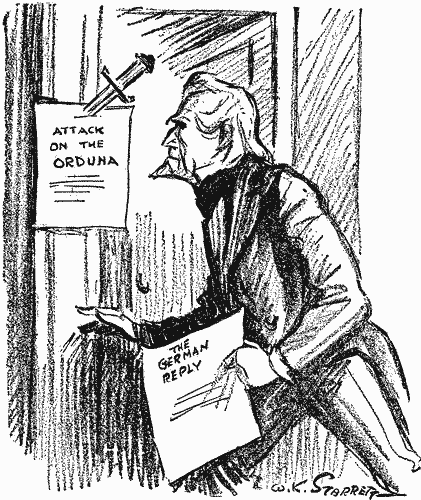
—From The Tribune, New York.
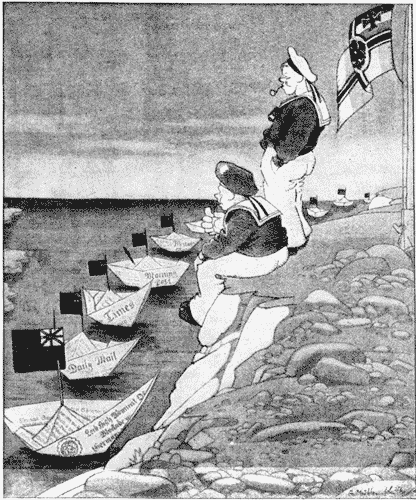
—From Lustige Blaetter, Berlin.
"Look out there, mate; don't puff so hard,
or you'll smash up
Churchill's blockade!"

—From The World, New York.
Germany Dishonored: None Drowned.
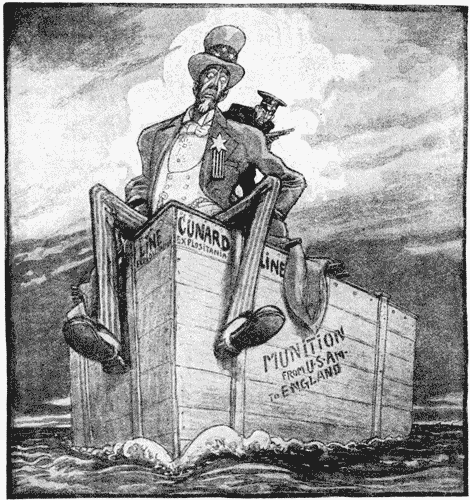
—From Lustige Blaetter, Berlin.
John Bull: "Don't be afraid, Mister Moneymaker. There's no
safer way to travel to Europe than on my peaceful vessel!"
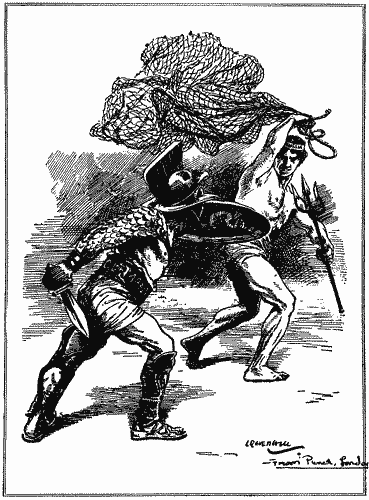
—From Punch, London.
It was the policy of the retiarius to retreat in order
to gather his net together for a fresh cast.
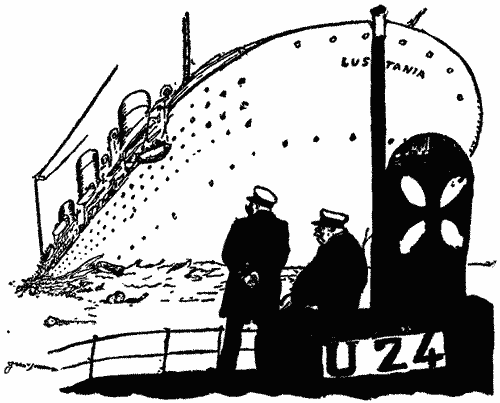
—From La Revue Hebdomadaire, Paris.
When Wilson's daughter is aboard one of these days it won't be a laughing matter.
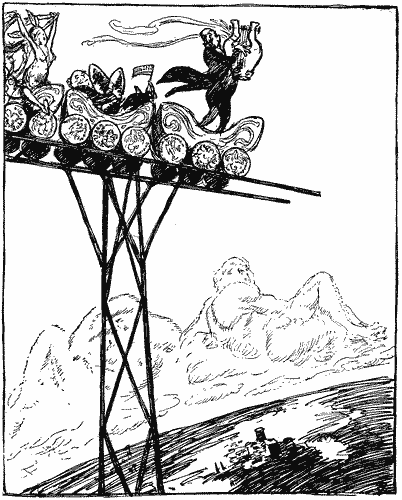
—From Jugend, Munich.
Destruction awaits them even though the wheels are made of dollars.
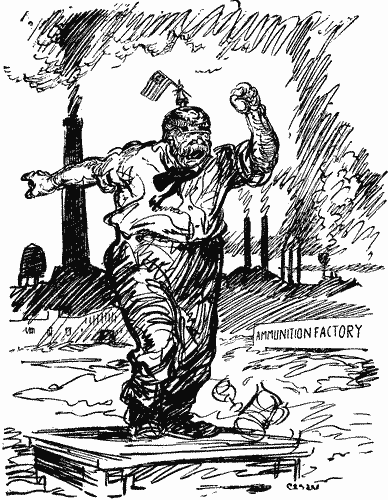
—From The Sun, New York.
"Close up these factories! Be neutral!"
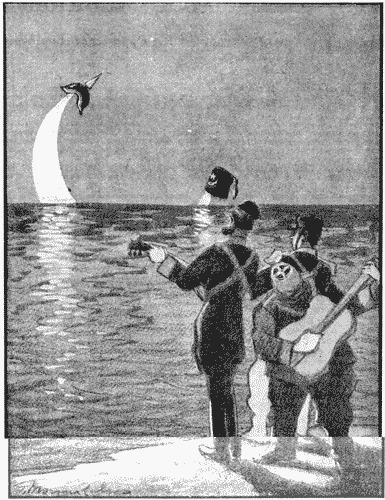
—From Numero, Turin.
The last serenade.
The threatened strike in the Krupp works at Essen, Germany, simultaneously with the strike of the Welsh coal miners and the walkout in the Remington Arms Factory in the United States, would tend to show that labor in the belligerent and neutral countries is seeking advantages under the strain of the enormous output of munitions to feed the war. Only in France, whose people are making supreme sacrifices, and in Russia, whose factories are not yet organized for the nation, does industrial peace prevail. In England the Munitions bill, with its proposals for compulsory arbitration and for limiting profits unweakened, was passed on July 1st. The bill retained, also, the power for the Government to proclaim the extension of its strike-stopping authority to other trades than the munitions trades.
An account of the conditions relating to labor in the various countries, beginning with the speech, in part, of Lloyd George, introducing the Munitions bill in the House of Commons on June 20, appears below.
Addressing the House of Commons on June 20, 1915, Mr. Lloyd George said, in part:
WHAT I want to impress not merely upon the House but on the country is that the duration of the war, the toll of life and limb levied by the war, the amount of exhaustion caused by the war, the economic and financial effect—and in order to understand the whole depth and meaning of the problem with which we are confronted I would state the ultimate victory or defeat in this war—depend on the supply of munitions which the rival countries can produce to equip their armies in the field. That is the cardinal fact of the military situation in this war. (Cheers.)
I heard the other day on very good authority—and this will give the House an idea of the tremendous preparations made by the enemy for this war and of the expansion which has taken place even since the war—that the Central European Powers are turning out 250,000 shells per day. That is very nearly eight million shells per month. The problem of victory for us is how to equal, how to surpass, that tremendous production. (Hear, hear.)
The Central European Powers have probably attained something like the limits of their possible output. We have only just crossed the threshold of our possibilities. In France I had the privilege of meeting M. Thomas, the Under Secretary for War, a man to whose great organizing capacity a good deal of the success of the French provisions of war is attributable, and I am very reassured not merely as to what France is doing and what France can do but as to what we can do when I take into account what France has already accomplished.
Let us see the position France is in. Her most important industrial provinces were in the hands of the enemy. Seventy per cent. of her steel production was in the hands of the enemy. She had mobilized an enormous army and therefore had withdrawn a very considerable proportion of her population from industry. She is not at best as great an industrial country as we are. She is much of an agricultural and pastoral country. It is true that we have certain disadvantages compared with France, and they are important. She has not the same gigantic Navy to draw upon the engineering establishments of the country. That makes a very great difference. She has more complete command over her labor. That makes an enormous difference, not merely in the mobility of labor and the readiness with which she can transfer that labor from one center to another, but in the discipline which obtains in the workshops. She has another advantage with her arsenals, which at the outbreak of war corresponded to the magnitude of her Army—a huge Army. We had a small Army to provide for. She, in addition to that, had undoubtedly a very great trade with other countries in the production of munitions of war. These are the advantages and disadvantages. Still, knowing these things and taking them all into account, the surplus of our engineering resources available for the materials of war is undoubtedly greater than that of France, and if we produce these things within the next few months as much as they are likely to produce the Allies would not merely equal the production of the Central Powers, but they would have an overwhelming superiority over the enemy in the material essential to victory. That is the first great fact I would like to get into the minds of all those who can render assistance to the country.
Germany has achieved a temporary preponderance of material. She has done it in two ways. She accumulated great stores before the war. She has mobilized the whole of her industries after the war, having no doubt taken steps before the war to be ready for the mobilization of the workshops immediately after war was declared. Her preponderance in two or three directions is very notable. I mention this because it is essential they should be understood in inviting the assistance of the community to enable us to compete with this formidable enemy. The superiority of the Germans in material was most marked in their heavy guns, their high explosive shells, their rifles, and perhaps most of all their machine-guns. These have turned out to be about the most formidable weapons in the war. They have almost superseded the rifle and rendered it unnecessary.
The machinery for rifles and machine-guns takes eight and nine months to construct before you begin to turn a single rifle or machine-gun. The Germans have undoubtedly anticipated the character of the war in the way no other Power has done. They realized it was going to be a great trench war. They had procured an adequate supply of machinery applicable to those conditions. The professional man was essentially a very conservative one—(hear, hear)—and there are competent soldiers who even today assume that his phase is purely a temporary one, that it would not last long, and we shall be back on the old lines.
I have no doubt much time was lost owing to that opposition. The Germans never harbored that delusion, and were fully prepared to batter down the deepest trenches of the enemy with the heavy guns and high explosives, and to defend their own trenches with machine-guns. That is the story of the war for ten months. We assumed that victory was rather due as a tribute from fate, and our problem now is to organize victory, and not take it for granted. (Cheers.) To do that the whole engineering and chemical resources of this country—of the whole Empire—must be mobilized. When that is done France and ourselves alone, without Italy or Russia, can overtop the whole Teutonic output.
The plan on which we have proceeded until recently I explained to the House in April. We recognized that the arsenals then in existence were quite inadequate to supply the new Army or even the old Army, giving the necessary material and taking into account the rate at which ammunition was being expended. We had, therefore, to organize new sources of supply, and the War Office was of opinion that the best method of attaining that object was to work through existing firms, so as to have expert control and direction over companies and workshops, which up to that time had no experience in turning out shells and guns and ammunition of all sorts. There was a great deal to be said for that. There was, first of all, a difficulty unless something of that kind was done of mobilizing all the resources at the disposal of the State. The total Army Estimates were £28,000,000 in the year of peace. They suddenly became £700,000,000. All that represents not merely twenty or twenty-five times as much money; it means twenty or twenty-five times as much work. It means more than that, because it has to be done under pressure. The sort of business which takes years to build up, develop, strengthen, and improve has suddenly to be done in about five, six, seven, or eight months. The War Office came to the conclusion that the best way of doing that was to utilize the skill of existing firms which were capable of doing this work. The War Office staff are hard-working, capable men, but there are not enough. There is one consideration which cannot be left out of account, and that is that men who are quite equal to running long-established businesses run on old-established lines, may not always be adequate to the task of organizing and administering a business thirty times its size on novel and original lines.
To be quite candid, the organizing firms—the armament firms—were also inadequate to the gigantic task cast upon them of not merely organizing their own work but of developing the resources of the country outside. They could not command the stock, and sub-contracting has undoubtedly been a failure. Sub-contracting has produced something like 10,000 shells a month. We have only been at it a few days, and we have already placed with responsible firms orders for 150,000 shells a month. In a very short time I am confident it will be a quarter of a million or 300,000. (Cheers.) It is a process of inviting business men to organize themselves and to assist us to develop the resources of their district.
We have secured a very large number of business men; many business men are engaged in organizing and directing their own business, business which is just as essential to the State in a period of war as even the organization of this office; but still there are the services of many able business men which are available, and we propose to utilize them to the full, first, in the Central Office to organize it; secondly, in the localities to organize the resources there; and, thirdly, we propose to have a great Central Advisory Committee of business men to aid us to come to the right conclusions in dealing with the business community.
I should like just to point out two or three of the difficulties, in order to show the steps which are taken to overcome them. The first difficulty, of course, is that of materials. There is, as I pointed out, material of which you have abundance in this country, but there are others which you have got to husband very carefully, and there is other material on which you have got to spend a considerable sum of money in order to be able to develop it at a later stage. With regard to this question, I think that it might be necessary ultimately for us to take complete control of the Metal Market, so that available material should not be wasted on non-essential work. (Hear, hear.) To a certain extent we have done that.
I should like to say a word with regard to raw material for explosives. We are building new factories so that the expansion of explosives shall keep pace with that of shells, and in this respect, again, I should like to dwell upon the importance of keeping up our coal supplies in this country. It is the basis of all our high-explosives, and if there were a shortage for any reason the consequences would be very calamitous.
Sometimes we do not get the best in these yards through the slackness of a minority and sometimes through regulations, useful, perhaps essential, in times of peace for the protection of men against undue pressure and strain, but which in times of war have the effect of restricting output. If these are withdrawn no doubt it increases the strain on the men, and in a long course of years they could not stand it. But in times of war everybody is working at full strain, and therefore it is difficult to exaggerate the importance of suspending restrictions which have the effect of diminishing the output of war material.
The fourth point is that the danger of having stoppages of work by means of strikes and lock-outs ought to be removed during the time of the war. (Hear, hear.) I should have liked to have seen strikes and lock-outs during the war made impossible in any trade, and I do not despair of getting the assent of those who object to compulsory arbitration under normal conditions to a temporary application of that principle during the period of the war.
The next step is one in which the Trade Unions are concerned. There was a very frank discussion between the leaders of the Trade Unions and myself, and I was bound to point out that if there were an inadequate supply of labor for the purpose of turning out munitions of war which are necessary for the safety of the country compulsion would be inevitable.
They put forward as an alternative that the Government should give them the chance of supplying that number of men. They said, "Give us seven days, and if in seven days we cannot get the men we will admit that our case is considerably weakened." They asked us to place the whole machinery of Government at their disposal, because they had not the organization to enlist the number. We have arranged terms upon which the men are to be enlisted, and tomorrow morning the seven days begin. Advertisements will appear in all the papers, an office has been organized, and the Trade Union representatives are sitting there in council directing the recruiting operations. I am not sure, but I believe my honorable friend Mr. Brace is the Adjutant-General. Tomorrow we hope to be able to make a start. We have 180 town halls in different parts of the country placed entirely at our disposal as recruiting offices. We invite the assistance of everybody to try to secure as many volunteers as they possibly can—men who are not engaged upon Government work now, skilled men—to enroll themselves in the Trade Union army for the purpose of going anywhere where the Government invited them to go to assist in turning out different munitions of war. If there are any honorable friends of mine who are opposed to compulsion, the most effective service they can render to voluntarism is to make this army a success. (Cheers.) If we succeed by these means—and the Board of Trade, the Munitions Department, and the War Office are placing all their services at the disposal of this new recruiting office—if within seven days we secure the labor, then the need for industrial compulsion will to that extent have been taken away.
In a special cable dispatch to The New York Times, dated June 24, appeared the following:
"England expects every workman to do his duty," is the new rendering of Nelson's Trafalgar signal which is being flagged throughout the country today. Lloyd George has issued an appeal to organized labor to come forward within the next seven days in a last supreme effort on behalf of the voluntary system, and if it fails nothing remains but compulsion.
The appeal is being put before them by advertisements in newspapers, by speeches from labor leaders, and by meetings throughout the country. A new workmen's army is being recruited just as Kitchener's army was, and only seven days are given to gather together what may be termed a mobile army of industry. It is estimated that a quarter of a million men well equipped for the purposes required are available outside the ranks of those already engaged in the manufacture of munitions. Nearly two hundred industrial recruiting offices throughout the country opened at six o'clock last night, and, judging by reports already to hand, the voluntary system seems again likely to justify itself.
"To British Workmen: Your skill is needed," runs one advertisement. "There are thousands of skilled men who are burning to do something for King and country. By becoming a war munitions volunteer each of them can do his bit for his homeland. Get into a factory and supply the firing line."
Posters and small bills with both an artistic and literary "punch" are being prepared and sent out for distribution. Newspapers with special working class clientèle are making direct appeals to their readers.
Mr. H.E. Morgan, of the War Munitions Ministry, said in an interview printed by The London Daily Chronicle on July 1:
The War Munition Volunteers have amply justified their formation. During the last two days the enrolments throughout the country have averaged ten thousand skilled and fully qualified mechanics, who are exactly the type of worker we want. So far as the men are concerned, the voluntary principle in industrial labor has triumphed.
We have already transferred a large number of skilled mechanics from non-war work to munition making, and daily the number grows. London compares excellently with other places as regards the number of volunteers, but naturally most of the men are coming from the great engineering centres in the North and Midlands.
In a London dispatch of the Associated Press, dated July 16, this report appeared:
After upward of a fortnight's work in the six hundred bureaus which were opened when the Minister of Munitions, David Lloyd George, gave labor the opportunity voluntarily to enroll as munitions operatives, closed today with a total registration of ninety thousand men. Registration hereafter will be carried out through the labor exchanges.
More men are needed, but the chief difficulty now is to place them on war work with a minimum of red tape. H.G. Morgan, assistant director of the Munitions Department, said today that this problem was causing some unrest among the workers, but that the transfers would take time, for the Government was anxious not to disturb industry more than necessary.
"The problem almost amounts to a rearrangement of the whole skilled labor of the country," said Mr. Morgan. "This, of course, will take considerable time."
A cable dispatch from London to The New York Times said on July 15:
The Daily Chronicle says that a campaign to urge munition workers to even greater efforts is to open today with a meeting at Grantham, and next week meetings will be held at Luton, Gloucester, Stafford, Preston, and other centres. In the course of the next few weeks hundreds of meetings will take place in all parts of the Kingdom.
The campaign has been organized by the Munitions Parliamentary Committee, the secretaries of which have received the following letter from Munitions Minister Lloyd George:
"I am glad to hear that members of the House are responding so enthusiastically to my pressing appeal to them to undertake a campaign in the country to impress upon employers and workers in munitions shops the urgent and even vital necessity for a grand and immediate increase in the output of munitions of war."
Professor Mantoux has been asked by the French Munitions Minister to keep in touch with the campaign and to report from time to time as to the results achieved. It is felt that what affects England affects France, and later a similar campaign may be inaugurated in that country.
Sixty members of Parliament have promised to speak at the meetings.
Most of the coal for Great Britain's navy comes from South Wales, and the supply was reduced by the enlistment of sixty thousand Welsh miners in the army. The labor crisis was first threatened three months ago, when the miners gave notice that they would terminate the existing agreements on July 1, and, in lieu of these, they proposed a national program, giving an all-around increase in wages. The owners objected to the consideration of the new terms during the war and asked the miners to accept the existing agreements plus a war bonus. After a series of conferences the union officials agreed to recommend a compromise, which was arranged through the Board of Trade. The miners, however, voted yesterday against this, and the Government was obliged to take action.
On July 16 the Associated Press cabled from London:
The Executive Committee of the South Wales Miners' Federation, most of the members of which are opposed to the strike, came to London today and conferred with Walter Runciman, President of the Board of Trade, who, it is understood, made new proposals for a settlement of the trouble, which will be considered at a meeting in the morning.
There is no indication of any weakening on the part of the men. Even the men in one district who last night decided to resume work reversed their decision, and not a pick was moving today.
However, the impression still prevails that a few days will see an end of the walkout. It is not believed that the introduction of the Munitions of War act can force the men to return to work, for it is impossible to bring 150,000 men before the courts to impose fines for contravening the act.
In fact, the resort to this measure is believed rather to have made the situation worse, and the men's demands now include its withdrawal so far as coal mining is concerned.
An Associated Press dispatch from Cardiff, Wales, on July 20 reported:
Subject to ratification by the miners themselves through delegates who will assemble tomorrow, representatives of the Government and of the coal mine owners on the one hand, and the Executive Committee of the South Wales Miners' Federation on the other, agreed today to terms that, it is thought, will end the coal miners' strike, which, since last Thursday, has tied up the South Wales coal fields and menaced the fuel supply of the navy.
The terms arrived at grant a substantial increase in wages and involve concessions to the strikers which are considered by their Executive Committee as tantamount to an admission of the miners' claims on nearly all the outstanding points. Tonight the delegates were visiting their districts, canvassing the sentiment there preparatory to tomorrow's vote.
If tomorrow's meeting should bring a settlement of the strike the thanks of the country will go chiefly to David Lloyd George, the Munitions Minister, for it was his arrival here last night that paved the way for breaking the deadlock between the miners and the mine owners.
If the vote tomorrow is favorable to ending the strike, two hundred thousand men will return to work immediately and agree to abide by the terms of the settlement until six months after the termination of the war.
M. Millerand, French Minister of War, after the Senate had approved, on June 29, the bill appropriating $1,200,000,000 for war expenses of the third quarter of the year, reported as quoted by the Associated Press:
From August 1 to April 1 France has increased her military production sixfold. The curve for munitions has never ceased to mount, nor that representing the manufacture of our 75s. I can give satisfying assurances also regarding the heavy artillery and small arms. From the 1st of January to the 15th of May the other essentials of the war have been equally encouraging. We are determined to pursue our enemies, whatever arms they may employ.
Yves Guyot, the economist and late Minister of Public Works in France, said to The New York Times correspondent on July 3:
France can hold her own against Germany. She herself makes all the shells that play such havoc in the enemy's ranks, and she will keep on making all she needs.
The munitions problem in France is not so acute as in England. In France as soon as the war started we began turning out the shells as fast as our factories could work. So, in a short time, they were going full blast. We have been able to supply our army with ample ammunition and to have shells enough to shake up the enemy whenever we put on spurts.
It is vitally important that England has come to the realization of the need of equipping her own army with adequate ammunition. Up to now the English Army has been sadly handicapped, but with the energetic Lloyd George in command the munitions output in the near future is certain to bring a sudden change in the status of England in the war.
We in France being in such immediate contact with the horrors of war had a stern sense of the necessity of fully equipping our army forced upon us at the very beginning of the conflict. The only thing we have lacked has been steel, and we have been getting some of that from our old friend, the United States. France has steel plants, and they do a tremendous amount of work, but altogether they do not turn out enough for our ammunition works. So we had to turn elsewhere for some of this product, and it was America that came to our aid.
We have got the steel with which to make shells. Our workmen are well organized and the whole spirit prevailing among them is to help France to win the bloodiest war of her history.
The London Daily Chronicle in an interview with Albert Thomas, French Minister of Munitions, quoted him as follows on July 8:
It is our duty to organize victory. To this we are bending all our energies. The war may be long; difficulties may reach us of which we had no prevision at the start; but we shall keep on until the end.
We know how great are the resources of Britain. We know what immense efforts she has put forth, which have been a surprise not only to us but to the enemy as well, and we have every reason for believing and knowing that these immense resources will continue to be used in the service of the Allies.
Understand me, I do not say that our common task is an easy one, nor do I say that we are on the eve of a speedy victory; but what I do say is that be the struggle long or short, we are both ready to double, to treble, to quadruple, and, if necessary, to increase tenfold the output of munitions of war.
We have pooled our resources, and I, for one, have no doubt, that these resources are great enough to stand any strain which we may be called upon to put upon them; nor have I any fear of an ultimate triumph. All the great moral forces of the world are on our side. The Allies are fighting for the freeing of Europe from the domination of militarism; and that is fighting into which every democrat can throw himself heart and soul. Defeat in such a cause is unthinkable.
The Petrograd correspondent of the London Morning Post reported on June 11th the annual assembly of leading members of the world of commerce and industry, as follows:
Speakers urged a general rally round the Rulers of the States, and proposals were made that they should express collectively to the Ministers the readiness of the whole industrial and mercantile class represented at that congress to place themselves at the disposal of the State for the purpose of making better provision for the war. The example of England in instituting a Ministry of Munitions should serve as a guide to Russia. A deputation, it was urged, should be appointed to lay at the feet of the Emperor the heartfelt desire of all to devote themselves to the sole purpose of obtaining victory over Germanism and to expound the ideas of their class for the best means of employing their resources. England had turned all its manufacturing resources into factories of munitions of war, and Russia must do the same.
Some speakers referred to the lack of capital for the proper exploitation of the resources of the country, saying that this would be especially felt after the war was over. The Congress, however, declined to look beyond the all-important need of the moment, namely, to direct the entire resources of the country to the achievement of victory over Germanism.
The final sitting was attended by the President of the Duma, M. Rodzjanko, whose speech was listened to with profound feeling. The Congress passed with acclamation various patriotic resolutions, its main decision being to establish immediately a Central Committee for the provision of munitions of war. It is expected that by this means Russia will be able to accomplish what England is believed to be achieving in the same direction. Every factory and workshop throughout the country is to be organized for the supply of everything needed by the armies in the field.
A "Neutral" correspondent of The London Daily Chronicle, just returned from Germany, was thus quoted in a cable dispatch to The New York Times on June 28:
It is in towns, particularly industrial towns, where one sees how entirely the German nation is organized for war. Into these towns an enormous number of men have been drafted from the country to work in factories, which are humming day and night with activity to keep up the supply of all things necessary for the fighting line.
In general, the relations between capital and labor there have experienced notable amelioration. Indeed, the impression one gains in traveling about Germany is one of absolute settled industrial peace, but I know this has only been secured because all parties know that the first signs of dissatisfaction would be treated "with the utmost rigor of the law."
At some of the largest factories men are often at work fifteen, twenty, and even thirty hours on a stretch, with only short intervals for rest. Though it is said that there are ample stocks of all kinds of ammunition, there is noted daily and nightly a feverish haste in the factories where it is made.
The Government has not officially taken over the factories, but it is well known that all factory owners who want Government work can get it, and, as this is almost the only profitable use to which factories can just now be put, there is no lack of candidates for recognition as army contractors.
Whenever a Government contract is given out there is a clause in the contract which fixes rates of wages for every grade of workmen so that any questions of increases that the men might raise are out of the hands of the employer, and he points to the fact that both he and the workmen are in the hands of the State. Strikes are therefore unknown, a further deterrent being the knowledge that any man who does not do his utmost without murmuring will quickly be embodied in some regiment destined for one of the hottest places at the front.
In factories where Government work is being done wages are high, and even in the few cases where wages of certain unskilled workers have fallen, the men are allowed to work practically until they drop and so make up by more hours what they have lost by the lowered rates.
There is keen competition to obtain work in the factories working for the State, as the men engaged in these know almost certainly that for some time at least they will not be sent to the front, which seems to be the chief dread underlying all other thoughts and feelings.
For work done on Sunday wages are 50 per cent. higher than the usual rate. The men are encouraged to work on Sundays and overtime on weekdays and the prices of food are so high they need little encouragement. Where women have taken the places of men their wages are in most cases lower.
An Associated Press dispatch from Geneva on July 15 said:
A report has reached Basle that a big strike is threatened at the Krupp Works at Essen, Germany, the movement being headed by the Union of Metallurgical Workmen and the Association of Mechanics. They demand higher wages, the report says, because of the increased cost of living and shorter hours because of the great strain under which they work.
The workmen, according to these advices, are in an angry mood and threaten the destruction of machinery unless their demands are granted immediately, as they have been put off for three months with promises. Several high officials have arrived at the Krupp Works in an effort to straighten out matters and calm the workmen, the advices add, and Bertha Krupp is expected to visit the plant and use her great influence with the workers.
The Frankfort Gazette, according to the news reaching Basle, has warned the administration of the Krupp plant of the seriousness of the situation, and has advised that the men's demands be granted. Meanwhile, the reports state, several regiments have been moved to the vicinity of the works to be available should the trouble result in a strike.
A dispatch to The London Daily Chronicle, dated Chiasso, July 16, reported:
According to a telegram from Munich to Swiss papers, the German military authorities have informed the management and union officials of the Krupps, where disputes occasioned by the increased cost of living have arisen in several departments, that in no circumstances will a strike be tolerated.
On July 19 an Associated Press dispatch from Geneva reads:
An important meeting was held at Essen yesterday, according to advices received at Basle, between the administration of the Krupp gun works and representatives of the workmen, in order to settle the dispute which has arisen over the demands of the men for an increase in wages.
Directly and indirectly, about one hundred thousand men are involved. Minor cases in which machinery has been destroyed have been reported.
The military authorities before the meeting, the Basle advices say, warned both sides that unless an immediate arrangement was reached severe measures would be employed.
The Krupp officials are understood to have granted a portion of the demands of the employees, which has brought about a temporary peace, but the workmen still appear to be dissatisfied, and many have left the works.
A strike would greatly affect the supply of munitions, and for this reason the military have adopted rigorous precautions.
On the same date the following brief cable was sent to The New York Times from London:
A telegram to The Daily Express from Geneva says many men have already left the Krupp works because they are unable to bear the strain of incessant labor, and would rather take their chances in the trenches than continue work at Essen under the present conditions.
Some minor cases of sabotage have already been reported.
In a special dispatch to The New York Times, dated Bridgeport, Conn., July 14, appeared the following news of labor trouble in the American munitions factory:
One hundred workmen, twenty guards, and the Bridgeport police reserves took a hand in a riot tonight at the new plant of the Remington Arms Company, where it is planned to make small arms for the Allies. The riot brings to fever heat the labor excitement of the last week, which yesterday caused the walkout of the structural ironworkers at the plant and today a walkout of the millwrights and the ironworkers on the new plant of the sister company, the Remington Union Metallic Cartridge Company.
The three thousand workmen have been stirred into a great unrest in the last week by some unseen influence. Major Walter W. Penfield, U.S.A., retired, head of the arms plant, says pro-Germans are back of the strike. This the labor leaders deny.
On July 15 the spread of the strike was reported in a special dispatch from Bridgeport to The New York Times:
The strike at the giant new plant of the Remington Arms Company under construction to make arms for the Allies, as well as, it is supposed, for the United States Government, spread today from the proportions of a picayune family labor quarrel to an imminent industrial war which would paralyze Bridgeport, curtailing the shipment of arms and ammunition from this centre, and which threatens to spread to other cities in the United States, especially to those where munitions of war are being manufactured.
On July 20 The New York Times published the demands of the workmen at the Remington Arms plant, as outlined by J.J. Keppler, vice-president of the Machinists' Union:
Mr. Keppler was asked to tell concisely just what the unions wanted.
"There are at present," he replied, "just three demands. If the strike goes further the demands will increase. The demands are:
"1. Recognition of the millwrights as members of the metal trade unions and not of the carpenters', and fixing of the responsibility for the order some one gave for the millwrights to join the carpenters' union, an attempt on the part of the Remington or the Stewart people to dictate the international management of the unions.
"2. A guarantee of a permanent eight-hour day in all plants in Bridgeport making war munitions. This carries with it a demand for a guarantee of a minimum wage and double pay for overtime.
"3. That all men who go on strike will be taken back to work."
In addition, of course, Mr. Johnston demands that Major Penfield retract his charge of German influence being back of the strike.
A check, if not a defeat, administered to the fomenters of the strike was reported to The New York Times in a Bridgeport dispatch dated July 20, as follows:
John A. Johnston, International vice-president of the Iron Workers' Union, and J.J. Keppler, vice-president of the Machinists', were on hand to inaugurate the big strike. All of Bridgeport's available policemen were on duty at the plant.
As the whistle blew the crowd surged about the gates, where barbed wire and guards held them back. Five minutes passed, ten, twenty, and 12.30 saw Keppler and Johnston pacing up and down before the plant awaiting their men. At 1 o'clock not a machinist had issued from the portals. The hoarse whistle blew, calling back the two thousand workers to their task, and Keppler and Johnston and the rest were left in wonder.
A cog had slipped in this way:
Before the noon whistle blew, Major Walter G. Penfield, works manager of the plant, placed guards at all the exits to ask the machinists to wait a few minutes. They did. The foreman told them that, on behalf of the Remington Company, Major Penfield desired to assure them a permanent eight-hour day, beginning August 1, and to guarantee a dollar a day increase in pay.
For the first time in the financial history of Great Britain, Prime Minister Asquith declared in his Guildhall speech of June 29, an unlimited and democratic war loan was popularized, appealing to all classes, including the poorest, and advertising the sale through the Post Office of vouchers for as low as 5 shillings to be turned into stock. His speech was intended also to initiate a movement for saving and thrift among the people as the only secure means against national impoverishment by the war.
A statement by Reginald McKenna, the Chancellor of the Exchequer, in the House of Commons on July 13, showed that approximately £600,000,000, or $3,000,000,000, had been subscribed, making this the greatest war loan raised in the history of any nation. The total number of subscribers through the Bank of England was 550,000, aggregating £570,000,000, or $2,850,000,000, while 547,000 persons had subscribed $75,000,000 through the Post Office. Besides this no estimate of the small vouchers taken out had been made, and the Post Office subscriptions had not been closed. The gigantic total, Mr. McKenna said, represented only new money, and not any stock which will be issued for purposes of conversion. Prime Minister Asquith's speech appears in full below.
In his speech in the Guildhall, London, on June 29, 1915, Mr. Asquith said:
THIS is, I think, the third time since the war began that I have had the privilege of addressing you in this hall. On the first occasion, as far back as September last, I came here to appeal to you to supply men to be trained to fight our battles at the front. Today I have come to ask you here in the City of London for what is equally necessary for the success of our cause—for the ways and means which no community in the Empire is better qualified to provide, to organise, and to replenish.
This is the costliest war that has ever been waged. A hundred years ago our ancestors spent eight hundred millions to vindicate, as we are vindicating today, the freedom of Europe, in a war which lasted the best part of 20 years, which brings out a rough average of considerably less than a million pounds a week. Our total expenditure today approaches for one year a thousand millions, and we are spending now, and are likely to spend for weeks and months to come, something like three million pounds a day. Our daily revenue from taxation, I suppose, works out less than three-quarters of a million per day.
Those are facts which speak for themselves, and they show the urgent necessity, not only for a loan, but for a national loan—a loan far larger in its scale, far broader in its basis, and far more imperious in its demand upon every class and every section of the community than any in our history.
For the first time in our financial experience no limit has been placed on the amount to be raised; and that means that every citizen in the country is invited to subscribe as much as he can to help us to a complete and speedy victory. I need not dwell on its attractiveness from the mere investor's point of view. Indeed, the only criticism which I have heard in or outside the House of Commons is that it is perhaps a little too generous in its terms. That is a fault, if it be a fault, upon the right side.
For £100 in cash you get £100 in stock, with interest at 4½ per cent. on the credit of the British Exchequer. The loan is redeemable in thirty years, when every subscriber, or those who succeed him, must get his money back in full, and the Government retain an option to repay at the end of ten years. That is the earliest date on which any question of re-investment can arise. Further, the stock or bonds will be accepted at par, with an allowance for accrued interest as the equivalent of cash, for subscription to any loan that the Government may issue in this country throughout the war.
I want especially to emphasise that this is for the first time in our financial history a great democratic loan. The State is appealing to all classes, including those whose resources are most limited, to step in and contribute their share to meet a supreme national need. The Post Office will receive subscriptions for £5, or any multiple of £5, and will sell vouchers for 5s. and upwards which can be gradually accumulated, and by December 1st next turned into stock of the new loan.
Every advantage which is given to the big capitalist is granted also in the same degree to the smallest supporter of the country's credit and finance. And, under such conditions, I am confident that the success of the loan as a financial instrument ought to be, and indeed is now, absolutely secured. (Cheers.)
This meeting was called not only to advertise the advantages of the War Loan, but to initiate a concerted national movement for what may be called war economy. My text is a very simple one. It is this: "Waste on the part either of individuals or of classes, which is always foolish and shortsighted, is, in these times, nothing short of a national danger." According to statisticians, the annual income of this country—I speak of the country and not of the Government—the annual income of this country is from two thousand two hundred and fifty to two thousand four hundred millions, and the annual expenditure of all classes is estimated at something like two thousand millions. It follows that the balance annually saved and invested, either at home or abroad, is normally between three hundred and four hundred millions.
Upon a nation so circumstanced, and with such habits, there has suddenly descended—for we did not anticipate it, nor prepared the way for it—the thundercloud of war—war which, as we now know well, if we add to our own direct expenditure the financing of other countries, will cost us in round figures about a thousand millions in the year. Now how are we, who normally have only three hundred or four hundred millions to spare in a year, to meet this huge and unexpected extraordinary draft upon our resources?
The courses open are four. The first is the sale of investments or property. We have, it is said, invested abroad something like four thousand millions sterling. Can we draw upon that to finance the war? Well, there are two things to be said about any such suggestion. The first is that our power of sale is limited by the power of other countries to buy, and that power, under existing conditions, is strictly limited.
The second thing to be said is this: That, if we were to try, assuming it to be practicable, to pay for the war in this way, we should end it so much poorer. The war must, in any case, impoverish us to some extent, but we should end it so much poorer, because the income we now receive, mainly from goods and services from abroad, would be proportionately, and permanently, reduced. I dismiss that, therefore, as out of the question.
Similar considerations seem to show the impracticability on any considerable scale of a second possible expedient, namely, borrowing abroad. The amount that could be raised in any foreign market at this moment, in comparison with the sum required, is practically infinitesimal, and, if it were possible on any considerable scale, we should again have to face the prospects of ending the war a debtor country, with a huge annual drain on our goods and our services, which would flow abroad in the payment of interest and the redemption of principal. That again, therefore, for all practical purposes, may be brushed aside.
There is a third course—payment out of our gold reserve, but that need only be stated to be discarded. We cannot impair the basis of the great system of credit which has made this City of London the financial centre and capital of the world.
There remains only one course, the one we have come here today to advocate, and to press upon our fellow-countrymen—to diminish our expenditure and to increase our savings.
If you save more you can lend the State more, and the nation will be proportionately enabled to pay for the war out of its own pocket. A second proposition, equally simple, and equally true, is this. If you spend less, you either reduce the cost and volume of our imports, or you leave a larger volume of commodities available for export.
The state of the trade balance between ourselves and other countries at this moment affords grounds—I do not say for anxiety, but for serious thought. If you look at the Board of Trade returns for the first five months—that is, to the end of the month of May—of the present year—you will find, as compared with the corresponding period of last year, that our imports have increased by thirty-five and a half millions; while our exports and re-exports have decreased by seventy-three and three-quarter millions. What does that mean? It means a total addition in five months of our indebtedness to other countries of nearly a hundred and ten millions, and if that rate were to continue till we reached the end of a completed year, the figure of indebtedness would rise to over two hundred and sixty millions.
That is a serious prospect, and I want to ask you, and those outside, how can that tendency be counteracted? The answer is a very simple one—by reducing all unnecessary expenditure, first, of imported goods—familiar illustrations are tea, tobacco, wine, sugar, petrol; I could easily add to the list—and that would mean that we should have to buy less from abroad; and next, as regards goods which are made at home—you can take as an illustration beer—setting a larger quantity free for export, which means that we have more to sell abroad, and enable capital and labour here at home to be more usefully and appropriately applied. That may seem a rather dry and technical argument—(laughter)—but it goes to the root of the whole matter.
If you ask me to state the result in a sentence, it is this: All money that is spent in these days on superfluous comforts or luxuries, whether in the shape of goods or in the shape of services, means the diversion of energy which can be better employed in the national interests, either in supplying the needs of our fighting forces in the field or in making commodities for export which will go to reduce our indebtedness abroad.
And, on the other hand, every saving we make by the curtailment and limitation of our productive expenditure increases the resources which can be put by our people at the disposal of the State for the triumphant vindication of our cause.
I said our cause. That, after all, is the summary and conclusion of the whole matter. We are making here and throughout the Empire a great national and Imperial effort, unique, supreme. The recruiting of soldiers and sailors, the provision of munitions, the organisation of our industries, the practice of economy, the avoidance of waste, the accumulation of adequate war funds, the mobilisation of all our forces, moral, material, personal—all these are contributory and convergent streams which are directed to and concentrated upon one unifying end, one absorbing and governing purpose.
It is not merely with us a question of self-preservation, of safeguarding against hostile design and attack the fabric which has withstood so many storms of our corporate and national life. That in itself would justify all our endeavours. But there is something even larger and worthier at stake in this great testing trial of our people.
There is not a man or a woman among us but he or she is touched even in the faintest degree with a sense of the higher issues which now hang in the balance, who has not, during this last year, become growingly conscious that, in the order of Providence, we here have been entrusted with the guardianship of interests and ideals which stretch far beyond the shores of these islands, beyond even the confines of our world-spread Empire, which concern the whole future of humanity. (Cheers.)
Is right or is force to dominate mankind? Comfort, prosperity, luxury, a well-fed and securely sheltered existence, not without the embellishments and concentrations of art and literature, and perhaps some conventional type of religion—all these we can purchase at a price, but at what a price! At the sacrifice of what makes life, national or personal, alone worth living. My Lord Mayor and citizens of London, we are not going to make that sacrifice (loud and prolonged cheers, the audience rising and waving their hats). Rather than make it, we shall fight to the end, to the last farthing of our money, to the last ounce of our strength, to the last drop of our blood. (Loud cheers.)
[From Punch.]
"The Government are of opinion that the general question of personal responsibility shall be reserved until the end of the War."—Mr. Balfour in the House.
Let sentence wait. The apportionment of blame
To those who compassed each inhuman wrong
Can bide till Justice bares her sword of flame;
But let your memories be long!
And, lest they fail you, wearied into sleep,
Bring out your tablets wrought of molten steel;
There let the record be charáctered deep
In biting acid, past repeal.
And not their names alone, of high estate,
Drunk with desire of power, at whose mere nod
The slaves that execute their lust of hate
Laugh at the laws of man and God;
But also theirs who shame their English breed,
Who go their ways and eat and drink and play,
Or find in England's bitter hour of need
Their chance of pouching heavier pay;
And theirs, the little talkers, who delight
To beard their betters, on great tasks intent,
Cheapening our statecraft in the alien's sight
For joy of self-advertisement.
Today, with hands to weightier business set,
Silent contempt is all you can afford;
But put them on your list and they shall get,
When you are free, their full reward.
State registration of all persons, male and female, between the ages of fifteen and sixty-five, the particulars to include each person's age, work, and employers, and his registering to be accompanied by an invitation that he volunteer for work for which he may have special fitness, was the provision introduced in the House of Commons on June 29, 1915, and passed by that body on July 8. In explaining the bill's intent its introducer, Mr. Walter Long, who is President of the Local Government Board, replied on July 9 to the objection of critics who saw in it the first steps to compulsory service. He said that the National Register stood or fell by itself. So far as the use of it went, so far as the adoption of compulsion went, he declared frankly that the Prime Minister would be the last man in England to say, in the face of the situation in which Britons found themselves, anything which would prevent the Government adopting compulsory service tomorrow if they believed it to be right and necessary in order to bring this war to an end. Their hands were absolutely free. On the same day Earl Kitchener opened a recruiting campaign with a speech in the London Guildhall, which appears in part below.
The Lord Mayor of London, in calling upon Lord Kitchener, said the Empire had indeed been highly fortunate in having him at the head of the War Office in this great national crisis. Earl Kitchener was received with cheers as he said:
HITHERTO the remarks that I have found it necessary to make on the subject of recruiting have been mainly addressed to the House of Lords; but I have felt that the time had now come when I may with advantage avail myself of the courteous invitation of the Lord Mayor to appear among you, and in this historic Guildhall make another and a larger demand on the resources of British manhood. Enjoying as I do the privilege of a Freeman of this great City—(hear, hear!)—I can be sure that words uttered in the heart of London will be spread broadcast throughout the Empire. (Cheers.) Our thoughts naturally turn to the splendid efforts of the Oversea Dominions and India, who, from the earliest days of the war, have ranged themselves side by side with the Mother Country. The prepared armed forces of India were the first to take the field, closely followed by the gallant Canadians—(cheers)—who are now fighting alongside their British and French comrades in Flanders, and are there presenting a solid and impenetrable front against the enemy. In the Dardanelles the Australians and New Zealanders—(cheers)—combined with the same elements, have already accomplished a feat of arms of almost unexampled brilliancy, and are pushing the campaign to a successful conclusion. In each of these great Dominions new and large contingents are being prepared, while South Africa, not content with the successful conclusion of the arduous campaign in South-West Africa, is now offering large forces to engage the enemy in the main theatre of war. (Cheers.) Strengthened by the unflinching support of our fellow-citizens across the seas, we seek to develop our own military resources to their utmost limits, and this is the purpose which brings us together today.
Napoleon, when asked what were the three things necessary for a successful war, replied: "Money, money, money." Today we vary that phrase, and say: "Men, material, and money." As regards the supply of money for the war, the Government are negotiating a new loan, the marked success of which is greatly due to the very favorable response made by the City. To meet the need for material, the energetic manner in which the new Ministry of Munitions is coping with the many difficulties which confront the production of our great requirements affords abundant proof that this very important work is being dealt with in a highly satisfactory manner. (Cheers.) There still remains the vital need for men to fill the ranks of our Armies, and it is to emphasize this point and bring it home to the people of this country that I have come here this afternoon. When I took up the office that I hold, I did so as a soldier, not as a politician—(loud cheers)—and I warned my fellow countrymen that the war would be not only arduous, but long. (Hear, hear.) In one of my earliest statements made after the beginning of the war I said that I should require "More men, and still more, until the enemy is crushed." I repeat that statement today with even greater insistence. All the reasons which led me to think in August, 1914, that this war would be a prolonged one hold good at the present time. It is true we are in an immeasurably better situation now than ten months ago—(hear, hear)—but the position today is at least as serious as it was then. The thorough preparedness of Germany, due to her strenuous efforts, sustained at high pressure for some forty years, have issued in a military organization as complex in character as it is perfect in machinery. Never before has any nation been so elaborately organized for imposing her will upon the other nations of the world; and her vast resources of military strength are wielded by an autocracy which is peculiarly adapted for the conduct of war. It is true that Germany's long preparation has enabled her to utilize her whole resources from the very commencement of the war, while our policy is one of gradually increasing our effective forces. It might be said with truth that she must decrease, whilst we must increase.
It would be difficult to exaggerate the value of the response that has been made to my previous appeals, but I am here today to make another demand on the manhood of the country to come forward to its defence. I was from the first unwilling to ask for a supply of men in excess of the equipment available for them. I hold it to be most undesirable that soldiers, keen to take their place in the field, should be thus checked and possibly discouraged, or that the completion of this training should be hampered owing to lack of arms. We have now happily reached a period when it can be said that this drawback has been surmounted, and that the troops in training can be supplied with sufficient arms and material to turn them out as efficient soldiers.
When the great rush of recruiting occurred in August and September of last year, there was a natural difficulty in finding accommodation for the many thousands who answered to the call for men to complete the existing armed forces and the New Armies. Now, however, I am glad to say we have throughout the country provided accommodation calculated to be sufficient and suitable for our requirements. Further, there was in the early autumn a very natural difficulty in clothing and equipping the newly raised units. Now we are able to clothe and equip all recruits as they come in, and thus the call for men is no longer restricted by any limitations, such as the lack of material for training.
It is an axiom that the larger an army is, the greater is its need of an ever-swelling number of men of recruitable age to maintain it at its full strength; yet, at the very same time the supply of those very men is automatically decreasing. Nor must it be forgotten that the great demand which has arisen for the supply of munitions, equipment, etc., for the armed forces of this country and of our Allies also, as well as the economic and financial necessity of keeping up the production of manufactured goods, involves the retention of a large number of men in various trades and manufactures, many of whom would otherwise be available for the Colors. In respect of our great and increasing military requirements for men, I am glad to state how much we are indebted to the help given to the Recruiting Staff of the Regular Army and to the Territorial Associations throughout the country by the many Voluntary Recruiting Committees formed in all the counties and cities, and in many important boroughs for this purpose.
The public has watched with eager interest the growth and the rapidly acquired efficiency of the New Armies, whose dimensions have already reached a figure which only a short while ago would have been considered utterly unthinkable. (Cheers.) But there is a tendency, perhaps, to overlook the fact that these larger armies require still larger reserves, to make good the wastage at the front. And one cannot ignore the certainty that our requirements in this respect will be large, continuous, and persistent; for one feels that our gallant soldiers in the fighting line are beckoning, with an urgency at once imperious and pathetic, to those who remain at home to come out and play their part too. Recruiting meetings, recruiting marches, and the unwearied labors of the recruiting officers, committees, and individuals have borne good fruit, and I look forward with confidence to such labors being continued as energetically as hitherto.
But we must go a step further, so as to attract and attach individuals who from shyness—(laughter)—or other causes—(renewed laughter)—have not yet yielded to their own patriotic impulses. The Government have asked Parliament to pass a Registration Bill, with the object of ascertaining how many men and women there are in the country between the ages of fifteen and sixty-five eligible for the national service, whether in the navy or army, or for the manufacture of munitions, or to fulfil other necessary services. When this registration is completed we shall anyhow be able to note the men between the ages of nineteen and forty not required for munition or other necessary industrial work and therefore available, if physically fit, for the fighting line. Steps will be taken to approach, with a view to enlistment, all possible candidates for the Army—unmarried men to be preferred before married men, as far as may be. (Loud cheers.) Of course, the work of completing the registration will extend over some weeks, and meanwhile it is of vital and paramount importance that as large a number of men as possible should press forward to enlist, so that the men's training may be complete when they are required for the field. I would urge all employers to help in this matter, by releasing all men qualified for service with the Colors and replacing them by men of unrecruitable age, or by women, as has already been found feasible in so many cases.
When the registration becomes operative I feel sure that the Corporation of the City of London will not be content with its earlier efforts, intensely valuable as they have been, but will use its great facilities to set an example of canvassing for the cause. This canvass should be addressed with stern emphasis to such unpatriotic employers as, according to returns, have restrained their men from enlisting.
What the numbers required are likely to be it is clearly inexpedient to shout abroad. (Hear, hear.) Our constant refusal to publish either these or any other figures likely to prove useful to the enemy needs neither explanation nor apology. It is often urged that if more information were given as to the work and whereabouts of various units, recruiting would be strongly stimulated. But this is the precise information which would be of the greatest value to the enemy, and it is agreeable to note that a German Prince in high command ruefully recorded the other day his complete ignorance as to our New Armies. (Laughter and cheers.)
But one set of figures, available for everybody, and indicating with sufficient particularity the needs of our forces in the field, is supplied by the casualty lists. With regard to these lists, however—serious and sad as they necessarily are—let two points be borne in mind, first, that a very large percentage of the casualties represents comparatively slight hurts, the sufferers from which in time return to the front; and, secondly, that, if the figures seem to run very high, the magnitude of the operations is thereby suggested. Indeed, these casualty lists, whose great length may now and again induce undue depression of spirits, are an instructive indication of the huge extent of the operations undertaken now reached by the British forces in the field.
The subjoined article appraising the stimulation given to the war industries of the United States by the European conflict appeared originally in The New York Times of July 18.
WITHIN the last ten months contracts for war supplies estimated to exceed $1,000,000,000 have been placed in the United States.
When war was declared last August this country was suffering from acute industrial depression; many factories shut down, others operating on short time, and labor without employment. After the paralyzing effect of the news that war was declared had worn away, business men here realized the great opportunity about to be afforded them of furnishing war supplies which must soon be in demand. Their expectations were soon fulfilled, as almost immediately most of the Governments sent commissions to the United States. Some had orders to buy, while others were authorized to get prices and submit samples.
It was not long until mills and factories were being operated to capacity, turning out boots and shoes, blankets, sweaters, socks, underwear, &c. The manufacturers of these articles were merely required to secure additional help in order to increase their plants' production.
The situation was different in relation to filling orders for arms and ammunition. At first, as was natural, this business was placed with concerns engaged in the manufacture of these commodities. Shortly they were swamped with orders, and to be able to fill them plants were enlarged, new equipment added, and additional help employed.
More and more orders came pouring in, and, as the arms and munition houses were by this time up to and some over capacity, acceptance by them of further business was impossible. Here, then, was the opportunity for the manufacturers of rails, rivets, electrical and agricultural machinery, locomotives, &c., to secure their share of this enormous business being offered. The manner in which they arose to the occasion is striking testimony of the great resourcefulness, efficiency, ingenuity, and adaptability of the American manufacturer.
The question of labor was of minor importance, due primarily to the fact that many thousands of men were without employment and anxious to secure work, and secondarily for the reason that skilled labor was not an essential factor. Most of the work is done by machinery and in a short period of time a mechanic of ordinary intelligence will become proficient in running a machine. The necessary trained labor could be secured without difficulty. Numbers of highly trained employes at Government arsenals are now with private arms and ammunition concerns. The labor problem therefore was negligible. However, three serious difficulties had yet to be overcome by the manufacturers wishing to engage in this new line of business—the securing of new machinery, raw materials, and capital.
The larger concerns had machinery and apparatus on hand suitable to most of the work, but much new machinery was needed, especially for the manufacture of rifles, and needed in a hurry. Time is the essence of these war supplies contracts, and, as many manufacturers agreed to make early deliveries, it was up to them to secure this new machinery and have it installed without delay; otherwise they could not manufacture and make deliveries as agreed to.
In this event they would suffer the penalty for non-fulfillment, as stipulated in the bond given by them to the purchaser at the time of signing the contract. These bonds are known as "fulfillment bonds" and are issued by responsible surety companies, usually to the amount of 5 per cent. of the total contract price, on behalf of the vendors, guaranteeing their deliveries and fulfillment of the contract.
In the earlier stages of this war supply business the question of his ability to secure raw materials with which to manufacture arms and ammunition or picric acid—this latter being used to manufacture higher explosives—was of no great concern to the manufacturer taking an order; but as orders came pouring in from abroad for ever larger amounts of supplies it was clearly evident that the demand for raw materials would shortly equal, if not exceed, the supply thereof. This condition was soon brought about, and today is one to be most seriously reckoned with by the manufacturer before accepting a contract.
Some of the materials needed with which to manufacture the supplies are mild carbon steel for the barrels, bayonets, bolt, and locks; well-seasoned ash or maple, straight-grained, for the stocks; brass, iron, powder, antimony, benzol or phenol, sulphuric acid, nitric acid, and caustic soda, &c. Of these various materials the most difficult to secure are those used in the manufacture of picric acid.
Today it is almost impossible to secure phenol, certainly in any considerable quantities, and it is almost as difficult to secure sulphuric acid and nitric acid. Germany has been the source of supply in the past for picric acid. Before the war it sold around 35 cents to 40 cents per pound, dry basis; recently it has sold at over $2 per pound for spot, that is immediate delivery, and is quoted at from $1.25 to $1.60 per pound for early future deliveries.
Antimony is becoming so scarce, never having been produced in any great quantity in this country, that in the new contracts being submitted for shrapnel shell it is stipulated that some other hardening ingredients may be substituted in the bullets, either totally or partly replacing the antimony.
Brass is essential to the manufacture of cartridges. The term "brass" is commonly understood to mean an alloy of copper and zinc.
Up to a short time ago electrolytic copper was selling at 20½ cents a pound, lead at 7 cents a pound, commercial zinc at 29½ cents a pound. Zinc ore, from which spelter is obtained, reached the price of $112 a ton. American spelter was nearly $500 a ton, compared with $110 a ton before the war. Spelter was almost unobtainable. In England the situation was acute, the metal there being quoted only nominally at around $550 a ton for immediate delivery.
Within the last few days prices have dropped materially, but how long they will remain at these lower levels it is impossible to predict. If the war continues for any length of time the demand for all these metals is certainly bound to increase, and this will automatically again send up prices.
The world's production of spelter in 1913 (the latest authentic figures obtainable) was 1,093,635 short tons. Of this the United States produced 346,676 tons, or 31.7 per cent.; Germany, 312,075 tons, or 28.6 per cent.; Belgium, 217,928 tons, or 19.9 per cent.; France and Spain, 78,289 tons; and Great Britain, 65,197 tons. The world's production of spelter in 1913 exceeded that of 1912 by 25,590 tons, or 2.2 per cent. The greatest increase was contributed by Germany, which exceeded its production of 1912 by 4.4 per cent. The United States made a gain of 2.3 per cent. The excess of the world's production over consumption in 1913 was only 27,316 tons.
As can be seen from the above figures, Germany has control of practically one-half, possibly now over one-half, of the world's production of spelter. Her position with respect to iron and coal is equally strong, the United States not included. In 1913 Germany's production of pig iron was 19,000 tons; Great Britain, 10,500 tons; France, 5,225 tons; Russia, 4,475 tons; Austria and Belgium, over 2,000 tons each; Italy, negligible. She has captured a large proportion of the coal resources of France as well. Her strength is her own plus that of conquered territory.
Before a contract for war supplies is let, more particularly with reference to contracts for arms and ammunition, the manufacturer is requested to "qualify." This means he must show his ability to "make good" on the contract he wishes to secure. If he is now or has been in the past successfully engaged in the manufacture of the particular article in question, this is usually sufficient; if it is out of his regular line, then he must prove to the satisfaction of the War Department or the purchasing agent, as the case may be, that he has the technical knowledge necessary for its production. In either event he must have an efficient organization, suitable plants, with proper equipment and men to operate same; also the necessary raw materials in hand or under option to purchase.
In most instances the manufacturer taking these war orders has been obliged to enlarge his plants, add new machinery and purchase raw materials so as to be able to handle the business. This meant the expenditure of large amounts of money on his part.
He did not have to depend, however, upon his own normal financial resources, as the contracts carry a substantial cash payment in advance, usually 25 per cent. of the total contract price. This advance payment is deposited in some New York bank simultaneously with the manufacturer's depositing a surety bond guaranteeing his deliveries, and upon the manufacturer executing an additional surety bond guaranteeing his responsibility he could draw down all or any part of the cash advance he might wish to use for his immediate needs.
Before issuing these bonds the surety companies make rigid examination as to the ability of the manufacturer to fulfill his contract. The commission charged for issuing these bonds is from 2½ to 5 per cent. on the amount involved. The demand for bonds has been so great during the last six months that it has taxed to the limit the combined resources of all the surety companies in the country.
The remaining part of the contract price is usually guaranteed by bankers' irrevocable letters of credit or deposits made with New York banks, to be drawn against as the goods are delivered, f.o.b. the factory—that is, free on board the cars—or f.a.s. the seaboard—that is, free alongside ship—as the terms may provide.
Banks here are beginning to purchase bank acceptances or bank-accepted bills of exchange, and in this manner payment is also being made to American manufacturers for goods sold to the Allies. For example, when a purchasing agent in Paris places an order for ammunition here he makes arrangements whereby the manufacturer will be authorized to draw on a New York banking institution at a stipulated maturity, and after acceptance of his drafts by such banking institution he could then negotiate these time drafts with his own banker—thus making them, less the discount, equivalent to cash—through whom they could be rediscounted by the Federal Reserve banks. These bank-accepted bills are discounted at a nominal rate of interest.
Before the war we were a debtor nation; today we are rapidly becoming, if we have not already become, a creditor nation. A year ago we were selling abroad only about as much goods as we were buying; now the balance of trade is greatly in our favor, due to the enormous export of foodstuffs and war supplies of all kinds. Monthly our exports are exceeding our imports by many millions of dollars. This indicates that foreign nations are going into debt to us.
At the time of writing this article foreign exchange was quoted as follows: London exchange, sterling, 4.76½; Paris exchange, franc, 5.45¾. By paying down $4.76½ in New York you can get £1 in London, which on a par gold basis is equivalent to $4.86 in London. By paying down 94½ cents in New York you can get the equivalent to 100 cents in Paris.
We now come to another interesting phase of this war supply business, namely, how some persons thought these war orders could be secured and how they are actually being placed. Almost immediately after the declaration of war, most of the belligerent Governments dispatched "commissions" to the United States. Some had orders to buy, and others were authorized to get prices and submit samples. In an incredibly short period of time it became generally known that foreign Governments were shopping and buying in our markets. The knowledge of this fact brought about a condition unique in our business life.
Men in all walks of life, from porters, barbers, clerks in offices, to doctors, lawyers, real estate agents, merchants, Wall Street brokers and bankers, seemed suddenly imbued with the idea of securing or bringing about the placing of a war order. Self-appointed agents, middlemen and brokers sprang up over night like mushrooms, each and every one claiming he had an order or could get an order for war supplies; or, as the case might be, he personally knew some manufacturer, or he knew a friend who had a friend who knew a manufacturer, who in turn wished to secure a contract. An official in one of our large steel companies told me some weeks ago that among others who had called at his company's offices, asking prices on shrapnel, was an undertaker.
In most instances the lack of salesmanship experience, to say nothing of any knowledge of the business and how the particular articles are manufactured, was of no consequence to the self-appointed agent in his mad desire for business.
The lobbies of our New York hotels were filled with horsemen and would-be horsemen, some months ago, almost every State being represented as far west as California; also with manufacturers and manufacturers' agents, all eager to secure a "war contract," be it for horses, shrapnel, rifles, picric acid, guncotton, toluol, cartridges, boots, shoes, sweaters, blankets, machinery and materials, &c. The very atmosphere of Manhattan Island seems impregnated with "war contractitis." We breathe it, we think it, we see it, we talk it, on our way downtown, at our offices and places of business, at our clubs, on our way home at night, in our homes, and I have been told that some have even slept it, the disease taking the shape of a nightmare.
The day of the broker, if indeed he ever had one in this business, is passed. The original commissioners have been withdrawn, or those who have been kept here are now acting as inspectors and have been replaced by purchasing agents. The firm of J.P. Morgan & Co. has been acting as purchasing agent for the English Government for some months past, is now acting in like capacity for the French Government, and has also done considerable buying for the Russian Government.
In order properly to handle this vast volume of business, a separate department was created, known as the Export Department. Connected with this department are experts in all lines—men who are thoroughly familiar with the various Governments' requirements, who know what prices should be paid, who are in close touch with each market, and who understand fully the materials they are buying.
There are a few more concerns, among which are one or two banks, trust companies, and Wall Street houses, which also have formed separate organizations for the purpose of purchasing war supplies for the Allies. As all these concerns are in close touch with the manufacturers and will only deal directly with them, the brokers and middlemen have very little, if any, chance of doing business.

While the armies and generals of the belligerents are trying to execute by force the policies of their respective Governments, their publicists are not less busy in the work of voicing the national aspirations. Moreover, such a critical examination of the status of each armed Power, from its own standpoint and in comparisons and contrasts with its opponents, has never been conducted before the peoples of the world. It is a time of national heart-searchings, both among the warring nations and of neutrals whose destinies are only less affected. Résumés of this great process as reflected in the world's leading reviews appear below, beginning with the British publications.
THAT Germany has been preparing forty years for this war is flatly contradicted by J. Ellis Barker in his article entitled "The Secret of Germany's Strength," appearing in the Nineteenth Century and After for July.
Not forty years, but for 260 years, since Frederick William, the Great Elector, came to the Prussian throne, the slow-growing plants of German efficiency and thoroughness have steadily unfolded, Mr. Barker says, in the administrative, military, financial, and economic policy that make modern Germany. It was the Great Elector who "ruthlessly and tyrannously suppressed existing self-government in his possessions, and gave to his scattered and parochially minded subjects a strong sense of unity," thus clearing the way for his successors. Frederick William I. founded in the Prussia prepared by his grandfather "a perfectly organized modern State, a model administration, and created a perfectly equipped and ever ready army." Of him Mr. Barker says:
The German people are often praised for their thoroughness, industry, frugality, and thrift. These qualities are not natural to them. They received them from their rulers, and especially from Frederick William the First. He was an example to his people, and his son carried on the paternal tradition. Both Kings acted not only with thoroughness, industry, frugality, and economy, but they enforced these qualities upon their subjects. Both punished idlers of every rank of society, even of the most exalted. The regime of Thorough prevailed under these Kings who ruled during seventy-three years. These seventy-three years of hard training gave to the Prussian people those sterling qualities which are particularly their own, and by which they can easily be distinguished from the easy-going South Germans and Austrians who have not similarly been disciplined.
While the Great Elector prepared the ground, and King Frederick William I. firmly laid the foundations, "Frederick the Great erected thereon the edifice of modern Germany." Mr. Barker adds:
Among the many pupils of Frederick the Great was Bismarck. It is no exaggeration to say that the writings which Frederick the Great addressed to posterity are the arcana imperii of modern Germany. Those who desire to learn the secret of Germany's strength, wealth, and efficiency, should therefore most carefully study the teachings of Frederick the Great.
Frederick's "Political Testament" of 1752 addressed to his successors begins with the significant words:
"The first duty of a citizen consists in serving his country. I have tried to fulfil that duty in all the different phases of my life."
Frederick William I. looked out for the education of his successors in his own militarist ideals. Instructing Major Borcke in 1751 on the tutoring of his grand-nephew, the Heir-Presumptive of Prussia, he wrote:
It is very important that he should love the Army. Therefore he must be told at all occasions and by all whom he meets that men of birth who are not soldiers are pitiful wretches. He must be taken to see the troops drilling as often as he likes. He ought to be shown the Cadets, and be given five or six of them to drill. That should be an amusement for him, not a duty. The great point is that he should become fond of military affairs, and the worst that could happen would be if he should become bored with them. He should be allowed to talk to all, to cadets, soldiers, citizens and officers, to increase his self-reliance.
A thorough monarchist, who noted that "when Sweden was turned into a republic it became weak," Frederick the Great preached a doctrine not different from that which inspires the speeches of Kaiser Wilhelm II. when he said in his "Political Testament" of 1752:
As Prussia is surrounded by powerful states my successors must be prepared for frequent wars. The soldiers must be given the highest positions in Prussia for the same reason for which they received them in ancient Rome when that State conquered the world. Honors and rewards stimulate and encourage talent and praise arouses men to a generous emulation. It encourages men to enter the army. It is paradoxical to treat officers contemptuously and call theirs an honored profession. The men who are the principal supports of the State must be encouraged and be preferred to the soft and insipid society men who can only grace an ante-chamber.
Mr. Barker comments on the fact that in 1776, thirteen years after the ruinous Seven Years' War, Frederick the Great had accumulated financial resources sufficient to pay for another war lasting four years, and that he pursued the food policy of his fathers "which is still pursued by the Prusso-German Government." Moreover, he first exalted the German professor:
A hundred and fifty years ago Prussia was a land peopled by boors. Now it is a land peopled by professors, scientists, and artists. Frederick the Great was the first Prussian monarch to realize that science and art increase the strength and prestige of nations. Hence, he began cultivating the sciences and arts, and his successors followed his example. As science and art were found to be sources of national power, they were as thoroughly promoted as was the army itself, while in this country [England] education remained amateurish. Men toyed with science and the universities rather taught manners than efficiency.
The lesson of this centuries-old efficient governmental machine is a supreme one to democratic England, Mr. Barker thinks. Not that it is hopeless for a democracy to compete with a highly organized monarchy, for has not Switzerland shown that "a democracy may be efficient, business-like, provident, and ready for war?" England, on the other hand, has been a lover of luxury and ease. She must gird up her loins and fight or die. The Anglo-Saxon race is fighting for its existence, and delay is dangerous:
War is a one-man business. Every other consideration must be subordinated to that of achieving victory. When the United States fought for their life, they made President Lincoln virtually a Dictator. The freest and most unruly democracy allowed Habeas Corpus to be suspended and conscription to be introduced, to save itself. Great emergencies call for great measures. The War demands great sacrifices in every direction. However, if it leads to England's modernization, to the elimination of the weaknesses and vices of Anglo-Saxon democracy, if it leads to the unification and organization of the Empire, the purification of its institutions, and the recreation of the race, the gain may be greater than the loss, the colossal cost of the War notwithstanding. The British Empire and the United States, the Anglo-Saxon race in both hemispheres, have arrived at the turning point in their history. The next few months will confirm their greatness or mark the beginning of their fatal decline.
Stern is the denunciation of W.S. Lilly, in the same issue of The Nineteenth Century and After, upon the atrocities recounted in an article on German atrocities in France by Professor Morgan, appearing in the next preceding number. Mr. Lilly quotes Thomas Carlyle's sarcastic words about the "blind loquacious prurience of indiscriminate Philanthropism" that commands no revenge for great injustice. He says:
Apart from the "fierce and monstrous gladness," with which the German people have welcomed the hellish cruelty of their soldiery, they must be held responsible for its crimes. General von Bernhardi, indeed, assures them that "political morality differs from individual morality because there is no power above the State." And they have been given over to a strong delusion to believe this lie. Above the State is the Eternal Rule of Right and Wrong: above the State is the Supreme Moral Governor of the Universe; yes, above the State is God. Let us proclaim this august verity though in France Atheism has been triumphant; in England Agnosticism is fashionable; in Lutheran Germany—worst of all—evil has been enthroned in the place of good, and "devils to adore for deities" is the proper cult.
The resolution of the old Roman patriot that "Carthage must be destroyed" is quoted by this writer. He adds:
As stern a resolution is in the minds and on the lips of all true lovers of their country and of mankind, be they English or French, Russian, Italian, Japanese, and I do not hesitate to add American. German militarism must be utterly destroyed and the monstrous creation of blood and iron overthrown. Such is the plainest dictate of the instinct of self-preservation. It is also the plainest dictate of justice. Germany must be paid that she has deserved. When the triumphant Allies shall have made good their footing on her soil, they will not indeed rival her exploits or violating women and butchering children, of murdering prisoners and wounded, of slaying unoffending and peaceful peasants, of destroying shrines of religion and learning. But they will assuredly shoot or hang such of the chief perpetrators of these and the like atrocities as may fall into their hands. They will strip her of ill-gained territory. They will empty her arsenals and burn her war workshops. They will impose a colossal indemnity which will condemn her for long years to grinding poverty. They will confiscate her fleet. They will remove the treasures of her galleries and museums, and take toll of her libraries, to make compensation for her pillage and incendiarism in Belgium. The measure of punishment is always a matter of difficulty. But surely anything less than this would be wholly disproportionate to the rank offences of Germany. The reckoning, the retribution, the retaliation to be just must be most stern. The victorious Allies, who will be her judges, will not be moved by "mealymouthed philanthropies." "Justice shall strike and Mercy shall not hold her hands: she shall strike sore strokes, and Pity shall not break the blow."
In The Fortnightly Review for July E.J. Dillon is sweeping in his arraignment of the new Pope Benedict XV. and the Vatican, of the Pope because of his "neutrality in matters of public morality," and of the Vatican because of its hostility to the cause of Allies. Toward martyred Belgium and suffering France the Pope "has been generous in lip sympathy and promises of rewards in the life to come," Mr. Dillon says; but he has "found no word of blame for their executioners." Mr. Dillon personally offered Benedict XV. "some important information on the subject which seemed adequate to change his views or modify his action," but he "turned the conversation to other topics." In fairness he adds that "personally Benedict XV. had been careful to keep aloof from Buelow and his band," and has neither said nor done anything blameworthy with the sole exception of the interview and message which he was reported to have given "to an American-German champion of militarism at the instigation of his intimate counsellor, Monsignor Gerlach"—an interview, by the way, which the Pope has since expressly repudiated.
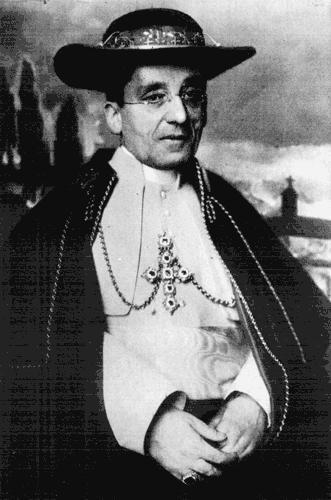
HIS HOLINESS BENEDICT XV.
The Entrance of Italy into the War has Increased the Delicacy of
the
Pontiff's Position
(Photo from International News.)
Monsignor Gerlach, Mr. Dillon says, is "one of the most compromising
associates and dangerous mentors that any sovereign ever admitted to
his privacy," and continues:
Years ago, the story runs, Gerlach made the acquaintance of a worldly minded papal Nuntius in the fashionable salons of gay Vienna, and, being men of similar tastes and proclivities, the two enjoyed life together, eking out the wherewithal for their costly amusements in speculations on the Exchange. When the Nuntius returned to Rome, donned the Cardinal's hat, and was appointed to the See of Albano as Cardinal Agliardi, he bestowed a canonry on the boon companion who had followed him to the eternal city. The friendship continued unabated, and was further cemented by the identity of their political opinions, which favored the Triple Alliance. Gerlach became Agliardi's tout and electioneering agent when that Cardinal set up as candidate for the papacy on the death of Leo XIII. But as his chances of election were slender, the pair worked together to defeat Rampolla, who was hated and feared by Germany and Austria. Their bitter opponent was Cardinal Richard, a witty French prelate who labored might and main for Rampolla, and told me some amusing stories about Agliardi. Some years ago Gerlach's name emerged above the surface of private life in Rome in connection with what the French term un drame passionel, which led to violent scenes in public and to a number of duels later on. That this man of violent Pan-German sentiments should be the Pope's mentor and guide through the labyrinth of international politics seems a curious anachronism.
Although Cardinal della Chiesa, shortly before he became Benedict XV., was spoken of as the inheritor of Rampolla's Francophile leanings, it is "now conjectured that at the Conclave this legend secured from his not only the votes of the Teutonic Cardinals, who knew what his sentiments really were, but also those of the French and Belgians, who erroneously fancied that they knew," Dr. Dillon says. He does not hesitate to believe that the Pope is "at heart a staunch friend of Austria and a warm admirer of Germany, whom he looks upon as the embodiment of the principle of authority and conservatism." For the Vatican his words are more unsparing:
The Vatican, as distinguished from the Pope, was and is systematically hostile to the Allies. Its press organs, inspired by an astute and influential Italian ecclesiastic named Tedeschini, by Koeppenberg, a rabid German convert, and by the Calabrian Daffina, organized a formidable campaign against the King's Government and their supposed interventionist leanings. Its agents, including the priest Boncampagni and the German Catholics Erzberger, Koeppenberg, and others, were wont to meet in the Hôtel de Russie to arrange their daily plan of campaign, and when at last the people rose up against Giolitti and his enormities, the Vatican had its mob in readiness to make counter-demonstrations, and was prevented from letting it loose only by the superhuman efforts of decent Catholics and orderly citizens. It is a fair thing to add that the attitude of the Roman Catholic clergy throughout Italy has with some few exceptions been consistently patriotic. Even the bishops and archbishops of the provinces have deserved well of their King and country, while their flocks have left nothing to be desired on the score of loyalty and patriotism.
Buelow's mission to Italy and his relations with Giolitti, the defeated abettor of Austria in the business preceding Italy's declaration of war, when they encountered the statecraft of Sonnino and Salandra, are given in this version of Buelow's playing of his "trump card":
Although the die was cast and Italy's decision taken, he had the Austrian concessions greatly amplified, and he offered them, not to the King's Government, but to Giolitti, his secret ally, who was not in office, but was known to be the Dictator of Italy. And Giolitti accepted them on the condition, to be fulfilled after the Cabinet's fall, that the territory would be further enlarged and consigned to Italy before the end of the war. The increase of prestige which this concession would bestow on the tribune was to be his reward for co-operation with the German Ambassador. Giolitti having thus approved the offer, undertook to have it ratified by Parliament, in spite of the engagements which the Cabinet had already entered into with the Allied Powers. In this sense he spoke to the King, wrote a letter designed for the nation, and obtained the public adhesion of a majority of the Chamber which was not then sitting. Thereupon the Cabinet resigned and left the destinies of Italy in the hands of the King and the nation. On the part of the Cabinet this was a brilliant tactical move and a further proof of the praiseworthy moral courage which it had displayed throughout the crisis. Indeed, the firmness, perseverance, and dignified disregard of mild invective and more deliberate criticism manifested by Sonnino and Salandra, entitle these Ministers to the lasting gratitude of their country. For it should be borne in mind that they had against them not only the Senate, the Chamber, a section of the Press, the "cream" of the aristocracy, the puny sons and daughters of the leaders of the Risorgimento, but also, strange to say, the majority of Italian diplomatists in the capitals of the Great Powers, one of whom actually fell ill at the thought that Italy was about to fight shoulder to shoulder with the State to which he was accredited. It would be interesting to psychologists to learn how this diplomatist and one or two of his colleagues felt when a few days later they were serenaded by enthusiastic crowds whom they were constrained to address.
In a Doubting Thomas article headed "Are We Winning?" the anonymous "Outis" in The Fortnightly Review concludes that "the Allies are winning, but very slowly. If their conquest is to be assured, Great Britain's task is to mobilize every soldier and every workman, in order to prove that whoever may fail, she at least does not intend to desist until the final triumph is won." Moreover, the conquest must be in the West "if anywhere," and he looks somewhat askance at the Dardanelles adventure:
A good many competent authorities have disliked the idea of the Dardanelles expedition, on the strength of a general principle applicable to all military operations. It is said that in every war there is one distinct objective, and that that should never be neglected for any subsidiary operations. Thus, in the present instance, our main effort is to drive the Germans out of France and Belgium, and then to attack them in their own territory. Anything which interferes with this or throws it, however temporarily, into the background, is held to be unwise, because it leads to the most dangerous of results in warfare—the dissipation of forces, which, if united, would win the desired success, but if disunited will probably fail. Thus we are told that we must not fritter away our energies in enterprises which, however important in themselves, are not comparable with the one unique preoccupation of our minds—the conquest of Germany in Europe.
Horace White has no two opinions in his article in The North American Review for July as to the wisdom and justice of the practice of American manufacturers in selling munitions which the Allies are using to kill their Germanic enemies. Mr. White expresses it as the belief of the great majority of people in the United States that Germany's war is without sufficient cause, and that when she invaded Belgium she "made herself the outlaw of the nations—a country whom no agreements can bind." Therefore he can see why no limit should ever be put to the world's expenditure for armaments "while one incorrigible outlaw is at large." He adds:
It is the opinion of most Americans that the most incorrigible and dangerous outlaw and armed maniac now existing is Germany, and that the first and indispensable step toward a restriction of armaments and a quiet world is to throttle and disarm her, and that no price is too great to pay for such a consummation. Any result of the present war which falls short of this will be the preliminary to a new armament and another war on a wider scale than the present one, since the United States will make preparations for the next one and most probably take part in it.
Hence proceeds Mr. White's justification for this neutral nation's supplying the Allies with arms:
Germany, by bursting her way through Belgium, was enabled to seize eighty to ninety per cent. of the coal and iron resources of France and the greater part of her apparatus for the production of arms. She holds also the entire resources of Belgium, both of raw material and finished product. The foul blow by which she possessed herself of these indispensable treasures had two consequences which she did not look for—the active hostility of England and the moral indignation of all other nations. In helping France to make good the loss which she sustained through such perfidy the American people think that they are doing God's service, and their only regret is that they cannot do more of it. If they had foreseen the present conditions they would have enlarged their gun factories and powder mills to meet the emergency more promptly.
A German writer in the New York Times of May 30, Mr. Vom Bruck, says: "If the German nation is wiped out with the help of American arms and ammunition no man of the white race in the United States would be able to think of such a catastrophe without horror and remorse." All of the contending nations say that they are fighting for existence, which means that if they do not win in the end they will be wiped out. With such an alternative staring us in the face very few tears would be shed by Americans, of any color, if both the Hohenzollerns and the Hapsburgs, with all their belongings, should be wiped off the face of the earth.
The pacifist "mollycoddle," as Theodore Roosevelt dubbed him in his San Francisco Exposition speech, finds expression in these words of Bertrand Russell in the August number of the Atlantic Monthly:
All these three motives for armaments—cowardice, love of dominion, and lust for blood—are no longer ineradicable in civilized human nature. All are diminishing under the influence of modern social organization. All might be reduced to a degree which would make them almost innocuous, if early education and current moral standards were directed to that end. Passive resistance, if it were adopted deliberately by the will of a whole nation, with the same measure of courage and discipline which is now displayed in war, might achieve a far more perfect protection for what is good in national life than armies and navies can ever achieve, without demanding the carnage and waste and welter of brutality involved in modern war.
But it is hardly to be expected, Mr. Russell reluctantly concludes, that progress will come in this way, because "the imaginative effort required is too great." He adds:
It is much more likely that it will come, like the reign of law within the state, by the establishment of a central government of the world, able and willing to secure obedience by force, because the great majority of men will recognize that obedience is better than the present international anarchy.
A central government of this kind would command assent not as a partisan, but as the representative of the interests of the whole. Very soon resistance to it would be seen to be hopeless and wars would cease. Force directed by a neutral authority is not open to the same abuse or likely to cause the same long-drawn conflicts as force exercised by quarreling nations, each of which is the judge in its own cause. Although I firmly believe that the adoption of passive instead of active resistance would be good if a nation could be convinced of its goodness, yet it is rather to the ultimate creation of a strong central authority that I should look for the ending of war. But war will end only after a great labor has been performed in altering men's moral ideals, directing them to the good of all mankind, and not only of the separate nations into which men happen to have been born.
The leading article in the June issue of the Süddeutsche Monatshefte (Munich) is by Dr. George Grupp, one of Germany's most able scholars, and is entitled, "Never Can Germany be Overcome if She be United." Dr. Grupp finds evidences for this assertion all through history, and quotes some of the earliest commentators and historians to this effect:
As early as 1487 Felix Fabri, a Dominican of Ulm wrote: "Si Germani essent ubique concordes, totum orbem domarent." (If the Germans were united they would conquer the whole world.)
The sentence is an echo of the fiery address which one Aeneas Silvius, later to become pope, delivered to the German princes after the fall of Constantinople, and from which Felix Fabri himself gives a quotation....
To Germany alone the Greeks looked for any considerable help. An evidence of this is the beautiful and often quoted remark of the Athenian Laonikos Chalkokondylas: "If the Germans were united and the princes would obey, they would be unconquerable and the strongest of all mortals."
We encounter similar statements very frequently, both earlier and later, from the Roman courtier Dietrich von Nieheim and from the humanists, from the Alsatian Wimpheling and Sebastian Brant, from the Swabian Nauclerus and the Frank Pirckheimer. "What could Germany be," they cry, "if she would only make use of her own strength, exploit her own resources for herself! No people on earth could offer her resistance!"
Dr. Grupp claims that Germany's lack of unity has resulted only from her rule of goodwill toward all, within her borders as well as without.
It never occurred to the Germans as to other peoples to disturb the peaceful development of their neighbors. They allowed mighty powers to build themselves up unmolested and to rise above Germany's head. In their internal affairs they observed the same principle of justice; no line, no class, no province, no grant succeeded in obtaining so oppressive an ascendancy, that other lines and classes, other provinces and grants were simply annihilated. The unfortunate consequence was lack of unity.
Nowhere were or are there so many cultural centres, so many different movements, tendencies, parties. This great multifariousness of the German life was recognized and admired by others. But this very multifariousness had its darker side, the fatal, much deplored lack of unity.
Through the centuries, Dr. Grupp claims, Germany has been altogether too good-natured, allowing other nations to all but bleed her to death.
In her peaceable disharmony Germany has dreamed along carelessly and good-naturedly for centuries until the abrupt awakening when she saw a yawning abyss opened up at her feet. Good-naturedly she has allowed herself to be plundered and faithfully she has fought other nations' battles. As early as the 15th century the humanists remarked the fact that alien states gladly took German soldiers into their service, and later on it was worse than that. Foreign countries gladly waged their wars on German territory. Here was decided for the most part the fate of the Spanish world-empire, here France and England battled for supremacy. The Seven Years' War was not only a question of Schleswig; it was a question of whether North America and even far-away India should be French or English.
Now the condition is suddenly reversed; the Germans are fighting for themselves, and the fact arouses the limitless rage of their opponents. Let us console ourselves with the fact that even in the Middle Ages it was said: "Teutonici nullius amici," in spite of their peaceableness.
Dr. Eduard Meyer has contributed an article to the Süddeutsche Monatshefte (Munich) on "Ancient Italy and the Rise of the Italian Nation." Dr. Meyer is professor of history in the University of Berlin, and is a brother of Dr. Kuno Meyer who recently attracted much attention in this country by severing his connection with Harvard University because of a prize "war poem" written by one of the undergraduates. A postscript reflects Dr. Meyer's present feeling toward Italy's defection:
The views which I have presented in this article are the fruit of long years of study and research; and I feel myself constrained to state explicitly that they are in no wise influenced by the events which we have experienced during the last few weeks. But it may be that a short postscript is necessary.
Italy has not won her present national unity by reason of her own strength; she owes it to the combinations of the changing world-situation and the victories of foreign powers, which her statesmen have known how to use to the best advantage.
According to Dr. Meyer, Italy's claim to be one of the great powers is not based on any actual ability to uphold that claim; it merely happens that her assertion has not been challenged.
She has claimed for herself the status of a great power on a par with the other large nations of the world; but she has not possessed the inner strength of herself to support such a claim without the help of stronger powers.
In August, 1914, Italy had the opportunity to decide her fate. If she could have made the choice then, if she could have gone into the world-war with all the might that she possessed and, staking her whole existence, have fought toward the highest goal, she might have won for herself a powerful and self-sufficient place in the world.
On account of his many utterances since the outbreak of the war, Ludwig Thoma's März (Munich), a weekly founded by him, has attracted much attention. An article entitled "Italy's Defection," in a recent issue, is most bitter in tone, accusing Italy of long-standing intrigue and treachery.
We know that Italy went still further from the fact that at the renewal of the alliance in 1912 in Paris she expressly announced that she would not march against France. It will be remembered how quick the French army command was to take stock of relations on the southeastern border, with the result that in the very first days of mobilization their troops were called from the Savoy Alps and by the eighth of August were giving battle on the Alsatian border.
But Italy still guarded the neutrality which she had proclaimed and with apparent reasonableness she was able to hold that the letter of the Triple Alliance did not compel her to enter the conflict. Laughing in her sleeve she could even give it out that her sympathetic neutrality would sufficiently guarantee to her allies certain suspended contracts of an economic nature. Neutral Italy furnished Germany to a considerable extent with products of its own land and others which were not unwelcome.
That the mobilization of an Italian army on France's borders might have been able to decide the war as far back as September, is a consideration which, in the face of this hypocritical neutrality, one cannot face without driving one's nails into one's flesh!
It was through the connivance of England that Italy weakly found herself forced to enter the war against her former allies.
Sir Edward Grey found the way to do it. Italy learned that England was no longer in a situation to hold the Straits of Gibraltar and the Suez Canal open and was obliged to take over the control of Italian imports. Even before this British agents had control of the port of Genoa and there was no doubt that through most irritating measures on England's part which skillfully concealed the motive behind them, a blow would be struck at the very roots of Italy's existence and famine would set in. Presently the Italian politicians and the crown were confronted with a dilemma which left them the choice only between war and revolution....
Not every people has the political government which it deserves; the Italian people are the victims of a government, essentially undeserved but traditionally faithless.
But Mars is now shaking the dice and behind the curtain of the future Revolution stands waiting.
An indication of the height to which the "Gott Strafe England" feeling has climbed in Germany is shown in the following announcement by the management of Die Woche (Berlin):
TO OUR READERS!
Many readers of Die Woche have taken offense at the words "Copyright by ..." (in English) and demand that this English formula be rendered hereafter in German. This desire, springing from patriotic motives, is easily understood, but unfortunately cannot be carried out for the form "Copyright by ..." is demanded by the American copyright law in this form. If we did not print these words in English, which is the official language of the United States, our copyright in America would be void and the protection both of ourselves and our writers would be forfeited.
To the Revue de Hongrie, the only French paper in Budapest, Count Andrássy contributes an article for July entitled "Les garanties d'une paix durable," and discusses the peace terms the Central Empires are to put forward in the event of final victory. He objects to the idea of annexation or anything more than "boundary corrections," and says:
Our war is a defensive war, which will achieve its aim when our enemies have been expelled from our territory and their ring has been broken. This aim could be best served by making peace with one or other of our enemies and winning him over to our cause. This would be of immense advantage to the future of civilization and ensure us against the horrors of a prolonged war. A separate peace would be the best chance for certain Powers to change their international policy. To my mind the issues of this war will greatly change the attitude of some hostile States toward us, and will bring about more intimate relations between them and ourselves, besides widening the foundations of the alliance between Hungary and her allies. And this is to be the rock upon which the European balance of power is to rest in the future. Our war is not a war of conquest, and the boundary changes of which some people speak are not the sine qua non of a good peace. Therefore I do not even wish to speak about certain territorial alterations, which, nevertheless, might be necessary.
Regarding the question of England and nationality, Count Andrássy says:
Victory no doubt affords us the right to demand the alteration of the map of Europe, yet, this not being our aim and not to our interest, we can be satisfied with certain compensations, as no doubt our enemies would not spare us if they were victorious. Lloyd George said that the States are to be shaped in the future according to nationalities, which means that the Monarchy is to be disrupted. An English scholar not long ago expressed the same view, and, in fact, in England this idea is being impressed upon the people. This policy is sounded in a country which dominates so many millions of alien nationalities. If England speaks in this way, though she is not in direct conflict with us, what can we expect from Russia or Italy? Everyone knows that Russia wants Galicia, the Bukovina, Màramaros; Serbia wants Bosnia, Herzegovina, Croatia, Slavonia, and the Banat; Italy they won to their side by promising her our territory; Transylvania is promised to the one who cares to take it; henceforth, if we wish to defend it, we shall have to prepare for a new attack from another quarter. Yet nothing would be more alien to our thoughts than that if victorious we should annex foreign territory, for we would have seriously to consider if such conquest would be to our advantage or not. The same policy ought to be applied in Germany. Though her enemies would not spare her either, she must be cautious not to go too far in her appetites, and should seek for monetary compensations. Most of all she has to be careful not to claim territory, which would mean everlasting unrest and a new irredentism. It would be a bad policy even to touch the Balkans, for such interference would sooner or later bring Russia back to the Balkans, and the peoples there, menaced in their independence by us, would turn to Russia. We would thus place nations used to independence under alien rule, and such an act would neither be a wise nor a paying policy.
As regards Italy, Count Andrássy has also a solution which is quite generous. He says:
We would not do well if we were influenced by just revenge and turned our eyes on Italian territory. To force territory from a country whose people are so patriotic would be a source of weakness on our part. In the worst case, only boundary corrections can be thought of, and no conquest. Italy must recompense us by money and not territory, for not the Italian people, but its Government, committed a breach of faith against us.
The agricultural problem in France is the subject of an article by Professor Daniel Zolla in La Revue Hebdomadaire (Paris). Professor Zolla is a leader in the agricultural school at Grignon, and the main part of his article is a discussion of France's agricultural losses and how to repair them. He sums the present situation as follows:
At the end of May the enemy were occupying territory amounting to about two million hectares. In this zone as in the regions invaded though immediately evacuated, the agricultural losses have been admittedly severe: harvests, livestock, implements, fodder, have been stolen or destroyed; the buildings, burned or ruined, will have to be entirely rebuilt. The soil itself, ploughed with trenches, dug up by shells, infested with weeds, has lost much of its fertility....
In the invaded region which is one of the richest and most fertile in all France, the farming capital amounts at the least to five hundred francs per hectare, not counting the value of the buildings and of the land itself. For a total of two million hectares, the sum thus represented in the personal advances of farmers reach or surpass a billion, for in French Flanders and in Artois this minimum estimate of five hundred francs is greatly exceeded.
Concerning future indemnification for these losses, Professor Zolla writes:
It is the entire country at which the enemy wished to strike by ruining a certain number of the people; it is the country which should repair the ruin and indemnify the losses. Never will the principle of national solidarity apply with more justice and reason. The interest of the state can demand, it is true, that the victim who has become a creditor of the country shall not exact immediate payment of the sums due him. This is a question of the time needed to enable the country to pay and the representatives of the nation must be the judges of that.
But admitting the principle, it will suffice if it be known that the Treasury accepts the liability; it will be sufficient if certain annuities are promised and managed so that the parties can procure through the ordinary avenues of credit, the necessary indemnities.
This is the method which the National Assembly adopted in 1873. A sum of one hundred and eleven millions voted as relief, was represented by twenty-six annuities including interest at five per cent. and redemption.
Professor Zolla admits that France is going to encounter a serious difficulty in the scarcity of labor which is sure to follow the close of the war. It is not too early, he advises, to begin working on the solution of this problem so that France will be ready to meet it when it arises:
There are in the main, two methods by which the scarcity of farm labor can be offset:
1. By multiplying the machines which replace manual labor,
2. By modifying our agricultural methods so that preference is given to those which demand the least proportion of manual labor....
All the associations which are fortunately so numerous in our country, all the agricultural societies, all the co-operative societies which are already formed, should double their efforts to put at the disposition of their members those implements which on account of their high price are not available for the individual farmer.
Prices will rise after the war, but this, argues Professor Zolla, will be beneficial rather than otherwise.
High prices will be offset by large production: this excess of production will, however, follow on the activity of the rural producer, and that activity will be maintained and increased by high prices which always insure large profits.
In short, the rise in price wall be most favorable to the agricultural interests just at a time when the difficulties of obtaining labor will come to swell the necessary expenses of production. The crisis which might be in store is thus dissipated and the agricultural situation remains much as it was before the war—that is to say, very satisfactory.
The losses undergone will be considerable in the invaded regions, the obstacles which the farmer must overcome will be great but not insurmountable, but success will recompense the valor and the hard labor of our countrymen. And to be just we must not forget that this will be made possible by the work of the French women in the fields.
In the Revue des Deux Mondes (Paris), of which he is managing editor, M. Francis Charmes, of the Académie Française, replies to a speech made by von Bethmann-Hollweg before the Reichstag, in which the German Chancellor expressed sympathy for the deluded French soldiers, who had not an inkling of the true course which the war was taking. M. Charmes ironically remarks:
We do not publish, he [von Bethmann-Hollweg] claims, any of the German dispatches, so that opinion is quite unenlightened as to what is actually happening on the field of battle.
One would think, according to M. de Bethmann-Hollweg, that the German dispatches are a source on which one can rely with full confidence, and one would imagine, too, since he had thus reproached us, that the German newspapers published the French dispatches.
As a matter of fact, they do not and if it is necessary to hear both sides to know the truth then the Germans are quite ignorant of it. They are indeed very far removed from knowing it, and it is a constant surprise to our officers and our soldiers to discover when they question their prisoners, the profound illusions under which they labor.
Some time ago Dr. Wilhelm von Bode, the well-known director of the Berlin Art Museums and Germany's authority in matters of art, issued a justification of German conduct in Rheims and Louvain, which he supported by a review of Germany's world-contribution to art. "The German Science of Art and the War," was the title of the article. Jacques Mesnil, writing in the Mercure de France, presents a reply to Dr. von Bode's polemic.
He brands as infantile the reasoning by which Dr. Bode proves the German soldier incapable of destroying a work of art. The German professor stated that civilization, and with it art, could not have survived were it not for the protection of German militarism. M. Mesnil replies:
M. Bode should have been able to separate a little better two things which have nothing to do with each other: strategy and the history of art. He should have explained the conduct of the soldiers by the service which is required of them; he should have pointed out precisely the point of view of the archaeologist as incompatible with that of the warrior and he should have freed of responsibility those who, loving the picturesque old cities and the pure creations of artists, could not sympathize with those who destroy them.
Far from this, he has invoked the merits of German science to justify the outrages of the soldiery and in his eyes the fact that German savants have added to the progress of archaeology suffices to prove that the German army is incapable of destroying works of art.
Examination of Professor von Bode's claim that Germany leads the world in the "science of art," would seem to M. Mesnil to show that the German art-scientist is little more than a painstaking classifier, a mere cataloguer.
Taken as a whole, the art historians in Germany are a lot of excellent laborers, energetic and conscientious, who could render valuable service were they well directed. But it is precisely their direction which is at fault. Those among them who play the rôle of leader do not know how to distinguish the relative importance of the problems which come to their consideration; in confused multitude of facts, they follow a purely exterior and quite military order in their classifications; in the same way that a man in the army is a man only and that all the human units are in rigid divisions, so for the apostles of "the science of art" a fact is a fact and automatically falls under the head destined for it.
An article in La Revue (Paris), "Carnegie and the German Peace," would seem to indicate that France is not yet looking toward peace. The article is by Jean Finot himself, the well-known editor and publisher of La Revue, and it gives the pacifists short shrift indeed. The American peace propaganda, M. Finot characterizes as "the attempt at corruption," and he holds Mr. Carnegie responsible:
Unfortunately Mr. Carnegie endeavors to keep them [his opinions regarding peace] alive by supporting them with considerable sums of money for their diffusion abroad. A movement for "a German peace" has thus sprung up in America and it is taking on more and more disquieting proportions....
Mr. Carnegie has been accused and not perhaps without reason, of subsidizing many Germanophile publications and thus of aiding in the work of corruption which Germany and her agents are carrying on throughout the whole world.
The recent peace congress of women at The Hague comes in for some strong language:
The international congress of women pacifists seems to be due to Mr. Carnegie's generosity. This poisoning of public opinion, carried out systematically by his agents and his money, has become particularly odious. We do not suspect the honesty of his intentions, but we deplore his profound lack of comprehension of the events which have been taking place before his eyes.
Among the American women noted for their talent and character, Miss Jane Addams occupies a prominent place. But it seems that her sturdy honesty was not sufficient to resist the temptation of putting herself at the heels of Mr. Carnegie. We are convinced the charges of other than purely disinterested motives against Miss Addams are wholly unjustified. But she has participated in the women's congress at The Hague under truly regrettable conditions.
M. Finot's references to Chautauqua and the part it plays in the preparation of American opinion are veiled but none the less suggestive:
The important rôle which the Chautauqua conferences play in the United States is well known. These conferences of teachers which have so profound an influence on American opinion have been supported by Mr. Carnegie in the interests of realizing this idea of a precipitate peace, of a German peace. All manner of adventurers and seekers of easy fortunes have gathered around this strange deviation of the pacifist ideal represented by the multi-millionaire and the men of his stripe.
In an article headed "Ought the War to Last Long—and Can It Last Long?" V. Kuzmin-Karavaeff says in the Russian European Messenger for June:
It is, of course, impossible to say how long the war will last. But the case is altered if the question be put in another form: Ought the war to last long, and can it last long? The ten months which have elapsed make it entirely possible to answer it, for, in answering it, there is no need to guess at the thoughts, wishes, and hopes of the Germans which are bound up with the war.
In the eyes of Russia and her Allies the present war has as its object the crushing and dispersing of "the nest of militarism," constructed in the centre of Europe by the hand of Bismarck and the vainglory of Wilhelm II. That was clearly defined last autumn by our diplomatic department. That is precisely the way in which it was and is defined by all classes of the Russian people, not excluding those who are represented by Kropotkin and Plekhanoff. The present war became far more for Germany than a war for the integrity of her territory, for her colonial interests, or for her commercial supremacy, from the moment when three—now four—great powers rose at her arrogant challenge. Germany is everywhere attacking, but, in reality, she is conducting a desperate war of defence for the organization of her existence, which, for the space of forty years, has rested on a nervous anticipation of war with her neighbors. Germany's offensive is a strategical manœuvre. As a matter of fact, she is fighting like a wild animal surrounded on all sides. And, of course, she will carry on the war until the last degree of exhaustion is reached. She has accumulated within her many forces—technical forces. Mere technical forces cannot stand their ground in the end. But no little time must still elapse. And the war must continue for a long time still, if the "nest of militarism" is to be annihilated.
But, on the other hand, can it continue a long time? We Russians have a complete right to say, with conviction: Yes. Ten months of war have plainly demonstrated that we still possess a land which is still intact, and personal and economic forces.
To the east of the Dnieper and Moscow the war is hardly felt at all. This is particularly true of the principal foundations of our life—the peasant country parts numbering their hundred millions. The villages have sent to the war millions of young men, and even fathers of families, heads of households. Many tears have already been shed in the country, and there are many orphans, many cripples. But the peasant countryside has not suffered economically. On the contrary, after ten months of war and closed liquor-shops, it has reconstructed itself and smartened itself up to a noteworthy degree. The fields have been sown. From among the huge mass only those laboring hands have been withdrawn for the war which would not have remained at home in any case, but would have been lured away to earn money elsewhere.
The same thing is observable also in the towns. The masses in the towns have increased their deposits in the savings banks tenfold, while consuming more meat than before the war, and resorting less frequently to the loan banks. Information made its way out of Germany long ago to the effect that all the males there, with the exception of decrepit old men and small children, have been called to the army. The peculiar "crisis in men" in Berlin has frequently served as a subject of jest in the humorous press.
In Russia, every railway station swarms with young, healthy, powerful porters who offer their services; every large restaurant has a host of waiters; the wharves on the Volga and, in conclusion, the mere throngs on the streets bear witness to the fact that nothing resembling the "crisis in men" exists with us. Numerous as have been the soldiers who have gone to the war, the supply of men who are capable of bearing arms is still colossally great with us. Consequently, we have the material to fill up losses in the army. And that being the case, we can go on with the war for a long time to come—for as long a time as may be necessary to bring it to a proper ending.
Germanic influences in the Balkan Peninsula are discussed by A. Pogodin in the magazine Russian Thought. Mr. Pogodin says:
Without having in view any acquisitions whatsoever in the northern part of the Peninsula, Russia is deeply interested in seeing to it that Germanic influence does not acquire preponderance there, because that influence, in its turn, has no aims save territorial acquisition. The Balkan Peninsula is admitted to be the most influential camp of Pan-Germanism for the colony desired by the Germanic world, from which it is but a step to Central Asia. And it was this plan that Russia was compelled to combat. Unfortunately, she resisted too feebly, and our diplomacy betrayed an extremely poor comprehension of Russian problems. Austria's snatching appetite was fully revealed in the formula of partition of the Peninsula into two spheres of influence: Austria was to have Serbia and Bosnia, Russia the Bulgarian provinces of the Ottoman Empire. We all know how that ended: Serbia was abandoned by Russia at the Berlin Congress, and had no choice but to throw herself into the arms of Austria, which wrought fearful demoralization in the land. Tens of years were required before little, tormented Serbia—which had not, nevertheless, lost her freshness of spiritual power "found herself," that is to say, turned again to Russia, and did not reject her even during the period of the persecutions of 1908 which followed. This constituted the great service rendered to his people by the King of Serbia, Peter. Serbia has not perished, has not fallen into ruin, and has shown herself able to endure a war with Turkey, as she is now bearing the incredible blows of Austria-Hungary. But Bulgaria, which rejected Russia, has been seized in the grip of internal disturbances; she stands distracted before her Slavonic duty, and knows not whither she must go or why. If, at the last moment, she has sufficient sense to find her only way of salvation, which is in friendship with Slavdom, that, again, will be to the credit of Russia.
That is why, at the present moment, when the last act of the Balkan tragedy, begun long ago, is being played, we can look history in the face with calm eyes. Whatever may be formed after the end of this war, whether a Slavonic Federation, in which Russia could hardly take much interest, since she requires, first of all, the concentration of her own forces, or a series of independent, separate Slavonic kingdoms, we may say that, in having summoned the Slavs to unity, Russia has not deceived them, has not led them along a false road to destruction.
Absolutely nothing is published in the Italian papers or reviews concerning military or naval operations until the result of a given movement is known. Meanwhile, what are Italians reading and what is the intellectual food given them to sustain the wonderful sentimental enthusiasm with which they welcomed the war?
Previous to Italy's declaration of war against Austria-Hungary, on May 24, the press in general dealt with the negotiations between the two Governments from the point of view of domestic politics, which gave foreigners the impression that Italy was only waiting to receive her price to remain neutral until the end of the war. Austrian intrigue and dilatoriness were alike criticized. Little was said about Germany in regard to Italy, although her military methods in Belgium and northern France, her raids on the defenseless coast towns of England, and her submarine activities in the War Zone were severely condemned. This censure, however, was entirely academic and objective. The reviews republished a quantity of English, French, Russian, and even American articles as to the causes of the war, and the illustrations which accompanied them could hardly be considered pro-Teutonic. Only the comic press—and this in spite of its augmenting circulation which should have indicated to observers the sentiment that was elsewhere suppressed—gave full vent to popular emotion.
The moment war was declared there was a complete change. To be sure the "Green Book" was published in numerous 20-cent editions and sold by the hundreds of thousands and the closing speeches of Italian and Austrian diplomats were given in full with comments, yet little time was wasted with explanations of the failure of the Italo-Austrian negotiations and the meaning of the Seventh Article of the Triple Alliance. The daily press, the weekly periodicals, and the monthly reviews suddenly changed their objective expositions of Germany's conduct in regard to others and began to expound, explain, and elucidate, in an intimate subjective manner, how that conduct affected Italy.
Austria was almost ignored. The anti-German riots at Milan and other cities, where thousands of dollars worth of property was systematically destroyed before the authorities could interfere, showed the volcano that had been lying dormant beneath the surface. Articles which must have been prepared months before suddenly appeared in the press and reviews showing how Germany had come to control the banks and steamship lines of the Peninsula and how German capital, under the guise of promoting Italian enterprises, had laid hold of vast industries whose profits went to fill the pockets of the Germans; and, worst of all, how the savings of Italian immigrants in America had gone, through the German-conducted banks, to enrich the same persons without any contingent benefit to Italians.
Indeed, it almost seemed as though the press and reviews alike had been organized as completely as had the army and navy for the prosecution of the war with the sole object in view of preventing Germany ever again from using the Peninsula as a territory for exploitation. The propaganda for Italia Irredenta suddenly sank into insignificance beside the determination to throw off, once and for all, the German commercial, industrial, and financial yoke, revealing the abiding faith of the Italian people that their army would attend to the former as completely as desirable and without the advice and criticism of civilians. Faith in their King and their army and in their ultimate success is not a matter for argument among Italians.
Meanwhile, the staffs of all publications, from editors to compositors, have felt the weight of conscription—sacrifices they enthusiastically make for the common cause. Their pages may be fewer and some favorite contributors may be heard of no more, but they are sure that the public will bear with them. On the other hand, a new periodical has sprung into existence called La Guerra d'Italia nel 1915—The Italian War of 1915—the first number of which has just come to hand. Its introduction accompanied with several well-made portraits constructs the basis of Italy's action—how Italy having been tricked through a fancied fear of France and the apparent unresponsiveness of England into entering the Triple Alliance in 1882, had been forced to remain there, possibly protected thereby from actual Austrian aggression, but ever a prey to German exploitation. Then comes an analysis of the Italo-Austrian negotiations, conducted directly and through Prince von Bülow, the Special German Ambassador in Rome, showing why these negotiations could not possibly have succeeded. Like the Government itself the new periodical is in no haste to describe military operations.
The first review to devote almost its entire space to the war was La Vita Internazionale of Milan. The opening article is by the well-known publicist E.T. Moneta. He begins:
Without boast but with self-esteem secure, Italy has taken her place in the combat among the nations which for ten months have been fighting for the liberty of the people and the cause of civilization. The enthusiasm with which this announcement has been received in France, Russia, and England, and especially in martyred Belgium, is enormous. For they have all understood what decisive effect our army would produce on the destiny of the Great War.
The fighters for liberty and civilization who have always hoped for an ultimate victory, today feel the certainty of that hope, and that the duration of the war with the loss of millions of other lives will be shortened. For this reason, from those governments and people, from their parliaments and from their press, from workingmen's societies and from institutions of learning there have come to our country warm words of admiration and of social unity. All these things form an added inspiration for us to do our best to hasten the end of this slaughter of men.
Signor Moneta goes on to compliment the diplomacy of Premier Salandra for resigning from office and thus giving the people the opportunity to show through their demonstrations that they desired war and to silence once and forever the propaganda of Giolitti who had declaimed in vain that the people did not want war, as they could secure by negotiations unredeemed Italy—as though that were all.
Another article is by D. Giuseppe Antonini and is entitled "The German Madness." Its subject, full of quotations from Treitschke, Nietzsche, and Bernhardi, is not new to Americans. For Italians it may come as a revelation. It demonstrates the formative influences which have found expression in what is called "Prussian Militarism," as an attitude of mind which believes in the supremacy of force over all things—over goodness, virtue, kindness, and all else that make life worth living. It declares that Prussian Militarism has so possessed all Germans that not only their moral but their logical point of view has become distorted, so that they behold nought but virtue in applying science to bring about Mediaeval results. The conflict, he declares, is between absolutism which pretends to be sufficient unto itself and democracy which receives its power from the people, and that the latter must win unless centuries of the power, by revolutions without number, for the benefit of the masses are to end in failure.
Paolo Baccari deals with "The Supreme Duty." He says that the intervention of Italy was not merely to complete Unification by uniting all Italians of the Peninsula and the Adriatic littoral under one flag and government, but to register herself as standing for justice, law, and humanity against organized barbarity, injustice, illegality, and inhumanity, which, if victorious, would not rest until it had conquered the world. He calls the peace propaganda at this time a "vile lie of conventionality" because its success could only mean the victory of those forces which all honest nationalities and persons condemn.
As to the other serious reviews, such as the Nuova Antologia and the Rivista d'Italia, their June numbers, aside from expounding Italy's relations to Germany, have not gone beyond academic discussion of the causes of the war and the economic phases as revealed by the budgets of France, England, and Russia, and the sacrifices that Italy must endure in order to make her a worthy ally of these countries, all putting forth their greatest efforts in the battle for the world's salvation.
There are in Italy a large number of popular, well illustrated, monthly magazines, which, taking it for granted that their readers have already been thoroughly instructed as to the diplomatic phases of the war, have started a campaign of education in regard to the war itself. There are articles contrasting the armies of the days of Garibaldi and the great King Victor Emmanuel with those of the present. There are also articles, historical and descriptive, sociological and economic, on Trieste, Trent, and other cities of Unredeemed Italy, and historical monographs showing the bonds that formerly bound Italy to England and to France which have now been cemented anew, free from all Teutonic influence.
Among the magazines of this class are the Secolo XX, the Noi e il Mondo, and La Lettura; all, whenever the occasion offers, deal generously and enthusiastically with Italy's allies.
In all this published matter one thing has been revealed since Italy entered the war. Previously all the Italian writers placed in the same category of contempt the alleged attempts that were being made to influence Italy by the Central Empires as well as by the Entente Powers and unblushingly declared that if Italy ever entered the war it would not be for the benefit of one party or the other but for the benefit of herself alone. Now they frankly confess that the Entente Powers made no attempt to influence Italy, knowing all the time that when she was ready she would line up on their side.
Stockholm, May 10, 1915.
English people know that the Swedish nation is practically unanimous in supporting the Government in its policy of strict neutrality. Yet a large section of the people, whether the majority or not we cannot say, is anything but neutral in their feelings at the methods of warfare which have been adopted in this terrible war, and have culminated in the sinking of the Lusitania.
The misconception that war suspends all laws of humanity must prove fatal to the future of civilization and disastrous for that human solidarity that is of such vital interest to the smaller nations especially.
(Signed)
The subjoined article, appearing as a letter to The New York Times, was provoked by the appearance on hundreds of billboards in New York of flaring appeals to American women that they use their influence to prevent the further exportation of arms and munitions to the enemies of Germany.
New York, July 5, 1915.
To the Editor of The New York Times:
As I do not belong to any of the suffrage or other woman's organizations in New York, may I say in your columns that for the honor of my sex, if for no other reason, I hope the Mayor will consent to the obliteration of those disingenuous posters addressing "American citizens," and so cunningly worded and signed as to produce an impression of representing the women of the United States? If the people that are spending their thousands so freely had come out frankly and stated that they were pro-German, and that the success of their propaganda would mean defeat for the Allies, short of ammunition, and victory for a nation that has nine-tenths of all the ammunition in Europe, then at least we should have the sheep separated from the goats; we could put it down to masculine influence over the weaker female vessel, which at least was trying to be honest, and let it go at that.
But I hold that such a poster, flaring from every billboard, is a defamation of patriotic American women, and a distinct blow to the cause of suffrage. It will not only antagonize men, who alone have the power to grant the franchise in those States still obdurate, but disgust thousands of women not yet won over to the cause, and far too intelligent not to know the precise meaning behind those lying and hypocritical words. For if that poster were really representative of American women it would mean that American women were traitors to their country, just as all pro-German American men, whatever their descent, are traitors, whether they realize it or not. What was the cause of the roar of indignation that went up all over the United States on Aug. 1? Anti-Germanism? Not a bit of it. If Russia had made the declaration of war the roar would have been as immediate and as loud. It was the spontaneous protest of the spirit of democracy against an arrogant autocracy that dared to plunge Europe into war and the world into panic, without the consent of the people; the manifest of a mediaeval power by an ambitious and unscrupulous group over millions of industrious, peace-loving men who had nothing to gain and all to lose.
It has been pointed out over and over again how diametrically opposed are the German and American ideals; therefore, it seems incredible that every American who champions the cause of a powerful and sublimely egotistic nation does not realize that what he hopes to see is not only the victory of the German arms in Europe, but the eventual destruction of democracy, the annihilation of the spirit of America as epitomized in the Declaration of Independence. I have not the least apprehension of immediate war with Germany, any more than of physical defeat at her hands did she, with the rest of Europe prostrate, make a raid on our shores; but it seems hardly open to question that with Europe Prussianized, we, the one heterogeneous race, and always ready to absorb and imbibe from the parent countries, should lose, in the course of half a century, our tremendous individual hustle, and gratefully permit a benevolent (and cast iron) despotism (not unnecessarily of our own make) to do our thinking, perhaps to select our jobs and apportion our daily tasks.
For that is what it almost amounts to now in Germany, and it is for this reason, no less than to escape military service, that so many millions of Germans have immigrated to this country. Unlike the vast majority of the bourgeois and lower classes, a kindly but stupid people, they were born with an alertness of mind and an energy of character which gave them the impetus to transfer themselves to a land where life might be harder but where soul and body could attain to a complete independence. Their present attitude is, however unconsciously, hypocritical, but it is not altogether as traitorous as that of the American born, who has not the excuse of that peculiar form of sentimentality which has fermented in Germans at home and abroad during this period of their Fatherland's peril. It is this curious and wholly German brand of sentimentality which is the cohering force in the various and extraordinarily clever devices by which modern Germany has been solidified. It is a sentimentality capable of rising to real exaltation that no other nation is capable of, and that alone should make the American pro-German pause and meditate upon a future United States where native individualism was less and less reluctantly heading for the iron jaws of the Prussianized American machine; and, furthermore, upon the weird spectacle of the real gladiatorial contest—German sentimentality wrestling in a death grapple with American downright unpicturesque common sense.
During the seven years that I lived in Munich I learned to like Germany better than any state in Europe. I liked and admired the German people; I never suffered from an act of rudeness, and I never was cheated out of a penny. I was not even taxed until the year before I left, because I made no money out of the country and turned in a considerable amount in the course of a year. When my maid went to the Rathaus to pay my taxes, (moderate enough,) the official apologized, saying that he had disliked to send me a bill, but the increased cost of the army compelled the country to raise money in every way possible. This was in 1908. The only disagreeable German I met during all those years was my landlord, and as we always dodged each other in the house or turned an abrupt corner to avoid encounter on the street, we steered clear of friction. And he was the only landlord I had.
I left Munich with the greatest regret, and up to the moment of the declaration of war I continued to like Germany better than any country in the world except my own.
The reason I left was significant. I spent, as a rule, seven or eight months in Munich, then a similar period in the United States, unless I traveled. I always returned to my apartment with such joy that if I arrived at night I did not go to bed lest I forget in sleep how overjoyed I was to get back to that stately and picturesque city, so prodigal with every form of artistic and aesthetic gratification. But that was just the trouble. For as long a time after my return as it took to write the book I had in mind I worked with the stored American energy I had within me; then for months and in spite of good resolutions and some self-anathema I did nothing. What was the use? The beautiful German city so full of artistic delight was made to live in, not to work in. The entire absence of poverty in that city of half a million inhabitants alone gave it an air of illusion, gave one the sense of being the guest of a hospitable monarch who only asked to provide a banquet for all that could appreciate. I look back upon Munich as the romance of my life, the only place on this globe that came near to satisfying every want of my nature. And that is the reason why, in a sort of panic, I abruptly pulled up stakes and left it for good and all. It is not in the true American idea to be too content; it means running to seed, a weakening of the will and the vital force. If I remained too long in that lovely land—so admirably governed that I could not have lost myself, or my cat, had I possessed one—I should in no long course yield utterly to a certain resentfully admitted tendency to dream and drift and live for pure beauty; finally desert my own country with the comfortable reflection: Why all this bustle, this desire to excel, to keep in the front rank, to find pleasure in individual work, when so many artistic achievements are ready-made for all to enjoy without effort? For—here is the point—an American, the American of today—accustomed to high speed, constant energy, nervous tenseness, the uncertainty, and the fight, cannot cultivate the leisurely German method, the almost scientific and impersonal spirit that informs every profession and branch of art. It is our own way or none for us Americans.
Therefore, if loving Germany as I did, and with only the most enchanting memories of her, I had not immediately permitted the American spirit to assert itself last August and taken a hostile and definite stand against the German idea (which includes, by the way, the permanent subjection of woman) I should have been a traitor, for I knew out of the menace I had felt to my own future, as bound up with an assured development under insidious influences, what the future of my country, which stands for the only true progress in the world today, and a far higher ideal of mortal happiness than the most benevolent paternalism can bestow, had in store for it, with Germany victorious, and America (always profoundly moved by success owing to her very practicality) disturbed, but compelled to admire.
The Germans living here, destitute as their race seems to be of psychology when it comes to judging other races, must know all this; so I say that they are traitors if they have taken the oath of allegiance to the United States. If they have not, and dream of returning one day to the fatherland, then I have nothing to say, for there is no better motto for any man than: "My country, right or wrong."
[Harvard Prize Poem]
Professor Kuno Meyer, of the University of Berlin, resigned his incumbency as Visiting Professor at Harvard University during the next season because of this poem, which was printed in The Harvard Advocate of April 9th, last, and won the prize in a competition for poems on the war conducted by that publication. This announcement of it appeared editorially: "Dean Briggs and Professor Bliss Perry, the judges of the Advocate war poem prize competition, have awarded the prize to C. Huntington Jacobs, 1916."
No doubt ye are the people: Wisdom's flame
Springs from your cannon—yea from yours alone.
God needs your dripping lance to prop His throne;
Your gleeful torch His glory to proclaim.
No doubt ye are the people: far from shame
Your Captains who deface the sculptured stone
Which by the labor and the blood and bone
Of pious millions calls upon His name.
No doubt ye are the folk; and 'tis to prove
Your wardenship of Virtue and of Lore
Ye sacrifice the Truth in reeking gore
Upon your altar to the Prince of Love.
Yet still cry we who still in darkness plod:
"'Tis Antichrist ye serve and not our God!"
Friedrich Curtius, of Strassburg, had attained such distinction at the beginning of the century that Prince Chlodwig of Hohenlohe-Schillingfürst, who succeeded Count Caprivi as Chancellor of the German Empire, on his retirement in 1900, asked Curtius to co-operate with him in the preparation of the Memoirs (New York, The Macmillan Co., 1906) which have since become famous. But the joint work was brought to a sudden end by Prince Hohenlohe's death, and Friedrich Curtius devoted himself, for the next six or seven years, to the completion of the unfinished task. When the Memoirs were finally published, first in America and then in Germany, they were so outspoken as to bring down on Prince Alexander Hohenlohe and Friedrich Curtius the disfavour of the Kaiser. This article by Curtius appeared originally in the Deutsche Revue, May, 1915.
"All the world must hate or love; no
choice remains. The Devil is
neutral."
SO sang Clemens Brentano in the year 1813. Today, we once more realize
that the attempt to remain neutral through a conflict which is
deciding the history of the world not only brings great spiritual
difficulties, but is even felt to be a downright moral impossibility,
just as the poet saw it a hundred years ago. Legal neutrality is, of
course, a simple thing. Every state can itself practice it, and impose
it as a duty on its citizens. One may even think that modern states
should go further in this direction than they do. The indifference of
the Government toward the business transactions of its citizens with
foreign states is a political anomaly, comprehensible in an age when
foreign policy in war and peace was viewed as something that concerned
the ruler only, but contradictory in a democratic age, when wars are
peoples' wars. Today, in all civilized states, the Government is
morally answerable for those activities of its subjects which have
international results. The American policy which permits the supply of
weapons to England but allows England to prevent the export of grain
to Germany, is a bad neutrality, morally untenable, a mere passivity,
which lacks the will to do right. Such a standpoint might exist in a
despotically governed state, but in a democratic Republic it is
incomprehensible. For, from a genuinely democratic point of view, it
does not signify whether the government or the citizens intervene to
help or to hinder in an armed conflict. If we venture to speak at the
right time of the development of international law, this, before all,
must be demanded: that neutral states shall forbid the export of
weapons, and that belligerents shall not hinder the import of
foodstuffs for civilian populations.
Meanwhile the insecurity of the international attitude of neutrals is only a symptom of the difficulties to which neutrality of view is subject. These begin with the outbreak of the war. Each belligerent government believes itself to be in the right, and publishes a collection of documents which seem to it fitted to prove this right. This literature appearing in all the colours of the spectrum is really aimed at neutrals. For the belligerent nations themselves have weightier matters in hand than to sit in judgment upon their own governments. But the neutrals find themselves to decide which side is right. Yet this whole idea of a "just war" (coming to us from the moral philosophy of the Schoolmen) which shall expiate an injustice, as the judge punishes crimes, is antiquated. When, in the middle ages, the citizens of a town were maltreated or robbed by the authorities or citizens of another town, and the guilty party refused satisfaction, then the consequent feud might be viewed as a modified criminal case, and the right of the wronged town to help itself must be recognized. In exactly the same way, differences over questions of inheritance between independent states could only be decided by force, where, as in a civil suit, each party was convinced of its own justice. But the great wars of our time arise from causes which are different from their immediate occasions, from opposed interests which can only be decided by discovering which side has the power to enforce its will. If one wishes to ascribe the blame for a war to one of the parties, one need only ask which of them pursued an aim which could not be reached through a peaceful understanding. In the present war, we Germans have clear consciences, for we know, concerning ourselves and our government, that we strove for nothing but the maintenance of our position as a world-power, bought with heavy sacrifices, and the free, peaceful expansion of our sphere of action in the world. On the other hand, Russia desired to get to Constantinople ahead of Berlin and Vienna, France desired to win back Metz and Strassburg, England desired to destroy our sea-power and commerce—goals which could only be reached over prostrate Germany. On this understanding, it would not be difficult for neutrals to arrive at a clear and just judgment. But as the belligerents themselves did not announce their purposes, but much rather took pains to turn public attention from the causes to the occasion of the conflict, the judgment of neutrals is affected by this, and if they are really impartial in their view, they suffer morally under the burden of an insoluble problem. But if outspoken sympathy draws them toward one of the belligerent powers, then their judgment is as little objective as that of the belligerents themselves. Their pretended neutrality gives to their expressions a loathsome Pharisaical aspect, because they come to a decision according to their opinions as if they stood on a height above the contestants and, from this lofty standpoint, were holding an anticipated Last Judgment on kings and statesmen.
The same phenomena show themselves with regard to judgments concerning methods of warfare. It goes without saying that each belligerent party reports all the atrocities which are committed by its opponents and is silent as to its own shortcomings. Once more, neutrals feel compelled to form a judgment, and therefore, if they are conscientious, read the reports of both sides, and, as a result, find themselves in a desperate situation, because it is impossible, from the assertions and counter-assertions of the belligerents, to ascertain the actual facts of the case. In practice, mere chance decides which set of reports one comes across. And the exact proof of details is impossible to the most zealous newspaper-reader. Therefore one's judgment remains vacillating, and one is likely to come to this conclusion: to believe nothing at all. Naturally, the case is different here also, if one is previously in sympathy with one party. Then one believes the reports coming from that side, and leaves out of consideration those that stand against them. In this case, again, neutrals become as one-sided as belligerents, without having the indubitable right to be one-sided which the belligerents have.
And finally, in the decisive question, neutrality is excluded. Whatever judgments one may form as to the cause of the war, and as to methods of waging it, the final outcome is always the decisive factor. Only a completely demoralized and stupid man can boast, in cynical indifference, that the result of the war leaves him cold. Where spiritual life functions, wishes and prayers, hopes and fears, are passionately involved in the course of the mighty conflict. For it is not a question whether this or that nation shall experience more pleasure or pain, but the form of all Europe and of the world, for long periods to come, will be fixed by the decision of this war. That cannot be a matter of indifference for any thinking human being. An equilibrium of view, a real neutrality is as little possible here as it would have been in the Persian or Punic wars, or, a hundred years ago, in the revolt of Europe, against the domination of Napoleon. He who, invoking the neutrality of his state, does not takes sides in this decisive question, debases himself and his people with him. For to stand indifferent, taking no part in the mightiest events of history, is a degradation of humanity.
The neutrals in this world-war are, therefore, to be pitied rather than esteemed happy. Either they are only legally uncommitted, but have, in feeling and thought, taken the side of one of the belligerent parties: in which case it must weigh heavily on their hearts not to be able to come out openly for that side and to aid it with all their power; or they hold to neutrality as a positive political ideal: then the ethical solution of the dark questions of the right and wrong of the war, and the methods of warfare become a torturing and hopeless problem, and, in considering the future, the weakness and impracticability of what one has accepted as a legal precept becomes evident.
If the world-war should last much longer, then neutrality, as such, will probably go bankrupt. The economic injuries of the war weigh on neutrals as heavily as on belligerents. But they are far harder to bear when one has nothing to hope from the outcome of the war, when one must make continued sacrifices in sheer passivity, without knowing why. One would finally fall into despair, and accept anything that would bring this intolerable condition to an end. We hope that this extremity will not be reached, but rather that the decision of the war will come early enough to permit neutrals to preserve their attitude. That this should happen, is the common interest of mankind. For, in the collective life of civilized nations, neutrals have their own mission. Just because they share only the sufferings of the war, but do not partake of its inspiring and exalting forces, they are, of necessity, opponents of war, the providential mediators of the idea of peace, of international understanding, of the development and strengthening of international law. They can, during and after the conclusion of peace—if they unite and go forward with clearly formed ideals—have a notable effect. It will, in part, depend on their wisdom and firmness, whether it will be possible, within a conceivable time, to heal the deep wounds of humanity and international comity.
A Reuter dispatch, dated Amsterdam, June 26, 1915, reports that the "Kölnische Zeitung," in a semi-official defence of the German employment of gases, says:
"The basic idea of the Hague agreements was to prevent unnecessary cruelty and unnecessary killing when milder methods of putting the enemy out of action suffice and are possible. From this standpoint the letting loose of smoke-clouds which, in a gentle wind, move quite slowly towards the enemy is not only permissible by international law, but is an extraordinarily mild method of war. It has always been permissible to compel the enemy to evacuate positions by artificially caused flooding.
"Those who were not indignant, or even surprised, when our enemies in Flanders summoned water as a weapon against us, have no cause to be indignant when we make air our ally and employ it to carry stupefying (betäubende) gases against the enemy. What the Hague Convention desired to prevent was the destruction without chance of escape of human lives en masse, which would have been the case if shells with poisonous gas were rained down on a defenceless enemy who did not see them coming and was exposed to them irremediably. The changing forms of warfare make new methods of war continually necessary."
This article by Pierre Loti (Captain Viaud) originally appeared in L'Illustration as the last of a series of three entitled "Visions of the Battle Front," and is translated for The New York Times Current History by Charles Johnston.
TO see it, our legendary and marvellous French basilica, to bid it farewell, before its fall and irremediable crumbling to dust, I had made my military auto make a detour of two hours on my return from completing a service mission.
The October morning was foggy and cold. The hillsides of Champagne were on that day deserted; with their vines with leaves of blackened brown, damp with rain, they seemed all clad in a sort of shining leather. We had also passed through a forest, keeping our eyes alert, our weapons ready, for the possibility of marauding Uhlans. And at last we had perceived the immense form of a church, far off in the mist, rising in all its great height above the plots of reddish squares, which must be the roofs of houses; evidently that was it.
The entrance to Rheims: defences of every kind, barriers of stone, trenches, spiked fences, sentinels with crossed bayonets. To pass, the uniform and accoutrements of a soldier are not enough. We must answer questions, give the pass-words....
In the great city, which I had not visited before, I ask the way to the cathedral, for it is no longer visible; its silhouette which, seen from a distance, so completely dominates everything, as a giant's castle might dominate the dwellings of dwarfs, its high gray silhouette seems to have bent down to hide itself. "The cathedral," the people reply, "at first straight on; then you must turn to the left, then to the right, and so on." And my auto plunges into the crowded streets. Many soldiers, regiments on the march, files of ambulance wagons; but also many chance passers-by, no more concerned than if nothing was happening; even many well-dressed women with prayer-books in their hands, for it is Sunday.
Where two streets cross, there is a crowd before a house, the walls of which have been freshly scratched; a shell fell there, just now, without any useful result, as without any excuse. A mere brutal jest, to say: "You know, we are here!" A mere game, a question of killing a few people, choosing Sunday morning because there are more people in the streets. But, in truth, one would say that this city has completely made up its mind to being under the savage field-glasses ambushed on the neighboring hillsides; these passers-by stop a minute to look at the wall, the marks of the bits of iron, and then quietly continue their Sunday walk. This time it was some women, they tell us, and little girls that this neat jest laid low in pools of blood; they tell us that; and they think no more of it, as if it were a very small thing in days like these.... Now the district becomes deserted; closed houses, a silence, as of mourning. And at the end of a street, the great gray doors appear, the high pointed arches marvellously chiseled, the high towers. Not a sound, and not a living soul on the square where the phantom basilica still sits enthroned, and an icy wind blows there, under an opaque sky.
It still keeps its place as by a miracle, the basilica of Rheims, but so riddled and torn that one divines that it is ready to founder at the slightest shock; it gives the impression of a great mummy, still upright and majestic, but which a mere nothing will turn to ashes. The ground is strewn with precious relics of it. It has been hurriedly surrounded with a solid barrier of white boards, within which its holy dust has formed heaps: fragments of rose-windows, broken piles of stained glass, heads of angels, the joined hands of saints. From the top of the tower to the base, the charred stone has taken on a strange color of cooked flesh, and the holy personages, still upright in rows on the cornices, have been peeled, as it were, by the fire; they no longer have faces or fingers, and, with their human forms, which still persist, they look like the dead drawn up in files, their contours vaguely indicated under a sort of reddish grave-clothes.
We make the circuit of the square without meeting anyone, and the barrier which isolates the fragile and still admirable phantom is everywhere solidly closed. As for the old palace adjoining the basilica, the episcopal palace where the kings of France came to rest on the day of their consecration, it is no longer anything more than a ruin, without windows or roof, everywhere licked and blackened by the flame.
What a peerless jewel it was, this cathedral, still more beautiful than Notre Dame in Paris. More open and lighter, more slender also, with its columns like long reeds, wonderful to be so fragile, and yet to hold firm; a wonder of our French religious art, a masterpiece which the faith of our ancestors had caused to blossom there in its mystic purity, before they came to us from Italy, to materialize and spoil everything, the sensual heaviness of what we have agreed to call the Renaissance....
Oh! the coarse and cowardly and imbecile brutality of those bundles of iron, launched in full flight against the lace-work, so delicate, that had risen confidently in the air for centuries, and which so many battles, invasions, scourges have never dared to touch!...
That great closed house, there, on the square, must be the Archbishop's residence. I try ringing the bell at the entrance to ask the favor of admission to the cathedral. "His Eminence," I am told, "is at mass, but will soon return." If I am willing to wait.... And, while I wait, the priest who receives me relates to me the burning of the episcopal palace: "Beforehand, they had sprinkled the roofs with I know not what diabolical substance; when they then threw their incendiary bombs, the timbers burned like straw, and you saw everywhere jets of green flame, which spread with the noise of fireworks."
In fact, the barbarians had premeditated this sacrilege, and prepared it long ago; in spite of their foolishly absurd pretexts, in spite of their shameless denials, what they wished to destroy here was the very heart of old France; some superstitious fancy drove them to it, as much as their instinct of savages, and this is the task they plunged into desperately, when nothing else in the city, or almost nothing, suffered.
"Could not an effort be made," I said, "to replace the burned roof of the cathedral?—to cover the vaulted roofs again as quickly as possible? For without this they cannot resist the coming winter."
"Evidently," he said, "at the first snows, at the first rains, there is a risk that everything will fall, the more so, as those charred stones have lost their power of resistance. But we cannot even try that, to preserve them a little, for the Germans never take their eyes off us; at the end of their field-glasses, it is the cathedral, always the cathedral; and as soon as a man ventures to appear on a turret, in a tower, the rain of shells immediately begins again. No, there is nothing to be done. It is in the hands of God."
Returning, the prelate graciously gives me a guide, who has the keys of the barrier, and at last I penetrate into the ruins of the cathedral, into the denuded nave, which thus appears still higher and more immense. It is cold there; it is sad enough to make one weep. This unexpected cold, this cold much keener than outside, is, perhaps, what from the first takes hold of you, disconcerts you; instead of the slightly heavy odor which generally fills ancient churches—the vapor of so much incense that has been burned there, the emanations of so many coffins that have been blessed there, of so many generations of men that have crowded there, for agony and prayer—instead of this, a damp and icy wind, which enters rustling through all the crevices of the walls, through the breaches in the stained glass windows and the holes in the vaulted ceilings. Those vaulted roofs, up there, here and there smashed by grapeshot—one's eyes are immediately lifted up by instinct to look at them, one's eyes are, as it were, drawn to them by the up-springing of all these columns, as slender as reeds, which rise in sheaves to sustain them; they have retreating curves of exquisite grace, which seem to have been imagined, so as not to allow the glances sent heavenward to fall back again. One never grows weary of bending one's head back in order to see them, to see the sacred roofs which are about to fall into nothingness; and they are up there also, far up, the long series of almost aerial pointed arches, on which they are supported, pointed arches indefinitely alike from one end of the nave to the other, and which, in spite of their complicated carvings, are restful to follow in their retreating perspective, so harmonious are they.
And it is better to go forward beneath them with raised head, not too carefully looking where one walks, for this pavement, rather sadly sonorous, has recently been soiled and blackened by the charring of human flesh. It is known that, on the day of the fire, the cathedral was full of German wounded, stretched on straw beds which caught fire, and it became a scene of horror worthy of a dream of Dante; all these creatures, whose raw wounds were baked in the flames, dragging themselves, screaming, on their red stumps, to try to reach the narrow doors. One knows also the heroism of the ambulance bearers, priests and nuns, risking their lives in the midst of the bombs, to try to save these hapless brutes, whom their own brother Germans had not even thought of sparing; however, they did not succeed in saving them all; some remained, and were burned to death in the nave, leaving foul clots on the sacred flagstones, where of old processions of kings and queens slowly dragged their ermine mantles, to the music of the great organ and the Gregorian chants....
"Look!" says my guide to me, showing me a large hole in one of the aisles, "that is the work of a shell which they fired at us yesterday evening; then come and see a miracle." And he leads me into the choir, where the statue of Jeanne d'Arc, preserved, one would say, by some special grace, is still there, intact, with eyes of gentle ecstasy.
The most irreparable loss is that of the great stained glass windows, which the mysterious artists of the thirteenth century so religiously composed, in meditation and dream, gathering the saints by hundreds, with their translucent draperies, their luminous halos. There also German scrap-iron rushed in great stupid bundles, crushing everything. The masterpieces, which no one will ever reproduce, have scattered their fragments on the flagstones, forever impossible to separate, the golds, the reds, the blues, whose secret is lost. Ended, the rainbow transparencies, ended, the graceful, naïve attitudes of all these holy people, with their pale little ecstatic faces; the thousands of precious fragments of these stained glass windows which, in the course of centuries, had little by little become iris-tinted like opals, are lying on the ground—where they still shine like jewels....
A whole splendid cycle of our history, which seemed to go on living in this sanctuary, with a life almost terrestrial, though immaterial, has just been plunged suddenly into the abyss of things that are ended, whose very memory will soon perish. The Great Barbarity has passed by, the modern barbarism from beyond the Rhine, a thousand times worse than the ancient, because it is stupidly and outrageously self-satisfied, and, in consequence, fundamental, incurable, final—destined, if it be not crushed, to throw a sinister night of eclipse over the world....
Verily, this Jeanne d'Arc in the choir has very strangely remained, untouched, immaculate, in the midst of the disorder, with not even the slightest scratch on her dress....
Early in the war Sven Hedin, the Swedish explorer and writer, visited the German front to see the world-war at first hand. "A People in Arms," published in Leipzig and dedicated to the German soldiers, is the result. A preface proclaims the author's neutrality as a Swede and announces that he "swears before God that I have written not a line which is not the truth and have depicted nothing which I have not witnessed with my own eyes." This article is one of his concluding sketches.
I SHOULD like to have seen how the troops of India stood the raw autumn in Artois and Flanders. But the Indian prisoners at Lille were transferred to the East in order to make room for fresh contingents. I, myself, have experienced the difficulty of transplanting Indians to a colder climate. On my last journey to Tibet I had two Kadschputs from Cashmere with me. When we got into the mountains they nearly froze to death, and my caravan leader, Muhamed Isa, declared they would be about as useful as puppies. I had to send them back. The same thing happened to me with my Indian cook; outside India he was absolutely useless. In Tibet they live on meat, in India on vegetables. How could he stand so sudden a change of both climate and diet!
Now the press has been claiming that the English have ordered a full contingent from India to Europe. I found it hard to believe but at the front I learned that it was true. "How do you treat the Indian soldiers?" I once asked a couple of officers. "We just arrest them," answered one, and the other added: "We don't need to do even that; they will soon die in the trenches."
When I admit that I myself made a stupid blunder in thinking that Indians could do service in Tibet, I am justified in claiming that Lord Charles Beresford made ten times as stupid a blunder when he expressed the hope of seeing "Indian lances roaming the streets of Berlin and the little brown Gurkas making themselves comfortable in the park of Sans Souci."
But the import of Indian troops is more than a stupid blunder—it is a crime!
For almost a century and a half Great Britain has performed the shining mission of acting as India's guardian; no other people probably could successfully carry through so gigantic a task. Indian troops have fought with honor against their neighbors, and, moreover have assisted in maintaining order among the 300 millions of their people.
But never has it occurred to an English government as now to the Liberal government, to oppose black infidels to Christian Europeans! That is a crime against culture, against civilization and against Christianity. And if the English missionaries approve it, then are they hypocrites and false bearers of the Gospel.
India's English rulers despise—and rightfully—all marital relations between whites and Hindoos; the children of such marriages are regarded as mules, and are often called such; they are neither horse nor ass, they are half caste. In Calcutta they have their own quarter and are allowed to live in no other part of the city. But—when it comes to the question of overthrowing the "German barbarians," then an alliance with the bronze-skinned people is good enough for England!
Is it one of the twentieth century's worthy advances in culture and civilization that the unsuspecting Indian is brought hundreds of miles over land and sea that he may on the battlefields of Europe drive to destruction the first soldiers of the world, the German army? Even though some may answer this question in the affirmative, I hold unshaken to my assertion that such a course of action is the very height of frightfulness! Not frightful to the German soldiers, for I know what sort of feeling the Indian fighters have for them—respect and sympathy!
And we aren't much nearer that "roaming about in the streets of Berlin," and the lindens of Sans Souci are not yet waving above the warriors from the slopes of the Himalayas.
What must these Indian troops think of their white masters? That the future will show. Whoever has seen something of the land of a thousand legends, who has ridden over the crests of the Himalayas, who has dreamed in the moonlight before the Taj Mahal, who has seen the holy Ganges slip gray and soft past the wharves of Benares, who has been entranced by the train of elephants under the mango trees of Dekkan—in short, whoever has loved India and admired the order and security which prevails there under the English rule, he will need no very powerful imagination to understand with what thoughts the Indian soldiers will go back, and with what feelings their families and their fellow countrymen in the little narrow huts on the slopes of the Himalayas will listen to their accounts. Only with a shudder can we think of this, for it must be said that here a crime against civilization and Christianity has been done in the name of civilization.
The question cannot be suppressed: Will the Indian contingent really be used? Will not the white millions of Great Britain, Canada and Australia suffice, to say nothing of the French, Belgians, Russians, Serbians, Montenegrins and Japanese? Apparently not. In The Times of September 5th appears in large letters: The need for more men. Already they are in need of more people to overthrow the Kultur of the "German barbarians"! The English people must be educated by a special method in order to understand both the cause and the aim of this war. Otherwise the Englishman will stay at home and play, football and cricket.
And what is this education of the people? In regard to this the English press informs us daily. It is a systematic lie! The fatal reality, that England is slowly sliding to catastrophe, must be hidden by a strict censorship. The English people has no suspicion of Hindenburg's victories. The development of the German operations in Poland is translated into a victorious move of the Russians on Berlin! The most shameful slander concerning the Kaiser is spread abroad! The Germans are barbarians who must be annihilated, and the civilized peoples of Servia, Senegambia and Portugal must take part in this praiseworthy undertaking!
England carries on this war with a perversion of the truth, and truth is as rare in the English press as lies in the German.
But do the people really believe what they read in the English newspapers? Yes, blindly! I have been convinced of this by letters received from England. An appeal signed by many scholars—among them several Nobel prize winners—and sent to me, closes with the words:
We regret deeply that under the unwholesome influence of a military system and its unrestrained dreams of domination, the country which we have once honored now has become Europe's common enemy and the enemy of all people who respect the rights of nations. We must carry to an end this war which we have entered. For us as for the Belgians it is a war of defense, which will be fought through for peace and freedom.
The old story of the splinter and the beam! Is England's rule of the sea no military system then? Can there be conceived a more far-reaching militarism than that which stretches out its conquests over five continents? Which even clutches at the straw which republican Portugal holds out and announces "the need for more men" in the newspapers?
What was the Boer War then? An expression perhaps of this same humane solicitude for the small states which now causes England to break the lance for Belgium's independence?
It would be useless at this late day to attempt to determine what would have been the course of the great war had England stayed out of it. But this much is certain, that Belgium's loss of independence would have lasted only until the conclusion of peace. The war would then not have grown as now to be a world-war—to be the greatest and most tragic catastrophe which the human race has ever suffered. No nation has ever incurred a greater, a more comprehensive responsibility than England! And one can only regret most deeply that these men will have to bear now and in the world to come the full and oppressive burden of that responsibility.
By special cable to The New York Times from London on July 1, 1915, came the following information:
Count von Reventlow, in last Sunday's Deutsche Tageszeitung, explains the importance and meaning of Calais as a German objective in the west and as a key to the destruction of the British Empire. Dr. Ernst Jaeckh, in an article called "Calais or Suez," maintained that if an English statesman had to make a choice he would undoubtedly give up Calais and cling to Suez rather than give up Suez and control Calais. Reventlow maintains there is no reality about this alternative.
About the importance of Suez, Jaeckh and Reventlow are agreed. Reventlow for his part declares England's main interest in the Dardanelles operations is the desire to protect Egypt and that this is the explanation of all her efforts to range the Balkan countries against Austria-Hungary, Germany, and Turkey. As translated in The Times he proceeds:
"These efforts are not yet at an end, and they will be continued with a desperate expenditure of strength and all possible means. It was believed that the Russian armies and influence exercised upon the Balkan peoples would make Egypt safe. These hopes are now tottering or vanishing. All the greater must be the energy of our triple alliance in order completely to clear the way and then at the proper moment to take it with firm determination to see the thing through. Here also we see the correctness of our old argument, that for Germany and her allies success lies in a long war and that time works for them if they employ the time in working. Our forces are increasing with time and, as has been said, Germany has the assured possibility of gaining time. To strike our chief enemy at a vital point is worth the greatest efforts and sacrifice of time, quite apart from the fact that we owe it to the Turkish Empire to assist with all our strength in restoring Egypt, which was stolen by England."
Reventlow then says that a comparison of "the Calais idea" with Suez is as idle as the comparison of a chair with a table. He says Jaeckh is mistaken in supposing Calais does not concern more than the south coast of England or that it merely threatens one of many ways to and from England. Reventlow says:
"This by no means completes the Calais idea. From a military or political or economic point of view one should look at the matter with the eyes of Great Britain and define the Calais idea as a possibility for a seafaring continental power to conduct a war against Great Britain from the continental coast channel and with all military resources while holding open communication between the Atlantic Ocean and the North Sea."
This article, dealing with the consequences of the war, originally appeared in La Revue of Paris, and is here reproduced by permission of Mr. Galsworthy.
IN these times one dread lies heavy on heart and brain—the thought that after all the unimaginable suffering, waste, and sacrifice of this war, nothing may come of it, no real relief, no permanent benefit to Europe, no improvement to the future of mankind.
The pronouncements of publicists—"This must never happen again," "Conditions for abiding peace must be secured," "The United States of Europe must be founded," "Militarism must cease"—all such are the natural outcome of this dread. They are proclamations admirable in sentiment and intention. But human nature being what it has been and is likely to remain, we must face the possibility that nothing will come of the war, save the restoration of Belgium, (that, at least, is certain;) some alterations of boundaries; a long period of economic and social trouble more bitter than before; a sweeping moral reaction after too great effort. Cosmically regarded, this war is a debauch rather than a purge, and debauches have always to be paid for.
Confronting the situation in this spirit, we shall be the more rejoiced if any of our wider hopes should by good fortune be attained.
Leaving aside the restoration of Belgium—for what do we continue to fight? We go on, as we began, because we all believe in our own countries and what they stand for. And in considering how far the principle of nationality should be exalted, one must well remember that it is in the main responsible for the present state of things. In truth, the principle of nationality of itself and by itself is a quite insufficient ideal. It is a mere glorification of self in a world full of other selves; and only of value in so far as it forms part of that larger ideal, an—international ethic, which admits the claims and respects the aspirations of all nations. Without that ethic little nations are (as at the present moment) the prey—and, according to the mere principle of nationality, the legitimate prey—of bigger nations. Germany absorbed Alsace-Lorraine, Schleswig, and now Belgium, by virtue of nationalism, of an overweening belief in the perfection of its national self. Austria would subdue Serbia from much the same feeling. France does not wish to absorb or subdue any European people of another race, because France, as ever, a little in advance of her age, is already grounded in this international ethic, of unshakable respect for the rights of all nations which belong, roughly speaking, to the same stage of development. The same may be said of the other western democratic powers, Britain and America. "To live and let live," "to dwell together in unity," are the guiding maxims of the international ethic, by virtue of which alone have the smaller communities of men—the Belgiums, Bohemias, Polands, Serbias, Denmarks, Switzerlands of Europe—any chance of security in the maintenance of their national existences. In short the principle of nationality, unless it is prepared to serve this international ethic, is but a frank abettor of the devilish maxim, "Might is right." All this is truism; but truisms are often the first things we forget.
The whole question of nationality in Europe bristles with difficulties. It cannot be solved by theory and rule of thumb. What is a nation? Shall it be determined by speech, by blood, by geographical boundary, by historic tradition? The freedom and independence of a country can and ever should be assured when with one voice it demands the same. It is seldom as easy as all that. Belgium, no doubt, is as one man. Poland is as one man in so far as the Poles are concerned; but what of the Austrians, Russians, Germans settled among them? What of Ireland split into two camps? What of the Germans in Bohemia, in Alsace, in Schleswig-Holstein? Compromise alone is possible in many cases, going by favor of majority. And there will always remain the poignant question of the rights and aspirations of minorities. Let us by all means clear the air by righting glaring wrongs, removing palpable anomalies, redressing obvious injustices, securing so far as possible the independent national life of homogeneous groups; but let us not, dazzled by the glamour of a word, dream that by restoring a few landmarks, altering a few boundaries, and raising a pæan to the word Nationality, we can banish all clouds from the sky of Europe, and muzzle the ambitions of the stronger nations.
In my convinced belief the one solid hope for future peace, the one promise of security for the rights and freedom of little countries, the one reasonable guarantee of international justice and general humanity, lies in the gradual growth of democracy, of rule by consent of the governed. When this has spread till the civilization of the Western world is on one plane—instead of as now on two—then and then only we shall begin to draw the breath of assurance. Then only will the little countries sleep quietly in their beds. It is conceivable, nay probable, that the despotic will of a perfect man could achieve more good for his country and for the world at large in a given time than the rule of the most enlightened democracy. It is certain that such men occupy the thrones of this earth but once in a blue moon.
If proof be needed that the prevalence of democracy alone can end aggression among nations, secure the rights of small peoples, foster justice and humaneness in man—let the history of this last century and a half be well examined, and let the human probabilities be weighed. Which is the more likely to advocate wars of aggression? They, who by age, position, wealth, are secure against the daily pressure of life and the sacrifice that war entails, they who have passed their time out of touch with the struggle for existence, in an atmosphere of dreams, ambitions, and power over other men? Or they, who every hour are reminded how hard life is, even at its most prosperous moments, who have nothing to gain by war, and all, even life, to lose; who by virtue of their own struggles have a deep knowledge of, a certain dumb sympathy with, the struggles of their fellow-creatures; an instinctive repugnance to making those struggles harder; who have heard little and dreamed less of those so-called "national interests," that are so often mere chimeras; who love, no doubt, in their inarticulate way the country where they were born, and the modes of life and thought to which they are accustomed, but know of no traditional and artificial reasons why the men of other countries should not be allowed to love their own land and modes of thought and life in equal peace and security?
Assuredly, the latter of these two kinds of men are the less likely to favor ambitious projects and aggressive wars. According as "the people" have or have not the final decision in such matters, the future of Europe will be made of war or peace; of respect or of disregard for the rights of little nations. It is advanced against democracies that the workers of a country, ignorant and provincial in outlook, have no grasp of international politics. This is true in Europe where national ambitions and dreams are still for the most part hatched and nurtured in nests perched high above the real needs and sentiments of the simple working folk who form nine-tenths of the population of each country. But once those nests of aggressive nationalism have fallen from their high trees, so soon as all Europe conforms to the principle of rule by consent of the governed, it will be found—as it has been already found in France—that the general sense of the community informed by an ever-growing publicity (through means of communication ever speeding-up) is quite sufficient trustee of national safety; quite able, even enthusiastically able, to defend its country from attack. The problem before the world at the end of this war is how to eliminate the virus of an aggressive nationalism that will lead to fresh outbursts of death. It is a problem that I, for one, frankly believe will beat the powers and goodwill of all, unless there should come a radical change of Governments in Central Europe; unless the real power in Germany and Austria-Hungary passes into the hands of the people of those countries, as already it has passed in France and Britain. This is in my belief the only chance for the defeat of militarism, of that raw nationalism, which, even if beaten down at first, will ever be lying in wait, preparing secret revenge and fresh attacks.
How this democratization of Central Europe can be brought about I cannot tell. It is far off as yet. But if this be not at last the outcome of the war, we may still talk in vain of the rights of little nations, of peace, disarmament, of chivalry, justice, and humanity. We may whistle for a changed world.
JOHN GALSWORTHY.
[The body of Claude Joseph Rouget de Lisle, who composed "The Marseillaise," was placed, on July 15, 1915, in the Hôtel des Invalides, Paris.]
Up from the land of fair Provence,
Land of the vineyard and olive green,
Flushed with a new hope's radiance
Glow of glorious visions seen,
Joyous Marseilles' Battalion came,
Singing a song since known to fame.
List as the drums the quickstep beat!
List to the Chant of Liberty!
Ringing through dawn or noonday heat—
"Allons enfants de la Patrie!"
List to the chant on the dusty way,
"Death to the tyrant! Vive le Marseillais!"
Orchards and vineyards caught up the song,
France seemed but waiting that martial lay,
Born of poet's heart-beats strong!
Sung by the sons of the South that day,
Voicing the hero-soul of strife,
Marching song of a nation's life!
Days of Terror that chant ushered in,
Falling of thrones and baubles and crowns—
Bastille walls and guillotine,
Sack of Tuileries, Temple frowns.
Heard that Chant of the Marseillais,
"Le jour de gloire est arrivé."
Reds of the Midi! The song you sung
Thrilled the hearts of all who heard!
Song of a people with hearts tense-strung,
Rhythm that every pulse quick stirred!
Echoes that song as France now pays
Honor to singer of "La Marseillaise!"
Copyright, 1915, by Arnold Bennett
The pessimistic attitude toward the military situation assumed by a large part of British society, after the arrival of warm weather, without the heralded concerted advance of the Allies in France and Belgium, is dealt with by Mr. Bennett in the subjoined article, which appeared in the London Daily News of June 16, 1915. It is here reproduced by Mr. Bennett's express permission.
IN a recent article I said that for reasons discoverable and undiscoverable the military situation had been of late considerably falsified in the greater part of the Press. This saying (which by the way was later confirmed by the best military experts writing in the Press) aroused criticism both public and private. That it should have been criticised in certain organs was natural, for these organs had certainly been colouring or manipulating their war news, including casualties, chiefly by headlines and type, and even influencing their expert analysis of war-news, to suit what happened to be at the moment their political aims.
Even the invasion scare was last week revived by the "Daily Mail" as an aid to compulsion. The "Daily Mail" asserted that, whatever we might say, invasion was possible. True. It is. Most things are. But invasion is responsibly held to be so wildly improbable that our military, as distinguished from our naval, plans are permitted practically to ignore the possibility. Compulsion or no compulsion, those plans will be the same. They will be unaffected by any amount of invasion-scaring, and therefore to try to foster pessimism in the public by alarums about invasion is both silly and naughty.
Newspapers quite apart, however, there has been in the country a considerable amount of pessimism which I have not been able to understand, much less sympathise with; pessimism of the kind that refuses to envisage the future at all. It has not said: "We shall be beaten." But it has groaned and looked gloomy, and asked mute questions with its eyes. It has resented confident faith and demanded with sardonic superiority the reasons for such faith.
Of the tribe of pessimists I count some superlative specimens among my immediate acquaintances. The explanation of their cases is, I contend, threefold. First, they lack faith, not merely in the Allied arms, but in anything. They have not the faculty of faith. Secondly, they unconsciously enjoy depression, and this instinct distorts all phenomena for them. Thus they exhibited no satisfaction whatever at the capture of Przemysl full of men and munitions by the Russians, whereas the recapture of Przemysl empty of men and munitions by the Germans filled them with delicious woe. Thirdly, they lack patience, and therefore a long-sustained effort gets on their nerves. Others I can inoculate with my optimism, but the effect passes quickly, and each succeeding reinoculation has been less and less effective, with the monotonous questioning, ever more sardonic in tone: "How can you be deluded by the official bulletins?" or: "What do you know about war, to make you so cocksure?"
The truth is that I am not deluded by the official bulletins. I don't know how long it is since I learnt to appreciate official bulletins at their true value, but it is a long while ago. A full perception of the delusiveness of official bulletins can only be obtained by reading histories of the war. The latest I have read are those of Mr. John Buchan and Mr. Hillaire Belloc. (Mr. Buchan's is good. Mr. Belloc's is more than good: it is—apart from a few failures in style, due either to fatigue or to the machinery of dictation—absolutely brilliant, both militarily and politically. I am inclined to rate the last dozen pages of Mr. Belloc's book as the finest piece of writing yet produced by the war.) And when one compares, in these works, the coherent, impartial, and convincing accounts of, say, the first month of the war, with the official bulletins of the Allies during that month, one marvels that even officialism could go so far in evasion and duplicity, and the reputation of official bulletins is ruined for the whole duration of the conflict. No wonder the contents of the Allied newspapers in that period inspired the Germans with a scornful incredulity, which nothing that has since happened can shake.
It is not that official bulletins are incorrect; they are incomplete, and, therefore, misleading. The policy which frames them seems now to be utterly established, but my motion that it is a mistaken policy remains unaltered. When the policy is pushed as far as the suppression of isolated misfortunes which flame in the headlines of the enemy Press from Cologne to Constantinople, then I begin to wonder whether I am living in three dimensions or in four.
If, then, he does not rely on the official bulletins, and he has no military expertise, how is the civilian justified in being optimistic? The reply is that the use of his common-sense may justify his optimism. The realm of common-sense being universal, even war comes within it. And the fact is that the major aspects of the war are no more military than they are political, social, and psychological. Take one of the most important aspects—the character of generals. It cannot be denied that after ten months, confidence in Joffre has increased. At the beginning of the war, when the German plan was being exactly followed and was succeeding, when the Germans had an immense advantage of numbers, when their reserves of men and munitions were untouched, when everything was against us, and everything in favour of the Germans, Joffre, aided by the British, defeated the Germans. He defeated them by superior generalship. Common-sense says that now, when the boot is on the other leg, Joffre will assuredly defeat the Germans—and decisively, and common-sense is quite prepared to wait until Joffre is ready. Again, take the case of the Grand Duke. The Grand Duke has shown over and over again that he is an extremely brilliant general of the first order. In the very worst days, when everything was against him and everything in favour of the Germans, as in the West, he held his own and he has continually produced many more casualties in the German ranks than the Germans have produced in his ranks. He still has many things against him, but it is not possible reasonably to believe that the Grand Duke will let himself in for a disaster. That he should avoid a disaster is all that the West front demands of him at present.
On the other side, General von Moltke, head of the German Great General Staff, has been superseded. What German General has advanced in reputation? There is only one answer—von Hindenberg. Von Hindenberg won the largest (not the most important) victory of the war in the Battle of Tannenberg. He won it because the ground was exceedingly difficult, and because he knew the ground far better than any other man on earth. He was entitled to very high credit. He got it. He became the idol of the German populace, and the bugbear of the Allied countries. But he has done nothing since. Soon after Tannenberg he made a fool of himself on the Russian frontier, and showed that success had got into his head. He subsequently initiated several terrific attempts, all of which were excessively costly and none of which was carried through. If he has not ceased to be an idol, he has at any rate ceased to be a bugbear.
As for the average intelligence of the opposing forces, it may be said that Prussian prestige, though it dies very slowly, is dying, even in the minds of our pessimists. Their zest for elaborate organization of plan gave the Germans an immense advantage at the start, but it is proved that, once the plan has gone wrong, they are at the best not better in warfare than ourselves. Their zest for discipline, and their reserves, have enabled them to stave off a catastrophe longer than perhaps any other nation could have staved it off. But time is now showing that excessive discipline and organization produce defects which ultimately outweigh the qualities they spring from. The tenacity of the Germans is remarkable, but does it surpass ours? Man for man, a soldier of the Allies is better than a soldier of the Central Powers—or ten thousand observers have been deceived. As for the intelligence of the publics upon whose moral the opposing forces ultimately depend, it is undeniable that the German public is extremely hysterical, and far more gullible even than ourselves at our very worst. The legends believed by the German public today are ridiculous enough to stamp Germany for a century as an arch-simpleton among nations. Its vanity is stupendous, eclipsing all previously known vanities. The Great General Staff must know fairly well how matters stand, and yet not the mere ignorant public, but the King of Bavaria himself, had the fatuity as late as last week to talk about the new territory that Germany would annex as a result of the war!
In numbers we in the West had got the better of them, and were slowly increasing our lead, before Italy, by joining us, increased the Allies' advantage at a stroke by over three-quarters of a million fully mobilised men, and much more than as many reserves.
In financial resources there is simply no comparison between the enemy and ourselves. We are right out of sight of the enemy in this fundamental affair.
We lack nothing—neither leading, nor brains, nor numbers, nor money—save ammunition. Does any pessimist intend to argue that we shall not get all the ammunition we need? It is inconceivable that we should not get it. When we have got it the end can be foretold like the answer to a mathematical problem.
Lastly, while the Germans have nothing to hope for in the way of further help, we have much to hope for. We have, for example, Rumania to hope for; and other things needless to mention. And we have in hand enterprises whose sudden development might completely change the face of the war in a few hours; but whose failure would not prejudice our main business, because our main business is planned and nourished independently of them. One of these enterprises is known to all men. The other is not. The Germans have no such enterprises in hand.
For all the foregoing argument no military expertise is necessary. It lies on a plane above military expertise. It appeals to common-sense and it cannot be gainsaid. I have not yet met anybody of real authority who has attempted to gainsay it, or who has not endorsed it. The sole question is, not whether we shall win or lose, but when we shall win.
For this reason I strongly object to statesmen, no matter who they be, going about and asserting to listening multitudes that we are fighting for our very existence as a nation. We most emphatically are not. It is just conceivable that certain unscrupulous marplots might by chicane produce such domestic discord in this country as would undermine the very basis of victory. I regard the thing as in the very highest degree improbable, but it can be conceived. The result might be an inconclusive peace, and another war, say, in twenty years, when we probably should be fighting for our very existence as a nation. But we are not now, and at the worst shall not be for a long time, fighting for our very existence as a nation. Nobody believes such an assertion; pessimists themselves do not believe it. And when statesmen give utterance to it in the hope of startling the working-class into a desired course of conduct, they under-rate the intelligence of the working-class and the result of such oratory is far from what they could wish.
Our national existence is as safe as it has been any time this century; indeed, it is safer, for its chief menace has received a terrible blow, and the Prussian superstition is exploded. All that can be urged is that we have an international job to finish; that in order to finish it properly and within a reasonable period we must work with a will and in full concord; and that if we fail to do this the job will be botched, with a risk of sinister consequences to the next generation. The notion that to impress the public it is necessary to pile on the agony with statements that no moderately enlightened person can credit, is a wrong notion, and, like all wrong notions, can only do harm. The general public is all right, quite as all right as the present Government or any other. Had it not been so we should not be where we are today, but in a far less satisfactory position. Not Governments, not generals, but the masses make success in these mighty altercations. Read Tolstoi's "War and Peace."
Major Leonard Darwin, in his presidential address on "Eugenics During and After the War" to the Eugenics Education Society at the Grafton Galleries yesterday, said that our military system seemed to be devised with the object of insuring that all who were defective should be exempt from risks, whilst the strong, courageous, and patriotic should be endangered. Men with noble qualities were being destroyed, whilst the unfit remained at home to become fathers of families, and this must deteriorate the natural qualities of the coming generations. The chances of stopping war were small, and we must consider how to minimize its evils. If conscription were adopted future wars would produce less injury to the race, because the casualty lists would more nearly represent a chance selection of the population; though whether a conscript army would ever fight as well as our men were doing in France was very doubtful. The injurious effects of the war on all useful sections of the community should be mitigated. Military training was eugenic if the men were kept with the colours only for short periods. Officers must, of course, be engaged for long periods, and amongst them the birth rate was very low. An increase of pay would be beneficial in this respect, but only if given in the form of an additional allowance for each living child. In the hope of increasing the birth rate attempts were likely to be made to exalt the "unmarried wife," a detestable term against which all true wives should protest. If a change in moral standards was demanded in the hope that an increase in the habit of forming irregular unions would result in an increase in the population, that plea entirely failed because the desired effect would not thus be produced. A special effort ought now to be made on eugenic as well as on other grounds to maintain the high standards of home life which had ever existed in our race, and which had been in large measure the basis of our social and racial progress in the past. If we did not now take some steps to insure our own racial progress being at least as rapid as that of our neighbours, and if our nation should in consequence cease in future to play a great part in the noble and eternal struggle for human advancement, then the fault would be ours.
A group of sixty-seven Russian writers and publicists, comprising the best men of letters of the nation, with the exception of Vladimir Korolenko, who is at present in France, have signed a reply to the tribute to the writers of Russia by English men of letters, a translation of which was printed in Current History for February, 1915. The text of the reply, given below, is taken from the Moscow daily newspaper, Outro Rossii; its translation into English by Leo Pasvolsky appeared in the New York Evening Post of June 20th.
WE have known you for a long time. We have known you since we Russians came to a communion with Western Europe and began to draw from the great spiritual treasury created by our brethren of Western Europe.
From generation to generation we have watched intently the life of England, and have stored away in our minds and our hearts everything brilliant, peculiar, and individual, that has impressed itself upon the English word, the English thought, and the English life.
We have always wondered at the breadth and the manifoldness of the English soul, in whose literature one finds, side by side, Milton and Swift, Scott and Shelley, Shakespeare and Byron. We have always been amazed by the incessant and constantly growing power of civic life in England; we have always known that the English people was the first among the peoples of the world to enter upon a struggle for civic rights, and that nowhere does the word freedom ring so proud and so triumphant as it does in England.
With wonder and veneration, have we watched the English people, that combines the greatest idealism with the most marvellous creative genius, that constantly transforms words into deeds, aspirations into actions, thoughts and feelings into institutions, go onward, from step to step, reaching out into the heavens, yet never relinquishing the earth, higher and higher along its triumphant road, still onward in its work of creating the life of England.
Kingdoms and peoples, cultures and institutions, pass away like dreams. But thoughts and words remain, whether they be of white men, or black, or yellow, whether they be of Jews or of Hellenes, whether they be inscribed on slabs of stone, or on boards of clay, or on strips of papyrus. Words and thoughts live to the present day; they still move us and uplift us, even though we have already forgotten the names of those who spoke them. And we know that only the winged words live on, the words that are intelligible to the whole of mankind, that appeal to the whole of humanity, to the common human mind, the common heart.
We know the vast power of the English word. We know what a marvellous contribution the English writers have made to the life not of England alone, but to that of the whole world, the whole humanity. It is with a feeling of long-standing affection and veneration that we turn to the ancient book, called "England," whose pages never grow yellow, whose letters are never effaced, whose thoughts never become dim, whose new chapters bear witness to the fact that the book is still being written, that new pages are still being added, and that these new pages are permeated with that same bright and powerful spirit of humanity that illumines and enlivens the pages of the past.
We feel proud because you have recognized the great individual worth of the Russian literature, and we are moved by your ardent expressions of sympathy and friendship. You scarcely know what Lord Byron was to us at the dawn of our literature, how our greatest poets, Poushkin and Lermontov, were swayed by him. You scarcely know to what an extent the Shakespearean Hamlet, the Prince of Denmark, has become a part of our literature, how near to us is Hamlet's tragedy.
We, too, pronounce the names of Copperfield and Snodgrass with a little difficulty, but the name of Dickens is as familiar to us and as near to our hearts as the names of some of our own writers.
We trust, and we even permit ourselves to hope, that our friendship will not end on the fields of battle, but that our mutual understanding will continue to grow, as it lives on together with those sincere and heartfelt words, with which you have addressed us. We trust that it will be transformed into a spiritual unity between us, a unity based on the universal achievements of the spirit of humanity.
We trust even further. We trust that evil will finally become extinguished in the hearts of men, that mutual ill-feeling will be bitter and poignant no longer, and that, when ears of corn will be again fluttering upon the fields, mutilated by trenches and ramparts, and drenched in human blood, when wild flowers will begin to grow over the countless unknown graves, time will come, when the nations that are separated by such a tremendous gulf today, will come together again upon the one great road of humanity and will turn back once more to the great, universal words, that are common to all men.
We trust, and we hope.
Greetings to you.
(Signed)

Mr. Archer's article praising the Italian decision and purpose appeared originally in The London Daily News.
ONE of the most beautiful and memorable of human experiences is to start, one fine morning, from some point in German Switzerland or Tyrol and, in two or three days—or it may be in one swinging stretch—to tramp over an Alpine pass and down into the Promised Land below. It is of no use to rush it in a motor; you might as well hop over by aeroplane. In order to savor the experience to the full, you must take staff and scrip, like the Ritter Tannhäuser, and go the pilgrim's way. It is a joy even to pass from the guttural and explosive place names of Teutonia to the liquid music of the southern vocables—from Brieg to Domo d'Ossola, from Göschenen to Bellinzona, from St. Moritz to Chiavenna, from Botzen and Brixen to Ala and Verona. It is a still greater joy to exchange the harsh, staring colors of the north for the soft luminosity of the south, as you zigzag down from the bare snows to the pines, from the pines to the chestnuts, from the chestnuts to the trellised vineyards. And just about where the vineyards begin, you come upon two wayside posts, one of them inscribed "Schweiz" or "Oesterreich," the other bearing the magic word "Italia." If your heart does not leap at the sight of it you may as well about-turn and get you home again; for you have no sense of history, no love of art, no hunger for divine, inexhaustible beauty. For all these things are implicit in the one word, "Italy."
Alas! the charm of this excursion has from of old made irresistible appeal to the northern barbarian. That has been Italy's historic misfortune. For certain centuries, under the dominance of Rome, she kept the Goths and Huns and Vandals aloof by what is called in India a "forward policy"—by throwing the outworks of civilization far beyond the Alpine barrier. But Rome fell to decay, and, wave upon wave, the barbarian—generally the Teuton, under one alias or another—surged over her glorious highlands, her bounteous lowlands, and her marvelous cities. It is barely half a century since the hated Tedeschi were expelled from the greater part of their Cisalpine possessions; and now, in the fullness of time, Italy has resolved to redeem the last of her ravished provinces and to make her boundaries practically conterminous with Italian speech and race.
The political and military aspects of the situation have been fully dealt with elsewhere; but a lifelong lover of Italy may perhaps be permitted to state his personal view of her action. While the negotiations lasted, her position was scarcely a dignified one. It seemed that she was willing, not, indeed, to sell her birthright for a mess of pottage, but to buy her birthright at the cost of complicity in monstrous crime. Neither Italy nor Europe would have profited in the long run by the substitution of "Belgia Irredenta" for "Italia Irredenta." But now that she has repudiated the sops offered to her honor and conscience, her position is clear and fine. She has rejected larger concessions, probably, than any great power has ever before been prepared to make without stroke of sword; and she has thrown in her lot with the Allies in no time-serving spirit, but at a point when their fortunes were by no means at their highest. This is a gesture entirely worthy of a great and high-spirited people.
It is true that she had no guarantee for the promised concessions except the "Teutonica fides," which has become a byword and a reproach. But I am much mistaken if that was the sole or main motive that determined her resort to arms. She took a larger view. She felt that even if Germany, by miracle, kept her faith, the world, after a German victory, would be no place for free men to live in. She was not moved by the care for a few square miles of territory, more or less, but by a strong sense of democratic solidarity and of human dignity. After the events of the past ten months, she felt that, to a self-respecting man or nation, German hate was infinitely preferable to German love. It was, in fact, a patent of nobility.
And now that Italy is ranked with us against the powers of evil, it becomes more than ever our duty to strain every nerve for their defeat. We are now taking our share in the guardianship of the world's great treasure house of historic memories and of the creations of genius. We have become, as it were, co-trustees of an incomparable, irreplaceable heritage of beauty. Italy has been the scene of many and terrible wars; but since she emerged from the Dark Ages I do not know that war has greatly damaged the glory of her cities. She has not, of recent centuries, had to mourn a Louvain or a Rheims. But if the Teuton, in his present temper, should gain any considerable footing within her bounds, the Dark Ages would be upon her once more. What effort can be too great to avert such a calamity!
I am not by way of being versed in the secrets of Courts; but I recall today, with encouragement, a conversation I had some years ago with an ex-Ambassador to Italy (not a British Ambassador) who had been on intimate terms with the King, and spoke with enthusiasm of his Majesty's character. He told me of his bravery, his devotion to duty, his simple manners, his high intelligence. One little anecdote I may repeat without indiscretion. A Minister of Education said to my friend that when he had an interview with the King he felt like a schoolboy bringing up to an exacting though kindly master a half-prepared lesson; and when this was repeated to his Majesty, he smiled and said: "Ministers come and go, but I, you see, am always here." He merited far better than his grandfather (said my informant) the title of "il Re Galantuomo." Under such a Chief of State Italy may, with high hope and courage, set about her task of tearing away her unredeemed fringes from that patchwork of tyrannies known as the Austrian Empire.
Rex and Wilfred Winslow were the first men who died on the field of German South West Africa. The epitaph on the cross on the grave ran thus:
"Tell England ye that pass this monument,
That we who rest here died content."
—Daily Newspaper.
Far the horizon of our best desires
Stretches into the sunset of our lives:
The wavering taper of the achieved expires,
And only the irrevocable will survives.
Content to die for England! How the words
Thrill those who live for England, knowing not
The stern, heroic passion that upgirds
The loins of such as, ardent, for her fought.
Content! It is a word that brooks no bounds,
If from the heights and depths it takes its name:
Upon the proud lips of great men it sounds
As if the clear note from the Heavens came;
A word that, sea-like, shrinks and grows again;
A little word on lips of little men!
John Hogben.
The subjoined extracts of official documents are translated from a book published in Paris by Hachette et Cie., the full title of which is "The Germans, Destroyers of Cathedrals and of Treasures of the Past: Being a Compilation of Documents Belonging to the Ministry of Public Instruction and Fine Arts." The official documents are offered to "the literary and artistic associations of foreign countries." The editorial notes and comment are reproduced from the original text.
To the Artistic and Literary Associations of Foreign Countries and to all Friends of the Beautiful, in order that the System of Destruction of the German Armies be brought to their knowledge, the present Memorial is offered by:
To the Literary and Artistic Associations of Foreign Countries and to all Friends of the Beautiful:
"... It is not true that our troops brutally destroyed Louvain. It is not true that we make war in contempt of the rights of mankind. Our soldiers commit neither undisciplined nor cruel acts...."
MANIFESTO OF THE GERMAN INTELLECTUALS.
"If the savants make science what it is, science does not make the character of the savants what it is."
EDMOND PERRIER.
"... Scientific barbarism."
EMILE BOUTROUX.
If we were able—at this hour, when, through the act of the Teutonic Empire, the world may witness unnamable deeds—if we were able to cite the most odious of them, we should say that, after the massacre of innocent people and all the assaults on the rights of mankind committed by the German armies, the worst has seemed to us the shameless manner in which the superior intellects beyond the Rhine have dared to cover up these crimes. It is not that we ever believed that from any corner of Germany there could come to us an appearance of fellow-feeling, in these circumstances wherein no one has any other right than that of giving himself body and soul to his native land. We know that, before speaking for the universe, men threatened by the enemy should be faithful to their flag, in the face of everything and against everything—and with resolution. At no hour, therefore, have we thought that German savants and artists could raise their voice to repudiate their armies, when the latter were going to war with the object of further extending their empire. But, at least, they should keep silence, and before the horror of crimes to be judged especially by the tribunal of the élite they should not have shown their miserable enthusiasm. "You see," as a clear-sighted Dutch professor[5] has well written on this point, "if these intellectuals were not blinded they would rather have asked themselves if, in this war that stains Europe with blood, the Prussian military authorities were not losing for centuries the reputation of the great name of Germany." And suppose it were even a small matter if they had lost only the great name of Germany, that the epoch of Goethe, Kant, and Beethoven had covered with glory. But with it they have vilified as well the noble rôle of the philosopher, of the historian, of the savant, and of the artist. In truth they have betrayed their own gods, and the professions to which they belong can no longer be honored by them—so far as the question of conscience goes, at least. And as for the sacred thing called civilization, which is above our interests and our vanities of an hour, they may have served it usefully by their personal work in the past, but they were unequal to the task of remaining its protectors when their mere silence would perhaps have helped to save it.[6] They have thus shown that, with their more or less sparkling black eagles and under the bedizenment of their Court costumes, they are for the most part narrow fanatics or paid scribes whose pen is only a tool in the hands of their master of a day. It is not even sure whether through their cult of this "militarism," to which they have given the most shameful blind-signature, they have not hopelessly condemned it, by testifying that under the rule of the German sabre human thought has no other course than to humiliate itself!... But on the score of what they are worth in professional morality and courage, agreement is certain today, everywhere.
Their great affair—and that of every thinking German—is to object, when spoken to of their crimes, either that they were born of necessity or that they did not take place. As against these allegations, unsupported by any proof, the most formal denials have officially been given. But to the latter we shall now add the true description of the facts. And we think that, in spite of the power and the dogmatic authority of its élite, the activity of its emissaries in all parts of the world, and, finally, all its vast apparatus of conquest—military and civil—Germany cannot long make its stand against the humble little truth, which advances, noiselessly but also fearlessly, with the tenacious light in its hand that it received from Reality—from unquenchable and ardent Reality.
We come to you armed with the facts. It is only these unanswerable witnesses that we have wished to oppose to the gratuitous affirmations of our colleagues beyond the Rhine. We might have taken you into the mazes of twenty frightful dramas, for at every place where the German troops have advanced they have trodden under foot the rights of mankind and counted as nothing the civilization and the patrimony of nations. We have thought it wiser to limit ourselves to the relation of certain events bearing the seal of certainty.
Not all the cities which may have suffered have as yet opened their gates to our brothers. Not being able to collect authentic testimony there we prefer, then, not to speak of them—for the moment. But in all those evacuated by the enemy, commissions[7] have hurried to ascertain the losses on the spot. It is from these legal examinations that we have written this report, which, in impartial fashion, makes you the judges.
Unhappy cities have been tortured in body and soul, that is to say, in their population and in the works built by their hands, the immortal relics of the dead. Of the miseries the people have suffered it is not permitted us to speak. But as to those noble houses built with art which have been destroyed, as to those constructions erected by our ancestors for the edification of men of all classes, of all times, and all countries, which are today but ruins; as to those masterpieces in which all the elegant poetry of our race was realized and that belonged to the civilized world, of which they were a glory and an ornament, and which subsist as nothing but a mournful heap of débris—of these we are not bound to keep silent. But not one exaggerated word shall be uttered by us. The account we shall give is established by high testimony and by irrefutable documents.
But let us cease all this preparation and come to the events of Rheims.
M. Henry Jadart, Librarian of the City of Rheims and Curator of the Museum of that city, was present at the bombardments of the 4th and the 19th of September. He was well placed to enlighten us on the destruction accomplished at the time.
He was kind enough to send us the communication which we publish below. From the testimony of M. Jadart, it will appear how many monumental constructions at Rheims were mutilated or destroyed, and how these attest, not less than the ruins of the cathedral, the vandalism of the German armies:
Friday, Sept. 4.—The bombardment, which took place suddenly from half-past 9 till quarter-past 10 in the morning, caused some accidents to the cathedral, more or less notable from the point of view of art, (some stained glass more or less ancient, some slight scratches to the statues;) at the Church of Saint-Rémi (ancient stained glass, tapestry of the sixteenth century, pictures of the seventeenth and eighteenth centuries, altar screen, statues, south portal, and vault of transept) and at the Museum of Fine Arts, Rue Chanzy, 8, (salle Henry Vasnier broken in by a shell, about twenty modern pictures damaged.) Besides, among the houses struck, the Gothic house, 57 Rue de Vesle, suffered mutilation in the sculpture of a fireplace—it was entirely demolished by the bombardment and fire of Sept. 19.
Saturday, Sept. 19.—This was the day of the great destruction by the bombs and the fires caused in the cathedral, the ancient residence of the Archbishop, in the houses of the Place Royale, and the Cérès quarter. On the afternoon of this day and during the night from Saturday to Sunday, flames consumed the most precious collections of the city, at the Archbishop's palace and in private houses, an inventory of which it will never be possible to prepare.
The top of the cathedral burned after the scaffolding of the northern tower of the great portal had taken fire, toward 3 o'clock in the afternoon. The statues and sculptures of this side of the same portal were licked by the flames and scorched through and through. The eight bells in this tower also were caught by the flames, and the whole thing fell down near the cross aisle of the transept. The spire of the Belfry of the Angel, at the apse, fell, and with it disappeared the leaden heads which decorated its base. In the interior the sculptures and the walls of the edifice were damaged by fire in the straw which had been strewn about for the German wounded; the great eighteenth century tympanums of the lateral doors, west side, were damaged likewise. The thirteenth century stained glass suffered shocks from the air and were perforated, in the rose windows as also in the high windows of the nave. The pictures in the transept were spared, but the choir stalls (eighteenth century work) were consumed—at the left on entering.
Of the adjacent palace all the buildings were attacked by the flames and are now nothing but ruined walls, save the chapel of the thirteenth century, of which the main part subsists intact, and the lower hall of the King's Lodge, under the Hall of Anointment, (of the end of the fifteenth century.) The anointment rooms on the ground floor, reconstructed in the seventeenth century, contained a great number of historical portraits and furniture of various periods, which were all a prey to the flames. It was the same in the apartments of the Archbishops, which also contained numerous pictures and different views of the city, transported from the Hôtel de Ville and intended for the formation of a historical museum of Rheims. Precious furniture, bronzes of great value—like the foot of the candelabra of Saint Rémi and the candelabra of the Abbaye d'Igny—were also in these apartments, of which nothing is left but the walls. The archaeological collections of the city were consumed in the upper apartments, as also a whole museum, organized and classified to represent the ethnography of la Champagne by a thousand objects tracing back the ancient industries, the trades, the arts, and usages of this province. Finally, the rich library founded by Cardinal Gousset, offering superb editions and assembled in a vast paneled hall, was totally burned up in the modern building constructed for it at the expense of the State.
After the disasters to the arts at the cathedral and the palace, we must note also the mansions and private houses, remarkable through their architecture and their decoration, that were demolished, burned, and annihilated. No. 1 Rue du Marc, Renaissance mansion—damage to the sculptured ceiling and the sculptures of the court. Two pavilions of the Place Royale, creations of the eighteenth century, are now only calcined walls. The same fate overtook the Gothic house, 57 Rue de Vesle, (of which mention was made above;) the house, 40 Rue de l'Université, built in the eighteenth century; the house next to the Ecu de Rheims, of the same period; the mansion at 12 Rue la Grue, which was decorated with carved lintels and forged iron banisters; the mansion at 19 Rue Eugène-Destenque, in the style of the Henri IV. period, having a great stone fireplace and decorative paintings in one gallery. Finally, in the Rue des Trois-Raisinets, the remains of the monastery of the Franciscans, with a cloister, and the framework of a granary of the Middle Ages.
These notes are really only observations to be completed later with the aid of descriptions of ancient date, but they offer sure information of the lamentable losses suffered by our unfortunate city during the first month of its bombardment.
Paris, Jan. 20, 1915.
From M. Auguste Dorchain we receive this striking observation:
The idea of destroying the cathedral haunted them for a hundred years, at least. Three dates, three texts, three proofs:
April, 1814, Jean-Joseph Goerres, an illustrious professor, the pious author of a "Christian Mysticism," in four volumes, wrote, in the Rheinische Merkur:
"Reduce to ashes that basilica of Rheims where Klodovig was anointed, where that Empire of the Franks was born—the false brothers of the noble Teutons; burn that cathedral!..."
Sept. 5, 1914, we read in the Berliner Blatt:
"The western group of our armies in France has already passed the second line of defensive forts, except Rheims, whose royal splendor, which dates back to the time of the white lilies, will not fail to crumble to dust, soon, under the fire of our mortars."
Jan. 1, 1915. In the artistic and literary supplement of the Berlin Lokal-Anzeiger M. Rudolf Herzog sings an ode "in honor of the destruction of the Cathedral of Rheims":
"The bells sound no more in the cathedral with two towers. Finished is the benediction!... With lead, O Rheims, we have shut your house of idolatry!"
A lyric cry of the heart, when the national wish, a century old, is at last accomplished.
No comment on these three texts—it suffices to bring them together.
AUGUSTE DORCHAIN.
Feb. 20, 1915.
M. l'Abbé Dourlent, Curate Archpresbyter of the Cathedral of Senlis, was one of the principal witnesses of the drama. So he has had to speak of it several times. But up to now we had no written deposition from him over his signature. Here is the document which comes from this priest. It attests his courage and sincerity at the same time.
Diocese of Beauvais, Archpresbytery and Parish of Senlis, (Oise.)
SENLIS, Jan. 8, 1915.
Monsieur: You do me the honor to ask for my testimony as to the actions of the enemy at Senlis at the time of the occupation, on the 2d of September.
I beg to send you my attestation, and express my confusion and regret at not having been able to do so sooner.
On the 2d of September an engagement took place between the French and German troops on the plain of Senlis from 10 o'clock till about half-past 2, and it was ended by the bombardment of our beautiful cathedral and a part of the city. The enemy entered the city about half-past 3 and were received at the end of the Faubourg St. Martin by a fusillade directed against them by delayed soldiers and a company armed with machine guns, charged with arresting the pursuit of the French Army, which was bending back toward Paris.
Immediately the superior officer, who was conversing with M. Odent, the Mayor of Senlis, accused the civilians of having fired on the German Army, and rendered him responsible for it. Then began the burning of the whole Rue de la République. This untruth was immediately spread about, and two hours after the affray a General said at Villers-Saint-Frambourg what another General said next morning at Nanteuil-le-Haudouin: That Senlis was burned because the civilians had fired on the German Army. The thirty-seven hostages brought to Chamant heard the same statement.
To this testimony I will add my own, which will only confirm what is said above: As soon as the enemy arrived soldiers of the cyclist corps obliged me to conduct them to the top of the belfry of our cathedral, from which they pretended that they had been shot at. Their inspection revealed nothing of what they thought to find, for I alone had the key and I had confided it to no one. Some moments later I was consigned to the Hôtel du Grand-Cerf as a hostage. The German General Staff had gone to Chamant. Some hours later I accosted a superior officer and asked him what I should do, seeing no one of whom I could inquire the reason for my arrest. "Remain here, where you will at least be in safety. Poor curate! Poor Senlis! But, then, why did you receive us as you did? The civilians shot at us, and we were fired at from the tower of your church. So Senlis is condemned. You see that street in flames? (and, in fact, the Rue de la République was burning everywhere, 114 houses in ruins) well, this night the city itself will be entirely burned down. We have the order to make of Senlis a French Louvain. At Louvain the Belgians shot at us from their houses, from their belfries—Louvain no longer exists. Tomorrow it will be the same with your place. We admit fighting among soldiers, that is war; but we are pitiless with civilians. Paris and the whole of France need a terrible example which shall remind them that warfare by civilians is a crime that cannot be too severely punished."
My energetic protest against the accusation concerning the cathedral and my other doubts formulated against the intervention of civilians (I did not know what was the nature of the engagement in the Faubourg) seemed to interest the officer, who promised to make a report to the General and to plead our cause. Thanks to God, the sentence was repealed; our poor Mayor and ten hostages were shot, but the city was spared.
Such are the facts, which I thought might be of interest in your researches. I am at your orders to complete them if you need more.
I beg you, Sir, to accept the expression of my most respectful sentiments.
(Signed.) DOURLENT.
Curate Archpresbyter of Senlis.
To close the series of depositions collected by us, here is that of M. Paul Delannoy, Librarian of the University of Louvain. The few lines he was kind enough to address to us will suffice to show the extent of the treasure formerly at Louvain and also of the disaster accomplished, which seems irreparable:
The library of the University of Louvain possessed 500 manuscripts, about 800 incunabulae, and 250,000 to 300,000 volumes. One noted especially the original of the bull of foundation of the university in 1425, an example on vellum of the famous work of André Vésale, De Humani Corporis Fabrica, an example given to the university by Charles V., a precious manuscript by Thomas à Kempis. The bibliographical curiosities were numerous; the collection of old Flemish bindings of the sixteenth and seventeenth centuries contained some curious specimens. The souvenirs of the ancient university, seals, diplomas, medals, &c., were preciously guarded in cases. The old printed matters of the sixteenth century formed an extremely rare treasury; all the pieces, pamphlets, and placards on the reform of the Low Countries were kept together in a "varia" volume, thus constituting a unique ensemble. It was the same with a host of pieces relating to Jansenism.
The great halls of the books, with artistic woodwork, were jewels of eighteenth century architecture; the Salle des Pas-Perdus of the Halles Universitaires, with its vaults and capitals, has been reproduced in manuals of art and archaeology.
The reading room of the library contained a whole gallery of portraits of professors of the ancient university; this museum was a very precious source for the literary history of the Low Countries.
PAUL DELANNOY.
Finally, covering these various testimonies, and deriving from his illustrious signature a character of high distinction, here is what M. Pierre Loti writes us:
More or less, everywhere in the north and east of our dear France, I have seen with my eyes the German abominations, in which, without this experience, I could not have believed.
In indignation and horror I associate myself with the protestations above, as well as with all those, not yet formulated, which will come out later on and which will always be below the monstrous reality.
PIERRE LOTI.
So we may say that the present memorial, tempered many a time, is less an excessive than a perfectly moderate picture.
It will be remembered that on the 11th of October a Taube, having managed to penetrate the zone of Paris, flew over the city, hovered just above Notre Dame, and dropped several bombs on the cathedral. Note that this was on Sunday and that at the hour when this Taube accomplished its disastrous mission there was in Notre Dame a very great crowd of worshippers. None of them was hurt, but the distinction was undeniably that of killing unarmed people and mutilating a marvel of French art.
Let us now read the first report, signed by M. Harancourt, who was able to proceed to interesting discoveries on the very day of the attempt:
Musée des Thermes et de l'Hôtel de Cluny.
Sunday, Oct. 11, 1914.
To the Under Secretary of State for the Fine Arts, Service of Historic Monuments.
As I reside in the arrondissement of Notre Dame, I got to the cathedral some moments after the explosion of the bombs. In the company of a Commissary of Police, of an architect of the city, of a Canon, and of two Sergeants of the Fire Department, I examined the damage caused in order to be able to advise the Service of Historical Monuments immediately if the case should be urgent.
The bomb exploded on the west slope of the roof of the north transept, a little above the gutter, near the clock. After having pierced the lead covering it seems to have exploded only after having struck the transverse beam, whose end is splintered. The explosion, having thus taken place under the covering, pushed the edges of the tear outward, making a hole in this covering through which a young person could pass; six small beams were split round about. The bomb was loaded like shrapnel, apparently with leaden bullets of different calibres, for the roof is riddled with circular holes to a distance of twenty meters from there. The holes are of various diameters, but none of the bullets could be found. The nearest turret was damaged—several ornaments were broken from it—the modern clockstand that incases the big clock was riddled by pieces of shell. The bomb thrown at the apse and which fell in the garden was not this time a shrapnel bomb, but an incendiary bomb, which only threw out a sheet of flame. The third having fallen into the Seine, toward the south side of the porch, it is difficult to say whether it was a shrapnel bomb or an incendiary.
To sum up, the damage from the artistic point of view is almost nil; it simply calls for some work by carpenters and roofers.
But the intention to harm the building is evident, and I have thought that perhaps it would be well to take certain precautions to protect, if possible, the fine fourteenth century statue of the Virgin that stands near the pillar, and that it is not impossible perhaps to transfer it to a safer place.
E. HARANCOURT,
Member of the Commission on Historical Monuments.
A report from M. Paul Boeswillwald, Inspector General of Historical Monuments, confirms the first statements:
Historical Monuments, Cathedral of Paris.
PARIS, Oct. 12, 1914.
The Inspector General of Historical Monuments to the Under Secretary of State for the Fine Arts.
I have the honor to report that I went this morning to Notre Dame to examine the damage caused by the bomb thrown yesterday afternoon on to the cathedral by a German aviator. The bomb struck the lower part of the west slope of the top of the north transept, tearing the lead, breaking a piece of the wooden frame, and smashing by its explosion the crown of the pinnacle which cuts the balustrade at the right of the flying buttress intermediary in the sexpartite vault of the transept. Other effects of the explosion were the striking of some stones and the leads of the dormer window which carries the frame of a clock, as also some small windows. The fragments of the pinnacle fell on the roof of the lower slope, where they made a deep imprint on the lead cover without breaking it through.
The projectile was not an incendiary bomb, since the wood splintered by it bears no trace of fire.
To resume, the damage is, fortunately, quite unimportant.
The order has been given to set aside all the fragments of stone belonging to the decoration of the pinnacle, remains of crockets, ornaments, &c.
(Signed) PAUL BOESWILLWALD.
With all the friends of civilization and of art, we think that the question of the slightness of the damage caused by this Taube is not to be considered at all. But the fact of this Taube having accomplished such a raid with the sole design of bombarding a cathedral in a peaceful city, 100 kilometres off from the military operations—is it not the most patent and evident demonstration of the kind of Neronian dilettantism which, along with calculation, inspires the crimes of the barbarians?
Here is a page published by Anatole France apropos of the bombardment of Soissons:
I had just read in a newspaper that the Germans, who have been bombarding Soissons these four months, have dropped eighty shells on the cathedral. A moment later chance brought before me a book of M. André Hallays, where I find these lines, which I take pleasure in transcribing:
"Soissons is a white city, peaceful and smiling, that raises its tower and pointed spires at the edge of a lazy river, at the centre of a circle of green hills. The city and the landscape make one think of the little pictures that the illuminators of our old manuscripts lovingly painted.... Precious monuments show the whole history of the French Monarchy, from the Merovingian crypts of the Abbaye de Saint-Médard to the fine mansion erected on the eve of the Revolution for the Governors of the province. Amid narrow streets and little gardens a magnificent cathedral extends the two arms of its great transept; at the north is a straight wall, and an immense stained-glass window; at the south, that marvelous apse where the ogive and the full centre combine in so delicate a fashion." ("Around Paris," Page 207.)
That charming page from a writer who dearly loves the cities and monuments of France brought tears to my eyes. It charmed my sadness. I want to thank my colleague for it publicly.
The brutal and stupid destruction of monuments consecrated by art and the years is a crime that war does not excuse. May it be an eternal opprobrium for the Germans!
To illustrate this memorial, which is first addressed to the Friends of the Beautiful, and whose object is to touch the heart, we give a sonnet of M. Edmond Rostand. It is entitled, "The Cathedral," and will show that pride may be taken by the victim of violence, and that a crime against the beautiful diminishes only the brute who commits it:
Nought have they done but render it more immortal! The work does not perish that a scoundrel has struck. Ask Phidias, then, or ask of Rodin if before bits of his work men no longer say, "It is his!" The fortress dies when once dismantled, but the temple shattered lives but the more nobly; and our eyes, of a sudden, remember the roof with disdain and prefer to see the sky in the lace work of the stone. Let us give thanks, since till now we lacked what the Greeks possess on the hill of gold—the symbol of beauty consecrated by insult! Let us give thanks to the layers of the stupid cannon, since from their German skill there results for them—shame; for us—a Parthenon!
We mean the one issued on the 29th of October by the Académie Française at one of its sessions, meeting under the Presidency of M. Marcel Prévost, M. Etienne Lamy being Perpetual Secretary. The President of the Republic, M. Raymond Poincaré, made it a point to be present at this session, and here is the document that, after long deliberation, was approved by the unanimous vote of the members present:
The Académie Française protests against all the affirmations by which Germany lyingly imputes to France or to its allies the responsibility for the war.
It protests against all the negations opposed to the evident authenticity of the abominable acts committed by the German armies.
In the name of French civilization and human civilization, it stigmatizes the violators of Belgian neutrality, the killers of women and children, the savage destroyers of noble monuments of the past, the incendiaries of the University of Louvain, of the Cathedral of Rheims, and those who wanted also to burn Notre Dame.
It expresses its enthusiasm for the armies that struggle against the coalition of Germany and Austria.
With profound emotion it salutes our soldiers who, animated by the virtues of our ancestors, are thus demonstrating the immortality of France.
When these words were published they may have appeared excessive to certain minds outside of the best-informed circles.... Since then diplomatic documents have appeared, followed by various official reports on German atrocities, and today the truth is known to all.
On the 9th of November the President of the Council, M. René Viviani, traveled to Rheims in order to deliver to the Mayor, M. Langlet, the Cross of the Legion of Honor that his courage had gained for him. On this occasion the President of the Council pronounced the discourse from which the following is cited as exhibiting French thought on the present war:
As if it were really necessary to accentuate the rôle of France, German militarism has raised its voice. It proclaims, through the organ of those whose mission it is to think for it, the cult of force and that history asks no accounts from the victor. We are not a chimerical people, nor dreamers, we do not despise force; only we put it in its place, which is at the service of the right. It is for the right that we are contending, for that Belgium is struggling by our side, she who sacrificed herself for honor; and for that, also, our English and Russian allies whose armies, while waiting till they can tread this unchained force under foot, oppose it with an invincible rampart. France is not a preying country; it does not stretch out rapacious hands to enslave the world. Since war has been forced upon her, she makes war. Soon the legitimate reparations will come which shall restore to the French hearth the souls that the brutality of arms separated from it. Associated in a work of human liberation we shall go on, allies and Frenchmen united in war and for peace, as long as we have not broken Prussian militarism and the sword of murder with the sword of freedom.

June 16—Austro-German drive toward Lemberg continues, although Russians are moving reinforcements to their retreating line; only section where Russians are checking the Teutonic allies is that between the Dniester marshes and Zurawna; Austrian official statement says that 108 Russian officers, 122,300 men, 53 cannon, and 187 machine guns were captured during the first fifteen days of June; Russians estimate that 2,800,000 men are operating against them.
June 17—Austro-German drive at Lemberg continues from the west and northwest; at one point Russians are retreating over their own frontier toward Tarnogrod, four miles from the Galician border; Austro-Germans have battered their way through Niemerow, thirty miles northwest of Lemberg, and are advancing toward Jaworow, twenty-five miles from Lemberg.
June 18—Austro-Germans are nearer Lemberg; the battle for the Galician capital is raging along a fortified line at Grodek, sixteen miles west of Lemberg; Austro-Germans drive Russians across the frontier of Poland near Tarnogrod, which falls into the hands of the Teutonic allies; Austrians penetrate ten miles into Bessarabia.
June 19—Austro-Germans make important gains in their drive on Lemberg; they take the strongly fortified town of Grodek, and cross the River Tanew; they take Komarno, twenty miles southwest of Lemberg.
June 20—Russians are in general retreat along their entire front west of Lemberg; Mackensen's men take Russian trenches along a front of nearly twenty-four miles northwest of Lemberg.
June 21—Austro-Germans take Rawa Ruska, and are now fighting east of that town, the investment of Lemberg being almost complete; advance forces of the Teutonic allies are within nine miles of the limits of Lemberg; north and south of Lemberg the Russians are falling back toward the city; on the Upper Dniester the Russians are beginning to evacuate their positions.
June 22—Austro-German forces take Lemberg, capital of Galicia, which has been held by the Russians since Sept. 3, and which they have called Lvov, the Second Austrian Army, under General von Boehm-Ermolli, entering first; Russians withdraw systematically and in good order, leaving behind few prisoners and removing the Russian documents from the city; Russians along practically the whole line in Galicia are abandoning as much territory as they can cover in the twenty-four hours each day, retreating in fairly good order.
June 23—Russians are retreating near Rawa Ruska and Zolkiew; Russians are also retreating between the San and Vistula Rivers and in the hill district of Kielce, Russian Poland; Montenegrins are marching against Scutari, Albania, in three columns.
June 24—Russians are still retreating in Galicia.
June 25—Russians throw part of General Linsingen's army back across the Dniester to the south bank; Petrograd reports that the Russian armies, despite their weeks of retreat in Galicia, are practically intact, and that they have inflicted vast losses on the Austro-Germans, having captured 130,000 men, 60 cannon, and nearly 300 machine guns; severe fighting in Bessarabia.
June 27—Russians retreat in Galicia, both north and south of Lemberg; Serbians capture Micharskaada, Austria, near Shabatz, taking much war material.
June 28—Austro-Germans take the Galician town of Halicz and cross the Dniester; Russians are falling back to the Gnila Lipa River; northeast of Lemberg the Austro-Germans are forcing back the Russians, who are forming along the Bug River; Montenegrins occupy the Albanian harbor of Giovanni Medua and are now marching on Alessio.
June 29—Austro-Germans drive Russians across the Russian frontier north of Lemberg, taking the town of Tomaszow, Poland; Austro-Germans reach the Gnila Lipa River and the Bug River, near Kamionka; Rome reports that the Montenegrins have entered Scutari, Albania.
June 30—To the north and northwest of Lemberg the Russians continue to retreat; the Austro-Germans take another Polish town, Zawichost, just over the frontier.
July 1—Austro-Germans continue their drive into Poland from Galicia, and take the fortress of Zamost, twenty-five miles north of the Galician frontier; east of Lemberg the Austrian troops are pressing forward; von Mackensen's troops advance between the Vistula and Bug Rivers; Austrian official statement says that during June the Teutonic allies in Galicia captured 521 officers, 194,000 men, 93 guns, 164 machine guns, 78 caisson, and 100 military railway carriages.
July 2—Austro-Germans continue to advance in Galicia and Poland.
July 3—Austro-Germans continue to advance as the Russians fall back in good order; west of Zamosc the Russians are repulsed beyond the Por River; east of Krasnik, the Austro-Germans capture Studzianki; it is unofficially estimated by Berlin experts that from May 2 until June 27 the Russians left in the hands of the Germans 1,630 officers and 520,000 men as prisoners, 300 field guns, 770 machine guns, and vast quantities of war material.
July 4—Linsingen's army is advancing toward the Zlota Lipa River, the Russians falling back; along the Bug River Mackensen's armies are attacking; Teutonic allies take the heights north of Krasnik; there is fierce fighting in the Russian Baltic provinces.
July 5—Russians are making a desperate stand between the Pruth and Dniester Rivers.
July 6—With the exception of certain sectors between the Vistula and the Bug Rivers, the Austro-German drive seems to be losing its momentum: the Russians are holding at most points along their line.
July 7—Russians, who have been strongly reinforced, check the Austro-German advance toward the Lublin Railway, which threatens to imperil Warsaw.
July 8—Russians hold up Austro-German attempt to outflank Warsaw from the southwest; Austrians are compelled to retire north of Krasnik; Austro-Germans are checked on the lower Zlota Lipa River.
July 10—Russians are delivering smashing blows against the Austrians, commanded by Archduke Ferdinand, in Southern Poland.
July 12—On the East Prussian front, near Suwalki, the Germans take 2½ miles of Russian trenches; in the Lublin region, Southern Poland, the Russian troops, having completed their counter-offensive movement, occupy the positions assigned to them on the heights of the right bank of the River Urzendooka; Austrians repulse strong and repeated Montenegrin attacks on the Herzegovina frontier.
July 13—The Austrians in the Lublin region are retreating toward the Galician frontier and some of them have crossed the border into their own territory.
July 15—Germans renew their drive on Warsaw from the north, and take Przasnysz, a fortified town fifty miles north of Warsaw.
June 16—British resume offensive near Ypres, north of Hooge, capturing trenches along a front of 1,000 yards; French make gains north of Arras, in the labyrinth, and near Souchez and Lorette; French make progress in the Vosges, on both banks of the Fecht River.
June 17—After severe fighting for two days, during which the Germans bring 220,000 men into action and the French fire 300,000 shells, French make important gains near Souchez and at other points in the sector north of Arras; French retain nearly all their gains, despite furious counter-attacks.
June 18—A strong and concerted attack is being made by the British and French upon the German front from east of Ypres to south of Arras; British retain a first line of German trenches won east of Ypres.
June 19—French carry by assault the position of Fond de Buval, a ravine west of the road between Souchez and Aix-Noulette, where fighting has been in progress since May 9; French advance northwest of the labyrinth; French advance farther on the Fecht River in Alsace, Germans evacuating Metzeral, after setting it on fire.
June 20—Germans make a strong attack on the French lines in the Western Argonne, the French stating that it was preceded by a bombardment with asphyxiating projectiles.
June 21—French take trenches on the heights of the Meuse; in Lorraine the French advance and take the works to the west of Gondrexon; in Alsace the French are advancing beyond Metzeral in the direction of Meyerhof.
June 22—It is officially announced that the French are in possession of the labyrinth, for which furious fighting has been in progress day and night since May 30; the labyrinth consists of a vast network of fortifications built by the Germans between Neuville-St. Vaast and Ecurie, north of Arras, forming a salient of the German line.
June 25—On the heights of the Meuse, at the Calonne trench, Germans make a violent night attack, with the aid of asphyxiating bombs and flaming liquids, and penetrate that portion of the former German second line of defense recently taken by the French, but the French retake the ground by a counter-attack.
June 26—Germans retake some of their trenches north of Souchez.
June 27—Violent artillery fighting occurs in Belgium and north of Arras.
June 28—Severe artillery duels are fought along the front from the Aisne to Flanders.
June 29—Heavy cannonading is in progress north of Arras, particularly near Souchez.
June 30—Artillery actions are fought north of Arras and on the banks of the Yser; in the Argonne the Germans gain a foothold at some points of the French line near Bagatelle.
July 1—North of Arras and along the Aisne heavy artillery engagements are being fought.
July 2—In the western part of the Argonne a German army under the Crown Prince takes the offensive, and northwest of Le Four-de-Paris German troops advance from one-eighth to one-fifth of a mile on a three-mile front, taking war material and prisoners.
July 3—German artillery carries on severe bombardments along practically the whole front; French repulse two German attacks in the region of Metzeral.
July 4—Spirited artillery actions are fought in the region of Nieuport and on the Steenstraete-Het Sase front.
July 5—Germans take trenches from the French at the Forest of Le Prêtre; French repulse attacks north of Arras.
July 6—British gain near Ypres, expelling Germans from trenches near Pilkem won during the gas assaults in April.
July 8—French take 800 yards of trenches north of the Souchez railway station, Germans recapturing 100 yards; German counter-attacks on the trenches southwest of Pilkem, recently taken by the British, are repulsed by British and French artillery.
July 9—British press on north of Ypres, the Germans falling back after a two-days' bombardment; in the Vosges, near Fontenelle, the French advance.
July 10—French check the Germans north of Arras and the Belgians check them on the Yser.
July 11—Artillery actions are in progress at Nieuport, in the region of the Aisne, in Champagne, in the territory between the Upper Meuse and Moselle, and in the Vosges: Arras and Rheims are again shelled.
July 13—German Crown Prince's army, attacking in force, is thrown back by the French in the Argonne, the move being regarded by military observers as the beginning of a new offensive against Verdun.
July 14—The German Crown Prince's army in the Argonne advances two-thirds of a mile, the French then halting it.
July 15—Germans hold gains made in the Argonne.
June 16—Along the Isonzo River, on the line from Podgora to Montforton and to the intersection of the Monfalcone Canal, Austrians are holding Italians in check by elaborate defenses, which include intrenchments sometimes in several lines and often in masonry or concrete, reinforced by metallic sheeting and protected by a network of mines or batteries often placed below ground; Italians are attacking Austrian positions at Goritz.
June 17—After a two-days' fight, Italians take the heights near Plava, on the left bank of the Isonzo River; Italians operating in the Trentino occupy Mori, five miles from Rovereto.
June 18—Austrians are taking the offensive from Mori and Rovereto against the Italians at Brentonico, at Serravale, and in the Arsa Valley; Austrians repulse Italians near Plava; Italians are shelling Gradisca.
June 19—It is unofficially reported from Rome that the Italian army now occupies 10,000 square kilometers of "unredeemed" territory, or more than twice as much as Austria offered to Italy for remaining neutral.
June 20—In the Monte Nero region, Italians take further positions; Italians repulse two counter-attacks on the Isonzo.
June 21—Italians are making a general attack on Austrian positions; Austrians repulse Italians east of the Fassa Valley; Austrians repulse two attacks near Preva.
June 22—Italians have had heavy losses during the last four days in attempting to take by assault Austrian positions along the Isonzo River.
June 23—Italians gain possession of all the positions defending Malborgeth in Carnia, after hard fighting, and are bombarding the city.
June 24—Austrians take a general offensive, made possible by extensive reinforcements, but fail to make gains; heavy artillery fighting is in progress along the Isonzo.
June 25—Italians are advancing gradually along the Isonzo River and have taken Globna, north of Plava, and on the lower Isonzo have taken the edge of the plateau between Sagrado and Monfalcone.
June 27—West of the Monte Croce Pass the Italians occupy the summit of Zeillenkofel, 2,500 feet high; official Italian report states that at various points on the Isonzo River the Austrians are using shells containing asphyxiating gases.
June 28—Italians have entered Austrian territory south of Riva, on the western side of Lake Garda, through the Nota Vil passes about 5,000 feet high, and have descended the precipitous cliffs of Carone Mountain, over 8,000 feet high, and have entered the Ledro Valley, reaching the Ponale River.
June 29—Austrian artillery is active in the Tyrol and Trentino regions.
June 30—Italians on the Carnic front capture three passes in the Alps; Austrians repulse attacks in the Monfalcone and Sagrado district, and near Plava.
July 1—Austrians repulse Italians northeast of Monfalcone.
July 2—Italians take the village of Tolmino, on the Isonzo, north of Gorizia, but the Austrians hold the neighboring fortifications and are bombarding the village.
July 3—Italians make slight gains along the Isonzo; Austrians repulse repeated Italian attacks near Folazzo and Sagrado.
July 4—A battle is raging on the Isonzo River, between Caporetto and Gradisca; Italians are advancing on the east bank between Plava and Tolmino.
July 5—Italians are shelling the Austrian defensive works at Malborgeth and Predil.
July 6—Austrian attacks in the Tyrol and Trentino region are repulsed; Italians gain ground on the Carso plateau beyond the Isonzo.
July 7—Austrians repulse repeated and strong Italian attacks against the Doberdo Plateau; Austrians hold the bridgehead at Goritz, despite terrific bombardment by massed guns.
July 8—Italians repulse attacks in Carnia; Italians are slowly advancing on the Carnic Plateau.
July 9—In the upper Ansici Valley the Italian artillery bombards Platzwisce Fort; Italian artillery continues to bombard the defenses of Malborgeth and Predil Pass.
July 12—Austrians are making desperate attempts to penetrate Italy through the Carnic Alps, relying chiefly upon night attacks, but all attacks have thus far been repulsed.
July 13—Attempt to invade Italian territory at Kreusberg is repulsed with heavy loss.
July 14—Italians take two miles of Austrian trenches in the Carnic Alps; Italians take two forts south of Goritz.
June 16—Turkish artillery damages Allies' positions at Avi Burnu.
June 17—British repulse Turks who attempt to retake trenches lost by them a few days ago; a German officer leads the Turks.
June 20—Turks are undertaking offensive operations in the Caucasus; Turks defeat Russians near Olti, Transcaucasia, fifty-five miles west of Kars, capturing war material.
June 21—Turkish Asiatic batteries bombard allied columns on way to new positions.
June 22—French attack Turkish lines along two-thirds of the entire front on the Gallipoli Peninsula, infantry charges following a heavy bombardment; on the left the French carry two lines of the Turkish trenches and hold them against counter-attacks; to the right, after an all-day battle, the French also take Turkish works, most of which are wrecked by the French artillery; the French now hold the ground commanding the head of the ravine of Kereves Dere, which had been defended by the Turks for several months.
June 27—In the Caucasus region the Russians recently occupied the town of Gob, twenty-five miles north of Lake Van, and Russian forces are moving toward Biltis, Armenia, where Turkish forces are concentrated.
June 30—Allies take several lines of Turkish trenches near Krithia.
July 2—Recent gains made by the Allies on the Gallipoli Peninsula are held despite furious counter-attacks.
July 4—Turks deliver a general attack, preceded by a heavy bombardment, against the Allies' line on the southern part of the Gallipoli Peninsula, but are repulsed with severe losses.
July 7—In a furious fight on the southern part of the Gallipoli Peninsula, British and French advance their lines five-eighths of a mile, inflicting Turkish losses which they estimate at 21,000; the advance is part of the work of throwing forces around Atchi Baba, described as now being one of the strongest fortresses in the world.
July 9—Turkish forces, supported by Arabs, are threatening Aden.
July 13—Lively fighting between the Russians and Turks has occurred recently north and south of Van Lake, Turkish Armenia, and south of Olti, Transcaucasia, the Russians having the advantage.
June 19—French Minister of Colonies announces that on May 24, after heavy fighting, French colonial troops forced the Germans to capitulate at Monso, Kamerun, after taking position after position; the French captured many prisoners, including considerable numbers of white troops, and large amounts of stores; French troops continue an offensive movement toward Besam, southeast of Lomis.
June 25—By land and water the British attack the German fortified port of Bukoba, German East Africa, on Lake Victoria Nyanza, destroying the fort, putting the wireless station out of action, sinking many boats, and capturing and destroying guns.
July 8—All the German military forces in German Southwest Africa surrender unconditionally to General Botha, commander of the forces of the Union of South Africa.
June 18—Austrian squadron bombards Italian coast at the mouth of the Tagliamento River, but withdraws on being attacked by Italian destroyers; Austrian destroyer shells Monopoli; Austrian torpedo boat sinks Italian merchantman Maria Grecia; Italian squadron, supported by an Anglo-French contingent, bombards several islands of the Dalmatian Archipelago, doing considerable damage.
June 21—Allied ships bombard Turkish batteries on Asiatic side of the Dardanelles.
June 22—German warships in the Baltic Sea capture five Swedish steamers, lumber laden, bound for England; French battleship St. Louis bombards Turkish batteries on Asiatic side of the Dardanelles.
June 24—British torpedo gunboat Hussar bombards the ports of Chesmeh, Lidia, and Aglelia, opposite Chios, destroying small Turkish vessels and doing other damage.
June 26—Netherlands steamer Ceres is sunk by a mine in the Gulf of Bothnia, crew being saved.
June 30—British torpedo boat destroyer Lightning is damaged off the east coast of England by a mine or torpedo explosion, but makes harbor; fourteen of the crew missing.
July 2—A battle occurs between Russian and German squadrons in the Baltic, between the Island of Oeland and the Courland coast; after a brief engagement the German squadron, outnumbered and outmatched in strength, flees; the German mine layer Albatross is wrecked by Russian gunfire and is beached by her crew; the Russian squadron then sails northward, sighting another German squadron, which is also outmatched in strength; the German ships flee after a thirty-minute fight, a German torpedo boat being damaged; Dutch lugger Katwyk 147 is sunk by a mine in the North Sea, ten of crew being lost.
July 6—Italy closes the Adriatic Sea to navigation by merchant vessels of all countries.
June 16—German submarine sinks British steamer Strathnairn off Scilly Isles, twenty-two of the crew being drowned; German submarines sink British trawlers Petrel, Explorer, and Japonica.
June 17—Austrian submarine torpedoes and sinks Italian submarine Medusa, this being the first instance on record of the sinking of one undersea boat by another; German Admiralty announces the loss of the submarine U-14, her crew being captured by the British; Athens reports that a British submarine has torpedoed and sunk three Turkish transports, loaded with troops, in the Dardanelles above Nagara; German submarine sinks British steamer Trafford, crew being saved.
June 18—German submarine sinks British steamer Ailsa off Scotland, crew being saved.
June 19—German Admiralty states that the submarine U-29, commanded by Captain Weddigen, which was destroyed weeks ago, was rammed and sunk by a British tank steamer flying the Swedish flag, after the tanker had been ordered to stop; British Government makes an official statement that the U-29 was sunk by "one of His Majesty's ships"; German submarine sinks British steamer Dulcie, one of the crew being lost.
June 20—German submarine torpedoes British cruiser Roxburgh in the North Sea; the damage is not serious and the cruiser proceeds to port under her own steam.
June 21—German submarine sinks by gunfire the British steamer Carisbrook, crew being saved.
June 22—It is officially announced at Petrograd that Russian submarines have sunk a large Turkish steamer and two sailing vessels in the Black Sea.
June 23—German submarine torpedoes and then burns Norwegian steamer Truma, near the Shetland Islands, crew being saved.
June 26—Austrian submarine torpedoes and sinks an Italian torpedo boat in the Northern Adriatic.
June 27—German submarine sinks British schooner Edith, crew being saved.
June 28—German submarine U-38 sinks the British steamer Armenian, of the Leyland Line, off the Cornwall coast, twenty-nine men being lost and ten injured; among the dead are twenty Americans, employed as attendants for the horses and mules composing the chief portion of the Armenian's cargo; recital of one of the crew of the British submarine E-11—the vessel which entered the Sea of Marmora and the harbor of Constantinople, her commander being given the Victoria Cross and each of the crew the Distinguished Service Medal—shows that the E-11 sank one Turkish gunboat, one Turkish supply ship, one German transport, three Turkish steamers, and six Turkish transports.
June 29—German submarine sinks British steamer Scottish Monarch, fifteen of crew being lost; German submarines sink Norwegian steamers Cambuskenneth and Gjeso, and Norwegian sailing vessel Marna; the crews are saved.
June 30—British steamer Lomas is sunk by a German submarine, one man being killed; British bark Thistlebank is sunk by a German submarine; some of crew missing.
July 1—German submarines sink British steamers Caucasian and Inglemoor, crews being saved; German submarine sinks Italian ship Sardomene off Irish coast, two of crew being killed and several wounded.
July 2—German submarines sink steamer Welbury, bark Sardozne, and schooner L.C. Tower, all British, the crews being saved; captain of the Tower says that the submarine which sank his ship was disguised with rigging, two dummy canvas funnels, two masts, and a false bow and stern, having the appearance of a deeply laden steamer; at the entrance of Danzig Bay a Russian submarine blows up by two torpedoes a German battleship of the Deutschland class, which is steaming at the head of a German squadron, while a Russian destroyer rams a German submarine.
July 3—German submarines sink the steamships Larchmore, Renfrew, Gadsby, Richmond, and Craigard, all British, and the Belgian steamship Boduognat, the crews being saved; Russian submarine in the Black Sea sinks two Turkish steamers and one sailing ship.
July 4—German submarine sinks French steamer Carthage.
July 5—German submarines sink Norwegian bark Fiery Cross and British schooner Sunbeam.
July 7—Nearly 20,000 vessels have entered or left the Port of Liverpool since the German submarine blockade began, yet only 29 ships have been captured or destroyed; Austrian submarine sinks Italian armored cruiser Amalfi in Upper Adriatic, most of the officers and crew being saved.
July 10—British steamer Ellesmere, Norwegian steamer Nordaas, and Italian steamer Clio are sunk by German submarines; one of the crew of the Nordaas is killed.
June 16—Official British statement shows that sixteen persons were killed and forty injured by a Zeppelin raid on the northeast coast of England on June 15, and that twenty-four persons were killed and forty injured by a Zeppelin raid on the same coast on June 6; German aeroplanes drop bombs on Nancy, St. Die, and Belfort.
June 17—Sub-Lieutenant Warneford, who won the Victoria Cross for blowing a Zeppelin to pieces, is killed by the fall of his aeroplane at Buc, France; French air squadrons bombard German reserve forces at Givenchy and in the Forest of La Folie, dispersing troops about to attack the French; squadron of Italian dirigibles bombards Austrian positions at Monte Santo and intrenchments facing Gradisca, doing considerable damage; the squadron also damages the Ovoladeaga station on the railroad from Gorizia to Dornberg.
June 18—Italian dirigible bombards an ammunition factory near Trieste.
June 19—In a duel between a French and a German aeroplane near Thann, in Upper Alsace, fought at a height of 10,500 feet, the French aviator kills the German.
June 20—Germans shoot down one allied aeroplane near Iseghem, Flanders, and another near Vouziers, in Champagne.
June 21—Austrian naval planes bombard the railway stations at Bari and Brindisi, doing considerable damage; allied aeroplanes bombard Turkish batteries on Asiatic side of the Dardanelles.
June 22—British aeroplane drops three bombs on Smyrna, causing seventy casualties in the garrison.
June 25—French aviators drop twenty bombs on the station of Douai, fifteen miles northeast of Arras.
June 26—British aviators drop bombs near Roulers, Belgium, causing the explosion of a large ammunition depot and the killing of fifty German soldiers.
June 27—French aeroplane drops eight shells on the Zeppelin hangars at Friedrichshafen.
July 1—French aeroplanes drop bombs on Zeebrugge and Bruges, but slight damage is done.
July 2—Austrian aeroplane bombards the town of Cormons, Austria, now in Italian hands, killing a woman and boy, and wounding five other civilians.
July 3—German aeroplanes bombard a fort near Harwich, England, and bombard a British torpedo boat destroyer flotilla; German aeroplanes also bombard Nancy and the railroad station at Dombasle, southeast of Nancy, severing railroad communication with the fort at Remiremont; a German aeroplane forces a French aeroplane to alight near Schlucht; German air squadron drops bombs on Bruges, doing slight damage; French airmen bombard the railroad stations at Challerange, Zarren, and Langemarck, in Belgium, and German batteries at Vimy and Beauraing, doing considerable damage.
July 13—A French squadron of thirty-five aviators drops 171 bombs at and near the railroad station strategically established by the Germans at Vigneulles-les-Hattonchatel, where ammunition and other stores are concentrated; the bombs start several fires; all the aeroplanes return, though violently cannonaded; French squadron of twenty aeroplanes bombards with forty shells the station at Libercourt, between Douai and Lille; aeroplanes furnished with cannon, part of the squadron, bombard a train.
July 15—A Red Book issued by the Ministry of Foreign Affairs charges cruelty and breaches of international law against the Allies.
July 2—General von Bissing, German Governor-General, issues an order forbidding, under penalty of fine or imprisonment, the wearing or exhibiting of Belgian insignia in a provocative manner, and forbidding absolutely the wearing or exhibiting of the insignia of the nations warring against Germany and her allies.
June 23—The Victoria Cross is conferred on three Canadians for bravery near Ypres, while seventy other Canadians get the C.B., the C.M.G., or the D.S.O.
July 10—The Canadian casualties since the beginning of the war total 9,982, of which the killed number 1,709.
July 14—Sir Robert Borden, Premier of Canada, now in London, on invitation of Premier Asquith attends a meeting of the British Cabinet, this being the first time a colonial minister has joined British Cabinet deliberations.
June 21—Announcement is made in Paris that the French Postal Service is handling mail in ninety towns and villages of Alsace, all of which bear the names they had in 1870; the total amount of credits voted since the beginning of the war exceeds $3,123,000,000; at present France's war expenses are about $400,000,000 a month.
July 1—Ministry of War officially states that at no time during the war has the French artillery used any shells whatever manufactured in the United States, this statement being called forth by German declarations that much American ammunition is being used by France.
June 18—Unofficial statement from Berlin shows that the prisoners thus far taken by the German and Austro-Hungarian armies total 1,610,000, of whom 1,240,000 are Russians, and 255,000 French.
July 1—The Prussian losses alone to the end of June total 1,504,523.
June 22—House of Commons unanimously gives a first reading to a bill authorizing the raising by loan of $5,000,000,000, if that much be necessary.
June 23—Minister of Munitions Lloyd George announces in the House of Commons that he has given British labor seven days, beginning tomorrow, in which to make good the promise of its leaders that men will rally to the factories in sufficient numbers to produce a maximum supply of munitions of war; failure will mean compulsion, he states.
July 1—John E. Redmond, leader of the Irish Nationalist Party, in a speech at Dublin, states that up to June 16, 120,741 Irishmen from Ireland had joined the army.
July 2—The Munitions Bill is passed in all its stages by the House of Lords.
July 12—After more than a fortnight's work, the 600 labor bureaus opened when Minister of Munitions Lloyd George gave labor a chance voluntarily to enroll as munitions workers, closes with a total registration of 90,000.
July 13—The total subscription to the war loan is close to $3,000,000,000, subscribed by 1,097,000 persons, stated by Chancellor of the Exchequer McKenna to be by far the largest amount subscribed in the history of the world; Lord Lansdowne tells the House of Lords that there are now about 460,000 British soldiers at the front.
July 15—Two hundred thousand Welsh coal miners strike, defying the Ministry.
July 4—There are repeated and insistent reports in Europe, chiefly from German sources, that riots are occurring at various points in India; it is stated that recently the Indian cavalry at Lahore mutinied, killed their officers and British civilians, and pillaged and destroyed hotels and houses; two battalions of troops ready to be transported to Europe are also said to have mutinied and to have dispersed, after shooting their officers; there are declared to have been serious battles between police and mutinous troops in Madras.
July 7—The Austro-Hungarian Minister to Rumania presents to the Rumanian Prime Minister proposals offering Rumania certain concessions in exchange for definite neutrality and facilities for supplying Turkey with munitions of war; one month is given Rumania for decision.
June 21—General Christian de Wet, one of the leaders of the South African rebellion against the British Government, is found guilty of treason on eight counts at Bloemfontein, Union of South Africa; he is sentenced to six years' imprisonment and is fined $10,000.
June 16—A report is received by the State Department from Ambassador Page on the injury to the Nebraskan on May 25, when she was struck by either a torpedo or a mine; the report contains evidence tending to show that she was torpedoed by a German submarine.
June 28—Text of the American note to the German Government on the William P. Frye case, in reply to the last German note on this subject, which note has just been delivered by Ambassador Gerard, is made public in Washington.
June 29—Austro-Hungarian Minister of Foreign Affairs sends a note to the American Ambassador at Vienna protesting against the exports of arms from the United States.
July 2—A bomb wrecks the east reception room on the main floor of the Senate wing of the Capitol Building at Washington just before midnight, no one being injured.
July 3—J.P. Morgan is shot twice at his country estate on East Island, near Glen Cove, L.I., by Frank Holt, a former instructor in German at Cornell University, who, under arrest, states that he went to the Morgan home to induce the banker to use his influence to stop the exporting of munitions of war, the firm of J.P. Morgan & Co. being the fiscal agent of the Allies in the United States; both revolver bullets strike Mr. Morgan in the groin, the attending doctors stating that no vital organ is affected; by his own confession, Holt is the one who set the bomb that wrecked the Senate reception room in the Capitol at Washington last night, saying that he wanted to call the nation's attention to the export of munitions of war; extra precautions are being taken by Secret Service men to guard President Wilson, who is at Cornish, N.H.
July 6—Frank Holt kills himself in the Nassau County Jail at Mineola; identifications show that Holt was Erich Muenter, a former Harvard instructor, who murdered his wife by poison in Cambridge in 1906.
July 7—Government decides to take over the Sayville wireless plant at once, in the interests of neutrality.
July 10—The text is made public of the German reply to the last American note on submarine warfare and the sinking of the Lusitania; the reply evades the cardinal points of the American note; makes new proposals, and shows that the submarine war is to be continued; the American press generally regards the reply as unsatisfactory.
July 15—Germany expresses formal regrets for the torpedoing of the American steamship Nebraskan, stating it was due to a mistake, and offers to pay damages.
[1] Captain Trickey, describing the destruction of his vessel, through which several Americans lost their lives, said on July 1 in Liverpool:
"We sighted the submarine about 6.48 o'clock Monday night, June 28, when we were about twenty miles west of Trevose Head, on the northwest coast of Cornwall. We were then about four miles away. She drew closer. She fired two shots across our bows. I then turned my stern to her and ran for all I was worth. The submarine shelled us all the time, killing several of the crew and cutting away several of our boats. The boats had already been swung out, and some of the men had taken up positions in them ready for the order to lower away. In some cases the falls were cut by shrapnel, and several of the men fell into the sea.
"A stern chase ensued, lasting for about an hour, the German shelling us unceasingly. My steering gear was cut and knocked out of order. One shell came through the engine-room skylight, and another knocked the Marconi house away. Still another shell went down the funnel, disabling the stokehole and making it impossible to keep up a full head of steam. Thirteen of my crew were lying dead on the deck, and the ship was on fire in three places. Then I decided to surrender. It was the only thing I could do. By this time the submarine had decreased the distance between us to about a mile.
"From the moment we surrendered the Germans acted fairly toward us and gave us ample time to get out of the ship. They even rescued some of the men—three, I think—who had previously fallen from the boats and were still afloat aided by their lifebelts. When we had got away from the ship the submarine fired two torpedoes into her and she sank at 8.07 o'clock. We remained in the boats all night and were picked up the next morning by the Belgian steam trawler President Stevens."
[2] In a long statement seeking to justify the use of asphyxiating gases in warfare the semi-official Wolff Telegraph Bureau asserted in German newspapers of June 25 that the Allies first used such gases against the Germans, and it cites French documents as proof that France in February, months before the German advance at Ypres, made extensive preparations for the application of gases and for counteracting their effects on the attacking troops.
After quoting the official German war report of April 16 that the French were making increased use of asphyxiating bombs, the statement says:
"For every one who has kept an unbiased judgment, these official assertions of the strictly accurate and truthful German military administration will be sufficient to prove the prior use of asphyxiating gases by our opponents. But let whoever still doubts consider the following instructions for the systematic preparation of this means of warfare by the French, issued by the French War Ministry, under date of Feb. 21, 1915:
Minister of War, Feb. 21, 1915.
Remarks concerning shells with stupefying gases:
The so-called shells with stupefying gases that are being manufactured by our central factories contain a fluid which streams forth after the explosion, in the form of vapors that irritate the eyes, nose, and throat. There are two kinds: hand grenades and cartridges.
Hand Grenades.—The grenades have the form of an egg; their diameter in the middle is six centimeters, their height twelve centimeters, their weight 400 grams. They are intended for short distances, and have an appliance for throwing by hand. They are equipped with an inscription giving directions for use. They are lighted with a small bit of material for friction pasted on the directions, after which they must be thrown away. The explosion follows seven seconds after lighting. A small cover of brass and a top screwed on protect the lighted matter. Their purpose is to make untenable the surroundings of the place where they burst. Their effect is often considerably impaired by a strong rising wind.
Cartridges.—The cartridges have a cylindrical form. Their diameter is twenty-eight millimeters, their height ten centimeters, their weight 200 grams. They are intended for use at longer distances than can be negotiated with the hand grenades. With an angle of twenty-five degrees at departure they will carry 230 meters. They have central lighting facilities and are fired with ignition bullet guns. The powder lights a little internal ignition mass by means of which the cartridges are caused to explode five seconds after leaving the rifle. The cartridges have the same purpose as the hand grenades but because of their very small amount of fluid they must be fired in great numbers at the same time.
Precautionary measures to be observed in attacks on trenches into which shells with asphyxiating gases have been thrown.—The vapors spread by means of the shells with asphyxiating gases are not deadly, at least when small quantities are used and their effect is only momentary. The duration of the effect depends upon the atmospheric conditions.
It is advisable therefore to attack the trenches into which such hand grenades have been thrown and which the enemy has nevertheless not evacuated before the vapors are completely dissipated. The attacking troops, moreover, must wear protective goggles and in addition be instructed that the unpleasant sensations in nose and throat are not dangerous and involve no lasting disturbance.
"Here we have a conclusive proof that the French in their State workshops manufactured shells with asphyxiating gases fully half a year ago at least," says the semi-official Telegraph Bureau. "The number must have been so large that the French War Ministry at last found itself obliged to issue written instructions concerning the use of this means of warfare. What hypocrisy when the same people grow 'indignant' because the Germans much later followed them on the path they had pointed out! Very characteristic is the twist of the French official direction: 'The vapors spread by the shells with asphyxiating gases are not deadly, at least not when used in small quantities.' It is precisely this limitation that contains the unequivocal confession that the French asphyxiating gases work with deadly effect when used in large quantities."
[3] General Sir Herbert Charles Onslow Plumer, K.C.B., was born in 1857. He entered the York and Lancaster Regiment in 1876, and served with distinction in the Sudan and South Africa. He was Q.M.G. and third military member of the Army Council, 1904-5, and commanded the 5th Division Irish Command, 1906-9. He was knighted in 1906.
[4] His first report, covering the actions from March 13, when he left London, to May 20, is here omitted because other official reports covering the same period were printed in the June and July numbers of Current History.
[5] Professor Dake.
[6] On the score of certain names important in Germany—names not found under the manifesto of the Intellectuals—a question arises: Were they not solicited as well to cover up these crimes, or did they refuse? If the question were one of a simple memorial, carrying with it no abdication of conscience, this point would be without importance, for it would simply mean that a list, however long, could not bring together all the men of renown of a country, and omissions would often have to be laid to chance. But here a venomous manifesto was to be signed, made up of violent lies and of arbitrary theories; and with this in mind one may see a meaning in certain abstentions. Without any possible doubt they are the act of courageous men, who, feeling deeply where the truth is, will not ally themselves against it; and by their resistance they do it honor.
[7] Throughout this work we shall often have recourse to the reports of these commissions. At the end of the present volume will be found certain of these documents, unpublished till now.
***END OF THE PROJECT GUTENBERG EBOOK NEW YORK TIMES CURRENT HISTORY; THE EUROPEAN WAR, VOL 2, NO. 5, AUGUST, 1915***
******* This file should be named 22460-h.txt or 22460-h.zip *******
This and all associated files of various formats will be found in:
http://www.gutenberg.org/2/2/4/6/22460
Updated editions will replace the previous one--the old editions will be renamed.
Creating the works from public domain print editions means that no one owns a United States copyright in these works, so the Foundation (and you!) can copy and distribute it in the United States without permission and without paying copyright royalties. Special rules, set forth in the General Terms of Use part of this license, apply to copying and distributing Project Gutenberg-tm electronic works to protect the PROJECT GUTENBERG-tm concept and trademark. Project Gutenberg is a registered trademark, and may not be used if you charge for the eBooks, unless you receive specific permission. If you do not charge anything for copies of this eBook, complying with the rules is very easy. You may use this eBook for nearly any purpose such as creation of derivative works, reports, performances and research. They may be modified and printed and given away--you may do practically ANYTHING with public domain eBooks. Redistribution is subject to the trademark license, especially commercial redistribution.
*** START: FULL LICENSE ***

THE FULL PROJECT GUTENBERG LICENSE
PLEASE READ THIS BEFORE YOU DISTRIBUTE OR USE THIS WORK

To protect the Project Gutenberg-tm mission of promoting the free
distribution of electronic works, by using or distributing this work
(or any other work associated in any way with the phrase "Project
Gutenberg"), you agree to comply with all the terms of the Full Project
Gutenberg-tm License (available with this file or online at
http://www.gutenberg.org/license).


Section 1.  General Terms of Use and Redistributing Project Gutenberg-tm
electronic works

1.A.  By reading or using any part of this Project Gutenberg-tm
electronic work, you indicate that you have read, understand, agree to
and accept all the terms of this license and intellectual property
(trademark/copyright) agreement.  If you do not agree to abide by all
the terms of this agreement, you must cease using and return or destroy
all copies of Project Gutenberg-tm electronic works in your possession.
If you paid a fee for obtaining a copy of or access to a Project
Gutenberg-tm electronic work and you do not agree to be bound by the
terms of this agreement, you may obtain a refund from the person or
entity to whom you paid the fee as set forth in paragraph 1.E.8.

1.B.  "Project Gutenberg" is a registered trademark.  It may only be
used on or associated in any way with an electronic work by people who
agree to be bound by the terms of this agreement.  There are a few
things that you can do with most Project Gutenberg-tm electronic works
even without complying with the full terms of this agreement.  See
paragraph 1.C below.  There are a lot of things you can do with Project
Gutenberg-tm electronic works if you follow the terms of this agreement
and help preserve free future access to Project Gutenberg-tm electronic
works.  See paragraph 1.E below.

1.C.  The Project Gutenberg Literary Archive Foundation ("the Foundation"
or PGLAF), owns a compilation copyright in the collection of Project
Gutenberg-tm electronic works.  Nearly all the individual works in the
collection are in the public domain in the United States.  If an
individual work is in the public domain in the United States and you are
located in the United States, we do not claim a right to prevent you from
copying, distributing, performing, displaying or creating derivative
works based on the work as long as all references to Project Gutenberg
are removed.  Of course, we hope that you will support the Project
Gutenberg-tm mission of promoting free access to electronic works by
freely sharing Project Gutenberg-tm works in compliance with the terms of
this agreement for keeping the Project Gutenberg-tm name associated with
the work.  You can easily comply with the terms of this agreement by
keeping this work in the same format with its attached full Project
Gutenberg-tm License when you share it without charge with others.

1.D.  The copyright laws of the place where you are located also govern
what you can do with this work.  Copyright laws in most countries are in
a constant state of change.  If you are outside the United States, check
the laws of your country in addition to the terms of this agreement
before downloading, copying, displaying, performing, distributing or
creating derivative works based on this work or any other Project
Gutenberg-tm work.  The Foundation makes no representations concerning
the copyright status of any work in any country outside the United
States.

1.E.  Unless you have removed all references to Project Gutenberg:

1.E.1.  The following sentence, with active links to, or other immediate
access to, the full Project Gutenberg-tm License must appear prominently
whenever any copy of a Project Gutenberg-tm work (any work on which the
phrase "Project Gutenberg" appears, or with which the phrase "Project
Gutenberg" is associated) is accessed, displayed, performed, viewed,
copied or distributed:

This eBook is for the use of anyone anywhere at no cost and with
almost no restrictions whatsoever.  You may copy it, give it away or
re-use it under the terms of the Project Gutenberg License included
with this eBook or online at www.gutenberg.org

1.E.2.  If an individual Project Gutenberg-tm electronic work is derived
from the public domain (does not contain a notice indicating that it is
posted with permission of the copyright holder), the work can be copied
and distributed to anyone in the United States without paying any fees
or charges.  If you are redistributing or providing access to a work
with the phrase "Project Gutenberg" associated with or appearing on the
work, you must comply either with the requirements of paragraphs 1.E.1
through 1.E.7 or obtain permission for the use of the work and the
Project Gutenberg-tm trademark as set forth in paragraphs 1.E.8 or
1.E.9.

1.E.3.  If an individual Project Gutenberg-tm electronic work is posted
with the permission of the copyright holder, your use and distribution
must comply with both paragraphs 1.E.1 through 1.E.7 and any additional
terms imposed by the copyright holder.  Additional terms will be linked
to the Project Gutenberg-tm License for all works posted with the
permission of the copyright holder found at the beginning of this work.

1.E.4.  Do not unlink or detach or remove the full Project Gutenberg-tm
License terms from this work, or any files containing a part of this
work or any other work associated with Project Gutenberg-tm.

1.E.5.  Do not copy, display, perform, distribute or redistribute this
electronic work, or any part of this electronic work, without
prominently displaying the sentence set forth in paragraph 1.E.1 with
active links or immediate access to the full terms of the Project
Gutenberg-tm License.

1.E.6.  You may convert to and distribute this work in any binary,
compressed, marked up, nonproprietary or proprietary form, including any
word processing or hypertext form.  However, if you provide access to or
distribute copies of a Project Gutenberg-tm work in a format other than
"Plain Vanilla ASCII" or other format used in the official version
posted on the official Project Gutenberg-tm web site (www.gutenberg.org),
you must, at no additional cost, fee or expense to the user, provide a
copy, a means of exporting a copy, or a means of obtaining a copy upon
request, of the work in its original "Plain Vanilla ASCII" or other
form.  Any alternate format must include the full Project Gutenberg-tm
License as specified in paragraph 1.E.1.

1.E.7.  Do not charge a fee for access to, viewing, displaying,
performing, copying or distributing any Project Gutenberg-tm works
unless you comply with paragraph 1.E.8 or 1.E.9.

1.E.8.  You may charge a reasonable fee for copies of or providing
access to or distributing Project Gutenberg-tm electronic works provided
that

- You pay a royalty fee of 20% of the gross profits you derive from
     the use of Project Gutenberg-tm works calculated using the method
     you already use to calculate your applicable taxes.  The fee is
     owed to the owner of the Project Gutenberg-tm trademark, but he
     has agreed to donate royalties under this paragraph to the
     Project Gutenberg Literary Archive Foundation.  Royalty payments
     must be paid within 60 days following each date on which you
     prepare (or are legally required to prepare) your periodic tax
     returns.  Royalty payments should be clearly marked as such and
     sent to the Project Gutenberg Literary Archive Foundation at the
     address specified in Section 4, "Information about donations to
     the Project Gutenberg Literary Archive Foundation."

- You provide a full refund of any money paid by a user who notifies
     you in writing (or by e-mail) within 30 days of receipt that s/he
     does not agree to the terms of the full Project Gutenberg-tm
     License.  You must require such a user to return or
     destroy all copies of the works possessed in a physical medium
     and discontinue all use of and all access to other copies of
     Project Gutenberg-tm works.

- You provide, in accordance with paragraph 1.F.3, a full refund of any
     money paid for a work or a replacement copy, if a defect in the
     electronic work is discovered and reported to you within 90 days
     of receipt of the work.

- You comply with all other terms of this agreement for free
     distribution of Project Gutenberg-tm works.

1.E.9.  If you wish to charge a fee or distribute a Project Gutenberg-tm
electronic work or group of works on different terms than are set
forth in this agreement, you must obtain permission in writing from
both the Project Gutenberg Literary Archive Foundation and Michael
Hart, the owner of the Project Gutenberg-tm trademark.  Contact the
Foundation as set forth in Section 3 below.

1.F.

1.F.1.  Project Gutenberg volunteers and employees expend considerable
effort to identify, do copyright research on, transcribe and proofread
public domain works in creating the Project Gutenberg-tm
collection.  Despite these efforts, Project Gutenberg-tm electronic
works, and the medium on which they may be stored, may contain
"Defects," such as, but not limited to, incomplete, inaccurate or
corrupt data, transcription errors, a copyright or other intellectual
property infringement, a defective or damaged disk or other medium, a
computer virus, or computer codes that damage or cannot be read by
your equipment.

1.F.2.  LIMITED WARRANTY, DISCLAIMER OF DAMAGES - Except for the "Right
of Replacement or Refund" described in paragraph 1.F.3, the Project
Gutenberg Literary Archive Foundation, the owner of the Project
Gutenberg-tm trademark, and any other party distributing a Project
Gutenberg-tm electronic work under this agreement, disclaim all
liability to you for damages, costs and expenses, including legal
fees.  YOU AGREE THAT YOU HAVE NO REMEDIES FOR NEGLIGENCE, STRICT
LIABILITY, BREACH OF WARRANTY OR BREACH OF CONTRACT EXCEPT THOSE
PROVIDED IN PARAGRAPH F3.  YOU AGREE THAT THE FOUNDATION, THE
TRADEMARK OWNER, AND ANY DISTRIBUTOR UNDER THIS AGREEMENT WILL NOT BE
LIABLE TO YOU FOR ACTUAL, DIRECT, INDIRECT, CONSEQUENTIAL, PUNITIVE OR
INCIDENTAL DAMAGES EVEN IF YOU GIVE NOTICE OF THE POSSIBILITY OF SUCH
DAMAGE.

1.F.3.  LIMITED RIGHT OF REPLACEMENT OR REFUND - If you discover a
defect in this electronic work within 90 days of receiving it, you can
receive a refund of the money (if any) you paid for it by sending a
written explanation to the person you received the work from.  If you
received the work on a physical medium, you must return the medium with
your written explanation.  The person or entity that provided you with
the defective work may elect to provide a replacement copy in lieu of a
refund.  If you received the work electronically, the person or entity
providing it to you may choose to give you a second opportunity to
receive the work electronically in lieu of a refund.  If the second copy
is also defective, you may demand a refund in writing without further
opportunities to fix the problem.

1.F.4.  Except for the limited right of replacement or refund set forth
in paragraph 1.F.3, this work is provided to you 'AS-IS,' WITH NO OTHER
WARRANTIES OF ANY KIND, EXPRESS OR IMPLIED, INCLUDING BUT NOT LIMITED TO
WARRANTIES OF MERCHANTIBILITY OR FITNESS FOR ANY PURPOSE.

1.F.5.  Some states do not allow disclaimers of certain implied
warranties or the exclusion or limitation of certain types of damages.
If any disclaimer or limitation set forth in this agreement violates the
law of the state applicable to this agreement, the agreement shall be
interpreted to make the maximum disclaimer or limitation permitted by
the applicable state law.  The invalidity or unenforceability of any
provision of this agreement shall not void the remaining provisions.

1.F.6.  INDEMNITY - You agree to indemnify and hold the Foundation, the
trademark owner, any agent or employee of the Foundation, anyone
providing copies of Project Gutenberg-tm electronic works in accordance
with this agreement, and any volunteers associated with the production,
promotion and distribution of Project Gutenberg-tm electronic works,
harmless from all liability, costs and expenses, including legal fees,
that arise directly or indirectly from any of the following which you do
or cause to occur: (a) distribution of this or any Project Gutenberg-tm
work, (b) alteration, modification, or additions or deletions to any
Project Gutenberg-tm work, and (c) any Defect you cause.


Section  2.  Information about the Mission of Project Gutenberg-tm

Project Gutenberg-tm is synonymous with the free distribution of
electronic works in formats readable by the widest variety of computers
including obsolete, old, middle-aged and new computers.  It exists
because of the efforts of hundreds of volunteers and donations from
people in all walks of life.

Volunteers and financial support to provide volunteers with the
assistance they need, is critical to reaching Project Gutenberg-tm's
goals and ensuring that the Project Gutenberg-tm collection will
remain freely available for generations to come.  In 2001, the Project
Gutenberg Literary Archive Foundation was created to provide a secure
and permanent future for Project Gutenberg-tm and future generations.
To learn more about the Project Gutenberg Literary Archive Foundation
and how your efforts and donations can help, see Sections 3 and 4
and the Foundation web page at http://www.gutenberg.org/fundraising/pglaf.


Section 3.  Information about the Project Gutenberg Literary Archive
Foundation

The Project Gutenberg Literary Archive Foundation is a non profit
501(c)(3) educational corporation organized under the laws of the
state of Mississippi and granted tax exempt status by the Internal
Revenue Service.  The Foundation's EIN or federal tax identification
number is 64-6221541.  Contributions to the Project Gutenberg
Literary Archive Foundation are tax deductible to the full extent
permitted by U.S. federal laws and your state's laws.

The Foundation's principal office is located at 4557 Melan Dr. S.
Fairbanks, AK, 99712., but its volunteers and employees are scattered
throughout numerous locations.  Its business office is located at
809 North 1500 West, Salt Lake City, UT 84116, (801) 596-1887, email
business@pglaf.org.  Email contact links and up to date contact
information can be found at the Foundation's web site and official
page at http://www.gutenberg.org/about/contact

For additional contact information:
     Dr. Gregory B. Newby
     Chief Executive and Director
     gbnewby@pglaf.org

Section 4.  Information about Donations to the Project Gutenberg
Literary Archive Foundation

Project Gutenberg-tm depends upon and cannot survive without wide
spread public support and donations to carry out its mission of
increasing the number of public domain and licensed works that can be
freely distributed in machine readable form accessible by the widest
array of equipment including outdated equipment.  Many small donations
($1 to $5,000) are particularly important to maintaining tax exempt
status with the IRS.

The Foundation is committed to complying with the laws regulating
charities and charitable donations in all 50 states of the United
States.  Compliance requirements are not uniform and it takes a
considerable effort, much paperwork and many fees to meet and keep up
with these requirements.  We do not solicit donations in locations
where we have not received written confirmation of compliance.  To
SEND DONATIONS or determine the status of compliance for any
particular state visit http://www.gutenberg.org/fundraising/pglaf

While we cannot and do not solicit contributions from states where we
have not met the solicitation requirements, we know of no prohibition
against accepting unsolicited donations from donors in such states who
approach us with offers to donate.

International donations are gratefully accepted, but we cannot make
any statements concerning tax treatment of donations received from
outside the United States.  U.S. laws alone swamp our small staff.

Please check the Project Gutenberg Web pages for current donation
methods and addresses.  Donations are accepted in a number of other
ways including checks, online payments and credit card donations.
To donate, please visit: http://www.gutenberg.org/fundraising/donate


Section 5.  General Information About Project Gutenberg-tm electronic
works.

Professor Michael S. Hart is the originator of the Project Gutenberg-tm
concept of a library of electronic works that could be freely shared
with anyone.  For thirty years, he produced and distributed Project
Gutenberg-tm eBooks with only a loose network of volunteer support.

Project Gutenberg-tm eBooks are often created from several printed
editions, all of which are confirmed as Public Domain in the U.S.
unless a copyright notice is included.  Thus, we do not necessarily
keep eBooks in compliance with any particular paper edition.

Each eBook is in a subdirectory of the same number as the eBook's
eBook number, often in several formats including plain vanilla ASCII,
compressed (zipped), HTML and others.

Corrected EDITIONS of our eBooks replace the old file and take over
the old filename and etext number.  The replaced older file is renamed.
VERSIONS based on separate sources are treated as new eBooks receiving
new filenames and etext numbers.

Most people start at our Web site which has the main PG search facility:

http://www.gutenberg.org

This Web site includes information about Project Gutenberg-tm,
including how to make donations to the Project Gutenberg Literary
Archive Foundation, how to help produce our new eBooks, and how to
subscribe to our email newsletter to hear about new eBooks.

EBooks posted prior to November 2003, with eBook numbers BELOW #10000,
are filed in directories based on their release date.  If you want to
download any of these eBooks directly, rather than using the regular
search system you may utilize the following addresses and just
download by the etext year.

http://www.gutenberg.org/dirs/etext06/

    (Or /etext 05, 04, 03, 02, 01, 00, 99,
     98, 97, 96, 95, 94, 93, 92, 92, 91 or 90)

EBooks posted since November 2003, with etext numbers OVER #10000, are
filed in a different way.  The year of a release date is no longer part
of the directory path.  The path is based on the etext number (which is
identical to the filename).  The path to the file is made up of single
digits corresponding to all but the last digit in the filename.  For
example an eBook of filename 10234 would be found at:

http://www.gutenberg.org/dirs/1/0/2/3/10234

or filename 24689 would be found at:
http://www.gutenberg.org/dirs/2/4/6/8/24689

An alternative method of locating eBooks:
http://www.gutenberg.org/dirs/GUTINDEX.ALL

*** END: FULL LICENSE ***