
This eBook is for the use of anyone anywhere at no cost and with
almost no restrictions whatsoever.  You may copy it, give it away or
re-use it under the terms of the Project Gutenberg License included
with this eBook or online at www.gutenberg.org
Title: The Call of the Blood
Author: Robert Smythe Hichens
Release Date: December 21, 2006 [eBook #20157]
Language: English
Character set encoding: ISO-8859-1
***START OF THE PROJECT GUTENBERG EBOOK THE CALL OF THE BLOOD***
Transcriber's Notes:
Some minor changes have been made to correct
typographical errors and inconsistencies.
The original book has no table of contents. In this version I have added one to allow the
reader to jump to a particular chapter.
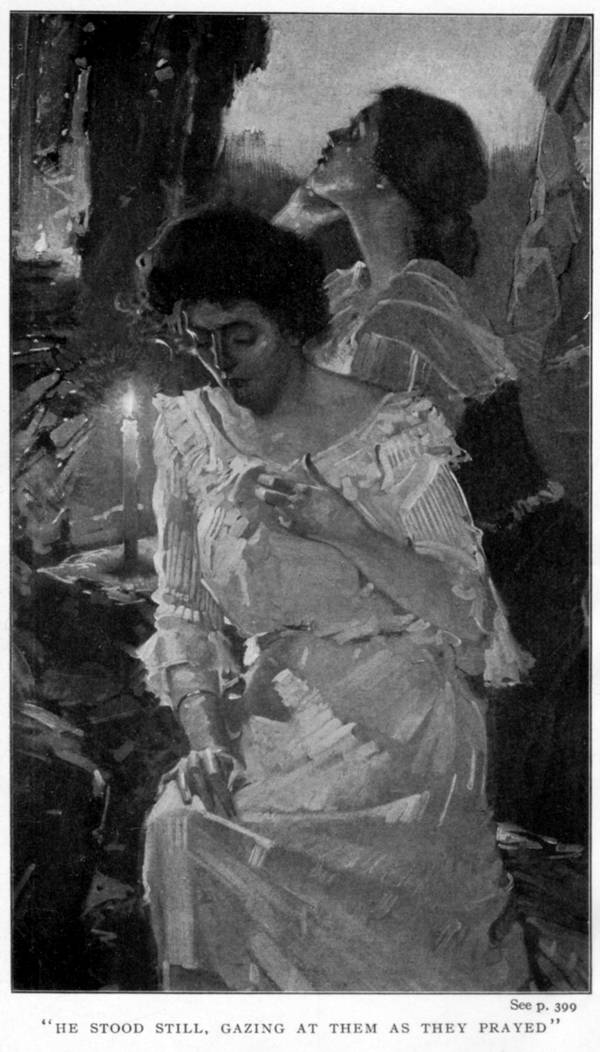 See p. 399
"HE STOOD STILL, GAZING AT THEM AS THEY PRAYED"
See p. 399
"HE STOOD STILL, GAZING AT THEM AS THEY PRAYED"
 Title page.
On a dreary afternoon of November, when London was closely wrapped in a yellow fog, Hermione Lester was sitting by the fire in her house in Eaton Place reading a bundle of letters, which she had just taken out of her writing-table drawer. She was expecting a visit from the writer of the letters, Emile Artois, who had wired to her on the previous day that he was coming over from Paris by the night train and boat.
Miss Lester was a woman of thirty-four, five feet ten in height, flat, thin, but strongly built, with a large waist and limbs which, though vigorous, were rather unwieldy. Her face was plain: rather square and harsh in outline, with blunt, almost coarse features, but a good complexion, clear and healthy, and large, interesting, and slightly prominent brown eyes, full of kindness, sympathy, and brightness, full, too, of eager intelligence and of energy, eyes of a woman who was intensely alive both in body and in mind. The look of swiftness, a look most attractive in either human being or in animal, was absent from her body but was present in her eyes, which showed forth the spirit in her with a glorious frankness and a keen intensity. Nevertheless, despite these eyes and her thickly growing, warm-colored, and wavy brown[Pg 2] hair, she was a plain, almost an ugly woman, whose attractive force issued from within, inviting inquiry and advance, as the flame of a fire does, playing on the blurred glass of a window with many flaws in it.
Hermione was, in fact, found very attractive by a great many people of varying temperaments and abilities, who were captured by her spirit and by her intellect, the soul of the woman and the brains, and who, while seeing clearly and acknowledging frankly the plainness of her face and the almost masculine ruggedness of her form, said, with a good deal of truth, that "somehow they didn't seem to matter in Hermione." Whether Hermione herself was of this opinion not many knew. Her general popularity, perhaps, made the world incurious about the subject.
The room in which Hermione was reading the letters of Artois was small and crammed with books. There were books in cases uncovered by glass from floor to ceiling, some in beautiful bindings, but many in tattered paper covers, books that looked as if they had been very much read. On several tables, among photographs and vases of flowers, were more books and many magazines, both English and foreign. A large writing-table was littered with notes and letters. An upright grand-piano stood open, with a quantity of music upon it. On the thick Persian carpet before the fire was stretched a very large St. Bernard dog, with his muzzle resting on his paws and his eyes blinking drowsily in serene contentment.
As Hermione read the letters one by one her face showed a panorama of expressions, almost laughably indicative of her swiftly passing thoughts. Sometimes she smiled. Once or twice she laughed aloud, startling the dog, who lifted his massive head and gazed at her with profound inquiry. Then she shook her head, looked grave, even sad, or earnest and full of sympathy, which seemed longing to express itself in a torrent of comforting words. Presently she put the letters together, tied[Pg 3] them up carelessly with a piece of twine, and put them back into the drawer from which she had taken them. Just as she had finished doing this the door of the room, which was ajar, was pushed softly open, and a dark-eyed, Eastern-looking boy dressed in livery appeared.
"What is it, Selim?" asked Hermione, in French.
"Monsieur Artois, madame."
"Emile!" cried Hermione, getting up out of her chair with a sort of eager slowness. "Where is he?"
"He is here!" said a loud voice, also speaking French.
Selim stood gracefully aside, and a big man stepped into the room and took the two hands which Hermione stretched out in his.
"Don't let any one else in, Selim," said Hermione to the boy.
"Especially the little Townly," said Artois, menacingly.
"Hush, Emile! Not even Miss Townly if she calls, Selim."
Selim smiled with grave intelligence at the big man, said, "I understand, madame," and glided out.
"Why, in Heaven's name, have you—you, pilgrim of the Orient—insulted the East by putting Selim into a coat with buttons and cloth trousers?" exclaimed Artois, still holding Hermione's hands.
"It's an outrage, I know. But I had to. He was stared at and followed, and he actually minded it. As soon as I found out that, I trampled on all my artistic prejudices, and behold him—horrible but happy! Thank you for coming—thank you."
She let his hands go, and they stood for a moment looking at each other in the firelight.
Artois was a tall man of about forty-three, with large, almost Herculean limbs, a handsome face, with regular but rather heavy features, and very big gray eyes, that always looked penetrating and often melancholy. His forehead was noble and markedly intellectual, and his[Pg 4] well-shaped, massive head was covered with thick, short, mouse-colored hair. He wore a mustache and a magnificent beard. His barber, who was partly responsible for the latter, always said of it that it was the "most beautiful fan-shaped beard in Paris," and regarded it with a pride which was probably shared by its owner. His hands and feet were good, capable-looking, but not clumsy, and his whole appearance gave an impression of power, both physical and intellectual, and of indomitable will combined with subtlety. He was well dressed, fashionably not artistically, yet he suggested an artist, not necessarily a painter. As he looked at Hermione the smile which had played about his lips when he entered the little room died away.
"I've come to hear about it all," he said, in his resonant voice—a voice which matched his appearance. "Do you know"—and here his accent was grave, almost reproachful—"that in all your letters to me—I looked them over before I left Paris—there is no allusion, not one, to this Monsieur Delarey."
"Why should there be?" she answered.
She sat down, but Artois continued to stand.
"We seldom wrote of persons, I think. We wrote of events, ideas, of work, of conditions of life; of man, woman, child—yes—but not often of special men, women, children. I am almost sure—in fact, quite sure, for I've just been reading them—that in your letters to me there is very little discussion of our mutual friends, less of friends who weren't common to us both."
As she spoke she stretched out a long, thin arm, and pulled open the drawer into which she had put the bundle tied with twine.
"They're all in here."
"You don't lock that drawer?"
"Never."
He looked at her with a sort of severity.[Pg 5]
"I lock the door of the room, or, rather, it locks itself. You haven't noticed it?"
"No."
"It's the same as the outer door of a flat. I have a latch-key to it."
He said nothing, but smiled. All the sudden grimness had gone out of his face.
Hermione withdrew her hand from the drawer holding the letters.
"Here they are!"
"My complaints, my egoism, my ambitions, my views—Mon Dieu! Hermione, what a good friend you've been!"
"And some people say you're not modest!"
"I—modest! What is modesty? I know my own value as compared with that of others, and that knowledge to others must often seem conceit."
She began to untie the packet, but he stretched out his hand and stopped her.
"No, I didn't come from Paris to read my letters, or even to hear you read them! I came to hear about this Monsieur Delarey."
Selim stole in with tea and stole out silently, shutting the door this time. As soon as he had gone, Artois drew a case from his pocket, took out of it a pipe, filled it, and lit it. Meanwhile, Hermione poured out tea, and, putting three lumps of sugar into one of the cups, handed it to Artois.
"I haven't come to protest. You know we both worship individual freedom. How often in those letters haven't we written it—our respect of the right of the individual to act for him or herself, without the interference of outsiders? No, I've come to hear about it all, to hear how you managed to get into the pleasant state of mania."
On the last words his deep voice sounded sarcastic, almost patronizing. Hermione fired up at once.
"None of that from you, Emile!" she exclaimed.[Pg 6]
Artois stirred his tea rather more than was necessary, but did not begin to drink it.
"You mustn't look down on me from a height," she continued. "I won't have it. We're all on a level when we're doing certain things, when we're truly living, simply, frankly, following our fates, and when we're dying. You feel that. Drop the analyst, dear Emile, drop the professional point of view. I see right through it into your warm old heart. I never was afraid of you, although I place you high, higher than your critics, higher than your public, higher than you place yourself. Every woman ought to be able to love, and every man. There's nothing at all absurd in the fact, though there may be infinite absurdities in the manifestation of it. But those you haven't yet had an opportunity of seeing in me, so you've nothing yet to laugh at or label. Now drink your tea."
He laughed a loud, roaring laugh, drank some of his tea, puffed out a cloud of smoke, and said:
"Whom will you ever respect?"
"Every one who is sincere—myself included."
"Be sincere with me now, and I'll go back to Paris to-morrow like a shorn lamb. Be sincere about Monsieur Delarey."
Hermione sat quite still for a moment with the bundle of letters in her lap. At last she said:
"It's difficult sometimes to tell the truth about a feeling, isn't it?"
"Ah, you don't know yourself what the truth is."
"I'm not sure that I do. The history of the growth of a feeling may be almost more complicated than the history of France."
Artois, who was a novelist, nodded his head with the air of a man who knew all about that.
"Maurice—Maurice Delarey has cared for me, in that way, for a long time. I was very much surprised when I first found it out."[Pg 7]
"Why, in the name of Heaven?"
"Well, he's wonderfully good-looking."
"No explanation of your astonishment."
"Isn't it? I think, though, it was that fact which astonished me, the fact of a very handsome man loving me."
"Now, what's your theory?"
He bent down his head a little towards her, and fixed his great, gray eyes on her face.
"Theory! Look here, Emile, I dare say it's difficult for a man like you, genius, insight, and all, thoroughly to understand how an ugly woman regards beauty, an ugly woman like me, who's got intellect and passion and intense feeling for form, color, every manifestation of beauty. When I look at beauty I feel rather like a dirty little beggar staring at an angel. My intellect doesn't seem to help me at all. In me, perhaps, the sensation arises from an inward conviction that humanity was meant originally to be beautiful, and that the ugly ones among us are—well, like sins among virtues. You remember that book of yours which was and deserved to be your one artistic failure, because you hadn't put yourself really into it?"
Artois made a wry face.
"Eventually you paid a lot of money to prevent it from being published any more. You withdrew it from circulation. I sometimes feel that we ugly ones ought to be withdrawn from circulation. It's silly, perhaps, and I hope I never show it, but there the feeling is. So when the handsomest man I had ever seen loved me, I was simply amazed. It seemed to me ridiculous and impossible. And then, when I was convinced it was possible, very wonderful, and, I confess it to you, very splendid. It seemed to help to reconcile me with myself in a way in which I had never been reconciled before."
"And that was the beginning?"[Pg 8]
"I dare say. There were other things, too. Maurice Delarey isn't at all stupid, but he's not nearly so intelligent as I am."
"That doesn't surprise me."
"The fact of this physical perfection being humble with me, looking up to me, seemed to mean a great deal. I think Maurice feels about intellect rather as I do about beauty. He made me understand that he must. And that seemed to open my heart to him in an extraordinary way. Can you understand?"
"Yes. Give me some more tea, please."
He held out his cup. She filled it, talking while she did so. She had become absorbed in what she was saying, and spoke without any self-consciousness.
"I knew my gift, such as it is, the gift of brains, could do something for him, though his gift of beauty could do nothing for me—in the way of development. And that, too, seemed to lead me a step towards him. Finally—well, one day I knew I wanted to marry him. And so, Emile, I'm going to marry him. Here!"
She held out to him his cup full of tea.
"There's no sugar," he said.
"Oh—the first time I've forgotten."
"Yes."
The tone of his voice made her look up at him quickly and exclaim:
"No, it won't make any difference!"
"But it has. You've forgotten for the first time. Cursed be the egotism of man."
He sat down in an arm-chair on the other side of the tea-table.
"It ought to make a difference. Maurice Delarey, if he is a man—and if you are going to marry him he must be—will not allow you to be the Egeria of a fellow who has shocked even Paris by telling it the naked truth."
"Yes, he will. I shall drop no friendship for him,[Pg 9] and he knows it. There is not one that is not honest and innocent. Thank God I can say that. If you care for it, Emile, we can both add to the size of the letter bundles."
He looked at her meditatively, even rather sadly.
"You are capable of everything in the way of friendship, I believe," he said. "Even of making the bundle bigger with a husband's consent. A husband's—I suppose the little Townly's upset? But she always is."
"When you're there. You don't know Evelyn. You never will. She's at her worst with you because you terrify her. Your talent frightens her, but your appearance frightens her even more."
"I am as God made me."
"With the help of the barber. It's your beard as much as anything else."
"What does she say of this affair? What do all your innumerable adorers say?"
"What should they say? Why should anybody be surprised? It's surely the most natural thing in the world for a woman, even a very plain woman, to marry. I have always heard that marriage is woman's destiny, and though I don't altogether believe that, still I see no special reason why I should never marry if I wish to. And I do wish to."
"That's what will surprise the little Townly and the gaping crowd."
"I shall begin to think I've seemed unwomanly all these years."
"No. You're an extraordinary woman who astonishes because she is going to do a very important thing that is very ordinary."
"It doesn't seem at all ordinary to me."
Emile Artois began to stroke his beard. He was determined not to feel jealous. He had never wished to marry Hermione, and did not wish to marry her now, but he had come over from Paris secretly a man of wrath.[Pg 10]
"You needn't tell me that," he said. "Of course it is the great event to you. Otherwise you would never have thought of doing it."
"Exactly. Are you astonished?"
"I suppose I am. Yes, I am."
"I should have thought you were far too clever to be so."
"Exactly what I should have thought. But what living man is too clever to be an idiot? I never met the gentleman and never hope to."
"You looked upon me as the eternal spinster?"
"I looked upon you as Hermione Lester, a great creature, an extraordinary creature, free from the prejudices of your sex and from its pettinesses, unconventional, big brained, generous hearted, free as the wind in a world of monkey slaves, careless of all opinion save your own, but humbly obedient to the truth that is in you, human as very few human beings are, one who ought to have been an artist but who apparently preferred to be simply a woman."
Hermione laughed, winking away two tears.
"Well, Emile dear, I'm being very simply a woman now, I assure you."
"And why should I be surprised? You're right. What is it makes me surprised?"
He sat considering.
"Perhaps it is that you are so unusual, so individual, that my imagination refuses to project the man on whom your choice could fall. I project the snuffy professor—Impossible! I project the Greek god—again my mind cries, 'Impossible!' Yet, behold, it is in very truth the Greek god, the ideal of the ordinary woman."
"You know nothing about it. You're shooting arrows into the air."
"Tell me more then. Hold up a torch in the darkness."[Pg 11]
"I can't. You pretend to know a woman, and you ask her coldly to explain to you the attraction of the man she loves, to dissect it. I won't try to."
"But," he said, with now a sort of joking persistence, which was only a mask for an almost irritable curiosity, "I want to know."
"And you shall. Maurice and I are dining to-night at Caminiti's in Peathill Street, just off Regent Street. Come and meet us there, and we'll all three spend the evening together. Half-past eight, of course no evening dress, and the most delicious Turkish coffee in London."
"Does Monsieur Delarey like Turkish coffee?"
"Loves it."
"Intelligently?"
"How do you mean?"
"Does he love it inherently, or because you do?"
"You can find that out to-night."
"I shall come."
He got up, put his pipe into a case, and the case into his pocket, and said:
"Hermione, if the analyst may have a word—"
"Yes—now."
"Don't let Monsieur Delarey, whatever his character, see now, or in the future, the dirty little beggar staring at the angel. I use your own preposterously inflated phrase. Men can't stand certain things and remain true to the good in their characters. Humble adoration from a woman like you would be destructive of blessed virtues in Antinous. Think well of yourself, my friend, think well of your sphinxlike eyes. Haven't they beauty? Doesn't intellect shoot its fires from them? Mon Dieu! Don't let me see any prostration to-night, or I shall put three grains of something I know—I always call it Turkish delight—into the Turkish coffee of Monsieur Delarey, and send him to sleep with his fathers."[Pg 12]
Hermione got up and held out her hands to him impulsively.
"Bless you, Emile!" she said. "You're a—"
There was a gentle tap on the door. Hermione went to it and opened it. Selim stood outside with a pencil note on a salver.
"Ha! The little Townly has been!" said Artois.
"Yes, it's from her. You told her, Selim, that I was with Monsieur Artois?"
"Yes, madame."
"Did she say anything?"
"She said, 'Very well,' madame, and then she wrote this. Then she said again, 'Very well,' and then she went away."
"All right, Selim."
Selim departed.
"Delicious!" said Artois. "I can hear her speaking and see her drifting away consumed by jealousy, in the fog."
"Hush, Emile, don't be so malicious."
"P'f! I must be to-day, for I too am—"
"Nonsense. Be good this evening, be very good."
"I will try."
He kissed her hand, bending his great form down with a slightly burlesque air, and strode out without another word. Hermione sat down to read Miss Townly's note:
"Dearest, never mind. I know that I must now accustom myself to be nothing in your life. It is difficult at first, but what is existence but a struggle? I feel that I am going to have another of my neuralgic seizures. I wonder what it all means?—Your, Evelyn."
Hermione laid the note down, with a sigh and a little laugh.
"I wonder what it all means? Poor, dear Evelyn! Thank God, it sometimes means—" She did not finish the sentence, but knelt down on the carpet and took the St. Bernard's great head in her hands.[Pg 13]
"You don't bother, do you, old boy, as long as you have your bone. Ah, I'm a selfish wretch. But I am going to have my bone, and I can't help feeling happy—gloriously, supremely happy!"
And she kissed the dog's cold nose and repeated:
"Supremely—supremely happy!"[Pg 14]
Miss Townly, gracefully turned away from Hermione's door by Selim, did, as Artois had surmised, drift away in the fog to the house of her friend Mrs. Creswick, who lived in Sloane Street. She felt she must unburden herself to somebody, and Mrs. Creswick's tea, a blend of China tea with another whose origin was a closely guarded secret, was the most delicious in London. There are merciful dispensations of Providence even for Miss Townlys, and Mrs. Creswick was at home with a blazing fire. When she saw Miss Townly coming sideways into the room with a slightly drooping head, she said, briskly:
"Comfort me with crumpets, for I am sick with love! Cheer up, my dear Evelyn. Fogs will pass and even neuralgia has its limits. I don't ask you what is the matter, because I know perfectly well."
Miss Townly went into a very large arm-chair and waveringly selected a crumpet.
"What does it all mean?" she murmured, looking obliquely at her friend's parquet.
"Ask the baker, No. 5 Allitch Street. I always get them from there. And he's a remarkably well-informed man."
"No, I mean life with its extraordinary changes, things you never expected, never dreamed of—and all coming so abruptly. I don't think I'm a stupid person, but I certainly never looked for this."
"For what?"
"This most extraordinary engagement of Hermione's."
Mrs. Creswick, who was a short woman who looked[Pg 15] tall, with a briskly conceited but not unkind manner, and a decisive and very English nose, rejoined:
"I don't know why we should call it extraordinary. Everybody gets engaged at some time or other, and Hermione's a woman like the rest of us and subject to aberration. But I confess I never thought she would marry Maurice Delarey. He never seemed to mean more to her than any one else, so far as I could see."
"Everybody seems to mean so much to Hermione that it makes things difficult to outsiders," replied Miss Townly, plaintively. "She is so wide-minded and has so many interests that she dwarfs everybody else. I always feel quite squeezed when I compare my poor little life with hers. But then she has such physical endurance. She breaks the ice, you know, in her bath in the winter—of course I mean when there is ice."
"It isn't only in her bath that she breaks the ice," said Mrs. Creswick.
"I perfectly understand," Miss Townly said, vaguely. "You mean—yes, you're right. Well, I prefer my bath warmed for me, but my circulation was never of the best."
"Hermione is extraordinary," said Mrs. Creswick, trying to look at her profile in the glass and making her face as Roman as she could, "I know all London, but I never met another Hermione. She can do things that other women can't dream of even, and nobody minds."
"Well, now she is going to do a thing we all dream of and a great many of us do. Will it answer? He's ten years younger than she is. Can it answer?"
"One can never tell whether a union of two human mysteries will answer," said Mrs. Creswick, judicially. "Maurice Delarey is wonderfully good-looking."
"Yes, and Hermione isn't."
"That has never mattered in the least."
"I know. I didn't say it had. But will it now?"
"Why should it?"[Pg 16]
"Men care so much for looks. Do you think Hermione loves Mr. Delarey for his?"
"She dives deep."
"Yes, as a rule."
"Why not now? She ought to have dived deeper than ever this time."
"She ought, of course. I perfectly understand that. But it's very odd, I think we often marry the man we understand less than any one else in the world. Mystery is so very attractive."
Miss Townly sighed. She was emaciated, dark, and always dressed to look mysterious.
"Maurice Delarey is scarcely my idea of a mystery," said Mrs. Creswick, taking joyously a marron glacé. "In my opinion he's an ordinarily intelligent but an extraordinarily handsome man. Hermione is exactly the reverse, extraordinarily intelligent and almost ugly."
"Oh no, not ugly!" said Miss Townly, with unexpected warmth.
Though of a tepid personality, she was a worshipper at Hermione's shrine.
"Her eyes are beautiful," she added.
"Good eyes don't make a beauty," said Mrs. Creswick again, looking at her three-quarters face in the glass. "Hermione is too large, and her face is too square, and—but as I said before, it doesn't matter the least. Hermione's got a temperament that carries all before it."
"I do wish I had a temperament," said Miss Townly. "I try to cultivate one."
"You might as well try to cultivate a mustache," Mrs. Creswick rather brutally rejoined. "If it's there, it's there, but if it isn't one prays in vain."
"I used to think Hermione would do something," continued Miss Townly, finishing her second cup of tea with thirsty languor.
"Do something?"[Pg 17]
"Something important, great, something that would make her famous, but of course now"—she paused—"now it's too late," she concluded. "Marriage destroys, not creates talent. Some celebrated man—I forget which—has said something like that."
"Perhaps he'd destroyed his wife's. I think Hermione might be a great mother."
Miss Townly blushed faintly. She did nearly everything faintly. That was partly why she admired Hermione.
"And a great mother is rare," continued Mrs. Creswick. "Good mothers are, thank God, quite common even in London, whatever those foolish people who rail at the society they can't get into may say. But great mothers are seldom met with. I don't know one."
"What do you mean by a great mother?" inquired Miss Townly.
"A mother who makes seeds grow. Hermione has a genius for friendship and a special gift for inspiring others. If she ever has a child, I can imagine that she will make of that child something wonderful."
"Do you mean an infant prodigy?" asked Miss Townly, innocently.
"No, dear, I don't!" said Mrs. Creswick; "I mean nothing of the sort. Never mind!"
When Mrs. Creswick said "Never mind!" Miss Townly usually got up to go. She got up to go now, and went forth into Sloane Street meditating, as she would have expressed it, "profoundly."
Meanwhile Artois went back to the Hans Crescent Hotel on foot. He walked slowly along the greasy pavement through the yellow November fog, trying to combat a sensation of dreariness which had floated round his spirit, as the fog floated round his body, directly he stepped into the street. He often felt depressed without a special cause, but this afternoon there[Pg 18] was a special cause for his melancholy. Hermione was going to be married.
She often came to Paris, where she had many friends, and some years ago they had met at a dinner given by a brilliant Jewess, who delighted in clever people, not because she was stupid, but for the opposite reason. Artois was already famous, though not loved, as a novelist. He had published two books; works of art, cruel, piercing, brutal, true. Hermione had read them. Her intellect had revelled in them, but they had set ice about her heart, and when Madame Enthoven told her who was going to take her in to dinner, she very nearly begged to be given another partner. She felt that her nature must be in opposition to this man's.
Artois was not eager for the honor of her company. He was a careful dissecter of women, and, therefore, understood how mysterious women are; but in his intimate life they counted for little. He regarded them there rather as the European traveller regards the Mousmés of Japan, as playthings, and insisted on one thing only—that they must be pretty. A Frenchman, despite his unusual intellectual power, he was not wholly emancipated from the la petite femme tradition, which will never be outmoded in Paris while Paris hums with life, and, therefore, when he was informed that he was to take in to dinner the tall, solidly built, big-waisted, rugged-faced woman, whom he had been observing from a distance ever since he came into the drawing-room, he felt that he was being badly treated by his hostess.
Yet he had been observing this woman closely.
Something unusual, something vital in her had drawn his attention, fixed it, held it. He knew that, but said to himself that it was the attention of the novelist that had been grasped by an uncommon human specimen, and that the man of the world, the diner-out, did not want to eat in company with a specimen,[Pg 19] but to throw off professional cares with a gay little chatterbox of the Mousmé type. Therefore he came over to be presented to Hermione with rather a bad grace.
And that introduction was the beginning of the great friendship which was now troubling him in the fog.
By the end of that evening Hermione and he had entirely rid themselves of their preconceived notions of each other. She had ceased from imagining him a walking intellect devoid of sympathies, he from considering her a possibly interesting specimen, but not the type of woman who could be agreeable in a man's life. Her naturalness amounted almost to genius. She was generally unable to be anything but natural, unable not to speak as she was feeling, unable to feel unsympathetic. She always showed keen interest when she felt it, and, with transparent sincerity, she at once began to show to Artois how much interested she was in him. By doing so she captivated him at once. He would not, perhaps, have been captivated by the heart without the brains, but the two in combination took possession of him with an ease which, when the evening was over, but only then, caused him some astonishment.
Hermione had a divining-rod to discover the heart in another, and she found out at once that Artois had a big heart as well as a fine intellect. He was deceptive because he was always ready to show the latter, and almost always determined to conceal the former. Even to himself he was not quite frank about his heart, but often strove to minimize its influence upon him, if not to ignore totally its promptings and its utterances. Why this was so he could not perhaps have explained even to himself. It was one of the mysteries of his temperament. From the first moment of their intercourse Hermione showed to him her conviction that he had a warm heart, and that it could be relied upon without hesitation. This piqued but presently de[Pg 20]lighted, and also soothed Artois, who was accustomed to be misunderstood, and had often thought he liked to be misunderstood, but who now found out how pleasant a brilliant woman's intuition may be, even at a Parisian dinner. Before the evening was over they knew that they were friends; and friends they had remained ever since.
Artois was a reserved man, but, like many reserved people, if once he showed himself as he really was, he could continue to be singularly frank. He was singularly frank with Hermione. She became his confidante, often at a distance. He scarcely ever came to London, which he disliked exceedingly, but from Paris or from the many lands in which he wandered—he was no pavement lounger, although he loved Paris rather as a man may love a very chic cocotte—he wrote to Hermione long letters, into which he put his mind and heart, his aspirations, struggles, failures, triumphs. They were human documents, and contained much of his secret history.
It was of this history that he was now thinking, and of Hermione's comments upon it, tied up with a ribbon in Paris. The news of her approaching marriage with a man whom he had never seen had given him a rude shock, had awakened in him a strange feeling of jealousy. He had grown accustomed to the thought that Hermione was in a certain sense his property. He realized thoroughly the egotism, the dog-in-the-manger spirit which was alive in him, and hated but could not banish it. As a friend he certainly loved Hermione. She knew that. But he did not love her as a man loves the woman he wishes to make his wife. She must know that, too. He loved her but was not in love with her, and she loved but was not in love with him. Why, then, should this marriage make a difference in their friendship? She said that it would not, but he felt that it must. He thought of her as a wife, then as a[Pg 21] mother. The latter thought made his egotism shudder. She would be involved in the happy turmoil of a family existence, while he would remain without in that loneliness which is the artist's breath of life and martyrdom. Yes, his egotism shuddered, and he was angry at the weakness. He chastised the frailties of others, but must be the victim of his own. A feeling of helplessness came to him, of being governed, lashed, driven. How unworthy was his sensation of hostility against Delarey, his sensation that Hermione was wronging him by entering into this alliance, and how powerless he was to rid himself of either sensation! There was good cause for his melancholy—his own folly. He must try to conquer it, and, if that were impossible, to rein it in before the evening.
When he reached the hotel he went into his sitting-room and worked for an hour and a half, producing a short paragraph, which did not please him. Then he took a hansom and drove to Peathill Street.
Hermione was already there, sitting at a small table in a corner with her back to him, opposite to one of the handsomest men he had ever seen. As Artois came in, he fixed his eyes on this man with a scrutiny that was passionate, trying to determine at a glance whether he had any right to the success he had achieved, any fitness for the companionship that was to be his, companionship of an unusual intellect and a still more unusual spirit.
He saw a man obviously much younger than Hermione, not tall, athletic in build but also graceful, with the grace that is shed through a frame by perfectly developed, not over-developed muscles and accurately trained limbs, a man of the Mercury rather than of the Hercules type, with thick, low-growing black hair, vivid, enthusiastic black eyes, set rather wide apart under curved brows, and very perfectly proportioned, small, straight features, which were not undecided, yet which[Pg 22] suggested the features of a boy. In the complexion there was a tinge of brown that denoted health and an out-door life—an out-door life in the south, Artois thought.
As Artois, standing quite still, unconsciously, in the doorway of the restaurant, looked at this man, he felt for a moment as if he himself were a splendid specimen of a cart-horse faced by a splendid specimen of a race-horse. The comparison he was making was only one of physical endowments, but it pained him. Thinking with an extraordinary rapidity, he asked himself why it was that this man struck him at once as very much handsomer than other men with equally good features and figures whom he had seen, and he found at once the answer to his question. It was the look of Mercury in him that made him beautiful, a look of radiant readiness for swift movement that suggested the happy messenger poised for flight to the gods, his mission accomplished, the expression of an intensely vivid activity that could be exquisitely obedient. There was an extraordinary fascination in it. Artois realized that, for he was fascinated even in this bitter moment that he told himself ought not to be bitter. While he gazed at Delarey he was conscious of a feeling that had sometimes come upon him when he had watched Sicilian peasant boys dancing the tarantella under the stars by the Ionian sea, a feeling that one thing in creation ought to be immortal on earth, the passionate, leaping flame of joyous youth, physically careless, physically rapturous, unconscious of death and of decay. Delarey seemed to him like a tarantella in repose, if such a thing could be.
Suddenly Hermione turned round, as if conscious that he was there. When she did so he understood in the very depths of him why such a man as Delarey attracted, must attract, such a woman as Hermione. That which she had in the soul Delarey seemed to ex[Pg 23]press in the body—sympathy, enthusiasm, swiftness, courage. He was like a statue of her feelings, but a statue endowed with life. And the fact that her physique was a sort of contradiction of her inner self must make more powerful the charm of a Delarey for her. As Hermione looked round at him, turning her tall figure rather slowly in the chair, Artois made up his mind that she had been captured by the physique of this man. He could not be surprised, but he still felt angry.
Hermione introduced Delarey to him eagerly, not attempting to hide her anxiety for the two men to make friends at once. Her desire was so transparent and so warm that for a moment Artois felt touched, and inclined to trample upon his evil mood and leave no trace of it. He was also secretly too human to remain wholly unmoved by Delarey's reception of him. Delarey had a rare charm of manner whose source was a happy, but not foolishly shy, modesty, which made him eager to please, and convinced that in order to do so he must bestir himself and make an effort. But in this effort there was no labor. It was like the spurt of a willing horse, a fine racing pace of the nature that woke pleasure and admiration in those who watched it.
Artois felt at once that Delarey had no hostility towards him, but was ready to admire and rejoice in him as Hermione's greatest friend. He was met more than half-way. Yet when he was beside Delarey, almost touching him, the stubborn sensation of furtive dislike within Artois increased, and he consciously determined not to yield to the charm of this younger man who was going to interfere in his life. Artois did not speak much English, but fortunately Delarey talked French fairly well, not with great fluency like Hermione, but enough to take a modest share in conversation, which was apparently all the share that he desired. Artois believed that he was no great talker. His eyes[Pg 24] were more eager than was his tongue, and seemed to betoken a vivacity of spirit which he could not, perhaps, show forth in words. The conversation at first was mainly between Hermione and Artois, with an occasional word from Delarey—generally interrogative—and was confined to generalities. But this could not continue long. Hermione was an enthusiastic talker and seldom discussed banalities. From every circle where she found herself the inane was speedily banished; pale topics—the spectres that haunt the dull and are cherished by them—were whipped away to limbo, and some subject full-blooded, alive with either serious or comical possibilities, was very soon upon the carpet. By chance Artois happened to speak of two people in Paris, common friends of his and of Hermione's, who had been very intimate, but who had now quarrelled, and every one said, irrevocably. The question arose whose fault was it. Artois, who knew the facts of the case, and whose judgment was usually cool and well-balanced, said it was the woman's.
"Madame Lagrande," he said, "has a fine nature, but in this instance it has failed her, it has been warped by jealousy; not the jealousy that often accompanies passion, for she and Robert Meunier were only great friends, linked together by similar sympathies, but by a much more subtle form of that mental disease. You know, Hermione, that both of them are brilliant critics of literature?"
"Yes, yes."
"They carried on a sort of happy, but keen rivalry in this walk of letters, each striving to be more unerring than the other in dividing the sheep from the goats. I am the guilty person who made discord where there had been harmony."
"You, Emile! How was that?"
"One day I said, in a bitter mood, 'It is so easy to be a critic, so difficult to be a creator. You two, now[Pg 25] would you even dare to try to create?' They were nettled by my tone, and showed it. I said, 'I have a magnificent subject for a conte, no work de longue haleine, a conte. If you like I will give it you, and leave you to create—separately, not together—what you have so often written about, the perfect conte.' They accepted my challenge. I gave them my subject and a month to work it out. At the end of that time the two contes were to be submitted to a jury of competent literary men, friends of ours. It was all a sort of joke, but created great interest in our circle—you know it, Hermione, that dines at Réneau's on Thursday nights?"
"Yes. Well, what happened?"
"Madame Lagrande made a failure of hers, but Robert Meunier astonished us all. He produced certainly one of the best contes that was ever written in the French language."
"And Madame Lagrande?"
"It is not too much to say that from that moment she has almost hated Robert."
"And you dare to say she has a noble nature?"
"Yes, a noble nature from which, under some apparently irresistible impulse, she has lapsed."
"Maurice," said Hermione, leaning her long arms on the table and leaning forward to her fiancé, "you're not in literature any more than I am, you're an outsider—bless you! What d'you say to that?"
Delarey hesitated and looked modestly at Artois.
"No, no," cried Hermione, "none of that, Maurice! You may be a better judge in this than Emile is with all his knowledge of the human heart. You're the man in the street, and sometimes I'd give a hundred pounds for his opinion and not twopence for the big man's who's in the profession. Would—could a noble nature yield to such an impulse?"
"I should hardly have thought so," said Delarey.
"Nor I," said Hermione. "I simply don't believe it's[Pg 26] possible. For a moment, yes, perhaps. But you say, Emile, that there's an actual breach between them."
"There is certainly. Have you ever made any study of jealousy in its various forms?"
"Never. I don't know what jealousy is. I can't understand it."
"Yet you must be capable of it."
"You think every one is?"
"Very few who are really alive in the spirit are not. And you, I am certain, are."
Hermione laughed, an honest, gay laugh, that rang out wholesomely in the narrow room.
"I doubt it, Emile. Perhaps I'm too conceited. For instance, if I cared for some one and was cared for—"
"And the caring of the other ceased, because he had only a certain, limited faculty of affection and transferred his affection elsewhere—what then?"
"I've so much pride, proper or improper, that I believe my affection would die. My love subsists on sympathy—take that food from it and it would starve and cease to live. I give, but when giving I always ask. If I were to be refused I couldn't give any more. And without the love there could be no jealousy. But that isn't the point, Emile."
He smiled.
"What is?"
"The point is—can a noble nature lapse like that from its nobility?"
"Yes, it can."
"Then it changes, it ceases to be noble. You would not say that a brave man can show cowardice and remain a brave man."
"I would say that a man whose real nature was brave, might, under certain circumstances, show fear, without being what is called a coward. Human nature is full of extraordinary possibilities, good and evil, of extraordinary contradictions. But this point I will concede[Pg 27] you, that it is like the boomerang, which flies forward, circles, and returns to the point from which it started. The inherently noble nature will, because it must, return eventually to its nobility. Then comes the really tragic moment with the passion of remorse."
He spoke quietly, almost coldly. Hermione looked at him with shining eyes. She had quite forgotten Madame Lagrande and Robert Meunier, had lost the sense of the special in her love of the general.
"That's a grand theory," she said. "That we must come back to the good that is in us in the end, that we must be true to that somehow, almost whether we will or no. I shall try to think of that when I am sinning."
"You—sinning!" exclaimed Delarey.
"Maurice, dear, you think too well of me."
Delarey flushed like a boy, and glanced quickly at Artois, who did not return his gaze.
"But if that's true, Emile," Hermione continued, "Madame Lagrande and Robert Meunier will be friends again."
"Some day I know she will hold out the olive-branch, but what if he refuses it?"
"You literary people are dreadfully difficile."
"True. Our jealousies are ferocious, but so are the jealousies of thousands who can neither read nor write."
"Jealousy," she said, forgetting to eat in her keen interest in the subject. "I told you I didn't believe myself capable of it, but I don't know. The jealousy that is born of passion I might understand and suffer, perhaps, but jealousy of a talent greater than my own, or of one that I didn't possess—that seems to me inexplicable. I could never be jealous of a talent."
"You mean that you could never hate a person for a talent in them?"
"Yes."
"Suppose that some one, by means of a talent which[Pg 28] you had not, won from you a love which you had? Talent is a weapon, you know."
"You think it is a weapon to conquer the affections! Ah, Emile, after all you don't know us!"
"You go too fast. I did not say a weapon to conquer the affection of a woman."
"You're speaking of men?"
"I know," Delarey said, suddenly, forgetting to be modest for once, "you mean that a man might be won away from one woman by a talent in another. Isn't that it?"
"Ah," said Hermione, "a man—I see."
She sat for a moment considering deeply, with her luminous eyes fixed on the food in her plate, food which she did not see.
"What horrible ideas you sometimes have, Emile," she said, at last.
"You mean what horrible truths exist," he answered, quietly.
"Could a man be won so? Yes, I suppose he might be if there were a combination."
"Exactly," said Artois.
"I see now. Suppose a man had two strains in him, say: the adoration of beauty, of the physical; and the adoration of talent, of the mental. He might fall in love with a merely beautiful woman and transfer his affections if he came across an equally beautiful woman who had some great talent."
"Or he might fall in love with a plain, talented woman, and be taken from her by one in whom talent was allied with beauty. But in either case are you sure that the woman deserted could never be jealous, bitterly jealous, of the talent possessed by the other woman? I think talent often creates jealousy in your sex."
"But beauty much oftener, oh, much! Every woman, I feel sure, could more easily be jealous of physical[Pg 29] beauty in another woman than of mental gifts. There's something so personal in beauty."
"And is genius not equally personal?"
"I suppose it is, but I doubt if it seems so."
"I think you leave out of account the advance of civilization, which is greatly changing men and women in our day. The tragedies of the mind are increasing."
"And the tragedies of the heart—are they diminishing in consequence? Oh, Emile!" And she laughed.
"Hermione—your food! You are not eating anything!" said Delarey, gently, pointing to her plate. "And it's all getting cold."
"Thank you, Maurice."
She began to eat at once with an air of happy submission, which made Artois understand a good deal about her feeling for Delarey.
"The heart will always rule the head, I dare say, in this world where the majority will always be thoughtless," said Artois. "But the greatest jealousy, the jealousy which is most difficult to resist and to govern, is that in which both heart and brain are concerned. That is, indeed, a full-fledged monster."
Artois generally spoke with a good deal of authority, often without meaning to do so. He thought so clearly, knew so exactly what he was thinking and what he meant, that he felt very safe in conversation, and from this sense of safety sprang his air of masterfulness. It was an air that was always impressive, but to-night it specially struck Hermione. Now she laid down her knife and fork once more, to Delarey's half-amused despair, and exclaimed:
"I shall never forget the way you said that. Even if it were nonsense one would have to believe it for the moment, and of course it's dreadfully true. Intellect and heart suffering in combination must be far more terrible than the one suffering without the other. No,[Pg 30] Maurice, I've really finished. I don't want any more. Let's have our coffee."
"The Turkish coffee," said Artois, with a smile. "Do you like Turkish coffee, Monsieur Delarey?"
"Yes, monsieur. Hermione has taught me to."
"Ah!"
"At first it seemed to me too full of grounds," he explained.
"Perhaps a taste for it must be an acquired one among Europeans. Do we have it here?"
"No, no," said Hermione, "Caminiti has taken my advice, and now there's a charming smoke-room behind this. Come along."
She got up and led the way out. The two men followed her, Artois coming last. He noticed now more definitely the very great contrast between Hermione and her future husband. Delarey, when in movement, looked more than ever like a Mercury. His footstep was light and elastic, and his whole body seemed to breathe out a gay activity, a fulness of the joy of life. Again Artois thought of Sicilian boys dancing the tarantella, and when they were in the small smoke-room, which Caminiti had fitted up in what he believed to be Oriental style, and which, though scarcely accurate, was quite cosey, he was moved to inquire:
"Pardon me, monsieur, but are you entirely English?"
"No, monsieur. My mother has Sicilian blood in her veins. But I have never been in Sicily or Italy."
"Ah, Emile," said Hermione, "how clever of you to find that out. I notice it, too, sometimes, that touch of the blessed South. I shall take him there some day, and see if the Southern blood doesn't wake up in his veins when he's in the rays of the real sun we never see in England."
"She'll take you to Italy, you fortunate, damned dog!" thought Artois. "What luck for you to go there with such a companion!"[Pg 31]
They sat down and the two men began to smoke. Hermione never smoked because she had tried smoking and knew she hated it. They were alone in the room, which was warm, but not too warm, and faintly lit by shaded lamps. Artois began to feel more genial, he scarcely knew why. Perhaps the good dinner had comforted him, or perhaps he was beginning to yield to the charm of Delarey's gay and boyish modesty, which was untainted and unspoiled by any awkward shyness.
Artois did not know or seek to know, but he was aware that he was more ready to be happy with the flying moment than he had been, or had expected to be that evening. Something almost paternal shone in his gray eyes as he stretched his large limbs on Caminiti's notion of a Turkish divan, and watched the first smoke-wreaths rise from his cigar, a light which made his face most pleasantly expressive to Hermione.
"He likes Maurice," she thought, with a glow of pleasure, and with the thought came into her heart an even deeper love for Maurice. For it was a triumph, indeed, if Artois were captured speedily by any one. It seemed to her just then as if she had never known what perfect happiness was till now, when she sat between her best friend and her lover, and sensitively felt that in the room there were not three separate persons but a Trinity. For a moment there was a comfortable silence. Then an Italian boy brought in the coffee. Artois spoke to him in Italian. His eyes lit up as he answered with the accent of Naples, lit up still more when Artois spoke to him again in his own dialect. When he had served the coffee he went out, glowing.
"Is your honeymoon to be Italian?" asked Artois.
"Whatever Hermione likes," answered Delarey. "I—it doesn't matter to me. Wherever it is will be the same to me."
"Happiness makes every land an Italy, eh?" said Artois. "I expect that's profoundly true."[Pg 32]
"Don't you—don't you know?" ventured Delarey.
"I! My friend, one cannot be proficient in every branch of knowledge."
He spoke the words without bitterness, with a calm that had in it something more sad than bitterness. It struck both Hermione and Delarey as almost monstrous that anybody with whom they were connected should be feeling coldly unhappy at this moment. Life presented itself to them in a glorious radiance of sunshine, in a passionate light, in a torrent of color. Their knowledge of life's uncertainties was rocked asleep by their dual sensation of personal joy, and they felt as if every one ought to be as happy as they were, almost as if every one could be as happy as they were.
"Emile," said Hermione, led by this feeling, "you can't mean to say that you have never known the happiness that makes of every place—Clapham, Lippe-Detmold, a West African swamp, a Siberian convict settlement—an Italy? You have had a wonderful life. You have worked, you have wandered, had your ambition and your freedom—"
"But my eyes have been always wide open," he interrupted, "wide open on life watching the manifestations of life."
"Haven't you ever been able to shut them for a minute to everything but your own happiness? Oh, it's selfish, I know, but it does one good, Emile, any amount of good, to be selfish like that now and then. It reconciles one so splendidly to existence. It's like a spring cleaning of the soul. And then, I think, when one opens one's eyes again one sees—one must see—everything more rightly, not dressed up in frippery, not horribly naked either, but truly, accurately, neither overlooking graces nor dwelling on distortions. D'you understand what I mean? Perhaps I don't put it well, but—"
"I do understand," he said. "There's truth in what you say."[Pg 33]
"Yes, isn't there?" said Delarey.
His eyes were fixed on Hermione with an intense eagerness of admiration and love.
Suddenly Artois felt immensely old, as he sometimes felt when he saw children playing with frantic happiness at mud-pies or snowballing. A desire, which his true self condemned, came to him to use his intellectual powers cruelly, and he yielded to it, forgetting the benign spirit which had paid him a moment's visit and vanished almost ere it had arrived.
"There's truth in what you say. But there's another truth, too, which you bring to my mind at this moment."
"What's that, Emile?"
"The payment that is exacted from great happiness. These intense joys of which you speak—what are they followed by? Haven't you observed that any violence in one direction is usually, almost, indeed, inevitably, followed by a violence in the opposite direction? Humanity is treading a beaten track, the crowd of humanity, and keeps, as a crowd, to this highway. But individuals leave the crowd, searchers, those who need the great changes, the great fortunes that are dangerous. On one side of the track is a garden of paradise; on the other a deadly swamp. The man or woman who, leaving the highway, enters the garden of paradise is almost certain in the fulness of time to be struggling in the deadly swamp."
"Do you really mean that misery is born of happiness?"
"Of what other parent can it be the child? In my opinion those who are said to be 'born in misery' never know what real misery is. It is only those who have drunk deep of the cup of joy who can drink deep of the cup of sorrow."
Hermione was about to speak, but Delarey suddenly burst in with the vehement exclamation:
[Pg 34] "Where's the courage in keeping to the beaten track? Where's the courage in avoiding the garden for fear of the swamp?"
"That's exactly what I was going to say," said Hermione, her whole face lighting up. "I never expected to hear a counsel of cowardice from you, Emile."
"Or is it a counsel of prudence?"
He looked at them both steadily, feeling still as if he were face to face with children. For a man he was unusually intuitive, and to-night suddenly, and after he had begun to yield to his desire to be cruel, to say something that would cloud this dual happiness in which he had no share, he felt a strange, an almost prophetic conviction that out of the joy he now contemplated would be born the gaunt offspring, misery, of which he had just spoken. With the coming of this conviction, which he did not even try to explain to himself or to combat, came an abrupt change in his feelings. Bitterness gave place to an anxiety that was far more human, to a desire to afford some protection to these two people with whom he was sitting. But how? And against what? He did not know. His intuition stopped short when he strove to urge it on.
"Prudence," said Hermione. "You think it prudent to avoid the joy life throws at your feet?"
Abruptly provoked by his own limitations, angry, too, with his erratic mental departure from the realm of reason into the realm of fantasy—for so he called the debatable land over which intuition held sway—Artois hounded out his mood and turned upon himself.
"Don't listen to me," he said. "I am the professional analyst of life. As I sit over a sentence, examining, selecting, rejecting, replacing its words, so do I sit over the emotions of myself and others till I cease really to live, and could almost find it in my head to try to prevent them from living, too. Live, live—enter into the garden of paradise and never mind what comes after."[Pg 35]
"I could not do anything else," said Hermione. "It is unnatural to me to look forward. The 'now' nearly always has complete possession of me."
"And I," said Artois, lightly, "am always trying to peer round the corner to see what is coming. And you, Monsieur Delarey?"
"I!" said Delarey.
He had not expected to be addressed just then, and for a moment looked confused.
"I don't know if I can say," he answered, at last. "But I think if the present was happy I should try to live in that, and if it was sad I should have a shot at looking forward to something better."
"That's one of the best philosophies I ever heard," said Hermione, "and after my own heart. Long live the philosophy of Maurice Delarey!"
Delarey blushed with pleasure like a boy. Just then three men came in smoking cigars. Hermione looked at her watch.
"Past eleven," she said. "I think I'd better go. Emile, will you drive with me home?"
"I!" he said, with an unusual diffidence. "May I?"
He glanced at Delarey.
"I want to have a talk with you. Maurice quite understands. He knows you go back to Paris to-morrow."
They all got up, and Delarey at once held out his hand to Artois.
"I am glad to have been allowed to meet Hermione's best friend," he said, simply. "I know how much you are to her, and I hope you'll let me be a friend, too, perhaps, some day."
He wrung Artois's hand warmly.
"Thank you, monsieur," replied Artois.
He strove hard to speak as cordially as Delarey.
Two or three minutes later Hermione and he were in a hansom driving down Regent Street. The fog had[Pg 36] lifted, and it was possible to see to right and left of the greasy thoroughfare.
"Need we go straight back?" said Hermione. "Why not tell him to drive down to the Embankment? It's quiet there at night, and open and fine—one of the few fine things in dreary old London. And I want to have a last talk with you, Emile."
Artois pushed up the little door in the roof with his stick.
"The Embankment—Thames," he said to the cabman, with a strong foreign accent.
"Right, sir," replied the man, in the purest cockney.
As soon as the trap was shut down above her head Hermione exclaimed:
"Emile, I'm so happy, so—so happy! I think you must understand why now. You don't wonder any more, do you?"
"No, I don't wonder. But did I ever express any wonder?"
"I think you felt some. But I knew when you saw him it would go. He's got one beautiful quality that's very rare in these days, I think—reverence. I love that in him. He really reverences everything that is fine, every one who has fine and noble aspirations and powers. He reverences you."
"If that is the case he shows very little insight."
"Don't abuse yourself to me to-night. There's nothing the matter now, is there?"
Her intonation demanded a negative, but Artois did not hasten to give it. Instead he turned the conversation once more to Delarey.
"Tell me something more about him," he said. "What sort of family does he come from?"
"Oh, a very ordinary family, well off, but not what is called specially well-born. His father has a large shipping business. He's a cultivated man, and went to Eton and Oxford, as Maurice did. Maurice's mother is very[Pg 37] handsome, not at all intellectual, but fascinating. The Southern blood comes from her side."
"Oh—how?"
"Her mother was a Sicilian."
"Of the aristocracy, or of the people?"
"She was a lovely contadina. But what does it matter? I am not marrying Maurice's grandmother."
"How do you know that?"
"You mean that our ancestors live in us. Well, I can't bother. If Maurice were a crossing-sweeper, and his grandmother had been an evilly disposed charwoman, who could never get any one to trust her to char, I'd marry him to-morrow if he'd have me."
"I'm quite sure you would."
"Besides, probably the grandmother was a delicious old dear. But didn't you like Maurice, Emile? I felt so sure you did."
"I—yes, I liked him. I see his fascination. It is almost absurdly obvious, and yet it is quite natural. He is handsome and he is charming."
"And he's good, too."
"Why not? He does not look evil. I thought of him as a Mercury."
"The messenger of the gods—yes, he is like that."
She laid her hand on his arm, as if her happiness and longing for sympathy in it impelled her to draw very near to a human being.
"A bearer of good tidings—that is what he has been to me. I want you to like and understand him so much, Emile; you more, far more, than any one else."
The cab was now in a steep and narrow street leading down from the Strand to the Thames Embankment—a street that was obscure and that looked sad and evil by night. Artois glanced out at it, and Hermione, seeing that he did so, followed his eyes. They saw a man and a woman quarrelling under a gas-lamp. The woman was cursing and crying. The man put out his hand[Pg 38] and pushed her roughly. She fell up against some railings, caught hold of them, turned her head and shrieked at the man, opening her mouth wide.
"Poor things!" Hermione said. "Poor things! If we could only all be good to each other! It seems as if it ought to be so simple."
"It's too difficult for us, nevertheless."
"Not for some of us, thank God. Many people have been good to me—you for one, you most of all my friends. Ah, how blessed it is to be out here!"
She leaned over the wooden apron of the cab, stretching out her hands instinctively as if to grasp the space, the airy darkness of the spreading night.
"Space seems to liberate the soul," she said. "It's wrong to live in cities, but we shall have to a good deal, I suppose. Maurice needn't work, but I'm glad to say he does."
"What does he do?"
"I don't know exactly, but he's in his father's shipping business. I'm an awful idiot at understanding anything of that sort, but I understand Maurice, and that's the important matter."
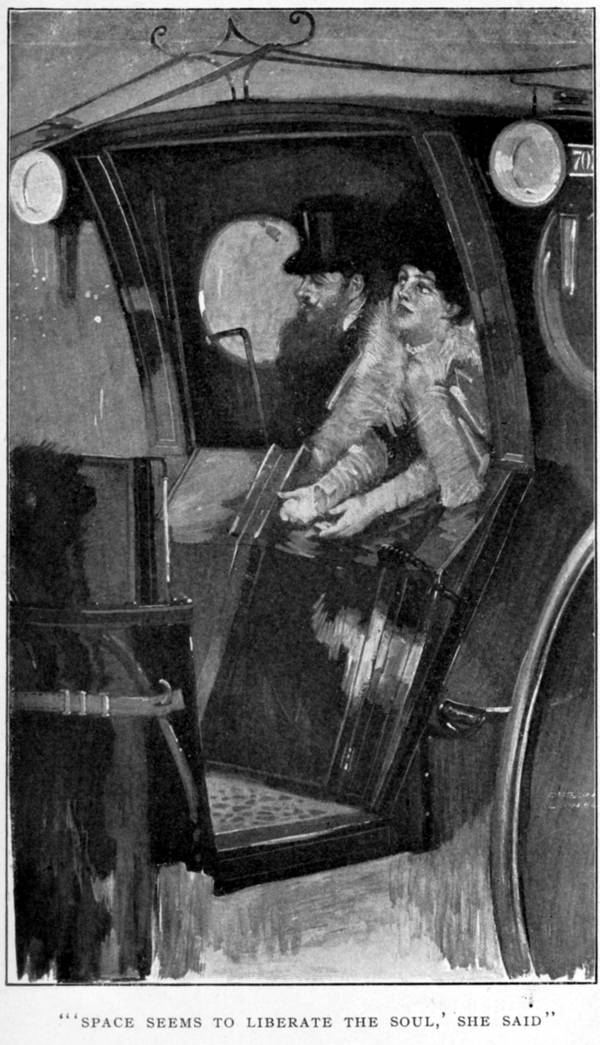 "'SPACE SEEMS TO LIBERATE THE SOUL,' SHE SAID"
They were now on the Thames Embankment, driving slowly along the broad and almost deserted road. Far off lights, green, red, and yellow, shone faintly upon the drifting and uneasy waters of the river on the one side; on the other gleamed the lights from the houses and hotels, in which people were supping after the theatres. Artois, who, like most fine artists, was extremely susceptible to the influence of place and of the hour, with its gift of light or darkness, began to lose in this larger atmosphere of mystery and vaguely visible movement the hitherto dominating sense of himself, to regain the more valuable and more mystical sense of life and its strange and pathetic relation with nature and the spirit behind nature, which often floated upon him like a tide when he was creating, but which he was accus[Pg 39]tomed to hold sternly in leash. Now he was not in the mood to rein it in. Maurice Delarey and his business, Hermione, her understanding of him and happiness in him, Artois himself in his sharply realized solitude of the third person, melted into the crowd of beings who made up life, whose background was the vast and infinitely various panorama of nature, and Hermione's last words, "the important matter," seemed for the moment false to him. What was, what could be, important in the immensity and the baffling complexity of existence?
"Look at those lights," he said, pointing to those that gleamed across the water through the London haze that sometimes makes for a melancholy beauty, "and that movement of the river in the night, tremulous and cryptic like our thoughts. Is anything important?"
"Almost everything, I think, certainly everything in us. If I didn't feel so, I could scarcely go on living. And you must really feel so, too. You do. I have your letters to prove it. Why, how often have I written begging you not to lash yourself into fury over the follies of men!"
"Yes, my temperament betrays the citadel of my brain. That happens in many."
"You trust too much to your brain and too little to your heart."
"And you do the contrary, my friend. You are too easily carried away by your impulses."
She was silent for a moment. The cabman was driving slowly. She watched a distant barge drifting, like a great shadow, at the mercy of the tide. Then she turned a little, looked at Artois's shadowy profile, and said:
"Don't ever be afraid to speak to me quite frankly—don't be afraid now. What is it?"
He did not answer.[Pg 40]
"Imagine you are in Paris sitting down to write to me in your little red-and-yellow room, the morocco slipper of a room."
"And if it were the Sicilian grandmother?"
He spoke half-lightly, as if he were inclined to laugh with her at himself if she began to laugh.
But she said, gravely:
"Go on."
"I have a feeling to-night that out of this happiness of yours misery will be born."
"Yes? What sort of misery?"
"I don't know."
"Misery to myself or to the sharer of my happiness?"
"To you."
"That was why you spoke of the garden of paradise and the deadly swamp?"
"I think it must have been."
"Well?"
"I love the South. You know that. But I distrust what I love, and I see the South in him."
"The grace, the charm, the enticement of the South."
"All that, certainly. You said he had reverence. Probably he has, but has he faithfulness?"
"Oh, Emile!"
"You told me to be frank."
"And I wish you to be. Go on, say everything."
"I've only seen Delarey once, and I'll confess that I came prepared to see faults as clearly as, perhaps more clearly than, virtues. I don't pretend to read character at a glance. Only fools can do that—I am relying on their frequent assertion that they can. He strikes me as a man of great charm, with an unusual faculty of admiration for the gifts of others and a modest estimate of himself. I believe he's sincere."
"He is, through and through."
"I think so—now. But does he know his own blood? Our blood governs us when the time comes. He is[Pg 41] modest about his intellect. I think it quick, but I doubt its being strong enough to prove a good restraining influence."
"Against what?"
"The possible call of the blood that he doesn't understand."
"You speak almost as if he were a child," Hermione said. "He's much younger than I am, but he's twenty-four."
"He is very young looking, and you are at least twenty years ahead of him in all essentials. Don't you feel it?"
"I suppose—yes, I do."
"Mercury—he should be mercurial."
"He is. That's partly why I love him, perhaps. He is full of swiftness."
"So is the butterfly when it comes out into the sun."
"Emile, forgive me, but sometimes you seem to me deliberately to lie down and roll in pessimism rather as a horse—"
"Why not say an ass?"
She laughed.
"An ass, then, my dear, lies down sometimes and rolls in dust. I think you are doing it to-night. I think you were preparing to do it this afternoon. Perhaps it is the effect of London upon you?"
"London—by-the-way, where are you going for your honeymoon? I am sure you know, though Monsieur Delarey may not."
"Why are you sure?"
"Your face to-night when I asked if it was to be Italian."
She laid her hand again upon his arm and spoke eagerly, forgetting in a moment his pessimism and the little cloud it had brought across her happiness.
"You're right; I've decided."
"Italy—and hotels?"
"No, a thousand times no!"[Pg 42]
"Where then?"
"Sicily, and my peasant's cottage."
"The cottage on Monte Amato where you spent a summer four or five years ago contemplating Etna?"
"Yes. I've not said a word to Maurice, but I've taken it again. All the little furniture I had—beds, straw chairs, folding-tables—is stored in a big room in the village at the foot of the mountain. Gaspare, the Sicilian boy who was my servant, will superintend the carrying up of it on women's heads—his dear old grandmother takes the heaviest things, arm-chairs and so on—and it will all be got ready in no time. I'm having the house whitewashed again, and the shutters painted, and the stone vases on the terrace will be filled with scarlet geraniums, and—oh, Emile, I shall hear the piping of the shepherds in the ravine at twilight again with him, and see the boys dance the tarantella under the moon again with him, and—and—"
She stopped with a break in her voice.
"Put away your pessimism, dear Emile," she continued, after a moment. "Tell me you think we shall be happy in our garden of paradise—tell me that!"
But he only said, even more gravely:
"So you're taking him to the real South?"
"Yes, to the blue and the genuine gold, and the quivering heat, and the balmy nights when Etna sends up its plume of ivory smoke to the moon. He's got the south in his blood. Well, he shall see the south first with me, and he shall love it as I love it."
He said nothing. No spark of her enthusiasm called forth a spark from him. And now she saw that, and said again:
"London is making you horrible to-night. You are doing London and yourself an injustice, and Maurice, too."
"It's very possible," he replied. "But—I can say it to you—I have a certain gift of—shall I call it divina[Pg 43]tion?—where men and women are concerned. It is not merely that I am observant of what is, but that I can often instinctively feel that which must be inevitably produced by what is. Very few people can read the future in the present. I often can, almost as clearly as I can read the present. Even pessimism, accentuated by the influence of the Infernal City, may contain some grains of truth."
"What do you see for us, Emile? Don't you think we shall be happy together, then? Don't you think that we are suited to be happy together?"
When she asked Artois this direct question he was suddenly aware of a vagueness brooding in his mind, and knew that he had no definite answer to make.
"I see nothing," he said, abruptly. "I know nothing. It may be London. It may be my own egoism."
And then he suddenly explained himself to Hermione with the extraordinary frankness of which he was only capable when he was with her, or was writing to her.
"I am the dog in the manger," he concluded. "Don't let my growling distress you. Your happiness has made me envious."
"I'll never believe it," she exclaimed. "You are too good a friend and too great a man for that. Why can't you be happy, too? Why can't you find some one?"
"Married life wouldn't suit me. I dislike loneliness yet I couldn't do without it. In it I find my liberty as an artist."
"Sometimes I think it must be a curse to be an artist, and yet I have often longed to be one."
"Why have you never tried to be one?"
"I hardly know. Perhaps in my inmost being I feel I never could be. I am too impulsive, too unrestrained, too shapeless in mind. If I wrote a book it might be interesting, human, heart-felt, true to life, I hope, not stupid, I believe; but it would be a chaos. You—how it would shock your critical mind! I could never select[Pg 44] and prune and blend and graft. I should have to throw my mind and heart down on the paper and just leave them there."
"If you did that you might produce a human document that would live almost as long as literature, that even just criticism would be powerless to destroy."
"I shall never write that book, but I dare say I shall live it."
"Yes," he said. "You will live it, perhaps with Monsieur Delarey."
And he smiled.
"When is the wedding to be?"
"In January, I think."
"Ah! When you are in your garden of paradise I shall not be very far off—just across your blue sea on the African shore."
"Why, where are you going, Emile?"
"I shall spend the spring at the sacred city of Kairouan, among the pilgrims and the mosques, making some studies, taking some notes."
"For a book? Come over to Sicily and see us."
"I don't think you will want me there."
The trap in the roof was opened, and a beery eye, with a luscious smile in it, peered down upon them.
"'Ad enough of the river, sir?"
"Comment?" said Artois.
"We'd better go home, I suppose," Hermione said.
She gave her address to the cabman, and they drove in silence to Eaton Place.[Pg 45]
Lucrezia Gabbi came out onto the terrace of the Casa del Prete on Monte Amato, shaded her eyes with her brown hands, and gazed down across the ravine over the olive-trees and the vines to the mountain-side opposite, along which, among rocks and Barbary figs, wound a tiny track trodden by the few contadini whose stone cottages, some of them scarcely more than huts, were scattered here and there upon the surrounding heights that looked towards Etna and the sea. Lucrezia was dressed in her best. She wore a dark-stuff gown covered in the front by a long blue-and-white apron. Although really happiest in her mind when her feet were bare, she had donned a pair of white stockings and low slippers, and over her thick, dark hair was tied a handkerchief gay with a pattern of brilliant yellow flowers on a white ground. This was a present from Gaspare bought at the town of Cattaro at the foot of the mountains, and worn now for the first time in honor of a great occasion.
To-day Lucrezia was in the service of distinguished forestieri, and she was gazing now across the ravine straining her eyes to see a procession winding up from the sea: donkeys laden with luggage, and her new padrone and padrona pioneered by the radiant Gaspare towards their mountain home. It was a good day for their arrival. Nobody could deny that. Even Lucrezia, who was accustomed to fine weather, having lived all her life in Sicily, was struck to a certain blinking admiration as she stepped out on to the terrace,[Pg 46] and murmured to herself and a cat which was basking on the stone seat that faced the cottage between broken columns, round which roses twined:
"Che tempo fa oggi! Santa Madonna, che bel tempo!"
On this morning of February the clearness of the atmosphere was in truth almost African. Under the cloudless sky every detail of the great view from the terrace stood out with a magical distinctness. The lines of the mountains were sharply defined against the profound blue. The forms of the gray rocks scattered upon their slopes, of the peasants' houses, of the olive and oak trees which grew thickly on the left flank of Monte Amato below the priest's house, showed themselves in the sunshine with the bold frankness which is part of the glory of all things in the south. The figures of stationary or moving goatherds and laborers, watching their flocks or toiling among the vineyards and the orchards, were relieved against the face of nature in the shimmer of the glad gold in this Eden, with a mingling of delicacy and significance which had in it something ethereal and mysterious, a hint of fairy-land. Far off, rising calmly in an immense slope, a slope that was classical in its dignity, profound in its sobriety, remote, yet neither cold nor sad, Etna soared towards the heaven, sending from its summit, on which the snows still lingered, a steady plume of ivory smoke. In the nearer foreground, upon a jagged crest of beetling rock, the ruins of a Saracenic castle dominated a huddled village, whose houses seemed to cling frantically to the cliff, as if each one were in fear of being separated from its brethren and tossed into the sea. And far below that sea spread forth its waveless, silent wonder to a horizon-line so distant that the eyes which looked upon it could scarcely distinguish sea from sky—a line which surely united not divided two shades of flawless blue, linking them in a brotherhood which should be everlasting. Few sounds, and these but[Pg 47] slight ones, stirred in the breast of the ardent silence; some little notes of birds, fragmentary and wandering, wayward as pilgrims who had forgotten to what shrine they bent their steps, some little notes of bells swinging beneath the tufted chins of goats, the wail of a woman's song, old in its quiet melancholy, Oriental in its strange irregularity of rhythm, and the careless twitter of a tarantella, played upon a reed-flute by a secluded shepherd-boy beneath the bending silver green of tressy olives beside a tiny stream.
Lucrezia was accustomed to it all. She had been born beside that sea. Etna had looked down upon her as she sucked and cried, toddled and played, grew to a lusty girlhood, and on into young womanhood with its gayety and unreason, its work and hopes and dreams. That Oriental song—she had sung it often on the mountain-sides, as she set her bare, brown feet on the warm stones, and lifted her head with a native pride beneath its burdening pannier or its jar of water from the well. And she had many a time danced to the tarantella that the shepherd-boy was fluting, clapping her strong hands and swinging her broad hips, while the great rings in her ears shook to and fro, and her whole healthy body quivered to the spirit of the tune. She knew it all. It was and had always been part of her life.
Hermione's garden of paradise generally seemed homely enough to Lucrezia. Yet to-day, perhaps because she was dressed in her best on a day that was not a festa, and wore a silver chain with a coral charm on it, and had shoes on her feet, there seemed to her a newness, almost a strangeness in the wideness and the silence, in the sunshine and the music, something that made her breathe out a sigh, and stare with almost wondering eyes on Etna and the sea. She soon lost her vague sensation that her life lay, perhaps, in a home of magic, however, when she looked again at the mule track which wound upward from the distant town,[Pg 48] in which the train from Messina must by this time have deposited her forestieri, and began to think more naturally of the days that lay before her, of her novel and important duties, and of the unusual sums of money that her activities were to earn her.
Gaspare, who, as major-domo, had chosen her imperiously for his assistant and underling in the house of the priest, had informed her that she was to receive twenty-five lire a month for her services, besides food and lodging, and plenty of the good, red wine of Amato. To Lucrezia such wages seemed prodigal. She had never yet earned more than the half of them. But it was not only this prospect of riches which now moved and excited her.
She was to live in a splendidly furnished house with wealthy and distinguished people; she was to sleep in a room all to herself, in a bed that no one had a right to except herself. This was an experience that in her most sanguine moments she had never anticipated. All her life had been passed en famille in the village of Marechiaro, which lay on a table-land at the foot of Monte Amato, half-way down to the sea. The Gabbis were numerous, and they all lived in one room, to which cats, hens, and turkeys resorted with much freedom and in considerable numbers. Lucrezia had never known, perhaps had never desired, a moment of privacy, but now she began to awake to the fact that privacy and daintiness and pretty furniture were very interesting, and even touching, as well as very phenomenal additions to a young woman's existence. What could the people who had the power to provide them be like? She scanned the mule-track with growing eagerness, but the procession did not appear. She saw only an old contadino in a long woollen cap riding slowly into the recesses of the hills on a donkey, and a small boy leading his goats to pasture. The train must have been late. She turned round from the view and ex[Pg 49]amined her new home once more. Already she knew it by heart, yet the wonder of it still encompassed her spirit.
Hermione's cottage, the eyrie to which she was bringing Maurice Delarey, was only a cottage, although to Lucrezia it seemed almost a palace. It was whitewashed, with a sloping roof of tiles, and windows with green Venetian shutters. Although it now belonged to a contadino, it had originally been built by a priest, who had possessed vineyards on the mountain-side, and who wished to have a home to which he could escape from the town where he lived when the burning heats of the summer set in. Above his vineyards, some hundreds of yards from the summit of the mountain, and close to a grove of oaks and olive-trees, which grew among a turmoil of mighty boulders, he had terraced out the slope and set his country home. At the edge of the rough path which led to the cottage from the ravine below was a ruined Norman arch. This served as a portal of entrance. Between it and the cottage was a well surrounded by crumbling walls, with stone seats built into them. Passing that, one came at once to the terrace of earth, fronted by a low wall with narrow seats covered with white tiles, and divided by broken columns that edged the ravine and commanded the great view on which Lucrezia had been gazing. On the wall of this terrace were stone vases, in which scarlet geraniums were growing. Red roses twined around the columns, and, beneath, the steep side of the ravine was clothed with a tangle of vegetation, olive and peach, pear and apple trees. Behind the cottage rose the bare mountain-side, covered with loose stones and rocks, among which in every available interstice the diligent peasants had sown corn and barley. Here and there upon the mountains distant cottages were visible, but on Monte Amato Hermione's was the last, the most intrepid. None other ventured to cling to the warm earth so high above the sea and in a place so solitary.[Pg 50] That was why Hermione loved it, because it was near the sky and very far away.
Now, after an earnest, ruminating glance at the cottage, Lucrezia walked across the terrace and reverently entered it by a door which opened onto a flight of three steps leading down to the terrace. Already she knew the interior by heart, but she had not lost her awe of it, her sense almost of being in a church when she stood among the furniture, the hangings, and the pictures which she had helped to arrange under Gaspare's orders. The room she now stood in was the parlor of the cottage, serving as dining-room, drawing-room, boudoir, and den. Although it must be put to so many purposes, it was only a small, square chamber, and very simply furnished. The walls, like all the walls of the cottage inside and out, were whitewashed. On the floor was a carpet that had been woven in Kairouan, the sacred African town where Artois was now staying and making notes for his new book. It was thick and rough, and many-colored almost as Joseph's coat; brilliant but not garish, for the African has a strange art of making colors friends instead of enemies, of blending them into harmonies that are gay yet touched with peace. On the walls hung a few reproductions of fine pictures: an old woman of Rembrandt, in whose wrinkled face and glittering dark eyes the past pleasures and past sorrows of life seemed tenderly, pensively united, mellowed by the years into a soft bloom, a quiet beauty; an allegory of Watts, fierce with inspiration like fire mounting up to an opening heaven; a landscape of Frederick Walker's, the romance of harvest in an autumn land; Burne-Jones's "The Mill," and a copy in oils of a knight of Gustave Moreau's, riding in armor over the summit of a hill into an unseen country of errantry, some fairy-land forlorn. There was, too, an old Venetian mirror in a curiously twisted golden frame.[Pg 51]
At the two small windows on either side of the door, which was half glass, half white-painted wood, were thin curtains of pale gray-blue and white, bought in the bazaars of Tunis. For furniture there were a folding-table of brown, polished wood, a large divan with many cushions, two deck-chairs of the telescope species, that can be made long or short at will, a writing-table, a cottage piano, and four round wicker chairs with arms. In one corner of the room stood a tall clock with a burnished copper face, and in another a cupboard containing glass and china. A door at the back, which led into the kitchen, was covered with an Oriental portière. On the writing-table, and on some dwarf bookcases already filled with books left behind by Hermione on her last visit to Sicily, stood rough jars of blue, yellow, and white pottery, filled with roses and geraniums arranged by Gaspare. To the left of the room, as Lucrezia faced it, was a door leading into the bedroom, of the master and mistress.
After a long moment of admiring contemplation, Lucrezia went into this bedroom, in which she was specially interested, as it was to be her special care. All was white here, walls, ceiling, wooden beds, tables, the toilet service, the bookcases. For there were books here, too, books which Lucrezia examined with an awful wonder, not knowing how to read. In the window-seat were white cushions. On the chest of drawers were more red roses and geraniums. It was a virginal room, into which the bright, golden sunbeams stole under the striped awning outside the low window with surely a hesitating modesty, as if afraid to find themselves intruders. The whiteness, the intense quietness of the room, through whose window could be seen a space of far-off sea, a space of mountain-flank, and, when one came near to it, and the awning was drawn up, the snowy cone of Etna, struck now to the soul of Lucrezia a sense of half-puzzled peace. Her large eyes opened[Pg 52] wider, and she laid her hands on her hips and fell into a sort of dream as she stood there, hearing only the faint and regular ticking of the clock in the sitting-room. She was well accustomed to the silence of the mountain world and never heeded it, but peace within four walls was almost unknown to her. Here no hens fluttered, no turkeys went to and fro elongating their necks, no children played and squalled, no women argued and gossiped, quarrelled and worked, no men tramped in and out, grumbled and spat. A perfectly clean and perfectly peaceful room—it was marvellous, it was—she sighed again. What must it be like to be gentlefolk, to have the money to buy calm and cleanliness?
Suddenly she moved, took her hands from her hips, settled her yellow handkerchief, and smiled. The silence had been broken by a sound all true Sicilians love, the buzz and the drowsy wail of the ceramella, the bagpipes which the shepherds play as they come down from the hills to the villages when the festival of the Natale is approaching. It was as yet very faint and distant, coming from the mountain-side behind the cottage, but Lucrezia knew the tune. It was part of her existence, part of Etna, the olive groves, the vineyards, and the sea, part of that old, old Sicily which dwells in the blood and shines in the eyes, and is alive in the songs and the dances of these children of the sun, and of legends and of mingled races from many lands. It was the "Pastorale," and she knew who was playing it—Sebastiano, the shepherd, who had lived with the brigands in the forests that look down upon the Isles of Lipari, who now kept his father's goats among the rocks, and knew every stone and every cave on Etna, and who had a chest and arms of iron, and legs that no climbing could fatigue, and whose great, brown fingers, that could break a man's wrist, drew such delicate tones from the reed pipe that, when he played it, even the old[Pg 53] man's thoughts were turned to dancing and the old woman's to love. But now he was being important, he was playing the ceramella, into which no shepherd could pour such a volume of breath as he, from which none could bring such a volume of warm and lusty music. It was Sebastiano coming down from the top of Monte Amato to welcome the forestieri.
The music grew louder, and presently a dog barked outside on the terrace. Lucrezia ran to the window. A great white-and-yellow, blunt-faced, pale-eyed dog, his neck surrounded by a spiked collar, stood there sniffing and looking savage, his feathery tail cocked up pugnaciously over his back.
"Sebastiano!" called Lucrezia, leaning out of the window under the awning—"Sebastiano!"
Then she drew back laughing, and squatted down on the floor, concealed by the window-seat. The sound of the pipes increased till their rough drone seemed to be in the room, bidding a rustic defiance to its whiteness and its silence. Still squatting on the floor, Lucrezia called out once more:
"Sebastiano!"
Abruptly the tune ceased and the silence returned, emphasized by the vanished music. Lucrezia scarcely breathed. Her face was flushed, for she was struggling against an impulse to laugh, which almost overmastered her. After a minute she heard the dog's short bark again, then a man's foot shifting on the terrace, then suddenly a noise of breathing above her head close to her hair. With a little scream she shrank back and looked up. A man's face was gazing down at her. It was a very brown and very masculine face, roughened by wind and toughened by sun, with keen, steady, almost insolent eyes, black and shining, stiff, black hair, that looked as if it had been crimped, a mustache sprouting above a wide, slightly animal mouth full of splendid teeth, and a square, brutal, but very manly[Pg 54] chin. On the head was a Sicilian cap, long and hanging down at the left side. There were ear-rings in the man's large, well-shaped ears, and over the window-ledge protruded the swollen bladder, like a dead, bloated monster, from which he had been drawing his antique tune.
He stared down at Lucrezia with a half-contemptuous humor, and she up at him with a wide-eyed, unconcealed adoration. Then he looked curiously round the room, with a sharp intelligence that took in every detail in a moment.
"Per Dio!" he ejaculated. "Per Dio!"
He looked at Lucrezia, folded his brawny arms on the window-sill, and said:
"They've got plenty of soldi."
Lucrezia nodded, not without personal pride.
"Gaspare says—"
"Oh, I know as much as Gaspare," interrupted Sebastiano, brusquely. "The signora is my friend. When she was here before I saw her many times. But for me she would never have taken the Casa del Prete."
"Why was that?" asked Lucrezia, with reverence.
"They told her in Marechiaro that it was not safe for a lady to live up here alone, that when the night came no one could tell what would happen."
"But, Gaspare—"
"Does Gaspare know every grotto on Etna? Has Gaspare lived eight years with the briganti? And the Mafia—has Gaspare—"
He paused, laughed, pulled his mustache, and added:
"If the signora had not been assured of my protection she would never have come up here."
"But now she has a husband."
"Yes."
He glanced again round the room.
"One can see that. Per Dio, it is like the snow on the top of Etna."[Pg 55]
Lucrezia got up actively from the floor and came close to Sebastiano.
"What is the padrona like, Sebastiano?" she asked. "I have seen her, but I have never spoken to her."
"She is simpatica—she will do you no harm."
"And is she generous?"
"Ready to give soldi to every one who is in trouble. But if you once deceive her she will never look at you again."
"Then I will not deceive her," said Lucrezia, knitting her brows.
"Better not. She is not like us. She thinks to tell a lie is a sin against the Madonna, I believe."
"But then what will the padrone do?" asked Lucrezia, innocently.
"Tell his woman the truth, like all husbands," replied Sebastiano, with a broadly satirical grin. "As your man will some day, Lucrezia mia. All husbands are good and faithful. Don't you know that?"
"Macchè!"
She laughed loudly, with an incredulity quite free from bitterness.
"Men are not like us," she added. "They tell us whatever they please, and do always whatever they like. We must sit in the doorway and keep our back to the street for fear a man should smile at us, and they can stay out all night, and come back in the morning, and say they've been fishing at Isola Bella, or sleeping out to guard the vines, and we've got to say, 'Si, Salvatore!' or 'Si, Guido!' when we know very well—"
"What, Lucrezia?"
She looked into his twinkling eyes and reddened slightly, sticking out her under lip.
"I'm not going to tell you."
"You have no business to know."
"And how can I help—they're coming!"
Sebastiano's dog had barked again on the terrace.[Pg 56] Sebastiano lifted the ceramalla quickly from the window-sill and turned round, while Lucrezia darted out through the door, across the sitting-room, and out onto the terrace.
"Are they there, Sebastiano? Are they there?"
He stood by the terrace wall, shading his eyes with his hand.
"Ecco!" he said, pointing across the ravine.
Far off, winding up from the sea slowly among the rocks and the olive-trees, was a procession of donkeys, faintly relieved in the brilliant sunshine against the mountain-side.
"One," counted Sebastiano, "two, three, four—there are four. The signore is walking, the signora is riding. Whose donkeys have they got? Gaspare's father's, of course. I told Gaspare to take Ciccio's, and—it is too far to see, but I'll soon make them hear me. The signora loves the 'Pastorale.' She says there is all Sicily in it. She loves it more than the tarantella, for she is good, Lucrezia—don't forget that—though she is not a Catholic, and perhaps it makes her think of the coming of the Bambino and of the Madonna. Ah! She will smile now and clap her hands when she hears."
He put the pipe to his lips, puffed out his cheeks, and began to play the "Pastorale" with all his might, while Lucrezia listened, staring across the ravine at the creeping donkey, which was bearing Hermione upward to her garden of paradise near the sky.[Pg 57]
"And then, signora, I said to Lucrezia, 'the padrona loves Zampaglione, and you must be sure to—'"
"Wait, Gaspare! I thought I heard—Yes, it is, it is! Hush! Maurice—listen!"
Hermione pulled up her donkey, which was the last of the little procession, laid her hand on her husband's arm, and held her breath, looking upward across the ravine to the opposite slope where, made tiny by distance, she saw the white line of the low terrace wall of the Casa del Prete, the black dots, which were the heads of Sebastiano and Lucrezia. The other donkeys tripped on among the stones and vanished, with their attendant boys, Gaspare's friends, round the angle of a great rock, but Gaspare stood still beside his padrona, with his brown hand on her donkey's neck, and Maurice Delarey, following her eyes, looked and listened like a statue of that Mercury to which Artois had compared him.
"It's the 'Pastorale,'" Hermione whispered. "The 'Pastorale'!"
Her lips parted. Tears came into her eyes, those tears that come to a woman in a moment of supreme joy that seems to wipe out all the sorrows of the past. She felt as if she were in a great dream, one of those rare and exquisite dreams that sometimes bathe the human spirit, as a warm wave of the Ionian Sea bathes the Sicilian shore in the shadow of an orange grove, murmuring peace. In that old tune of the "Pastorale" all her thoughts of Sicily, and her knowledge of Sicily, and her imaginations, and her deep and passionately[Pg 58] tender and even ecstatic love of Sicily seemed folded and cherished like birds in a nest. She could never have explained, she could only feel how. In the melody, with its drone bass, the very history of the enchanted island was surely breathed out. Ulysses stood to listen among the flocks of Polyphemus. Empedocles stayed his feet among the groves of Etna to hear it. And Persephone, wandering among the fields of asphodel, paused with her white hands out-stretched to catch its drowsy beauty; and Arethusa, turned into a fountain, hushed her music to let it have its way. And Hermione heard in it the voice of the Bambino, the Christ-child, to whose manger-cradle the shepherds followed the star, and the voice of the Madonna, Maria stella del mare, whom the peasants love in Sicily as the child loves its mother. And those peasants were in it, too, people of the lava wastes and the lava terraces where the vines are green against the black, people of the hazel and the beech forests, where the little owl cries at eve, people of the plains where, beneath the yellow lemons, spring the yellow flowers that are like their joyous reflection in the grasses, people of the sea, that wonderful purple sea in whose depth of color eternity seems caught. The altars of the pagan world were in it, and the wayside shrines before which the little lamps are lit by night upon the lonely mountain-sides, the old faith and the new, and the love of a land that lives on from generation to generation in the pulsing breasts of men.
And Maurice was in it, too, and Hermione and her love for him and his for her.
Gaspare did not move. He loved the "Pastorale" almost without knowing that he loved it. It reminded him of the festa of Natale, when, as a child, dressed in a long, white garment, he had carried a blazing torch of straw down the steps of the church of San Pancrazio before the canopy that sheltered the Bambino. It was[Pg 59] a part of his life, as his mother was, and Tito the donkey, and the vineyards, the sea, the sun. It pleased him to hear it, and to feel that his padrona from a far country loved it, and his isle, his "Paese" in which it sounded. So, though he had been impatient to reach the Casa del Prete and enjoy the reward of praise which he considered was his due for his forethought and his labors, he stood very still by Tito, with his great, brown eyes fixed, and the donkey switch drooping in the hand that hung at his side.
And Hermione for a moment gave herself entirely to her dream.
She had carried out the plan which she had made. She and Maurice Delarey had been married quietly, early one morning in London, and had caught the boat-train at Victoria, and travelled through to Sicily without stopping on the way to rest. She wanted to plunge Maurice in the south at once, not to lead him slowly, step by step, towards it. And so, after three nights in the train, they had opened their eyes to the quiet sea near Reggio, to the clustering houses under the mountains of Messina, to the high-prowed fishermen's boats painted blue and yellow, to the coast-line which wound away from the straits till it stole out to that almost phantasmal point where Siracusa lies, to the slope of Etna, to the orange gardens and the olives, and the great, dry water courses like giant highways leading up into the mountains. And from the train they had come up here into the recesses of the hills to hear their welcome of the "Pastorale." It was a contrast to make a dream, the roar of ceaseless travel melting into this radiant silence, this inmost heart of peace. They had rushed through great cities to this old land of mountains and of legends, and up there on the height from which the droning music dropped to them through the sunshine was their home, the solitary house which was to shelter their true marriage.[Pg 60]
Delarey was almost confused by it all. Half dazed by the noise of the journey, he was now half dazed by the wonder of the quiet as he stood near Gaspare and listened to Sebastiano's music, and looked upward to the white terrace wall.
Hermione was to be his possession here, in this strange and far-off land, among these simple peasant people. So he thought of them, not versed yet in the complex Sicilian character. He listened, and he looked at Gaspare. He saw a boy of eighteen, short as are most Sicilians, but straight as an arrow, well made, active as a cat, rather of the Greek than of the Arab type so often met with in Sicily, with bold, well-cut features, wonderfully regular and wonderfully small, square, white teeth, thick, black eyebrows, and enormous brown eyes sheltered by the largest lashes he had ever seen. The very low forehead was edged by a mass of hair that had small gleams of bright gold here and there in the front, but that farther back on the head was of a brown so dark as to look nearly black. Gaspare was dressed in a homely suit of light-colored linen with no collar and a shirt open at the throat, showing a section of chest tanned by the sun. Stout mountain boots were on his feet, and a white linen hat was tipped carelessly to the back of his head, leaving his expressive, ardently audacious, but not unpleasantly impudent face exposed to the golden rays of which he had no fear.
As Delarey looked at him he felt oddly at home with him, almost as if he stood beside a young brother. Yet he could scarcely speak Gaspare's language, and knew nothing of his thoughts, his feelings, his hopes, his way of life. It was an odd sensation, a subtle sympathy not founded upon knowledge. It seemed to now into Delarey's heart out of the heart of the sun, to steal into it with the music of the "Pastorale."
"I feel—I feel almost as if I belonged here," he whispered to Hermione, at last.[Pg 61]
She turned her head and looked down on him from her donkey. The tears were still in her eyes.
"I always knew you belonged to the blessed, blessed south," she said, in a low voice. "Do you care for that?"
She pointed towards the terrace.
"That music?"
"Yes."
"Tremendously, but I don't know why. Is it very beautiful?"
"I sometimes think it is the most beautiful music I have ever heard. At any rate, I have always loved it more than all other music, and now—well, you can guess if I love it now."
She dropped one hand against the donkey's warm shoulder. Maurice took it in his warm hand.
"All Sicily, all the real, wild Sicily seems to be in it. They play it in the churches on the night of the Natale," she went on, after a moment. "I shall never forget hearing it for the first time. I felt as if it took hold of my very soul with hands like the hands of the Bambino."
She broke off. A tear had fallen down upon her cheek.
"Avanti Gaspare!" she said.
Gaspare lifted his switch and gave Tito a tap, calling out "Ah!" in a loud, manly voice. The donkey moved on, tripping carefully among the stones. They mounted slowly up towards the "Pastorale." Presently Hermione said to Maurice, who kept beside her in spite of the narrowness of the path:
"Everything seems very strange to me to-day. Can you guess why?"
"I don't know. Tell me," he answered.
"It's this. I never expected to be perfectly happy. We all have our dreams, I suppose. We all think now and then, 'If only I could have this with that, this per[Pg 62]son in that place, I could be happy.' And perhaps we have sometimes a part of our dream turned into reality, though even that comes seldom. But to have the two, to have the two halves of our dream fitted together and made reality—isn't that rare? Long ago, when I was a girl, I always used to think—'If I could ever be with the one I loved in the south—alone, quite alone, quite away from the world, I could be perfectly happy.' Well, years after I thought that I came here. I knew at once I had found my ideal place. One-half of my dream was made real and was mine. That was much, wasn't it? But getting this part of what I longed for sometimes made me feel unutterably sad. I had never seen you then, but often when I sat on that little terrace up there I felt a passionate desire to have a human being whom I loved beside me. I loved no one then, but I wanted, I needed to love. Do men ever feel that? Women do, often, nearly always I think. The beauty made me want to love. Sometimes, as I leaned over the wall, I heard a shepherd-boy below in the ravine play on his pipe, or I heard the goat-bells ringing under the olives. Sometimes at night I saw distant lights, like fire-flies, lamps carried by peasants going to their homes in the mountains from a festa in honor of some saint, stealing upward through the darkness, or I saw the fishermen's lights burning in the boats far off upon the sea. Then—then I knew that I had only half my dream, and I was ungrateful, Maurice. I almost wished that I had never had this half, because it made me realize what it would be to have the whole. It made me realize the mutilation, the incompleteness of being in perfect beauty without love. And now—now I've actually got all I ever wanted, and much more, because I didn't know then at all what it would really mean to me to have it. And, besides, I never thought that God would select me for perfect happiness. Why should he? What have I ever done to be worthy of such a gift?"[Pg 63]
"You've been yourself," he answered.
At this moment the path narrowed and he had to fall behind, and they did not speak again till they had clambered up the last bit of the way, steep almost as the side of a house, passed through the old ruined arch, and came out upon the terrace before the Casa del Prete.
Sebastiano met them, still playing lustily upon his pipe, while the sweat dripped from his sunburned face; but Lucrezia, suddenly overcome by shyness, had disappeared round the corner of the cottage to the kitchen. The donkey boys were resting on the stone seats in easy attitudes, waiting for Gaspare's orders to unload, and looking forward to a drink of the Monte Amato wine. When they had had it they meant to carry out a plan devised by the radiant Gaspare, to dance a tarantella for the forestieri while Sebastiano played the flute. But no hint of this intention was to be given till the luggage had been taken down and carried into the house. Their bright faces were all twinkling with the knowledge of their secret. When at length Sebastiano had put down the ceramella and shaken Hermione and Maurice warmly by the hand, and Gaspare had roughly, but with roars of laughter, dragged Lucrezia into the light of day to be presented, Hermione took her husband in to see their home. On the table in the sitting-room lay a letter.
"A letter already!" she said.
There was a sound almost of vexation in her voice. The little white thing lying there seemed to bring a breath of the world she wanted to forget into their solitude.
"Who can have written?"
She took it up and felt contrition.
"It's from Emile!" she exclaimed. "How good of him to remember! This must be his welcome."
"Read it, Hermione," said Maurice. "I'll look after Gaspare."[Pg 64]
She laughed.
"Better not. He's here to look after us. But you'll soon understand him, very soon, and he you. You speak different languages, but you both belong to the south. Let him alone, Maurice. We'll read this together. I'm sure it's for you as well as me."
And while Gaspare and the boys carried in the trunks she sat down by the table and opened Emile's letter. It was very short, and was addressed from Kairouan, where Artois had established himself for the spring in an Arab house. She began reading it aloud in French:
"This is a word—perhaps unwelcome, for I think I understand, dear friend, something of what you are feeling and of what you desire just now—a word of welcome to your garden of paradise. May there never be an angel with a flaming sword to keep the gate against you. Listen to the shepherds fluting, dream, or, better, live, as you are grandly capable of living, under the old olives of Sicily. Take your golden time boldly with both hands. Life may seem to most of us who think in the main a melancholy, even a tortured thing, but when it is not so for a while to one who can think as you can think, the power of thought, of deep thought, intensifies its glory. You will never enjoy as might a pagan, perhaps never as might a saint. But you will enjoy as a generous-blooded woman with a heart that only your friends—I should like to dare to say only one friend—know in its rare entirety. There is an egoist here, in the shadow of the mosques, who turns his face towards Mecca, and prays that you may never leave your garden. E. A."
"Does the Sicilian grandmother respond to the magic of the south?"
When she drew near to the end of this letter Hermione hesitated.
"He—there's something," she said, "that is too kind to me. I don't think I'll read it."
"Don't," said Delarey. "But it can't be too kind."
She saw the postscript and smiled.
"And quite at the end there's an allusion to you."
"Is there?"[Pg 65]
"I must read that."
And she read it.
"He needn't be afraid of the grandmother's not responding, need he, Maurice?"
"No," he said, smiling too. "But is that it, do you think? Why should it be? Who wouldn't love this place?"
And he went to the open door and looked out towards the sea.
"Who wouldn't?" he repeated.
"Oh, I have met an Englishman who was angry with Etna for being the shape it is."
"What an ass!"
"I thought so, too. But, seriously, I expect the grandmother has something to say in that matter of your feeling already, as if you belonged here."
"Perhaps."
He was still looking towards the distant sea far down below them.
"Is that an island?" he asked.
"Where?" said Hermione, getting up and coming towards him. "Oh, that—no, it is a promontory, but it's almost surrounded by the sea. There is only a narrow ledge of rock, like a wall, connecting it with the main-land, and in the rock there's a sort of natural tunnel through which the sea flows. I've sometimes been to picnic there. On the plateau hidden among the trees there's a ruined house. I have spent many hours reading and writing in it. They call it, in Marechiaro, Casa delle Sirene—the house of the sirens."
cried Gaspare's voice outside.
"A Brindisi!" said Hermione. "Gaspare's treating the boys. Questo vino—oh, how glorious to be here in Sicily!"[Pg 66]
She put her arm through Delarey's, and drew him out onto the terrace. Gaspare, Lucrezia, Sebastiano, and the three boys stood there with glasses of red wine in their hands raised high above their heads.
continued Gaspare, joyously, and with an obvious pride in his poetical powers.
They all drank simultaneously, Lucrezia spluttering a little out of shyness.
"Monte Amato, Gaspare, not Castel Perini. But that doesn't rhyme, eh? Bravo! But we must drink, too."
Gaspare hastened to fill two more glasses.
"Now it's our turn," cried Hermione.
The boys burst into a hearty laugh, and Gaspare's eyes gleamed with pleasure while Hermione and Maurice drank. Then Sebastiano drew from the inner pocket of his old jacket a little flute, smiling with an air of intense and comic slyness which contorted his face.
"Ah," said Hermione, "I know—it's the tarantella!"
She clapped her hands.
"It only wanted that," she said to Maurice. "Only that—the tarantella!"
"Guai Lucrezia!" cried Gaspare, tyrannically.
Lucrezia bounded to one side, bent her body inward, and giggled with all her heart. Sebastiano leaned his back against a column and put the flute to his lips.
"Here, Maurice, here!" said Hermione.
She made him sit down on one of the seats under the parlor window, facing the view, while the four boys took their places, one couple opposite to the other. Then[Pg 67] Sebastiano began to twitter the tune familiar to the Sicilians of Marechiaro, in which all the careless pagan joy of life in the sun seems caught and flung out upon a laughing, dancing world. Delarey laid his hands on the warm tiles of the seat, leaned forward, and watched with eager eyes. He had never seen the tarantella, yet now with his sensation of expectation there was blended another feeling. It seemed to him as if he were going to see something he had known once, perhaps very long ago, something that he had forgotten and that was now going to be recalled to his memory. Some nerve in his body responded to Sebastiano's lively tune. A desire of movement came to him as he saw the gay boys waiting on the terrace, their eyes already dancing, although their bodies were still.
Gaspare bent forward, lifted his hands above his head, and began to snap his fingers in time to the music. A look of joyous invitation had come into his eyes—an expression that was almost coquettish, like the expression of a child who has conceived some lively, innocent design of which he thinks that no one knows except himself. His young figure surely quivered with a passion of merry mischief which was communicated to his companions. In it there began to flame a spirit that suggested undying youth. Even before they began to dance the boys were transformed. If they had ever known cares those cares had fled, for in the breasts of those who can really dance the tarantella there is no room for the smallest sorrow, in their hearts no place for the most minute regret, anxiety, or wonder, when the rapture of the measure is upon them. Away goes everything but the pagan joy of life, the pagan ecstasy of swift movement, and the leaping blood that is quick as the motes in a sunray falling from a southern sky. Delarey began to smile as he watched them, and their expression was reflected in his eyes. Hermione glanced at him and thought what a boy he looked.[Pg 68] His eyes made her feel almost as if she were sitting with a child.
The mischief, the coquettish joy of the boys increased. They snapped their fingers more loudly, swayed their bodies, poised themselves first on one foot, then on the other, then abruptly, and with a wildness that was like the sudden crash of all the instruments in an orchestra breaking in upon the melody of a solitary flute, burst into the full frenzy of the dance. And in the dance each seemed to be sportively creative, ruled by his own sweet will.
"That's why I love the tarantella more than any other dance," Hermione murmured to her husband, "because it seems to be the invention of the moment, as if they were wild with joy and had to show it somehow, and showed it beautifully by dancing. Look at Gaspare now."
With his hands held high above his head, and linked together, Gaspare was springing into the air, as if propelled by one of those boards which are used by acrobats in circuses for leaping over horses. He had thrown off his hat, and his low-growing hair, which was rather long on the forehead, moved as he sprang upward, as if his excitement, penetrating through every nerve in his body, had filled it with electricity. While Hermione watched him she almost expected to see its golden tufts give off sparks in response to the sparkling radiance that flashed from his laughing eyes. For in all the wild activity of his changing movements Gaspare never lost his coquettish expression, the look of seductive mischief that seemed to invite the whole world to be merry and mad as he was. His ever-smiling lips and ever-smiling eyes defied fatigue, and his young body—grace made a living, pulsing, aspiring reality—suggested the tireless intensity of a flame. The other boys danced well, but Gaspare outdid them all, for they only looked gay while he looked mad with joy.[Pg 69] And to-day, at this moment, he felt exultant. He had a padrona to whom he was devoted with that peculiar sensitive devotion of the Sicilian which, once it is fully aroused, is tremendous in its strength and jealous in its doggedness. He was in command of Lucrezia, and was respectfully looked up to by all his boy friends of Marechiaro as one who could dispense patronage, being a sort of purse-bearer and conductor of rich forestieri in a strange land. Even Sebastiano, a personage rather apt to be a little haughty in his physical strength, and, though no longer a brigand, no great respecter of others, showed him to-day a certain deference which elated his boyish spirit. And all his elation, all his joy in the present and hopes for the future, he let out in the dance. To dance the tarantella almost intoxicated him, even when he only danced it in the village among the contadini, but to-day the admiring eyes of his padrona were upon him. He knew how she loved the tarantella. He knew, too, that she wanted the padrone, her husband, to love it as she did. Gaspare was very shrewd to read a woman's thoughts so long as her love ran in them. Though but eighteen, he was a man in certain knowledge. He understood, almost unconsciously, a good deal of what Hermione was feeling as she watched, and he put his whole soul into the effort to shine, to dazzle, to rouse gayety and wonder in the padrone, who saw him dance for the first time. He was untiring in his variety and his invention. Sometimes, light-footed in his mountain boots, with an almost incredible swiftness and vim, he rushed from end to end of the terrace. His feet twinkled in steps so complicated and various that he made the eyes that watched him wink as at a play of sparks in a furnace, and his arms and hands were never still, yet never, even for a second, fell into a curve that was ungraceful. Sometimes his head was bent whimsically forward as if in invitation. Sometimes he threw his whole body[Pg 70] backward, exposing his brown throat, and staring up at the sun like a sun worshipper dancing to his divinity. Sometimes he crouched on his haunches, clapping his hands together rhythmically, and, with bent knees, shooting out his legs like some jovially grotesque dwarf promenading among a crowd of Follies. And always the spirit of the dance seemed to increase within him, and the intoxication of it to take more hold upon him, and his eyes grew brighter and his face more radiant, and his body more active, more utterly untiring, till he was the living embodiment surely of all the youth and all the gladness of the world.
Hermione had kept Artois's letter in her hand, and now, as she danced in spirit with Gaspare, and rejoiced not only in her own joy, but in his, she thought suddenly of that sentence in it—"Life may seem to most of us who think in the main a melancholy, even a tortured, thing." Life a tortured thing! She was thinking now, exultantly thinking. Her thoughts were leaping, spinning, crouching, whirling, rushing with Gaspare in the sunshine. But life was a happy, a radiant reality. No dream, it was more beautiful than any dream, as the clear, when lovely, is more lovely than even that which is exquisite and vague. She had, of course, always known that in the world there is much joy. Now she felt it, she felt all the joy of the world. She felt the joy of sunshine and of blue, the joy of love and of sympathy, the joy of health and of activity, the joy of sane passion that fights not against any law of God or man, the joy of liberty in a joyous land where the climate is kindly, and, despite poverty and toil, there are songs upon the lips of men, there are tarantellas in their sun-browned bodies, there are the fires of gayety in their bold, dark eyes. Joy, joy twittered in the reed-flute of Sebastiano, and the boys were joys made manifest. Hermione's eyes had filled with tears of joy when among the olives she had heard the far-off[Pg 71] drone of the "Pastorale." Now they shone with a joy that was different, less subtly sweet, perhaps, but more buoyant, more fearless, more careless. The glory of the pagan world was round about her, and for a moment her heart was like the heart of a nymph scattering roses in a Bacchic triumph.
Maurice moved beside her, and she heard him breathing quickly.
"What is it, Maurice?" she asked. "You—do you—"
"Yes," he answered, understanding the question she had not fully asked. "It drives me almost mad to sit still and see those boys. Gaspare's like a merry devil tempting one."
As if Gaspare had understood what Maurice said, he suddenly spun round from his companions, and began to dance in front of Maurice and Hermione, provocatively, invitingly, bending his head towards them, and laughing almost in their faces, but without a trace of impertinence. He did not speak, though his lips were parted, showing two rows of even, tiny teeth, but his radiant eyes called to them, scolded them for their inactivity, chaffed them for it, wondered how long it would last, and seemed to deny that it could last forever.
"What eyes!" said Hermione. "Did you ever see anything so expressive?"
Maurice did not answer. He was watching Gaspare, fascinated, completely under the spell of the dance. The blood was beginning to boil in his veins, warm blood of the south that he had never before felt in his body. Artois had spoken to Hermione of "the call of the blood." Maurice began to hear it now, to long to obey it.
Gaspare clapped his hands alternately in front of him and behind him, leaping from side to side, with a step in which one foot crossed over the other, and holding his body slightly curved inward. And all the time[Pg 72] he kept his eyes on Delarey, and the wily, merry invitation grew stronger in them.
"Venga!" he whispered, always dancing. "Venga, signorino, venga—venga!"
He spun round, clapped his hands furiously, snapped his fingers, and jumped back. Then he held out his hands to Delarey, with a gay authority that was irresistible.
"Venga, venga, signorino! Venga, venga!"
All the blood in Delarey responded, chasing away something—was it a shyness, a self-consciousness of love—that till now had held him back from the gratification of his desire? He sprang up and he danced the tarantella, danced it almost as if he had danced it all his life, with a natural grace, a frolicsome abandon that no pure-blooded Englishman could ever achieve, danced it as perhaps once the Sicilian grandmother had danced it under the shadow of Etna. Whatever Gaspare did he imitated, with a swiftness and a certainty that were amazing, and Gaspare, intoxicated by having such a pupil, outdid himself in countless changing activities. It was like a game and like a duel, for Gaspare presently began almost to fight for supremacy as he watched Delarey's startling aptitude in the tarantella, which, till this moment, he had considered the possession of those born in Sicily and of Sicilian blood. He seemed to feel that this pupil might in time become the master, and to be put upon his mettle, and he put forth all his cunning to be too much for Delarey.
And Hermione was left alone, watching, for Lucrezia had disappeared, suddenly mindful of some household duty.
When Delarey sprang up she felt a thrill of responsive excitement, and when she watched his first steps, and noted the look of youth in him, the supple southern grace that rivalled the boyish grace of Gaspare, she was filled with that warm, that almost yearning admiration[Pg 73] which is the child of love. But another feeling followed—a feeling of melancholy. As she watched him dancing with the four boys, a gulf seemed to yawn between her and them. She was alone on her side of this gulf, quite alone. They were remote from her. She suddenly realized that Delarey belonged to the south, and that she did not. Despite all her understanding of the beauty of the south, all her sympathy for the spirit of the south, all her passionate love of the south, she was not of it. She came to it as a guest. But Delarey was of it. She had never realized that absolutely till this moment. Despite his English parentage and upbringing, the southern strain in his ancestry had been revived in him. The drop of southern blood in his veins was his master. She had not married an Englishman.
Once again, and in all the glowing sunshine, with Etna and the sea before her, and the sound of Sebastiano's flute in her ears, she was on the Thames Embankment in the night with Artois, and heard his deep voice speaking to her.
"Does he know his own blood?" said the voice. "Our blood governs us when the time comes."
And again the voice said:
"The possible call of the blood that he doesn't understand."
"The call of the blood." There was now something almost terrible to Hermione in that phrase, something menacing and irresistible. Were men, then, governed irrevocably, dominated by the blood that was in them? Artois had certainly seemed to imply that they were, and he knew men as few knew them. His powerful intellect, like a search-light, illumined the hidden places, discovering the concealed things of the souls of men. But Artois was not a religious man, and Hermione had a strong sense of religion, though she did not cling, as many do, to any one creed. If the call of the blood[Pg 74] were irresistible in a man, then man was only a slave. The criminal must not be condemned, nor the saint exalted. Conduct was but obedience in one who had no choice but to obey. Could she believe that?
The dance grew wilder, swifter. Sebastiano quickened the time till he was playing it prestissimo. One of the boys, Giulio, dropped out exhausted. Then another, Alfio, fell against the terrace wall, laughing and wiping his streaming face. Finally Giuseppe gave in, too, obviously against his will. But Gaspare and Maurice still kept on. The game was certainly a duel now—a duel which would not cease till Sebastiano put an end to it by laying down his flute. But he, too, was on his mettle and would not own fatigue. Suddenly Hermione felt that she could not bear the dance any more. It was, perhaps, absurd of her. Her brain, fatigued by travel, was perhaps playing her tricks. But she felt as if Maurice were escaping from her in this wild tarantella, like a man escaping through a fantastic grotto from some one who called to him near its entrance. A faint sensation of something that was surely jealousy, the first she had ever known, stirred in her heart—jealousy of a tarantella.
"Maurice!" she said.
He did not hear her.
"Maurice!" she called. "Sebastiano—Gaspare—stop! You'll kill yourselves!"
Sebastiano caught her eye, finished the tune, and took the flute from his lips. In truth he was not sorry to be commanded to do the thing his pride of music forbade him to do of his own will. Gaspare gave a wild, boyish shout, and flung himself down on Giuseppe's knees, clasping him round the neck jokingly. And Maurice—he stood still on the terrace for a moment looking dazed. Then the hot blood surged up to his head, making it tingle under his hair, and he came over slowly, almost shamefacedly, and sat down by Hermione.[Pg 75]
"This sun's made me mad, I think," he said, looking at her. "Why, how pale you are, Hermione!"
"Am I? No, it must be the shadow of the awning makes me look so. Oh, Maurice, you are indeed a southerner! Do you know, I feel—I feel as if I had never really seen you till now, here on this terrace, as if I had never known you as you are till now, now that I've watched you dance the tarantella."
"I can't dance it, of course. It was absurd of me to try."
"Ask Gaspare! No, I'll ask him. Gaspare, can the padrone dance the tarantella?"
"Eh—altro!" said Gaspare, with admiring conviction.
He got off Giuseppe's knee, where he had been curled up almost like a big kitten, came and stood by Hermione, and added:
"Per Dio, signora, but the padrone is like one of us!"
Hermione laughed. Now that the dance was over and the twittering flute was silent, her sense of loneliness and melancholy was departing. Soon, no doubt, she would be able to look back upon it and laugh at it as one laughs at moods that have passed away.
"This is his first day in Sicily, Gaspare."
"There are forestieri who come here every year, and who stay for months, and who can talk our language—yes, and can even swear in dialetto as we can—but they are not like the padrone. Not one of them could dance the tarantella like that. Per Dio!"
A radiant look of pleasure came into Maurice's face.
"I'm glad you've brought me here," he said. "Ah, when you chose this place for our honeymoon you understood me better than I understand myself, Hermione."
"Did I?" she said, slowly. "But no, Maurice, I think I chose a little selfishly. I was thinking of what I wanted. Oh, the boys are going, and Sebastiano."
That evening, when they had finished supper—they did not wish to test Lucrezia's powers too severely by[Pg 76] dining the first day—they came out onto the terrace. Lucrezia and Gaspare were busily talking in the kitchen. Tito, the donkey, was munching his hay under the low-pitched roof of the out-house. Now and then they could faintly hear the sound of his moving jaws, Lucrezia's laughter, or Gaspare's eager voice. These fragmentary noises scarcely disturbed the great silence that lay about them, the night hush of the mountains and the sea. Hermione sat down on the seat in the terrace wall looking over the ravine. It was a moonless night, but the sky was clear and spangled with stars. There was a cool breeze blowing from Etna. Here and there upon the mountains shone solitary lights, and one was moving slowly through the darkness along the crest of a hill opposite to them, a torch carried by some peasant going to his hidden cottage among the olive-trees.
Maurice lit his cigar and stood by Hermione, who was sitting sideways and leaning her arms on the wall, and looking out into the wide dimness in which, somewhere, lay the ravine. He did not want to talk just then, and she kept silence. This was really their wedding night, and both of them were unusually conscious, but in different ways, of the mystery that lay about them, and that lay, too, within them. It was strange to be together up here, far up in the mountains, isolated in their love. Below the wall, on the side of the ravine, the leaves of the olives rustled faintly as the wind passed by. And this whisper of the leaves seemed to be meant for them, to be addressed to them. They were surely being told something by the little voices of the night.
"Maurice," Hermione said, at last, "does this silence of the mountains make you wish for anything?"
"Wish?" he said. "I don't know—no, I think not. I have got what I wanted. I have got you. Why should I wish for anything more? And I feel at home here. It's extraordinary how I feel at home."
"You! No, it isn't extraordinary at all."[Pg 77]
She looked up at him, still keeping her arms on the terrace wall. His physical beauty, which had always fascinated her, moved her more than ever in the south, seemed to her to become greater, to have more meaning in this setting of beauty and romance. She thought of the old pagan gods. He was, indeed, suited to be their happy messenger. At that moment something within her more than loved him, worshipped him, felt for him an idolatry that had something in it of pain. A number of thoughts ran through her mind swiftly. One was this: "Can it be possible that he will die some day, that he will be dead?" And the awfulness, the unspeakable horror of the death of the body gripped her and shook her in the dark.
"Oh, Maurice!" she said. "Maurice!"
"What is it?"
She held out her hands to him. He took them and sat down by her.
"What is it, Hermione?" he said again.
"If beauty were only deathless!"
"But—but all this is, for us. It was here for the old Greeks to see, and I suppose it will be here—"
"I didn't mean that."
"I've been stupid," he said, humbly.
"No, my dearest—my dearest one. Oh, how did you ever love me?"
She had forgotten the warning of Artois. The dirty little beggar was staring at the angel and wanted the angel to know it.
"Hermione! What do you mean?"
He looked at her, and there was genuine surprise in his face and in his voice.
"How can you love me? I'm so ugly. Oh, I feel it here, I feel it horribly in the midst of—of all this loveliness, with you."
She hid her face against his shoulder almost like one afraid.[Pg 78]
"But you are not ugly! What nonsense! Hermione!"
He put his hand under her face and raised it, and the touch of his hand against her cheek made her tremble. To-night she more than loved, she worshipped him. Her intellect did not speak any more. Its voice was silenced by the voice of the heart, by the voices of the senses. She felt as if she would like to go down on her knees to him and thank him for having loved her, for loving her. Abasement would have been a joy to her just then, was almost a necessity, and yet there was pride in her, the decent pride of a pure-natured woman who has never let herself be soiled.
"Hermione," he said, looking into her face. "Don't speak to me like that. It's all wrong. It puts me in the wrong place, I a fool and you—what you are. If that friend of yours could hear you—by Jove!"
There was something so boyish, so simple in his voice that Hermione suddenly threw her arms round his neck and kissed him, as she might have kissed a delightful child. She began to laugh through tears.
"Thank God you're not conceited!" she exclaimed.
"What about?" he asked.
But she did not answer. Presently they heard Gaspare's step on the terrace. He came to them bareheaded, with shining eyes, to ask if they were satisfied with Lucrezia. About himself he did not ask. He felt that he had done all things for his padrona as he alone could have done them, knowing her so well.
"Gaspare," Hermione said, "everything is perfect. Tell Lucrezia."
"Better not, signora. I will say you are fairly satisfied, as it is only the first day. Then she will try to do better to-morrow. I know Lucrezia."
And he gazed at them calmly with his enormous liquid eyes.
"Do not say too much, signora. It makes people proud."
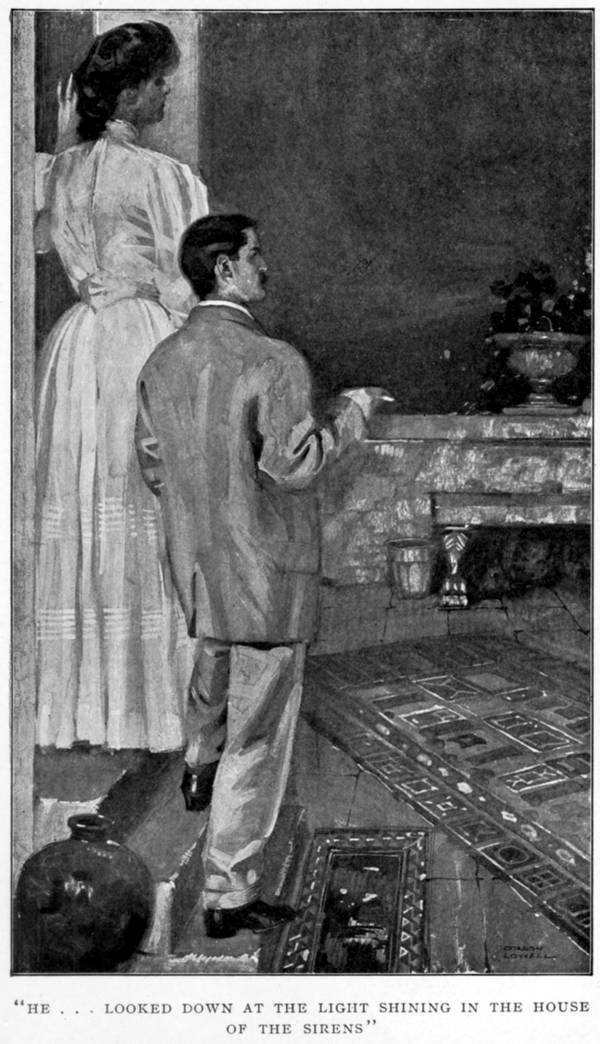 "HE ... LOOKED DOWN AT THE LIGHT SHINING IN THE HOUSE
OF THE SIRENS"
"HE ... LOOKED DOWN AT THE LIGHT SHINING IN THE HOUSE
OF THE SIRENS"
She thought that she heard an odd Sicilian echo of Artois. The peasant lad's mind reflected the mind of the subtle novelist for a moment.
"Very well, Gaspare," she said, submissively.
He smiled at her with satisfaction.
"I understand girls," he said. "You must keep them down or they will keep you down. Every girl in Marechiaro is like that. We keep them down therefore."
He spoke calmly, evidently quite without thought that he was speaking to a woman.
"May I go to bed, signora?" he added. "I got up at four this morning."
"At four!"
"To be sure all was ready for you and the signore."
"Gaspare! Go at once. We will go to bed, too. Shall we, Maurice?"
"Yes. I'm ready."
Just as they were going up the steps into the house, he turned to take a last look at the night. Far down below him over the terrace wall he saw a bright, steady light.
"Is that on the sea, Hermione?" he asked, pointing to it. "Do they fish there at night?"
"Oh yes. No doubt it is a fisherman."
Gaspare shook his head.
"You understand?" said Hermione to him in Italian.
"Si, signora. That is the light in the Casa delle Sirene."
"But no one lives there."
"Oh, it has been built up now, and Salvatore Buonavista lives there with Maddalena. Buon riposo, signora. Buon riposo, signore."
"Buon riposo, Gaspare."
And Maurice echoed it:
"Buon riposo."
As Gaspare went away round the angle of the cottage to his room near Tito's stable, Maurice added:[Pg 80]
"Buon riposo. It's an awfully nice way of saying good-night. I feel as if I'd said it before, somehow."
"Your blood has said it without your knowing it, perhaps many times. Are you coming, Maurice?"
He turned once more, looked down at the light shining in the house of the sirens, then followed Hermione in through the open door.[Pg 81]
That spring-time in Sicily seemed to Hermione touched with a glamour such as the imaginative dreamer connects with an earlier world—a world that never existed save in the souls of dreamers, who weave tissues of gold to hide naked realities, and call down the stars to sparkle upon the dust-heaps of the actual. Hermione at first tried to make her husband see it with her eyes, live in it with her mind, enjoy it, or at least seem to enjoy it, with her heart. Did he not love her? But he did more; he looked up to her with reverence. In her love for him there was a yearning of worship, such as one gifted with the sense of the ideal is conscious of when he stands before one of the masterpieces of art, a perfect bronze or a supreme creation in marble. Something of what Hermione had felt in past years when she looked at "The Listening Mercury," or at the statue of a youth from Hadrian's Villa in the Capitoline Museum at Rome, she felt when she looked at Maurice, but the breath of life in him increased, instead of diminishing, her passion of admiration. And this sometimes surprised her. For she had thought till now that the dead sculptors of Greece and Rome had in their works succeeded in transcending humanity, had shown what God might have created instead of what He had created, and had never expected, scarcely ever even desired, to be moved by a living being as she was moved by certain representations of life in a material. Yet now she was so moved. There seemed to her in her husband's beauty something strange, something[Pg 82] ideal, almost an other-worldliness, as if he had been before this age in which she loved him, had had an existence in the fabled world that the modern pagan loves to recall when he walks in a land where legend trembles in the flowers, and whispers in the trees, and is carried on the winds across the hill-sides, and lives again in the silver of the moon. Often she thought of him listening in a green glade to the piping of Pan, or feeding his flocks on Mount Latmos, like Endymion, and falling asleep to receive the kisses of Selene. Or she imagined him visiting Psyche in the hours of darkness, and fleeing, light-footed, before the coming of the dawn. He seemed to her ardent spirit to have stepped into her life from some Attic frieze out of a "fairy legend of old Greece," and the contact of daily companionship did not destroy in her the curious, almost mystical sensation roused in her by the peculiar, and essentially youthful charm which even Artois had been struck by in a London restaurant.
This charm increased in Sicily. In London Maurice Delarey had seemed a handsome youth, with a delightfully fresh and almost woodland aspect that set him apart from the English people by whom he was surrounded. In Sicily he seemed at once to be in his right setting. He had said when he arrived that he felt as if he belonged to Sicily, and each day Sicily and he seemed to Hermione to be more dear to each other, more suited to each other. With a loving woman's fondness, which breeds fancies deliciously absurd, laughably touching, she thought of Sicily as having wanted this son of hers who was not in her bosom, as sinking into a golden calm of satisfaction now that he was there, hearing her "Pastorale," wandering upon her mountain-sides, filling his nostrils with the scent of her orange blossoms, swimming through the liquid silver of her cherishing seas.
"I think Sicily's very glad that you are here," she[Pg 83] said to him on one morning of peculiar radiance, when there was a freshness as of the world's first day in the air, and the shining on the sea was as the shining that came in answer to the words—"Let there be light!"
In her worship, however, Hermione was not wholly blind. Because of the wakefulness of her powerful heart her powerful mind did not cease to be busy, but its work was supplementary to the work of her heart. She had realized in London that the man she loved was not a clever man, that there was nothing remarkable in his intellect. In Sicily she did not cease from realizing this, but she felt about it differently. In Sicily she actually loved and rejoiced in Delarey's mental shortcomings because they seemed to make for freshness, for boyishness, to link him more closely with the spring in their Eden. She adored in him something that was pagan, some spirit that seemed to shine on her from a dancing, playful, light-hearted world. And here in Sicily she presently grew to know that she would be a little saddened were her husband to change, to grow more thoughtful, more like herself. She had spoken to Artois of possible development in Maurice, of what she might do for him, and at first, just at first, she had instinctively exerted her influence over him to bring him nearer to her subtle ways of thought. And he had eagerly striven to respond, stirred by his love for her, and his reverence—not a very clever, but certainly a very affectionate reverence—for her brilliant qualities of brain. In those very first days together, isolated in their eyrie of the mountains, Hermione had let herself go—as she herself would have said. In her perfect happiness she felt that her mind was on fire because her heart was at peace. Wakeful, but not anxious, love woke imagination. The stirring of spring in this delicious land stirred all her eager faculties, and almost as naturally as a bird pours forth its treasure of music she poured forth her treasure, not only of love[Pg 84] but of thought. For in such a nature as hers love prompts thought, not stifles it. In their long mountain walks, in their rides on muleback to distant villages, hidden in the recesses, or perched upon the crests of the rocks, in their quiet hours under the oak-trees when the noon wrapped all things in its cloak of gold, or on the terrace when the stars came out, and the shepherds led their flocks down to the valleys with little happy tunes, Hermione gave out all the sensitive thoughts, desires, aspirations, all the wonder, all the rest that beauty and solitude and nearness to nature in this isle of the south woke in her. She did not fear to be subtle, she did not fear to be trivial. Everything she noticed she spoke of, everything that the things she noticed suggested to her, she related. The sound of the morning breeze in the olive-trees seemed to her different from the sound of the breeze of evening. She tried to make Maurice hear, with her, the changing of the music, to make him listen, as she listened, to every sound, not only with the ears but with the imagination. The flush of the almond blossoms upon the lower slopes of the hills about Marechiaro, a virginal tint of joy against gray walls, gray rocks, made her look into the soul of the spring as her first lover alone looks into the soul of a maiden. She asked Maurice to look with her into that place of dreams, and to ponder with her over the mystery of the everlasting renewal of life. The sight of the sea took her away into a fairy-land of thought. Far down below, seen over rocks and tree-tops and downward falling mountain flanks, it spread away towards Africa in a plain that seemed to slope upward to a horizon-line immensely distant. Often it was empty of ships, but when a sail came, like a feather on the blue, moving imperceptibly, growing clearer, then fading until taken softly by eternity—that was Hermione's feeling—that sail was to her like a voice from the worlds we never know, but can imagine, some of us, worlds of[Pg 85] mystery that is not sad, and of joys elusive but ineffable, sweet and strange as the cry of echo at twilight, when the first shadows clasp each other by the hand, and the horn of the little moon floats with a shy radiance out of its hiding-place in the bosom of the sky. She tried to take Maurice with her whence the sail came, whither it went. She saw Sicily perhaps as it was, but also as she was. She felt the spring in Sicily, but not only as that spring, spring of one year, but as all the springs that have dawned on loving women, and laughed with green growing things about their feet. Her passionate imagination now threw gossamers before, now drew gossamers away from a holy of holies that no man could ever enter. And she tried to make that holy of holies Maurice's habitual sitting-room. It was a tender, glorious attempt to compass the impossible.
All this was at first. But Hermione was generally too clear-brained to be long tricked even by her own enthusiasms. She soon began to understand that though Maurice might wish to see, to feel all things as she saw and felt them, his effort to do so was but a gallant attempt of love in a man who thought he had married his superior. Really his outlook on Sicily and the spring was naturally far more like Gaspare's. She watched in a rapture of wonder, enjoyed with a passion of gratitude. But Gaspare was in and was of all that she was wondering about, thanking God for, part of the phenomenon, a dancer in the exquisite tarantella. And Maurice, too, on that first day had he not obeyed Sebastiano's call? Soon she knew that when she had sat alone on the terrace seat, and seen the dancers losing all thought of time and the hour in the joy of their moving bodies, while hers was still, the scene had been prophetic. In that moment Maurice had instinctively taken his place in the mask of the spring and she hers. Their bodies had uttered their minds. She was the passionate watcher, but he was the passionate per[Pg 86]former. Therefore she was his audience. She had travelled out to be in Sicily, but he, without knowing it, had travelled out to be Sicily.
There was a great difference between them, but, having realized it thoroughly, Hermione was able not to regret but to delight in it. She did not wish to change her lover, and she soon understood that were Maurice to see with her eyes, hear with her ears, and understand with her heart, he would be completely changed, and into something not natural, like a performing dog or a child prodigy, something that rouses perhaps amazement, combined too often with a faint disgust. And ceasing to desire she ceased to endeavor.
"I shall never develop Maurice," she thought, remembering her conversation with Artois. "And, thank God, I don't want to now."
And then she set herself to watch her Sicilian, as she loved to call him, enjoying the spring in Sicily in his own way, dancing the tarantella with surely the spirit of eternal youth. He had, she thought, heard the call of the blood and responded to it fully and openly, fearless and unashamed. Day by day, seeing his boyish happiness in this life of the mountains and the sea, she laughed at the creeping, momentary sense of apprehension that had been roused in her during her conversation with Artois upon the Thames Embankment. Artois had said that he distrusted what he loved. That was the flaw in an over-intellectual man. The mind was too alert, too restless, dogging the steps of the heart like a spy, troubling the heart with an eternal uneasiness. But she could trust where she loved. Maurice was open as a boy in these early days in the garden of paradise. He danced the tarantella while she watched him, then threw himself down beside her, laughing, to rest.
The strain of Sicilian blood that was in him worked in him curiously, making her sometimes marvel at the mysterious power of race, at the stubborn and almost[Pg 87] tyrannical domination some dead have over some living, those who are dust over those who are quick with animation and passion. Everything that was connected with Sicily and with Sicilian life not only reached his senses and sank easily into his heart, but seemed also to rouse his mind to an activity that astonished her. In connection with Sicily he showed a swiftness, almost a cleverness, she never noted in him when things Sicilian were not in question.
For instance, like most Englishmen, Maurice had no great talent for languages. He spoke French fairly well, having had a French nurse when he was a child, and his mother had taught him a little Italian. But till now he had never had any desire to be proficient in any language except his own. Hermione, on the other hand, was gifted as a linguist, loving languages and learning them easily. Yet Maurice picked up—in his case the expression, usually ridiculous, was absolutely applicable—Sicilian with a readiness that seemed to Hermione almost miraculous. He showed no delight in the musical beauty of Italian. What he wanted, and what his mind—or was it rather what his ears and his tongue and his lips?—took, and held and revelled in, was the Sicilian dialect spoken by Lucrezia and Gaspare when they were together, spoken by the peasants of Marechiaro and of the mountains. To Hermione Gaspare had always talked Italian, incorrect, but still Italian, and she spoke no dialect, although she could often guess at what the Sicilians meant when they addressed her in their vigorous but uncouth jargon, different from Italian almost as Gaelic is from English. But Maurice very soon began to speak a few words of Sicilian. Hermione laughed at him and discouraged him jokingly, telling him that he must learn Italian thoroughly, the language of love, the most melodious language in the world.
"Italian!" he said. "What's the use of it? I want[Pg 88] to talk to the people. A grammar! I won't open it. Gaspare's my professor. Gaspare! Gaspare!"
Gaspare came rushing bareheaded to them in the sun.
"The signora says I'm to learn Italian, but I say that I've Sicilian blood in my veins and must talk as you do."
"But I, signore, can speak Italian!" said Gaspare, with twinkling pride.
"As a bear dances. No, professor, you and I, we'll be good patriots. We'll speak in our mother-tongue. You rascal, you know we've begun already."
And looking mischievously at Hermione, he began to sing in a loud, warm voice:
Gaspare burst into a roar of delighted laughter.
"It's the tarantella over again," Hermione said. "You're a hopeless Sicilian. I give you up."
That same day she said to him:
"You love the peasants, don't you, Maurice?"
"Yes. Are you surprised?"
"No; at least I'm not surprised at your loving them."
"Well, then, Hermione?"
"Perhaps a little at the way you love them."
"What way's that?"
"Almost as they love each other—that's to say, when they love each other at all. Gaspare now! I believe you feel more as if he were a young brother of yours than as if he were your servant."
"Perhaps I do. Gaspare is terrible, a regular donna 1 of a boy in spite of all his mischief and fun. You should hear him talk of you. He'd die for his padrona."
"I believe he would. In love, the love that means being in love, I think Sicilians, though tremendously jealous, are very fickle, but if they take a devotion to any one, without being in love, they're rocks. It's a splendid quality."
"If they've got faults, I love their faults," he said. "They're a lovable race."
"Praising yourself!" she said, laughing at him, but with tender eyes.
"Myself?"
"Never mind. What is it, Gaspare?"
Gaspare had come upon the terrace, his eyes shining with happiness and a box under his arm.
"The signore knows."
"Revolver practice," said Maurice. "I promised him he should have a try to-day. We're going to a place close by on the mountain. He's warned off Ciccio and his goats. Got the paper, Gaspare?"
Gaspare pointed to a bulging pocket.
"Enough to write a novel on. Well—will you come, Hermione?"
"It's too hot in the sun, and I know you're going into the eye of the sun."
"You see, it's the best place up at the top. There's that stone wall, and—"
"I'll stay here and listen to your music."
They went off together, climbing swiftly upward into the heart of the gold, and singing as they went:
Their voices died away, and with them the dry noise of stones falling downward from their feet on the sunbaked mountain-side. Hermione sat still on the seat by the ravine.
She thought of the young peasants going off to be soldiers, and singing that song to keep their hearts up. Some day, perhaps, Gaspare would have to go. He was the eldest of his family, and had brothers. Maurice sang that song like a Sicilian lad. She thought, she began to think, that even the timbre of his voice was Sicilian. There was the warm, and yet plaintive, sometimes almost whining sound in it that she had often heard coming up from the vineyards and the olive groves. Why was she always comparing him with the peasants? He was not of their rank. She had met many Sicilians of the nobility in Palermo—princes, senators, young men of fashion, who gambled and danced and drove in the Giardino Inglese. Maurice did not remind her at all of them. No, it was of the Sicilian peasants that he reminded her, and yet he was a gentleman. She wondered what Maurice's grandmother had been like. She was long since dead. Maurice had never seen her. Yet how alive she, and perhaps brothers of hers, and their children, were in him, how almost miraculously alive! Things that had doubtless stirred in them—instincts, desires, repugnances, joys—were stirring in him, dominating his English inheritance. It was like a new birth in the sun of Sicily, and she was assisting at it. Very, very strange it was. And strange, too, it was to be so near to one so different from herself, to be joined to him by the greatest of all links, the link that is forged by the free will of a man and a woman. Again, in thought, she went back to her comparison of things in him with things in the peasants of Sicily. She remembered that she had once heard a brilliant man, not a Sicilian, say of them, "With all their faults, and they are many, every Sicilian, even though he wear the long cap and live in a hut with the pigs, is a gentleman." So the peasant, if there were peasant in Maurice, could never disturb, never offend her. And she loved the primitive man in him and in all men who had it. There was a good deal that[Pg 91] was primitive in her. She never called herself democrat, socialist, radical, never christened herself with any name to describe her mental leanings, but she knew that, for a well-born woman—and she was that, child of an old English family of pure blood and high traditions—she was remarkably indifferent to rank, its claims, its pride. She felt absolutely "in her bones," as she would have said, that all men and women are just human beings, brothers and sisters of a great family. In judging of individuals she could never be influenced by anything except physical qualities, and qualities of the heart and mind, qualities that might belong to any man. She was affected by habits, manners—what woman of breeding is not?—but even these could scarcely warp her judgment if they covered anything fine. She could find gold beneath mud and forget the mud.
Maurice was like the peasants, not like the Palermitan aristocracy. He was near to the breast of Sicily, of that mother of many nations, who had come to conquer, and had fought, and bled, and died, or been expelled, but had left indefaceable traces behind them, traces of Norman of Greek of Arab. He was no cosmopolitan with characteristics blurred; he was of the soil. Well, she loved the soil dearly. The almond blossomed from it. The olive gave its fruit, and the vine its generous blood, and the orange its gold, at the word of the soil, the dear, warm earth of Sicily. She thought of Maurice's warm hands, brown now as Gaspare's. How she loved his hands, and his eyes that shone with the lustre of the south! Had not this soil, in very truth, given those hands and those eyes to her? She felt that it had. She loved it more for the gift. She had reaped and garnered in her blessed Sicilian harvest.
Lucrezia came to her round the angle of the cottage, knowing she was alone. Lucrezia was mending a hole in a sock for Gaspare. Now she sat down on the seat under the window, divided from Hermione by the ter[Pg 92]race, but able to see her, to feel companionship. Had the padrone been there Lucrezia would not have ventured to come. Gaspare had often explained to her her very humble position in the household. But Gaspare and the padrone were away on the mountain-top, and she could not resist being near to her padrona, for whom she already felt a very real affection and admiration.
"Is it a big hole, Lucrezia?" said Hermione, smiling at her.
"Si, signora."
Lucrezia put her thumb through it, holding it up on her fist.
"Gaspare's holes are always big."
She spoke as if in praise.
"Gaspare is strong," she added. "But Sebastiano is stronger."
As she said the last words a dreamy look came into her round face, and she dropped the hand that held the stocking into her lap.
"Sebastiano is hard like the rocks, signora."
"Hard-hearted, Lucrezia."
Lucrezia said nothing.
"You like Sebastiano, Lucrezia?"
Lucrezia reddened under her brown skin.
"Si, signora."
"So do I. He's always been a good friend of mine."
Lucrezia shifted along the seat until she was nearly opposite to where Hermione was sitting.
"How old is he?"
"Twenty-five, signora."
"I suppose he will be marrying soon, won't he? The men all marry young round about Marechiaro."
Lucrezia began to darn.
"His father, Chinetti Urbano, wishes him to marry at once. It is better for a man."
"You understand men, Lucrezia?"
"Si, signora. They are all alike."[Pg 93]
"And what are they like?"
"Oh, signora, you know as well as I do. They must have their own way and we must not think to have ours. They must roam where they like, love where they choose, day or night, and we must sit in the doorway and get to bed at dark, and not bother where they've been or what they've done. They say we've no right, except one or two. There's Francesco, to be sure. He's a lamb with Maria. She can sit with her face to the street. But she wouldn't sit any other way, and he knows it. But the rest! Eh, già!"
"You don't think much of men, Lucrezia!"
"Oh, signora, they're just as God made them. They can't help it any more than we can help—"
She stopped and pursed her lips suddenly, as if checking some words that were almost on them.
"Lucrezia, come here and sit by me."
Lucrezia looked up with a sort of doubtful pleasure and surprise.
"Signora?"
"Come here."
Lucrezia got up and came slowly to the seat by the ravine. Hermione took her hand.
"You like Sebastiano very much, don't you?"
Lucrezia hung her head.
"Si, signora," she whispered.
"Do you think he'd be good to a woman if she loved him?"
"I shouldn't care. Bad or good, I'd—I'd—"
Suddenly, with a sort of childish violence, she put her two hands on Hermione's arms.
"I want Sebastiano, signora; I want him!" she cried. "I've prayed to the Madonna della Rocca to give him to me; all last year I've prayed, and this. D'you think the Madonna's going to do it? Do you? Do you?"
Heat came out of her two hands, and heat flashed in her eyes. Her broad bosom heaved, and her lips, still[Pg 94] parted when she had done speaking, seemed to interrogate Hermione fiercely in the silence. Before Hermione could reply two sounds came to them: from below in the ravine the distant drone of the ceramella, from above on the mountain-top the dry crack of a pistol-shot.
Swiftly Lucrezia turned and looked downward, but Hermione looked upward towards the bare flank that rose behind the cottage.
"It's Sebastiano, signora."
The ceramella droned on, moving slowly with its player on the hidden path beneath the olive-trees.
A second pistol-shot rang out sharply.
"Go down and meet him, Lucrezia."
"May I—may I, really, signora?"
"Yes; go quickly."
Lucrezia bent down and kissed her padrona's hand.
"Bacio la mano, bacio la mano a Lei!"
Then, bareheaded, she went out from the awning into the glare of the sunshine, passed through the ruined archway, and disappeared among the rocks. She had gone to her music. Hermione stayed to listen to hers, the crack of the pistol up there near the blue sky.
Sebastiano was playing the tune she loved, the "Pastorale," but to-day she did not heed it. Indeed, now that she was left alone she was not conscious that she heard it. Her heart was on the hill-top near the blue.
Again and again the shots rang out. It seemed to Hermione that she knew which were fired by Maurice and which by Gaspare, and she whispered to herself "That's Maurice!" when she fancied one was his. Presently she was aware of some slight change and wondered what it was. Something had ceased, and its cessation recalled her mind to her surroundings. She looked round her, then down to the ravine, and then at once she understood. There was no more music from the ceramella. Lucrezia had met Sebastiano under the olives. That[Pg 95] was certain. Hermione smiled. Her woman's imagination pictured easily enough why the player had stopped. She hoped Lucrezia was happy. Her first words, still more her manner, had shown Hermione the depth of her heart. There was fire there, fire that burned before a shrine when she prayed to the Madonna della Rocca. She was ready even to be badly treated if only she might have Sebastiano. It seemed to be all one to her. She had no illusions, but her heart knew what it needed.
Crack went the pistol up on the mountain-top.
"That's not Maurice!" Hermione thought.
There was another report, then another.
"That last one was Maurice!"
Lucrezia did not seem even to expect a man to be true and faithful. Perhaps she knew the Sicilian character too well. Hermione lifted her face up and looked towards the mountain. Her mind had gone once more to the Thames Embankment. As once she had mentally put Gaspare beside Artois, so now she mentally put Lucrezia. Lucrezia distrusted the south, and she was of it. Men must be as God had made them, she said, and evidently she thought that God had made them to run wild, careless of woman's feelings, careless of everything save their own vagrant desires. The tarantella—that was the dance of the soil here, the dance of the blood. And in the tarantella each of the dancers seemed governed by his own sweet will, possessed by a merry, mad devil, whose promptings he followed with a sort of gracious and charming violence, giving himself up joyously, eagerly, utterly—to what? To his whim. Was the tarantella an allegory of life here? How strangely well Maurice had danced it on that first day of their arrival. She felt again that sense of separation which brought with it a faint and creeping melancholy.
"Crack! Crack!"[Pg 96]
She got up from the seat by the ravine. Suddenly the sound of the firing was distressing to her, almost sinister, and she liked Lucrezia's music better. For it suggested tenderness of the soil, and tenderness of faith, and a glory of antique things both pagan and Christian. But the reiterated pistol-shots suggested violence, death, ugly things.
"Maurice!" she called, going out into the sun and gazing up towards the mountain-top. "Maurice!"
The pistol made reply. They had not heard her. They were too far or were too intent upon their sport to hear.
"Maurice!" she called again, in a louder voice, almost as a person calls for help. Another pistol-shot answered her, mocking at her in the sun. Then she heard a distant peal of laughter. It did not seem to her to be either Maurice's or Gaspare's laughter. It was like the laughter of something she could not personify, of some jeering spirit of the mountain. It died away at last, and she stood there, shivering in the sunshine.
"Signora! Signora!"
Sebastiano's lusty voice came to her from below. She turned and saw him standing with Lucrezia on the terrace, and his arm was round Lucrezia's waist. He took off his cap and waved it, but he still kept one arm round Lucrezia.
Hermione hesitated, looking once more towards the mountain-top. But something within her held her back from climbing up to the distant laughter, a feeling, an idiotic feeling she called it to herself afterwards. She had shivered in the sunshine, but it was not a feeling of fear.
"Am I wanted up there?"
That was what something within her said. And the answer was made by her body. She turned and began to descend towards the terrace.
And at that moment, for the first time in her life, she[Pg 97] was conscious of a little stab of pain such as she had never known before. It was pain of the mind and of the heart, and yet it was like bodily pain, too. It made her angry with herself. It was like a betrayal, a betrayal of herself by her own intellect, she thought.
She stopped once more on the mountain-side.
"Am I going to be ridiculous?" she said to herself. "Am I going to be one of the women I despise?"
Just then she realized that love may become a tyrant, ministering to the soul with persecutions.[Pg 98]
Sebastiano took his arm from Lucrezia's waist as Hermione came down to the terrace, and said:
"Buona sera, signora. Is the signore coming down yet?"
He flung out his arm towards the mountain.
"I don't know, Sebastiano. Why?"
"I've come with a message for him."
"Not for Lucrezia?"
Sebastiano laughed boldly, but Lucrezia, blushing red, disappeared into the kitchen.
"Don't play with her, Sebastiano," said Hermione. "She's a good girl."
"I know that, signora."
"She deserves to be well treated."
Sebastiano went over to the terrace wall, looked into the ravine, turned round, and came back.
"Who's treating Lucrezia badly, signora?"
"I did not say anybody was."
"The girls in Marechiaro can take care of themselves, signora. You don't know them as I do."
"D'you think any woman can take care of herself, Sebastiano?"
He looked into her face and laughed, but said nothing. Hermione sat down. She had a desire to-day, after Lucrezia's conversation with her, to get at the Sicilian man's point of view in regard to women.
"Don't you think women want to be protected?" she asked.
"What from, signora?"[Pg 99]
There was still laughter in his eyes.
"Not from us, anyway," he added. "Lucrezia there—she wants me for her husband. All Marechiaro knows it."
Hermione felt that under the circumstances it was useless to blush for Lucrezia, useless to meet blatant frankness with sensitive delicacy.
"Do you want Lucrezia for your wife?" she said.
"Well, signora, I'm strong. A stick or a knife in my hand and no man can touch me. You've never seen me do the scherma con coltello? One day I'll show you with Gaspare. And I can play better even than the men from Bronte on the ceramella. You've heard me. Lucrezia knows I can have any girl I like."
There was a simplicity in his immense superiority to women that robbed it of offensiveness and almost made Hermione laugh. In it, too, she felt the touch of the East. Arabs had been in Sicily and left their traces there, not only in the buildings of Sicily, but in its people's songs, and in the treatment of the women by the men.
"And are you going to choose Lucrezia?" she asked, gravely.
"Signora, I wasn't sure. But yesterday, I had a letter from Messina. They want me there. I've got a job that'll pay me well to go to the Lipari Islands with a cargo."
"Are you a sailor, too?"
"Signora, I can do anything."
"And will you be long away?"
"Who knows, signora? But I told Lucrezia to-day, and when she cried I told her something else. We are 'promised.'"
"I am glad," Hermione said, holding out her hand to him.
He took it in an iron grip.
"Be very good to her when you're married, won't you?"[Pg 100]
"Oh, she'll be all right with me," he answered, carelessly. "And I won't give her the slap in the face on the wedding-day."
"Hi—yi—yi—yi—yi!"
There was a shrill cry from the mountain and Maurice and Gaspare came leaping down, scattering the stones, the revolvers still in their hands.
"Look, signora, look!" cried Gaspare, pulling a sheet of paper from his pocket and holding it proudly up. "Do you see the holes? One, two, three—"
He began to count.
"And I made five. Didn't I, signore?"
"You're a dead shot, Gasparino. Did you hear us, Hermione?"
"Yes," she said. "But you didn't hear me."
"You? Did you call?"
"Yes."
"Why?"
"Sebastiano's got a message for you," Hermione said.
She could not tell him now the absurd impulse that had made her call him.
"What's the message, Sebastiano?" asked Maurice, in his stumbling Sicilian-Italian that was very imperfect, but that nevertheless had already the true accent of the peasants about Marechiaro.
"Signore, there will be a moon to-night."
"Già. Lo so."
"Are you sleepy, signorino?"
He touched his eyes with his sinewy hands and made his face look drowsy. Maurice laughed.
"No."
"Are you afraid of being naked in the sea at night? But you need not enter it. Are you afraid of sleeping at dawn in a cave upon the sands?"
"What is it all?" asked Maurice. "Gaspare, I understand you best."
"I know," said Gaspare, joyously. "It's the fish[Pg 101]ing. Nito has sent. I told him to. Is it Nito, Sebastiano?"
Sebastiano nodded. Gaspare turned eagerly to Maurice.
"Oh, signore, you must come, you will come!"
"Where? In a boat?"
"No. We go down to the shore, to Isola Bella. We take food, wine, red wine, and a net. Between twenty-two and twenty-three o'clock is the time to begin. And the sea must be calm. Is the sea calm to-day, Sebastiano?"
"Like that."
Sebastiano moved his hand to and fro in the air, keeping it absolutely level. Gaspare continued to explain with gathering excitement and persuasiveness, talking to his master as much by gesture as by the words that Maurice could only partially understand.
"The sea is calm. Nito has the net, but he will not go into the sea. Per Dio, he is birbante. He will say he has the rheumatism, I know, and walk like that." (Gaspare hobbled to and fro before them, making a face of acute suffering.) "He has asked for me. Hasn't Nito asked for me, Sebastiano?"
Here Gaspare made a grimace at Sebastiano, who answered, calmly:
"Yes, he has asked for you to come with the padrone."
"I knew it. Then I shall undress. I shall take one end of the net while Nito holds the other, and I shall go out into the sea. I shall go up to here." (He put his hands up to his chin, stretching his neck like one avoiding a rising wave.) "And I shall wade, you'll see!—and if I come to a hole I shall swim. I can swim for hours, all day if I choose."
"And all night too?" said Hermione, smiling at his excitement.
"Davvero! But at night I must drink wine to keep out the cold. I come out like this." (He shivered violently, making his teeth chatter.) "Then I drink[Pg 102] a glass and I am warm, and when they have taken the fish I go in again. We fish all along the shore from Isola Bella round by the point there, where there's the Casa delle Sirene, and to the caves beyond the Caffè Berardi. And when we've got enough—many fish—at dawn we sleep on the sand. And when the sun is up Carmela will take the fish and make a frittura, and we all eat it and drink more wine, and then—"
"And then—you're ready for the Campo Santo?" said Hermione.
"No, signora. Then we will dance the tarantella, and come home up the mountain singing, 'O sole mio!' and 'A mezzanotte a punto,' and the song of the Mafioso, and—"
Hermione began to laugh unrestrainedly. Gaspare, by his voice, his face, his gestures, had made them assist at a veritable orgie of labor, feasting, sleep, and mirth, all mingled together and chasing one another like performers in a revel. Even his suggestion of slumber on the sands was violent, as if they were to sleep with a kind of fury of excitement and determination.
"Signora!" he cried, staring as if ready to be offended.
Then he looked at Maurice, who was laughing, too, threw himself back against the wall, opened his mouth, and joined in with all his heart. But suddenly he stopped. His face changed, became very serious.
"I may go, signora?" he asked. "No one can fish as I can. The others will not go in far, and they soon get cold and want to put on their clothes. And the padrone! I must take care of the padrone! Guglielmo, the contadino, will sleep in the house, I know. Shall I call him? Guglielmo! Guglielmo!"
He vanished like a flash, they scarcely knew in what direction.
"He's alive!" exclaimed Maurice. "By Jove, he's alive, that boy! Glorious, glorious life! Oh, there's something here that—"[Pg 103]
He broke off, looked down at the broad sea shimmering in the sun, then said:
"The sun, the sea, the music, the people, the liberty—it goes to my head, it intoxicates me."
"You'll go to-night?" she said.
"D'you mind if I do?"
"Mind? No. I want you to go. I want you to revel in this happy time, this splendid, innocent, golden time. And to-morrow we'll watch for you, Lucrezia and I, watch for you down there on the path. But—you'll bring us some of the fish, Maurice? You won't forget us?"
"Forget you!" he said. "You shall have all—"
"No, no. Only the little fish, the babies that Carmela rejects from the frittura."
"I'll go into the sea with Gaspare," said Maurice.
"I'm sure you will, and farther out even than he does."
"Ah, he'll never allow that. He'd swim to Africa first!"
That night, at twenty-one o'clock, Hermione and Lucrezia stood under the arch, and watched Maurice and Gaspare springing down the mountain-side as if in seven-leagued boots. Soon they disappeared into the darkness of the ravine, but for some time their loud voices could be heard singing lustily:
"I wish I were a man, Lucrezia," said Hermione, when the voices at length died away towards the sea.
"Signora, we were made for the men. They weren't made for us. But I like being a girl."[Pg 104]
"To-night. I know why, Lucrezia."
And then the padrona and the cameriera sat down together on the terrace under the stars, and talked together about the man the cameriera loved, and his exceeding glory.
Meanwhile, Maurice and Gaspare were giving themselves joyously to the glory of the night. The glamour of the moon, which lay full upon the terrace where the two women sat, was softened, changed to a shadowy magic, in the ravine where the trees grew thickly, but the pilgrims did not lower their voices in obedience to the message of the twilight of the night. The joy of life which was leaping within them defied the subtle suggestions of mystery, was careless because it was triumphant, and all the way down to the sea they sang, Gaspare changing the song when it suited his mood to do so; and Maurice, as in the tarantella, imitating him with the swiftness that is born of sympathy. For to-night, despite their different ages, ranks, ways of life, their gayety linked them together, ruled out the differences, and made them closely akin, as they had been in Hermione's eyes when they danced upon the terrace. They did not watch the night. They were living too strongly to be watchful. The spirit of the dancing faun was upon them, and guided them down among the rocks and the olive-trees, across the Messina road, white under the moon, to the stony beach of Isola Bella, where Nito was waiting for them with the net.
Nito was not alone. He had brought friends of his and of Gaspare's, and a boy who staggered proudly beneath a pannier filled with bread and cheese, oranges and apples, and dark blocks of a mysterious dolce. The wine-bottles were not intrusted to him, but were in the care of Giulio, one of the donkey-boys who had carried up the luggage from the station. Gaspare and his padrone were welcomed with a lifting of hats, and for a moment there was a silence, while the little group[Pg 105] regarded the "Inglese" searchingly. Had Maurice felt any strangeness, any aloofness, the sharp and sensitive Sicilians would have at once been conscious of it, and light-hearted gayety might have given way to gravity, though not to awkwardness. But he felt, and therefore showed, none. His soft hat cocked at an impudent angle over his sparkling, dark eyes, his laughing lips, his easy, eager manner, and his pleasant familiarity with Gaspare at once reassured everybody, and when he cried out, "Ciao, amici, ciao!" and waved a pair of bathing drawers towards the sea, indicating that he was prepared to be the first to go in with the net, there was a general laugh, and a babel of talk broke forth—talk which he did not fully understand, yet which did not make him feel even for a moment a stranger.
Gaspare at once took charge of the proceedings as one born to be a leader of fishermen. He began by ordering wine to be poured into the one glass provided, placed it in Maurice's hand, and smiled proudly at his pupil's quick "Alla vostra salute!" before tossing it off. Then each one in turn, with an "Alla sua salute!" to Maurice, took a drink from the great, leather bottle; and Nito, shaking out his long coil of net, declared that it was time to get to work.
Gaspare cast a sly glance at Maurice, warning him to be prepared for a comedy, and Maurice at once remembered the scene on the terrace when Gaspare had described Nito's "birbante" character, and looked out for rheumatics.
"Who goes into the sea, Nito?" asked Gaspare, very seriously.
Nito's wrinkled and weather-beaten face assumed an expression of surprise.
"Who goes into the sea!" he ejaculated. "Why, don't we all know who likes wading, and can always tell the best places for the fish?"[Pg 106]
He paused, then as Gaspare said nothing, and the others, who had received a warning sign from him, stood round with deliberately vacant faces, he added, clapping Gaspare on the shoulder, and holding out one end of the net:
"Off with your clothes, compare, and we will soon have a fine frittura for Carmela."
But Gaspare shook his head.
"In summer I don't mind. But this is early in the year, and, besides—"
"Early in the year! Who told me the signore distinto would—"
"And besides, compare, I've got the stomach-ache."
He deftly doubled himself up and writhed, while the lips of the others twitched with suppressed amusement.
"Comparedro, I don't believe it!"
"Haven't I, signorino?" cried Gaspare, undoubling himself, pointing to his middleman, and staring hard at Maurice.
"Si, si! È vero, è vero!" cried Maurice.
"I've been eating Zampaglione, and I am full. If I go into the sea to-night I shall die."
"Mamma mia!" ejaculated Nito, throwing up his hands towards the stars.
He dared not give the lie to the "signore distinto," yet he had no trust in Gaspare's word, and had gained no sort of conviction from his eloquent writhings.
"You must go in, Nito," said Gaspare.
"I—Madonna!"
"Why not?"
"Why not?" cried Nito, in a plaintive whine that was almost feminine. "I go into the sea with my rheumatism!"
Abruptly one of his legs gave way, and he stood before them in a crooked attitude.
"Signore," he said to Maurice. "I would go into the sea, I would stay there all night, for I love it, but[Pg 107] Dr. Marini has forbidden me to enter it. See how I walk!"
And he began to hobble up and down exactly as Gaspare had on the terrace, looking over his shoulder at Maurice all the time to see whether his deception was working well. Gaspare, seeing that Nito's attention was for the moment concentrated, slipped away behind a boat that was drawn up on the beach; and Maurice, guessing what he was doing, endeavored to make Nito understand his sympathy.
"Molto forte—molto dolore?" he said.
"Si, signore!"
And Nito burst forth into a vehement account of his sufferings, accompanied by pantomime.
"It takes me in the night, signore! Madonna, it is like rats gnawing at my legs, and nothing will stop it. Pancrazia—she is my wife, signore—Pancrazia, she gets out of bed and she heats oil to rub it on, but she might as well put it on the top of Etna for all the good it does me. And there I lie like a—"
"Hi—yi—yi—yi—yi!"
A wild shriek rent the air, and Gaspare, clad in a pair of bathing drawers, bounded out from behind the boat, gave Nito a cuff on the cheek, executed some steps of the tarantella, whirled round, snatched up one end of the net, and cried:
"Al mare, al mare!"
Nito's rheumatism was no more. His bent leg straightened itself as if by magic, and he returned Gaspare's cuff by an affectionate slap on his bare shoulder, exclaiming to Maurice:
"Isn't he terribile, signore? Isn't he terribile?"
Nito lifted up the other end of the net and they all went down to the shore.
That night it seemed to Delarey as if Sicily drew him closer to her breast. He did not know why he had now for the first time the sensation that at last he was[Pg 108] really in his natural place, was really one with the soil from which an ancestor of his had sprung, and with the people who had been her people. That Hermione's absence had anything to do with his almost wild sense of freedom did not occur to him. All he knew was this, that alone among these Sicilian fishermen in the night, not understanding much of what they said, guessing at their jokes, and sharing in their laughter, without always knowing what had provoked it, he was perfectly at home, perfectly happy.
Gaspare went into the sea, wading carefully through the silver waters, and Maurice, from the shore, watched his slowly moving form, taking a lesson which would be useful to him later. The coast-line looked enchanted in the glory of the moon, in the warm silence of the night, but the little group of men upon the shore scarcely thought of its enchantment. They felt it, perhaps, sometimes faintly in their gayety, but they did not savor its wonder and its mystery as Hermione would have savored them had she been there.
The naked form of Gaspare, as he waded far out in the shallow sea, was like the form of a dream creature rising out of waves of a dream. When he called to them across the silver surely something of the magic of the night was caught and echoed in his voice. When he lifted the net, and its black and dripping meshes slipped down from his ghostly hands into the ghostly movement that was flickering about him, and the circles tipped with light widened towards sea and shore, there was a miracle of delicate and fantastic beauty delivered up tenderly like a marvellous gift to the wanderers of the dark hours. But Sicily scarcely wonders at Sicily. Gaspare was intent only on the catching of fish, and his companions smote the night with their jokes and their merry, almost riotous laughter.
The night wore on. Presently they left Isola Bella, crossed a stony spit of land, and came into a second and[Pg 109] narrower bay, divided by a turmoil of jagged rocks and a bold promontory covered with stunted olive-trees, cactus, and seed-sown earth plots, from the wide sweep of coast that melted into the dimness towards Messina. Gathered together on the little stones of the beach, in the shadow of some drawn-up fishing-boats, they took stock of the fish that lay shining in the basket, and broke their fast on bread and cheese and more draughts from the generous wine-bottle.
Gaspare was dripping, and his thin body shook as he gulped down the wine.
"Basta Gaspare!" Maurice said to him. "You mustn't go in any more."
"No, no, signore, non basta! I can fish all night. Once the wine has warmed me, I can—"
"But I want to try it."
"Oh, signore, what would the signora say? You are a stranger. You will take cold, and then the signora will blame me and say I did not take proper care of my padrone."
But Delarey was determined. He stripped off his clothes, put on his bathing drawers, took up the net, and, carefully directed by the admiring though protesting Gaspare, he waded into the sea.
For a moment he shuddered as the calm water rose round him. Then, English fashion, he dipped under, with a splash that brought a roar of laughter to him from the shore.
"Meglio così!" he cried, coming up again in the moonlight. "Adesso sto bene!"
The plunge had made him suddenly feel tremendously young and triumphant, reckless with a happiness that thrilled with audacity. As he waded out he began to sing in a loud voice:
Gaspare, who was hastily dressing by the boats, called out to him that his singing would frighten away the fish, and he was obediently silent. He imprisoned the song in his heart, but that went on singing bravely. As he waded farther he felt splendid, as if he were a lord of life and of the sea. The water, now warm to him, seemed to be embracing him as it crept upward towards his throat. Nature was clasping him with amorous arms. Nature was taking him for her own.
"Nature, nature!" he said to himself. "That's why I'm so gloriously happy here, because I'm being right down natural."
His mind made an abrupt turn, like a coursed hare, and he suddenly found himself thinking of the night in London, when he had sat in the restaurant with Hermione and Artois and listened to their talk, reverently listened. Now, as the net tugged at his hand, influenced by the resisting sea, that talk, as he remembered it, struck him as unnatural, as useless, and the thoughts which he had then admired and wondered at, as complicated and extraordinary. Something in him said, "That's all unnatural." The touch of the water about his body, the light of the moon upon him, the breath of the air in his wet face drove out his reverence for what he called "intellectuality," and something savage got hold of his soul and shook it, as if to wake up the sleeping self within him, the self that was Sicilian.
As he waded in the water, coming ever nearer to the jagged rocks that shut out from his sight the wide sea and something else, he felt as if thinking and living were in opposition, as if the one were destructive of the other; and the desire to be clever, to be talented, which had often assailed him since he had known, and especially since he had loved, Hermione, died out of him, and he found himself vaguely pitying Artois, and almost despising the career and the fame of a writer. What did thinking matter? The great thing was to live, to[Pg 111] live with your body, out-of-doors, close to nature, somewhat as the savages live. When he waded to shore for the first time, and saw, as the net was hauled in, the fish he had caught gleaming and leaping in the light, he could have shouted like a boy.
He seized the net once more, but Gaspare, now clothed, took hold of him by the arm with a familiarity that had in it nothing disrespectful.
"Signore, basta, basta! Giulio will go in now."
"Si! si!" cried Giulio, beginning to tug at his waistcoat buttons.
"Once more, Gaspare!" said Maurice. "Only once!"
"But if you take cold, signorino, the signora—"
"I sha'n't catch cold. Only once!"
He broke away, laughing, from Gaspare, and was swiftly in the sea. The Sicilians looked at him with admiration.
"E' veramente più Siciliano di noi!" exclaimed Nito.
The others murmured their assent. Gaspare glowed with pride in his pupil.
"I shall make the signore one of us," he said, as he deftly let out the coils of the net.
"But how long is he going to stay?" asked Nito. "Will he not soon be going back to his own country?"
For a moment Gaspare's countenance fell.
"When the heat comes," he began, doubtfully. Then he cheered up.
"Perhaps he will take me with him to England," he said.
This time Maurice waded with the net into the shadow of the rocks out of the light of the moon. The night was waning, and a slight chill began to creep into the air. A little breeze, too, sighed over the sea, ruffling its surface, died away, then softly came again. As he moved into the darkness Maurice was conscious that the buoyancy of his spirits received a slight check. The night seemed suddenly to have changed, to have be[Pg 112]come more mysterious. He began to feel its mystery now, to be aware of the strangeness of being out in the sea alone at such an hour. Upon the shore he saw the forms of his companions, but they looked remote and phantom-like. He did not hear their voices. Perhaps the slow approach of dawn was beginning to affect them, and the little wind that was springing up chilled their merriment and struck them to silence. Before him the dense blackness of the rocks rose like a grotesque wall carved in diabolic shapes, and as he stared at these shapes he had an odd fancy that they were living things, and that they were watching him at his labor. He could not get this idea, that he was being watched, out of his head, and for a moment he forgot about the fish, and stood still, staring at the monsters, whose bulky forms reared themselves up into the moonlight from which they banished him.
"Signore! Signorino!"
There came to him a cry of protest from the shore. He started, moved forward with the net, and went under water. He had stepped into a deep hole. Still holding fast to the net, he came up to the surface, shook his head, and struck out. As he did so he heard another cry, sharp yet musical. But this cry did not come from the beach where his companions were gathered. It rose from the blackness of the rocks close to him, and it sounded like the cry of a woman. He winked his eyes to get the water out of them, and swam for the rocks, heedless of his duty as a fisherman. But the net impeded him, and again there was a shout from the shore:
"Signorino! Signorino! E' pazzo Lei?"
Reluctantly he turned and swam back to the shallow water. But when his feet touched bottom he stood still. That cry of a woman from the mystery of the rocks had startled, had fascinated his ears. Suddenly he remembered that he must be near to that Casa delle Sirene, whose little light he had seen from the terrace[Pg 113] of the priest's house on his first evening in Sicily. He longed to hear that woman's voice again. For a moment he thought of it as the voice of a siren, of one of those beings of enchantment who lure men on to their destruction, and he listened eagerly, almost passionately, while the ruffled water eddied softly about his breast. But no music stole to him from the blackness of the rocks, and at last he turned slowly and waded to the shore.
He was met with merry protests. Nito declared that the net had nearly been torn out of his hands. Gaspare, half undressed to go to his rescue, anxiously inquired if he had come to any harm. The rocks were sharp as razors near the point, and he might have cut himself to pieces upon them. He apologized to Nito and showed Gaspare that he was uninjured. Then, while the others began to count the fish, he went to the boats to put on his clothes, accompanied by Gaspare.
"Why did you swim towards the rocks, signorino?" asked the boy, looking at him with a sharp curiosity.
Delarey hesitated for a moment. He was inclined, he scarcely knew why, to keep silence about the cry he had heard. Yet he wanted to ask Gaspare something.
"Gaspare," he said, at last, as they reached the boats, "was any one of you on the rocks over there just now?"
He had forgotten to number his companions when he reached the shore. Perhaps one was missing, and had wandered towards the point to watch him fishing.
"No, signore. Why do you ask?"
Again Delarey hesitated. Then he said:
"I heard some one call out to me there."
He began to rub his wet body with a towel.
"Call! What did they call?"
"Nothing; no words. Some one cried out."
"At this hour! Who should be there, signore?"
The action of the rough towel upon his body brought[Pg 114] a glow of warmth to Delarey, and the sense of mystery began to depart from his mind.
"Perhaps it was a fisherman," he said.
"They do not fish from there, signore. It must have been me you heard. When you went under the water I cried out. Drink some wine, signorino."
He held a glass full of wine to Delarey's lips. Delarey drank.
"But you've got a man's voice, Gaspare!" he said, putting down the glass and beginning to get into his clothes.
"Per Dio! Would you have me squeak like a woman, signore?"
Delarey laughed and said no more. But he knew it was not Gaspare's voice he had heard.
The net was drawn up now for the last time, and as soon as Delarey had dressed they set out to walk to the caves on the farther side of the rocks, where they meant to sleep till Carmela was about and ready to make the frittura. To reach them they had to clamber up from the beach to the Messina road, mount a hill, and descend to the Caffè Berardi, a small, isolated shanty which stood close to the sea, and was used in summer-time by bathers who wanted refreshment. Nito and the rest walked on in front, and Delarey followed a few paces behind with Gaspare. When they reached the summit of the hill a great sweep of open sea was disclosed to their view, stretching away to the Straits of Messina, and bounded in the far distance by the vague outlines of the Calabrian Mountains. Here the wind met them more sharply, and below them on the pebbles by the caffè they could see the foam of breaking waves. But to the right, and nearer to them, the sea was still as an inland pool, guarded by the tree-covered hump of land on which stood the house of the sirens. This hump, which would have been an islet but for the narrow wall of sheer rock which joined it to the main-land, ran out into the sea parallel to the road.[Pg 115]
On the height, Delarey paused for a moment, as if to look at the wide view, dim and ethereal, under the dying moon.
"Is that Calabria?" he asked.
"Si, signore. And there is the caffè. The caves are beyond it. You cannot see them from here. But you are not looking, signorino!"
The boy's quick eyes had noticed that Delarey was glancing towards the tangle of trees, among which was visible a small section of the gray wall of the house of the sirens.
"How calm the sea is there!" Delarey said, swiftly.
"Si, signore. That is where you can see the light in the window from our terrace."
"There's no light now."
"How should there be? They are asleep. Andiamo?"
They followed the others, who were now out of sight. When they reached the caves, Nito and the boys had already flung themselves down upon the sand and were sleeping. Gaspare scooped out a hollow for Delarey, rolled up his jacket as a pillow for his padrone's head, murmured a "Buon riposo!" lay down near him, buried his face in his arms, and almost directly began to breathe with a regularity that told its tale of youthful, happy slumber.
It was dark in the cave and quite warm. The sand made a comfortable bed, and Delarey was luxuriously tired after the long walk and the wading in the sea. When he lay down he thought that he, too, would be asleep in a moment, but sleep did not come to him, though he closed his eyes in anticipation of it. His mind was busy in his weary body, and that little cry of a woman still rang in his ears. He heard it like a song sung by a mysterious voice in a place of mystery by the sea. Soon he opened his eyes. Turning a little in the sand, away from his companions, he looked out[Pg 116] from the cave, across the sloping beach and the foam of the waves, to the darkness of trees on the island. (So he called the place of the siren's house to himself now, and always hereafter.) From the cave he could not see the house, but only the trees, a formless, dim mass that grew about it. The monotonous sound of wave after wave did not still the cry in his ears, but mingled with it, as must have mingled with the song of the sirens to Ulysses the murmur of breaking seas ever so long ago. And he thought of a siren in the night stealing to a hidden place in the rocks to watch him as he drew the net, breast high in the water. There was romance in his mind to-night, new-born and strange. Sicily had put it there with the wild sense of youth and freedom that still possessed him. Something seemed to call him away from this cave of sleep, to bid his tired body bestir itself once more. He looked at the dark forms of his comrades, stretched in various attitudes of repose, and suddenly he knew he could not sleep. He did not want to sleep. He wanted—what? He raised himself to a sitting posture, then softly stood up, and with infinite precaution stole out of the cave.
The coldness of the coming dawn took hold on him on the shore, and he saw in the east a mysterious pallor that was not of the moon, and upon the foam of the waves a light that was ghastly and that suggested infinite weariness and sickness. But he did not say this to himself. He merely felt that the night was quickly departing, and that he must hasten on his errand before the day came.
He was going to search for the woman who had cried out to him in the sea. And he felt as if she were a creature of the night, of the moon and of the shadows, and as if he could never hope to find her in the glory of the day.[Pg 117]
Delarey stole along the beach, walking lightly despite his fatigue. He felt curiously excited, as if he were on the heels of some adventure. He passed the Caffè Berardi almost like a thief in the night, and came to the narrow strip of pebbles that edged the still and lakelike water, protected by the sirens' isle. There he paused. He meant to gain that lonely land, but how? By the water lay two or three boats, but they were large and clumsy, impossible to move without aid. Should he climb up to the Messina road, traverse the spit of ground that led to the rocky wall, and try to make his way across it? The feat would be a difficult one, he thought. But it was not that which deterred him. He was impatient of delay, and the détour would take time. Between him and the islet was the waterway. Already he had been in the sea. Why not go in again? He stripped, packed his clothes into a bundle, tied roughly with a rope made of his handkerchief and bootlaces, and waded in. For a long way the water was shallow. Only when he was near to the island did it rise to his breast, to his throat, higher at last. Holding the bundle on his head with one hand, he struck out strongly and soon touched bottom again. He scrambled out, dressed on a flat rock, then looked for a path leading upward.
The ground was very steep, almost precipitous, and thickly covered with trees and with undergrowth. This undergrowth concealed innumerable rocks and stones which shifted under his feet and rolled down as he began to ascend, grasping the bushes and the branches. He[Pg 118] could find no path. What did it matter? All sense of fatigue had left him. With the activity of a cat he mounted. A tree struck him across the face. Another swept off his hat. He felt that he had antagonists who wished to beat him back to the sea, and his blood rose against them. He tore down a branch that impeded him, broke it with his strong hands, and flung it away viciously. His teeth were set and his nerves tingled, and he was conscious of the almost angry joy of keen bodily exertion. The body—that was his God to-night. How he loved it, its health and strength, its willingness, its capacities! How he gloried in it! It had bounded down the mountain. It had gone into the sea and revelled there. It had fished and swum. Now it mounted upward to discovery, defying the weapons that nature launched against it. Splendid, splendid body!
He fought with the trees and conquered them. His trampling feet sent the stones leaping downward to be drowned in the sea. His swift eyes found the likely places for a foothold. His sinewy hands forced his enemies to assist him in the enterprise they hated. He came out on to the plateau at the summit of the island and stood still, panting, beside the house that hid there.
Its blind, gray wall confronted him coldly in the dimness, one shuttered window, like a shut eye, concealing the interior, the soul of the house that lay inside its body. In this window must have been set the light he had seen from the terrace. He wished there were a light burning now. Had he swum across the inlet and fought his way up through the wood only to see a gray wall, a shuttered window? That cry had come from the rocks, yet he had been driven by something within him to this house, connecting—he knew not why—the cry with it and with the far-off light that had been like a star caught in the sea. Now he said to himself that he should have gone back to the rocks and sought the[Pg 119] siren there. Should he go now? He hesitated for a moment, leaning against the wall of the house.
He heard a girl's voice singing near him, whether inside the house or among the trees he could not at first tell. It sang softly yet gayly, as if the sun were up and the world were awake, and when it died away Delarey felt as if the singer must be in the dawn, though he stood still in the night. He put his ear to the shuttered window and listened.
"L'haju; nun l'haju?"
The voice was speaking now with a sort of whimsical and half-pathetic merriment, as if inclined to break into laughter at its own childish wistfulness.
"M'ama; nun m'ama?"
It broke off. He heard a little laugh. Then the song began again:
The voice was not in the house. Delarey was sure of that now. He was almost sure, too, that it was the same voice which had cried out to him from the rocks. Moving with precaution, he stole round the house to the farther side, which looked out upon the open sea, keeping among the trees, which grew thickly about the house[Pg 120] on three sides, but which left it unprotected to the sea-winds on the fourth.
A girl was standing in this open space, alone, looking seaward, with one arm out-stretched, one hand laid lightly, almost caressingly, upon the gnarled trunk of a solitary old olive-tree, the other arm hanging at her side. She was dressed in some dark, coarse stuff, with a short skirt, and a red handkerchief tied round her head, and seemed in the pale and almost ghastly light in which night and day were drawing near to each other to be tall and slim of waist. Her head was thrown back, as if she were drinking in the breeze that heralded the dawn—drinking it in like a voluptuary.
Delarey stood and watched her. He could not see her face.
She spoke some words in dialect in a clear voice. There was no one else visible. Evidently she was talking to herself. Presently she laughed again, and began to sing once more:
There was an African sound in the girl's voice—a sound of mystery that suggested heat and a force that could be languorous and stretch itself at ease. She was singing the song the Sicilian peasant girls join in on the first of May, when the ciuri di maju is in blossom, and the young countrywomen go forth in merry bands to pick the flower of May, and, turning their eyes to the wayside shrine, or, if there be none near, to the east and the rising sun, lift their hands full of the flowers above their heads, and, making the sign of the cross, murmur devoutly:
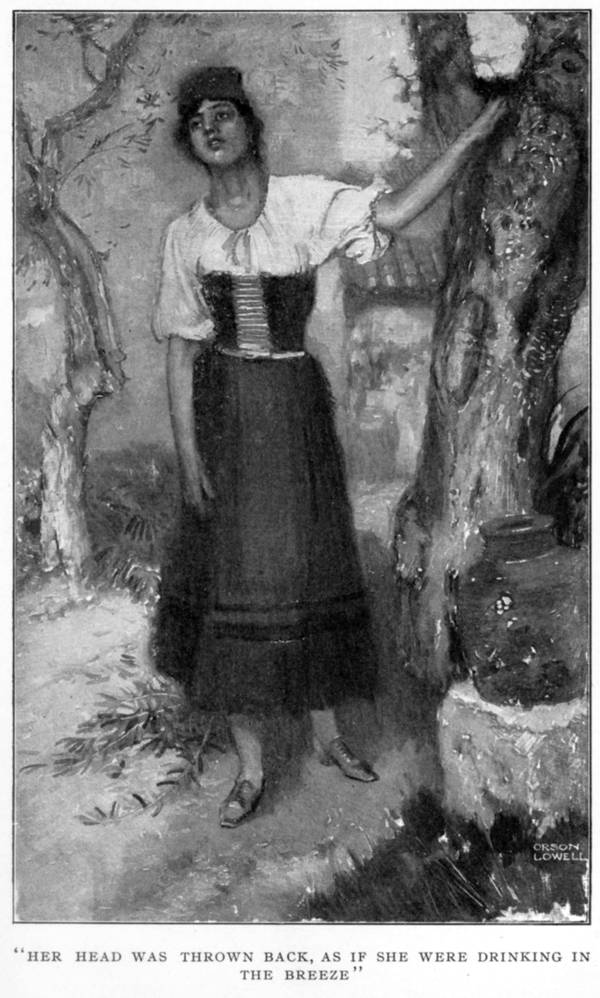 "HER HEAD WAS THROWN BACK, AS IF SHE WERE DRINKING IN
THE BREEZE"
"HER HEAD WAS THROWN BACK, AS IF SHE WERE DRINKING IN
THE BREEZE"
Delarey knew neither song nor custom, but his ears were fascinated by the voice and the melody. Both sounded remote and yet familiar to him, as if once, in some distant land—perhaps of dreams—he had heard them before. He wished the girl to go on singing, to sing on and on into the dawn while he listened in his hiding-place, but she suddenly turned round and stood looking towards him, as if something had told her that she was not alone. He kept quite still. He knew she could not see him, yet he felt as if she was aware that he was there, and instinctively he held his breath and leaned backward into deeper shadow. After a minute the girl took a step forward, and, still staring in his direction, called out:
"Padre?"
Then Delarey knew that it was her voice that he had heard when he was in the sea, and he suddenly changed his desire. Now he no longer wished to remain unseen, and without hesitation he came out from the trees. The girl stood where she was, watching him as he came. Her attitude showed neither surprise nor alarm, and when he was close to her, and could at last see her face, he found that its expression was one of simple, bold questioning. It seemed to be saying to him quietly, "Well, what do you want of me?"
Delarey was not acquainted with the Arab type of face. Had he been he would have at once been struck by the Eastern look in the girl's long, black eyes, by the Eastern cast of her regular, slightly aquiline features. Above her eyes were thin, jet-black eyebrows that looked almost as if they were painted. Her chin was full and her face oval in shape. She had hair like Gaspare's, black-brown, immensely thick and wavy, with tiny feathers of gold about the temples. She was tall, and had the contours of a strong though graceful girl just blooming into womanhood. Her hands were as brown as Delarey's, well shaped, but the hands of a worker. She[Pg 122] was perhaps eighteen or nineteen, and brimful of lusty life.
After a minute of silence Delarey's memory recalled some words of Gaspare's, till then forgotten.
"You are Maddalena!" he said, in Italian.
The girl nodded.
"Si, signore."
She uttered the words softly, then fell into silence again, staring at him with her lustrous eyes, that were like black jewels.
"You live here with Salvatore?"
She nodded once more and began to smile, as if with pleasure at his knowledge of her.
Delarey smiled too, and made with his arms the motion of swimming. At that she laughed outright and broke into quick speech. She spoke vivaciously, moving her hands and her whole body. Delarey could not understand much of what she said, but he caught the words mare and pescatore, and by her gestures knew that she was telling him she had been on the rocks and had seen his mishap. Suddenly in the midst of her talk she uttered the little cry of surprise or alarm which he had heard as he came up above water, pointed to her lips to indicate that she had given vent to it, and laughed again with all her heart. Delarey laughed too. He felt happy and at ease with his siren, and was secretly amused at his thought in the sea of the magical being full of enchantment who sang to lure men to their destruction. This girl was simply a pretty, but not specially uncommon, type of the Sicilian contadina—young, gay, quite free from timidity, though gentle, full of the joy of life and of the nascent passion of womanhood, blossoming out carelessly in the sunshine of the season of flowers. She could sing, this island siren, but probably she could not read or write. She could dance, could perhaps innocently give and receive love. But there was in her face, in her manner, nothing deliberately provocative. Indeed, she[Pg 123] looked warmly pure, like a bright, eager young animal of the woods, full of a blithe readiness to enjoy, full of hope and of unself-conscious animation.
Delarey wondered why she was not sleeping, and strove to ask her, speaking carefully his best Sicilian, and using eloquent gestures, which set her smiling, then laughing again. In reply to him she pointed towards the sea, then towards the house, then towards the sea once more. He guessed that some fisherman had risen early to go to his work, and that she had got up to see him off, and had been too wakeful to return to bed.
"Niente più sonno!" he said, opening wide his eyes.
"Niente! Niente!"
He feigned fatigue. She took his travesty seriously, and pointed to the house, inviting him by gesture to go in and rest there. Evidently she believed that, being a stranger, he could not speak or understand much of her language. He did not even try to undeceive her. It amused him to watch her dumb show, for her face spoke eloquently and her pretty, brown hands knew a language that was delicious. He had no longer any thought of sleep, but he felt curious to see the interior of the cottage, and he nodded his head in response to her invitation. At once she became the hospitable peasant hostess. Her eyes sparkled with eagerness and pleasure, and she went quickly by him to the door, which stood half open, pushed it back, and beckoned to him to enter.
He obeyed her, went in, and found himself almost in darkness, for the big windows on either side of the door were shuttered, and only a tiny flame, like a spark, burned somewhere among the dense shadows of the interior at some distance from him. Pretending to be alarmed at the obscurity, he put out his hand gropingly, and let it light on her arm, then slip down to her warm, strong young hand.
"I am afraid!" he exclaimed.
He heard her merry laugh and felt her trying to pull[Pg 124] her hand away, but he held it fast, prolonging a joke that he found a pleasant one. In that moment he was almost as simple as she was, obeying his impulses carelessly, gayly, without a thought of wrong—indeed, almost without thought at all. His body was still tingling and damp with the sea-water. Her face was fresh with the sea-wind. He had never felt more wholesome or as if life were a saner thing.
She dragged her hand out of his at last; he heard a grating noise, and a faint light sputtered up, then grew steady as she moved away and set a match to a candle, shielding it from the breeze that entered through the open door with her body.
"What a beautiful house!" he cried, looking curiously around.
He saw such a dwelling as one may see in any part of Sicily where the inhabitants are not sunk in the direst poverty and squalor, a modest home consisting of two fair-sized rooms, one opening into the other. In each room was a mighty bed, high and white, with fat pillows, and a counterpane of many colors. At the head of each was pinned a crucifix and a little picture of the Virgin, Maria Addolorata, with a palm branch that had been blessed, and beneath the picture in the inner room a tiny light, rather like an English night-light near its end, was burning. It was this that Delarey had seen like a spark in the distance. At the foot of each bed stood a big box of walnut wood, carved into arabesques and grotesque faces. There were a few straw chairs and kitchen utensils. An old gun stood in a corner with a bundle of wood. Not far off was a pan of charcoal. There were also two or three common deal-tables, on one of which stood the remains of a meal, a big jar containing wine, a flat loaf of coarse brown bread, with a knife lying beside it, some green stuff in a plate, and a slab of hard, yellow cheese.
Delarey was less interested in these things than in the display of photographs, picture-cards, and figures of saints[Pg 125] that adorned the walls, carefully arranged in patterns to show to the best advantage. Here were colored reproductions of actresses in languid attitudes, of peasants dancing, of babies smiling, of elaborate young people with carefully dressed hair making love with "Molti Saluti!" "Una stretta di Mano!" "Mando un bacio!" "Amicizia eterna!" and other expressions of friendship and affection, scribbled in awkward handwritings across and around them. And mingled with them were representations of saints, such as are sold at the fairs and festivals of Sicily, and are reverently treasured by the pious and superstitious contadine; San Pancrazio, Santa Leocanda, the protector of child-bearing women; Sant Aloe, the patron saint of the beasts of burden; San Biagio, Santo Vito, the patron saint of dogs; and many others, with the Bambino, the Immacolata, the Madonna di Loreto, the Madonna della Rocca.
In the faint light cast by the flickering candle, the faces of saints and actresses, of smiling babies, of lovers and Madonnas peered at Delarey as if curious to know why at such an hour he ventured to intrude among them, why he thus dared to examine them when all the world was sleeping. He drew back from them at length and looked again at the great bed with its fat pillows that stood in the farther room secluded from the sea-breeze. Suddenly he felt a longing to throw himself down and rest.
The girl smiled at him with sympathy.
"That is my bed," she said, simply. "Lie down and sleep, signorino."
Delarey hesitated for a moment. He thought of his companions. If they should wake in the cave and miss him what would they think, what would they do? Then he looked again at the bed. The longing to lie down on it was irresistible. He pointed to the open door.
"When the sun comes will you wake me?" he said.
He took hold of his arm with one hand, and made the motion of shaking himself.[Pg 126]
"Sole," he said. "Quando c'è il sole."
The girl laughed and nodded.
"Si, signore—non dubiti!"
Delarey climbed up on to the mountainous bed.
"Buona notte, Maddalena!" he said, smiling at her from the pillow like a boy.
"Buon riposo, signorino!"
That was the last thing he heard. The last thing he saw was the dark, eager face of the girl lit up by the candle-flame watching him from the farther room. Her slight figure was framed by the doorway, through which a faint, sad light was stealing with the soft wind from the sea. Her lustrous eyes were looking towards him curiously, as if he were something of a phenomenon, as if she longed to understand his mystery.
Soon, very soon, he saw those eyes no more. He was asleep in the midst of the Madonnas and the saints, with the blessed palm branch and the crucifix and Maria Addolorata above his head.
The girl sat down on a chair just outside the door, and began to sing to herself once more in a low voice:
Once, in his sleep, Delarey must surely have heard her song, for he began to dream that he was Ulysses sailing across the purple seas along the shores of an enchanted coast, and that he heard far off the sirens singing, and saw their shadowy forms sitting among the rocks and reclining upon the yellow sands. Then he bade his mariners steer the bark towards the shore. But when he drew near the sirens changed into devout peasant women, and their alluring songs into prayers uttered to the Bambino and the Virgin. But one watched him with eyes that gleamed like black jewels, and her lips smiled[Pg 127] while they uttered prayers, as if they could murmur love words and kiss the lips of men.
"Signorino! Signorino!"
Delarey stirred on the great, white bed. A hand grasped him firmly, shook him ruthlessly.
"Signorino! C'è il sole!"
He opened his eyes reluctantly. Maddalena was leaning over him. He saw her bright face and curious young eyes, then the faces of the saints and the actresses upon the wall, and he wondered where he was and where Hermione was.
"Hermione!" he said.
"Cosa?" said Maddalena.
She shook him again gently. He stretched himself, yawned, and began to smile. She smiled back at him.
"C'è il sole!"
Now he remembered, lifted himself up, and looked towards the doorway. The first rays of the sun were filtering in and sparkling in the distance upon the sea. The east was barred with red.
He slipped down from the bed.
"The frittura!" he said, in English. "I must make haste!"
Maddalena laughed. She had never heard English before.
"Ditelo ancora!" she cried, eagerly.
They went but together on to the plateau and stood looking seaward.
"I—must—make—haste!" he said, speaking slowly and dividing the words.
"Hi—maust—maiki—'ai—isti!" she repeated, trying to imitate his accent.
He burst out laughing. She pouted. Then she laughed, too, peal upon peal, while the sunlight grew stronger about them. How fresh the wind was! It played with her hair, from which she had now removed the handkerchief, and ruffled the little feathers of gold[Pg 128] upon her brow. It blew about her smooth, young face as if it loved to touch the soft cheeks, the innocent lips, the candid, unlined brow. The leaves of the olive-trees rustled and the brambles and the grasses swayed. Everything was in movement, stirring gayly into life to greet the coming day. Maurice opened his mouth and drew in the air to his lungs, expanding his chest. He felt inclined to dance, to sing, and very much inclined to eat.
"Addio, Maddalena!" he said, holding out his hand.
He looked into her eyes and added:
"Addio, Maddalena mia!"
She smiled and looked down, then up at him again.
"A rivederci, signorino!"
She took his hand warmly in hers.
"Yes, that's better. A rivederci!"
He held her hand for a moment, looking into her long and laughing eyes, and thinking how like a young animal's they were in their unwinking candor. And yet they were not like an animal's. For now, when he gazed into them, they did not look away from him, but continued to regard him, and always with an eager shining of curiosity. That curiosity stirred his manhood, fired him. He longed to reply to it, to give a quick answer to its eager question, its "what are you?" He glanced round, saw only the trees, the sea all alight with sun-rays, the red east now changing slowly into gold. Then he bent down, kissed the lips of Maddalena with a laugh, turned and descended through the trees by the way he had come. He had no feeling that he had done any wrong to Hermione, any wrong to Maddalena. His spirits were high, and he sang as he leaped down, agile as a goat, to the sea. He meant to return as he had come, and at the water's edge he stripped off his clothes once more, tied them into a bundle, plunged into the sea, and struck out for the beach opposite. As he did so, as the cold, bracing water seized him, he[Pg 129] heard far above him the musical cry of the siren of the night. He answered it with a loud, exultant call.
That was her farewell and his—this rustic Hero's good-bye to her Leander.
When he reached the Caffè Berardi its door stood open, and a middle-aged woman was looking out seaward. Beyond, by the caves, he saw figures moving. His companions were awake. He hastened towards them. His morning plunge in the sea had given him a wild appetite.
"Frittura! Frittura!" he shouted, taking off his hat and waving it.
Gaspare came running towards him.
"Where have you been, signorino?"
"For a walk along the shore."
He still kept his hat in his hand.
"Why, your face is all wet, and so is your hair."
"I washed them in the sea. Mangiamo! Mangiamo!"
"You did not sleep?"
Gaspare spoke curiously, regarded him with inquisitive, searching eyes.
"I couldn't. I'll sleep up there when we get home."
He pointed to the mountain. His eyes were dancing with gayety.
"The frittura, Gasparino, the frittura! And then the tarantella, and then 'O sole mio'!"
He looked towards the rising sun, and began to sing at the top of his voice:
Gaspare joined in lustily, and Carmela in the doorway of the Caffè Berardi waved a frying-pan at them in time to the music.
"Per Dio, Gaspare!" exclaimed Maurice, as they raced[Pg 130] towards the house, each striving to be first there—"Per Dio, I never knew what life was till I came to Sicily! I never knew what happiness was till this morning!"
"The frittura! The frittura!" shouted Gaspare. "I'll be first!"
Neck and neck they reached the caffè as Nito poured the shining fish into Madre Carmela's frying-pan.[Pg 131]
"They are coming, signora, they are coming! Don't you hear them?"
Lucrezia was by the terrace wall looking over into the ravine. She could not see any moving figures, but she heard far down among the olives and the fruit trees Gaspare's voice singing "O sole mio!" and while she listened another voice joined in, the voice of the padrone:
"Dio mio, but they are merry!" she added, as the song was broken by a distant peal of laughter.
Hermione came out upon the steps. She had been in the sitting-room writing a letter to Miss Townly, who sent her long and tearful effusions from London almost every day.
"Have you got the frying-pan ready, Lucrezia?" she asked.
"The frying-pan, signora!"
"Yes, for the fish they are bringing us."
Lucrezia looked knowing.
"Oh, signora, they will bring no fish."
"Why not? They promised last night. Didn't you hear?"
"They promised, yes, but they won't remember. Men promise at night and forget in the morning."
Hermione laughed. She had been feeling a little dull, but now the sound of the lusty voices and the laughter from the ravine filled her with a sudden cheerfulness, and sent a glow of anticipation into her heart.
"Lucrezia, you are a cynic."[Pg 132]
"What is a cinico, signora?"
"A Lucrezia. But you don't know your padrone. He won't forget us."
Lucrezia reddened. She feared she had perhaps said something that seemed disrespectful.
"Oh, signora, there is not another like the padrone. Every one says so. Ask Gaspare and Sebastiano. I only meant that—"
"I know. Well, to-day you will understand that all men are not forgetful, when you eat your fish."
Lucrezia still looked very doubtful, but she said nothing more.
"There they are!" exclaimed Hermione.
She waved her hand and cried out. Life suddenly seemed quite different to her. These moving figures peopled gloriously the desert waste, these ringing voices filled with music the brooding silence of it. She murmured to herself a verse of scripture, "Sorrow may endure for a night, but joy cometh with the morning," and she realized for the first time how absurdly sad and deserted she had been feeling, how unreasonably forlorn. By her present joy she measured her past—not sorrow exactly; she could not call it that—her past dreariness, and she said to herself with a little shock almost of fear, "How terribly dependent I am!"
"Mamma mia!" cried Lucrezia, as another shout of laughter came up from the ravine, "how merry and mad they are! They have had a good night's fishing."
Hermione heard the laughter, but now it sounded a little harsh in her ears.
"I wonder," she thought, as she leaned upon the terrace wall—"I wonder if he has missed me at all? I wonder if men ever miss us as we miss them?"
Her call, it seemed, had not been heard, nor her gesture of welcome seen, but now Maurice looked up, waved his cap, and shouted. Gaspare, too, took off his linen hat with a stentorian cry of "Buon giorno, signora."[Pg 133]
"Signora!" said Lucrezia.
"Yes?"
"Look! Was not I right? Are they carrying anything?"
Hermione looked eagerly, almost passionately, at the two figures now drawing near to the last ascent up the bare mountain flank. Maurice had a stick in one hand, the other hung empty at his side. Gaspare still waved his hat wildly, holding it with both hands as a sailor holds the signalling-flag.
"Perhaps," she said—"perhaps it wasn't a good night, and they've caught nothing."
"Oh, signora, the sea was calm. They must have taken—"
"Perhaps their pockets are full of fish. I am sure they are."
She spoke with a cheerful assurance.
"If they have caught any fish, I know your frying-pan will be wanted," she said.
"Chi lo sa?" said Lucrezia, with rather perfunctory politeness.
Secretly she thought that the padrona had only one fault. She was a little obstinate sometimes, and disinclined to be told the truth. And certainly she did not know very much about men, although she had a husband.
Through the old Norman arch came Delarey and Gaspare, with hot faces and gay, shining eyes, splendidly tired with their exertions and happy in the thought of rest. Delarey took Hermione's hand in his. He would have kissed her before Lucrezia and Gaspare, quite naturally, but he felt that her hand stiffened slightly in his as he leaned forward, and he forbore. She longed for his kiss, but to receive it there would have spoiled a joy. And kind and familiar though she was with those beneath her, she could not bear to show the deeps of her heart before them. To her his kiss after her lonely[Pg 134] night would be an event. Did he know that? She wondered.
He still kept her hand in his as he began to tell her about their expedition.
"Did you enjoy it?" she asked, thinking what a boy he looked in his eager, physical happiness.
"Ask Gaspare!"
"I don't think I need. Your eyes tell me."
"I never enjoyed any night so much before, out there under the moon. Why don't we always sleep out-of-doors?"
"Shall we try some night on the terrace?"
"By Jove, we will! What a lark!"
"Did you go into the sea?"
"I should think so! Ask Gaspare if I didn't beat them all. I had to swim, too."
"And the fish?" she said, trying to speak, carelessly.
"They were stunning. We caught an awful lot, and Mother Carmela cooked them to a T. I had an appetite, I can tell you, Hermione, after being in the sea."
She was silent for a moment. Her hand had dropped out of his. When she spoke again, she said:
"And you slept in the caves?"
"The others did."
"And you?"
"I couldn't sleep, so I went out on to the beach. But I'll tell you all that presently. You won't be shocked, Hermione, if I take a siesta now? I'm pretty well done—grandly tired, don't you know. I think I could get a lovely nap before collazione."
"Come in, my dearest," she said. "Collazione a little late, Lucrezia, not till half-past one."
"And the fish, signora?" asked Lucrezia.
"We've got quite enough without fish," said Hermione, turning away.
"Oh, by Jove!" Delarey said, as they went into the[Pg 135] cottage, putting his hand into his jacket-pocket, "I've got something for you, Hermione."
"Fish!" she cried, eagerly, her whole face brightening. "Lucre—"
"Fish in my coat!" he interrupted, still not remembering. "No, a letter. They gave it me from the village as we came up. Here it is."
He drew out a letter, gave it to her, and went into the bedroom, while Hermione stood in the sitting-room by the dining-table with the letter in her hand.
It was from Artois, with the Kairouan postmark.
"It's from Emile," she said.
Maurice was closing the shutters, to make the bedroom dark.
"Is he still in Africa?" he asked, letting down the bar with a clatter.
"Yes," she said, opening the envelope. "Go to bed like a good boy while I read it."
She wanted his kiss so much that she did not go near to him, and spoke with a lightness that was almost like a feigned indifference. He thrust his gay face through the doorway into the sunshine, and she saw the beads of perspiration on his smooth brow above his laughing, yet half-sleepy eyes.
"Come and tuck me up afterwards!" he said, and vanished.
Hermione made a little movement as if to follow him, but checked it and unfolded the letter.
"4, Rue d'Abdul Kader, Kairouan.
My dear Friend,—This will be one of my dreary notes, but you must forgive me. Do you ever feel a heavy cloud of apprehension lowering over you, a sensation of approaching calamity, as if you heard the footsteps of a deadly enemy stealthily approaching you? Do you know what it is to lose courage, to fear yourself, life, the future, to long to hear a word of sympathy from a friendly voice, to long to lay hold of a friendly hand? Are you ever like a child in the dark, your intellect no[Pg 136] weapon against the dread of formless things? The African sun is shining here as I sit under a palm-tree writing, with my servant, Zerzour, squatting beside me. It is so clear that I can almost count the veins in the leaves of the palms, so warm that Zerzour has thrown off his burnous and kept on only his linen shirt. And yet I am cold and seem to be in blackness. I write to you to gain some courage if I can. But I have gained none yet. I believe there must be a physical cause for my malaise, and that I am going to have some dreadful illness, and perhaps lay my bones here in the shadow of the mosques among the sons of Islam. Write to me. Is the garden of paradise blooming with flowers? Is the tree of knowledge of good weighed down with fruit, and do you pluck the fruit boldly and eat it every day? You told me in London to come over and see you. I am not coming. Do not fear. But how I wish that I could now, at this instant, see your strong face, touch your courageous hand! There is a sensation of doom upon me. Laugh at me as much as you like, but write to me. I feel cold—cold in the sun.
Emile."
When she had finished reading this letter, Hermione stood quite still with it in her hand, gazing at the white paper on which this cry from Africa was traced. It seemed to her that—a cry from across the sea for help against some impending fate. She had often had melancholy letters from Artois in the past, expressing pessimistic views about life and literature, anxiety about some book which he was writing and which he thought was going to be a failure, anger against the follies of men, the turn of French politics, or the degeneration of the arts in modern times. Diatribes she was accustomed to, and a definite melancholy from one who had not a gay temperament. But this letter was different from all the others. She sat down and read it again. For the moment she had forgotten Maurice, and did not hear his movements in the adjoining room. She was in Africa under a palm-tree, looking into the face of a friend with keen anxiety, trying to read the immediate future for him there.
"Maurice!" she called, presently, without getting up[Pg 137] from her seat, "I've had such a strange letter from Emile. I'm afraid—I feel as if he were going to be dreadfully ill or have an accident."
There was no reply.
"Maurice!" she called again.
Then she got up and looked into the bedroom. It was nearly dark, but she could see her husband's black head on the pillow and hear a sound of regular breathing. He was asleep already; she had not received his kiss or tucked him up. She felt absurdly unhappy, as if she had missed a pleasure that could never come to her again. That, she thought, is one of the penalties of a great love, the passionate regret it spends on the tiny things it has failed of. At this moment she fancied—no, she felt sure—that there would always be a shadow in her life. She had lost Maurice's kiss after his return from his first absence since their marriage. And a kiss from his lips still seemed to her a wonderful, almost a sacred thing, not only a physical act, but an emblem of that which was mysterious and lay behind the physical. Why had she not let him kiss her on the terrace? Her sensitive reserve had made her loss. For a moment she thought she wished she had the careless mind of a peasant. Lucrezia loved Sebastiano with passion, but she would have let him kiss her in public and been proud of it. What was the use of delicacy, of sensitiveness, in the great, coarse thing called life? Even Maurice had not shared her feeling. He was open as a boy, almost as a peasant boy.
She began to wonder about him. She often wondered about him now in Sicily. In England she never had. She had thought there that she knew him as he, perhaps, could never know her. It seemed to her that she had been almost arrogant, filled with a pride of intellect. She was beginning to be humbler here, face to face with Etna.
Let him sleep, mystery wrapped in the mystery of slumber![Pg 138]
She sat down in the twilight, waiting till he should wake, watching the darkness of his hair upon the pillow.
Some time passed, and presently she heard a noise upon the terrace. She got up softly, went into the sitting-room, and looked out. Lucrezia was laying the table for collazione.
"Is it half-past one already?" she asked.
"Si, signora."
"But the padrone is still asleep!"
"So is Gaspare in the hay. Come and see, signora."
Lucrezia took Hermione by the hand and led her round the angle of the cottage. There, under the low roof of the out-house, dressed only in his shirt and trousers with his brown arms bare and his hair tumbled over his damp forehead, lay Gaspare on a heap of hay close to Tito, the donkey. Some hens were tripping and pecking by his legs, and a black cat was curled up in the hollow of his left armpit. He looked infinitely young, healthy, and comfortable, like an embodied carelessness that had flung itself down to its need.
"I wish I could sleep like that," said Hermione.
"Signora!" said Lucrezia, shocked. "You in the stable with that white dress! Mamma mia! And the hens!"
"Hens, donkey, cat, hay, and all—I should love it. But I'm too old ever to sleep like that. Don't wake him!"
Lucrezia was stepping over to Gaspare.
"And I won't wake the padrone. Let them both sleep. They've been up all night. I'll eat alone. When they wake we'll manage something for them. Perhaps they'll sleep till evening, till dinner-time."
"Gaspare will, signora. He can sleep the clock round when he's tired."
"And the padrone too, I dare say. All the better."
She spoke cheerfully, then went to sit down to her solitary meal.[Pg 139]
The letter of Artois was her only company. She read it again as she ate, and again felt as if it had been written by a man over whom some real misfortune was impending. The thought of his isolation in that remote African city pained her warm heart. She compared it with her own momentary solitude, and chided herself for minding—and she did mind—the lonely meal. How much she had—everything almost! And Artois, with his genius, his fame, his liberty—how little he had! An Arab servant for his companion, while she for hers had Maurice! Her heart glowed with thankfulness, and, feeling how rich she was, she felt a longing to give to others—a longing to make every one happy, a longing specially to make Emile happy. His letter was horribly sad. Each time she looked at it she was made sad by it, even apprehensive. She remembered their long and close friendship, how she had sympathized with all his struggles, how she had been proud of possessing his confidence and of being asked to advise him on points connected with his work. The past returned to her, kindling fires in her heart, till she longed to be near him and to shed their warmth on him. The African sun shone upon him and left him cold, numb. How wonderful it was, she thought, that the touch of a true friend's hand, the smile of the eyes of a friend, could succeed where the sun failed. Sometimes she thought of herself, of all human beings, as pygmies. Now she felt that she came of a race of giants, whose powers were illimitable. If only she could be under that palm-tree for a moment beside Emile, she would be able to test the power she knew was within her, the glorious power that the sun lacked, to shed light and heat through a human soul. With an instinctive gesture she stretched out her hand as if to give Artois the touch he longed for. It encountered only the air and dropped to her side. She got up with a sigh.
"Poor old Emile!" she said to herself. "If only I could do something for him!"[Pg 140]
The thought of Maurice sleeping calmly close to her made her long to say "Thank you" for her great happiness by performing some action of usefulness, some action that would help another—Emile for choice—to happiness, or, at least, to calm.
This longing was for a moment so keen in her that it was almost like an unconscious petition, like an unuttered prayer in the heart, "Give me an opportunity to show my gratitude."
She stood by the wall for a moment, looking over into the ravine and at the mountain flank opposite. Etna was startlingly clear to-day. She fancied that if a fly were to settle upon the snow on its summit she would be able to see it. The sea was like a mirror in which lay the reflection of the unclouded sky. It was not far to Africa. She watched a bird pass towards the sea. Perhaps it was flying to Kairouan, and would settle at last on one of the white cupolas of the great mosque there, the Mosque of Djama Kebir.
What could she do for Emile? She could at least write to him. She could renew her invitation to him to come to Sicily.
"Lucrezia!" she called, softly, lest she might waken Maurice.
"Signora?" said Lucrezia, appearing round the corner of the cottage.
"Please bring me out a pen and ink and writing-paper, will you?"
"Si, signora."
Lucrezia was standing beside Hermione. Now she turned to go into the house. As she did so she said:
"Ecco, Antonino from the post-office!"
"Where?" asked Hermione.
Lucrezia pointed to a little figure that was moving quickly along the mountain-path towards the cottage.
"There, signora. But why should he come? It is not the hour for the post yet."[Pg 141]
"No. Perhaps it is a telegram. Yes, it must be a telegram."
She glanced at the letter in her hand.
"It's a telegram from Africa," she said, as if she knew.
And at that moment she felt that she did know.
Lucrezia regarded her with round-eyed amazement.
"But, signora, how can you—"
"There, Antonino has disappeared under the trees! We shall see him in a minute among the rocks. I'll go to meet him."
And she went quickly to the archway, and looked down the path where the lizards were darting to and fro in the sunshine. Almost directly Antonino reappeared, a small boy climbing steadily up the steep pathway, with a leather bag slung over his shoulder.
"Antonino!" she called to him. "Is it a telegram?"
"Si, signora!" he cried out.
He came up to her, panting, opened the bag, and gave her the folded paper.
"Go and get something to drink," she said. "To eat, too, if you're hungry."
Antonino ran off eagerly, while Hermione tore open the paper and read these words in French:
"Monsieur Artois dangerously ill; fear may not recover; he
wished you to know.
Max Berton, Docteur Médecin, Kairouan."
Hermione dropped the telegram. She did not feel at all surprised. Indeed, she felt that she had been expecting almost these very words, telling her of a tragedy at which the letter she still held in her hand had hinted. For a moment she stood there without being conscious of any special sensation. Then she stooped, picked up the telegram, and read it again. This time it seemed like an answer to that unuttered prayer in her heart: "Give me an opportunity to show my gratitude." She did not[Pg 142] hesitate for a moment as to what she would do. She would go to Kairouan, to close the eyes of her friend if he must die, if not to nurse him back to life.
Antonino was munching some bread and cheese and had one hand round a glass full of red wine.
"I'm going to write an answer," she said to him, "and you must run with it."
"Si, signora."
"Was it from Africa, signora?" asked Lucrezia.
"Yes."
Lucrezia's jaw fell, and she stared in superstitious amazement.
"I wonder," Hermione thought, "if Maurice—"
She went gently to the bedroom. He was still sleeping calmly. His attitude of luxurious repose, the sound of his quiet breathing, seemed strange to her eyes and ears at this moment, strange and almost horrible. For an instant she thought of waking him in order to tell him her news and consult with him about the journey. It never occurred to her to ask him whether there should be a journey. But something held her back, as one is held back from disturbing the slumber of a tired child, and she returned to the sitting-room, wrote out the following telegram:
"Shall start for Kairouan at once; wire me Tunisia Palace Hotel, Tunis,
Madame Delarey."
and sent Antonino with it flying down the hill. Then she got time-tables and a guide-book of Tunisia, and sat down at her writing-table to make out the journey; while Lucrezia, conscious that something unusual was afoot, watched her with solemn eyes.
Hermione found that she would gain nothing by starting that night. By leaving early the next morning she would arrive at Trapani in time to catch a steamer which left at midnight for Tunis, reaching[Pg 143] Africa at nine on the following morning. From Tunis a day's journey by train would bring her to Kairouan. If the steamer were punctual she might be able to catch a train immediately on her arrival at Tunis. If not, she would have to spend one day there.
Already she felt as if she were travelling. All sense of peace had left her. She seemed to hear the shriek of engines, the roar of trains in tunnels and under bridges, to shake with the oscillation of the carriage, to sway with the dip and rise of the action of the steamer.
Swiftly, as one in haste, she wrote down times of departure and arrival: Cattaro to Messina, Messina to Palermo, Palermo to Trapani, Trapani to Tunis, Tunis to Kairouan, with the price of the ticket—a return ticket. When that was done and she had laid down her pen, she began for the first time to realize the change a morsel of paper had made in her life, to realize the fact of the closeness of her new knowledge of what was and what was coming to Maurice's ignorance. The travelling sensation within her, an intense interior restlessness, made her long for action, for some ardent occupation in which the body could take part. She would have liked to begin at once to pack, but all her things were in the bedroom where Maurice was sleeping. Would he sleep forever? She longed for him to wake, but she would not wake him. Everything could be packed in an hour. There was no reason to begin now. But how could she remain just sitting there in the great tranquillity of this afternoon of spring, looking at the long, calm line of Etna rising from the sea, while Emile, perhaps, lay dying?
She got up, went once more to the terrace, and began to pace up and down under the awning. She had not told Lucrezia that she was going on the morrow. Maurice must know first. What would he say? How would he take it? And what would he do? Even in the[Pg 144] midst of her now growing sorrow—for at first she had hardly felt sorry, had hardly felt anything but that intense restlessness which still possessed her—she was preoccupied with that. She meant, when he woke, to give him the telegram, and say simply that she must go at once to Artois. That was all. She would not ask, hint at anything else. She would just tell Maurice that she could not leave her dearest friend to die alone in an African city, tended only by an Arab, and a doctor who came to earn his fee.
And Maurice—what would he say? What would he—do?
If only he would wake! There was something terrible to her in the contrast between his condition and hers at this moment.
And what ought she to do if Maurice—?
She broke off short in her mental arrangement of possible happenings when Maurice should wake.
The afternoon waned and still he slept. As she watched the light changing on the sea, growing softer, more wistful, and the long outline of Etna becoming darker against the sky, Hermione felt a sort of unreasonable despair taking possession of her. So few hours of the day were left now, and on the morrow this Sicilian life—a life that had been ideal—must come to an end for a time, and perhaps forever. The abruptness of the blow which had fallen had wakened in her sensitive heart a painful, almost an exaggerated sense of the uncertainty of the human fate. It seemed to her that the joy which had been hers in these tranquil Sicilian days, a joy more perfect than any she had conceived of, was being broken off short, as if it could never be renewed. With her anxiety for her friend mingled another anxiety, more formless, but black and horrible in its vagueness.
"If this should be our last day together in Sicily!" she thought, as she watched the light softening among[Pg 145] the hills and the shadows of the olive-trees lengthening upon the ground.
"If this should be our last night together in the house of the priest!"
It seemed to her that even with Maurice in another place she could never know again such perfect peace and joy, and her heart ached at the thought of leaving it.
"To-morrow!" she thought. "Only a few hours and this will all be over!"
It seemed almost incredible. She felt that she could not realize it thoroughly and yet that she realized it too much, as in a nightmare one seems to feel both less and more than in any tragedy of a wakeful hour.
A few hours and it would all be over—and through those hours Maurice slept.
The twilight was falling when he stirred, muttered some broken words, and opened his eyes. He heard no sound, and thought it was early morning.
"Hermione!" he said, softly.
Then he lay still for a moment and remembered.
"By Jove! it must be long past time for déjeuner!" he thought.
He sprang up and put his head into the sitting-room.
"Hermione!" he called.
"Yes," she answered, from the terrace.
"What's the time?"
"Nearly dinner-time."
He burst out laughing.
"Didn't you think I was going to sleep forever?" he said.
"Almost," her voice said.
He wondered a little why she did not come to him, but only answered him from a distance.
"I'll dress and be out in a moment," he called.
"All right!"
Now that Maurice was awake at last, Hermione's grief at the lost afternoon became much more acute, but she[Pg 146] was determined to conceal it. She remained where she was just then because she had been startled by the sound of her husband's voice, and was not sure of her power of self-control. When, a few minutes later, he came out upon the terrace with a half-amused, half-apologetic look on his face, she felt safer. She resolved to waste no time, but to tell him at once.
"Maurice," she said, "while you've been sleeping I've been living very fast and travelling very far."
"How, Hermione? What do you mean?" he asked, sitting down by the wall and looking at her with eyes that still held shadows of sleep.
"Something's happened to-day that's—that's going to alter everything."
He looked astonished.
"Why, how grave you are! But what? What could happen here?"
"This came."
She gave him the doctor's telegram. He read it slowly aloud.
"Artois!" he said. "Poor fellow! And out there in Africa all alone!"
He stopped speaking, looked at her, then leaned forward, put his arm round her shoulder, and kissed her gently.
"I'm awfully sorry for you, Hermione," he said. "Awfully sorry, I know how you must be feeling. When did it come?"
"Some hours ago."
"And I've been sleeping! I feel a brute."
He kissed her again.
"Why didn't you wake me?"
"Just to share a grief? That would have been horrid of me, Maurice!"
He looked again at the telegram.
"Did you wire?" he asked.
"Yes."[Pg 147]
"Of course. Perhaps to-morrow, or in a day or two, we shall have better news, that he's turned the corner. He's a strong man, Hermione; he ought to recover. I believe he'll recover."
"Maurice," she said. "I want to tell you something."
"What, dear?"
"I feel I must—I can't wait here for news."
"But then—what will you do?"
"While you've been sleeping I've been looking out trains."
"Trains! You don't mean—"
"I must start for Kairouan to-morrow morning. Read this, too."
And she gave him Emile's letter.
"Doesn't that make you feel his loneliness?" she said, when he had finished it. "And think of it now—now when perhaps he knows that he is dying."
"You are going away," he said—"going away from here!"
His voice sounded as if he could not believe it.
"To-morrow morning!" he added, more incredulously.
"If I waited I might be too late."
She was watching him with intent eyes, in which there seemed to flame a great anxiety.
"You know what friends we've been," she continued. "Don't you think I ought to go?"
"I—perhaps—yes, I see how you feel. Yes, I see. But"—he got up—"to leave here to-morrow! I felt as if—almost as if we'd been here always and should live here for the rest of our lives."
"I wish to Heaven we could!" she exclaimed, her voice changing. "Oh, Maurice, if you knew how dreadful it is to me to go!"
"How far is Kairouan?"
"If I catch the train at Tunis I can be there the day after to-morrow."[Pg 148]
"And you are going to nurse him, of course?"
"Yes, if—if I'm in time. Now I ought to pack before dinner."
"How beastly!" he said, just like a boy. "How utterly beastly! I don't feel as if I could believe it all. But you—what a trump you are, Hermione! To leave this and travel all that way—not one woman in a hundred would do it."
"Wouldn't you for a friend?"
"I!" he said, simply. "I don't know whether I understand friendship as you do. I've had lots of friends, of course, but one seemed to me very like another, as long as they were jolly."
"How Sicilian!" she thought.
She had heard Gaspare speak of his boy friends in much the same way.
"Emile is more to me than any one in the world but you," she said.
Her voice changed, faltered on the last word, and she walked along the terrace to the sitting-room window.
"I must pack now," she said. "Then we can have one more quiet time together after dinner."
Her last words seemed to strike him, for he followed her, and as she was going into the bedroom, he said:
"Perhaps—why shouldn't I—"
But then he stopped.
"Yes, Maurice!" she said, quickly.
"Where's Gaspare?" he asked. "We'll make him help with the packing. But you won't take much, will you? It'll only be for a few days, I suppose."
"Who knows?"
"Gaspare! Gaspare!" he called.
"Che vuole?" answered a sleepy voice.
"Come here."
In a moment a languid figure appeared round the corner. Maurice explained matters. Instantly Gaspare became a thing of quicksilver. He darted to help[Pg 149] Hermione. Every nerve seemed quivering to be useful.
"And the signore?" he said, presently, as he carried a trunk into the room.
"The signore!" said Hermione.
"Is he going, too?"
"No, no!" said Hermione, swiftly.
She put her finger to her lips. Delarey was just coming into the room.
Gaspare said no more, but he shot a curious glance from padrona to padrone as he knelt down to lay some things in the trunk.
By dinner-time Hermione's preparations were completed. The one trunk she meant to take was packed. How hateful it looked standing there in the white room with the label hanging from the handle! She washed her face and hands in cold water, and came out onto the terrace where the dinner-table was laid. It was a warm, still night, like the night of the fishing, and the moon hung low in a clear sky.
"How exquisite it is here!" she said to Maurice, as they sat down. "We are in the very heart of calm, majestic calm. Look at that one star over Etna, and the outlines of the hills and of that old castle—"
She stopped.
"It brings a lump into my throat," she said, after a little pause. "It's too beautiful and too still to-night."
"I love being here," he said.
They ate their dinner in silence for some time. Presently Maurice began to crumble his bread.
"Hermione," he said. "Look here—"
"Yes, Maurice."
"I've been thinking—of course I scarcely know Artois, and I could be of no earthly use, but I've been thinking whether it would not be better for me to come to Kairouan with you."
For a moment Hermione's rugged face was lit up by a[Pg 150] fire of joy that made her look beautiful. Maurice went on crumbling his bread.
"I didn't say anything at first," he continued, "because I—well, somehow I felt so fixed here, almost part of the place, and I had never thought of going till it got too hot, and especially not now, when the best time is only just beginning. And then it all came so suddenly. I was still more than half asleep, too, I believe," he added, with a little laugh, "when you told me. But now I've had time, and—why shouldn't I come, too, to look after you?"
As he went on speaking the light in Hermione's face flickered and died out. It was when he laughed that it vanished quite away.
"Thank you, Maurice," she said, quietly. "Thank you, dear. I should love to have you with me, but it would be a shame!"
"Why?"
"Why? Why—the best time here is only just beginning, as you say. It would be selfish to drag you across the sea to a sick-bed, or perhaps to a death-bed."
"But the journey?"
"Oh, I am accustomed to being a lonely woman. Think how short a time we've been married! I've nearly always travelled alone."
"Yes, I know," he said. "Of course there's no danger. I didn't mean that, only—"
"Only you were ready to be unselfish," she said. "Bless you for it. But this time I want to be unselfish. You must stay here to keep house, and I'll come back the first moment I can—the very first. Let's try to think of that—of the day when I come up the mountain again to my—to our garden of paradise. All the time I'm away I shall pray for the moment when I see these columns of the terrace above me, and the geraniums, and—and the white wall of our little—home."
She stopped. Then she added:[Pg 151]
"And you."
"Yes," he said. "But you won't see me on the terrace."
"Why not?"
"Because, of course, I shall come to the station to meet you. That day will be a festa."
She said nothing more. Her heart was very full, and of conflicting feelings and of voices that spoke in contradiction one of another. One or two of these voices she longed to hush to silence, but they were persistent. Then she tried not to listen to what they were saying. But they were pitilessly distinct.
Dinner was soon over, and Gaspare came to clear away. His face was very grave, even troubled. He did not like this abrupt departure of his padrona.
"You will come back, signora?" he said, as he drew away the cloth and prepared to fold up the table and carry it in-doors.
Hermione managed to laugh.
"Why, of course, Gaspare! Did you think I was going away forever?"
"Africa is a long way off."
"Only nine hours from Trapani. I may be back very soon. Will you forget me?"
"Did I forget my padrona when she was in England?" the boy replied, his expressive face suddenly hardening and his great eyes glittering with sullen fires.
Hermione quickly laid her hand on his.
"I was only laughing. You know your padrona trusts you to remember her as she remembers you."
Gaspare lifted up her hand quickly, kissed it, and hurried away, lifting his own hand to his eyes.
"These Sicilians know how to make one love them," said Hermione, with a little catch in her voice. "I believe that boy would die for me if necessary."
"I'm sure he would," said Maurice. "But one doesn't find a padrona like you every day."[Pg 152]
"Let us walk to the arch," she said. "I must take my last look at the mountains with you."
Beyond the archway there was a large, flat rock, a natural seat from which could be seen a range of mountains that was invisible from the terrace. Hermione often sat on this rock alone, looking at the distant peaks, whose outlines stirred her imagination like a wild and barbarous music. Now she drew down Maurice beside her and kept his hand in hers. She was thinking of many things, among others of the little episode that had just taken place with Gaspare. His outburst of feeling, like fire bursting up through a suddenly opened fissure in the crust of the earth, had touched her and something more. It had comforted her, and removed from her a shadowy figure that had been approaching her, the figure of a fear. She fixed her eyes on the mountains, dark under the silver of the moon.
"Maurice," she said. "Do you often try to read people?"
The pleasant look of almost deprecating modesty that Artois had noticed on the night when they dined together in London came to Delarey's face.
"I don't know that I do, Hermione," he said. "Is it easy?"
"I think—I'm thinking it especially to-night—that it is horribly difficult. One's imagination seizes hold of trifles, and magnifies them and distorts them. From little things, little natural things, one deduces—I mean one takes a midget and makes of it a monster. How one ought to pray to see clear in people one loves! It's very strange, but I think that sometimes, just because one loves, one is ready to be afraid, to doubt, to exaggerate, to think a thing is gone when it is there. In friendship one is more ready to give things their proper value—perhaps because everything is of less value. Do you know that to-night I realize for the first time the enormous difference there is between the love one gives in love and the love one gives in friendship?"[Pg 153]
"Why, Hermione?" he asked, simply.
He was looking a little puzzled, but still reverential.
"I love Emile as a friend. You know that."
"Yes. Would you go to Kairouan if you didn't?"
"If he were to die it would be a great sorrow, a great loss to me. I pray that he may live. And yet—"
Suddenly she took his other hand in hers.
"Oh, Maurice, I've been thinking to-day, I'm thinking now—suppose it were you who lay ill, perhaps dying! Oh, the difference in my feeling, in my dread! If you were to be taken from me, the gap in my life! There would be nothing—nothing left."
He put his arm round her, and was going to speak, but she went on:
"And if you were to be taken from me how terrible it would be to feel that I'd ever had one unkind thought of you, that I'd ever misinterpreted one look or word or action of yours, that I'd ever, in my egoism or my greed, striven to thwart one natural impulse of yours, or to force you into travesty away from simplicity! Don't—don't ever be unnatural or insincere with me, Maurice, even for a moment, even for fear of hurting me. Be always yourself, be the boy that you still are and that I love you for being."
She put her head on his shoulder, and he felt her body trembling.
"I think I'm always natural with you," he said.
"You're as natural as Gaspare. Only once, and—and that was my fault, I know; but you mean so much to me, everything, and your honesty with me is like God walking with me."
She lifted her head and stood up.
"Please God we'll have many more nights together here," she said—"many more blessed, blessed nights. The stillness of the hills is like all the truth of the world, sifted from the falsehood and made into one beautiful whole. Oh, Maurice, there is a Heaven on earth—when[Pg 154] two people love each other in the midst of such a silence as this."
They went slowly back through the archway to the terrace. Far below them the sea gleamed delicately, almost like a pearl. In the distance, towering above the sea, the snow of Etna gleamed more coldly, with a bleaker purity, a suggestion of remote mysteries and of untrodden heights. Above the snow of Etna shone the star of evening. Beside the sea shone the little light in the house of the sirens.
And as they stood for a moment before the cottage in the deep silence of the night, Hermione looked up at the star above the snow. But Maurice looked down at the little light beside the sea.[Pg 155]
Only when Hermione was gone, when the train from which she waved her hand had vanished along the line that skirted the sea, and he saw Gaspare winking away two tears that were about to fall on his brown cheeks, did Maurice begin to realize the largeness of the change that fate had wrought in his Sicilian life. He realized it more sharply when he had climbed the mountain and stood once more upon the terrace before the house of the priest. Hermione's personality was so strong, so aboundingly vital, that its withdrawal made an impression such as that made by an intense silence suddenly succeeding a powerful burst of music. Just at first Maurice felt startled, almost puzzled like a child, inclined to knit his brows and stare with wide eyes and wonder what could be going to happen to him in a world that was altered. Now he was conscious of being far away from the land where he had been born and brought up, conscious of it as he had not been before, even on his first day in Sicily. He did not feel an alien. He had no sensation of exile. But he felt, as he had not felt when with Hermione, the glory of this world of sea and mountains, of olive-trees and vineyards, the strangeness of its great welcome to him, the magic of his readiness to give himself to it.
He had been like a dancing faun in the sunshine and the moonlight of Sicily. Now, for a moment, he stood still, very still, and watched and listened, and was grave, and was aware of himself, the figure in the foreground of a picture that was marvellous.
The enthusiasm of Hermione for Sicily, the flood of[Pg 156] understanding of it, and feeling for it that she had poured out in the past days of spring, instead of teaching Maurice to see and to feel, seemed to have kept him back from the comprehension to which they had been meant to lead him. With Hermione, the watcher, he had been but as a Sicilian, another Gaspare in a different rank of life. Without Hermione he was Gaspare and something more. It was as if he still danced in the tarantella, but had now for the moment the power to stand and watch his performance and see that it was wonderful.
This was just at first, in the silence that followed the music.
He gazed at Etna, and thought: "How extraordinary that I'm living up here on a mountain and looking at the smoke from Etna, and that there's no English-speaking person here but me!" He looked at Gaspare and at Lucrezia, and thought: "What a queer trio of companions we are! How strange and picturesque those two would look in England, how different they are from the English, and yet how at home with them I feel! By Jove, it's wonderful!" And then he was thrilled by a sense of romance, of adventure, that had never been his when his English wife was there beside him, calling his mind to walk with hers, his heart to beat with hers, calling with the great sincerity of a very perfect love.
"The poor signora!" said Gaspare. "I saw her beginning to cry when the train went away. She loves my country and cannot bear to leave it. She ought to live here always, as I do."
"Courage, Gaspare!" said Maurice, putting his hand on the boy's shoulder. "She'll come back very soon."
Gaspare lifted his hand to his eyes, then drew out a red-and-yellow handkerchief with "Caro mio" embroidered on it and frankly wiped them.
"The poor signora!" he repeated. "She did not like to leave us."
"Let's think of her return," said Maurice.[Pg 157]
He turned away suddenly from the terrace and went into the house.
When he was there, looking at the pictures and books, at the open piano with some music on it, at a piece of embroidery with a needle stuck through the half-finished petal of a flower, he began to feel deserted. The day was before him. What was he going to do? What was there for him to do? For a moment he felt what he would have called "stranded." He was immensely accustomed to Hermione, and her splendid vitality of mind and body filled up the interstices of a day with such ease that one did not notice that interstices existed, or think they could exist. Her physical health and her ardent mind worked hand-in-hand to create around her an atmosphere into which boredom could not come, yet from which bustle was excluded. Maurice felt the silence within the house to be rather dreary than peaceful. He touched the piano, endeavoring to play with one finger the tune of "O sole mio!" He took up two or three books, pulled the needle out of Hermione's embroidery, then stuck it in again. The feeling of loss began to grow upon him. Oddly enough, he thought, he had not felt it very strongly at the station when the train ran out. Nor had it been with him upon the terrace. There he had been rather conscious of change than of loss—of change that was not without excitement. But now—He began to think of the days ahead of him with a faint apprehension.
"But I'll live out-of-doors," he said to himself. "It's only in the house that I feel bad like this. I'll live out-of-doors and take lots of exercise, and I shall be all right."
He had again taken up a book, almost without knowing it, and now, holding it in his hand, he went to the head of the steps leading to the terrace and looked out. Gaspare was sitting by the wall with a very dismal face. He stared silently at his master for a minute. Then he said:[Pg 158]
"The signora should have taken us with her to Africa. It would have been better."
"It was impossible, Gaspare," Maurice said, rather hastily. "She is going to a poor signore who is ill."
"I know."
The boy paused for a moment. Then he said:
"Is the signore her brother?"
"Her brother! No."
"Is he a relation?"
"No."
"Is he very old?"
"Certainly not."
Gaspare repeated:
"The signora should have taken us with her to Africa."
This time he spoke with a certain doggedness. Maurice, he scarcely knew why, felt slightly uncomfortable and longed to create a diversion. He looked at the book he was holding in his hand and saw that it was The Thousand and One Nights, in Italian. He wanted to do something definite, to distract his thoughts—more than ever now after his conversation with Gaspare. An idea occurred to him.
"Come under the oak-trees, Gaspare," he said, "and I'll read to you. It will be a lesson in accent. You shall be my professore."
"Si, signore."
The response was listless, and Gaspare followed his master with listless footsteps down the little path that led to the grove of oak-trees that grew among giant rocks, on which the lizards were basking.
"There are stories of Africa in this book," said Maurice, opening it.
Gaspare looked more alert.
"Of where the signora will be?"
"Chi lo sa?"
He lay down on the warm ground, set his back against[Pg 159] a rock, opened the book at hazard, and began to read slowly and carefully, while Gaspare, stretched on the grass, listened, with his chin in the palm of his hand. The story was of the fisherman and the Genie who was confined in a casket, and soon Gaspare was entirely absorbed by it. He kept his enormous brown eyes fixed upon Maurice's face, and moved his lips, silently forming, after him, the words of the tale. When it was finished he said:
"I should not like to be kept shut up like that, signore. If I could not be free I would kill myself. I will always be free."
He stretched himself on the warm ground like a young animal, then added:
"I shall not take a wife—ever."
Maurice shut the book and stretched himself, too, then moved away from the rock, and lay at full length with his hands clasped behind his head and his eyes, nearly shut, fixed upon the glimmer of the sea.
"Why not, Gasparino?"
"Because if one has a wife one is not free."
"Hm!"
"If I had a wife I should be like the Mago Africano when he was shut up in the box."
"And I?" Maurice said, suddenly sitting up. "What about me?"
For the first time it seemed to occur to Gaspare that he was speaking to a married man. He sat up, too.
"Oh, but you—you are a signore and rich. It is different. I am poor. I shall have many loves, first one and then another, but I shall never take a wife. My father wishes me to when I have finished the military service, but"—and he laughed at his own ingenious comparison—"I am like the Mago Africano when he was let out of the casket. I am free, and I will never let myself be stoppered-up as he did. Per Dio!"
Suddenly Maurice frowned.[Pg 160]
"It isn't like—" he began.
Then he stopped. The lines in his forehead disappeared, and he laughed.
"I am pretty free here, too," he said. "At least, I feel so."
The dreariness that had come upon him inside the cottage had disappeared now that he was in the open air. As he looked down over the sloping mountain flank—dotted with trees near him, but farther away bare and sunbaked—to the sea with its magic coast-line, that seemed to promise enchantments to wilful travellers passing by upon the purple waters, as he turned his eyes to the distant plain with its lemon groves, its winding river, its little vague towns of narrow houses from which thin trails of smoke went up, and let them journey on to the great, smoking mountain lifting its snows into the blue, and its grave, not insolent, panache, he felt an immense sense of happy-go-lucky freedom with the empty days before him. His intellect was loose like a colt on a prairie. There was no one near to catch it, to lead it to any special object, to harness it and drive it onward in any fixed direction. He need no longer feel respect for a cleverness greater than his own, or try to understand subtleties of thought and sensation that were really outside of his capacities. He did not say this to himself, but whence sprang this new and dancing feeling of emancipation that was coming upon him? Why did he remember the story he had just been reading, and think of himself for a moment as a Genie emerging cloudily into the light of day from a narrow prison which had been sunk beneath the sea? Why? For, till now, he had never had any consciousness of imprisonment. One only becomes conscious of some things when one is freed from them. Maurice's happy efforts to walk on the heights with the enthusiasms of Hermione had surely never tired him, but rather braced him. Yet, left alone with peasants,[Pg 161] with Lucrezia and Gaspare, there was something in him, some part of his nature, which began to frolic like a child let out of school. He felt more utterly at his ease than he had ever felt before. With these peasants he could let his mind be perfectly lazy. To them he seemed instructed, almost a god of knowledge.
Suddenly Maurice laughed, showing his white teeth. He stretched up his arms to the blue heaven and the sun that sent its rays filtering down to him through the leaves of the oak-trees, and he laughed again gently.
"What is it, signore?"
"It is good to live, Gaspare. It is good to be young out here on the mountain-side, and to send learning and problems and questions of conscience to the devil. After all, real life is simple enough if only you'll let it be. I believe the complications of life, half of them, and its miseries too, more than half of them, are the inventions of the brains of the men and women we call clever. They can't let anything alone. They bother about themselves and everybody else. By Jove, if you knew how they talk about life in London! They'd make you think it was the most complicated, rotten, intriguing business imaginable; all misunderstandings and cross-purposes, and the Lord knows what. But it isn't. It's jolly simple, or it can be. Here we are, you and I, and we aren't at loggerheads, and we've got enough to eat and a pair of boots apiece, and the sun, and the sea, and old Etna behaving nicely—and what more do we want?"
"Signore—"
"Well?"
"I don't understand English."
"Mamma mia!" Delarey roared with laughter. "And I've been talking English. Well, Gaspare, I can't say it in Sicilian—can I? Let's see."
He thought a minute. Then he said:
"It's something like this. Life is simple and splen[Pg 162]did if you let it alone. But if you worry it—well, then, like a dog, it bites you."
He imitated a dog biting. Gaspare nodded seriously.
"Mi piace la vita," he remarked, calmly.
"E anche mi piace a me," said Maurice. "Now I'll give you a lesson in English, and when the signora comes back you can talk to her."
"Si, signore."
The afternoon had gone in a flash. Evening came while they were still under the oak-trees, and the voice of Lucrezia was heard calling from the terrace, with the peculiar baaing intonation that is characteristic of southern women of the lower classes.
Gaspare baaed ironically in reply.
"It isn't dinner-time already?" said Maurice, getting up reluctantly.
"Yes, meester sir, eef you pleesi," said Gaspare, with conscious pride. "We go way."
"Bravo. Well, I'm getting hungry."
As Maurice sat alone at dinner on the terrace, while Gaspare and Lucrezia ate and chattered in the kitchen, he saw presently far down below the shining of the light in the house of the sirens. It came out when the stars came out, this tiny star of the sea. He felt a little lonely as he sat there eating all by himself, and when the light was kindled near the water, that lay like a dream waiting to be sweetly disturbed by the moon, he was pleased as by the greeting of a friend. The light was company. He watched it while he ate. It was a friendly light, more friendly than the light of the stars to him. For he connected it with earthly things—things a man could understand. He imagined Maddalena in the cottage where he had slept preparing the supper for Salvatore, who was presently going off to sea to spear fish, or net them, or take them with lines for the market on the morrow. There was bread and cheese on the table, and the good red wine that could[Pg 163] harm nobody, wine that had all the laughter of the sun-rays in it. And the cottage door was open to the sea. The breeze came in and made the little lamp that burned beneath the Madonna flicker. He saw the big, white bed, and the faces of the saints, of the actresses, of the smiling babies that had watched him while he slept. And he saw the face of his peasant hostess, the face he had kissed in the dawn, ere he ran down among the olive-trees to plunge into the sea. He saw the eyes that were like black jewels, the little feathers of gold in the hair about her brow. She was a pretty, simple girl. He liked the look of curiosity in her eyes. To her he was something touched with wonder, a man from a far-off land. Yet she was at ease with him and he with her. That drop of Sicilian blood in his veins was worth something to him in this isle of the south. It made him one with so much, with the sunburned sons of the hills and of the sea-shore, with the sunburned daughters of the soil. It made him one with them—or more—one of them. He had had a kiss from Sicily now—a kiss in the dawn by the sea, from lips fresh with the sea wind and warm with the life that is young. And what had it meant to him? He had taken it carelessly with a laugh. He had washed it from his lips in the sea. Now he remembered it, and, in thought, he took the kiss again, but more slowly, more seriously. And he took it at evening, at the coming of night, instead of at dawn, at the coming of day—his kiss from Sicily.
He took it at evening.
He had finished dinner now, and he pushed back his chair and drew a cigar from his pocket. Then he struck a match. As he was putting it to the cigar he looked again towards the sea and saw the light.
"Damn!"
"Signore!"
Gaspare came running.[Pg 164]
"I didn't call, Gaspare, I only said 'Mamma mia!' because I burned my fingers."
He struck another match and lit the cigar.
"Signore—" Gaspare began, and stopped.
"Yes? What is it?"
"Signore, I—Lucrezia, you know, has relatives at Castel Vecchio."
Castel Vecchio was the nearest village, perched on the hill-top opposite, twenty minutes' walk from the cottage.
"Ebbene?"
"Ebbene, signorino, to-night there is a festa in their house. It is the festa of Pancrazio, her cousin. Sebastiano will be there to play, and they will dance, and—"
"Lucrezia wants to go?"
"Si, signore, but she is afraid to ask."
"Afraid! Of course she can go, she must go. Tell her. But at night can she come back alone?"
"Signore, I am invited, but I said—I did not like the first evening that the padrona is away—if you would come they would take it as a great honor."
"Go, Gaspare, take Lucrezia, and bring her back safely."
"And you, signore?"
"I would come, too, but I think a stranger would spoil the festa."
"Oh no, signore, on the contrary—"
"I know—you think I shall be sad alone."
"Si, signore."
"You are good to think of your padrone, but I shall be quite content. You go with Lucrezia and come back as late as you like. Tell Lucrezia! Off with you!"
Gaspare hesitated no longer. In a few minutes he had put on his best clothes and a soft hat, and stuck a large, red rose above each ear. He came to say good-bye with Lucrezia on his arm. Her head was wrapped in a brilliant yellow-and-white shawl with saffron-col[Pg 165]ored fringes. They went off together laughing and skipping down the stony path like two children.
When their footsteps died away Delarey, who had walked to the archway to see them off, returned slowly to the terrace and began to pace up and down, puffing at his cigar. The silence was profound. The rising moon cast its pale beams upon the white walls of the cottage, the white seats of the terrace. There was no wind. The leaves of the oaks and the olive-trees beneath the wall were motionless. Nothing stirred. Above the cottage the moonlight struck on the rocks, showed the nakedness of the mountain-side. A curious sense of solitude, such as he had never known before, took possession of Delarey. It did not make him feel sad at first, but only emancipated, free as he had never yet felt free, like one free in a world that was curiously young, curiously unfettered by any chains of civilization, almost savagely, primitively free. So might an animal feel ranging to and fro in a land where man had not set foot. But he was an animal without its mate in the wonderful breathless night. And the moonlight grew about him as he walked, treading softly he scarce knew why, to and fro, to and fro.
Hermione was nearing the coast now. Soon she would be on board the steamer and on her way across the sea to Africa. She would be on her way to Africa—and to Artois.
Delarey recalled his conversation with Gaspare, when the boy had asked him whether Artois was Hermione's brother, or a relation, or whether he was old. He remembered Gaspare's intonation when he said, almost sternly, "The signora should have taken us with her to Africa." Evidently he was astonished. Why? It must have been because he—Delarey—had let his wife go to visit a man in a distant city alone. Sicilians did not understand certain things. He had realized his own freedom—now he began to realize Hermione's. How[Pg 166] quickly she had made up her mind. While he was sleeping she had decided everything. She had even looked out the trains. It had never occurred to her to ask him what to do. And she had not asked him to go with her. Did he wish she had?
A new feeling began to stir within him, unreasonable, absurd. It had come to him with the night and his absolute solitude in the night. It was not anger as yet. It was a faint, dawning sense of injury, but so faint that it did not rouse, but only touched gently, almost furtively, some spirit drowsing within him, like a hand that touches, then withdraws itself, then steals forward to touch again.
He began to walk a little faster up and down, always keeping along the terrace wall.
He was primitive man to-night, and primitive feelings were astir in him. He had not known he possessed them, yet he—the secret soul of him—did not shrink from them in any surprise. To something in him, some part of him, they came as things not unfamiliar.
Suppose he had shown surprise at Hermione's project? Suppose he had asked her not to go? Suppose he had told her not to go? What would she have said? What would she have done? He had never thought of objecting to this journey, but he might have objected. Many a man would have objected. This was their honeymoon—hers and his. To many it would seem strange that a wife should leave her husband during their honeymoon, to travel across the sea to another man, a friend, even if he were ill, perhaps dying. He did not doubt Hermione. No one who knew her as he did could doubt her, yet nevertheless, now that he was quite companionless in the night, he felt deserted, he felt as if every one else were linked with life, while he stood entirely alone. Hermione was travelling to her friend. Lucrezia and Gaspare had gone to their festa, to dance, to sing, to joke, to make merry, to make love—who knew? Down in the[Pg 167] village the people were gossiping at one another's doors, were lounging together in the piazza, were playing cards in the caffès, were singing and striking the guitars under the pepper-trees bathed in the rays of the moon. And he—what was there for him in this night that woke up desires for joy, for the sweetness of the life that sings in the passionate aisles of the south?
He stood still by the wall. Two or three lights twinkled on the height where Castel Vecchio perched clinging to its rock above the sea. Sebastiano was there setting his lips to the ceramella, and shooting bold glances of tyrannical love at Lucrezia out of his audacious eyes. The peasants, dressed in their gala clothes, were forming in a circle for the country dance. The master of the ceremonies was shouting out his commands in bastard French: "Tournez!" "À votre place!" "Prenez la donne!" "Dansez toutes!" Eyes were sparkling, cheeks were flushing, lips were parting as gay activity created warmth in bodies and hearts. Then would come the tarantella, with Gaspare spinning like a top and tripping like a Folly in a veritable madness of movement. And as the night wore on the dance would become wilder, the laughter louder, the fire of jokes more fierce. Healths would be drunk with clinking glasses, brindisi shouted, tricks played. Cards would be got out. There would be a group intent on "Scopa," another calling "Mi staio!" "Carta da vente!" throwing down the soldi and picking them up greedily in "Sette e mezzo." Stories would be told, bets given and taken. The smoke would curl up from the long, black cigars the Sicilians love. Dark-browed men and women, wild-haired boys, and girls in gay shawls, with great rings swinging from their ears, would give themselves up as only southerners can to the joy of the passing moment, forgetting poverty, hardship, and toil, grinding taxation, all the cares and the sorrows that encompass the peasant's life, forgetting the flight of the hours, forgetting everything in the passion of the[Pg 168] festa, the dedication of all their powers to the laughing worship of fun.
Yes, the passing hour would be forgotten. That was certain. It would be dawn ere Lucrezia and Gaspare returned.
Delarey's cigar was burned to a stump. He took it from his lips and threw it with all his force over the wall towards the sea. Then he put his hands on the wall and leaned over it, fixing his eyes on the sea. The sense of injury grew in him. He resented the joys of others in this beautiful night, and he felt as if all the world were at a festa, as if all the world were doing wonderful things in the wonderful night, while he was left solitary to eat out his heart beneath the moon. He did not reason against his feelings and tell himself they were absurd. The dancing faun does not reason in his moments of ennui. He rebels. Delarey rebelled.
He had been invited to the festa and he had refused to go—almost eagerly he had refused. Why? There had been something secret in his mind which had prompted him. He had said—and even to himself—that he did not go lest his presence might bring a disturbing element into the peasants' gayety. But was that his reason?
Leaning over the wall he looked down upon the sea. The star that seemed caught in the sea smiled at him, summoned him. Its gold was like the gold, the little feathers of gold in the dark hair of a Sicilian girl singing the song of the May beside the sea:
He tried to hum the tune, but it had left his memory. He longed to hear it once more under the olive-trees of the Sirens' Isle.
Again his thought went to Hermione. Very soon she would be out there, far out on the silver of the sea. Had[Pg 169] she wanted him to go with her? He knew that she had. Yet she had not asked him to go, had not hinted at his going. Even she had refused to let him go. And he had not pressed it. Something had held him back from insisting, something secret, and something secret had kept her from accepting his suggestion. She was going to her greatest friend, to the man she had known intimately, long before she had known him—Delarey—and he was left alone. In England he had never had a passing moment of jealousy of Artois; but now, to-night, mingled with his creeping resentment against the joys of the peasants, of those not far from him under the moon of Sicily, there was a sensation of jealousy which came from the knowledge that his wife was travelling to her friend. That friend might be dead, or she might nurse him back to life. Delarey thought of her by his bedside, ministering to him, performing the intimate offices of the attendant on a sick man, raising him up on his pillows, putting a cool hand on his burning forehead, sitting by him at night in the silence of a shadowy room, and quite alone.
He thought of all this, and the Sicilian that was in him grew suddenly hot with a burning sense of anger, a burning desire for action, preventive or revengeful. It was quite unreasonable, as unreasonable as the vagrant impulse of a child, but it was strong as the full-grown determination of a man. Hermione had belonged to him. She was his. And the old Sicilian blood in him protested against that which would be if Artois were still alive when she reached Africa.
But it was too late now. He could do nothing. He could only look at the shining sea on which the ship would bear her that very night.
His inaction and solitude began to torture him. If he went in he knew he could not sleep. The mere thought of the festa would prevent him from sleeping. Again he looked at the lights of Castel Vecchio. He saw only one[Pg 170] now, and imagined it set in the window of Pancrazio's house. He even fancied that down the mountain-side and across the ravine there floated to him the faint wail of the ceramella playing a dance measure.
Suddenly he knew that he could not remain all night alone on the mountain-side.
He went quickly into the cottage, got his soft hat, then went from room to room, closing the windows and barring the wooden shutters. When he had come out again upon the steps and locked the cottage door he stood for a moment hesitating with the large door-key in his hand. He said to himself that he was going to the festa at Castel Vecchio. Of course he was going there, to dance the country dances and join in the songs of Sicily. He slipped the key into his pocket and went down the steps to the terrace. But there he hesitated again. He took the key out of his pocket, looked at it as it lay in his hand, then put it down on the sill of the sitting-room window.
"If any one comes, there isn't very much to steal," he thought. "And, perhaps—" Again he looked at the lights of Castel Vecchio, then down towards the sea. The star of the sea shone steadily and seemed to summon him. He left the key on the window-sill, with a quick gesture pulled his hat-brim down farther over his eyes, hastened along the terrace, and, turning to the left beyond the archway, took the path that led through the olive-trees towards Isola Bella and the sea.
Through the wonderful silence of the night among the hills there came now a voice that was thrilling to his ears—the voice of youth by the sea calling to the youth that was in him.
Hermione was travelling to her friend. Must he remain quite friendless?
All the way down to the sea he heard the calling of the voice.[Pg 171]
As dawn was breaking, Lucrezia and Gaspare climbed slowly up the mountain-side towards the cottage. Lucrezia's eyes were red, for she had just bidden good-bye to Sebastiano, who was sailing that day for the Lipari Isles, and she did not know how soon he would be back. Sebastiano had not cried. He loved change, and was radiant at the prospect of his voyage. But Lucrezia's heart was torn. She knew Sebastiano, knew his wild and adventurous spirit, his reckless passion for life, and the gifts it scatters at the feet of lusty youth. There were maidens in the Lipari Isles. They might be beautiful. She had scarcely been jealous of Sebastiano before her betrothal to him, for then she had had no rights over him, and she was filled with the spirit of humbleness that still dwells in the women of Sicily, the spirit that whispers "Man may do what he will." But now something had arisen within her to do battle with that spirit. She wanted Sebastiano for her very own, and the thought of his freedom when away tormented her.
Gaspare comforted her in perfunctory fashion.
"What does it matter?" he said. "When you are married you can keep him in the house, and make him spin the flax for you."
And he laughed aloud. But when they drew near to the cottage he said:
"Zitta, Lucrezia! The padrone is asleep. We must steal in softly and not waken him."
On tiptoe they crept along the terrace.[Pg 172]
"He will have left the door open for us," whispered Gaspare. "He has the revolver beside him and will not have been afraid."
But when they stood before the steps the door was shut. Gaspare tried it gently. It was locked.
"Phew!" he whistled. "We cannot get in, for we cannot wake him."
Lucrezia shivered. Sorrow had made her feel cold.
"Mamma mia!" she began.
But Gaspare's sharp eyes had spied the key lying on the window-sill. He darted to it and picked it up. Then he stared at the locked door and at Lucrezia.
"But where is the padrone?" he said. "Oh, I know! He locked the door on the inside and then put the key out of the window. But why is the bedroom window shut? He always sleeps with it open!"
Quickly he thrust the key into the lock, opened the door, and entered the dark sitting-room. Holding up a warning hand to keep Lucrezia quiet, he tiptoed to the bedroom door, opened it without noise, and disappeared, leaving Lucrezia outside. After a minute or two he came back.
"It is all right. He is sleeping. Go to bed."
Lucrezia turned to go.
"And never mind getting up early to make the padrone's coffee," Gaspare added. "I will do it. I am not sleepy. I shall take the gun and go out after the birds."
Lucrezia looked surprised. Gaspare was not in the habit of relieving her of her duties. On the contrary, he was a strict taskmaster. But she was tired and preoccupied. So she made no remark and went off to her room behind the house, walking heavily and untying the handkerchief that was round her head.
When she had gone, Gaspare stood by the table, thinking deeply. He had lied to Lucrezia. The padrone was not asleep. His bed had not been slept in. Where had he gone? Where was he now?[Pg 173]
The Sicilian servant, if he cares for his padrone, feels as if he had a proprietor's interest in him. He belongs to his padrone and his padrone belongs to him. He will allow nobody to interfere with his possession. He is intensely jealous of any one who seeks to disturb the intimacy between his padrone and himself, or to enter into his padrone's life without frankly letting him know it and the reason for it. The departure of Hermione had given an additional impetus to Gaspare's always lively sense of proprietorship in Maurice. He felt as if he had been left in charge of his padrone, and had an almost sacred responsibility to deliver him up to Hermione happy and safe when she returned. This absence, therefore, startled and perturbed him—more—made him feel guilty of a lapse from his duty. Perhaps he should not have gone to the festa. True, he had asked the padrone to accompany him. But still—
He went out onto the terrace and looked around him. The dawn was faint and pale. Wreaths of mist, like smoke trails, hung below him, obscuring the sea. The ghostly cone of Etna loomed into the sky, extricating itself from swaddling bands of clouds which shrouded its lower flanks. The air was chilly upon this height, and the aspect of things was gray and desolate, without temptation, without enchantment, to lure men out from their dwellings.
What could have kept the padrone from his sleep till this hour?
Gaspare shivered a little as he stared over the wall. He was thinking—thinking furiously. Although scarcely educated at all, he was exceedingly sharp-witted, and could read character almost as swiftly and surely as an Arab. At this moment he was busily recalling the book he had been reading for many weeks in Sicily, the book of his padrone's character, written out for him in words, in glances, in gestures, in likes and dislikes, most clearly in actions. Mentally he turned the leaves[Pg 174] until he came to the night of the fishing, to the waning of the night, to the journey to the caves, to the dawn when he woke upon the sand and found that the padrone was not beside him. His brown hand tightened on the stick he held, his brown eyes stared with the glittering acuteness of a great bird's at the cloud trails hiding the sea below him—hiding the sea, and all that lay beside the sea.
There was no one on the terrace. But there was a figure for a moment on the mountain-side, leaping downward. The ravine took it and hid it in a dark embrace. Gaspare had found what he sought, a clew to guide him. His hesitation was gone. In his uneducated and intuitive mind there was no longer any room for a doubt. He knew that his padrone was where he had been in that other dawn, when he slipped away from the cave where his companions were sleeping.
Surefooted as a goat, and incited to abnormal activity by a driving spirit within him that throbbed with closely mingled curiosity, jealousy, and anger, Gaspare made short work of the path in the ravine. In a few minutes he came out on to the road by Isola Bella. On the shore was a group of fishermen, all of them friends of his, getting ready their fishing-tackle, and hauling down the boats to the gray sea for the morning's work. Some of them hailed him, but he took no notice, only pulled his soft hat down sideways over his cheek, and hurried on in the direction of Messina, keeping to the left side of the road and away from the shore, till he gained the summit of the hill from which the Caffè Berardi and the caves were visible. There he stopped for a moment and looked down. He saw no one upon the shore, but at some distance upon the sea there was a black dot, a fishing-boat. It was stationary. Gaspare knew that its occupant must be hauling in his net.
"Salvatore is out then!" he muttered to himself, as he turned aside from the road onto the promontory,[Pg 175] which was connected by the black wall of rock with the land where stood the house of the sirens. This wall, forbidding though it was, and descending sheer into the deep sea on either side, had no terrors for him. He dropped down to it with a sort of skilful carelessness, then squatted on a stone, and quickly unlaced his mountain boots, pulled his stockings off, slung them with the boots round his neck, and stood up on his bare feet. Then, balancing himself with his out-stretched arms, he stepped boldly upon the wall. It was very narrow. The sea surged through it. There was not space on it to walk straight-footed, even with only one foot at a time upon the rock. Gaspare was obliged to plant his feet sideways, the toes and heels pointing to the sea on either hand. But the length of the wall was short, and he went across it almost as quickly as if he had been walking upon the road. Heights and depths had no terrors for him in his confident youth. And he had been bred up among the rocks, and was a familiar friend of the sea. A drop into it would have only meant a morning bath. Having gained the farther side, he put on his stockings and boots, grasped his stick, and began to climb upward through the thickly growing trees towards the house of the sirens. His instinct had told him upon the terrace that the padrone was there. Uneducated people have often marvellously retentive memories for the things of every-day life. Gaspare remembered the padrone's question about the little light beside the sea, his answer to it, the way in which the padrone had looked towards the trees when, in the dawn, they stood upon the summit of the hill and he pointed out the caves where they were going to sleep. He remembered, too, from what direction the padrone came towards the caffè when the sun was up—and he knew.
As he drew near to the cottage he walked carefully, though still swiftly, but when he reached it he paused,[Pg 176] bent forward his head, and listened. He was in the tangle of coarse grass that grew right up to the north wall of the cottage, and close to the angle which hid from him the sea-side and the cottage door. At first he heard nothing except the faint murmur of the sea upon the rocks. His stillness now was as complete as had been his previous activity, and in the one he was as assured as in the other. Some five minutes passed. Again and again, with a measured monotony, came to him the regular lisp of the waves. The grass rustled against his legs as the little wind of morning pushed its way through it gently, and a bird chirped above his head in the olive-trees and was answered by another bird. And just then, as if in reply to the voices of the birds, he heard the sound of human voices. They were distant and faint almost as the lisp of the sea, and were surely coming towards him from the sea.
When Gaspare realized that the speakers were not in the cottage he crept round the angle of the wall, slipped across the open space that fronted the cottage door, and, gaining the trees, stood still in almost exactly the place where Maurice had stood when he watched Maddalena in the dawn.
The voices sounded again and nearer. There was a little laugh in a girl's voice, then the dry twang of the plucked strings of a guitar, then silence. After a minute the guitar strings twanged again, and a girl's voice began to sing a peasant song, "Zampagnaro."
At the end of the verse there was an imitation of the ceramella by the voice, humming, or rather whining, bouche fermée. As it ceased a man's voice said:
"Ancora! Ancora!"
The girl's voice began the imitation again, and the man's voice joined in grotesquely, exaggerating the imitation farcically and closing it with a boyish shout.
In response, standing under the trees, Gaspare shouted. He had meant to keep silence; but the twang[Pg 177] of the guitar, with its suggestion of a festa, the singing voices, the youthful laughter, and the final exclamation ringing out in the dawn, overcame the angry and suspicious spirit that had hitherto dominated him. The boy's imp of fun was up and dancing within him. He could not drive it out or lay it to rest.
"Hi—yi—yi—yi—yi!"
His voice died away, and was answered by a silence that seemed like a startled thing holding its breath.
"Hi—yi—yi—yi—yi!"
He called again, lustily, leaped out from the trees, and went running across the open space to the edge of the plateau by the sea. A tiny path wound steeply down from here to the rocks below, and on it, just under the concealing crest of the land, stood the padrone with Maddalena. Their hands were linked together, as if they had caught at each other sharply for sympathy or help. Their faces were tense and their lips parted. But as they saw Gaspare's light figure leaping over the hill edge, his dancing eyes fixed shrewdly, with a sort of boyish scolding, upon them, their hands fell apart, their faces relaxed.
"Gasparino!" said Maurice. "It was you who called!"
"Si, signore."
He came up to them. Maddalena's oval face had flushed, and she dropped the full lids over her black eyes as she said:
"Buon giorno, Gaspare."
"Buon giorno, Donna Maddalena."
Then they stood there for a moment in silence. Maurice was the first to speak again.
"But why did you come here?" he said. "How did you know?"
Already the sparkle of merriment had dropped out of Gaspare's face as the feeling of jealousy, of not having been completely trusted, returned to his mind.
"Did not the signore wish me to know?" he said,[Pg 178] almost gruffly, with a sort of sullen violence. "I am sorry."
Maurice touched the back of his hand, giving it a gentle, half-humorous slap.
"Don't be an ass, Gaspare. But how could you guess where I had gone?"
"Where did you go before, signore, when you could not sleep?"
At this thrust Maurice imitated Maddalena and reddened slightly. It seemed to him as if he had been living under glass while he had fancied himself enclosed in rock that was impenetrable by human eyes. He tried to laugh away his slight confusion.
"Gaspare, you are the most birbante boy in Sicily!" he said. "You are like a Mago Africano."
"Signorino, you should trust me," returned the boy, sullenly.
His own words seemed to move him, as if their sound revealed to him the whole of the injury that had been inflicted upon his amour propre, and suddenly angry tears started into his eyes.
"I thought I was a servant of confidence" (un servitore di confidenza), he added, bitterly.
Maurice was amazed at the depth of feeling thus abruptly shown to him. This was the first time he had been permitted to look for a moment deep down into that strange volcano, a young and passionate Sicilian heart. As he looked, swift and short as was his glance, his amazement died away. Narcissus saw himself in the stream. Maurice saw, or believed he saw, his heart's image, trembling perhaps and indistinct, far down in the passion of Gaspare. So could he have been with a padrone had fate made his situation in life a different one. So could he have felt had something been concealed from him.
Maurice said nothing in reply. Maddalena was there. They walked in silence to the cottage door, and there,[Pg 179] rather like a detected school-boy, he bade her good-bye, and set out through the trees with Gaspare.
"That's not the way, is it?" Maurice said, presently, as the boy turned to the left.
"How did you come, signore?"
"I!"
He hesitated. Then he saw the uselessness of striving to keep up a master's pose with this servant of the sea and of the hills.
"I came by water," he said, smiling. "I swam, Gasparino."
The boy answered the smile, and suddenly the tension between them was broken, and they were at their ease again.
"I will show you another way, signore, if you are not afraid."
Maurice laughed out gayly.
"The way of the rocks?" he said.
"Si, signore. But you must go barefooted and be as nimble as a goat."
"Do you doubt me, Gasparino?"
He looked at the boy hard, with a deliberately quizzing kindness, that was gay but asked forgiveness, too, and surely promised amendment.
"I have never doubted my padrone."
They said nothing more till they were at the wall of rock. Then Gaspare seemed struck by hesitation.
"Perhaps—" he began. "You are not accustomed to the rocks, signore, and—"
"Silenzio!" cried Maurice, bending down and pulling off his boots and stockings.
"Do like this, signore!"
Gaspare slung his boots and stockings round his neck. Maurice imitated him.
"And now give me your hand—so—without pulling."
"But you hadn't—"
"Give me your hand, signore!"[Pg 180]
It was an order. Maurice obeyed it, feeling that in these matters Gaspare had the right to command.
"Walk as I do, signore, and keep step with me."
"Bene!"
"And look before you. Don't look down at the sea."
"Va bene."
A moment, and they were across. Maurice blew out his breath.
"By Jove!" he said, in English.
He sat down on the grass, put his hand on his knees, and looked back at the rock and at the precipices.
"I'm glad I can do that!" he said.
Something within him was revelling, was dancing a tarantella as the sun came up, lifting its blood-red rim above the sea-line in the east. He looked over the trees.
"Maddalena saw us!" he cried.
He had caught sight of her among the olive-trees watching them, with her two hands held flat against her breast.
"Addio, Maddalena!"
The girl started, waved her hand, drew back, and disappeared.
"I'm glad she saw us."
Gaspare laughed, but said nothing. They put on their boots and stockings, and started briskly off towards Monte Amato. When they had crossed the road, and gained the winding path that led eventually into the ravine, Maurice said:
"Well, Gaspare?"
"Well, signorino?"
"Have you forgiven me?"
"It is not for a servant to forgive his padrone, signorino," said the boy, but rather proudly.
Maurice feared that his sense of injury was returning, and continued, hastily:
"It was like this, Gaspare. When you and Lucrezia had gone I felt so dull all alone, and I thought, 'ev[Pg 181]ery one is singing and dancing and laughing except me.'"
"But I asked you to accompany us, signorino," Gaspare exclaimed, reproachfully.
"Yes, I know, but—"
"But you thought we did not want you. Well, then, you do not know us!"
"Now, Gaspare, don't be angry again. Remember that the padrona has gone away and that I depend on you for everything."
At the last words Gaspare's face, which had been lowering, brightened up a little. But he was not yet entirely appeased.
"You have Maddalena," he said.
"She is only a girl."
"Oh, girls are very nice."
"Don't be ridiculous, Gaspare. I hardly know Maddalena."
Gaspare laughed; not rudely, but as a boy laughs who is sure he knows the world from the outer shell to inner kernel.
"Oh, signore, why did you go down to the sea instead of coming to the festa?"
Maurice did not answer at once. He was asking himself Gaspare's question. Why had he gone to the Sirens' Isle? Gaspare continued:
"May I say what I think, signore? You know I am Sicilian, and I know the Sicilians."
"What is it?"
"Strangers should be careful what they do in my country."
"Madonna! You call me a stranger?"
It was Maurice's turn to be angry. He spoke with sudden heat. The idea that he was a stranger—a straniero—in Sicily seemed to him ridiculous—almost offensive.
"Well, signore, you have only been here a little while. I was born here and have never been anywhere else."[Pg 182]
"It is true. Go on then."
"The men of Sicily are not like the English or the Germans. They are jealous of their women. I have been told that in your country, on festa days, if a man likes a girl and she likes him he can take her for a walk. Is it true?"
"Quite true."
"He cannot walk with her here. He cannot even walk with her down the street of Marechiaro alone. It would be a shame."
"But there is no harm in it."
"Who knows? It is not our custom. We walk with our friends and the girls walk with their friends. If Salvatore, the father of Maddalena, knew—"
He did not finish his sentence, but, with sudden and startling violence, made the gesture of drawing out a knife and thrusting it upward into the body of an adversary. Maurice stopped on the path. He felt as if he had seen a murder.
"Ecco!" said Gaspare, calmly, dropping his hand, and staring into Maurice's face with his enormous eyes, which never fell before the gaze of another.
"But—but—I mean no harm to Maddalena."
"It does not matter."
"But she did not tell me. She is ready to talk with me."
"She is a silly girl. She is flattered to see a stranger. She does not think. Girls never think."
He spoke with utter contempt:
"Have you seen Salvatore, signore?"
"No—yes."
"You have seen him?"
"Not to speak to. When I came down the cottage was shut up. I waited—"
"You hid, signore?"
Maurice's face flushed. An angry word rose to his lips, but he checked it and laughed, remembering that he[Pg 183] had to deal with a boy, and that Gaspare was devoted to him.
"Well, I waited among the trees—birbante!"
"And you saw Salvatore?"
"He came out and went down to the fishing."
"Salvatore is a terrible man. He used to beat his wife Teresa."
"P'f! Would you have me be afraid of him?"
Maurice's blood was up. Even his sense of romance was excited. He felt that he was in the coils of an adventure, and his heart leaped, but not with fear.
"Fear is not for men. But the padrona has left you with me because she trusts me and because I know Sicily."
It seemed to Maurice that he was with an inflexible chaperon, against whose dominion it would be difficult, if not useless, to struggle. They were walking on again, and had come into the ravine. Water was slipping down among the rocks, between the twisted trunks of the olive-trees. Its soft sound, and the cool dimness in this secret place, made Maurice suddenly realize that he had passed the night without sleep, and that he would be glad to rest. It was not the moment for combat, and it was not unpleasant, after all—so he phrased it in his mind—to be looked after, thought for, educated in the etiquette of the Enchanted Isle by a son of its soil, with its wild passions and its firm repressions linked together in his heart.
"Gasparino," he said, meekly. "I want you to look after me. But don't be unkind to me. I'm older than you, I know, but I feel awfully young here, and I do want to have a little fun without doing any harm to anybody, or getting any harm myself. One thing I promise you, that I'll always trust you and tell you what I'm up to. There! Have you quite forgiven me now?"
Gaspare's face became radiant. He felt that he had[Pg 184] done his duty, and that he was now properly respected by one whom he looked up to and of whom he was not merely the servant, but also the lawful guardian.
They went up to the cottage singing in the morning sunshine.[Pg 185]
"Signorino! Signorino!"
Maurice lifted his head lazily from the hands that served it as a pillow, and called out, sleepily:
"Che cosa c'é?"
"Where are you, signorino?"
"Down here under the oak-trees."
He sank back again, and looked up at the section of deep-blue sky that was visible through the leaves. How he loved the blue, and gloried in the first strong heat that girdled Sicily to-day, and whispered to his happy body that summer was near, the true and fearless summer that comes to southern lands. Through all his veins there crept a subtle sense of well-being, as if every drop of his blood were drowsily rejoicing. Three days had passed, had glided by, three radiant nights, warm, still, luxurious. And with each his sense of the south had increased, and with each his consciousness of being nearer to the breast of Sicily. In those days and nights he had not looked into a book or glanced at a paper. What had he done? He scarcely knew. He had lived and felt about him the fingers of the sun touching him like a lover. And he had chattered idly to Gaspare about Sicilian things, always Sicilian things; about the fairs and the festivals, Capo d'Anno and Carnevale, martedì grasso with its Tavulata, the solemn family banquet at which all the relations assemble and eat in company, the feasts of the different saints, the peasant marriages and baptisms, the superstitions—Gaspare did not call them so—that are alive in Sicily, and that will surely[Pg 186] live till Sicily is no more; the fear of the evil-eye and of spells, and the best means of warding them off, the "guaj di lu linu," the interpretation of dreams, the power of the Mafia, the legends of the brigands, and the vanished glory of Musolino. Gaspare talked without reserve to his padrone, as to another Sicilian, and Maurice was never weary of listening. All that was of Sicily caught his mind and heart, was full of meaning to him, and of irresistible fascination. He had heard the call of the blood once for all and had once for all responded to it.
But the nights he had loved best. For then he slept under the stars. When ten o'clock struck he and Gaspare carried out one of the white beds onto the terrace, and he slipped into it and lay looking up at the clear sky, and at the dimness of the mountain flank, and at the still silhouettes of the trees, till sleep took him, while Gaspare, rolled up in a rug of many colors, snuggled up on the seat by the wall with his head on a cushion brought for him by the respectful Lucrezia. And they awoke at dawn to see the last star fade above the cone of Etna, and the first spears of the sun thrust up out of the stillness of the sea.
"Signorino, ecco la posta!"
And Gaspare came running down from the terrace, the wide brim of his white linen hat flapping round his sun-browned face.
"I don't want it, Gaspare. I don't want anything."
"But I think there's a letter from the signora!"
"From Africa?"
Maurice sat up and held out his hand.
"Yes, it is from Kairouan. Sit down, Gaspare, and I'll tell you what the padrona says."
Gaspare squatted on his haunches like an Oriental, not touching the ground with his body, and looked eagerly at the letter that had come across the sea. He adored his padrona, and was longing for news of her.[Pg 187] Already he had begun to send her picture post-cards, laboriously written over. "Tanti saluti carissima Signora Pertruni, a rividici, e suno il suo servo fidelisimo per sempre—Martucci Gaspare. Adio! Adio! Ciao! Ciao!" What would she say? And what message would she send to him? His eyes sparkled with affectionate expectation.
"Hotel de France, Kairouan.
My Dearest,—I cannot write very much, for all my moments ought to be given up to nursing Emile. Thank God, I arrived in time. Oh, Maurice, when I saw him I can't tell you how thankful I was that I had not hesitated to make the journey, that I had acted at once on my first impulse to come here. And how I blessed God for having given me an unselfish husband who trusted me completely, and who could understand what true friendship between man and woman means, and what one owes to a friend. You might so easily have misunderstood, and you are so blessedly understanding. Thank you, dearest, for seeing that it was right of me to go, and for thinking of nothing but that. I feel so proud of you, and so proud to be your wife. Well, I caught the train at Tunis mercifully, and got here at evening. He is frightfully ill. I hardly recognized him. But his mind is quite clear, though he suffers terribly. He was poisoned by eating some tinned food, and peritonitis has set in. We can't tell yet whether he will live or die. When he saw me come in he gave me such a look of gratitude, although he was writhing with pain, that I couldn't help crying. It made me feel so ashamed of having had any hesitation in my heart about coming away from our home and our happiness. And it was difficult to give it all up, to come out of paradise. That last night I felt as if I simply couldn't leave you, my darling. But I'm glad and thankful I've done it. I have to do everything for him. The doctor's rather an ass, very French and excitable, but he does his best. But I have to see to everything, and be always there to put on the poultices and the ice, and—poor fellow, he does suffer so, but he's awfully brave and determined to live. He says he will live if it's only to prove that I came in time to save him. And yet, when I look at him, I feel as if—but I won't give up hope. The heat here is terrible, and tries him very much now he is so desperately ill, and the flies—but I don't want to bother you with my troubles. They're not very great—only one. Do you guess what that is? I scarcely dare to think of Sicily. Whenever I do I feel such[Pg 188] a horrible ache in my heart. It seems to me as if I had not seen your face or touched your hand for centuries, and sometimes—and that's the worst of all—as if I never should again, as if our time together and our love were a beautiful dream, and God would never allow me to dream it again. That's a little morbid, I know, but I think it's always like that with a great happiness, a happiness that is quite complete. It seems almost a miracle to have had it even for a moment, and one can scarcely believe that one will be allowed to have it again. But, please God, we will. We'll sit on the terrace again together, and see the stars come out, and—The doctor's come and I must stop. I'll write again almost directly. Good-night, my dearest. Buon riposo. Do you remember when you first heard that? Somehow, since then I always connect the words with you. I won't send my love, because it's all in Sicily with you. I'll send it instead to Gaspare. Tell him I feel happy that he is with the padrone, because I know how faithful and devoted he is. Tanti saluti a Lucrezia. Oh, Maurice, pray that I may soon be back. You do want me, don't you?
Hermione."
Maurice looked up from the letter and met Gaspare's questioning eyes.
"There's something for you," he said.
And he read in Italian Hermione's message. Gaspare beamed with pride and pleasure.
"And the sick signore?" he asked. "Is he better?"
Maurice explained how things were.
"The signora is longing to come back to us," he said.
"Of course she is," said Gaspare, calmly.
Then suddenly he jumped up.
"Signorino," he said. "I am going to write a letter to the signora. She will like to have a letter from me. She will think she is in Sicily."
"And when you have finished, I will write," said Maurice.
"Si, signore."
And Gaspare ran off up the hill towards the cottage, leaving his master alone.
Maurice began to read the letter again, slowly. It made him feel almost as if he were with Hermione. He seem[Pg 189]ed to see her as he read, and he smiled. How good she was and true, and how enthusiastic! When he had finished the second reading of the letter he laid it down, and put his hands behind his head again, and looked up at the quivering blue. Then he thought of Artois. He remembered his tall figure, his robust limbs, his handsome, powerful face. It was strange to think that he was desperately ill, perhaps dying. Death—what must that be like? How deep the blue looked, as if there were thousands of miles of it, as if it stretched on and on forever! Artois, perhaps, was dying, but he felt as if he could never die, never even be ill. He stretched his body on the warm ground. The blue seemed to deny the fact of death. He tried to imagine Artois in bed in the heat of Africa, with the flies buzzing round him. Then he looked again at the letter, and reread that part in which Hermione wrote of her duties as sick-nurse.
"I have to see to everything, and be always there to put on the poultices and the ice."
He read those words again and again, and once more he was conscious of a stirring of anger, of revolt, such as he had felt on the night after Hermione's departure when he was alone on the terrace. She was his wife, his woman. What right had she to be tending another man? His imagination began to work quickly now, and he frowned as he looked up at the blue. He forgot all the rest of Hermione's letter, all her love of him and her longing to be back in Sicily with him, and thought only of her friendship for Artois, of her ministrations to Artois. And something within him sickened at the thought of the intimacy between patient and nurse, raged against it, till he felt revengeful. The wild unreasonableness of his feeling did not occur to him now. He hated that his wife should be performing these offices for Artois; he hated that she had chosen to go to him, that she had considered it to be her duty to go.[Pg 190]
Had it been only a sense of duty that had called her to Africa?
When he asked himself this question he could not hesitate what answer to give. Even this new jealousy, this jealousy of the Sicilian within him, could not trick him into the belief that Hermione had wanted to leave him.
Yet his feeling of bitterness, of being wronged, persisted and grew.
When, after a very long time, Gaspare came to show him a letter written in large, round hand, he was still hot with the sense of injury. And a new question was beginning to torment him. What must Artois think?
"Aren't you going to write, signorino?" asked Gaspare, when Maurice had read his letter and approved it.
"I?" he said.
He saw an expression of surprise on Gaspare's face.
"Yes, of course. I'll write now. Help me up. I feel so lazy!"
Gaspare seized his hands and pulled, laughing. Maurice stood up and stretched.
"You are more lazy than I, signore," said Gaspare. "Shall I write for you, too?"
"No, no."
He spoke abstractedly.
"Don't you know what to say?"
Maurice looked at him swiftly. The boy had divined the truth. In his present mood it would be difficult for him to write to Hermione. Still, he must do it. He went up to the cottage and sat down at the writing-table with Hermione's letter beside him.
He read it again carefully, then began to write. Now he was faintly aware of the unreason of his previous mood and quite resolved not to express it, but while he was writing of his every-day life in Sicily a vision of the sick-room in Africa came before him again. He saw his wife shut in with Artois, tending him. It was[Pg 191] night, warm and dark. The sick man was hot with fever, and Hermione bent over him and laid her cool hand on his forehead.
Abruptly Maurice finished his letter and thrust it into an envelope.
"Here, Gaspare!" he said. "Take the donkey and ride down with these to the post."
"How quick you have been, signore! I believe my letter to the signora is longer than yours."
"Perhaps it is. I don't know. Off with you!"
When Gaspare was gone, Maurice felt restless, almost as he had felt on the night when he had been left alone on the terrace. Then he had been companioned by a sensation of desertion, and had longed to break out into some new life, to take an ally against the secret enemy who was attacking him. He had wanted to have his Emile Artois as Hermione had hers. That was the truth of the matter. And his want had led him down to the sea. And now again he looked towards the sea, and again there was a call from it that summoned him.
He had not seen Maddalena since Gaspare came to seek him in the Sirens' Isle. He had scarcely wanted to see her. The days had glided by in the company of Gaspare, and no moment of them had been heavy or had lagged upon its way.
But now he heard again the call from the sea.
Hermione was with her friend. Why should not he have his? But he did not go down the path to the ravine, for he thought of Gaspare. He had tricked him once, while he slept in the cave, and once Gaspare had tracked him to the sirens' house. They had spoken of the matter of Maddalena. He knew Gaspare. If he went off now to see Maddalena the boy would think that the sending him to the post was a pretext, that he had been deliberately got out of the way. Such a crime could never be forgiven. Maurice knew enough about the Sicilian character to be fully aware of that. And[Pg 192] what had he to hide? Nothing. He must wait for Gaspare, and then he could set out for the sea.
It seemed to him a long time before he saw Tito, the donkey, tripping among the stones, and heard Gaspare's voice hailing him from below. He was impatient to be off, and he shouted out:
"Presto, Gaspare, presto!"
He saw the boy's arm swing as he tapped Tito behind with his switch, and the donkey's legs moving in a canter.
"What is it, signorino? Has anything happened?"
"No. But—Gaspare, I'm going down to the sea."
"To bathe?"
"I may bathe. I'm not sure. It depends upon how I go."
"You are going to the Casa delle Sirene?"
Maurice nodded.
"I didn't care to go off while you were away."
"Do you wish me to come with you, signorino?"
The boy's great eyes were searching him, yet he did not feel uncomfortable, although he wished to stand well with Gaspare. They were near akin, although different in rank and education. Between their minds there was a freemasonry of the south.
"Do you want to come?" he said.
"It's as you like, signore."
He was silent for a moment; then he added:
"Salvatore might be there now. Do you want him to see you?"
"Why not?"
A project began to form in his mind. If he took Gaspare with him they might go to the cottage more naturally. Gaspare knew Salvatore and could introduce him, could say—well, that he wanted sometimes to go out fishing and would take Salvatore's boat. Salvatore would see a prospect of money. And he—Maurice—did want to go out fishing. Suddenly he knew it. His spirits rose and he clapped Gaspare on the back.[Pg 193]
"Of course I do. I want to know Salvatore. Come along. We'll take his boat one day and go out fishing."
Gaspare's grave face relaxed in a sly smile.
"Signorino!" he said, shaking his hand to and fro close to his nose. "Birbante!"
There was a world of meaning in his voice. Maurice laughed joyously. He began to feel like an ingenious school-boy who was going to have a lark. There was neither thought of evil nor even a secret stirring of desire for it in him.
"A rivederci, Lucrezia!" he cried.
And they set off.
When they were not far from the sea, Gaspare said:
"Signorino, why do you like to come here? What is the good of it?"
They had been walking in silence. Evidently these questions were the result of a process of thought which had been going on in the boy's mind.
"The good!" said Maurice. "What is the harm?"
"Well, here in Sicily, when a man goes to see a girl it is because he wants to love her."
"In England it is different, Gaspare. In England men and women can be friends. Why not?"
"You want just to be a friend of Maddalena?"
"Of course. I like to talk to the people. I want to understand them. Why shouldn't I be friends with Maddalena as—as I am with Lucrezia?"
"Oh, Lucrezia is your servant."
"It's all the same."
"But perhaps Maddalena doesn't know. We are Sicilians here, signore."
"What do you mean? That Maddalena might—nonsense, Gaspare!"
There was a sound as of sudden pleasure, even sudden triumph, in his voice.
"Are you sure you understand our girls, signore?"[Pg 194]
"If Maddalena does like me there's no harm in it. She knows who I am now. She knows I—she knows there is the signora."
"Si, signore. There is the signora. She is in Africa, but she is coming back."
"Of course!"
"When the sick signore gets well?"
Maurice said nothing. He felt sure Gaspare was wondering again, wondering that Hermione was in Africa.
"I cannot understand how it is in England," continued the boy. "Here it is all quite different."
Again jealousy stirred in Maurice and a sensation almost of shame. For a moment he felt like a Sicilian husband at whom his neighbors point the two fingers of scorn, and he said something in his wrath which was unworthy.
"You see how it is," he said. "If the signora can go to Africa to see her friend, I can come down here to see mine. That is how it is with the English."
He did not even try to keep the jealousy out of his voice, his manner. Gaspare leaped to it.
"You did not like the signora to go to Africa!"
"Oh, she will come back. It's all right," Maurice answered, hastily. "But, while she is there, it would be absurd if I might not speak to any one."
Gaspare's burden of doubt, perhaps laid on his young shoulders by his loyalty to his padrona, was evidently lightened.
"I see, signore," he said. "You can each have a friend. But have you explained to Maddalena?"
"If you think it necessary, I will explain."
"It would be better, because she is Sicilian and she must think you love her."
"Gaspare!"
The boy looked at him keenly and smiled.
"You would like her to think that?"[Pg 195]
Maurice denied it vigorously, but Gaspare only shook his head and said:
"I know, I know. Girls are nicest when they think that, because they are pleased and they want us to go on. You think I see nothing, signorino, but I saw it all in Maddalena's face. Per Dio!"
And he laughed aloud, with the delight of a boy who has discovered something, and feels that he is clever and a man. And Maurice laughed too, not without a pride that was joyous. The heart of his youth, the wild heart, bounded within him, and the glory of the sun, and the passionate blue of the sea seemed suddenly deeper, more intense, more sympathetic, as if they felt with him, as if they knew the rapture of youth, as if they were created to call it forth, to condone its carelessness, to urge it to some almost fierce fulfilment.
"Salvatore is there, signorino."
"How do you know?"
"I saw the smoke from his pipe. Look, there it is again!"
A tiny trail of smoke curled up; and faded in the blue.
"I will go first because of Maddalena. Girls are silly. If I do this at her she will understand. If not she may show her father you have been here before."
He closed one eye in a large and expressive wink.
"Birbante!"
"It is good to be birbante sometimes."
He went out from the trees and Maurice heard his voice, then a man's, then Maddalena's. He waited where he was till he heard Gaspare say:
"The padrone is just behind. Signorino, where are you?"
"Here!" he answered, coming into the open with a careless air.
Before the cottage door in the sunshine a great fishing-net was drying, fastened to two wooden stakes. Near it stood Salvatore, dressed in a dark-blue jersey, with a[Pg 196] soft black hat tilted over his left ear, above which was stuck a yellow flower. Maddalena was in the doorway looking very demure. It was evident that the wink of Gaspare had been seen and comprehended. She stole a glance at Maurice but did not move. Her father took off his hat with an almost wildly polite gesture, and said, in a loud voice:
"Buona sera, signore."
"Buona sera," replied Maurice, holding out his hand.
Salvatore took it in a large grasp.
"You are the signore who lives up on Monte Amato with the English lady?"
"Yes."
"I know. She has gone to Africa."
He stared at Maurice while he spoke, with small, twinkling eyes, round which was a minute and intricate web of wrinkles, and again Maurice felt almost—or was it quite?—ashamed. What were these Sicilians thinking of him?
"The signora will be back almost directly," he said. "Is this your daughter?"
"Yes, Maddalena. Bring a chair for the signore, Maddalena."
Maddalena obeyed. There was a slight flush on her face and she did not look at Maurice. Gaspare stood pulling gently at the stretched-out net, and smiling. That he enjoyed the mild deceit of the situation was evident. Maurice, too, felt amused and quite at his ease now. His sensation of shame had fleeted away, leaving only a conviction that Hermione's absence gave him a right to snatch all the pleasure he could from the hands of the passing hour.
He drew out his cigar-case and offered it to Salvatore.
"One day I want to come fishing with you if you'll take me," he said.
Salvatore looked eager. A prospect of money floated before him:[Pg 197]
"I can show you fine sport, signore," he answered, taking one of the long Havanas and examining it with almost voluptuous interest as he turned it round and round in his salty, brown fingers. "But you should come out at dawn, and it is far from the mountain to the sea."
"Couldn't I sleep here, so as to be ready?"
He stole a glance at Maddalena. She was looking at her feet, and twisting the front of her short dress, but her lips were twitching with a smile which she tried to repress.
"Couldn't I sleep here to-night?" he added, boldly.
Salvatore looked more eager. He loved money almost as an Arab loves it, with anxious greed. Doubtless Arab blood ran in his veins. It was easy to see from whom Maddalena had inherited her Eastern appearance. She reproduced, on a diminished scale, her father's outline of face, but that which was gentle, mysterious, and alluring in her, in him was informed with a rugged wildness. There was something bird-like and predatory in his boldly curving nose with its narrow nostrils, in his hard-lipped mouth, full of splendid teeth, in his sharp and pushing chin. His whole body, wide-shouldered and deep-chested, as befitted a man of the sea, looked savage and fierce, but full of an intensity of manhood that was striking, and his gestures and movements, the glance of his penetrating eyes, the turn of his well-poised head, revealed a primitive and passionate nature, a nature with something of the dagger in it, steely, sharp, and deadly.
"But, signore, our home is very poor. Look, signore!"
A turkey strutted out through the doorway, elongating its neck and looking nervously intent.
"Ps—sh—sh—sh!"
He shooed it away, furiously waving his arms.
"And what could you eat? There is only bread and wine."[Pg 198]
"And the yellow cheese!" said Maurice.
"The—?" Salvatore looked sharply interrogative.
"I mean, there is always cheese, isn't there, in Sicily, cheese and macaroni? But if there isn't, it's all right. Anything will do for me, and I'll buy all the fish we take from you, and Maddalena here shall cook it for us when we come back from the sea. Will you, Maddalena?"
"Si, signore."
The answer came in a very small voice.
"The signore is too good."
Salvatore was looking openly voracious now.
"I can sleep on the floor."
"No, signore. We have beds, we have two fine beds. Come in and see."
With not a little pride he led Maurice into the cottage, and showed him the bed on which he had already slept.
"That will be for the signore, Gaspare."
"Si—è molto bello."
"Maddalena and I—we will sleep in the outer room."
"And I, Salvatore?" demanded the boy.
"You! Do you stay too?"
"Of course. Don't I stay, signore?"
"Yes, if Lucrezia won't be frightened."
"It does not matter if she is. When we do not come back she will keep Guglielmo, the contadino."
"Of course you must stay. You can sleep with me. And to-night we'll play cards and sing and dance. Have you got any cards, Salvatore?"
"Si, signore. They are dirty, but—"
"That's all right. And we'll sit outside and tell stories, stories of brigands and the sea. Salvatore, when you know me, you'll know I'm a true Sicilian."
He grasped Salvatore's hand, but he looked at Maddalena.[Pg 199]
Night had come to the Sirens' Isle—a night that was warm, gentle, and caressing. In the cottage two candles were lit, and the wick was burning in the glass before the Madonna. Outside the cottage door, on the flat bit of ground that faced the wide sea, Salvatore and his daughter, Maurice and Gaspare, were seated round the table finishing their simple meal, for which Salvatore had many times apologized. Their merry voices, their hearty laughter rang out in the darkness, and below the sea made answer, murmuring against the rocks.
At the same moment in an Arab house Hermione bent over a sick man, praying against death, whose footsteps she seemed already to hear coming into the room and approaching the bed on which he tossed, white with agony. And when he was quiet for a little and ceased from moving, she sat with her hand on his and thought of Sicily, and pictured her husband alone under the stars upon the terrace before the priest's house, and imagined him thinking of her. The dry leaves of a palm-tree under the window of the room creaked in the light wind that blew over the flats, and she strove to hear the delicate rustling of the leaves of olive-trees.
Salvatore had little food to offer his guests, only bread, cheese, and small, black olives; but there was plenty of good red wine, and when the time of brindisi was come Salvatore and Gaspare called for health after health, and rivalled each other in wild poetic efforts, improvising extravagant compliments to Maurice, to the absent signora, to Maddalena, and even to themselves.[Pg 200] And with each toast the wine went down till Maurice called a halt.
"I am a real Sicilian," he said. "But if I drink any more I shall be under the table. Get out the cards, Salvatore. Sette e mezzo, and I'll put down the stakes. No one to go above twenty-five centesimi, with fifty for the doubling. Gaspare's sure to win. He always does. And I've just one cigar apiece. There's no wind. Bring out the candles and let's play out here."
Gaspare ran for the candles while Salvatore got the cards, well-thumbed and dirty. Maddalena's long eyes were dancing. Such a festa as this was rare in her life, for, dwelling far from the village, she seldom went to any dance or festivity. Her blood was warm with the wine and with joy, and the youth in her seemed to flow like the sea in a flood-tide. Scarcely ever before had she seen her harsh father so riotously gay, so easy with a stranger, and she knew in her heart that this was her festival. Maurice's merry and ardent eyes told her that, and Gaspare's smiling glances of boyish understanding. She felt excited, almost light-headed, childishly proud of herself. If only some of the girls of Marechiaro could see, could know!
When the cards were thrown upon the table, and Maurice had dealt out a lira to each one of the players as stakes, and cried, "Maddalena and I'll share against you, Salvatore, and Gaspare!" she felt that she had nothing more to wish for, that she was perfectly happy. But she was happier still when, after a series of games, Maurice pushed back his chair and said:
"I've had enough. Salvatore, you are like Gaspare, you have the devil's luck. Together you can't be beaten. But now you play against each other and let's see who wins. I'll put down twenty-five lire. Play till one of you's won every soldo of it. Play all night if you like."
And he counted out the little paper notes on the table,[Pg 201] giving two to Salvatore and two to Gaspare, and putting one under a candlestick.
"I'll keep the score," he added, pulling out a pencil and a sheet of paper. "No play higher than fifty, with a lira when one of you makes 'sette e mezzo' with under four cards."
"Per Dio!" cried Gaspare, flushed with excitement. "Avanti, Salvatore!"
"Avanti, Avanti!" cried Salvatore, in answer, pulling his chair close up to the table, and leaning forward, looking like a handsome bird of prey in the faint candlelight.
They cut for deal and began to play, while Maddalena and Maurice watched.
When Sicilians gamble they forget everything but the game and the money which it brings to them or takes from them. Salvatore and Gaspare were at once passionately intent on their cards, and as the night drew on and fortune favored first one and then the other, they lost all thought of everything except the twenty-five lire which were at stake. When Maddalena slipped away into the darkness they did not notice her departure, and when Maurice laid down the paper on which he had tried to keep the score, and followed her, they were indifferent. They needed no score-keeper, for they had Sicilian memories for money matters. Over the table they leaned, the two candles, now burning low, illuminating their intense faces, their violent eyes, their brown hands that dealt and gathered up the cards, and held them warily, alert for the cheating that in Sicily, when possible, is ever part of the game.
"Carta da cinquanta!"
They had forgotten Maurice's limit for the stakes.
"Carta da cento!"
Their voices died away from Maurice's ears as he stole through the darkness seeking Maddalena.
Where had she gone, and why? The last question[Pg 202] he could surely answer, for as she stole past him silently, her long, mysterious eyes, that seemed to hold in their depths some enigma of the East, had rested on his with a glance that was an invitation. They had not boldly summoned him. They had lured him, as an echo might, pathetic in its thrilling frailty. And now, as he walked softly over the dry grass, he thought of those eyes as he had first seen them in the pale light that had preceded the dawn. Then they had been full of curiosity, like a young animal's. Now surely they were changed. Once they had asked a question. They delivered a summons to-night. What was in them to-night? The mystery of young maidenhood, southern, sunlit, on the threshold of experience, waking to curious knowledge, to a definite consciousness of the meaning of its dreams, of the truth of its desires.
When he was out of hearing of the card-players Maurice stood still. He felt the breath of the sea on his face. He heard the murmur of the sea everywhere around him, a murmur that in its level monotony excited him, thrilled him, as the level monotony of desert music excites the African in the still places of the sand. His pulses were beating, and there was an almost savage light in his eyes. Something in the atmosphere of the sea-bound retreat made him feel emancipated, as if he had stepped out of the prison of civilized life into a larger, more thoughtless existence, an existence for which his inner nature fitted him, for which he had surely been meant all these years that he had lived, unconscious of what he really was and of what he really needed.
"How happy I could have been as a Sicilian fisherman!" he thought. "How happy I could be now!"
"St! St!"
He looked round quickly.
"St! St!"
It must be Maddalena, but where was she? He[Pg 203] moved forward till he was at the edge of the land where the tiny path wound steeply downward to the sea. There she was standing with her face turned in his direction, and her lips opened to repeat the little summoning sound.
"How did you know I was there?" he said, whispering, as he joined her. "Did you hear me come?"
"No, signore."
"Then—"
"Signorino, I felt that you were there."
He smiled. It pleased him to think that he threw out something, some invisible thread, perhaps, that reached her and told her of his nearness. Such communication made sympathy. He did not say it to himself, but his sensation to-night was that everything was in sympathy with him, the night with its stars, the sea with its airs and voices, Maddalena with her long eyes and her brown hands, and her knowledge of his presence when she did not see or hear him.
"Let us go down to the sea," he said.
He longed to be nearer to that low and level sound that moved and excited him in the night.
"Father's boat is there," she said. "It is so calm to-night that he did not bring it round into the bay."
"If we go out in it for a minute, will he mind?"
A sly look came into her face.
"He will not know," she said. "With all that money Gaspare and he will play till dawn. Per Dio, signore, you are birbante!"
She gave a little low laugh.
"So you think I—"
He stopped. What need was there to go on? She had read him and was openly rejoicing in what she thought his slyness.
"And my father," she added, "is a fox of the sea, signore. Ask Gaspare if there is another who is like him. You will see! When they stop playing at dawn the twenty-five lire will be in his pocket!"[Pg 204]
She spoke with pride.
"But Gaspare is so lucky," said Maurice.
"Gaspare is only a boy. How can he cheat better than my father?"
"They cheat, then!"
"Of course, when they can. Why not, madonna!"
Maurice burst out laughing.
"And you call me birbante!" he said.
"To know what my father loves best! Signorino! Signorino!"
She shook her out-stretched forefinger to and fro near her nose, smiling, with her head a little on one side like a crafty child.
"But why, Maddalena—why should I wish your father to play cards till the dawn. Tell me that! Why should not I wish him, all of us, to go to bed?"
"You are not sleepy, signorino!"
"I shall be in the morning when it's time to fish."
"Then perhaps you will not fish."
"But I must. That is why I have stayed here to-night, to be ready to go to sea in the morning."
She said nothing, only smiled again. He felt a longing to shake her in joke. She was such a child now. And yet a few minutes ago her dark eyes had lured him, and he had felt almost as if in seeking her he sought a mystery.
"Don't you believe me?" he asked.
But she only answered, with her little gesture of smiling rebuke:
"Signorino! Signorino!"
He did not protest, for now they were down by the sea, and saw the fishing-boats swaying gently on the water.
"Get in Maddalena. I will row."
He untied the rope, while she stepped lightly in, then he pushed the boat off, jumping in himself from the rocks.[Pg 205]
"You are like a fisherman, signore," said Maddalena.
He smiled and drew the great bladed oars slowly through the calm water, leaning towards her with each stroke and looking into her eyes.
"I wish I were really a fisherman," he said, "like your father!"
"Why, signore?" she asked, in astonishment.
"Because it's a free life, because it's a life I should love."
She still looked at him with surprise.
"But a fisherman has few soldi, signorino."
"Maddalena," he said, letting the oars drift in the water, "there's only one good thing in the world, and that is to be free in a life that is natural to one."
He drew up his feet onto the wooden bench and clasped his hands round his knees, and sat thus, looking at her while she faced him in the stern of the boat. He had not turned the boat round. So Maddalena had her face towards the land, while his was set towards the open sea.
"It isn't having many soldi that makes happiness," he went on. "Gaspare thinks it is, and Lucrezia, and I dare say your father would—"
"Oh yes, signore! In Sicily we all think so!"
"And so they do in England. But it isn't true."
"But if you have many soldi you can do anything."
He shook his head.
"No you can't. I have plenty of soldi, but I can't always live here, I can't always live as I do now. Some day I shall have to go away from Sicily—I shall have to go back and live in London."
As he said the last words he seemed to see London rise up before him in the night, with shadowy domes and towers and chimneys; he seemed to hear through the exquisite silence of night upon the sea the mutter of its many voices.
"It's beastly there! It's beastly!"[Pg 206]
And he set his teeth almost viciously.
"Why must you go, then, signorino?"
"Why? Oh, I have work to do."
"But if you are rich why must you work?"
"Well—I—I can't explain in Italian. But my father expects me to."
"To get more rich?"
"Yes, I suppose."
"But if you are rich why cannot you live as you please?"
"I don't know, Maddalena. But the rich scarcely ever live really as they please, I think. Their soldi won't let them, perhaps."
"I don't understand, signore."
"Well, a man must do something, must get on, and if I lived always here I should do nothing but enjoy myself."
He was silent for a minute. Then he said:
"And that's all I want to do, just to enjoy myself here in the sun."
"Are you happy here, signorino?"
"Yes, tremendously happy."
"Why?"
"Why—because it's Sicily here! Aren't you happy?"
"I don't know, signorino."
She said it with simplicity and looked at him almost as if she were inquiring of him whether she were happy or not. That look tempted him.
"Don't you know whether you are happy to-night?" he asked, putting an emphasis on the last word, and looking at her more steadily, almost cruelly.
"Oh, to-night—it is a festa."
"A festa? Why?"
"Why? Because it is different from other nights. On other nights I am alone with my father."
"And to-night you are alone with me. Does that make it a festa?"[Pg 207]
She looked down.
"I don't know, signorino."
The childish merriment and slyness had gone out of her now, and there was a softness almost of sentimentality in her attitude, as she drooped her head and moved one hand to and fro on the gunwale of the boat, touching the wood, now here, now there, as if she were picking up something and dropping it gently into the sea.
Suddenly Maurice wondered about Maddalena. He wondered whether she had ever had a Sicilian lover, whether she had one now.
"You are not 'promised,' are you, Maddalena?" he asked, leaning a little nearer to her. He saw the red come into her brown skin. She shook her head without looking up or speaking.
"I wonder why," he said. "I think—I think there must be men who want you."
She slightly raised her head.
"Oh yes, there are, signore. But—but I must wait till my father chooses one."
"Your father will choose the man who is to be your husband?"
"Of course, signore."
"But perhaps you won't like him."
"Oh, I shall have to like him, signore."
She did not speak with any bitterness or sarcasm, but with perfect simplicity. A feeling of pity that was certainly not Sicilian but that came from the English blood in him stole into Maurice's heart. Maddalena looked so soft and young in the dim beauty of the night, so ready to be cherished, to be treated tenderly, or with the ardor that is the tender cruelty of passion, that her childlike submission to the Sicilian code woke in him an almost hot pugnacity. She would be given, perhaps, to some hard brute of a fisherman who had scraped together more soldi than his fellows, or to some coarse, avaricious contadino who would make her toil till her[Pg 208] beauty vanished, and she changed into a bowed, wrinkled withered, sun-dried hag, while she was yet young in years.
"I wish," he said—"I wish, when you have to marry, I could choose your husband, Maddalena."
She lifted her head quite up and regarded him with wonder.
"You, signorino! Why?"
"Because I would choose a man who would be very good to you, who would love you and work for you and always think of you, and never look at another woman. That is how your husband should be."
She looked more wondering.
"Are you like that, then, signore?" she asked. "With the signora?"
Maurice unclasped his hands from his knees, and dropped his feet down from the bench.
"I!" he said, in a voice that had changed. "Oh—yes—I don't know."
He took the oars again and began to row farther out to sea.
"I was talking about you," he said, almost roughly.
"I have never seen your signora," said Maddalena. "What is she like?" Maurice saw Hermione before him in the night, tall, flat, with her long arms, her rugged, intelligent face, her enthusiastic brown eyes.
"Is she pretty?" continued Maddalena. "Is she as young as I am?"
"She is good, Maddalena," Maurice answered.
"Is she santa?"
"I don't mean that. But she is good to every one."
"But is she pretty, too?" she persisted. "And young?"
"She is not at all old. Some day you shall see—"
He checked himself. He had been going to say, "Some day you shall see her."
"And she is very clever," he said, after a moment.[Pg 209]
"Clever?" said Maddalena, evidently not understanding what he meant.
"She can understand many things and she has read many books."
"But what is the good of that? Why should a girl read many books?"
"She is not a girl."
"Not a girl!"
She looked at him with amazed eyes and her voice was full of amazement.
"How old are you, signorino?" she asked.
"How old do you think?"
She considered him carefully for a long time.
"Old enough to make the visit," she said, at length.
"The visit?"
"Yes."
"What? Oh, do you mean to be a soldier?"
"Si, signore."
"That would be twenty, wouldn't it?"
She nodded.
"I am older than that. I am twenty-four."
"Truly?"
"Truly."
"And is the signora twenty-four, too?"
"Maddalena!" Maurice exclaimed, with a sudden impatience that was almost fierce. "Why do you keep on talking about the signora to-night? This is your festa. The signora is in Africa, a long way off—there—across the sea." He stretched out his arm, and pointed towards the wide waters above which the stars were watching. "When she comes back you can see her, if you wish—but now—"
"When is she coming back?" asked the girl.
There was an odd pertinacity in her character, almost an obstinacy, despite her young softness and gentleness.
"I don't know," Maurice said, with difficulty controlling his gathering impatience.[Pg 210]
"Why did she go away?"
"To nurse some one who is ill."
"She went all alone across the sea?"
"Yes."
Maddalena turned and looked into the dimness of the sea with a sort of awe.
"I should be afraid," she said, after a pause.
And she shivered slightly.
Maurice had let go the oars again. He felt a longing to put his arm round her when he saw her shiver. The night created many longings in him, a confusion of longings, of which he was just becoming aware.
"You are a child," he said, "and have never been away from your 'paese.'"
"Yes, I have."
"Where?"
"I have been to the fair of San Felice."
He smiled.
"Oh—San Felice! And did you go in the train?"
"Oh no, signore. I went on a donkey. It was last year, in June. It was beautiful. There were women there in blue silk dresses with ear-rings as long as that"—she measured their length in the air with her brown fingers—"and there was a boy from Napoli, a real Napolitano, who sang and danced as we do not dance here. I was very happy that day. And I was given an image of Sant' Abbondio."
She looked at him with a sort of dignity, as if expecting him to be impressed.
"Carissima!" he whispered, almost under his breath.
Her little air of pride, as of a travelled person, enchanted him, even touched him, he scarcely knew why, as he had never been enchanted or touched by any London beauty.
"I wish I had been at the fair with you. I would have given you—"
"What, signorino?" she interrupted, eagerly.[Pg 211]
"A blue silk dress and a pair of ear-rings longer—much longer—than those women wore."
"Really, signorino? Really?"
"Really and truly! Do you doubt me?"
"No."
She sighed.
"How I wish you had been there! But this year—"
She stopped, hesitating.
"Yes—this year?"
"In June there will be the fair again."
He moved from his seat, softly and swiftly, turned the boat's prow towards the open sea, then went and sat down by her in the stern.
"We will go there," he said, "you and I and Gaspare—"
"And my father."
"All of us together."
"And if the signora is back?"
Maurice was conscious of a desire that startled him like a sudden stab from something small and sharp—the desire that on that day Hermione should not be with him in Sicily.
"I dare say the signora will not be back."
"But if she is, will she come, too?"
"Do you think you would like it better if she came?"
He was so close to her now that his shoulder touched hers. Their faces were set seaward and were kissed by the breath of the sea. Their eyes saw the same stars and were kissed by the light of the stars. And the subtle murmur of the tide spoke to them both as if they were one.
"Do you?" he repeated. "Do you think so?"
"Chi lo sa?" she responded.
He thought, when she said that, that her voice sounded less simple than before.
"You do know!" he said.
She shook her head.[Pg 212]
"You do!" he repeated.
He stretched out his hand and took her hand. He had to take it.
"Why don't you tell me?"
She had turned her head away from him, and now, speaking as if to the sea, she said:
"Perhaps if she was there you could not give me the blue silk dress and the—and the ear-rings. Perhaps she would not like it."
For a moment he thought he was disappointed by her answer. Then he knew that he loved it, for its utter naturalness, its laughable naïveté. It seemed, too, to set him right in his own eyes, to sweep away a creeping feeling that had been beginning to trouble him. He was playing with a child. That was all. There was no harm in it. And when he had kissed her in the dawn he had been kissing a child, playfully, kindly, as a big brother might. And if he kissed her now it would mean nothing to her. And if it did mean something—just a little more—to him, that did not matter.
"Bambina mia!" he said.
"I am not a bambina," she said, turning towards him again.
"Yes you are."
"Then you are a bambino."
"Why not? I feel like a boy to-night, like a naughty little boy."
"Naughty, signorino?"
"Yes, because I want to do something that I ought not to do."
"What is it?"
"This, Maddalena."
And he kissed her. It was the first time he had kissed her in darkness, for on his second visit to the sirens' house he had only taken her hand and held it, and that was nothing. The kiss in the dawn had been light, gay, a sort of laughing good-bye to a kind hostess who was[Pg 213] of a class that, he supposed, thought little of kisses. But this kiss in the night, on the sea, was different. Only when he had given it did he understand how different it was, how much more it meant to him. For Maddalena returned it gently with her warm young lips, and her response stirred something at his heart that was surely the very essence of the life within him.
He held her hands.
"Maddalena!" he said, and there was in his voice a startled sound. "Maddalena!"
Again Hermione had risen up before him in the night, almost as one who walked upon the sea. He was conscious of wrong-doing. The innocence of his relation with Maddalena seemed suddenly to be tarnished, and the happiness of the starry night to be clouded. He felt like one who, in summer, becomes aware of a heaviness creeping into the atmosphere, the message of a coming tempest that will presently transform the face of nature. Surely there was a mist before the faces of the stars.
She said nothing, only looked at him as if she wanted to know many things which only he could tell her, which he had begun to tell her. That was her fascination for his leaping youth, his wild heart of youth—this ignorance and this desire to know. He had sat in spirit at the feet of Hermione and loved her with a sort of boyish humbleness. Now one sat at his feet. And the attitude woke up in him a desire that was fierce in its intensity—the desire to teach Maddalena the great realities of love.
"Hi—yi—yi—yi—yi!"
Faintly there came to them a cry across the sea.
"Gaspare!" Maurice said.
He turned his head. In the darkness, high up, he saw a light, descending, ascending, then describing a wild circle.
"Hi—yi—yi—yi!"
"Row back, signorino! They have done playing, and my father will be angry."[Pg 214]
He moved, took the oars, and sent the boat towards the island. The physical exertion calmed him, restored him to himself.
"After all," he thought, "there is no harm in it."
And he laughed.
"Which has won, Maddalena?" he said, looking back at her over his shoulder, for he was standing up and rowing with his face towards the land.
"I hope it is my father, signorino. If he has got the money he will not be angry; but if Gaspare has it—"
"Your father is a fox of the sea, and can cheat better than a boy. Don't be frightened."
When they reached the land, Salvatore and Gaspare met them. Gaspare's face was glum, but Salvatore's small eyes were sparkling.
"I have won it all—all!" he said. "Ecco!"
And he held out his hand with the notes.
"Salvatore is birbante!" said Gaspare, sullenly. "He did not win it fairly. I saw him—"
"Never mind, Gaspare!" said Maurice.
He put his hand on the boy's shoulder.
"To-morrow I'll give you the same," he whispered.
"And now," he added, aloud, "let's go to bed. I've been rowing Maddalena round the island and I'm tired. I shall sleep like a top."
As they went up the steep path he took Salvatore familiarly by the arm.
"You are too clever, Salvatore," he said. "You play too well for Gaspare."
Salvatore chuckled and handled the five-lire notes voluptuously.
"Cci basu li manu!" he said. "Cci basu li manu!"[Pg 215]
Maurice lay on the big bed in the inner room of the siren's house, under the tiny light that burned before Maria Addolorata. The door of the house was shut, and he heard no more the murmur of the sea. Gaspare was curled up on the floor, on a bed made of some old sacking, with his head buried in his jacket, which he had taken off to use as a pillow. In the far room Maddalena and her father were asleep. Maurice could hear their breathing, Maddalena's light and faint, Salvatore's heavy and whistling, and degenerating now and then into a sort of stifled snore. But sleep did not come to Maurice. His eyes were open, and his clasped hands supported his head. He was thinking, thinking almost angrily.
He loved joy as few Englishmen love it, but as many southerners love it. His nature needed joy, was made to be joyous. And such natures resent the intrusion into their existence of any complications which make for tragedy as northern natures seldom resent anything. To-night Maurice had a grievance against fate, and he was considering it wrathfully and not without confusion.
Since he had kissed Maddalena in the night he was disturbed, almost unhappy. And yet he was surely face to face with something that was more than happiness. The dancing faun was dimly aware that in his nature there was not only the capacity for gayety, for the performance of the tarantella, but also a capacity for violence which he had never been conscious of when he was in England. It had surely been developed within[Pg 216] him by the sun, by the coming of the heat in this delicious land. It was like an intoxication of the blood, something that went to head as well as heart. He wondered what it meant, what it might lead him to. Perhaps he had been faintly aware of its beginnings on that day when jealousy dawned within him as he thought of his wife, his woman, nursing her friend in Africa. Now it was gathering strength like a stream flooded by rains, but it was taking a different direction in its course.
He turned upon the pillow so that he could see the light burning before the Madonna. The face of the Madonna was faintly visible—a long, meek face with downcast eyes. Maddalena crossed herself often when she looked at that face. Maurice put up his hand to make the sign, then dropped it with a heavy sigh. He was not a Catholic. His religion—what was it? Sunworship perhaps, the worship of the body, the worship of whim. He did not know or care much. He felt so full of life and energy that the far, far future after death scarcely interested him. The present was his concern, the present after that kiss in the night. He had loved Hermione. Surely he loved her now. He did love her now. And yet when he had kissed her he had never been shaken by the headstrong sensation that had hold of him to-night, the desire to run wild in love. He looked up to Hermione. The feeling of reverence had been a governing factor in his love for her. Now it seemed to him that a feeling of reverence was a barrier in the path of love, something to create awe, admiration, respect, but scarcely the passion that irresistibly draws man to woman. And yet he did love Hermione. He was confused, horribly confused.
For he knew that his longing was towards Maddalena.
He would like to rise up in the dawn, to take her in his arms, to carry her off in a boat upon the sea, or to[Pg 217] set her on a mule and lead her up far away into the recesses of the mountains. By rocky paths he would lead her, beyond the olives and the vines, beyond the last cottage of the contadini, up to some eyrie from which they could look down upon the sunlit world. He wanted to be in wildness with her, inexorably divided from all the trammels of civilization. A desire of savagery had hold upon him to-night. He did not go into detail. He did not think of how they would pass their days. Everything presented itself to him broadly, tumultuously, with a surging, onward movement of almost desperate advance.
He wanted to teach those dark, inquiring young eyes all that they asked to know, to set in them the light of knowledge, to make them a woman's eyes.
And that he could never do.
His whole body was throbbing with heat, and tingling with a desire of movement, of activity. The knowledge that all this beating energy was doomed to uselessness, was born to do nothing, tortured him.
He tried to think steadily of Hermione, but he found the effort a difficult one. She was remote from his body, and that physical remoteness seemed to set her far from his spirit, too. In him, though he did not know it, was awake to-night the fickleness of the south, of the southern spirit that forgets so quickly what is no longer near to the southern body. The sun makes bodily men, makes very strong the chariot of the flesh. Sight and touch are needful, the actions of the body, to keep the truly southern spirit true. Maurice could neither touch nor see Hermione. In her unselfishness she had committed the error of dividing herself from him. The natural consequences of that self-sacrifice were springing up now like the little yellow flowers in the grasses of the lemon groves. With all her keen intelligence she made the mistake of the enthusiast, that of reading into those whom she loved her own shining qualities,[Pg 218] of seeing her own sincerities, her own faithfulness, her own strength, her own utter loyalty looking out on her from them. She would probably have denied that this was so, but so it was. At this very moment in Africa, while she watched at the bedside of Artois, she was thinking of her husband's love for her, loyalty to her, and silently blessing him for it; she was thanking God that she had drawn such a prize in the lottery of life. And had she been already separated from Maurice for six months she would never have dreamed of doubting his perfect loyalty now that he had once loved her and taken her to be his. The "all in all or not at all" nature had been given to Hermione. She must live, rejoice, suffer, die, according to that nature. She knew much, but she did not know how to hold herself back, how to be cautious where she loved, how to dissect the thing she delighted in. She would never know that, so she would never really know her husband, as Artois might learn to know him, even had already known him. She would never fully understand the tremendous barriers set up between people by the different strains of blood in them, the stern dividing lines that are drawn between the different races of the earth. Her nature told her that love can conquer all things. She was too enthusiastic to be always far-seeing.
So now, while Maurice lay beneath the tiny light in the house of the sirens and was shaken by the wildness of desire, and thought of a mountain pilgrimage far up towards the sun with Maddalena in his arms, she sat by Artois's bed and smiled to herself as she pictured the house of the priest, watched over by the stars of Sicily, and by her many prayers. Maurice was there, she knew, waiting for her return, longing for it as she longed for it. Artois turned on his pillow wearily, saw her, and smiled.
"You oughtn't to be here," he whispered. "But I am glad you are here."[Pg 219]
"And I am glad, I am thankful I am here!" she said, truly.
"If there is a God," he said, "He will bless you for this!"
"Hush! You must try to sleep."
She laid her hand in his.
"God has blessed me," she thought, "for all my poor little attempts at goodness, how far, far more than I deserve!"
And the gratitude within her was almost like an ache, like a beautiful pain of the heart.
In the morning Maurice put to sea with Gaspare and Salvatore. He knew the silvery calm of dawn on a day of sirocco. Everything was very still, in a warm and heavy stillness of silver that made the sweat run down at the least movement or effort. Masses of white, feathery vapors floated low in the sky above the sea, concealing the flanks of the mountains, but leaving their summits clear. And these vapors, hanging like veils with tattered edges, created a strange privacy upon the sea, an atmosphere of eternal mysteries. As the boat went out from the shore, urged by the powerful arms of Salvatore, its occupants were silent. The merriment and the ardor of the night, the passion of cards and of desire, were gone, as if they had been sucked up into the smoky wonder of the clouds, or sucked down into the silver wonder of the sea.
Gaspare looked drowsy and less happy than usual. He had not yet recovered from his indignation at the success of Salvatore's cheating, and Maurice, who had not slept, felt the bounding life, the bounding fire of his youth held in check as by the action of a spell. The carelessness of excitement, of passion, was replaced by another carelessness—the carelessness of dream. It seemed to him now as if nothing mattered or ever could matter. On the calm silver of a hushed and breathless sea, beneath dense white vapors that hid the sky, he[Pg 220] was going out slowly, almost noiselessly, to a fate of which he knew nothing, to a quiet emptiness, to a region which held no voices to call him this way or that, no hands to hold him, no eyes to regard him. His face was damp with sweat. He leaned over the gunwale and trailed his hand in the sea. It seemed to him unnaturally warm. He glanced up at the clouds. Heaven was blotted out. Was there a heaven? Last night he had thought there must be—but that was long ago. Was he sad? He scarcely knew. He was dull, as if the blood in him had run almost dry. He was like a sapless tree. Hermione and Maddalena—what were they? Shadows rather than women. He looked steadily at the sea. Was it the same element upon which he had been only a few hours ago under the stars with Maddalena? He could scarcely believe that it was the same. Sirocco had him fast, sirocco that leaves many Sicilians unchanged, unaffected, but that binds the stranger with cords of cotton wool which keep him like a net of steel.
Gaspare lay down in the bottom of the boat, buried his face in his arms, and gave himself again to sleep. Salvatore looked at him, and then at Maurice, and smiled with a fine irony.
"He thought he would win, signore."
"Cosa?" said Maurice, startled by the sound of a voice.
"He thought that he could play better than I, signore."
Salvatore closed one eye, and stuck his tongue a little out of the left side of his mouth, then drew it in with a clicking noise.
"No one gets the better of me," he said. "They may try. Many have tried, but in the end—"
He shook his head, took his right hand from the oar and flapped it up and down, then brought it downward with force, as if beating some one, or something, to his feet.[Pg 221]
"I see," Maurice said, dully. "I see."
He thought to himself that he had been cleverer than Salvatore the preceding night, but he felt no sense of triumph. He had divined the fisherman's passion and turned it to his purpose. But what of that? Let the man rejoice, if he could, in this dream. Let all men do what they wished to do so long as he could be undisturbed. He looked again at the sea, dropped his hand into it once more.
"Shall I let down a line, signore?"
Salvatore's keen eyes were upon him. He shook his head.
"Not yet. I—" He hesitated.
The still silver of the sea drew him. He touched his forehead with his hand and felt the dampness on it.
"I'm going in," he said.
"Can you swim, signore?"
"Yes, like a fish. Don't follow me with the boat. Just let me swim out and come back. If I want you I'll call. But don't follow me."
Salvatore nodded appreciatively. He liked a good swimmer, a real man of the sea.
"And don't wake Gaspare, or he'll be after me."
"Va bene!"
Maurice stripped off his clothes, all the time looking at the sea. Then he sat down on the gunwale of the boat with his feet in the water. Salvatore had stopped rowing. Gaspare still slept.
It was curious to be going to give one's self to this silent silver thing that waited so calmly for the gift. He felt a sort of dull voluptuousness stealing over him as he stared at the water. He wanted to get away from his companions, from the boat, to be quite alone with sirocco.
"Addio Salvatore!" he said, in a low voice.
"A rivederci, signore."
He let himself down slowly into the water, feet fore[Pg 222]most, and swam slowly away into the dream that lay before him.
Even now that he was in it the water felt strangely warm. He had not let his head go under, and the sweat was still on his face. The boat lay behind him. He did not think of it. He had forgotten it. He felt himself to be alone, utterly alone with the sea.
He had always loved the sea, but in a boyish, wholly natural way, as a delightful element, health-giving, pleasure-giving, associating it with holiday times, with bathing, fishing, boating, with sails on moonlight nights, with yacht-races about the Isle of Wight in the company of gay comrades. This sea of Sicily seemed different to him to-day from other seas, more mysterious and more fascinating, a sea of sirens about a Sirens' Isle. Mechanically he swam through it, scarcely moving his arms, with his chin low in the water—out towards the horizon-line.
He was swimming towards Africa.
Presently that thought came into his mind, that he was swimming towards Africa and Hermione, and away from Maddalena. It seemed to him, then, as if the two women on the opposite shores of this sea must know, Hermione that he was coming to her, Maddalena that he was abandoning her, and he began to think of them both as intent upon his journey, the one feeling him approach, the other feeling him recede. He swam more slowly. A curious melancholy had overtaken him, a deep depression of the spirit, such as often alternates in the Sicilian character with the lively gayety that is sent down upon its children by the sun. This lonely progress in the sea was prophetic. He must leave Maddalena. His friendship with her must come to an end, and soon. Hermione would return, and then, in no long time, they would leave the Casa del Prete and go back to England. They would settle down somewhere, probably in London,[Pg 223] and he would take up his work with his father, and the Sicilian dream would be over.
The vapors that hid the sky seemed to drop a little lower down towards the sea, as if they were going to enclose him.
The Sicilian dream would be over. Was that possible? He felt as if the earth of Sicily would not let him go, as if, should the earth resign him, the sea of Sicily would keep him. He dwelt on this last fancy, this keeping of him by the sea. That would be strange, a quiet end to all things. Never before had he consciously contemplated his own death. The deep melancholy poured into him by sirocco caused him to do so now. Almost voluptuously he thought of death, a death in the sea of Sicily near the rocks of the isle of the sirens. The light would be kindled in the sirens' house and his eyes would not see it. They would be closed by the cold fingers of the sea. And Maddalena? The first time she had seen him she had seen him sinking in the sea. How strange if it should be so at the end, if the last time she saw him she saw him sinking in the sea. She had cried out. Would she cry out again or would she keep silence? He wondered. For a moment he felt as if it were ordained that thus he should die, and he let his body sink in the water, throwing up his hands. He went down, very far down, but he felt that Maddalena's eyes followed him and that in them he saw terrors enthroned.
Gaspare stirred in the boat, lifted his head from his arms and looked sleepily around him. He saw Salvatore lighting a pipe, bending forward over a spluttering match which he held in a cage made of his joined hands. He glanced away from him still sleepily, seeking the padrone, but he saw only the empty seats of the boat, the oars, the coiled-up nets, and lines for the fish.
"Dove—?" he began.
He sat up, stared wildly round.
"Dov'è il padrone?" he cried out, shrilly.[Pg 224]
Salvatore started and dropped the match. Gaspare sprang at him.
"Dov'è il padrone? Dov'è il padrone?"
"Sangue di—" began Salvatore.
But the oath died upon his lips. His keen eyes had swept the sea and perceived that it was empty. From its silver the black dot which he had been admiringly watching had disappeared. Gaspare had waked, had asked his fierce question just as Maurice threw up his hands and sank down in his travesty of death.
"He was there! Madonna! He was there swimming a moment ago!" exclaimed Salvatore.
As he spoke he seized the oars, and with furious strokes propelled the boat in the direction Maurice had taken. But Gaspare would not wait. His instinct forbade him to remain inactive.
"May the Madonna turn her face from thee in the hour of thy death!" he yelled at Salvatore.
Then, with all his clothes on, he went over the side into the sea.
Maurice was an accomplished swimmer, and had ardently practised swimming under water when he was a boy. He could hold his breath for an exceptionally long time, and now he strove to beat all his previous records. With a few strokes he came up from the depths of the sea towards the surface, then began swimming under water, swimming vigorously, though in what direction he knew not. At last he felt the imperative need of air, and, coming up into the light again, he gasped, shook his head, lifted his eyelids that were heavy with the pressure of the water, heard a shrill cry, and felt a hand grasp him fiercely.
"Signorino! Signorino!"
"Gaspare!" he gulped.
He had not fully drawn breath yet.
"Madonna! Madonna!"
The hand still held him. The fingers were dug into[Pg 225] his flesh. Then he heard a shout, and the boat came up with Salvatore leaning over its side, glaring down at him with fierce anxiety. He grasped the gunwale with both hands. Gaspare trod water, caught him by the legs, and violently assisted him upward. He tumbled over the side into the boat. Gaspare came after him, sank down in the bottom of the boat, caught him by the arms, stared into his face, saw him smiling.
"Sta bene Lei?" he cried. "Sta bene?"
"Benissimo."
The boy let go of him and, still staring at him, burst into a passion of tears that seemed almost angry.
"Gaspare! What is it? What's the matter?"
He put out his hand to touch the boy's dripping clothes.
"What has happened?"
"Niente! Niente!" said Gaspare, between violent sobs. "Mamma mia! Mamma mia!"
He threw himself down in the bottom of the boat and wept stormily, without shame, without any attempt to check or conceal his emotion. As in the tarantella he had given himself up utterly to joy, so now he gave himself up utterly to something that seemed like despair. He cried loudly. His whole body shook. The sea-water ran down from his matted hair and mingled with the tears that rushed over his brown cheeks.
"What is it?" Maurice asked of Salvatore.
"He thought the sea had taken you, signore."
"That was it? Gaspare—"
"Let him alone. Per Dio, signore, you gave me a fright, too."
"I was only swimming under water."
He looked at Gaspare. He longed to do something to comfort him, but he realized that such violence could not be checked by anything. It must wear itself out.
"And he thought I was dead!"
"Per Dio! And if you had been!"[Pg 226]
He wrinkled up his face and spat.
"What do you mean?"
"Has he got a knife on him?"
He threw out his hand towards Gaspare.
"I don't know to-day. He generally has."
"I should have had it in me by now," said Salvatore.
And he smiled at the weeping boy almost sweetly, as if he could have found it in his heart to caress such a murderer.
"Row in to land," Maurice said.
He began to put on his clothes. Salvatore turned the boat round and they drew near to the rocks. The vapors were lifting now, gathering themselves up to reveal the blue of the sky, but the sea was still gray and mysterious, and the land looked like a land in a dream. Presently Gaspare put his fists to his eyes, lifted his head, and sat up. He looked at his master gloomily, as if in rebuke, and under this glance Maurice began to feel guilty, as if he had done something wrong in yielding to his strange impulses in the sea.
"I was only swimming under water, Gaspare," he said, apologetically.
The boy said nothing.
"I know now," continued Maurice, "that I shall never come to any harm with you to look after me."
Still Gaspare said nothing. He sat there on the floor of the boat with his dripping clothes clinging to his body, staring before him as if he were too deeply immersed in gloomy thoughts to hear what was being said to him.
"Gaspare!" Maurice exclaimed, moved by a sudden impulse. "Do you think you would be very unhappy away from your 'paese'?"
Gaspare shifted forward suddenly. A light gleamed in his eyes.
"D'you think you could be happy with me in England?"
He smiled.[Pg 227]
"Si, signore!"
"When we have to go away from Sicily I shall ask the signora to let me take you with us."
Gaspare said nothing, but he looked at Salvatore, and his wet face was like a song of pride and triumph.[Pg 228]
That day, ere he started with Gaspare for the house of the priest, Maurice made a promise to Maddalena. He pledged himself to go with her and her father to the great fair of San Felice, which takes place annually in the early days of June, when the throng of tourists has departed, and the long heats of the summer have not yet fully set in. He gave this promise in the presence of Salvatore and Gaspare, and while he did so he was making up his mind to something. That day at the fair should be the day of his farewell to Maddalena. Hermione must surely be coming back in June. It was impossible that she could remain in Kairouan later. The fury of the African summer would force her to leave the sacred city, her mission of salvation either accomplished or rendered forever futile by the death of her friend. And then, when Hermione came, within a short time no doubt they would start for England, taking Gaspare with them. For Maurice really meant to keep the boy in their service. After the strange scene of the morning he felt as if Gaspare were one of the family, a retainer with whose devoted protection he could never dispense. Hermione, he was sure, would not object.
Hermione would not object. As he thought that, Maurice was conscious of a feeling such as sometimes moves a child, upon whom a parent or guardian has laid a gently restraining hand, violently to shrug his shoulders and twist his body in the effort to get away and run wild in freedom. He knew how utterly unreasonable and contemptible his sensation was, yet he had it. The[Pg 229] sun had bred in him not merely a passion for complete personal liberty, but for something more, for lawlessness. For a moment he envied Gaspare, the peasant boy, whose ardent youth was burdened with so few duties to society, with so few obligations.
What was expected of Gaspare? Only a willing service, well paid, which he could leave forever at any moment he pleased. To his family he must, no doubt, give some of his earnings, but in return he was looked up to by all, even by his father, as a little god. And in everything else was not he free, wonderfully free in this island of the south, able to be careless, unrestrained, wild as a young hawk, yet to remain uncondemned, unwondered at?
And he—Maurice?
He thought of Hermione's ardent and tenderly observant eyes with a sort of terror. If she could know or even suspect his feelings of the previous night, what a tragedy he would be at once involved in! The very splendor of Hermione's nature, the generous nobility of her character, would make that tragedy the more poignant. She felt with such intensity, she thought she had so much. Careless though his own nature was, doubly careless here in Sicily, Maurice almost sickened at the idea of her ever suspecting the truth, that he was capable of being strongly drawn towards a girl like Maddalena, that he could feel as if a peasant who could neither read nor write caught at something within him that was like the essence of his life, like the core of that by which he enjoyed, suffered, desired.
But, of course, she would never suspect. And he laughed at himself, and made the promise about the fair, and, having made it and his resolution in regard to it, almost violently resolved to take no thought for the morrow, but to live carelessly and with gayety the days that lay before him, the few more days of his utter freedom in Sicily.[Pg 230]
After all, he was doing no wrong. He had lived and was going to live innocently. And now that he realized things, realized himself, he would be reasonable. He would be careless, gay—yes, but not reckless, not utterly reckless as he felt inclined to be.
"What day of June is the fair?" he asked, looking at Maddalena.
"The 11th of June, signore," said Salvatore. "There will be many donkeys there—good donkeys."
Gaspare began to look fierce.
"I think of buying a donkey," added Salvatore, carelessly, with his small, shrewd eyes fixed upon Maurice's face.
Gaspare muttered something unintelligible.
"How much do they cost?" said Maurice.
"For a hundred lire you can get a very good donkey. It would be useful to Maddalena. She could go to the village sometimes then—she could go to Marechiaro to gossip with the neighbors."
"Has Maddalena broken her legs—Madonna!" burst forth Gaspare.
"Come along, Gaspare!" said Maurice, hastily.
He bade good-bye to the fisherman and his daughter, and set off with Gaspare through the trees.
"Be nice to Salvatore," said Maurice, as they went down towards the rocky wall.
"But he wants to make you give him a donkey, signorino. You do not know him. When he is with you at the fair he will—"
"Never mind. I say, Gaspare, I want—I want that day at the fair to be a real festa. Don't let's have any row on that day."
Gaspare looked at him with surprised, inquiring eyes, as if struck by his serious voice, by the insisting pressure in it.
"Why that day specially, signorino?" he asked, after a pause.[Pg 231]
"Oh, well—it will be my last day of—I mean that the signora will be coming back from Africa by then, and we shall—"
"Si, signore?"
"We sha'n't be able to run quite so wild as we do now, you see. And, besides, we shall be going to England very soon then."
Gaspare's face lighted up.
"Shall I see London, signorino?"
"Yes," said Maurice.
He felt a sickness at his heart.
"I should like to live in London always," said Gaspare, excitedly.
"In London! You don't know it. In London you will scarcely ever see the sun."
"Aren't there theatres in London, signorino?"
"Theatres? Yes, of course. But there is no sea, Gaspare, there are no mountains."
"Are there many soldiers? Are there beautiful women?"
"Oh, there are plenty of soldiers and women."
"I should like always to live in London," repeated Gaspare, firmly.
"Well—perhaps you will. But—remember—we are all to be happy at the fair of San Felice."
"Si, signore. But be careful, or Salvatore will make you buy him a donkey. He had a wine-shop once, long ago, in Marechiaro, and the wine—Per Dio, it was always vino battezzato!"
"What do you mean?"
"Salvatore always put water in it. He is cattivo—and when he is angry—"
"I know. You told me. But it doesn't matter. We shall soon be going away, and then we sha'n't see him any more."
"Signorino?"
"Well?"[Pg 232]
"You—do you want to stay here always?"
"I like being here."
"Why do you want to stay?"
For once Maurice felt as if he could not meet the boy's great, steady eyes frankly. He looked away.
"I like the sun," he answered. "I love it! I should like to live in the sunshine forever."
"And I should like to live always in London," reiterated Gaspare. "You want to live here because you have always been in London, and I want to live in London because I have always been here. Ecco!"
Maurice tried to laugh.
"Perhaps that is it. We wish for what we can't have. Dio mio!"
He threw out his arms.
"But, anyhow, I've not done with Sicily yet! Come on, Gaspare! Now for the rocks! Ciao! Ciao! Ciao! Morettina bella ciao!"
He burst out into a song, but his voice hardly rang true, and Gaspare looked at him again with a keen inquiry.
Artois was not yet destined to die. He said that Hermione would not let him die, that with her by his side it was useless for Death to approach him, to desire him, to claim him. Perhaps her courage gave to him the will to struggle against his enemy. The French doctor, deeply, almost sentimentally interested in the ardent woman who spoke his language with perfection and carried out such instructions of his as she considered sensible, with delicate care and strong thoroughness, thought and said so.
"But for madame," he said to Artois, "you would have died, monsieur. And why? Because till she came you had not the will to live. And it is the will to live that assists the doctor."
"I cannot be so ungallant as to die now," Artois re[Pg 233]plied, with a feeble but not sad smile. "Were I to do so, madame would think me ungrateful. No, I shall live. I feel now that I am going to live."
And, in fact, from the night of Maurice's visit with Gaspare to the house of the sirens he began to get better. The inflammation abated, the temperature fell till it was normal, the agony died away gradually from the tormented body, and slowly, very slowly, the strength that had ebbed began to return. One day, when the doctor said that there was no more danger of any relapse, Artois called Hermione and told her that now she must think no more of him, but of herself; that she must pack up her trunk and go back to her husband.
"You have saved me, and I have killed your honeymoon," he said, rather sadly. "That will always be a regret in my life. But, now go, my dear friend, and try to assuage your husband's wrath against me. How he must hate me!"
"Why, Emile?"
"Are you really a woman? Yes, I know that. No man could have tended me as you have. Yet, being a woman, how can you ask that question?"
"Maurice understands. He is blessedly understanding."
"Don't try his blessed comprehension of you and of me too far. You must go, indeed."
"I will go."
A shadow that he tried to keep back flitted across Artois's pale face, over which the unkempt beard straggled in a way that would have appalled his Parisian barber. Hermione saw it.
"I will go," she repeated, quietly, "when I can take you with me."
"But—"
"Hush! You are not to argue. Haven't you an utter contempt for those who do things by halves? Well, I have. When you can travel we'll go together."[Pg 234]
"Where?"
"To Sicily. It will be hot there, but after this it will seem cool as the Garden of Eden under those trees where—but you remember! And there is always the breeze from the sea. And then from there, very soon, you can get a ship from Messina and go back to France, to Marseilles. Don't talk, Emile. I am writing to-night to tell Maurice."
And she left the room with quick softness.
Artois did not protest. He told himself that he had not the strength to struggle against the tenderness that surrounded him, that made it sweet to return to life. But he wondered silently how Maurice would receive him, how the dancing faun was bearing, would bear, this interference with his new happiness.
"When I am in Sicily I shall see at once, I shall know," he thought. "But till then—"
And he gave up the faint attempt to analyze the possible feelings of another, and sank again into the curious peace of convalescence.
And Hermione wrote to her husband, telling him of her plan, calling upon him with the fearless enthusiasm that was characteristic of her to welcome it and to rejoice, with her, in Artois's returning health and speedy presence in Sicily.
Maurice read this letter on the terrace alone. Gaspare had gone down on the donkey to Marechiaro to buy a bottle of Marsala, which Lucrezia demanded for the making of a zampaglione, and Lucrezia was upon the mountain-side spreading linen to dry in the sun. It was nearly the end of May now, and the trees in the ravine were thick with all their leaves. The stream that ran down through the shadows towards the sea was a tiny trickle of water, and the long, black snakes were coming boldly forth from their winter hiding-places to sun themselves among the bowlders that skirted the mountain tracks.[Pg 235]
"I can't tell for certain," Hermione wrote, "how soon we shall arrive, but Emile is picking up strength every day, and I think, I pray, it may not be long. I dare to hope that we shall be with you about the second week of June. Oh, Maurice, something in me is almost mad with joy, is like Gaspare dancing the tarantella, when I think of coming up the mountain-side again with you as I came that first day, that first day of my real life. Tell Sebastiano he must play the 'Pastorale' to welcome me. And you—but I seem to feel your dear welcome here, to feel your hands holding mine, to see your eyes looking at me like Sicily. Isn't it strange? I feel out here in Africa as if you were Sicily. But you are, indeed, for me. You are Sicily, you are the sun, you are everything that means joy to me, that means music, that means hope and peace. Buon riposo, my dearest one. Can you feel—can you—how happy I am to-night?"
The second week in June! Maurice stood holding the letter in his hand. The fair of San Felice would take place during the second week in June. That was what he was thinking, not of Artois's convalescence, not of his coming to Sicily. If Hermione arrived before June 11th, could he go to the fair with Maddalena? He might go, of course. He might tell Hermione. She would say "Go!" She believed in him and had never tried to curb his freedom. A less suspicious woman than she was had surely never lived. But if she were in Sicily, if he knew that she was there in the house of the priest, waiting to welcome him at night when he came back from the fair, it would—it would—He laid the letter down. There was a burning heat of impatience, of anxiety, within him. Now that he had received this letter he understood with what intensity he had been looking forward to this day at the fair, to this last festa of his Sicilian life.
"Perhaps they will not come so soon!" he said to him self. "Perhaps they will not be here."[Pg 236]
And then he began to think of Artois, to realize the fact that he was coming with Hermione, that he would be part of the final remnant of these Sicilian days.
His feeling towards Artois in London had been sympathetic, even almost reverential. He had looked at him as if through Hermione's eyes, had regarded him with a sort of boyish reverence. Hermione had said that Artois was a great man, and Maurice had felt that he was a great man, had mentally sat at his feet. Perhaps in London he would be ready to sit at his feet again. But was he ready to sit at his feet here in Sicily? As he thought of Artois's penetrating eyes and cool, intellectual face, of his air of authority, of his close intimacy with Hermione, he felt almost afraid of him. He did not want Artois to come here to Sicily. He hated his coming. He almost dreaded it as the coming of a spy. The presence of Artois would surely take away all the savor of this wild, free life, would import into it an element of the library, of the shut room, of that intellectual existence which Maurice was learning to think of as almost hateful.
And Hermione called upon him to rejoice with her over the fact that Artois would be able to accompany her. How she misunderstood him! Good God! how she misunderstood him! It seemed really as if she believed that his mind was cast in precisely the same mould as her own, as if she thought that because she and he were married they must think and feel always alike. How absurd that was, and how impossible!
A sense of being near a prison door came upon him. He threw Hermione's letter onto the writing-table, and went out into the sun.
When Gaspare returned that evening Maurice told him the news from Africa. The boy's face lit up.
"Oh, then shall we go to London?" he said.
"Why not?" Maurice exclaimed, almost violently. "It will all be different! Yes, we had better go to London!"[Pg 237]
"Signorino."
"Well, what is it, Gaspare?"
"You do not like that signore to come here."
"I—why not? Yes, I—"
"No, signorino. I can see in your face that you do not like it. Your face got quite black just now. But if you do not like it why do you let him come? You are the padrone here."
"You don't understand. The signore is a friend of mine."
"But you said he was the friend of the signora."
"So he is. He is the friend of both of us."
Gaspare said nothing for a moment. His mind was working busily. At last he said:
"Then Maddalena—when the signora comes will she be the friend of the signora, as well as your friend?"
"Maddalena—that has nothing to do with it."
"But Maddalena is your friend!"
"That's quite different."
"I do not understand how it is in England," Gaspare said, gravely. "But"—and he nodded his head wisely and spread out his hands—"I understand many things, signorino, perhaps more than you think. You do not want the signore to come. You are angry at his coming."
"He is a very kind signore," said Maurice, hastily. "And he can speak dialetto."
Gaspare smiled and shook his head again. But he did not say anything more. For a moment Maurice had an impulse to speak to him frankly, to admit him into the intimacy of a friend. He was a Sicilian, although he was only a boy. He was Sicilian and he would understand.
"Gaspare," he began.
"Si, signore."
"As you understand so much—"
"Si, signore?"[Pg 238]
"Perhaps you—" He checked himself, realizing that he was on the edge of doing an outrageous thing. "You must know that the friends of the signora are my friends and that I am always glad to welcome them."
"Va bene, signorino! Va bene!"
The boy began to look glum, understanding at once that he was being played with.
"I must go to give Tito his food."
And he stuck his hands in his pockets and went away round the corner of the cottage, whistling the tune of the "Canzone di Marechiaro."
Maurice began to feel as if he were in the dark, but as if he were being watched there. He wondered how clearly Gaspare read him, how much he knew. And Artois? When he came, with his watchful eyes, there would be another observer of the Sicilian change. He did not much mind Gaspare, but he would hate Artois. He grew hot at the mere thought of Artois being there with him, observing, analyzing, playing the literary man's part in this out-door life of the mountains and of the sea.
"I'm not a specimen," he said to himself, "and I'm damned if I'll be treated as one!"
It did not occur to him that he was anticipating that which might never happen. He was as unreasonable as a boy who foresees possible interference with his pleasures.
This decision of Hermione to bring with her to Sicily Artois, and its communication to Maurice, pushed him on to the recklessness which he had previously resolved to hold in check. Had Hermione been returning to him alone he would have felt that a gay and thoughtless holiday time was coming to an end, but he must have felt, too, that only tenderness and strong affection were crossing the sea from Africa to bind him in chains that already he had worn with happiness and peace. But the knowledge that with Hermione was coming[Pg 239] Artois gave to him a definite vision of something that was like a cage. Without consciously saying it to himself, he had in London been vaguely aware of Artois's coldness of feeling towards him. Had any one spoken of it to him he would probably have denied that this was so. There are hidden things in a man that he himself does not say to himself that he knows of. But Maurice's vision of a cage was conjured up by Artois's mental attitude towards him in London, the attitude of the observer who might, in certain circumstances, be cruel, who was secretly ready to be cruel. And, anticipating the unpleasant probable, he threw himself with the greater violence into the enjoyment of his few more days of complete liberty.
He wrote to Hermione, expressing as naturally as he could his ready acquiescence in her project, and then gave himself up to the light-heartedness that came with the flying moments of these last days of emancipation in the sun. His mood was akin to the mood of the rich man, "Let us eat and drink, for to-morrow we die." The music, he knew, must presently fail. The tarantella must come to an end. Well, then he would dance with his whole soul. He would not husband his breath nor save his strength. He would be thoughtless because for a moment he had thought too much, too much for his nature of the dancing faun who had been given for a brief space of time his rightful heritage.
Each day now he went down to the sea.
"How hot it is!" he would say to Gaspare. "If I don't have a bath I shall be suffocated."
"Si, signore. At what time shall we go?"
"After the siesta. It will be glorious in the sea to-day."
"Si, signore, it is good to be in the sea."
The boy smiled, at last would sometimes laugh. He loved his padrona, but he was a male and a Sicilian. And the signora had gone across the sea to her friend.[Pg 240] These visits to the sea seemed to him very natural. He would have done the same as his padrone in similar circumstances with a light heart, with no sense of doing wrong. Only sometimes he raised a warning voice.
"Signorino," he would say, "do not forget what I have told you."
"What, Gaspare?"
"Salvatore is birbante. You think he likes you."
"Why shouldn't he like me?"
"You are a forestiere. To him you are as nothing. But he likes your money."
"Well, then? I don't care whether he likes me or not. What does it matter?"
"Be careful, signorino. The Sicilian has a long hand. Every one knows that. Even the Napoletano knows that. I have a friend who was a soldier at Naples, and—"
"Come, now, Gaspare! What reason will there ever be for Salvatore to turn against me?"
"Va bene, signorino, va bene! But Salvatore is a bad man when he thinks any one has tried to do him a wrong. He has blood in his eyes then, and when we Sicilians see through blood we do not care what we do—no, not if all the world is looking at us."
"I shall do no wrong to Salvatore. What do you mean?"
"Niente, signorino, niente!"
"Stick the cloth on Tito, and put something in the pannier. Al mare! Al mare!"
The boy's warning rang in deaf ears. For Maurice really meant what he said. He was reckless, perhaps, but he was going to wrong no one, neither Salvatore, nor Hermione, nor Maddalena. The coming of Artois drove him into the arms of pleasure, but it would never drive him into the arms of sin. For it was surely no sin to make a little love in this land of the sun, to touch a girl's hand, to snatch a kiss sometimes from the soft[Pg 241] lips of a girl, from whom he would never ask anything more, whatever leaping desire might prompt him.
And Salvatore was always at hand. He seldom put to sea in these days unless Maurice went with him in the boat. His greedy eyes shone with a light of satisfaction when he saw Tito coming along the dusty white road from Isola Bella, and at night, when he crossed himself superstitiously before Maria Addolorata, he murmured a prayer that more strangers might be wafted to his "Paese," many strangers with money in their pockets and folly in their hearts. Then let the sea be empty of fish and the wind of the storm break up his boat—it would not matter. He would still live well. He might even at the last have money in the bank at Marechiaro, houses in the village, a larger wine-shop than Oreste in the Corso.
But he kept his small eyes wide open and seldom let Maddalena be long alone with the forestiere, and this supervision began to irritate Maurice, to make him at last feel hostile to Salvatore. He remembered Gaspare's words about the fisherman—"To him you are as nothing. But he likes your money"—and a longing to trick this fox of the sea, who wanted to take all and make no return, came to him.
"Why can one never be free in this world?" he thought, almost angrily. "Why must there always be some one on the watch to see what one is doing, to interfere with one's pleasure?"
He began presently almost to hate Salvatore, who evidently thought that Maurice was ready to wrong him, and who, nevertheless, grasped greedily at every soldo that came from the stranger's pocket, and touted perpetually for more.
His attitude was hideous. Maurice pretended not to notice it, and was careful to keep on the most friendly possible terms with him. But, while they acted their parts, the secret sense of enmity grew steadily in the[Pg 242] two men, as things grow in the sun. When Maurice saw the fisherman, with a smiling, bird's face, coming to meet him as he climbed up through the trees to the sirens' house, he sometimes longed to strike him. And when Maurice went away with Gaspare in the night towards the white road where Tito, tied to a stake, was waiting to carry the empty pannier that had contained a supper up the mountain to the house of the priest, Salvatore stood handling his money, and murmuring:
"Maledetto straniero! Madonna! Ma io sono più birbante di Lei, mille volte più birbante, Dio mio!"
And he laughed as he went towards the sirens' house. It amused him to think that a stranger, an "Inglese," fancied that he could play with a Sicilian, who had never been "worsted," even by one of his own countrymen.[Pg 243]
Maurice had begun to dread the arrival of the post. Artois was rapidly recovering his strength, and in each of her letters Hermione wrote with a more glowing certainty of her speedy return to Sicily, bringing the invalid with her. Would they come before June 11th, the day of the fair? That was the question which preoccupied Maurice, which began to haunt him, and set a light of anxiety in his eyes when he saw Antonino climbing up the mountain-side with the letter-bag slung over his shoulder. He felt as if he could not forego this last festa. When it was over, when the lights had gone out in the houses of San Felice, and the music was silent, and the last rocket had burst in the sky, showering down its sparks towards the gaping faces of the peasants, he would be ready to give up this free, unintellectual life, this life in which his youth ran wild. He would resign himself to the inevitable, return to the existence in which, till now, he had found happiness, and try to find it there once more, try to forget the strange voices that had called him, the strange impulses that had prompted him. He would go back to his old self, and seek pleasure in the old paths, where he walked with those whom society would call his "equals," and did not spend his days with men who wrung their scant livelihood from the breast of the earth and from the breast of the sea, with women whose eyes, perhaps, were full of flickering fires, but who had never turned the leaves of a printed book, or traced a word upon paper. He would sit again at the feet of[Pg 244] people who were cleverer and more full of knowledge than himself, and look up to them with reverence.
But he must have his festa first. He counted upon that. He desired that so strongly, almost so fiercely, that he felt as if he could not bear to be thwarted, as if, should fate interfere between him and the fulfilment of this longing, he might do something almost desperate. He looked forward to the fair with something of the eagerness and the anticipation of a child expectant of strange marvels, of wonderful and mysterious happenings, and the name San Felice rang in his ears with a music that was magical, suggesting curious joys.
He often talked about the fair to Gaspare, asking him many questions which the boy was nothing loath to answer.
To Gaspare the fair of San Felice was the great event of the Sicilian year. He had only been to it twice; the first time when he was but ten years old, and was taken by an uncle who had gone to seek his fortune in South America, and had come back for a year to his native land to spend some of the money he had earned as a cook, and afterwards as a restaurant proprietor, in Buenos Ayres; the second time when he was sixteen, and had succeeded in saving up a little of the money given to him by travellers whom he had accompanied as a guide on their excursions. And these two days had been red-letter days in his life. His eyes shone with excitement when he spoke of the festivities at San Felice, of the bands of music—there were three "musics" in the village; of the village beauties who sauntered slowly up and down, dressed in brocades and adorned with jewels which had been hoarded in the family chests for generations, and were only taken out to be worn at the fair and at wedding-feasts; of the booths where all the desirable things of the world were exposed for sale—rings, watches, chains, looking-glasses,[Pg 245] clocks that sang and chimed with bells like church towers, yellow shoes, and caps of all colors, handkerchiefs, and shawls with fringes that, when worn, drooped almost to the ground; ballads written by native poets, relating the life and the trial of Musolino, the famous brigand, his noble address to his captors, and his despair when he was condemned to eternal confinement; and the adventures of Giuseppe Moroni, called "Il Niccheri" (illetterato), composed in eight-lined verses, and full of the most startling and passionate occurrences. There were donkeys, too—donkeys from all parts of Sicily, mules from Girgenti, decorated with red-and-yellow harness, with pyramids of plumes and bells upon their heads, painted carts with pictures of the miracles of the saints and the conquests of the Saracens, turkeys and hens, and even cages containing yellow birds that came from islands far away and that sang with the sweetness of the angels. The ristoranti were crowded with people, playing cards and eating delicious food, and outside upon the pavements were dozens of little tables at which you could sit, drinking syrups of beautiful hues and watching at your ease the marvels of the show. Here came boys from Naples to sing and dance, peddlers with shining knives and elegant walking-sticks for sale, fortune-tellers with your fate already printed and neatly folded in an envelope, sometimes a pigeon-man with a high black hat, who made his doves hop from shoulder to shoulder along a row of school-children, or a man with a monkey that played antics to the sound of a grinding organ, and that was dressed up in a red worsted jacket and a pair of cloth trousers. And there were shooting-galleries and puppet-shows and dancing-rooms, and at night, when the darkness came, there were giuochi di fuoco which lit up the whole sky, till you could see Etna quite plainly.
"E' veramente un paradiso!" concluded Gaspare.[Pg 246]
"A paradise!" echoed Maurice. "A paradise! I say, Gaspare, why can't we always live in paradise? Why can't life be one long festa?"
"Non lo so, signore. And the signora? Do you think she will be here for the fair?"
"I don't know. But if she is here, I am not sure that she will come to see it."
"Why not, signorino? Will she stay with the sick signore?"
"Perhaps. But I don't think she will be here. She does not say she will be here."
"Do you want her to be here, signorino?" Gaspare asked, abruptly.
"Why do you ask such a question? Of course I am happy, very happy, when the signora is here."
As he said the words Maurice remembered how happy he had been in the house of the priest alone with Hermione. Indeed, he had thought that he was perfectly happy, that he had nothing left to wish for. But that seemed long ago. He wondered if he could ever again feel that sense of perfect contentment. He could scarcely believe so. A certain feverishness had stolen into his Sicilian life. He felt often like a man in suspense, uncertain of the future, almost apprehensive. He no longer danced the tarantella with the careless abandon of a boy. And yet he sometimes had a strange consciousness that he was near to something that might bring to him a joy such as he had never yet experienced.
"I wish I knew what day Hermione is arriving," he thought, almost fretfully. "I wish she wouldn't keep me hung up in this condition of uncertainty. She seems to think that I have nothing to do but just wait here upon the pleasure of Artois."
With that last thought the old sense of injury rose in him again. This friend of Hermione's was spoiling everything, was being put before every one. It was[Pg 247] really monstrous that even during their honeymoon this old friendship should intrude, should be allowed to govern their actions and disturb their serenity. Now that Artois was out of danger Maurice began to forget how ill he had been, began sometimes to doubt whether he had ever been so ill as Hermione supposed. Perhaps Artois was one of those men who liked to have a clever woman at his beck and call. These literary fellows were often terribly exigent, eaten up with the sense of their own importance. But he, Maurice, was not going to allow himself to be made a cat's-paw of. He would make Artois understand that he was not going to permit his life to be interfered with by any one.
"I'll let him see that when he comes," he said to himself. "I'll take a strong line. A man must be the master of his own life if he's worth anything. These Sicilians understand that."
He began secretly to admire what before he had thought almost hateful, the strong Arab characteristics that linger on in many Sicilians, to think almost weak and unmanly the Western attitude to woman.
"I will be master," he said to himself again. "All these Sicilians are wondering that I ever let Hermione go to Africa. Perhaps they think I'm a muff to have given in about it. And now, when Hermione comes back with a man, they'll suppose—God knows what they won't imagine!"
He had begun so to identify himself with the Sicilians about Marechiaro that he cared what they thought, was becoming sensitive to their opinion of him as if he had been one of themselves. One day Gaspare told him a story of a contadino who had bought a house in the village, but who, being unable to complete the payment, had been turned out into the street.
"And now, signorino," Gaspare concluded, "they are all laughing at him in Marechiaro. He dare not[Pg 248] show himself any more in the Piazza. When a man cannot go any more into the Piazza—Madonna!"
He shrugged his shoulders and spread out his hands in a gesture of contemptuous pity.
"E' finito!" he exclaimed.
"Certo!" said Maurice.
He was resolved that he would never be in such a case. Hermione, he felt now, did not understand the Sicilians as he understood them. If she did she would not bring back Artois from Africa, she would not arrive openly with him. But surely she ought to understand that such an action would make people wonder, would be likely to make them think that Artois was something more than her friend. And then Maurice thought of the day of their arrival, of his own descent to the station, to wait upon the platform for the train. Artois was not going to stay in the house of the priest. That was impossible, as there was no guest-room. He would put up at the hotel in Marechiaro. But that would make little difference. He was to arrive with Hermione. Every one would know that she had spent all this time with him in Africa. Maurice grew hot as he thought of the smiles on the Sicilian faces, of the looks of astonishment at the strange doings of the forestieri. Hermione's enthusiastic kindness was bringing her husband almost to shame. It was a pity that people were sometimes thoughtless in their eager desire to be generous and sympathetic.
One day, when Maurice had been brooding over this matter of the Sicilian's view of Hermione's proceedings, the spirit moved him to go down on foot to Marechiaro to see if there were any letters for him at the post. It was now June 7th. In four days would come the fair. As the time for it drew near, his anxiety lest anything should interfere to prevent his going to it with Maddalena increased, and each day at post time he was filled with a fever of impatience to know whether there would[Pg 249] be a letter from Africa or not. Antonino generally appeared about four o'clock, but the letters were in the village long before then, and this afternoon Maurice felt that he could not wait for the boy's coming. He had a conviction that there was a letter, a decisive letter from Hermione, fixing at last the date of her arrival with Artois. He must have it in his hands at the first possible moment. If he went himself to the post he would know the truth at least an hour and a half sooner than if he waited in the house of the priest. He resolved, therefore, to go, got his hat and stick, and set out, after telling Gaspare, who was watching for birds with his gun, that he was going for a stroll on the mountain-side and might be away for a couple of hours.
It was a brilliant afternoon. The landscape looked hard in the fiery sunshine, the shapes of the mountains fierce and relentless, the dry watercourses almost bitter in their barrenness. Already the devastation of the summer was beginning to be apparent. All tenderness had gone from the higher slopes of the mountains which, jocund in spring and in autumn with growing crops, were now bare and brown, and seamed like the hide of a tropical reptile gleaming with metallic hues. The lower slopes were still panoplied with the green of vines and of trees, but the ground beneath the trees was arid. The sun was coming into his dominion with pride and cruelty, like a conqueror who loots the land he takes to be his own.
But Maurice did not mind the change, which drove the tourists northward, and left Sicily to its own people. He even rejoiced in it. As each day the heat increased he was conscious of an increasing exultation, such as surely the snakes and the lizards feel as they come out of their hiding-places into the golden light. He was filled with a glorious sense of expansion, as if his capabilities grew larger, as if they were developed by heat like certain plants. None of the miseries that afflict[Pg 250] many people in the violent summers which govern southern lands were his. His skin did not peel, his eyes did not become inflamed, nor did his head ache under the action of the burning rays. They came to him like brothers and he rejoiced in their company. To-day, as he descended to Marechiaro, he revelled in the sun. Its ruthlessness made him feel ruthless. He was conscious of that. At this moment he was in absolutely perfect physical health. His body was lithe and supple, yet his legs and arms were hard with springing muscle. His warm blood sang through his veins like music through the pipes of an organ. His eyes shone with the superb animation of youth that is radiantly sound. For, despite his anxiety, his sometimes almost fretful irritation when he thought about the coming of Artois and the passing of his own freedom, there were moments when he felt as if he could leap with the sheer joy of life, as if he could lift up his arms and burst forth into a wild song of praise to his divinity, the sun. And this grand condition of health made him feel ruthless, as the man who conquers and enters a city in triumph feels ruthless. As he trod down towards Marechiaro to-day, thinking of the letter that perhaps awaited him, it seemed to him that it would be monstrous if anything, if any one, were to interfere with his day of joy, the day he was looking forward to with such eager anticipation. He felt inclined to trample over opposition. Yet what could he do if, by some evil chance, Hermione and Artois arrived the day before the fair, or on the very day of the fair? He hurried his steps. He wanted to be in the village, to know whether there was a letter for him from Africa.
When he came into the village it was about half-past two o'clock, and the long, narrow main street was deserted. The owners of some of the antiquity shops had already put up their shutters for the summer. Other shops, still open, showed gaping doorways, through[Pg 251] which no travellers passed. Inside, the proprietors were dozing among their red brocades, their pottery, their Sicilian jewelry and obscure pictures thick with dust, guarded by squadrons of large, black flies, which droned on walls and ceilings, crept over the tiled floors, and clung to the draperies and laces which lay upon the cabinets. In the shady little rooms of the barbers small boys in linen jackets kept a drowsy vigil for the proprietors, who were sleeping in some dark corner of bedchamber or wine-shop. But no customer came to send them flying. The sun made the beards push on the brown Sicilian faces, but no one wanted to be shaved before the evening fell. Two or three lads lounged by on their way to the sea with towels and bathing-drawers over their arms. A few women were spinning flax on the door-lintels, or filling buckets of water from the fountain. A few children were trying to play mysterious games in the narrow alleys that led downward to the sea and upward to the mountains on the left and right of the street. A donkey brayed under an archway as if to summon its master from his siesta. A cat stole along the gutter, and vanished into a hole beneath a shut door. But the village was almost like a dead village, slain by the sun in his carelessness of pride.
On his way to the post Maurice passed through the Piazza that was the glory of Marechiaro and the place of assemblage for its people. Here the music sounded on festa days before the stone steps that led up to the church of San Giuseppe. Here was the principal caffè, the Caffè Nuovo, where granite and ices were to be had, delicious yellow cakes, and chocolate made up into shapes of crowing cocks, of pigs, of little men with hats, and of saints with flowing robes. Here, too, was the club, with chairs and sofas now covered with white, and long tables adorned with illustrated journals and the papers of Catania, of Messina, and Palermo. But at this hour the caffè was closed and the club was empty. For the[Pg 252] sun beat down with fury upon the open space with its tiled pavement, and the seats let into the wall that sheltered the Piazza from the precipice that frowned above the sea were untenanted by loungers. As Maurice went by he thought of Gaspare's words, "When a man cannot go any more into the Piazza—Madonna, it is finished!" This was the place where the public opinion of Marechiaro was formed, where fame was made and characters were taken away. He paused for an instant by the church, then went on under the clock tower and came to the post.
"Any letters for me, Don Paolo?" he asked of the postmaster.
The old man saluted him languidly through the peep-hole.
"Si, signore, ce ne sono."
He turned to seek for them while Maurice waited. He heard the flies buzzing. Their noise was loud in his ears. His heart beat strongly and he was gnawed by suspense. Never before had he felt so anxious, so impatient to know anything as he was now to know if among the letters there was one from Hermione.
"Ecco, signore!"
"Grazie!"
Maurice took the packet.
"A rivederci!"
"A rivederlo, signore."
He went away down the street. But now he had his letters he did not look at them immediately. Something held him back from looking at them until he had come again into the Piazza. It was still deserted. He went over to the seat by the wall, and sat down sideways, so that he could look over the wall to the sea immediately below him. Then, very slowly, he drew out his cigarette-case, selected a cigarette, lit it, and began to smoke like a man who was at ease and idle. He glanced over the wall. At the foot of the precipice[Pg 253] by the sea was the station of Cattaro, at which Hermione and Artois would arrive when they came. He could see the platform, some trucks of merchandise standing on the rails, the white road winding by towards San Felice and Etna. After a long look down he turned at last to the packet from the post which he had laid upon the hot stone at his side. The Times, the "Pink 'un," the Illustrated London News, and three letters. The first was obviously a bill forwarded from London. The second was also from England. He recognized the handwriting of his mother. The third? He turned it over. Yes, it was from Hermione. His instinct had not deceived him. He was certain, too, that it did not deceive him now. He was certain that this was the letter that fixed the date of her coming with Artois. He opened the two other letters and glanced over them, and then at last he tore the covering from Hermione's. A swift, searching look was enough. The letter dropped from his hand to the seat. He had seen these words:
"Isn't it splendid? Emile may leave at once. But there is no good boat till the tenth. We shall take that, and be at Cattaro on the eleventh at five o'clock in the afternoon...."
"Isn't it splendid?"
For a moment he sat quite still in the glare of the sun, mentally repeating to himself these words of his wife. So the inevitable had happened. For he felt it was inevitable. Fate was against him. He was not to have his pleasure.
"Signorino! Come sta lei? Lei sta bene?"
He started and looked up. He had heard no footstep. Salvatore stood by him, smiling at him, Salvatore with bare feet, and a fish-basket slung over his arm.
"Buon giorno, Salvatore!" he answered, with an effort.[Pg 254]
Salvatore looked at Maurice's cigarette, put down the basket, and sat down on the seat by Maurice's side.
"I haven't smoked to-day, signore," he began. "Dio mio! But it must be good to have plenty of soldi!"
"Ecco!"
Maurice held out his cigarette-case.
"Take two—three!"
"Grazie, signore, mille grazie!"
He took them greedily.
"And the fair, signorino—only four days now to the fair! I have been to order the donkeys for me and Maddalena."
"Davvero?" Maurice said, mechanically.
"Si, signore. From Angelo of the mill. He wanted fifteen lire, but I laughed at him. I was with him a good hour and I got them for nine. Per Dio! Fifteen lire and to a Siciliano! For he didn't know you were coming. I took care not to tell him that."
"Oh, you took care not to tell him that I was coming!"
Maurice was looking over the wall at the platform of the station far down below. He seemed to see himself upon it, waiting for the train to glide in on the day of the fair, waiting among the smiling Sicilian facchini.
"Si, signore. Was not I right?"
"Quite right."
"Per Dio, signore, these are good cigarettes. Where do they come from?"
"From Cairo, in Egypt."
"Egitto! They must cost a lot."
He edged nearer to Maurice.
"You must be very happy, signorino."
"I!" Maurice laughed. "Madonna! Why?"
"Because you are so rich!"
There was a fawning sound in the fisherman's voice, a fawning look in his small, screwed-up eyes.
"To you it would be nothing to buy all the donkeys at the fair of San Felice."[Pg 255]
Maurice moved ever so little away from him.
"Ah, signorino, if I had been born you how happy I should be!"
And he heaved a great sigh and puffed at the cigarette voluptuously.
Maurice said nothing. He was still looking at the railway platform. And now he seemed to see the train gliding in on the day of the fair of San Felice.
"Signorino! Signorino!"
"Well, what is it, Salvatore?"
"I have ordered the donkeys for ten o'clock. Then we can go quietly. They will be at Isola Bella at ten o'clock. I shall bring Maddalena round in the boat."
"Oh!"
Salvatore chuckled.
"She has got a surprise for you, signore."
"A surprise?"
"Per Dio!"
"What is it?"
His voice was listless, but now he looked at Salvatore.
"I ought not to tell you, signore. But—if I do—you won't ever tell her?"
"No."
"A new gown, signorino, a beautiful new gown, made by Maria Compagni here in the Corso. Will you be at Isola Bella with Gaspare by ten o'clock on the day, signorino?"
"Yes, Salvatore!" Maurice said, in a loud, firm, almost angry voice. "I will be there. Don't doubt it. Addio Salvatore!"
He got up.
"A rivederci, signore. Ma—"
He got up, too, and bent to pick up his fish-basket.
"No, don't come with me. I'm going up now, straight up by the Castello."
"In all this heat? But it's steep there, signore, and the path is all covered with stones. You'll never—"[Pg 256]
"That doesn't matter. I like the sun. Addio!"
"And this evening, signorino? You are coming to bathe this evening?"
"I don't know. I don't think so. Don't wait for me. Go to sea if you want to!"
"Birbanti!" muttered the fisherman, as he watched Maurice stride away across the Piazza, and strike up the mountain-side by the tiny path that led to the Castello. "You want to get me out of the way, do you? Birbanti! Ah, you fine strangers from England! You think to come here and find men that are babies, do you? men that—"
He went off noiselessly on his bare feet, muttering to himself with the half-smoked cigarette in his lean, brown hand.
Meanwhile, Maurice climbed rapidly up the steep track over the stones in the eye of the sun. He had not lied to Salvatore. While the fisherman had been speaking to him he had come to a decision. A disgraceful decision he knew it to be, but he would keep to it. Nothing should prevent him from keeping to it. He would be at Isola Bella on the day of the fair. He would go to San Felice. He would stay there till the last rocket burst in the sky over Etna, till the last song had been sung, the last toast shouted, the last tarantella danced, the last—kiss given—the last, the very last. He would ignore this message from Africa. He would pretend he had never received it. He would lie about it. Yes, he would lie—but he would have his pleasure. He was determined upon that, and nothing should shake him, no qualms of conscience, no voices within him, no memories of past days, no promptings of duty.
He hurried up the stony path. He did not feel the sun upon him. The sweat poured down over his face, his body. He did not know it. His heart was set hard, and he felt villanous, but he felt quite sure what he was going to do, quite sure that he was going to the fair despite that letter.[Pg 257]
When he reached the priest's house he felt exhausted. Without knowing it he had come up the mountain at a racing pace. But he was not tired merely because of that. He sank down in a chair in the sitting-room. Lucrezia came and peeped at him.
"Where is Gaspare?" he asked, putting his hand instinctively over the pocket in which were the letters.
"He is still out after the birds, signore. He has shot five already."
"Poor little wretches! And he's still out?"
"Si, signore. He has gone on to Don Peppino's terreno now. There are many birds there. How hot you are, signorino! Shall I—"
"No, no. Nothing, Lucrezia! Leave me alone!"
She disappeared.
Then Maurice drew the letters from his pocket and slowly spread out Hermione's in his lap. He had not read it through yet. He had only glanced at it and seen what he had feared to see. Now he read it word by word, very slowly and carefully. When he had come to the end he kept it on his knee and sat for some time quite still.
In the letter Hermione asked him to go to the Hôtel Regina Margherita at Marechiaro, and engage two good rooms facing the sea for Artois, a bedroom and a sitting-room. They were to be ready for the eleventh. She wrote with her usual splendid frankness. Her soul was made of sincerity as a sovereign is made of gold.
"I know"—these were her words—"I know you will try and make Emile's coming to Sicily a little festa. Don't think I imagine you are personally delighted at his coming, though I am sure you are delighted at his recovery. He is my old friend, not yours, and I am not such a fool as to suppose that you can care for him at all as I do, who have known him intimately and proved his loyalty and his nobility of nature. But I think, I am certain, Maurice, that you will make his com[Pg 258]ing a festa for my sake. He has suffered very much. He is as weak almost as a child still. There's something tremendously pathetic in the weakness of body of a man so brilliant in mind, so powerful of soul. It goes right to my heart as I think it would go to yours. Let us make his return to life beautiful and blessed. Sha'n't we? Put flowers in the rooms for me, won't you? Make them look homey. Put some books about. But I needn't tell you. We are one, you and I, and I needn't tell you any more. It would be like telling things to myself—as unnecessary as teaching an organ-grinder how to turn the handle of his organ! Oh, Maurice, I can laugh to-day! I could almost—I—get up and dance the tarantella all alone here in my little, bare room with no books and scarcely any flowers. And at the station show Emile he is welcome. He is a little diffident at coming. He fancies perhaps he will be in the way. But one look of yours, one grasp of your hand will drive it all out of him! God bless you, my dearest. How he has blessed me in giving you to me!"
As Maurice sat there, under his skin, burned deep brown by the sun, there rose a hot flush of red! Yes, he reddened at the thought of what he was going to do, but still he meant to do it. He could not forego his pleasure. He could not. There was something wild and imperious within him that defied his better self at this moment. But the better self was not dead. It was even startlingly alive, enough alive to stand almost aghast at that which was going, it knew, to dominate it—to dominate it for a time, but only for a time. On that he was resolved, as he was resolved to have this one pleasure to which he had looked forward, to which he was looking forward now. Men often mentally put a period to their sinning. Maurice put a period to his sinning as he sat staring at the letter on his knees. And the period which he put was the day of the fair at San[Pg 259] Felice. After that day this book of his wild youth was to be closed forever.
After the day of the fair he would live rightly, sincerely, meeting as it deserved to be met the utter sincerity of his wife. He would be, after that date, entirely straight with her. He loved her. As he looked at her letter he felt that he did love, must love, such love as hers. He was not a bad man, but he was a wilful man. The wild heart of youth in him was wilful. Well, after San Felice, he would control that wilfulness of his heart, he would discipline it. He would do more, he would forget that it existed. After San Felice!
With a sigh, like that of a burdened man, he got up, took the letter in his hand, and went out up the mountain-side. There he tore the letter and its envelope into fragments, and hid the fragments in a heap of stones hot with the sun.
When Gaspare came in that evening with a string of little birds in his hand and asked Maurice if there were any letter from Africa to say when the signora would arrive, Maurice answered "No."
"Then the signora will not be here for the fair, signorino?" said the boy.
"I don't suppose—no, Gaspare, she will not be here for the fair."
"She would have written by now if she were coming.
"Yes, if she were coming she would certainly have written by now."[Pg 260]
"Signorino! Signorino! Are you ready?"
It was Gaspare's voice shouting vivaciously from the sunny terrace, where Tito and another donkey, gayly caparisoned and decorated with flowers and little streamers of colored ribbon, were waiting before the steps.
"Si, si! I'm coming in a moment!" replied Maurice's voice from the bedroom.
Lucrezia stood by the wall looking very dismal. She longed to go to the fair, and that made her sad. But there was also another reason for her depression. Sebastiano was still away, and for many days he had not written to her. This was bad enough. But there was something worse. News had come to Marechiaro from a sailor of Messina, a friend of Sebastiano's, that Sebastiano was lingering in the Lipari Isles because he had found a girl there, a pretty girl called Teodora Amalfi, to whom he was paying attentions. And although Lucrezia laughed at the story, and pretended to disbelieve it, her heart was rent by jealousy and despair, and a longing to travel away, to cross the sea, to tear her lover from temptation, to—to speak for a few moments quietly—oh, very quietly—with this Teodora. Even now, while she stared at the donkeys, and at Gaspare in his festa suit, with two large, pink roses above his ears, she put up her hands instinctively to her own ears, as if to pluck the ear-rings out of them, as the Sicilian women of the lower classes do, deliberately, sternly, before they begin to fight their rivals, women who have taken their lovers or their husbands from them.[Pg 261]
Ah, if she were only in the Lipari Isles she would speak with Teodora Amalfi, speak with her till the blood flowed! She set her teeth, and her face looked almost old in the sunshine.
"Coraggio, Lucrezia!" laughed Gaspare. "He will come back some day when—when he has sold enough to the people of the isles! But where is the padrone, Dio mio? Signorino! Signorino!"
Maurice appeared at the sitting-room door and came slowly down the steps.
Gaspare stared. "Eccomi!"
"Why, signorino, what is the matter? What has happened?"
"Happened? Nothing!"
"Then why do you look so black?"
"I! It's the shadow of the awning on my face."
He smiled. He kept on smiling.
"I say, Gasparino, how splendid the donkeys are! And you, too!"
He took hold of the boy by the shoulders and turned him round.
"Per Bacco! We shall make a fine show at the fair! I've got money, lot's of money, to spend!"
He showed his portfolio, full of dirty notes. Gaspare's eyes began to sparkle.
"Wait, signorino!"
He lifted his hands to Maurice's striped flannel jacket and thrust two large bunches of flowers and ferns into the two button-holes, to right and left.
"Bravo! Now, then."
"No, no, signorino! Wait!"
"More flowers! But where—what, over my ears, too!"
He began to laugh.
"But—"
"Si, signore, si! To-day you must be a real Siciliano!"
"Va bene!"[Pg 262]
He bent down his head to be decorated.
"Pouf! They tickle! There, then! Now let's be off!"
He leaped onto Tito's back. Gaspare sprang up on the other donkey.
"Addio, Lucrezia!"
Maurice turned to her.
"Don't leave the house to-day."
"No, signore," said poor Lucrezia, in a deplorable voice.
"Mind, now! Don't go down to Marechiaro this afternoon."
There was an odd sound, almost of pleading, in his voice.
"No, signore."
"I trust you to be here—remember."
"Va bene, signorino!"
"Ah—a—a—ah!" shouted Gaspare.
They were off.
"Signorino," said Gaspare, presently, when they were in the shadow of the ravine, "why did you say all that to Lucrezia?"
"All what?"
"All that about not leaving the house to-day?"
"Oh—why—it's better to have some one there."
"Si, signore. But why to-day specially?"
"I don't know. There's no particular reason."
"I thought there was."
"No, of course not. How could there be?"
"Non lo so."
"If Lucrezia goes down to the village they'll be filling her ears with that stupid gossip about Sebastiano and that girl—Teodora."
"It was for Lucrezia then, signorino?"
"Yes, for Lucrezia. She's miserable enough already. I don't want her to be a spectacle when—when the signora returns."[Pg 263]
"I wonder when she is coming? I wonder why she has not written all these days?"
"Oh, she'll soon come. We shall—we shall very soon have her here with us."
He tried to speak naturally, but found the effort difficult, knowing what he knew, that in the evening of that day Hermione would arrive at the house of the priest and find no preparations made for her return, no one to welcome her but Lucrezia—if, indeed, Lucrezia obeyed his orders and refrained from descending to the village on the chance of hearing some fresh news of her fickle lover. And Artois! There were no rooms engaged for him at the Hôtel Regina Margherita. There were no flowers, no books. Maurice tingled—his whole body tingled for a moment—and he felt like a man guilty of some mean crime and arraigned before all the world. Then he struck Tito with his switch, and began to gallop down the steep path at a breakneck pace, sticking his feet far out upon either side. He would forget. He would put away these thoughts that were tormenting him. He would enjoy this day of pleasure for which he had sacrificed so much, for which he had trampled down his self-respect in the dust.
When they reached the road by Isola Bella, Salvatore's boat was just coming round the point, vigorously propelled by the fisherman's strong arms over the radiant sea. It was a magnificent day, very hot but not sultry, free from sirocco. The sky was deep blue, a passionate, exciting blue that seemed vocal, as if it were saying thrilling things to the world that lay beneath it. The waveless sea was purple, a sea, indeed, of legend, a wine-dark, lustrous, silken sea. Into it, just here along this magic coast, was surely gathered all the wonder of color of all the southern seas. They must be blanched to make this marvel of glory, this immense jewel of God. And the lemon groves were thick along the sea. And the orange-trees stood in their decorative squadrons[Pg 264] drinking in the rays of the sun with an ecstatic submission. And Etna, snowless Etna, rose to heaven out of this morning world, with its base in the purple glory and its feather of smoke in the calling blue, child of the sea-god and of the god that looks down from the height, majestically calm in the riot of splendor that set the feet of June dancing in a great tarantella.
As Maurice saw the wonder of sea and sky, the boat coming in over the sea, with Maddalena in the stern holding a bouquet of flowers, his heart leaped up and he forgot for a moment the shadow in himself, the shadow of his own unworthiness. He sprang off the donkey.
"I'll go down to meet them!" he cried. "Catch hold of Tito, Gaspare!"
The railway line ran along the sea, between road and beach. He had to cross it. In doing so one of his feet struck the metal rail, which gave out a dry sound. He looked down, suddenly recalled to a reality other than the splendor of the morning, the rapture of this careless festa day. And again he was conscious of the shadow. Along this line, in a few hours, would come the train bearing Hermione and Artois. Hermione would be at the window, eagerly looking out, full of happy anticipation, leaning to catch the first sight of his face, to receive and return his smile of welcome. What would her face be like when—? But Salvatore was hailing him from the sea. Maddalena was waving her hand. The thing was done. The die was cast. He had chosen his lot. Fiercely he put away from him the thought of Hermione, lifted his voice in an answering hail, his hand in a salutation which he tried to make carelessly joyous. The boat glided in between the flat rocks. And then—then he was able to forget. For Maddalena's long eyes were looking into his, with the joyousness of a child's, and yet with something of the expectation of a woman's, too. And her brown face was alive with a new and delicious self-consciousness, asking him[Pg 265] to praise her for the surprise she had prepared, in his honor surely, specially for him, and not for her comrades and the public of the fair.
"Maddalena!" he exclaimed.
He put out his hands to help her out. She stood on the gunwale of the boat and jumped lightly down, with a little laugh, onto the beach.
"Maddalena! Per Dio! Ma che bellezza!"
She laughed again, and stood there on the stones before him smiling and watching him, with her head a little on one side, and the hand that held the tight bouquet of roses and ferns, round as a ring and red as dawn, up to her lips, as if a sudden impulse prompted her now to conceal something of her pleasure.
"Le piace?"
It came to him softly over the roses.
Maurice said nothing, but took her hand and looked at her. Salvatore was fastening up the boat and putting the oars into their places, and getting his jacket and hat.
What a transformation it was, making an almost new Maddalena! This festival dress was really quite wonderful. He felt inclined to touch it here and there, to turn Maddalena round for new aspects, as a child turns round a marvellous doll.
Maddalena wore a tudischina, a bodice of blue cotton velvet, ornamented with yellow silken fringes, and opening over the breast to show a section of snowy white edged with little buttons of sparkling steel. Her petticoat—the sinava—was of pea-green silk and thread, and was partially covered by an apron, a real coquette of an apron, white and green, with little pockets and puckers, and a green rosette where the strings met round the supple waist. Her sleeves were of white muslin, bound with yellow silk ribbons, and her stockings were blue, the color of the bodice. On her feet were shining shoes of black leather, neatly tied with small, black ribbons, and over her shoulders was a lovely shawl of[Pg 266] blue and white with a pattern of flowers. She wore nothing on her head, but in her ears were heavy ear-rings, and round her neck was a thin silver chain with bright-blue stones threaded on it here and there.
"Maddalena!" Maurice said, at last. "You are a queen to-day!"
He stopped, then he added:
"No, you are a siren to-day, the siren I once fancied you might be."
"A siren, signorino? What is that?"
"An enchantress of the sea with a voice that makes men—that makes men feel they cannot go, they cannot leave it."
Maddalena lifted the roses a little higher to hide her face, but Maurice saw that her eyes were still smiling, and it seemed to him that she looked even more radiantly happy than when she had taken his hands to spring down to the beach.
Now Salvatore came up in his glory of a dark-blue suit, with a gay shirt of pink-and-white striped cotton, fastened at the throat with long, pink strings that had tasselled ends, a scarlet bow-tie with a brass anchor and the Italian flag thrust through it, yellow shoes, and a black hat, placed well over the left ear. Upon the forefinger of his left hand he displayed a thick snake-ring of tarnished metal, and he had a large, overblown rose in his button-hole. His mustaches had been carefully waxed, his hair cropped, and his hawklike, subtle, and yet violent face well washed for the great occasion. With bold familiarity he seized Maurice's hand.
"Buon giorno, signore. Come sta lei?"
"Benissimo."
"And Maddalena, signore? What do you think of Maddalena?"
He looked at his girl with a certain pride, and then back at Maurice searchingly.
"Maddalena is beautiful to-day," Maurice answered,[Pg 267] quickly. He did not want to discuss her with her father, whom he longed to be rid of, whom he meant to get rid of if possible at the fair. Surely it would be easy to give him the slip there. He would be drinking with his companions, other fishermen and contadini, or playing cards, or—yes, that was an idea!
"Salvatore!" Maurice exclaimed, catching hold of the fisherman's arm.
"Signore?"
"There'll be donkeys at the fair, eh?"
"Donkeys—per Dio! Why, last year there were over sixty, and—"
"And isn't there a donkey auction sometimes, towards the end of the day, when they go cheap?"
"Si, signore! Si, signore!"
The fisherman's greedy little eyes were fixed on Maurice with keen interrogation.
"Don't let us forget that," Maurice said, returning his gaze. "You're a good judge of a donkey?"
Salvatore laughed.
"Per Bacco! There won't be a man at San Felice that can beat me at that!"
"Then perhaps you can do something for me. Perhaps you can buy me a donkey. Didn't I speak of it before?"
"Si, signore. For the signora to ride when she comes back from Africa?"
He smiled.
"For a lady to ride," Maurice answered, looking at Maddalena.
Salvatore made a clicking noise with his tongue, a noise that suggested eating. Then he spat vigorously and took from his jacket-pocket a long, black cigar. This was evidently going to be a great day for him.
"Avanti, signorino! Avanti!"
Gaspare was shouting and waving his hat frantically from the road.[Pg 268]
"Come along, Maddalena!"
They left the beach and climbed the bank, Maddalena walking carefully in the shining shoes, and holding her green skirt well away from the bushes with both hands. Maurice hurried across the railway line without looking at it. He wanted to forget it. He was determined to forget it, and what it was bringing to Cattaro that afternoon. They reached the group of four donkeys which were standing patiently in the dusty white road.
"Mamma mia!" ejaculated Gaspare, as Maddalena came full into his sight. "Madre mia! But you are like a burgisa dressed for the wedding-day, Donna Maddalena!"
He wagged his head at her till the big roses above his ears shook like flowers in a wind.
"Ora basta, ch' è tardu: jamu ad accumpagnari li Zitti!" he continued, pronouncing the time-honored sentence which, at a rustic wedding, gives the signal to the musicians to stop their playing, and to the assembled company the hint that the moment has come to escort the bride to the new home which her bridegroom has prepared for her.
Maddalena laughed and blushed all over her face, and Salvatore shouted out a verse of a marriage song in high favor at Sicilian weddings:
Meanwhile, Maurice helped Maddalena onto her donkey, and paid and dismissed the boy who had brought it and Salvatore's beast from Marechiaro. Then he took out his watch.
"A quarter-past ten," he said. "Off we go! Now, Gaspare—uno! due! tre!"
They leaped simultaneously onto their donkeys, Sal[Pg 269]vatore clambered up on his, and the little cavalcade started off on the long, white road that ran close along the sea, Maddalena and Maurice in the van, Salvatore and Gaspare behind. Just at first they all kept close together, but Sicilians are very careful of their festa clothes, and soon Salvatore and Gaspare dropped farther behind to avoid the clouds of dust stirred up by the tripping feet of the donkeys in front. Their chattering voices died away, and when Maurice looked back he saw them at a distance which rendered his privacy with Maddalena more complete than anything he had dared to hope for so early in the day. Yet now that they were thus alone he felt as if he had nothing to say to her. He did not feel exactly constrained, but it seemed to him that, to-day, he could not talk the familiar commonplaces to her, or pay her obvious compliments. They might, they would please her, but something in himself would resent them. This was to be such a great day. He had wanted it with such ardor, he had been so afraid of missing it, he had gained it at the cost of so much self-respect, that it ought to be extraordinary from dawn to dark, and he and Maddalena to be unusual, intense—something, at least, more eager, more happy, more intimate than usual in it.
And then, too, as he looked at her riding along by the sea, with her young head held rather high and a smile of innocent pride in her eyes, he remembered that this day was their good-bye. Maddalena did not know that. Probably she did not think about the future. But he knew it. They might meet again. They would doubtless meet again. But it would all be different. He would be a serious married man, who could no longer frolic as if he were still a boy like Gaspare. This was the last day of his intimate friendship with Maddalena.
That seemed to him very strange. He had become accustomed to her society, to her naïve curiosity, her girlish, simple gayety, so accustomed to it all that he[Pg 270] could not imagine life without it, could scarcely realize what life had been before he knew Maddalena. It seemed to him that he must have always known Maddalena. And she—what did she feel about that?
"Maddalena!" he said.
"Si, signore."
She turned her head and glanced at him, smiling, as if she were sure of hearing something pleasant. To-day, in her pretty festa dress, she looked intended for happiness. Everything about her conveyed the suggestion that she was expectant of joy. The expression in her eyes was a summons to the world to be very kind and good to her, to give her only pleasant things, things that could not harm her.
"Maddalena, do you feel as if you had known me long?"
She nodded her head.
"Si, signore."
"How long?"
She spread out one hand with the fingers held apart.
"Oh, signore—but always! I feel as if I had known you always."
"And yet it's only a few days."
"Si, signore."
She acquiesced calmly. The problem did not seem to puzzle her, the problem of this feeling so ill-founded. It was so. Very well, then—so it was.
"And," he went on, "do you feel as if you would always know me?"
"Si, signore. Of course."
"But I shall go away, I am going away."
For a moment her face clouded. But the influence of joy was very strong upon her to-day, and the cloud passed.
"But you will come back, signorino. You will always come back."
"How do you know that?"[Pg 271]
A pretty slyness crept into her face, showed in the curve of the young lips, in the expression of the young eyes.
"Because you like to be here, because you like the Siciliani. Isn't it true?"
"Yes," he said, almost passionately. "It's true! Ah, Maddalena—"
But at this moment a group of people from Marechiaro suddenly appeared upon the road beside them, having descended from the village by a mountain-path. There were exclamations, salutations. Maddalena's gown was carefully examined by the women of the party. The men exchanged compliments with Maurice. Then Salvatore and Gaspare, seeing friends, came galloping up, shouting, in a cloud of dust. A cavalcade was formed, and henceforth Maurice was unable to exchange any more confidences with Maddalena. He felt vexed at first, but the boisterous merriment of all these people, their glowing anticipation of pleasure, soon infected him. His heart was lightened of its burden and the spirit of the careless boy awoke in him. He would take no thought for the morrow, he would be able to take no thought so long as he was in this jocund company. As they trotted forward in a white mist along the shining sea Maurice was one of the gayest among them. No laugh rang out more frequently than his, no voice chatted more vivaciously. The conscious effort which at first he had to make seemed to give him an impetus, to send him onward with a rush so that he outdistanced his companions. Had any one observed him closely during that ride to the fair he might well have thought that here was a nature given over to happiness, a nature that was utterly sunny in the sun.
They passed through the town of Cattaro, where was the station for Marechiaro. For a moment Maurice felt a pang of self-contempt, and of something more, of something that was tender, pitiful even, as he thought of[Pg 272] Hermione's expectation disappointed. But it died away, or he thrust it away. The long street was full of people, either preparing to start for the fair themselves or standing at their doors to watch their friends start. Donkeys were being saddled and decorated with flowers. Tall, painted carts were being harnessed to mules. Visions of men being lathered and shaved, of women having their hair dressed or their hair searched, Sicilian fashion, of youths trying to curl upward scarcely born mustaches, of children being hastily attired in clothes which made them wriggle and squint, came to the eyes from houses in which privacy was not so much scorned as unthought of, utterly unknown. Turkeys strolled in and out among the toilet-makers. Pigs accompanied their mistresses from doorway to doorway as dogs accompany the women of other countries. And the cavalcade of the people of Marechiaro was hailed from all sides with pleasantries and promises to meet at the fair, with broad jokes or respectful salutations. Many a "Benedicite!" or "C'ci basu li mano!" greeted Maurice. Many a berretto was lifted from heads that he had never seen to his knowledge before. He was made to feel by all that he was among friends, and as he returned the smiles and salutations he remembered the saying Hermione had repeated: "Every Sicilian, even if he wears a long cap and sleeps in a hut with the pigs, is a gentleman," and he thought it very true.
It seemed as if they would never get away from the street. At every moment they halted. One man begged them to wait a moment till his donkey was saddled, so that he might join them. Another, a wine-shop keeper, insisted on Maurice's testing his moscato, and thereupon Maurice felt obliged to order glasses all round, to the great delight of Gaspare, who always felt himself to be glorified by the generosity of his padrone, and who promptly took the proceedings in charge, measured out the wine in appropriate quantities, handed it[Pg 273] about, and constituted himself master of the ceremony. Already, at eleven o'clock, brindisi were invented, and Maurice was called upon to "drop into poetry." Then Maddalena caught sight of some girl friends, and must needs show them all her finery. For this purpose she solemnly dismounted from her donkey to be closely examined on the pavement, turned about, shook forth her pea-green skirt, took off her chain for more minute inspection, and measured the silken fringes of her shawl in order to compare them with other shawls which were hastily brought out from a house near-by.
But Gaspare, always a little ruthless with women, soon tired of such vanities.
"Avanti! Avanti!" he shouted. "Dio mio! Le donne sono pazze! Andiamo! Andiamo!"
He hustled Maddalena, who yielded, blushing and laughing, to his importunities, and at last they were really off again, and drowned in a sea of odor as they passed some buildings where lemons were being packed to be shipped away from Sicily. This smell seemed to Maurice to be the very breath of the island. He drank it in eagerly. Lemons, lemons, and the sun! Oranges, lemons, yellow flowers under the lemons, and the sun! Always yellow, pale yellow, gold yellow, red-gold yellow, and white, and silver-white, the white of the roads, the silver-white of dusty olive leaves, and green, the dark, lustrous, polished green of orange leaves, and purple and blue, the purple of sea, the blue of sky. What a riot of talk it was, and what a riot of color! It made Maurice feel almost drunk. It was heady, this island of the south—heady in the summer-time. It had a powerful influence, an influence that was surely an excuse for much. Ah, the stay-at-homes, who condemned the far-off passions and violences of men! What did they know of the various truths of the world? How should one in Clapham judge one at the fair of San Felice? Avanti! Avanti! Avanti along the blinding white road[Pg 274] by the sea, to the village on which great Etna looked down, not harshly for all its majesty. Nature understood. And God, who made Nature, who was behind Nature—did not He understand? There is forgiveness surely in great hearts, though the small hearts have no space to hold it.
Something like this Maurice thought for a moment, ere a large thoughtlessness swept over him, bred of the sun and the odors, the movement, the cries and laughter of his companions, the gay gown and the happy glances of Maddalena, even of the white dust that whirled up from the feet of the cantering donkeys.
And so, ever laughing, ever joking, gayly, almost tumultuously, they rushed upon the fair.
San Felice is a large village in the plain at the foot of Etna. It lies near the sea between Catania and Messina, but beyond the black and forbidding lava land. Its patron saint, Protettore di San Felice, is Sant' Onofrio, and this was his festival. In the large, old church in the square, which was the centre of the life of the fiera, his image, smothered in paint, sumptuously decorated with red and gold and bunches of artificial flowers, was exposed under a canopy with pillars; and thin squares of paper reproducing its formal charms—the oval face with large eyes and small, straight nose, the ample forehead, crowned with hair that was brought down to a point in the centre, the undulating, divided beard descending upon the breast, one hand holding a book, the other upraised in a blessing—were sold for a soldo to all who would buy them.
The first thing the party from Isola Bella and from Marechiaro did, when they had stabled their donkeys at Don Leontini's, in the Via Bocca di Leone, was to pay the visit of etiquette to Sant' Onofrio. Their laughter was stilled at the church doorway, through which women and men draped in shawls, lads and little children, were coming and going. Their faces assumed[Pg 275] expressions of superstitious reverence and devotion. And, going up one by one to the large image of the saint, they contemplated it with awe, touched its hand or the hem of its robe, made the sign of the cross, and retreated, feeling that they were blessed for the day.
Maddalena approached the saint with Maurice and Gaspare. She and Gaspare touched the hand that held the book, made the sign of the cross, then stared at Maurice to see why he did nothing. He quickly followed their example. Maddalena, who was pulling some of the roses from her tight bouquet, whispered to him:
"Sant' Onofrio will bring us good-fortune."
"Davvero?" he whispered back.
"Si! Si!" said Gaspare, nodding his head.
While Maddalena laid her flowers upon the lap of the saint, Gaspare bought from a boy three sheets of paper containing Sant' Onofrio's reproduction, and three more showing the effigies of San Filadelfo, Sant' Alfio, and San Cirino.
"Ecco, Donna Maddalena! Ecco, signorino!"
He distributed his purchases, keeping two for himself. These last he very carefully and solemnly folded up and bestowed in the inner pocket of his jacket, which contained a leather portfolio, given to him by Maurice to carry his money in.
"Ecco!" he said, once more, as he buttoned the flap of the pocket as a precaution against thieves.
And with that final exclamation he dismissed all serious thoughts.
"Mangiamo, signorino!" he said. "Ora basta!"
And they went forth into the sunshine. Salvatore was talking to some fishermen from Catania upon the steps. They cast curious glances at Maurice as he came out with Maddalena, and, when Salvatore went off with his daughter and the forestiere, they laughed among themselves and exchanged some remarks that were evidently merry. But Maurice did not heed them. He[Pg 276] was not a self-conscious man. And Maddalena was far too happy to suppose that any one could be saying nasty things about her.
"Where are we going to eat?" asked Maurice.
"This way, this way, signorino!" replied Gaspare, elbowing a passage through the crowd. "You must follow me. I know where to go. I have many friends here."
The truth of this statement was speedily made manifest. Almost every third person they met saluted Gaspare, some kissing him upon both cheeks, others grasping his hand, others taking him familiarly by the arm. Among the last was a tall boy with jet-black, curly hair and a long, pale face, whom Gaspare promptly presented to his padrone, by the name of Amedeo Buccini.
"Amedeo is a parrucchiere, signorino," he said, "and my compare, and the best dancer in San Felice. May he eat with us?"
"Of course."
Gaspare informed Amedeo, who took off his hat, held it in his hand, and smiled all over his face with pleasure.
"Yes, Gaspare is my compare, signore," he affirmed. "Compare, compare, compareddu"—he glanced at Gaspare, who joined in with him:
"Carne e riso—si!" cried Maurice, laughing. "But Paradise! Must you go to Paradise directly afterwards, before the dancing and before the procession and before the fireworks?"
"No, signore," said Gaspare. "When we are very old, when we cannot dance any more—non è vero, Amedeo?—then we will go to Paradiso."[Pg 277]
"Yes," agreed the tall boy, quite seriously, "then we will go to Paradiso."
"And I, too," said Maurice; "and Maddalena, but not till then."
What a long time away that would be!
"Here is the ristorante!"
They had reached a long room with doors open onto the square, opposite to the rows of booths which were set up under the shadow of the church. Outside of it were many small tables and numbers of chairs on which people were sitting, contemplating the movement of the crowd of buyers and sellers, smoking, drinking syrups, gazzosa, and eating ices and flat biscuits.
Gaspare guided them through the throng to a long table set on a sanded floor.
"Ecco, signorino!"
He installed Maurice at the top of the table.
"And you sit here, Donna Maddalena."
He placed her at Maurice's right hand, and was going to sit down himself on the left, when Salvatore roughly pushed in before him, seized the chair, sat in it, and leaned his arms on the table with a loud laugh that sounded defiant. An ugly look came into Gaspare's face.
"Macchè—" he began, angrily.
But Maurice silenced him with a quick look.
"Gaspare, you come here, by Maddalena!"
"Ma—"
"Come along, Gasparino, and tell us what we are to have. You must order everything. Where's the cameriere? Cameriere! Cameriere!"
He struck on his glass with a fork. A waiter came running.
"Don Gaspare will order for us all," said Maurice to him, pointing to Gaspare.
His diplomacy was successful. Gaspare's face cleared, and in a moment he was immersed in an eager colloquy[Pg 278] with the waiter, another friend of his from Marechiaro. Amedeo Buccini took a place by Gaspare, and all those from Marechiaro, who evidently considered that they belonged to the Inglese's party for the day, arranged themselves as they pleased and waited anxiously for the coming of the macaroni.
A certain formality now reigned over the assembly. The movement of the road in the outside world by the sea had stirred the blood, had loosened tongues and quickened spirits. But a meal in a restaurant, with a rich English signore presiding at the head of the table, was an unaccustomed ceremony. Dark faces that had been lit up with laughter now looked almost ludicrously discreet. Brown hands which had been in constant activity, talking as plainly, and more expressively, than voices, now lay limply upon the white cloth or were placed upon knees motionless as the knees of statues. And all eyes were turned towards the giver of the feast, mutely demanding of him a signal of conduct to guide his inquiring guests. But Maurice, too, felt for the moment tongue-tied. He was very sensitive to influences, and his present position, between Maddalena and her father, created within him a certain confusion of feelings, an odd sensation of being between two conflicting elements. He was conscious of affection and of enmity, both close to him, both strong, the one ready to show itself, the other determined to remain in hiding. He glanced at Salvatore, and met the fisherman's keen gaze. Behind the instant smile in the glittering eyes he divined, rather than saw, the shadow of his hatred. And for a moment he wondered. Why should Salvatore hate him? It was reasonable to hate a man for a wrong done, even for a wrong deliberately contemplated with intention—the intention of committing it. But he had done no real wrong to Salvatore. Nor had he any evil intention with regard to him or his. So far he had only brought pleasure[Pg 279] into their lives, his life and Maddalena's—pleasure and money. If there had been any secret pain engendered by their mutual intercourse it was his. And this day was the last of their intimacy, though Salvatore and Maddalena did not know it. Suddenly a desire, an almost weak desire, came to him to banish Salvatore's distrust of him, a distrust which he was more conscious of at this moment than ever before.
He did not know of the muttered comments of the fishermen from Catania as he and Maddalena passed down the steps of the church of Sant' Onofrio. But Salvatore's sharp ears had caught them and the laughter that followed them, and his hot blood was on fire. The words, the laughter had touched his sensitive Sicilian pride—the pride of the man who means never to be banished from the Piazza—as a knife touches a raw wound. And as Maurice had set a limit to his sinning—his insincerity to Hermione, his betrayal of her complete trust in him, nothing more—so Salvatore now, while he sat at meat with the Inglese, mentally put a limit to his own complaisance, a complaisance which had been born of his intense avarice. To-day he would get all he could out of the Inglese—money, food, wine, a donkey—who knew what? And then—good-bye to soft speeches. Those fishermen, his friends, his comrades, his world, in fact, should have their mouths shut once for all. He knew how to look after his girl, and they should know that he knew, they and all Marechiaro, and all San Felice, and all Cattaro. His limit, like Maurice's, was that day of the fair, and it was nearly reached. For the hours were hurrying towards the night and farewells.
Moved by his abrupt desire to stand well with everybody during this last festa, Maurice began to speak to Salvatore of the donkey auction. When would it begin?
"Chi lo sa?"
No one knew. In Sicily all feasts are movable.[Pg 280] Even mass may begin an hour too late or an hour too early. One thought the donkey auction would start at fourteen, another at sixteen o'clock. Gaspare was imperiously certain, over the macaroni, which had now made its appearance, that the hour was seventeen. There were to be other auctions, auctions of wonderful things. A clock that played music—the "Marcia Reale" and the "Tre Colori"—was to be put up; suits of clothes, too; boots, hats, a chair that rocked like a boat on the sea, a revolver ornamented with ivory. Already—no one knew when, for no one had missed him—he had been to view these treasures. As he spoke of them tongues were loosed and eyes shone with excitement. Money was in the air. Prices were passionately discussed, values debated. All down the table went the words "soldi," "lire," "lire sterline," "biglietti da cinque," "biglietti da dieci." Salvatore's hatred died away, suffocated for the moment under the weight of his avarice. A donkey—yes, he meant to get a donkey with the stranger's money. But why stop there? Why not have the clock and the rocking-chair and the revolver? His sharpness of the Sicilian, a sharpness almost as keen and sure as that of the Arab, divined the intensity, the recklessness alive in the Englishman to-day, bred of that limit, "my last day of the careless life," to which his own limit was twin-brother, but of which he knew nothing. And as Maurice was intense to-day, because there were so few hours left to him for intensity, so was Salvatore intense in a different way, but for a similar reason. They were walking in step without being aware of it. Or were they not rather racing neck to neck, like passionate opponents?
There was little time. Then they must use what there was to the full. They must not let one single moment find them lazy, indifferent.
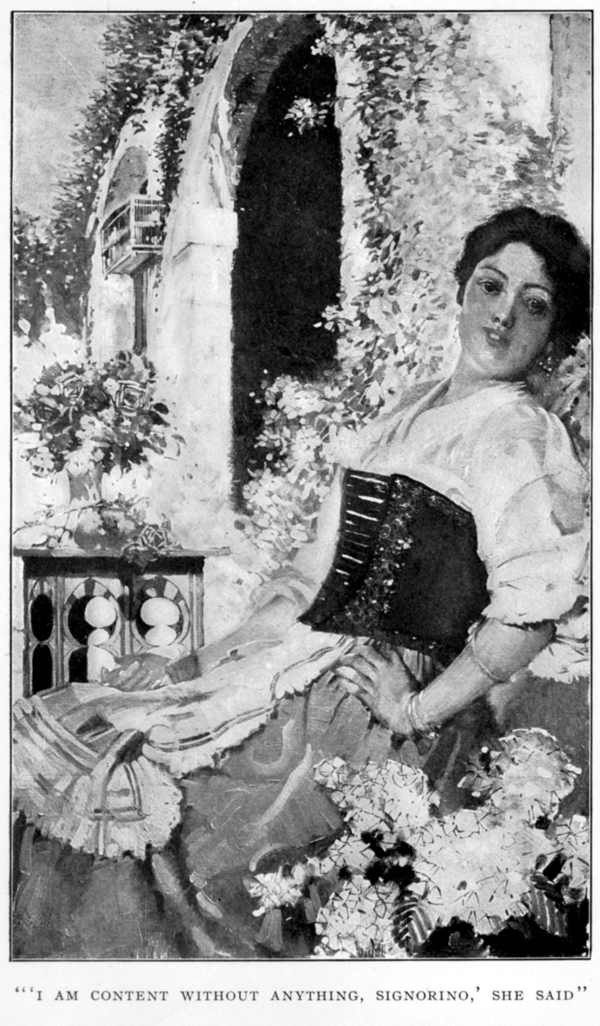 "'I AM CONTENT WITHOUT ANYTHING, SIGNORINO,' SHE SAID"
Under the cover of the flood of talk Maurice turned to Maddalena. She was taking no part in it, but was[Pg 281] eating her macaroni gently, as if it were a new and wonderful food. So Maurice thought as he looked at her. To-day there was something strange, almost pathetic, to him in Maddalena, a softness, an innocent refinement that made him imagine her in another life than hers, and with other companions, in a life as free but less hard, with companions as natural but less ruthless to women.
"Maddalena," he said to her. "They all want to buy things at the auction."
"Si, signore."
"And you?"
"I, signorino?"
"Yes, don't you want to buy something?"
He was testing her, testing her memory. She looked at him above her fork, from which the macaroni streamed down.
"I am content without anything, signorino," she said.
"Without the blue dress and the ear-rings, longer than that?" He measured imaginary ear-rings in the air. "Have you forgotten, Maddalena?"
She blushed and bent over her plate. She had not forgotten. All the day since she rose at dawn she had been thinking of Maurice's old promise. But she did not know that he remembered it, and his remembrance of it came to her now as a lovely surprise. He bent his head down nearer to her.
"When they are all at the auction, we will go to buy the blue dress and the ear-rings," he almost whispered. "We will go by ourselves. Shall we?"
"Si, signore."
Her voice was very small and her cheeks still held their flush. She glanced, with eyes that were unusually conscious, to right and left of her, to see if the neighbors had noticed their colloquy. And that look of consciousness made Maurice suddenly understand that this limit which he had put to his sinning—so he had[Pg 282] called it with a sort of angry mental sincerity, summoned, perhaps, to match the tremendous sincerity of his wife which he was meeting with a lie to-day—his sinning against Hermione was also a limit to something else. Had he not sinned against Maddalena, sinned when he had kissed her, when he had shown her that he delighted to be with her? Was he not sinning now when he promised to buy for her the most beautiful things of the fair? For a moment he thought to himself that his fault against Maddalena was more grave, more unforgivable than his fault against Hermione. But then a sudden anger that was like a storm, against his own condemnation of himself, swept through him. He had come out to-day to be recklessly happy, and here he was giving himself up to gloom, to absurd self-torture. Where was his natural careless temperament? To-day his soul was full of shadows, like the soul of a man going to meet a doom.
"Where's the wine?" he called to Gaspare. "Wine, cameriere, wine!"
"You must not drink wine with the pasta, signorino!" cried Gaspare. "Only afterwards, with the vitello."
"Have you ordered vitello? Capital! But I've finished my pasta and I'm thirsty. Well, what do you want to buy at the auction, Gaspare, and you, Amedeo, and you Salvatore?"
He plunged into the talk and made Salvatore show his keen desires, encouraging and playing with his avarice, now holding it off for a moment, then coaxing it as one coaxes an animal, stroking it, tempting it to a forward movement. The wine went round now, for the vitello was on the table, and the talk grew more noisy, the laughter louder. Outside, too, the movement and the tumult of the fair were increasing. Cries of men selling their wares rose up, the hard melodies of a piano-organ, and a strange and ecclesiastical chant[Pg 283] sung by three voices that, repeated again and again, at last attracted Maurice's attention.
"What's that?" he asked of Gaspare. "Are those priests chanting?"
"Priests! No, signore. Those are the Romani."
"Romans here! What are they doing?"
"They have a cart decorated with flags, signorino, and they are selling lemon-water and ices. All the people say that they are Romans and that is how they sing in Rome."
The long and lugubrious chant of the ice-venders rose up again, strident and melancholy as a song chanted over a corpse.
"It's funny to sing like that to sell ices," Maurice said. "It sounds like men at a funeral."
"Oh, they are very good ices, signorino. The Romans make splendid ices."
Turkey followed the vitello.
Maurice's guests were now completely at ease and perfectly happy. The consciousness that all this was going to be paid for, that they would not have to put their hands in their pockets for a soldo, warmed their hearts as the wine warmed their bodies. Amedeo's long, white face was becoming radiant, and even Salvatore softened towards the Inglese. A sort of respect, almost furtive, came to him for the wealth that could carelessly entertain this crowd of people, that could buy clocks, chairs, donkeys at pleasure, and scarcely know that soldi were gone, scarcely miss them. As he attacked his share of the turkey vigorously, picking up the bones with his fingers and tearing the flesh away with his white teeth, he tried to realize what such wealth must mean to the possessor of it, an effort continually made by the sharp-witted, very poor man. And this wealth—for the moment some of it was at his command! To ask to-day would be to have. Instinctively he knew that, and felt like one with money[Pg 284] in the bank. If only it might be so to-morrow and for many days! He began to regret the limit, almost to forget the sound of the laughter of the Catania fishermen upon the steps of the church of Sant' Onofrio. His pride was going to sleep, and his avarice was opening its eyes wider.
When the meal was over they went out onto the pavement to take coffee in the open air. The throng was much greater than it had been when they entered, for people were continually arriving from the more distant villages, and two trains had come in from Messina and Catania. It was difficult to find a table. Indeed, it might have been impossible had not Gaspare ruthlessly dislodged a party of acquaintances who were comfortably established around one in a prominent position.
"I must have a table for my padrone," he said. "Go along with you!"
And they meekly went, smiling, and without ill-will—indeed, almost as if they had received a compliment.
"But, Gaspare," began Maurice, "I can't—"
"Here is a chair for you, signorino. Take it quickly."
"At any rate, let us offer them something."
"Much better spare your soldi now, signorino, and buy something at the auction. That clock plays the 'Tre Colori' just like a band."
"Buy it. Here is some money."
He thrust some notes into the boy's ready hand.
"Grazie, signorino. Ecco la musica!"
In the distance there rose the blare of a processional march from "Aïda," and round the corner of the Via di Polifemo came a throng of men and boys in dark uniforms, with epaulets and cocked hats with flying plumes, blowing with all their might into wind instruments of enormous size.
"That is the musica of the città, signore," explained Amedeo. "Afterwards there will be the Musica Mascagni and the Musica Leoncavallo."[Pg 285]
"Mamma mia! And will they all play together?"
"No, signore. They have quarrelled. At Pasqua we had no music, and the archpriest was hooted by all in the Piazza."
"Why?"
"Non lo so. I think he had forbidden the Musica Mascagni to play at Madre Lucia's funeral, and the Musica Mascagni went to fight with the Musica della città. To-day they will all play, because it is the festa of the Santo Patrono, but even for him they will not play together."
The bandsmen had now taken their places upon a wooden dais exactly opposite to the restaurant, and were indulging in a military rendering of "Celeste Aïda," which struck most of the Sicilians at the small tables to a reverent silence. Maddalena's eyes had become almost round with pleasure, Gaspare was singing the air frankly with Amedeo, and even Salvatore seemed soothed and humanized, as he sipped his coffee, puffed at a thin cigar, and eyed the women who were slowly sauntering up and down to show their finery. At the windows of most of the neighboring houses appeared parties of dignified gazers, important personages of the town, who owned small balconies commanding the piazza, and who now stepped forth upon these coigns of vantage, and leaned upon the rails that they might see and be seen by the less favored ones below. Amedeo and Gaspare began to name these potentates. The stout man with a gray mustache, white trousers, and a plaid shawl over his shoulders was Signor Torloni, the syndic of San Felice. The tall, angry-looking gentleman, with bulging, black eyes and wrinkled cheeks, was Signor Carata, the avvocato; and the lady in black and a yellow shawl was his wife, who was the daughter of the syndic. Close by was Signorina Maria Sacchetti, the beauty of San Felice, already more than plump, but with a good complexion, and hair so thick that it stood[Pg 286] out from her satisfied face as if it were trained over a trellis. She wore white, and long, thread gloves which went above her elbows. Maddalena regarded her with awe when Amedeo mentioned a rumor that she was going to be "promised" to Dr. Marinelli, who was to be seen at her side, wearing a Gibus hat and curling a pair of gigantic black mustaches.
Maurice listened to the music and the chatter which, silenced by the arrival of the music, had now burst forth again, with rather indifferent ears. He wanted to get away somewhere and to be alone with Maddalena. The day was passing on. Soon night would be falling. The fair would be at an end. Then would come the ride back, and then——But he did not care to look forward into that future. He had not done so yet. He would not do so now. It would be better, when the time came, to rush upon it blindly. Preparation, forethought, would only render him unnatural. And he must seem natural, utterly natural, in his insincere surprise, in his insincere regret.
"Pay for the coffee, Gaspare," he said, giving the boy some money. "Now I want to walk about and see everything. Where are the donkeys?"
He glanced at Salvatore.
"Oh, signore," said Gaspare, "they are outside the town in the watercourse that runs under the bridge—you know, that broke down this spring where the line is? They have only just finished mending it."
"I remember your telling me."
"And you were so glad the signora was travelling the other way."
"Yes, yes."
He spoke hastily. Salvatore was on his feet.
"What hour have we?"
Maurice looked at his watch.
"Half-past two already! I say, Salvatore, you mustn't forget the donkeys."[Pg 287]
Salvatore came close up to him.
"Signore," he began, in a low voice, "what do you wish me to do?"
"Bid for a good donkey."
"Si, signore."
"For the best donkey they put up for sale."
Salvatore began to look passionately eager.
"Si, signore. And if I get it?"
"Come to me and I will give you the money to pay."
"Si, signore. How high shall I go?"
Gaspare was listening intently, with a hard face and sullen eyes. His whole body seemed to be disapproving what Maurice was doing. But he said nothing. Perhaps he felt that to-day it would be useless to try to govern the actions of his padrone.
"How high? Well"—Maurice felt that, before Gaspare, he must put a limit to his price, though he did not care what it was—"say a hundred. Here, I'll give it you now."
He put his hand into his pocket and drew out his portfolio.
"There's the hundred."
Salvatore took it eagerly, spread it over his hand, stared at it, then folded it with fingers that seemed for the moment almost delicate, and put it into the inside pocket of his jacket. He meant to go presently and show it to the fishermen of Catania, who had laughed upon the steps of the church, and explain matters to them a little. They thought him a fool. Well, he would soon make them understand who was the fool.
"Grazie, signore!"
He said it through his teeth. Maurice turned to Gaspare. He felt the boy's stern disapproval of what he had done, and wanted, if possible, to make amends.
"Gaspare," he said, "here is a hundred lire for you. I want you to go to the auction and to bid for anything[Pg 288] you think worth having. Buy something for your mother and father, for the house, some nice things!"
"Grazie, signore."
He took the note, but without alacrity, and his face was still lowering.
"And you, signore?" he asked.
"I?"
"Yes. Are you not coming with me to the auction? It will be better for you to be there to choose the things."
For an instant Maurice felt irritated. Was he never to be allowed a moment alone with Maddalena?
"Oh, but I'm no good at——" he began.
Then he stopped. To-day he must be birbante—on his guard. Once the auction was in full swing—so he thought—Salvatore and Gaspare would be as they were when they gambled beside the sea. They would forget everything. It would be easy to escape. But till that moment came he must be cautious.
"Of course I'll come," he exclaimed, heartily. "But you must do the bidding, Gaspare."
The boy looked less sullen.
"Va bene, signorino. I shall know best what the things are worth. And Salvatore"—he glanced viciously at the fisherman—"can go to the donkeys. I have seen them. They are poor donkeys this year."
Salvatore returned his vicious glance and said something in dialect which Maurice did not understand. Gaspare's face flushed, and he was about to burst into an angry reply when Maurice touched his arm.
"Come along, Gaspare!"
As they got up, he whispered:
"Remember what I said about to-day!"
"Macchè——"
Maurice closed his fingers tightly on Gaspare's arm.
"Gaspare, you must remember! Afterwards what you like, but not to-day. Andiamo!"
They all got up. The Musica della città was now[Pg 289] playing a violent jig, undoubtedly composed by Bellini, who was considered almost as a child of San Felice, having been born close by at Catania.
"Where are the women in the wonderful blue dresses?" Maurice asked, as they stepped into the road; "and the ear-rings? I haven't seen them yet."
"They will come towards evening, signorino," replied Gaspare, "when it gets cool. They do not care to be in the sun dressed like that. It might spoil their things."
Evidently the promenade of these proud beauties was an important function.
"We must not miss them," Maurice said to Maddalena.
She looked conscious.
"No, signore."
"They will all be here this evening, signore," said Amedeo, "for the giuochi di fuoco."
"The giuochi di fuoco—they will be at the end?"
"Si, signore. After the giuochi di fuoco it is all finished."
Maurice stifled a sigh. "It is all finished," Amedeo had said. But for him? For him there would be the ride home up the mountain, the arrival upon the terrace before the house of the priest. At what hour would he be there? It would be very late, perhaps nearly at dawn, in the cold, still, sad hour when vitality is at its lowest. And Hermione? Would she be sleeping? How would they meet? How would he——?
"Andiamo! Andiamo!"
He cried out almost angrily.
"Which is the way?"
"All the auctions are held outside the town, signore," said Amedeo. "Follow me."
Proudly he took the lead, glad to be useful and important after the benefits that had been bestowed upon him, and hoping secretly that perhaps the rich Inglese[Pg 290] would give him something to spend, too, since money was so plentiful for donkeys and clocks.
"They are in the fiume, near the sea and the railway line."
The railway line! When he heard that Maurice had a moment's absurd sensation of reluctance, a desire to hold back, such as comes to a man who is unexpectedly asked to confront some danger. It seemed to him that if he went to the watercourse he might be seen by Hermione and Artois as they passed by on their way to Marechiaro. But of course they were coming from Messina! What a fool he was to-day! His recklessness seemed to have deserted him just when he wanted it most. To-day he was not himself. He was a coward. What it was that made him a coward he did not tell himself.
"Then we can all go together," he said. "Salvatore and all."
"Si, signore."
Salvatore's voice was close at his ear, and he knew by the sound of it that the fisherman was smiling.
"We can all keep together, signore; then we shall be more gay."
They threaded their way through the throng. The violent jig of Bellini died away gradually, till it was faint in the distance. At the end of the narrow street Maurice saw the large bulk of Etna. On this clear afternoon it looked quite close, almost as if, when they got out of the street, they would be at its very foot, and would have to begin to climb. Maurice remembered his wild longing to carry Maddalena off upon the sea, or to some eyrie in the mountains, to be alone with her in some savage place. Why not give all these people the slip now—somehow—when the fun of the fair was at its height, mount the donkeys and ride straight for the huge mountain? There were caverns there and desolate lava wastes; there were almost impenetrable beech[Pg 291] forests. Sebastiano had told him tales of them, those mighty forests that climbed up to green lawns looking down upon the Lipari Isles. He thought of their silence and their shadows, their beds made of the drifted leaves of the autumn. There, would be no disturbance, no clashing of wills and of interests, but calm and silence and the time to love. He glanced at Maddalena. He could hardly help imagining that she knew what he was thinking of. Salvatore had dropped behind for a moment. Maurice did not know it, but the fisherman had caught sight of his comrades of Catania drinking in a roadside wine-shop, and had stopped to show them the note for a hundred francs, and to make them understand the position of affairs between him and the forestiere. Gaspare was talking eagerly to Amedeo about the things that were likely to be put up for sale at the auction.
"Maddalena," Maurice said to the girl, in a low voice, "can you guess what I am thinking about?"
She shook her head.
"No, signore."
"You see the mountain!"
He pointed to the end of the little street.
"Si, signore."
"I am thinking that I should like to go there now with you."
"Ma, signorino—the fiera!"
Her voice sounded plaintive with surprise and she glanced at her pea-green skirt.
"And this, signorino!"—she touched it carefully with her slim fingers. "How could I go in this?"
"When the fair is over, then, and you are in your every-day gown, Maddalena, I should like to carry you off to Etna."
"They say there are briganti there."
"Brigands—would you be afraid of them with me?"
"I don't know, signore. But what should we do there on Etna far away from the sea and from Marechiaro?"[Pg 292]
"We should"—he whispered in her ear, seizing this chance almost angrily, almost defiantly, with the thought of Salvatore in his mind—"we should love each other, Maddalena. It is quiet in the beech forests on Etna. No one would come to disturb us, and——"
A chuckle close to his ear made him start. Salvatore's hand was on his arm, and Salvatore's face, looking wily and triumphant, was close to his.
"Gaspare was wrong, there are splendid donkeys here. I have been talking to some friends who have seen them."
There was a tramp of heavy boots on the stones behind them. The fishermen from Catania were coming to see the fun. Salvatore was in glory. To get all and give nothing was, in his opinion, to accomplish the legitimate aim of a man's life. And his friends, those who had dared to sneer and to whisper, and to imagine that he was selling his daughter for money, now knew the truth and were here to witness his ingenuity. Intoxicated by his triumph, he began to show off his power over the Inglese for the benefit of the tramplers behind. He talked to Maurice with a loud familiarity, kept laying his hand on Maurice's arm as they walked, and even called him, with a half-jocose intonation, "compare." Maurice sickened at his impertinence, but was obliged to endure it with patience, and this act of patience brought to the birth within him a sudden, fierce longing for revenge, a longing to pay Salvatore out for his grossness, his greed, his sly and leering affectation of playing the slave when he was really indicating to his compatriots that he considered himself the master. Again Maurice heard the call of the Sicilian blood within him, but this time it did not call him to the tarantella or to love. It called him to strike a blow. But this blow could only be struck through Maddalena, could only be struck if he were traitor to Hermione. For a moment he saw everything red. Again Salvatore called him "compare." Suddenly Maurice could not bear it.[Pg 293]
"Don't say that!" he said. "Don't call me that!"
He had almost hissed the words out. Salvatore started, and for an instant, as they walked side by side, the two men looked at each other with eyes that told the truth. Then Salvatore, without asking for any explanation of Maurice's sudden outburst, said:
"Va bene, signore, va bene! I thought for to-day we were all compares. Scusi, scusi."
There was a bitterness of irony in his voice. As he finished he swept off his soft hat and then replaced it more over his left ear than ever. Maurice knew at once that he had done the unforgivable thing, that he had stabbed a Sicilian's amour propre in the presence of witnesses of his own blood. The fishermen from Catania had heard. He knew it from Salvatore's manner, and an odd sensation came to him that Salvatore had passed sentence upon him. In silence, and mechanically, he walked on to the end of the street. He felt like one who, having done something swiftly, thoughtlessly, is suddenly confronted with the irreparable, abruptly sees the future spread out before him bathed in a flash of crude light, the future transformed in a second by that act of his as a landscape is transformed by an earthquake or a calm sea by a hurricane.
And when the watercourse came in sight, with its crowd, its voices, and its multitude of beasts, he looked at it dully for a moment, hardly realizing it.
In Sicily the animal fairs are often held in the great watercourses that stretch down from the foot of the mountains to the sea, and that resemble huge highroads in the making, roads upon which the stones have been dumped ready for the steam-roller. In winter there is sometimes a torrent of water rushing through them, but in summer they are dry, and look like wounds gashed in the thickly growing lemon and orange groves. The trampling feet of beasts can do no harm to the stones, and these watercourses in the summer[Pg 294] season are of no use to anybody. They are, therefore, often utilized at fair time. Cattle, donkeys, mules are driven down to them in squadrons. Painted Sicilian carts are ranged upon their banks, with sets of harness, and the auctioneers, whose business it is to sell miscellaneous articles, household furniture, stuffs, clocks, ornaments, frequently descend into them, and mount a heap of stones to gain command of their gaping audience of contadini and the shrewder buyers from the towns.
The watercourse of San Felice was traversed at its mouth by the railway line from Catania to Messina, which crossed it on a long bridge supported by stone pillars and buttresses, the bridge which, as Gaspare had said, had recently collapsed and was now nearly built up again. It was already in use, but the trains were obliged to crawl over it at a snail's pace in order not to shake the unfinished masonry, and men were stationed at each end to signal to the driver whether he was to stop or whether he might venture to go on. Beyond the watercourse, upon the side opposite to the town of San Felice, was a series of dense lemon groves, gained by a sloping bank of bare, crumbling earth, on the top of which, close to the line and exactly where it came to the bridge, was a group of four old olive-trees with gnarled, twisted trunks. These trees cast a patch of pleasant shade, from which all the bustle of the fair was visible, but at a distance, and as Maurice and his party came out of the village on the opposite bank, he whispered to Maddalena:
"Maddalena!"
"Si, signore?"
"Let's get away presently, you and I; let's go and sit under those trees. I want to talk to you quietly."
"Si, signore?"
Her voice was lower even than his own.
"Ecco, signore! Ecco!"[Pg 295]
Salvatore was pointing to a crowd of donkeys.
"Signorino! Signorino!"
"What is it, Gaspare?"
"That is the man who is going to sell the clock!"
The boy's face was intent. His eyes were shining, and his glum manner had vanished, under the influence of a keen excitement. Maurice realized that very soon he would be free. Once his friends were in the crowd of buyers and sellers everything but the chance of a bargain would be forgotten. His own blood quickened but for a different reason.
"What beautiful carts!" he said. "We have no such carts in England!"
"If you would like to buy a cart, signore——" began Salvatore.
But Gaspare interrupted with violence.
"Macchè! What is the use of a cart to the signorino? He is going away to England. How can he take a cart with him in the train?"
"He can leave the cart with me," said Salvatore, with open impudence. "I can take care of it for the signore as well as the donkey."
"Macchè!" cried Gaspare, furiously.
Maurice took him by the arm.
"Help me down the bank! Come on!"
He began to run, pulling Gaspare with him. When they got to the bottom, he said:
"It's all right, Gaspare. I'm not going to be such a fool as to buy a cart. Now, then, which way are we going?"
"Signore, do you want to buy a very good donkey, a very strong donkey, strong enough to carry three Germans to the top of Etna? Come and see my donkey. He is very cheap. I make a special price because the signore is simpatico. All the English are simpatici. Come this way, signore! Gaspare knows me. Gaspare knows that I am not birbante."[Pg 296]
"Signorino! Signorino! Look at this clock! It plays the 'Tre Colori.' It is worth twenty-five lire, but I will make a special price for you because you love Sicily and are like a Siciliano. Gaspare will tell you——"
But Gaspare elbowed away his acquaintances roughly.
"Let my padrone alone. He is not here to buy. He is only here to see the fair. Come on, signorino! Do not answer them. Do not take any notice. You must not buy anything or you will be cheated. Let me make the prices."
"Yes, you make the prices. Per Bacco, how hot it is!"
Maurice pulled his hat down over his eyes.
"Maddalena, you'll get a sunstroke!" he said.
"Oh no, signore. I am accustomed to the sun."
"But to-day it's terrific!"
Indeed, the masses of stones in the watercourse seemed to draw and to concentrate the sun-rays. The air was alive with minute and dancing specks of light, and in the distance, seen under the railway bridge, the sea looked hot, a fiery blue that was surely sweating in the glare of the afternoon. The crowd of donkeys, of cattle, of pigs—there were many pigs on sale—looked both dull and angry in the heat, and the swarms of Sicilians who moved slowly about among them, examining them critically, appraising their qualities and noting their defects, perspired in their festa clothes, which were mostly heavy and ill-adapted to summer-time. A small boy passed by, bearing in his arms a struggling turkey. He caught his foot in some stones, fell, bruised his forehead, and burst out crying, while the indignant and terrified bird broke away, leaving some feathers, and made off violently towards Etna. There was a roar of laughter from the people near. Some ran to catch the turkey, others picked up the boy. Salvatore had stopped to see this adventure, and was now at a little distance surrounded by the Catanesi, who were evidently deter[Pg 297]mined to assist at his bidding for a donkey. The sight of the note for a hundred lire had greatly increased their respect for Salvatore, and with the Sicilian instinct to go, and to stay, where money is, they now kept close to their comrade, eying him almost with awe as one in possession of a fortune. Maurice saw them presently examining a group of donkeys. Salvatore, with an autocratic air, and the wild gestures peculiar to him, was evidently laying down the law as to what each animal was worth. The fishermen stood by, listening attentively. The fact of Salvatore's purchasing power gave him the right to pronounce an opinion. He was in glory. Maurice thanked Heaven for that. The man in glory is often the forgetful man. Salvatore, he thought, would not bother about his daughter and his banker for a little while. But how to get rid of Gaspare and Amedeo! It seemed to him that they would never leave his side.
There were many wooden stands covered with goods for sale in the watercourse, with bales of stuff for suits and dresses, with hats and caps, shirts, cravats, boots and shoes, walking-sticks, shawls, household utensils, crockery, everything the contadino needs and loves. Gaspare, having money to lay out, considered it his serious duty to examine everything that was to be bought with slow minuteness. It did not matter whether the goods were suited to a masculine taste or not. He went into the mysteries of feminine attire with almost as much assiduity as a mother displays when buying a daughter's trousseau, and insisted upon Maurice sharing his interest and caution. All sense of humor, all boyish sprightliness vanished from him in this important epoch of his life. The suspicion, the intensity of the bargaining contadino came to the surface. His usually bright face was quite altered. He looked elderly, subtle, and almost Jewish as he slowly passed from stall to stall, testing, weighing, measuring, appraising.[Pg 298]
It seemed to Maurice that this progress would never end. Presently they reached a stand covered with women's shawls and with aprons.
"Shall I buy an apron for my mother, signorino?" asked Gaspare.
"Yes, certainly."
Maurice did not know what else to say. The result of his consent was terrible. For a full half-hour they stood in the glaring sun, while Gaspare and Amedeo solemnly tried on aprons over their suits in the midst of a concourse of attentive contadini. In vain did Maurice say: "That's a pretty one. I should take that one." Some defect was always discoverable. The distant mother's taste was evidently peculiar and not to be easily suited, and Maurice, not being familiar with it, was unable to combat such assertions of Gaspare as that she objected to pink spots, or that she could never be expected to put on an apron before the neighbors if the stripes upon it were of different colors and there was no stitching round the hem. For the first time since he was in Sicily the heat began to affect him unpleasantly. His head felt as if it were compressed in an iron band, and the vision of Gaspare, eagerly bargaining, looking Jewish, and revolving slowly in aprons of different colors, shapes, and sizes, began to dance before his eyes. He felt desperate, and suddenly resolved to be frank.
"Macchè!" Gaspare was exclaiming, with indignant gestures of protest to the elderly couple who were in charge of the aprons; "it is not worth two soldi! It is not fit to be thrown to the pigs, and you ask me——"
"Gaspare!"
"Two lire—Madonna! Sangue di San Pancrazio, they ask me two lire! Macchè!" (He flung down the apron passionately upon the stall.) "Go and find Lipari people to buy your dirt; don't come to one from Marechiaro."[Pg 299]
He took up another apron.
"Gaspare!"
"One lira fifty? Madre mia, do you think I was born in a grotto on Etna and have never——"
"Gaspare, listen to me!"
"Scusi, signorino! I——"
"I'm going over there to sit down in the shade for a minute. After that wine I drank at dinner I'm a bit sleepy."
"Si, signore. Shall I come with you?"
For once there was reluctance in his voice, and he looked down at the blue-and-white apron he had on with wistful eyes. It was a new joy to him to be bargaining in the midst of an attentive throng of his compatriots.
"No, no. You stay here and spend the money. Bid for the clock when the auction comes on."
"Oh, signore, but you must be here, too, then."
"All right. Come and fetch me if you like. I shall be over there under the trees."
He waved his hand vaguely towards the lemon groves.
"Now, choose a good apron. Don't let them cheat you."
"Macchè!"
The boy laughed loudly, and turned eagerly to the stall again.
"Come, Maddalena!"
Maurice drew her quickly, anxiously, out of the crowd, and they began to walk across the watercourse towards the farther bank and the group of olive-trees. Salvatore had forgotten them. So had Gaspare. Both father and servant were taken by the fascination of the fair. At last! But how late it must be! How many hours had already fled away! Maurice scarcely dared to look at his watch. He feared to see the time. While they walked he said nothing to Maddalena, but when[Pg 300] they reached the bank he took her arm and helped her up it, and when they were at the top he drew a long breath.
"Are you tired, signorino?"
"Tired—yes, of all those people. Come and sit down, Maddalena, under the olive-trees."
He took her by the hand. Her hand was warm and dry, pleasant to touch, to hold. As he felt it in his the desire to strike at Salvatore revived within him. Salvatore was laughing at him, was triumphing over him, triumphing in the get-all and give-nothing policy which he thought he was pursuing with such complete success. Would it be very difficult to turn that success into failure? Maurice wondered for a moment, then ceased to wonder. Something in the touch of Maddalena's hand told him that, if he chose, he could have his revenge upon Salvatore, and he was assailed by a double temptation. Both anger and love tempted him. If he stooped to do evil he could gratify two of the strongest desires in humanity, the desire to conquer in love and the desire to triumph in hate. Salvatore thought him such a fool, held him in such contempt! Something within him was burning to-day as a cheek burns with shame, something within him that was like the kernel of him, like the soul of his manhood, which the fisherman was sneering at. He did not say to himself strongly that he did not care what such men thought of him. He could not, for his nature was both reckless and sensitive. He did care, as if he had been a Sicilian half doubtful whether he dared to show his face in the piazza. And he had another feeling, too, which had come to him when Salvatore had answered his exclamation of irresistible anger at being called "compare," the feeling that, whether he sinned against the fisherman or not, the fisherman meant to do him harm. The sensation might be absurd, would have seemed to him probably absurd in England. Here, in Sicily, it sprang up and he had[Pg 301] just to accept it, as a man accepts an instinct which guides him, prompts him.
Salvatore had turned down his thumb that day.
Maurice was not afraid of him. Physically, he was quite fearless. But this sensation of having been secretly condemned made him feel hard, cruel, ready, perhaps, to do a thing not natural to him, to sacrifice another who had never done him wrong. At that moment it seemed to him that it would be more manly to triumph over Salvatore by a double betrayal than to "run straight," conquer himself and let men not of his code think of him as they would.
Not of his code! But what was his code? Was it that of England or that of Sicily? Which strain of blood was governing him to-day? Which strain would govern him finally? Artois would have had an interesting specimen under his observant eyes had he been at the fair of San Felice.
Maddalena willingly obeyed Maurice's suggestion.
"Get well into the shade," he said. "There's just enough to hold us, if we sit close together. You don't mind that, do you?"
"No, signore."
"Put your back against the trunk—there."
He kept his hat off. Over the railway line from the hot-looking sea there came a little breeze that just moved his short hair and the feathers of gold about Maddalena's brow. In the watercourse, but at some distance, they saw the black crowd of men and women and beasts swarming over the hot stones.
"How can they?" Maurice muttered, as he looked down.
"Cosa?"
He laughed.
"I was thinking out loud. I meant how can they bargain and bother hour after hour in all that sun!"
"But, signorino, you would not have them pay too[Pg 302] much!" she said, very seriously. "It is dreadful to waste soldi."
"I suppose—yes, of course it is. Oh, but there are so many things worth more than soldi. Dio mio! Let's forget all that!"
He waved his hand towards the crowd, but he saw that Maddalena was preoccupied. She glanced towards the watercourse rather wistfully.
"What is it, Maddalena? Ah, I know! The blue dress and the ear-rings! Per Bacco!"
"No, signore—no, signore!"
She disclaimed quickly, reddening.
"Yes, it is. I had forgotten. But we can't go now. Maddalena, we will buy them this evening. Directly it gets cool we'll go, directly we've rested a little. But don't think of them now. I've promised, and I always keep a promise. Now, don't think of that any more!"
He spoke with a sort of desperation. The fair seemed to be his enemy, and he had thought that it would be his friend. It was like a personage with a stronger influence than his, an influence that could take away that which he wished to retain, to fix upon himself.
"No, signore," Maddalena said, meekly, but still wistfully.
"Do you care for a blue dress and a pair of ear-rings more than you do for me?" cried Maurice, with sudden roughness. "Are you like your father? Do you only care for me for what you can get out of me? I believe you do!"
Maddalena looked startled, almost terrified, by his outburst. Her lips trembled, but she gazed at him steadily.
"Non è vero."
The words sounded almost stern.
"I do—" he said. "I do want to be cared for a little—just for myself."
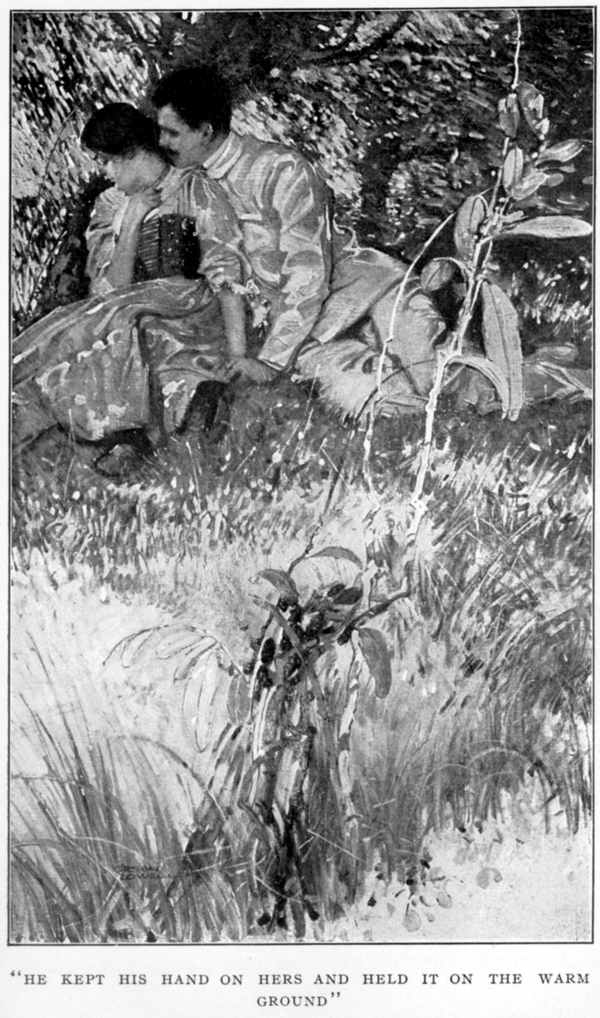 "HE KEPT HIS HAND ON HERS AND HELD IT ON THE WARM
GROUND"
"HE KEPT HIS HAND ON HERS AND HELD IT ON THE WARM
GROUND"
At that moment he had a sensation of loneliness like[Pg 303] that of an utterly unloved man. And yet at that moment a great love was travelling to him—a love that was complete and flawless. But he did not think of it. He only thought that perhaps all this time he had been deceived, that Maddalena, like her father, was merely pleased to see him because he had money and could spend it. He sickened.
"Non è vero!" Maddalena repeated.
Her lips still trembled. Maurice looked at her doubtfully, yet with a sudden tenderness. Always when she looked troubled, even for an instant, there came to him the swift desire to protect her, to shield her.
"But why should you care for me?" he said. "It is better not. For I am going away, and probably you will never see me again."
Tears came into Maddalena's eyes. He did not know whether they were summoned by his previous roughness or his present pathos. He wanted to know.
"Probably I shall never come back to Sicily again," he said, with pressure.
She said nothing.
"It will be better not," he added. "Much better."
Now he was speaking for himself.
"There's something here, something that I love and that's bad for me. I'm quite changed here. I'm like another man."
He saw a sort of childish surprise creeping into her face.
"Why, signorino?" she murmured.
He kept his hand on hers and held it on the warm ground.
"Perhaps it is the sun," he said. "I lose my head here, and I—lose my heart!"
She still looked rather surprised, and again her ignorance fascinated him. He thought that it was far more attractive than any knowledge could have been.
"I'm horribly happy here, but I oughtn't to be happy."[Pg 304]
"Why, signorino? It is better to be happy."
"Per Dio!" he exclaimed.
Now a deep desire to have his revenge upon Salvatore came to him, but not at all because it would hurt Salvatore. The cruelty had gone out of him. Maddalena's eyes of a child had driven it away. He wanted his revenge only because it would be an intense happiness to him to have it. He wanted it because it would satisfy an imperious desire of tender passion, not because it would infuriate a man who hated him. He forgot the father in the daughter.
"Suppose I were quite poor, Maddalena!" he said.
"But you are very rich, signorino."
"But suppose I were poor, like Gaspare, for instance. Suppose I were as I am, just the same, only a contadino, or a fisherman, as your father is. And suppose—suppose"—he hesitated—"suppose that I were not married!"
She said nothing. She was listening with deep but still surprised attention.
"Then I could—I could go to your father and ask him——"
He stopped.
"What could you ask him, signorino?"
"Can't you guess?"
"No, signore."
"I might ask him to let me marry you. I should—if it were like that—I should ask him to let me marry you."
"Davvero?"
An expression of intense pleasure, and of something more—of pride—had come into her face. She could not divest herself imaginatively of her conception of him as a rich forestiere, and she saw herself placed high above "the other girls," turned into a lady.
"Magari!" she murmured, drawing in her breath, then breathing out.[Pg 305]
"You would be happy if I did that?"
"Magari!" she said again.
He did not know what the word meant, but he thought it sounded like the most complete expression of satisfaction he had ever heard.
"I wish," he said, pressing her hand—"I wish I were a Sicilian of Marechiaro."
At this moment, while he was speaking, he heard in the distance the shrill whistle of an engine. It ceased. Then it rose again, piercing, prolonged, fierce surely with inquiry. He put his hands to his ears.
"How beastly that is!" he exclaimed.
He hated it, not only for itself, but for the knowledge it sharply recalled to his mind, the knowledge of exactly what he was doing, and of the facts of his life, the facts that the very near future held.
"Why do they do that?" he added, with intense irritation.
"Because of the bridge, signorino. They want to know if they can come upon the bridge. Look! There is the man waving a flag. Now they can come. It is the train from Palermo."
"Palermo!" he said, sharply.
"Si, signore."
"But the train from Palermo comes the other way, by Messina!"
"Si, signore. But there are two, one by Messina and one by Catania. Ecco!"
From the lemon groves came the rattle of the approaching train.
"But—but——"
He caught at his watch, pulled it out.
Five o'clock!
He had taken his hand from Maddalena's, and now he made a movement as if to get up. But he did not get up. Instead, he pressed back against the olive-tree, upon whose trunk he was leaning, as if he wished[Pg 306] to force himself into the gnarled wood of it. He had an instinct to hide. The train came on very slowly. During the two or three minutes that elapsed before it was in his view Maurice lived very rapidly. He felt sure that Hermione and Artois were in the train. Hermione had said that they would arrive at Cattaro at five-thirty. She had not said which way they were coming. Maurice had assumed that they would come from Messina because Hermione had gone away by that route. It was a natural error. But now? If they were at the carriage window! If they saw him! And surely they must see him. The olive-trees were close to the line and on a level with it. He could not get away. If he got up he would be more easily seen. Hermione would call out to him. If he pretended not to hear she might, she probably would, get out of the train at the San Felice station and come into the fair. She was impulsive. It was just the sort of thing she might do. She would do it. He was sure she would do it. He looked at the watercourse hard. The crowd of people was not very far off. He thought he detected the form of Gaspare. Yes, it was Gaspare. He and Amedeo were on the outskirts of the crowd near the railway bridge. As he gazed, the train whistled once more, and he saw Gaspare turn round and look towards the sea. He held his breath.
"Ecco, signorino. Viene!"
Maddalena touched his arm, kept her hand upon it. She was deeply interested in this event, the traversing by the train of the unfinished bridge. Maurice was thankful for that. At least she did not notice his violent perturbation.
"Look, signorino! Look!"
In despite of himself, Maurice obeyed her. He wanted not to look, but he could not help looking. The engine, still whistling, crept out from the embrace of the lemon-trees, with the dingy line of carriages behind it.[Pg 307] At most of the windows there were heads of people looking out. Third class—he saw soldiers, contadini. Second class—no one. Now the first-class carriages were coming. They were close to him.
"Ah!"
He had seen Hermione. She was standing up, with her two hands resting on the door-frame and her head and shoulders outside of the carriage. Maurice sat absolutely still and stared at her, stared at her almost as if she were a stranger passing by. She was looking at the watercourse, at the crowd, eagerly. Her face, much browner than when she had left Sicily, was alight with excitement, with happiness. She was radiant. Yet he thought she looked old, older at least than he had remembered. Suddenly, as the train came very slowly upon the bridge, she drew in to speak to some one behind her, and he saw vaguely Artois, pale, with a long beard. He was seated, and he, too, was gazing out at the fair. He looked ill, but he, too, looked happy, much happier than he had in London. He put up a thin hand and stroked his beard, and Maurice saw wrinkles coming round his eyes as he smiled at something Hermione said to him. The train came to the middle of the bridge and stopped.
"Ecco!" murmured Maddalena. "The man at the other end has signalled!"
Maurice looked again at the watercourse. Gaspare was beyond the crowd now, and was staring at the train with interest, like Maddalena. Would it never go on? Maurice set his teeth and cursed it silently. And his soul said; "Go on! Go on!" again and again. "Go on! Go on!" Now Hermione was once more leaning out. Surely she must see Gaspare. A man waved a flag. The train jerked back, jangled, crept forward once more, this time a little faster. In a moment they would begone. Thank God! But what was Hermione doing? She started. She leaned further forward, staring into[Pg 308] the watercourse. Maurice saw her face changing. A look of intense surprise, of intense inquiry, came into it. She took one hand swiftly from the door, put it behind her—ah, she had a pair of opera-glasses at her eyes now! The train went on faster. It was nearly off the bridge. But she was waving her hand. She was calling. She had seen Gaspare. And he? Maurice saw him start forward as if to run to the bridge. But the train was gone. The boy stopped, hesitated, then dashed away across the stones.
"Signorino! Signorino!"
Maurice said nothing.
"Signorino!" repeated Maddalena. "Look at Gaspare! Is he mad? Look! How he is running!"
Gaspare reached the bank, darted up it, and disappeared into the village.
"Signorino, what is the matter?"
Maddalena pulled his sleeve. She was looking almost alarmed.
"Matter? Nothing."
Maurice got up. He could not remain still. It was all over now. The fair was at an end for him. Gaspare would reach the station before the train went on, would explain matters. Hermione would get out. Already Maurice seemed to see her coming down to the watercourse, walking with her characteristic slow vigor. It did not occur to him at first that Hermione might refuse to leave Artois. Something in him knew that she was coming. Fate had interfered now imperiously. Once he had cheated fate. That was when he came to the fair despite Hermione's letter. Now fate was going to have her revenge upon him. He looked at Maddalena. Was fate working for her, to protect her? Would his loss be her gain? He did not know, for he did not know what would have been the course of his own conduct if fate had not interfered. He had been trifling, letting the current take him. It might have[Pg 309] taken him far, but—now Hermione was coming. It was all over and the sun was still up, still shining upon the sea.
"Let us go into the fair. It is cooler now."
He tried to speak lightly.
"Si, signore."
Maddalena shook out her skirt and began to smile. She was thinking of the blue dress and the ear-rings. They went down into the watercourse.
"Signorino, what can have been the matter with Gaspare?"
"I don't know."
"He was looking at the train."
"Was he? Perhaps he saw a friend in it. Yes, that must have been it. He saw a friend in the train."
He stared across the watercourse towards the village, seeking two figures, and he was conscious now of two feelings that fought within him, of two desires: a desire that Hermione should not come, and a desire that she should come. He wanted, he even longed, to have his evening with Maddalena. Yet he wanted Hermione to get out of the train when Gaspare told her that he—Maurice—was at San Felice. If she did not get out she would be putting Artois before him. The pale face at the window, the eyes that smiled when Hermione turned familiarly round to speak, had stirred within him the jealousy of which he had already been conscious more than once. But now actual vision had made it fiercer. The woman who had leaned out looking at the fair belonged to him. He felt intensely that she was his property. Maddalena spoke to him again, two or three times. He did not hear her. He was seeing the wrinkles that came round the eyes of Artois when he smiled.
"Where are we going, signorino? Are we going back to the town?"
Instinctively, Maurice was following in the direction[Pg 310] taken by Gaspare. He wanted to meet fate half-way, to still, by action, the tumult of feeling within him.
"Aren't the best things to be bought there?" he replied. "By the church where all those booths are? I think so."
Maddalena began to walk a little faster. The moment had come. Already she felt the blue dress rustling about her limbs, the ear-rings swinging in her ears.
Maurice did not try to hold her back. Nor did it occur to him that it would be wise to meet Hermione without Maddalena. He had done no actual wrong, and the pale face of Artois had made him defiant. Hermione came to him with her friend. He would come to her with his. He did not think of Maddalena as a weapon exactly, but he did feel as if, without her, he would be at a disadvantage when he and Hermione met.
They were in the first street now. People were beginning to flow back from the watercourse towards the centre of the fair. They walked in a crowd and could not see far before them. But Maurice thought he would know when Hermione was near him, that he would feel her approach. The crowd went on slowly, retarding them, but at last they were near to the church of Sant' Onofrio and could hear the sound of music. The "Intermezzo" from "Cavalleria Rusticana" was being played by the Musica Mascagni. Suddenly, Maurice started. He had felt a pull at his arm.
"Signorino! Signorino!"
Gaspare was by his side, streaming with perspiration and looking violently excited.
"Gaspare!"
He stopped, cast a swift look round. Gaspare was alone.
"Signorino"—the boy was breathing hard—"the signora"—he gulped—"the signora has come back."
The time had come for acting. Maurice feigned surprise.[Pg 311]
"The signora! What are you saying? The signora is in Africa."
"No, signore! She is here!"
"Here in San Felice!"
"No, signore! But she was in the train. I saw her at the window. She waved her hand to me and called out—when the train was on the bridge. I ran to the station; I ran fast, but when I got there the train had just gone. The signora has come back, and we are not there to meet her!"
His eyes were tragic. Evidently he felt that their absence was a matter of immense importance, was a catastrophe.
"The signora here!" Maurice repeated, trying to make his voice amazed. "But why did she not tell us? Why did not she say that she was coming?"
He looked at Gaspare, but only for an instant. He felt afraid to meet his great, searching eyes.
"Non lo so."
Maddalena stood by in silence. The bright look of anticipation had gone out of her face, and was replaced by a confused and slightly anxious expression.
"I can't understand it," Maurice said, heavily. "I can't—was the signora alone, or did you see some one with her?"
"The sick signore? I did not see him. I saw only the signora standing at the window, waving her hand—così!"
He waved his hand.
"Madonna!" Maurice said, mechanically.
"What are we to do, signorino?"
"Do! What can we do? The train has gone!"
"Si, signore. But shall I fetch the donkeys?"
Maurice stole a glance at Maddalena. She was looking frankly piteous.
"Have you got the clock yet?" he asked Gaspare.
"No, signore."[Pg 312]
Gaspare began to look rather miserable, too.
"It has not been put up. Perhaps they are putting it up now."
"Gaspare," Maurice said, hastily, "we can't be back to meet the signora now. Even if we went at once we should be hours late—and the donkeys are tired, perhaps. They will go slowly unless they have a proper rest. It is a dreadful pity, but I think if the signora knew she would wish us to stay now till the fair is over. She would not wish to spoil your pleasure. Do you think she would?"
"No, signore. The signora always wishes people to be happy."
"Even if we went at once it would be night before we got back."
"Si, signore."
"I think we had better stay—at any rate till the auction is finished and we have had something to eat. Then we will go."
"Va bene."
The boy sounded doubtful.
"La povera signora!" he said. "How disappointed she will be! She did want to speak to me. Her face was all red; she was so excited when she saw me, and her mouth was wide open like that!"
He made a grimace, with earnest, heart-felt sincerity.
"It cannot be helped. To-night we will explain everything and make the signora quite happy. Look here! Buy something for her. Buy her a present at the auction!"
"Signorino!" Gaspare cried. "I will give her the clock that plays the 'Tre Colori'! Then she will be happy again. Shall I?"
"Si, si. And meet me in the market-place. Then we will eat something and we will start for home."
The boy darted away towards the watercourse. His heart was light again. He had something to do for the[Pg 313] signora, something that would make her very happy. Ah, when she heard the clock playing the "Tre Colori"! Mamma mia!
He tore towards the watercourse in an agony lest he should be too late.
Night was falling over the fair. The blue dress and the ear-rings had been chosen and paid for. The promenade of the beauties in the famous inherited brocades had taken place with éclat before the church of Sant' Onofrio. Salvatore had acquired a donkey of strange beauty and wondrous strength, and Gaspare had reappeared in the piazza accompanied by Amedeo, both laden with purchases and shining with excitement and happiness. Gaspare's pockets were bulging, and he walked carefully, carrying in his hands a tortured-looking parcel.
"Dov'è il mio padrone?" he asked, as he and Amedeo pushed through the dense throng. "Dov'è il mio padrone?"
He spied Maurice and Maddalena sitting before the ristorante listening to the performance of a small Neapolitan boy with a cropped head, who was singing street songs in a powerful bass voice, and occasionally doing a few steps of a melancholy dance upon the pavement. The crowd billowed round them. A little way off the "Musica della città," surrounded by a circle of colored lamps, was playing a selection from the "Puritani." The strange ecclesiastical chant of the Roman ice venders rose up against the music as if in protest. And these three definite and fighting melodies—of the Neapolitan, the band, and the ice venders—detached themselves from a foundation of ceaseless sound, contributed by the hundreds of Sicilians who swarmed about the ancient church, infested the narrow side streets of the village, looked down from the small balconies and the windows of the houses, and gathered in mobs in the wine-shops and the trattorie.[Pg 314]
"Signorino! Signorino! Look!"
Gaspare had reached Maurice, and now stood by the little table at which his padrone and Maddalena were sitting, and placed the tortured parcel tenderly upon it.
"Is that the clock?"
Gaspare did not reply in words, but his brown fingers deftly removed the string and paper and undressed his treasure.
"Ecco!" he exclaimed.
The clock was revealed, a great circle of blue and white standing upon short, brass legs, and ticking loudly,
bawled the little boy from Naples. Gaspare seized the clock, turned a handle, lifted his hand in a reverent gesture bespeaking attention; there was a faint whirr, and then, sure enough, the tune of the "Tre Colori" was tinkled blithely forth.
"Ecco!" repeated Gaspare, triumphantly.
"Mamma mia!" murmured Maddalena, almost exhausted with the magic of the fair.
"It's wonderful!" said Maurice.
He, too, was a little tired, but not in body.
Gaspare wound the clock again, and again the tune was trilled forth, competing sturdily with the giant noises of the fair, a little voice that made itself audible by its clearness and precision.
"Ecco!" repeated Gaspare. "Will not the signora be happy when she sees what I have brought her from the fair?"
He sighed from sheer delight in his possession and the thought of his padrona's joy and wonder in it.
"Mangiamo?" he added, descending from heavenly delights to earthly necessities.[Pg 315]
"Yes, it is getting late," said Maurice. "The fireworks will soon be beginning, I suppose."
"Not till ten, signorino. I have asked. There will be dancing first. But—are we going to stay?"
Maurice hesitated, but only for a second.
"Yes," he said. "Even if we went now the signora would be in bed and asleep long before we got home. We will stay to the end, the very end."
"Then we can say 'Good-morning' to the signora when we get home," said Gaspare.
He was quite happy now that he had this marvellous present to take back with him. He felt that it would make all things right, would sweep away all lingering disappointment at their absence and the want of welcome.
Salvatore did not appear at the meal. He had gone off to stable his new purchase with the other donkeys, and now, having got a further sum of money out of the Inglese, was drinking and playing cards with the fishermen of Catania. But he knew where his girl and Maurice were, and that Gaspare and Amedeo were with them. And he knew, too, that the Inglese's signora had come back. He told the news to the fishermen.
"To-night, when he gets home, his 'cristiana' will be waiting for him. Per Dio! it is over for him now. We shall see little more of him."
"And get little more from him!" said one of the fishermen, who was jealous of Salvatore's good-fortune.
Salvatore laughed loudly. He had drunk a good deal of wine and he had had a great deal of money given to him.
"I shall find another English fool, perhaps!" he said. "Chi lo sa?"
"And his cristiana?" asked another fisherman. "What is she like?"
"Like!" cried Salvatore, pouring out another glass of wine and spitting on the discolored floor, over which hens were running; "what is any cristiana like?"[Pg 316]
And he repeated the contadino's proverb:
"'La mugghieri è comu la gatta: si l'accarizzi, idda ti gratta!'"
"Perhaps the Inglese will get scratched to-night," said the first fisherman.
"I don't mind," rejoined Salvatore. "Get us a fresh pack of cards, Fortunato. I'll pay for 'em."
And he flung down a lira on the wine-stained table.
Gaspare, now quite relieved in his mind, gave himself up with all his heart to the enjoyment of the last hours of the fair, and was unwearied in calling on his padrone to do the same. When the evening meal was over he led the party forth into the crowd that was gathered about the music; he took them to the shooting-tent, and made them try their luck at the little figures which calmly presented grotesquely painted profiles to the eager aim of the contadini; he made them eat ices which they bought at the beflagged cart of the ecclesiastical Romans, whose eternally chanting voices made upon Maurice a sinister impression, suggesting to his mind—he knew not why—the thought of death. Finally, prompted by Amedeo, he drew Maurice into a room where there was dancing.
It was crowded with men and women, was rather dark and very hot. In a corner there was a grinding organ, whose handle was turned by a perspiring man in a long, woollen cap. Beside him, hunched up on a window-sill, was a shepherd boy who accompanied the organ upon a flute of reed. Round the walls stood a throng of gazers, and in the middle of the floor the dancers performed vigorously, dancing now a polka, now a waltz, now a mazurka, now an elaborate country dance in which sixteen or twenty people took part, now a tarantella, called by many of the contadini "La Fasola." No sooner had they entered the room than Gaspare gently but firmly placed his arm round his padrone's waist, took his left hand and began to turn[Pg 317] him about in a slow waltz, while Amedeo followed the example given with Maddalena. Round and round they went among the other couples. The organ in the corner ground out a wheezy tune. The reed-flute of the shepherd boy twittered, as perhaps, long ago, on the great mountain that looked down in the night above the village, a similar flute twittered from the woods to Empedocles climbing upward for the last time towards the plume of smoke that floated from the volcano. And then Amedeo and Gaspare danced together and Maurice's arm was about the waist of Maddalena.
It was the first time that he had danced with her, and the mutual act seemed to him to increase their intimacy, to carry them a step forward in this short and curious friendship which was now, surely, very close to its end. They did not speak as they danced. Maddalena's face was very solemn, like the face of one taking part in an important ceremonial. And Maurice, too, felt serious, even sad. The darkness and heat of the room, the melancholy with which all the tunes of a grinding organ seem impregnated, the complicated sounds from the fair outside, from which now and again the voices of the Roman ice-venders detached themselves, even the tapping of the heavy boots of the dancers upon the floor of brick—all things in this hour moved him to a certain dreariness of the spirit which was touched with sentimentality. This fair day was coming to an end. He felt as if everything were coming to an end.
Every dog has his day. The old saying came to his mind. "Every dog has his day—and mine is over."
He saw in the dimness of the room the face of Hermione at the railway carriage window. It was the face of one on the edge of some great beginning. But she did not know. Hermione did not know.
The dance was over. Another was formed, a country dance. Again Maurice was Maddalena's partner. Then[Pg 318] came "La Fasola," in which Amedeo proudly showed forth his well-known genius and Gaspare rivalled him. But Maurice thought it was not like the tarantella upon the terrace before the house of the priest. The brilliancy, the gayety of that rapture in the sun were not present here among farewells. A longing to be in the open air under the stars came to him, and when at last the grinding organ stopped he said to Gaspare:
"I'm going outside. You'll find me there when you've finished dancing."
"Va bene, signorino. In a quarter of an hour the fireworks will be beginning."
"And then we must start off at once."
"Si, signore."
The organ struck up again and Amedeo took hold of Gaspare by the waist.
"Maddalena, come out with me."
She followed him. She was tired. Festivals were few in her life, and the many excitements of this long day had told upon her, but her fatigue was the fatigue of happiness. They sat down on a wooden bench set against the outer wall of the house. No one else was sitting there, but many people were passing to and fro, and they could see the lamps round the "Musica Leoncavallo," and hear it fighting and conquering the twitter of the shepherd boy's flute and the weary wheezing of the organ within the house. A great, looming darkness rising towards the stars dominated the humming village. Etna was watching over the last glories of the fair.
"Have you been happy to-day, Maddalena?" Maurice asked.
"Si, signore, very happy. And you?"
He did not answer.
"It will all be very different to-morrow," he said.
He was trying to realize to-morrow, but he could not.
"We need not think of to-morrow," Maddalena said.[Pg 319]
She arranged her skirt with her hands, and crossed one foot over the other.
"Do you always live for the day?" Maurice asked her.
She did not understand him.
"I do not want to think of to-morrow," she said. "There will be no fair then."
"And you would like always to be at the fair?"
"Si, signore, always."
There was a great conviction in her simple statement.
"And you, signorino?"
She was curious about him to-night.
"I don't know what I should like," he said.
He looked up at the great darkness of Etna, and again a longing came to him to climb up, far up, into those beech forests that looked towards the Isles of Lipari. He wanted greater freedom. Even the fair was prison.
"But I think," he said, after a pause—"I think I should like to carry you off, Maddalena, up there, far up on Etna."
He remembered his feeling when he had put his arms round her in the dance. It had been like putting his arms round ignorance that wanted to be knowledge. Who would be Maddalena's teacher? Not he. And yet he had almost intended to have his revenge upon Salvatore.
"Shall we go now?" he said. "Shall we go off to Etna, Maddalena?"
"Signorino!"
She gave a little laugh.
"We must go home after the fireworks."
"Why should we? Why should we not take the donkeys now? Gaspare is dancing. Your father is playing cards. No one would notice. Shall we? Shall we go now and get the donkeys, Maddalena?"
But she replied:[Pg 320]
"A girl can only go like that with a man when she is married."
"That's not true," he said. "She can go like that with a man she loves."
"But then she is wicked, and the Madonna will not hear her when she prays, signorino."
"Wouldn't you do anything for a man you really loved? Wouldn't you forget everything? Wouldn't you forget even the Madonna?"
She looked at him.
"Non lo so."
It seemed to him that he was answered.
"Wouldn't you forget the Madonna for me?" he whispered, leaning towards her.
There was a loud report close to them, a whizzing noise, a deep murmur from the crowd, and in the clear sky above Etna the first rocket burst, showering down a cataract of golden stars, which streamed towards the earth, leaving trails of fire behind them.
The sound of the grinding organ and of the shepherd boy's flute ceased in the dancing-room, and the crowd within rushed out into the market-place.
"Signorino! Signorino! Come with me! We cannot see properly here! I know where to go. There will be wheels of fire, and masses of flowers, and a picture of the Regina Margherita. Presto! Presto!"
Gaspare had hold of Maurice by the arm.
"E' finito!" Maurice murmured.
It seemed to him that the last day of his wild youth was at an end.
"E' finito!" he repeated.
But there was still an hour.
And who can tell what an hour will bring forth?[Pg 321]
It was nearly two o'clock in the morning when Maurice and Gaspare said good-bye to Maddalena and her father on the road by Isola Bella. Salvatore had left the three donkeys at Cattaro, and had come the rest of the way on foot, while Maddalena rode Gaspare's beast.
"The donkey you bought is for Maddalena," Maurice had said to him.
And the fisherman had burst into effusive thanks. But already he had his eye on a possible customer in Cattaro. As soon as the Inglese had gone back to his own country the donkey would be resold at a good price. What did a fisherman want with donkeys, and how was an animal to be stabled on the Sirens' Isle? As soon as the Inglese was gone, Salvatore meant to put a fine sum of money into his pocket.
"Addio, signorino!" he said, sweeping off his hat with the wild, half-impudent gesture that was peculiar to him. "I kiss your hand and I kiss the hand of your signora."
He bent down his head as if he were going to translate the formal phrase into an action, but Maurice drew back.
"Addio, Salvatore," he said.
His voice was low.
"Addio, Maddalena!" he added.
She murmured something in reply. Salvatore looked keenly from one to the other.
"Are you tired, Maddalena?" he asked, with a sort of rough suspicion.[Pg 322]
"Si," she answered.
She followed him slowly across the railway line towards the sea, while Maurice and Gaspare turned their donkeys' heads towards the mountain.
They rode upward in silence. Gaspare was sleepy. His head nodded loosely as he rode, but his hands never let go their careful hold of the clock. Round about him his many purchases were carefully disposed, fastened elaborately to the big saddle. The roses, faded now, were still above his ears. Maurice rode behind. He was not sleepy. He felt as if he would never sleep again.
As they drew nearer to the house of the priest, Gaspare pulled himself together with an effort, half-turned on his donkey, and looked round at his padrone.
"Signorino!"
"Si."
"Do you think the signora will be asleep?"
"I don't know. I suppose so."
The boy looked wise.
"I do not think so," he said, firmly.
"What—at three o'clock in the morning!"
"I think the signora will be on the terrace watching for us."
Maurice's lips twitched.
"Chi lo sa?" he replied.
He tried to speak carelessly, but where was his habitual carelessness of spirit, his carelessness of a boy now? He felt that he had lost it forever, lost it in that last hour of the fair.
"Signorino!"
"Well?"
"Where were you and Maddalena when I was helping with the fireworks?"
"Close by."
"Did you see them all? Did you see the Regina Margherita?"[Pg 323]
"Si."
"I looked round for you, but I could not see you."
"There was such a crowd and it was dark."
"Yes. Then you were there, where I left you?"
"We may have moved a little, but we were not far off."
"I cannot think why I could not find you when the fireworks were over."
"It was the crowd. I thought it best to go to the stable without searching for you. I knew you and Salvatore would be there."
The boy was silent for a moment. Then he said:
"Salvatore was very angry when he saw me come into the stable without you."
"Why?"
"He said I ought not to have left my padrone."
"And what did you say?"
"I told him I would not be spoken to by him. If you had not come in just then I think there would have been a baruffa. Salvatore is a bad man, and always ready with his knife. And he had been drinking."
"He was quiet enough coming home."
"I do not like his being so quiet."
"What does it matter?"
Again there was a pause. Then Gaspare said:
"Now that the signora has come back we shall not go any more to the Casa delle Sirene, shall we?"
"No, I don't suppose we shall go any more."
"It is better like that, signorino. It is much better that we do not go."
Maurice said nothing.
"We have been there too often," added Gaspare. "I am glad the signora has come back. I am sorry she ever went away."
"It was not our fault that she went," Maurice said, in a hard voice like that of a man trying to justify something, to defend himself against some accusation. "We did not want the signora to go."[Pg 324]
"No, signore."
Gaspare's voice sounded almost apologetic. He was a little startled by his padrone's tone.
"It was a pity she went," he continued. "The poor signora——"
"Why is it such a pity?" Maurice interrupted, almost roughly, almost suspiciously. "Why do you say 'the poor signora'?"
Gaspare stared at him with open surprise.
"I only meant——"
"The signora wished to go to Africa. She decided for herself. There is no reason to call her the poor signora."
"No, signore."
The boy's voice recalled Maurice to prudence.
"It was very good of her to go," he said, more quietly. "Perhaps she has saved the life of the sick signore by going."
"Si, signore."
Gaspare said no more, but as they rode up, drawing ever nearer to the bare mountain-side and the house of the priest, Maurice's heart reiterated the thought of the boy. Why had Hermione ever gone? What a madness it had all been, her going, his staying! He knew it now for a madness, a madness of the summer, of the hot, the burning south. In this terrible quiet of the mountains, without the sun, without the laughter and the voices and the movement of men, he understood that he had been mad, that there had been something in him, not all himself, which had run wild, despising restraint. And he had known that it was running wild, and he had thought to let it go just so far and no farther. He had set a limit of time to his wildness and its deeds. And he had set another limit. Surely he had. He had not ever meant to go too far. And then, just when he had said to himself "E' finito!" the irrevocable was at hand, the moment of delirium in which all things that should have been remembered were forgotten. What had led[Pg 325] him? What spirit of evil? Or had he been led at all? Had not he rather deliberately forced his way to the tragic goal whither, through all these sunlit days, these starry nights, his feet had been tending?
He looked upon himself as a man looks upon a stranger whom he has seen commit a crime which he could never have committed. Mentally he took himself into custody, he tried, he condemned himself. In this hour of acute reaction the cool justice of the Englishman judged the passionate impulse of the Sicilian, even marvelled at it, and the heart of the dancing Faun cried: "What am I—what am I really?" and did not find the answer.
"Signorino?"
"Yes, Gaspare."
"When we get to that rock we shall see the house."
"I know."
How eagerly he had looked upward to the little white house on the mountain on that first day in Sicily, with what joy of anticipation, with what an exquisite sense of liberty and of peace! The drowsy wail of the "Pastorale" had come floating down to him over the olive-trees almost like a melody that stole from paradise. But now he dreaded the turn of the path. He dreaded to see the terrace wall, the snowy building it protected. And he felt as if he were drawing near to a terror, and as if he could not face it, did not know how to face it.
"Signorino, there is no light! Look!"
"The signora and Lucrezia must be asleep at this hour."
"If they are, what are we to do? Shall we wake them?"
"No, no."
He spoke quickly, in hope of a respite.
"We will wait—we will not disturb them."
Gaspare looked down at the parcel he was holding with such anxious care.
"I would like to play the 'Tre Colori,'" he said. "I[Pg 326] would like the first thing the signora hears when she wakes to be the 'Tre Colori.'"
"Hush! We must be very quiet."
The noise made on the path by the tripping feet of the donkeys was almost intolerable to him. It must surely wake the deepest sleeper. They were now on the last ascent where the mountain-side was bare. Some stones rattled downward, causing a sharp, continuous sound. It was answered by another sound, which made both Gaspare and Maurice draw rein and pull up.
As on that first day in Sicily Maurice had been welcomed by the "Pastorale," so he was welcomed by it now. What an irony that was to him! For an instant his lips curved in a bitter smile. But the smile died away as he realized things, and a strange sadness took hold of his heart. For it was not the ceramella that he heard in this still hour, but a piano played softly, monotonously, with a dreamy tenderness that made it surely one with the tenderness of the deep night. And he knew that Hermione had been watching, that she had heard him coming, that this was her welcome, a welcome from the depths of her pure, true heart. How much the music told him! How clearly it spoke to him! And how its caress flagellated his bare soul! Hermione had returned expectant of welcome and had found nothing, and instead of coming out upon the terrace, instead of showing surprise, vexation, jealous curiosity, of assuming the injured air that even a good woman can scarcely resist displaying in a moment of acute disappointment, she sent forth this delicate salutation to him from afar, the sweetest that she knew, the one she herself loved best.
Tears came into his eyes as he listened. Then he shut his eyes and said to himself, shuddering:
"Oh, you beast! You beast!"
"It is the signora!" said Gaspare, turning round on his donkey. "She does not know we are here, and she is playing to keep herself awake."[Pg 327]
He looked down at his clock, and his eyes began to shine.
"I am glad the signora is awake!" he said. "Signorino, let us get off the donkeys and leave them at the arch, and let us go in without any noise."
"But perhaps the signora knows that we are here," Maurice said.
Directly he had heard the music he had known that Hermione was aware of their approach.
"No, no, signore. I am sure she does not, or she would have come out to meet us. Let us leave the donkeys!"
He sprang off softly. Mechanically, Maurice followed his example.
"Now, signore!"
The boy took him by the hand and led him on tiptoe to the terrace, making him crouch down close to the open French window. The "Pastorale" was louder here. It never ceased, but returned again and again with the delicious monotony that made it memorable and wove a spell round those who loved it. As he listened to it, Maurice fancied he could hear the breathing of the player, and he felt that she was listening, too, listening tensely for footsteps on the terrace.
Gaspare looked up at him with bright eyes. The boy's whole face was alive with a gay and mischievous happiness, as he turned the handle at the back of his clock slowly, slowly, till at last it would turn no more. Then there tinkled forth to join the "Pastorale" the clear, trilling melody of the "Tre Colori."
The music in the room ceased abruptly. There was a rustling sound as the player moved. Then Hermione's voice, with something trembling through it that was half a sob, half a little burst of happy laughter, called out:
"Gaspare, how dare you interrupt my concert?"
"Signora! Signora!" cried Gaspare, and, springing up, he darted into the sitting-room.[Pg 328]
But Maurice, though he lifted himself up quickly, stood where he was with his hand set hard against the wall of the house. He heard Gaspare kiss Hermione's hand. Then he heard her say:
"But, but, Gaspare——"
He took his hand from the wall with an effort. His feet seemed glued to the ground, but at last he was in the room.
"Hermione!" he said.
"Maurice!"
He felt her strong hands, strong and yet soft like all the woman, on his.
"Cento di questi giorni!" she said. "Ah, but it is better than all the birthdays in the world!"
He wanted to kiss her—not to please her, but for himself he wanted to kiss her—but he dared not. He felt that if his lips were to touch hers—she must know. To excuse his avoidance of the natural greeting he looked at Gaspare.
"I know!" she whispered. "You haven't forgotten!"
She was alluding to that morning on the terrace when he came up from the fishing. They loosed their hands. Gaspare set the clock playing again.
"What a beauty!" Hermione said, glad to hide her emotion for a moment till she and Maurice could be alone. "What a marvel! Where did you find it, Gaspare—at the fair?"
"Si, signora!"
Solemnly he handed it, still playing brightly, to his padrona, just a little reluctantly, perhaps, but very gallantly.
"It is for you, signora."
"A present—oh, Gaspare!"
Again her voice was veiled. She put out her hand and touched the boy's hand.
"Grazie! How sweetly it plays! You thought of me!"[Pg 329]
There was a silence till the tune was finished. Then Maurice said:
"Hermione, I don't know what to say. That we should be at the fair the day you arrived! Why—why didn't you tell me? Why didn't you write?"
"You didn't know, then!"
The words came very quickly, very eagerly.
"Know! Didn't Lucrezia tell you that we had no idea?"
"Poor Lucrezia! She's in a dreadful condition. I found her in the village."
"No!" Maurice cried, thankful to turn the conversation from himself, though only for an instant. "I specially told her to stay here. I specially——"
"Well, but, poor thing, as you weren't expecting me! But I wrote, Maurice, I wrote a letter telling you everything, the hour we were coming—"
"It's Don Paolo!" exclaimed Gaspare, angrily. "He hides away the letters. He lets them lie sometimes in his office for months. To-morrow I will go and tell him what I think; I will turn out every drawer."
"It is too bad!" Maurice said.
"Then you never had it?"
"Hermione"—he stared at the open door—"you think we should have gone to the fair if——"
"No, no, I never thought so. I only wondered. It all seemed so strange."
"It is too horrible!" Maurice said, with heavy emphasis. "And Artois—no rooms ready for him! What can he have thought?"
"As I did, that there had been a mistake. What does it matter now? Just at the moment I was dreadfully—oh, dreadfully disappointed. I saw Gaspare at the fair. And you saw me, Gaspare?"
"Si, signora. I ran all the way to the station, but the train had gone."
"But I didn't see you, Maurice. Where were you?"[Pg 330]
Gaspare opened his lips to speak, but Maurice did not give him time.
"I was there, too, in the fair."
"But of course you weren't looking at the train?"
"Of course not. And when Gaspare told me, it was too late to do anything. We couldn't get back in time, and the donkeys were tired, and so——"
"Oh, I'm glad you didn't hurry back. What good would it have done then?"
There was a touch of constraint in her voice.
"You must have thought I should be in bed."
"Yes, we did."
"And so I ought to be now. I believe I am tremendously tired, but—but I'm so tremendously something else that I hardly know."
The constraint had gone.
"The signora is happy because she is back in my country," Gaspare remarked, with pride and an air of shrewdness.
He nodded his head. The faded roses shook above his ears. Hermione smiled at him.
"He knows all about it," she said. "Well, if we are ever to go to bed——"
Gaspare looked from her to his padrone.
"Buona notte, signora," he said, gravely. "Buona notte, signorino. Buon riposo!"
"Buon riposo!" echoed Hermione. "It is blessed to hear that again. I do love the clock, Gaspare."
The boy beamed at her and went reluctantly away to find the donkeys. At that moment Maurice would have given almost anything to keep him. He dreaded unspeakably to be alone with Hermione. But it had to be. He must face it. He must seem natural, happy.
"Shall I put the clock down?" he asked.
He went to her, took the clock, carried it to the writing-table, and put it down.
"Gaspare was so happy to bring it to you."[Pg 331]
He turned. He felt desperate. He came to Hermione and put out his hands.
"I feel so bad that we weren't here," he said.
"That is it!"
There was a sound of deep relief in her voice. Then she had been puzzled by his demeanor! He must be natural; but how? It seemed to him as if never in all his life could he have felt innocent, careless, brave. Now he was made of cowardice. He was like a dog that crawls with its belly to the floor. He got hold of Hermione's hands.
"I feel—I feel horribly, horribly bad!"
Speaking the absolute truth, his voice was absolutely sincere, and he deceived her utterly.
"Maurice," she said, "I believe it's upset you so much that—that you are shy of me."
She laughed happily.
"Shy—of me!"
He tried to laugh, too, and kissed her abruptly, awkwardly. All his natural grace was gone from him. But when he kissed her she did not know it; her lips clung to his with a tender passion, a fealty that terrified him.
"She must know!" he thought. "She must feel the truth. My lips must tell it to her."
And when at last they drew away from each other his eyes asked her furiously a question, asked it of her eyes.
"What is it, Maurice?"
He said nothing. She dropped her eyes and reddened slowly, till she looked much younger than usual, strangely like a girl.
"You haven't—you haven't——"
There was a sound of reserve in her voice, and yet a sound of triumph, too. She looked up at him again.
"Do you guess that I have something to tell you?" she said, slowly.
"Something to tell me?" he repeated, dully.[Pg 332]
He was so intent on himself, on his own evil-doing, that it seemed to him as if everything must have some connection with it.
"Ah," she said, quickly; "no, I see you weren't."
"What is it?" he asked, but without real interest.
"I can't tell you now," she said.
Gaspare went by the window leading the donkeys.
"Buona notte, signora!"
It was a very happy voice.
"Buona notte, Gaspare. Sleep well."
Maurice caught at the last words.
"We must sleep," he said. "To-morrow we'll—we'll——"
"Tell each other everything. Yes, to-morrow!"
She put her arm through his.
"Maurice, if you knew how I feel!"
"Yes?" he said, trying to make his voice eager, buoyant. "Yes?"
"If you knew how I've been longing to be back! And so often I've thought that I never should be here with you again, just in the way we were!"
He cleared his throat.
"Why?"
"It is so difficult to repeat a great, an intense happiness, I think. But we will, we are repeating it, aren't we?"
"Yes."
"When I got to the station to-day, and—and you weren't there, I had a dreadful foreboding. It was foolish. The explanation of your not being there was so simple. Of course I might have guessed it."
"Of course."
"But in the first moment I felt as if you weren't there because I had lost you forever, because you had been taken away from me forever. It was such an intense feeling that it frightened me—it frightened me horribly. Put your arm round me, Maurice. Let me feel what an idiot I have been!"[Pg 333]
He obeyed her and put his arm round her, and he felt as if his arm must tell her what she had not learned from his lips. And she thought that now he must know the truth she had not told him.
"Don't think of dreadful things," he said.
"I won't any more. I don't think I could with you. To me you always mean the sun, light, and life, and all that is brave and beautiful!"
He took his arm away from her.
"Come, we must sleep, Hermione!" he said. "It's nearly dawn. I can almost see the smoke on Etna."
He shut the French window and drew the bolt.
She had gone into the bedroom and was standing by the dressing-table. She did not know why, but a great shyness had come upon her. It was like a cloud enveloping her. Never before had she felt like this with Maurice, not even when they were first married. She had loved him too utterly to be shy with him. Maurice was still in the sitting-room, fastening the shutters of the window. She heard the creak of wood, the clatter of the iron bar falling into the fastener. Now he would come.
But he did not come. He was moving about in the room. She heard papers rustling, then the lid of the piano shut down. He was putting everything in order.
This orderliness was so unusual in Maurice that it made a disagreeable impression upon her. She began to feel as if he did not want to come into the bedroom, as if he were trying to put off the moment of coming. She remembered that he had seemed shy of her. What had come to them both to-night? Her instinct moved her to break through this painful, this absurd constraint.
"Maurice!" she called.
"Yes."
His voice sounded odd to her, almost like the voice of some other man, some stranger.
"Aren't you coming?"[Pg 334]
"Yes. Hermione."
But still he did not come. After a moment, he said:
"It's awfully hot to-night!"
"After Africa it seems quite cool to me."
"Does it? I've been—since you've been away I've been sleeping nearly always out-of-doors on the terrace."
Now he came to the doorway and stood there. He looked at the white room, at Hermione. She had on a white tea-gown. It seemed to him that everything here was white, everything but his soul. He felt as if he could not come into this room, could not sleep here to-night, as if it would be a desecration. When he stood in the doorway the painful shyness returned to her.
"Have you?" she said.
"Yes."
"Do you—would you rather sleep there to-night?"
She did not mean to say it. It was the last thing she wished to say. Yet she said it. It seemed to her that she was forced to say it.
"Well, it's much cooler there."
She was silent.
"I could just put one or two rugs and cushions on the seat by the wall," he said. "I shall sleep like a top. I'm awfully tired!"
"But—but the sun will soon be up, won't it?"
"Oh—then I can come in."
"All right."
"I'll take the rugs from the sitting-room. I say—how's Artois?"
"Much better, but he's still weak."
"Poor chap!"
"He'll ride up to-morrow on a donkey."
"Good! I'm—I'm most awfully sorry about his rooms."
"What does it matter? I've made them quite nice already. He's perfectly comfortable."[Pg 335]
"I'm glad. It's all—it's all been such a pity—about to-day, I mean."
"Don't let's think of it! Don't let's think of it any more."
A passionate sound had stolen into her voice. She moved a step towards him. A sudden idea had come to her, an idea that stirred within her a great happiness, that made a flame of joy spring up in her heart.
"Maurice, you—you——"
"What is it?" he asked.
"You aren't vexed at my staying away so long? You aren't vexed at my bringing Emile back with me?"
"No, of course not," he said. "But—but I wish you hadn't gone away."
And then he disappeared into the sitting-room, collected the rugs and cushions, opened the French window, and went out upon the terrace. Presently he called out:
"I shall sleep as I am, Hermione, without undressing. I'm awfully done. Good-night."
"Good-night!" she called.
There was a quiver in her voice. And yet that flame of happiness had not quite died down. She said to herself:
"He doesn't want me to know. He's too proud. But he has been a little jealous, perhaps." She remembered how Sicilian he was.
"But I'll make him forget it all," she thought, eagerly. "To-morrow—to-morrow it will be all right. He's missed me, he's missed me!"
That thought was very sweet to her. It seemed to explain all things; this constraint of her husband, which had reacted upon her, this action of his in preferring to sleep outside—everything. He had always been like a boy. He was like a boy now. He could not conceal his feelings. He did not doubt her. She knew that.[Pg 336] But he had been a little jealous about her friendship for Emile.
She undressed. When she was ready for bed she hesitated a moment. Then she put a white shawl round her shoulders and stole quickly out of the room. She came upon the terrace. The stars were waning. The gray of the dawn was in the sky towards the east. Maurice, stretched upon the rugs, with his face turned towards the terrace wall, was lying still. She went to him, bent down, and kissed him.
"I love you," she whispered—"oh, so much!"
She did not wait, but went away at once. When she was gone he put up his hand to his face. On his cheek there was a tear.
"God forgive me!" he said to himself. "God forgive me!"
His body was shaken by a sob.[Pg 337]
When the sun came up over the rim of the sea Maurice ceased from his pretence of sleep, raised himself on his elbow, then sat upright and looked over the ravine to the rocks of the Sirens' Isle. The name seemed to him now a fatal name, and everything connected with his sojourn in Sicily fatal. Surely there had been a malign spirit at work. In this early morning hour his brain, though unrefreshed by sleep, was almost unnaturally clear, feverishly busy. Something had met him when he first set foot in Sicily—so he thought now—had met him with a fixed and evil purpose. And that purpose had never been abandoned.
Old superstitions, inherited perhaps from a long chain of credulous Sicilian ancestors, were stirring in him. He did not laugh at his idea, as a pure-blooded Englishman would have laughed. He pondered it. He cherished it.
On his very first evening in Sicily the spirit had led him to the wall, had directed his gaze to the far-off light in the house of the sirens. He remembered how strangely the little light had fascinated his eyes, and his mind through his eyes, how he had asked what it was, how, when Hermione had called him to come in to sleep, he had turned upon the steps to gaze down on it once more. Then he had not known why he gazed. Now he knew. The spirit that had met him by the sea in Sicily had whispered to him to look, and he had obeyed because he could not do otherwise.
He dwelt upon that thought, that he had obeyed be[Pg 338]cause he had been obliged to obey. It was a palliative to his mental misery and his hatred of himself. The fatalism that is linked with superstition got hold upon him and comforted him a little. He had not been a free agent. He had had to do as he had done. Everything had been arranged so that he might sin. The night of the fishing had prepared the way for the night of the fair. If Hermione had stayed—but of course she had not stayed. The spirit that had kept him in Sicily had sent her across the sea to Africa. In the full flush of his hot-blooded youth, intoxicated by his first knowledge of the sun and of love, he had been left quite alone. Newly married, he had been abandoned by his wife for a good, even perhaps a noble, reason. Still, he had been abandoned—to himself and the keeping of that spirit. Was it any wonder that he had fallen? He strove to think that it was not. In the night he had cowered before Hermione and had been cruel with himself. Now, in the sunshine, he showed fight. He strove to find excuses for himself. If he did not find excuses he felt that he could not face the day, face Hermione in sunlight.
And now that the spirit had led him thus far, surely its work was done, surely it would leave him alone. He tried to believe that.
Then he thought of Maddalena.
She was there, down there where the rising sun glittered on the sea. She surely was awake, as he was awake. She was thinking, wondering—perhaps weeping.
He got up. He could not look at the sea any more. The name "House of the Sirens" suddenly seemed to him a terrible misnomer, now that he thought of Maddalena perhaps weeping by the sea.
He had his revenge upon Salvatore, but at what a cost!
Salvatore! The fisherman's face rose up before him.[Pg 339] If he ever knew! Maurice remembered his sensation that already, before he had done the fisherman any wrong, the fisherman had condemned him. Now there was a reason for condemnation. He had no physical fear of Salvatore. He was not a man to be physically afraid of another man. But if Salvatore ever knew he might tell. He might tell Hermione. That thought brought with it to Maurice a cold as of winter. The malign spirit might still have a purpose in connection with him, might still be near him full of intention. He felt afraid of the Sicily he had loved. He longed to leave it. He thought of it as an isle of fear, where terrors walked in the midst of the glory of the sunshine, where fatality lurked beside the purple sea.
"Maurice!"
He started. Hermione was on the steps of the sitting-room.
"You're not sleeping!" he said.
He felt as if she had been there reading all his thoughts.
"And you!" she answered.
"The sun woke me."
He lied instinctively. All his life with her would be a lie now, could never be anything else—unless——
He looked at her hard and long in the eyes for the first time since they had met after her return. Suppose he were to tell her, now, at once, in the stillness, the wonderful innocence and clearness of the dawn! For a moment he felt that it would be an exquisite relief, a casting down of an intolerable burden. She had such a splendid nature. She loved sincerity as she loved God. To her it was the one great essential quality, whose presence or absence made or marred the beauty of a human soul. He knew that.
"Why do you look at me like that?" she said, coming down to him with the look of slow strength that was always characteristic of her.
He dropped his eyes.[Pg 340]
"I don't know. How do you mean?"
"As if you had something to tell me."
"Perhaps—perhaps I have," he answered.
He was on the verge, the very verge of confession. She put her arm through his. When she touched him the impulse waned, but it did not die utterly away.
"Tell it me," she said. "I love to hear everything you tell me. I don't think you could ever tell me anything that I should not understand."
"Are you—are you sure?"
"I think so."
"But"—he suddenly remembered some words of hers that, till then, he had forgotten—"but you had something to tell me."
"Yes."
"I want to hear it."
He could not speak yet. Perhaps presently he would be able to.
"Let us go up to the top of the mountain," she answered. "I feel as if we could see the whole island from there. And up there we shall get all the wind of the morning."
They turned towards the steep, bare slope and climbed it, while the sun rose higher, as if attending them. At the summit there was a heap of stones.
"Let us sit here," Hermione said. "We can see everything from here, all the glories of the dawn."
"Yes."
He was so intensely preoccupied by the debate within him that he did not remember that it was here, among these stones where they were sitting, that he had hidden the fragments of Hermione's letter from Africa telling him of her return on the day of the fair.
They sat down with their faces towards the sea. The air up here was exquisitely cool. In the pellucid clearness of dawn the coast-line looked enchanted, fairy-like and full of delicate mystery. And its fading, in the[Pg 341] far distance, was like a calling voice. Behind them the ranges of mountains held a few filmy white clouds, like laces, about their rugged peaks. The sea was a pale blue stillness, shot with soft grays and mauves and pinks, and dotted here and there with black specks that were the boats of fishermen.
Hermione sat with her hands clasped round her knees. Her face, browned by the African sun, was intense with feeling.
"Yes," she said, at last, "I can tell you here."
She looked at the sea, the coast-line, then turned her head and gazed at the mountains.
"We looked at them together," she continued—"that last evening before I went away. Do you remember, Maurice?"
"Yes."
"From the arch. It is better up here. Always, when I am very happy or very sad, my instinct would be to seek a mountain-top. The sight of great spaces seen from a height teaches one, I think."
"What?"
"Not to be an egoist in one's joy; not to be a craven in one's sorrow. You see, a great view suggests the world, the vastness of things, the multiplicity of life. I think that must be it. And of course it reminds one, too, that one will soon be going away."
"Going away?"
"Yes. 'The mountains will endure'—but we—!"
"Oh, you mean death."
"Yes. What is it makes one think most of death when—when life, new life, is very near?"
She had been gazing at the mountains and the sea, but now she turned and looked into his face.
"Don't you understand what I have to tell you?" she asked.
He shook his head. He was still wondering whether he would dare to tell her of his sin. And he did not[Pg 342] know. At one moment he thought that he could do it, at another that he would rather throw himself over the precipice of the mountain than do it.
"I don't understand it at all."
There was a lack of interest in his voice, but she did not notice it. She was full of the wonder of the morning, the wonder of being again with him, and the wonder of what she had to tell him.
"Maurice"—she put her hand on his—"the night I was crossing the sea to Africa I knew. All these days I have kept this secret from you because I could not write it. It seemed to me too sacred. I felt I must be with you when I told it. That night upon the sea I was very sad. I could not sleep. I was on deck looking always back, towards Sicily and you. And just when the dawn was coming I—I knew that a child was coming, too, a child of mine and yours."
She was silent. Her hand pressed his, and now she was again looking towards the sea. And it seemed to him that her face was new, that it was already the face of a mother.
He said nothing and he did not move. He looked down at the heap of stones by which they were sitting, and his eyes rested on a piece of paper covered with writing. It was a fragment of Hermione's letter to him. As he saw it something sharp and cold like a weapon made of ice, seemed to be plunged into him. He got up, pulling hard at her hand. She obeyed his hand.
"What is it?" she said, as they stood together. "You look——"
He had become pale. He knew it.
"Hermione!" he said.
He was actually panting as if he had been running. He moved a few steps towards the edge of the summit. She followed him.
"You are angry that I didn't tell you! But—I wanted to say it. I wanted to—to——"[Pg 343]
She lifted his hands to her lips.
"Thank you for giving me a child," she said.
Then tears came into his eyes and ran down over his cheeks. That he should be thanked by her—that scourged the genuine good in him till surely blood started under the strokes.
"Don't thank me!" he said. "Don't do that! I won't have it!"
His voice sounded angry.
"I won't ever let you thank me for anything," he went on. "You must understand that."
He was on the edge of some violent, some almost hysterical outburst. He thought of Gaspare casting himself down in the boat that morning when he had feared that his padrone was drowned. So he longed to cast himself down and cry. But he had the strength to check his impulse. Only, the checking of it seemed to turn him for a moment into something made not of flesh and blood but of iron. And this thing of iron was voiceless.
She knew that he was feeling intensely and respected his silence. But at last it began almost to frighten her. The boyish look she loved had gone out of his face. A stern man stood beside her, a man she had never seen before.
"Maurice," she said, at length. "What is it? I think you are suffering."
"Yes," he said.
"But—but aren't you glad? Surely you are glad?"
To her the word seemed mean, poverty-stricken. She changed it.
"Surely you are thankful?"
"I don't know," he answered, at last. "I am thinking that I don't know that I am worthy to be a father."
He himself had fixed a limit. Now, God was putting a period to his wild youth. And the heart—was that changed within him?[Pg 344]
Too much was happening. The cup was being filled too full. A great longing came to him to get away, far away, and be alone. If it had been any other day he would have gone off into the mountains, by himself, have stayed out till night came, have walked, climbed, till he was exhausted. But to-day he could not do that. And soon Artois would be coming. He felt as if something must snap in brain or heart.
And he had not slept. How he wished that he could sleep for a little while and forget everything. In sleep one knows nothing. He longed to be able to sleep.
"I understand that," she said. "But you are worthy, my dear one."
When she said that he knew that he could never tell her.
"I must try," he muttered. "I'll try—from to-day."
She did not talk to him any more. Her instinct told her not to. Almost directly they were walking down to the priest's house. She did not know which of them had moved first.
When they got there they found Lucrezia up. Her eyes were red, but she smiled at Hermione. Then she looked at the padrone with alarm. She expected him to blame her for having disobeyed his orders of the day before. But he had forgotten all about that.
"Get breakfast, Lucrezia," Hermione said. "We'll have it on the terrace. And presently we must have a talk. The sick signore is coming up to-day for collazione. We must have a very nice collazione, but something wholesome."
"Si, signora."
Lucrezia went away to the kitchen thankfully. She had heard bad news of Sebastiano yesterday in the village. He was openly in love with the girl in the Lipari Isles. Her heart was almost breaking, but the return of the padrona comforted her a little. Now she[Pg 345] had some one to whom she could tell her trouble, some one who would sympathize.
"I'll go and take a bath, Hermione," Maurice said.
And he, too, disappeared.
Hermione went to talk to Gaspare and tell him what to get in Marechiaro.
When breakfast was ready Maurice came back looking less pale, but still unboyish. All the bright sparkle to which Hermione was accustomed had gone out of him. She wondered why. She had expected the change in him to be a passing thing, but it persisted.
At breakfast it was obviously difficult for him to talk. She sought a reason for his strangeness. Presently she thought again of Artois. Could he be the reason? Or was Maurice now merely preoccupied by that great, new knowledge that there would soon be a third life mingled with theirs? She wondered exactly what he felt about that. He was really such a boy at heart despite his set face of to-day. Perhaps he dreaded the idea of responsibility. His agitation upon the mountain-top had been intense. Perhaps he was rendered unhappy by the thought of fatherhood. Or was it Emile?
When breakfast was over, and he was smoking, she said to him:
"Maurice, I want to ask you something."
A startled look came into his eyes.
"What?" he said, quickly.
He threw his cigarette away and turned towards her, with a sort of tenseness that suggested to her a man bracing himself for some ordeal.
"Only about Emile."
"Oh!" he said.
He took another cigarette, and his attitude at once looked easier. She wondered why.
"You don't mind about Emile being here, do you?"
Maurice was nearly answering quickly that he was de[Pg 346]lighted to welcome him. But a suddenly born shrewdness prevented him. To-day, like a guilty man, he was painfully conscious, painfully alert. He knew that Hermione was wondering about him, and realized that her question afforded him an opportunity to be deceptive and yet to seem quite natural and truthful. He could not be as he had been, to-day. The effort was far too difficult for him. Hermione's question showed him a plausible excuse for his peculiarity of demeanor and conduct. He seized it.
"I think it was very natural for you to bring him," he answered.
He lit the cigarette. His hand was trembling slightly.
"But—but you had rather I hadn't brought him?"
As Maurice began to act a part an old feeling returned to him, and almost turned his lie into truth.
"You could hardly expect me to wish to have Artois with us here, could you, Hermione?" he said, slowly.
She scarcely knew whether she were most pained or pleased. She was pained that anything she had done had clouded his happiness, but she was intensely glad to think he loved to be quite alone with her.
"No, I felt that. But I felt, too, as if it would be cruel to stop short, unworthy in us."
"In us?"
"Yes. You let me go to Africa. You might have asked me, you might even have told me, not to go. I did not think of it at the time. Everything went so quickly. But I have thought of it since. And, knowing that, realizing it, I feel that you had your part, a great part, in Emile's rescue. For I do believe, Maurice, that if I had not gone he would have died."
"Then I am glad you went."
He spoke perfunctorily, almost formally. Hermione felt chilled.
"It seemed to me that, having begun to do a good work, it would be finer, stronger, to carry it quite through,[Pg 347] to put aside our own desires and think of another who had passed through a great ordeal. Was I wrong, Maurice? Emile is still very weak, very dependent. Ought I to have said, 'Now I see you're not going to die, I'll leave you at once.' Wouldn't it have been rather selfish, even rather brutal?"
His reply startled her.
"Have you—have you ever thought of where we are?" he said.
"Where we are!"
"Of the people we are living among?"
"I don't think I understand."
He cleared his throat.
"They're Sicilians. They don't see things as the English do," he said.
There was a silence. Hermione felt a heat rush over her, over all her body and face. She did not speak, because, if she had, she might have said something vehement, even headstrong, such as she had never said, surely never would say, to Maurice.
"Of course I understand. It's not that," he added.
"No, it couldn't be that," she said. "You needn't tell me."
The hot feeling stayed with her. She tried to control it.
"You surely can't mind what ignorant people out here think of an utterly innocent action!" she said, at last, very quietly.
But even as she spoke she remembered the Sicilian blood in him.
"You have minded it!" she said. "You do mind now."
And suddenly she felt very tender over him, as she might have felt over a child. In his face she could not see the boy to-day, but his words set the boy, the inmost nature of the boy that he still surely was, before her.[Pg 348]
The sense of humor in her seemed to be laughing and wiping away a tear at the same time.
She moved her chair close to his.
"Maurice," she said. "Do you know that sometimes you make me feel horribly old and motherly?"
"Do I?" he said.
"You do to-day, and yet—do you know that I have been thinking since I came back that you are looking older, much older than when I went away?"
"Is that Artois?" he said, looking over the wall to the mountain-side beyond the ravine.
Hermione got up, leaned upon the wall, and followed his eyes.
"I think it must be. I told Gaspare to go to the hotel when he fetched the provisions in Marechiaro and tell Emile it would be best to come up in the cool. Yes, it is he, and Gaspare is with him! Maurice, you don't mind so very much?"
She put her arm through his.
"These people can't talk when they see how ill he looks. And if they do—oh, Maurice, what does it matter? Surely there's only one thing in the world that matters, and that is whether one can look one's own conscience in the face and say, 'I've nothing to be ashamed of!'"
Maurice longed to get away from the touch of her arm. He remembered the fragment of paper he had seen among the stones on the mountain-side. He must go up there alone directly he had a moment of freedom. But now—Artois! He stared at the distant donkeys. His brain felt dry and shrivelled, his body both feverish and tired. How could he support this long day's necessities? It seemed to him that he had not the strength and resolution to endure them. And Artois was so brilliant! Maurice thought of him at that moment as a sort of monster of intellectuality, terrifying and repellent.[Pg 349]
"Don't you think so?" Hermione said.
"I dare say," he answered. "But I dare say, I suppose—very few of us can do that. We can't expect to be perfect, and other people oughtn't to expect it of us."
His voice had changed. Before, it had been almost an accusing voice and insincere. Now it was surely a voice that pleaded, and it was absolutely sincere. Hermione remembered how in London long ago the humility of Maurice had touched her. He had stood out from the mass of conceited men because of his beauty and his simple readiness to sit at the feet of others. And surely the simplicity, the humility, still persisted beautifully in him.
"I don't think I should ever expect anything of you that you wouldn't give me," she said to him. "Anything of loyalty, of straightness, or of manhood. Often you seem to me a boy, and yet, I know, if a danger came to me, or a trouble, I could lean on you and you would never fail me. That's what a woman loves to feel when she has given herself to a man, that he knows how to take care of her, and that he cares to take care of her."
Her body was touching his. He felt himself stiffen. The mental pain he suffered under the lash of her words affected his body, and his knowledge of the necessity to hide all that was in his mind caused his body to long for isolation, to shrink from any contact with another.
"I hope," he said, trying to make his voice natural and simple——"I hope you'll never be in trouble or in danger, Hermione."
"I don't think I could mind very much if you were there, if I could just touch your hand."
"Here they come!" he said. "I hope Artois isn't very tired with the ride. We ought to have had Sebastiano here to play the 'Pastorale' for him."
"Ah! Sebastiano!" said Hermione. "He's playing it for some one else in the Lipari Islands. Poor Lu[Pg 350]crezia! Maurice, I love Sicily and all things Sicilian. You know how much! But—but I'm glad you've got some drops of English blood in your veins. I'm glad you aren't all Sicilian."
"Come," he said. "Let us go to the arch and meet him."[Pg 351]
"So this is your Garden of Paradise?" Artois said.
He got off his donkey slowly at the archway, and stood for a moment, after shaking them both by the hand, looking at the narrow terrace, bathed in sunshine despite the shelter of the awning, at the columns, at the towering rocks which dominated the grove of oak-trees, and at the low, white-walled cottage.
"The garden from which you came to save my life," he added.
He turned to Maurice.
"I am grateful and I am ashamed," he said. "I was not your friend, monsieur, but you have treated me with more than friendship. I thank you in words now, but my hope is that some day I shall be given the opportunity to thank you with an act."
He held out his hand again to Maurice. There had been a certain formality in his speech, but there was a warmth in his manner that was not formal. As Maurice held his hand the eyes of the two men met, and each took swift note of the change in the other.
Artois's appearance was softened by his illness. In health he looked authoritative, leonine, very sure of himself, piercingly observant, sometimes melancholy, but not anxious. His manner, never blustering or offensive, was usually dominating, the manner of one who had the right to rule in the things of the intellect. Now he seemed much gentler, less intellectual, more emotional. One received, at a first meeting with him, the sensation rather of coming into contact with a man of heart than[Pg 352] with a man of brains. Maurice felt the change at once, and was surprised by it. Outwardly the novelist was greatly altered. His tall frame was shrunken and slightly bent. The face was pale and drawn, the eyes were sunken, the large-boned body was frightfully thin and looked uncertain when it moved. As Maurice gazed he realized that this man had been to the door of death, almost over the threshold of the door.
And Artois? He saw a change in the Mercury whom he had last seen at the door of the London restaurant, a change that startled him.
"Come into our Garden of Paradise and rest," said Hermione. "Lean on my arm, Emile."
"May I?" Artois asked of Maurice, with a faint smile that was almost pathetic.
"Please do. You must be tired!"
Hermione and Artois walked slowly forward to the terrace, arm linked in arm. Maurice was about to follow them when he felt a hand catch hold of him, a hand that was hot and imperative.
"Gaspare! What is it?"
"Signorino, signorino, I must speak to you!"
Startled, Maurice looked into the boy's flushed face. The great eyes searched him fiercely.
"Put the donkeys in the stable," Maurice said. "I'll come."
"Come behind the house, signorino. Ah, Madonna!"
The last exclamation was breathed out with an intensity that was like the intensity of despair. The boy's look and manner were tragic.
"Gaspare," Maurice said, "what——?"
He saw Hermione turning towards him.
"I'll come in a minute, Gaspare."
"Madonna!" repeated the boy. "Madonna!"
He held up his hands and let them drop to his sides. Then he muttered something—a long sentence—in dialect. His voice sounded like a miserable old man's.[Pg 353]
"Ah—ah!"
He called to the donkeys and drove them forward to the out-house. Maurice followed.
What had happened? Gaspare had the manner, the look, of one confronted by a terror from which there was no escape. His eyes had surely at the same time rebuked and furiously pitied his master. What did they mean?
"This is our Garden of Paradise!" Hermione was saying as Maurice came up to her and Artois. "Do you wonder that we love it?"
"I wonder that you left it." Artois replied.
He was sunk in a deep straw chair, a chaise longue piled up with cushions, facing the great and radiant view. After he had spoken he sighed.
"I don't think," he said, "that either of you really know that this is Eden. That knowledge has been reserved for the interloper, for me."
Hermione sat down close to him. Maurice was standing by the wall, listening furtively to the noises from the out-house, where Gaspare was unsaddling the donkeys. Artois glanced at him, and was more sharply conscious of change in him. To Artois this place, after the long journey, which had sorely tried his feeble body, seemed an enchanted place of peace, a veritable Elysian Field in which the saddest, the most driven man must surely forget his pain and learn how to rest and to be joyful in repose. But he felt that his host, the man who had been living in paradise, who ought surely to have been learning its blessed lessons through sunlit days and starry nights, was restless like a man in a city, was anxious, was intensely ill at ease. Once, watching this man, Artois had thought of the messenger, poised on winged feet, radiantly ready for movement that would be exquisite because it would be obedient. This man still looked ready for flight, but for a flight how different! As Artois was thinking this Maurice moved.[Pg 354]
"Excuse me just for an instant!" he said. "I want to speak to Gaspare."
He saw now that Gaspare was taking into the cottage the provisions that had been carried up by the donkey from Marechiaro.
"I—I told him to do something for me in the village," he added, "and I want just to know—"
He looked at them, almost defiantly, as if he challenged them not to believe what he had said. Then, without finishing his sentence, he went quickly into the cottage.
"You have chosen your garden well," Artois said to Hermione directly they were alone. "No other sea has ever given to me such an impression of tenderness and magical space as this; no other sea has surely ever had a horizon-line so distant from those who look as this."
He went on talking about the beauty, leading her with him. He feared lest she might begin to speak about her husband.
Meanwhile, Maurice had reached the mountain-side behind the house and was waiting there for Gaspare. He heard the boy's voice in the kitchen speaking to Lucrezia, angrily it seemed by the sound. Then the voice ceased and Gaspare appeared for an instant at the kitchen door, making violent motions with his arms towards the mountain. He disappeared. What did he want? What did he mean? The gestures had been imperative. Maurice looked round. A little way up the mountain there was a large, closed building, like a barn, built of stones. It belonged to a contadino, but Maurice had never seen it open, or seen any one going to or coming from it. As he stared at it an idea occurred to him. Perhaps Gaspare meant him to go and wait there, behind the barn, so that Lucrezia should not see or hear their colloquy. He resolved to do this, and went swiftly up the hill-side. When he was in the shadow of the building he waited. He did not know what was the[Pg 355] matter, what Gaspare wanted, but he realized that something had occurred which had stirred the boy to the depths. This something must have occurred while he was at Marechiaro. Before he had time mentally to make a list of possible events in Marechiaro, Maurice heard light feet running swiftly up the mountain, and Gaspare came round the corner, still with the look of tragedy, a wild, almost terrible look in his eyes.
"Signorino," he began at once, in a low voice that was full of the pressure of an intense excitement. "Tell me! Where were you last night when we were making the fireworks go off?"
Maurice felt the blood mount to his face.
"Close to where you left me," he answered.
"Oh, signore! Oh, signore!"
It was almost a cry. The sweat was pouring down the boy's face.
"Ma non è mia colpa! Non è mia colpa!" he exclaimed.
"What do you mean? What has happened, Gaspare?"
"I have seen Salvatore."
His voice was more quiet now. He fixed his eyes almost sternly on his padrone, as if in the effort to read his very soul.
"Well? Well, Gaspare?"
Maurice was almost stammering now. He guessed—he knew what was coming.
"Salvatore came up to me just before I got to the village. I heard him calling, 'Stop!' I stood still. We were on the path not far from the fountain. There was a broken branch on the ground, a branch of olive. Salvatore said: 'Suppose that is your padrone, that branch there!' and he spat on it. He spat on it, signore, he spat—and he spat."
Maurice knew now.
"Go on!" he said.[Pg 356]
And this time there was no uncertainty in his voice. Gaspare was breathing hard. His breast rose and fell.
"I was going to strike him in the face, but he caught my hand, and then—Signorino, signorino, what have you done?"
His voice rose. He began to look uncontrolled, distracted, wild, as if he might do some frantic thing.
"Gaspare! Gaspare!"
Maurice had him by the arms.
"Why did you?" panted the boy. "Why did you?"
"Then Salvatore knows?"
Maurice saw that any denial was useless.
"He knows! He knows!"
If Maurice had not held Gaspare tightly the boy would have flung himself down headlong on the ground, to burst into one of those storms of weeping which swept upon him when he was fiercely wrought up. But Maurice would not let him have this relief.
"Gaspare! Listen to me! What is he going to do? What is Salvatore going to do?"
"Santa Madonna! Santa Madonna!"
The boy rocked himself to and fro. He began to invoke the Madonna and the saints. He was beside himself, was almost like one mad.
"Gaspare—in the name of God——!"
"H'sh!"
Suddenly the boy kept still. His face changed, hardened. His body became tense. With his hand still held up in a warning gesture, he crept to the edge of the barn and looked round it.
"What is it?" Maurice whispered.
Gaspare stole back.
"It is only Lucrezia. She is spreading the linen. I thought——"
"What is Salvatore going to do?"
"Unless you go down to the sea to meet him this even[Pg 357]ing, signorino, he is coming up here to-night to tell everything to the signora."
Maurice went white.
"I shall go," he said. "I shall go down to the sea."
"Madonna! Madonna!"
"He won't come now? He won't come this morning?"
Maurice spoke almost breathlessly, with his hands on the boy's hands which streamed with sweat. Gaspare shook his head.
"I told him if he came up I would meet him in the path and kill him."
The boy had out a knife.
Maurice put his arm round Gaspare's shoulder. At that moment he really loved the boy.
"Will he come?"
"Only if you do not go."
"I shall go."
"I will come with you, signorino."
"No. I must go alone."
"I will come with you!"
A dogged obstinacy hardened his whole face, made even his shining eyes look cold, like stones.
"Gaspare, you are to stay with the signora. I may miss Salvatore going down. While I am gone he may come up here. The signora is not to speak with him. He is not to come to her."
Gaspare hesitated. He was torn in two by his dual affection, his dual sense of the watchful fidelity he owed to his padrone and to his padrona.
"Va bene," he said, at last, in a half whisper.
He hung down his head like one exhausted.
"How will it finish?" he murmured, as if to himself. "How will it finish?"
"I must go," Maurice said. "I must go now. Gaspare!"
"Si, signore?"[Pg 358]
"We must be careful, you and I, to-day. We must not let the signora, Lucrezia, any one suspect that—that we are not just as usual. Do you see?"
"Si, signore."
The boy nodded. His eyes now looked tired.
"And try to keep a lookout, when you can, without drawing the attention of the signora. Salvatore might change his mind and come up. The signora is not to know. She is never to know. Do you think"—he hesitated—"do you think Salvatore has told any one?"
"Non lo so."
The boy was silent. Then he lifted his hands again and said:
"Signorino! Signorino!"
And Maurice seemed to hear at that moment the voice of an accusing angel.
"Gaspare," he said, "I was mad. We men—we are mad sometimes. But now I must be sane. I must do what I can to—I must do what I can—and you must help me."
He held out his hand. Gaspare took it. The grasp of it was strong, that of a man. It seemed to reassure the boy.
"I will always help my padrone," he said.
Then they went down the mountain-side.
It was perhaps very strange—Maurice thought it was—but he felt now less tired, less confused, more master of himself than he had before he had spoken with Gaspare. He even felt less miserable. Face to face with an immediate and very threatening danger, courage leaped up in him, a certain violence of resolve which cleared away clouds and braced his whole being. He had to fight. There was no way out. Well, then, he would fight. He had played the villain, perhaps, but he would not play the poltroon. He did not know what he was going to do, what he could do, but he must act, and act decisively. His wild youth responded to this call made[Pg 359] upon it. There was a new light in his eyes as he went down to the cottage, as he came upon the terrace.
Artois noticed it at once, was aware at once that in this marvellous peace to which Hermione had brought him there were elements which had nothing to do with peace.
"What hast thou to do with peace? Turn thee behind me."
These words from the Bible came into his mind as he looked into the eyes of his host, and he felt that Hermione and he were surely near to some drama of which they knew nothing, of which Hermione, perhaps, suspected nothing.
Maurice acted his part. The tonic of near danger gave him strength, even gave him at first a certain subtlety. From the terrace he could see far over the mountain flanks. As one on a tower he watched for the approach of his enemy from the sea, but he did not neglect his two companions. For he was fighting already. When he seemed natural in his cordiality to his guest, when he spoke and laughed, when he apologized for the misfortune of the previous day, he was fighting. The battle with circumstances was joined. He must bear himself bravely in it. He must not allow himself to be overwhelmed.
Nevertheless, there came presently a moment which brought with it a sense of fear.
Hermione got up to go into the house.
"I must see what Lucrezia is doing," she said. "Your collazione must not be a fiasco, Emile."
"Nothing could be a fiasco here, I think," he answered.
She laughed happily.
"But poor Lucrezia is not in paradise," she said. "Ah, why can't every one be happy when one is happy one's self? I always think of that when I——"
She did not finish her sentence in words. Her look[Pg 360] at the two men concluded it. Then she turned and went into the house.
"What is the matter with Lucrezia?" asked Artois.
"Oh, she—she's in love with a shepherd called Sebastiano."
"And he's treating her badly?"
"I'm afraid so. He went to the Lipari Isles, and he doesn't come back."
"A girl there keeps him captive?"
"It seems so."
"Faithful women must not expect to have a perfect time in Sicily," Artois said.
As he spoke he noticed that a change came in his companion's face. It was fleeting, but it was marked. It made Artois think:
"This man understands Sicilian faithlessness in love."
It made him, too, remember sharply some words of his own said long ago in London:
"I love the South, but I distrust what I love, and I see the South in him."
There was a silence between the two men. Heat was growing in the long summer day, heat that lapped them in the influence of the South. Africa had been hotter, but this seemed the breast of the South, full of glory and of languor, and of that strange and subtle influence which inclines the heart of man to passion and the body of man to yield to its desires. It was glorious, this wonderful magic of the South, but was it wholesome for Northern men? Was it not full of danger? As he looked at the great, shining waste of the sea, purple and gold, dark and intense and jewelled, at the outline of Etna, at the barbaric ruin of the Saracenic castle on the cliff opposite, like a cry from the dead ages echoing out of the quivering blue, at the man before him leaning against the blinding white wall above the steep bank of the ravine, Artois said to himself that the South was dangerous to young, full-blooded men, was dangerous, to[Pg 361] such a man as Delarey. And he asked himself the question, "What has this man been doing here in this glorious loneliness of the South, while his wife has been saving my life in Africa?" And a sense of reproach, almost of alarm, smote him. For he had called Hermione away. In the terrible solitude that comes near to the soul with the footfalls of death he had not been strong enough to be silent. He had cried out, and his friend had heard and had answered. And Delarey had been left alone with the sun.
"I'm afraid you must feel as if I were your enemy," he said.
And as he spoke he was thinking, "Have I been this man's enemy?"
"Oh no. Why?"
"I deprived you of your wife. You've been all alone here."
"I made friends of the Sicilians."
Maurice spoke lightly, but through his mind ran the thought, "What an enemy this man has been to me, without knowing it!"
"They are easy to get on with," said Artois. "When I was in Sicily I learned to love them."
"Oh, love!" said Maurice, hastily.
He checked himself.
"That's rather a strong word, but I like them. They're a delightful race."
"Have you found out their faults?"
Both men were trying to hide themselves in their words.
"What are their faults, do you think?" Maurice said.
He looked over the wall and saw, far off on the path by the ravine, a black speck moving.
"Treachery when they do not trust; sensuality, violence, if they think themselves wronged."
"Are—are those faults? I understand them. They seem almost to belong to the sun."[Pg 362]
Artois had not been looking at Maurice. The sound of Maurice's voice now made him aware that the speaker had turned away from him. He glanced up and saw his companion staring over the wall across the ravine. What was he gazing at? Artois wondered.
"Yes, the sun is perhaps partly responsible for them. Then you have become such a sun-worshipper that——"
"No, no, I don't say that," Maurice interrupted.
He looked round and met Artois's observant eyes. He had dreaded having those eyes fixed upon him.
"But I think—I think things done in such a place, such an island as this, shouldn't be judged too severely, shouldn't be judged, I mean, quite as we might judge them, say, in England."
He looked embarrassed as he ended, and shifted his gaze from his companion.
"I agree with you," Artois said.
Maurice looked at him again, almost eagerly. An odd feeling came to him that this man, who unwittingly had done him a deadly harm, would be able to understand what perhaps no woman could ever understand, the tyranny of the senses in a man, their fierce tyranny in the sunlit lands. Had he been so wicked? Would Artois think so? And the punishment that was perhaps coming—did he deserve that it should be terrible? He wondered, almost like a boy. But Hermione was not with them. When she was there he did not wonder. He felt that he deserved lashes unnumbered.
And Artois—he began to feel almost clairvoyant. The new softness that had come to him with the pain of the body, that had been developed by the blessed rest from pain that was convalescence, had not stricken his faculty of seeing clear in others, but it had changed, at any rate for a time, the sentiments that followed upon the exercise of that faculty. Scorn and contempt were less near to him than they had been. Pity was nearer. He felt now almost sure that Delarey had fallen into some[Pg 363] trouble while Hermione was in Africa, that he was oppressed at this moment by some great uneasiness or even fear, that he was secretly cursing some imprudence, and that his last words were a sort of surreptitious plea for forgiveness, thrown out to the Powers of the air, to the Spirits of the void, to whatever shadowy presences are about the guilty man ready to condemn his sin. He felt, too, that he owed much to Delarey. In a sense it might be said that he owed to him his life. For Delarey had allowed Hermione to come to Africa, and if Hermione had not come the end for him, Artois, might well have been death.
"I should like to say something to you, monsieur," he said. "It is rather difficult to say, because I do not wish it to seem formal, when the feeling that prompts it is not formal."
Maurice was again looking over the wall, watching with intensity the black speck that was slowly approaching on the little path.
"What is it, monsieur?" he asked, quickly.
"I owe you a debt—indeed I do. You must not deny it. Through your magnanimous action in permitting your wife to leave you, you, perhaps indirectly, saved my life. For, without her aid, I do not think I could have recovered. Of her nobility and devotion I will not, because I cannot adequately, speak. But I wish to say to you that if ever I can do you a service of any kind I will do it."
As he finished Maurice, who was looking at him now, saw a veil over his big eyes. Could it—could it possibly be a veil of tears!
"Thank you," he answered.
He tried to speak warmly, cordially. But his heart said to him: "You can do nothing for me now. It is all too late!"
Yet the words and the emotion of Artois were some slight relief to him. He was able to feel that in this[Pg 364] man he had no secret enemy, but, if need be, a friend.
"You have a nice fellow as servant," Artois said, to change the conversation.
"Gaspare—yes. He's loyal. I intend to ask Hermione to let me take him to England with us."
He paused, then added, with an anxious curiosity:
"Did you talk to him much as you came up?"
He wondered whether the novelist had noticed Gaspare's agitation or whether the boy had been subtle enough to conceal it.
"Not very much. The path is narrow, and I rode in front. He sang most of the time, those melancholy songs of Sicily that came surely long ago across the sea from Africa."
"They nearly always sing on the mountains when they are with the donkeys."
"Dirges of the sun. There is a sadness of the sun as well as a joy."
"Yes."
As Maurice answered, he thought, "How well I know that now!" And as he looked at the black figure drawing nearer in the sunshine it seemed to him that there was a terror in that gold which he had often worshipped. If that figure should be Salvatore! He strained his eyes. At one moment he fancied that he recognized the wild, free, rather strutting walk of the fisherman. At another he believed that his fear had played him a trick, that the movements of the figure were those of an old man, some plodding contadino of the hills. Artois wondered increasingly what he was looking at. A silence fell between them. Artois lay back in the chaise longue and gazed up at the blue, then at the section of distant sea which was visible above the rim of the wall though the intervening mountain land was hidden. It was a paradise up here. And to have it with the great love of a woman, what an experience that[Pg 365] must be for any man! It seemed to him strange that such an experience had been the gift of the gods to their messenger, their Mercury. What had it meant to him? What did it mean to him now? Something had changed him. Was it that? In the man by the wall Artois did not see any longer the bright youth he remembered. Yet the youth was still there, the supple grace, the beauty, bronzed now by the long heats of the sun. It was the expression that had changed. In cities one sees anxious-looking men everywhere. In London Delarey had stood out from the crowd not only because of his beauty of the South, but because of his light-hearted expression, the spirit of youth in his eyes. And now here, in this reality that seemed almost like a dream in its perfection, in this reality of the South, there was a look of strain in his eyes and in his whole body. The man had contradicted his surroundings in London—now he contradicted his surroundings here.
While Artois was thinking this Maurice's expression suddenly changed, his attitude became easier. He turned round from the wall, and Artois saw that the keen anxiety had gone out of his eyes. Gaspare was below with his gun pretending to look for birds, and had made a sign that the approaching figure was not that of Salvatore. Maurice's momentary sense of relief was so great that it threw him off his guard.
"What can have been happening beyond the wall?" Artois thought.
He felt as if a drama had been played out there and the dénouement had been happy.
Hermione came back at this moment.
"Poor Lucrezia!" she said. "She's plucky, but Sebastiano is making her suffer horribly."
"Here!" said Artois, almost involuntarily.
"It does seem almost impossible, I know."
She sat down again near him and smiled at her husband.[Pg 366]
"You are coming back to health, Emile. And Maurice and I—well, we are in our garden. It seems wrong, terribly wrong, that any one should suffer here. But Lucrezia loves like a Sicilian. What violence there is in these people!"
"England must not judge them."
He looked at Maurice.
"What's that?" asked Hermione. "Something you two were talking about when I was in the kitchen?"
Maurice looked uneasy.
"I was only saying that I think the sun—the South has an influence," he said, "and that——"
"An influence!" exclaimed Hermione. "Of course it has! Emile, you would have seen that influence at work if you had been with us on our first day in Sicily. Your tarantella, Maurice!"
She smiled again happily, but her husband did not answer her smile.
"What was that?" said Artois. "You never told me in Africa."
"The boys danced a tarantella here on the terrace to welcome us, and it drove Maurice so mad that he sprang up and danced too. And the strange thing was that he danced as well as any of them. His blood called him, and he obeyed the call."
She looked at Artois to remind him of his words.
"It's good when the blood calls one to the tarantella, isn't it?" she asked him. "I think it's the most wildly innocent expression of extreme joy in the world. And yet"—her expressive face changed, and into her prominent brown eyes there stole a half-whimsical, half-earnest look—"at the end—Maurice, do you know that I was almost frightened that day at the end?"
"Frightened! Why?" he said.
He got up from the terrace-seat and sat down in a straw chair.
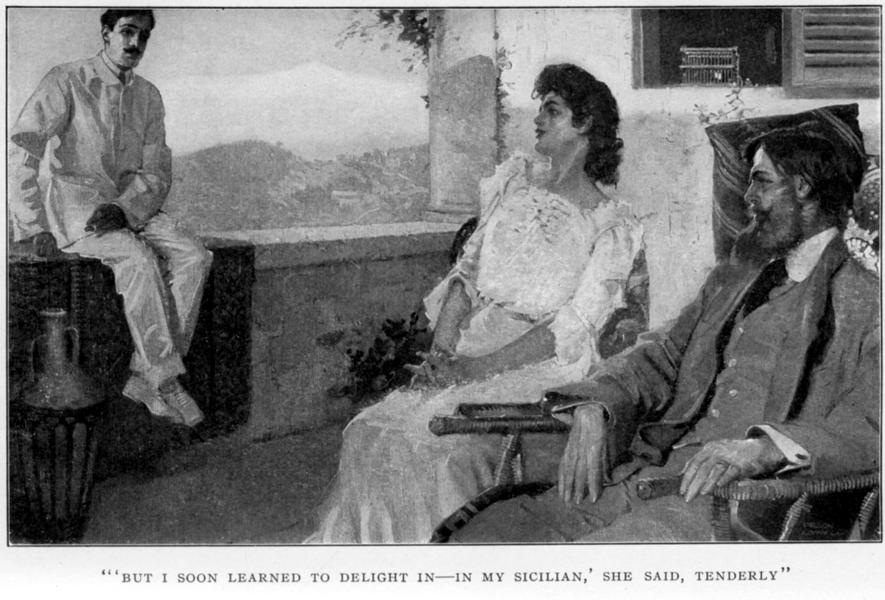 "'BUT I SOON LEARNED TO DELIGHT IN—IN MY SICILIAN,' SHE SAID, TENDERLY"
"Why?" he repeated, crossing one leg over the[Pg 367] other and laying his brown hands on the arms of the chair.
"I had a feeling that you were escaping from me in the tarantella. Wasn't it absurd?"
He looked slightly puzzled. She turned to Artois.
"Can you imagine what I felt, Emile? He danced so well that I seemed to see before me a pure-blooded Sicilian. It almost frightened me!"
She laughed.
"But I soon learned to delight in—in my Sicilian," she said, tenderly.
She felt so happy, so at ease, and she was so completely natural, that it did not occur to her that though she was with her husband and her most intimate friend the two men were really strangers to each other.
"You'll find that I'm quite English, when we are back in London," Maurice said. There was a cold sound of determination in his voice.
"Oh, but I don't want you to lose what you have gained here," Hermione protested, half laughingly, half tenderly.
"Gained!" Maurice said, still in the prosaic voice. "I don't think a Sicilian would be much good in England. We—we don't want romance there. We want cool-headed, practical men who can work, and who've no nonsense about them."
"Maurice!" she said, amazed. "What a cold douche! And from you! Why, what has happened to you while I've been away?"
"Happened to me?" he said, quickly. "Nothing. What should happen to me here?"
"Do you—are you beginning to long for England and English ways?"
"I think it's time I began to do something," he said, resolutely. "I think I've had a long enough holiday."
He was trying to put the past behind him. He was trying to rush into the new life, the life in which there[Pg 368] would be no more wildness, no more yielding to the hot impulses that were surely showered down out of the sun. Mentally he was leaving the Enchanted Island already. It was fading away, sinking into its purple sea, sinking out of his sight with his wild heart of youth, while he, cold, calm, resolute man, was facing the steady life befitting an Englishman, the life of work, of social duties, of husband and father, with a money-making ambition and a stake in his country.
"Perhaps you're right," Hermione said.
But there was a sound of disappointment in her voice. Till now Maurice had always shared her Sicilian enthusiasms, had even run before them, lighter-footed than she in the race towards the sunshine. It was difficult to accommodate herself to this abrupt change.
"But don't let us think of going to-day," she added. "Remember—I have only just come back."
"And I!" said Artois. "Be merciful to an invalid, Monsieur Delarey!"
He spoke lightly, but he felt fully conscious now that his suspicion was well founded. Maurice was uneasy, unhappy. He wanted to get away from this peace that held no peace for him. He wanted to put something behind him. To a man like Artois, Maurice was a boy. He might try to be subtle, he might even be subtle—for him. But to this acute and trained observer of the human comedy he could not for long be deceptive.
During his severe illness the mind of Artois had often been clouded, had been dispossessed of its throne by the clamor of the body's pain. And afterwards, when the agony passed and the fever abated, the mind had been lulled, charmed into a stagnant state that was delicious. But now it began to go again to its business. It began to work with the old rapidity that had for a time been lost. And as this power came back and was felt thoroughly, very consciously by this very conscious man, he took alarm. What affected or threatened De[Pg 369]larey must affect, threaten Hermione. Whether he were one with her or not she was one with him. The feeling of Artois towards the woman who had shown him such noble, such unusual friendship was exquisitely delicate and intensely strong. Unmingled with any bodily passion, it was, or so it seemed to him, the more delicate and strong on that account. He was a man who had an instinctive hatred of heroics. His taste revolted from them as it revolted from violence in literature. They seemed to him a coarseness, a crudity of the soul, and almost inevitably linked with secret falseness. But he was conscious that to protect from sorrow or shame the woman who had protected him in his dark hour he would be willing to make any sacrifice. There would be no limit to what he would be ready to do now, in this moment, for Hermione. He knew that, and he took the alarm. Till now he had been feeling curiosity about the change in Delarey. Now he felt the touch of fear.
Something had happened to change Maurice while Hermione had been in Africa. He had heard, perhaps, the call of the blood. All that he had said, and all that he had felt, on the night when he had met Maurice for the first time in London, came back to Artois. He had prophesied, vaguely perhaps. Had his prophecy already been fulfilled? In this great and shining peace of nature Maurice was not at peace. And now all sense of peace deserted Artois. Again, and fiercely now, he felt the danger of the South, and he added to his light words some words that were not light.
"But I am really no longer an invalid," he said. "And I must be getting northward very soon. I need the bracing air, the Spartan touch of the cold that the Sybarite in me dreads. Perhaps we all need them."
"If you go on like this, you two," Hermione exclaimed, "you will make me feel as if it were degraded to wish to live anywhere except at Clapham Junction or the North Pole. Let us be happy as we are, where we[Pg 370] are, to-day and—yes, call me weak if you like—and to-morrow!"
Maurice made no answer to this challenge, but Artois covered his silence, and kept the talk going on safe topics till Gaspare came to the terrace to lay the cloth for collazione.
It was past noon now, and the heat was brimming up like a flood over the land. Flies buzzed about the terrace, buzzed against the white walls and ceilings of the cottage, winding their tiny, sultry horns ceaselessly, musicians of the sun. The red geraniums in the stone pots beneath the broken columns drooped their dry heads. The lizards darted and stopped, darted and stopped upon the wall and the white seats where the tiles were burning to the touch. There was no moving figure on the baked mountains, no moving vessel on the shining sea. No smoke came from the snowless lips of Etna. It was as if the fires of the sun had beaten down and slain the fires of the earth.
Gaspare moved to and fro slowly, spreading the cloth, arranging the pots of flowers, the glasses, forks, and knives upon it. In his face there was little vivacity. But now and then his great eyes searched the hot world that lay beneath them, and Artois thought he saw in them the watchfulness, the strained anxiety that had been in Maurice's eyes.
"Some one must be coming," he thought. "Or they must be expecting some one to come, these two."
"Do you ever have visitors here?" he asked, carelessly.
"Visitors! Emile, why are we here? Do you anticipate a knock and 'If you please, ma'am, Mrs. and the Misses Watson'? Good Heavens—visitors on Monte Amato!"
He smiled, but he persisted.
"Never a contadino, or a shepherd, or"—he looked down at the sea—"or a fisherman with his basket of sarde?"[Pg 371]
Maurice moved in his chair, and Gaspare, hearing a word he knew, looked hard at the speaker.
"Oh, we sometimes have the people of the hills to see us," said Hermione. "But we don't call them 'visitors.' As to fishermen—here they are!"
She pointed to her husband and Gaspare.
"But they eat all the fish they catch, and we never see the fin of even one at the cottage."
Collazione was ready now. Hermione helped Artois up from his chaise longue, and they went to the table under the awning.
"You must sit facing the view, Emile," Hermione said.
"What a dining-room!" Artois exclaimed.
Now he could see over the wall. His gaze wandered over the mountain-sides, travelled down to the land that lay along the edge of the sea.
"Have you been fishing much since I've been away, Maurice?" Hermione asked, as they began to eat.
"Oh yes. I went several times. What wine do you like, Monsieur Artois?"
He tried to change the conversation, but Hermione, quite innocently, returned to the subject.
"They fish at night, you know, Emile, all along that coast by Isola Bella and on to the point there that looks like an island, where the House of the Sirens is."
A tortured look went across Maurice's face. He had begun to eat, but now he stopped for a moment like a man suddenly paralyzed.
"The House of the Sirens!" said Artois. "Then there are sirens here? I could well believe it. Have you seen them, Monsieur Maurice, at night, when you have been fishing?"
He had been gazing at the coast, but now he turned towards his host. Maurice began hastily to eat again.
"I'm afraid not. But we didn't look out for them. We were prosaic and thought of nothing but the fish."[Pg 372]
"And is there really a house down there?" said Artois.
"Yes," said Hermione. "It used to be a ruin, but now it's built up and occupied. Gaspare"—she spoke to him as he was taking a dish from the table—"who is it lives in the Casa delle Sirene now? You told me, but I've forgotten."
A heavy, obstinate look came into the boy's face, transforming it. The question startled him, and he had not understood a word of the conversation which had led up to it. What had they been talking about? He glanced furtively at his master. Maurice did not look at him.
"Salvatore and Maddalena, signora," he answered, after a pause.
Then he took the dish and went into the house.
"What's the matter with Gaspare?" said Hermione. "I never saw him look like that before—quite ugly. Doesn't he like these people?"
"Oh yes," replied Maurice. "Why—why, they're quite friends of ours. We saw them at the fair only yesterday."
"Well, then, why should Gaspare look like that?"
"Oh," said Artois, who saw the discomfort of his host, "perhaps there is some family feud that you know nothing of. When I was in Sicily I found the people singularly subtle. They can gossip terribly, but they can keep a secret when they choose. If I had won the real friendship of a Sicilian, I would rather trust him with my secret than a man of any other race. They are not only loyal—that is not enough—but they are also very intelligent."
"Yes, they are both—the good ones," said Hermione. "I would trust Gaspare through thick and thin. If they were only as stanch in love as they can be in friendship!"
Gaspare came out again with another course. The[Pg 373] ugly expression had gone from his face, but he still looked unusually grave.
"Ah, when the senses are roused they are changed beings," Artois said. "They hate and resent governance from outside, but their blood governs them."
"Our blood governs us when the time comes—do you remember?"
Hermione had said the words before she remembered the circumstances in which they had been spoken and of whom they were said. Directly she had uttered them she remembered.
"What was that?" Maurice asked, before Artois could reply.
He had seen a suddenly conscious look in Hermione's face, and instantly he was aware of a feeling of jealousy within him.
"What was that?" he repeated, looking quickly from one to the other.
"Something I remember saying to your wife," Artois answered. "We were talking about human nature—a small subject, monsieur, isn't it?—and I think I expressed the view of a fatalist. At any rate, I did say that—that our blood governs us when the time comes."
"The time?" Maurice asked.
His feeling of jealousy died away, and was replaced by a keen personal interest unmingled with suspicions of another.
"Well, I confess it sometimes seems to me as if, when a certain hour strikes, a certain deed must be committed by a certain man or woman. It is perhaps their hour of madness. They may repent it to the day of their death. But can they in that hour avoid that deed? Sometimes, when I witness the tragic scenes that occur abruptly, unexpectedly, in the comedy of life, I am moved to wonder."
"Then you should be very forgiving, Emile," Hermione said.[Pg 374]
"And you?" he asked. "Are you, or would you be, forgiving?"
Maurice leaned forward on the table and looked at his wife with intensity.
"I hope so, but I don't think it would be for that—I mean because I thought the deed might not have been avoided. I think I should forgive because I pitied so, because I know how desperately unhappy I should be myself if I were to do a hateful thing, a thing that was exceptional, that was not natural to my nature as I had generally known it. When one really does love cleanliness, to have thrown one's self down deliberately in the mud, to see, to feel, that one is soiled from head to foot—that must be terrible. I think I should forgive because I pitied so. What do you say, Maurice?"
It was like a return to their talk in London at Caminiti's restaurant, when Hermione and Artois discussed topics that interested them, and Maurice listened until Hermione appealed to him for his opinion. But now he was more deeply interested than his companions.
"I don't know," he said. "I don't know about pitying and forgiving, but I expect you're right, Hermione."
"How?"
"In what you say about—about the person who's done the wrong thing feeling awful afterwards. And I think Monsieur Artois is right, too—about the hour of madness. I'm sure he is right. Sometimes an hour comes and one seems to forget everything in it. One seems not to be really one's self in it, but somebody else, and—and—"
Suddenly he seemed to become aware that, whereas Hermione and Artois had been considering a subject impersonally, he was introducing the personal element into the conversation. He stopped short, looked quickly from Hermione to Artois, and said:
"What I mean is that I imagine it's so, and that I've known fellows—in London, you know—who've done[Pg 375] such odd things that I can only explain it like that. They must have—well, they must have gone practically mad for the moment. You—you see what I mean, Hermione?"
The question was uneasy.
"Yes, but I think we can control ourselves. If we couldn't, remorse would lose half its meaning. I could never feel remorse because I had been mad—horror, perhaps, but not remorse. It seems to me that remorse is our sorrow for our own weakness, the heart's cry of 'I need not have done the hateful thing, and I did it, I chose to do it!' But I could pity, I could pity, and forgive because of my pity."
Gaspare came out with coffee.
"And then, Emile, you must have a siesta," said Hermione. "This is a tiring day for you. Maurice and I will leave you quite alone in the sitting-room."
"I don't think I could sleep," said Artois.
He was feeling oddly excited, and attributed the sensation to his weak state of health. For so long he had been shut up, isolated from the world, that even this coming out was an event. He was accustomed to examine his feelings calmly, critically, to track them to their sources. He tried to do so now.
"I must beware of my own extra sensitiveness," he said to himself. "I'm still weak. I am not normal. I may see things distorted. I may exaggerate, turn the small into the great. At least half of what I think and feel to-day may come from my peculiar state."
Thus he tried to raise up barriers against his feeling that Delarey had got into some terrible trouble during the absence of Hermione, that he was now stricken with remorse, and that he was also in active dread of something, perhaps of some Nemesis.
"All this may be imagination," Artois thought, as he sipped his coffee. But he said again:
"I don't think I could sleep. I feel abnormally alive[Pg 376] to-day. Do you know the sensation, as if one were too quick, as if all the nerves were standing at attention?"
"Then our peace here does not soothe you?" Hermione said.
"If I must be truthful—no," he answered.
He met Maurice's restless glance.
"I think I've had enough coffee," he added. "Coffee stimulates the nerves too much at certain times."
Maurice finished his and asked for another cup.
"He isn't afraid of being overstimulated," said Hermione. "But, Emile, you ought to sleep. You'll be dead tired this evening when you ride down."
"This evening," Hermione had said. Maurice wondered suddenly how late Artois was going to stay at the cottage.
"Oh no, it will be cool," Artois said.
"Yes," Maurice said. "Towards five we get a little wind from the sea nearly always, even sooner sometimes. I—I usually go down to bathe about that time."
"I must begin to bathe, too," Hermione said.
"What—to-day!" Maurice said, quickly.
"Oh no. Emile is here to-day."
Then Artois did not mean to go till late. But he—Maurice—must go down to the sea before nightfall.
"Unless I bathe," he said, trying to speak naturally—"unless I bathe I feel the heat too much at night. A dip in the sea does wonders for me."
"And in such a sea!" said Artois. "You must have your dip to-day. I shall go directly that little wind you speak of comes. I told a boy to come up from the village at four to lead the donkey down."
He smiled deprecatingly.
"Dreadful to be such a weakling, isn't it?" he said.
"Hush. Don't talk, like that. It's all going away. Strength is coming. You'll soon be your old self. But you've got to look forward all the time."[Pg 377]
Hermione spoke with a warmth, an energy that braced. She spoke to Artois, but Maurice, eager to grasp at any comfort, strove to take the words to himself. This evening the climax of his Sicilian tragedy must come. And then? Beyond, might there not be the calm, the happiness of a sane life? He must look forward, he would look forward.
But when he looked, there stood Maddalena weeping.
He hated himself. He loved happiness, he longed for it, but he knew he had lost his right to it, if any man ever has such a right. He had created suffering. How dared he expect, how dared he even wish, to escape from suffering?
"Now, Emile," Hermione said, "you have really got to go in and lie down whether you feel sleepy or not. Don't protest. Maurice and I have hardly seen anything of each other yet. We want to get rid of you."
She spoke laughingly, and laughingly he obeyed her.
When she had settled him comfortably in the sitting-room
she came out again to the terrace where her husband
was standing, looking towards the sea. She had
a rug over her arm and was holding two cushions.
"I thought you and I might go down and take our siesta under the oak-trees, Maurice. Would you like that?"
He was longing to get away, to go up to the heap of stones on the mountain-top and set a match to the fragments of Hermione's letter, which the dangerous wind might disturb, might bring out into the light of day. But he acquiesced at once. He would go later—if not this afternoon, then at night when he came back from the sea. They went down and spread the rug under the shadow of the oaks.
"I used to read to Gaspare here," he said. "When you were away in Africa."
"What did you read?"
"The Arabian Nights."[Pg 378]
She stretched herself on the rug.
"To lie here and read the Arabian Nights! And you want to go away, Maurice?"
"I think it's time to go. If I stayed too long here I should become fit for nothing."
"Yes, that's true, I dare say. But—Maurice, it's so strange—I have a feeling as if you would always be in Sicily. I know it's absurd, and yet I have it. I feel as if you belonged to Sicily, and Sicily did not mean to part from you."
"That can't be. How could I stay here always?"
"I know."
"Unless," he said, as if some new thought had started suddenly into his mind—"unless I were—"
He stopped. He had remembered his sensation in the sea that gray morning of sirocco. He had remembered how he had played at dying.
"What?"
She looked at him and understood.
"Maurice—don't! I—I can't bear that!"
"Not one of us can know," he answered.
"I—I thought of that once," she said—"long ago, on the first night that we were here. I don't know why—but perhaps it was because I was so happy. I think it must have been that. I suppose, in this world, there must aways be dread in one's happiness, the thought it may stop soon, it may end. But why should it? Is God cruel? I think He wants us to be happy."
"If he wants us—"
"And that we prevent ourselves from being happy. But we won't do that, Maurice—you and I—will we?"
He did not answer.
"This world—nature—is so wonderfully beautiful, so happily beautiful. Surely we can learn to be happy, to keep happy in it. Look at that sky, that sea! Look at the plain over there by the foot of Etna, and the coast-line fading away, and Etna. The God who created[Pg 379] it all must have meant men to be happy in such a world. It isn't my brain tells me that, Maurice, it's my heart, my whole heart that you have made whole. And I know it tells the truth."
Her words were terrible to him. The sound of a step, a figure standing before her, a few Sicilian words—and all this world in which she gloried would be changed for her. But she must not know. He felt that he would be willing to die to keep her ignorant of the truth forever.
"Now we must try to sleep," he said, to prevent her from speaking any more of the words that were torturing him. "We must have our siesta. I had very little sleep last night."
"And I had none at all. But now—we're together."
He arranged the cushion for her. They lay in soft shadow and could see the shining world. The distant gleams upon the sea spoke to her. She fancied them voices rising out of the dream of the waters, voices from the breast of nature that was the breast of God, saying that she was not in error, that God did mean men to be happy, that they could be happy if they would learn of Him.
She watched those gleams until she fell asleep.[Pg 380]
When Hermione woke it was four o'clock. She sat up on the rug, looked down over the mountain flank to the sea, then turned and saw her husband. He was lying with his face half buried in his folded arms.
"Maurice!" she said, softly.
"Yes," he answered, lifting his face.
"Then you weren't asleep!"
"No."
"Have you been asleep?"
"No."
She looked at her watch.
"All this time! It's four. What a disgraceful siesta! But I was really tired after the long journey and the night."
She stood up. He followed her example and threw the rug over his arm.
"Emile will think we've deserted him and aren't going to give him any tea."
"Yes."
They began to walk up the track towards the terrace.
"Maurice," Hermione said, presently, more thoroughly wide-awake now. "Did you get up while I was asleep? Did you begin to move away from me, and did I stop you, or was it a dream? I have a kind of vague recollection—or is it only imagination?—of stretching out my hand and saying, 'Don't leave me alone—don't leave me alone!'"
"I moved a little," he answered, after a slight pause.[Pg 381]
"And you did stretch out your hand and murmur something."
"It was that—'don't leave me alone.'"
"Perhaps. I couldn't hear. It was such a murmur."
"And you only moved a little? How stupid of me to think you were getting up to go away!"
"When one is half asleep one has odd ideas often."
He did not tell her that he had been getting up softly, hoping to steal away to the mountain-top and destroy the fragments of her letter, hidden there, while she slept.
"You won't mind," he added, "if I go down to bathe this evening. I sha'n't sleep properly to-night unless I do."
"Of course—go. But won't it be rather late after tea?"
"Oh no. I've often been in at sunset."
"How delicious the water must look then! Maurice!"
"Yes?"
"Shall I come with you? Shall I bathe, too? It would be lovely, refreshing, after this heat! It would wash away all the dust of the train!"
Her face was glowing with the anticipation of pleasure. Every little thing done with him was an enchantment after the weeks of separation.
"Oh, I don't think you'd better, Hermione," he answered, hastily. "I—you—there might be people. I—I must rig you up something first, a tent of some kind. Gaspare and I will do it. I can't have my wife—"
"All right," she said.
She tried to keep the disappointment out of her voice.
"How lucky you men are! You can do anything. And there's no fuss. Ah, there's poor Emile, patiently waiting!"
Artois was already established once more in the chaise longue. He greeted them with a smile that was gentle, almost tender. Those evil feelings to which he had been a prey in London had died away. He loved[Pg 382] now to see the happiness in Hermione's face. His illness had swept out his selfishness, and in it he had proved her affection. He did not think that he could ever be jealous of her again.
"Sleeping all this time?" he said.
"I was. I'm ashamed of myself. My hair is full of mountain-side, but you must forgive me, Emile. Ah, there's Lucrezia! Is tea ready, Lucrezia?"
"Si, signora."
"Then ask Gaspare to bring it."
"Gaspare—he isn't here, signora. But I'll bring it."
She went away.
"Where's Gaspare, I wonder?" said Hermione. "Have you seen him, Emile?"
"No."
"Perhaps he's sleeping, too. He sleeps generally among the hens."
She looked round the corner into the out-house.
"No, he isn't there. Have you sent him anywhere, Maurice?"
"I? No. Where should I—"
"I only thought you looked as if you knew where he was."
"No. But he may have gone out after birds and forgotten the time. Here's tea!"
These few words had renewed in Maurice the fever of impatience to get away and meet his enemy. This waiting, this acting of a part, this suspense, were almost unbearable. All the time that Hermione slept he had been thinking, turning over again and again in his mind the coming scene, trying to imagine how it would be, how violent or how deadly, trying to decide exactly what line of conduct he should pursue. What would Salvatore demand? What would he say or do? And where would they meet? If Salvatore waited for his coming they would meet at the House of the Sirens. And Maddalena? She would be there. His heart[Pg 383] sickened. He was ready to face a man—but not Maddalena. He thought of Gaspare's story of the fallen olive-branch upon which Salvatore had spat. It was strange to be here in this calm place with these two happy people, wife and friend, and to wonder what was waiting for him down there by the sea.
How lonely our souls are!—something like that he thought. Circumstances were turning him away from his thoughtless youth. He had imagined it sinking down out of his sight into the purple sea, with the magic island in which it had danced the tarantella and heard the voice of the siren. But was it not leaving him, vanishing from him while still his feet trod the island and his eyes saw her legendary mountains?
Gaspare, he knew, was on the watch. That was why he was absent from his duties. But the hour was at hand when he would be relieved. The evening was coming. Maurice was glad. He was ready to face even violence, but he felt that he could not for much longer endure suspense and play the quiet host and husband.
Tea was over and Gaspare had not returned. The clock he had bought at the fair struck five.
"I ought to be going," Artois said.
There was reluctance in his voice. Hermione noticed it and knew what he was feeling.
"You must come up again very soon," she said.
"Yes, monsieur, come to-morrow, won't you?" Maurice seconded her.
The thought of what was going to happen before to-morrow made it seem to him a very long way off.
Hermione looked pleased.
"I must not be a bore," Artois answered. "I must not remind you and myself of limpets. There are rocks in your garden which might suggest the comparison. I think to-morrow I ought to stay quietly in Marechiaro."
"No, no," said Maurice. "Do come to-morrow."
"Thank you very much. I can't pretend that I do[Pg 384] not wish to come. And, now that donkey-boy—has he climbed up, I wonder?"
"I'll go and see," said Maurice.
He was feverishly impatient to get rid of Artois. He hurried to the arch. A long way off, near the path that led up from the ravine, he saw a figure with a gun. He was not sure, but he was almost sure that it was Gaspare. It must be he. The gun made him look, indeed, a sentinel. If Salvatore came the boy would stop him, stop him, if need be, at the cost of his own life. Maurice felt sure of that, and realized the danger of setting such faithfulness and violence to be sentinel. He stood for a moment looking at the figure. Yes, he knew it now for Gaspare. The boy had forgotten tea-time, had forgotten everything, in his desire to carry out his padrone's instructions. The signora was not to know. She was never to know. And Salvatore might come. Very well, then, he was there in the sun—ready.
"We'll never part from Gaspare," Maurice thought, as he looked and understood.
He saw no other figure. The donkey-boy had perhaps forgotten his mission or had started late. Maurice chafed bitterly at the delay. But he could not well leave his guest on this first day of his coming to Monte Amato, more especially after the events of the preceding day. To do so would seem discourteous. He returned to the terrace ill at ease, but strove to disguise his restlessness. It was nearly six o'clock when the boy at last appeared. Artois at once bade Hermione and Maurice good-bye and mounted his donkey.
"You will come to-morrow, then?" Maurice said to him at parting.
"I haven't the courage to refuse," Artois replied. "Good-bye."
He had already shaken Maurice's hand, but now he extended his hand again.
"It is good of you to make me so welcome," he said.[Pg 385]
He paused, holding Maurice's hand in his. Both Hermione and Maurice thought he was going to say something more, but he glanced at her, dropped his host's hand, lifted his soft hat, and signed to the boy to lead the donkey away.
Hermione and Maurice followed to the arch, and from there watched him riding slowly down till he was out of sight. Maurice looked for Gaspare, but did not see him. He must have moved into the shadow of the ravine.
"Dear old Emile!" Hermione said. "He's been happy to-day. You've made him very happy, Maurice. Bless you for it!"
Maurice said nothing. Now the moment had arrived when he could go he felt a strange reluctance to say good-bye to Hermione, even for a short time. So much might—must—happen before he saw her again that evening.
"And you?" she said, at last, as he was silent. "Are you really going down to bathe? Isn't it too late?"
"Oh no. I must have a dip. It will do me all the good in the world." He tried to speak buoyantly, but the words seemed to himself to come heavily from his tongue.
"Will you take Tito?"
"I—no, I think I'll walk. I shall get down quicker, and I like going into the sea when I'm hot. I'll just fetch my bathing things."
They walked back together to the house. Maurice wondered what had suddenly come to him. He felt horribly sad now—yet he wished to get the scene that awaited him over. He was longing to have it over. He went into the house, got his bathing-dress and towels, and came out again onto the terrace.
"I shall be a little late back, I suppose," he said.
"Yes. It's six o'clock now. Shall we dine at half-past eight—or better say nine? That will give you plenty of time to come up quietly."[Pg 386]
"Yes. Let's say nine."
Still he did not move to go.
"Have you been happy to-day, Hermione?" he asked.
"Yes, very—since this morning."
"Since?"
"Yes. This morning I—"
She stopped.
"I was a little puzzled," she said, after a minute, with her usual frankness. "Tell me, Maurice—you weren't made unhappy by—by what I told you?"
"About—about the child?"
"Yes."
He did not answer with words, but he put his arms about her and kissed her, as he had not kissed her since she went away to Africa. She shut her eyes. Presently she felt the pressure of his arms relax.
"I'm perfectly happy now," she said. "Perfectly happy."
He moved away a step or two. His face was flushed, and she thought that he looked younger, that the boyish expression she loved had come back to him.
"Good-bye, Hermione," he said.
Still he did not go. She thought that he had something more to say but did not know how to say it. She felt so certain of this that she said:
"What is it, Maurice?"
"We shall come back to Sicily, I suppose, sha'n't we, some time or other?"
"Surely. Many times, I hope."
"Suppose—one can never tell what will happen—suppose one of us were to die here?"
"Yes," she said, soberly.
"Don't you think it would be good to lie there where we lay this afternoon, under the oak-trees, in sight of Etna and the sea? I think it would. Good-bye, Hermione."
He swung the bathing-dress and the towels up over[Pg 387] his shoulder and went away through the arch. She followed and watched him springing down the mountain-side. Just before he reached the ravine he turned and waved his hand to her. His movements, that last gesture, were brimful of energy and of life. He acted better then than he had that day upon the terrace. But the sense of progress, the feeling that he was going to meet fate in the person of Salvatore, quickened the blood within him. At last the suspense would be over. At last he would be obliged to play not the actor but the man. He longed to be down by the sea. The youth in him rose up at the thought of action, and his last farewell to Hermione, looking down to him from the arch, was bold and almost careless.
Scarcely had he got into the ravine before he met Gaspare. He stopped. The boy's face was aflame with expression as he stood, holding his gun, in front of his padrone.
"Gaspare!" Maurice said to him.
He held out his hand and grasped the boy's hot hand.
"I sha'n't forget your faithful service," he said. "Thank you, Gaspare."
He wanted to say more, to find other and far different words. But he could not.
"Let me come with you, signorino."
The boy's voice was intensely, almost savagely, earnest.
"No. You must stay with the signora."
"I want to come with you."
His great eyes were fastened on his padrone's face.
"I have always been with you."
"But you were with the signora first. You were her servant. You must stay with her now. Remember one thing, Gaspare—the signora is never to know."
The boy nodded. His eyes still held Maurice. They glittered as if with leaping fires. That deep and passionate spirit of Sicilian loyalty, which is almost savage in its[Pg 388] intensity and heedless of danger, which is ready to go to hell with, or for, a friend or a master who is beloved and believed in, was awake in Gaspare, illuminated him at this moment. The peasant boy looked noble.
"Mayn't I come with you, signorino?"
"Gaspare," Maurice said, "I must leave some one with the padrona. Salvatore might come still. I may miss him going down. Whom can I trust to stop Salvatore, if he comes, but you? You see?"
"Va bene, signorino."
The boy seemed convinced, but he suffered and did not try to conceal it.
"Now I must go," Maurice said.
He shook Gaspare's hand.
"Have you got the revolver, signorino?" said the boy.
"No. I am not going to fight with Salvatore."
"How do you know what Salvatore will do?"
Maurice looked down upon the stones that lay on the narrow path.
"My revolver can have nothing to do with Maddalena's father," he said.
He sighed.
"That's how it is, Gaspare. Addio!"
"Addio, signorino."
Maurice went on down the path into the shadow of the trees. Presently he turned. Gaspare stood quite still, looking after him.
"Signorino!" he called. "May I not come? I want to come with you."
Maurice waved his hand towards the mountain-side.
"Go to the signora," he called back. "And look out for me to-night. Addio, Gaspare!"
The boy's "Addio!" came to him sadly through the gathering shadows of the evening.
Presently Hermione, who was sitting alone on the terrace with a book in her lap which she was not reading, saw Gaspare walking listlessly through the archway[Pg 389] holding his gun. He came slowly towards her, lifted his hat, and was going on without a word, but she stopped him.
"Why, Gaspare," she said, lightly, "you forgot us to-day. How was that?"
"Signora?"
Again she saw the curious, almost ugly, look of obstinacy, which she had already noticed, come into his face.
"You didn't remember about tea-time!"
"Signora," he answered, "I am sorry."
He looked at her fixedly while he spoke.
"I am sorry," he said again.
"Never mind," Hermione said, unable to blame him on this first day of her return. "I dare say you have got out of regular habits while I've been away. What have you been doing all the time?"
He shrugged his shoulders.
"Niente."
Again she wondered what was the matter with the boy to-day. Where were his life and gayety? Where was his sense of fun? He used to be always joking, singing. But now he was serious, almost heavy in demeanor.
"Gaspare," she said, jokingly, "I think you've all become very solemn without me. I am the old person of the party, but I begin to believe that it is I who keep you lively. I mustn't go away again."
"No, signora," he answered, earnestly; "you must never go away from us again. You should never have gone away from us."
The deep solemnity of his great eyes startled her. He put on his hat and went away round the angle of the cottage.
"What can be the matter with him?" she thought.
She remained sitting there on the terrace, wondering. Now she thought over things quietly, it struck her as strange the fact that she had left behind her in the[Pg 390] priest's house three light-hearted people, and had come back to find Lucrezia drowned in sorrow, Gaspare solemn, even mysterious in his manner, and her husband—but here her thoughts paused, not labelling Maurice. At first he had puzzled her the most. But she thought she had found reasons for the change—a passing one, she felt sure—in him. He had secretly resented her absence, and, though utterly free from any ignoble suspicion of her, he had felt boyishly jealous of her friendship with Emile. That was very natural. For this was their honeymoon. She considered it their honeymoon prolonged, delightfully prolonged, beyond any fashionable limit. Lucrezia's depression was easily comprehensible. The change in her husband she accounted for; but now here was Gaspare looking dismal!
"I must cheer them all up," she thought to herself. "This beautiful time mustn't end dismally."
And then she thought of the inevitable departure. Was Maurice looking forward to it, desiring it? He had spoken that day as if he wished to be off. In London she had been able to imagine him in the South, in the highway of the sun. But now that she was here in Sicily she could not imagine him in London.
"He is not in his right place there," she thought.
Yet they must go, and soon. She knew that they were going, and yet she could not feel that they were going. What she had said under the oak-trees was true. In the spring her tender imagination had played softly with the idea of Sicily's joy in the possession of her son, of Maurice. Would Sicily part from him without an effort to retain him? Would Sicily let him go? She smiled to herself at her fancies. But if Sicily kept him, how would she keep him? The smile left her lips and her eyes as she thought of Maurice's suggestion. That would be too horrible. God would not allow that. And yet what tragedies He allowed to come into the lives of others. She faced certain facts, as she sat there, facts[Pg 391] permitted, or deliberately brought about by the Divine Will. The scourge of war—that sowed sorrows over a land as the sower in the field scatters seeds. She, like others, had sat at home and read of battles in which thousands of men had been killed, and she had grieved—or had she really grieved, grieved with her heart? She began to wonder, thinking of Maurice's veiled allusion to the possibility of his death. He was the spirit of youth to her. And all the boys slain in battle! Had not each one of them represented the spirit of youth to some one, to some woman—mother, sister, wife, lover?
What were those women's feelings towards God?
She wondered. She wondered exceedingly. And presently a terrible thought came into her mind. It was this. How can one forgive God if He snatches away the spirit of youth that one loves?
Under the shadow of the oak-trees she had lain that day and looked out upon the shining world—upon the waters, upon the plains, upon the mountains, upon the calling coast-line and the deep passion of the blue. And she had felt the infinite love of God. When she had thought of God, she had thought of Him as the great Provider of happiness, as One who desired, with a heart too large and generous for the mere accurate conception of man, the joy of man.
But Maurice was beside her then.
Those whose lives had been ruined by great tragedies, when they looked out upon the shining world what must they think, feel?
She strove to imagine. Their conception of God must surely be very different from hers.
Once she had been almost unable to believe that God could choose her to be the recipient of a supreme happiness. But we accustom ourselves with a wonderful readiness to a happy fate. She had come back—she had been allowed to return to the Garden of Paradise. And this fact had given to her a confidence in life which[Pg 392] was almost audacious. So now, even while she imagined the sorrows of others, half strove to imagine what her own sorrows might be, her inner feeling was still one of confidence. She looked out on the shining world, and in her heart was the shining world. She looked out on the glory of the blue, and in her heart was the glory of the blue. The world shone for her because she had Maurice. She knew that. But there was light in it. There would always be light whatever happened to any human creature. There would always be the sun, the great symbol of joy. It rose even upon the battle-field where the heaps of the dead were lying.
She could not realize sorrow to-day. She must see the sunlight even in the deliberate visions conjured up by her imagination.
Gaspare did not reappear. For a long time she was alone. She watched the changing of the light, the softening of the great landscape as the evening approached. Sometimes she thought of Maurice's last words about being laid to rest some day in the shadows of the oak-trees, in sight of Etna and the sea. When the years had gone, perhaps they would lie together in Sicily, wrapped in the final siesta of the body. Perhaps the unborn child, of whose beginning she was mystically conscious, would lay them to rest there.
"Buon riposo." She loved the Sicilian good-night. Better than any text she would love to have those simple words written above her sleeping-place and his. "Buon riposo!"—she murmured the words to herself as she looked at the quiet of the hills, at the quiet of the sea. The glory of the world was inspiring, but the peace of the world was almost more uplifting, she thought. Far off, in the plain, she discerned tiny trails of smoke from Sicilian houses among the orange-trees beside the sea. The gold was fading. The color of the waters was growing paler, gentler, the color of the sky less passionate. The last point of the coast-line was only a shadow now,[Pg 393] scarcely that. Somewhere was the sunset, its wonder unseen by her, but realized because of this growing tenderness, that was like a benediction falling upon her from a distant love, intent to shield her and her little home from sorrow and from danger. Nature was whispering her "Buon riposo!" Her hushed voice spoke withdrawn among the mountains, withdrawn upon the spaces of the sea. The heat of the golden day was blessed, but after it how blessed was the cool of the dim night!
Again she thought that the God who had placed man in the magnificent scheme of the world must have intended and wished him to be always happy there. Nature seemed to be telling her this, and her heart was convinced by Nature, though the story of the Old Testament had sometimes left her smiling or left her wondering. Men had written a Bible. God had written a Bible, too. And here she read its pages and was made strong by it.
"Signora!"
Hermione started and turned her head.
"Lucrezia! What is it?"
"What time is it, signora?"
Hermione looked at her watch.
"Nearly eight o'clock. An hour still before supper."
"I've got everything ready."
"To-night we've only cold things, haven't we? You made us a very nice collazione. The French signore praised your cooking, and he's very particular, as French people generally are. So you ought to be proud of yourself."
Lucrezia smiled, but only for an instant. Then she stood with an anxious face, twisting her apron.
"Signora!"
"Yes? What is it?"
"Would you mind—may I—"
She stopped.[Pg 394]
"Why, Lucrezia, are you afraid of me? I've certainly been away too long!"
"No, no, signora, but—" Tears hung in her eyes. "Will you let me go away if I promise to be back by nine?"
"But you can't go to Marechiaro in—"
"No, signora. I only want to go to the mountain over there under Castel Vecchio. I want to go to the Madonna."
Hermione took one of the girl's hands.
"To the Madonna della Rocca?"
"Si, signora."
"I understand."
"I have a candle to burn to the Madonna. If I go now I can be back before nine."
She stood gazing pathetically, like a big child, at her padrona.
"Lucrezia," Hermione said, moved to a great pity by her own great happiness, "would you mind if I came, too? I think I should like to say a prayer for you to-night. I am not a Catholic, but my prayer cannot hurt you."
Lucrezia suddenly forgot distinctions, threw her arms round Hermione, and began to sob.
"Hush, you must be brave!"
She smoothed the girl's dark hair gently.
"Have you got your candle?"
"Si."
She showed it.
"Let us go quickly, then. Where's Gaspare?"
"Close to the house, signora, on the mountain. One cannot speak with him to-day."
"Why not?"
"Non lo so. But he is terrible to-day!"
So Lucrezia had noticed Gaspare's strangeness, too, even in the midst of her sorrow!
"Gaspare!" Hermione called.
There was no answer.[Pg 395]
"Gaspare!"
She called louder.
"Si, signora!"
The voice came from somewhere behind the house.
"I am going for a walk with Lucrezia. We shall be back at nine. Tell the padrone if he comes."
"Si, signora."
The two women set out without seeing Gaspare. They walked in silence down the mountain-path. Lucrezia held her candle carefully, like one in a procession. She was not sobbing now. There were no tears in her eyes. The companionship and the sympathy of her padrona had given her some courage, some hope, had taken away from her the desolate feeling, the sensation of abandonment which had been torturing her. And then she had an almost blind faith in the Madonna della Rocca. And the padrona was going to pray, too. She was not a Catholic, but she was a lady and she was good. The Madonna della Rocca must surely be influenced by her petition.
So Lucrezia plucked up a little courage. The activity of the walk helped her. She knew the solace of movement. And perhaps, without being conscious of it, she was influenced by the soft beauty of the evening, by the peace of the hills. But as they crossed the ravine they heard the tinkle of bells, and a procession of goats tripped by them, following a boy who was twittering upon a flute. He was playing the tune of the tarantella, that tune which Hermione associated with careless joy in the sun. He passed down into the shadows of the trees, and gradually the airy rapture of his fluting and the tinkle of the goat-bells died away towards Marechiaro. Then Hermione saw tears rolling down over Lucrezia's brown cheeks.
"He can't play it like Sebastiano, signora!" she said.
The little tune had brought back all her sorrow.[Pg 396]
"Perhaps we shall soon hear Sebastiano play it again," said Hermione.
They began to climb upward on the far side of the ravine towards the fierce silhouette of the Saracenic castle on the height. Beneath the great crag on which it was perched was the shrine of the Madonna della Rocca. Night was coming now, and the little lamp before the shrine shone gently, throwing a ray of light upon the stones of the path. When they reached it, Lucrezia crossed herself, and they stood together for a moment looking at the faded painting of the Madonna, almost effaced against its rocky background. Within the glass that sheltered it stood vases of artificial flowers, and on the ledge outside the glass were two or three bunches of real flowers, placed there by peasants returning to their homes in Castel Vecchio from their labors in the vineyards and the orchards. There were also two branches with clustering, red-gold oranges lying among the flowers. It was a strange, wild place. The precipice of rock, which the castello dominated, leaned slightly forward above the head of the Madonna, as if it meditated overwhelming her. But she smiled gently, as if she had no fear of it, bending down her pale eyes to the child who lay upon her girlish knees. Among the bowlders, the wild cactus showed its spiked leaves, and in the daytime the long black snakes sunned themselves upon the stones.
To Hermione this lonely and faded Madonna, smiling calmly beneath the savagely frowning rock upon which dead men had built long years ago a barbarous fastness, was touching in her solitude. There was something appealing in her frailness, in her thin, anæmic calm. How long had she been here? How long would she remain? She was fading away, as things fade in the night. Yet she had probably endured for years, would still be here for years to come, would be here to receive the wild flowers of peasant children, the prayers of[Pg 397] peasant lovers, the adoration of the poor, who, having very little here, put their faith in far-off worlds, where they will have harvests surely without reaping in the heat of the sun, where they will have good wine without laboring in the vineyards, where they will be able to rest without the thought coming to them, "If to-day I rest, to-morrow I shall starve."
As Hermione looked at the painting lit by the little lamp, at the gifts of the flowers and the fruit, she began to feel as if indeed a woman dwelt there, in that niche of the crag, as if a heart were there, a soul to pity, an ear to listen.
Lucrezia knelt down quietly, lit her candle, turned it upside down till the hot wax dripped onto the rock and made a foundation for it, then stuck it upright, crossed herself silently, and began to pray. Her lips moved quickly. The candle-flame flickered for a moment, then burned steadily, sending its thin fire up towards the evening star. After a moment Hermione knelt down beside her.
She had never before prayed at a shrine. It was curious to be kneeling under this savage wall of rock above which the evening star showed itself in the clear heaven of night. She looked at the star and at the Madonna, then at the little bunches of flowers, and at Lucrezia's candle. These gifts of the poor moved her heart. Poverty giving is beautiful. She thought that, and was almost ashamed of the comfort of her life. She wished she had brought a candle, too. Then she bent her head and began to pray that Sebastiano might remember Lucrezia and return to her. To make her prayer more earnest, she tried to realize Lucrezia's sorrow by putting herself in Lucrezia's place, and Maurice in Sebastiano's. It was such a natural effort as people make every day, every hour. If Maurice had forgotten her in absence, had given his love to another, had not cared to return to her! If she were alone now in Sicily[Pg 398] while he was somewhere else, happy with some one else!
Suddenly the wildness of this place where she knelt became terrible to her. She felt the horror of solitude, of approaching darkness. The outlines of the rocks and of the ruined castle looked threatening, alarming. The pale light of the lamp before the shrine and of Lucrezia's votive candle drew to them not only the fluttering night-moths, but the spirits of desolation and of hollow grief that dwell among the waste places and among the hills. Night seemed no more beneficent, but dreary as a spectre that came to rob the world of all that made it beautiful. The loneliness of deserted women encompassed her. Was there any other loneliness comparable to it?
She felt sure that there was not, and she found herself praying not only for Lucrezia, but for all women who were sad because they loved, for all women who were deserted by those whom they loved, or who had lost those whom they loved.
At first she believed that she was addressing her prayer to the Madonna della Rocca, the Blessed Virgin of the Rocks, whose pale image was before her. But presently she knew that her words, the words of her lips and the more passionate words of her heart, were going out to a Being before whom the sun burned as a lamp and the moon as a votive taper. She was thinking of women, she was praying for women, but she was no longer praying to a woman. It seemed to her as if she was so ardent a suitor that she pushed past the Holy Mother of God into the presence of God Himself. He had created women. He had created the love of women. To Him she would, she must, appeal.
Often she had prayed before, but never as now, never with such passion, with such a sensation of personally pleading. The effort of her heart was like the effort of womanhood. It seemed to her—and she had no feeling that this was blasphemous—as if God knew, understood,[Pg 399] everything of the world He had created except perhaps this—the inmost agony some women suffer, as if she, perhaps, could make Him understand this by her prayer. And she strove to recount this agony, to make it clear to God.
Was it a presumptuous effort? She did not feel that it was. And now she felt selfless. She was no more thinking of herself, was no longer obliged to concentrate her thoughts and her imagination upon herself and the one she loved best. She had passed beyond that, as she had passed beyond the Madonna della Rocca. She was the voice and the heart not of a woman, but of woman praying in the night to the God who had made woman and the night.
From behind a rock Gaspare watched the two praying women. He had not forgotten his padrone's words, and when Hermione and Lucrezia set off from the cottage he had followed them, faithful to his trust. Intent upon their errand, they had not seen him. His step was light among the stones, and he had kept at a distance. Now he stood still, gazing at them as they prayed.
Gaspare did not believe in priests. Very few Sicilians do. An uncle of his was a priest's son, and he had other reasons, quite sufficient to his mind, for being incredulous of the sanctity of those who celebrated the mass to which he seldom went. But he believed in God, and he believed superstitiously in the efficacy of the Madonna and in the powers of the saints. Once his little brother had fallen dangerously ill on the festa of San Giorgio, the santo patrono of Castel Vecchio. He had gone to the festa, and had given all his money, five lire, to the saint to heal his brother. Next day the child was well. In misfortune he would probably utter a prayer, or burn a candle, himself. That Lucrezia might think that she had reason to pray he understood, though he doubted whether the Madonna and all the saints could do much for the reclamation of his friend Sebastiano. But why[Pg 400] should the padrona kneel there out-of-doors sending up such earnest petitions? She was not a Catholic. He had never seen her pray before. He looked on with wonder, presently with discomfort, almost with anger. To-night he was what he would himself have called "nervoso," and anything that irritated his already strung-up nerves roused his temper. He was in anxiety about his padrone, and he wanted to be back at the priest's house, he wanted to see his padrone again at the earliest possible moment. The sight of his padrona committing an unusual action alarmed him. Was she, then, afraid as he was afraid? Did she know, suspect anything? His experience of women was that whenever they were in trouble they went for comfort and advice to the Madonna and the saints.
He grew more and more uneasy. Presently he drew softly a little nearer. It was getting late. Night had fallen. He must know the result of the padrone's interview with Salvatore, and he could not leave the padrona. Well, then—! He crept nearer and nearer till at last he was close to the shrine and could see the Madonna smiling. Then he crossed himself and said, softly:
"Signora!"
Hermione did not hear him. She was wrapped in the passion of her prayer.
"Signora!"
He bent forward and touched her on the shoulder. She started, turned her head, and rose to her feet.
"Gaspare!"
She looked startled. This abrupt recall to the world confused her for a moment.
"Gaspare! What is it? The padrone?"
He took off his cap.
"Signora, do you know how late it is?"
"Has the padrone come back?"
Lucrezia was on her feet, too. The tears were in her eyes.[Pg 401]
"Scusi, signora!" said Gaspare.
Hermione began to look more natural.
"Has the padrone come back and sent you for us?"
"He did not send me, signora. It was getting dark. I thought it best to come. But I expect he is back. I expect he is waiting for us now."
"You came to guard me?"
She smiled. She liked his watchfulness.
"What's the time?"
She looked at her watch.
"Why, it is nine already! We must hurry. Come, Lucrezia!"
They went quickly down the path.
They did not talk as they went. Gaspare led the way. It was obvious that he was in great haste. Sometimes he forgot that the padrona was not so light-footed as he was, and sprang on so swiftly that she called to him to wait. When at last they came in sight of the arch Hermione and Lucrezia were panting.
"The padrone will—forgive us—when—he—sees how we have—hurried," said Hermione, laughing at her own fatigue. "Go on, Gaspare!"
She stood for a moment leaning against the arch.
"And you go quickly, Lucrezia, and get the supper. The padrone—will be—hungry after his bath."
"Si, signora."
Lucrezia went off to the back of the house. Then Hermione drew a long breath, recovered herself, and walked to the terrace.
Gaspare met her with flaming eyes.
"The padrone is not here, signora. The padrone has not come back!"
He stood and stared at her.
It was not yet very dark. They stood in a sort of soft obscurity in which all objects could be seen, not with sharp clearness, but distinctly.
"Are you sure, Gaspare?"[Pg 402]
"Si, signora! The padrone has not come back. He is not here."
The boy's voice sounded angry, Hermione thought. It startled her. And the way he looked at her startled her too.
"You have looked in the house? Maurice!" she called. "Maurice!"
"I say the padrone is not here, signora!"
Never before had Gaspare spoken to Hermione like this, in a tone almost that she ought to have resented. She did not resent it, but it filled her with a creeping uneasiness.
"What time is it? Nearly half-past nine. He ought to be here by now."
The boy nodded, keeping his flaming eyes on her.
"I said nine to give him lots of time to get cool, and change his clothes, and—it's very odd."
"I will go down to the sea, signora. A rivederci."
He swung round to go, but Hermione caught his arm.
"No; don't go. Wait a moment, Gaspare. Don't leave me like this!"
She detained him.
"Why, what's the matter? What—what are you afraid of?"
Instantly there came into his face the ugly, obstinate look she had already noticed, and wondered at, that day.
"What are you afraid of, Gaspare?" she repeated.
Her voice vibrated with a strength of feeling that as yet she herself scarcely understood.
"Niente!" the boy replied, doggedly.
"Well, but then"—she laughed—"why shouldn't the padrone be a few minutes late? It would be absurd to go down. You might miss him on the way."
Gaspare said nothing. He stood there with his arms hanging and the ugly look still on his face.
"Mightn't you? Mightn't you, Gaspare, if he came up by Marechiaro?"[Pg 403]
"Si, signora."
"Well, then—"
They stood there in silence for a minute. Hermione broke it.
"He—you know how splendidly the padrone swims," she said. "Don't you, Gaspare?"
The boy said nothing.
"Gaspare, why don't you answer when I speak to you?"
"Because I've got nothing to say, signora."
His tone was almost rude. At that moment he nearly hated Hermione for holding him by the arm. If she had been a man he would have struck her off and gone.
"Gaspare!" she said, but not angrily.
Her instinct told her that he was obliged to be utterly natural just then under the spell of some violent feeling. She knew he loved his padrone. The feeling must be one of anxiety. But it was absurd to be so anxious. It was ridiculous, hysterical. She said to herself that it was Gaspare's excitement that was affecting her. She was catching his mood.
"My dear Gaspare," she said, "we must just wait. The padrone will be here in a minute. Perhaps he has come up by Marechiaro. Very likely he has looked in at the hotel to see how the sick signore is after his day up here. That is it, I feel sure."
She looked at him for agreement and met his stern and flaming eyes, utterly unmoved by what she had said, utterly unconvinced. At this moment she could not deny that this untrained, untutored nature had power over hers. She let go his arm and sat down by the wall.
"Let us wait out here for a minute," she said.
"Va bene, signora."
He stood there quite still, but she felt as if in this unnatural stillness there was violent movement, and she looked away from him. It was fully night now. She gazed down at the ravine. By that way Maurice would[Pg 404] come, unless he really had gone to Marechiaro to see Artois. She had suggested to Gaspare that this might be the reason of Maurice's delay, but she knew that she did not think it was. Yet what other reason could there be? He swam splendidly. She said that to herself. She kept on saying it. Why?
Slowly the minutes crept by. The silence around them was intense, yet she felt no calm, no peace in it. Like the stillness of Gaspare it seemed to be violent. It began to frighten her. She began to wish for movement, for sound. Presently a light shone in the cottage.
"Signora! Signora!"
Lucrezia's voice was calling.
"What is it?" she said.
"Supper is quite ready, signora."
"The signore has not come back yet. He is a little late."
Lucrezia came to the top of the steps.
"Where can the signore be, signora?" she said. "It only takes—"
Her voice died suddenly away. Hermione looked quickly at Gaspare, and saw that he was gazing ferociously at Lucrezia as if to bid her be silent.
"Gaspare!" Hermione said, suddenly getting up.
"Signora?"
"I—it's odd the signore's not coming."
The boy answered nothing.
"Perhaps—perhaps there really has been an—an accident."
She tried to speak lightly.
"I don't think he would keep me waiting like this if—"
"I will go down to the sea," the boy said. "Signora, let me go down to the sea!"
There was a fury of pleading in his voice. Hermione hesitated, but only for a moment. Then she answered:
"Yes, you shall go. Stop, Gaspare!"[Pg 405]
He had moved towards the arch.
"I'm coming with you."
"You, signora?"
"Yes."
"You cannot come! You are not to come!"
He was actually commanding her—his padrona.
"You are not to come, signora!" he repeated, violently.
"But I am coming," she said.
They stood facing each other. It was like a battle, Gaspare's manner, his words, the tone in which they were spoken—all made her understand that there was some sinister terror in his soul. She did not ask what it was. She did not dare to ask. But she said again:
"I am coming with you, Gaspare."
He stared at her and knew that from that decision there was no appeal. If he went she would accompany him.
"Let us wait here, signora," he said. "The padrone will be coming presently. We had better wait here."
But now she was as determined on activity as before she had been—or seemed—anxious for patience.
"I am going," she answered. "If you like to let me go alone you can."
She spoke very quietly, but there was a thrill in her voice. The boy saw it was useless just then to pit his will against hers. He dropped his head, and the ugly look came back to his face, but he made no reply.
"We shall be back very soon, Lucrezia. We are going a little way down to meet the padrone. Come, Gaspare!"
She spoke to him gently, kindly, almost pleadingly. He made an odd sound. It was not a word, nor was it a sob. She had never heard anything like it before. It seemed to her to be like a smothered outcry of a heart torn by some acute emotion.
"Gaspare!" she said. "We shall meet him. We shall meet him in the ravine!"
Then they set out. As she was going, Hermione cast[Pg 406] a look down towards the sea. Always at this hour, when night had come, a light shone there, the light in the siren's house. To-night that little spark was not kindled. She saw only the darkness. She stopped.
"Why," she said, "there's no light!"
"Signora?"
She pointed over the wall.
"There's no light!" she repeated.
This little fact—she did not know why—frightened her.
"Signora, I am going!"
"Gaspare!" she said. "Give me your hand to help me down the path. It's so dark. Isn't it?"
She put out her hand. The boy's hand was cold.
They set out towards the sea.[Pg 407]
They did not talk as they went down the steep mountain-side, but when they reached the entrance of the ravine Gaspare stopped abruptly and took his cold hand away from his padrona's hand.
"Signora," he said, almost in a whisper. "Let me go alone!"
They were under the shade of the trees here and it was much darker than upon the mountain-side. Hermione could not see the boy's face plainly. She came close up to him.
"Why do you want to go alone?" she asked.
Without knowing it, she, too, spoke in an under-voice.
"What is it you are afraid of?" she added.
"I am not afraid."
"Yes," she said, "you are. Your hand is quite cold."
"Let me go alone, signora."
"No, Gaspare. There is nothing to be afraid of, I believe. But if—if there should have been an accident, I ought to be there. The padrone is my husband, remember."
She went on and he followed her.
Hermione had spoken firmly, even almost cheerfully, to comfort the boy, whose uneasiness was surely greater than the occasion called for. So many little things may happen to delay a man. And Maurice might really have made the détour to Marechiaro on his way home. If he had, then they would miss him by taking this path through the ravine. Hermione knew that, but she did not hesitate to take it. She could not remain inactive[Pg 408] to-night. Patience was out of her reach. It was only by making a strong effort that she had succeeded in waiting that short time on the terrace. Now she could wait no longer. She was driven. Although she had not yet sincerely acknowledged it to herself, fear was gradually taking possession of her, a fear such as she had never yet known or even imagined.
She had never yet known or imagined such a fear. That she felt. But she had another feeling, contradictory, surely. It began to seem to her as if this fear, which was now coming upon her, had been near her for a long time, ever since the night when she knew that she was going to Africa. Had she not even expressed it to Maurice?
Those beautiful days and nights of perfect happiness—can they ever come again? Had she not thought that many times? Was it not the voice of this fear which had whispered those words, and others like them, to her mind? And had there not been omens? Had there not been omens?
She heard Gaspare's feet behind her in the ravine, and it seemed to her that she could tell by the sound of them upon the many little loose stones that he was wild with impatience, that he was secretly cursing her for obliging him to go so slowly. Had he been alone he would have sped down with a rapidity almost like that of travelling light. She was strong, active. She was going fast. Instinctively she went fast. But she was a woman, not a boy.
"I can't help it, Gaspare!"
She was saying that mentally, saying it again and again, as she hurried onward.
Had there not been omens?
That last letter of hers, whose loss had prevented Maurice from meeting her on her return, from welcoming her! When she had reached the station of Cattaro, and had not seen him upon the platform, she had felt "I have[Pg 409] lost him." Afterwards, directly almost, she had laughed at the feeling as absurd. But she had had it. And then, when at last he had come, she had been moved to suggest that he might like to sleep outside upon the terrace. And he had agreed to the suggestion. They had not resumed their old, sweet relation of husband and wife.
Had there not been omens?
And only an hour ago, scarcely that, not that, she had knelt before the Madonna della Rocca and she had prayed, she had prayed passionately for deserted women, for women who loved and who had lost those whom they loved.
The fear was upon her fully now, and she fully knew that it was. Why had she prayed for lonely, deserted women? What had moved her to such a prayer?
"Was I praying for myself?"
At that thought a physical weakness came to her, and she felt as if she could not go on. By the side of the path, growing among pointed rocks, there was a gnarled olive-tree, whose branches projected towards her. Before she knew what she was doing she had caught hold of one and stood still. So suddenly she had stopped that Gaspare, unprepared, came up against her in the dark.
"Signora! What is the matter?"
His voice was surely angry. For a moment she thought of telling him to go on alone, quickly.
"What is it, signora?"
"Nothing—only—I've walked so fast. Wait one minute!"
She felt the agony of his impatience, and it seemed to her that she was treating him very cruelly to-night.
"You know, Gaspare," she said, "it's not easy for women—this rough walking, I mean. We've got our skirts."
She laughed. How unnatural, how horrible her laugh[Pg 410] sounded in the darkness! He did not say any more. She knew he was wondering why she had laughed like that. After a moment she let go the branch. But her legs were trembling, and she stumbled when she began to walk on.
"Signora, you are tired already. You had better let me go alone."
For the first time she told him a lie.
"I should be afraid to wait here all by myself in the night," she said. "I couldn't do that."
"Who would come?"
"I should be frightened."
She thought she saw him look at her incredulously in the dark, but was not sure.
"Be kind to me to-night, Gaspare!" she said.
She felt a sudden passionate need of gentleness, of support, a woman's need of sympathy.
"Won't you?" she added.
"Signora!" he said.
His voice sounded shocked, she thought; but in a moment, when they came to an awkward bit of the path, he put his hand under her arm, and very carefully, almost tenderly, helped her over it. Tears rushed into her eyes. For such a small thing she was crying! She turned her head so that Gaspare should not see, and tried to control her emotion. That terrible question kept on returning to her heart.
"Was I praying for myself when I prayed at the shrine of the Madonna della Rocca?"
Hermione was gifted, or cursed, with imagination, and as she never made use of her imaginative faculty in any of the arts, it was, perhaps, too much at the service of her own life. In happiness it was a beautiful handmaid, helping her to greater joy, but in unhappy, or in only anxious moments, it was, as it usually is, a cursed thing. It stood at her elbow, then, like a demon full of suggestions that were terrible. With an inven[Pg 411]tiveness that was diabolic it brought vividly before her scenes to shake the stoutest courage. It painted the future black. It showed her the world as a void. And in that void she was as something falling, falling, yet reaching nothing.
Now it was with her in the ravine, and as she asked questions, terrible questions, it gave her terrible answers. And it reminded her of other omens—it told her these facts were really omens—which till now she had not thought of.
Why had both she and Maurice been led to think and to speak of death to-day?
Upon the mountain-top the thought of death had come to her when she looked at the glory of the dawn. She had said to Maurice, "'The mountains will endure'—but we!" Of course it was a truism, such a thing as she might say at any time when she was confronted by the profound stability of nature. Thousands of people had said much the same thing on thousands of occasions. Yet now the demon at her elbow whispered to her that the remark had had a peculiar significance. She had even said, "What is it makes one think most of death when—when life, new life, is very near?"
Existence is made up of loss and gain. New beings rush into life day by day and hour by hour. Birth is about us, but death is about us too. And when we are given something, how often is something also taken from us! Was that to be her fate?
And Maurice—he had been led to speak of death, afterwards, just as he was going away to the sea. She recalled his words, or the demon whispered them over to her:
"'One can never tell what will happen—suppose one of us were to die here? Don't you think it would be good to lie there where we lay this afternoon, under the oak-trees, in sight of Etna and the sea? I think it would."[Pg 412]
They were his very last words, his who was so full of life, who scarcely ever seemed to realize the possibility of death. All through the day death had surely been in the air about them. She remembered her dream, or quasi-dream. In it she had spoken. She had muttered an appeal, "Don't leave me alone!" and at another time she had tried to realize Maurice in England and had failed. She had felt as if Sicily would never let him go. And when she had spoken her thought he had hinted that Sicily could only keep him by holding him in arms of earth, holding him in those arms that keep the body of man forever.
Perhaps it was ordained that her Sicilian should never leave the island that he loved. In all their Sicilian days how seldom had she thought of their future life together in England! Always she had seen herself with Maurice in the south. He had seemed to belong to the south, and she had brought him to the south. And now—would the south let him go? The thought of the sirens of legend flitted through her mind. They called men to destruction. She imagined them sitting among the rocks near the Casa della Sirene, calling—calling to her Sicilian.
Long ago, when she first knew him well and loved his beauty, she had sometimes thought of him as a being of legend. She had let her fancy play about him tenderly, happily. He had been Mercury, Endymion, a dancing faun, Cupid vanishing from Psyche as the dawn came. And now she let a cruel fancy have its will for a moment. She imagined the sirens calling among the rocks, and Maurice listening to their summons, and going to his destruction. The darkness of the ravine helped the demon who hurried with her down the narrow path, whispering in her ears. But though she yielded for a time to the nightmare spell, common-sense had not utterly deserted her, and presently it made its voice heard. She began to say to herself that in giving way to such[Pg 413] fantastic fears she was being unworthy of herself, almost contemptible. In former times she had never been a foolish woman or weak. She had, on the contrary, been strong and sensible, although unconventional and enthusiastic. Many people had leaned upon her, even strong people. Artois was one. And she had never yet failed any one.
"I must not fail myself," she suddenly thought. "I must not be a fool because I love."
She loved very much, and she had been separated from her lover very soon. Her eagerness to return to him had been so intense that it had made her afraid. Yet she had returned, been with him again. Her fear in Africa that they would perhaps never be together again in their Sicilian home had been groundless. She remembered how it had often tormented her, especially at night in the dark. She had passed agonizing hours, for no reason. Her imagination had persecuted her. Now it was trying to persecute her more cruelly. Suddenly she resolved not to let it have its way. Why was she so frightened at a delay that might be explained in a moment and in the simplest manner? Why was she frightened at all?
Gaspare's foot struck a stone and sent it flying down the path past her.
Ah! it had been Gaspare. His face, his manner, had startled her, had first inclined her to fear.
"Gaspare!" she said.
"Si, signora?"
"Come up beside me. There's room now."
The boy joined her.
"Gaspare," she continued, "do you know that when we meet the padrone, you and I, we shall look like two fools?"
"Meet the padrone?" he repeated, sullenly.
"Yes. He'll laugh at us for rushing down like this. He'll think we've gone quite mad."[Pg 414]
Silence was the only response she had.
"Won't he?" she asked.
"Non lo so."
"Oh, Gaspare!" she exclaimed. "Don't—don't be like this to-night. Do you know that you are frightening me?"
He did not answer.
"What is the matter with you? What has been the matter with you all day?"
"Niente."
His voice was hard, and he fell behind again.
Hermione knew that he was concealing something from her. She wondered what it was. It must be something surely in connection with his anxiety. Her mind worked rapidly. Maurice—the sea—bathing—Gaspare's fear—Maurice and Gaspare had bathed together often while she had been in Africa.
"Gaspare," she said. "Walk beside me—I wish it."
He came up reluctantly.
"You've bathed with the padrone lately?"
"Si, signora."
"Many times?"
"Si, signora."
"Have you ever noticed that he was tired in the sea, or afterwards, or that bathing seemed to make him ill in any way?"
"Tired, signora?"
"You know there's a thing, in English we call it cramp. Sometimes it seizes the best swimmers. It's a dreadful pain, I believe, and the limbs refuse to move. You've never—when he's been swimming with you, the padrone has never had anything of that kind, has he? It wasn't that which made you frightened this evening when he didn't come?"
She had unwittingly given the boy the chance to save her from any worse suspicion. With Sicilian sharpness he seized it. Till now he had been in a di[Pg 415]lemma, and it was that which had made him sullen, almost rude. His position was a difficult one. He had to keep his padrone's confidence. Yet he could not—physically he could not—stay on the mountain when he knew that some tragedy was probably being enacted, or had already been enacted by the sea. He was devoured by an anxiety which he could not share and ought not to show because it was caused by the knowledge which he was solemnly pledged to conceal. This remark of Hermione gave him a chance of shifting it from the shoulders of the truth to the shoulders of a lie. He remembered the morning of sirocco, his fear, his passion of tears in the boat. The memory seemed almost to make the lie he was going to tell the truth.
"Si, signora. It was that."
His voice was no longer sullen.
"The padrone had an attack like that?"
Again the terrible fear came back to her.
"Signora, it was one morning."
"Used you to bathe in the morning?"
A hot flush came in Gaspare's face, but Hermione did not see it in the darkness.
"Once we did, signora. We had been fishing."
"Go on. Tell me!"
Then Gaspare related the incident of his padrone's sinking in the sea. Only he made Maurice's travesty appear a real catastrophe. Hermione listened with painful attention. So Maurice had nearly died, had been into the jaws of death, while she had been in Africa! Her fears there had been less ill-founded than she had thought. A horror came upon her as she heard Gaspare's story.
"And then, signora, I cried," he ended. "I cried."
"You cried?"
"I thought I never could stop crying again."
How different from an English boy's reticence was this frank confession! and yet what English boy was ever more manly than this mountain lad?[Pg 416]
"Why—but then you saved the padrone's life! God bless you!"
Hermione had stopped, and she now put her hand on Gaspare's arm.
"Oh, signora, there were two of us. We had the boat."
"But"—another thought came to her—"but, Gaspare, after such a thing as that, how could you let the padrone go down to bathe alone?"
Gaspare, a moment before credited with a faithful action, was now to be blamed for a faithless one. For neither was he responsible, if strict truth were to be regarded. But he had insisted on saving his padrone from the sea when it was not necessary. And he knew his own faithfulness and was secretly proud of it, as a good woman knows and is proud of her honor. He had borne the praise therefore. But one thing he could not bear, and that was an imputation of faithlessness in his stewardship.
"It was not my fault, signora!" he cried, hotly. "I wanted to go. I begged to go, but the padrone would not let me."
"Why not?"
Hermione, peering in the darkness, thought she saw the ugly look come again into the boy's face.
"Why not, signora?"
"Yes, why not?"
"He wished me to stay with you. He said: 'Stay with the padrona, Gaspare. She will be all alone.'"
"Did he? Well, Gaspare, it is not your fault. But I never thought it was. You know that."
She had heard in his voice that he was hurt.
"Come! We must go on!"
Her fear was now tangible. It had a definite form, and with every moment it grew greater in the night, towering over her, encompassing her about. For she had hoped to meet Maurice coming up the ravine, and, with[Pg 417] each moment that went by, her hope of hearing his footstep decreased, her conviction that something untoward must have occurred grew more solid. Only once was her terror abated. When they were not far from the mouth of the ravine Gaspare suddenly seized her arm from behind.
"Gaspare! What is it?" she said, startled.
He held up one hand.
"Zitta!" he whispered.
Hermione listened, holding her breath. It was a silent night, windless and calm. The trees had no voices, the watercourse was dry, no longer musical with the falling stream. Even the sea was dumb, or, if it were not, murmured so softly that these two could not hear it where they stood. And now, in this dark silence, they heard a faint sound. It was surely a foot-fall upon stones. Yes, it was.
By the fierce joy that burst up in her heart Hermione measured her previous fear.
"It's he! It's the padrone!"
She put her face close to Gaspare's and whispered the words. He nodded. His eyes were shining.
"Andiamo!" he whispered back.
With a boy's impetuosity he wished to rush on and meet the truant pilgrim from the sea, but Hermione held him back. She could not bear to lose that sweet sound, the foot-fall on the stones, coming nearer every moment.
"No. Let's wait for him here! Let's give him a surprise."
"Va bene!"
His body was quivering with suppressed movement. But they waited. The step was slow, or so it seemed to Hermione as she listened again, like the step of a tired man. Maurice seldom walked like that, she thought. He was light-footed, swift. His actions were ardent as were his eyes. But it must be he! Of course it was he![Pg 418] He was languid after a long swim, and was walking slowly for fear of getting hot. That must be it. The walker drew nearer, the crunch of the stones was louder under his feet.
"It isn't the padrone!"
Gaspare had spoken. All the light had gone out of his eyes.
"Si! Si! It is he!"
Hermione contradicted him.
"No, signora. It is a contadino."
Her joy was failing. Although she contradicted Gaspare, she began to feel that he was right. This step was heavy, weary, an old man's step. It could not be her Mercury coming up to his home on the mountain. But still she waited. Presently there detached itself from the darkness a faint figure, bent, crowned with a long Sicilian cap.
"Andiamo!"
This time she did not keep Gaspare back. Without a word they went on. As they came to the figure it stopped. She did not even glance at it, but as she went by it she heard an old, croaky voice say:
"Benedicite!"
Never before had the Sicilian greeting sounded horrible in her ears. She did not reply to it. She could not. And Gaspare said nothing. They hastened on in silence till they reached the high-road by Isola Bella, the road where Maurice had met Maddalena on the morning of the fair.
It was deserted. The thick white dust upon it looked ghastly at their feet. Now they could hear the faint and regular murmur of the oily sea by which the fishermen's boats were drawn up, and discern, far away on the right, the serpentine lights of Cattaro.
"Where do you go to bathe?" Hermione asked, always speaking in a hushed voice. "Here, by Isola Bella?"[Pg 419]
She looked down at the rocks of the tiny island, at the dimness of the spreading sea. Till now she had always gloried in its beauty, but to-night it looked to her mysterious and cruel.
"No, signora."
"Where then?"
"Farther on—a little. I will go."
His voice was full of hesitation. He did not know what to do.
"Please, signora, stay here. Sit on the bank by the line. I will go and be back in a moment. I can run. It is better. If you come we shall take much longer."
"Go, Gaspare!" she said. "But—stop—where do you bathe exactly?"
"Quite near, signora."
"In that little bay underneath the promontory where the Casa delle Sirene is?"
"Sometimes there and sometimes farther on by the caves. A rivederla!"
The white dust flew up from the road as he disappeared.
Hermione did not sit down on the bank. She had never meant to wait by Isola Bella, but she let him go because what he had said was true, and she did not wish to delay him. If anything serious had occurred every moment might be valuable. After a short pause she followed him. As she walked she looked continually at the sea. Presently the road mounted and she came in sight of the sheltered bay in which Maurice had heard Maddalena's cry when he was fishing. A stone wall skirted the road here. Some twenty feet below was the railway line laid on a bank which sloped abruptly to the curving beach. She leaned her hands upon the wall and looked down, thinking she might see Gaspare. But he was not there. The dark, still sea, protected by the two promontories, and by an islet of rock in the middle of the bay, made no sound here. It lay motion[Pg 420]less as a pool in a forest under the stars. To the left the jutting land, with its turmoil of jagged rocks, was a black mystery. As she stood by the wall, Hermione felt horribly lonely, horribly deserted. She wished she had not let Gaspare go. Yet she dreaded his return. What might he have to tell her? Now that she was here by the sea she felt how impossible it was for Maurice to have been delayed upon the shore. For there was no one here. The fishermen were up in the village. The contadini had long since left their work. No one passed upon the road. There was nothing, there could have been nothing to keep a man here. She felt as if it were already midnight, the deepest hour of darkness and of silence.
As she took her hands from the wall, and turned to go on up the hill to the point which commanded the open sea and the beginning of the Straits of Messina, she was terrified. Suspicion was hardening into certainty. Something dreadful must have happened to Maurice.
Her legs had begun to tremble again. All her body felt weak and incapable, like the body of an old person whose life was drawing to an end. The hill, not very steep, faced her like a precipice, and it seemed to her that she would not be able to mount it. In the road the deep dust surely clung to her feet, refusing to let her lift them. And she felt sick and contemptible, no longer her own mistress either physically or mentally. The voices within her that strove to whisper commonplaces of consolation, saying that Maurice had gone to Marechiaro, or that he had taken another path home, not the path from Isola Bella, brought her no comfort. The thing within her soul that knew what she, the human being containing it, did not know, told her that her terror had its reason, that she was not suffering in this way without cause. It said, "Your terror is justified."
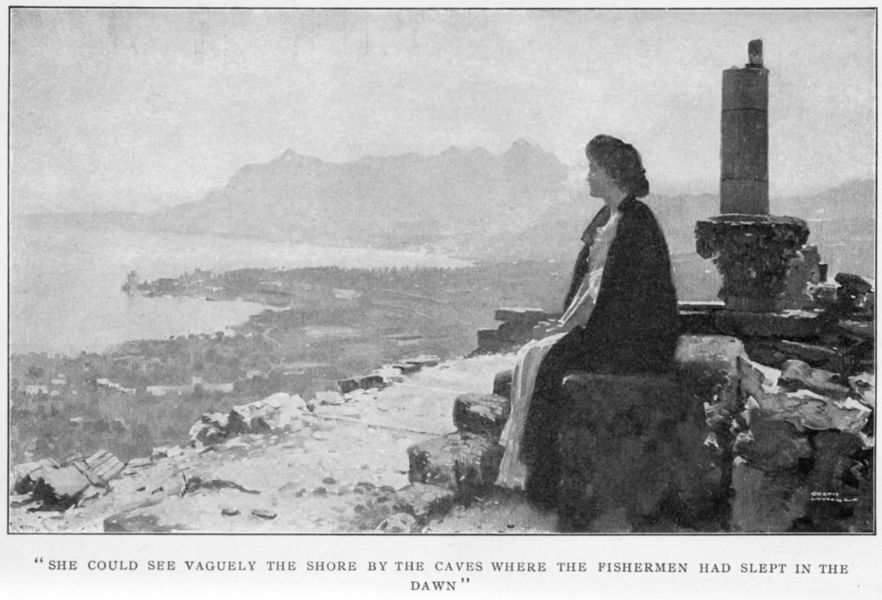 "SHE COULD SEE VAGUELY THE SHORE BY THE CAVES WHERE THE FISHERMEN HAD SLEPT IN THE
DAWN"
"SHE COULD SEE VAGUELY THE SHORE BY THE CAVES WHERE THE FISHERMEN HAD SLEPT IN THE
DAWN"
At last she was at the top of the hill, and could see vaguely the shore by the caves where the fishermen had slept in the dawn. To her right was the path which led to the wall of rock connecting the Sirens' Isle with the main-land. She glanced at it, but did not think of following it. Gaspare must have followed the descending road. He must be down there on that beach searching, calling his padrone's name, perhaps. She began to descend slowly, still physically distressed. True to her fixed idea that if there had been a disaster it must be connected with the sea, she walked always close to the wall, and looked always down to the sea. Within a short time, two or three minutes, she came in sight of the lakelike inlet, a miniature fiord which lay at the feet of the woods where hid the Casa delle Sirene. The water here looked black like ebony. She stared down at it and saw a boat lying on the shore. Then she gazed for a moment at the trees opposite from which always, till to-night, had shone the lamp which she and Maurice had seen from the terrace. All was dark. The thickly growing trees did not move. Secret and impenetrable seemed to her the hiding-place they made. She could scarcely imagine that any one lived among them. Yet doubtless the inhabitants of the Casa delle Sirene were sleeping quietly there while she wandered on the white road accompanied by her terror.
She had stopped for a minute, and was just going to walk on, when she heard a sound that, though faint and distant, was sharp and imperative. It seemed to her to be a violent beating on wood, and it was followed by the calling of a voice. She waited. The sound died away. She listened, straining her ears. In this absolutely still night sound travelled far. At first she had no idea from what direction came this noise which had startled her. But almost immediately it was repeated, and she knew that it must be some one striking violently and repeatedly upon wood—probably a wooden door.[Pg 422]
Then again the call rang out. This time she recognized, or thought she recognized, Gaspare's voice raised angrily, fiercely, in a summons to someone. She looked across the ebon water at the ebon mass of the trees on its farther side, and realized swiftly that Gaspare must be there. He had gone to the only house between the two bathing-places to ask if its inhabitants had seen anything of the padrone.
This seemed to her to be a very natural and intelligent action, and she waited eagerly and watched, hoping to see a light shine out as Salvatore—yes, that had been the name told to her by Gaspare—as Salvatore got up from sleep and came to open. He might know something, know at least at what hour Maurice had left the sea.
Again came the knocking and the call, again—four, five times. Then there was a long silence. Always the darkness reigned, unbroken by the earth-bound star, the light she looked for. The silence began to seem to her interminable. At first she thought that perhaps Gaspare was having a colloquy with the owner of the house, was learning something of Maurice. But presently she began to believe that there could be no one in the house, and that he had realized this. If so, he would have to return either to the road or the beach. She could see no boat moored to the shore opposite. He would come by the wall of rock, then, unless he swam the inlet. She went back a little way to a point from which dimly she saw the wall, and waited there a few minutes. Surely it would be dangerous to traverse that wall on such a dark night! Now, to her other fear was added fear for Gaspare. If an accident were to happen to him! Suddenly she hastened back to the path which led from the high-road along the spit of cultivated land to the wall, turned from the road, traversed the spit, and went down till she stood at the edge of the wall. She looked at the black rock, the black sea that lay motionless far[Pg 423] down on either side of it. Surely Gaspare would not venture to come this way. It seemed to her that to do so would mean death, or, if not that, a dangerous fall into the sea—and probably there were rocks below, hidden under the surface of the water. But Gaspare was daring. She knew that. He was as active as a cat and did not know the meaning of fear for his own safety. He might—
Out of the darkness on the land beyond the wall, something came, the form of some one hurrying.
"Gaspare!"
The form stopped.
"Gaspare!"
"Signora! What are you doing here? Madonna!"
"Gaspare, don't come this way! You are not to come this way."
"Why are you here, signora? I told you to wait for me by Isola Bella."
The startled voice was hard.
"You are not to cross the wall. I won't have it."
"The wall—it is nothing, signora. I have crossed it many times. It is nothing for a man."
"In the day, perhaps, but at night—don't, Gaspare—d'you hear me?—you are not—"
She stopped, holding her breath, for she saw him coming lightly, poised on bare feet, straight as an arrow, and balancing himself with his out-stretched arms.
"Ah!"
She had shrieked out. Just as he was midway Gaspare had looked down at the sea—the open sea on the far side of the wall. Instantly his foot slipped, he lost his balance and fell. She thought he had gone, but he caught the wall with his hands, hung for a moment suspended above the sea, then raised himself, as a gymnast does on a parallel bar, slowly till his body was above the wall. Then—Hermione did not know how—he was beside her.[Pg 424]
She caught hold of him with both hands. She felt furiously angry.
"How dare you disobey me?" she said, panting and trembling. "How dare you—"
But his eyes silenced her. She broke off, staring at him. All the healthy color had left his face. There was a leaden hue upon it.
"Gaspare—are you—you aren't hurt—you—"
"Let me go, signora! Let me go!"
She let him go instantly.
"What is it? Where are you going?"
He pointed to the beach.
"To the boat. There's—down there in the water—there's something in the water!"
"Something?" she said.
"Wait in the road."
He rushed away from her, and she heard him saying: "Madonna! Madonna! Madonna!"—crying it out as he ran.
Something in the water! She felt as if her heart stood still for a century, then at last beat again somewhere up in her throat, choking her. Something—could Gaspare have seen what? She moved on a step. One of her feet was on the wall, the other still on the firm earth. She leaned down and tried to look over into the sea beyond, the sea close to the wall. But her head swam. Had she not moved back hastily, obedient to an imperious instinct of self-preservation, she would have fallen. She sat down, there where she had been standing, and dropped her face into her hands close to her knees, and kept quite still. She felt as if she were in a train going through a tunnel. Her ears were full of a roaring clamor. How long she sat and heard tumult she did not know. When she looked up the night seemed to her to be much darker than before, intensely dark. Yet all the stars were there in the sky. No clouds had come to hide them. She tried to get up[Pg 425] quickly, but there was surely something wrong with her body. It would not obey her will at first. Presently she lay down, turned over on her side, put both hands on the ground, and with an effort, awkward as that of a cripple, hoisted herself up and stood on her feet. Gaspare had said, "Wait in the road." She must find the road. That was what she must do.
"Wait in the road—wait in the road." She kept on saying that to herself. But she could not remember for a moment where the road was. She could only think of rock, of water black like ebony. The road was white. She must look for something white. And when she found it she must wait. Presently, while she thought she was looking, she found that she was walking in the dust. It flew up into her nostrils, dry and acrid. Then she began to recover herself and to realize more clearly what she was doing.
She did not know yet. She knew nothing yet. The night was dark, the sea was dark. Gaspare had only cast one swift glance down before his foot had slipped. It was impossible that he could have seen what it was that was there in the water. And she was always inclined to let her imagination run riot. God isn't cruel. She had said that under the oak-trees, and it was true. It must be true.
"I've never done God any harm," she was saying to herself now. "I've never meant to. I've always tried to do the right thing. God knows that! God wouldn't be cruel to me."
In this moment all the subtlety of her mind deserted her, all that in her might have been called "cleverness." She was reduced to an extraordinary simplicity like that of a child, or a very instinctive, uneducated person.
"I don't think I'm bad," she thought. "And God—He isn't bad. He wouldn't wish to hurt me. He wouldn't wish to kill me."
She was walking on mechanically while she thought[Pg 426] this, but presently she remembered again that Gaspare had told her to wait in the road. She looked over the wall down to the narrow strip of beach that edged the inlet between the main-land and the Sirens' Isle. The boat which she had seen there was gone. Gaspare had taken it. She stood staring at the place where the boat had been. Then she sought a means of descending to that strip of beach. She would wait there. A little lower down the road some of the masonry of the wall had been broken away, perhaps by a winter flood, and at this point there was a faint track, trodden by fishermen's feet, leading down to the line. Hermione got over the wall at this point and was soon on the beach, standing almost on the spot where Maurice had stripped off his clothes in the night to seek the voice that had cried out to him in the darkness. She waited here. Gaspare would presently come back. His arms were strong. He could row fast. She would only have to wait a few minutes. In a few minutes she would know. She strained her eyes to catch sight of the boat rounding the promontory as it returned from the open sea. At first she stood, but presently, as the minutes went by and the boat did not come, her sense of physical weakness returned and she sat down on the stones with her feet almost touching the water.
"Gaspare knows now," she thought. "I don't know, but Gaspare knows."
That seemed to her strange, that any one should know the truth of this thing before she did. For what did it matter to any one but her? Maurice was hers—was so absolutely hers that she felt as if no one else had any concern in him. He was Gaspare's padrone. Gaspare loved him as a Sicilian may love his padrone. Others in England, too, loved him—his mother, his father. But what was any love compared with the love of the one woman to whom he belonged. His mother had her husband. Gaspare—he was a boy. He would love some[Pg 427] girl presently; he would marry. No, she was right. The truth about that "something in the water" only concerned her. God's dealing with this creature of his to-night only really mattered to her.
As she waited, pressing her hands on the stones and looking always at the point of the dark land round which the boat must come, a strange and terrible feeling came to her, a feeling that she knew she ought to drive out of her soul, but that she was powerless to expel.
She felt as if at this moment God were on His trial before her—before a poor woman who loved.
"If God has taken Maurice from me," she thought, "He is cruel, frightfully cruel, and I cannot love Him. If He has not taken Maurice from me, He is the God who is love, the God I can, I must worship!"
Which God was he?
The vast scheme of the world narrowed; the wide horizons vanished. There was nothing beyond the limit of her heart. She felt, as almost all believing human beings feel in such moments, that God's attention was entirely concentrated upon her life, that no other claimed His care, begged for His pity, demanded His tenderness because hers was so intense.
Did God wish to lose her love? Surely not! Then He could not commit this frightful act which she feared. He had not committed it.
A sort of relief crept through her as she thought this. Her agony of apprehension was suddenly lessened, was almost driven out.
God wants to be loved by the beings He has created. Then He would not deliberately, arbitrarily destroy a love already existing in the heart of one of them—a love thankful to Him, enthusiastically grateful for happiness bestowed by Him.
Beyond the darkness of the point there came out of the dimness of the night that brooded above the open sea a moving darkness, and Hermione heard the splash[Pg 428] of oars in the calm water. She got up quickly. Now her body was trembling again. She stared at the boat as if she would force it to yield its secret to her eyes. But that was only for an instant. Then her ears seemed to be seeking the truth, seeking it from the sound of the oars in the water!
There was no rhythmic regularity in the music they made, no steadiness, no—no—
She listened passionately, instinctively bending down her head sideways. It seemed to her that she was listening to a drunken man rowing. Now there was a quick beating of the oars in the water, then silence, then a heavy splash as if one of the oars had escaped from an uncertain hand, then some uneven strokes, one oar striking the water after the other.
"But Gaspare is a contadino," she said to herself, "not a fisherman. Gaspare is a contadino and—"
"Gaspare!" she called out. "Gaspare!"
The boat stopped midway in the mouth of the inlet.
"Gaspare! Is it you?"
She saw a dark figure standing up in the boat.
"Gaspare, is it you?" she cried, more loudly.
"Si."
Was it Gaspare's voice? She did not recognize it. Yet the voice had answered "Yes." The boat still remained motionless on the water midway between shore and shore. She did not speak again; she was afraid to speak. She stood and stared at the boat and at the motionless figure standing up in it. Why did not he row in to land? What was he doing there? She stared at the boat and at the figure standing in it till she could see nothing. Then she shut her eyes.
"Gaspare!" she called, keeping her eyes shut. "What are you doing? Gaspare!"
There was no reply.
She opened her eyes, and now she could see the boat again and the rower.[Pg 429]
"Gaspare!" she cried, with all her strength, to the black figure. "Why don't you row to the shore? Why don't you come to me?"
"Vengo!"
Loudly the word came to her, loudly and sullenly as if the boy were angry with her, almost hated her. It was followed by a fierce splash of oars. The boat shot forward, coming straight towards her. Then suddenly the oars ceased from moving, the dark figure of the rower fell down in a heap, and she heard cries, like cries of despair, and broken exclamations, and then a long sound of furious weeping.
"Gaspare! Gaspare!"
Her voice was strangled in her throat and died away.
"And then, signora, I cried—I cried!"
When had Gaspare said that to her? And why had he cried?
"Gaspare!"
It came from her lips in a whisper almost inaudible to herself.
Then she rushed forward into the dark water.[Pg 430]
Late that night Dr. Marini, the doctor of the commune of Marechiaro, was roused from sleep in his house in the Corso by a violent knocking on his street door. He turned over in his bed, muttered a curse, then lay still for a moment and listened. The knocking was renewed more violently. Evidently the person who stood without was determined to gain admission. There was no help for it. The good doctor, who was no longer young, dropped his weary legs to the floor, walked across to the open window, and thrust his head out of it. A man was standing below.
"What is it? What do you want?" said the doctor, in a grumbling voice. "Is it another baby? Upon my word, these—"
"Signor Dottore, come down, come down instantly! The signore of Monte Amato, the signore of the Casa del Prete has had an accident. You must come at once. I will go to fetch a donkey."
The doctor leaned farther out of the window.
"An accident! What—?"
But the man, a fisherman of Marechiaro, was already gone, and the doctor saw only the narrow, deserted street, black with the shadows of the tall houses.
He drew in quickly and began to dress himself with some expedition. An accident, and to a forestiere! There would be money in this case. He regretted his lost sleep less now and cursed no more, though he thought of the ride up into the mountains with a good deal of self-pity. It was no joke to be a badly paid[Pg 431] Sicilian doctor, he thought, as he tugged at his trousers buttons, and fastened the white front that covered the breast of his flannel shirt, and adjusted the cuffs which he took out of a small drawer. Without lighting a candle he went down-stairs, fumbled about, and found his case of instruments. Then he opened the street door and waited, yawning on the stone pavement. In two or three minutes he heard the tripping tip-tap of a donkey's hoofs, and the fisherman came up leading a donkey apparently as disinclined for a nocturnal flitting as the doctor.
"Ah, Giuseppe, it's you, is it?"
"Si, Signor Dottore!"
"What's this accident?"
The fisherman looked grave and crossed himself.
"Oh, signore, it is terrible! They say the poor signore is dead!"
"Dead!" exclaimed the doctor, startled. "You said is was an accident. Dead you say now?"
"Signore, he is dead beyond a doubt. I was going to the fishing when I heard dreadful cries in the water by the inlet—you know, by Salvatore's terreno!"
"In the water?"
"Si, signore. I went down quickly and I found Gaspare, the signore's—"
"I know—I know!"
"Gaspare in a boat with the padrone lying at the bottom, and the signora standing up to her middle in the sea."
"Z't! z't!" exclaimed the doctor, "the signora in the sea! Is she mad?"
"Signor Dottore, how do I know? I brought the boat to shore. Gaspare was like one crazed. Then we lifted the signore out upon the stones. Oh, he is dead, Signor Dottore; dead beyond a doubt. They had found him in the sea—"
"They?"[Pg 432]
"Gaspare—under the rocks between Salvatore's terreno and the main-land. He had all his clothes on. He must have been there in the dark—"
"Why should he go in the dark?"
"How do I know, Signor Dottore?—and have fallen, and struck his head against the rocks. For there was a wound and—"
"The body should not have been moved from where it lay till the Pretore had seen it. Gaspare should have left the body."
"But perhaps the povero signore is not really dead, after all! Madonna! How—"
"Come! come! we must not delay! One minute! I will get some lint and—"
He disappeared into the house. Almost directly he came out again with a package under his arm and a long, black cigar lighted in his mouth.
"Take these, Giuseppe! Carry them carefully. Now then!"
He hoisted himself onto the donkey.
"A-ah! A-ah!"
They set off, the fisherman walking on naked feet beside the donkey.
"Then we have to go down to the sea?"
"No, Signor Dottore. There were others on the road, Antonio and—"
"The rest of you going to the boats—I know. Well?"
"And the signora would have him carried up to Monte Amato."
"She could give directions?"
"Si, signore. She ordered everything. When she came out of the sea she was all wet, the poor signora, but she was calm. I called the others. When they saw the signore they all cried out. They knew him. Some of them had been to the fishing with him. Oh, they were sorry! They all began to speak and to try to—"
"Diavolo! They could only make things worse! If[Pg 433] the breath of life was in the signore's body they would drive it out. Per Dio!"
"But the signora stopped them. She told them to be silent and to carry the signore up to the Casa del Prete. Signore, she—the povera signora—she took his head in her hands. She held his head and she never cried, not a tear!"
The man brushed his hand across his eyes.
"Povera signora! Povera signora!" murmured the doctor.
"And she comforted Gaspare, too!" Giuseppe added. "She put her arm round him and told him to be brave, and help her. She made him walk by her and put his hand under the padrone's shoulder. Madonna!"
They turned away from the village into a narrow path that led into the hills.
"And I came to fetch you, Signor Dottore. Perhaps the povero signore is not really dead. Perhaps you can save him, Signor Dottore!"
"Chi lo sa?" replied the doctor.
He had let his cigar go out and did not know it.
"Chi lo sa?" he repeated, mechanically.
Then they went on in silence—till they reached the shoulder of the mountain under Castel Vecchio. From here they could see across the ravine to the steep slope of Monte Amato. Upon it, high up, a light shone, and presently a second light detached itself from the first, moved a little way, and then was stationary.
Giuseppe pointed.
"Ecco, Signor Dottore! They have carried the poor signore up."
The second light moved waveringly back towards the first.
"They are carrying him into the house, Signor Dottore. Madonna! And all this to happen in the night!"
The doctor nodded without speaking. He was watching the lights up there in that lonely place. He was not[Pg 434] a man of strong imagination, and was accustomed to look on misery, the misery of the poor. But to-night he felt a certain solemnity descend upon him as he rode by these dark by-paths up into the bosom of the hills. Perhaps part of this feeling came from the fact that his mission had to do with strangers, with rich people from a distant country who had come to his island for pleasure, and who were now suddenly involved in tragedy in the midst of their amusement. But also he had a certain sense of personal sympathy. He had known Hermione on her former visit to Sicily and had liked her; and though this time he had seen scarcely anything of her he had seen enough to be aware that she was very happy with her young husband. Maurice, too, he had seen, full of the joy of youth and of bounding health. And now all that was put out, if Giuseppe's account were true. It was a pity, a sad pity.
The donkey crossed the mouth of the ravine, and picked its way upward carefully amid the loose stones. In the ravine a little owl hooted twice.
"Giuseppe!" said the doctor.
"Signore?"
"The signora has been away, hasn't she?"
"Si signore. In Africa."
"Nursing that sick stranger. And now directly she comes back here's this happening to her! Per Dio!"
He shook his head.
"Somebody must have looked on the povera signora with the evil-eye, Signor Dottore."
Giuseppe crossed himself.
"It seems so," the doctor replied, gravely.
He was almost as superstitious as the contadini among whom he labored.
"Ecco, Signor Dottore!"
The doctor looked up. At the arch stood a figure holding a little lamp. Almost immediately, two more figures appeared behind it.[Pg 435]
"Il dottore! Ecco il dottore!"
There was a murmur of voices in the dark. As the donkey came up the excited fishermen crowded round, all speaking at once.
"He is dead, Signor Dottore. The povero signore is dead!"
"Let the Signor Dottore come to him, Beppe! What do you know? Let the—"
"Sure enough he is dead! Why, he must have been in the water a good hour. He is all swollen with the water and—"
"It is his head, Signor Dottore! If it had not been for his coming against the rocks he would not have been hurt. Per Dio, he can swim like a fish, the povero signorino. I have seen him swim. Why, even Peppino—"
"The signora wants us all to go away, Signor Dottore. She begs us to go and leave her alone with the povero signore!"
"Gaspare is in such a state! You would not know him. And the povera signora, she is all dripping wet. She has been into the sea, and now she has carried the head of the povero signore all the way up the mountain. She would not let any one—"
A succession of cries came out of the darkness, hysterical cries that ended in prolonged sobbing.
"That is Lucrezia!" cried one of the fishermen. "Madonna! That is Lucrezia!"
"Mamma mia! Mamma mia!"
Their voices were loud in the night. The doctor pushed his way between the men and came onto the terrace in front of the steps that led into the sitting-room.
Gaspare was standing there alone. His face was almost unrecognizable. It looked battered, puffy, and inflamed, as if he had been drinking and fighting. There were no tears in his eyes now, but long, violent sobs shook his body from time to time, and his blistered lips opened and shut mechanically with each sob. He stared[Pg 436] dully at the doctor, but did not say a word, or move to get out of the way.
"Gaspare!" said the doctor. "Where is the padrona?"
The boy sobbed and sobbed, always in the same dry and terribly mechanical way.
"Gaspare!" repeated the doctor, touching him. "Gaspare!"
"E' morto!" the boy suddenly cried out, in a loud voice.
And he flung himself down on the ground.
The doctor felt a thrill of cold in his veins. He went up the steps into the little sitting-room. As he did so Hermione came to the door of the bedroom. Her dripping skirts clung about her. She looked quite calm. Without greeting the doctor she said, quietly:
"You heard what Gaspare said?"
"Si, signora, ma—"
The doctor stopped, staring at her. He began to feel almost dazed. The fishermen had followed him and stood crowding together on the steps and staring into the room.
"He is dead. I am sorry you came all this way."
They stood there facing one another. From the kitchen came the sound of Lucrezia's cries. Hermione put her hands up to her ears.
"Please—please—oh, there should be a little silence here now!" she said.
For the first time there was a sound of something like despair in her voice.
"Let me come in, signora!" stammered the doctor. "Let me come in and examine him."
"He is dead."
"Well, but let me. I must!"
"Please come in," she said.
The doctor turned round to the fishermen.
"Go, one of you, and make that girl keep quiet," he said, angrily. "Take her away out of the house[Pg 437]—directly! Do you hear? And the rest of you stay outside, and don't make a sound."
The fishermen slunk a little way back into the darkness, while Giuseppe, walking on the toes of his bare feet, and glancing nervously at the furniture and the pictures upon the walls, crossed the room and disappeared into the kitchen. Then the doctor laid down his cigar on a table and went into the bedroom whither Hermione had preceded him.
There was a lighted candle on the white chest of drawers. The window and the shutters of the room were closed against the glances of the fishermen. On one of the two beds—Hermione's—lay the body of a man dripping with water. The doctor took the candle in his hand, went to this bed and leaned down, then set down the candle at the bedhead and made a brief examination. He found at once that Gaspare had spoken the truth. This man had been dead for some time. Nevertheless, something—he scarcely knew what—kept the doctor there by the bed for some moments before he pronounced his verdict. Never before had he felt so great a reluctance to speak the simple words that would convey a great truth. He fingered his shirt-front uneasily, and stared at the body on the bed and at the wet sheets and pillows. Meanwhile, Hermione had sat down on a chair near the door that opened into what had been Maurice's dressing-room, and folded her hands in her lap. The doctor did not look towards her, but he felt her presence painfully. Lucrezia's cries had died away, and there was complete silence for a brief space of time.
The body on the bed was swollen, but not very much, the face was sodden, the hair plastered to the head, and on the left temple there was a large wound, evidently, as the doctor had seen, caused by the forehead striking violently against a hard, resisting substance. It was not the sea alone which had killed this man. It was[Pg 438] the sea and the rock in the sea. He had fallen, been stunned and then drowned. The doctor knew the place where he had been found. The explanation of the tragedy was very simple—very simple.
While the doctor was thinking this, and fingering his shirt-front mechanically, and bracing himself to turn towards the quiet woman in the chair, he heard a loud, dry noise in the sitting-room, then in the bedroom. Gaspare had come in, and was standing at the foot of the bed, sobbing and staring at the doctor with hopeless eyes, that yet asked a last question, begged desperately for a lie.
"Gaspare!"
The woman in the chair whispered to him. He took no notice.
"Gaspare!"
She got up and crossed over to the boy, and took one of his hands.
"It's no use," she said. "Perhaps he is happy."
Then the boy began to cry passionately. Tears poured out of his eyes while he held his padrona's hand. The doctor got up.
"He is dead, signora," he said.
"We knew it," Hermione replied.
She looked at the doctor for a minute. Then she said:
"Hush, Gaspare!"
The doctor stood by the bed.
"Scusi, signora," he said, "but—but will you take him into the next room?"
He pointed to Gaspare, who shivered as he wept.
"I must make a further examination."
"Why? You see that he is dead."
"Yes, but—there are certain formalities."
He stopped.
"Formalities!" she said. "He is dead."
"Yes. But—but the authorities will have to be in[Pg 439]formed. I am very sorry. I should wish to leave everything undisturbed."
"What do you mean? Gaspare! Gaspare!"
"But—according to the law, our law, the body should never have been moved. It should have been left where it was found until—"
"We could not leave him in the sea."
She still spoke quite quietly, but the doctor felt as if he could not go on.
"Since it is done—" he began.
He pulled himself together with an effort.
"There will have to be an inquiry, signora—the cause of death will have to be ascertained."
"You see it. He was coming from the island. He fell and was drowned. It is very simple."
"Yes, no doubt. Still, there must be an inquiry. Gaspare will have to explain—"
He looked at the weeping boy, then at the woman who stood there holding the boy's hand in hers.
"But that will be for to-morrow," he muttered, fingering his shirt-front and looking down. "That will be for to-morrow."
As he went out he added:
"Signora, do not remain in your wet clothes."
"I—oh, thank you. They do not matter."
She did not follow him into the next room. As he went down the steps to the terrace the sound of Gaspare's passionate weeping followed him into the night.
When the doctor was on the donkey and was riding out through the arch, after a brief colloquy with the fishermen and with Giuseppe, whom he had told to remain at the cottage for the rest of the night, he suddenly remembered the cigar which he had left upon the table, and he pulled up.
"What is it, Signor Dottore?" said one of the fishermen.
"I've left something, but—never mind. It does not matter."[Pg 440]
He rode on again.
"It does not matter," he repeated.
He was thinking of the English signora standing beside the bed in her wet skirts and holding the hand of the weeping boy.
It was the first time in his life that he had ever sacrificed a good cigar.
He wondered why he did so now, but he did not care to return just then to the Casa del Prete.[Pg 441]
Hermione longed for quiet, for absolute silence.
It seemed strange to her that she still longed for anything—strange and almost horrible, almost inhuman. But she did long for that, to be able to sit beside her dead husband and to be undisturbed, to hear no voice speaking, no human movement, to see no one. If it had been possible she would have closed the cottage against every one, even against Gaspare and Lucrezia. But it was not possible. Destiny did not choose that she should have this calm, this silence. It had seemed to her, when fear first came upon her, as if no one but herself had any real concern with Maurice, as if her love conferred upon her a monopoly. This monopoly had been one of joy. Now it should be one of sorrow. But now it did not exist. She was not weeping for Maurice. But others were. She had no one to go to. But others came to her, clung to her. She could not rid herself of the human burden.
She might have been selfish, determined, she might have driven the mourners out. But—and that was strange, too—she found herself pitying them, trying to use her intellect to soothe them.
Lucrezia was terrified, almost like one assailed suddenly by robbers, terrified and half incredulous. When her hysteria subsided she was at first unbelieving.
"He cannot be really dead, signora!" she sobbed to Hermione. "The povero signorino. He was so gay! He was so—"
She talked and talked, as Sicilians do when face to face with tragedy.[Pg 442]
She recalled Maurice's characteristics, his kindness, his love of climbing, fishing, bathing, his love of the sun—all his love of life.
Hermione had to listen to the story with that body lying on her bed.
Gaspare's grief was speechless, but needed comfort more. There was an element in it of fury which Hermione realized without rightly understanding. She supposed it was the fury of a boy from whom something is taken by one whom he cannot attack.
For God is beyond our reach.
She could not understand the conflict going on in the boy's heart and mind.
He knew that this death was probably no natural death, but a murder.
Neither Maddalena nor her father had been in the Casa delle Sirene when he knocked upon the door in the night. Salvatore had sent Maddalena to spend the night with relations in Marechiaro, on the pretext that he was going to sail to Messina on some business. And he had actually sailed before Gaspare's arrival on the island. But Gaspare knew that there had been a meeting, and he knew what the Sicilian is when he is wronged. The words "vengeance is mine!" are taken in Sicily by each wronged man into his own mouth, and Salvatore was notoriously savage and passionate.
As the first shock of horror and despair passed away from Gaspare he was devoured, as by teeth, devoured by the desire to spring upon Salvatore and revenge the death of his padrone. But the padrone had laid a solemn injunction upon him. Solemn, indeed, it seemed to the boy now that the lips which had spoken were sealed forever. The padrona was never to know. If he obeyed his impulse, if he declared the vendetta against Salvatore, the padrona would know. The knife that spilled the murderer's blood would give the secret to the world—and to the padrona.[Pg 443]
Tremendous that night was the conflict in the boy's soul. He would not leave Hermione. He was like the dog that creeps to lie at the feet of his sorrowing mistress. But he was more than that. For he had his own sorrow and his own fury. And he had the battle with his own instincts.
What was he going to do?
As he began to think, really to think, and to realize things, he knew that after such a death the authorities of Marechiaro, the Pretore and the Cancelliere, would proceed to hold a careful examination into the causes of death. He would be questioned. That was certain. The opportunity would be given him to denounce Salvatore.
And was he to keep silence? Was he to act for Salvatore, to save Salvatore from justice? He would not have minded doing that, he would have wished to do it, if afterwards he could have sprung upon Salvatore and buried his knife in the murderer of his padrone.
But—the padrona? She was not to know. She was never to know. And she had been the first in his life. She had found him, a poor, ragged little boy working among the vines, and she had given him new clothes and had taken him into her home and into her confidence. She had trusted him. She had remembered him in England. She had written to him from far away, telling him to prepare everything for her and the padrone when they were coming.
He began to sob violently again, thinking of it all, of how he had ordered the donkeys to fetch the luggage from the station, of how—
"Hush, Gaspare!"
Hermione again put her hand on his. She was sitting near the bed on which the body was lying between dry sheets. For she had changed them with Gaspare's assistance. Maurice still wore the clothes which had been on him in the sea. Giuseppe, the fisherman, had ex[Pg 444]plained to Hermione that she must not interfere with the body till it had been visited by the authorities, and she had obeyed him. But she had changed the sheets. She scarcely knew why. Now the clothes had almost dried on the body, and she did not see any more the stains of water. One sheet was drawn up over the body, to the chin. The matted dark hair was visible against the pillow, and had made her think several times vaguely of that day after the fishing when she had watched Maurice taking his siesta. She had longed for him to wake then, for she had known that she was going to Africa, that they had only a few hours together before she started. It had seemed almost terrible to her, his sleeping through any of those hours. And now he was sleeping forever. She was sitting there waiting for nothing, but she could not realize that yet. She felt as if she must be waiting for something, that something must presently occur, a movement in the bed, a—she scarcely knew what.
Presently the clock Gaspare had brought from the fair chimed, then played the "Tre Colori." Lucrezia had set it to play that evening when she was waiting for the padrone to return from the sea.
When he heard the tinkling tune Gaspare lifted his head and listened till it was over. It recalled to him all the glories of the fair. He saw his padrone before him. He remembered how he had decorated Maurice with flowers, and he felt as if his heart would break.
"The povero signorino! the povero signorino!" he cried, in a choked voice. "And I put roses above his ears! Si, signora, I did! I said he should be a real Siciliano!"
He began to rock himself to and fro. His whole body shook, and his face had a frantic expression that suggested violence.
"I put roses above his ears!" he repeated. "That day he was a real Siciliano!"
"Gaspare—Gaspare—hush! Don't! Don't!"[Pg 445]
She held his hand and went on speaking softly.
"We must be quiet in here. We must remember to be quiet. It isn't our fault, Gaspare. We did all we could to make him happy. We ought to be glad of that. You did everything you could, and he loved you for it. He was happy with us. I think he was. I think he was happy till the very end. And that is something to be glad of. Don't you think he was very happy here?"
"Si, signora!" the boy whispered, with twitching lips.
"I'm glad I came back in time," Hermione said, looking at the dark hair on the pillow. "It might have happened before, while I was away. I'm glad we had one more day together."
Suddenly, as she said that, something in the mere sound of the words seemed to reveal more clearly to her heart what had befallen her, and for the first time she began to cry and to remember. She remembered all Maurice's tenderness for her, all his little acts of kindness. They seemed to pass rapidly in procession through her mind on their way to her heart. Not one surely was absent. How kind to her he had always been! And he could never be kind to her again. And she could never be kind to him—never again.
Her tears went on falling quietly. She did not sob like Gaspare. But she felt that now she had begun to cry she would never be able to stop again; that she would go on crying till she, too, died.
Gaspare looked up at her.
"Signora!" he said. "Signora!"
Suddenly he got up, as if to go out of the room, out of the house. The sight of his padrona's tears had driven him nearly mad with the desire to wreak vengeance upon Salvatore. For a moment his body seemed to get beyond his control. His eyes saw blood, and his hand darted down to his belt, and caught at the knife that was there, and drew it out. When Hermione saw[Pg 446] the knife she thought the boy was going to kill himself with it. She sprang up, went swiftly to Gaspare, and put her hand on it over his hand.
"Gaspare, what are you doing?" she said.
For a moment his face was horrible in its savagery. He opened his mouth, still keeping his grasp on the knife, which she tried to wrest from him.
"Lasci andare! Lasci andare!" he said, beginning to struggle with her.
"No, Gaspare."
"Allora—"
He paused with his mouth open.
At that moment he was on the very verge of a revelation of the truth. He was on the point of telling Hermione that he was sure that the padrone had been murdered, and that he meant to avenge the murder. Hermione believed that for the moment he was mad, and was determined to destroy himself in her presence. It was useless to pit her strength against his. In a physical struggle she must be overcome. Her only chance was to subdue him by other means.
"Gaspare," she said, quickly, breathlessly, pointing to the bed. "Don't you think the padrone would have wished you to take care of me now? He trusted you. I think he would. I think he would rather you were with me than any one else in the whole world. You must take care of me. You must take care of me. You must never leave me!"
The boy looked at her. His face changed, grew softer.
"I've got nobody now," she added. "Nobody but you."
The knife fell on the floor.
In that moment Gaspare's resolve was taken. The battle within him was over. He must protect the padrona. The padrone would have wished it. Then he must let Salvatore go.[Pg 447]
He bent down and kissed Hermione's hand.
"Lei non piange!" he muttered. "Forse Dio la aiuterà."
In the morning, early, Hermione left the body for the first time, went into the dressing-room, changed her clothes, then came back and said to Gaspare:
"I am going a little way up the mountain, Gaspare. I shall not be long. No, don't come with me. Stay with him. Are you dreadfully tired?"
"No, signora."
"We shall be able to rest presently," she said.
She was thinking of the time when they would take Maurice from her. She left Gaspare sitting near the bed, and went out onto the terrace. Lucrezia and Gaspare, both thoroughly tired out, were sleeping soundly. She was thankful for that. Soon, she knew, she would have to be with people, to talk, to make arrangements. But now she had a short spell of solitude.
She went slowly up the mountain-side till she was near the top. Then she sat down on a rock and looked out towards the sea.
The world was not awake yet, although the sun was coming. Etna was like a great phantom, the waters at its foot were pale in their tranquillity. The air was fresh, but there was no wind to rustle the leaves of the oak-trees, upon whose crested heads Hermione gazed down with quiet, tearless eyes.
She had a strange feeling of being out of the world, as if she had left it, but still had the power to see it. She wondered if Maurice felt like that.
He had said it would be good to lie beneath those oak-trees in sight of Etna and the sea. How she wished that she could lay his body there, alone, away from all other dead. But that was impossible, she supposed. She remembered the doctor's words. What were they going to do? She did not know anything about Italian procedure in such an event. Would they take him away?[Pg 448] She had no intention of trying to resist anything, of offering any opposition. It would be useless, and besides he had gone away. Already he was far off. She did not feel, as many women do, that so long as they are with the body of their dead they are also with the soul. She would like to keep the dear body, to have it always near to her, to live close to the spot where it was committed to the earth. But Maurice was gone. Her Mercury had winged his way from her, obedient to a summons that she had not heard. Always she had thought of him as swift, and swiftly, without warning, he had left her. He had died young. Was that wonderful? She thought not. No; age could have nothing to say to him, could hold no commerce with him. He had been born to be young and never to be anything else. It seemed to her now strange that she had not felt this, foreseen that it must be so. And yet, only yesterday, she had imagined a far future, and their child laying them in the ground of Sicily, side by side, and murmuring "Buon riposo" above their mutual sleep.
Their child! A life had been taken from her. Soon a life would be given to her. Was that what is called compensation? Perhaps so. Many strange thoughts, come she could not tell why, were passing through her mind as she sat upon this height in the dawn. The thought of compensation recalled to her the Book of Job. Everything was taken from Job; not only his flocks and his herds, but his sons and his daughters. And then at the last he was compensated. He was given new flocks and herds and new sons and daughters. And it was supposed to be well with Job. If it was well with Job, then Job had been a man without a heart.
Never could she be compensated for this loss, which she was trying to realize, but which she would not be able to realize until the days went by, and the nights, the days and the nights of the ordinary life, when tragedy was supposed to be over and done with, and people[Pg 449] would say, and no doubt sincerely believe, that she was "getting accustomed" to her loss.
Thinking of Job led her on to think of God's dealings with His creatures.
Hermione was a woman who clung to no special religion, but she had always, all her life, had a very strong personal consciousness of a directing Power in the world, had always had an innate conviction that this directing Power followed with deep interest the life of each individual in the scheme of His creation. She had always felt, she felt now, that God knew everything about her and her life, was aware of all her feelings, was constantly intent upon her.
He was intent. But was He kindly or was He cruelly intent?
Surely He had been dreadfully cruel to her!
Only yesterday she had been wondering what bereaved women felt about God. Now she was one of these women.
"Was Maurice dead?" she thought—"was he already dead when I was praying before the shrine of the Madonna della Rocca?"
She longed to know. Yet she scarcely knew why she longed. It was like a strange, almost unnatural curiosity which she could not at first explain to herself. But presently her mind grew clearer and she connected this question with that other question—of God and what He really was, what He really felt towards His creatures, towards her.
Had God allowed her to pray like that, with all her heart and soul, and then immediately afterwards deliberately delivered her over to the fate of desolate women, or had Maurice been already dead? If that were so, and it must surely have been so, for when she prayed it was already night, she had been led to pray for herself ignorantly, and God had taken away her joy before He had heard her prayer. If He had heard it first He[Pg 450] surely could not have dealt so cruelly with her—so cruelly! No human being could have, she thought, even the most hard-hearted.
But perhaps God was not all-powerful.
She remembered that once in London she had asked a clever and good clergyman if, looking around upon the state of things in the world, he was able to believe without difficulty that the world was governed by an all-wise, all-powerful, and all-merciful God. And his reply to her had been, "I sometimes wonder whether God is all-powerful—yet." She had not pursued the subject, but she had not forgotten this answer; and she thought of it now.
Was there a conflict in the regions beyond the world which was the only one she knew? Had an enemy done this thing, an enemy not only of hers, but of God's, an enemy who had power over God?
That thought was almost more terrible than the thought that God had been cruel to her.
She sat for a long time wondering, thinking, but not praying. She did not feel as if she could ever pray any more. The world was lighted up by the sun. The sea began to gleam, the coast-line to grow more distinct, the outlines of the mountains and of the Saracenic Castle on the height opposite to her more hard and more barbaric against the deepening blue. She saw smoke coming from the mouth of Etna, sideways, as if blown towards the sea. A shepherd boy piped somewhere below her. And still the tune was the tarantella. She listened to it—the tarantella. So short a time ago Maurice had danced with the boys upon the terrace! How can such life be so easily extinguished? How can such joy be not merely clouded but utterly destroyed? A moment, and from the body everything is expelled; light from the eyes, speech from the lips, movement from the limbs, joy, passion from the heart. How can such a thing be?[Pg 451]
The little shepherd boy played on and on. He was nearer now. He was ascending the slope of the mountain, coming up towards heaven with his little happy tune. She heard him presently among the oak-trees immediately below her, passing almost at her feet.
To Hermione the thin sound of the reed-flute always had suggested Arcady. Even now it suggested Arcady—the Arcady of the imagination: wide soft airs, blue skies and seas, eternal sunshine and delicious shade, and happiness where is a sweet noise of waters and of birds, a sweet and deep breathing of kind and bounteous nature.
And that little boy with the flute would die. His foot might slip now as he came upward, and no more could he play souls into Arcady!
The tune wound away to her left, like a gay and careless living thing that was travelling ever upward, then once more came towards her. But now it was above her. She turned her head and she saw the little player against the blue. He was on a rock, and for a moment he stood still. On his head was a long woollen cap, hanging over at one side. It made Hermione think of the woollen cap she had seen come out of the darkness of the ravine as she waited with Gaspare for the padrone. Against the blue, standing on the gray and sunlit rock, with the flute at his lips, and his tiny, deep-brown fingers moving swiftly, he looked at one with the mountain and yet almost unearthly, almost as if the blue had given birth to him for a moment, and in a moment would draw him back again into the womb of its wonder. His goats were all around him, treading delicately among the rocks. As Hermione watched he turned and went away into the blue, and the tarantella went away into the blue with him.
Her Sicilian and his tarantella, the tarantella of his joy in Sicily—they had gone away into the blue.
She looked at it, deep, quivering, passionate, intense;[Pg 452] thousands and thousands of miles of blue! And she listened as she looked; listened for some far-off tarantella, for some echo of a fainting tarantella, that might be a message to her, a message left on the sweet air of the enchanted island, telling her where the winged feet of her beloved one mounted towards the sun.[Pg 453]
Giuseppe came to fetch Hermione from the mountain. He had a note in his hand and also a message to give. The authorities were already at the cottage; the Pretore of Marechiaro with his Cancelliere, Dr. Marini and the Maresciallo of the Carabinieri.
"They have come already?" Hermione said. "So soon?"
She took the note. It was from Artois.
"There is a boy waiting, signora," said Giuseppe. "Gaspare is with the Signor Pretore."
She opened Emile's note.
"I cannot write anything except this—do you wish me to come?—E."
"Do I wish him to come?" she thought.
She repeated the words mentally several times, while the fisherman stood by her, staring at her with sympathy. Then she went down to the cottage.
Dr. Marini met her on the terrace. He looked embarrassed. He was expecting a terrible scene.
"Signora," he said, "I am very sorry, but—but I am obliged to perform my duty."
"Yes," she said. "Of course. What is it?"
"As there is a hospital in Marechiaro—"
He stopped.
"Yes?" she said.
"The autopsy of the body must take place there. Otherwise I could have—"
"You have come to take him away," she said. "I understand. Very well."[Pg 454]
But they could not take him away, these people. For he was gone; he had gone away into the blue.
The doctor looked relieved, though surprised, at her apparent nonchalance.
"I am very sorry, signora," he said—"very sorry."
"Must I see the Pretore?" she said.
"I am afraid so, signora. They will want to ask you a few questions. The body ought not to have been moved from the place where—"
"We could not leave him in the sea," she said, as she had said in the night.
"No, no. You will only just have to say—"
"I will tell them what I know. He went down to bathe."
"Yes. But the Pretore will want to know why he went to Salvatore's terreno."
"I suppose he bathed from there. He knew the people in the Casa delle Sirene, I believe."
She spoke indifferently. It seemed to her so utterly useless, this inquiry by strangers into the cause of her sorrow.
"I must just write something," she added.
She went up the steps into the sitting-room. Gaspare was there with three men—the Pretore, the Cancelliere and the Maresciallo. As she came in the strangers turned and saluted her with grave politeness, all looking earnestly at her with their dark eyes. But Gaspare did not look at her. He had the ugly expression on his face that Hermione had noticed the day before.
"Will you please allow me to write a line to a friend?" Hermione said. "Then I shall be ready to answer your questions."
"Certainly, signora," said the Pretore; "we are very sorry to disturb you, but it is our duty."
He had gray hair and a dark mustache, and his black eyes looked as if they had been varnished.
Hermione went to the writing-table, while the men stood in silence filling up the little room.[Pg 455]
"What shall I say?" she thought.
She heard the boots of the Cancelliere creak as he shifted his feet upon the floor. The Maresciallo cleared his throat. There was a moment of hesitation. Then he went to the steps and spat upon the terrace.
"Don't come yet," she wrote, slowly.
Then she turned round.
"How long will your inquiry take, do you think, signore?" she asked of the Pretore. "When will—when can the funeral take place?"
"Signora, I trust to-morrow. I hope—I do not suppose there will be any reason to suspect, after what Dr. Marini has told us and we have seen, that the death was anything but an accident—an accident which we all most deeply grieve for."
"It was an accident."
She stood by the table with the pen in her hand.
"I suppose—I suppose he must be buried in the Campo Santo?" she said.
"Do you wish to convey the body to England, signora?"
"Oh no. He loved Sicily. He wished to stay always here, I think, although—"
She broke off.
"I could never take him away from Sicily. But there is a place here—under the oak-trees. He was very fond of it."
Gaspare began to sob, then controlled himself with a desperate effort, turned round and stood with his face to the wall.
"I suppose, if I could buy a piece of land there, it could not be permitted—?"
She looked at the Pretore.
"I am very sorry, signora, such a thing could not possibly be allowed. If the body is buried here it must be in the Campo Santo."
"Thank you."[Pg 456]
She turned to the table and wrote after "Don't come yet":
"They are taking him away now to the hospital in the village. I shall come down. I think the funeral will be to-morrow. They tell me he must be buried in the Campo Santo. I should have liked him to lie here under the oak-trees."
"Hermione."
When Artois read this note tears came into his eyes.
No event in his life had shocked him so much as the death of Delarey.
It had shocked both his intellect and his heart. And yet his intellect could hardly accept it as a fact. When, early that morning, one of the servants of the Hôtel Regina Margherita had rushed into his room to tell him, he had refused to believe it. But then he had seen the fishermen, and finally Dr. Marini. And he had been obliged to believe. His natural impulse was to go to his friend in her trouble as she had come to him in his. But he checked it. His agony had been physical. Hers was of the affections, and how far greater than his had ever been! He could not bear to think of it. A great and generous indignation seized him, an indignation against the catastrophes of life. That this should be Hermione's reward for her noble unselfishness roused in him something that was like fury; and then there followed a more torturing fury against himself.
He had deprived her of days and weeks of happiness. Such a short span of joy had been allotted to her, and he had not allowed her to have even that. He had called her away. He dared not trust himself to write any word of sympathy. It seemed to him that to do so would be a hideous irony, and he sent the line in pencil which she had received. And then he walked up and down in his little sitting-room, raging against himself, hating himself.
In his now bitterly acute consideration of his friend[Pg 457]ship with Hermione he realized that he had always been selfish, always the egoist claiming rather than the generous donor. He had taken his burdens to her, not weakly, for he was not a weak man, but with a desire to be eased of some of their weight. He had always been calling upon her for sympathy, and she had always been lavishly responding, scattering upon him the wealth of her great heart.
And now he had deprived her of nearly all the golden time that had been stored up for her by the decree of the Gods, of God, of Fate, of—whatever it was that ruled, that gave and that deprived.
A bitterness of shame gripped him. He felt like a criminal. He said to himself that the selfish man is a criminal.
"She will hate me," he said to himself. "She must. She can't help it."
Again the egoist was awake and speaking within him. He realized that immediately and felt almost a fear of this persistence of character. What is the use of cleverness, of clear sight into others, even of genius, when the self of a man declines to change, declines to be what is not despicable?
"Mon Dieu!" he thought, passionately. "And even now I must be thinking of my cursed self!"
He was beset by an intensity of desire to do something for Hermione. For once in his life his heart, the heart she believed in and he was inclined to doubt or to despise, drove him as it might have driven a boy, even such a one as Maurice. It seemed to him that unless he could do something to make atonement he could never be with Hermione again, could never bear to be with her again. But what could he do?
"At least," he thought, "I may be able to spare her something to-day. I may be able to arrange with these people about the funeral, about all the practical things that are so frightful a burden to the living who have[Pg 458] loved the dead, in the last moments before the dead are given to the custody of the earth."
And then he thought of the inquiry, of the autopsy. Could he not help her, spare her perhaps, in connection with them?
Despite his weakness of body he felt feverishly active, feverishly desirous to be of practical use. If he could do something he would think less, too; and there were thoughts which seemed furtively trying to press themselves forward in the chambers of his mind, but which, as yet, he was, also furtively, pushing back, striving to keep in the dark place from which they desired to emerge.
Artois knew Sicily well, and he knew that such a death as this would demand an inquiry, might raise suspicions in the minds of the authorities of Marechiaro. And in his own mind?
He was a mentally courageous man, but he longed now to leave Marechiaro, to leave Sicily at once, carrying Hermione with him. A great dread was not actually with him, but was very near to him.
Presently something, he did not know what, drew him to the window of his bedroom which looked out towards the main street of the village. As he came to it he heard a dull murmur of voices, and saw the Sicilians crowding to their doors and windows, and coming out upon their balconies.
The body of Maurice was being borne to the hospital which was at the far end of the town. As soon as he realized that, Artois closed his window. He could not look with the curious on that procession. He went back into his sitting-room, which faced the sea. But he felt the procession going past, and was enveloped in the black wonder of death.
That he should be alive and Delarey dead! How extraordinary that was! For he had been close to death, so close that it would have seemed quite natural to[Pg 459] him to die. Had not Hermione come to him, he thought, he would almost, at the crucial stage in his illness, have preferred to die. It would have been a far easier, far simpler act than the return to health and his former powers. And now he stood here alive, looking at the sea, and Delarey's dead body was being carried to the hospital.
Was the fact that he was alive the cause of the fact that Delarey was dead? Abruptly one of those furtive thoughts had leaped forward out of its dark place and challenged him boldly, even with a horrible brutality. Too late now to try to force it back. It must be faced, be dealt with.
Again, and much more strongly than on the previous day, Artois felt that in Hermione's absence the Sicilian life of the dead man had not run smoothly, that there had been some episode of which she knew nothing, that he, Artois, had been right in his suspicions at the cottage. Delarey had been in fear of something, had been on the watch. When he had sat by the wall he had been tortured by some tremendous anxiety.
He had gone down to the sea to bathe. That was natural enough. And he had been found dead under a precipice of rock in the sea. The place was a dangerous one, they said. A man might easily fall from the rock in the night. Yes; but why should he be there?
That thought now recurred again and again to the mind of Artois. Why had Delarey been at the place where he had met his death? The authorities of Marechiaro were going to inquire into that, were probably down at the sea now. Suppose there had been some tragic episode? Suppose they should find out what it was?
He saw Hermione in the midst of her grief the central figure of some dreadful scandal, and his heart sickened.
But then he told himself that perhaps he was being led by his imagination. He had thought that possible[Pg 460] yesterday. To-day, after what had occurred, he thought it less likely. This sudden death seemed to tell him that his mind had been walking in the right track. Left alone in Sicily, Delarey might have run wild. He might have gone too far. This death might be a vengeance.
Artois was deeply interested in all human happenings, but he was not a vulgarly curious man. He was not curious now, he was only afraid for Hermione. He longed to protect her from any further grief. If there were a dreadful truth to know, and if, by knowing it, he could guard her more efficiently, he wished to know it. But his instinct was to get her away from Sicily at once, directly the funeral was over and the necessary arrangements could be made. For himself, he would rather go in ignorance. He did not wish to add to the heavy burden of his remorse.
There came at this moment a knock at his door.
"Avanti!" he said.
The waiter of the hotel came in.
"Signore," he said. "The poor signora is here."
"In the hotel?"
"Si, signore. They have taken the body of the signore to the hospital. Everybody was in the street to see it pass. And now the poor signora has come here. She has taken the rooms above you on the little terrace."
"The signora is going to stay here?"
"Si, signore. They say, if the Signor Pretore allows after the inquiry is over, the funeral will be to-morrow."
Artois looked at the man closely. He was a young fellow, handsome and gentler-looking than are most Sicilians. Artois wondered what the people of Marechiaro were saying. He knew how they must be gossiping on such an occasion. And then it was summer, when they have little or nothing to do, no forestieri to divide their attentions and to call their ever-ready suspicions in various directions. The minds of the whole community[Pg 461] must undoubtedly be fixed upon this tragic episode and its cause.
"If the Pretore allows?" Artois said. "But surely there can be no difficulty? The poor signore fell from the rock and was drowned."
"Si, signore."
The man stood there. Evidently he was anxious to talk.
"The Signor Pretore has gone down to the place now, signore, with the Cancelliere and the Maresciallo. They have taken Gaspare with them."
"Gaspare!"
Artois thought of this boy, Maurice's companion during Hermione's absence.
"Si, signore. Gaspare has to show them the exact place where he found the poor signore."
"I suppose the inquiry will soon be over?"
"Chi lo sa?"
"Well, but what is there to do? Whom can they inquire of? It was a lonely place, wasn't it? No one was there."
"Chi lo sa?"
"If there had been any one, surely the signore would have been rescued at once? Did not every one here love the signore? He was like one of you, wasn't he, one of the Sicilians?"
"Si, signore. Maddalena has been crying about the signore."
"Maddalena?"
"Si, signore, the daughter of Salvatore, the fisherman, who lives at the Casa delle Sirene."
"Oh!"
Artois paused; then he said:
"Were she and her—Salvatore is her father, you say?"
"Her father, signore."
"Were they at the Casa delle Sirene yesterday?"[Pg 462]
Artois spoke quietly, almost carelessly, as if merely to say something, but without special intention.
"Maddalena was here in the town with her relations. And they say Salvatore is at Messina. This morning Maddalena went home. She was crying. Every one saw her crying for the signore."
"That is very natural if she knew him."
"Oh yes, signore, she knew him. Why, they were all at the fair of San Felice together only the day before."
"Then, of course, she would cry."
"Si, signore."
The man put his hand on the door.
"If the signora wishes to see me at any time I am here," said Artois. "But, of course, I shall not disturb her. But if I can do anything to help her—about the funeral, for instance—"
"The signora is giving all the directions now. The poor signore is to be buried in the high part of the Campo Santo by the wall. Those who are not Catholics are buried there, and the poor signore was not a Catholic. What a pity!"
"Thank you, Ferdinando."
The man went out slowly, as if he were reluctant to stop the conversation.
So the villagers were beginning to gossip already! Ferdinando had not said so, but Artois knew his Sicily well enough to read the silences that had made significant his words. Maddalena had been crying for the signore. Everybody had seen Maddalena crying for the signore. That was enough. By this time the village would be in a ferment, every woman at her door talking it over with her next-door neighbor, every man in the Piazza, or in one of the wine-shops.
Maddalena—a Sicilian girl—weeping, and Delarey's body found among the rocks at night in a lonely place close to her cottage. Artois divined something of the truth and hated himself the more. The blood, the[Pg 463] Sicilian blood in Delarey, had called to him in the sunshine when he was left alone, and he had, no doubt, obeyed the call. How far had he gone? How strongly had he been governed? Probably Artois would never know. Long ago he had prophesied, vaguely perhaps, still he had prophesied. And now had he not engineered perhaps the fulfilment of his own prophecy?
But at all costs Hermione must be spared any knowledge of that fulfilment.
He longed to go to her and to guard her door against the Sicilians. But surely in such a moment they would not speak to her of any suspicions, of any certainties, even if they had them. She would surely be the last person to hear anything, unless—he thought of the "authorities"—of the Pretore, the Cancelliere, the Maresciallo, and suddenly it occurred to him to ride down to the sea. If the inquiry had yielded any terrible result he might do something to protect Hermione. If not, he might be able to prepare her. She must not receive any coarse shock from these strangers in the midst of her agony.
He got his hat, opened his door, and went quietly down-stairs. He did not wish to see Hermione before he went. Perhaps he would return with his mind relieved of its heaviest burden, and then at least he could meet her eyes without a furtive guilt in his.
At the foot of the stairs he met Ferdinando.
"Can you get me a donkey, Ferdinando?" he said.
"Si, signore."
"I don't want a boy. Just get me a donkey, and I shall go for a short ride. You say the signora has not asked for me?"
"No, signore."
"If she does, explain to her that I have gone out, as I did not like to disturb her."
Hermione might think him heartless to go out riding at such a time. He would risk that. He would risk[Pg 464] anything to spare her the last, the nameless agony that would be hers if what he suspected were true, and she were to learn of it, to know that all these people round her knew it.
That Hermione should be outraged, that the sacredness of her despair should be profaned, and the holiness of her memories utterly polluted—Artois felt he would give his life willingly to prevent that.
When the donkey came he set off at once. He had drawn his broad-brimmed hat down low over his pale face, and he looked neither to right nor left, as he was carried down the long and narrow street, followed by the searching glances of the inhabitants, who, as he had surmised, were all out, engaged in eager conversation, and anxiously waiting for the return of the Pretore and his assistants, and the announcement of the result of the autopsy. His appearance gave them a fresh topic to discuss. They fell upon it like starveling dogs on a piece of offal found in the gutter.
Once out of the village, Artois felt a little safer, a little easier; but he longed to be in the train with Hermione, carrying her far from the chance of that most cruel fate in life—the fate of disillusion, of the loss of holy belief in the truth of one beloved.
When presently he reached the high-road by Isola Bella he encountered the fisherman, Giuseppe, who had spent the night at the Casa del Prete.
"Are you going to see the place where the poor signore was found, signore?" asked the man.
"Si," said Artois. "I was his friend. I wish to see the Pretore, to hear how it happened. Can I? Are they there, he and the others?"
"They are in the Casa delle Sirene, signore. They are waiting to see if Salvatore comes back this morning from Messina."
"And his daughter? Is she there?"
"Si, signore. But she knows nothing. She was in[Pg 465] the village. She can only cry. She is crying for the poor signore."
Again that statement. It was becoming a refrain in the ears of Artois.
"Gaspare is angry with her," added the fisherman. "I believe he would like to kill her."
"It makes him sad to see her crying, perhaps," said Artois. "Gaspare loved the signore."
He saluted the fisherman and rode on. But the man followed and kept by his side.
"I will take you across in a boat, signore," he said.
"Grazie."
Artois struck the donkey and made it trot on in the dust.
Giuseppe rowed him across the inlet and to the far side of the Sirens' Isle, from which the little path wound upward to the cottage. Here, among the rocks, a boat was moored.
"Ecco, signore!" cried Giuseppe. "Salvatore has come back from Messina! Here is his boat!"
Artois felt a pang of anxiety, of regret. He wished he had been there before the fisherman had returned. As he got out of the boat he said:
"Did Salvatore know the signore well?"
"Si, signore. The poor signore used to go out fishing with Salvatore. They say in the village that he gave Salvatore much money."
"The signore was generous to every one."
"Si, signore. But he did not give donkeys to every one."
"Donkeys? What do you mean, Giuseppe?"
"He gave Salvatore a donkey, a fine donkey. He bought it at the fair of San Felice."
Artois said no more. Slowly, for he was still very weak, and the heat was becoming fierce as the morning wore on, he walked up the steep path and came to the plateau before the Casa delle Sirene.[Pg 466]
A group of people stood there: the Pretore, the Cancelliere, the Maresciallo, Gaspare, and Salvatore. They seemed to be in strong conversation, but directly Artois appeared there was a silence, and they all turned and stared at him as if in wonder. Then Gaspare came forward and took off his hat.
The boy looked haggard with grief, and angry and obstinate, desperately obstinate.
"Signore," he said. "You know my padrone! Tell them—"
But the Pretore interrupted him with an air of importance.
"It is my duty to make an inquiry," he said. "Who is this signore?"
Artois explained that he was an intimate friend of the signora and had known her husband before his marriage.
"I have come to hear if you are satisfied, as no doubt you are, Signor Pretore," he said, "that this terrible death was caused by an accident. The poor signora naturally wishes that this necessary business should be finished as soon as possible. It is unavoidable, I know, but it can only add to her unhappiness. I am sure, signore, that you will do your best to conclude the inquiry without delay. Forgive me for saying this. But I know Sicily, and know that I can always rely on the chivalry of Sicilian gentlemen where an unhappy lady is concerned."
He spoke intentionally with a certain pomp, and held his hat in his hand while he was speaking.
The Pretore looked pleased and flattered.
"Certainly, Signor Barone," he said. "Certainly. We all grieve for the poor signora."
"You will allow me to stay?" said Artois.
"I see no objection," said the Pretore.
He glanced at the Cancelliere, a small, pale man, with restless eyes and a pointed chin that looked like a weapon.[Pg 467]
"Niente, niente!" said the Cancelliere, obsequiously.
He was reading Artois with intense sharpness. The Maresciallo, a broad, heavily built man, with an enormous mustache, uttered a deep "Buon giorno, Signor Barone," and stood calmly staring. He looked like a magnificent bull, with his short, strong brown neck, and low-growing hair that seemed to have been freshly crimped. Gaspare stood close to Artois, as if he felt that they were allies and must keep together. Salvatore was a few paces off.
Artois glanced at him now with a carefully concealed curiosity. Instantly the fisherman said:
"Povero signorino! Povero signorino! Mamma mia! and only two days ago we were all at the fair together! And he was so generous, Signor Barone." He moved a little nearer, but Artois saw him glance swiftly at Gaspare, like a man fearful of violence and ready to repel it. "He paid for everything. We could all keep our soldi in our pockets. And he gave Maddalena a beautiful blue dress, and he gave me a donkey. Dio mio! We have lost a benefactor. If the poor signorino had lived he would have given me a new boat. He had promised me a boat. For he would come fishing with me nearly every day. He was like a compare—"
Salvatore stopped abruptly. His eyes were again on Gaspare.
"And you say," began the Pretore, with a certain heavy pomposity, "that you did not see the signore at all yesterday?"
"No, signore. I suppose he came down after I had started for Messina."
"What did you go to Messina for?"
"Signore, I went to see my nephew, Guido, who is in the hospital. He has—"
"Non fa niente! non fa niente!" interrupted the Cancelliere.[Pg 468]
"Non fa niente! What time did you start?" said the Pretore.
The Maresciallo cleared his throat with great elaboration, and spat with power twice.
"Signor Pretore, I do not know. I did not look at the clock. But it was before sunset—it was well before sunset."
"And the signore only came down from the Casa del Prete very late," interposed Artois, quietly. "I was there and kept him. It was quite evening before he started."
An expression of surprise went over Salvatore's face and vanished. He had realized that for some reason this stranger was his ally.
"Had you any reason to suppose the signore was coming to fish with you yesterday?" asked the Pretore of Salvatore.
"No, signore. I thought as the signora was back the poor signore would stay with her at the house."
"Naturally, naturally!" said the Cancelliere.
"Naturally! It seems the signore had several times passed across the rocks, from which he appears to have fallen, without any difficulty," remarked the Pretore.
"Si, signore," said Gaspare.
He looked at Salvatore, seemed to make a great effort, then added:
"But never when it was dark, signore. And I was always with him. He used to take my hand."
His chest began to heave.
"Corragio, Gaspare!" said Artois to him, in a low voice.
His strong intuition enabled him to understand something of the conflict that was raging in the boy. He had seen his glances at Salvatore, and felt that he was longing to fly at the fisherman, that he only restrained himself with agony from some ferocious violence.
The Pretore remained silent for a moment. It was[Pg 469] evident that he was at a loss. He wished to appear acute, but the inquiry yielded nothing for the exercise of his talents.
At last he said:
"Did any one see you going to Messina? Is there any corroboration of your statement that you started before the signore came down here?"
"Do you think I am not speaking the truth, Signor Pretore?" said Salvatore, proudly. "Why should I lie? The poor signore was my benefactor. If I had known he was coming I should have been here to receive him. Why, he has eaten in my house! He has slept in my house. I tell you we were as brothers."
"Si, si," said the Cancelliere.
Gaspare set his teeth, walked away to the edge of the plateau, and stood looking out to sea.
"Then no one saw you?" persisted the Pretore.
"Non lo so," said Salvatore. "I did not think of such things. I wanted to go to Messina, so I sent Maddalena to pass the night in the village, and I took the boat. What else should I do?"
"Va bene! Va bene!" said the Cancelliere.
The Maresciallo cleared his throat again. That, and the ceremony which invariably followed, were his only contributions to this official proceeding.
The Pretore, receiving no assistance from his colleagues, seemed doubtful what more to do. It was evident to Artois that he was faintly suspicious, that he was not thoroughly satisfied about the cause of this death.
"Your daughter seems very upset about all this," he said to Salvatore.
"Mamma mia! And how should she not? Why, Signor Pretore, we loved the poor signore. We would have thrown ourselves into the sea for him. When we saw him coming down from the mountain to us it was as if we saw God coming down from heaven."
"Certo! Certo!" said the Cancelliere.[Pg 470]
"I think every one who knew the signore at all grew to be very fond of him," said Artois, quietly. "He was greatly beloved here by every one."
His manner to the Pretore was very civil, even respectful. Evidently it had its effect upon that personage. Every one here seemed to be assured that this death was merely an accident, could only have been an accident. He did not know what more to do.
"Va bene!" he said at last, with some reluctance. "We shall see what the doctors say when the autopsy is concluded. Let us hope that nothing will be discovered. I do not wish to distress the poor signora. At the same time I must do my duty. That is evident."
"It seems to me you have done it with admirable thoroughness," said Artois.
"Grazie, Signor Barone, grazie!"
"Grazie, grazie, Signor Barone!" added the Cancelliere.
"Grazie, Signor Barone!" said the deep voice of the Maresciallo.
The authorities now slowly prepared to take their departure.
"You are coming with us, Signor Barone?" said the Pretore.
Artois was about to say yes, when he saw pass across the aperture of the doorway of the cottage the figure of a girl with bent head. It disappeared immediately.
"That must be Maddalena!" he thought.
"Scusi, signore," he said, "but I have been seriously ill. The ride down here has tired me, and I should be glad to rest for a few minutes longer, if—" He looked at Salvatore.
"I will fetch a chair for the signore!" said the fisherman, quickly.
He did not know what this stranger wanted, but he felt instinctively that it was nothing that would be harmful to him.[Pg 471]
The Pretore and his companions, after polite inquiries as to the illness of Artois, took their leave with many salutations. Only Gaspare remained on the edge of the plateau staring at the sea. As Salvatore went to fetch the chair Artois went over to the boy.
"Gaspare!" he said.
"Si!" said the boy.
"I want you to go up with the Pretore. Go to the signora. Tell her the inquiry is finished. It will relieve her to know."
"You will come with me, signore?"
"No."
The boy turned and looked him full in the face.
"Why do you stay?"
For a moment Artois did not speak. He was considering rapidly what to say, how to treat Gaspare. He was now sure that there had been a tragedy, with which the people of the sirens' house were, somehow, connected. He was sure that Gaspare either knew or suspected what had happened, yet meant to conceal his knowledge despite his obvious hatred for the fisherman. Was the boy's reason for this strange caution, this strange secretiveness, akin to his—Artois's—desire? Was the boy trying to protect his padrona or the memory of his padrone? Artois wondered. Then he said:
"Gaspare, I shall only stay a few minutes. We must have no gossip that can get to the padrona's ears. We understand each other, I think, you and I. We want the same thing. Men can keep silence, but girls talk. I wish to see Maddalena for a minute."
"Ma—"
Gaspare stared at him almost fiercely. But something in the face of Artois inspired him with confidence. Suddenly his reserve disappeared. He put his hand on Artois's arm.
"Tell Maddalena to be silent and not to go on crying, signore," he said, violently. "Tell her that if she does[Pg 472] not stop crying I will come down here in the night and kill her."
"Go, Gaspare! The Pretore is wondering—go!"
Gaspare went down over the edge of the land and disappeared towards the sea.
"Ecco, signore!"
Salvatore reappeared from the cottage carrying a chair which he set down under an olive-tree, the same tree by which Maddalena had stood when Maurice first saw her in the dawn.
"Grazie."
Artois sat down. He was very tired, but he scarcely knew it. The fisherman stood by him, looking at him with a sort of shifty expectation, and Artois, as he noticed the hard Arab type of the man's face, the glitter of the small, cunning eyes, the nervous alertness of the thin, sensitive hands, understood a great deal about Salvatore. He knew Arabs well. He had slept under their tents, had seen them in joy and in anger, had witnessed scenes displaying fully their innate carelessness of human life. This fisherman was almost as much Arab as Sicilian. The blend scarcely made for gentleness. If such a man were wronged, he would be quick and subtle in revenge. Nothing would stay him. But had Maurice wronged him? Artois meant to assume knowledge and to act upon his assumption. His instinct advised him that in doing so he would be doing the best thing possible for the protection of Hermione.
"Can you make much money here?" he said, sharply yet carelessly.
The fisherman moved as if startled.
"Signore!"
"They tell me Sicily's a poor land for the poor. Isn't that so?"
Salvatore recovered himself.
"Si, signore, si, signore, one earns nothing. It is a hard life, Per Dio!"[Pg 473]
He stopped and stared hard at the stranger with his hands on his hips. His eyes, his whole expression and attitude said, "What are you up to?"
"America is the country for a sharp-witted man to make his fortune in," said Artois, returning his gaze.
"Si, signore. Many go from here. I know many who are working in America. But one must have money to pay the ticket."
"Yes. This terreno belongs to you?"
"Only the bit where the house stands, signore. And it is all rocks. It is no use to any one. And in winter the winds come over it. Why, it would take years of work to turn it into anything. And I am not a contadino. Once I had a wine-shop, but I am a man of the sea."
"But you are a man with sharp wits. I should think you would do well in America. Others do, and why not you?"
They looked at each other hard for a full minute. Then Salvatore said, slowly:
"Signore, I will tell you the truth. It is the truth. I would swear it with sea-water on my lips. If I had the money I would go to America. I would take the first ship."
"And your daughter, Maddalena? You couldn't leave her behind you?"
"Signore, if I were ever to go to America you may be sure I should take Maddalena with me."
"I think you would," Artois said, still looking at the man full in the eyes. "I think it would be wiser to take Maddalena with you."
Salvatore looked away.
"If I had the money, signore, I would buy the tickets to-morrow. Here I can make nothing, and it is a hard life, always on the sea. And in America you get good pay. A man can earn eight lire a day there, they tell me."[Pg 474]
"I have not seen your daughter yet," Artois said, abruptly.
"No, signore, she is not well to-day. And the Signor Pretore frightened her. She will stay in the house to-day."
"But I should like to see her for a moment."
"Signore, I am very sorry, but—"
Artois turned round in the chair and looked towards the house. The door, which had been open, was now shut.
"Maddalena is praying, signore. She is praying to the Madonna for the soul of the dead signore."
For the first time Artois noticed in the hard, bird-like face of the fisherman a sign of emotion, almost of softness.
"We must not disturb her, signore."
Artois got up and went a few steps nearer to the cottage.
"Can one see the place where the signore's body was found?" he asked.
"Si, signore, from the other side, among the trees."
"I will come back in a moment," said Artois.
He walked away from the fisherman and entered the wood, circling the cottage. The fisherman did not come with him. Artois's instinct had told him that the man would not care to come on such an errand. As Artois passed at the back of the cottage he noticed an open window, and paused near it in the long grass. From within there came the sound of a woman's voice, murmuring. It was frequently interrupted by sobs. After a moment Artois went close to the window, and said, but without showing himself:
"Maddalena!"
The murmuring voice stopped.
"Maddalena!"
There was silence.
"Maddalena!" Artois said. "Are you listening?"[Pg 475]
He heard a faint movement as if the woman within came nearer to the casement.
"If you loved the dead signore, if you care for his memory, do not talk of your grief for him to others. Pray for him, and be silent for him. If you are silent the Holy Mother will hear your prayers."
As he said the last words Artois made his deep voice sound mysterious, mystical.
Then he went away softly among the thickly growing trees.
When he saw Salvatore again, still standing upon the plateau, he beckoned to him without coming into the open.
"Bring the boat round to the inlet," he said. "I will cross from there."
"Si, signore."
"And as we cross we can speak a little more about America."
The fisherman stared at him, with a faint smile that showed a gleam of sharp, white teeth.
"Si, signore—a little more about America."[Pg 476]
A night and a day had passed, and still Artois had not seen Hermione. The autopsy had been finished, and had revealed nothing to change the theory of Dr. Marini as to the determining cause of death. The English stranger had been crossing the dangerous wall of rock, probably in darkness, had fallen, been stunned upon the rocks in the sea beneath, and drowned before he recovered consciousness.
Gaspare said nothing. Salvatore held his peace and began his preparations for America. And Maddalena, if she wept, wept now in secret; if she prayed, prayed in the lonely house of the sirens, near the window which had so often given a star to the eyes that looked down from the terrace of the Casa del Prete.
There was gossip in Marechiaro, and the Pretore still preserved his air of faint suspicion. But that would probably soon vanish under the influence of the Cancelliere, with whom Artois had had some private conversation. The burial had been allowed, and very early in the morning of the day following that of Hermione's arrival at the hotel it took place from the hospital.
Few people knew the hour, and most were still asleep when the coffin was carried down the street, followed only by Hermione, and by Gaspare in a black, ready-made suit that had been bought in the village of Cattaro. Hermione would not allow any one else to follow her dead, and as Maurice had been a Protestant there was no service. This shocked Gaspare, and added to his grief,[Pg 477] till Hermione explained that her husband had been of a different religion from that of Sicily, a religion with different rites.
"But we can pray for him, Gaspare," she said. "He loved us, and perhaps he will know what we are doing."
The thought seemed to soothe the boy. He kneeled down by his padrona under the wall of the Campo Santo by which Protestants were buried, and whispered a petition for the repose of the soul of his padrone. Into the gap of earth, where now the coffin lay, he had thrown roses from his father's little terreno near the village. His tears fell fast, and his prayer was scarcely more than a broken murmur of "Povero signorino—povero signorino—Dio ci mandi buon riposo in Paradiso." Hermione could not pray although she was in the attitude of supplication; but when she heard the words of Gaspare she murmured them too. "Buon riposo!" The sweet Sicilian good-night—she said it now in the stillness of the lonely dawn. And her tears fell fast with those of the boy who had loved and served his master.
When the funeral was over she walked up the mountain with Gaspare to the Casa del Prete, and from there, on the following day, she sent a message to Artois, asking him if he would come to see her.
"I don't ask you to forgive me for not seeing you before," she wrote. "We understand each other and do not need explanations. I wanted to see nobody. Come at any hour when you feel that you would like to.
Hermione."
Artois rode up in the cool of the day, towards evening.
He was met upon the terrace by Gaspare.
"The signora is on the mountain, signore," he said. "If you go up you will find her, the povero signora. She is all alone upon the mountain."[Pg 478]
"I will go, Gaspare. I have told Maddalena. I think she will be silent."
The boy dropped his eyes. His unreserve of the island had not endured. It had been a momentary impulse, and now the impulse had died away.
"Va bene, signore," he muttered.
He had evidently nothing more to say, yet Artois did not leave him immediately.
"Gaspare," he said, "the signora will not stay here through the great heat, will she?"
"Non lo so, signore."
"She ought to go away. It will be better if she goes away."
"Si, signore. But perhaps she will not like to leave the povero signorino."
Tears came into the boy's eyes. He turned away and went to the wall, and looked over into the ravine, and thought of many things: of readings under the oak-trees, of the tarantella, of how he and the padrone had come up from the fishing singing in the sunshine. His heart was full, and he felt dazed. He was so accustomed to being always with his padrone that he did not know how he was to go on without him. He did not remember his former life, before the padrone came. Everything seemed to have begun for him on that morning when the train with the padrone and the padrona in it ran into the station of Cattaro. And now everything seemed to have finished.
Artois did not say any more to him, but walked slowly up the mountain leaning on his stick. Close to the top, by a heap of stones that was something like a cairn, he saw, presently, a woman sitting. As he came nearer she turned her head and saw him. She did not move. The soft rays of the evening sun fell on her, and showed him that her square and rugged face was pale and grave and, he thought, empty-looking, as if something had deprived it of its former possession, the ardent[Pg 479] vitality, the generous enthusiasm, the look of swiftness he had loved.
When he came up to her he could only say: "Hermione, my friend—"
The loneliness of this mountain summit was a fit setting for her loneliness, and these two solitudes, of nature and of this woman's soul, took hold of Artois and made him feel as if he were infinitely small, as if he could not matter to either. He loved nature, and he loved this woman. And of what use were he and his love to them?
She stretched up her hand to him, and he bent down and took it and held it.
"You said some day I should leave my Garden of Paradise, Emile."
"Don't hurt me with my own words," he said.
"Sit by me."
He sat down on the warm ground close to the heap of stones.
"You said I should leave the garden, but I don't think you meant like this. Did you?"
"No," he said.
"I think you thought we should be unhappy together. Well, we were never that. We were always very happy. I like to think of that. I come up here to think of that; of our happiness, and that we were always kind and tender to each other. Emile, if we hadn't been, if we had ever had even one quarrel, even once said cruel things to each other, I don't think I could bear it now. But we never did. God did watch us then, I think. God was with me so long as Maurice was with me. But I feel as if God had gone away from me with Maurice, as if they had gone together. Do you think any other woman has ever felt like that?"
"I don't think I am worthy to know how some women feel," he said, almost falteringly.[Pg 480]
"I thought perhaps God would have stayed with me to help me, but I feel as if He hadn't. I feel as if He had only been able to love me so long as Maurice was with me."
"That feeling will pass away."
"Perhaps when my child comes," she said, very simply.
Artois had not known about the coming of the child, but Hermione did not remember that now.
"Your child!" he said.
"I am glad I came back in time to tell him about the child," she said. "I think at first he was almost frightened. He was such a boy, you see. He was the very spirit of youth, wasn't he? And perhaps that—but at the end he seemed happy. He kissed me as if he loved not only me. Do you understand, Emile? He seemed to kiss me the last time—for us both. Some day I shall tell my baby that."
She was silent for a little while. She looked out over the great view, now falling into a strange repose. This was the land he had loved, the land he had belonged to.
"I should like to hear the 'Pastorale' now," she said, presently. "But Sebastiano—" A new thought seemed to strike her. "I wonder how some women can bear their sorrows," she said. "Don't you, Emile?"
"What sorrows do you mean?" he asked.
"Such a sorrow as poor Lucrezia has to bear. Maurice always loved me. Lucrezia knows that Sebastiano loves some one else. I ought to be trying to comfort Lucrezia. I did try. I did go to pray with her. But that was before. I can't pray now, because I can't feel sure of almost anything. I sometimes think that this happened without God's meaning it to happen."
"God!" Artois said, moved by an irresistible impulse. "And the gods, the old pagan gods?"
"Ah!" she said, understanding. "We called him[Pg 481] Mercury. Yes, it is as if he had gone to them, as if they had recalled their messenger. In the spring, before I went to Africa, I often used to think of legends, and put him—my Sicilian—"
She did not go on. Yet her voice had not faltered. There was no contortion of sorrow in her face. There was a sort of soft calmness about her almost akin to the calmness of the evening. It was the more remarkable in her because she was not usually a tranquil woman. Artois had never known her before in deep grief. But he had known her in joy, and then she had been rather enthusiastic than serene. Something of her eager humanity had left her now. She made upon him a strange impression, almost as of some one he had never previously had any intercourse with. And yet she was being wonderfully natural with him, as natural as if she were alone.
"What are you going to do, my friend?" he said, after a long silence.
"Nothing. I have no wish to do anything. I shall just wait—for our child."
"But where will you wait? You cannot wait here. The heat would weaken you. In your condition it would be dangerous."
"He spoke of going. It hurt me for a moment, I remember. I had a wish to stay here forever then. It seemed to me that this little bit of earth and rock was the happiest place in all the world. Yes, I will go, Emile, but I shall come back. I shall bring our child here."
He did not combat this intention then, for he was too thankful to have gained her assent to the departure for which he longed. The further future must take care of itself.
"I will take you to Italy, to Switzerland, wherever you wish to go."
"I have no wish for any other place. But I will go[Pg 482] somewhere in Italy. Wherever it is cool and silent will do. But I must be far away from people; and when you have taken me there, dear Emile, you must leave me there."
"Quite alone?"
"Gaspare will be with me. I shall always keep Gaspare. Maurice and he were like two brothers in their happiness. I know they loved each other, and I know Gaspare loves me."
Artois only said:
"I trust the boy."
The word "trust" seemed to wake Hermione into a stronger life.
"Ah, Emile," she said, "once you distrusted the south. I remember your very words. You said, 'I love the south, but I distrust what I love, and I see the south in him.' I want to tell you, I want you to know, how perfect he was always to me. He loved joy, but his joy was always innocent. There was always something of the child in him. He was unconscious of himself. He never understood his own beauty. He never realized that he was worthy of worship. His thought was to reverence and to worship others. He loved life and the sun—oh, how he loved them! I don't think any one can ever have loved life and the sun as he did, ever will love them as he did. But he was never selfish. He was just quite natural. He was the deathless boy. Emile, have you noticed anything about me—since?"
"What, Hermione?"
"How much older I look now. He was like my youth, and my youth has gone with him."
"Will it not revive—when—?"
"No, never. I don't wish it to. Gaspare gathered roses, all the best roses from his father's little bit of land, to throw into the grave. And I want my youth to lie there with my Sicilian under Gaspare's roses. I[Pg 483] feel as if that would be a tender companionship. I gave everything to him when he was alive, and I don't want to keep anything back now. I would like the sun to be with him under Gaspare's roses. And yet I know he's elsewhere. I can't explain. But two days ago at dawn I heard a child playing the tarantella, and it seemed to me as if my Sicilian had been taken away by the blue, by the blue of Sicily. I shall often come back to the blue. I shall often sit here again. For it was here that I heard the beating of the heart of youth. And there's no other music like that. Is there, Emile?"
"No," he said.
Had the music been wild? He suspected that the harmony she worshipped had passed on into the hideous crash of discords. And whose had been the fault? Who creates human nature as it is? In what workshop, of what brain, are forged the mad impulses of the wild heart of youth, are mixed together subtly the divine aspirations which leap like the winged Mercury to the heights, and the powerful appetites which lead the body into the dark places of the earth? And why is the Giver of the divine the permitter of those tremendous passions, which are not without their glory, but which wreck so many human lives?
Perhaps a reason may be found in the sacredness of pity. Evil and agony are the manure from which spring some of the whitest lilies that have ever bloomed beneath that enigmatic blue which roofs the terror and the triumph of the world. And while human beings know how to pity, human beings will always believe in a merciful God.
A strange thought to come into such a mind as Artois's! Yet it came in the twilight, and with it a sense of tears such as he had never felt before.
With the twilight had come a little wind from Etna. It made something near him flutter, something white,[Pg 484] a morsel of paper among the stones by which he was sitting. He looked down and saw writing, and bent to pick the paper up.
"Emile may leave at once. But there is no good boat till the 10th. We shall take that...."
Hermione's writing!
Artois understood at once. Maurice had had Hermione's letter. He had known they were coming from Africa, and he had gone to the fair despite that knowledge. He had gone with the girl who wept and prayed beside the sea.
His hand closed over the paper.
"What is it, Emile? What have you picked up?"
"Only a little bit of paper."
He spoke quietly, tore it into tiny fragments and let them go upon the wind.
"When will you come with me, Hermione? When shall we go to Italy?"
"I am saying 'a rivederci' now"—she dropped her voice—"and buon riposo."
The white fragments blew away into the gathering night, separated from one another by the careful wind.
Three days later Hermione and Artois left Sicily, and Gaspare, leaning out of the window of the train, looked his last on the Isle of the Sirens. A fisherman on the beach by the inlet, not Salvatore, recognized the boy and waved a friendly hand. But Gaspare did not see him.
There they had fished! There they had bathed! There they had drunk the good red wine of Amato and called for brindisi! There they had lain on the warm sand of the caves! There they had raced together to Madre Carmela and her frying-pan! There they had shouted "O sole mio!"[Pg 485]
There—there they had been young together!
The shining sea was blotted out from the boy's eyes by tears.
"Povero signorino!" he whispered. "Povero signorino!"
And then, as his "Paese" vanished, he added for the last time the words which he had whispered in the dawn by the grave of his padrone, "Dio ci mandi buon riposo in Paradiso."
***END OF THE PROJECT GUTENBERG EBOOK THE CALL OF THE BLOOD***
******* This file should be named 20157-h.txt or 20157-h.zip *******
This and all associated files of various formats will be found in:
http://www.gutenberg.org/2/0/1/5/20157
Updated editions will replace the previous one--the old editions will be renamed.
Creating the works from public domain print editions means that no one owns a United States copyright in these works, so the Foundation (and you!) can copy and distribute it in the United States without permission and without paying copyright royalties. Special rules, set forth in the General Terms of Use part of this license, apply to copying and distributing Project Gutenberg-tm electronic works to protect the PROJECT GUTENBERG-tm concept and trademark. Project Gutenberg is a registered trademark, and may not be used if you charge for the eBooks, unless you receive specific permission. If you do not charge anything for copies of this eBook, complying with the rules is very easy. You may use this eBook for nearly any purpose such as creation of derivative works, reports, performances and research. They may be modified and printed and given away--you may do practically ANYTHING with public domain eBooks. Redistribution is subject to the trademark license, especially commercial redistribution.
*** START: FULL LICENSE ***

THE FULL PROJECT GUTENBERG LICENSE
PLEASE READ THIS BEFORE YOU DISTRIBUTE OR USE THIS WORK

To protect the Project Gutenberg-tm mission of promoting the free
distribution of electronic works, by using or distributing this work
(or any other work associated in any way with the phrase "Project
Gutenberg"), you agree to comply with all the terms of the Full Project
Gutenberg-tm License (available with this file or online at
http://www.gutenberg.org/license).


Section 1.  General Terms of Use and Redistributing Project Gutenberg-tm
electronic works

1.A.  By reading or using any part of this Project Gutenberg-tm
electronic work, you indicate that you have read, understand, agree to
and accept all the terms of this license and intellectual property
(trademark/copyright) agreement.  If you do not agree to abide by all
the terms of this agreement, you must cease using and return or destroy
all copies of Project Gutenberg-tm electronic works in your possession.
If you paid a fee for obtaining a copy of or access to a Project
Gutenberg-tm electronic work and you do not agree to be bound by the
terms of this agreement, you may obtain a refund from the person or
entity to whom you paid the fee as set forth in paragraph 1.E.8.

1.B.  "Project Gutenberg" is a registered trademark.  It may only be
used on or associated in any way with an electronic work by people who
agree to be bound by the terms of this agreement.  There are a few
things that you can do with most Project Gutenberg-tm electronic works
even without complying with the full terms of this agreement.  See
paragraph 1.C below.  There are a lot of things you can do with Project
Gutenberg-tm electronic works if you follow the terms of this agreement
and help preserve free future access to Project Gutenberg-tm electronic
works.  See paragraph 1.E below.

1.C.  The Project Gutenberg Literary Archive Foundation ("the Foundation"
or PGLAF), owns a compilation copyright in the collection of Project
Gutenberg-tm electronic works.  Nearly all the individual works in the
collection are in the public domain in the United States.  If an
individual work is in the public domain in the United States and you are
located in the United States, we do not claim a right to prevent you from
copying, distributing, performing, displaying or creating derivative
works based on the work as long as all references to Project Gutenberg
are removed.  Of course, we hope that you will support the Project
Gutenberg-tm mission of promoting free access to electronic works by
freely sharing Project Gutenberg-tm works in compliance with the terms of
this agreement for keeping the Project Gutenberg-tm name associated with
the work.  You can easily comply with the terms of this agreement by
keeping this work in the same format with its attached full Project
Gutenberg-tm License when you share it without charge with others.

1.D.  The copyright laws of the place where you are located also govern
what you can do with this work.  Copyright laws in most countries are in
a constant state of change.  If you are outside the United States, check
the laws of your country in addition to the terms of this agreement
before downloading, copying, displaying, performing, distributing or
creating derivative works based on this work or any other Project
Gutenberg-tm work.  The Foundation makes no representations concerning
the copyright status of any work in any country outside the United
States.

1.E.  Unless you have removed all references to Project Gutenberg:

1.E.1.  The following sentence, with active links to, or other immediate
access to, the full Project Gutenberg-tm License must appear prominently
whenever any copy of a Project Gutenberg-tm work (any work on which the
phrase "Project Gutenberg" appears, or with which the phrase "Project
Gutenberg" is associated) is accessed, displayed, performed, viewed,
copied or distributed:

This eBook is for the use of anyone anywhere at no cost and with
almost no restrictions whatsoever.  You may copy it, give it away or
re-use it under the terms of the Project Gutenberg License included
with this eBook or online at www.gutenberg.org

1.E.2.  If an individual Project Gutenberg-tm electronic work is derived
from the public domain (does not contain a notice indicating that it is
posted with permission of the copyright holder), the work can be copied
and distributed to anyone in the United States without paying any fees
or charges.  If you are redistributing or providing access to a work
with the phrase "Project Gutenberg" associated with or appearing on the
work, you must comply either with the requirements of paragraphs 1.E.1
through 1.E.7 or obtain permission for the use of the work and the
Project Gutenberg-tm trademark as set forth in paragraphs 1.E.8 or
1.E.9.

1.E.3.  If an individual Project Gutenberg-tm electronic work is posted
with the permission of the copyright holder, your use and distribution
must comply with both paragraphs 1.E.1 through 1.E.7 and any additional
terms imposed by the copyright holder.  Additional terms will be linked
to the Project Gutenberg-tm License for all works posted with the
permission of the copyright holder found at the beginning of this work.

1.E.4.  Do not unlink or detach or remove the full Project Gutenberg-tm
License terms from this work, or any files containing a part of this
work or any other work associated with Project Gutenberg-tm.

1.E.5.  Do not copy, display, perform, distribute or redistribute this
electronic work, or any part of this electronic work, without
prominently displaying the sentence set forth in paragraph 1.E.1 with
active links or immediate access to the full terms of the Project
Gutenberg-tm License.

1.E.6.  You may convert to and distribute this work in any binary,
compressed, marked up, nonproprietary or proprietary form, including any
word processing or hypertext form.  However, if you provide access to or
distribute copies of a Project Gutenberg-tm work in a format other than
"Plain Vanilla ASCII" or other format used in the official version
posted on the official Project Gutenberg-tm web site (www.gutenberg.org),
you must, at no additional cost, fee or expense to the user, provide a
copy, a means of exporting a copy, or a means of obtaining a copy upon
request, of the work in its original "Plain Vanilla ASCII" or other
form.  Any alternate format must include the full Project Gutenberg-tm
License as specified in paragraph 1.E.1.

1.E.7.  Do not charge a fee for access to, viewing, displaying,
performing, copying or distributing any Project Gutenberg-tm works
unless you comply with paragraph 1.E.8 or 1.E.9.

1.E.8.  You may charge a reasonable fee for copies of or providing
access to or distributing Project Gutenberg-tm electronic works provided
that

- You pay a royalty fee of 20% of the gross profits you derive from
     the use of Project Gutenberg-tm works calculated using the method
     you already use to calculate your applicable taxes.  The fee is
     owed to the owner of the Project Gutenberg-tm trademark, but he
     has agreed to donate royalties under this paragraph to the
     Project Gutenberg Literary Archive Foundation.  Royalty payments
     must be paid within 60 days following each date on which you
     prepare (or are legally required to prepare) your periodic tax
     returns.  Royalty payments should be clearly marked as such and
     sent to the Project Gutenberg Literary Archive Foundation at the
     address specified in Section 4, "Information about donations to
     the Project Gutenberg Literary Archive Foundation."

- You provide a full refund of any money paid by a user who notifies
     you in writing (or by e-mail) within 30 days of receipt that s/he
     does not agree to the terms of the full Project Gutenberg-tm
     License.  You must require such a user to return or
     destroy all copies of the works possessed in a physical medium
     and discontinue all use of and all access to other copies of
     Project Gutenberg-tm works.

- You provide, in accordance with paragraph 1.F.3, a full refund of any
     money paid for a work or a replacement copy, if a defect in the
     electronic work is discovered and reported to you within 90 days
     of receipt of the work.

- You comply with all other terms of this agreement for free
     distribution of Project Gutenberg-tm works.

1.E.9.  If you wish to charge a fee or distribute a Project Gutenberg-tm
electronic work or group of works on different terms than are set
forth in this agreement, you must obtain permission in writing from
both the Project Gutenberg Literary Archive Foundation and Michael
Hart, the owner of the Project Gutenberg-tm trademark.  Contact the
Foundation as set forth in Section 3 below.

1.F.

1.F.1.  Project Gutenberg volunteers and employees expend considerable
effort to identify, do copyright research on, transcribe and proofread
public domain works in creating the Project Gutenberg-tm
collection.  Despite these efforts, Project Gutenberg-tm electronic
works, and the medium on which they may be stored, may contain
"Defects," such as, but not limited to, incomplete, inaccurate or
corrupt data, transcription errors, a copyright or other intellectual
property infringement, a defective or damaged disk or other medium, a
computer virus, or computer codes that damage or cannot be read by
your equipment.

1.F.2.  LIMITED WARRANTY, DISCLAIMER OF DAMAGES - Except for the "Right
of Replacement or Refund" described in paragraph 1.F.3, the Project
Gutenberg Literary Archive Foundation, the owner of the Project
Gutenberg-tm trademark, and any other party distributing a Project
Gutenberg-tm electronic work under this agreement, disclaim all
liability to you for damages, costs and expenses, including legal
fees.  YOU AGREE THAT YOU HAVE NO REMEDIES FOR NEGLIGENCE, STRICT
LIABILITY, BREACH OF WARRANTY OR BREACH OF CONTRACT EXCEPT THOSE
PROVIDED IN PARAGRAPH F3.  YOU AGREE THAT THE FOUNDATION, THE
TRADEMARK OWNER, AND ANY DISTRIBUTOR UNDER THIS AGREEMENT WILL NOT BE
LIABLE TO YOU FOR ACTUAL, DIRECT, INDIRECT, CONSEQUENTIAL, PUNITIVE OR
INCIDENTAL DAMAGES EVEN IF YOU GIVE NOTICE OF THE POSSIBILITY OF SUCH
DAMAGE.

1.F.3.  LIMITED RIGHT OF REPLACEMENT OR REFUND - If you discover a
defect in this electronic work within 90 days of receiving it, you can
receive a refund of the money (if any) you paid for it by sending a
written explanation to the person you received the work from.  If you
received the work on a physical medium, you must return the medium with
your written explanation.  The person or entity that provided you with
the defective work may elect to provide a replacement copy in lieu of a
refund.  If you received the work electronically, the person or entity
providing it to you may choose to give you a second opportunity to
receive the work electronically in lieu of a refund.  If the second copy
is also defective, you may demand a refund in writing without further
opportunities to fix the problem.

1.F.4.  Except for the limited right of replacement or refund set forth
in paragraph 1.F.3, this work is provided to you 'AS-IS,' WITH NO OTHER
WARRANTIES OF ANY KIND, EXPRESS OR IMPLIED, INCLUDING BUT NOT LIMITED TO
WARRANTIES OF MERCHANTIBILITY OR FITNESS FOR ANY PURPOSE.

1.F.5.  Some states do not allow disclaimers of certain implied
warranties or the exclusion or limitation of certain types of damages.
If any disclaimer or limitation set forth in this agreement violates the
law of the state applicable to this agreement, the agreement shall be
interpreted to make the maximum disclaimer or limitation permitted by
the applicable state law.  The invalidity or unenforceability of any
provision of this agreement shall not void the remaining provisions.

1.F.6.  INDEMNITY - You agree to indemnify and hold the Foundation, the
trademark owner, any agent or employee of the Foundation, anyone
providing copies of Project Gutenberg-tm electronic works in accordance
with this agreement, and any volunteers associated with the production,
promotion and distribution of Project Gutenberg-tm electronic works,
harmless from all liability, costs and expenses, including legal fees,
that arise directly or indirectly from any of the following which you do
or cause to occur: (a) distribution of this or any Project Gutenberg-tm
work, (b) alteration, modification, or additions or deletions to any
Project Gutenberg-tm work, and (c) any Defect you cause.


Section  2.  Information about the Mission of Project Gutenberg-tm

Project Gutenberg-tm is synonymous with the free distribution of
electronic works in formats readable by the widest variety of computers
including obsolete, old, middle-aged and new computers.  It exists
because of the efforts of hundreds of volunteers and donations from
people in all walks of life.

Volunteers and financial support to provide volunteers with the
assistance they need, is critical to reaching Project Gutenberg-tm's
goals and ensuring that the Project Gutenberg-tm collection will
remain freely available for generations to come.  In 2001, the Project
Gutenberg Literary Archive Foundation was created to provide a secure
and permanent future for Project Gutenberg-tm and future generations.
To learn more about the Project Gutenberg Literary Archive Foundation
and how your efforts and donations can help, see Sections 3 and 4
and the Foundation web page at http://www.gutenberg.org/fundraising/pglaf.


Section 3.  Information about the Project Gutenberg Literary Archive
Foundation

The Project Gutenberg Literary Archive Foundation is a non profit
501(c)(3) educational corporation organized under the laws of the
state of Mississippi and granted tax exempt status by the Internal
Revenue Service.  The Foundation's EIN or federal tax identification
number is 64-6221541.  Contributions to the Project Gutenberg
Literary Archive Foundation are tax deductible to the full extent
permitted by U.S. federal laws and your state's laws.

The Foundation's principal office is located at 4557 Melan Dr. S.
Fairbanks, AK, 99712., but its volunteers and employees are scattered
throughout numerous locations.  Its business office is located at
809 North 1500 West, Salt Lake City, UT 84116, (801) 596-1887, email
business@pglaf.org.  Email contact links and up to date contact
information can be found at the Foundation's web site and official
page at http://www.gutenberg.org/about/contact

For additional contact information:
     Dr. Gregory B. Newby
     Chief Executive and Director
     gbnewby@pglaf.org

Section 4.  Information about Donations to the Project Gutenberg
Literary Archive Foundation

Project Gutenberg-tm depends upon and cannot survive without wide
spread public support and donations to carry out its mission of
increasing the number of public domain and licensed works that can be
freely distributed in machine readable form accessible by the widest
array of equipment including outdated equipment.  Many small donations
($1 to $5,000) are particularly important to maintaining tax exempt
status with the IRS.

The Foundation is committed to complying with the laws regulating
charities and charitable donations in all 50 states of the United
States.  Compliance requirements are not uniform and it takes a
considerable effort, much paperwork and many fees to meet and keep up
with these requirements.  We do not solicit donations in locations
where we have not received written confirmation of compliance.  To
SEND DONATIONS or determine the status of compliance for any
particular state visit http://www.gutenberg.org/fundraising/pglaf

While we cannot and do not solicit contributions from states where we
have not met the solicitation requirements, we know of no prohibition
against accepting unsolicited donations from donors in such states who
approach us with offers to donate.

International donations are gratefully accepted, but we cannot make
any statements concerning tax treatment of donations received from
outside the United States.  U.S. laws alone swamp our small staff.

Please check the Project Gutenberg Web pages for current donation
methods and addresses.  Donations are accepted in a number of other
ways including checks, online payments and credit card donations.
To donate, please visit: http://www.gutenberg.org/fundraising/donate


Section 5.  General Information About Project Gutenberg-tm electronic
works.

Professor Michael S. Hart is the originator of the Project Gutenberg-tm
concept of a library of electronic works that could be freely shared
with anyone.  For thirty years, he produced and distributed Project
Gutenberg-tm eBooks with only a loose network of volunteer support.

Project Gutenberg-tm eBooks are often created from several printed
editions, all of which are confirmed as Public Domain in the U.S.
unless a copyright notice is included.  Thus, we do not necessarily
keep eBooks in compliance with any particular paper edition.

Each eBook is in a subdirectory of the same number as the eBook's
eBook number, often in several formats including plain vanilla ASCII,
compressed (zipped), HTML and others.

Corrected EDITIONS of our eBooks replace the old file and take over
the old filename and etext number.  The replaced older file is renamed.
VERSIONS based on separate sources are treated as new eBooks receiving
new filenames and etext numbers.

Most people start at our Web site which has the main PG search facility:

http://www.gutenberg.org

This Web site includes information about Project Gutenberg-tm,
including how to make donations to the Project Gutenberg Literary
Archive Foundation, how to help produce our new eBooks, and how to
subscribe to our email newsletter to hear about new eBooks.

EBooks posted prior to November 2003, with eBook numbers BELOW #10000,
are filed in directories based on their release date.  If you want to
download any of these eBooks directly, rather than using the regular
search system you may utilize the following addresses and just
download by the etext year.

http://www.gutenberg.org/dirs/etext06/

    (Or /etext 05, 04, 03, 02, 01, 00, 99,
     98, 97, 96, 95, 94, 93, 92, 92, 91 or 90)

EBooks posted since November 2003, with etext numbers OVER #10000, are
filed in a different way.  The year of a release date is no longer part
of the directory path.  The path is based on the etext number (which is
identical to the filename).  The path to the file is made up of single
digits corresponding to all but the last digit in the filename.  For
example an eBook of filename 10234 would be found at:

http://www.gutenberg.org/dirs/1/0/2/3/10234

or filename 24689 would be found at:
http://www.gutenberg.org/dirs/2/4/6/8/24689

An alternative method of locating eBooks:
http://www.gutenberg.org/dirs/GUTINDEX.ALL

*** END: FULL LICENSE ***