This eBook is for the use of anyone anywhere at no cost and with
almost no restrictions whatsoever.  You may copy it, give it away or
re-use it under the terms of the Project Gutenberg License included
with this eBook or online at www.gutenberg.org
Title: The New York Times Current History of the European War, Vol. 1, January 9, 1915
What Americans Say to Europe
Author: Various
Release Date: September 16, 2005 [eBook #16702]
Language: en
Character set encoding: ISO-8859-1
***START OF THE PROJECT GUTENBERG EBOOK THE NEW YORK TIMES CURRENT HISTORY OF THE EUROPEAN WAR, VOL. 1, JANUARY 9, 1915***
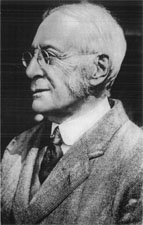
CHARLES W. ELIOT
(Photo (c) by Paul Thompson.)
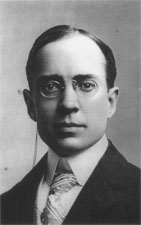
JAMES M. BECK
In the Supreme Court of Civilization
Defense of the Dual Alliance—A Reply
What Gladstone Said About Belgium
Probable Causes and Outcome of the War
Dr. Dernburg's Reply to the Third Letter
Dr. Jordan's Reply to Dr. Dernburg
Dr. Irene Sargent's Reply to Dr. Dernburg
PROF. BURGESS'S SECOND ARTICLE.
America's Peril in Judging Germany
"To Americans Leaving Germany"
The Eucken and Haeckel Charges
French Hate and English Jealousy
The Verdict of the American People
What the Economic Effects May Be
THE NEW YORK TIMES submitted the evidence contained in the official "White Paper" of Great Britain, the "Orange Paper" of Russia, and the "Gray Paper" of Belgium to James M. Beck, late Assistant Attorney General of the United States and a leader of the New York bar, who has argued many of the most important cases before the Supreme Court. On this evidence Mr. Beck has argued in the following article the case of Dual Alliance vs. Triple Entente. It has been widely circulated in France and Great Britain.
Let us suppose that in this year of dis-Grace, Nineteen Hundred and Fourteen, there had existed, as let us pray will one day exist, a Supreme Court of Civilization, before which the sovereign nations could litigate their differences without resort to the iniquitous and less effective appeal to the arbitrament of arms.
Let us further suppose that each of the contending nations had a sufficient leaven of Christianity to have its grievances adjudged not by the ethics of the cannon or the rifle, but by the eternal criterion of justice.
What would be the judgment of that august tribunal?
Any discussion of the ethical merits of this great controversy must start with the assumption that there is an international morality.
This fundamental axiom, upon which the entire basis of civilization necessarily rests, is challenged by a small class of intellectual perverts.
Some hold that moral considerations must be subordinated either to military necessity or so-called manifest destiny. This is the Bernhardi doctrine.
Others teach that war is a beneficent fatality and that all nations engaged in it are therefore equally justified. On this theory all of the now contending nations are but victims of an irresistible current of events, and the highest duty of the State is to prepare itself for the systematic extermination, when necessary or expedient, of its neighbors.
Notwithstanding the clever platitudes under which both these doctrines are veiled, all morally sane minds are agreed that this war is a great crime against civilization, and the only open question is, which of the two contending groups of powers is morally responsible for that crime?
Was Austria justified in declaring war against Servia?
Was Germany justified in declaring war against Russia and France?
Was England justified in declaring war against Germany?
As the last of these questions is the most easily disposed of, it may be considered first.
England's justification rests upon the solemn Treaty of 1839, whereby Prussia, France, England, Austria, and Russia "became the guarantors" of the "perpetual neutrality" of Belgium, as reaffirmed by Count Bismarck, then Chancellor of the North German Confederation, on July 22, 1870, and as even more recently reaffirmed in the striking fact disclosed in the Belgian "Gray Book."
In the Spring of 1913 a debate was in progress in the Budget Committee of the Reichstag with reference to the Military Budget. In the course of the debate the German Secretary of State said:
"The neutrality of Belgium is determined by international conventions, and Germany is resolved to respect these conventions."
To confirm this solemn assurance, the Minister of War added in the same debate:
"Belgium does not play any part in the justification of the German scheme of military reorganization. The scheme is justified by the position of matters in the East. Germany will not lose sight of the fact that Belgian neutrality is guaranteed by international treaties."
A year later, on July 31, 1914, Herr von Below, the German Minister at Brussels, assured the Belgian Department of State that he knew of a declaration which the German Chancellor had made in 1911, to the effect "that Germany had no intention of violating our neutrality," and "that he was certain that the sentiments to which expression was given at that time had not changed." (See Belgian "Gray Book," Nos. 11 and 12.)
Apart from these treaty stipulations, which are only declaration of Belgium's rights as sovereign nations, The Hague Conference, in which forty-four nations (including Germany) participated, reaffirmed as an axiom of international law the inherent right of a nation to the sanctity of its territory.
It seems unnecessary to discuss the wanton disregard of these solemn obligations and protestations, when the present Chancellor of the German Empire, in his speech to the Reichstag and to the world on Aug. 4, 1914, frankly admitted that the action of the German military machine in invading Belgium was a wrong. He said:
"We are now in a state of necessity, and necessity knows no law. Our troops have occupied Luxemburg and perhaps are already on Belgian soil. Gentlemen, that is contrary to the dictates of international law. It is true that the French Government has declared at Brussels that France is willing to respect the neutrality of Belgium, so long as her opponent respects it. We knew, however, that France stood ready for invasion. France could wait, but we could not wait. A French movement upon our flank upon the lower Rhine might have been disastrous. So we were compelled to override the just protest of the Luxemburg and Belgian Governments. The wrong—I speak openly—that we are committing we will endeavor to make good as soon as our military goal has been reached. Anybody who is threatened as we are threatened, and is fighting for his highest possessions, can only have one thought—how he is to hack his way through."
This defense is not even a plea of confession and avoidance. It is a plea of "Guilty" at the bar of the world. It has one merit, that it does not add to the crime the aggravation of hypocrisy. It virtually rests the case of Germany upon the gospel of Treitschke and Bernhardi, that each nation is justified in exerting its physical power to the utmost in defense of its selfish interests and without any regard to considerations of conventional morality. Might as between nations is the sole criterion of right. There is no novelty in this gospel. Its only surprising feature is its revival in the twentieth century. It was taught far more effectively by Machiavelli in his treatise, "The Prince," wherein he glorified the policy of Cesare Borgia in trampling the weaker States of Italy under foot by ruthless terrorism, unbridled ferocity, and the basest deception. Indeed, the wanton destruction of Belgium is simply Borgiaism amplified ten-thousandfold by the mechanical resources of modern war.
Unless our boasted civilization is the thinnest veneering of barbarism; unless the law of the world is in fact only the ethics of the rifle and the conscience of the cannon; unless mankind after uncounted centuries has made no real advance in political morality beyond that of the cave dweller, then this answer of Germany cannot satisfy the "decent respect to the opinions of mankind." Germany's contention that a treaty of peace is "a scrap of paper," to be disregarded at will when required by the selfish interests of one contracting party, is the negation of all that civilization stands for.
Belgium has been crucified in the face of the world. Its innocence of any offense, until it was attacked, is too clear for argument. Its voluntary immolation to preserve its solemn guarantee of neutrality will "plead like angels, trumpet-tongued, against the deep damnation of its taking off." On that issue the Supreme Court could have no ground for doubt or hesitation. Its judgment would be speedy and inexorable.
The remaining two issues, above referred to, are not so simple. Primarily and perhaps exclusively, the ethical question turns upon the issues raised by the communications which passed between the various Chancelleries of Europe in the last week of July, for it is the amazing feature of this greatest of all wars that it was precipitated by diplomats and rulers, and, assuming that all these statesmen sincerely desired a peaceful solution of the questions raised by the Austrian ultimatum, (which is by no means clear,) it was the result of ineffective diplomacy and clumsy diplomacy at that.
I quite appreciate the distinction between the immediate causes of a war and the anterior and more fundamental causes; nevertheless, with the world in a state of Summer peace on July 23, 1914, an issue, gravely affecting the integrity of nations and the balance of power in Europe, is suddenly precipitated by the Austrian ultimatum, and thereafter and for the space of about a week a series of diplomatic communications passed between the Chancelleries of Europe, designed on their face to prevent a war and yet so ineffective that the war is precipitated and the fearful Rubicon crossed before the world knew, except imperfectly, the nature of the differences between the Governments involved. The ethical aspects of this great conflict must largely depend upon the record that has been made up by the official communications which can, therefore, be treated as documentary evidence in a litigated case.
A substantial part of that record is already before the court of public opinion in the British and German "White Papers," the Russian "Orange Paper," and the Belgian "Gray Paper," and the purpose of this article is to discuss what judgment an impartial and dispassionate court would render upon the issues thus raised and the evidence thus submitted.
Primarily such a court would be deeply impressed not only by what the record as thus made up discloses, but also by the significant omissions of documents known to be in existence.
The official defense of England and Russia does not apparently show any failure on the part of either to submit all of the documents in their possession, but the German "White Paper" on its face discloses the suppression of documents of vital importance, while Austria has as yet failed to submit any of the documentary evidence in its possession.
We know from the German "White Paper"—even if we did not conclude as a matter of irresistible inference—that many important communications passed in this crisis between Germany and Austria, and it is probable that some communications must also have passed between those two countries and Italy. Italy, despite its embarrassing position, owes to the world the duty of a full disclosure. What such disclosure would probably show is indicated by her deliberate conclusion that her allies had commenced an aggressive war, which released her from any obligation under the Triple Alliance.
The fact that communications passed between Berlin and Vienna, the text of which has never been disclosed, is not a matter of conjecture. Germany admits and asserts as part of her defense that she faithfully exercised her mediatory influence with Austria, but not only is such mediatory influence not disclosed by any practical results of such mediation, but the text of these vital communications is still kept in the secret archives of Berlin and Vienna.
Thus in the official apology for Germany it is stated that, in spite of the refusal of Austria to accept the proposition of Sir Edward Grey to treat the Servian reply "as a basis for further conversations,"
"we [Germany] continued our mediatory efforts to the utmost and advised Vienna to make any possible compromise consistent with the dignity of the Monarchy."
[German "White Paper."]
This would be more convincing if the German Foreign Office in giving other diplomatic documents had only added the text of the advice which it thus gave Vienna.
The same significant omission will be found when the same official defense states that on July 29 the German Government advised Austria "to begin the conversations with Mr. Sazonof." But here again the text is not found among the documents which the German Foreign Office has given to the world. The communications, which passed between that office and its Ambassadors in St. Petersburg, Paris, and London, are given in extenso, but among the twenty-seven communications appended to the German official defense it is most significant that not a single communication is given of the many which passed from Berlin to Vienna and only two that passed from Vienna to Berlin.
This cannot be an accident. Germany has seen fit to throw the veil of secrecy over the text of its communications to Vienna, although professing to give the purport of a few of them.
Until Germany is willing to put the most important documents in its possession in evidence, it must not be surprised that the world, remembering Bismarck's garbling of the Ems dispatch, which precipitated the Franco-Prussian war, will be incredulous as to the sincerity of Germany's mediatory efforts.
To discuss the justice of Austria's grievances against Servia would take us outside the documentary record and into the realm of disputed facts and would expand this discussion far beyond reasonable length.
Let us therefore suppose arguendo that our imaginary court would commence its consideration with the assumption that Austria had a just grievance against Servia, and that the murder of the Archduke on June 28, 1914, while in fact committed by Austrian citizens of Servian sympathies on Austrian soil, had its inspiration and encouragement in the political activities either of the Servian Government or of political organizations of that country.
The question for decision would then be not whether Austria had a just grievance against Servia, but whether having regard to the obligations which Austria, as well as every other country, owes to civilization, she proceeded in the right manner to redress her grievance.
On June 28, 1914, the Austrian Crown Prince was murdered at Serajevo. For nearly a month there was no action by Austria, and no public statement whatever of its intentions. The world profoundly sympathized with Austria in its new trouble, and especially with its aged monarch, who, like King Lear, was "as full of grief as years and wretched in both."
The Servian Government had formerly disclaimed any complicity with the assassination and had pledged itself to punish any Servian citizen implicated therein.
From time to time, from June 28 to July 23, there came semi-inspired intimations from Vienna that that country intended to act with great self-restraint and in the most pacific manner. In his speech to the French Chamber of Deputies, Viviani says that Europe had in the interval preceding July 23 express assurances from Austria that its course would be moderate and conciliatory. Never was it even hinted that Germany and Austria were about to apply in a time of profound peace a match to the powder magazine of Europe.
This is strikingly shown by the first letter in the English "White Paper" from Sir Edward Grey to Sir H. Rumbold, dated July 20, 1914. It is one of the most significant documents in the entire correspondence. At the time this letter was written it is altogether probable that Austria's arrogant and most unreasonable ultimatum had already been framed and approved in Vienna, and possibly in Berlin, and yet Sir Edward Grey, the Foreign Minister of a great and friendly country, had so little knowledge of Austria's policy that he
"asked the German Ambassador today (July 20) if he had any news of what was going on in Vienna with regard to Servia." The German Ambassador replied "that he had not, but Austria was certainly going to take some step."
Sir Edward Grey adds that he told the German Ambassador that he had learned that Count Berchtold, the Austrian Foreign Minister,
"in speaking to the Italian Ambassador in Vienna, had deprecated the suggestion that the situation was grave, but had said that it should be cleared up."
The German Minister then replied that it would be desirable "if Russia could act as a mediator with regard to Servia," so that the first suggestion of Russia playing the part of the peacemaker came from the German Ambassador in London. Sir Edward Grey then adds that he told the German Ambassador that he
"assumed that the Austrian Government would not do anything until they had first disclosed to the public their case against Servia, founded presumably upon what they had discovered at the trial,"
and the German Ambassador assented to this assumption.
[English "White Paper," No. 1.]
Either the German Ambassador was then deceiving Sir Edward Grey, on the theory that the true function of an Ambassador is "to lie for his country," or the thunderbolt was being launched with such secrecy that even the German Ambassador in England did not know what was then in progress.
The British Ambassador at Vienna reports to Sir Edward Grey:
"The delivery at Belgrade on the 23d July of the note to Servia was preceded by a period of absolute silence at the Ballplatz."
He proceeds to say that with the exception of the German Ambassador at Vienna—note the significance of the exception—not a single member of the Diplomatic Corps knew anything of the Austrian ultimatum and that the French Ambassador when he visited the Austrian Foreign Office on July 23 was not only kept in ignorance that the ultimatum had actually been issued, but was given the impression that its tone was moderate. Even the Italian Ambassador was not taken into Count Berchtold's confidence.
[Dispatch from Sir M. de Bunsen to Sir Edward Grey, dated Sept. 1, 1914.]
No better proof of this sense of security need be adduced than that the French President and her Foreign Minister were thousands of miles from Paris, and the Russian Minister had, after the funeral of the Austrian Archduke, left Vienna for his annual holiday.
The interesting and important question here suggests itself whether Germany had knowledge of and approved in advance the Austrian ultimatum. If it did, it was guilty of duplicity, for the German Ambassador at St. Petersburg gave to the Russian Minister of Foreign Affairs an express assurance that
"the German Government had no knowledge of the text of the Austrian note before it was handed in and has not exercised any influence on its contents. It is a mistake to attribute to Germany a threatening attitude."
[Russian "Orange Paper," No. 18.]
This statement is inherently improbable. Austria was the weaker of the two allies and it was Germany's sabre that it was rattling in the face of Europe. Obviously Austria could not have proceeded to extreme measures, which it was recognized from the first would antagonize Russia, unless it had the support of Germany, and there is a probability, amounting to a moral certainty, that it would not have committed itself and Germany to the possibility of a European war without first consulting Germany.
Moreover, we have the testimony of Sir M. de Bunsen, the English Ambassador in Vienna, who advised Sir Edward Grey that he had "private information that the German Ambassador (at Vienna) knew the text of the Austrian ultimatum to Servia before it was dispatched and telegraphed it to the German Emperor," and that the German Ambassador himself "indorses every line of it." [English "White Paper," No. 95.] As he does not disclose the source of his "private information," this testimony would not by itself be convincing, but when we examine Germany's official defense in the German "White Paper," we find that the German Foreign Office admits that it was consulted by Austria previous to the ultimatum and not only approved of Austria's course but literally gave her a carte blanche to proceed.
This point seems so important in determining the sincerity of Germany's attitude and pacific protestations that we quote in extenso. After referring to the previous friction between Austria and Servia, the German "White Paper" says:
"In view of these circumstances, Austria had to admit that it would not be consistent either with the dignity or self-preservation of the monarchy to look on longer at the operations on the other side of the border without taking action. The Austro-Hungarian Government advised us of this view of the situation and asked our opinion in the matter. We were able to assure our ally most heartily of our agreement with her view of the situation and to assure her that any action that she might consider it necessary to take in order to put an end to the movement in Servia directed against the existence of the Austro-Hungarian Monarchy would receive our approval. We were fully aware in this connection that warlike moves on the part of Austria-Hungary against Servia would bring Russia into the question and might draw us into a war in accordance with our duties as an ally."
Sir M. de Bunsen's credible testimony is further confirmed by the fact that the British Ambassador at Berlin, in his letter of July 22 to Sir Edward Grey, states that on the preceding night (July 21) he had met the German Secretary of State for Foreign Affairs, and an allusion was made to a possible action by Austria.
"His Excellency was evidently of opinion that this step on Austria's part would have been made ere this. He insisted that the question at issue was one for settlement between Servia and Austria alone, and that there should be no interference from outside in the discussions between those two countries."
He adds that while he had regarded it as inadvisable that his country should approach Austria-Hungary in the matter, he had
"on several occasions in conversation with the Servian Minister emphasized the extreme importance that Austro-Servian relations should be put on a proper footing."
[English "White Paper," No. 2.]
Here we have the first statement of Germany's position in the matter, a position which subsequent events showed to be entirely untenable, but to which Germany tenaciously adhered to the very end, and which did much to precipitate the war. Forgetful of the solidarity of European civilization and the fact that by policy and diplomatic intercourse continuing through many centuries a United European State exists, even though its organization be as yet inchoate, he took the ground that Austria should be permitted to proceed to aggressive measures against Servia without interference from any other power, even though, as was inevitable, the humiliation of Servia would destroy the status of the Balkan States and even threaten the European balance of power.
No space need be taken in convincing any reasonable man that this Austrian ultimatum to Servia was brutal in its tone and unreasonable in its demands. It would be difficult to find in history a more offensive document, and its iniquity was enhanced by the short shriving time which it gave either Servia or Europe. Servia had forty-eight hours to answer whether it would compromise its sovereignty, and virtually admit its complicity in a crime which it had steadily disavowed. As the full text of the ultimatum first reached the Foreign Chancelleries nearly twenty-four hours after its service upon Servia, the other European nations had barely a day to consider what could be done to preserve the peace of Europe before that peace was fatally compromised.
[English "White Paper," No. 5; Russian "Orange Paper," No. 3.]
Further confirmation that the German Foreign Office did have advance knowledge of at least the substance of the ultimatum is shown by the fact that on the same day the ultimatum was issued the Chancellor of the German Empire instructed the German Ambassadors in Paris, London, and St. Petersburg to advise the English, French, and Russian Governments that
"the acts as well as the demands of the Austro-Hungarian Government cannot but be looked upon as justified."
[German "White Paper," Annex 1B.]
How could Germany thus indorse the "demands" if it did not know the substance of the ultimatum?
The hour when these instructions were sent is not given, so that it does not follow that these significant instructions were necessarily prior to the service of the ultimatum at Belgrade at 6 P.M. Nevertheless, as the ultimatum did not reach the other capitals of Europe until the following day, as the diplomatic correspondence clearly shows, it seems improbable that the German Foreign Office would have issued this very carefully prepared and formal warning to the other powers on July the 23d unless it had not only knowledge of Austria's intention to serve the ultimatum but also at least of the substance thereof.
While it may be that Germany, while indorsing in blank the policy of Austria, purposely refrained from examining the text of the communication, so that it could thereafter claim that it was not responsible for Austria's action—a policy which would not lessen the discreditable character of the whole business—yet the more reasonable assumption is that the simultaneous issuance of Austria's ultimatum at Belgrade and Germany's warning to the powers were the result of a concerted action and had a common purpose. No court or jury, reasoning along the ordinary inferences of human life, would question this conclusion for a moment.
The communication for the German Foreign Office last referred to anticipates that Servia "will refuse to comply with these demands"—why, if they were justified?—and Germany suggests to France, England, and Russia that if, as a result of such non-compliance, Austria has "recourse to military measures," that "the choice of means must be left to it."
The German Ambassadors in the three capitals were instructed
"to lay particular stress on the view that the above question is one the settlement of which devolves solely upon Austria-Hungary and Servia, and one which the powers should earnestly strive to confine to the two countries concerned,"
and he added that Germany strongly desired
"that the dispute be localized, since any intervention of another power, on account of the various alliance obligations, would bring consequences impossible to measure."
This is one of the most significant documents in the whole correspondence. If Germany were as ignorant as her Ambassador at London affected to be of the Austrian policy and ultimatum, and if Germany was not then instigating and supporting Austria in its perilous course, why should the German Chancellor have served this threatening notice upon England, France, and Russia, that Austria must be left free to make war upon Servia, and that any attempt to intervene in behalf of the weaker nation would "bring consequences impossible to measure"?
[German "White Paper," Annex 1B.]
A few days later the Imperial Chancellor sent to the Confederated Governments of Germany a confidential communication in which he recognized the possibility that Russia might feel it a duty "to take the part of Servia in her dispute with Austria-Hungary." Why, again, if Austria's case was so clearly justified? The Imperial Chancellor added that
"if Russia feels constrained to take sides with Servia in this conflict, she certainly has a right to do it,"
but added that if Russia did this it would in effect challenge the integrity of the Austro-Hungarian Monarchy, and that Russia would therefore alone—
"bear the responsibility if a European war arises from the Austro-Servian question, which all the rest of the great European powers wish to localize."
In this significant confidential communication the German Chancellor declares the strong interest which Germany had in the punishment of Servia by Austria. He says "our closest interests therefore summon us to the side of Austria-Hungary," and he adds that
"if contrary to hope, the trouble should spread, owing to the intervention of Russia, then, true to our duty as an ally, we should have to support the neighboring monarchy with the entire might of the German Empire."
[German "White Paper," Annex 2.]
In reaching its conclusion our imaginary court would pay little attention to mere professions of a desire for peace. A nation, like an individual, can covertly stab the peace of another while saying, "Art thou in health, my brother?" and even the peace of civilization can be betrayed by a Judas kiss. Professions of peace belong to the cant of diplomacy and have always characterized the most bellicose of nations.
No war in modern times has been begun without the aggressor pretending that his nation wished nothing but peace and invoking Divine aid for its murderous policy. To paraphrase the words of Lady Teazle on a noted occasion when Sir Joseph Surface talked much of "honor," it might be as well in such instances to leave the name of God out of the question.
Let us, then, analyze the record as already made up; and for the sake of clearness the events which preceded the war will be considered chronologically.
Immediately upon the receipt of the ultimatum in St. Petersburg on July 24, the Russian Minister of Foreign Affairs, in a formal communication to Austria-Hungary, suggested that the abrupt time limit "leaves to the powers a delay entirely insufficient to undertake any useful steps whatever for the straightening out of the complications that have arisen," and added:
"To prevent the incalculable consequences, equally disastrous for all the powers, which can follow the method of action of the Austro-Hungarian Government, it seems indispensable to us that, above all, the delay given to Servia to reply should be extended."
Sazonof further suggested that time should be given for the powers to examine the results of the inquiry that the Austro-Hungarian Government had made in the matter of the Serajevo assassination, and stated that if the powers were convinced
"of the well-groundedness of certain of the Austrian demands they would find themselves in a position to send to the Servian Government consequential advice."
He justly observes that
"a refusal to extend the terms of the ultimatum ... would be in contradiction with the very bases of international relations."
[Russian "Orange Paper," No. 4.]
Could any court question the justice of this contention? The peace of the world was at stake. Time only was asked to see what could be done to preserve that peace and satisfy Austria's grievances to the uttermost farthing.
Concurrently with Sazonof's plea for a little time to preserve the peace of the world, Sir Edward Grey had seen the German Ambassador on July 24 and had suggested to him that the only method of preventing the catastrophe was
"that the four powers, Germany, France, Italy, and ourselves, (England,) should work together simultaneously at Vienna and St. Petersburg."
[English "White Paper," No. 11.]
Germany had only to intimate to Austria that "a decent respect to the opinions of mankind," as well as common courtesy to great and friendly nations, required that sufficient time be given not only to Servia, but to the other nations, to concert for the common good, especially as the period was one of Summer dullness and many of the leading rulers and statesmen were absent from their respective capitals.
Under these circumstances was it not natural that Russia should announce on July 24
"that any action taken by Austria to humiliate Servia would not leave Russia indifferent,"
and that on the same day the Russian Chargé d'Affaires at Vienna suggested to the Austrian Foreign Office
"that the Austrian note was drawn up in a form rendering it impossible of acceptance as it stood, and that it was both unusual and peremptory in its terms"?
To which the only reply of the Austrian Foreign Minister was that their representative in Servia
"was under instructions to leave Belgrade unless Austrian demands were accepted in their integrity by 4 P.M. tomorrow."
[English "White Paper," No. 7.]
Austria's only concession then or subsequently to the cause of peace was the assurance that Austria would not after its conquest of Servia demand any territory.
The action of Germany on this day, July 24, is most significant. Its Ambassador in England communicated a note to Sir Edward Grey in which it justified Austro-Hungarian grievances and ultimatum by saying that
"under these circumstances the course of procedure and demands of the Austro-Hungarian Government can only be regarded as equitable and moderate."
The note added:
"The Imperial Government [Germany] want to emphasize their opinion that in the present case there is only question of a matter to be settled exclusively between Austria-Hungary and Servia, and that the great powers ought seriously to endeavor to reserve it to those two immediately concerned."
[English "White Paper," No. 9.]
On July 25, probably to the great surprise of both Germany and Austria, which had definitely calculated upon Servians non-compliance with the ultimatum, the latter country, under the conciliatory advice of Russia and England, made a reply in which, at some sacrifice of its self-respect as a sovereign State, it substantially accepted all but one of the demands of Austria, and as to that it did not, in terms, refuse it, but expressed its willingness to refer it either to arbitration or to a conference of the powers.
[English "White Paper," No. 39.]
No court would question for a moment the conclusion that the reply was a substantial acquiescence in the extreme Austrian demands, nor indeed did either Germany or Austria seriously contend that it was not. They contented themselves with impeaching the sincerity of the assurances, calling the concessions "shams," and of this it is enough to say that if Germany and Austria had accepted Servians reply as sufficient, and Servia had subsequently failed to fulfill its promises thus made in the utmost good faith, there would have been little sympathy for Servia, and no general war. Indeed, both Russia and England pledged their influence to compel Servia, if necessary, to meet fully any reasonable demand of Austria. The outstanding question, which Servia agreed to arbitrate or leave to the powers, was the participation of Austrian officials in the Servian courts. This did not present a difficult problem. Austria's professed desire for an impartial investigation could have been easily attained by having the neutral powers appoint a commission of jurists to make such investigation.
On July 24 Sir Edward Grey also had asked the German Ambassador to use his good influences at Vienna to secure an extension of time. To this most reasonable request the answer and action of the German Government was disingenuous in the extreme. They agreed to "pass on" the suggestion, but the German Secretary of State for Foreign Affairs added that as the Austrian Prime Minister was away from Vienna there would be delay and difficulty in getting the time limit extended, and
"he admitted quite freely that the Austro-Hungarian Government wished to give the Servians a lesson and that they meant to take military action. He also admitted that the Servian Government could not swallow certain of the Austro-Hungarian demands."
He added that Germany did not want a general war and "he would do all in his power to prevent such a calamity."
[English "White Paper," Nos. 11 and 18.]
Immediately on the issuance of the ultimatum the Austrian Foreign Minister, Count Berchtold, had most inopportunely taken himself to Ischl, where he remained until after the expiration of the time limit. Access to him proved difficult, and the Russian Chargé at Vienna, having lodged a pacific protest with the Acting Foreign Minister in order to take no chances, telegraphed it to Berchtold at Ischl. Nevertheless, Berchtold's apparently designed absence from the capital was Germany's excuse for its failure to get the time limit extended.
If Germany made any communication to Austria in the interests of peace the text has yet to be disclosed to the world. A word from Berlin to Vienna would have given the additional time which, with sincerely pacific intentions, might have resulted in the preservation of peace. Germany, so far as the record discloses, never spoke that word.
Contrast this attitude with that of Russia, whose Foreign Minister on the morning of July 25 offered
"to stand aside and leave the question in the hands of England, France, Germany, and Italy."
[English "White Paper," No. 17.]
As Russia was the member of the Triple Entente most interested in the fate of Servia, what proposal could have been more conciliatory or magnanimous?
On July 25 Sir Edward Grey proposed that the four powers (including Germany) should unite
"in asking the Austrian and Russian Governments not to cross the frontier and to give time for the four powers, acting at Vienna and St. Petersburg, to try and arrange matters. If Germany will adopt this view I feel strongly that France and ourselves should act upon it. Italy would no doubt gladly co-operate."
[English "White Paper," Nos. 24 and 25.]
To this reasonable request the Imperial German Chancellor replied:
"First and last, we take the ground that this question must be localized by the abstention of all the powers from intervention in it,"
but added that Germany would, if an Austro-Russian dispute arose,
"co-operate with the other great powers in mediation between Russia and Austria."
[German "White Paper," Annex 13.]
This distinction is very hard to grasp. It attempts to measure the difference between tweedledum and tweedledee. Russia's difference with Austria was over the attempt of the latter to crush Servia. Germany would not interfere in the latter, but would as an abstract proposition mediate between Russia and Austria. For all practical purposes the two things were indistinguishable.
How she "co-operated" we shall presently see.
All that Germany did on July 25, so far as the record discloses, was to "pass on" England's and Russia's requests for more time, but subsequent events indicate that it was "passed on" without any indorsement, for is it credible that Austria would have ignored its ally's request for more time if it had ever been made?
The Austrian Foreign Minister, having launched the ultimatum, absented himself from the capital, but the Russian Minister at Vienna, as already stated, succeeded in submitting this most reasonable request verbally to the Acting Foreign Minister, who simply said that he would submit it to Count Berchtold, but that he could predict with assurance a categorical refusal. Later on that day (July 25) Russia was definitely advised that no time extension would be granted.
[Russian "Orange Paper," Nos. 11 and 12.]
Was ever the peace of the world shattered upon so slight a pretext? A little time, a few days, even a few hours, might have sufficed to preserve the world from present horrors, but no time could be granted. A colossal snap judgment was to be taken by these pettifogging diplomats. A timely word from the German Chancellor would have saved the flower of the youth of Germany and Austria from perishing. It would be difficult to find in recorded history a greater discourtesy to a friendly power, for Austria was not at war with Russia.
Defeated in their effort to get an extension of time, England, France, and Russia made further attempts to preserve peace by temporarily arresting military proceedings until efforts toward conciliation could be made. Sir Edward Grey proposed to Germany, France, Russia, and Italy that they should unite in asking Austria and Servia not to cross the frontier "until we had had time to try and arrange matters between them," but the German Ambassador read Sir Edward Grey a telegram that he had received from the German Foreign Office that "once she [Austria] had launched that note [the ultimatum] Austria could not draw back."
[English "White Paper," No. 25.]
As we have seen, Germany never, so far as the record discloses, sought in any way to influence Austria to make this or any concession. Its attitude was shown by the declaration of its Ambassador at Paris to the French Minister of Foreign Affairs, which, while disclaiming that Germany had countenanced the Austrian ultimatum, yet added that Germany approved its point of view,
"and that certainly the arrow, once sent, Germany could not allow herself to be guided except by her duty to her ally."
This seemed to be the fatal fallacy of Germany, that its duties to civilization were so slight that it should support its ally, Austria, whether the latter were right or wrong. Such was its policy, and it carried it out with fatal consistency. To support its ally in actual war may be defensible, but to support it in times of peace in an iniquitous demand and a policy of gross discourtesy offends every sense of international morality.
On the following day Russia proposed to Austria that they should enter into an exchange of private views, with the object of an alteration in common of some clauses of the Austrian note of July 23. To this Austria never even replied. The Russian Minister communicated this suggestion to the German Minister of Foreign Affairs and expressed the hope that he would "find it possible to advise Vienna to meet our proposal," but this did not accord with German policy, for on that day the German Ambassador in Paris called upon the French Minister of Foreign Affairs, and in reply to a similar suggestion that Germany should suggest to Vienna to meet Servia in the same conciliatory spirit which Servia had shown, the Ambassador answered that that "was not possible in view of the resolution taken not to interfere in the Austro-Servian conflict."
On the same day England asked France, Italy, and Germany to meet in London for an immediate conference to preserve the peace of Europe, and to this fruitful suggestion, which might have saved the peace of Europe, the German Chancellor replied with the pitiful quibble that "it is impossible to bring our ally before a European court in its difference with Servia," although it affected to accept "in principle" the policy of mediation.
Germany's acceptance "in principle" of a policy which she in practice thwarted suggests the law-abiding tendencies of that Maine statesman who was "for the Maine prohibition liquor law, but against its enforcement."
[English "White Paper," No. 46.]
Germany's refusal to have Servia's case submitted to the powers even for their consideration is the more striking when it is recalled that the German Ambassador at London quoted to Sir Edward Grey the German Secretary of State as saying
"that there were some things in the Austrian note that Servia could hardly be expected to accept,"
thus recognizing that Austria's ultimatum was, at least in part, unjust. Sir Edward Grey then called the German Ambassador's attention to the fact that if Austria refused the conciliatory reply of Servia and marched into that country
"it meant that she was determined to crush Servia at all costs, being reckless of the consequences that might be involved."
He added that the Servian reply
"should at least be treated as a basis for discussion and pause,"
and asked that the German Government should urge this at Vienna, but the German Secretary of State on July 27 replied that such a conference "was not practicable," and that it "would practically amount to a court of arbitration," and could not, in his opinion, be called together "except at the request of Austria and Russia."
[English "White Paper," Nos. 43 and 46.]
That this was a mere evasion is perfectly plain. Germany already knew that Austria would not ask for such a conference, for Austria had already refused Russia's request for an extension of time and had actually commenced its military operations. Germany's attitude is best indicated by the letter of the Russian Minister in Germany to the Russian Foreign Office in which he states that on July 27 he called at the German Foreign Office and asked it
"to urge upon Vienna in a more pressing fashion to take up this line of conciliation. Jagow replied that he could not advise Austria to yield."
[Russian "Orange Paper," No. 38.]
Why not? Russia had advised Servia to yield, and Servia had conceded nearly every claim. Why could not the German Foreign Office advise Vienna to meet conciliation by conciliation, if its desire for peace were sincere? All that Russia and England desired was that a little time and consideration should be given, without prejudice to the rights or claims of Austria, before the peace of the world was hopelessly shattered.
Before this interview took place the French Ambassador had called at the German Foreign Office on a similar errand and urged the English suggestion that action should at once be taken by England, Germany, Russia, and France at St. Petersburg and Vienna, to the effect that Austria and Servia
"should abstain from any act which might aggravate the situation at the present hour."
By this was meant that there should be, pending further parleys, no invasion of Servia by Austria and none of Austria by Russia. To this the German Foreign Minister opposed a categorical refusal.
On the same day the Russian Ambassador at Vienna had "a long and earnest conversation" with the Austrian Under Secretary of State for Foreign Affairs. He expressed the earnest hope that
"something would be done before Servia was actually invaded. Baron Machio replied that this would now be difficult, as a skirmish had already taken place on the Danube, in which the Servians had been aggressors."
The Russian Ambassador then said that his country would do all it could to keep the Servians quiet,
"and even to fall back before an Austrian advance in order to gain time."
He urged that the Austrian Ambassador at St. Petersburg should be furnished with full powers to continue discussions with the Russian Minister for Foreign Affairs,
"who was very willing to advise Servia to yield all that could be fairly asked of her as an independent power."
The only reply to this reasonable suggestion was that it would be submitted to the Minister for Foreign Affairs.
[English "White Paper," No. 56.]
On the same day the German Ambassador at Paris called upon the French Foreign Office and strongly insisted on the "exclusion of all possibility of mediation or of conference," and yet contemporaneously the Imperial German Chancellor was advising London that he had
"started the efforts toward mediation in Vienna, immediately in the way desired by Sir Edward Grey, and had further communicated to the Austrian Foreign Minister the wish of the Russian Foreign Minister for a direct talk in Vienna."
What hypocrisy! In the formal German defense, the official apologist for that country, after stating his conviction
"that an act of mediation could not take into consideration the Austro-Servian conflict, which was purely an Austro-Hungarian affair,"
claimed that Germany had transmitted Sir Edward Grey's further suggestion to Vienna, in which Austria-Hungary was urged
"either to agree to accept the Servian answer as sufficient or to look upon it as a basis for further conversations";
but the Austro-Hungarian Government—playing the rôle of the wicked partner of the combination—"in full appreciation of our mediatory activity," (so says the German "White Paper" with sardonic humor,) replied to this proposition that, coming as it did after the opening of hostilities, "it was too late."
Does any reasonable man question for a moment that, if Germany had done something more than merely "transmit" these wise and pacific suggestions, Austria would have complied with the suggestions of its powerful ally or that Austria would have suspended its military operations if Germany had given any intimation of such a wish?
On the following day, July 28, the door was further closed on any possibility of compromise when the Austrian Minister for Foreign Affairs
"said, quietly but firmly, that no discussion could be accepted on the basis of the Servian note; that war would be declared today, and that the well-known pacific character of the Emperor, as well as, he might add, his own, might be accepted as a guarantee that the war was both just and inevitable; that this was a matter that must be settled directly between the two parties immediately concerned."
To this arrogant and unreasonable contention that Europe must accept the guarantee of the Austrian Foreign Minister as to the righteousness of Austria's quarrel the British Ambassador suggested "the larger aspect of the question," namely, the peace of Europe, and to this "larger aspect," which should have given any reasonable official some ground for pause, the Austrian Foreign Minister replied that he
"had it also in mind, but thought that Russia ought not to oppose operations like those impending, which did not aim at territorial aggrandizement, and which could no longer be postponed."
[English "White Paper," No. 62.]
The private conversations between Russia and Austria having thus failed, Russia returned to the proposition of a European conference to preserve its peace. Its Ambassador in Vienna on July 28 had a conference with Berchtold and pointed to the dangers to the peace of Europe and the desirability of good relations between Austria-Hungary and Russia.
To this Count Berchtold replied that he understood perfectly well the seriousness of the situation and the advantages of a frank explanation with the Cabinet at St. Petersburg.
"He told me that, on the other hand, the Austro-Hungarian Government, which had only reluctantly decided upon the energetic measures which it had taken against Servia, could now neither withdraw nor enter upon any discussion of the terms of the Austro-Hungarian note."
[Russian "Orange Paper," No. 45.]
On the same day, July 28, the German Imperial Chancellor sent for the English Ambassador and excused his failure to accept the proposal of conference of the neutral powers, on the ground that he did not think it would be effective,
"because such a conference would in his opinion have the appearance of an 'Areopagus' consisting of two powers of each group sitting in judgment upon the two remaining powers."
After engaging in this pitiful and insincere quibble, and when reminded of Servia's conciliatory reply, amounting to a virtual surrender,
"his Excellency said that he did not wish to discuss the Servian note, but that Austria's standpoint, and in this he agreed, was that her quarrel with Servia was a purely Austrian concern, with which Russia had nothing to do."
[English "White Paper," No. 71.]
At this point the rules of the countries intervened in the dispute. The Kaiser, having returned from Norway, telegraphed the Czar, under date of July 28, that he was
"exerting all my influence to endeavor to make Austria-Hungary come to an open and satisfying understanding with Russia,"
and invoked the Czar's aid.
[German "White Paper," Annex 20.]
If the Kaiser were sincere, and he may have been, his attitude was not that of his Foreign Office. Upon the face of the record we have only his own assurance that he was doing everything to preserve peace, but the steps that he took or the communications he made to influence Austria are not found in the formal defense which the German Government has given to the world. The Kaiser can only convince the world of his innocence of the crime of his Potsdam camarilla by giving the world the text of any advice he gave the Austrian officials. He has produced his telegrams to the Czar. Where are those he presumably sent to Francis Joseph or Count Berchtold? Where are the instructions he gave his own Ambassadors or Foreign Minister?
It is significant that on the same day Sazonof telegraphed to Count Benckendorff:
"My conversations with the German Ambassador confirm my impression that Germany is rather favorable to the uncompromising attitude adopted by Austria,"
and he adds, and history will vindicate him in the conclusion, that
"the Berlin Cabinet, which might have been able to arrest the whole development of this crisis, seems to exercise no action on its ally."
[Russian "Orange Paper," No. 43.]
On July 29 Sir Edward Goschen telegraphed Sir Edward Grey that he had that night seen the German Chancellor, who had "just returned from Potsdam," where he had presumably seen the Kaiser. The German Chancellor then showed clearly how the wind was blowing in making the suggestion to Sir Edward Goschen that if England would remain neutral, Germany would agree to guarantee that she would not take any French territory. When asked about the French colonies, no assurance was given.
[English "White Paper," No. 85.]
Later in the day the German Chancellor again saw the English Ambassador, and expressed regret
"that events had marched too rapidly, and that it was therefore too late to act upon your [Sir Edward Grey's] suggestion that the Servian reply might form the basis of discussion."
[English "White Paper," No. 75.]
On the same day the Ambassador for Germany at St. Petersburg called upon Sazonof and expressed himself in favor of further explanations between Vienna and St. Petersburg, to which Sazonof assented. [Russian "Orange Paper," No. 49.] On the same day Sir Edward Grey asked the German Government
"to suggest any form of procedure under which the idea of mediation between Austria and Russia, already accepted by the German Government in principle, could be applied."
To which the German Foreign Office replied that it could not act for fear that if they made to their ally any suggestion that looked like pressure it might "cause them [Austria] to precipitate matter and present a fait accompli." [See letter of Sir Edward Goschen to Sir Edward Grey, July 29—English "White Paper," No. 70.]
This was the last and worst of the quibbles put forth to gain time while Austria was making progress toward Belgrade. It assumes that Austria might not only fail to respect the wish in a matter of common concern of its more powerful ally, but that it might act in disregard of Germany's wish. This strains human credulity to the breaking point. Did the German Secretary of State keep a straight face when he uttered this sardonic pleasantry? It may be the duty of a diplomat to lie on occasion, but is it ever necessary to utter such a stupid falsehood? The German Secretary of State sardonically added in the same conversation that he was not sure that the effort for peace had not hastened the declaration of war, as though the declaration of war against Servia had not been planned and expected from the first.
As a final effort to meet quibbles, the British Ambassador at Berlin then suggested that after Austria had satisfied her military prestige, the moment might then be favorable for four disinterested powers to discuss the situation and come forward with suggestions for preventing graver complications.
To this proposal the German Secretary of State seemingly acquiesced, but, as usual, nothing whatever was done. [English "White Paper," No. 76.] It is true that on July 29 Sir Edward Grey was assured by the German Ambassador that the German Foreign Office was
"endeavoring to make Vienna explain in a satisfactory form at St. Petersburg the scope and extension of Austrian proceedings in Servia,"
but again the communications which the German Foreign Office sent to Vienna on this point have never yet been disclosed to the world.
[English "White Paper," No. 84.]
In this same conference Sir Edward Grey
"urged that the German Government should suggest any method by which the influence of the four powers could be used together to prevent war between Austria and Russia. France agreed, Italy agreed. The whole idea of mediation or mediating influence was ready to be put into operation by any method that Germany could suggest if mine were not acceptable. In fact, mediation was ready to come into operation by any method that Germany thought possible, if only Germany would 'press the button' in the interests of peace."
[English "White Paper," No. 84.]
The difficulty was, however, that Germany never "pressed the button," although obviously it would have been easy for her to do so, as the stronger and more influential member of the Double Alliance.
On the same day the Austrian Government left a memorandum with Sir Edward Grey to the effect that Count Mensdorff said that the war with Servia must proceed.
On the night of July 29 the British Ambassador at Berlin was informed that the German Foreign Office "had not had time to send an answer yet" to the proposal that Germany suggest the form of mediation, but that the question had been referred to the Austro-Hungarian Government with a request as to "what would satisfy them."
[English "White Paper," No. 107.]
On the following day the German Ambassador informed Sir Edward Grey that the German Government would endeavor to influence Austria, after taking Belgrade and Servian territory in the region of the frontier, to promise not to advance further, while the powers endeavored to arrange that Servia should give satisfaction sufficient to pacify Austria, but if Germany ever exercised any such pressure upon Vienna, no evidence of it has ever been given to the world. Certainly it was not very effective, and for the reasons mentioned it is impossible to conclude that the advice of Germany, if in good faith, would not have been followed by its weaker ally.
From all that appears in the record, Austria made no reply to this most conciliatory suggestion of England, but, in the meantime, the irrepressible Kaiser made the crisis more acute by cabling to the Czar that the mobilization of Russia to meet the mobilization of Austria was affecting his position of mediator, to which the Czar made a conciliatory reply, stating that Russia's mobilization was only for a defense against Austria.
The Czar, to put at rest any anxiety of the Kaiser as to Russia's intentions with respect to Germany, added:
"I thank you cordially for your mediation which permits the hope that everything may yet end peaceably. It is technically impossible to discontinue our military preparations which have been made necessary by the Austrian mobilization. It is far from us to want war. As long as the negotiations between Austria and Servia continue, my troops will undertake no provocative action. I give you my solemn word thereon. I confide with all my faith in the grace of God, and I hope for the success of your mediation in Vienna for the welfare of our countries and the peace of Europe."
What more could Russia do? If Austria continued to mobilize, why not Russia?
On this day, July 30, the German Ambassador had two interviews at St. Petersburg with Sazonof, and it was then that Sazonof drew up the following formula as a basis for peace:
"If Austria, recognizing that her conflict with Servia has assumed character of question of European interest, declares herself ready to eliminate from her ultimatum the points which violate principle of sovereignty of Servia, Russia engages to stop all military preparations."
[Russian "Orange Paper," No. 60.]
At this stage King George telegraphed Prince Henry of Prussia that
"the English Government was doing its utmost, suggesting to Russia and France to suspend further military preparations, if Austria will consent to be satisfied with the occupation of Belgrade and neighboring Servian territory as a hostage for satisfactory settlement of her demands, other countries meanwhile suspending their war preparation."
The King adds a hope that the Kaiser
"will use his great influence to induce Austria to accept this proposal, thus proving that Germany and England are working together to prevent what would be an international catastrophe."
[Second German "White Paper."]
This last proposition, however, was never accepted or declined, for the impetuous Kaiser gave his twelve-hour ultimatum to Russia to demobilize, and this was an arrogant demand which no self-respecting power, much less so great a one as Russia, could possibly accept.
While this demand was in progress Sir Edward Grey was making his last attempt to preserve peace by asking Germany to sound Vienna, as he would sound St. Petersburg, whether it would be possible for the four disinterested powers to offer to Austria that they would
"undertake to see that she obtained full satisfaction of her demands on Servia, provided they did not embarrass Servian sovereignty and the integrity of Servian territory."
Sir Edward Grey went so far as to tell the German Ambassador that if this was not satisfactory, and if Germany would make any reasonable proposals to preserve peace and Russia and France rejected it, that
"his Majesty's Government would have nothing to do with the consequences,"
which obviously meant either neutrality or actual intervention in behalf of Germany and Austria.
On the same day the British Ambassador at Berlin besought the German Foreign Office to
"put pressure on the authorities at Vienna to do something in the general interest to reassure Russia and to show themselves disposed to continue discussions on a friendly basis."
And Sir Edward Goschen reports that the German Foreign Minister replied that last night he had
"begged Austria to reply to your last proposal, and that he had received a reply to the effect that the Austrian Minister for Foreign Affairs would take the wishes of the Emperor this morning in the matter."
Again the text of the letter in which Germany "begged" Austria to be conciliatory is not found in the record.
The excuse of Germany that the mobilization of Russia compelled it to mobilize does not justify the war. Mobilization does not necessarily mean aggression, but simply preparation. If Russia had the right to mobilize because Austria mobilized, Germany equally had the right to mobilize when Russia mobilized, but it does not follow that either of the three nations could justify a war to compel the other parties to demobilize. Mobilization is only a preparation against eventualities. It is the right of the sovereign State and by no code of ethics a casus belli. The demand of Germany that Russia could not arm to defend itself, when Austria was preparing for a possible attack on Russia, has few, if any, parallels in history for bullying effrontery. It treated Russia as an inferior, almost a vassal, State.
It must be observed that, while Germany insisted that Russia should demobilize, the Kaiser offered no reciprocal promise. On his theory Germany and Austria were to be left free to complete their preparations, but Russia was to tie her own hands and leave herself "naked to her enemies." This is shown by the last telegrams which passed between the Czar and Kaiser. The Czar telegraphed:
"I have received your telegram. I comprehend that you are forced to mobilize, but I should like to have from you the same guaranty which I have given you, viz., that these measures do not mean war, and that we shall continue to negotiate for the welfare of our two countries and the universal peace which is so dear to our hearts. With the aid of God it must be possible to our long-tried friendship to prevent the shedding of blood. I expect with full confidence your urgent reply."
To this the Kaiser replied:
"I thank you for your telegram. I have shown yesterday to your Government the way through which alone war may yet be averted. Although I asked for a reply by today noon, no telegram from my Ambassador has reached me with the reply of your Government. I therefore have been forced to mobilize my army. An immediate, clear, and unmistakable reply of your Government is the sole way to avoid endless misery. Until I receive this reply I am unable, to my great grief, to enter upon the subject of your telegram. I must ask most earnestly that you, without delay, order your troops to commit, under no circumstances, the slightest violation of our frontiers."
This impetuous step of Germany to compel its great neighbor to desist from military preparations to defend itself came most inopportunely, for on Aug. 1 the Austro-Hungarian Ambassador for the first time declared to the Russian Government its willingness to discuss the terms of the Austrian ultimatum to Servia, and it was then suggested that the form of the ultimatum and the questions arising thereon should be discussed in London. (Dispatch from British Ambassador at Vienna to Sir Edward Grey, dated Sept. 1, 1914.) Sir Edward Grey at once advised the English Ambassador in Berlin of the fact, and urged that it was still possible to maintain peace
"if only a little respite in time can be gained before any great power begins war,"
[English "White Paper," No. 131.]
but the Kaiser, having issued the arrogant ultimatum to Russia to demobilize in twelve hours, had gone too far for retreat, and, spurred on by the arrogant Potsdam military party, he "let slip the dogs of war." After the fatal Rubicon had been crossed and the die was cast the Czar telegraphed King George:
"In this solemn hour I wish to assure you once more I have done all in my power to avert war."
Such will be the verdict of history.
These are the facts as shown by the record, and upon them, in my judgment, an impartial court would not hesitate to pass the following judgment:
1—That Germany and Austria in a time of profound peace secretly concerted together to impose their will upon Europe and upon Servia in a matter affecting the balance of power in Europe. Whether in so doing they intended to precipitate a European war to determine the mastery of Europe is not satisfactorily established, although their whole course of conduct suggests this as a possibility. They made war almost inevitable by (a) issuing an ultimatum that was grossly unreasonable and disproportionate to any grievance that Austria had and (b) in giving to Servia, and Europe, insufficient time to consider the rights and obligations of all interested nations.
2—That Germany had at all times the power to compel Austria to preserve a reasonable and conciliatory course, but at no time effectively exerted that influence. On the contrary, she certainly abetted, and possibly instigated, Austria in its unreasonable course.
3—That England, France, Italy, and Russia at all times sincerely worked for peace, and for this purpose not only overlooked the original misconduct of Austria but made every reasonable concession in the hope of preserving peace.
4—That Austria, having mobilized its army, Russia was reasonably justified in mobilizing its forces. Such act of mobilization was the right of any sovereign State, and as long as the Russian armies did not cross the border or take any aggressive action no other nation had any just right to complain, each having the same right to make similar preparations.
5—That Germany, in abruptly declaring war against Russia for failure to demobilize when the other powers had offered to make any reasonable concession and peace parleys were still in progress, precipitated the war.
6—That Belgium as a sovereign State has as an inherent right the power to determine when and under what conditions an alien can cross her frontiers. This right exists independently of treaties, but is, in the case of Belgium, reinforced by the Treaty of 1839 and The Hague Convention, whereby the leading European nations (including Germany) guarantee its "perpetual neutrality." The invasion of Belgium by Germany was in violation of these rights, and England only respected its own solemn covenant when, in defense of that neutrality, it declared war against Germany.
The writer of this article has reached these conclusions with reluctance, as he has a feeling of deep affection for the German people and equal admiration for their ideals and matchless progress. Even more he admires the magnificent courage with which the German Nation, beset on every hand by powerful antagonists, is now defending its prestige as a nation. The whole-hearted devotion of this great nation to its flag is worthy of the best traditions of the Teutonic race. Nevertheless, this cannot alter the ethical truth, which stands apart from any considerations of nationality; nor can it affect the conclusion that the German Nation has been plunged into this abyss by its scheming statesmen and its self-centred and highly neurotic Kaiser, who in the twentieth century sincerely believes that he is the proxy of Almighty God on earth, and therefore infallible.
In visiting its condemnation, the Supreme Court of Civilization should therefore distinguish between the military caste, headed by the Kaiser and the Crown Prince, which precipitated this great calamity, and the German people.
The very secrecy of the plot against the peace of the world and the failure to disclose to the German people the diplomatic communications hereinbefore quoted, strongly suggest that this detestable war is not merely a crime against civilization, but also against the deceived and misled German people. They have a vision and are essentially progressive and peace-loving in their national characteristics, while the ideals of their military caste are those of the Dark Ages.
One day the German people will know the full truth and then there will be a dreadful reckoning for those who have plunged a noble and peace-loving nation into this fathomless chasm of misfortune.
"Though the mills of God grind slowly,
Yet they grind exceeding small,
Though with patience He stands waiting,
With exactness grinds He all."
To the Editor of The New York Times:
It is regrettable that President Wilson's admirable policy of strict neutrality is not more sincerely and carefully observed by the press and public of this country.
We are a cosmopolitan nation. Citizens of the five great warring countries and their descendants, to a very great extent, constitute our population. Partiality of any kind tends to destroy the elemental ties which bind us together, to disrupt our Union, and to make us a house divided against itself. James M. Beck's article in last Sunday's TIMES is of the kind which, serving no good purpose, helps to loosen, if not sever, our most vital domestic ties. While not for an instant doubting Mr. Beck's sincerity, we must take issue with his inadvertently ill-timed expression of opinion.
The article in question is based on the following statement: "Any discussion of the ethical merits of this great controversy must start with the assumption that there is such a thing as international morality." How does Mr. Beck define "international morality"? How can he assume that to exist which each of the contending nations by their diverse actions prove to be non-extant? How can he claim that there is an "international morality" of accepted form when each nation claims that its interpretation must be accepted by the others?
Mr. Beck's allegation that the question "Was England justified in declaring war against Germany?" is more easily disposed of than the questions "Was Austria justified in declaring war against Servia?" and "Was Germany justified in declaring war against Russia and France?" proves two things—first, that his interest lies primarily in the vindication of England; second, that he disregards the fundamental causes and recognizes only the precipitating causes of the war.
The precipitating cause of the war between England and Germany is verbosely if inadequately covered by his article. We must admit that a treaty was broken by Germany, yet we contend that this broken agreement was a pretext for a war fomented and impelled by basic economic causes. At the outset, let us distinguish between a contract and a treaty. A contract is an agreement between individuals contemplating enforcement by a court of law; punishment by money damages in the great majority of cases, by a specific performance in a very few. A treaty is an agreement between nations contemplating enforcement by a court of international public opinion; punishment by money indemnity in the great majority of cases, by specific performance (i.e., force of arms) in a very few.
Germany contends that her breach of treaty obligation is punishable by the payment of money indemnity to the aggrieved party. This she has offered to do in the case of Belgium, as she has already done in the case of Luxemburg. Germany's existence was so seriously threatened that her action seems justifiable, and there remains a sole moral obligation to compensate any neutral country injured by her.
The mere fact that Belgium had made an unfortunate alliance with England is deplorable in that Belgium has suffered terribly; but this suffering is not attributable to Germany. When Japan violated Chinese neutrality, China protested. Though she was entitled to a money indemnity, there is no valid reason under the sun why the United States as a guarantor of the integrity of China should declare war against Japan. England's justification, in so far as there can be any justification for adding to the toll of death, is the same as that of Germany, the preservation of national sovereignty.
Further: "It seems unnecessary to discuss the wanton disregard of these solemn obligations." There can be nothing wanton in a struggle for existence, and that this European war is such a struggle is the only possible explanation of its magnitude, ferocity, and vast possible consequences. Then, too, though deplorable, treaty obligations are not solemn, as Italy has proved to the complete satisfaction of so many. Italy's contention that this is an aggressive war on the part of Germany and Austria is as untenable as the German contention that it is an aggressive war on the part of England. For this war was not an aggressive war on the part of any nation, but an unavoidable war caused by the simultaneous bursting of the long-gathering economic storm clouds.
Again: "The ethical aspects of this great conflict must largely depend upon the record that has been made up by the official communications." This is similar to a contention that the ethical rights in a case in court must depend upon the astuteness of counsel in summing up to the jury. "A court would be deeply impressed ... by the significant omissions of documents known to be in existence." A court of law, as our former Assistant Attorney General of the United States surely knows, compels no one to give testimony that tends to incriminate, and, furthermore, does not construe failure to testify on the grounds that it will tend to incriminate against the defendant. In the law the defendant is entitled to every reasonable doubt. It is also conceivable that a reasonable time for the defense to present its case would be granted before passing judgment.
Passing on: "To discuss the justice of Austria's grievances against Servia would take us ... into the realm of disputed facts." This seems a delectable bit of humor. We respectfully submit that Mr. Beck's other assertions might also be considered as "in the realm of disputed facts." Mr. Beck admits that Austria had a just grievance against Servia, though he questions her method of redress. Though we conceive that in the unfortunate European tangle Austria relied on German support in the event of international conflict, we submit that reliance on Russian support was a bigger factor in encouraging little Servia to defy her big neighbor than the remoter help that Germany would furnish Austria in the event of the conflict spreading.
Austria, in the exercise of her right to engage in a punitive expedition against Servia, guaranteed that she would do nothing to generalize the conflict by her assurances to Russia and to the world that there would be no annexation of Servian territory or annihilation of the Servian Kingdom. Whether these assurances were genuine or not is impossible of determination. We have no right to constitute ourselves arbiters of their sincerity.
Mr. Beck speaks of "the solidarity of European civilization and the fact that by policy and diplomatic intercourse ... a United European State exists, even though its organization be as yet inchoate." This solidarity is conspicuous only by its utter non-existence. Whatever may have been achieved by policy and diplomatic intercourse has been marred and rendered useless by the lines of demarkation of the spheres of influence of the great powers of Europe and by the racial and temperamental incongruities of Europe's population.
We read: "Servia had forty-eight hours to answer; ... the other European nations had barely a day to consider what could be done to preserve the peace of Europe. Why should an Austro-Servian war compromise the peace of Europe?" Was it not because of the tangled web of international diplomacy, the Triple Entente as well as the Triple Alliance?
Referring to a German warning in regard to Austria's demands on Servia, "the German Foreign Office anticipates that Servia 'will refuse to comply with these demands'—why, if they were justified?" We grieve at the shattered ideal of Mr. Beck, who, in the face of the international calamity which has befallen the world, still can believe that all justifiable demands are complied with.
Again, quoting German "White Paper," Annex 1B, Germany desired "that the dispute be localized, since any intervention of another power, on account of the various alliance obligations, would bring consequences impossible to measure." The explanation of this statement is not—an aggressor threatens his adversary, but, rather, a prudent man begs opposing factions to keep cool.
Great space is devoted in the article in question to Germany's unwillingness to place the Austro-Servian controversy in the hands of France, England, Germany, and Italy. As Germany disavows all interest in the controversy, if she speaks truly, it was not within her power to dictate to her ally in a matter which she could in nowise control except by force of arms. Furthermore, had she had the power, how could she be expected to exert pressure on her ally to leave a vital controversy to a court of four, two of whom were bound by alliances with Russia, Austria's real antagonist, and a third, (Italy,) as subsequent events have shown, Austria's natural, geographical, and hereditary enemy? At best, had each power held to its treaty obligations, there would have been a deadlock.
Further: "The Russian Minister ... called at the German Foreign Office and asked it 'to urge upon Vienna ... to take up this line of conciliation. Jagow replied that he could not advise Austria to yield.'" Elsewhere in the article a statement is made that the Austro-Servian and Austro-Russian questions "for all practical purposes ... were indistinguishable." This inconsistency of having Servia in the light of a principal and then again in the light of an agent is the greatest stumbling block to a clear analysis of the precipitating cause of the war. The logical explanation of Servia's position is that of Russia's agent. Hence Germany could not be expected to exert the same pressure on an allied principal that Russia could exert on her agent.
It is true that Germany engaged in many blundering diplomatic quibbles in the final stages of preparation for the war; but it is also true that England quibbled, though with greater diplomatic finesse; for instance, "Sir Edward Grey went so far as to tell the German Ambassador that ... if Germany would make any reasonable proposals to preserve peace, and Russia and France rejected it, that 'his Majesty's Government would have nothing to do with the consequences.'" Here it is apparent to every one that the word "reasonable" begs the questions.
The German people were encouraged to relish the idea of a war against Russia once that war became likely, for sooner or later it seemed inevitable that Slav and Teuton would clash, and Germany felt confident that at the present time she outmatched her enemy. The Russians, too, were encouraged to desire the Slav provinces of Austria, which racially are a part of the Russian domain. The English people were made to relish this opportunity to strike their great commercial competitor, especially when they could do so with little likelihood of unfavorable criticisms. Finally, the impressionable French people were stirred to thoughts of revenge and recovery of their lost provinces.
Sympathy with any country in this most disgraceful yet most inevitable of wars brands the sympathizer as a party to the material and lustful purposes of at least one of the combatants. There is no ethical justification of this war from any standpoint. There is no justification of this war from any standpoint. There is only an explanation of the war from an economic standpoint. All these specious arguments on the precipitating causes of the war can be but for the display of brilliant forensic oratory and matchless diction. Let us thrust aside in these dark moments of peril and horror all subterfuge.
England, overburdened with taxation, was on the verge of civil war. Russia, whose masses were overridden roughshod by a bureaucracy weighting down the peasants with onerous national burdens, expected sooner or later the cataclysmic upheaval with which the Nihilistic societies have long been threatening its tyrannical Government. France, seriously financially embarrassed because of crop impoverishment and bad foreign investments in Brazil, Russia, and the Balkans, was subject to continued internal political upheavals, with ever-changing Ministries and a growing Socialist Party.
Austria, "the ramshackle empire," was in danger of disintegrating from a variety of causes, not the least of which was the infusibility of its racially different elements. Germany, in a blind race for commercial supremacy, suffered from industrial overproduction, thus creating an unhealthy financial condition which fortified the Socialist Party to an extent which threatened her imperialistic form of government itself.
So these monarchies whose days were numbered, because of dissatisfaction at the waste and extravagance of a world gone mad with national excesses committed in the name of civilization, in reality the price of our modernization, in a final desperate effort to rally their waning fortunes stampeded their awakening masses into a ruinous interracial war in order to stave off the torch and the guillotine.
GEORGE E. BERNHEIMER.
New York, Oct. 30, 1914.
To the Editor of The New York Times:
Allow me to submit the following in answer to the article of James M. Beck, entitled "Case of the Double Alliance vs. the Triple Entente," published in THE NEW YORK TIMES of Oct. 25, 1914:
The case of "Russian Mobilization vs. German Mediation." Q.—Upon whom was the duty to yield?
Mr. Beck has spent considerable time and effort to prove, at least by inference, that Germany must have been informed beforehand of the Austrian ultimatum to Servia. Personally, I am convinced that the ultimatum in question was sent with the full knowledge and consent of Germany; and, whether this is true or not, I maintain that it was Austria's duty to inform her ally before taking a step which was likely to endanger the peace of Europe.
The concession of this point takes me immediately to the ultimatum itself and to the question, "Was the tenor of the ultimatum justified?" Mr. Beck, in his judgment, says: "The ultimatum is grossly unreasonable and disappropriate to any grievance that Austria had." Perhaps Mr. Beck is right, but I have good reasons to think that the tenor of the ultimatum was fully justified, in view of Servia's former conduct.
Austria was dealing here with a Government the real spirits of which had come into power by the commission of one of the most dastardly crimes of modern times. A crime which, at the time of its commission, sent a shock of horror through the entire civilized world, to wit, "the outrageous murder of the former King and Queen of Servia," outrageous because it was perpetrated by the so-called aristocracy of Servia. The long-continued agitation carried on by Servia against Austria, at the instigation of Russia, which finally culminated in another no less outrageous assassination, that of the Archduke Francis Ferdinand and his consort, to my idea fully justified Austria in making demands which under ordinary circumstances might have been termed "unreasonable."
The question whether Austria was justified in going to war against Servia is a debatable one, but I respectfully refer to the fact that our own country, the United States, was only very recently on the verge of precipitating war with a "much weaker" nation than ours, on account of the latter's refusal to salute the American flag. Neither did we stop on that occasion with the ultimatum, but we followed it up with dispatching a fleet of warships, the landing of troops, and the seizure of Vera Cruz.
From the time Austria's ultimatum was sent all the great powers seemed to have professed a great eagerness for the preservation of peace. Mr. Beck asserts that Germany was not sincere in its desire for peace and could have avoided the war if it had seriously tried to exert its influence over Austria. This finding is based on the inference drawn from the fact that Germany failed to achieve any results.
To determine whether Mr. Beck is justified in finding as he does, it is necessary, first of all, to examine the exact status of the powers at the time the ultimatum was sent. We find that Austria had a just grievance against Servia, for which it was seeking redress. An issue was therefore raised between Austria and Servia. Germany, although Austria's ally, immediately defined its attitude by declaring emphatically that "the question at issue was one for settlement between Servia and Austria alone."
I beg to ask Mr. Beck to answer the following question: By what right—moral, legal, or equitable—did Russia make Servia's cause its own? Did Russia have any alliance with Servia? I further ask: What privity existed between Austria, Servia, and Russia?
Suppose Mr. Beck can justify the action of Russia, although a "rank outsider," in taking Servia's part, how can he possibly justify the positively unreasonable and, under the circumstances, most dangerous step of "actual mobilization" on the part of Russia?
Mr. Beck has tried to justify the mobilization by quoting the Russian excuse "that Russia's mobilization was only for a defense against Austria." On close examination what does this amount to? It resolves itself into a situation somewhat like this: A sends an ultimatum to B seeking redress for a wrong committed by B upon A, whereupon C mobilizes "for defense against A." I leave it to the average American of ordinary intelligence to find a reason for C's mobilization "for defense against A." Mr. Beck might as well try to justify a mobilization on the part of Japan if the United States was preparing to invade Mexico for the purpose of redressing an insult to the American flag. Does Mr. Beck realize the seriousness of actual mobilization by Russia at that critical moment? Not one of the other powers dared to take this one step which among nations is regarded as tantamount to a declaration of war.
And what did the Kaiser do at this moment? He did the only thing he could do, and, I dare say, the only thing our American Nation could have done under the same circumstances. He wired the Czar and stated: "I am willing to bring my influences to bear upon Austria, provided you agree to cease mobilization." Was this demand unreasonable? What else could Germany have done, I ask, with the Russian bear standing on the border with the sword already drawn? This moment was the crucial and decisive one in the prologue to this awful world drama.
The only question therefore and the all-important one to be submitted to the Court of Civilization, is, Whose duty was it to yield? Was it Russia's, with the sword already drawn against a country which had not attacked it, not even threatened it, or was it Germany's, with the sword in the sheath?
In his "conclusion," Mr. Beck speaks of Germany as "beset on every hand by powerful antagonists." Does he really mean to deprive the German Emperor of the right to demand as a condition precedent to mediation on his part the discontinuance of mobilization by Russia?
Mr. Beck in his "judgment" under Paragraph 4 says "that Austria, having mobilized its army, Russia was reasonably justified in mobilizing its forces." The use of the qualifying word "reasonably" seems to indicate that even Mr. Beck is not quite certain that Russia was in fact justified in mobilizing its forces.
Is it reasonable, just, and fair of Mr. Beck to expect Germany, "beset on every hand by powerful antagonists," to permit Russia to continue mobilizing its 18,000,000 soldiers and have Germany believe that Russia was sincere in its "peaceful intentions" in the face of actual mobilization? At this moment the German Kaiser made a very reasonable demand upon Russia to cease mobilization, and I ask every fair-minded American, whether lawyer or layman, "whose duty it was to yield" at this moment. The answer to this question will settle the much-disputed point as to the actual cause of the war.
In conclusion, I beg to ask Mr. Beck: Why expect so much of Germany and nothing of Russia, when Germany had not merely professed her peaceful intentions, but actually maintained peace for over forty years, during which period not a foot of territory had been acquired by her through conquest? This is a fact.
Coming into a court of law supported by such a reputation, does Mr. Beck really believe that the decision of the court would have been in favor of Russia? Does Mr. Beck really believe that the decision would have been against Germany, whose war lord was begging the Czar almost on his knees to avoid the awful calamity by the discontinuance of mobilization?
Picture the United States about to invade Mexico to redress an insult to the American flag. Picture England as the ally of the United States, and Japan supporting Mexico, without any alliance existing between the two latter countries. To make this example conform to the actual facts under discussion, we must, of course, assume that both Japan and England are situated in the North American Continent, and across the border from the United States and England. Japan, with an army of 18,000,000 soldiers, (assumed for the purpose of argument,) mobilizes her army, professedly for defense against the United States. Could any fair-minded American possibly expect England to intercede with her ally, the United States, without first demanding the demobilization of Japan? Whose duty was it to yield?
The actual fact is that Germany even then did not declare war against Russia until Russian soldiers had actually crossed not the Austrian but the German border.
I may add that in writing the above I am prompted only by the very natural desire, viz., to impress upon the jury composed of the American people the one fact which should be given the most careful consideration in order to enable it to arrive at a just verdict in the case submitted, and this fact is "the mobilization of Russia."
FRANK SEGGEBRUCH.
New York, Oct. 29, 1914.
To the Editor of The New York Times:
Referring to your editorial, "The Evidence Examined," in your Sunday edition, I wish to protest emphatically against your assertion that a "Court of Civilization" must inevitably come to the conclusion that Germany precipitated the war. There are still millions of civilized people who see these things quite differently.
Mr. Beck makes out a case from the viewpoint of the accusing party—of course, nobody will doubt the legal abilities of Mr. Beck—but before the Supreme Court of Civilization there is also a law: audiatur et altera pars. Mr. Beck, as he presents the case to the court, has not mentioned very important points which, for the decision of the Supreme Court, would be most vital ones.
At first the breach of Belgian neutrality, admitted and regretted by the German Government, has nothing to do with the question—who precipitated the war? It constituted only an action of the war itself. On the other hand, you call in your editorial the Austrian ultimatum a savage one and take it for granted that this ultimatum started the stone rolling and brought finally the general clash in Europe about. This presumption, when presented to the court, will have to be thoroughly proved, because there are many people, fair and just, as you consider yourself, who are convinced of the ample justification of this ultimatum.
It is hardly describable how many criminal acts have been committed by Servians against the very existence of the Dual Monarchy for the last six years, under the eyes of the Servian Government and approved by it, by intriguing against Austria's right to cultivate her own territory, Bosnia, spreading secret societies all over the empire, &c.
The awful crime, the assassination of the heir to the throne, was only the finish of a long chain of like acts. These facts, which immediately lead up to the ultimatum, ought to be considered in the first place by judging Austria's justification for sending this ultimatum to Servia. A just Judge in the Court of Civilization will, I am convinced, carefully study the ante-history and in all probability arrive at the conclusion that the ultimatum was amply justified and Servia fully deserved the severest punishment possible.
Mr. Beck presents to the court the Russian interference with this intended punishment and forgets to tell the Judge that Russia had not the least right to this interference. No foreign power had.
Therefore, Austria was entirely within her right to decline any negotiations with Russia about this punishment before its completion. Nevertheless, the German Government brought these negotiations about, and, while these negotiations proceeded satisfactorily, Russia mobilized, mobilized all along her western frontier against Austria and Germany, notwithstanding the fact that she had promised not to do so and officials in Petrograd had pledged their words to the contrary.
Russia knew there could be no such thing as a war with Austria alone, as well as Germany knew that a war with Russia meant a war with France. If the laws of morality rule in the Court of Civilization, they should above all be applied to the conduct of Servia and Russia. Austria was in a state of self-defense, when she decided not to bear any longer Servia's treacherous and murderous attacks against her existence; this is entirely within the boundaries of the laws of morality. Russia, however, without the slightest right, moral or legal, attacked Austria from the back by interfering with Austria's own affairs.
Therefore I wish to point out that a careful student of the papers, by considering the ante-history of the war, which, as you will admit, is very essential, may come to a quite different conclusion and Mr. Beck as State's attorney will have a hard stand against the counsel of the defendant.
EDWARD PICK.
New York, Oct. 27, 1914.
Instructor of Fine Arts, Harvard, 1899-1903; Instructor in History of Art, Wellesley College, 1899-1902; Lecturer in History of Art, Bradford Academy, Cambridge, Mass. Author of many books on Greek and Roman sculpture and the history of painting. Served in the German Army, 1889-91.
Hon. James M. Beck has eloquently argued the case of the Allies against Germany and Austria-Hungary, and submitted his findings with confident assurance of their acceptance by the Supreme Court of Civilization. Carried away by his zeal he has at times used terms not warranted by the evidence, such as "the irrepressible Kaiser," "stupid falsehood," "duplicity," and the like, but since the court can be trusted to disregard such expressions no further attention will be paid to them.
To a certain extent this article is not a reply but a continuation of Mr. Beck's argument, for, wherever our personal sympathies may lie, we are all equally interested in discovering the truth. In the final settlement of peace American public opinion may, nay, will, have a prominent voice. If it is exerted on the strength of a true understanding of European events, it will contribute to the establishment of a lasting peace.
As to the evidence submitted Mr. Beck seems to err in believing that Governments are accustomed to publish in their various white, gray, or orange papers "the truth, the whole truth, and nothing but the truth." This is nowhere done, for there are many bits of information which come to a Government through its diplomatic connections which it would be indelicate, discourteous, or unwise to give to the public. The official documents on American foreign relations and all white, gray, or orange papers are "edited." They are understood to be so by Congress, Parliament, the Reichstag, the Duma, &c., and no charge of dishonesty can be maintained against the respective Governments on that score.
If the Chancellor says that Germany was using her good offices in Vienna, this is as valuable a bit of evidence as the reprint of a dispatch in the "White Paper," unless we wish to impugn his veracity, and in that case the copy of a dispatch would be valueless, for he might have forged it. The entire argument, therefore, against Germany and Austria, based on what Mr. Beck calls the "suppression of vitally important documents," is void, unless you will apply it equally to Great Britain and the other countries.
In Sir Edward Grey's "White Paper" Mr. Beck has missed no important documents because he looked at England's well-prepared case through sympathetic eyes, and it did not occur to him to ask, "Where are all the documents bearing on Italian neutrality?" Does he believe that England was so little interested in the question whether she would have to fight two or three foes, and whether her way to Egypt and India would be safe or threatened? There are many dispatches to and from Rome included in the "White Paper," but not a mention of Italy's position.
The first paper contains a letter to the British Ambassador in Berlin concerning the Austro-Servian relations. Is it not probable that Sir Edward Grey's attention was called to this question by his Ambassador in Vienna? Where is his letter? Or, if Sir Edward thought of it himself, why did he not mention his conversation also to Sir M. de Bunsen in Vienna? Where is this note? Are we to assume that Sir M. de Bunsen made his first report on July 23, although Sir Edward Goschen in Berlin had an interesting report to make a day earlier?
We can thus go through the whole British "White Paper" and discover the omission of many interesting documents.
No. 38 is a letter from Sir Rennell Rodd in Rome, dated on July 23 and received on July 27. He had no doubt sent also a telegram. What did it contain, and why was it not published under the date of its arrival instead of the letter which had been delayed in transit?
In No. 29 Sir Edward Grey refers in a telegram to Sir R. Rodd to what "I had said to the German Ambassador." Such a reference could have a meaning for Sir R. Rodd only if he had been informed of this conversation. There is no dispatch printed in the "White Paper" containing this information. Possibly it was so entwined with other instructions, which Sir Edward Grey did not care to have known, that it could not be published. Was it perhaps sent to the printer first as No. 28, and removed at the last moment when it was too late to change the subsequent numbers? Or, if this assumption is wrong, what was printed originally as No. 28? Where is No. 28? There are other omissions, and one especially noteworthy one between Nos. 80 and 106 which will be discussed later.
Viewed in this light, the English "White Paper" loses much of the value of a complete record, which it has had in the eyes of many. There is absolutely no reason to doubt the accuracy of those dispatches which have been printed, but it becomes incumbent upon the searcher after the truth to inquire whether the existence of unprinted (in the case of the German "White Paper" Mr. Beck uses the term "suppressed") papers may not at times alter the interpretation which should be given to those that are printed.
Since we have no published records anywhere concerning the advice given to Italy by the Allies, and the gradual steps leading up to Italy's decision to remain neutral; nor any hint as to the day when her decision was communicated to England and the other powers, it would be futile to speculate on this subject. Since, however, the Queen of Italy and the wife of the Commander in Chief of the Russian forces are sisters, and since it was in the interest of the Allies to keep Italy neutral, it is not unreasonable to assume that an exchange of opinion took place between Italy and the Allies concerning the conditions under which Italy would remain neutral.
If the actual opening of hostilities could be so managed that Germany could be called the aggressor, then Italy probably declared that she would not enter the war. This is a very important phase of the case, and the omission from Sir Edward Grey's "White Paper" of all dispatches dealing with Italian neutrality is much to be regretted.
Since we are dealing with the Italian dispatches here, it may be advisable to consider at once all the communications which are published as having passed between Sir Edward Grey and the British Ambassador, Sir Rennell Rodd, in Rome. They are numbered 19, (perhaps 28,) 29, 35, 36, 38, 49, 57, 63, 64, 80, 81, 86, 92, 100, and 106, of which the important numbers are 38, 57, 64, 80, and 86.
On July 23 Sir Edward Grey was informed that "the gravity of the situation lay in the conviction of the Austro-Hungarian Government that it was absolutely necessary for their prestige, after the many disillusions which the turn of events in the Balkans has occasioned, to score a definite success." (No. 38.)
Austria, in other words, believed that to let the murder of her heir-apparent pass unpunished would have meant a deathblow to her prestige, and consequently, as any one familiar with her conditions will agree, to her existence. Russia, on the other hand, on July 25 said (see No. 17, report from Sir G. Buchanan) that she could not "allow (note the word) Austria to crush Servia and become the predominant power in the Balkans, and if she feels secure of the support of France, she will face all the risks of war."
These two dispatches to Sir Edward Grey tell the whole story in a nutshell. Austria believed, rightly or wrongly, that it was a question of life or death for her, while Russia claimed the right of preventing Austria from becoming the predominate power in the Balkans, and actually threatened war. Russia did not claim to be concerned with the justice of Austria's demands on Servia.
No such definite word of Russia's intention was sent to Germany, for on July 26 Sir M. de Bunsen reported Germany's confident belief that "Russia will keep quiet during the chastisement of Servia." (No. 32.)
On the next day Sir Rennell Rodd reports from Rome (No. 57) that the Minister of Foreign Affairs believes that "if Servia will even now accept it (the Austrian note) Austria will be satisfied" and refrain from a punitive war. He, moreover, believes—and this is very important—that Servia may be induced to accept the note in its entirety on the advice of the four powers invited to the conference, and this would enable her to say that she had yielded to Europe and not to Austria-Hungary alone. Since Italy was to be one of the four powers, the Minister's belief was doubtless based on accurate information. There is then as late as July 27 no claim made by Servia that Austria's demands are unreasonable. She only hates to yield to Austria alone. Austria, in the meanwhile, (No. 57,) repeats her assurance that she demands no territorial sacrifices from Servia.
On the next day, July 28, Sir Rennell Rodd reports (No. 64) that "Servia might still accept the whole Austrian note, if some explanation were given regarding mode in which Austrian agents would require to intervene." Austria, on her part, had explained that "the co-operation of the Austrian agents in Servia was to be only in investigation, not in judicial or administrative measures. Servia was said to have willfully misinterpreted this." (No. 64.)
From these reports it appears that the differences between Austria and Servia were on the way to a solution. Austria claimed that her demands were just, and Servia did not deny this. Austria further claimed that her prestige, her very existence, demanded the prompt compliance with her requests by Servia. She explained in a satisfactory way the one point on which Servia had taken exceptions, and Servia was on the point of complying, and would have complied, if the powers had been willing to let her do so. Such a conclusion of the incident would have strengthened Austria's prestige and assured the punishment of the murderers of Serajevo.
The reason why Servia was not allowed to submit was Russia's remark, quoted above, that she would not "allow" Austria to become the predominant power in the Balkans. It was, therefore, Russia's task to prevent Servia from accepting Austria's note. Since war was her alternative, baldly stated to England from the first, she had to do three things—first, to secure as many allies as possible; secondly, to weaken her enemies, preferably by detaching from them Italy, and, thirdly, to get as much of a start in her mobilization as possible.
The treaties between Russia, France, and Great Britain, unlike those between Germany, Austria, and Italy, have never been published. Whatever their wording may be, Russia was at first apparently not absolutely sure of the support of France, (No. 17,) and France, it would seem, was unwilling to tempt fate without the help of England. That England should be willing to join such a combination for such a cause seemed so preposterous to Germany that she did not believe it. Without England no France, without France no war, for alone Russia could not measure herself against Austria. Austria would not have attacked her of her own free will, but if Russia had attacked Austria, the whole world knew from the published treaties that Germany was bound to come to the assistance of her ally. It would have been two against one, and the two could have waited until Russia had finished her cumbersome mobilization. For even if she had her whole army of many million men on the frontier, Austria and Germany together were strong enough to stem her advance.
Russia's only chance, therefore, when Servia was on the point of yielding, and Austria had almost re-established her prestige, was to secure the help of France, but this meant also the promise of England.
The demands made on England by Russia, some of which are quoted in the "White Paper," are too well known to deserve repetition. This was the chief thing that counted, to get England's promise. The next was to detach Italy from her allies, (but of this there are no documents available,) and the third to gain time for her mobilization. All the other suggestions and counter-suggestions which fill the English "White Paper" are insignificant, as soon as the fundamental positions of Austria and Russia are understood.
Germany has claimed that England promised her support to Russia and France on July 30, or in the night of July 29, and, to prove it, has published the letter from the Belgian Minister in St. Petersburg to his Minister of Foreign Affairs, printed in translation in THE NEW YORK TIMES on Oct. 7. This letter, which has not been officially denied by the Allies, states that the promise of England's support gave the Russian war party the upper hand and resulted in the order of complete mobilization.
Strangely enough, and doubtless by an oversight, the English "White Paper" contains two dispatches (Nos. 80 and 106) which seem to confirm the accuracy of M. de l'Escaille's statement, viz., that England promised the Russian-French combination her support.
On July 29 Sir Rennell Rodd wrote to Sir Edward Grey (No. 80) that the Italian Minister of Foreign Affairs had told him "there seemed to be a difficulty in making Germany believe that Russia was in earnest. As Germany, however, was really anxious for good relations with ourselves, if she believed that Great Britain would act with Russia and France, he thought it would have a great effect."
In a later dispatch of the same day (No. 86) he deprecates Russia's partial mobilization, which he fears has spoiled the chances of Germany's exerting any pressure on Austria.
But on the next day, July 30, these remarkable words occur: "He [the Italian Minister] had reason to believe that Germany was now disposed to give more conciliatory advice to Austria, as she seemed convinced that we should act with France and Russia, and was most anxious to avoid issue with us." (No. 106.)
Readers of the "White Paper" will look in vain for an explanation of such a change of heart on Germany's part. What does "now" mean in the last letter? And why does Germany seem "convinced" that England will act with Russia—if not that she has heard of the promise mentioned by M. de l'Escaille, as given early on July 30 or late the 29th? The dates agree, and unless Sir Edward Grey publishes further papers to explain the change that had taken place between July 29 and July 30 one seems forced to accept this explanation.
What is Germany's attitude? Does she rush into war? Not at all, for she is "most anxious to avoid issue" with England. (No. 106.) Germany knew that Russia had begun to mobilize. Every day, every hour counted; for against the masses of Russia she had only her greater speed to match. She knew that England had gone over to Russia, although she was probably hoping that the alliance between the Saxon and the Slav was not yet irrefragable. Still, the prospects were dark. But in spite of this the efforts were renewed to see what could be done in Vienna.
The famous exchange of telegrams between royalty began in the evening of July 29; and here it is wise to halt for a moment. On July 30 the Czar telegraphed to the Emperor in reply to the Emperor's expression of regret that Russia should be mobilizing, as follows: "The military measures in force now were decreed five days ago." That is, according to the Czar, the Russian mobilization had begun on July 25. On July 27, however, the Russian Minister of War, M. Suchomlinow, had declared to the German Military Attaché "on his word of honor" that no mobilization order had been issued. July 25, however, it will be remembered, was the day on which Sir G. Buchanan had reported from St. Petersburg that Russia will "face all risks of war" if she can feel sure of the support of France.
On July 31 Russia mobilized her entire army, which led to Germany's ultimatum that Russia demobilize within twelve hours. No reply was received to the request, and orders for the mobilization of the German Army were issued at 5:15 P.M., Aug. 1, after the German Ambassador in St. Petersburg had been instructed to declare that, owing to the continued mobilization of the Russian Army, a state of war existed between the two countries.
In order to understand this step one should read the book "La France Victorieuse dans la Guerre de Demain," ("France Victorious in the Next War,") by Col. Arthur Boucher, published in 1911. Col. Boucher has stated the case baldly and so simply that every one can understand it. In substance his argument is this: "Alone France has no chance, but together with Russia she will win against Germany. Suppose the three countries are beginning mobilization on the same day. Germany finishes first, France second, and Russia last. Germany must leave some of her troops on her eastern frontier, the rest she throws against France. All France has to do is to hold them for a few days. [Col. Boucher mentions the exact number of days. This book is not at hand, and the writer prefers not to quote from memory.] Then Russia comes into play, more German troops will be needed in the East, the French proceed to an attack on their weakened enemy, and La France sera victorieuse."
Everything hinges on just a couple of days or so. A couple of days! And how much of a start had Russia? She had begun on July 25; on July 27 definite news of the Russian mobilization was reported in Berlin, although the Minister of War denied it "on his honor." On July 30 England was understood to have promised her support to Russia, and the Czar acknowledged that Russia had been mobilizing for the past five days. Five days! And Col. Boucher, expressing the opinion of military experts, had counted on victory on a much smaller margin!
Do the Judges of the Supreme Court of Civilization realize the almost super-human efforts in the interest of peace made by the German Emperor? Russia has a start of five days, and on July 31 a start of six days. Can we not hear all the military leaders imploring the Emperor not to hesitate any longer? But in the interest of peace the Emperor delays. He has kept the peace for Germany through the almost thirty years of his reign. He prays to his God, in Whom he has placed his trust through all his upright life, with a fervor which has often brought him ridicule. Also, he still believes in England, and hopes through her efforts to be able to keep the peace. He waits another day. A start of seven days for Russia! The odds against Germany have grown tremendously. At last he orders mobilization. For a longer delay he would not have been able to answer to his country. As it is, there are many people who blame him severely for having waited so long.
But William II. was right, for when the world will begin to realize the agonies through which he must have passed during these days of waiting, and the sacrifices he made in his effort to preserve peace, it will judge Germany rightly, and call the Emperor the great prince of peace that he is.
But, it has been said, why did he not avoid war, either by forcing Austria to yield to Russia, or, if she refused, by withdrawing from her? In common with the whole of Germany, he probably felt that Austria's position was right. Servia herself, as has been seen above, did not claim that she was unjustly treated, whatever outsiders thought of Austria's demands; and Austria was fully justified by past events in believing that it was with her a question of life and death. Should Germany sacrifice her faithful friend under such circumstances, and for what? For the arrogance of Russia, who would not "allow" her to re-establish her prestige in a righteous cause? The word "righteous" is used advisedly, because in the early stages of the controversy nobody, not even Russia nor Servia herself, denied the justice of Austria's demands. The writer is informed that even the liberal English press found no fault with the course taken by Austria, although it commented adversely on the language used in the note.
What would have been the result of peace bought by Germany at such a cost? It would have alienated her only faithful friend without laying the foundations for a lasting friendship with her opponents. This at least was Germany's honest belief. She may have been wrong. History more probably will call her right. To desert Austria might have postponed the war, but when it would have come Germany would have stood alone, and, worse, she would have lost her self-respect.
This claim may sound strange in the ears of those who have just witnessed and will never forget the suffering of that beautiful little country, Belgium. They hold that, since Germany invaded Belgium, it is Germany who broke a treaty and who is to blame.
Mr. Beck considers this to be so self-evident that he deems it unnecessary to advance any proof. He quotes the Chancellor's speech, and, moving for a quick verdict, declares his motion of guilty carried. The matter, however, is not quite so simple for the man who is seeking for the whole truth. Let us look at the facts.
Belgium was a neutral country, just as any country has the right to declare itself neutral, with this difference: that in 1839 she had promised to five powers—Great Britain, France, Russia, Austria, and Prussia—that she would remain perpetually neutral. These five powers in their turn had promised to guarantee her neutrality. She was, however, a sovereign State, and as such had the undoubted right to cease being neutral whenever she chose by abrogating the Treaty of 1839. If the other high contracting parties did not agree with her, it was their right to try to coerce Belgium to keep to her pledges, although this would undoubtedly have been an infringement of her sovereignty.
The Treaty of 1839 contains the word "perpetual," but so does the treaty between France and Germany, in which Alsace and Lorraine are ceded by France to be perpetually an integral part of the German Empire. Does this mean that France, if the Allies should win, could not retake these provinces? Nobody probably will believe this.
The Treaty of 1839 was a treaty just like the Treaty of 1871, with this difference, that the latter treaty was concluded between two powers, and the earlier one between five powers on one side and Belgium and Holland on the other. This gave certain rights to all the signatory powers, any one of whom had the right to feel itself sufficiently aggrieved to go to war if any other power disregarded the treaty.
There was once another neutral State, the city and district of Cracow, also established by a treaty to which Great Britain was a signatory. Three of the signers considered the conditions developing in Cracow to be so threatening that they abolished Cracow as an independent State. Great Britain sent a polite note of protest, and dropped the matter.
Since that time, however, two Hague Conferences have been held and certain rules agreed upon concerning the rights and duties of neutrals. The Belgian status of inviolability rests on these rules, called conventions, rather than on the Treaty of 1839. During the Franco-Prussian War of 1870 Mr. Gladstone very clearly stated that he did not consider the Treaty of 1839 enforceable. Great Britain, therefore, made two new treaties, one with France and one with Prussia (quoted and discussed in Boston Evening Transcript, Oct. 14, 1914) in which she promised to defend Belgian neutrality, by the side of either France or Prussia, against that one of them who should infringe the neutrality.
These treaties were to terminate one year after peace had been concluded between the contestants. A treaty, like the one of 1839, however, which was considered unenforceable in 1870, can hardly be claimed to have gained new rights in 1914. In calm moments nobody will claim that a greater sanctity attaches to it than to the treaty in which Alsace and Lorraine are ceded forever to Germany.
No, it is The Hague Conventions to which we must look. The first convention (1899) contained no rules forbidding belligerents from entering neutral territory. In the second conference it was thought desirable to formulate such rules, because it was felt that in war belligerents are at liberty to do what is not expressly forbidden. At the request of France, therefore, a new set of rules was suggested, to which Great Britain and Belgium offered valuable amendments. The rules were finally accepted, and are today parts of international law. They read; "Article I. The territory of neutral powers is inviolable. Article II. Belligerents are forbidden to move troops or convoys of either munitions of war or supplies across the territory of a neutral power."
These articles, together with the whole convention called "Rights and duties of neutral powers and persons in case of war on land," have been ratified and therefore accepted as law by the United States of America, Austria, Belgium, France, Germany, Japan, and Russia and other minor powers. Great Britain experienced a change of heart, and, although her own delegates had moved these articles, she refused to ratify them, when she ratified most of the other conventions on Nov. 27, 1909. (A table showing the ratifications of conventions has been published by The World Peace Foundation, Boston.)
Since Great Britain did not accept these articles as law, she was not bound by them, for the principle of The Hague Conferences is that a nation is bound only by those laws which it accepts. The remarkable fact, therefore, appears that the only one of the big nations which had refused to accept these articles, and which, therefore, might have moved her troops across a neutral country and have claimed that she could do so with a clear conscience because she broke no law which was binding on her, was Great Britain. And the world now sees the spectacle of Great Britain claiming to have gone to war because another power did what she herself could have done, according to her own interpretation, with impunity. Japan has broken the international law by infringing the neutrality of China, but Great Britain can claim that she did not break a law by doing exactly what Japan did.
It is not asserted here that the citizens of Great Britain are not absolutely sincere in their belief of the causes which have allied them with the Russians and the Japanese, and the Indians and the Zouaves, and the negroes and the French and the Belgians against Germany. Their Government, however, should have known that the presumption of insincerity exists when one charges against others a crime which one would have felt at liberty to commit one's self. Yet, more, the British Government knew better than anybody else that Germany had not even committed this crime; for, according to all laws of justice, no person or nation can claim the inviolability of a neutral when he has committed "hostile acts against a belligerent, or acts in favor of a belligerent." (Article XVII. of The Hague Conference of 1907.)
The question, therefore, arises, "Did Belgium commit acts in favor of one of Germany's opponents, if not actually hostile acts against Germany?" In order to understand Germany's charge that Belgium had committed such acts, attention must be directed to one of the most unfortunate stipulations of the Treaty of 1839, which compelled Belgium to maintain several fortresses. This meant that a small neutral people, sandwiched in between two great powers, had to keep itself informed on military affairs. Instead of being able to foster a peaceful state of mind, which is the surest guarantee of neutrality, the Belgians were forced to think military thoughts.
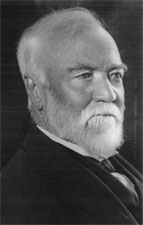
ANDREW CARNEGIE
(Photo (c) by Underwood & Underwood.)
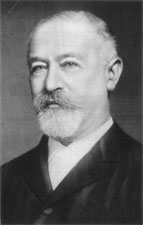
JACOB H. SCHIFF
(Photo by American Press Assn.)
In the eighties and early nineties they suspected France of designs on their integrity. Since then a change in the popular feeling has taken place and in recent years the instruction of the Belgian artillery, for instance, was intrusted to French officers in active service. These officers were constantly at home and very properly concerned with solving military problems such as a future war with Germany might present. What was more natural than that these same officers, when they were detached for a few months or years to Liège or Namur or Huy, taught their Belgian charges to prepare against a German attack, and to look upon the French as their friends and the Germans as their enemies? If conditions had been different, and German officers had been in charge of Belgian fortresses, the Belgian guns in practice would always have been trained on imaginary French invaders.
If this is understood it will be seen that in the case of war the actual neutrality of the Belgian garrisons would naturally be determined by the position taken by that nation whose officers had been in charge of the Belgian fortresses. And this might be entirely independent of the professed wishes of the Belgian people or their Government. If French officers in active service remained in the several fortresses, or even only in one after the beginning of hostilities, and if the French campaign plans contemplated an attack through Belgium, then Belgium had committed an "act in favor of France" by not forcing the French officers to leave, and had forfeited the rights and privileges granted by The Hague Convention of 1907 to a neutral State.
Did French officers remain in Liège or in any other Belgian fortress after hostilities had begun, and did France plan to go through Belgium? Germany has officially made both claims. The first can easily be substantiated by the Supreme Court of Civilization by an investigation of the prisoners of war taken in Belgium. Until an impartial investigation becomes possible no further proof than the claim made by the German Government can be produced.
The second charge is contained in No. 157 of the English "White Paper" in these words of instruction from the German Foreign Secretary to the German Ambassador in London: "Please impress upon Sir Edward Grey that German Army could not be exposed to French attack across Belgium, which was planned according to absolutely unimpeachable information."
Sir Edward Grey has attacked Germany for invading Belgium, but has nowhere denied that Germany had the unimpeachable evidence she said she had, and which of course nullified any previous assurance from France.
It is not known whether Sir Edward Grey was shown this evidence or not, but if the preservation of Belgian neutrality was Great Britain's chief concern, why did she not offer to negotiate treaties with Germany and France as she had done in 1870? It will be remembered that then she bound herself to join with either of the contestants in defending Belgian neutrality against the attacks of the other.
As the case stands today, on the evidence of Sir Edward Grey's own "White Paper" and speeches, Great Britain is making war on Germany because:
1. She broke the Treaty of 1839, although her own Gladstone had declared this treaty to be without force, and although the status of neutral States had been removed by The Hague Convention from the uncertainty of treaties to the security of international law.
2. Great Britain makes war against Germany because Germany has broken Articles I. and II. of Chapter 1 of The Hague Convention referring to neutrals, although Great Britain herself has refused to recognize these articles as binding upon her own conduct.
3. She makes war on Germany although she has never denied the correctness of Germany's assertion that she had unimpeachable proof of France's intentions of going through Belgium, which, together with the sojourn of French officers in Belgium, constitutes the offense which, according to The Hague Convention, deprives a so-called neutral State of the privileges granted in Articles I. and II.
It is impossible to say here exactly what these proofs are which Germany possesses, and which for military reasons she has not yet been able to divulge. She has published some of them, namely, the proof of the continued presence of French officers on Belgian soil, and has given the names and numbers of the several army corps which France had planned to push through Belgium.
The case then stands as follows:
1. Was the inviolability of Belgium guaranteed by Articles I. and II. of The Hague Convention? Yes.
2. Had Germany ratified these articles? Yes.
3. Had Great Britain ratified these articles? No.
4. Would Belgium have forfeited the right of having her country held inviolable if she had committed "acts in favor of France," even if these acts were not actually hostile acts? Yes, according to Article XVII. of The Hague Convention.
5. Did Belgium commit "acts in favor of France," and was Germany, therefore, justified in disregarding the inviolability of her territory?
This is the important question, and the answer must be left to the Supreme Court of Civilization. The weight of the evidence would seem to point to a justification of Germany. Yet no friend of Germany can find fault with those who would wish to defer a verdict until such a time when Germany can present her complete proof to the world, and this may be when the war is over.
Throughout this argument the famous passage of the Chancellor's speech in the Reichstag has been disregarded. It reads:
Our troops have occupied Luxemburg and perhaps are already on Belgian soil. Gentlemen, that is contrary to the dictates of international law. It is true that the French Government has declared at Brussels that France is willing to respect the neutrality of Belgium so long as her opponents respect it. We knew, however, that France stood ready for invasion. The wrong—I speak openly—that we are committing we will endeavor to make good.
This has been understood to mean that the Chancellor acknowledged that Germany was breaking the Treaty of 1839 without warrant, and that Germany, therefore, deserved the contempt of the world. May it not bear another interpretation? Thus:
The Chancellor, like Gladstone in 1870, did not consider the 1839 Treaty enforceable, but saw the guarantee for Belgium in The Hague Convention. He did not wish to offend Belgium by announcing to the world that she had lost her rights as a neutral because of her acts favorable to France, for when he spoke he was still of the opinion that she would accept the German offer which guaranteed to her both her independence and integrity.
And just as Servia would have accepted Austria's note if Russia had permitted her, so Belgium would not have resisted the German demand if it had not been for England.
This can be proved by the British "White Paper," Nos. 153 and 155. In the former the King of the Belgians appeals "to the diplomatic intervention of your Majesty's Government to safeguard the integrity of Belgium," being apparently of the impression that Germany wished to annex parts, if not the whole, of his country. The London reply advises the Belgians "to resist by any means in their power, and that his Majesty's Government will support them in offering such resistance, and that his Majesty's Government in this event are prepared to join Russia and France, if desired, in offering to the Belgian Government at once common action for the purpose of resisting use of force by Germany against them, and a guarantee to maintain their independence and integrity in future years."
Has Mr. Beck really not noticed in this promise the omission of the word neutrality? By the Treaty of 1839 Belgium enjoyed not only independence and integrity, but also perpetual neutrality. Does Great Britain offer to fight Germany for the enforcement of the Treaty of 1839? No! Because hereafter the word neutrality is dropped from her guarantee, and since she alone of all the great powers has not ratified the articles of The Hague Convention concerning neutrals she alone will be able to disregard the inviolability of Belgian soil, even though Belgium kept strictly neutral in a future war.
And what, finally, does she guarantee her? Independence and integrity! That is exactly the same that Germany had promised her. For this Belgium had to be dragged through the horrors of war, and the good name of Germany as that of an honest nation had to be dragged through the mire, and hatred and murder had to be started, that Belgium might get on the battlefield, from the insufficient support of Russia and France and England, what Germany had freely offered her—independence and integrity.
Casual readers would not miss the word neutrality from Sir Edward Grey's guarantee, because they do not differentiate between the words integrity, independence, and neutrality. Great Britain and her ally Japan, marching through China into Kiao-Chau, may be said to have violated China's neutrality, but not her independence, nor, so long as they refrain from annexing any Chinese territory, her integrity.
Nobody familiar with the careful work of Sir Edward Grey can for one moment believe that Sir Edward inadvertently dropped the word, just as little as J. Ramsay Macdonald and other British leaders believe that he inadvertently dropped one of the two remaining words, integrity and independence, when he told Parliament of Germany's guarantee, and why Great Britain should not accept it, but go to war.
When the blame for the horrors committed in Belgium are assessed these facts must be remembered:
1. Belgium was by treaty bound to maintain fortresses.
2. France tempted her to commit "acts friendly" to herself, by which Belgium forfeited her rights to the protection of The Hague articles governing the rights and duties of neutrals.
3. England urged her to take up arms, when she had only asked to have her integrity guaranteed by diplomatic intervention. (Nos. 153, 155.)
4. Germany promised her independence and integrity and peace, while England, quietly dropping her guarantee of neutrality "in future years," promised her independence and integrity and war.
5. And Sir Edward Grey was able to sway Parliament, according to one of the leaders of Parliament himself, only because he misrepresented Germany's guarantee, and, having dropped, in his note to Belgium, the word "neutrality," dropped yet another of the two remaining words, integrity and independence.
This is the case as it appears on the evidence contained in the various "White Papers." Austria was attending properly to her own affairs; Servia was willing to yield; Russia, however, was determined to humiliate Austria or to go to war. Germany proved a loyal friend to her ally, Austria; she trusted in the British professions of friendship to the last, and sacrificed seven valuable days in the interest of peace. France was willing to do "what might be required by her interests," while Great Britain yielded to Russia and France, promising them their support without which France, and therefore Russia, would not have decided on war.
As to Belgium, Germany told Sir Edward Grey that she had unimpeachable evidence that France was planning to go through Belgium, and she published her evidence concerning the French officers who remained in Belgium. Although Belgium had thus lost any rights attaching to her state of neutrality, Germany promised to respect her integrity and independence, and to pay for any damage done. She preferred, however, to listen to Great Britain, who promised exactly the same except pay for any damage done.
Unlike Mr. Beck, who in the same article pleads his case as the counsel for the Allies and casts his verdict as the Supreme Court of Civilization, the present writer prefers to leave the judgment to his readers as a whole, and further still, to the whole American people—yea, to all the peoples of the world. Nor is he in a hurry, for he is willing to wait and have the Judges weigh the evidence and call for more, if they consider insufficient what has already been submitted.
Snap judgments are ever unsatisfactory. They have often to be reversed. The present case, however, is too important to warrant a hasty decision. The final judgment, if it is based on truth, will very strongly influence the nature of the peace, which will either establish good-will and stable conditions in the world, or lead to another and even more complete breakdown of civilization.
Historian; winner of the first Loubat Prize, 1913, for his book on the origins of the British Colonial system.
In the course of his solemn speech of Aug. 8, 1914, in the House of Commons Sir Edward Grey quoted some remarks made by Gladstone in 1870 on the extent of the obligation incurred by the signatory powers to the Quintuple Treaty of 1839 guaranteeing the neutrality of Belgium. Shorn from their context as they were, these sentences are by no means illuminating, and it cannot be said that their citation in this form by Sir Edward Grey was a very felicitous one. During the paper polemics of the past months these detached words of Gladstone have been freely used by Germany's defenders and apologists to maintain that Great Britain of 1870 would not have deemed the events of 1914 a casus belli, and that its entrance into the present war on account of the violation of Belgium's neutrality was merely a pretext. During the course of this controversy Gladstone's attitude has in various ways been grossly misrepresented, Dr. von Mach of Harvard even stating in the columns of THE NEW YORK TIMES that Gladstone had declared the Treaty of 1839 "to be without force." But, apart from such patent distortions, Gladstone's real position is apparently not clearly defined in the mind of the general public, which is merely seeking for the unadulterated truth, regardless of its effect upon the case of any one of the belligerents.
Shortly after the outbreak of the Franco-Prussian war in 1870 the Prussian Ambassador in London informed Gladstone, then Prime Minister, that some time prior to the existing war France had asked Prussia to consent to the former country's absorption of Belgium, and that there was in the possession of the Prussian Government the draft of a treaty to this effect in the handwriting of M. Benedetti, then French Ambassador at Berlin. This communication was obviously made, as Lord Morley tells us, with the object of prompting Gladstone to be the agent in making the evil news public and thus of prejudicing France in the judgment of Europe. Gladstone thought this "no part of his duty," and very shortly thereafter, at the direct instance of Bismarck, this draft treaty of 1866-7 was communicated by Baron Krause of the Prussian Embassy in London to Delane, the editor of The Times. On July 25, 1870, it was published in the columns of that paper and aroused considerable anxiety in England.
It immediately became imperative upon the British Government to take some action. As Gladstone wrote to Bright, the publication of this treaty
has thrown upon us the necessity of doing something fresh to secure Belgium, or else of saying that under no circumstances would we take any step to secure her from absorption. This publication has wholly altered the feeling of the House of Commons, and no Government could at this moment venture to give utterance to such an intention about Belgium. But neither do we think it would be right, even if it were safe, to announce that we would in any case stand by with folded arms and see actions done which would amount to a total extinction of the public right in Europe.
A simple declaration of Great Britain's intention to defend the neutrality of Belgium by arms in case it were infringed seemed to Gladstone not to meet the special requirements of the case as revealed by the proposed Treaty of 1866-7 between Prussia and France. His main object was to prevent the actual execution of such an agreement, by means of which the two belligerent powers would settle their quarrels and satisfy their ambitions at the expense of helpless Belgium. Hence, on July 30, the British Government opened negotiations with France and Prussia and within a fortnight had concluded separate but identical treaties with each of these powers. According to these treaties, in case the neutrality of Belgium were violated by either France or Germany, Great Britain agreed to co-operate with the other in its defense. The preamble of these treaties states that the contracting powers
being desirous at the present time of recording in a solemn act their fixed determination to maintain the independence and neutrality of Belgium,
as provided in the Treaty of 1839, have concluded this separate treaty, which,
without impairing or invalidating the conditions of the said Quintuple Treaty, shall be subsidiary and accessory to it.
Article III. further provided that these Treaties of 1870 were to expire twelve months after the conclusion of the existing war, and that thereafter the independence and neutrality of Belgium would "continue to rest, as heretofore," on the Treaty of 1839.
These documents tell a plain tale, which is amply confirmed by the proceedings in Parliament in connection with this matter. On Aug. 5, 1870, while the negotiations leading to the above-mentioned treaties were still pending, questions were raised in the House of Commons about the recently published abortive Treaty of 1866-7 between Prussia and France. In reply Gladstone stated that
the Treaty of 1839 is that under which the relations of the contracting powers with Belgium are at present regulated;
and that, while he could not explain the intentions of the Government "in a matter of this very grave character in answer to a question," he hoped to be able to communicate some further information in an authentic manner. Three days later, as these treaties with France and Prussia had been virtually concluded, Gladstone was able to satisfy the anxiety of the House and outlined their terms. He explicitly stated that, after their expiration,
the respective parties, being parties to the Treaty of 1839, shall fall back upon the obligations they took upon themselves under that treaty.
After Gladstone had finished speaking the leader of the opposition, Disraeli, took the floor and pointed out that, as a general proposition,
when there is a treaty guarantee so explicit as that expressed in the Treaty of 1839, I think the wisdom of founding on that another treaty which involves us in engagements may be open to doubt.
But he accepted Gladstone's statement
as the declaration of the Cabinet, that they are resolved to maintain the neutrality and independence of Belgium, I accept it as a wise and spirited policy, and a policy, in my opinion, not the less wise because it is spirited.
Gladstone then replied, saying that the reason the Government had not made a general declaration of its intentions regarding Belgium was that much danger might arise from such a declaration and that inadvertently they might have given utterance to words
that might be held to import obligations almost unlimited and almost irrespectively of circumstances.
We had made up our minds, he continued, that we had a duty to perform, and we thought a specific declaration of what we thought the obligations of this country better than any general declaration. Referring to the two treaties in process of ratification, he concluded:
We thought that by contracting a joint engagement we might remove the difficulty and prevent Belgium from being sacrificed.
The policy of the Government continued, however, to be criticised, mainly on the ground that the Treaty of 1839 amply covered the case. On Aug. 10 Gladstone defended his policy in the House of Commons in a speech pitched on a high moral plane, in which he dilated upon Belgium's historic past and splendid present and on Great Britain's duty to this little nation irrespective of all questions of its own self-interest. With genuine fervor, he exclaimed:
If, in order to satisfy a greedy appetite for aggrandisement, coming whence it may, Belgium were absorbed, the day that witnessed that absorption would hear the knell of public right and public law in Europe.... We have an interest in the independence of Belgium which is wider than that which we may have in the literal operation of the guarantee. It is found in answer to the question whether under the circumstance of the case this country, endowed as it is with influence and power, would quietly stand by and witness the perpetration of the direst crime that ever stained the pages of history, and thus become participators in the sin.
What Gladstone had in mind was the scheme of 1866-7, by which France was to absorb Belgium, with Prussia's consent and aid. He distinctly stated that the Treaties of 1870 were devised to meet the new state of affairs disclosed by the publication of this incomplete treaty. It was in order to prevent the revival of such a conspiracy that Gladstone made separate and identical treaties in 1870 with France and Prussia. They were a practical device to secure an effectual enforcement of the Treaty of 1839 under unforeseen and difficult circumstances. The agreement of 1870 was, as Gladstone said, a cumulative treaty added to that of 1839, and the latter treaty
loses nothing of its force, even during the existence of this present treaty.
During the course of this speech defending the Government's action against those critics who claimed that the Treaty of 1839 adequately met the situation, Gladstone made some general remarks about the extent of the obligation incurred by the signatories to the Treaty of 1839:
It is not necessary, nor would time permit me, to enter into the complicated question of the nature of the obligations of that treaty, but I am not able to subscribe to the doctrine of those who have held in this House what plainly amounts to an assertion that the simple fact of the existence of a guarantee is binding on every party to it, irrespectively altogether of the particular position in which it may find itself at the time when the occasion for acting on the guarantee arises.
It is, of course, impossible to state precisely what were those unuttered thoughts that passed through Gladstone's mind as he spoke these characteristically cautious words, but what in general they were can be satisfactorily gleaned from a letter that he had written six days before this to John Bright:
That we should simply declare we will defend the neutrality of Belgium by arms in case it should be attacked. Now, the sole or single-handed defense of Belgium would be an enterprise which we incline to think quixotic; if these two great military powers [France and Prussia] combined against it—that combination is the only serious danger; and this it is which by our proposed engagements we should, I hope, render improbable to the very last degree. I add for myself this confession of faith: If the Belgian people desire, on their own account, to join France or any other country, I for one will be no party to taking up arms to prevent it. But that the Belgians, whether they would or not, should go "plump" down the maw of another country to satisfy dynastic greed is another matter. The accomplishment of such a crime as this implies would come near to an extinction of public right in Europe, and I do not think we could look on while the sacrifice of freedom and independence was in course of consummation.
Retired ironmaster and philanthropist; builder of the Peace Temple at The Hague; founder of the Carnegie Institution at Washington; founder and patron of a chain of libraries in the United States and Great Britain, and benefactor of many societies and institutions.
Here is the report of a truly remarkable statement by Mr. Carnegie. He is the world's most notable peace advocate, and in this interview he voices the reflections suggested to him by the great European war.
They are unusual, and make this interview especially worthy of a place upon the pages of the Christmas issue of THE TIMES, although it principally deals with war, and Christmas is the festival of peace.
"Has war ever settled anything which might not have been settled better by arbitration?" I asked Mr. Carnegie.
"No; never," he replied. "No truer inference was ever made than may be found in Milton's query, penned three centuries ago and never answered: 'What can war but wars breed?'
"War can breed only war. Of course, peace inevitably must follow war, but, truly, no peace ever was born of war. We all revere the memory of him who voiced the warning: 'In time of peace prepare for war'; but, as a matter of fact, we all know that when one nation prepares for war others inevitably must follow its dangerous lead.
"Hence, and hence only, the huge armaments which have oppressed the world, making its most peaceful years a spectacle of sadness—a spectacle of men preparing and prepared to fight with one another. Sooner or later men prepared to fight will fight; huge armaments and armies mean huge battles; huge battles mean huge tragedies.
"This never has been otherwise, and never can be. Peace can come only when mankind abandons warful preparation. And so I seem to have replied to your inquiry with an answer with a tail to it; and the tail is more important than the answer, for the answer merely says that war never settled anything which might not have been settled better by arbitration, while the tail proclaims the folly of a world prepared for war."
"Armament must mean the use of armament, and that is war. If we are to prevent war we must prevent preparation for war, just as if we are to prevent burglary we must prevent preparation for burglary by prohibiting the carrying of the instruments of burglary. The only cure for war" [Mr. Carnegie in speaking italicized the word "cure"] "is war which defeats some one; but two men who are unarmed are certain not to shoot at one another. Here, as in medicine, prevention is much better than cure.
"Plainly it must be through such prevention, not through such a cure as victory sometimes is supposed to represent, that warfare can be stopped. Warfare means some one's defeat, of course, and that implies his temporary incapacity for further war, but it goes without saying that all conquered nations must be embittered by their defeat.
"Few nations ever have fought wars in which the majority of at least their fighting men did not believe the side they fought for to be in the right. Defeat by force of arms, therefore, always has meant the general conviction throughout conquered nations that injustice has been done."
"In such circumstances nations must be like individuals under similar conditions. The individual believing himself to have been in the right, yet finding himself beaten in his efforts to maintain it, will not accept the situation philosophically; he will be angry and rebellious; he will nurse what he believes to be his wrong.
"To nurse a wrong, whether it be real or fancied, is to help it grow in the imagination, and that must mean at least the wish to find some future means of righting it, either by strategy or increased strength.
"There are two things which humanity does not forget—one is an injury, and, no matter how strongly some may argue against the truth of this contention, the other is a kindness.
"In the long run both will be repaid. And nations, like individuals, prefer the coin which pays the latter debt. Military force never has accomplished kindness. Kindness means industrial armies decked with the garlands of peace; military armies, armed and epauletted, must mean minds obsessed with the spirit of revenge or conquest, hands clenched to strike, hearts eager to invade.
"Every military implement is designed to cut or crush, to wound and kill. Nations at peace help one another with humanity's normal tenderness of heart at times of pestilence, of famine, of disaster. Nations at war exert their every ounce of strength to force upon their adversaries hunger, destruction, and death. Starvation of the enemy becomes a detail of what is considered good military strategy in war time, just as world-embracing charity has become a characteristic of all civilization during times of peace. Must we not admit flotillas carrying grain to famine-stricken peoples to be more admirable than fleets which carry death to lands in which prosperity might reign if undisturbed by war?"
"But do you not admit that wars sometimes have helped the forces of civilization in their conquest against barbarism?"
"War has not been the chief force of civilization against barbarism," Mr. Carnegie replied with emphasis. Then he continued more thoughtfully:
"That is one way of saying it. Another is, no effort of the forces of civilization against barbarism is war in the true sense of the word.
"Such an armed effort is a part of the force pushing barbarism backward, and therefore, in the last analysis, tends toward kindness and peace; while, in the sense in which we use the word, war means the retrogression of civilization into barbarism. It is usually born of greed—greed for territory or for power.
"Such war as that of which we all are thinking in these days is war between civilized men. One civilized man cannot improve another civilized man by killing him, although it is not inconceivable that a civilized man may do humanity a service by destroying human savages, for with the savages he must destroy their savagery.
"But a war in civilized Europe destroys no savagery; it breeds it, so that it and its spawn may defile future generations.
"There has been much balderdash in talk about unselfish motives as the origin of warfare. It is safe to say that 99 per cent of all the slaughter wrought by civilization under the cloak of a desire to better bad conditions really has been evil. It is impossible to conceive of general betterment through general slaughter. There have been few altruistic wars."
"But how about our Spanish war?" I asked. "Surely it was not greed which sent our men and ships to Cuba."
"No," said Mr. Carnegie, "that was not war, but world-police work.
"Our skirmish with Spain was a most unusual international episode. We harmed none of the people of the land wherein we fought, but taught them what we could of wise self-government and gave them independence. To battle for the liberation of the slave is worthy work, and this of ours was such a battle.
"Our Spanish war was not the outgrowth of our rivalry with any one or any one's with us; it was the manifestation of our high sense of responsibility as strong and healthy human beings for the welfare of the weak and oppressed."
"It did not make toward militarism on this continent, but the reverse; in a few months it established permanent peace where peace had been a stranger. It was police work on the highest plane, substituting order for disorder."
"But did it not emphasize the need for the maintenance, even here, of a competent and efficient naval and military force?" I asked.
Mr. Carnegie shook his head emphatically.
"That is the old, old argument cropping up again," said he, "the argument that a provocative is a preventive. For us to maintain a great army for the purpose of preventing war thereby would be as sensible as for each of us to be afraid to walk about except with a lightning rod down his back, since men have been struck by lightning. No nation wants to fight us. We have friends throughout the world.
"Millions now resident in military nations are hoping that some day they may be able to become citizens of our beloved republic, principally because it now is not, nor is it every likely to be, military. Humanity loves peace. Here peace abides, and, if we follow reason, will remain unbroken.
"Note the advantages of our own position. Imagine what the task would be of landing seventy thousand hostile soldiers on our shores! First they would need to cross three thousand miles of the Atlantic or five thousand miles of the Pacific.
"And what if they should come? My plan of operation would be to bid them welcome as our visitors, considering them as men, not soldiers; to take them to our great interior, say, as far west as Chicago, and there to say to them:
"'Here we shall leave you. Make yourselves at home, if that thought pleases you; fight us if it does not. If you think you can conquer us, try it.'
"They would make themselves at home and, learning the advantages of staying with us, would become applicants for our citizenship, rather than our opponents in warfare.
"And if they tried to fight us, what would happen to them? Our nation is unique in an important respect. Its individuals are the best armed in the world. Not only, for example, are its farmers armed, but they can shoot, which is far more than can be said of those of Britain or of any other nation.
"The Governments of Europe cannot afford to give their citizenry arms, and, as for the European citizenry, it not only cannot afford to purchase arms, but cannot afford even to pay the license fees which Government demands of those possessing arms with the right to use them.
"But ours? Most Americans can afford to and do own guns with which to shoot, and, furthermore, most Americans, when they shoot, can hit the things at which they shoot.
"Combine this powerful protective influence with the fact that thousands of any army coming to invade us would not want to fight when once they got here, but would want to settle here and enjoy peace, and we find that we thus are protected as no nation in the world ever has been protected or can be.
"Imagine the effect upon the European fighting man's psychology if he found that an army transport had conveyed him to a land where one man's privilege is every man's right! Learning this, it is not a joke to say, but is a statement of the probable fact, that the invading soldiery would not want to fire its first volleys, but would want to file its first papers. They would not ask for cartridges, but for citizenship.
"America is protected by a force incomparable, which I may call its peaceful militia, and the man who, above all other men, I most should wish to see appointed to its command would be Gen. Leonard Wood were it not for the fact that there would be some danger that in such an eventuation his professional training would carry him beyond the rule of reason.
"That is likely to be the most serious trouble with the trained soldier. The doctor wants to dose, the parson to preach, and the soldier to fight. Professional habit may make any of us dangerous.
"But if it came to fighting I do not consider it within the bounds of possibility that we could lose. I once asked Gen. Sherman how the troops which he commanded during the civil war compared for efficiency with European troops. His answer was:
"'The world never has seen the army that I would be afraid to trust my boys with, man for man.'"
"That thought of welcoming an invading army appeals strongly to me. The hostile General would be amazed by the ease with which he got his forces in, but he would be more startled by the difficulty he would find if he tried to get them out. If they once learned the advantages of our liberties they would find it hard not to get away, but to go away. I restrain my temper with difficulty when I contemplate the foolishness of the people who discuss with gravity the possibility of a successful invasion of these United States by a foreign foe. The thought always arises when I hear these cries from our army and naval officers for a greater armament: 'Are these men cowards?' I don't believe it. It is their profession which makes them alarmists.
"Not only are the physical difficulties which would hamper an invasion practically insuperable, but the reception enemies would get, if any of them landed, would be wholly without parallel in the world's history.
"If our liberties really were threatened, every man, and very nearly every woman, in our vast population would rise to their defense as never any people yet has risen to any national defense. Americans, young and old, en masse, would sweep to the protection of what they know, and what the world knows, would be the cause of right and human liberty.
"I, myself, should wish to be invited to advance and meet invading forces if they came. I would approach them without any weapons on my person. I would not shoot at them. I would make a speech to them.
"'Gentlemen,' I would say, 'here's the chance of your life to win life's chief prize. Now you are peasant soldiers. You have the opportunity to become citizen kings. We are all kings here. Here the least of you can take a rank much higher than that of any General in your army. He can become a sovereign in a republic.'
"I think they would hurrah for me, not harm me, after they had heard my speech.
"Striving for peace, we shall become so powerful that if war comes we shall be invincible. Peace, not war, makes riches; the rich nation is the powerful nation.
"Perhaps I was as much a peace man in my youth as I am now, but when I was asked, during the civil war, to organize a corps of telegraph operators and railroad conductors and engineers and take them to Washington, I considered it the greatest of all privileges to obey the order.
"I was the last man to get on the last train leaving Burkes Station, after Bull Run, and, now, if the country ever should be invaded, I would be, I hope, one of the first to rush to meet the enemy—but I think my haste would be to convert, not to kill, him.
"The man who has done well in business, however, learns to abhor all waste, and I must admit that it does pain me to see hundreds of millions of our dollars spent on battleships which will but rust away, and thousands of our able men vegetating on them or in an army.
"The men who urge this vast waste of our money and men mean well, no doubt, but they do not know the nation of which they have the good fortune to be citizens—they do not realize how very potent a force we have become in the wide world, nor the fact that one of the great reasons why we have become a force lies in the circumstance that our national development has not been hampered by the vast expense of militarism."
Mr. Carnegie paused.
Some weeks ago, in an interview granted me for publication in THE NEW YORK TIMES, Dr. Nicholas Murray Butler, President of Columbia University, predicted that the present war would find its final outcome in the establishment of the United States of Europe. I asked Mr. Carnegie to express his view upon this subject.
"Nothing else could occur which would be of such immense advantage to Europe," he replied.
"United we stand, and divided they fall. If the territory now occupied by the homogeneous and co-operative federation known as the United States of America were occupied instead by a large number of small, independent competitive nations, that is, if each section of our territory which now is a State were an independent country, America would be constantly in turmoil.
"Europe has been set back a century because she substituted the present war of nations for the promotion of a federation plan. The latter would have meant peace and prosperity, the former means ruin.
"If in Europe this year such a federation as Dr. Butler regards as a future probability had been a present actuality, 1914 would have left a record very different from that which it is making.
"For instance, it would have been as difficult for the State of Germany to fight the State of Russia, or the State of France, or that of England, or all of them, and to trample neutral Belgium, as it now would be, here, for the State of Pennsylvania to declare war on the States of New York and Connecticut and to wreck New Jersey as she sent her troops to the invasion.
"Originally we had thirteen States, and thirteen only, but there was other territory here, and the attractive force of the successful union of the thirteen States brought the other territory in as it was organized.
"Thus we started right. Europe had begun before men had become so wise, and, having begun wrong, has found herself, through the centuries, unable to correct old errors."
"Certainly I hope that out of the great crime of this vast war some good will come. The greatest good which could come would be a general European federation. I do not believe that this will come at once; but the world will be infinitely the better if it comes at length—if the natural law of mutual attraction for mutual advantage draws these nations now at war into a union which shall make such wars impossible in future, as wars between our States, here, are impossible.
"But before this can come peace must come, and before peace can come one or the other of the nations now at war must at least ask for an armistice.
"If I were in the place of that great General, Lord Kitchener, and should receive the news that such a request had been made by the commander of the opposing forces, I should say: 'No armistice! Surrender!'
"But, then, if the surrender should be made, I should say, in effect:
"'Gentlemen, we have made up our minds that these terrible explosions must mark the end of war between our civilized nations. Our sacrifices in this war have been too great to permit us to be satisfied with less than this.
"'If we now cannot feel assured of such a federation of nations as will result in the settlement of all future disputes by peaceful arbitration at The Hague, then we shall keep on fighting till the day comes when we can achieve that end.
"'Upon the other side of the Atlantic,' I should continue if I were Lord Kitchener and should be confronted by such a situation, 'we see in the United States of America an example which must satisfy us that world peace now can be maintained.
"'There,' I should go on, 'thirteen States were banded into union in 1776. Their total population was less than the present population of their largest city and their area has spread until it links two oceans and offers homes in forty-eight States to one hundred millions, and the population still increases rapidly. An experiment of world significance was tried, and is a success, for the aggregated nation has grown and now is growing in power more rapidly than any other nation on the surface of the earth.'"
"'It is plain to me and should be plain to all of us,' I should continue, if I were Lord Kitchener, so placed, 'that we in Europe have but to follow this example which America has set for us in order to achieve an ultimate result as notably desirable. When we have accomplished it world peace will be enthroned and all the peoples of the earth will be able safely to go about the pleasant and progressive business of their lives without apprehension of their neighbors. Humanity, thus freed of its most dreadful burden, will be able to leap forward toward the realization of its ultimate possibilities of progress.'"
"And do you really think there is the immediate possibility of an effective European league for permanent peace and general disarmament?" I asked Mr. Carnegie.
"Naturally my mind has dwelt much on this problem," he replied. "The culmination of the European situation in the present war is very dreadful, but no good ever came out of crying over spilled milk. However, it seems safe to conclude that a majority of the people of the civilized world will presently decide that a step forward must be taken.
"Everywhere in Europe, when the present conflict ends, this fact will be emphasized by shell-wrecked, fire-blackened buildings; by the vacant chairs of sons and fathers who have fallen victims; by innumerable graves and by a general impoverishment, the inevitable result of war's great waste, which will touch and punish every man, every woman, every child.
"In the face of such an emphasis no denial of the facts will be among the possibilities, and I scarcely think that any even will be attempted. If the federation Dr. Butler has predicted does not come about at once, it will be admitted almost universally that future disputes occurring between the Governments of Europe shall be settled, not by force of fighting men, but by arbitration at The Hague.
"And now a serious question obtrudes itself. Must there not be a carefully considered and cautiously worked out understanding, which may be considered the preliminary of peace? Later on the foremost men of every nation can meet in conference to consider with an earnestness hitherto unknown the great problems which will be involved in the permanent abolition of war and establishment of peace; but for this the way must be prepared.
"Here, again, I think The Hague Tribunal is the proper body to assemble for the purpose of devising means for the accomplishment of the great end, which must be such legislation as will accomplish, at the end of this war, the ending of all war among the nations.
"An important duty of the conference would be some arrangement for a union of the forces of the nations now at war, charged with and qualified to perform the duty of maintaining peace pending the completion of the final comprehensive plan."
"It is possible and even probable that as a part of the accomplishment of this it may be found to be desirable and even necessary to organize and provide for the maintenance of a joint naval and military body of strength sufficient to enforce world peace during the period necessary for the preparation of a plan to be submitted to all powers. But if this force is to be established, it must be done with the clear understanding that it is designed for one thing only, the maintenance of peace, and must not be used at any time for any other service.
"In the selection of the commanding officer to be intrusted with this task, it will be conceded that the victors in this war, or those who have a notable advantage at the time of the beginning of the armistice, shall have the right of his appointment.
"No protest ever will arise from the mass of the people of Europe against the abolishment of militarism. Even the people of Germany, as a whole, have not found militarism attractive. It has been the influence of the military aristocracy of Germany, the most powerful caste in the world, which not only has encouraged the national tendency, but has forced the Emperor, as I believe, to action against his will and judgment.
"But a change was notable in Germany before the war began, and will be far more notable after it has ended. The socialistic movement waxes strong throughout the nation, and the proceedings of the Reichstag show us that the nation is marching steadily, though perhaps slowly, toward a real democracy.
"I believe the first election to follow peace will result in a demand by the Reichstag that it, alone, shall be given power to declare war. It will be argued, and it is evident that it then will be amply provable, that it is the people who suffer most through war, and that, therefore, their representatives should utterly control it.
"That itself would be a most important step toward peace, and I feel certain that it is among the probabilities.
"As things stand in Germany, although the Reichstag has its powerful influence in regard to war expenditure and might accomplish important results by refusing to vote amounts demanded, the fact remains that until it has been given the power of making or withholding declaration of war the most important results cannot be accomplished."
"In Fried's volume," I suggested to Mr. Carnegie, "you are credited with saying that Emperor William, himself and by himself, might establish peace. Granting that that might have been the fact before this war began, is it your opinion that he, or any other one man, could now control the situation to that extent?"
"Assuming that the Germans should come out victorious," Mr. Carnegie replied, "the Emperor would become a stronger power than ever toward the maintenance of peace among the nations. At one time I believed him to be the anointed of God for this purpose, and did not fail to tell him so.
"Even if his forces should be defeated in this present carnage, I am sure he would be welcomed by the conference I have suggested as the proposer of the great world peace, thus fulfilling the glorious destiny for which at one time I considered that he had been chosen from on high."
I asked Mr. Carnegie what part he thought this country, the United States, should play in the great movement which he has in mind and thoroughly believes is even now upon its way.
"The United States," he answered, "although, happily, not a party to the world crime which is now in progress, seems entitled to preference as the one to call the nations of the world to the consideration of the greatest of all blessings—universal, lasting peace."
What have I done to you, Brothers,—War-Lord and Land-Lord and Priest,—
That my son should rot on the blood-smeared earth where the raven and buzzard feast?
He was my baby, my man-child, that soldier with shell-torn breast,
Who was slain for your power and profit—aye, murdered at your behest.
I bore him, my boy and my manling, while the long months ebbed away;
He was part of me, part of my body, which nourished him day by day.
He was mine when the birth-pang tore me, mine when he lay on my heart,
When the sweet mouth mumbled my bosom and the milk-teeth made it smart,
Babyhood, boyhood, and manhood, and a glad mother proud of her son—
See the carrion birds, too gorged to fly! Ah! Brothers, what have you done?You prate of duty and honor, of a patriot's glorious death,
Of love of country, heroic deeds—nay, for shame's sake, spare your breath!
Pray, what have you done for your country? Whose was the blood that was shed
In the hellish warfare that served your ends? My boy was shot in your stead.And for what were our children butchered, men makers of cruel law?
By the Christ, I am glad no woman made the Christless code of war!
Shirks and schemers, why don't you answer? Is the foul truth hard to tell?
Then a mother will tell it for you, of a deed that shames fiends in hell:—
Our boys were killed that some faction or scoundrel might win mad race
For goals of stained gold, shamed honors, and the sly self-seeker's place;
That money's hold on our country might be tightened and made more sure;
That the rich could inherit earth's fullness and their loot be quite secure;
That the world-mart be wider opened to the product mulct from toil;
That the labor and land of our neighbors should become your war-won spoil;
That the eyes of an outraged people might be turned from your graft and greed
In the misruled, plundered home-land by lure of war's ghastly deed;
And that priests of the warring nations could pray to the selfsame God
For His blessing on battle and murder and corpse-strewn, blood-soaked sod.
Oh, fools! if God were a woman, think you She would let kin slay
For gold-lust and craft of gamesters, or cripple that trade might pay?This quarrel was not the fighters':—the cheated, red pawns in your game:—
You stay-at-homes garnered the plunder, but the pawns,—wounds, death, and "Fame"!
You paid them a beggarly pittance, your substitute prey-of-the-sword,
But, ye canny beasts of prey, they paid, in life and limb, for your hoard.
And, behold! you have other victims: a widow sobs by my side,
Who clasps to her breast a girl-child. Men, she was my slain son's bride!I can smell the stench of the shambles, where the mangled bodies lie;
I can hear the moans of the wounded; I can see the brave lads die;
And across the heaped, red trenches and the tortured, bleeding rows
I cry out a mother's pity to all mothers of dear, dead "foes."
In love and a common sorrow, I weep with them o'er our dead,
And invoke my sister woman for a curse on each scheming head.Nay, why should we mothers curse you? Lo! flesh of our flesh are ye;
But, by soul of Mary who bore the Christ-man murdered at Calvary,
Into our own shall the mothers come, and the glad day speed apace
When the law of peace shall be the law of the women that bear the race;
When a man shall stand by his mother, for the worldwide common good,
And not bring her tears and heart-break nor make mock of her motherhood.
One of the leading American financiers and noted philanthropist; founder of Jewish Theological Seminary and of Semitic Museum at Harvard University; a native of Germany and member of the firm of Kuhn, Loeb & Co., bankers.
American as I am in every fibre, and in accord as I feel with every interest of the country of my adoption, I cannot find myself in agreement with what appears to be, to a considerable extent, American opinion as to the origin and responsibility for the deplorable conflict in which almost all of Europe has become involved.
For many reasons my personal sympathies are with Germany. I cannot feel convinced that she has been the real aggressor; I believe that war was forced upon her, almost as if by prearrangement among the nations with whom she now contends; I cannot but believe that they had become jealous and envious of her rapid and unprecedented peaceful development and had concluded that the moment had arrived when all was favorable for a union against her.
Although I left Germany half a century ago, I would think as little of arraying myself against her, the country of my birth, in this the moment of her struggle for existence, as of arraying myself against my parents.
But while I steadfastly believe this war to have been forced upon Germany against her will, I also believe that circumstances which were stronger than the Governments of England and France, her present enemies, were necessary to overcome an equally definite reluctance upon their part.
In other words, I cannot wholly blame the English Government, or the French Government, any more than I can wholly blame the German Government.
Let us see how the great tragedy came about. It is safe to pass rapidly over the Servian-Bosnian-Herzegovinian-Austro-Hungarian complication which served as the immediate precipitant of hostilities. It has been detailed repeatedly in THE TIMES and other American publications.
It had reached a point at which the Austro-Hungarian Government felt compelled to take extreme measures by means of which to safeguard the integrity of the empire.
The firm but fatal ultimatum to Servia followed, the reply to which, suffice it to say, was unsatisfactory to Austria, who could not accept the suggestion of an investigation into the circumstances attending the assassination of the Archduke Ferdinand through a commission or court on which she was not represented.
The situation really was analogous to that which existed between the United States and Spain when the Maine was blown up in Havana Harbor. In order to fix the responsibility for this dastardly affair we then similarly demanded an investigation by Spain, to be carried out with the assistance of representatives of this Government. Spain, too, then offered to conduct an investigation, but she peremptorily declined to allow us to take part in it.
This attitude on her part quickly brought about our declaration of war against her. It is important that Americans should realize the similarity in the two situations and the likeness of the Austrian action of 1914 to that which our own Government took in 1898.
As soon as Austria had rejected as unsatisfactory Servia's reply to her ultimatum she prepared to undertake a punitive armed expedition against Servia, and Russia at once declared that she would rank herself as Servia's protector.
Indeed, without any further parley, and to give effect to this threat, Russia immediately mobilized her army. Since then it has been averred that this mobilization had been in progress for several weeks previous to Servia's rejection of the Austrian ultimatum.
This made it obligatory upon Germany to go to Austria's aid, under the provisions of their treaty of alliance, although she was well aware that such an action would bring France into the conflict under the terms of her alliance with Russia. Indeed, an unsatisfactory reply had been received from France as to the latter's intentions, but Germany endeavored to secure at least an assurance of England's neutrality. This proved to be impossible.
How the German Government could indulge for a moment in the hope that in a war with Russia and France on the one side and Germany and Austria on the other, England could be induced to remain neutral passes comprehension, but that it did believe this seems a certainty.
The English Government, no doubt, correctly felt that without the aid of its immense resources, and particularly without the operations of its great navy against Germany and Austria, the latter nations would find it not so very difficult a task to dispose of both Russia and France.
English statesmen very promptly must have become alive to the probability that a Germany which had subdued Russia and France, and thus had made itself master of the Continent, would be unlikely long to tolerate a continuance of England's world leadership.
So, even if the neutrality of Belgium had not been violated, other reasons would have been found by England for joining France and Russia in the war against Germany, for England would not risk, without any effort to protect them, the loss of her continued domination of the high seas and her undisputed possession of her vast colonial empire.
I am not defending the violation of Belgian neutrality. This, undeniably, was a most unjustifiable action, in spite of German claims that she was forced into it by the necessities of the situation. But I am explaining that, even had it not occurred, still England would have gone to war.
That was the situation.
Germany is now fighting for her very existence, and I, who am not without knowledge of German conditions, am convinced that never has there been a war more wholly that of a whole people than is this present conflict, as far as Germany is concerned.
Any one who has been in even superficial touch with German public opinion and individual feeling in any part of the empire, since the war began, must know that there is hardly a man, woman, or child throughout the empire who would hesitate if called upon to sacrifice possessions or life in order to insure victory to the Fatherland. Seventy million people who are animated by unanimous sentiment of this sort cannot be crushed, probably not subdued.
And England is confronted by the certainty that her world leadership is the stake for which she is fighting; that her defeat would mean the end of the vast dominance which she has exercised throughout the world, since the time of the Armada, through the power of her great navy.
Is it not apparent, therefore, that these nations, if left to themselves, inevitably must continue the war until one side or the other, or both, shall become exhausted—an eventuation which may be postponed not for mere months but for years?
In our own civil war Grant for almost two years stood within a hundred or a hundred and fifty miles of Richmond, the heart of the Confederacy, and was not able to sufficiently subdue Lee's forces to enable him to get possession of the city until the complete exhaustion of the Confederacy's resources in men and money had been accomplished.
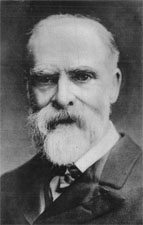
VISCOUNT JAMES BRYCE
(Photo from George G. Bain.)
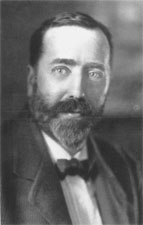
DR. BERNHARD DERNBURG
(Photo by Campbell Studios.)
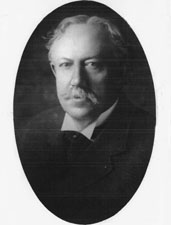
DAVID STARR JORDAN
JOHN GRIER HIBBEN
(Photo by McManus.)
While that situation may not offer a true parallel in all respects to that in which we find the belligerent forces in the present European war, it nevertheless may be taken as a precedent proving that frontal encounters of powerful opponents generally do not yield final results until actual exhaustion compels one side or the other to abandon hope.
Such an exhaustion hardly can be expected within measurable time on the part of either one or the other of the combatants in the existing European conflict, and this means the probable continuation for a long period of the merciless slaughter which has marked the last few months. We hold up our hands in horror at the stories of human sacrifices in the early ages when, after all, these were, perhaps, less brutal and less appalling than the wholesale slaughter of the flower of these warring peoples of which we now read almost daily.
As I see the situation there really are only three contestants in the war—England, Russia, and Germany. France, Belgium, and Austria are important auxiliaries, but they are playing to a certain extent secondary rôles.
England's real object is the utter defeat of Germany—nothing more nor less than that—and if this is accomplished England will have control of Europe. It must be remembered that the English Government and English people frequently have asserted that they would not be satisfied with mere defeat of Germany's armed forces, but that her power must be permanently paralyzed.
If England should accomplish this, with Germany, its army and its navy, thus wholly out of the way, no one would be left for England to fear in future upon the high seas.
That might be the chief significance of England's complete victory, and its complete significance would be that every nation in the world would have to do the British bidding, for should any one refuse she could completely destroy its commerce and shut off its overseas supplies.
In the cases of most nations overseas supplies include material vital to the continuance of life and happiness; to every nation, in these days of a developed and habitual foreign trade, overseas supplies are actually essential, even when they do not necessarily include meats and wheat and other foodstuffs.
The effect upon the United States of such an English victory would be most disastrous.
The alliance between England and Japan is likely to be permanent. That is something which Americans cannot afford to forget for a moment.
England needs Japan in the Far East, especially as an ally in case of need, which at some time is certain to arrive, against Russia; and Japan for many reasons needs the strength of English backing, without which her financial and political situation soon would become most dangerous, if not collapse.
Such a permanent alliance would have this consequence upon us, that without even the probability of difficulties with either England or Japan—and, personally, I do not believe that such a probability need be feared—we nevertheless year after year would be compelled to increasingly prepare for what may be defined as the disagreeable possibility of the eventuation of a disagreeable possibility.
Certainly we should be under the necessity of notably and, therefore, very expensively, increasing our naval armament; we should be under the necessity of large expenditures for coast defense.
Corollary military cost would be enormous and burdensome. The preparation which would be imposed on us as a necessity by such a permanent alliance would be sufficiently extensive and expensive to burden our people heavily and handicap our national progress.
It might involve, perhaps, even a greater hardship in our case than militarism has involved in Germany. It is improbable that the average American realizes the part which absence of such burdens has played in our national development so far; it would be difficult for the average American who has not studied the whole subject carefully to estimate accurately the part which the imposition of such a burden would be sure to play in our future.
We have been measurably a free people. If we were under the necessity of supporting vast military and naval establishments we should be that no longer, no matter how completely we adhered to our democratic political system and ideals. It is not Kings, but what they do, which burdens countries, and the most burdensome, act of any King is to load his country up with non-productive, threatening, and expensive war machinery.
I fear that the American people as a whole have visualized only slightly, if at all, the real peril involved in this contingency; but I cannot feel otherwise than sure that soon they must awake to the great danger that militarism and navalism may be imposed upon them through no fault of their own.
American impulses trend away from armament toward peaceful development along industrial lines, but even now political leaders in Washington begin to see what may be coming. The propositions which already have been made for considerable increases in our naval and military forces may be regarded as only the forerunners of what is to be expected later.
My sympathies and interests, in other words my patriotic sentiments, are definitely American. I must repeat that I am of German origin, and that as regards the present struggle I am pro-German, yet it would be impossible for me to say that I am anti-English, although I am anti-Russian for reasons that are obvious.
I already have expressed the belief that the complete humiliation of England would be disastrous to us. Now, it seems to me that if Germany should be completely successful, if she should be able to wear out the Allies, break down France, hold Russia in check, and cripple or even invade England, (which many German leaders actually believe can be done, incredible as it may seem to us,) Germany would acquire a position such as never has been held by any nation since the beginning of history. Not even the power of the Roman Empire would approach it.
The advance which has marked the development of every means of communication, transportation, manufacturing, &c., since Rome's day would give Germany, in the case of such an eventuation, a power which would have been inconceivable to the most ambitious Roman Emperor. It would make her a menace not only to her immediate neighbors, but to the entire globe.
Could she be trusted with such power? Notwithstanding my personal sympathies, which I have taken pains to clearly outline, I must admit that I cannot think so. The German character is not only self-reliant, which is admirable, but it readily becomes domineering, particularly when in the ascendency.
In the rôle of a world conqueror Germany would become a world dictator—would indulge in a domination which would be almost unbearable to every other nation. Particularly would this be the case in respect to her relations with the United States, a nation with which she always has had and always must have intimate trade and commercial relations.
Should Germany make England impotent and France powerless we should become more or less dependent upon German good-will, and it is highly probable, indeed I regard it as a certainty, that before long, in such an event, the Monroe Doctrine would cease to exercise any important influence on world events. It would become a thing of the past—a "scrap of paper."
You see that while I am not neutral to the extreme, while I fervently hope and pray that Germany may not be wrecked and that she may emerge from the war with full ability to maintain her own, I cannot believe that it would be good for her or good for the world in general if she found herself absolutely and incontrovertibly victorious at the end of the great struggle. In other words, I wish Germany to be victorious, but I do not wish her to be too victorious.
This brings us definitely to the question as to what can be done to stop this war. Its continuance is infinitely costly of men and treasure; its prosecution to the bitter end would mean complete disaster for one contestant and only less complete destruction for the other, and it would give to the victor, no matter what his sufferings and losses might have been, a power dangerous to the entire world.
How shall it end? We do not want its end to mean a new European map. Anything of the sort would include the seed of another European war, to be fought out later and at even greater probable cost, with all the world-disturbance implied in such an eventuation.
What the United States should desire and does desire is an understanding between these nations, of just what they are fighting for, which I almost believe they no longer know themselves, and a conference between them now, a pause to think, which at least may help toward stimulating each side to make concessions, before the ultimate of damage has been done.
Such a conference might be called even without any interval in warfare and induced without definite outside intervention from ourselves or any one else. I believe it not to be beyond the bounds of possibility that if this course could be brought about importantly enough, a way out of this brutal struggle and carnage might be discovered even now, and I know I am not alone in this belief.
The situation is unprecedented. No congress such as in former times more than once has settled wars and brought about peace by the give-and-take process could be of avail in the existing circumstances. Something far higher than such a conference is needed. This peace must not be temporary. It must mark not the ending of this war alone but the ending of all war.
Some means must be devised and generally agreed to which, after the re-establishment of peace, will do away with jealousies among European nations, so that the continual increase of armament on land and sea no longer will be necessary, and humanity will be freed from its tremendous burden.
It is not at present possible to point out any concrete means by which these things may be accomplished, but it is not impossible that, when reason shall be returned to the Governments now at war, they themselves may suggest to one another plans and ways and means how this may be effectuated.
Toward this end America may help tremendously, and herein lies, it seems to me, the greatest opportunity ever offered by events to the American press.
Let the newspapers of America stop futile philosophizing upon the merits and demerits of each case, let them measurably cease their comment upon what each side has accomplished or failed to accomplish during the tragic four months which have traced their bloody mark on history.
Let them begin to stimulate public opinion in favor of a rational adjustment of the points at issue—such an adjustment as will leave each contestant unhumiliated and intact, such an adjustment as will avoid, as far as may be possible, the complete defeat of any one, such an adjustment as will do what can be done toward righting wrongs already wrought, and such an adjustment as will let the world return as soon as may be to the paths of peace, productiveness, prosperity, and happiness.
In suggesting that America should regard this effort as an obligation I am assuming for this country no rights which are not properly hers. We, a nation of a hundred million people, laboring constantly for peace and human progress, have a right to make our voice heard, and if we raise it properly it will find listeners among those who can help toward the accomplishment of what we seek. But if we would make it heard we must be earnest, be honest, and be ceaseless in the reiteration of our demand.
Have we not the right to insist that the interests of neutral nations, of whom, with our South American cousins, (for the better intercourse with whom we have just spent several hundred millions upon the construction of the Panama Canal,) we form so large a percentage, shall before long be given some consideration by the nations whose great quarrel is harming us incalculably?
The interruption of our economic development already has become marked and the war's baneful influence upon moral conditions in our midst shows itself through constantly increasing unemployment and, as a logical consequence of that, the rapid filling of our eleemosynary and penal institutions. May we not reasonably demand that this shall speedily be brought to an end?
It probably is true that under the rules of the game the President of the United States cannot offer his good offices again to the belligerents without first being invited by one or the other side to do this, but the people of the United States have a voice even more powerful than his; if that of the people of South America should be joined with it, and if the combined sound should be made unquestionably apparent to the warring nations, it could not pass unheeded.
Public opinion in the United States should firmly seek to impress upon the warring nations the conviction that nothing can secure a lasting peace except assurance of conditions under which not mighty armies and tremendous navies are held to be the factors through which trade expansion and the conquest of the markets of the world are to be obtained, but that this can be accomplished better and more lastingly through rigid adherence to the qualities and methods which generally make for success in commercial or any other peaceful competition—fairness, thorough efficiency, and hard work.
The concentrated power of the American press and people would be tremendous. I am sure that, in this instance, it is possible to concentrate it for righteousness and the future good of all humanity.
Professor of Art at Princeton University; editorial writer for The New York Evening Post and Assistant Editor of The Nation, 1901-06.
To the Editor of The New York Times:
It seems to me that the Belgian previous question ought to be moved with all candid pro-Germans. Mr. Schiff is plainly candid, so I have framed an open letter to elicit his opinion:
[An Open Letter to Jacob H. Schiff.]
Mr. Jacob H. Schiff, New York.
My Dear Sir:
The universal esteem which you enjoy in the country of your adoption lends great weight to any utterance of yours on public matters. Your interview on the war in THE TIMES of Nov. 22 will everywhere have influence for its gravity and fineness of feeling. It is with compunction that I call your attention to the fact that your statement is ambiguous on precisely those issues of the conflict which your fellow-citizens have nearest at heart.
Your general position may be described as a desire for prompt peace and restoration of the former balance of power. More specifically you wish "Germany to be victorious, but not too victorious." If this be merely an instinctive expression of the residual German in you, an expression made with no practical implications of any sort, no American will do otherwise than respect such a sentiment. But if you deliberately desire a moderate victory for Germany, with all that such moderate victory practically implies, it behooves your fellow-citizens to judge your views in the light of what these really call for.
An ever so slightly victorious Germany would presumably retain Belgium, in whole or in part. Does such a conquest have your moral assent?
Or suppose the rather improbable event of a Germany driven out of Belgium, but otherwise slightly victorious. In such case not a pfennig of indemnity would come to Belgium. Do you believe that no indemnity is morally due Belgium?
Knowing your reputation as a man and philanthropist, I can hardly believe that your desire for a "not too victorious" Germany includes its logical implication of a subjugated or uncompensated Belgium. But if this be so, candor expects an avowal. Until you have made yourself clear on the issue that most concerns your fellow-citizens they will remain in doubt as to your whole moral attitude on the war. Does your pacificism contemplate a German Belgium? I feel sure you will admit that no fairer question could be set to any one who comments on the sequels of the war. I am, most respectfully yours,
FRANK JEWETT MATHER, Jr.
Princeton University, Oct. 23, 1914.
On Nov. 22 THE NEW YORK TIMES printed this interview with Jacob H. Schiff on the European war reproduced above. Two days later Dr. Charles W. Eliot, President Emeritus of Harvard, who is an old friend of Mr. Schiff, wrote him a letter of comment on THE TIMES interview. This letter resulted in considerable correspondence between the two. At the time this correspondence was penned there was not the least thought in the mind of either of the writers of giving the letters to the public. It was simply an interchange of ideas between men who had long known each other. When they were convinced, however, that publication might serve a useful purpose in shaping public opinion, both Mr. Schiff and Dr. Eliot cordially assented to their being printed.
CAMBRIDGE, Mass.,
Nov. 24, 1914.
Dear Mr. Schiff:
It was a great relief to me to read just now your interview in THE NEW YORK TIMES of Nov. 22, for I have been afraid that your judgment and mine, concerning the desirable outcome of this horrible war, were very different. I now find that at many points they coincide.
One of my strongest hopes is that one result of the war may be the acceptance by the leading nations of the world of the precept or law—there shall be no world empire for any single nation. If I understand you correctly, you hold the same opinion. You wish neither Germany nor England to possess world empire. You also look forward, as I do, to some contract or agreement among the leading nations which shall prevent competitive armaments. I entirely agree with you that it is in the highest degree undesirable that this war should be prolonged to the exhaustion of either side.
When, however, I come to your discussion of the means by which a good result toward European order and peace may be brought out of the present convulsion I do not find clear guidance to present action on your part or mine, or on the part of our Government and people. Was it your thought that a congress of the peoples of North and South America should now be convened to bring to bear American opinion on the actual combatants while the war is going on? Or is it your thought that the American nations wait until there is a lull or pause in the indecisive fighting?
So far as I can judge from the very imperfect information which reaches us from Germany, the confidence of the German Emperor and people in their "invincible" army is not much abated, although it clearly ought to be. It is obvious that American opinion has some weight in Germany; but has it not enough weight to induce Germany to abandon her intense desire for Belgium and Holland and extensive colonial possessions? To my thinking, without the abandonment of that desire and ambition on the part of Germany, there can be no lasting peace in Europe and no reduction of armaments.
Sincerely yours,
CHARLES W. ELIOT.
Jacob H. Schiff, Esq.
NEW YORK,
Nov. 25, 1914.
My Dear Dr. Eliot:
I am just in receipt of your thoughtful letter of yesterday, which it has given me genuine pleasure to receive. While it is true that I have not found myself in accord with many of the views to which you have given public expression concerning the responsibility for this deplorable conflict and the unfortunate conditions it has created, I never doubted that as to its desirable outcome we would find ourselves in accord, and I am very glad to have this confirmed by you, though as to this our views could not have diverged.
As to the means by which a desirable result toward European order and peace may be brought about out of the chaos which has become created, it is, I confess, difficult to give guidance at present. What needs first, in my opinion, to be done is to bring forth a healthy and insistent public opinion here for an early peace without either side becoming first exhausted, and it was my purpose in the interview I have given to set the American people thinking concerning this. I have no idea that I shall have immediate success; but if men like you and others follow in the same line, I am sure American public opinion can before long be made to express itself emphatically and insistently in favor of an early peace. Without this it is not unlikely that this horrible slaughter and destruction may continue for a very, very long time.
Yours most faithfully,
JACOB H. SCHIFF.
President Emeritus Charles W. Eliot, Cambridge, Mass.
CAMBRIDGE, Mass.,
Nov. 28, 1914.
Dear Mr. Schiff:
I think, just as you do, that the thing which most needs to be done is to induce Germany to modify its present opinion that the nation must fight for its very life to its last mark and the last drop of its blood. Now, every private letter that I have received from Germany, and every printed circular, pamphlet, or book on the war which has come to me from German sources insists on the view that, for Germany, it is a question between world empire or utter downfall. There is no sense or reason in this view, but the German philosophers, historians, and statesmen are all maintaining it at this moment.
England, France, and Russia have no such expectations or desires as regards the fate of Germany. What they propose to do is to put a stop to Germany's plan of attaining world empire by militarism. Have you any means of getting into the minds of some of the present rulers of Germany the idea that no such alternative as life or death is presented to Germany in this war, and that the people need only abandon their world-empire ambitions while securing safety in the heart of Europe and a chance to develop all that is good in German civilization?
Sincerely yours,
CHARLES W. ELIOT.
Jacob H. Schiff, Esq.
The Greenbrier,
WHITE SULPHUR SPRINGS, W. Va.,
Dec. 1, 1914.
Dear Dr. Eliot:
I have received today your letter of the 28th ult., and I hasten to reply to it, for I know of nought that is of more importance than the discussion between earnest men of what might be done to bring to cessation this horrible and senseless war.
I believe you are mistaken—though in this I am stating nothing, absolutely, but my personal opinion—that Germany would not listen to the suggestion for a restoration of peace until it has either come into a position to dictate the terms or until it is utterly crushed. Indeed, I rather feel, and I have indications that such is the case, that England is unwilling to stop short of crushing Germany, and it is now using all the influence it can bring to bear in this country to prevent public opinion being aroused in favor of the stoppage of hostilities and re-establishment of peace.
The same mail which brought your letter this morning brought me also a letter from a leading semi-military man, whom I know by name, but not personally. It is so fine and timely that I venture to inclose a copy for your perusal. Why would not you, and perhaps Dr. Andrew D. White, who—is it not a coincidence—has likewise written me today on the subject of my recent TIMES interview, be the very men to carry out the suggestion made by my correspondent?
Perhaps no other two men in the entire country are so greatly looked up to by its people for guidance as you—in the first instance—and Dr. White. You could surely bestow no greater gift upon the entire civilized world than if now, in the evening of a life which has been of such great value to mankind, you would call around you a number of leading, earnest Americans with the view of discussing and framing plans through which American public opinion could be crystallized and aroused to the point where it will insistently demand that these warring nations come together and, with the experience they have made to their great cost, make at least an attempt to find a way out. I cannot but believe that the Governments of England, France, and Germany—if not Russia—will have to listen, if the American people speak with no uncertain voice. Do it, and you will deserve and receive the blessing of this and of coming generations!
Yours most faithfully,
JACOB H. SCHIFF.
CAMBRIDGE, Mass.,
Dec. 8, 1914.
Dear Mr. Schiff:
I thank you for your letter of Dec. 1 and its interesting inclosure.
Although every thoughtful person must earnestly desire that the waste and destruction of this greatest of wars should be stopped as soon as possible, there is an overpowering feeling that the war should go on until all the combatants, including Germany, have been brought to see that the Governmental régime and the state of the public mind in Germany which have made this war possible are not consistent with the security and well-being of Europe in the future.
Personally, I feel strongly that the war ought to go on so long as Germany persists in its policies of world empire, dynastic rule, autocratic bureaucracy, and the use of force in international dealings. If the war stops before Germany sees that those policies cannot prevail in twentieth-century Europe, the horrible wrongs and evils which we are now witnessing will recur; and all the nations will have to continue the destructive process of competitive armaments. If peace should be made now, before the Allies have arrived at attacking Germany on her own soil, there would result only a truce of moderate length, and then a renewal of the present horrors.
I cannot but think that Europe now has a chance to make a choice between the German ideal of the State and the Anglo-American ideal. These two ideals are very different; and the present conflict shows that they cannot coexist longer in modern Europe.
In regard to the suggestion which your correspondent made to you that a conference of private persons should now be called in the hope of arriving at an agreed-upon appeal to the combatants to desist from fighting and consider terms of settlement, I cannot but feel (1) that such a conference would have no assured status; (2) that the combatants would not listen; and (3) that the effort would, therefore, be untimely now, though perhaps useful later.
One idea might possibly bring about peace, if it fructified in the mind of the German Emperor—the idea, namely, that the chance of Germany's obtaining dominating power in either Europe or the world having already gone, the wise thing for him to do is to save United Germany within her natural boundaries for secure development as a highly civilized strong nation in the heart of Europe. Surplus population can always emigrate happily in the future as in the past.
The security of Germany would rest, however, on an international agreement to be maintained by an international force; whereas, the example which Germany has just given of the reckless violation of international agreements is extremely discouraging in regard to the possibility of securing the peace of Europe in the future.
Although this war has already made quite impossible the domination of Germany in Europe or in the world, the leaders of Germany do not yet see or apprehend that impossibility. Hence, many earnest peace-seekers have to confess that they do not see any means whatever available for promoting peace in Europe now, or even procuring a short truce.
I wish I could believe with you that the Governments of England, France, Germany, and Russia would listen to the voice of the American people. They all seem to desire the good opinion and moral support of America; but I see no signs that they would take American advice or imitate American example. President Wilson seems to think that this country will be accepted as a kind of umpire in this formidable contest; but surely we have no right to any such position. Our example in avoiding aggression on other nations, and in declining to enter the contest for world power, ought to have some effect in abating European ambitions in that direction; but our exhortations to peace and good-will will, I fear, have little influence. There is still a real contest on between democracy and oligarchical methods.
You see, my dear Mr. Schiff, that I regard this war as the result of long-continuing causes which have been gathering force for more than fifty years. In Germany all the forces of education, finance, commercial development, a pagan philosophy, and Government have been preparing this war since 1860. To stop it now, before these forces have been overwhelmingly defeated, and before the whole German people is convinced that they are defeated, would be to leave humanity exposed to the certain recurrence of the fearful convulsions we are now witnessing.
If anybody can show me any signs that the leaders of Germany are convinced that there is to be no world empire for Germany or any other nation, and no despotic Government in Europe, I shall be ready to take part in any effectual advocacy of peace.
Sincerely yours.
CHARLES W. ELIOT.
Jacob H. Schiff, Esq.
NEW YORK,
Dec. 5, 1914.
President Emeritus Charles W. Eliot,
Cambridge, Mass.
Dear Dr. Eliot:
Your letter of Dec. 3 reached me this morning, and has given me much food for thought.
I wish I could follow you in the position you have taken, for I like nothing better than to sit at the feet of a master like you and be instructed. But, much as I have tried, even before our recent correspondence was begun, to get at your viewpoint as from time to time published, I have not been able to convince myself that you occupy a correct position. Please accept this as expressed in all modesty, for I know were you not thoroughly convinced of the justice of the position you have taken from the start you would not be so determined in holding to it.
I am perfectly frank to say that I am amazed and chagrined when you say that you feel strongly that the war ought to go on until the Allies have arrived at attacking Germany on her own soil, which, if this is at all likely to come, may take many months yet, and will mean sacrifice of human life on both sides more appalling than anything we have seen yet since the war began. So you are willing that, with all the human life that has already perished, practically the entire flower of the warring nations shall become exterminated before even an effort be made to see whether these nations cannot be brought to reason, cannot be made to stop and to consider whether, with the experience of the past four months before them, it would not be better to even now make an effort to find a way in which the causes that have led to this deplorable conflict can be once and forever eradicated?
That it will be possible to find at this time any method or basis through the adoption of which the world would become entirely immune against war I do not believe, even by the establishment of the international police force such as you and others appear to have in mind.
The perpetual cessation of all war between the civilized nations of the world can, as I see it, only be brought about in two ways, both Utopian and likely impracticable, for many years to come. War could be made only to cease entirely if all the nations of Europe could be organized into a United States of Europe and if free trade were established throughout the world. In the first instance, the extreme nationalism, which has become so rampant during the past fifty years and which has been more or less at the bottom of every war, would then cease to exist and prevail, and in the second event, namely, if free trade became established throughout the world the necessity for territorial expansion and aggression would no longer be needed, for, with the entire world open on equal terms to the commerce and industry of every nation, territorial possession would not be much of a consideration to any peoples.
You continually lay stress upon the danger of the domination of Germany in Europe and in the world. I believe I have already made myself quite clear in my recent NEW YORK TIMES interview, which has called forth this correspondence between us, that neither would I wish to have Germany come into a position where it might dominate Europe, and more or less the world, nor do I believe that the German Nation, except perhaps a handful of extremists, has any such desires.
I believe I have also made myself quite clear in the interview to which I have referred that my feelings are not anti-English, for I shall never forget that liberal government and all forms of liberalism have had their origin, ever since the Magna Charta, in that great nation whom we so often love to call our cousins. But, with all of this, can you ignore the fact that England even today, without the further power and prestige victory in the present conflict would give her, practically dominates the high seas, that she treats the ocean as her own and enforces her dictates upon the waters even to our very shores? That this is true the past four months have amply proved. I am not one of those who fear that the United States, as far as can now be foreseen, will get into any armed conflict with Great Britain or with Japan, her permanent ally, but I can well understand that many in our country are of a different opinion, and it takes no prophet to foresee that, with England coming out of this war victorious and her and Japan's power on the high seas increased, the demand from a large section of our people for the acquisition and possession of the United States of an increased powerful navy and for the erection of vast coast defenses, both on the Atlantic and Pacific shores, will become so insistent that it cannot be withstood. What this will mean to the American people in lavish expenditures and in increased taxation I need not here further go into.
Yes, my dear and revered friend, I can see nought but darkness if a way cannot be soon found out of the present deplorable situation as it exists in Europe.
But even if the Allies are victorious it will mean, as I am convinced, the beginning of the descent of England as the world's leader and the hastened ascendency of Russia, who, not today or tomorrow, but in times to come, is sure to crowd out England from the world's leadership. A Russia that will have become democratic in its government, be it as a republic or under a truly constitutional monarchy; a Russia in which education will be as free as it is in our own country; a Russia in which the people can move about and make homes in the vast territory she possesses wherever they can find most happiness and prosperity; a Russia with its vast natural resources of every kind fully developed, is bound to be the greatest and most powerful nation on the earth.
But I am going too far into the future and I must return to the sad and deplorable present. I only wanted to show how England's alliance with this present-day Russia and its despotic, autocratic, and inhuman Government may, if the Allies shall be victorious, prove possibly in the nearer future, but certainly in the long run, England's Nemesis.
Before closing I want to correct the impression you appear to have received that I have meant to suggest a conference of private persons for the purpose of agreeing upon an appeal by them to the nations of Europe to desist from fighting and consider terms of settlement. I know this would be entirely impracticable and useless, but what I meant to convey to you was my conviction that if you and men like you, of whom I confess there are but too few, were to make the endeavor to rouse public opinion in the United States to a point where it should insistently demand that this terrific carnage of blood and destruction cease, it would not be long before these warring Governments would take notice of such sentiments on the part of the American people; and what should be done at once is the stoppage of the furnishing of munitions of war to any of the belligerents, as is unfortunately done to so great an extent at present from this country.
We freely and abundantly give to the Red Cross and the many other relief societies, but we do this, even if indirectly, out of the very profits we derive from the war material we sell to the belligerents, and with which the wounds the Red Cross and other relief societies endeavor to assuage are inflicted.
Yours most faithfully,
JACOB H. SCHIFF.
CAMBRIDGE, Mass.,
Dec. 8, 1914.
Dear Mr. Schiff:
Your letter of Dec. 5 tells me what the difference is between you and me in respect to the outcome of the war—I am much more hopeful or sanguine of the world's getting good out of it than you are. Since you do not hope to get any good to speak of out of it, you want to stop it as soon as possible. You look forward to future war from time to time between the nations of Europe and to the maintenance of competitive armaments. You think that the lust of dominion must continue to be felt and gratified, now by one nation and now by another; that Great Britain can gratify it now, but that she will be overpowered by Russia by and by.
I am unwilling to accept these conditions for Europe, or for the world, without urging the freer nations to make extraordinary efforts to reach a better solution of the European international problem which, unsolved, has led down to this horrible pit of general war.
I have just finished another letter to THE NEW YORK TIMES, which will probably be in print by the time you get back to New York, so I will not trouble you with any exposition of the grounds of my hopefulness. It is because I am hopeful that I want to see this war fought out until Germany is persuaded that she cannot dominate Europe, or, indeed, make her will prevail anywhere by force of arms. When that change of mind has been effected I hope that Germany will become a member of a federation firm enough and powerful enough to prevent any single nation from aiming at world empire, or even pouncing on a smaller neighbor.
There is another point on which I seem to differ from you: I do not believe that any single nation has now, or can ever hereafter have, the leadership of the world, whereas you look forward to the existence of such leadership or domination in the hands of a single great power. Are there not many signs already, both in the East and in the West, that the time has past for world empire?
Very sincerely and cordially yours,
CHARLES W. ELIOT.
Jacob H. Schiff, Esq.
NEW YORK,
Dec. 14, 1914.
Dear Dr. Eliot:
I have delayed replying to your valued letter of the 8th inst. until after the appearance of your further letter to THE NEW YORK TIMES, to which you had made reference, and, like everything emanating from you, the contents of your last TIMES letter have evoked my deepest interest.
Had our recent correspondence not already become more extended than you likely had intended it to become when you first wrote me on the subject of my TIMES interview of some weeks ago, I should go into your latest arguments at greater length. As it is, I shall only reiterate that I find myself unable to follow you in your belief and hope, that world empire and world leadership, as this now exists, is likely to cease as a consequence of the present war, much as we all may desire this.
England has taken up arms to retain her world dominion and leadership; and to gain it, Germany is fighting. How can you, then, expect that England, if victorious, would be willing to surrender her control of the oceans and the dominion over the trade of the world she possesses in consequence, and where is there, then, room for the hope you express that world leadership may become a thing of the past with the termination of the present conflict?
I repeat, with all my attachment for my native land and its people, I have no inimical feeling toward England, have warm sentiments for France, and the greatest compassion for brave, stricken Belgium.
Thus, "with malice toward none," and with the highest respect for your expressed views, I am still of the opinion that there can be no greater service rendered to mankind than to make the effort, either through the force of public opinion of the two Americas, or otherwise, to bring these warring Governments together at an early moment, even if this can only be done without stopping their conflict, so that they may make the endeavor, whether—with their costly experience of the last five months, with the probability that they now know better what need be done to make the extreme armaments on land and sea as unnecessary as they are undesirable in the future—a basis cannot be found upon which disarmament can be effectively and permanently brought about.
This, at some time, they will have come to, in any event, and must there first more human lives be sacrificed into the hundreds and hundreds of thousands, and still greater havoc be wrought, before passions can be made to cease and reason be made to return?
If, as you seem to think, the war need go on until one country is beaten into a condition where it must accept the terms the victor chooses to impose, because it can no longer help itself to do else, the peace thus obtained will only be the harbinger of another war in the near or distant future, bloodier probably than the present sanguinary conflict, and through no compact which might be entered into will it be possible to actually prevent this.
Twenty centuries ago Christianity came into the world with its lofty message of "peace on earth and good-will to men," and now, after two thousand years, and at the near approach of the season when Christianity celebrates the birth of its founder, it is insisted that the merciless slaughter of man by man we have been witnessing these last months must be permitted to be continued into the infinite.
Most faithfully yours,
JACOB H. SCHIFF.
President Emeritus Charles W. Eliot, Cambridge, Mass.
Ils n'ont fait que la rendre un peu plus immortelle.
L'Oeuvre ne périt pas, que mutile un gredin.
Demande à Phidias et demande à Rodin
Si, devant ses morceaux, on ne dit plus: "C'est Elle!"
La Forteresse meurt quand on la démantèle.
Mais le Temple, brisé, vit plus noble; et soudain
Les yeux, se souvenant du toit avec dédain,
Préfèrent voir le ciel dans la pierre en dentelle.
Rendons grace—attendu qu'il nous manquait encor
D'avoir ce qu'ont les Grecs sur la colline d'or;
Le Symbole du Beau consacré par l'insulte!—
Rendons grace aux pointeurs du stupide canon,
Puisque de leur adresse allemande il résulte
Une Honte pour eux, pour nous un Parthénon!
"Deathless" is graven deeper on thy brow;
Ghouls have no power to end thy endless sway.
The Greek of old, the Frenchman of today,
Before thy riven shrine are bending now.
A wounded fortress straightway lieth prone,
Not so the Temple dies; its roof may fall,
The sky its covering vault, an azure pall,
Doth droop to crown its wealth of lacework stone.
Praise to you, Vandal guns of dull intent!
We lacked till now our Beauty's monument
Twice hallowed o'er by insult's brutal hand,
As Pallas owns on Athens' golden hill,
We have it now, thanks to your far-flung brand!
Your shame—our gain, misguided German skill!
President Emeritus of Harvard University; Officer Legion d'Honneur (France); Imperial Order of the Rising Sun, first class (Japan); Royal Prussian Order of the Crown, first class; Grand Officer of the Crown of Italy; Member of the General Education Board, and an original investigator for the cause of international peace.
Following Is Reproduced a Series of Five Letters to THE NEW YORK TIMES from Dr. Eliot, Together with the Comments Thereon by Eminent Critics.
To the Editor of The New York Times:
The American people without distinction of party are highly content with the action of their National Administration on all the grave problems presented to the Government by the sudden outbreak of long-prepared war in Europe—a war which already involves five great States and two small ones. They heartily approve of the action of the Administration on mediation, neutrality, aid to Americans in Europe, discouragement of speculation in foods, and, with the exception of extreme protectionists, admission to American registery of foreign-built ships; although the legislation on the last subject, which has already passed Congress, is manifestly inadequate.
Our people cannot see that the war will necessarily be short, and they cannot imagine how it can last long. They realize that history gives no example of such a general interruption of trade and all other international intercourse as has already taken place, or of such a stoppage of the production and distribution of the necessaries of life as this war threatens. They shudder at the floods of human woe which are about to overwhelm Europe.
Hence, thinking Americans cannot help reflecting on the causes of this monstrous outbreak of primitive savagery—part of them come down from the seventeenth and eighteenth centuries and part developed in the nineteenth—and wondering what good for mankind, if any, can possibly come out of the present cataclysm.
The whole people of the United States, without regard to racial origin, are of one mind in hoping that mankind may gain out of this prodigious physical combat, which uses for purposes of destruction and death all the new forces of nineteenth-century applied science, some new liberties and new securities in the pursuit of happiness; but at this moment they can cherish only a remote hope of such an issue. The military force which Austria-Hungary and Germany are now using on a prodigious scale, and with long-studied skill, can only be met by similar military force, and this resisting force is summoned more slowly than that of Austria-Hungary and Germany, although the ultimate battalions will be heavier. In this portentous physical contest the American people have no part; their geographical position, their historical development, and their political ideals combine to make them for the present mere spectators, although their interests—commercial, industrial, and political—are deeply involved. For the moment, the best thing our Government can do is to utilize all existing neutrality rights, and, if possible, to strengthen or develop those rights, for out of this war ought to come more neutral States in Europe and greater security for neutralized territory.
The chances of getting some gains for mankind out of this gigantic struggle will be somewhat increased if the American people, and all other neutral peoples, arrive through public discussion at some clear understanding of the causes and the possible and desirable issues of the war, and the sooner this public discussion begins, and the more thoroughly it is pursued, the sounder will probably be the tendencies of public sentiment outside of the contending nations and the conclusions which the peace negotiations will ultimately reach.
When one begins, however, to reflect on the probable causes of the sudden lapse of the most civilized parts of Europe into worse than primitive savagery, he comes at once on two old and widespread evils in Europe from which America has been exempt for at least 150 years. The first is secret diplomacy with power to make issues and determine events, and the second is autocratic national Executives who can swing the whole physical force of the nation to this side or that without consulting the people or their representatives.
The actual catastrophe proves that secret negotiations like those habitually conducted on behalf of the "concert of Europe," and alliances between selected nations, the terms of which are secret, or at any rate not publicly stated, cannot avert in the long run outrageous war, but can only produce postponements of war, or short truces. Free institutions, like those of the United States, take the public into confidence, because all important movements of the Government must rest on popular desires, needs, and volitions. Autocratic institutions have no such necessity for publicity. This Government secrecy as to motives, plans, and purposes must often be maintained by disregarding truth, fair dealing, and honorable obligations, in order that, when the appeal to force comes, one Government may secure the advantage of taking the other by surprise. Duplicity during peace and the breaking of treaties during war come to be regarded as obvious military necessities.
The second great evil under which certain large nations of Europe—notably Russia, Germany, and Austria-Hungary—have long suffered and still suffer is the permanent national Executive, independent of popular control through representative bodies, holding strong views about rights of birth and religious sanctions of its authority, and really controlling the national forces through some small council and a strong bureaucracy. So long as Executives of this sort endure, so long will civilization be liable to such explosions as have taken place this August, though not always on so vast a scale.
Americans now see these things more clearly than European lovers of liberty, because Americans are detached from the actual conflicts by the Atlantic, and because Americans have had no real contact with the feudal or the imperial system for nearly 300 years. Pilgrim and Puritan, Covenanter and Quaker, Lutheran and Catholic alike left the feudal system and autocratic government behind them when they crossed the Atlantic. Americans, therefore, cannot help hoping that two results of the present war will be: (1) The abolition of secret diplomacy and secret understandings, and the substitution therefor of treaties publicly discussed and sanctioned, and (2) the creation of national Executives—Emperors, Sultans, Kings, or Presidents—which cannot use the national forces in fight until a thoroughly informed national assembly, acting with deliberation, has agreed to that use.
The American student of history since the middle of the seventeenth century sees clearly two strong though apparently opposite tendencies in Europe: First, the tendency to the creation and maintenance of small States such as those which the Peace of Westphalia (1648) recognized and for two centuries secured in a fairly independent existence, and, secondly, a tendency from the middle of the nineteenth century toward larger national units, created by combining several kindred States under one executive. This second tendency was illustrated strongly in the case of both Germany and Italy, although the Prussian domination in Germany has no parallel in Italy. Somewhat earlier in the nineteenth century the doctrine of the neutralization of the territories of small States was established as firmly as solemn treaties could do it. The larger national units had a more or less federative quality, the components yielding some of their functions to a central power, but retaining numerous independent functions. This tendency to limited unification is one which Americans easily understand and appreciate. We believe in the federative principle, and must therefore hope that out of the present European horror will come a new development of that principle, and new security for small States which are capable of guaranteeing to their citizens "life, liberty, and the pursuit of happiness"—a security which no citizen of any European country seems today to possess.
Some of the underlying causes of the horrible catastrophe the American people are now watching from afar are commercial and economic. Imperial Germany's desire for colonies in other continents—such as Great Britain and France secured earlier as a result of keen commercial ambitions—is intense. Prussia's seizure of Schleswig in 1864-5 had the commercial motive; and it is with visions of ports on the North Sea that Germany justifies her present occupation of Belgium. The Russians have for generations desired to extend their national territory southward to the Aegean and the Bosphorus, and eastward to good harbors on the Pacific. Later they pushed into Mongolia and Manchuria, but were resisted successfully by Japan. Austria-Hungary has long been seeking ports on the Adriatic, and lately seized without warrant Herzegovina and Bosnia to promote her approach toward the Aegean, and is now trying to seize Servia with the same ends in view. With similar motives Italy lately descended on Tripoli, without any excuse except this intense desire for colonies—profitable or unprofitable. On the other hand, the American people, looking to the future as well as to the past, object to acquisitions of new territory by force of arms; and since the twentieth century opened they have twice illustrated in their own practice—first in Cuba, and then in Mexico—this democratic objection. They believe that extensions of national territory should be brought about only with the indubitable consent of the majority of the people most nearly concerned. They also believe that commerce should always be a means of promoting good-will, and not ill-will, among men, and that all legitimate and useful extensions of the commerce of a manufacturing and commercial nation may be procured through the policy of the "open door"—which means nothing more than that all nations should be allowed to compete on equal terms for the trade of any foreign people, whether backward or advanced in civilization. No American Administration has accepted a "concession" of land in China. They also believe that peaceable extensions of territory and trade will afford adequate relief from the economic pressure on a population too large for the territory it occupies, and that there is no need of forcible seizure of territory to secure relief. It is inevitable, therefore, that the American people should hope that one outcome of the present war should be—no enlargement of a national territory by force or without the free consent of the population to be annexed, and no colonization except by peaceable commercial and industrial methods.
One of the most interesting and far-reaching effects of the present outbreak of savagery is likely to be the conviction it carries to the minds of thinking people that the whole process of competitive armaments, the enlistment of the entire male population in national armies, and the incessant planning of campaigns against neighbors, is not a trustworthy method for preserving peace. It now appears that the military preparations of the last fifty years in Europe have resulted in the most terrific war of all time, and that a fierce ultimate outbreak is the only probable result of the system. For the future of civilization this is a lesson of high value. It teaches that if modern civilization is to be preserved, national Executives—whether imperial or republican—must not have at their disposal immense armaments and drilled armies held ready in the leash; that armaments must be limited, an international Supreme Court established, national armies changed to the Swiss form, and an international force adequate to deal with any nation that may suddenly become lawless agreed upon by treaty and held always in readiness. The occasional use of force will continue to be necessary even in the civilized world; but it must be made not an aggressive but a protective force and used as such—just as protective force has to be used sometimes in families, schools, cities, and Commonwealths.
At present Americans do not close their eyes to the plain fact that the brute force which Germany and Austria-Hungary are now using can only be overcome by brute force of the same sort in larger measure. It is only when negotiations for peace begin that the great lesson of the futility of huge preparations for fighting to preserve peace can be given effect. Is it too much to expect that the whole civilized world will take to heart the lessons of this terrible catastrophe and co-operate to prevent the recurrence of such losses and woes? Should Germany and Austria-Hungary succeed in their present undertakings, the whole civilized world would be obliged to bear continuously, and to an ever-increasing amount, the burdens of great armaments, and would live in constant fear of sudden invasion, now here, now there—a terrible fear, against which neither treaties nor professions of peaceable intentions would offer the least security.
It must be admitted, however, that the whole military organization, which has long been compulsory on the nations of Continental Europe, is inconsistent in the highest degree with American ideals of individual liberty and social progress. Democracies can fight with ardor, and sometimes with success, when the whole people is moved by a common sentiment or passion; but the structure and discipline of a modern army like that of Germany, Austria-Hungary, or Russia, has a despotic or autocratic quality which is inconsistent with the fundamental principles of democratic society. To make war in countries like France, Great Britain, and the United States requires the widespread, simultaneous stirring of the passions of the people on behalf of their own ideals. This stirring requires publicity before and after the declaration of war and public discussion; and the delays which discussion causes are securities for peace. Out of the present struggle should come a check on militarism—a strong revulsion against the use of force as means of settling international disputes.
It must also be admitted that it is impossible for the American people to sympathize with the tone of the imperial and royal addresses which, in summoning the people to war, use such phrases as "My monarchy," "My loyal people," "My loyal subjects"; for there is implied in such phrases a dynastic or personal ownership of peoples which shocks the average American. Americans inevitably think that the right way for a ruler to begin an exhortation to the people he rules is President Wilson's way: "My fellow-countrymen."
It follows from the very existence of these American instincts and hopes that, although the people of the United States mean to maintain faithfully a legal neutrality, they are not, and can not be, neutral or indifferent as to the ultimate outcome of this titanic struggle. It already seems to them that England, France, and Russia are fighting for freedom and civilization. It does not follow that thinking Americans will forget the immense services which Germany has rendered to civilization during the last hundred years, or desire that her power to serve letters, science, art, and education should be in the least abridged in the outcome of this war upon which she has entered so rashly and selfishly and in so barbarous a spirit. Most educated Americans hope and believe that by defeating the German barbarousness the Allies will only promote the noble German civilization.
JOHN W. BURGESS
(Photo by Alman & Co.)
WILLIAM M. SLOANE
(Photo by Pach.)
The presence of Russia in the combination against Germany and Austria-Hungary seems to the average American an abnormal phenomenon; because Russia is itself a military monarchy with marked territorial ambitions; and its civilization is at a more elementary stage than that of France or England; but he resists present apprehension on this score by recalling that Russia submitted to the "Concert of Europe" when her victorious armies were within seventeen miles of Constantinople, that she emancipated her serfs, proposed The Hague Conferences, initiated the "Duma," and has lately offered—perhaps as war measures only—autonomy to her Poles and equal rights of citizenship to her Jews. He also cannot help believing that a nation which has produced such a literature as Russia has produced during the last fifty years must hold within its multitudinous population a large minority which is seething with high aspirations and a fine idealism.
For the clarification of the public mind on the issue involved, it is important that the limits of American neutrality should be discussed and understood. The action of the Government must be neutral in the best sense; but American sympathies and hopes cannot possibly be neutral, for the whole history and present state of American liberty forbids. For the present, thinking Americans can only try to appreciate the scope and real issues of this formidable convulsion, and so be ready to seize every opportunity that may present itself to further the cause of human freedom, and of peace at last.
CHARLES W. ELIOT.
Asticou, Me., Sept. 1, 1914.
Late Ambassador at Washington from Great Britain; Chief Secretary for Ireland, 1905-6; author of "The American Commonwealth," and of studies in history and biography.
It has been a great pleasure to see from your published letter, which has just reached us, that you so clearly understand the motive and feelings with which Great Britain has entered on the present war. Neither commercial rivalry nor any fancied jealousy of Germany's greatness has led us into it, and to the German people our people bear no ill-will whatever. Along with many others I have worked steadily during long years for the maintenance of friendship with Germany, admiring the splendid gifts of the German race, and recognizing their enormous services to science, philosophy, and literature. We had hoped, as some thoughtful statesmen in Germany had also hoped, that by a cordial feeling between Germany and Britain the peace of Europe might be secured and something done to bring about permanently better relations between Germany and her two great neighbors with whom we found ourselves on friendly terms; and we had confidently looked to the United States to join with us in this task. But the action of the German Government in violating the neutrality of Belgium when France had assured us that she would respect it, the invasion of a small State whose neutrality and independence she and England had joined in guaranteeing, evoked in this country an almost unanimous sentiment that the faith of treaties and the safety of small States must be protected. There has been no war for more than a century—perhaps two centuries—into which the nation has entered with so general a belief that its action is justified. We rejoice to be assured that this is the general feeling of the people of the United States, whose opinion we naturally value more than we do that of any other people.
Most persons in this country, including all those who work for peace, agree with you in deploring the vast armaments which European States have been piling up, and will hope with you that after this war they may be reduced—and safely reduced—to slender dimensions. Their existence is a constant menace to peace. They foster that spirit of militarism which has brought these horrors on the world; for they create in the great countries of the Continent a large and powerful military and naval caste which lives for war, talks and writes incessantly of war, and glorifies war as a thing good in itself.
It is (as you say) to the peoples that we must henceforth look to safeguard international concord. They bear the miseries of war, they ought to have the power to arrest the action of those who are hurrying them into it.
To get rid of secret diplomacy is more difficult in Europe than in America, whose relations with foreign States are fewer and simpler, but what you say upon that subject also will find a sympathetic echo here among the friends of freedom and of peace. I am always sincerely yours,
JAMES BRYCE.
Forest Row, Sussex, Sept. 17, 1914.
Professor of the History of German Culture at Harvard University and Curator of the Germanic Museum; author of works on German literature.
To the Editor of The New York Times:
In his letter of Sept. 1 President Eliot expresses the opinion that in the present war "England, France, and Russia are fighting for freedom and civilization." And he adds:
It does not follow that thinking Americans will forget the immense services which Germany has rendered to civilization during the last hundred years, or desire that her power to serve letters, science, art, and education should be in the least abridged in the outcome of this war, upon which she has entered so rashly and selfishly and in so barbarous a spirit. Most educated Americans hope and believe that by defeating the German barbarousness the Allies will only promote the noble German civilization.
In other words, German military and political power is to be crushed in order to set free the German genius for science, literature, and art. It is interesting to contrast with such views as these the following words of Goethe, uttered in 1813:
I have often felt a bitter grief at the thought of the German people, which is so noble individually and so wretched as a whole. A comparison of the German people with other nations gives us painful feelings, which I try to overcome by all possible means; and in science and art I have found the wings which lift me above them. But the comfort which they afford is, after all, only a miserable comfort, and does not make up for the proud consciousness of belonging to a nation strong, respected, and feared. However, I am comforted by the thought of Germany's future. Yes, the German people has a future. The destiny of the Germans is not yet fulfilled. The time, the right time, no human eye can foresee, nor can human power hasten it on. To us individuals, meanwhile, is it given, to every one according to his talents, his inclinations, and his position, to increase, to strengthen, and to spread national culture. In order that in this respect, at least, Germany may be ahead of other nations and that the national spirit, instead of being stifled and discouraged, may be kept alive and hopeful and ready to rise in all its might when the day of glory dawns.
If I am not mistaken, these words of Germany's greatest poet express accurately what the German people during the last hundred years has been striving for—national culture and national pre-eminence in every field of human activity. To advocate the reduction of Germany to a land of isolated scientists, poets, artists, and educators is tantamount to a call for the destruction of the German Nation.
KUNO FRANCKE.
Harvard University, Sept. 5, 1914.
To the Editor of The New York Times:
There is nothing new in the obsession of the principal European nations that, in order to be great and successful in the world as it is, they must possess military power available for instant aggression on weak nations, as well as for effective defense against strong ones.
When Sir Francis Bacon wrote his essay on "The True Greatness of Kingdoms and Estates" he remarked that forts, arsenals, goodly races of horses, armaments, and the like would all be useless "except the breed and disposition of the people be stout and warlike." He denied that money is the sinews of war, giving preference to the sinews of men's arms, and quoted Solon's remark to Croesus, "Sir, if any other come that hath better iron than you, he will be master of all this gold"—a truly Bismarckian proposition. Indeed, Sir Francis Bacon says explicitly "that the principal point of greatness in any State is to have a race of military men."
Goethe, reflecting on the wretchedness of the German people as a whole, found no comfort in the German genius for science, literature, and art, or only a miserable comfort which "does not make up for the proud consciousness of belonging to a nation strong, respected, and feared." Because Germany in his time was weak in the military sense, he could write: "I have often felt a bitter grief at the thought of the German people, which is so noble individually, and so wretched as a whole"; and he longed for the day when the national spirit, kept alive and hopeful, should be "ready to rise in all its might when the day of glory dawns."
"The day of glory" was to be the day of military power. Carlyle said of Germany and France in November, 1870, "that noble, patient, deep, pious, and solid Germany should be at length welded into a nation, and become Queen of the Continent, instead of vaporing, vainglorious, gesticulating, quarrelsome, restless, and oversensitive France, seems to me that hopefulest public fact that has occurred in my time." How did Germany attain to this position of "Queen of the Continent"? By creating and maintaining, with utmost intelligence and skill, the strongest army in Europe—an army which within six years had been used successfully against Denmark, Austria, and France. Germany became "Queen" by virtue of her military power.
In the same paper Carlyle said of the French Revolution, of which he was himself the great portrayer: "I often call that a celestial infernal phenomenon, the most memorable in our world for a thousand years; on the whole, a transcendent revolt against the devil and his works, (since shams are all and sundry of the devil, and poisonous and unendurable to man.)" Now, the French Revolution was an extraordinary outbreak of passionate feeling and physical violence on the part of the French Nation, both at home and abroad; and it led on to the Napoleonic wars, which were tremendous physical struggles for mastery in Europe.
In a recent public statement two leading philosophical writers of modern Germany, Profs. Eucken and Haeckel, denounce the "brutal national egoism" of England, which they say "recognizes no rights on the part of others, and, unconcerned about morality or unmorality, pursues only its own advantage"; and they attribute to England the purpose to hinder at any cost the further growth of German greatness. But what are the elements of that German greatness which England is determined to arrest by joining France and Russia in war against Germany and Austria-Hungary? The three elements of recent German greatness are the extension of her territory; contiguous territories in Europe and in other continents colonial possessions; the enlargement of German commerce and wealth, and to these ends the firm establishment of her military supremacy in Europe. These are the ideas on the true greatness of nations which have prevailed in the ruling oligarchy of Germany for at least sixty years, and now seem to have been accepted, or acquiesced in, by the whole German people. In this view, the foundation of national greatness is fighting power.
This conception of national greatness has prevailed at many different epochs—Macedonian, Roman, Saracen, Spanish, English, and French—and, indeed, has appeared from time to time in almost all the nations and tribes of the earth; but the civilized world is now looking for better foundations of national greatness than force and fighting.
The partial successes of democracy in Europe have much increased the evils of war. Sir Francis Bacon looked for a fighting class; under the feudal system when a Baron went to war he took with him his vassals, or that portion of them that could be spared from the fields at home. Universal conscription is a modern invention, the horrors of which, as now exhibited in Germany, Austria-Hungary, and France, much exceed those of earlier martial methods. There has never been such an interruption of agricultural and industrial production, or such a rending of family ties in consequence of war as is now taking place in the greater part of Europe. Moreover, mankind has never before had the use of such destructive implements as the machine gun, the torpedo, and the dynamite bomb. The progress of science has much increased the potential destructiveness of warfare.
Thinking people in all the civilized countries are asking themselves what the fundamental trouble with civilization is, and where to look for means of escape from the present intolerable conditions. Christianity in nineteen centuries has afforded no relief. The so-called mitigations of war are comparatively trivial. The recent Balkan wars were as ferocious as those of Alexander. The German aviators drop aimless bombs at night into cities occupied chiefly by non-combatants. The North Sea is strewn with floating mines which may destroy fishing, freight, or passenger vessels of any nation, neutral or belligerent, which have business on that sea. The ruthless destruction of the Louvain Library by German soldiers reminds people who have read history that the destroyers of the Alexandria Library have ever since been called fanatics and barbarians. The German Army tries to compel unfortified Belgian cities and towns to pay huge ransoms to save themselves from destruction—a method which the Barbary States, indeed, were accustomed to use against their Christian neighbors, but which has long been held to be a method appropriate only for brigands and pirates—Greek, Sicilian, Syrian, or Chinese.
How can it be that the Government of a civilized State commits, or permits in its agents, such barbarities? The fundamental reason seems to be that most of the European nations still believe that national greatness depends on the possession and brutal use of force, and is to be maintained and magnified only by military and naval power.
In North America there are two large communities—heretofore inspired chiefly by ideals of English origin—which have never maintained conscripted armies, and have never fortified against each other their long frontier—Canada and the United States. Both may fairly be called great peoples even now; and both give ample promise for the future. Neither of these peoples lacks the "stout and warlike" quality of which Sir Francis Bacon spoke; both have often exhibited it. The United States suffered for four years from a civil war, characterized by determined fighting, in indecisive battles, in which the losses, in proportion to the number of men engaged, were often much heavier than any thus far reported from the present battlefields in Belgium and France. There being then no lack of martial spirit in these two peoples, it is an instructive phenomenon that power to conquer is not their ideal of national greatness. Much the same thing may be said of some other self-governing constituents of the British Empire, such as Australia, New Zealand, and South Africa. They, too, have a better ideal of national greatness than that of military supremacy.
What are the real ambitions and hopes of the people of the United States and the people of Canada in regard to their own future? Their expectations of greatness certainly are not based on any conception of invincible military force, or desire for the physical means of enforcing their own will on their neighbors. They both believe in the free commonwealth, administered justly, and with the purpose of securing for each individual all the freedom he can exercise without injury to his neighbors and the collective well-being. They desire for themselves, each for itself, a strong Government, equipped to perform its functions with dignity, certainty, and efficiency; but they wish to have that Government under the control of the deliberate public opinion of free citizens, and not under the control of any Prætorian Guard, Oligarchic Council, or General Staff, and they insist that the civil authority should always control such military and police forces as it may be necessary to maintain for protective purposes.
They believe that the chief object of government should be the promotion of the public welfare by legislative and administrative means; that the processes of government should be open and visible, and their results be incessantly published for approval or disapproval. They believe that a nation becomes great through industrial productiveness and the resulting internal and external commerce, through the gradual increase of comfort and general well-being in the population, and through the advancement of science, letters, and art. They believe that education, free intercourse with other nations, and religious enthusiasm and toleration are means of national greatness, and that in the development and use of these means force has no place. They attribute national greatness in others, as well as in themselves, not to the possession of military force, but to the advance of the people in freedom, industry, righteousness, and good-will.
They believe that the ideals of fighting power and domination should be replaced by the ideals of peaceful competition in production and trade, of generous rivalry in education, scientific discovery, and the fine arts, of co-operation for mutual benefit among nations different in size, natural abilities, and material resources, and of federation among nations associated geographically or historically, or united in the pursuit of some common ends and in the cherishing of like hopes and aspirations. They think that the peace of the world can be best promoted by solemn public compacts between peoples—not Princes or Cabinets—compacts made to be kept, strengthened by mutual services and good offices, and watched over by a permanent International Judicial Tribunal authorized to call on the affiliated nations for whatever force may be necessary to induce obedience to its decrees.
Will not the civilized world learn from this horrible European war—the legitimate result of the policies of Bismarck and his associates and disciples—that these democratic ideals constitute the rational substitute for the imperialistic ideal of fighting force as the foundation of national greatness? The new ideals will still need the protection and support, both within and without each nation, of a restrained public force, acting under law, national and international, just as a sane mind needs as its agent a sound and strong body. Health and vigor will continue to be the safeguards of morality, justice, and mercy.
CHARLES W. ELIOT.
Asticou, Me., Sept. 14, 1914.
To the Editor of The New York Times:
The numerous pamphlets which German writers are now distributing in the United States, and the many letters about the European war which Americans are now receiving from German and German-American friends, are convincing thoughtful people in this country that American public opinion has some weight with the German Government and people, or, at least, some interest for them; but that the reasons which determine American sympathy with the Allies, rather than with Germany and Austria-Hungary, are not understood in Germany, and are not always appreciated by persons of German birth who have lived long in the United States.
It would be a serious mistake to suppose that Americans feel any hostility or jealousy toward Germany, or fail to recognize the immense obligations under which she has placed all the rest of the world, although they now feel that the German Nation has been going wrong in theoretical and practical politics for more than a hundred years, and is today reaping the consequences of her own wrong-thinking and wrong-doing.
There are many important matters concerning which American sympathy is strongly with Germany: (1) The unification of Germany, which Bismarck and his co-workers accomplished, naturally commended itself to Americans, whose own country is a firm federation of many more or less different States, containing more or less different peoples; while most Americans did not approve Bismarck's methods and means, they cordially approved his accomplishment of German unification; (2) Americans have felt unqualified admiration for the commercial and financial growth of Germany during the past forty years, believing it to be primarily the fruit of well-directed industry and enterprise; (3) all educated Americans feel strong gratitude to the German Nation for its extraordinary achievements in letters, science, and education within the last hundred years. Jealousy of Germany in these matters is absolutely foreign to American thought, and that any external power or influence should undertake to restrict or impair German progress in these respects would seem to all Americans intolerable, and, indeed incredible; (4) all Americans who have had any experience in Governmental or educational administration recognize the fact, that German administration—both in peace and in war—is the most efficient in the world, and for that efficiency they feel nothing but respect and admiration, unless the efficiency requires an inexpedient suppression or restriction of individual liberty; (5) Americans sympathize with a unanimous popular sentiment in favor of a war which the people believe to be essential to the greatness, and even the safety, of their country—a sentiment which prompts to family and property sacrifices very distressing at the moment, and irremediable in the future; and they believe that the German people today are inspired by just such an overwhelming sentiment.
How is it, then, that, with all these strong American feelings tending to make them sympathize with the German people in good times or bad, in peace or in war, the whole weight of American opinion is on the side of the Allies in the present war? The reasons are to be found, of course, in the political and social history of the American people, and in its Governmental philosophy and practice today. These reasons have come out of the past, and are intrenched in all the present ideals and practices of the American Commonwealth. They inevitably lead Americans to object strongly and irrevocably to certain German national practices of great moment, practices which are outgrowths of Prussian theories, and experiences that have come to prevail in Germany during the past hundred years. In the hope that American public opinion about the European war may be a little better understood abroad it seems worth while to enumerate those German practices which do not conform to American standards in the conduct of public affairs:
(a) Americans object to the committal of a nation to grave measures of foreign policy by a permanent Executive—Czar, Kaiser, or King—advised in secret by professional diplomatists who consider themselves the personal representatives of their respective sovereigns. The American people have no permanent Executive, and the profession of diplomacy hardly exists among them. In the conduct of their national affairs they utterly distrust secrecy, and are accustomed to demand and secure the utmost publicity.
(b) They object to placing in any ruler's hands the power to order mobilization or declare war in advance of deliberate consultation with a representative assembly, and of co-operative action thereby. The fact that German mobilization was ordered three days in advance of the meeting of the Reichstag confounds all American ideas and practices about the rights of the people and the proper limits of Executive authority.
(c) The secrecy of European diplomatic intercourse and of international understandings and terms of alliance in Europe is in the view of ordinary Americans not only inexpedient, but dangerous and unjustifiable. Under the Constitution of the United States no treaty negotiated by the President and his Cabinet is valid until it has been publicly discussed and ratified by the Senate. During this discussion the people can make their voice heard through the press, the telegraph, and the telephone.
(d) The reliance on military force as the foundation of true national greatness seems to thinking Americans erroneous, and in the long run degrading to a Christian nation. They conceive that the United States may fairly be called a great nation; but that its greatness is due to intellectual and moral forces acting through adequate material forces and expressed in education, public health and order, agriculture, manufacturing, and commerce, and the resulting general well-being of the people. It has never in all its history organized what could be called a standing or a conscripted army; and, until twenty years ago, its navy was very small, considering the length of its sea coasts. There is nothing in the history of the American people to make them believe that the true greatness of nations depends on military power.
(e) They object to the extension of national territory by force, contrary to the wishes of the population concerned. This objection is the inevitable result of democratic institutions; and the American people have been faithful to this democratic opinion under circumstances of considerable difficulty—as, for example, in withdrawing from Cuba, the rich island which had been occupied by American troops during the short war with Spain, (1898,) and in the refusing to intervene by force in Mexico for the protection of American investors, when that contiguous country was distracted by factional fighting. This objection applies to long-past acts of the German Government an well as to its proceedings in the present war—as, for example, to the taking of Schleswig-Holstein and Alsace-Lorraine, as well as to the projected occupation of Belgium.
(f) Americans object strenuously to the violation of treaties between nations on the allegation of military necessity or for any other reason whatever. They believe that the progress of civilization will depend in future on the general acceptance of the sanctity of contracts or solemn agreements between nations and on the development by common consent of international law. The neutralization treaties, the arbitration treaties, The Hague Conferences, and some of the serious attempts at mediation, although none of them go far enough, and many of them have been rudely violated on occasion, illustrate a strong tendency in the civilized parts of the world to prevent international wars by means of agreements deliberately made in time of peace. The United States has proposed and made more of these agreements than any other power, has adhered to them, and profited by them. Under one such agreement, made nearly a hundred years ago, Canada and the United States have avoided forts and armaments against each other, although they have had serious differences of opinion and clashes of interests, and the frontier is 3,000 miles long and for the most part without natural barriers. Cherishing the hope that the peace of Europe and the rights of its peoples may be secured through solemn compacts, (which should include the establishment of a permanent international judicial tribunal, supported by an international force,) Americans see, in the treatment by the German Government of the Belgian neutralization treaty as nothing but a piece of paper which might be torn up on the ground of military necessity, evidence of the adoption by Germany of a retrograde policy of the most alarming sort. That single act on the part of Germany—the violation of the neutral territory of Belgium—would have determined American opinion in favor of the Allies, if it had stood alone by itself—the reason being that American hopes for the peace and order of the world are based on the sanctity of treaties.
(g) American public opinion, however, has been greatly shocked in other ways by the German conduct of the war. The American common people see no justification for the dropping of bombs, to which no specific aim can be given, into cities and towns chiefly inhabited by non-combatants, the burning or blowing up of large portions of unfortified towns and cities, the destruction of precious monuments and treasuries of art, the strewing of floating mines through the North Sea, the exacting of ransoms from cities and towns under threat of destroying them, and the holding of unarmed citizens as hostages for the peaceable behavior of a large population under threat of summary execution of the hostages in case of any disorder. All these seem to Americans unnecessary, inexpedient, and unjustifiable methods of warfare, sure to breed hatred and contempt toward the nation that uses them, and therefore to make it difficult for future generations to maintain peace and order in Europe. They cannot help imagining the losses civilization would suffer if the Russians should ever carry into Western Europe the kind of war which the Germans are now waging in Belgium and France. They have supposed that war was to be waged in this century only against public, armed forces and their supplies and shelters.
These opinions and prepossessions on the part of the American people have obviously grown out of the ideals which the early English colonists carried with them to the American wilderness in the seventeenth century, out of the long fighting and public discussion which preceded the adoption of the Constitution of the United States in the eighteenth century, and out of the peculiar experiences of the free Commonwealths which make up the United States, as they have spread across the almost uninhabited continent during the past 125 years.
The experience and the situation of modern Germany have been utterly different. Germany was divided for centuries into discordant parts, had ambitious and martial neighbors, and often felt the weight of their attacks. Out of war came accessions of territory for Prussia, and at last German unity. The reliance of intelligent and patriotic Germany on military force as the basis of national greatness is a natural result of its experiences. Americans, however, believe that this reliance is unsound both theoretically and practically. The wars in Europe since 1870-71, the many threatenings of war, and the present catastrophe seem to Americans to demonstrate that no amount of military preparedness on the part of the nations of Europe can possibly keep the peace of the Continent, or indeed prevent frequent explosions of destructive warfare. They think, too, that preparation for war on the part of Germany better than any of her neighbors can make will not keep her at peace or protect her from invasion, even if this better preparation include advantages of detail which have been successfully kept secret. All the nations which surround Germany are capable of developing a strong fighting spirit; and all the countries of Europe, except England and Russia, possess the means of quickly assembling and getting into action great bodies of men. In other words, all the European States are capable of developing a passionate patriotism, and all possess the railroads, roads, conveyances, telegraphs, and telephones which make rapid mobilization possible. No perfection of military forces, and no amount of previous study of feasible campaigns against neighbors, can give peaceful security to Germany in the present condition of the great European States. In the actual development of weapons and munitions, and of the art of quick intrenching, the attacking force in battle on land is at a great disadvantage in comparison with the force on the defensive. That means indecisive battles and ultimately an indecisive war, unless each party is resolved to push the war to the utter exhaustion and humiliation of the other—a long process which involves incalculable losses and wastes and endless miseries. Americans have always before them the memory of their four years' civil war, which, although resolutely prosecuted on both sides, could not be brought to a close until the resources of the Southern States in men and material were exhausted. In that dreadful process the whole capital of the Southern States was wiped out.
Now that the sudden attack on Paris has failed, and adequate time has been secured to summon the slower-moving forces of Russia and England, and these two resolute and persistent peoples have decided to use all their spiritual and material forces in co-operation with France against Germany, thoughtful Americans can see but one possible issue of the struggle, whether it be long or short, namely, the defeat of Germany and Austria-Hungary in their present undertakings, and the abandonment by both peoples of the doctrine that their salvation depends on militarism and the maintenance of autocratic Executives intrusted with the power and the means to make sudden war. They believe that no human being should ever be trusted with such power. The alternative is, of course, genuine constitutional government, with the military power subject to the civil power.
The American people grieve over the fruitless sacrifices of life, property, and the natural human joys which the German people are making to a wrong and impossible ideal of national power and welfare. The sacrifices which Germany is imposing on the Allies are fearfully heavy, but there is reason to hope that these will not be fruitless, for out of them may come great gains for liberty and peace in Europe.
All experienced readers on this side of the Atlantic are well aware that nine-tenths of all the reports they get about the war come from English and French sources, and this knowledge makes them careful not to form judgments about details until the events and deeds tell their own story. They cannot even tell to which side victory inclines in a long, far-extended battle until recognizable changes in the positions of the combatants show what the successes or failures must have been. The English and French win some advantage so far as the formation of public opinion in this country is concerned, because those two Governments send hither official reports on current events more frequently than the German Government does, and with more corroborative details. The amount of secrecy with which the campaign is surrounded on both sides is, however, a new and unwelcome experience for both the English and the American public.
The pamphlets by German publicists and men of letters which are now coming to this country, and the various similar publications written here, seem to indicate that the German public is still kept by its Government in ignorance about the real antecedents of the war and about many of the incidents and aspects of the portentous combat. These documents seem to Americans to contain a large amount of misinformation about the attack of Austria-Hungary on Servia, the diplomatic negotiations and the correspondence between the sovereigns which immediately preceded the war, and the state of mind of the Belgian and English peoples. American believers in the good sense and good feeling of the common people naturally imagine, when an awful calamity befalls a nation, that the people cannot have been warned of its approach, else they would have avoided it. In this case they fear that the Emperor, the Chancellery, and the General Staff have themselves been misinformed in important respects, have made serious miscalculations which they are proposing to conceal as long as possible, and are not taking the common people into their confidence. American sympathies are with the German people in their sufferings and losses, but not with their rulers, or with the military class, or with the professors and men of letters who have been teaching for more than a generation that might makes right. That short phrase contains the fundamental fallacy which for fifty years has been poisoning the springs of German thought and German policy on public affairs.
Dread of the Muscovite does not seem to Americans a reasonable explanation of the present actions of Germany and Austria-Hungary, except so far as irrational panic can be said to be an explanation. Against possible, though not probable, Russian aggression, a firm defensive alliance of all Western Europe would be a much better protection than the single might of Germany. It were easy to imagine also two new "buffer" States—a reconstructed Poland and a Balkan Confederation. As to French "revenge," it is the inevitable and praiseworthy consequence of Germany's treatment of France in 1870-71. The great success of Germany in expanding her commerce during the last thirty years makes it hard for Americans to understand the hot indignation of the Germans against the British because of whatever ineffective opposition Great Britain may have offered to that expansion. No amount of commercial selfishness on the part of insular England can justify Germany in attempting to seize supreme power in Europe and thence, perhaps, in the world.
Finally, Americans hope and expect that there will be no such fatal issue of the present struggle as the destruction or ruin of the German Nation. On the contrary, they believe that Germany will be freer, happier, and greater than ever when once she has got rid of the monstrous Bismarck policies and the Emperor's archaic conception of his function, and has enjoyed twenty years of real peace. Your obedient servant,
CHARLES W. ELIOT.
Asticou, Me., Sept. 28, 1914.
Late German Secretary of State for the Colonies; lived for several years in the United States as member of the banking firm of Ladenburg, Thalmann & Co., New York.
To the Editor of The New York Times:
Prof. Eliot is conferring a great favor on the exponents of the German side in the present struggle in explaining to them what he thinks of the so-called anti-German feeling in the United States. I am sure his views will be read also in Germany with a great deal of attention, although he will certainly not remain unchallenged in nearly all essential points. The compliment that Prof. Eliot pays to the German people as a whole must be specially appreciated, the more so as it comes from a scientist whose great authority is equally recognized on both sides of the Atlantic.
The anti-German feeling, according to Prof. Eliot, takes its source from the American objection to the committal of a nation to grave mistakes by a permanent Executive. But then, with the exception of France, all the warring nations have permanent Executives, professional diplomatists; all their affairs are conducted in secret, and all their rulers have the power, including the President of France, to embroil their nations in war. The German Emperor is in this respect certainly more restricted than the other heads of State, and I have not read that the declaration of war has been expressly sanctioned by the English Parliament, and certainly the mobilization of the English fleet that took place in July, and the mobilization of the Russian Army that took place at the same time, have not even been brought to the knowledge of the respective Parliaments. When, therefore, the same conditions prevail in all the warring States, how can they be made the reason for such an anti-German feeling?
The same objection holds good with the American antipathy against the power of rulers to order mobilization or declare war in advance without consultation of Parliament, to which I have only to say that the English fleet was mobilized without consulting the English Parliament, while in Germany the Bundesrat, the representatives of the Federal States, as well as of the Federal Diets, has been duly consulted. I may add that also the party leaders of the Reichstag, which could not be convoked earlier than two days after the declaration of the war, have been continuously informed and consulted.
Against the next paragraph, where Prof. Eliot complains of the secrecy of European diplomacy and of international treaties and understandings, the same objection must be made. The state described here as particular to Germany prevails in all European countries, and neither the treaty of the Russian-French alliance, nor the arrangements of the Triple Entente have ever been submitted to the French or British Parliaments. As regards the American attitude toward armaments, I purposely refrain from adducing the American example into my argument, much as I could show that with a very large part of the American Nation the idea of defending the American coast against any invader and the maintenance of a strong Pan-American policy, if need be by arms, is just as fixed a tenet as the German idea that the Fatherland should be held safe from invasion or destruction by the will and the strength of its people. England has always held the same, if not through her army so through her navy, and so did the rest of Europe; and there is no argument to be gotten from that for an anti-German feeling.
Americans object to the extension of territory by force. Germany has never done that, even if one goes back as far as Prof. Eliot wishes to go. Mr. Eliot is absolutely mistaken as to the history of the incorporation of Schleswig-Holstein into Prussia. Schleswig-Holstein was a Dual-Dukedom that never belonged to Denmark, but having as its Duke the King of Denmark as long as he belonged to the elder line of the House of Oldenburg. This elder line was extinct when King Christian VIII. died without male issue. His successor wanted to incorporate the two German Dukedoms into Denmark. Then the people stood up and expressed the desire to remain with the German Federation, to which it had always belonged, and there it is now, of its own free will. The natural dividing line between Denmark and Germany, however, is the River Eider. There are about 30,000 Danes south of the Eider, who have been absorbed against their will, a thing that can never be avoided, and that has sometimes given Prussia a little trouble.
As to Alsace-Lorraine, the facts are known to be that it had belonged to Germany until it had been taken, against the will of the people, by France under Louis XIV., and it was returned to Germany as a matter of right, more than three-quarters of the population being of German descent and speaking the German language.
But let me ask in return, Mr. Eliot, when did ever in her political career England consult the will of the people when she took a country? Can he say that, when England tore the treaty of Majuba Hill, like a "scrap of paper," and made war on the Boers? Did she consult the people of Cyprus in 1878? Does he know of any plébiscite in India? Has she consulted the Persians, or has France consulted the people of Morocco, or of Indo-China, Italy the people of Tripoli? Since Germany has not acted here in any other way forty years ago than all the other nations, why does Dr. Eliot consider the American people justified in taking anti-German views for reasons of such an old date, while he forgives the nations of the party he favors for much more recent infringement of his rule?
"Americans object to the violation of treaties." So do the Germans. We have always kept our treaties, and mean to do so in the future. The fact with Belgium is that her neutrality was very one-sided; that, as can be proved, as early as the 25th of June, Liège was full of French soldiers, that Belgian fortifications were all directed against Germany, and that for years past it was the Belgian press that outdid the French press in attacks against Germany. But I can give Mr. Eliot here some authority that he has so far not challenged. When Sir Edward Grey presented the English case in the House of Commons on the 3d of August he declared that the British attitude was laid down by the British Government in 1870, and he verbally cited Mr. Gladstone's speech, in which he said he could not subscribe to the assertion that the simple fact of the existence of a guarantee was binding on every party, irrespective altogether of the particular position in which it may find itself at the time when the occasion for acting on the guarantee arises. He called that assertion a "stringent and impracticable" view of the guarantee and the whole treaty a "complicated question." So Mr. Gladstone, and with him Sir Edward Grey, has held the Belgian neutrality treaty not binding on every party, when it was against the interest which the particular situation dictated, when the war broke out. It was the interest of Great Britain to maintain the treaty, and that is why she acted. It was against German interest to maintain the treaty, and that is why she broke it. That is the British and not the German theory, and I could very well rest my case here. My theory is with the German Chancellor, that I greatly regret the necessity of violating the Belgian neutrality, after Belgium had chosen to repel the German overtures for a free passage.
It is quite certain that the breach of the Belgian neutrality by Germany was used in Great Britain as a powerful instrument to influence the public sentiment. Every war must be borne by national unity, and it is the duty of the nation's leaders to secure such unity by all practicable means. But has it been forgotten that the attitude of Sir Edward Grey caused such excellent men as Lord Morley, John Burns, and Sir John Trevelyan to leave the Cabinet, where they were looked upon as the best and most liberal members of the ruling combination? Bernard Shaw says of Great Britain that she has never been at a loss for an effective moral attitude. Such an attitude is a powerful weapon in diplomatical and actual warfare, and it must be resorted to, if the necessity arises. But that cannot blind us to the fact that the British Government allowed the political interest to be the paramount consideration in this Belgian neutrality matter. The German interest for not acting on the guarantee was just as strong as the English to act for it.
The proof is found in the English "White Paper." I cite the famous reprint of THE TIMES, (Dispatch No. 148 of Aug. 2 to Paris.) Here Sir Edward Grey says: "We were considering ... whether we should declare violation of Belgian neutrality to be a casus belli."
I am an ardent believer in all international arrangements to prevent difficulties and wars between nations, and I rejoice with the American people in the signal success this policy is now having in this country. But international treaties must not be overrated. There are questions which cannot be settled by them. It is too difficult to explain just the nature of such situations as arose in Europe, so I may be permitted for once to ask this question: Does Prof. Eliot believe that the majority of the American people think that the unwritten Monroe Doctrine could be made the subject of arbitration, whether it had a right to exist or to be enforced? I must emphatically say, No, it could not. It can be as little arbitrated upon as a matter of religion or of personal morals.
Mr. Eliot thinks a happy result of the war would be that American institutions should prevail in Germany thereafter. Why should Germany only become a representative republic? Does he not demand the same regarding Russia, England, Italy, Austria, and Japan? And if not, why not?
From all this I fail to see the point in the reasons given by Prof. Eliot why fair-minded Americans should side with the Allies because the objections made against German procedure, down to the breach of the Belgian neutrality, must be made against all other European States. British history is just teeming with examples of broken treaties and torn "scraps of paper." The chasing of German diplomatic representatives out of neutral Egypt is a case in point.
I must insist that whatever anti-German feeling there is is not fully explained by Prof. Eliot, and his article cannot be made a code by which German behavior could be regulated in the future. Prof. Eliot is a scholar; business interests do not come very near him. So he is especially concerned with the ethical aspect of the matter. He believes the Germans think that "might is right." This is very unjust. Our history proves that we have never acted on this principle. We have never got or attempted to get a world empire such as England has won, all of which, with a very few exceptions, by might, by war, and by conquest. The German writers who have expounded this doctrine have only shown how the large world empires of England and France were welded together, what means have been adopted for that purpose, and against what sort of political doctrines we must beware.
As Dr. Eliot makes his remarks for the benefit of his German confrères, may I be permitted to say to them what I consider the reason for the American attitude? There is, in the first place, the ethical side. Americans have a very strong sense of generosity, and are, as a rule, very good sports. They think Belgium a small nation, brutally attacked by a much bigger fellow; they feel that the little man stands up bravely and gamely, and fights for all he is worth. Such a situation will always command American sympathy and antagonism against the stronger. Then there is the business side. Americans feel that this war is endangering their political and commercial interests, so they are naturally angry against the people who, they believe, have brought the war about.
As Germany has not had an opportunity to make herself heard as amply as her adversaries, they think that it was Germany which set the world afire, and that is what they resent, and in which they were justified, if it were true. But the question of the hour is not the question of the past, but of the present and of the future, and the people on this side who will give Germany fair play because it is just in them will examine the situation in the light of their interests. Then they will find that Belgium had been in league with the Allies long before the conflagration broke out, only to be left to its own resources when the critical hour arose. They will further find that it is not Germany but England and her allies that are throttling commerce, maiming cables, stopping mails, and breaking neutrality and other treaties to further their aims; that, finally, today England has established a world rule on the sea to which even America must submit. They will then soon come to the conclusion that, no matter what happened in the past, the peace of the world can only be assured by a good understanding between Germany and the United States as a sort of counterbalance against the unmeasured aggrandizement of English sea power. Then the feeling toward Germany will be considerably better, and I may add that even now it is not so very bad after all.
I make these remarks with due respect to Prof. Eliot and his views, and with great reluctance for being compelled to enter the field against a personality whose undoubted superiority I wish to be the first to acknowledge.
BERNHARD DERNBURG.
New York, Oct. 4, 1914.
Daniel Jordan is Assistant Professor of Roman Languages and Literature at Columbia University.
To the Editor of The New York Times:
President Eliot is as fair a judge of the present European situation as can be found anywhere, and is well qualified to explain the almost unanimous attitude of thoughtful Americans in regard to Germany. Dr. Dernburg, on the other hand, has been officially sent from Germany to expound the German official version; both his point of view and his treatment of facts are essentially un-American.
He says: "Americans object to the extension of territory by force. Germany has never done that." Apparently he believes that the Poles asked Prussia to become her subjects. The facts are that they have fought and begged for autonomy for nearly 150 years, and that at the present time high German officials are members of the Anti-Polish League.
Dr. Dernburg, when he comes to Schleswig-Holstein, states that 30,000 Danes south of the Eider River (this is in Holstein) have been absorbed against their will, "a thing that can never be avoided, and that has sometimes given Prussia a little trouble." But what about the Danes north of the Eider River? Schleswig and Holstein are really two provinces. Holstein is German, but the northern part of Schleswig, north of Fiensburg, is inhabited by Danes who are longing to join Denmark and who number about 200,000. Article 5 of the Treaty of Prague, signed on Aug. 23, 1866, after Sadowa, between Prussia and Austria, states that the inhabitants of Northern Schleswig shall be given a chance to join Denmark, "if they should so express the desire by a free vote." Prussia has not respected this solemn promise any more than former promises concerning Schleswig. The frequently renewed protests of the annexed Danes have remained unanswered. The best proof that Prussia's title to Danish Schleswig was not considered as very substantial is that in October, 1878, Prussia finally obtained from Austria the annulment of Article 5 of the Treaty of Prague, which dealt with the taking of a plébiscite in Danish Schleswig.
To decide the fate of a province without consulting the inhabitants seems perfectly natural to German Kultur, but to Americans it is not; the days of slavery have gone, and wherever slavery still exists it is time to make a change.
As to Alsace-Lorraine, says Dr. Dernburg, "the facts are known that it had belonged to Germany until it was taken by Louis XIV., against the will of the people, and that it was returned to Germany as a matter of right." Such an argument is mediaeval, and it might just as well be argued that Germany should now belong to France, because Germany was once conquered, civilized, and organized by inhabitants of France, led by their Frankish King. And it is not sure that in 1648 Alsace was not glad to become French, because Louis XIV., by the Treaty of Westphalia, then granted perfect religious freedom to the Alsatians, who unlike their neighbors, lived ever since without fear of religious persecutions. Lorraine itself was not annexed by Louis XIV., nor by force, as it was peacefully united to France at the death of Stanislas, father of the Queen of France, Marie-Lesinzka. As for the inhabitants of Metz, they were considered long ago as French. Metz was annexed to France in 1552, with the full consent of the then allies of the French King, Henri II., the German Princes, who recognized by the Treaty of Cateau-Cambresis, (1559,) that Metz, Toul, and Verdun were French cities, and could not be considered as a part of the German Confederation. So there were at one time German Princes who accepted the dogma of the consent of the governed!
Attacking the record of England in order to defend the record of Germany, as Dr. Dernburg does, is no justification for the necessary German aggression of today. Even granting that the English record is poor, which is a matter open to discussion, two wrongs would not make things right.
Dr. Dernburg also compares the policy of aggrandizement of Germany in Schleswig, Alsace, &c., with that of other countries in Morocco, Tripoli, &c. Even school children know that two things which are entirely unlike must not be compared. Northern Africa had too long been a den of pirates and brigands, and Latin Europe has rendered an immense service to the world in establishing order there. Algeria has been conquered in the same way as Morocco is now being conquered, and her natives enjoy more genuine liberty than they ever did before; they are even willing to fight as volunteers for the country they consider now as their own. Neither Danish Schleswig nor Alsace-Lorraine, which were as civilized as any other European country when they were last annexed, can be compared to Morocco any more than to the Philippines. So this comparison made by Dr. Dernburg also falls to pieces.
The case of the German point of view is not entirely without hope. In THE TIMES of Oct. 5 Dr. Dernburg approves the annexation of Holstein because the Germans of Holstein wanted to belong to Germany. This is a sound conclusion, and Dr. Dernburg will doubtless acknowledge later—better late than never—that the Alsatians and the Danish of Schleswig should have had their say, just like the Germans of Holstein. It cannot be possible that to him the wish of the inhabitants of a province is the voice of God when it suits Germany and the voice of the devil when it suits somebody else.
DANIEL JORDAN.
Columbia University, Nov. 6, 1914.
To the Editor of The New York Times:
Contradicting Dr. Eliot, Dr. Bernhard Dernburg says:
Schleswig-Holstein was a dual Dukedom that never belonged to Denmark; but, having as its Duke the King of Denmark, as long as he belonged to the elder line of the house of Oldenburg ... Frederick VII. wanted to incorporate the two German Dukedoms into Denmark.... Then the people stood up and expressed the desire to remain with the German Federation.
Such an assertion is a summary, inaccurate, and unfair manner of dealing with perhaps the most complex series of diplomatic, legal, and racial questions that arose in the nineteenth century. It would appear from the best evidence that Schleswig was indissolubly united with the Crown of Denmark. To maintain this principle Christian VIII. in 1846 issued letters patent declaring that the royal line of succession (female) was in full force, as far as Schleswig was concerned. As to Holstein, the King stated that he was prevented from giving an equally clear decision, and the reason of his hesitation lay in the assumption that the law of the Salic Saxons excluding women from the throne would naturally prevail in Holstein, where the Germans, their customs, and their language were dominant. Two years later, Prussia sought to restore her prestige, lost in the Revolution of 1848, by sending troops into the Duchies in order to enforce the principle that this territory constituted two independent and indivisible States, the government of which was hereditary in the male line alone. The Prussian troops were afterward withdrawn by the hesitating Frederic William, and there followed a succession of protocols, constitutions, and compacts until the time of Bismarck, who, in his "Reflections," Volume II., Page 10, in writing of the Duchies, acknowledges:
"From the beginning I kept annexation steadily before my eyes."
The master of statecraft conquered. But did the people "stand up and express their desire to remain with the German Federation," as Dr. Dernburg asserts?
If his assertion be true, why were the Danish "optants" subjected to domiciliary visits, perquisitions, arrest, and expulsion? And why—only to mention one instance of espionage—did the Prussian police confiscate the issue of a Danish newspaper published in Schleswig because it contained a reference to that Duchy under its historic name of South Jutland?
The truth stands that the whole Schleswig-Holstein question is one that involves the modern principle of "nationality," and, as such, enters of necessity into the present European crisis. It is broadly understood by Dr. Eliot and willfully misapprehended by his critic.
Passing on to consider Alsace-Lorraine, Dr. Dernburg declares that "it had belonged to Germany until it was taken, against the will of the people, under Louis XIV."
In this statement, as in the treatment of the previous question, facts are mutilated and wrong impressions are given. Alsace, it is well known, was included within the confines of ancient Gaul, its original population was Celtic, and it passed, late in the fifth Christian century, under the rule of the Franks, one of whose chieftains, Clovis, became the founder of the first French monarchy. In dealing with its later history Dr. Dernburg confuses the Holy Roman (Germanic) Empire with Germany, considered in its modern sense. He appears to forget that the reign of Louis XIV. was an age of absolutism and not of plébiscites.
He also ignores that the most strenuous efforts on the part of Germany to strangle the French nationality and language in the imperial territory (Alsace-Lorraine) have proved useless, although they have been exerted constantly for almost a half century.
IRENE SARGENT.
Professor of the History of Fine Arts.
Syracuse University, Nov. 3, 1914.
To the Editor of The New York Times:
Each one of the principal combatants in Europe seems to be anxious to prove that it is not responsible for this cruelest, most extensive, and most destructive of all wars. Each Government involved has published the correspondence between its Chief Executive and other Chief Executives, and between its Chancellery or Foreign Office and the equivalent bodies in the other nations that have gone to war, and has been at pains to give a wide circulation to these documents. To be sure, none of these Government publications seems to be absolutely complete. There seems to be in all of them suppressions or omissions which only the future historian will be able to report—perhaps after many years. They reveal, however, the dilapidated state of the Concert of Europe in July, 1914, and the flurry in the European Chancelleries which the ultimatum sent by Austria-Hungary to Servia produced. They also testify to the existence of a new and influential public opinion, about war and peace, to which nations that go to war think it desirable to appeal for justification or moral support.
These publications have been read with intense interest by impartial observers in all parts of the world, and have in many cases determined the direction of the readers' sympathy and good will; and yet none of them discloses or deals with the real sources of the unprecedented calamity. They relate chiefly to the question who struck the match, and not to the questions who provided the magazine that exploded, and why did he provide it. Grave responsibility, of course, attaches to the person who gives the order to mobilize a national army or to invade a neighbor's territory; but the real source of the resulting horrors is not in such an order, but in the Governmental institutions, political philosophy, and long-nurtured passions and purposes of the nation or nations concerned.
The prime source of the present immense disaster in Europe is the desire on the part of Germany for world empire, a desire which one European nation after another has made its supreme motive, and none that has once adopted it has ever completely eradicated. Germany arrived late at this desire, being prevented until 1870 from indulging it, because of her lack of unity, or rather because of being divided since the Thirty Years' War into a large number of separate, more or less independent, States. When this disease, which has attacked one nation after another through all historic times, struck Germany it exhibited in her case a remarkable malignity, moving her to expansion in Europe by force of arms, and to the seizure of areas for colonization in many parts of the world. Prussia, indeed, had long believed in making her way in Europe by fighting, and had repeatedly acted on that belief. Shortly before the achievement of German unity by Bismarck she had obtained by war in 1864 and 1866 important accessions of territory and leadership in all Germany.
With this desire for world empire went the belief that it was only to be obtained by force of arms. Therefore, united Germany has labored with utmost intelligence and energy to prepare the most powerful army in the world, and to equip it for instant action in the most perfect manner which science and eager invasion could contrive. To develop this supreme military machine universal conscription—an outgrowth of the conception of the citizens' army of France during the Revolution—was necessary; so that every young man in Germany physically competent to bear arms might receive the training of a soldier, whether he wished it or not, and remain at the call of the Government for military duty during all his years of competency, even if he were the only son of a widow, or a widower with little children, or the sole support of a family or other dependents. In order to the completeness of this military ideal the army became the nation and the nation became the army to a degree which had never before been realized in either the savage or the civilized world. This army could be summoned and put in play by the Chief Executive of the German Nation with no preliminaries except the consent of the hereditary heads of the several States which united to form the empire in 1870-71 under the domination of Prussia, the Prussian King, become German Emperor, being Commander in Chief of the German Army. At the word of the Emperor this army can be summoned, collected, clothed, equipped and armed, and set in motion toward any frontier in a day. The German Army was thus made the largest in proportion to population, the best equipped, and the most mobile in the world. The German General Staff studied incessantly and thoroughly plans for campaigns against all the other principal States of Europe, and promptly utilized—secretly, whenever secrecy was possible—all promising inventions in explosives, ordnance, munitions, transportation, and sanitation. At the opening of 1914 the General Staff believed that the German Army was ready for war on the instant, and that it possessed some significant advantages in fighting—such as better implements and better discipline—over the armies of the neighboring nations. The army could do its part toward the attainment of world empire. It would prove invincible.
The intense desire for colonies, and for the spread of German commerce throughout the world, instigated the creation of a great German navy, and started the race with England in navy building. The increase of German wealth, and the rapid development of manufactures and commercial sea power after 1870-71, made it possible for the empire to devote immense sums of money to the quick construction of a powerful navy, in which the experience and skill of all other shipbuilding nations would be appropriated and improved on. In thus pushing her colonization and sea-power policy Germany encountered the wide domination of Great Britain on the oceans; and this encounter bred jealousy, suspicion, and distrust on both sides. That Germany should have been belated in the quest for foreign possessions was annoying; but that England and France should have acquired early ample and rich territories on other continents, and then should resist or obstruct Germany when she aspired to make up for lost time, was intensely exasperating. Hence chronic resentments, and—when the day came—probably war. In respect to its navy, however, Germany was not ready for war at the opening of 1914; and, therefore, she did not mean to get into war with Great Britain in that year. Indeed, she believed—on incorrect information—that England could not go to war in the Summer of 1914. Neither the Government nor the educated class in Germany comprehends the peculiar features of party government as it exists in England, France, and the United States; and, therefore, the German leaders were surprised and grievously disappointed at the sudden popular determination of Great Britain and Ireland to lay aside party strife and take strenuous part in the general European conflict.
The complete preparation of the German Army for sudden war, the authority to make war always ready in the hands of the German Emperor, and the thorough studies of the German Staff into the most advantageous plans of campaign against every neighbor, conspired to develop a new doctrine of "military necessity" as the all-sufficient excuse for disregarding and violating the contracts or agreements into which Prussia or the new Germany had entered with other nations. To gain quickly a military advantage in attacking a neighbor came to be regarded as proper ground for violating any or all international treaties and agreements, no matter how solemn and comprehensive, how old or how new. The demonstration of the insignificance or worthlessness of international agreements in German thought and practice was given in the first days of the war by the invasion of Belgium, and has been continued ever since by violation on the part of Germany of numerous agreements concerning the conduct of war into which Germany entered with many other nations at the Second Hague Conference.
This German view of the worthlessness of international agreements was not a cause of the present war, because it was not fully evident to Europe, although familiar and of long standing in Germany; but it is a potent reason for the continuance of the war by the Allies until Germany is defeated; because it is plain to all the nations of the world, except Germany, Austria-Hungary, and Turkey at the moment, that the hopes of mankind for the gradual development of international order and peace rest on the sanctity of contracts between nations, and on the development of adequate sanctions in the administration of international law. The new doctrine of military necessity affronts all law and is completely and hopelessly barbarous.
World empire now, as always, is to be won by force—that is, by conquest and holding possession. So Assyria, Israel, Macedonia, Athens, Rome, Islam, England, and France have successively believed and tried to accomplish in practice. United Germany has for forty years been putting into practice, at home and abroad, the doctrine of force as the source of all personal and national greatness and all worthy human achievements. In the support of this doctrine, educated Germany has developed and accepted the religion of valor and the dogma that might makes right. In so doing it has rejected with scorn the Christian teachings concerning humility and meekness, justice and mercy, brotherhood and love. The objects of its adoration have become Strength, Courage, and ruthless Will-power; let the weak perish and help them to perish; let the gentle, meek, and humble submit to the harsh and proud; let the shiftless and incapable die; the world is for the strong, and the strongest shall be ruler. This is a religion capable of inspiring its followers with zeal and sustained enthusiasm in promoting the national welfare at whatever cost to the individual of life, liberty, or happiness, and also of lending a religious sanction to the extremes of cruelty, greed, and hate. It were incredible that educated people who have been brought up within earshot of Christian ethics and within sight of gentle men and women should all be content with the religion-of-valor plan. Accordingly, the finer German spirits have invented a supplement to that Stone Age religion. They have set up for worship a mystical conception of the State as a majestic and beneficent entity which embraces all the noble activities of the nation and guides it to its best achievements. To this ideal State every German owes duty, obedience, and complete devotion. The trouble with this supplement to the religion of valor is that it dwells too much on submission, self-sacrifice, and discipline, and not enough on individual liberty and self-control in liberty. Accordingly, when the valiant men got control of the Government and carried the nation into a ferocious war, they swept away with them all the devotees of this romantic and spiritual State. The modern German is always a controlled, directed, and drilled person, who aspires to control and discipline his inferiors; and in his view pretty much all mankind are his inferiors. He is not a freeman in the French, English, or American sense; and he prefers not to be.
The present war is the inevitable result of lust of empire, autocratic government, sudden wealth, and the religion of valor. What German domination would mean to any that should resist it the experience of Belgium and Northern France during the past three months aptly demonstrates. The civilized world can now see where the new German morality—be efficient, be virile, be hard, be bloody, be rulers—would land it. To maintain that the power which has adopted in practice that new morality, and in accordance with its precepts promised Austria its support against Servia and invaded Belgium and France in hot haste, is not the responsible author of the European war, is to throw away memory, reason, and common sense in judging the human agencies in current events.
The real cause of the war is this gradually developed barbaric state of the German mind and will. All other causes—such as the assassination of the heir to the throne of Austria-Hungary, the sympathy of Russia with the Balkan States, the French desire for the recovery of Alsace-Lorraine, and Great Britain's jealousy of German aggrandizement—are secondary and incidental causes, contributory, indeed, but not primary and fundamental. If any one ask who brought the ruling class in Germany to this barbaric frame of mind, the answer must be Bismarck, Moltke, Treitschke, Nietzsche, Bernhardi, the German Emperor, their like, their disciples, and the military caste.
Many German apologists for the war attribute it to German fear of Russia. They say that, although Germany committed the first actual aggression by invading Belgium and Luxemburg on the way to attack France with the utmost speed and fierceness, the war is really a war of defense against Russia, which might desirably pass over, after France has been crushed, into a war against Great Britain, that perfidious and insolent obstacle to Germany's world empire. The answer to this explanation is that, as a matter of fact, Germany has never dreaded, or even respected, the military strength of Russia, and that the recent wars and threatenings of war by Germany have not been directed against Russia, but against Denmark, Austria, France, and England. In her colonization enterprises it is not Russia that Germany has encountered, but England, France, and the United States. The friendly advances made within the last twenty years by Germany to Turkey were not intended primarily to strengthen Germany against Russia, but Germany against Great Britain through access by land to British India. In short, Germany's policies, at home and abroad, during the last forty years have been inspired not by fear of Russia, or of any other invader, but by its own aggressive ambition for world empire. In the present war it thinks it has staked its all on "empire or downfall."
Those nations which value public liberty and believe that the primary object of Government is to promote the general welfare by measures and policies founded on justice, good-will, and respect for the freedom of the individual cannot but hope that Germany will be completely defeated in its present undertakings; but they do not believe that Germany is compelled to choose between a life of domination in Europe and the world and national death. They wish that all her humane culture and her genius for patient and exact research may survive this hideous war and guide another Germany to great achievements for humanity.
If the causes of the present immense catastrophe have been have correctly stated, the desirable outcomes of the war are, no world empire for any race or nation, no more "subjects," no Executives, either permanent or temporary, with power to throw their fellow-countrymen into war, no secret diplomacy justifying the use for a profit of all the lies, concealments, deceptions, and ambuscades which are an inevitable part of war and assuming to commit nations on international questions, and no conscription armies that can be launched in war by Executives without consulting independent representative assemblies. There should come out from this supreme convulsion, a federated Europe, or a league of the freer nations, which should secure the smaller States against attack, prevent the larger from attempting domination, make sure that treaties and other international contracts shall be public and be respected until modified by mutual consent, and provide a safe basis for the limitation and reduction of armaments on land and sea, no basis to be considered safe which could fail to secure the liberties of each and all the federated States against the attacks of any outsider or faithless member. No one can see at present how such a consummation is to be brought about, but any one can see already that this consummation is the only one which can satisfy the lovers of liberty under law, and the believers in the progress of mankind through loving service each to all and all to each.
Extreme pacificists shrink from fighting evil with evil, hell with hell, and advise submission to outrage, or at least taking the risk of being forced into resigned submission. The believers in the religion of valor, on the other hand, proclaim that war is a good thing in itself, that it develops the best human virtues, invigorates a nation become flaccid through ease and luxury, and puts in command the strong, dominating spirit of a valid nation or race. What is the just mean between these two extremes? Is it not that war is always a hideous and hateful evil, but that a nation may sometimes find it to be the least of two evils between which it has to choose? The justifiable and indeed necessary war is the war against the ravager and destroyer, the enemy of liberty, the claimant of world empire. More and more the thinkers of the world see, and the common people more and more believe instinctively, that the cause of righteous liberty is the cause of civilization. In the conference which will one day meet to settle the terms of peace, and therefore the future conditions of life in Europe, the example of the American Republic in regard to armaments and war, the publicity of treaties, and public liberty, security and prosperity may reasonably have some influence.
CHARLES W. ELIOT.
Cambridge, Mass., Nov. 14, 1914.
To the Editor of The New York Times:
The great war has now been going on long enough to enable mankind to form approximately correct views about its vast extent and scale of operations, its sudden interference with commerce and all other helpful international intercourse, its unprecedented wrecking of family happiness and continuity, its wiping out, as it proceeds, of the accumulated savings of many former generations in structures, objects of art, and industrial capital, and the huge burdens it is likely to impose on twentieth century Europe. From all these points of view, it is evidently the most horrible calamity that has ever befallen the human race and the most crucial trial to which civilization has been exposed. It is, and is to be, the gigantic struggle of these times between the forces which make for liberty and righteousness and those which make for the subjection of the individual man, the exaltation of the State, and the enthronement of physical force directed by a ruthless collective will. It threatens a sweeping betrayal of the best hopes of mankind.
Each of the nations involved, horrified at the immensity of the disaster, maintains that it is not responsible for the war; and each Government has issued a statement to prove that some other Government is responsible for the outbreak. This discussion, however, relates almost entirely to actions by monarchs and Cabinets between July 23 and Aug. 4—a short period of hurried messages between the Chancelleries of Europe—actions which only prove that the monarchs and Ministers for Foreign Affairs could not, or at least did not, prevent the long-prepared general war from breaking out. The assassination of the Archduke and Duchess of Hohenberg on the 28th of June was in no proper sense a cause of the war, except as it was one of the consequences of the persistent aggressions of Austria-Hungary against her southeastern neighbors. Neither was Russian mobilization in four military districts on July 29 a cause of the war; for that was only an external manifestation of the Russian state of mind toward the Balkan peoples, a state of mind well known to all publicists ever since the Treaty of Berlin in 1878. No more was the invasion of Belgium by the German Army on Aug. 4 a true cause of the war, or even the cause, as distinguished from the occasion, of Great Britain's becoming involved in it. By that action Germany was only taking the first step in carrying out a long-cherished purpose and in executing a judicious plan of campaign prepared for many years in advance. The artificial panic in Germany about its exposed position between two powerful enemies, France and Russia, was not a genuine cause of the war; for the General Staff knew they had crushed France once, and were confident they could do it again in a month. As to Russia, it was, in their view, a huge nation, but very clumsy and dull in war.
The real causes of the war are all of many years' standing; and all the nations now involved in the fearful catastrophe have contributed to the development of one or more of these effective causes. The fundamental causes are: (1) The maintenance of monarchical Governments, each sanctioned and supported by the national religion, and each furnished with a Cabinet selected by the monarch—Governments which can make war without any previous consultation of the peoples through their elected representatives; (2) the constant maintenance of conscript armies, through which the entire able-bodied male population is trained in youth for service in the army or navy, and remains subject to the instant call of the Government till late in life, the officering of these permanent armies involving the creation of a large military class likely to become powerful in political, industrial, and social administration; (3) the creation of a strong, permanent bureaucracy within each nation for the management of both foreign and domestic affairs, much of whose work is kept secret from the public at large; and, finally, (4) the habitual use of military and naval forces to acquire new territories, contiguous or detached, without regard to the wishes of the people annexed or controlled. This last cause of the war is the most potent of the four, since it is strong in itself, and is apt to include one or more of the other three. It is the gratification of the lust for world empire.
Of all the nations taking part in the present war, Great Britain is the only one which does not maintain a conscript army; but, on the other hand, Great Britain is the earliest modern claimant of world empire by force, with the single exception of Spain, which long since abandoned that quest. Every one of these nations except little Servia has yielded to the lust for empire. Every one has permitted its monarch or its Cabinet to carry on secret negotiations liable at any time to commit the nation to war, or to fail in maintaining the peace of Europe or of the Near East. In the crowded diplomatic events of last July, no phenomenon is more striking than the exhibition of the power which the British people confide to the hands of their Foreign Secretary. In the interests of public liberty and public welfare no official should possess such powers as Sir Edward Grey used admirably—though in vain—last July. In all three of the empires engaged in the war there has long existed a large military caste which exerts a strong influence on the Government and its policies, and on the daily life of the people.
These being the real causes of the terrific convulsion now going on in Europe, it cannot be questioned that the nation in which these complex causes have taken strongest and most complete effect during the last fifty years is Germany. Her form of government has been imperialistic and autocratic in the highest degree. She has developed with great intelligence and assiduity the most formidable conscript army in the world, and the most influential and insolent military caste. Three times since 1864 she has waged war in Europe, and each time she has added to her territory without regard to the wishes of the annexed population. For twenty-five years she has exhibited a keen desire to obtain colonial possessions; and since 1896 she has been aggressive in this field. In her schools and universities the children and youth have been taught for generations that Germany is surrounded by hostile peoples, that her expansion in Europe and in other continents is resisted by jealous powers which started earlier in the race for foreign possessions, and that the salvation of Germany has depended from the first, and will depend till the last, on the efficiency of her army and navy and the warlike spirit of her people. This instruction, given year after year by teachers, publicists, and rulers, was first generally accepted in Prussia, but now seems to be accepted by the entire empire as unified in 1871.
The attention of the civilized world was first called to this state of the German mind and will by the triumphant policies of Bismarck; but during the reign of the present Emperor the external aggressiveness of Germany and her passion for world empire have grown to much more formidable proportions. Although the German Emperor has sometimes played the part of a peacemaker, he has habitually acted the war lord in both speech and bearing, and has supported the military caste whenever it has been assailed. He is by inheritance, conviction, and practice a Divine-right sovereign whose throne rests on an "invincible" army, an army conterminous with the nation. In the present tremendous struggle he carries his subjects with him in a rushing torrent of self-sacrificing patriotism. Mass fanaticism and infectious enthusiasm seem to have deprived the leading class in Germany, for the moment, of all power to see, reason, and judge correctly—no new phenomenon in the world, but instructive in this case because it points to the grave defect in German education—the lack of liberty and, therefore, practice in self-control.
The twentieth century educated German is, however, by no means given over completely to material and physical aggrandizement and the worship of might. He cherishes a partly new conception of the State as a collective entity whose function is to develop and multiply, not the free, healthy, and happy individual man and woman, but higher and more effective types of humanity, made superior by a strenuous discipline which takes much account of the strong and ambitious, and little of the weak or meek. He rejects the ethics of the Beatitudes as unsound, but accepts the religion of valor, which exalts strength, courage, endurance, and the ready sacrifice by the individual of liberty, happiness, and life itself for Germany's honor and greatness. A nation of 60,000,000 holding these philosophical and religious views, and proposing to act on them in winning by force the empire of the world, threatens civilization with more formidable irruptions of a destroying host than any that history has recorded. The rush of the German Army into Belgium, France, and Russia and its consequences to those lands have taught the rest of Europe to dread German domination, and—it is to be hoped—to make it impossible.
The real cause of the present convulsion is, then, the state of mind or temper of Germany, including her conception of national greatness, her theory of the State, and her intelligent and skillful use of all the forces of nineteenth century applied science for the destructive purposes of war. It is, therefore, apparent that Europe can escape from the domination of Germany only by defeating her in her present undertakings; and that this defeat can be brought about only by using against her the same effective agencies of destruction and the same martial spirit on which Germany itself relies. Horrible as are the murderous and devastating effects of this war, there can be no lasting peace until Europe as a whole is ready to make some serious and far-reaching decisions in regard to Governmental structures and powers. In all probability the sufferings and losses of this widespread war must go further and cut deeper before Europe can be brought to the decisions which alone can give securities for lasting peace against Germany on the one hand and Russia on the other, or to either of these nations, or can give security for the future to any of the smaller nations of Continental Europe. There can, indeed, be no security for future peace in Europe until every European nation recognizes the fact that there is to be no such thing in the world as one dominating nation—no such thing as world empire for any single nation—Great Britain, Germany, Russia, Japan, or China. There can be no sense of security against sudden invasion in Europe so long as all the able-bodied men are trained to be soldiers and the best possible armies are kept constantly ready for instant use. There can be no secure peace in Europe until a federation of the European States is established, capable of making public contracts intended to be kept, and backed by an overwhelming international force subject to the orders of an international tribunal. The present convulsion demonstrates the impotence toward permanent peace of secret negotiations, of unpublished agreements, of treaties and covenants that can be broken on grounds of military necessity, of international law if without sanctions, of pious wishes, of economic and biological predictions, and of public opinion unless expressed through a firm international agreement, behind which stands an international force. When that international force has been firmly established it will be time to consider what proportionate reductions in national armaments can be prudently recommended. Until that glorious day dawns, no patriot and no lover of his kind can wisely advocate either peace in Europe or any reduction of armaments.
The hate-breeding and worse than brutal cruelties and devastations of the war, with their inevitable moral and physical degradations, ought to shock mankind into attempting a great step forward. Europe and America should undertake to exterminate the real causes of the catastrophe. In studying that problem the coming European conference can profit by the experience of the three prosperous and valid countries in which public liberty and the principle of federation have been most successfully developed—Switzerland, Great Britain, and the United States. Switzerland is a democratic federation which unites in a firm federal bond three different racial stocks speaking three unlike languages, and divided locally and irregularly between the Catholic Church and the Protestant. The so-called British Empire tends strongly to become a federation; and the methods of Government both in Great Britain itself and in its affiliated Commonwealths are becoming more and more democratic in substance. The war has brought this fact out in high relief. As to the United States, it is a strong federation of forty-eight heterogeneous States which has been proving for a hundred years that freedom and democracy are safer and happier for mankind than subjection to any sort of autocracy, and affords far the best training for national character and national efficiency. Republican France has not yet had time to give this demonstration, being incumbered with many survivals of the Bourbon and Napoleonic régimes, and being forced to maintain a conscript army.
It is an encouraging fact that every one of the political or Governmental changes needed is already illustrated in the practice of one or more of the civilized nations. To exaggerate the necessary changes is to postpone or prevent a satisfactory outcome from the present calculated destructions and wrongs and the accompanying moral and religious chaos. Ardent proposals to remake the map of Europe, reconstruct European society, substitute republics for empires, and abolish armaments are in fact obstructing the road toward peace and good-will among men. That road is hard at best.
The immediate duty of the United States is presumably to prepare, on the basis of its present army and navy, to furnish an effective quota of the international force, servant of an international tribunal, which will make the ultimate issue of this most abominable of wars not a truce, but a durable peace.
In the meantime the American peoples cry with one voice to the German people, like Ezekiel to the House of Israel: "Turn ye, turn ye from your evil ways; for why will ye die?"
CHARLES W. ELIOT.
Cambridge, Mass., Dec. 8, 1914.
"He that sitteth in the heavens shall laugh."
The warring hosts that gather
To ravage, burn, and slay,
Turn first to that dread Father
To whom the nations pray:
"O God, our hearts Thou knowest,
Our minds Thou readest clear;
Where we go, there Thou goest—
With Thee we have no fear.
"The folk that harm and hate us—
Thy enemies, O Lord—
Thou knowest how they bait us:
Make brittle their strong sword!
"Against the foe that goaded
We heed Thy call to fight:
Our guns are primed and loaded,
Our swords, how keen and bright!
"Make strong our hearts to serve Thee,
Uphold our lifted hands;
Let no petition swerve Thee
To succor alien bands.
"So shall we burn and slaughter,
Spread desolation wide,
If still, by land and water,
Thou fightest on our side."
The Lord of Hosts had listened—
Had heard the rivals' prayer,
Upraised where bayonets glistened
And banners dyed the air;
And as His people waited
An answer to their cry,
Two bolts with lightning freighted
Flashed from the angry sky.
To left, to right they darted,
Impartially they fell:
The hosts in terror started
As they envisaged hell.
For wide their ranks were riven,
Night blotted out the sky,
As prostrate, dazed or driven,
They caught their God's reply.
Then, as the blinding levin's
Twin bolts were buried deep,
Who dwelleth in the heavens
Was heard to laugh—and weep!
Late President of Leland Stanford Junior University, now its Chancellor; Chief Director of the World Peace Foundation since 1910.
To the Editor of The New York Times:
In this war what of right and what of wrong? Not much of right, perhaps, and very much of wrong. But there are degrees in wrong, and sometimes, by comparison, wrong becomes almost right.
The armed peace, the peace of guns and dreadnoughts and sabre rattlers, has come to its predestined end. Its armaments were made for war. Its war makers and war traders, the Pan-Germanists in the lead, have done their worst for the last nine years. They have been foiled time after time, but they have their way at last. Their last and most fatal weapon was the ultimatum. If Servia had not given them their chance they would have found their pretext somewhere else. When a nation or a continent prepares for war it will get it soon or later. To prepare for war is to breed a host of men who have no other business, and another host who find their profits in blood.
When the war began it had very little meaning. It was the third Balkan war, brought on, as the others were, by intrigues of rival despotisms. The peoples of Europe do not hate each other. The springs of war come from a few men impelled by greed and glory. Diplomacy in Europe has been for years the cover for robbery in Asia or Africa. Of all the nations concerned not one had any wish to fight, and Belgium alone could fight with clean hands.
And this fact gave the war its meaning. The invasion of Belgium changed the whole face of affairs. As by a lightning flash the issue was made plain: the issue of the sacredness of law; the rule of the soldier or the rule of the citizen; the rule of fear or the rule of law. Germany stands for army rule. This was made clear when, a year ago, she passed under the yoke at Zabern. However devious her diplomacy in the past, Britain stands today for the rule of law. The British soldier is the servant of the British people, not their master.
The highest conception of human relations is embodied in the word law. Law is the framework of civilization. Law is the condition of security, happiness, and progress. War is the denial of all law. It makes scrap paper of all the solemn agreements men and nations have established for their mutual good.
The rape of Belgium made scrap paper of international law. The sowing of mines in the fairways of commerce made scrap paper of the rights of neutral nations. The torture of the Belgian people made scrap paper of the rights of non-combatants.
War may be never righteous, but it is sometimes honorable. In honorable war armies fight against armies, never against private citizens. If armies give no needless provocation, they will receive none. The sacking of Malines, Aerschot, Dinant—these are not acts of honorable war. The wreck of Louvain, historic Louvain, the venerable centre for 500 years of Catholic erudition, at the hands of blood-drunk soldiers was an act of dishonorable war. It marks a stain on the record of Germany which the ages will not efface.
"A needed example," say the apologists for this crime. The Duke of Alva gave the same "needed example" to these same people in his day. For centuries the words "Spanish blood" struck terror into peoples' hearts throughout the Netherlands. For centuries to come the word Prussian will take its hated place.
The good people of Germany do not burn universities. Neither do they make war for war's sake. They are helpless in the hands of a monster of their own creation. The affair at Zabern a year ago testifies to their complete subjugation. All the virtues are left to them, save only the love of freedom. This the mailed fist has taken away.
The Germany of today is an anachronism. Her scientific ideals are of the twentieth century. Her political ideals hark back to the sixteenth. Her rulers have made her the most superb fighting machine in a world which is soul-weary of fighting. For a nation in shining armor the civilized World has no place. It will not worship them, it will not obey them. It will not respect those who either worship or obey. It finds no people good enough to rule other people against their will.
A great nation which its own people do not control is a nation without a Government. It is a derelict on the international sea. It is a danger to its neighbors, a greater danger to itself. Of all the many issues, good or bad, which may come from this war, none is more important than this, that the German people should take possession of Germany.
DAVID STARR JORDAN.
Berkeley, Cal., Sept. 19, 1914.
The address printed below was delivered by President Hibben at the opening of the Laymen's Efficiency Convention in New York City, Oct. 16, 1914.
We are all of us sadly conscious of our failure to realize in any adequate measure the standards of right conduct which we set for ourselves. Attainment falls far short of purpose and desire. Through want of courage, or it may be of inclination, or of sheer inertia, we fail to obey perfectly the law of duty which we recognize as imperatively binding upon us. There is, however, a more subtle kind of failure as regards our moral endeavor and achievement which is due to the unconscious shifting of these standards of right and wrong themselves. It is not merely that we fail to do that which we know to be right, but at times the very idea of right itself is strangely altered. The good insensibly assimilates to itself certain elements of evil which we allow and accept without full realization of the significance of this moral alchemy to which the most fundamental of our ideas are often times subjected. The idea of right no longer stands in its integrity, but is compromised and even neutralized by conflicting thoughts and sentiments. The things which at one time held first place in our estimate of life become secondary. Our attitude toward men, and manners, and affairs experiences a radical change. This in most cases takes place unconsciously, or if conscious of it, we refrain from confessing it even to ourselves.
There are some, however, who are both frank enough and bold enough to announce their belief in the radical doctrine which demands a complete transformation of essential values. For them, good is evil and evil good, and they seem not ashamed to avow it. The conspicuous German philosopher of later years, Nietzsche, with a naïve simplicity insists that the great need of our modern civilization is that which he designates as "the transvaluation of all values." By this he means the complete transformation of certain ideas of supreme value into their direct opposites. He declares, for instance, that the central virtues of Christianity, such as those of self-sacrifice, pity, mercy, indicate an inherent weakness of the human race, and that the strong man dissipates his energies through the offices of kindness and helpfulness. Thus the law which commands us to bear one another's burdens must be regarded as obsolete. Every man should be strong enough to bear his own burdens. If not, he is a drag to the onward progress of humanity, and to assist him is to do evil and not good. If you help the weak, you so far forth assist in perpetuating an inferior type of manhood.
From this point of view, the definition of religion given in the Old Testament should be revised, "Do justice, love mercy, and walk humbly before thy God." In doing justice we must first be just to self; in loving mercy it must not be at the expense of our own interests and advantage, and we must not walk so humbly before our God as to give to the world the appearance of weakness or lack of independence. As Nietzsche insists, "The man who loves his neighbor as himself must have an exceedingly poor opinion of himself." If the race is to be perfected, everything and every person must be sacrificed in order to produce and preserve the strong man at all hazards. There is a kind of "moralic acid," as Nietzsche styles it, which is corroding the strength of humanity in our modern day. We have discoursed too much of character, too little of power; too much of self-sacrifice and too little of self-assertion; too much of right, too little of might. Conscience not only interferes with success, but also prevents the evolution of a superior type of man, that superman who is not constrained by duty nor limited by law, living his life "beyond good and evil."
The serious question which presents itself to our minds at this time is whether our modern world has not been unconsciously incorporating these ideas into its living beliefs—that is, those beliefs which reveal themselves in actual living and doing, in daily purpose, in the adaptation of means to ends, in the deeds which the world honors, and in the achievements which it crowns with glory. There are many persons who would not have the frankness of Nietzsche to say that might makes right, and that a moral sense is the great obstacle to progress, and that in "vigorous eras noble civilizations see something contemptible in sympathy, in brotherly love, in the lack of self-assertion and self-reliance." Our modern world may not explicitly subscribe to such doctrines in their extreme and exaggerated expression, but nevertheless may be unconsciously influenced by them. Our real opinions, however, are to be tested by our sense of values as revealed by the things which we crave, which we set our hearts upon, which we strive early and late to gain, and sacrifice all else in order to secure. Have we not offered our prayers to the God of might rather than the God of righteousness, to the God of power rather than the God of justice, the God of mercy and of love?
The time has come, in my opinion, for us to take account of the things which we really believe, and of the God Whom we really worship. If we have been following false gods, let us honestly endeavor to re-establish fundamental and essential values, to discover anew what is of supreme worth and set our faces resolutely toward its realization. The need of our modern world today is the same as that of the ancient world at the time of the coming of Christ. His message to the world as indicated by His teaching, and His life was an arraignment of the ancient régime as regards three crucial points.
First, the religious and moral beliefs of that age had become purely formal. There was the letter of conviction, but not the spirit of it. The creed, the ritual, the ceremony were there, but the life had departed. And so today our beliefs have lost vitality to a large extent because we have been content to indulge in formulas oft repeated, which have ceased to have significance for our thoughts or for our feelings. We have allowed ourselves to be betrayed by words which are mere sounds without substance. We have verbalized our beliefs, and have depotentialed them of vital significance. Take, for instance, the phrases, "The fatherhood of God" and "The brotherhood of man." They have been so often upon our lips as to become trite; their real meaning has disappeared. It is easy to repeat the words, and to be satisfied with the repetition, and nevertheless remain wholly insensible to their profound import, and under no compulsion whatsoever to obey their sublime command. We assent to the formula: but it does not become a determining factor in our purposes and plans. There is perhaps no age in the history of the world which has so emphasized the idea of the brotherhood of man as our own, and never in all history has there been such a denial of this idea as by the present European war. If the brotherhood of man had been the living, dominant idea of our civilization, could this present tragedy of the nations have occurred? If the world had believed profoundly in the idea of God, would we now be daily reading of the ghastly scenes where human life is no longer sacred, where love gives place to hate, where the constructive forces of the world are superseded by the destructive, and all the passions of man's brute inheritance are given full play and scope?
Second—In the teachings of Christ there was a remarkable expansion of the idea of God. Instead of the tribal God worshipped as the God of Abraham, and Isaac, and Jacob, He substituted the idea of God, as the God of all peoples and all races, the God of the Jew and Gentile, of the Greek and barbarian, of the bond and the free. It was the great apostle of the Gentiles who at the centre of Greek civilization announced this fundamental conception of Christianity to the old world:
God hath made of one blood all nations of men for to dwell on all the face of the earth.
This was the sublime idea of the God of a united humanity. The God of the tribe had given place to the God of the whole world. That conception was very foreign to the popular religious notions current at the time of Christ, and it seems still further away from our ideas of the present day. It is a very narrow and circumscribed view of God to regard Him as concerned merely for our little insular affairs, to regard Him simply as a God of the individual or of the home, or even one's nation. He transcends all these limitations of particular interests and particular needs. He is not merely our God but the God of all mankind. The children of Israel called Him the God of battle, the God of hosts, that is, the one who would give victory to them in their battles, and who would prove the leader of their hosts. But Christ came to the world in God's name to universalize this narrow tribal idea of God, proclaiming peace on earth and good will to men. It was the dawn of a new era, the Christian era. That light which shone upon the old world is darkened by the cloud hanging low over Europe at the present time. We cannot think, however, that it is permanently extinguished. To that light the nations of the earth must again return.
Third—Christ gave to the world of His day an enlarged idea of the area of moral obligation. He insisted most stoutly upon the expansion of the scope of individual responsibility. This freeing of the idea of duty from the limitations of race prejudice is a natural corollary to the idea of the universality of God's relation to the world. Corresponding to the tribal view of God there is always an accompanying idea of the restricted obligation of the individual. To care for one's own family or one's own clan or tribe and present a hostile front to the rest of mankind has always been the characteristic feature of primitive morality. It was peculiarly the teaching of Christ which brought to the world the idea that the area of moral obligation is co-extensive with the world itself. There are no racial or national lines which can limit the extent of our responsibility. The world today needs to learn this lesson anew, and it is evident that it must acquire this knowledge through bitter and desperate experiences. We must interpret in this large sense the great moral dictum of the German philosopher, Kant, that every one in a particular circumstance should act as he would wish all men to act if similarly circumstanced and conditioned. This is the complete universalizing of our moral obligations—stripping our sense of duty of everything that is particular and local and isolated. The natural tendency of human nature is to particularize our relations to God and bound our relations to our fellow-men; to narrow our relations to God so as to embrace only our direst needs, and to circumscribe our relations to man so as to include in the field of responsibility only those who are our kin or our own kind. The time has certainly come for us to take larger views of the world, of man, and of God.
After the great calamity of this present war is passed there must necessarily follow a period of reconstruction. It will not be merely the reconstruction of national resources and international relations, but it must be also a reconstruction of our fundamental conceptions of man and of the relation of man to man the world over, and of the relation also of man to God. We must ask anew the question, Who is our neighbor? In this great moral enterprise you will naturally play a large and significant part, for you belong to the class of men who are expected to have strong and decided opinions in the face of a great world crisis, and are capable of leading others toward the goal of a regenerated humanity. To know the right and to maintain it, to fight against the wrong, to impart courage to the timid, strength to the weak, and hope to the faint-hearted; to forget self in the service of others and extend a human sympathy to the ends of the earth, this is your vocation. It is the call of the world, it is the voice of one calling to you out of a distant past across the nineteen Christian centuries; it is the "spirit of the years to come," summoning you to establish the Kingdom of God upon earth.
Rise from the buried ages, O thou Maid,
Rise from thy glorious ashes, unafraid,
And wheresoe'er thy Brothers need thee most,
Arise again, to lead thy tireless host.
France calls thee as she called in days gone by!
She calls thy spirit where her soldiers die;
She knows thy courage and thy sacrifice,
And wills today to pay the selfsame price,
All-confident that when the work is done,
She shall behold her Honor saved and Victory won.
God calls thee, Maid, from out the Past—
The Past of France where thy strange lot was cast—
And bid'st thee fling about this fearful hour
Thy dauntless Faith, that was thy magic Power.
And Freedom calls, with all-impelling voice,
She calls the Sons of France, and leaves no choice,
No waver and no alternating will;
Where Freedom calls, all other calls are still,
All-confident that when her work is done
Ye shall behold your Country saved and Victory won.
Dean of the Faculties of Political Science, Philosophy, Pure Science, and the fine Arts at Columbia University; Roosevelt Professor of American History and Institutions at Friedrich Wilhelms University, Berlin, 1906-7; Visiting American Professor to Austrian Universities, 1914-15; Decorated, Order of Prussian Crown by the German Emperor and Order of the Albrechts by the King of Saxony.
It is often said by historians that no truly great man is every really understood by the generation, and in the age, for which he labors. Many instances of the truth of this statement can be easily cited. Two of the most flagrant have come within the range of my own personal experience. The first was the character of Abraham Lincoln as depicted by the British press of 1860-64 and as conceived by the British public opinion of that era. Mr. Henry Adams, son and private secretary of Mr. Charles Francis Adams, our Minister Plenipotentiary to Great Britain during that critical era in our history, writes, in that fascinating book of his entitled "The Education of Henry Adams,"
that "London was altogether beside itself on one point, in especial; it created a nightmare of its own, and gave it the shape of Abraham Lincoln. Behind this it placed another demon, if possible more devilish, and called it Mr. Seward. In regard to these two men English society seemed demented. Defense was useless: explanation was vain. One could only let the passion exhaust itself. One's best friends were as unreasonable as enemies, for the belief in poor Mr. Lincoln's brutality and Seward's ferocity became a dogma of popular faith."
Adams relates further that the last time he saw Thackeray at Christmas of 1863 they spoke of their mutual friend Mrs. Frank Hampton of South Carolina, whom Thackeray had portrayed as Ethel Newcome, and who had recently passed away from life. Thackeray had read in the British papers that her parents had been prevented by the Federal soldiers from passing through the lines to see her on her deathbed. Adams writes that
in speaking of it Thackeray's voice trembled and his eyes filled with tears. The coarse cruelty of Lincoln and his hirelings was notorious. He never doubted that the Federals made a business of harrowing the tenderest feelings of women—particularly of women—in order to punish their opponents. On quite insufficient evidence he burst into reproach. Had he (Adams) carried in his pocket the proofs that the reproach was unjust he would have gained nothing by showing them. At that moment Thackeray, and all London society with him, needed the nervous relief of expressing emotions; for if Mr. Lincoln was not what they said he was, what were they?
Mr. Lincoln sent over our most skillful politician, Thurlow Weed, and our most able constitutional lawyer, William M. Evarts, and later our most brilliant orator, Henry Ward Beecher, followed, for the purpose of bringing the British people to their senses and correcting British opinion, but all to little purpose. Gettysburg and Vicksburg did far more toward modifying that opinion than the persuasiveness of Weed, the logic of Evarts, or the eloquence of Beecher, and it took Chattanooga, the March to the Sea, and Appomattox to dispel the illusion entirely.
Today we are laboring under a no less singular illusion than were the English in 1862. The conception prevailing in England and in this country concerning the physical, mental, and moral make-up of the German Emperor is the monumental caricature of biographical literature. I have had the privilege of his personal acquaintance now for nearly ten years. I have been brought into contact with him in many different ways and under many varying conditions, at Court and State functions, at university ceremonies and celebrations, at his table, and by his fireside surrounded by his family, when in the midst of his officials, his men of science, and his personal friends, and, more instructive than all, alone in the imperial home in Berlin and at Potsdam and in the castle and forest at Wilhelmshöhe. With all this experience, with all this opportunity for observation at close range, I am hardly able to recognize a single characteristic usually attributed to him by the British and American press of today.
In the first place, the Emperor is an impressive man physically. He is not a giant in stature, but a man of medium size, great strength and endurance, and of agile and graceful movement. He looks every inch a leader of men. His fine gray-blue eyes are peculiarly fascinating. I saw him once seated beside his uncle, King Edward VII., and the contrast was very striking, and greatly in his favor.
In the second place, the Emperor is an exceedingly intelligent and highly cultivated man. His mental processes are swift, but they go also very deep. He is a searching inquirer, and questions and listens more than he talks. His fund of knowledge is immense and sometimes astonishing. He manifests interest in everything, even to the smallest detail, which can have any bearing upon human improvement. I remember a half hour's conversation with him once over a cupping glass, which he had gotten from an excavation in the Roman ruin called the Saalburg, near Homburg. He always appeared to me most deeply concerned with the arts of peace. I have never heard him speak much of war, and then always with abhorrence, nor much of military matters, but improved agriculture, invention, and manufacture, and especially commerce and education in all their ramifications, were the chief subjects of his thought and conversation. I have had the privilege of association with many highly intelligent and profoundly learned men, but I have never acquired as much knowledge, in the same time, from any man whom I have ever met, as from the German Emperor. And yet, with all this real superiority of mind and education, his deference to the opinions of others is remarkable. Arrogance is one of the qualities most often attributed to him, but he is the only ruler I ever saw in whom there appeared to be absolutely no arrogance. He meets you as man meets man and makes you feel that you are required to yield to nothing but the better reason.
In the third place, the Emperor impressed me as a man of heart, of warm affections, and of great consideration for the feelings and well-being of others. He can not, at least does not, conceal his reverence for, and devotion to, the Empress, or his love for his children, or his attachment to his friends. He always speaks of Queen Victoria and of the Empress Friedrich with the greatest veneration, and once when speaking to me of an old American friend who had turned upon him he said that it was difficult for him to give up an old friend, right or wrong, and impossible when he believed him to be in the right. His manifest respect and affection for his old and tried officials, such as Lucanus and zu Eulenburg and von Studt and Beseler and Althoff, give strong evidence of the warmth and depth of his nature. His consideration for Americans, especially, has always been remarkable. It was at his suggestion that the exchange of educators between the universities of Germany and of the United States was established, and it has been his custom to be present at the opening lecture of each new incumbent of these positions at the University of Berlin, and to greet him and welcome him to his work. He is also the first to extend to these foreign educators hospitality and social attention. To any one who has experienced his hearty welcome to his land and his home the assertion that he is arrogant and autocratic is so far away from truth as to be ludicrous. Again I must say that I have never met a ruler, in monarchy or republic, in whom genuine democratic geniality was a so predominant characteristic.
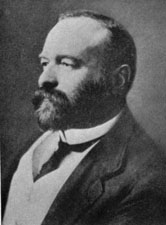
FRANKLIN H. GIDDINGS
(Photo by the Misses Selby.)
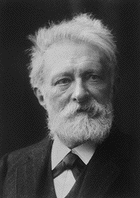
RUDOLF EUCKEN
But the characteristic of the Emperor which struck me most forcibly is his profound sense of duty and his readiness for self-sacrifice for the welfare of his country. This is a general German trait. It is the most admirable side of German nature. And the Emperor is, in this respect especially, their Princeps. I remember sitting beside him one day, when one of the ladies of his household asked me if I were acquainted with a certain wealthy ultra-fashionable New York social leader. I replied, by name only. She pressed me to know why not more nearly, why not personally. And to this, I replied that I was not of her class; that I could not amuse her, and that I did not approve of the frivolous and demoralizing example and influence of one so favorably circumstanced for doing good. The Emperor had heard the conversation, and he promptly said: "You know in Germany we do not rate and classify people by their material possessions, but by the importance of the service they render to country, culture, and civilization." One of his sons once told me that from his earliest childhood his father had instilled into his mind the lesson that devotion to duty and readiness for sacrifice were the cardinal virtues of a German, especially of a Hohenzollern. His days are periods of constant labor and severe discipline. He rises early, lives abstemiously and works until far into the night. There is no day laborer in his entire empire who gives so many hours per diem to his work. His nature is manifestly deeply religious and, in every sentence he speaks, evidence of his consciousness that the policeman's club cannot take the place of religious and moral principle is revealed. His frequent appeal for Divine aid in the discharge of his duties is prompted by the conviction that the heavier the duty the more need there is of that aid.
He undoubtedly has an intense desire, almost a passion, for the prosperity and greatness of his country, but his conception of that prosperity and greatness is more spiritual and cultural than material and commercial. More than once have I heard him say that he desired to see Germany a wealthy country, but only as the result of honest and properly requited toil, and that wealth acquired by force or fraud was more a curse than a blessing, and was destined to go as it had come. His conception of the greatness of Germany is as a great intellectual and moral power rather than anything else. Its physical power he values chiefly as the creator and maintainer of the conditions necessary to the production and influence of this higher power. I have often heard him express this thought.
And in spite of this terrible war, the responsibility for which is by so many erroneously laid at his door, I firmly believe him to be a man of peace. I am absolutely sure that he has entered upon this war only under the firm conviction that Great Britain, France, and Russia have conspired to destroy Germany as a world power, and that he is simply defending, as he said in his memorable speech to the Reichstag, the place which God had given the Germans to dwell on. For seven years I myself have witnessed the growth of this conviction in his mind and that of the whole German Nation as the evidences of it have multiplied from year to year until at last the fatal hour at Serajevo struck. I firmly believe that there is no soul in this wide world upon whom the burden and grief of this great catastrophe so heavily rest as upon the German Emperor. I have heard him declare with the greatest earnestness and solemnity that he considered war a dire calamity; that Germany would never during his reign wage an offensive war, and that he hoped God would spare him from the necessity of ever having to conduct a defensive war. For years he has been conscious that British diplomacy was seeking to isolate and crush Germany by an alliance of Latin, Slav, and Mongol under British direction, and he sought in every way to avert it. He visited England himself frequently. He sent his Ministers of State over to cultivate the acquaintance and friendship of the British Ministers, but rarely would the British King go himself to Germany or send his Ministers to return these visits. More than once have I heard him say that he was most earnestly desirous of close friendship between Germany, Great Britain, and the United States, and had done, was doing, and would continue to do, all in his power to promote it; but that while the Americans were cordially meeting Germany half way, the British were cold, suspicious, and repellent.
I know that the two things which are giving him the deepest pain in this world catastrophe, excepting only the sufferings of his own kindred and people, are the enmity of Great Britain and the misunderstanding of his character, feelings, and purposes in America. To remedy the first we here can do nothing, but to dispel the second is our bounden duty; and I devoutly hope that other evidence may prove sufficient to do this to the satisfaction of the minds of my countrymen than was necessary to convince the British Nation that the great-hearted Abraham Lincoln was not a brute nor the urbane William H. Seward a demon of ferocity.
To the Editor of The New York Times:
The Burgess Kaiser is a truly admirable person. Every right-minded man will be only too glad to believe all that Prof. Burgess affirms of him. To be sure, there is a lurking sense that the professor "doth protest too much." But let that go. In the present topsy-turvy state of the world it is refreshing to hear of a man who loves his wife and children in the good, old way. But just now the world is not interested in the private, personal, peculiarly German characteristics of the Kaiser. We outsiders must take him as he is known to the international world. We of course trust that he is an able, cultivated, attractive gentleman. There are many such in the world. But this gentleman happens to be the head of one of the great nations. Our interest in him centres in his relations to his neighbor nations.
An English friend of mine was appointed to duty in a tribe of savages in Africa. I dislike to call them savages after the testimony of my friend. But they were just plain, naked folk, living in primitive simplicity in their native land. The chief of this little tribe was, as my friend asserts, a superior man, and, in spite of his undress, a good deal of a gentleman. In physique he was superb. A sculptor's heart would have leaped for joy at sight of him. My friend said to see him teaching his young son to throw a spear was a sort of physical music. He himself could throw a spear to an incredible distance with the precision of a rifle shot. He ruled his little kingdom with surprising wisdom and fairness. He was welcomed everywhere among his people as the friend and counselor. His family relations were unimpeachable. The same was true throughout the tribe. He was devoutly pious. In short, he was a Burgess Kaiser in the small. But he was the war lord of all that region. He was fiercely jealous of all the neighboring tribes. He kept his own people armed and drilled to the top of efficiency, ready for attack or defense. He was noted for his hatred and contempt for his people except his own. His forays were marked by savage cruelty. His military necessities stopped at nothing.
Need it be said that the surrounding tribes were in nowise interested in this chief's physique or domestic virtues, or in his fidelity to his own people? It is safe to affirm that the British Government did not ask whether he had the body of a Michael Angelo's David or of a baboon from the jungle. It did not ask whether he was good to his wife and children. Most animals are. It did not care how devoted he was to his fetich. The sole question was, What sort of public citizen is he? How does he stand related to surrounding peoples? On what terms does he propose to live with them? That precisely is what we want to know about the Kaiser.
Fortunately, we do not have to ask Prof. Burgess, or any group of savants, or the German people. The Kaiser's record is known and read of all men.
JAMES H. ECOB,
American Institute of Social Service.
New York, Oct. 21, 1914.
So much has been said about Belgian neutrality, so much assumed, and it has been such a stumbling block in the way of any real and comprehensive understanding of the causes and purposes of the great European catastrophe, that it may be well to examine the basis of it and endeavor to get an exact idea of the scope and obligation.
Of course, we are considering here the question of guaranteed neutrality, not the ordinary neutrality enjoyed by all States not at war, when some States are at war; the difference between ordinary neutrality and guaranteed neutrality being that no State is under any obligation to defend the ordinary neutrality of any other State against infringement by a belligerent, and no belligerent is under any special obligation to observe it. Guaranteed neutrality is, therefore, purely a question of specific agreement between States.
On the 19th day of April, 1839, Belgium and Holland, which from 1815 to 1830 had formed the United Kingdom of the Netherlands, signed a treaty of separation from, and independence of, each other. It is in this treaty that the original pledge of Belgian neutrality is to be found. The clause of the treaty reads: "Belgium in the limits above described shall form an independent neutral State and shall be bound to observe the same neutrality toward all other States." On the same day and at the same place, (London,) a treaty, known in the history of diplomacy as the Quintuple Treaty, was signed by Great Britain, France, Prussia, Austria, and Russia, approving and adopting the treaty between Belgium and Holland. A little later, May 11, the German Confederation, of which both Austria and Prussia were members, also ratified this treaty.
In the year 1866 the German Confederation was dissolved by the war between Austria and Prussia, occasioned by the Schleswig-Holstein question. In 1867 the North German Union was formed, of which Prussia was the leading State, while Austria and the German States south of the River Main were left out of it altogether. Did these changes render the guarantees of the Treaty of 1839 obsolete and thereby abrogate them, or at least weaken them and make them an uncertain reliance? The test of this came in the year 1870, at the beginning of hostilities between France and the North German Union. Great Britain, the power most interested in the maintenance of Belgian neutrality, seems to have had considerable apprehension about it. Mr. Gladstone, then Prime Minister, said in the House of Commons: "I am not able to subscribe to the doctrine of those who have held in this House what plainly amounts to an assertion that the simple fact of the existence of a guarantee is binding on every party to it, irrespective altogether of the particular position in which it may find itself when the occasion for acting on the guarantee arises."
Proceeding upon this view, the British Government then sought and procured from the French Government and from the Government of the North German Union separate but identical treaties guaranteeing with the British Government the neutrality of Belgium during the period of the war between France and the North German Union, the so-called Franco-Prussian war, which had just broken out, and for one year from the date of its termination. In these treaties it is also to be remarked that Great Britain limited the possible operation of her military force in maintaining the neutrality of Belgium to the territory of the State of Belgium.
These treaties expired in the year 1872, and the present German Empire has never signed any treaty guaranteeing the neutrality of Belgium. Moreover, between 1872 and 1914 Belgium became what is now termed a world power; that is, it reached a population of nearly 9,000,000 people, it had a well-organized, well-equipped army of over 200,000 men and powerful fortifications for its own defense; it had acquired and was holding colonies covering 1,000,000 square miles of territory, inhabited by 15,000,000 men, and it had active commerce, mediated by its own marine, with many, if not all, parts of the world. Now, these things are not at all compatible in principle with a specially guaranteed neutrality of the State which possesses them. The State which possesses them has grown out of its swaddling clothes, has arrived at the age and condition of maturity and self-protection, and has passed the age when specially guaranteed neutrality is natural.
From all these considerations, I think it extremely doubtful whether, on the first day of August, 1914, Belgium should have been considered as possessing any other kind of neutrality than the ordinary neutrality enjoyed by all States not at war, when some States are at war. In fact, it remains to be seen whether Belgium itself had not forfeited the privilege of this ordinary neutrality before a single German soldier had placed foot on Belgian soil. A few days ago I received a letter from one of the most prominent professors in the University of Berlin, who is also in close contact with the Prussian Ministry of Education, a man in whose veracity I place perfect confidence, having known him well for ten years. He writes: "Our violation of the neutrality of Belgium was prompted in part by the fact that we had convincing proof that there were French soldiers already in Belgium and that Belgium had agreed to allow the French Army to pass over its soil in case of a war between France and us." Moreover, in the British "White Paper" itself, No. 122, is to be found a dispatch from the British Ambassador in Berlin, Sir E. Goschen, to Sir Edward Grey, containing these words: "It appears from what he [the German Secretary of Foreign Affairs] said that the German Government consider that certain hostile acts have already been committed by Belgium. As an instance of this, he alleged that a consignment of corn for Germany had been placed under an embargo already." The date of this dispatch is July 31, days before the Germans entered Belgium.
But placing these two things entirely aside, as well as the new evidence, said to have just been found in the archives at Brussels, that Belgium had by her agreements with Great Britain forfeited every claim to even ordinary neutrality in case of a war between Germany and Great Britain, I find in the British "White Paper" itself, No. 123, not only ample justification, but absolute necessity, from a military point of view, for a German army advancing against France, not only to pass through Belgium, but to occupy Belgium. This number of the "White Paper" is a communication dated Aug. 1 from Sir Edward Grey to Sir E. Goschen, British Ambassador in Berlin. In it Sir Edward Grey informed Sir E. Goschen that the German Ambassador in London asked him "whether, if Germany gave a promise not to violate Belgian neutrality, we, Great Britain, would remain neutral," and that he [Grey] replied that he "could not say that," that he did not think Great Britain "could give a promise of neutrality on that condition alone"; further, Sir Edward Grey says: "The Ambassador pressed me as to whether I could not formulate conditions on which we would remain neutral. He even suggested that the integrity of France and her colonies might be guaranteed. I said that I felt obliged to refuse definitely any promise to remain neutral on similar terms, and I could only say that we must keep our hands free."
After this Sir Edward Grey declared in Parliament, according to newspaper reports, that Great Britain stood, as to Belgian neutrality, on the same ground as in 1870. With all due respect, I cannot so understand it. In 1870 Great Britain remained neutral in a war between the North German Union and France, and, with the North German Union, guaranteed Belgium against invasion by France, and, with France, guaranteed Belgium against invasion by the North German Union. On Aug. 1, 1914, the German Empire asked Great Britain to do virtually the same thing, and Great Britain refused. It is, therefore, Germany who stood in 1914 on the same ground, with regard to Belgium neutrality, as she did in 1870, and it is Great Britain who shifted her position and virtually gave notice that she herself would become a belligerent. It was this notice served by Sir Edward Grey on the German Ambassador in London on Aug. 1, 1914, which made the occupation of Belgium an absolute military necessity to the safety of the German armies advancing against France. Otherwise they would, so far as the wit of man could divine, have left their right flank exposed to the advance of a British army through Belgium, and there certainly was no German commander so absolutely bereft of all military knowledge or instinct as to have committed so patent an error.
Belgium has Great Britain to thank for every drop of blood shed by her people, and every franc of damage inflicted within her territory during this war. With a million of German soldiers on her eastern border demanding unhindered passage through one end of her territory, under the pledge of guarding her independence and integrity and reimbursing every franc of damage, and no British force nearer than Dover, across the Channel, it was one of the most inconsiderate, reckless, and selfish acts ever committed by a great power when Sir Edward Grey directed, as is stated in No. 155 of the British "White Paper," the British Envoy in Brussels to inform the "Belgian Government that if pressure is applied to them by Germany to induce them to depart from neutrality, his Majesty's Government expects that they will resist by any means in their power."
It is plain enough that Great Britain was not thinking so much of protecting Belgium as of Belgium protecting her, until she could prepare to attack Germany in concert with Russia and France. She was willing to let Belgium, yea almost to command Belgium, to take the fearful risk of complete destruction in order that she might gain a little time in perfecting the co-operation of Russia and France with herself for the crushing of Germany, and in order to hold the public opinion of neutral powers, especially of the United States of America, in leash under the chivalrous issue of protecting a weaker country, which she has done little or nothing to protect, but which she could have effectively protected by simply remaining neutral herself.
We Americans have been greatly confused in mind in regard to the issues of this war. We have confounded causes and occasions and purposes and incidents until it has become almost impossible for any considerable number of us to form a sound and correct judgment in regard to it. But we shall emerge from that nebulous condition. We are beginning to see more clearly now, and it would not surprise me greatly if the means used for producing our confusion would some day come back, if not to plague the consciences, at least to foil the purposes of their inventors.
To the Editor of The New York Times:
Prof. Burgess's amazing communication on Belgian neutrality omits an essential piece of evidence. Granting, for the sake of argument, that the German Empire might repudiate all treaty obligations of the earlier German confederations, (very odd law, this;) granting also the still more novel plea that Belgium had outgrown the need, and the privilege of neutralization, Germany had agreed to treat all neutral powers under the following provisions of The Hague Conventions of 1907 concerning the rights and duties of neutral powers:
1. The territory of neutral powers is inviolable.
2. Belligerents are forbidden to move troops or either munitions of war or supplies across the territory of a neutral power.
* * * * * * *
5. A neutral power must not allow any of the acts referred to in Articles 2 to 4 to occur on its territory.
This pledge the German Empire had solemnly made only seven years ago. It would seem that Prof. Burgess may accept the distinction ably made by Prof. Münsterberg between "pledges of national honor" and mere "routine agreements," placing Hague treaties in the latter category.
The allegation that France and England secretly did unneutral acts in Belgium is as yet without proof of any sort, and must be interpreted by the commonsense consideration that a neutral Belgium was a defensive bulwark for France and England. To have tampered with her neutrality would have been motiveless folly. How much more decent and moral than Prof. Burgess's meticulous weighing of national reincorporation as a means of evading national obligations is Chancellor Hollweg's robust plea of national necessity! Prof. Burgess's whole moral and mental attitude in this case seems to be that of a corporation lawyer getting a trust out of a hole under the Statute of Limitations or by some reorganizing dodge.
FRANK JEWETT MATHER, Jr.
Princeton, N.J., Nov. 4, 1914.
Late Seth Low Professor of History at Columbia University; ex-President National Institute of Arts and Letters and of the American Historical Association; was secretary of George Bancroft, the historian, in Berlin, 1873-5; author of works on French History.
The American public has been carefully trained to avoid entanglement with foreign affairs. This European war was so unexpected, so entirely unforeseen, that we were at first bewildered, and then exasperated, by our unreadiness to meet our own emergencies.
In our effort to fix responsibility we then became partisan to the verge of moral participation and had to be called to our senses by the wise proclamation and warning of our Chief Magistrate.
Western Europe is a nearer neighbor than either Central or Eastern, and what stern censors permit us to know is nicely calculated to arouse our prejudice on one side or the other. Believing that, owing to cable cutting and neutrality restrictions of wireless, as yet the plain truth is not available, we ask for a suspension of judgment on both sides in order that our Government may enjoy the undivided support of all American citizens in its desire to secure a minimum of disturbance to the normal course of our commercial, industrial, and agricultural life by convulsions that are not of our making.
Fairness to ourselves means justice in the formation and expression of opinion about not one or two but all the participants in a struggle for European ascendency, with which we have nothing to do except as overwhelming victory for either side might bring on a struggle for world ascendency, with which, unhappily, we might have much to do. To contemplate such a terrible event should sober us; the best preparation for it is absolute neutrality in thought, speech, and conduct.
Our own history since independence is an unbroken record of expansion and imperialism. Our contiguous territories have been acquired by compulsion, whether of war, of purchase, of occupation, or of exchange. We have taken advantage of others' dire necessity in the case of Great Britain, France, Spain, Russia, and Mexico.
To rectify our frontier we compelled the Gladsden Purchase within the writer's lifetime. As to our non-contiguous possessions, we hold them by the right of conquest or revolution, salving our consciences with such cash indemnity as we ourselves have chosen to pay, and even now we are considering what we choose to pay, not what a disinterested court might consider adequate, for the good-will of the United States of Colombia, a good-will desired solely and entirely for an additional safeguard to the Panama Canal and a prop to the policy or doctrine substituted by the present Administration for the moribund Monroe Doctrine.
In no single instance of virtual annexation or protectorate have we consulted by popular vote either the desires of those inhabiting the respective territories annexed or The Hague Tribunal. In every case we have had one single plea and one only—self-interest.
The entire American continent south of our frontier we have closed to all European settlement, thereby maintaining for more than a century in a magnificent territory an imperfect civilization which makes a sorry use of natural resources which could vastly improve the condition of all mankind if properly used.
This is the light in which European nations see us; our identity in this policy from the dawn of our national existence onward they consider a proof of our national character. It differs in no respect from their own policies except in one.
But for them this exception is basic. We are a composite folk and they are homogeneous, their blend being approximately complete. They have one language, one tradition, one set of institutions and laws; a unity of literature, habits, and method in life. Some European States are composite, but each component part claims and cultivates its own style and its own principles; each announces itself as a nationality with a life to be maintained and a destiny to be wrought out somehow, either in peace or in conflict.
With perhaps a single exception, they have an overflow of population, due to natural generation, for the comfort and happiness of which they seek either an expansion of territory or an improvement in the productivity of their home lands; for those who must emigrate they passionately desire the perpetuation of their nationality, with all it implies.
In these respects they do not differ from us, except that perhaps we are more determined and imperious. We cannot think politically in any other terms than those of democratic government, either direct or representative.
At the present hour we are engaged in the very dubious experiment of direct popular legislation and administration. We are trying to change our Government radically, discarding its representative form for that of delegation. The remotest cause of this is the desire to amalgamate all our elements into homogeneity. So far this policy has resulted in a demand, not for equality of political and civil rights, but for its overthrow, substituting laws intended to create social and economic equality by means of class legislation.
These facts are not to the edification of other civilized States, and subject us to harsh and contemptuous criticism.
It is likewise very interesting that apparently the American people believe in a monarchical democracy. One of our typical first citizens has recently expressed his antipathy to the phrases "My monarchy," "My loyal people," "My loyal subjects," used by one of the German monarchs in summoning the nation to war, as implying a dynastic or personal ownership of men.
The American masses dislike the sound of supreme war lord, but gladly admit their own Chief Magistrate to be Commander in Chief of the army and navy. To our ears the three German words are offensive, and well they may be, for in the treacherous literal translation they are willful perversion; but the much stronger English words are a delight to our democracy.
The phrases of monarchy are constantly used in Great Britain by its King and its Emperor, but give no offense to his "loyal subjects," even the most radical, who delight in them, as apparently do our people of British origin. Why do they give such deep offense when employed by the German Government through its King and Emperor? The social stratification of Germany is not as marked as that of Great Britain; its aristocracy is far less powerful; and Edward VII. proved that an adroit and willful English monarch could involve his "loyal people" deeper in harmful, secret alliances than William II., whose alliances and policies were and are unconcealed.
One of our greatest historians has earned a brilliant reputation in the conclusive proof that oceans are the world's highways, while its continents are its barriers. To the term "militarism" we attach an opprobrious meaning; militarism is the more infamous in exact proportion to its efficiency. We have been at little pains to define it, and as to certain of its aspects are curiously complacent.
The basic principle of our own nationality has long been the very vague Monroe Doctrine, by the assertion of which we have prevented the establishment on our nearest and remotest frontiers of strong military powers, which might in certain events compel us to maintain a powerful and numerous standing army, or even introduce the compulsory military service of all voters, (women, of course, excepted.)
Yet we propose to fight if necessary in order to prevent fighting, and to this end maintain the second strongest and, for its size, the most efficient fleet in the world. This is our militarism; that of Great Britain has been to maintain a fleet double our own or any other in size, for it is her basic principle to maintain an unquestioned supremacy on the highways of commerce. To this we have meekly assented, while other nations absorb our carrying trade and our flag waves over a fleet of perhaps a dozen respectable oceangoing trading and passenger ships. It is under her rather patronizing protection that we fight our foreign wars and by pressure from her that we manage the Panama Canal with nice and honorable attention to her interpretation of a treaty capable of quite a different one. Whether or not this be "militarism" of the utmost efficiency by sea is not difficult to decide. But we have never styled it infamous.
While I am writing, Germans, whose basic principle is the most efficient "militarism" by land, are publishing all abroad that the "militarism" of France must be forever stamped out, so that they may dwell at peace in the lands which are their home.
Within a generation France has accumulated a colonial empire second only to that of Great Britain, while she has incessantly demanded the reintegration of German lands, and especially a German city which she arbitrarily annexed and held by "militarism" for about five generations. The "militarism" of a republic and a democracy which retains the essential features of Napoleonic administration has been quite as efficient as that of a monarchical democracy like Great Britain, and may easily prove more efficient than that of a monarchy like Germany.
Why should it be more infamous or barbarous in one case than the other? And with what is this efficient military democracy allied in the closest ties?
With Russia, an Oriental despotism which by the aid of French money has developed a "militarism" by land so portentous in numbers, dimension, and efficiency that its movements are comparable to those of Attila's Huns. Escaped Russians in Western lands are denouncing German "militarism" as the incubus of the world.
Which of the two should Americans regard as the greater danger?
It has wrung our hearts to consider the violation of Belgian neutrality, for which both France and eventually even Great Britain have long been prepared, but the latter has with little or no protest arranged with the "bear that walks like a man" to disregard contemptuously the neutrality of Persia in arranging spheres of influence, exactly as Japan, another ally, is contemptuously disregarding the neutrality of China, the new "republic" we were in such haste to recognize that we had to use the cable. And what about Korea? It is a Japanese province in contravention of the most solemn guarantees of its integrity.
Leaving aside for the moment certain considerations like these, and they might easily be indefinitely amplified, which should compel Americans to unbiased consideration for others and preclude a dangerous partiality, let us ask ourselves how in the event of mediation we could be an impartial pacificator, behaving as we have hitherto done. The attitude of our Government has been strictly neutral, neutral to the verge of utter self-abnegation; and, as some regard it, timidity.
But rock-fast as any democratic magistrate may be, public opinion must and does influence him. Rightly or wrongly his agents would be even more completely dominated, and rightly or wrongly they would be suspect in view of our terrific partisanship on both sides since the commencement of hostilities.
The efficiency of Government organs in "producing the goods," the terrific power of organization on one side and mass on the other, have been considered a menace to world equilibrium.
Whichever way the decision falls, the scrutiny of Europe will be turned to us. Unless observation and instinct be utterly at fault, we have for more than a decade been, after Germany, the worst-hated nation of all that are foremost.
It is pre-eminently our affair to mind our own business, as others have minded theirs. Without cessation of noise and fury in America this is impossible.
Indeed, our emotional storms have already furnished proof of how we are incapacitated from either enforcing our rights as neutrals or seizing by the forelock the opportunity afforded to us as neutrals and from enjoying the unquestioned privileges of neutrality.
It is not altogether edifying to think that the close of the European struggle, be it long or short, will probably find our ocean commerce substantially where it was at the beginning, and that conflicts which were not of our making will have been fought out before we are able to secure our share of the world markets. Apparently the leaders in commerce, industry, and trade, like the lawmakers and administrators, are paralyzed by the imperative necessity of aiding panicstricken tourists and panicstricken stay-at-homes. Apparently, too, our people are suffering more in purse and general comfort than the actual combatant nations.
Clamorous for American sympathy and cash, we have on our shores embassies from the belligerents, pleading their respective virtues and sorrows.
Why, after all, should our chiefest concern be with them? Surely we may be good Samaritans without a total disregard of our own interests and a blindness to opportunity verging on impotency. There is no immorality in the proper play of self-interest. It is the conflict of interests which creates morality. But the spectators, even the maddest baseball "fans," do not play the game nor train for it. It is high time we ceased wasting our energies in emotions and vain babble.
At this writing the first line of defense against the Oriental deluge is endangered. The Slav individually and in his primitive culture is altogether charming. He is a son of the soil, picturesque in life and creative; he is minstrel and poet, seer. But so far he is the carrier of a low civilization, the prophet, priest, and king of autocracy and absolutism. Never has there been a time in history when the higher civilization was not in a savage struggle for existence. It is almost the first time in three centuries that the highest civilizations were in alliance with the lowest; not since the pugnacious Western powers of Europe sued for favor at the Sublime Porte.
This ought to be a very sobering spectacle, but it seems to arouse the delighted enthusiasm of an American majority. For such an aberration there is but a single and efficient remedy: absorption in our own affairs, the discriminating study of efficient methods to prevent our being caught up by a whirlwind, even the outer edges of which may snatch us into the vortex.
To change the metaphor, we revel in the pleasant propulsion of the maelstrom's rim, unaware that every instant brings us closer to dangers, escape from which would demand herculean effort. Irresponsible emotions are, like those of the novel and the stage, when intensified to excess utterly incompatible with action. And just such a paralysis seems for six long weeks to have lamed the highest powers of America.
The proportionate increase in population among the European powers is overwhelmingly in favor of the Slavs. Their rate of increase by natural generation is nearly three times that of even the Germans, with the result that by the introduction of enforced military service into Eastern Europe, (excepting Hungary and perhaps Rumania,) the military balance of power has been completely changed.
The wars among the Balkan States, including Turkey, have put on foot armies of a dimension hitherto undreamed of among the South Slavs, and the army of Russia is probably two and a half times larger than it could have been thirty-five years ago.
The method by which Eastern Europe has succeeded in financing itself is rather mysterious. We know, of course, that the original Franco-Russian Alliance was based on reciprocal interests, and that large sums of French money flowed into Russia, which partly developed the natural resources of Russia and were partly in the shape of loans that in all likelihood were used for war material.
The conflict between the Slavs and the Teutons all along the line on which they border has therefore been in two ways intensified. In the first place, just in proportion as Germany has become an industrial State, the field work has been intrusted to immigrant Slavs, some of whom come only for the season and return, but a very large number of them—estimated at the present moment at close to a million—have substantially settled within the borders of the German Empire. That is to say, there is a constant injection of 1-1/2 per cent. of Slavic blood into the territories of the German Empire.
Suppose now that Russia should succeed in establishing the protectorate over all Slavs which she desires, and at the same time should press back the Germans on that border line, something very closely approximating a new migration of peoples in Europe will take place.
As far as I know the German feeling, expressed both privately and publicly, officially and unofficially, they have hoped to maintain their complete consanguinity, if not homogeneity, within the lands they regard as their home; and their preparations for war, their increase of their military strength, have been made, professedly at least, solely in the interest of defense. Americans can simply not realize—it is impossible for them to realize—the difference in the degree of civilization and culture on either side of a purely artificial boundary line.
Very fortunately it has entered the minds of several people lately to write to the newspapers about the unhappy confusion that comes from the use of words in a meaning which at home they do not connote at all. Take, for example, the whole question of militarism. As we see it, it is a matter altogether of degree. For defense against what the German considers the most terrible danger that he personally has to confront, it has been necessary from time to time to change both the size and the composition of his forces, whether offensive or defensive, and they therefore have introduced compulsory military service, an idea which has always been very offensive to Anglo-Saxons, but which in cases of dire necessity they have been compelled to utilize themselves, as, for example, during our own civil war, the abandonment of voluntary enlistment and the introduction of the draft.
Now, the compulsory military service of the German means that every man is for a period of his life drafted and trained as a soldier. Forty years ago there were a great many men who escaped by reason of one or another provision of the law. That number was steadily diminished until within eighteen months, when finally it was proclaimed that every German who could endure the severity of that training must undergo it, and that was due to the fact that the military balance of power of which I spoke had been so completely changed by the re-armament of Russia and by the formation of the South Slav armies in the Balkan Peninsula.
As a parallel we might imagine, not one troublesome neighbor, but four. We might imagine a tremendous military power developed in Canada, and we might imagine a hostile military power on the Atlantic side and another one on the Pacific side, in which case we would beyond a question have to expand our inchoate militarism, just in proportion as we came to feel the necessity for a strong physical defensive or offensive in the way of a great standing army, and we probably would do it without any hesitation.
Now, Germany has not any really bitter foe on the north, although there is no love lost between the Germans and the Scandinavians; but it has an embittered foe on the east, and another one on the west, and what has proved to be an embittered foe upon the water and a very lukewarm neutral State on the south, a State which had joined in alliance with her.
Italy had joined what Italy considered a defensive alliance, but not an offensive alliance, and chose to regard the outbreak of this war as an offensive movement on the part of Germany, and for that reason has refused to participate in the struggle.
I say for that reason because, having been accustomed to reading, all my life, long diplomatic documents, really having been trained, you might say, almost in the school of Ranke, who was the inaugurator of an entirely new school of historical writing based on the criticism of historical papers, I have come to realize that the dispatches of trained diplomats are for the most part purely formal, and that while these respective publications of Great Britain and of Germany have a certain value, yet nevertheless the most important plans are laid in the embrasures of windows, where important men stand and talk so that no one can hear, or they are arranged and often times amplified in private correspondence which does not see the light until years afterward, and that the most important historical documents are found in the archives of families, members of which have been the guiding spirits of European policy and politics.
So that what the secret diplomacy of the last years may have been is as yet utterly unknown, and certainly will not be known for the generation yet to come and perhaps for several generations. The student in almost any European capital is given complete access to everything on file in the archives, including secret documents, only down to a certain date. That date differs in various of these storehouses, but I think in no case is it later than 1830.
If you ask why, there are the sensibilities of families to be considered, there is the question of hidden policies which they do not care to reveal, and then there is the whole matter of who the examining student is. For instance, certain very important papers were absolutely denied to me, as an American, in Great Britain—or at least excuses were made if they were not absolutely denied—which were opened to an Englishman who was working upon the same subject at about the same time.
The reason for such observations at the present hour is plain enough. Public opinion is formed upon what the public is permitted to know, and is not formed upon the actual facts which the public is not permitted to know. And for that reason Americans, remote as we are from the sources of information, and especially remote from that most delicate of all indications, the pulse of public opinion in foreign countries, ought to be extremely slow to commit themselves to anything.
Now, we have just had a very interesting incident. THE NEW YORK TIMES printed recently what the British call their "White Paper," as well as the German "White Paper." The editors of our most important journals announced that they had read and studied those papers with care, and that on the face of those papers, beyond any peradventure, Germany was the aggressor. German militarism had flaunted itself as an insult in the face of Europe. Germany had violated neutrality, Germany had committed almost every sin known to international law, and therefore the whole German procedure was to be reprobated.
Within a very short time a Labor member of Parliament, J. Ramsay Macdonald, rises in his place, able and fearless, and, on the basis of the "White Paper," as published and put in the hands of the British public, attacks Sir Edward Grey for having so committed Great Britain in advance to both Russia and France that, in spite of the representations of the German Ambassador, he dared not discuss the question of neutrality. This member of Parliament manifestly belongs to the powerful anti-war party of Great Britain, a party two of whose members, John Burns and Lord Morley, resigned from the Cabinet rather than condone iniquity; a party which before the outbreak of the war made itself heard and felt, and protested against the participation of Great Britain, desiring localization of the struggle.
Mr. Macdonald says that in his opinion this talk about the violation of Belgian neutrality, from the point of view of British statesmen, is absurd, because as long ago as 1870 the plans for the use of Belgium, both by France and by Germany—in other words, the violation of its neutrality—were in the British War Office, and that Mr. Gladstone rose in his place and said he was not one of those whose opinion was that a formal guarantee should stand so far in thwarting the natural course of events as to commit Great Britain to war; and that has been the announced and avowed policy of Great Britain all the way down since 1870, and that therefore talk about the violation of Belgian neutrality is a mere pretext.
That is another instance of this secret agreement that goes on, which so commits a man like Sir Edward Grey that in the pinch, when the German Ambassador substantially proposed to yield everything to him and asked him for his proposition, he cannot make any.
These facts are in the "White Paper." As far as I know, no editor in the United States who claims to have studied thoroughly that "White Paper" has ever brought this out, and they had not been published in that paper at the time when Sir Edward Grey and Mr. Asquith made their respective speeches and committed the British Nation to the war.
Another unhappy use of language which has been noted in the public press is due to the literal translation of words. Americans simply do not know what the word Emperor means. To most of them it connotes the later Roman Emperors, or the autocratic Czar of Russia, or the short-lived but autocratic quality of Napoleon III., so that when we use the word Emperor we are thinking of an absolutely non-existing personage, unless it be the Czar of Russia.
We like very much to make sport of phrases from languages unfamiliar to us, and we enjoy the jokes of ludicrous translations, and so we take the term "Oberster Kriegsherr" and we translate it "Supreme War Lord." What conception the average American forms of that is manifest. Whereas, as a matter of fact—and this has already been pointed out both in conversation and in public prints—the term means nothing in the world but Commander in Chief of the German Empire, has not any different relation whatsoever in the substance of its meaning than that which Presidents of the United States have been in time of supreme danger to the country. Mr. Lincoln was just as much an "Oberster Kriegsherr" at one period of his term as the German Emperor could ever be; in fact, rather more.
In truth, the sense of outrage which Americans feel over the horrors of war, while most creditable to them, is very often based upon an ignorance of the rules and regulations of so-called civilized warfare, and upon a sentimentality, which, though also very creditable, is unfortunately not one of the factors in the world's work. It would not hurt Americans occasionally to recall Sherman's march to the sea, during which every known kind of devastation occurred, or to recall Gen. Hunter's boast that he had made the Valley of Virginia such a desert that a crow could not find sustenance enough in it to fly from one side to the other, and yet at that time, in what we considered the supreme danger to our country, the conduct of those men was approved, and they themselves were almost deified for their actions.
While parallels are dangerous and the existence of one wrong does not make another action right, yet at the same time a very considerable amount of open-mindedness must be exercised in a neutral country when regarding the passionate devotions of combatant nations to their culture, to their safety, to their interest; and it should be recalled that in the heats and horrors of war it is extremely difficult, however trained or disciplined troops may be, to prevent outrages, and that so far as we have gone in accurate information the least that can be said is that it is slowly dawning upon us that horror for horror and outrage for outrage there has been no overwhelming balance on either side.
The Allies (this interview was received Tuesday morning) firmly believe that the struggle on the west is so indecisive up to this time that what will count for them is the duration of the war. Lloyd George has just said, not in the exact language, but virtually, what Disraeli said in 1878: "We don't want to fight; but, by jingo, if we do we have got the ships, we have got the men, we have got the money, too." Those are the words that brought into use the expression "jingoists."
Now, Lloyd George said the other day that it was the money which in the long run would count and that Great Britain had that; and the meetings that are held to induce Englishmen to enlist are addressed by speakers who meet with lots of applause when they say: "We may not be able to put the same number of men into the field immediately that Germany was able to put or Russia was able to put, but in the long run, considering the attitude of all the different parts of our empire, we will be able to put just as many men, and therefore time is on our side both as regards force in the field and money to sustain it." (The London Times confesses that enlistment in Ireland is a failure.)
Lloyd George says that for a comparatively short time England's enemies can finance themselves and be very efficient, but that as time passes they unquestionably will exhaust not only their pecuniary means but their resources of men as well. That is his position at this time. Therefore, it does appear as if the long duration of the war was a thing desired, at least in Great Britain, as being their hope of victory. Both Great Britain and France are wealthy countries. Just how wealthy Germany is I do not think they realize, nor do we know, nor what its ultimate resources can be.
Now, looking at the allied line as a whole, we will suppose that the German forces were overwhelmingly triumphant in France, and suppose, likewise, which is by no means as strong a hypothesis, that Russia is overwhelmingly victorious against Austria and the Eastern German Army; then, of course, you have the situation in which that one of the Allies which is triumphant will assert its leadership in the terms of peace that will be reached, and would have the hegemony, as we call it, of all Europe.
So that the defeat of the Allies in the west and their overwhelming success in the east would compel the acceptance, in any peace that might be made, of such terms as Russia chose to dictate. She would have to be satisfied, otherwise there would only be one outcome of it; that is, of course, if Great Britain and France could not accept those terms, there would be a rupture, and stranger things have been seen than Germany, France, and Great Britain fighting against Russia.
Stranger things than that have been seen; such changes in the alliances between States have occurred at intervals from the seventeenth century onward in Europe, a phase of the subject that is too lengthy to discuss here, but which every student of history knows all about. And it is thinkable that they might occur again.
Suppose, on the other hand, that the Germans should imitate Frederick the Great, which is not so preposterous as appears on the face of it, because of comparatively easy means of transportation, and should be able to make successive victorious dashes, first in the east and then in the west, backward and forward; leadership would be hers, and France would be a minor power for years to come.
Probably peace might come more quickly if neither side should be absolutely victorious than otherwise. But for the moment I think that the agreement among the Allies is a very portentous thing, as far as the duration of the war is concerned.
"Do you think that any secret agreement may exist; that France even now may have made an agreement with Germany?" Mr. Sloane was asked.
I cannot think so. I think it very evident there is no such secret agreement. If one existed it would be much more likely to be between Russia and Germany. You remember the development of Prussia, which is, of course, the commanding State in the German Empire, occurred by its careful conservation of the policy which was laid down in the political will of Frederick the Great, that of keeping friends with Russia.
The fact of the matter is, Prussia was saved in the Napoleonic wars by the act of Gen. Yorck at Tauroggen, when he suddenly abandoned the French and went over to the Prussians, and while Russia has within half a generation become intensely bitter against Germany, yet it is true that the Baltic Provinces, in which the gentry and the burghers are Germans, have furnished most important administrators to the Russian Empire, a fact that causes much of the jealousy in Russia on the part of the native-born Russians against the Germans of the Baltic Provinces. Nevertheless, self-interest is a very important thing, and if Russia thought for a moment that France was going to abandon her I think she would turn to Germany right away.
As time has developed the nations of today, it has come to be understood by hard-headed statesmen that those who conduct their respective affairs can have no other guiding principle than the interest of their own State, no other.
There is a persistent feeling throughout the world that there is an analogy between the individual man and organized society. There are books written to show that States must and do pass through the various stages through which an individual passes, namely, infancy, childhood, youth, middle age, old age, decay. By a perfectly natural parallel the majority of men apply the same morality to the State which they apply to the individual, and they insist upon it that a State must be moral in every respect; that it must have a conscience; that it must have virtue; that it must practice self-denial; that it must not lay its hands on what does not belong to it. In short, that it must as a State or as a nation be "good," in exactly the same sense in which a person is "good." In other words, they personify the State.
I have never heard of any speaker or writer who would not approve of that as an ideal, and who would not desire that the millennium should come upon earth now, and that exactly the same virtues that are held up for personal ideals should be held up for national ideals.
I think we all believe that, but, as a matter of fact, in a world constituted as ours is, the one test of a good Government, applied by every individual, is the material prosperity of the people who live under it, and for that reason if the people do not at first put in power men who can give them material prosperity they will put such failures out and try another set of rulers, and they will go on and on that way until necessarily the policies of statesmen must be based upon the interest of that State whose destinies are in their hands. So that the only hope of relations between nations similar to those that exist between good men and good women is that the individuals of that nation, its population, its inhabitants, should consent to exercise the self-denying virtues; and until that point is reached there can be no good State in the sense in which there can be a good man. We ought all to work for it, but it is not here now, and there are no signs on the horizon of its approach.
In a war, therefore, every statesman studies the resources of his nation, and when the time comes that it is manifestly his duty to put an end to warfare, it is only by the public approval that he dares do it, by showing that it is to their advantage to give up the things for which they went to war, in greater or less degree.
And the man of shrewd insight, who knows when that point is reached, is the leader who saves the face, so to speak, of these nations and steps in and says:
"Now, the whole moral force of the civilized world must be brought to bear upon you to make a peace, the terms of which, if possible, shall not discredit any of you, but at the same time shall be as elastic and as proportionate to your respective gains and losses as will insure at least a considerable period of peace, not an armistice, not an armed armistice, though it may be an armed peace."
We see no signs anywhere in Europe that disarmament has any substantial body of advocates in any nation. The basic principle hitherto of the German people has been to have, not the largest, but the strongest army; the basic principle of Great Britain, which sneers at militarism, has been not only to have the most powerful fleet, but twice the most powerful fleet.
And what is the basic principle of the United States? The Monroe Doctrine, to have no armed neighbor which shall compel us to violate by its presence our dislike for compulsory military service or to expend great sums for armament.
These are basic principles in each of us. Now, we have been able to maintain the Monroe Doctrine by simply showing our teeth, but whether we could maintain it in the future without an armed force sufficient to give it sanction I think is doubtful, and for that reason the Monroe Doctrine has undergone quite a number of modifications which I do not need to explain here.
But this basic principle of ours that from Patagonia to the Mexican frontier we will suffer no armed nation of Europe to make permanent settlement and endanger our peace is exactly the same sort of principle that the German holds when he says, "We must have the strongest army," and the same which the Englishman holds when he says, "We must have the strongest fleet."
I want it distinctly understood that I am not a partisan. I am not pro this or pro that or pro anything except pro-American, and the principal impulse I have in trying to clarify my mind is my hope that there may be an end to these hysterical exhibitions of partisanship, in which (throughout this neutral nation) men indulge who still hold too strongly, as I think, to the glory, honor, dignity, and traditions of the lands of their origin.
Emeritus Professor of Mental and Moral Philosophy at Yale University; Lecturer on Philosophy in India and Japan; has received numerous decorations in Japan, where he was guest and unofficial adviser of Prince Ito; ex-President of American Psychological Association.
To the Editor of The New York Times:
It seems strange to me that a student of history with the training and acumen of Prof. Sloane should overlook or minimize the important distinction that must hold the chief place in enabling us to understand the issues and appreciate the merits of the war now raging in Europe. This distinction is that between the German people and Germanic civilization, on the one hand, and, on the other, the present Constitution and cherished ambitions of the German Empire under the dominance of Prussia. The German people, by genuine processes of self-development, have worked out for themselves a veritable spiritual unity which manifests itself in language, laws, customs, and a large measure of substantial uniformity in moral and religious ideals. Germanic civilization, with its love of order, its high estimate of education, its notable additions to science, philosophy, and art, constitutes one of the most noble and beneficent contributions to the welfare of mankind.
But the case is not at all the same with the German Empire as at present constituted. It is not a historical development, a truly national affair, as are the Empire of Great Britain, the Republics of France and the United States, or the Empires of Russia and Japan. It is a modern combination of politically divergent unities, forced by the ruthless but infinitely shrewd policy of Bismarck and his coadjutors, misdirected and perhaps driven to ruin by the man and his entourage, who, even if he is King of Prussia "by the grace of God," is only Emperor of Germany "by the will of the Princes."
We are diligently given to understand that all these "Princes" and all the German people have entered heart and soul into this war, and without the slightest doubt as to its righteousness and as to the destiny of the empire, this modern military autocracy, ultimately to be completely victorious. This is hard to believe, although it must be admitted that the cowardice of the Socialists and the obsession of the professors are remarkable phenomena. As to the latter, however, we must remember their dependence on the Government, not only for their information and their "call" to speak, but also for their positions in the Government system of education.
As to the significance of the two names most prominently quoted in this connection, I am not at all impressed, as so many of my colleagues appear to be. An intimate friend of mine some twenty years ago was several weeks en pension in the same house where Haeckel had his apartment, and even then he was notorious for his hatred of foreigners and of women. Those of us who have followed closely his career know how often he has written with more than German professorial virulence against those who differed from his theory of evolution, and that he is at present scarcely more abusive of England than he has several times been of his own Government and of the State Church because his system was not made a matter of compulsory teaching. As to Eucken, the reasons for his obsession are quite different. In his case the feeling and the utterance are due to intellectual weakness rather than to virulence of passion.
After all, however, the temper of military and imperial Germany under the dominance of Prussia has been essentially the same from the beginning. In illustration of this, let me quote for your readers from a poem of Heine, written as long ago as 1842. I do this the more readily because I have recently seen, to my astonishment, Heine placed beside Goethe as representing the better temper of the Germanic civilization as opposed to the blinded judgment and immoral hatred of the modern German Empire:
Germany's still a little child,
But he's nursed by the sun, though tender;
He is not suckled on soothing milk,
But on flames of burning splendor.
One grows apace on such a diet;
It fires the blood from languor;
Ye neighbor's children, have a care,
This urchin how ye anger!
He is an awkward infant giant,
The oak by the roots uptearing;
He'll beat you till your backs are sore,
And crack your crowns for daring.
He is like Siegfried, the noble child,
That song-and-saga wonder,
Who, when his fabled sword was forged,
His anvil cleft in sunder!
To you, who will our Dragon slay,
Shall Siegfried's strength be given;
Hurrah! how joyfully your nurse
Will laugh on you from heaven!
The Dragon's hoard of royal gems
You'll win, with none to share it;
Hurrah! how bright the golden crown
Will sparkle when you wear it!
But it would not be stranger than many other things which have happened in human history if the defeat of German military imperialism should result in restoring to Europe and spreading more widely over the world the beneficent influence of Germanic civilization. Certainly they are not the same thing, and they do not stand or fall together.
GEORGE TRUMBULL LADD.
Yale University, Oct. 20, 1914.
Dr. Giddings is Professor of Sociology and the History of Civilization at Columbia University; author of many works on sociology and political economy; President of Institut Internationale de Sociologie, 1913.
No man in the United States is better entitled to estimate the probable social and economic outcome of the present European debacle than Prof. Franklin H. Giddings of Columbia, one of the most distinguished sociologists and political economists in the United States.
"Today all Europe fights," he said to me, "but, also, today all Europe thinks."
That is an impressive sentence, with which he concluded our long talk, and with which I begin my record of it.
He believes that this thinking of the men who crouch low in the drenched trenches and of the women who tragically wait for news of them will fashion a new Europe.
He agrees with the remarkable opinions of President Butler, that that new Europe will be marked by the rise of democracy.
He sees the probability of broadened individual opportunity in it, accompanied by the breaking down of international suspicions; and he thinks that all these processes, which surely make for peace, will surely bring a lasting peace.
In the following interview, which Prof. Giddings has carefully reread, will be found one of the most interesting speculative utterances born of the war.
"The immediate economic cause of the war," said Prof. Giddings, "lay in the affairs of Servia and Austria. Servia had been shut in. She had been able to get practically nothing from, and sell practically nothing to, the outside world, save by Austria's permission, while Austria, with Germany professing fear of Slavic development, for years had been taking every care to prevent the Balkan peoples from having free access to the Adriatic.
"Some financial profit arose from this interning of the little States, but it is probable that the desire for this was all along entirely secondary to the fear of Balkan, especially Servian, political and economic development.
"In the larger economic question Germany felt especial interest.
"In a comparatively few years she had made the greatest progress ever made by any nation in an equal time, with the possible exception of that made by the United States in a similar period after our civil war, and it is probable that not even our own advance has equaled hers in rapidity or extent, if all could be tabbed up.
"She had worked out a great manufacturing scheme, she had developed an immense internal commerce by means of her railroads and her Rhine and other waterways, she had built up an enormous trade with Eastern Europe, Western Asia, South America, and the United States.
"She had highly specialized in and become somewhat dependent on the production of articles like dyestuffs and the commodities of the pharmacopoeia.
"Her shipping had advanced until it closely crowded England's; her finances, on the whole, were well handled and her credit was excellent, while her wonderful system of co-operation between the Government and manufacturing producers and commercial distributers of all kinds had become the admiration of all nations. The extent to which her Government facilitated foreign trade through obtaining and distributing costly information might well be taken as the world's model.
"Whatever claims be made or contested about her contributions to culture and theoretical science, there can be no argument about her material achievements."
"Along every line her social organization of co-operation between the Government and the people successfully handled problems feared by all the outside world. While, as a result of the development of humane feeling, England and the United States have been saying that ignorance, vagabondage, and misery ought to be abolished, Germany has said, 'They shall be!' And, saying it, she had actually commenced to abolish them.
"She had cut down enormous wastes of human energy and, for the first time in the history of the world, had established an economic minimum below which men and families were not permitted to sink.
"The cost of this was large; for insurance, colonies for tramps and vagabonds, employment agencies, and the like; but Germany made it pay in the creation of a nation built of loyal and efficient people. Both their loyalty and their efficiency have been proved and reproved in the course of the present struggle. They had accomplished marvels, they were ready for amazing sacrifices.
"Now, one of the principal reasons why Germany was able to do these things, although, she probably ignored it and possibly would deny it, is to be found in the free-trade policy of England.
"At any time during the past twenty years England could have checked German progress effectively by the establishment of a protective tariff system designed to encourage her own colonies and other nations with whom she had long been on friendly and influential terms, to the utmost development of exclusive trade privileges designed to shut out Germany. Except for the long-established English policy of commercial freedom Germany could not have accomplished for herself what she has.
"Germany has been growing rapidly. Her birth rate has been high, but of late it has been falling, and when the war began there were indications that she soon would approach the low ratio of population increase already characteristic of France, of New England and the Middle West in the United States, and lately of England. But Germany's population was still a growing one and, in a sense, a restive one.
"The Malthusian theory has not worked out in the civilized world as Malthus supposed it would, for the application of science to manufacturing, agriculture, &c., has prevented increasing populations from pressing upon the means of subsistence; but in all parts of the Western World the standards of living have been raised, the ambitions of the average man and woman have expanded. They have lived better than their parents lived, and they have wished their children to live better still.
"However, we can place no limit upon the probable expansion of human desires, and it is true that a population unchecked by the intelligent action of the human will tends to increase at a rate more rapid than that at which it is possible to raise the actual plane of human living.
"The speed of the working of the two rules is different, perhaps, but both are dynamic, and the population of Germany tended to grow more rapidly than betterment of conditions could be provided, even under the nation's splendid governmental and commercial efficiency.
"The natural yearning of the nation, therefore, was toward colonial expansion, and, although note that I make no charges against either the German Government or German people, the nation probably has wished sovereignty over Western Europe, through Belgium and Holland to the sea. Its narrow outlet through Hamburg and Bremen was insufficient for its needs.
"Of course, its trade and economic advance has sometimes conflicted with that of other nations. It is natural for Germany to suppose that England tried to block it. However, I think that all the evidence which Germany has brought forward in proof of this is weak and improbable, because England's great source of revenue has been her foreign trade, and, above all, her carrying trade, and I am not partisan but stating the obvious when I say that England prospers when the rest of the world prospers, and that she has profited mightily through Germany's commercial advance.
"These facts point to the conclusion that Germany really had everything to gain by avoiding war and continuing her prosperous expansion along commercial lines, increasing the strength of her grip in foreign countries, as, for example, in South America."
"In South America we Americans were not really competing with her. She had studied the market and adopted the methods necessary to its satisfaction; we had not. England was relatively losing her hold there. In another twenty years Germany surely would have been one of the greatest commercial and manufacturing nations which the world has ever known. So it was not economic necessity, nor pressure approaching economic necessity, which precipitated this war.
"I think the German people, as they professed to do, did become greatly alarmed over a possibility, magnified into a probability, that Russia, taking up the cause of the Balkan peoples, would obtain Constantinople, that Servia would make her way to the Adriatic, and that all possibility of the expansion of Germany to the southeast would be blocked, and Germany probably became alarmed over England's intentions—there were many indications of something close to panic in Germany after it was generally understood that King Edward figured in the pact with France.
"I, for one, do not believe that the German fears of England were well grounded; I do not believe that in the excitement the German mind worked discriminatingly or that it is working with discrimination today. I think that Germany has presented an extraordinary example of nation-wide mobmindedness in a situation which offered nothing but ruin through war and boundless advantages if she sat tight and waited for some one else to strike the first blow, which, then, probably never would have been struck.
"So, although I have outlined what I think may fairly be regarded as some of the economic conditions contributing to the war, I do not think that it is entirely to be explained by economic causes.
"They fail to account for the actual precipitation of the conflict. I think that there is no explanation of that, short of recognition of an abnormal reaction of the German mind to a situation the nature of which was mistaken, or, at least, exaggerated.
"And, of course, there were other factors concerning which we shall not know the truth for years, such as the personal influence of individual minds in the German and other Governments. It will be long before the complete history of the acts and negligence of diplomats and other responsible Ministers will be written."
I asked Prof. Giddings if, in his opinion, the struggle is likely to result in any wide and profound change in the economic life of the world.
"Yes," he replied, "I think it is sure to. In the first place, for at least half a generation, and perhaps longer, the producing capital of the world will be much smaller than it was before the war.
"But in this speculation we must be cautious, because, so far, the costly war material which has been consumed, such as fortresses destroyed, guns worn out, ammunition consumed, soldiers' clothing, and in general food, were principally accumulated and paid for long ago. They have come out of the world's past production, and their cost already has been written off.
"The real loss, the new waste, over and above the devastation of Belgium and other lands, has been of labor, productive activity which would have been carried on during the period of the war had the struggle been avoided, the destruction of the lives of men in their economic prime, the maiming of others to the depletion of their future usefulness and the loss to European fatherhood.
"But if the war lasts a long time, necessitating the general renewal of ships, fortresses, weapons, and stores, the waste will be enormous, for the actual money expenditure will then come out of funds newly accumulated or charged against the future, and not out of those set aside in the past for war purposes."
"Thus one great economic change already is occurring—the devastation wrought, the destruction of hoarded funds and supplies and of useful human life.
"There are others which are probable, but also problematical, although I think we fairly may take them into account.
"Will the European nations, in settlement of their differences through final terms of peace, simply endeavor to restore the old order, drawing their lines of demarkation very strictly, enacting, for example, higher tariffs, thinking that along that line will lie the easiest way of re-establishing national finances?
"If so, the old contentions will be perpetuated. It will be the old order of things over again.
"We shall again have the spirit of exclusiveness fostered and the old suspicions bred. The old intense competition of nation with nation for trade to the exclusion of other nations from the markets of the world will return with its attendant inefficiency.
"But, on the other hand, the world will be an immense gainer through the war if it is followed by a broad and rational review of the whole situation and an adjustment of the map of Europe with due regard to the ambitions and legitimate economic opportunities and capabilities of the various peoples.
"This war may be the greatest good the world has ever known if it leaves Europe in a mental state disposed to Broaden opportunity, to break down suspicions, to eliminate barriers, and make commerce much freer than it has been.
"Then Europe's economic recovery will be rapid, animosities will die quickly away, and every nation which is now involved will progress with a new speed, seeing that opportunity is created only through superiority in fair competition.
"The next possibility, one far more nearly a probability, I think, than the somewhat Utopian speculation in which I have just indulged, is that after the war the world will have been deeply impressed by the tremendous activity of Germany, whether she be victor or vanquished.
"What is the secret of her efficiency as manifested in the mobilization of her vast army, in her use of science in new military devices, in her holding of the elements of her national life together during the struggle, in her keeping her industries going in the face of unprecedented difficulties—all to a degree never before dreamed of? will be a general query.
"Other nations will study the German plan, asking whether it is true, as has been taught in America, that that Government is best which governs least.
"It may be that this war will result, entirely apart from the urgency of the labor problem which it will magnify, and wholly on the grounds of general efficiency, in a general inquiry as to whether or not the time has come for quasi-socialistic national developments.
"I think it unlikely that the war will give impetus to that proletarian socialism which is founded on class consciousness and class struggle; but it may urge forward a socialistic movement based upon the large and fruitful idea that the best hope for the future is offered by the most complete and highly organized co-operation of all elements, all interests, all agencies which in their combination make up national structures.
"As a matter of fact, I am an optimist, and I believe that this is about what will come after this war ends.
"To put my theory in slightly different terms, I believe that the conflict will greatly further the development of what perhaps may be called 'public socialism,' and I mean by that the highest attainable organization of whole peoples for the production of commodities, the furtherance of enterprise, and the promotion of the general well-being.
"I think that when the world sobers up it will ask: 'How did Germany do it?'
"Whether she wins or loses that must be the universal query, for whether she wins or loses her achievement has been in many ways unprecedented.
"There can be but one answer to this query: She did it by an organization which brought together in efficient co-operation the individual, the quasi-private corporation, the public corporation, and the Government upon a scale never before seen.
"The world is bound to take notice of this."
I asked Prof. Giddings to go beyond economics and to consider the war's probable results in their broader sociological aspects.
"If what I have predicted happens," he replied, "the democratic elements of society in all nations will become apprehensive of the loss of liberty.
"They will fear that in the interests of efficiency the perfected social order will impose minute and unwelcome regulations upon individual life and effort, and that a degree of coercive control will be established which will end by making individuals mere cogs in the machine, diminishing their importance, curtailing their usefulness and initiative far more than is done by the great industrial corporations against which the working classes already are protesting so loudly.
"And not only the working people but a large proportion of all other classes will develop these fears, especially in those nations which, during the last century, have built up popular sovereignty and democratic freedom, as the terms are understood in England and America.
"We shall hear the argument that the loss of individual initiative and personal self-reliance is too great a price to pay even for supreme efficiency and the maximum production of material comforts.
"The problem which such a conflict of interests and opinions will present may be speculatively defined as that of trying to find a way to reconcile a maximum of efficiency organization with a maximum of individual freedom.
"So stating it, we have to recognize that this has been the biggest problem, in fact the comprehensive problem, that man, has faced throughout human history, and the one which, really, he has been trying to solve by the trial and error method in all his social experiments.
"It is the sociological as distinguished from the merely economic problem.
"Human society exists because early in his career man discovered that mutual aid, or team work, is, on the whole, in the struggle for existence and the pursuit of happiness, a more effective factor than physical strength or individual cleverness.
"Natural selection has acted not only upon individuals, but, in the large sense, upon groups and aggregates of groups. The restrictions upon individual life have developed in the interests of groups, or collective efficiency.
"On the other hand, collective efficiency has no meaning, it serves no purpose apart from the amelioration of individual life and the development of individual personality.
"So long as groups fear one another and fight with one another the restrictions upon individual liberty must be extreme in the interests of the collective fighting efficiency of each group as a whole.
"All the possibilities of personal development, of individual freedom, are involved in the larger possibilities of friendly relations between nation and nation.
"Already the co-operative instinct has so grown that if war and the fear of war could be eliminated, mankind would have relatively little difficulty in working out ways and means of combining Governmental action with individual initiative for purposes of economic production, education, the promotion of the public health, and the administration of justice.
"All those principles and rules which we call Morality are, in fact, mere rules of the game of life. We play the game or do not play it; we are fair or unfair.
"On the whole, most of us try to be fair because it has been found that playing the game with a sense of fairness is the only way in which we can succeed in working together for common ends without the necessity of imposing upon ourselves coercive rules to hold our organization together for possible mass attack upon the end in view.
"Social life, in this sense of playing the game fairly, has made man the superior of the brutes he sprang from. There is nothing mysterious or recondite about it.
"In order to work together men must understand one another. Therefore, natural selection has picked out the intelligent for survival in the social world; and in order to work together intelligent men must depend on one another, abiding by their covenants.
"Therefore, again, natural selection has picked out what we call Morality for survival in the social world. The whole further progress of mankind would seem to hang upon the possibility that we can find a way to limit and, if possible, to terminate wars between nations, for only in that contingency can we hope to develop a social system in which a supreme efficiency with a maximum of individual liberty can be combined upon a working basis."
"These are incontrovertible facts, and they find their application to the existing European situation in various ways, the most important of which will appear in the discovery that, valuable as conventions and covenants of nation with nation may be, and intolerable as any violation of them surely is, we cannot hope for general and unfailing observance of them until the feeling of mankind and the whole attitude of the world in respect to international as well as private conduct shall be that the covenants and conventions shall become, in a degree, unnecessary.
"Already it is apparent that the entire world, including the peoples of the nations at war as well as the peoples of the nations remaining happily at peace, have, begun to think these thoughts and reflect upon their momentous importance.
"Shocked and stunned as never before by a calamity for which we find no measure in past human experience, mankind is bound to take at this moment a more sober view, a broader and more rational view, of the problems of responsibility and collective conduct than it hitherto has been able even to attempt.
"The world is sure to ask what things make for sobriety of judgment and integrity of purpose. It is sure in future more carefully to weigh relative values, and will be disposed to count as unimportant many things for which hitherto the armed men of nations have rushed into war.
"In a word, this war has made the whole world think as no one thing ever has made it think before, and, after all, it is upon the habit of thought that we must depend for all rational progress.
"Other wars and other great events have fostered sentiment, much of which has been hopeful and useful; they have accomplished far-reaching economic changes, many of them necessary.
"But the reactions of this war will surely go beyond all previous experience. They already are and must be, in a far greater measure, profoundly intellectual, and one of the consequences of this fact inevitably will be the broadening and deepening of the democratic current.
"When peace returns it will be seen that democracy has received a hitherto unimagined impetus. Then it will be understood that democracy, in one of its most important aspects, is popular thinking, that it is the widest possible extension of the sense of responsibility.
"A democratic world will be, all in all, a peace-loving world.
"We may confidently expect far-reaching changes in the internal political organization of the nations now involved. In every nation of Europe the people are asking: What, after all, is this conflict all about?
"They will ask this many times, and however they may answer it they will, by consequence, follow the question with another: Shall we go on fighting wars about the necessity, expedience, and righteousness of which we have not been consulted?
"And to this query they will find only one answer—an emphatic negative.
"Sooner or later there will be a comprehensive political reorganization of Europe, and when its day comes the rearrangement will be along the lines of a republic rather than along the lines of any monarchy, however liberal.
"Then international agreements will be unnecessary and there will be no treaties to be broken—no 'scraps of paper' to be disregarded.
"Apparently Germany has been as successful in training her people to think accurately along economic lines as she has been in training them to work efficiently along such lines; and that accurate thought undoubtedly is bearing startling fruit among the men today crouched in the trenches on the firing lines."
"England, on the other hand, and France have encouraged the free and spontaneous life of democratic peoples. France and England, like the United States, have been training their peoples to think efficiently of and to appreciate and use liberty and initiative. And the men of these two nations are, in turn, exercising that ability as they crouch in their trenches.
"In other words, this war has precipitated an era of sober individual thought about the individual's rights and responsibilities. It will everywhere bring about a wider political organization of mankind, a greater freedom of trade and opportunity, a more serious and thorough education, a more earnest attention and devotion to the higher interests of life, giving such thought preference above that overemphasis of material comforts which has been so marked a feature of recent human history.
"All these things will make for peace; and another and potent influence will be the exhaustion of the weakened nations which will follow the conflict. Because of that very weakness Europe will turn its unanimous attention to the things of peace rather than to the things of war.
"The new Europe is being fashioned by those questioning men who now are lying in the trenches.
"They are searching in the universe for answers to such inquiries as they never dreamed about before, and the women, worrying at home—they, too, are busy with a search for answers to hitherto undreamed-of questions.
"They all are pondering great things for the first time. Their pondering will be fruitful.
"Today all Europe fights, but, also, today all Europe thinks. And, thinking, perhaps it may devise a better order, so that it may not ever fight again."
AMERICANS!
Citizens of the United States!
In this earnest moment in which you are leaving the soil of Germany and Berlin, take with you from German citizens, from representatives of trade and industry, who are proud to entertain friendly commercial relations with the United States, a hearty farewell coupled with the desire of a speedy return.
Together with this farewell we beg you to do us a favor. As our guests, whom we have always honored and protected, we ask you to take this paper with you as a memorial and to circulate the same among your authorities, press, friends, and acquaintances.
For, we are well aware that the enemies of Germany are at work to make you the instruments to lower Germany's people and army in the face of the whole world in order to deceive foreign nations as to Germany's policy and economical power. We ask you, as free citizens face to face with free citizens, to circulate the real truth about Germany among your people as compared to the lies of our enemies.
We beg you to take the following main points to heart:
1. The German Emperor and the German Nation wanted peace. The cunning and breach of faith of our opponents have forced the sword into the hands of Germany.
2. After war has been forced on us the German Nation, Emperor, and Reichstag have granted everything in the most brilliant unanimity for the war. No difference prevails in Germany any longer, no difference between party, confession, rank or position, but we are a united nation and army.
3. Our military organization and our mobilization has proceeded with splendid precision. The mobilization was accomplished during the course of a few days. In addition to those who are compelled to serve, more than 1,200,000 volunteers have offered their services. All civil organizations, from the head of industry and finance to the smallest man downward, vie with each other in works of voluntary aid and welfare.
4. In the field German arms have had splendid successes in the first days of mobilization.
In the east the Russian enemy has been driven from the German frontier, in numerous small fights by our troops in conjunction with those of the Austro-Hungarian monarchy. By successful coup de mains our navy has been successful in damaging and alarming our Russian opponent in her Baltic naval ports. The Russian port of Libau has been burned down and in Russian Poland revolution has already begun. Russian mobilization is a long way from being accomplished, the troops are badly, poorly nourished, and many deserters sell their weapons and horses.
In the west the German Army has gained imposing victories over Belgium and France.
In Belgium, where the population unfortunately committed the most barbarous atrocities against peaceful Germans before the war broke out, comparatively weak German forces conquered the strong fortress of Liège a few days after the mobilization, inflicting severe damage on the enemy and opening up the way via Belgium to France.
Valuable victories have been obtained over France on the Alsatian frontier toward the strong French fortress of Belfort as well as in the direction of the fortress Lunéville. At Mülhausen one and a half French Army divisions were overthrown and driven back over the frontier with heavy losses.
The strong and effective German fleet is on the watch against the English fleet.
England's risk is great in staking her reputation as the strongest naval power on one throw against the German fleet. Further, England runs the danger that her large colonies, such as India and Egypt, will seize a moment that has been long desired to revolt.
It is for the United States to utilize the present moment to frustrate by powerful initiative England's endeavors to keep down all nations, including America, in the trade and traffic of the world.
Citizens of the United States! Take the conviction with you to your homes that Germany will stake her last man and her last penny for victory. Germany must conquer and will conquer.
Remember! That after a successful victory Germany will make new political and economical progress, and that America, as a shrewd businesslike State and as a friend of Germany, will participate in such progress.
Today we beg you earnestly to convey to your fellow-citizens that the German Nation, as the safe refuge of civilization and culture, has always protected the loyal citizens of its enemies in every manner in contrast to Russia, France, and Belgium. By circulating this short memorial among your fellow-citizens you are likewise insuring that also in the future the United States will learn the truth about Germany's battles and victories. Your friends here will always do the best in their power to supply you with genuine news. We wish you a happy voyage toward your home, so appreciated by all Germans, and hope to see you again in a victorious and prosperous Germany.
REPRESENTATIVES OF GERMAN INDUSTRY.
Berlin, Aug. 13, 1914.
Dr. Eucken is Privy Councilor and Professor of Philosophy in the University of Jena; won the Nobel Prize for Literature in 1908; has received many foreign honorary degrees and his philosophy has been expounded in English.
Ernst Haeckel is Privy Councilor and late Professor of Zoology at the University of Jena; has written many works on evolution which have been translated into English.
The whole German world of letters is today filled with deep indignation and strong moral resentment at the present behavior of England. Both of us, for many years bound to England by numerous scientific and personal ties, believe ourselves prepared to give open expression to this inward revulsion. In close co-operation with like-minded English investigators we have zealously exerted ourselves to bring the two great peoples closer together in spirit and to promote a mutual understanding. A fruitful reciprocal interchange of English and German culture seemed to us worth while, indeed necessary, for the spiritual advance of mankind, which today confronts such great problems. Gratefully we recall in this connection the friendly reception which our efforts received in England. So great and noble were the traits of English character which revealed themselves to us that we were permitted to hope that in their sure growth they would come to be superior to the pitfalls and seamy sides of this character. And now they have proved inferior, inferior to the old evil of a brutal national egotism which recognizes no rights on the part of others, which, unconcerned about morality or unmorality, pursues only its own advantage.
History furnishes in abundance examples of such an unscrupulous egotism; we need recall here only the destruction of the Danish fleet (1807) and the theft of the Dutch colonies in the Napoleonic wars. But what is taking place today is the worst of all; it will be forever pointed at in the annals of world history as England's indelible shame. England fights in behalf of a Slavic, half-Asiatic power against Germanism; she fights on the side not only of barbarism but also of moral injustice, for it is indeed not forgotten that Russia began the war because she would permit no radical reparation for a shameful murder.
It is England whose fault has extended the present war into a world war, and has thereby endangered our joint culture. And all this for what reason? Because she was jealous of Germany's greatness, because she wanted to hinder at any price a further growth of this greatness. For there cannot be the least doubt on this point that England was determined in advance to cast as many obstacles as possible in the way of Germany's great struggle for national existence, and to hinder her as much as possible in the full development of her powers. She (England) was watching only for a favorable opportunity when she could break out suddenly against Germany, and she therefore promptly seized on the necessary German invasion of Belgium in order that she might cover with a small cloak of decency her brutal national egotism. Or is there in the whole wide world any one so simple as to believe that England would have declared war on France also if the latter had invaded Belgium? In that event she would have wept hypocritical tears over the unavoidable violation of international law; but as for the rest she would have laughed in her sleeve with great satisfaction. This hypocritical Pharisaism is the most repugnant feature of the whole matter; it deserves nothing but contempt.
The history of the world shows that such sentiments lead the nations not upward but downward. For the present, however, we trust firmly in our just cause, in the superior strength and the unyielding victorious spirit of the German people. Yet we must at the same time lament deeply that the boundless egotism we have referred to has disturbed for an immeasurable period of time the spiritual co-operation of the two peoples which promised so much good for the development of mankind. But they wished it so on their side—on England alone falls the monstrous guilt and the historical responsibility.
RUDOLF EUCKEN.
ERNST HAECKEL.
Jena, Aug. 18, 1914.
To the Universities of America:
In a time when half of the world falls upon Germany full of hatred and envy, we Germans derive great benefit from the idea of our being sure of the friendly feeling of the American universities. If from any quarter in the world, it must be from them that we expect the right comprehension of the present situation and present attitude of Germany. Numerous American scholars who received their scientific training at our universities have convinced themselves of the quality and the peaceful tendency of German work, the exchange of scientists has proved of deepening influence on the mutual understanding, the lasting intercourse of scholarly research gives us the feeling of being members of one great community. This is why we entertain the hope that the scientific circles of America will not give credit to the libels our enemies propagate against us.
These libels, above all, accuse Germany of having brought about the present war, she being responsible for the monstrous struggle which is extending more and more over the whole world. The truth points to the contrary. Our foes have disturbed us in our peaceful work, forcing the war upon us very much against our desire. We are at a righteous war for the preservation of our existence and at the same time of sacred goods of humanity. The murder of Serajevo was not our work; it was the outcome of a widely extending conspiracy pointing back to Servia, where for many years already a passionate agitation against Austria had been carried on, supported by Russia. It was Russia, therefore, that took the assassins under her wings, and some weeks already before the war broke out she promised her assistance to that blood-stained State. Nobody but Russia has given the dangerous turn to the conflict; nobody but Russia is to blame for the outbreak of the war. The German Emperor, who has proved his love of peace by a peaceful reign of more than twenty-five years, in face of the imminent danger, tried to intermediate between Austria and Russia with the greatest zeal, but while he was negotiating with the Czar Russia was busy with the mobilization of a large army toward the German frontier. This necessitated an open and decisive inquiry that led to the war. This only happened because Russia wanted it so, because she wanted to raise the Muscovites against the Germans and the Western Slavs and to lead Asia into the field against Europe.
France, too, might have kept the peace, the decision resting solely with her. The security of Germany demanded that she should inquire what France would do in the impending war; the answer of France unmistakably betrayed her intention to join in the war. As a matter of fact, it was not Germany but France who commenced the war.
England already before the war stood in close relations to France. From the very beginning she has clearly shown that she by no means wanted to keep absolutely neutral. From the very beginning she made endeavors to protect France against Germany. Undoubtedly the German invasion in Belgium served England as a welcome pretext to openly declare her hostility. In reality, before the German invasion, already the neutrality of Belgium had been given up in favor of the French. It has been officially stated, e.g., that not only before but also after the outbreak of the war French officers have been at Liège in order to instruct the Belgian soldiers as to the fortification service. England's complaints of the violation of international law, however, are the most atrocious hypocrisy and the vilest Pharisaism. At all times English politics have unscrupulously disregarded all forms of law as soon as their own interest was touched. During the last few weeks the same method has been quite sufficiently manifested in the unlawful capture of the Turkish warships, and still more so in the instigation of the Japanese to undertake the detestable raid upon the German territory in China, which needs must end in strengthening the power of that Mongolian nation at the costs of Europeans and Americans.
How it is possible for a nation that in such a way has betrayed precious interests of Western culture as soon as it seems to benefit them, how is it possible for these accomplices of the Japanese robbery to put on the air of being the guardians of morality?
We Germans did not want this war, but as it has been forced upon us we shall carry it on bravely and vigorously. In the face of all envy and hatred, all brutality and hypocrisy, Germany feels unshakably conscious of serving a righteous cause and of standing up for the preservation of her national self as well as for sacred goods of humanity; indeed, for the very progress of true culture. It is from this conviction that she draws her unrelenting force and the absolute certainty that she will beat back the assault of all her enemies. This conviction does not stand in need of any encouragement from abroad; our country absolutely relies upon itself and confides in the strength of its right.
Nevertheless, the idea of our American friends' thoughts and sympathies being with us gives us a strong feeling of comfort in this gigantic struggle. We both of us feel especially justified in pronouncing this as being the conviction of all German scientists, as so many scientific and personal relations connect us both with the universities of America. These universities know what German culture means to the world, so we trust they will stand by Germany.
RUDOLF EUCKEN.
ERNST HAECKEL.
Jena, Aug. 31, 1914.
Professor of Philosophy and Psychology at Mount Holyoke College.
A Letter to the Springfield Republican.
To the Editor of The Springfield Republican:
The approval of President Wilson for neutrality of language can hardly be construed into complacency in the face of monstrous evil. If a judicial attitude of mind be not jeopardized a discussion of the issues raised by Profs. Eucken and Haeckel ought to help us in the attainment of impartial judgment. A long acquaintance with both these men makes it hard for the present writer to give expression to such negative criticism as he is constrained to do. But his plea can be only this: Not truth but only passion can separate, and truth is greater even than friendship.
The charge of "brutal national egoism" is laid at England's door. She is declared to be the instigator of the present world war. "Upon her alone falls the monstrous guilt and the judgment of history." Such language from two benevolent philosophers, one of them a winner of the Nobel Peace Prize for Idealistic Literature, seems to suggest a lack of information among the German people, including its most enlightened exponents, of not only their own published "White Paper" dispatches, but also of the events of the last two months. It seems hardly possible that in the case of these two gentlemen a deliberate campaign of vituperation could have been inaugurated with determination to blind themselves to facts clearly stated in the reports of both contending parties—
First—That Servia, in reply to ten urgent demands on the part of Austria, acquiesced in nine and proposed to submit the tenth, as concerning her national integrity, to The Hague Tribunal. Austria, nevertheless, declared war, with Germany's self-confessed assurances of support.
Secondly—Germany was the second to declare war, the mobilization of Russia being assigned as the reason for this step. The objection of Germany's initial campaign, as shown by events, was not defense against the confessedly slowly mobilizing Russians, however, but the humiliation and subjugation of France. And the means employed to that end included the treaty-breaking invasion, and more than invasion, of Belgium, who is suffering because of this step "so necessary for Germany."
Thirdly—England, as is repeatedly demonstrated by the official documents, of both sides, strained every means to bring about a common understanding. The appeals of Sir Edward Grey for more time in the Servian ultimatum and for a council of Ambassadors were met by the Austrian and German Governments respectively with evasion. And England was the last of the great powers to enter the conflict, her plea being the moral obligation of supporting treaties in which she guaranteed the integrity of a weak neighbor and undertook to defend her ally, France, when attacked.
We may justifiably ask, then, What basis is there for the charge that England's "brutal, national egoism" provoked the world war? The answer is a two-fold one. Historically, England has exhibited aggression in the extension of her interests; morally, England supports the Russian aggressor, who declined "to allow Austria the thoroughgoing punishment of an ignominious murder," cloaking her real intentions behind the mantle of a "contemptible sanctimoniousness" and "hypocrisy" concerning treaty obligations.
The first charge against England is unfortunately true. History records instances of British aggression in the extension of her interests and the cases cited (destruction of the Danish fleet and the taking of Dutch colonies) are good examples. The implication, however, involved in the statement is that such aggression is not to be found in the history of Prussia. This is clearly an error.
From the time of the Markgrafen even unto the Agadir incident it has been characteristic of Prussia to extend her boundaries and interests under the plea of military necessity. Aggression is the only word to characterize Frederick's seizure of Silesia and part of Poland. South and East Prussia were added by the same forcible means (1793-1795). In the Napoleonic wars Swedish Pomerania fell as the booty of military necessity. Schleswig-Holstein was filched from Denmark (1866) by the same "extension of her greatness." Once more it was the plea in Alsace-Lorraine—"so necessary for Germany."
Nor are we here urging immunity of criticism for ourselves. It is sadly true that the history of many nominally Christian States, including that of the United States, and not excluding the Papacy, includes chapters of aggression. But the point involved, namely, the charge of England's aggression in the present instance, is clearly an a priori one, based on a presupposition of monopoly which lacks material support. No evidence is presented to justify the statement, nor do the facts seem to allow of any such construction.
The second argument, England's support of Russia's unwillingness to permit the expiation of an ignominious murder, is a strange and unfortunate commentary on how even in philosophic minds a preconceived idea will distort the most unmistakable evidence. For Servia in her reply to the Austrian demands agreed to have just punishment inflicted upon the murderers, even going so far as to cause the arrest of those perhaps unjustly suspected by the Austrian committee and to suggest an international court. How, then, did Russia stand in the way of the punishment? Austria declared war, with the self-confessed assurances of German support, all too obviously for reasons other than the ones mentioned in the ultimatum to which Servia acquiesced. The charge of Russian mobilization in view of such a situation suggests the temper of the man who, when caught in his own bear trap, tries to find his neighbor at fault. Suppose Germany had remained on the defensive, would war have been likely? Suppose Germany had not backed up the entirely unjustifiable military movement of Austria, would the general war have been probable?
It seems more likely when one passes in review the extant data that at least one and a crucial cause for the present situation is the "overwhelming power and unbending will to victory in the German people" when confronted with an opportunity for the "further expansion of their greatness." That such phrases should be in the mouths of our apologists for the war is significant. And that the invasion of Belgium "so necessary for the Germans" is treated by the spokesmen of morality solely and confessedly from the standpoint of military expediency seems to indicate the permeation of the Nietzsche superman into the very stronghold of idealistic philosophy.
It would, of course, be as absurd to suppose Nietzsche a direct cause of this war as it would be to regard the Serajevo murderers as the sole cause. Nietzsche was and is an exponent of his time, as well as one reciprocally fostering such movements as Bernhardi militarism and the Crown Prince's war book. Perhaps it will not be inappropriate here to cite from "War and the People of War," in "Also Sprach Zarathustra," (Pages 67-68,) the magnum opus of Nietzsche:
You should love peace as a means to new war and brief peace more than a long one. Do you say, "It is a good cause by which a war is hallowed"? I say unto you, It is a good war which hallows every cause. War and courage have done greater things than the love of one's neighbor. "What, then, is good?" you ask. To be brave is good. Let young maidens say, "Good is to be pretty and touching." But you are hateful? Well, so be it, my brethren! Cast about you a mantle of the sublimely hateful. And when your soul has become great it will become wanton; in your greatness there will be malice, I know, and in malice the proud heart will meet the weakling.
This, we are told, is not to be taken literally—all is symbolism and has a meaning other than the more direct one. But the fact remains, as can be testified by the present writer from three years' residence as a university student in Germany, that the rank and file as well as the aristocracy—from laborers and small shopkeepers, petty officials, and students to Judges of the Supreme Court and university professors who have become "secret councilors" (Geheimrat)—not only in Berlin and Bonn but in Munich and Heidelberg, all have become ominously full of the doctrine of the survival of the fittest and the consequent expediency of power, not only in intellectual rivalry but in Krupps and high explosives.
The Nietzsche fire may, perhaps, serve a purpose on the hearthstone of our inmost life if it be to rescue us from complacency and secure inanity, but in the form of electrically connected lyddite stores and gasoline bombs it drives those who believe in a supernation to a literal interpretation of the above widely popular philosophy. And, as demonstrated at Louvain and Rheims, it goes far to obliterate the memorials of a past which Nietzsche thought so contemptible a check upon the prowess of the "blonde Bestie" as he progressed toward—toward the superman.
It was wide of the mark, therefore, to attribute that which bears the stamp "made in Germany" to England. Bernhardi and the Crown Prince with their thousands of officers and the multitudes in the ranks to whom Nietzsche has become an inspiring motive are not to be construed as English surely. Nor does the English "culture," so far as the present writer is informed, contain a superman, unless it be Bernard Shaw! English people have to import "beyond good and evil" philosophy, and as historians of thought Profs. Eucken and Haeckel must know that it has never had a foothold there. Had it been "brutal national egoism, knowing no rights of others," which motivated Britain, she would not now have gone to war—in order that she might profit finally by the inevitable exhaustion of the Continent. And having taken the clear stand she has, what but good-will and the consciousness of a just cause brought support and sacrifice from the hands and lives of her grateful peoples all over the earth? Would brutality have done it? The same question might be asked concerning France's empire from which she derives chiefly the consciousness of an extending civilization.
A word more should be added concerning the condescending tone generally of the exponents of German culture and more specifically that of the distinguished writers of the circular letter. They had up to the present continued to hope for growth in English literary and scientific development. Before this dismal egoism got the upper hand the English people really and truly possessed some noble traits and so forth. As for Russian culture, supposedly including its science and literature, music, architecture and the rest, it is all effaced by a single "barbarism"! The implication of such an attitude and such words is that the Kremlin or Rheims, Shakespeare and Rembrandt, Michaelangelo, Darwin, Spinoza and the treasures of Louvain might be easily paralleled or surpassed by German cathedrals, German sculpture, German paintings, German literature and so forth. It is not our present purpose to dispute the claim, but only to remind the Teutons that in France and Belgium they have declared war, not indeed upon supermen, but upon many gentlemen and some worthy fruits of their spirits, and that they have destroyed much which formerly enriched the life of the world.
It is the claim of some objective German writers that a modicum of modesty would prove the most substantial contribution to Teutonic civilization. Defeat of German arms might, therefore, prove a blessing to the self-lauded culture as well as call a halt to the brutal science of Krupps. As instances of authors mentioned above, a passage from the lamented Friedrich Paulsen's "System der Ethic" (Page 582) may, justly, be cited: "Insolence still continues to impress the average German. The spirit of English scientific intercourse forms a highly pleasing contrast to the German habit. Take such writers as Mill and Darwin; they speak to the reader as though he did them a favor by listening to them, and whenever they enter upon a controversy, they do it in a manner which expresses respect and a desire for mutual understanding. The German scholar believes that it will detract from the respect due him if he does not assume a tone of condescension or overbearing censure. Examine the first scientific journal you may happen to pick up; even the smallest anonymous announcement breathes the air of infinite superiority."
A second passage is quoted from the great work of Wilhelm Scherer, "Geschichte der Deutschen Litteratur" (Pages 20-21): "Recklessness seems to be the curse of our spiritual development ... obstinacy in good and in evil. Beauty we have not often served, nor long at a time." These are, of course, not the judgments of the present writer.
Conviction does not flow from the argument concerning England's brutal egoism and reckless immorality under the cloak of sanctimoniousness; nor is there strength in the appeal for Teuton culture. All has the tone of special pleading and makes doubly significant a sentence from Nietzsche when he pleads for an overcoming of our ideals of veracity: "'I have done this thing,' says my memory, 'I could not have done this thing,' says my pride and remains inexorable. Finally memory yields." ("Beyond Good and Evil," Page 94.)
JOHN WARBEKE.
Mount Holyoke College, South Hadley, Sept. 23, 1914.
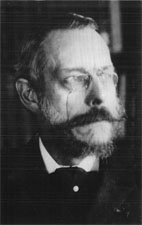
BRANDER MATTHEWS
(Photo by Brown Bros.)
NEWELL DWIGHT HILLIS
Professor of Dramatic Literature at Columbia University; author of many works on literature and the development of the drama.
To the Editor of The New York Times:
In the earnest and sincere appeals of various distinguished Germans, Prof. Eucken, Prof. Haeckel, and the several authors of "The Truth About Germany," we find frequent references to "German culture" as though it was of a superior quality to the culture of every other nationality; and we seem to perceive also a sustaining belief that Germany is not only the defender of civilization, but its foremost exponent. We have no right to question the good faith of scholars of the high character of Eucken and Haeckel; and we cannot doubt their being honestly possessed of the conviction that Germany is the supreme example of a highly civilized State and the undisputed leader in the arts and sciences which represent culture. It is plain that these German writers take this for granted and that they would be indignantly surprised if it should be questioned.
To an American who feels himself a sharer of the noble heritage of English literature, and who has sat for more than forty years at the feet of the masters of French literature, this claim cannot but come as a startling surprise.
The most obvious characteristic of a highly civilized man is his willingness to keep his word, at whatever cost to himself. For reasons satisfactory to itself, Germany broke its pledge to respect the neutrality of Luxemburg and of Belgium. It is another characteristic of civilization to cherish the works of art which have been bequeathed to us by the past. For reasons satisfactory to itself Germany destroyed Louvain, more or less completely. It is a final characteristic of civilized man to be humane and to refrain from ill-treating the blameless. For reasons satisfactory to itself Germany dropped bombs in the unbesieged City of Antwerp and caused the death of innocent women and children. Here are three instances where German culture has been tested and found wanting.
But it may be urged that war has its own exigencies and that these three instances of uncivilized conduct partook of the nature of military necessities. Turning from the outrages of war to the triumphs of peace, let us make a disinterested attempt to find out just what foundation there may be for the implicit assertion that Germany is the standard bearer of civilization.
Perhaps it is too petty to point out that manners are the outward and visible sign of civilization, and that in this respect the Germans have not yet attained to the standard set by the French and the English. But it is not insignificant to record that the Germans alone retain a barbaric mediaeval alphabet, while the rest of Western Europe has adopted the more legible and more graceful Roman letter; and it is not unimportant to note that German press style is cumbrous and uncouth. Taken collectively, these things seem to show German culture is a little lacking in the social instinct, the desire to make things easy and pleasant for others. It is this social instinct which is the dominating influence in French civilization and which has given to French civilization its incomparable urbanity and amenity. It is to the absence of this social instinct, to the inability to understand the attitude of other parties to a discussion, to the unwillingness to appreciate their point of view, that we may ascribe the failure of German diplomacy, a failure which has left her almost without a friend in her hour of need. And success in diplomacy is one of the supreme tests of civilization.
The claim asserted explicity or implicitly in behalf of German culture seems to be based on the belief that the Germans are leaders in the arts and in the sciences. So far as the art of war is concerned there is no need today to dispute the German claim. It is to the preparation for war that Prussia has devoted its utmost energy for half a century—in fact, ever since Bismarck began to make ready for the seizing of unwilling Schleswig-Holstein. And so far as the art of music is concerned there is also no need to cavil.
But what about the other and more purely intellectual arts? How many are the contemporary painters and sculptors and architects of Germany who have succeeded in winning the cosmopolitan reputation which has been the reward of a score of the artists of France and of half a dozen of the artists of America?
When we consider the art of letters we find a similar condition. Germany has had philosophers and historians of high rank; but in pure literature, in what used to be called "belles-lettres," from the death of Goethe in 1832 to the advent of the younger generation of dramatists, Sudermann and Hauptmann and the rest, in the final decade of the nineteenth century—that is to say, for a period of nearly sixty years—only one German author succeeded in winning a worldwide celebrity—and Heine was a Hebrew, who died in Paris, out of favor with his countrymen, perhaps because he had been unceasing in calling attention to the deficiencies of German culture. There were in Germany many writers who appealed strongly to their fellow-countrymen, but except only the solitary Heine no German writer attained to the international fame achieved by Cooper and by Poe, by Walt Whitman and by Mark Twain. And it was during these threescore years of literary aridity in Germany that there was a superb literary fecundity in Great Britain and in France, and that each of these countries produced at least a score of authors whose names are known throughout the world. Even sparsely settled Scandinavia brought forth a triumvirate, Björnsen, Ibsen, and Brandes, without compeers in Germany. And from Russia the fame of Turgenef and of Tolstoy spread abroad a knowledge of the heart and mind of a great people who are denounced by Germans as barbarous.
It is probably in the field of science, pure and applied, that the defenders of the supremacy of German culture would take their last stand. That the German contribution to science has been important is indisputable; yet it is equally indisputable that the two dominating scientific leaders of the second half of the nineteenth century are Darwin and Pasteur. It is in chemistry that the Germans have been pioneers; yet the greatest of modern chemists is Mendeleef. It was Hertz who made the discovery which is the foundation of Marconi's invention; but although not a few valuable discoveries are to be credited to the Germans, perhaps almost as many as to either the French or the British, the German contribution in the field of invention, in the practical application of scientific discovery, has been less than that of France, less than that of Great Britain, and less than that of the United States. The Germans contributed little or nothing to the development of the railroad, the steamboat, the automobile, the aeroplane, the telegraph, the telephone, the phonograph, the photograph, the moving picture, the electric light, the sewing machine, and the reaper and binder. Even those dread instruments of war, the revolver and the machine gun, the turreted ship, the torpedo, and the submarine, are not due to the military ardor of the Germans. It would seem as though the Germans had been lacking in the inventiveness which is so marked a feature of our modern civilization.
In this inquiry there has been no desire to deny the value of the German contributions to the arts and to the sciences. These contributions are known to all; they speak for themselves; they redound to the honor of German culture; and for them, whatever may be their number, the other nations of the world are eternally indebted to Germany. But these German contributions are neither important enough nor numerous enough to justify the assumption that German culture is superior or that Germany is entitled to think herself the supreme leader of the arts and of the sciences. No one nation can claim this lofty position, although few would be so bold as to deny the superior achievement of the French in the fine arts and of the English in pure science.
Nations are never accepted by other nations at their own valuation; and the Germans need not be surprised that we are now astonished to find them asserting their natural self-appreciation, with the apparent expectation that it will pass unchallenged. The world owes a debt to modern Germany beyond all question, but this is far less than the debt owed to England and to France. It would be interesting if some German, speaking with authority, should now be moved to explain to us Americans the reasons which underlie the insistent assertion of the superiority of German civilization. Within the past few weeks we have been forced to gaze at certain of the less pleasant aspects of the German character; and we have been made to see that the militarism of the Germans is in absolute contradiction to the preaching and to the practice of the great Goethe, to whom they proudly point as the ultimate representative of German culture.
BRANDER MATTHEWS.
Columbia University in the City of New York, Sept. 18, 1914.
To the Editor of The New York Times:
Current discussion of the worth of German culture has been almost hopelessly clouded by the fact that when a German speaks of Kultur he means an entirely different thing from what a Latin or Briton means by culture. Kultur means the organized efficiency of a nation in the broadest sense—its successful achievement in civil and military administration, industry, commerce, finance, and in a quite secondary way in scholarship, letters, and art. Kultur applies to a nation as a whole, implying an enlightened Government to which the individual is strictly subordinated. Thus Kultur is an attribute not of individuals—whose particular interests, on the contrary, must often be sacrificed to it—but of nations.
Culture, for which nearest German equivalent is Bildung, is the opposite of all this. It is an attribute not of nations as a whole but of accomplished individuals. It acquires national import only through the approval and admiration of these individuals by the rest, who share but slightly in the culture they applaud. The aim of culture is the enlightened and humane individual, conversant with the best values of the past and sensitive to the best values of the present. The open-mindedness and imagination implied in culture are potentially destructive to a highly organized national Kultur. A cultured leader is generally too much alive to the point of view of his rival to be a wholly convinced partisan. Hence he lacks the intensity, drive, and narrowness that make for competitive success. He keeps his place in the sun not by masterfully overriding others, but by a series of delicate compromises which reconcile the apparently conflicting claims. Moreover, he has too great a respect for the differences between men's gifts to formulate any rigid plan which, requires for its execution a strictly regimented humanity. He will sacrifice a little efficiency that life may be more various, rich, and delightful.
Hence nations with cultured leaders have generally been beaten by those whose leaders had merely Kultur. The Spartans and Macedonians had abundant Kultur; they generally beat the Athenians, who had merely very high culture. The Romans had Kultur, and the Hellenistic world wore their yoke. Germany unquestionably has admirable Kultur, and none of the mere cultured nations who are leagued against her could hope to beat her singly.
On the other hand, Germany has singularly little culture, has less than she had a hundred years ago, does not apparently desire it. She has willingly sacrificed the culture of a few leading individuals to the Kultur of the empire as a whole. Thus it is not surprising that Germany, as measured by the production of cultured individuals, takes a very low place today. Not only France and England, Italy and Spain, but also Russia and America, may fairly claim a higher degree of culture. Here the fetich of German scholarship should not deceive us. Culture—a balanced and humanized state of mind—is only remotely connected with scholarship or even with education. A Spanish peasant or an Italian waiter may have finer culture than a German university professor. And in the field of scholarship, Germany is in the main chiefly laborious, accurate, and small-minded. Her scholarship is related not to culture, but is a minor expression of Kultur. Such scholarly men of letters as Darwin, Huxley, Renan, Taine, Boissier, Gaston Paris, Menendez y Pelayo, Francis J. Child, Germany used to produce in the days of the Grimms and Schlegels. She rarely does so now. Her culture has been swallowed up in her Kultur.
The claim of Germany to realize her Kultur at the expense of her neighbors is at first sight plausible. Her Kultur is unquestionably higher than theirs. She has a sharply realized idea of the State, and she has justified it largely in practice. In a certain patience, thoroughness, and perfection of political organization her pre-eminence is unquestionable. The tone of her apologists shows amazement and indignation over the fact that the world, so far from welcoming the extension of German Kultur, is actively hostile to that ambition. Yet, even if it be conceded that Germany's Kultur is wholly good for herself—surely a debatable proposition—it does not follow that it is or would be a universal benefit. Nations may deliberately and legitimately prefer their culture, with its admitted disadvantages, to the Kultur which pleases Germany. England is often mocked for the way in which she "muddles through" successive perils, yet she may feel that the stereotyping of her people in a rigid administrative frame might be too high a price to pay for constant preparedness. As for us Americans, we have made a virtue, perhaps overdone it, of avoiding a mechanical Kultur. We prefer the greatest freedom for the individual to the perfectly regimented state. We will move toward culture and cheerfully assume the necessary risks of the process.
In a broader view, the war may be regarded as a contest between the metallic, half-mechanical Kultur of Prussianized Germany and the more flexible civilizations of States that have inherited culture or aspire to it. Germany herself has rejected the humane and somewhat hazardous ideal of culture, so she cannot wonder or complain when she sees that the culture of the world is almost unanimously hostile to her. There is no quarrel with German Kultur itself; merely a feeling that it has its drawbacks, that it is, on the whole, as unlovely as it is impressive, that there is quite enough of it in the world already, and that its broad extension would be disastrous.
Meanwhile the nations of culture have much to learn from Germany's Kultur. Flexibility may mean weakness. The United States, for example, could well have a standing army and an army reserve commensurate with its history and prospects without incurring any danger of militarism. There is, finally, some disadvantage in being merely a culture nation, for such a nation can add a large measure of Kultur without belying itself. On the contrary, so highly developed a Kultur nation as the German Empire puts itself in a position where it is almost impossible to acquire any considerable degree of culture. Culture is the enemy of such a state—it must remain in the Spartan or Macedonian stage. Rome began to decline as soon as Hellenistic culture got the ascendency over the old Latin Kultur. Kultur, in short, galvanizes; culture liberates. A survey of modern Germany hardly warrants a desire for her world dominion.
If any reader is still unclear about the distinction between culture and Kultur, let him examine his most-gifted friends as to their sympathies in the present war, choosing, of course, persons who have no racial reasons for taking sides. Almost without exception he will find they fall into two sharply defined classes. The mental characteristics of his pro-German friends will pretty certainly illustrate Kultur quite concretely, while he may read the meaning of culture in his more-gifted friends who favor the Allies.
FRANK JEWETT MATHER, Jr.
Princeton, Nov. 6, 1914.
To the Editor of The New York Times:
Some time ago I received with many others an appeal "To the Civilized World!" from certain distinguished representatives of German science and art. I at once wrote to Prof. Eucken, whom I know, and who is one of the signers of this document. I wished to draw his attention particularly to the second statement of this appeal, which is as follows:
It is not true that we trespassed in neutral Belgium. It has been proved that France and England had resolved on such a trespass, and it has likewise been proved that Belgium had agreed to their doing so,
and I stated to him that "It is naturally to be expected of a group of scholars that where reference is made to proof, some citation should be given both of the sources of the proof and of its nature. I am sure you will agree with me that it is of the very essence of scholarly method in the treatment of any subject whatsoever that one should cite his authority as regards every important and significant statement that is made. No one of the distinguished group of scholars signing their names to this letter would think of writing an article in his own specialty and not add in the text or in a footnote the complete list of authorities for his several assertions.
"In your appeal, however, the most important statement by far which you make, and the one bearing most intimately upon the honor and integrity of your nation, is left without even the attempt to support it, save the bare assertion by you and your colleagues. In the interests of a fair understanding of Germany's position, I feel that it is incumbent upon you to give us who are under such a deep debt of gratitude to German scholarship in our own lives the opportunity of a full knowledge of all the facts which definitely bear upon this present situation."
At the time of writing Prof. Eucken, I also wrote to a friend of mine, Dr. A.E. Shipley, the Master of Christ's College, Cambridge, England, asking him if he could get for me some authoritative statement from the British Foreign Office concerning the assertion that "it has been proved that France and England had resolved on such a trespass, and it has likewise been proved that Belgium had agreed to their doing so." I have just received a letter from Mr. Shipley, stating that Lord Haldane had prepared a statement in answer to this question. Thinking that your readers would be interested in seeing this, I am sending it to you. Faithfully yours,
JOHN GRIER HIBBEN.
Princeton, N.J., Nov. 24, 1914.
(Inclosure from Lord Haldane to the Master of Christ's College, Cambridge.)
10 Downing St., Whitehall, S.W., Nov. 14.
Dear Master of Christ's:
The inclosed memoranda have been specially prepared for me by the Foreign Office in answer to your question.
Yours truly,
HALDANE.
(MEMORANDUM.)
It is quite untrue that the British Government had ever arranged with Belgium to trespass on her country in case of war, or that Belgium had agreed to this. The strategic dispositions of Germany, especially as regards railways, have for some years given rise to the apprehension that Germany would attack France through Belgium. Whatever military discussions have taken place before this war have been limited entirely to the suggestion of what could be done to defend France if Germany attacked her through Belgium.
The Germans have stated that we contemplated sending troops to Belgium. We had never committed ourselves at all to the sending of troops to the Continent, and we had never contemplated the possibility of sending troops to Belgium to attack Germany.
The Germans have stated that British military stores had been placed at Maubeuge, a French fortress near the Belgian frontier, before the outbreak of the war, and that this is evidence of an intention to attack Germany through Belgium. No British soldiers and no British stores were landed on the Continent till after Germany had invaded Belgium and Belgium had appealed to France and England for assistance. It was only after this appeal that British troops were sent to France; and, if the Germans found British munitions of war in Maubeuge, these munitions were sent with our expedition to France after the outbreak of the war. The idea of violating the neutrality of Belgium was never discussed or contemplated by the British Government.
The extract inclosed, which is taken from an official publication of the Belgian Government, and the extract from an official statement by the Belgian Minister of War, prove that the Belgian Government had never connived, or been willing to connive, at the breach of the treaty that made the maintenance of Belgian neutrality an international obligation. The moment that there appeared to be danger that this treaty might be violated the British Government made an appeal for an assurance from both France and Germany, as had been done in 1870 by Mr. Gladstone, that neither of those countries would violate the neutrality of Belgium if the other country respected it. The French agreed, the Germans declined to agree. The appeal made by the British Government is to be found in our first "White Paper" after the outbreak of the war.
The reason why Germany would not agree was stated very frankly by Herr von Jagow, the German Minister for Foreign Affairs, to Sir Edward Goschen, our Ambassador in Berlin; and it is recorded in the second "White Paper" that we published. The attitude of the British Government throughout has been to endeavor to preserve the neutrality of Belgium, and we never thought of sending troops to Belgium until Germany had invaded it and Belgium had appealed for assistance to maintain the international treaty.
We have known for some years past that in Holland, in Denmark, and in Norway the Germans have inspired the apprehension that, if England was at war with Germany, England would violate the neutrality of those countries and seize some of their harbors. This allegation is as baseless as the allegation about our intention to violate the neutrality of Belgium, and events have shown it to be so. But it seems to be a rule with Germany to attribute to others the designs that she herself entertains; as it is clear now that, for some long time past, it has been a settled part of her strategic plans to attack France through Belgium. A statement is inclosed, which was issued by us on Oct. 14 last, dealing with this point.
This memorandum and its inclosures should provide ample material for a reply to the German statements.
Foreign Office, Nov. 9, 1914.
Here is inclosed a copy of the note of Aug. 3 sent by M. Davignon, Belgian Minister of Foreign Affairs, to Herr von Below Saleske, the German Minister at Brussels, included in the Belgian "Gray Paper," and printed in full in THE NEW YORK TIMES of Oct. 18 and reprinted in THE TIMES'S pamphlet of the war's diplomatic papers. This is the note expressing the "profound and painful surprise" caused to King Albert's Government by the German invitation to it to abandon Belgian neutrality and denying that France had, as alleged by Germany, manifested any such intention.
A second inclosure gives this clipping from The London Times of Sept. 30:
OFFICIAL STATEMENT.
The German press has been attempting to persuade the public that if Germany herself had not violated Belgian neutrality, France or Great Britain would have done so. It has declared that French and British troops had marched into Belgium before the outbreak of war. We have received from the Belgian Minister of War an official statement which denies absolutely these allegations. It declares, on the one hand, that "before Aug. 3 not a single French soldier had set foot on Belgian territory," and, again, "it is untrue that on Aug. 4 there was a single English soldier in Belgium." It adds:
"For long past Great Britain knew that the Belgian Army would oppose by force a 'preventive' disembarkation of British troops in Belgium. The Belgian Government did not hesitate at the time of the Agadir crisis to warn foreign Ambassadors, in terms which could not be misunderstood, of its formal intention to compel respect for the neutrality of Belgium by every means at its disposal, and against attempts upon it from any and every quarter."
The third inclosure is this British official communiqué:
14 October, 1914.
The story of an alleged Anglo-Belgian agreement of 1906 published in the German press, and based on documents said to have been found at Brussels, is only a fresh edition of a story which has been reproduced in various forms and denied on several occasions. No such agreement has ever existed.
As the Germans well know, Gen. Grierson is dead and Col. (now Gen.) Barnardiston is commanding the British forces before Tsing-tau. In 1906 Gen. Grierson was on the General Staff at the War Office, and Col. Barnardiston was Military Attaché at Brussels. In view of the solemn guarantee given by Great Britain to protect the neutrality of Belgium against violation from any side, some academic discussions may, through the instrumentality of Col. Barnardiston, have taken place between Gen. Grierson and the Belgian military authorities as to what assistance the British Army might be able to afford to Belgium should one of her neighbors violate that neutrality. Some notes with reference to the subject may exist in the archives at Brussels.
It should be noted that the date mentioned, namely, 1906, was the year following that in which Germany had, as in 1911, adopted a threatening attitude toward France with regard to Morocco, and, in view of the apprehensions existing of an attack on France through Belgium, it was natural that possible eventualities should be discussed.
The impossibility of Belgium having been a party to any agreement of the nature indicated or to any design for the violation of Belgian neutrality is clearly shown by the reiterated declarations that she has made for many years past that she would resist to the utmost any violation of her neutrality from whatever quarter and in whatever form such violation might come.
It is worthy of attention that these charges of aggressive designs on the part of other powers are made by Germany, who, since 1906, has established an elaborate network of strategical railways leading from the Rhine to the Belgian frontier through a barren, thinly populated tract, deliberately constructed to permit of the sudden attack upon Belgium, which was carried out two months ago.
Of the law firm of Briesen & Knauth; Doctor of Laws, New York University; philanthropist; has served the American public as head of important civic bodies and Governmental commissions.
To the Editor of The New York Times:
Having been requested by you to express my views with reference to the war which is now lacerating Europe, I take pleasure to comply with your desire.
As an American citizen I am, of course, under obligations to be neutral and to send no ammunition to either belligerent. At the same time the German blood in my veins naturally causes me to sympathize with Germany in this conflict. But even if we leave out of consideration any matter of sympathy, if we look upon the situation in an entirely unbiased spirit, the conclusion which I propose to lay before you appears to be irresistible.
The questions that seem to have agitated the American public mostly in connection with this awful conflict have been:
First—Who is to blame for bringing about this war, and,
Second—Assuming that Germany was not to blame for beginning the war, is she to blame for violating the neutrality of Belgium?
If we should find the fault regarding the first question to lie primarily with England and secondarily with Russia, we should at once clear the German people and their Government from the charge that has heretofore been brought against them for having incited the war. And if we should find that the neutrality of Belgium was not binding upon any country whose existence or whose interests were threatened by other countries, that fact would then absolve either country from a charge which thus far seems to have been brought against one of them.
How was the war brought about? As far back as 1906 it is known, and can be proved by the files of New York papers, to say nothing of official correspondence now found in Brussels and elsewhere, that measures were started by England to circumscribe or isolate the German Empire, and treaties were entered between England, France, and Russia (the Triple Entente) to insure joint action against Germany when necessary.
Germany herself has been peaceful, progressive, and anxious to retain her position as a nation undisturbed by others, as a nation that should advance in art, in science, in population, and in all things that make happiness through peace. What was the situation in other countries?
Since 1870 France had cried for revenge (revanche). Its school books, newspapers, public speakers, and political leaders were all charged with the one great idea of seeking revenge against Germany for having retaken Alsace and Lorraine in 1870, which France had wrongfully occupied since the time of Louis XIV. Alsace and Lorraine had been German for centuries before; they were wrested from Germany without even a semblance of an excuse at the close of the seventeenth century, and were largely German in language and in spirit in 1870. Goethe's studies in Strassburg and his visits to Frederica von Sesenheim in the eighteenth century show that he was living in a German country whenever he was in Alsace. A united Germany did not exist prior to 1870. However, the cry for revenge was there, and France distinctly declared it to be her policy to take her revenge as soon as opportunity offered. France was, therefore, a pronounced enemy of Germany ever since 1870, and when asked by the German Government on July 31, 1914, whether she would remain neutral in a Russian-German war (Annex 25, German "White Paper") she answered: "France would do that which might be required of her by her interests." This answer was given on Aug. 1, 1914, (Annex 27, German "White Paper.") Today we may well ask France whether, since Aug. 1, 1914, she has done that which was required by her interests.
Russia may next be looked at. How did Russia become involved in this contest? The little kingdom of Servia, which had familiarized itself with the fine art of disposing of crowned heads by throwing its King and Queen, Alexandra and Draga, out of the window of their castle, caused through its officials and its followers to have the heir to the Austrian throne and his wife cruelly assassinated on June 28, 1914. This assassination was an act of enmity toward Austria and a step toward the enlargement of Servia. Deeming her existence threatened and her national dignity offended, Austria sent a rather sharp demand under date of July 23, 1914, to Servia, requiring prompt and thorough satisfaction for the gross attack made upon her and her reigning family through Servia's official directions.
Strange to say, however, the British "White Book" shows that three days before, on July 20, 1914, Sir Edward Grey, (Paper 1, British "White Book,") wrote to Sir E. Goschen, British Ambassador at Berlin, a letter in which he states:
In fact, the more Austria could keep her demand within reasonable limits, and the stronger the justification she could produce for making any demand, the more chance there would be of smoothing things over. I hated the idea of a war between any of the great powers, and that any of them should be dragged into a war by Servia would be detestable.
On July 24, 1914, the Austrian message to Servia became known to all countries, and on the same day Sir George Buchanan, British Ambassador at St. Petersburg, wrote that he had been asked by Mr. Sazonof, Russian Minister of Foreign Affairs, to meet him at the French Embassy to discuss matters, as Austria's step clearly meant that war was imminent. He wrote that Mr. Sazonof expressed himself as follows (British Paper 6):
He hoped that his Majesty's Government would not fail to proclaim their solidarity with Russia and France. The French Ambassador gave me to understand that France would fulfill all the obligations entailed by her alliance with Russia, if necessity arose, besides supporting Russia strongly in any diplomatic negotiations.
Later, on July 29, 1914, Sir George Buchanan wrote to Sir Edward Grey (Paper 72, English "White Book") as follows:
I made it clear to his Excellency that, Russia being thoroughly in earnest, a general war could not be averted if Servia were attacked by Austria.
Sir George Buchanan would not have said that if he had not been authorized to do so. He would not have said a "general war could not be averted if Servia were attacked by Austria"; and by "general war" he meant, and we all understand he meant, a war between England, France, and Russia on one side and Germany and Austria on the other.
Servia's reply to the demand of Austria, which was dated July 25, 1914, not being deemed satisfactory, Austria proceeded to a punitive expedition against Servia, and she repeatedly asserted and assured all the other powers that the expedition was merely punitive and that neither the independence nor the territorial integrity of Servia were at all involved or in any danger.
But all this had no effect upon Russia. In fact, when Russia was first informed of the Austrian demand (Annex 4, German "White Book") Minister of Foreign Affairs Sazonof made wild complaints on July 24, 1914, against Austria-Hungary. What he said most definitely was this:
That Russia could not possibly permit the Servian-Austrian dispute to be confined to the parties concerned.
This was the keynote of the Russian situation and of the Russian intention. Russia wanted, of course, to expand its realm as far westward as possible, and it wanted to take advantage of the opportunity offered by the necessary consequences of the dreadful insult and cruelty practiced by Servia on Austria, not only to prevent the punishment of Servia, but also to proceed against Germany, for, as Paper 4 says: "Russia could not possibly permit the Servian-Austrian dispute to be confined to the parties concerned."
Who, then, was to blame for not allowing the war to be confined, for not permitting Austria to punish the murderers of her King, but utilizing this opportunity for the purpose of bringing about the great war which Russia and France had carefully prepared long ago? The great war which should involve all the civilized nations in a conflict, and threaten to extinguish Austria and to carry barbarism into the heart of Europe! She did not permit the Servian-Austrian dispute to be confined to the parties concerned.
Again, in Paper 56, (English "White Book,") we find the English Ambassador to Austria writing to Sir Edward Grey on July 27, 1914, the following:
If actual war broke out with Servia it would be impossible to localize it, for Russia was not prepared to give way again.
Again, in Paper 72, (English "White Book,") dated July 28, 1914, from the English Ambassador in Russia to Sir Edward Grey:
I made it clear to his Excellency (German Ambassador) that, Russia being thoroughly in earnest, a general war could not be averted if Servia were attacked by Austria.
Paper 121, (English "White Book,") British Ambassador in Berlin to Sir Edward Grey under date of July 31, 1914:
He (the German Secretary of State) again assured me that both the Emperor William, at the request of the Emperor of Russia, and the German Foreign Office had even up till last night been urging Austria to show willingness to continue discussions—and telegraphic and telephonic communications from Vienna had been of a promising nature—but Russia's mobilization had spoiled everything.
I could repeat, ad infinitum, quotations from these books to show that Russia not only wanted this war if Austria wanted to punish Servia for her misdeeds, but started it against the protest of Germany, and started it, I sincerely believe, largely because encouraged by Great Britain.
England: The letter written by the Belgian Chargé at St. Petersburg to his Government on July 30, 1914, which letter was published in THE NEW YORK TIMES on Oct. 7, 1914, and which letter, nearly a month before, had been published abroad and never disavowed by the Belgian Government, states distinctly on the part of Belgium:
What is incontestable is that Germany has striven here, as well as at Vienna, to find some means of avoiding a general conflict.... M. Sazonof, Russian Foreign Minister, has declared that it would be impossible for Russia not to hold herself ready and to mobilize, but that these preparations were not directed against Germany. This morning an official communiqué to the newspapers announces that "the reserves have been called under arms in a certain number of Governments." Knowing the discreet nature of the official communiqué one can without fear assert that mobilization is going on everywhere.
... One can truly ask one's self whether the whole world does not desire war and is trying merely to retard its declaration a little in order to gain time. England began by allowing it to be understood that she did not want to be drawn into a conflict. Sir George Buchanan (British Ambassador) said that openly. Today one is firmly convinced at St. Petersburg—one has even the assurance of it—that England will support France. This support is of enormous weight, and has contributed not a little to give the upper hand to the war party.
The German Emperor during these times believed England to be really and honestly striving to avoid the war; he went so far as to announce in one of his letters published in the "White Book" that "he had shoulder to shoulder with England tried to bring about a peaceful solution." It certainly now appears that all this while England had made her arrangements with France and with Russia, and had strengthened the war party in Russia to such an extent that Russia's desire to set Europe afire was rendered possible.
Belgian neutrality. It is charged that Germany violated an alleged treaty with Belgium, which treaty is supposed to have guaranteed the integrity of Belgium. When Germany found her efforts to maintain peace frustrated, Russian troops having crossed the German frontier on the afternoon of Aug. 1, while France opened hostilities on Aug. 2, she announced to Belgium on Aug. 2, 1914, that she found herself under obligation, to prevent a French attack through Belgium, to pass through Belgian territory; she expressed her readiness to guarantee the integrity of the kingdom and its possessions and to pay any damage caused if Belgium would, in a friendly way, permit such a passage of troops through it.
The English "White Book" contains, Paper 151, dated Aug. 3, 1914, which paper we repeat in full:
(British Minister to Belgium to Sir Edward Grey.)
French Government have offered through their Military Attaché the support of five French Army corps to the Belgian Government. Following reply has been received today: We are sincerely grateful to the French Government for offering eventual support. In the actual circumstances, however, we do not propose to appeal to the guarantee of the powers. Belgian Government will decide later on the action which they may think it necessary to take.
In short, Belgium says in the foregoing notice to France, that she does not propose to appeal to the guarantee of the powers.
Was Germany justified in disregarding any previous treaty which related to Belgium if her interests required her so to do?
United States Supreme Court: In its unanimous opinion in the Chinese exclusion cases, reported on Pages 581 to 611 of Vol. 130 of United States Reports, the Supreme Court of the United States had this very question before it. A treaty had been entered into by the United States and China, allowing Chinese subjects the right to visit and reside in the United States and to there enjoy the same privileges that are enjoyed by citizens of the United States. After that treaty an act of Congress was passed in violation of the treaty, providing it to be unlawful thereafter for Chinese laborers to enter the United States. The question was, whether we had the right to violate a treaty solemnly entered into with another country? On this subject the court said (Page 600):
The effect of legislation upon conflicting treaty stipulations was elaborately considered in THE HEAD MONEY CASES, and it was there adjudged: "that so far as a treaty made by the United States with any foreign nation can become the subject of judicial cognizance in the courts of this country, it is subject to such acts as Congress may pass for its enforcement, modification, or repeal," 112 U.S. 580, 599. This doctrine was affirmed and followed in WHITNEY v. ROBERTSON, 124 U.S. 190, 195. It will not be presumed that the legislative department of the Government will lightly pass laws which are in conflict with the treaties of the country; but that circumstances may arise which would not only justify the Government in disregarding their stipulations, but demand in the interests of the country that it should do so, there can be no question. Unexpected events may call for a change in the policy of the country.
In the same opinion the Supreme Court calls attention to an act passed in 1798, declaring that the United States were freed and exonerated from the stipulations of previous treaties with France. This subject was fully considered by Justice Curtis, who held, as the Supreme Court says (Page 602): "That whilst it would always be a matter of the utmost gravity and delicacy to refuse to execute a treaty, the power to do so was a prerogative of which no nation could be deprived without deeply affecting its independence."
We observe, therefore, that under our own ideas of international law the United States claims the right to disregard its stipulations if the interests of the country should require it. And the same right we should concede to other nations. Particularly to Germany in the present instance, when we find her battling for her very existence against enemies that seek to destroy her, against enemies that surround her on all sides, against enemies that do not hesitate to bring troops into the conflict from the wilds of Africa and Asia, and who do not hesitate to drag Japan into this war, causing her to disregard Chinese neutrality in her effort to capture a small settlement, lawfully occupied in China by a handful of German soldiers.
In this connection I quote the British sentiment, as expressed by Gladstone regarding Belgium neutrality in the year 1870:
But I am not able to subscribe to the doctrine of those who have held in this House, what plainly amounts to the assertion that the simple fact of the existence of a guarantee is binding to every party to it, irrespective altogether of the particular position in which it may find itself at the time when the occasion for acting on the question arises.
This shows that England herself reserved the right, whenever her interests required her to do so, to act in violation of the treaty with Belgium. That, at least, is my understanding of Gladstone's language. England did not respect Danish neutrality a hundred years ago, when she destroyed the Danish fleet at Copenhagen because her interests required, and England does not now, through its Asiatic ally, and directly, respect Chinese neutrality, claiming the right primarily to consult her own interests. Should this right, asserted by our own Supreme Court, and actually assumed by England and Japan, be denied to Germany? Finally, I understand that The Hague Conference of 1907 drafted a convention which reads:
The territory of neutral powers is inviolable. Belligerents are forbidden to move troops or convoys of either munitions of war or supplies across the territory of a neutral power. Great Britain, Germany, Austria-Hungary, and Italy refused to sign it and did not sign it. Russia was not represented.
MILITARISM. There is one more subject which many people in this country have failed to understand, and that is the matter of militarism. German militarism is supposed to be something dreadful, and many good people believe that it would be a great advance toward eternal peace if that militarism could be wiped out. Well, now, let us see.
If Germany did not require every one of her sons to spend a year, or at most two years, in the army, and if she had not provided for all these men sufficient arms and accoutrements for immediate use in case of war, what would have happened when Russia entered her territory, or when France came on a like errand?
Any one who lives among enemies is expected to be sufficiently prepared to defend himself should they attack him, be he ever so peaceful.
At the time the United States of America was born there was no such thing as Germany. Every country around it had a slice of it. Napoleon took the larger western part of Germany as his property, England held Hanover, the former Kingdom of Poland held Saxony, Austria held Silesia, and so there was no Germany. The Teutonic races had no home in which they could develop and live without interference by others. To prevent such interference Germany of all nations needed an army; to prevent similar interference at sea England of all nations needed a navy. That great British Navy bears precisely the same relation to the protection of Great Britain at sea which the German Army bears to the protection of Germany on land.
To sum up, what are the countries fighting for? Russia for her enlargement; she has no grudge whatever against Germany except that it exists. France for revenge; she has no grudge whatever against Germany except that she wants revenge for 1870. What grudge has England against Germany, except that Germany has grown commercially, financially, and industrially to a position which threatens to crowd England into a second rank? Jealousy appears to control the English attitude.
The position apparently assumed by England is best expressed by the King of England in his telegram to Prince Henry of Prussia, dated July 30, 1914:
My Government is doing its utmost, suggesting to Russia and France to suspend further military preparations if Austria will consent to be satisfied with occupation of Belgrade and neighboring Servian territory as a hostage for satisfactory settlement of her demands, other countries meanwhile suspending their war preparations. Trust William will use his great influence to induce Austria to accept this proposal, thus proving that Germany and England are working together to prevent what would be an international catastrophe.
On July 31, the very next day, Sir Edward Grey wrote the telegram, No. 111, (English "White Book,") to the British Ambassador at Berlin, in which we find the following:
I would undertake to sound St. Petersburg, whether it would be possible for the four disinterested powers to offer to Austria that they would undertake to see that she obtained full satisfaction of her demands on Servia, provided that they did not impair Servian sovereignty and the integrity of Servian territory. As your Excellency is aware, Austria has already declared her willingness to respect them. (Established by Paper 3, July 24, and Paper 5, July 26, German "White Book.")
Hence, we find that all King George said he wanted had been granted, and yet England entered into the war. Why? Probably because she thought, as France had expressed it, that she acted in pursuance of her interests.
And what is Germany fighting for? Does she want anything from anybody? She wants to be left alone; she always wanted to be left alone; she prospered while she was left alone; she grew while she was left alone. Not being left alone she has to defend herself. Hence, I bespeak for Germany and for her side fair play, just judgment on behalf of the American people.
ARTHUR v. BRIESEN.
New York, Oct. 17, 1914.
Sodger lad, O sodger lad,
The dawn will see ye marchin'—
The nicht drag's on—its dark is out
Wi' searchlichts, shiftin', archin'.
Sodger lad, O sodger lad,
D'ye mind our Summer meetin'?
And noo, ye'll gang. The heather's dead ...
I canna keep frae greetin'.
Sodger lad, my sodger lad—
D'ye mind, my time is nearin'?
Alone—alone—wi'out yer hand!
How shall I keep frae fearin'?
Sodger lad, O sodger lad,
Far, far awa' ye're goin'—
I'll not dare count the leagues an' days—
Gude God! The cocks are crowin'!
Sodger lad, my luve, my dear,
Awake! The morn is grayin'!
E'en tho' my heart drags, sick wi' dread,
I wouldna have ye stayin'.
It is easy to see why American public opinion should have condemned by an overwhelming majority the diplomatic acts of Austria and Hungary which have been the immediate occasion of the terrific explosion which now shakes the foundations of the whole civilized world. Austria's break with Servia and Germany's violation of Belgian neutrality—the one leading to war between Russia and Germany, the other bringing England into the fray—must appear to the uninitiated as reckless and indefensible provocations and as wanton attacks upon the laws of nations.
The thoughtful observer, however, should look beyond the immediate occasion of this world conflict and try to understand its underlying causes. By doing so he will, I believe, come to the conclusion that fundamental justice is to be found on the German side, and that Germany has been forced to fight for her life.
It is an unquestionable fact that the unification of Germany and the establishment of a strong German Empire, half a century ago, were brought about against the bitter opposition of France, and that the defeat incurred by France in 1870, in her attempt to prevent German unification, is at the bottom of the constant irritation that has agitated Europe during the last forty-three years. Germany's policy toward France during these forty-three years has been one of utmost restraint and forbearance, and has been dictated by the one desire of making her forget the loss of the two provinces, German until the seventeenth century and inhabited by German stock, which were won back from France in 1870. Whether the acquisition of these provinces was a fortunate thing for Germany may be doubted. The possession of Alsace-Lorraine has certainly robbed Germany of the undivided sympathy of the world, which she otherwise would have had. But it is probably true that from the military point of view Alsace-Lorraine was needed by Germany as a bulwark against the repetition of the many wanton French invasions from which Germany has had to suffer since the time of the Thirty Years' War and the age of Louis XIV.
However this may be, Germany has done her best during the last four decades to heal the wounds struck by her to French national pride. She abetted French colonial expansion in Cochin-China, Madagascar, Tunis. She yielded to France her own well-founded claims to political influence in Morocco. In Alsace-Lorraine itself she introduced an amount of local self-government and home rule such as England has not accorded even now to Ireland. While Ireland still is waiting for a Parliament at Dublin, Strassburg has been for years the seat of the Alsace-Lorraine Diet, a provincial Parliament based on universal suffrage. And even in spite of the incessant and inflammatory French propaganda which last year led to such unhappy counter-strokes as the deplorable Zabern affair, there can be no reasonable doubt that the people of Alsace-Lorraine have been gradually settling down to willing co-operation with the German administration—an administration which insures them order, justice, and prosperity. Nothing is a clearer indication of the peaceable trend which affairs have lately taken in Alsace-Lorraine than the fact that the Nationalists, i.e., French party, in the Strassburg Diet has never been able to rise above insignificance, and that, on the other hand, a considerable number of responsible officers in the civil administration, including the highest Governmental positions, have been occupied by native Alsatians.
While Germany has thus repeatedly shown her willingness and desire to end the ancient feud, France has remained irreconcilable; and particularly the intellectual class of France cannot escape the charge that they have persistently and willfully kept alive the flame of discord.
It surely cannot be said that the restoration of Alsace-Lorraine is a vital necessity to France. Without Alsace-Lorraine France has recovered her prosperity and her prestige in a manner that has been the admiration of the world. It is a mere illusion to think that the reconquest of Alsace-Lorraine would add to her glory. It would have been a demand of patriotism for the intellectual class to combat this illusion. Instead of this, every French writer, every French scholar, every French orator, except the Socialists, year in and year out, has been dinning into the popular ear the one word revenge.
There can be little doubt that Prof. Gustave Lanson, the distinguished literary historian, voiced the sentiments of the vast majority of his countrymen when in a lecture, delivered some years ago at Harvard, he stated that France could not and would not reorganize the peace of Frankfurt as a final settlement, and that the one aim of the French policy of the last forty years had been to force Germany to reopen the Alsace-Lorraine question.
If there were people in Germany inclined to overlook or to minimize this constantly growing menace from France, their eyes must have been opened when in 1912 the French Government, having previously abolished the one-year volunteers, raised the duration of active military service for every Frenchman from two years to three, and, in addition to this, called out in the Autumn of 1913 the recruits not only of the year whose turn had come, namely, the recruits born in 1892, but also those born in 1893. This was a measure nearly identical with mobilization; it was a measure which clearly showed that France would not delay much longer striking the deadly blow. For no nation could possibly stand for any length of time this terrific strain of holding under the colors its entire male population from the twentieth to the twenty-fourth year. No wonder that the Paris papers were speaking as long ago as the Summer of 1912 of the regiments stationed in the Eastern Departments as the "vanguard of our glorious army," and were advocating double pay for them, as being practically in contact with the enemy.
The second foe now threatening the destruction of Germany is England. Can it truly be said that England's hostility has been brought about by German aggression? True, Germany has built a powerful navy; but so have Japan, the United States, France, and even Italy. Has England felt any menace from these? Why, then, is the German Navy singled out as a specially sinister threat to England? Has German diplomacy during the last generation been particularly menacing to England? Germany has acquired some colonies in Africa and in the Far East. But what are Kamerun and Dar-es-Salaam and Kiao-Chau compared with the colonial possessions of the other great powers? Where has Germany pursued a colonial aggressiveness that could in any way be compared with the British subjugation of the South African republics or the Italian conquest of Tripoli or the French expansion in Algiers, Tunis, and Morocco, or the American acquisition of the Philippines?
Wherever Germany has made her influence felt on the globe she has stood for the principle of the open door. Wherever she has engaged in colonial enterprises, she has been willing to make compromises with other nations and to accept their co-operation, notably so in the Bagdad railway undertaking. And yet, the colonial expansion of every other nation is hailed by England as "beneficial to mankind," as "work for civilization"; the slightest attempt of Germany to take part in this expansion is denounced as "intolerable aggression," as evidence of the "bullying tendencies of the War Lord."
What is the reason for this singular unfairness of England toward Germany, of this incessant attempt to check her and hem her in? Not so much the existence of a large German Navy as the encroachment upon English commerce by the rapidly growing commerce of Germany has made Germany hateful to England. The navy has simply added to this hate of Germany the dread of Germany. But if there had been no German Navy, and consequently no dread of Germany, this hate of Germany might have come to an explosion before now. For the history of the last 300 years proves that England has habitually considered as her mortal enemy any nation which dared to contest her commercial and industrial supremacy—first Spain, then Holland, then France, and now Germany. As long as German firms, by the manufacture of artificial indigo, keep on ruining the English importation of indigo from India, and as long as the German steamship lines keep on outstripping the prestige of the English boats, there can be no real friendship between England and Germany. Although England has repeatedly proposed to Germany naval agreements, these agreements were avowedly meant to perpetuate the overwhelming preponderance of England's fighting power, so that she would at any moment be in a position to crush German commercial rivalry for all time. She apparently thinks that this moment has now come.
That Germany's third implacable enemy, Russia, is clearly the aggressor, and not the defender of her own national existence, need hardly be demonstrated. She poses as the guardian of the Balkan States. But is there any case on record where Russia has really protected the independence of smaller neighboring countries? Has she not crushed out provincial and racial individuality wherever she has extended her power? Is it not the sole aim of her national policy to Russianize forcibly every nationality under her sway?
In Finland she has gone back on her solemnly pledged word to maintain the Finnish Constitution, and is ruthlessly reducing one of her most highly developed provinces to the dead level of autocratic rule. In her Baltic provinces she is trying to destroy, root and branch, whatever there is left of German culture. Wherever the Russian Church holds dominion intellectual blight is sure to follow.
To think, therefore, that Russia would promote the free development of a number of independent Balkan States under her protectorate is to shut one's eyes to the whole history of Russian expansion. No, Russian expansion in the Balkans means nothing less than the extinction of all local independence and the establishment of Russian despotism from the Black Sea to the Adriatic.
Not Russia, but Austria, is the natural protector of the equilibrium between the existing States on the Balkan Peninsula and their natural guardian against Russian domination. Austria is their nearest neighbor; indeed, the possession of Bosnia and Herzegovina makes her a Balkan State herself.
Being herself more than half of Slavic stock, she has every reason for living on good terms with the various Slav kingdoms south of her. Being herself forced, through the conglomerateness of her population, to constant compromises in her internal affairs between conflicting nationalities within her borders, she could not possibly absorb a large additional amount of foreign territory. She is bound to respect the existing lines of political demarkation in the Balkans, and her sole object can be through commercial treaties and tariff legislation to open up what used to be European Turkey to her trade and her civilizing influence.
In this she must clearly be supported by Germany. For only if Austria is left free to exercise her natural protectorate over the Balkan States can the passage between Germany and the Near Orient, one of the most important routes of German commerce, be kept open.
Russia's unwillingness, then, to allow Austria a free hand in her dealings with Servia was an open menace to Germany, a challenge which had to be accepted unless Germany was prepared to abdicate all her influence in the Near Orient and to allow Russia to override the legitimate claims and aspirations of her only firm and faithful ally.
This formidable coalition of the three greatest European powers, threatening the very existence of Germany, has now been joined by Japan, openly and boldly for the purpose of snatching from Germany her one Asiatic possession.
If any additional proof had been needed to make it clear that, if Germany wanted to retain the slightest chance of extricating herself from this worldwide conspiracy against her, she had to strike the first blow, even at the risk of offending against international good manners, this stab in the back by Japan would furnish such proof.
To the Editor of The New York Times:
Although I hate to enter into a controversy with Prof. Kuno Francke, who was once my excellent friend, I cannot refrain from answering his article which appeared in last Sunday's NEW YORK TIMES.
How can any one say, in all fairness, that Germany's policy toward France during the last forty-three years has been one of the utmost restraint and forbearance, and has been dictated by the one desire to make her forget the loss of the two provinces? What are the facts? We know that not once, but again and again, since 1878, Germany has tried to provoke France into war. We know that on one occasion Queen Victoria herself threatened the Kaiser with Great Britain's intervention if he did not desist from his intended attack on France. And to cite only the two most recent instances, the Agadir affair and the enforced resignation of the French Premier, Delcassé! Would Germany have swallowed such insults?
This may be the German conception of "utmost restraint and forbearance," but it appeared to the French, as it did to the rest of the world, that it required their utmost restraint and forbearance to remain calm under the affronts.
The fact that Alsace-Lorraine was German up to the seventeenth century, and inhabited by German stock, cannot be brought forward today, after more than 200 years, to justify the retaking of those provinces by the Germans. The whole world would be in a state of continual warfare if nations claimed provinces or States that belonged to them once upon a time. Richelieu's idea was that the Rhine was the natural and geographical frontier between France and Germany, and the war was undertaken to carry out that plan. Since then the inhabitants have become French, and the attempts to re-Germanize them have proved futile. Prof. Francke may well doubt if the acquisition of these provinces was a fortunate thing for Germany. It was undoubtedly the most unfortunate thing not only for Germany but for France and the rest of Europe, for it kept open a wound which might have been healed either by a return of the lost provinces, with or without compensation, or by granting them autonomy, or, better still, by leaving it to the inhabitants to choose for themselves, as France did with Nice and Savoy.
The ruthless methods of a Bismarck are no longer of this age. They are too odious, and the human conscience revolts at them. What a preposterous idea, in this twentieth century, to compel by force millions of people to renounce their traditions and even their language! If Great Britain had followed the same method in dealing with the French Canadians, instead of loyal subjects she would have made rebels of them all.
It is neither right nor just nor truthful to say that Germany has done her best during the last four decades to heal the wounds struck by her to French national pride. On the contrary, Germany's attitude has been all along one of studied provocation; and if the instances already mentioned are not sufficient, many others could be added.
Germany abetted French colonial expansion. Well, by what right should she have opposed it? And if she yielded to France in Morocco, it was only after France had given Germany part of her African possessions rather than go to war with her.
It will be news to the world to be informed that there can be no reasonable doubt that the people of Alsace-Lorraine have been gradually settling down to willing co-operation with the German administration. Certainly such a statement is in violent contradiction with all we hear and read and know of the state of mind, the feelings, and aspirations of the inhabitants of those two provinces.
To argue that the restoration of Alsace-Lorraine is not a vital necessity to France; that without these provinces she has recovered her prosperity and her prestige, and that it is mere illusion to think that the reconquest of Alsace-Lorraine would add to her glory is pure sophistry. It is just as if you said to a man whom you had robbed of some valuable property: "What does it matter? You are just as well off without it." Yes, Prof. Larson did voice the sentiment of the vast majority of his countrymen when he stated that France could not and would not recognize the treaty of Frankfurt. If I have an enemy who takes me by surprise and with revolver leveled at my head compels me to sign a paper by which I despoil myself to his advantage, what is the validity of such a document?
That is the way that all Frenchmen of all classes look upon the treaty of Frankfurt, wrung from them under duress.
The term "revanche" is a slogan. It simply typifies in one word the reconquest of Alsace-Lorraine; but it does not carry with it the idea of willfully laying waste the enemy's country, burning and pillaging, shooting inoffensive non-combatants, and cleaning banks of all the gold they contain.
Another statement which is misleading in Prof. Francke's article is the one which refers to the "growing menace from France," in which he speaks of the increasing armament that has been going on in that country since 1912. But what is called in Germany "the menace from France" is called in the latter country "the menace from Germany." Who started these enormous armaments? Each time Germany increased her army France was forced to do the same; and when France recently increased from two to three years the duration of military service, it was her only way of meeting Germany's increase of 500,000 men.
The attempt to change the rôles and present France to the world as the aggressor, or even as premeditating an attack upon Germany, is futile. It is a strange and yet not uncommon psychological fact that the hate of the conqueror is often greater than that of the conquered; and it is German, not French, hate which has forced Germany into this savage war. France had recovered too rapidly from her disasters; she was too rich; her colonies were too vast and too prosperous; she must be crushed. What right had she to have large colonies when Germany, the superior nation, had none worth mentioning? There you have the key to the Kaiser's repeated provocations and to his final attack.
In regard to England and Russia, the writer will simply confine himself to the statement that if the German Imperial Government can produce as clean a bill of health as the "White Paper" of the British Foreign Office, just published, it will do more to convince American public opinion of the justice of its cause than anything that has yet been written in the press by Germans and their sympathizers.
R.L. SANDERSON.
Yale University, New Haven, Conn., Sept. 5, 1914.
Late Austro-Hungarian Ambassador to the United States.
The following letter was written by Baron Hengelmuller to Col. Theodore Roosevelt.
ABBAZIA, Sept. 25, 1914.
My Dear Mr. Roosevelt:
Our correspondence has suffered a long interruption. Your last letter was from July of last year. I do not know whether you ever received my answer, by which I thanked you for your preface to my book. You were in Arizona when I wrote it, and soon after your return you started for Brazil. At the occasion of your son's wedding I sent him a telegram to Madrid, but I had no chance to write to you because I had no information with regard to the length of your stay and your whereabouts in Europe.
Now I write to you at the time of a most momentous crisis in the world's history, and I do so impelled by the desire to talk with you about my country's cause and to win your just and fair appreciation for the same. I wish I could address my appeal to the American people, but having no standing and no opportunity to do so, I address it to you as to one of America's most illustrious citizens with whom it has been my privilege to entertain during many years the most friendly relations.
Since the outbreak of the war our communications with America are slow and irregular. In the beginning they were nil. From the end of July to the middle of August we received neither letters, telegrams, nor papers. I suppose it was the same with you concerning direct news from us. Our adversaries had the field all for themselves and they seem to have made the most of it. To judge from what I have learned since and from what I could glean in our papers, the New York press seem to have written about us and Germany very much in the same tone and spirit as they did about you during your last Presidential campaign. I have seen it stated that The Outlook published an article in which Austro-Hungary was accused of having brought about the war through her greed of conquest and the overbearing arrogance of her behavior toward Servia. I do not know whether I cite correctly, as I have not seen the article, and I am aware that you have severed your connection with The Outlook after your return from Brazil. I only mention the statement as an illustration of what I have said above, for if a review of the standing of The Outlook opens its columns to such a glaringly false accusation the daily papers have certainly not lagged behind.
It is natural that our adversaries should be anxious to win the sympathies of the American people. So are we. But it is not for this purpose that I now write to you. Sympathy is a sentiment and, as a rule, not to be won by argument. What I want to discuss with you are the causes of this war and the issues at stake.
Undoubtedly the war broke out over our conflict with Servia, but this conflict was not of our seeking. We had no wish of aggrandizement or extension of power at the expense of Servia, but Servia covets territory which belongs to us, and for years has pursued her ends by the most nefarious and criminal means. The assassination of our heir to the crown and his consort was not an isolated fact, but only the most glaring link in a long chain of plotting and agitating against us. This attitude of Servia toward us dates back to the day when the gang of officers who murdered their own King came to power, and when it became their policy to keep a hold over their own people by exciting their ambitions against us. This policy reached its first climax when we declared the annexation of Bosnia and Herzegovina, which we had occupied and developed for thirty years. You were in office then, and the events of the time are familiar to you. The crisis ended then by Servia's formal acknowledgment that our annexation violated none of her rights, and by her promise to cultivate henceforth correct and friendly relations with us. This promise was not kept. The plotting continued, lies were disseminated about a pretended oppression of our South Slav population, and associations were formed for the purpose of stirring them to discontent and if possible to treason.
Things came to a second climax with the murder of Archduke Francis Ferdinand. The plot for this crime was hatched in Servia, the bombs and revolvers for its execution were furnished there, and Servian officers instructed the murder candidates in their use. At last we could stand it no longer. What we wanted from Servia was the punishment of the plotters and accomplices and a guarantee for normal relations in the future. This was the object of our ultimatum. Servia made a show of complying with some of our demands, but in reality her answer was evasive.
These facts are exposed and authenticated in the note which we sent to the powers after having presented our ultimatum in Belgrade and in the memorandum which accompanied it. I do not know whether the American papers published these documents at the time. Today they are outstripped by greater events, but for the just appreciation of our proceedings in regard to Servia they are indispensable.
In reality, however, our conflict with Servia was not the cause of the great war now raging, but only the spark which brought the overloaded powder barrel to explosion. Who talks of Servia today, and who believes that France, England, and Japan are making war on Germany and on us because of Servia? The war broke out because Russia decided to shield Servia against the consequences of her provocations and because, owing to preconcerted arrangements, the situation in Europe was such that the action of one great power was bound to bring all or nearly all the others into the field. And again those preconcerted arrangements were the outcome of a mass of pent-up passions, of hatred, envy, and jealousy, the like of which—all Hague conferences and pacific unions notwithstanding—the world has never seen before.
We are fully aware of the danger which threatened us from Russia when we formulated our demands in Belgrade. Russia's population is three times as large as ours and it was not with a light heart that our Emperor-King took his final resolution. But our national honor and our very existence as a self-respecting power were at stake. We could not hesitate. Now we are in a struggle for life or death and we mean to carry it through with full confidence in the rightfulness of our cause and in the force of our arms. In one respect events have already belied the calculations of our enemies, who counted on internal dissensions within our own borders. I am happy to say that Croatians, Slovenes, and a large majority of our own Servians are fighting in our ranks with the same valor and enthusiasm as Czechs, Rumanians, Poles, Magyars, and Germans.
But why did Russia decide to assail us? During the whole nineteenth century she has shown herself a very shifty and unreliable protectress of Servia. She made use of the smaller country when it suited her own aggressive purposes against others, and she dropped it whenever it served her ends. It was so at the time of the Turkish war of 1877 and of the Berlin Congress, and it remained so until with the advent of the present dynasty Servia offered a sure prospect of becoming and remaining a permanent tool in Russia's hands and a thorn in our flesh.
Russia is an aggressive power. For 200 years she has extended her dominions at the cost of Sweden first, of Poland and Turkey afterward. Now she thinks our turn has come. Finding us to be in the way of her ultimate aims in the Balkan Peninsula, she began to regard us as her enemy. For years the propaganda for undermining the bases of our empire has been carried on in the name of Pan-Slavism. It seems that she judged that now the time had come to draw the consequences and to bring things to a final issue. With what result remains to be seen.
By the terms of our treaty of alliance Germany was bound to come to our assistance if we were attacked by Russia. There was no secrecy about that treaty. Its text had been made public long ago and its purely defensive character brought to the knowledge of the world. No more than we did Germany entertain hostile intentions or nourish hostile feelings against Russia. There were no clashing interests to excite the first, no historical reminiscences to justify the second. If it is otherwise in Russia, it is because her present leaders find German power in the way of their conquering aspirations against us. Germany, true to her obligations, hastened to our side when she saw us menaced, and when she declared war she did it because she had positive information that in spite of formal and solemn assurances to the contrary Russia mobilization was proceeding.
The terms of the Franco-Russian alliance have never been made public. Whether it was concluded merely for defensive or also for offensive purposes, and whether France was obliged by her treaty to draw the sword in the present case, remains therefore a matter of surmise. But there is no mystery about the feelings of France with regard to Germany, and no doubt about the greed for revenge which during the last forty-four years has swayed the overwhelming majority of her people and been the dominant factor of her foreign policy. It was for this object that she entered into her alliances and agreements, and it is for this cause that she is fighting now.
It is simple hypocrisy to talk about German aggressiveness against France. France stood in no danger of being attacked by Germany if she had chosen to remain neutral in the latter's war with Russia. Asked whether she would do so, she replied that her actions would be guided by her interests. The meaning of this reply was clear, and left Germany no choice. The formal declaration of war became then a mere matter of political and military convenience, and has no bearing on the moral issue of the case.
But why has England plunged into this war? Officially and to the world at large she has explained her resolution by Germany's violation of Belgian neutrality, and in the royal message to Parliament it was solemnly declared that England could not stand by and passively tolerate such a breach of international law and obligations.
No Austrian can read this declaration otherwise than with a mournful smile. Its futility has been exposed by the question which Englishmen of standing and renown have put to their Government, viz., whether they would equally have declared war on France if that violation of neutrality had first come from her side. In face of this question having remained unanswered, and in face of what has come to light since about French preparations in Belgium, there is no need to expiate on this subject. All that there is to be said about it has been said by the German Chancellor in open session of the Reichstag, and all that may be added is the remark that, considering England's history and what she did before Copenhagen in 1807, she of all nations should be the last to put on airs of moral indignation over the application of the principle that in time of war "salus reipublicae suprema lex est."
The existence of a convention binding England to France in case of war has—as far as I know—never been admitted officially by England. As I see now from manifestations of Englishmen disapproving of their country's participation in the war, the belief exists nevertheless that such a convention had been concluded. But whether England's declaration of war was the consequence of previously entered obligations or the outcome of present free initiative, the main fact remains that in the last resort it sprang from jealousy of Germany's growing sea power and commercial prosperity. This feeling was the dominant factor in English foreign policy, just as greed for revenge was in France. It was the propelling power for the agreements which England has made and for others which she endeavored but did not succeed in bringing about.
England claims the dominion over the seas as her native right, and, what is more, she holds it. Her title is no better and no worse than that of the Romans when they conquered the world, or of the Turkish Sultans in the days of their power. Like them, she has succeeded in making good her claim. For three centuries the nations of Continental Europe have been hating, fighting, and devastating each other for the sake of strips of frontier land and a shadowy balance of power. These centuries were England's opportunity, and she has made the most of it. That she should mean to keep what she has and hold to her maritime supremacy as to the apple of her eye is natural. Whether it is for the benefit of mankind that it should be so, and whether the world in general would not be better off if there existed a balance of power on sea as well as on land, does not enter into the present discussion. What is more to the purpose is that in reality England's sea power stood in no danger at all. To any thinking and fair-minded observer it must be clear that Germany, hemmed in by hostile neighbors in the east and west, and obliged, therefore, to keep up her armaments on land, would not have been able to threaten England's maritime superiority for generations to come. If the issue has been thrown into the balance, it has been done so by England's own doing.
But it is not only the nascent German Navy that excited the distrust and envy of England. German colonies and every trading German vessel seem equally to have become thorns in English eyes. The wish to sweep those vessels from off the seas, to destroy all German ports, in one word, to down Germany, has long been nourished and lately openly avowed in England. Norman Angell's theories about the great illusion of the profitability of modern warfare seem to have made mighty small impression on his countrymen.
Russian lust of conquest, French greed of revenge, and English envy were the forces at work in the European powder magazine. The Servian spark ignited it, but the explosion was bound to come sooner or later. What alone could have stopped it would have been England's stepping out of the conspiracy. That she did not do so, in fact became its really directing power, will forever remain a blot on her history.
About Japan's motives and methods I do not think it necessary to write. American public opinion will hardly need any enlightenment on this subject. America forced Japan out of the isolation in which she had lived during centuries. I hope the day may not come when she will wish that she had not done so.
The issues of the war stand in relation to its causes and the same attempts have been made to distort and falsify them in the eyes of the American public. I have seen it stated in a New York paper that this war is a fight between civilization and barbarism, and I have seen a member of the present English Cabinet quoted as having said that the issue was one between militarism and freedom, civilization and freedom standing, of course, in both cases on the side of our enemies.
More idiotic rot—excuse the expression—I have never read in my life. What has civilization to do with Servia's murderous plotting against us? What with Russia's desire to shield her from the consequences of her aggressions and to demonstrate to the world that we are of no account in the Balkans and to establish her own—more or less veiled—protectorate there? And if the case of civilization is advanced by Japan's ousting Germany from Kiao-Chau, why should it not be equally furthered if Japan did the same to England in Hongkong, Singapore, or, if the opportunity offered, in India itself? And a person must be indeed at his wits' end for arguments to proclaim Russia as a standard bearer of freedom in her war against us. Compare her treatment of Poles, Finns, Ukrainanians (small Russians) and Hebrews with the freedom which the different nationalities enjoy in our empire! And England herself. Is it for freedom's sake that she holds Gibraltar and that she subjugated the Boers?
No! Civilization and freedom have nothing to do with the issues at stake now, least of all in the sense that our enemies have drawn the sword for their cause. It is a war for conquest and supremacy stirred up by all the hateful passions in human nature, fully as much as any war that has ever been waged before. But we did not stir it up. We are fighting for our existence, right and justice are on our side, and so we trust will victory be.
The causes of the war are clear. To make its issues still clearer, imagine for a moment and merely for argument's sake the consequences of our adversaries being successful. Russia, England, and Japan would remain masters of the field. Is this a consummation any thinking American can wish for?
These are the considerations I wished to lay before you, and I ask your assistance to bring them before the American people. I ask for no reply, no manifestation of feelings or opinion from you. What I ask you is to publish this letter as an open letter addressed by me to you, signed with my full name. How to do this I leave entirely to you. It goes without saying that your private reply, if you favor me with one, will be treated as such.
Hoping to meet you in better times, and sending our kindest regards to Mrs. Roosevelt, believe me, yours most sincerely,
BARON L. HENGELMULLER.
Abbazia, Sept. 25, 1914.
Publisher, Director of the Knickerbocker Press, Secretary American Copyright League; decorated with the Cross of the Legion of Honor, France.
To the Editor of The New York Times:
It is possible that the letter presented herewith from a German neighbor (who is a stranger to me) may be of interest to your readers as an example of a curious confusion of thought into which have fallen Germans on both sides of the Atlantic in regard to the issues of the present struggle and the conduct and the actions of the German Army. I am inclosing a copy of my reply to Mr. Thienes.
GEORGE HAVEN PUTNAM.
New York, Nov. 4, 1914.
NEW YORK, Oct. 28, 1914.
Mr. George Haven Putnam.
DEAR SIR:
Now that you have shown your "true" spirit of neutrality toward Germany, would you not be kind enough to give us a similar piece of your wisdom and describe in detail the way the Russians acted in East Prussia during their short stay there, and how they murdered, tortured, and assaulted women and girls, and cut children and infants to pieces without even the provocation of "sniping"?
This, your new article in THE TIMES, I anticipate with the greatest interest.
RUDOLF F. THIENES.
Rudolf F. Thienes, Esq.
MY DEAR SIR:
Your letter of the 28th inst., intended as a rejoinder to a letter recently printed by me in THE TIMES, is written under a misapprehension in regard to one important matter.
The Americans, who are in a position to judge impartially in regard to the issues of the war, have criticised the official acts which have attended the devastation of Belgium, not because these acts were committed by Germans, but because they were in themselves abominable and contrary to precedents and to civilized standards.
If the Russians had, under official order, burned Lemburg, including the university and the library, and executed the Burgomaster, they would have come under the same condemnation from Americans that has been given to Germans for the burning of Louvain and Aerschot and the shooting of the Aerschot Burgomaster. I am myself familiar with Germany. I am an old-time German student, and I have German friends on both sides of the Atlantic, and I am in a position to sympathize with legitimate aspirations and ideals of these German friends.
I am convinced, however, that no nation can secure in this twentieth century its rightful development unless its national conduct is regulated with a "decent respect to the opinions of mankind." The references made in my TIMES letters were restricted to official actions; things done under the direction of the military commanders acting in accord with the instructions or the general policy of the Imperial Government.
The misdeeds of individual soldiers are difficult to verify. While these are always exaggerated, it remains the sad truth that every big army contains a certain percentage of ruffians, and that when these ruffians are let loose in a community, with weapons and with military power behind them, bad things are done. It is my own belief that the material in the German Army (which is the best fighting machine that the world has ever seen) will compare favorably with that of any army in the world, and that the percentage of wrongful acts on the part of the German soldiers has been small. Such misdeeds, sometimes to be characterized as atrocities, are the inevitable result of war, and they bring a grave responsibility upon a Government which (to accept as well founded the frank utterances of the leaders of opinion in Germany) has initiated this war for the purpose of "crushing France and of breaking up the British Empire."
You appear to think that it is in order for Germany to visit upon unoffending Belgians reprisal for the misdeeds (as far as such misdeeds may be in evidence) committed by Russians in East Prussia. I cannot see that this contention is in accord with justice or with common sense.
GEORGE HAVEN PUTNAM.
New York, Oct. 28, 1914.
Dr. Butler is President of Columbia University; received Republican electoral vote for Vice President of the United States, 1913; President of American Branch of Conciliation Internationale; President American Historical Association; Trustee Carnegie Endowment for International Peace; Commander Order of the Red Eagle (with Star) of Prussia; Commandeur de Legion d'Honneur of France.
The United States of Europe.
Dr. Nicholas Murray Butler, President of Columbia University, firmly believes that the organization of such a federation will be the outcome, soon or late, of a situation built up through years of European failure to adjust government to the growth of civilization.
He thinks it possible that the ending of the present war may see the rising of the new sun of democracy to light a day of freedom for our transatlantic neighbors.
He tells me that thinking men in all the contending nations are beginning vividly to consider such a contingency, to argue for it or against it; in other words, to regard it as an undoubted possibility.
Dr. Butler's acquaintance among those thinking men of all shades of political belief is probably wider than that of any other American, and it is significant of the startling importance of what he says that by far the greater number of his European friends, the men upon whose views he has largely, directly or indirectly, based his conclusions, are not of the socialistic or of any other revolutionary or semi-revolutionary groups, but are among the most conservative and most important figures in European political, literary, and educational fields.
This being unquestionably true, it is by no means improbable that in the interview which follows, fruit of two evenings in Dr. Butler's library, may be found the most important speculative utterance yet to appear in relation to the general European war.
Dr. Butler's estimate of the place which the United States now holds upon the stage of the theatre of world progress and his forecast of the tremendously momentous rôle which she is destined to play there must make every American's heart first swell with pride and then thrill with a realization of responsibility.
The United States of Europe, modeled after and instructed by the United States of America! The thought is stimulating.
Said Dr. Butler:
"The European cataclysm puts the people of the United States in a unique and tremendously important position. As neutrals we are able to observe events and to learn the lesson that they teach. If we learn rightly we shall gain for ourselves and be able to confer upon others benefits far more important than any of the material advantages which may come to us through a shrewd handling of the new possibilities in international trade.
"I hesitate to discuss any phase of the great conflict now raging in Europe. By today's mail, for example, I received long, personal letters from Lord Haldane, from Lord Morley, from Lord Weardale, and from Lord Bryce. Another has just come from Prof. Schiemann of Berlin, perhaps the Emperor's most intimate adviser; another from Prof. Lamasch of Austria, who was the Presiding Judge of the British-American arbitration in relation to the Newfoundland fisheries a few years ago, and is a member of the Austrian House of Peers. Still others are from M. Ribot, Minister of Finance in France, and M. d'Estournelles de Constant. These confidential letters give a wealth of information as to the intellectual and political forces that are behind the conflict.
"You will understand, then, that without disloyalty to my many friends in Europe, I could not discuss with freedom the causes or the progress of the war, or speculate in detail about the future of the European problem. My friends in Germany, France, and England all write to me with the utmost freedom and not for the public eye; so you see that my great difficulty, when you ask me to talk about the meaning of the struggle, arises from the obligation that I am under to preserve a proper personal reserve regarding the great figures behind the vast intellectual and political changes which really are in the background of the war.
"If such reserve is necessary in my case, it seems to me that it also is necessary for the country as a whole. The attitude of the President has been impeccable. That of the whole American press and people should be the same.
"Especially is it true that all Americans who hope to have influence, as individuals, in shaping the events which will follow the war, must avoid any expression which even might be tortured into an avowal of partisanship or final judgment.
"Even the free expression of views criticising particular details of the war, which might, in fact, deserve criticism, might destroy one's chance of future possible usefulness. A statement which might be unquestionably true might also be remembered to the damage of some important cause later on.
"There are reasons why my position is, perhaps, more difficult than that of some others. Talking is often a hazardous practice, and never more so than now.
"The World is at crossroads, and everything may depend upon the United States, which has been thrust by events into a unique position of moral leadership. Whether the march of the future is to be to the right or to the left, uphill or down, after the war is over, may well depend upon the course this nation shall then take, and upon the influence which it shall exercise.
"If we keep our heads clear there are two things that we can bring insistently to the attention of Europe—each of vast import at such a time as that which will follow the ending of this war.
"The first of these is the fact that race antagonisms die away and disappear under the influence of liberal and enlightened political institutions. This has been proved in the United States.
"We have huge Celtic, Latin, Teutonic and Slavic populations all living here at peace and in harmony; and, as years pass, they tend to merge, creating new and homogeneous types. The Old World antagonisms have become memories. This proves that such antagonisms are not mysterious attributes of geography or climate, but that they are the outgrowth principally of social and political conditions. Here a man can do about what he likes, so long as he does not violate the law; he may pray as he pleases or not at all, and he may speak any language that he chooses.
"The United States is itself proof that most of the contentions of Europeans as to race antagonisms are ill-founded. We have demonstrated that racial antagonisms need not necessarily become the basis of permanent hatreds and an excuse for war."
"If human beings are given the chance they will make the most of themselves, and, by living happily—which means by living at peace—they will avoid conflict. The hyphen tends to disappear from American terminology. The German-American, the Italio-American, the Irish-American all become Americans.
"So, by and large, our institutions have proved their capacity to amalgamate and to set free every type of human being which thus far has come under our flag. There is in this a lesson which may well be taken seriously to heart by the leaders of opinion in Europe when this war ends.
"The second thing which we may press, with propriety, upon the attention of the people of Europe after peace comes to them is the fact that we are not only the great exponents but the great example of the success of the principle of federation in its application to unity of political life regardless of local, economic, and racial differences.
"If our fathers had attempted to organize this country upon the basis of a single, closely unified State, it would have gone to smash almost at the outset, wrecked by clashing economic and personal interests. Indeed, this nearly happened in the civil war, which was more economic than political in its origin.
"But, though we had our difficulties, we did find a way to make a unified nation of a hundred million people and forty-eight Commonwealths, all bound together in unity and in loyalty to a common political ideal and a common political purpose.
"Just as certainly as we sit here this must and will be the future of Europe. There will be a federation into the United States of Europe.
"When one nation sets out to assert itself by force against the will, or even the wish, of its neighbors, disaster must inevitably come. Disaster would have come here if, in 1789, New York had endeavored to assert itself against New England or Pennsylvania.
"As a matter of fact, certain inhabitants of Rhode Island and Pennsylvania did try something of the sort after the Federal Government had been formed, but, fortunately, their effort was a failure.
"The leaders of our national life had established such a flexible and admirable plan of government that it was soon apparent that each State could retain its identity, forming its own ideals and shaping its own progress, and still remain a loyal part of the whole; that each State could make a place for itself in the new federated nation and not be destroyed thereby.
"There is no reason why each nation in Europe should not make a place for itself in the sun of unity which I am sure is rising there behind the war clouds. Europe's stupendous economic loss, which already has been appalling and will soon be incalculable, will give us an opportunity to press this argument home.
"True internationalism is not the enemy of the nationalistic principle.
"On the contrary, it helps true nationalism to thrive. The Vermonter is more a Vermonter because he is an American, and there is no reason why Hungary, for example, should not be more than ever before Hungarian after she becomes a member of the United States of Europe.
"Europe, of course, is not without examples of the successful application of the principle of federation within itself. It so happens that the federated State next greatest to our own is the German Empire. It is only forty-three years old, but their federation has been notably successful. So the idea of federation is familiar to German publicists.
"It is familiar, also, to the English, and has lately been pressed there as the probable final solution of the Irish question.
"It has insistently suggested itself as the solution of the Balkan problem.
"In a lesser way it already is represented in the structure of Austria-Hungary."
"This principle of nation building, of international building through federation, certainly has in it the seeds of the world's next great development—and we Americans are in a position both to expand the theory and to illustrate the practice. It seems to me that this is the greatest work which America will have to do at the end of this war.
"These are the things which I am writing to my European correspondents in the several belligerent countries by every mail.
"The cataclysm is so awful that it is quite within the bounds of truth to say that on July 31 the curtain went down upon a world which never will be seen again.
"This conflict is the birth-throe of a new European order of things. The man who attempts to judge the future by the old standards or to force the future back to them will be found to be hopelessly out of date. The world will have no use for him. The world has left behind forever the international policies of Palmerston and of Beaconsfield and even those of Bismarck, which were far more powerful.
"When the war ends conditions will be such that a new kind of imagination and a new kind of statesmanship will be required. This war will prove to be the most effective education of 500,000,000 people which possibly could have been thought of, although it is the most costly and most terrible means which could have been chosen. The results of this education will be shown, I think, in the process of general reconstruction which will follow.
"All the talk of which we hear so much about, the peril from the Slav or from the Teuton or from the Celt, is unworthy of serious attention. It would be quite as reasonable to discuss seriously the red-headed peril or the six-footer peril.
"There is no peril to the world in the Slav, the Teuton, the Celt, or any other race, provided the people of that race have an opportunity to develop as social and economic units, and are not bottled up so that an explosion must come.
"It is my firm belief that nowhere in the world, from this time on, will any form of government be tolerated which does not set men free to develop in this fashion."
I asked Dr. Butler to make some prognostication of what the United States of Europe, which he so confidently expects, will be. He answered:
"I can say only this: The international organization of the world already has progressed much further than is ordinarily understood. Ever since the Franco-Prussian war and the Geneva Arbitration, both landmarks in modern history, this has advanced inconspicuously, but by leaps and bounds.
"The postal service of the world has been internationalized in its control for years. The several Postal Conventions have been evidences of an international organization of the highest order.
"Europe abounds in illustrations of the international administration of large things. The very laws of war, which are at present the subject of so much and such bitter discussion, are the result of international organization.
"They were not adopted by a Congress, a Parliament, or a Reichstag. They were agreed to by many and divergent peoples, who sent representatives to meet for their discussion and determination."
"In the admiralty law we have a most striking example of uniformity of practice in all parts of the world. If a ship is captured or harmed in the Far East and taken into Yokohama or Nagasaki, damages will be assessed and collected precisely as they would be in New York or Liverpool.
"The world is gradually developing a code for international legal procedure. Special arbitral tribunals have tended to merge and grow into the international court at The Hague, and that, in turn, will develop until it becomes a real supreme judicial tribunal.
"Of course the analogy with the federated State fails at some points, but I believe the time will come when each nation will deposit in a world federation some portion of its sovereignty.
"When this occurs we shall be able to establish an international executive and an international police, both devised for the especial purpose of enforcing the decisions of the international court.
"Here, again, we offer a perfect object lesson. Our Central Government is one of limited and defined powers. Our history can show Europe how such limitations and definitions can be established and interpreted, and how they can be modified and amended when necessary to meet new conditions.
"My colleague, Prof. John Bassett Moore, is now preparing and publishing a series of annotated reports of the international arbitration tribunals, in order that the Governments and jurists of the world may have at hand, as they have in the United States Supreme Court, reports, a record of decided cases which, when the time comes, may be referred to as precedents.
"It will be through graded processes such as this that the great end will be accomplished. Beginning with such annotated reports as a basis for precedents, each new case tried before this tribunal will add a further precedent, and presently a complete international code will be in existence. It was in this way that the English common law was built, and such has been the admirable history of the work done by our own judicial system.
"The study of such problems is at this time infinitely more important than the consideration of how large a fine shall be inflicted by the victors upon the vanquished."
"There is the probability of some dislocation of territory and some shiftings of sovereignty after the war ends, but these will be of comparatively minor importance. The important result of this great war will be the stimulation of international organization along some such lines as I have suggested.
"Dislocation of territory and the shifting of sovereigns as the result of international disagreements are mediaeval practices. After this war the world will want to solve its problems in terms of the future, not in those of the outgrown past.
"Conventional diplomacy and conventional statesmanship have very evidently broken down in Europe. They have made a disastrous failure of the work with which they were intrusted. They did not and could not prevent the war because they knew and used only the old formulas. They had no tools for a job like this.
"A new type of international statesman is certain to arise, who will have a grasp of new tendencies, a new outlook upon life. Bismarck used to say that it would pay any nation to wear the clean linen of a civilized State. The truth of this must be taught to those nations of the world which are weakest in morale, and it can only be done, I suppose, as similar work is accomplished with individuals. Courts, not killings, have accomplished it with individuals.
"One more point ought to be remembered. We sometimes hear it said that nationalism, the desire for national expression by each individual nation, makes the permanent peace and good order of the world impossible.
"To me it seems absurd to believe that this is any truer of nations than it is of individuals. It is not each nation's desire for national oppression which makes peace impossible; it is the fact that thus far in the world's history such desire has been bound up with militarism.
"The nation whose frontier bristles with bayonets and with forts is like the individual with a magazine pistol in his pocket. Both make for murder. Both in their hearts really mean murder.
"The world will be better when the nations invite the judgment of their neighbors and are influenced by it.
"When John Hay said that the Golden Rule and the open door should guide our new diplomacy he said something which should be applicable to the new diplomacy of the whole world. The Golden Rule and a free chance are all that any man ought to want or ought to have, and they are all that any nation ought to want or ought to have.
"One of the controlling principles of a democratic State is that its military and naval establishments must be completely subservient to the civil power. They should form the police, and not be the dominant factor of any national life.
"As soon as they go beyond this simple function in any nation, then that nation is afflicted with militarism.
"It is difficult to make predictions of the war's effect on us. As I see it, our position will depend a good deal upon the outcome of the conflict, and what that will be no one at present knows.
"If a new map of Europe follows the war, its permanence will depend upon whether or not the changes are such as will permit nationalities to organize as nations.
"The world should have learned through the lessons of the past that it is impossible permanently and peacefully to submerge large bodies of aliens if they are treated as aliens. That is the opposite of the mixing process which is so successfully building a nation out of varied nationalities in the United States.
"The old Romans understood this. They permitted their outlying vassal nations to speak any language they chose and to worship whatever god they chose, so long as they recognized the sovereignty of Rome. When a conquering nation goes beyond that, and begins to suppress religions, languages, and customs, it begins at that very moment to sow the seeds of insurrection and revolution.
"My old teacher and colleague, Prof. Burgess, once defined a nation as an ethnographic unit inhabiting a geographic unit. That is an illuminating definition. If a nation is not an ethnographic unit, it tries to become one by oppressing or amalgamating the weaker portions of its people. If it is not a geographic unit, it tries to become one by reaching out to a mountain chain or to the sea—to something which will serve as a real dividing line between it and its next neighbors.
"The accuracy of this definition can hardly be denied, and we all know what the violations of this principle have been in Europe. It is unnecessary for me to point them out.
"Races rarely have been successfully mixed by conquest. The military winner of a war is not always the real conqueror in the long run. The Normans conquered Saxon England, but Saxon law and Saxon institutions worked up through the new power and have dominated England's later history. The Teutonic tribes conquered Rome, but Roman civilization, by a sort of capillary attraction, went up into the mass above and presently dominated the Teutons.
"The persistency of a civilization may well be superior in tenacity to mere military conquest and control.
"The smallness of the number of instances in which conquering nations have been able successfully to deal with alien peoples is extraordinary. The Romans were unusually successful, and England has been successful with all but the Irish, but perhaps no other peoples have been successful in high degree in an effort to hold alien populations as vassals and to make them really happy and comfortable as such.
"One of the war's chief effects on us will be to change our point of view. Europe will be more vivid to us from now on. There are many public men who have never thought much about Europe, and who have been far from a realization of its actual importance to us. It has been a place to which to go for a Summer holiday.
"But, suddenly, they find they cannot sell their cotton there or their copper, that they cannot market their stocks and bonds there, that they cannot send money to their families who are traveling there, because there is a war. To such men the war must have made it apparent that interdependence among nations is more than a mere phrase.
"All our trade and all our economic and social policies must recognize this. The world has discovered that cash without credit means little. One cannot use cash if one cannot use one's credit to draw it whenever and wherever needed. Credit is intangible and volatile, and may be destroyed over night.
"I saw this in Venice.
"On July 31 I could have drawn every cent that my letter of credit called for up to the time the banks closed. At 10 in the morning on the 1st of August I could not draw the value of a postage stamp.
"Yet the banker in New York who issued my letter of credit had not failed. His standing was as good as ever it had been. But the world's system of international exchange of credit had suffered a stroke of paralysis over night.
"This realization of international interdependence, I hope, will elevate and refine our patriotism by teaching men a wider sympathy and a deeper understanding of other peoples, nations, and languages. I sincerely hope it will educate us up to what I have called 'The International Mind.'
"When Joseph Chamberlain began his campaign after returning from South Africa his keynote was, 'Learn to think imperially.' I think ours should be, 'Learn to think internationally,' to see ourselves not in competition with the other peoples of the world, but working with them toward a common end, the advance of civilization."
"There are hopeful signs, even in the midst of the gloom that hangs over us. Think what it has meant for the great nations of Europe to have come to us, as they have done, asking our favorable public opinion. We have no army and navy worthy of their fears. They can have been induced by nothing save their conviction that we are the possessors of sound political ideals and a great moral force.
"In other words, they do not want us to fight for them, but they do want us to approve of them. They want us to pass judgment upon the humanity and the legality of their acts, because they feel that our judgment will be the judgment of history. There is a lesson in this.
"If we had not repealed the Panama Canal Tolls Exemption act last June they would not have come to us as they are doing now. Who would have cared for our opinion in the matter of a treaty violation if, for mere financial interest or from sheer vanity, we ourselves had violated a solemn treaty?
"When Congress repealed the Panama Canal Tolls Exemption act it marked an epoch in the history of the United States. This did more than the Spanish war, than the building of the Panama Canal, or than anything else I think of, to make us a true world power.
"As a nation we have kept our word when sorely tempted to break it. We made Cuba independent, we have not exploited the Philippines, we have stood by our word as to Panama Canal tolls.
"In consequence we are the first moral power in the world today. Others may be first with armies, still others first with navies. But we have made good our right to be appealed to on questions of national and international morality. That Europe is seeking our favor is the tribute of the European nations to this fact."
Late Visiting Professor to Harvard and Columbia Universities from the University of Leipsic.
The following article is extracted from a letter written by Prof. Ostwald to Edwin D. Mead, Director of the World Peace Foundation.
The war is the result of a deliberate onslaught upon Germany and Austria by the powers of the Triple Entente—Russia, France, and England. Its object is on the part of Russia an extension of Russian supremacy over the Balkans, on the side of France revenge, and on the side of England annihilation of the German Navy and German commerce. In England especially it has been for several centuries a constant policy to destroy upon favoring occasion every navy of every other country which threatened to become equal to the English Navy.
Germany has proved its love of peace for forty-four years under the most trying circumstances. While all other States have expanded themselves by conquest, Russia in Manchuria, England in the Transvaal, France in Morocco, Italy in Tripoli, Austria in Bosnia, Japan in Korea, Germany alone has contented itself with the borders fixed in 1871. It is purely a war of defense which is now forced upon us.
In the face of these attacks Germany has until now (the end of August) proved its military superiority, which rests upon the fact that the entire German military force is scientifically organized and honestly administered.
The violation of Belgian neutrality was an act of military necessity, since it is now proved that Belgian neutrality was to be violated by France and England. A proof of this is the accumulation of English munitions in Maubeuge, aside from many other facts.
According to the course of the war up to the present time, European peace seems to me nearer than ever before. We pacificists must only understand that unhappily the time was not yet sufficiently developed to establish peace by the peaceful way. If Germany, as everything now seems to make probable, is victorious in the struggle not only with Russia and France but attains the further end of destroying the source from which for two or three centuries all European strifes have been nourished and intensified, namely, the English policy of world dominion, then will Germany, fortified on one side by its military superiority, on the other side by the eminently peaceful sentiment of the greatest part of its people, and especially of the German Emperor, dictate peace to the rest of Europe, I hope especially that the future treaty of peace will in the first place provide effectually that a European war such as the present can never again break out.
I hope, moreover, that the Russian people, after the conquest of their armies, will free themselves from Czarism through an internal movement by which the present political Russia will be resolved into its natural units, namely, Great Russia, the Caucasus, Little Russia, Poland, Siberia, and Finland, to which probably the Baltic provinces would join themselves. These, I trust, would unite themselves with Finland and Sweden, and perhaps with Norway and Denmark, into a Baltic federation, which in close connection with Germany would insure European peace, and especially form a bulwark against any disposition to war which might remain in Great Britain.
For the other side of the earth I predict a similar development under the leadership of the United States. I assume that the English dominion will suffer a downfall similar to that which I have predicted for Russia, and that under these circumstances Canada would join the United States, the expanded republic assuming a certain leadership with reference to the South American republics.
The principle of the absolute sovereignty of the individual nations, which in the present European tumult has proved itself so inadequate and baneful, must be given up and replaced by a system conforming to the world's actual conditions and especially to those political and economic relations which determine industrial and cultural progress and the common welfare.

NICHOLAS MURRAY BUTLER
ARTHUR VON BRIESEN
Dr. Hillis, who occupies the pulpit of Plymouth Church, Brooklyn, made famous by the pastorate of the late Henry Ward Beecher, delivered the following remarkable sermon on the European War on Sunday, Dec. 20, 1914, choosing as his text the words: "From whence come wars? Come they not from your own lusts?"
Nearly five months have now passed by since the German Army invaded Belgium and France. These 140 days have been packed with thrilling and momentous events. While from their safe vantage ground the American people have surveyed the scene, an old régime has literally crumbled under our very eyes. Europe is a loom on whose earthen framework demiurgic forces like Frederick the Great, Bismarck, and Napoleon once wove the texture of European civilization. Now the demon of war has, with hot knife, shorn away the texture, and a modern Czar and Kaiser, King and President, with Generals and Admirals, are weaving the warp and woof of a new world. One hundred years ago the forces that bred wars were political forces; today the collision between nations is born of economic interests. The twentieth century influences are chiefly the force of wealth and the force of public opinion. These are the giant steeds, though the reins of the horses may be in the hands of Kings and Kaisers. In Napoleon's day antagonism grew out of the natural hatred of autocracy for democracy, of German imperialism for French radicalism. Today Germany is not even interested in France's republican form of Government, nor is France concerned with Germany's imperial autocrat. But all Europe is intensely concerned with the question of economic supremacy or financial subordination.
Ever since Oliver Cromwell's day England has been the mistress of the seas, and Germany is envious and believes that she has a right to supplant England in this naval leadership. France has long been the banker of Europe, and Germany covets financial leadership. From whence come wars? Come they not from men's lusts? Now that long time has passed, it is quite certain that neither Napoleon nor Bismarck nor William II. understood the future. It is a proverb that yesterday is a seed, today the stalk, and tomorrow is the full corn in the ear. Napoleon was a practical man, but he could not see the shock in the seed. When Napoleon said, "One hundred years from now Europe will be all republican or all Cossack"—Napoleon was quite wrong. Forty years ago Bismarck said that he had reduced France to the level of a fourth-class nation, and that henceforth France did not count; while as for the Balkan States, "the whole Eastern question is not worth the bones of a Pomeranian grenadier"—Bismarck was quite wrong. The present Kaiser has no imagination. A man of any prevision of the future might have foreseen that any attack upon England would settle the Irish question; that any treaty with Turkey would force Italy, as Turkey's enemy in the late Italian-Turkish war, to break with Germany; any man with the least instinct for diplomacy might have known that the twentieth century man is so incensed by an enemy's trespass upon his property, that Belgium would have resisted encroachment, and so cost Germany the best three weeks of the entire war. If the history of great wars tells us anything, it tells us that the first qualification of the statesman and diplomat is an intuitive knowledge of a future that is the certain outcome of the present. There has been no foresight on the part of the makers and advisers of this war. Years ago, when the Austrian Emperor visited Innsbruck, the Burgomaster ordered foresters to go up on the mountain sides and cut certain swaths of brush. At the moment the man with his axe did not know what he was doing, but when the night fell, and the torch was lifted on the boughs, the people in the city below read these words written in letters of fire, "Welcome to our Emperor." Today the demon of war has been writing with blazing letters certain lessons upon the hills and valleys of Europe, and fortunate is that youth who can read the writing and interpret aright the lessons of the times.
The people of the republic now realize for the first time what are the inevitable fruits of imperialism and militarism. One of the perils of America's distance from the scenes of autocracy is that our people have come to think that the forms of government are of little importance. We hear it said that climate determines government and that one nation likes autocracy and another limited monarchy, that we like democracy self-government, and that the people are about as happy under one form of control as another. This misconception is based upon a failure to understand foreign imperialism. Superficially, the fruits of autocracy are efficiency, industrial wealth, and military power. But now, after nearly five months of constant discussion, our people understand thoroughly the other side of imperialism. The 6,000,000 of German-Americans living in this country, with their high type of character, millions who have left their native land to escape service in the army, the burdens of taxation involved in militarism, and the law of lèse majesté, should have opened our eyes long ago. During the last five years I have lectured in more than one hundred cities on the New Germany and the lessons derived from her industrial efficiency, with the application of science to the production of wealth, but I did not appreciate fully the far-off harvest of militarism. And, lest an American overstate the meaning of militarism, let me condense Treitschke's view. He holds that the nation should be looked upon as a vast military engine; that its ruler should be the commander of the army; that his Cabinet should be under Generals; that the whole nation should march with the force of an armed regiment; that the real "sin against the Holy Ghost was the sin of military impotence; that such an army should take all it wants and the territory it needs and explain afterward." Manufacturers are essentially inventors of cannons and guns and dreadnoughts, incidentally self-supporting men. Bankers are here to finance the army and incidentally to make money. Physicians are here to heal the wounded soldiers. Gymnasiums are founded to train soldiers. Women are here to breed soldiers, and militarism is the path that will bring Germany to her place in the sun. The youth is first of all to be a soldier and incidentally to be a man. No one has indicted Germany's militarism in stronger language than the distinguished German-American, Carl Schurz. In words that burn the great statesman expressed his hatred of the imperialism and militarism against which he helped to organize a revolution that led to his flight to this country. Of late Americans have been asking themselves certain questions.
What will be the result if Germany is allowed to seize any smaller State whose territory and property she covets? Is all Europe to become an armed camp? What is the meaning of this German professor's article in The North American Review, written two or three years ago, in which he says that once she is victorious the Monroe Doctrine will go and the United States will receive the "thrashing she so richly deserves"? Must we then go over to the military ideal? If Germany supports 8,000,000 soldiers out of 66,000,000, must we withdraw from productive industry 12,000,000 men for at least two or three of the best years of their young life? Must we start in on a programme of ten dreadnoughts a year instead of building ten colleges and universities for the same sum of money? Of late Americans who love their country have been searching their own hearts. Merchants hitherto busied with commerce are asking themselves whither this country is drifting. Is Germany to compel us to become a vast military machine? This military question is a subject of discussion on the street cars and in the stores, at the dining room table. No articles in paper and magazine are so eagerly read and analyzed. The American ideal is not a military machine, but a high quality of manhood. To make men free, with the gift of self-expression; to make men wise through the public school and the free press; to make men self-sufficing and happy in their homes, through freedom of industrial contracts; to make men sound in their manhood through religious liberty for Jew and Gentile and Catholic and Protestant—these are our national ideals. America stands at the other pole of the universe from imperialism and militarism. So far from being willing to desert the political faith of the fathers, this war has confirmed our confidence in self-government. Liberty to grow, freedom to climb as high as industry and ability will permit, liberty to analyze and discuss the views of President, Congress, Governor—these are our rights. In a military autocracy there can be no liberty of the printing press. If a man criticises the Kaiser, he goes to jail; in this republic, if Horace Greeley criticises Abraham Lincoln, Abraham Lincoln does not send the great editor to jail, but writes the latter, "My paramount object is to save the Union," and vindicates himself at the bar of the nation. An American editor or citizen would choke to death in Germany. He could not breathe because of the mephitic gases of imperialism and militarism. For a long time some of us did not realize what was involved, but now we do realize the difference between the fruits of democratic self-government and the fruits of military imperialism.
The last five months have brought a new realization to American citizens as to the rights and liberties of small States. In the republic the sin of trespass is one of the blackest of sins. Here we hold to the sanctity of property. A man's home is his castle, a citadel that cannot be invaded even by the power of the State. So deep is the American hatred of trespass against property rights that imperialism finds it impossible to understand this. Here the individual is a king of kings in his native right, and takes out an injunction against the city that wishes to trespass upon his property. This antagonism manifests itself in the laws that safeguard the small shopkeeper against the big firm, and the small manufacturer against any company with its billion dollars of capital. This antagonism to the sin of trespass has lent a peculiar sanctity to treaties between Canada and the United States. We have one hundred millions of people, and Canada nine millions. We need many things that Canada has, but it is intellectually unthinkable that "we should take what we want and explain afterward," or that we should violate our treaty guaranteeing neutrality to Canada. Our frontier line is three thousand miles long. There is not a fort from Maine to Victoria. If we adopted Germany's position we would have to build one thousand forts, withdraw two million young men from the farm, factory, store and bank, and load the working people with taxes to support them. In a free land, and in God's world, there should be a place for the poor man and for the small nation. In the olden time there was a king who had herds and flocks, and a poor man who had one pet lamb. It came to pass that a stranger claimed the right of hospitality at the rich man's palace, and the king sent out and took the poor man's one lamb and gave it for food to the stranger. And, soon or late, the time will come when history will tell the story of Germany's taking little Belgium, and conscience, like a prophet, will indict the militarism that seized the one lamb that belonged to the poor man. This episode is not closed. The German representative who says that Belgium is a part of Germany may be right in terms of future government and war, but the incident has just begun in the memory of the soldiers who never can forget that they first broke their sacred treaty, and then, when the Belgian defended his home as his castle, butchered the man, who died with a sacred treaty in his hand. Why, all over this land, teachers, fathers, editors, authors, have found it necessary to say to the young men and women of the republic, "Do not sign your name to an obligation unless you intend to keep it." Keep your faith. Remember that your word given should be as good as your bond. "Swear to your own hurt, and change not." All this is inevitable, as the result of Germany's trespass upon the property and the homes of Belgium. In some European lands the State is everything and the individual nothing. In this republic the individual is first, and the State is here to safeguard his rights and see to it that no one trespasses upon his property. The time will come when the nation that breaks its treaties and sows to the wind shall of that wind reap the whirlwind. It is an awful thing for a nation to make it inevitable that hereafter when other people sign a treaty with that country, that our representatives shall say: "Before we sign this treaty with you, we wish to ask one question. Later, if it is to your interest to break this treaty, is this document to be sneered at as a scrap of paper? Or does this treaty mean the faith of a nation that will die rather than break its word, given before the tribunal of civilized States?"
This great war and one or two of the leaders thereof have killed the old tribal idea of God. In the twentieth century it seems almost ludicrous to find that the conception of the ancient Hebrews is still held by some rulers. Be the reasons what they may, of late there has been a strange recrudescence of the tribal God idea. This is the twentieth century, not the tenth! Think of a man sending his soldiers into Belgium, saying, "Make yourselves as terrible as the Huns of Attila, and the Lord our God will give you victory." Just as if God were not the God of the whole earth, a disinterested God, a God who makes His sun to shine and His rain to fall upon all His children, without regard to race or clime or color. Why, it is as artless as the way the old Hebrew peasant called on God to blast his enemy's field, and drown his children with floods, and smite his herds with the plague. The tribal idea of God belongs with the ox cart, the medicine man, the cave dweller. This is an era of science. Whatever is true is universal, not racial. If the heart beats and the blood circulates in a German soldier's veins, the blood flows in the veins of the people of England and France. If the earth goes around the sun in Berlin, the earth goes around the sun in Petrograd and Edinburgh. If there are seven rays in the sunbeam, why, the discussion is closed, and it is a universal fact. And if Jesus was right when He said, "God is our Father, and all the races are our brothers, and the world has been fitted up by God as an Eden garden for His children," then no man or ruler should ever adopt the view of the peasant and the cave man, and try to make the Eternal God a tribal God. The unconscious humor in the statements of one or two men as to their tribal God idea has added to the gayety of nations. But when any view is laughed at, it is doomed. From the very moment that the doctrine of election, that made God love a few aristocrats and pass the non-elect by, became a matter of joke in the comic papers, that theory was dead. Not otherwise is it with this idea of a tribal God. When Barry Paine begins to say,
Led by William, as you tell,
God has done extremely well,
the tribal idea has been relegated to the theological scrap-heap. The peasant's view must go. In this age men must be citizens of all countries and of the universe. God is a sun Who shines for the poor man's hut as truly as for the rich man's palace. The Judge of all the earth is also the Father of all the races, and He will do men good and not evil.
In view of the events of the last few months, all Americans now realize as never before the futility of war as a means of settling disputes. Indeed, it may be doubted whether any war has ever settled any question. Defeat did not convince the South that they were wrong in their idea of State rights or slavery. If the South has given up both ideas today it is because time, events, and social progress have changed their view, not because the sword convinced them. Bismarck's victory at Versailles and von Moltke's at Sedan did not settle the dispute with France. To keep one billion dollars of indemnity Germany must have spent five billions on forts and armies in the government of Alsace and Lorraine. Germany's apparent victory simply put Germany's trouble with France out at compound interest, and left the next generation of Germans to pay several billions of dollars of accrued debt through hatred. Plainly it is folly not to reconstitute the map of Europe. The frontier lines of the geographer should exactly coincide with the racial lines. The German race, with their peculiar ideals, ought not to try to govern the French race. It is an expensive experiment. It is an impossible experiment. The plan is doomed to failure in advance. And when the day of payment comes it is quite certain that the questions at issue will not have been settled by regiments of soldiers. They must finally be settled by an appeal to some court of arbitration that will do justice and love mercy; that will insist upon the rights of the smaller States, and make it impossible for the great ones of the earth to trespass upon the property and the liberties of brave little peoples.
Out of the smoke of battle another lesson is written for all who have eyes to read. In view of the mistakes made by men who have absolute power it is now certain that exemption from criticism is a bad thing for any man, and that endless adoration destroys the ruler's power to think in straight lines. There never lived a man who was not injured by perpetual compliments. Strong men are willing to pay cash for criticism. Flattery will conceal the weakness, and they know that pitiless criticism will expose the danger and perhaps save them. No man is so unfortunate as the man who is put on a throne lifted up beyond the reach of plain truth telling. It is doubtful if so many blunders were ever made by statesmen and diplomats as were made at the beginning of this war. Just think of one Government being wrong in all these particulars at the same time! Lincoln said, "You can't fool all of the people all of the time." Yes, that may be true in a republic, but you certainly can fool all the diplomats and Generals and do it all the time—during July and August, in any event. Call the roll of the diplomatic blunders, and the list is long. First, England will be neutral and Ireland will keep her from going to war; second, Italy will be our ally; third, Belgium will be neutral and allow us to trespass upon her property and her homes; fourth, France is unprepared and Paris will fall within three weeks; fifth, an alliance with Turkey, despite her polygamy and butcheries in Armenia and the civilized world's hatred for her cruelties, will help us; sixth, Japan will hold Russia in check; seventh, the Czar will be attacked by Bulgaria, Italy, and China. It seems incredible that any ruler and group of diplomats could be so entirely wrong, all the time, on every question, for a whole Summer! Was there no man as diplomat who had the wisdom to see that an attack upon England would end the disputes in Ireland? And bind together Canada, Australia, New Zealand, South Africa, India into a new United States of Great Britain? Was there no statesman with enough prevision of the future, and with courage to tell the people in Wilhelmstrasse that the certain result would be the United States of Balkany, to stand henceforth as a barrier between Germany and the Bosphorus? Was there no one to remind Berlin that Italy had just completed a war with Turkey and that any treaty with Turkey meant inevitably the breaking of friendship with Italy? Alas! for the man who is elevated to a throne, in whose presence men burn incense, pour forth flattery that he may breathe its perfume, sing songs of praise that he may slumber!
In concluding our survey of the nations and the stake of each country in the war, there is one reflection that must be obvious to all thinking men. This little fire of last August has become a world conflagration. The nation that first sent out her armies was Germany. There is a high-water mark of battle in every war, and after that, the invading waves begin their retreat. The high-water mark of Napoleon's was Austerlitz and the waves ebbed away at Waterloo. The high-water mark of the civil war was Gettysburg, and the tide ebbed out at Appomattox. Belgium's defense cost Germany the three most important weeks of the war, and her high-water mark was when she was within twenty miles of Paris. Occasional eddies and returns of the tide there may be, but nothing is more certain than that there are ten nations and six hundred millions of men that had rather die than have militarism imposed upon themselves and their children. Americans who admire German efficiency, the German people, and want to see German science preserved, and feel an immeasurable debt to Martin Luther, do not want Germany destroyed. But Germany will not listen to England, nor France, nor America. There is only one voice that can reach Germany—it is the voice of the German-Americans in this country. They are six million strong. They are among the most honored and esteemed folk in American life. Their achievements are beyond all praise. The Germans have built Milwaukee and have done much for St. Louis. The Germans have been great forces in Cincinnati and Chicago and New York. What wealth among their bankers! What prosperity among German manufacturers! What solidity of manhood in these German Lutherans! Was there ever a finer body of farming folk than the German landowners of the Middle West? The republic owes the German-American a great debt as to liberty through men like Carl Schurz. Take Martin Luther and German liberty of thought out of the republic and this land would suffer an immeasurable loss. Many of these German-Americans own great estates and have investments in the Fatherland. Today these six million German-Americans have the centre of the world's stage. This war is a conflagration that will probably burn itself out. But if the six million German-Americans organize themselves and hold great meetings of protest in New York and Brooklyn and Chicago and Milwaukee, in St. Louis and Cincinnati; if German-American editors and bankers and business men united their voice, they would be heard.
And do they not owe something to this republic? Having come to the kingdom for such a crisis as this, should they not use their influence with the Fatherland? Having escaped conscription and years of military service, with heavy taxation and enjoyed the liberty of the press; having become convinced that militarism does not promote the prosperity and manhood of the people, why should they not as one man ask the Fatherland now to present their cause to arbitrators? To no body of American citizens has there ever come a more strategic opportunity, or a responsibility so heavy. Some of the most thoughtful men in this land believe that the destiny of Germany rests now largely with the leaders of the 6,000,000 German-Americans in our country. But no matter what the outcome, let no man think that God and justice are not fully equal to this emergency. The great vine of Liberty was planted by Divine hands in the Eden garden. Just now men are feeding the blossoms of the tree of life to their war horses and splitting the boughs of that tree into shafts for their spears. The storm roars through the branches, but the storm will die out. Better days are coming. It may be that the convulsion of war will do for Europe what the earthquake did for the rude folk of Greece—cracked the solid rock and exposed the silver veins that gave the wealth with which rude men built Athens, with its art, its literature, its law and its liberty. Take no counsel of crouching fear, God is abroad in the world. With Him a thousand years are as one day. When a long time has passed let us believe that self-government will be found to be the most stable form of government, and that these golden words, Liberty, Opportunity, Intelligence, and Integrity, will be the watch-words not only of the republic, but of all the nations of the earth.
A frank declaration that he was opposed to Germany in the present great war was the answer returned today [Dec. 21, 1914] by the Rev. Dr. Newell Dwight Hillis to the protests against his sermon at Plymouth Church last night, in which he scored militarism and the Kaiser.
Not only did Dr. Hillis come out with the statement that he had said and meant all to which exception was taken in his sermon, but, in an interview today in his study, in the Arbuckle Institute, he asserted as well that he had told but little of what he had come to believe about Germany. This position, he said, was that America and all the world must hope for German defeat, and must see that Germany was in the wrong.
"I was for Germany five months ago," said Dr. Hillis. "I have been lecturing for five years about the lessons we might learn from Germany. Five months ago, it may be remembered, I gave an interview, in which I praised Germany and in which I took the part of the German people in the dreadful war that had come.
"But I have changed my mind. I have seen that I was mistaken. Several months ago I gave instructions to my lecture bureau to withdraw my lecture, 'The New Germany,' from my list. That was about the middle of September, and it was only then that I realized what a German success would mean to the world—how there could be nothing else but a world of armed camps, how we in this country, too, would have to adopt militarism in order to live.
"Just prior to that time, in the first of my Sunday evening sermons in this course, I had praised the Kaiser. I believed in the German ideals, I believed in German progress, German inventions, German principles. But I was wrong. I have now become convinced of what I never imagined before—that in the German viewpoint the only sin against the Holy Ghost is military impotency, and, to use Treitschke's words again, the only virtue is militarism."
The pastor of Plymouth uttered this attack upon Germany with a scornfulness which the printed word can hardly indicate. He was as strongly against Germany—more strongly against Germany now than he had before been in favor of Germany, he said. It was a position, he said, to which everybody in the United States was turning, and it was inevitable that Germany should find the world against her.
In his frank avowal of his position regarding Germany and the Kaiser, Dr. Hillis admitted, too, that his sermon last night had contained more than appeared on the surface. When he stated in the sermon that no man or ruler should ever adopt the view of the peasant and the cave man, and try to make the Eternal God a tribal God, he had the Kaiser in mind, said Dr. Hillis. The sermon is published in full in today's sermon pages of The Eagle.
In addition, Dr. Hillis said that while he believed that his sermon could not be considered in any way a violation of President Wilson's appeal for neutrality, yet, indirectly, the passages to which exception had been taken could be rightly construed as an attack upon Germany and the Kaiser.
"You believe that it is right for a minister to use the pulpit to express his own views upon a subject like this?" was asked.
"I do not believe that it is right for a minister to air his peculiar political views upon any subject—personal, social, or economic," answered Dr. Hillis, emphatically. "The church is a conservatory where a warm, genial atmosphere should be created. My conception of the work of a minister is that he is to create an atmosphere in the church on Sunday so that the Republican with the tariff, the Democrat who believes in free trade, and the Single Taxer can all grow and express their judgment during the week.
"The sun and the Summer shine for all kinds of seeds and roots, and the minister and the church should create an atmosphere in which all temperaments and races and faiths can grow. It is quite true that there were some of my German friends and members who rather protested against my view last night. But they had the same right and liberty to protest that I have. A German physician told me plainly that he thought that within six months I would change my view, and with the new light go over to the position of his native land, and even thought that I might retract all my studies, that are apparently prejudiced in favor of the republic and self-government and the liberty of the press. Well, if I do change my views and am converted to his viewpoint, I certainly will retract my statements. But I think this improbable. The task of converting me should be let out as a Government contract—in piecemeal."
Dr. Hillis was reminded here that a number of people were said to have left the church last night in the course of his sermon as a sign of protest against the expression of his views. Asked if it were true, Dr. Hillis answered:
"I did not see many leave," and then declared that it was impossible to imagine that war should not be discussed in the churches as it was being discussed everywhere else. He continued with the assertion that he believed it was his duty as the minister of Plymouth Church to say what he had, and then made this assertion with a vehemence that was almost startling:
"Whenever the time comes that I have to add God and the devil together and divide by two in the name of neutrality, I'll withdraw. I'm not going to sacrifice my manhood for what some people call neutrality."
It was on this score that Dr. Hillis came out with his unequivocal declaration that he was against Germany and against the Kaiser. He asserted that the viewpoint of the German people would have to be changed if they were to take the place in the world he had thought their due, five months ago, and he stated there could be no doubt but that the war was occasioned by Germany's lust for power—political, industrial, economic.
"I believe that the real issue of this war is largely industrial," continued Dr. Hillis. "It is an industrial war and not a political war. Some days ago I said that the real fight between Germany and the nations opposed to her was a fight for the possession of the iron fields recently discovered in Northern France. That statement regarding Germany's iron deposits and the whole economic situation has been challenged.
"Instead of modifying my position, I wish to reaffirm it. This is an age of steel. Without hematite iron deposits Germany cannot build her steamships, her cannon, her railways, her factories. German engineers have been saying for five years that another five years will exhaust her present iron supply. On Page 221 of the volume 'Problems of Power,' the author says that within a generation 20,000,000 of Germany's people will have to leave their native land. The pressure of iron and the call of steel led to Germany's development of the Morocco situation, where there are valuable iron mines. A short time ago French engineers discovered the largest and richest body of iron ore in Europe. Fullerton, in his book on the subject, expresses the judgment that one province has enough hematite iron ore to last Europe for the next 150 years.
"This diplomat and author said plainly two years ago, in one of his review articles, that Germany would go to war to obtain the iron deposits in Northern France, and that if she loses the war, she will fall behind in the manufacturing race, and that the French bankers and French engineers will make France the great manufacturing force and the richest people in Europe. The Napoleonic wars were wars between political ideas. The collision was between autocracy and bureaucracy and French democracy and radicalism. The new antagonism grows out of economic conditions. Germany wants to supersede England upon the seas, and Germany wants the iron mines of France, and this is the whole situation in a nutshell.
"No, I am not sinning against the law of neutrality. I am trying to freshen the old American ideals of self-government for the young men and women in Plymouth Church. If the whole-hearted support of America's free institutions involves indirectly a dissent from imperialism and militarism, I am not responsible. I admit there is a necessary condemnation of autocracy involved in the mere publication of the Declaration of Independence. Ours is a Government of laws and not of men, and I have been discussing the principles of self-government and not rulers who represent imperialism.
"Neutrality does not mean the wiping out of conviction. There are some men who think that neutrality means adding God and the devil together and dividing by two. And there are some statesmen who seem to think that neutrality means adding together autocracy and democracy, and halving the result. I do not share that view. I believe it is the first duty of the German-American and the native-born American to uphold the fundamental principles of self-government, and of an industrial civilization as opposed to a military machine, and if this means protest and criticism, then that protest must be accepted."
(At the other end of the long, long road.)
Who is it stands at the full o' the door?
Mary O'Fay, Mother O'Fay.
An' what is she watching an' waiting for?
Och, none but her soul can say.
There's a list in the Post Office long an' black,
With tidings bad, and woeful sad;
The names of the boys who'll ne'er come back,
An' one is her darling lad.
We showed her the list; but she cannot read,
So we told her true, yes, we told her true.
Her old eyes stared till they'd almost bleed,
An' she swore that none of us knew.
She's waiting now for Father O'Toole,
Till he goes her way at the noon of day.
She's simperin' white—the poor old fool,
For she knows what the priest'll say.* * * * * * *
Who is it sprawls upon the sod
At the break o' day? It's Mickey O'Fay;
His eyes glare up to the walls of God,
And half of his head is blown away.
What is he doing in that strange place,
Torn and shred, and murdered dead?
He's singin' the psalm of the fighting race
As his soul soars wide o'erhead.
He killed three foemen before he fell
(Och, the toll he'd take and the skulls he'd break!)
And he shrieked like a soul escaped from Hell
As he died for the Sassenach's sake.
Who shall we blame for the awful thing—
For the blood that flows and the heart-wrung throes?
Kaiser or Czar; statesman or King?
Och, leave it to Him Who Knows!
In order to determine how American public opinion concerning the war is running, The London Daily Chronicle sent Mr. Begbie to this country. The two articles printed below appeared in The Chronicle.
Every day of my sojourn in this country deepens the desire in my mind to see an increasing unity of understanding between America and England. I feel that the audacity of America, its passion for the Right Thing, and its impatience with the spirit of muddling through are the finest incentives for modern England, England at this dawn of her political renascence. I feel, too, as Americans themselves most willingly acknowledge, that Great Britain has something to give to America out of the ancient treasury of her domestic experience. Finally, I like Americans so heartily that I want to be the best of friends with them.
But it was only last night in this old and mighty city of Philadelphia that the greatest of reasons for an alliance was brought sharply home to my mind. I had thought, loosely enough, that since we speak the same language, share many of the same traditions, and equally desire peace for the prosperity of our trade, surely some alliance between us was natural, and with a little effort might be made inevitable. The deeper, more political, and far grander reason for this comradeship between the two nations had never definitely shaped itself to my consciousness.
Enlightenment came to me in the course of conversation with two thoughtful Philadelphians whose minds are centred on something which transcends patriotism and who work with fine courage and remarkable ability for the triumph of their idea.
One of these men said to me: "You speak of an alliance between England and America; do you mind telling us what you mean by that term alliance?"
I explained that I had no thought in my mind of treaties and tariffs; that the word "alliance" meant nothing more to me than conscious friendship, and that such a disposition between two nations thinking in the same language, speaking and writing the same language, must result, I thought, in an ever-multiplying volume of trade, to the great advantage of both parties.
Out of this explanation came the following statement, made by the second Philadelphian: "I am as desirous as you are for such an understanding. I desire it so greatly that I venture to offer you a warning on the subject. It would be a mistake on your part, I am convinced, to advocate any such friendship, any such understanding, any such alliance, if you prefer that word, on the score of blood ties or a common speech. Believe me, the American, to speak generally, thinks very little of such matters. When America was far more English in its population than it is now scarcely any country was more unpopular with us than your country.
"I can remember when hatred for England was a kind of gospel with Americans. The Irish fanned that hatred. Your country had behaved badly toward us, war had left its scar on our memories, we rejoiced that we had thrown off a yoke which we felt to be definitely tyrannous. What, then, has produced the change in America—America, whose population is now made up from nearly all the nations of the earth? Have your people thought why we are on their side in this present war? Have they asked themselves that question? If so, and they have answered it with such a phrase as 'blood is thicker than water,' I can assure you they give not only a false answer but an answer which betrays amazing ignorance, if you will forgive the word, of this country's population. Blood thicker than water! Why, look at our names; our blood is world's blood.
"We're a nation of all the nations. The English element is only one element. Our ancestors were French, Dutch, German, Spanish, Norwegian, Russian, Danish, Irish, Greek, and Italian. The modern American citizen is no more English than the Boers of South Africa are English. And yet in overwhelming figures the American population is on the side of the Allies, and particularly on the side of England. Why?"
"It is," he continued, "because England of all the nations on the earth stands for the democratic ideals which are the very breath of life to America. Modern England is for us the greatest of democracies. You lead the way to the rest of the world, if not in science and art, at any rate here in the great business of humanity's social existence. We see that the old England of privilege and obstinate prerogatives and bull-headed conservatism is dead. All your best qualities, straight dealing, honesty, fearless justice, and faith in the goodness of human nature are devoted now to the only ideals which can save progress from rot and decay. Your democracy is master. It has no overlords. And, from what we can gather since this war broke out, it would seem that your aristocracy is coming more and more into line with the democracy, making great sacrifices, showing a deeper appreciation of the democracy and shedding the worst of its prejudices in the common love of liberty and right.
"We hope that your aristocracy may render as great a service to the extravagant plutocracy of this country as your democracy has rendered to our democracy. To make life better, that's the work of all intelligent people. That's what our democracy is after, and, because your democracy is after the same thing, that's why we are on your side in this war. Under all the sentiment on the subject this is the bedrock fact. We're for England because we're for the ideals of democracy. That we speak the same language is only an accident. It's your spirit we desire to share, the spirit which desires to make life kinder, sweeter, better, more beautiful, and more righteous. America believes in civilization. It doesn't want culture in bearskin and top boots. It wants civilization, and civilization means a culture that takes in the whole of a man's being—his body, his mind, his spirit. Well, we think you're after the same ideal; we believe that you're as conscious of humanity as we are, and we begin to realize pretty acutely that in a world rather barbarous on the whole, come to think of it, we can't afford to lose England."
The other man added: "Germany stands for nearly everything we Americans are opposed to, tooth and nail. We just loathe militarism. Conscription's a thing we abominate. And feudalism is more dead over here than in any country in the world."
"But bear in mind," said the first, "we have few people in America better than the Germans. The Germans are almost the most efficient of our immigrants. They've taught us a lot. We owe them a mighty big debt. Before their coming we were prodigals. We used up our natural resources with a ruthless disregard for the future. We leveled our forests for timber, and just scratched the top soil of the land for corn. Now we're learning to farm scientifically and to conserve our wealth. And this is due in no small degree to the Germans. The German, emancipated from feudalism and kaiserism, is a pretty good citizen. In fact, among the men who have most helped modern America we reckon Germans and Irishmen."
I told them this story: A man in New York was speaking the other day to Count von Bernstorff, the German Ambassador. Count von Bernstorff was endeavoring to prove to this important personage that England had forced the war upon Germany out of jealousy of her trade competition. "Sir," said the American, "you really must not tell me that, and I advise you not to tell such a tale to other Americans. For we know very well that we are greater trade rivals of England than you are, and that, in spite of that fact, here on this continent of America we have got 3,000 miles of British frontier without a fort or a gun." He then said to the Ambassador: "No, Sir; your mistake all through has been in making an enemy of England when your best interest was to make friends with her. If you had made friends with England, you would have got all you wanted." To this accusation, I understand, the Ambassador made answer that Germany had endeavored to make friends with England, but had been repulsed. We have a different record in England. The American quietly reminded the Ambassador of the fact that England admits German goods free of tariff charges.
The two Philadelphians perfectly agreed with the justice of this accusation, and declared again that it was because Germany represented all the perils and slavishness of autocracy, and because England represented the freedom, the justice, and the passion for social welfare which inspire all living democracies, that America was so absolutely on the English side.
They spoke of Ireland, and expressed the hope that the Conservative Party would do nothing to hinder that great settlement which has done so much to increase American respect for England.
"We recognize over here," said one, "that the Liberal Party, in going to the rescue of Belgium, sacrificed some of its greatest ideals on the altar of national righteousness. War must have been a bitter draught for Lloyd George. Your social programme will be checked for many years. But if the Conservatives attempt to spoil the Irish settlement, that will be worse than anything else. It will mean confusion for you at home and loss of reputation abroad."
I spoke of what I had heard on this subject from Irish-Americans, and they confirmed everything recorded in my former article. The three great things, outside of increasing opportunities for intercourse, which have drawn modern America toward England, they told me, are the social legislation of the Liberal Party, the triumph of home rule, and England's keeping her word to Belgium. By these three things, I was assured, the old animosities against England have been destroyed, and a spirit of enthusiasm for English ideals has been born among Americans.
I should like to say that, while many American women love England for the beauty and repose of her social life, and most eloquently base their affection on the assertion that blood is thicker than water, the men of America are sometimes inclined, and not unnaturally, to disapprove of this pleasing sentimentalism. I now begin to perceive that the men of America are not jealous of England's social life, but anxious to put their friendship on a more substantial foundation.
Liberalism not only uplifts democracy; it establishes England in the affection of all vital democracies. If the Conservatives, so liberal and charming in their private lives, combine with the Liberals after this hideous war to reconstruct our national life and to consolidate the empire, how great will be the harvest reaped by our children!
It is in the high and lofty name of civilization that the American people are anxious to make friends with the people of Great Britain. We have both got something to live for greater than patriotism and imperialism, greater because it includes them both.
Until I came to America I had not the least idea of the depth of hatred which has existed among Irish-Americans toward England. Nothing that I ever encountered in Ireland itself is comparable with this transatlantic fury of unforgiving hate.
An Irishman who had held very high office in America, a well-educated, a kindly, and a judicious man, told me that when war with Germany was in the air he could not prevent himself from hailing this opportunity for declaring his hatred, his undying hatred, of England. His father had suffered frightfully in the great famine; every story he ever heard at his mother's knee was a story of English tyranny, English brutality, English rapacity; England, for him, stood at the rack centre, the lustful and bestial slave driver, the cruel and merciless extortioner.
This man's good judgment, however, would not suffer him to approve of German militarism, and as events moved forward he gave his support more and more to the cause of the Allies.
"But I want you to know," he told me, striking the table with his hand and watching me carefully, "that I was dead against John Redmond for saying that Ireland must go to the aid of England. Ireland's call was to go to the aid of civilization. If Germany had stood for civilization, I should have been on Germany's side and dead against England.
"I tell you, at the beginning of this business I longed to see England defeated, humiliated, broken to the dust. But civilization is of such enormous consequence that I put my natural hatred of England on one side. The violation of Belgium made me an anti-German. And with the vast majority of Irishmen in America it was the same thing. The menace of German militarism forced us into your camp.
"I am perfectly certain that but for the violation of Belgium there would have been in this country among Irish-Americans an open movement publicly proclaimed in favor of Germany. That is my fixed opinion. And I happen to know what I am talking about."
I gathered in the course of his conversation that Irish friendliness toward England is a final manifestation of a change in the feeling of all America toward England. It was not very long ago that President Cleveland wanted war with England. Hatred of England was at one time as fiercely handed down from generation to generation by Americans as by Irish-Americans. We have to thank our English stars that America has outgrown this historic hate and that Irish-Americans now show the new and happier feeling of their compatriots.
I asked this Irishman, no one better able throughout America to express a just opinion on the subject, what difference had been made in the feeling toward England by the passing of the Home Rule bill.
"It was the passing of that bill," he replied, "which finished the work begun by German militarism. Home rule has softened our feelings toward England, particularly among the thousands of Irish-Americans who are born over here and whose fathers have become too Americanized to remember the sufferings of their ancestors.
"There is still some hatred of England, but not very much. It is a sentimental, a poetic hatred, not a political hatred. One finds it among a few individuals. What agitation is now going on is secret and underground, a sure proof that it is unrepresentative. We ignore it. It means nothing. No; the passing of the Home Rule bill has given balance to the Irish mind.
"It has helped Irish-Americans to realize that the dreadful sins of England are sins of a dead and gone England, and it has helped them to see that the present England, so far as its democracy is concerned, sincerely desires to make reparation for the past. In fact, the war and the Home Rule bill together have produced such a transformation in the Irish-American nature as I, for one, never expected and never hoped to see."
He then warned me that this great change might suffer a dangerous reaction if England allows the religious bigotry of Ulster to split Ireland into two camps. To the Irish-American Ireland is a country, a home, and a shrine, one and indivisible.
"Such a surrender," said my friend, "would not only be fatal to Ireland but fatal to something even greater than Ireland, and that is the cause of religion in an age of increasing paganism. For the world can only be saved from the ruin of paganism, as we are beginning to see very clearly in America, by a union of religious forces.
"I am a Catholic, but I say that any man who says 'Only through my door can you enter into heaven' is a bad Christian. There are many doors into heaven. What we have all got to do, Catholics and non-Catholics, is to insist together that there is a heaven, that there is a life after death, that there is a God. The more doors the better. No one has a monopoly of heaven.
"And to Ireland is offered the opportunity, greater than politicians appear to perceive, of presenting to the world an example of tolerance and compromise in the supreme interests of religion which may have incalculable results for the whole world. But what will happen if England bows before the worst and the stupidest bigotry the modern world can show? Not only will you strike a blow at Ireland and a blow at Irish-American sympathy, but a blow at the vitals of religion.
"For it is only by sinking religious differences and making a common advance against this universal paganism that religion can save the soul of civilization. If you do not see the truth of that fact in England I think you must be blind. The fullness of civilization hangs upon religious union; religious dissension is the enemy."
Another Irish-American who was present on this occasion, an accomplished man of letters and a traveler, asked me what England felt about Ulster's share in the responsibility for the present war.
"I myself have seen two letters from Ulster," he said, "in which the phrase occurs, 'Rather the Kaiser than the Pope.' These letters were written before the war. Ulster, no doubt, has now changed her tune. But it was that spirit, surely, and the reports sent to Berlin by German officers who visited Ulster and inquired into the military character of Carsonism which persuaded Germany that England would not fight."
Irish-Americans are persuaded that Sir Edward Carson is in very great measure responsible for all the ruin and death and bitter suffering of the enormous catastrophe. He boasted that he would make civil war, and such were his preparations that in any other country in the world civil war would have been inevitable.
Germany counted on that civil war. The British Army was said to be completely under the influence of Carsonism. The real catastrophe for the diplomacy of Berlin was not India's loyalty and the vigorous uprising of the young dominions, but the dying down of Ulster mutiny.
These Irish-Americans have hated the ruling classes in England, not only for sins of the past but for the unworthy and most cruel opposition offered by those ruling classes, in the name of religious intolerance, to the ideals of the Irish Nation.
When Unionist politicians sneer at the subscriptions sent by Irish servant girls in America to help the cause of Ireland they should reflect that not only do they fail to make a good joke, not only do they exhibit a horribly bad taste, but they spread hatred of England through the thousands and thousands of people. For it is the loyalty of the poorest of these Irish-Americans, the sacrifices perpetually made by the humblest of them, which should move us to see, as it has certainly moved the American people to see, that the cause of Irish liberty is noble and undying.
With all my heart I would beg Unionists in England to reflect conscientiously upon this very significant state of affairs in America:
A non-Catholic Bible used to be read in the public schools of America down to the year 1888. A Catholic agitation against this Bible reading was begun in 1885, and in 1888 the custom was finally abolished. From that date to this there has been no religious instruction of any kind in the public schools of America.
Bigotry and intolerance won that victory. The Catholic Church, in its folly, destroyed religious teaching in the schools of the country. Catholics themselves are now looking back on that agitation with religious repentance and political regret.
The result of this abolition is that Catholics and non-Catholics who believe in the importance of religious instruction, and who see the pagan effect of purely secular instruction, do not send their children to the public schools.
"These schools, for which Christians are heavily taxed, are in the possession of the Hebrews. If nothing is done to alter the existing state of things Americans themselves assure me that in five-and-twenty years America will be a pagan country. But a fight is to be made to avert this disaster at the Constitutional Convention to be held next month.
"What we have to do," my Irish friend told me, "Catholics and non-Catholics alike, is to appeal for schools representing Catholic and non-Catholic teaching. Instead of the various churches fighting against each other they must fight together, helping one another to get the schools they demand. Only in this way can we save civilization."
This is how the Irishman, breathing the free air of America, and in America rising to positions of extraordinary power and responsibility, views the foundational question of religion; while England allows herself to be dragged at the heels of the frothing fanatic who has actually dared to raise the unholy battle cry of "Rather the Kaiser than the Pope."
Let the Unionist Party hesitate before it seeks to revive this hideous, utterly irrational and most unchristianlike spirit at the very heart of the British Empire. The sower of hate is the reaper of death.
(Destroyed by Athens, 416 B.C., because of her refusal to break neutrality.—Thucydides V., 84-116; Euripides, "Trojan Women.")
O thou Pomegranate of the Sea,
Sweet Melian isle, across the years
Thy Belgian sister calls to thee
In anguished sweat of blood and tears.
Her fate like thine—a ruthless band
Hath ravaged all her loveliness.
How Athens spoiled thy prosperous land
Athenian lips with shame confess.
Thou, too, a land of lovely arts,
Of potter's and of sculptor's skill—
Thy folk of high undaunted hearts
As those that throb in Belgium still.
Within thy harbor's circling rim
The warships long, with banners bright,
Sailed bearing Athens' message grim—
"God hates the weak. Respect our Might."
The flame within thy fanes grew cold,
Stilled by the foeman's swarming hordes.
Thy sons were slain, thy daughters sold
To serve the lusts of stranger lords.
For Attic might thou didst defy
Thy folk the foeman slew as sheep,
Across the years hear Belgium's cry—
"O Sister, of the Wine-Dark Deep,
"Whose cliffs gleam seaward roseate.
Not one of all my martyr roll
But keeps his faith inviolate,
Man kills our body, not our soul."
Lord Channing, who makes the following suggestion to American statesmen, was born in the United States of the well-known Channings of Boston. His father was the Rev. W.H. Channing, Chaplain of the House of Representatives during the civil war and a close friend of President Lincoln. Lord Channing has been for twenty-five years a member of the British Parliament, and for the last three years a member of the House of Lords, having been created first Baron of Wellingborough in 1912. He is President of the British National Peace Congress.
To the Editor of The New York Times:
As a member of the British Legislature for a generation, and a lifelong Liberal, and having also the closest ties of blood with America, and a proud reverence for her ideals, I would wish, with the utmost respect, to offer some comments on one specific aspect of present affairs, as they affect America, which does not seem to have been marked off with the distinctness its importance calls for.
This is the greatest crisis in the history of the world, and attention concentrates itself on the attitude of the greatest neutral State.
It is unthinkable that America can divest herself of responsibility for the final outcome. This seems as clearly recognized in America as in Europe.
To us in England this war is a life or death struggle between two principles—Pan-Germanism on the one side, with its avowed purpose to impose its hegemony and its rigid system of ideas and organization on the rest of the world, not by consent, but by irresistible military force; on the other side the claim of the other nations, large and small, to maintain inviolate their freedom and individuality, and to think and work out for themselves their own political and economic future in their own way.
The one principle would seem the flat contradiction of all that America stands for, the other principle would seem to be precisely the essential idea of free self-government and democratic evolution, in which are rooted the very life and being of America.
For this reason there is instinctive and profound sympathy on the part of the great majority of native Americans with the cause of England and her allies.
This sympathy is not merely the tie of blood or the unity of ideals. Reason has convinced Americans that the supreme principles and highest interests of America will be best safeguarded if the Allies win.
They dread instinctively what might happen if Pan-Germanism absorbed the smaller nationalities, crushed the great free countries like France and England, and dominated the whole world with the "mailed fist," not only Europe and the Far East, but South America and the Pacific. Perhaps the hint of Count Bernstorff that Canada may be treated like Belgium, and the Monroe Doctrine like other "scraps of paper," may also have thrown some light for Americans on a "Germanized" future! And a cast-iron system of commercial and industrial monopoly dictated by German needs cannot attract.
That is one side that American statesmen have to consider. There is, of course, another.
The United States visibly form the greatest force the world has yet seen to bring together, to unite, to assimilate, in the development of their vast territories, measureless resources, and complicated industries, all that is best from all the other great nations, welding slowly but surely, through free institutions, these new elements into instruments for the fuller realization of the generous and noble ideals for which America stands. Perhaps an eighteenth or even fifteenth part of the population is of German origin, a percentage not far from equal to that contributed by the United Kingdom and Canada.
There is thus not only the broad question of avoiding war with Germany, whose people have so large a share in the life of America, a war doubly unwelcome at all times because of the innumerable links of science, invention, professional training, of commerce, and of personal friendship; but there is also the local question of peace and good-will in the daily work of America as between huge sections of her population. These visible facts not unnaturally give great weight to the argument for neutrality. No wise man on this side of the Atlantic will try to ignore them, or take exception to the dignity and correctness with which the American Executive has dealt with the grave problem before it.
Neutrality has, of course, its limits and conditions, logical and moral. Those limits and conditions, the possibility of their infringement in such a way as to make some change of policy imperative, are matters solely for the United States.
The point the present writer wishes to press is on a different plane, and is precisely this:
America does not and can not stand wholly apart from supreme European decisions.
America is as responsible as Europe for the great extensions, definitions, the strengthening and modification of international law. America stands forth as the apostle of arbitration, to widen the area within which disputed points may be determined amicably. America stands also as the chief signatory of the great world conventions which have settled new rules for the conduct of war, to mitigate its horrors, especially for non-combatants.
America has taken a noble part in framing machinery for securing peace and justice, and in moving forward the landmarks of civilization as against savagery, and of human mercy as against cruel terrorism.
Can America safely or wisely divest herself of the duty thus placed upon her, logically and morally, by her participation in this, the noblest work of our age?
And is it wise or is it safe to indefinitely postpone the discharge of this duty?
By the events of the last three months the whole of this new charter of humanity has been challenged and is at stake.
Is it not sound policy as well as an imperative duty to take some step here and now to "stop the rot" and to make good here and now as much as we can of what we have won and wish to keep?
Admittedly a "guiltless and unoffending nation,"1 whose neutrality and independence had been solemnly guaranteed by treaty, to which the powers concerned in the war were parties, has had her treaty rights violated by one of these powers on the cynical plea that there is no right or wrong as against national interest, that necessity obeys no law, and treaties are "scraps of paper." This is not matter for inquiry or judicial decision at some later date. It has been frankly avowed by the German Government from the outset of this war.
Again, this admitted wrong is not the sudden and unavoidable outcome of events unforeseen and uncontrollable. It has been deliberately planned years ahead, with elaborate preparation of railway and other facilities, and with every invention and contrivance, to rush in irresistible forces; to subvert and destroy the independent State that Germany was herself pledged to defend.
Thirdly, this policy of absolute annihilation of Belgium, of its right to live its own life, its right even to preserve those monuments of its noble and beautiful history which had become treasured heirlooms of the whole world, has been carried out with a ruthless barbarity to the people, and especially the non-combatants, for which it is hard to find a parallel in the worst incidents of the Thirty Years' War or of the devastation of the Palatinate. To bring the actual guilt home to those who actually did or ordered these deeds to be done in individual cases is one thing. The broad fact that these barbarous deeds were done stands manifest and insistent, and demands such instant action as can be taken by a great and responsible people.
And, lastly, there is the undisguised adoption of the policy of terrorizing non-combatants to submission by such acts as forcing women and children to walk before the advancing enemy, the wholesale burning of houses, shooting of hostages and other non-combatants, and the dropping of bombs from aeroplanes not on forts or troops, but on places where women and children can be killed or injured.
And all this tragic sweeping away of such good things as had been won with worldwide consent, at the instance of the Czar in initiating The Hague policy, has gone on, so far as it could go on, with equal horror, throughout Northern France. Rheims and Senlis have suffered the fate of Louvain and Termonde and Malines, and Paris has had her quota of women and children wantonly slain by bombs, exactly like Antwerp.
And America knows, as we here in England know, from the open menace of the German press, writing of England as the one supreme enemy, that it is the full intention of Germans, if they can, to carry through England, too, even more ruthlessly, the same policy.
We are fighting here, and are confident that we shall fight with success, not only to protect our English homes and to guard the historic buildings of this land but to make an end of this Prussian terrorism of the world; to secure no national aggrandizement, but to secure a permanent and solid peace, based on guaranteed liberties, and a rational settlement of the question of armaments.
These questions touch us all the more because many of us have been the most persistent friends of international peace and have specially labored to promote happy and friendly relations with the German people. The present writer, who was honored by election as President of this year's National Peace Congress, has been associated with the work of men like Lord Brassey, Sir John Lubbock, (later Lord Avebury,) as a member of the Anglo-German Friendship League, and has repeatedly in Parliament argued against any hostile or provocative attitude toward Germany. This war is our answer and our reward!
So far as can be judged from authoritative words of President Wilson and ex-President Roosevelt, America does and will claim a right to share in the final settlement of the terms of a permanent and stable peace.
If that claim is sound, if the efforts of America to create better machinery for securing peace and for generously and humanely vindicating the liberties and happiness of nations and of the individuals who make them up do entitle America to a voice, and a potent voice, in the work of mending and remaking the world after this terrific catastrophe, then I would submit with all respect that it is really idle to wait till all the recognized principles of what has been held to be right or wrong as between nations, and what has been held to be right or wrong in the methods of conducting war have gone overboard, without one word of protest; we must save the world first, if we are to have a real chance of remaking it on lines which are worth having.
Nothing but good could come from immediate action by the American Executive to assert as they, best of all nations, could assert, now and at once in terms uncompromising, unanswerable, that the ground taken up by international consent in the past generation must be held now and hereafter, and accepted as an essential basis of the final settlement.
Such a pronouncement now by America would make a landmark in history—would render a measureless service to the whole world in emancipation from the persistent degradation of the twin doctrines that might makes right, and that necessity knows no law, and would bring to America herself imperishable honor and glory in the fearless assertion and eternal consecration of her own noblest ideals.
I would submit further that such a national declaration by America involves no violation of neutrality, and is in no sense inconsistent with the spirit of official utterances already made.
To take the latter first—we have had notable utterances from the President and from the ex-President.
President Wilson seems to have given a sympathetic hearing to the mission which laid the case of Belgium before him, both as to the violation of Belgium's neutrality and as to the cruel treatment of the non-combatant population and the wanton destruction of towns and villages and of precious historical monuments. He is understood to have promised an investigation, and it is gathered from the Indépendance Belge this week that this investigation has been, and is being, carried out by American Military Attachés in Belgium, and also at the London Embassy of the United States.
Again, President Wilson's recent letter to the Kaiser, while confirming neutrality in precise terms, went on to intimate that there must be a "day of settlement" and that "where injustices have found a place results are sure to follow, and all those who have been found at fault will have to answer for them." If the "general settlement" does not sufficiently determine this, there is the ultimate sanction of "the opinion of mankind" which will "in such cases interfere." He would apparently reserve judgment until the end of the war, but in no way disclaims or surrenders American responsibility.
Mr. Roosevelt is not tied by official responsibility, and can speak with less restraint and more freedom. In The Outlook he has substantially accepted and indorsed all that is material in the Belgian case.
America should help in securing a peace which will not mean the "crushing the liberty and life of just and inoffending peoples or consecrate the rule of militarism," but which "will, by international agreement, minimize the chances of the recurrence of such worldwide disaster," and "will, in the interests of civilization, create conditions which will make such action" as the violation of Belgian treaty rights "impossible in the future."
Like President Wilson, he seems to think that the time for judicial pronouncement on acts presumably guilty and wrongful will come at the conclusion of the war. At the same time he surrenders no part of America's responsibility, but reaffirms it with all the force of his trenchant style.
But elsewhere, and later, he has insisted on the "helplessness"—the "humiliating impotence created by the fact that our neutrality can only be preserved by failure to help to right what is wrong."
And he has gone on to adumbrate his practical remedy—"a world league" with "an amplified Hague Court," made strong by joint agreement of the powers, to secure "peace and righteousness," and to vindicate the just decisions of such a court by "a union of forces to enforce the decree." He adds that this might help to obtain a "limitation of armaments that would be real and effective."
That so happy a plan may be capable of realization would be the hope of all wise men.
But where I take exception with Col. Roosevelt is as to America's present "impotence"—that nothing effectual can be done by America without breaking her own neutrality.
That view I wholly traverse. It might conceivably be felt by America, under certain grave eventualities, that neutrality must be broken.
But it is clear that the articles of The Hague Convention of 1907 amply provide for the type of action here and now by the United States which I have ventured to lay before American statesmen in this paper. And, in my opinion, it is conceivable that more good might be achieved by America taking that action, while maintaining her neutrality.
It goes without saying, it really needs no demonstration, that nearly every international agreement embodied in The Hague Convention has been broken, wholly or in part, in the letter and in the spirit, in the proceedings of this unhappy year.
The violation of the territory of a neutral State by the transit of belligerent troops and other acts of war is forbidden, (Articles 1, 2, 3, 4, &c.) It is the duty of the neutral State not to tolerate, (Article 5,) but to resist such acts, and her forcible resistance is not to be regarded as an act of war, (Article 10.)
That, of course, covers the case of Belgium completely and establishes absolutely that there is, and need be, no breach of neutrality in resistance thus legally sanctioned to illegal interference with neutral rights.
It is hardly necessary to recapitulate the articles that have been torn up. To refer to the most striking, there is the repeated bombardment of undefended towns, pillage incessant throughout Belgium and Northern France, (Articles 28 and 47;) the levying of illegal contributions, (Articles 49 and 52;) the seizure of cash and securities belonging to private persons, banks, and local authorities, (Articles 52 and 56;) collective penalties for individual acts for which the community as a whole are not responsible, (Article 50.) Articles 50 and 43 should have made impossible the punitive destruction of Visé, Aerschot, Dinant, and Louvain, and numberless villages; Article 56 should have preserved from destruction institutions and buildings dedicated to religion, education, charity, hospitals, &c. All these wrongful acts, committed everywhere, have been prohibited by these articles.
The gradual introduction of the policy of terrorism has been ably traced by perhaps the highest French authority on international law, Prof. Edouard Clunet, formerly President of the Institute of International Law, in a recent address.
"Bombardment par intimidation" was adopted by the Germans in 1870 and used at Strassburg, Paris, Péronne, &c., shells being directed and conflagrations spread in the inhabited parts of towns apart from the fortifications. Germany herself assented to serious mitigations of this practice at the Conference of Brussels in 1874 and at The Hague in 1907.
The worst evolution of the policy of terrorism has been in the throwing from aeroplanes of bombs, explosive or incendiary. M. Clunet lays down that, by the most recent decision of the institute, bomb throwing from aeroplanes must follow the rules of bombardment by artillery. This would prohibit such bombs without formal notice. But in Antwerp bombs were dropped without notice over the Royal Palace, to the peril of the Queen and her young children, and the number of peaceable inhabitants killed or injured was thirty-eight, three children being mutilated in their beds. In Paris, besides the bombs dropped on Notre Dame, bombs were deliberately dropped in the public streets and a number of peaceable victims killed or wounded. The dropping of bombs as an act of war on fortresses, ammunition depots, Zeppelin sheds, &c., is, of course, legal. But the bomb dropping adopted in Belgium and France, and threatened in England, if the opportunity arises, is undisguised terrorism, and not war.
It is important to note also that at Brussels in 1874 Antwerp addressed a petition to the conference praying that any bombardment should be limited to fortifications only. The commission of the conference, which included three well-known German Generals and two professors, recognized the justice of this plea and recommended Generals to conform to it.
But the one point that should appeal most strongly to the patriotism as well as the idealism of America is the fact that the instructions of 1863 for armies in campaign, drawn up by the United States Government in the height of the civil war, first codified the laws for the conduct of war, and have been the source and starting point of all these later international agreements.
And it should be remembered that both Germany and America signed the Fourth Convention of The Hague with its annexed regulations as to sieges and bombardments (Articles 22 to 28) and the further provision which may even yet be applied punitively to the proceedings of the present war. "The belligerent who shall have violated the provisions of the said regulation shall be held liable for an indemnity."
And if it be thought that America can render no help in such a position as the present without violating her neutrality, the answer is that by Article 3 of Convention 1 of The Hague, 1907, neutral powers have the right to offer their suggestions (bons offices) or their mediation, even during the course of hostilities. And further: "The exercise of this right must never be considered by one or the other of the parties to the conflict as an unfriendly act."
With all submission, I earnestly urge on the leaders of American thought to support this attempted interpretation of the supreme duty and the noble opportunity the present position places before their country.
One more word. I referred to the possible benefit of neutrality being maintained while this protest against wrong and appeal for right is at the same time advanced.
Is it not more than probable that there is an immense section of moderate though patriotic opinion in the great German people which at heart deprecates the extreme doctrines of conquest and world supremacy in pursuit of which the great, the wonderful achievements of the German race in science, in industry, in the extension of commerce, are being rashly risked?
CHANNING OF WELLINGBOROUGH.
40 Eaton Place, London S.W., Oct. 29, 1914.
My Hans, you say, with self-applausive jest,
"When Albert gave his Belgians Caesar's name—
'Bravest of all the Gauls'—surely 'twere shame
The King, unthorough man, forgot the rest:
"'Bravest because most far from all the best
Provincial culture.'"2 Friend, if now your aim
Be that fine thoroughness your people claim,
Read on: "Such culture's wares, it stands confest,
"Oft weaken minds." And Caesar's word was just.
If men, bedeviled under culture's star,
Have left Louvain a void where flames still hiss,
Speared babes, and stamped the world's own Rose to dust,
God grant that Belgium's soul may dwell afar
Forever, from a culture such as this!
Professor of Political Economy at Yale University; member of many scientific societies.
When the future historian chronicles the facts of the present great world struggle and attempts to analyze its causes and effects the economic losses, gains, shiftings, and dislocations will form an important part of the story. It is, of course, quite impossible at this time to know, in any detail, what all the economic results will be. Much will depend on how long the war lasts, how many people and how much property are destroyed, what financial devices are resorted to in order to finance it, and which side is finally victorious.
The most palpable and the most fundamental effects will be a partial stoppage of earnings in the nations directly concerned, i.e., a reduction in the "real income," which consists of enjoyable goods. All the other important results follow from this.
The cost, however reckoned, is sure to be stupendous. Prof. Richet is quoted as reckoning it at $50,000,000 a day. This is probably more than half the total income of all the inhabitants of the warring countries. The highest estimates of the total income of the United Kingdom, France, and Germany, estimates of Bowley, Laverge, and Buchel, respectively, total up less than $70,000,000 a day. Russia and Austria are poor countries per capita, and would scarcely bring the grand total to $100,000,000 a day. Moreover, the loss of real income to Europe is, I imagine, in reality much greater than Richet's estimate, chiefly because he takes little account of the indirect costs, which may well be the greatest of all. The cost to the fiscal departments of Government is probably only a small part of the total cost which the people will have to bear. The killing and disabling of the men engaged will cut off the financial support of European families to the tune of hundreds of millions of dollars per year. The physical destruction of capital through the devastation of crops, the burning and demolishing of merchant ships and buildings, the crippling of industry through the sudden withdrawal of labor and raw materials, the introduction of new trade risks, and the cutting off of transportation, both internal and foreign, make up a sum of items which cannot be measured, but which may exceed those which can. Last, but not least, is the impairment of that subtle but vital basis of business, commercial credit.
In short, the central effect is a vast impairment of Europe's current income and of the capital from which her future income will flow. It means a veritable impoverishment of vast populations. The great burden will bear heaviest, of course, on the poor. It will impinge very unequally and will cause a great redistribution of wealth. As always happens, some people, mostly lucky speculators, will come out of the mêlée wealthier than before. This fact will not serve to lessen the discontent of the masses, which their impoverishment is sure to create. Food prices will be high, the earnings of labor will be low, and after the war unemployment will be great, due to the impossibility of quick absorption into the industrial system of returned soldiers, as well as other maladjustments which the war is sure to bring.
The victor may secure indemnity for part of the loss, but not for all; he will, in spite of himself, be a net loser. Taxes will be a crushing burden, merely to secure funds with which to pay high interest on vast new war debts, to say nothing of funds with which to purchase new armaments—if again the nations are forced, by lack of international control, to resume the stupendous folly of racing each other in military equipments.
It may well be that among the economic consequences of the war there will be some national bankruptcies, and that among the political consequences will be revolutions. High prices, high taxes, low wages, and unemployment make an ominous combination. We may be sure that discontent will be profound and widespread. This discontent is pretty sure to lead, especially in the defeated nations where there is no compensating "glory," to strong revolutionary movements just as was the case in Russia after her defeat by Japan. Whether or to what extent these movements, in which "Socialism" in the various meanings of that word is sure to play a part, will succeed, depends on the relative strength of opposing tendencies which cannot yet be measured. One possible if not probable result may be, as I suggested in THE TIMES two weeks ago, some international device to secure disarmament and to safeguard peace.
Though part of the losses to Europe will be permanent, her chief loss will be coterminous with the war. She will, therefore, seek ways and means to fill in this immediate hole in her income in order to "get by." To do this she must borrow; that is, she must secure her present bread and butter from us and other nations and arrange to repay later out of the fruits of peace. She can stint herself, but not enough to meet the situation. She must borrow. And in one way and another she will satisfy this necessity by borrowing in the United States.
Most of the strange and unprecedented phenomena which we have witnessed in the last month, in rapid succession, are due to this pressing necessity of the belligerent peoples to cash in now and trust to good fortune to pay later. As soon as the war became even probable Europe tried to cash in on our securities. The pressure for our gold pushed it toward Europe faster than it could move. Exchange jumped to the gold-shipping point of $4.89 per pound sterling, and did not stop. In some cases it reached $7. This was partly due to the desire to get our gold and bolster up a credit structure, tottering before the deadly blow of war; but it was also partly due to the need of ready money for supplies of all kinds. This need applies not only to the Governments, but to the individual people. To obtain this ready money they threw back on us the securities they had purchased of us in former years. They wanted us to take back these titles to future income and give them instead titles to present income. Had they secured our gold their next step would have been to spend part of it for supplies, and this would have caused any foreign dealers to whom they applied to place orders with us. The gold then might have turned the exchanges and have been brought back to us in return for our wheat and other products.
This double transaction is in essence one—a barter of present income in the form of our wheat to Europe for future income in the form of investment securities. It was interfered with by the refusal of the insurance companies to insure the gold and by the closing of Stock Exchanges against the inundating flood of securities. The first difficulty, as to transporting gold, has been largely removed by arranging for drafts against stocks of it kept on both sides of the Atlantic. This will save the need of sending it on risky voyages back and forth, and any final net balances can be liquidated after the war. The second obstacle, the closure of the Stock Exchanges, is more formidable, but cannot completely or permanently prevent the transactions which so many people on both sides are anxious to consummate. Curb markets and limited cash sales on the Exchanges themselves are doing some of this business, and, sooner or later, much more will be done, whether the Exchanges are open or not. Europe needs our wheat and cannot pay for it except with securities, partly because her own industry is paralyzed, partly because ocean transportation is difficult.
Few people seem to realize that the dumping of securities on our shores and the efforts of foreign Governments, such as France and Switzerland, to borrow money in our markets are at the bottom very much the same thing. They are simply two forms of securing present supplies from America in return for future supplies, the dividends and interest on securities from Europe.
It does not much matter whether we buy Government bonds or other securities. If we buy of French capitalists their holdings in American railway securities we simply provide them with the wherewithal to take the French Government loans themselves. They virtually become, without our knowledge, the go-between through which we lend, as it were, to the French Government, in spite of ourselves. It is doubtless well, as a matter of policy, to refuse to loan directly to France, but we must not for a moment conclude that France or any other nation will have to finance the war without our aid. We shall not be consciously helping any particular nation, but we shall be actually helping any nation which can trade with us. Evidently England will get more of our help than any other nation because her shores are more accessible. Germany is more isolated. Unless she possesses a larger food stock than commercial statistics indicate she will be pressing for our food supplies, which may reach her indirectly, we selling to Holland and Holland to Germany; also reversely, via Holland or via Austria and Italy, Germany may sell a stream of securities the other end of which we receive. Whether directly or by devious routes there will inevitably be, so far as I can see, a vast exchange of commodities passing to Europe for securities coming from Europe. In this interchange will be found the dominant economic effect of the war on the United States.
Foreign nations will get their much-needed loans on better terms, even if less promptly, by the circuitous process mentioned than if they could borrow directly in our markets; for their own citizens will pay higher prices than we would, even if, to get the money, they have to sell their other investment securities to us at a considerable sacrifice. England has sold Treasury bills for seventy-five millions of dollars on as low a "basis" as 3-3/4 per cent.
In this virtual trade of this year's crops for titles to future years' crops we shall get a high price for the former and pay a low price (in present valuation) for the latter. Investment securities are, and will be, a drug on the market. In other words, the rate of return to the investor will be high; the rate of interest on long-time loans will be high and stay high, that on short-time loans may fluctuate greatly. The rise in the rate of interest on long-time investments is one of the most vital and far-reaching effects of the war. At bottom, interest always arises from the exchange of present and future goods. The rate of interest, as I have tried to show in my book of that title, is simply the crystallization, in a market rate, of the impatience of the human race for its bread and butter. War has now produced such impatience in populations of hundreds of millions. It is this impatience which dumps the securities upon us, sends down their price, and sends up the rate of interest. As Byron W. Holt has said, there is no moratorium for hunger. The fall of securities in Europe produces the like fall in this and other countries.
One of the consequences to America of being forced to play the rôle of money lender and one of the consequences of the rise in the rate of interest here, or what amounts to the same thing, the fall in the prices of bonds, will be an increased difficulty of financing our own enterprises. Only the most promising enterprises will be able to sell their securities. This means that we shall be neglecting, to some extent, our own enterprises, to finance the European war instead.
This general depreciation of investment securities will doubtless lead to many bankruptcies, if not to a genuine crisis. It will also give tempting opportunities to investors. The likelihood of a genuine panic is lessened by the fact that every one recognizes the real cause of the disturbance and that insolvency is not suspected. According to the best commercial observers, the previous liquidation had been fairly well completed. Unless they are mistaken, disaster will not be likely to follow.
We repeat that since the necessities of Europe have forced her to buy our food in return for her investments, it is evident that during the war food prices will be high and security prices, especially bonds, will be low. These are the two facts of greatest economic significance to us. To the country as a whole they defer some of our pleasures till after the war. Uncle Sam will cut down for the present on his eating and drinking, his clothes, shelter, and amusements in order to share his rations with Europe. Instead of the pleasures foregone he will invest—not in new enterprises at home, but in old ones—American and possibly European also—purchased of Europe. We can never have our cake and eat it too. In this case we shall let Europe eat some of it on condition that she in turn shares hers with us after the war. Moreover, we shall trade off a relatively small piece of our present cake for a relatively large piece of Europe's future cake. In other words, Europe will fill up the great breach in her income now impending by inducing us to make a small breach in ours. The result will be that the course of our real income, that is, economic satisfaction or enjoyable consumption, will imitate in some degree that of Europe. This is, reduced to its lowest terms, the chief economic result of the war.
But to many the question is, do we gain or lose, as compared with what might have been the case if there had been no war? I do not think any one can answer that question with certainty. Europe is willing to mortgage its future to us on terms very advantageous to us; but when the future comes, the purchasing power of money will probably be so much lessened as to have absorbed all our advantage. Probably we shall lose slightly on the whole. But it is not economically impossible that there will be a net gain. In either case the net effect will, I believe, be small.
Of more importance will be the various effects on various classes. Certain people will be greatly benefited by the rise in food prices and the fall in security prices. The farming classes will profit by the former; the investing classes by the latter. Those who have the good fortune to belong to both classes will grow rich. The farmer who is in a position to save money will both make more money to save and be able to invest it more advantageously after he has saved it. If he lends to his neighbors he will find the market rate of interest high. Even if he buys more land the purchase price will be restrained from the great rise we might expect from the prosperity of farming by the fact that the "number of years purchase," as the phrase is in England, will be small, or, in other words, that the interest basis, which enters into every land price, will be high.
On the other hand the general consumer of farm products will suffer from another advance in that part of his cost of living, while the debtor classes will suffer from the fall in bonds or rise in interest. Many speculators on the Stock Exchange, those who have speculated for a rise, are in effect undoubtedly ruined already, and many borrowers at banks on collateral security will feel the pinch from the depreciation of their property and the hard terms of renewing their loans.
And the laboring man, who forms the majority, what of him? It seems improbable that he will be greatly affected, that is, on the average. He will have to pay more for his food, and food constitutes more than a third of his budget. But some articles he buys will probably fall and he may secure higher wages because of the withdrawal of competing laborers. Some labor may rise, especially in the industries benefited by the war, such as, for instance, farming and other food industries, canning, flour mills, sugar, &c., the automobile industry and perhaps ammunition and steel. In other industries thrown out of gear for lack of foreign markets or for lack of foreign raw material, the wage earner may lose in wages and employment. In other words, labor will be dislocated in spots, like the other parts of our industrial machinery.
Important dislocations will be felt in the fields of shipping and banking. One consequence is that American enterprise has now the golden opportunity to capture a good share of each. The outbreak of the war and the simultaneous opening of the Panama Canal will tend to divert the course of trade from Europe to South America. Probably our merchant marine can be developed more successfully for this South American trade than it could for the European trade. New York can largely take the place of London as the world's exchange centre for Pan-American trade. This opportunity is increased by the possibilities in the new Banking act for the establishment of branch banks abroad.
With these opportunities and the rise of interest in Europe, the United States will change to a great degree from a debtor to a creditor nation.
One of the dislocations of the war in the United States will be the cutting off of imports of a large part of our dutiable commodities, and therefore the loss of national revenue. There is an urgent need to compensate for this loss by some other form of tax.
But it is well not to lose perspective, to remember that dislocations are not necessarily losses, that, however loudly they are proclaimed in news columns, they are small in extent, when considered in relation to our whole trade, that this country of ours is a vast one, and that the rank and file of Americans will be but slightly affected by the war—especially by contrast with our friends, now fighting each other, across the sea.
We are too nearly self-supporting to be prostrated. Our foreign trade is and always has been a trifling matter compared with our internal commerce. The internal commerce paid for by money and checks annually in the United States amounts to nearly five hundred billions of dollars, which is more than a hundred times as much as our combined exports and imports.
Almost all of what has been said so far had grown out of the prospect that the prices of foods and other materials needed in Europe will be high, while the prices of securities which Europe does not need and cannot afford will be low. Other prices will rise or fall according to special circumstances. Like a bomb-shell, the effect of the war will be to disperse or scatter prices at all angles of rises and falls. The prices of luxuries will be lowered. The prices of chemicals will be raised. The same article will fall in price in one country and rise in another if the transportation from the former to the latter is interfered with. This is true today of cotton.
There has already been a speculative movement to anticipate these changes and arbitrarily to mark some prices up and some prices down. But as this is guesswork, and will be subject to frequent revision, one of the striking phenomena will doubtless be an increase in the variability of prices. The general level of prices will tend to rise. The rise will probably be greatest in little countries like Belgium, which are in the war zone and largely dependent on foreign trade. The rise will be less in England and in the United States than on the Continent. In fact, it is conceivable that in England the hoarding of money and the shock to credit, which is as predominant there as it is here, may actually lower the general level of prices during the war, especially if we could include in the index number the prices of securities, luxuries, and articles of English internal trade. If any nation tries the old experiment of paying its bills in irredeemable paper money, that desperate expedient will have the same result that it did with us during the civil war. Inflation of the currency will expel gold from that country and raise its price level higher than elsewhere.
After the war is over prices will probably not retreat, but will move upward even faster than before. There may then come the familiar "boom" period, which may culminate in a commercial crisis in a few years after the close of the war, as was true after the Crimean war, the American civil war, and the Franco-Prussian war. The rebound will probably be fastest in England. Statistical price curves of many nations usually show an upward turn when war begins and another when it ends. The war will thus aggravate a rise of prices already in prospect.
It would take considerable space to give, completely, the reasons for these prognostications, but I have tried to justify them in a brief addendum to a book to be issued this week on "Why Is the Dollar Shrinking?"
The sudden lightning bolt of war produced as one of its first economic effects a general dislocation of credit machinery in Europe and to some extent in this country. We heard at once that letters of credit of travelers in Europe were uncashable. Gold was hoarded everywhere. It is estimated that about $30,000,000 in gold was hoarded in New York in the first week in August. Runs on banks were frequent. Bank reserves were depleted.
The moratorium was resorted to to avoid a general cataclysm of bankruptcies which might have occurred—not from actual insolvency but from mere insufficiency of cash.
To me one of the most striking phenomena was the promptness and effectiveness of the co-operative actions by which, so far, any business cataclysm has been avoided. The closure of Stock Exchanges perhaps saved us from general financial panic. Most striking of all is the manner in which the Governments of the world have come to the rescue of business. Those of us who were brought up in the old laissez-faire school have to rub our eyes. Had the world been guided by laissez-faire ideas, in this emergency we should in all probability have witnessed by this time the greatest collapse of credit the world has ever seen. Almost all the large and effective measures to meet the many emergencies arising were taken by Governments. The moratorium must be counted among the Governmental acts which, so far at least, have saved the day for business credits. In England the Government permitted suspension of the Bank act, (not of the Bank, as many Americans seem to imagine.)
The Bank of England has been enabled to rediscount a great mass of acceptances by the guarantee of the British Government against loss in so doing. These in the end will amount to several hundred millions of dollars. Emergency notes were issued by Governmental authority on both sides of the Atlantic, and in the arrangements made for special gold funds in Canada and in France the Governments of England and France played the important parts. Thus have been improvised methods of international accounting by which the transportation of gold balances may be deferred and largely dispensed with. Our own Government has co-operated in the currency exchange and credit situation in many ways. It made provision for sending gold to Europe for our stranded countrymen. It promptly revised the banking and shipping laws.
Whether further instability will be found to need such bolstering we cannot be sure. The present outlook is that business conditions are fairly sound and stable. In which direction across the Atlantic the title to gold will tend to change cannot as yet be foreseen. It will depend largely on how much Europe wants our products and how large a sacrifice she is willing to make in selling us her securities. It will also depend on possible issues of paper money. Fortunately, we are the happy possessors of over $1,500,000,000 in gold, and it is inconceivable that any large part of this should flow out—unless we should be so insensate as to inflate the currency.
If we keep our heads, we shall at the end of the war be in the proud position of being the only great nation whose economic resources have not even been strained.
Head of Department of History at Washington University; author of "Pan-Germanism," "The Rise of the American People," &c.
From The Boston Transcript, Sept. 2, 1914.
The events of the last few days of July, 1914, showed the Americans the far-reaching effects of a state of war. There are now few who would say, as used to be so common, that a European war would make no difference to us. The closing of the New York Stock Exchange, the great shipments of gold and its consequent scarcity in the United States, the closing of the New England cotton mills, the cessation of export to Europe and of transatlantic communication with the Continent were instantaneous effects of a war 3,000 miles away obvious even to the apathetic and the heedless. With these we have not here to do; such are already past history. There is, however, a legitimate field for speculation as to the probable effects on the United States of the continuation of the state of war in Europe for months or years. The permanent results of a war naturally cannot be predicted in advance, but in the light of the history of the past, certain changes and developments in the United States appear so probable if the war continues as to reach almost the realm of certainty.
Needless to say, the European war will not involve the United States in actual hostilities. It is highly improbable that either our army or our navy will see service. We are too distant from the seat of war; too entirely devoid of interests the combatants might seriously injure which a resort to war could remedy; too completely incapable of aiding or abetting one or the other in arms to cause them to assail us. Even were we not as a nation of a peaceable disposition, even had we not a President blessed with a singularly clear head and able to keep his temper, we should still stand little chance of going to war. One eventuality alone might affect us—Japan might attempt some measures of aggression in the Far East which would interest us as possessors of the Philippines, but that is practically foreclosed by her official announcement that she will side with England. The effects of the war upon the United States will be indirect effects; they will be economic in character, though far-reaching and significant for every man, woman, and child in the country.
The economic structure of the United States rests today upon the assumption of the interdependence of international trade, upon an international division of labor, where England makes some things, Germany others, and we still more, all of which are exchanged. In a sense each country manufactures and produces for the whole world, and in turn expects the rest of the world to buy its products and to manufacture and produce things for its consumption. While something of this sort has always been true in international trade, the process reached during the nineteenth century an unprecedented development which actually made countries interdependent, or, if you will, actually dependent for the necessities of life upon each other's prosperity and continued activity. Hand in hand went the expansion of the international credit structure, based upon public confidence in the mutual honesty of merchants, until finally personal checks have begun to be exchanged (between the United States and England at least) at par and without investigation or previous indorsement by the banks on which they were drawn.
With the outbreak of war a striking and artificial change, a totally uneconomic and unnatural factor, came to transform the situation and leave the United States for all practical purposes in contact with only two of her really large customers. We have no merchant marine and cannot therefore avail ourselves of our neutral status to trade with the belligerents. We shall be compelled (for a time at least) to ship in English bottoms to such ports as English ships can make—which will practically be limited to England, France, Portugal, Spain, and the Mediterranean ports. The ordinary commercial roads to Russia through the Baltic are automatically closed by the location of the German fleet, and probably England and France, deprived of other outlets for their own trade, will nearly monopolize the trade with Russia through the Mediterranean and the Black Sea.
On the other hand, the mobilization of armies and fleets in Europe will draw millions of men from the field and factories where they have been accustomed to make what we have usually bought. The war will vastly diminish and in many cases stop altogether the stream of imports to the United States. These millions of men in the field and on the sea will not possess most of the economic wants they had in time of peace and will become conscious of many which they usually did not feel. The war will diminish and in many cases entirely stop the stream of ordinary American exports to Europe. Because of the stoppage of the European supply of things we have usually bought of them, and the cessation of a European demand for things we have usually sold to them, the conditions of the home market, both in regard to what we must buy in it, and to what we must sell in it, will be vitally changed. When our present supplies of European importations are exhausted, we shall be obliged to make for each other and buy from each other the things which we happen to be no longer able to import or export. A great readjustment of the economic fabric in the United States will take place if the war lasts longer than a comparatively short time.
How long a time that must be will depend entirely upon the sharpness of the break in the economic life of Europe, and the amount of supplies they have on hand, which, as they will not now need them at home, they will be anxious to sell in the United States. Indeed, it would not be surprising if there was for a short time a glut of English and French manufactured goods in the United States market.
Of late years the commercial relationship between the United States and Europe has changed very greatly. For centuries we were a debtor community, buying largely from Europe, possessed only of crude staple products for export, and scarcely able by a series of expedients and exchanges to pay for what we bought. Tobacco for many decades, then cotton, were the only commodities of which much was exported direct to Europe. Then came, during the European famines of 1846, 1861, and 1862, an enormous demand for American grain. Yet only during the last few decades have we been able to export largely manufactured products or been able to deal with Europe on an equality of terms. We are no longer a debtor nation; we are no longer dependent upon Europe; the United States is an integral and essential part of the interdependent international economic fabric. Indeed, if the war continues ten years, Europe may be dependent upon us.
In a sense we are not ready to meet the crisis. During the last ten or fifteen years the exports of foodstuffs have fallen off greatly, and the supply in this country has actually declined in proportion to population. There has been also a most marked increase in the exports of manufactured goods and a decided increase in the importation of raw materials, including foodstuffs. Now will come an enormous demand from Europe for the very things of which we have not produced so much and exported little or nothing—bacon, eggs, butter, beef. The demand will also be greatly increased for woolen cloth, raw leather, shoes, steel in all its forms, railroad equipment of all sorts, automobiles and machinery, and, in particular, coal and gasoline. To supply this demand old industries will be expanded and new ones created, and a shift of capital and labor will inevitably take place to the industries for which a demand becomes clear in Europe, as soon as it seems reasonably certain that the war will last, beyond the present year.
Above all, an American merchant marine is likely to be seen again upon the seas. There will be German ships in plenty for sale, in all probability, unless Germany wins an immediate victory on the sea, and the advantage of an unquestioned neutral status, easily obtained by a bona-fide purchase, will be so great that American capital will probably invest largely in freight steamers and ocean liners. It seems entirely unlikely that England, while she remains mistress of the seas, should recognize as valid the registration in the United States of vessels actually owned by belligerents or regard as anything more than masquerading their appearance under the American flag. England has never recognized any one's "right" to do anything at sea in time of war which did not accrue directly to her own benefit. It is scarcely necessary to say that she will not allow trade with Germany or Austria while she can prevent it. The only refuge will be the sale of the ship by the foreign owner to Americans who will trade with England, her allies, and strictly neutral nations. As always in time of war, privateering and smuggling will be profitable, and trade with Germany, unless she is immediately victorious at sea, will offer to the adventurous plenty of risk and the certainty of huge profits. During the Napoleonic wars the flats and bars of the German coast along the North Sea offered light vessels a great opportunity and the pursuing warships great obstacles. A modern motor-driven light craft will now have an enormous advantage over destroyers or cruisers. Here, as a century ago, many an American will find an opportunity to make a fortune.
The preoccupation of Europe with the war and the opening of the Panama Canal will afford the United States an unrivaled opportunity to develop trade with Canada, South America, Australia, New Zealand, India, China, and the Far East in general. We have never bulked large in the eyes of these countries and there has been much speculation as to the reasons why the German succeeded so well in South America and why the Englishman did so much business in China. Whether from sentiment or from a national habit that prefers English goods, the English colonies have bought more largely of the mother country than they have of us. But now that the war has closed the German factories, called German commercial agents home, and sent German ships racing to neutral harbors; now that the Panama Canal brings us some thousands of miles nearer to Australia and New Zealand than they are to London via Suez; now that England will be busy manufacturing for Europe and will have less to sell her colonies, these particular parts of the world will probably be compelled to look for their manufactured goods to the United States. Indeed, if one were not afraid of being accused of gross exaggeration, he might take heart and proclaim his conviction that a long and really inclusive European war would give the United States a practical monopoly of the South American and Pacific trade, provided always that the United States acquire by purchase a merchant marine and that the Panama Canal becomes feasible in January for large ships.
One other effect of the war has already begun to reveal itself in the emigration from America of thousands of Servians, Austrians, Russians, Germans, Frenchmen, going home to take their places in the ranks. While many of these men are brave and honorable citizens, the fact that they respond to such a call proves them not yet Americans. The war will tend to remove a goodly part of the distinctly foreign element in the country, the part not yet amalgamated, and therefore the part most alien to our institutions and the most difficult to place in our social structure. If the war continues, Europe will draw every able-bodied man who can be influenced to go. Far more important, immigration will probably become negligible not only during the war, but for some time after it. Usually the reason for leaving home lies in the crowded population of European States and the lack of opportunity for advancement, plus the glib tongue of some agent of a contractor or of a steamship company. In recent years those who have come have not been desirable additions to our population because they came from nations alien in blood, language, religion and institutions, and were not therefore easily knit into our national structure and absorbed. There will be little, if any, further immigration. The men are wanted for the army and will not be allowed to leave during the war. After peace is restored, they will be imperatively needed in the fields and factories and every effort will be made to retain them. In fact, it does not take any wild stretch of the imagination for one acquainted with the results of the Thirty Years' War and of the Napoleonic wars to conceive that, from the view of economic opportunity and rewards, Europe might become a more favorable scene for the truly capable and ambitious than America is today. The tendency of a war is to absorb the best of a nation and to leave the dregs. For the power of organization and the fire of initiative Europe will at no distant date be ready to pay well.
Unquestionably the economic readjustment which the war will force upon the United States will have an immediate and serious effect on individuals. Some will profit largely and promptly. All who at present possess large stocks of food, leather, oil, woolen cloth will be able to dispose of them at enormous profits. From the greater volume of freight the railroads will benefit directly. But while the farmers and cattle-men, the steel and oil kings are rejoicing in the opportunity, all industries which depend chiefly upon exportation or which manufacture an amount beyond the normal American demand, will be closing the factories or curtailing the output. For a time certain individuals, perhaps a relatively large number of individuals, will suffer inconvenience, loss, anxiety, and even privation. But the vast demand for labor in other industries, and the almost certain extensive demand for relatively unskilled labor ought not to make the period of transition long or the amount of suffering considerable. After all, the vast majority of the people of the United States are connected with farming, with the manufacture or production of the very things for which there will most likely be a great demand, or with the transportation and distribution of both imports and exports to the rest of the community. In certain industries, like the manufacture of cotton cloth, which is localized in New England to such an extent that whole districts are dependent upon it for a livelihood, the distress will be great, for the factories closed upon the declaration of war and the workers are a long distance from the Western fields, where laborers are only too scarce. The cheapening of transportation, the rapidity of communication, the superior mobility of the population today over ten years ago, make it probable that these people will soon find new places.
Concomitant with the war came a rise of prices. Foodstuffs especially advanced sharply and will certainly continue to rise until some material increase of the supply is assured beyond a peradventure. The tendency in England and above all on the Continent for the cities to buy great supplies to guard against possible want will increase this tendency. But, without question, should the war last, a rise in the whole level of prices of everything, including labor, will take place in the United States. It will affect some individuals adversely, but for most will be in the long run almost negligible. For those who actually produce or handle goods which advance in price the result will be a profit, because the price of the commodity they have to sell will almost certainly advance sooner and faster than the prices of the commodities they themselves are compelled to buy. In time the two will equalize and they will be precisely where they were before the war; they will pay out with one hand what they take in with the other. In nearly all cases where the individual produces or shares in the production of an actual commodity a general rise in prices, even to the extent which this war threatens to produce, will be to him only a temporary advantage or disadvantage. True, wages and salaries in industrial pursuits will not quite keep pace with the rise in foodstuffs, and factory workers and clerks will not benefit to the same extent nor as soon as the farmers will. People whose incomes are derived from stocks in the businesses which prosper will probably receive much more than they pay by reason of the increased prices of other commodities, and certainly cannot be worse off than before.
The real sufferers in America will be those who hold stock in the enterprises which fail or cease to operate, and that far larger class who are dependent on a fixed salary. Professors and teachers of all sorts and grades; people living on annuities or small incomes derived from bonds or real estate; those dependent on the rent derived from leases for a term of years of dwelling houses, office buildings and the like, these will lose a material amount, exactly in proportion to the rise in prices. To that extent, the purchasing power of the stated number of dollars they receive will depreciate and that much they will lose beyond a peradventure. In time, some relief will be afforded by a tardy rise in salaries, by the expiration of leases and the payment of bonds, but the actual losses of the intervening years have never been in any way refunded in like cases in the past.
For some individuals, then, the European war will spell strict economy; for a comparatively few, let us hope, ruin. For the country as a whole, considered as a social and economic unit, a long war will introduce an era of astounding prosperity. Never before has the country had, and certainly it will never again have, almost a monopoly of the world's trade thrust into its hands. The United States will have only one real competitor, England, and, should the English Navy prove itself less capable than is expected, or should England and her colonies be forced to order a general mobilization of their armies, the United States might conceivably remain the only great mercantile community to which the world could look for supplies. No such eventuality need be predicated to prove that the continuation of this war or a series of wars will create a demand for manufactured goods such as our merchants have never dreamed of. And they will command war prices. It means employment with rich reward for capital and labor alike—a vastly increased foreign market, a much greater domestic market, high prices, and a steadily voracious demand for the entire output. The result will be the rapid diversification of industry in the United States, the creation of industries never before possible because of European competition, the invention of machines to meet new needs. The normal economic development will be accelerated decades.
After the close of the European war, when manufacturing and production are resumed, America will find herself overproducing and face to face with another economic readjustment necessary to meet the new situation. Then will ensue a commercial crisis with all its attendant suffering and trouble such as the United States has probably never seen and which will be violent and serious in proportion to the length of the war.
Exchange Professor from the University of Paris at Columbia University.
In the American press French views of the great war's significance have been less common than British views and far less frequent than German views. Therefore, this talk with M. de Lapredelle, Exchange Professor from the University of Paris at Columbia, will have especial interest.
This very distinguished Frenchman, although but 43 years old, has won high eminence in his native land, especially in the domain of international law, which is his branch at the University of Paris. Also he is Directeur de Recuel des Arbitrages Internacioneaux, he is the editor of The International Law Review in Paris, he is a member of the Committee on International Law for the French Department of Justice, he is a member of the French Committee on Aerial Navigation, he is General Secretary of the French Society of International Law, and he occupies other important posts and bears other important scholastic honors.
He is a cautious conversationist, as might be expected of one who has so deeply delved into the most cautious of all professions, but in the mind of the thoughtful reader this should add to the value of his utterances, which, as expressed in the following columns, were carefully revised by him before going into type.
I asked M. de Lapredelle to estimate the great war's probable effect upon education.
"Of course it is too early to guess intelligently," he replied, "for the effect of the war will be dependent entirely upon the results of the war, and, while we of the Allies have no doubt of our ultimate victory, it is the fact that victory has not been won as yet by either side.
"In talking with you my impulse is to assume what I feel in my heart—the certainty of German defeat, but I must not do that, although all the letters which I get from the front and from Paris express a growing confidence in the victory of the Allies.
"But it is too early to attempt intelligent detailed prophecy as to the effect of the great struggle upon the world's philosophy, or upon any other phase of its intellectual development.
"Almost certainly, however, a reaction against certain Germanic influences will be apparent after the war ends, for the world will not want ever to risk repetition of the horrors of this struggle, and it will be plain that they were the inevitable fruit of Germany's attempt at intellectual domination.
"This German assumption was due, largely, to their victory in 1870, but it went far beyond the bounds of reason, far beyond the fields in which German achievement really had established legitimate supremacy.
"The momentum of victory often has led humanity into excess. It led Germany into excessive claims of social superiority and into an excessive assumption of intellectual supremacy. Even in the eyes of others it gave Germany an unwarranted intellectual prestige.
"Really, the German is not a big thinker; he is an immensely careful thinker.
"Above everything, the German is an observer—a very diligent observer—and his mental eyes are likely to be so close to the wall that he sees only a single brick in it, wholly failing to get a comprehensive view of the whole structure.
"Germans are very careful students. They attach a vast importance to detail. I think it is not unfair to say that, with the German, the smaller, the more minute the detail, the more it interests him. The German loves to write a big book on a small subject, and, loving it, he does it well.
"But there are more exalted tasks, as, for example, the writing of big books upon big subjects, giving the world fresh visions of new and far-flung vistas. The German loves to catalogue and catalogues almost with genius; he loves to deliver long lectures upon microcosms.
"Cataloguing and the near-sightedness which may arise from intense study of the atom, to the exclusion of the collective organism, whether that collective organism be the human individual or the social mass, may render immense service to the world, but it never will be the only service necessary, and, if pursued to the exclusion of all other investigations, such study is likely to produce an aggravated narrowness of vision. Narrow vision is certain to eventuate in selfishness.
"The Germans became selfish after this fashion. The present struggle is the war of selfishness against world advance.
"Innumerable, or at least many, individuals have furnished smaller parallels to the course which Germany has taken as a nation. The individual with the truly and exclusively scientific mind is likely to go too far into abstractions, built from a possible misinterpretation of minutiae.
"The ideal national intellectual development will combine both fact and theory, will join rationalism to idealism, and will be far more like that of certain nations which I shall not name than it will be like that of Germany. These nations which I shall not name have both.
"In other words, it seems to be the fixed idea of the German that the German civilization is the only civilization; but it is not the thought of France or England that their civilizations are the only ones.
"This very lack of what may be defined as national egotism in France and England enables these nations to work, as Germany does not, for world science and world development—the growth of civilization as a whole.
"Germany's scientific work is for German science, she thinks of civilization only as German civilization. The world's other great nations—and may I say the world's great Latin nations especially?—internationalize their science and their civilization."
"One must be struck by the fact that Germany's critical philosophy formed the basis of her educational system and, therefore, the basis of her social system, and that it had in it the basis of the war.
"It cannot be denied, I think, that her education, as well as her politics and militarism, directly pointed to this great conflict. Indeed, the industrialism, the politics, the philosophy of Germany all find their logical expression in present events.
"Hegel was the first, in the beginning of the last century, to insist upon the ideas which, already being paramount in him, quickly became paramount in his followers, serving as the basis for the development of Prussia. To him this represented all and everything; to him divinity on earth was incarcerated in the State, and, therefore, the development of the State, not justice, was, in his mind, the object of all law.
"Since this beginning that has been the consistent German viewpoint, and increasingly so. The glorification of the State has included, of necessity, the sacrifice of the individual, and this has been conducted ruthlessly in Germany itself.
"Of course the State which considers it right to sacrifice the individuals of its own citizenship will be sure to consider it right to sacrifice the individuals of other nations' citizenships.
"That explains why international law never has been considered binding by the German; it explains why international law was not considered binding when Belgium stood in the path of Germany's march toward Paris.
"International law never has bound the German; it never will bind him until he changes his national psychology.
"Ihering, one of Germany's greatest theoretical jurists and a scholar in the matter of Roman law, declared, 'Right is the child of might.' He did not say exactly that right is might, but he defined it as 'the child of might.'
"That may be taken as the German keynote, for this man is of such great influence in Germany that his utterances must have an enormous effect.
"Treitschke, the historian, in his teaching in Berlin, naturally drew some of his inspiration from these two men. For him the State need consider no law save that which will promote its own expansion.
"Moral law, he holds, need not and must not stand in the way of the prosperity and growth of States, as it frequently must obstruct the prosperity and growth of individuals.
"Under this theory the State has two functions—these are, inside the country, to make law; outside the country, to make war. Germany denies the right of an extraneous law to decide upon the details of right and wrong within a country, and that is why Germany defies and even denies international law.
"If it happens that a treaty which the State has entered into later proves to be obstructive to some expansion which is thought to be a necessity of the State's destiny, that treaty may be disregarded with the full approval of Germany's national morality, although similar conduct on the part of an individual in Germany would be considered highly reprehensible.
"The State may bind itself to secure advantage, but, also, it may unbind itself to secure advantage, and this without consultation with, or the approval of, the other party or parties to the contract.
"This theory becomes confusing to the student reared in other nations under different educational influences. It indicates beyond contradiction that Germany feels no sense of duty toward other nations, but only an obligation to further her own interests.
"Germany has immense patriotism but no humanitarianism. Her only duty is to herself. Her national egotism can be characterized by no other word than selfishness.
"It is a curious phenomenon that at a time when humanitarianism in its broadest sense has become the keynote of all other of the great nations it has not become at all the keynote of German civilization."
"It is impossible that such pride, such a sense of arrogant national superiority as that which marks Germany, should maintain among a democratic people; it is possible only to a very aristocratic country. What has happened is its logical outgrowth in the country which it has infected.
"In Germany this sense of national pride, of intolerance of others, even of contempt for others, has been developed until it amounts to superexcitation. It not only affects Germany's relations to other peoples, but it affects the relations of Germans to one another.
"Different classes of the German population continually exhibit it in their dealings with one another.
"It is continually illustrated in those events which have been the wonder of visiting foreigners—episodes of the contemptuous ill-treatment of subordinate German soldiers by their superiors. It goes beyond that, manifesting itself in the treatment of all civilians by the lowest soldier, and, further still, in the attitude even of the lowest civilian to all foreigners, even the highest.
"The German individual may not consider himself superior to all individuals of other nationalities, but he will be sure to consider his nation so far superior to every other that there can be no comparison between it and them. His is a peculiar arrogance. It is not at all personal; it is purely national; but none the less it is arrogance, and all arrogance is dangerous.
"A hierarchy always exists in aristocratic countries; the hierarchical idea has been developed further in Germany than elsewhere.
"This has given Germany an unfortunate impulse. If to this impulse we add that other born of all her various victories since 1866, especially those which were won while Germany was realizing Bismarck's dream of triumph 'through fire and blood'—her industrial victories, her scientific advance, her social progress—and consider the Germanic tendency toward egotism, we do not find ourselves surprised when we find, examine, and appraise exactly what we have today in Germany.
"The perversion of national sentiment into national arrogance has been the definite, although, perhaps, unrealized and unintended, aim of every educational influence which has been at work in Germany since 1870. It has amounted to an unparalleled perversion of a nation's sentiment toward all the outside world.
"This war marks the crisis of this German pride.
"Germany's course throughout has borne all the earmarks of a national ego-mania. The whole German people, as a nation, not always, perhaps, as individuals, have fallen victim to the most colossal attack of ego-mania which the world ever has known.
"Combine this ego-mania with another delusion—the entirely unjustified conclusion that Germany was the object of a worldwide persecution—and it is unnecessary to search further for the causes of the war, just as it is unnecessary to search further for reasons for the combination of practically all other Europe against Germany.
"What would German victory mean to the world, if German victory came, save the worldwide dominance of German egotism, imposed at the expense of every other people? France would not escape, England would not escape, and, I assure you, you, America, would not escape. German victory would be far more than a European disaster—it would be a world disaster.
"Of all the nations in the world perhaps the United States and France have stood most notably for the ideas of international justice. This really makes your interest in the outcome of the present war indirectly as great as ours.
"I cannot see how the people of the United States can feel otherwise than that not only their hearts but their reason demands victory for the Allies, not because of any wish for the destruction of Germany, but because of the wish for the preservation of the world.
"Indeed, it is inconceivable that victory for the Allies can mean destruction for Germany. It can mean only the destruction of German militarism, which has brought about the perversion of the German mind.
"No abler mind exists. Its release from the thralldom which has fettered it would be a vast world service, would, indeed, be a vast benefit to Germany herself. It is curious, but true, that I believe Germany's own salvation depends upon her absolute defeat in this great war.
"A few weeks before the war began Prof. Schucking expressed regret that Germany—that is, the German Government—should be so antagonistic to international spirit. The fact that he made this expression shows that, in spite of and beyond military Germany, the intellectual élite, the cream of the élite in Germany, has remained faithful to the traditions of the great philosopher, Kant.
"The intellectual élite—the cream of the élite—therefore may be absolved from all responsibility. Loyalty to the teachings of Kant will make it possible for the friends of humanity in all nations to join with Germany for human advancement on the basis of universal justice.
"After the victory of the Allies a new Germany will appear; it will be a liberal Germany, willing to renounce the narrow Prussian ideals, finding again the old German ideal in its disinterested form, a Germany which will be able to join hands with other nations, to help them in taking up again the works of international civilization, which Prussian Germany herself brutally brought to an end, with insolent scorn of right—an act for which she is now paying and must pay the penalty."
Professor of Metallurgy at Harvard University.
To the Editor of The New York Times:
German professors and editors and other German sympathizers in the present struggle of nations have attempted the difficult task of convincing the American public, first, that Germany was not the aggressor, and, second, that she is conducting a war of civilization directed primarily against Russia, that Europe may not fall under Muscovite domination. The German Chancellor has made similar claims, while in the German "White Paper," published in full in THE NEW YORK TIMES of Aug. 24, it is likewise attempted to fasten the responsibility for this war on Germany's opponents.
A close and impartial study of both the English and German "White Papers" must suffice to convince the reader that Germany clearly was the aggressor and that England made every possible effort first to prevent a war between Austria and Servia and later to localize the conflict. Germany, on the contrary, by insisting from the start that there should be no intervention in the settlement of the dispute between Servia and her ally, Austria, made a European war inevitable. The sophistry, inaccuracies, and unwarranted conclusions of the German professors and editors have not helped their cause. The irrefutable facts remain, first, that Austria with the knowledge and approval of Germany presented to Servia an ultimatum so worded that she knew that the conditions imposed could not be complied with by any nation retaining a spark of self-respect; second, that after Servia had accepted Austria's ultimatum with the single exception of the most offensive clause, which she proposed to submit to arbitration, Austria, with Germany's consent, proclaimed herself unsatisfied and immediately declared war on Servia; third, that Germany and Austria knew that a war with Servia meant a war with Russia, and that a war with Russia meant a general European conflagration; fourth, that Germany declared war on Russia, started the invasion of France before declaring war, and, by refusing to respect the neutrality of Belgium, to which she was solemnly pledged, forced both Belgium and England into the war. In the face of so flagrant a violation of all sentiments making for peace no sophistry will avail in attempting to protect Germany from the odium of being responsible for the greatest calamity the civilized world has ever seen.
We are told that Germany is conducting this war in the interest of civilization, that her chief purpose is to protect Europe from the domination of the Slav. And to ward off this Muscovite danger Germany is at present making desperate efforts to crush England and France, the standard bearers of democracy in Europe! In her war for civilization she is employing the methods of barbarian tribes, methods condemned by civilized nations and which have already horrified the world. It is hardly conceivable that Russia, which the German Chancellor describes as a semi-Asiatic, slightly cultured barbaric nation, could have committed in Belgium the atrocities imputed to the Germans had she conquered that country in similar circumstances.
It is manifest that Germany's supreme desire is to fasten Teutonic rule on Europe, to crush Russia, to be sure, but also to crush France and French civilization and to reduce England to the rank of a second-class nation. It is obvious that this is a struggle between militarism and its evils as represented by the Hohenzollern dynasty and democracy as represented by England and France.
ALBERT SAUVEUR.
Harvard University, Cambridge, Mass., Sept. 5, 1914.
A Letter to The New York Sun.
Editor in Chief of The Outlook; author of numerous works on theology, religion, and democracy.
To the Editor of The New York Sun:
In answer to your request for a statement of the causes and meaning of the European war I write with necessary brevity, both because of the limits on my time and the limits on your crowded columns.
What is the cause of the explosion of a powder magazine? The gases stored in the powder. The lighted match is the occasion, not the cause of the explosion. The cause of the European war is the spirit of envy, jealousy, selfishness and suspicion in the so-called Christian nations. The assassination by a Servian of the Crown Prince of Austria was only the lighted match which set the European combustibles in flame.
In the United States we recognize the truth that the interests of each State are identical with the interests of the Union, and that no State can permanently prosper by reason of the misfortune of its neighbor. In the German Empire since its unification each principality similarly recognizes that the interests of the German Empire and the interests of the several principalities are essentially identical. But there is no such recognition of the common interest binding the warring nations of Europe together.
Each nation looks with envy on the prosperity of its neighbor and acts upon the assumption that its neighbor is a rival, and that its own commerce and wealth can be built up only at the expense of its rival. New York is quite willing that the harbor of Boston should be improved. Bremen is quite willing that the harbor of Hamburg should be improved. The west coast of England does not object to harbor facilities on the east coast of England. But Germany envies England's harbor facilities, and England and Germany are both resolved to prevent if possible Russia from getting harbor facilities on the Mediterranean Sea. Not every individual German, Austrian, Frenchman, and Englishman holds this opinion, but the policies of these nations are governed by this spirit of international rivalry.
A striking illustration of this spirit, perhaps the most striking illustration in modern international life, is furnished by the military party in Prussia. Gen. Bernhardi, in a volume entitled "Germany and the Next War," has given what may be regarded as a semi-official interpretation of German militarism. He holds that life is a struggle for existence, with a survival of the fittest, and the strongest is the fittest; that a military organization constitutes the true strength of a nation; that there is no higher power in human life, certainly none in international life, than the power of physical force; that only the strong nation has a right to exist, and he objects to international arbitration because it recognizes the right to life of a small nation. In this volume he calls on Germany to establish a "world sovereignty" by force of arms, and he indicates what should be the twofold purpose of Germany in the next war, namely, to crush France and to establish such world sovereignty of Germany.
It was this spirit which led Germany into the present war; this spirit which denied that Belgium had any rights which Germany was bound to respect; this spirit which inspired the military party in Germany to regard its treaty with France and England guaranteeing the neutrality of Belgium as only a "scrap of paper," and this spirit which could not and apparently still does not comprehend why Belgium should be bound in honor to defend her neutrality, or why England, with no very direct and immediate interests to protect, should feel herself bound to come to the defense of her weaker neighbor.
The delay of the German Army, which is likely to prove disastrous to her designs, has demonstrated in her own chosen field that there is a force in national honor and national conscience which can put up a very efficient resistance to Krupp guns.
It is a great mistake to suppose that all Germany is actuated by this spirit of militarism. Frederick William Wile, for over seven years the chief German correspondent of The London Daily Mail, in an article in The Outlook recently said: "There are 66,000,000 Germans; 65,000,000 of them did not want war; the other million are the war party." But he adds that now Germany is absolutely united and that the Germans will not stack arms "till the last among them capable of shouldering a rifle is incapacitated, till the last copper pfennig capable of purchasing ammunition of war has vanished from their impoverished grasp."
There is in this nothing extraordinary. Whoever is responsible for bringing on the war, the interests, the welfare, and in some sense the honor of Germany are apparently involved in it. And yet it may be true, and I believe it is true, that the defeat of Germany will be its salvation, for it will be the overthrow of the spirit of militarism inherited from Frederick the Great, and this has been the bane of the German Empire.
In our civil war there was at first only a minority in most of the Southern States in favor of secession, but when the national troops invaded Virginia the South was as united for State independence as the North was for national union, and yet today it will be difficult to find anywhere in the South an intelligent man who does not recognize the truth that the defeat of secession and the emancipation of the slave have been of inestimable benefit to the Southern States.
I make no attempt here to apportion the responsibility for this war between the several powers engaged in it. However this responsibility must be shared among them I can see but one meaning in the awful campaign. The victory of Germany would mean the victory of Prussian militarism. The defeat of Germany will mean the defeat of Prussian militarism, the rehabilitation of Germany as a great industrial and educational power in the world, and probably the practical overthrow of military autocracy in all Western Europe.
The campaigns of Napoleon ended for Western Europe the Divine right of Kings. The campaigns of the Allies will end for Western Europe the Divine right of the armed man. The Russo-Japanese war gave to Russia its first representative assembly, the Duma. It is not unreasonable to hope that the present European war will result in greatly enlarging the powers of the Duma and establishing true constitutional government in Germany, a government in which the Ministry will be responsible not to the Emperor but to the Reichstag; and the power both of the purse and the sword will not be in the hands of an aristocratic oligarchy but in the hands of the common people.
It is not strange that men should point to this, perhaps the greatest war of history, as an evidence that Christianity is a failure. If Christianity professed to be able by a miracle to transform human nature at once, such a war would be fatal to its claim. But no such claim can be made for Christianity. It is a great human movement, a phase of the gradual evolution of man, governed by conscience and reason, out of the brute, governed by appetite and passion.
Man as he is seen in the world to day is an unfinished product. He is in the making. The best that can be said of a Christian is that he is further along toward the goal of humanity than the barbarian. Theological doctrines such as the Trinity, the Atonement, and the like are not the essential doctrines of Christianity. The essential doctrine is that life is a struggle for others as well as for self; that in this struggle every one owes a duty to his neighbor, and the stronger he is and the greater the need of his neighbor the more imperative is his duty; that as the father and the mother care for, educate and govern their child until he grows able to care for, educate and govern himself, so always the strong men and women owe the duty of protection, education, and, in some measure, government to the weaker of the human race until they have outgrown the need for it.
In so far as autocracy is the rule of the few for the benefit of the few it is paganism. In so far as democracy is the rule of the many for the benefit of the many it is Christianity. He who believes this will perhaps believe with me that in a true sense this is a religious war, the war of conscience, honor, the moral sense against the rule of the bayonet and the bullet.
The cynic who thinks this war demonstrates the failure of Christianity should not forget such facts as the heroic struggle of Belgium to maintain her neutrality, the resolve of England at every cost to maintain her pledges to Belgium, the Red Cross following the armies in the field and ministering to the sick, the wounded and the suffering, regardless of their nationality, the general kind treatment to prisoners, accentuated by some very horrible exceptions, and all this contrasted with the enslaving, torturing, the crucifying, the flaying alive of prisoners captured in war by barbaric nations before the dawn of Christianity.
LYMAN ABBOTT.
Cornwall-on-Hudson, Sept. 17, 1914.
I have waited with my mothers down the dim, uncertain ages,
I have waited in the cave and hut and tower,
From the first dawn's nameless fear
To the death-list posted here
I have slain my soul in waiting, hour by hour.
Under pelt of beast, trap-taken, or the leaves by chance winds blow,
Under tunic, peasant hemp, or cloth of gold,
By the fire, in low flame burning,
I have crouched in silence, yearning,
And as now, my helpless heart has waited cold.
Ancient is the part I play—like a cloak of heavy mourning,
I take it, bending, from a million women's hands.
They have worn it, they have torn it,
Agonizing, they have borne it,
And its folds are dark with heart-break of all lands.
Oh, the woman figure standing, with the face toward the horizon,
Oh, the hand above the eyes to ease the strain!
Gaunt and barren, stricken, lonely,
With the empty memories only,
We have stood, the dry-eyed sentries of our pain.
Nothing we can do to stop them, nothing we can say to hold them;
Taking sunlight, laughter, youth, they swing away,
And the things they leave grow strange,
House and street and voices change,
But the women and the burdened hours stay.
I have waited with my mothers down the dim, uncertain ages,
While my children die, I pray the centuries through,
And I wonder in my fear
At the death-list posted here
If God has left the women waiting, too!
A Letter to The New York Evening Post.
Sir:
Those who trace the German militaristic doctrines to Nietzsche's influence commit Pastor Mander's sin when he told Mrs. Alving to bar from her library a book which he had never read. Nietzsche was an inveterate enemy of efficiency, astigmatic with regard to practical life, and he never worked out a philosophy in the accepted sense of the term. He was a lyric poet who wrote psychology when he failed to sustain the poetic mood. In the Engadine and at Sils-Maria, brooding in a rocky void wherein he touched the sharp edge of infinity, he sang a Dionysian hymn to life against the melancholy products of German learning and against those Nihilistic snares which he thought lurked in Christian doctrine. There he worked out the mystic idea of "Eternal Recurrence" and his song of Zarathustra with the bell strokes of noon.
What he knew of history he used for an analysis of values, and not for State polity. He shrank from the irritations of reality, and he had little patience with the national mania cultivated after Sedan, warning his country that their victory was not one of a superior culture, that Germany had no style but a barbaric mixture of many styles; and he pointed out the essential difference between culture and erudition.
His unfinished work, "The Will to Power," was an attempt to house his lyric passions in an architectural frame. The façade of the structure, as posthumously revealed to us, is an indication that he was really engaged in building a Tower of Babel. Power, Affirmation, Yea-Saying he considered the attributes of life, and he found in them recompense for his weakness and his lack of capacity for happiness. He was a master of the exquisite nuances of vision, but since he touched real life at the circumference, and not at the centre, his philosophical valuations are bizarre, and have only a literary value.
It is superficial to make Treitschke and Bernhardi his disciples, as some American writers have made Roosevelt his disciple. Treitschke is a heavy-footed historian who raised the axiom of self-preservation into a philosophy of force. Von Bernhardi's book, though extreme in its expression, is based on the fundamental truth that if Germany desired a just proportion of oversea territories (a proportion denied her by England) she would have to gain it by force of arms. In the development of this idea he makes many generalizations calculated to dazzle the multitude and to imbue it with the courage to expansion. Treitschke would have rested in obscurity but for the war; Bernhardi does not pretend to talents as a philosopher.
The real origin of Germany's policy in the last forty years may be derived from the eminently practical and direct mind of Bismarck. From reading of history he learned that chicane and force had been utilized as the roads to power, of which fact he found ample demonstration in the histories of England and Russia. He proved himself a true adept by using chicane and force to achieve German unity, after the theorists had failed.
Those who glibly condemn a lyric philosopher in order to make out a case against Germany reveal the weakness of their position. It is strange that these lantern-eyed critics haven't cited Heine as an enemy of democracy because he adored Napoleon. Was it because Heine lived for years in Paris on the adulation of advanced feminines?
ABRAHAM SOLOMON.
New York, Oct. 13, 1914.
Sir Gilbert Parker, M.P., went to Holland at the request of the American Committee for the Relief of Belgium a week ago to inquire into the work of the committee and the needs of the Belgians.
Sir Gilbert visited frontier towns and the camps of the refugees for the purpose of making a personal investigation into the conditions. That he is deeply impressed by the desperate need of the Belgians may be gathered from the following graphic statement and appeal, dated Dec. 5, 1914, to the American people:
Since the beginning of the war the hearts of all humane people have been tortured by the sufferings of Belgium. For myself the martyrdom of Belgium had been a nightmare since the fall of Liège. Whoever or whatever country is to blame for this war, Belgium is innocent. Her hands are free from stain. She has kept the faith. She saw it with the eyes of duty and honor. Her Government is carried on in another land. Her King is in the trenches. Her army is decimated, but the last decimals fight on.
Her people wander in foreign lands, the highest and lowest looking for work and bread; they cannot look for homes. Those left behind huddle near the ruins of their shattered villages or take refuge in towns which cannot feed their own citizens.
Many cities and towns have been completely destroyed; others, reduced or shattered, struggle in vain to feed their poor and broken populations. Stones and ashes mark the places where small communities lived their peaceful lives before the invasion. The Belgian people live now in the abyss of want and woe.
All this I knew in England, but knew it from the reports of others. I did not, could not, know what the destitution, the desolation of Belgium was, what were the imperative needs of this people, until I got to Holland and to the borders of Belgian territory. Inside that territory I could not pass because I was a Britisher, but there I could see German soldiers, the Landwehr, keeping guard over what they call their new German province. Belgium a German province!
There at Maastricht I saw fugitives crossing the frontier into Holland with all their worldly goods on their shoulders or in their hands, or with nothing at all, seeking hospitality of a little land which itself feels, though it is neutral, the painful stress and cost of the war. There, on the frontier, I was standing between Dutch soldiers and German soldiers, so near the Germans that I could almost have touched them, so near three German officers that their conversation as they saluted me reached my ears.
I begin to understand what the sufferings and needs of Belgium are. They are such that the horror of it almost paralyzes expression. I met at Maastricht Belgians, representatives of municipalities, who said that they had food for only a fortnight longer. And what was the food they had? No meat, no vegetables, but only one-third of a soldier's rations of bread for each person per day. At Liège, as I write, there is food for only three days.
What is it the people of Belgium ask for? They ask for bread and salt, no more, and it is not forthcoming. They do not ask for meat; they cannot get it. They have no fires for cooking, and they do not beg for petrol. Money is of little use to them, because there is no food to be bought with money.
Belgium under ordinary circumstances imports five-sixths of the food she eats. The ordinary channels of sale and purchase are closed. They cannot buy and sell if they would. Representatives of Belgian communities told me at Maastricht yesterday that the crops were taken from their fields—the wheat and potatoes—and were sent into Germany.
There is no work. The factories are closed because they have not raw material, coal, or petrol, because they have no markets.
And yet war taxes are falling with hideous pressure upon a people whose hands are empty, whose workshops are closed, whose fields are idle, whose cattle have been taken, or compulsorily purchased without value received.
In Belgium itself the misery of the populace is greater than the misery of the Belgian fugitives in other countries, such as Holland, where there have come since the fall of Liège one and a half million of fugitives. To gauge what that misery in Belgium is, think of what even the fugitives suffer. I have seen in a room without fire, the walls damp, the floor without covering, not even straw, a family of nine women and eight children, one on an improvised bunk seriously ill. Their home in Belgium was leveled with the ground, the father killed in battle.
Their food is coffee and bread for breakfast, potatoes for dinner, with salt—and in having the salt they were lucky—bread and coffee for supper. Insufficiently clothed, there by the North Sea, they watched the bleak hours pass, with nothing to do except cling together in a vain attempt to keep warm.
Multiply this case by hundreds of thousands and you will have some hint of the people's sufferings.
In a lighter on the River Maas at Rotterdam, without windows, without doors, with only an open hatchway from which a ladder descends, several hundred fugitives spend their nights and the best parts of their days in the iron hold, forever covered with moisture, leaky when rain comes, with the floor never dry, and pervasive with a perpetual smell like the smell of a cave which never gets the light of day. Here men, women, and children were huddled together in a promiscuous communion of misery, made infinitely more pathetic and heartrending because none complained.
At Rosendaal, at Scheveningen, Eysden, and Flushing, at a dozen other places, these ghastly things are repeated in one form or another. Holland has sheltered hundreds of thousands, but she could not in a moment organize even adequate shelter, much less comforts.
In Bergen-op-Zoom, where I write these words, there have come since the fall of Antwerp 300,000 hungry marchers, with no resources except what they carry with them. This little town of 15,000 people did its best to meet the terrible pressure, and its citizens went without bread themselves to feed the refugees. How can a small municipality suddenly deal with so vast a catastrophe? Yet slowly some sort of order was organized out of chaos, and when the Government was able to establish refugee camps through the military the worst conditions were moderated, and now, in tents and in vans on a fortunately situated piece of land, over 3,000 people live, so far as comforts are concerned, like Kaffirs in Karoo or aborigines in a camp in the back blocks of Australia. The tents are crammed with people, and life is reduced to its barest elements. Straw, boards, and a few blankets and dishes for rations—that constitutes the ménage.
Children are born in the hugger mugger of such conditions, but the good Holland citizens see that the children are cared for and that the babies have milk. Devoted priests teach the children, and the value of military organization illuminates the whole panoply of misery. Yet the best of the refugee camps would seem to American citizens like the dark and dreadful life of an underworld, in which is neither work, purpose, nor opportunity. It is a sight repugnant to civilization.
The saddest, most heartrending thing I have ever seen has been the patience of every Belgian, whatever his state, I have met. Among the thousands of refugees I have seen in Holland, in the long stream that crossed the frontier at Maastricht and besieged the doors of the Belgian Consul while I was there, no man, no woman railed or declaimed against the horror of their situation. The pathos of lonely, staring, apathetic endurance is tragic beyond words. So grateful, so simply grateful, are they, every one, for whatever is done for them.
None begs, none asks for money, and yet on the faces of these frontier refugees I saw stark hunger, the weakness come of long weeks of famine. One man, one fortunate man from Verviers, told me he could purchase as much as 2s. 8d. worth of food for himself, his wife, and child for a week.
Think of it, American citizens! Sixty-six cents' worth of food for a man, his wife, and child for a whole week, if he were permitted to purchase that much! Sixty-six cents! That is what an average American citizen pays for his dinner in his own home. He cannot get breakfast, he can only get half a breakfast, for that at the Waldorf or the Plaza in New York.
This man was only allowed to purchase that much food if he could, because if he purchased more he would be taking from some one else, and they were living on rations for the week which would represent the food of an ordinary man for a day. A rich man can have no more than a poor man. It is a democracy of famine.
There is enough food wasted in the average American household in one day to keep a Belgian for a fortnight in health and strength. They want in Belgium 300,000 tons of food a month. That is their normal requirement. The American Relief Committee is asking for 8,000 tons a month, one-quarter of the normal requirements, one-half of a soldier's rations for each Belgian. The American Committee needs $5,000,000 a month until next harvest. It is a huge sum, but it must be forthcoming.
Of all the great powers of the world the United States is the only one not at war or in peril of war. Of all the foremost nations of the world the United States is the only one that can save Belgium from starvation if she will. She was the only nation that Germany would allow a foothold for humanity's and for Christ's sake in Belgium. Such an opportunity, such responsibility, no nation ever had before in the history of the world. Spain and Italy join with her, but the initiative and resources and organization are hers.
Around Belgium is a ring of steel. Within that ring of steel are a disappearing and for ever disappearing population. Towns like Dendermonde, that were of 10,000 people, have now 4,000, and in Dendermonde 1,200 houses have fallen under the iron and fire of war. Into that vast graveyard and camp of the desolate only the United States enters with an adequate and responsible organization upon the mission of humanity.
No such opportunity was ever given to a people, no such test ever came to a Christian people in all the records of time. Will the American Nation rise to the chance given to it to prove that its civilization is a real thing and that its acts measure up with its inherent and professed Christianity?
I am a profound believer in the great-heartedness of the United States, and there is not an American of German origin who ought not gladly and freely give to the relief of people who, unless the world feeds them, must be the remnant of a nation; and the world in this case is the United States. She can give most.
The price of one good meal a week for a family in an American home will keep a Belgian alive for a fortnight.
Probably the United States has 18,000,000 homes. How many of them will deny themselves a meal for martyred Belgium? The mass of the American people do not need to deny themselves anything to give to Belgium. The whole standard of living on the American Continent, in the United States and Canada, is so much higher than the European standard that if they lowered the scale by one-tenth just for one six months the Belgium problem would be solved.
I say to the American people that they cannot conceive what this strain upon the populations of Europe is at this moment, and, in the cruel grip of Winter, hundreds of thousands will agonize till death or relief comes. In Australia in drought times vast flocks of sheep go traveling with shepherds looking for food and water, and no flock ever comes back as it went forth. Not in flocks guided by shepherds, but lonely, hopeless units, the Belgian people take flight, looking for food and shelter, or remain paralyzed by the tragedy fallen upon them in their own land.
Their sufferings are majestic in simple heroism and uncomplaining endurance. So majestic in proportion ought the relief to be. The Belgian people are wards of the world. In the circumstances the Belgian people are special wards of the one great country that is secure in its peace and that by its natural instincts of human sympathy and love of freedom is best suited to do the work that should be done for Belgium. If every millionaire would give a thousand, if every man with $100 a month would give $10, the American Committee for the Relief of Belgium, with its splendid organization, its unrivaled efficiency, through which flows a tide of human sympathy, would be able to report at the end of the war that a small nation in misfortune had been saved from famine and despair by a great people far away, who had responded to the call, "Come over and help us!"
GILBERT PARKER.
Under the head of "Russia's 'Little Brother,'" on Page 364 of this magazine history, in its issue of Dec. 26, 1914, appeared a statement taken from The New York Sun of Oct. 12, 1914, and attributed to George Bakhmeteff, Russian Ambassador at Washington. Our attention has been called to the following editorial paragraph printed by The Sun on Oct. 14, embodying the Russian Ambassador's denial of its authenticity:
The Sun on Monday printed in good faith what it believed to be an authorized statement of the views and sentiments of Mr. George Bakhmeteff, Russian Ambassador to the United States. Ambassador Bakhmeteff telegraphs to us from Washington as follows:
"I most emphatically deny having spoken one single word to the reporter who published an interview with me in your paper. I have not even seen one, and must insist on your publishing this very categorical and direct statement."
Of course, we publish the Ambassador's denial not less in justice to our readers and to ourselves than to him, at the same time expressing our extreme regret that The Sun should have been led to believe that it was presenting the Russian case as viewed by Mr. Bakhmeteff with his full acquiescence.
We add our cordial regret to that of The Sun that this repudiated statement should have gained further circulation.—Editor.
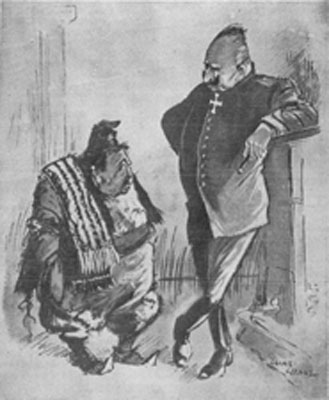
TURKEY, THE OFFICE BOY (to his master): Please, Sir, can I have a day off?
1 Theodore Roosevelt.
2 "Propterea quod a cultu atque humanitute provinciae longissime absunt."
***END OF THE PROJECT GUTENBERG EBOOK THE NEW YORK TIMES CURRENT HISTORY OF THE EUROPEAN WAR, VOL. 1, JANUARY 9, 1915***
******* This file should be named 16702-h.txt or 16702-h.zip *******
This and all associated files of various formats will be found in:
https://www.gutenberg.org/1/6/7/0/16702
Updated editions will replace the previous one--the old editions will be renamed.
Creating the works from public domain print editions means that no one owns a United States copyright in these works, so the Foundation (and you!) can copy and distribute it in the United States without permission and without paying copyright royalties. Special rules, set forth in the General Terms of Use part of this license, apply to copying and distributing Project Gutenberg-tm electronic works to protect the PROJECT GUTENBERG-tm concept and trademark. Project Gutenberg is a registered trademark, and may not be used if you charge for the eBooks, unless you receive specific permission. If you do not charge anything for copies of this eBook, complying with the rules is very easy. You may use this eBook for nearly any purpose such as creation of derivative works, reports, performances and research. They may be modified and printed and given away--you may do practically ANYTHING with public domain eBooks. Redistribution is subject to the trademark license, especially commercial redistribution.
*** START: FULL LICENSE ***

THE FULL PROJECT GUTENBERG LICENSE
PLEASE READ THIS BEFORE YOU DISTRIBUTE OR USE THIS WORK

To protect the Project Gutenberg-tm mission of promoting the free
distribution of electronic works, by using or distributing this work
(or any other work associated in any way with the phrase "Project
Gutenberg"), you agree to comply with all the terms of the Full Project
Gutenberg-tm License (available with this file or online at
https://gutenberg.org/license).


Section 1.  General Terms of Use and Redistributing Project Gutenberg-tm
electronic works

1.A.  By reading or using any part of this Project Gutenberg-tm
electronic work, you indicate that you have read, understand, agree to
and accept all the terms of this license and intellectual property
(trademark/copyright) agreement.  If you do not agree to abide by all
the terms of this agreement, you must cease using and return or destroy
all copies of Project Gutenberg-tm electronic works in your possession.
If you paid a fee for obtaining a copy of or access to a Project
Gutenberg-tm electronic work and you do not agree to be bound by the
terms of this agreement, you may obtain a refund from the person or
entity to whom you paid the fee as set forth in paragraph 1.E.8.

1.B.  "Project Gutenberg" is a registered trademark.  It may only be
used on or associated in any way with an electronic work by people who
agree to be bound by the terms of this agreement.  There are a few
things that you can do with most Project Gutenberg-tm electronic works
even without complying with the full terms of this agreement.  See
paragraph 1.C below.  There are a lot of things you can do with Project
Gutenberg-tm electronic works if you follow the terms of this agreement
and help preserve free future access to Project Gutenberg-tm electronic
works.  See paragraph 1.E below.

1.C.  The Project Gutenberg Literary Archive Foundation ("the Foundation"
or PGLAF), owns a compilation copyright in the collection of Project
Gutenberg-tm electronic works.  Nearly all the individual works in the
collection are in the public domain in the United States.  If an
individual work is in the public domain in the United States and you are
located in the United States, we do not claim a right to prevent you from
copying, distributing, performing, displaying or creating derivative
works based on the work as long as all references to Project Gutenberg
are removed.  Of course, we hope that you will support the Project
Gutenberg-tm mission of promoting free access to electronic works by
freely sharing Project Gutenberg-tm works in compliance with the terms of
this agreement for keeping the Project Gutenberg-tm name associated with
the work.  You can easily comply with the terms of this agreement by
keeping this work in the same format with its attached full Project
Gutenberg-tm License when you share it without charge with others.

1.D.  The copyright laws of the place where you are located also govern
what you can do with this work.  Copyright laws in most countries are in
a constant state of change.  If you are outside the United States, check
the laws of your country in addition to the terms of this agreement
before downloading, copying, displaying, performing, distributing or
creating derivative works based on this work or any other Project
Gutenberg-tm work.  The Foundation makes no representations concerning
the copyright status of any work in any country outside the United
States.

1.E.  Unless you have removed all references to Project Gutenberg:

1.E.1.  The following sentence, with active links to, or other immediate
access to, the full Project Gutenberg-tm License must appear prominently
whenever any copy of a Project Gutenberg-tm work (any work on which the
phrase "Project Gutenberg" appears, or with which the phrase "Project
Gutenberg" is associated) is accessed, displayed, performed, viewed,
copied or distributed:

This eBook is for the use of anyone anywhere at no cost and with
almost no restrictions whatsoever.  You may copy it, give it away or
re-use it under the terms of the Project Gutenberg License included
with this eBook or online at www.gutenberg.org

1.E.2.  If an individual Project Gutenberg-tm electronic work is derived
from the public domain (does not contain a notice indicating that it is
posted with permission of the copyright holder), the work can be copied
and distributed to anyone in the United States without paying any fees
or charges.  If you are redistributing or providing access to a work
with the phrase "Project Gutenberg" associated with or appearing on the
work, you must comply either with the requirements of paragraphs 1.E.1
through 1.E.7 or obtain permission for the use of the work and the
Project Gutenberg-tm trademark as set forth in paragraphs 1.E.8 or
1.E.9.

1.E.3.  If an individual Project Gutenberg-tm electronic work is posted
with the permission of the copyright holder, your use and distribution
must comply with both paragraphs 1.E.1 through 1.E.7 and any additional
terms imposed by the copyright holder.  Additional terms will be linked
to the Project Gutenberg-tm License for all works posted with the
permission of the copyright holder found at the beginning of this work.

1.E.4.  Do not unlink or detach or remove the full Project Gutenberg-tm
License terms from this work, or any files containing a part of this
work or any other work associated with Project Gutenberg-tm.

1.E.5.  Do not copy, display, perform, distribute or redistribute this
electronic work, or any part of this electronic work, without
prominently displaying the sentence set forth in paragraph 1.E.1 with
active links or immediate access to the full terms of the Project
Gutenberg-tm License.

1.E.6.  You may convert to and distribute this work in any binary,
compressed, marked up, nonproprietary or proprietary form, including any
word processing or hypertext form.  However, if you provide access to or
distribute copies of a Project Gutenberg-tm work in a format other than
"Plain Vanilla ASCII" or other format used in the official version
posted on the official Project Gutenberg-tm web site (www.gutenberg.org),
you must, at no additional cost, fee or expense to the user, provide a
copy, a means of exporting a copy, or a means of obtaining a copy upon
request, of the work in its original "Plain Vanilla ASCII" or other
form.  Any alternate format must include the full Project Gutenberg-tm
License as specified in paragraph 1.E.1.

1.E.7.  Do not charge a fee for access to, viewing, displaying,
performing, copying or distributing any Project Gutenberg-tm works
unless you comply with paragraph 1.E.8 or 1.E.9.

1.E.8.  You may charge a reasonable fee for copies of or providing
access to or distributing Project Gutenberg-tm electronic works provided
that

- You pay a royalty fee of 20% of the gross profits you derive from
     the use of Project Gutenberg-tm works calculated using the method
     you already use to calculate your applicable taxes.  The fee is
     owed to the owner of the Project Gutenberg-tm trademark, but he
     has agreed to donate royalties under this paragraph to the
     Project Gutenberg Literary Archive Foundation.  Royalty payments
     must be paid within 60 days following each date on which you
     prepare (or are legally required to prepare) your periodic tax
     returns.  Royalty payments should be clearly marked as such and
     sent to the Project Gutenberg Literary Archive Foundation at the
     address specified in Section 4, "Information about donations to
     the Project Gutenberg Literary Archive Foundation."

- You provide a full refund of any money paid by a user who notifies
     you in writing (or by e-mail) within 30 days of receipt that s/he
     does not agree to the terms of the full Project Gutenberg-tm
     License.  You must require such a user to return or
     destroy all copies of the works possessed in a physical medium
     and discontinue all use of and all access to other copies of
     Project Gutenberg-tm works.

- You provide, in accordance with paragraph 1.F.3, a full refund of any
     money paid for a work or a replacement copy, if a defect in the
     electronic work is discovered and reported to you within 90 days
     of receipt of the work.

- You comply with all other terms of this agreement for free
     distribution of Project Gutenberg-tm works.

1.E.9.  If you wish to charge a fee or distribute a Project Gutenberg-tm
electronic work or group of works on different terms than are set
forth in this agreement, you must obtain permission in writing from
both the Project Gutenberg Literary Archive Foundation and Michael
Hart, the owner of the Project Gutenberg-tm trademark.  Contact the
Foundation as set forth in Section 3 below.

1.F.

1.F.1.  Project Gutenberg volunteers and employees expend considerable
effort to identify, do copyright research on, transcribe and proofread
public domain works in creating the Project Gutenberg-tm
collection.  Despite these efforts, Project Gutenberg-tm electronic
works, and the medium on which they may be stored, may contain
"Defects," such as, but not limited to, incomplete, inaccurate or
corrupt data, transcription errors, a copyright or other intellectual
property infringement, a defective or damaged disk or other medium, a
computer virus, or computer codes that damage or cannot be read by
your equipment.

1.F.2.  LIMITED WARRANTY, DISCLAIMER OF DAMAGES - Except for the "Right
of Replacement or Refund" described in paragraph 1.F.3, the Project
Gutenberg Literary Archive Foundation, the owner of the Project
Gutenberg-tm trademark, and any other party distributing a Project
Gutenberg-tm electronic work under this agreement, disclaim all
liability to you for damages, costs and expenses, including legal
fees.  YOU AGREE THAT YOU HAVE NO REMEDIES FOR NEGLIGENCE, STRICT
LIABILITY, BREACH OF WARRANTY OR BREACH OF CONTRACT EXCEPT THOSE
PROVIDED IN PARAGRAPH F3.  YOU AGREE THAT THE FOUNDATION, THE
TRADEMARK OWNER, AND ANY DISTRIBUTOR UNDER THIS AGREEMENT WILL NOT BE
LIABLE TO YOU FOR ACTUAL, DIRECT, INDIRECT, CONSEQUENTIAL, PUNITIVE OR
INCIDENTAL DAMAGES EVEN IF YOU GIVE NOTICE OF THE POSSIBILITY OF SUCH
DAMAGE.

1.F.3.  LIMITED RIGHT OF REPLACEMENT OR REFUND - If you discover a
defect in this electronic work within 90 days of receiving it, you can
receive a refund of the money (if any) you paid for it by sending a
written explanation to the person you received the work from.  If you
received the work on a physical medium, you must return the medium with
your written explanation.  The person or entity that provided you with
the defective work may elect to provide a replacement copy in lieu of a
refund.  If you received the work electronically, the person or entity
providing it to you may choose to give you a second opportunity to
receive the work electronically in lieu of a refund.  If the second copy
is also defective, you may demand a refund in writing without further
opportunities to fix the problem.

1.F.4.  Except for the limited right of replacement or refund set forth
in paragraph 1.F.3, this work is provided to you 'AS-IS,' WITH NO OTHER
WARRANTIES OF ANY KIND, EXPRESS OR IMPLIED, INCLUDING BUT NOT LIMITED TO
WARRANTIES OF MERCHANTIBILITY OR FITNESS FOR ANY PURPOSE.

1.F.5.  Some states do not allow disclaimers of certain implied
warranties or the exclusion or limitation of certain types of damages.
If any disclaimer or limitation set forth in this agreement violates the
law of the state applicable to this agreement, the agreement shall be
interpreted to make the maximum disclaimer or limitation permitted by
the applicable state law.  The invalidity or unenforceability of any
provision of this agreement shall not void the remaining provisions.

1.F.6.  INDEMNITY - You agree to indemnify and hold the Foundation, the
trademark owner, any agent or employee of the Foundation, anyone
providing copies of Project Gutenberg-tm electronic works in accordance
with this agreement, and any volunteers associated with the production,
promotion and distribution of Project Gutenberg-tm electronic works,
harmless from all liability, costs and expenses, including legal fees,
that arise directly or indirectly from any of the following which you do
or cause to occur: (a) distribution of this or any Project Gutenberg-tm
work, (b) alteration, modification, or additions or deletions to any
Project Gutenberg-tm work, and (c) any Defect you cause.


Section  2.  Information about the Mission of Project Gutenberg-tm

Project Gutenberg-tm is synonymous with the free distribution of
electronic works in formats readable by the widest variety of computers
including obsolete, old, middle-aged and new computers.  It exists
because of the efforts of hundreds of volunteers and donations from
people in all walks of life.

Volunteers and financial support to provide volunteers with the
assistance they need, is critical to reaching Project Gutenberg-tm's
goals and ensuring that the Project Gutenberg-tm collection will
remain freely available for generations to come.  In 2001, the Project
Gutenberg Literary Archive Foundation was created to provide a secure
and permanent future for Project Gutenberg-tm and future generations.
To learn more about the Project Gutenberg Literary Archive Foundation
and how your efforts and donations can help, see Sections 3 and 4
and the Foundation web page at https://www.gutenberg.org/fundraising/pglaf.


Section 3.  Information about the Project Gutenberg Literary Archive
Foundation

The Project Gutenberg Literary Archive Foundation is a non profit
501(c)(3) educational corporation organized under the laws of the
state of Mississippi and granted tax exempt status by the Internal
Revenue Service.  The Foundation's EIN or federal tax identification
number is 64-6221541.  Contributions to the Project Gutenberg
Literary Archive Foundation are tax deductible to the full extent
permitted by U.S. federal laws and your state's laws.

The Foundation's principal office is located at 4557 Melan Dr. S.
Fairbanks, AK, 99712., but its volunteers and employees are scattered
throughout numerous locations.  Its business office is located at
809 North 1500 West, Salt Lake City, UT 84116, (801) 596-1887, email
business@pglaf.org.  Email contact links and up to date contact
information can be found at the Foundation's web site and official
page at https://www.gutenberg.org/about/contact

For additional contact information:
     Dr. Gregory B. Newby
     Chief Executive and Director
     gbnewby@pglaf.org

Section 4.  Information about Donations to the Project Gutenberg
Literary Archive Foundation

Project Gutenberg-tm depends upon and cannot survive without wide
spread public support and donations to carry out its mission of
increasing the number of public domain and licensed works that can be
freely distributed in machine readable form accessible by the widest
array of equipment including outdated equipment.  Many small donations
($1 to $5,000) are particularly important to maintaining tax exempt
status with the IRS.

The Foundation is committed to complying with the laws regulating
charities and charitable donations in all 50 states of the United
States.  Compliance requirements are not uniform and it takes a
considerable effort, much paperwork and many fees to meet and keep up
with these requirements.  We do not solicit donations in locations
where we have not received written confirmation of compliance.  To
SEND DONATIONS or determine the status of compliance for any
particular state visit https://www.gutenberg.org/fundraising/pglaf

While we cannot and do not solicit contributions from states where we
have not met the solicitation requirements, we know of no prohibition
against accepting unsolicited donations from donors in such states who
approach us with offers to donate.

International donations are gratefully accepted, but we cannot make
any statements concerning tax treatment of donations received from
outside the United States.  U.S. laws alone swamp our small staff.

Please check the Project Gutenberg Web pages for current donation
methods and addresses.  Donations are accepted in a number of other
ways including including checks, online payments and credit card
donations.  To donate, please visit:
https://www.gutenberg.org/fundraising/donate


Section 5.  General Information About Project Gutenberg-tm electronic
works.

Professor Michael S. Hart was the originator of the Project Gutenberg-tm
concept of a library of electronic works that could be freely shared
with anyone.  For thirty years, he produced and distributed Project
Gutenberg-tm eBooks with only a loose network of volunteer support.

Project Gutenberg-tm eBooks are often created from several printed
editions, all of which are confirmed as Public Domain in the U.S.
unless a copyright notice is included.  Thus, we do not necessarily
keep eBooks in compliance with any particular paper edition.

Each eBook is in a subdirectory of the same number as the eBook's
eBook number, often in several formats including plain vanilla ASCII,
compressed (zipped), HTML and others.

Corrected EDITIONS of our eBooks replace the old file and take over
the old filename and etext number.  The replaced older file is renamed.
VERSIONS based on separate sources are treated as new eBooks receiving
new filenames and etext numbers.

Most people start at our Web site which has the main PG search facility:

https://www.gutenberg.org

This Web site includes information about Project Gutenberg-tm,
including how to make donations to the Project Gutenberg Literary
Archive Foundation, how to help produce our new eBooks, and how to
subscribe to our email newsletter to hear about new eBooks.

EBooks posted prior to November 2003, with eBook numbers BELOW #10000,
are filed in directories based on their release date.  If you want to
download any of these eBooks directly, rather than using the regular
search system you may utilize the following addresses and just
download by the etext year.

https://www.gutenberg.org/dirs/etext06/

    (Or /etext 05, 04, 03, 02, 01, 00, 99,
     98, 97, 96, 95, 94, 93, 92, 92, 91 or 90)

EBooks posted since November 2003, with etext numbers OVER #10000, are
filed in a different way.  The year of a release date is no longer part
of the directory path.  The path is based on the etext number (which is
identical to the filename).  The path to the file is made up of single
digits corresponding to all but the last digit in the filename.  For
example an eBook of filename 10234 would be found at:

https://www.gutenberg.org/dirs/1/0/2/3/10234

or filename 24689 would be found at:
https://www.gutenberg.org/dirs/2/4/6/8/24689

An alternative method of locating eBooks:
https://www.gutenberg.org/dirs/GUTINDEX.ALL

*** END: FULL LICENSE ***