The Project Gutenberg EBook of Richard Wagner, by John F. Runciman

This eBook is for the use of anyone anywhere at no cost and with
almost no restrictions whatsoever.  You may copy it, give it away or
re-use it under the terms of the Project Gutenberg License included
with this eBook or online at www.gutenberg.org


Title: Richard Wagner
       Composer of Operas

Author: John F. Runciman

Release Date: August 4, 2005 [EBook #16431]

Language: English

Character set encoding: ISO-8859-1

*** START OF THIS PROJECT GUTENBERG EBOOK RICHARD WAGNER ***


Produced by Steven Gibbs and the Online Distributed
Proofreading Team at https://www.pgdp.net
It is now one hundred years since Richard Wagner was born, thirty since he died. In every land he has his monument in one shape or another; his music-dramas can be heard all the world over; all the ancient controversies as to their merits or demerits have died down. The Bayreuth theatre, the outward and visible sign of his inner greatness, has risen to the point of its most splendid glory and lapsed into the limbo of tenth-rate things. Every one who really cares for the art of music, and especially the art of opera (of which art music is by far the most important factor), has had ample time and opportunity for making up his mind. It is, therefore, high time to simplify and to cease from elaborating. In this book will be found, I trust, no special pleading, no defence or extenuation, no preposterous eulogy on the one hand, and on the other no vampire work, but a plain and concise attempt to depict the mighty artist as he lived and to describe his artistic achievement as it is. We have all had time to consider and to sort out (so to say) the reams that have been written and printed about Wagner: the bulk of it has had to be thrown on the scrap-heap: what there was of value has, I hope, been utilised.
An author who plans a book on an artist or an artistic question must be wary, especially at the beginning of his adventure. To start away with a theory, whether new or old, and to yield to the seductive temptation to convince humanity of its truth—this is to lay a trap and to take the path that leads straight into it. Theories should be kept for scientific matters. A work proving that parallel straight lines never meet need not land the writer in self-contradictions; and another writer may prove that they must and do meet, and still avoid getting tangled amongst his own arguments. I even read a book once in which it was clearly shown that the earth was flat; and, granted a ludicrous premise, one could but admire the irrefragable logic with which the conclusion was reached. With regard to art, be your premises sound or grotesque, the result is the same—muddle. Logic, science, philosophy, applied to art, spell certain disaster. With mingled pain and amusement I have noted how more than one writer on music, setting out in triumphant high spirits to demonstrate this or that, has before his third chapter demonstrated just the contrary: I have never seen anything else occur.
Wagner wrote so much about himself and his art, and appeared so fully satisfied with his explanations of why he became just what he became and of why his art was just what it was, that naturally for nearly a generation his critics fell into one or other of two errors. Either they accepted his theorisings unreservedly or as unreservedly they rejected them. In the second case they had to face the difficulty of coining, shaping, a theory of their own; in either case shipwreck nearly always promptly ensued; and on the whole, if Wagner had to be theorised about, one would prefer to have it done by Wagner. He himself knew the tiny value of his theorisings about his art, for he declared that when he wrote Tristan and Isolda he found he had already left his theories far behind. This discovery might well have served as a warning both to Wagner and to the hosts of his commentators. Unluckily Wagner was far too fond of theorising, moralising and generally talking of himself and his works, and he reckoned he had a big propagandist work to do; so he went on scribbling to the end. As for the commentators, they neglected the warning and took Wagner's later doings as an example, with the result that the library shelves of Europe are stopped and blocked with as big a heap of rubbish as ever was provoked by great works of art since the world began to turn round. For Wagner there is an ample excuse: he honestly thought it necessary to spread his ideas abroad; his aims and intentions had been so misunderstood, and so stupidly, wickedly, recklessly misrepresented, that he did not believe his music-dramas would ever find acceptance until he had cleared the way by explaining himself. Little good came of it—in fact, the only good result was that some of his writings fell into the hands of Ludwig II of Bavaria, and thus led to the ending of his days of misery, and indirectly to Bayreuth. For the commentators no word of extenuation can be said. Those, perhaps, of the period 1867-77 were justified in pressing their master's claims on the public at large, for the support of the public at large had to be won, and the best way of winning it seemed to lie in advocating those claims, in season and out of season, through the agency of the newspaper-press; but the rest of the herd have proved themselves an unqualified nuisance and a hindrance to a right understanding of Wagner.
This herd I would not willingly join. In the following pages no general theory concerning Wagner will be found. I shall indulge in no theorisings whatever, but stick to the facts, facts which can now be ascertained with certainty. My endeavour will be to tell a plain, unvarnished tale of what Wagner did and of what he suffered, of the environment amidst which he grew up and laboured and struggled: with all that he said and wrote I shall deal as briefly as may be, regarding his endless loquacity of mouth and pen as of interest only when it throws real light on the artist. Least of all shall I waste the reader's patience on the morals that may be drawn from his musical works. The moral to be drawn from his prose works is simply that a man, even a stupendously great man, may write far too much; the moral to be drawn from his musical works every man may find out for himself: for myself, I have found none, any more than I could ever find a moral in a play of Æschylus or Sophocles or Shakespeare.
There are plenty of authorities for the statements now to be made. We have the exhaustive Life by Glasenapp and W. Ashton Ellis; then there is Wagner's own work, My Life, lately translated into English; finally there are the Letters. Many of these are of no interest or value whatever, dealing only with details concerning scores and proof-sheets and petty money matters. Many, on the other hand, notably those to Uhlig, are invaluable to every one who wishes to understand Wagner. Extensive use is made of them in this book, though, as they are easily accessible, I have forborne to quote more than is absolutely necessary. My Life I think but little of, and have not relied greatly on it.
Wagner the reformer will receive no lengthy consideration. He did not "reform" the opera form—the opera form of Mozart and Weber needed no reforming—he simply developed it. He did reform operatic performances by insisting on precision and intelligence in place of slovenliness and stupidity, on enthusiasm for art in place of stolid indifference; and he did as much in the concert-room. I shall not theorize about these matters, but point out what he achieved by making a continuous appeal to indubitable, indisputable facts.
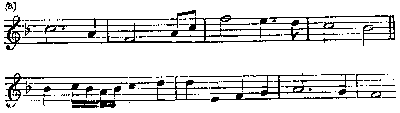
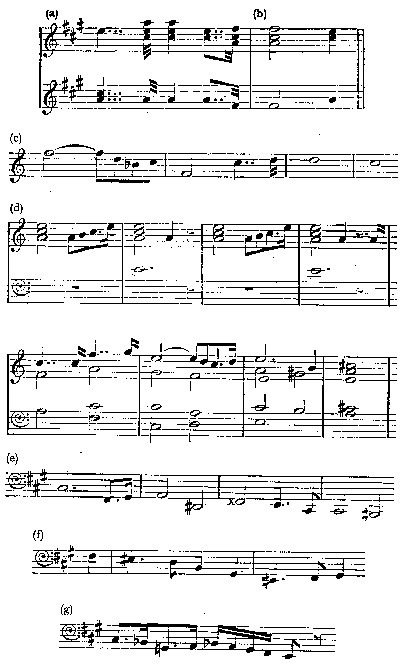
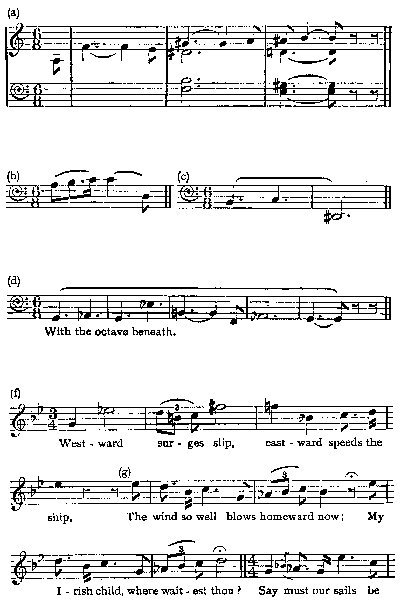
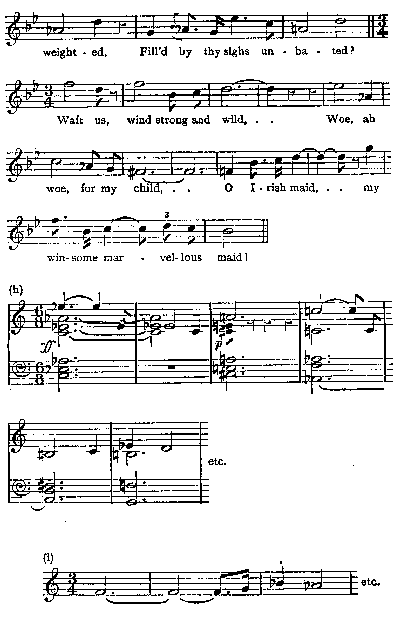
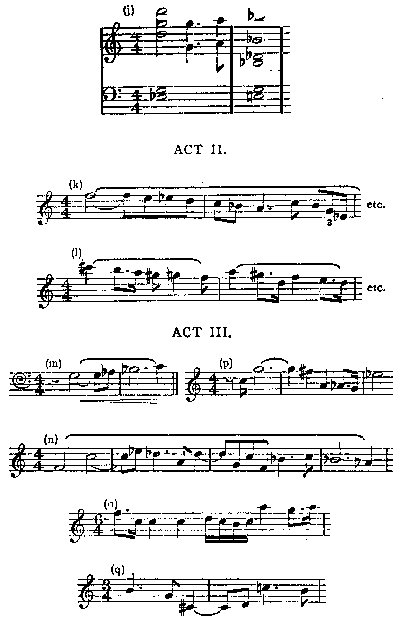
I am indebted to Messrs. H. Grevel & Co. for kind permission to print extracts from Mr. Shedlock's translation of Wagner's Letters, and to Messrs. Novello for similar permission regarding quotations from the libretti of the operas. Two words may be said about the quotations, both words and music, of the operas: in some cases, when I could neither find nor make an adequate translation of verses, I have stuck to the original German; with regard to the music, I have given as little as possible. Both musical and verbal citations are meant for reference—there is only one exception, the Sailors' Song from the opening of Tristan. Catalogues of Wagner's themes have for long been issued by several publishers; but they are of small assistance in helping one to understand Wagner.
J.F.R.
| CHAPTER I | EARLY LIFE |
| CHAPTER II | EARLY BOYHOOD |
| CHAPTER III | EARLY LIFE (continued) |
| CHAPTER IV | JUVENILE WORKS |
| CHAPTER V | PARIS |
| CHAPTER VI | 'RIENZI' AND 'THE FLYING DUTCHMAN' |
| CHAPTER VII | DRESDEN |
| CHAPTER VIII | 'TANNHÄUSER' |
| CHAPTER IX | 'LOHENGRIN' |
| CHAPTER X | EXILE |
| CHAPTER XI | 'TRISTAN AND ISOLDA' |
| CHAPTER XII | 'THE MASTERSINGERS OF NUREMBERG' |
| CHAPTER XIII | KING LUDWIG |
| CHAPTER XIV | 'THE NIBELUNG'S RING' AND THE RHINEGOLD' |
| CHAPTER XV | 'THE VALKYRIE' |
| CHAPTER XVI | 'SIEGFRIED' |
| CHAPTER XVII | 'THE DUSK OF THE GODS' |
| CHAPTER XVIII | 'PARSIFAL'; THE END; THE MAN |
| INDEX |
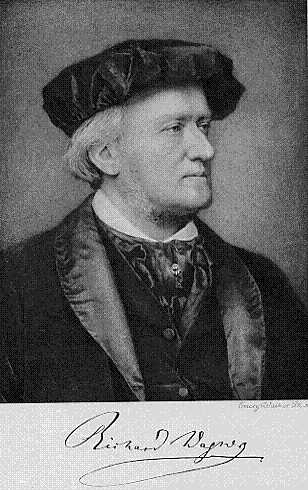
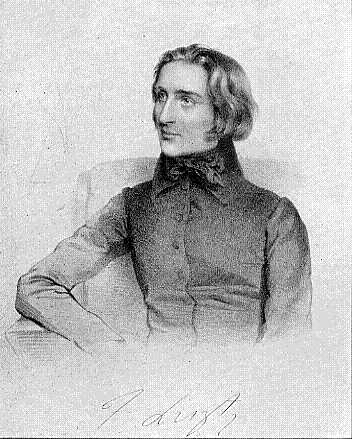
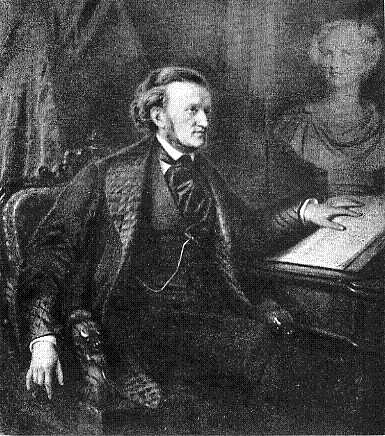
PORTRAIT OF WAGNER |
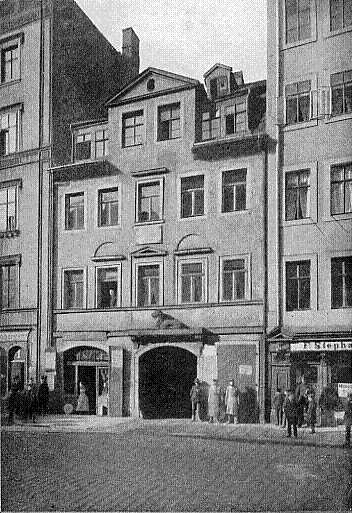
As the springtide of 1813 was melting into early summer the poet and musician of spring days and summer nights was born at the house of the Red and White Lion on the Brühl in old Leipzig. The precise date was May 22; and owing to many causes the 16th of August came round before, at the church of St. Thomas, the child was christened Wilhelm Richard Wagner. The events and circumstances of the period have furnished the imaginative with many striking portents with regard to the future mighty composer; and, to do the prophets full justice, after the event—long after the event—they have widely opened their mouths and uttered prophecies. Thus the name of the house, describing a beast such as never was on sea or land, distinctly warned a drowsy people that the monstrous dragon of Siegfried was about to take the road leading from Nowhere to Bayreuth. The spring foretold the songs in Tannhäuser and the Valkyrie; the summer, the nights in King Mark's Cornish castle-garden and amongst the fragrant lime-trees in the streets of ancient Nuremberg; the horrors of the war raging at the very gates of Leipzig and Napoleon's flight, the advent of the preacher who was to earn a long exile by advising the Saxon soldiers not to shoot their brethren. Events provided material for these and many another score of prognostications: only, fortunately, no one read events rightly at the time, and something fresh was left for the biographers to expend their ingenuity upon.
Richard Wagner came of a German lower middle-class stock. There is not amongst his ancestry a single man distinguished in letters or any art. His uncle Adolph, of whom some Bayreuth gentlemen make much, would not be remembered had he not been Wagner's uncle. Only by patient research has it been discovered that one or more of his forebears could so much as play the organ. His father was an amateur theatrical enthusiast, and he too would have been utterly forgotten had he not been Wagner's father. His stepfather—though this seems hardly to the point—was an actor and portrait-painter; and his one claim to remembrance is that he was Wagner's stepfather. So, however scientifically minded we may be, however strongly disposed to account for the sudden appearance of a stupendous genius by the cheap and easy method of pointing to some distinguished ancestor and talking pompously of the laws of heredity, in Wagner's case we are baffled and beaten. He came like a thunderbolt out of a blue sky. We must be content with the fact that he came. His father and grandfather were state or municipal officials both; and bearing in mind Wagner's frank detestation of officialdom, the scientist can scarcely draw much comfort from that.
The grandfather, Gottlob Friedrich Wagner, was born in 1736, only a few years later than Haydn. In 1769 he married the daughter of a charity-school master or caretaker; and in 1770, the year of Beethoven's birth, his first child, christened Carl Friedrich Wilhelm, was born. Four years later Adolph arrived. Gottlob was a douanier, an exciseman, at the Rannstadt gate of Leipzig, and passed his days, I dare say, as honestly as an exciseman can, in examining incoming travellers to see that they did not bring with them so much as an egg that had not paid duty. He died in 1795. Meantime, Carl Friedrich had received a thoroughly sound education, and he became deputy-registrar to the Leipzig town court. In 1789 he married Johanna Rosina Pätz (whose name, it seems, is susceptible of many spellings).
The scientific mind may after all find consolation in the all-illuminating truth that Friedrich and all his children were more or less passionately addicted to the theatre and attracted by it. It was Friedrich's one hobby; and though Friedrich's brother Adolph had a horror of it, the feeling was not aroused by it as an artistic institution, but as an agency for the intellectual, moral and worldly ruin of young men and women. In his leisure Friedrich arranged dramatic performances and took part in them, and, as amateurs go, he appears to have been highly successful. Histrionic persons were constant guests at his house on the Brühl—amongst them notably one, Ludwig Geyer, who became a fast friend of the family and played an important rôle, off the stage, with regard to that family soon after Richard's birth. Friedrich, during his later years, cannot have had much spare time for amateur theatricals or any other amusement. Napoleon was fighting his last desperate fights against the combined forces of reactionary Europe; all the powers of feudalism had combined to crush an emperor who had no royal blood in his veins; he raged over Germany like an infuriated beast with a genius for military tactics, scattering armies which dispersed only to join together and face him again. While Richard was in his cradle the whole of Saxony was filled with the squalor and misery and loathsome terrors of war. Leipzig was occupied by the French; Marshal Davoust was left there as commandant, with power of life and death, and all the other privileges of a military governor; and in the deputy-registrar of the law-court he found the man for the post of provisional chief of the police "of public safety." Who kept the public safe from the police I am unable to say. Fighting was going on perpetually in the neighbourhood; the dead and dying lay scattered in all directions; the stench bred epidemics more murderous than all Napoleon's cannon. Friedrich must have found his hands full day and night. Richard was baptized on August 16; the following day Napoleon won a victory which cost him dear; the 18th, being Sunday, was observed as such by a soldiery in need of a rest; on the 19th Napoleon was a beaten man, and ran to save his skin past the windows of the house of the Red and White Lion on the Brühl. Richard's mother had been trembling for her own safety and that of her children and husband; but when, as she herself afterwards told, she saw the dreaded conqueror bolt in haste without his hat, she breathed again. Whether she and the family were any better off under the deliverers is a question that does not concern us here: the point is that she thought she was. It was all one to Richard, who, aged three months, slept peacefully on.
After the deliverance Friedrich's work became even heavier than before. The town through its length and breadth was shattered and dilapidated; whole families were homeless and packed like rabbits in hutches; the slaughtered dead, men and beasts, could not be buried quick enough; black death stalked abroad in the guise of what was called hospital typhus—an epidemic fever of some kind. After the French flight, I take it, provisional chief-policeman Wagner had returned to his deputy-registrarship; but his toils were none the lighter for that. He exhausted himself; the appalling fever attacked him and he had no strength to resist it; and he died on November 22, exactly six months after the birth of Richard. Wagner's ill-luck, his wicked fairy, struck her first blow while his age had to be reckoned in months; she went on striking, and never ceased to strike, until he was beginning to grow a little weary and his age was reckoned in decades of years, and in terms of masterpieces accomplished and insults and ill-usage by no means patiently borne. It must have seemed hard to his widowed mother, after the uncertainties and horrors of the last years, that when at last a period of happy peace seemed about to dawn, uncertainties and griefs and worries of a fresh sort should come upon her.
Whether Frau Wagner ever actually drew any pension from the good burghers of Leipzig or the greedy state officials of Saxony seems, when all is said, very uncertain. In such times of stress and struggle great crown officers, laudably anxious about their own interests and the interests of their families, are apt to be rather careless, not to say callous, about the smaller fry. However, pension or no pension, with the aid of relatives and friends the Wagners pulled through. Chief and best amongst the friends was Ludwig Geyer.
A few words must be said about him. Born in 1780, he was ten years Carl Friedrich's junior. An actor who had taken up painting, or a painter who had taken up acting, in both arts he had won at any rate a local reputation. We know what was thought of his histrionic gifts from more or less competent contemporaries; but what to think of his paintings I do not know, for two reasons: I do not trust my own judgment in such a matter, and if I did, I have never seen any of Geyer's work. Of this, however, I am very sure: he cannot have been a good painter unless nature had worked a miracle in sending a good painter to Germany in the eighteenth or nineteenth century. German artists of the period must be classified not as sheep and goats, but as bad goats and worse goats. But if he was not a fine painter he was what is better, or, at any rate, more useful to the rest of human kind, a fine character: a noble, generous, self-sacrificing man. In haste on hearing of Carl Friedrich's death he came from Dresden to attend to the burying of the dead and the nourishing of the living. The details of this first period of Richard's ill-fortune do not amount to a great deal and are unimportant, since our subject is Richard, and his mother, brother and sisters only so far as their lives and characters influenced Richard. Albert, the eldest of the children, was now fourteen years old; he was at the Royal school in Meissen, and there he remained. Rosalie went to dwell with a friend of Geyer's, a lady who lived at Dresden. Louise was adopted by a Frau Hartwig, also at Dresden. Richard in his cradle remained with his mother and the younger members of the tribe in Leipzig.
And so presently life began to move on as before, while the dead man slept in his grave. But immediately fresh troubles came. Albert fell dangerously ill and was threatened with a total breakdown of his health; Richard was an ailing infant; and a change in the arrangements of the theatrical company which provided Geyer with a portion of his income compelled him to remain in Dresden continuously. This proved really a stroke of good fortune. Glasenapp, basing his calculations on I know not what authorities or documents, computes that his earnings as an actor at this time came to £156 a year, and there seems every reason to think he was at least fairly well paid for his portraits. It was not enough to be shared between two families, or, we had better say, to be devoted to the up-keep of two homes. He determined rapidly on a bold stroke. That he was in love with Frau Wagner is more than any one can declare with confidence; but she was an amiable, bright woman, a good mother and thrifty housekeeper; and it is likely enough that she had inspired a deep affection in a singularly loving man. After the recovery of Albert the widow had gone for a change to Dresden; and there Geyer resolved to marry her—and resolved quickly; for Carl Friedrich died in November 1813, and early in 1814 the marriage took place. Soon after, the new Frau Geyer returned to Leipzig; then the whole family migrated to Dresden, where Richard was to pass from babyhood into boyhood and spend the first fourteen years of his life.
The Geyer-Wagner family set up their tent in the Moritz-strasse in Dresden, which belonged to the seventeenth or eighteenth century—was in fact almost mediæval. Life must have been atrociously narrow and trammelled to any free spirit. But Germany did not produce many of that sort at the time, and those she did produce were quickly silenced in gaol. Whether Geyer had yearnings for outward liberty cannot be said; but if he had he gave no expression to them, being himself a court player and a semi-court painter. Undoubtedly the main thing to him was that in the drowsy court air he could at least earn the means of bringing up adequately the large family he had taken on his shoulders. He played constantly in all sorts of parts, and in his off hours painted; he also wrote a number of theatre pieces of varying type and importance—none of which concern us here. His wife enjoyed a period of peace in which to attend to her husband, children and house, as a faithful hausfrau should. If Geyer was industrious and much occupied, he nevertheless found time to cultivate friendships, and some of them in later days were continued by Richard.
The whole life of the circle went on around the theatre or in it; it must have been their whole world, for of culture other than of the theatre there is no indication—save one or two half-hearted remarks of Geyer's at a slightly later period. They admired Goethe and Schiller, of course, and knew their theatre works; they knew of the Romantics in so far as they affected the theatre; it seems to have been only through the theatre they saw anything or could see anything. Breathing the theatrical atmosphere constantly, one after another of Geyer's step-children caught the theatre malady (for it will be admitted that men or women must have something the matter with them if they deliberately choose a theatrical life); and within a few years three of them were appearing on the stage. Albert left school and went to the university to study medicine; after a very brief struggle he gave this up, studied singing, and in 1819 or 1820 made his debut as a light-opera tenor. Before this Geyer had warned him against taking such a course; but apparently he was obdurate. On May 2 of the former year Rosalie had first appeared as an actress in a piece by Geyer; still earlier Louise had also begun acting child-parts. There must have been a good deal of family discussion and commotion about these things. It had been the wish of Friedrich Wagner that Rosalie should, or perhaps might, take to the stage as a profession, but in no case until she had attained the age of sixteen. Friedrich's brother Adolph, as I have said, set himself in deadly opposition to anything of the sort happening. Letters and counter-letters ensued; but the instinct of the youngsters turned out to be sufficiently strong, and perhaps the opposition of Geyer too feeble to carry the day; and one after another the Wagners took to the boards as ducklings to water. Geyer kept his word to his dead friend, however; and Rosalie, though she had been long preparing, made no public appearance until she reached sixteen. A little longer and Clara took up the family occupation. How all this affected the family generally, and especially Richard, we shall see before long. In the meantime it may be mentioned that Julius, the second son, nine years Richard's senior, was apprenticed at Eisleben to Geyer's younger brother, a goldsmith: he alone was not pulled stagewards.
Naturally enough there is nothing but idle and frequently fatuous hearsay to repeat of these early years, save this only, that Richard did not show the slightest musical precocity. Nor need this surprise us. Mozart, Bach, Beethoven were brought up in households where music was as the daily bread; their ears must have been filled with it while they were in their cradles. It is true that Handel's father dreaded music as a disease and a musician as a vagabond; but in this case the precocity is quite unattested, and the stories of the six-year boy practising on a dumb-spinet at midnight originated when the boy had become the most celebrated musician in Europe. I wish here to make a few not wholly irrelevant remarks. The tales of Handel's wondrous babyhood were repeated, and repeated many times, by writers who did not know what a dumb-spinet was and certainly made no inquiries regarding the source of the tales. Both legend and dumb-spinet are swallowed cheerfully to this day because so many authors accept them; and I would point out that the first author, No. I, was simply copied recklessly by author No. II, that author No. III, maybe a little less recklessly, copied No. II because he was supported by No. I; and thus the game went on until the simple minds of a generation think that what fifty writers have said must be true. Ten thousand times more has been written about Wagner than all that Handel provoked, and even less honest investigation has been made—result, a gigantic series of tales, genuine or mythical, based on what amounts to no authority whatever. Unless these are verifiable I leave them to the care of others, and pass on. So with regard to Wagner's childhood we know he showed himself no wonderful genius. We do know that he lived amidst folk whose whole conversation must have been of the theatre and drama, actors and actresses; that he was petted and taken about by his stepfather, and as soon as he was old enough, or sooner, went to the theatre while rehearsals were going on. "The Cossack," as Geyer called him, grew up a lively, quick-witted child, active and full of mischief, "leaving a trousers-seat per day on the hedge" and sliding down banisters—much indeed like many other children who afterwards for want of leisure neglected to compose a Ring or a Tristan. The theatrical life, I feel sure, did not differ greatly from the same life to-day. It is for the most part a sordid, petty existence, one in which one's days, weeks, months and years are frittered away; they pass and there is nothing tangible to show for them. When performances are not over until late, no one rises early; then come the rehearsals; then the evening performance again—and so home and to bed. Long intervals of waiting between spells of monotonous work can hardly be used for anything but gossiping at the stage-door or idling in cafés. Save for those who have risen high in popular favour—or, during Wagner's boyhood, the favour of kings or their mistresses—it is an uncertain life, with engagements terminable, and very often terminated, after a few years; and thus a hand-to-mouth way of grubbing along is generated, and a vagrant spirit developed: and in the majority, the huge majority, of cases lives spent in squalor, mean squabblings, spells of mechanical work alternating with enforced idleness, end in destitution and utter misery. Uncle Adolph was quite right: he knew how close the ordinary actor and opera-singer was to the cabotin. But Geyer, we must remember, was very far away indeed from the cabotin. Good-natured and sociable as he seemed, he must have held to his purpose with iron determination and stuck to his work; and whatever Richard and his brothers and sisters may have seen going on around them, we may be sure they saw none of it in their own home.
When in 1817 Weber arrived at Dresden to set up a real German opera, it seemed he must have landed in exactly the wrong place to carry out his plans. Only by a series of miracles did they get partially carried out; and here, as we know, he composed two works, Der Freischütz and Euryanthe, destined in after years to exert greater power over Richard's genius than any other music save Beethoven's—a power not inferior to that of Beethoven's music in some respects. Weber inevitably became a friend of the Geyers, and before Richard was much older he knew the great person to speak to and set him up in his heart as a demi-god. But as yet Richard was only picking up a little knowledge and trying, very faintly trying, to play the piano.
Meanwhile, Geyer's health was failing, though no one then foresaw what was to come. He acted, he painted, he wrote plays, he saw to the debuts of Albert and Rosalie; he tried a cure here and a cure there. In 1821 he moved to a larger house at the corner of the Jüdenhof and the Frauengasse, and rejoiced to have a larger studio for his picture-work. In July he went to Breslau and returned ill, tried Pillnitz and came back appearing a little better, and promptly got worse. On the evening of September 29 he heard Richard strumming the "Jungfernkranz," and asked his wife whether it was possible the boy had any gift for music; the following evening he died. The next morning Richard was told by his mother that his father would fain have made something of him; and, like young Teufelsdröckh, Wagner for long fancied something would be made of him.
So, less than eight years after, Ludwig Geyer followed his friend Carl Friedrich Wagner to the grave, like him to a premature grave. He left only one child of his own, Augusta Cäcilie (born February 26, 1815); but he made Friedrich's widow his wife and her children were as his children; and he toiled hard for their comfort and planned unceasingly for their welfare; and when on an October morning he was left in his last peaceful home to rest, it must have seemed to his widow as though happiness was to be denied her until she joined him. The winter of 1813 had been black enough, but at once she had Geyer; in 1821 there was no second Geyer. Adolph Wagner may have seen in the tragedy a marked instance of the folly of having anything to do with the stage or actors. Possibly he did not realize that precisely through Geyer's connection with the theatre, and only to a comparatively small extent by means of his reputation as an artist, his sister-in-law and nephews and nieces suffered less than might have been anticipated. For on the morning following Geyer's death Rosalie swore to take his place as provider for the family, and that promise she kept.
When Richard was six months old, fate, as we have seen, struck her first blow, placed the first obstacle in the path of a successful infantile career, and swiftly sent Geyer to his aid. Now, when he was just turned eight, she snatched away Geyer, and had already Rosalie in readiness to help him. And, in fact, throughout Wagner's life fate seemed never to tire of delivering staggering blows with one hand, and with the other hand, at the same moment or a moment later, giving him compensation, often ample, sometimes on a scale of lordly generosity. From the beginning to the end of his seventy years no man ever had worse or better luck than Wagner. It is perfectly clear that fate meant him to write the Mastersingers and Tristan, and at times she was cruel to him only to be kind to humanity. It is true she seems to have made a mistake when she allowed him to complete Parsifal—but that matter lies as yet many chapters ahead.
It would appear that Frau Geyer had a pension of some sort; since May 1 Rosalie had been engaged with the Royal Court players of Dresden; Albert and Louise both had engagements at Breslau—one of Geyer's last acts had been to see Albert safely fixed there; it is probable, if not certain, that Adolph Wagner—who, after all, was fairly well off—lent a helpful hand: and the family, if not in the modest affluent circumstances they enjoyed while Geyer lived, at any rate tasted none of the bitterness of poverty. Glasenapp states that Geyer's "stock of pictures" had gone up in value after his death; but as he just previously tells us of Geyer's lack of time and of "would-be sitters" waiting their turn, we cannot see how the stock can have been very large. Let us hope, however, that it was, and that Geyer in his grave went on helping those he loved. Julius was safely bestowed at Eisleben; and the widow had Clara, Ottilie, Richard and Cäcilie to look after—quite enough, it is true, and calling for all the resources of her housewifery to make ends meet; but, still, nothing like the burden Geyer had taken up so courageously a few years before. How much Rosalie and Albert could spare out of the small salaries paid in those—and still paid in these—days by German theatres is a matter entirely for conjecture: it cannot have amounted to a mighty sum, the main point is that it served. I deal with these details, because at the first glance one is puzzled to know however the family managed to pull through at all and avoid the workhouse.
At first Richard was sent to his step-uncle Geyer at Eisleben, where, he himself says, he did little in the way of learning. Geyer tried to persuade him to work at his books and sent him to a school kept by one Alt, promising him he should go to the Kreuzschule at Dresden; but he had grown too fond of doing his reading on out-of-the-way lines; he was fond also of roaming the countryside. There was endless trouble in discovering what to do with him and what to make of him. At last a time came when Uncle Geyer could no longer keep him; and in response to inquiries Uncle Adolph answered virtually that he could and would do nothing. So towards the end of 1822 Richard was sent home to Dresden, and there on December 2 he was entered at the Kreuzschule as Richard Geyer. This, let me remark in passing, was and is common enough when a widowed mother has married a second time. Several such cases are within my own experience; and malicious snarls at Wagner's double name, as though at some period he had gone under an alias, are purely futile and worthy only of an advocate with a desperate case.
With this Wagner's period of infancy ends and he enters on that of boyhood—his life begins. Henceforth we shall hear less of other members of his family—though they will by no means drop out of the story completely, or all but completely, as they did when he came to his marrying days.
So far all we can learn about Wagner that is worth knowing amounts to this: he was born into and passed his first years in the precincts of Bohemia, where the Bohemian atmosphere was tempered with officialism, court-etiquette, and the influence of a methodical and resolutely conscientious stepfather. When Richard became a man and wrote on the theatre and theatrical life he showed an intimate knowledge of all details hardly possible to one who had not gone through this early experience: scores of things that an ordinary educated Englishman learns with considerable surprise were to him the merest matters of course. When an English composer resolves to write an opera, in the spirit in which a sculptor may decide to paint a picture or a flute-player to play the fiddle, he has to learn all, or as much as he can, about the requirements of the stage, and even then if his work comes to rehearsal he has to accept corrections and make alterations at the instance of those who have been through the proper early training. No one had anything to teach Richard in these respects: he knew by what seems an infallible instinct, but which was mainly the result of all he had seen since his babyhood, precisely what was effective and what ineffective on the stage, what was possible and what impossible. He made no mistakes; even the "impossibilities" of the Ring proved feasibilities and are now accomplished nightly without trouble in every opera-house of Europe.
This training—for it was a training, perhaps the very best for the career before him—now went on as in Geyer's time. He still dwelt in Bohemia, but as the influence of his stepfather had been salutary, so now to an extent came in the influence of school. Hitherto we have had rather to consider his family than him; but now the little individuality begins to emerge, more and more clearly and distinctly, from that circle. He begins an independent existence, controlled in an overwhelming degree by the life of the theatre and home-life, but also leading a life of his own at school and very wilfully taking a line or lines of his own there. We can now begin to trace the growth of the mental, and especially the artistic, nature of one of the most stupendous geniuses the earth has produced. It is altogether unnecessary to try to piece together anything approaching an elaborate sketch of the activities and escapades of these days: this would involve laying violent and liberal hands on the fruits of the labours of Glasenapp and a dozen other pickers-up of unconsidered trifles, would yield us nothing essential and might drive the reader to an untimely end. Out of the strangely tangled skein of truth and obvious fiction which is called his "life" for this period I shall endeavour only to pick out such threads of fact as seem to me helpful.
Richard remained five years at the Kreuzschule and took to the classics with avidity. The best part of his education was classical. True, he learned enough arithmetic to know how many marks made twenty and how many francs a louis; but the classics provided him with the pabulum his growing mind hungered for. His Greek professor took a special interest in him, which is not surprising when we remember that at the age of thirteen he translated twelve books of the Odyssey as a holiday task. Besides this he worked at philology and the ordinary school curriculum. It is just possible—just, I say—that had the family remained longer in Dresden he might never have turned to the Scandinavian sagas at all, but have become an eminent scholar and the composer of mediocre symphonic music. That, luckily, is one of the might-have-beens, and we need not mourn over it. Music he was very far from dropping. He had played a Weber scene while his stepfather was dying; and he continued to bang away at overtures with such a fingering, as Mr. Bernard Shaw has said, as of necessity would be employed by the average worker at a circular-saw. But the great awakening was not yet. He had first to give the world the mightiest drama ever conceived by the mind of an energetic, bright, self-confident boy.
I do not think there is on record a single instance of a great engineer having manifested artistic preferences in his youth, or of a great painter having misspent his boyhood in making toy machines. Always, from the very beginning, the boy unconsciously, without reflection, instinctively, helplessly, starts away in the direction he is destined to follow as a man; and though some potential great poets may be thwarted and ultimately discouraged and lost to the world, by far the more common phenomenon is that of young geniuses overcoming or brushing aside or dodging all obstacles at all costs (to themselves and every one else) and finding their true road, the path nature shaped them to tread. At the first glance Wagner might seem a startling exception to the nearly universal rule; but he is no exception. The theatre was his first love, and to the theatre he ever remained faithful: only through the theatre did his genius manifest itself; apart from the theatre it may be doubted whether he could have developed into the consummate technical musician of Tristan and the Mastersingers. Music was his second love, music associated with drama; and throughout his long career we find him engaged, first, in getting his drama true, poignant and effective, and then in allying it with music. Third in his affections came philosophy; and at this time of day it need scarcely be remarked that he always considered himself a bit of a philosopher, and toyed to the last with philosophy and pseudo-philosophy. Reams of good paper and gallons of good ink have been used in writing about the musician, the composer of the most magnificent operas in the world; weeks, months, years have gone to the writing. But all the paper, all the ink, all the labour, all the mental effort and sympathy and love seem a bagatelle when we look through the bibliographies and realize how much paper, ink, effort—not always to be called mental—sympathy and love have been used up in expounding Wagner's philosophy. The cases of Whitman and Browning make a poor show compared with this case. I believe there are still some human beings who turn for guidance to Wagner the philosopher. Later I shall be compelled to say something about the subject. What Wagner's docile apostles say does not greatly matter—in fact, does not matter at all; what Wagner said does demand a little consideration; and we must bear in mind that philosophy and pseudo-philosophy supplied him with the stuff out of which he wove the word-tissue of his dramas.
There is not much, then, to detain us during this period. Rosalie and Albert had their engagements, Rosalie being the mainstay of the family. On May 1, 1824 Clara made her debut. Uncle Adolph, ceaseless in objurgations touching every one who had any connection with the court or trade theatres of the day, had to accept the situation; and, apparently in desperation, or because he found life intolerable with two nagging females in the house where he dwelt, quietly went in 1824 and married Sophie, a sister of his friend Amadeus Wendt. Thenceforward he lived in peace at a house called "The Hut," visiting his two nagging ladies every day, however. One was his sister, Friederike, the other Jeannette Thomä. He was a studious, retiring man, and in the course of time produced some books that are worthless, or all but worthless, now. Of course the Bayreuth worshippers and idolizers of the Wagner family will have it that he, being one of the family, was inevitably a man of superlative gifts; but as I have already indicated, there is nothing to justify such an assumption. A cultivated man of sound sense he must have been; and it is true he was in some slight touch with a few of the stronger artistic and literary spirits in that very dull and disheartening period; it is true that he influenced, wholly for good, Richard a few years afterwards. When that is said all is said.
Richard is said to have studied English, but how much he actually learnt I never could ascertain. I have been told with solemn mysteriousness at Bayreuth that, like the parrot, he could have rattled off our tongue with tremendous volubility had he chosen; but the fact that he never chose lends colour to the supposition that in reality he had no choice. However, in the original or in translations he read Shakespeare; and it may be presumed that he knew Goethe and Schiller almost by heart. Naturally he determined to rival them. In that heyday of the big Romantic movement he just as naturally determined to rival or to beat them by piling terror on terror, horror on horror. At that period the latest word in the theatre was melodrama of the wildest sort, and a play which did not contain a few murders, ghosts, enchanted woods and haunted castles had not the faintest chance of success. According to Wagner's own account he made a handsome bid for success; for nearly all the dramatis-personæ came to an untimely end, and a spectre told one, not yet finished off, that if he moved another step his nose would then and there crumble to powder.
While this masterwork was in process of construction, circumstances so altered that Frau Geyer thought it wisdom to quit Dresden and return to Leipzig. Albert, Rosalie, Louise and Clara were in various towns fulfilling engagements; she was left alone with the younger children. In 1826 Rosalie had gone to Prague; Albert and Clara were in Augsburg; Louise had been in Breslau, had tried Berlin, then finally took a permanent post at the theatre in Leipzig. So a move was determined on, and the family made another migration in 1827. Richard stayed on for some time, in connection with his schooling, I presume; then he followed, incidentally taking the most momentous step in his young life.
These five years had been for him profitable. He got the best part of his education at Dresden, where he had skilful and sympathetic masters; and almost, one may say, without knowing it he had received an informal musical education which was profoundly to affect him as soon as he started writing operas. I mean that he constantly attended the opera while Weber was conductor, and Weber, who had been a friend of Geyer's, used to call at the house to pass the time of day with the widow. Richard looked up to him with awe and worshipped every bar of his music; and this, together with a knowledge of the road Richard was soon to take and of what he was to become, makes one wonder that he had not already decided to compose another Freischütz. But, as I have said, the theatre—that is, the theatre with the spoken drama—was his first love; and evidently it had a wondrous hold on him, for after spending a rapturous evening with Freischütz—first given in Leipzig in 1822—he would return contentedly to his tragedy. It took a stronger spirit even than Weber's to awaken the musical side of his nature. But unconsciously the foundation had been laid, as we shall have ample reason to understand before long. These years at Dresden, too, are noteworthy, inasmuch as they saw the beginning of some friendships, at least one of which was to prove lifelong and invaluable to Richard.
When the family settled again in Leipzig one Ludwig van Beethoven died (March 1827), and Wagner heard of this composer, it is said, for the first time. It is all but unimaginable, yet there seems no reason to doubt it. After all, that was not an age of halfpenny morning and evening papers, and if composers were boomed the deed was accomplished tranquilly in the houses of great society leaders, dukes and archbishops, and the general public knew little of what was going on. I dare say even in our newspaper age many a clever boy of fourteen has never heard of Strauss or Josef Holbrooke, and Beethoven did not loom nearly so large before the eyes of the people as these composers do: the names of Salieri, Marschner, Meyerbeer, Spontini, Spohr and Weber would be much more familiar than his; even in Vienna he was regarded mainly as a deaf, surly old crank who had the support of highly placed personages. So there is the amazing fact: Wagner, who worshipped Weber's operas, had not, when fourteen years old, heard of the existence of a musician a thousand times mightier than Weber. The great hour was at hand.
First, however, he had to pass through a period of boyish disgust and disappointment. At Dresden he had been a favourite with his masters, and had worked hard. His own account of the methods, temper, and intellectual qualifications of his masters seems to me eminently reasonable. Their aim was to bring out whatever was best in their pupils. His account of his first masters at Leipzig similarly bears the stamp of truthfulness. They were a set of conceited academics with only two ideas in the world: first, that they were the very finest flower of Teutonic culture; second, that they must so impose their personalities on the boys, so impress them with their ideal, that every pupil would carry to his dying hour the stamp of the culture of the Nicolai school. Utterly unsympathetic, narrow beyond the dreams of the narrowest of modern schoolmasters, they were frankly, virulently hostile to any one in whom they perceived—as they always did perceive with the unerring instinct of stupidity to detect cleverness—the smallest trace of originality of character, thought or outlook on life. As a rule they seem to have been successful in achieving their aim. An old German friend of mine told me he had calculated that the Nicolai school turned out in ten years more complete, complacent blockheads than any other school in Germany had turned out in half-a-century; and my friend gave me many notable instances of men who had soon won the proud distinction of being unmistakable pupils of the Nicolai school. There were rebels, and Wagner makes it clear that he was amongst them. To begin with, he had been in the second class at the Kreuzschule. The more effectually to imbue him with the Nicolai ambition of becoming a scholar, i.e. a pedant, and a complete, if sausage-munching, German gentleman of the period, they degraded him to the third. No doubt there were protests: one cannot believe that Wagner the boy any more than Wagner the man could refrain from declamation under a grievance; but with such impervious skulls and thick hides protests would be unavailing. The mischief was done: he was numbered amongst the rebels, the lost souls, the unhappy beings who dared to have notions of their own. He neglected his studies and sought refuge in his drama. I wonder if he found, or made, an opportunity of satirizing his precious professors in it.
At home his life cannot have been much better. Good Hausfrau Geyer cannot have understood where the shoe pinched: she can only have seen how he was wasting his time. The tragedy was discovered and there seem to have been solemn family deliberations regarding the probable fate of the reprobate. His Uncle Adolph seems to have acted as the great consoler. He, at any rate, knew better than to think a boy was on the way to the bottomless pit simply because he could not get on with a gang of dull pedagogues. Now and later he lectured Richard in a kindly if sententious way; and he must have fostered the boy's natural strong spirit of revolt. Adolph loathed authority, especially the authority of irresponsible court officials; and in some of his preserved letters he lashes these gentry, the scum of humanity and the parasites of courts, with scathing sarcasm. His sarcasm had no practical result, because the officials never saw it—if they had they would have shrugged their fat shoulders and gone to draw their comfortable salaries. But he taught Wagner that officialdom is the curse of the human race; and in after years that certainly had some practical results—at the moment calamitous to Wagner; in the long run beneficial to him and the human race. Perhaps of all forms of authority that which Adolph found least tolerable, that which he taught Richard to loathe and hate and spit upon, was official authority in art matters. Nowadays, when public opinion counts for something, when those who pay the taxes insist on having some small say as to the way in which they are spent, the intendant of a German theatre is by no means the lordly court-parasite he was once. Yet even now he often flouts his paymasters, feeling fairly secure under court protection. We can easily imagine the high-and-mighty jack-in-office he must have been in Adolph's time.
Wherever he made his power felt it blasted honest art and checked honest art endeavour. It was fitting that Richard should have dinned into him—as I have no doubt he did—his uncle's views on these heroes; for later Richard had a fair amount of fighting to do with them, and in the end it was he more than any other one man who broke their power for ever by appealing to the great public. This attitude is due to Richard's preaching and example; and he learnt it from Uncle Adolph. In one other respect Adolph's influence was good: he opened out to Richard's vision immense fields of literature that the youngster had never heard of. I have previously mentioned that all the culture of the Geyer family came through the theatre. To this Richard added a small school-acquaintance with the classics; and now came Adolph to show him a huge, truly vital literature—poetry and prose dealing with the life of our own epoch. Adolph wrote reminding him of how finely Weber Had cultivated himself, of his breadth, of his outlook on history and mankind. It is evident that Adolph, seeing the irresistible bent of the Wagners towards the theatre, and fearing that Richard might in time learn to be content with a life of ignorant theatre tittle-tattle, did his best to save him, not so much by warning him against the theatre—which he certainly knew to be useless—as by showing how many great and interesting things the world holds. The preaching did not fall on deaf ears; and Richard always declared that in this regard he was incalculably indebted to his uncle. One of Richard's most strongly marked characteristics was the tenacity with which he held any idea that once entered his mind; and it is worthy of note that about this period he read E.T.A. Hoffmann's collected fantasies and Tieck's Tannhäuser. From the first he unmistakably got the minstrels' contest in his own Tannhäuser; from the second, Tannhäuser's coming home after being cursed by the Pope.
So things went on. Richard's mother, Richard, Louise, Ottilie and Cäcilie formed the household; Uncle Adolph and Aunt Sophie lived not far off; and they had plenty of friends. They lived at first in the Pichhof outside the Halle gate and later removed into the town. Richard wandered about the city, seeking the scenes of his babyhood; and his mother pointed out to him the spot where she saw Napoleon rush off, without his hat, to make his: escape after the battle of liberation, while Richard was in his cradle. The Rannstadt gate, where his grandfather spent his life collecting dues, was still standing, though it was soon to vanish; and the house of the Red and White Lion on the Brühl, where Richard was born, was now in the very heart of the Jew quarter. The costumes, speech and gesticulation of these strange animals left an indelible impression on him, and were, perhaps, incidentally responsible for the notorious Judaism in Music of 1850, and all the fallacies contained in that deplorable essay. Richard got his own way in most things, and the seeds were sown of the self-confidence, egotism, selfishness—call it what you will—that was to carry him through unheard-of difficulties and troubles in later life, and was often, unfortunately, to show as an objectionable, even odious, feature in his character. He still laboured at his tragedy, killing off his personages and turning their noses into dust with the careless facility and cheerfulness of buoyant boyhood. He had always been fond of roaming the country, and he continued to nourish that love of the pleasant earth which forced him to keep up the habit all his life and resulted in the glorious pictorial music of the Ring. He struggled in vain to conquer the piano-keys, and, indifferent to the fable of the fox and the grapes, came to the satisfying conclusion that the instrument was not worth mastering. We must remember that through Louise he was in constant touch with the theatre, and it is evident that he kept up the connection after her marriage to Brockhaus the bookseller in 1828, for when the theatre was entirely reformed next year Rosalie came as a principal lady and Heinrich Dorn, who speedily became his friend, as conductor. Drama, literature, school-tasks, open-air rambles, talks with Uncle Adolph—these constituted his life. Now another element was to enter and overwhelm all the rest.
In the second half of the eighteenth century some enthusiasts at Leipzig had founded a series of concerts, with a very small orchestra, which were given in "Apel's house"; in 1781 they migrated to the Gewandhaus, and by this name the concerts were afterwards known. In still later days Mendelssohn became conductor, and for brilliance and neatness the concerts were famous throughout the world; then Reinecke came and they became the most slovenly in the world—in this fine quality of slovenliness not even our London Philharmonic Society could hope to rival them; also, as Reinecke was an acrid reactionary, no modern music could get a hearing there. However, that did not greatly matter; and the world owes the Gewandhaus concerts an everlasting debt of gratitude.
Richard, we know, had never heard of Beethoven, had never heard a bar of his music. At the Gewandhaus the symphonies were regularly played, and to one of the performances he went, contented, with his head full of his play, not dreaming of what was to happen to him ere the morrow. Here are his own words: "I only remember that one evening I heard a symphony of Beethoven's, for the first time, that it set me in a fever, and on my recovery I had become a musician." This is from one of his stories, but it describes with sufficient closeness what actually happened. We know that saturated solutions of some salts at a touch solidify into a mass of crystals, and as far as intentions were concerned this, figuratively, happened to Richard: his purpose was instantly set—he would be a musician—nay, he felt he was a musician. As to his proceedings, however, a better simile would be that of a liquid into which you drop a little of another liquid and immediately a violent commotion with much heat is set up. Beethoven's music touched his young being, and a fermentation began which drove him forthwith to make himself a perfectly equipped technical musician. Almost like Teufelsdröckh and St. Paul, he was "converted" in the twinkling of an eye.
The change was astounding; but Wagner was an astounding genius. The bald fact is that he was musical as well as dramatic; hitherto the dramatist in a favourable environment had grown and flourished while the musician lay latent waiting his time; but the moment the spirit of Beethoven spoke to his spirit the musician sprang up and responded. Weber had been his musical god, but he was now set a little lower, and Beethoven took his place. When he started to compose seriously it was Weber and not Beethoven he copied, but that is easily explained: Wagner, like Weber, wrote theatrical music for the theatre, whilst Beethoven wrote only utterly untheatrical music for the theatre, and it was from Weber and not Beethoven he had to learn his art of theatre music. But it was from Beethoven and not from Weber that the impulse to, compose came. He had heard, probably, all Weber's operas without any desire to go and do likewise; but having heard Beethoven's symphonies, and the incidental music to Egmont, he at once realized that his tragedy would be incomplete without music, and he resolved to write it. Carlyle, overlooking the trifling fact that there is such a thing as the technique of the novelist's trade, and believing in the omnipotence of the human will, set out to write a work of fiction; and we may imagine his disgust and the sincerity of his objurgations when the brute of a novel obstinately refused to be written.
When the incidental music to—whatever the name of his play was—obstinately refused to be written, young Wagner may have said something, though it is not on record; but having a finer instinct than Carlyle he perceived the necessity of acquiring the technique of his new trade. So he got possession of Logier's Method; in a few days made a complete study of it; then he set to work in earnest —with, alas! no more satisfactory fruits. Something that might serve, however, was achieved, and the ambitious composer went on to a fresh struggle. He had heard Beethoven's Pastoral Symphony, so, taking Goethe's Laune des Verliebten, he started a kind of fantasia, concocting words and music together. An account of Wagner's youth would be incomplete without some mention of these brave doings; they show clearly how strong the instinct which led him on to the Ring was in him at this early time—to what an unusual degree the child was father of the man. But to take seriously his tragedy and these first musical attempts, made at the unusually advanced age of sixteen, even if I had seen them—which I have not: I do not know whether they are in existence—would be preposterous.
Richard began to see that he could make no headway, and he persuaded his family to let him take lessons from Gottlieb Müller, who must have been a bad teacher for such a boy. Nothing was learnt. Richard was told he must not do this and must not do that, and he was not told what he might or should do; in the end both he and Müller grew disgusted and the lessons were abandoned. I dare say Müller was in a humdrum way a good coach; he could have prepared candidates for our absurd academic examinations; but for an artistic genius, bursting with inarticulate ideas and inchoate purposes he was worse than useless. So Richard had to muddle along as he best might, while his good relatives doubted whether he would ever be able to do anything at all, until by good fortune he tried Theo. Weinlig. Weinlig saw what was wrong and what was wanted; instead of Müller's "you must not do this or that: it is against 'rule,'" he explained matters and showed Richard that if he once learnt the tricks of the trade he would be able to compose just as he liked; in six months Richard had become an expert contrapuntist and could fugue it with students who had toiled for years. "Now," said Weinlig at the last, "you will probably never want to write a fugue, but the knowledge that you can will give you confidence." According to the late Mr. Dannreuther his words were, "You have learnt to stand on your own legs." So it came to pass that Richard's ambition was fulfilled: he was a musician.
In the life of a being so extraordinary as Wagner it is not surprising that he took many steps, each of which seemed the most momentous in his career; but I think on the whole we must reckon this one, from the amateur enthusiast to the fully equipped professional musician, the most important. How long he would have been about it but for Weinlig's timely aid cannot be said. He was steeping himself in Beethoven. He could not play the piano, but he could read scores: Heinrich Dorn declared that he copied those of the overtures with his own hands. He arranged the Ninth Symphony and offered it to Schott, who declined it, of course. Another arrangement, for four hands, was afterwards accepted by Breitkopf, in exchange, it would seem, for a copy of the full score of the same work. Possibly he had borrowed the copy he worked from—or thumbed it until it fell to pieces. Dorn said he never came across such a Beethoven enthusiast, and he felt sure something would come of it. We know something did come of it. Weinlig had taught him the principles of musical form as well as harmony and counterpoint, and thus made the grasping of the plan of each masterpiece an easier task; and to Weinlig the world owes a huge debt of gratitude. Richard acknowledged the debt; and after Weinlig's death in 1842 he dedicated The Love-feast of the Apostles to his widow.
Richard, when he was some years older, said bluntly he cared little for his family; and some of the Wagner-mad Bayreuth host point out that the family did little for him and did not understand him. One might ask why they should be expected to do much: they had plenty to do in looking after themselves. But no questions and no appeals to sweet reasonableness are needed, for the very patent fact is that his family helped him to the uttermost limit of their means. Geyer first, his widowed mother afterwards, then Rosalie and his brother Albert, without a doubt Louise—all did their best to make his young existence comfortable and happy. He got a much better education than in that epoch fell to the lot of the average student belonging to a family of such straitened means; when he wanted lessons in music he got them, and if the family did not pay for them I don't know who did. He was fed, clothed and apparently provided with pocket-money to hold his own with his fellow-students until at the age of twenty he began to earn a little money for himself; and it was Albert who gave him his first appointment. Long after then he drained their resources and the resources of the families into which his sisters had married. Wagner, as I have observed, was a spoiled boy and was made utterly selfish; and as years went on and he came to think music the salvation of Germany, and himself the salvation of music, by a simple logical process he arrived at a conclusion which justified his selfishness—namely, that it was every one's duty to support him, for to support him was only to help art and the fatherland. It is all very charming, and it makes one rather glad not to be a German. Without Wagner's colossal egotism he never could have got through the difficulties he had to face, and his selfishness is the defect of his quality; but it is pitiable to find writers—Glasenapp, Ashton Ellis, Chamberlain and Wolzogen—sunk so low in abject flunkeyism as to glorify the defect as the quality.
In 1829 a court theatre, as has been said, was opened. Rosalie came as a leading lady, and one Heinrich Dorn came as musical director. Dorn was nine years older than Richard at a time of life when nine years make an immense difference; but the elder, certainly through the influence of Rosalie, from the beginning took a keen interest in the younger. He played Richard's music at the theatre—to his own confusion on at least one occasion. Richard had composed an overture in six-eight time with a fearful stroke of the drum, a Paukenschlag, every fourth or fifth bar; Dorn played it; the audience grew mirthful. That is all. What the motive was for the drum-strokes I cannot guess. Still, Dorn did not give him up, and performed other and, let us hope, less ludicrous efforts. Presently I shall devote a page or two to the compositions prior to his first professional engagement; but first let me set down a few of the needful facts of his outer life.
The Paris revolution of 1830 set all youthful Europe in a ferment. The students of Leipzig university were not behind, and though Wagner did not yet belong to the sacred circles he mixed much with them, hearing them talk and doubtless doing not a little talking himself. At one stroke, he says, he became a revolutionist; and, within his own meaning of the word, a revolutionist he remained all his life. When we deal with the period during which his revolutionary ideas got him into serious trouble it will be time to discuss his views: for the present we need only note that the conduct of the Leipzig students in various riotous scenes that took place filled him more than ever with admiration for them, and with a determination to enrol himself amongst them as early as possible. He had quitted the Nicolai and gone to the more congenial Thomas school; but he would not wait to finish his course there. On February 28, 1831 he had his wish and matriculated. He was, I say, spoilt in everything. Most German musicians who received any education worth speaking of at that time got it because of the ambition of infatuated parents to see their children turn out successful lawyers or win high official positions, for Germans have a touching trust in their government and its power of providing for their children. Richard, however, had no taste either for law or officialism—he knew indeed that lawyers and officials are the parasites and curse of our civilization. He had evidently taken to heart his Uncle Adolph's admonitions—"Remember how wide was the culture of C.M. von Weber," etc.; and he entered the university with the intention, as he imagined, of acquiring some of that culture. But I fancy he deceived himself. As a schoolboy, as we have just noted, he aspired to the glory of studentship; having won to that he seems to have rested content. Certainly he did no work, attended no lectures. His days and nights were devoted to two things, composition and politics. With Apel and others whom he used to meet at a café he denounced governments, police officials and the rest of it; at home he composed overtures and finally a great symphony in C major. It is hard to say which of his two occupations he took the more seriously.
The artist was growing up strong within him; but the injustice and robbery he saw perpetrated on every side of him, the wholesale theft of Poland by Russian officials—by which I mean the Tsar, his ministers, his generals, soldiers, subservient judges and police—set his blood aboil; and I suppose that, like other boys of his years, as well as many grown men, he fancied his talk would do something to put the world and society right. But in no picture of his life at this time that I have come across is there any hint of the poetic atmosphere in which he should have lived. Surely in those days before his health broke down, with his fervid imagination, his intimacy with the masterworks of music and poetry, he must have drawn in a richer air than the reek of a Leipzig café, his inner vision must have seen a diviner light than the common light of the stodgy Leipzig streets, with his inner ear he must have heard a music sweeter than the hoarse arguments of students half-filled with lager-beer. In the accounts of this time there is not—to use the phrase colloquially—a touch of romance. Even his letters are stodgy. My surmise is that just as in his boyhood the musical part of his nature lay latent and unsuspected until Beethoven's music awoke it, so now the poetic part lay fallow awhile, and he worked away at the technical side of his music, mastering form and conventional development of themes, and in his leisure spent his excess of energy in talking politics and metaphysics. The C Symphony of the period can now be seen by all and has often been played; and it supports my view very forcibly. When I say there is no hint of Wagner in it I do not mean that the phraseology does not resemble that of the later Wagner—one could hardly expect that; I do mean that from Die Feen onward there is always atmosphere, always emotion and colour, in his music; while the symphony is as bald, as unpoetical, as any mean street in Kennington. I do not doubt that he had his poetic dreams, because with such a nature he could not help it; but he must have been temporarily indifferent to them, absorbed in mastering the purely technical part of his business. If we compare the letters of the time with, say, Keats's and Shelley's, it is startling to find him enthusing over the affairs of the parish and seemingly turning his back on the great thoughts of life, on life's colour, romance, poetry—call it what we like. About the Poles he is enthusiastic and fiery enough. Hundreds of these heroes passed through Leipzig, living on charity as they went to their new homes in all quarters of the globe—where many of their descendants live on charity to this day. Richard wept over their griefs, and got the idea for a "Polonia" overture; and his ardour was sufficiently hot to last out until 1836, when he wrote the work at Königsberg. Or it may be that he had forgotten all about the Poles till he got into the vicinity of their dismembered country. Richard himself confesses to leading a dissipated life during this period; but probably he exaggerated when in after years he began to realize the brevity of life and to regret wasted hours. His guide, counsellor, friend, and, I doubt not, inspirer of most of his great achievements, Praeger, tells a fine story of this part of his life; and one can have no hesitation in calling it a pack of lies. On the other hand, forger though he was, Praeger is quite as worthy of credence as those writers who want us to believe that Wagner as a boy of fourteen had a fully developed character and clearly foresaw the Ring and Tristan as things before him, only waiting to be accomplished. Richard was still a boy, impulsive to the point of madness, a hotheaded fanatic, with his character still in the making, his artistic purposes neither defined nor capable of being defined. He was not yet a great man. But he had the makings of a great man in him; and in the meantime it is much that he gained the affection of most of the people he came across. In fact it was as true now as ever it was in later life that of those with whom he came in contact most became his friends and the rest his enemies: few could disregard him or remain indifferent.
His apprenticeship was by no means run out in 1832. He had written and heard performed some overtures, and he set to work and completed the big Symphony in C major, "in the style of Beethoven"; and this done he went for a holiday and to gain some little experience in Vienna. That he could afford such a trip, when at the age of nineteen he could not contribute a penny to the household expenses, bears out what I have said about the assistance he received from his family. He contributed nothing, and, considering his headstrong temper, only a courageous or reckless man would have prophesied that he would ever be able to contribute anything. However, to Vienna he went, and heard Zampa—many more times than he wished. He heard Strauss' waltzes and liked them; he saw Raymund's forgotten achievements and waxed eloquent about them too. He seems to have learnt nothing but a lively contempt for a frivolous people who had forgotten how lately Beethoven had died amongst them—only five years before; a people who danced and made merry and went philandering while every hour cholera was carrying off its tens and sometimes hundreds of victims. He himself was light-hearted and gay then; and having seen what there was to be seen he went back to Leipzig via Prague. Here he sketched Die Hochzeit; met Dionys Weber, who had known Mozart, and Tomaschek, who had at all events seen Beethoven; and made the acquaintance of Friedrich Kittl, a fat, double-chinned amateur, just blossoming into a full-blown professional musician, who ten years later succeeded Dionys Weber as principal of the Prague conservatoire.
He still had very much to learn. But an Overture in D minor was performed at the Gewandhaus concerts on February 23, 1832; a Scena and Aria were sung by one Henriette Wüst at a "declamatorium" in the Hoftheater on April 22 of the same year; a C major Overture was given at the Gewandhaus eight days later; on January 10 of the following year the C Symphony was played at the Gewandhaus after being tried by a smaller orchestral society; an Overture to a preposterous play, King Enzio, in which Rosalie took a part, had been played nightly while the piece ran. I don't know what the "Scena with Aria" may be; a "declamatorium" seems to be a fine term for a recitation or evening of spouting; the C major Symphony was the last work of Wagner's to appear on a Gewandhaus programme. At the same concert Clara Wieck—afterwards Schumann—played a piano-concerto by Piscio. Reinecke's malicious idiocy need rouse no bitterness now; but I may repeat that under his directorship these concerts earned the contempt of musical Europe as thoroughly as did our own Philharmonic Society. Until lately, when one mentioned either, every musician laughed: now both are trying to rehabilitate themselves, without much success. Both the Philharmonic and the Gewandhaus represented musical vested interests; musicians like Reinecke in Leipzig, and non-musicians like Cusins in London, owed their handsome incomes to the positions into which good-luck had thrust them; and we could hardly expect them to show their publics what much abler men were about. It was because Reinecke and Cusins (and with him J.W. Davison of the Times) knew Wagner to be a great musician that they "kept him out" by the simple plan of saying he was not a musician. It was not the truth, of course, and they knew it was not the truth; but it is too much to expect truth to be considered when solid incomes are at stake.
At the Gewandhaus—and also at Prague, where Dionys Weber ran through a Beethoven symphony as if it was a Haydn allegro—Richard got his first lessons in the art of conducting, by a method for which much may be said, that is, he first learnt here how the thing should not be done. He knew the ninth symphony by heart, and was also entranced by the blended loveliness and strength of Mozart's symphonies: played here, all the effects and points he could plainly see in the score disappeared. He knew better, even thus early, than to think the two great composers capable of writing the kind of academic stuff which looks like music on paper and when played sounds like anything you like excepting music. He saw that when an orchestra carelessly romped through a movement, paying no heed to expression, to nuances of colour, to tempi, it did not really play, interpret, the music; and soon his convictions bore very remarkable fruit.
At the theatre he learnt the final lesson needed to prepare him for writing operas of his own. Masaniello in its way opened his eyes as much as Beethoven's symphonies had done. Not only the bustle, but the clean sweep of the thing from beginning to finish of each act, with brilliant climaxes in the finales, made him stare and gasp in amazement. Weber he admired; but Weber's power lay in the beauty and picturesqueness of his music: in Masaniello the music made its effect because of the theatrical skill with which it was used. The same thing he felt in William Tell. These two men, Auber and Rossini, were masters of the art of writing effectively for the theatre. The drama of their operas was not particularly striking nor lofty, the music did not come near Beethoven's, Mozart's, nor even Weber's in beauty, but their mastery in writing theatre-music carried them through triumphantly. The problem was, then, to acquire their skill and use it for a high and noble purpose; and this Richard at once attempted to do. He planned and wrote the words of Die Hochzeit. He laid it aside because Rosalie disliked the plot; but immediately he proceeded to another opera, Die Feen, which he completed at Würzburg. The book of Die Hochzeit is dated December 5, 1832, Leipzig. On January 10 of the following year his symphony was given; on the 12th he replied to his brother Albert—now singer, actor and stage-manager at the Würzburg theatre—accepting an invitation to stay with him; a few days later he set out, reaching his destination towards the end of the month.
Wagner had scarcely time to look around him before his brother Albert offered him the post of chorus-master. The salary was magnificent—£1 (of our money) per month for about six months in the year; the work was hard. We need only note with regard to it that he here heard, and in the process of drilling his choristers undoubtedly got to know very well, all the popular successes of the day. His own account is that he liked them; and it is significant that during this period he heard Meyerbeer's Robert the Devil. At the moment it does not seem to have affected his compositions; but in a very few years Meyerbeer's example, if not his music, had a most marked influence in shaping his career. For the present he worked at Die Feen, and as soon as the theatre closed and Albert and his wife went elsewhere to perform in the off-season—just as German, French, Italian and American singers come to Covent Garden now during the summer—he had plenty of time. By New Year's day of '34 the work was complete. Parts of it were rendered by some Music Union; but soon Richard left Würzburg, having gained much experience if not any money. He was offered a post at Zurich; but though that town was destined to be his home for years long afterwards, it evidently did not tempt him then, for he returned to Leipzig.
Here at once began one of those squalid intrigues which drive serious opera-composers crazy. Several of Richard's pieces had been played; he had occupied one responsible position and been asked to take another; he had the finished score of his opera; and he was young and by nature sanguine to the verge of lunacy. He thought he had only to call on the Intendant of the opera with his masterpiece and its production would be assured. He did call, and soon he received a promise that his work would be done. But Leipzig was now Mendelssohn's stronghold and no rival could be tolerated. One of the great man's friends and admirers, Hauser, determined that the work should not be done. He opined that Wagner did not know how to compose nor how to orchestrate; he found the music lacking in warmth. This from a worshipper of Mendelssohn seems a little amusing to-day; but it had a result bad for Wagner in 1834. Underground work went on; and while Wagner waited with what patience he could muster—and I expect that was not much—hoping every day to hear that rehearsals had commenced, his score was quietly put on the shelf. This experience falls to the lot of every writer of operas and is so commonplace an incident that I should do no more than barely mention it did not many followers of Wagner see in it the beginning of that "persecution by the Jews" of which we heard so much a few years ago. It appears to me nothing of the kind. The Jews did not at that date particularly single out Wagner for attack: merely they defended their vested interests exactly as the musical profession in England defended and still defends its vested interests. It should be remembered that he had quite as many friends as enemies amongst the Hebrews; and I never could understand how, to mention only two, two great conductors and intimates of Wagner, Mottl and Levi, could tolerate all the nonsense talked on the subject at Bayreuth. When Brendel published the notorious Judaism in Music it is true many Jewish journalists began to libel Wagner: it is true also that some Jewish professors in the Leipzig conservatoire petitioned that Brendel should be dismissed; but these were the shabby acts of individuals, and far too many shabby acts were perpetrated by Richard's partisans for it to be desirable for them to raise the cry of persecution. Perforce I must say a few words more on this disagreeable topic when I come to deal with the Meyerbeer-Rienzi episode; but I promise the reader to cut it as short as may be. Once for all, despite all protestations, despite Wagner's honest belief to the contrary, I dismiss the Jewish conspiracy theory as rubbish.
Richard's health was in no way injured by the breakdown of the negotiations. His letters of the period are as buoyant as could be wished. He had other schemes. At the Freemasons' concerts his Die Feen overture made a hit. He heard Schröder-Devrient in Bellini's Montechi e Capuleti, and found to his astonishment that a great singer could create great artistic effects in music of no very high value. He had many friends, and amongst them Schumann and Heinrich Laube—the latter a free-thinking journalist whose utterances so scared the government-by-police, as tending to make people think for themselves instead of peacefully submitting to be governed, that he was put in prison. He was editor of a paper called the Zeitung für die Elegante Welt—- a curious title for a journal which frequently praised the democratic Richard. In the summer of 1834 he went for another holiday, this time to Teplitz, where he sketched Das Liebesverbot, his second opera to get finished and the first to be performed—performed, by the way, in a very unusual fashion. Obviously his spirits were not damped: obviously, also, the family which is supposed not to have assisted him assisted him to the extent, at any rate, of enabling him to take a holiday he could not pay for. He had as yet not earned sufficient for his travelling expenses from Leipzig to Würzburg and back, to say nothing of holiday trips. As on this trip he planned Das Liebesverbot his thanks were due to his family for being able to begin that work. It is true he had Apel as a friend, but he had not yet formed the habit of borrowing right and left, nor is there any hint in his correspondence of Apel having paid his expenses.
I wish now to pass rapidly over two fresh adventures—the conductorship at Magdeburg and that at Königsberg; but first let me point out how the boy's was changing to a man's character. It is plain that he worked very hard at Würzburg, for the score of Die Feen is a big one, and teaching his chorus must have occupied many hours a day. It is equally plain that he set to work with the greatest vigour on the new opera. Now, Nietzsche declared that Wagner by sheer will and energy "made himself a musician." That is pure nonsense; but it points to an important characteristic—namely, Wagner did not, even at the age of twenty, trust to inspiration alone, as with his hot and impulsive nature we might have expected, but also to unremitting work. For the remaining fifty years of his life the labours of each day were almost incredible.
At this point the reader must be asked to bear in mind that the operatic companies with which Wagner was connected in these early days—until he left Riga in 1839 and set sail for Paris via London—were unlike anything in existence to-day. Dickens in Nicholas Nickleby and Thackeray in Pendennis gave us pictures of the old stock theatrical companies, with all their good-fellowship, jealous rivalries, lack of romance and understanding of the dramatic art, and abundance of dirt. One has only to read Wagner's accounts of the enterprises at Würzburg, Magdeburg, Königsberg, and even at Riga, or to glance at his letters of the period, to see that these concerns differed in no essential from the companies ruled over by Mr. Crummles and Miss Costigan's manager. Life went on in an utterly careless way: the rehearsal for the day over, the company met in cafés or beer-gardens and stayed there until it was time to move, in view of the evening performance; any one who had a shilling spent it, while those who had no shillings accepted their friends' hospitality and hoped for the good time coming. Ladies quarrelled and then kissed; gentlemen threatened to kill each other in honourable duel and sank their differences deep in lager; one member left, another joined, some members seemed to go on for ever; the great times were always coming and never came. There was a company of this sort, the head being one Bethmann, that wintered at Magdeburg and in the spring and summer months played at Lauchstädt and Rüdelstadt; and Wagner got the position of conductor—the first real position he had yet held, for the Würzburg office, after all, was a very small affair. He now went out to conquer the world for himself; he became nominally self-dependent, though neither now nor in the future was he really so. He did the usual round with his troop, arriving at Magdeburg in October; and arriving there, he tells us, he at once plunged into a life of frivolity. This may be true, but we must again note the stupendous industry which enabled him to finish Das Liebesverbot in so short a time. The most important event in Richard's life about this time was his engagement to Minna Planer. She is said to have been a handsome young woman; and, as impecuniosity is everlastingly an incentive to marriage, of course he married her. In the meantime he thoroughly enjoyed directing all the rubbish of the day, the season ended and he returned to Leipzig.
The next season barely began before Bethmann, according to custom, went bankrupt; the company disbanded, and Richard was left with a young wife and nothing to live on. An engagement at Königsberg proved no better; but at last the conductorship of the opera at Riga was offered to him, so off he went eagerly, never dreaming, we may suppose, of the extraordinary adventures that lay before him. Here in outward peace he was to remain until 1839, rehearsing and directing operas; but here also he was inspired with the first idea that showed he had grown into the Richard Wagner we all know. He toiled away at the theatre, nearly driving the singers crazy with the ceaseless work he demanded from them; and to his family, when they had news from him or of him, it must have seemed as though he had already one foot on the ladder and it was only a matter of time for him to climb to the dizzy height of Hofkapellmeister of one of the larger opera-houses. No one, however, who had only known Richard prior to this period could realize how rapidly the new environment was to form and ripen his character.
He was now about twenty-three years of age and a master of his trade. He had written two operas and saw little likelihood of either being played—for his advantage, at least. He had composed some instrumental things, but he knew that the theatre and not the concert-room was his vocation. He must have reflected that even writers of successful operas had died in poverty, either utterly abject, as Mozart died, or comparative, as Weber died. On the other hand Rossini had made a fortune and Meyerbeer was making one. What then? Well, Wagner wanted neither to die poor nor to die at all: all his life he claimed from the world luxuries as a right. He felt his powers at least equal to Rossini's and far superior to Meyerbeer's (though at this time he ranked Meyerbeer high). His artistic conscience was not so sensitive as it afterwards became: he actually liked the sparkling French and Italian stuff which was so popular. So, then, he would challenge Meyerbeer on his own ground! And as all the musical fashions had to come from Paris he would go to Paris and make a bid for fortune. Such must have been the process of reasoning which led Wagner to take his first great step in life.
For the present it is sufficient to say that out of Bulwer Lytton's novel Rienzi he took material to weave a libretto that would afford opportunities for a great spectacular opera; and set to work and wrote two acts of the music. Finally he took ship from Pillau to London, bringing with him his wife and dog, with the intention of reaching Paris ultimately. And on that journey I must leave him for the present, pausing a little to consider the music he had composed up to this time (not including the incomplete Rienzi).
With the exception of Die Feen, nothing composed by Wagner prior to Rienzi calls for serious attention, nor would receive any attention whatever were not the author's name Wagner. He himself did not distress his soul about the fate of his early works: he knew too well their value; but when a Wagner cult came into existence these things of small importance were acclaimed, one by one as they came to light, as things of, at any rate, the highest promise. Not even that can justly be claimed for them. Die Feen has a certain atmosphere and a set artistic purpose which may, in the light of his subsequent achievements, be taken as an indication, a small hint, that the subsequent achievements were possible. So much, but not more, may be conceded. Das Liebesverbot is known to me only from descriptions and brief quotations, but these suffice to show that here is not the true Wagner. Of the orchestral music—the overtures and the symphonies—I have heard oftenest and studied most closely the C major Symphony. Let us take it first.
Already I have referred to the absence of what, in the popular acceptation of the word, might be called the "romantic" element in Wagner's daily life during this period, and the symphony supports my suggested explanation. In the letters, in accounts written by Dorn and others, we find fire, enthusiasm, even a good deal of blatherskite and wild vapouring, but scarcely a hint of "poetry," of the special poetical sense, of the poet's outlook on life: and in his music he was chiefly occupied in mastering the technical side of the craft, assimilating, and at the same time emancipating himself from, the lessons with Weinlig, and, absorbed in the task, simply letting romance, poetry, imagination, fancy and the rest go hang; his practical outward life was devoted to talking what he thought was politics and drinking lager.
Though the symphony is worth looking at because it shows how far Wagner had then got, the general interest in it has for thirty years been its history. It has led to a deal of unnecessarily acrimonious and barren dispute. Wagner's disagreeable diatribes aimed subsequently at the Jews were, and are, in part attributed to Mendelssohn's behaviour regarding it. It was sent to Mendelssohn; and that industrious gentleman never referred to the subject. Wherefore we are asked two things—to contemn the Jew and accept the symphony as a manifestation of tremendous genius. Possibly Mendelssohn never clapped eyes on the symphony. Had he done so, one would have expected him to pay Wagner a superficial, insincere compliment about the score, and imply that something might be done, etc. We have Richard's written word for it that Mendelssohn never referred to Wagner's work. All the same, what I believe may have been the case, and what Wagner most certainly would not have believed to be the case, is that Mendelssohn saw it, and saw nothing in it, and put it on one side, and totally forgot it. The symphony was lost for long years; but some one discovered the parts somewhere, and a score was made, and at the very end of his life Wagner directed a private performance of it. He dismissed it with a humorously disparaging remark, and we need have heard no more about it, had not sundry gentlemen who refuse to accept any Wagner save the inspired prophet of their own imaginings insisted on having it performed in public.
I have, I say, heard it fairly often and beg to testify that it is a miracle of dullness. The themes are not good of their sort, the sort being, as he said, the sort that are useful for contrapuntal working. That working is coldly mechanical, and is not distinguished either by lightness or by sureness of touch. A dozen of Mendelssohn's pupils could have done as well or better. In the andante their is neither grace nor feeling: the music does not flow spontaneously, but is got along by a clockwork tick-tick rhythm. The best stuff is in the finale. Here we find at least sturdiness if not much character.
This criticism of his boyish work is not a disparagement of Wagner: one might as well, indeed, disparage Shakespeare, or Beethoven, or the sun and all the stars in heaven. The symphony tells us, as plainly as words could tell, two things. First, that as far as craftsmanship is concerned he fell between two stools: had his aim been lower, it would have been also less confused, and the result would have turned out better. That is, had he thought only of composing a well-constructed symphony, with skilful, easy-running counterpoint, he might have produced a more obviously clever if more superficial work. That aim was missed by the fact that the Wagner who knew Beethoven by heart was not at all content to achieve mere cleverness: he, too, wanted to write a great symphony. But that ambition also was vague and robbed of its force by his instinctive struggle to acquire a thorough technique. So he showed himself neither a great poet-composer nor a contrapuntal adept. The second fact so plainly stated in the symphony is that he had not discovered what was to be the real driving force of his invention throughout his creative career—the inspiration of a dramatic or pictorial (not poetic) idea. The poetic idea is the inspiration of the composer of pure, "absolute," music—the poetic idea which is interpenetrated by the musical idea, the musical idea that is interpenetrated by the poetic idea, the two being one and indivisible. As this book proceeds the reader will see how, before Wagner could shape fine music at all, he needed the pictorial-dramatic-musical idea (if so cumbrous a phrase may be allowed). From the very first he never succeeded in the attempt to compose pure music of notable quality. As years went on he tried again and again, but only such things as the Kaisermarsch, the Huldigungsmarsch and the Siegfried Idyll are of any value, and these, we may note, were meant to be played in a quasi-theatrical environment. Immense crowds, flags, waving banners, uniforms, flashing swords, snorting chargers and so on set Wagner to work on the first as surely as the picture of the Hall of Song suggested the march in Tannhäuser; the same is the case with the second; the Siegfried Idyll, of course, was written for performance at the bedroom door or window of Madame Cosima on that lady's birthday. A distinct picture was in the composer's mind's-eye; and besides, the themes came out of an opera already composed.
Die Feen—The Fairies—is based on a version of the child's tale of Beauty and the Beast, Gozzi's La Donna Serpente. In Gozzi's form a lady is changed to a serpent: the handsome and valiant prince comes along and all ends well. Wagner had not then dreamed of the Nibelung's Ring with its menagerie of nymphs who could sing under water, giants, dwarfs, bears, frogs, crocodiles, "wurms," dragons and birds with the gift of articulate speech; and he would have nothing to do with the serpent. The lady must be changed into a stone. Further, Wagner had now got hold of the notion that haunted him for the rest of his life—a notion he exploited for all it was worth, and a good deal more—the notion that woman's function on the globe is to "redeem" man. So the prince changes the lady back from a stone to a woman, and then, like Goldsmith's dog, to gain some private ends, goes mad. The lady is equal to the occasion: she promptly redeems him—that is, cures him—and all ends well.
Here, at worst, we have the picture, or series of pictures, demanded by Wagner's genius; here also is a dramatic idea of sorts. His imagination immediately flamed. The music is not like that of the symphony, dry and barren wood: on the contrary, it contains many passages of rare beauty and feeling. There is little of the fairy-like in it. To Wagner's criticism of Mendelssohn's Midsummer Night's Dream overture, that here we had not fairies but gnats, one might retort that in his own opera we have not fairies but baby elephants at play. But throughout there is a quality almost or quite new in music, a feeling for light, a strange, uncanny light. It is worth noticing this, because it is just this sense of all-pervading light which marks off Lohengrin from all preceding operas. The hint came, it goes without saying, from Weber; but there is a vast difference between the unearthly light of Weber and the fresh sweetness of Lohengrin, and here, in his first boyish exploit, we find Wagner trying to utilise in his own way Weber's hint.
For a boy of twenty the opera is wonderfully well planned. Whether, had it been written by Marschner, we should take the trouble to look at it twice is a question I contentedly leave others to solve. But, as it is by Wagner, we do take the trouble to look at it many times, and the main thing we learn is that from the beginning the composer could write his best music for the theatre, while for the concert-room he could only grind out sluggish counterpoint. In addition we may see that it is a work of much nobler artistic aim than Rienzi. Preposterous as is the idea of a woman sacrificing herself to "save" a man, it is an idea, and it stirred the depths of young Wagner's emotional nature. In Rienzi, as we shall see in a later chapter, there is no idea of any sort; that opera did not spring from his heart, nor, properly speaking, from his head, but simply and wholly from a hungry desire for fame and fortune.
The clumsiness of the music is due to several causes. He modelled it, he says, upon three composers, Beethoven, Spontini and Marschner—the second and third being by far the more potent influences. Now, gracefulness is not a characteristic of either of them. Then we must consider that Wagner was not yet one-tenth fully grown, and it is the hobbledehoy who is so heavy on his feet, not the athlete with all his muscles completely trained: Wagner needed years of training before he gained the sure, light touch of Lohengrin and the Mastersingers. His very deadly earnestness over the "lesson" of his opera and his desire to express his feeling accurately and logically led to his overweighting small melodies with ponderous harmonies. The orchestration of the day was heavy. The art of Mozart had been forgotten; Weber scored cumbrously—as was inevitable; Spontini and Marschner scored cumbrously also, partly because they could not help it, partly because they wanted to fill the theatre with sound. Wagner naturally followed them. But it may be noted that the orchestration of The Fairies is not so widely different from that of the Faust overture composed a short while afterwards. A sense of the contrasts to be obtained by alternating word-wind and strings is peculiarly his. Mozart and Beethoven had alternated them, but on the simple plan adopted in their violin sonatas: in those sonatas the violin is given a passage and the piano accompanies, then the same passage is given to the piano and the violin accompanies; in all the symphonies of Mozart, and the earlier ones of Beethoven, virtually the same plan is followed, strings and wind standing for violin and piano. Wagner from the first discarded this mechanical notion; wind and strings are played off against one another, but there are none of these mechanical alternations, one holding the bat while the other has the ball. On the whole The Fairies is very beautifully scored.
The late Sir Charles Hallé, probably retailing a story he had heard, relates in his reminiscences that when Heine heard of a young German musician coming from Russia to Paris to try his luck with an empty pocket, a half-finished opera and a few introductions from Meyerbeer—amongst them one to a bankrupt theatre—he clasped his hands and raised his eyes to heaven, in silent adoration before such unbounded and naïve self-confidence; and probably he had not then learnt the whole truth of the matter. The journey from Riga, via the Russian frontier into Germany, and thence by Pillau, the Baltic, the North Sea, London, the Channel and Boulogne, is surely the maddest, most fantastic dream ever turned into a reality. That he turned the dream into a reality shows how completely Wagner's character was now formed: in no essential does the Wagner who built Bayreuth in the 'seventies differ from the Wagner of '39. He had unshakable tenacity of purpose and perfect faith in his own genius; he was absolutely sure he could accomplish the impossible; he took the wildest risks. As a creative artist his development had just begun; but the qualities which were in after years to enable him to force his creations on an indifferent world were all there, ripe and strong.
The problem of getting away from Russia was by no means simple, but may be passed over in a few words. Wagner's income in Riga had not been large—300 roubles—and it had been mostly swallowed up by his German creditors; and even in the town he managed to owe money. ("Was ever poet so trusted?" asked Dr. Johnson, referring to Goldsmith). Had he given notice of his intended departure his Riga creditors could have stopped him; so when the company returned to Riga after their annual summer series of representations in Mittau Wagner did not return. He made what is, I believe, called a "bee-line" for the frontier, met there a friend, one Möller, who helped him to dodge the sentries and patrols, and in a few days reached Arnau. Very little later, in July 1839, he, Minna and Robber the dog took ship at Pillau and set sail for England. The date is one of the most memorable in the lives of the musicians—quite as worthy of remembrance as the day on which Haydn boarded the packet at Calais. Haydn's powers had been ripened in the sunshine of Mozart's genius, but it is doubtful whether, save for England, the twelve great symphonies would have been written; Wagner's powers were beginning to ripen, but it is hardly doubtful that the Dutchman would never have been written but for the voyage to England.
If he could have afforded it he probably would have travelled to Paris by land. But travelling by land was quite out of the question; money was then, as ever, scarce with Richard, and he realized that the longest way round was the shortest—nay, the only—way there. He had over three weeks of life on the ocean wave, and did not like it and had no reason to like it. Uproarious storms raged unceasingly; the ship was driven amongst the Norwegian crags for shelter; and the gloom of these black, forbidding sea-precipices and fiords took possession of his soul, mixing and giving pictorial shape to the weird old legend of the phantom sailor doomed for ever to wander on the grey seas. Glasenapp points out in an admirable passage that Sandwike, where Daland goes ashore, is the name of the place where Wagner's ship put in and he and the crew were regaled by a lonely miller with rum. There is no rum in the Dutchman, but the atmosphere, terror and mystery of the seas and rocky fiords of Norway are all there; and it was these that inspired the Dutchman. He knew the tale in Heine's form of it, and had thought of adapting it; but it was the sea gave the idea birth in his imagination: without the sea the Dutchman is inconceivable. The Dutchman, the whole of the Ring and the Mastersingers of Nuremberg are all operas in which the scenic environment is the inspiration. Depend upon it, ere the ship had freed the Sound, and got into the comparative safety of the open North Sea, the Dutchman legend had formed itself in his mind ready for dramatic treatment.
Ultimately—to be precise, three and a half weeks after getting on board—the family reached London, all three spent with sea-sickness and want of food. They needed and took a rest, first staying near the Tower and then in Soho. There is nothing to relate of Wagner's experiences during his first London visit, save the episode of his lost dog. The late Mr. Dannreuther got the story wrong and has since been faithfully followed by biographers in saying the dog was away several days, and on his return was hugged nearly to death by his master; but in My Life Wagner says the animal was lost for only a few hours. But as he was intensely fond of animals all his life—he always had two or three about him—the incident must have impressed him. Anyhow, when he next came to London, fifteen years after, he mentioned it to Mr. Dannreuther, and also pointed out to him where he had lived and the points of interest he had seen. But nothing of the slightest significance occurred, and soon he started for Paris by way of Boulogne. When he reached Boulogne he stayed there a month for the sake of the sweet company of Meyerbeer—which seems not a little funny to-day.
Wagner was only twenty-six years of age; like a rustic who has suddenly been carried out of the dullness and darkness of his village into some tawdry café of the town, and is dazzled and mistakes the gilt wood for solid gold, so had Wagner been filled with admiration by Meyerbeer's brilliant shoddy. It must be admitted that for sheer theatricalism that gentleman beat any composer who preceded him. Bellini's, Auber's and Spontini's scores are thin compared with his; even Auber's grandest ensembles lack his sham magnificence. Wagner's artistic conscience had not ripened to the point at which conscience is an absolute, unfailing, unerring touchstone. He had been impressed with Meyerbeer's showiness and superficial sparkle: it had not yet occurred to him to test the music with the touchstone of truth. It is not at all hard for me to believe that he had at this time a sincere admiration for the Jewish autocrat of the opera world. He was passing through that stage: he had not yet passed through it; in scheming Rienzi he had started, so to speak, with an immense rush to follow Meyerbeer, and for some time the momentum acquired in that first rush kept him going. When disillusionment came—well, we shall see.
He was an obscure German kapellmeister, and had never been conductor in a theatre which did not suffer bankruptcy or where something worse did not occur. Meyerbeer had certainly never heard his name, and Wagner was aware of his: he had heard of Meyerbeer's name, and even if he had not admired the musician he cannot at that period have been insensible to the man's supremacy in the opera trade. And when we add to this latter fact, the other fact, that he did admire the musician, it is easy to understand the feelings with which he approached this emperor of the barren Sahara of opera. To the emperor he got an introduction—whether or not in the way Praeger relates is not worth inquiring into—and the emperor received him not merely with courtesy, but with what appears to have been something a great deal warmer than courtesy. He hearkened to the two finished acts of Rienzi, and beginning with an expression of admiration for the beautiful clear handwriting, presently grew interested in the music and ended by commending it heartily. Wagner departed for Paris with the autocrat's letters in his pocket and, as I have said, little money, but a breast packed with glorious hopes. The most successful opera-composer of the day had declared that he would succeed, and guaranteed his belief by giving him those precious introductions. One was to the direction of the Grand opera, one to Joly, director of the Renaissance Theatre, another to Schlesinger, the publisher, another again to Habeneck, the director of the Conservatoire. Of these the letter to Habeneck proved useful to Wagner from the artistic point of view; that to Schlesinger useful pecuniarily. The others were useless, and were never meant to be of any service. Had Meyerbeer told Wagner to go back to Germany it is just possible Wagner might have gone. Instead, Meyerbeer sent him into a cul de sac—to starve, or get out as he best could. In the whole history of the art of the world no more cruel swindle was ever played on an obscure artist by a man occupying a brilliant position.
For, figuratively, Wagner had not been in Paris twenty minutes before he discovered that to be presented by the omnipotent Meyerbeer meant nothing—absolutely nothing. Every one received him with the greatest politeness; every one appeared to promise great things; no one did anything. At the opera he had not the remotest chance, of course, being young, unknown, a German, and without social influence. The Renaissance speedily shut its doors, being bankrupt. Through Habeneck he learnt to understand the Ninth Symphony even better than he had understood it before; for the Conservatoire orchestra had rehearsed it until, almost unconsciously, they discovered the real melody, or what Wagner calls the melos. This is a question I shall go into later when dealing with Wagner's own conducting; for the present it suffices to mention the bare fact, as we can trace directly to these performances—or, rather, rehearsals—the Faust overture which Wagner soon afterwards composed. Habeneck gave a performance of his Columbus overture; and in no other way was the acquaintance of any value. So, as his little money was speedily gone, he had to live for a while on what his relatives and friends could give him, and afterwards by what he could earn by writing for Schlesinger's Gazette Musicale. This is what Meyerbeer's introductions were worth.
However, he found and made friends, some, though not all, as poor as himself. Laube, his crony of earlier years, was there and introduced him to Friedrich Pecht, a student of painting, and to Heine. This last was very suspicious of Wagner at first, because he did not believe Meyerbeer would exert himself on behalf of any one possessing the slightest ability. It is obvious that he soon discovered that he was both right and wrong. Wagner had ability, and Meyerbeer, far from helping him, had ingeniously dug a trap to keep a possible rival quiet. Wagner made the acquaintance of Berlioz, and promptly uttered the criticism he adhered to always—one that I humbly subscribe to—that Berlioz, with all his imagination, energy and wealth of orchestral resource, had no sense of beauty. Berlioz, he remarked, lived in Paris "with nothing but a troop of devotees around him, shallow persons without a spark of judgment, who greet him as the founder of a brand-new musical system, and completely turn his head." To a certain degree this judgment came home to roost in Wagner's later years in Bayreuth; but he was saved by the fact that, being a great musician, he also drew genuine musicians to him. If Bayreuth was crowded by strange beings of low intelligence who bowed low before Richard and found the weirdest meanings in his simplest melodies, and who now write lengthy books about Richard's son Siegfried, yet we must remember that the men who carried the news of Richard's true greatness through Europe were Liszt, Bülow, Tausig, Jensen, Cornelius and many smaller men—smaller men, but real musicians. Now, it was long since pointed out that amongst his entourage Berlioz had no one possessing an understanding of the art of music. Literary men and painters were there in abundance: that is, they called on him; and because his musical ideas or ideas for music seemed so vast they assumed that his musicianship must be vast also; but those whose judgment would have been trustworthy, and whose help worth having, stayed away altogether; and when the celebrated personages had paid their call and gone their several ways he was left to the flattery of a pack of incompetent fools. This is not to exaggerate—it is simply to explain the loneliness and sad tragedy of the end of Berlioz's life. He must in his heart have known the bitter truth. One friend of Wagner's must not be omitted—Lehrs. From him Wagner obtained what is called the middle high-German Sängerkrieg, from which he extracted ere returning to Germany the whole world of Tannhäuser and Lohengrin; and this we must consider later. We may note that his youngest sister Cäcilie, Geyer's only child, had married Avenarius, who resided in Paris for a time as agent for Brockhaus, the Leipzig publisher.
The whole story of this first visit to Paris is sordid, squalid, miserable to a degree; and I don't know that we can be surprised. When Wagner sailed from Pillau he had not had a single work of any importance performed. Nay, more, he had not written a work of any importance. Die Feen had never been given; Das Liebesverbot had been given—under ridiculous circumstances and with the most disastrous results; his symphony had been played, but by this time score and parts had probably disappeared. Mendelssohn had received them in Leipzig and never once referred to them. Anyhow, none of these things were striking enough to have attracted much attention even in Germany; and they certainly would have excited no interest in busy, bustling Paris—the home of the Rossini and Meyerbeer opera, of quadrilles, vaudevilles and the rest. But for the happy, or rather unhappy, chance of meeting Meyerbeer in Boulogne, he would have entered the city without a line to any one of position. His money, as I have just said, gave out almost at once, and thenceforth he had to keep the wolf from the door by slaving at any odd jobs which would bring in a few pence. On more than one occasion he was reduced, literally, to his last penny. With marvellous resiliency of spirits he managed not only to pull through, but to complete Rienzi, then to write one great opera and begin planning two very great ones. We have accounts—mostly written long after the event—of merry meetings and suppers; but against them we must set the dozens of despairing letters and scribbled notes in which he complains of his luck and his lot. Yet, I say, how can we feel surprise? Why, he could not even play the piano well enough to give an opera-director any fair notion of his music; and perhaps that is just as well, so far as Paris was concerned, for the taste of the day was such that the better his compositions were understood the less they were liked. Hallé remarks that when he talked of his operatic dreams at this time he was commonly regarded as being a little, or more than a little, "off his head."
It became evident at the outset that all hopes anent the opera must fall to the ground. He met Scribe, the omnipotent libretto-monger of the day, and of course nothing came of it. The spectacle of Rienzi was on far too large a scale for the work to be possible at the Renaissance, so, much against the grain, he offered Anténor Joly Das Liebesverbot. He waited two months for a decided refusal or a qualified acceptance, but heard nothing. At last a word from Meyerbeer seemed to have settled the matter. One Dumersau, who translated the words into French, was very enthusiastic about the music and made Joly enthusiastic too; everything looked bright for the moment, and Wagner moved from the slum where he had been living to an abode a little less slum-like, in the Rue du Helder. On the day he moved the Renaissance went bankrupt again. I say again, because Joly became bankrupt punctually every three months—a fact which explains Meyerbeer's readiness to help him in that quarter. In desperation he seized the chance of earning a little money by writing the music for a vaudeville production, La Descente de la Courtille; but here again his luck was out: a more practised hand took the job from him. He composed what he considered simple songs adapted to the Parisian taste, and they were found too complicated and difficult to sing. To earn mere bread he arranged the more popular numbers of popular operas for all sorts of instruments and combinations of instruments, and in one of his notes we find him bewailing the sad truth that even this work was coming to an end for a time. However, he wrote on for Schlesinger's Gazette Musicale; for Lewald's Europa (German) and the Dresden Abendzeitung—though the work for the second two did not commence till later on. This toil perhaps brought him bread: it did nothing more; Minna had to pawn her trifles of jewellery; there seemed not a ray of hope gleaming on the horizon. The performance of his old Columbus overture did him a precious deal of good—especially as at the second performance—at a German concert arranged by Schlesinger—the brass were so frightfully out of tune that people could not make out what it was the composer would be at. It is needless to tell the ten times told miserable tale in further detail at this time of day; and I will now confine myself to the few facts that bear upon the fuller life that soon was to open before him.
A new opera-house had been a-building in Dresden, a royal court theatre; and a chance in Paris being denied to Rienzi, Wagner, staggering along under the burden of his crushing woes, thought perhaps his grand spectacular work would be the very thing to suit the Dresdeners about the time of the opening. True, there remained three acts to compose and orchestrate—but what was that to a Richard Wagner! Only one other composer has achieved such astounding feats. Mozart, amidst multitudinous worries, sat down and wrote his three glorious symphonies "as easily as most men write a letter." Wagner was born to achieve the impossible: he had already done it in getting to Paris at all; and now, as a sheer speculation, on the very off-chance of a Saxon court theatre accepting a work by a Saxon composer, harassed by creditors, despondent under repeated disappointments, drudging hours a day at hack-labour, he went to work and composed and instrumentated the last three acts of the most brilliant opera that had been written up to that date—1841. On February 15 of that year he began; on November 19 he ruled the last double-bar and wrote finis. That done, he dispatched the complete score and a copy of the words to Dresden, with a letter to von Lüttichau, the intendant. Again the delays seemed interminable; his letters, especially those to Fischer and Heine, are packed with inquiries about the fate of his opera—he could get no answer at all for a long while, and after it was definitely accepted the usual troubles occurred through the whims and caprices of singers. Even his idol and divinity, Schröder-Devrient, great artist though she was on the stage, played the very prima donna—which is about as bad a thing as can be said of any woman—off the stage so far as Rienzi was concerned. Being a prima donna first and an artist afterwards, she thought nothing of dashing Wagner's hopes by expressing a desire to appear in some other opera before Rienzi; and as the delay meant a prolongation of the actual misery and possible starvation at Paris we can picture Wagner's impotent rage and despair.
On October 14, 1841, we find him writing to Heine:
"... Herr von Lüttichau has definitely consented to my opera being put on the stage after Reissiger's. That is all very good; but how many questions does not this answer suggest! For instance: does the general management propose to place my work upon the stage with the outlay indispensable to a brilliant effect? On this point W——writes me: 'The general management will leave nothing undone to equip your opera in a suitable manner.' You will understand how terribly terse this seems to me! I am not greatly surprised at receiving no letter from Reissiger since last March: he has worked for me—that is the best and most honourable answer; besides, it would be foolish on my part to expect that Reissiger, now that his own opera must be fairly engrossing his attention, should be much occupied about me. But what alarms me is the absolute silence of our Devrient! I think I have already written a dozen letters to her: I am not exactly surprised at her sending me no single line in answer, because one knows how terrible a thing letter-writing is to many people. But that she has never even indirectly sent me a word, nor let me have a hint, makes me downright uneasy. Good heavens! So much depends upon her—it would really be a mere humanity on her part if she, perhaps through her lady's-maid, had sent me a message to this effect: 'Make your mind easy! I am taking an interest in your affair!'—certainly everything which I have learnt here and there about her behaviour with regard to me gives me every reason to feel comfortable; for instance, she is said to have declared some while ago in Leipzig that she hoped my opera would be brought out in Dresden. This token would have fully quieted me, if it had only come directly to my ears or eyes: hearsay, however, is far too uncertain a thing.
"A month ago I likewise wrote to her, and earnestly begged her to let me have only a line with the name of the lady-singer whom she would like to be cast for the part of Irene, so that I might make a formal list to propose to the management. No answer! Oh, my best Herr Heine, if your kindness would only allow you a few words in which to make me acquainted with the intentions of the adored Devrient! Does she really wish to sing in my opera?—that is the question.
"Good heavens! only to know how all this stands! I have written to Herr Tichatschek, and commended myself to his amiability: shall I be able to count on this gentleman?"
Again, on January 4 of the following year:
"Should it really come to this, that my opera must be laid aside for the whole winter, I should indeed be inconsolable; and he or she who might be to blame for this delay would have incurred a grave responsibility—perhaps for causing me untold sufferings. I cannot write to Madame Devrient; for that I am much too excited, and I know too well that my letters make no impression upon her. But if I have not yet worn out your friendly feeling toward me, and if I can be assured that you rely upon my fullest gratitude, I earnestly beg of you to go to Madame Devrient. Tell her of my astonishment at the news that it is she who hinders my opera from at length appearing; and that I am in the highest degree disturbed to learn that she by no means feels that pleasure in and sympathy for my work which so many flattering assurances had led me to believe. Give her an inkling of the misery she would prepare for me, if (as I have now good reason to fear) a performance of Rienzi could not after all take place this year! But what am I saying? Though you may be the most approved friend of Madame Devrient, even you will not have much influence over her. Therefore, I do not know at all what I should say, what I must do, or what advise! My one great hope I place in you, most valued friend! I have written to Herr von Lüttichau, and herewith turn to Reissiger. If Devrient cannot give up her Armida, if she cannot afford me the sacrifice of a whim, then all my welfare rests only on the promptness with which this opera is brought out, and my own is taken up. I therefore fervently pray Reissiger to hurry: and you—I beseech you—do the same with Devrient. By punctuality and diligence everything can still be set right for me; for the chief thing is—only that my opera should come out before Easter (that is to say, in the first half of March). I am truly quite exhausted! Alas! I meet with so little that is encouraging, that it would really be of untold import to me if, at least in Dresden, things should go according to my wish!"
These excerpts afford some notion of the struggles and disappointments of this time—struggles that were to be repeated when, more than twenty years later, Tristan and the Mastersingers were produced in Munich. More need not be quoted, for the story is always the same—delays caused by intrigues and the whims and caprice of singers, and the indifference of inartistic directors.
It should be said that Meyerbeer seems, for the only time, really to have helped Wagner in getting Rienzi accepted, for a letter of his to von Lüttichau recommending the opera, has been preserved; wherefore let us gladly acknowledge this deed, which was a good, if a very small, one. He again paid a visit to Paris, and this time gave Wagner a word of introduction to Pillet, who had assumed the post of director of the Opéra. Owing to this introduction the Flying Dutchman was written. Wagner sketched a scenario and let Pillet have it. The customary procrastination set in, and at last Pillet flatly told Wagner he could not produce an opera by him: he was young, a German, and so on and so on; and in a word he liked the scenario and had determined to have it set by one Dietsch—which is not a very French-sounding name. He offered Wagner twenty pounds for it, and if the offer was not accepted—well, Wagner might do what he chose. Wagner took it.
He completed his libretto, took lodgings at Meudon, then a lovely suburb of Paris, hired a piano and sat down to compose his Dutchman. He gives a graphic account of his tremors whilst awaiting the piano: he feared that during the degrading struggle for bread the power of composing might have deserted him. The instrument arrived, he sat down, and shouting for joy, struck out the sailors' chorus. In seven weeks the draft was complete—it is dated September 13, 1841. Want of funds compelled him to leave Meudon and resume his treadmill toil—this time in the Rue Jacob in Paris; but he began to score his opera in the autumn and by the end of the year it was entirely finished. He sent it to the Berlin Opera, and at once began to cast round for another subject. He had demonstrated to his own complete satisfaction that grand historical themes were the only useful material for a thoroughly "up-to-date" (date 1842—seventy years ago) composer; and while doing what may be called foraging work he had hit upon the story of The Saracen Young Woman. We may presume that this appealed to him in a mood of reaction after the intensely personal quality of the Dutchman. That mood sent him back in the direction of Rienzi. About the Dutchman he never had the slightest illusion. He knew it to be so far ahead of the time that nothing in the way of a popular success was to be hoped for it. On the other hand, he had perfect faith—a faith justified by the subsequent event—in Rienzi; and since the Wagner of 1842 was by no means the Wagner of 1862, or even of 1852, since also he had been half-starved for a couple of years and money seemed to him a highly desirable thing, he naturally, inevitably, was drawn towards a subject which promised as well, from the box-office point of view, as Rienzi.
However, there is—or was in Wagner's case—a divinity that shapes our ends. Much as he hungered after comforts, luxuries and the flesh-pots of Egypt, the dæmon within his breast was too strong for him. He had planned a new work, more or less on the lines of Rienzi, and perhaps some lucky or unlucky accident might have sent him the inspiration to start with the music. But just at this juncture Lehrs' copy of the Sängerkrieg attracted his attention: the complete drama of Tannhäuser, and the first vague notion of Lohengrin, flashed upon him. As he said, and as I have repeated, a new world was opened before his amazed eyes. The Saracen Young Woman and the rest all went to the wall; and when on April 7, 1842, he set out for Dresden he had different plans altogether in his head. Before he could start Schlesinger advanced the money for more cornet-à-piston arrangements of opera-airs, and he had to take the scores of those operas amongst his luggage.
As yet I have said nothing about his acquaintance with Liszt. It began at this time, and of course was destined to have wonderful results, but for the moment it was of no importance. Wagner was an unknown composer; Liszt was a world-famous pianist. Wagner, moreover, had written only Rienzi and the Dutchman, and was unable even to play them on the piano. He probably made only the slightest impression on Liszt. The incident is worth noticing in this chapter, because, though this Paris episode seems to be nothing but a series of disasters, it is an instance of the good that came of it. Wagner undoubtedly learnt a lot about the stage; he got to know Liszt; he had the world of Tannhäuser and Lohengrin opened out to him. When he went off to Dresden and touched German soil once more he swore he would never again leave his fatherland. But he had learnt what his fatherland was quite unable to teach him. His friends said his character changed entirely during this period. Undoubtedly it did change: the Wagner who had aimed only at worldly, commercial success, changed into Wagner the artist whose sincerity carried him through all troubles to the crowning triumph—and discomfiture—of Bayreuth. I have referred before to the fact of the old momentum keeping him going in a certain direction even after he knew that direction to be a wrong one; and the same thing was to occur again, as we shall see in a moment. After writing the Dutchman he actually deliberated as to the wisdom of doing another Rienzi. The claims of his stomach were, naturally after a two years of semi-starvation, very strong, and another Rienzi might have meant easily earned bread-and-butter. But the Paris change was fundamental; and even if he had tried to do another Rienzi he could not possibly have done it. Without his knowing it, the artist in him had triumphed over the merely commercial composer.
Were Rienzi an opera of the highest artistic importance, I suppose I should have read ere now Bulwer Lytton's novel of that name. As it is, I must confess my utter inability to wade through that pretentious and dreary achievement. And it does not matter. Skimming over the novel, I have gathered enough of the plot to see that Wagner took only the plot and nothing else from Lytton. What else he could have taken I cannot guess, unless it was a copious stream of high-falutin', and at this period Wagner's own resources of the sort were ample. What he wanted was a plot that would afford him an opportunity of planning a spectacular opera on the largest possible scale, and this he found in Lytton.
Two claims, or rather, a claim and a counter-claim, have been, and constantly are, made with regard to Rienzi. The first is that it was inspired by Meyerbeer and a copy of one of his works—which one I do not know; the counter-claim is that Meyerbeer had no part in the business, and that on the contrary he learnt more from Wagner than Wagner could possibly have learnt from him. Now the notion, I take it, of composing a grand work for the Paris stage was suggested by Meyerbeer's stupendous success—of that, indeed, I cannot admit there is the faintest shadow of a doubt. Starting from Paris, where they were concocted together with Scribe, Meyerbeer's operas went the round of the opera-houses of Europe, and save in one or two quarters Meyerbeer lorded it over the opera-houses of Europe. It may be true enough that some of his mighty works had not been played at Riga—it may even be true that Wagner had not seen the scores. But that I feel less sure about; and, anyhow, if he had not seen them he was bound to have heard of them. The talk of musical Europe was not likely to be unknown to a man who both read and wrote in the musical papers. As soon as Wagner conceived the idea he wrote to Scribe concerning it; and, as we know, Scribe quite naturally left his communication unanswered. We find, then, that this, not more than this, though certainly not less, is the extent of Wagner's indebtedness to Meyerbeer: that Meyerbeer, by writing clap-trap for a large stage, with showy, tawdry effects, had gained enormous popularity and corresponding wealth, and thus unconsciously had thrown out a hint that budded and blossomed into Rienzi. How little beyond this bare hint Wagner got from Meyerbeer we shall see when we examine the music. A word must be said about the counter-claim. In his age Wagner at Bayreuth, although he had fine musicians as his friends, had round him many gentry who told him—greatly daring, to his face—not only that he owed no artistic debt to any one, but that, on the whole, most other composers owed him a good deal. One can excuse the weary old man, sorely battered in life's battles, lapping up a little of this sweet flattery; but it is hard to forgive the stupidity that still makes the great composer appear ridiculous thirty years after his death. This legend of Meyerbeer borrowing or thieving from Wagner is sheer rubbish; in all Wagner's music there is not a bar which could have been of use to Meyerbeer. The most rowdy tunes in Rienzi he could easily equal: anything ever so remotely approaching the beautiful he did not want. What! was he to run the chance of failure by writing, or copying, one really expressive measure?
It needed the cruel disillusionment of the Paris days, it needed also the time needful for Wagner's normal growth, before he was driven to see that the music-drama, or something that ultimately evolved itself into the music-drama, was the form that he needed for his deepest utterances. Rienzi is old-fashioned opera, barefaced, blatant and unashamed. Wagner wanted effective airs, duets, trios, choruses and marches; and no libretto-monger ever went to work in a more deliberate, matter-of-fact and business-like way to provide opportunities for these. Both in Die Feen and in Das Liebesverbot his purpose had been more definitely, more disinterestedly, artistic. Now he set to work to manufacture for the Paris market. The subject was eminently suitable. The personage Rienzi was intended for a great, heroic figure and the music written for a brilliant tenor. The indispensable love-element was provided by Irene, a soprano (though it can well be sung by a mezzo), and Adriano, son of a patrician, a mezzo-soprano (almost a contralto part)—which would be amazing did we not know Wagner's aim. A woman-man carries us back to the days of Handel and Gluck, and shows how little sincere Wagner was at the time, how absorbingly bent he was on tickling the ears of the Parisians. The villains of the piece, Colonna and Orsini, with their patrician followers, are true stage-villains of melodrama in some situations—proud, determined, unsparing; but in other situations they whine in a very un-patrician-like way for mercy. In truth, Wagner was determined to give all the singers a chance of showing off their voices and their skill in every kind of music—heroic or noisy, pathetic or whining, brave and obstreperous or feebly tender. A few minutes' consideration of the story as Wagner lays it before us, and the music he sets to it, will show that every character in the opera is an unhuman chameleon. It is not worth while spending the reader's time on an exhaustive analysis. We shall have enough to do of that kind of thing when we come to the beginning of Wagner's riper work, the Dutchman: time and space would only be wasted if we examined Rienzi very closely.
The curtain rises on a street in Rome; it is night, and in the foreground Rienzi's house can be discerned. Orsini and his companions run up a ladder to a window, enter, and come out carrying Irene, Rienzi's sister. She screams for help quite in the Donna Anna manner; Colonna and his companions come in and fall to blows—why, is not too clear—with Orsini and his men. Adriano, Colonna's son, rescues Irene. Crowds of the common people rush in, wildly asking one another what the row is about; Raimondo, the pope's legate, comes on, and in the name of holy mother church begs for peace; Rienzi, waked by this time, sees what has occurred, and in a speech—uttered mainly in the driest of dry recitative—taunts the patricians with their bad conduct and their reckless readiness to break all the vows they have made. The nobles announce their intention of going elsewhere to fight out their quarrel to the bitter end, and they go. Rienzi beseeches the crowd to wait their time, and he will lead them to destroy their oppressors. They quietly disperse; Rienzi, Adriano and Irene have a scene; Rienzi recognises in his sister's rescuer the son of his brother's murderer, Adriano, and the latter, who has fallen in love with Irene, promises to take Rienzi's part, and the three sing a trio as cold, undramatic and commonplace as anything in Donizetti. There are two passages in it which possess life: a variant of a theme from Euryanthe, and a theme distinctly suggestive of the Wagner of Tristan. Then Rienzi goes off, ostensibly to prepare for battle, but in reality to leave the scene clear for Adriano and Irene to sing a rather maudlin love-duet. A trumpet-call is heard; people rush in from all sides; Rienzi addresses them; and after choruses, partly double-choruses, all go off to fight the patricians. There is plenty of bustle; there is tremendous vigour; and the scene affords chances for the stage manager to manipulate big crowds effectively. But we must remember that the thing had been quite as well done by Auber in Masaniello: even the energy is not the true Wagnerian energy divine: it does not show itself through the stuff of the music, but in the common rumty-tumpty rhythms of the day, often offensively vulgar, and in the noisy instrumentation. Any one can write for a big chorus and orchestra, with plenty of trumpets and drums: to fill the music itself with energy is a task that Wagner could not cope with as yet.
So far the characters have been consistent. In the second act they all show signs of weakness. Messengers of peace enter: Rienzi has conquered and freed the people from an unbearable yoke; he is congratulated by the messengers who have wandered through the country—a pilgrimage that in the fourteenth century might well have occupied them for years—and everywhere peace prevails. The music here has a certain charm and freshness, but no more can be said for it. Wagner wanted a contrast to the imposing displays of the first act, so he simply put in this unnecessary scene. The patricians enter and whine, begging for mercy; Rienzi, now Tribune, joins the senators; and Colonna, Orsini and the rest begin to plot his death. Adriano, amongst them unnoticed at first, expostulates—begs them not to stain their hands and souls with the blood of the vanquisher who has treated them so magnanimously. They scorn him as a deserter of his own class; they leave, and he swears to save "Irenens Bruder." He has become sentimentalist; but some of the music of the scene has strength. Then the people conveniently flock in; ambassadors come from all corners of the earth to acknowledge Rienzi; Adriano warns him that mischief is breeding, and Rienzi calmly smiles; there is a most elaborate ballet, occupying many pages of the score and full of trumpery tunes; Orsini stabs Rienzi, and all the patricians are seized by the guards; Rienzi shows himself unhurt, being protected by a breastplate; the conspirators are condemned to die and are led away. Then Adriano and Irene plead for Colonna; at first Rienzi is obdurate; then he, too, turns weakling and promises pardon. He pleads for his enemies with the people; in spite of two citizens who see nothing but danger, he prevails, and the act ends with another huge chorus. There is much very Italian stuff in the music; but on the whole this scene is the strongest in the opera. Of the real Wagner there is still small sign.
He had completed these two acts when he set out for Paris. Once he realized how poor were the prospects of getting his work played there, his ardour for bigness and noise seems to have cooled. There are no more double choruses; everything is planned on a smaller scale. The three remaining acts in their present form (for he afterwards shortened the opera) can be, and often are, compressed into two, or even one. They can be described in a few words. The people begin to distrust Rienzi; the patricians recommence plotting; Rienzi leads the people to victory against them, and Colonna, with the others, is killed. Adriano again wobbles and swears vengeance; the capitol is set on fire with Rienzi and Irene inside; at the last moment Adriano repents and rushes in to die with them; the building falls with a crash, destroying the three; and as the curtain falls the patricians—such as are left—seeing the people leaderless, fall upon and scatter them. There are pages on pages that one can scarcely believe came from Wagner's pen; in terrific theatrical situations the most trivial Italian tunes are poured out in copious profusion. The war hymn is sheer rowdyism; the great broad melody which forms part of the prayer, and on which the introduction of the overture is based, stands out from a weltering sea of orchestral bangs, noises and screams and skirls of the strings. But there are numberless chances for fine voices to be heard; and at that time of day these were even more prized than they are to-day. The sparkle, the fireworks, the sheer noise of the choruses, carried every one away. In Dresden Wagner became the man of the hour. He had aimed at a success of this sort, and he attained it, though by no means so quickly as he had expected, nor in the quarter where a success would have been profitable.
It is not needful to say much more about the music. It shows a variety of influences; it shows also that Wagner, before he was thirty, was, as I have already said, a perfect master of the tricks of the trade. In huge imposing effects he out-Meyerbeered Meyerbeer, out-Spontinied Spontini. If his tunes have not the superficial gracefulness of Bellini it is because Wagner, in spite of himself, was driven by his dæmon to aim at expressiveness, and, as in the Dutchman a very short time afterwards, fell between two stools. His tunes lack the fluency of the Italians because he did, in a half-hearted way, want to utter genuine feeling; they are not finely, accurately and logically expressive as they are in Tannhäuser and Lohengrin, because the Italian influence, and the necessity of writing to please the gallery, perpetually held him back. The contours of the melodies are dictated from outside, consciously copied from alien models: in the later works they are shaped by the inner force of his own mind, and though the Weber idiom is prevalent, he used it unconsciously, as children in learning to speak acquire the accent of the elders about them or the dialect of the neighbourhood in which they are reared. I say the tunes lack external grace, and I might go further: all the themes, all the passages that follow (rather than grow out of) the themes, are characterized by a certain clumsiness. This followed, as night the day, from the attempt to copy and to be original at the same time. He could not obey his instinct and write directly and simply: he must needs warp and twist the obvious, and disguise, even from himself, its essential commonplaceness. A remarkable instance is his use of the Dresden Amen in Rienzi as compared with his use of it in Tannhäuser. In the latter it is plain, diatonic and immensely—in the best sense—effective; in Rienzi, in spite of the vigour of its presentation, the effect is weakened by the way in which it is bent away to a chromatic something which is neither frankly Italian nor honestly German. Again, he composed with an audience in his mind's eye that could only take in one melody or theme at a time. The melody might be in an upper part, a middle, or in the bass. In one or another it always is, and the rest of the musical tissue is only accompaniment. Hence a heaviness, a lumbering motion of the harmonies, which is irritating to our ears now that we are accustomed to webs he spun in later days when music no longer consisted to him of top parts and bottom parts, but of a broad stream of parts, all of equal importance, and all flowing along together, preserving each its individuality, and each individual blending with the others to produce the total effect. In Rienzi the bass often remains the same for bars together, while in an upper part a florid tune flourishes its tail, so to speak, for the public amusement. An ugly trick he indulged in at this time was giving to the voice the notes of the instrumental bass—a remnant of the eighteenth-century way of writing for the bass voice.
Artistically Rienzi was a sin. Remembering that Die Feen had been written years before, it is useless to contend that Wagner did not know he was aiming at something lower than the best he could produce. He never again fell away from his highest and truest self, though he was sorely tempted.
The simple, terrible old legend of the Flying Dutchman had in it no elements of drama. The irascible mariner of ancient times, vainly struggling to round Cape Horn (or some other cape) against a head wind, swore in his wrath that he would succeed if he tried until the Day of Judgment; a lightning flash in the sky proclaimed that he was taken at his word; thenceforward his ship sailed the seas without stopping; it never could reach any port, and release would only come at the last day. The crew died and their ghosts worked the vessel; the vessel rotted and the ghostly crew continued to work a phantom ship; only Vanderdecken, the skipper, seems to have lived on in the flesh. Other ships passed through the phantom as though it was a cloud; and the living crews shuddered, and cursed the dead. Before this thing of terror and mystery could form a part of any drama, adventures had to be invented and grafted on to it. As with the legend of the Wandering Jew, this was done in a hundred, perhaps a thousand, instances; and never had a good piece of work been the result. Whether Heine did or did not himself devise the form in which the legend is used in his reminiscences of Herr von Schnabalewopski it is not worth troubling to find out. It is enough that in Heine, Wagner found the story more or less as he employed it. It is an odd compound—odd at this time of day at least—of the hard old superstition with soft German sentimentality of the Romantic period. A good Angel, thinking the Dutchman's fate too hard, interceded for him; and though his sentence could not be wholly remitted, a bargain was struck. Once in seven years Vanderdecken could land and spend a certain time ashore. If during this interval of peace he could find a maiden who would love him faithfully to death, he would be released: his wanderings would be o'er, and death would swallow him up. How the maiden's fidelity could be tested does not appear.
Wagner would have it that with the Dutchman he ceased to be a mere stringer of opera verses and became the full poet. The work does not support that view; nor is the construction of the plot one whit better than a hundred others put together by hacks before he was born. Each act is crammed with conventional tricks out of the hack's common stock; in each scene, from the very first, characters come on or go off, not because it is inherent in the action that they should do so, but because without such helps the librettist, or "poet," could not have got along. The curtain rises on a rocky Norwegian fiord where a sailing-vessel has found shelter from a storm that is raging on the open sea. Daland, the skipper, has gone ashore to survey the land and to find out, if he can, whither his ship has been driven. He recognizes the spot: it is Sandwike, and the tempest has blown him "sieben Meilen" out of his course. However, he is glad enough to be safe; and seeing signs of better weather goes into his cabin to wait, leaving a watchman on guard. This is the first specimen of the old stage-craft; Daland had to be got rid of, so, instead of attending to any damage the waves may have caused the ship, he goes quietly downstairs to take a snooze. The watchman tries to keep himself awake by singing. But it is no use. The librettist is inexorable: the stage is wanted for some one else; and the watchman's song merely acts as a soporific, and at last the poor fellow snores. In the distance appears the ship of the Flying Dutchman—"blutroth die Segel, schwarz der Mast"—she nears rapidly, enters the fiord and casts anchor hard by Daland's boat, and Vanderdecken comes ashore. It is the seventh year, and he has the usual short respite in which to seek the maid who will redeem him. He has a long soliloquy; then, in the nick of time, Daland awakes, comes on deck, unjustly reproaches the watchman for dozing, hails the Dutchman, and joins him on the rocks for a chat. They soon grow friendly and strike a bargain. Daland is to take the stranger home with him, and if his daughter Senta proves satisfactory, Vanderdecken is to have her as his bride in return for infinite treasure out of the hold of the strange vessel. Daland has been shown a sample, and is overjoyed with his bargain: a distinguished-looking husband for his daughter and the husband's wealth for himself. The wind changes to a favourable one; Daland sets out first, leaving the Dutchman to follow in a boat which we may well believe goes faster, for it is driven by the devil and carries a private hurricane wherever it goes. The convenient veering of the wind need not be taken as forced on the stage manager by the librettist, for Daland foretells it at the very beginning of the act.
I do not wish to treat so noble a work as the Flying Dutchman with any irreverence; but if it is worth understanding Wagner's art, and the slow processes of its transition from the baldness and ultra-conventionality of Rienzi to the richness and simplicity and directness of Tristan, we must realize clearly that in its present stage the craftsmanship was little in advance of Scribe's. In some respects he was very far in advance of Scribe. The whole thing springs from and swings round a central idea, the idea of the lonely outcast doomed to sail a stormy sea for ever without even the prospect of hell as a refuge, always seeking one to redeem him and free him from his torments, and at last finding her. But Wagner had not yet evolved or invented the technique which would enable him to present his idea in the theatre without resorting to those crude conventionalities which seemed harmless and even reasonable enough at the time, though now they compel us to smile. He could no more have constructed the framework of the Dutchman without shoving on and pulling off his puppets as seemed desirable than he could have written the music without using the set forms, airs, duets, etc., of a type of opera which, in intention, he had already gone far beyond. The conventionality shows itself in one rather surprising way. Throughout the opera it is made plain that the whole world knows the Dutchman story: mariners shiver when they think of meeting him; children are scared when they are told of him. Yet when the very ship described in the "old ballad," sung in the second act, sails into the fiord with its blood-red sails and black masts, no one evinces the faintest astonishment. Daland has the Dutchman's picture at home; he sees the ship before his eyes; but in a matter-of-fact manner he asks him who he is. Daland's sailors are called on deck to set sail, and pay no attention to so weird a craft.
In the next act we have a room in Daland's house. A number of girls are spinning; Senta alone is idle, absorbed in a portrait that hangs on the wall—that of Vanderdecken. From earliest girlhood she has heard his tale and brooded over it; and self-sacrifice being her hobby, she has evidently worked herself up into a morbid state of mind and resolved to "redeem" the unfortunate man should the opportunity occur. This is honest work, not Scribe make-believe. Cases in which men and women have wrought themselves into an exalted mood and planned and achieved deeds, great or small, noble or ignoble, but always more or less mad, are common enough in history to justify a dramatist in taking a specimen as one of the persons of his drama. Besides, Senta, from the moment she is seen, stands out as the principal figure. The Dutchman is there to give character and atmosphere to the piece, but dramatically he is nothing more than Senta's opportunity personified. The girls spin on; a kind of forewoman, Mary, upbraids Senta with idling and staring at the picture and dreaming away her life—for the girl is quite open about her sympathy with the accursed seafaring man. She wants Mary to sing the Flying Dutchman ballad; Mary curtly refuses; "Then," rejoins Senta, for all the world like a leading lady in a melodrama giving the cue for the band to begin the royalty-song, "I'll sing it myself"; and, despite protests, she does. It recounts, of course, the story of the Dutchman prior to his meeting with Daland. At the end she announces her intention of saving him; and while the women are expostulating, Eric rushes in to add his voice to theirs. He tells them Daland's ship is in sight; and all save he and Senta scurry off to make preparations. Eric wishes to marry her, and pleads his cause; she asks him what his griefs are compared with those of the doomed man whose picture hangs on the wall. He (rightly) thinks her semi-demented, and tells a dream he had: of the Dutchman entering, of Senta at once giving herself to him, and then sailing away. His story has a result precisely contrary to what he intended and hoped: her ecstasy becomes more violent than ever; he (the Dutchman) seeks her and she will share his grief with him. Eric rushes off in despair and horror; Senta subsides; she prays that the Dutchman may be able to find her—and her father and Vanderdecken enter.
She stands mazed, not greeting her father nor uttering a word, gazing at the stranger. Now Daland, I have already remarked, has noticed no resemblance between this man and the picture, and he cannot understand his daughter's silence. Finally she salutes him and asks about Vanderdecken; and Daland, in haste, discloses his plan. Neither Vanderdecken nor Senta speaks; so, with a stroke of the old-fashioned opera trickery, Wagner makes Daland feel himself de trop and go away. Vanderdecken at once begins his story, and the pair sing a duet, which I will deal with shortly; for the moment I need only remind the reader that Senta's mind was made up in advance. When the Dutchman, almost warningly, reminds her that it is nothing less than a life's devotion he demands, she proudly answers, "Whoever you are, whatever the curse on you, I will share your life and your doom." The librettist now having need of his services for the finale, Daland enters, and the act winds up with a showy trio.
No further comment is needed on this act: in structure, like the first, it is only old-fashioned opera. It is in the third act that the inherent weakness of the story for operatic purposes shows with almost disastrous results. Only the sheer force of the music averts a complete breakdown. The problem was to show Senta literally faithful unto death. Evidently it was impossible for Vanderdecken to claim and carry off his bride forthwith. Had that been possible the work might have terminated with a short scene to form the real finale of the second act. But Vanderdecken had asked for a wife, and Daland would not have dreamed of letting his daughter go until the proper ceremony had taken place. Besides, Wagner was writing an opera with the very practical view of a performance in the theatre; and in those days of lengthy operas (Rienzi at first played five and a half hours) the public would have grumbled if they did not get enough for their money. No manager would have looked at a work no longer than the first and second acts of the Dutchman. The final scene could not be made very lengthy; so the composer determined to pad out the act with pure irrelevant music, and the librettist had to find him words. In a piano score now before me the essential part of the act, the scene in which Senta redeems the Dutchman, occupies twenty-four pages; and these are preceded by fifty pages of choruses of sailors, maidens and ghosts. Allowing for the larger space occupied by choruses on the printed page, we are half-way through the act before serious business begins. It must be owned that Wagner has done his work superbly, even making use of it to a certain extent. Girls bring provisions and drinks for Daland's crew, and there is a lot of chorus and counter-chorus and dancing. Then both men and girls call upon the Dutch crew. There is no response. The ship lies wrapt in gloom; and, half afraid, the girls and Daland's men taunt them with being dead. But suddenly the hour arrives for the Dutchman to sail. With perfect calm all around, a hurricane shakes her sails and shrieks and pipes in the rigging, and the waters roar and foam; the crew come to life and call for their captain in a series of unearthly choruses. Daland's men, horror-struck, make the sign of the cross; the spectres give a "taunting laugh" and subside; once again all is peace, and the sinister vessel lies there, the air seeming to thicken and grow blacker about her.
The women have gone off; the sailors occupy themselves with eating and drinking; and Senta, pursued by Eric, comes on. He has heard of the intended marriage, and begs passionately that she shall not sacrifice herself, ending with a cavatina—a cavatina by Richard Wagner!—in vain. But Vanderdecken has heard all from the wings—another bit of old-fashioned stage trickery, like the "asides"—and resolves that Senta shall not sacrifice herself. "For ever lost," he cries, realizing that he is renouncing his last chance. Senta declares her determination to follow him—she will redeem him whether he wishes it or not; in a regular set trio she, he and Eric thrash the matter out; she is not to be shaken; Eric gives a despairing cry which brings on the women folk and the sailors. The Dutchman says farewell, pipes up his spectral crew, who heave the anchor, and he goes on board. As the ship moves off Senta throws herself into the water; the ship falls to pieces; the sun rises, and in its beams the "glorified forms" of the pair are seen mounting the skies. Senta has had her way: she has worked out her destiny and "saved" the wanderer. The curtain falls.
This is the first of the genuine Wagner dramas, the first, therefore, from which the Wagnerians have drawn, or into which they have read, "lessons." As we get on I shall try to show that no moral can be tacked on to any of Wagner's works. But supposing that he did wish to teach us something in the Dutchman, what on earth can it be? Not, surely, that one should not swear rash oaths in a temper? We have all done that and needed no redeemer. There is no touch of essential veracity in the old legend, a bit of puerile medieval fantasy; there is no sort of proportion between the trivial offence and the appalling punishment; even in an age which thought to oppose the will of the Almighty the rankest blasphemy it can never have been considered eternally just that a righteous and merciful Creator should deal out such a punishment. Besides, in the ancient legend, as in Wagner's book, the Almighty has little to do with the matter: it is the foul fiend who snaps up Vanderdecken in his momentary lapse. Again, after the first act Vanderdecken is second to Senta. Even the belated attempt to show him heroic in his determination to sail off alone to his doom has no dramatic point; it has no bearing on his salvation, for nothing happens until Senta jumps into the sea, and we feel sure nothing would have happened if she had not jumped. That lesson, at any rate—a childish, inept, inane, insane one at best—is not set forth in the Dutchman. The only other possible one is that self-sacrifice is a worthy and beautiful thing in itself. In itself, I say, for Senta's self-sacrifice is purely a fad: she knows nothing of Vanderdecken save a rumour shaped into a primitive ballad. Such self-sacrifice is not worthy, not beautiful; but, on the contrary, a very ugly and detestable form of lunacy. In truth, not only is there no lesson in the Dutchman, but the whole idea is so absurd that only the power of the music enables us to swallow it at all. The condition on which the Dutchman can be saved is purely arbitrary; what difference ought it to make to him that some one, for the sake of an idea, sacrifices herself? The "good angel" who proposed it must have been temporarily out of her senses, and the Creator when he agreed must have been nodding. And the whole business is smeared over with German mawkish sentimentality—this business, I mean, of Senta loving the Dutchman. Had he seen and loved her, and resolutely sailed off without her, and found his salvation in that, there would be some semblance of reason; but the fumbling attempt to make something of the man at the last moment is futile, and we are left with nothing but sentimental sickliness, nauseating and revolting. In a word, then, we must take the Dutchman libretto as it is, unreasonable, false: only a series of occasions for writing some fine music. That it is nothing more than such a series I have endeavoured to establish at all this length; because if it is worth understanding Wagner at all, and if we wish to understand him, we must realise the point he started from in his half-conscious groping after the opera form which he only found in its full perfection in his Tristan period.
In the music the head and shoulders of the real Wagner emerge boldly from the ruck of commonplace which constitutes the bulk of the operatic music of the time. How any one could have failed to see the strength and beauty of much of the Dutchman is one of those things almost impossible to understand to-day. Of the tawdry vulgarity, the blatant clamour, of Rienzi there is not a hint. The opera is by no means all on the highest level, but a good third of it is, and there are pages which Richard never afterwards surpassed. A dozen passages are prophetic of the Wagner of Tristan and the Ring. Let me begin by quoting a few of these. The phrase (a, page 118) immediately suggests Tristan, as it screams higher and higher with ever-increasing intensity of passion; a variant of it (b) is charged with the same feeling, and is used in the same way. The feeling is not the same as in Tristan; both are used when Eric makes his last despairing appeals to Senta. But look at (c). Compare it with one of the themes (d) expressive of Wotan's anguish, and then recollect that (c) is used when Vanderdecken, in veiled speech, tells Daland of his woes. When Vanderdecken is yearning for Senta's love, and trembling lest by telling the truth he should frighten her, we get (e), afterwards developed with such poignant effect in the first and last acts of Tristan. Vanderdecken enters with Daland, and Senta, almost stunned, sets eyes on him for the first time. The musical phrase is (f), which, simplified and more direct in its appeal, was to be used when Siegmund and Sieglinda first gaze on one another. Then the passage (g) is one which the reader will find mentioned in my chapter on Tristan (p. 263) as standing for quite a multitude of things in the Ring. A curious case is the little phrase (h) which occurs in the middle of the watchman's song. Of no significance here, of what tremendous import it is in the first act of Tristan.
None of these phrases or passages is developed with the power and resource characteristic of Wagner's later work; but it is astonishing that after the baldness and noise of Rienzi he should have gone straight on to invent such music at all. He was still groping his way, and had to trust to the conventional framework of opera construction to a large extent; that is, each act is divided into set numbers, even when the numbers are based on music which has been heard before and to which, therefore, a definite meaning has become attached. He could not yet trust himself in an open sea of music, as he did in Tristan; rather, we have a chain of lakes, the music sometimes overflowing out of one into another. The marvellous continual development of themes with intricate interweavings and incessant transmogrifications—all this was part of the technique of the Tristan period. Neither in the Dutchman nor in Tannhäuser nor in Lohengrin is there any sign of it. Of what may be called leitmotivs there are only three, the Dutchman (i) and Senta (j), while a portion of the second (k) may be regarded as a third, for it is used by itself, independently. One little group of notes (l) I have seen described as a leitmotiv; and if it is one, I should like to know what it stands for. As can be seen, it is a bit of the Senta theme (fourth bar of j); and in the overture a long connecting passage is built on it. But it also forms part of the chorus of sailors in the first act, part of the watchman's song in a varied form, part of another sailors' chorus (m); it is the very backbone of the spinning chorus; and lastly, a large portion of the spectral sailors' chorus is made up of it. I have no explanation to offer—unless it be that Wagner, bent on suggesting the sea throughout the opera, felt that this phrase helped him to sustain the atmosphere. The sea, indeed, throughout the Dutchman, is the background, foreground, the whole environment of the drama; in this wild legend which came out of the sea, every action is related to the sea, and one might say that the sea's voice is echoed in every one's speech. The sea music, therefore, based on Senta's ballad—apart from the leitmotivs which that contains—is of the very first importance. The easiest way to get a firm grasp of the Dutchman is to analyse this ballad. Then in passing rapidly over the score afterwards we shall see at a glance the structure of the whole, and how the new thematic matter is either welded into this sea music or stodgily interpolated. The song is too long to be transcribed here; but every reader must have in his possession a copy at this time of day. There are ten bars of introduction: in the eleventh, to the Dutchman theme, Senta sings the "Yo-ho-ho"; at the fifteenth, with a glorious swing and rush she dashes into the ballad—
This consists of eight bars—a four-bar section repeated. Then we get the storm music, four bars of which I quote (n), and this is freely employed throughout the opera. The storm subsides, and at bar thirty-nine Senta sings to her own theme—
leading into the second part (k) to the words—
The three themes are of very unequal power. The first is one of the landmarks in musical history; neither Wagner himself nor any of the other great masters ever hit upon a more gigantic theme, terrible in its direct force at its announcement, still more terrible as it is used in the overture and later in the drama. The second, Senta, is a piece of sloppy German sentimentality: this is not a heroine who will (rightly or wrongly) sacrifice herself for an idea, but a hausfrau who will always have her husband's supper ready and his slippers laid to warm on the stove shelf. It is significant that Senta herself in her moment of highest exaltation does not refer to it: Wagner often calculated wrong, but he never felt wrong. The third, the grief and anguish of the condemned sailor, and pity for him, is one of the most wonderful things in music; for blent with its pathos is the feeling of a remoter time, the feeling that it all happened in ages that are past, the feeling for "old, unhappy, far-off things, and battles long ago." This sense of the past, the historic sense—call it what you will—was thus strong in Wagner at this early period, and it grew even stronger later on, finding its most passionate expression in Tristan and its loveliest expression in the Mastersingers. The faculty to shape pregnant musical themes is the stamp of the great master. The early men are supposed to have "taken church melodies" and worked them up into masses: what they did was to take meaningless strings of notes, bare suggestions, and give them form and meaning by means of rhythm (for only boobies talk of the old church music not possessing rhythm). The later composers sometimes followed the same procedure—which is equivalent to a sculptor "taking" a block of marble and hewing out a statue; but more and more they trusted to their own imaginations. In either case the "mighty line" results; and there is not a great composition in the world which has not great themes; and, vice versa, when the themes are trivial the work evolved from them is invariably trivial. I see modern works full of cleverness and colour: I do not waste much time on them; there cannot be anything in them, and they will not survive. Along with some weak motives—or, to be more accurate, motives which are musically weak but dramatically a help—Wagner has a huge list of tremendous ones, each a landmark. However, this by way of digression.
Music evolved from this ballad forms, as I have said, the structural outline of the opera. The overture is almost entirely shaped out of it, being one of that sort which is supposed to foreshadow the opera, to tell the tale in music before we see it enacted on the stage. From the Dutchman onward Wagner nearly always constructed his introductions—whether to whole operas or to single acts or even scenes—on this plan, largely discarding the purely architectural forms. Here, for example, we have at the outset the blind fury of the tempest, taken and developed from (n), with the Dutchman theme. The storm reaches its height, and there is a brief lull, and Vanderdecken seems to dream of a possible redeemer; the elements immediately rage again, with the wind screaming fiercely through sails and ropes, and waves crashing against the ship's sides; he yearns for rest (k), seems to implore the Almighty to send the Day of Judgment; and at length the Senta motive enters triumphantly, and with the redemption of the wanderer the thing ends. That, one can see, is the chain of incidents Wagner has translated into tones, or illustrated with tones; but as a prelude to the opera, it is the atmosphere of the sea that counts: the roar of the billows, the "hui!" of the wind, the dashing and plunging. When the curtain rises the storm goes on while Daland's men, with their hoarse "Yo-ho-ho," add even more colour. The motion of the sea is kept up, partly with fresh musical material, until at last it all but ceases; the watchman sings his song of the soft south wind and falls asleep. Then the sky darkens, the Flying Dutchman comes in, and the storm music rages once more. It is woven into Vanderdecken's magnificent scena (surely the greatest opera scena written up to the year 1842); and then disappears. In its place we get pages of (for Wagner) wearisome twaddle. The reason is obvious. For the purpose of explaining the subsequent movement of the drama there is a lot of conversation which Weber, in the Singspiel, would have left to be spoken, and Mozart would have set to dry recitative. Wagner was determined that his music should flow on; but the inspiration of the sea was gone, and he could only fill up with uninspired stuff. He had not yet mastered his new musico-dramatic art; indeed, I much doubt whether he realized its possibilities. In his Tristan days he knew how to avoid explanations on the stage; nothing in Tristan needs explanation; in the Mastersingers and the Ring his resources—his inventiveness and technical mastery of music—were unbounded, and an intractable incident he simply smothered in splendid music. Here, the bargaining of Daland and Vanderdecken is a very intractable incident, and in trying to make the best of it he made the worst. That is, he would have saved us an appalling longueur had he given us two minutes of frank recitative in place of twenty minutes of make-believe music—music in the very finest kapellmeister style of the period. Even the passage quoted (c) is made nothing of. There are one or two fine dramatic touches, as, for instance, when Daland asks if his ship is any the worse: "Mein Schiff ist fest, es leidet keinen Schaden," with its bitter double meaning; but on the whole things are very dreary and dispiriting until the south wind blows up and stirs the composer's imagination. The sweet wind carries off the mariners to their home; the water ripples and plashes gently; and to the last bar of the act all is peace and beauty. The music has not, perhaps, the point of, say, the quieter bits of Mendelssohn's Hebrides, but it runs delicately along, and it more than serves.
The figure (l), which has been so prominent in the overture and sailors' choruses, is equally noticeable in the next act. The spinning chorus, in fact, may be said to grow out of it. There is no break between the two acts (Wagner's first intention was to go straight on, making the Dutchman an opera in one long act); the introduction to the second is a continuation of the conclusion of the first. The figure is repeated several times in a long diminuendo, changing the key from B flat to A major, so we never cease to feel the presence of the eternal sea. Inside the skipper's old-world house one is conscious that the waves are plashing not far from the walls, and that the air is salt and fresh there. There is a pervading dreamy atmosphere: again we are carried away into far-off times; the scene has the unreality of a dream, a dream of the sea. Mlle. Senta quickly shatters that illusion with her passion and living young blood; but in memory one always has this cottage, where women pass the days in singing, where there are no clocks, and time can only be measured by the waves as they break on the shore. The maiden's spinning song is small scale music; nothing ambitious is wanted, and nothing ambitious is attempted. As a bit of music it is infinitely superior to the clumsy wooden bridal chorus in Lohengrin; the touch is light, the melodies fresh and dainty, and the subdued hum of the wheels and the bustle are suggested throughout without becoming monotonous. Not for a musical, but for a purely theatrical, reason we get a snatch of (k); Senta is not spinning; she is engaged in staring at the picture. After much chattering she sings the ballad, and at the end declaims her intention of saving the Dutchman to the music which is employed when she actually accomplishes that feat. When Eric rushes in, the orchestra has the usual operatic storm-in-a-teacup sort of stuff; the chattering chorus of women getting ready for Daland's reception is neither here nor there; Eric's expostulations are insignificant, and the air he sings—with interruptions on the part of Senta—is by no means equal to the better parts of the opera. Here Wagner has again been faced by the difficulty he met in the first act: a prosaic scene had to be set to poetic music, and the task was beyond him. Eric is one of the most frightfully conventional personages in opera; he bores and exasperates one to madness. He warbles away in the approved Italian tenor fashion while one's enthusiasm is growing cold and one's interest waning. His dream, however, in which he sees Senta meet the Dutchman, embrace him and sail away with him, has a genuine ring. The atmosphere is strange, almost nightmareish, with the Dutchman theme sounding up at intervals, dreamlike. With the exception of the mere mention of this motive in the score, the music is new, is not evolved out of previous passages; but when Eric has finished we hear the Senta theme, both sections. The Dutchman and Daland enter, and we hear (f) three times in all; but there is no development of it. Daland's air is entirely fresh matter; as is the opening of the big duet between the Dutchman and Senta.
We are now approaching the supreme moment of the drama. The Dutchman's recitative-like beginning—declamation of the same type, and with the same accent, as some recitative in the song-tournament in Tannhäuser—is noble in the highest degree; we have a recurrence of the dream-atmosphere at Senta's words, "Versank ich jetzt in wunderbares Träumen?"—for though her fanaticism is all too real, when her opportunity comes she is for the moment incredulous. It hardly does to consider the moral aspect of the play at this juncture. Vanderdecken is merely a greedy, selfish skipper who, having got into some trouble, is anxious that a pure young maiden should throw away her life that he may be comfortable. Not any casuistry or splitting of hairs can alter the plain fact—
However, he has the honesty to warn her of her probable fate. She rises to the occasion. She may be as mad as a hatter, but in the music she is given to "Der du auch sei'st," her lunacy becomes sublimity. Up to the moment of writing this white-hot glowing passage Wagner had never reached the sublime: now for a few minutes he sustains it. Again the breath of the sea is brought in when the Dutchman a second time warns her, and the sea music roars as a sinister accompaniment. Senta only becomes the more exalted. "Wohl kenn' ich Weibes heil'ge Pflichten," she sings to music which is absolutely the finest page in the opera. The pure white flame of a deathless devotion is here. I doubt whether Wagner ever again in his life had such an ethereal moment: it is sheer fervour and sweetness, unmixed with the hot human passion of Tristan or the smoky philosophies of the Ring. To wish Senta had a reasonable cause for her ecstasy of self-immolation is, of course, to wish the Dutchman were not the Dutchman. In truth, we must take the scenes as they come without inquiring too curiously; the storm music which goes with the wanderer, and the moments of glorious splendour that come to the redeeming woman, are things worth living to have written and worth living to hear.
The music of the last act I shall pass quickly over. The seamen's and women's choruses are not particularly striking; the spectral choruses certainly are. The sea music is here turned into something unearthly, frightful; these damned souls have no hope of being saved, and in their misery they scoff and mock and laugh hideously. More new musical matter, some of it of a very fine quality, is introduced when Eric again appeals to Senta; and the figure (a) is developed with stupendous effect. In the final scene, when the Dutchman goes off, Senta can say nothing more after her declarations in the second—nothing, that is, of any musical value; and Wagner has wisely confined her to recitative.
The Flying Dutchman, then, has many weaknesses. The libretto is a manufacture, not, like Tristan, a growth. Much of the music does not rise above the level of Spontini or Marschner; there are wearisome pages, there are heavy chords repeated again and again with violin figurations on top, there are lines of the verse repeated to fit in with the conventional melodies in four-bar lengths. It was only a few years before that Wagner, at Riga, had written enthusiastically about Bellini and his melody, a type of melody he felt to be fresh and expressive compared with the dry-as-dust mixture of Viennese melody (i.e. the Haydn and Mozart type) and stodgy German counterpoint which formed the bulk of Marschner's and Spontini's music; and here we see him in the very deed of trying his hand at it. Very often the result, it must be admitted, is lamentable. There was no Italian suppleness and grace in Wagner's nature: when he was in deadly earnest, and striving to express himself without thinking of models, he wrote gorgeous stuff; when the inspiration waned, or when he deluded himself with the belief that what he supposed to be Bellini-like tunes really expressed the feeling of the moment, then he gave us pages as dry and dreary as Spontini and Marschner at their worst. Besides those I have already mentioned there are in the love duet—if it can be called a love duet—mere figurations over bar on bar on leaden-footed, heavy chords; and these figurations are not true melody. These tunes in regular four-bar lengths are melody of an amorphous sort; only when they were tightened up, made truer, more pregnant—in a word, when they were so shaped as to stand really and truly for the thought and feeling in the composer—did they become the beautiful things we find in Lohengrin, foretelling the sublime things we find in Tristan. Eric's tunes are as colourless as Donizetti's. All this we may joyfully admit, knowing how much there is to be said on the other side, and seeing in the Dutchman only a foretaste of Wagner's greatest work. A really great work it assuredly is. We have the magnificent sea-music, and, in spite of outer incoherences, the smell and atmosphere of the sea maintained to the last bar of the opera. In his music at least Vanderdecken is a deeply tragic figure. There is the ballad, by very far the finest in music; there is Senta's declaration of faith. Whenever it was possible for the composer to be inspired he instantly responded. Had he not lived to write another note his memory would live by the Dutchman. It is an enormous leap from Rienzi. There brilliancy is attained by huge choruses and vigorous orchestration and rhythms that continually verge on the vulgar. In the Dutchman it is the stuff and texture of the music that make the effect. Play Rienzi on a piano, and you have nothing; play the Dutchman, and you have immediately the roar of the sea, the Dutchman's loneliness and sadness, Senta's exaltation. I have spoken of Wagner having finished his apprenticeship when he went to Magdeburg, and in a sense he had; but perhaps in the fuller sense he finished it only with the Dutchman. He made mistakes, and thanks largely to them, so mastered his own personal art that he was prepared to take another and a vaster leap—from the Dutchman to Tannhäuser. He cast the slough of the old Italian opera form.
Some characteristics of his harmony and instrumentation will most conveniently be considered later. For the present I wish to draw my reader's attention rather to Wagner the musico-dramatist than to Wagner the technical musician.
When Wagner left Paris on the proceeds of some work for Schlesinger which still remained to be done, he had learnt three lessons. The first, that it was foolish for an unknown man to go off into unknown lands, proved useful for a time. That is, for a time he put up with many vexations rather than undertake such adventures. No one likes to be starved and to see his wife starving, Wagner least of all men; and we shall see that, once settled in Dresden, he set his teeth and grinned and bore up against lack of appreciation and against actual insult, so determined was he that his Minna should, if possible, live in comfort. This lesson had been emphasized by his experiences before he received a permanent appointment. His creditors of the north, learning of the success of Rienzi, and little dreaming his profits to be £45, immediately began to worry him; and until he got the conductorship of the Royal opera-house his plight was little, if any, better than it was in the Paris days. The second lesson was, that whatever might happen in the future, it was futile to raise his eyes to Paris: Paris would not listen to him or to any sincere artist. The third was that nothing was to be hoped at all from the modern opera. That lesson he never forgot. Unfortunately its teaching clashed with that of lesson number one, and for some time it was neglected. But Dresden reinforced it as only a court-ridden town can, a town whose inhabitants were, almost to a man, the sort of flunkeys who hang around a Court.
Wagner did not wish to be kapellmeister—on the contrary, wished most vigorously not to be kapellmeister. What on earth he did wish to be, how he hoped to earn bread—he who had had only one opera produced, and gained £45 by it: it is idle to speculate concerning such questions. Excepting that he laboured incessantly at his operas—scheming and sketching, if not actually composing and writing—he would seem at this stage of his growth to have been a Mr. Micawber, whose contemporary, of course, he was. He flirted with von Lüttichau, the intendant of the theatre, a fine specimen of a court barbarian. Wagner neither would nor wouldn't; and it was only when the theatre found it could not well do without him, and asked him to say definitely if he would, that he accepted the offer. We can imagine how poor, stupid, unimaginative Minna would rejoice at the news. She ought to have married a pork butcher, or would have behaved admirably as the mistress of a beerhouse or café; but as the wife of a man of genius—! To be the wife of the kapellmeister of one of Germany's principal opera-houses—a court opera-house—that was almost, if not quite, as good; and for the time she rested content with her lot. And we may believe that Richard, too, felt a double gratification, even against his deepest and truest instincts. The salary lifted a burden off his shoulders for a while; and was he not appointed to the very post his idol Weber had occupied? Nevertheless, things soon came to pass which show how the Richard who set off from Pillau to Paris with his bare travelling expenses, and the Richard who was to do yet madder things hereafter, was the Richard of this middle period. This von Lüttichau said it was the rule of the court that a new conductor should serve a year on trial. Wagner was quite brutally reminded that the mighty Weber had been compelled to do so; and he was told he must do so. He point-blank refused; sent the Lüttichau man a long explanation—which, I dare say, was never read—of why he couldn't accept such terms; spoke of the necessity of getting some sort of order and discipline into an orchestra which Reissiger had allowed to go to pieces, etc., etc. But he had to his credit, as we have seen, the triumphs of Rienzi and the Dutchman; and it shows how much he was wanted that Lüttichau yielded; he waived the twelve months' probation without murmuring—a thing almost unheard of in the case of a German official, a German court official. So on the 2nd of February, 1843, he was sworn in "for life" as co-conductor with Reissiger; and promptly learnt that he had to wear a livery like others condemned to penal servitude for life. This was the least of his troubles.
Reissiger had been the slackest of theatre conductors, the slackest of the slack old school. I may have mentioned that once I had the misfortune to play the piano part in a number of his trios; and though these are the only compositions of his known to me they suffice. A man who had the patience to plod through the task of writing such dreary stuff and the presumption to send it forth to a world already familiar with Mendelssohn's trios, if not with Beethoven's, cannot have had a spark of the genuine, enthusiastic musician in him. His waltz—known as "Weber's last thoughts," in Germany and England as "Weber's last waltz"—must have been the fruit of a lucky accident—or perhaps he did have a moment of inspiration: it would be hard if that had not come once in a lifetime to a man who wrote so much. The little thing is certainly pretty. But it is not enough to counteract the impression made by his trios on me, nor by his operas and conducting-work on Wagner. The latter, indeed, was fond of telling anecdotes showing how entirely indifferent Reissiger was to his work, so long as he got through it somehow, reached home in good time, and drew his pay regularly. One story, though well enough known, ought to be mentioned, because it reveals the man whose duties Wagner had to share, and the result of whose faults Wagner had to cure and efface. Wagner met Reissiger on the river bridge one evening at nine o'clock, when the opera ought to have been in full swing with Reissiger at the conductor's desk. "Are you not conducting the opera to-night?" asked Wagner—possibly in a fit of consternation, thinking it might be his night. "Have had it," Reissiger replied; "how's that for smart conducting?" As long as they got through, Reissiger was content. Not so Wagner. His first duty was to make the band a smart, clean-playing, smooth-working machine; the players had to learn to follow his beat and to obey his directions; and he at once met with opposition. The bandsmen, like Reissiger, and in fact all officials who regard their posts as more or less sinecures, wanted to go on in the old slovenly fashion, rehearsing carelessly, hastily, or not at all, and quite satisfied so long as they got through. During the first weeks of the new regime the principal first violin declined to follow Wagner's directions, and, moreover, had the impudence to tell our arrogant Richard he was wrong, and, above all, to tell him in von Lüttichau's presence. Wagner, having the pen of a too-ready writer—like old Sebastian Bach before him—sent in one of his long letters; and with that the trouble ceased for the moment. But similar episodes seem to have been of frequent occurrence during his six years of conductorship. Still, he introduced discipline into the band, and, on the whole, got on well with his men. With genuine artists, even of the humblest sort, he was always on good terms. He had a fine fund of good humour and sanguine cheerfulness, a ready wit and a kind heart; he won the respect due to a man who really knew his work, knew what he wanted, and how it could best be attained. What he wanted was performances worthy of the house to which he had come as conductor. Tricks were played on him, so that he had to direct operas which had been insufficiently rehearsed or not at all rehearsed; and the press made the most of shortcomings which he realized better than the critics.
He had compensations. August Roeckel became his assistant at the theatre and a close personal friend; he had Heine, Fischer, Uhlig and others amongst his intimates; and by what was undoubtedly the most artistic section of the community he was made much of. The Liedertafel chose him as its first Liedermeister. For the unveiling of a statue to Friedrich August I he organized a gigantic musical festival, writing for the occasion a hymn. Mendelssohn had composed something for the event; and the whole affair made the Dresden folk open their mouths as well as their ears. For the Liedertafel he wrote the Love-feast of the Apostles, which was performed on July 6 of this year (1843) with, so far as one can judge, immense effect and success. The pious press-men were, of course, scandalized by his very secular treatment of a sacred subject; they expected, or at least asked for, a Mendelssohnian psalm—and they would have grumbled even had they got it. It was considered a crime to compete with Mendelssohn, also a crime not to imitate him.
At this time he appears to have been happy with Minna; the good lady had all she wanted; and the rift within the lute did not show until Wagner later on began to kick against the pricks. Perhaps the greatest pleasure that he had at this time—perhaps the greatest he had had in his life—came through old Spohr the violinist, then conductor (and king) of the Cassel opera. Spohr had heard Rienzi at Dresden, and, antiquated stick though he was—as any one might guess who knows his Last Judgment or Calvary—he yet recognized in Wagner an original and deeply sincere musician. He wrote, after seeing the Flying Dutchman, "I believe I know my mind sufficiently to say that among the dramatic composers of our day I consider Wagner the most gifted." He produced the Dutchman at Cassel, directing the representation himself, and sent Wagner a letter which lifted that young man into the seventh heaven of delight. Wagner always cherished the recollection of this, the first genuine praise he had received from an older musician, and one famous throughout Europe; and on Spohr's death, long afterwards, he wrote one of the most beautiful obituary articles in all literature. His answer to Spohr shows that at this time there were no serious differences in the household; he speaks in terms of the greatest affection of his wife, and regrets that she is not there to share his joy. The Cassel performance took place June 5, 1843. It was unsolicited: Spohr himself had asked for the score; and this had a double or triple value to Wagner. Spohr's authority was immense throughout Germany; and the mere fact that he had asked for the Dutchman, and, later, performed it, was a recommendation to every other opera-house. And, as a matter of fact, it was done elsewhere, though in many towns the thing was found incomprehensible, and the score returned to Wagner unused, sometimes the parcel containing it unopened. By the way, Berlioz was in Dresden at the time, doing mountebank tricks with the orchestra, and after hearing, the Dutchman he went so far as to speak well of it. Liszt was enthusiastic over Rienzi.
When Spohr's letter arrived Minna was at Teplitz, ill; Wagner joined her there immediately his holiday began, but not before writing to Lehrs (July 7) that the book of Tannhäuser was finished. Whether Lehrs received the letter I do not know, for he died on July 13. It will be remembered that it was Lehrs who gave Wagner the Sängerkrieg from which he drew both Tannhäuser and Lohengrin. Before dealing with these operas, Wagner's first very great ones, we must pass in review the remainder of the Dresden days, ending with the insurrection of May 1849 and the flight to Switzerland.
Nothing in Wagner's life has been less perfectly understood, or more completely and wilfully misunderstood, than his share in this May insurrection of 1849. He was never at any time a politician; of politics he knew nothing, and he held the trade in profound, undisguised contempt. He wrote much about the State, and in every paragraph contrived to show the astounding breadth of his ignorance—an ignorance of that kind which Dr. Johnson might have described as not natural but acquired. Everlastingly he prattles about the State until he throws us into a condition of imbecile confusion. Then we resolutely sit down to his prose writings and track his meaning or meanings. And at last we perceive this: the State in his mind, the State he talked and wrote about, was something purely ideal, such a State as has never existed, and at the present day, nearly seventy years after Wagner's solitary plunge into practical politics, seems as unlikely as ever to come into existence. He wanted (1) an all-wise absolute monarch who should work the will of all his subjects, no matter how conflicting their interests might be; (2) some millions of these subjects to think alike on every conceivable question—to think, that is, as Wagner thought; these millions to make sublime sacrifice of themselves that Wagner's art-schemes might prosper. All this, be it noted, was to be the barest basis and beginning of the perfect State. How this point could be reached by our imperfect human race was a question he scorned to discuss: he simply assumed that it could be reached, and proceeded to further argument. The point had to be attained in the first place; then humanity—by which he meant German humanity—was to move upward, working out the beast, talking German philosophy, reading what is called German poetry (though Shakespeare might be tolerated), looking at what is called German painting, listening to German music, dreaming thin, mystical German dreams and munching thick German sausages. Thus should the inhabitants of a small subsidiary State, whose kings could be, and had been, made and unmade by other kings, create for themselves a new heaven on earth and become the wonder of the world.
It is very like sheer lunacy. But this account is no exaggeration of Wagner's doctrine and plans. The one truth which emerges and speaks unequivocally is that Richard, deeply dissatisfied with the theatre of the day, and tracing its sad degeneracy to the corrupt state of society, wished to see society upraised, not that men and women might live more happily, but that a finer, nobler theatre might flourish. The most magnificent egotist of the century, it seemed to him the prime concern of mankind that Richard Wagner's works should be understood and loved. Being an egotist also, if I may say so, on a national scale, he thought humanity could only be redeemed by German art. Disregarding the fact that Germany has had no painters, no poet of the first rank, no genuine dramatist, and that before "our art," as he persistently calls music, had got a root in Germany, three great schools had flourished, the English, the Flemish and the Italian—disregarding all this, he looked for the regeneration of the human species by means of the efforts of German artists alone. It is comical, and, I say, very like lunacy. Mr. Ernest Newman will have it that Wagner's was only a very mediocre intellect. The cold truth is that only a mighty intellect, gone wrong on one point, could have evolved the idea of such a new social system. For, mark you, Wagner propounded no scheme for the regeneration of humanity: he assumed that it could regenerate itself by wishing, or willing, and that then the thousand years of peace would commence, with Richard as conductor-in-chief. He could not see that humanity cannot jump out of its shadow and regenerate itself, any more than gentlemen of intelligence gone wrong on one point can see that Bacon could not have written Shakespeare's plays, or that perpetual motion is a crazy impossibility.
It is curious to picture the share Richard took in the Dresden ferment of 1848-49. Of course, all Europe was in a condition of excitement; and the powers that were got their guns ready, and their men. Political liberty was the thing aimed at: the "outs" wanted to be in. Every right-thinking man must be in sympathy with the "outs." The governments of Europe were in the hands of shameless place-seekers; the working men, the merchants, all other classes were supposed to labour and pay taxes for the benefit of these gentry. Money was squandered on useless court-flummery while men were toiling sixteen hours a day for bread. The aristocracy were resolved that this state of affairs should continue; the average citizens were resolved that it should not. What did Wagner propose?—obedience to the puppet king and a reformed opera! It is small wonder that he was considered a visionary. He made at least one speech, talking about the State, meaning thereby something very different from the meaning his audience attached to the word; he heard speeches, and undoubtedly in all sincerity read his own thoughts into them. He thought the millennium was at hand. When the fighting began he joined the revolutionists; though I can nowhere find proof that he shouldered a musket. Had he done so it is extremely probable he would have shot the man behind him. It is hard to get at the truth about these days of May. Perhaps he did help to escort supplies; but with his excitable brain we must remember that what he thought he saw and what he actually did see may be two very different things. A good many other people who were in Dresden at the time have let their pretty fancies run away with them; for their accounts of Wagner's doings contradict one another to such an extent that any attempt to reconcile them is futile. I must confess to a boundless distrust of "recollections" set down or spoken at any length of time after the event. Ask, reader, ask any of your friends to give an account of some striking occurrence of a year ago. In ninety-nine cases out of a hundred it will not tally with yours. You may be wrong or your friend may be wrong: in either case some one's memory has played a trick. In this book I have omitted many a dozen picturesque touches, simply because there is no proof of their truth and every probability that they are false. It is perhaps enough to remember that the hopes of liberty were crushed, that Roeckel, Wagner's assistant and friend, was taken and afterwards sentenced to a long term of imprisonment, and that Wagner had to run for safety. From every point of view it was as well he got away from Dresden. If he had not got away he would have shared Roeckel's martyrdom. Had the revolution succeeded, a terrible disillusionment would have been his share of the spoils: the revolutionists thought a fine opera of no more importance than did their enemies, and had Richard asked to be set up in his kingdom he would have quickly found the defenders of liberty as adroit in evading him and his claims as any court flunkeys could be. It was well he got away from Dresden also because, as he afterwards said, the court livery had grown too tight for him. He had had a comfortable income, and had he not been Richard Wagner he might have vegetated happily, in the Reissiger way, for life. Minna would have been content. Being Richard Wagner, he felt his soul strangled; and that Minna had for some time been worrying about what he might do next is shown by his remark to a friend—that other people had their enemies outside their houses: his enemy sat at his own table.
Things had not gone well at the theatre. In spite of performances never before equalled in the town—nay, probably because of them—he had enemies all around, especially in the Jew-controlled press. His carefulness about rehearsals was called fussiness; his determination that the singers should not at their own sweet pleasure mar fine operas with interpolations, alterations and "liberties" generally, was called interference with their rights. Even when he played Beethoven's Pastoral and Ninth Symphonies, as they had never been given before, he was impertinently taken to task by press scribblers for departing from the Mendelssohn tradition. I have already expressed the opinion that Judaism in Music was a huge mistake; yet one must own that when one considers how the Jews consistently attacked him for venturing to challenge inferior Jew composers and conductors on their own ground, the thing seems almost excusable. At any rate, it is surprising that he dealt so tenderly with Mendelssohn. There is one point always to be borne in mind. Wagner was assailed at this time not so much quâ composer as quâ conductor. Now we of the generation of to-day—the younger members, anyhow—are so accustomed to really able conductors, that it is somewhat difficult to realize what things were like throughout Europe in 1843-49. Perhaps the nearest approach to a true idea may be formed by those who heard our own precious Philharmonic Society under the late Cusins. As in London in the 'eighties, so in Dresden in the 'forties. Callous indifference to the beauty of fine music and complete slovenliness in every detail of the rendering of it went hand in hand. If Europe to-day is stocked with competent conductors, that is a debt we owe to Wagner. Himself one of the greatest conductors who has lived, he almost created a new art, and by his immediate and direct example and through his pupils Bülow, Richter, Levi and Seidl, not to mention his influence on Liszt, he certainly created the school which has now ousted the older inartistic men. It was precisely this fact that maddened the older men and their friends.
Another discomforting circumstance was Wagner's intense Germanism. It was through his efforts that Weber's remains were brought from the Roman Church in Moorfields and re-interred in Dresden (December, 1844); for the ceremony he compiled some funeral music and delivered an oration. He was not content to claim Germany for the Germans: he claimed all Europe, or at least all European art, for the Germans. The Germans themselves were contentedly jogging on with the hybrid music of Spontini, Bellini, Donizetti, Meyerbeer and Mendelssohn; and Wagner never tired of telling them to create an art of their own, or really he would have to do it for them. He did as well as talked and wrote; he produced the nearest thing he could find to pure German opera—for instance, Marschner's Adolph von Nassau in 1845. Of course, he ceased not to press Weber upon his audiences; and Weber at that period appears to have gone temporarily out of favour. Wagner lived in an atmosphere of depreciation and disapprobation which must have got upon his nerves and hastened the catastrophe—that of his taking active part in the attempted revolution. Sneers from artistic enemies outside; whimpering and nagging inside because he would not conform to court rules, and seek popularity as a good livery-wearing conductor should—no wonder he gave a sigh of relief at quitting Dresden.
He had no option. The Prussian troops were ruthless; the judges were paid to "punish" those whose crime was fighting for their ordinary rights; and as the judges' billets would not have been worth twenty minutes' purchase if they had not obeyed orders, they cheerfully obeyed them. It is a fine thing to accept a handsome salary to do dirty work and to call the doing of it doing your "duty": duty is a fine word that has covered a million crimes since it was invented. Bakunin, who said Richard Wagner was "a visionary"—obviously meaning a harmless fool—and many others got long terms of imprisonment. Wagner had left the town without leave, and for that offence he was dismissed from his post at the opera. Next, the police issued a warrant for his arrest.
He had gone quietly to visit Liszt at Weimar, meaning to "lie low" till the storm had blown by. He was apparently quite unconscious of having broken any laws. Liszt was not so easy in his mind. He made inquiries: found that Wagner must bolt at once: it is supposed he somehow "squared" the local police official to defer executing the warrant; he got a passport in a false name, and six days after his arrival Richard set out again on his travels. What need be recorded about the journey to Zurich and the getting of Minna there, will best be described when I come to tell of his settling down in his new abode and the years he spent there.
Wagner alternated between what we may call the worldly—the sensual or animal, or love of outward show—and the magical, mystical or religious. After Die Feen, a story of magic, he went to Das Liebesverbot, a story of lust; then he went on to a drama of warring ambitions, with the outer brilliant show of armed men, gorgeous processions, conflagrations and what not in the way of spectacle. After that we have the Dutchman, strange and remote and mysterious, with some pages of passionless ecstasy as its culminating point. The reaction came, and he wrote Tannhäuser, the opera we are now to examine. It is largely based on sheer animal passion, though another reaction takes place before the end is reached. That reaction proceeds further in Lohengrin, which is sheer mysticism. Tristan is pure human passion—Tristan's soul is the antithesis of Lohengrin's. The Ring is, from beginning to end, a gorgeous spectacle, a glorification of the grandeur and loveliness of the earth, the splendour and beauty and strength of human life. Not even Wotan's renunciation takes away a jot from its note of praise of humanity—one might even say praise of the joy of living. Parsifal is a denial of the value and richness and worthiness of human life: the world is pushed away; and the hero attains perfect peace by shutting himself up in a monastery with no women to disturb him. John Willett recommended his son, when he went to London, to climb to the top of the Monument—"there are no young women up there, sir"—and Wagner evidently agreed with John Willett. Parsifal is left to pass his days in walking, with the most preposterous steps ever seen on or off the stage, in idle processions from nowhere to nowhere without any object beyond walking, in making meals off invisible food, in impressing his fellow-monks with puerile chemical and electrical experiments, and perhaps, for a change, in going out to see trees and rocks taking a constitutional. If to say this is to be flippant, well then, I am flippant. The drama of Parsifal is the least intelligent, the most pretentious to intellectuality,-the most absurd and ridiculous and mirth-provoking drama ever set to music. Or, if we must needs oblige the Wagnerites by regarding it as a lofty contribution to ethics and a philosophy, no words are strong enough to describe its infamy. At the moment these lines are penned eager controversy is going on in every European capital as to whether Parsifal can or cannot be produced this year without the permission of the Bayreuth clique; and my devout hope is that it will be given everywhere as soon as possible. Once it is seen without the quasi-religious, or rather mock-religious, character of the Bayreuth performances, the hollowness, trumpery staginess and evil tendency of the work will be only too obvious, and if Bayreuth wants a monopoly of it no one will wish to say Bayreuth nay.
These oscillations of mood were very frequent, the changes often very abrupt, with Wagner; also he rarely worked at only one opera at a time. The Dutchman was conceived before Rienzi was finished; Tannhäuser and Lohengrin were slowly shaping themselves in his imagination while he scored the Dutchman; the Mastersingers libretto, in its first form, was drafted immediately after Tannhäuser was finished, and before Lohengrin was begun; the composition of the Ring, Tristan and the Mastersingers went on simultaneously. He did not totally exhaust one group of ideas and emotions before proceeding to another, and the result is twofold. First, the moods belonging of right to one opera often found their way for moments into another, so that the description I have given above of his various alternations is very rough, though it is in the main accurate; second, the true antipodes of one opera may not be that which stands next to it in chronological arrangement, but one which he did not complete till years afterwards. I have just digressed a little about Parsifal, because it, and not the Mastersingers, is the true contrary and complement to Tannhäuser. Parsifal is pitilessly logical, Tannhäuser wildly illogical; Parsifal preaches the gospel of renunciation, of the will to dwarf and stunt one's physical, mental and moral growth: Tannhäuser preaches nothing at all, but is an affirmation of the necessity and moral loveliness of healthy relations between the two sexes, with a totally uncalled-for and incredible falling away or repentance at the end, on the part of one who has in no way sinned—to wit, Tannhäuser; the music of Parsifal is sickly, tired, with mystical chants that make one's gorge rise in disgust; the music of Tannhäuser is strong, healthy, full of manly passion—even at its saddest it is free of the nauseating whining of Parsifal.
Tannhäuser, a knight and celebrated minstrel, led away by an exaggeration of healthy human desires, has left his friends and gone to live with Venus in the Hörselberg. He soon tires of her; she tries to keep him; he calls on the Virgin; the hallucinatory dream is shattered, and he is in the free open spring air. A shepherd boy plays on his pipe and chants a song to spring; a procession of old pilgrims to Rome passes; Tannhäuser, feeling his exaggeration of passions, sane enough in themselves, to be a sin, praises the Almighty for his deliverance from what seems now to him like an evil dream. Hunters' horns are presently heard from all sides; enter Tannhäuser's former friends, Walther, Wolfram, Biterolf with the rest; they try to persuade him to return to his former life with them, but in vain, until Wolfram tells him that by his singing he had won the heart of the Landgrave's daughter Elisabeth, and she has pined ever since at his unaccountable disappearance. Tannhäuser, at first incredulous, in the end joyfully agrees to go back to the Wartburg, where the Landgrave's castle can be seen, and the merry clatter of hunting horns is heard on all sides as the curtain falls. It will be seen that there is no vestige of the old stage trickery of the Dutchman here: all seems natural because all is inevitable; of songs and concerted pieces we get plenty, but they grow spontaneously out of the drama: the drama is not twisted and delayed for the sake of getting them in.
In the second act Elisabeth has heard of her knight's return; she enters the hall of song and pours forth her feelings of thankfulness; Tannhäuser comes in and begs to be favoured; there is a long love-duet; and then preparations are made for a musical tournament. The popular march is played; the hall becomes crowded; the Landgrave makes a speech—satisfying to German audiences, no doubt, because it praises German valour and music—and in announcing the subject on which the minstrels shall enlarge, he hints that perhaps Tannhäuser in his contribution will let them know in what mysterious lands he has sojourned during his long absence. The theme is, What is love, and how do we recognize it? The prize will be given by the Princess, and it shall be anything the successful singer chooses—that is, it shall be the Princess. Wolfram stands up first and praises a mild platonic attachment as being true love, and his sentiments win much applause. Tannhäuser sings passionately of the joys of burning fleshly desire, though as yet his language is a little veiled. The audience, who are the judges, make no sign; Elisabeth alone shows that in her heart she goes with Tannhäuser and not with Wolfram. Walther, in turn, tells Tannhäuser that he knows nothing of sincere love; Tannhäuser grows angry, and scoffingly tells him that if he wants cold perfection he had better worship the stars; but he, Tannhäuser, wants warm, living flesh and blood and healthy desires in the woman he loves. Biterolf calls Tannhäuser a shameless blasphemer, and challenges him to combat; Tannhäuser replies bitterly; the surrounding nobles want to silence him; his anger becomes rage, and his rage madness; Wolfram tries to calm every one, but Tannhäuser is now too far gone, and in "wildest exaltation" he chants the hymn he sang to Venus in the first act. "Only in the Venusberg can one experience the joys of true love," he shouts; the ladies rush out in terror, leaving only Elisabeth; the men attack Tannhäuser. He would be killed, but Elisabeth suddenly interposes—all stand aghast at the bare notion of her interceding for so shameless a wretch; but in the end she gets her way. "Who would not yield who heard the heavenly maid?" they sing; during a momentary stillness the voices of young pilgrims following the elder to Rome are heard; Tannhäuser is pardoned on condition of joining them and confessing to the pope and gaining his forgiveness; and, being a man of uncontrollable passions, with fits of abject depression as low as his ecstatic flights are high, he humbly acquiesces. The curtain comes down in the second act as he goes off.
The third act is, I say, quite illogical unless one accepts as a truism, as Wagner accepted it, the patent absurdity that by sacrificing him-or herself one being can save the soul of another being. But Wagner was not a German of the Romantic epoch for nothing. He believed the absurdity with a fervour now laughable, and was especially enthusiastic when the sacrificed person was a woman: woman, to his mind, was the redeemer of man: that was her métier. Senta redeems Vanderdecken; in his last work Kundry redeems Parsifal by thoughtfully dying so as to leave that unamiable idiot to lead the higher life of the monastery, as I have described it. And somehow Elisabeth is to redeem Tannhäuser—also, it appears, by dying at an appropriate moment. In the fit of depression and degradation following his mad outburst the hero goes to Rome, interviews the pope, and confesses all to him. "If you have dwelt with Venus," says the Lord's vicar, "you are for ever cursed; God will not forgive you until my staff of dry wood blossoms." At this sentence of eternal doom Tannhäuser, in the legend as Wagner found it, returned to the Hörselberg: in the story, as Wagner shaped it, he gets as near as the Wartburg on his road back to Venus. By the roadside, as in the second scene of the first act, Elisabeth is praying before the shrine where Tannhäuser had knelt to thank heaven for his deliverance; Wolfram watches near. Both await the pilgrims from Rome. These arrive—and Tannhäuser is not amongst them. "He will return no more," says Elisabeth despairingly; and she prays to the Virgin to free her from all earth's griefs. Then she wends her way up to the castle while Wolfram remains to sing his song of renunciation. Ominous sounds are heard; Tannhäuser, tattered and woe-begone, enters, tells his tale to Wolfram, and, working himself into a condition of madness as he did at the Tournament of Song—only now the madness is the madness of despair, not excessive exaltation—he calls on Venus. From the heart of the mountain she answers; the scene grows wilder and wilder; he sees Venus awaiting him; the air is filled with strange odours and stranger music. Wolfram struggles to prevent Tannhäuser going to Venus; Venus calls him clearly and more clearly; suddenly Wolfram says, "A maiden is even now making intercession for you at God's throne—Elisabeth!" "Elisabeth!" echoes Tannhäuser—stunned and astonished. The mists clear away; from behind the scenes a requiem for Elisabeth's soul is heard; Venus gives a final wail, "Woe! lost to me!" and sinks into the earth; slowly morning dawns, and a funeral train bearing Elisabeth on a bier slowly comes in. "Holy Elisabeth, pray for me," Tannhäuser cries, and, sinking down, he dies. More pilgrims enter, bearing the pope's staff, which has miraculously blossomed in token that God's mercy is greater than man's, and that Tannhäuser is pardoned; all sing a song of praise, and the opera terminates.
At the Dresden performances in 1845 this ending was cut, but that Wagner reckoned it of the utmost importance is shown by a letter written to Uhlig in 1851: "The reason for leaving out the announcement of the miracle, in the Dresden change, was quite a local one: the chorus was always bad, flat and uninteresting; also an imposing scenic effect—a splendid, gradual sunrise was wanting." Now, in the twentieth century, it is indeed hard to understand how an intellect so keen as our Richard's, a dramatic and poetic instinct almost infallible with regard to all other things, could have failed to see and feel the absurdity of Elisabeth's death being necessary to Tannhäuser's salvation. Was it the only way to get rid of the lady—a pis aller?—a last remnant of the old-fashioned technique? In the original legend Tannhäuser goes back to Venus: that would be ineffective and leave Elisabeth's future unprovided for. On the other hand, Wagner would never have selected the story for operatic treatment at all had it not instantly shaped itself in his mind as it now stands: he was, I say, obsessed by this notion of man's redemption by woman; it was part of his creed and not to be questioned. So I think that we must simply take it as it is, accepting Wagner's creed for the moment as a necessary convention. At the same time let us realize that it is an illogical development of the drama and not, as the Wagnerites comically insist, the symbol of an eternal verity. Allowing for the time occupied in mediæval days by the journey from Rome to the heart of Germany, the pope's staff must have burst into leaf and flower long, long before Elisabeth's death. While she was waiting for Tannhäuser to come in with the first band of pilgrims, the second band was already on its way with the token of his pardon. We need not be too inquisitive and wonder why Tannhäuser should be expected back with the first band when he had set out with the second, and why Elisabeth could not at least exercise a little patience and wait for the second. The point is that she does not wait, but goes home to die, and, dying, is supposed—as Wolfram explicitly states—to redeem a sinner who is already redeemed. Her sacrifice is an act of suicidal insanity due to her lacking the common sense to reflect that Tannhäuser might arrive with the second contingent; it is foolish and superfluous.
This is the sole flaw in a very fine opera book. Tannhäuser is the noblest expression in music of the glory and worth of human life. An assertion of the glory and worth of human life is bound to be, as Tannhäuser is, tragic; life and the value of life can only be realized when we see life in conflict with death and overcome by death. All the great tragedies are assertions of the joy of living, in the deepest sense of the phrase—in the sense in which Samson Agonistes or Handel's Samson are such assertions. Tannhäuser suffers defeat and is glorious, like Samson in his overthrow. Even Elisabeth, a trifle mawkish though she may be, has loved life, and only at the finish, when fate (or, as she would say, heaven) decides against her, does she resign herself and renounce what cannot be hers. This is the first of Wagner's operas the plot of which is virtually all his own; for precisely the combination of the legend of Tannhäuser with the Tournament of Song makes it what it is and was—Wagner's invention. All the stale old devices of explanatory asides are gone, as are the convenient goings-off and comings-on of the dramatis personæ at the sweet will of the composer who wants here a duet and a trio there. The drama is self-explanatory—the librettist does not shove on a character to explain it for him; as it unfolds, the musician is given ample opportunities for all the songs or concerted pieces that the heart of composer could long for—he has not by main force and at all costs (in the way of unreasonableness) to drive opportunities into the drama.
In 1842 Wagner finished first Rienzi and then the Dutchman; in April of 1845, that is to say three years later, Tannhäuser was complete, and in October of that year it was produced at Dresden. Its success or non-success with the public and those strange animals the critics does not greatly concern us to-day. Wagner's own account of the proceedings is not very trustworthy. The opera was cut and doctored to suit the singers—notably Tichatscheck; the first performance seems to have missed fire, and at the second the house was empty; at the third it was full; and, but for the intrigues of some of the musicians and scribblers, and the insanity of the management, it appears probable—one has a right to use so moderate a word—that before long it might have won in Dresden the success it presently won throughout Europe. That, I say, is not a matter for the twentieth century to worry about; but the twentieth century is bound to marvel over the obtuseness of the middle nineteenth in not recognizing the advent of the greatest power that had yet meddled with high and serious opera. (I do not mean that Wagner's was a greater musical power than Mozart's and Beethoven's. But Mozart never had a libretto to compare with Wagner's; and Fidelio, though serious enough in all conscience, is not an opera at all.) In three years, 1842-45, the growth of Wagner's strength was astounding, incredible. One sees at once how the old stage devices have departed from the libretto, and with them the fragmentary and jerky style of music; the intermittent inspiration of the Dutchman is replaced by an unchecked torrent of inspired music. All the little suggestions of Bellini and Donizetti are clean gone; the amorphous melody of the Dutchman is gone, or metamorphosed by being charged with energy, colour and meaning; every phrase has character, and communicates a very definite shade of feeling; in every phrase we feel how intense has been the inner thought and emotion, and with what terrible directness these are communicated to us. I say terrible directness because it is in Tannhäuser that we first find the godlike Wagner hurling his thunderbolts. It was Spohr who spoke of the godlike or titanic energy of the music, and this energy finds expression, not as it did in Rienzi, in noisy orchestration, big ensembles and thumping rhythms, but, in a far greater degree than in the Dutchman, in the stuff of the music itself. We find no more lumpish harmonies and basses of leaden immovability: the basses stalk about with arrogant independence, and the harmonic progressions, even when most daring and perilous, are superbly poised. The old awkwardnesses, due to the endeavour to copy and to be original at the same time, have disappeared. Wagner wrote Tannhäuser entirely to express and to please himself: he had given up the notion of being original; he was bent only on being himself.
He boasted that here, at last, was a sheer German opera. Well, that is not in itself very much. Personally, I would rather be an Englishman than a German; and few of us will be prepared to accept the view that because a work of art, or so-called work of art, happens to be by a German, it must therefore be a great work of art, or even a work of art at all. Richard never lived down the tendency, natural in one, I suppose, of a conquered tribe (the Saxons), to incorporate and identify himself with his conquerors, and he glorified everything Prussian as German, and everything German as perfect; but, even so late as 1852, I cannot imagine that he quite understood what he meant when he held forth on the subject of German art, its non-existence, and—of all things—its supremacy. He certainly felt very keenly what many members of every half-grown nation must feel—the necessity of acquiring a national conscience, artistic or other; he wanted to create an art-work which would appeal to the heart and understanding of every German, and would make the Germans feel themselves one race, an entity. Which, precisely, of the German races he would have accepted in the new brotherhood of man I cannot say. But the point is that Wagner longed to create, and in Tannhäuser thought he had created, this universal work of art; and in declaring, as he did, that he had achieved the feat, he was revealing the truth about himself. He had thrown overboard Bellini, Donizetti, even Spontini and Marschner, and by going back to his first idols, Beethoven and Weber (especially Weber), he found his natural voice and mode of expression. Paradoxically, Tannhäuser, while one of his least original compositions—owing as much to Weber as ever one composer had owed to another—is one of his most original. He spoke the matter that was in his own heart, but he freely, without self-consciousness, used the Weber idiom.
Before examining the means by which the varying atmospheres of the different scenes are got, I ask the reader to notice the way in which the rather pointless, inexpressive melody of the Dutchman appears now again, but so transformed as to be scarce recognizable. Compare the musical illustration (o) on page 119 with (a) at the end of this chapter. The type of tune is the same, but the first is commonplace and not quite worthy of the situation in which it occurs; the second has a glorious, though dignified, swing, and thoroughly expresses the words of welcome which Wolfram addresses to the errant Tannhäuser. Compare Daland's song in the Dutchman with Wolfram's description of how Elisabeth has pined, or Senta's last passages in the final scene with Elisabeth's salute to the hall of song. We feel at once how, by dropping Italian, French and mediocre German models, and writing in the way that came natural to him, Wagner at once became a composer of the first rank, from whom great expressive melodies sprang spontaneously. The noble passages in the Dutchman were drawn out of him, despite his conscious or unconscious imitation of what were considered the best models of the day, by sheer force of feeling; and I pointed out how, when the situation gave him a chance, he took it. In Tannhäuser he has become a splendid artist whose brain refused to shape the commonplace. Later on his style was to become more individual, more purely his own; but so far he had now got—and it was a very long way. The pilgrims' chorus melody, which first appears in the overture, is, to my mind, very Weberesque. It is not particularly strong—for Wagner—and hardly bears the weight of the brass with which it is afterwards thundered out; but think of it and of Rienzi's prayer! The second part, of course, is Wagner at a sublime height, but of that presently. What I wish is to give examples of how he has discarded all the involutions, convolutions, twiddles and twaddles of melody, and gone back to the simplicity and directness of Weber and Beethoven. His earlier manner and type of tune, the operatic manner of his day, had, I make no doubt, its origin in the advisability, not to say the necessity, of writing so as to please singers who could sing in the Italian style and no other. Wagner had now ceased to think of singers' whims. He had a matter to find utterance for, and he went to work in the most direct way, considering nothing but his artistic aim. We know he conceived Tannhäuser at a white heat, and in a condition of white heat wrote the words; and though he afterwards cooled down and had, he said, to "warm up" to his work again, yet he warmed up so effectually that he composed at furious speed, haunted by a terror lest he should not live to complete the opera. This fervour alone might account for his artistic development in the Tannhäuser period. It drove him to find the secret of the one true mode of expression—the law of simplicity, the unvarying rule that anything more than is needed for the expression of the thing to be expressed is bad art, and, in the long run, ineffective. With greater simplicity in the melody came the greatest possible simplicity in the harmony. There is a kind of awkwardness to be found in the music of all the pundits which almost defies analysis. The progressions are correct enough, are good enough grammar, yet the result is more disconcerting, even distressing, to the ear than a schoolboy's first efforts. Of this style of harmony the Italians were masters, and too often in his Rienzi days Wagner, thinking of his "melody" (for at that time by "melody" he meant Bellini melody), showed how little they could teach him in this respect. With the simpler "melody" went the harmony—complicated as you like when the occasion called, but never more complicated than the occasion warranted. Compare with the war-chorus and march in Rienzi the march in the second act of Tannhäuser, and the difference will be seen. This march, by the way, ought to have been signed "after C.M. von Weber."
Tannhäuser was written in an epoch of long or big works of every description. Think of the length of the novels of Thackeray and Dickens; think of the interminable Ring and the Book! Our immediate ancestors were a long-enduring, often long-suffering, generation. Perhaps they liked good value for their money. If so, Richard gave them what they wanted. He himself must have felt he had done so in Tannhäuser, for fond though he was of his own music, he allowed it to be cut freely. Even as it stands, the finale of the second act is preposterous: the ripe and perfect artist who planned Tristan would never have done such a thing. But with regard to the finales—and they are all too long—it certainly appears that Wagner deliberately made use of crowds of people and masses of tone to carry through and emphasize his dramatic purpose. In the first act every one is rejoiced to have Tannhäuser amongst them, and Tannhäuser himself has much to say on finding himself free of the Hörselberg nightmare, and in familiar, homely, human scenes once more. The anger of the nobles in the second, Elisabeth's grief and intercession for her lover, her self-abasement—it is part of the drama to make us feel these things and time is required. The finale of the last act I give up altogether. Nor can I understand why Elisabeth's prayer should be so long drawn out. Elisabeth has "nothing to do with the case." However, Wagner thought she had; so we can only be thankful when she finishes, and after Wolfram's song the action recommences with the entry of Tannhäuser. The opera is planned on a huge scale, and in such works longueurs are apt to occur.
The overture foretells the drama that is to ensue, but not consecutively as in the Dutchman. We have the pilgrims' hymn, the second section of which is one of those things of which one can truly say that only Richard Wagner could have penned them. The accent of grief is intensely passionate, yet it remains solemn, sublime. Then the Bacchanal music and Tannhäuser's chant in praise of Venus are heard; but all the tumult dies down, and the pilgrims end the piece not as it began, but triumphantly. We have here, as I have said, the great Wagner, working confidently and with ease on a vast scale. The curtain rises; and if we could not see the scene the music would tell us of the billows of hot rose mist, and the dancers working themselves up to frenzy. There is a hush, and the sweetest song ever sung by sirens is heard, full of languor and soft seductiveness. When Tannhäuser starts up declaring he has heard the village chime in his dreams, it is as if a breath of cool air, laden with the fragrance of wild flowers, blew into that hot, steaming cavern. Music of unimaginable beauty and freshness sings of the pleasant earth—the green spring, the nightingale. When Venus coaxes him, he responds with one of the world's greatest songs—the hymn to Venus. Her "Geliebter, komm" is another piece of magic. The very essence of sensuality is in it, and never was sin made to seem so lovely. One great theme follows another. "Hin zu den kalten Menschen flieh'" is almost Schubertian in its spontaneity. The music never flags; there are scarcely any of the old formulas—not even, for example, to express Venus's anger; the fund of melody seems inexhaustible. Three main points may be observed. First, the dramatic propriety of every phrase is perfect—the music wanted for each successive situation fitly to express the emotion of the situation is infallibly forthcoming; the music invariably reveals the inwardness of the situation. Second, in spite of following the drama, move by move, so to speak, the continuity of the musical flow is absolute; phrase seems to grow out of phrase (the drama being true and the music always exactly expressive of the essence of the drama, this follows as night the day); and partly by reason of this, and partly owing to the simplicity of the themes and tunes, the total effect is one of stately breadth. Third, the wealth of invention, the constructive power, and the command of technical devices, place Wagner in the first rank of sheer musicians. True, he could not write a symphony such as Haydn, Mozart and Beethoven wrote; but neither could they have written a music-drama; the music-drama was his form, the symphony theirs.
In the next scene we have music of a different sort. A shepherd-boy pipes and sings one of those songs which, for freshness and purity, seem unapproachable—the watchman's song in the first act of the Dutchman is another example. The piping goes on while the elder pilgrims chant a sort of marching tune as they pass—part of it is the second section of the great hymn already described—the boy shouts "Good luck!" after them, and Tannhäuser, in an ecstasy of relief and restfulness after the unceasing whirl of lust and fleshly delights from which he has found deliverance, pours forth his soul in a wonderful phrase. It is repeated afterwards when Tannhäuser very guardedly tells Elisabeth of the wonder of his deliverance; and indeed it is expressive of a mood that became more and more characteristic of Wagner as he grew older, as though he got momentary glimpses of some blessed isle of rest where peace and relief from all earthly troubles could be found. A few years later we find him writing to Liszt of his longing for death as an escape; and though his appetite remained good, and he seemed bent on having the best of everything on his table, we can well believe that, overstrung by nature, in constant poor health, and making stupendous demands on his nervous energy (like his own Tannhäuser), doing everything too much, he had moments—nay, days—of reaction and feelings which he expressed quite sincerely in his letters. This brief passage touches the sublime. The hunters enter, and from the moment Wolfram begins his really beautiful song about Elisabeth, it remains on Wagner's highest level. The finale is a set piece, of course, and is in free and joyous contrast to the lurid heat and sensual abandonment of the first scene. While the trees wave in the wind and the sun shines, the men shout merrily, and the huntsmen blow away at their horns—and Tannhäuser has returned to his former healthy life.
In the second act we have Elisabeth's greeting to the hall of song, very charming; a duet with Tannhäuser, very fine in parts, but not a true love-duet; the popular march; and then the tournament. Now, Wolfram's bid for favour seems to me both too literal and too long. He does what undoubtedly the minstrels of old did—freely declaims his verses, occasionally twanging his harp. He grows indeed almost fervent in his praise of the quiet life, of adoring your beloved at a safe distance and never disturbing her (nor yourself) with a word about human passion; but, for my humble part, I beg to say I always share Tannhäuser's impatience and am glad when it is over. As soon as Tannhäuser gets up the mighty spirit of Wagner begins to work. With a dramatic abruptness that startles one, a fragment of a Venusberg theme shoots up; then a few chords, and Tannhäuser begins praise of the thing he understands by love. His strains are impassioned—too much so for another of the troubadours, Walther, who follows somewhat in Wolfram's manner, but with much more energy. Again there is, as it were, a glimpse of the Venusberg fire in the orchestra, and Tannhäuser sings another song, more intense, again, in passion than his first, and ending with an aggressively fierce declaration of his creed. Biterolf challenges him; the Venusberg music boils up once more—we almost see the vision that is about to break on Tannhäuser's inner sight; he sings more passionately still the joys of a human love; Wolfram again contends, giving us this time a really glorious song, and the storm breaks: the Venusberg is before Tannhäuser's eyes; the violins sweep to their highest register, and remain there boiling and dancing in a kind of divine fury; and in mad exaltation he chants his hymn to Venus. Then the commotion occurs as I have described.
Let us consider this scene a moment. For theatrical effect, in the best sense, it is in most respects one of the greatest Wagner wrote. There is the pomp of the entry of the knights and ladies, and afterwards of the minstrels; the Landgrave's music is effective, which is more than can be said for that usually allotted to the heavy father in an opera; the business of arranging the order in which the competitors shall stand up is accompanied by fragments of the graceful march—or, rather, processional—to which the minstrels had entered, and these come as a welcome preparation of the ear for the essential part of the scene. Wolfram's first effort, I say, I can hardly tolerate, considered as a piece of composition; yet, shortened, it would be admirably in place. From the moment Tannhäuser begins all is perfect. Tannhäuser's music grows in intensity, and Wagner is careful not to give us a setback by allowing the other singers to throw Wolfram-ian cold douches over us; on the contrary, they get excited, too; and the orchestra is let loose with them by degrees, until in the last outburst it is blazing and crackling as though it had gone as completely mad as Tannhäuser himself. The whole thing, with the reservation I have made, must be admitted to be consummately managed from the composer's as well as from the dramatist's point of view.
What follows needs little discussion. Wagner knew quite well how to represent a row on the stage without passing beyond the limits of what is music. Here we have ample energy, but nothing demanding closer notice until Elisabeth's interposition. Then at once we get stuff on a high level. The culmination is reached in a series of melodies hardly to be matched for pathetic beauty; the orchestra seems to throb with emotion—a device which Wagner often employed extensively in the Ring—the chorus join in, and a wondrous effect is obtained. The ensemble is the last piece of this description Wagner was destined to write. It is pure emotion, and not dramatic—that is, not theatrical—and its warrant is that the drama at the moment is nothing but a drama of emotions in conflict. The only musical-and-dramatic effect now occurs where the voices of the young pilgrims are heard: it is electrical.
Wagner gave a title to the prelude of Act III, "Tannhäuser's Pilgrimage," and it differs only in that from his other preludes and overtures. To those who know what is to follow it tells a story more or less distinctly, while those who hear it for the first time must feel the atmosphere and emotion, and thus be prepared for the drama. It is built up of the pilgrims' marching song and one of Elisabeth's melodies and a most expressive theme which depicts Tannhäuser painfully getting over the weary miles, with a sad heart, to seek the pope's pardon; then comes in the Dresden Amen—the significance of which will appear presently—then a crash followed by a mournful phrase (taken entire from Beethoven), and some recitative-like passages leading direct to the rising of the curtain. As music it is a splendid thing, and, as I have said, it tells its tale plainly, when one knows the tale. Almost immediately we hear the pilgrims' hymn of rejoicing, with which the overture begins—the hymn of those whose sins have been taken away. The pilgrims pass; Tannhäuser is not amongst them, and Wagner there gives Elisabeth a phrase which makes one think that he had Schröder-Devrient in his mind when he wrote the part. That gifted lady used—Berlioz said abused—the device of occasionally speaking, not singing, a few words; and here, where Elisabeth, in despair, says, "Er kehret nicht zurück," Wagner gives her notes that can be either spoken or sung, and certainly are most effective when spoken. The part, by the way, was not "created" by the Schröder-Devrient, but by Johanna Wagner, the daughter of that brother Albert who had given him his first post in a theatre. I have nothing further to say about the Prayer, nor about the "Star of Eve" song. As night gathers over the autumn scene and Tannhäuser enters, the music at once leaps to life. Not that we have not heard some very lovely things, notably a quotation in the orchestra from one of Wolfram's competition songs; the star shines out, and Wolfram, his harp now silent, sits gazing dreamily up in the direction Elisabeth has taken homeward to die. But now we get a renewal of the furious energy of the tournament scene. As Tannhäuser declares his intention of returning to Venus, the music crackles and roars for a moment; then it subsides to broken phrases of utter despair as he describes his journey to Rome. The Dresden Amen accompanies him at first with ethereal effect, and afterwards with the utmost grandeur, as he tells how he knelt before the Rood to pray—in a few bars every aspect of St. Peter's is brought to our minds, and the atmosphere and colour. Wagner himself never surpassed the declamatory passage of the pope's curse. Bach and Mozart knew how to write recitative, but they rarely attempted to fill it with anything approaching the intensity of meaning with which this terrible recitative is filled. Then, again, the music boils, and with unearthly effects the themes from the Hörselberg scene sound out, now from behind the scenes, now from the orchestra; the thing grows madder and more mad, until suddenly Wolfram perceives the bier bearing Elisabeth being carried down. "Elisabeth!" he cries, and a requiem is heard from behind the scenes. As a stage effect I know only one thing to match it. In Hamlet the hero has been philosophizing to his heart's content, when a funeral procession approaches—
Every one knows the magic of that stroke: the abrupt change of key, the instant disappearance of bitterness, and the introduction of pathos and pure beauty; so here the Venusberg music disappears like a flame that is blown out. "Elisabeth!" Tannhäuser echoes, and the chorus chants solemnly "Der Seele Heil," etc. "Henry, thou art redeemed," cries Wolfram; and then we have the final scene, the entry of the young penitents with the pope's staff. The final chorus is effective enough, though it suggests the audience getting up and looking for their hats.
As a whole, the music of Tannhäuser is characterized by intense energy, the greatest definiteness, and richness and gorgeousness of colouring. Inviting as must have been the opportunities offered in the opening scene of indulging in a riot of voluptuous colour, the definiteness is never lost. Through the whirling, dancing-mad accompaniment runs a fibre of strong, clean-cut, sinewy melody. The picture is drawn with firm strokes as well as painted with a full brush. Or perhaps the better analogy would be to describe each scene as an architecturally constructed fabric; and each is also so constructed as to lead inevitably into the next. Hence, as already pointed out, the artistic restraint and breadth in scenes where, with such heat of passion at work, we might fear spasmodic jerkiness.
When Tannhäuser was published, Wagner sent the score to Schumann, and Mendelssohn also saw it. The comment of the latter was characteristic: he liked a canon entry in the finale of the second act; and indeed it was too much to hope that the successful purveyor of oratorios should like or in the least understand so mighty, fresh and passionate an opera. He did not understand Beethoven, and virtually admitted as much without realizing how completely he had committed himself. Moreover, opera was a form of art with which he had no real sympathy. It is true his friend Devrient tells us that he was anxious to write one, and would have done so had not his fastidious taste prevented him ever finding a libretto to his liking—which is equivalent to saying a man would have painted a fine picture could he only have secured a good subject. In some respects Schumann was even more antipathetic. Wagner, all who knew him declare, never ceased talking; Schumann was a silent man—sometimes in a café a friend might speak to him: Schumann would turn his back to the friend and his face to the wall, and continue to imbibe lager. Wagner would talk for an hour, and, getting no response, go away; he would afterwards declare Schumann an "impossible" man, out of whom not a word could be got; while Schumann would declare he could not tolerate Wagner, "his tongue never stops." Schumann had no dramatic instinct, and no comprehension for opera; in Genoveva—as, in fact, in his so-called dramatic cantatas—he failed utterly: he went straight through the words, setting them to music pur et simple, taking no thought for dramatic propriety. The score of Tannhäuser simply puzzled him; he saw in it only the music pur et simple, considered as which it was, of course, very bad. It was not bad in all the ways he thought, however. His remark about the clumsy orchestration long ago returned to roost. For the rest, when he saw the opera performed he changed part of his mind, and wrote admitting that much which he did not like on paper seemed in place when the work was sung, and some of it "moved me much." Some time afterwards he played some of his music to Wagner, who found it muddled, as if the sustaining pedal was held down all the time—and I have no doubt it was. Another gentleman who saw the score was Hanslick, then a young man looking around for some one to attach himself to—a peripatetic barnacle. Later, he found Brahms, as all the world soon found out, and revised his early notions of the greater musician. But at first he was all enthusiasm and gush, and wrote articles "explaining" Tannhäuser. However, his views are of no importance to-day. Liszt, generous soul, had the opera played at Weimar at the earliest possible moment.
Lohengrin was first drafted in 1845—for Wagner during this period allowed no grass to grow under his feet. He was a member of a coterie that met at Angell's restaurant, and there on November 17 he read the complete libretto to his friends and acquaintances. Schumann was amongst them, and he bluntly asserted that such a libretto could not be set. Others were more favourable, but many were doubtful. However, that made little difference to Richard. He knew his own strength and trusted his instinct; and however much he was urged to alter the dénouement, he stuck to his guns and his libretto.
In point of structure the libretto of Lohengrin closely resembles that of its predecessor. There are even fewer set pieces, there are more fragmentary speeches. The drama is so contrived as to let in the set pieces naturally: of the old forced operatic business of sending out or bringing in characters as seems advisable there is not a sign. The story is on the whole simpler than that of Tannhäuser. Lohengrin is son of Parsifal, head of the mystic Montsalvat monastery where the Holy Grail is kept; where the monks never seem precisely to die; and where, without marriage and even without women, children are somehow born to the favoured ones. He comes in a magic boat drawn by a swan to aid Elsa against Telramund and his wife, who falsely accuse her of having murdered her brother; he fights for her and overcomes the accusers, first exacting a promise that she will never ask him his name nor where he comes from. She promises, yielding herself unconditionally to him; and so ends Act One. Next Ortrud, wife of Telramund, gets Elsa's ear, begging for mercy, and contrives to poison the girl's mind with doubts regarding Lohengrin; and when later the wedding procession is nearing the church, Telramund himself accuses Lohengrin before the king and all the crowd of sorcery and witchcraft. Nothing happens at the moment; Telramund is pushed on one side, and the procession goes its way. But in the next act, when Lohengrin and Elsa are left alone she can no longer restrain her curiosity nor conceal her fears: in spite of his warnings she questions him. At the moment Telramund and other nobles rush in to assassinate him; he kills Telramund, orders the other nobles to bear the body into the judgment hall, and tells Elsa he must leave her. In the next scene he reveals himself, and the swan returns to take him away. Ortrud mocks him and tells how she, after all, has triumphed, for she changed Elsa's brother into a swan; Lohengrin kneels and prays; the swan disappears and the missing brother springs up; a dove descends and is attached by Lohengrin to the boat, and he goes back to Montsalvat.
Now I would ask the reader if this story is reasonable, if any "meaning" or moral can be read into it. On the face of it Lohengrin's conditions are preposterous. Yet he is bound by the laws of the magic domain he comes from; he trusts Elsa and does battle on her behalf without any proof of her innocence; and she has no patience to wait for him to explain matters. On the other hand, he hears her prayer in a magical way, and comes drawn in a magic boat; and she has a perfect right to assume that he would not have fought for her if he had not known by his arts that she was innocent. It was just over this dénouement, this forsaking of Elsa because of her inquisitiveness, that many of Wagner's friends boggled; and nothing that he then or afterwards wrote in defence of it seems to me worth a moment's serious consideration. Mr. Ernest Newman suggests that perhaps Wagner was using the savage's notion that in giving up your name you are placing yourself in some one's power; but there is not a hint of that in the drama. The thing to me is simply a fairy story. We must accept Lohengrin and the conditions in which he lives, moves and has his being. He is not his own master: somewhere far away he has an all-powerful over-lord who, for no useful purpose to be comprehended by mortal, sent him to rescue Elsa under these conditions. And I say that, far from having a meaning, a "purpose," Lohengrin is pure romance, as innocent of moral ideas as any genuine mediæval romance. Wagner's "explanations," like Bishop Berkeley's, take a great deal of explaining; and though Glasenapp, Wolzogen and the rest have covered many reams of paper in doing it, we are not an inch nearer to perceiving a grain of sense in the whole affair. There is only one part of it which can be, in one sense, explained—Wagner's intense acrimony in his treatment of the female puppet Elsa. Even in 1845 he had grown restive under the insults and stupidity of court officials and the Press, and doubtless he had threatened often enough to quit for ever the degraded German theatre. He never could see that the German theatre had never been any better than it then was, but on the contrary, a great deal worse; he never realized that it was on the up-grade, and that he was to be instrumental in elevating it. He was like a mechanic called in (by destiny) to repair a rickety machine, who because it won't go when he "wills" it, kicks it to pieces. The Reissigers and the rest were simply parts of the machine that were out of order: time and patience were required to eliminate them and put in sound working parts. Wagner could not understand this any more than he could understand why all German (or rather, Saxon) mankind should not at once be perfect, think alike and form the ideal State. So, as he could not kick the Dresden Court Opera to pieces, he long meditated quitting it—so much he explicitly affirmed afterwards—and he must have worried Minna sadly. She understood neither his qualities nor his defects, his ideals nor the short-sighted impatience which rendered it impossible for him ever to attain them: she saw only too clearly that at any moment he might kick over the traces, and that the starvation and misery of the Paris episode would have to be faced again. We can readily picture him coming in raging after a conflict at the theatre with official imbecility, and Minna, instead of sympathizing, counselling him to be wise and temporize. His exasperation grew, and only the events of 1849 prevented a rupture—so much seems certain—and he vented his spleen by making Elsa a stupid, shallow, faithless creature who feels no gratitude towards the hero who saved her from being burnt, but by maddening female pertinacity, wrong-headedness and wilfulness destroys her own and his happiness. As the reader will perceive later, I by no means defend Wagner in this domestic squabbling, but something must be said for him; I don't say, either, that he created Elsa to express his views about his wife, but I do say that his feelings account for the excess of his rancour against his own creation. So pitiable a specimen of feminine inquisitiveness, bad temper and ungenerosity has never been put on the stage as the heroine of a grand opera. Possibly Lohengrin saw this; and, neglecting his recent marriage-vow, he went back to Montsalvat, where, as we know, there were no women. All this would have to be said in the course of this book; and I say it now because it helps us to understand a defect in the art of a beautiful opera.
A beautiful opera Lohengrin certainly is—the most beautiful of all Wagner's operas. The story of it is a fairy story, as I have said, and superficially a very ordinary sort of fairy story. We have the distressed maiden in the hands of persecutors, the knightly hero who rescues her, the maiden's faithlessness, and the contemptuous departure of the hero. But Wagner has clothed the whole of this work-a-day mediæval legend in a wondrous atmosphere of mystical beauty, and that beauty springs from the thought of the river.
It is necessary to discuss as briefly as may be the leitmotiv, because with Lohengrin Wagner first began to use it with serious purpose. In the Dutchman two themes may be rightly described as leitmotivs; in Tannhäuser not one theme may be rightly so described. While in Lohengrin Wagner showed himself as much as ever the inspired musician, he made for the first time use of the leitmotiv for dramatic as well as musical ends. There we find three leitmotivs: one intended by the power of association of ideas to evoke on the instant the vision of Montsalvat and the Grail; a second to recall the thought and emotion of Lohengrin the man; the third to remind us of the conditions which Lohengrin imposes on Elsa before he is willing to fight for her. The first (a, p. 191) is perhaps the most lovely thing Wagner invented; the third (d)—not second—is a thing any one might have concocted, though not a thing that any one I ever heard of could use as Wagner uses it; the second (c) is by way of being a study for the best of the Parsifal themes. It must be remarked, in passing, that the study is much more finely used than when his powers, largely exhausted by a tedious struggle with the world, had got into a state of decrepitude.
The leitmotiv (a) is of a serene beauty. I must cut out of it a little bit (b) which colours the opera and gives it atmosphere from the beginning far more than the complete theme. It is this, more than anything else, which gives Lohengrin the vividness of reality combined with the vanishing loveliness of a sweet dream. The idea of the swan, symbolizing the broad, shining river flowing from afar-off mysterious lands to the eternal sea, is given us in this phrase, as delicate and as firm, as unmistakable, as ever painter drew with his brush. Here we have, not indeed Montsalvat the domain of monks, but the land of ever-enduring dawn—a land that other poets have dreamed of, a land where hope could be subsisted on. From beginning to end Lohengrin, the man on the stage, moves in the atmosphere of this strange, dreamy, fresh and silent land: if he did not, no one would tolerate for a moment his behaviour. It is the magic charm that reconciles him to us; it is this that makes us feel how he is conditioned, chained, cribbed, cabined and confined. In obedience to inexorable law he comes down the river, drawn by the swan; in obedience to the same inexorable law he is drawn away, as helplessly as a needle drawn by a magnet.
The prelude opens with a series of chords, ascending, all on A. Handel might have done this: none of the Viennese composers could, or perhaps I should rather say, would, have done it. Beethoven got as near to the naked truth as ever composer did in dealing with the emotions of humanity; Mozart, too, worked his miracles; Weber, non-Viennese though he was, gave us weird, fantastic pictures of fairy adventures in the darkness of grim woods, but nothing more. It was left for Wagner to give us in a few bars a picture, such as no painter could have painted, of the blue heavens on an almost unimaginably fine day. The blue sky, the thin, clear air, the sunlight, are all given us in the first few bars. It is far from my wish to intrude my personal history into these pages, but I wish to give a convincing example of an episode of a sort familiar to all those who have experimented with Wagner's music. A relative of mine, who had spent many of his earlier years in travelling the southern Atlantic and the Pacific in sailing vessels, heard me play on the piano, as an illustration of some argument I was foolish enough to advance, these opening bars of the Lohengrin prelude. He immediately said, "That takes me back into the Trades"—the sweet days of perfect peace in southern climes, where the sky was blue for day after day and week after week, where the wind sang cheerfully without change for weeks on end, where a delicious sun made all men (no matter what the feeling was on those foul old ships) feel good-natured and good-hearted. That is to say, my relative at once felt the magical truthfulness of Wagner's touch: the sweet, clear air, the sunlight; and that is the atmosphere Wagner wanted to establish at the beginning of this most magical of operas. Out of the blue sky comes the Montsalvat (not necessarily the Grail) motive; it descends with ever-gathering fulness, through key after key, until at last it culminates in a tremendous climax for the brass: then comes a wondrous cadence, falling slowly, as a mountain stream falls over slabs of smooth-worn mountain rock, until we get back to the original atmosphere. The Montsalvat vision has faded away into the blue whence it came. Wagner afterwards achieved some marvellous things, but none more marvellous than this.
The curtain rises: there is a rum-tum-tum by the orchestra. We are at once in the discord of a turbulent armed camp: the fury of Telramund against those who are not convinced of his evidently prejudiced view that Elsa holds the lands he wishes to hold, is made to resound in the orchestra as not the most expert Italian composer could make it resound by the voices. When Elsa enters to defend herself the music changes its character utterly; it is the embodiment of the sweetness of young feminine kindly nature; and it is odd that Wagner, when writing this music, which he fancied was the most German ever written, should have gone so far as, in some of its finest parts, to steal bits of the Austrian hymn, composed, as we may remember, by not even an Austrian, but a Croatian, pure Slav, composer. Elsa's account of her dream is not dramatic as Wagner, by the time he wrote his next work, would have understood the term—in shape it is an Italian aria, and everything is at a standstill until it is finished—yet it occurs fittingly, and prepares us by ethereal music for the music of a gentleman who is very unethereal. In form the whole scene is as near as may be a regular Italian opera scene. King Henry the Fowler and his nobles show mighty patience in sitting or standing it out to the end. The business of a champion for Elsa being called for, the moments of suspense, the prayers of Elsa and her attendant maidens, the fiery impatience of Telramund and the premature triumph of Ortrud are all done with Wagner's consummate skill in writing purely theatrical music; and when the swan and the hero are sighted the excitement is worked up with the same skill to a glorious triumph, and we hear the Lohengrin, "as hero," theme in its full splendour. Then comes the fighting music, which, like all fighting music, is mediocre stuff, and the gorgeous set piece, the finale. This last is quite old-fashioned opera, but it is not forced in: it happens inevitably. The themes are mainly new, but the Lohengrin heroic theme is worked in triumphantly. Technically there is no advance or change in Lohengrin: the counterpoint and interweaving of themes of Tristan and the Mastersingers were to come a few years later. Indeed, there is less of Wagner the contrapuntal virtuoso in Lohengrin than in Tannhäuser.
In the music, as in the drama, the second act presents a total contrast to the first. The music of the first is throughout full of sunlight. At times it may be strident, violent, rather tumultuous; but sweetness is the prevailing note, and as soon as Elsa comes on we have the sheer loveliness of first her answers to the king, and then of her vision; then comes Lohengrin, bringing with him the breath of the land of eternal dawn, and of the shining river down which he was drawn by the swan; then after the (rather theatrical) prayer, a few moments of noise while the fighting is being arranged and carried out; then, so to speak, the glorious midday sunshine of the finale. The second act opens with two sinister phrases heard in the darkness (e and f)—Ortrud is planning vengeance, and the theme of Lohengrin's warning and threat to Elsa is presently heard; that warning gives her the hint as to the way of achieving vengeance. Ortrud and Telramund, outcast, crouch there in the night; Ortrud deeply scheming, Frederick, poor dupe, madly fuming, while the lights blaze at the palace windows, and the trumpets sound out as the feast proceeds within. He rages, and a theme (f) quoted is abruptly transformed into (g) as he bitterly casts upon Ortrud the blame for their downfall. The vocal parts are neither recitative nor true song; the orchestral tide is developed in much the same symphonic style as in Tannhäuser. We are still no nearer to the perfect blending of the orchestral stream and the vocal parts that we get in Tristan and in the Mastersingers. The style is not homogeneous: the stream is broken by theatrical exclamations and snatches of recitative that not only break the flow, but differ in character from the rest. But the elasticity of motion is a great advance on Tannhäuser: Wagner was coming to his own, and much of Tannhäuser strikes one as cumbrous and heavy in comparison. That sinister atmosphere of mystery is never lost; the gloom and the wretched crouching figures, the fierce anger and Ortrud's alternate cajoling and threatening may be said, without exaggeration, to sound from the orchestra with as powerful an effect on the imagination as the sights and sounds on the stage. Most magnificent is the descending chromatic passage that accompanies Ortrud as she casts her spell again over Frederick. It resembles closely an Erda theme of the Ring—as is quite natural, for one chromatic scale cannot but resemble another. The significance of the resemblance is that the strange harmonies are also much alike, and the central idea is the same in the two cases: the idea of old Mother Earth, her everlasting stillness in strange places, her never-ceasing internal workings, her mysterious power. In the Ring there is nothing baneful in the conception: it is Nature at work in her sleep amongst the silent hills: mysterious, indeed, but doing no evil. Here it is the earth as conceived by the mediæval mind, the earth to which the coming of the White Christ had banished all the gods of the older world, there to become the malevolent, malignant divinities of the new world, and believed in as such by the first adherents of the new religion. Frederick was a Christian, mediæval style, and he implicitly believes that Ortrud can call up wicked spirits, and by their aid weave enchantments when the God of the East is not looking. The same may be said of the king, and indeed all the characters in Lohengrin: again I say the opera is a fairy drama in which these things must be assumed and accepted. That wondrous passage must have sounded doubly wonderful in the ears of two generations back; blent with that second sinister Ortrud theme, it accomplishes as much in a dozen or so bars as Weber could accomplish in as many pages. That Ortrud theme seems to wind round Frederick's soul until at last he is wholly in his wife's grip; and the scene ends with an invocation to "ye Powers that rule our earthly lot"—the malignant gods of the underworld. We, knowing the kind of music Wagner had in his mind when he wrote the libretto of Lohengrin, can easily understand Schumann's dismay when this scene was read to him: nothing of the sort had been composed before.
Suddenly Elsa appears on the balcony, and the character of the music changes at once: all now is sweetness and light. Her serenade (to herself) is a simple and very lovely thing, making full half of its effect through its contrast with the harshness, agitation and gloom of all that has gone before. There is a master-touch when Ortrud calls softly, "Elsa": by one stroke, an abrupt strange chord, the whole atmosphere is for the moment altered: the dreariness of the call is unforgetable. There are many hints of Ortrud's purpose given out more and more plainly till the climax is reached in her invocation to Wotan, chief of the malignant divinities. (It is strange to think that when he wrote this Wagner must already have had the other and more celebrated Wotan in his thoughts.) Much of Elsa's melody is of a very Weberesque quality—and is none the worse for it: far better that than the touches of Bellini, Marschner and Spontini that abound in the earlier operas. One or two other points may be noted. At the words "Rest thee with me" we get a tune which might have grown out of one previously heard and one in the bedroom scene—not only does the tune resemble the others closely, but the rhythm of the phrases Elsa addresses to Ortrud is the same as that of the phrases with which Lohengrin seems to caress Elsa. There is, of course, no "significance" in the sense in which the word is used by the Wagnerians. The short duet following contains a divine melody, but Ortrud's "aside" is a fairly lengthy one—forty bars—and is a bit of conventionalism which Wagner soon discarded. The melody is played again as Elsa leads her enemy into the house; Frederick returns to curse Ortrud and Lohengrin in the same breath; all the sweetness goes out of the music as Elsa disappears from view, and the scene closes as it opened, in gloom.
As daylight breaks Wagner indulges in one of the effects he was fond of at this period. The reveille is sounded from a turret, and an answering call comes from a distance; and the two parties trumpet it in alternation until every one is awakened. It is a quasi-musical effect only: there is no invention: the trumpet chords serve the purpose and nothing more. He never reverted to this rather bald method of filling up time while his people are being got on the stage: compare this passage with, for instance, Hagen's call in The Dusk of the Gods. The latter is rich and full of picturesque music: it means something and is, in fact, an effective piece in a concert-room. Or take the watchman with his cow-horn in the Mastersingers; the music is redolent of the old world; it impresses the imagination more than an entry in Pepys—"the watchman calling two of the morning and a thick snow falling." In the Lohengrin days his method still requires these longueurs, these dry patches: later his mastery over his material enabled him to deal his theatrical and his musical stroke at the same time. As knights and retainers flock in, a long and elaborate chorus is sung—a musical, not a dramatic, chorus, almost as much in the Rienzi manner as in the manner of Tannhäuser. It is curious to observe how cautious and tentative Wagner was at this stage of his growth. He was still groping, seeing only very dimly the destination he would reach by the way he was taking. Lohengrin, had he followed the plan he would certainly have adopted ten years later, would have been terser, more closely dramatic, and would have made only a short opera; there would have been fewer set numbers and a much smaller quantity of the magnificent music. The whole idea, I have already said, is not a dramatic one, but a musical one; and the advance on the Dutchman lies in the skill with which the musical opportunities seem to grow out of the drama and are not pressed into it. In this respect it is hardly an advance on Tannhäuser; indeed three of the great ensembles have not an adequate dramatic motive. That at the end of the first act, splendid music though it is, is a quite operatic finale, so conventional that only when rendered in the conventional operatic manner does it sound and appear impressive. It becomes, when done in this manner, a kind of dance, for towards the finish all the crowd should form in long lines and go twining about in a ballet figure. In this opening chorus of knights and retainers in the Second Act (scene ii) the musical inspiration is intense; but words are repeated as irrationally as in a Handel oratorio chorus; and the same is the case in the bridal procession music. Wagner still had a hankering after imposing spectacle and brilliant choral writing. That bridal procession and chorus are, of course, supremely beautiful music: music and spectacle were aimed at and achieved, not music and drama, in the later Wagnerian sense.
The scene of the interruption of the procession first by Ortrud and then by Frederick has always seemed to me superfluous as well as stagey. The whole thing is pure melodrama of the kind that used to be popular until a very few years ago; and the music is as melodramatic as the two incidents. The scene is far too long, and is thus rendered doubly nonsensical. Only a few minutes before, the Herald has announced the King's decree: any one harbouring either of the offenders "will share his [it ought to be their] doom with life and limb." Yet the offenders themselves are allowed to break up an orderly procession and to hurl angry diatribes at the very people they have been banned for seeking to injure. For many minutes Ortrud, encouraged by a furious orchestra, pours forth a stream of insult directed at Lohengrin and Elsa: she is not immediately seized and carried off to be tortured: the bystanders utter a few exclamations, and leave Elsa to reply for herself. When the king and Lohengrin enter they content themselves with gentle remonstrances: even Frederick draws from them only dignified if somewhat scornful protests. There has been some other rather futile business: a few conspirators planning to support Frederick in attacking not only Lohengrin, but the king. The flower of a loyal army look on at all this and go on their way, leaving Frederick free to make an attempt on Lohengrin's life in the third Act. Again I emphasise a point because it reveals exactly how far Wagner's art had got at this period. Well might he feel it necessary, before proceeding to other masterpieces, to discover where he stood, what was his ideal, and how he might attain it. For, observe, he wanted to depict in music an imperious, ambitious, unscrupulous and wicked woman with a temper that in the end is her own undoing; he felt the necessity of contrasting her with Elsa, sweet, gentle and lamentably weak—Elsa, who is strong, or, rather, pertinacious, only once, and at the wrong time; and, third, he felt that his act would terminate rather tamely with a mere wedding-march. The result is this noisy melodramatic scene, with its melodramatic music. It could not be otherwise. Music cannot express anger—at best it can only suggest. By anger I mean human anger—the god's wrath of a Wotan is a different matter. Brünnhilda knows Wotan to be angry by the raging storm that marks his path through the heavens, by the lightnings and thunders; and we have all enough of our primitive ancestors in us to feel in some degree as they felt—indeed, plenty of people to-day see in a storm a manifestation of the wrath of the Almighty. Human anger has never been put into music. Why, Ortrud alternates her rantings (mere recitative) with beautiful phrases of the same pattern as those sung by Elsa! The music for the orchestra is turbulent rather than forcible; it is incoherent in the old-fashioned way: essentially—in spite of a free use of discords—it is as old-fashioned as anything in Don Giovanni. Frederick and Lohengrin have hot words, and Telramund is supposed to be a hotheaded idiot and Lohengrin a spotless, handsome hero; and lo! with due regard for the respective ranges of their voices, they might sing each other's music and no harm done. When the chorus enters a very imposing piece of music is wrought, largely out of the Ortrud insinuating theme (f); but it is not dramatic music. The ending with the resumption of the procession is one of Wagner's noblest things. It is not in the customary sense of the phrase an operatic finale, but a perfectly satisfying piece of music that prepares us for a pause during which we can take breath before the action of the drama is taken up again in the third Act.
In that act we have the central idea of the opera—the poetic and the musical idea—clearly, definitely set forth—the idea of Montsalvat, far away up the rippling river on which the white swan floated—Montsalvat, the land of eternal dawn, where all things remained for ever young, and the flowers and the corn grew always and never faded nor fell to the sickle. It is the land Mignon aspired to—"Oh let me for ever then remain young"—the impossible dream of poets and millions of men and women who were not poets: Nirvana, with a difference; that realm in which, tired with the struggles and fights in the devious ways of this dark world, they should after death awake refreshed in a serene light and pure air, thereafter to dwell for ever in a state of untroubled blessedness, where all earth's puzzles solve themselves, and life is seen to be complete. As Senta's ballad is the germ of the Dutchman, so is Lohengrin's narrative, "In fernem Land," the germ of this more beautiful opera. It plays a more important part in Lohengrin than does the ballad in the Dutchman. Without exaggeration, the life, colour and emotion of the narrative wash backwards and forwards over the Lohengrin score, relieving scenes that might be tedious and worrying—like those Ortrud scenes I have just described—and making the beautiful pages still more beautiful. The land of dawn, fresh and pure, the limpid river: these, the essence of Lohengrin and the pervading atmosphere, proceed from the narrative.
But much has to be got through before this point is reached. First, we have the gorgeous prelude—the most brilliant Wagner wrote, and the last he was to write that has no thematic connection with any portion of the opera. Here we have no summary of the act, no hint of impending disaster and tragedy, but simply a joyous, rattling preliminary to the procession that escorts Lohengrin and Elsa to the bridal chamber. It starts off with immense spirit, the music leaping straight up, hesitating a moment on a cross-accent, then a noisy shake reaching its highest note, and after a clash of the cymbals sliding off into the more regular rhythm, broken slightly by occasional syncopations, in which the piece as a whole is conceived. The melody in the bass that follows, and the more tender strains of a middle section, are familiar to every one nowadays—in fact, so familiar that we are likely to overlook the intense originality of the whole thing. When we remember the course the drama has now to take, the tragic beauty of its close, we can perceive how exactly right Wagner's feeling was when he left the plan he adopted throughout the Dutchman and Tannhäuser—the plan either of summing up or foreshadowing the ensuing scenes, or of making the prelude part of the first scene. Of course the music at the beginning of Act II is rather in the nature of an introduction than of a distinct prelude; but Act III is not prefaced by so much as that. Rather, it suggests that since Elsa and Lohengrin entered the church all has been rejoicing, and that we catch only the tail-end of the feast as the party comes on the stage.
The wedding chorus I pass over as rather trivial; and it contains between the middle section and the repetition the eight most trivial bars Wagner put to paper—I do not except the weakest portions of Rienzi. The opening of the great love scene—the most curious love scene in the world—is pure deliciousness. Nothing of the passion, flaming hot and terrible, of Tristan is here; only a sense of sheer delight and happiness. Melody after melody—of a very Weberesque pattern, of course, but sweet, voluptuous—is poured forth; and a graver tone comes into the music only when Elsa begins timidly to lead up to the questionings of Lohengrin which are her aim. She hints at what she wants, and Lohengrin gives her, to a very pretty tune, an answer that can merely be called sublimely fatuous. Drawing her to the window, he bids her breathe in the odours from the flowers in the moonlit garden beneath. "But," he blandly adds, "don't ask whence their sweet scent comes, or you will its wondrous charm destroy." The song is, I say, a pretty one; indeed, it is so pretty that but for the enchantment of each successive phrase no one could stand the monotony of so long a series of four-bar phrases. Of that fault in Lohengrin I shall have more to say presently. More dramatic, living, and less mechanical stuff follows at once: Elsa is not to be put off in that way, and in agitated strains to an agitated but not spasmodic accompaniment she presses on towards disaster. Lohengrin's warning sounds out, sinister; Lohengrin pleads, always stupidly, but to music of growing intensity and grip; the measures are no longer cut to a pattern, not incoherent as they are in the squabbles of the second Act; and at last a passage of Wagner at his theatrical best is reached when he solemnly warns her again—"Greatest of trusts, Elsa, I have shown thee." To another most lovely theme he tries again to soothe her: she will not listen, and the Ortrud theme begins to writhe in the orchestra, and we know that Elsa's soul is fast bound in the spell of suspicion which Ortrud put upon her. She gets nearer and nearer to the fatal question, and suddenly in the impotent rage of a fretful woman who cannot get her way—a woman driven mad by baseless jealousy—in fancy she sees the swan coming to lead Lohengrin away from her; with mournful and dreary effect a fragment of the swan theme sounds from the orchestra. This simple touch is weird to a degree never dreamed of by all the purveyors of operatic horrors; it is unearthly, uncanny, in its wild beauty. The climax is immensely powerful, but very simple, and, above all, sheer art of the theatre. There is a crash as Frederick rushes in to be instantly killed; a bass passage tears down the scale to the depths; and the horns sustain two pianissimo chords, two notes in each; then silence, broken only by soft drum-beats to make the silence felt. Elsa has fainted, and as she revives we hear a bit of the duet—Lohengrin's tenderness as he tends her, and a fleeting dream of Elsa's, perhaps, seem to blend in it. All is finished.
To compare this duet with that in Tristan would be profitless but for one reason. Wagner had not yet reached that perfect mastery of his art which enabled him, so to speak, to fuse the dramatic and the musical inspiration. We saw how in the Dutchman the music rose to its full height and splendour when the drama was sincere and true; in Tristan drama and music are inseparable. In Lohengrin, where the inspiration is, if not wholly, at any rate mainly, musical, the drama seems at times to be somewhat of a hindrance. I have mentioned the fine dramatic or stage touches; but the finest things occur when the pair, singly or together, are singing music that would be as effective on a concert platform as on the stage. The art, that is, is far away from the art of the Tristan duet. At many points the situation is saved by Wagner's stage dexterity: only when the music is almost as completely self-moulded as in a symphony, or any other form of "absolute" music, is it at its best. For practical purposes with Wagner the songs are "absolute" music: the words were his own, and he could alter them to suit the musical exigency.
The opening of the next scene is spectacular, and the music is not striking—for Wagner, though Marschner or Spontini might have owned it with pride. The entry of the nobles bringing Frederick's corpse, the entry also of Elsa, "like Niobe, all tears," are theatrically powerful. Elsa's entry is a particularly beautiful example of what I have previously called Wagner's dramatict use of the leitmotiv. There are twenty bars of accompaniment, and in that space we have three motives, so arranged that those who knew their significance, but had never seen the earlier portions of the opera, might easily read the whole of Elsa's sad history. As she is led in, stricken down and miserable, the warning theme is heard; then that winding, insidious theme associated with Ortrud; and last, four bars of the music heard in the first act when she stands helpless before the king and has nothing wherewith to answer her accusers: she is as miserable now as she was then, and the cause of it Lohengrin's edict and her defiance of it under Ortrud's influence. The device I have always maintained to be a naïve one; but it may be used to a sublime end, as in the Dusk of the Godsfuneral procession, or as here, to emphasize Elsa's situation, and to remind us at once of her being the authoress of her own destruction. This is followed by acclamations as Lohengrin enters, and nothing further of note occurs until he declares that, for reasons which he cannot give, he will not go forth to fight the foe with the Brabantians; and this declaration is set to the same passage, or part of it, in which he has lately warned Elsa not to question him (p. 175). The meaning of the words and the dramatic significance of this musical phrase are beyond my understanding. If Lohengrin did not mean to tell his secret the musical phrase might imply that he had no intention of letting them ask for it. But he has come there with no other intention than that of revealing everything—and, in a word, the whole business is incomprehensible because there is nothing to be comprehended—because it is sheer nonsense. How Wagner, even supposing he had originally some other idea for the ending of the work, could let so flat a contradiction of his final plan stand—this also is more than I can understand; for in later years he saw his opera performed. And at that I must leave the matter. Lohengrin presently proceeds to disclose his secret in that wondrous "In fernem Land"—surely the most superb thing of its sort ever written. The vocal part is—as I have already pointed out, this is often the case in Wagner—something between pure song and recitative; and here it is of a quality he himself rarely matched—not even in Tristan. Technically, it is a piece of descriptive music for instruments; but the words which give it significance and point are set to phrases themselves so beautiful, pathetic and inevitable that one feels that the vocal part and the orchestral were begotten simultaneously in that marvellous brain. In other chapters I will point to passages, especially in the Ring, where quite obviously the voice part has been laboriously worked in with instrumental music already conceived in its final form; but that was in Wagner's later years, when the free inspiration, enthusiasm and energy of his Tristan and Lohengrin and Mastersingers days had for ever departed. There is an accent of passionate grief in Lohengrin's words to Elsa, and of remorse in Elsa's wailings; but the most touching thing in this final scene is the song in which he hands her his sword, horn and ring, to be given to her brother should he return. The note of regret, especially in the poignant "leb' wohl," reminds one irresistibly of Wotan's farewell to Brünnhilda. The latter is broader, richer, vaster,—and yet the tender simplicity of this is inexpressibly touching. After that the opera proceeds to its conclusion in what one may call a normal manner: there is nothing, anyhow, in the music that requires analysis.
Lohengrin cannot be called Wagner's greatest achievement, but it is a "fine," if not a "first careless rapture" whose freshness he never quite recaptured. Yet, in a way, it is the most mannered of his works. I know of no opera where one phrase, one harmony or set of harmonies, or one violin figure is made to serve so many and such widely different purposes; and not since the early seventeen hundreds had the perfect cadence been so hard worked. Only two numbers are in other than four-four time—the prayer and the wedding song. The melodies on page upon page consist of regular four-bar lengths, commonly terminating in a full close. We can admit all this—indeed, we must admit it all—and then we are only bound the more to admire the vast amount of variety Wagner got in spite of all the obstacles self-placed in his way. His fondness for the diminished seventh, constantly exploited throughout, was perhaps a fondness for his own adopted child—for no one had ever properly employed it before: to him and to every one at the time his use of it was new. Many points in his prolonged passages which are simply arpeggios of the chord of the diminished seventh must have seemed novel in the eighteen-forties, though we hardly notice them now. The four-bar lengths send the music along with a swing very different from the jerkiness of contemporary opera music. The cadence is used only to attain, so to speak, a fresh jumping-off place: there is no moment of real rest: simultaneously with the attainment of a point of rest the new impulse is felt, and away the thing flies again. But what compensates for all these defects—and defects they are—is the perpetual presence of the Montsalvat music: we are never long without hearing some of it. The Montsalvat music is the source of the charm and fascination of the opera, and its purity and freshness seem likely for ever to keep the opera sweet.
The journey to Zurich was a risky one. Wagner, the composer of what is now the most popular of all operas, Lohengrin, might indeed pass unnoticed, for the work had not been heard; but the composer of the Dutchman and of Rienzi, and perhaps of Tannhäuser, and above all the organizer and conductor of the largest musical festival ever held in Dresden, could not easily slip past unobserved. As a matter of fact, few or none of the officials seemed very anxious to catch him; still, thousands of innocent persons were being taken by the Prussians, "tried," and sent to long terms of penal servitude for having done nothing—it being argued, apparently, that any one against whom nothing could be proved must of necessity be guilty of some crime. Wagner's first idea was simply to keep out of the way until things had quieted down. It took things more than a couple of years to quiet down. Meantime a warrant was out for Richard's arrest. His movements between Dresden, Chemnitz and Freiberg are of no interest nowadays; but things became a little exciting from the day, May 13 (1849), when he arrived at Liszt's. I have related how for a week or so all seemed well, and Wagner thought himself safe, being out of Saxony. He even intended witnessing a representation of Tannhäuser, but the day before, if not sooner, the warrant was circulated in the German fashion of those days, with a personal description which seems to have been made purposely vague by some friendly hand, though more naturally one would assume it to be due to official stupidity. Wagner heard Liszt rehearsing something of his and was overjoyed, and also he was so confident of his own security that he still wanted to stay to hear Tannhäuser. Liszt would not hear of it; he packed his friend off under an assumed name to some other friends; they procured a passport, and he travelled to Zurich via Jena and Coburg. It should be put on record that in the meantime he ran the risk of being captured by lingering to have a last hour with his wife. Towards the end of the month he reached Zurich, and had no more fear of the Prussian police.
We have already seen how sick he had grown of Dresden, where he complained of being slowly stifled; but Liszt proposed—nay, insisted—on something worse than Dresden—Paris. Wagner was now a penniless, homeless wanderer, as he had been when he set out from Riga ten years before; and Liszt fondly believed that only by making a hit in Paris could he command any enduring success in Germany, and thus gain money to live on, wherever he might happen to be. Liszt was the good genie who found the funds, and Wagner, having nothing better to propose, was bound to obey. So he stayed three days in Zurich and set out; and a deal of good he did! He knew absolutely that such work as his could scarcely hope to get so much as a bare hearing, and the event proved him to be right. He submitted scenarios of several operas to a French poet, and there, for all practical purposes, the business ended. Here is a fragment from a letter to Theodor Uhlig, dated Zurich, August 9, '49—
"I am living here, helped in communistic fashion by Liszt, in good spirits, and I may say prosperously, according to my best nature; my only and great anxiety is about my poor wife, whom I am expecting here very shortly. To my very great astonishment, I find that I am a celebrity here; made so, indeed, by means of the piano scores of all my operas, out of which whole acts are repeatedly performed at concerts and at choral unions. At the beginning of the winter I shall go again to Paris to have something performed and to put my opera matter into order. You cannot imagine what joy one finds in frugality if one knows that thereby the noblest thing, freedom, is assured; you know how long I was brewing in my blood the Dresden catastrophe, only I had no presentiment of the exact hurricane which would drive me thence; but you are thoroughly convinced that all the annuities and restitutions in the world would not induce me to become again what, to my greatest sorrow, I was in Dresden. I have just a last remnant of curiosity, however, and you would give me much pleasure in letting me know how matters stand with you. My wife has never found leisure to give me news of Dresden, the theatre, and the band. Do relieve this last Dresden longing. Do you happen to know anything definite about the state of the police inquiry? The fate of Heubner, Roeckel and Bakunin troubles me much. Anyhow, these persons ought not to be imprisoned. But don't let me speak of it! In this matter one can only judge justly and adequately if one looks at the period from a lofty point of view. Woe to him who acts with sublime purpose, and then, for his deeds, is judged by the police! It is a grief and a shame which only our times can show."
He had no real intention of returning to Paris. Earlier in the same letter he speaks of ending the speculating by his proposed Jesus of Nazareth. Indeed, the slavery of working for the market in Paris was even more repugnant to him than the liveried bondage in Saxony. Previous to the writing of this letter Liszt had lent him twelve pounds, and by the end of July he was back in Zurich, and though, much against his will, he did go to Paris again, and, in fact, much farther, Zurich was thenceforth for some years his headquarters. His host at first was an honest musician Alexander Müller, who, I believe, had known him in Würzburg long before; but he soon set up an establishment of his own.
His main purpose at this time was to try to clear in his brain the confused mass of theories and speculations concerning music, and especially opera, which had long been seething there. Lohengrin, the reader must have observed, was not a road leading anywhere, but an impasse; a step towards the attainment of his ideal it was not: it was, on the whole, a step backwards, although it is a much more beautiful work than Tannhäuser. Wagner's mind, like Thoreau's, Carlyle's, Brahms', needed filtering—an operation that could only be performed in perfect peace and loneliness. Thoreau went to Walden; Carlyle to Craigenputtock; Brahms at any rate retired from public musical life. They worked out their own salvation. Wagner felt he must do the same; as we know, he did the same: hence many of those terrible volumes of prose-writings. His mental condition is indicated in another few sentences from the letter quoted above—
"Yet I must frankly confess that the freedom which I here inhale in fresh Alpine draughts is intensely pleasing to me. What is the ordinary care about the so-called future of citizen life compared with the feeling that we are not tyrannized over in our noblest aims? How few men care more for themselves than for their stomachs? Now I have made my choice, and am spared the trouble of choosing; so I feel free in my innermost soul, and can despise what torments me from without; no one can withdraw himself from the evil influences of the civilized barbarism of our time, but all can so manage that they do not rule over our better self."
We may as well note one point at once. When Thoreau, Carlyle and Brahms went into their respective wildernesses, they maintained themselves, as they thought merely proper. In this respect Wagner's views did not coincide with theirs. He exclaims scornfully, "How few men care more for themselves than for their stomachs!" What he meant was that he should care for himself while his friends cared for his stomach. As he cared a very great deal for his stomach, his demands upon his friends were exorbitant and continuous. True, he offered the fruits of his brain to the world at large, but all save the faithful liked not the security. The creator of Lohengrin and Tannhäuser was quite justified in believing that he ought to be supported, and it may be that the respect we pay to the artists who starve it out is only a complacent way of saying how pleased we are that no one asks us to put our hands in our pockets. Nevertheless—!
We must remember, however, that he had no money and no prospects, and carried the burden of gigantic unfinished, un-begun projects; his worldly situation was even more desperate than it had been in 1839. The voyage from Pillau was a voyage into the unknown, undertaken in the hope of securing something tangible—a performance of Rienzi and fame and money; the voyage on which he had set out was into an even stranger unknown, a voyage into the world of ideas, without any prospects whatever in the worldly sense. He was groping his way confusedly towards something greater than he had hitherto accomplished; but he knew neither what subject to select nor how to treat it. Nature had laid this burden upon him: he took it up only because he must; and, luckily for us, the giver of the burden had granted him the arrogance, the courage, the imperviousness to the estimation in which he might be held by others—if the reader likes it better, the sheer cheek—to find the means of living while he carried the burden to the appointed place and so achieved his end. When John the Baptist went into the wilderness he found camel's hair to clothe himself and wild honey to feed himself. Even these primitive luxuries are not to be had for looking in modern Europe, and Wagner asked his friends to supply a substitute for them.
We find him suggesting to Liszt that a number of German princes might combine to support him, and in return accept his works as he turned them out; he suggested also that Liszt might himself guarantee him an annuity. Liszt was from the beginning, and continued until the appearance of King Ludwig in 1864, to be the most generous of helpers, but he had ceased to go concertizing through Europe, and had not too much money to spare. The Wesendoncks, Ritters, Wagner's own family, all contributed as they could; but verily the man seemed to be a bottomless abyss into which all the wealth of the world might be dropped and still it would gape for more. If all his admirers in 1850 had contributed a penny a month he might have been satisfied—if half the number of his admirers in 1913 could have contributed a penny a year he would have had more than even he could have spent. But no such plan seemed to be feasible; and on Liszt fell the brunt, whilst the others did what they could or thought fit to do. Wagner may reasonably be defended against the charge of greed or luxury. He was in chronic ill-health, and his stupendous exertions made it unlikely he would ever be better. We can believe even Praeger when he tells us that Wagner's skin was so sensitive that he could tolerate only the finest silk next to it; for we know that from babyhood he was tortured by eczema. Had he not coddled himself he would not have had the strength and nerve to achieve anything at all. He never knew one day where next day's food was to come from; he was a homeless exile. Happiness he never knew: such men as Wagner are not created to be happy. Publishers and opera-directors alike treated him scurvily. To show his state of mind I quote a portion of another letter to Uhlig, dated September, 1850, after the production of Lohengrin at Weimar—
"Liszt spoke to me previously about an honorarium of thirty louis d'or for Lohengrin—instead of which I had altogether only 130 thalers. Further, he announced to me that I should receive a commission to write Siegfried for Weimar, and be paid beforehand enough to keep me alive undisturbed until the work was finished. Until now they preserve there the most stubborn silence. Whether I should give Siegfried to Weimar, intending it to be produced there, is after all a question which, as matters now stand, I would probably only answer with an unqualified No! I need not begin to assure you that I really abandoned Lohengrin when I permitted its production at Weimar. I certainly received a letter yesterday from Zigesar, which informed me that the second performance—given, through somewhat energetic remonstrance on my part, only after most careful rehearsals, and without cuts—was a wonder of success and of effect on the public, and that it was perfectly clear that it was and would remain a "draw". Yet I need not give you my further reasons when I declare that I should wish to send Siegfried into the world in different fashion from that which would be possible to the good people there. With regard to this, I am busy with wishes and plans which, at first look, seem chimerical, yet these alone give me the heart to finish Siegfried. To realize the best, the most decisive, the most important work which, under the present circumstances, I can produce—in short, the accomplishment of the conscious mission of my life—needs a matter of perhaps 10,000 thalers. If I could ever command such a sum I would arrange thus:—here, where I happen to be, and where many a thing is far from bad—I would erect, after my own plans, in a beautiful field, near the town, a rough theatre of planks and beams, and merely furnish it with the decorations and machinery necessary for the production of Siegfried. Then I would select the best singers to be found anywhere, and invite them for six weeks to Zurich. I would try to form a chorus here, consisting, for the most part, of amateurs; there are splendid voices here, and strong, healthy people. I should invite in the same way my orchestra. At the new year announcements and invitations to all the friends of the musical drama would appear in all the German newspapers, with a call to visit the proposed dramatic musical festival. Any one giving notice, and travelling for this purpose to Zurich, would receive a certain entrée—naturally, like all the entrées, gratis. Besides, I should invite to a performance the young people here, the university, the choral unions. When everything was in order I should arrange, under these circumstances, for three performances of Siegfried in one week. After the third the theatre would be pulled down, and my score burnt. To those persons who had been pleased with the thing I should then say, 'Now do likewise.' But if they wanted to hear something new from me, I should say, 'You get the money.' Well, do I seem quite mad to you? It may be so, but I assure you to attain this end is the hope of my life, the prospect which alone can tempt me to take in hand a work of art. So—get me 10,000 thalers—that's all!"
His friends, I say, did their best; but Liszt, though his generosity had no bounds, still clung to the odd idea that Wagner should do something for himself; also he could not get it out of his head that the something could only be done in Paris. So, in another of the Uhlig letters, dated more than six months anterior to the above, we find him writing, half wearily, half defiantly—
"I have never felt the consciousness of freedom so beneficent as now, nor have I ever been so convinced that only a loving communion with others procures freedom. If, through the assistance of X., I should be enabled to look firmly at the immediate future without any necessity to earn a living, those years would be the most decisive of my life, and especially of my artistic career; for now I could look at Paris with calmness and dignity; whereas, before, the fear of being compelled by outward necessity to make concessions, made every step which I took for Paris a false one. Now it would stand otherwise. Formerly it was thus: 'Disown thyself, become another, become Parisian in order to win for yourself Paris.' Now I would say: 'Remain just as thou art, show to the Parisians what thou art willing and able to produce from within, give them an idea of it, and in order that they may comprehend thee, speak to them so that they may understand thee; for thy aim is just this—to be understood by them as that which thou art,' I hope you agree with this.
"So on January 16, 1850, I go to Paris; a couple of overtures will at once be put into practice; and I shall take my completed opera scheme: it is Wiland der Schmied. First of all I attack the five-act opera form, then the statute according to which in every great opera there must be a special ballet. If I can only inspire Gustave Vaez, and impart to him the understanding of my intention, and the will to carry it through with me, well and good, if not, I'll seek till I find the right poet. For every difficulty standing in the way of the understanding I, and the subject connected with me, are attacked by the Press; if it is a question of clearing away without mercy the whole rubbish and cleansing with fresh water—in that matter I am in my right element, for my aim is to create revolution whithersoever I come. If I succumb—well the defeat is more honourable than a triumph in the opposite direction; even without personal victory I am, in any case, useful to the cause. In this matter victory will only be really assured by endurance; who holds out wins absolutely; and holding out with me means—for I am in no way in doubt about my force of will—to have enough money to strike hard and without intermission and not to worry about my own means of living. If I have enough money, I must at once see about getting my pamphlet on art translated and circulated. Well, that will be seen when I am on the spot, and I shall decide according to the means at my disposal. If my money comes to an end too soon, I confidently hope for help from another quarter—i.e. from the social republic, which sooner or later must inevitably be established in France. If it comes about—well, here I am ready for it, and, in the matter of art, I have solidly prepared the way for it. It will not happen exactly as my good-natured friends wish, according to their predilection for the evil present time, but quite otherwise, and, with good fortune, in a far better way—for, as they wish, I only serve myself—but as I wish to serve all."
The history of this third Paris episode is distressing enough; but we to-day, knowing what Paris was and what Wagner was, need not trouble much about it. I have passed over it quickly; but yet another excerpt from an Uhlig letter may be given to show how matters did not progress (dated Paris, March 13, 1850)—
"So, my Parisian art-wallowings are given up since I recognized their profane character. Heavens, how Fischer will rejoice when he hears I have become a man of order! Everything strengthened me in my ardent desire for renunciation. After endless waiting, I at last receive the orchestral parts of my Tannhäuser overture, and pay with pleasure fifteen francs carriage for them. I then find that the parts have arrived much too soon, for the Union Musicale has time for everything except for the rehearsal of my overtures. I am, however, told that there may be rehearsals at the end of this month, and actually under a conductor who, in all the performances given under his direction, carries out the happy idea of indicating tempi, nuances, style in a manner quite different from that intended by the composer; and with passionate conscientiousness, insists on studying and conducting himself without ever allowing the composer to expound his confused views about his own work. Rocked in blissful dreams, I receive at last a letter of Heine's, with an enclosure from Wigand—namely, a money-order for ten louis d'or, which, from your letter, I had unfortunately expected would come to twenty louis d'or.
"In short, early to-morrow morning (at eight o'clock) I start off with the intention of being back here at the end of the month, for the possible rehearsals of my overture.
"I am sorry for Heine and Fischer. Poor fellows! they picture me floating along on a sea of Parisian hopes; they will be greatly and painfully undeceived. Salute and console them. When my cursed ill-humour of to-day has passed away, I will write to Heine. To his fidelity must I present an earnest face. A thousand greetings to my dear R——s, from whom I should so much have liked to receive a line. The merchant M——, of Dresden, will bring you something from me when he returns from his great Parisian business trip; a good daguerreotype copy from an excellent portrait which my friend Rietz has taken of me here.
"What more shall I write? I am all confusion about my hasty departure. I have now only to write the verses to my Wiland; otherwise the whole poem is finished—German, German! How my pen flew along! This Wiland will carry you all away on its wings; even your friendly Parisian hopes. If K—— does not write soon, I shall presume that he is raving too madly about Krebs. Krebs is clever—so is Michalesi—what more do you want? But K—— should restrain himself, and not give himself away so much as he does, as with me!
"Farewell! Another time you will receive a more sensible letter, with a list of misprints in my last book. If people do not comprehend me even after this work, if I am charged with improprieties, I clearly see the reason; one cannot understand my writings for the misprints. To my joy some one is playing the piano overhead; but no melody, only accompaniment, which has a charm for me, in that I can practice myself in the art of finding melodies"—
And, finally, these few bitter lines, sent after his return to Zurich—
"It is impossible for me to conduct my overture myself in Paris, for this reason, that it will not be performed there at all, as there was not proper time for rehearsal—perhaps "next year". I received this answer on the eve of my departure from Paris, and truly in a very pleasant quarter. I think I never laughed so loud and so from the bottom of my heart as on that evening and in that place."
It will be seen that Wagner never ceased to work during all this dreary time. He drafted his Wieland the Smith, made tentative shots at what at length grew into the Nibelung's Ring, and poured forth an enormous quantity of very prosy prose. Deferring a consideration of this last, let me tell briefly what his everyday life was. Through a little money from pamphlets, performing fees, etc., but mainly through the generosity of friends, he managed to live; though, as I have said, he never was quite sure about his next meal, a raven always flew in from somewhere just in the nick of time. Minna came, and her sister, and his home was made comfortable for him; he had many friends; he rapidly became recognized as many a cubit taller than any other musician in the parish. The opera and some orchestral concerts were placed under his direction; and Hans von Bülow came to serve his apprenticeship as conductor under him, very largely at the theatre. Wagner mentions a performance of the Flying Dutchman, which afforded him pleasure; for though, as he himself says somewhere, the band consisted of players more accustomed to play at dances than in grand opera, and not a singer of celebrity took part, yet all were painstaking, enthusiastic and sympathetic, and a fine representation was the result. This was the work he did outside his own house; his inside occupations I have mentioned. He lived with almost clockwork punctuality. Every afternoon he walked, accompanied by his dog, amongst the mountains, and to these walks may be attributed, I think, the atmosphere and colour of the Ring and its backgrounds. Wagner was as great a master as has lived of pictorial music, and the hills and ravines, the storms amongst the pines, were things he must have craved to translate into terms of his own art. After all, he found time also for a good deal of social intercourse, though the enormous quantity of work he turned out makes this difficult to believe. But Liszt visited him; Praeger undoubtedly did; Bülow, as said, was with him for some time; the Wesendoncks, his greatest pecuniary benefactors after a while, were there; Wille and his wife were there; Alexander Ritter, son of Frau Ritter, who made Wagner a regular allowance from 1851 to 1856, became his firm friend, and afterwards married one of his nieces; there were Baumgärtner and Sulzer—in fact, a bare list of names would fill a few pages. We must not take Wagner's plaints in his letters too seriously; he was an overworked, nervous man of moods; like Mr. Micawber, he seems to have come home of an evening weeping and declaring himself a ruined man, and in a few hours gone to bed calculating the cost of throwing out bow windows to his house. Throughout his life his resilience of spirit was one of his most amazing characteristics: I have no doubt that in the depth of despair he would write to Liszt swearing that he only wanted solitude; and in an hour's time he would think it might be pleasant to spend an hour with the Wesendoncks—and go. In the same way he longed earnestly for death while spending all his friends' money on baths and cures and doctors, and seeing to it that Minna provided the best of everything for his table. The pile of work remains to show his life was one of incredible industry. Between the end of 1848 and the end of 1854 he wrote at least a dozen long pamphlets, and as many more that are not so long; he wrote the words of the Ring and composed and scored the Rhinegold, and began the music of the Valkyrie. Further, he revised the overture to Gluck's Iphigenia in Aulis, and reconstructed his own Faust overture. How on earth he managed his interminable correspondence is more than I can guess. When we bear in mind the calls upon his time by his superintendence of opera and concerts, we cannot wonder that a man who did so much, and was born a weakling, was rarely quite well, and incessantly complains of his nerves. Yet these nerves, he wrote, gave him wonderful hours of insight.
There remains one thing to mention of these first Zurich years: his operas were gradually spreading through Germany, and, especially, Liszt had produced Lohengrin at Weimar in 1850. It quickly became so popular that before long Wagner could complain, or boast, that he was the only German who had not heard it. His movements during these years can easily be traced. Zurich remained his headquarters, but he went hither and thither, mainly in search of health. But the chief cause of his ill-health he carried with him—his irrepressible activity of mind. Could some intelligent doctor have given him a dose to stop him thinking for not less than one month, he would, I verily believe, have enjoyed ten years of unbroken freedom from sickness. These flittings are of no great interest in themselves; he never got far until his famous expedition to London in the summer of 1855. But now it is time to take a glance at the writings of the period.
In the introduction I announced my intention of dealing with Wagner's prose-writings only in so far as they reveal anything of value concerning the artist. His theories have been explained and elucidated to death; hundreds of books have been written about them; never was a man so much explained; never did a man suffer more from the explanations. The day when Wagner began, not to theorise, but to publish his theorisings, was an unlucky one for him. He began with the intention, and certainly in the hope, of making himself clear to himself; as I have already remarked, he wanted to find what it was he wanted to be at and how to get there; and if, having achieved his end, he had put all his pages of reasoning in the fire, he would have done himself no ill-service. But he needed money, and in the 'forties and 'fifties there were, strangely enough, numbers of people who would pay money for such stuff. Anything dull, "philosophic" in tone, anything full of long words, longer sentences, and meanings too profound to be understood by mortal—anything of this sort was sure of a paying audience, if small, in "philosophic" Germany, no matter how fallacious were the premises, how wrong the history, how perverse the inferences. Hundreds of people must have risen from reading Wagner's essays feeling themselves very deeply intellectual. In his first Paris days Wagner had at once flown to his prose-scribbling pen as an instrument to procure him bread; now, in Zurich, while writing and arguing mainly to free his own soul, he had an eye on the publisher and the public, for he needed bread as much as ever he had needed it; and he needed other things besides: all the luxuries he had grown accustomed to and could have done without ten years earlier. He persuaded himself of the validity of another reason why he should unload his prose-wares on the world. He had written much at times in various papers with a wholehearted wish to purify and advance art. Now he determined to be himself John the Baptist walking, in defiance of the laws of nature, miles in front of himself in the wilderness, crying out that he who was to redeem German music and the German folk was coming. He actually persuaded himself, I say, that by reading these lucubrations German audiences would prepare themselves to understand his works—as yet in process of incubation—at a first hearing! Fools we are, and slight; but surely no man was ever a bigger fool than our poor Richard when he thought that a great work of art could possibly or should be understood at the first glance, and that the feat would be easy if only one had read some theories of art beforehand. The contrary holds true: if you have seen and felt Wagner's operas, you may understand what he is talking about in his articles and pamphlets; but to read these first is merely to bewilder yourself utterly when you go to see the operas. I will dismiss, therefore, much of the prose with very brief notice, and some of it without any notice at all. It may be remarked that of all the commentaries I have waded through (and been well-nigh choked with), on the prose, there is, to my mind, only one worth reading, Mr. Ernest Newman's valuable Study of Wagner.
The French stories and articles are as good as anything Wagner wrote. He had not yet fallen into the villainous German philosophic style, or was restrained by the consciousness that he must write in a lingo that could be translated into French. These pieces were written for bread and bread alone in the terrible years of starvation, 1840-41. An End [of a German Musician] in Paris is full of autobiography, and intensely interesting on that account; it is interesting, too, because of its display of the naïve arrogance which leads Germans to believe the whole world was made for Germans. This German musician, for instance, arrives in Paris, where scores of French musicians—Berlioz amongst them—are roughing it, if not actually starving in the streets; yet he expects the French to find him employment in preference to their own countrymen, their own flesh and blood. One can overlook that, however; and the story is pathetic and beautifully written. A Pilgrimage to Beethoven is, in its way, a masterpiece. It also is full of self-revelation; some of it conscious, some unconscious. A Happy Evening is another charming thing; the skit on how Rossini's Stabat Mater came to be composed is amusing, and is cruel with a cruelty that was justified. The other articles are of no particular value, save, perhaps, that on the overture; they are of an ephemeral character and were evidently concocted when the writer was fully aware he was writing for French readers, and if he hurt French feelings or vanity, a French editor wouldn't print, wouldn't publish, wouldn't pay.
The next production of any importance is his autobiographical sketch, and of this nothing need be said. So much of it as seemed to me needful has been utilized in this book. The account of the bringing home of Weber's remains to Dresden from London has a perennial interest. We know how Wagner idolized his mighty predecessor, and can imagine the ardour with which he threw himself into this work. Seemingly insuperable obstacles, most of them placed in the way through the native stupidity and perversity of German and English officialdom, had to be overridden, and Wagner triumphed. The speech delivered on the occasion of the re-interment is characteristic—exceptionally so even for Wagner of this period, 1844—in its assertion of the Germanity of Weber and Weber's music; and his deep joy that at last the German musician's bones should repose in German earth. This topic of Germanism haunted Wagner for years, and I may have a little to say about it later. The account of the 1846 rendering of the Choral Symphony is the most masterly exposition of the right and the wrong way of playing orchestral music to be found in any language. Wagner's method was, after all, very simple: the conductor had to understand and feel the music aright, and then pains, pains, never-ending pains must be expended on coaxing, persuading, bullying or in some other way getting the band to reproduce precisely what he felt.
We now reach the mass of theatrical and philosophical writings on opera, drama, and, indeed, art generally. I need do nothing more than give the fundamental basis of them all, the one point which he argues in a thousand ways through them all. Wagner would have it, then, that just about the time he came into the world, or a little later, all—nothing less than all—the arts had gone as far as they could separately, each alone. Art in ancient days, before there were arts, was a fusion of music, dancing, poetry, statuary and painting—the old drama. That each form of art might develop its full possibilities, they separated and each went its own way. Wagner was mainly concerned with music and with drama (poetic drama). Music reached its apogee with Beethoven. Regardless of the fact that after Beethoven had introduced words in the Choral Symphony, he went on composing music of unequalled depth and splendour without words, Wagner insisted that he felt the impossibility of doing more without words. We hear, said Wagner, all these sounds going on, this stream of melody, and it is very delightful to the ear; but unfortunately the highly organized brain of modern man steps in and insists on knowing what is the matter. What is the meaning of it all? asks the inquisitive intellect. Words are necessary to satisfy the intellect. On the other hand, poetic drama, in its endeavour to express pure feeling, could go no further than Goethe and Schiller without becoming mere gush—a sort of music that was not music. Wherefore music must be added. But this combination of music and poetry was insufficient; we must have the thing in visible form before the eye—the acted music-drama. Then the actors must understand statuesque poses and get into them; they must understand painting and contrive to form themselves, together with the scenic background and accessories, into pictures. So once again we should have the perfect fusion of all the arts, and live happily ever after.
To me there is almost more lunacy in this than in Wagner's political tenets. It is a pack of fallacies. Here is my answer—
(i) As to an Art which was a perfect fusion of all the arts, it was never done and never at any time attempted.
(ii) The finest music yet created has no words to it: the meaning is perfectly clear without words.
(iii) The highest poetic drama needs no music. Without verging on gush, it affords expression to the deepest and most intense feeling.
(iv) Fine poetry has been written in the dramatic form, though it will not bear acting and was not intended to be acted. But we may cheerfully concede that genuine drama ought to be acted.
(v) The function of scenery is to suggest atmosphere and nothing more. It cannot be a picture; it can only be an imitation of a picture.
(vi) An actor who tried to look like a statue going through a variety of poses would only make the audience laugh; or we should think he had been taken ill.
At every point Wagner's reasoning goes to the ground. His basic facts are no facts, and his reasoning is absurd. All the essays on music and on drama and on the music-drama are as much an expression of himself as his music-dramas. I have in earlier chapters gone so far as even to labour the point that he could not get on in music without the aid of drama; and as he could never look beyond himself nor imagine that what he could not do—i.e. compose pure music—some one else—e.g. Schumann or Brahms—could do, he went out with absolute confidence to persuade the world that he was right and all others were wrong. To those who may be interested in the study of Wagner, the mighty creative artist, as a cerebral curiosity, I commend Mr. Newman's book aforementioned. Mr. Newman points out that Wagner was so magnificently self-centred that he attributed all opposition to "misunderstanding." To him it was incomprehensible that any one should say, "Yes, I perfectly understand your argument; but I beg leave not to agree with you." Any one who said that at once aroused his suspicions; such an one, thought Wagner, cannot possibly be sincere. Hence the hot denunciations of all and sundry who differed from him; hence the nightmare phantom of an organized body of "persecutors." Had he not been blinded by his wrath, and looked a little closer, he might have seen that the persecutors, far from being an organized body or confederacy, were fighting angrily, bitterly, amongst themselves. Many of them had this in common: they could not understand and did not like Wagner's music. That is different from the "wilful misunderstanding" Wagner moaned about. These musicians could not help themselves; as Sancho Panza remarks, "Man is as God made him, and generally a good deal worse."
The essay which provoked the widest and fiercest hostility, especially amongst the Jews, was the Judaism in Music. Wagner started from two premises, (i) That the Jews, being alien in thought and feeling, could not express themselves in our (i.e. German) art; and (2) that had they thought and felt like Germans, they would have succeeded no better; for music—that is, song—is idealized speech, and the gurglings and bubblings which do duty for speech with the Jews cannot be idealized into anything beautiful. The answer is that very great music has been written by Jews; that music was an English, a Flemish and an Italian art before the Germans knew anything about it; that if music must be idealized German speech, with its guttural chokings, the less we have of it the better. The Jews paid little attention to Wagner's arguments, but objected to his "personalities." Now, the reader must have observed that of all people practical jokers are those who can least tolerate a practical joke played at their own expense, and that those whose staple of conversation is banter or "chaff" become irascible the moment they are flicked with their own whip. For years Wagner had been the victim of unprovoked personal attacks in the Jew-controlled press, and some of the worst of these can be traced to Jew scribblers. Yet on the publication of Judaism in Music in the Neue Zeitschrift für Musik, a wail went up from these journalistic descendants of Elijah; and several prominent Jew musicians signed and presented to the authorities of the Leipzig conservatoire of music a petition praying that Brendel (the editor who published the essay) might be dismissed from his post in the conservatoire. These underhand tactics put the Jews out of court. Nevertheless, Wagner's essay was a bad mistake. It is bad science, bad history, bad argument; it did no person, no cause, any good, and it worked a very great deal of harm.
Wagner was at his best when writing about music or about musicians he had known. A paper on Spontini, belonging to this period (Spontini died in 1851), has a pleasant, generous note; and the account of the pompous old gentleman's visit to Dresden a few years previous is amusingly lifelike. The Communication to my Friends, a trifle egotistical, is still full of interest. The article on musical criticism is not so good as it might have been. Wagner had the utmost contempt for the ordinary press criticism of the day: with that sort of thing, he wrote Uhlig, one could not tempt the cat from behind the stove. He knew what criticism should not be, but when he came to what it should be his view was warped by the obsession that pure music had reached its boundaries, and the future of music was involved with the future of the music-drama. When his prejudices were not aroused, he himself was the greatest critic who has lived: his programmes of the Choral and Eroica Symphonies are masterpieces in their kind; and his analysis of the Iphigenia in Aulis overture can never be surpassed. Stage-managers have found his directions for the performing of Tannhäuser, Lohengrin and the Dutchman invaluable; they are also sometimes read by conductors, and should be read by singers. They show how in composing his operas Wagner meant every note he put to paper: the most minute fibres of the musical growth are alive, a living part of the organism.
"I shall probably never come back to Germany." So wrote Wagner from Paris on March 2, 1855, to his friend Wilhelm Fischer, stage-manager and chorus-master at the Dresden opera. Wagner was then on his way to London to direct a series of Philharmonic concerts. "It was a great piece of folly for me to come to London...." So wrote Wagner from London to Fischer a little—perhaps a month—later. It was, says Mr. J.S. Shedlock in his admirable translation of the Letters to Dresden Friends, "an unfortunate visit." But was it? and, if so, in what sense? "The public of the Philharmonic concerts is very favourably disposed towards me." "The orchestra has taken a great liking to me, and the public approves of me." And as a matter of fact Wagner had no reason to be dissatisfied with the visit, nor has Mr. Shedlock for calling it "unfortunate." The whole situation is summed up in another communication to Fischer, dated London, June 15, 1855—
"... The false reports about my quarrel with the directors of the Philharmonic Society here and my consequent departure from London are based upon the following incident—
"When I went into the cloak-room after the fourth concert, I there met several friends, whom I made acquainted with my extreme annoyance and ill-humour that I should ever have consented to conduct concerts of such a kind, as it was not at all in my line. These endless programmes, with their mass of instrumental and vocal pieces, wearied me and tormented my aesthetic sense; I was forced to see that the power of established custom rendered it impossible to bring about any reduction or change whatever; I therefore nourished a feeling of disquietude, which had more to do with the fact that I had again embarked on a thing of the sort—much less with the conditions here themselves, which I really knew beforehand—but least of all with my public, which always received me with friendliness and approbation, often indeed with great warmth.
"On the other hand, the abuse of the London critics was a matter of perfect indifference to me, for their hostility only proved to all the world that I had not bribed them, while it gave me, on the contrary, much satisfaction to watch how they always left the door open, so that had I made the least approach they would have turned to different pitch; but naturally I thought of nothing of the kind....
"On that evening I was really in a furious rage, that after the A minor Symphony I should have had to conduct a miserable vocal piece and a trivial overture of Onslow's; and, as is my way, in deepest dudgeon I told my friends aloud that I had that day conducted for the last time; that on the morrow I should send in my resignation, and journey home. By chance a concert-singer, R—— (a German-Jew youth) was present; he caught up my words and conveyed them all hot to a newspaper reporter. Ever since then rumours have been flying about in the German papers, which have misled even you. I need scarcely tell you that the representations of my friends, who escorted me home, succeeded in making me withdraw the hasty resolution conceived at a moment of despondency.
"Since then we have had the Tannhäuser overture at the fifth concert; it was very well played, received by the public in a quite friendly manner, but not yet properly understood.
"All the more pleased was I, therefore, when the Queen, who had promised (which is a rare event, and does not happen every year) to attend the seventh concert, ordered a repetition of the overture. Now, if in itself it was extremely gratifying that the Queen should pay no regard to my highly compromised political position (which had been dragged to light with great malignity by the Times), and without hesitation assist at a public performance under my direction, then her further behaviour towards me afforded me at last an affecting compensation for all the contrarieties and vulgar animosities which I had here endured.
"She and Prince Albert, who both sat immediately facing the orchestra, applauded after the Tannhäuser overture—with which the first part concluded—with graciousness, almost amounting to a challenge, so that the public broke out into lively and prolonged applause. During the interval the Queen summoned me to the salon, and received me before her court with the cordial words, 'I am delighted to make your acquaintance; your composition has enraptured me!'
"In a long conversation, in which Prince Albert also took part, she further inquired about my other works, and asked if it would not be possible to have my operas translated into Italian, so that she might be able to hear them, too, in London? I was naturally obliged to give a negative answer, and, moreover, to explain that my visit was only a flying one, as conducting for a concert society—the only thing open to me here—was not at all my affair. At the end of the concert the Queen and the Prince applauded me again most courteously.
"I relate this to you because it will afford you pleasure; and I willingly allow you to make further use of this information, as I see how much mistake and malice touching myself and my stay in London has to be set right or defeated.
"The last concert is on the 25th, and I leave on the 26th, so as to resume in my quiet retreat my sadly interrupted work."
Wagner was well paid for his work; he was well received in society; the band liked him and the audiences liked him—the one cause of all his grumbling was the character of the bulk of the music he had to conduct. One might expect even a Wagner to prefer conducting a few pieces of tedious stuff, even to put up with poor antediluvian Onslow, rather than to return to his daily task of writing begging letters to his friends from Zurich. Still, these are matters of taste, and each to his own.
To those who only know the Philharmonic to-day, in its more or less repentant and reformed state, it may not seem odd that Wagner should have conducted its concerts. But to those who remember it from, say, twenty-five years ago to quite recent times, a certain incongruity is apparent. Wagner, the sincere, fiery artist, the man devoted to, swallowed up by, his art; the man who journeyed, with his wife and a dog, all the way from Russia to Paris with his bare travelling expenses in his pocket; who had been through a bloody revolution, and was now a political refugee; who had written part of the Ring and had Tristan "already planned in his head"; a conductor whose ideal was nothing lower than perfection—this gentleman came from Zurich to conduct a society whose membership was compact of trim and prim mediocrity, and whose directors were mostly duffers. Can we wonder that both sides were disappointed? These amiable directors never quite recovered from the honour of having Mendelssohn to conduct for them; and they undoubtedly looked upon Wagner as scarcely a next-best. The days of oratorio had by no means finished yet; oratorio was the thing; an instrumental concert was very well for a change once in a while, provided there were plenty of Italian opera airs to sugar the nasty pill; Haydn was the last word in symphony, the homage paid to Beethoven being the merest lip-worship. The Philharmonic was certainly no place for Wagner; yet, it must be insisted, there was no real reason for grumbling on either side. Wagner got his money; the society had one of the best seasons on its record.
It is a pity that he who might have been the most valuable witness in the matter should prove at every point to be the least trustworthy. Ferdinand Praeger had known Wagner in his university days. They seem to have been barely acquainted; but the moment Praeger found Wagner was coming he scented advertisement for himself, as is usual with his kind—the kind being the foreign professor settled in London. He will have it that he arranged the whole business; but the terrible truth is that he seems to have done no more than make his compatriot comfortable in our dreary city. Certainly he did that, and Wagner repaid it by inviting him to stay in Zurich, and the visit came off duly. Sainton, who was by way of being a noted violinist, was head and front of the offending from the directors' point of view—perhaps in Wagner's view likewise. The directors were, to speak as the vulgar, in a mortal stew. There was a small audience for orchestral functions in those days, and Dr. Wylde, a worthy academic gentleman of no musical distinction whatever, had started a rival series of concerts, and had in this year, 1855, engaged no less a personage than Berlioz to conduct. A rival was looked for; and since the directors knew little or nothing of continental doings, as soon as Sainton told them one Richard Wagner was their man, they agreed that negotiations should be opened. Wagner came; and the visit ought to be interesting to English musicians, for at Portland Terrace he scored part of the Valkyrie. Moreover, he met Berlioz at dinner; but never those twain could meet in other than a formal way. Neither liked the other; neither liked the other's music; their rivalry in London mattered not two sous to the one or one pfennig to the other, but they were both disappointed men seeking appreciation and approbation on the continent. Wagner had tried in Paris and Berlioz had tried in Germany. Wagner worked stubbornly the whole time, and was mightily glad to get back to Zurich in July. The episode is of small importance in Wagner's life; but the attitude of the Press naturally filled him with disgust. He said if he had paid the critics he would have received "favourable notices," and when I reflect on the smallness of the critics' official salaries and the splendour in which some of them lived I cannot but think he was right: the money necessary to keep up big establishments had to be found somewhere—where?
During the next few years Wagner went many journeys, again mainly in search of "cures," but never got far. He worked unceasingly at the Ring, with the wildest plans in his head regarding performances. How wild some of these must have seemed at the time may be judged from the following paragraphs taken from a letter to Uhlig (Dec. 12, 1851). This is, of course, earlier than the period we are now dealing with; but he never departed from the idea, and it eventually took shape at Bayreuth, a quarter of a century later. Here is the letter—
"For the moment, I can only tell you a little about the intended completion of the great dramatic poem which I have now in hand. Just reflect that before I wrote the poem, Siegfried's Death, I sketched out the whole myth in all its gigantic sequence, and that poem was the attempt—which, with regard to our theatre, appeared possible to me—to give one chief catastrophe of the myth, together with an indication of that sequence.
"Now, when I set to work to write out the music in full, still keeping our modern theatre firmly in mind, I felt how incomplete the proposed undertaking would be; the vast train of events, which first gives to the characters their immense and striking significance, would be presented to the mind merely by means of epic narrative.
"So to make Siegfried's Death possible, I wrote Young Siegfried; but the more the whole took shape, the more did I perceive, while developing the scenes and music of Young Siegfried, that I had only increased the necessity for a clearer presentation of the whole story to the senses. I now see that, in order to become intelligible on the stage, I must work out the whole myth in plastic style. It was not this consideration alone which impelled me to my new plan, but especially the overpowering impressiveness of the subject-matter which I thus acquire for presentation, and which supplies me with a wealth of material for artistic fashioning which it would be a sin to leave unused. Think of the contents of the narrative of Brünnhilde, in the last scene of Young Siegfried; the fate of Siegmund and Sieglind; the struggle of Wotan with his desire and with custom (Fricka); the noble defiance of the Walküre; the tragic anger of Wotan in punishing this defiance.
"Think of this from my point of view, with the extraordinary wealth of situations brought together in one coherent drama, and you have a tragedy of most moving effect; one which clearly presents to the senses all that my public needs to have taken in, in order easily to understand, in their widest meaning, Young Siegfried and the Death. These three dramas will be preceded by a grand introductory play, which will be produced by itself on a special opening festival day. It begins with Alberich, who pursues the three water-witches of the Rhine with his lust of love, is rejected with merry fooling by one after the other, and, mad with rage, at last steals the Rhine gold from them.
"This gold in itself is only a shining ornament in the depth of the waves (Siegfried's Death, Act III, Sc. i), but it possesses another power, which only he who renounces love can succeed in drawing from it. (Here you have the plasmic motive up to Siegfried's Death. Think of all its pregnant consequences.) The capture of Alberich; the dividing of the gold between the two giant brothers; the speedy fulfilment of Alberich's curse on these two, the one of whom immediately slays the other—all this is the theme of this introductory play.
"But I have already chattered too much, and even that is too little to give you a clear idea of the vast wealth of the subject-matter....
"But one other thing determined me to develop this plan; viz. the impossibility which I felt of producing Young Siegfried in anything like a suitable manner either at Weimar or anywhere else. I cannot and will not endure any more the martyrdom of things done by halves. With this my new conception I withdraw entirely from all connection with our theatre and public of to-day; I break decisively and for ever with the formal present.
"Do you now ask me what I propose to do with my scheme?—First of all to carry it out, so far as my poetical and musical powers will allow. This will occupy me at least three full years. And so I place my future quite in R——'s hands; God grant that they may remain unfalteringly true to me!
"I can only think of a performance under quite other conditions. I shall erect a theatre on the banks of the Rhine, and issue invitations to a great dramatic festival. After a year's preparation, I shall produce my complete work in a series of four days.
"However extravagant this plan may be, it is, nevertheless, the only one to which I can devote my life and labours. If I live to see it accomplished, I have lived gloriously; if not, I die for something grand. Only this can still give me any pleasure."
His creditors from Dresden were everlastingly at his heels; even in Dresden, with a substantial and regular salary, he could not keep out of debt—though it must be remembered that older debts pursued him from the Riga days, and even earlier. By April of 1856 the Valkyrie was scored and Siegfried begun; next year he finished the first act of the latter. His life, apparently, went on pretty much as before; but the financial situation was rapidly becoming intolerable—even to him. The famous invitation to write an opera for Rio de Janeiro arrived, and he promptly set to work on the subject he had mentioned in a letter to Liszt a few years before, Tristan and Isolda. His health grew worse than ever, and somehow he found the means to spend the winter in Venice. Then he settled for a while in Lucerne, and completed Tristan.
Afterwards he removed to Paris, where in 1860 he gave some concerts; in the same year the score of Tristan was issued; next year came the Tannhäuser fiasco at the opera, and later he heard Lohengrin, in Vienna, for the first time; next he stayed for a while at Biebrich, and finally settled in Vienna.
This is all the biography of ten of the fullest years of his life that we need trouble about at present. His everyday existence is only diversified and variegated by little anecdotes not worth repetition. He was everywhere, of course, the musical lion. And, speaking of animals, he always had a few: it had been a real grief to him some years before when his parrot died when it had just mastered a passage of Beethoven's Fifth Symphony.
When he finished Tristan in August of 1859, his prospects were, so to speak, as bright as before. It may here be mentioned, by way of showing how bright that was, that when, four years later, an attempt was made to give Tristan at Vienna, the work was abandoned after at least fifty rehearsals.
His letters, first to his faithful servitor Uhlig, who died in 1853 at the age of thirty-one, and then to Fischer, are full of requests to get scores copied, to send them here, there and everywhere, and to collect honorariums. But, as I have said, for years he had hungry creditors snapping at his heels, and they devoured most of the fruits of his early genius. It is a fact to be faced that Wagner never in all his life earned his livelihood. He earned more than average men require to live comfortably upon; but he was unceasingly extravagant, and denied himself nothing. He had been hungry in his early Paris days; for the remainder of his life he bent himself to the task of making up for that spell of famine. The precariousness of his income, the insecurity of his position, fostered the habit of self-indulgence; by nature the reverse of miserly, if he had money to-day he spent it, reflecting that he might have none to-morrow. His debts, moreover, were not entirely for what we may call personal extravagances. So confident and sanguine was he that he had the full scores of his operas published at his own expense; and the charges had to be met out of what the operas brought him. And so when he had finished Tristan in 1859 the outlook was of the blackest.
It was not less than a disaster that, during this period, 1849-59, Wagner got to know the writings of Schopenhauer. In my first chapter I pointed out how from his youth Wagner was fond of dabbling in pseudo-philosophy, and this had strengthened rather than weakened its hold on him as he grew older. For some time Feuerbach was his mentor. It is idle to ask what he saw in Feuerbach. It has long been a commonplace that rightly to understand an author you must meet him half-way. Wagner did more than that: he went the whole way, and often a long way beyond. What he read was not Feuerbach, but the thousand ideas that the merest chance sentences of Feuerbach aroused in his seething brain. Feuerbach, however, was sent about his business as soon as Schopenhauer entered. Wagner immediately wrote enthusiastically to Liszt, telling how peace and light had come into his soul; and one might wonder what particular doctrine of the grumpy old pseudo-philosopher had this remarkable effect. (This is to assume it to have had the effect. As a bare matter of fact it hadn't. Wagner's soul knew no peace until he died.) It was the great gospel of Renunciation. After reading this, in his own way, Wagner realized, if you please, that both Tannhäuser and Lohengrin preached the same doctrine; and one can only retort that, if they preach any doctrine at all—which they don't, thank heaven!—it is not that. But Schopenhauerism might easily have ruined Tristan—did not ruin it only because Wagner himself, when writing it, was consumed with a fervour of passion that is the negation of Schopenhauerism. It is responsible, however, for many of the longueurs of the Ring, as, for instance, in Act II of the Valkyrie, when Wotan stops the action to give Brünnhilde an elementary lesson in Schopenhauer-cum-Wagner metaphysics. The funny thing is that Wagner never renounced anything: to the end he was greedy, avid of life. He might have benefited by a careful study of Schopenhauer's pungent phrases; but instead of thus developing his own natural gift in that direction, his sentences afterwards grew longer and more complicated than ever. His Beethoven is a splendid essay; how much finer it might have been had he not wasted so many pages on what he took to be Schopenhauer's science!
For those who have ears, eyes and understanding Tristan and Isolda is Wagner's most perfect work, is the finest opera in the world. Unluckily there are in the world far too many persons who are not content to have a work of supreme art, but must needs read into it old, stale platitudes: when they have proved it to be an exposition of these platitudes they conceive that they have deserved the gratitude of the people for interpreting the artist and of the artist for having interpreted him, having made his meaning clear. As I have written elsewhere of Tristan, "Wagner's consummate dramatic art, stage-craft and knowledge of stage effect have combined to make all clear as the day"; but the commentators have rushed in with their comments between the stage and the audience only to obscure everything and bamboozle people who are at least as capable as themselves of understanding the drama. The platitudes read into Tristan are of two sorts, truisms and lying commonplaces. To take one of the latter kind, some one many long years ago got off the pretty phrase, "love and death are one"; and poetasters and fiftieth-rate dramatists have ever since continued to assert as a profound and original truth that love and death are one. What on earth they understand by it, if they mean anything at all, is much more than I can guess. But I know that love and death are not one, that love is life, and death is death. We have had it pointed out a thousand times that the "moral" of Tristan is that these two opposites are one; and in the latest books and articles about Wagner the same game is kept merrily going. I can extract no such moral. Perhaps some unfortunate essays and letters of Wagner gave the commentators their cue and lead; for Wagner, when he put away his music-paper and sat down to his writing-paper, often showed himself a willing victim of catch-phrases; also many sentences of the drama can be construed as paraphrases of this particular catch-phrase—for example, "Nun banne das Bangen, holder Tod, sehnend verlangter Liebestod." Such utterances as these, however, have a specific and different meaning altogether, as will presently be seen. I can by no means believe even Wagner capable of writing a three-act music-drama to prove the truth of a catch-phrase or that he would have dreamed of using such a catch-phrase as the motive of his music-drama. The commonplaces drawn from Tristan and gravely set forth as the "meanings" of the operas are as numberless as sands on the sea-shore and rather less valuable. That young women should not make a practice of marrying old men, that illicit passions and intrigues may bring on disaster, that it is madness to make love to another man's wife in a garden, observable by all, that it is greater madness still to keep on when a maidservant is screaming that some one is coming—these rules of conduct are very well in their way and might commend themselves to the denizens of Clapham; but, again, I hardly think Wagner would have constructed a great music-drama to enunciate them. Nor did he construct his music-drama to expound a philosophy. For a long time the air was thick with arguments pro and con with regard to the amount of Schopenhauer he had made use of in his libretto. Now, it is true that both Tristan and Isolda indulge at times in something approximating to the Schopenhauer terminology; but of Schopenhauer's or any other philosophy I cannot find a trace. For that we must turn to Parsifal. In Tristan there are no "meanings"—none save the very plain meaning of the drama and the meaning of the music, which is plainer still.
It seems to me desirable in this way to clear off misunderstandings and to indicate with precision my point of view. When Wagner wrote Tristan he wrote a tragic opera of passion and treachery and death, and only as a tragic opera can I regard it. Every sentence in it is accounted for by the course the drama takes; no further explanation is called for; and I shall certainly not waste my readers' time by picking out a few words here and there and trying to construe them into a metaphysical exposition: there is quite enough to digest without that. Even the longing for death which Tristan expresses as the only cure for the woes of an impossible life arises from the drama; Tristan no more preaches Schopenhauer than he preaches Buddhism when he exclaims "Nun banne das Bangen, holder Tod." Wagner chose the subject of Tristan not to expound anything, but for the prosaic reason that he wanted to raise money and the subject seemed the most promising for the purpose. This is put beyond a doubt by a letter to Liszt dated July 2, 1858. Everything seemed to work against him; Rienzi proved a failure when it was put on at Weimar, and nothing could be hoped for in that quarter; the pecuniary situation was desperate. He had received a commission from the Emperor Pedro I of Brazil for an opera, and thought Tristan a likely theme. As early as December of 1854 he had written to Liszt mentioning it as planned in his head; and in this letter of '58 he says, "... I saw no other way open to me but to negotiate with Härtel, and I chose for this subject Tristan, then scarcely begun, because I had nothing else. They offered to pay me half the honorarium (two hundred louis d'or)—that is, one hundred louis d'or—on receipt of the score of the first act, and I made all the haste I could to complete it. That is why this poor work was hurried on in such a business-like manner." It seems rather comical now that the world's most magnificent, and certainly most profound, musical tragedy should have been commenced to be sung by an Italian company in such an out-of-the-way spot as Rio de Janeiro and in the hope of pleasing semi-barbarian ears; and it is rather a pity it never found its way there. One thing is certain: the press criticisms could not have been more foolish than those that greeted the opera when it was produced in Munich.
Exactly where Wagner got the idea from I cannot say. Of course, in one shape or another the legend exists in every European literature; and probably he had been familiar with it for years. Praeger's story of Wagner getting hold of Gottfried von Strassburg's interminable version in the summer of 1855 and conceiving the thing in a flash might very well be true; only, unluckily for Praeger, the letter to Liszt in the previous year shows it to be in another sense a story. By September 1857 the poem was done, and Wagner at once set to work on the music. He had sketched the first act by the end of the same year, and in the early part of '59 the whole opera was complete. We have just seen one reason for pressing forward "this poor work ... in such a business-like manner"; but even without the pecuniary inducement I fancy he would have composed quickly. Tristan is one of those works, like Carlyle's French Revolution, which one feels had either to be written rapidly or not at all. The music seems to have welled forth in a red-hot torrent, and his pen could not choose but fly over the paper. None the less we are compelled to marvel at the industry, the concentrated and continuous and patient energy of the man; for the Tristan score is as complicated as any ever written, and the mere number of notes to be set down might well have appalled him. Handel could write a Messiah in three weeks and Mozart a Don Giovanni overture in a few hours; but their scores are mere skeletons compared with Tristan, a score which neither Handel nor Mozart could copy in a much longer time than three weeks. We may hope that Wagner received his remaining hundred louis d'or, for the Brazilian scheme came to nothing, and he had to wait seven long years before Tristan got its first performance. But for the "kingly friend," mad Ludwig II, it would not have been performed at all; and afterwards other theatres found it too difficult, or the directors, with true inborn official insolence, seemed to glory in not so much as looking at the score. We will now look at it.
Out of one or another of the various versions of the legend Wagner extracted the core—the plain, direct story of the passion of a pair of tragic lovers. Tristan and Isolda love one another with a devouring love, and circumstances will not allow them to be united; they find a refuge in death from an existence intolerable without love; and this is essentially the whole story. In its older form the tale consisted mainly of what to the modern mind are excrescences—the intrigues, fights, adventures and what not so dear to the mediæval mind. Wagner sheared away this mass of overgrowth; or perhaps it would be truer to say he hewed his way to the statue within, from out of the old stuff picked out the elements that made just the drama as it had shaped itself in his brain. Here is the story. Tristan, nephew of King Mark of Cornwall, had gone a-warring in Ireland and had there slain Morold, the betrothed of Isolda; and to Isolda he sends as a present Morold's head. He is himself wounded, and by chance it is Isolda, "a skilful leech," who nurses him back to health. She has found in Morold's head a splinter of a sword-blade, and finds it was broken out of Tristan's weapon. Full of anger, she raises the sword to slay the sick man: he opens his eyes, and "the sword dropped from my fingers"—her doom is upon her: henceforth she loves the slayer of her lover. Though Tristan loves her he does not ask for her, but with many protestations of gratitude and friendship sails away to Cornwall. Next occurs one of those things at which most of us are apt to boggle: Tristan goes home, it would appear, only to suggest that his aged uncle should marry Isolda the peerless beauty; Mark consents, and sends Tristan to ask for her. Tristan afterwards confesses that ambition led him to do this; but in any case it was very close to a deed of downright treachery, unless the fact was that Tristan did not suspect Isolda's love for him, or thought his station too humble. Wagner's language is ambiguous, and probably he intended his meaning to be the same. Isolda has no two opinions about his conduct. It had been her duty to kill him in the first place, and her love, her destiny, Frau Minna—call it what you will—betrayed her; and now she is betrayed by the man whose life she saved. Had she spoken one word in her father's castle Tristan would not have returned to Cornwall: in all likelihood his head would have been sent as an acknowledgment of Morold's. Her fury knows no bounds; her grief and sense of ignominious humiliation almost defy expression; her contempt for Tristan, when she finds words for it, is scathing. All this we learn as the opera proceeds; but we should know the facts of the history before seeing the work the first time, else the first act is bewildering, for matters have arrived just at this point when the curtain rises.
The prelude is the only operatic prelude in the world which is an integral, organic part of the drama; it cannot be omitted without detriment to the drama. In several of Mozart's operas the overture, by means of a modulation, is made to lead without a break into the first scene; Gluck had done precisely the same thing; Wagner, in the Mastersingers of Nuremberg, did the same thing. But in the cases of Gluck and Mozart and of Wagner in the Mastersingers, if by chance the parts of the overture were missing, the opera could start away and go on merrily, and we should miss nothing but the preliminary pleasure of hearing the overture. In the case of Tristan, where Wagner's art of combining the music and drama in an indivisible whole was at its culminating point—a point from which it gradually receded—this is not conceivable. If the band parts of the Tristan prelude were mislaid it would be well to omit the first act altogether. What Wagner tried to do in the Flying Dutchman—to make the whole opera a solid thing from which not one bar might be subtracted without ruining the whole effect—he achieved once, and once only, in Tristan.
What may seem an irrelevancy turns on this very point. There is no necessity for reasoning about a work of art; yet there is both pleasure and mental profit in doing so in certain instances. If there is any necessity at all for understanding Wagner's mind and Wagner's art, we may as well do it as thoroughly as we can. Therefore the reader will perhaps bear with me patiently if I point out something he has doubtless discovered for himself, namely, that Tristan is Wagner's only opera in which music and drama had birth simultaneously in his brain. He himself, in several significant passages in his prose writings, indicated this. He said that when, after several years devoted to expounding his theories in essays,—mainly, he said, to make these theories clear to himself: mainly, I think, for the accruing cash—he began Tristan, he immediately found he had left the theories far behind. That is, he constructed his dramas, without thinking of theories or traditions, simply as a common-sense dramatist-musician should, building up the whole edifice with two hands at once, the dramatist's pen in one hand, the musician's in the other. He also said that when he set down the words the music was already (in an amorphous state—we must presume he meant) in his brain. It was to this effect he wrote in Opera and Drama the most skilful defence ever put together by a creative artist—or rather not so much a defence as a plea for his particular form of art, or perhaps an explanation of the form.
This is entirely different from his procedure with the Ring, or indeed any of his works, not even excepting the Dutchman. The Dutchman, he said, grew out of Senta's ballad; but I have already shown that this statement was a mere piece of self-deception: not the whole of the Dutchman, not one-tenth of it, grows out of Senta's ballad; Senta's ballad is not an oak-trunk with all the solos, duets, choruses and the rest growing out as branches with leaves grow from a trunk—it is a scaffold-pole upon which these things are tacked in an almost unparalleled fervour of imagination. That Wagner recognized this is plainly seen in the prose remarks he penned, in very cold blood, in his after years, when he looked at his first really fine work as though it had come from the hand of some other composer. Gluck had not one-thousandth part of Wagner's sheer genius, or, born into the nineteenth century, he might have done the thing as Wagner did it in Tristan; Mozart had not one-hundredth part of Wagner's intellectual power, or, born into the nineteenth century, he might have done it. Wagner alone did it. Tristan is a feat accomplished once and for all; at this moment it is impossible to imagine such a feat ever being done again. Those of us who live on for another five hundred years may see something like it; but even then Tristan will not be old-fashioned—not older-fashioned, at any rate, than Antigone or Hamlet, and perhaps less old-fashioned than Macbeth or Lear. The breath, the spirit, which is eternal life, is in it, and it can only perish when the human race perishes.
Far too much theorising has been done about Wagner, and I would not add my quota did I not hope that this small contribution would save complicated explanations, now that I come to deal with the concrete, so to say, with the very stuff of Tristan, the words and the music. We are to be prepared for a drama of human passion in sharpest conflict with a dispassionate, indifferent, even antagonistic world. The passion is the naked elemental thing, the love of a man for a woman and a woman for a man; and these twain, had they lived on an island by themselves, might have been happy or unhappy, and felt the passion fade away and no one a penny the worse. As it is, everything seems to oppose them; shock after shock comes upon them; until in the end they are content, feel themselves blest, to be allowed to pass out of life. We are shown them in four clearly defined phases: first, loving one another but the love unconfessed; second, the love admitted and the world opposing it; third, love at its height and the world breaking in upon it; last, love beaten in the fight and retreating to the realms of death. Throughout the drama there is no musical theme representing the idea of the antagonistic world. There are a dozen love-themes and two death-themes and a great number of what in a symphony would be called subsidiary themes. By far the most important theme in the whole opera is that with which the prelude opens, one made up of a couple of phrases (a, p. 274).
I shall not for the moment discuss the full significance of the themes as subsequently unfolded: it suffices now to note the use they are put to in this prelude. A continuation of this love subject presently is announced (b); then the poison motive (c); and finally yet another love theme. A tremendous climax is worked up: the very ecstasy and madness of love; it dies down, and the prelude ends with a sinister and tragic phrase (d), leading straight to a sea-song sung from the masthead of a vessel, on which the curtain rises.
No melody ever sang more clearly of the sea; no melody was ever less like a sailor's chanty. I have quoted words and tune in full (f). The words set the drama a-going; out of the phrase marked (g) the main body of the music of the first scene is spun. Isolda very naturally thinks an insult is aimed at herself: it is the spark that sets a light to the explosive material that has been accumulating in her heart for heaven knows how long. She curses the ship, Tristan, and every one concerned in the conspiracy that is to rob her of the man she loves and hand her over as a slave to the old man she has never seen. Brangaena, her maid, scared out of her wits, begs to know the truth; Isolda screams for air, which she assuredly seems to need; the curtains at the back of her pavilion are opened, and there, on the stern of the vessel, stands Tristan, the enemy whom she loves. From the masthead comes again the sailor's song. This time it does not immediately arouse Isolda to fury; for now her purpose is set—to kill Tristan: take her revenge and end her own life of misery. "Once beloved, now removed, brave and bright, coward knight. Death-devoted head, death-devoted heart," she sings, gazing at Tristan; and at the last words we hear the tremendous death-or murder-theme (h), a theme whose sinister meaning is afterwards unfolded. She sends Brangaena to order Tristan to come into her tent. He bitterly avoids understanding her meaning; Brangaena becomes more urgent; Kurvenal, Tristan's servant, a faithful watch-dog, asks to be allowed to reply; Tristan says he can. Kurvenal bellows out a song praising Tristan as the heroic slayer of Isolda's betrothed, Morold. Brangaena precipitately retreats and closes the curtains; Isolda and she face one another in the tent, the second nearly prostrate with dismay, the first boiling with wrath and shame at the insult hurled at her. She now tells Brangaena the whole of the preceding history—her nursing of Tristan and his monstrous treatment of her—and finishes with another curse. Brangaena tries to soothe her; Isolda, outwardly quietened, inwardly is planning how to carry out her purpose; Brangaena unknowingly suggests the means. "In that casket is a love potion: drink that, you will love your aged bridegroom and be happy once again." She opens the casket; "not that phial," says Isolda, "the other." The poison motive (c) sounds under the agitated upper strings: "the deadly draught," Brangaena shrieks: at this point the shouting of the sailors is heard as they begin to shorten sail; Kurvenal enters brusquely and bellows at Isolda the order to prepare to land. She refuses to move until Tristan has come in to ask her pardon "for trespass black and base." Here she begins to speak in terrible double-meanings: it is not Tristan's discourtesy on the voyage he must apologise for, but the more tragic occurrences leading up to his bearing her away to Cornwall. She orders Brangaena to prepare the draught, and awaits her victim.
She stands there outwardly composed while one of the finest passages in the whole of the world's music betrays her inward anxiety and suspense (i). It is useless to describe the scene in any detail: the words are simple and seemingly direct; the marvellous music alone reveals their fateful, fearful significance. Isolda asks Tristan to sink the ancient quarrel between them—caused by the slaying of Morold—and drink a cup together; he knows perfectly well a large part of her meaning—that she means to poison him. Whether she herself intends what presently occurs no one can tell: I doubt whether Wagner knew much or cared at all. Tristan knows how great is the crime he must make amends for: not merely Morold's death, but the winning of Isolda's heart, the desertion, the cruel coming to claim her as his uncle's bride; he says he will drink—only in oblivion can he find refuge from the toils in which he has involved himself; he lifts the cup to his lips, drinks, and as he drinks Isolda, crying "Betrayed, even here," snatches the cup from him and drains it.
Brangaena has betrayed her: the cup contains not the poison but the love-potion. In this stroke there is no fairy-tale or pantomime foolery. The course the drama now pursues is determined not by a magic draught, a harmless infusion of herbs, but by the belief of the lovers that they have taken poison and are both doomed. Whether Tristan had previously known Isolda to love him does not matter: he knows it now. It has been remarked that the language is ambiguous: or rather, Isolda in her rage may easily be supposed to go beyond the truth when she speaks of having exchanged love-vows with Tristan. She knows that he loves her. They have only a few minutes to live and to love: why not speak? They stand gazing at one another in a state of tremulous emotion, and at last rush into each other's arms. The hoarse voices of the sailors are heard outside hailing King Mark; the ship has reached land; Brangaena enters, and is horrified to find that both have taken the potion; the pair cling to one another; a stream of the most passionate music in existence sweeps on: Brangaena tries to attire Isolda in the royal cloak; Kurvenal shouts to Tristan that the king is coming; Tristan can understand nothing—"What king?" he asks; the deck is crowded with knights; and the curtain falls as the lovers embrace and the trumpets announce the arrival of King Mark.
Before dealing more fully with the music of this act let me quote a few words I wrote elsewhere on the dramatic course of the whole opera. "The end of each act sees the lovers in a situation which is at heart the same, though in externals different. Rapt in each other, they care nothing about the sailors, attendants, approaching crowds, and the rest, at the end of the first act; at the end of the second they scarcely understand Mark's passionate affection—they only know it is an enemy of their love; and, finally, they are glad when death frees them from life, which means an incessant trouble and interruption to them. The tragedy deepens and grows more intense with each successive scene; each separates them more widely from life and all that life means, until in the last act the divorce is complete. This is the purpose of the drama: this is the drama...." When Wagner conceived Tristan he was as fine a master of stage-craft as has ever lived; and certainly by very far the finest who ever wrote "words for music." The first scene prepares us to understand clearly and to grasp firmly the forces that are presently to be let loose and run the drama on to its tragic dénouement; and after that, scene follows scene with absolute inevitability.
During Wagner's five years of theorising after quitting Dresden in 1849 he had thought of subjects and written parts of the Ring. Tristan is the greatest work he completed. A reservoir full of music must have accumulated in his brain; and he seems now to have opened the sluices. Never did a more fiery impetuous stream flow from any composer: never was there, in a word, more inspired music. The profusion of the material is wonderful, and even more wonderful is the concentrated quality of that material. In the Ring and Parsifal—as in Lohengrin and Tannhäuser—there are longueurs; in Tristan there are none: not a bar can be cut; there is not a bar that does not hold us. In a paradoxical mood, or irritated, by being obstinately, wilfully, stupidly regarded as one of the trade setters of opera-texts, Wagner declared to Bülow that "one thing is certain, I am not a musician." This has been interpreted as meaning, "I am no musician," whereas, of course, he meant he was very much more than a musician: which, in a sense, he was. He was not a greater genius than Mozart and Beethoven, who had nothing of the dramatist in them, nor than Shakespeare, who was not, technically at least, a musician; but he was something different from both species of men—a dramatist who could not get the drama out of himself without the aid of music, and a musician who could not beat out his music without the aid of drama. Music and drama had simultaneous birth in the case of Tristan, and it is difficult to describe and criticise them separately. There is no other way of doing it, however, and as the drama is the structural foundation I have dealt with it first; but the music is of not less importance.
Many readers will remember how, not so very many years ago, a common criticism of Wagner's music was that it possessed no melody. Happily at this time of day there is no need to try to disprove this; for when we hear the first act of Tristan the first thing to strike us must surely be its richness in melody. It teems with tunes—it is an unbroken tune from the first note of the prelude to the last chord of the act. At times we feel the terrific energy as something that might easily grow wearying to the nerves, and then comes a long song, such as Brangaena's remonstrance to Isolda, which is a sheer delight to the ear and prepares us for the next dramatic outburst. That is the first thing to strike us; the next is the perfect skill with which the sound and feeling, the very breath, of the sea are kept ever present. The body of the music is made up of music growing out of the passage in the sailor-song (g); this goes through a hundred transformations, and is put to a hundred uses as the action progresses; and the swing and lilt of it never fail to conjure up a vision of smooth rollers and the sea-wind filling the sail and driving the ship fast towards Cornwall. It takes one shape when Brangaena tells Isolda that they will land before evening; and in nearly the same shape it returns when Brangaena goes to bid Tristan enter her mistress's presence; in the meantime lengthy passages have been woven from it during Isolda's first angry outburst; in one form or another it is worked again and again, always conveying just the feeling of the moment, yet never losing its original colour. Wagner's mastery of the art of pictorial suggestion, while faithfully and logically expressing, explaining and enforcing the actors' emotion, is here at its supremest height. In the Ring he often wrote purely pictorial music for a few pages with simple, almost speaking, parts for the singers, trusting, as he well could, to the stage situation explaining itself and making its own effect. But the burning passion with which Tristan is filled necessitated another mode of treatment, a mode which Wagner alone amongst musicians had the art and strength to employ. Other composers, notably Weber and Mendelssohn, had given the world grand scenic music; but where they left off Wagner began. Their picture is an end in itself: Wagner's are settings for the dramatic action.
There are not many leitmotivs in Tristan, and they are used for ideas and passions—never for personages. Tristan, Isolda, Mark, Brangaena and Kurvenal have none of them a representative theme. Each act has its own themes—a multitude of them—each carried through the act in which it appears, and nowhere else employed; only (a) and (h) appear throughout the opera. Some small use is made of (c), but once the poisoning episode is done with the subject ceases to have any significance. That marked (h) is of great importance. Its effect is terrible when Isolda is enticing, or compelling, Tristan to drink the cup. The sailors break in with their "Yo, heave ho!" and Tristan, bewildered, asks, "Where are we?" Isolda, with sinister purpose, replies, "Near to the end!" The intense originality, due to their being closely allied to the dramatic meaning, of all the themes should be noted: only one, the second part of the love-theme (a), suggests any other music. It is reminiscent of the introduction of Beethoven's Sonata "Pathétique," and, after all, the phrase was not new when Beethoven employed it.
We have seen in this first act, if not the birth of love, at any rate the avowal. The scene is laid on the sea, fresh, breezy, salt, bracing, suggestive of infinite energy and possibilities. We are now to witness it in its ripeness: not by any means a healthy ripeness, but ecstatic to the point of frenzy, burning to the point of madness, tumultuous, unbridled passion and lust; and, as these violent delights have violent ends, ending in tragedy. When the curtain rises the picture is in exquisite contrast with that presented in the first act. Well did Wagner know the value of the scenic environment; he always got it just and true and, from the artistic point of view, in sympathy with the prevailing emotion. The demands on the scene-painters and stage-machinists are nothing in Tristan compared with those made in the Ring and Parsifal; but when the directions are complied with, as I understand they occasionally are (I have seen them carried out once), nothing more gorgeously effective can be dreamed of. Instead of the morning air of Act I we have a warm summer night in a luxuriant garden; on the left is a castle with steps leading up to the door, and a burning torch makes the dark night darker; trees at the back and on the right are massed black against the dark sky; in the centre under a tree there is a seat for the convenience of the lovers. At the very first glance we are taken into the atmosphere for a great love-scene—the most magnificent love-scene ever conceived; and also we are carried ages back—back to a time that never existed. This old, world-old feeling, this sense of the past, is present to some degree in the first act; but here the music makes it of overwhelming power, and just as in the first act the sea is always present, so here the sense of a remote period is never allowed to leave us.
When the first chord of the brief, passionate introduction was first heard in a theatre nearly half a century ago, it sent a shudder through every professional class-room in every conservatoire in Europe, and the theme is perhaps the most important in the act (j); and the cutting, almost raucous chord lets us know at once that big doings are at hand. Another theme follows—one of impatience and sick anxiety: it is that which is played again when Isolda, hardly able to contain herself while waiting for Tristan, wildly waves her handkerchief, beckoning to him. Another and most lovely melody is heard (k); and then some of the love-music which is played when he does come and rushes to her arms. This leads straight to the rising of the curtain, and Brangaena is seen on the steps by the torch, keeping watch and listening to the horns of a hunting party; the sounds are growing fainter in the distance.
Isolda enters, and Brangaena vainly tries to dissuade her from meeting Tristan. This night hunt, she swears, is a scheme of Melot's for the betrayal of Tristan, his foe. Isolda laughs. Melot is Tristan's friend, and the night hunt was arranged that the lovers might meet. They dispute to some of Wagner's loveliest melodies. The theme (k) flows along as an accompaniment, and becomes more prominent when Isolda says she can no longer hear the horns; she hears the gentle plash of the brook running from the fountain—as "in still night alone it laughs on my ear"—the party of hunters must be many miles off. The signal for Tristan is the extinguishing of the torch, and the music associated with this deed now is used again in the last act in another form. Brangaena prays her mistress not to put it out: it means death, she says, and as a sort of subsidiary death-theme this melody is afterwards used. Isolda is too completely mastered by desire to listen. When Brangaena curses herself for having changed the magic drinks she is laughed at. To music filled with passion and of perfect beauty she says the whole business was arranged by Venus, goddess of love, and we hear yet another love-theme (l); then to the crash of what we must call the torch-theme, blent with the death-theme from Act I, she throws down the torch and frantic with impatience awaits her lover.
He enters, and after some delirious pages not to be described in words the pair fall to talk in Schopenhauerian terminology about the light and the dark. But the passion never goes out of the music. On the contrary, it grows in intensity, for the madness of the meeting is nothing to the white-hot passion we get later; and in spite of the terminology the meaning of both Tristan and Isolda is perfectly clear. Light has been, and is, the enemy of their love; in the garish light of day Tristan, filled with daylight dreams of ambition, first made over to Mark, so to speak, his rights in Isolda; "is there a pain or a woe that does not awaken with daylight?" he asks; and now, declared lovers, they may only meet in the dark: during the day they must be distant strangers. They know whither fate is driving them: Isolda has said as much to Brangaena: "she may end it ... whatsoe'er she make me, wheresoe'er take me, hers am I wholly, so let me obey her solely." They are embodiments of sheer passion; love is the most selfish of passions, and placed as they are, realising that they live only for and in that passion, they have no thought for any one else, regarding the outer world, the world of daylight, as their foe. Isolda does not hesitate to remind Tristan of his perfidy in the days of light; and he, far from defending himself, finds it quite sufficient to remark that he had not then come under the sway of night: that is, they have no ordinary human affection for each other. If they had, neither would lead the other into such danger. Shakespeare did not, could not, make his lovers live so entirely in their passion as this: he had no music to express himself by, and had to speak through human beings. So when Romeo says, "let me stay and die," Juliet instantly hurries him away. Tristan and Isolda know they are wending to death, and are content.
Their feelings subside into soft languor, and then they sing the sublime hymn to night. Brangaena's voice is heard from the watch-tower, warning them of approaching danger; and they heed her not. Again she sings to them that the danger is imminent—night is departing; Tristan, resting his head on the bosom of his mistress, simply says, "Let me die thus." The catastrophe is at hand. The duet reaches its glorious climax; Brangaena gives a shriek from her tower; Kurvenal rushes in yelling "Save yourselves," but it is too late—Mark, Melot and the other huntsmen come in quickly, and—the game is up. The red dawn slowly breaks; Tristan hides Isolda with his cloak; Melot turns to Mark and says, "Did I not tell you so?"—his ruse has succeeded quite well enough. And now follows a scene which has proved a stumbling-stock to many.
The ordinary dramatist or play-monger would drop the curtain on this dénouement; and undeniably it would be what is called an effective "curtain." However, effective curtains were not Wagner's business in planning Tristan; he had long since passed through that stage. He could not after such a curtain—the sort of curtain that ends many an opera—have carried out the plan of Tristan—to show us the lovers realising their impossible situation in life and deliberately seeking death as the refuge. Tristan and Isolda care nothing for shame and disgrace: they care only for their love, and their love relentlessly drives them into their grave. Mark has a great affection for them both, and precisely on that account he is their enemy. He begins a long expostulation: "How is it that the two people dearer to him than all the world have so betrayed his trust?" It is lengthy, and must needs be so; each proof he gives them of his love only more clearly defines his real significance and relation to them. Tristan does not fear Melot: he dreads Mark's affection. He (Tristan) calls out, "Daylight phantoms! morning visions, empty and vain—away, begone!" but Mark continues, putting in a dozen ways the same question, "Why, why have they done this?" It is not the behaviour of a barbaric king; but we must remember that Wagner's Mark is not, and is not intended to be, the legendary Mark any more than Tristan and Isolda are the legendary Tristan and Isolda: he is the personification of human affection, a thing to which they, enthralled by elemental love, are indifferent—detest, indeed, as interfering with their love. When he ends Tristan knows he has no explanation to offer—none that Mark could possibly understand: human affection and elemental human passion are unintelligible to one another. He replies that he cannot answer Mark's "Why?" and turning to Isolda asks whether she will follow him whither he is now going—the land of eternal night. He, not Mark, plans his death. Isolda answers straightway that she will follow. Tristan and Melot fight, but Tristan allows his treacherous foe to run the sword through him, and he falls. Then we get the curtain; Tristan has done with this world and has started out for another, and the drama has taken a second step towards its goal.
This, held for long to be bad craftsmanship, is consummate, daring craftmanship. Tristan is a drama of spiritual conflicts; and those who do not like that sort had better try something by the trade playwrights of to-day.
The music of the first act is largely fierce, angry, turbulent, often bitter music, blent and merging into music expressive of fierce desire, the hunger of the man after the woman, of the woman after the man. There is one moment of sweet longing—the moment after Isolda and Tristan have drunk the fatal potion; but instantly the torrent breaks forth, and though it is in a way sweet, the sweetness is mixed with fire; the stream is as a stream of molten lava, scalding, consuming. The note of the music to the second act is utterly different; there is fire, indeed, a golden fire; there is greedy impatience and restlessness; but the fire does not scorch nor scald, the impatience is not despairing, the love is not—as it certainly is in the first act—that passion which is but one remove from deadly hate. Almost at the beginning of the first act Isolda, devoured by a longing for revenge, schemed to murder Tristan, and she does not falter in her purpose until he has taken the drink; the reaction has all the violence of a cataclysm; all is delirium; there is not a moment of happy lingering over the joy of a possible; new life; there is no time for that, no thought of it. All is burning wrath and hate and equally burning lust and greed for the possession of the beloved one's body. In the second act the anger has died out, and in the whirl of the music, though at its maddest, there is a fulness, an assured sense of coming satisfaction; and the excitement settles down into long, drawn-out, luscious, voluptuous strains as the lovers, held in each other's arms, exchange the sweet confidences usual (I suppose) on such occasions.
Musically the act may be regarded—conveniently, though roughly and crudely—as a kind of symphony, in four sections which to an extent overlap. We have section one from the first bar of the prelude to Tristan's entry; section two, the impassioned duet; three, from the hymn to night until the lovers are discovered; and four, from that point to the end. Many of the themes are worked right through, but the sections vary vastly in colour, atmosphere and feeling. The variety unified into a completely satisfying whole is astounding. Amongst the really great musicians only four possessed the organising brain in this degree—Wagner himself, Beethoven, Handel and Bach. This act is even more completely an organic whole than the first; every part performs its functions and retains its individuality, yet all the parts are co-ordinated. I have seen miraculous pieces of machinery in which each part seemed to be alive and doing its duty independent of the others; yet all working together to achieve one purpose. The score of Tristan is as marvellous—indeed, more so, for the purpose is not a mechanical one, but the expression, with rigid fidelity to truth, of the most subtle and exquisite feelings.
I have said earlier that in evolving his purely musical structures Wagner adopted one plan. He not only used the subjects of his operas for the overtures, or (as in the present case) of the preludes to the acts, but he makes them tell a story dramatically. Merely to use themes for an opera as conventional subjects to be treated in symphony form had been done; but Wagner never dreamed of adopting a form and imposing it on his material from outside; with him the form is determined by the material and the significance the material bore in his mind. This is very different from deliberately writing a symphonic poem—deliberately sitting down in cold blood and setting to work to illustrate a story. That method is antithetical to Wagner's; a symphonic poem writer is simply a setter of opera texts, one who follows with devout care the book of words put before him—with this difference, that the opera-writer must, to some extent at least, consider his words, his singers, his stage, while the composer of symphonic poems can do just as he pleases and consider no one's convenience, shortening this section or lengthening that as the musical exigencies demand, while making use of some tale or a poem as an excuse for writing in a form which in itself is unintelligible and illogical. So far as Wagner could he let music and drama grow up together; then to start with the right atmosphere he took certain themes and spun a piece of music from them, letting the themes, as I have said, unfold themselves logically and determine the form. The result is always a fine piece of music; and thousands of listeners have derived artistic enjoyment from the Mastersingers overture, the Lohengrin prelude and Tristan prelude without troubling to trace the story as it is plainly told. In the prelude to Act II here, for example, no one need seek a story, though it is obvious enough. First we have the daylight theme, peremptorily, harshly announced; then the impatience of Isolda, then her longing, then her thoughts of love and her hopes of fulfilment, and just before the curtain rises the crash which accompanies the extinction of the torch.
I have already alluded to the old-world atmosphere got at once by the horn calls and the lovely passage in which Isolda sings of the brook "laughing on" in the still night; but in this first scene, which is by comparison a mere introduction to the duet, we find a thousand beautiful things. At this period of his life Wagner was by no means so economical as he afterwards became; he squandered his pearls with prodigal hands. In a few pages are enough melodies and themes to set up a Puccini—or for that matter a Strauss or an Elgar—for life. The blending of the death-theme with one of the love-themes, when Isolda speaks of love's goddess, "the queen who grants unquailing hearts ... life and death she holds in her hands," is one of the miracles of music—stern beauty made up of defiance of fate and careless voluptuousness. In the very next melody to make its appearance, the second bar after the change to the key of A, we may note what I think is the first sign of one of the many mannerisms of Wagner's "third period," as we call it—the period extending from Tristan to the finishing of the Ring (Parsifal being as the tail to the dog, or perhaps the tin-kettle tied to the tail). It is the phrase quoted (l). Those five notes of the second bar were to be made to serve many purposes hereafter; and the Wagnerites will insist that this was done for a high artistic reason. Perhaps it was; but to me it seems that it is found so frequently sometimes because Wagner wanted to utter precisely the same emotion as he had employed it for earlier, and sometimes because, like all other composers, at times he found his invention flagging. In the second scene of this act of Tristan it plays a conspicuous part, and is indeed one of the most pregnant love motives of the drama—perhaps the most prolific of subsidiary themes and passages.
The big duet beats description, and its structure must only be discussed briefly. A figure which forms part of the music played while Isolda impatiently awaits Tristan is turned into the whirling accompaniment to impassioned and incoherent exclamations as they first embrace; then to the seething mass of tone is added (l), and gradually out of chaos and confusion emerges one clean-cut melody after another. The daylight-theme which begins the introduction is Protean in the shapes it assumes, and the emotions, now hot passion, now the gentlest tenderness, it is made to express. The ferment settles down, and we get the hymn to night and a series of melodies which are love's own voice speaking. The dreamy voluptuousness that pervades these duets comes from songs written by Wagner as studies. They were not over highly esteemed by his friends, but he had his revenge. This night in the garden—with the black night above and the black trees around, the flowers, the musical brooklet, and the voice of the caller heard at times from the roof—is the greatest thing of the kind in all music: in all the arts, I know only the balcony scene in Romeo and Juliet which may be said to approach it. Melody upon melody, delicate and sweet to the ear as the perfume of night flowers and grasses to the nostrils, floats past; until at last the sheer delight of the thing seems to work up the lovers to a state of heavenly rapture, and in the final verse of the hymn to night they pray only to be removed from the dangers of returning day; and here the strains swell to an intensity of yearning for peace quite unprecedented in music. And, as we know, their prayer is immediately answered in a fashion they were hardly prepared for.
Mark's address is deeply touching; and it is odd that when attacked by Melot Tristan's accents are almost his. The sublime is again touched when Tristan asks Isolda to follow him and in her answer. Melot then stabs him, and the curtain drops to one of Mark's reproachful phrases thundering from the orchestra. This, then, is Tristan's answer to Mark's questioning—told in the music, not in the words.
Who first uttered that immortal piece of nonsense, Love and death are one, I cannot say. The Greek conception of Death as Eros with an inverted torch is quite different: it is a kind of Tod als Freund idea; we are called out of life by an irresistible force or god, which god must be love, else he would not want us. The inverted torch is the sign that shows whither he calls us. It had a mighty fascination for many fine minds of the second-rate sort last century; and judging from the phraseology of Tristan it seems to have captured Wagner. He was everlastingly bewildering himself with cheap catch-phrases which happened, through suggestion or otherwise, to stir his emotions. He took up one philosophical and political system after another, only to abandon them in turn; but they left a kind of sediment in his mind, and one never feels sure that the pellucid stream of his music-drama will not the next moment be gritty to the palate with some of this outworn stuff. The bits of Schopenhauer's broken brickbats embedded in the libretto of Tristan serve their turn, though a finer and more poetical way of saying the same things might have been found. But Wagner did not find that more poetical way, so let us rejoice that through this uncouth lingo Wagner managed to get into a sort of verse the idea that night was the friend of Tristan's love and day its enemy, and that in the end everlasting night is best of all. In his letters, however, we find him playing with the love and death notion, though he must have known that love is not death, but life; that if love and death are one, then death and love are also one, and to be in love is to be in death, to be dead—which is preposterous: corpses don't love. Presently we shall see that Isolda died in a state of exaltation akin to the state of being in love; but that does not establish the thesis. Blake, for hours before he died, shouted till the ceiling rang for joy to think that he was soon to be with God: does that prove that mysticism and death are one? Mr. Chamberlain, in his exegesis of Tristan, will have it that Wagner composed the opera to demonstrate the truth of a very trite and ridiculous lie. The fact is, Wagner's was far more a feeling, emotional, imaginative brain than a thinking one, and in the hazy, steamy, overheated thinking part he often let idle phrases play about without himself firmly grasping their meaning or want of it. Anyhow, if he had done what Mr. Chamberlain and many others say he did, we should have found it in the last act. Instead, there is not a word on the subject. Wagner's thinking might be misty: his dramatic instinct was supremely right and sure.
In the first act Isolda and Tristan enjoy their love only for a few minutes; the world, daylight, breaks in and separates them. In the second they revel in it for hours; the world, daylight, again separates them. In the last the world again breaks in; but Tristan has already found his refuge in death, and Isolda, obedient to her promise, follows him, and they are joined, safe from the annoyances of the "phantoms of the day," in "the impregnable fortress," the grave. The action, as in the preceding portions of the drama, is of the simplest. On his bed of pain and sorrow Tristan lies wounded and unconscious. Kurvenal has got him away from Mark's court in Cornwall to his own castle in Brittany; and now he has been brought out into the castle yard for coolness and air. It is hot, sultry, close; the sea in the distance seems to burn; the castle is dilapidated and overgrown with weeds. Kurvenal watches by his master; from outside the saddest melody ever conceived is heard on a shepherd's pipe. Presently the shepherd looks over the wall and asks how the master fares, does he still sleep? If he awakes it will only be to die, replies Kurvenal; unless the lady leech (Isolda) comes there is no hope. A moment after Tristan comes out of his coma, wanders in his mind a little, but at last understands where he is and that Isolda will come. At that news he works himself into a condition of unbounded excitement, fancies he sees the ship bringing Isolda, but at the sound of that sad, droning pipe melody, and when Kurvenal tells him it is a signal that no ship is yet in sight, he lapses into unconsciousness again. Then he wakes up, goes over the whole history of his love for Isolda, and faints once more; once more he half awakes and as in a dream sees the ship decked with flowers speeding over the summer sea. Suddenly the shepherd strikes in with a lively tune: "Isolda is at hand," cries Kurvenal. "Hasten to bring her," shouts Tristan, and Kurvenal does so. Tristan, left to himself, goes mad for sheer joy, staggers off his couch, tears his bandages off so that his wound bleeds afresh, and Isolda rushes in just in time to catch him in her arms, where he dies murmuring "Isolda." She laments over his body and sinks down beside it. Another alarm is given; Kurvenal barricades the gate; Mark, Melot and the rest break it down, and there is a terrible hand-to-hand fight; Kurvenal is run through with a spear, and creeps to his master's side, to die, groping for his hand. Brangaena enters, and she and Mark try to explain how she has told the whole story of the potion to Mark; how Mark has come, too late, to unite the lovers. Isolda does not listen; presently she rises to sing the matchless death-song; she sees Tristan before her, smiling, transfigured, his love envelopes her as in billows; she is his now, at last, for aye; and, exhausted, she again sinks down beside Tristan, and dies.
There is thus in Tristan next to no action—no more than serves to turn spiritual forces loose and helps to interpret various spiritual states. The spectator is interested, indeed, in the doings of the people on the stage only in the first act. Isolda's command to Tristan to come before her, Tristan's evasions, Kurvenal's rude answer, the rough gibing bit of sailor chorus, the episode of the two chalices —the love potion and the poison—the scene between Isolda and Tristan in which he offers her his sword and tells her to take her revenge by killing him forthwith, the drinking, the wild embraces and the arrival of the ship in port amidst the clatter of triumphant trumpets—such things might have been, and were, done by Wagner in his Tannhäuser days. But consider how little is done in the second act and in the third. These two portions of the music-drama are more symphonic than operatic, and it is small wonder that in the days when good folk expected to see opera when they went into an opera-house, they thought they had been diddled when they were given Tristan for their money. If anything so new and unexpected were sprung upon us to-day we should raise the same cry as was raised when Tristan was given nearly half a century ago. The introduction opens with a phrase (m) of threefold meaning. It is clearly derived from the second phrase of the first love-theme (a, page 274); it is a realistic representation in music of Tristan's stertorous breathing; it expresses his delirious state of mind—chiefly, however, in the upward-drifting thirds and fourths with which it ends at each occurrence. Then comes the music associated with his suffering and the "lady leech." The whole passage is then repeated, and afterwards we get the shepherd's pipe (n). This forms the prelude, and the music of the short scene with the shepherd is practically the same. Some new matter is brought in, for dramatic rather than sheer musical purposes, as Tristan awakens; but the next subject that I need call attention to is the noble one which comes in when Kurvenal assures him he is safe in his own castle (o). The whole of Tristan's subsequent ravings are made up of reminiscences, more or less distorted, of various passages out of the first and second acts, as he goes over, as in a dream, his recent life—the sight of Isolda, the scene on the ship and that in the garden. Another new theme to be noted is blazed out by the orchestra when Kurvenal tells him Isolda has been sent for. When he sinks back exhausted and no ship is in sight the shepherd's pipe keeps wandering through his brain with strange, weird, terrible effect, mixing with fragments of other themes; he gathers strength, and his despair rises to frenzy as he curses himself—"'Twas I by whom [the draught] was brewed"—to a phrase overwhelming in its intensity of expression (p), and again collapses.
Presently follow a few pages of perhaps the divinest music to be found in Wagner's scores, Tristan's dream of Isolda crossing the summer sea. To an evenly pulsing gentle accompaniment we hear first the second part of a love-theme (q), then fragments of others, till the point of supernal, Mozartean beauty is touched at "full of grace and loving mildness." The pathos of it is almost intolerable: no one could stand the strain another second, when after the cry, "Ah, Isolda, how fair art thou," he rouses himself to anger because Kurvenal cannot see on the rolling waters what he with his inner vision sees so bright and clear. How any one could, even at a first hearing, fail to realize that the composer of this sublime passage was by far, infinitely far, the mightiest and tenderest composer of opera music who has lived—this is a phenomenon that passes our comprehension nowadays. The scene where the shepherd sounds his pipe to signal the coming of the boat, and Tristan, his delight wrought up until it grows into anguish, goes mad and tears off his bandages, baffles description. It is made up of the love music of the first and second acts, the melodies being metamorphosed in marvellous fashion. At the last he sees Isolda throwing down the torch as she did in Act II, and as darkness comes over his eyes we hear the same music combined with the love-themes. There is only one thing of the kind to match Isolda's lament—Donna Anna's grief over her father's body in Don Giovanni. The rest of the act is largely made up of music which has been heard before. The death-song is an extended and glorified version of the hymn to night; and the close is of sad, tragic sweetness. The lovers are joined together and at peace—but in the everlasting darkness of the grave.
Any one who has heard Tristan a few times will begin to notice that, despite the endless variety of the music, it possesses an odd homogeneity. After hearing it fifty or a hundred times one begins to feel it to be comparable—if such a comparison could be made—to an elaborate oration delivered in one breath. The whole thing, complete in every detail, must (one thinks) have come bodily into the composer's mind in one inconceivable moment of inspiration and insight. Of course we know it was not so. A god may think a world into being in that way: a mortal requires time and unflagging energy to produce a masterpiece. We know that Wagner incorporated his own studies in his masterpiece; we can see how theme is evolved from theme. But the unity is so complete that if some sketches were to come to light showing that the last form of some of the music was in existence before the portions from which it seems to be evolved, I should not be in the least surprised, so perfect is the unity, so inevitably does every note fall into its proper place to express the feeling of the occasion. I take it that when he drafted the words he had before him a prophetic shadow of what the music was to be; and when he came to compose, the uninterrupted white heat of inspiration and enormous cerebral energy and intellectual grip of his matter, and the boundless invention which provided that matter for him, so to speak, so that he had only to pick it up ready made, enabled him to make that more or less dim, prophetic shadow a living, concrete reality. Never, from the first bar to the last, does the inspiration fail him; there is not a phrase that says less, or says it less adequately than the situation demands, than he has led us to expect. Old Spohr, when he heard Tannhäuser, though his ears rebelled against the unaccustomed discords, spoke about the Olympian inspiration and energy he felt in the work; and this criticism—and very just and fine criticism it was: as just and fine as it was unexpected from an old-world musician such as Spohr—is equally applicable to Tristan. In its power and perfection it seems the handiwork of one of the gods. The very truth of every phrase, and the fulness of utterance with which every phrase expresses the emotion of the moment, has given rise to a common delusion or absurdity: that in the Wagnerian opera every phrase is evolved or developed out of the previous one. If Wagner ever thought of adopting such an insane procedure he would have been puzzled to know how and where to start. He might, perhaps, have evolved the first from the last, and thus got a perfect rounded whole—a serpent with its tail in its mouth. As a matter of prosaic, or poetical, fact, Wagner, in all his work, incessantly introduces fresh matter, and dozens of themes appear, are worked out, and disappear entirely.
Now, when all this overgrowth of rubbishy comment is being swept away, and those who contemned Wagner are disappearing with those who battened on him and his memory, Tristan and Isolda remains, a world-masterpiece, the most powerful, beautiful, sweet and tender embodiment to be found in any art of elemental human love in all its splendour, loveliness, fearfulness, terror and utter selfishness. Thousands of years hence, when Europe has sunk under the waves and fresh continents have arisen, perhaps a stray copy by hazard preserved in the Fiji Islands will come to light, will be deciphered by pundits, and a new race will see in it a primitive but consummate work of art, and the pundits will argue themselves black in the face about the name of the composer, whether he was Wagner or another man of the same name. In the meantime millions of our epoch will have understood it, loved it, and seen in it a thousand times more than we see in it to-day, and many thousand times more than I could say in the preceding pages.
By way of a footnote to this chapter I may be allowed to add a few words about the smaller characters. All that Wagner took from the old legends was the suggestion for the two lovers who sinned and perished for their sin. Crudely or coarsely, gentlemanly (as in Tennyson), refined and spiritualized, that idea is the central idea of every form of the tale. To these two people Wagner added Brangaena and Kurvenal, and, taking only the name of King Mark, he created a new personage, unlike any of the older versions of the man, necessary for the exposition of his idea. Brangaena is the most difficult part to sing and act, and it is also the most grateful to the actress. She has not a phrase that is not beautiful, from her first dozen bars to her last recitative. Kurvenal has his song in the first act and scarcely appears again until the last, when all his music is of an unspeakable pathos. His phrase to Tristan, "The wounds from which you languish here all shall end their anguish," is as touching in its rough, uncouth way as a hound licking the hand of its dead master. That is all Kurvenal is—a faithful human dog done in artistic form; and it requires a very great artist to interpret it. David Bispham's impersonation remains in my memory as the greatest I have seen. Mark's reproaches in the second act, and his utter grief in the third, are also very hard to render. In fact, only fine opera singers can take any of these parts without coming to grief. The invisible sailor must be able to sing beautifully; the shepherd must both act and sing with no little skill.
The next period of Wagner's life, from the date of finishing Tristan, 1859, till King Ludwig sent for him, 1864, was stormy. The struggles and endless disappointments made of him the somewhat hard and embittered Wagner of later years. The constant battles, the few victories and the many disappointments must be related in my next chapter, as it is simpler and easier for the author, if not the reader, to consider the Mastersingers of Nuremberg immediately after Tristan. A few facts may be mentioned now to enable us to place the second opera in its true chronological order. The Nibelung's Ring was still in abeyance; Tristan finished, Wagner, in search of means of subsistence—the patience and indeed the means of his friends fast giving out—undertook a series of concert trips, going to Brussels, Paris, St. Petersburg, Moscow, Marienfeld, Leipzig and Vienna. In 1861 his last hopes of a Paris success with Tannhäuser were extinguished; his concerts up till then had resulted only in an increasing burden of debt; his domestic existence was unendurable; things were as bad as bad could be. So he sat down and wrote his only comedy. It was not a simple case of "tasks in hours of insight willed can be through hours of gloom fulfilled." The Mastersingers had been sketched, as we know, in 1845; but the new work was a change, in that he created the character of Hans Sachs afresh, and the opera became an entirely different thing. He himself gave an account of the joy with which he worked at it, incidentally proving the truth of his assertion that he was a "wholly [creative] artist." He was not built to be happy in the outer world, but in his world of art he was content; in the outer world he might have an hour of felicity and months of misery, but given a chance of settling down for a while to his operas he at once became and remained cheerful. Fate did not will that in the case of the Mastersingers his contentment should endure any length of time. No sooner was his text written than he had to set out on his travels again, hunting his daily food from land to land. It was not until 1862 that he began the music; not until 1867 did he get it finished, and in the interval many things tragic and other, had occurred. These, I say, will occupy us presently.
In the sixteenth century there flourished in Nuremberg, as in many another city, a guild of minstrels—at once poets and musicians. The name of Hans Sachs is familiar to us all, but not his verse; and as for his music, it has gone down the winds. After composing Tannhäuser, Wagner thought of doing what Germans call a comic pendant to that tragedy; though what there is in the Mastersingers that hangs from Tannhäuser I beg the reader not to ask me. There is this similarity: the central scene of each is a minstrel-contest; there is this dissimilarity: one opera is tragic in spirit and the other comic in spirit. Beyond this there is no connection, whether of resemblance or of contrast, between the two. The plan was not developed in 1845, the obvious real reason being that Wagner felt the want of a great central figure, Sachs being originally not more than a benevolent heavy father. When he had created a soul for this Sachs he went ahead and wrote the poem.
All that it is necessary to know of the plot may be briefly told in a skeleton form. One of the mastersingers, Pogner, dissatisfied with the prizes usually given at the competitions, has decided to grant his daughter Eva in marriage to the winner of the next. There are cases on record where such an offer has had the effect of reducing the number of entries—as when in a later age Matheson and Handel would not compete for the position of organist because one of the conditions was that the successful man must marry the retiring organist's daughter. There is no cup of joy without its drop of bitterness, but Handel and Matheson evidently thought the bitter outdid the sweet. In the Mastersingers, however, the lady is all that is attractive, and goodly sport is expected. Hans Sachs himself, though past middle-age, loves her, and might well hope to win; Beckmesser, another master of the guild, means to do his best; and a young knight, Walther von Stolzing, has just become infatuated with her and she with him. He cannot strive in the contest, however, not being a master; and when he submits to a trial the guild rejects him with scorn. Things have arrived at this point at the end of the first Act. In the next, Walther and Eva, desperate, resolve to fly under cover of darkness; Sachs overhears them planning and sings a curious sort of warning-song, letting them know that he is on the look-out and will prevent the elopement; Beckmesser comes to serenade Eva, and David, an apprentice, thinks he has come after his (David's) sweetheart and falls to fisticuffs with him; there is a street row, amidst which Eva escapes into her father's house, while Sachs pulls Walther into his. In the third Act Eva, who has already told Sachs quite plainly enough that if only a master may win her, and Walther cannot become a master, she prefers him to any other, practically repeats her hint. But Walther has composed another song and Sachs has devised a scheme: if Walther sings his song he is certain to be the victor, and Sachs has determined that by hook or by crook he must sing it. Beckmesser grabs the song, under the impression it is by Sachs; Sachs, without committing himself, tells him to make use of it at the contest if he can. The people gather to watch and hear and judge; Beckmesser makes a muddle of the song and is laughed off the scene; then Sachs pleads Walther's case, and he is allowed, though not a master, to sing. He triumphs, and by one stroke is admitted to the guild and wins the prize. Virtually the play ends here. Sachs' winding-up address can only be dealt with in connection with the music.
The personality, the soul, of Sachs, its conflict with itself, its victory over itself and renunciation—undoubtedly Wagner felt this to be the centre of the action of the play, and undoubtedly without it he could never have gained the impulse to write the drama at all. It gives the note of seriousness, even sadness, without which all humour is the crackling of thorns under the pot, without which the play would be farce with a trite love adventure thrown in. We may grant that, and then ask ourselves whence came the impulse to work the thing up into one of the longest of Wagner's operas. The impulse was the vision of old Nuremberg—a vision as indissolubly blent with music as was the vision of the river and the swan with the music of Lohengrin. One may say truly that once the germ of the dramatic action was in Wagner's brain he needed the musico-pictorial inspiration of the scenic environment and atmosphere before the thing took final shape and he could compose the music. He says explicitly this was so in the case of the Dutchman; in Tannhäuser it is perhaps a little less obviously the case. But even in that second of the great operas we need only read his directions for the right performing of it to see of what importance to him were the different scenes—the hot, steaming cave of Venus, the fresh spring morning by the roadside, the great hall of song—about which he was very particular—the autumn woods in the last act. In his letters to Uhlig this comes out very plainly: for instance, he gives as his reason for cutting down the finale of the last act that it was impossible at Dresden to get a glorious sunrise, with which the work should end. I have already laid sufficient stress on the true source of Lohengrin; in Tristan adequate and appropriate scenery is absolutely demanded to sustain the atmosphere; and here, in the Mastersingers, music and a series of pictures go together, and the pictures seem to inspire the music—or rather, music and pictures are parts of the first inner vision.
Mediæval Nuremberg, with its thousand gable-ends, its fragrant lime-trees and gardens, its ancient customs, its processions of the guilds and crafts, its watchman with his horn and lantern, calling the hour, its freshness and quaint loveliness by day and its sweetness on soft summer nights—it is these Wagner employed all his superb musico-pictorial art to depict; they are the background to the purely human element of the play, and at the same time they help to express that element. If the Mastersingers was a little less successful as a work of art we should still have to regard it as an amazing tour de force. The opera is far too great for that term—one at once of praise and of reproach. The music is full of the spirit of a past world; but the feeling of that world is not got by the use of artificially archaic phrases or harmonies. Kothner's reading of the rules of correct minstrelsy is one of the exceptions, and the night-watchman's crying of the hour is another; but these, as Lamb said of Coleridge's philosophic preaching, are "only his fun." The melodies are often quite Weberesque in contour; the harmonies are either plain work-a-day ones or modern—so modern that no one had used them before. Nor it is by the sadness of the music alone that he gains his end: some of the merriest scenes belong, by reason of the music, to mediæval times. By his art, the intensity of his feeling for those times, and the fidelity with which he could express every shade of feeling, he conjures up this vision out of the dead and dusty past, makes the dead and dusty past live again, takes us clean into it and keeps us there a whole evening without for a moment letting the spell be broken. It is significant that the very title he gave his work is a peremptory warning to us of what to expect: it is not Hans Sachs, nor Walther von Stolzing, nor even the Mastersinger, etc., but in the plural form, the Mastersingers of Nuremberg. This is not to cast doubt on Wagner's sincerity when he declared that he only got the creative impulse to go on with his work when he had conceived Sachs as Sachs now stands: it is only to say that his extraordinary sense of colour, atmosphere, and his historical sense, led him to do much more than he thought he was doing and perhaps realized he had done.
The overture as plainly as the title of the opera proclaims the composer's purpose: it sums up the solid and pompous old burghers, the impudent apprentices, the love of Walther and Eva, and says nothing about Sachs. As an afterthought, in fact, Sachs is left for the prelude to the third act. As a piece of music, detachable from the opera, and by no means an integral part of it as is the case with the Tristan prelude, the overture transcends every other work of Wagner's. As a contrapuntal feat it remains, with some of Bach's organ fugues and Bach's and Handel's choruses, a veritable miracle of musical art—not of ingenuity alone, for each separate fibre in the musical web has character and combines with the other fibres to produce an ensemble of overwhelming strength and beauty. The energy of the thing is almost superabundant; the gorgeous colouring is dazzling; and every minutest fibre of it lives. The first theme is another landmark in musical history. The harmonisation is extraordinary, not only for its gigantic strength, but for the free employment of chromatics that do not weaken it: in fact, chromatic harmony is so employed throughout the Mastersingers that it sounds diatonic. Throughout Tristan and in the Venusberg music of Tannhäuser chromatic harmony is put into the service of passion; but here we have music that is as solid, equable, serene as a Handel eight-part chorus. With consummate skill the stream of music is, so to say, led on to the theme that always accompanies the mastersingers, as distinguished from the citizens, of Nuremberg; next Walther's song is extemporised upon (no other phrase serves) for a couple of minutes—the most passionate page in the opera—and after that come the apprentices. We shall presently observe that Wagner in this opera made light-hearted fun of the pundits, and as if to show them that he had a right to do so he played with the devices that to them were a very serious business indeed. What to them was an end—I mean all the tricks of counterpoint—was to him a means to expression: more expressive music was never dreamed of in a musician's imagination, and at the same time he accomplished with ease part-writing that the most skilful contrapuntists could only perform by labouring long at expressionless, stale old themes first contrived before the Flood to "work well," as the phrase goes. The apprentices' music, then, is an instance: Wagner takes the solid burghers' theme and writes it in notes one-quarter the length, so that it sounds four times as fast. The effect is unexpectedly droll, the music skips about in the most irresponsible way, and (when one knows what it is meant for) depicts the gambols of the herd of young rascals who come on the scene in the first act. This contrivance, called "diminution," is resorted to again presently when the mastersingers' theme, in notes of half the length, is used as an accompaniment to a combination of Walther's song and the burghers' music. There is a good deal of tour de force about this, but the result justifies the means: the superb melody swings over the ponderous bass, both melody and bass singing out clear and strong amidst an animated, bustling and whirling sea of merry tunes.
Composers generally left the composition of the overture till last—as it were doing the thing only because an overture had to be written—but Wagner knew the importance of his work and must have composed this one very early; for in 1862, five years earlier than the completion of the opera and six before the first representation, he directed a performance of it in the Gewandhaus at Leipzig. He never was a favourite in that stodgy city, the headquarters of musical Judea, and the audience is said to have been scanty. In fact, he himself said that, although he gave concerts only to gain money, he never made any profits until he went to Russia. The audience, if small, was enthusiastic. But, without entertaining any delusions about persecution and the deliberate ignoring of his work, it is easy to see that such music as this could not possibly be understood at once. Though this overture is clarity itself to our ears, it is terribly complicated, and the style was absolutely new. I doubt whether the players quite knew, as our players know now, what they were doing; for here was something quite alien from the patchwork of four-bar measures which constituted the ordinary symphonic novelty at that time. There was no "form"—no statement of first and second subject, no working-out section measured off with compass and ruler, no recapitulation and coda; and mid-nineteenth century ears and brains were utterly baffled. The thematic luxuriance, the richness of the part-weaving, the blazing brilliance of the colouring—these were a mere vexation; and the volcanic energy was quickly found exhausting. Worst of all, even in those days there were Wagnerites. Chief amongst them was Wagner. A Wagnerite is a person who devotes his days and his nights to raising a stone wall of misunderstanding between the composer's music and the ears of the audience; and at this game Wagner was an adept. The generation rising up to-day finds it hard to see what an earlier generation found to carp at in Wagner's music; in fifty years' time the war between Wagnerites and anti-Wagnerites will be inexplicable, and the story of it may not improbably be regarded as grossly exaggerated, if not a pure myth. Men of my generation know very well it was an ugly and stupid reality; we know also it was brought about by the Wagnerites. Not Wagner's "discords," his "lack of melody," his "formlessness" and so on hindered an almost instantaneous appreciation of his music, but the "explanations" of the music. Things easy to grasp, many things as old as the eternal hills, were "explained" as being terribly difficult, and the world was told of the "revolution" Wagner had brought about in music. No wonder many good folks were distrustful; no wonder many would not listen to it, believing the Wagnerites' claim that their master had rejected all the rules observed by previous composers. Wagner's own account of this overture is enough to turn a man's hair grey and to break a woman's heart. Had he only written a good deal less prose—or none at all!
The opera is entirely a praise of pure, true song, and is the longest song in existence. Nearly all the characters are supposed to be singers; in the first act are two beautiful pieces of song; in the second a fine song saves the young lovers from making fools of themselves and a bad song provokes a street riot; the opera winds up with the presentation of the prize to the composer of a song. If there must be a hero in the opera that song is the hero. We hear snatches of it from time to time, and at the last it comes out in all its glory with a choral accompaniment. There are interludes, of course—Wagner knew better than to cloy our ears with sweetness too long sustained; but the whole work must be regarded as one great song, of which the clear-cut songs interspersed are parts. Even in the 'sixties, when nothing later than Lohengrin was known, the charge was brought against the composer that his music was unvocal and could not be sung —the Mastersingers was his answer. The overture leads into the first piece of song, the chorale that forms a vital part of the musical texture as the opera proceeds. We see part of the inside of a church and Walther making signs to Eva, who is clearly not attending to her devotions. Most readers are aware that in Germany it was the custom for the organist to play short interludes between the lines of hymn-tunes—a preposterous trick, but one which Bach put to a splendid use; and here Wagner transfers these interludes to the orchestra and makes them serve as a voice for Walther's feelings on seeing Eva for a second time: on the first occasion, the day before, they had fallen in love with each other. The next real song-music begins to flow with the entry of the singers' guild; but meantime there has been some music of the sort we have noticed as forming a large part of Tristan. Recitative—often broken sentences and mere ejaculations—merges imperceptibly into passionate melody, and this in its turn gives way to recitative, the whole thing being held together by the fairly continuous flow of the orchestral accompaniment. The apparatus, in a word, is precisely the same as in Tristan. In this first scene Walther pleads his suit with Eva and her maidservant Magdalena; then we have the apprentices, amongst them Magdalena's sweetheart David, to some rollicking choruses and to their own music—the burghers' music played four times as fast; and next David instructs Walther in the rules to be observed if he wishes to compose a master-song and to be admitted to the guild. Here Wagner indulges in positively uproarious satire of the pseudo-classicism and the school harmony, counterpoint and "composition" of the nineteenth century; and the music is not less ludicrous than the words. It is a parody of the very kind of music Wagner wrote in his Rienzi days, with sneers at the Jewish composers of psalms. Walther, in wrath, disgust and despair, cries out that he wants to learn how to sing, not to cobble boots.
The entry of the masters is a scene that only Wagner could have executed. A stream of Mozartian melody ripples on as the men shake hands and go through the conventional business of the gathering of people on the stage: what in the operas of the day—a dozen instances might be mentioned—is wearisome stodge is here turned into a thing of surpassing beauty. These shifting shadows of the old world become for the moment alive; yet we see them as though across the centuries through the magical web of music. The steady swaying motion of the accompaniment—and, of course, the whole charm lies in the accompaniment—has a curious resemblance to the duet of the Don and Zerlina in the first act of Don Giovanni, though Mozart's score is simplicity itself compared with this. This use of a kind of rocking figure led many younger musicians astray; and I make a comparison between their use of it and Wagner's with no intention of being odious to any one, but to show exactly where Wagner's superiority lay. Take a composer of very fine genius, Anton Dvoràk, and look at a beautiful number (beautiful in a primitive, almost savage way) in his Stabat Mater, the Eia, mater. The theme of this (a, page 318) is a descendant, with several of Wagner's subjects, and three or four at least of Sir Edward Elgar's, of the opening of Handel's "Ev'ry valley." Dvoràk's form of it is quite original, but he never gets any further: he cannot develop his subject. He adds an echoing, antiphonal phrase; but even with this help he gets no further. At a first hearing of this really very sincere and for moments entrancing work one hopes for the best at the end of the first dozen bars; but better is not to be. The theme becomes an accompanying figure to some not very engaging choral passages: in the invention of the theme the whole force seems to have gone out of the man: he has no power of achieving a climax save by the addition of instruments: a growing climax to him means nothing more than growing noise, and the grand climax is only the noisiest passage of all. The one figure is repeated over and over again, always with more instruments, until at last the complete battery of the modern orchestra is hard at it, and Dvoràk's resources are at an end. Now look at our mighty Wagner. He takes the simplest of figures (b), plays with it, with seeming carelessness, for a while, then adds what is, technically, a counterpoint to it; he develops that counterpoint, adds melody on melody—always keeping his figure going, that the thing may be held together—until, after a rich and ever broadening and deepening tide of music, he gets his climax at the predetermined dramatic moment; and the climax does not consist of noise, but is in the stuff of the music. Development, real development, is not mere juggling with musical subjects, but continuous invention of melodies, and the driving-force behind it is the ceaseless craving of the spirit to express itself fully.
Even more striking than this instance is the treatment of a figure heard first when Pogner announces to the assembled mastersingers his intention of giving his daughter Eva as the prize in next day's contest. "To-morrow is Midsummer Day," he sings, and this figure (c) sounds from the orchestra. It is made up of two distinct sections. That formed by the first two bars is used largely as an accompaniment, but it continually comes round to the third and fourth bars, and counterpoints are added until at last we are far away from the beginning, though, as in the example discussed above, the figure welds all together into a coherent whole for the intellect to grasp apart from the appeal the music makes to "the feeling." This "feeling" of Wagner's was absolutely right, it was infallible; and in consequence we find a curious state of affairs is promptly established. The rich, joyous strain of music, lull of the feeling of summer, immediately becomes what was, so to say, at the back of Wagner's mind—the sense of a spring not known to ordinary mortals, the everlasting spring of Montsalvat, a spring full of promise and just as full of regrets, the spring Tennyson sings of—
The enchanting flood of music wells up from the orchestra, and the vocal writing for Pogner is in Wagner's most lordly manner: there is not a hint of the mechanical "faking" which characterises similar passages in the Ring. If it was necessary to think that one part was written before another one would be apt to say the voice part was done first; yet when one pays attention to the orchestral part, with its intricate contrapuntal weaving and interweaving of themes, that seems impossible, and one realizes that the two must have been conceived simultaneously. The interweaving becomes ever more marvellous as the speech proceeds, the burgher theme in a varied form being added, until at last, with the acclamations of the masters, it culminates in a passage at once dramatically true, supremely beautiful and as elaborate in its texture as any Bach fugue. We used to hear much of the necessity for ambitious young composers to devote years to the study of text-book counterpoint—indeed, the failure of many youthful gentlemen to achieve anything on the grand scale has often been attributed to their lack of diligence, their want of patience with professorial instruction: yet here we have music which, from the scientific point of view, is as perfect as any in the world, composed by a daring soul who had no more than six months' teaching. It may be remarked in passing that Spohr, in his naïve way a good enough fugue-writer, never received any instruction at all: in point of effectiveness his fugues beat anything coming from the Jadassohn and Hauptmann pupils.
With the re-entry of Walther and his proposal as a member of the guild by Pogner, we get another of these great phrases, half-theme, half-accompanying figure, and then Walther's spring song. He describes how, sitting by the hearth in winter, he first learnt the art of minstrelsy from reading "das alte Buch" of the greatest of minstrels, Walther von der Vogelweide; then when the winter had passed he heard the birds in the green trees singing the selfsame song. Thematically this is much richer than the spring-song in, for instance, the Valkyrie, and for the best of reasons—that in the Valkyrie is incidental, part of a long duet woven from quite other material, while that in the Mastersingers is itself the material of a large portion of the opera. The tune of the first stanza in the Valkyrie is only referred to once again throughout the work; and by far the most expressive part is made out of a love-theme previously heard. In the Mastersingers song there is subject-matter enough to make a whole opera. From this point it is impossible to quote themes—they are far too long. In this respect a writer on music is at a disadvantage with a writer on literature; the latter can cite long passages to establish a case or illustrate his meaning; the unfortunate musical writer must refer his readers to scores, and it is inconvenient to sit amidst a pile of these—and Wagner's are the longest and weightiest in existence—and dive now here, now there, to follow the author without danger of mistaking him. The most important passage in Walther's song begins at bar 13 (counting from the beginning of the nine-eight measure); and it is developed in as masterly a fashion as any of the earlier subjects, only now the style is symphonic, in the Viennese way, as the others were contrapuntal. The whole thing is full of the yearning spirit of spring; and, not at all strangely, bears a marked family likeness to Siegfried's song about his mother in the Ring. Throughout the deliberations of the masters the music remains at a high level: there are no longueurs; dry recitative and barren attempts to treat prose poetically alike are absent. Kothner's delivery of the rules of the art are good-natured fun; Wagner, with his parody of eighteenth-century mannerisms, laughing at the wiseacres who wished to tie down modern musicians to the procedure of their forbears. Walther's trial song, with its gorgeous instrumentation, and the rush of the winds of March through budding woods, is even finer than the first; and it contains passages which are employed with exquisite effect in the next Act. There occurs a deal of what can only be called musical horseplay as Beckmesser, the pedant type, hidden behind a curtain, marks Walther's "mistakes"; then comes the only phrase (d) in the opera which can be said to be definitely associated with Hans Sachs. It stands first for Sachs' honest longing for the new; and afterwards it is made to express the longing in his soul for other things. With the consummate craftsmanship Wagner possessed at this period he adds to the score the utterance of the masters' disapproval, of Sachs' approval, of Beckmesser's pedantic maliciousness, of the riotous fooling of the apprentices, until we have them all hard at work united in accompanying Walther's song in what is nothing more nor less than a grand operatic finale. The thing is justified theatrically, so to speak, rather than truly dramatically; for though the masters manifest dissatisfaction by their ejaculations, and the 'prentices, seeing the way the wind blows, get out of hand, and chant their scoffing song in the most uproarious fashion, Walther, inspired by a sense that he is right and a determination not to be put down, continues his song to the end. Then he proudly quits the room and the rest follow in confusion, leaving Sachs for a moment to show his vexation; then the curtain drops.
The music of this Act is of the highest order of beauty and never falls to the level of mere prettiness; from the first note to the last it is vigorous, sturdy. The combination of strength with delicacy and gentleness is extraordinary: one feels that the reserve of this strength behind it all must be unlimited. The orchestration is like the music: it is always exactly appropriate to the music. One characteristic of the themes should be noted: with the solitary exception of that expressive of the deep longing in the heart of Sachs (d) all are singable. Even the burgher motive can be sung and is sung. When we consider the other operas we perceive that this is by no means always the case. The Dutchman's motive is not so much sung as jodelled by Senta; the Montsalvat music is rather orchestral than vocal; all the motives in Tristan are either orchestral or declamatory. In saying this I do not at all underrate the other operas: simply I wish to point out the very marked difference in the quality of the music. The Mastersingers is a long song, and the first act the first verse of it. Such a profusion of melodies has never been scattered over one act of an opera—not songs simply pleasing to the ear, but constituting subjects surcharged with feeling and capable of unfolding, as the opera goes on, into fresh forms of the rarest beauty and splendour. We cannot lay our finger on a superfluous bar, not one that can be cut without badly injuring the whole work. This criticism applies to the other two acts. As new material is introduced it is all singable; though harmonious effects are freely used they are all there to enforce the melody. The swan, or river, phrase in Lohengrin is, of course, purely an effect of harmony; but in this glorification of song Wagner seemed determined to trust entirely to song and use his harmonic resources and devices—which were inexhaustible—another day. Only once does he resort to them: in the third act when Walther tells Sachs he has had a lovely dream, by a single unexpected chord he gets the dream atmosphere he wanted. At the same time the harmonies throughout are freer, more daring, than they are even in Tristan. They are managed with consummate mastery, the sharp collisions of the many winding voices of the orchestra occurring infallibly in precisely the right place. As I have said, not Bach himself managed a score of many parts with finer mastery, nor gives one a more satisfying sense of complete security; not Bach, nor Handel, nor Mozart was a greater contrapuntist; instructively, instinctively, he knew the way his stream of music was going, and so mighty a craftsman had he grown that to achieve new harmonies and harmonic progressions by the interweaving of many melodies, each individual and expressive, seems almost like child's-play to him. But the old saying, easy reading means hard writing, is true in the case of the Mastersingers. We have only to glance at Wagner's letters to see the labour all his later works cost him, and his incessant complaints about the state of his nerves are significant. The writing of the Mastersingers was spread over six years. It does not matter whether it was written easily or with difficulty—the marvel is that it was written at all.
The first act is the song of spring, the second one of a beauteous summer night. The night slowly falls, and lights are seen at the windows of the gabled houses. The apprentices put up the shutters of the shops and bar the doors. We have old Nuremberg before our eyes; by Sachs' door is the inevitable elder-tree, by Pogner's the just as inevitable lime; and as surely as Schumann caught the scent of flowers from a piece of Chopin's, do we catch the fragrance of those trees in Wagner's music. The 'prentices, hard at work, merrily chant "Midsummer's Eve" ("Johannestag"—not a precise translation), and banter David concerning that very serious matter, his courtship of Magdalena, the accompaniment being spun largely from the midsummer theme of the first act. The atmosphere, sweet, clear, redolent of the old world, and seeming to sparkle with excitement about the coming joys of the morrow, is first created by a prelude scarce thirty bars long. Through more than half of this section we get shakes and arpeggios on one (technical) discord (e), with snatches of the midsummer theme, and the exhilaration of the eve of a holiday given to us in this very simplest of ways shows the miracle worker in his happiest mood. Like the opening of the Rhinegold, this brief prelude is an exemplification of Wagner's advice to young composers—never travel out of the key you are in if you can say in it what you have to say. The instrumentation is delicate, almost ethereal—in fact, the whole thing would be ethereal, or, at least, fairy-like, but for the note of gaiety, jollity, struck in the apprentices' tunes. But presently played-out fugue subjects are heard, and we know it is Beckmesser or no one. Dramatically the scene is of the lightest, but Wagner seizes the opportunity to paint a musical picture of Nuremberg as Pogner holds forth on the festivities arranged for the morrow; never did he give us anything more delightful than this picture of a mediæval city, anything more beautifully or more fully charged with the sense of the past. They go in, and shortly Sachs comes out; he tells David to arrange his tools and get away to bed, and sits down, intending to work outside. The hammering motive (f) sounds out vigorously for a couple of minutes; but Sachs is already dreaming of Walther's song, and presently we get a phrase of it in a shape of superb beauty—the fifty times distilled essence of spring is in it—then another bit of it is taken and used as an accompaniment with most enchanting effect: one feels the cool night breeze touching Sachs' cheek, and, as in the introduction, one scents the aroma of lime and elder—
With its gently rocking motion and the tremolando in the bass it is as beautiful in its way as the opening scene, already discussed, of the second Act of Tristan—the picture of the brook running through the darkness from the fountain in King Mark's castle garden. Sachs abruptly ceases, and sets to work; and the hammering phrase is heard again, now combined with the beginning of another subject, liker than ever to Siegfried's great song—the very harmonies as well as the general rhythm are the same—and this subject is developed before long into the Cobbler's song. But "and still that strain I hear"; and he stops and dreams again over Walther's song. "Springtime's behest, within his breast, on heart and voice there was laid," he sings; and to music compact of sheer loveliness he praises the song, terminating with a passage which I take to be nine bars of vocal writing as fine as can be found in the whole of music—"The bird who sang this morn."
Eva steals out from her father's door, and at once the dramatic motive of the action deepens. We have had up to now the joy and beauty of the night, the aroma of the trees, and all the warmth of Sachs' artist's heart as he dwells on Walther's song of spring: now the human element comes in and is reflected in the music. Eva wants to know whether there is any hope for Walther or any chance of help from Sachs, and she tries to find out without fully disclosing the secret of her love. Her wistful longing is expressed in two perfect melodies, one new, the other shaped from a fragment of Walther's first song; these two are gone over again and again, always varied and growing more intense in expressiveness, until Eva's secret is no secret from the audience, though Sachs himself is supposed not to be at first quite sure about it. When he satisfies himself the orchestra at once sings the phrase (d), and its full significance is brought out. The real Hans Sachs, we are told, when getting on in years wooed and won quite a young girl, and the union turned out satisfactorily. That, obviously, was too tame a matter to be set forth in a long opera—every one would have yawned before the finish of the first Act; and, as it has been pointed out, the main change made from the original sketch of the libretto to the libretto of the actual opera lies in this: that Wagner created a soul for his Sachs. Sachs loves Eva, too, with a blending of benevolent fatherly affection and sexual love; but for the haphazard appearance of Walther he would certainly have gained her for his wife; for she would have infinitely preferred him to Beckmesser, a pedant, a bad artist, and, to speak colloquially, a mean and disastrous cad. In the trial scene he has already half divined Walther's object, and the theme (d) in its application hints not only at his longing to grasp "the new" in Walther's song, but also his longing to possess Eva, with a sting of bitterness as he resolves to renounce her in favour of the younger suitor. Towards the end of the opera, when Sachs brings the young pair together he says (to music quoted from Tristan) he would not play the part of King Mark and thus invite his Isolda to find a Tristan. I ask the reader to compare this phrase with one form of the first love-theme in Tristan (g). The essential notes are the same; but as a melody is made to sound another and different thing by varying the harmonies, there is in the Sachs phrase a touch of sadness, nearly hopelessness, but no hint of it in the Tristan form. The true meaning is not obvious when it first occurs: Sachs seems simply to be the appreciator of true art and to be standing up for the true artist Walther against the barren pedant Beckmesser.
And I beg leave here to make a digression. I have spoken of Wagner's obsession by the notion that he could by his union of drama, music, pictorial art, etc., make his work clear enough to be understood at a first performance: in his letters he referred to a plan for giving the Ring only once and then burning the theatre and the score—he did not add the composer and the artists. Unfortunately this view has been taken as a tenable one by good critics, and it has been argued seriously that such a phrase as (d) is meaningless, because its significance becomes apparent only in the second act. No great work of art can be seen at one glance—least of all Wagner's. If a painter puts before us a picture, say, of Perseus and Andromeda, we know at any rate what it is about; and there is no difficulty in understanding a Madonna. But, with the exception of the Dutchman, Wagner reshaped all his subjects so that, for instance, an acquaintance with the Nibelung legends is rather a hindrance than a help to a swift understanding of the Ring. At first his King Mark is a puzzle to those who know the Arthurian legends; and in the same way, if the Sachs of history is confounded with Wagner's Sachs, we are at once utterly at sea. But a knowledge of Wagner's Sachs can scarcely be acquired from the words alone: more is told us in the music than in the words; and before we can grasp the drama as well as Wagner's use of phrases we must hear the opera many, many times. I deny that this is an illegitimate mode of appeal to an audience; I deny that the indispensability of knowing an opera thoroughly before you judge it is to imply that it is less than a very great work of art; I affirm that the nobler, profounder, more beautiful a work of art, the more necessary it is to be able to look at every passage with a full consciousness of all that is to come after, as well as of what has gone before. Wagner himself was compact of contradictions, and so, while trying to create his operas in such fashion that a single performance would suffice to reveal their splendour, he took the precaution to write detailed explanations which might serve the same purpose as many previous performances; and he also wrote explanations of Beethoven's symphonies.
Throughout this long scene the tender stream of melody flows on, never lapsing into anything approaching prettiness or feebleness, flooding us with an overwhelming sense of a far-away past, while full utterance is found for Eva's anxiety, then her despair, and her wish, timidly spoken, to give herself to Sachs rather than to be won by Beckmesser. A scene of such length, constructed on such a plan, could have been carried through by no other composer than Wagner—the sweetness, variety and dramatic strength and truth are Wagner at his ripest and best. After Eva's heart has been opened to us he takes up (d), and though Sachs is a little grumpy—the effort to resign Eva inevitably though insensibly showing itself—we learn all about him and share his secret, too, in a very short while. Then Magdalena calls Eva and tells her Beckmesser intends to serenade her, and goes in to take her place at the window; and then comes the only love-duet in the opera. Walther appears; and Eva chants a melody that is surely first cousin to one of the greatest in Euryanthe. As we get on we find it harder to give any adequate idea of the enchantment of the thing. The gentle evening wind makes its voice heard, low, soft; and Walther, scorning the masters who compose and sing only by rule—and, by the way, what would Wagner have done in the days when a musician had to play and sing before he could be understood or ever heard as a composer?—works himself up to a state of tumultuous indignation; then a strange noise is heard in the distance, the watchman's cow-horn. A minute's silence, and next one of the sweetest melodies in all music—expressive of the love of Walther and Eva, but also full of that feeling for the remote past; then the entrance of the watchman, with his warning to the folk to look after their lights and fires: it is ten o'clock (late hours) in our city, and disaster must be kept off at all costs. Sachs has heard the talk between Eva and Walther and determined to ward off disaster in one shape at any rate: he places a light so that they cannot get away without being seen; they are furious, desperate, but that loveliest of melodies flows on until Beckmesser comes in to perform his serenade. From this point Wagner, without ever ceasing to be the consummate artist or allowing the old-world atmosphere to weaken its hold on our senses, lets himself go like a schoolboy out for a holiday. He begins his splendid song, a parable: Eve was well enough off in the Garden of Eden, but when she took a wrong step the Lord sent a shoemaker to save her. The words are in the very spirit of the Middle Ages: a materialistic, naïve, literal handling of spiritual things; but the most devout of believers can find no cause of offence. The song opens, as I have mentioned, in the rhythm (4-4 instead of 3-4) of the Sword scene, the harmonies being practically the same. The tune is one of Wagner's finest: indeed, if we did not know what he could do, if we could not hear the opera once in a while, we should refuse to believe that such dignity and beauty of utterance could be kept up alongside of the grave old cobbler's humorous bedevilment. Beckmesser wants to serenade Eva—mistaking Magdalena at the window in Eva's dress for that lady; Sachs insists on finishing Beckmesser's new shoes for the contest of the morrow, and revenges himself for the insult inflicted upon Walther in the morning by striking one blow for every mistake. Before this is arranged there is a long altercation, and as the heat of the men's temper dies down that sweet love melody of the old world creeps in again; but then the farce commences. Beckmesser's song is almost outrageous caricature; the parody of the academics of Wagner's day who made no mistakes from the academic point of view, and yet could write nothing that sounded right, is excruciatingly funny; then David, under the impression that the chief of the academics is serenading Magdalena, comes out, goes in to fetch a stick, comes out again armed, and sets to work with it upon Beckmesser; the good burghers have been annoyed by Beckmesser's caterwauling and Sachs' hammering; out they come to keep their streets in order; and the tumult begins in serious earnest. Every one hits at every one else, as Irishmen hit, it is said, at Donnybrook Fair; Beckmesser is sadly injured; Sachs kicks David indoors, Eva and Magdalena are got in to Pogner's; Sachs gets Walther in with him also; the row dies down. No one save Sachs and David knows how it started; no one knows why it ends. It is—allowing for the lapse of four centuries—rather like a cab accident in London or any other great city: ladies in night attire look out of windows, and, seeing their husbands engaged in deadly warfare, in the very spirit of Miss Miggs begin to empty pails of cold water over the combatants indiscriminately. Apparently this cools the ardour of everybody. One by one the crowd makes for shelter; the watchman's horn is heard a few streets away; and when he arrives with his lantern and stick a few minutes later the alley and platz are deserted. The moon shines out on the lovely scene; the old man chants his call—it is eleven of the night; all the world should be in bed; all the lights and fires should be out; he goes off, leaving us the wondrous picture of old Nuremberg sleeping in the heart of old Germany; and the curtain slowly falls. A very ineffective "curtain" it was in the eyes of most opera-goers in the 'sixties, and is in the eyes of the ordinary play-goer of to-day; but, for all that, one of the most superb to be found in the whole of the dramatic works of the world.
It is, I have just said, difficult to analyse the music of such a scene as this, and only one or two points may be noted now. I have referred again to the consummate mastery of technique manifested throughout the opera, and here there is no falling off from this mastery. Throughout we have that atmosphere of bygone generations, and also a combination, curious when looked into, of homeliness with nobility. Sachs' song is merrily trolled out, but underneath its joviality we feel the greatness of the man—a man so great in character that no suits of shining armour, no heralds and no waving banners are needed to make him impressive: he remains, even while he works at his last and sings a sort of club-dinner song, the simple cobbler-poet, great by reason of his sincerity and his artist-soul. The street scrimmage is the most realistic thing of the sort ever attempted, not to say achieved. It is customary to describe the music as a fugue, and, if that is so, no more unfugue-like fugue was ever penned. It begins with a parody of a fugue, the answer being announced before the subject—that is, what purports to be the answer occurs a fifth instead of a fourth below; then what purports to be the subject is re-announced one tone above its first statement, and answered, as before, a fifth below. Then the melody of Beckmesser's grotesque is brought in and treated contrapuntally, with what theorists call free imitation in the accompaniment. Fugue, real or tonal, there is none.
This midsummer night's orgy over, we next have midsummer day. The curtain rises; the early morning sun shines through the windows of Sachs' house; Sachs sits there, a book on his knees, but dreaming, not reading. But before the rising of the curtain there is a prelude to tell us of his musings. When we know the opera this piece is easy enough to follow. He thinks over the events of the past night, and passes through thought into dream, getting clean away from earth into a serener air—and coming slowly back to earth again. Structurally this piece is on the same plan as others of the preludes—that of the third act of Tannhäuser, for example. It is nonsense to say the piece is meaningless because it cannot be fully grasped at a first hearing: I have already spoken of the fallacy involved in that contention—the fallacy that a work of art should be completely comprehensible at a first hearing. It is equally nonsensical to decry the "literary" method of composition: that method was the method of at least two others of the great composers, Haydn and Beethoven, who "worked to a story." In fact, all these unreasonable reasoners who tell us these fine incontrovertible pieces of absurdity place themselves on the same level as the pundits who pointed out that because Wagner used the piano when composing, therefore he could not compose—forgetting Haydn's explicit statement that he always composed at the piano; forgetting how Mozart spent hours and days at the piano in doing the creative work of a new opera; forgetting that Beethoven used the piano even when he could no longer hear it (see Schindler's or Ries' account of the composition of the "Appassionata" sonata). As a mere piece of music, a succession of tones and combinations of tones, the rare quality of this prelude cannot but be felt; and though we may not at once grasp its full significance, no one can miss the sequence of the emotions expressed—the grave reflection of the opening, the hymn-like succeeding passage, the gradual mounting of the music into a beauteous, calm morning air, some realm of ecstatic peace far above the clouds, the gradual return to the mood of the opening. When we do know what it is all about the expression of the different stages of feeling is felt to be more precise—that is all.
The prelude prepares for Sachs' monologue, a profound thing, and one moreover entirely new—had Shakespeare been a musician he might have done something like it. Then David the Irresponsible enters, and we get some more of Wagner's exquisite fooling; next we have Walther with his "dream," out of which the Prize-song is made. This is a long scene—perhaps a little too long—for Wagner seems to have been determined that if the audience did not feel the beauty of his melody it should not be for want of hearing it often enough. As Walther sings Sachs takes it down in tablature, calling out to him what sections are next required. Sachs then declares that this is indeed a master-song, and will win Walther the prize he so much desires; he and Walther go off to attire themselves for the contest, and Beckmesser limps in. In dumb show he describes his aches and pains and shows how he is thinking of his thrashing of the night before; and what he does not say the orchestra says very plainly for him. There is far too much of it—for English tastes, at any rate—before he is alarmed by discovering the still wet manuscript in Sachs' handwriting. He snatches it up and conceals it; Sachs comes back dressed for the great ceremony, and there is a row—Beckmesser querulous, bitterly angry and suspicious, on the one hand, Sachs quietly scornful on the other. Let me point out that this scene is another example of Wagner's stage craftsmanship at its best. There is nothing conventional in the way Sachs and Walther are got off to give Beckmesser his chance: what more natural than that they should go to prepare themselves? Nor is the finding of the manuscript one of those things that give people who don't like opera cause to blaspheme: Sachs simply left it on the table to dry until he returned for it. Compare this scene with that in Verdi's Falstaff, where that fat hero, hiding behind a screen, must be supposed not to hear an elaborate ensemble number sung by the other characters—an instance which one might presume to be intended to make the "aside" so ridiculous that no one would ever dare to use it again. Wagner, for the time, at any rate, had ceased to make demands on the credulity of his audiences or their meek acceptance of a preposterous convention. The business is kept up too long, as I have just confessed; and this is perhaps explained by Wagner's evident desire to make fun of the men who for years had called him a charlatan, a bad musician, and generally done their best to prevent him earning his living. Still, it is a small blot on a big opera. The music for such incidents cannot be of the highest beauty; here we have one of the cases of a tour de force. But even its inferiority is made to serve a purpose; it serves as a foil for that which accompanies the entry of Eva and her conversation with Sachs. Beckmesser has gone away joyfully with the manuscript, fully believing he has got possession of a song by Sachs—who has told him he can do what he likes with it—and revealing the fact that, despite all his boasting, in his heart he knows the cobbler to be immeasurably his superior. In music hardly to be matched for sensuous beauty Eva's trembling perturbation and hopes and fears are exquisitely suggested; then with the arrival of Walther, and also of Magdalena and David, we get a little more fooling, followed by one of Wagner's loveliest and most amazing feats, the quintet. If only for one reason it is amazing. Only a few years before the notes were set down, and certainly only a year or two before the thing was planned in the libretto, he had vehemently declared, in essays and letters, that never again would he compose anything in the operatic style: he was for ever done with opera; henceforth music-drama alone would occupy him. And lo! here, at the very first opportunity, we find him not merely writing a grand opera finale to his first act—which he could justify; a rough-and-tumble finale to his second act—which he could justify; but a set concerto piece in the middle of his third act—which according to his own theories at any rate, he could not justify! He might well avow that when he came to compose Tristan he discovered he had gone far beyond his theories. The justification for the quintet is its beauty and the fact that it finds expression for the feeling of the moment. All the same, I have heard it encored more than once; and an encore in the middle of the act of a Wagner music-drama, or even music-comedy, is almost inconceivable.
The two pairs, Walther and Eva, and David and Magdalena, having been joined together, and David having been freed from his 'prentice servitude by a hearty box on the ear, the quintet having been sung and (as just remarked) sometimes encored, Wagner gathers himself together for a gigantic scene as characteristic of his genius as anything he conceived: no one, indeed, but Wagner could have done or would have thought of attempting such a scene. He has shown us the masters of Nuremberg in conclave, the apprentices romping and joking, the crowd in the street losing its head; and how he gives us a picture of the town on a fête-day, with the trade-guilds marching to the singing-contest. The tailors, the shoemakers, the bakers and the butchers all file past, chanting the merits of their various callings, finally gathering on the meadow outside the town to await the arrival of the chief burghers. It is a picture, not a dramatic scene, and to judge only from the text might suggest the Rienzi way of planning things. It is not, however, a spectacle in the sense in which we apply that word to some of the Rienzi scenes; there is nothing pompous about it, no recourse is made to gorgeous costumes. The artisans march past in their holiday clothes, each guild bearing its banner; the banners wave in the bright sunlight, and there is plenty of colour as well as of bustle and gaiety; but all is homely in style—there is not a noble person in the crowd—and the thing is carried through by the vividly imagined music, the energy and sparkle of it, the positive splendour of the orchestration. The various guild-choruses are full of humour, the many ridiculous things being saved from lapsing into mere horseplay and nonsense by the endless series of beautiful tunes. This part of the business ends with a waltz which shows that Wagner might, had he chosen, have been the finest writer of dance-music in Europe, and driven the Strausses and the rest from the field.
The signal is given of the masters' approach, and as Sachs comes on the whole crowd presses to greet him with a setting of his own song to Martin Luther. The transition from the jollity of the dancing to the solemnity, nay, sublimity, of this chorus is managed with perfect deftness: there is no incongruity. It is this song that passed through Sachs' brain when we found him absorbed in meditation at the beginning of the act. The poem—written by the historical Sachs—is itself beautiful, and Wagner has made it immortal; only he at his ripest and best could combine in an opera-chorus such strength with such sweetness, combine the directness of a part-song with the free play of parts, with never a touch of formalism. It must be held to be one of the most superb things in an opera which is as nearly perfect as ever opera is likely to be.
This over, we are gradually prepared for the ridiculous and preposterous again. Beckmesser is to make his bid for Eva's hand with what he supposes to be a song by Sachs; and to an accompaniment of music which, lively and graceful enough, is purposely of no very distinctive character. The preparations are made. By the time he mounts the heap of turf to address his audience we are ready for him. Of course he makes a fine ass of himself. He has not had time to memorise the poem of the song, and with extravagant fun Wagner makes him change the poetical and serious words into words of most ludicrous significance. Walther's melody he has not got hold of at all, and in a state of intense nervousness tries to fit the words to the burlesque tune of his previous night's serenade. The accents all fall in the wrong place; and as he stumbles miserably along the crowd begins to titter. Wagner of course was parodying and satirising the pedants of his own day, especially the composers of psalms who could not set a straightforward Bible sentence without making nonsense of it. Readers acquainted with the ordinary musical setting of a portion of the Church of England service, or the average organist's anthem, will know what I mean: the average organist seems to consider it a point of artistry, if not indeed of honour, to accentuate the words so as to leave the meaning as little intelligible as possible; and in many cases—I have some before me now—he contrives to make them nonsensical. It was this sort of thing, perpetrated by the very men who denied him any musical gift, that Wagner held up to derision in Beckmesser's song. The tittering swells into a roar, and at last Beckmesser, cursing Sachs for a deceiver and false friend, flies. With that, fooling ends. To music of a rare sweet gravity Sachs invites the "volk" to hearken to the song when given by the man who composed it. Walther steps up and sings; as he goes on the people again make themselves heard, but to praise, not to deride; towards the finish their voices form a choral accompaniment, and we have the counterpart to the finale of the first act. Walther wins the day and Eva; and, slightly against his will, he is made a Master. There is an address from Sachs, in which he exhorts Walther and all present not to despise art, but to honour it as being (for this is what his speech amounts to) the heart's blood of national life. Preachments are not usually stimulating, but this one is mercifully brief, and is accompanied by fine, melodious strains. With its contrapuntal weaving it leads to the final chorus, and also it puts Sachs back again into the position from which the importance of Walther's song has thrust him: it is a last reminder that the opera is a glorification of song, and that the masters have a sacred trust—to guard song pedantry and commercialism. The work closes with a grand chorus made up of familiar music, a glorious blaze and riot of orchestral and choral colour.
The second section of this chapter contains what I have to say by way of summing up. Let me repeat that the Mastersingers is notable for the endless flow of beautiful melodies, neither broken and scrappy nor, on the other hand, approaching monotony: there is infinite variety combined with magnificent breadth; for the nobility hidden under homeliness—a characteristic most marked in Sachs' music; for miraculous colouring now pitched in a low and tender key, now blazing as in the last finale; for the picture of Nuremberg in the old time, and for the vigour and fun with which the old life is depicted. It is Wagner's one cheerful opera, and from some points of view, perhaps, his most perfect; nowhere else did he try to keep on a high and even level of pure song for so long; it does not strain our nerves, and will bear hearing perhaps more frequently than anything else he wrote.
In resuming Wagner's biography we may conveniently take it up after the completion of Tristan in August, 1859. I summarised the events leading up to his beginning on the Mastersingers; but it is necessary to go over some of the ground in a little more detail to show in what a terrible plight Wagner had been landed when King Ludwig II of Bavaria sent for him. He was bankrupt financially, in health and in hope. Like the nose of his boyish hero, everything turned to dust the moment he touched it. Concerts in Paris nearly brought utter ruin—would have brought utter ruin had not a woman friend and admirer come to the rescue. He gained no money by his concert tour until, as he said, he got to St. Petersburg, and there the amount cannot have been stupendous. He laboured with brain, heart and hand to give the world masterpieces; the world responded by not responding at all—by taking absolutely no notice. In Paris he made many valuable friends, but they were useless to him for the realisation of his projects. They might help him from moment to moment, and did help him to remain alive and to avert calamities: a secure and peaceful living they could not guarantee him: they could not assist him in getting his works properly performed, or performed at all. I have already discussed the mistaken policy, on his part, of writing so much about himself, and the futility of his German friends taking up the pen on his behalf. The friends meant well, and there was nothing else they could do; but at the time their efforts resulted in nothing. He published the words of the Mastersingers and of the Ring, and the consequence was only that a professor publicly implored him not to set such a monstrosity as the second to music. It is hard to say who did him the greatest amount of harm—his French friends, his German friends, or his enemies on either side of wherever the frontier was in those far-off days. Whatever was done for him, whatever he did for himself, whatever was done against him, it seemed all one: he walked steadily on into the thickest of grimy fogs. By romping over Europe like any itinerant conductor of this day, he might earn an uncertain livelihood: as for any prospect of getting on with his Mastersingers, his Ring and a score of other plans bubbling in his head, that was a receding prospect indeed: every year, every month, made the prospect still more remote. His music was either misunderstood or disliked: certainly the man's writings and the writings of his friends resulted in him being disliked. When he settled in Vienna after the triumphs of his earlier operas he speedily discovered this sad truth, but did not discover the reason why. His life had been a long tragedy, and with this collapse of his Vienna hopes he seemed to touch the lowest depths.
So he got away from Vienna, and one day had a visitor. This gentleman said, in effect, that King Ludwig II had just ascended the throne, and would be glad of a call. Instantly the grimy fog cleared away; all was splendid sunshine: in that sunshine Richard was henceforth to bask and the fruits of his genius were to ripen. He went to Munich, and there were prompt results. In 1865 Tristan was (at last) produced; he was enabled to make a new start on the Mastersingers, which was eventually produced in Munich in 1868. But in Munich, as elsewhere, the inevitable occurred. Wagner suddenly became the "favourite," quite as in mediæval times, of a not very popular king, one of a line noted for mental and moral deficiency; and, without consulting any of the powers that had ruled for a long time in Bavaria, in his mad enthusiasm he set about "reforming" everything. Apparently he wanted within twenty-four hours to set up a Saxon Utopia in the midst of a people who hated the Saxons. He wanted to establish a new opera-house, where perfect artists were to give perfect performances for audiences that did not pretend to be perfect. As such performances could not possibly pay, the audiences, besides putting down the price of admittance, had, as taxpayers, to make good the deficits. King Ludwig was supposed to do it; but where on earth was Ludwig's money to come from if not out of the taxpayers' pockets? Then there was to be founded a genuine school of music—an excellent scheme, but one, again, which could not possibly be profitable, or for some time earn enough to cover its expenses. Who was to pay?—of course King Ludwig: that is, the taxpayers. And Wagner was not only known (with absolute certainty) to wish to divert from the pockets of "placemen" funds they had learnt to consider their perquisites, with a view of turning Munich into a musical paradise on earth: it seemed to many that he was gaining such an ascendancy over the feeble mind and will of the king that shortly he would be dictator of the country. That view was not well-founded: Wagner, dreamer though he was, had a strong practical vein in his character: if he saw that one of his dreams could be realised he realised it at the first opportunity; if he saw it could not be realised he explained it in an article and left others to make the first effort at realisation. The man who created Bayreuth was not the man to imagine altogether vainly that he could, per favour of a king, whom he must have known to be utterly weak, turn some millions of citizens and villagers into an Utopian nation of art-lovers and so on. But hatred surrounded him everywhere; the machinery of the state came early to a standstill, and, finally, the king had to ask him to withdraw for a longer or shorter while.
This is the plain truth of an affair concerning which there has been an immense amount of lying on both sides. The scandals about the personal relations of the king and Wagner I leave to the vampires; as for the gentry who will have it that Wagner was "persecuted" out of Munich by Jews, Christians, journalists and bank-managers, I leave them to anybody who likes to take them up. That Wagner had to quit Munich was a sad thing in his life—a very sorrow's crown of sorrow; and it was a bad thing for German music. It put back the clock many years. But, sad though it was for Wagner, in the long run it proved good for him. He would have composed little more in such a city—a city so misgoverned and misguided as Munich: his days would have been filled with bitterness, his nerves would have been quickly shattered by intrigues. He was now amply provided for; a villa—the celebrated "Triebschen"—was taken for him on the shores of Lucerne, and here he settled and remained for some years. Here he finished the Ring and planned Bayreuth.
Another thing which contributed to his unpopularity was his relations with his own and another man's wife. Hans von Bülow, his pupil, had married Liszt's daughter Cosima: that lady became infatuated with Wagner, and Wagner with her, and they virtually eloped together. Minna's cause was eagerly taken up by musicians, operatic people generally, and journalists, though none of them cared a rap about Minna. The most scandalous stories were circulated, and Wagner came to be thought not only a charlatan cadger living on the State funds, but one who used those funds to satisfy his carnal and other appetites. His silk dressing-gowns, his gorgeous apartments, his sybarite feastings, were the common talk of the newspapers: while he was slaving, as the saying goes, twenty-six hours out of twenty-four, the common fancy was taught to picture him as taking his ease in unheard-of luxury.
These matters have nearly all been indirectly dealt with already, and as we come to review the situation, this is what we find. Minna was an impossible wife for such a man: she never could understand why he could not have remained quietly at his post in Dresden, indifferent to good or bad opera representations, and unambitious concerning the proper artistic production of his own works. When calamity followed calamity, to her all the trouble seemed due to Richard's pig-headedness; and she would at once have grown cheerful and good-natured had he burned his finished and unfinished scores and written "something popular." She was, I say, impossible. Cosima, for her part, found Bülow impossible. A splendid character in many ways, he was as wayward and quarrelsome a man as has lived. So Richard and Minna drifted apart, and Bülow and Cosima drifted apart, and in the end Richard and Cosima drifted together. The censures that still are passed at times on their conduct are hypocritical and grotesque. The people who pass them are usually people who think that the Ten Commandments were made only to be observed by the poorer classes, or by other people, not themselves, and are willing enough to excuse offences against the marriage laws when they are committed by folks of exalted social position. The whole truth about the Richard-Cosima affair will evidently never be known; no one has told; three of the four concerned have passed away; and those writers to-day who pretend to know most are precisely those whom I suspect of knowing least.
The charge of living in luxurious surroundings is well enough founded—Wagner undoubtedly did love them: he said so himself. What did the luxury amount to? A few carpets, chairs, a silk dressing-gown, and sufficient to eat and drink! He certainly worked hard enough for them and had a right to them. It is odd to think that most of those who brought these charges against him themselves grasped at as much luxury as they could get: had King Ludwig spent his money on them there would have been no objections raised, and doubtless they would have given us Rings and Mastersingers. This must be the judgment of every sane person.
However, Wagner settled peacefully at Triebschen, and remained there until the Bayreuth idea took solid and visible shape. He completed the Mastersingers and Siegfried, and made progress with the Dusk of the Gods. When Minna died in 1868 he immediately married Cosima. The idea of what ultimately became Bayreuth took shape. Bayreuth was first thought of for a very prosaic reason. The town theatre at that time possessed the largest stage in Germany, and in many respects was far ahead of every other German theatre, and this drew the attention of Wagner and his friends to the spot. Various causes combined to make the idea of giving the first performances of the Ring in this theatre an utter impracticability, and Wagner reverted to his old pet idea of building a theatre for himself. An eminent architect, Gottfried Semper, cheerfully helped at planning a building which should unite the utmost artistic usefulness with the smallest possible expense. The house is long out-of-date, but in the 'seventies it seemed a marvel. The seats were so arranged that every one commanded, theoretically, the same view of the stage; the stage was fitted with the most modern machinery, lights and so on. The orchestra was sunk, so that the movements of the conductor and his fiddlers should not distract the attention of the audience; the auditorium was darkened, so that everything happening on the stage could be seen with the greatest possible clearness. When the good burghers of a decaying mediæval town found what was going to happen to them they rejoiced, for they foresaw invasions of millions of aliens who would not hurt them but would pay out handsomely, and renew the days of the town's prosperity. Sites were granted free of cost, both for Wagner's own house—Villa Wahnfried—and the Festival Theatre. When the foundation of the latter was laid, brass bands and processions took an important part in the proceedings.
From the very start the enterprise was looked on as a commercial one. Wagner's house was built, but work at the theatre had soon to be stopped for want of money. Numerous Wagner societies were started to raise it; concerts innumerable were given with the same object; the composer himself laboured incessantly; and eventually it was possible to resume building. But the very means, or some of the means, adopted to raise money aroused fierce antagonism amongst the musicians who did not believe in Wagner, or had been attacked by him and his disciples, and put into their hands a weapon of counter-attack. "Begging" was a term freely employed; and a thousand newspapers were found willing—nay, anxious—to insinuate or to state boldly that the money was badly needed to enable the composer to live on a sumptuous scale. When, in the summer of 1876, the first cycle of the Ring was given, no artistic undertaking could have made a worse start. People did not know what they were asked to see and to hear; they did know that all these scandalous rumours had been flying about for years, that the "entertainment" was not ordinary opera, that the opening of Bayreuth was to mark the beginning of a millennium—a new moral, religious, political and goodness knows what sort of era. Bayreuth from the first had attracted a very disagreeable set of persons, men whom fathers would not allow to speak to their daughters—or to their sons. Wagner himself had invited ridicule by claiming that his theatre was not to be a mere opera-house, but, as he told Sir Charles Hallé, the centre of the intellectual and artistic world. "A noble ambition!" scornfully replied the pianist. In a word, nothing was done to conciliate; everything was done to create resentment and opposition. King Ludwig's unpopularity must not be forgotten. Not Bavarians only, but all the German-speaking peoples, knew Bavarian national finances to be in a deplorable, desperate condition, and it seemed to them scandalous that State funds should be used—as, rightly or wrongly, was thought—for Ludwig's own gross, unspeakable pleasures. While the Germans were thus alienated, Wagner immediately after 1871 had stirred up the wrath of the French by speaking of the German army as the "world-conquerors"; he had angered the English musicians by the many remarks concerning them uttered by or attributed to him after his exploits with the Philharmonic society. He had written against the Jews, and though their finest musicians were with him, the bulk were against him.
That the performances were in many respects admirable, indeed without any precedent, we are bound to believe. The artists, great and little, had toiled for months to attain perfection. Most of the orchestra, headed by Wilhelmj, had slaved without payment that there might be no deficiencies in their department. The stage machinery, crude though it seems to us nowadays when we read of it, was on all sides reckoned marvellous. Interminable rehearsals had been held, Wagner supervising them all. In the end, even the anti-Wagnerites who went to curse, admitted that unheard-of results had been achieved: they would not give in about the music, which remained, in their crass ears, "without form or melody"; and we may therefore the more readily accept their testimony as to Wagner's supremacy as a musical director. The late Mr. Joseph Bennett's reports—and he was till his last breath a violent anti-Wagnerite—are typical: they may be read in the files of the Daily Telegraph, and are well worth reading. But, alas! when those heartless people called accountants came to add up their mysterious sums and to put figures on the credit side and on the debit side, they proved incontestably that an appalling deficit was the most obvious result of the whole proceedings; and if Wagner had any doubts, the steady inflowing tide of bills to be met must have finally convinced him. To pay the deficit, dresses and scenery had to be sold; and for a time, at any rate, it was clear the theatre could not open again. Wagner, in his old age, had to commence once again giving concerts, in London amongst other places, to raise funds. Ludwig had done much, and dared go no further. A huge subscription was arranged, and a large amount of money had been collected, when help came from somewhere, whereupon the subscriptions were returned. The detractors and slanderers who had shouted that all the money asked for in the name of Bayreuth was really destined to pay for Wagner's and King Ludwig's own private amusements received, if a vulgar phrase is allowable, a violent blow in their noisy mouths. Wagner paid no further heed to them, but went on working out his plans. The old dream referred to in his letters to Uhlig had been realised; he had his ideal theatre, he had given ideal performances, and he reckoned he had given the Germans an art. And now let us see what that art was.
In the case of few artists is there an account of the creation of their works worth serious consideration. In the colloquial as well as the true sense of the word they are apt to be imaginative, and such a story as Edgar Allen Poe's of the composition of the Raven is not so much imaginative as imaginary. The creative artist is usually the last man in the world to give a veracious history of the genesis of his creations, for the simple reason that he does not know, and, during the later process of trying to find out, for his own private satisfaction, he is given to invent theories—or, let us say, hypotheses—which eventually he may come to believe pure fact. In music the act of creation is often done in a hypnotic state. Goethe mentions that his earlier songs were written in a state of clairvoyance. Many much more recent poets seem to have achieved their hugest popular successes whilst in a comatose state. Some, who also managed to secure a success with the public, apparently conceived and executed their mighty works in a state of hallucination—having somehow got the idea into their heads that they were poets. Handel, Mozart and Beethoven are three musicians who are known—if history may be at all believed—to have composed in a hypnotic state: Handel would sit for hours, unconscious of what went on around him; Mozart could not be trusted with a knife at dinner—when he had a dinner; Beethoven would pour cold water over his hands until the tenants beneath raised violent objections. No such tales are related of Bach, of Haydn, of Gluck, of Weber, nor of Wagner. If ever a man knew precisely what he had been doing, even if he was not self-conscious at the moment of doing it, that man was Wagner. He stands apart, therefore; apart from some of the greatest composers. His case, I take it, is analogous to that of a man who cannot remember a friend's address and thinks of it that night in a dream: how he chances to dream he cannot tell, but he knows what he has dreamt, and when.
It is worth insisting on this, partly because it is eminently characteristic of Wagner, partly because it enables us now to trace with some certainty the growth of the Nibelung's Ring, both drama and music, from its birth to its final execution. The history of the building-up of the drama, like the drama itself, is a mightily complicated and entangled matter. Some of it had to be related earlier in this book to account, so to say, for the way in which Wagner filled up his days; but it will be convenient to summarise it here. Let us begin with a few dates—
1848. Had studied the Nibelungen saga and
sketched the plan of the whole gigantic
work much as it now stands.
1850-51. Discusses Siegfried's Death in letters
to Uhlig and Liszt. Begins the poem in
another form, which he abandons.
1852. Writes the poem for the work practically in
its final form; privately printed the
following year.
1853. Begins Rhinegold.
1854. Completes Rhinegold.
Begins the Valkyrie, and sketches Siegfried
at the same time.
1856. Completes Valkyrie.
Begins composition of Siegfried.
Completes first and begins second act of
Siegfried, and interrupts it to start work
on Tristan.
1859. Tristan completed.
1867. Mastersingers completed.
Composition of Siegfried resumed.
Siegfried completed.
Dusk of the Gods begun.
Dusk of the Gods completed.
1876. The Ring given at Bayreuth.
Wagner was thus occupied with the Ring for fully twenty-five years. The Rhinegold followed Lohengrin, but there was a gap of five years between them, mainly devoted to literary work (1848-53); and during that period his whole style in music underwent a vast change. In one respect the change is not so marked as that between the Rhinegold and the Valkyrie; in the first there is little of the passion, strength, grip and breadth of the others. While composing the Rhinegold his powers were developing at a prodigious rate, and had the Rhinegold been a better subject for the purpose they might have reached maturity while writing it. But there is no human element in it, and without that Wagner could not get on. We have already seen that he abandoned the idea of the Mastersingers for years—until, in fact, he had created a soul for Sachs: then he went ahead and gave us a series of magnificent pictures of old Nuremberg. In the same way, though he wrote some fine music in the Rhinegold, in richness, splendour of colouring, it does not compare with the Valkyrie, where he is chiefly concerned with two human beings and a being who must be called only a demi-goddess, half-goddess and half-human. He could not compose unless he had the double inspiration, the human soul and the pictorial environment. If I had to select three of Wagner's works to live with I should take the Valkyrie, Tristan and the Mastersingers. In them we find inspiration and craftmanship in absolute proportion; in the later dramas of the Ring we shall see how craftsmanship outran inspiration—sometimes with results that can only be called deplorable. This matter must be reserved for discussion until we deal with the operas separately.
The labyrinthine libretto owes its defects not to the many years it took to write—for when once Wagner set to work it was done in a single breath—but to the nature of the subject and the very German way in which a German composer inevitably felt impelled to treat that subject. In Chapter X, p. 193 and onward, the reader will recollect certain letters: I beg him, before going further, to turn back to these and mark with care Wagner's own story of the growth of this gigantic opera. The letter on p. 227 is most characteristic of a German. Siegfried's Death did not explain enough, so an explanation had to be offered; that explanation needed explaining, so a second explanation was made; this left matters in as unsatisfactory a state as ever, so, finally, the first opera of the four, the Rhinegold, was written—and with that Wagner mercifully stopped. He had set himself a task simply appalling in the demands it must needs make on his time and creative energy; moreover, he had set himself a task just as hard in the demands it made on his stage-craft. The four dramas could not but overlap, and they do overlap to such an extent that in the very near future "cuts" will be made freely to eliminate repetitions which have even now grown a weariness to the flesh. The poem—or, more properly, the four opera-books—must now be summarised, and I will endeavour to avoid imitation of Wagner by not going over the same ground twice, or more than twice.
The central figure of the Ring, considered as a whole, is Wotan. He is absolute lord of earth and heaven as long as his luck lasts. The luck lasts no longer than is determined, not by the hours, but by some mysterious something, some unfathomable mystery of a power, behind the hours. When the hour strikes, his stately home in the heavens shall be rolled up like a scroll, shall be consumed in flames; Wotan and the minor gods shall perish; a new start shall be made in the world. Now, this idea of the old saga is clearly enough a way of stating, in the guise of a story, a simple historical fact, that with the coming of the White Christ the old deities were driven out. There is no drama inherent in it: for the drama Wagner went to the explanatory story of how the dénouement came about, of the causes which brought it about, which, with the self-contradictoriness of most of those primitive attempts to account for the mystery of the world, were not causes at all, but only incidents by the way, since the catastrophe had been arranged for since the beginning of time. The main cause (in this sense) is Wotan's lust for power, and Wagner reads it thus: since to hold and exercise this power compels Wotan to do things which are a violence to his best nature, to thrust love from him, he voluntarily abdicates and calmly awaits the end. He first makes several struggles to keep the power while shifting its responsibilities, and these form the subject of three of the four dramas.
The power is symbolised by the gold of the Rhine; this gold, made into a Ring—the Nibelung's Ring—gives absolute power to its possessor. It is accursed; the curse being what I have just mentioned—that the power cannot be exercised without its possessor doing violence to his nature, thereby destroying that nature. Wotan thinks if an absolutely free agent, a hero owing nothing to any one, bound by no conditions, could gain this Ring, his power might be preserved: he might defy even Fate, since no conditions were attached to the possession of it. He makes the initial mistake when he determines to raise up such a hero: the hero's act is as much Wotan's as if Wotan had himself committed it.
After this description of the main dramatic motive of the Ring, those—if there are any now alive—who are unfamiliar with the work may have no desire to see it, whilst those who know it may imagine that I am purposely misrepresenting it. I beg both classes of readers to be patient. If this were the whole Ring it would indeed be a barren, bleak and desolate affair. This is nothing more than the frame which contains the dramas which make the Ring the great work it is—the dramas with their wealth of passion and colour, their hundred varied emotions and scenes of love and tragedy. Before proceeding to deal with them separately, let me again mention one point. There is the flat contradiction between the Wotan who knows that when the moment arrives his reign must automatically end, and the Wotan who hopes to go on reigning by getting possession of the Ring through the agency of a fearless hero who has struck no bargain with the powers who are stronger than the gods. That contradiction is inherent in the saga, and had Wagner been able to eliminate it—as he tried by diving through the saga and to the myth behind—the very essence and atmosphere of the drama would have been eliminated also. The idea of predetermined destiny colours that drama throughout; the whole thing might be the old Scandinavian way of stating a problem older than Scandinavia, that of free-will and predestination.
The curtain rises, and we are in the depths of the Rhine; water-nymphs sport about; Alberich, an evil being of the river, tries in vain to catch them. The water grows brighter with the rising of the sun, and the Rhinegold is seen to glow on the summit of a high rock. Defeated in his attempts to capture a nymph, Alberich scales the rock, seizes the gold and makes off with it. The silly creatures have told him that their innocent toy, shaped into a ring, would confer upon its possessor power to rule the whole world, on condition that he surrendered love; and love being something Alberich is incapable of understanding, though he is amorous enough, he willingly pays the price for the sake of the power—that is, the power costs him nothing. The light-giving gold being raped, darkness falls on the river.
The next scene is on a plateau; beyond it lies the valley of the Rhine; further off is a mountain; light mists hover over the summit; and, as they clear away in the early morning sunshine, a gorgeous castle, Valhalla, gradually becomes visible. Wotan and Fricka his wife lie in slumber. Fricka wakes first, and is startled, not to say horrified, by the apparition. The Giants, Fasolt and Fafner, have built the castle, and the promised payment is Freia, Fricka's sister, whose apples all gods and goddesses must eat every day, else they will fade and perish. Fricka tries to awaken Wotan: in his dreams he talks of endless, omnipotent power, and of his castle, to be peopled by heroes to fight for him against the brute forces of the earth. When he is aroused he gazes at the building in deepest joy: now his ambition will be gratified. In vain Fricka expostulates, repeating (in homely phrase), "What about Freia?" Wotan smiles a superior smile: he has arranged that matter, and all will be well.
This is the beginning of Wotan's tragedy, the huge drama of which the others constitute the working out. From this scene to the end we are to see Wotan gradually forced into a corner. He has to learn by slow degrees that you cannot have anything without paying the price. It is in vain he argues with Fricka. She stands for law—inexorable law. She seems a disagreeable woman, and it would be much more pleasant for everybody concerned if she could be induced to hold her tongue and let things take their course. So is what we call the law of gravitation a disagreeable thing; all the same, we know that if we fall off a house-roof we shall break our necks. In the Scandinavian cosmogony Wotan holds sway only by treaties, bargains struck with the powers that only sustain him so long as he sticks to his word, and are capable of thrusting him down if he breaks his word. Even omnipotence may be bought too dearly, and Wotan is not destined to taste the sweets of even a quarter of an hour's omnipotence. In vain he tries to evade responsibility, to get something for nothing; and his tragedy is consummated when in Siegfried he realises that omnipotence can never be his. Then he renounces it.
This is by way of being a digression; but, for a clear understanding of this main drama of the Ring, it is absolutely necessary that we should see the source of Wotan's troubles, and here it is: that Fricka will not allow him, figuratively, to jump off a house-top without breaking his neck. What she tells him swiftly proves true. Freia flies in, pursued by the Giants, who demand to be paid. "You rule by treaties alone," they say. Wotan looks anxiously round for Loge, the treacherous god of fire and lies. He has promised to find something that the Giants will accept instead of Freia; and when he enters he confesses to failure—there is nothing, in the estimation of an earth-born creature, that is equal to a woman. But he tells of the theft of the gold; the Giants listen greedily, and they agree to take it, if Wotan can get it, instead of Freia. Wotan has a double motive: he does not want all the gold, or, indeed, any of it, save the Ring shaped by the Nibelung; that he determines to grasp, else the Nibelung will become his master. He has trusted to lies and trickery, and has been swindled; but so overpowering is his thirst for universal rule that he again trusts himself to Loge. The Giants hold Freia as a hostage; presently all the gods begin to lapse into a comatose state—they have not eaten of her apples that day—and in desperation Loge and Wotan set out for the Nibelung's abode. The Nibelungs are the slaves and sons of toil; they labour incessantly for Alberich; him only does Wotan fear: he must get the Ring from them at all costs. The pair descend into the Nibelung's cave. The Ring is already forged, and the Tarnhelm—the cap of invisibility—is made which enables him to render himself invisible or to change himself into any animal he wishes. By a trick Wotan gets Alberich into his power, carries him to the upper earth, and only lets him go free after he has surrendered Tarnhelm, Ring and all the hoard of gold. Then the turn of the Giants comes. The pile of gold they demand must hide Freia from sight; and in the end she can still be seen, and Wotan must sacrifice the one thing precious to him, the Ring. That is accursed, and no sooner have Fafner and Fasolt got it than they quarrel; Fafner kills Fasolt, and goes off with all to change himself into a dragon and to hide himself in a cavern with his treasure. Wotan, in his extremity, has summoned Erda, the wisdom of the earth, and she has counselled him to give up the Ring, and it is with horror that he sees how wise she was. But his ambition is boundless; he cannot give up the idea of reigning supreme; and when things seem at their worst he has a sudden inspiration—that, already mentioned, of raising up a hero who will freely take the Ring from Fafner, and, by letting Wotan have it, free of treaties, enable him to reign supreme. The thought is told us only in the music, and in the music only in the light of the later operas of the series. Then the gods cross a rainbow bridge, somewhat hastily thrown up by Donner, the god of storms, and enter Valhalla; and underneath the dreary wail of the Rhinemaidens is heard as they lament their loss. With this the Rhinegold closes.
Now let us consider the music of the Rhinegold.
Already the discrepancy of styles has been referred to. The Rhinegold, coming between Lohengrin and Tristan, suffers from an odd sort of pettiness of phrase—a pettiness which in all probability we should not feel if we did not judge it by Tristan. The wide sweep of the tide of music that we find in the Valkyrie is absent; there is a tendency to shorten the measures, a hesitation between boldly going on, as in his later manner, and the symmetrical four-bar measures of Tannhäuser and Lohengrin. The opening of the second scene is in structure that of a Handel opera air: we have the ritornello, and presently the same music is repeated as the accompaniment of Wotan's salute to his castle. This smallness of design, it must be remembered, is only comparative: compared with anything of the sort done before, the design is big and broad. The Wagner of the Valkyrie, of Tristan and of the Mastersingers, has not acquired full mastery of his new art; there are still plenty of full closes, and, though words are not repeated, the effect at times would hardly be more conventional if they were.
But in all the music we have the first-fruits of Wagner's walks amongst the Swiss mountains. When he sent the book of the Ring to Schopenhauer, that crotchety critic wrote in it that it seemed mainly concerned with clouds; and truly it very largely is. The Rhinegold ends with a storm, the flash of lightning and the roar of thunder; in each Act of the Valkyrie there is a storm; the Third Act of Siegfried opens with a storm; there is one storm in the Dusk of the Gods. Wind screaming through the pines, the plash of rain, the driving of thunder-clouds—these are the pictorial inspiration of the Ring as surely as old Nuremberg is the pictorial inspiration of the Mastersingers. These Scandinavian gods are the divinities of river and wood and mountain, and Wagner made full use of them. The Ring is far too lengthy, and the main drama is apt to get forgotten; the repetitions, due to Wagner's desire not to let it be forgotten, are wearisome. But one thing can never be forgotten—the sense of the open air, the freshness of nature, the loveliness and health of the green earth: that sense keeps the gigantic, overgrown thing sweet and an endless delight.
The opening is as sublime in its simplicity as the first bars of the Lohengrin prelude. As the curtain rises on the depths of the Rhine, "greenish twilight, lighter above, darker below," the lowest E flat booms softly out (it has to be done by an organ pedal-pipe), the deep voice of the river as it rolls massively on its course towards the sea; and the effect is overwhelming. A theme then makes its appearance in its first vague form, a theme which in one shape or another Wagner uses throughout the four operas for the elemental beings—here, the water nymphs, afterwards Erda. The mass of tone swells out; the music becomes more active; and at last the voices of the Rhinemaidens are heard. The whole of this is one of Wagner's most delightful things. It is another illustration of his rule that a composer should never leave a key as long as he can say what he wants while staying in it; for some hundreds of bars there is no change, and then only a slight one. With the entry of Alberich modulations begin. Here we have the wonderful inventive Wagner: that figure, in the inner part of the musical tissue, would alone stamp him as a great composer: the composer who could invent such a theme could not possibly be a small composer. The mock-coaxing of the nymphs might be a parody of the Venusberg scene in Tannhäuser; and later on there occurs a passage that might be a parody on parts of Tristan. When Alberich steals the gold we get that degenerate form of the Valhalla theme repeated again and again, and the full effect of the device is only felt when, with the change of scene, we hear the passage in all its nobility and splendour. Wotan's greeting to his new castle is rather grandiose than really fine: one feels the theatrical baritone; one feels also that the quality of homeliness which makes Sachs a great character is sadly lacking. In the Valkyrie this unpretentiousness, so to speak, is always present, and the music gains proportionately in impressiveness. Wotan's opening phrase, grand and sweeping though it is, somehow evokes a vision of an Italian opera baritone expanding his chest, with arms extended in the direction of the more expensive seats: this is neither the mighty Wotan of the Valkyrie, nor even of the underground scene in this opera.
Nor is the vocal writing, in another respect, that of the greatest Wagner. I have already spoken of the perfect fusion of vocal and orchestral parts which we find in Tristan and the Mastersingers. To that perfection Wagner had not attained when he began the Ring; and much of this first speech of Wotan consists of notes written simply to fit in with the Valhalla theme. That theme shows traces of its descent from the Alberich motive—the greed for power—in that it does not bear real development, but only variation; it is, in fact, not a musical subject in the sense in which, say, the Tristan subjects are musical subjects, but is, properly speaking, a figure. But shaped to a stately rhythm and richly harmonised, and moreover gorgeously orchestrated, it glitters with sufficient magnificence. Fricka's remonstrances are at first querulous, but with the passage beginning "Um des Gatten Treue besorgt" we get one of Wagner's matchless bits of lovely melody. The entry of Freia, flying from the Giants, is theatrically effective, and here we find for the first time the phrase, already alluded to in the chapter on Tristan, which throughout the Ring is made to serve so many purposes. In this scene I still feel the halting between the Lohengrin style and later, the indecision—nay, the uncertainty—in the handling of the musical material. There are no regular four-bar measures and full closes as in the earlier work; but a great deal is nothing more than dry recitative disguised. The first scene of the Rhinegold is purely symphonic: even if Alberich's spasmodic, jerky exclamations seem to be written in to fit the nature of this being, his whole mode of speech—harsh, unmusical—renders the fact less glaring; and the tide of music flows steadily on, reaching climax upon climax, until the final crash when he disappears with the gold. Wagner did not find it possible to get this continuity when he came to set to music the arguments amongst Wotan, Fricka and Freia: there are short cantilenas, but they are constantly broken by recitative.
With the entry of the Giants the music makes, so to say, a fresh start. The old themes are welded to or interwoven with new material, and a perfect symphonic whole results, one that can be listened to with delight without stage accessories. I do not mean that music intended for the theatre should stand the test of playing away from the theatre, but that here Wagner, while writing strictly and immensely effective theatre music, has got such a grip of his art that he can combine the two things, dramatic truth, and symphonic beauty and cohesion. The flood sweeps on, undisturbed in its flow by the entry of the other deities, or by the introduction of themes full of significance in the light of their after development. But another fact must not go unnoticed. There is in the Rhinegold little of the spring freshness of the Valkyrie. The melody associated with Freia's apples is supremely beautiful; but it is a mere short phrase, several times repeated, and the mass of music in which it is embedded smells more of the study and the lamp than of the mountains and the woods. The Froh theme, too, is a trifle flat: it does not effervesce or sparkle: the "dewy splendour" of the Valkyrie music is not on it. This is not to be hypercritical: it is to compare, as one must, a great achievement with an achievement in all respects very much, immeasurably, greater. Had we only the Rhinegold, with all its plentiful lack of inspiration and its theatricality, it would rank very high; but Wagner himself in the Valkyrie set the standard by which inevitably it must be judged.
When Wotan and Loge descend to the Nibelung's cave to steal the treasure Wagner frankly lets himself loose. Here we have the hobgoblins of the Teutonic imagination and the rude, boisterous, humorous Wotan of the Scandinavian imagination—the Odin who tried to drink the sea dry and laughed to find he could not. As the once-celebrated Sir Augustus Harris declared, "This is pantomime." Perhaps the scene is unduly protracted, but the music goes on merrily enough. The renewed altercation with the Giants calls for little remark. When, however, the Giants demand the Ring and Wotan calls up Erda, the wisdom of the earth, a passage occurs which, though more or less of an irrelevant interpolation, gives Wagner a chance of putting forth his strength. Erda rises to most mysterious music, counsels Wotan to surrender the Ring, and sinks down again to her sleep; and one forgets the irrelevancy in the thrill of this vision of the Mother Earth, the spirit that sleeps amongst the everlasting hills. Finally the composer gets his great chance, and shows that, like Handel and his own Donner, he "could strike like a thunderbolt." The gods are all disheartened; mists have gathered; Donner—our old friend Thor—raises his hammer and smashes something; there is a flash of lightning and a peal of thunder; the mists and clouds clear away; and we see there the rainbow bridge over which the gods wend on their way to Valhalla. We have Wagner the sublime pictorial musician. The Rainbow motive is perhaps not very graphic in itself, but it serves as a basis for a delicious passage—evening calm and sunset after storm—comparable only with a parallel passage in Beethoven's Pastoral Symphony. The storm itself is Wagner in the plenitude of his power. It is short: it is not "worked up": in a few strokes, brief and telling as Donner's own hammer-strokes, the whole thing is done. Then the Valhalla music, glorified by a gorgeous accompaniment, is heard again, only interrupted by the wail of the Rhinemaidens below, sorrowing for the loss of their pretty, harmless toy. Wotan hears the cry, and passes on to feast in his castle. Grim care goes with him; but he has the consoling idea of the free hero and the irresistible sword. So ends the Rhinegold—Fricka content to have both Wotan and Freia; the other gods not much concerned about anything; Wotan full of apprehensions and also of determination—determination to rule without paying the price of rulership.
I have attempted nothing more than a broad and rough description of the Rhinegold. The opera was planned as a prelude, and suffers from the defects of the plan, as well as from the fact that it was written before Wagner's new method was ripe. He wrote to Liszt that the music came up "like wild," or, as an irreverent critic once observed, like mould on a pot of jam; and the second description is truer than the speaker thought. The Rhinegold has aged faster than any other of the great works. Alongside of the sublime we find the petty; after phrases as sweet and fresh as raindrops on young spring leaves we find stodgy, "made," music; the atmosphere is not preserved. But gigantic possibilities are opened out. The Rhine music is afterwards used to splendid ends; the Spear motive, which makes its first appearance in rather a trivial form—it might be a quotation from Weber or Spohr—becomes later one of the crowning glories of the Ring; the Fire music—the Loge theme—comes out at once in its full magnificence. It is fair criticism to say that had Wagner written the opera again after finishing the Valkyrie he might have wrought up his material into a perfect work of art. A mere mortal, even the greatest mortal, could hardly be expected to attempt the task, and the Rhinegold is a little less than perfect. Moreover, it is superfluous. We can follow the Valkyrie, Siegfried and the Dusk of the Gods quite well without it. Still, it is a part of Wagner's scheme, and for many a long year will be enjoyed for its power and beauty, a power and beauty that seem small only in comparison with the greater operas.
The Rhinegold suffers from a plethora of undeveloped themes, some of which are treated at length as the Ring proceeds. Of all announced only two remain unchanged, the Valhalla and the Fire themes. The first, I have just remarked, is not susceptible of development, and is only slightly varied throughout the Ring; the second does not demand development, but is varied much as Beethoven varied his melodies in his last pianoforte sonatas. The most important of those that are metamorphosed is the Spear motive. The Spear is the symbol at once of Wotan's sovereignty and of his bondage. On its shaft, the world ash-tree stem, are graven the mystic laws by virtue of which he rules; did he break these laws his power would be gone from him. The essence of the laws lies in the sanctity of compacts, and so we first hear its representative theme when the Giants come to claim Freia as payment for the building of the Burg: it makes its appearance quietly, unobtrusively, almost apologetically, and might be, as I have said, a fragment from Spohr or Weber. Its treatment in a simple snatch of two-part canon, one part following the other at half-a-bar's distance, seems like a mild gibe at those who only live for and by conventions. When it reappears in the Second Act of the Valkyrie it is altogether a different thing: here we have Wotan the ruler determined at all costs to rule and using to the full the power the Spear confers on him. Like many of the greatest musical subjects, it is simple beyond the daring of the minor composers, merely an unbroken scale descending in heavy, emphatic steps to the lower octaves: it is authority personified, will that brooks no opposition. This motive, the Valhalla motive and the fire motive are the principal ones carried into the Valkyrie from the Rhinegold; and an immense amount of new musical matter is introduced. We see no more of the inferior deities: we hear the stroke of Donner's hammer in a storm Lied, and Loge appears as consuming flame in the last act; but, excepting Wotan, only Fricka is seen again in human shape. The stage is now occupied by human beings, raised up, it is true, by Wotan himself, and by some other mysterious beings, also raised up by Wotan, one of whom, the Valkyrie, Brünnhilda, is condemned in the final scene to become human.
Two dramas, the huge encircling tragedy of Wotan in conflict with his wife Fricka, the goddess of laws and covenants, especially the covenant of marriage, and the subsidiary tragedy of Siegmund and Sieglinda, are combined in perfect proportions in the Valkyrie. The story at first sounds a little complicated; but the reader, bearing in mind what has already been said of Wotan's Master-idea, can have no difficulty whatever in following it. The Master-idea, we know, is to raise up a hero who, acting freely, independent of and ever defying the gods, will wrest the Ring from Fafner. Wotan, then, has descended from his Valhalla, and, taking an earthly wife, begotten two children, Siegmund and Sieglinda, who know themselves to be of the tribe of the Volsungs. These he deserts. Sieglinda is taken captive and made the loveless wife of Hunding; Siegmund, alone in the world, wanders hither and thither, meeting ill-luck everywhere—ill-luck prepared by his father. At last, in attempting to rescue a maiden from some raiders, he is forced to fly. As he runs through the depths of an unknown forest a storm breaks upon him, and he takes shelter, utterly exhausted, in the house of Hunding. At this point the curtain rises.
The scene is the inside of Hunding's dwelling, built round a great ash-tree; on the right the fire burns on the hearth. The steady roar of the storm outside is heard, broken by shocks as the wind buffets the trees and the house and by the plashing of the rain. The room is empty; presently the door is roughly dashed open from outside and Siegmund staggers in. "Whatever this house may be, I must rest here," he says, and throws himself on the hearth. (We must bear in mind that the hearth was sacred: if my enemy took refuge on mine I might starve him out, but so long as he stayed there I might not hurt him.) Sieglinda enters; the two do not recognise one another; he calls for water; she brings him mead. Presently they fall to talking; and it is seen that the inevitable must happen. Hunding enters abruptly; they sit down to supper; Siegmund discloses his identity, so far as he knows it—all but his name; Hunding recognises the very man he has been chasing, and gives him shelter for the night, but warns him that in the morning he, without a weapon, must fight. He calls for his night-draught, sends Sieglinda into the sleeping-room, and follows her. She glances repeatedly from Siegmund to a spot on the ash-trunk; but he does not take her meaning.
There follows a strange and beautiful scene. Siegmund lies down to rest; the fire glimmers fitfully, then blazes up, revealing at the point on the trunk at which Sieglinda had gazed a shining sword-hilt, the blade embedded in the trunk. Still Siegmund does not understand, and the fire dies down; he is beginning to slumber when Sieglinda enters and calls him. He starts up; she has put a sleeping-powder in Hunding's cup, and they are safe; and thus begins the greatest love-duet, next to the Tristan, in the world. Sieglinda tells how when she, full of grief, was wedded to Hunding, a grey old man, with one eye, clad in a blue cloak, came in uninvited, drove the sword Nothung into the ash-tree, and said that it should belong to the hero strong enough to draw it out. From all parts warriors came, but none could move it. Sieglinda feels that the appointed man has come; Siegmund grasps the weapon and triumphantly pulls it out. Then they reveal their names, and recognise one another as brother and sister, and the Act ends.
This is the first step towards Wotan's discomfiture. The significance of the Sword theme in the Rhinegold at the moment when he has the Master-idea will now be apparent. The sword was so endowed by Wotan that only a fearless hero could use it; therefore, when Siegmund draws it from the wood, Wotan, watching from Valhalla, knows he has succeeded in raising up the hero he needed. Siegmund had been tested by all manner of misfortune; no harder life could have been his; Wotan had never aided him, but thrown disasters in his path; and had he failed or succumbed Wotan's device would have failed. But freely, independently, with no help from the god, he had come through all, and now his own strength enabled him to take the sword to—to what?—to work Wotan's will! That is, in creating Siegmund, even in testing him, in preparing for him a weapon that none could stand against, Wotan, far from successfully accomplishing his purpose, was accomplishing his ruin. Disillusionment comes swiftly. The first deed of his hero is to break two of the most sacred laws of heaven—laws binding on Wotan until he gets the Ring—for he carries off another man's wife, who is, moreover, his own sister. The punishment for that is matter for the next Act. At the end of the first we have seen that Wotan's Master-idea is a delusion. He might as well go and kill Fafner himself and take the Ring as breed a hero to do it for him with the aid of a magic sword. If he did so it would be by virtue of the power conferred on him by the runes on the Spear; and by those runes—those laws—Siegmund must be, and is, promptly judged and punished.
Before the rising of the curtain we have the first and one of the greatest of the ear-pictures of the Valkyrie. There is no preamble; at once the strings begin in repeated quavers to sustain (virtually) a long D, while the basses start off with a figure many times repeated—a figure which is simply a bold variant of the bass figure in Schubert's Erl-king. So, for that matter, is the long D. Schubert drew a fine picture of storm in black wood; but he was limited by the form he wrote in and the instruments he wrote for. The energy, superhuman energy, of the thing is amazing: the storm throbs in the forest: one feels the pulse of the storm-god; the sforzando shocks and shrieks add to the terrific wildness of the scene. Pitilessly, ever higher and higher, the wind shrieks, always to that beating bass, until, amid the clatter and screaming, we hear Donner, exulting in his mad strength and swinging his mighty hammer as he rides. The lightning crackles vividly in the orchestra, the thunder rolls, crashes and growls, and the thunder-god can almost be heard betaking himself off to continue his riot afar. Then a labouring, panting and struggling phrase—scarcely a theme—is heard as the storm slightly lulls; the curtain rises and we see Hunding's dwelling, and Siegmund bursts in.
The music of the earlier portion of the first scene is not of the same intrinsic quality, nor need it be. We have the setting before our eyes, and the stupendous power of what has just been heard leaves in our minds a vivid impression of what is going on out of doors. Sieglinda comes in, surprised to find a stranger there at all, especially on so wild a night; Siegmund asks for water; she brings it; finding he is likely to fetch trouble on her head, he is for going. But there is sympathy between them, and various Volsung motives and phrases of the rarest beauty and expressiveness tell us why; and she tells him to wait. "Hunding I will await here," says Siegmund. It is in this scene that a passage occurs like one which I have referred to in the chapter on the Dutchman—the phrase is marked (f) on p. 118. The Dutchman phrase is longer and at the same time less poignant; here it is brief and extraordinarily expressive; there it is not developed, nor, after some repetitions, heard again; here it is made the most of musically and appears so late as in the Dusk of the Gods. But the situations are analogous. Senta gazes, rapt, on Vanderdecken; Sieglinda and Siegmund look on one another and passion begins to dawn. This is worth noting as showing that Wagner used the leitmotiv spontaneously, so to speak, and not always as the result of deliberate calculation. Like all the other composers, he had his mannerisms: having invented a melody to find utterance for a feeling or set of feelings, when similar feelings had to be expressed again it was natural to him to use again the first melody, or something very like it. No composer, not even Beethoven, was more resolutely bent on writing truthful music; and having once found the music to express certain shades of feeling, he was like a writer who, having said something as well as he can say it, prefers repeating himself to trying to achieve a superficial appearance of variety. Wagner, I think, repeated himself quite unconsciously very often: when the repetition is conscious of course we have at once the genuine leitmotiv; but it is the maddest of errors to see in every resemblance between phrases the deliberate employment of the leitmotiv.
The pair have drunk mead together and stand looking at one another; the storm has died away; and from the orchestra come passages of wondrous delicacy, tenderness and freshness, scored by a perfect master. Suddenly the clanking of a horse's hoofs is heard; "Hunding!" exclaims Sieglinda; the door is again thrown open and the black, ferocious barbarian stalks in. His theme is, figuratively, as black, gloomy, sinister and forbidding as himself; and the heavy, sullen tones of the battery of tubas which announces it intensify its effectiveness a hundredfold. Hunding is no villain of the piece, but a simple, surly chief of a tribe of savage fighters, and Wagner's music exactly describes him. Save for Siegmund's recital of his woes, the remainder of the scene remains sullen and gloomy; Siegmund, however, has some touching passages, and notably a phrase of unearthly strangeness when he tells how he came back to his hut and found his father gone, only a wolf-skin lying there; and a bit of the Valhalla motive in the orchestra thrills one with its suggestiveness. One is carried into the dimmest recess of a forest where man has never been, far back in a period so old that it is ridiculous to call it ancient. Throughout the music is in Wagner's grandest manner; the vocal writing is perfect; and though there are plenty of theatrical strokes, they are done in a nobler way than the mere opera way of Tannhäuser and Lohengrin. In a word, the music is big: the breadth and sweep are enormous: the greatest Wagner has arrived, the Wagner who has gone far beyond the hesitations and littlenesses even of the Rhinegold. Hunding is characterised more clearly and with more decisive strokes than Hagen in the last opera of the Ring, partly because there is more genuine inspiration in the Valkyrie, partly, perhaps, because Hunding is a much simpler personage.
That strange scene where Siegmund lies on the hearth again, and, realising his desperate situation, calls on his father the Volsung for aid, is musically and dramatically splendid in its colour and force. As he thinks of Sieglinda a feeling of spring again comes into the music; thus is strengthened the beautiful music she is given; then comes the avowal of love, and the flying open of the door. Outside, the trees are seen in the moonlight, the dripping green leaves glistening; and Siegmund sings a spring-song never to be beaten for freshness (though, as I have pointed out, not equal in musical significance to Walther's song in the Mastersingers); there comes the magnificent scene of the plucking out of the Sword; the recognition of the two as brother and sister; and the final impassioned outburst which ends the scene as with a blaze of fire.
This Act will ever be accounted one of Wagner's most magnificent and fully inspired. The superb vocal writing, the beauty and sheer strength of the orchestral parts, the gorgeous colouring, and the human passion blent with the sense of the green yet fiery spring, all go to make up a thing unique in opera. A tide of life rushes through it all; and the man's technical accomplishment was so fine and complete that he found immediate incisive expression for every shade of emotion, or complex blend of emotions, and every sensation. The jealous, savage ferocity of Hunding is there; Siegmund's and Sieglinda's despair, hope and final burst of ecstatic joy; and at the same time we seem to smell the fresh, wet earth and leaves and to see the sparkling moonlight.
The Second Act opens in a wild and rocky place amongst the mountains. Siegmund and Sieglinda have fled; Hunding is in hot pursuit; and now Wotan stands, the mighty war-god, brandishing his spear, and calling his daughter Brünnhilda, the Valkyrie, to favour and aid Siegmund. She joyfully assents and goes off, and Wotan exults. He persists in deceiving himself: Brünnhilda, his own daughter, was created to execute his purposes: the Runes make him accountable for her actions, just as he is now for Siegmund's and in the later operas for Siegfried's. As in the Rhinegold, Fricka instantly bids him remember what and how he is. As the goddess of covenants, laws, she wants vengeance wreaked on Siegmund and Sieglinda: they have broken the most sacred of all covenants in the eyes of a woman, the marriage covenant. Vainly Wotan pleads that the Valkyrie works unaided: she presses him, until at last he swears a sacred oath on his spear that Siegmund shall die. Brünnhilda comes in, whooping her war-call, but her voice drops at the sight of Fricka. Fricka, who thoroughly despises all the Valkyrie maidens as being born out of true wedlock, tells her to take her orders from Wotan, and goes off triumphant. Wotan, deeply despondent, terrifies Brünnhilda with his grief; she casts down her spear and shield and kneels before him, imploring him to tell the cause.
Then follows a scene that is, and always will be, a stumbling-block: Wotan seeks to explain his position in quasi-Schopenhauerian terminology and at immense length. We know all about it: it has been explained amply in the Rhinegold and in the scene we have just witnessed, and now he must needs go over the ground again—with dreary and soporific effect. Brünnhilda, as love incarnate, pleads for the man and woman whose only crime in her eyes is that they love (for laws are things pure love cannot understand). Wotan cannot but be obdurate; he pronounces sentence on Siegmund and goes off in a storming rage. Sadly Brünnhilda, comprehending nothing of the compulsion Wotan is subject to—for how should love know aught of greed for power?—picks up her weapons ("How heavy they have grown!" she says) and prepares to warn Siegmund he must die. (No warrior could look upon a Valkyrie save in the hour of his death; therefore no living being had ever seen one.) As sounds of the approaching steps of panting people are heard she retires amongst the rocks; Siegmund and Sieglinda stagger in, the woman fainting. She has sinned and is overwhelmed with terror; he cannot comfort her; she faints, then sleeps—the Valkyrie having thrown a spell on her. Siegmund bends over her; slowly Brünnhilda advances and calls, "Siegmund! I come to call thee hence"; he raises his head, sees her, and knows his fate. This is the final crushing blow; the Volsung had always deserted him; but he had found the magic sword and thought the promised help would not fail him in his worst need. (Truly the gods treat us as toys to be broken at pleasure!) He refuses to go, and speaks blasphemy of the high gods; Brünnhilda is horrified: here she is going to take him to Valhalla to feast on delights for ever—and he scorns her. He ridicules Valhalla and Wotan and the serving-maidens: he wonders who the Valkyrie is, so beautiful and cold and stern. The scene is one of the fullest dramatic intensity: at last Siegmund asks whether, if he goes to Valhalla, he will find his wife there. "Siegmund will see Sieglinda no more," is the answer: Siegmund for the moment is crushed, but again rebels, and takes his sword to kill first Sieglinda and then himself. Brünnhilda is overcome with admiration: this, at any rate, this love she can understand; she tells him to prepare to fight Hunding and she will help him.
The next scene is unmatched, even in Wagner, for its terror and the swiftness with which the climax comes on. Clouds gather; Hunding's horn is heard and his voice; Siegmund leaves Sieglinda and goes off cheerfully and confidently to meet his foe. Thicker gather the clouds; thunder peals and lightnings flash; the antagonists are heard calling as they seek each other in the darkness; Sieglinda speaks in her dreams; as she awakes, Hunding and Siegmund are seen in the dim light high up amongst the rocks; Brünnhilda encourages Siegmund, guarding him with her spear; he is about to strike Hunding down; there is an angry red glare, and Wotan shatters the sword with his spear; Hunding runs his spear through Siegmund; Sieglinda shrieks and falls insensible to the ground. Slowly the red light fades; "Go, tell Fricka I have sent you," Wotan says bitterly, and at his nod Hunding falls dead; Brünnhilda has run round, picked up the shards of the Sword, and, gathering Sieglinda in her arms, rushed away. There is a moment of suspense; the tragedy is accomplished; and now Wotan must punish Brünnhilda for disobeying his commands; and amidst thunders and lightnings, in flaming wrath, he rides off, and the curtain falls.
The drama of Siegmund and Sieglinda is ended; the second inner drama, that of Wotan and Brünnhilda, is begun. Love, the best part of Wotan's nature, has risen against him in his endeavour to rule; she cannot prevent him destroying the creatures he has made, but she can defy him. That sort of rule would be intolerable, so love shall be put away from him and he will still rule. And, love being discarded, there is no reason why he should not still get the Ring, by fair or foul means, and reign—loveless indeed, but in no fear of Fafner or the Nibelung, black Alberich.
As a musical structure the Second Act divides more easily and clearly than the first into sections: the sections, indeed, are boldly defined. First there is a prelude formed of the scene in which Wotan, rejoicing in the coming combat, directs Brünnhilda to see to it that Hunding is slain; and this is followed by what may be regarded as the main first movement—the dispute between Wotan and Fricka, terminating in his taking the oath; then comes his monologue, addressed, of course, to Brünnhilda ("In talking to thee it is with myself I seem to speak," to transcribe approximately what he says); Brünnhilda's warning to Siegmund follows, and then the finale, the catastrophic climax with Siegmund's death.
The prelude opens with the same fiery impetuosity as that to the First Act. It is largely made up of what in the guide-books used to be called the "Flight motive"—as though a serious composer would or could invent a motive of Running away!—and as the opening bar may be taken as a variation of the Sword theme, and the thing ends with what we learn to be a tune associated with the Valkyries, a really fertile and picturesque mind may see in it a musical account of Siegmund flying with the Sword and pursued, for good or evil, by the Valkyrie. What we really feel in it is the harshness of the opening discords, the agitation, the power, all forming a fitting prelude to what we see when the curtain rises, the barren rocks, and Wotan, exultant, calling Brünnhilda. His phrases have, indeed, a glorious vigour, as have Brünnhilda's in her answer. Her war-whoop plays an important part in the Third Act. Fricka's music is royally imperious at first: such declamation had never been thought of in the world before; but there is rare beauty of an austere kind—the beauty of holiness—afterwards, as she momentarily drops her dignity and pleads her cause. She gains the day and departs, and after Wotan's tedious meditation comes the most magnificent music of all. We hear the Fate theme—a strange phrase that seems to question destiny without ever getting an answer—and a subject taken bodily from Mendelssohn and made into a new thing filled with a curious blending of wistful and tender pity, mystery and power. It gives us a glimpse into the very heart of Brünnhilda, obeying her father because she must, and revolting against the task. Siegmund's declamation is a fine example of Wagner's finest vocal writing at this period—the style which I have referred to as something between recitative and true song. That is, it remains metrical without the slightest tendency to fall into regular four-bar measure, or any other regular measure; yet it decidedly is not recitative. But as the prevailing mood becomes more exalted, so does the music become more lyrical, and the ending of the dialogue, when Brünnhilda's emotion swamps every other consideration than rescuing the lovers, is sheer song. The orchestral part is symphonic throughout, with a few dramatic pauses. One of the most wonderful of these is at Brünnhilda's reply: "Siegmund will see Sieglinda no more." There is no wailing, no sadness, in the accompaniment—only simple chords; and the simple voice-phrase, evidently intended to be half-spoken, makes an effect of overwhelming pathos. Of a different order is Siegmund's refusal to go to Valhalla: it verges on the melodramatic, and the emotion expressed justifies the means. It may be remarked that though the instrumental writing is symphonic, there is none of the contrapuntal intricacy of Tristan: the pictorial requirement warranted a freer use of chords in the accompanying parts, both—if a paradoxical phrase may be pardoned—for the abstract colour of the chords and for the instrumental tone colour which the use of chords permitted. Wagner never ceases to make us feel that the drama passes amidst the wild mountains and woods: the drama is poignant enough in all conscience, and the scenery is an aid to it. We have the purely pictorial Wagner with the gathering storm—the voices calling amongst the clouds. The sinister growling of the approaching thunder is heard, and, still more sinister, the harsh notes of Hunding's horn; the orchestra rages louder and louder, Sieglinda mutters in her dream, the Valkyrie's call is heard encouraging Siegmund, the crash as the Sword is splintered, and then an awful silence. The action has been long delayed, but the catastrophe arrives with appalling swiftness at the end, and the music is equal to the opportunity. It is not wholly theatre music: that passage in the bass, galloping up and down the scale against a tremolando accompaniment, is in itself fine music; even Hunding's rough cow-horn makes a musical effect. When Wotan's fury breaks forth and he rides off in godlike wrath—even here the music is glorious, taken simply as music. Had all the Ring been done with the superb mastery of this and the preceding Act, we should have an art creation to be set above every other art achievement in the world—above anything done by Æschylus, Sophocles and Shakespeare.
Like the First Act, the Third begins with a storm of rain, wind, thunder and lightning; like First and Second, it opens with a display of energy before which all listeners are as leaves in the wind. As panoramic displays translated into music all the three introductions are likely enough to be misunderstood; so at the outset let us carefully bear in mind Wagner's intention at the beginning of the last Act of the Valkyrie—to show, with unequalled force and splendour, the strength of the god, soon to be shown as nothing before the strength of Brünnhilda. Brünnhilda, let us always remember, stands for human love, affection—not love in the Tristan sense—but that love of which Goldsmith sang that He "loved us into being"; the love of human being for human being so strong that not for so many thousands a year as a judge, so many pitiable hundreds a year as a magistrate, immortality as an omnipotent ruler or a Wotan, will it perpetuate or permit a wrong on a human being. To win omnipotence Wotan has inflicted wrong upon wrong—wrong upon wrong on those he had created for his purpose, on those the fine part of his nature loved. The fine part of his nature revolts and conquers him. He struggles on, shorn of nine-tenths of his strength, and it is not until the Third Act of Siegfried that he sees himself beaten and acknowledges it; but the ending of the gods, which really began with Wotan's first grasp at universal power, is first in this last Act of the Valkyrie clearly foretold. Wotan comes on clothed in thunders and lightnings to punish Brünnhilda because she fought on the side of the higher instead of the lower part of his nature—his higher self is cast from him, only (he thinks) to unite later with a force (a hero) independent of him to gain him his sovereignty.
The tempest rages and roars; the Valkyries arrive "by ones, by twos, by threes," at the Valkyries' Rock; and presently, in hotter haste than the rest, Brünnhilda comes in, bringing Sieglinda. She tells her (Brünnhilda's) sisters how she has defied Wotan, the All-father; they are scandalised, and desert her; Sieglinda feebly begs her to take no more trouble—there is nothing left to live for; Brünnhilda tells her she carries within her the seed of the highest hero of all the world; Sieglinda is filled with joy, revives, and flies to the cave in the wood where Siegfried is destined to be born. Wotan comes on with his thunders and lightnings and calls for Brünnhilda; at last she answers, and he announces her punishment: she shall be deprived of her godhood and left on the mountains to become the wife and slave of the first man that passes. The other maidens wail in protest; in anger he bids them begone; Brünnhilda, overcome with shame, sinks at his feet. The storm slowly dies away; Brünnhilda rises and pleads her cause—"Is this crime of mine so shameful?—in protecting Siegmund the Volsung I simply followed what I knew to be the dictates of your own innermost heart." At first Wotan will scarcely hear her; gradually he relents. But he cannot go back on his oath, on the sentence he has pronounced; and in the end he yields her this much—that she shall lie guarded by a wall of fire, only to be claimed by a hero who, not fearing his spear, will pass through the fire. Then he bids her an everlasting farewell; lays her to sleep in her armour, covered by her shield, her weapon by her side; calls up the fire, and casting a last sad look on her, his favourite child, goes slowly off as the curtain falls.
The drama here is of the most poignant kind; the scenic surroundings are of the sort Wagner so greatly loved—tempest amidst black pine-woods, with wild, flying clouds, the dying down of the storm, the saffron evening light melting into shadowy night, the calm deep-blue sky with the stars peeping out, then the bright flames shooting up; and the two elements, the dramatic and the pictorial, drew out of him some pages as splendid as any even he ever wrote. The opening, "the Ride of the Valkyries," is a piece of storm-music without a parallel. There is no need here for Donner with his hammer: the All-father himself is abroad in wrath and majesty, and his daughters laugh and rejoice in the riot. There is nothing uncanny in the music: we have that delight in the sheer force of the elements which we inherit from our earliest ancestors: the joy of nature fiercely at work which is echoed in our hearts from time immemorial. The shrilling of the wind, the hubbub, the calls of the Valkyries to one another, the galloping of the horses, form a picture which for splendour, wild energy and wilder beauty can never be matched.
Technically, this Ride is a miracle built up of many of the conventional figurations of the older music. There is the continuous shake, handed on from instrument to instrument, the slashing figure of the upper strings, the kind of basso ostinato, conventionally indicating the galloping of horses, and the chief melody, a mere bugle-call, altered by a change of rhythm into a thing of superb strength. The only part of the music that ever so remotely suggests extravagance is the Valkyrie's call; and it, after all, is only a jodel put to sublime uses. Out of these commonplace elements, elements that one might almost call prosaic, Wagner wrought his picture of storm, with its terror, power, joyous laughter of the storm's daughters—storm as it must have seemed to the first poets of our race. The counterpoint is not so obviously wonderful as in Tristan and the Mastersingers, but only a contrapuntist equal to Bach and Handel could have written such counterpoint. We may gain a clearer idea of what this means if we compare, not to the disadvantage of one or the other, this Ride with Berlioz's "Ride to the Abyss." At first sight, Berlioz seems the more daring. He trusts to a persistent rhythm and to orchestral effects. There is no inner structure—the separate parts, or batteries of parts, have no individuality: nothing of the sort is attempted or indeed wanted. The horses gallop on like mad things: their pace cannot be checked; themes, properly speaking, there are none—we hear the screeches of fearsome wild-fowl, the excitement and the noise increase, until at last the catastrophe is reached, and the final climax is the terrible gibberish-chant of all the devils in hell. Regarded as sheer music, the thing gets as far by the twentieth bar as ever it gets. The piece is as near to pure colour in music as can be attained. Why, Wagner with his counterpoint seems old-fashioned and formal by comparison! The four constituents, the wild laughter of the shakes of the wood-wind, the slashing figure of the strings, the galloping figure of the bass, the Ride theme—had these been used by any one save Wagner the result would have been unendurably wooden. But Wagner had unlimited harmonic resources at his disposal; and he had the determination and the gift to achieve perfect truth in his delineation of a storm. Delineation, I say, for here we have drawing as well as colour. Of colour there is plenty: notice, for example, the use of the brass against the descending chromatics; but the colour is mainly harmonic. In a sense Wagner was not an innovator: so long as the methods of his mighty predecessors served him he sought no others—effects, whether of orchestration or of melody, were to him simply means: never for a second was he beguiled into regarding them as ends; and every musician knows that plenty of them came at his call, more readily and spontaneously than in the case of any of the later musicians.
It is worth looking at the plan of this Ride—which is, be it remembered, only the prelude to the gigantic drama which is to follow. After the ritornello the main theme is announced, with a long break between the first and second strains; and again a break before it is continued. Then it sounds out in all its glory, terse, closely gripped section to section, until the Valkyries' call is heard; purely pictorial passages follow; the theme is played with, even as Mozart and Beethoven played with their themes, and at the last the whole force of the orchestra is employed, and his object is attained—he has given us a picture of storm such as was never done before, and he has done what was necessary for the subsequent drama—made us feel the tremendous might of the god of storms. A few of my readers may know Handel's "Horse and his Rider" chorus—how he piles mass on mass of tone until in the end we seem to see a whole irresistible sea rushing over Pharaoh and his host. Wagner does a thing perfectly analogous; but as I have remarked with regard to Weber and Mendelssohn and their picturesque music, where Handel, having painted his tremendous picture, had achieved his end and was satisfied and left off, is just the point where Wagner begins what to him is much the more important thing, the drama. The omnipotent master of Valhalla comes on apace: the storm is a mere indication of what is coming.
A word must be said, too, about the words for such scenes as this. Words had to be found, as in the first song of the Rhinemaidens, and it is hard to see what else Wagner could have done than what he has done. Like reversed Lohengrins they tell one another their name and station at great length. This may be a vestige of the older stage-craft: certainly there is none of it in the two great dramas that followed the Valkyrie. It is not for even the minor personages of a Wagner drama to come down to the footlights and take the audience into their confidence. But, as I say, words were indispensable, and Wagner found the best he could—I suppose. The defect is a tiny one; none the less it is a defect.
With the final crash of the Ride a new element is introduced. The godlike rejoicing in sheer strength disappears, and an agitated theme sounds out—if, indeed, we may call it a theme—and then we get a lull after all the hurly-burly. Brünnhilda and Sieglinda come in; Brünnhilda tells of her disobedience, and like a flock of wild-fowl disturbed the other Valkyries squeak and gibber in disgust and horror. The music here is perhaps the most operatic part of the opera—Brünnhilda begging first one and then another to aid her; one after another refusing in very conventional phrases. The scene is indispensable, and the music is, so to speak, coldly adequate: music has no tones to express primness. With the voice of Sieglinda the music at once begins to live in Wagner's own curious fashion. She has nothing left in life, wishes to cause sorrow to no one, wishes only to be left alone to die. Wagner well knew when the drama could make its effect almost unaided—when, in fact, to write deliberately pathetic music in the older style would be to overdo things. Sieglinda's phrases are simple, many of them exquisite, most of them designed to be sung parlando, rather spoken than really sung. Bathos is avoided: the deepest depths of genuine pathos are touched. In fact the technique of the scene is that of parts, only parts, of the previous act. But with Brünnhilda's announcement to Sieglinda we get the great lyrical Wagner, we get the germ of the magnificent harangue of the last act of the Dusk of the Gods, and we get the mightiest of the Siegfried themes. With the entrance of Wotan the music which concludes the Second Act recurs: the All-powerful clothed in wrath and flame; then comes his denunciation of Brünnhilda, another specimen of the lyrical Wagner. Even more characteristic of Wagner is the dying down of the storm. We can see the setting sun and the departing storm-clouds in the music, and with these we are made to feel the abating wrath of the god. And then comes the noblest piece of recitative in all music. The words in which Brünnhilda appeals to her father have already been (roughly) quoted: to give an idea of the musical phrases would require too many pages of this book. The Sleep theme enters as Wotan sees a way to the great compromise—the compromise foredoomed to bring him to ruin. He will put Brünnhilda to sleep to await the hero; but he will hedge her in with fire so that the hero shall be a true one. With the indescribable finesse, subtlety, of his own particular art, Wagner lets us feel how Brünnhilda, in begging to be protected in this (rather unusual) way, is reading only her own father's thought: he seems for a long time to contend, but at last yields. The music steadily increases in force and passion, and at each stage where one would think the composer could strike no harder he immediately does it. More and more of the divine fury pours into the music, until the climax is reached in the bars preceding the Farewell.
In the meantime we have had the wonderful Eternal Love theme—not sexual love, but the mystic force that created the worlds and holds them in their courses: in all Wagner there is no nobler and sweeter passage than that in which Brünnhilda first sings it. The vivid musical description of the crackling flames which are to surround her is another of an unequalled series of marvels. The Farewell I have already compared with that at the end of Lohengrin: the voice part is at times in Wagner's own style of song-recitative, but a great deal of it is sheer simple melody. No master has excelled, or perhaps matched, Wagner in the art of expressing the most profound and poignant pathos without ever a suspicion of letting it lapse into bathos; and this he does by—what at first it may seem ridiculous to say of so opulent and luxurious a genius as Wagner's—by his instinctive artistic austerity. The word is not too strong to be applied to the resolute simplicity which enabled him to write such melodies as those of which I am now speaking and the Farewell in Lohengrin: the temptation to let himself go, to wallow in sadness and to wring our bowels must have been almost too tremendous to be resisted by the man who within a year or so planned Tristan. In art, harrowing our feelings never pays, and his self-repression has its exceeding great reward: we could not feel more with Wotan's desolating grief—one stroke more and we should rebel: we should know that our most sacred feelings were being exploited—that an endeavour was being made to gain our applause for a work of art by an illegitimate appeal at one particular moment to those feelings. I have dwelt a little on this because we all know Tristan and its author, and though there is little self-repression in that work—where it is not required—and physically there was little but self-indulgence in its author's nature, it is well to realise that the artist rose immeasurably superior to the man. It must have come to us all at one time or another with something of a shock to find that the voluptuous Wagner of Tannhäuser could be as austere as Milton. Austerity is not barrenness—not the barrenness that would result from imitating the austerity of the old church composers with their hundred rules and regulations: the harmony is as free as could be wished; at the needful moment the melodies pass without hesitation from key to key; but when we have long known them and learnt to understand them we find them at heart to be idealised folk-tunes—simple and indescribably pathetic, as the situation demands.
An instance of Wagner's subtle feeling is the passage where Wotan "kisses away" Brünnhilda's godhood and lays her to sleep, as one with the rocks and stones of mother earth, Erda, whose music accompanies the act. Wotan, like Alberich, has renounced love; so just previously we have heard the corresponding passage from the Rhinegold. We have the lulling Sleep theme, and then comes the Fire-music, a thing unmatched—and, so far as I know, never attempted—in all music. The mighty Spear strikes the ground to the mighty Spear theme; the earth seems to shiver as the fire comes up; then the flames mount, yellow against the deep blue sky; the Loge music sparkles in the orchestra, the strings sustain a continuous whizz and roar, and over it all, and at times in it or under it, swings that lulling Sleep theme. If it is not too futile a word to use, the Siegfried "heroic" theme, as Wotan uses it in commanding the fire (Loge) that only the noblest hero ever born shall pass to Brünnhilda, is the most pompous form in which it appears throughout the Ring; but the situation warrants it, demands it. Amidst the roar of the fire and with the divine lulling phrase, fragments of the Farewell are heard; and twice, as Wotan looks back on his daughter, we hear the Fate theme—the Scandinavian sense that this tragedy mysteriously had to be: the mighty god and lord of the universe himself knows and feels that the things preordained must happen. He goes slowly off; the central tragedy is virtually accomplished; to the end the fire blazes and sparkles, and the curtain descends on a soft chord. The revolving seasons will pass; strange events will happen in the outer world of men; Brünnhilda will sleep there, the guarding fire seen from afar by awe-stricken warrior tribes.
The spring freshness of the music, its vivid pictorial quality, the intense human feeling expressed, its profound sense of the past and the mystery of things, the godlike power, place it hardly second, if indeed second, to Tristan. There are love-duets in music which may be compared with those in Tristan: there is nothing with which the music of the Valkyrie may be compared. The grandeur of Handel's picture-painting in Israel in Egypt is a different quality altogether. Handel is unapproachable; but he worked with a different aim, in a different way, and in a different material. Wagner's music is beautiful and sublime, and he blent the human element with the others in a fashion no other musician has attempted.
In a letter to Liszt Wagner says he would not have undertaken the toil of completing so gigantic a work as the Ring but for his love of Siegfried, his ideal of manhood. It is as well, from one point of view, that his love of his ideal was so intense, for in consequence we have the Ring; but from another point of view it is not so well, for the youth Siegfried is the least lovable, perhaps the most inane and detestable character to be found in any form of drama. He is a combination of impudence, stupidity and sheer animal strength—mere bone and sinew; his courage comes from his stupidity. The courage and strength and impudence carry him through to his one victory; then his stupidity leads him straight to destruction. He possesses not one fine trait: he is as weak in will and intellect as he is strong in muscle. In the 'fifties and 'sixties not only Germans but men of all other nationalities seem to have vainly imagined they had solved all the problems of this very difficult world by assuming and proclaiming that might is right. Bismarck acted on this belief; our own Carlyle, Tennyson and Ruskin preached it; and Wagner, being a feeble creature physically, fell naturally, inevitably, a victim to the old delusion, and set to work to glorify the strong man. There is a further explanation. I need not do more than refer to an idea which took definite form during the eighteenth century, that as many of the defects and problems of modern life spring from the very conditions under which our civilisation alone is possible, a return to a state of nature, without government, clothes, or even houses to live in, would be a return to the garden of Eden before the Fall. We see this notion working in Wagner's mind continually in the prose writings, and in his last opera we see Parsifal, the "pure fool," "redeeming" an over-civilised world. To glorify the idiot absolute in this fashion was to out-Rousseau Rousseau—though Wagner would have scorned the suggestion. In Siegfried he goes by no means so far; but he goes quite far enough. Siegfried is no idiot; but he certainly is an unamiable, truculent savage. He has been reared by a dwarf and cripple, Mime, and the first we see of him is on his entry with a wild bear in leash, which beast he drives at his terrified foster-father. The justification is that he feels instinctively that Mime is bad, low and cunning—and it does not justify him: Mime, with an ulterior purpose, it is true, has saved him from death by starvation in his infancy, and nurtured him, and the least Siegfried could do was to leave the abject creature in peace. It is true also that he is mending Siegfried's sword—but this is to anticipate. I cannot accept Siegfried as a specimen of the highest heroic humanity. The boldness of a man who because of his dull wits cannot realise danger is of no use in this world under any imaginable conditions. Siegfried knows no fear. There is a story of two officers conversing during a battle. One asked, "Are you afraid?" Reply: "If you were as afraid as I am you would run away." One, the tale assumes, had a finely organised brain, the other brute force and insensibility. Which is the nearer approach to an ideal of noble manhood? Wagner's Siegfried answers, brute ferocity. Judged by his own standard how would Wagner himself stand?—as splendidly organised a brain as that possessed by any man born into the nineteenth or any other century?
The continuous clink-clink-clink of a metalworker's hammer is heard; the curtain rises, and we first see through an opening at the back of the stage the bright green shining forest; as our eyes grow accustomed to the darkness in the front we gradually perceive a rude smithy in a cave, with an anvil, a forge with a smouldering fire, and a deformed dwarf, Mime, at work trying to piece together the shards of the broken sword. That sword was Siegmund's, shattered by a blow of Wotan's spear; and long ago it was to this cave Sieglinda fled, bearing with her the fragments. Siegmund and Sieglinda are long dead, Sieglinda after giving birth to Siegfried; not far off is Hate-cave, where the dragon Fafner lies guarding his precious gold amongst it the Ring; far away Brünnhilda sleeps on the mountain, surrounded by her wall of fire. There she lay on the evening of Siegmund's death; there she has lain since. The world has gone on its way; Siegmund and Sieglinda have departed; Siegfried has grown to manhood; year by year the young shoots in the forest have sprouted and the leaves spread to the sunlight: as we see the forest now, so was it on that fateful day, and so it has been as the successive summers came. Siegmund lived, died, and his memory has almost perished; save to the dwarf, the very name of Sieglinda is unknown; other men have lived and died: nature only goes on her course, the trees each year bringing forth fresh leaves to repair last year's losses, as though the lives and deaths of brave men and women were nothing to her. The earth is sweet and pleasant, but nature must attend to her own affairs, and her indifference to the affairs of men, her unchangeableness amidst all the vicissitudes of men's lives, compel us to realise in such a scene as this at once her own eternal youthfulness and man's brief, ephemeral existence. At one stroke Wagner creates the atmosphere for his drama, and gives us as no other artist has ever given it a sense of the unfathomable mystery of the world and of life.
The dwarf taps away with his hammer; he longs to patch up the sword that Siegfried may kill the dragon and he, Mime, get the hoard; he bewails his weakness, but he does his best. All his labour proves useless—the sword refuses to be mended; and in comes Siegfried with his bear. The bear is driven off into the woods; there is a long altercation and an explanation; Siegfried cannot believe that, as he has been told, Mime is his father, and he learns the truth. He softens into something approaching manhood as he hears of his mother's death; and finally rushes off into the forest, leaving Mime again to his task. Then follows a scene to be accounted for in only one way. First, the scene: Mime sits in despair, and there enters an old man with his slouch-hat drawn down over one eye, wearing a dark blue cloak (it ought to be dotted with stars), and carrying a spear or staff in his hands. He gains the sacred hearth, converses with Mime, and finally bets him his head that he cannot answer three questions. Much to my surprise when I first saw the score of Siegfried, these form merely an excuse for going again over the ground covered in the Rhinegold and the Valkyrie. The Scandinavian hegemony is expounded, and other matters are gracefully touched on; the only point is made when the last question is propounded and Mime cannot answer: Who is it shall forge the sword, slay Fafner, take the hoard, pass through the fire and take Brünnhilda for his wife? The old man laughs, leaves Mime his head, but tells him it will fall to the hero who can do all these things, the hero who knows not fear. He goes off; thunder is heard; strange lights flicker amongst the trees; and Mime falls into an ecstasy of terror, suffering all the agonies of a waking nightmare, until the spell is abruptly broken by the entry of Siegfried. Why we should have the two previous dramas of the Ring told again in this way is the puzzle. In the letter to Uhlig (p. 227) Wagner had plainly given his reasons for writing the Rhinegold and the Valkyrie—to set before the audience clearly and vividly the events leading up to Siegfried's Death, in action, not in narrative. We have seen them in action, and lo! we get them in narrative! Wagner's idea must have been to show us Wotan, realising how matters had passed beyond his control, going about the world as the Wanderer, watching the development of things and awaiting the inevitable day. He gives us the very awe and thrill of our Scandinavian forbears with the apparition of the grey-bearded man in his cloak coloured like deep night—the terrible god that they believed walked the earth and might enter their homesteads at any moment. Of course, as we shall see presently, the answer to the third question prepares the next stage of the drama. But as to why the whole story of the Ring should be repeated—well, even gods must have something to talk about if they wish to talk at all; and the scene serves to sustain and to intensify the atmosphere in which the whole drama is enacted, the atmosphere of the old sagas. But I cheerfully concede that it is far too long, and in many respects an artistic error.
The real drama of Siegfried, considering it as a separate, self-contained opera, is now prepared for, and forthwith begins. We know Siegfried and the task before him; we know Mime and his task—to find out if Siegfried can be made to fear, and if he cannot, to encourage him to kill the dragon, win the gold, and then to poison him. He tries Siegfried with stories of terror, asks him if he has never felt afraid of this, that and the other; and finding that this is the veritable Hero, makes his preparation. Siegfried takes the splinters of the sword—the splinters no smith can weld together—files them to dust, melts the dust, re-casts the sword and finishes it. Meantime Mime, working on, brews his poisonous broth, muttering to himself about his purpose. At the end Siegfried tests the sword and proves it true by splitting the anvil. All sorts of allegorical meanings may be found in this gigantic scene; but the plain meaning is that to a hero, unique, unparalleled in the history of the world, a patched-up weapon, used previously by lesser men, is useless: his sword must be new, and only he himself can forge it.
Before dealing further with the drama of Siegfried I wish, for a reason, to say a few words about the music of this First Act. From Tannhäuser onward Wagner showed in the music of his operas a complete mastery of what can only be called the business-artistic side of his art, or perhaps a complete knowledge of effectiveness. In so long an affair as an opera, and especially a Wagner opera, effectiveness depends largely on contrast, not simply between scene and scene of an act, but also in a more marked degree between act and act of an opera. In the Dutchman there is none of this larger contrast, and could hardly be, for the Dutchman was originally planned as an opera in one act. There is contrast enough, but he contrasts set-piece with set-piece, scene with scene, not act with act. In Tannhäuser he works on the bigger scale and contrasts act with act: the opening of the Second reveals a totally different mood from that of the First, and the Third is entirely different from either. This is true of the Valkyrie; but the Rhinegold, like the Dutchman, is all of a piece, and is, moreover, the prelude to a huge drama. When we come to Siegfried we see at once how he was planning his music on a still vaster scale: the atmosphere of Siegfried is in contrast, almost violent contrast, with that of the Valkyrie. The music of the last act of the Valkyrie is of a different character altogether from that of the beginning of Siegfried. This is not merely due to the development of Wagner's genius and his technical power, but can be shown to be deliberately planned. Indeed, it ought not to need any demonstration, knowing as we do know his knowledge and grip of what is effective in the theatre. It would be absurd to suppose that he was not perfectly well aware that every one would yawn if after hearing the Valkyrie his audience found Siegfried to be simply a continuation of the Valkyrie, found the two operas to be virtually the same work with the scissors put through the score at an arbitrarily chosen point. Consider the scenery of the two operas: First Act of the Valkyrie, Hunding's hut with the smouldering fire; Second, a rocky defile in the mountains and no particular weather; Third, storm round the Valkyries' rock, black flying clouds, the pines tossing their branches to the tempest, and, at the end, a peaceful evening sky and then the yellow flames shooting up against it. We must note the change to the beginning of Siegfried: a dark cave, and outside it the forest, green, fresh and bright; Second Act, the entrance to Hate-cave, time, night, long before dawn, and at the end a summer morning, with the sun shimmering on the grass and the trees gently murmuring in the wind; Third, a rocky ravine in the early morning, grey storm-clouds scudding past, the wind whistling; at the end, a mountain top, Brünnhilda sleeping, the peaceful trees, a horse quietly grazing, morning sunlight. This sequence shows how carefully the matter was schemed; and we may now turn to the music.
When the same leitmotivs are largely employed throughout a long operatic work there must be a superficial, or, if I may say so, external, monotony in the character of the music. A first glance at the scores reveals to the eye the same series of notes and chords repeated again and again; to any but the most attentive listener a first hearing leaves the impression of the same themes and passages endlessly repeated. But any one who leaves the theatre on an evening after the Valkyrie bearing with him a vivid memory of the brilliance and sweetness of the close must at the very least be struck by the sombre colouring of the opening of Siegfried the following evening. I do not mean the orchestral colouring, but the intrinsic thing, the music itself. The tapping of the hammer on steel goes on, and in mock seriousness the orchestra gives out a series of prolonged sighs or groans of the most lugubrious character, reaching a climax as poor miserable Mime at last gives up his job in despair. Mime, we must remember, is a half-comic personage; and were his music allotted to some heroic man facing an impossible task it would be much the same, save that Wagner would not have so exaggerated the hysterical emotion. To depict a being facing an impossible task with no noble, but with only an ignoble, motive requires such an exaggerated mode of expression. Mime's grief is real enough, but the cause of it contemptible. After a considerable deal in this mournful key comes the sudden entry of the bright young savage Siegfried, driving the bear. His first theme is simply a bugle hunting call: Siegfried was then nothing but a hunter, a wild child of the forest. But as he gets on with what he has to say Wagner warms up to his work, and we get many inspired pages, some of them showing the tendency to indulge in counterpoint of the finest sort which manifested itself more fully in the Mastersingers, though here the movement is fuller of rude impetuosity. The movement—for it is a distinct movement—in which Siegfried describes how he had often looked into the smooth-running brook, and seeing his reflection there knew he did not resemble Mime, who therefore could not be his father—for the cub is like the bear—is one of Wagner's loveliest, and full of a delicate pastoral feeling (again, in contrast with everything in the Valkyrie). The Wanderer music is sublime. The theme was borrowed from Liszt, and Liszt ought to have been grateful, for the possibilities of his own musical subject were surely unfolded to him for the first time. In the music here, even more than in the vision of the stage, we have the grey Wanderer of the Scandinavian imagination—the mystery of wood, mountain, river and ravine, with human sadness superadded, is clearly communicated to us. Passing over the repetitions from the preceding operas, concerning which I have already said sufficient, we come to the nightmare music, where Wagner once more manifests that miraculous gift of depicting, in terms of music, light and colour, a personal emotion. We can see the flickering lights glaring amongst the trees and feel Mime's terror.
The forge scene is one of Wagner's most stupendous efforts—for really inspired, not mechanical, energy it is by far the greatest thing in the opera. As Siegfried sets to work pulling the bellows, his first call "Nothung!" (the name of the Sword) is practically the same as the cobbler's song in the Mastersingers; but immediately after it goes off into a sheer song of spring and the joy of spring; while the bellows groan and the fire roars the feeling of growing green forest life overflows into the music, and the intoxicating exhilaration is expressed as only Wagner himself had expressed it before. When the hammering business begins we again find a likeness to the Sachs music, but what a dissimilarity from the petty tapping of Mime! Mime's theme, and that of all the Nibelung smiths, is characteristic enough; they are not contemptible in themselves, though through them we find the whole tribe of these smiths to be contemptible; and the tremendous swing of this second section of Siegfried's song makes every other smith's song seem by comparison contemptible. Finally, when Nothung is ready for action there is a coruscation of light from the orchestra as the Sword theme, which, of course, we have heard long before, and the Siegfried-the-hunter theme are blared out and the anvil is split.
Many other points must be left until later. I wish for the present to give a notion of Wagner's powers at the time he wrote the earlier portions of Siegfried. Had the whole opera been equal to these portions it might have ranked with the Valkyrie. But though his powers were not yet on the wane, as we get on we shall see that the subject was getting a little stale. He had not the smallest hope of seeing his work performed. If ever a man wrote purely for posterity it was Wagner at this period; and though the general inspiration remained as deep and powerful as ever, we cannot be surprised if the continuous white heat of the Valkyrie was checked and broken very often. The surprising thing is that so circumstanced he achieved so much.
The story of the next Act is so simple that I shall deal with it and the music at the same time. Near Hate-cave black Alberich, who first steals the gold, ceaselessly watches: he cannot gain the gold, but its attraction is irresistible. So he watches while we hear the snarling music associated with him; and we can feel all the old-time horror of the malignant semi-deities of the black forests and streams and caves. Mime and he dispute angrily: Siegfried is about to slay the dragon, the "Wurm," and the question is who is to have the gold. The music is all of the sort that Wagner alone after Weber could write—wild, full at times of frenzied energy, full also, if so forced a phrase may be permitted, of black colour—black-green made audible as was the thick darkness that might be felt made to be felt by Handel. Anger cannot be directly expressed in music; but these dreary snarling noises from the orchestra and the peculiar use made of the human voice—a use to be referred to later—enable Wagner to indicate it indirectly in a way effective on the stage. (We may note once again the contrast between two successive scenes—the brilliance, the straightforward vigour of the close of Act I, and these tortuous phrases at the beginning of Act II.) Day begins to lighten, and Siegfried enters; he reclines on a green bank and hearkens to a bird carolling amidst the rustling branches. He tries to imitate its notes on a reed cut with his sword, that emits strange noises; and at last, annoyed by his lack of success, he petulantly blows a blast on his horn. This arouses Fafner, who grumbles and discloses his hiding-place; and presently an extraordinary reptile, one the like of which never was on sea or land, comes forth to destroy the intruder. Siegfried (like the ordinary audience) seems disposed to laugh, but when the monster opens its giant jaws and sends out flames and steam, and red lights begin to glare in its eyes, he sees serious matters are at hand. He prepares for combat, and the battle is terrific, if not very convincing. At last, however, he penetrates the odd brute in a vital part; it rolls over and makes dying prophecies; at the last it asks its conqueror's name and, having learnt it, groans that name once and dies. Siegfried thereupon penetrates into the cave and returns with the hoard; then he throws himself once more upon the green bank.
If the reader thinks I treat this episode rather flippantly, let me promptly admit that this is so. It is pantomime of the most grotesque sort, not serious opera. The dragon would not frighten a child. The whole thing is an artistic mistake: the fight should take place with the beast wholly or nearly out of sight: an occasional lash of the tail, with plenty of smoke and red fire, would be much more effective than this construction of lath and pasteboard. The music hardly ever reaches a high level. There is not in existence any fine music descriptive of any form of fighting; and here slashing passages on the strings, blares of the brass, shrieks of the wood-wind, do not cover the inevitable failure of invention. Fafner's dying speech is better, for Wagner had something urgent to say on his own account: he wishes to urge on us the significance of Siegfried's coming career; and he does it with immense impressiveness. The day of the Ending of the gods comes a little nearer when Siegfried takes possession of the Ring and places it on his finger. As was arranged from the beginning of time, things are taking their course; Fate, answering none who questions, works out her plans silently, mysteriously, inexorably. A sense of our darkness regarding our destiny fills the music with a profound emotion.
If there has been too much of the pantomimic grotesque so far, Wagner soon offers us compensations. The music now is amongst his freshest and most fragrant. A reservation must be made touching the absolute perfection of its beauty, but only a minute one. When first the bird sang sweetly in the branches outspread above Siegfried's head we heard the beginning of the piece known in the concert room as "Forest Voices," the most exquisite sylvan picture ever done in music. A low rippling figure, or rather part-figure and part-melodic theme, is heard: it mounts higher, descends again, sways about, swells and dies away; other melodies are interwoven with it; it becomes more rapid in its motion, and grows louder until we feel the wind getting up and the leaves dancing, and then comes the voice of the bird. This may sound a little high-falutin', but is the only way in which I can render my impression. The picture is so absolutely convincing that many readers who, like myself, first heard the thing in a concert room will remember that with the one hint conveyed by the title no scenery was needed to make its meaning and feeling quite clear. The bird-voice is managed with consummate art: a penny toy would have enabled the composer to give a faithful imitation of bird-song—and would have spoilt the faithfulness of the whole picture. So Wagner has translated the real bird-song into terms of art, and thereby given us its spirit while sufficiently suggestive of the original. It is not sustained for long. Siegfried, as I have described, tries to cut a reed so as to imitate it, and there is some innocent fooling as he only gets odd squeaks out of his instrument; then comes the combat with the Dragon, and he returns to his place. The one tender spot in his nature, awakened by the thought of his mother, who died for him, is touched by the bird-song and the sweet morning; he is filled with vague, sorrowful yearnings—and presently the bird sings again. But after killing the monster he had touched its blood—it burnt his finger, which he instinctively put in his mouth; and the taste of the blood endows him with the faculty of understanding the speech of beasts and birds. So now when the bird sings it is a human voice uttering words. It is with regard to this I make a reservation. The abrupt entrance of the human voice startles one: the picture is for a moment distorted, made artificial. After a few hearings one grows accustomed to the incongruity; but I still think Wagner would perhaps have done better to let Siegfried tell us what he hears. This is, however, a mere guess; and it savours of impudence to suggest what so great a composer as Wagner should have done. The bird first warns Siegfried against Mime. Mime crawls in with his basin of poisoned soup, meaning to offer his "son" some refreshment after the labours of the morning. In whining accents, verging on the ludicrous—for I have said that Mime is semi-comic—he professes his love; but the dragon's blood also enables Siegfried to understand what he means, and, just as Beckmesser in singing the stolen song utters words very different from those he means, so Mime in what he intends to be affectionate strains tells us his real purpose. Siegfried plays with him as a cat plays with a mouse, and at last plunges the sword into him—and from a thicket comes the malignant laugh of Alberich, barked to Mime's own hammering phrase. Disgusted, Siegfried returns to his resting place, but the bird again engages his attention: it sings of the maiden afar off on the mountain sleeping hedged in by the fire through which he alone can break. Siegfried's longings take definite form: he will win the maiden; the bird promises to lead him; it flutters off; he follows; the curtain drops.
Thus ends one of Wagner's most splendid scenes—certainly the finest in this opera. The passion of the music, its vivid picturesque quality, its freshness, go to make it one of the many things of Wagner's for which no parallel can be found. Wagner's technique had now reached that supreme height which made Tristan and the Mastersingers possible; and the spontaneous energy of his inspiration was unabated. The Act, we may remember, was actually completed after those two operas, but it was planned and partially executed before.
During the long interval that elapsed between the execution of the earlier portion of the Second Act of Siegfried and the resumption of his work many things happened to Wagner. He composed Tristan and the Mastersingers; he went through his worst years of utter despair; he was taken up by King Ludwig. As I have mentioned, he went to Triebschen to complete the Ring for the sake of his conception of the hero Siegfried—and he went there a jaded man. And there is an unmistakable quality in the music of his Third Act. In Tristan and the Mastersingers we have the perfectly mature Wagner; inspiration, invention and technical accomplishment are perfectly balanced. What we feel immediately in the third act of Siegfried is a certain over-ripeness—as if the writing of music had become too easy. As we proceed I shall give some instances of this, though not so many as might be given.
Siegfried is now on the point of reaching the height of his fortunes. He has the Sword, has killed the Dragon, secured the Ring and the magic cap which will enable him to change himself into any shape he pleases. Following the fluttering bird he comes to a pass on the mountain-side and encounters Wotan who, we know, had sworn that none who feared his Spear should pass through the fire. He endeavours to stop the Hero, who shatters the Spear. Siegfried passes on; the flames leap up at his approach and subside as he boldly goes on. He finds Brünnhilda sleeping, awakes her with a kiss, overcomes her resistance, and the opera concludes with a triumphant love-duet. This is the skeleton of what is, dramatically if not musically, the most important of the three acts.
The curtain rises on this mountain pass in a dark dawn: an angry cold wind whistles and screams, and wild wet clouds are flying. Wotan stands there; presently he summons Erda, who rises, as in the Rhinegold, with a "frosty light" about her; he asks her what will be the upshot of the day's doings. Her answer is no answer, and Wotan replies for her: Siegfried will pass and take Brünnhilda—and then the End of the gods. The dramatic object of this scene I have never been able to grasp. Both Wotan and Erda know what the end will be; and I can only take it that Wagner, fully aware that each of the constituent operas of the Ring would certainly be performed separately, wanted to make his intention and the whole plot clear to those who had not seen the earlier parts of the work. Musically it shows signs of that over-ripeness I have just spoken of. The introduction is magnificent: the leaping figure on the strings, the subject that serves for Erda here (and elsewhere in different shapes for all the elemental beings), mounting up against it, the phrase expressive of Wotan's anguish (from Act II of the Valkyrie), the Spear theme rising by degrees and ever increasing force, the whole leading up to the Wanderer music—these at once tell a story and paint a picture of tempest amongst the wild mountainous rocks. Had Schopenhauer heard this music it would have justified his remark about the use of clouds. From the moment that Wotan begins his invocation the quality falls: the motive is, for Wagner, a poor, mechanical thing; and an appearance of life is only kept up by marked rhythms, forced changes of key, and noisy orchestration. Erda's music is not on the highest level. The colour is there, and an atmosphere is gained largely through the employment of music previously heard; but the vocal phrases are not true song, nor that blending of true song with recitative of which we have already noticed so many examples.
With the approach of Siegfried, however, at once the superb artist shows himself: a complete piece made from the fire-music, the bird-music, and Siegfried the hunter's theme is begun, to be interrupted for a while, then resumed and worked up into a glorious thing. The interruption is the scene between Siegfried and his grandfather the Wanderer. It brings the tragedy of Wotan more vividly than ever before us, and is from every point of view not only justified but necessary. Siegfried scoffs at the old dotard, who loves the boy as his own flesh and blood (if one may say this of a pagan god) doomed to death by his forbear's ambition and errors. At last Siegfried, impatient to go on, smashes the Spear and ascends the path to where we see the distant glow of the flames. The music is supremely noble and touching, with just a hint here and there of over-facility: I mean chiefly that the vocal phrases are not tense and full of character as are those in the Valkyrie: they seem to have been put in to fit the orchestral web. In an earlier chapter I spoke of this weakness in the Ring; and from this point onward till the end of Wagner's writing days, unless he was writing undisguised song, the liability to this weakness increased. The over-ripeness shows itself also in the structure of the music: the parts lack definition (as microscopists would say). Formalism is not at all a desirable thing; but if we examine the great works, differing widely in character, Tristan, the Mastersingers and the Valkyrie, we find the utmost distinctness combined with perfect freedom and expressiveness. Even as early as the Second Act of Siegfried the freedom threatens to degenerate into sloppiness—or, to put it rather more mildly, at least into vagueness. Perhaps he felt this himself; for certainly at the end of the act we are discussing, and often in the Dusk of the Gods, he gives us straightforward song. At best his song-recitative is sublime; at worst it is insufferably tedious.
The gorgeous journey to the mountain-top is resumed as Siegfried disappears amongst the rocks and Wotan goes off. We are now done with him: his last ineffectual stand for supremacy having collapsed, as he fore-knew it would, he returns to Valhalla to await the end. There is darkness for a while; then light returns, and we find the scene that of the termination of the Valkyrie. The mountain-top is sunlit; Brünnhilda's horse Grani is contentedly at graze; Brünnhilda, covered with her shield, her spear by her side, sleeps, motionless. Siegfried comes over some rocks at the back of the stage, gazes around him in wonder, finally discovers Brünnhilda, and with a kiss awakens her. At first the godhood has not quite gone out of her, and "Woe! woe!" she cries, as she realises her fate. But womanhood is strong within her; she yields; hails Siegfried as the highest hero of all the world, and the opera ends.
The music is nearly throughout the superb Wagner. The long ascending violin passage which accompanies Siegfried's amazed gazing at the wonders around him, chief amongst them Brünnhilda, is imagined with absolute truth; Brünnhilda's Greeting to the sun is Wagner in the plenitude of his powers, blending music which depicts her outspread arms with human rapture in an incomparable way; Siegfried's masterful and passionate entreaties are quite in the strain of Tristan, though the Scandinavian atmosphere prevails; Brünnhilda's awe-stricken song, "O Siegfried, highest hero," interprets the birth of love in a woman's breast with, again, absolute truth; and that the man who had lately written Tristan could write such a finale is not the least astounding of Wagner's feats.
The Siegfried Idyll, made of the Siegfried Themes, is, in a word, the most beautiful thing he ever wrote.
This, the last of Wagner's really great works, was composed in hot haste for the first Bayreuth festival. True, the festival did not take place until some time after its completion; but at the moment Wagner anticipated an immediate performance. There is nothing more pathetic, nothing sadder, than the picture of the mighty world-composer struggling against petty odds to complete what might have been a world-masterpiece, and failing because of his hurry. He was sixty years of age; worn by constant combat; worried even then by stupid persecutions and the uncertainties of life; and he went on, if not joyfully, at least indomitably, unconquerably. The result is a work gigantic in idea, but far too rapid and facile in the execution. His pen seems to have run of its own accord; the scenes are spread out to a length positively appalling; pages on pages show no trace of inspiration. Yet the Dusk of the Gods is an opera no other composer could have achieved; and with all its defects it will be a high and holy joy to generations not yet born.
The last hour of the old gods has come; the Norns spin their web on the Valkyries' rock; it breaks, and they sink into the earth, knowing that all is finished. Dawn breaks, and Siegfried and Brünnhilda come out of their cavern; Siegfried must now go forth to deeds of derring-do, for, like Lovelace, "how could he love her, dear, so much, loved he not honour more?" She bids him go, and he goes; the flames immediately spring up again round her dwelling—for what reason Wagner does not explain. Neither does he explain why Brünnhilda does not travel with her husband—the explanation is made only too obvious afterwards. He travels to the Rhine, and there meets Hagen, Günther and Günther's sister Gutruna. Hagen, the son of Alberich, is more or less like Mime, a half-super-natural being, malignant, diabolical, with only one idea, that of getting possession of the gold, and, above all, of the Ring. He knows of Siegfried's "deed," and knows that Siegfried is coming that way; but he keeps the story to himself, and tells Günther and Gutruna of the fearless hero and of Brünnhilda sleeping on the mountain-top encircled by fire. Günther desires the woman, Gutruna the man. But only Siegfried can pass through the fire. Pat to the moment he arrives, and enters leading Grani. Hagen offers him drink which contains a powder which destroys his memory; he forgets all about Brünnhilda, but not, apparently, about the magic cap; he gazes in rapture at Gutruna, and in a few minutes the pact is made—Siegfried shall take Günther's form and win Brünnhilda for him; in return he will have Gutruna, who is more than willing. The two men go off together, and the scene changes again to the Valkyries' rock. Brünnhilda sits alone looking at the Ring; Waltraute, one of the Valkyries, rushes in and demands that Ring. She relates how for want of it Wotan, dreading that it may fall into the hands of Alberich, sits gloomy and silent in Valhalla. But Brünnhilda is now wholly woman and has no sympathy with the gods; she refuses the Ring, and Waltraute goes off in despair. The flames begin to flicker and dance; Siegfried's horn is heard; and presently he enters in Günther's form, or at least as nearly in it as can be managed on the stage. He claims and seizes Brünnhilda, sends her into the sleeping-chamber, and, swearing truth to his new friend Günther, follows with his drawn sword ready to place between him and his bride.
So the act closes. Brünnhilda's horror and shame are unspeakable; she cannot understand; Wotan had promised her the great hero, and this promise is broken and a last humiliation inflicted on her. The act is intolerably long; even were every moment crowded with Wagner's most glorious music the strain on our attention would be terrific. But the music is by no means uniformly of Wagner's best; for pages on pages his sheer craftsmanship fairly gallops away with him. The Norn scene is as purely theatrical as anything he wrote; the atmosphere is, so to speak, artificially weird. The scene between Siegfried and Brünnhilda is more inspired; and the journey to the Rhine is one of Wagner's finest bits of picture-painting. The change of feeling towards the end is superb: a sense of foreboding and dread comes into the music and prepares us for the coming disaster. But when the curtain rises on the hall of the Gibichungs we at once get more artificiality and theatricality. In using the word theatrical I do not mean there is any return to, for instance, the Rienzi style: the music is theatrical in Wagner's own later way: it seems to fit the situation, but the appearance is an appearance only: the stuff is superficial: the feeling of the moment is not expressed—the music, in a word, is essentially the same as that of many inferior but clever opera composers, only, of course, the Wagner idiom is always there. The Waltraute scene is fine, being largely made up of old material; but I cannot say much for the scene between Brünnhilda and Siegfried. In this first act two important themes are introduced, the Tarnhelm theme and that of the draught of forgetfulness. The first is of the theatrical type: it is a leitmotiv of the same sort as Lohengrin's warning to Elsa; the other is a miracle, one of the wonders of music. It gives one in a brief phrase Siegfried's dazed sense that something has gone from him, a strange sense of loss; and it has the pathos the moment demands. As for the draught of forgetfulness itself, it cannot be explained as symbolical of anything; it must be accepted as we accept the Tarnhelm and the Rhinemaidens and black Alberich.
In the Second Act the scene is again the Gibichungs' hall. Siegfried and Günther are away, and Hagen watches by night; his father, Alberich, crawls up from the river and counsels him as to how to get possession of the Ring; then he disappears as dawn begins to show. The music is weird and sinister in Wagner's finest manner. Siegfried comes in and says Günther and his bride will soon arrive, and goes off with Gutruna, happy as a child; in a magnificent piece of music, largely constructed of a harsh phrase associated with Hagen, he (Hagen) calls up the clansmen and women; a pompous bit of chorus greets Günther and Brünnhilda, and then once more we are plunged into a sea of theatricality. To her amazement, Brünnhilda finds Siegfried there with his new bride, unmindful of her. In rage she denounces him and declares he has shared the joys of love with her; he denies it; but Günther is shamed, and has no doubt that Siegfried has played him false. Siegfried goes merrily off, and Günther, Hagen and Brünnhilda swear that he must die. In the music we get any amount of physical energy and dramatic emphasis; but we know this is no longer the Wagner of the Valkyrie. I pass over the Act briefly now, because I can only repeat what I have said before. Of course all the consummate skill of the master is there.
The Third Act opens by the river-side. Siegfried has wandered away from a hunting party, and is attracted by the song of the Rhinemaidens—a regular set piece in the oldest-fashioned of forms, but marvellously beautiful. The nymphs try to coax him to throw them the Ring, which he had wrested from Brünnhilda; he refuses, and they tell him that this day he must die. The other hunters come in, and Siegfried is asked to tell of his adventures, and as he does so Hagen offers him a cup of wine into which he dropped another powder; Siegfried's memory gradually returns, and to Günther's horror he relates how he first scaled the mountain, passed the fire and won Brünnhilda. He means on the first occasion, but it shames Günther once again. Hagen points in the air and asks Siegfried what he sees above him; two black ravens fly over. Siegfried turns to look at them, and Hagen instantly thrusts a spear into his back; the ravens wing their way to Valhalla to tell Wotan that the fatal hour has come. In a sublime passage Siegfried the dying hero sings of Brünnhilda, and dies. Every one save Hagen is horror-stricken; the body is picked up and carried downward through the moonlit mists over the mountain, and the gorgeous funeral march is played. This is built up on Wagner's customary plan: it tells the story of the Volsung race, now ended by the death of Siegfried.
In the second scene of the Act there is one fine passage—Brünnhilda's long address—and the rest is manufactured with dexterity and quite uninspired. The body is brought in; Hagen wishes to take the Ring, and a thrill is sent through us as the dead man's arm rises threateningly. Günther interferes, and Hagen kills him; Brünnhilda comes on and sees clearly everything; Gutruna claims Siegfried as hers—"he never was yours; he is mine," Brünnhilda replies, and (by trick of true stage-craft) Gutruna is seen to kneel down by the side of her dead brother. She is absolutely alone—even Siegfried, dead, is taken from her, and she instinctively creeps to the only thing that is in any sense hers. Brünnhilda orders the funeral fire to be built; the body is put on it and consumed: Brünnhilda mounts Grani and scatters the ashes, and with them the Ring, into the river; the waters rise, and Hagen rushes after the Ring, to be drawn down; Wotan's power went when the spear was shattered, and now that the Ring is returned to the Rhine no other power controls Loge. He flares up, and we see Valhalla on high in flames.
So ends the Dusk of the Gods and the whole gigantic cycle. A noble race has come and gone, and the world is prepared to make a fresh start. I have discussed the music as we went along, and there is nothing more to add.
After Wagner had completed the Ring, a work which, in regard to its gigantic size and proportions, stands without a parallel in music, he was an exhausted and beaten man. Outwardly he was a highly prosperous musician—more successful from some points of view than Mendelssohn or Meyerbeer: at least he had, without means, achieved a greater triumph than they, starting with their fathers' thousands or millions, had dreamed of. No Mendelssohn, no Meyerbeer, no Rossini, would have dreamed of gaining a king, even the king of a minor bankrupt state, as his lackey—and his generous paymaster. After the first Bayreuth festival a Rossini would have retired as swiftly as such a person could with his percentage of the gross profits, leaving the guarantors to straighten the little matter of the deficit; Meyerbeer had too much of cold cunning in him to have gone on such an adventure at all; Mendelssohn would have paid up everything and shaken the dust of his Bayreuth off his feet for ever and a six-days week longer. I take these three because they are three of the most successful financial composers the world has seen; minor prophets of their order might be added. That is what they would have done: made a little money they did not need and retired from a hard conflict. Wagner was more successful than they. He never accumulated the thousands of marks or ducats or francs that they did: he did not want them, but in proportion to his needs he accumulated more; he was richer than they were, as Diogenes in his tub was richer than Alexander. Wagner's tub, it may be remarked, was a preciously comfortable one, and he made no pretence about it being anything else. He was a successful man of business; in spirit he was broken, exhausted, defeated.
That is the first point to be considered; the next is a corollary. This man of dashed, broken hopes still needed the driving force of either human passions, griefs or sorrows, or of great human ideals, before he could compose ten notes. It is no desire of mine to scoff at the Schopenhauerian, Feuerbachian notions working in Wagner's brain when he planned the Ring, and wrote its finest music; in art—as in business, if it comes to that—one judges by results and results only. But we can see that it was these ridiculous ideas, as perhaps I have already pointed out, that were the postilion's whip to Wagner's Pegasus. Of some men it can be said that no one knows anything of the postilion's whip: of every artist concerning whom a fair tail of facts is available and consultable we find a very distinct whip. We may laugh at the idea of the "stories" to which Beethoven worked: who would laugh at the Fifth Symphony would not even be laughed at. And I have not the slightest hesitation in affirming that when Wagner set to work on Parsifal his most eager and greedy desire was to show the world that he desired nothing. Knowing Bayreuth a failure, fancying his whole life a failure, from a particular point of view, one idea seized hold on him—- the idea that those who did not like his music were in a pitiable condition, and compassion exhorted him to rescue them, to redeem them. He meant to heap coals of fire upon a generation that refused to recognise him as a prophet. He did it—with a double vengeance: he made the detractors come to his knees and he made a fortune out of them—them alone. For Bayreuth never became a profitable investment for Jewish money until the one great Christian drama of modern times was produced there.
Parsifal, in one form or another, had long fermented in Wagner's brain. At first it was—incongruous though the thing may seem—either Jesus of Nazareth or Wieland the Smith; then Parzival grew out of the Siegfried idea; and at length, stimulated by the attentions and help of poor Ludwig, he settled on Parsifal. These are matters not of opinion, but of historical fact. Ludwig, when not masquerading in woman's clothing, or ordering it from Paris, or appearing at private performances in one opera or another, suffered from great attacks of religion; and, unhappily for the art of music, what appealed to his diseased brain from one side appealed to Wagner's tired brain from the other side. Ludwig asked him to complete Parsifal and he did so. I doubt whether without the royal request he ever would have done so. But in doing so he, as Americans say, "struck lucky." Throughout Western Europe you have only to bawl the word "religion" and your fortune is made; in America it is the same; on the two continents innumerable fortunes have been made by bawling the word "religion." So Wagner's conviction, Ludwig's desire, and advertisement possibilities, all coincided; and thenceforth Bayreuth flourished—financially, if not artistically or morally.
I shall devote little attention to Parsifal. The plot would disgrace Wagner's memory if we did not know it to be the work of his tired-out old age. The central idea is that of Renunciation; and I will give the reader a skeleton, but a fair skeleton, of the plot, and ask him, Who renounces anything? who gains anything by renouncing? or loses anything by not renouncing? and, above all, what is any one called on to renounce?
At the Montsalvat of Lohengrin—ah! what a different Montsalvat—Amfortas, lord of the tribe of monks, has flirted with a lady, and a magician, Klingsor, has seized the sacred spear with which Christ's side was pierced and inflicted on Amfortas an incurable wound. That is the state of affairs when the curtain rises. Gurnemanz, a faithful warder, talks with sundry squires, not yet fully degraded to the order of knighthood, and tells them how through a certain wondrous woman Amfortas fell from his high estate. The wondrous woman, Kundry, disguised as a sort of Indian squaw, enters, coming, she says, from far lands; exhausted, she flings herself in a thicket to sleep—sleep—she says. Gurnemanz does not know who she is—nor, for that small matter, do I—but she comes and serves these knight-monks faithfully for whiles and then disappears; and generally, it seems, during her period of disappearance disaster falls on some treasured pearl of a saint of a knight. Enter Parsifal, "the pure fool"—Siegfried with all his bull-strength and energy shorn away. He carries a bow and arrow, and promptly shoots a Swan, one of the prides of Montsalvat. He is too stupid to understand that he has done any wrong—wrong to a helpless bird or his own nature. Gurnemanz explains in very unconvincing accents; Parsifal, the poor, "pure" fool, bursts into tears, breaks his weapons and throws them away. And now the reader must bear with me if I am both tedious and inexplicable in my explanation. At some unknown period in the past it was prophesied that only the "pure fool" taught by suffering could redeem suffering Amfortas: mankind, that is, could only be made perfect by a perfect idiot. Gurnemanz thinks he has found the required man—and he has, if only he knew it—and he takes him on the most curious promenade in the history of mankind—to the Hall of the Grail. The two men do not walk: it is the scenery that walks. "Here," says Gurnemanz, "time and space are one."
Arrived there, we are confronted by a scene much more Oriental than anything we know of mediæval Christianity: a sort of mosque with a huge dome, a circular set of Lockhart's Cocoa-rooms tables and benches; at the back a mysterious catafalque. The pure fool is pushed aside; Amfortas is carried in; he screams in agony of spirit; and then the service begins. It is a sheer burlesque of the Lord's Supper. When the last chords of the mysterious choir in the dome have died away, Gurnemanz asks Parsifal what he comprehends of it all. "Nothing," Parsifal replies, and is immediately turned out of doors.
The origin of the guileless fool has already been indicated: this—as it seems to us to-day—idiotic notion of the eighteenth century started Wagner on the notion that if a modern child, with all the developed brain of a modern child, could suddenly be transplanted into a state of nature, all would be well with the world. What could possibly happen? But it is silly to ask the question: the whole juvenile population of the earth would have to be so transplanted, and they would have to find a new earth to live on—at least an earth not frequented by modern men and women.
In the next Act we are taken to Klingsor's magic castle. Klingsor calls up Kundry and changes his castle into an enchanted garden full of flower-maidens; Parsifal comes in, and, though curious about the maidens, does not know what they would be at; he angrily drives them off; Kundry calls him. She tells him of the death of his mother who had loved him so dearly; he again weeps and learns the meaning of compassion; Kundry kisses him, and he learns the meaning of sex and temptation. In horror he casts her from him; Klingsor throws the spear at him—the sacred Spear with which Christ's side was wounded, stolen by Klingsor from Montsalvat—it remains suspended above his head; he seizes and waves it, and at once garden, flower-maidens and all are reduced to withered stalks and leaves. Parsifal returns, an "enlightened" fool, and by touching the wound of Amfortas, cures him, becoming himself head of the order.
The whole affair is a spectacle which I must say is disgusting to healthy minds. The insinuations are frightful. Consider, reader, seriously for a moment: Parsifal—Siegfried grown to manhood—knows and cares nothing about womankind. As soon as he knows what a woman is he revolts, learns through that knowledge and by his acquaintance with suffering—acquaintance, I say, because he himself has never suffered—that there are two cures for all the woes of humanity. Discard women and pity the men. The thing is absurd, and suggests that the mighty genius was on the verge of imbecility. But the desire to please mad Ludwig accounts for it all in a very undesirable fashion.
Of the music it is not necessary to say more than that some of it is fine. For the most part it lacks virility, though there are passages of marvellous loveliness. The flower-maidens' waltz shows what Wagner could do in that way; the Good Friday music, dating back to the Lohengrin days, is sweet and fresh. But the quasi-religious music has no charms for me.
Of course the prelude is in its way, but only in its way, a beautiful thing. One almost hears the beating of angels' wings; the remnant of old church melody, fitted into the most modern of modern rhythms, sings out; the old Tannhäuser and Rienzi Dresden Amen comes out pompously if not very effectively. On the whole a splendid tour de force is accomplished. But as soon as the singers are introduced we feel the lack of the inspiration of former days; the writing is not vocal writing at all; it is simply notes chosen at will or at random to fit in with the chord sequences that were constantly shaping themselves in Wagner's brain—not sequences that sprang, as he himself would have expressed it, from "the feeling." The woes of Amfortas are described by the orchestra with a coldness that would have surprised or stunned Wagner in his Tristan days: had Meyerbeer done it no paper would have carried his hot words. When Parsifal shoots the Swan, Gurnemanz has two or three moments of true emotion: the rest ought to be silence and is rubbish. The parody of the Lord's Supper is deplorable: we have already heard enough of the music in the prelude without having to go through it again. Klingsor's magic music is mere theatricalism; about Kundry's account of Parsifal's mother I remain in some doubt: it is certainly beautiful, but to those of us who know the corresponding scene in Siegfried it is rather beggarly. Parsifal's denunciation of Kundry after she has kissed him has not a word of the old truthful Wagner in it: Wagner had written so magnificently about the ecstatic state of Palestrina and such of the other church composers as he knew, that he must, absolutely must, have realised that his Parsifal stuff was essentially untrue. Theatrically, the end of the Second Act sounds true; but it will not bear rehearing. The opening of the Third Act, again, is false; and the ending of the whole business is tawdry stuff such as Meyerbeer might have been proud to sign. Technically, the old man retained his hand; but to compare this decrepit stuff with the music of the Valkyrie would be preposterous, and I have no wish to write more about it.
Parsifal having proved a tremendous success, Wagner went to work to arrange for another festival. He had still a thousand opera plans bubbling in his brain; doubtless, with his unconquerable vitality, he imagined he had twenty years of life before him; he meant to make a financial success of Bayreuth and to go on. The end came with awful unexpectedness. He went to Venice, conducted there his boyish Symphony in C, worked away at his Parsifal arrangements; his heart ruptured and he died on February 13, 1883. He had lived the perfectly rounded life, achieved the three-score-and-ten, done everything that a man can do, and gone through more experiences than most men suffer. His death sent a shudder through Europe: one had come to think that such a man could not possibly die. Swinburne wrote that we heard the news as "a prophet who hears the word of God and may not flee." His vilest detractors laid their homage at the dead man's feet. His widow laid her hair by his head. He was buried at his Villa Wahnfried, and rests there for ever. Had ever such a life so perfectly beautiful an ending? We must regard Parsifal as the last sad quaverings of a beloved friend: after that came peace, immortal peace.
Amongst musicians of the first rank stand four commanding, tremendous figures. First comes Handel, by far the greatest personality of them all: him I beg permission to think the greatest man who has yet lived—greater than Cæsar or Napoleon. After him came Gluck, a triumphant bourgeois; then Beethoven, whose domination was the result of his supreme genius and his bad temper; and, last, Wagner, whose supreme genius and indomitable perseverance made him either an idol or a terror to all who came in contact with him. Handel had an easy time; he was of his period, he wrote for it, and only his native pugnacity landed him in bankruptcy, and enabled him finally to win a fortune by oratorio when no one would listen any longer to his operas. Gluck was from the first a popular composer: there were rows, it is true, but they did not concern him; he had always an assured public. Beethoven had throughout his working life an ample pension and the friendship of princes. Wagner had no such friends until he was sixty years old; he had no pension; he offended every opera director in Germany by telling those gentry that they knew nothing of their business; he got mixed up with revolutionists, and, mainly because he was a man of unusual ability, was regarded as dangerous by every bureaucrat. He was fast becoming a popular composer; and he left his successes behind him and went on to change opera in a fashion never attempted by Gluck or any other composer. He was the most consummate contrapuntist of his age: therefore the critics and professors declared he knew nothing about counterpoint. He wrote the loveliest melodies of the nineteenth century: therefore it was generally agreed that the gift of melodic invention had been denied him by a merciful Providence, who reserved that gift for the Jews and their friends. He could hold neither his tongue nor his pen; if a bull may be excused, he replied before he was attacked, he hit back before he was struck. Proud as Satan, and through his pride a beggar; giving the world unheard-of delights, and yet dependent on the world for his bread; quarrelling with his friends, picking quarrels with his supposed enemies, quarrelling with his wife, running away with the wife of his best friend, theorising about his art and promptly throwing his theories overboard, declaring he would never allow excerpts from his operas to be given, nor even one single opera of the Ring to be given, and then allowing single operas to be given and conducting excerpts himself—there never was in the world such a mass of contradictions as this musical apostle of universal peace born during the Napoleonic wars of 1813.
All this we may joyfully concede, knowing how much may be said on the other side. Wagner not only was the most stupendous personage born into the nineteenth century: he was also one of the noblest, most generous men that have lived. There is not a mean trait in his character. He endured privation, actual starvation; he was shamefully treated; his wife did not believe in his genius; his simplest actions were misinterpreted; frantic endeavours were made to hound him out of the public life of opera; his publishers took advantage of his poverty to try to rob him; the scores of his masterpieces were returned unopened from theatres—in some cases they were not returned, and he had infinite difficulty to secure them; moreover, he was ill all his life: yet he never lost faith in mankind, and when he became, comparatively, a well-to-do man he went on doing generous deeds as though nothing had happened. With humbugs and pretenders he would have no dealings; but no genuine young artist ever asked his help in vain. He spared even that rancorous decadent Nietzsche; he owned his obligations to that soul of chivalry, Liszt. He spared that mediocre person Meyerbeer; he treated Mendelssohn with almost exaggerated courtesy. He fought a terrific fight with all the forces of reaction and stupidity, and he came through untainted, unstained; if he sorely belaboured the charlatans, he had all the finest musicians, and all other fine artists, on his side. The composer who won and held the friendship and esteem of such men as Liszt, Cornelius, Jensen, Tausig and Bülow, not to mention the admiration of our own Swinburne, is not a man to be dismissed by enumerating his defects. Some of us, I suppose, will admit that we may possibly have our defects: none of us, so far as I know, can possibly claim his great qualities.
He was rather an undersized man with an uncontrollable temper. As he let himself go in his music, so did he let himself go in his daily life. To any but the most patient he must have proved an impossible personage; Madame Cosima Wagner must have possessed the temper of an angel and the understanding of an archangel to put up with him. We see that every one did put up with him; every one who knew him had the same faith in his genius as he himself had; every one who knew him—really knew him—loved him. Those who did not know him belaboured him in the press or by word of mouth, and much honour and profit did they get by it. He stands unsmirched by the mud thrown by his detractors; he stands undamaged even by the adulation of his admirers.
Let us consider for a moment what the man's personal character and momentum enabled him to achieve. Finely endowed personalities like Mozart and Chopin did much: did they write a Ring or a Tristan? The question needs no answer. Did they or the still mightier Beethoven dream of creating a Bayreuth? In the midst of years of privation Richard Wagner planned and partly executed the Ring; he completed Tristan and the Mastersingers; as quite a young man he had dreamed of a Bayreuth; as an old man he turned his dream into a reality. He had his lieutenants—big men always have their lieutenants—but the idea, the purpose, and the force behind were his and nobody else's than his. Bayreuth does not stand for very much to-day; in the 'seventies it stood for a fierce attack on the general sloppiness of opera performances all the world over, for the setting up of an ideal to which there is no parallel in the history of the art of music. Nothing but the personal force of this one man accomplished this thing—personal force accompanied by a wholehearted devotion to his art. I suppose the inventors of steam-engines and the builders of giant dams have an ideal, too, in their crazy craniums, but they invent and work with a very definite idea of personal gain. Wagner hoped for no gain, and he gained little, though, as I have said, as much as he wanted. He was helped by the only noble-hearted king born into the nineteenth century; but he found that king and inspired him. He risked everything for his idea; if his works have grown to be valuable assets since his death, they were not during his lifetime. By unheard-of energy while suffering privation—even of the ordinary necessities of life—he went on and created masterpieces, and then by creating Bayreuth set up a standard of musical execution that no one before him had thought possible. All the great conductors of the last fifty years are, musically, his offspring. Without him we should have been without a Richter, or Richter's introducer to the English, an Alfred Schulz-Curtius; without these two men we should have no Robert Newman or Henry J. Wood. Wagner's influence has been further-reaching than many of us think; and that influence was due not more to the consummate skill of the musician than to the character of the man.
Outside his musicianship the man had interests in everything human—in painting, sculpture, drama, poetry and prose. He made what we consider mistakes, as what man does not who is a product of a period of passionate revivals of human and humanising ideals?—but how few they are! They hardly count. He absorbed all the culture of all the centuries. The Greek and Latin poets were as familiar to him as were the English. Hardly a great book had been written which he did not know familiarly. There is not a great picture or piece of sculpture in Europe he did not know. All came as grist to his mill. I end this book by joyfully hailing him as one of the half-dozen greatest minds the ages have produced—the equal of Shakespeare, Handel, Mozart, Beethoven and Michael Angelo: a man it is an honour to have known as it is a disgrace to have scorned—the one man born into the last century that one can absolutely, without reservation, praise.
Abendzeitung (Dresden), 75
Apel, August, 41, 51
Auber, D.F.E.,
Masaniello, 47, 89;
compared with Meyerbeer, 67, 68
Avenarius, Eduard,
marries Cäcilie Geyer, 72
Bakunin, Michael, 136, 196
Baumgärtner, Wilhelm, 209
Bayreuth, 71, 323, 325-329, 400, 407, 409, 410
Beethoven, Ludwig van, 25, 26, 330, 331, 347, 350, 356, 371, 408, 416;
his influence on Wagner, 33-35, 42, 62;
arrangements of, by Wagner, 37;
Fidelio, 148
Bellini, Vincenzo, 50, 92, 116, 150, 178
Bennett, Joseph, 328
Berlioz, Hector,
Wagner's criticism on, 71;
tragedy of his life, 72;
praises the Flying Dutchman, 128;
in London, 225;
his relations with Wagner, 226;
his "Ride to the Abyss," 370
Bethmann, Heinrich, 52, 54
Bispham, David, 277
Brahms, Johannes, 164
Brangaena, 245-248
Brazil,
Wagner receives a commission from, 230, 237
Brendel, Karl Franz, 50, 218
Brockhaus, Friedrich,
marries Louise Wagner, 32
Bülow, Cosima von,
and Wagner, 60, 323-325
Bülow, Hans von, 71, 250, 418;
serves his apprenticeship under Wagner, 208;
married to Cosima Liszt, 323, 324
Communication to my Friends, 219
Cornelius, Peter, 71, 418
Cusins, W.G., 46, 134
Dannreuther, Edward, 37, 67
Davison, J.W., 46
Dietsch, Pierre, 80
Dorn, Heinrich, 32, 37, 39, 40, 57
Dusk of the Gods, The, 178, 188, 325, 356, 373, 398;
analysis and criticism, 400-406
Dvoràk, Anton,
compared with Wagner, 291, 292
Elgar, Sir Edward, 291
End in Paris, An, 212, 213
Europa, 75
Feen, Die, 42, 47, 48, 50, 52, 56, 60-63, 72, 86, 93, 137
Feuerbach, Ludwig, 232, 408
Fischer, Wilhelm, 76, 126, 205, 206, 220, 231
Flying Dutchman, The, 65, 66, 80, 81, 127, 128, 137, 170, 187, 219, 243, 356, 385;
analysis and criticism, 94-120;
produced at Zurich, 208
Gazette Musicale, La, 70, 75
Gewandhaus Concerts, 33, 45, 46
Geyer, Cäcilie, 14, 16, 30, 72
Geyer, Ludwig, 4, 6-14;
marries Frau Wagner, 8; his death, 14
Geyer, goldsmith at Eisleben, 11, 17
Glasenapps Life of Wagner, 8, 16, 19, 39, 66, 167
Gluck, 416, 417;
his Iphigenia in Aulis overture revised by Wagner, 209, 219
Goethe, J.W. von, Die Laune des Verliebten, 35
Götterdämmerung. See Dusk of the Gods
Gottfried von Strassburg, Tristan, 238
Gozzi, La Donna Serpente, 60
Habeneck, F.A., 69, 70
Hallé, Sir Charles, 64, 73, 327
Handel, G.F., 11, 330, 331, 390, 416;
the "Horse and his Rider" chorus, 371, 372;
Israel in Egypt, 377
Hanslick, Eduard, 164
Happy Evening, A, 213
Harris, Sir Augustus, 346
Hauser, Franz, 49
Heine, Heinrich, 64, 66, 70, 76-78, 94, 126, 205, 206
Heubner, Otto, 196
Hochzeit Die, 45, 47
Hoffmann, E.T.A., 30
Huldigungsmarsch, 59
Jensen, Adolf, 71, 418
Jesus of Nazareth, 196
Jews, Wagner and the, 49, 50, 57, 217-219
Joly, Anténor, 69, 74
Judaism in Music, 31, 50, 134, 217-219
Kaisermarsch, 59
Kittl, Friedrich, 45
Laube, Heinrich, 51, 70
Lehrs, F. Siegfried, 72, 82, 128
Leitmotiv, discussion of the, 170, 356, 357
Lewald, August, 75
Liebesverbot, Das, 51, 53, 56, 72, 74, 86, 137
Liszt, Cosima. See Wagner, Cosima
Liszt, Franz, 71, 128, 156, 237, 238, 348, 378, 388;
his first acquaintance with Wagner, 82, 83;
helps him to escape to Zurich, 136, 194;
produces Tannhaüser at Weimar, 164;
sends him to Paris, 194;
his generosity and friendship, 195, 196, 199, 202, 208, 418;
produces Lohengrin, 200, 201, 210
Lohengrin, 72, 82, 128, 137, 196, 197, 219, 332, 341, 358, 375;
analysis and criticism, 165-192;
the leitmotiv first introduced, 170;
produced by Liszt at Weimar, 200, 201, 210
Love-feast of the Apostles, The, 38, 126
Ludwig II, King, 239, 319, 321, 322, 327-329, 395, 409, 410, 413
Lüttichau, von, 76, 77, 79, 80, 122, 123, 125
Lytton, Bulwer, Rienzi, 55, 84
Marschner, Heinrich August, 61, 62, 116, 150, 178, 187;
his Adolph von Nassau, 135
Mastersingers, The, 109, 111, 179, 279, 319-321, 325, 333, 341, 344, 358, 387, 388, 395, 398;
the story, 280, 281;
the influence of Nuremberg, 282, 283;
the overture, 284-288;
analysis and criticism, 288-318;
produced at Munich, 321
Mendelssohn, Felix, 33, 49, 57, 58, 73, 126, 364, 372, 407, 418;
Midsummer Night's Dream overture, 61;
Hebrides, 112;
his comment on Tannhäuser, 163
Meyerbeer, Giacomo, 55, 407, 414, 415, 418;
Robert the Devil, 48;
his treatment of Wagner, 67-71, 73, 74, 80;
his influence on Rienzi, 84-86
Müller, Alexander, 196
Müller, Gottlieb, 36
My Life, 67
Napoleon I, his flight from Leipzig 4, 5, 31
Newman, Mr. Ernest, 130, 167, 212, 217
Nibelung's Ring, The. See Ring
Nicolai School, Leipzig, 27
Nietzsche, Friedrich, 52, 418
Overtures: "Polonia," 43;
D minor, 45;
C major, 45;
King Enzio, 45;
Faust, 62, 70, 209;
Columbus, 70, 75
Parsifal, 16, 138-140, 170, 379;
analysis and criticism, 409-416
Pätz, Johanna Rosina, 3
Pecht, Friedrich, 70
Pedro I, Emperor of Brazil, commissions an opera from Wagner, 230, 237
Philharmonic Society, the, 33, 45, 46, 134;
concerts conducted by Wagner, 220-226
Pilgrimage to Beethoven, A, 213
Pillet, Léon, 80
Planer, Minna, marries Wagner, 53, 54,
See Wagner, Minna.
Poe, Edgar Allen, 330
Poland, Wagner's sympathy with, 41, 43
Praeger, Ferdinand, 43, 68, 200, 208, 225, 238
Raymund, his "magic dramas," 44
Reinecke, Carl, 33, 45, 46
Reissiger, Gottlieb, 77, 79, 123-125
Rhinegold, The, 209, 299, 350, 351, 354, 358, 376, 383, 385, 396;
composition of, 332-334;
analysis and criticism, 337-349
Rienzi, 55, 61, 62, 68, 69, 73, 74, 81, 82, 117, 127, 128;
completed and sent to Dresden, 75-80;
accepted, 80;
Meyerbeer's influence on, 84, 85;
analysis and criticism, 86-93;
its success, 91, 121;
a failure at Weimar, 237
Rietz, Julius, portrait of Wagner by, 206
Ring of the Nibelung, The, 105, 111, 137,176, 207-209, 226-230, 320, 323, 325, 378;
first cycle given at Bayreuth, 327-329;
summary of its growth, 330-334;
analysis of its main dramatic motive, 334-337;
Schopenhauer's criticism, 342,
see also the separate operas
Ritter, Alexander, 208
Ritter, Frau, 199, 208
Roeckel, August, 126, 132, 133, 196
Rossini, G.A., 55, 407;
William Tell, 47;
Stabat Mater, 213
Sainton, Prof., 225
Sängerkrieg auf Wartburg, 72, 82, 128
Saracen Young Woman, 81, 82
Schlesinger, Maurice, 69, 70, 75, 82, 121
Schopenhauer,
his influence on Wagner, 231-233, 236, 265, 408;
his criticism on the Ring, 342, 397
Schröder-Devrient, Wilhelmine, 50, 76-79, 160
Schubert's Erl-king, 355
Schumann, Clara, 45
Schumann, Robert, 51;
on Tannhäuser, 163, 164;
on Lohengrin, 165, 177
Scribe, Eugène, 74, 85, 97
Semper, Gottfried, 325
Shaw, Mr. Bernard, 20
Shedlock, Mr. J.S., 220
Siegfried, 200-202, 227-230, 325, 332, 414;
analysis and criticism, 378-399
Siegfried's Death, 227-230, 332, 334, 383
Siegfried Idyll, 59, 60
Spohr, Ludwig, 294, 350;
produces the Flying Dutchman at Cassel, 127;
on Tannhäuser, 149, 272
Spontini, Gasparo, 62, 116, 150, 178, 187;
Wagner's essay on, 219
Strauss, Johann, 44
Sulzer, Jakob, 209
Symphony in C major, 41, 42, 44, 45, 56-59, 72, 73, 415
Swinburne, A.C., 415, 418
Tannhäuser, 30, 60, 72, 82, 92, 128, 137-140, 219, 341, 343, 358, 376, 384, 385;
analysis and criticism, 140-164;
production and reception, 147, 148;
opinions on, 163, 164;
produced by Liszt at Weimar, 164
Tausig, Karl, 71, 418
Thomä, Jeannette, 23
Tichatschek, 78, 147
Tieck, Ludwig, Tannhäuser, 30
Tomaschek, Wenzel, 45
"Triebschen," 323, 395
Tristan, 105, 106, 109, 111, 137, 187, 333, 341, 343, 344, 353, 365, 375, 377, 395, 398, 399, 414;
rehearsed at Vienna and abandoned, 231;
folly of commentators on, 234-236, 266;
intended for Rio, 230, 237;
completed, 230, 238;
produced at Munich (1865), 237, 239, 321;
origin of, 237, 238;
preliminaries of the story, 239-241;
analysis and criticism, 241-277
Uhlig, Theodor, 126, 145, 195, 200, 202, 205, 219, 226, 231, 283, 329, 383
Vaez, Gustave, 203
Valkyrie, The, 209, 226, 230, 294, 332, 333, 341, 343, 344, 383, 385, 388, 389, 398;
analysis and criticism, 350-377
Verdi's Falstaff, 311
Victoria, Queen, and Wagner, 222, 223
Villa Wahnfried, 326
Wagner, Adolph, 2, 3, 10, 13, 15, 16, 17, 22, 23, 28, 29, 30, 32, 41
Wagner, Albert, 7, 8, 10, 16, 22, 24, 48
Wagner, Carl Friedrich, father of Richard, 2-5;
his death, 5, 8
Wagner, Clara, 10, 16, 22, 24
Wagner, Cosima, second wife of Richard, 60, 323-325, 419
Wagner, Friederike, 23
Wagner, Gottlob Friedrich, 3
Wagner, Johanna, daughter of Albert, 160
Wagner, Johanna Rosina, mother of Richard, 3, 5, 6, 8, 14,15, 16, 24, 28
Wagner, Julius, 10, 11, 16
Wagner, Louise, 7, 10, 24, 30, 31, 32
Wagner, Minna, first wife of Richard, 53, 54, 65, 121, 122, 126, 127, 128, 133, 168, 169, 195, 207, 323-325
Wagner, Ottilie, 16, 30
Wagner, Richard (for Works see under separate headings),
birth and ancestry, 1-3;
absence of precocity, 11 12;
schooldays at Dresden, 17-24;
early training in theatrical matters, 18-19;
his love of the theatre, 21;
Weber's influence, 25;
at school at Leipzig, 26, 40;
his debt to his uncle, 28-30, 41;
unable to play the piano, 31, 37, 73;
"converted" by Beethoven, 33-35;
early compositions, 35, 36, 45;
studies under Weinlig, 36-38;
his arrangements of Beethoven symphonies, 37;
helped by his family 38, 44, 51;
his egotism, 39;
matriculates, 40;
his revolutionary fervour, 40, 41, 43;
visits Vienna, 44;
at Prague, 45;
works performed at the Gewandhaus concerts, 45;
chorus-master at Würzburg, 48;
returns to Leipzig, 49;
his industry, 52, 53, 209, 298;
his marriage, 53, 54;
obtains conductorships at Magdeburg, 53, Königsberg, and Riga, 54;
sails to London, 55, 64-67;
meets Meyerbeer at Boulogne, 67-69;
disappointments in Paris, 69-75;
goes to Dresden, 82, 83;
first acquaintance with Liszt, 82, 83;
Kapellmeister at Dresden, 122-126, 133-135;
his relations with Minna, 126, 127, 133, 168-169, 323, 324;
his political views, 128-131;
his share in the May insurrection of 1849, 128, 131, 132, 136;
his Germanism, 135, 149, 150, 214;
flees to Zurich, 136, 193, 194;
goes to Paris, 194, 195;
returns to Zurich, 196;
friendship of Liszt, 194, 196, 199;
his demands on his friends, 198-200;
his ill-health, 200;
his scheme for producing Siegfried, 200-202, 227-229;
third visit to Paris, 203-207;
life in Zurich, 207-210;
his prose-writings, 210;
speech at the re-interment of Weber, 214;
his theory on the fusion of the arts, 214-216;
unable to comprehend opposition, 217;
directions for performing his operas, 219;
visit to London, 220-226;
settles in Vienna, 230, 320;
his extravagance, 231;
influence of Schopenhauer, 231-233, 236, 265;
disappointments and failures, 278, 319, 320;
the chief Wagnerite, 287;
invited to Munich by King Ludwig, 319, 321;
ambitious schemes, 321, 322;
obliged to leave Munich, 322, 323;
retires to "Triebschen," 323, 395;
elopes with Cosima von Bülow, 323, 324;
marries Cosima, 325;
Bayreuth, 325-329;
his worship of brute force, 378, 379;
completion of the Ring, 400, 407;
outward success, 407;
his death, 415;
his character and achievement, 416-421
Wagner, Rosalie, 7, 10, 15, 16, 22, 24, 32, 39
Wagner, Siegfried, 71
Wagner, Sophie (Wendt), 23
Wagnerites, the, 287
Walther von der Vogelweide, 294
Weber, Carl Maria von, 13, 55, 350, 372, 390;
his influence on Wagner, 13, 25, 34, 35, 41, 61, 92, 150, 153, 177, 185, 284;
his re-interment at Dresden, 135, 213 214;
Euryanthe, 13, 38, 305;
Der Freischütz, 13, 25
Weber, Dionys, 45, 46
Weinlig, Theodor, 36-38, 57
Wendt, Sophie, marries Adolph Wagner, 23
Wesendoncks, the, 199, 208
Wieck, Clara, see Schumann, Clara
Wigand, Otto, 205
Wiland der Schmied, 203, 206, 207
Wilhelmj, August, 328
Wille, Dr. and Frau, 208
Wüst, Henriette, 45
Wylde, Dr. Henry, 225
Young Siegfried, 227-229
Zigesar, von, 201
End of the Project Gutenberg EBook of Richard Wagner, by John F. Runciman

*** END OF THIS PROJECT GUTENBERG EBOOK RICHARD WAGNER ***

***** This file should be named 16431-h.htm or 16431-h.zip *****
This and all associated files of various formats will be found in:
        https://www.gutenberg.org/1/6/4/3/16431/

Produced by Steven Gibbs and the Online Distributed
Proofreading Team at https://www.pgdp.net


Updated editions will replace the previous one--the old editions
will be renamed.

Creating the works from public domain print editions means that no
one owns a United States copyright in these works, so the Foundation
(and you!) can copy and distribute it in the United States without
permission and without paying copyright royalties.  Special rules,
set forth in the General Terms of Use part of this license, apply to
copying and distributing Project Gutenberg-tm electronic works to
protect the PROJECT GUTENBERG-tm concept and trademark.  Project
Gutenberg is a registered trademark, and may not be used if you
charge for the eBooks, unless you receive specific permission.  If you
do not charge anything for copies of this eBook, complying with the
rules is very easy.  You may use this eBook for nearly any purpose
such as creation of derivative works, reports, performances and
research.  They may be modified and printed and given away--you may do
practically ANYTHING with public domain eBooks.  Redistribution is
subject to the trademark license, especially commercial
redistribution.


*** START: FULL LICENSE ***

THE FULL PROJECT GUTENBERG LICENSE
PLEASE READ THIS BEFORE YOU DISTRIBUTE OR USE THIS WORK

To protect the Project Gutenberg-tm mission of promoting the free
distribution of electronic works, by using or distributing this work
(or any other work associated in any way with the phrase "Project
Gutenberg"), you agree to comply with all the terms of the Full Project
Gutenberg-tm License (available with this file or online at
https://gutenberg.org/license).


Section 1.  General Terms of Use and Redistributing Project Gutenberg-tm
electronic works

1.A.  By reading or using any part of this Project Gutenberg-tm
electronic work, you indicate that you have read, understand, agree to
and accept all the terms of this license and intellectual property
(trademark/copyright) agreement.  If you do not agree to abide by all
the terms of this agreement, you must cease using and return or destroy
all copies of Project Gutenberg-tm electronic works in your possession.
If you paid a fee for obtaining a copy of or access to a Project
Gutenberg-tm electronic work and you do not agree to be bound by the
terms of this agreement, you may obtain a refund from the person or
entity to whom you paid the fee as set forth in paragraph 1.E.8.

1.B.  "Project Gutenberg" is a registered trademark.  It may only be
used on or associated in any way with an electronic work by people who
agree to be bound by the terms of this agreement.  There are a few
things that you can do with most Project Gutenberg-tm electronic works
even without complying with the full terms of this agreement.  See
paragraph 1.C below.  There are a lot of things you can do with Project
Gutenberg-tm electronic works if you follow the terms of this agreement
and help preserve free future access to Project Gutenberg-tm electronic
works.  See paragraph 1.E below.

1.C.  The Project Gutenberg Literary Archive Foundation ("the Foundation"
or PGLAF), owns a compilation copyright in the collection of Project
Gutenberg-tm electronic works.  Nearly all the individual works in the
collection are in the public domain in the United States.  If an
individual work is in the public domain in the United States and you are
located in the United States, we do not claim a right to prevent you from
copying, distributing, performing, displaying or creating derivative
works based on the work as long as all references to Project Gutenberg
are removed.  Of course, we hope that you will support the Project
Gutenberg-tm mission of promoting free access to electronic works by
freely sharing Project Gutenberg-tm works in compliance with the terms of
this agreement for keeping the Project Gutenberg-tm name associated with
the work.  You can easily comply with the terms of this agreement by
keeping this work in the same format with its attached full Project
Gutenberg-tm License when you share it without charge with others.

1.D.  The copyright laws of the place where you are located also govern
what you can do with this work.  Copyright laws in most countries are in
a constant state of change.  If you are outside the United States, check
the laws of your country in addition to the terms of this agreement
before downloading, copying, displaying, performing, distributing or
creating derivative works based on this work or any other Project
Gutenberg-tm work.  The Foundation makes no representations concerning
the copyright status of any work in any country outside the United
States.

1.E.  Unless you have removed all references to Project Gutenberg:

1.E.1.  The following sentence, with active links to, or other immediate
access to, the full Project Gutenberg-tm License must appear prominently
whenever any copy of a Project Gutenberg-tm work (any work on which the
phrase "Project Gutenberg" appears, or with which the phrase "Project
Gutenberg" is associated) is accessed, displayed, performed, viewed,
copied or distributed:

This eBook is for the use of anyone anywhere at no cost and with
almost no restrictions whatsoever.  You may copy it, give it away or
re-use it under the terms of the Project Gutenberg License included
with this eBook or online at www.gutenberg.org

1.E.2.  If an individual Project Gutenberg-tm electronic work is derived
from the public domain (does not contain a notice indicating that it is
posted with permission of the copyright holder), the work can be copied
and distributed to anyone in the United States without paying any fees
or charges.  If you are redistributing or providing access to a work
with the phrase "Project Gutenberg" associated with or appearing on the
work, you must comply either with the requirements of paragraphs 1.E.1
through 1.E.7 or obtain permission for the use of the work and the
Project Gutenberg-tm trademark as set forth in paragraphs 1.E.8 or
1.E.9.

1.E.3.  If an individual Project Gutenberg-tm electronic work is posted
with the permission of the copyright holder, your use and distribution
must comply with both paragraphs 1.E.1 through 1.E.7 and any additional
terms imposed by the copyright holder.  Additional terms will be linked
to the Project Gutenberg-tm License for all works posted with the
permission of the copyright holder found at the beginning of this work.

1.E.4.  Do not unlink or detach or remove the full Project Gutenberg-tm
License terms from this work, or any files containing a part of this
work or any other work associated with Project Gutenberg-tm.

1.E.5.  Do not copy, display, perform, distribute or redistribute this
electronic work, or any part of this electronic work, without
prominently displaying the sentence set forth in paragraph 1.E.1 with
active links or immediate access to the full terms of the Project
Gutenberg-tm License.

1.E.6.  You may convert to and distribute this work in any binary,
compressed, marked up, nonproprietary or proprietary form, including any
word processing or hypertext form.  However, if you provide access to or
distribute copies of a Project Gutenberg-tm work in a format other than
"Plain Vanilla ASCII" or other format used in the official version
posted on the official Project Gutenberg-tm web site (www.gutenberg.org),
you must, at no additional cost, fee or expense to the user, provide a
copy, a means of exporting a copy, or a means of obtaining a copy upon
request, of the work in its original "Plain Vanilla ASCII" or other
form.  Any alternate format must include the full Project Gutenberg-tm
License as specified in paragraph 1.E.1.

1.E.7.  Do not charge a fee for access to, viewing, displaying,
performing, copying or distributing any Project Gutenberg-tm works
unless you comply with paragraph 1.E.8 or 1.E.9.

1.E.8.  You may charge a reasonable fee for copies of or providing
access to or distributing Project Gutenberg-tm electronic works provided
that

- You pay a royalty fee of 20% of the gross profits you derive from
     the use of Project Gutenberg-tm works calculated using the method
     you already use to calculate your applicable taxes.  The fee is
     owed to the owner of the Project Gutenberg-tm trademark, but he
     has agreed to donate royalties under this paragraph to the
     Project Gutenberg Literary Archive Foundation.  Royalty payments
     must be paid within 60 days following each date on which you
     prepare (or are legally required to prepare) your periodic tax
     returns.  Royalty payments should be clearly marked as such and
     sent to the Project Gutenberg Literary Archive Foundation at the
     address specified in Section 4, "Information about donations to
     the Project Gutenberg Literary Archive Foundation."

- You provide a full refund of any money paid by a user who notifies
     you in writing (or by e-mail) within 30 days of receipt that s/he
     does not agree to the terms of the full Project Gutenberg-tm
     License.  You must require such a user to return or
     destroy all copies of the works possessed in a physical medium
     and discontinue all use of and all access to other copies of
     Project Gutenberg-tm works.

- You provide, in accordance with paragraph 1.F.3, a full refund of any
     money paid for a work or a replacement copy, if a defect in the
     electronic work is discovered and reported to you within 90 days
     of receipt of the work.

- You comply with all other terms of this agreement for free
     distribution of Project Gutenberg-tm works.

1.E.9.  If you wish to charge a fee or distribute a Project Gutenberg-tm
electronic work or group of works on different terms than are set
forth in this agreement, you must obtain permission in writing from
both the Project Gutenberg Literary Archive Foundation and Michael
Hart, the owner of the Project Gutenberg-tm trademark.  Contact the
Foundation as set forth in Section 3 below.

1.F.

1.F.1.  Project Gutenberg volunteers and employees expend considerable
effort to identify, do copyright research on, transcribe and proofread
public domain works in creating the Project Gutenberg-tm
collection.  Despite these efforts, Project Gutenberg-tm electronic
works, and the medium on which they may be stored, may contain
"Defects," such as, but not limited to, incomplete, inaccurate or
corrupt data, transcription errors, a copyright or other intellectual
property infringement, a defective or damaged disk or other medium, a
computer virus, or computer codes that damage or cannot be read by
your equipment.

1.F.2.  LIMITED WARRANTY, DISCLAIMER OF DAMAGES - Except for the "Right
of Replacement or Refund" described in paragraph 1.F.3, the Project
Gutenberg Literary Archive Foundation, the owner of the Project
Gutenberg-tm trademark, and any other party distributing a Project
Gutenberg-tm electronic work under this agreement, disclaim all
liability to you for damages, costs and expenses, including legal
fees.  YOU AGREE THAT YOU HAVE NO REMEDIES FOR NEGLIGENCE, STRICT
LIABILITY, BREACH OF WARRANTY OR BREACH OF CONTRACT EXCEPT THOSE
PROVIDED IN PARAGRAPH F3.  YOU AGREE THAT THE FOUNDATION, THE
TRADEMARK OWNER, AND ANY DISTRIBUTOR UNDER THIS AGREEMENT WILL NOT BE
LIABLE TO YOU FOR ACTUAL, DIRECT, INDIRECT, CONSEQUENTIAL, PUNITIVE OR
INCIDENTAL DAMAGES EVEN IF YOU GIVE NOTICE OF THE POSSIBILITY OF SUCH
DAMAGE.

1.F.3.  LIMITED RIGHT OF REPLACEMENT OR REFUND - If you discover a
defect in this electronic work within 90 days of receiving it, you can
receive a refund of the money (if any) you paid for it by sending a
written explanation to the person you received the work from.  If you
received the work on a physical medium, you must return the medium with
your written explanation.  The person or entity that provided you with
the defective work may elect to provide a replacement copy in lieu of a
refund.  If you received the work electronically, the person or entity
providing it to you may choose to give you a second opportunity to
receive the work electronically in lieu of a refund.  If the second copy
is also defective, you may demand a refund in writing without further
opportunities to fix the problem.

1.F.4.  Except for the limited right of replacement or refund set forth
in paragraph 1.F.3, this work is provided to you 'AS-IS', WITH NO OTHER
WARRANTIES OF ANY KIND, EXPRESS OR IMPLIED, INCLUDING BUT NOT LIMITED TO
WARRANTIES OF MERCHANTIBILITY OR FITNESS FOR ANY PURPOSE.

1.F.5.  Some states do not allow disclaimers of certain implied
warranties or the exclusion or limitation of certain types of damages.
If any disclaimer or limitation set forth in this agreement violates the
law of the state applicable to this agreement, the agreement shall be
interpreted to make the maximum disclaimer or limitation permitted by
the applicable state law.  The invalidity or unenforceability of any
provision of this agreement shall not void the remaining provisions.

1.F.6.  INDEMNITY - You agree to indemnify and hold the Foundation, the
trademark owner, any agent or employee of the Foundation, anyone
providing copies of Project Gutenberg-tm electronic works in accordance
with this agreement, and any volunteers associated with the production,
promotion and distribution of Project Gutenberg-tm electronic works,
harmless from all liability, costs and expenses, including legal fees,
that arise directly or indirectly from any of the following which you do
or cause to occur: (a) distribution of this or any Project Gutenberg-tm
work, (b) alteration, modification, or additions or deletions to any
Project Gutenberg-tm work, and (c) any Defect you cause.


Section  2.  Information about the Mission of Project Gutenberg-tm

Project Gutenberg-tm is synonymous with the free distribution of
electronic works in formats readable by the widest variety of computers
including obsolete, old, middle-aged and new computers.  It exists
because of the efforts of hundreds of volunteers and donations from
people in all walks of life.

Volunteers and financial support to provide volunteers with the
assistance they need, is critical to reaching Project Gutenberg-tm's
goals and ensuring that the Project Gutenberg-tm collection will
remain freely available for generations to come.  In 2001, the Project
Gutenberg Literary Archive Foundation was created to provide a secure
and permanent future for Project Gutenberg-tm and future generations.
To learn more about the Project Gutenberg Literary Archive Foundation
and how your efforts and donations can help, see Sections 3 and 4
and the Foundation web page at https://www.pglaf.org.


Section 3.  Information about the Project Gutenberg Literary Archive
Foundation

The Project Gutenberg Literary Archive Foundation is a non profit
501(c)(3) educational corporation organized under the laws of the
state of Mississippi and granted tax exempt status by the Internal
Revenue Service.  The Foundation's EIN or federal tax identification
number is 64-6221541.  Its 501(c)(3) letter is posted at
https://pglaf.org/fundraising.  Contributions to the Project Gutenberg
Literary Archive Foundation are tax deductible to the full extent
permitted by U.S. federal laws and your state's laws.

The Foundation's principal office is located at 4557 Melan Dr. S.
Fairbanks, AK, 99712., but its volunteers and employees are scattered
throughout numerous locations.  Its business office is located at
809 North 1500 West, Salt Lake City, UT 84116, (801) 596-1887, email
business@pglaf.org.  Email contact links and up to date contact
information can be found at the Foundation's web site and official
page at https://pglaf.org

For additional contact information:
     Dr. Gregory B. Newby
     Chief Executive and Director
     gbnewby@pglaf.org

Section 4.  Information about Donations to the Project Gutenberg
Literary Archive Foundation

Project Gutenberg-tm depends upon and cannot survive without wide
spread public support and donations to carry out its mission of
increasing the number of public domain and licensed works that can be
freely distributed in machine readable form accessible by the widest
array of equipment including outdated equipment.  Many small donations
($1 to $5,000) are particularly important to maintaining tax exempt
status with the IRS.

The Foundation is committed to complying with the laws regulating
charities and charitable donations in all 50 states of the United
States.  Compliance requirements are not uniform and it takes a
considerable effort, much paperwork and many fees to meet and keep up
with these requirements.  We do not solicit donations in locations
where we have not received written confirmation of compliance.  To
SEND DONATIONS or determine the status of compliance for any
particular state visit https://pglaf.org

While we cannot and do not solicit contributions from states where we
have not met the solicitation requirements, we know of no prohibition
against accepting unsolicited donations from donors in such states who
approach us with offers to donate.

International donations are gratefully accepted, but we cannot make
any statements concerning tax treatment of donations received from
outside the United States.  U.S. laws alone swamp our small staff.

Please check the Project Gutenberg Web pages for current donation
methods and addresses.  Donations are accepted in a number of other
ways including including checks, online payments and credit card
donations.  To donate, please visit: https://pglaf.org/donate


Section 5.  General Information About Project Gutenberg-tm electronic
works.

Professor Michael S. Hart was the originator of the Project Gutenberg-tm
concept of a library of electronic works that could be freely shared
with anyone.  For thirty years, he produced and distributed Project
Gutenberg-tm eBooks with only a loose network of volunteer support.

Project Gutenberg-tm eBooks are often created from several printed
editions, all of which are confirmed as Public Domain in the U.S.
unless a copyright notice is included.  Thus, we do not necessarily
keep eBooks in compliance with any particular paper edition.

Most people start at our Web site which has the main PG search facility:

     https://www.gutenberg.org

This Web site includes information about Project Gutenberg-tm,
including how to make donations to the Project Gutenberg Literary
Archive Foundation, how to help produce our new eBooks, and how to
subscribe to our email newsletter to hear about new eBooks.

*** END: FULL LICENSE ***