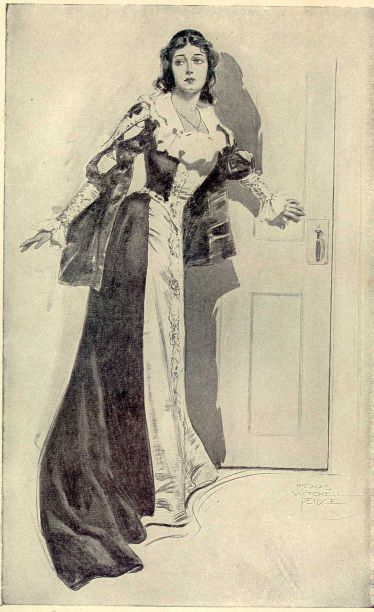
This eBook is for the use of anyone anywhere at no cost and with
almost no restrictions whatsoever.  You may copy it, give it away or
re-use it under the terms of the Project Gutenberg License included
with this eBook or online at www.gutenberg.org
Title: The Grey Cloak
Author: Harold MacGrath
Illustrator: Thomas Mitchell Peirce
Release Date: June 11, 2005 [eBook #16041]
Language: English
Character set encoding: ISO-8859-1
***START OF THE PROJECT GUTENBERG EBOOK THE GREY CLOAK***
| Chapter | |
| I | THE MAN IN THE CLOAK |
| II | THE TOILET OF THE CHEVALIER |
| III | THE MUTILATED HAND |
| IV | AN AENEAS FOR AN ACHATES |
| V | THE HORN OF PLENTY |
| VI | AN ACHATES FOR AN AENEAS |
| VII | THE PHILOSOPHY OF PERIGNY |
| VIII | THE LAST ROUT |
| IX | THE FIFTY PISTOLES |
| X | THE MASQUERADING LADIES |
| XI | THE JOURNEY TO QUEBEC |
| XII | A BALLADE OF DOUBLE REFRAIN |
| XIII | TEN THOUSAND LIVRES |
| XIV | BRETON FINDS A MARKER |
| XV | THE SUPPER |
| XVI | THE POET EXPLAINS |
| XVII | WHAT THE SHIP BRINGS |
| XVIII | THE MASTER OF IRONIES |
| XIX | A PAGE FROM MYTHOLOGY |
| XX | A WARRANT OR A CONTRACT |
| XXI | AN INGENIOUS IDEA |
| XXII | MADAME FINDS A DROLL BOOK |
| XXIII | A MARQUIS DONS HIS BALDRIC |
| XXIV | A DISSERTATION ON CHARITY |
| XXV | ORIOLES AND PREROGATIVES |
| XXVI | THE STORY OF HIAWATHA |
| XXVII | ONONDAGA |
| XXVIII | THE FLASH FROM THE FLAME |
| XXIX | A JOURNEY INTO THE HILLS |
| XXX | BROTHER JACQUES' ABSOLVO TE |
| XXXI | THE HUNTING HUT |
| XXXII | A GALLANT POET |
| XXXIII | HOW GABRIELLE DIANE LOVED |
| XXXIV | ABSOLUTION OF PERIGNY |
| XXXV | BROTHER! |
The author has taken a few liberties with the lives of various historical personages who pass through these pages; but only for the story's sake. He is also indebted to the Jesuit Relations, to Old Paris, by Lady Jackson, and to Clark's History of Onondaga, the legend of Hiawatha being taken from the last named volume.
A man enveloped in a handsome grey cloak groped through a dark alley which led into the fashionable district of the Rue de Béthisy. From time to time he paused, with a hand to his ear, as if listening. Satisfied that the alley was deserted save for his own presence, he would proceed, hugging the walls. The cobbles were icy, and scarce a moment passed in which he did not have to struggle to maintain his balance. The door of a low tavern opened suddenly, sending a golden shaft of light across the glistening pavement and casting a brilliant patch on the opposite wall. With the light came sounds of laughter and quarreling and ringing glasses. The man laid his hand on his sword, swore softly, and stepped back out of the blinding glare. The flash of light revealed a mask which left visible only the lower half of his face. Men wearing masks were frequently subjected to embarrassing questions; and this man was determined that no one should question him to-night. He waited, hiding in the shadow.
Half a dozen guardsmen and musketeers reeled out. The host reviled them for a pack of rogues. They cursed him, laughing, and went on, to be swallowed up in the darkness beyond. The tavern door closed, and once more the alley was hued with melting greys and purples. The man in the cloak examined the strings of his mask, tilted his hat still farther down over his eyes, and tested the looseness of his sword.
"The drunken fools!" he muttered, continuing. "Well for them they came not this way."
When he entered the Rue de Béthisy, he stopped, searched up and down the thoroughfare. Far away to his right he saw wavering torches, but these receded and abruptly vanished round a corner of the Rue des Fossés St-Germain l'Auxerrois. He was alone. A hundred yards to his left, on the opposite side of the street, stood a gloomy but magnificent hôtel, one of the few in this quarter that was surrounded by a walled court. The hôtel was dark. So far as the man in the grey cloak could see, not a light filled any window. There were two gates. Toward the smaller of the two the man cautiously directed his steps. He tried the latch. The gate opened noiselessly, signifying frequent use.
"So far, so good!"
An indecisive moment passed, as though the man were nerving himself for an ordeal of courage and cunning. With a gesture resigning himself to whatever might befall, he entered the court, careful to observe that the way out was no more intricate than the way in.
"Now for the ladder. If that is missing, it's horse and away to Spain, or feel the edge of Monsieur Caboche. Will the lackey be true? False or true, I must trust him. Bernouin would sell Mazarin for twenty louis, and that is what I have paid. Monsieur le Comte's lackey. It will be a clever trick. Mazarin will pay as many as ten thousand livres for that paper. That fat fool of a Gaston, to conspire at his age! Bah; what a muddled ass I was, in faith! I, to sign my name in writing to a cabal! Only the devil knows what yonder old fool will do with the paper. Let him become frightened, let that painted play-woman coddle him; and it's the block for us all, all save Gaston and Condé and Beaufort. Ah, Madame, Madame, loveliest in all France, 'twas your beautiful eyes. For the joy of looking into them, I have soiled a fresh quill, tumbled into a pit, played the fool! And a silver crown against a golden louis, you know nothing about politics or intrigue, nor that that old fool of a husband is making a decoy of your beauty. But my head cleared this morning. That paper must be mine. First, because it is a guaranty for my head, and second, because it is likely to fatten my purse. It will be simple to erase my name and substitute another's. And this cloak! My faith, it is a stroke. To the devil with Gaston and Condé and Beaufort; their ambitions are nothing to me, since my head is everything."
He tiptoed across the stone flags.
"Faith, this is a delicate operation; and the paper may be hidden elsewhere into the bargain. We venture, we lose or we win; only this is somewhat out of my line of work. Self-preservation is not theft; let us ease our conscience with this sophism … Ha! the ladder. Those twenty louis were well spent. This is droll, good heart. An onlooker would swear that this is an assignation. Eh well, Romeo was a sickly lover, and lopped about like a rose in a wind-storm. Mercutio was the man!"
He had gained the side of the hôtel. From a window above came a faint yellow haze such as might radiate from a single candle. This was the signal that all was clear. The man tested the ladder, which was of rope, and it withstood his weight. Very gently he began to climb, stopping every three or four rounds and listening. The only noise came from the armory where a parcel of mercenaries were moving about. Up, up, round by round, till his fingers touched the damp cold stone of the window ledge; the man raised himself, leaned toward the left, and glanced obliquely into the room. It was deserted. A candle burned in a small alcove. The man drew himself quickly into the room, which was a kind of gallery facing the grand staircase. A sound coming from the hall below caused the intruder to slip behind a curtain. A lackey was unbarring the door. The man in the gallery wondered why.
"My very nerves have ears," he murmured. "If I were sure … to pay madame a visit while she sleeps and dreams!" His hand grew tense around the hilt of his sword. "No; let us play Iago rather than Tarquinius; let ambition, rather than love, strike the key-note. Greed was not born to wait. As yet I have robbed no man save at cards; and as every noble cheats when he can, I can do no less. Neither have I struck a man in the back. And I like not this night's business."
On the cold and silent night came ten solemn strokes from the clock of St.-Germain l'Auxerrois. Then all was still again. The man came from behind the curtain, his naked sword flashing evilly in the flickering light. He took up the candle and walked coolly down the wide corridor. The sureness of his step could have originated only in the perfect knowledge of the topography of the hôtel. He paused before a door, his ear to the keyhole.
"She sleeps! … and the wolf prowls without the door!" He mused over the wayward path by which he had come into the presence of this woman, who slept tranquilly beyond these panels of oak. He felt a glow on his cheeks, a quickening of his pulse. To what lengths would he not go for her sake? Sure of winning her love, yes, he would become great, rise purified from the slough of loose living. He had never killed a man dishonorably; he had won his duels by strength and dexterity alone. He had never taken an advantage of a weakling; for many a man had insulted him and still walked the earth, suffering only the slight inconvenience of a bandaged arm or a tender cheek, and a fortnight or so in bed. Condé had once said of him that there was not a more courageous man in France; but he could not escape recalling Condé's afterthought: that drink and reckless temper had kept him where he was. There was in him a vein of madness which often burst forth in a blind fury. It had come upon him in battle, and he had awakened many a time to learn that he had been the hero of an exploit. He was not a boaster; he was not a broken soldier. He was a man whose violent temper had strewn his path with failures… In love! Silently he mocked himself. In love, he, the tried veteran, of a hundred inconstancies! He smiled grimly beneath his mask. He passed on, stealthily, till he reached a door guarded by two effigies of Francis I. His sword accidentally touched the metal, and the soft clang tingled every nerve in his body. He waited. Far away a horse was galloping over the pavement. He tried the door, and it gave way to his pressure. He stood in the library of the master of the hôtel. In this very room, while his brain was filled with the fumes of wine and passion, he had scribbled his name upon crackling parchment on which were such names as Gaston d'Orléans, Condé, Beaufort, De Longueville, De Retz. Fool!
Grinning from the high shelves were the Greek masks, Comedy and Tragedy. The light from the candle gave a sickly human tint to the marble. He closed the door.
"Now for the drawer which holds my head; of love, anon!"
He knelt, placing the candle on the book-ledge. Along the bottom of the shelves ran a series of drawers. These he opened without sound, searching for secret bottoms. Drawer after drawer yawned into his face, and his heart sank. What he sought was not to be found. The last drawer would not open. With infinite care and toil he succeeded in prying the lock with the point of his sword, and his spirits rose. The papers in this drawer were of no use to any one but the owner. The man in the grey cloak cursed under his breath and a thrill of rage ran through him. He was about to give up in despair when he saw a small knob protruding from the back panel of the drawer. Eagerly he touched the knob, and a little drawer slid forth.
"Mine!" With trembling fingers he unfolded the parchment. He held it close to the candle and scanned each signature. There was his own, somewhat shaky, but nevertheless his own. … He brushed his eyes, as if cobwebs of doubt had suddenly gathered there. Her signature! Hers! "Roses of Venus, she is mine, mine!" He pressed his lips to the inken line. Fortune indeed favored him … or was it the devil? Hers! She was his; here was a sword to bend that proud neck. Ten thousand livres? There was more than that, more than that by a hundred times. Passion first, or avarice; love or greed? He would decide that question later. He slipped the paper into the pocket of the cloak. Curiosity drew him toward the drawer again. There was an old commission in the musketeers, signed by Louis XIII; letters from Madame de Longueville; an unsigned lettre-de-cachet; an accounting of the revenues of the various chateaus; and a long envelope, yellow with age. He picked it out of the drawer and blew away the dust. He read the almost faded address, and his jaw fell. … "To Monsieur le Marquis de Périgny, to be delivered into his hands at my death."
He was not conscious how long a time he stared at that address. Age had unsealed the envelope, and the man in the grey cloak drew out the contents. It was in Latin, and with some difficulty he translated it. … So rapt was he over what he read, so nearly in a dream he knelt there, that neither the sound of a horse entering the court nor the stir of activity in the armory held forth a menace.
"Good God, what a revenge!" he murmured. "What a revenge!"
Twice, three times, and yet again he drank of the secret. That he of all men should make this discovery! His danger became as nothing; he forgot even the object of his thieving visit.
"Well, Monsieur?" said a cold, dry voice from the threshold.
The man in the grey cloak leaped to his feet, thrusting the letter into the pocket along with the cabal. His long rapier snarled from its scabbard, just in time. The two blades hung in mid air.
"Nicely caught," said the cold, dry voice again. "What have you to say? It is hanging, Monsieur, hanging by the neck." The speaker was a man of sixty, white of hair, but wiry and active. "Ha! in a mask, eh? That looks bad for you. You are not a common thief, then? … That was a good stroke, but not quite high enough. Well?"
"Stand aside, Monsieur le Comte," said the man in the cloak. His tones were steady; all his fright was gone.
The steel slithered and ground.
"You know me, eh?" said the old man, banteringly. His blade ripped a hole in the cloak. "You have a voice that sounds strangely familiar to my ears."
"Your ears will soon be dull and cold, if you do not let me pass."
"Was it gold, or jewels? … Jesus!" The old man's gaze, roving a hair's breadth, saw the yawning drawers. "That paper, Monsieur, or you shall never leave this place alive! Hallo! Help, men! To me, Grégoire! Help, Captain!"
"Madame shall become a widow," said the man in the mask.
Back he pressed the old man, back, back, into the corridor, toward the stairs. They could scarce see each other, and it was by instinct alone that thrust was met by parry. Up the rear staircase came a dozen mercenaries, bearing torches. The glare smote the master in the eyes, and partly dazzled him. He fought valiantly, but he was forced to give way. A chance thrust, however, severed the cords of his opponent's mask.
"You?"
There was a gurgling sound, a coughing, and the elder sank to his knees, rolled upon his side, and became still. The man in the grey cloak, holding the mask to his face, rushed down the grand staircase, sweeping aside all those who barred his path. He seemed possessed with strength and courage Homeric; odds were nothing. With a back hand-swing of his arm he broke one head; he smashed a face with the pommel; caught another by the throat and flung him headlong. In a moment he was out of the door. Down the steps he dashed, through the gate, thence into the street, a mob yelling at his heels. The light from the torches splashed him. A sharp gust of wind nearly tore the mask from his fingers. As he caught it, he ran full into a priest.
"Out of the way, then, curse you!"
Before the astonished priest, who was a young man, could rise from the pavement where the impact had sent him sprawling, the assailant had disappeared in the alley. He gained the door of the low tavern, flung it open, pushed by every one, upsetting several, all the while the bloody rapier in one hand and the mask held in place by the other. The astonished inmates of the tavern saw him leap like a huge bird and vanish through one of the windows, carrying the sash with him. But a nail caught the grey cloak, and it fluttered back to the floor. Scarce a moment had passed when the pursuers crowded in. When questioned, the stupefied host could only point toward the splintered window frame. Through this the men scrambled, and presently their yells died away in the distance.
A young man of ruddy countenance, his body clothed in the garments of a gentleman's lackey, stooped and gathered up the cloak.
"Holy Virgin!" he murmured, his eyes bulging, "there can not be two cloaks like this in Paris; it's the very same."
He crushed it under his arm and in the general confusion gained the alley, took to his legs, and became a moving black shadow in the grey. He made off toward the Seine.
Meanwhile terror stalked in the corridors of the hôtel. Lights flashed from window to window. The court was full of servants and mercenaries. For the master lay dead in the corridor above. A beautiful young woman, dressed in her night-robes, her feet in slippers, hair disordered and her eyes fixed with horror, gazed down at the lifeless shape. The stupor of sleep still held her in its dulling grasp. She could not fully comprehend the tragedy. Her ladies wailed about her, but she heeded them not. It was only when the captain of the military household approached her that she became fully aroused. She pressed her hand against her madly beating heart.
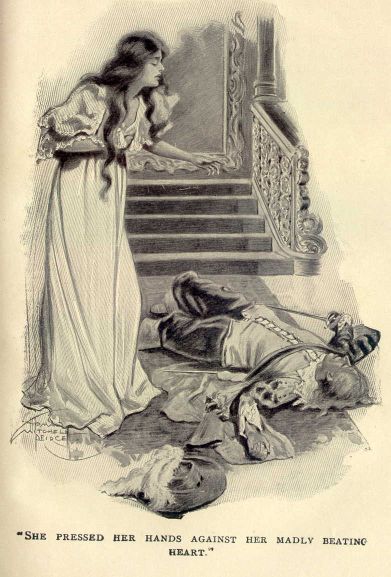
"Who did this?" she asked.
"A man in a mask, Madame," replied the captain, kneeling. He gently loosed the sword from the stiffening fingers. The master of twenty-five years was gone.
"In a mask?"
"Yes, Madame."
"And the motive ?"
"Not robbery, since nothing is disturbed about the hôtel save in monsieur's library. The drawers have all been pulled out."
With a sharp cry she crossed the corridor and entered the library. The open drawers spoke dumbly but surely.
"Gone!" she whispered. "We are all lost! He was fortunate in dying." Terror and fright vanished from her face and her eyes, leaving the one impassive and the other cold. She returned to the body and the look she cast on it was without pity or regret. Alive, she had detested him; dead, she could gaze on him with indifference. He had died, leaving her the legacy of the headsman's ax. And his play-woman? would she weep or laugh? … She was free. It came quickly and penetrated like a dry wine: she was free. Four odious years might easily be forgiven if not forgotten. "Take him to his room," she said softly. After all, he had died gallantly.
Soon one of the pursuers returned. He was led into the presence of his mistress.
"Have they found him?"
"No, Madame. He disappeared as completely as if the ground had swallowed him. All that can be added is that he wore a grey cloak."
"A grey cloak, did you say?" Her hand flew to her throat and her eyes grew wild again. "A grey cloak?"
"Yes Madame; a grey cloak with a square velvet collar."
"Ah!" said the captain, with a singular smile. He glanced obliquely at madame. But madame lurched forward into the arms of one of her waiting-women. She had fainted.
The Chevalier du Cévennes occupied the apartment on the first floor of the Hôtel of the Silver Candlestick, in the Rue Guénégaud. The apartment consisted of three rooms. In all Paris there was not to be found the like of them. They were not only elegant, they were simple; for true elegance is always closely allied to simplicity. Persian rugs covered the floors, rugs upon which many a true believer had knelt in evening prayer; Moorish tapestries hung from the walls, making a fine and mellow background for the various pieces of ancient and modern armor; here and there were Greek marbles and Italian vases; and several spirited paintings filled the gaps left between one tapestry and another. Sometimes the Chevalier entertained his noble friends, young and old, in these rooms; and the famous kitchens of Madame Boisjoli, the landlady of the Candlestick, supplied the delicacies of his tables. Ordinarily the Chevalier dined in the cheery assembly-room below; for, like all true gourmands of refinement, he believed that there is as much appetite in a man's ears and eyes as in his stomach, and to feed the latter properly there must be light, a coming and going of old and new faces, the rumor of voices, the jest, and the snatch of song.
At this moment the Chevalier was taking a bath, and was splashing about in the warm water, laughing with the joyous heart of a boy. With the mild steam rose the vague perfume of violets. Brave as a Crillon though he was, fearless as a Bussy, the Chevalier was something of a fop; not the mincing, lisping fop, but one who loved physical cleanliness, who took pride in the whiteness of his skin, the clarity of his eyes. There had been summer nights in the brilliant gardens of La Place Royale when he had been pointed out as one of the handsomest youths in Paris. Ah, those summer nights, the cymbals and trumpets of les beaux mousquetaires, the display of feathers and lace, unwrought pearls and ropes of precious stones, the lisping and murmuring of silks, the variety of colors, the fair dames with their hoods, their masks, their elaborate coiffures, the crowds in the balconies! All the celebrities of court might be seen promenading the Place; and to be identified as one above many was a plume such as all Mazarin's gold could not buy.
"My faith! but this has been a day," he murmured, gazing wistfully at his ragged nails. "Till I entered this tub there was nothing but lead in my veins, nothing but marble on my bones. Look at those boots, Breton, lad; a spur gone, the soles loose, the heels cracked. And that cloak! The mud on the skirts is a week old. And that scabbard was new when I left Paris. When I came up I looked like a swashbuckler in one of Scudéry's plays. I let no one see me. Indeed, I doubt if any would have recognized me. But a man can not ride from Rome to Paris, after having ridden from Paris to Rome, changing neither his clothes nor his horse, without losing some particle of his fastidiousness, and, body of Bacchus! I have lost no small particle of mine."
"Ah, Monsieur Paul," said the lackey, hiding the cast-off clothing in the closet, "I am that glad to see you safe and sound again!"
"Your own face is welcome, lad. What weather I have seen!" wringing his mustache and royal. "And Heaven forfend that another such ride falls my lot." He smiled at the ruddy heap in the fireplace.
What a ride, indeed! For nearly two weeks he had ridden over hills and mountains, through valleys and gorges, access deep and shallow streams, sometimes beneath the sun, sometimes beneath the moon or the stars, sometimes beneath the flying black canopies of midnight storms, always and ever toward Paris. He had been harried by straggling Spaniards; he had drawn his sword three times in unavoidable tavern brawls; he had been robbed of his purse; he had even pawned his signet-ring for a night's lodging: all because Mazarin had asked a question which only the pope could answer.
Paris at last!—Paris the fanciful, the illogical, the changeable, the wholly delightful Paris! He knew his Paris well, did the Chevalier. He had been absent thirty days, and on the way in from Fontainebleau, where he had spent the preceding night at the expense of his signet-ring, he had wondered what changes had taken place among the exiles and favorites during this time. What if the Grande Mademoiselle again headed that comic revolution, the Fronde, as in the old days when she climbed the walls at Orléans and assumed command against the forces of the king? What if Monsieur de Retz issued orders from the Palais Royal, using the same-pen with which Mazarin had demanded his resignation as Archbishop of Paris? In fact, what if Madame de Longueville, aided by the middle class, had once more taken up quarters in the Hôtel de Ville? Oh! so many things happened in Paris in thirty days that the Chevalier would not have been surprised to learn that the boy Louis had declared to govern his kingdom without the assistance of ministers, priests, and old women. Ah, that Fronde! Those had been gallant days, laughable, it is true; but every one seemed to be able to pluck a feather from the golden goose of fortune. He was eighteen then, and had followed the royal exodus to Germain.
The Chevalier sighed as he continued to absorb the genial heat of the water. The captain at the Porte Saint Antoine had told him that the Grande Mademoiselle was still in exile at Blois, writing lampoons against the court and particularly against Mazarin; that De Retz was biting his nails, full of rage and impotence against those fetters which banishment casts around men of action; that Madame de Longueville was conducting a love-intrigue in Normandy; and that Louis had to borrow or beg his pocket-money. Strange as it seemed to the Chevalier, Paris was unchanged.
But what warmed the Chevalier's heart, even as the water warmed his body, was the thought of that adorable mystery, that tantalizing, haunting mystery, the woman unknown. This very room was made precious by the fact that its air had once embraced her with a familiarity such as he had never dared assume. What a night that had been! She had come, masked; she had dined; at his protestations of love she had laughed, as one laughs who hears a droll story; and in the attempt to put his arm around her waist, the cold light flashing from her half-hidden eyes had stilled and abashed him. Why did she hold him, yet repel? What was her object? Was she some princess who had been hidden away during her girlhood, to appear only when the bud opened into womanhood, rich, glorious, and warm? Like a sunbeam, like a shadow, she flitted through the corridors and galleries of the Louvre and the Palais Royal, and whenever he had sought to point her out to some one, to discover her name, lo, she was gone! Tormenting mystery! Ah, that soft lisp of hers, those enchanting caprices, those amazing extravagances of fancy, that wit which possessed the sparkle of white chambertin! He would never forget that summer night when, dressed as a boy, she had gone with him swashbuckling along the quays. And for all these meetings, for all her supplicating or imperious notes, what had been his reward? To kiss her hand when she came, to kiss her hand when she went, and all the while her lips burned like a cardinal poppy and her eyes lured like those phantom lakes of the desert. True, he had often kissed her perfumed tresses without her knowledge; but what was that? Why had he never taken by force that which entreaty did not win? Love. Man never uses force where he loves. When would the day come when the hedge of mystery inclosing her would be leveled? "Love you, Monsieur?" she had said. "Ah, well, in a way!"
The Chevalier smiled. Yes, it was fine to be young, and rich, and in love. He recalled their first meeting. He had been placed on guard at the entrance to the grand gallery at the Palais Royal, where Mazarin was giving a mask. Presently a slender, elegant youth in the garb of a grey musketeer approached.
"Your name, Monsieur, if you please," he said, scanning the list of invited guests.
"I am one of those who pass without the interrogatory." The voice was hoarse, affectedly so; and this roused the Chevalier's suspicions.
"I can not believe that," he laughed, "since Monsieur le Duc, his Majesty's brother, was good enough to permit me to question him." He leaned against the wall, smiling and twisting his mustache. What a charming musketeer!
"What!" haughtily, "you parley with me?" A gauntleted hand flew to a jeweled hilt.
"Monsieur will not be so rude?" mockingly.
"Monsieur!" with a stamp of the foot—a charming foot.
"Monsieur!" he mimicked, also stamping a foot which, though shapely, was scarce charming.
Then through the curtain of the mask there came a low, rollicking laugh. The hand fell away from the sword-hilt, and a grey gauntlet slipped to the floor, discovering a hand as dazzling white and begemmed as that on which Anne of Austria prided herself.
"Death of my life!" said a voice as soft and musical as the vibration of a bell, "you make an admirable Cerberus. My gauntlet." The sweep of the hand fascinated him. "Are your ears like the sailors' of Ulysses, filled with wax? I am asking you to pick up my gauntlet."
As he stooped to obey the command, a laugh sounded behind him, and he knew that he had been tricked. The little musketeer had vanished. For a moment he was disturbed. In vain he searched the gauntlet for some distinguishing sign. But as reason told him that no harm could possibly come from the prank, his fears subsided, and he laughed. On being relieved from duty, later, he sought her, to return the gauntlet. She was talking to Mademoiselle de Longueville. As she saw the Chevalier, she moved away. The Chevalier, determined on seeing the adventure to its end, followed her deliberately. She sat in a window-seat. Without ceremony he sat down beside her.
"Monsieur," he said, smiling, and he was very handsome when he smiled, "permit me to return this gauntlet."
She folded her arms, and this movement of her shoulders told him that she was laughing silently.
"Are you madame or mademoiselle?" he asked, eagerly.
She raised her mask for an instant, and his subjugation was complete. The conversation which ensued was so piquant and charming that thereafter whatever warmth the gauntlet knew was gathered not from her hand but from the Chevalier's heart.
The growing chill in the water brought the Chevalier out of his reverie. He leaped from the tub and shone rosily in the firelight, as elegantly proportioned a youth as ever was that fabulous Leander of the Hellespont.
"Bring me those towels I purchased from the wandering Persian. I regret that I did not have them blessed by his Holiness. For who knows what spell the heretic Saracen may have cast over them?"
"Monsieur knows," said Breton piously, "that I have had them sprinkled with the blessed water."
The Chevalier laughed. He was rather a godless youth, and whatever religion he possessed was merely observance of forms. "Donkey, if the devil himself had offered them for sale, I should have taken them, for they pleased me; and besides, they have created a fashion. I shall wear my new baldric—the red one. I report at the Palais Royal at eight, and I've an empty stomach to attend to. Be lively, lad. Duty, duty, always duty," snatching the towels. "I have been in the saddle since morning; I am still dead with stiffness; yet duty calls. Bah! I had rather be fighting the Spaniard with Turenne than idle away at the Louvre. Never any fighting save in pothouses; nothing but ride, ride, ride, here, there, everywhere, bearing despatches not worth the paper written on, but worth a man's head if he lose them. And what about? Is this person ill? Condolences. Is this person a father? Congratulations. Monsieur, the king's uncle, is ailing; I romp to Blois. A cabal is being formed in Brussels; I gallop away. His Eminence hears of a new rouge; off I go. And here I have been to Rome and back with a message which made the pope laugh; is it true that he is about to appoint a successor? Mazarin, tiring of being a left-handed king, aspires to the mantle of Saint Peter. Mazarin always selects me for petty service. Why? Oh, Monsieur le Chevalier, having an income, need not be paid moneys; because Monsieur le Chevalier was born in the saddle, his father is an eagle, his grandsire was a centaur. And don't forget the grey cloak, lad, the apple of my eye, the admiration of the ladies, and the confusion of mine enemies; my own particular grey cloak." By this time the Chevalier was getting into his clothes; fine cambrics, silk hose, velvet pantaloons, grey doublet, and shoes with buckles and red heels.
"But the grey cloak, Monsieur Paul …" began the lackey.
"What! you have dared to soil it?"
"No, Monsieur; but you have forgotten that you loaned it to Monsieur de Saumaise, prior to your departure to Italy. He has not returned it."
"That's not like Victor. And I had dreamed of wearing that cloak. Mademoiselle complimented me on it, and that fop De Montausier asked me how many pistoles I paid for it."
"The purple cloak is new, Monsieur. It is fully as handsome as the grey one. All it lacks is the square collar you invented."
"Ah well, since there is no grey cloak. Now the gossip. First of all, my debts and debtors."
"Monsieur de Saumaise," said Breton, "has remitted the ten louis he lost to you at tennis."
"There's a friend; ruined himself to do it. Poetry and improvidence; how they cling together!"
"Brisemont, the jeweler, says that the garters you ordered will come to one hundred and ten pistoles. But he wants to know what the central gem shall be, rubies or sapphires surrounding."
"Topaz for the central gem, rubies and diamonds for the rest. The clasps must match topaz eyes. And they must be done by Monday."
"Monsieur's eyes are grey," the lackey observed slyly.
"Rascal, you are asking a question!"
"No, Monsieur, I was simply stating a fact. Plutarch says …"
"Plutarch? What next?" in astonishment.
"I have just bought a copy of Amyot's translation with the money you gave me. Plutarch is fine, Monsieur."
"What shall a gentleman do when his lackey starts to quote Plutarch?" with mock helplessness. "Well, lad, read Plutarch and profit. But keep your grimy hands off my Rabelais, or I'll trounce you."
Breton flushed guiltily. If there was one thing he enjoyed more than another it was the adventures of the worthy Pantagruel and his resourceful esquire; but he had never been able to complete this record of extravagant exploits, partly because he could not read fast enough and partly because his master kept finding new hiding places for it.
"A messenger from De Guitaut," he said, "called this morning for you."
"For me? That is strange. The captain knew that I could not arrive before to-night, which is the twentieth."
"I told the officer that. He laughed curiously and said that he expected to find you absent."
"What the devil did he call for, then?"
Breton made a grimace which explained his inability to answer this question.
The Chevalier stood still and twisted his mustache till the ends were like needle-points. "Horns of Panurge! as Victor would say; is it possible for any man save Homer to be in two places at once? Possibly I am to race for some other end of France. I like it not. Mazarin thinks because I am in her Majesty's Guards that I belong to him. Plague take him, I say."
He snapped the buckles on his shoes, while Breton drew from its worn scabbard the Chevalier's campaign rapier, long and flexile, dreaded by many and respected by all, and thrust it into the new scabbard,
"Ah, Monsieur," said Breton, stirred by that philosophy which, one gathers from a first reading of Plutarch, "a man is a deal like a sword. If he be good and true, it matters not into what kind of scabbard he is thrust."
"Aye, lad; but how much more confidence a handsome scabbard gives a man! Even a sword, dressed well, attracts the eye; and, heart of mine, what other aim have we poor mortals than to attract?"
"Madame Boisjoli makes out her charges at twelve louis, including the keep of the horses."
"That is reasonable, considering my absence. Mignon is an excellent woman."
"The Vicomte d'Halluys did not come as he promised with the eight hundred pistoles he lost to you at vingt-et-un."
"Ah!" The Chevalier studied the pattern in the rug. "Eh, well, since I had no pistoles, I have lost none. I was deep in wine, and so was he; doubtless he has forgotten. The sight of me will recall his delinquency."
"That is all of the debts and credits, Monsieur."
"The gossip, then, while I trim my nails. Paris can not have stood still like the sun of Joshua's time, simply because I was not here."
"Beaufort has made up with Madame de Montbazon."
"Even old loves can become new loves. Go on."
Breton recounted the other important court news, while the Chevalier nodded, or frowned, as the news affected him.
"Mademoiselle Catharine …"
"Has that woman been here again?"
"Yes, Monsieur."
"You attended her down the stairs?"
"I did, but she behaved coarsely and threatened not to cease coming until you had established her in the millinery."
The Chevalier roared with laughter. "And all I did was to kiss the lass and compliment her cheeks. There's a warning for you, lad."
Breton looked aggrieved. His master's gallantries never ceased to cause him secret unrest.
"Yesterday your quarterly remittance from Monsieur le Marquis, your father, arrived."
"Was there a letter?" with subdued eagerness.
"There was nothing but the gold, Monsieur," answered Breton, his eyes lowered. How many times during the past four years had his master asked this question, always to receive the same answer?
The Chevalier's shoulders drooped. "Who brought it?"
"Jehan," said the lackey.
"Had he anything to say?"
"Very little. Monsieur le Marquis has closed the chateau in Périgny and is living at the hôtel in Rochelle."
"He mentions my name?"
"No, Monsieur."
The Chevalier crossed the room and stood by one of the windows. It was snowing ever so lightly. The snow-clouds, separating at times as they rushed over the night, discovered the starry bowl of heaven. Some noble lady's carriage passed surrounded by flaring torches. But the young man saw none of these things. A sense of incompleteness had taken hold of him. The heir to a marquisate, the possessor of an income of forty thousand livres the year, endowed with health and physical beauty, and yet there was a flaw which marred the whole. It was true that he was light-hearted, always and ever ready for a rout, whether with women or with men, whether with wine or with dice; but under all this brave show there was a canker which ate with subtile slowness, but surely. To be disillusioned at the age of sixteen by one's own father! To be given gold and duplicate keys to the wine-cellars! To be eye-witness of Roman knights over which this father had presided like a Tiberius!
The Duchesse de Montbazon had been in her youth a fancy of the marquis, his father. Was it not a fine stroke of irony to decide that this son of his should marry the obscure daughter of madame?—the daughter about whom very few had ever heard? Without the Chevalier's sanction, miniatures had been exchanged. When the marquis presented him with that of Mademoiselle de Montbazon, together with his desires, he had ground the one under foot without glancing at it, and had laughed at the other as preposterous. Since that night the marquis had ceased to recall his name. The Chevalier's mother had died at his birth; thus, he knew neither maternal nor paternal love; and a man must love something which is common with his blood. Even now he would have gone half-way, had his father's love come to meet him. But no; Monsieur le Marquis loved only his famous wines, his stories, and his souvenirs. Bah! this daughter had been easily consoled. The Comte de Brissac was fully sixty. The Chevalier squared his shoulders and shifted his baldric.
With forced gaiety he turned to his lackey. "Lad, let us love only ourselves. Self-love is always true to us. We will spend our gold and play the butterfly while the summer lasts. It will be cold soon, and then … pouf! To-morrow you will take the gold and balance my accounts."
"Yes, Monsieur. Will Monsieur permit a familiarity by recalling a forbidden subject?"
"Well?"
"Monsieur le Comte de Brissac died last night," solemnly.
"What! of old age?" ironically.
"Of steel. A gallant was entering by a window, presumably to entertain madame, who is said to be young and as beautiful as her mother was. Monsieur le Comte appeared upon the scene; but his guard was weak. He was run through the neck. The gallant wore a mask. That is all I know of the scandal."
"Happy the star which guided me from the pitfall of wedded life! What an escape! I must inform Monsieur le Marquis. He will certainly relish this bit of scandal which all but happened at his own fireside. Certainly I shall inform him. It will be like caviar to the appetite. I shall dine before the effect wears off." The Chevalier put on his hat and cloak, and took a final look in the Venetian mirror. "Don't wait for me, lad; I shall be late. Perhaps to-night I shall learn her name."
Breton smiled discreetly as his master left the room. Between a Catharine of the millinery and a mysterious lady of fashion there was no inconsiderable difference.
"Monsieur Paul?" cried the handsome widow of Monsieur Boisjoli, stepping from behind the pastry counter.
"Yes, Mignon, it is I," said the Chevalier; "that is, what remains of me."
"What happiness to see you again!" she exclaimed. She turned to a waiter. "Charlot, bring Monsieur le Chevalier the pheasant pie, the ragout of hare, and a bottle of chambertin from the bin of '36."
"Sorceress!" laughed the Chevalier; "you have sounded the very soul of me. Thanks, Mignon, thanks! Next to love, what is more to a man than a full stomach? Ah, you should have seen me when I came in! And devil take this nose of mine; not even steam and water have thawed the frost from it." He chucked her under the chin and smiled comically, all of which made manifest that the relations existing between the hostess of the Candlestick and her principal tenant were of the most cordial and Platonic character.
"And you have just returned from Rome? Ah, what a terrible ride!"
"Abominable, Mignon."
"And I see you hungry!" She sighed, and her black eyes grew moist and tender. Madame Boisjoli was only thirty-two. She was young.
"But alive, Mignon, alive; don't forget that."
"You have had adventures?" eagerly; for she was a woman who loved the recital of exploits. Monsieur Boisjoli had fallen as a soldier at Charenton.
"Adventures? Oh, as they go," slapping his rapier and his pockets which had recently been very empty.
"You have been wounded?"
"Only in the pockets, dear, and in the tender quick of comfort. And will you have Charlot hasten that pie? I can smell it from afar, and my mouth waters."
"This moment, Monsieur;" and she flew away to the kitchens.
The Chevalier took this temporary absence as an opportunity to look about him. Only one table was occupied. This occupant was a priest who was gravely dining off black bread and milk served in a wooden bowl. But for the extreme pallor of his skin, which doubtless had its origin in the constant mortification of the flesh, he would have been a singularly handsome man. His features were elegantly designed, but it was evident that melancholy had recast them in a serious mold. His face was clean-shaven, and his hair clipped, close to the skull. There was something eminently noble in the loftiness of the forehead, and at the same time there was something subtly cruel in the turn of the nether lip, as though the spirit and the flesh were constantly at war. He was young, possibly not older than the Chevalier, who was thirty.
The priest, as if feeling the Chevalier's scrutiny, raised his eyes. As their glances met, casually in the way of gratifying a natural curiosity, both men experienced a mental disturbance which was at once strange and annoying. Those large, penetrating grey eyes; each seemed to be looking into his own as in a mirror.
The Chevalier was first to disembarrass himself. "A tolerably shrewd night, Monsieur," he said with a friendly gesture.
"It is the frost in the air, my son," the priest responded in a mellow barytone. "May Saint Ignatius listen kindly to the poor. Ah, this gulf you call Paris, I like it not."
"You are but recently arrived?" asked the Chevalier politely.
"I came two days ago. I leave for Rouen this night."
"What! you travel at night, and leave a cheery tavern like this?" All at once the crinkle of a chill ran across the Chevalier's shoulders. The thumb, the forefinger and the second of the priest's left hand were twisted, reddened stumps.
"Yes, at night; and the wind will be rough, beyond the hills. But I have suffered worse discomforts;" and to this statement the priest added a sour smile. He had seen the shudder. He dropped the maimed hand below the level of the table.
"You ride, however?" suggested the Chevalier.
"A Spanish mule, the gift of Father Vincent."
"Her Majesty's confessor?"
"Yes."
"You are a Jesuit?"
"I have the happiness to serve God in that order. I have just presented my respects to her Majesty and Cardinal Mazarin. I am come from America, my son, to see his Eminence in regard to the raising of funds for some new missions we have in mind; but I have been indifferently successful, due possibly to my lack of eloquence and to the fact that my superior, Father Chaumonot, was unable to accompany me to Paris. I shall meet him in Rouen."
"And so you are from that country of which I have heard so much of late—that France across the sea?" The Chevalier's tones expressed genuine interest. He could now account for the presence of the mutilated hand. Here was a man who had seen strange adventures in a strange land. "New France!" musingly.
"Yes, my son; and I am all eagerness to return."
The Chevalier laughed pleasantly. "Pardon my irrelevancy, but I confess that it excites my amusement to be called 'son' by one who can not be older than myself."
"It is a habit I acquired with the savages. And yet, I have known men of fifty to be young," said the Jesuit, his brows sinking. "I have known men of thirty to be old. Youth never leaves us till we have suffered. I am old, very old." He was addressing some inner thought rather than the Chevalier.
"Well, I am thirty, myself," said the Chevalier with assumed lightness. "I am neither young nor old. I stand on the threshold. I can not say that I have suffered since I have known only physical discomforts. But to call me 'son' …"
"Well, then," replied the priest, smiling, "since the disparity in years is so small as to destroy the dignity of the term, I shall call you my brother. All men are brothers; it is the Word."
"That is true." How familiar this priest's eyes were! "But some are rich and some are poor; beggars and thieves and cutthroats; nobly and basely born."
The Jesuit gazed thoughtfully into his bowl. "Yes, some are nobly and some are basely born. I have often contemplated what a terrible thing it must be to possess a delicate, sensitive soul and a body disowned; to long for the glories of the world from behind the bar sinister, an object of scorn, contumely and forgetfulness; to be cut away from the love of women and the affection of men, the two strongest of human ties; to dream what might and should have been; to be proved guilty of a crime we did not commit; to be laughed at, to beg futilely, always subject to that mental conflict between love and hate, charity and envy. Yes; I can think of nothing which stabs so deeply as the finger of ridicule, unmerited. I am not referring to the children of kings, but to the forgotten by the lesser nobility."
His voice had risen steadily, losing its music but gaining a thrilling intenseness. Strange words for a priest, thought the Chevalier, who had spoken with irony aforethought. Glories of the world, the love of women; did not all priests forswear these? Perhaps his eyes expressed his thought, for he noted a faint color on the priest's checks.
"I am speaking as a moral physician, Monsieur," continued the priest, his composure recovered; "one who seeks to observe all spiritual diseases in order to apply a remedy."
"And is there a remedy for a case such as you have described?" asked the Chevalier, half mockingly.
"Yes; God gives us a remedy even for such an ill."
"And what might the remedy be?"
"Death."
"What is your religious name, Monsieur?" asked the Chevalier, strangely subdued.
"I am Father Jacques, protégé of the kindly Chaumonot. But I am known to my brothers and friends as Brother Jacques. And you, Monsieur, are doubtless connected with the court."
"Yes. I am known as the Chevalier du Cévennes, under De Guitaut, in her Majesty's Guards."
"Cévennes?" the priest repeated, ruminating. "Why, that is the name of a mountain range in the South."
"So it is. I was born in that region, and it pleased me to bear Cévennes as a name of war. I possess a title, but I do not assume it; I simply draw its revenues." The Chevalier scowled at his buckles, as if some disagreeable thought had come to him.
The priest remarked the change in the soldier's voice; it had grown harsh and repellent. "Monsieur, I proceed from Rouen to Rochelle; are you familiar with that city?"
"Rochelle? Oh, indifferently."
The Jesuit plucked at his lips for a space, as if hesitant to break the silence. "Have you ever heard of the Marquis de Périgny?"
The Chevalier whirled about. "The Marquis de Périgny? Ah, yes; I have heard of that gentleman. Why do you ask?"
"It is said that while he is a bad Catholic, he is generous in his charities. Father Chaumonot and I intend to apply to him for assistance. Mazarin has not been very liberal. Ah, how little they dream of the length and breadth and riches of this France across the sea! Monsieur le Marquis is rich?"
"Rich; but a bad Catholic truly." The Chevalier laughed without merriment. "The marquis and charity? Why not oil and water? They mix equally well."
"You do not seem quite friendly toward the Marquis?" suggested Brother Jacques.
"No; I am not particularly fond of Monsieur le Marquis," patting the pommel of his sword.
"Monsieur le Marquis has wronged you?" asked the priest, a fire leaping into his eyes.
"It is a private affair, Monsieur," coldly.
"Pardon me!" Brother Jacques made a gesture of humility. He rolled the bread crumbs into a ball which he dropped into the bowl. Presently he pushed aside the bowl and rose, his long black cassock falling to his ankles. He drew his rosary through his belt and put on his shovel-shaped hat.
Again the Chevalier's attention was drawn toward the mutilated hand.
"The pastimes of savages, Monsieur," Brother Jacques said grimly, holding out his hand for inspection: "the torture of the pipe, which I stood but poorly. Well, my brother, I am outward bound, and Rouen is far away. The night is beautiful, for the wind will drive away the snow-clouds and the stars will shine brightly. Peace be with you."
"I wish you well, Monsieur," returned the Chevalier politely.
Then Brother Jacques left the Candlestick, mounted his mule, and rode away, caring as little as the Chevalier whether or not their paths should cross again.
"Monsieur le Marquis!" murmured the Chevalier, staring at the empty bowl. "So the marquis, my father, gives to the Church? That is droll. Now, why does the marquis give to the Church? He has me there. Bah! and this priest's eyes. Ah!" as he saw Madame Boisjoli returning, followed by Charlot who carried the smoking supper; "here is something that promises well."
"Brother Jacques is gone?" said madame, her eyes roving.
"Yes." The Chevalier sat down at a table.
"Monsieur Paul?" timidly.
"Well, Mignon?" smiling. Mignon was certainly good to look at.
"Did you notice Brother Jacques's eyes?"
"Do you mean to say that you, too, observed them?" with a shade of annoyance. Vanity compelled him to resent this absurd likeness.
"Immediately. It was so strange. And what a handsome priest!" slyly.
"Shall I call him back, Mignon?" laughing.
Madame exhibited a rounded shoulder.
"Bah with them all, Mignon, priests, cardinals, and journeys." And half an hour later, having demolished all madame had set before him, besides sharing the excellent chambertin, the Chevalier felt the man made whole again. The warmth of the wine turned the edge of his sterner thoughts; and at ten minutes to eight he went forth, a brave and gallant man, handsome and gaily attired, his eyes glowing with anticipating love, blissfully unconscious of the extraordinary things which were to fall to his lot from this night onward.
The distance from the Candlestick was too short for the need of a horse, so the Chevalier walked, lightly humming an old chanson of the reign of Louis XIII, among whose royal pastimes was that of shaving his courtiers:
"Alas, my poor barber,
What is it makes you sad?"
"It is the grand king Louis,
Thirteenth of that name."
He swung into the Rue Dauphin and mounted the Pont Neuf, glancing idly below at the ferrymen whose torches threw on the black bosom of the Seine long wavering threads of phantom fire. The snow-clouds had passed over, and the stars were shining; the wind was falling. The quays were white; the Louvre seemed but a vast pile of ghostly stones. The hands of the clock in the quaint water-tower La Samaritaine pointed at five to eight. Oddly enough there came to the Chevalier a transitory picture of a young Jesuit priest, winding through the bleak hills on the way to Rouen. The glories of the world, the love of women? What romance lay smoldering beneath that black cassock? What secret grief? What sin? Brother Jacques? The name signified nothing. Like all courtiers of his time, the Chevalier entertained the belief that when a handsome youth took the orders it was in the effort to bury some grief rather than to assist in the alleviation of the sorrows of mankind.
He walked on, skirting the Louvre and presently entering the courtyard of the Palais Royal. The number of flambeaux, carriages and calèches indicated to him that Mazarin was giving a party. He lifted his cloak from his shoulders, shook it, and threw it over his arm, and ascended the broad staircase, his heart beating swiftly. Would he see her? Would she be in the gallery? Would this night dispel the mystery? At the first landing he ran almost into Captain de Guitaut, who was descending.
"Cévennes?" cried the captain, frankly astounded.
"And freshly from Rome, my Captain. His Eminence is giving a party?"
"Are you weary of life, Monsieur?" asked the captain. "What are you doing here? I had supposed you to be a man of sense, and on the way to Spain. And my word of honor, you stick your head down the lion's mouth! Follow your nose, follow your nose; it is none of my affair." And the gruff old captain passed on down the stairs.
The Chevalier stared after him in bewilderment. Spain? … Weary of life? What had happened?
"Monsieur du Cévennes?" cried a thin voice at his elbow.
The Chevalier turned and beheld Bernouin, the cardinal's valet.
"Ah!" said the Chevalier. Here was a man to explain the captain's riddle. "Will you announce to his Eminence that I have returned from Rome, and also explain why you are looking at me with such bulging eyes? Am I a ghost?" The Chevalier, being rich, was one of the few who were never overawed by the grandeur of Mazarin's valet. "What is the matter?"
"Matter?" repeated the valet. "Matter? Nothing, Monsieur, nothing!" quickly. "I will this instant announce your return to monseigneur."
"One would think that I had been trying to run away," mused the Chevalier, following the valet.
Meanwhile a lackey dressed in no particular livery entered the Hôtel of the Silver Candlestick and inquired for Monsieur Breton, lackey to Monsieur le Chevalier du Cévennes. He was directed to the floor above. On hearing a knock, Breton hastily closed the book he was reading and went to the door. The hallway was so dark that he could distinguish no feature of his caller.
"Monsieur Breton?" the strange lackey inquired,
"Are you seeking me?" Breton asked diplomatically.
"I was directed to deliver this to you. It is for your master," and the stranger placed a bundle in Breton's hands. Immediately he turned and disappeared down the stairs. Evidently he desired not to be questioned.
Breton surveyed the bundle doubtfully, turned it this way and that. On opening it he was greatly surprised to find his master's celebrated grey cloak. He examined it. It was soiled and rent in several places. Breton hung it up in the closet, shaking his head.
"This is very irregular," he muttered. "Monsieur de Saumaise would never have returned it in this condition; besides, Hector would have been the messenger. What will Monsieur Paul say when he sees it?"
And, knowing that he had no cause to worry, and having not the slightest warning that his master's liberty was in danger, Breton reseated himself by the candles and continued his indulgence in stolen sweets; that is to say, he renewed the adventures of that remarkable offspring of Gargantua.
In the grand gallery of the Palais Royal stood a mahogany table, the bellying legs of which, decorated with Venetian-wrought gold, sparkled and glittered in the light of the flames that rose and fell in the gaping chimney-place. Around this table were seated four persons of note: the aging Maréchal de Villeroi, Madame de Motteville of imperishable memoirs, Anne of Austria, and Cardinal Mazarin. The Italian, having won a pile of golden louis from the soldier, was smiling amiably and building yellow pyramids, forgetful for the time being of his gouty foot which dozed on a cushion under the table. This astute politician was still a handsome man, but the Fronde and the turbulent nobility had left their imprint. There were many lines wrinkling the circle of his eyes, and the brilliant color on his cheeks was the effect of rouge and fever.
The queen gazed covetously at Mazarin's winnings. She was growing fat, and the three long curls on each side of her face in no wise diminished its width; but her throat was still firm and white, and her hands, saving their plumpness, were yet the envy of many a beautiful woman. Anne of Austria was now devoted to three things; her prayers, her hands, and her plays.
As for the other two, Madame de Motteville looked hungry and politely bored, while the old maréchal scowled at his cards.
Near-by, on a pile of cushions, sat Philippe d'Orléans, the king's brother. He was cutting horses from three-colored prints and was sailing them up the chimney. At the left of the fireplace, the dark locks of the girl mingling with the golden curls of the boy, both poring over a hook filled with war-like pictures, the one interested by the martial spirit native to his blood, the other by the desire to please, sat the boy Louis and Mademoiselle de Mancini, Mazarin's niece. From time to time the cardinal permitted his gaze to wander in their direction, and there was fatherly affection in his smile. Mazarin liked to call these gatherings "family parties."
The center of the gallery presented an animated scene. The beautiful Madame de Turenne, whose husband was the maréchal-general of the armies of France, then engaged in war against Spain, under whose banners the great Condé was meeting with a long series of defeats, the Comtesse de Soissons, the Abbé de la Rivre, Madame de Brigy, the Duc and Duchesse de Montausier,—all were laughing and exchanging badinage with the Duc de Gramont, who was playing execrably on Mademoiselle de Longueville's guitar. Surrounding were the younger courtiers and ladies, who also were enjoying the affair. There are few things which amuse young people as much as the sight of an elderly, dignified man making a clown of himself.
"Oh, Monsieur le Duc," cried Mademoiselle de Longueville, springing from the window-seat from which position she had been staring at the flambeaux below, "if you fought as badly as you play, you would never have gained the baton."
"Mademoiselle, each has its time and place, the battle and the madrigal, Homer and Voiture, and besides, I never play when I fight;" and De Gramont continued his thrumming.
Just outside the pale of this merry circle the Duc de Beaufort leaned over the chair of Madame de Montbazon, and carried on a conversation in low tones. The duchess exhibited at intervals a fine set of teeth. In the old days when the literary salons of the Hôtel de Rambouillet were at zenith, the Duchesse de Montbazon was known to be at once the handsomest and most ignorant woman in France. But none denied that she possessed a natural wit or the ability successfully to intrigue; and many were the grand sieurs who had knelt at her feet. But now, like Anne of Austria, she was devoting her time to prayers and to the preservation of what beauty remained.
"So De Brissac is dead?" said Beaufort seriously. "Ah well, we all must die. I hope he has straightened up his affairs and that his papers fall into worthy hands." The prince glanced covertly toward Mazarin. "But it was all his own fault. The idea of a man of sixty marrying a girl of seventeen, fresh from convent, and a beauty, too, they say. He deserved it."
"Beaufort, few persons deserve violent deaths," replied the duchess; and with a perceptible frown she added: "And are you aware that Madame de Brissac, of whom you speak so lightly, is my own daughter?"
Beaufort started back from the chair. "Word of honor, I had forgotten! But it was so long ago, and no one seems to have heard of her. Your daughter! Why was she never presented at court?"
"She was presented three years ago, informally. I wished it so. Monsieur, we women love to hold a surprise in reserve. When we are no longer attractive, a daughter more or less does not matter."
"Truly I had forgotten. Eh well, we can not remember everything, especially when one spends five years in Vincennes," with another furtive glance at Mazarin. "But why De Brissac? If this daughter has half the beauty you had in your youth …"
Madame frowned.
"Half the beauty you still possess …"
Madame laughed. "Take care, or it will be said that Beaufort is become a wit."
Beaufort went on serenely—"there had been many a princeling."
Madame contemplated the rosy horn on the tips of her fingers. "Monsieur le Comte was rich."
"Admitted."
"His title was old."
"Again admitted. And all very well had he been only half as old as his title, this son-in-law of yours. Your son-in-law! It reads like one of Marguerite's tender tales. The daughter is three times younger than the husband who is old enough to be the father of his wife's mother. I must tell Scarron; he will make me laugh in retelling it."
Madame's lips formed for a spiteful utterance, but what she said was: "Prison life has aged you."
"Aged me, Madame?" reproachfully. "I grow old? Never. I have found the elixir of life."
"You will give me the recipe?" softening.
"You already possess it."
"I? Pray, explain."
"We who have the faculty of learning, without the use of books, of refusing to take life seriously, of forgetting injuries,—we never grow old. We simply die."
A third person would have enjoyed this blundering, unconscious irony which in no wise disturbed madame.
"The recipe is this," continued Beaufort: "enjoy the hours as they come; borrow not in advance, but spend the hour you have; shake the past from the shoulders like a worn-out cloak; laugh at and with your enemies; and be sure you have enemies, or life's without salt."
Madame gazed dreamily at the picture-lined walls. She smiled, recalling some happy souvenir. Presently she asked: "And who is this Chevalier du Cévennes?"
"A capital soldier, a gay fellow, rich and extravagant. I do not know him intimately, but I should like to. I knew his father well. The Marquis de Périgny was …"
"The Marquis de Périgny!" interrupted the duchess, half rising from her seat. "Do you mean to tell me that the Chevalier du Cévennes is the son of the Marquis de Périgny?" For a moment her mind was confused; so many recollections awoke to life at the mention of this name. "The Marquis de Périgny!"
Beaufort smiled. "Yes. Do you not recall the gay and brilliant marquis of fifteen years ago?"
Madame colored. "You said that the past should be shaken from the shoulders like a worn-out cloak."
"True. Ah, but that mad marquis!" reminiscently. "What a man he must have been in his youth! A fatalist, for I have seen him walk into the enemy's fire, laughing. Handsome? Too handsome. Courage? He was always fighting; he was a lion. How we youngsters applauded him! He told Richelieu to his face that he would be delighted to have him visit Périgny and dance the saraband before his peasant girls. He was always breaking the edicts, and but for the king he would have spent most of his time in the Bastille. He hasn't been to court in ten years."
"And is this son handsome?"
"Handsome and rich, with the valor of a Crillon. The daughter of a Montbazon would never look at a clod. … Monks of Touraine!" he ejaculated. "I remember now. I have seen her. Madame, I compliment you."
"Beaufort, believe me when I say that my daughter and the Chevalier du Cévennes have never met face to face. I am in a position to know. Since presentation Gabrielle has not been to court, unless it has been without my knowledge. Certainly the motive must have been robbery."
"Nothing of the sort. Nothing was missing from the Hôtel de Brissac. The Chevalier is rich."
"The Chevalier? I tell you that the association is impossible. In the first place … It is of no matter," biting her lips. "I know."
"Ventre Saint Gris! as my grandfather used to say, there is but one grey cloak lined with purple satin, but one square velvet collar, a fashion which the Chevalier invented himself. Three persons saw and recognized the cloak. If the Chevalier returns, it is the Bastille and forgetfulness. Mazarin is becoming as strict as those pot-hat Puritans yonder in England. He might possibly overlook a duel in the open; but to enter a man's house by the window … What more is there to be said? And all this recalls what my father used to say. De Brissac and the Marquis de Périgny were deadly enemies. It seems that De Brissac had one love affair; Madame la Marquise while she was a Savoy princess. She loved the marquis, and he married her because De Brissac wanted her. But De Brissac evidently never had his revenge."
Madame felt that she could no longer sustain the conversation. In her own mind she was positive that her daughter and the son of her old flame had never met. A man does not fall in love with a woman after he refuses to look at her; and the Chevalier had refused to look at Gabrielle. Why? Her mind was not subtile enough to pierce the veil.
A lackey approached Beaufort.
"I was directed to give this note to your Highness." The lackey bowed profoundly and retired.
Beaufort opened the note, scanned the lines, and grew deadly pale. What he read was this: "Monsieur le Comte's private papers are missing, taken by his assailant, who entered the hôtel for that purpose. Be careful." The note was unsigned.
At this moment Bernouin approached Mazarin and whispered something in his ear.
"Impossible!" cried the cardinal.
"It is true, nevertheless," replied the valet. "He is in the anteroom."
"The fellow is a fool! Does he think to brazen it out? I shall make an example of him. De Meilleraye, take my cards, and if you lose more than ten louis! … Ladies, an affair of state," and Mazarin rose and limped into the adjoining cabinet. "Bring him into this room," he said to the valet. He then stationed two gentlemen of the musketeers behind his chair, sat down and waited, a grimace of pain twisting his lips.
Meanwhile the Chevalier entered the gallery, following Bernouin. His face wore a puzzled, troubled expression. All this ado somewhat confused him.
"He is handsome," said Madame de Montbazon; "handsomer than ever his father was."
"He is more than handsome," said Beaufort, whose astonishment was genuine; "he is brave. What the devil brings him here into the wolf's maw?"
"His innocence. You see I was correct;" and madame's face grew placid again. So satisfied was she that she did not notice Beaufort's pallor nor the fever which burned in his brilliant eyes.
When the Chevalier was ushered into Mazarin's presence he was in great perturbation. Diane had not met him in the gallery as she had fairly promised, and the young page who had played Mercury to their intrigue stared him coolly in the face when questioned, and went about his affairs cavalierly. What did it mean? He scarce saw Mazarin or the serious faces of the musketeers. With no small effort he succeeded in finding his voice.
"Monseigneur, I have the honor to report to you the success of my mission. His Holiness directed me to give you this message." He choked; he could utter no more.
Mazarin read wrongly these signs of agitation. He took the missive and laid it aside. He drummed with his fingers, a sign that he was contemplating something disagreeable.
"Monsieur, when did you arrive?" he asked.
"At six this evening, Monseigneur," answered the Chevalier listlessly … He had entered Paris with joy in his heart, but now everything seemed to be going wrong.
"Take care, Monsieur," said Mazarin, lifting a warning finger. "You arrived yesterday, secretly."
"I? Why, Monseigneur, this is the twentieth of February, the evening we agreed upon. I slept last night at the Pineapple in Fontainebleau. I repeat to you, I arrived scarce two hours ago." It was now for the first time that he noted the seriousness of the faces confronting him.
"And I repeat that you arrived last night."
"Monseigneur, that is telling me that I lie!"
"Then tell the truth." Mazarin did not particularly relish the Chevalier's haughtiness. "You were in Paris last night."
"Monseigneur, I am a gentleman. While I lack many virtues, I do not lack courage and truthfulness. When I say that I slept in Fontainebleau, I say so truthfully. Your Eminence will tell me the cause of this peculiar interrogatory. There is an accusation pending." There was no fear in the Chevalier's face, but there was pride and courage and something bordering closely on contempt.
"Very well, then," replied Mazarin icily. "You were in Paris last night. You had an appointment at the Hôtel de Brissac. You entered by a window. Being surprised by the aged Brissac, you killed him."
The musketeers, who knew the Chevalier's courage, exchanged glances of surprise and disbelief. As for the accused, he stepped back, horrified.
"Monseigneur, one or the other of us is mad! I pray God that it be myself; for it can not be possible that the first minister in France would accuse of such a crime a gentleman who not only possesses courage but pride."
"Weigh your words, Monsieur le Chevalier," warned the cardinal. The Chevalier's tone was not pleasing to his cardinal's ear.
"You ask me to weigh my words, Monseigneur?—to weigh my words?" with a gesture which caused the musketeers to draw closer to Mazarin, "Oh, I am calm, gentlemen; I am calm!" He threw his hat to the floor, drew his sword and tossed it beside the hat, and folding his arms he said, his voice full of sudden wrath—wrath, against the ironical turn of fortune which had changed his cup of wine into salt:—"Now, Monseigneur, I demand of you that privilege which belongs to and is inseparable from my house: the right to face my accusers."
"I warn you, Monsieur," said Mazarin, "I like not this manner you assume. There were witnesses, and trustworthy ones. Yon may rely upon that."
"Trustworthy? That is not possible. I did not know De Brissac. I have never exchanged a word with him."
"It is not advanced that you knew Monsieur le Comte. But there was madame, who, it is said, was at one time affianced to you." Mazarin was a keen physiognomist; and as he read the utter bewilderment written on the Chevalier's face, his own grew somewhat puzzled.
"Monseigneur, as our Lady is witness, I have never, to my knowledge, set eyes upon Madame de Brissac, though it is true that at one time it was my father's wish that I should wed Mademoiselle de Montbazon."
"Monsieur, when a man wears such fashionable clothes as you wear, he naturally fixes the memory, becomes conspicuous. Do not forget the grey cloak, Monsieur le Chevalier."
"The grey cloak?" The Chevalier's face brightened. "Why, Monseigneur, the grey cloak …" He stopped. Victor de Saumaise, his friend, his comrade in arms, Victor the gay and careless, who was without any influence save that which his cheeriness and honesty and wit gave him! Victor the poet, the fashionable Villon, with his ballade, his rondeau, his triolet, his chant-royal!—Victor, who had put his own breast before his at Lens! The Chevalier regained his composure, he saw his way clearly, and said quietly: "I have not worn my grey cloak since the king's party at Louvre. I can only repeat that I was not in Paris last night. I slept at the Pineapple at Fontainebleau. Having no money, I pawned my ring for a night's lodging. If you will send some gentleman to make inquiries, the truth of my statement will be verified." There was now no wrath in the Chevalier's voice; but there was a quality of resignation in it which struck the acute ear of the cardinal and caused him to raise his penciled brows.
"Monsieur, you are hiding something," he said quickly, even shrewdly.
"I?"
"You, Monsieur. I believe that you slept in Fontainebleau. But who wore your grey cloak?"
"I can not say truthfully because I do not know."
"Take care!"
"I do not know who wore my cloak."
"A while back you said something about truth. You are not telling it now. I will know who killed De Brissac, an honored and respected gentleman, whatever his political opinions may have been in the past. It was an encounter under questionable circumstances. The edict reads that whosoever shall be found guilty of killing in a personal quarrel shall be subject to imprisonment or death. The name of the man who wore your cloak, or I shall hold you culpable and punish you in his stead."
The Chevalier stooped and recovered his hat, but he did not touch the sword.
"It is impossible for me to tell you, Monseigneur. I do not know. The cloak may have been stolen and worn by some one I never saw."
"To whom did you lend the cloak?"
"To tell that might bring another innocent man under a cloud. Besides, I have been absent thirty days; that is a long time to remember so trivial a thing."
"Which is to say that you refuse to tell me?" not without some admiration.
"It is," quietly.
"Your exoneration for the name, Chevalier. The alternative is your resignation from the Guards and your exile."
Exile from Paris was death to the courtier; but the Chevalier was more than a courtier, he was a soldier. "I refuse to tell you, Monseigneur. It is unfair of you to ask me."
"So be it. For the sake of your father, the marquis,—and I have often wondered why you never assume your lawful title,—for the sake of your father, then, who is still remembered kindly by her Majesty, I shall not send you to the Bastille as was my original intention. Your exile shall be in the sum of five years. You are to remain in France. If you rebel and draw your sword against your country, confiscation and death. You are also prohibited from offering your services to France against any nation she may be at war with. If within these five years you set foot inside of Paris, the Bastille, with an additional three years."
"Monseigneur, that is severe punishment for a man whose only crime is the possession of a grey cloak."
"Death of my life! I am not punishing you; I am punishing the man who killed De Brissac. Come, come, Monsieur le Comte," in a kindly tone; "do not be a fool, do not throw away a brilliant career for the sake of a friendship. I who know tell you that it is not worth while. Friendship, I have learned, is but a guise for self-interest."
The Chevalier, having nothing to say, bowed.
"Go, then, to your estates." Mazarin was angry. "Mark me, I shall find this friend of yours, but I shall not remit one hour of your punishment. Messieurs," turning to the musketeers, "conduct Monsieur le Chevalier to his lodgings and remain with him till dawn, when you will show him the road to Orléans. And remember, he must see no one." Then Mazarin went back to the gallery and resumed his game. "What! De Meilleraye, you have won only three louis? Give me the cards; and tell his Grace of Gramont that I am weary of his discords."
"Monsieur le Chevalier," said one of the musketeers, waking the Chevalier from his stupor, "pardon us a disagreeable duty."
The other musketeer restored the Chevalier's rapier.
"Proceed, Messieurs," said the Chevalier, picking up his hat and thrusting his sword into its scabbard; "I dare say this moment is distasteful to us all."
The musketeers conducted him through the secret staircase to the court below. The Duc de Beaufort, who had been waiting, came forward.
"Stand back, Messieurs," said the prince; "I have a word to say to Monsieur le Chevalier."
Mazarin's word was much, but the soldier loved his Beaufort. The two musketeers withdrew a dozen paces.
"Monsieur," said the duke lowly, "that paper, and my word as a gentleman, you shall go free."
"Paper? I do not understand your Highness."
"Come, come, Monsieur," said the duke impatiently; "it is your liberty. Besides, I am willing to pay well."
"Your Highness," coldly, "you are talking over my head. I do not understand a word you say."
Beaufort stared into the Chevalier's face. "Why did you enter De Brissac's … ?"
"I have explained all that to monseigneur, the cardinal. Is everybody mad in Paris?" with a burst of anger. "I arrive in Paris at six this evening, and straightway I am accused of having killed a man I have seen scarce a half dozen times in my life. And now your Highness talks of papers! I know nothing about papers. Ask Mazarin, Monsieur. Mazarin knows that I was not in Paris yesterday."
"What!" incredulously.
"Messieurs," called the Chevalier. The musketeers returned. "Tell his Highness for me that monseigneur acquits me of all connection with the De Brissac affair, and that I am being punished and exiled because I happen to possess a grey cloak."
"It is true, your Highness."
"Whom are you shielding?" demanded the prince with an oath. He was alarmed.
"Since I refused to tell his Eminence it is not probable that I shall tell your Highness."
Beaufort left in a rage. The prince's lackey spent a most uncomfortable hour that night when his Highness, son of Monsieur le Duc de Vendôme, retired.
The Chevalier espied a yellow calèche, Mademoiselle de Longueville herself in the act of entering it. Mademoiselle was the only person he knew to be in the confidence of Diane.
"Messieurs, will you permit me to speak to Mademoiselle de Longueville?" he asked.
"Do you think that monsieur can see mademoiselle?" said one to the other, humorously.
"It is too dark for him to see her. His Eminence said nothing about Monsieur le Chevalier speaking to any one he could not see."
"Thanks, Messieurs, thanks!" And the Chevalier hastened to the calèche. "Mademoiselle …"
"Monsieur," she interrupted, "I have a message for you. A certain lady whom we both know requests me to say that she forbids you further to address her. Her reasons … Well, she gives none. As for me, Monsieur, I believe you to be a gentleman and a man of honor who is above exile and calumny."
"God bless you, Mademoiselle. Tell her for me that whatever her indictments are, I am innocent; and that we do not love when we do not trust."
She gave him a curious glance. "You have not yet discovered who she is?"
"No, Mademoiselle. Will you tell me?"
"She is … No; to tell you would be wrong and it would do you no good. Forget her, Chevalier. I should." And she drew the curtain and ordered her lackeys to drive on.
"It is snowing," said the Chevalier, irrelevantly, when the musketeers rejoined him.
"So it is, so it is," one replied. "Put on your hat, Monsieur, or my word for it, you will catch a devil of a chill."
The Chevalier put on his hat. "Five years … his Eminence said five years?"
"Yes, Monsieur. But what are five years to a man like yourself? You have youth and money, and the little Rochellaises are pretty. My word! the time will pass quickly enough. Come; we will go to your lodging. Did his Eminence say anything about wine, Georges?" to his companion.
"Nothing prohibitory. I once heard him say 'Bonum vinum laetificat cor hominis.'"
"What does that mean?"
"Good wine rejoices the heart of man. Let us watch for the dawn with the Chevalier, who is a man in all things. Monsieur, whoever your friend may be, I hope he is not without gratitude."
"Yes, yes! Let's off to the Chevalier's. The Candlestick has some fine burgundy. It is cold and wine warms the heart."
The Chevalier burst into a despairing laugh, "Wine! That is the word, my comrades. On to the Candlestick!" he cried in a high voice. He caught the musketeers by the arms and dragged them toward the gate. "Wine rejoices the heart of man: and one forgets. Let Mazarin take away my liberty; praise be to Bacchus, he can not take away my thirst! And oh! I shall be thirsty these five long years. On to the Candlestick! I know a mellow vintage; and we three shall put the candle out to-night."
And the three of them made off for the Candlestick.
Dawn. A Swiss leaned sleepily against one of the stone abutments which supported the barriers of the Porte Saint Antoine. These barriers would not be raised for the general public till nine; yet the Swiss, rubbing his gummed eyes, saw the approach of three men, one of whom was leading a handsome Spanish jennet. The three men walked unevenly, now and then laughing uproariously and slapping one another on the back. Presently one stepped upon a slippery cobble and went sprawling into the snow, to the great merriment of his companions, who had some difficulty in raising the fallen man to his feet.
"Go along with you, Messieurs," said the Swiss enviously; "you are all drunk."
"Go along yourself," said Georges, assuming a bacchanalian pose.
"What do you want?" asked the Swiss, laughing.
"To pass this gentleman out of the city," said Georges; "and here is the order."
"Very good," replied the Swiss.
The Chevalier climbed into the saddle. Breton was to follow with the personal effects. The barriers creaked, opened the way, and the Chevalier passed forth. There was a cheering word or two, a waving of hats, and then the barriers fell back into place. A quarter of a mile away, having reached an elevation, the exile stopped his horse and turned in the saddle. As he strained his bloodshot eyes toward the city, the mask of intoxication fell away from his face, leaving it worn and wretched. The snow lay everywhere, white, untrampled, blinding. The pale yellow beams of the sun broke in brilliant flashes against the windows of the Priory of Jacobins, while above the city, the still sleeping city, rose long spiral threads of opal-tinted smoke.
Five years. And for what? Friendship. How simple to have told Mazarin that he had loaned the cloak to Victor de Saumaise. A dozen words. His head was throbbing violently and his throat was hot. He took off his hat and the keen air of morning cooled his damp forehead. Five years. He could see this year drag itself to its dismal end, and another, and another, till five had come and gone, each growing infinitely longer and duller and more hopeless. Of what use were youth and riches without a Paris? Friendship? Was he not, as Mazarin had pointed out, a fool for his pains? It was giving away five years of life and love. A word? No. He straightened in the saddle, and the fumes of wine receded from his brain, leaving a temporary clearness. Yes, he was right, a hundred times right. Victor would have done the same for him, and he could do no less for Victor. And there was something fine and lofty in the sacrifice to him who until now had never sacrificed so much as an hour from his worldly pleasures. It appealed to all that was good in him, leaving a wholesomeness in his heart that was tonic and elevating.
And yet … How strongly her face appeared before him! If only he could have stayed long enough to explain to her, to convince her of his loyalty; ah, then would this exile be a summer's rustication. He fumbled at his throat and drew forth a ruby-studded miniature. He kissed it and hid it from sight. By proxy she had turned him aside in contempt. Why? What had he done? … Did she think him guilty of De Brissac's death? or, worse still, of conducting an intrigue with Madame de Brissac, whom he had never seen?
"Ah, well, Victor offered his life for mine. I can do no less than give him five years in exchange. And where is yesterday?" He had passed along this very road yesterday. "Eh, where indeed is yesterday?"
He looked once more toward Paris, then turned his back toward it forever.
Night, with fold on fold of ragged purple, with wide obliterating hand, came roughly down upon the ancient city of Rochelle, which seemed slowly to draw itself together and assume the proportions of a huge, menacing rock. Of the roof lines, but lately of many hues and reaches, there now remained only a long series of grotesque black profiles which zigzagged from north to south, from ruined wall to ruined wall. The last dull silver gleam of day trembled a moment on the far careening horizon, then vanished; and presently the storm which had threatened all through the day broke forth, doubly furious. A silent stinging snow whipped in from the sea, and the lordly voices of the surges rose to inharmonious thunders in the straits of Antioch, or burst in rugged chorus against the rock-bound coasts of the gloomy promontory and the isles of Ré and Oléron. As the vigor of the storm increased, the harbor towers Saint Nicholas and the Chain, looming in the blur like suppliant arms, and the sea walls began gradually to waver and recede in the accumulating haze, while across the dim yellow flame in the tower of the Lantern the snow flurried in grey, shapeless, interminable shadows. Hither and thither the wind rushed, bold and blusterous, sometimes carrying landward the intermittent crashing of the surf as it fell, wrathful yet impotent, on the great dike by which, twenty-odd years before, the immortal Richelieu had snuffed the last heroic spark of the Reformists.
The little ships, the great ships, the fisherman's sloop, the king's corvette, and the merchantman, all lay anchored in the basin and harbor, their prows boring into the gale, their crude hulls rising and falling, tossing and plunging, tugging like living things at their hempen cables. The snow fell upon them, changing them into phantoms, all seemingly eager to join in the mad revel of the storm. And the lights at the mastheads, swooping now downward, now upward, now from side to side, dappled the troubled waters with sickly gold. A desert of marshes behind it, a limitless sea before it, gave to this brave old city an isolation at once splendid and melancholy; and thrice melancholy it stood this wild March night, witnessing as it did the final travail of winter, pregnant with spring.
At seven o'clock the ice-clad packet from Dieppe entered the harbor and dropped anchor. Among those who disembarked were two Jesuit priests and an Iroquois Indian, who immediately set out for the episcopal palace. They passed unobserved through the streets, for the blinding, whirling snow turned them into shadow-shapes, or effaced them totally from sight. Besides, wayfarers were few and the hardy mariners had by this time sought the warm chimney in the favorite inn. For well they knew that there were times when God wished to be alone with His sea; and he was either a poor Catholic or a bad Huguenot who refused to be convinced that the Master had contrived the sea and the storm for His own especial pastime.
The favorite inn! What a call to food and wine and cheer the name of the favorite inn sounded in the ears of the mariners! It meant the mantle of ease and indolence, a moment in which again to feel beneath one's feet the kindly restful earth. For in those days the voyages were long and joyless, fraught with the innumerable perils of outlawed flags and preying navies; so that, with all his love of the sea, the mariner's true goal was home port and a cozy corner in the familiar inn. There, with a cup of gin or mulled wine at his elbow and the bowl of a Holland clay propped in a horny fist, he might listen tranquilly to the sobbing of the tempest in the gaping chimney. What if the night voiced its pains shrewdly, walls encompassed him; what if its frozen tears melted on the panes or smoked on the trampled threshold, glowing logs sent forth a permeating heat, expanding his sense of luxury and content. What with the solace of the new-found weed, and the genial brothers of the sea surrounding, tempests offered no terrors to him.
Listen. Perhaps here is some indomitable Ulysses, who, scorning a blind immortalizer, recites his own rude Odyssey. What exploits! What adventures on the broad seas and in the new-found wildernesses of the West! Ah, but a man was a man then; there were no mythic gods to guide or to thwart him; and he rose or fell according to the might of his arm and the length of his sword. Hate sought no flimsy pretexts, but came forth boldly; love entered the lists neither with caution nor with mental reservation; and favor, though inconsiderate as ever, was not niggard with her largess. Truly the mariner had not to draw on his imagination; the age of which he was a picturesque particle was a brave and gallant one: an Odyssey indeed, composed of Richelieus, sons and grandsons of the great Henri, Buckinghams, Stuarts, Cromwells, Mazarins, and Monks; Maries de Medicis, Annes of Austria, Mesdames de Longueville; of Royalists, Frondeurs, and Commonwealth; of Catholics, Huguenots, and Puritans. Some were dead, it is true; but never a great ship passes without leaving a turbulent wake. And there, in the West, rising serenely above all these tangles of civil wars and political intrigues, was the splendid star of New France. Happy and envied was the mariner who could tell of its vast riches, of its endless forests, of its cruel brown savages, of its mighty rivers and freshwater seas.
New France! How many a ruined gamester, hearing these words, lifted his head, the fires of hope lighting anew in his burnt-out eyes? How many a fallen house looked longingly toward this promised land? New France! Was not the name itself Fortune's earnest, her pledge of treasures lightly to be won? The gamester went to his garret to dream of golden dice, the fallen noble of rehabilitated castles, the peasant of freedom and liberty. Even the solemn monk, tossing on his pallet, pierced with his gaze the grey walls of his monastery, annihilated the space between him and the fruitful wilderness, and saw in fancy the building of great cities and cathedrals and a glittering miter on his own tonsured head.
In that day there was situate in the Rue du Palais, south of the harbor, an inn which was the delight of all those mariners whose palates were still unimpaired by the brine of the seven seas, and whose purses spoke well of the hazards of chance. Erected at the time when Henri II and Diane de Poitiers turned the sober city into one of licentious dalliance, it had cheered the wayfarer during four generations. It was three stories high, constructed of stone, gabled and balconied, with a roof which resembled an assortment of fanciful noses. Here and there the brown walls were lightened by patches of plaster and sea-cobble; for though the buildings in the Rue du Palais had stood in the shelter of the walls and fortifications, few had been exempt from Monseigneur the Cardinal's iron compliments to the Huguenots.
Swinging on an iron bar which projected from the porticoed entrance, and supported by two grimacing cherubs, once daintily pink, but now verging on rubicundity, a change due either to the vicissitudes of the weather or to the close proximity to the wine-cellars,—was a horn of plenty, the pristine glory of which had also departed. This invitation often excited the stranger's laughter; but the Rochellais themselves never laughed at it, for to them it represented a familiar object, which, however incongruous or ridiculous, is always dear to the human heart. At night a green lantern was attached to the horn. At the left of the building was a walled court pierced by a gate which gave entrance to the stables. For not only the jolly mariners found pleasure at the Corne d'Abondance. The wild bloods of the town came thither to riot and play, to junket and carouse. The inn had seen many a mad night, and on the stone flooring lay written many an invisible epitaph.
The host himself was a man of note, one Jean le Borgne, whose cousin was the agent of D'Aunay in the Tour-D'Aunay quarrel over Acadia in New France. He had purchased the inn during the year '29, and since that time it had become the most popular in the city; and as a result of his enterprise, the Pomme de Pin, in the shadow of the one remaining city gate, Porte de la Grosse-Horloge, had lost the patronage of the nobility. Maître le Borgne recognized the importance of catering more to the jaded palate than to the palate in normal condition; hence, his popularity. In truth, he had the most delectable vintages outside the governor's cellars; they came from Bordeaux, Anjou, Burgundy, Champagne, and Sicily. His cook was an excommunicated monk from Touraine, a province, according to the merry Vicar of Meudon, in which cooks, like poets, were born, not bred. His spits for turning a fat goose or capon were unrivaled even in Paris, whither his fame had gone through a speech of the Duc de Rohan, who said, shortly after the siege, that if ever he gained the good graces of Louis, he would come back for that monk.
What a list he placed before the gourmand! There were hams boiled in sherry or madeira with pistachios, eels, reared in soft water and fed on chickens' entrails and served with anchovy paste and garlic, fried stuffed pigs' ears, eggs with cocks' combs, dormice in honey, pigeons with mushrooms, crabs boiled in sherry, crawfish and salmon and lobster, caviar pickled in the brine of spring-salt, pheasants stuffed with chestnuts and lambs' hearts, grainless cheeses, raisins soaked in honey and brandy, potted hare, chicken sausages, mutton fed on the marshes, boars boned and served whole and stuffed with oysters,—a list which would have opened the eyes of such an indifferent eater as Lucullus!
There was a private hall for the ladies and the nobly born; but the common assembly-room was invariably chosen by all those who were not accompanied by ladies. The huge fireplace, with high-backed benches jutting out from each side of it, the quaint, heavy bowlegged tables and chairs, the liberality of lights, the continuous coming and going of the brilliantly uniformed officers stationed at Fort Louis, the silks and satins of the nobles, the soberer woolens of the burghers and seamen, all combined to give the room a peculiar charm and color. Thus, with the golden pistole of Spain, the louis and crown and livre of France, and the stray Holland and English coins, Maître le Borgne began quickly to gorge his treasure-chests; and no one begrudged him, unless it was Maître Olivet of the Pomme de Pin.
Outside the storm continued. The windows and casements shuddered spasmodically, and the festive horn and cherubs creaked dismally on the rusted hinges. The early watch passed by, banging their staffs on the cobbles and doubtless cursing their unfortunate calling. Two of them carried lanterns which swung in harmony to the tread of feet, causing long, weird, shadowy legs to race back and forth across the sea-walls. The muffled stroke of a bell sounded frequently, coming presumably from the episcopal palace, since the historic bell in the Hôtel de Ville was permitted no longer to ring.
Inside the tavern it was warm enough. Maître le Borgne, a short, portly man with a high benevolent crown, as bald as the eggs he turned into omelets, stood somewhat back from the roaring chimney, one hand under his ample apron-belt, the other polishing his shining dome. He was perplexed. Neither the noise of the storm nor the frequent clatter of a dish as it fell to the floor disturbed him. A potboy, rushing past with his arms full of tankards, bumped into the landlord; but not even this aroused him. His gaze wandered from the right-hand bench to the left-hand bench, and back again, from the nut-brown military countenance of Captain Zachary du Puys, soldier of fortune, to the sea-withered countenance of Joseph Bouchard, master of the good ship Saint Laurent, which lay in the harbor.
"A savage!" said the host.
The soldier lowered his pipe and laughed. "Put your fears aside, good landlord. You are bald; it will be your salvation."
"Still," said the mariner, his mouth serious but his eyes smiling, "still, that bald crown may be a great temptation to the hatchet. The scalping-knife or the hatchet, one or the other, it is all the same."
"Eye of the bull! does he carry his hatchet?" gasped the host, cherishing with renewed tenderness the subject of their jests. "And an Iroquois, too, the most terrible of them all, they say. What shall I do to protect my guests?"
Du Puys and Bouchard laughed boisterously, for the host's face, on which was a mixture of fear and doubt, was as comical as a gargoyle.
"Why not lure him into the cellar and lock him there?" suggested Bouchard.
"But my wines?"
"True. He would drink them. He would also eat your finest sausages. And, once good and drunk, he would burn down the inn about your ears." Bouchard shook his head.
"Our Lady!"
"Or give him a bed," suggested Du Pays.
"What! a bed?"
"Surely, since he must sleep like other human beings."
"With an eye open," supplemented Bouchard. "I would not trust an Iroquois, saving he was dead and buried in consecrated ground." And he wagged his head as if to express his inability to pronounce in words his suspicions and distrust.
"And his yell will congeal the blood in thy veins," said Du Puys; "for beside him the Turk doth but whisper. I know; I have seen and fought them both."
Maître le Borgne began to perspire. "I am lost! But you, Messieurs, you will defend yourselves?"
"To the death!" both tormentors cried; then burst into laughter.
This laughter did not reassure Maître le Borgne, who had seen Huguenots and Catholics laughing and dying in the streets.
"Ho, Maître, but you are a droll fellow!" Bouchard exclaimed. "This Indian is accompanied by Fathers Chaumonot and Jacques. It is not impossible that they have relieved La Chaudière Noire of his tomahawk and scalping-knife. And besides, this is France; even a Turk is harmless here. Monsieur the Black Kettle speaks French and is a devout Catholic."
"A Catholic?" incredulously.
"Aye, pious and abstemious," with a sly glance at the innkeeper, who was known to love his wines in proportion to his praise of them.
"The patience of these Jesuits!" the host murmured, breathing a long sigh, such as one does from whose shoulders a weight has been suddenly lifted. "Ah, Messieurs, but your joke frightened me cruelly. And they call him the Black Kettle? But perhaps they will stay at the episcopal palace, that is, if the host from Dieppe arrives to-night. And who taught him French?"
"Father Chaumonot, who knows his Indian as a Turk knows his Koran."
"And does his Majesty intend to make Frenchmen of these savages?"
"They are already Frenchmen," was the answer. "There remains only to teach them how to speak and pray like Frenchmen."
"And he will be quiet and docile?" ventured the inn-keeper, who still entertained some doubts.
"If no one offers him an indignity. The Iroquois is a proud man. But I see Monsieur Nicot calling to you; Monsieur Nicot, whose ancestor, God bless him! introduced this weed into France;" and Du Puys refilled his pipe, applied an ember, took off his faded baldric and rapier, and reclined full length on the bench. Maître le Borgne hurried away to attend to the wants of Monsieur Nicot. Presently the soldier said: "Shall we sail to-morrow, Master Mariner?"
"As the weather wills." Bouchard bent toward the fire and with the aid of a pair of tongs drew forth the end of a broken spit, white with heat. This he plunged into a tankard of spiced port; and at once there arose a fragrant steam. He dropped the smoking metal to the floor, and drank deeply from the tankard. "Zachary, we shall see spring all glorious at Quebec, which is the most beautiful promontory in all the world. Upon its cliffs France will build her a new and mighty Paris. You will become a great captain, and I shall grow as rich as our host's cousin."
"Amen; and may the Holy Virgin speed us to the promised land." Du Puys blew above his head a winding cloud of smoke. "A brave race, these black cassocks; for they carry the Word into the jaws of death. Ad majorem Dei gloriam. There was Father Jogues. What privations, what tortures he endured! And an Iroquois sank a hatchet into his brain. I have seen the Spaniard at his worst, the Italian, the Turk, but for matchless cruelty the Iroquois has no rival. And this cunning Mazarin promises and promises us money and men, while those who reckon on his word struggle and die. Ah well, monseigneur has the gout; he will die of it."
"And this Marquis de Périgny; will not Father Chaumonot waste his time?" asked the mariner.
"Who can say? The marquis is a strange man. He is neither Catholic nor Huguenot; he fears neither God nor the devil. He laughs at death, since to him there is no hereafter. Yet withal, he is a man of justice and of many generous impulses. But woe to the man who crosses his path. His peasants are well fed and clothed warmly; his servants refuse to leave him. He was one of the gayest and wildest courtiers in Paris, a man who has killed twenty men in duels. There are two things that may be said in his favor; he is without hypocrisy, and is an honest and fearless enemy. Louis XIII was his friend, the Duc de Rohan his comrade. He has called Gaston of Orléans a coward to his face.
"He was one of those gallants who, when Richelieu passed an edict concerning the loose women of the city, placed one in the cardinal's chamber and accused him of breaking his own edict. Richelieu annulled the act, but he never forgave the marquis for telling the story to Madame de Montbazon, who in turn related it to the queen. The marquis threw his hat in the face of the Duc de Longueville when the latter accused him of receiving billets from madame. There was a duel. The duke carried a bad arm to Normandy, and the marquis dined a week with the governor of the Bastille. That was the marquis's last affair. It happened before the Fronde. Since then he has remained in seclusion, fortifying himself against old age. His hôtel is in the Rue des Augustines, near the former residence of Henri II.
"The marquis's son you have seen—drunk most of the time. Happy his mother, who died at his birth. 'Tis a pity, too, for the boy has a good heart and wrongs no one but himself. He has been sent home from court in disgrace, though what disgrace no one seems to know. Some piece of gallantry, no doubt, which ended in a duel. He and his father are at odds. They seldom speak. The Chevalier, having money, drinks and gambles. The Vicomte d'Halluys won a thousand livres from him last night in the private assembly."
"Wild blood," said Bouchard, draining his tankard. "France has too much of it. Wine and dicing and women: fine snares the devil sets with these. How have you recruited?"
"Tolerably well. Twenty gentlemen will sail with us; mostly improvident younger sons. But what's this turmoil between our comrade Nicot and Maître le Borgne?" sliding his booted legs to the floor and sitting upright.
Bouchard glanced over his shoulder. Nicot was waving his arms and pointing to his vis-à-vis at the table, while the innkeeper was shrugging and bowing and spreading his hands.
"He leaves the table," cried Nicot, "or I leave the inn."
"But, Monsieur, there is no other place," protested the maître; "and he has paid in advance."
"I tell you he smells abominably of horse."
"I, Monsieur?" mildly inquired the cause of the argument. He was a young man of twenty-three or four, with a countenance more ingenuous than handsome, expressive of that mobility which is inseparable from a nature buoyant and humorous.
"Thousand thunders, yes! Am I a gentleman, and a soldier, to sit with a reeking stable-boy?"
"If I smell of the horse," said the young man, calmly helping himself to a quarter of rabbit pie, "Monsieur smells strongly of the ass."
Whereupon a titter ran round the room. This did not serve to mollify the anger of the irascible Nicot, whose hand went to his sword.
"Softly, softly!" warned the youth, taking up the carving knife and jestingly testing the edge with his thumb-nail.
Some one laughed aloud.
"Monsieur Nicot, for pity's sake, remember where you are!" Maître le Borgne pressed back the soldier.
"Ah! it is Monsieur Nicot who has such a delicate nose?" said the youth banteringly. "Well, Monsieur Nicot, permit me to finish this excellent pie. I have tasted nothing half so good since I left Paris."
"Postilion!" cried Nicot, pushing Le Borgne aside.
"Monsieur," continued the youth imperturbably, "I am on the king's service."
Several at the tables stretched their necks to observe the stranger. A courier from the king was not an everyday event in Rochelle. De Puys rose.
"Pah!" snorted Nicot; "you look the groom a league off. Leave the table."
"All in good time, Monsieur. If I wear the livery of a stable-boy, it is because I was compelled by certain industrious gentlemen of the road to adopt it in exchange for my own. The devil! one does not ride naked in March. They left me only my sword and papers and some pistoles which I had previously hidden in the band of my hat. Monsieur, I find a chair; I take it. Having ordered a pie, I eat it; in fact, I continue to eat it, though your displeasure causes me great sorrow. Sit down, or go away; otherwise you will annoy me; and I warn you that I am something terrible when I am annoyed." But the good nature on his face belied this statement.
"Rascal, I will flog you with the flat of my sword!" roared Nicot; and he was about to draw when a strong hand restrained him.
"Patience, comrade, patience; you go too fast." Du Puys loosened Nicot's hand.
The young man leaned back in his chair and twirled the ends of his blond mustache. "If I were not so tired I could enjoy this comedy. Horns of Panurge! did you Huguenots eat so many horses that your gorge rises at the smell of one?"
"Monsieur, are you indeed from the king?" asked Du Puys courteously. The very coolness of the stranger marked him as a man of importance.
"I have that honor."
"May I be so forward as to ask your name?"
"Victor de Saumaise, cadet in her Majesty's Guards, De Guitaut's company."
"And your business?"
"The king's, Monsieur; horns of Panurge, the king's! which is to say, none of yours." This time he pushed back his chair, stood upon his feet and swung his sword in place. "Is this once more a rebel city? And are you, Monsieur, successor to Guibon, the mayor, or the governor of the province, or some equally distinguished person, to question me in this fashion? I never draw my sword in pothouses; I simply dine in them; otherwise I should be tempted to find out why a gentleman can not be left in peace."
"Your reply, Monsieur," returned Du Puys, coloring, "would be entirely just were it not for the fact that a messenger from Paris directly concerns me. I am Captain Zachary du Puys, of Fort Louis, Quebec."
"Indeed, Captain," said De Saumaise, smiling again, "that simplifies everything. You are one of the gentlemen whom I am come to seek."
"Monsieur," said the choleric Nicot, "accept my apologies; but, nevertheless, I still adhere to the statement, that you smell badly of wet horses." He bowed.
"And I accept the apology and confess to the impeachment."
"And besides," said Nicot, naively, "you kicked my shin cruelly."
"What! I thought it was the table-leg! It is my turn to apologise. You no longer crave my blood?"
"No, Monsieur," sadly. Every one laughed.
Maître le Borgne, wiped his perspiring forehead and waited for the orders which were likely to follow this amicable settlement of the dispute; and bewailed not unwisely. Brawls were the bane of his existence, and he did his utmost to prevent them from becoming common affairs at the Corne d'Abondance. He trotted off to the cellars, muttering into his beard. Nicot and the king's messenger finished their supper, and then the latter was led to one of the chimney benches by Du Puys, who was desirous of questioning him.
"Monsieur," began De Saumaise, "I am told that I bear your commission as major." He produced a packet which he gave to the captain.
"I am perfectly aware of that. It was one of Mazarin's playful devices. I was to have had it while in Paris; and his Eminence put me off for no other reason than to worry me. Ah, well, he has the gout."
"And he has also the money," laughed Victor; "and may he never rid himself of the one till he parts from the other. But I congratulate you, Major; and her Majesty and Father Vincent de Paul wish you well in your perilous undertaking. Come; tell me about this wonderful New France. Is it true that gold is picked up as one would pick up sand?"
"By the Hundred Associates, traders, and liquor dealers," grimly.
"Alas! I had hopes 'twere picked up without labor. The rings on my purse slip off both ends, as the saying goes."
"Why not come to Quebec? You have influence; become a grand seigneur."
"Faith, I love my Paris too well. And I have no desire to wear out my existence in opening paths for my descendants, always supposing I leave any. No, no! There is small pleasure in praying all day and fighting all night. No, thank you. Paris is plenty for me." Yet there was something in the young man's face which spoke of fear, a nervous look such as one wears when caught in the toils of secret dread.
"Still, life at court must have its pinches, since his Majesty sleeps between ragged sheets. What kind of money-chest does this Mazarin possess that, engulfing all the revenues of France, the gold never reaches high enough to be taken out again?"
"With all his faults, Mazarin is a great minister. He is a better financier than Richelieu was. He is husbanding. Louis XIV will become a great king whenever Mazarin dies. We who live shall see. Louis is simply repressed. He will burst forth all the more quickly when the time comes."
"Is it true that her Majesty is at times attacked by a strange malady?"
"A cancer has been discovered growing in her breast."
Du Puys opened his commission and ran over it. He studied the lean, slanting chirography of the prime minister and stroked his grizzled chin. His thought went back to the days when the handsome Buckingham threw his pearls into an admiring crowd. "Woman and the world's end," he mused. "Who will solve them?"
"Who indeed!" echoed Victor, resting his chin on the knuckles of his hand. "Monsieur, you have heard of the Chevalier du Cévennes?"
"Aye; recently dismissed from court, stripped of his honors, and exiled in disgrace."
"I am here to command his immediate return to Paris," and De Saumaise blinked moodily at the fire.
"And what brought about this good fortune?"
"His innocence and another man's honesty."
"Ah!"
"Monsieur, you are a man of experience; are there not times when the best of us are unable to surmount temptation?"
"Only his Holiness is infallible."
"The Chevalier was unjustly exiled for a crime he knew nothing about. He suffered all this ignominy to save a comrade in arms, whom he believed to be guilty, but who was as innocent as himself. Only a week ago this comrade became aware of what had happened. Even had he been guilty he would not have made profit from his friend's generosity. It was fine of the chevalier; do you not agree with me?"
"Then the Chevalier is not all bad?" said Du Puys.
"No. But he is the son of his father. You have met the Marquis de Périgny?"
"Only to pass him on the streets. But here comes the host with the punch. What shall the toast be?"
"New France."
"My compliments on your good taste."
And they bowed gravely to each other, drinking in silence. The youth renewed his gaze at the fire, this time attracted by the chimney soot as it wavered above the springing flames, now incandescent, now black as jet, now tearing itself from the brick and flying heavenward. Sometimes the low, fierce music of the storm could be heard in the chimney. Du Puys, glancing over the lid of his pewter pot, observed the young man kindly.
"Monsieur," he asked, "are you related to the poet De Saumaise?"
The youth lifted his head, disclosing an embarrassed smile. "Yes, Monsieur. I have the ill-luck to be that very person."
"Then I am doubly glad to meet you. While in Paris I heard your praises sung not infrequently."
The poet held up a protesting hand. "You overwhelm me, Monsieur. If I write an occasional ballade, it is for the mere pleasure of writing, and not because I seek notoriety such as Voiture enjoyed when in favor."
"I like that ballade of yours on 'Henri at Cahors.' It has the true martial ring to it that captivates the soldier."
"Thanks, Monsieur; from a man like you such praise is poisonously sweet. Can you direct me to the Hotel de Périgny? I must see the Chevalier to-night."
"I will myself show you the way," said Du Puys, standing. "But wait a while. The Chevalier usually spends the evening here."
"Drinking?"
"Drinking and dicing."
Victor rose just as a small uproar occurred in the hallway. The door opened and a dozen cavaliers and officers came crowding in. All made for the fire, stamping and jostling and laughing. The leader, his eyes bloodshot and the lower lids puffed and discolored, threw his hat to the ceiling and caught it on his boot.
"Maître—ho!" he cried. "Bring us the bowl, the merry bowl, the jolly and hot bowl. The devil himself must hunt for cheer to-night. How it blows!"
"In the private assembly, Messieurs," said the host caressingly; "in the private assembly. All is ready but the hot water." And respectfully, though determinedly, as one would guide a flock of sheep, he turned the roisterers toward the door that led into the private assembly-room. He had just learned that the Jesuits had arrived and that there was no room for them at the episcopal palace, and that they were on their way to the Corne d'Abondance. He did not desire them to form a poor opinion as to the moral character of the establishment. He knew the temper of these wild bloods; they were safer by themselves.
All the arrivals passed noisily into the private assembly: all save the leader, who was seen suddenly to steady himself after the manner of a drunken man trying to recover his dignity.
"Victor?" he cried in dismay.
"Paul?" frankly joyous.
In a moment they had embraced and were holding each other off at arm's length.
"What are you doing here?" demanded the Chevalier roughly.
"Paul," sadly, "you are drunk."
"So I am," moodily. "How long ago since I was sober? Bah! every pore in my body is a voice that calls loudly for wine. Drunk? My faith, yes! You make me laugh, Victor. When was I ever sober? As a boy I used to fall asleep in the cellars of the château. But you … What are you doing here in Rochelle?"
"I am here to command your immediate return to Paris."
"Paris? Body of Bacchus! but it is fine gratitude on your part to accept this mission. So his Eminence thinks that I shall be safer in the Bastille? What a compliment!"
"No, Paul. He wishes simply to exonerate you and return to you your privileges. Ah! how could you do it?"
"Do what?" sinking upon one of the benches and striving to put together his wine-befuddled thoughts.
"Take the brunt of a crime you supposed I had done?"
"Supposed? Come, now; you are laughing!"
"Word of honor: supposed I had done. It was not till a week ago that I learned what you had done. How I galloped back to Paris! It was magnificent of you; it was fine."
"But you? And that cloak which I lent to you?"
"Well, I was as little concerned as you, which I proved to Mazarin. I was at my sister's wedding at Blois. Your grey cloak was stolen from my room the day before De Brissac met his violent end. My lad, Hector, found the cloak in a tavern. How, he would not say. He dared not keep it, so sent it to the Candlestick in care of another lad. He understood that its disappearance might bring harm to you. I trounced him well for his carelessness in permitting the cloak to be stolen."
"This is all very unusual. Stolen, from you?" bewildered.
"Yes."
"And it was not you?"
"Am I a killer of old men? No, Paul. De Brissac and I were on excellent terms. You ought to know me better. I do not climb into windows, especially when the door is always open for me. I am like my sword, loyal, frank, and honest; we scorn braggart's cunning, dark alleys, stealth; we look not at a man's back but into his face; we prefer sunshine to darkness. And listen," tapping his sword: "he who has done this thing, be he never so far away, yet shall this long sword of mine find him and snuff his candle out."
"Good lad, forgive! I am drunk, atrociously drunk; and I have been drunk so long!" The Chevalier swept the hair out of his eyes. "Have you an enemy? Have I?"
"Enemies, enemies? If you but knew how I have searched my memory for a sign of one! The only enemy I could find was … myself. Here is your signet-ring, the one you pawned at Fontainebleau. You see, Mazarin went to the bottom of things."
The Chevalier slipped the ring on his finger, twirled it, and remained silent.
"Well?" said Victor, humorously.
"You never told me about Madame de Brissac." The Chevalier held the beryl of the ring toward the light and watched the flames dance upon its surface.
"Why should I have told you? I knew how matters stood between you and madame; it would have annoyed you. It was not want of confidence, Paul; it was diffidence. Are you sober enough to hear all about it now?"
"Sober? Well, I can listen." The Chevalier was but half awake mentally; he still looked at Victor as one would look at an apparition.
"So. Well, then," Victor began, "once upon a time there lived a great noble. He was valiant in wars and passing loves. From the age of eighteen to sixty, Mars nor Venus had withheld their favors. He was a Henri IV without a crown."
"Like that good father of mine," said the Chevalier, scowling.
"His sixtieth birthday came, and it was then he found that the garden of pleasure, that had offered so many charming flowers for his plucking, had drawn to its end. Behind, there were only souvenirs; before, nothing but barren fields. Suddenly he remembered that he had forgotten to marry. A name such as his must not sink into oblivion. He must have a wife, young and innocent. He did not seek love; in this his heart was as a cinder on a dead hearth. He desired an ornament to grace his home, innocence to protect his worldly honor. Strange, how these men who have tasted all fruits, the bitter and the sweet, should in their old age crave the companionship of youth and innocence. So he cast about. Being rich, he waived the question of any dowry save beauty and birth. A certain lady-in-waiting, formerly, to the queen, solved the problem for him. In a month her daughter would leave her convent, fresh and innocent as the dews of morning."
"O rare poet!" interrupted the Chevalier, with a droll turn of the head.
"This pleased the noble greatly. Men who have never found their ideals grow near-sighted at sixty. The marriage was celebrated quietly; few persons had ever heard of Gabrielle de Montbazon. Monsieur le Comte returned to Paris and reopened his hôtel. But he kept away from court and mingled only with those who were in disfavor. Among his friends he wore his young wife as one would wear a flower. He evinced the same pride in showing her off as he would in showing off a fine horse, a famous picture, a rare drinking-cup. Madame was at first dazzled; it was such a change from convent life. He kept wondrous guard over her the first year. He never had any young companions at the hôtel; they were all antique like himself. Paul, there is something which age refuses to understand. Youth, like a flower, does not thrive in dusty nooks, in dark cellars."
"How about mushrooms? They grow in cellars; and the thought of them makes my mouth water."
"Paul, you are unkind to laugh."
"Have I not told you that I am drunk? Go on."
"Well, then, youth is like a flower; it must have air and sunshine, the freedom of its graceful stem. Nature does not leap from May to December. The year culminates in the warm breath of summer. Youth culminates in the sunshine of love. The year bereft of summer is less mournful than youth deprived of love. So. A young girl, married to a man old enough to be her grandsire, misses the glory of her summer, the realization of her convent dreams. Gradually she comprehends that she has been cheated, cruelly cheated. What happens? She begins by comparing her husband who is old to the gallants who are young. This is but natural."
"And exciting," interpolated the Chevalier.
"By and by, the world as contrived by man shows her many loopholes through which she may pass without disturbing her conscience. Ah, but these steps are so imperceptible that one does not perceive how far one goes till one looks back to find the way closed. Behold the irony of fate! During the second year Monsieur le Comte falls in love with one of Scudery's actresses, and, commits all sorts of follies for her sake. Ah well, there were gallants enough. And one found favor in madame's eyes; at least, so it seemed to him. In the summer months they promenaded the gardens of La Place Royale, on the Cours de la Reine, always at dusk. When it grew colder this gallant, who was of a poetical turn of mind, read her verses from Voiture, Malherbe, or Ronsard …"
"Not to mention Saumaise," said the Chevalier.
"He was usually seated at her feet in her boudoir. Sometimes they discussed the merits of Ronsard, or a novel by the Marquis d'Urfe. On my word of honor, Paul, to kiss her hand was the limit of my courage. She fascinated; her eyes were pitfalls; men looked into them but to tumble in. Gay one moment, sad the next; a burst of sunshine, a cloud!"
"What! you are talking about yourself?" asked the Chevalier. "Poet that you are, how well you tell a story! And you feared to offend me? I should have laughed. Is she pretty?"
"She is like her mother when her mother was twenty: the handsomest woman in Paris, which is to say, in all France."
"And you love her?"
"So much as that your poet's neck is very near the ax," lowly.
"Eh? What's that?"
The poet glanced hastily about. There was no one within hearing. "I asked Mazarin for this mission simply because I feared to remain in Paris and dare not now return. Your poet put his name upon a piece of paper which might have proved an epic but which has turned out to be pretty poor stuff. This paper was in De Brissac's care; was, I say, because it was missing the morning after his death. To-morrow, a week or a month from now, Mazarin will have it. And …" Victor drew his finger across his throat.
"A conspiracy? And you have put your name to it, you, who have never been more serious than a sonnet? Were you mad, or drunk?"
"They call it madness. Madame's innocent eyes drew me into it. I've only a vague idea what the conspiracy is about. Not that madame knew what was going on. Politics was a large word to her, embracing all those things which neither excited nor interested her. Lord love you, there were a dozen besides myself, madame's beauty being the magnet."
"And the plot?"
"Mazarin's abduction and forced resignation, Condé's return from Spain and Gaston's reinstatement at court."
"And your reward?"
"Hang me!" with a comical expression, "I had forgotten all about that end of it. A captaincy of some sort. Devil take cabals! And madame, finding out too late what had been going on, and having innocently attached her name to the paper, is gone from Paris, leaving advice for me to do the same. So here I am, ready to cross into Spain the moment you set out for Paris. Mazarin has taken it into his head to imitate Richelieu: off with the head rather than let the state feed the stomach."
"So that is why De Beaufort, thinking me to be the guilty man, sought me out and demanded the paper? My faith, this grows interesting. But oh! wise poet, did you not hear me tell you never to sign your name to anything save poetry?"
"It might have been a poem … I wonder whither madame has flown? By the way, Mademoiselle de Longueville gave me a letter to give to you. It is unaddressed. I promised to deliver it to you."
The Chevalier took the letter and opened it carelessly; but no sooner did he recognize the almost illegible but wholly aristocratic pothooks than a fit of trembling seized him. The faint odor of vervain filled his nostrils, and he breathed quickly.
"Forgive! How could I have doubled so gallant a gentleman! You have asked me if I love you. Find me and put the question again. I leave Paris indefinitely. France is large. If you love me you will find me. You complain that I have never permitted you to kiss me. Read. In this missive I kiss your handsome grey eyes a thousand times. Diane."
A wild desire sprang into the Chevalier's heart to mount and ride to Paris that very night. The storm was nothing; his heart was warm, sending a heat into his cheeks and a sparkle into his dull eyes.
"Horns of Panurge! you weep?" cried Victor jestingly. "Good! You are maudlin. What is this news which makes you weep?"
"Ah, lad," said the Chevalier, standing, "you have brought me more than exoneration; you have brought me life, life and love. France is small when a beloved voice calls. I shall learn who she is, this glorious creature. A month and I shall have solved the enchantment. Victor, I have told you of her. Sometimes it seems that I must wake to find it all a dream. For nearly a year she has kept me dangling in mid air. She is as learned as Aspasia, as holding as Calypso, as fascinating as Circe. She is loveliness and wisdom; and I love her madly."
"And you will return to-morrow ?" asked Victor regretfully.
"To-morrow! Blessed day! Back to life and love! … Forgive me, lad; joy made me forget! I will see you safely in Spain."
Victor brooded for a space. "Horns of Panurge! Could I but lay my hands upon that paper!"
"No moping, lad. The bowl awaits; trouble shall smother in the cup. We shall make this night one for memory. I have a château in the Cévennes, and it shall be yours till all this blows over. Ah!"
The door leading to the private assembly opened. On the threshold stood a man of thirty-three or four, his countenance haughty and as clean cut as a Greek medallion. The eyes were large and black, the brows slanting and heavy, the nose high-bridged and fierce, the chin aggressive. There lay over all this a mask of reckless humor and gaiety. It was the face of a man who, had he curbed his desires and walked with circumspection, would have known enduring greatness as a captain, as an explorer, as a theologian. Not a contour of the face hut expressed force, courage, daring, immobility of purpose.
"Hurrah, Chevalier!" he cried; "the bowl will soon be empty."
"The Vicomte d'Halluys?" murmured Victor. "Paul, there is another gentleman bound for Spain. We shall have company."
"What? The astute vicomte, that diplomat?"
"Even so. The Vicomte d'Halluys, wit, duelist, devil-may-care, spendthrift. Ho, Vicomte!" the poet called.
"Saumaise?" cried the man at the door, coming forward.
"Go in, Paul," said the poet; "I want a word with him."
The Chevalier passed into the private assembly. The vicomte and the poet looked into each other's eyes for a moment. The vicomte slapped his thigh and laughed.
"Hang me from a gargoyle on Notre Dame," he broke forth, "if it isn't the poet!"
"The same," less hilariously.
"I thought you had gone to Holland?"
"I can talk Spanish," replied Victor, "but not a word of Dutch. And you? Is it Spain?"
"Nay; when the time comes I'm for New France. I have some property there; a fine excuse to see it. What a joke! How well it will read in Monsieur Somebody's memoirs! What is new?"
"Mazarin has not yet come into possession of that paper. Beaufort will see to that, so far as it lies in his power. I am all at sea."
"And I soon shall be! Come on, then. We are making a night of it." And the vicomte caught the poet by the arm and dragged him into the private assembly.
Around a huge silver bowl sat a company of roisterers, all flushed with wine and the attendant false happiness. Long clay pipes clouded the candle-light; there was the jingle of gold and the purr of shuffling cards; and here and there were some given to the voicing of ribald songs. To Victor this was no uncommon scene; and it was not long before he had thrown himself with gay enthusiasm into this mad carouse.
Shortly after the door had closed upon the company of merry-makers and their loud voices had resolved into untranslatable murmurs, three men came into the public room and ranged themselves in front of the fire. The close fitting, long black cassocks, the wide-brimmed hats looped up at the sides, proclaimed two of them to belong to the Society of Jesus. The third, his body clothed in nondescript skins and furs, his feet in beaded moccasins, his head hatless and the coarse black hair adorned with a solitary feather from a heron's wing and glistening with melting snow, the color of his skin unburnished copper, his eyes black, fierce, restless,—all these marked the savage of the New World. Potboys, grooms, and guests all craned their necks to get a glimpse of this strange and formidable being of whom they had heard such stories as curdled the blood and filled the night with troubled dreams. A crowd gathered about, whispering and nodding and pointing. The Iroquois beheld all this commotion with indifference not unmixed with contempt. When he saw Du Puys and Bouchard pressing through the crowd, his lips relaxed. These were men whom he knew to be men and tried warriors. After greeting the two priests, Du Puys led them to a table and directed Maître le Borgne to bring supper for three. The Iroquois, receiving a pleasant nod from Father Chaumonot, took his place at the table. And Le Borgne, pale and trembling, took the red man's order for meat and water.
"Ah, Captain," said Chaumonot, "it is good to see you again."
"Major, Father; Major."
"You have received your commission, then?"
"Finally."
"Congratulations! Will you direct me at once to the Hôtel de Périgny? I must see the marquis to-night, since we sail to-morrow."
"As soon as you have completed your supper," said Du Puys. Then lowering his voice: "The marquis's son is in yonder room."
"Then the marquis has a son?" said Brother Jacques, with an indescribable smile. "And by what name is he known?"
"The Chevalier du Cévennes."
Strange fires glowed in the young Jesuit's eyes. He plucked at his rosary. "The Chevalier du Cévennes: the ways of God are inscrutable."
"In what way, my son?" asked Chaumonot.
"I met the Chevalier in Paris." Brother Jacques folded his arms and stared absently at his plate.
The Hotel de Périgny stood in the Rue des Augustines, diagonally opposite the historic pile once occupied by Henri II and Diane de Poitiers, the beautiful and fascinating Duchesse de Valentinois of equivocal yet enduring fame. It was constructed in the severe beauty of Roman straight lines, and the stains of nearly two centuries had discolored the blue-veined Italian marble. A high wall inclosed it, and on the top of this wall ran a miniature cheval-de-frise of iron. Nighttime or daytime, in mean or brilliant light, it took on the somber visage of a kill-joy. The invisible hand of fear chilled and repelled the curious: it was a house of dread. There were no gardens; the flooring of the entire court was of stone; there was not even the usual vine sprawling over the walls.
Men had died in this house; not always in bed, which is to say, naturally. Some had died struggling in the gloomy corridors, in the grand salon, on the staircase leading to the upper stories. In the Valois's time it had witnessed many a violent night; for men had held life in a careless hand, and the master of fence had been the law-giver. Three of the House of Périgny had closed their accounts thus roughly. The grandsire and granduncle of the present marquis, both being masters of fence, had succumbed in an attempt to give law to each other. And the apple of discord, some say, had been the Duchesse de Valentinois. The third to die violently was the ninth marquis, father of the present possessor of the title. History says that he died of too much wine and a careless tongue. Thus it will be seen that the blood in the veins of this noble race was red and hot.
Children, in mortal terror, scampered past the hôtel; at night sober men, when they neared it, crossed the street. Few of the Rochellais could describe the interior; these were not envied of their knowledge. It had been tenanted but twice in thirty years. Of the present generation none could remember having seen it cheerful with lights. The ignorant abhor darkness; it is the meat upon which their superstition feeds. To them, deserted houses are always haunted, if not by spirits at least by the memory of evil deeds.
The master of this house of dread was held in awe by the citizens to whom he was a word, a name to be spoken lowly, even when respect tinctured the utterance. Stories concerning the marquis had come from Paris and Périgny, and travel, the good gossip, had distorted acts of mere eccentricity into deeds of violence and wickedness. The nobility, however, did not share the popular belief. They beheld in the marquis a great noble whose right to his title ran back to the days when a marquisate meant the office of guarding the marshes and frontiers for the king. Besides, the marquis had been the friend of two kings, the lover of a famous beauty, the husband of the daughter of a Savoy prince. These three virtues balanced his moral delinquencies. To the popular awe in which the burghers held him there was added a large particle of distrust; for during the great rebellion he had served neither the Catholics nor the Huguenots; neither Richelieu, his enemy, nor De Rohan, his friend. Catholics proclaimed him a Huguenot, Huguenots declared him a Catholic; yet, no one had ever seen him attend mass, the custom of good Catholics, nor had any heard him pray in French, the custom of good Huguenots. What then, being neither one nor the other? An atheist, whispered the wise, a word which was then accepted in its narrowest cense: that is to say, Monsieur le Marquis had sold his soul to the devil.
Périgny, it is not to be denied, was a sinister sound in the ears of a virtuous woman. To the ultra-pious and the bigoted, it was a letter in the alphabet of hell. Yet, there was in this grim chain of evil repute one link which did not conform with the whole. The marquis never haggled with his tradesmen, never beat his servants or his animals, and opened his purse to the poor with more frequency than did his religious neighbors. Those who believed in his total wickedness found it impossible to accept this incongruity.
For ten years the hôtel had remained in darkness; then behold! but a month gone, a light was seen shining from one of the windows. The watch, upon investigation, were informed that Monsieur le Marquis had returned to the city and would remain indefinitely. After this, on several occasions the hôtel was lighted cheerfully enough. Monsieur le Marquis's son entertained his noble friends and the officers from Fort Louis. There was wine in plenty and play ran high. The marquis, however, while he permitted these saturnalia, invariably held aloof. It was servants' hall gossip that the relations existing between father and son were based upon the coldest formalities. Conversation never went farther than "Good morning, Monsieur le Marquis" and "Good morning, Monsieur le Comte." The marquis pretended not to understand when any referred to his son as the "Chevalier du Cévennes." It was also gossiped that this noble house was drawing to its close; for the Chevalier had declined to marry, and was drinking and gaming heavily; and to add to the marquis's chagrin, the Chevalier had been dismissed from court, in disgrace,—a calamity which till now had never fallen upon the House of Périgny.
The marquis was growing old. As he sat before the fire in the grand salon, the flickering yellow light playing over his features, which had a background of moving, deep velvet-brown shadows, he might have been the theme of some melancholy whim by Rubens, a stanza by Dante. His face was furrowed like a frosty road. Veins sprawled over his hands which rested on the arms of his chair, and the knuckles shone like ivory through the drawn transparent skin. The long fingers drummed ceaselessly and the head teetered; for thus senility approaches. His lips, showing under a white mustache, were livid and fallen inward. The large Alexandrian nose had lost its military angle, and drooped slightly at the tip: which is to say, the marquis no longer acted, he thought; he was no longer the soldier, but the philosopher. The domineering, forceful chin had the essentials of a man of justice, but it was lacking in that quality of mercy which makes justice grand. Over the Henri IV ruff fell the loose flesh of his jaws. Altogether, it was the face of a man who was practically if not actually dead. But in the eyes, there lay the life of the man. From under jutting brows they peered as witnesses of a brain which had accumulated a rare knowledge of mankind, man's shallowness, servility, hypocrisy, his natural inability to obey the simplest laws of nature; a brain which was set in motion always by calculation, never by impulse. They were grey eyes, bold and fierce and liquid as a lion's. None among the great had ever beaten them down, for they were truthful eyes, almost an absolute denial of the life he had lived. But truth to the marquis was not a moral obligation. He was truthful as became a great noble who was too proud and fearless of consequences to lie. In his youth he had been called Antinous to Henri's Caesar; but there is a certain type of beauty which, if preyed upon by vices, becomes sardonic in old age.
At his elbow stood a small Turkish table on which were a Venetian bell and a light repast, consisting of a glass of weakened canary and a plate of biscuits spread sparingly with honey. Presently the marquis drank the wine and struck the bell. Jehan, the marquis's aged valet, entered soon after with a large candelabrum of wax candles. This he placed on the mantel. Even with this additional light, the other end of the salon remained in semi-darkness. Only the dim outline of the grand staircase could be seen.
Over the mantel the portrait of a woman stood out clearly and definitely. It represented Madame la Marquise at twenty-two, when Marie de Médicis had commanded the young Rubens to paint the portrait of one of the few women who had volunteered to share her exile. Madame lived to be only twenty-four, happily.
"Jehan, light the chandelier," said the marquis. His voice, if high, was still clear and strong. "Has Monsieur le Comte ventured forth in this storm?"
"Yes, Monsieur; but he left word that he would return later with a company of friends."
"Friends?" The marquis shrugged. "Is that what he calls them? When do these grasping Jesuits visit me?"
"At eight, Monsieur. They are due this moment, unless they have failed to make the harbor."
"And they bring the savage? Good. He will interest me, and I am dying of weariness. I shall see a man again. Arrange some chairs next to me, bring a bottle of claret, and a thousand livres from the steward's chest. And listen, Jehan, let Monsieur le Comte's servant give orders to the butler for his master. I forbid you to do it."
"Yes, Monsieur," and Jehan proceeded to light the chandelier, the illumination of which brought out distinctly the tarnished splendor of the salon. Jehan retired.
The marquis, to steady his teetering head, rested his chin on his hands, which were clasped over the top of his walking-stick. Occasionally his eyes roved to the portrait of his wife, and a melancholy, unreadable smile broke the severe line of his lips.
"A beautiful woman," he mused aloud, "though she did not inspire me with love. Beauty: that is the true religion, that is the shrine of worship, as the Greeks understood it; beauty of woman. Woman was born to express beauty, man to express strength. We detest weakness in a man, and a homely woman is a crime. And so De Brissac passed violently? And his oaths of vengeance were breaths on a mirror. Ah well, I had ceased to hate him these twenty years. Did he love yonder woman, or was his fancy like mine, ephemeral? And he married Mademoiselle de Montbazon? That is droll, a kind of tentative vengeance."
His eyes closed and he fell into a dreaming state. Like all men who have known eventful but useless lives, the marquis lived in the past. The future held for him nothing cut pain and death, and his thought seldom went forth to meet it. Day after day he sat alone with his souvenirs, unmindful of the progress about him, indifferent.
When the valet returned with the wine and the livres, he placed three chairs within easy distance of the marquis, and waited to learn what further orders his master had in mind.
The marquis opened his eyes. "When Messieurs the Jesuits come, show them in at once. The hypocrites come on a begging errand. After I have humiliated them, I shall give them money, and they will say, 'Absolvo te.' It is simple. And they will promise to pray for the repose of my soul when I am dead. My faith, how easy it is to gain Heaven! A thousand livres, a prayer mumbled in Latin, and look! Heaven is for the going. The thief and the murderer, the fool and the wise man, the rich and the beggared, how they must jostle one another in the matter of precedence! Poor Lucifer! Who will lend Lucifer a thousand livres and an 'Absolvo te'?"
Jehan crossed himself, for he was a pious Catholic.
"Hypocrite!" snarled the marquis; "Have I not forbidden you this mummery in my presence? Begone!"
The Swiss clock on the mantel had chimed the first quarter after eight ere the marquis was again disturbed. He turned in his seat to witness the entrance of his unwelcome guests. He smiled, but not pleasantly.
"Be seated, Messieurs," he said, waving his hand toward the chairs, and eying the Iroquois with that curiosity with which one eyes a new species of animal. Next his gaze fell upon Brother Jacques, whose look, burning and intense, aroused a sense of impatience in the marquis's breast. "Monsieur," he said peevishly, "have not the women told you that you are too handsome for a priest?"
"If so, Monsieur," imperturbably, "I have not heard." And while a shade of color grew in his cheeks, Brother Jacques's look was calm and undisturbed.
"And you are Father Chaumonot?" said the marquis turning to the elder. His glance discovered a finely modeled head, a high benevolent brow, eyes mild and intelligent, a face marred neither by greed nor by cunning; not handsome, rather plain, but wholesome, amiable, and with a touch of those human qualities which go toward making a man whole. There was even a suspicion of humor in the fine wrinkles gathered around the eyes. The marquis pictured this religious pioneer in the garb of a soldier. "You would be a man but for that robe," he said, when his scrutiny was brought to an end.
"I pray God that I may be a man for it."
The marquis laughed. He loved a man of quick reply. "What do you call him?" indicating the Indian, whose dark eyes were constantly roving.
"The Black Kettle is his Indian name; but I have baptized him as Dominique."
"Tell him for me that he is a man."
"My son," said Chaumonot, speaking slowly in French, "the white chief says that you are a man."
The Iroquois expanded under this flattery. "The white chief has the proud eye of the eagle."
"Devil take me!" cried the marquis; "but it seems that he talks very good French!"
"It took some labor," replied Chaumonot; "but he was quick to learn, and he is of great assistance to me."
"Is he a Catholic?" curiously.
"Aye, and proud to be."
The marquis signified his astonishment by wagging his head. "I should like to see this Indian at mass; it must be very droll."
"Monsieur," said Chaumonot, passing over the marquis's questionable irony, "will you permit me to tell you a short story before approaching the subject of my visit?"
"Rabelaisian?" maliciously.
"No; not a monstrous story, but one relative to an act of kindness which took place many years ago."
"Well, if I am not interested I shall interrupt you," said the marquis. He swept his hand toward the wine, but the priests and the Iroquois respectfully declined. "Proceed."
"Once upon a time," began Chaumonot, his eyes directed toward the bronze console which supported the mantel, "there lived a lad whose father was a humble vine-dresser. At the age of ten he was sent to Châtillon, where he lived with his uncle, a priest, who taught him Latin and Holy history. This did not prevent him from yielding to the persuasion of one of his companions to run off to Beaune, where the two proposed to study music under the Fathers of Oratory. To provide funds for the journey, he stole a dozen livres from his uncle, the priest. Arriving at Beaune, he became speedily destitute. He wrote home to his mother for money. She showed the letter to his father, who ordered him home. Stung by the thought of being branded a thief in his native town, he resolved not to return, but in expiation to set out forthwith on a pilgrimage to Rome. Tattered and penniless, he took the road to Rome. He was proud, this boy, and at first refused to beg; but misery finally forced his pride to its knees, and his hand stretched forth from door to door. He slept in open fields, in cowsheds, in haystacks, occasionally finding lodging in a convent. Thus, sometimes alone, sometimes in the company of wandering vagabonds, he made his way through Savoy and Lombardy in a pitiable condition of destitution and disease. At length he arrived at Ancona, where the thought occurred to him of visiting the Holy House of Loretto, and of applying for succor of the Holy Virgin. Patience, Monsieur; only a moment more."
The marquis, leaning on his cane, was distorting his lips and wrinkling his eyebrows.
"The lad's hopes were not disappointed. He had reached the renowned shrine, knelt, paid his devotions, when, as he issued from the chapel door, he was accosted by an elegant cavalier, who was having some difficulty with a stirrup. He asked the wretched boy to hold the horse, and for this service gave him five Spanish pistoles of gold."
The expression on the marquis's face was now one of animation.
"Is it possible! I recall the episode distinctly. I was on the way to my marriage."
"Well, Monsieur le Marquis, I have never forgotten that service. I have always treasured that act of kindness. For those five pistoles renewed life, took me to my journey's end, and eventually led me into the Society of Jesus. I have always desired the pleasure of meeting you and thanking you personally." Chaumonot's face beamed.
"Be not hasty with your thanks. I have forgotten the purpose I had in mind when I gave you those pistoles. Ah well, I will leave you with the illusion that it was an act of generosity. And as I remember, you were a pitiful looking young beggar." Turning to Brother Jacques, the marquis said: "Have I ever done you a service?"
"No, Monsieur le Marquis; you have never done me a service." There was a strange irony beneath the surface of these words. Chaumonot did not notice it, but the marquis, who was a perfect judge of all those subtile phases of conversation, caught the jangling note; and it caused him to draw together his brows in a puzzled frown.
"Have I ever met you till now?" he asked.
"Not that I know of, Monsieur." The tone was gentle, respectful.
"There is something familiar about your face;" and the marquis stared into space; but he could not conjure up the memory he sought. He had seen this handsome priestly face before. Where?
Brother Jacques's features were without definite expression.
Presently the marquis roused himself from the past. "I received your letter in regard to funds. How is it that you came to me?"
"You have gained the reputation of being liberal."
"I have several reputations," said the marquis dryly. "But why should I give you a thousand livres? That is a good many."
"Oh, Monsieur, give what you like; only that sum was suggested by me because it is the exact amount needed in our work."
"But I am out of sympathy with your projects and your religion, especially your religion. I am neither a Catholic nor a Huguenot. Religion which seeks political domination is not a religion, but a party. And what are Catholicity and Huguenotism but political factions, with a different set of prayers? Next to a homely woman, there is nothing I detest so much as politics. I have no religion."
"It would be a great joy," said Chaumonot, "to bring about your conversion."
"You have heard of Sisyphus, who was condemned eternally to roll a stone up a hill? Well, Monsieur, that would be a simple task compared with an attempt to convert me to Catholicism. I believe in three things: life, pleasure, and death, because I know them to exist."
"And pain, Monsieur?" said Brother Jacques softly.
"Ah well, and pain," abstractedly. "But as to Heaven and hell, bah! Let some one prove to me that there exists a hereafter other than silence; I am not unreasonable. People say that I am an infidel, an atheist. I am simply a pagan, even more of a pagan than the Greeks, for they worshiped marble. Above all things I am a logician; and logic can not feed upon suppositions; it must have facts. Why should I be a Catholic, to exterminate all the Huguenots; a Huguenot, to annihilate all the Catholics? No, no! Let all live; let each man worship what he will and how. There is but one end, and this end focuses on death, unfeeling sod, and worms. Shall I die to-morrow? I enjoyed yesterday. And had I died yesterday, I should now be beyond the worry of to-morrow. I wish no man's death, because he believes not as I believe. I wish his death only when he has wronged me … or I have wronged him. I do not say to you, 'Monsieur, be a heretic'; I say merely, permit me to be one if I choose. And what is a soul?" He blew upon the gold knob of his stick, and watched the moisture evaporate.
"Thought, Monsieur; thought is the soul. Can you dissect the process of reason? Can you define of what thought consists? No, Monsieur; there you stop. You possess thought, but you can not tell whence it comes, or whither it goes when it leaves this earthly casket. This is because thought is divine. When on board a ship, in whom do you place your trust?" Chaumonot's eyes were burning with religious zeal.
"I trust the pilot, because I see him at the wheel. I speak to him, and he tells me whither we are bound. I understand your question, and have answered it. You would say, 'God is the pilot of our souls.' But what proof? I do not see God; and I place no trust in that which I can not see. Thought, you say, is the soul. Well, then, a soul has the ant, for it thinks. What! a Heaven and a hell for the ant? Ah, but that would be droll! I own to but one goddess, and she is chastening. That is Folly! She is a liberal creditor. How bravely she lends us our excesses! When we are young, Folly is a boon companion. She opens her purse to us, laughing. But let her find that we have overdrawn our account with nature, then does Folly throw aside her smiling mask, become terrible with her importunities, and hound us into the grave. I am paying Folly, Monsieur," exhibiting a palsied hand. "I am paying in precious hours for the dross she lent me in my youth."
Chaumonot could not contain his indignation against this fallacious reasoning. He knew that his words might lose him a thousand livres; nevertheless he said bravely: "Monsieur le Marquis, it is such men as yourself who make the age what it is; it is philosophy such as yours that corrupts and degenerates. It is wrong, I say, a thousand times wrong. Being without faith, you are without a place to stand on; you are without hope; you live in darkness, and everything before you must be hollow, empty, joyless. You think, yet deny the existence of a soul! Folly has indeed been your god. Oh, Monsieur, it is frightful!" And the zealot rose and crossed himself, expecting a fiery outburst and instant dismissal. He could not repress a sigh. A thousand livres were a great many.
But the marquis acted quite contrary to his expectations. He astonished the good man by laughing and pounding the floor with his cane.
"Good!" he cried. "I like a man of your kidney. You have an opinion and the courage to support it. You are still less a Jesuit than a man. Brother Jacques here might have acquiesced to all my theories rather than lose a thousand livres."
"You are wrong, Monsieur," replied Brother Jacques quietly. "I should go to further lengths of disapprobation. I should say that Monsieur le Marquis's philosophy is the cult of fools and of madmen, did I not know that he was simply testing our patience when he advanced such impossible theories."
"What! two of them?" sarcastically. "I compliment you both upon risking my good will for an idea."
Chaumonot sighed more deeply. The marquis motioned him to his chair.
"Sit down, Monsieur; you have gained my respect. Frankness in a Jesuit? Come; what has the Society come to that frankness replaces cunning and casuistry? Bah! There never was an age but had its prude to howl 'O these degenerate days!' Corrupt and degenerate you say? Yes; that is the penalty of greatness, richness, and idleness. It began with the Egyptians, it struck Rome and Athens; it strikes France to-day. Yesterday we wore skins and furs, to-day silks and woolens, to-morrow … rags, mayhap. But listen: human nature has not changed in these seven thousand years, nor will change. Only governments and fashions change … and religions."
There was a pause. Chaumonot wondered vaguely how he could cope with this man who was flint, yet unresponsive to the stroke of steel. Had the possibility of the thousand livres become nothing? Again he sighed. He glanced at Brother Jacques, but Brother Jacques was following the marquis's lead … sorting visions in the crumbling, glowing logs. As for the Indian, he was admiring the chandelier.
"Monsieur," said Brother Jacques, breaking the silence, but not removing his gaze from the logs, "it is said that you have killed many men in duels."
"What would you?" complacently. "All men fight when need says must. I never fought without cause, just or unjust. And the Rochellais have added a piquant postscript that for every soul I have despatched …"
"You speak of soul, Monsieur?" interrupted Chaumonot.
"A slip of the tongue. What I meant to say was, that for every life I've sent out of the world, I've brought another into it," with a laugh truly Rabelaisian.
Brother Jacques's hands were attacked by a momentary spasm. Only the Indian witnessed this sign of agitation; but the conversation was far above his learning and linguistic resources, and he comprehended nothing.
"Well, Monsieur Chaumonot," said the marquis, who was growing weary of this theological discussion, "Here are your livres in the sum of one thousand. I tell you frankly that it had been my original intention to subject you to humiliation. But you have won my respect, for all my detestation of your black robes; and if this money will advance your personal ambitions, I give it to you without reservation." He raised the bag and cast it into Chaumonot's lap.
"Monsieur," cried the good man, his face round with delight, "every night in yonder wilderness I shall pray for the bringing about of your conversion. It will be a great triumph for the Church."
"You are wasting your breath. I am not giving a thousand livres for an 'Absolvo te.' Perhaps, after all," and the marquis smiled maliciously, "I am giving you this money to embarrass Monsieur du Rosset, the most devout Catholic in Rochelle. I have heard that he has refused to aid you."
"I shall not look into your purpose," said Chaumonot.
"Monsieur," said Brother Jacques musically, "I am about to ask a final favor."
"More livres?" laughing.
"No. There may come a time when, in spite of your present antagonism, you will change your creed, and on your death-bed desire to die in the Church. Should that time ever come, will you promise me the happiness of administering to you the last sacraments?"
For some time the marquis examined the handsome face, the bold grey eyes and elegant shape of this young enthusiast, and a wonder grew into his own grey eyes.
"Ah well, I give you my promise, since you desire it. I will send for you whenever I consider favorably the subject of conversion. But supposing you are in America at the time?"
"I will come. God will not permit you to die, Monsieur, before I reach your bedside." The young Jesuit stood at full height, his eyes brilliant, his nostrils expanded, his whole attitude one of religious fervor … so Chaumonot and the marquis thought.
At this moment the Chevalier and his company of friends arrived; and they created some noise in making their entrance. To gain the dining-hall, where they always congregated, the company had to pass through the grand salon. The Chevalier had taught his companions to pay no attention to the marquis, his father, nor to offer him their respects, as the marquis had signified his desire to be ignored by the Chevalier's friends. So, led by De Saumaise, who was by now in a most genial state of mind, the roisterers trailed across the room toward the dining-hall, laughing and grumbling over their gains and losses at the Corne d'Abondance. The Chevalier, who straggled in last, alone caught the impressive tableau at the other end of the salon; the two Jesuits and the Indian, their faces en silhouette, a thread of reflected fire following the line of their profiles, and the white head of the marquis. When the young priest turned and the light from the chandelier fell full upon his face, the Chevalier started. So did Brother Jacques, though he quickly assumed a disquieting calm as he returned the Chevalier's salutation.
"What is he doing here?" murmured the Chevalier. "Devil take him and his eyes;" and passed on into the dining-hall.
When the Jesuits and their Indian convert departed, the marquis resumed his former position, his chin on his hands, his hands resting on his cane. From time to time he heard loud laughter and snatches of song which rose above the jingle of the glasses in the dining-hall.
"I am quite alone," he mused, with a smile whimsically sad.
Time doled out to the marquis a lagging hour. There were moments when the sounds of merriment, coming from the dining-hall, awakened in his breast the slumbering canker of envy,—envy of youth, of health, of the joy of living. They were young in yonder room; the purse of life was filled with golden metal; Folly had not yet thrown aside her cunning mask, and she was still darling to the eye. Oh, to be young again; that light step of youth, that bold and sparkling glance, that steady hand,—if only these were once more his! Where was all the gold Time had given to him? Upon what had he expended it, to have become thus beggared? To find an apothecary having the elixir of eternal youth! How quickly he would gulp the draft to bring back that beauty which had so often compelled the admiration of women, a Duchesse de Montbazon, a Duchesse de Longueville, a Princesse de Savoie, among the great; a Margot Bourdaloue among the obscure!
Margot Bourdaloue… The marquis closed his eyes; the revelry dissolved into silence. How distinctly he could see that face, sculptured with all the delicacy of a Florentine cameo; that yellow hair of hers, full of captive sunshine; those eyes, giving forth the velvet-bloom of heartsease; those slender brown hands which defied the lowliness of her birth, and those ankles the beauty of which not even the clumsy sabots could conceal! He knew a duchess whose line of blood was older than the Capets' or the Bourbons'. Was not nature the great Satirist? To give nobility to that duchess and beauty to that peasant! Margot Bourdaloue, a girl of the people, of that race of animals he tolerated because they were necessary; of the people, who understood nothing of the poetry of passing loves; Margot Bourdaloue, the one softening influence his gay and careless life had known.
Sometimes in the heart of swamps, surrounded by chilling or fetid airs, a flower blossoms, tender and fragrant as any rose of sunny Tours: such a flower Margot had been. Thirty years; yet her face had lost to him not a single detail; for there are some faces which print themselves so indelibly upon the mind that they become not elusive like the memory of an enhancing melody or an exquisite poem, but lasting, like the sense of life itself. And Margot, daughter of his own miller—she had loved him with all the strength and fervor of her simple peasant heart. And he? Yes, yes; he could now see that he had loved her as deeply as it was possible for a noble to love a peasant. And in a moment of rage and jealousy and suspicion, he had struck her across the face with his riding-whip.
What a recompense for such a love! In all the thirty years only once had he heard from her: a letter, burning with love, stained and blurred with tears, lofty with forgiveness, between the lines of which he could read the quiet tragedy of an unimportant life. Whither had she gone, carrying that brutal, unjust blow? Was she living? … dead? Was there such a thing as a soul, and was the subtile force of hers compelling him to regret true happiness for the dross he had accepted as such? Soul? What! shall the atheist doubt in his old age?
For more than half an hour the marquis barred from his sight the scene surrounding, and wandered in familiar green fields where a certain mill-stream ran laughing to the sobbing sea; closed his ears to the shouts of laughter and snatches of ribald song, to hear again the nightingale, the stir of grasses under foot, the thrilling sweetness of the voice he loved. When he recovered from his dream he was surprised to find that he had caught the angle of his wife's eyes, those expressive and following eyes which Rubens left to posterity; and he saw in them something which was new-born: reproach.
"Yes," said the marquis, as if replying to this spirit of reproach; "yes, if there be souls, yours must hover about me in reproach; reproach not without its irony and gladness; for you see me all alone, Madame, unloved, unrespected, declining and forgotten. But I offer no complaint; only fools and hypocrites make lamentation. And I am less to this son of yours than the steward who reckons his accounts. Where place the blame? Upon these shoulders, Madame, stooped as you in life never saw them. I knew not, conceited gallant that I was, that beauty and strength were passing gifts. What nature gives she likewise takes away. Who would have dreamed that I should need an arm to lean on? Not I, Madame! What vanity we possess when we lack nothing! …"
From the dining-hall there came distinctly the Chevalier's voice lifted in song. He was singing one of Victor's triolets which the poet had joined to music:
"When Ma'm'selle drinks from her satin shoe,
I drink the wine from her radiant eyes;
And we sit in a casement made for two
When Ma'm'selle drinks from her satin shoe
With a Bacchante's love for a Bacchic brew!
Then kiss the grape, for the midnight flies
When Ma'm'selle drinks from her satin shoe,
And I the wine from her radiant eyes!"
"Madame, he sings well," said the marquis, whimsically. "What was it the Jesuits said? … corrupt and degenerate? Yes, those were the words. 'Tis true; and this disease of idleness is as infectious as the plague. And this son of mine, he is following the game path through which I passed … to this, palsy and senility! Oh, the subtile poisons, the intoxicating Hippocrenes I taught him how to drink! And now he turns and casts the dregs into my face. But as I said, I make no plaint; I do not lack courage. A pleasant pastime it was, this worldly lessoning; but I forgot that he was partly a reproduction of his Catholic mother; that where I stood rugged he would fall; that he did not possess ardor that is without fire, love that is without sentiment…"
A maudlin voice took up the Chevalier's song …
"When Ma'm'selle drinks from her satin shoe
With a Bacchante's love for a Bacchic brew!"
"Reparation, Madame?" went on the marquis. "Such things are beyond reparation. And yet it is possible to save him. But how? Behold! you inspire me. I will save him. I will pardon his insolence, his contempt, his indifference, which, having my bone, was bred in him. Still, the question rises: for what shall I save him? Shall he love a good woman some day? Mayhap. So I will save him, not for the Church, but for the possible but unknown quantity."
There was a chorus, noisy and out of all harmony. At the end there came a crash, followed by laughter. Some convivial spirit had lost his balance and had fallen to the floor, dragging with him several bottles.
Without heeding these sounds, the marquis continued his monologue. "Yes, I will save him. But not with kindly words, with promises, with appeals; he would laugh at me. No, Madame; human nature such as his does not stir to these when they come from the lips of one he does not hold in respect. The shock must be rude, penetrating. I must break his pride. And on what is pride based if not upon the pomp of riches? I will take away his purse. What was his antipathy to Mademoiselle de Montbazon? … That would be droll, upon honor! I never thought of that before;" and he indulged in noiseless laughter.
The roisterers could be heard discussing wagers, some of which concerned horses, scandals, and women. Ordinarily the marquis would have listened with secret pleasure to this equivocal pastime; but somehow it was at this moment distasteful to his ears.
"My faith! but these Jesuits have cast a peculiar melancholy over me; this frog's blood of mine would warm to generous impulses! … I wonder where I have seen that younger fanatic?" The marquis mused a while, but the riddle remained elusive and unexplained. He struck the bell to summon Jehan. "Announce to Monsieur le Comte my desire to hold speech with him, immediately."
"With Monsieur le Comte?" cried Jehan.
"Ass! must I repeat a command?"
Jehan hurried away, nearly overcome by surprise.
"A toast!" said the Vicomte d'Halluys: "the Chevalier's return to Paris and to favor!"
The roisterers filled their glasses. "To Paris, Chevalier, to court!"
"To the beautiful unknown," whispered the poet into his friend's ear.
"Thanks, Messieurs," said the Chevalier. "Paris!" and a thousand flashes of candle-light darted from the brimming glasses.
The scene was not without its picturesqueness. The low crockery shelves of polished mahogany running the length of the room and filled with rare porcelain, costly Italian glass, medieval silver, antique flagons, loving-cups of gold inlaid with amber and garnets; a dazzling array of candlesticks; a fireplace of shining mosaics; the mahogany table littered with broken glass, full and empty bottles, broken pipes, pools of overturned wine, shredded playing cards, cracked dice, and dead candles; somber-toned pictures and rusted armor lining the walls; the brilliant uniforms of the officers from Fort Louis, the laces and satins of the civilians; the flushed faces, some handsome, some sodden, some made hideous by the chisel and mallet of vice: all these produced a scene at once attractive and repelling.
"Vicomte," said the Chevalier, "we are all drunk. Let us see if there be steady hands among us. I make you a wager."
"On what?"
"There are eight candles on your side of the table, eight on mine. I will undertake to snuff mine in less time than it takes you to snuff yours. Say fifty pistoles to make it interesting."
"Done!" said the vicomte.
Perhaps Victor was the soberest man among them, next to the vicomte, who had jestingly been accused of having hollow bones, so marvelous was his capacity for wine and the art of concealing the effects. Several times the poet had crossed the vicomte's glance as it was leveled in the Chevalier's direction. Each time the vicomte's lips had been twisted into a half smile which was not unmixed with pitying contempt. Somehow the poet did not wholly trust the vicomte. Genius has strange instincts. While Victor admired the vicomte's wit, his courage, his recklessness, there was a depth to this man which did not challenge investigation, but rather repelled it. What did that half smile signify? Victor shrugged. Perhaps it was all his imagination. Perhaps it was because he had seen the vicomte look at Madame de Brissac … as he himself had often looked. Ah well, love is a thing over which neither man nor woman has control; and perhaps his half-defined antagonism was based upon jealousy. There was some satisfaction to know that the vicomte's head was in no less danger than his own. He brushed aside these thoughts, and centered his interest in the game which was about to begin.
The vicomte drew his sword, and accepted that of Lieutenant de Vandreuil of the fort, while the Chevalier joined to his own the rapier of his poet-friend. Both the vicomte and the Chevalier held enviable reputations as fancy swordsmen. To snuff a candle with a pair of swords held scissorwise is a feat to be accomplished only by an expert. Interest in the sport was always high; and to-night individual wagers as to the outcome sprang up around the table. "Saumaise," said the vicomte, "will you hold the watch?"
"With pleasure, Vicomte," accepting the vicomte's handsome time-piece. "Messieurs, it is now twenty-nine minutes after ten; promptly at thirty I shall give the word, preceding it with a one-two-three. Are you ready?"
The contestants nodded. Several seconds passed, in absolute silence.
"One-two-three—go!"
The Chevalier succeeded in snuffing his candles three seconds sooner than the vicomte. The applause was loud. Breton was directed to go to the cellars and fetch a dozen bottles of white chambertin.
"You would have won, Vicomte," said the Chevalier, "but for a floating wick."
"Your courtesy exceeds everything," returned the vicomte, bowing with drunken exaggeration.
The doors slid back, and Jehan appeared on the threshold.
"Monsieur le Comte," he said, "Monsieur le Marquis, your father, desires to speak to you." Jehan viewed the scene phlegmatically,
"What!" The Chevalier set down his glass. His companions did likewise. "You are jesting, Jehan."
"No, Monsieur. This moment he commanded me to approach you."
"The marquis wishes to speak to me, you say?" The Chevalier looked about him to see how this news affected his friends. They were exchanging blank inquiries. "Tell Monsieur le Marquis that I will be with him presently."
"Now, Monsieur; pardon me, but he wishes to see you now."
"The devil! Messieurs, accept my excuses. My father is old and is doubtless attacked by a sudden chill. I will return immediately."
At the Chevalier's entrance the marquis did not rise; he merely turned his head. The Chevalier approached his chair, frowning.
"Monsieur," said the son, "Jehan has interrupted me to say that you desired to speak to me. Are you ill?"
"Not more than usual," answered the marquis dryly, catching the sarcasm underlying the Chevalier's solicitude. "It is regarding a matter far more serious and important than the state of my health. I am weary, Monsieur le Comte; weary of your dissipations, your carousals, your companions; I am weary of your continued disrespect."
"Monsieur, you never taught me to respect you," quietly, the flush gone from his cheeks.
The marquis nodded toward his wife's portrait, as if to say: "You see, Madame?" To his son he said: "If you can not respect me as your father, at least you might respect my age."
"Ah; honest age is always worthy of respect. But is yours honest, Monsieur? Have you not aged yourself?"
The marquis grew thoughtful at the conflict in view. "Monsieur, when I asked you to marry Mademoiselle de Montbazon, I forgot to say that she was not my daughter, but legally and legitimately the daughter of her father, the Duc de Montbazon."
This curious turn threw the Chevalier into a fit of uncontrollable laughter. The marquis waited patiently.
"I had no such thought. But your suggestion, had it occurred, might naturally have appealed to me. The supposition would not have been unreasonable."
"The lad is a wit!" cried the marquis, in mock admiration.
The Chevalier bowed. "Monsieur, if my presence at your hôtel is not agreeable to you, I will leave at once. It is a small matter where I spend the night, as I return to court to-morrow."
"Ah! And what brought about this good fortune which has returned you to her Majesty's graces?" The marquis never mentioned Mazarin.
"The cause would scarcely interest you, Monsieur," coldly. The roisterers were becoming hilarious once more, and the Chevalier grew restive.
"No, nothing interests me; but one grows weary of wine-bibbers and roisterers, of spendthrifts and sponges."
"Monsieur is old and can not appreciate the natural exuberance of youth."
The marquis fumbled at his lips.
"Surely, Monsieur," went on the Chevalier, the devil of banter in his tones, "surely you are not going to preach me a sermon after having taught me life from your own book?"
"Monsieur, attend to me. You have disappointed me in a hundred ways."
"What! have I not proved an apt scholar? Have I not succeeded in being written in Rochelle as a drunkard and a gamester? Perhaps I have not concerned myself sufficiently with women? Ah well, Monsieur, I am young yet; there is still time to make me totally hateful, not only to others, but to myself."
All these replies, which passed above and below the marquis's guard, pierced the quick; and the marquis, whose impulse had been good, but whose approach to the vital point of discussion was without tact, began to lose patience; and a cold anger awoke in his eyes.
"Monsieur le Comte," he said, rising, "I have summoned you here to discuss not the past, but the future." He was quite as tall as his son, but gaunt and with loosely hanging clothes.
"The future?" said the Chevalier. "Best assured, Monsieur, that you shall have no hand in mine."
"Be not too certain of that," replied the marquis, his lips parting in that chilling smile with which he had formerly greeted opponents on the field of honor. "And, after all, you might have the politeness to remember that I am, whatever else, still your father."
The Chevalier bowed ironically. Had he been less drunk he would have read the warning which lay in his father's eyes, now brilliant with the spirit of conflict. But he rushed on to his doom, as it was written he should. Paris was in his mind, Paris and mademoiselle, whose letter lay warm against his heart. He turned to his mother's portrait, and again bowed, sweeping the floor with the plume of his hat.
"Madame, yours was a fortunate escape. Would that I had gone with you on the journey. Have you a spirit? Well, then, observe me; note the bister about my eyes, the swollen lips, the shaking hand. 'Twas a lesson I learned some years ago from Monsieur le Marquis, your husband, my father. You, Madame, died at my birth, therefore I have known no mother. Am I a drunkard, a wine-bibber, a roisterer by night? Say then, who taught me? Before I became of age my foolish heart was filled with love which must spend itself upon something. I offered this love, filial and respectful, to Monsieur le Marquis. Madame, the bottle was more responsive to this outburst of generous youth than Monsieur le Marquis, to whom I was a living plaything, a clay which he molded as a pastime—too readily, alas! And now, behold! he speaks of respect. It would be droll if it were not sad. True, he gave me gold; but he also taught me how to use this devil-key which unlocks the pathways of the world, wine-cellars and women's hearts. Respect? Has he ever taken me by the hand as natural fathers take their sons, and asked me to be his comrade? Has he ever taught me to rise to heights, to scorn the petty forms and molds of life? Have I not been as the captive eagle, drawn down at every flight? And for this … respect? Oh, Madame, scarcely! And often I thought of the happiness of beholding my father depending on me in his old age!"
"You thought that, Monsieur?" interrupted the marquis, his eyes losing some of their metallic hardness. "You thought that?" What irony lay in the taste of this knowledge!
"Monsieur," said the Chevalier with drunken asperity, "permit me to say that you are interrupting a fine apostrophe! … And as a culmination, he would have me wed the daughter of your mortal enemy, his mistress! It is some mad dream, Madame; we shall soon awake."
"Even immediately," replied the marquis calmly. The Chevalier had snuffed more than candles this night. He had snuffed also the belated paternal spark of affection which had suddenly kindled in his father's breast. "Your apostrophe, as you are pleased to term the maudlin talk of a drunken fool, is being addressed to my wife."
"Well?" insolently.
"Your mother, while worthy and beautiful, was not sufficiently noble to merit Rubens's brush. It is to be regretted, but I never had a portrait of your mother."
The roisterers burst into song again …
"When Ma'm'selle drinks from her satin shoe
With a Bacchante's love for a Bacchic brew!"
How this rollicking song penetrated the ominous silence which had suddenly filled the salon! The Chevalier grew rigid.
"What did I understand you to say, Monsieur?" with an unnatural quietness which somewhat confused the marquis.
"I said that I never had a portrait of your mother. Is that explicit enough? Yonder Rubens was my wife." The marquis spoke lightly. The tone hid well the hot wrath which for the moment obliterated his sense of truth and justice, two qualities the importance of which he had never till now forgotten. He watched the effect of this terrible thrust, and with monstrous satisfaction he saw the shiver which took his son in its chilling grasp and sent him staggering back. "Then you return to Paris to-morrow? … to be the Chevalier du Cévennes till the end? Ah well!" How often man over-reaches himself in the gratification of an ignoble revenge! "We all have our pastimes," went on the marquis, deepening the abyss into which he was finally to fall. "You were mine. I had intended to send you about some years ago; but I was lonely, and there was something in your spirit which amused me. You tickled my fancy. But now, I am weary; the pastime palls; you no longer amuse."
The Chevalier stood in the midst of chaos. He was experiencing that frightful plunge of Icarus, from the clouds to the sea. He was falling, falling. When one falls from a great height, when waters roll thunderously over one's head, strange and significant fragments of life pass and repass the vision. And at this moment there flashed across the Chevalier's brain, indistinctly it is true, the young Jesuit's words, spoken at the Silver Candlestick in Paris… "An object of scorn, contumely, and forgetfulness; to dream what might and should have been; to be proved guilty of a crime we did not commit; to be laughed at!" Spots of red blurred his sight; his nails sank into his palms; his breath came painfully; there was a straining at the roots of his hair.
"Monsieur," he cried hoarsely, "take care! Are you not telling me some dreadful lie?"
"It would be … scarcely worth while." The marquis controlled his agitation by gently patting the gold knob on his stick. His gaze wandered, seeking to rest upon some object other than his son. The first blinding heat of passion had subsided, and in the following haze he saw that he had committed a wrong which a thousand truths might not wholly efface. And yet he remained silent, obdurate: so little a thing as a word or the lack of it has changed the destinies of empires and of men.
A species of madness seized the Chevalier. With a fierce gesture he drew his sword. For a moment the marquis thought that he was about to be impaled upon it; but he gave no sign of fear. Presently the sword deviated from its horizontal line, declined gradually till the point touched the floor. The Chevalier leaned upon it, swaying slightly. His eyes burned like opals.
"No, Monsieur, no! I will let you live, to die of old age, alone, in silence, surrounded by those hideous phantoms which the approach of death creates from ill-spent lives. Since you have taught me that there is no God, I shall not waste a curse upon you for this wrong. Think not that the lust to kill is gone; no, no; but I had rather let you live to die in bed. So! I have been your pastime? I have now ceased to amuse you? … as my mother, whoever she may be, ceased to amuse?" His sardonian laugh chilled the marquis in the marrow. "And I have spent your gold, thinking it lawfully mine? … lorded over your broad lands, believing myself to be heir to them? … been Monsieur le Comte this and Monsieur le Comte that? How the gods must have laughed as I walked forth among the great, arrogant in my pride of birth and riches! Poor fool! Surely, Monsieur, it must be as you say: Heaven and hell are of our own contriving. Poor fool! And I have held my head so high, faced the world so fearlessly and contemptuously! … to find that I am this, this! My God, Monsieur, but you have stirred within me all the hate, the lust to kill, the gall of envy and despair! But live," his madness increasing; "live to die in bed, no kin beside you, not even the administering hand of a friendly priest to alleviate the horror of your death-bed! God! do men go mad this way?"
The marquis was trembling violently. Words thronged to his lips, only to be crushed back by the irony of fate. For a little he would have flung himself at his son's feet. He had lied, lied, lied! What could he say? His tongue lay hot against the palate, paralyzed. His brain was confused, dazzled, incoherent.
"And now for these sponging fools who call themselves my friends!" The Chevalier staggered off toward the dining-hall, from whence still came the rollicking song… It was all so incongruous; it was all so like a mad dream.
"What are you going to do?" cried the marquis, a vague terror lending him speech. "I have lied …"
"What! have you turned coward, too? What am I going to do? Patience, Monsieur, and you will see." The Chevalier flung apart the doors. His roistering friends greeted his appearance with delight. "A toast, Messieurs!" he cried, flourishing his sword.
Only the Vicomte d'Halluys and Victor saw that something unusual had taken place.
"Your friend," whispered the vicomte, "appears to be touched with a passing madness. Look at his eyes."
"What has happened?" murmured Victor, setting down his glass.
"Bah! Monsieur le Marquis has stopped the Chevalier's allowance;" and the vicomte sighed regretfully. From where he sat he could see the grim, motionless figure of the marquis, standing with his back to the fire.
"Fill up the goblets, Messieurs; to the brim!" The Chevalier stumbled among the fallen bottles. He reached the head of the table. Feverishly he poured out a glass of wine, spilling part of it. With a laugh he flung the bottle to the floor. "Listen!" with a sweeping glance which took in every face. "To Monsieur le Marquis, my noble father! Up, up!" waving his rapier. Yes, madness was in his eyes; it bubbled and frothed in his veins, burned and cracked his lips. "It is droll! Up, you beggars! … up, all of you! You, Vicomte; you, Saumaise! Drink to the marquis, the noble marquis, the pious marquis, who gives to the Church! Drink it, you beggars; drink it, I say!" The sword-blade rang on the table.
"To the marquis!" cried the drunkards in chorus. They saw nothing; all was dead within, save appetite.
"Ah, that is well! Listen. All this about you will one day be mine? Ah! I shall be called Monsieur le Marquis; I shall possess famous châteaux and magnificent hôtels? Fools! 'twas all a lie! I who was am not. I vanish from the scene like a play-actor. Drink it, you beggars! Drink it, you wine-bibbers! Drink it, you gamesters, you hunters of women! Drink to me, the marquis's … bastard!"
Twelve glasses hung in mid air; twelve faces were transfixed with horror and incredulity; twelve pairs of eyes stared stupidly at the mad toast-master. In the salon the marquis listened with eyes distended, with jaw fallen, lips sunken inward and of a color as sickly as blue chalk… A maudlin sob caught one roisterer by the throat, and the tableau was broken by the falling of his glass to the table, where it lay shattered in foaming wine.
"Paul," cried Victor; "my God, Paul, are you mad?"
"I know you not." Then with a sudden wave of disgust, the Chevalier cried: "Now, one and all of you, out of my sight! Away with you! You look too hardily at the brand of pleasure on my brow. Out, you beggars, sponges and cheats! Out, I say! Back to the devil who spawned you!" He drove them forth with the flat of his sword. He saw nothing, heard nothing, knew nothing save that he was mad, possessed of a capital frenzy, the victim of some frightful dream; save that he saw through blood, that the lust to kill, to rend, and to destroy was on him. The flat of his sword fell rudely but impartially.
Like a pack of demoralized sheep the roisterers crowded and pressed into the hall. The vicomte turned angrily and attempted to draw his sword.
"Fool!" cried Victor, seizing the vicomte's hand; "can you not see that he is mad? He would kill you!"
"Curse it, he is striking me with his sword!"
"He is mad!"
"Well, well, Master Poet; I can wait. What a night!"
It had ceased snowing; the world lay dimly white. The roisterers flocked down the steps to the street. One fell into a drift and lay there sobbing.
"What now?" asked the vicomte.
"I am sorry," said the inebriate.
"The devil! The Chevalier has a friend here," laughed the vicomte, assisting the roisterer to his feet. "Come along, Saumaise."
"I shall wait."
"As you please;" and the vicomte continued on.
Victor watched them till they dwindled into the semblance of so many ravens. He rubbed his fevered face with snow, and waited.
Meantime the Chevalier returned to the table. "Drink, you beggars; drink, I say!" The sword swept the table, crashing among the bottles and glasses and candlesticks, "Take the news to Paris, fools! Spell it largely! It will amuse the court. Drink, drink, drink!" Wine bubbled and ran about the table; candles sputtered and died; still the sword rose and fell. Then came silence, broken only by heavy breathing and the ticking of the clock in the salon. The Chevalier sat crouched in his chair, his arm and sword resting on the table where they had at length fallen.
The marquis recovered from his stupor. He hurried toward the dining-hall, fumbling his lips, mumbling incoherent sentences. He came to a stand on the threshold.
"Blundering fool," he cried passionately, "what have you said and done?"
At the sound of his father's voice, the Chevalier's rage returned; but it was a cold rage, actionless.
"What have I done? I have written it large, Monsieur, that I am only your poor bastard. How Paris will laugh!" He gazed around, dimly noting the havoc. He rose, the sword still in his grasp. "What! the marquis so many times a father, to die without legal issue?"
The marquis raised his cane to strike, so great was his passion and chagrin; but palsy seized his arm.
"Drunken fool!" he roared; "be bastard, then; play drunken fool to the end!"
"Who was my mother?"
"Find that out yourself, drunkard! Never from me shall you know!"
"It is just as well." The Chevalier took from his pocket his purse. He cast it contemptuously at his father's feet.
"The last of the gold you gave me. Now, Monsieur, listen. I shall never again cross the threshold of any house of yours; never again shall I look upon your face, nor hear with patience your name spoken. In spite of all you have done, I shall yet become a man. Somewhere I shall begin anew. I shall find a level, and from that I shall rise. And I shall become what you will never become, respected." He picked up his cloak and hat. He looked steadily into his father's eyes, then swung on his heels, passed through the salon, thence to the street.
"Paul?" said Victor.
"Is that you, Victor?" quietly.
"Yes, Paul." Victor gently replaced the Chevalier's sword into its scabbard, and locking his arm in his friend's, the two walked in silence toward the Corne d'Abondance.
And the marquis? Ah, God—the God he did not believe in!—only God could analyse his thoughts.
"Fool!" he cried, seeing himself alone and the gift of prescience foretelling that he was to be henceforth and forever alone,—"senile fool! Dotard!" He beat about with his cane even as the Chevalier had beaten about with his sword. "Double fool! to lose him for the sake of a lie, a damnable lie, and the lack of courage to own to it!" A Venetian mirror caught his attention. He stood before it, and seeing his reflection he beat the glass into a thousand fragments.
Jehan appeared, white and trembling, carrying his master's candlestick.
"Ah!" cried the marquis. "'Tis you. Jehan, call your master a fool."
"I, Monsieur?" Jehan retreated.
"Aye; or I promise to beat your worthless body within an inch of death. Call me a fool, whose wrath, over-leaped his prudence and sense of truth and honor. Call me a fool."
"Oh!"
"Quickly!" The cane rose.
"God forgive me this disrespect! … Monsieur, you are a fool!"
"A senile, doting fool."
"A senile, doting fool!" repeated Jehan, weeping.
"That is well. My candle. Listen to me." The marquis moved toward the staircase. "Monsieur le Comte has left this house for good and all, so he says. Should he return to-morrow …"
Jehan listened attentively, as attentively as his dazed mind would permit.
"Should he come back within a month …" The marquis had by this time reached the first landing.
"Yes, Monsieur."
"If he ever comes back …"
"I am listening."
"Let him in."
And the marquis vanished beyond the landing, leaving the astonished lackey staring at the vanishing point. He saw the ruin and desolation in the dining-hall, from which arose the odor of stale wine and smoke.
"Mother of Jesus! What has happened?"
The roisterers went their devious ways, sobered and subdued. So deep was their distraction that the watch passed unmolested. Usually a rout was rounded out and finished by robbing the watch of their staffs and lanterns; by singing in front of the hôtel of the mayor or the episcopal palace; by yielding to any extravagant whim suggested by mischief. But to-night mischief itself was quiet and uninventive. Had there been a violent death among them, the roisterers would have accepted the event with drunken philosophy. The catastrophe of this night, however, was beyond their imagination: they were still-voiced and horrified. The Chevalier du Cévennes, that prince of good fellows … was a nobody, a son of the left hand! Those who owed the Chevalier money or gratitude now recollected with no small satisfaction that they had not paid their indebtedness. Truly adversity is the crucible in which the quality of friendship is tried.
On the way to the Corne d'Abondance the self-made victim of this night's madness and his friend exchanged no words. There was nothing to be said. But there was death in the Chevalier's heart; his chin was sunken in his collar, and he bore heavily on Victor's arm; from time to time he hiccoughed. Victor bit his lips to repress the sighs which urged against them.
"Where do you wish to go, Paul?" he asked, when they arrived under the green lantern and tarnished cherubs of the tavern.
"Have I still a place to go?" the Chevalier asked. "Ah well, lead on, wherever you will; I am in your keeping."
So together they entered the tavern.
"Maître," said Victor to le Borgne, "is the private assembly in use?"
"No, Monsieur; you wish to use it?"
"Yes; and see that no one disturbs us."
In passing through the common assembly, Victor saw Du Puys and Bouchard in conversation with the Jesuits. Brother Jacques glanced carelessly in the Chevalier's direction, frowned at some thought, and turned his head away. The Iroquois had fallen asleep in a chair close to the fire. In a far corner Victor discovered the form of the Vicomte d'Halluys; he was apparently sleeping on his arms, which were extended across the table.
"Why do I dislike that man?" Victor asked in thought. "There is something in his banter which strikes me as coming from a man consumed either by hate or envy." He pushed the Chevalier into the private assembly, followed and closed the door.
"Ah!" The Chevalier sank into a chair. "Three hours ago I was laughing and drinking in this room. Devil take me, but time flies!"
"God knows, Paul," said Victor, brokenly, "what you have done this night. You are mad, mad! What are you going to do? You have publicly branded yourself as the illegitimate son of the marquis."
"It is true," simply.
"True or false, you have published it without cause or reason. Good God! and they will laugh at you; and I will kill all who laugh in my presence. What madness!" Victor flung his hat on the table, strode the length of the room, beating his hands and rumpling his hair.
"How you go on, Victor!" said the Chevalier with half a smile. "And you love me still?"
"And will, to the latest breath in my body. I know of no other man I love so wholly as I love you."
"I would lose two marquisates rather than be without this knowledge."
"But oh! what have you done? To-morrow … What will you do to-morrow?"
"To-morrow? A bottle of wine, lad; and wherefore to-morrow? To-morrow? There will always be a tomorrow. The world began on one and will end on one. So give me wine, bubbling with lies, false promises, phantom happiness, mockery and despair. Each bottle is but lies; and yet how well each bottle tells them! Wine, Victor; do you hear me? I must never come sober again; in drunkenness, there lies oblivion. What! shall I come sober … to feel, to care? … to hear them laugh? No, no! See!" brushing his forehead, beaded with moisture; "I am sweating gall, lad. God!" striking the table with his fist; "could you but look within and see the lust to kill, the damnation and despair! Woe to him whom I hear laugh! And yet … he will be within his rights. Whenever men tire of torturing animals, nature gives them a cripple or a bastard to play with. And look! I am calm, my hand no longer shakes."
Victor leaned against the chimney, haggard of face, silent of tongue.
The Chevalier took out a letter and held it close to the candle-light. He sighed. Victor saw that he was not looking at the letter, but through it and beyond. Some time passed.
"And, Victor, I was going back to Paris to-morrow, to life and to love. Within this scented envelope a woman has written the equivalent of 'I love you!' as only a loving woman can write it. How quickly the candle would eat it! But shall I destroy it? No. Rather let me keep it to remind myself what was and what might have been. Far away from here I shall read it again and again, till it crumbles in my hand and scatters into dust." He hid the letter in his doublet and drew forth a miniature. Like a ruddy ember it lay in his hand. "Paris! O prince of cities, there lies upon your stones the broken cup which held my youth!" The yellow of the candle and the red of the fire gave a singularly rich tone to his face, from which the dullness of intoxication was suddenly gone.
"Paul, you are breaking my heart," cried Victor, choking. His poet's soul, and only such as his, could comprehend how full was the Chevalier's cup of misery.
"Only women's hearts break, lad, and then in verse. Shall I weep? No. Let me laugh; for, my faith, it is laughable. I brought it on myself. Fate led me to the precipice, and I myself jumped over. Yesterday I had pride, I was heir to splendid estates, with forty thousand livres the year to spend. To-night … Let me see; the vicomte owes me fifty pistoles. It will be a start in life … And much have I snuffed besides candles to-night! By all means, let me laugh."
This irony overcame Victor, who sat down, covered his face, and wept noiselessly.
"You weep? And I … I am denied the joy of cursing."
"But what made you speak? In God's name, what possessed you to publish this misfortune?"
"On my word, Victor, I do not know. Wine, perhaps; perhaps anger, madness, or what you will. I know only this: I could not help myself. Poor fool! Yes, I was mad. But he roused within me all the disgust of life, and it struck me blind. But regret is the cruelest of mental poisons; and there is enough in my cup without that. And that poor marquis; I believe I must have caused him some annoyance and chagrin."
"But what will you do?"
"What shall I do? Paris shall see me no more, nor France. I shall go … Yes; thanks, Brother Jacques, thanks! I shall go to that France across the sea and become … a grand seigneur, owning a hut in the wilderness. Monsieur le Chevalier, lately a fop at court will become a habitant of the forests, will wear furs, and seek his food by the aid of a musket. It will be a merry life, Victor; no dicing, no tennis, no women, no wine." The Chevalier rested his chin in his hands, staring at the candle. "On Thursday next there will be a mask ball at the Palais Royal; but the Chevalier du Cévennes will not be with his company. He will be on the way to New France, with many another broken soldier, to measure his sword against fortune's. And from the camp-fires, lad, I shall conjure up women's faces, and choose among the most patient … my mother's. Vanity!" suddenly. "But for vanity I had not been here. Look, Victor; it was not wine, it was not madness. It was vanity in the shape of a grey cloak, a grey cloak. Will you call Major du Puys?"
"Paul, you can not mean it?"
"Frankly, can I remain in France? Have I not already put France behind me?"
"And what's to become of me?" asked the poet.
"You? Why, you will shortly find Madame de Brissac, marry her, and become a fine country gentleman. And when Mazarin becomes forgetful or dies, you will return to Paris, your head secure upon your shoulders. As for me, New France, and a fresh quill, and I will be a man yet," smiling. "And I give you the contents of my rooms at the Candlestick."
"What! live among these ghosts of happy times? I could not!"
"Well, I will give them to Mignon, then. There is one who will miss me. Will you call the major, or shall I?"
"I will call him, since you are determined."
"I shall take the grey cloak, too, lad. I will wear that token of vanity into rags. Faith, I have not looked at it once since I loaned it to you."
"And the unknown?"
"When we come to the end of a book, my poet, we lay it down. What woman's love could surmount this birth of mine, these empty pockets? I have still some reason; that bids me close the book. Yonder, from what I have learned, they are in need of men's arms and brains, not ancestry, noble birth. And there is some good blood in this arm, however it may have come into the world." The Chevalier extended it across the table and the veins swelled upon the wrist and hand. "Seek the major, lad."
When the major entered the Chevalier stood up. "Monsieur," he said, "pardon me for interrupting you, but is it true that to-morrow you sail for Quebec?"
"The weather permitting," answered Du Puys, vaguely wondering why the Chevalier wished to see him. His shrewd glance traveled from the Chevalier to Victor, and he saw that they had been drinking.
"Thanks," said the Chevalier. "You are recruiting?"
"Yes, Monsieur. I have succeeded indifferently well."
"Is there room in your company for another recruit?"
"You have a friend who wishes to seek his fortune?" smiling grimly.
"I am speaking for myself. I wish to visit that country. Will you accept my sword and services?"
"You, Monsieur?" dumfounded. "You, a common trooper in Quebec? You are jesting!"
"Not at all. I shall never return to Paris."
"Monsieur le Comte …" began Du Puys.
The Chevalier raised his hand. "Not Monsieur le Comte; simply Monsieur le Chevalier du Cévennes; Cévennes for the sake of brevity."
"Monsieur, then, pardon a frank soldier. The life at Quebec is not at all suited to one who has been accustomed to the ease and luxury of court. There is all the difference in the world between De Guitaut's company in Paris and Du Puy's ragged band in Quebec. Certainly, a man as rich as yourself …"
"I have not a denier in my pockets," said the Chevalier, with a short laugh.
"Not at present, perhaps," replied Du Puys. "But one does not lose forty thousand livres in a night, and that, I understand, is your revenue."
"I lost them to-night," quietly.
"Forty thousand livres?" gasped the soldier. "You have lost a fortune, then?" annoyed.
"Yes; and more than that, I have lost the source from which they came, these forty thousand livres. I see that you are mystified. Perhaps you will learn in the morning how I came to lose this fortune. Will you accept my sword?"
"Monsieur," answered Du Puys, "you are in wine. Come to me in the morning; you will have changed your mind."
"And if not?"
"Then I shall give you a place in the company. But, word of honor, I do not understand …"
"It is not necessary that you should. The question is, is my past record as a soldier sufficient?"
"Your courage is well known, Monsieur."
"That is all. Good night, Major. I shall sign your papers at nine to-morrow."
Du Puys returned to his party. They asked questions mutely.
"Father," he said to Chaumonot, "here is a coil. Monsieur le Chevalier du Cévennes, son of the Marquis de Périgny, wishes to sign for Quebec."
The Vicomte d'Halluys lifted his head from his arms. But none took notice of him.
"What!" cried Brother Jacques. "That fop? … in Quebec?"
"It is as I have the honor of telling you," said Du Puys. "There is something going on. We shall soon learn what it is."
The Vicomte d'Halluys rose and came over to the table. "Do I understand you to say that the Chevalier is to sign for Quebec?" His tone possessed a disagreeable quality. He was always insolent in the presence of churchmen.
"Yes, Monsieur," said Du Puys. "You were with him to-night. Perhaps you can explain the Chevalier's extraordinary conduct? He tells me that he has lost forty thousand livres to-night."
"He has, indeed, lost them." The vicomte seemed far away in thought.
"Forty thousand livres?" murmured Brother Jacques. He also forgot those around him. Forty thousand livres, and he had never called one hundred his own!
"Monsieur," repeated the major, "can you account for the Chevalier's strange behavior?"
"I can," said the vicomte, "but I refuse. There are looser tongues than mine. I will say this: the Chevalier will never enter his father's house again, either here, in Paris, or in Périgny. There is hot blood in that family; it clashed to-night; that is all. Be good to the Chevalier, Messieurs; let him go to Quebec, for he can not remain in France."
"Has he committed a crime?" asked Du Puys anxiously.
"No, Major," carelessly, "but it seems that some one else has."
"And the Chevalier is shielding him?" asked Brother Jacques.
The vicomte gazed down at the young Jesuit, and smiled contemptuously. "Is he shielding some one, you ask? I do not say so. But keep your Jesuit ears open; you will hear something to-morrow." Noting with satisfaction the color on Brother Jacques's cheeks, the vicomte turned to Captain Bouchard. "I have determined to take a cabin to Quebec, Monsieur. I have some land near Montreal which I wish to investigate."
"You, Monsieur?" said the sailor. "The only cabin-room left is next to mine, and expensive."
"I will pay you in advance. I must go to Quebec. I can not wait."
"Very well, Monsieur."
The vicomte went to the door of the private assembly and knocked boldly. Victor answered the summons.
"D'Halluys?" cried Victor, stepping back.
"Yes, Monsieur. Pardon the intrusion, but I have something to say to Monsieur le Chevalier."
He bared his head, looked serenely into Victor's doubting eyes, and turned to the Chevalier, whose face was without any sign of welcome or displeasure. "Monsieur," the vicomte began, "it is very embarrassing—Patience, Monsieur de Saumaise!" for Victor had laid his hand upon his sword; "my errand is purely pacific. It is very embarrassing, then, to approach a man so deeply in trouble as yourself. I know not what madness seized you to-night. I am not here to offer you sympathy; sympathy is cheap consolation. I am here to say that no man shall in my presence speak lightly of your misfortune. Let me be frank with you. I have often envied your success in Paris; and there were times when this envy was not unmixed with hate. But a catastrophe like that to-night wipes out such petty things as envy and hate."
"Take care, Monsieur," said Victor haughtily. He believed that he caught an undercurrent of raillery.
"Why, Monsieur, what have I said?" looking from one to the other.
"Proceed, Vicomte," said the Chevalier, motioning Victor to be quiet. He was curious to learn what the vicomte had to say.
"To continue, then: you are a man of extraordinary courage, and I have always admired you even while I envied you. To-night I lost to you some fifty pistoles. Give me the happiness of crossing out this trifling debt," and the vicomte counted out fifty golden pistoles which he laid on the table. There was no particle of offense in his actions.
"To prove to you my entire good will, I will place my life into your keeping, Monsieur le Chevalier. Doubtless Saumaise has told you that at present Paris is uninhabitable both to himself and to me. The shadows of the Bastille and the block cast their gloom upon us. We have conspired against the head of the state, which is Mazarin. There is a certain paper, which, if seen by the cardinal, will cause the signing of our death warrants. Monsieur de Saumaise, have you any idea who stole your cloak?"
"It was not my cloak, Monsieur," said Victor, with a frown; "it was loaned to me by Monsieur le Chevalier."
"Yours?" cried the vicomte, turning to the Chevalier.
"Yes." The Chevalier thoughtfully fingered the golden coin. One slipped through his fingers and went jangling along the stone of the floor.
"I was wondering where I had seen it before. Hang me, but this is all pretty well muddled up. There was a traitor somewhere, or a coward. What think you, Saumaise; does not this look like Gaston of Orléans?"
Victor started. "I never thought of him!"
"Ah! If Gaston has that paper, France is small, Monsieur," said the vicomte, addressing the Chevalier, "I learn that you are bound for Quebec. Come, Saumaise; here is our opportunity. Let the three of us point westward."
Victor remained silent. As oil rises to the surface of water, so rose his distrust. He could not shut out the vision of that half-smile of the hour gone.
"Monsieur," said the Chevalier, looking up, "this is like you. You have something of the Bayard in your veins. It takes a man of courage to address me, after what has happened. I am become a pariah; he who touches my hand loses caste."
"Bah! Honestly, now, Chevalier, is it not the man rather than the escutcheon? A trooper is my friend if he has courage; I would not let a coward black my boots, not if he were a king."
"If ever I have offended you, pray forgive me."
"Offended me? Well, yes," easily. "There was Madame de Flavigny of Normandy; but that was three years ago. Such affairs begin and end quickly. My self-love was somewhat knocked about; that was all. If the weather permits, the Saint Laurent will sail at one o'clock. Till then, Messieurs," and bowing gravely the vicomte retired.
Both Victor and the Chevalier stared, at the door through which the vicomte vanished. Victor frowned; the Chevalier smiled.
"Curse his insolence!" cried the poet, slapping his sword.
"Lad, what an evil mind you have!" said the Chevalier in surprise.
"There is something below all this. Did he pay you those pistoles he lost to you in December?"
"To the last coin."
"Have you played with him since?"
"Yes, and won. Last night he won back the amount he lost to me; and with these fifty pistoles our accounts are square. What have you against the vicomte? I have always found him a man. And of all those who called themselves my friends, has not he alone stood forth?"
"There is some motive," still persisted the poet.
"Time will discover it."
"Oh, the devil, Paul! he loves Madame de Brissac; and my gorge rises at the sight of him."
"What! is all Paris in love with Madame de Brissac? You have explained your antipathy. Every man has a right to love."
"I know it."
"I wonder how it happens that I have never seen this daughter of the Montbazons?"
"You have your own affair."
"Past tense, my lad, past tense. Now, I wish to be alone. I have some thinking to do which requires complete isolation. Go to bed and sleep, and do not worry about me. Come at seven; I shall be awake." The Chevalier stood and held forth his arms. They embraced. Once alone the outcast blew out the candle, folded his arms on the table, and hid his face in them. After that it was very still in the private assembly, save for the occasional moaning in the chimney.
The diligence from Rouen rolled and careened along the road to Rochelle. Eddies of snow, wind-formed, whirled hither and thither, or danced around the vehicle like spirits possessed of infinite mischief. Here and there a sickly tree stretched forth its barren arms blackly against the almost endless reaches of white. Sometimes the horses struggled through drifts which nearly reached their bellies; again, they staggered through hidden marsh pools. The postilion, wrapped in a blanket, cursed deeply and with ardor. He swung his whip not so much to urge the horses as to keep the blood moving in his body. Devil take women who forced him to follow the king's highway in such weather! Ten miles back they had passed a most promising inn. Stop? Not they! Rochelle, Rochelle, and nothing but Rochelle!
"How lonely!" A woman had pushed aside the curtain and was peering into the night. There was no light save that which came from the pallor of the storm, dim and misty. "It has stopped snowing. But how strange the air smells!"
"It is the sea … We are nearing the city. It is abominably cold."
"The sea, the sea!" The voice was rich and young, but heavy with weariness. "And we are nearing Rochelle? Good! My confidence begins to return. You must hide me well, Anne."
"Mazarin shall never find you. You will remain in the city till I take leave of earthly affairs."
"A convent, Anne? Oh, if you will. But why Canada? You are mad to think of it. You are but eighteen. You have not even known what love is yet."
"Have you?"
There was a laugh. It was light-hearted. It was a sign that the sadness and weariness which weighed upon the voice were ephemeral.
"That is no answer."
"Anne, have I had occasion to fall in love with any man when I know man so well? You make me laugh! Not one of them is worthy a sigh. To make fools of them; what a pastime!"
"Take care that one does not make a fool of you, Gabrielle."
"Ah, he would be worth loving!"
"But what are you going to do with the property?"
"Mazarin has already posted the seals upon it."
"Confiscated?"
"About to be. That is why I fled to Rouen. My mother warned me that the cardinal had found certain documents which proved that a conspiracy was forming at the hôtel. Monsieur's name was the only one he could find. His Eminence thought that by making a prisoner of me he might force me to disclose the names of those most intimate with monsieur. He is searching France for me, Anne; and you know how well he searches when he sets about it. Will he find me? I think not. His arm can not reach very far into Spain. How lucky it was that I should meet you in Rouen! I was wondering where in the world I should go. And I shall live peacefully in that little red château of yours. Oh! if you knew what it is to be free! The odious life I have lived! He used to bring his actress into the dining-hall. Pah! the paint was so thick on her face that she might have been a negress for all you could tell what her color was. And he left her a house near the forest park and seven thousand livres beside. Free!" She drew in deep breaths of briny air.
"Gabrielle, you are a mystery to me. Four years out of convent, and not a lover; I mean one upon whom you might bestow love. And that handsome Vicomte d'Halluys?"
"Pouf! I would not throw him yesterday's rose."
"And Monsieur de Saumaise?"
"Well, yes; he is a gallant fellow. And I fear that I have brought trouble into his household. But love him? As we love our brothers. The pulse never bounds, the color never comes and goes, the tongue is never motionless nor the voice silenced in the presence of a brother. My love for Victor is friendship without envy, distrust, or self-interest. He came upon my sadness and shadow as a rainbow comes on the heels of a storm. But love him with the heart's love, the love which a woman gives to one man and only once?"
"Poor Victor!" said Anne.
"Oh, do not worry about Victor. He is a poet. One of their prerogatives is to fall in love every third moon. But the poor boy! Anne, I have endangered his head, and quite innocently, too. I knew not what was going on till too late."
"And you put your name to that paper!"
"What would you? Monsieur le Comte would have broken my wrist, and there are black and blue spots on my arm yet."
"Tell me about that grey cloak."
"There is nothing to tell, save that Victor did not wear it. And something told me from the beginning that he was innocent."
"And the Chevalier du Cévennes could not have worn it because he was in Fontainebleau that dreadful night."
"The Chevalier du Cévennes is living in Rochelle?" asked Gabrielle.
"Yes. Was it not gallant of him to accept punishment in Victor's stead?"
"What else could he do, being a gentleman?"
"Why does your voice grow cold at the mention of his name?" asked Anne.
"It is your imagination, dear. My philosophy has healed the wounded vanity. Point out the Chevalier to me, I should like to see the man who declined an alliance with the house of Montbazon."
"I thought that you possessed a miniature of him?"
"It contained only the face of a boy; I want to see the man. Besides, I do not exactly know what has become of the picture, which was badly painted."
"I will point him out. Was the Comte d'Hérouville among the conspirators?"
"Yes. How I hate that man!"
"Keep out of his path, Gabrielle. He would stop at nothing. There is madness in that man's veins."
"I do not fear him. Many a day will pass ere I see him again, or poor Victor, for that matter. I wonder where he has gone?"
"I would I could fathom that heart of yours."
"It is very light and free just now."
"Am I your confidante in all things?"
"I believe so."
"The year I lived with you at the hôtel taught me that you are like sand; a great many strange things going on below."
"What a compliment! But give up trying to fathom me, Anne. I love you better when you laugh. Must you be a nun, you who were once so gay?"
"I am weary."
"Of what? You ask me if I am your confidante in all things; Anne, are you mine?"
No answer.
"So. Well, I shall not question you." The speaker drew her companion closer and retucked the robes; and silence fell upon the two, silence broken only by the wind, the flapping leather curtains, and the muffled howling of the postilion.
It was twelve o'clock when the diligence drew up before the Corne d'Abondance. The host came out, holding a candle above his head and shading his eyes with his unengaged hand.
"Maître, I have brought you two guests," said the postilion, sliding off his horse and grunting with satisfaction.
"Gentlemen, I hope."
"Ladies!" and lowering his voice, the postilion added: "Ladies of high degree, I can tell you. One is the granddaughter of an admiral and the other can not be less than a duchess."
"Ladies? Oh, that is most unfortunate! The ladies' chamber is all upset, and every other room is engaged. They will be compelled to wait fully an hour."
"That will not inconvenience us, Monsieur," said a voice from the window of the diligence, "provided we may have something hot to drink; wines and hot water, with a dash of sugar and brandy. Come, my dear; and don't forget your mask."
"How disappointing that the hôtel was closed! Well, we can put up with the tavern till morning."
With some difficulty the two women alighted and entered the common assembly room, followed by the postilion who staggered under bulky portmanteaus. They approached the fire unconcernedly, ignoring the attention which their entrance aroused. The youngest gave a slight scream as the Iroquois rose abruptly and moved away from the chimney.
"Holy Virgin!" Anne cried, clutching Gabrielle's arm; "it is an Indian!" The vision of quiet in a Quebec convent grew vague.
"Hush! he would not be here if he were dangerous." Gabrielle turned her grey-masked face toward the fire and rested a hand on the broad mantel.
Victor, who had taken a table which sat in the shadow and who was trying by the aid of champagne to forget the tragic scene of the hour gone, came near to wasting a glass of that divine nectar of Nepenthe. He brushed his eyes and held a palm to his ear. "That voice!" he murmured. "It is not possible!"
At this same moment the vicomte turned his head, his face describing an expression of doubt and astonishment. He was like a man trying to recollect the sound of a forgotten voice, a melody. He stared at the two figures, the one of medium height, slender and elegant, the other plump and small, at the grey mask and then at the black. These were not masks of coquetry and larking, masks which begin at the brow and end at the lips: they were curtained. Seized, by an impulse, occult or mechanic, the vicomte rose and drew near. The younger woman made a gesture. Was it of recognition? The vicomte could not say. But he saw her lean toward her companion, whisper a word which caused the grey mask to wheel quickly. She seemed to grow taller, while a repelling light flashed from the eyeholes of the grey mask.
"Mesdames," said the vicomte with elaborate courtesy, "the sight of the Indian doubtless alarms you, but he is perfectly harmless. Permit a gentleman to offer his services to two ladies who appear to be traveling alone."
Father Chaumonot frowned from his chair and would have risen but for the restraining hand of Bouchard, who, like all seamen, was fond of gallantry.
"Monsieur," replied the black mask, coldly and impudently, "we are indeed alone; and upon the strength of this assertion, will you not resume your conversation with yonder gentlemen and allow my companion and myself to continue ours?"
"Mademoiselle," said the vicomte eagerly, "I swear to you, that your voice is familiar to my ears." He addressed the black mask, but he looked searchingly at the grey. His reward was small. She maintained under his scrutiny an icy, motionless dignity.
"And permit me to say," returned the black mask, "that while your voice is not familiar, the tone is, and very displeasing to my ears. And if you do not at once resume your seat, I shall be forced to ask aid of yonder priest."
"Yes, yes! that voice I have heard before!" Then, quick as a flash, he had plucked the strings of her mask, disclosing a round, piquant face, now white with fury.
"Oh, Monsieur!" she cried; "if I were a man!"
"This grows interesting," whispered Bouchard to Du Puys.
"Anne de Vaudemont?" exclaimed the vicomte; "in Rochelle?" The vicomte stepped back confused. He stared undecidedly at mademoiselle's companion. She deliberately turned her back.
Victor was upon his feet, and his bottle of wine lay frothing on the floor. He came forward.
"Vicomte, your actions are very disagreeable to me," he said. The end of his scabbard was aggressively high in the air. He was not so tall a man as the vicomte, but his shoulders were as broad and his chest as deep.
Neither the vicomte nor the poet heard the surprised exclamation which came with a muffled sound from behind the grey mask. She swayed slightly. The younger threw her arms around her, but never took her eyes from the flushed countenance of Victor de Saumaise.
"Indeed!" replied the vicomte coolly; "and how do you account for that?" He spoke with that good nature which deceives only those who are not banterers themselves.
"It is not necessary to particularize," proudly, "to a gentleman of your wide accomplishments."
"Monsieur de Saumaise, your servant," said the vicomte. "Ladies, I beg of you to accept my apologies. I admit the extent of my rudeness, Mademoiselle." He bowed and turned away, leaving Victor puzzled and diffident.
"Mademoiselle de Vaudemont," he said, "is it possible that I see you here in Rochelle?" How his heart beat at the sight of that figure standing by the mantel.
"And you, Monsieur; what are you doing here?"
"I am contemplating a journey to Spain," carelessly.
"Success to your journey," said Anne, frankly holding out a hand. But she was visibly distressed as she glanced at her companion. "Is the Vicomte d'Halluys going to Spain also?" smiling.
Victor shrugged. "He professes to have business in Quebec. That beautiful Paris has grown so unhealthy!"
"Quebec?" The woman in the grey mask spun on her heels. "Monsieur, did I hear you say Quebec?"
"Yes, Madame la Comtesse."
The grey mask made a gesture of dissent. Presently she spoke. "Monsieur, you have made a mistake. There is no Madame la Comtesse here."
Victor did not reply.
"Do you hear, Monsieur?"
"Yes, Madame. Our eyes and ears sometimes deceive us, but never the heart."
Madame flung out a hand in protest. "Never mind, Monsieur, what the heart says; it is not worth while."
Victor grew pale. There was a double meaning to this sentence. Anne eyed him anxiously.
A disturbance at the table caught Victor's ear. He saw that the vicomte and the others were proceeding toward the stairs. The vicomte was last to mount. At the landing he stopped, looked down at the group by the chimney, shrugged, and went on.
Maître le Borgne came in from the kitchens. "If the ladies will follow me I will conduct them to their rooms. A fire is under way. The wines and brandy and sugar are on the table; and the warming-pan stands by the chimney."
"Anne," said madame, "go you to the room with the host. I will follow you shortly. I have something to say to Monsieur de Saumaise."
There was a decision in her tones which caused Victor to experience a chill not devoid of dread. If only he could read the face behind the mask!
Anne followed Maître le Borgne upstairs. Victor and madame were alone. He waited patiently for her to speak. She devoted some moments absently to crushing with her boot the stray pieces of charred wood which littered the broad hearthstone.
"Victor," she said of a sudden, "forgive me!"
"Forgive you for what?"
"For innocently bringing this trouble upon you, for endangering your head."
"Oh, that is nothing. Danger is spice to a man's palate. But will you not remove your mask that I may look upon your face while you speak?" There was a break in his voice. This unexpected meeting seemed to have taken the solids from under his feet.
"You have been drinking!" with agitation.
"I have been striving to forget. But wine makes us reckless, not forgetful." He rumpled his hair. "But will you not remove the mask?"
"Victor, you ought never to look upon my face again."
"Do you suppose that I could forget your face, a single contour or line of it?"
"I have been so thoughtless! Forgive me! It was my hope that many months should pass ere we met again. But fate has willed it otherwise. I have but few words to say to you. I beg you to listen earnestly to them. It is true that in your company I have passed many a pleasant hour. Your wit, your gossip, your excellent verses, and your unending gaiety dispelled many a cloud of which you knew nothing, nor shall know. When I fled from Paris there was a moment when I believed you to be guilty of that abominable crime. That grey cloak; I had seen you wear it. Forgive me for doubting so brave a gentleman as yourself. I have learned all. You never spoke of the Chevalier du Cévennes as being your comrade in arms. That was excessive delicacy on your part. Monsieur, our paths must part to widen indefinitely."
"How calmly you put the cold of death in my heart!" The passion in his voice was a pain to her. Well she knew that he loved her deeply, honestly, lastingly. "Gabrielle, you know that I love you. You are free."
"Love?" with voice metallic. "Talk not to me of love. If I have inspired you with an unhappy passion, forgive me, for it was done without intent. I have played you an evil turn." She sank on one of the benches and fumbled, with the strings of her mask.
"So: the dream vanishes; the fire becomes ashes. Is it really you, Gabrielle? Has not the wine turned the world upside-down, brought you here only in fancy? This night is truly some strange dream. I shall wake to-morrow in Paris. I shall receive a note from you, bidding me bring the latest book. The Chevalier will dine with his beautiful unknown … Gabrielle, tell me that you love no one," anger and love and despair alternately changing his voice, "yes, tell me that!"
"Victor, I love no man. And God keep me from that folly. You are making me very unhappy!" She bent her head upon her arm.
"Oh, my vanished dream, do not weep on my account! You are not to blame. I love you well. That is God's blame, not yours, since He molded you, gave you a beautiful face, a beautiful mind, a beautiful heart. Well, I will be silent. I will go about my affairs, laughing. I shall write rollicking verses, fight a few duels, and sign a few papers under which the ax lies hidden! … Do you know how well I love you?" sinking beside her and taking her hand before she could place it beyond his reach. He put a kiss on it. "Listen. If it means anything toward your happiness and content of mind, I will promise to be silent forever." Suddenly he dropped the hand and rose. "Your presence is overpowering: I can not answer for myself. You were right. We ought not to have met again."
"I must go," she said, also rising. She moved blindly across the room, irresolutely. Seeing a door, she turned the knob and entered.
It was only after the door closed that Victor recollected. Paul and she together in that room? What irony! He was about to rush after madame, when his steps were arrested by a voice coming from the stairs. The vicomte was descending.
"Ah, Monsieur de Saumaise," said the vicomte, "how fortunate to find you alone!"
"Fortunate, indeed!" replied Victor. Here was a man upon whom to wreak his wrath, disappointment and despair. Justice or injustice, neither balanced on the scales of his wrath. He crossed over to the chimney, stood with his back to the fire and waited.
The vicomte approached within a yard, stopped; twisted his mustache, resting his left hand on his hip. His discerning inspection was soon completed. He was fully aware of the desperate and reckless light in the poet's eyes.
"Monsieur de Saumaise, you have this night offered me four distinct affronts. Men have died for less than one."
"Ah!" Victor clasped his hands behind his back and rocked on his heels.
"At the Hôtel de Périgny you called me a fool when the Chevalier struck me with his sword. I shall pass over that. The Chevalier was mad, and we all were excited. But three times in this tavern you have annoyed me. Your temperament, being that of a poet, at times gets the better of you. My knowledge of this accounts for my patience."
"That is magnanimous, Monsieur," railingly.
"Were I not bound for a far country I might call you to account."
"It is possible, then?"
"Braver men than you find it to their benefit to respect this sword of mine."
"Then you have a sword?"
The vicomte laughed. It was real laughter, unfeigned. He was too keen a banterer himself not to appreciate this gift in the poet. "What a lively lad you are!" he exclaimed. "But four affronts make a long account for a single night."
"I am ready now and at all times to close the account."
"Do you love Paris?" asked the vicomte, adding his mite to the bantering.
"Not so much as I did."
"Has not Rochelle become suddenly attractive?"
"Rochelle? I do not say so."
"Come; confess that the unexpected advent of Madame de Brissac has brought this change about."
"Were we not discoursing on affronts?"
"Only as a sign of my displeasure. By September I dare say I shall return to France. I promise to look you up; and if by that time your manner has not undergone a desirable change I shall take my sword and trim the rude edges of your courtesy."
"September? That is a long while to wait. Why not come to Spain with me? We could have it out there. Quebec? Do you fear Mazarin, then, so much as that?"
"Do you doubt my courage, Monsieur?" asked the vicomte, his eyes cold and brilliant with points of light.
"But September?"
"Come, Monsieur; you are playing the boy. You will admit that I possess some courage. 'Twould be a fool's pastime to measure swords when neither of us is certain that to-morrow will see our heads safe upon our shoulders. I am not giving you a challenge. I am simply warning you."
"Warning? You are kind. However, one would think that you are afraid to die."
"I am. There is always something which makes life worth the living. But it is not the fear of dying by the sword. My courage has never been questioned. Neither has yours. But there is some doubt as regards your temper and reason ability. Brave? To be sure you are. At this very moment you would draw against one of the best blades in France were I to permit you. But when it comes man to man, Monsieur, you have to stand on your toes to look into my eyes. My arm is three inches longer than yours; my weight is greater. I have three considerable advantages over you. I simply do not desire your life; it is necessary neither to my honor nor to my happiness."
"To desire and to accomplish are two different things, Monsieur."
"Not to me, Monsieur," grimly. "When my desire attacks an obstacle it must give way or result in my death. I have had many desires and many obstacles, and I am still living."
"But you may be killed abroad. That would disappoint me terribly."
"Monsieur de Saumaise, I have seen for some months that you have been nourishing a secret antipathy to me. Be frank enough to explain why our admiration is not mutual." The vicomte seated himself on a bench, and threw his scabbard across his knees.
"Since you have put the question frankly I will answer frankly. For some time I have distrusted you. What was to be your gain in joining the conspiracy?"
"And yours?" quietly. "I think we both overlooked that part of the contract. Proceed."
"Well, I distrust you at this moment, for I know not what your purpose is to speak of affronts and refuse to let me give satisfaction. I distrust and dislike you for the manner in which you approached the Chevalier tonight. There was in your words a biting sarcasm and contempt which, he in his trouble did not grasp. And let me tell you, Monsieur, if you ever dare mention publicly the Chevalier's misfortune, I shall not wait for you to draw your sword."
The vicomte swung about his scabbard and began lightly to tap the floor with it. Here and there a cinder rose in dust. The vicomte's face was grave and thoughtful. "You have rendered my simple words into a Greek chorus. That is like you poets; you are super-sensitive; you misconstrue commonplaces; you magnify the simple. I am truly sorry for the Chevalier. Now there's a man. He is superb with the rapier, light and quick as a cat; a daredevil, who had not his match in Paris. Free with his money, a famous drinker, and never an enemy. Yes, I will apologize for my bad taste in approaching him to-night. I should have waited till morning."
"You were rude to Mademoiselle de Vaudemont." Victor suddenly refused to conciliate.
"Rude? Well, yes; I admit that. My word of honor, I could not contain myself at the sound of her voice."
"Or of madame's?" shrewdly.
"Or of madame's." The vicomte smoothed his mustache.
Their eyes met, and the flame in the vicomte's disquieted Victor, courageous though he was.
"It seems to me," said the vicomte, "that you have been needlessly beating about the bush. Why did you not say to me, 'Monsieur, you love Madame de Brissac. I love her also. The world is too small for both of us?'"
"I depended upon your keen sense," replied Victor.
"I am almost tempted to favor you. I could use a short rapier."
"Good!" said Victor. "There is plenty of room. I have not killed a man since this year Thursday."
"And having killed me," replied the vicomte, rising, and there was a smile on his lips, "you would be forced to seek out Monsieur le Comte d'Hérouville, a man of devastated estates and violent temper, the roughest swordsman since Crillon's time; D'Hérouville, whose greed is as great and fierce as his love. Have you thought of him, my poet? Ah well, something tells me that the time is not far distant when we shall be rushing at each other's throats. For the present, a truce. You love madame; so do I. She is free. We are all young. Win her, if you can, and I will step aside. But until you win her … I wish you good night. I am going for a tramp along the sea-walls. I beg of you not to follow."
The echo of the slamming door had scarce died away when Victor, raging and potent to do the vicomte harm, flung out after him. With his sword drawn he looked savagely up and down the street, but the vicomte was nowhere in sight. The cold air, however, was grateful to the poet's feverish cheeks and aching eyes; so he strode on absently, with no destination in mind. It was only when the Hôtel de Périgny loomed before him, with its bleak walls and sinister cheval-de-frise, that his sense of locality revived. He raised a hand which cast a silent malediction on this evil house and its master, swung about and hurried back to the tavern, recollecting that Gabrielle and Paul were together.
"And all those dreams of her, they vanish like the hours. That hope, that joyous hope, of calling her mine shall buoy me up no more. She does not love me! God save me from another such unhappy night. We have all been stricken with madness." He struck at the snow-drifts with his sword. The snow, dry and dusty, flew up into his face.
Meanwhile, when madame entered the private assembly-room her eyes, blurred with tears, saw only the half dead fire. With her hand she groped along the mantel, and finding a candle, lit it. She did not care where she was, so long as she was alone; alone with her unhappy thoughts. She sat with her back toward the Chevalier, who had fallen into a slight doze. Presently the silence was destroyed by a hiccoughing sob. She had forced the end of her kerchief against her lips to stifle the sound, but ineffectually.
The Chevalier raised his head… . A woman? Or was his brain mocking him? And masked? How came she here? He was confused, and his sense of emergency lay fallow. He knew not what to do. One thing was certain; he must make known his presence, for he was positive that she was unaware of it. He rose, and the noise of his chair sliding back brought from her an affrighted cry. She turned. The light of the candle played upon his face.
"Madame, pardon me, but I have been asleep. I did not hear you enter. It was very careless of them to show you in here."
She rose without speaking and walked toward the door, with no uncertain step, with a dignity not lacking in majesty.
"She sees I have been drinking," he thought. "Pray, Madame, do not leave. Rather let me do that."
She made a gesture, hurried but final, and left him.
"It seems to me," mused the Chevalier, resuming his seat, "that I have lost gallantry to-night, among other considerable things. I might have opened the door for her. I wonder why she did not speak?"
Victor ran most of the way back to the Corne d'Abondance. Gabrielle and Paul were together, unconscious puppets in the booth of Fate, that master of subtile ironies! How many times had their paths neared, always to diverge again, because Fate had yet to prepare the cup of misery? How well he had contrived to bring them together: she, her cup running bitter with disillusion and dread of imprisonment; he, dashed from the summit of worldly hopes, his birth impugned, stripped of riches and pride, his lips brushed with the ashes of greatness! And on this night, of all nights, their paths melted and became as one. It was true that they had never met; but this night was one of dupes and fools, and nothing was impossible. He cursed the vicomte for having put the lust to kill into his head, when he needed clearness and precision and delicacy to avert this final catastrophe. After the morrow all would he well; Gabrielle would be on the way to Spain, the Chevalier on the way to New France. But to-night! Dupes and fools, indeed! He stumbled on through the drifts. The green lantern at last: was he too late? He rushed into the tavern, thence into the private assembly, his rapier still in his hand. The cold air yet choked his lungs, forcing him to breathe noisily and rapidly. He cast about a nervous, hasty glance.
"You are alone, Paul?"
"Alone?" cried the Chevalier, astonished as much by the question as by Victor's appearance. "Yes. Why not? … What have you been doing with that sword?" suddenly.
"Nothing, nothing!" with energy. Victor sheathed the weapon. "A woman entered here by mistake … ?"
"She is gone," indifferently. "She was a lady of quality, for I could see that the odor of wine and the disorder of the room were distasteful to her."
"She left … wearing her mask?" asked the poet, looking everywhere but at the Chevalier, who was growing curious.
"Yes. Her figure was charming. That blockhead of a host! … to have shown her in here!"
"She was in distress?"
"Evidently. In the old days I should have striven to console. What is it all about, lad? Your hand trembles. Do you know her?"
"I know something of her history," with half a truth. Victor's forehead was cold and dry to the touch of his hand.
"She is in trouble?"
"Yes."
The Chevalier arranged a log on the irons. "Whither is she bound?"
"Spain."
"Ah! A matter of careless politics, doubtless."
"Good!" thought the poet. "He does not ask her name."
"Has she a pleasant voice? I spoke to her, but she remained dumb. Spain," ruminating. "For me, New France. Lad, the thought of reaching that far country is inspiriting. I shall mope a while; but there is metal in me which needs but proper molding. … For what purpose had you drawn your sword?"
"I challenged the vicomte, and he refused to fight."
"On my account?" sternly. "You did wrong."
"I can not change the heat of my blood," carelessly.
"No; but you can lose it, and at present it is very precious to me. He refused? The vicomte has sound judgment."
"Oh, he and I shall be killing each other one of these fine days; but not wholly on your account, Paul," gloom wrinkling his brow, as if the enlightening finger of prescience had touched it. "It is fully one o'clock; you will be wanting sleep."
"Sleep?" The ironist twisted his mouth. "It will be many a day ere sleep makes contest with my eyes … unless it be cold and sinister sleep. Sleep? You are laughing! Only the fatuous and the self-satisfied sleep … and the dead. So be it." He took the tongs and stirred the log, from which flames suddenly darted. "I wonder what they are doing at Voisin's to-night?" irrelevantly. "There will be some from the guards, some from the musketeers, and some from the prince's troops. And that little Italian who played the lute so well! Do you recall him? I can see them now, calling Mademoiselle Pauline to bring Voisin's old burgundy." The Chevalier continued his reminiscence in silence, forgetting time and place, forgetting Victor, who was gazing at him with an expression profoundly sad.
The poet mused for a moment, then tiptoed from the room. An idea had come to him, but as yet it was not fully developed.
"Should I have said 'good night'? Good night, indeed! What mockery there is in commonplaces! That idea of mine needs some thought." So, instead of going to bed he sat down on one of the chimney benches.
A sleepy potboy went to and fro among the tables, clearing up empty tankards and breakage. Maître le Borgne sat in his corner, reckoning up the day's accounts.
Suddenly Victor slapped his thigh and rose. "Body of Bacchus and horns of Panurge! I will do it. Mazarin will never look for me there. It is simple." And a smile, genuine and pleasant, lit up his face. "I will forswear Calliope and nail my flag to Clio; I will no longer write poetry, I will write history and make it."
He climbed to his room, cast off his hostler's livery and slid into bed, to dream of tumbling seas, of vast forests, of mighty rivers … and of grey masks.
Promptly at seven he rejoined the Chevalier. Breton was packing a large portmanteau. He had gathered together those things which he knew his master loved.
"Monsieur," said the lackey, holding up a book, "this will not go in."
"What is it?" indifferently.
"Rabelais, Monsieur."
"Keep it, lad; I make you a present of it. You have been writing, Victor?"
Victor was carelessly balancing a letter in his hand. "Yes. A thousand crowns,—which I shall own some day,—that you can not guess its contents," gaily.
"You have found Madame de Brissac and are writing to her?" smiling.
For a moment Victor's gaiety left him. The Chevalier's suggestion was so unexpected as to disturb him. He quickly recovered his poise, however. "You have lost. It is a letter to my good sister, advising her of my departure to Quebec. Spain is too near Paris, Paul."
"You, Victor?" cried the Chevalier, while Breton's face grew warm with regard for Monsieur de Saumaise.
"Yes. Victor loves his neck. And it will be many a day ere monseigneur turns his glance toward New France in quest."
"But supposing he should not find these incriminating papers? You would be throwing away a future."
"Only temporarily. I have asked my sister to watch her brother's welfare. I will go. Come, be a good fellow. Let us go and sign the articles which make two soldiers of fortune instead of one. I have spoken to Du Puys and Chaumonot. It is all settled but the daub of ink. Together, Paul; you will make history and I shall embalm it." He placed a hand upon the Chevalier's arm, his boyish face beaming with the prospect of the exploit.
"And Madame de Brissac?" gently.
"We shall close that page," said the poet, looking out of the window. She would be in Spain. Ah well!"
"Monsieur," said Breton, "will you take this?"
The two friends turned. Breton was holding at arm's length a grey cloak.
"The cloak!" cried Victor.
"Pack it away, lad," the Chevalier said, the lines in his face deepening, "It will serve to recall to me that vanity is a futile thing."
"The devil! but for my own vanity and miserable purse neither of us would have been here." Victor made as though to touch the cloak, but shrugged, and signified to Breton to put it out of sight.
When Breton had buckled the straps he exhibited a restlessness, standing first on one foot, then on the other. He folded his arms, then unfolded them, and plucked at his doublet. The Chevalier was watching him from the corner of his eye.
"Speak, lad; you have something to say."
"Monsieur, I can not return to the hôtel. Monsieur le Marquis has forbidden me." Breton's eyes filled with tears. It was the first lie he had ever told his master.
"Have you any money, Victor?" asked the Chevalier, taking out the fifty pistoles won from the vicomte and dividing them.
"Less than fifty pistoles; here is half of them."
The Chevalier pushed the gold toward the lackey. "Take these, lad; they will carry you through till you find a new master. You have been a good and faithful servant."
Breton made a negative gesture. "Monsieur," timidly, "I do not want money, and I could never grow accustomed to a new master. I was born at the château in Périgny. My mother was your nurse and she loved you. I know your ways so well, Monsieur Paul. Can I not accompany you to Quebec? I ask no wages; I ask nothing but a kind word now and again, and a fourth of what you have to eat. I have saved a little, and out of that I will find my clothing."
The Chevalier smiled at Victor. "We never find constancy where we look for it. Lad," he said to Breton, "I can not take you with me. I am going not as a gentleman but as a common trooper, and they are not permitted to have lackeys. Take the money; it is all I can do for you."
Breton stretched a supplicating hand toward the poet.
"Let him go, Paul," urged Victor. "Du Puys will make an exception in your case. Let him go. My own lad Hector goes to my sister's, and she will take good care of him. You can't leave this lad here, Paul. Take him along."
"But your future?" still reluctant to see Victor leave France.
"It is there," with a nod toward the west.
"The vicomte …"
"We have signed a truce till we return to French soil."
"Well, if you will go," a secret joy in his heart. How he loved this poet!
"It is the land of fortune, Paul; it is calling to us. True, I shall miss the routs, the life at court, the plays and the gaming. But, horns of Panurge! I am only twenty-three. In three years I shall have conquered or have been conquered, and that is something. Do not dissuade me. You will talk into the face of the tempest. Rather make the going a joy for me. You know that at the bottom of your heart you are glad."
"Misery loves company; we are all selfish," replied the Chevalier, "My selfishness cries out for joy, but my sense of honesty tells me not to let you go. I shall never return to France. You will not be happy there."
"I shall be safer; and happiness is a matter of temperament, not of time and place. You put up a poor defense. Look! we have been so long together, Paul; eight years, since I was sixteen, and a page of her Majesty's. I should not know what to do without you. We have shared the same tents on the battlefield; I have borrowed your clothes and your money, and you have borrowed my sword, for that is all I have. Listen to me. There will be exploits over there, and the echo of them will wander back here to France. Fame awaits us. Are we not as brave and inventive as De Champlain, De Montmagny, De Lisle, and a host of others who have made money and name? Come; take my hand. Together, Paul, and what may not fortune hold for us!"
There was something irresistible in his pleading; and the Chevalier felt the need of some one on whom to spend his brimming heart of love. His face showed that he was weighing the matter and viewing it from all points. Presently the severe lines of his face softened.
"Very well, we shall go together, my poet," throwing an arm across Victor's shoulders. "We shall go together, as we have always gone. And, after all, what is a name but sounding brass? 'Tis a man's arm that makes or unmakes his honesty, not his thrift; his loyalty, rather than his self-interest. We shall go together. Come; we'll sign the major's papers, and have done with it."
Victor threw his hat into the air.
"And I, Monsieur Paul?" said Breton, trembling in his shoes, with expectancy or fear.
"If they will let you go, lad," kindly; and Breton fell upon his knees and kissed the Chevalier's hand.
The articles which made them soldiers, obedient first to the will of the king and second to the will of the Company of the Hundred Associates, were duly signed. Breton was permitted to accompany his master with the understanding that he was to entail no extra expense. Father Chaumonot was delighted; Brother Jacques was thoughtful; the major was neutral and incurious. As yet no rumor stirred its ugly head; the Chevalier's reasons for going were still a matter of conjecture. None had the courage to approach the somber young man and question him. The recruits and broken gentlemen had troubles of sufficient strength to be unmindful of the interest in the Chevalier's. The officers from Fort Louis bowed politely to the Chevalier, but came not near enough to speak. Excessive delicacy, or embarrassment, or whatever it was, the Chevalier appreciated it. As for the civilians who had enjoyed the hospitality of the Hôtel de Périgny, they remained unobserved on the outskirts of the crowd. The vicomte expressed little or no surprise to learn that Victor had signed. He simply smiled; for if others were mystified as to the poet's conduct, he was not. Often his glance roved toward the stairs; but there were no petticoats going up or coming down.
"Monsieur le Vicomte," said Brother Jacques, whose curiosity was eating deeply, "will you not explain to me the cause of the Chevalier's extraordinary conduct?"
"Ah, my little Jesuit!" said the vicomte; "so you are still burning with curiosity? Well, I promise to tell you all about it the first time I confess to you."
"Monsieur, have you any reason for insulting me?" asked Brother Jacques, coldly, his pale cheeks aflame.
"Good! there is blood in you, then?" laughed the vicomte, noting the color.
"Red and healthy, Monsieur," in a peculiar tone. Brother Jacques was within an inch of being as tall and broad as the vicomte.
The vicomte gazed into the handsome face, and there was some doubt in his own eyes. "You have not always been a priest?"
"Not always."
"And your antecedents?"
"A nobler race than yours, Monsieur," haughtily. "You also have grown curious, it would seem. I shall be associated with the Chevalier, and I desired to know the root of his troubles in order to help him. But for these robes, Monsieur, you would not use the tone you do."
"La, la! Take them off if they hamper you. But I like not curious people, I am not a gossip. The Chevalier has reasons in plenty. Ask him why he going to Quebec;" and the vicomte whirled on his heels, leaving the Jesuit the desire to cast aside his robes and smite the vicomte on the mouth.
"Swashbuckler!" he murmured. "How many times have you filched the Chevalier of his crowns by the use of clogged dice? … God pardon me, but I am lusting for that man's life!" His hand clutched his rosary and his lips moved in prayer, though the anger did not immediately die out of his eyes. He wandered among the crowds. Words and vague sentences filtered through the noise. Two gentlemen were conversing lowly. Brother Jacques neared them unconsciously, still at his beads.
"On my honor, it is as I tell you. The Chevalier …"
Brother Jacques raised his eyes,
"What! forfeited his rights in a moment of madness? Proclaimed himself to be … before you all? Impossible!"
The beads slipped through Brother Jacques's fingers. He leaned against the wall, his eyes round, his nostrils expanded. A great wave of pity surged over him. He saw nothing but the handsome youth who had spoken kindly to him at the Candlestick in Paris. That word! That invisible, searing iron! He straightened, and his eyes flashed like points of steel in the sunshine. That grim, wicked old man; not a thousand times a thousand livres would give him the key to Heaven. Brother Jacques left the tavern and walked along the wharves, breathing deeply of the vigorous sea-air.
Victor encountered the vicomte as the latter was about to go aboard.
"Ah," said the vicomte; "so you ran about with a drawn sword last night? Monsieur, you are only a boy." The vicomte never lost his banter; it was a habit.
"I was hot-headed and in wine." Victor had an idea in regard to the vicomte.
"The devil is always lurking in the pot; so let us not stir him again."
"Willingly."
"I compliment you on your good sense. Monsieur, I've been thinking seriously. Has it not occurred to you that Madame de Brissac has that paper?"
"Would she seek Spain?" said Victor.
"True. But supposing Mazarin should be seeking her, paper or no paper, to force the truth from her?"
"The supposition, does not balance. She knows no more than you or I."
"And Monsieur le Comte's play-woman?"
"Horns of Panurge!" excitedly. "You have struck a new note, Vicomte. I recollect hearing that she was confined in some one of the city prisons. The sooner the Saint Laurent sails, the better."
"Would that some one we knew would romp into town from Paris. He might have news." The vicomte bit the ends of his mustache.
The opening of the tavern door cut short their conversation. A man entered rudely. He pressed and jostled every one in his efforts to reach Maître le Borgne. He was a man of splendid physical presence. His garments, though soiled and bedraggled by rough riding, were costly and rich. His spurs were bloody; and the dullness of the blood and the brightness of the steel were again presented in his fierce eyes. The face was not pleasing; it was too squarely hewn, too emotional; it indexed the heart too readily, its passions, its loves and its hates. There was cunning in the lips and caution in the brow; but the face was too mutable.
"The Comte d'Hérouville!" exclaimed the vicomte. "Saumaise, this looks bad. He is not a man to run away like you and me."
The new-comer spoke to the innkeeper, who raised his index finger and leveled it at Victor and the vicomte. On seeing them, D'Hérouville came over quickly.
"Messieurs," he began, "I am gratified to find you."
"The news!" cried the poet and the gamester.
"Devilish bad, Monsieur, for every one. The paper …"
"It is not here," interrupted the vicomte.
The count swore. "Mazarin has mentioned your name, Saumaise. You were a frequent visitor to the Hôtel de Brissac. As for me, I swore to a lie; but am yet under suspicion. Has either of you seen Madame de Brissac? I have traced her as far as Rochelle."
The vicomte looked humorously at the poet. Victor scowled. Of the two men he abhorred D'Hérouville the more. As for the vicomte, he laughed.
"You laugh, Monsieur?" said D'Hérouville, coldly. His voice was not unpleasant.
"Why, yes," replied the vicomte. "Has Mazarin published an edict forbidding a man to move his diaphragm? You know nothing about the paper, then?"
"Madame de Brissac knows where it is," was the startling declaration. "I ask you again, Messieurs, have you seen her?"
"She is in Rochelle," said the vicomte. How many men, he wondered, had been trapped, by madame's eyes?
"Where is she?" eagerly.
"He lies!" thought Victor. "He knows madame has no paper."
"Where she is just now I do not know."
"She is to sail for Quebec at one o'clock," said the poet.
There was admiration in the vicomte's glance. To send the count on a wild-goose chase to Quebec while madame sauntered leisurely toward Spain! It was a brilliant stroke, indeed.
"What boat?" demanded D'Hérouville.
"The Saint Laurent," answered the vicomte, playing out the lie.
Victor's glance was sullen.
"Wait a moment, man!" cried the vicomte, catching the count's cloak. "You can not mean to go running after madame in this fashion. You will compromise her. Besides, I have some questions to ask. What about De Brissac's play-woman?"
"Died in prison six days ago. She poisoned herself before they examined her." The count looked longingly toward the door.
"What! Poisoned herself? Then she must have loved that hoary old sinner!" The vicomte's astonishment was genuine.
The chilling smile which passed over the count's face was sinister. "I said she poisoned herself, advisedly."
"Oho!" The vicomte whistled, while Victor drew back.
"Now, Messieurs, will you permit me to go? It is high time you both were on the way to Spain." D'Hérouville stamped his foot impatiently.
"And you will go to Quebec?" asked the vicomte.
"Certainly."
"Well then, till Monsieur de Saumaise and I see you on board. We are bound in that direction."
"You?" taken aback like a ship's sail.
"Why not, Monsieur," said Victor, a bit of irony in his tones, "since you yourself are going that way?"
"You took me by surprise." The count's eye ran up and down the poet's form. He moved his shoulders suggestively. "Till we meet again, then." And he left them.
"My poet," said the vicomte, "that was a stroke. Lord, how he will love you when he discovers the trick! What a boor he makes of himself to cover his designs! Here is a bag of trouble, and necessity has forced our hands into it. For all his gruffness and seeming impatience, D'Hérouville has never yet made a blunder or a mistake. Take care."
"Why do you warn me?" Victor was full to the lips with rage.
"Because, hang me, I like your wit. Monsieur, there is no need of you and me cutting each other's throats. Let us join hands in cutting D'Hérouville's. And there's the Chevalier; I had forgotten him. He and D'Hérouville do not speak. I had mapped out three dull months on the water, and here walks in a comedy of various parts. Let us try a pot of canary together. You ought to change that livery of yours. Somebody will be insulting you and you will be drawing your sword."
Victor followed the vicomte to a table. After all, there was something fascinating about this man, with that devil-may-care air of his, his banter and his courage. So he buried a large part of his animosity, and accepted the vicomte's invitation.
All within the tavern was marked by that activity which precedes a notable departure. Seamen were bustling about, carrying bundles, stores, ammunition, and utensils. Here and there were soldiers polishing their muskets and swords and small arms. There was a calling to and fro. The mayor of the city came in, full of Godspeed and cheer, and following him were priests from the episcopal palace and wealthy burghers who were interested in the great trading company. All Rochelle was alive.
The vicomte, like all banterers, possessed that natural talent of standing aside and reading faces and dissecting emotions. Three faces interested him curiously. The Chevalier hid none of his thoughts; they lay in his eyes, in the wrinkles on his brow, in the immobility of his pose. How easy it was to read that the Chevalier saw nothing, save in a nebulous way, of the wonderful panorama surrounding. He was with the folly of the night gone, with Paris, with to-day's regrets for vanished yesterday. The vicomte could see perfectly well that Victor's gaiety was natural and unassumed; that the past held him but loosely, since this past held the vision of an ax. The analyst passed on to Brother Jacques, and received a slight shock. The penetrating grey eyes of the priest caught his and held them menacingly.
"Ah!" murmured the vicomte, "the little Jesuit has learned the trick, too, it would seem. He is reading my face. I must know more of this handsome fellow whose blood is red and healthy. He comes from no such humble origin as Father Chaumonot. Bah! and look at those nuns: they are animated coffins, holding only dead remembrances and dried, perfumeless flowers."
A strong and steady east wind had driven away all vestige of the storm. The sea was running westward in long and swinging leaps, colorful, dazzling, foam-crested. The singing air was spangled with frosty brine-mist; a thousand flashes were cast back from the city windows; the flower of the lily fluttered from a hundred masts. A noble vision, truly, was the good ship Saint Laurent, standing out boldly against the clear horizon and the dark green of the waters. High up among the spars and shrouds swarmed the seamen. Canvas flapped and bellied as it dropped, from arm to arm, sending the fallen snow in a flurry to the decks. On the poop-deck stood the black-gowned Jesuits, the sad-faced nuns, several members of the great company, soldiers and adventurers. The wharves and docks and piers were crowded with the curious: bright-gowned peasants, soldiers from the fort, merchants, and a sprinkling of the noblesse. It was not every day that a great ship left the harbor on so long and hazardous a voyage.
The Chevalier leaned against the railing, dreamily noting the white faces in the sunshine. He was still vaguely striving to convince himself that he was in the midst of some dream. He was conscious of an approaching illness, too. When would he wake? … and where? A hand touched his arm. He turned and saw Brother Jacques. There was a kindly expression on the young priest's face. He now saw the Chevalier in a new light. It was not as the gay cavalier, handsome, rich, care-free; it was as a man who, suffering a mortal stroke, carried his head high, hiding the wound like a Spartan.
"A last look at France, Monsieur le Chevalier, for many a day to come."
The Chevalier nodded.
"For many days, indeed… And who among us shall look upon France again in the days to come? It is a long way from the Candlestick in Paris to the deck of the Saint Laurent. The widest stretch of fancy would not have brought us together again. There is, then, some invisible hand that guides us surely and certainly to our various ends, as the English poet says." The Chevalier was speaking to a thought rather than to Brother Jacques. "Who among us shall look upon these shores again?"
"What about these shores, Paul?" asked Victor, coming up. "They are not very engaging just now."
"But it is France, Victor; it is France; and from any part of France Paris may be reached." He turned his face toward the north, in the direction of Paris. His eyes closed; he was very pale. "Do we not die sometimes, Victor, while yet the heart and brain go on beating and thinking?"
Victor grasped the Chevalier's hand. There are some friendships which are expressed not by the voice, but by the pressure of a hand, a kindling glance of the eye. Brother Jacques moved on. He saw that for the present he had no part in these two lives.
"Look!" Victor cried, suddenly, pointing toward the harbor towers.
"Jehan?" murmured the Chevalier. "Good old soul! Is he waving his hand, Victor? The sun … I can not see."
"Do you suppose your father …"
"Who?" calmly.
"Ah! Well, then, Monsieur le Marquis: do you suppose he has sent Jehan to verify the report that you sail for Quebec?"
"I do not suppose anything, Victor. As for Monsieur le Marquis, I have already ceased to hate him. How beautiful the sea is! And yet, contemplate the horror of its rolling over your head, beating your life out on the reefs. All beautiful things are cruel."
"But you are glad, Paul," affectionately, "that I am with you?"
"Both glad and sorry. For after a time you will return, leaving me behind."
"Perhaps. And yet who can say that we both may not return, only with fame marching on ahead to announce us in that wonderfully pleasing way she has?"
"It is your illusions that I love, Victor: I see myself again in you. Keep to your ballades, your chant-royals, your triolets; you will write an epic whenever you lose your illusions; and epics by Frenchmen are dull and sorry things. When you go below tell Breton to unpack my portmanteau."
On the wharf nearest the vessel stood two women, hooded so as to conceal their faces.
"There, Gabrielle; you have asked to see the Chevalier du Cévennes, that is he leaning against the railing."
"So that is the Chevalier. And he goes to Quebec. In mercy's name, what business has he there?"
"You are hurting my arm, dear. Victor would not tell me why he goes to Quebec."
"Ah, if he goes out of friendship for Victor, it is well."
"Is he not handsome?"
"Melancholy handsome, after the pattern of the Englishman's Hamlet. I like a man with a bright face. When does the Henri IV sail?" suddenly.
"Two weeks from to-morrow. To-morrow is Fools' Day."
"Why, then, do not those on yonder ship sail to-morrow instead of to-day?"
"You were not always so bitter."
"I must have my jest. To-morrow may have its dupes as well as its fools. … Silence! The Comte d'Hérouville in Rochelle? I am lost if he sees me. Let us go!" And Madame de Brissac dragged her companion back into the crowd. "That man here? Anne, you must hide me well."
"Why do you ask about the gloomy ship which is to take me to Quebec?" asked Anne, her curiosity aroused of a sudden.
Madame put a finger against her lips. "I shall tell you presently. Just now I must find a hiding place immediately. He must not know that I am here. He must have traced me here. Oh! am I not in trouble enough without that man rising up before me? I am afraid of him, Anne."
The two soon gained their chairs and disappeared. Neither of them saw the count go on board the ship.
On board all was activity. There came a lurch, a straining of ropes and a creaking of masts, and the good ship Saint Laurent swam out to sea. Suddenly the waters trembled and the air shook: the king's man-of-war had fired the admiral's salute. So the voyage began. Priests, soldiers, merchants, seamen, peasants and nobles, all stood silent on the poop-deck, watching the rugged promontory sink, turrets and towers and roofs merge into one another, black lines melt into grey; stood watching till the islands became misty in the sunshine and nothing of France remained but a long, thin, hazy line.
"The last of France, for the present," said the poet.
"And for the present," said the vicomte, "I am glad it is the last of France. France is not agreeable to my throat."
The Chevalier threw back his shoulders and stood away from the rail.
The Comte d'Hérouville, his face purple with rage and chagrin, came up. He approached Victor.
"Monsieur," he said, "you lied. Madame is not on board." He drew back his hand to strike the poet in the face, but fingers of iron caught his wrist and held it in the air.
"The day we land, Monsieur," said the Chevalier, calmly. "Monsieur de Saumaise is not your equal with the sword."
"And you?" with a sneer.
"Well, I can try."
The golden geese of day had flown back to the Master's treasure house; and ah! the loneliness of that first night at sea!—the low whistling song of the icy winds among the shrouds; the cold repellent color tones which lay thinly across the west, pressing upon the ragged, heaving horizon; the splendor and intense brilliancy of the million stars; the vast imposing circle of untamed water, the purple of its flowing mountains and the velvet blackness of its sweeping valleys; the monotonous seething round the boring prow and the sad gurgle of the speeding wake; the weird canvas shadows rearing heavenward; and above all, that silence which engulfs all human noises simply by its immensity! More than one stout heart grew doubtful and troubled under the weight of this mystery.
Even the Iroquois Indian, born without fear, stoic, indifferent to physical pain, even he wrapped his blanket closer about his head, held his pipe pendent in nerveless fingers, and softly chanted an appeal to the Okies of his forebears, forgetting the God of the black-robed fathers in his fear of never again seeing the peaceful hills and valleys of Onondaga or tasting the sweet waters of familiar springs. For here was evil water, of which no man might drink to quench his thirst; there were no firebrands to throw into the face of the North Wind; there was no trail, to follow or to retrace. O for his mat by the fire in the Long House, with the young braves and old warriors sprawling around, recounting the victories of the hunt!
Only the seamen and the priests went about unconcerned, untroubled, tranquil, the one knowing his sea and the other his God. There was something reassuring in the serenity of the black cassocks as they went hither and thither, offering physical and spiritual assistance. They inspired the timid and the fearful, many of whom still believed that the world had its falling-off place. And seasickness overcame many.
With some incertitude the Vicomte d'Halluys watched the Jesuits. After all, he mused, it was something to be a priest, if only to possess this calm. He himself had no liking for this voyage, since the woman he loved was on the way to Spain. Whenever Brother Jacques passed under the ship's lanterns, the vicomte stared keenly. What was there in this handsome priest that stirred his antagonism? For the present there seemed to be no solution. Eh, well, all this was a strange whim of fate. Fortune had as many faces as Notre Dame has gargoyles. To bring the Comte d'Hérouville, himself, and the Chevalier du Cévennes together on a voyage of hazard! He looked around to discover the whereabouts of the count. He saw him leaning against a mast, his face calm, his manner easy.
"There is danger in that calm; I must walk with care. My faith! but the Chevalier will have his hands full one of these days."
Mass was celebrated, and a strange, rude picture was presented to those eyes accustomed to the interior of lofty cathedrals: the smoky lanterns, the squat ceiling, the tawdry woodwork, the kneeling figures involuntarily jostling one another to the rolling of the ship, the resonant voice of Father Chaumonot, the frequent glitter of a breast-plate, a sword-hilt, or a helmet.
The Chevalier knelt, not because he was in sympathy with Chaumonot's Latin, but because he desired not to be conspicuous. God was not in his heart save in a shadowy way; rather an infinite weariness, a sense of drifting blindly, a knowledge of a vague and futile grasping at the end of things. And winding in and out of all he heard was that mysterious voice asking: "Whither bound?" Aye, whither bound, indeed! Visions of golden days flitted across his mind's eye, snatches of his youth; the pomp and glory of court as he first saw it; the gallant epoch of the Fronde; the warm sunshine of forgotten summers; and the woman he loved! … The Chevalier was conscious of a pain of stupendous weight bearing down upon his eyes. Waves of dizziness, accompanied by flashes of fire, passed to and fro through his aching head. His tongue was thick and his lips were cracked with fever. It seemed but a moment gone that he had been shaking with the cold. He found himself fighting what he supposed to be an attack of seasickness, but this was not the malady which was seizing him in its pitiless grasp.
Chaumonot's voice rose and fell. Why had the marquis given this man a thousand livres? What evil purpose lay behind it? The marquis gave to the Church? He was surprised to find himself struggling against a wild desire to laugh. Sometimes the voice sounded like thunder in his ears; anon, it was so far away that he could hear only the echo of it. Presently the mass came to an end. The worshipers rose by twos and threes. But the Chevalier remained kneeling. The next roll of the ship toppled him forward upon his face, where he lay motionless. Several sprang to his aid, the vicomte and Victor being first. Together they lifted the Chevalier to his feet, but his knees doubled up. He was unconscious.
"Paul?" cried Victor in alarm. "He is seasick?" turning anxiously toward the vicomte.
"This is not seasickness; more likely a reaction. Here comes Lieutenant Nicot, who has some fame as a leech. He will tell us what the trouble is."
A hasty examination disclosed that the Chevalier was in the first stages of brain fever, and he was at once conveyed to his berthroom. Victor was inconsolable; the vicomte, thoughtful; and even the Comte d'Hérouville showed some interest.
"What brought this on?" asked Nicot, when the Chevalier was stretched on his mattress.
The vicomte glanced significantly at Victor.
"He … The Chevalier has just passed through an extraordinary mental strain," Victor stammered.
"Of what nature?" asked Nicot.
"Never mind what nature, Lieutenant," interrupted the vicomte. "It is enough that he has brain fever. The question is, can you bring him around?"
Nicot eyed his patient critically. "It is splendid flesh, but he has been on a long debauch. I'll fetch my case and bleed him a bit."
"Poor lad!" said Victor. "God knows, he has been through enough already. What if he should die?"
"Would he not prefer it so?" the vicomte asked. "Were I in his place I should consider death a blessing in disguise. But do not worry; he will pull out of it, if only for a day, in order to run his sword through that fool of a D'Hérouville. The Chevalier always keeps his engagements. I will leave you now. I will call in the morning."
For two weeks the Chevalier's mind was without active thought or sense of time. It was as if two weeks had been plucked from his allotment without his knowledge or consent. Many a night Victor and Breton were compelled to use force to hold the sick man on his mattress. He horrified the nuns at evening prayer by shouting for wine, calling the main at dice, or singing a camp song. At other times his laughter broke the quiet of midnight or the stillness of dawn. But never in all his ravings did he mention the marquis or the tragedy of the last rout. Some secret consciousness locked his lips. Sometimes Brother Jacques entered the berthroom and applied cold cloths, and rarely the young priest failed to quiet the patient. Often Victor came in softly to find the Chevalier sleeping that restless sleep of the fever-bound and the priest, a hand propping his chin, lost in reverie. One night Victor had been up with the Chevalier. The berthroom was close and stifling. He left the invalid in Breton's care and sought the deck for a breath of air, cold and damp though it was. Glancing up, he saw Brother Jacques pacing the poop-deck, his hands clasped behind him, his head bent forward, absorbed in thought. Victor wondered about this priest. A mystery enveloped his beauty, his uncommunicativeness.
Presently the Jesuit caught sight of the dim, half-recognizable face below.
"The Chevalier improves?" he asked.
"His mind has just cleared itself of the fever's fog, thank God!" cried Victor, heartily.
"He will live, then," replied Brother Jacques, sadly; and continued his pacing. After a few moments Victor went below again, and the priest mused aloud: "Yes, he will live; misfortune and misery are long-lived." All about him rolled the smooth waters, touched faintly with the first pallor of dawn.
On the sixteenth of April the Chevalier was declared strong enough to be carried up to the deck, where he was laid on a cot, his head propped with pillows in a manner such as to prevent the rise and fall of the ship from disturbing him. O the warmth and glory of that spring sunshine! It flooded his weak, emaciated frame with a soothing heat, a sense of gladness, peace, calm. As the beams draw water from the rivers to the heavens, so they drew forth the fever-poison from his veins and cast it to the cleansing winds. He was aware of no desire save that of lying there in the sun; of watching the clouds part, join, and dissolve, only to form again, when the port rose; of measuring the bright horizon when the port sank. From time to time he held up his white hands and let the sun incarnadine them. He spoke to no one, though when Victor sat beside him he smiled. On the second day he feebly expressed a desire for some one to read to him.
"What shall I read, Paul?" asked Victor, joyously.
"You will find my Odyssey in the berthroom. Read me of Ulysses when he finally arrived at Ithaca and found Penelope still faithful."
"Monsieur," said Chaumonot, who overheard the request, "would you not rather I should read to you from the life of Loyola?"
"No, Father," gently; "I am still pagan enough to love the thunder of Homer."
"If only I might convince you of the futility of such books!" earnestly.
"Nothing is futile, Father, which is made of grace and beauty."
So Victor read from the immortal epic. He possessed a fine voice, and being a musician he knew how to use it. The voice of his friend and the warmth of the sun combined to produce a pleasant drowsiness to which the Chevalier yielded, gratefully. That night he slept soundly.
The following day was not without a certain glory. The wind was mild and gentle like that which springs up suddenly during a summer's twilight and breathes mysteriously among the tops of the pines or stirs a murmur in the fields of grain. The sea wrinkled and crinkled its ancient face, not boisterously, but rather kindly; like a giant who had forgotten his feud with mankind and lay warming himself in the sunshine. From the unbroken circle of the horizon rose a cup of perfect turquoise. Victor, leaning against the rail, vowed that he sniffed the perfume of spices, blown up from the climes of the eternal summer.
"I feel it in my bones," he said, solemnly, "that I shall write verses to-day. What is it the presence of spring brings forth from us?—this lightness of spirit, this gaiety, this flinging aside of worldly cares, this longing to laugh and sing?"
"Well, Master Poet," and Major du Puys clapped the young man on the shoulder and smiled into his face. "Let them be like 'Henri at Cahors,' and, my faith! you may read them all day to me."
"No, I have in mind a happy refrain. 'Where are the belles of the balconies?' This is the time of year when life awakens in the gardens. Between four and five the ladies will come out upon the balconies and pass the time of day. Some one will have discovered a new comfit, and word will go round that Mademoiselle So-and-So, who is a great lady, has fallen in love with a poor gentleman. And lackeys will wander forth with scented notes of their mistresses, and many a gallant will furbish up his buckles. Heigho! Where, indeed, are the belles of the balconies? But, Major, I wish to thank you for the privileges which you have extended the Chevalier and myself."
"Nonsense, my lad!" cried the good major. "What are we all but a large family, with a worldly and a spiritual father? All I ask of you, when we are inside the fort at Quebec, is not to gamble or drink or use profane language, to obey the king, who is represented by Monsieur de Lauson and myself, to say your prayers, and to attend mass regularly. And your friend, the Chevalier?"
"On my word of honor, he laughed at a jest of mine not half an hour ago. Oh, we shall have him in his boots again ere we see land. If we are a big family, as you say, Major, will you not always have a fatherly eye upon my friend? He survives a mighty trouble. His heart is like a king's purse, full of gold that rings sound and true. Only give him a trial, and he will prove his metal. I know what lieutenants and corporals are. Sometimes they take delight in pricking a fallen lion. Let his orders come from you till he has served his time."
"And you?"
"I have nothing to ask for myself."
"Monsieur, no man need ask favors of me. Let him not shirk his duty, and the Chevalier's days shall be as peaceful as may be. And if he serves his time in the company, why, he shall have his parcel of land on the Great River. I shall not ask you any questions. His past troubles are none of my affairs. Let him prove a man. I ask no more of him than that. Father Chaumonot has told me that Monsieur le Marquis has given a thousand livres to the cause. The Chevalier will stand in well for the first promotion."
"Thank you, Major. It is nine. I will go and compose verses till noon."
"And I shall arrange for some games this afternoon, feats of strength and fencing. I would that my purse were heavy enough to offer prizes."
"Amen to that."
The major watched the poet as he made for the main cabin. "So the Chevalier has a heart of gold?" he mused. "It must be rich, indeed, if richer than this poet's. He's a good lad, and his part in life will have a fine rounding out."
Victor passed into the cabin and seated himself at the table in the main cabin. Occasionally he would nod approvingly, or rumple the feathery end of the quill between his teeth, or drum with his fingers in the effort to prove a verse whose metrical evenness did not quite satisfy his ear. There were obstacles, however, which marred the sureness of his inspiration. First it was the face of madame as he had seen it, now here, now there, in sunshine, in cloud. Was hers a heart of ice which the warmth of love could not melt? Did she love another? Would he ever see her again? Spain! Ah, but for the Chevalier he might be riding at her side over the Pyrenees. The pen moved desultorily. Line after line was written, only to be rejected. The envoi first took shape. It is a peculiar habit the poet has of sometimes putting on the cupola before laying the foundation of his house of fancy. Victor read over slowly what he had written:
"Prince, where is the tavern's light that cheers?
Where is La Place with its musketeers,
Golden nights and the May-time breeze?
And where are the belles of the balconies?"
Ah, the golden nights, indeed! What were they doing yonder in Paris? Were they all alive, the good lads in his company? And how went the war with Spain? Would the ladies sometimes recall him in the tennis courts? With a sigh he dipped the quill in the inkhorn and went on. The truth is, the poet was homesick. But he was not alone in this affliction.
Breton was sitting by the port-hole in his master's berthroom. He was reading from his favorite book. Time after time he would look toward the bunk where the Chevalier lay dozing. Finally he closed the book and rose to gaze out upon the sea. In fancy he could see the hills of Périgny. The snow had left them by now. They were green and soft, rolling eastward as far as the eye could see. Old Martin's daughter was with the kine in the meadows. The shepherd dog was rolling in the grass at her feet. Was she thinking of Breton, who was on his way to a strange land, who had left her with never a good by to dull the edge of separation? He sobbed noiselessly. The book slipped from his fingers to the floor, and the noise of it brought the Chevalier out of his gentle dreaming.
"Is it you, lad?"
"Yes, Monsieur Paul," swallowing desperately.
"What is the matter?"
"I was thinking how the snow has left the hills of Périgny. I can see my uncle puttering in the gardens at the château. Do you remember the lilacs which grew by the western gates? They will soon be filling the park with fragrance. Monsieur will forgive me for recalling?"
"Yes; for I was there in my dreams, lad. I was fishing for those yellow perch by the poplars, and you were baiting my hooks."
"Was I, Monsieur?" joyfully. "My mother used to tell me that it was a sign of good luck to dream of fishing. Was the water clear?"
"As clear as Monsieur le Cure's emerald. Do you remember how he used to twist it round and round when he visited the château? It was a fine ring. The Duchesse d'Aiguillon gave it to him, so he used to tell us. 'Twas she who founded the Hôtel Dieu at Quebec, where we are going."
"Yes; and in the month of May, which is but a few days off, we used to ride into Cévennes to the mines of porphyry and marbles which … which …" Breton stopped, embarrassed.
"Which I used to own," completed the Chevalier. "They were quarries, lad, not mines. 'Golden days, that turn to silver, then to lead,' writes Victor. Eh, well! Do you know how much longer we are to remain upon this abominable sea? This must be something like the eighteenth of April."
"The voyage has been unusually prosperous, Captain Bouchard says. We sight Acadia in less than twenty days. It will be colder then, for huge icebergs come floating about in the water. We shall undoubtedly reach Quebec by June. The captain says that it is all nonsense about pirates. They never come so far north as this. I wonder if roses grow in this new country? I shall miss the lattice-covered summer-house."
"There will be roses, Breton, but the thorns will be large and fierce. A month and a half before we reach our destination! It is very long."
"You see, Monsieur, we sail up a river toward the inland seas. If we might sail as we sail here, it would take but a dozen days to pass Acadia. But they tell me that this river is a strange one. Many rocks infest it, and islands grow up or disappear in a night."
The Chevalier fingered the quilt and said nothing. By and by his eyes closed, and Breton, thinking his master had fallen asleep, again picked up his book. But he could not concentrate his thought upon it. He was continually flying over the sea to old Martin's daughter, to the grey château nestling in the green hills. He was not destined long to dream. There was a rap on the door, and Brother Jacques entered.
"My son," he said to Breton, "leave us."
The Chevalier, who had merely closed his eyes, opened them and looked up inquiringly. "Breton," he said, "return in half an hour." Breton laid aside his book and departed. "Now, my father and my brother," began the Chevalier lightly, "what is it you have to say to me the importance of which necessitates the exclusion of my servant?"
"I wish to do you a service, Monsieur."
"That is kind of you. And what may this service be?"
"A simple warning."
"Ah!"
"The Comte d'Hérouville has no love for you."
"Nor I for him." The Chevalier drew the coverlet to his chin and stared through the square port-hole.
"When we land you will still be weak."
"Not so weak that I can not stand."
"All this means that you will fight him?"
"It does."
"A woman?"
"A woman, a vulgar jest and a glass of wine. Monsieur le Comte and myself have been forbidden to meet under the pain of indefinite imprisonment. Yonder it will be different."
"Mademoiselle de Longueville …"
"Has forgotten the incident, as I had, till D'Hérouville came on board in search of some woman. Monsieur de Saumaise played him a trick of some kind, and I stepped between."
"Can you be dissuaded?"
"Not the smallest particle. I shall be strong, never fear."
"I am drawn toward you, Monsieur. I am a priest, but I love courage and the unconfused mind which accompanies it. You are a brave man."
"I?" humorously.
"Yes. Who has heard you complain?"
"Against what?" The Chevalier had propped himself on his elbow.
The Jesuit closed his lips and shook his head.
"Against what?" with piercing eyes. "Did I speak strange words when fever moved my tongue?"
"No, Monsieur."
"You have said too much or too little," sharply.
"I have heard of Monsieur d'Hérouville; he is not a good man."
"Against what did I not complain?" insistently.
"Against the misfortune which brought you here," lowly.
"You know? … From whom?" drawing his tongue across his parched lips.
"I have done wrong to excite you. There were words passed to and fro that morning at the Corne d'Abondance. Need I say more? Monsieur de Saumaise knows, and the vicomte; why should you fear me, who have nothing but brotherly love for you?"
"What is your name?" sinking wearily back among the pillows.
"Father Jacques, or Brother Jacques, familiarly."
"I mean your worldly name."
"I have almost forgotten it," evasively.
"You have not always been a priest?"
"Since I was eighteen." Silence. "Have you anything on your mind of which you wish to be relieved?"
"Nothing. One can not confess who is no nearer God than I."
"Hush! That is blasphemy."
"I am sorely tried."
"Your trials are but a pebble on the sea's floor. Always remember that, Monsieur; it will make the days less dark. No matter how much you may suffer in the days to come, do not forget that at one time you enjoyed to the full all worldly pleasures; that to you was given the golden key of life as you loved it. Thousands have been denied these, and your sufferings compared to theirs is as a child's plaint compared to a man's agony. God has some definite purpose in crossing our paths. Have patience."
"You, too, have suffered?" interestedly. Those almost incredible eyes,—what mystery lurked in their abysmal greys? "You, too, have suffered?" the Chevalier repeated.
"I?" A shiver ran over Brother Jacques's frame; his form shook and vibrated like a harpstring rudely struck. "Yes, I have suffered; but God is applying a remedy called forgetfulness. They will carry you up to the deck this afternoon?"
"Yes. I am told that there are to be games."
Here Breton returned, followed by Victor, who carried a roll of paper in his hand. Brother Jacques pressed the poet's arm affectionately. He had grown to love this youth whose cheeriness and amiability never left him.
"Paul, my boy," said Victor, when the priest had gone, "I have started a ballade of double refrain."
"Is it gay, lad?" The Chevalier was glad to see his friend. There was no mystery here; he could see to the bottom of this well.
"Not so gay as it might be, nor so melancholy as I strove to make it. Frankly, I was a trifle homesick this morning. There was something in the air which recalled to me the Loire in the springtime."
The Chevalier looked at Breton, who flushed. "Homesick, eh?" he said. "Well, don't be ashamed of it, Victor; Breton here was moping but half an hour ago over the hills of Périgny. And, truth to tell, so was I."
"Ha!" cried the poet with satisfaction, "that sounds like Paul of old."
"What are the games this afternoon?" asked the Chevalier. "Will there be foils?"
"Yes." Victor straightened out his papers and cleared his voice.
"And you will take part?"
"Certainly."
"Does the vicomte enter the bouts?"
"He does. I daresay that we shall come together."
"I had rather you would decline," said the Chevalier.
"What! not to face him with the foils?"
"He is a better fencer than you, Victor; and to witness your defeat would be no less a humiliation to me than to you. You can reasonably decline."
"And have that boor D'Hérouville laugh? No! Let him give me the chance, and I will give him the back of my hand. Hang it, Paul, what made you interfere?"
"I have a prior claim. You recollect it well enough. He spoke lightly of the conduct of Mademoiselle de Longueville, and I threw a glass of champagne in his face. You had best decline to measure swords with the vicomte."
"Horns of Panurge! Some of these broken gentlemen doubt my ability. Besides, I may learn something of the vicomte's strength. I wonder what it is: when I am out of his presence I dislike him; when he approaches me, my dislike melts in the air."
"Read me what you have written," resignedly.
"I have polished only the third stanza and the envoi. I will read these to you; and tell me where it lacks smoothness."
"Beatrice is vanished and with her her smiles;
Others shall kiss away Henriette's tears,
Others surrender to Marguerite's wiles:
Where is La Place with its musketeers?
Oh, but the days they shall lengthen to years
Ere I return o'er these pathless seas,
Carried wherever the Pilot steers!
And where are the belles of the balconies?
"Prince, where is the tavern's light that cheers?
Where is La Place with its musketeers,
Golden nights and the May-time breeze?
And where are the belles of the balconies?"
"That will do very well," was the Chevalier's comment. His thought was carried back, even as the poet's, to La Place Royale. "Read the whole of it, even if it be in the rough. It will divert me." And, listening, he watched his garments swinging to and fro from the hook, particularly the grey cloak. It held a strange fascination.
"Monsieur improves constantly," observed Breton, soberly.
Victor laughed, and began explaining the difficulty of constructing a ballade of double refrain, when a hand fell upon the door.
"Enter," called the Chevalier, listlessly.
The door opened and the vicomte came in. Great good nature beamed from his countenance. His strong white teeth displayed themselves in a smile.
"And how are you this morning, Chevalier?" he inquired.
"Only a little more thickness to my blood," returned the Chevalier, smiling with equal good nature, "and I shall be able to stand up and look into your eyes. Help yourself to a stool. It is good to be ill once in a while, if only to test one's friendships. I am feeling vastly better. Let me thank you for your kindness during the crisis."
"Don't speak of it, Chevalier. It is with great happiness that I see you on the highway to complete recovery. There was a time when we feared for you." The vicomte took advantage of the Chevalier's courtesy and drew forward the remaining stool. "I would that you were well enough to take part in the bouts this afternoon. I was in the Academy that morning when you disarmed Comminges. La! but the lieutenant was a most surprised man when his sword went rolling to the mat."
"It was merely an accident, Vicomte," deprecatingly. "Monsieur de Comminges slipped, and I took advantage of his mishap, which I should not have done."
Victor's eyebrows arched. He had witnessed the match, and knew that the Chevalier had executed an amazing stroke.
"You are too modest, Chevalier," replied the vicomte. "I learn that you have entered the bouts, my poet. I tried to interest D'Hérouville, but he declined. He goes about like a moping owl, watching ever for a returning ship which he may hail."
"We shall probably come together," said Victor.
"And I was just telling him, Vicomte," put in the Chevalier, "to decline to measure foils with so hardy a swordsman as yourself. You are taller, your weight is greater, and your reach is longer. How monotonous to lie here, weak and useless!"
"Monsieur de Saumaise may withdraw with all honor," said the vicomte.
"You are very discouraging, Paul," and Victor stuffed his poem into his doublet. "Still, what you advance is in the main true. But every man has a certain trick of his own which he has worked out all by himself, regardless of rules, in defiance of the teachings of the fencing-master. Perhaps I have one which the vicomte is not familiar with."
"I hope so," said the Chevalier.
"Doubtless he has," added the vicomte.
At four the fencing bouts began between the gentlemen. There were some exciting contests, but ere half an hour was gone the number had resolved itself into two, Victor and the vicomte.
"Well, Monsieur," said the latter, pleasantly, "suppose we share the laurels?"
"We shall, with your permission, make the victory more definite," replied the poet, testing his foil and saluting the ladies above.
"As you please," and the vicomte stepped into position.
It was a pretty exhibition. For a long time it seemed that neither Victor nor the vicomte had any advantage. What Victor lacked in reach and height he made up in agility. He was as light on his feet as a cat. In and out he went, round and round; twice his button came within an inch of the vicomte's breast. The second round brought no conclusion. As the foils met in the third bout, the vicomte spoke.
"Now, Monsieur," he said, but in so low a tone that only Victor heard him, "take care. You have made a brave showing, and, on my word, you hold a tolerable blade for a poet. Now then!"
Victor smiled, but a moment later his smile died away, and he drew his lips inward with anxiety. He felt a new power in the foil slithering up and down his own. Suddenly a thousand needles stung his wrist: his foil lay rolling about the deck. The vicomte bowed jestingly, stepped forward and picked up the foil, presenting it to its owner. Again they resumed guard. Quick as light the vicomte's foil went almost double against the poet's doublet. From this time on the poet played warily. He maintained a splendid defense, so splendid that doubt began to gather in the vicomte's eyes. Twice Victor stooped and his foil slid under the vicomte's guard, touching him roughly on the thigh, But Victor was fighting against the inevitable. Gradually the vicomte broke down the defense, and again Victor's foil was wrested from his grasp. The contest came to an end, with seven points for the vicomte and two for the poet. The vicomte was loudly applauded, as was due a famous swordsman and a hail-fellow.
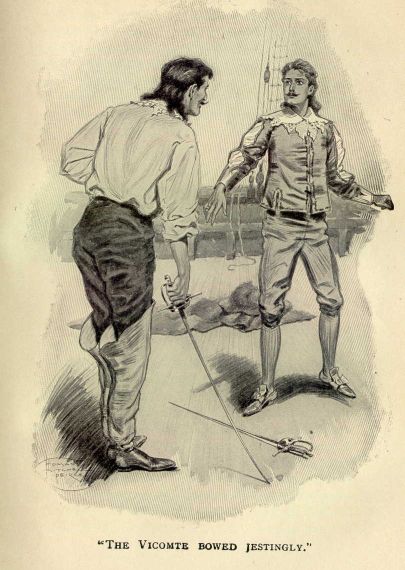
The Chevalier, who had followed each stroke with feverish eyes, sighed with chagrin. There were three strokes he had taught Victor, and the poet had not used one of them.
"Why did you let those opportunities pass?" he asked, petulantly.
"Some day I may need those strokes. The vicomte does not know that I possess them." Victor smiled; then he frowned. "He is made of iron; he is a stone wall; but he is not as brilliant and daring as you are, Paul."
"Let us prolong the truce indefinitely," said the vicomte, later.
Victor bowed without speaking. The courtesy had something non-committal in it, and it did not escape the keen eye of the vicomte.
"Monsieur, you are the most gallant poet I know," and the vicomte saluted gravely.
They were becalmed the next day and the day following. The afternoon of the second day promised to be dull and uninteresting, but grew suddenly pregnant with possibilities when the Comte d'Hérouville addressed the vicomte with these words: "Monsieur, I should like to speak to the Chevalier du Cévennes. Will you take upon yourself the responsibility of conducting me to his cabin? It is not possible for me to ask the courtesy of Monsieur de Saumaise. My patience becomes strained at the sight of him."
"Certainly, Monsieur," answered the vicomte, pleasantly, though the perpendicular line above his nose deepened. "I dare venture that the matter concerns the coming engagement at Quebec, and you desire a witness."
"Your surmise is correct. I do not wish to take advantage of him. I wish to know if he believes he will be in condition."
"Follow me." The vicomte started toward the companionway.
The Chevalier lay in his bunk, in profound slumber. Breton was dozing over his Rabelais. The clothes on the hooks moved but slightly. As the two visitors entered, the lackey lifted his head and placed a finger against his lips.
"He sleeps?" whispered the vicomte.
Breton nodded, eying d'Hérouville with disapproval.
The vicomte stared at the wan face on the pillow. He shrugged his shoulders, and there was an essence of pity in the movement. Meanwhile the count gazed with idle curiosity at the partitions. He saw the Chevalier's court rapier with its jeweled hilt. The Chevalier's grandsire had flaunted the slender blade under the great Constable's nose in the days of Henri II. There had been a time when he himself had worn a rapier even more valuable; but the Jews had swallowed it even as the gaming tables had swallowed his patrimony. Next he fingered the long campaign rapier, and looked away as if trying to penetrate the future. A sharp gasp slipped past his lips.
"Boy," he said lowly and with apparent calm, "was not that a ship passing?"
Breton looked out of the port-hole. As he did so the count grasped the vicomte's arm. The vicomte turned quickly, and for the first time his eyes encountered the grey cloak. His breath came sharply, while his hand stretched forth mechanically and touched the garment, sinister and repelling though it was. There followed his touch a crackling sound, as of paper. D'Hérouville paled. On the contrary, the vicomte smiled.
"Messieurs," said Breton, "your eyes deceived you. The horizon is clear. But take care, or you will have monsieur's clothes from the hooks."
"Tell your master," said the vicomte, "that we shall pay him a visit later, when he wakes." He opened the door, and followed D'Hérouville out.
Once outside the two men gazed into each other's eyes. Each sought to discover something that lay behind.
"The cloak!" D'Hérouville ran his fingers through his beard. "The Chevalier has never searched the pockets."
"Let us lay the matter before him and acquaint him with our suspicions," said the vicomte, his eyes burning. "His comrade's danger is common to both of us. We will ask the Chevalier for his word, and he will never break it."
"No! a thousand devils, no! Place my neck under his heel? Not I."
"You have some plan?"
"Beaufort offers five thousand livres for that paper, and Gaston will give five thousand more to have proof that it is destroyed. That is ten thousand, Monsieur."
"Handsome!"
"And I offer to share with you."
"You do not need money, Monsieur."
"I? The Jews have me tied in a thousand knots!" replied the count, bitterly.
"I am not the least inclined toward partnership. You must manoeuver to reach the inside of that cloak before I do. There is nothing more to be said, Monsieur."
"Take care!" menacingly.
"Faith! Monsieur," the vicomte said, coolly, "my sword is quite as long as yours. And there is the Chevalier. You must fight him first."
"And if you find the paper?" forcing a calm into his tones.
"I shall take the next ship back to France. I will see Beaufort and Gaston, and the bubble will be pricked."
"Perhaps you may never return."
"As to that, we shall see. Come, is there not something more than ten thousand livres behind that paper?"
"You banter. I do not understand."
"Is not madame's name there?"
"Well?"
"She is a widow, young, beautiful, and rich. And this incriminating signature of hers,—what a fine thing it would be to hold over her head! She is a woman, and a woman is easily duped in all things save love."
D'Hérouville trembled. "You are forcing war."
"So be it," tranquilly. "I will make one compact with you; if I find the paper I will inform you. Will you accept a like?"
"Yes."
"Good. Now, then, once in Paris, I will stake ten thousand livres against your tentative claims to madame's hand. We will play at vingt-et-un. That is true gambling, Monsieur, and you are a good judge."
"I pick up the gauntlet with pleasure, under all conditions. Besides, an idea has occurred to me. The paper may not be what we think it is. The man who killed De Brissac is not one to give up or throw away the rewards. Eh, Monsieur?"
"Perhaps he was pressed for time. His life perhaps depended upon his escape. He may have dropped the cloak," shrewdly, "and some friend found it and returned it to the Chevalier. A plausible supposition, as you will agree."
"You may tell me a lie," said D'Hérouville, thoughtfully.
"It would not be necessary, Monsieur le Comte," returned the vicomte, suggestively tapping his sword.
After the calm the storm came, after the storm the rough winds and winnowed skies. At one moment the ship threatened to leap to heaven, at another, to plunge down to the sea's floor. Breton had a time of it one afternoon in the cabin. He was buffeted about like maize in a heated pan. He fell, and in trying to save himself he clutched at the garments hanging from the hooks. The cloth gave. The pommel of the Chevalier's rapier hit him in the forehead, cutting and dazing him. He rose, staggering, and indulged in a little profanity which made him eminently human. One by one he gathered up the fallen garments and cloaks. It was haphazard work: for now the floor was where the partition had been, and the ceiling where the bunk had stood. Keys had rolled from the Chevalier's pockets—keys, coins, and rings; and Breton scrambled and slid around on his hands and knees till he had recovered these treasures, which he knew to be all his master had. He thought of the elegant rubies and sapphires and topaz of the garters he had ordered for his master but four months gone. And that mysterious lady of high degree? Paris! Alas, Paris was so far away that he, Breton, was like to see it never again.
He stood up, balanced himself, and his eye caught sight of the grey cloak, which lay crumpled under the bunk.
"Ah! so it is you, wretched cloak, that gave way when I clung to you for help?" He stooped and dragged it forth by its skirts. "So it was you?" swinging it fiercely above his head and balancing himself nicely. The bruise on his forehead made him savage. "Whatever made me bring you to the Corne d'Abondance? What could you not tell, if voice were given to you? And Monsieur Paul used to look so fine in it! You make me cold in the spine!" He shook it again and again, then hung it up by the torn collar, which had yielded over-readily to his frenzied grasp.
As the ache in his head subsided, so diminished the strength of his wrath; and he went out to ask the Chevalier if he should keep the valuables in his own pocket or replace them in the pocket of the pantaloons from which they had fallen. The Chevalier took the rings and slipped them on his fingers, all save the signet ring, which he handed to his lackey.
"Keep this, lad, till I ask for it," was all he said.
Breton put the ring in the little chamois bag which his mother had given him. The ring rattled against a little silver crucifix. The lad then returned to the cabin and read his favorite book till his eyes grew weary. He looked about for a marker and espied some papers on the floor. These he thrust into his place and fell to dreaming.
Each afternoon the Chevalier was carried up to the deck; and what with the salt air and the natural vigor which he inherited from his father, the invalid's bones began to take on flesh and his interest in life became normal. It is true that when left alone a mask of gloom shadowed his face, and his thin fingers opened and closed nervously and unconsciously. Diane, Diane, Diane! It was the murmur of far-off voices, it was the whisper of the winds in the shrouds, it was the cry of the lonely gull and the stormy petrel. To pass through the weary years of his exile without again seeing that charming face, finally to strive in vain to recall it in all its perfect beauty! This thought affected him more than the thought of the stigma on his birth. That he could and would live down; he was still a man, with a brain and a heart and a strong arm. But Diane!
The Comte d'Hérouville, for some reason best known to himself, appeared to be acting with a view toward partial conciliation. The Chevalier did not wholly ignore this advance. D'Hérouville would fight fair as became a gentleman, and that was enough. Since they were soon to set about killing each other, what mattered the prologue?
The vicomte watched this play, and it caused him to smile. He knew the purpose of these advances: it was to bring about the freedom of the Chevalier's cabin. As yet neither he nor the count had found the golden opportunity. The Chevalier was never asleep or alone when they knocked at the door of his cabin.
Each day D'Hérouville approached the Chevalier when the latter was on deck.
"You are improving, Monsieur?" was the set inquiry.
"I am gaining every hour, Monsieur," always returned the invalid.
"That is well;" and then D'Hérouville would seek some other part of the ship. He ignored Victor as though he were not on board.
"Victor, you have not yet told me who the woman in the grey mask was," said the Chevalier.
"Bah!" said Victor, with fictitious nonchalance.
"She is fleeing from some one?"
"That may be."
"Who is she?" directly.
"I regret that I must leave you in the dark, Paul."
"But you said that you knew something of her history; and you can not know that without knowing her name."
Victor remained silent.
"Somehow," went on the Chevalier, "that grey mask continually intrudes into my dreams."
"That is because you have been ill, Paul."
"Is she some prince's light-o'-love?"
"She is no man's light-o'-love. Do not question me further. I may tell you nothing. She is a fugitive from the equivocal justice of France."
"Politics?"
"Politics."
"She comes from a good family?"
"So high that you would laugh were I to tell you."
"As she left the private assembly that night I caught the odor of vervain. Perhaps that is what printed her well upon my mind."
"Pretend to yourself that it was attar of roses, and forget her. She will never enter into your life, my good comrade."
"I am merely curious, indifferently curious. It is something to talk about. I daresay that she is pretty. Homely women never flee from anything but mirrors."
"And homely men," laughed the poet. "I am going to see Bouchard for a moment."
Du Puys, D'Hérouville and the vicomte drew their stools around the Chevalier, and discussed politics, religion, and women.
"Why is it that women intrigue?" asked the Chevalier, recalling the grey mask. "Is it because they wish the great to smile on them?"
"No," replied the vicomte; "rather that they wish to smile on the great. Women love secret power, that power which comes from behind the puppet-booth. A man must stand before his audience to appear as great; woman becomes most powerful when her power is not fully known. The king's mistress has ever been the mistress of the king."
"And Marie de Touchet?" asked Du Puys.
"Charles IX was not a fool; he was mad." D'Hérouville smoothed his beard.
Presently the Chevalier said to the vicomte: "Monsieur, will you be so kind as to seek my lackey? I am growing chilly and desire a shawl or a cloak."
"I will gladly seek him," said the vicomte, flashing a triumphant look at D'Hérouville, whose face became dark.
"Permit me to accompany you," requested the count.
"The vicomte will do, Monsieur," interposed the Chevalier, wonderingly.
The vicomte passed down the companionway and disappeared. He stopped before the Chevalier's cabin and knocked. The sound of his knuckles was as thunder in his ears. Breton opened the door, rubbing his eyes.
"Your master, my lad, has sent me for his grey cloak. Will you give it to me to carry to him?"
"The grey cloak?" repeated Breton, greatly astonished.
"Yes. Be quick about it, as your master complains of the cold."
"Why, Monsieur Paul has not touched the grey cloak …"
"Must I get it myself? Be quick!" The vicomte was pale with excitement and impatience.
Breton, without further parley, took down the cloak and passed it over to the vicomte.
"Monsieur will find the collar badly torn," he said.
"If he changes his mind, I will return shortly;" and the vicomte threw the cloak over his arm, left the cabin, and closed the door.
Breton wiped his hands on his breeches as if to wipe away the contaminating touch of the cloak. His eyes were bothering him of late, and he had not read from his favorite book since he left Panurge hunting for the prophetess. Being now awake and having nothing to do, he took down his master's sword and began polishing the blade. He had scarce begun his labor when the door opened and the vicomte stood on the threshold.
"My lad," he said, quietly, "you were right. Your master wants the purple cloak. I was wrong."
Without replying, Breton hung up the grey cloak and took down another.
"Is Monsieur le Vicomte seasick?" he asked.
"It is hunger, lad, which makes me pale."
As the vicomte reappeared upon deck, he saw D'Hérouville biting his nails. He met the questioning glance, and laughed coldly and mirthlessly.
"Chevalier," said the vicomte, "your lackey handed me the grey cloak first."
"The grey cloak?"
"Yes; but I recalled its history, and returned with this. Hang me, but you have a peculiar fancy. In your place, I should have burned that cloak long ago."
D'Hérouville looked interested.
"I have a morbid fancy for that cloak," returned the Chevalier. "I want it always with me. Murder will out, and that garment will some day … No matter."
"Have you ever searched the pockets?" asked D'Hérouville, in a quiet, cool tone.
The vicomte's eyes brightened. There was good metal in this D'Hérouville.
"Searched the pockets?" said the Chevalier. "Not I! I have not touched the cloak since I last wore it. I never expect to touch it. Vicomte, thank you for your trouble." The Chevalier threw the cloak around his shoulders and closed his eyes. The wind, blowing forcefully and steadily into his face produced a drowsiness.
Du Puys looked from one to the other. A grey cloak? All this was outside the circle of his understanding. When Victor returned the old soldier rose and made his way to the cabin. As he disappeared, D'Hérouville moved toward the wheel. From time to time he looked back at the vicomte, but that gentleman purposely refused to acknowledge these glances.
"Chevalier," he said, "you know why our poet here and myself are upon this ship: a certain paper, ten by twelve inches, stands between us and the block."
"Ah!" The Chevalier opened his eyes.
"Yes. Has it ever occurred to you, my poet, to investigate Monsieur le Chevalier's grey cloak; that is to say, search its pockets?"
Victor smothered an oath and thwacked his thigh. "Horns of Panurge!" softly.
"Then you have not. It would be droll if our salvation was accompanying us to the desert." The vicomte was up and heading toward D'Hérouville.
"Victor, lad," said the Chevalier, "go you and see if there is anything in the pockets of that grey cloak."
"Well, Monsieur?" said D'Hérouville, eagerly.
"There is a ghost upon the ship," replied the vicomte.
"You have secured the papers?"
"Papers?" with elevated brows. "Is there more than one, then?" the vicomte's tone hardening.
"Paper or papers, it matters not; I was speaking only in a general way."
"Do you recall that when I touched that cloak it gave forth a crackling sound as of paper?"
"It was paper," said the count impatiently. What was this man D'Halluys driving at?
"Well, as I said;" and the vicomte twisted the ends of his mustache and gnawed it between his teeth. "There is a ghost upon this ship. There was nothing in that pocket, not even a piece of paper as large as your thumb-nail."
"You lie!" roughly.
Their faces came close together.
"If Monsieur le Chevalier leaves enough of you, Monsieur," said the vicomte. His tone was gentle. "When I gave you my word it was given honestly, without reservation. There were no papers in that cloak. Some one has gone before us, or rather, some one has gone before me. You spoke of papers: what gave you to believe there was more than one? Monsieur, is not the lie on your side? Have you not had access to the Chevalier's room? You say that I lie; is not your own tongue crooked? Besides, let us not forget the poet, who, while he may be unaware of the commercial value of that paper, has no less an interest in it. You have given me the lie: go about your affairs as you please, and I shall do likewise. When we land, if the Chevalier does not kill you, I will."
"Why?"
"You tell me that I lie."
"Bah! Monsieur, under all circumstances there would be cause for war between us. Do you not love Madame de Brissac? Heigho! she has given the motley to us all. Are we not fine fools? It is droll. Well, I will write the Chevalier's discharge, and you shall go out by the same order. We are all cats in the bags, and some of us are likely to be scratched."
"It will be an exciting day, no doubt;" and the vicomte turned on his heel.
"There was nothing in the pockets of the cloak," said Victor, a while later.
On the second day of June the Saint Laurent dropped anchor before Quebec. The voyage had come to an end, and a prosperous voyage, indeed. There had been only one death at sea; they had encountered neither the Spaniard nor the outlaw; the menace of ice they had slipped past. What a welcome was roared to them from Fort Louis, from the cannon and batteries, high up on the cliffs! The echoes rolled across the river and were lost in the mighty forests beyond. Again and again came the flash, and the boom. It was wondrous to see the fire and smoke so far above one's head. Flags fluttered in the sunshine; all labor was stopped, and the great storehouses were closed for the remainder of the day. Canoes filled with peaceful Hurons sallied forth, and the wharves were almost blotted out of sight with crowding humanity.
Many notable faces could be identified here and there among the pressing throng on the wharves. Some were there to meet friends or relatives; some wanted the news from France; some came for mail to be delivered to the various points along the river. Prominent among them was Governor Lauson, a grey-haired, kindly civilian, who, though a shrewd speculator, was by no means the man to be at the head of the government in Canada. He was pulled this way and that, first by the Company, then by the priests, then by the seigneurs. Depredations by the Indians remained unpunished; and the fear of the great white father grew less and less. Surrounding Monsieur de Lauson was his staff and councillors, and the veterans Du Puys had left behind while in France. There were names which in their time were synonyms for courage and piety. The great Jesuits were absent in the south, in Onondaga, where they had erected a mission: Father Superior le Mercier, and Fathers Dablon and Le Moyne.
Immediately on landing, Father Chaumonot made a sign, and his sea-weary voyagers fell upon their knees and kissed the earth. New France!
"Now," said Victor, shaking himself, "let us burn up the remaining herrings and salt codfish. I see yonder a gentleman with a haunch of venison on his shoulder."
"One would think that you had had no duck or deer since we passed Acadia," laughed Du Puys. "But, patience, lad; Monsieur de Lauson invites all the gentlemen to the Fort at six to partake of his table. You have but four hours to wait for a feast such as will make your Paris eyes bulge."
"Praise be!"
As he breathed in the resinous, balsamic perfume which wafted across the mighty river from the forests and the river-rush; as his eye traveled up the glorious promontory, now mellowed in sunshine, to the summit bristling with cannon; as his gaze swept the broad reaches of the river, and returned to rest upon the joyous faces around him, joyous even in the face of daily peril, the Chevalier threw back his shoulders, as if bracing himself for the battle to come. Here he was to forget and build anew; France, his mother, was dead, and here was his foster-mother, rugged and brave, opening her arms to him. New France! Ah, well, there was here, somewhere, a niche for him, and the man in him vowed to fill it. He did not yet say "With God's help." It was early, and the sting of his misfortune still stirred the poison in his soul.
"New France, Paul," cried the poet at his side. The newness and strangeness of the scene had filled the poet's face with animation. No problems beset his buoyant soul.
"Yes, lad; this is New France. Fortune here seems to be of the masculine; and I daresay that you and I shall receive many cuffs in the days to come."
"Come, my friends," said Brother Jacques, "and I will show you the path which leads to the citadel."
And the three proceeded up the incline.
Sister Benie of the Ursulines was passing along the narrow road which led to the river. There was on her serene face the remains of what had been great beauty, such as is sometimes given to the bourgeois; but the purple eyes were wells of sadness and the lips ever drooped in pity and mercy. Across her pale cheek was a paler scar, which ran from the left temple to the chin. Sister Teresa, her companion, was young and plain. Soldiers and trappers and Indians passed them on the way up, touching their caps and hats; for Sister Benie was known from Montreal to Tadousac. Suddenly Sister Benie gave a low cry and pressed a hand upon her heart.
"Sister, you are ill?" asked her companion.
"A dizziness; it is gone now." Presently she caught the arm of a gentleman who was passing.
"My son," she said, sweetly, "can you tell me who is that young man walking with Brother Jacques; the tall one?"
"He? That is the Chevalier du Cévennes."
"His family?"
"He is the son of the Marquis de Périgny."
"Thank you, my son."
"Monsieur du Cévennes," said D'Hérouville, just before supper that first night of their arrival on Canadian soil, "I see that you are not quite strong enough to keep the engagement. This day two weeks: will that be agreeable?"
"It will; though I should be better pleased to fix the scene for to-morrow morning."
D'Hérouville raised a deprecating hand. "I should not like to have it said that I took advantage of a man's weakness. Of course, if you wish absolutely to force it …"
The Chevalier looked thoughtfully at his pale hands. "I shall take advantage of your courtesy, Monsieur le Comte."
"How polite men are when about to cut each other's throats!" The Vicomte d'Halluys adjusted his baldric and entered the great dining-hall of the Château Saint Louis.
He and D'Hérouville sat side by side.
"Vicomte, you have never told me why the Chevalier is here. Why should he leave France, he, who possessed a fortune, who had Mazarin's favor, and who had all the ladies at his feet?"
"Ask him when you meet him," answered the vicomte, testing the governor's burgundy.
"And will you pay me those ten thousand livres which you wagered against my claims for madame's hand?"
The vicomte took a sip of the wine. There was no verbal answer, but his eyes spoke.
"Quebec promises to afford a variety," commented d'Hérouville, glancing to where the Chevalier sat.
"It is quite probable," affably returned the vicomte. "This is good wine for a wilderness like this. To be sure, it comes from France; I had forgotten."
The first fortnight passed with the excitement attendant to taking up quarters in a strange land. The Chevalier, Victor and the vicomte were given rooms in the citadel; D'Hérouville accepted the courtesy of the governor and became a resident of the château; father Chaumonot, Major du Puys, and his selected recruits, had already made off for Onondaga. A word from Father Chaumonot into the governor's ear promoted the Chevalier to a lieutenancy in lieu of Nicot's absence in Onondaga. Everything began very well.
Seldom a day went by without a skirmish with the Iroquois, who had grown impudent and fearless again. The Iroquois were determined to destroy their ancient enemies, the Hurons, primarily because they hated them, and secondarily because they were allies of the French. France did what she could in reason to stop these depredations, but the task needed an iron gauntlet, and De Lauson was a civilian. At this period the Mohawks were the fiercest, the Onondagas having agreed to a temporary treaty. Marauders were brought in and punished, but usually the punishment was trivial compared to the offense. The governor wished to rule by kindness; but his lieutenants knew the Indian thoroughly. He must not be treated with kindness where justice was merited; it gave him the idea that the white man was afraid. Therefore, his depredations should be met with a vengeance swift and final and convincing. But nine times out of ten De Lauson and the priests overruled the soldiers; and the depredations continued unabated. Once, however, the Chevalier succeeded in having several gibbets erected on the island of Orléans, and upon these gibbets he strung half a dozen redskins who had murdered a family of peaceful Hurons.
Though he went about somberly, untalkative and morose, the Chevalier proved himself a capital soldier, readily adapting himself to the privations of scouting and the loneliness of long watches in the night. He studied his Indian as one who intended to take up his abode among them for many years to come. He discarded the uniform for the deerskin of the trapper. But the Chevalier made no friends among the inhabitants; and when not on duty he was seen only in the company of Victor, the vicomte and Brother Jacques, who was assisting him in learning the Indian languages. Brown he grew, lithe and active as the enemy he watched and studied. Never a complaint fell from his lips; he accepted without question the most hazardous duty.
"Keep your eye upon Monsieur le Chevalier," said De Lauson; "for he will count largely before the year is gone."
As for Victor, he was more or less indifferent. He was perfectly willing to fight the Indian, but his gorge rose at the thought of studying him as an individual. As a rule he found them to be unclean, vulgar and evil-minded; and the hideous paints disturbed his dreams. Secretly, his enthusiasm for New France had already waned, and there were times when he longed for the road to Spain—Spain which by now held for him the dearest treasure in all the world. But not even the keen-eyed Brother Jacques read this beneath the poet's buoyancy and lightness of spirit. Besides, Brother Jacques had set himself to watch the Comte d'Hérouville and the Vicomte d'Halluys, and this was far more important to him than the condition of the poet's temperament.
D'Hérouville mingled with the great seigneurs, and, backed by his reputation as a famous swordsman, did about as he pleased. He watched the Chevalier's progress toward health; and he noted with some concern his enemy's quick, springy step, the clear and steady eye. He still ignored the poet as completely as though he did not exist.
Every Friday night the table was given up to the governor's gentlemen councillors, friends, and officers. Victor and the Chevalier were on this list, as were the vicomte and D'Hérouville. Usually these were enjoyable evenings. Victor became famous as a raconteur, and the Chevalier lost some of his taciturnity in this friendly intercourse. D'Hérouville's conduct was irreproachable in every sense.
One day the Chevalier entered one of the school-rooms. In his arms he held a small white child which had sprained its weak ankle while playing on the lumber pile outside the convent of the Ursulines. Sister Benie was quick to note how tenderly he held the sobbing child.
"Give him to me, Monsieur," she said, her velvet eyes moist with pity.
The Chevalier placed the little boy in her arms, and he experienced a strange thrill as he noticed the manner in which she wrapt the boy to her heart. How often Breton's mother, his nurse, had taken him to her breast that way! And he stood there marveling over that beautiful mystery which God had created, for the wonder of man, the woman and the child.
"I chanced to be passing and heard his cry," he said, diffidently.
"Playing the good Samaritan?" asked a voice from the window. The Sister and the Chevalier looked around and saw the vicomte leaning on the window-sill. "Why was it not my happiness to tarry by that lumber-pile. I saw the lad.'"
"Ah, it is you, Vicomte?" said the Chevalier, pleasantly.
"Yes, Chevalier. Will you walk with me?"
Being without excuse, the Chevalier joined him, and together they proceeded toward the quarters.
Sister Benie stared after them till they had disappeared around the corner of the building.
"Chevalier," said the vicomte, "do you remember Henri de Leviston?"
"De Leviston?" The Chevalier frowned. "Yes; I recollect him. Why?"
"He is here."
"In Quebec?"
"Yes. He came in this morning from Montreal, where he is connected with the Associates. Was he not in your company three or four years ago? He was dismissed, so I heard, for prying into De Guitaut's private despatches."
"I remember the incident. I was the one who denounced him. It was a disagreeable duty, but De Guitaut had put me on De Leviston's tracks. It was unavoidable."
"You had best beware of him."
"I am perfectly in health, thank you," replied the Chevalier.
The vicomte covertly ran his eye over his companion. It was not to be denied that the Chevalier had gained wonderfully in the fortnight. The air, the constant labor, and the natural medicine which he inhaled in the forests, had given a nervous springiness to his step and had cleared his eyes till the whites were like china. No; the Chevalier need have no fear of De Leviston, was the vicomte's mental comment.
"Well, you do look proper. The wine is all out of your system, and there is balsam in your blood. A wonderful country!" The vicomte stopped before his door.
"Yes, it is a wonderful country. It is not France; it is better than the mother country. Ambition has a finer aim; charity is without speculation; and a man must be a man here, else he can not exist."
"That is an illusion," replied the vicomte. "Only the women have what you call a finer ambition. The men are puling as in France. The Company seeks riches without working; the military seek batons without war; and these Jesuits … Bah! What are they trying to do? To rule the pope, and through him, the world. My faith, I can barely keep from laughing at some of the stories these priests tell all in good faith."
"My thought did not include the great," said the Chevalier, quietly. "I meant the lower orders. They will eventually become men and women in the highest sense. There is no time for dalliance and play; labor is the monitor best suited to hold back, to trim and regulate a man's morals and habits. There is no idleness here, Vicomte."
"I do not know but you are right."
"Shall you remain here long?" asked the Chevalier.
"Who can say? I would return to France on the next boat were my neck less delicately attached to my shoulders. Let us say six months; it will have quieted down by then. Devil take me, but I should like to feel that paper crackling between my fingers. And you meet D'Hérouville in two days?"
"In two days."
"Will you not join me in a glass of the governor's old burgundy as a toast to your success?"
"Thank you, but I am on duty. They are bringing some Mohawks up from the lower town, and I am to take charge of them."
"Good luck to you;" and the vicomte waved a friendly hand as he started off toward the citadel.
The Chevalier with a dozen men started for the lower town. But his mind was not on his duty. He was thinking of Diane, her gay laughter, her rollicking songs, the old days.
"Monsieur, are we to go to Sillery?" asked a trooper, respectfully.
"Sillery?" The Chevalier shook himself, and took the right path.
The Chevalier and Victor sat on their narrow cots that night. Brother Jacques had just gone. The windows were open, and the balmy air of summer drifted in, carrying with it forest odors and the freshness of the rising dew. Fireflies sparkled in the grass, and the pale stars of early evening pierced the delicate green of the heavens. A single candle flickered on the table, and the candlestick was an empty burgundy bottle. The call of one sentry to another broke the solemn quiet.
"And you have not grown sick for home since you left the sea?" asked the Chevalier.
"Not I!" There were times when Victor could lie cheerfully and without the prick of conscience. "One hasn't time to think of home. But how are you getting on with your Iroquois?"
"Fairly."
"You are determined to meet D'Hérouville?"
The Chevalier extended his right arm, allowing Victor to press it with his fingers. Victor whistled softly. The arm, while thin, was like a staff of oak. Presently the same arm reached out and snuffed the candle.
"Shall you ever go back to France, Paul?"
A sigh from the other side of the room.
"I saw the vicomte talking to De Leviston to-day. De Leviston was scowling. They separated when I approached."
"Will you have the goodness to go to sleep?"
"What the devil brings De Leviston so high on this side the water?"
Silence.
"I never liked his sneaking face."
A sentry called, another, and still another.
"Are you there, Paul?"
No answer.
"You're as surly as a papoose!"
Soon after that there was nothing to be heard but the deep and regular breathing of two healthy men resting in sleep.
Some fourteen gentlemen sat around the governor's table the third Friday night. There were the governor and his civic staff and his officers, three or four merchants, and two priests, Brother Jacques and Dollier de Casson, that brother to Rabelais, with his Jove-like smile and his Herculean proportions. De Casson had arrived that day from Three Rivers, and he had come for aid.
Two chairs were vacant, and presently the vicomte filled one of them. The other was reserved for the Chevalier.
Victor was telling some amusing tales of the court; how Beaufort was always blundering, how Mazarin was always saving, how Louis was always making love, and how the queen was always praying.
"Ah, Monsieur de Saumaise," said the governor, "you must not tell jests at the expense of their Majesties; Mazarin I do not mind, for he is certainly niggard with funds and with men."
"How that handsome young king of ours will spend money when a new prime minister is needed!" was the vicomte's comment, his gaze falling on the Chevalier's empty chair. "Do you remember how Mazarin took away Scarron's pension? Scarron asked that it be renewed; and Mazarin refused, bidding the wit to be of good cheer. Scarron replied, 'Monseigneur, I should indeed be in good cheer were I not positive that I shall not outlive your parsimony.'"
When the Chevalier finally came in he was cordially greeted by the governor. He took his chair, filled his glass and lit his pipe. He waved aside all food, stating that he had eaten his supper in the lower town.
No sooner had he lighted his pipe than De Leviston rose, shoving back his chair noisily. A cold, sneering contempt marked his swart face.
"What is the matter, Monsieur de Leviston?" asked the governor, mildly.
"Your Excellency will pardon me," said De Leviston; "but I find, it impossible to sit at this table till another person leaves it."
Surprise and consternation lay written on every face. The Chevalier lowered his pipe, and looked from one face to another. He was so tired with the labor of the day, that he had forgotten all about himself and his history.
The governor sat rigid in his chair. Victor's hand rested on the table; he was ready to rise and meet the blow he knew was coming.
"Explain yourself," said the governor, coldly. "You impugn the conduct or honor of some gentleman at my table? Take care, Monsieur."
"It is my regret."
"Who is this person who has aroused your displeasure, and what has he done that he may not sit in the presence of gentlemen?"
Victor rose, white and trembling.
"Sit down, Monsieur de Saumaise," commanded the governor, sternly.
"He calls himself the Chevalier du Cévennes." De Leviston smiled.
Every eye was leveled at the Chevalier. Victor felt his heart swelling. It had come at last! Brother Jacques leaned forward, peering into every face. D'Hérouville's face was expressive of deep surprise, and the vicomte was staring at De Leviston as if he believed that gentleman to be mad.
"Calls himself the Chevalier du Cévennes?" thundered the governor. "Calls himself? This demands an immediate explanation from you, Monsieur de Leviston."
"I object to sit at a table with a person who does not know who his mother was." Each word was deliberately and carefully measured.
"Death of my life!" roared the governor, upon his feet.
The Chevalier reached over and caught De Lauson's sleeve. "Hush, Monsieur; what Monsieur de Leviston says is … true." He got up, white as the broken pipe that lay at the side of his plate. Under the chair was his hat. He reached for it. Looking neither to the right nor to the left, he walked quietly and with dignity from the room.
There was a single laugh, rude and loud. It came from D'Hérouville.
The general silence which followed lasted several minutes. The Chevalier's declaration had stunned them. The governor was first to recover. He rose again, quietly, though his eyes sparkled with anger.
"Monsieur de Leviston," he said, "you have wilfully broken and destroyed the peace and dignity of my household. I shall cross you from my list, and the sooner you return to Montreal, the better. Your peculiar sense of honor in no wise appeals to me. It is an ignoble revenge; for do not doubt that I know your own history, Monsieur, and also the part the Chevalier had in it. But believing you had come to this country to repair your honor, I have assisted you by inviting you to partake of my bounty and of my friendship."
De Leviston paled, and turned a scowling face to those about him. He found no sympathy in any eye, not even in D'Hérouville's.
"You have wounded brutally and with intent," went on the governor, "the heart of a man who has not only proved himself a gentleman, but a hero. And I add this: Let no one repeat what has happened, or he shall feel the weight of my displeasure, and my displeasure will mean much to promotion and liberty." He pushed his chair under the table, which signified that he was to retire.
The gentlemen left the table with him.
Outside, Victor approached D'Hérouville, ignoring De Leviston. The vicomte followed in the rear.
"Monsieur d'Hérouville, you have a bad heart," said the poet. "You have laughed insolently at a man whose misfortune is none of his own making. You are a poltroon and a coward!"
The vicomte interposed. "D'Hérouville, listen to me. After what has happened you will refuse to meet the Chevalier."
"I certainly shall."
"I am at your service," said the vicomte.
"D'Halluys," cried the poet, "you have no right to interfere."
"Stand aside, Monsieur de Saumaise." The vicomte pressed the poet back.
"Vicomte," said D'Hérouville, "I will not fight you to-night."
"I am certain. Here is a phrase which leaves no misunderstanding." The vicomte slapped D'Hérouville in the face.
"Damnation!" D'Hérouville fell back.
Victor turned to De Leviston. "I will waive the question of gentleman," and he struck De Leviston even as the vicomte had struck D'Hérouville.
"Curse you, I will accompany you!" roared De Leviston.
"Very good," returned the poet. "Vicomte, there is a fine place back of the Ursulines. Let us go there."
When Victor entered, his room that night, an hour later, it was dark. He groped for the candle and stoked the flint. As soon as his eyes grew accustomed to the glare of the light, he looked about, and his shadow wavered on the plastered walls. The Chevalier lay on his cot, his face buried in his arms. Victor touched him and he stirred.
"It is all right, Paul." Victor threw his sword and baldric into a corner and sat down beside his stricken friend, throwing an arm around his shoulders. "I have just this moment run De Leviston through the shoulder. That vicomte is a cool hand. He put his blade nicely between D'Hérouville's ribs. They will both remain in hospital for two or three weeks. It was a good fight."
By the next morning all Quebec had heard of the double duel, and speculation ran high as to the cause. All Quebec, to be sure, amounted only to a few hundreds; and a genuine duel at this period was a rare happening. So everybody knew that D'Hérouville and De Leviston were in hospital, seriously though not dangerously wounded, and that Monsieur de Saumaise was in the guardhouse, where, it was supposed, he would remain for some time to come, in order that his hot blood might cool appreciably. As for Monsieur d'Halluys, he was not under the governor's direct jurisdiction, and was simply ordered to stay in his room.
The officers and civilians respected the governor's command, and no outsider gathered a word of information from them. The officers, talking among themselves, secretly admired the poet's pluck. Like all men of evil repute, De Leviston was a first-class swordsman and the poet's stroke had lessened his fame. As for what had caused the fight between the vicomte and D'Hérouville, they were somewhat at a loss to say or account for. The governor himself was exceedingly wrathful. At ten o'clock he summoned Victor to appear before him, to render a full account of the affair. The savages made life hazardous enough, without the additional terror of duels.
Victor found the governor alone, and for this he was thankful.
"Monsieur de Saumaise," De Lauson began, sternly, "I gave you credit for being a young man of sense."
"And a man of heart, too, your Excellency, I hope," replied the poet, valiantly.
"Heart? Is it heart to break the edict, to upset the peace of my household, to set tongues wagging? Persons will want to know the cause of this foolish duel. I am positive that it was fought contrary to the Chevalier's wishes. He conducted himself admirably last night. You have done more harm than good with your impetuosity. My command would have been respected, and your friend's misfortune would have gone no farther than my dining-room."
"And Monsieur de Leviston?" with a shade of irony which escaped the governor.
"Would have remained silent on the pain of being sent back to France, where the Bastille awaits him. He was exiled to this country, and he may not leave it till the year sixty. De Maisonneuve would have stood by me in the matter. So you see that you have blundered in the worst possible manner."
"And the Vicomte d'Halluys?"
"If D'Hérouville dies, the vicomte shall return to France in irons."
"Monsieur," with a sign of heat, "there are some insults which can not be treated with contempt. I should have proved myself a false friend and a coward had I done otherwise than I did."
"What does the Chevalier say about your fighting his battles for him?" asked the governor, quietly.
Victor's gaze rested on his boots.
"He doesn't approve, then?" The governor drummed with his fingers. "I thought as much. At your age I was young myself. Youth sees affronts where it ought to see caution and circumspection."
"When I have arrived at your Excellency's age …"
"No sarcasm, if you please. You are still under arrest."
Victor bowed, and twirled his hat, which was sadly in need of a new plume.
"I warn you, if De Leviston dies I shall hang you high from one of the Chevalier's gibbets on Orléans. If he lives, I shall keep in touch with your future conduct, Monsieur; so take good care of yourself."
"De Leviston will not die. Such men as he do not die honestly in bed. But he was only a puppet in this instance."
"A puppet? Explain."
"There was another who prompted him from behind."
"Who?" sharply.
"I am afraid that at present I can not name him."
"D'Hérouville? Be careful, Monsieur; this is a grave accusation you are making. You will be forced to prove it." The governor looked worried; for to him the Comte d'Hérouville was a great noble.
"I did not name him. There was a woman behind all this; a woman who is the innocent cause."
"Ha! a woman?" The governor leaned forward on his elbows.
"Yes."
"Who?"
"Mademoiselle de Longueville. D'Hérouville insulted her and the Chevalier took up her cause."
"Why, then, did you not pick your quarrel with the count?"
"The vicomte had some prior claim."
The governor got up and walked about, biting his mustache. Victor eyed him with some anxiety.
"But the Chevalier; why did he not defend himself?"
Victor breathed impatiently. "Frankly, Monsieur, how can he defend himself?"
"True." The governor scrubbed his beard. He was in a quandary and knew not which way to move. Tardy decision was the stumbling-block in the path of this well meaning man. Problems irritated him; and in his secret heart he wished he had never seen the Chevalier, D'Hérouville, the poet, or the vicomte, since they upset his quiet. He had enough to do with public affairs without having private ones thrust gratuitously upon his care. "Well, well," he said, reseating himself; "you know my wishes. Nothing but publicity will come of duels and brawls, and publicity is the last thing the Chevalier is seeking. I feel genuinely sorry for him. The stain on his name does not prevent him from being a brave man and a gentleman. Control yourself, Monsieur de Saumaise, and the day will come when you will thank me for the advice. As you have no incentive for running away, I will put you on your word, and the vicomte also. You may go. While I admire the spirit which led you to take up the Chevalier's cause, I deplore it. Who, then, will succeed Monsieur le Marquis?"
"That is a question I can not answer. To the best of my knowledge, no one will succeed Monsieur le Marquis de Périgny."
"So this is what brought him over here? What brought you?"
"Friendship for him, an empty purse and a pocketful of ambition."
The answer pleased De Lauson, and he nodded. "That is all."
"Thank you, Monsieur."
"I shall keep you in mind … if you escape the gibbet."
Monsieur de Saumaise, in displaying his teeth, signified that the least of his worries was the thought of the gibbet.
And so concluded the interview.
The Chevalier remained in his room all day, putting aside his food, and staring beyond the river. His eyes were dull and the lids discolored from sleeplessness. Victor waited for him to heap reproach upon him; but never a word did the Chevalier utter. The only sign he gave of the volcano raging and burning beneath the thin mask of calm was the ceaseless knotting of the muscles of the jaw and the compressed lips. When the poet broke forth, reviling his own conduct, the Chevalier silenced him with a gesture of the hand.
"You are wasting your breath. What you have done can not be undone." The tones of his voice were all on a dull level, cold and unimpassioned.
Victor was struck with admiration at the sight of such extraordinary control; and he trembled to think of the whirlwind which would some day be let loose.
"I will kill De Leviston the first opportunity," he said.
The Chevalier arose. "No, lad; the man who told him. He is mine!"
Victor sought out Brother Jacques for advice; but Brother Jacques's advice was similar to the Chevalier's and the governors.
So the day wore on into evening, and only then did the Chevalier venture forth. He wandered aimlessly about the ramparts, alone, having declined Victor's company, and avoiding all whom he saw. He wanted to be alone, alone, forever alone. Longingly he gazed toward the blackening forests. Yonder was a haven. Into those shadowy woods he might plunge and hide himself, built him a hut, and become lost to civilization, his name forgotten and his name forgetting. O fool in wine that he had been! To cut himself off from the joys and haunts of men in a moment of drunken insanity! He had driven the marquis with taunts and gibes; he had shouted his ignoble birth across a table; and he expected, by coming to this wilderness, to lose the Nemesis he himself had set upon his heels! What a fool! What a fool! He had cast out his heart for the rooks and the daws. Wherever he might go, the world would go also, and the covert smile … and the covert smile … God, how apart from all mankind he seemed this night. But for Victor he would have sought the woods at once, facing the Iroquois fearlessly. He must remain, to bow his head before the glances of the curious, the head that once was held so high; accept rebuffs without murmur, stand aside, step down, and follow. If a man laughed at him, he must turn away: his sword could no longer protect him. How his lips thirsted for the wine-cup, for one mad night, and then … oblivion! An outcast! What would be his end? O the long years! For him there should be no wifely lips to kiss away the penciled lines of care; the happy voices of children would never make music in his ears. He was alone, always and ever alone!
Presently the Chevalier bowed his head upon the cold iron of the cannon. The crimson west grew fainter and fainter; and the evening breeze came up and stirred the Company's flags on the warehouses far below.
Suddenly the Chevalier lifted his head. He was still an officer and a gentleman. He would stand taller, look into each eye and dare with his own. It was not what he had been, nor what had been done to him; it was what he was, would be and do. If every hand was to be against his, so be it. D'Hérouville? Some day that laugh should cost him dear. The vicomte? What was his misfortune to the vicomte that he should pick a quarrel on his account? Was he a gallant fellow like Victor? He would learn.
He put on his hat. It was dark. Lights began to flicker in the fort and the château. The resolution seemed to give him new strength, and he squared his shoulders, took in deep breaths, entered the officers' mess and dined.
The men about him were for the most part manly men, brave, open-handed, rough outwardly and soft within. And as they saw him take his seat quietly, a sparkle of admiration gleamed from every eye. The vicomte and Victor, both out on parole, took their plates and glasses and ranged alongside of the Chevalier. In France they would have either left the room or cheered him; as it was, they all finished the evening meal as if nothing extraordinary had happened.
So the Chevalier won his first victory.
The ship Henri IV dropped anchor before Quebec on the seventh day of August. This being the Company's vessel, hundreds of Canadians flocked to the wharves. And again flags decked the château and town, and cannon roared. The Henri IV was part merchantman and part man-of-war. Her ports bristled with cannon, her marines wore formidable cutlasses, and the law on board was military in the strictest sense. Stores and ammunition filled her hull; carpenters' tools, tea-chests, bags of plaster, uniforms, cannon, small arms, beads and trinkets of no value save to the Indian, silk and wool and a beautiful window for the cathedral. And in return she was to carry away mink, otter and beaver skins.
Breton had been left behind by the Chevalier, who had joined a scouting party up the river. Love and anxiety had made the lad thin. Any night might bring disastrous news from Three Rivers, the burning of the settlement and the massacre. Such speculation counteracted his usually good appetite. So Breton mooned about the wharves day by day, always looking up the river instead of down.
To-day he lingered to witness the debarkation. Besides, the Henri IV was a great ship, bringing with her a vague perfume from France. Listlessly he watched the seamen empty the hold of its treasures; carelessly he observed the meeting of sweethearts and lovers, wives and husbands. Two women in masks meant nothing to him… Holy Virgin! it was not possible! Was his brain fooling him? He grew faint. Did he really see these two old men climbing down the ship's ladder to the boats? He choked; tears blinded him. He dashed aside the tears and looked once more. Oh! there could be no doubt; his eyes had not deceived him. There was only one face like that in the world; only one face like that, with its wrinkles, its haughty chin, its domineering nose. He had seen that lean, erect figure, crowned with silver-white hair, too many times to mistake it. It was the marquis, the grim and terrible marquis, the ogre of his dreams. The lad had always hated the marquis, taking his master's side; but at the sight of that familiar face, he felt his heart swell with joy and love and veneration. For intuition told him why Monsieur le Marquis was in Quebec. It was to seek Monsieur le Chevalier. And together they would all go back to France, beautiful France. He burst into hysterical tears, regardless of the wonder which he created. And there was the kindly Jehan, who had dandled him on his knee, long years ago before trouble had cast its blighting shadow over the House of Périgny. Blessed day!
Very slowly and with infinite pains the marquis climbed from the boat to the wharf. It was evident to Breton that the long voyage at sea had sapped his vitality and undermined his vigor. He was still erect, but, ah! how lean and frail! But his eye was still the eye of the proud eagle, and it swept the crowd, searching for a familiar face. Breton dared not make himself known because of that eye. An officer who had formerly resided in Rochelle recognized the marquis instantly, and he pressed forward.
"Monsieur le Marquis in Quebec?" he cried.
"You are of the fort?" replied the marquis. His voice was thin and high, like that of old men whose blood is turning to water.
"Yes, Monsieur," answered the officer.
"Will you lead me to his Excellency the governor? I have letters to present from her Majesty the queen."
"Follow me, Monsieur;" and the officer conducted the marquis through the crowd, politely but firmly brushing aside those who blocked his path. He found the governor quickly. "Your Excellency, the Marquis de Périgny wishes to present to you letters from her august Majesty."
"Monsieur le Marquis here?" exclaimed the governor. He embraced the old nobleman, whom he held in genuine regard.
"So your Excellency remembers me?" said the marquis, pleased.
"One does not forget a man such as you are, Monsieur. And I see you here in Quebec? What twist of fortune brings you to my household?"
"I have come in search of a prodigal son, Monsieur," smiling. "Know you one who calls himself the Chevalier du Cévennes?"
"The Chevalier du Cévennes?" The governor was nonplussed. The marquis here in search of the Chevalier?
"I see that he is here," said the marquis, with a note of satisfaction.
"No, Monsieur; not here, but has been."
"He can be found?"
"Within sixty hours."
"That is well. I am very fortunate."
"You will be my guest during your stay?" suggested the governor.
"Her Majesty asks that good favor of you."
"A great honor, Monsieur, truly;" and the governor was elated at the thought of having so distinguished a guest at his table.
The marquis turned to the patient Jehan. "Jehan, you will see to the portmanteaus."
"Yes, Monsieur."
A priest elbowed his way toward them. On seeing him, the marquis raised and lowered his bushy white brows. It was the handsome Jesuit whose face had stolen into many a dream of late. Brother Jacques was greatly astonished. The marquis greeted him, but without marked cordiality. At a sign from the governor the quartet moved up the path toward the cliffs, which the marquis measured with the eye of one who understood thoroughly the art and value of military strategy.
"Superb!" he murmured. "With a few men and plenty of ammunition, I could hold even England at bay."
"I am proud of it," acknowledged the governor; but there was a twinge of envy when it occurred to him that a handful of savages had worried him more than once. And here was a man who would defy the whole world.
Jehan felt a pressure on his arm. Turning, he beheld the shining face of Breton. He caught the lad in his arms and kissed him on the cheek.
"I expected to find you, lad. Ah, but you have done wrong. You should have told us. You should not have run away with Monsieur le Comte…"
"Monsieur le Comte?" bewildered.
"Yes; you should not have run away with him as you did."
"Had I told you, you would have prevented my coming," Breton confessed.
"You would have saved Monsieur le Marquis and myself a great deal of trouble."
"But Monsieur le Chevalier was in trouble, too. I could not leave him."
"Which speaks well for your heart, lad, but not for your reason. Where is Monsieur le Comte?"
"At Three Rivers; a day and a night's ride from here, with good paddlers."
"Good. We shall start out in the morning."
"To bring him back to France?"
"Nothing less, lad. The count has been greatly wronged by Monsieur le Marquis, and it is to be set to rights forthwith. Can you read?"
"Yes."
"Here is a letter which Monsieur le Curé wrote at Périgny. It was from old Martin's daughter."
"God bless you, Monsieur," cried the happy Breton. He would have shouted for joy had not the quiet dignity of the old lackey put a damper on his enthusiasm.
"Monsieur le Comte was well when last you saw him?"
"Yes; physically."
"He is troubled?"
"Who would not be?" burst forth Breton, indignantly. "But why do you call Monsieur le Chevalier the count?"
"Is not that his title?" quietly.
"But …"
"Would Monsieur le Marquis take all this trouble if Monsieur le Chevalier was anything but Monsieur le Comte?"
"I shall offer a dozen candles!" cried Breton, joyously.
Meantime the governor conducted the marquis around the fortress and the château; and together they stood upon the highest balcony and looked down upon the river, which was dotted with canoes and small boats.
"Magnificent!" repeated the marquis time and again.
"And not even in the Cévennes, Monsieur, will you see such sunsets," said De Lauson.
"This should not be managed by speculators," unconsciously pricking the governor's quick, "nor by the priest's cold hand. It should be wholly the king's. It would be France's salvation. What are they doing there in Paris?"
"Spending money on lace for the Swiss and giving masks at the Palais Royal."
"Richelieu died too soon; here would have been his fame." The marquis never underestimated an enemy. "If your Excellency will excuse me now, I will sleep. I am an old man, and sleep calls to me often. I will join you at supper."
"The ladies will be delighted. There is but little here of the life of the court. When we are not guarding against Indians, we are celebrating religious fêtes."
"Till supper, then, your Excellency."
And the governor departed to read the messages from the queen. She had placed all Quebec at the disposal of the marquis in the search for his son. The governor was greatly mystified. That the marquis should still call the Chevalier by his former title of count added to this mystery. Since when did fathers set out for sons of the left hand? He soon gave up the riddle, confident that the marquis himself would solve it for him.
The marquis rose before sundown and with the assistance of his aged valet made his toilet. He was dressed in black satin, with white lace ruffles, and across his breast he flung the ribbon of the Chevalier of the Order, in honor of the governor's attentions. Presently, from his window he saw the figure of a woman—young and slender; doubtless some relative of the governor's. Patiently he waited for her to turn. When she did so, a subdued exclamation fell from his lips. He had seen that face before, once or twice on board the Henri IV. It was the woman in the grey mask. He stared hard and long. Where else had he seen this face? He was growing old, and sometimes his memory failed him. Without being conscious of the act, he readjusted his wristbands and the ruffles at his throat. A handsome young woman at the table would be a recompense for the dullness of the hour. But he waited in vain at supper for the appearance of the exquisite face. Like the true courtier he was, he made no inquiries.
When they were at last alone, the governor said: "I am truly glad you have come to make the Chevalier return to France. He will never be at peace here."
"Why?" asked the marquis, weakening his burgundy with water.
"The … That is …" But the governor foundered.
"Why?" repeated the marquis. "Has he made a fool of himself here as in France?"
"No, Monsieur," warmly. "He has proved himself to be a gentleman and a brave soldier."
"He drinks?"
"Only as a gentleman might; neither does he gamble."
"Ah!"
The governor drew figures on the dusty bottle at the side of his plate.
"If he does none of these things," said the marquis, "why can not he live in peace here?"
"His … unfortunate history has followed him here."
"What?" The marquis's glass crashed upon the table and the wine crept among the plates, soaking the marquis's sleeves and crimsoning his elegant wristbands.
"What did you say?"
"Why," began the governor, startled and confused, "the history of his birth is known." He looked at the walls, at the wine running about, at the floor, at everything save the flashing eyes opposite.
"So the fool has told it here?" harshly. "Bah! let him rot here, then; fool!"
"But he has said nothing; no one knew till …"
"Oh! then it was not Monsieur le Comte who spoke?"
"Monsieur le Comte?"
"That is the title which my son bears."
"Good God, Monsieur, then what is all this about?"
"It will take some time to tell it, Monsieur," said the marquis, shaking his sleeves and throwing salt upon the table. "First, I wish to know the name of the man who started the story."
"Monsieur de Leviston, of Montreal, prompted by I know not whom."
"De Leviston. I shall remember that name."
"There was a duel fought."
"A duel? Who were the participants?"
"The Vicomte d'Halluys against the Comte d'Hérouville, and Monsieur de Saumaise against De Leviston. D'Hérouville and De Leviston are both in hospital."
"D'Hérouville? What had he to do with the affair?"
"He laughed," said the governor; "he laughed when De Leviston accused your son of not knowing who his mother was."
"Thank you, Monsieur. I see that you are in great puzzle. Let me solve the puzzle for you. I have always been a man of quick and violent temper, and sometimes this temper has been that of the fool. The wisest of us make mistakes. I have made a grievous one. In a moment of anger …" He ceased, taking up the stem of the broken glass and twirling it. "In a moment of anger, then, I did Monsieur le Comte a most grievous wrong, a wrong for which I can never fully atone. We have never been on friendly terms since his refusal to wed a young woman of my choice, Mademoiselle de Montbazon. I had never seen this daughter, nor had my son. Paris life, Monsieur, as doubtless you know, is ruinous to youth. Monsieur le Comte was much in wine; he gambled recklessly. It was my desire to change his course, but I went at it either too late or bunglingly. In February he was exiled from court in disgrace. I have never ascertained the character of this disgrace. One night in March we had an exchange of opinions. My faith, your Excellency, but that boy has a terrible tongue. There was not a place in my armor that he did not pierce. I shall not repeat to you the subject of our conversation. Suffice it to say that he roused the devil and the fool in me, and I told him that he had no right to his name. I am here to correct that wrong as much as lies within my power. He did not give me an opportunity at home. It is not sentiment; it is my sense of justice that brings me here. And I truly admire the lad's spirit. To plunge into the wilderness without calculation; ah, well, it is only the fool who stops to weigh the hazards of fortune. The boy is my son, lawfully; and I want him to know it. I am growing old, and this voyage has written a shorter term for me."
"Monsieur," said De Lauson, "what you tell me makes me truly happy. But I am afraid that you have destroyed the Chevalier's trust in humanity. If you ask me to judge you, I shall be severe. You have committed a terrible sin, unnatural and brutal, unheard of till now by me."
"I bow to all that," said the marquis. "It was brutal, cruel; it was all you say. But the fact remains that it is done and that a part of it must be undone."
"Your sense of justice does credit to a great noble like yourself. Worldly reparation you may make, but you have wounded his heart and soul beyond all earthly reparation."
"The worldly reparation quite satisfies me," replied the marquis, fumbling with his lips. "As I observed, sentiment is out of the question. Monsieur le Comte would not let me love him if I would," lightly. "I wish to undo as much as possible the evil I have done. If he refuses to return to France, that is his affair, not mine. I shall be the last to urge him. This Monsieur de Saumaise is a poet, I understand."
"Who writes equally well with his sword."
"I should like to meet him. How long before De Leviston and D'Hérouville will be out of hospital?"
"D'Hérouville, any day; De Leviston has a bad fever, having taken cold."
The marquis had not acquired the habit of smoking, so the governor lit his pipe and smoked alone.
"Your Excellency, who is this handsome young priest who goes by the name of Brother Jacques; of what family?"
"That I do not know; no one knows; not even Father Chaumonot, who is his sponsor. The good Father picked him up somewhere in Italy and placed him in a convent."
"Monsieur le Comte, then, is at Three Rivers?"
"Yes; and to-morrow we shall set out for him; though he may return at any hour."
"I thank your Excellency. The Henri IV sails by next week, so I understand. I daresay that we both shall be on it. At any rate, I shall wait."
The door opened and Jehan, expressing as much excitement as his weather-beaten face made possible, stood before them.
"Well?" said the marquis.
"Monsieur le Comte is returned from Three Rivers, and is about to dine in the citadel."
"Tell a trooper that the presence of Monsieur le Chevalier is requested here at once. Do not let the Chevalier see you," and the governor rose and laid down his pipe. "I will leave the room at your service, Monsieur."
"It is very kind of you." If the marquis was excited, or nervous, there was nothing on his face to indicate it.
Jehan and the governor made their exits through opposite doors; and Monsieur le Marquis sat alone. Several minutes passed. Once or twice the marquis turned his attention to his wine-soaked sleeve. Steps were heard in the corridor, but these died away in the distance. From time to time the old man's hand wandered to his throat, as if something was bothering him there. Time marked off a quarter of an hour. Then the door opened, and a man entered; a man bronzed of countenance, tall, and deep of chest. He wore the trapper's blouse and fringed leggings. From where he stood he could not see who sat at the table.
"Come toward the light, Monsieur," said the marquis, "where I may see you to better advantage." The marquis rose and stood with the fingers of his right band pressing lightly on the table.
At the sound of that voice, the Chevalier's heart leaped. He strode forward quickly, and, leaning across the table, stared into his father's eyes.
So they stood for some moments, the one with eyes glaring, the other with quiet scrutiny.
"It appears to agree with you here," began the marquis. There was not the slightest tremor in his voice.
"You?" said the son.
The marquis winced inwardly: that pronoun was so pregnant with surprise, contempt, anger, and indignation! "Yes, it is I, your paternal parent."
"And you could not leave me in peace, even here?" The son stepped, back and strained his arms across his chest.
"From your tone it would seem so." The marquis sat down. A fit of trembling had seized his legs. How the boy had changed in three months! He looked like a god, an Egyptian god, with that darkened skin; and the tilt of the chin recalled the mother.
"I had hoped never to look upon your face again," coldly.
The marquis waved his hand. "Life is a page of disappointments, with a margin of realized expectations which is narrow indeed. Will you not sit down?"
"I prefer to stand. It is safer for you with the table between us."
"Your sword was close to my heart one night. I made no effort to repulse it."
"Heaven was not quite ready for you, Monsieur."
"Heaven or Hell. There seems to be gall in your blood yet."
"Who put it there?" The Chevalier was making an effort to control his passion.
"I put it there, it is true. But did you not stir a trifle too well?"
"Why are you here? What is your purpose?"
"I have been three months on the water; I have been without my accustomed canary and honey; I have dined upon salt meats till my tongue and stomach are parched like corn. Have you no welcome?"
The Chevalier laughed.
"They haven't tamed you, then?" The marquis drew circles in the spilled salt. "Have you become … great and respected?"
The thrust went deep. A pallor formed under the Chevalier's tan. "I have made some progress, Monsieur. If any laugh, they do so behind my back."
The marquis nodded approvingly.
"Have you come all this journey to mock me?"
"Well," the father confessed, "I do not like the way you say 'you'."
They rested. The marquis breathed the easier of the two.
"Monsieur, I have not much time to spare. What has brought you here?"
"Why am I here? I have come to do my flesh and blood a common justice. In France you did not give me time."
"Justice?" ironically. "Is that not a new word in your vocabulary?"
"I have always known the word; there were some delicate shades which I overlooked. I lied to you."
The Chevalier started.
"It was a base lie, unworthy of a gentleman and a father." The marquis fumbled at his lips. "The lie has kept me rather wakeful. Anger burns quickly, and the ashes are bitter. I am a proud man, but there is no flaw in my pride. You are my lawful son."
"What! Have you gone to the trouble of having me legitimatized?" with a terrible laugh.
"I shall never lose my temper again," retorted the father, a ghost of a smile parting his thin lips. "Let us put aside antagonism for the present. Let us analyze my action. Why should I go to the trouble of having your title adjusted by parliamentary law? I am too old for Paris; Paris shall see me no more. Am I a man to run after sentimentality? You will scarce accuse me of that weakness. Were you aught but what you are, I should be dining in Rochelle, with all my accustomed comforts. You are successor to my titles. Believe me or not, as to that I am totally indifferent. I am doing what my sense of justice demands. That is sufficient for me. The night of the day you took passage on the Saint Laurent I called to the hôtel those whilom friends of yours and charged them on the pain of death to stop a further spread to your madness. Scarce a dozen in Rochelle know; Paris is wholly ignorant. Your revenues in the Cévennes are accumulating. Return to France, or remain here to become … great and respected; that is no concern of mine. To tell you these facts I have crossed the Atlantic. There can be no maudlin sentiment between you and me; there have been too many harsh words. That is all I have to say. Digest it well."
Silence. A breeze, blowing in through a window, stirred the flames of the candles, and their lines of black smoke wavered horizontally through the air. Monsieur le Marquis waited for the outpouring of thanks, the protestations of joy, the bending of this proud and haughty spirit. While waiting he did not look at his son; rather he busied himself with the stained ruffles of his sleeve. The pause grew. It was so long that the marquis was compelled finally to look up. In his cabinet at Périgny he had a small bronze statue of the goddess Ate: the scowling eyes, the bent brows, the widened nostrils, the half-visible row of teeth, all these he saw in the face towering above him.
"So that is all you have to say? How easily and complacently you say it! 'Monsieur, the honor I robbed you of I bring back. It is worthless, either to you or to me, it is true. Nevertheless, thank me and bid me be gone!' And that is all you have to say!"
The marquis sat back in his chair, thunderstruck.
"It is nothing, then," went on the son, leaning across the table and speaking in those thin tones of one who represses fury; "it is nothing that men have laughed behind my back, insulted me to my face? It is nothing to have trampled on my illusions and bittered the cup of life? It is nothing that I have suffered for three months as they in hell suffer for eternity? It is nothing that my trust in humanity is gone? All these things are inconsiderable! In a moment of anger you told me this unholy lie, without cause, without definite purpose, without justice, carelessly, as a pastime?"
"Not as a pastime, not carelessly; rather with a definite purpose, to bring you to your senses. You were becoming an insolent drunkard."
The chevalier stretched out a hand. "We have threshed that subject well. We will not recall it."
"Very well." The marquis's anger was close to the surface. This was his reward for what he understood to be a tremendous personal sacrifice! He had come three thousand miles to make a restitution only to receive covert curses for his pains! "But I beg of you not to repeat that extravagant play-acting. This glass belongs to Monsieur de Lauson, and it might cost you dear."
"Is your heart made of stone or of steel that you think you can undo what you have done? Can I believe you? How am I to tell that you are not doubling on the lie? Is not all this because you are afraid to die without succession, the fear that men will laugh?"
"I am not afraid of anything," sharply; "not even of ridicule."
"Well, Monsieur le Marquis, neither am I. You have wasted your time."
"So I perceive," sourly. "A letter would have been more to the purpose."
"It would indeed. It is the sight of you, Monsieur, that rouses fury and unbelief. We ought never to meet again."
"I will go at once," making a movement to rise.
"Wait till I have done. You will do well to listen, as I swear to God I shall never address a word to you again. Your death-bed shall be no more to me than my heart has been to you. Ah, could I but find a way to wring your heart as you have wrung mine! You have wasted your time. I shall never resume my title, if indeed I have one; I shall never return to France. Do as you please with my estates. There is an abyss between us; you can never cross it, and I shall never make the attempt."
"Supposing I had a heart," quietly; "how would you go about to wring it?"
"There are easier riddles, Monsieur. If you waked to the sense of what it is to love, waked as a sleeping volcano wakes, and I knew the object of this love, it is possible that I might find a way to wring your heart. But I refuse to concern myself with such ridiculous impossibilities."
It was the tone, not the words, that cut; but the marquis gave no sign. He was tired physically and felt himself mentally incompetent to play at repartee. Besides, he had already lost too much through his love of this double-edged sword.
"Suppose it was belated paternal love, as well as the sense of justice, that brings me into this desert?" The Chevalier never knew what it cost the proud old man to utter these words.
"Monsieur," laughing rudely, "you are, and always will be, the keenest wit in France!"
"I am an old man," softly. "It is something to acknowledge that I did you a wrong."
"You have brought the certificate of my birth?" bluntly.
"I searched for it, but unfortunately I could not find it;" and a shadow of worry crossed the marquis's face. For the first time in his life he became conscious of incompleteness, of having missed something in the flight. "I have told you the truth. I can say no more. I had some hope that we might stand again upon the old footing."
"I shall not even visit your grave."
"I might turn over, it is true," a flare in the grey eyes. "And, after all, I have a heart."
"Good heaven! Monsieur, your mind wanders!" the Chevalier exclaimed.
The marquis swept the salt from the table. The movement was not impatient; rather resigned. "There is nothing more to be said. You may go. Our paths shall not cross again."
The Chevalier bowed, turned, and walked toward the door through which he had entered. He stopped at the threshold and looked back. The grey eyes met grey eyes; but the son's burned with hate. The marquis, listening, heard the soft pat of moccasined feet. He was alone. He scowled, but not with anger. The chill of stone lay upon his flesh.
"It is my blood," he mused; "my blood and hers: mine the pride of the brain, hers the pride of the heart. I have lost something; what is it?" He slid forward in his chair, his head sunk between his shoulders. Thus the governor, returning, found him.
As for the Chevalier, on leaving his father he had a vague recollection of passing into one of the council chambers, attracted possibly by the lights. Tumult was in his heart, chaos in his brain; rage and exultation, unbelief and credulity. He floated, drifted, dreamed. His father! It was so fantastic. That cynical, cruel old man here in Quebec!—to render common justice! … A lie! He had lied, then, that mad night? There was a ringing in the Chevalier's ears and a blurring in his eyes. He raised his clenched hands, only to drop them limply, impotently. All these months wasted, all these longings and regrets for nothing, all this suffering to afford Monsieur le Marquis the momentary pleasure of seeing his own flesh and blood writhe! Hate. As hot lead sinks into the flesh, so this word sank into the Chevalier's soul, blotting out charity and forgiveness. Forgive? His laughter rang out hard and sinister. Only God could forgive such a wrong. How that wrinkled face roused the venom in his soul! Was the marquis telling the truth? Had he lied? Was not this the culmination of the series of tortures the marquis had inflicted upon him all these years: to let him fly once more, only to drag him down into swallowing mire from which he might never rise? And yet … if it were true!—and the pall of shame and ignominy were lifted! The Chevalier grew faint.
Diane! From beyond the wilderness spoke a voice, the luring voice of love. Diane! He was free to seek her; no barrier stood between. He could return to France. Her letter! He drew it forth, his hands trembling like a woman's. "France is large. If you love me you will find me. … I kiss your handsome grey eyes a thousand times." There was still the delicate odor of vervain—her perfume—clinging to it. Ah, if that terrible old man were not lying again! If he but spoke the truth!
As he strode back and forth his foot struck something. He bent and picked up the object. It was a grey mask with a long curtain. He carried it to the candle-light and inspected it. A grey mask: what was such a thing doing in Quebec? There were no masks in Quebec save those which nature herself gave to man, that ever-changing mask called the human face. A grey mask: what did it recall to him? Ah! Like a bar of light the memory of it returned to him. The mysterious woman of the Corne d'Abondance! But this mask could not be hers, since she was by now in Spain. With a movement almost unconscious he held the silken fabric close to his face and inhaled … vervain!
"Monsieur," said a soft but thrilling voice from the doorway, "will you return to me my mask, which I dropped in this room a few moments ago?"
As he raised his head the woman stopped, transfixed.
"Diane?" leaped from the Chevalier's lips. He caught the back of a chair to steady himself. He was mad, he knew he was mad; it had come at last, this loosing of reason.
A man's brain can accept only so many blows or surprises at one time; after that he becomes dazed, incapable of lucid thought. At this moment it seemed to the Chevalier that he was passing through some extravagant dream. The marquis was unreal; yonder was a vapor assuming the form of a woman. He stared patiently, waiting for the dream to dissolve.
He was staring into a beautiful face, lively, yet possessing that unmarred serenity which the Greeks gave to their female statues; but it was warm as living flesh is warm. Every feature expressed nobility in the catholic sense of the word; the proud, delicate nose, the amiable, curving mouth, the firm chin and graceful throat. In the candle-light the skin had that creamy pallor of porcelain held between the eye and the sun. The hair alone would have been a glory even to a Helen. It could be likened to no color other than that russet gold which lines the chestnut bur. The eyes were of that changing amber of woodland pools in autumn; and a soul lurked in them, a brave, merry soul, more given to song and laughter than to tears. The child of Venus had taken up his abode in this woman's heart; for to see her was to love her, and to love her was to despair.
The tableau lasted several seconds. She was first to recover; being a woman, her mind moved swifter.
"Do I wear the shield of Perseus, and is the head of Medusa thereupon? Truly, I have turned Monsieur du Cévennes into stone!"
"Diane, can it be you?" he gasped, seeing that the beautiful vision did not vanish into thin air.
"Diane?" she repeated, moving toward the mantel. "No; not Diane. I am no longer the huntress; I flee. Call me Daphne."
He sprang forward, but she raised her hand warningly.
"Do not come too close, Monsieur, or I shall be forced to change myself into laurel," still keeping hold of the mythological thread.
"What does it all mean? I am dazed!" He covered his eyes, then withdrew his hand. "You are still there? You do not disappear?"
"I am flesh and blood as yet," with low laughter.
"And you are here in Quebec?" advancing, his face radiant with love and joy.
"Take care, or you will stumble against your vanity." Her glance roved toward the door. There was something of madness in the Chevalier's eyes. In his hands her mask had become a shapeless mass of silken cloth. "I did not come to Quebec because you were here, Monsieur; though I was perfectly aware of your presence here. That is why I ask you not to stumble against your vanity."
"What do you here, in Heaven's name?"
"I am contemplating peace and quiet for the remainder of my days. It is quite possible that within a few weeks I shall become … a nun."
"A nun?" stupefied.
"The idea seems to annoy you, Monsieur," a chill settling upon her tones.
"Annoy me? No; it terrifies me. God did not intend you to be a nun; you were born for love. And is there a man in all the world who loves you half as fondly as I? You are here in Quebec! And I never even dared dream of such a possibility!"
"I accompanied a dear friend of mine, whose intention to enter the Ursulines stirred the desire in my own heart. Love? Is any man worthy of a woman's love? What protestations, what vows to-day! And to-morrow, over a cup of wine, the man boasts of a conquest, and casts about for another victim. It is so."
"You wrote a letter to me," he said, remembering. "It was in quite a different tone." He advanced again.
"Was I so indiscreet?" jestingly, though the rise and fall of her bosom was more than normal. "Monsieur, do not think for the briefest moment that I followed you!"
"I know not what to think. But that letter …"
"What did I say?"
"You said that France was large, but that if I loved you I would find you."
"And you searched diligently; you sought the four ends of France?" with quiet sarcasm.
He could find no words.
"Ah! Have you that letter? I should like to read it." She put forth her hand with a little imperious gesture.
He fumbled in his blouse. Had his mind been less blunted he would have thought twice before trusting the missive into her keeping. But he gave it to her docilely. There beat but one thought in his brain: she was here in Quebec.
She took down a candle from the mantel. She read aloud, and her tone was flippant. "'Forgive! How could I have doubted so gallant a gentleman!' What was it I doubted?" puckering her brow. "No matter." She went on: "'You have asked me if I love you. Find me and put the question. France is large. If you love me you will find me. You have complained that I have never permitted you to kiss me.'" She paused, glanced obliquely at the scrawl, and shrugged. "Can it be possible that I wrote this—'I kiss your handsome grey eyes a thousand times'?" Calmly she folded the letter. "Well, Monsieur, and you searched thoroughly, I have no doubt. This would be an incentive to the most laggard gallant."
"I … I was in deep trouble." The words choked him. "I was about to start …" He glanced about helplessly.
"And … ?" The scorn on her face deepened. He became conscious that the candle and the letter were drawing dangerously close.
"Good God, Diane! how can I tell you? You would not understand! … What are you doing?" springing toward her to stay her arm. But he was too late. The flame was already eating into the heart of that precious testament.
She moved swiftly, and a table stood between them. He was powerless. The letter crumbled into black flakes upon the table. She set down the candle, breathing quickly, her amber eyes blazing with triumph.
"That was not honorable. I trusted you."
"I trusted, too, Monsieur; I trusted overmuch. Besides, desiring to become a nun, it would have compromised me."
"Did you come three thousand miles to accomplish this?" anger swelling his tones.
"It was a part of my plans," coolly. "To how many gallants have you shown this ridiculous letter?"
His brain began to clear; for he saw that his love hung in the balance. "And had I followed you to the four ends of France, had I sought you from town to city and from city to town … ?"
"You would have grown thin, Monsieur."
"And mad! For you would have been here in Quebec. And I have kissed that letter a thousand times!"
"Is it possible?"
"Diane …"
"I am Diane no longer," she interrupted.
"In God's name, what shall I call you, then?" his despair maddening him.
"You may call me … a dream. And I advise you to wake soon."
The man in him came to his rescue. He suddenly reached across the table and caught her wrist. With his unengaged hand he caught up the ashes and let them flutter back to the table.
"A lie, a woman's lie! Is that why the ash is black? Have I wronged you in any way? Has my love been else than honest? Who are you?" vehemently.
"I am play, Monsieur; pastime, frolic," insolently. "Was not that what you named me in the single hours?"
"Are you some prince's light-o'-love?" roughly.
The blood of wrath spread over her cheeks.
"Your name?"
"I am not afraid of you, Monsieur; but you are twisting my arm cruelly. Will you not let go? Thank you!"
"You will not tell me who you are?"
"No."
"Nor what your object was in playing with my heart?"
"Perhaps I had best tell you the truth. Monsieur, it was a trap I set for you that night in Paris, when I came dressed as a musketeer. My love of mischief was piqued. I had heard so much about the fascinating Chevalier du Cévennes and his conquests. There was Mademoiselle de Longueville, Mademoiselle de Fontrailles, the little Coislin, and I know not how many others. And you walked over their hearts in such a cavalierly way, rumor had it, that I could not resist the temptation to see what manner of man you were. You were only the usual lord of creation, a trite pattern. You amused me, and I was curious to see how long you would remain constant."
"Are you not also a trite pattern?"
"I constituted myself a kind of vengeance. Mademoiselle Catharine expected you to establish her in the millinery. Have you done so?"
The Chevalier fell back from the table. This thrust utterly confused and bewildered him. It was so groundless and unexpected.
"She is very plump, and her cheeks are like winter apples. She had at one time been in my service, but I had reasons to discharge her. I compliment you upon your taste. After kissing my hands, these," holding out those beautiful members of an exquisite anatomy, "you could go and kiss the cheeks of a serving-wench! Monsieur, I come from a proud and noble race. A man can not, after having kissed my hands, press his lips to the cheeks of a Catharine and return again to me. I wrote that letter to lead you a dance such as you would not soon forget. And see! you did not trouble yourself to start to find me. And a Catharine! Faugh! Her hands are large and red, her eyes are bold; when she is thirty she will be fat and perhaps dispensing cheap wine in a low cabaret. And you called me Rosalind between times and signed your verses and letters Orlando! You quoted from Petrarch and said I was your Laura. My faith! man is a curious animal. I have been told that I am beautiful; and from me you turned to a Catharine! I suspect she is lodged somewhere here in Quebec."
"A Catharine!" he repeated, wildly. The devil gathered up the reins. "This is a mad, fantastic world! You kiss my handsome grey eyes a thousand times, then? What rapture! Catharine? What a pretext! It has no saving grace. You are mad, I am mad; the world is one of those Italian panoramas! A thousand kisses, Diane … No; you have ceased to be the huntress. You are Daphne. Well, I will play Apollo to your Daphne. Let us see if you will change into laurel!" Lightly he leaped the table, and she was locked in his arms. "What! daughter of Perseus and Terra, you are still in human shape? Ah! then the gods themselves are lies!"
She said nothing, but there was fear and rage in her eyes; and her heart beat furiously against his.
Presently he pressed her from him with a pressure gentle but steady. "Have no fear, Diane, or Daphne, or whatever you may be pleased to call yourself. I am a gentleman. I will not take by force what you would not willingly give. I have never played with a woman's heart nor with a man's honor. And as for Catharine, I laugh. It is true that I kissed her cheeks. I had been drinking, and the wine was still in my head. I had left you. My heart was light and happy. I would have kissed a spaniel, had a spaniel crossed my path instead of a Catharine. There was no more taint to those kisses I gave to her than to those you have often thoughtlessly given to the flowers in your garden. I loved you truly; I love you still. Catharine is a poor pretext. There is something you have not told me. Say truthfully that your belief is that I was secretly paying court to that poor Madame de Brissac, and that I wore the grey cloak that terrible night; that I fled from France because of these things. You say that you are about to become a nun. You do, then, believe in God. Well," releasing her, "I swear to you by that God that I never saw Madame de Brissac; that I was far away from Paris on the nineteenth of February. You have wantonly and cruelly destroyed the only token I had which was closely associated with my love of you. This locket means nothing." He pulled it forth, took the chain from round his neck. "You never wore it; it is nothing. I do not need it to recall your likeness. Since I have been the puppet, since even God mocks me by bringing you here, take the locket."
She looked, not at the locket nor at the hand which held it, but into his eyes. In hers the wrath was gone; there was even a humorous sparkle under the heavy lashes. She made no sign that she saw the jeweled miniature. She was thinking how strong he was, how handsomely dignity and pride sat upon his face.
"Will you take it?" he repeated.
Her hands went slowly behind her back.
"Does this mean that, having lain upon my heart for more than a year, it is no longer of value to you?" He laid the chain and locket upon the table. "Yesterday I had thought my cup was full." The mask lay crumpled at his feet, and he recovered it absently. "You?" he cried, suddenly, as the picture came back. He looked at the mask, then at her. "Was it you who came into that room at the Corne d'Abondance in Rochelle, and when I addressed you, would not speak? Oh! You, were implicated in a conspiracy, and you were on the way to Spain. Saumaise! He knows who you are, and by the friendship he holds for me and I for him, he shall tell me!" He became all eagerness again. "Vervain! I might have known. Diane, give me some hope that all this mystery shall some day be brushed aside. I am innocent of any evil; I have committed no crime. Will you give me some hope, the barest straw?"
She did not answer. She was nervously fingering the ashes of her letter.
"You do not answer? So be it. You have asked me why I did not seek you. Some day you will learn. Since you refuse to take the locket, I will keep it. Poor fool that I have been, with all these dreams!"
"You are destroying my mask, Monsieur."
He pressed his lips against the silken lips where hers had been so often.
"Keep it," she said, carelessly, "or destroy it. It is valueless. Will you stand aside? I wish to go."
He stood back, and she passed out. Her face remained in the shadow. He strove to read it, in vain. Ah, well, Quebec was small. And she had taken the voyage on the same ship as his father. … She had not heard; she could not have heard! Ah, where was this labyrinth to lead, and who was to throw him the guiding thread? He had returned that evening from Three Rivers, if not happy, at least in a contented frame of mind … to learn that a lie had sent him into the wilderness, a lie crueler in effect than the accepted truth! … to learn that the woman he loved was about to become a nun! No! She should not become a nun. He would accept his father's word, resume his titles long grown dusty, and set about winning this mysterious beauty. For she was worth winning, from the sole of her charming foot to the glorious crown on her brow. He would see her again; Quebec was indeed small. He would cast aside the mantle of gloom, become a good fellow, laugh frequently, sing occasionally; in fine, become his former self.
Here Victor rushed in, breathless.
"Paul, lad," he cried, "have you heard the astonishing news?"
"News?"
"Monsieur le Marquis is here!"
"I have seen him, Victor, and spoken to him,"
"A reconciliation? The Virgin save me, but you will return to France!"
"Not I, lad," with a gaiety which deceived the poet. "I will tell you something later. Have you had your supper?"
"No."
"Then off with us both. And, a bottle of the governor's burgundy which I have been saving."
"Wine?" excitedly.
"Does not the name sound good? And, by the way, did you know that that woman with the grey mask, who was at the Corne d'Abondance …"
"I have seen her," quietly.
"What is her name, and what has she done?" indifferently.
"Her name I can not tell you, Paul."
"Can not? Why not 'will not'?"
"Will not, then. I have given my promise."
"Have I ever kept a secret from you, Victor?"
"One."
"Name it."
"That mysterious mademoiselle whom you call Diane. You have never even told me what she looks like."
"I could not if I tried. But this woman in the mask; at least you might tell me what she has done."
"Politics. Conspiracy, like misery, loves company. … Who has been burning paper?" sniffing.
"Burning paper?"
"Yes; and here's the ash. You've been burning something?"
"Not I, lad," with an abrupt laugh. "Hang it, let us go and eat."
"Yes; I am anxious to know why Monsieur le Marquis is here."
"And the burgundy; it will be like old times." There was sweat on the Chevalier's forehead, and he drew his sleeve across it.
From an obscure corner of the council chamber the figure of a man emerged. He walked on tiptoe toward the table. The black ash on the table fascinated him. For several moments he stared at it.
"'I kiss your handsome grey eyes a thousand times'," he said, softly. He touched the ash with the tip of his finger, and the feathery particles sifted about, as if the living had imparted to the inanimate the sense of uneasiness. "For a space I thought he would kiss her. In faith, there is more to Monsieur du Cévennes than I had credited to his account. It takes power, in the presence of that woman, to resist the temptation to kiss her. But here's a new element, a new page which makes interesting reading."
The man twirled the ends of his mustache.
"What a curious game of chess life is! Here's a simple play made complicated. How serenely I moved toward the coveted checkmate, to find a castle towering in the way! I came in here to await young Montaigne. He fails to appear. Chance brings others here, and lo! it becomes a new game. And D'Hérouville will be out of hospital to-morrow or next day. Quebec promises to become as lively as Paris. Diane, he called her. What is her object in concealing her name? By all the gargoyles of Notre Dame, but she would lure a bishop from his fish of a Friday!"
He gathered up a pinch of the ash and blew it into the air.
"Happily the poet smelt nothing but paper. Lockets and love-letters; and D'Hérouville and I for cutting each other's throats! That is droll. … My faith, I will do it! It will be a tolerably good stroke. 'I kiss your handsome grey eyes a thousand times'! Chevalier, Chevalier! Dip steel into blood, and little comes of it; but dip steel into that black liquid named ink, and a kingdom topples. She is to become a nun, too, she says. I think not."
It was the Vicomte d'Halluys; and when, shortly after this soliloquy, Montaigne came in, he saw that the vicomte was smiling and stabbing with the tip of his finger some black ash which sifted about on the table.
"Well, Gabrielle," said Anne, curiously, "what do you propose to do?"
Madame went to the window; madame stared far below the balcony at the broad river which lay smooth and white in the morning sunshine; madame drummed on the window-casing.
"It is a mare's nest," she replied, finally.
"First of all, there is D'Hérouville. True, he is in the hospital," observed Anne, "but he will shortly become an element."
Madame shrugged.
"There's the vicomte, for another."
Madame spread the most charming pair of hands.
"And the poet," Anne continued.
Madame tucked away a rebel curl above her ear.
"And last, but not least, there's the Chevalier du Cévennes. The governor was very kind to permit you to remain incognito."
Madame's face became animated. "What an embarrassing thing it is to be so plentifully and frequently loved!"
"If only you loved some one of these noble gentlemen!"
"D'Hérouville, a swashbuckler; D'Halluys, a gamester; Du Cévennes, a fop. Truly, you can not wish me so unfortunate as that?"
"Besides, Monsieur du Cévennes does not know nor love you."
"I suppose not. How droll it would be if I should set about making him fall in love with me!—to bring him to my feet and tell him who I am—and laugh!"
"I should advise you not to try it, Gabrielle. He might become formidable. Are you not mischief endowed with a woman's form?"
"A mare's nest it is, truly; but since I have entered it willingly …"
"Well?"
"I shall not return to France on the Henri IV," determinedly.
"But Du Cévennes and the others?"
"I shall avoid Monsieur du Cévennes; I shall laugh in D'Hérouville's face; the vicomte will find me as cold and repelling as that iceberg which we passed near Acadia."
"And Monsieur de Saumaise?" Anne persisted.
"Well, if he wishes it, he may play Strephon to my Phyllis, only the idyl must go no further than verses. No, Anne; his is a brave, good heart, and I shall not play with it. I am too honest."
"Well, at any rate, you will not become dull while I am on probation. And you will also become affiliated with the Ursulines?"
Madame smiled with gentle irony. "Oh, yes, indeed! And I shall teach Indian children to speak French as elegantly as Brantôme wrote it, and knit nurses' caps for the good squaws. … Faith, Anne, dear, if I did not love you, the Henri IV could not carry me back to France quick enough." Madame leaned from the window and sniffed the forest perfumes.
"You will be here six months, then."
"That will give certain personages in France time to forget."
"You were very uncivil to Monsieur le Marquis on board."
"I adore that race, the Pérignys," wrathfully. "Twenty times I had the impulse to tell him who I am."
"But you did not. And what can he be doing here?"
"Doubtless he intends to become a Jesuit father: or he is here for the purpose of taking his son back to France. Like the good parent he is, he does not wait for the prodigal's return. He comes after him."
"Monsieur le Marquis was taken ill last night, so I understand."
"Ah! perhaps the prodigal scorned the fatted calf!"
"Yon are very bitter."
"I have been married four years; my freedom is become so large that I know not what to do with it. Married four years, and every night upon retiring I have locked the door of my bedchamber. And what is the widow's portion? The menace of the block or imprisonment. I was a lure to his political schemes, and I never knew it till too late. Could I but find that paper! Writing is a dangerous and compromising habit. I shall never use a pen again; not I. One signs a marriage certificate or a death-warrant."
Anne crossed the room and put her arms round her companion, who accepted the caress with moist eyes.
"You will have me weeping in a moment, Gabrielle," said Anne.
"Let us weep together, then; only I shall weep from pure rage."
"There is peace in the convent," murmured Anne.
"Peace is as the heart is; and mine shall never know peace. I have been disillusioned too soon. I should go mad in a convent. Did I not pass my youth in one,—to what end?"
"If only you loved a good man."
"Or even a man," whimsically. "Go on with the thought."
"The mere loving would make you happy."
Madame searched Anne's blue eyes. "Dear heart, are you not hiding something from me? Your tone is so mournful. Can it be?" as if suddenly illumined within.
"Can what be?" asked Anne, nervously.
"That you have left your heart in France."
"Oh, I have not left my heart in France, Gabrielle. Do you not feel it beating against your own?"
"Who can he be?" musingly.
"Gabrielle, Gabrielle!" reproachfully.
"Very well, dear. If you have a secret I should be the last to force it from you."
"See!" cried Anne, suddenly and eagerly; "there is Monsieur du Cévennes and his friend coming up the path. Do you not think that there is something manly about the Chevalier's head?"
"I will study it some day; that is, if I feel the desire."
"Do you really hate him?"
"Hate him? Faith, no; that would be admitting that he interested me."
The Chevalier and the poet carried axes. They had been laboring since five o'clock that morning superintending the construction of a wharf. In truth, they were well worth looking at: the boyishness of one and the sober manliness of the other, the clear eyes, tanned skin, the quick, strong limbs. The poet's eye was always roving, and he quickly saw the two women in the window above.
"Paul, is not that a woman to be loved?" he said; with a gaiety which was not spontaneous.
"Which one?" asked the Chevalier, diplomatically.
"The one with hair like the haze in the morning."
"The simile is good," confessed the Chevalier. "But there is something in the eye which should warn a man."
"Eye? Can you tell the color of an eye from this distance? It's more than I can do."
The Chevalier's tan became a shade darker. "Perhaps it was the reflection of the sun."
Victor swung his hat from his head gallantly. The Chevalier bowed stiffly; the pain in his heart stopped the smile which would have stirred his lips. The lad at his side had faith in women, and he should never know that yonder beauty had played cup and ball with his, the Chevalier's, heart. How nonchalant had been her cruelty the preceding night! That letter! The Chevalier's eyes snapped with anger and indignation as he replaced his hat. It was enough that the poet knew why the marquis was in Quebec.
"You murmured a name in your sleep last night," said the Chevalier.
"What was it?"
"It sounded like 'Gabrielle'; I am not sure."
"They say that Monsieur le Marquis was a most handsome youth," Anne remarked, when the men had disappeared round an angle.
"Then it is possible the son will make a handsome old man," was madame's flippant rejoinder.
"Supposing, after all, you had married him?" suggested Anne, with a bit of malice; for somehow the Chevalier's face appealed to her admiration.
"Heaven evidently had some pity for me, for that would have been a catastrophe, indeed." Madame did not employ warm tones, and the lids of her eyes narrowed. "Wedded to a fop, whose only thought was of himself? That would have been even worse than Monsieur le Comte, who was, with all his faults, a man of great courage."
"I have never heard that the Chevalier was a coward," warmly. "In fact, in Rochelle he had the reputation of being one of the most daring soldiers in France. And a coward would never have done what he did for Monsieur de Saumaise."
"Good Heaven! let us talk of something else," cried madame. "The Chevalier, the Chevalier! He has no part in my life, nor I in his; nor will he have. I do not at present hate him, but if you keep trumpeting his name into my ears I shall." Madame was growing visibly angry. "I will leave you, Anne, with the Mother Superior's letters. I do not want company; I want to be alone. I shall return before the noon meal."
"Gabrielle, you are not angry at me? I was only jesting."
"No, Anne; I am angry at myself. My vanity is still young and green, and I can not yet separate Monsieur du Cévennes from the boot-heel which ground upon my likeness. No woman with any pride would forgive an affront like that; and I am both proud and unforgiving."
"I can understand, Gabrielle. You ought not to have joined me. By now you would have been in Navarre or in Spain."
"And lonely, lonely, lonely!" with a burst of tenderness, throwing her arms round Anne again and kissing her. "I must go; I shall weep if I remain."
Half an hour later an orderly announced to his Excellency the governor that a lady desired to see him.
"Admit her at once," said De Lauson. "Mademoiselle," when madame stood before him, "am I to have the happiness of being of service to you? Or, is it 'madame' instead of 'mademoiselle'?"
"I have promised to disclose my identity in time, your Excellency. However, I shall not object to 'madame.' Monsieur, I am about to ask you a question which I shall request not to be repeated."
The governor, looking at her with open admiration, recalled the days when, as a student, he had conjured up in his own mind the faces of the goddesses. This face represented neither Venus nor Pallas; rather the lithe-limbed huntress who forswore marriage for the chase.
"And this question?" he inquired.
"What brought Monsieur le Chevalier du Cévennes, as he calls himself, to Quebec?"
The governor's face became shaded with gravity, "I may not tell you that. I did not know that you knew Monsieur le Comte. He will, without doubt, return to France with Monsieur le Marquis, his father. Nay, I shall tell you this: the Chevalier expected never to return to France."
"Never to return to France?" vaguely.
"Yes, Madame; so I understood, him to say." The governor's curiosity was manifest.
"Conspiring did not bring him here?"
"No, Madame."
"Monsieur, one more question, and then I will go. Is there a Mademoiselle Catharine Coquenard upon your books?"
"Peasant or noble?"
"Peasant, Monsieur, of a positive type," with enough scorn to attract the governor's ear.
He consulted his books, wondering what it was all about. "No such name, Madame," he said, finally, "I regret to say."
"Thank you, Monsieur; that is all."
For the rest of the day his Excellency the governor went about with a preoccupied expression on his face.
The sun sank; the green of the forests deepened; a violet mist rose from the banks; the channel of the river became a perfect mirror, which softened the gorgeous colors which the heavens flung upon its surface. Madame wandered aimlessly around within the outer parapet of the citadel. Far out upon the river she saw the black hull of the Henri IV, the rigging weaving a delicate spider-web against the faded horizon of the south. A breeze touched madame's cheek, as soft a kiss as that which a mother gives to her sleeping child. For a space her hair burned like ore in a furnace and her eyes sparkled with golden flashes; then the day smoldered and died, leaving the world enveloped in a silvery pallor. To the thought which wanders visual beauty is without significance, and madame's thought was traversing paths which were many miles beyond the sea.
"Madame, are you not truly a poet?"
The vicomte stood at her side, his hat under his arm. "I daresay," he went on, "that many a night while you were crossing the sea you stood by the railing and watched the pathway of the moon. How like destiny it was! You could not pass that ribbon of moonshine nor could it pass you, but ever and ever it walked and abided with you. Well, so it is with destiny."
"And when the clouds come, Monsieur le Vicomte, and shut out the moon, there is, then, a cessation to destiny?"
"You are not only a poet, Madame," he observed, his fingers straying over his mustache. "You have eclipsed my metaphor nicely, I will admit."
"And this preamble leads … ?"
"I have something of vital importance to tell you; but it can not be told here. Will you do me the honor and confidence, Madame, to follow me to the château?"
"How vital is this information?" the chill in her voice becoming obvious and distinct.
"I was speaking of destiny, Madame; what I have to say pertinently concerns yours."
Madame trembled and her brow became moist. "Where do you wish me to go with you, Monsieur?"
"Only into a deserted council chamber, where, if doubt or fear disturbs you, you have but to cry to bring the whole regiment tumbling about my ears."
"Proceed, Monsieur; I am not afraid."
"I go before only to show you the way, Madame."
He turned, and madame, casting a regretful glance at the planets which were beginning to blaze in the firmament, followed him. She was at once disturbed and curious. This man, brilliant and daring though she knew him to be, always stirred a vague distrust. He had never done aught to give rise to this inward antagonism; yet a shadowy instinct, a half-slumbering sense, warned her against him. D'Hérouville she hated cordially, for he had pursued her openly; but this man walking before her, she did not hate him, she feared him. There had been nights at the hôtel in Paris when she had felt the fiery current of his glance, but he had never spoken; many a time she had read the secret in his eyes, but his lips had remained mute. She understood this tact, this diplomacy which, though it chafed her, she could not rebuke. Thus, he was more or less a fragment of her thoughts, day after day. Ah, that mad folly, that indescribable impulse, which had brought her to New France instead of Spain! Eh well, the blood of the De Rohans and De Montbazons was in her veins, and the cool of philosophy was never plentiful in that blood. She was to learn something to-night, if only the purpose of this man who loved and spoke not.
"In here, Madame," said the vicomte, courteously, "if you will do me that honor."
A glance told madame that she had been in this room before. Did they burn candles every night in here, or had the vicomte, relying upon a woman's innate curiosity, lighted these candles himself? Her gaze, traveling along the oak table, discovered a few particles of burnt paper. Her face grew warm.
The vicomte closed the door gently, leaving the key in the lock. She followed, each movement with eyes as keen and wary as a cat's. He drew out a chair, walked around the table and selected another chair.
"Will you not sit down, Madame?"
"I prefer to stand, Monsieur."
"As you please. Pardon me, but I am inclined to sit down."
"Will you be brief?"
"As possible." The vicomte took in a long breath, reached a hand into his breast and drew out a folded paper, oblong in shape.
At the sight of this madame's eyes first narrowed, then grew wide and round.
"Begin, Monsieur," a suspicion of tremor in her tones.
"Well, then: fate or fortune has made you free; fate or fortune has brought you into this wilderness. Here, civilization becomes less fine in the grain; men reach forth toward objects brusquely and boldly. Well, Madame, you know that for the past year I have loved you silently and devotedly …"
"If that is all, Monsieur … !" scornfully.
"Patience!" He tapped the paper with his hand. "Is there not something about the shape of this paper, Madame, that is familiar? Does it not recall to your mind something of vital importance?"
Madame placed her hand upon the back of the chair and the ends of her fingers grew white from the pressure.
"The great Beaufort has scrawled negligently across this paper; the sly, astute Gaston. My name is here, and so is yours, Madame. My name would never have been here but for your beauty, which was a fine lure. Listen. As for my name, there lives in the Rue Saint Martin a friend who plays at alchemy. He has a liquid which will dissolve ink, erase it, obliterate it, leaving the paper spotless. Thus it will be easy for me to substitute another in place of mine. Mazarin seeks you, Madame, either to place your beautiful neck upon the block or to immure you for life in prison. Madame, this paper represents two things: your death-warrant or your marriage contract. Which shall it be?"
Madame sat down. There was an interval of silence, during which the candles seemed to move strangely from side to side, and the dark face beyond was blurred and indistinct; all save the eyes, which, like the lidless orbs of a snake, held and fascinated her. Vaguely she comprehended the peril of a confused mind, and strove to draw upon that secret inward strength which discovers itself in crises.
"How did you obtain that paper, Monsieur?"
The calm of her voice, though he knew it to be forced, surprised him. "How did I obtain it? By strategy."
"Ah! not by the sword, then?" leaning upon the table, her fingers alone betraying her agitation. "Not by the sword, and the mask, and the grey cloak?"
As if the question afforded him infinite amusement, the vicomte laughed.
"Would I be here?" he said. "Would I have ventured into this desert? Rather would I not have spoken yonder in France? I shall tell you how I obtained it … after we are married."
Madame raised a hand and nervously tapped a knuckle against her teeth.
"Which is it to be, Madame?" caressing the paper.
"Monsieur, you are not without foresight and reason. Have you contemplated what I should become in time, forced into a marriage with a man whom I should not love, with whom I should always associate the sword, and the mask, and the grey cloak?"
"I have speculated upon that side of it," easily, "and am willing to take the risk. In time you would forget all about the sword and the cloak, since they can in no wise be associated with me. Eventually you would grow to love me."
"Either you understand nothing about women, or you are guilty of gross fatuity."
"I understand woman tolerably well, and I have rubbed against too many edges to be fatuous."
"Indeed, I believe you have much to learn."
"If I showed this paper to the governor of Quebec …"
"Which you will not do, there being no magic liquid this side of France."
"It would be simple to cut out the name."
"You would still have to explain to Monsieur de Lauson how you came into possession of it."
"Madame, the more I listen to you, the more determined I am that you shall become my wife. I admire the versatility of your mind, the coolness of your logic. Not one woman in a thousand could talk to so much effect, when imprisonment or death …"
"Or marriage!"
"… faced her as surely as it faces you."
"Permit me to see the paper, Monsieur."
Some men would have surrendered to the seductiveness of her voice; not so the vicomte.
"Scarcely, Madame," smiling.
"How am I to know that it is genuine? Allow me to glance at it?"
"And witness you tear it up, or … burn it like a love-letter?" shrewdly.
Madame stiffened in her chair.
"Have you ever burned a love-letter, Madame?" asked the vicomte.
Madame turned pale from rage and shame. The rage nearly overcame the fear and terror which she was so admirably concealing.
"Have you?" pitilessly.
"You … ?"
"Yes," intuitively. He touched the particles of burnt paper and laughed.
"You were in this room?"
"I was. It was not intentional eavesdropping; my word of honor, as to that. I came in here, having an unimportant engagement with a friend. He was late. While I waited, in walked Monsieur le Chevalier, then yourself."
"Monsieur, you might have made known your presence."
"It is true that I might; but I should have missed a very fine comedy. Madame, I compliment you. How well you have kept undiscovered, even undreamt of, this charming intrigue!"
Madame gazed at the door and wondered if she could reach it before he could.
"So, sometimes you are called 'Diane'? You are no longer the huntress; you are Daphne!"
"Monsieur!"
"And you would turn into a laurel tree! My faith, Madame, it was a charming scene! You are as erudite as a student fresh from the Sorbonne."
"Monsieur, this is far away from the subject."
"Let me see; there was a line worthy of Monsieur de Saumaise at his best. Ah, yes! 'I kiss your handsome grey eyes a thousand times'! Ah well, let us give the Chevalier credit; he certainly has a handsome pair of eyes, as many a dame and demoiselle at court will attest. It was truly a delightful letter; only the music of it was somewhat inharmonious to my ears."
"Take care, Monsieur, that I do not choose the block. I am not wholly without courage."
"Pardon me! Jealousy has an evil sting. I ask you to pardon me. Besides, it was evident that you had some definite purpose in trifling with the Chevalier. Well, he is out of the game."
"Do you know what brought him here?" veering into a new channel to lull the vicomte's caution. She had an idea.
"I do; but it would not sound pleasant in your ears."
"He followed …"
"A woman?" with quick anticipation. "I do not say so. I brought him into our conversation merely to prove to you that I was more in your confidence than you dreamed of."
Madame drew her fingers across her brow.
"Does any one else know that you have this paper?" Madame manoeuvered her chair, bringing it as close as possible to the table. Less than three feet intervened between her and the vicomte.
"You and I alone are in the secret, Madame."
"If I should call for help?"
"Call, Madame; many will hear. But this paper, and the general fear of Mazarin since the Fronde, and the fact that I have practically obliterated my signature by scratching a pen across it … Well, if you think it wise."
Her arms dropped upon the table, and the despair on her face deceived him. "Monsieur, this is unmanly, cruel!"
"All is fair in love and war. My love compels me to use force. What if this document had fallen into D'Hérouville's hands? He would have gone about it less gently."
Madame bent her head upon her arms, and the candles threw a golden sparkle into her hair. The vicomte's heart beat fast, and his hand stole forth and hovered above that beautiful head but dared not touch it. Presently madame looked up. There were tears in her eyes, but the vicomte did not know that they were tears of rage.
"Think, Madame," he said eagerly; "is a dungeon more agreeable to you than I am, and would not a dungeon be worse than death?"
Madame roughly brushed her eyes. "You speak of love; I doubt your sincerity."
"I love you so well that I would kill D'Hérouville and De Saumaise and Du Cévennes, all of them, rather than that one of them should possess the right to call you his."
"But can you not see how impossible life with you would be after this night? I should hold you in perpetual fear."
"I will find a way to overcome that fear."
"But each time I look at you would recall this humiliating moment. I am a proud woman, Monsieur, and I suffer now from humiliation as I never suffered before;" all of which was true. "I am a Montbazon; it is very close to royal blood. If I were forced to marry you, you would certainly live to regret it."
"As I said, I am willing to risk it." Then his voice softened. "Ah, but I love you! 'Gabrielle, Gabrielle'! That name is the ebb and flow of my heart's blood. Promise, Madame, promise; for I shall do as I say. Will you enjoy the dungeon? I think not. Do not doubt that there is an element of greatness in this heart of mine. With you as my wife I shall become great; D'Halluys will be a name to live among those of the great captains."
Madame locked her hands, her fingers twisting and untwisting … To gain possession of that paper!
"How often I watched you in Paris," he went on, "wondering at first who you were, and then, knowing, why you were not at court with your brilliant mother. I have seen you so many times in the gardens, just as twilight dissolved the brightness of day. I have often followed you, but always at a respectful distance. And one night the happiness was mine to meet you at the hôtel of Monsieur le Comte. Oh! I know perfectly well the rumors you have heard regarding certain exploits. But remember, I have grown up in camps, and soldiers are neither careful nor provident. Poverty dogged my footsteps; and we must live how we can. No good woman has ever crossed my path to lighten its shadows, to smooth its roughness. Environment is the mold that forms the man. I am what circumstance has made me. You, Madame, can change all this."
He leaned over the table, his eyes shining, his face glowing with love which, though half lawless, was nevertheless the best that was in him. Another woman might have marked the beauty on his face; but madame saw only the power of it, the power which she hated and feared. Besides, his love in no wise lessened his caution. His left hand was wound tightly around the paper.
"Monsieur, you are without reason!"
"Love has crowded reason out."
"Your proposal is cruel and terrible."
"It is your angle of vision."
"I had thought to find peace and security; alas!"
"If I were positive that you loved some one else …" meditatively.
"Well?"
"I should hunt him out and kill him. There would then be no obstacle."
"You will do as you say: consign me to imprisonment or death?"
"As much as I love you. You have your choice."
"Give me but a day," she pleaded.
"Truthfully, I dare not."
"But this paper; I must see it!" wildly.
The vicomte's hand tightened. "I will place the paper in your hands on the day of our marriage, unreservedly. You will then have the power to commit me, if so you will. Come, Madame; it grows on toward night. Which is it to be? A Montbazon's word is as good as a king's louis."
"Once it has been given!"
As a cat leaps, as the shadow of a bird passes, madame's hand flew out and grasped the projecting end of the paper. The short struggle was nothing; the red marks on her wrists were painless. Swiftly she rose and stepped, back, breathing quickly but with triumph. He made as though to leap, but in that moment she had smoothed out the crumpled paper. A glance, and it fluttered to the table. Her laughter was very close to tears.
"Monsieur le Vicomte, what a clever wooer you are!" She fled toward the door, opened it, and was gone.
The vicomte sat down.
"Truly, that woman must be mine!"
He took up the paper, smoothed it, and laughed. The paper was totally blank.
The next morning the vicomte went to the hospital to inquire into the state of the Comte d'Hérouville's health. He found that gentleman walking back and forth in the ward. There was little of the invalid about him save for the pallor on his cheeks, which provided proof that his blood was not yet of its accustomed thickness. At the sight of the vicomte he neither frowned nor smiled; the expression on his face remained unchanged, but he ceased his pacing. The two men contemplated each other, and the tableau lasted for a minute.
"Well, Monsieur?" said D'Hérouville, calmly.
The vicomte was genuinely surprised at the strides toward completeness which D'Hérouville had made. An ordinary man would still have been either in bed or in a chair. But none of this surprise appeared on the Vicomte's face. He had come with a purpose, and he went at it directly.
"Count," he replied, "you and I have been playing hide and seek in the woods, needlessly and purposelessly."
"I scarce comprehend your words or your presence."
"I will explain at once. Madame de Brissac has made sorry fools of us all. She is here in Quebec."
"What?" The pain caused by the sudden intake of breath stooped D'Hérouville's shoulders.
"I have the honor, then, of bringing you the news? Yes," easily, "Madame de Brissac is in Quebec. Why, is as yet unknown to me."
"What is your purpose in bringing me this lie?" asked D'Hérouville, recovering. "I have been surrounded by lies ever since I stepped foot in Rochelle. I shall kill Monsieur de Saumaise a week hence."
"And you do not wish satisfaction from me?" slyly.
A fury leaped into D'Hérouville's eyes, but suddenly died away. "I am living only with that end in view. It was very clever of you to make them think you were taking up the Chevalier's cause. You hoodwinked them nicely."
The vicomte played with the ends of his mustache, as was his habit.
"You say Madame de Brissac is in Quebec ?"
"Yes. And presently your own eyes shall prove the truth of my statement."
D'Hérouville glanced at his sword, which hung upon the wall. "In Quebec," he mused. "A lie in this case would be objectless."
"As you see. And would you believe it, there has been a love intrigue between her and the Chevalier! There's a woman, now! How cleverly she juggled with us all!"
"The Chevalier?"
"Yes. How you love that man! Droll, is it not? She has been masquerading, and to this day he hasn't the slightest idea who she is."
"Come, now, Vicomte," with assumed good nature; "your purpose; out with it."
"I am not a man to waste time, certainly."
"You will give me satisfaction, then?"
"You have but to name the day. The truth is, under the present circumstances the world has suddenly contracted."
D'Hérouville nodded. "That is to say, it is no longer large enough for both of us. I comprehend that perfectly."
"As I knew you would. I am exceedingly chagrined," continued the vicomte, "at seeing you walking above the sod when, by a little more care on my part, you would be resting neatly under it. But at that time I had no other idea than temporarily to disable you. Could we but see into the future sometimes!"
"In your place I should recoil from the gift." The count was shaking with rage. "I shall not lose my temper when next we meet. If you were not careful, I was equally careless."
"Within a week's time, Monsieur. By that date you will be as strong as a bull. Your vitality is remarkable. But listen. Madame de Brissac shall be my wife. First, I love her for herself; and then because De Brissac left some handsome property."
"Which has Mazarin's seals of confiscation upon it," mockingly.
"They can be removed," imperturbably. "I tell you frankly that I shall overcome all obstacles to reach my end. You are one of the obstacles which must be removed, and I am here this morning expressly to acquaint you with this fact."
"Perhaps I shall kill you."
"There will be the Chevalier."
"Measure swords with him?" sneeringly. "I believe not."
"There will still remain Monsieur de Saumaise, who, for all his rhymes, handles a pretty blade."
D'Hérouville snapped his fingers. "His death I have already determined."
"Besides, if I read the Chevalier rightly he will force you. You laughed too loudly."
"I will laugh again, even more loudly."
"He will strike you … even as I did."
D'Hérouville spat. "Leave me, Monsieur. My wound may open again, and that would put me back."
"I advise you to take the air to-day."
"I shall do so."
They were very courtly in those old days.
So D'Hérouville went forth to take the air that afternoon and incidentally to pay his respects in person to Madame de Brissac. Fortune favored him, for he met her coming down the path from the upper town. He lifted his hat gravely and barred her path.
"Madame, my delight at seeing you is inexpressible."
Madame's countenance signified that the delight was his alone; she shared no particle of it. She knew that eventually their paths would cross again, but she had prepared no plans to meet this certainty. Her gaze swerved from his and rested longingly on the Henri IV in the harbor. She had determined to return to France upon it. The amazing episode of the night before convinced her that her safety lay rather in France than in Canada. But she had confided this determination to no one, not even to Anne.
"Have you no welcome, Madame?"
"My husband's friends," she said, "were not always mine; and I see no reason why you should continue further to address me."
"De Brissac? Bah! I was never his friend."
"So much the more doubt upon your honesty;" and she moved as if to pass.
"Madame, D'Halluys told me this morning that he is determined that you shall be his wife."
"The vicomte's confidence is altogether too large." She laughed, and made another ineffectual attempt to pass. "Monsieur, you are detaining me."
"That is correct. I have much to say to you. In the first place, you played us all for a pack of fools, and all the while you were carrying on an intrigue with that fellow who calls himself the Chevalier du Cévennes."
Madame's lips closed firmly, and a circle of color spotted her cheeks. There had been times recently when she regretted De Brissac's death.
"What have you to say, Madame?" he demanded.
"To you? Nothing, save that if you do not at once stand aside I shall call for aid. Your impertinence is even greater than Monsieur d'Halluys'. I wonder at your courage in thus addressing me."
"I am not a patient man, Madame," coming closer. "I have publicly vowed my love for you, and Heaven nor hell shall keep me from you."
"Not even myself? Come, Monsieur," wrathfully, "you are acting like a fool or a boy. Women such as I am are not won in this braggart fashion. Certainly you must admit that I have something to say in regard to the disposition of my hand. And let me say this at once: I shall wed no man; and were either you or Monsieur le Comte the last man in the world, I should run away and hide. Stand aside."
"And if I should use force?" throwing aside the reins of self-control.
"Force, force!" flinging wide her hands; "you speak to me of force! Monsieur, you are not a fool, but a madman."
"But we are still tender toward the Chevalier?" snarling.
"The least I can say of Monsieur le Chevalier is that he is a gentleman."
"A gentleman? Ho! that is rich. A gentleman!"
The path was at this point almost too narrow for her to walk around him; so she waited without replying.
"And do not forget, Madame, that you are a fugitive from justice, and that a word to Monsieur de Lauson …"
"I dare you to speak, Monsieur," with growing anger. "Have you no bogus paper to hold over my head? Are you about to play the vicomte's trick second-hand?"
"I know nothing about his tricks, but I shall kill him at an early date."
Madame's shrug said plainly that it mattered nothing to her. "Once more, will you stand aside, or must I call?"
"Call, Madame!" His violence got the better of him, and he seized her wrist. "Call to the fellow who calls himself the Chevalier; call!"
"Do I hear some one calling my name?" said a voice not far away.
D'Hérouville looked over madame's shoulder, while madame turned with relief. She quickly released her wrist and sped some distance up the path, passing the Chevalier, who did not stop till he stood face to face with D'Hérouville.
"You were about to remark?" began the Chevalier, a frank and honest hatred in his eyes.
The count eyed him contemptuously. "Stand out of the way, you …"
"Do not speak that word aloud, Monsieur," interrupted the Chevalier, gloomily, "or I will force it down your throat, though we both tumble over the cliff."
D'Hérouville knew the Périgny blood well enough to believe that the Chevalier was in earnest. "It would be your one opportunity," he said; "for you do not suppose I shall do you the honor to cross swords with you."
"Most certainly I do. You laughed that night, and no man shall laugh at me and boast of it."
"I shall always laugh," and the count's laughter, loud and insulting, drifted to where madame stood.
There was something so sinister in the echo that she became chilled. She watched the two men, fascinated by she knew not what.
"You shall die for that laugh," said the Chevalier, paling.
"By the cliff, then, but never by the sword."
"By the sword. I shall challenge you at the first mess you attend. If you refuse and state your reasons, I promise to knock you down. If you persist in refusing, I shall slap your face wherever and whenever we chance to meet. That is all I have to say to you; I trust that it is explicit."
D'Hérouville's eyes were full of venom. "It wants only the poet to challenge me, and the circle will be complete. I will fight the poet and the vicomte; they come from no doubtful source. As for you, I will do you the honor to hire a trooper to take my place. Fight you? You make me laugh against my will! And as for threats, listen to me. Strike me, and by the gods! Madame shall learn who you are, or, rather, who you pretend to be." The count whistled a bar of music, swung about cavalierly, and retraced his steps toward the lower town.
The Chevalier stared at his retreating figure till it sank below the level of the ridge. He was without redress; he was impotent; D'Hérouville would do as he said. God! He struck his hands together in his despair, forgetful that madame saw his slightest movement. When he recollected her, he moved toward her. Madame. D'Hérouville had called her madame.
On seeing him approach her first desire was to move in the same direction; that is to say, to keep the distance at its present measure. A thousand questions flitted through her brain. She had heard a sentence which so mystified her that the impulse to flee went as suddenly as it came. She succeeded in composing her features by the time he arrived at her side.
"Madame," he said, quietly, "whither were you bound?"
She looked at him blankly. For the life of her she could not tell at that moment what had been her destination! The situation struck her as so absurd that she could barely stifle the hysterical laughter which rushed to her lips.
"I … I will return to the château," she finally replied.
"The count was annoying you?" walking beside her.
"Thanks to you, Monsieur, the annoyance is past."
Some ground was gone over in silence. This silence disturbed her far more than the sound of his voice. It gave him a certain mastery. So she spoke.
"You said 'Madame'," tentatively.
"Such was the title D'Hérouville applied." And again he became silent.
"Did he tell you my name?" with a sudden and unexpected fierceness.
"No, Madame; he did not speak your name. But he knows it; while I, who love you honorably and more than my life, I must remain in ignorance. An expedition is to start soon, Madame, and as I shall join it, my presence here will no longer afford you annoyance."
"Wherefore this rage, Madame, shining in your beautiful eyes, thinning your lips, widening your nostrils?"
Madame was in a rage; but not even the promise of salvation would have forced the cause from her lips. O for Paris, where, lightly and wittily, she could humble this man! Here wit was stale on the tongue, and every one went about with a serious purpose. She went on, her chin tilted, her gaze lofty. The wind tossed her hair, there were phantom roses on her cheeks which bloomed and withered and bloomed yet again. Diane, indeed: Diane of the green Aegean sea and the marbles of Athens!
"You need go no farther, Monsieur. It is quite unnecessary, as I know the way perfectly."
"I prefer to see you safe inside the château," with quiet determination.
Was this the gallant who had attracted her fancy? This was not the way he had made love in former days. Slyly her eyes revolved in his direction. His temples were grey! She had not noted this change till now. Grey; and the face, tanned even in the shaven jaws, was careworn. There was a gesture which escaped his notice. Why had she been guilty of the inexcusable madness, the inexplicable folly, of this voyage?
"Madame, this is your door."
The Chevalier stepped aside and uncovered.
"Monsieur, you have lost a valuable art." There was a fleeting glance, and she vanished within, leaving him puzzled and astonished by the unexpected softening of her voice. How long he stood there, with his gaze fixed upon the vacant doorway, he never knew. What did she mean?
"Well, Paul?" And Victor, having come up behind, laid his hand on the Chevalier's arm. "Do you know her, then?" nodding toward the door.
"Know her?" The Chevalier faced his comrade. "Would to God, lad, I did not, for she has made me the most unhappy of men."
The poet trembled in terror at the light within. "She is … ?"
"Yes, Diane; Diane, whose name I murmur in my dreams, waking or sleeping."
"She?" in half a whisper. "Her name?"
"Her name? No! I know her as a mystery; as Tantalus thirsting for the fruit which hangs ever beyond the reach, I know her; as a woman who is not what she seems, always masked, with or without the cambric. Know her?" with a laugh full of despair.
Victor was a man of courage and resource. "I know where there's a two-quart bottle of burgundy, Paul. Bah! life will look cheerful enough through that mellow red. Come with me."
The Chevalier followed him to the lower town, where, in a room in one of the warehouses, they sat down to the wine.
"Let the women go hang, lad, one and all!" cried the Chevalier, after his sixth and final glass.
"Let them go hang!" But Victor did not confide; not he, loyal friend! And when he held his emptied glass on high, sighed, and dropped it on the earthen floor, the Chevalier did not know that his comrade's heart lay shattered with the glass. Gallant poet!
As madame threaded her way through the dim corridor, but one thought occupied her mind. It echoed and re-echoed—"Or, rather, what you pretend to be." What did D'Hérouville mean by that? To what did the Chevalier pretend? Her foot struck something. It was a book. Absently she stooped and picked it up, carrying it to her room. "Or, rather, what you pretend to be." If only she had heard the first part of the sentence, or what had led to it! The Chevalier was gradually becoming as much of a mystery to her as she was to him. There had been a sea-change; he was no longer a fop; there was grey in his hair; he was a man. In her room there was light from the sun. Carelessly she glanced at the book. It was grey with dust, which she blew away. Evidently it had lain some time in the corridor. She flapped the covers. The title, dim and worn, smiled drolly up. She blushed, and abruptly laid the offending volume on the table. The merry Vicar of Meudon was not wholly acceptable to her woman's mind. To whom did it belong, this foundling book? With a grimace which would have caused Rabelais to smile, she turned back the cover.
"The Chevalier's!" To what did he pretend? "I shall send it back to his room. Gabrielle, Gabrielle, thou wert a fool, and a fool's folly has brought you to Quebec! A nun? I should die! Why did I come? In mercy's name, why? … A letter?" An oblong envelope, lying on the floor, attracted her attention. She took it up with a deal more curiosity than she had the book. "To Monsieur le Marquis de Périgny," she read, "to be delivered into his hands at my death." She studied the scrawl. It was not the Chevalier's; and yet, how strangely familiar to her eyes! Should she send it directly to the marquis or to the son? She debated for several moments. Then she touched the bell and summoned the woman whom the governor had kindly placed at her service.
"Take this book and letter to Monsieur du Cévennes, and if he is not there, leave it in his room." Her lack of curiosity saved her. Some women would have opened the letter, read, and been destroyed. But madame's guiding star was undimmed.
It was just before the evening mess that the Chevalier, on entering his room, saw the volume and the letter. He gave his attention immediately to the letter; and, became strangely fascinated. It was addressed to his father! "To Monsieur le Marquis de Périgny, to be delivered into his hands at my death." Whose death? The Chevalier rested the letter on the palm of his hand. How came it here? He inspected the envelope. It was unsealed. He balanced it, first on one hand, then, on the other. Was it the wine that caused the shudder? Whose death? kept ringing through his brain. How the gods must have smiled as they played with the fate of this man! Terror and tragedy, and only an opaque sheet of paper between! Whose death? The envelope was old, the ink was faded. What was written within? Did the contents in any way concern him? It was within a finger's reach. But he hesitated, as a blind man hesitates when the guiding hand is suddenly withdrawn. "To Monsieur le Marquis de Périgny, to be delivered into his hands at my death."
"It is his, not mine; let him read it. Breton, lad, here's your Rabelais, come back I know not how. But here is a letter which you will deliver to Jehan, who in turn will see that it reaches its owner."
Thus, the gods, having had their fill of play, relented.
They were men, the marquis and his contemporaries. They were born in rough times, they lived and died roughly. They were men who made France what it was in life and is to-day in history, resplendent. The marquis never went about his affairs impetuously; he calculated this and balanced that. When he arrived at a conclusion or formed a purpose, it was definite. He never swerved nor retreated. To-night he had formed a purpose, and he proceeded toward it directly, as was his custom.
"Jehan, my campaign rapier," he said.
"Campaign rapier, Monsieur!" repeated the astonished lackey. Monsieur le Marquis had not worn that weapon in almost ten years.
"Take care, Jehan; you know that I am not particularly fond of repeating commands. Certainly my old basket-hilt took the journey with me."
Jehan went rummaging among his master's personal effects, and soon returned. He buckled on the marquis's shoulder a worn baldric pendent to which was the famous basket-sword which had earned for its owner the sobriquet of "Prince of a hundred duels."
"It has grown heavy since the last time I put it on," observed the marquis, thoughtfully, weighing the blade on his palms. "Those were merry days," reminiscently.
"Monsieur goes abroad to-night?" essayed the lackey, experiencing an old-time thrill.
"Yes, but alone. Now, a cup of wine undiluted. Monsieur de Leviston is still in the hospital?"
"Yes, Monsieur."
"Through the kindly offices of Monsieur de Saumaise."
"Who is a gallant fellow."
To this Monsieur le Marquis readily agreed. "But Monsieur d'Hérouville is no longer confined. I saw him abroad this afternoon."
"They say that he is a furious swordsman, Monsieur," ventured Jehan, trembling.
The marquis threw a keen glance at his servant. "What did they say of me, even ten years ago?"
"You had no peer in all France, Monsieur … ten years ago."
The marquis smiled. "I have grown thin in ten years, that is all."
"Shall you leave any commands, Monsieur?"
"You may have the evening to yourself, and don't return till midnight."
Jehan bowed. There was nothing for him to say.
At dinner the marquis was unusually brilliant and witty. He dazzled the governor and his ladies, and unbent so far as to accept four glasses of burgundy. On one side sat Anne de Vaudemont, on the other the governor's son, and directly opposite, Madame de Brissac, an unnamed mystery to them all save Anne. Madame, despite her antagonism and the terror lest she be discovered and unmasked by those remarkable grey eyes, found herself irresistibly drawn toward and fascinated by this remarkable exponent of a past epoch. She forgot the stories she had heard regarding his past, she forgot the sinister shadow he had cast over her own life, she forgot all save that without such men as this there would and could be no history. And she was quite ignorant of the fact that her scrutiny was being returned in kind.
"Madame," he asked, "have I not met you somewhere in wide and beautiful France?"
"France is wide, as you say. I do not recollect having seen you before taking passage on the Henri IV."
He felt instinctively that she had immediately erected a barrier between them; not from her words, but from their hidden sense. He at once turned to Anne and recounted an anecdote relating to her distinguished grandsire. But covertly he watched madame; watched the half-drooping eyelids, the shadow of a dimple in her left cheek, the curving throat, the shimmering ringlet which half obscured the perfect ear. He had seen this face before, or one as like it as the reflection of the moon upon placid water is like the moon itself. Now and then he frowned, remembering his purpose. But why was this young woman, who was fit to grace a palace, why was she here incognito? Ah!
"Madame, have you met Monsieur le Chevalier du Cévennes, my son?"
Anne trembled for her friend.
"I have noticed him, Monsieur. Is he anything like you, as you were in your youth?" It was admirable, but not even Anne dreamed of the delicacy of the thread which held together madame's tones.
"Modesty compels me to remain silent," replied the marquis.
"And how goes Mazarin's foreign policy?" asked De Lauson.
"Politics is a weed which I have cast out of my garden, your Excellency," said the marquis, laughing.
Madame had a grateful thought for the governor, and she regretted that she could not express it aloud. He had changed the current from a dangerous channel.
It was the marquis who opened the door for the ladies; it was the marquis who said good night with an inflection which gave it a new meaning; it was the marquis who intruded into madame's thoughts, causing her partly to forget the letter and the broken sentence of D'Hérouville's.
"What an extraordinary man he is, that marquis!" was Anne's comment as they mounted the stairs.
"Monsieur le Chevalier has yet a good deal to learn from his father. See the moon, Anne; how beautiful it is!"
"Your Excellency," began the marquis, resuming his seat, "where may I find Monsieur le Comte d'Hérouville this evening?"
"I am at a loss to say," was the reply, "unless he is at the hospital, which I understand he left this day."
"He is not here at the château, then?"
"Not at my invitation," tersely. "I will, however, undertake to find him for you."
"I shall be grateful."
So the governor despatched an orderly, who returned within half an hour with the information that Monsieur le Comte was waiting in the citadel's parade. The marquis rose.
"Monsieur, my thanks; your Excellency will excuse me, as I have something important to say to Monsieur d'Hérouville."
It was only when the marquis was leaving the hall that the governor noticed the basket-hilt of the old man's dueling sword. Its formidable length disquieted his Excellency more than he would have liked to confess.
It was early moonlight, and the parade ground was empty and ghostly. The marquis glanced about. He discovered D'Hérouville leaning against a cannon, contemplating the escarps and bastions of the citadel. The marquis went forward, striking his heels soundly. D'Hérouville roused himself and turned round.
"You are Monsieur le Comte d'Hérouville," began the marquis, abruptly.
"I am," peering into the marquis's face, and stepping back in surprise.
"You come, I believe, from an ancient and notable house."
"Almost as notable as yours, Monsieur le Marquis," bowing in his wonder, though this wonder was not wholly free from suspicion.
"Almost, but not quite," added the marquis. "The House of Périgny was established some hundred and fifty years before royalty gave you a patent. Your grandsire and your father were brave men."
"So history writes it," his puzzlement still growing.
"I wish a few words with you in private."
"With me?"
"With you."
"I suppose his Excellency has summoned me here for this purpose. But I am in a hurry. The night air is not good for me, it being heavy with dews, and I am out of the hospital only this day."
The marquis's grim laugh was jarring.
"You laugh, Monsieur?" patiently.
"Yes. I am never in a hurry."
"What is it you wish to say?"
"It is a question. Why do you hate Monsieur le Comte, my son?"
"Monsieur le Comte?" with frank irony.
"In all that the name implies. Some man has, over De Leviston's shoulder, called my son a son of … the left hand." The words seemed to skin the marquis's lips.
"And you, Monsieur," banteringly, "did you not make him so?" D'Hérouville began to understand.
"He is my lawful son."
"Ah! then you have gone to Parliament and had him legitimatized? That is royal on your part, believe me."
"The son of my wife, Monsieur."
"Then, what the devil … !"
"And when Monsieur de Leviston accused my son of not knowing who his mother was," continued the old man, coldly and evenly, which signified a deadly wrath, "you laughed."
"Certainly I did not weep." D'Hérouville did not know the caliber of the man he was speaking to. He merely expected that the marquis would request him to apologize.
"My son has challenged you?" with the same unchanging quiet.
"He has; but I have this day advised him not to wear out his voice in that direction, for certainly I shall not cross swords with him."
"You are very discreet," dryly.
"And I shall make no apologies."
"Apologies, Monsieur! Can one offer an apology for what you have done? Besides, it is said that my son is magnificent with the rapier and would accept the apology of no man."
"Bah! That is a roundabout way of calling me a coward."
"I was presently coming to the phrase bluntly. If I were not seventy; if I were young," as if musing.
"Well," truculently, "if you were young?"
The marquis's bold and fearless eyes sparkled with fire. "I am an old man; vain wishes are useless. You are a coward, Monsieur; one of the coarser breed; and I say to you if my son had not challenged you or had accepted an apology, I would disown him indeed. As you will not fight him, and as apologies are out of the question … Here, Monsieur; there is equal light, and we are alone."
"I do not kill old men."
"Then listen: I apply to you the term De Leviston applied to my son."
"Monsieur, retract that!"
Their shoulders brushed and glowing eyes looked into glowing eyes.
"Bah! In my fifties I killed more men of your kidney than I am proud of. Retract? I never retract;" and the marquis snapped his fingers under D'Hérouville's nose.
D'Hérouville slapped the marquis in the face. "Your age, Monsieur, will not save you. No man shall address me in this fashion!"
"Not even my son, eh, Monsieur? There is still blood in your muddy veins, then? Come to my room, Monsieur; no one will see us there. And you will not be subjected to the evils of the night air and the dew;" and the calm old man waved a hand toward the lights which shone from the windows of his room above.
"You have brought this upon yourself," said D'Hérouville, cold with fury, forgetting his newly healed wound.
"What worried me most was the fear that you might not understand me. Permit me to show you the way, Monsieur."
The marquis was the calmer of the two. A strange and springing new life seemed to have entered his watery veins. A flare of the old-time fire rose up within him: he was again the prince of a hundred duels. On reaching the room, he lit all the candles and arranged them so as to leave no shadows. Next he poured out a glass of wine and drank it, drew his rapier, and bared his arm.
At the sight of that arm, thin and white, D'Hérouville felt all his ire ooze from his pores. He could not measure swords with this old man, who stood near enough to his grave without being sent into it offhand.
"Monsieur, forgive me for striking an old man, who is visibly my inferior in strength and youth. My anger got the better of me. Your courage compels my admiration. I can not fight you."
The marquis spat upon the floor. "On guard, Monsieur!"
"If you insist;" and D'Hérouville stepped forward carelessly.
The blades came together. Then followed a sight for the paladins. For it took D'Hérouville but a moment to learn why the marquis had been called the prince of a hundred duels. Only twice in his life had he met such a master.
"I am old, eh, Monsieur?" said the marquis, making an assault which D'Hérouville, had his blade swerved the breadth of a hair, would never have neutralized.
Back, step by step, he was forced, till he felt his shoulders touch the wall. He was beginning to suffer cruelly. A warmth on his side told him that his old wound had opened and was bleeding. Good God! and if this old man at whom he had laughed should kill him! With a desperate return he succeeded in regaining the open. He tried the offensive, it was too late. The marquis, describing a circle, toppled over a candle, which rolled across the floor and was snuffed in its own melting wax.
The marquis's eyes burned like carbuncles; his blade was like living light. He spoke.
"I am old; beware of old dogs that have teeth."
Round and round they circled, back and forth. D'Hérouville was fighting for his life. His own wonderful mastery, and this alone, kept the life in his body. Sometimes it seemed that he must be in a dream, the victim of some terrible nightmare. For the marquis's face did not look human, animated as it was with the lust to kill.
"God!" burst from the count's cracked lips. His sword was rolling at his feet. It was the end. He shut his eyes.
The marquis drew back his arm to send the blade home, and there came a change. At the very moment when victory must have been his, he staggered, a black mist filming his eyes. The magic blade slipped from his grasp and clanged to the floor. He tried to save himself, but he could not. He fell by the side of his sword and lay there silent. His strength, had been superhuman, the last flare of a burnt-out fire.
"Good God, and I never touched him!" gasped, D'Hérouville. He was covered with a cold sweat. "A moment more and I had been a dead man!" He brushed his eyes, and his hand shook with a transient palsy.
There was a tableau: the aged noble stretched out beside his rapier, D'Hérouville leaning against the wall and wild-eyed … and a black-robed figure standing in the doorway.
"Have you killed him?" asked the black-robed figure, stepping into the room.
D'Hérouville gazed at him, incapable of speaking.
"Have you killed him, I say?" repeated Brother Jacques.
D'Hérouville choked, and presently found his voice. "I have not even touched him. God is witness! He has been stricken by a vapor, or he is dead."
"It is well for you, Monsieur, that your sword did not touch him. You had better go."
The count's hand shook so that he could hardly put his rapier into the scabbard. With a dazed glance at the marquis, who had not yet stirred, with another glance at the priest, he passed out, holding the flat of his hand against his side.
Immediately Brother Jacques bent over the fallen man.
"He lives; that is well. So I must go on to the end."
He poured out some wine and bathed the marquis's temples and wrists. Next he lifted the old man in his arms and carried him to the bed, undressed him, and covered him over. He drew a chair to the side of the bed and sat down, waiting and watching. Occasionally his glance wandered, to the sinking candles, to the moon outside, from the marbled face on the pillow to the empty wine-glass on the small table. Once he recollected seeing an envelope within a hand's span of the glass.
A duel! This palsied old man pressing youth and vigor to the wall! It seemed incredible. What must this man have been in his prime? Age vanquishing youth! A shiver ran across Brother Jacques's spine, a shiver of admiration and wonder. He touched the withered hand which had but a few moments since been endowed with marvelous skill and cunning and strength: it was icy and damp.
He filled the glass of wine, ready for the marquis's awakening, and again found his gaze entrapped by the envelope. His hand reached out for it absently and without purpose. He read the address indifferently—"To Monsieur le Marquis de Périgny, to be delivered into his hands at my death." The marquis, then, had lost some friend? He put back the letter, placing a book upon it to prevent its being swept to the floor.
There was a sound. The marquis had recovered his senses. He looked blankly around, at the candles, at Brother Jacques, at the sheets which covered his strangely deadened limbs.
"Ah! I have had only a bad dream, then? Pour me a glass of wine, and I shall sleep."
Three days passed. At Orléans the settlers had had two or three brushes with marauding Mohawks. A letter from Father Chaumonot at the mission in Onondaga reported favorable progress. D'Hérouville was again out of hospital; and De Leviston had stolen quietly away to Montreal, where he was shortly to succumb to the plague. Only three persons knew of the remarkable conflict between the marquis and D'Hérouville: the son, Brother Jacques, and the Vicomte d'Halluys, who possessed that mysterious faculty of finding out many things of which the majority were unaware. As for the marquis, Brother Jacques fostered the belief that it had been only a wild dream.
Each morning Madame de Brissac watched with growing eagerness the lading of the good ship Henri IV. It seemed impossible to her that the deception in regard to the Chevalier could continue much longer. Where was the dénouement on which she had builded so fondly? She had put it off so many times that perhaps it was now too late. Sooner or later Victor would slip, and the mask would be at an end. And why not? Why not have done with a comedy which had grown stale? Why not tell Monsieur du Cévennes that she was Gabrielle Diane de Montbazon, she whose miniature he had crushed beneath the heel of his riding boot? Rather would she tell him than leave it to the offices of D'Hérouville or the vicomte. Surely her purpose had been to bring him to his knees and then laugh! Relent? Not while her cup still held a drop of pride. She had been mad indeed. To have come here to Quebec with purpose and impulse undefined! Daily she mocked her weakness. Truly she was the daughter of her mother, extravagant, unbalanced, blown hither and thither by caprice as a leaf is blown by an autumn wind.
The thought of him stirred her as nothing had ever before stirred her. It was hate, it was wounded pride crying out for vengeance, it was the barb of scorn urging her to give back in kind. And, heaven above! he had been on his knees, and she had dallied with the moment of revenge even as a cat dallies with a mouse. Diane! She detested the name. Fool! And yet, why was he here? What was this sudden veil of mystery which hid him from her secret eyes? Victor knew, and yet his love for her was not so great that he could tell her another's secret. And the governor knew, D'Hérouville, and the vicomte; and they were as silent as stone. Love? A fillip of her finger for love! Happy indeed was she to learn that neither the marquis nor the Chevalier would return to France on the Henri IV. Such a way have the women.
Monsieur le Marquis lay in his bed, the bed from which he was to rise but once again in life. His thin fingers had drawn the coverlet closely under his chin, and from time to time they worked spasmodically. His head, scarce less white than the pillow beneath it, went on nodding from side to side, as if in perpetual negation to those puzzling questions which occupied his brain. His eyebrows were constantly bending, and his grey eyes burned with a fever which was never to be subdued. Across the foot of the bed lay a golden bar of morning sunlight.
"How long must I lie in this cursed bed?" he asked.
Brother Jacques left the window and came to the bedside. "Perhaps a month, Monsieur; it all depends upon your patience."
"Patience? I have little against my account. When does the Henri IV sail?"
"A week from to-day."
"In bed or on foot, I shall sail with it. I am weary of trees, and rocks, and water. I desire to see the cobbles of Rochelle and Périgny before I die. Have you no canary in this abominable land?"
"The physician denies you wine, Monsieur."
"And what does that fool know about my needs?" demanded the invalid, stirring his feet as if striving to cast aside the sunlight. "Draw the shutter; the sun bites into my eyes. I abhor sunshine in bed. I am seventy, and yet I have risen with the sun for more than sixty-five years. Have you any books?"
"Only of a religious and sacred character, and a volume of the letters of the Order." Brother Jacques offered these without confidence.
"Drivel! Find me something lively: Monsieur Brantôme, for instance. Surely Monsieur de Lauson has these memoirs in his collection."
"I shall make inquiries." Brother Jacques was not at ease.
A long pause ensued.
It was the marquis who broke it. "Why do you come and stand at the side of the bed and stare at me when you suppose I am sleeping? I have watched you, and it annoys me."
"I shall do so no more, Monsieur."
"But why?"
"Perhaps I was contemplating what a happiness it would be to bring about your salvation."
"Ah! I remember now. I told you that if ever I changed my mind regarding worship I should make my first confession to you. Yes, I remember distinctly. Well, Monsieur, you have still some time to wait. I am not upon my death-bed."
The priest turned aside his head.
"Eh? Has that fool of a blood-letter made an ante-mortem?"
"No, Monsieur. But the strongest and youngest of us retire each night, not knowing if we shall rise with the morrow. And you are more ill than you think. It is what they call the palsy. It can not be cured. But your soul may be saved. There is time."
"Palsy? Bah! The wine always stopped my head from wagging. And hang me if that dream of mine hasn't numbed my legs." The marquis held out a hand. "And in my dream I believed this hand to be holding a sword! It was a gallant fight, as I remember. I was Quixote, defending some fool-thing or other."
"Have you ever thought of the future, Monsieur?"
"Death? My faith, no! I have been too busy with the past. The past, the past!" and the marquis closed his eyes. "It walks beside me like a shadow. If I were not too old … I should regret … some of it."
"There is relief in confession."
"I have nothing to confess."
"Shall I seek Monsieur le Chevalier?"
"No. Do not disturb him. He has his affairs. He is busy becoming great and respected," ironically. "Besides, the sight of the stubborn fool would send me into spasms. After all the trouble I have taken for his sake! You do well to take the orders. You do not marry, and you have no ungrateful sons. It was not enough to confess that I lied to him; I must strain the buckles at my knees. But not yet."
"Lied?"
"Why, yes. I told him that he was … But what is it to you? He is a fool … like his father. To throw away a marquisate and the income of a prince! Curse this bed!" with sullen fury.
"Perhaps, Monsieur, the bed is of your own making."
"Ah! So we also indulge in irony? If this bed is of my own making, my mind was occupied with softer things. Would you not like the love of women, endless gold, priceless wines, and all that the world gives to the worldly? Come; what secret envy is yours, you who sleep on straw, in clammy cells, and dine on crusts?"
Brother Jacques went back to his window. He was pale. How deftly had the marquis placed his finger on the raw! Envy? All his life he had envied the rich and the worldly; all his life he had struggled between his cravings and his honesty. Had he not shaved his crown that his head might have a pallet to sleep on and his hunger a crust? His nails indented his palms, but he felt no pain. He was grateful for the cool of the morning air. Down below he saw the Vicomte d'Halluys tramping about in company with some soldiers. The Jesuit stared at that picturesque face. Where had he seen it prior to that night at the Corne d'Abondance?
Up and down the winding path settlers, soldiers, merchants, trappers and Indians straggled, with an occasional seigneur lending to the scene the pomp of a vanished Court. Far away the priest could see a hawk, circling and circling in the summer sky. Now and then a dove flashed by, and a golden bumblebee blundered into the chamber.
"I will fetch Sister Benie," Brother Jacques said at length. He dreaded to remain with this fierce-eyed old man from whom nothing seemed hidden, not even secret thought. "She is an excellent nurse."
"She will please me better than Monsieur le Comte."
The title stirred Brother Jacques strangely.
"But give her to understand," added the marquis, "that I want no canting Loyola. Who is this Sister Benie?"
"She is of the Ursulines."
"No, no; I mean, what does she look like and of what family."
"I have never studied her visual beauty," coldly. Brother Jacques was anxious to be gone.
"I have known priests who were otherwise inclined. I suppose you can see her soul. That is interesting."
"I will go at once in quest of her;" and Brother Jacques went forth.
The marquis turned a cheek to his pillow. "Jehan!"
"Yes, Monsieur," answered the old lackey from his corner.
"I do not like that young priest. He is all eyes; and he makes me cold."
Brother Jacques meanwhile found Sister Benie in one of the Indian schoolrooms.
"Sister, are you too busy to attend the wants of a sick man?"
"Who is the sick man, my son?"
"Monsieur le Marquis de Périgny."
"He is very ill?" laying down her hooks.
"He can not leave his bed. He wishes some one to read to him. I would gladly do it, only I should not have the quieting effect."
The blue eyes of the nun had a range that was far away. Brother Jacques eyed her curiously.
"I will go," she said presently. "Is not the Chevalier du Cévennes the marquis's son?"
"He is."
"And is Monsieur le Marquis of a patient mind?"
"I confess that he is not. That is why it is difficult for me to wait upon his wants. He is a disappointed man; and being without faith, he is without patience. However, if you are too busy …"
"Lead me to him, my son," quietly.
Thus it was that the marquis, waking from the light sleep into which he had fallen after Brother Jacques's departure, espied a nun sitting in a chair by the window facing south, the shutters of which had been thrown wide open again. The room was warm with sunshine. The nun was not aware that Jehan sat in a darkened corner, watching her slightest move, nor that the marquis had awakened. She was dreaming with unclosed eyes, the expression on her face one of repose. The face which the marquis saw had at one time been very beautiful. Presently the marquis's scrutiny became a stare. … That scar; what did it recall to his wandering mind? A fit of trembling seized him and took the strength from his propping arm. The creaking of the bed aroused her.
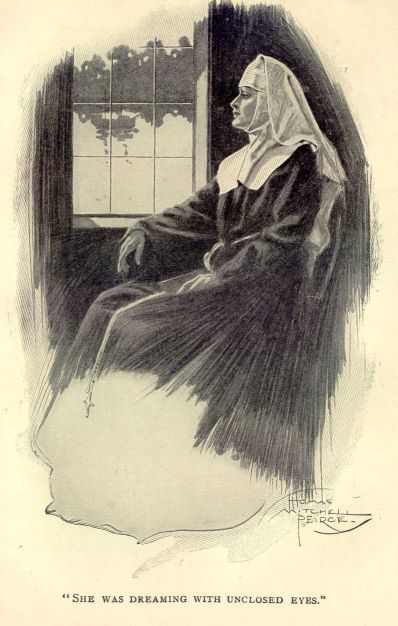
This strange land was full of phantoms. Only the other night he had seen a face resembling Marie de Montbazon's. Bah!
"You are Sister Benie?" he said at once, narrowing his eyes. "Faith," he thought, "if all nuns were like this woman, Christianity were easy to embrace."
"Yes, Monsieur," replied the nun. "Brother Jacques has sent me to you. What may I do for you?"
"You were young once?"
This unusual question apparently had no effect upon her serenity. "I am still young. Those who give their hearts unreservedly to God never grow old."
The marquis's hand moved, restlessly. "How long have you been in Quebec?"
"Fifteen years, Monsieur. Shall I read to you?"
"No. You came from France?" with a sick man's persistence.
"Yes, Monsieur. Is there something besides reading I can do?"
"Do I look ill?" querulously.
"You are burning with fever." She drew the cool palm of her hand across his heated forehead.
"Jehan!" called the marquis. The touch of that hand had caused him an indescribable sensation.
"I am here, Monsieur," replied Jehan.
Sister Benie leaned back out of the sunlight.
"A pitcher of water; I am thirsty."
Jehan took the pitcher fumblingly. He was yellow with fear and wonder.
"You have seen my son?" asked the marquis, when the door closed.
"You ought to be proud of such a son, Monsieur."
The marquis was a bit disconcerted. "I know him well. Do you think he will become great and respected?"
"He has already become respected." She was vaguely distressed and puzzled.
"But will he become great?"
"That is for God to decide."
"Of what consists greatness?"
"It is greatness to forgive."
The marquis turned his head away. He was chagrined. "Monsieur le Comte will never become great then. He will never forgive me for being his father."
"Ah, Monsieur, I do not like that tone of yours. There have been words between you, and you are not forgiving. Do you not love your son?"
"The love of children is the woman's part; man plays it but ill. Perhaps there were some things which I failed to learn." Love his son? A grim smile played over his purple lips. Why, he had ceased even to love himself!
To her eyes the smile resembled a spasm of pain. "Does your head ache?" she asked. She put her arm under his head and placed it more comfortably on the pillow.
"Yes, my head is always aching. I have not lived well, and nature is claiming her tithes." He closed his eyes, surrendering to the restful touch of the cool palm. By and by he slept; and she sat there watching till morning merged into drowsy noon. The agony was begun. And while he slept the mask of calm left her face, revealing the soul. From time to time she raised her eyes toward heaven, and continually her lips moved in prayer.
"Monsieur Paul," said Breton gaily, "do we return to France on the Henri IV?"
"No, lad; nor on many a ship to come and go."
Breton's heart contracted. "But Monsieur le Marquis … ?"
"Will return alone. Go with him, lad; you are homesick. Go and marry old Martin's daughter, and be happy. It would be wrong for me to rob you of your youth's right."
"But you, Monsieur?"
"I shall remain here. I have my time to serve. After that, France, maybe … or become a grand seigneur."
The Chevalier put on his hat. He had an idle hour.
Breton choked back the sob. "I will remain with you, Monsieur, for the present. I was wondering where in the world that copy of Rabelais had gone. I had not seen it since we left the ship Saint Laurent." The lad patted the book with a fictitious show of affection.
"Possibly in the hurry of bringing it here you dropped it, and some one, seeing my name in it, has returned it."
"Never to see France again?" murmured Breton, alone. "Ah, if only I loved her less, or Monsieur Paul not so well!" Even Breton had his tragedy.
The Chevalier perched himself upon one of the citadel's parapets. The southwest wind was tumbling the waters of the river and the deep blues of the forests seemed continually changing in hues. Forces within him were at war. He was uneasy. That his father had fought D'Hérouville on his account there could be no doubt. What a sorry world it was, with its cross-purposes, its snarled labyrinths! The last meeting with his father came back vividly; and yet, despite all the cutting, biting dialogue of that interview, Monsieur le Marquis had taken up his cause unasked and had gone about it with all the valor of his race. He was chagrined, angered. Had the old days been lived rightly and with reason; had there been no ravelings, no tangles, no misunderstandings, life would have run smoothly enough. Had this strange old man, whom fate had made his father, come with repentance, but without mode of expression, without tact? Three thousand miles; 'twas a long way when a letter would have been sufficient. But the cruelty of that lie, and the bitterness of all these weeks! If his thrusts that night had been cruel, he knew that, were it all to be done over again, he should not moderate a single word. The lie, the abominable lie! One does not forgive such a lie, at least not easily. And yet that duel! He would have given a year of his life to see that fight as Brother Jacques described it. It was his blood; and whatever pits and chasms yawned between, the spirit of this blood was common. Perhaps some day he could forgive.
And Diane, she had mocked him, not knowing; she had laughed in his face, unconscious of the double edge; she had accused him and he had been without answer. Heaven on earth! to win her, to call her his, to feel her breath upon his cheek, the perfume of her hair in his nostrils! Hedged in, whichever way he turned, whether toward hate or love! He clutched the handle of his rapier and knotted the muscles of his arms. He would fight his way toward her; no longer would he supplicate, he would demand. He would follow her wherever she went, aye, even back to France! For what had he to lose? Nothing. And all the world to gain.
Man needs obstacles to overcome to be great either in courage or magnanimity; he needs the sense of injustice, of wrong, of unmerited contempt; he needs the wrath against these things without which man becomes passive like non-carnivorous animals. And had not he obstacles?—unrequited love, escutcheon to make bright and whole?
From a short distance Brother Jacques contemplated the Chevalier, gloomily and morosely. Envy, said the marquis, gibing. Yes, envy; envy of the large life, envy of riches, of worldly pleasures, of the love of women. Cursed be this drop of acid which seared his heart: envy. How he envied yon handsome fellow, with his lordly airs, the life he had led and the gold he had spent! And yet … Brother Jacques was a hero for all his robes. He cast out envy in the thought, and made his way toward the Chevalier, whose face showed that at this moment he was not very glad to see Brother Jacques.
"My brother, your father is very ill."
"That is possible," said the Chevalier, swinging to the ground. He did not propose to confide any of his thoughts to the priest. "He is old, and is wasteful of his energies."
"Yes, he has wasted his energies; in your cause, Monsieur, remember that. Your father had nothing in common with D'Hérouville. Their paths had never crossed … and never will cross again."
The Chevalier kicked the stones impatiently. So Brother Jacques understood why the marquis had fought the Comte d'Hérouville?
"May I be so bold as to ask what took place between you and Monsieur le Marquis on the night of his arrival in Quebec?"
"I must leave you in ignorance," said the Chevalier decisively.
"He may never leave his bed."
The Chevalier bit the ends of his mustache, and remained silent.
"He came a long way to do you a service," continued the priest.
"Who can say as to that? And I do not see that all this particularly concerns you."
"But you will admit that he fought the man who … who laughed."
The Chevalier let slip a stirring oath, and the grip he put on the hilt of his sword would have crushed the hand of an average strong man.
"Monsieur, it is true that your father has wronged you, but can you not forgive him?"
The Chevalier stared scowlingly into the Jesuit's eyes. "Would you forgive a father who, as a pastime, had temporarily made you … a bastard?"
The priest's shudder did not escape the searching eyes of the Chevalier. "Ha! I thought not. Do not expect me, a worldly man, to do what you, a priest, shrink from."
"Do not put me in your place. Monsieur. I would forgive him had he done to me what he has done to you."
The Chevalier saw no ambiguity. "That is easily said. You are a priest, I am a worldling; what to you would mean but little, to me would be the rending of the core of life. My father can not undo what he has done; he can not piece together and make whole the wreck he has made of my life."
"Have you no charity?" persuasively.
The Chevalier spread his hands in negation. He was growing restive.
"Will you let me teach you?" Brother Jacques was expiating the sin of envy.
"You may teach, but you will find me somewhat dull in learning."
"Do you know what charity is?"
"It is a fine word, covered with fine clothes, and goes about in pomp and glitter. It builds in the abstract: telescopes for the blind, lutes for the deaf, flowers for the starved. Bah! charity has had little bearing on my life."
"Listen," said Brother Jacques; "of all God's gifts to men, charity is the largest. To recognize a sin in oneself and to forgive it in another because we possess it, that is charity. Charity has no balances like justice; it weighs neither this nor that. Its heart has no secret chambers; every door will open for the knocking. Mercy is justice modified. Charity forgives where justice punishes and mercy condones. Your bitter words were directed against philanthropy, not charity. Shall an old man's repentance knock at the heart of his son and find not charity there?"
"Repentance?" So this thought was not alone his?
"You will forgive him, Monsieur … my brother."
The Chevalier shook his head. "Not to-day nor to-morrow."
"You will not let him of your blood go down to the grave unforgiven; not when he offered this blood to avenge an insult given to you. The reparation he has made is the best he knows. Only forgive him and let him die in peace. He is proud, but he is ill. To this hour he believes that terrible struggle to be but a dream; but even the dream brings him comfort. He is seventy; he is old. You take the first step; come with me. Through all your life you will look back upon this hour with happiness. Whatever the parent's fault may be, there is always the duty of the child toward that parent. You will forgive him."
"But if I go to him without forgiveness in my heart; if only my lips speak?"
"It is in your heart; you have only to look for it."
"Ah well, I will go with you. It is a cup of gall to drink, but I will drink it. If he is dying … Well, I will play the part; but God is witness that there is no charity in my heart, nor forgiveness, for he has wilfully spoiled my life."
So the two men moved off toward the marquis's bed-chamber.
"You remain in the hall, Monsieur," said the priest, "till I call you." But as he entered the chamber he purposely left open the door so that the Chevalier might hear what passed.
"Ah! it is you," said the marquis. "Let me thank you for bringing that nurse."
"Sister Benie?"
"Yes. You do not know, then, from what family she originated?"
"No, Monsieur."
"Who knows?"
"The Mother Superior. Monsieur, I have news for you. I bring you peace."
"Peace?"
"Yes. Monsieur, your son is willing to testify that he forgives you the wrong you have done him."
The marquis shook as with ague and drew the coverlet to his chin. A minute went by, and another. The Chevalier listened, waiting for his father's voice to break the silence. After all, he could forgive.
"Have you anything to say, Monsieur ?" asked Brother Jacques.
The marquis stirred and drew his hand across his lips. "Where is Monsieur le Comte?"
"He is waiting in the hall. Shall I call … ?"
"Wait!" interrupted the marquis. Presently he cleared his throat and said in a thin, dry voice: "Tell Monsieur le Comte for me that I am sleeping and may not be disturbed."
"Monsieur," said Jehan that night, "pardon, but do you ever … do you ever think of Margot Bourdaloue?"
The marquis raised himself as though to hurl a curse at his luckless servant. But all he said was; "Sometimes, Jehan, sometimes!"
"Tell Monsieur le Comte for me that I am sleeping and may not be disturbed!"
All through the long night the marquis's thin, piercing voice rang in the Chevalier's ears, and rang with sinister tone. He could find no ease upon his pillow, and he stole quietly forth into the night. He wandered about the upper town, round the cathedral, past the Ursulines, under the frowning walls of the citadel, followed his shadow in the moonlight and went before it. Those grim words had severed the last delicate thread which bound father and son. To have humiliated himself! To have left open in his armor a place for such a thrust! He had gone with charity and forgiveness, to be repulsed! He had held forth his hand, to find the other's withdrawn!
"Tell Monsieur le Comte for me that I am sleeping and may not be disturbed!"
Mockery! And yet this same father had taken up the sword to drive it through a man who had laughed. Only God knew; for neither the son understood the father nor the father the son. Well, so be it. He was now without weight upon his shoulders; he was conscience free; he had paid his obligations, obligations far beyond his allotted part. It was inevitable that their paths should separate. There had been too many words; there was still too much pride.
"Tell Monsieur le Comte for me that I am sleeping and may not be disturbed!"
He had stood there in the corridor and writhed as this blade entered his soul and turned and turned. Rage and chagrin had choked him, leaving him utterly speechless. So be it. Forevermore it was to be the house divided. … It was after two o'clock when the Chevalier went back to his bed. The poet was in slumber, and his face looked careworn in repose.
"Poor lad! He is not happy, either. Only the clod knows content as a recompense for his poverty. Good night, Madame; to-morrow, to-morrow, and we shall see!"
And the morrow came, the rarest gem in all the diadem of days. There was a ripple on the water; a cloudless sky; fields of corn waving their tasseled heads and the broad leaf of the tobacco plant trembling, trembling.
"What!" cried Victor in surprise; "you have a new feather in your hat?"
"Faith, lad," said the Chevalier, "the old plume was a shabby one. But I have not destroyed it; too many fond remembrances cling to it. How often have I doffed that plume at court, in the gardens, on the balconies and on the king's highways! And who would suspect, to look at it now, that it had ever dusted the mosaics at the Vatican? And there have been times when I flung it on the green behind the Luxembourg, my doublet beside it."
"Ah, yes; we used to have an occasional affair." And Victor nodded as one who knew the phrase. "But a new feather here? Who will notice it? Pray, glance at this suit of mine! I give it one month's service, and then the Indian's clout. I can't wear those skins. Pah!"
"Examine this feather," the Chevalier requested.
"White heron, as I live! You are, then, about to seek the war-path?" laughing.
"Or the path which leads to it. I am going a-courting."
"Ah!"
"Yes. Heigho! How would you like a pheasant, my poet, and a bottle of Mignon's bin of '39?"
"Paris!" Victor smacked his lips drolly.
"Or a night at Voisin's, with dice and the green board?"
"Paris!"
"Or a romp with the girls along the quays?"
"Horns of Panurge! I like this mood."
"It's a man's mood. I am thinking of the château of oak and maple I shall some day build along some river height. What a fireplace I shall have, and what cellars! Somehow, Paris no longer calls to me."
"To me," said the poet, "it is ever calling, calling. Shall I see my beloved Paris again? Who can say?"
"Mazarin will not live forever."
"But here it is so lonesome; a desert. And you will make a fine seigneur, you with your fastidious tastes, love of fine clothes and music. Look at yourself now! A silk shirt in tatters, tawdry buckskin, a new hero's feather, and a dingy pair of moccasins. And you are going a-courting. What, fortune?"
"'Tis all the same."
"So you love her?" quietly.
"Yes, lad, I love her; and I am determined to learn this day the worth of loving."
"Take care," warned the poet.
"Victor, some day you will be going back to Paris. Tell them at court how, of a summer's morn, Monsieur le Chevalier du Cévennes went forth to conquest."
"Hark!" said Victor. "I hear a blackbird." He sorted his papers, for he was writing. "I will write an ode on your venture. What shall I call it?"
"Call it 'Hazards,' comrade; for this day I put my all in the leather cup and make but a single throw. Who is madame?"
"Ask her," rather sharply.
"She is worthy of a man's love?"
"Worthy!" Victor half rose from his chair. "Worthy of being loved? Yes, Paul, she is worthy. But are you sure that you love her?"
"I have loved her for two years."
"Two years," repeated the poet. "She is a strange woman."
"But you know her!"
"Yes, I know her; as we know a name and the name of a history."
"She comes from a good family?"
Victor laughed mirthlessly. "Oh, yes!"
"Do you know why she is here?"
"I thought I did, but I have found that I am as ignorant as yourself."
"There is a mad humor in me to-day. Wish me good luck and bid me be gone."
"Good luck to you, Paul; good luck to you, comrade." And Victor's smile, if forced, was none the less affectionate.
"And luck to your ode, my good poet. I go to find me a nosegay."
And when he was gone, Victor remained motionless in his chair. Two years! Ah, Gabrielle, Gabrielle, was that quite fair? He thought of all the old days, and a great wave of bitterness rushed over him. He no longer heard the blackbird. The quill fell from his fingers, and he laid his head upon his arms.
"I am tired," was all he said.
The Chevalier wended his way toward the Ursulines. His heart beat furiously. Sometimes his feet dragged, or again they flew, according to the fall or rise of his courage. The sight of a petticoat sent him into a cold chill. He tramped here and there, in all places where he thought possibly she might be found. Half the time he caught himself walking on tiptoe, for no reason whatever. Dared he inquire for her, send a fictitious note enticing her forth from her room? No, he dared do neither; he must prowl around, waiting and watching for his opportunity. Would she laugh, be indignant, storm or weep? Heaven only knew! To attack her suddenly, without giving her time to rally her forces,—formidable forces of wit and sarcasm!—therein lay his hope.
"What a coward a woman can make of a man! I have known this woman two years; I have danced and dined with her, made love, and here I can scarce breathe! I am lost if she sees me in this condition, or finds a weak spot. How I love her, love her! I have kissed the air she leaves in passing by. Oh! I will solve this enchanting mystery. I have the right now; I am rich, and young."
It will be seen that the gods favor those who go forward.
By the wall of the Ursulines stood a rustic bench, and upon this bench sat madame. She was waiting for Anne, who was paying her usual morning devotions under the guidance of the Mother Superior. Madame was not very busy with her eyes, and the jeweled miniature which she held in her hand seemed no longer to attract her. The odor of rose and heliotrope pervaded the gently stirring air. From the convent garden came the melting lilt of the golden oriole. By and by madame's gaze returned to the miniature. For a brief space poppies burned in her cheeks and the seed smoldered in her eyes. Then, as if the circlet of gold and gems was distasteful to her sight, she hastily thrust it into the bosom of her gown. Madame had not slept well of late; there were shadows under her lovely eyes.
All this while the Chevalier watched her. Several times he put forward a foot, only to draw it back. This, however, could not go on indefinitely, so, summoning all his courage, he took a firm step, another, and another, and there was now no retreating save ignominiously. For at the sound of his foot on the gravel, madame discovered him. By the time he stood before her, however, all was well with him; his courage and wit and daring had returned to do him honor. This morning he was what he had been a year ago, a gay and rollicking courtier.
"Madame, what a glorious day it is!" The heron feather almost touched the path, so elaborate was the courtesy. "Does the day not carry you back to France?"
Something in his handsome eyes, something in the debonair smile, something in his whole demeanor, left her without voice. She simply stared at him, wide-eyed. He sat down beside her, thereby increasing her confusion.
"I have left Monsieur de Saumaise writing chansons; and here's an oriole somewhere, singing his love songs. What is it that comes with summer which makes all male life carry nosegays to my lady's easement? Faith, it must be in the air. Here's Monsieur Oriole in love; it matters not if last year's love is not this year's. All he knows is that it is love. Somewhere in yonder forests the eagle seeks its mate, the mountain lion its lioness, the red deer its hind."
Madame sat very still and erect. Her forces were scattered, and she could not summon them to her aid till this man's purpose was made distinct.
"In all the hundred days of summer will there be a more perfect day for love than this? Madame, you said that I had lost a valuable art; what was it?"
Madame began vaguely to believe that he had not lost it. This man was altogether new to her. Behind all this light converse she recognized a power. She trembled.
"You need not tell me, Diane; I know what it is. It is the art of making love. I had not lost it; I had thought that here it was simply a useless art. When first I saw you I loved you as a boy loves. I ran hither and thither at your slightest bidding; I was the veriest slave, and I was happy in my serfdom. You could have asked me any task, and I should have accomplished it. You were in my thoughts day and night; not only because I loved you, but because you had cast a veil about you. And of all enchanting mysteries the most holding to man is the woman in the mask. You still wear a mask, Madame, only I have lifted a corner of it. And now I love you with the full love of a man, a love that has been analyzed and proved."
"I will go to Mademoiselle de Vaudemont, who is within the convent." Madame rose quietly, her eyes averted. She would gladly have flown, but that would have been undignified, the acknowledgment of defeat. And just now she knew that she could not match this mood of his.
Gently he caught her hand and drew her back to the seat.
"Pardon, but I can not lose you so soon. Mademoiselle is doubtless at prayer and may not be interrupted. I have so many questions to ask."
Madame was pale, but her eyes were glowing. She folded her hands with a passiveness which boded future ill.
"When you said that you trapped me that night at the Palais Royal, simply to take a feather from my plume, you did not mean that. You had some deeper motive."
Madame's fingers locked and unlocked. "Monsieur … !" she began,
"Why, it seems only yesterday that it was 'Paul'," he interrupted.
"Monsieur, I beg of you to let me go. You are emulating Monsieur d'Hérouville, and that conduct is beneath you."
"But will you listen to what I have to say?"
"I will listen," with a dangerous quiet. "Go on, Monsieur; tell me how much you love me this day. Tell me the story of the oriole, whose mate this year is not the old. Go on; I am listening."
A twinge of his recent cowardice came back to him. He moistened his lips.
"Why do you doubt my love?'"
"Doubt it! Have I not a peculiar evidence of it this very moment?" sarcastically. Madame was gathering her forces slowly but surely.
"I have asked you to be my wife, not even knowing who you are."
Madame laughed, and a strain of wild merriment crept into the music of it. "You have great courage, Monsieur."
"It is laughable, then?"
"If you saw it from my angle of vision, you would also laugh." The tone was almost insolent.
"You are married?" a certain hardness in his voice.
Madame drew farther back, for he looked like the man who had, a few nights since, seized her madly in his arms.
"If you are married," he said, his grey eyes metallic, "I will go at once, for I should know that you are not a woman worthy of a man's love."
"Go on, Monsieur; you interest me. Having asked me to listen to your protestations of love, you would now have me listen to your analysis of my character. Go on."
"That is not a denial."
"Indeed!"
"D'Hérouville called you 'Madame.'"
"Well?"
"What am I to believe?"
"What you will: one way or the other, I am equally indifferent." Ah, Madame!
The Chevalier saw that if he became serious, violent, or ill-tempered, he was lost. He pulled himself together. He smiled.
"Why are you not in Montreal? I understand Mademoiselle Catharine is there."
The Chevalier laughed. "You make me laugh, Diane."
"Why are you here in Quebec?"
"And you, Madame?"
"Perhaps I was seeking adventures."
"Well, perhaps I, too, came with that purpose. Come, Madame; neither of us is telling the truth."
"Begin, then, Monsieur; set an example for me."
The lines in his face deepened. All the pain of the tragedy came back. "Tell Monsieur le Comte for me that I am sleeping and may not be disturbed!" He struggled and cast aside the gloom.
"I have been accused of conspiracy, Madame."
"Conspiring?"
"Yes; for my happiness."
Madame was plainly disappointed.
"I was exiled from court upon a grave accusation."
"You were recalled, and all your honors restored."
"Since you know all, Madame, it is needless to explain. What most concerns me this morning is your belief that I love you."
"Listen: there's the oriole."
"How about Madame Oriole; does she regret the lover of last year?"
"Very good, Monsieur. You are daily recovering your wit. And you used to be very witty when you were not making extravagant love."
"A man does not weep when he loves and the object of his love simulates kindness."
"I should like to test this love," reflectively.
"Test it, Diane; only test it!" He was all eagerness. He flung his hat to the ground, and with his arm along the back of the seat he leaned toward her. The heron feather remained unharmed; it was a prophetic sign, only he did not realize it. He could realize nothing save that the glorious beauty of her face was near, and that to-day there was nothing else in the world. He was young, and youth forgets overnight.
Madame, with the knuckle of a finger against her lips, posed as if ruminating, when in truth she was turning over in her mind the advisability of telling him all, laughing, and leaving him. And suddenly she grew afraid. What would he do? for there was some latent power in this man she hesitated to rouse. She hesitated, and the opportunity was gone. For her thought swerved to this: if only he had not such handsome eyes! She dropped her hand.
"I will test this love," she said, with malice bubbling in her own lovely orbs. "The Comte d'Hérouville has grievously offended me. Will you challenge him?" She meant nothing by this, save to gain time.
The Chevalier paled, recalling D'Hérouville's threats. "He departs the scene;" but the smile was on his lips alone.
"Then, there is the Vicomte d'Halluys; he, too, has offended me."
"The vicomte?" Challenge the vicomte, who had put D'Hérouville in the hospital that night of the fatal supper?
"Ah!" said madame; "you hesitate! And yet you ask me to put you to the test!"
"I was weighing the matter of preference," with a wave of the hand; "whether to challenge the vicomte first, or D'Hérouville. Give me the rest of the list."
"Monsieur, I admire the facility with which you adapt yourself to circumstances," scornfully. "You knew that I was but playing. I am fully capable of repaying any insolence offered to me, whether from D'Hérouville, the vicomte … or yourself."
"To love you, then, is insolence?"
"Yes; the method which you use is insolent."
"Is there any way to prove that I love you?" admirably hiding his despair.
"What! Monsieur, you go a-courting without buckles on your shoes?"
"Diane, let us play at cross-purposes no longer. You may laugh, thrust, scorn, trample, it will in no wise effect the constancy of my love. I do not ask you to set tasks for me. Now, hark to me: where you go henceforth, there shall I go also, to France, to Spain, to the ends of the world. You will never be so far away from the sound of my voice that you can not hear me say that I love you."
"That is persecution!"
"It is love. I shall master you some day," recovering his hat and standing, "be that day near or far. I am a man, a man of heart and courage. You need no proof of that. I have bent my knee to you for the last time but once. I shall no more entreat," holding his head high.
"Truly, Monsieur!" her wrath running over.
"Wait! You have forced me, for some purpose unknown, to love you. Well, I will force you to love me, though God alone knows how."
"You do well to add that clause," hotly. "Your imagination is too large. Force me to love you?" She laughed shrilly.
But his eye was steady, even though his broad chest swelled.
"You have asked me who I am," she cried. "Then, listen: I am …"
His face was without eagerness. It was firm.
"I am …" she began again.
"The woman I love, the woman who shall some day be my wife."
"Must I call you a coward, Monsieur?" blazing.
"I held you in my arms the other night; you will recollect that I had the courage to release you."
Madame saw that she had lost the encounter, for the simple reason that the right was all on his side, the wrong and injustice on hers. Instinctively she felt that if she told him all he in his gathering coolness would accept it as an artifice, an untruth. Her handkerchief, which she had nervously rolled into a ball, fell to the walk. He picked it up, but to the outstretched hand he shook his head.
"That is mine, Monsieur; give it to me."
"I will give it back some day," he replied, thrusting the bit of cambric into his blouse.
"Now, Monsieur; at once!" she commanded.
"There was a time when I obeyed you in all things. This handkerchief will do in place of that single love-letter you had the indiscretion to write. Do you remember that line, 'I kiss your handsome grey eyes a thousand times?' That was a contract, a written agreement, and, on my word of honor, had I it now …"
"Monsieur du Cévennes," she said, "I will this day write an answer to your annoying proposal. I trust that you will be gentleman enough to accept it as final. I am exceedingly angry at this moment, and my words do justice neither to you nor to me. Yes, I had a purpose, a woman's purpose; and, to be truthful, I have grown to regret it."
"Your purpose, Madame, is nothing; mine is everything." He bowed and departed, the heron feather in his hat showing boldly.
It was almost a complete victory, for he had taken with him her woman's prerogative, the final word. He strode resolutely along, never once turning his head … not having the courage. But, had he turned, certain it is that he must have stopped.
For madame had fallen back upon that one prerogative which man shall never take from woman … tears!
Look back, Monsieur, while there is yet time.
At the noon meal madame's chair at the table was vacant, and Anne, who had left madame outside the convent gate and had not seen her since, went up to the room to ascertain the cause of the absence. She found the truant asleep, the last vestige of her recent violent tears fringing her lashes. Silently Anne contemplated the fall and rise of the lovely bosom, eyed thoughtfully the golden thread which encircled the white throat; and wondered. Had this poor victim of conspiracy, this puppet in the cruel game of politics, left behind in France some unhappy love affair? What was this locket which madame hid so jealously? She bent and pressed a kiss upon the blooming cheek, lightly and lovingly. And light as the touch of her lips was, it was sufficient to arouse the sleeper.
"What is it?" madame said, sitting up. "Oh, it is you, Anne. I am glad you awoke me. Such a frightful dream! I dreamt that I had married the Chevalier du Cévennes! What is the hour?"
"It is the noon meal, dear. You have been weeping."
"Yes, for France, beloved France, with all its Mazarins and its cabals. Anne, dear, I must confess. I can not remain here. I am afraid, afraid of D'Hérouville, the vicomte. I am going to return on the Henri IV. I can bear it here no longer. I shall find a hiding place beyond the reach of Mazarin."
"As you think best. But why not enter the Ursulines with me? There is peace in the House of God."
"Is there not peace wherever the peaceful heart is? Walls will not give me peace."
"You should have known your heart before you left France," shrewdly.
"Anne, does any one know the human heart? Do you know yours?"
Anne's eyes closed, for the briefest moment. Know her heart? Alas!
"Come, Gabrielle; they are waiting for us at the table."
"I will go with you, but I have no appetite."
"We will go upon the water after four. It will pass away the time. You are certain that you wish to return to France; from passive danger into active?"
Madame nodded.
"I will inform his Excellency, for it is no more than right that he should be acquainted with your plans."
"How serious you have become, Anne," wistfully. "I am sure that I should be livelier and more contented if you were not always at prayer. I am lonely at times."
"You have been here scarce more than a week."
Madame did not reply.
At four her calm and even spirits returned; and the thought of seeing France again filled her with subdued gaiety. The sun was nearing the forests' tops when the two women sauntered down to the river front, to put about the governor's pleasure boat. They put blankets and mats into the skiff and were about to push off, when Brother Jacques approached them.
"Now, what may he want?" asked Anne, in a whisper.
"You are going for a row upon the river?" asked Brother Jacques, respectfully.
"Yes, Brother Jacques," replied Anne. "Is not the water beautiful and inviting?"
"I would not venture far," he said. "Iroquois have been reported in the vicinity of Orléans."
"We intend to row as far as Sillery and back. There can be no danger in that."
Brother Jacques looked doubtful.
"And are not the Iroquois our friends?" asked madame. "Are not Frenchmen building a city in the heart of their kingdom?"
Brother Jacques smiled sadly. "Madame, I should not be surprised to learn on the morrow that the expedition to Onondaga had already been exterminated."
"You, of all persons, should be loyal to the Indian," replied Anne, arranging the mats in the bottom of the boat.
"Mademoiselle, I know him thoroughly. That is why I undertake to warn you. The rattlesnake which you dread is less terrible to me than the Iroquois. My duty, not my inclination, makes me walk among them."
"We promise not to go beyond sight of the warehouses."
"Come with us," said Anne. "We will read to you and you will in turn tell us the legend of Hiawatha, so long delayed."
"If madame is agreeable," replied the priest, his heart beating a trifle faster than normal: he was human, and these two women were beautiful.
"Come with us, by all means," said madame graciously.
"You will sit in the stern, Gabrielle," said the admiral's granddaughter; "I shall sit on the mat, as the Indian says, and Brother Jacques shall take the oars. And take care that we do not run away with you."
"I am not afraid," returned Brother Jacques, a secret happiness possessing him. "Besides, I can swim." He recognized the danger of beauty in close proximity, but he unwisely forgot the dangers of time and place. How much rarer the world becomes to the man who has seen flower gardens and beautiful women moving to and fro among them! Ah, that ragged, rugged highway which he had traversed: dry crusts of life, buffets, bramble, curses and mockery. And here was realized one of his idle dreams. He took a dozen long strokes, which sent the craft up stream in the direction of Sillery, and let the oars drift. "You were to read a book?" he asked.
"It would burn your godly ears," said madame: "Malherbe."
"I have read him," quietly.
"What? Oh, fie, Monsieur le Jesuit!" And madame laughed at his confusion.
"When I was eighteen. That was before I took the orders." He picked up the oars again and pulled strongly and noiselessly. His thought was far away just then: when he was eighteen.
Anne, with her shoulders resting against madame's knees, opened the book which Victor had given her on a Sunday the year before. Sometimes Brother Jacques's stroke beat rhythmically with the measures; sometimes the oars trailed through the water with a low, sweet murmur. He could see nothing but those two fair faces.
They were nearing the heights of Sillery when Anne closed the book. "And now for Hiawatha and his white canoe," she said.
"Very well; I will tell you of the good Hiawatha, his daughter, and his white canoe. He came from the sky one day, in this very wonderful canoe. He had given up his rights as a deity in order to mingle with men and teach them wisdom. He was the wisest of all Indians as Nestor was the wisest of all the Greeks. As a god he was known as Taounyawatha, and he presided over the fisheries and the waterways. Whenever there was dissension among the various nations of the Iroquois, it was his word which settled the dispute. Grey-haired he was, penetration marked his eye, dark mystery pervaded his countenance. One day there was internal war and great slaughter followed. The wise men of the nations got together and summoned Hiawatha. They built great council fires on the shores of Genentaha Lake, which we call Onondaga. For three days these fires burned, but the great sage did not put in appearance, and nothing could be done without his counsel. When at last messengers found him in his secret abode, he was in a most melancholy state of mind. Great evil lay in his path, he said; and he had concluded not to attend the council at Genentaha. But the messengers said that the great wise men could not proceed with business until the council was graced with his presence. And if he did not come, annihilation awaited his children."
Brother Jacques rested on his oars again. Only his voice was with his narrative; his mind was filled with longing, the same longing which had always blocked his path to priestly greatness: the love of women.
"So Hiawatha removed his sacred white canoe from the lodge built for it, and the messengers reverentially assisted him to launch it. The wise man once again took his accustomed seat, and bade his daughter, a girl of twelve, and his heart's darling, to accompany him. She unhesitatingly obeyed; and together they made all possible speed toward the grand council ground. At the approach of the venerable sage, a shout of joy resounded throughout the assembled host, and every demonstration of respect was paid to the illustrious one. As he landed and was passing up the steep bank toward the council ground, a loud noise was heard, like the rushing of a mighty wind. All eyes were instantly turned upward, and a dark spot was discovered rapidly descending from the clouds above. It grew larger and larger as it neared the earth, and was descending with frightful velocity into their very midst. Terror filled every breast, and every one seemed anxious for his own safety. Confusion prevailed. All but the venerable Hiawatha sought safety in flight. He gravely uncovered his silvered head and besought his darling daughter to await the approaching danger with becoming resignation, at the same time reminding her of the futility and impropriety of attempting to prevent the designs of the Great Spirit.
"'If,' he said, 'the Great Spirit is determined upon our destruction, we shall not escape by removal, nor evade his decrees.'"
"And he was an Indian who expressed that thought?" said madame, wonderingly.
The boat drifted: not down stream as was natural, but up against the current, contrary to the laws of nature. Had they all been less interested in what was going on in their minds, they would have at once remarked this phenomenal performance.
"There is a mysterious particle of God in every savage," replied Brother Jacques, mentally comparing Anne's eyes with flashing water. "Well, to go on. Hiawatha's daughter modestly acquiesced to her kind parent's advice, and with patient submission awaited the catastrophe. All this was but the work of an instant; for no sooner had the resolution of the wise man become fixed and his latest words uttered than an immense bird, with long and pointed beak, with wide extended wings, came down with a mighty swoop and crushed the beautiful girl to the earth. With such force did the monster fall, and so great was the commotion of the air, that when it struck the ground, the whole assemblage was forced violently back several rods. Hiawatha alone remained unmoved, and silently witnessed the melancholy end of his beloved. 'Ai, ai, ai, agatondichou! Alas, alas, alas, my beloved! His darling had been killed before his eyes and her destroyer had been killed with her. His own time on earth was at an end.
"It was found upon examining the bird that it was covered with beautiful white plumage; and every warrior as he advanced plucked a plume from this singular bird, and with it adorned his crown. And forever after the braves of the confederate nations made choice of the plumes of the white herons as their most appropriate military ornament.
"Hiawatha was not to be consoled. He remained prostrate three nights and days, neither eating nor drinking. Then he roused and delivered the great harangue to the multitude, gave them the advice which made them so powerful. To the Mohawks he said that they should be called the first nation, because they were warlike and mighty; the Oneidas should be second, because of their wisdom; the Onondagas should be third, because they were mightiest of tongue and swiftest of foot; the Cayugas should be fourth, because of their superior cunning in hunting; and the Senecas should be fifth, because of their thrift in the art of raising corn and making cabins. To avoid all internal wars, all civil strife, they must band together in this wise, and they should conquer all their enemies and become great forever.
"'Lastly,' he said, 'I have now assisted you to form a mighty league, a covenant of strength and friendship. If you preserve it, without admission of other people, you will always be free, numerous and mighty. If other nations are admitted into your councils, they will sow jealousies among you, and you will become enslaved, few and feeble. Remember these words; they are the last you will hear from Hiawatha. Listen, my friends, the Great Master of Breath calls me to go. I have patiently awaited his summons. I am ready; farewell.'
"And as the wise man closed his speech, there burst upon the air the sound of wondrous music. The whole sky was filled with sweetest melody. Amid the general confusion which prevailed, Hiawatha was seen majestically seated in his white canoe, gracefully rising higher and higher above their heads through the air, until the clouds obscured it from view. Thus, as he came, he left them; but he had brought wisdom and had not taken it away, the godlike Taounyawatha, and son of the Great and Good Spirit Hawahneu. It is the learning of these poetical legends that has convinced us that some day we shall convert these heretics into Christians. It is …" Brother Jacques seemed turned into stone.
A hand, dark and glistening with water resting upon the gunwale of the boat, just back of madame, had caught his eye. Both women saw the horror grow in his face.
"What is it?" they cried.
Without replying he caught up the oars. The water boiled around the broad blades: the boat did not turn, but irresistibly maintained its course up the river. With an exclamation of despair, he wrenched loose one of the oars, lifted it above his head and brought it swiftly down toward the hand. The blade splintered on the gunwale. The hand had been withdrawn too swiftly. At the same instant the boat careened and a bronzed and glistening savage raised himself into the boat; and another, and another. They were captives, madame, Anne, and Brother Jacques. There stood the frowning fortress in the distance, help; but no voice could reach that distance. They were lost.
One of the Indians drew a knife and held it suggestively against Brother Jacques's breast. Neither madame nor Anne screamed; they were daughters of soldiers.
There were four Indians in all. They had daringly breasted the stream, and had grasped the towing line and the stern and had silently propelled the boat up the current.
"For myself I do not care," said Brother Jacques, his voice breaking. "But God forgive me for not being firm when I warned you."
"You are not to blame, Father," said madame. She was pale, but calm.
"What will they do with us?" asked Anne, a terrible thought dazing her.
"We are in the hands of God."
The boat moved diagonally across the river. When the forest-lined shore was gained, the leader motioned his captives to disembark, which they did. He put the remaining oar into the lock and pushed the governor's pleasure craft down stream, smiling as he did so. Next he drew forth two canoes from under drooping elderberry bushes and motioned to the women and Brother Jacques to enter.
"What are you going to do with us?" asked Brother Jacques in his best Iroquois.
"Make slaves of the white man's wives," gruffly. "The squaws of the Senecas long for them. And shall the Seneca see his favorite wife weep like a mother who has lost her firstborn?"
"Ah!" cried the priest, a light of recognition coming into his eyes. "So it is you, Corn Planter, whom I baptized Peter, whom I saved from starvation three times come the Winter Maker! So the word and gratitude of Corn Planter become like walnuts which have no meat? Beware; these are the daughters of Onontio, and his wrath will be great."
"It is the little Father," replied the Seneca. "It is well. He shall have food in plenty, and his days shall be long in my village, where he will teach my children the laws of his fathers. As for Onontio, he sleeps in his stone house while my brothers from the Mohawk valley carry away his Huron children. The daughters of Onontio shall become slaves. I have said."
"I will give my body to the stake," said Brother Jacques; "my flesh and bones to torture. Let Onontio's daughters go."
"I have seen the little Father with his thumb in the pipe, and he smiles like a brave man. No. They are fairer than the blossom of the wild plum, and their hair is like the silk of corn. They shall be slaves or wives, as they choose. Make haste," pushing the priest toward the canoe in which madame and Anne had already taken their places.
Had he been alone he would have resisted, so great was his wrath. A moment's vanity placed him and these poor women in this predicament. He had been warned by a trader that a small band of Iroquois were hanging about, and yet he had been drawn into this! Yonder was the marquis, who might die … !
"Take care, little Father," warned the Seneca, realizing by the Jesuit's face the passion which was mounting to his brain. "It would cause the Corn Planter great sorrow to strike."
Brother Jacques's shoulders drooped, and he sat down in the bottom of the canoe.
"They will not harm us for the present," he said to the women encouragingly. "And there is hope for us is the fact that these are Senecas. To reach their villages they will perforce travel the same route as the Onondaga expedition. And we shall probably pass close to where our friends are."
"But the boat," said madame, "Monsieur de Lauson will think that we have been drowned!"
"Jean Pauquet saw me enter the boat with you, and he knows that I am a good sailor. Monsieur de Lauson will suspect immediately that we have fallen into the hands of savages, and will instantly send us aid. So keep a good heart and show the savage that you do not fear him. If you can win his respect he will be courteous to you; and that will be something, for the journey to Seneca is long."
Neither woman replied. Madame's thought went back rebelliously to the morning. "To the ends of the world," the Chevalier had said. She shook her head wearily. It was all over. She cared not whither these savages took her. Mazarin would not find her indeed! What a life had been hers! Only twenty-two, and nothing but unhappiness, disillusion, with here and there an hour of midsummer's madness. And that note she had written! The thought of it sustained her spirits. By now he knew all. She shut her eyes and pictured in fancy his pain and astonishment and chagrin. It was exhilarating. She would have liked to cry.
The Seneca chief spoke softly, commanding silence, and the canoes glided noiselessly along the southern shores of the great river. The sun sank presently, and night became prodigal with her stars. Occasionally there was the sound of gurgling water as some brook poured into the river, or the whisper of stirring branches lightly swept by the feathered heads of the Indians. Aside from these infrequent sounds, the silence was vast and imposing. Anne, with her head in madame's lap, wept bitterly but without sound. She was a girl again; the dignity of womanhood was gone, being no longer in the shadow of the convent walls.
Brother Jacques saw nothing in the velvet glooms but the figure of Monsieur le Marquis as it lay that night after the duel.
Whenever the Senecas came to a habitation, they drew up the canoes and carried them overland, far distant into the forest, making a half-circuit of the point. During these portages the fatigue of the women was great. Several times Anne broke down, unable to proceed. Sometimes the savages waited patiently for her to recover, at other times they were cruel in their determination to go on. Once Brother Jacques took Anne's slight figure in his strong arms and carried her a quarter of a mile. She hung upon his neck with the content of a weary child, and the cool flesh of her cheek against his neck disturbed the tranquillity of his dreams for many days to come.
Madame, on her part, struggled on without complaint. If she stumbled and fell, no sound escaped her lips. She regained her feet without assistance. Madame's was a great spirit; she knew the strength of resignation.
It was after two o'clock when the Iroquois signified their intention of pitching camp till dawn. They were far away from the common track now. The last portage had carried them across several small streams. They were in the heart of the forest. All night Brother Jacques sat at the side of the women, guarding with watchful eyes. How the spirit and the flesh of this man warred! And all the while his face in the filtered moonlight was marbled and set of expression. He was made of iron, constitutionally; his resolution, tempered steel.
Anne slept, but not so madame. She listened and listened: to the stir of the leaves, to the dim murmur of running water, to the sighs of the night wind, to the crackling of a dry twig when Anne turned uneasily in her sleep. She listened and listened, but the sound she hungered for never came.
At Quebec the news of the calamity did not become known till near midnight. As the wind-drifted pleasure-boat told its grim story, desolation fell upon the hearts of four men, each being conscious in his own way that some part of the world had shifted from under his feet. The governor recommended patience; he was always recommending that attribute; he was always practising it, and fatally at times. The four men shook their heads. The Chevalier and Victor bundled together a few necessities, such as cloaks, blankets and arms. They set out at once while the moon was yet high; set out in silence and with sullen rage.
Jean Pauquet and the vicomte were in the act of following, when D'Hérouville, disheveled and breathing heavily from his run down from the upper town, arrested them.
"Vicomte," he cried, "you must take me with you. I can find no one to go with me."
"Stay here then. Out of the way, Monsieur." The vicomte was not patient to-night, and he had not time for banter.
"I say that you shall!"
"Not to-night. Now, Pauquet."
"One of us dies, then!" D'Hérouville's sword was out.
"Are you mad?" exclaimed the vicomte, recoiling.
"Perhaps. Quick!" The sword took an ominous angle, and the point touched the vicomte.
"Get in!" said the vicomte, controlling his wild rage. "I will kill you the first opportunity. To-night there is not time." He seized his paddle, which he handled with no small skill considering how recently he had applied himself to this peculiar art of navigation.
Pauquet took his position in the stern, while D'Hérouville crouched amidships, his bare sword across his knees. The vicomte's broad back was toward him, proving his contempt of fear. They were both brave men.
"Follow the ripple, Monsieur," said Pauquet; "that is the way Monsieur le Chevalier has gone."
It was all very foolhardy, this expedition of untried men against Indian cunning; but it was also very gallant: the woman they loved was in peril.
So the two canoes stole away upon the broad bosom of the river and presently disappeared in the pearly moon-mists, the one always hugging the wake of the other. The weird call of the loon sometimes sounded close by. The air was heavy with the smell of water, of earth, and of resin.
Three of these men had taken the way from which no man returns.
The Oneida village lay under the grey haze of a chill September night. Once or twice a meteor flashed across the vault of heaven; and the sharp, clear stars lighted with magic fires the pure crystals of the first frost. The hoot of an owl rang out mournfully in answer to the plaintive whine of the skulking panther. A large hut stood in the center of the clearing. The panther whined again and the owl hooted. The bear-skin door of the hut was pushed aside and a hideous face peered forth. There was a gutteral call, and a prowling cur slunk in.
Within the hut, which was about twenty feet square, men, women and children had packed themselves. The air was foul, and the smoke from the blazing pine knots, having no direct outlet, rolled and curled and sank. The savages sprawled around the fire, bragging and boasting and lying as was their wont of an evening. Near-by the medicine man, sorcerer so-called, beat upon a drum in the interest of science and rattled bears' claws in a tortoise-shell. A sick man lay huddled in skins at the farthest end of the hut. His friends and relatives gave him scant attention. Indians were taught to scorn pity. Drawings on the walls signified that this was the house of the Tortoise.
Four white men sat among them; sat doggedly in defeat. Gallantry is a noble quality when joined to wisdom and foresight; alone, it leads into pits and blind alleys. And these four men recognized with no small bitterness the truth of this aphorism. They had been ambushed scarce four hours from Quebec by a baud of marauding Oneidas. Only Jean Pauquet had escaped. They had been captives now for several weeks. Rage had begun to die out, fury to subside; apathy seized them in its listless embrace. Heavy, unkempt beards adorned their faces, and their hair lay tangled and matted upon their shoulders. They were all pictures of destitution, and especially the whilom debonair poet. His condition was almost pitiable. Some knavish rascal had thrust burdocks into his hair and another had smeared his face with balsam sap. He had thrashed one of these tormentors, and had been belabored in return. He had by now grown to accept each new indignity with the same patient philosophy which made the Chevalier and the vicomte objects of admiration among the older redskin stoics. As for D'Hérouville, he had lost but little of his fire, and flew into insane passions at times; but he always paid heavily for the injuries which he inflicted upon his tormentors. His wound, however, had entirely healed, and the color on his cheeks was healthful. He would become a formidable antagonist shortly. And there were intervals when the vicomte eyed him morosely.
The Chevalier completely ignored the count, either in converse or in looks. D'Hérouville was not at all embarrassed. Rather it added to the zest of this strange predicament in which they were placed. It was a tonic to his superb courage to think that one day or another he must fight and kill these three men or be killed himself.
Occasionally the vicomte would stare at the Chevalier, long and profoundly. Only Victor was aware of this peculiar scrutiny. It often recalled to him that wild night at the Hôtel de Périgny in Rochelle. But the scrutiny was untranslatable.
No one spoke of madame; there was no need, as each knew instinctively that she was always in the others' thoughts. The Chevalier no more questioned the poet as to her identity. Was she living or dead, in captivity or safe again in Quebec? Not one laid his head down at night without these questions.
The monotonous beating of the drum went on. Harsh laughter rose; for every night the Indians contrived to find new epithets with which to revile the captives. So far there had been no hint of torture save the gamut. The Chevalier, even with his inconsequent knowledge of the tongue, caught the meaning of some of the words. The jests were coarse and vulgar, and the women laughed over them as heartily as the men. Modesty and morality were not among the red man's immediate obligations.
The Chevalier devoted his time to dreaming. It was an occupation which all shared in, as it took them mentally away from their surroundings. He conjured up faces from the sparkle of the fire. He could see the Rubens above the mantel at the hôtel in Rochelle, the assembly at the Candlestick, the guardroom at the Louvre, the kitchens along the quays, or the cabarets in the suburbs. A camp song rises above the clinking of the bottles and glasses; a wench slaps a cornet's face for a pilfered kiss; a drunken guardsman quarrels over an unduly heavy die.
"Count," said the vicomte to D'Hérouville, "did you ever reckon what you should do with those ten thousand livres which you were to receive for that paper of signatures?"
At any other time this remark would have interested Victor.
D'Hérouville, having concentrated his gaze upon the ragged soles of his boots, saw no reason why he should withdraw it. He was weary of the vicomte's banter. All he wanted was a sword and a clear sweep, with this man opposing him.
"Now, if I had those livres," went on the vicomte, whose only object was to hear the sound of his own voice, "and were at Voisin's, I should order twelve partridge pies and twelve bottles of bordeaux."
"Bordeaux," said Victor, absently.
The Chevalier looked up, but seeing that he was not addressed, resumed his dreams.
"Yes, my poet, bordeaux, red and friendly. And on top of that should be a fish salad, with that wonderful vinegar and egg dressing which Voisin alone knows how to make."
"And then?" urged Victor, falling into the grim humor of the thing.
"Then, two bottles of champagne." The vicomte stood up. He appeared to be counting on his fingers. "That would make fourteen bottles."
"You would be drunk."
"Drunk as a fiddler on Saturday night. Now, I am going to promote my character among these rascals by doing some medicine work myself." And he burst forth sonorously in profanity, waving his hands and swaying his body. He recalled every oath in his extensive camp vocabulary. The expression on his face was sober, and Victor had a suspicion that this exhibition was not all play. The savages regarded the vicomte as one suddenly gone demented, till it dawned upon one of them that the white man was committing a sacrilege, mocking the reverend medicine man. He rose up behind the vicomte, reached over and struck him roughly on the mouth. The vicomte wheeled like a flash. The Indian folded his arms across his bronzed chest and looked the furious man calmly in the eye. The vicomte presently dropped his balled fists, shrugged, and sat down. It was the best and wisest thing he could do.
D'Hérouville, roused from his apathy, laughed. "Eh, you laugh?" said the vicomte, wiping his bloody lips. His eyes snapped wickedly.
"It is a habit I have," retorted D'Hérouville, glancing boldly at the Chevalier.
"Some day your habit will choke you to death."
D'Hérouville's cheeks darkened. He returned to the contemplation of his boots.
"Ten thousand livres!" The vicomte wiped his lips again, and became quiet.
This was one evening among many of its like. The poet busied himself with taking some of the burs from his hair and absently plucking them to pieces. … And Paul had had an intrigue with Gabrielle which had lasted nearly two years! And madame was unknown to him! What was her purpose? Blind fool that he had been, with all his dreams. Ever was he hearing the music of her voice, breathing the vague perfume of her flowering lips, seeing the heavenly shadows in her eyes. Once he had come upon her while she slept. Oh, happy thief, to have pressed his lips upon that cheek, blooming delicately as a Persian peach! And that memory was all he had. She did not love him!
The musing came to an abrupt end. A moccasined foot shot out and struck Victor in the small of the back, sending him reeling toward the fire. In trying to save himself he extended his hands. He fell upon a glowing ember, and his palms were burned cruelly. Cries of laughter resounded through the hut. Victor bit his lips to repress the cry of pain.
With the agility of a panther, the Chevalier sprang toward the bully. There was a terrible smile on his face as he seized the young brave's wrists in a grip of iron. The Oneida was a strong youth, but he wrestled in vain. The Chevalier had always been gifted with strength, and these weeks of toil and hardship had turned his muscles into fibers unyielding as oak. Gradually he turned the Indian around. The others watched the engagement with breathless interest. Presently the Indian came to his knees. Quick as light the Chevalier forced him upon his face, caught an arm by the elbow and shoved the brown hand into the fire. There was a howl of pain and a yell of laughter. Without seeming effort the Chevalier then rolled the bully among the evil-tempered dogs. So long as he continued to smile, the Indians saw nothing but good-natured play, such as had been the act which caused Victor his pain. The Chevalier sat down, drew his tattered cloak around his shoulders, and once more resumed his study of the fire.
"Hoh!" grunted the fighting braves, who frankly admired this exhibition of strength.
"Curse it, why didn't I think of that?" said the vicomte, his hand seeking his injured mouth again.
"God bless you for that, Paul," murmured Victor, the sparkle of tears in his eyes. "My hands do not hurt half so much now."
"Would to God, lad, you had gone to Spain. I am content to suffer alone; that is my lot; but it triples my sufferings to see you in pain."
"Good!" said D'Hérouville. "The cursed fool of a medicine man has stopped his din. We shall be able to sleep." He doubled up his knees and wrapped his arms around them.
A squaw gave Victor some bears' grease, and he rubbed his palms with it, easing the pain and the smart.
One by one the Indians dozed off, some on their bellies, some on their backs, some with their heads upon their knees, while others curled themselves up among the warm-bodied dogs. Monsieur Chouan hooted once more; the panther's whine died away in the distance; from another part of the village a cur howled: and stillness settled down.
Victor, kept awake by his throbbing hands, which he tried to ease by gently rocking his body, listened dully to all these now familiar sounds. Across his shoulders was flung the historic grey cloak. In the haste to pursue madame's captors, it had mysteriously slipped into the bundle they had packed. Like a Nemesis it followed them relentlessly. This inanimate witness of a crime had followed them with a purpose; the time for its definition had not yet arrived. The Chevalier refused to touch it, and heaped curses upon it each time it crossed his vision. But Victor had ceased to feel any qualms; it kept out the chill at night and often served as a pillow. Many a time D'Hérouville and the vicomte discovered each other gaping at it. If caught by D'Hérouville, the vicomte shrugged and smiled; on the other hand, D'Hérouville scowled and snarled his beard with his fingers. There was for these two men a peculiar fascination attached to that grey garment, of which neither could rid himself, try as he would. Upon a time it had represented ten thousand livres, a secure head, and a woman's hand if not her heart.
Once Victor thoughtlessly clasped his hands, and a gasp of pain escaped him.
"Does it pain you much, lad?" asked the Chevalier, turning his head.
"I shut them, not thinking. I shall be all right by morning."
The Chevalier dropped his head upon his knees and dozed. The vicomte and the poet alone were awake and watchful.
A sound. It drifted from afar. After a while it came again, nearer. The sleeping braves stirred restlessly, and one by one sat up. A dog lifted his nose, sniffed, and growled. Once more. It was a cry, human and designed. It consisted of a prolonged call, followed by several short yells. The old chief rose, and putting his hands to his mouth, uttered a similar call. It was immediately answered; and a few minutes later three Indians and two Jesuit priests pushed aside the bearskin and entered the hut.
"Chaumonot!" exclaimed the Chevalier.
The kindly priest extended his hands, and the four white men respectfully brushed them with their lips. It was a tribute less to his office than to his appearance; for not one of them saw in his coming aught else than a good presage and probable liberation.
Chaumonot was accompanied by Father Dablon, the Black Kettle,—now famous among his Onondaga brothers as the one who had crossed the evil waters, and two friendly Oneida chiefs. There ensued a prodigious harangue; but at the close of it the smile on Chaumonot's face signified that he had won his argument.
"You are free, my sons," he said. "It took some time to find you, but there is nothing like perseverance in a good cause. At dawn you will return with me to Onondaga. Monsieur," addressing the Chevalier; "and how is the health of Monsieur le Marquis, your kind father?"
The smile died from the Chevalier's face. "Monsieur le Marquis is at Quebec; I can not say as regards his health."
"In Quebec?"
"Yes, Father," Victor interposed.
"How did you know that we were here ?" asked the vicomte.
"Pauquet, in his wanderings, finally arrived at Onondaga two weeks ago. Upon hearing his story I at once began a search. We are virtually at peace with the Senecas and the Oneidas."
"And … the women?" inquired Victor, his heart's blood gushing to his throat.
The two Jesuits solemnly shook their heads.
Victor laid his head against the Chevalier's arm to hide the bitter tears.
"No sign?" asked the Chevalier calmly. All the joy of the rescue was gone.
"None. They were taken by a roving band of Senecas, of whom nothing has been heard. They are not at the Senecas' chief village."
However great the vicomte's disappointment may have been, his face remained without any discernible emotion. But he turned to D'Hérouville, his tone free from banter and his dark eyes full of menace:
"Monsieur le Comte, you and I shall soon straighten out our accounts."
"For my part, I would it were to-morrow. Our swords will be given back to us. Take heed, Vicomte," holding out a splendid arm, as if calling the vicomte's attention to it.
The vicomte twisted his shoulder and made a grimace. "I will kill you as certainly as we stand here. It is written. And after you …"
D'Hérouville could not piece together this broken sentence.
Four days later, the first of October, they came to the mission. The lake of Onondaga lay glittering in the sunshine, surrounded by green valleys, green hills, and crimsoning forests. As they arrived at the palisade and fort, Du Puys, sighting them, fired a salute of welcome. The echoes awoke, and hurried to the hills and back again with thrilling sound. The deer lifted his lordly antlers and trembled; the bear, his jaws dripping with purloined honey, flattened his ears restlessly; the dozing panther opened his eyes, yellow and round as a king's louis; and from the dead arms of what was once a kingly pine, the eagle rose and described circles as he soared heavenward. The gaze of the recent captives roved. Here were fruitful valley and hill; pine, oak, beech, maple and birch; luscious grape and rosy apple; corn and golden pumpkin. They saw where the beaver burrowed in his dams, and in the golden shallows and emerald deeps of the lake caught glimpses of trout, bass, salmon and pickerel. And what a picture met their eyes as they entered the palisades: the black-robed priests, the shabby uniforms of the soldiers and their quaint weapons and dented helmets, the ragged garbs of the French gentlemen who had accompanied the expedition, the painted Indian and his ever-inconsolable dog.
"Here might a man dwell in peace," said the Chevalier.
"Not with ambition for his bride," was the vicomte's observation.
The beginning of the end came on the seventh of October, after a famous hunting day. A great fire was built on the shores of the lake. The moon, crooked in shape and mellow as a fat pumpkin, hung low over the forest crests. The water was golden and red: the moon and the flames. The braves were holding a hunting dance in honor of the kill. There were at this time about sixty warriors encamped around the mission. The main body was at the Long House, far back among the hills. A weird chanting broke the stillness of the night. The outer circle was composed of the older braves and chieftains, the colonists, the Jesuits, and the four unhappy men who were their guests. None of the four took particular interest in the unique performance. Here they were, but little better situated than at Oneida. True, they were no longer ill-treated and food was plentiful, but they were held here in a captivity no less irksome. They were prisoners of impotency. Chance and the god of whims had put them upon a sorry highway to the heart's desire. It mattered nothing that madame had said plainly that she loved none of them. The conceit of man is such that, like hope, it dies only when he dies. Perhaps the poet's heart was the most peaceful: he had bravely turned over the alluring page.
The dance grew wilder and noisier.
Chaumonot guilelessly pushed his inquiries regarding Monsieur le Marquis. Those thousand livres had done so much! That generosity was so deeply imbedded in his mind! And what had brought Monsieur le Marquis to Quebec, and how long was he to remain? The Chevalier's jaws knotted and knotted; but he succeeded in answering each question courteously or avoiding it adroitly by asking a question himself. More than once he felt the desire to leap up and dash into the forest. Anything but that name … Monsieur le Marquis! "Tell Monsieur le Comte for me that I am sleeping and may not be disturbed!" It had been a cup of gall indeed that he drank outside his father's chamber.
All this while D'Hérouville smiled and smiled; the vicomte labored over the rust on his blade. When at length the good Father moved to another side of the circle, where Du Puys and Nicot sat, the Chevalier stood up and stepped before D'Hérouville.
"Rise, Monsieur," he said. His voice was even.
D'Hérouville rose, wondering. Victor ceased to inspect his hands, and the vicomte let the blade sink to his knees.
"You have laughed, Monsieur D'Hérouville; you have laughed at misfortune." The Chevalier still spoke quietly. Only Victor surmised the raging fire beneath those quiet tones.
"And will," retorted D'Hérouville, his eyes lighting with intelligence.
"At Quebec you held an unmanly threat above my head. Come with me; there is no woman here."
"Fight you? I believe we have settled that matter," insolently.
The Chevalier brought the back of his hand swiftly against D'Hérouville's mouth.
The laugh which sounded came from the vicomte. This would be interesting if no one interfered. But he was up almost as quickly as Victor, who rushed between the two men. D'Hérouville's sword was half free.
"Wherever you say!" he cried hoarsely.
"A moment, gentlemen!" said the vicomte, pointing toward the dancing circle.
A tall figure had stepped quietly into the dancing circle, raising his hands to command silence. It was the Black Kettle, son of Atotarho.
"Two stranger canoes are coming up the river. Let us go to meet them," said the Black Kettle. "Either they are friends, or they are enemies."
"Let us wait and see what this is," and the vicomte touched the Chevalier on the arm.
"Curse you all!" cried D'Hérouville passionately. "Liar!" He turned upon Victor. "But for your lying tongue, I should not be here."
"After Monsieur le Chevalier," said the poet, forgetting that he could not hold a sword.
"Rather say after me, Saumaise;" and the vicomte smiled significantly.
"All of you, together or one at a time!" D'Hérouville was mad with rage.
"One at a time," replied the banterer; "the Chevalier first, and if he leaves anything worth fighting, I; as for you, my poet, your chances are nil."
Meanwhile a dozen canoes had been launched. A quarter of an hour passed anxiously; and then the canoes returned, augmented by two more. Father Chaumonot hailed. An answering hail came back.
"Father Chaumonot?"
"Who calls me by name?" asked the Jesuit.
"Brother Jacques!"
Brother Jacques! The human mind moves quickly from one thing to another. For the time being all antagonism was gone; a single thought bound the four men together again.
"Are you alone?" asked Chaumonot. His voice quavered in spite of his effort.
"No!" sang out Brother Jacques's barytone; and there was a joyous note in it. "Two daughters of Onontio are captives with me."
Two daughters of Onontio; two women from the Château St. Louis! A rare wine seemed to infuse the Chevalier's blood. He forgot many things in that moment.
"Women?" murmured Father Chaumonot, in perplexity. "Oh, this is fortunate and yet unfortunate! What shall we do with them here? I can spare no men to take them back to Quebec; and the journey would only plunge them into danger even worse."
The Senecas, sullen but dignified, and their captives were brought ashore and led toward the fire. The Onondagas crowded around. These, then, were the fair flowers which grew in the gardens of the white man; and the young braves, who had never before set eyes upon white women, gazed wonderingly and curiously at the two marvels. The women sustained with indifference and composure this mild investigation. They had gone through so much that they were not interested in what they saw. The firelight illumined their sadly arrayed figures and played over their worn and weary faces. Father Chaumonot extended his hands toward them reassuringly; and they followed his every gesture with questioning eyes. Corn Planter, the Seneca chief, began to harangue. Since when had the Onondaga brother taken it upon himself to meddle with the affairs of the Senecas? Was not the law written plainly? Did the Onondaga wish to defy the law of their forefathers? The prisoners were theirs by right of their cunning. Let the Senecas proceed with their captives, as their villages were yet very far away, and they had spent much time in loitering.
"We will buy," said Father Chaumonot, knowing the savage's cupidity. "Two belts of wampum."
The Corn Planter made a negative sign.
"Ten beaver skins," said the priest.
"The daughters of Onontio are worth a thousand beaver skins."
"Well, then," said leather Chaumonot, reaching down and taking a musket from the ground, "this with powder and ball to go with it."
The Corn Planter wavered. He took the gun and inspected it, turned it over to his companions that they might also pass judgment upon it; and they whispered among themselves for a space.
"Corn Planter accepts the thunderer for himself and ten beaver skins for his brave warriors," and the barter was consummated.
It was now that madame saw four familiar faces beyond the fire. These men, these men; even here, in the heart of the wilderness! With an odd little smile she extended her hands, swayed, and became limp upon Brother Jacques's arm.
The presence of the women in the settlement brought about a magic change. Beards were clipped, locks were trimmed, clothes overhauled, and the needle and thread performed an almost forgotten office; the jest was modified, and the meal hours were quiet and decorous. The women were given a separate cabin in which they were to sleep, and every one contributed something toward their comfort. Father Le Mercier even went so far as to delay mass the first morning in order that the women might be thoroughly rested. Thus, a grain of humor entered into the lives of these grim men.
"Madame," said the Chevalier, "permit me to felicitate you upon your extraordinary escape." This was said during the first morning.
Madame courtesied. Her innate mockery was always near the surface.
"Will you grant me the pleasure of showing you the mission?"
"No, Monsieur le Chevalier; Monsieur de Saumaise and Brother Jacques have already offered to do that service. Monsieur," decidedly, "is it to be peace or war?"
"Should I be here else?"
"Else what, peace or war?"
"Neither. I shall know no peace. I have followed you, as I said, though indirectly."
"Ah! then you really followed me this time? Did you read that letter which I sent to you?"
"Letter? I have seen no letter from you."
"I believe I sent you one … after that morning."
"I have not seen it."
She breathed a sigh of relief. He did not know, then? So the comedy must go on as of old. "So you followed me," as if musing.
"Ah, Madame, what else could I do?"
"Why, you might not have followed me;" and with this ambiguous retort, she moved away,
The Chevalier shouldered his ax and made off toward a clump of maples where several woodsmen were at work. His heart was gay rather than sad. For would she not be forced to remain here indefinitely? And whenever Father Chaumonot could spare the men, would he not be one of them to return to Quebec with her?
The poet and Brother Jacques escorted the two women about the mission; and squaws, children, and young braves followed them curiously. When they arrived at the rude chapel, all four knelt reverently. Piles of lumber, the harvest of the forest, lay on the ground. The women breathed long and deeply the invigorating odor which hangs like incense over freshly hewn wood. They drank the bubbling waters of the Jesuits' well, and wandered about the salt marshes, Victor going ahead with a forked stick in case the rattlesnake should object to their progress. Madame was in great spirits. She laughed and sang snatches of song. Never had Victor seen her more blithe.
"And it was here that Hiawatha came with his white canoe!" she cried; and tried to conjure up a picture of a venerable Indian with white hair.
"Yes," said Brother Jacques, but without enthusiasm. He could never hear again that name without experiencing the keenest pain and chagrin.
"Do not look so sad, Brother Jacques," Anne requested. "The terrible journey is over, and you were not to blame."
Brother Jacques looked out over the water. It was the journey to come which appalled him. Ah, but that journey which was past! Were he but free from these encumbering robes; were he but a man like the poet or the Chevalier! Alas, Brother Jacques!
"Victor," said madame, on the return to the palisade, "stay with me as much as possible. Do not let Cévennes, D'Hérouville, or the vicomte come near me alone."
"Gabrielle, in the old days you were not quite fair to me."
"I know it, Victor; pardon, pardon," pressing his hand. "I am very unhappy over what I have done." As, indeed, she was.
"Do you love the Chevalier?" he asked, quietly.
"Love him?" The scorn which may be thrown into two words! "Love him, Victor?" She laughed. "As I love the vicomte; as I love D'Hérouville! Victor, I am proud. Monsieur le Chevalier du Cévennes ground a portrait of mine under his heel … . without so much as a glance at it. Neither my vanity nor my pride will forgive that."
"He did not know. Had he but glanced at that miniature, he would have sought you to the ends of the world. Gabrielle, Gabrielle! how could he help it?"
"If you talk like that, Victor, you will make me cry. I am wretched. Why did I leave France?"
"I am very curious to know," with a faint smile. "You were to become a nun?"
"But the sight of those grim walls of the Ursulines!"
"Mademoiselle de Vaudemont intends to enter them."
"She is not frivolous, changeable, inconsistent, like me."
"Nor so lovable!" he whispered.
"What did you say then?" she asked.
"Nothing. I will do what I can to aid you to avoid those you dislike." And how, with madame here, to keep these three men from killing each other? He would that morning speak to Du Puys. The soldier might find a way.
"Victor, what has Monsieur le Chevalier done that he comes to this land?"
"He and his father had a difference of opinion; that is all I can say."
"But here, in this wilderness! Why not back to Paris, where Mazarin restored him to favor?"
"Who can explain?"
The day wore on. Madame was very successful in her manoeuvers to keep out of the way of her persecutors, as she had now come to call them. They saw her only at the evening meal, seated at a table some distance from the regular mess; and the presence of the Father Superior kept them from approaching.
It was a brave meal; the Frenchmen noisy and hungry, the priests austere and quiet, the Indian converts solemnly impressed by their new dignity. When the meal was over and the women had repaired to their cabin for the night. Major du Puys signified that he desired to speak in private to Messieurs d'Hérouville, d'Halluys, and du Cévennes; and they wonderingly followed him into the inclosure.
"Messieurs," began the major, "there must he no private quarrels here. Men found with drawn swords shall be shot the following morning without the benefit of court-martial."
"Monsieur!" exclaimed D'Hérouville.
The Chevalier stamped restlessly, and the vicomte frowned.
"Have the patience to hear me through. There is ill-blood between you three. The cause does not interest me, but here my word is law. The safety of the mission depends wholly upon our order and harmony. The savage is always quarreling, and he looks with awe upon the tranquillity with which we go about our daily affairs. To maintain this awe there must be no private quarrels. Digest this carefully. Draw your weapons in a duel, just or unjust, and I promise to have you shot."
"That appears to be final," remarked the vicomte. He was chagrined, but it was not noticeable in his tones. "What industrious friend has acquainted you with the state of affairs?"
"I was watching your actions last night," replied the major.
"And you saw the blow Monsieur du Cévennes struck me?" snarled D'Hérouville.
"When you arrive again in Quebec, Messieurs, you may fight as frequently as you please; but here I am master. I am giving you this warning in a friendly spirit, and I hope you will accept it as such. Good evening."
"Bah!" The vicomte slapped his sword angrily; "how many more acts are there to this comedy? Eh, well, Chevalier, let us go and play dominoes with Monsieur Nicot."
"All this is strangely fortunate for you two gentlemen," said D'Hérouville, as they moved toward the fort.
"Or for you, Monsieur d'Hérouville," the vicomte sent back.
Three days trickled through the waist of the glass of time. The afternoon of the fourth day was sunless, and the warning of an autumn storm spoke from the flying grey clouds and the buoyant wind which blew steadily from the west. Madame and her companion sat upon the shore, attracted by the combing swells as they sifted and shifted the yellow sand, deadwood, and weed. Pallid greens and browns flashed hither and thither over the tops of the whispering rushes; and from their deeps the blackbird trilled a querulous note. A flock of crows sped noisily along the shore, and a brace of loons winged toward the north in long and graceful loops of speed, and the last yellow butterflies of the year fluttered about the water's edge. Far away to the southwest the moving brown patch was a deer, brought there by his love of salt. From behind, from the forest, came the faint song of the ax. A short distance from the women Brother Jacques was mending a bark canoe; and from time to time he looked up from his labor and smiled at them.
The women were no longer in rags. Atotarho had presented to them dresses which Huron captives had made for his favorite wife. Not in many days had they laughed genuinely and with mirth; but the picture made for each other's eyes,—in fringed blouse, fringed skirt, fringed pantaloons,—overcame their fugitive melancholy; and from that hour they brightened perceptibly. Trouble never prolongs its acquaintance with youth, for the heart and shoulders of youth are strong.
Madame watched the quick movements of Brother Jacques's arms.
"How strong this life makes a man!"
"And I should have died but for those strong arms of Brother Jacques. What would we have done without him?" Anne shuddered as she recalled the long nights in the forests and upon the dark waters.
Far away madame discerned the Chevalier and Victor dragging logs toward the palisade. "To the ends of the world!" A fear settled upon her and darkened for the nonce her new-found gaiety. She was paying dearly for her mad caprice. All these months she might have been snug in the Béarn Château or in Spain. What lay behind the veil of days to come? How she hated all these men!
At length Brother Jacques pushed the canoe into the water and came toward the women. He spoke to them cheerily, all the while his melancholy thoughts drawing deeper lines in his face. Madame noted his nervous fingers as they ran up and down his beads, and she was puzzled. Indeed, this black gown had always puzzled her.
"I must go," he said presently. Whither did not matter; only to get away by himself. He strode rapidly into the eternal twilight of the forest, to cast himself down full length on the earth, to hide his face in his arms, to weep!
Ah, cursed heart to betray him thus! That he should tremble in the presence of a woman, become abstracted, to lose the vigor and continuity of thought … to love! Never he stood beside her but his flesh burned again beneath the cool of her arms; never he saw her lips move but he felt the sweet warm breath upon his throat. He wept. Who had loved him save Father Chaumonot? None. Like an eagle at sea, he was alone. God had given him a handsome face, but He had also given him an alternate—starvation or the robes. He was a beggar; the gown was his subsistence. By and by his sobs subsided, and he heard a voice.
"So the little Father grows weak?" And the Black Kettle leaned against a tree and looked curiously down upon the prostrate figure in black. "Is he thinking of the house of his fathers; or, has he looked too long upon Onontio's daughter? I have seen; the eagle's eye is not keener than the Black Kettle's, nor his flight swifter than the Black Kettle's thought. Her cheeks are like the red ear; her eyes are like the small blue flower that grows hidden in the forest at springtime; her hair is like the corn that dries in the winter; but she is neither for the Black Kettle nor for his brother who weeps. Why do you wear the black robe, then? I have seen my brother weep! I have seen him face the torture with a smile—and a woman makes him weep!"
Brother Jacques was up instantly. He grasped the brawny arms of the Onondaga and drew him toward him.
"The little Father has lost none of his strength," observed the Onondaga, smiling.
"No, my son; and the tears in his eyes are of rage, not of weakness. Let Dominique forget what he has seen."
"He has already forgotten. And when will my brother start out for the stone house of Onontio?"
"As soon as possible." Aye, how fared Monsieur le Marquis these days?
"But not alone," said the Black Kettle. "The silence will drive him mad, like a brother of his I knew."
"The Great Master of Breath wills it; I must go alone," said Brother Jacques. He was himself again. The tempest in his soul was past.
"I should like to see Onontio's house again;" and the Indian waited.
"Perhaps; if the good Fathers can spare you."
And together they returned to the shore of the lake. The vibrant song of the bugle stirred the hush. It was five o'clock. The soldiers had finished the day's work, and the settlers had thrown down the ax. All were mustered on the parade ground before the palisade. The lilies of France fluttered at the flagstaff. There were fifty muskets among the colonists, muskets of various makes and shapes. They shone dully in the mean light. Here and there a comparatively new uniform brightened the rank and file. They had been here for more than a year, and the seventeenth of May, the historic date of their departure from Quebec, seemed far away. Few and far between were the notes which came to their ears from the old world, the world they all hoped to see again some day. The drill was a brave sight; for the men went through their manoeuvers with all the pomp of the king's musketeers. A crowd of savages looked on, still awed. But some of the Onondagas laughed or smiled. There was something going on at the Long House in the hills which these Frenchmen knew nothing about. And other warriors watched the scene with the impassiveness of a spider who sees a fly moving toward the web.
The pioneers were hardy men; that some wore skins of beasts, ragged silks and velvets which had once upon a time aired themselves among the fashionable in Paris, and patched and faded uniforms, mattered but little. They were men; and even the Iroquois were impressed by this fact more than any other. Du Puys and Nicot saw that there was no slipshod work; for while the drilling was at present only for show and to maintain awe, the discipline would prove effective in time of need. Neither of these good soldiers had the faith in the Iroquois which made the Jesuit Fathers so trustful. Who could say that all this was not a huge trap, the lid of which might fall any day?
Madame had wandered off by herself to view the scene from a distance; but her interest soon died away and her thoughts became concerned with her strange fate. She regretted her beauty; for she was conscious that she possessed this physical attribute. It had been her undoing; she had used it in play, to this miserable end. It was only when large drops of rain splashed on her face that she realized where she was or that a storm had burst upon the valley.
"Madame, will you do me the honor to accept my cloak?"
Drearily she inclined her head toward the voice, and became awake to the actualities of the moment. For the speaker was D'Hérouville. It was the first opportunity he had found to address her, and he was determined to make the most of it.
"Will you accept my cloak, Madame?" he repeated. "It is raining."
"Accept your cloak? Touch anything which belongs to you? I think not, Monsieur!" She went on. She even raised her face toward the cold, sweet-smelling torrents.
"Madame!"
"Monsieur, is it not a grey cloak which you have to offer?" with sudden inspiration. For madame had been thinking lately of that garment which had played so large a part in her destiny. "Have you not the cloak to offer which made me a widow? Monsieur, the sight of you makes me ill. Pray, go about your affairs and leave me in peace. Love you? I abhor you. I can not speak in plainer language."
He muttered an oath inarticulately.
"Take care, Madame!" standing in front of her. How easily he might crush the life from that delicate throat! He checked his rage. Within three hundred yards was the palisade. "I would not be here in these cursed wilds but for your sake. You know the persistence of my love; take heed lest you learn the quality of my hate."
"Neither your love nor your hate shall in the future disturb me. There are men yonder. Do you wish me to shame you by calling them?"
"I have warned you!"
He stepped aside, and she passed on, the rain drenching her hair and face. His gaze, freighted with love and hate and despair, followed her. She was lost to him. He knew it. She had always been lost to him, only her laughter and her smiles had blinded him to the truth. Suddenly all that was good in him seemed to die. This woman should be his; since not honestly, dishonestly. Revenge, upon one and all of them, priests, soldiers, and women, and the other three fools whom madame had tricked as she had him. One of his furies seized him. Some men die of rage; D'Hérouville went mad. He looked wildly around for physical relief, something upon which to vent his rage. The blood gushed into his brain—something to break, to rend, to mangle. He seized a small sapling, bore it to the ground, put his foot on it and snapped it with ease. He did not care that he lacerated his hands or that the branches flying back scratched his face. He laughed fiercely. The Chevalier first, that meddling son of the left-hand whom his father had had legitimatized; then the vicomte and the poet. As for madame … Yes, yes! That would be it. That would wring her proud heart. Agony long drawn out; agony which turns the hair grey in a single night. That would be it. He could not return to the fort yet; he must regain his calm. Money would buy what he wanted, and the ring on his finger was worth many louis, the only thing of value he had this side of France. But it was enough. A deer fled across his path, and a partridge blundered into his face. They had played him the man in the motley; let them beware of the fool's revenge.
At seven the storm had passed. Around the mess-table sat the men, eating. Victor had thrown his grey cloak over the back of his chair. Occasionally his glance wandered toward madame and Anne. Brother Jacques sat opposite, and the vicomte sat at his side. As they left the table to circle round the fire in the living-room, Victor forgot his cloak, and the vicomte threw it around his own shoulders, intending to follow the poet and join him in a game of dominoes. A spurt of flame crimson-hued his face and flashed over the garment.
Brother Jacques started, his mouth agape.
"Madame, you have studiously avoided me." The vicomte twirled his hat.
"And with excellent reason, you will agree."
"You have been here six days, and you have not given me the barest chance of speaking to you." There was a suspicion of drollery in his reproachful tones.
"Monsieur," replied madame, who, finding herself finally trapped with no avenue of escape, quickly adapted herself to the situation, the battle of evasion, "our last meeting has not fully escaped my recollection."
"All is fair in love and war. It came near being a good trick,—that blank paper."
"Not quite so near as might be. It is true that I did not suspect your ruse; but it is also true that I had but one idea and one intention, to gain the paper."
"And supposing it had been real, genuine?"
"Why, then, I should have at least half of it, which would be the same thing as having all of it." Contact with this man always put a delicate edge to her wit and sense of defense. She could not deny a particle of admiration for this strange man, who proceeded toward his ends with the most intricate subterfuge, and who never drew a long face, who accepted rebuffs with smiles and banter.
"You know, Madame, that whatever I have done or shall do is out of love for you."
"I would you were out of love with me!"
"The quality of my love …"
"Ah, that is what disturbs me—the quality!" shrewdly.
"There is quality and quantity without end. I am not a lover who pines and goes without his meals. Madame, observe me—I kneel. I tell you that I adore you. Will you be my wife?"
"No, a thousand times no! I know you to be a brave man, Monsieur le Vicomte; but who can put a finger on your fancy? To-day it is I; to-morrow, elsewhere. You would soon tire of me who could bring you no dowry save lost illusions and confiscated property. Doubtless you have not heard that his Eminence the cardinal has posted seals upon all that which fell to me through Monsieur de Brissac."
"What penetration!" thought the vicomte, rising and dusting his knees.
"And yet, Monsieur," impulsively, "I would not have you for an enemy."
"One would think that you are afraid of me."
"I am," simply.
"Why?"
"You are determined that I shall love you, and I am equally determined that I shall not."
"Ah! a matter of the stronger mind and will."
"My will shall never bend toward yours, Monsieur. What I fear is your persecution. Let us put aside love, which is impossible, and turn our attention to something nearer and quite possible—friendship." She extended her hand, frankly, without reservation. If only she could in some manner disarm this man!
"What!" mockingly, "you forgive my attempt at Quebec to coerce you?"
"Frankly, since you did not succeed, Monsieur, I have seen too much of men not to appreciate a brilliant stroke. Had I not torn that paper from your hand, you might have scored at least half a trick. There is a high place somewhere in this world for a man of your wit and courage."
"Mazarin's interpretation of that would be a gibbet on Montfaucon."
"I am offering you friendship, Monsieur." The hand remained extended.
The vicomte bowed, placed his hands behind his back and bowed again. "Friendship and love; oil and water. Madame, when they mix well, I will come in the guise of a friend. Sometimes I've half a mind to tell the Chevalier who you are; for, my faith! it is humorous in the extreme. I understand that you and he were affianced, once upon a time; and here he is, making violent love to you, not knowing your name any more than Adam knew Eve's."
"Very well, then, Monsieur. Since there can be no friendship, there can be nothing. Hereafter you will do me the kindness not to intrude into my affairs."
"Madame, I am a part of your destiny. I told you so long ago."
"I am a woman, and women are helpless." Madame was discouraged. What with that insane D'Hérouville, the Chevalier, and this mocking suitor, her freedom was to prove but small. France, France! "And I am here in exile, Monsieur, innocent of any wrong."
"You are guilty of beautiful eyes."
"I should have thrown myself upon Mazarin's mercy."
"Which is like unto the flesh of the fish—little blood and that cold. You forget your beauty, Madame, and your wit. Mazarin would have found you very guilty of these. And is not Madame de Montbazon your mother? Mazarin loves her not overwell. Ah, but that paper! What the devil did we sign it for? I would give a year of my life could I but put my hands upon it."
"Or the man who stole it."
"Or the man who stole it," repeated he.
"When I return to France, I shall have a deal to revenge," her hands clenching.
"Let me be the sword of wrath, Madame. You have but to say the word. You love no one, you say. You are young; I will devote my life to teaching you."
Madame's gesture was of protest and of resignation. "Monsieur, if you address me again, I shall appeal to Father Le Mercier or Father Chaumonot. I will not be persecuted longer."
"Ah, well!" He moved aside for her and leaned against a tree, watching her till she disappeared within the palisade. "Now, that is a woman! She lacks not one attribute of perfection, save it be a husband, and that shall be found. I wonder what that fool of a D'Hérouville was doing this morning with those dissatisfied colonists and that man Pauquet? I will watch. Something is going on, and it will not harm to know what." He laughed silently.
Before the women entered the wilderness to create currents and eddies in the sluggish stream which flowed over the colonists, Victor began to compile a book on Indian lore. He took up the work the very first night of his arrival; took it up as eagerly as if it were a gift from the gods, as indeed it was, promising as it did to while away many a long night. He depended wholly upon Father Chaumonot's knowledge of the tongue and the legends; and daring the first three nights he and Chaumonot divided a table between them, the one to scribble his lore and the other to add a page to those remarkable memoirs, the Jesuit Relations. The Chevalier watched them both from a corner where he sat and gravely smoked a wooden pipe.
And then the manuscript of the poet was put aside.
"Why?" asked Chaumonot one night. He had been greatly interested in the poet's work.
Victor flushed guiltily. "Perhaps it may be of no value. There are but half a dozen thoughts worth remembering."
"And who may say that immortality does not dwell in these thoughts?" said the priest. "All things are born to die save thought; and if in passing we leave but a single thought which will alleviate the sufferings of man or add beauty to his existence, one does not live and die in vain." Chaumonot's afterthought was: "This good lad is in love with one or the other of these women."
But Clio knew Victor no more. On the margins he drew faces or began rondeaux which came to no end.
"Laughter has a pleasant sound in my ears, Paul," said Victor; "and I have not heard you laugh in some time."
"Perhaps the thought has not occurred to me," replied the Chevalier, glancing at the entrance to the palisade. Madame had only that moment passed through, having left the vicomte. "I have lost the trick of laughing. No thought of mine is spontaneous. With a carpenter's ell I mark out each thought; it is all edges and angles."
"Something must be done, then, to make you laugh. Madame and mademoiselle have promised to take a canoe trip back into the hills this afternoon. Come with us."
"They suggested … ?" the Chevalier stammered.
"No. But haven't you the right? At least you know madame."
"Madame?"
"Madame, always madame. Here formalities would only be ridiculous. You will go with us for safety's sake, if for nothing more."
"I will go … with that understanding. Ah, lad, if only I knew what you know!"
"We should still be where we are," evasively. The poet had a plan in regard to madame and the Chevalier. It twisted his brave heart, yet he clung to it.
Caprice is an exquisite trait in a woman; a woman who has it—and what woman has not?—is all the seasons of the year compressed into an hour—the mildness of spring, the warmth of summer, the glory of autumn, and the chill of winter. And when madame saw the Chevalier that afternoon, she put a foot into the canoe, and immediately withdrew it.
"What is it?" asked Victor.
"Is Monsieur le Chevalier going?"
"Yes." Victor waited. "Why?" he said finally.
"Nothing, nothing." Madame took her place in the canoe.
"It is necessary for our general safety, Madame, that the Chevalier goes with us."
"There is danger, then?"
"There will he none," emphatically.
"Let us be off," was madame's rejoinder.
The Chevalier stepped in and took the paddle, while Victor pushed the canoe into the water. He and Anne followed presently. Madame sat in the bow, her back to the Chevalier, her hands resting lightly on the sides. The rings which the Chevalier had seen on those beautiful hands while in Quebec were gone, even to the wedding ring. They were doubtless bedecking the pudgy digits of one Corn Planter's wife, far away in the Seneca country. The canoe quivered as the Chevalier's strong arms swung the narrow-bladed paddle. Past marshes went the painted canoes; they swam the singing shallows; they glided under shading willow; they sped by wild grape-vine and spreading elm. The stream was embroidered with a thousand grasses, dying daisies, paling goldenrod, berry bushes, and wild-rose thorn. A thousand elusive perfumes rose to greet them, a thousand changing scenes. October, in all her gorgeous furbelows, sat upon her throne. The Chevalier never uttered a word, but studied madame's half-turned cheek. Once he was conscious that the color on that cheek deepened, then faded.
"It is the wind," he thought. "She is truly the most beautiful woman in all the world; and fool that I am, I have vowed to her face that I shall make her love me!" He could hear Victor's voice from time to time, coming with the wind.
"Monsieur," madame said abruptly, when the silence Could no longer be endured, "since you are here … Well, why do you not speak?"
The paddle turned so violently that the canoe came dangerously near upsetting.
"What shall I say, Madame?"
"Eh! must I think for you?" impatiently.
The fact that her eye was not upon him, gave him a vestige of courage. "It is a far cry from the galleries of the Louvre, Madame, to this spot."
"We have gone back to the beginning of the world. No music save Nicot's violin, which he plays sadly enough; no masks, no parties, no galloping to the hunt, no languishing in the balconies. Were it not pregnant with hidden dangers, I should love this land. I wonder who is the latest celebrity at the old Rambouillet; a poet possibly, a swashbuckler, more probably."
"Move back a little, Madame. We shall land on that stretch of sand by the willows."
Madame did as he required, and with a dexterous stroke the Chevalier sent the craft upon the beach and jumped out. This manoeuver to assist her did not pass, for she was up and out almost as soon as he. In a moment Victor came to the spot. The two canoes were hidden with a cunning which the Chevalier had learned from the Indian.
Above them was a hill which was almost split in twain by a gorge or gully, down through which a brook leaped and hounded and tumbled, rolling its musical "r's." The four started up the long incline, the women gathering the belated flowers and the men picking up curious sticks or sending boulders hurtling down the hillside. Higher and higher they mounted till the summit was reached. Hill after hill rolled away to the east, to the south, to the west, while toward the north the lake glittered with all the brilliancy of a cardinal's plate.
"Can it be," said Victor, breaking the spell, "can it be that we once knew Paris?"
"Paris!" repeated madame. Her eyes took in her beaded skirt and moccasins and replaced them with glowing silks and shimmering laces.
Paris! Many a phantom was stirred from its tomb at the sound of this magic name.
Anne perched herself upon a boulder and the Chevalier rested beside her, while madame and the poet strolled a short distance away.
"Shall we ever see our dear Paris again, Gabrielle?" asked the poet.
"I hope so; and soon, soon!"
"How came you to sign that paper?"
"He would have broken my arm, else. How I hated him! Tricks, subterfuges, lies, menaces; I was surrounded by them. And I believed in so many things those early days!"
"How softly breathes this last, lingering ghost of summer," he said. "How lovingly the pearls and opals and amethysts of heaven linger on the crimsoning hills! See how the stream runs like a silver thread, laughing and singing, to join the grave river. We can not see the river from here, but we know how gravely it journeys to the sea. Can you not smell the odor of mint, of earth, of the forest, and the water? Hark! I hear a bird singing. There he goes, a yellow bird, a golden rouleau of song. How the yellow flower stands out against the dark of the grasses! It is all beautiful. It is the immortality in us which nature enchants. See how the wooded lands fade and fade till they and the heavens meet and dissolve! And all this is yours, Gabrielle, for the seeing and the hearing. Some day I shall know all things, but never again shall I know the perfect beauty of this day. Some day I shall know the reason for this and for that, why I made a bad step here and a short one there; but never again, this hour." He picked up a chestnut-bur and opened it, extending the plump chestnuts to her.
How delicately this man was telling her that he still loved her! Absently her hand closed over the chestnuts, and the thought in her eyes was far away. If only it had been written that she might love him!
"Monsieur de Saumaise," said Anne, "will you take me to the pool? You told me that it would make a fine mirror, and I have not seen my face in so long a time that I declare I have quite forgotten how it looks."
"Come along, Mademoiselle; into the heart of the wood. I had a poem to recite to you, but I have forgotten part of it. It is heroic, and begins like this:
"Laughing at fate and her chilling frown,
Plunging through wilderness, cavern, and cave,
Building the citadel, fortress, and town,
Fearing nor desert, the sea, nor the grave:
Courage finds her a niche in the knave,
Fame is not niggard with laurel or pain;
Pathways with blood and bones do they pave:
These are the hazards that kings disdain!
"Bright are the jewels they add to the crown,
Levied on savage and pilfered from slave:
Under the winds and the suns that brown,
Fearing nor desert, the sea, nor the grave!
High shall the Future their names engrave,
For these are lives that are not spent in vain,
Though their reward be a tomb 'neath the wave.
These are the hazards that kings disdain!
"I will try to remember the last stanza and the envoi as we go along," added Victor.
And together they passed down the ravine, two brave hearts assuming a gaiety which deceived only the Chevalier, who still reclined against the boulder and was proceeding silently to inspect the golden plush of an empty bur. Two or three minutes passed; Victor's voice became indistinct and finally was heard no longer, Madame surveyed the Chevalier with a lurking scornful smile. This man was going to force her to love him!
"Monsieur, you seem determined to annoy me. I shall not ask you to speak again."
"Is it possible that I can still annoy you, Madame?"
Madame crushed a bur with her foot … and gasped. She had forgotten the loose seam in her moccasin. The delicate needles had penetrated the flesh. This little comedy, however, passed over his head.
"I did not ask you to accompany me to-day."
"So I observed. Nor did I ask to come. That is why I believed in silence. Besides, I have said all I have to say," quietly. He cast aside the bur.
"Then your vocabulary consists of a dozen words, such as, 'It is a far cry from the Louvre to this spot'?"
"I believe I used the word 'galleries.'" Their past was indissolubly linked to this word.
"On a certain day you vowed that you should force me to love you. What progress have you made, Monsieur? I am curious."
"No man escapes being an ass sometimes, Madame. That was my particular morning."
Decidedly, this lack of interest on his part annoyed her. He had held her in his arms one night, and had not kissed her; he had vowed to force her to love him, and now he sat still and unruffled under her contempt. What manner of man was it?
"When are we to be returned to Quebec? I am weary, very weary, of all this. There are no wits; men have no tongues, but purposes."
"Whenever Father Chaumonot thinks it safe and men can be spared, he will make preparations. It will be before the winter sets in."
Madame sat down upon an adjacent boulder, and reflected.
"Shall I gather you some chestnuts, Madame? They are not so ripe as they might be, but I daresay the novelty of eating them here in the wilderness will appeal to your appetite."
"If you will be so kind," grudgingly.
So he set to work gathering the nuts while she secretly took off her moccasin in a vain attempt to discover the disquieting bur-needles. He returned presently and deposited a hatful of nuts in her lap. Then he went back to his seat from where he watched her calmly as she munched the starchy meat. It gradually dawned on him that the situation was absurd; and he permitted a furtive smile to soften his firm lips. But furtive as it was, she saw it, and colored, her quick intuition translating the smile.
"It is absurd; truthfully, it is." She swept the nuts to the ground.
"But supposing I change all this into something more than absurd? Supposing I should suddenly take you in my arms? There is no one in sight. I am strong. Supposing, then, I kissed you, taking a tithe of your promises?"
She looked at him uneasily. Starting a fire was all very well, but the touch of it!
"Supposing that I took you away somewhere, alone, with me, to a place where no one would find us? I do not speak, you say; but I am thinking, thinking, and every thought means danger to you, to myself, to the past and the future. How do these suppositions appeal to you, Madame?"
Had he moved, madame would have been frightened; but as he remained in the same easy attitude, her fear had no depths.
"But I shall do none of these things because … because it would be hardly worth while. I tried to win your love honestly; but as I failed, let us say no more about it. I shall make no inquiries into your peculiar purpose; since you have accomplished it, there is nothing more to be said, save that you are not honest."
"Let us be going," she said, standing. "It will be twilight ere we reach the settlement."
"Very well;" and he halloed for Victor.
The way back to the fort was one of unbroken silence. Neither madame nor the Chevalier spoke again.
The Chevalier had some tasks to perform that evening which employed his time far beyond the meal hour. When he entered the mess-room it was deserted save for the presence of Corporal Frémin, one of the dissatisfied colonists. Several times he had been found unduly under the influence of apricot brandy. Du Puys had placed him in the guardhouse at three different periods for this misdemeanor. Where he got the brandy none could tell, and the corporal would not confess to the Jesuit Fathers, nor to his brother, who was a priest. Unfortunately, he had been drinking again to-day. He sat opposite the Chevalier, smoking moodily, his little eyes blinking, blinking.
"Corporal," said the Chevalier, "will you pass me the corn?"
"Reach for it yourself," replied the corporal, insolently. He went on smoking.
The Chevalier sat back in his chair, dumfounded. "Pass me that corn!" peremptorily.
The intoxicated soldier saw nothing in the flashing eyes; so he shrugged. "I am not your lackey."
The Chevalier was up in an instant. Passing quickly around the table he inserted his fingers between the corporal's collar and his neck, twisting him out of his chair and literally lifting him to his feet.
"What do you mean by this insolence? Pah!" scenting the brandy; "you have been drinking."
"What's that to you? You are not my superior officer. Let go of my collar."
"I am an officer in the king's army, and there is an unwritten law that all non-commissioned officers are my inferiors, here or elsewhere, and must obey me. You shall go to the guardhouse. I asked nothing of you but a common courtesy, and you became insolent. To the guardhouse you shall go."
"My superior, eh?" tugging uselessly at the hand of iron gripping his collar. "I know one thing, and it is something you, fine gentleman that you are, do not know. I know who my mother was …"
The corporal lay upon his back, his eyes bulging, his face purple, his breaths coming in agonizing gasps.
"Who told you to say that? Quick, or you shall this instant stand in judgment before the God who made you! Quick!"
There was death in the Chevalier's eyes, and the corporal saw it. He struggled.
"Quick!"
"Monsieur d'Hérouville! … You are killing me!"
The Chevalier released the man's throat.
"Get up," contemptuously.
The corporal crawled to his knees and staggered to his feet. "By God, Monsieur! …" adjusting his collar.
"Not a word. How much did he pay you to act thus basely?"
"Pay me?"
"Answer!" taking a step forward.
"Ten livres," sullenly.
The Chevalier's hands opened and closed, convulsively. "Give me those livres," he commanded.
"To you?" The corporal's jaw fell. "What do you … ?"
"Be quick about it, man, if you love your worthless life!"
There was no gainsaying the devil in the Chevalier's eyes.
Scowling blackly, the corporal emptied his pockets. Immediately the Chevalier scooped up the coin in his hand.
"When did D'Hérouville give these to you?"
"This afternoon."
"You lie, wretch!"
Both the corporal and the Chevalier turned. D'Hérouville's form stood, framed in the doorway.
"Leave the room!" pointing toward the door.
D'Hérouville stepped aside, and the corporal slunk out.
The two men faced each other.
"He lies. If I have applied epithets to you, it has been done openly and frankly. I have not touched you over some one's shoulder, as in the De Leviston case. I entertain for you the greatest hatred. It will be a pleasure some day to kill you."
The Chevalier looked at the coin in his hand, at D'Hérouville, then back at the coin.
"Believe me or not, Monsieur. I overheard what took place, and in justice to myself I had to speak." D'Hérouville touched his hat and departed.
The Chevalier stood alone, staring with blurred eyes at the sinister contents of his hand.
The fort had four large compartments which consisted of a mess-room already described, a living-room, general sleeping quarters for the Jesuit Fathers, lay brothers and officers, and a large room for stores. A roomy loft extended over the mess-room, to be resumed again over the sleeping quarters, the living-room being situated between. Unknown to the Iroquois, a carpenter's shop had been established in the loft for the purpose of constructing some boats.
From the living-room there came to the Chevalier the murmur of voices, sometimes a laugh. He was unaware of how much time passed. He was conscious only of the voices, the occasional laugh, and the shining pieces of silver in his hand. The perpendicular furrow above his nose grew deeper and deeper, the line of his lips grew thinner and thinner, and the muscles of his jaws became and remained hard and square. Presently he shook his head as a lion shakes his when about to leap. He righted the corporal's chair and pushed his own under the table. He had forgotten his hunger. With the coin closed tightly in his fist, he started toward the door which gave into the living-room. He stopped still when his foot touched the threshold, and leaned against the jamb, gloomily surveying the occupants of the room. He saw Victor seated at his table, making corrections on the pages of what was to be his book of lore. Father Chaumonot and Brother Jacques shared the table with the poet, and both were reading. The gentlemen who had been forced either by poverty or the roving hand of adventure to take parts in this mission drama were gathered before the fire, discussing the days of prosperity and the court of Louis XIII. A few feet from the poet's table stood another, and round this sat Major du Puys, Nicot, and the vicomte, engaged in a friendly game of dominoes. D'Hérouville, Corporal Frémin, Jean Pauquet and a settler named The Fox, were not among the assemblage.
Victor saw his friend, nodded and smiled. But the Chevalier did not return the smile. Had Victor looked closer he would have seen the pall of impending tragedy on the Chevalier's darkened brow.
"Ha!" said the vicomte, as he stirred the dominoes about; "there you are, Chevalier. Come and take a hand." He smiled encouragingly.
The Chevalier went slowly toward the table, never taking his eyes from the vicomte's face. When he finally stood beside the vicomte's stool, he stretched out his arm and opened his hand.
"Monsieur le Vicomte," he said, "do you recognize these ten pieces of silver?"
Not a man among them all but felt the ice of a chill strike his spine at the sound of the Chevalier's voice. Every head in the room turned.
"Recognize?" The vicomte looked from the hand to the owner's face upon which lay a purpose as calm and relentless as it was deadly. "Recognize? What do you mean, Monsieur?"
The Chevalier answered with a repellent laugh. "Your economy does you credit; you have sold me to a drunken corporal for ten pieces of silver." With a swift movement he flung the silver into the vicomte's upturned face.
The vicomte covered his face with his hands and sprang to his feet. But no sound escaped him. When he withdrew his hands his lips were bleeding and there were blue ridges on his cheeks and forehead.
Confusion. Priests and soldiers and adventurers gathered quickly around. Du Puys took the Chevalier by the shoulders and pressed him back from the table, while Brother Jacques threw his arms around the vicomte. Only the Chevalier and the victim of his rage were apparently calm.
"Are you mad, Chevalier?" demanded Du Puys. "What the devil!"
"Be seated, Messieurs," said the vicomte, wiping his lips. "You are all witnesses to this unprovoked assault. There can be but one result. You shall die, Monsieur," to the Chevalier.
"It is possible." The Chevalier brushed aside Du Puys's hands and tried to reach his sword.
"I will have one or the other of you shot, or both of you," roared Du Puys. But his heart was not in his voice.
"That is a small matter," said the Chevalier.
"What is the meaning of all this?" cried Chaumonot.
"Tell him, Monsieur le Chevalier," laughed the vicomte; "tell him!"
The Chevalier was mute; but his chest heaved and his eyes glowed with a terrible fury.
"Monsieur," continued the vicomte, "you and I will step outside. There is moonlight."
"You will do nothing of the sort, Monsieur le Vicomte," said Brother Jacques coolly.
"I will brook no interference from priests!" declared the vicomte. His calm was gradually leaving him. But before he could prevent it, Brother Jacques had whipped out the vicomte's rapier and had broken it across his knee. "Curse you, you meddling Jesuit!" He wrenched loose a hand and struck Brother Jacques violently in the face.
Brother Jacques caught the wrist. "He grows profane," he said blandly. "Be quiet, Monsieur, or I will break your wrist so badly that you will never be able to handle a sword again."
The vicomte in his rage struck out with the other hand, but the young priest was too quick for him. Both the vicomte's wrists were imprisoned as securely as though bauds of iron encircled them. He struggled for a space, then became still.
"That is more sensible," Brother Jacques said smoothly.
"In Heaven's name, Paul," cried Victor, "what does this all mean?"
"It means, lad, that there are no more masks. That is all. I am sorry, Messieurs, that Monsieur le Vicomte's sword has been broken. Will one of you lend him one?"
"I place you both under arrest," declared Du Puys, emphatically.
"Major," interposed Brother Jacques, "leave Monsieur le Vicomte to me. There will be no duel between these two gentlemen. I will arrange the affair. Unless Monsieur le Chevalier desires to apologize."
"Nothing of the kind!" replied the Chevalier harshly.
"Release my wrists, sneaking priest!"
Brother Jacques nodded toward the Chevalier to signify that he would depend upon his own offices. "Monsieur le Vicomte, listen to me. Will you follow me to your cabin?"
"You?"
"Even so. I have something to say to you."
"Well, I have nothing to say to you. Will you let go of my wrists?"
Brother Jacques lost none of his blandness. "I have only a single question to ask of you. I will first whisper it. If that does not convince you, I will ask it aloud. There are those here who will understand its value." He leaned toward the angry man and whispered a dozen words into his ear, then drew back, still holding the straining wrists.
The vicomte looked steadily into the priest's eyes. There was something lurking in his gaze which would have caused many a brave man to lower his eyes, But there was a vein of fine metal in this priest's composition; and the vicomte's glance broke harmlessly.
"Stare as long and as hard as you please, Monsieur. Shall I ask this question before all these men?"
"I will accompany you." The vicomte had suddenly recovered all his mental balance.
Brother Jacques released his wrists, took up a lighted candle; and the two of them left the room, followed by wondering glances, not the least of these being the Chevalier's, who was at loss to explain the vicomte's sudden docility. The priest and the vicomte soon entered the latter's cabin, and the former placed the candle on the table.
"Yes, Monsieur le Vicomte, where were you on the night of the nineteenth of last February?"
"What is that to you?"
"To me? Nothing. To you? Everything."
"That is a curious question."
"It had power enough to bring you here with me," replied Brother Jacques complacently.
"Why do you wish to know?"
"I saw you," briefly.
"A great many persons saw me that night. I was on guard at the Louvre."
"Between the hours of eleven and twelve?"
Silence. A spider, seeing the light, swung down in jerks from the beams and dangled at the side of the candlestick. Suddenly the priest reached over and caught the vicomte's restless hand.
"Rest assured, Jesuit, that when you broke my sword you left me weaponless."
"I did well to break that sword. It was an evil one."
"You are very strong for a priest," coolly.
"Oh, do not doubt that there is a man within these robes. Listen. Your path and that of the Chevalier du Cévennes must not cross again."
"You speak in riddles."
"Not to you. Behind De Leviston you struck first; now from behind a drunken soldier. It was you all the time. You tricked us cleverly. You were such a good fellow, laughing, witty, debonair. For my part, I would have sworn that D'Hérouville was the man. Besides you, Monsieur, D'Hérouville is a tyro, a Mazarin to a Machiavelli."
"You flatter me. But why not D'Hérouville instead of me?"
"Monsieur, your very audacity betrayed you. Last night you put on the grey cloak. A log spurted a flame, and at once I remembered all."
"Indeed," ironically.
"Yes. You knocked a priest into the gutter that night as you were flying from the scene of your crime. I was that priest. But for the cloak and your remarkable nerve in putting it on, I should have remained in total darkness."
"Beginning with a certain day, you will ever remain in darkness." The vicomte's face was not very pleasant just then.
"The first time you annoy Monsieur le Chevalier, who is the legitimate son of the Marquis de Périgny …"
"Are you quite sure?" the old banter awakening. Suddenly he stared into the priest's face. "My faith, but that would be droll! What is your interest in the Chevalier's welfare? … They say the marquis was a gay one in his youth, and handsome, and had a way with the women. Yes, yes; that would be more than droll. You are quite sure of the Chevalier's standing?"
"So sure, Monsieur," said Brother Jacques, "that if you continue to annoy him I shall denounce you."
"The marquis will die some day. How would it please your priestly ear to be called 'Monsieur le Marquis'?"
"Annoy either the Chevalier or Madame de Brissac, and I will denounce you. That is all I have to say to you, Monsieur. To a man of your adroit accomplishments it should be enough. I have no interest in the Périgny family save a friendly one."
"I dare say." The vicomte let his gaze fall till the spider came within vision. He put a finger under it, and the insect began to climb frantically toward its web.
"Thus, you see there will be no duel between you and the Chevalier."
The vicomte turned and looked out of the window; moonlight and glooms and falling leaves. He remained there for some time. Brother Jacques waited patiently to learn the vicomte's determination. He was curious, too, to test this man's core. Was it rotten, or hard and sound? There was villainy, but of what kind? The helpless villainy of a Nero, or the calculating villainy of a Tiberius? When the vicomte presented his countenance to Brother Jacques, it had undergone a change. It was masked with humility; all the haughtiness was gone. He plucked nervously at his chin.
"I will confess to you," he said simply.
"To me?" Brother Jacques recoiled. "Let me call Father Chaumonot."
"To you or to no one."
"Give me a moment to think." Brother Jacques was secretly pleased to have tamed this spirit.
"To you or to no one," repeated the vicomte. "Do you believe in the holiness and sacredness of your office?"
"As I believe in God," devoutly. Fervor had at once elevated Brother Jacques's priestly mind above earthly cunning.
"You will hear my confession?"
"Yes."
The vicomte knelt. From time to time he made a passionate gesture. It was not a long confession, but it was compact and telling.
"Absolvo te," murmured Brother Jacques mechanically, gazing toward Heaven.
Immediately the solemnity of the moment was jarred by a laugh. The vicomte was standing, all piety gone from his face; and a rollicking devil shone from his eyes.
"Now, my curious friend," tapping the astonished priest on the breast, "I have buried my secret beneath this black gown; tell it if you dare."
"You have tricked me in the name of God?" horrified.
"Self-preservation; your knowledge forced me to it. And it was a pretty trick, you will admit, casuist that you are."
"And if I should break my vows?" furiously.
"Break your vows and I promise to kill you out of hand."
"From behind?"
"In whatever manner appears most expedient. That fool of a Brissac; he simply committed suicide. There was no other mode of egress open to me. It was my life or his. That cloak! Well, that was to tell tales in case I was seen from a distance. It nearly succeeded. And I will make an additional confession," throwing back his head, his eyes narrowing, his whole attitude speaking a man's passion. "Yes, your keen intuition has put its finger on the spot. I hate the Chevalier, hate him with a strong man's hate, the unending hate of wounded vanity, of envy, of thwarted desires. There was a woman, once, whom he lured away from me; he gained the commission in the Guards over my head; he was making love to Madame de Brissac, while I, poor fool, loitered in the antechamber. I should have sought all means to bring about his ruin, had he not taken the labor from my hands. But a bastard!" Brother Jacques shuddered. "Bah! What could I do? I could become only a spectator. My word for it, it has been a fine comedy, this bonhomie of mine, this hail-fellow well met. And only to-night he saw the pit at his feet. If that fool of a corporal had not been drunk."
"Wretch!" cried the priest, trembling as if seized with convulsion. Duped!
The vicomte opened the door, and bowed with his hand upon his heart.
"Till the morning prayers, Father," with mock gravity; "till the morning prayers."
So the amiable dog became a lion, bold, impudent, mocking; the mask was gone forever, both from his face and his desires. He wore his empty scabbard with all the effrontery of a man who had fought and won his first duel. Du Puys had threatened to hang the man who gave the vicomte a sword. As the majority of the colonists were ignorant of what lay behind this remarkable quarrel, they naturally took sides with the man whose laugh was more frequent than his frown. Thus, the vicomte still shuffled the ebon dominoes of a night and sang out jovially, "Doubles!" Whenever the man he had so basely wronged passed him, he spat contemptuously and cried: "See, Messieurs, what it is to be without a sword!" And as for Brother Jacques, it was: "And how is Monsieur Jacques's health this fine morning?" or "What a handsome rogue of a priest you are!" or "Can you tell me where I may find a sword?" He laughed at D'Hérouville, and bantered the poet on his silence,—the poet whose finer sense and intuition had distrusted the vicomte from the first.
One day madame came out to feed the mission's chickens. Her hand swung to and fro, and like a stream of yellow gold the shelled corn trailed through the air to the ground. The fowls clustered around her noisily. She was unaware of the vicomte, who leaned against the posts of the palisade.
There was in his glance which said: "Madame, I offered to make you my wife; now I shall make you something less." And seeing the Chevalier stirring inside the fort, he mused: "My faith, but that old marquis must have had an eye. The fellow's mother must have been a handsome wench."
Once the vicomte came secretly upon D'Hérouville, Frémin, Pauquet, and the woodsman named The Fox because of his fiery hair and beard, peaked face and beady eyes. When the party broke up, the vicomte emerged from his hiding place, wearing a smile which boded no good to whatever plot or plan D'Hérouville had conceived. And that same night he approached each of D'Hérouville's confederates and spoke. What passed only they themselves knew; but when the vicomte left them they were irrevocably his.
"Eye of the bull!" murmured Corporal Frémin, "but this vicomte is much of a man. As for the Chevalier, what the devil! his fingers have been sunken into my throat."
A mile from the mission, toward the north, of the lake, stood a hut of Indian construction. It had been erected long before the mission. It served as a half-way to the savages after days of hunting in the northern confines of the country of the Onondagas. Here the savages would rest of a night before carrying the game to the village in the hills. It was well hidden from the eyes, thick foliage and vines obscuring it from the view of those at the mission. But there was a well worn path leading to it. It was here that tragedy entered into the comedy of these various lives.
Indian summer. The leaves rustled and sighed upon the damp earth. The cattails waved their brown tassels. Wild ducks passed in dark flocks. A stag sent a challenge across the waters. The lord-like pine looked lordlier than ever among the dismantled oak and maple. The brown nuts pattered softly to the ground, and the chatter of the squirrel was heard. The Chevalier stood at the door of the hunting hut, and all the varying glories of the dying year stirred the latent poetry in his soul. In his hand he held a slip of paper which he read and reread. There was a mixture of joy and puzzlement in his eyes. Diane. It had a pleasant sound; what had she to say that necessitated this odd trysting place? He glanced at the writing again. Evidently she had written it in a hurry. What, indeed, had she to say? They had scarce exchanged a word since the day in the hills when he told her that she was not honest.
A leaf drifted lazily down from the overhanging oak, and another and still another; and he listened. There was in the air the ghostly perfume of summer; and he breathed. He was still young. Sorrow had aged his thought, not his blood; and he loved this woman with his whole being, dishonest though she might be. He carried the note to his lips. She would be here at four. What she had to tell him must be told here, not at the settlement. There was the woman and the caprice. Strange that she had written when early that morning it had been simple to speak. And the Indian who had given him the note knew nothing.
He entered the hut and looked carelessly around. A rude table stood at one side. On the top of it Victor had carved his initials. The Chevalier's eyes filled. Brave poet! Always ready with the jest, light of heart and cheery, gentle and tender, brave as a lion, too. Here was a man such as God intended all men to be. A beggar himself, he gave his last crown to the beggar; undismayed, he would borrow from his friend, paying the crown back in golden louis. How he loved the lad! Only that morning he had romped about the mess-room like a boy escaped from the school-room; imitated Mazarin, Uncle Gaston, the few great councillors, and the royal actors themselves. Even the austere visage of the Father Superior had relaxed and Du Puys had roared with laughter. What was this sudden chill? Or was it his fancy? He stepped into the open again, and found it warm.
"She will be here soon. It is after four. What can she have to say?"
Even as he spoke he heard a sound. It was madame, alone, and she was hurrying along the path. A moment later and they stood together before the threshold of the hut. There was mutual embarrassment which was difficult to analyze. The exertion of the walk had filled her cheeks with a color as brilliant as the bunch of maple leaves which she had fastened at her throat. She was first to speak.
"Well, Monsieur," not over warmly, "what is it you have to say to me which necessitates my coming so far? I believed we had not much more to say." There was no distrust in her eyes, only a cold inquiry. "Are you going to apologize for applying to me the term 'dishonest'?"
The joy vanished from his face, to be replaced by an anxiety which lightened the tan on his cheeks. "Madame, it was your note which brought me here. Read it."
"A clumsy imitation," quickly; "it is not my writing. I suppose, then, that this is also a forgery?" handing him a note which was worded identically the same as his own, "Some one has been playing us a sorry trick." She was angered.
"Let us go back immediately, Madame. We stand in the midst of some secret danger."
But even as he spoke she uttered a suppressed cry and clutched his arm.
The Chevalier saw four men advancing with drawn swords. They formed a semicircle around the hut, cutting off all avenues of escape. Quickly he thrust madame into the hut, whipped out his blade, bared his arm, and waited just inside the doorway. Everything was plain to him. Eh! well, some one would take the journey with him; he would not set out alone. And madame! He was unnerved for a moment.
"Diane," he said, "forgive me as easily as I forgive you," he said quietly. "And pray for us both. I shall be too busy."
She fell upon her knees, folding her hands across her heaving bosom. Her lips moved, but without sound. She saw, possibly, farther into this dark design than the Chevalier. Women love brave men, even as brave men love woman's beauty; and persistently into her prayers stole the thought that this man who was about to defend her honor with his life was among the bravest. A sob choked her.
"D'Hérouville, you black scoundrel, why do you come so slowly?" challenged the Chevalier. "The single window is too small for a man to crawl through. Think you to pass this way?"
"I am going to try!" cried D'Hérouville, triumphantly. How well everything had turned out. "Now, men, stand back a little; there will be some sword play."
"I'll engage the four of you in the open, if madame is permitted to go free." The Chevalier urged, this simply to gain time. He knew what the answer would be.
D'Hérouville appealed to Corporal Frémin. "Is that not an excellent joke, my Corporal?"
"Eye of the bull, yes!"
"Ho! D'Hérouville, wait for me!"
Madame sprang to her feet screaming: "Vicomte, save us!" She flew to the door.
"Back, Madame," warned the Chevalier, "or you will have me killed." With his left arm he barred the door.
"Have patience, sweet bird, whom I shall soon take to an eery nest. To be sure I shall save you!" From behind a clumb of hazel the vicomte came forth, a sword in his hand.
It was the tone, not the words, which enveloped madame's heart in a film of ice. One way or the other, it did not matter, she was lost.
"Guard the Chevalier, men!" cried D'Hérouville, wheeling. "We shall wipe out all bad debts while we are at it. D'Halluys, look to yourself!"
"You fat head!" laughed the vicomte, parrying in a circle. "Did I not tell you that I should kill you?"
Had he been alone the Chevalier would have rushed his opponents. God help madame when he fell, for he could not kill all these men; sooner or later he must fall. The men made no attempt to engage him. They merely held ready in case he should make a rush.
With the fury of a maddened bull, D'Hérouville engaged the vicomte. He was the vicomte's equal in all save generalship. The vicomte loved, next to madame, the game of fence, and he loved it so thoroughly that his coolness never fell below the level of his superb courage. Physically, there was scarce a hair's difference in the weight of the two men. But a parried stroke, or a nicely balked assault, stirred D'Hérouville's heat; if repeated the blood surged into his head, and he was often like to throw caution to the winds. Once his point scratched the vicomte's jaw.
"Very good," the vicomte admitted, lunging in flanconade. His blade grated harshly against D'Hérouville's hilt. It was close work.
They disengaged. D'Hérouville's weapon flashed in a circle. The vicomte's parry was so fine that his own blade lay flat against his side.
"Count, you would be wonderful if you could keep cool that fat head of yours. That is as close as I ever expect to come and pull out."
Presently the end came. D'Hérouville feinted and thrust for the throat. Quick as a wind-driven shadow the vicomte dropped on a knee; his blade taking an acute angle, glided under D'Hérouville's arm and slid noiselessly into the broad chest of his opponent, who opened his mouth as if to speak, gasped, stumbled and fell upon his face, dead. The vicomte sank his blade into the earth to cleanse it.
Madame had covered her eyes. The Chevalier, however, had watched the contest, but without any sign of emotion on his face. He had nothing to do but wait. He had gained some advantage; one of these men would be tired.
The vicomte came within a yard of the hut, and stopped. He smiled evilly and twisted his mustache. By the attitude of the men, the Chevalier could see that the vicomte had outplanned D'Hérouville.
"Chevalier," the vicomte began softly, "for me this is the hour of hours. You will never learn who your mother was. Gabrielle, sweet one with the shadowful eyes, you once asked me why this fellow left France. I will tell you. His father is Monsieur le Marquis de Périgny, but his mother … who can say as to that?"
He could see the horror gather and grow in madame's eyes, but he misinterpreted it.
"Gabrielle, Gabrielle Diane de Brissac, Montbazon that was, it has been a long chase. Offer me your congratulations. 'Twas I who made you so charming a widow. That grey cloak! It has played the very devil with us all. The tailor who made it must have sprinkled it with the devil's holy water. I wanted only that paper, but the old fool made me fight for it. Monsieur, but for me you would still have lorded it in France. 'Twas the cloak that brought you to Rochelle, induced your paternal parent to declare your illegitimacy, made you wind up the night by flaunting abroad your spotted ticket."
"I am waiting for you," suggested the Chevalier.
"Presently. But what a fine comedy it has been! My faith, it was your poet who had the instinct. Somehow he saw vaguely through the screen, but he could not join the separate parts. It was all droll, my word for it, when I paid you those fifty pistoles that night. But see! those who stand in my path go out of it one by one; De Brissac, D'Hérouville, and now comes your turn. D'Hérouville planned it well; but it is the old story of the monkey and the cat and the chestnuts in the fire. You shall wear a crown of agony, Chevalier. The waiting has been worth while. We shall not kill you; we shall only crucify your heart … by the way of possessing madame."
"Over my body!" The Chevalier cared nothing for these vile insults. He knew the history of his birth; he knew that he was Madame la Marquise's son. He refused to allow these taunts to affect his calm as the vicomte had hoped they would. If he passed through this crisis, he would tell madame the truth. … De Brissac! A blur swept across his eyes, and for a moment his hand shook. De Brissac, De Montbazon! It came to him now, the truth of all this coquetry, this fast and loose, this dangling of promises: the vengeance of a woman's vanity. The irony of this moment, the stinging, bitter irony!
The vicomte never knew how close victory was to him in that moment.
"Monsieur le Comte," said madame, "fight bravely, and God be with you. As for me, be easy; Monsieur le Vicomte will not so much as put a finger on me while I live." She drew a knife from the bosom of her blouse and held it in her hand significantly.
"Half the victory gone already, Vicomte!" cried the Chevalier. Madame had addressed him as "Monsieur le Comte."
"Do not disfigure your beauty, Madame; I desire that," was the vicomte's mocking retort. "Now, my friends, if you all would see la belle France again! But mind; the man who strikes the Chevalier a fatal blow shall by my own hand peg out."
In a twinkling of an eye the bright tongues of steel met, flashed, sparkled, ground upon each other, pressed and beat down. As the full horror of the situation came to her, madame saw the figures reel, and there were strangling sensations in her throat and bubbling noises in her ears. The knife slipped from her fingers. She rocked on her knees, sobbing. The power to pray had gone; she could only watch, watch, watch. Ah God! if he should die before her eyes! Her hands rose from her bosom and pressed against her cheeks. Dimly she could hear the gonk-gonk of flying water-fowl: that murder should be done in so fair a place!
The unequal duel went on. Presently The Fox stepped back, his arm gashed. He cursed and took up his sword with his left hand. They tried to lure the Chevalier from his vantage point; but he took no step, forward or backward. He was like a wall. The old song of battle hummed in his ears. Would that Victor were here. It would be a good fight.
"These Pérignys are living sword blades," murmured the vicomte. "Come, come; this must end."
They were all hardy men, the blood was rich, the eye keen, the wrist sure; but they could not break down the Chevalier's guard. They knew that in time they must wear him out, but time was very precious to the vicomte. The Chevalier's point laid open the rascal's cheek, it ripped open Frémin's forehead, it slid along Pauquet's hand. A cold smile grew upon the Chevalier's lips and remained there. They could not reach him. There was no room for four blades, and soon the vicomte realized this.
"Satan of hell, back, three of you! We can gain nothing this way. Let me have him alone for a while."
The vicomte's allies drew away, not unreluctantly; and the two engaged. Back a little, then forward a little, lunging, parrying, always that strange, nerve-racking noise of grating steel. It seemed to madame that she must eventually go mad. The vicomte tried all the tricks at his command, but to no avail; he could make no impression on the man in the doorway. Indeed, the vicomte narrowly escaped death three or four different times. The corporal, alive to the shade of advantage which the Chevalier was gaining and to the disaster which would result from the vicomte's defeat, crept slowly up from the side. Madame saw him; but her cry of warning turned into a moan of horror. It was all over. The Chevalier lay motionless on the ground, the blood trickling from a ragged cut above the temple. The corporal had used the hilt of his heavy sword, and no small power had forced the blow.
The vicomte sprang forward just as madame was groping for the knife. He put his foot on it, laughing.
"Not at present, Madame; later, if you are inclined that way. That was well done, Corporal."
The vicomte bound the Chevalier's hands and ankles securely and took the dripping hat from Pauquet, dashing the contents into the Chevalier's face.
"Help me set him up against the wall."
The Chevalier shuddered, and by and by opened his eyes. The world came back to him. He looked at his enemies calmly.
"Well?" he said. He would waste no breath asking for mercy. There was no mercy here.
"You shall be left where you are, Monsieur," replied the vicomte, "while I hold converse with madame inside. You are where you can hear but not see. Corporal, take the men to the canoe and wait for me. Warn me if there is any danger. I shall be along presently. Chevalier, I compliment you upon your fight. I know but a dozen men in all France who are your match."
"What are you going to do?" The Chevalier felt his heart swell with agony.
"What am I going to do? Listen. You shall hear even if you can not see." The vicomte entered the hut.
Madame was standing in a corner … The Chevalier lived. If she could but hold the vicomte at arm's length for a space!
"Well, Madame, have you no friendly welcome for one who loves you fondly? I offered to make you my wife; but now! What was it that Monsieur Shakspere says? … 'Sit you down, sweet, till I wring your heart'? Was that it?"
All her courage returned at the sound of his voice. Her tongue spoke not, but the hate in her eyes was a language he read well enough.
"Mine! … For a day, or a week, or for life! Has it not occurred to you, sweet? You are mine. Here we are, alone together, you and I; and I am a man in all things, and you are a beautiful woman." His glance, critical and admiring, ran over her face and form. "You would look better in silks. Well, you shall have them. You stood at the door of a convent; why did you not enter? You love the world too well; eh? … Like your mother."
Her eyes were steady.
"In my father's orchards there used to be a peach-tree. It had the whimsical habit of bearing one large peach each season. When it ripened I used to stand under it and gloat over it for hours, to fill my senses with its perfect beauty. At length I plucked it. I never regretted the waiting; the fruit tasted only the sweeter. … You are like that peach, Madame. By the Cross, over which these Jesuits mumble, but you are worth a dance with death!"
"Had you a mother, Monsieur?"
This unexpected question made him widen his eyes. "Truly, else I had not been here."
"Did she die in peace?"
He frowned. "It matters not how she died." He sat on the edge of the table and swung one leg to and fro. "Some men would give their chance of heaven for a taste of those lips."
"Your chance of heaven, Monsieur, is remote." The setting sun came in through the door and filled her eyes with a golden haze. If there was any fear, the pride on her face hid it.
"Ye gods, but you are a beauty! I can wait no longer for that kiss."
His leg slid from the table. He walked toward her, and she shrank back till she met with the wall. He sprang forward, laughing. She struggled in his strong arms, uselessly. With one hand he pressed up her chin and kissed her squarely on the lips. Then he let her go. She drew her hand across her mouth and spat upon the floor.
"What! So soon, Madame?"
Her bosom rose and fell quickly, as much from rage and hate as from the exertion of the struggle.
"God will punish you, Monsieur, as he punishes all men who abuse their strength as you have done,—punish you for the misery you have brought upon me."
"What! and I bring you love?"
She wiped her lips again, this time on her sleeve.
"Does it burn like that, then?" laughing.
"It is poison," simply.
Outside the Chevalier writhed and twisted and strained. The agony! She was alone in there, helpless. To be free, free! He wept, strove vainly to loose his bonds. He cried aloud in his anguish. And the vicomte heard him. He came to the door where he could see his enemy in torture and at the same time prevent madame's escape.
"Is that you, Chevalier? Do you recollect the coin? I am a generous debtor. I am paying you a hundred for one. Madame and I shall soon be on the way to Montreal. Remember her kindly. And you will tarry here till they find you, eh?"
"Vicomte, you were a brave man once. Be brave again. Do not torture me like this. Take your sword and run it through my heart, and I shall thank you."
Somberly the vicomte gazed down at him. He drowned the glimmer of pity in the thought of how this man had thwarted him in the past. "What!" he said, "spoil the comedy with a death-scene? I am too much of an artist, Monsieur. I had rather you should live." He went back into the hut. "The Chevalier grows restive, like an audience which can not see what is going on behind the curtain. Will you give me a kiss of your own volition, or must I use force again? It is like sin; the first step leads to another."
Madame stood passive. She would have killed this man with laughter on her lips had a knife been in her hand. He came toward her again. She strove to put the table between. He laughed, leaping the table lightly. She fled to the door, but ere she had taken a dozen steps he was in front of her. The Chevalier heard all these sounds. He prayed to God to end his miseries quickly.
"One more kiss, and we take the river, you and I. We will find some outcast priest to ease your conscience. The kisses will not be so fresh after that."
Far away came a call, but the vicomte did not hear it. He was too busy feasting his eyes. He had forgotten.
"So be it," he said. "This kiss shall last a full breath. Then we must be on the way."
A shadow darkened the doorway.
"Monsieur, here is a kiss for you, cold with death."
Madame cried out in joy. The vicomte whirled around, with an oath, his sword in his hand. Victor, pale but serene and confident, stood between him and freedom.
Brother Jacques had done a wise thing. On the morning after the vicomte's singular confession, he had spoken a few words to the Black Kettle. From that hour the vicomte made no move that was not under the vigilant eye of the Onondaga. Wherever he went the Black Kettle followed with the soundless cunning of his race. Thus he had warned the settlement of what was going on at the hunting hut. Victor, having met him on his way up the trail, was first to arrive upon the scene.
"The poet!" said the vicomte airily. He was, with all his lawlessness, a gallant man. "Did I not prophesy that some day we should be at each other's throats?"
"Gabrielle," Victor said, "help is close at hand. I can keep this man at bay. If I should die, Gabrielle … you will not forget me?"
"How affecting! I am almost moved to tears!" mocked the vicomte.
"Well, Monsieur, let us go about our work without banter. There is no edict here, no meddling priests, only you and I. Engage!" Bare-headed he stood, scarce but a youth, no match ordinarily for the seasoned swordsman before him. But madame saw the courage of Bayard in his frank blue eyes. She turned her face toward the wall and wept. "Have patience, Paul," Victor called; "they will liberate you soon."
"So." The vicomte stretched out his arm. "Well, my writer of rondeaux, I have but little time to spare. As the fair Juliet says, 'I must be gone and live, or stay and die.' I can not fight the settlement which will soon be about my ears. You first, then your friend. I should scorn to separate, either on earth or in hades, such loving Orestes and Pylades. Madame, that kiss has cost me the joy of having your presence for the time being. Here shall the poet die, at his beloved's feet! Which is very fine." His blade darted out toward Victor's throat, and the last battle was begun. The vicomte was fighting for his liberty, and the poet was fighting to kill. They were almost evenly matched, for the vicomte was weary from his contest with D'Hérouville and the Chevalier. For many years madame saw this day in her dreams.
The blades clashed; there was the soft pad-pad of feet, the involuntary "ah!" when the point was nicely avoided; there were lunges in quart, there were cuts over and under, thrusts in flanconade and tierce, feint and double-feint, and sudden disengagements. The sweat trickled down the vicomte's face; Victor's forehead glistened with moisture. Suddenly Victor stooped; swift as the tongue of an adder his blade bit deeply into the vicomte's groin, making a terrible wound. The vicomte caught his breath in a gasp of exquisite pain.
… Death! The skull and the hollow eyes stared him in the face. He was dying! But before Victor could recover and guard the vicomte lunged, and his point came out dully red between Victor's shoulder-blades. The lad stood perfectly still. There was a question on his face rather than a sign of pain. His weapon clanged upon the hardened clay of the floor. He took a step toward madame, tottered, and fell at her feet. He clutched the skirts of her Indian garb and pressed it convulsively to his bleeding lips.
"Gabrielle … Gabrielle!" he murmured. His head fell back loosely. He was dead. Gallant poet!
Madame's flesh seemed turned into marble; she could not move, but leaned against the wall, her arms half extended on each side.
"See, Madame," said the vicomte; "see what love does! … It is sudden. But do not worry; I too, have said my little part … not very well, either." He steadied himself by catching hold of the table. The blood gushed from his wound, soaking his leg, and forming a pool on the clay. "Why, he was worth more than them all, for all he scribbled verses. Bah! I have come the ragged way, and by the ragged way I go. … It is a pity: either men should be born blind or women without beauty. The devil of the priests is in it all. And this is what love does!"
The door darkened again, and the Chevalier, Nicot, Father Chaumonot and four soldiers came in hurriedly. The Chevalier was first. With a cry he dropped beside Victor.
"Lad, lad!" he cried in anguish. "Speak to me, lad!" He touched the poet's hands, and rose. Like an angry lion he faced the vicomte.
"Ha!" said the vicomte, rousing from the numbness which was stealing away his senses. "So it is you? I had each hair on your head separate and standing; and but for a kiss you would now be mad. To have come all this way and to have stopped a moment too long! That is what they call irony. But I would give my soul to ten Jesuit hells could I meet you once again with the sword. You have always plucked the fruit out of my grasp. We walked together, but the sun was always on you and the cloud on me. Ah, well, your poet is dead … and I had no real enmity toward him. … He was your friend. He will write no more ballades, and rondeaux, and triolets; eh, Madame? … Well, in a moment," as if he heard a voice calling. He balanced himself with difficulty.
Life returned to madame. Sobbing she sank beside Victor, calling to him wildly, fondled his head, shook his warm but nerveless hands, kissed his damp forehead, her tears falling on his yellow hair.
"He is gone!" she said piteously. "Victor is dead; he will not speak. Poor boy, poor boy!"
They were strong men; the tender quick of pity had grown thick. Yet they turned away. Father Chaumonot raised her gently.
"Yes, my daughter, he is dead. God will deal kindly with him, brave boy."
"Dead … as I shall soon be." The vicomte's dulling eyes roved from one face to another till they rested on madame. "He will sing no more; he will not fly southward this winter, nor next. Ah, Madame, will you forget that kiss? I believe not. Listen: … I did not kiss simply your lips; 'twas your memory. Ever shall that kiss stand between you and your lover's lips."
"It is true," she said brokenly. "You had a wicked heart, Monsieur. You, you have brought about all this misery. You have wantonly cast a shadow upon my life."
"Have I done that? Well, that is something … something."
"I forgive you."
"Eh? I am growing deaf!" He reeled toward the door, and the men made way for him. "I am growing blind, besides." He braced himself against the jamb of the door. "My faith! it is a pretty world. … I regret to leave it." He stared across the lake, but he could see nothing. A page of his youth came back.
"Monsieur," said Chaumonot, "you have many sins upon your soul. Shall I give you absolution?"
"Absolution?" The vicomte's lips grimaced; it might have been an attempt to smile. "Absolution for me? Where is Brother Jacques? That would be droll. … Those eyes! Absolution? That for your heaven," snapping his fingers, "and that for your hell. I know. It is all silence. There is nothing. I wonder …" His knees suddenly refused to support the weight of his body. He raised himself upon his hands. The trees were merging together; the lake was red and blurred. "Gabrielle, Gabrielle, I loved you after my own fashion! … The devil take that grey cloak!" And the vicomte's lawless soul went forth.
The men took the three bodies and placed them in the canoes. They were somewhat rough with the vicomte's.
"Gently, my brothers," said Nicot. "He was a rascal, but he was a man."
Madame and the Chevalier were alone. To both of them it seemed as though years had passed. Madame was weary. She would have liked to lie down and sleep … forever. The Chevalier brushed his eyes. He was a man. Weeping over death and in pity was denied him. At present he was incapable of accepting the full weight of the catastrophe. His own agony was too recent. Everything was vague and dreamy. His head ached painfully from the blow he had received in the fight.
"What did he do to you?" he asked, scarce knowing what he said.
"He kissed me; kissed me on the mouth, Monsieur." She wiped her lips again. "It is of no use. It will always be there."
"You are Madame de Brissac?"
"Yes." The hopelessness of her tone chilled him.
"And you loved Victor?"
Her head drooped. She was merely tired; but he accepted this as an affirmative answer.
"It would have been well, Madame, had I died in his place."
"Let us go," she said; "they are calling."
That was all.
Victor lay in the living-room of the fort. A shroud covered all but his face. A little gold crucifix, belonging to Father Chaumonot, lay against his lips. Candles burned at his head and at his feet. There was quiet in his breast, peace on his boyish face.
"Come, Anne," said madame softly.
"Let me watch," said Anne. "I have always loved him."
They buried Victor under the hill, at the foot of a kingly pine where a hawk had builded his eery home. A loving hand had carved upon the tree these words: "Here lies Victor de Saumaise, a brave and gallant Frenchman, a poet, a gentleman, and soldier. He lived honorably and he died well." Close to the shores of the lake they buried the vicomte and the last of the D'Hérouvilles. But only a roll of earth tells where they lie. Thus, a heart of sunshine and two hearts of storm repose in the eternal shadow, in peace, in silence. The same winds whisper mournfully above them, or sing joyously, or breathe in thunder. The heat of summer and the chill of winter pass and repass; the long grasses grow and die; the sun and the moon and the throbbing stars spread light upon these sepulchers. Two hundred and fifty years have come and gone, yet do they lie as on that day. After death, inanimation; only the inanimate is changeless.
How Brother Jacques, the Chevalier, Madame de Brissac and Anne de Vaudemont, guided by the Black Kettle, reached Quebec late in November, passing through a thousand perils, the bitter cold of nights and the silence of days more terrifying than the wolf's howl or the whine of the panther whose jaws dripped with the water of hunger, is history, as is the final doom of the Onondaga mission, which occurred early the following year. What became of the vicomte's confederates is unknown.
All throughout the wild journey the Chevalier's efforts were directed toward keeping up the lagging spirits of the women, who found it easier to despair than to hope. Night after night he sat beside them during his watch, always giving up his place reluctantly. That his constant cheeriness had its effect there is no doubt; for before they came within sight of the château madame had smiled twice.
They arrived in Quebec late in the afternoon. Immediately Anne entered the Ursulines, to come forth again only when a nun.
Breton fell upon his ragged knees in thanksgiving. The sight of his gaunt, bearded master filled him with the keenest joy, for this master of his had been given up as dead.
"And Monsieur le Marquis?" was the Chevalier's first question.
"He lives."
Early that evening Breton came to the Chevalier, who was dreaming before his fire.
"Monsieur Paul, but I have found such a remarkable paper in my copy of Rabelais! Here it is."
The Chevalier glanced at it indifferently … and at once became absorbed. It was the list of the cabal which had cost the lives of four strong men. He remained seated, lost in meditation. From time to time he opened the paper and refolded it. The movement was purely mechanical, and had no significance.
"Monsieur," said Breton timidly, "will you do me the honor to tell me what has happened? Monsieur de Saumaise, the vicomte and Monsieur d'Hérouville; they are not with you?"
"Well, lad, perhaps it is due you;" and the Chevalier recounted a simple story of what had befallen him.
"Ah, that brave Monsieur de Saumaise!" exclaimed Breton, tears in his eyes. "And what became of the grey cloak, Monsieur?"
The Chevalier did not immediately reply.
"What became of it, Monsieur?"
"The Vicomte d'Halluys sleeps in it, lad. It is his shroud."
And not another word spoke the Chevalier to Breton that night. He sat before the bright chimney: old scenes, old scenes, with the gay poet moving blithely among them. Madame had heard the vicomte's insults, but now there was nothing to explain to her. What should he do with his useless life? There was no future; everything beyond was dark with monotony. It was a cruel revenge madame had taken, but she had asked his forgiveness, and he had forgiven. Would she return to France in the spring? Would she become a nun? Would his father live or die, and would he send for him? The winter wind sang in the chimney and the windows shuddered. He looked out. It was the storm of the winds which bring no snow. Nine o'clock! How long the nights would be now, having no dreams!
There came presently a timorous knocking on the panels of the door. Only Breton heard it, and he rose silently to answer this delicate summons. He looked at his master. The Chevalier was deep in his melancholy recollections. It seemed to Breton that Quebec was filled with phantoms: he had listened to so many strange noises these lonely nights, waiting and hoping for his master's return. He was not sure that this gentle rapping was not a deception. Besides, it was past nine. Who could be calling this time of night? A trooper or an officer would have put the full weight of his fist against the door. He stopped and put his hand to his ear. The knocking came again. Breton opened the door quietly, and to his unbounded surprise a woman entered. She pointed toward the hall. Breton, comprehending that she wished to be alone with his master, tiptoed out; and the door closed.
The visitor stood with her back to the door, silent and motionless as a statue. A burning log crackled with a sharp report, and a thousand sparks flew heaven-ward. There were wonderful lights in this woman's eyes and a high color on her somewhat thin cheeks. A minute passed; and another ticked itself into eternity. The Chevalier sat upright and stirred restlessly. The paper of the cabal crackled in his hand. … What was it? he wondered. Something, he could not tell what, seemed drawing, drawing. He became vaguely conscious of a presence. He turned his head slowly.
"Madame?" He jumped to his feet, his hand bearing heavily upon the back of his chair. "Madame?" he repeated.
The great courage which had brought her here ebbed, and her hand stole toward the latch. Neither of them realized how long a time they faced each other, a wonder in his eyes, an unfamiliar glory in hers.
"Monsieur …" she began; but her throat contracted and grew hot. She could not bring another word to her lips. The glisten in her eyes dimmed for a moment, but the color on her cheeks deepened and spread to her throat and brow.
"Madame," he said, speaking first to disembarrass her, "here is something which belongs to you."
The outstretched arm and paper fascinated her. She did not move.
"It is yours, Madame. It is the list of the cabal. I was going to bring it to you in the morning." He forced a smile to his lips to reassure her.
Ah, those treacherous knees of hers! Where was her courage? Alas, for that magnanimous resolve! Whither had it flown? But as the firelight bathed his pale face and emphasized the grey hair and the red scar above one of his temples, both her courage and resolve came back. She walked slowly over to him and took the paper, approached the fire, sank, and eagerly scanned the parchment. She gave a cry of exultation, end thrust the evil thing into the flames.
"Burn!" she cried, clasping her hands. "Burn, burn, burn! And let all the inglorious past burn with you! Burn!"
It was almost hysterical; it was almost childish; but he thought he had never seen a more exquisite picture. And she was so soon to pass out of his life as completely as though she had never entered it. From somewhere she had obtained a blue velvet gown with slashed sleeves and flaring wrists, of a fashion easily fifty years old. On her hair sat a small round cap of the same material, with a rim of amber beads. Was it possible that, save for these past six hours, he had been this woman's companion for more than five weeks; that she had accepted each new discomfort and peril without complaint; that he had guarded her night after night in the lonely forests? A slender thread of golden flame encircled her throat, and disappeared below the ruffle of lace. Doubtless it was a locket; and perchance poor Victor's face lay close to that warmly beating heart. What evil star shone over him that day when he crushed her likeness beneath his foot without looking at it? He sighed. As the last black ash whirled up the gaping chimney she regained her height. She faced him.
"Four men have died because of that," waving her hand toward the fire; "and one had a great soul."
"Ah, Madame, not an hour passes that I do not envy his sleep."
"Monsieur, before this evil tide swept over us, I sent you a letter. Have you read it?" All her color was gone now, back to her fluttering heart.
"A letter? You sent me a letter?" He did not recall the episode at once.
"Yes." She was twisting her handkerchief.
It was this simple act which brightened his memory. He went over to his table. Her gaze, full of trouble and shame, followed him. Yes, there lay the letter; a film of dust covered it. He remembered.
"It was an answer," he said, smiling sadly. He did not quite understand. "It was an answer to my …"
"Give it to me, Monsieur; do not read it!" she begged, one hand pressing her heart, the other extended toward him appealingly.
"Not read it?" Her very agitation told him that there was something in the letter worth reading. He calmly tore it open and read the biting words, the scorn and contempt which she had penned that memorable day. The letter added nothing to the bitterness of his cup, only he was surprised at the quality of her wrath on that day. But what surprised him more was when she snatched it from his hands, rushed to the fire, and cast the letter into it. She watched it writhe and curl and crisp and vanish. He saw nothing in this action but a noble regret that she had caused him pain. Nevertheless, all was not clear to him.
Silence.
"Well, Madame?"
"I … I have brought you another!" Redder than ever her face flamed. The handkerchief was resolving itself into shreds.
"Another letter?" vaguely.
"No, no! Another … another answer!"
How still everything had suddenly grown to him! "Another answer? You have brought me another answer?" Then the wine of life rushed through his veins, and all darkness was gone. "Diane, Diane!" he cried, springing toward her.
"Yes, yes; always call me that! Never call me Gabrielle!"
"And Victor?"
Her hands were against his breast and she was pushing him back. "Oh, it is true that I loved him, as a woman would love a brave and gallant brother." A strand of hair fell athwart her eyes and she brushed it aside.
"But I?—I, whom you have made dance so sorrily?—but I?"
"To-night I saw you … I could see you," incoherently, "alone, bereft of the friend you loved and who loved you … I thought of you as you faced them all that day! … How calm and brave you were! … You said that some day you would force me to love you. You said I was dishonest. I was, I was! But you could never force me to love you, because … because …" With a superb gesture of abandon which swept aside all barriers, all hesitancies, all that hedging convention which compels a woman to be silent, she said: "If you do not immediately tell me that you still love me madly, I shall die of shame!"
"Diane!" He forced her hands from her burning face.
"Yes, yes; I love you, love you with all my soul; all, all! And I have come to you this night in my shame, knowing that you would never have come to me. Wait!" still pressing him back, for he was eager now to make up in this exquisite moment all he had lost. "Oh, I tried to hate you; lied to myself that I wanted nothing but to bring you to your knees and then laugh at you. For each moment I have made you suffer I have suffered an hour. Paul, Paul, can you love me still?"
He knelt, kissing her hands madly. "You are the breath of my life, the coming of morning after a long night of darkness. Love you? With my latest breath!"
"It was my heart you put your heel upon, for I loved you from the moment I saw your miniature. Paul!" She bent her head till her cheek rested upon his hair. "So many days have been wasted, so many days! I have always loved you. Look!" The locket lay in her hand. The face there was his own.
"And you come to me?" It was so difficult to believe. "Ah, but you heard what the vicomte said that day?" a shade of gloom mingling with the gladness on his face.
"I saw only you in the doorway, defending my honor with your life. I tried to tell you then that I loved you, but I could not."
"I am not worthy," he said, rising from his knees.
"I love you!"
"I have been a gamester."
"I love you!" The music in her voice deepened and vibrated. The strings of the harp of life gave forth their fullest sound.
"I have been a roisterer by night. I have looked into the bottom of many an unwise cup."
"Do you not hear me say that I love you? There is no past now, Paul; there is nothing but the future. Once, I promised in a letter that if you found me you might take what I had always denied you, my lips."
He put his arms around her and took from her glowing lips that fairest and most perfect flower which grows in the garden of love: the first kiss.
And there was no shadow between.
The Château Saint Louis shimmered in the November moonlight. It was a castle in dream. Solitude brooded over the pile as a mother broods over an empty cot. High above the citadel the gilded ball of the flagstaff glittered like a warm topaz. Below, the roofs of the warehouses shone like silver under gauze. A crooked black line marked the course of the icy river, and here and there a phantom moon flashed upon it. The quiet beauty of all this was broken by the red harshness of artificial light which gleamed from a single window in the château, like a Cyclopean eye. Stillness was within. If any moved about on this floor it was on tiptoe. Death stood at the door and peered into the darkest corners. For the Marquis de Périgny was about to start out upon that journey which has no visible end, which leaves no trail behind: men setting out this way forget the way back, being without desire.
Who shall plumb the depth of the bitterness in this old man's heart, as he lay among his pillows, his head moving feebly from side to side, his attenuated fingers plucking at the coverlet, his tongue stealing slowly along his cracked and burning lips. Fragments of his life passed in ragged panorama. His mind wandered, and again became keen with the old-time cynicism and philosophy, as a coal glows and fades in a fitful wind. In all these weeks he had left his bed but once … to find that his son was lost in the woods, a captive, perhaps dead. Too late; he had always been too late. He had turned the forgiving hand away. And how had he wronged that hand?
"Margot?" he said, speaking to a shadow.
Jehan rose from his chair and approached his master. His withered, leathery face had lost the power to express emotion; but his faded eyes sparkled suspiciously.
"Monsieur?" he said.
"What o'clock is it?" asked the marquis, irritably.
"It is midnight, Monsieur."
"Monsieur le Comte has not come in yet? With his sponging friends, I suppose; drinking and gaming at the Corne d'Abondance." Thus had the marquis spoken in the Rochelle days. "A sip of wine; I am cold." Jehan put his arm around the thin shoulders of his master and held the glass to the trembling lips. A hectic flush superseded the pallor, and the delusion was gone. The coal glowed. "It is you, Jehan? Well, my faithful henchman, you will have to continue the journey alone. My relays have given out. Go back to Périgny in the spring. I shall be buried here."
Jehan shivered. The earth would be very cold here.
"The lad was a prophet. He told me that I should die in bed like this, alone, without one of my blood near me at the end. He spoke of phantoms, too. … They are everywhere. And without the consolation of a friendly priest!"
"Monsieur, do you know me?"
"Why, yes, Jehan."
"Brother Jacques and Monsieur le Comte returned this day from the wilderness. I have seen them."
The marquis's hands became still. "Pride has filled my path with black pits. Jehan, after all, was it a dream?"
"What, Monsieur?"
"That duel with D'Hérouville"
"It was no dream, Monsieur."
"That is well. I should, like to see Monsieur le Comte. He must be a man now."
"I will call him."
"Presently, presently. He forgave me. Only, I should like to have him know that my lips lied when I turned him away. Brother Jacques; he will satisfy my curiosity in the matter of absolution. Death? I never feared it; I do not now. However, I leave with some regret; there were things which I appreciated not in my pursuit of pleasure. Ah well, to die in bed, Jehan, was not among my calculations. But human calculations never balance in the sum total. I have dropped a figure on the route, somewhere, and my account is without head or tail. I recall a letter on the table. See if it is there, Jehan."
Jehan searched and found a letter under a book.
"What does it say?"
"'To Monsieur le Marquis de Périgny, to be delivered into his hands at my death'," Jehan read.
"From … from my son?"
"I do not know, Monsieur."
"Open it and read it."
"It is in Latin, Monsieur, a language unknown to me," Jehan carefully explained.
"Give it to me;" but the marquis's fingers trembled and shook and his eyes stared in vain. "My eyes have failed me, too. I can not distinguish one letter from another. Give it to Brother Jacques when he comes. He is a priest; they all read Latin."
"Then I shall send for him and Monsieur le Comte?"
"Wait till I am sure that I can stand the sight of him. Is Sister Benie without? Call her. She quiets me. Brother Jacques may come in half an hour; after him, Monsieur le Comte. I wish to have done with all things and die in peace."
So Jehan went in search of Sister Benie. When she came in her angelic face was as white as the collaret which encircled her throat, and the scar was more livid than usual. Alas, the marquis's mind had gone a-wandering again: the coal dimmed. She put her hand on his brow to still the wagging head.
"It was so long ago, Margot," he babbled. "It was all a mistake. … A fool plunges into all follies, but a wise man avoids what he can. I have been both the wise man and the fool. … And I struck you across the face with the lash? Ah, the poor scar!" He touched the scar with his hand, and she wavered. "I loved you. It is true. I did not know it then. You are dead, and you know that I loved you. Do you think the lad has really forgiven me for what I have done to him? … I am weary of the contest; Death sits on his horse outside the door."
She was praying, praying for strength to go through this ordeal.
"Where did you go, Margot?" he asked. "I searched for you; you were gone. Where did you go that day?"
Outside, in the corridor, Jehan was listening with eyes distended. And the marquis did not know, being out of his mind again!
"Hush, Henriot!" said Sister Benie. Tumult was in her heart. His icy hand closed over hers, which was scarce warmer; all the blood was in her heart. Her arms ached with longing to wrap this poor form to her breast. This was the supreme hour of her expiation.
"Henriot?" she called softly. "Henriot?" Thirty years of forgiveness and love thrilled in that name.
Jehan stole away. All this was not for his ears. Only God had the right to listen.
"Margot, are you still there? Henriot! I have not heard that name in thirty years."
She knew that delusion held him in its grasp, that he saw her only in fancy, else she must have flown.
"Can you forgive me, Margot? … I have no faith in women. … I have your letter still; in a casket at Périgny. It is yellow with age, and crumbles to the touch. Where did you go? After madame died I was lonely. … All, all are phantoms!" Then his delusion took another turn. He saw her no more. "Monsieur de Longueville, you lie when you say that I received billets from madame. I know a well-trodden place behind the Tuileries. Perhaps you will follow me? … Richelieu dead? What, then, will become of France, Jehan? Has Monsieur le Comte come in yet?"
There were no tears in her eyes. Those reservoirs had emptied and dried twenty years ago. But her heart cried. A new pain stabbed her, causing the room to careen. She kissed him on the forehead. It was all beyond her capacity for suffering. Her love belonged to God, not to man. To remain was to lose her reason. She would go before the delusion passed. In the corridor she would kneel and pray for this dark soul which was about to leap toward the Infinite. On the threshold she came face to face with Brother Jacques, whose pallor, if anything, exceeded her own. She stopped, undecided, hesitant. … Was it the color of his eyes?
"I have come, Sister, to give Monsieur le Marquis absolution." His tone was mild and reassuring. Stuck between his gown and his belt was the letter Jehan had given him to read. He had not looked at it yet. "Monsieur le Marquis has called for me."
"You have full powers?" uncertain and distressed. She did not like the fever in his eyes.
"I am fully ordained. I may not perform mass because of my mutilation, though I am expecting a dispensation from his Holiness the pope." He held out his hand, and her distrust subsided at the sight of those reddened stumps. "You are standing in my way, Sister. Seek Monsieur le Chevalier, if you will be so kind. He is in the citadel."
She moved to one side, and he passed into the room. When he reached the bedside, he turned. Sister Benie dropped her gaze, stepped into the corridor, and softly closed the door. Brother Jacques and the marquis were alone. The mask of calm fell from the priest's countenance, leaving it gloomy and haggard. But the fever in his eyes remained unchanged.
"It is something that you have forgiven me, Margot," the marquis murmured. His fancy had veered again. His eyes were closed; and Brother Jacques could see the shadow of the iris beneath the lids.
"Margot?" Brother Jacques trembled. "He wanders! Will he regain lucidity?"
A quarter of an hour passed. The moonbeam on the wall moved perceptibly. Once Brother Jacques pulled forth the letter and glanced again at the address. It was singular. It recalled to him that night when this old man had pressed D'Hérouville to the wall. "To Monsieur le Marquis de Périgny, to be delivered into his hands at my death." The priest wondered whose death this meant. He did not replace the letter in his belt, but slipped it into the pocket of his robe, thoughtlessly.
"Paul? … Ah! it is Brother Jacques. Curse these phantoms which recur again and again. But my son," eagerly; "he is well? He is uninjured? He will be here soon?"
"Yes, my father."
"Once you asked me to call you if ever I changed my mind regarding religion. I will test this absolution of yours."
"Presently."
"Eh?"
"I said presently, my father."
"Father? … You say father?"
"Yes. But a moment gone you spoke of Margot Bourdaloue."
"What is that to you?" cried the marquis, raising himself on an elbow, though the effort cost him pain.
"She was my mother," softly.
The marquis fell back among his pillows. The gnawing of a mouse behind the wall could be heard distinctly. Brother Jacques was conscious of the sound.
"My mother," he repeated.
"You lie, Jesuit!"
"Not at this hour, my father."
"Son of Margot Bourdaloue, you! … Ah!" The marquis rose again, leaning on both arms. "Have you come to mock my death-bed?"
"Truth is not mockery."
"Away, lying Jesuit!"
The priest stooped. "Look well into my face, Monsieur; look well. Is there not something there to awaken your memory?" Brother Jacques brought his face within a span of the marquis's. "Look!"
"The eyes, the eyes! … Margot, a son? … What do you want?" The marquis moistened his lips.
"To make your last hour something like the many I have lived. Where is the woman you wronged and cast aside, my mother?"
The marquis's arms gave way.
"Ah, but I have waited for this hour!" said Brother Jacques. All the years of suffering returned and spread their venom through his veins. "I have starved. I have begged. I have been beaten. I have slept in fields and have been bitten by dogs. I have seen you feasting at your table while I hungered outside. I have watched your coach as it rolled through the château gates. One day your postilion struck me with his whip because I did not get out of the way soon enough. I have crept into sheds and shared the straw with beasts which had more pity than you. I thought of you, Monsieur le Marquis, you in your château with plenty to eat and drink, and a fire toasting your noble shins. Have I not thought of you?"
"I am an old man," said the marquis, bewildered. This priest must be a nightmare, another of those phantoms which were crowding around his bed.
"How I longed for riches, luxury, content! For had I not your blood in my veins and were not my desires natural? I became a priest because I could starve no longer without dying. I have seen your true son in the forests, have called him brother, though he did not understand. You cursed him and made him an outcast, wilfully. I was starving as a lad of two. My mother, Margot Bourdaloue, went out in search of bread. I followed, but became lost. I never saw my mother again; I can not even remember how she looked. I can only recall the starved eyes. And you cursed your acknowledged son and applied to him the epithet which I have borne these twenty years. Unnatural father!"
"Unnatural son," murmured the marquis.
"I have suffered!" Brother Jacques flung his arms above his head as if to hurl the trembling curse. "No; I shall not curse you. You do not believe in God. Heaven and hell have no meaning."
"I loved your mother."
"Love? That is a sacred word, Monsieur; you soil it. What was it you said that night at Rochelle? … That for every soul you have sent out of the world, you have brought another into it? Perhaps this fellow is my brother, and I know it not; this woman my sister, and I pass her by."
"I would have provided for you."
To Brother Jacques it seemed that his sword of wrath had been suddenly twisted from his hand. The sweat stood out on his forehead.
"If you were turned away from my door, it was not my hand that opened it."
"I asked for nothing but bread," said Brother Jacques, finding his voice.
"Thirty years ago … I have forgotten. Margot never told me."
"It was easy to forget. I have never known, what love is … from another."
"Have I?" with self-inflicted irony.
"I sought it; you repelled it."
"I knew not how to keep it, that was all. If I should say to you, 'My son, I am sorry. I have lived evilly. I have wronged you; forgive me; I am dying'!" The marquis was breathing with that rapidity which foretells of coming dissolution. "What would you say, Jesuit?"
Brother Jacques stood petrified.
"That silence is scarce less than a curse," said the marquis.
Still Brother Jacques's tongue refused its offices.
"Ah, well, I brought you into the world carelessly, you have cursed me out of it. We are quits. Begone!" There was dignity in his gesture toward the door.
Brother Jacques did not stir.
"Begone, I say, and let me die in peace."
"I will give you absolution, father."
The fierce, burning eyes seemed to search into Brother Jacques's soul. There was on that proud face neither fear nor horror. And this was the hour Brother Jacques had planned and waited for! For this moment he had donned the robes, isolated himself, taken vows, suffered physical tortures! He had come to curse: he was offering absolution.
"Hypocrite, begone!" cried the marquis, seized with vertigo. He tried to strike the bell, but the effort merely sent it jangling to the floor. "Begone!"
"Monsieur!"
"Must I call for help?"
Brother Jacques could stand no more. He rushed madly toward the door, which he opened violently. Sister Benie stood in the corridor, transfixed.
"My son?" she faltered. A pathetic little sob escaped her. Her arms reached out feebly; she fell. Brother Jacques caught her, but she was dead. Her heart had broken. With a cry such as Dante conceived in his dream of hell, Brother Jacques fell beside her, insensible.
The marquis stared at the two prostrate figures, fumbling with his lips.
Then came the sound of hurrying feet, and Jehan, followed by the Chevalier, entered.
"Jehan, quick! My clothes; quick!" The marquis was throwing aside the coverlet.
"Father!" cried the Chevalier.
"Jehan, quick! My clothes; quick!" the marquis cried. "My clothes, my clothes! Help me! I must dress!"
With trembling hands Jehan did as his master bade him. The Chevalier, appalled, glanced first at his father, then at Brother Jacques and Sister Benie. He leaned against the wall, dazed; understood nothing of this scene.
"My shoes! Yes, yes! My sword!" rambled the dying man, in the last frenzy. "Paul said I should die in bed, alone. No, no! … Now, stand me on my feet … that is it! … Paul, it is you? Help me! Take me to her! Margot, Margot? … There is my heart, Jehan, the heart of the marquis. … Take me to her? And I thought I dreamed! Take me to her! … Margot?" He was on his knees beside her, kissing her hands and shuddering, shuddering.
"Margot is dead, Monsieur," said the aged valet. The tears rolled down his leathery cheeks.
"Margot!" murmured the Chevalier. He had never heard this name before. What did it mean? "Father?" He came swiftly toward the marquis.
"Dead!" The marquis staggered to his feet without assistance. He swung dizzily toward the candles on the mantel. He struck them. "Away with the lights, fools." The candles rolled and sputtered en the floor. "Away with them, I say!" Toward the table he lurched, avoiding the Chevalier's arms. From the table he dashed the candles. "Away with the lights! The Marquis de Périgny shall die as he lived … in the dark!"
He fell upon the bed, his face hidden in the pillows. When the Chevalier reached his side he was dead.
For two weeks Brother Jacques lay silent on his cot; lay with an apathy which alarmed the good brothers of the Order. He spoke to no one, and no sound swerved his dull gaze from the whitewashed ceiling of his little room in the college. Only one man could solve the mystery of this apathy, the secret of this insensibility, and his lips were sealed as securely as the door of a donjon-keep: Jehan. Not even the Chevalier could gather a single ray of light from the grim old valet. He was silence itself.
Two weeks, and then Brother Jacques rose, put on his gown and his rosary and his shovel-shaped hat. The settlers, soldiers, trappers and seigneurs saw him walk alone, day after day, along the narrow winding streets, his chin in his collar, his shoulders stooped, his hands clasped behind his back. It was only when some child asked him for a blessing that he raised his eyes and smiled. Sometimes the snow beat down upon him with blinding force and the north winds cut like the lash of the Flagellants. He heeded not; winter set no chill upon his flesh. One morning he resolved to go forth upon his expiation. He made up his pack quietly. Drawn by an irresistible, occult force, he wandered into the room of the château where the tragedy had occurred. … The letter! He felt in the pocket of his gown. He drew a stool to the window which gave upon the balcony overlooking the lower town and the river, and sat down.
"To Monsieur le Marquis de Périgny, to be delivered into his hands at my death."
He eyed the address, undecided. He was weighing the advisability of letting the Chevalier read it first. And yet he had an equal right to the reading. He sighed, drew forth the contents and read … read with shaking hands, read with terror, amazement, exultation, belief and unbelief. He rose quickly; the room, it was close; he breathed with difficulty. And the marquis had requested that he read it! Irony! He had taken it up in his hands twice, and had not known! Irony, irony, irony! He opened the window and stepped out upon the balcony. Above the world, half hidden under the spotless fleece of winter, a white sun shone in a pallid sky.
Brother Jacques's skin was transparent, his hair was patched with grey, his eyes were hollow, but at this moment his mien was lordly. His pack lay on the floor beyond, forgotten. With his head high, his nostrils wide, his arms pressing his sides and his hands clenched, he looked toward France. The smoke, curling up from the chimneys below, he saw not, nor the tree-dotted Isle of Orléans, nor the rolling mainshore opposite. His gaze in fancy had traversed more than three thousand miles. He saw a grand château, terraced, with gardens, smooth driveways, fountains and classic marbles, crisp green hills behind all these, and a stream of running water.
Périgny.
He looked again and saw a great hôtel, surrounded by a high wall, along the top of which, ran a cheval-de-frise. Inside all was gloomy and splendid, rich and ancient. Magnificent tapestries graced the walls, famous paintings, rare cut-glass, chased silver and filigreed gold, and painted porcelain.
Rochelle.
Again; and in his dream-vision he saw mighty palaces and many lights, the coming and going of great personages, soldiers famed in war, statesmen, beautiful women with satin and jewels and humid eyes; great feasts, music, and the loveliest flowers.
Paris.
His! All these things were his. It was empire; it was power, content, riches. His! Had he not starved, begged, suffered? These were his, all his, his by human law and divine. That letter! It had lain under the marquis's eyes all this time, and he had not known. That was well. But that fate should so unceremoniously thrust it into his hands! Ah, that was all very strange, obscure. The wind, coming with a gust, stirred the beads of his rosary; and he remembered. He cast a glance at his pack. Could he carry it again? He caught up his rosary. Should he put this aside? He was young; there were long years before him. He had suffered half the span of a man's life; need he suffer longer?
He opened the letter and read it once again.
"To Monsieur le Marquis de Périgny: A necromancer in the Rue Dauphin tells me that I shall not outlive you, which is to be regretted. Therefore, my honored Marquis, I leave you this peculiar legacy. When you married the Princess Charlotte it was not because you loved her, but because you hated me who loved her. You laughed when I swore to you that some day I would have my revenge. Shortly after you were married a trusted servant of mine left my house to serve me in yours. And he served me well indeed, as presently you shall learn. Two days before Madame le Marquise gave birth to your son and heir, a certain handsome peasant named Margot Bourdaloue also entered into the world a son of yours which was not your heir. Think you that it is Madame la Marquise's son who ruffles it here in Paris under the name of the Chevalier du Cévennes? I leave you to answer this question, to solve this puzzle, or become mad over it. Recollect, I do not say that the Chevalier is not the son of Madame la Marquise; I say, think you he is? Monsieur, believe me, you have my heartiest sympathy in your trouble. LOUIS DE BRISSAC."
"De Brissac?"
Brother Jacques's brows met in the effort to recall the significance of this name. Ah! the Grande Madame whom the Chevalier, his brother, loved: his brother. His brother. Brother Jacques had forgotten his brother. He raised his eyes toward heaven, as if to make an appeal; but his gaze dropped quickly and roved. Somehow, he could not look to heaven; the sun was too bright. He saw the figures of a man and woman who were leaning against the parapet. The man's arm was clasped around the woman's waist, their heads were close together, and they seemed to be looking toward the south, as indeed they were. Lovers, mused Brother Jacques. Why not he, too? Had not the marquis said that he was too handsome for a priest? Why should he not be a lover, likewise? A lover, indeed, when the one woman he loved was at this very hour praying in the Convent of the Ursulines! Presently the man below turned his head. It was the Chevalier. … This time, when Brother Jacques raised his eyes toward God, his gaze did not falter. He had cursed the author of his being, which was very close to cursing his God. There was before him, expiation. He smiled wanly.
His brother. Slowly he tore the letter in two, the halves into quarters, the quarters into infinitesimal squares. He took a pinch of them and extended his arm, dropping the particles of paper upon the current of the wind. They rose, fell, eddied, swam, and rose again, finally to fall on the roofs below. Again and again he repeated this act, till not a single square remained in his hand. His brother. He re-entered the room, shouldered his pack, and passed from the château. The dream of empire was gone; the day of expiation was begun. Later he was seen making his way toward the parapet.
The Chevalier and madame continued to gaze toward the south, toward the scene of the great catastrophe of their lives. They had been talking it over again: the journey through the forest, the conflict at the hut, the day in the hills.
"Peace," said madame.
"Peace and love," said the Chevalier.
"And that poor father of yours! But you forgave him?"
"Yes."
"And Jehan will not tell you who Sister Benie was?"
"No. And he appears so terrified when I mention the matter that I shall make no further inquiries."
"And Brother Jacques?"
"Faith, he puzzles me. It was like enough the reaction. You recall how infrequently he spoke during that journey, how little he ate or slept. Ah well, there are no more puzzles, questions, problems or hardships. Peace has come. We shall return to France in the spring."
"If thou faint in the day of adversity," she said, taking his hand and pressing it lovingly against her cheek. "I love you."
"Here comes Brother Jacques," he said. "He is coming toward us. Ah, he carries a pack."
The Chevalier greeted him gravely, and madame smiled.
"Whither bound?" asked the Chevalier.
Brother Jacques pointed toward the forest. "Yonder, where the beast is and the savage."
"Now?"
"Even to-day." Then Brother Jacques placed a hand on the Chevalier's shoulder and looked long and steadily into his eyes. "Farewell, my brother," he said; "farewell." He turned and left them.
The Chevalier took madame's hand and kissed it.
"How strangely," she said, following with her eyes the priest's diminishing figure; "how strangely he said 'my brother'!"
A scrap of white paper fluttered past them. She made as though to catch it, but it eluded her, and was gone.
***END OF THE PROJECT GUTENBERG EBOOK THE GREY CLOAK***
******* This file should be named 16041-h.txt or 16041-h.zip *******
This and all associated files of various formats will be found in:
https://www.gutenberg.org/1/6/0/4/16041
Updated editions will replace the previous one--the old editions will be renamed.
Creating the works from public domain print editions means that no one owns a United States copyright in these works, so the Foundation (and you!) can copy and distribute it in the United States without permission and without paying copyright royalties. Special rules, set forth in the General Terms of Use part of this license, apply to copying and distributing Project Gutenberg-tm electronic works to protect the PROJECT GUTENBERG-tm concept and trademark. Project Gutenberg is a registered trademark, and may not be used if you charge for the eBooks, unless you receive specific permission. If you do not charge anything for copies of this eBook, complying with the rules is very easy. You may use this eBook for nearly any purpose such as creation of derivative works, reports, performances and research. They may be modified and printed and given away--you may do practically ANYTHING with public domain eBooks. Redistribution is subject to the trademark license, especially commercial redistribution.
*** START: FULL LICENSE ***

THE FULL PROJECT GUTENBERG LICENSE
PLEASE READ THIS BEFORE YOU DISTRIBUTE OR USE THIS WORK

To protect the Project Gutenberg-tm mission of promoting the free
distribution of electronic works, by using or distributing this work
(or any other work associated in any way with the phrase "Project
Gutenberg"), you agree to comply with all the terms of the Full Project
Gutenberg-tm License (available with this file or online at
https://gutenberg.org/license).


Section 1.  General Terms of Use and Redistributing Project Gutenberg-tm
electronic works

1.A.  By reading or using any part of this Project Gutenberg-tm
electronic work, you indicate that you have read, understand, agree to
and accept all the terms of this license and intellectual property
(trademark/copyright) agreement.  If you do not agree to abide by all
the terms of this agreement, you must cease using and return or destroy
all copies of Project Gutenberg-tm electronic works in your possession.
If you paid a fee for obtaining a copy of or access to a Project
Gutenberg-tm electronic work and you do not agree to be bound by the
terms of this agreement, you may obtain a refund from the person or
entity to whom you paid the fee as set forth in paragraph 1.E.8.

1.B.  "Project Gutenberg" is a registered trademark.  It may only be
used on or associated in any way with an electronic work by people who
agree to be bound by the terms of this agreement.  There are a few
things that you can do with most Project Gutenberg-tm electronic works
even without complying with the full terms of this agreement.  See
paragraph 1.C below.  There are a lot of things you can do with Project
Gutenberg-tm electronic works if you follow the terms of this agreement
and help preserve free future access to Project Gutenberg-tm electronic
works.  See paragraph 1.E below.

1.C.  The Project Gutenberg Literary Archive Foundation ("the Foundation"
or PGLAF), owns a compilation copyright in the collection of Project
Gutenberg-tm electronic works.  Nearly all the individual works in the
collection are in the public domain in the United States.  If an
individual work is in the public domain in the United States and you are
located in the United States, we do not claim a right to prevent you from
copying, distributing, performing, displaying or creating derivative
works based on the work as long as all references to Project Gutenberg
are removed.  Of course, we hope that you will support the Project
Gutenberg-tm mission of promoting free access to electronic works by
freely sharing Project Gutenberg-tm works in compliance with the terms of
this agreement for keeping the Project Gutenberg-tm name associated with
the work.  You can easily comply with the terms of this agreement by
keeping this work in the same format with its attached full Project
Gutenberg-tm License when you share it without charge with others.

1.D.  The copyright laws of the place where you are located also govern
what you can do with this work.  Copyright laws in most countries are in
a constant state of change.  If you are outside the United States, check
the laws of your country in addition to the terms of this agreement
before downloading, copying, displaying, performing, distributing or
creating derivative works based on this work or any other Project
Gutenberg-tm work.  The Foundation makes no representations concerning
the copyright status of any work in any country outside the United
States.

1.E.  Unless you have removed all references to Project Gutenberg:

1.E.1.  The following sentence, with active links to, or other immediate
access to, the full Project Gutenberg-tm License must appear prominently
whenever any copy of a Project Gutenberg-tm work (any work on which the
phrase "Project Gutenberg" appears, or with which the phrase "Project
Gutenberg" is associated) is accessed, displayed, performed, viewed,
copied or distributed:

This eBook is for the use of anyone anywhere at no cost and with
almost no restrictions whatsoever.  You may copy it, give it away or
re-use it under the terms of the Project Gutenberg License included
with this eBook or online at www.gutenberg.org

1.E.2.  If an individual Project Gutenberg-tm electronic work is derived
from the public domain (does not contain a notice indicating that it is
posted with permission of the copyright holder), the work can be copied
and distributed to anyone in the United States without paying any fees
or charges.  If you are redistributing or providing access to a work
with the phrase "Project Gutenberg" associated with or appearing on the
work, you must comply either with the requirements of paragraphs 1.E.1
through 1.E.7 or obtain permission for the use of the work and the
Project Gutenberg-tm trademark as set forth in paragraphs 1.E.8 or
1.E.9.

1.E.3.  If an individual Project Gutenberg-tm electronic work is posted
with the permission of the copyright holder, your use and distribution
must comply with both paragraphs 1.E.1 through 1.E.7 and any additional
terms imposed by the copyright holder.  Additional terms will be linked
to the Project Gutenberg-tm License for all works posted with the
permission of the copyright holder found at the beginning of this work.

1.E.4.  Do not unlink or detach or remove the full Project Gutenberg-tm
License terms from this work, or any files containing a part of this
work or any other work associated with Project Gutenberg-tm.

1.E.5.  Do not copy, display, perform, distribute or redistribute this
electronic work, or any part of this electronic work, without
prominently displaying the sentence set forth in paragraph 1.E.1 with
active links or immediate access to the full terms of the Project
Gutenberg-tm License.

1.E.6.  You may convert to and distribute this work in any binary,
compressed, marked up, nonproprietary or proprietary form, including any
word processing or hypertext form.  However, if you provide access to or
distribute copies of a Project Gutenberg-tm work in a format other than
"Plain Vanilla ASCII" or other format used in the official version
posted on the official Project Gutenberg-tm web site (www.gutenberg.org),
you must, at no additional cost, fee or expense to the user, provide a
copy, a means of exporting a copy, or a means of obtaining a copy upon
request, of the work in its original "Plain Vanilla ASCII" or other
form.  Any alternate format must include the full Project Gutenberg-tm
License as specified in paragraph 1.E.1.

1.E.7.  Do not charge a fee for access to, viewing, displaying,
performing, copying or distributing any Project Gutenberg-tm works
unless you comply with paragraph 1.E.8 or 1.E.9.

1.E.8.  You may charge a reasonable fee for copies of or providing
access to or distributing Project Gutenberg-tm electronic works provided
that

- You pay a royalty fee of 20% of the gross profits you derive from
     the use of Project Gutenberg-tm works calculated using the method
     you already use to calculate your applicable taxes.  The fee is
     owed to the owner of the Project Gutenberg-tm trademark, but he
     has agreed to donate royalties under this paragraph to the
     Project Gutenberg Literary Archive Foundation.  Royalty payments
     must be paid within 60 days following each date on which you
     prepare (or are legally required to prepare) your periodic tax
     returns.  Royalty payments should be clearly marked as such and
     sent to the Project Gutenberg Literary Archive Foundation at the
     address specified in Section 4, "Information about donations to
     the Project Gutenberg Literary Archive Foundation."

- You provide a full refund of any money paid by a user who notifies
     you in writing (or by e-mail) within 30 days of receipt that s/he
     does not agree to the terms of the full Project Gutenberg-tm
     License.  You must require such a user to return or
     destroy all copies of the works possessed in a physical medium
     and discontinue all use of and all access to other copies of
     Project Gutenberg-tm works.

- You provide, in accordance with paragraph 1.F.3, a full refund of any
     money paid for a work or a replacement copy, if a defect in the
     electronic work is discovered and reported to you within 90 days
     of receipt of the work.

- You comply with all other terms of this agreement for free
     distribution of Project Gutenberg-tm works.

1.E.9.  If you wish to charge a fee or distribute a Project Gutenberg-tm
electronic work or group of works on different terms than are set
forth in this agreement, you must obtain permission in writing from
both the Project Gutenberg Literary Archive Foundation and Michael
Hart, the owner of the Project Gutenberg-tm trademark.  Contact the
Foundation as set forth in Section 3 below.

1.F.

1.F.1.  Project Gutenberg volunteers and employees expend considerable
effort to identify, do copyright research on, transcribe and proofread
public domain works in creating the Project Gutenberg-tm
collection.  Despite these efforts, Project Gutenberg-tm electronic
works, and the medium on which they may be stored, may contain
"Defects," such as, but not limited to, incomplete, inaccurate or
corrupt data, transcription errors, a copyright or other intellectual
property infringement, a defective or damaged disk or other medium, a
computer virus, or computer codes that damage or cannot be read by
your equipment.

1.F.2.  LIMITED WARRANTY, DISCLAIMER OF DAMAGES - Except for the "Right
of Replacement or Refund" described in paragraph 1.F.3, the Project
Gutenberg Literary Archive Foundation, the owner of the Project
Gutenberg-tm trademark, and any other party distributing a Project
Gutenberg-tm electronic work under this agreement, disclaim all
liability to you for damages, costs and expenses, including legal
fees.  YOU AGREE THAT YOU HAVE NO REMEDIES FOR NEGLIGENCE, STRICT
LIABILITY, BREACH OF WARRANTY OR BREACH OF CONTRACT EXCEPT THOSE
PROVIDED IN PARAGRAPH F3.  YOU AGREE THAT THE FOUNDATION, THE
TRADEMARK OWNER, AND ANY DISTRIBUTOR UNDER THIS AGREEMENT WILL NOT BE
LIABLE TO YOU FOR ACTUAL, DIRECT, INDIRECT, CONSEQUENTIAL, PUNITIVE OR
INCIDENTAL DAMAGES EVEN IF YOU GIVE NOTICE OF THE POSSIBILITY OF SUCH
DAMAGE.

1.F.3.  LIMITED RIGHT OF REPLACEMENT OR REFUND - If you discover a
defect in this electronic work within 90 days of receiving it, you can
receive a refund of the money (if any) you paid for it by sending a
written explanation to the person you received the work from.  If you
received the work on a physical medium, you must return the medium with
your written explanation.  The person or entity that provided you with
the defective work may elect to provide a replacement copy in lieu of a
refund.  If you received the work electronically, the person or entity
providing it to you may choose to give you a second opportunity to
receive the work electronically in lieu of a refund.  If the second copy
is also defective, you may demand a refund in writing without further
opportunities to fix the problem.

1.F.4.  Except for the limited right of replacement or refund set forth
in paragraph 1.F.3, this work is provided to you 'AS-IS,' WITH NO OTHER
WARRANTIES OF ANY KIND, EXPRESS OR IMPLIED, INCLUDING BUT NOT LIMITED TO
WARRANTIES OF MERCHANTIBILITY OR FITNESS FOR ANY PURPOSE.

1.F.5.  Some states do not allow disclaimers of certain implied
warranties or the exclusion or limitation of certain types of damages.
If any disclaimer or limitation set forth in this agreement violates the
law of the state applicable to this agreement, the agreement shall be
interpreted to make the maximum disclaimer or limitation permitted by
the applicable state law.  The invalidity or unenforceability of any
provision of this agreement shall not void the remaining provisions.

1.F.6.  INDEMNITY - You agree to indemnify and hold the Foundation, the
trademark owner, any agent or employee of the Foundation, anyone
providing copies of Project Gutenberg-tm electronic works in accordance
with this agreement, and any volunteers associated with the production,
promotion and distribution of Project Gutenberg-tm electronic works,
harmless from all liability, costs and expenses, including legal fees,
that arise directly or indirectly from any of the following which you do
or cause to occur: (a) distribution of this or any Project Gutenberg-tm
work, (b) alteration, modification, or additions or deletions to any
Project Gutenberg-tm work, and (c) any Defect you cause.


Section  2.  Information about the Mission of Project Gutenberg-tm

Project Gutenberg-tm is synonymous with the free distribution of
electronic works in formats readable by the widest variety of computers
including obsolete, old, middle-aged and new computers.  It exists
because of the efforts of hundreds of volunteers and donations from
people in all walks of life.

Volunteers and financial support to provide volunteers with the
assistance they need, is critical to reaching Project Gutenberg-tm's
goals and ensuring that the Project Gutenberg-tm collection will
remain freely available for generations to come.  In 2001, the Project
Gutenberg Literary Archive Foundation was created to provide a secure
and permanent future for Project Gutenberg-tm and future generations.
To learn more about the Project Gutenberg Literary Archive Foundation
and how your efforts and donations can help, see Sections 3 and 4
and the Foundation web page at https://www.gutenberg.org/fundraising/pglaf.


Section 3.  Information about the Project Gutenberg Literary Archive
Foundation

The Project Gutenberg Literary Archive Foundation is a non profit
501(c)(3) educational corporation organized under the laws of the
state of Mississippi and granted tax exempt status by the Internal
Revenue Service.  The Foundation's EIN or federal tax identification
number is 64-6221541.  Contributions to the Project Gutenberg
Literary Archive Foundation are tax deductible to the full extent
permitted by U.S. federal laws and your state's laws.

The Foundation's principal office is located at 4557 Melan Dr. S.
Fairbanks, AK, 99712., but its volunteers and employees are scattered
throughout numerous locations.  Its business office is located at
809 North 1500 West, Salt Lake City, UT 84116, (801) 596-1887, email
business@pglaf.org.  Email contact links and up to date contact
information can be found at the Foundation's web site and official
page at https://www.gutenberg.org/about/contact

For additional contact information:
     Dr. Gregory B. Newby
     Chief Executive and Director
     gbnewby@pglaf.org

Section 4.  Information about Donations to the Project Gutenberg
Literary Archive Foundation

Project Gutenberg-tm depends upon and cannot survive without wide
spread public support and donations to carry out its mission of
increasing the number of public domain and licensed works that can be
freely distributed in machine readable form accessible by the widest
array of equipment including outdated equipment.  Many small donations
($1 to $5,000) are particularly important to maintaining tax exempt
status with the IRS.

The Foundation is committed to complying with the laws regulating
charities and charitable donations in all 50 states of the United
States.  Compliance requirements are not uniform and it takes a
considerable effort, much paperwork and many fees to meet and keep up
with these requirements.  We do not solicit donations in locations
where we have not received written confirmation of compliance.  To
SEND DONATIONS or determine the status of compliance for any
particular state visit https://www.gutenberg.org/fundraising/pglaf

While we cannot and do not solicit contributions from states where we
have not met the solicitation requirements, we know of no prohibition
against accepting unsolicited donations from donors in such states who
approach us with offers to donate.

International donations are gratefully accepted, but we cannot make
any statements concerning tax treatment of donations received from
outside the United States.  U.S. laws alone swamp our small staff.

Please check the Project Gutenberg Web pages for current donation
methods and addresses.  Donations are accepted in a number of other
ways including including checks, online payments and credit card
donations.  To donate, please visit:
https://www.gutenberg.org/fundraising/donate


Section 5.  General Information About Project Gutenberg-tm electronic
works.

Professor Michael S. Hart was the originator of the Project Gutenberg-tm
concept of a library of electronic works that could be freely shared
with anyone.  For thirty years, he produced and distributed Project
Gutenberg-tm eBooks with only a loose network of volunteer support.

Project Gutenberg-tm eBooks are often created from several printed
editions, all of which are confirmed as Public Domain in the U.S.
unless a copyright notice is included.  Thus, we do not necessarily
keep eBooks in compliance with any particular paper edition.

Each eBook is in a subdirectory of the same number as the eBook's
eBook number, often in several formats including plain vanilla ASCII,
compressed (zipped), HTML and others.

Corrected EDITIONS of our eBooks replace the old file and take over
the old filename and etext number.  The replaced older file is renamed.
VERSIONS based on separate sources are treated as new eBooks receiving
new filenames and etext numbers.

Most people start at our Web site which has the main PG search facility:

https://www.gutenberg.org

This Web site includes information about Project Gutenberg-tm,
including how to make donations to the Project Gutenberg Literary
Archive Foundation, how to help produce our new eBooks, and how to
subscribe to our email newsletter to hear about new eBooks.

EBooks posted prior to November 2003, with eBook numbers BELOW #10000,
are filed in directories based on their release date.  If you want to
download any of these eBooks directly, rather than using the regular
search system you may utilize the following addresses and just
download by the etext year.

https://www.gutenberg.org/dirs/etext06/

    (Or /etext 05, 04, 03, 02, 01, 00, 99,
     98, 97, 96, 95, 94, 93, 92, 92, 91 or 90)

EBooks posted since November 2003, with etext numbers OVER #10000, are
filed in a different way.  The year of a release date is no longer part
of the directory path.  The path is based on the etext number (which is
identical to the filename).  The path to the file is made up of single
digits corresponding to all but the last digit in the filename.  For
example an eBook of filename 10234 would be found at:

https://www.gutenberg.org/dirs/1/0/2/3/10234

or filename 24689 would be found at:
https://www.gutenberg.org/dirs/2/4/6/8/24689

An alternative method of locating eBooks:
https://www.gutenberg.org/dirs/GUTINDEX.ALL

*** END: FULL LICENSE ***